Wisconsin Weekly Advocate
Thursday, February 8, 1900
Milwaukee, Wisconsin
Page text (machine-generated)
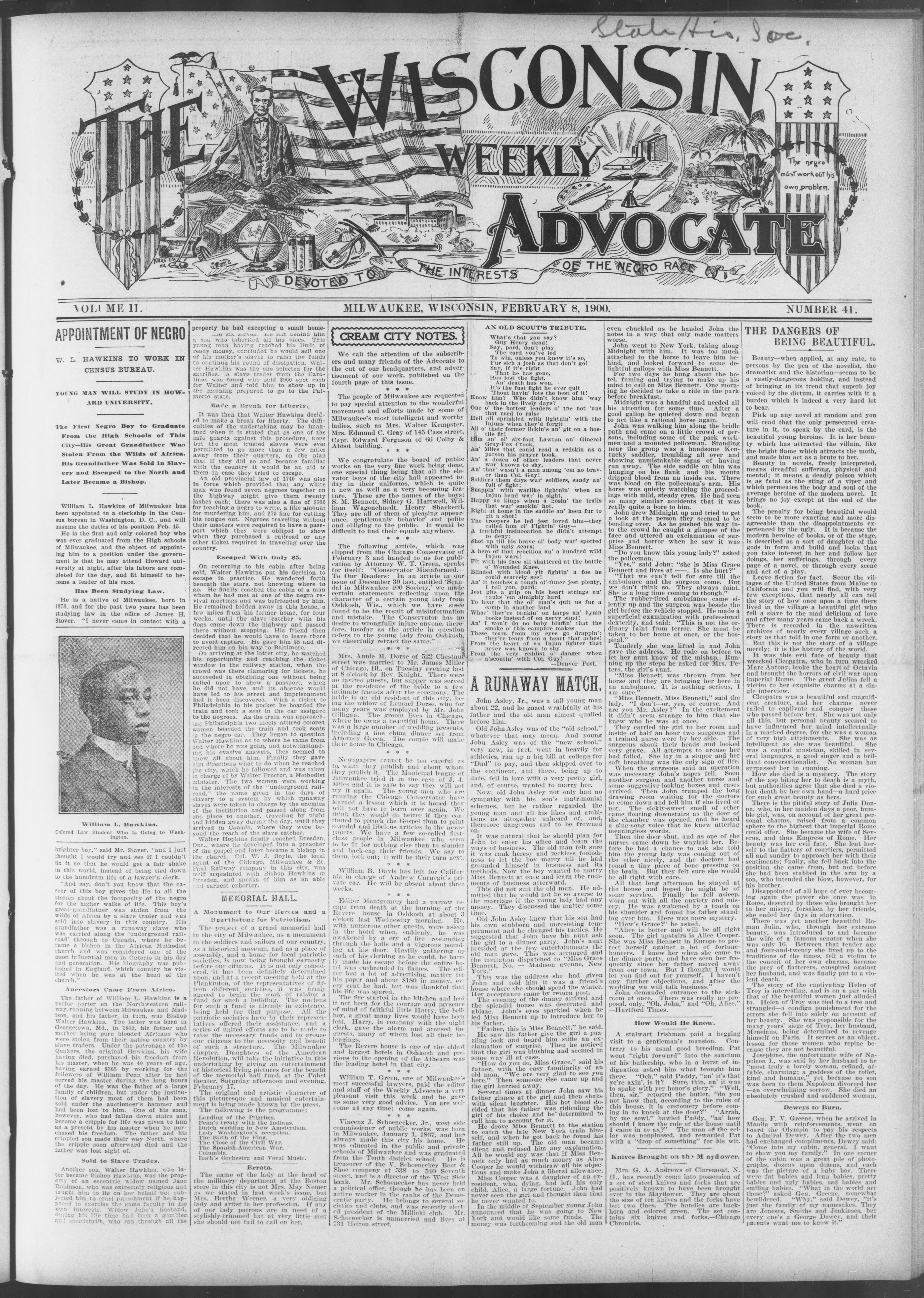
WISCONSIN
WEEKLY
ADVOCATE
DEVOTED TO THE INTERESTS OF THE NEGRO RACE
APPOINTMENT OF NEGRO
YOUNG MAN WILL STUDY IN HOWARD UNIVERSITY.
The First Negro Boy to Graduate From the High Schools of This City-His Great Grandfather Was Stolen From the Wilds of Africa. His Grandfather Was Sold in Slavery and Escaped to the North and Later Became a Bishop.
---
William L. Hawkins of Milwaukee has been appointed to a clerkship in the Census bureau in Washington, D. C., and will assume the duties of his position Feb. 15. He is the first and only colored boy who was ever graduated from the High schools of Milwaukee, and the object of appointing him to a position under the government is that he may attend Howard university at night, after his labors are completed for the day, and fit himself to become a leader of his race.
Has Been Studying Law.
He is a native of Milwaukee, born in 1878, and for the past two years has been studying law in the office of James H. Stover. "I never came in contact with a
[Name not visible]
William L. Hawkins.
Colored Law Student Who Is Going to Washington.
brighter boy," said Mr. Stover, "and I just thought I would try and see if I couldn't fix it so that he would get a fair shake in this world, instead of being tied down to the humdrum life of a lawyer's clerk.
"And say, don't you know that the career of this boy gives the lie to all the stories about the incapacity of the negro for the higher walks of life. This boy's great-grandfather was stolen from the wilds of Africa by a slave trader and was sold into slavery in this country. His grandfather was a runaway slave who was carried along the 'underground railroad' through to Canada, where he became a bishop in the African Methodist church and was considered one of the most influential men in Ontario in his day and generation. His biography was published in England, which country he visited when he was at the head of the church."
Ancestors Came From Africa.
The father of William L. Hawkins is a parlor porter on the Northwestern railway, running between Milwaukee and Madison, and his father, in turn, was Bishop Walter Hawkins. The latter was born in Georgetown, Md., in 1803, his father and mother being pure blooded Africans who were stolen from their native country by slave traders. Under the patronage of the Quakers, the original Hawkins, his wife having died, purchased his freedom from his master, when he was 40 years of age, having earned $365 by working for the followers of William Penn after he had served his master during the long hours of the day. He was the father of a large family of children, but under the institution of slavery most of them had been sold under the auctioneer's hammer and had been lost to him. One of his sons, however, who had fallen down stairs and become a cripple for life was given to him as a present by his master when he purchased his freedom. The father and his crippled son made their way North, where the cripple soon afterward died and the father was lost sight of.
Sold to Slave Trades.
Another son, Walter Hawkins, who later became Bishop Hawkins, was the property of an eccentric widow named Jane Robinson, who was extremely religious and taught him to lie on her behalf but subjected him to cruel punishment if he happened to exercise the same faculty in his own interests. Widow Jane's husband, during his life time had been a gambler and spendthrift, who ran through all the
property he had excepting a small home and six slaves. He left behind him a son who inherited all his vices. This young man having reached his limit of ready money, concluded he would sell one of his mother's slaves to raise the funds to continue his round of dissipation. Walter Hawkins was the one selected for the sacrifice. A slave trader from the Carolinas was found who paid $900 spot cash for Walter and told him to show up in the morning prepared to go to the Palmetto state.
Made a Break for Liberty.
It was then that Walter Hawkins decided to make a break for liberty. The difficulties of the undertaking may be imagined when it is stated that as one of the safe guards against this procedure, none but the most trusted slaves were ever permitted to go more than a few miles away from their quarters, on the plan that if they did so and became familiar with the country it would be an aid to them in case they tried to escape.
An old provincial law of 1740 was also in force which provided that any white man who found seven negroes together on the highway might give them twenty lashes each; there was also a fine of $500 for teaching a negro to write, a like amount for murdering him, and $70 fine for cutting his tongue out. Negroes traveling without their masters were required to have a passport which they were obliged to show when they purchased a railroad or any other ticket required in traveling over the country.
Escaped With Only $5.
On returning to his cabin after being sold, Walter Hawkins put his decision to escape in practice. He wandered forth bencath the stars, not knowing where to go. He finally reached the cabin of a man whom he had met at one of the negro revival meetings and was befriended by him. He remained hidden away in this house, a few miles from his former home, for four weeks, until the slave catcher with his dogs came down the highway and passed there without stopping. His friend then decided that he would have to leave there to avoid capture. He gave him $5 and directed him on his way to Baltimore.
On arriving at the latter city, he watched his opportunity and reaching the ticket window in the railway station, when the crowd was there clamoring for tickets, he succeeded in obtaining one without being called upon to show a passport, which he did not have, and its absence would have led to his arrest and imprisonment had it been discovered. With a ticket to Philadelphia in his pocket he boarded the train and took a seat in the car assigned to the negroes. As the train was approaching Philadelphia two nicely-attired colored women boarded the train and took seats in the negro car. They began to question Walter Hawkins as to where he came from and where he was going and notwithstanding his evasive answers, they seemed to know all about him. Finally they gave him directions what to do when he reached the city, which he followed and was taken in charge of by Walter Proctor, a Methodist minister. The two women were working in the interests of the "underground railroad," the name given in the days of slavery to a system by which runaway slaves were taken in charge by the enemies of the institution and passed along from one place to another, traveling by night and hidden away during the day, until they arrived in Canada, where they were beyond the reach of the slave catcher.
Walter Hopkins finally reached Dresden, Ont., where he developed into a preacher of the gospel and later became a bishop in the church. Col. W. J. Boyle, the local agent of the Chicago, Milwaukee & St. Paul Railway company in this city, was well acquainted with Bishop Hawkins in Dresden, and speaks of him as an able and earnest exhorter.
MEMORIAL HALL.
A Monument to Our Heroes and a Heartstone for Patriotism
The project of a grand memorial hall in the city of Milwaukee, as a monument to the soldiers and sailors of our country, as a historical museum, and as a place of assembly, and a home for local patriotic societies, is now being brought earnestly before our citizens. It is not only considered, it has been definitely determined upon, and at a recent meeting held at the Plankinton, of the representatives of fifteen different societies, it was firmly agreed to begin the work of raising a fund for such a building. The nucleus for such a fund is already in existence, being held for that purpose. All the patriotic societies have by their representatives offered their assistance, and a series of united efforts are to be made to raise the necessary funds and to arouse our citizens to the necessity and benefit of such a structure. The Milwaukee chapter. Daughters of the American Revolution, will take the initiative in this undertaking by giving an entertainment of historical living pictures for the benefit of the memorial hall fund, at the Pabst theater. Saturday afternoon and evening, February 17.
The original and artistic character of this picturesque and musical entertainment is being made known by the press.
The following is the programme:
Landing of the Pilgrims.
Penn's treaty with the Indians.
Dutch wedding in New Amsterdam.
Lady Washington's reception.
The Birth of the Flag.
The Close of the Civil War.
The Spanish-American War.
Columbia.
Bach's Orchestra and Vocal Music.
Errata.
The name of the lady at the head of the millinery department at the Boston store in this city is not Mrs. May Nemer as we stated in last week's issue, but Mrs. Bertha Werner, a very obliging lady and artist in her profession. If any of our lady patrons are in need of a stylishly-trimmed hat at very little cost she should not fail to call on her.
MILWAUKEE, WISCONSIN, FEBRUARY 8, 1900.
CREAM CITY NOTES.
We call the attention of the subscribers and many friends of the Advocate to the cut of our headquarters, and advertisement of our work, published on the fourth page of this issue.
***
The people of Milwaukee are requested to pay special attention to the wonderful movement and efforts made by some of Milwaukee's most intelligent and worthy ladies, such as Mrs. Walter Kempster, Mrs. Edmund C. Gray of 145 Cass street, Capt. Edward Ferguson of 66 Colby & Abbot building.
* * *
We congratulate the board of public works on the very fine work being done, one special thing being that all the elevator boys of the city hall appeared today in their uniforms, which is quite a new as well as a very becoming feature. These are the names of the boys: S. M. Bennett, Sidney G. Hartwell, William Wagonchnedt, Henry Shackertl. They are all of them of pleasing appearance, gentlemanly behavior and polite and obliging to the public. It would be difficult to find their equals anywhere.
* * *
The following article, which was clipped from the Chicago Conservator of February 3 and handed to us for publication by Attorney W. T. Green, speaks for itself: "Conservator Misinformed. To Our Readers: In an article in our issue of December 30 last, entitled 'Scandal in Milwaukee 400 Society,' we made certain statements reflecting upon the character of a certain young lady from Oshkosh, Wis., which we have since found to be the result of misinformation and mistake. The Conservator has no desire to wrongfully injure anyone, therefore, insofar as the article in question refers to the young lady from Oshkosh, we cheerfully retract the same."
***
Mrs. Annie M. Dorse of 522 Chestnut street was married to Mr. James Miller of Chicago, Ill., on Tuesday evening last at 8 o'clock by Rev. Knight. There were no invited guests, but supper was served at the residence of the bride to a few intimate friends after the ceremony. The bride is an old resident of this city, being the widow of Lemuel Dorse, who for many years was employed by Mr. John Gilligan. The groom lives in Chicago, where he owns a beautiful home. There was a large number of wedding presents, including a fine china dinner set from Attorney Green. The couple will make their home in Chicago.
* * *
Newspapers cannot be too careful as to what they publish and about whom they publish it. The Municipal league of Milwaukee tried it in the case of J. J. Miles and it is safe to say they will not try it again. The young men who are running the Chicago Conservator have learned a lesson which it is hoped they will not have to learn over again. We think they would do better if they continued to preach the Gospel than to print scandal and libelous articles in the newspapers. We have a few so-called first-class people in Milwaukee who seem to be fit for nothing else than to slander and back-cap their friends. We say to them, look out; it will be their turn next.
William B. Davis has left for California in charge of Andrew Carnegie's private car. He will be absent about three weeks.
* * *
Editor Montgomery had a narrow escape from death at the burning of the Revere house in Oshkosh at about 3 o'clock last Wednesday morning. He, with numerous other guests, were asleep in the hotel when, suddenly, he was awakened by a cry of fire resounding through the halls and a vigorous pounding at his door. Hastily gathering up such of his clothing as he could, he barely made his escape before the entire hotel was enshrouded in flames. The editor lost a lot of advertising matter for his paper and about $180 in money, every cent he had, but was thankful that his life was spared.
The fire started in the kitchen and had it not been for the courage and presence of mind of faithful little Harry, the bellboy, a great many lives would have been lost. Harry, in company with the night clerk, gave the alarm and aroused the guests, many of whom lost all their belongings.
The Revere house is one of the oldest and largest hotels in Oshkosh and previous to the opening of the Athearn was the leading hotel in that city.
---
William T. Green, one of Milwaukee's most successful lawyers, paid the editor and staff of the Weekly Advocate a very pleasant visit this week and he gave us some very good advice. You are welcome at any time; come again.
* * *
Vinecz J. Schoenecker, Jr., west side commissioner of public works, was born in Milwaukee, January 1, 1867, and has always made this city his home. He was educated in the public and private schools of Milwaukee and was graduated from the Tenth district school. He is treasurer of the V. Schoenecker Boot & Shoe company at 538 to 540 Seventh street, and is a director of the West Side bank. Mr. Schoenecker has never held a political office, though he has been an active worker in the ranks of the Democratic party. He belongs to several societies and clubs, and was recently elected president of the Millioki club. Mr. Schoenecker is unmarried and lives at 731 Holton street.
back in the lively days?
One o' the hottest leaders o' the not 'uns that used to raise
An' Miles that could read a redskin as a parson his prayer book.
Soldiers them days war' soldiers, sandy an'
full o' fight;
Snappin' with marble, lighten' when on
Snappin' with warlike lightnin' when an
Injun band war' in sight,
Happy as kings when a nosin' the trails
that war' smokin' hot,
Right at home in the saddle an' keen fur to
git a shot!
Shot up till his brave o' body war' spotted with ugly scars;
A hero of that rebellion an' a hundred wild Injun wars!
Fit with his face all shattered at the battle o' Wounded Knee.
Blinded with blood yit fightin' a foe he could scarcely see!
An' it touches a tough ol'timer jest plenty,
I tell you, pard;
Jest gits a grip on his heart strings an' yanks 'em almighty hard
yanks 'em almighty hard
To hear that the ol' man's quit us fur a camp in another land
Whar' they're bankin' on harps an' hymn books instead of on nervy sand!
An' I won't do no baby bluffin' that the smoke o' this campfire makes
These tears from my eyes go drappin'; they're tears from a heart that aches!
From the heart of an Injun fighter that never was known to shy
From the very reddist o' danger when a'scoutin' with Col. Guy!
A RUNAWAY MATCH.
A RUNAWAY MATCH.
John Asley, Jr., was a tall young man about 22, and he gazed wrathfully at his father and the old man almost quailed before him.
Old John Asley was of the "old school," whatever that may mean. And young John Asley was of the "new school," very new, in fact, went in heavily for athletics, ran up a big bill at college for "Dad" to pay, and then skipped over to the continent, and there, being up to date, fell in love with a very pretty girl, and, of course, wanted to marry her.
Now, old John Asley not only had no sympathy with his son's matrimonial schemes, but he rather regarded the young man and all his likes and ambitions as altogether unheard of, and, therefore dangerous and to be frowned on.
It was natural that he should plan for John to enter his office and learn the ways of business. The old man felt sure it was rank heresy and reckless foolishness to let the boy marry till he had grounded himself in business and its methods. Now the boy wanted to marry Miss Bennett at once and learn the rudiments of business afterward.
This did not suit the old man. He admitted that he would not be so averse to the marriage if the young lady had any money. They discussed the matter some time.
Old John Asley knew that his son had his own stubborn and unresisting temperament and he changed his tactics. He suggested that John have his aunt ask the girl to a dinner party. John's aunt presided at the few entertainments the old man gave. This was arranged and the invitation dispatched to "Miss Grace Bennett, No. — Madison avenue, New York." This was the address she had given John and told him it was a friend's house where she should spend the winter. Her acceptance came by return post.
The evening of the dinner arrived and the splendid house was decorated and ablaze. John's eyes sparkled when he led Miss Bennett up to introduce her to his father.
"Father, this is Miss Bennett," he said. He saw his father give the girl a puzzling look and heard him stifle an exclamation of surprise. Then he noticed that the girl was blushing and seemed in some way ill at ease. "How do you do, Miss Grace," said his father, with the easy familiarity of an old man. "We are very glad to see you here." Then someone else came up and the girl hurried away. Several times at dinner John saw his father glance at the girl and then shake with silent laughter. His hot blood decided that his father was ridiculing the girl of his choice and he determined to call him to account for it.
He drove Miss Bennett to the station to catch the late New York train himself, and when he got back he found his father still up. The old man became silent and refused him any explanation. All he would say was that if Miss Bennett only had as much money as Alice Cooper he would withdraw all his objections and make John a liberal allowance. Miss Cooper was a daughter of an ex-resident, who, dying, had left his only child, Alice, a large fortune. John had never seen the girl and thought then that he never wanted to.
In the middle of September young John announced that he was going to New York and would like some funds. The money was forthcoming and the old man
even chuckled as he handed John the notes in a way that only made matters worse. John went to New York, taking along Midnight with him. It was too much attached to the horse to leave him behind, and looked forward to some delightful gallops with Miss Bennett. For two days he hung about the hotel, fuming and trying to make up his mind to call on Miss Bennett. One morning he decided to take a ride in the park before breakfast. Midnight was a handful and needed all his attention for some time. After a good gallop he quieted down and began to act like a rational horse again.
John was walking him along the bridle path and came on a little crowd of persons, including some of the park workmen and a mounted policeman. Standing near the group was a handsome Kentucky saddler, trembling all over and showing unmistakable signs of having run away. The side saddle on him was hanging on his flank and his mouth dripped blood from an inside cut. There was blood on the policeman's arm. His horse was quietly watching the proceedings with mild, steady eyes. He had seen so many similar accidents that it was really quite a bore to him.
John drew Midnight up and tried to get a look at the person they seemed to be bending over. As he pushed his way into the crowd he caught a glimpse of the face and uttered an exclamation of surprise and horror when he saw it was Miss Bennett.
"Do you know this young lady?" asked the policeman. "Yes," said John; "she is Miss Grace Bennett and lives at ____. Is she hurt?"
Bennett and lives at ——. Is she hurt?"
"That we can't tell for sure till the ambulance and the surgeon come. But we don't think so. They always faint. She is a long time coming to though."
The rubber-tired ambulance came silently up and the surgeon was beside the girl before the vehicle stopped. He made a superficial examination with professional dexterity, and said: "This is not the ordinary faint from terror. She must be taken to her home at once, or the hospital."
Tenderly she was lifted in and John gave the address. He rode on before to let her aunt know of the mishap. Running up the steps he asked for Mrs. Peters, the girl's aunt.
"Miss Bennett was thrown from her horse and they are bringing her here in an ambulance. It is nothing serious, I am sure."
"Miss Bennett, Miss Bennett," said the lady. "I don't—or, yes, of course. And are you Mr. Asley?" In the excitement it didn't seem strange to him that she knew who he was at once. They carried the girl to her room and inside of half an hour two surgeons and a trained nurse were by her side. The surgeons shook their heads and looked very grave. All attempts to arouse her had failed. She lay in a stupor and her soft breathing was the only sign of life.
When the surgeons said an operation was necessary John's hopes fell. Soon another surgeon and another nurse and some suggestive-looking boxes and cases arrived. Then John tramped the long drawing room waiting for the doctors to come down and tell him if she lived or not. The sickly-sweet smell of ether came floating downstairs as the door of the chamber was opened, and he heard a sing-song voice that he knew uttering meaningless words. Then the door shut, and as one of the nurses came down he waylaid her. Before he had a chance to ask she told him the young lady was coming out of the ether nicely, and the doctors had found a tiny piece of bone pressing on the brain. But they felt sure she would be all right with care.
All that long afternoon he stayed at the house and hoped he might be of some service. Finally he fell asleep, worn out with all the anxiety and misery. He was awakened by a touch on his shoulder and found his father standing over him. Here was more mystery. "How's Grace?" he asked. "Alice is better and will be all right soon. The girl upstairs is Alice Cooper. She was Miss Bennett in Europe to protect herself against a lot of fortunehunters. I knew her when she came to the dinner party, and have seen her frequently since her father moved away from our town. But I thought I would let you find out for yourself. I haven't any further objections, and after the wedding we will talk business." John demanded entrance to the sickroom at once. There was really no proposal, only "Oh, John," and "Oh, Alice."—Hartford Times.
How Would He Know.
A stalwart Irishman paid a begging visit to a gentleman's mansion. Contrary to his usual good breeding, Pat went "right forward" into the sanctum of his butlership, who in a burst of indignation asked him what brought him there. "Och," said Paddy, "an' it's that ye're axin', is it? Sure, thin, an' it was to spake with yer honor's glory." "Well, then, sir," retorted the butler, "do you not know that, according to the rules of this house, it is customery before coming in to knock at the door?" "Arrah, by me sowl," bawled Paddy, "an' how should I know the rule of the house until I came in to ax?" The man of the cellar was nonplussed, and rewarded Pat with a "drop of something" for his wit.
Knives Brought on the Mayflower.
Mrs. G. A. Andrews of Claremont, N. H., has recently come into possession of a set of steel knives and forks that are positively known to have been brought over in the Mayflower. They are about the size of tea knives and the forks have but two tines. The handles are buckhorn and colored green. The set contains six knives and forks.—Chicago Chronicle.
THE DANGERS OF BEING BEAUTIFUL.
Beauty—when applied, at any rate, to persons by the pen of the novelist, the dramatist and the historian—seems to be a vastly-dangerous holding, and instead of bringing in its trend that superb joy voiced by the dictum, it carries with it a burden which is indeed a very hard lot to bear.
Pick up any novel at random and you will read that the only persecuted creature in it, to speak by the card, is the beautiful young heroine. It is her beauty which has attracted the villain, like the bright flame which attracts the moth, and made him act as a brute to her.
Beauty in novels, freely interpreted, means dreadful suffering, physical and mental; it means a deadly poison which is as fatal as the sting of a viper and which permeates the body and soul of the average heroine of the modern novel. It brings no joy except at the end of the book.
The penalty for being beautiful would seem to be more exacting and more disagreeable than the disappointments experienced by the ugly. It is because the modern heroine of books, or of the stage, is described as a sort of daughter of the gods in form and build and looks that you take interest in her and follow her doings, her sufferings, through every page of a novel, or through every scene and act of a play.
Leave fiction for fact. Scour the villages of the United States from Maine to California and you will find, with very few exceptions, that nearly all can tell the story of how once upon a time there lived in the village a beautiful girl who fell a slave to the mad delirium of love and after many years came back a wreck. There is recorded in the unwritten archives of nearly every village such a story as that told in one form or another. But this is not the story of a village merely; it is the history of the world. It was this evil fate of beauty that wrecked Cleopatra, who in turn wrecked Marc Antony, broke the heart of Octavia and brought the horrors of civil war upon imperial Rome. The great Julius fell a victim to her exquisite charms at a single interview.
Cleopatra was a beautiful and magnificent creature, and her charms never failed to captivate and conquer those who passed before her. She was not only all this, but personal beauty seemed to have influenced her mind intellectually in a marked degree, for she was a woman of very high attainments. She was as intelligent as she was beautiful. She was a capital musician, skilled in several languages, a good singer and a brilliant conversationalist. No woman has surpassed her in cunning.
How she died is a mystery. The story of the asp biting her to death is a myth, but authorities agree that she died a violent death by her own hand—a hard price for such great beauty as hers.
There is the pitiful story of Julia Donna, who, in her maiden days a poor, humble girl, was, on account of her great personal charms, raised from a common sphere to the highest that imperial Rome could offer. She became the wife of Severus, and thus Empress of Rome. Her beauty was her evil fate. She lent herself to the flattery of courtiers, permitted all and sundry to approach her with their sentiments; finally, she fell back into the position she came from, but not before she had been stabbed in the arm by a son, who intended the blow, however, for his brother.
Disappointed of all hope of ever becoming again the power she once was in Rome, deserted by those who brought her to her misery, forsaken by her friends, she ended her days in starvation.
There was yet another beautiful Roman Julia, who, through her extreme beauty, was introduced to and became the wife of a famous senator when she was only 16. Between that tender age and four-and-twenty she lived up to the traditions of the times, fell a victim to the conceit of her own charms, became the prey of flatterers, conspired against her husband, and was finally put to a violent death.
The story of the captivating Helen of Troy is interesting, and is on a par with that of the beautiful women just alluded to. Helen of Troy was tied to a tree and strangled—a condign punishment for the errors she fell into solely on account of her beauty. She was responsible for the many years' siege of Troy, her husband, Menelaus, being determined to revenge himself on Paris. It serves as an object lesson for those women who repine because they are not beautiful.
Josephine, the unfortunate wife of Napoleon L., was said by her husband to be "most truly a lovely woman, refined, affable, charming; a goddess of the toilet, kind and humane," yet because no son was born to them Napoleon divorced her—an overwhelming sorrow. She died an absolutely crushed and saddened woman.
Deweys to Burn.
Gen. F. V. Greene, when he arrived in Manila with reinforcements, went on board the Olympia to pay his respects to Admiral Dewey. After the two men had exchanged compliments, Dewey said: "Come into my cabin, general. I want to show you my family." In one corner of the cabin was a great pile of photographs, dozens upon dozens, and each was the picture of a baby boy. There were fat babies and lean babies, pretty babies and ugly babies, sad babies and smiling babies. "What in the world are these?" asked Gen. Greene, somewhat bewildered. "Why," said Dewey, "it's just the family of my namesakes. They are Joneses, Smiths and Jenkinses, but every one's a George Dewey, and their parents want me to know it."
STARTS FOR THE FRONT
Roberts Goes to Sterkstrom to R relieve Gen. Guitacre.
SOME OUTPOST FIRING
British House of Commons by a Decisive Vote Sustains the Chamberlain Ministry.
London, Feb. 7. While the suspense regarding Gen. Buller's movements and the operations affecting the fate of Ladysmith continued unrelieved even by the vaguest dispatches, there comes from other quarters interesting news in the announcement that Field Marshal Lord Roberts, the commander-in-chief of the British forces in South Africa, and his chief of staff, Maj.-Gen. Lord Kitchener, have left for the front. As this information was held up for several hours by the censor, it seems to indicate that an important movement is on foot.
A dispatch from Sterkstroom, dated this morning, announces that the Boers are attacking Gen. Gatacre from two directions. Firing was then proceeding between the outposts. A detained Sterkstroom dispatch, dated Monday, February 5, says that a body of troops left the camp February 3, and that important developments were expected. It is quite probable that this explains Lord Roberts' departure, and that the commander-in-chief wishes either to be present at or supervise the long-intended movement by Gen. Gatacre to join forces with Gen. Kelly-Kenny, and the strongly reinforce Gen. French, completing the latter's work at Colesberg and establishing without fear of serious opposition the advanced position for the main movement.
This, of course, is greatly supposition, and it can be confidently said that the departure of Lord Roberts and Lord Kitchener for the front does not indicate that the main advance had begun. The commanders will probably be back in Cape Town within a short time. It is pointed out that the term going to the front must not be interpreted into the idea that a great movement upon Pretoria, by way of Blomfontein, has seriously commenced. It will be a month, or perhaps much longer, before this can be brought about.
In the meanwhile the preliminary steps are likely to enliven the campaign with sharp fighting, and news from Sterkstroom, Thebus and Colesberg is eagerly awaited.
Supposition regarding Gen. Buller owing to lack of information is as futile as it was yesterday.
A Flank Movement.
London, Feb. 7.—The long-continued inactivity of Gen. Methuen's division at Modder river has at length been broken, a movement apparently aiming to flak the Boers, having been begun.
The Standard's correspondent, telegraphing from Koppies dam, under date of February 5, reports Gen. Hector Macdonald, with the Highland brigade, the Sixty-second battery, and the Ninth Lancers arrived at Koodoosberg on February 4. The last few miles of the march was over the most trying ground, and the troops suffered considerably from the heat and the lack of water. The force bivouacked at Koodoosberg drift and had their first brusn with the enemy at dawn February 5.
Boers Are Driven Back.
The lancers ascended Koodoosberg kopje and found a Boer patrol climbing up the other side. Shots were exchanged, but the Boers, who were taken by surprise, fled. A cavalry patrol afterward found the Boers in possession of the ridges to the northeast, which they evacuated after a few shots on the approach of the main body of cavalry. The infantry was not engaged.
Kopies dam commands the road from Kimberley to Hopetown and Douglas. Two Boer haagers are at Kameelhook and Griquatown, within striking distance. A strong force of the enemy is actively concentrating to oppose Gen. MacDonald, whose arrival in the neighborhood has prevented the two commandoes from joining.
Free Staters Advised to Desert.
London, Feb. 7. 4:20 a. m.—Lord Roberts has caused to be distributed in the towns bordering upon the invaded colonial territory an invitation to Free Staters and Transvaalers to go into the desert, offering them good treatment and a restoration of their farms on the British occupation of republican territory. The manifesto guarantees that those bringing horses can sell them. Foreigners will have their passage paid to Europe. Colonial rebels are advised to surrender in preference to being taken prisoners.
British Near Norval's Point
Pretoria, Feb. 5.—A dispatch from Colesberg, Cape Colony, states that the British are within seven miles of Achterlang, a short distance to the northeast of Colesberg, and near the Norval Pont station, on the border of the Orange Free State.
Artillery Park D:stroyed.
Rensburg, Cape Colony, Feb. 5.—Gen. French is holding in check a large force of Boers at Colesberg.
This morning a new Boer laager, near Slingersfontein, where the burghers were placing new artillery, was shelled with lyddite. The effect of the shelling was to spoil all the work that had been already accomplished, and to compel a general retirement of the Boers.
British to Return Boers' Gold.
Durban, Natal, Feb. 7.—The prize court here has decided to return £25,000 in gold belonging to the Transvaal National bank, which was seized on the steamship Avondale Castle last October. The bank was transferring the gold from Durban to its branch at Delagoa bay.
TRANSVAAL INDEPENDENCE.
Irish Leader in House of Commons Says the War Should Stop.
London, Feb. 7.—John Redmond, chairman of the United Irish party, was loudly cheered by all sections of the Irish members when he rose in the House of Commons today to move an amendment to the address in reply to the speech from the throne, representing the time had arrived to bring the war to a conclusion on the basis of recognizing the independence of the Transvaal and the Orange Free State. He said the Irish party abhorred the war and intended so far as possible, to maintain the independence of the republics, defended with such heroism.
Mr. Redmond admitted that when the empire was involved in complications a feeling of hope and satisfaction stirred the majority of the Irish at home and abroad. But, he continued, the sympathies of the Irish would still have been pro-Boer even if England had not been concerned, and another party had attempted to "act the bully and oppressor in South Africa."
"England today," added Mr. Redmond, "stood not in splendid but in disgraceful isolation; Turkey alone lending her countenance."
Feeling in America.
While admitting that official expression of hostility had not been heard in the United States, "chiefly because America,
being engaged in the Philippine war, had not felt herself in a position to rebuke England, as she would otherwise have done," Mr. Redmond declared that the overwhelming opinion of leading American statesmen was hostile to Great Britain in this war and said the "unanimous disapproval of the world demonstrated that the war was unjust and it ought, therefore, to be stopped." As to whether the prospects of home rule were adversely affected by the attitude of the Irish, Mr. Redmond said he thought Ireland had nothing to lose and everything to gain by raising her voice on the side of justice and liberty. Patrick Joseph Power, member for the East division of Waterford county, seconded Mr. Redmond's amendment. Mr. Redmond's amendment was rejected by a vote of 36S to 66. The House then adjourned
Chamberlain Sustained.
As had been confidently expected, the vote on Lord Edmund Fitzmaurice's amendment resulted in a substantial majority upholding the ministry. Against the amendment 352 votes were cast, while only 139 of the opposition stood up to be counted. The Irish members did not vote at all.
WILLIAM M. EVARTS IS TOTALLY BLIND.
The New York Lawyer-Statesman Quietly Celebrates His Eighty-second Birthday.
New York, Feb. 7.—Ex-Senator William M. Evarts quietly celebrated his eighty-second birthday today, surrounded by his children and grandchildren. Mr. Evarts is now totally blind, and he spends the most of his time sitting in a reclining chair in a sunny room in the second story of his residence, where a young lady secretary attends to his correspondence and reads to him the newspapers and magazines.
Mr. Evarts retains full possession of his faculties, and continues to enjoy life, for several lifelong friends call on him
C. P. P.
every day, and some of his numerous grandchildren are almost always about him. No pleasant day passes without a visit from all the grandchildren, and the old gentleman watches eagerly for their coming. Some of them he has never seen. The light began to leave Mr. Evarts' eyes ten years ago, after an accident, when he was thrown from a car and struck his forehead upon the pavement.
Notwithstanding his eventful career of nearly sixty years at the bar, in politics and public office, Mr. Evarts has resisted all persuasion to write the reminiscences of his busy and eventful life. He was attorney-general in Johnson's cabinet, secretary of state for four years, and served six years in the Senate. He was the attorney for the United States before the Geneva arbitration tribunal and secured a judgment of $15,000,000 for this country.
Mr. Evarts defended President Johnson against the impeachment of the House of Representatives, defended Henry Ward Beecher in the Tilton scandal, for a quarter of a century was the acknowledged leader of the bar of this country, and is said to have received the largest fee of any lawyer in history.
LOGAN'S REMAINS ARE LAID TO REST.
Large and Imposing Funeral Cortege at Youngstown-Profusion of Flowers.
Youngstown, O., Feb. 7.—Thousands of citizens and people from the surrounding towns and county passed through the vestibule of St. John's Episcopal church today where the body of Maj. John A. Logan lay, surrounded by military guards. The sealed casket was folded about with the national colors and across the bier lay a broad band of silk, engrossed:
The profusion of floral tributes was extraordinary. Militia companies, military and civic organizations from neighboring cities began arriving early in the morning and the streets were filled with people. At 2 o'clock the casket was removed to the chancel of the church and the funeral services began. The burial service of the Episcopal church was read by the rector, assisted by Bishop Leonard of Cleveland. The funeral cortexe was the largest and most imposing ever witnessed in this city, and was composed of a company of the Seventh United States infantry and the regimental band from Fort Wayne, Mich.; a battalion of militia from the Fifth O. N. G.; G. A. R. posts and Union Veteran Legion corps; city officials and citizens.
Minute guns were fired as the cortecge moved, and the interment was made according to military rites, in the Andrews mausoleum in Oak Hill cemetery.
COMMITTEE DIVIDED.
Split in Ways and Means Committee Over Porto Rican Tariff.
Washington, D. C., Feb. 7.—It developed today in connection with the Porto Rican tariff bill that the Republican majority of the ways and means committee was not unanimous in favor of the measure nor for the principle it involved as to the government of the territorial acquisitions, and Representative McCall, Republican member of the committee from Massachusetts, has prepared a strong dissenting report. In other respects the vote was on party lines. The bill was changed in two particulars. Section 3 was amended so that articles like tobacco, subject to an internal revenue tax in the United States, shall pay that tax, as well as 25 per cent, of the customs duty. Section 4 was changed so as to make it clear that the duties, etc., collected shall be used exclusively for the benefit of Porto Rico.
BULLER IS BEATEN BACK
A Hundred Ambulances Are Sent from Durban-Terrific Cannon-ing All Day.
Beer Head Laager, Ladysmith, Tuesday, Feb. 6.--Since yesterday, the British, with naval and other guns, have bombarded our position on the Upper Tugela. The troops crossed the river at the pont and at Molen drift, with the object of storming our positions. At the former, Gen. Burger beat them back and they recrossed in great confusion. The fighting continues at Molen drift with the Standerton and Johannesburg commandos. There were no casualties on our side. The cannonade was the fiercest yet experienced.
There was a continuous roaring all day long. This morning it recommenced with an increased number of guns. Further reports of yesterday's fighting at the upper Tugela river show that the British lost heavily at Pont drift, but took an important position on a small kopje, on the Molen drift side. Four Boers were killed. The British loss is unknown. They are still in possession of the kopje and the big guns have ceased firing. London, Feb. 7.—The Associated press learns that the war office today received a telegram saying, briefly, that Gen. Buller had again recrossed the Tugela river February 5 and is now advancing upon Ladysmith.
Buller's "Advance."
When the dispatch announcing the fighting on the Upper Tugela was published there was the usual scene of excitement on the streets. The big placards attracted newspaper buyers, and the news was eagerly discussed in all quarters. There was notable excitement in the House of Commons, where in addition to the war office announcement that Gen. Buller had crossed the Tugela Monday and was advancing upon Ladysmith, a news agency telegram was posted saying that 100 additional ambulance stretchers had been sent to the front from Durban.
No Details in London.
The war office at present is only able to add regarding Gen. Buller's advance "the operations are still in progress but we have no information regarding the result."
The available maps do not show the drifts mentioned in the Boer dispatch. The rush in the direction of the war office when it was learned that confirmation had been received there of the report that Gen. Buller was again advancing evidenced the anxiety of the public to obtain the latest details.
Buller's Supreme Effort.
The war office message given out furnishes no clue as to where the Tugela was crossed, nor the numbers supporting Gen. Buller's movement; but it is presumed this third attempt will be a supreme effort on the part of the general to cut his way through and that in it he will employ every available man. The expression that official dispatch "is now advancing upon Ladysmith," it is pointed out, must not be taken to mean that he has cut down all opposition, but merely that he is headed in the direction of the besieged town, and the public, therefore, are naturally on tenterhooks in regard to the next news.
PRISONERS REVOLTED.
PRISONERS REVOLTED.
Dispersed Their Guards with Stones and Clubs-Rebels Expelled from Legaspi.
Manila, Feb. 7.—The insurgents have been driven out of Legaspion bay, province of Albay.
The rebels of Tayabas province were conveying some 300 Spanish prisoners to Libmanan and on arriving there, the prisoners, exhausted and starved, revolted and dispersed their guards with stones and clubs. They also captured a few rifles and barricaded themselves at Libmanan, where they are awaiting the arrival of American troops.
Manila, Feb. 7,--Noon.—The insurgents Monday captured a supply train of nine bull carts between Orani and Dinalupijan, killing a corporal and five privates of Co. G. Thirty-second infantry. The escort consisted of a sergeant and eleven mounted men. The insurgents weakened the supports of a bridge over a creek and the first cart went into the stream. While the escort was bunched trying to haul the cart out of the water, the insurgents fired a volley from the bushes, killing the six Americans and also two native drivers. Washington, D. C., Feb. 7.—A cable message was received at the war department from Gen. Otis today as follows: "Escaped Spanish prisoners report they saw Lieut. Stockley, a prisoner in the hands of the insurgents, January 28, near Antimonan, southern Luzon."
Grand Old Man of Indiana is Closing a Long Career.
Terre Haute, Ind., Feb. 7.—Col. R. W. Thompson, ex-secretary of the navy, is thought to be dying. His physician says he can live but a few days unless a decided change occurs.
For more than half a century Richard W. Thompson has been prominent in political life. Although he is more than 90 years old, he was a delegate to the National Republican convention four years ago, and was chairman of the state Republican convention in Indiana the same year. He has seen and talked to every President of the United States except George Washington and John Adams. He sat in Congress with John Quincy Adams, Henry Clay, Daniel Webster, Lincoln, Douglas, Calhoun and Jefferson Davis. He served in the Indiana Legislatures of 1834, 1835 and 1836, presided over the state Senate from 1838 to 1840, went to Congress in 1841, for the first time. He was secretary of the navy under President Hayes. While in that position he formed some decided views regarding the future naval power of the United States.
"I saw clearly," he said recently, "that it is our duty to build the best ships in the world. There can be no limits to our efforts in that direction. The large governments of the world are covering the seas with their fighting material, and if we are to have a merchant marine, we must have a navy to protect it.
"We must legislate for our merchant marine, whether by subsidies or discriminating duties. Our flag should be on the commercial highways of every sea, and our fighting boats should be about to protect them."
CHANGE OF PASTORS.
New Minister at Swedish Lutheran Church at Marquette, Mich.
Marquette, Mich., Feb. 7.—[Special.]—Rev. E. A. Linder of Lamont, Ill., has accepted a call to take the pastorate of the Swedish Lutheran church in this city, in place of Rev. F. A. Johnson, who has resigned to go to Chicago as pastor of the Zion church. Mr. Johnson leaves next week and Mr. Linder comes here about May 1.
BIG LABOR FIGHT NOW ON IN CHICAGO.
Clash of Contractors and Building Trades Unions Begins by Plumbers' Lockout.
Chicago, Ill., Feb. 6.—The war between the building contractors of the city and the Building Trades' council, which promises to paralyze the building industry in Chicago for an indefinite period, was inaugurated yesterday with a lockout of the journeymen plumbers, 500 in number. The next move by the contractors, it is said, will be an attempt to deprive the Building Trades' council of its name and its members of their working cards. This they hope to do by means of a blanket injunction, brought in the name of the Independent Brotherhood of Building Trades' councils, an organization which, it is claimed, has been in existence for six years under a state charter.
Today the only plumbers working in the city for general contractors are those employed by E. Baggot & Co., on the Marshall Field building and the Cummings job, at Fifty-first street and Grand boulevard. This work is being done by the permission of the Building Contractors' council on account of its being work of a special nature. With the other master plumbers the tie-up was complete. Within a day or two, the labor leaders say, a sympathetic strike of all the other trades affiliated with the Building Trades' council will be inaugurated. The building laborers also declined yesterday to work for any of the contractors who have adopted the new working rules, and last night it was estimated that fully 20 per cent. of the Chicago workmen who have been actively engaged on jobs were involved.
DRIFTING TOWARD WAR
Relations Between France and Great Britain Strained-Monson Leaves Paris.
Paris, Feb. 6.—If there is any truth in the story of the recall of Sir Edmund Monson, British ambassador at Paris, the French and British officials here who ought to know will permit the publication of no information on the subject. The dignified Siecle, the only Parisian daily newspaper that is outspokenly in favor of Great Britain in connection with the war in South Africa, yesterday displayed on its first page, under the startling heading "A Grave Runor," the statement, persistently circulated, that Sir Edmund Monson, the British ambassador, had been recalled by his government because the minister of public instruction, in spite of Sir Edmund's expostulations, had persisted in conferring a decoration on M. Leandre, the author of the recent vulgar caricatures of Queen Victoria.
"If this report is false," said the Siecle, "the government should declare it, for precise details as to the alleged circumstances are not given."
At the British embassy and the French foreign office the whole story is declared to be "too silly for official denial."
The only evening paper to notice the matter is the ultra-sensational Patrie, which makes the report the pretext for the most violent attack in which it has yet indulged against Great Britain and its ambassador.
Whether the story be true or false, it strikingly shows the strained relations existing between the two countries. The truth is, hundreds of the most intelligent of Frenchmen now firmly believe that both countries are drifting slowly but surely toward war.
TO AVOID INVESTIGATION
Rockefeller Resigns Presidency of Standard Oil's Ohio Branch.
New York, Feb. 6.—The Evening Post says: "A report from Cleveland to the effect that John D. Rockefeller has resigned the presidency of the Standard Oil Company of Ohio, one of the subsidiary companies of the trust, gave rise today to the impression that he has retired from his position in the Standard Oil Company of New Jersey, the main corporation. This is incorrect. Mr. Rockefeller has resigned the presidency of the Ohio company merely and will be succeeded by Vice-President A. M. McGregor of the New Jersey company. The reasons for the change are said to be partly concern for Mr. Rockefeller's health and partly his desire to avoid being drawn into future investigations of the company's affairs, such as that laterly managed by Attorney-General Monett of Ohio."
The directors of the Standard Oil company of New Jersey have declared a dividend of $20 per share, payable March 15.
POLYGAMY CONDEMNED.
House Committee Listens to a Number of Addresses.
Washington, D. C., Feb. 6.—The rooms of the House committee on judiciary were crowded to overflowing today with the representatives of many religious, missionary and social reform bodies to urge the need of constitutional amendment prohibiting polygamy. The addresses were strongly condemnatory of polygamy and many of those engaged in missionary work in the West stated that the Mormon church was systematically propagating the doctrine of polygamy, despite all denials. The lady speakers appealed in particular for protection to the sanctity of the American home.
THE BRAKEMAN KILLED
Engineer and One Passenger Injured in Railroad Collision.
Toledo, O., Feb. 6.—About 10 o'clock last night the north-bound express on the Hocking Valley road ran into the rear of a freight at Carey, wrecking the engine and baggage car of the express and the caboose and two freight cars of the other. The wreck took fire and the five cars were consumed. The casualties are: Brakeman Stineman, killed; engineers Rounseville and Snyder of Toledo, injured: — Kratt of Findlay, passenger, injured.
Appreciated by Indians.
Mineral waters have come to take a very prominent place in national beverages, especially in the case of those who are suffering more or less from physical derangements. In this country the Indians practiced bathing in the heated waters and drinking them long before they taught to the whites the benefits of many springs now famous. It is within the memory of many inhabitants of this country how the red man came annually to encamp at Manitou and other healing springs in the Rockies.—Indianapolis News.
Restful.
They had been sitting together for half an hour.
"I have enjoyed our conversation so much!" she exclaimed, as she rose to go. "It is so restful to talk with you!"
And after she had left him he remembered that he hadn't been able to get in ten words edgewise throughout the whole conversation.—Somerville Journal.
—The mineral resources of Venezuela consist of great mines of Bessemer iron, copper and gold.
—The famous gardens of Versailles have cost £8,000,000.
---
GOEBEL DIES OF WOUND.
AFTER HARD STRUGGLE
Had Taken No Nourishment Since the Day of the Shooting—Sank Into Unconsciousness.
Frankfort, Ky., Feb. 5.—Mr. Goebel died at 15 minutes before 7 o'clock Saturday evening. At the bedside were his brother Arthur and his sister, Mrs. Herman Brunnecker. He had been unconscious for an hour, and every effort of his doctors to sustain life until his brother, Justus Goebel, could arrive from Arizona had failed. He had spoken no message since 4:30 o'clock in the afternoon, when, after a private talk with his brother and sister, he said to Arthur, "Tell my friends
P.
to be brave and loyal to the great common people."
Mr. Goebel's death had been feared since morning, when he relapsed from comparative safety to the condition of a dying man. Hundreds of his friends thronged the hotel, and on the street corners were groups of his admirers, tearful and furious at his rate. Nothing is known of his conversation with Arthur and Mrs. Brunnecker, and the few words he spoke during the day of his death were voiced in delirium. In his feeble ravings he said: "I forgive them; they were not to blame," and at intervals he asked for his brother Justus. The latter arrived about an hour after William Goebel died.
Ten minutes after Dr. McCormack had sworn to the death certificate Clerk Shackleford of the court of appeals administered the oath of office as governor to J. C. W. Beckham. "May God help me to meet the responsibility," answered Beckham, and the assembled witnesses said "Amen."
Plans for the Funeral.
Mr. Goebel's funeral will be held Thursday from one of the churches in Frankfort. The remains will be deposited in a vault for several months, and then interred in a lot among Kentucky's distinguished dead at the state cemetery here. It was decided to take the body to Covington, Mr. Goebel's home, on a special train. The body will there lie in state at Odd Fellows' hall Tuesday. It will be brought back here early Wednesday morning and lie in state in the ballroom of the Capitol hotel until 10 o'clock at night. The funeral services will be held at noon Thursday. In accordance with Mr. Goebel's wishes, the services will be simple. Ministers of several denominations will take part. Committees of Democratic members of the House and Senate will accompany the remains to Covington and back again.
OPEN PORTS TO TRADE.
Gen. Otls' Orders Establishing Civil
New York, Feb. 5.—A special to the Herald from Washington says: General orders issued by Maj.-Gen. Otis relative to the establishment of civil government and of the opening of ports of the Philippines to trade, have just been received by the war department.
Brig.-Gen. S. B. M. Young is now serving as military governor of Northwestern Luzon, west of the provinces of Cagayan, Isabella and Nueva Vizcaya, which are under the command of Col. C. C. Ilood. Sixteenth infantry. Those provinces within Gen. Young's command are Abra, Bontoc, Benguet, Le Panto, Ilocos, North and South, and Union, and his officers are established in Vigan. Troops at his disposal are the third cavalry and the Thirty-third infantry, which have established permanent stations at San Fernando, Vigan and Laoag, without postposts and subposts for the protection of the inhabitants and the administration of public affairs.
Opened for Trade.
After the appointment of Gen. Young, Gen. Otis issued an order declaring Daguapan, San Fernando de, la Union, Vigan, Laoag and Aperri open for trade under coasting trade regulations. Gen. Otis also issued an order at the same time declaring that trade with the ports of Sulu, with those of Zamboanga, Cottabatto and Davao of the island of Mindanao, and with the island of Basilant established. The ports of Zamboanga, Mindanao, Jolo, island of Jolo, Siassi and island of Siassi were declared to be open ports for the time being.
Burned by the Natives.
Manila, Feb. 5.—The steamer Viscaya, which lately sailed hence for Legaspi, returned today, having been unable to land her cargo, owing to the situation there. The natives had attacked and burned the suburbs of the town, and the town itself was deserted. A battalion of the Forty-seventh regiment, which is doing garrison duty at Legaspi, repulsed the rebels. No report has been made concerning the American losses, if there were any.
Kobbe Occupies Nine Towns.
Brig.-Gen. Kobbe's expedition in the islands of Luzon, Layte and Samar has occupied permanently and garrisoned nine towns with the Forty-third and Forty-seventh regiments. This has placed on the market 180,000 bales of hemp.
A thousand insurgents armed with rifles and over 5000 armed with wooden swords, bows and arrows, were encountered during the entire trip. The troops killed seventy-five natives, all of whom had rifles. The others were villagers armed with wooden swords.
—The tramways, omnibuses and underground railways in and around London, within a radius of five miles, carry each year, it is calculated, about 453,000,000 passengers.
Sothern was Angry.
E. A. Sothern of "Dundreary" fame was once dining at Portsmouth at a regimental mess. After dinner one of the officers asked Sothern to give them a recitation. Now Sothern would not tolerate being treated as an entertainer when he was by way of being treated as a gentleman. He coldly declined. They pressed him. He hotly declined. Still they would take no denial. At last he said, in a manner which showed that he was nettled, but yet yielding: "Well, if you won't let me off, I must. I'll give you the dinner scene from 'David Garrick.'" He did. He had never acted it better. They were delighted until, springing to his feet, he made his wild tipsy exit, just as he did on the stage, and dragged the cloth off the table, and with it all the regiment's prized dessert china and decanters and glasses, etc. Thereupon he calmly resumed his seat, but thereafter Sothern dined no more with that regiment.
Free to Rheumatic Sufferers
Free to Rheumatic Surfers. John A. Smith of Milwaukee has 25.000 packages of a simple rheumatic remedy which he desires to distribute free of charge to every person afflicted with this disease. Mr. Smith had been a sufferer for years from rheumaticism. He studied the causes and then experimented until a combination of well-known herbs speedily and effectively drove every rheumatic pain from his system. He called his discovery Gloria Tonic. Friends, relatives and neighbors were given samples of the newly-found remedy and the results were remarkable. That every reader of this paper may have a fair trial of Gloria Tonic, the discoverer will send free of charge a trial package. Address John A. Smith. No. 6 Summerfield Church building, Milwaukee, Wis.
On Choosing a Country House
"I would say to anyone who is thoroughly in earnest about a country home—make it yourself. Xenophon, who lived in a time when Greeks were Greeks, advised people in search of a country place to buy of a slatternly and careless farmer, since in that event they might be sure of seeing the worst, and of making their labor and care work the largest results. Cato, on the other hand, who represented an effeminate and scheming race, advised the purchase of a country home from a good farmer and judicious housebuilder, so that the buyer might be sure of nice culture and equipments—possibly at a bargain. It illustrates, I think, rather finely an essential difference of the two races and ages—the Greek carnest to make his own brain tell, and the Latin eager to make as much as he could out of the brains of other people. I must say I like the Greek view best."—From "The Master of Edgewood" (Donald G. Mitchell), by Arthur Reed Kimball, in Scribner's.
Patents to Inventors.
Messrs. Benedict & Morsell, solicitors of patents, Old Insurance building, Milwaukee, report patents issued to Western inventors January 30 as follows:
John Baeumle, Milwaukee, telescopic tube-clamp: A. G. Bierbach, Milwaukee, adjustable doorhanger: J. L. Bucher and F. C. Mueler, Milwaukee, automatic window screen: D. Crocker, Spooner, Wis., cabinet: H. C. Febrin, Milwaukee, making salo: S. J. Fletcher, Decar Falls, Wis., stumppuller: C. L. Hall, Oconto, Wis., toothbrush: C. M. Horton, West Superior, Wis., rolling mill: M. M. Hunter, Milwaukee, safety device for elevators: C. E. Morehouse, Milwaukee, temporary binder: Geo. Redford and E. Campbell, Sussex, Wis., wrench: G. S. Parker, Janesville, Wis., fountain pen: C. C. Southwell, Milwaukee, combined dental engine and chair: J. P. Wehrer, La Crosse, Wis. (2), automatic feeder and automatic feeder for mills; F. A. Haugh, Alba, Ia., tobacco pipe.
Many years ago Harriet Beecher Stowe and her sister bought a place a few miles from Tallahassee, Fla. Soon after settling there they planted a grove of small p can trees. The trees have now grown to considerable size and bear abundantly.
China's new railroad from Canton to Hankow, which, with its branches, will be 100 miles long, is to be built entirely by American capital.
Free! Just out. New popular Songs and Chorus, "Ambrosla" The food of Gods. Words and Music by M. C. Moll. Mailed free to any address, on receipt of one Ambrosla Chocolate, or Cocoa label, and 2 cents in postage stamps. Write Ambrosla Chocolate Co., Milwaukee
Scotch and English milkmaids believe their cows will "go dry" if they forget to wash their hands when through milking.
Flavor your Custards, Pies, etc., with "MB" Vanilla or Lemon. All Grocers.
—Elijah Robinson, aged 83 years, living near Utica, was attacked and severely injured by an infuriated boar.
Rheude's Business College and Mechanical Drawing School, Milwaukee.
—The Escanaba & Lake Superior road will be extended seven miles, penetrating the hardwood forests, in the spring.
Fisher's Flavoring Extracts are endorsed by pure food laws and the U. S. government for their PURITY and STRENGTH. A. J. Hill sort Co., Milw.
—It is said that Gad Smith of Marquette will be a candidate for congressional honors.
READY REFERENCE DIRECTORY
A List of Prominent and Reliable Business Concerns in Milwaukee by Whom Correspondence is Solicited.
ARCHITECTS AND SUPERINTENDENTS.
CHAS. FITZGERALD, room 19. Mack block.
CARPETS, RUGS AND DRAPERIES.
STARK BROS. CO., 133-135 Wisconsin Street, Mil.
ENGRAVERS AND ILLUSTRATORS.
CLARK ENGRAVING CO., 84 Mason street.
THE CRAMER-BOARDMAN CO., McGeoch bldg.
FRANK KRUS. Evening Wisconsin bldg.
FURNITURE—FINE AND MEDIUM GRADES.
Slater, Price & Dempsey, 137-9 Wisconsin st.
Latest styles. Photos and prices on request.
GRAIN, PROVISIONS, STOCKS AND BONDS.
The Badden-Krull Co., Chamber of Commerce bldg.
Erwin, Wheeler & Wheeler, 53-9 Loan & Trust.
INO. S GREEN, 63 New insurance bldg.
SEEDS
FOR THE
GARDEN, FARM
& FIELD
WE WANT YOUR TRADE
and to get it we offer the following at actual cost.
WE GIVE YOU
8 Packages Flower Seeds, new and choice varieties, for 25c.
8 Packages Vegetable Seeds, enough for a small garden, for 25c.
Both Collections, 16 packages in all, for 40c.
Bargains in Roses and Plants.
12 Tea Roses, free by mail for.....$1.00
15 Cannas, new and all
12 New and Rare House Plants...$1.00
3 Clematis, each
named. $1.00 different. .25
We also carry a full line of implements for the garden and farm at prices that cannot be duplicated by any other house. Write for Catalogue.
WERNICH SEED CO. Milwaukee, Wis.
Established "1878."
ARTIFICIAL LIMBS.
Latest Patented Improved Legs
Braces for All Deformities—Catalogue Free
The Doerflinger Artificial Limb Co. Milwaukee
Wisconsin.
THE FOLKS WE USED TO KNOW.
Did you ever notice somehow,
As the years go slidin' past,
That you git to lookin' back'ard
Sorter wishful to 'rds the last?
An' how them 'at's now your neighbors
Don't stand a ghost o' show
When you go comparin' of 'em
To the folks you used to know?
It 'pears we jist can't recollect
The fracases we've had,
Nur forty-'leven other things
That made us fightin' mad.
But we've salted down the good 'uns,
An', no matter whur we go,
There's none can "hold a candle"
To the folks we used to know.
I mind when we was livin'
Out there on Cedar Crick—
There wa'n't no better neighborhood—
If any one tuck sick
They'd come frum all d'rections,
Jist wade through rain ur snow,
To see how you was comin' on—
The folks we used to know.
An' the vittels that they'd fetch you!
Why, 'twould fairly make you laf.
You'd bin deader nur a mackerel
If you'd only et the half.
Put me in mind of fair-time
Ur some purvishun show.
To see 'em packin' in the truck—
The folks we used to know.
My stars! but they was soshable,
Out there on the old State road,
An' used to go a-visitin'
They'd feed you on fried chicken,
The best 't was in the shop;
An' they'd pile your plate with vittels,
An' I vum! they wouldn't stop
Till they'd made you most feel sneakin'
To see it loaded so.
Then say, "Take holt an' help yourself"—
The folks we used to know.
"We ain't no quality," they'd say,
"We're only common folks;"
An' then all hands would snicker,
An' we'd fall to crackin' jokes,
An' afore we hardly know'd it,
Why, it was time to go,
An' we'd say, "Goodby; come over,"
To the folks we used to know.
Where air they all, I wonder—
All these happy, old-time folks,
That made this life worth livin'
With their friendship an' their jokes?
Well, I ask for nothin' better,
When it comes my time to go,
Than a ticket that will take me
To the folks we used to know.
—Alice D. O. Greenwood in Leslie's Weekly.
The Return of the Disinherited.
Miss Acton stood by the center table of the library with a match in her hand. The big room was as dark as a cave. She could see absolutely nothing, but what was it she heard? Surely someone was moving softly over the heavy carpet. "Who's there?" cried the girl.
The only answer was a sound of scurrying feet. Someone was hurrying toward the door communicating with the conservatory. Instantly the knob clicked sharply, but the door did not open because it was locked, as Miss Acton well knew.
The girl had an impulse to scream and another to run away, but her strongest desire was for light. She feared darkness more than the mystery that it hid.
It required less time than the tick of a clock for her to turn on the gas in the drop light and strike the match that was ready in her hand. The gas was ignited with explosive suddenness. All that was in the room seemed to leap into being out of the vanishing shadows.
With his back against the conservatory door and his outstretched hands upon the wall, as if to steady him, stood a young man, ill, lean and pale. He wore a long black overcoat, but it was hung open and revealed the garb of a convict.
"Do not be alarmed," she said. "I know who you are, and I will not betray you. Sit down, and we will decide what it is best to do."
"I read in a newspaper that you had escaped," she said, "but I did not suppose that you would dare to come here. Yet I believe that your father expected you and that he went away to avoid the risk of meeting you."
The convict said nothing, but the intensity of his facial expression was a distinct contribution to the conversation. "You don't understand," said the girl. "Probably you don't know who I am. Let me tell you the whole situation in a few words. You know of your father's second marriage?" "Certainly." "He married my aunt, and I came here to live with them by your father's great kindness. We knew that he had a son, and that his name could not be mentioned in this house, but neither my aunt nor myself had the slightest knowledge of the cause of the estrangement between you and him. It was only by accident that I found out where you were."
"How did it happen?" he asked.
"Through your letter to him last spring. I noticed the Sing Sing postmark on it when it came. Of course, I did not then know it was from you, but he wrote in return. He sat at this table, and afterward I saw upon the blotter a part of the address, reversed, of course, but legible, 'The State Prison,' and your middle name, 'Irving.'"
"Arthur Irving Vane. Well?"
"Then I knew that you were a convict, and it was easy to guess that, your crime and your disgrace had caused your father to renounce you. But let me tell you a secret; he loves you yet. I know it; I am sure of it; and that is why I am going to help you tonight, though he would never forgive me if he knew it."
"And you read of my escape?"
"Yes, I read a few days ago that a convict named Irving had escaped with two others. I knew, of course, that you had dropped your last name for your family's sake, when you were arrested."
There was a moment's silence. Then the young man leaned forward with his face close to hers, and asked in a low, intense voice, "What are you going to do for me?"
"What do you need?" she asked.
"Food? A hiding place?"
He sprang to his feet so suddenly that the girl was frightened almost to the point of crying.
"Money, money!" he whispered. "That's what I need. With money enough I can get out of this country and begin a new life on the other side of the world. If I go back to prison it will kill all the good that's in me. If I don't—if I get clean away—who knows what I can make of myself?"
"I believe that there is much truth in what you say," she replied. "If I could have advised you before you broke out of prison I would have told you to sever your sentence and then begin life anew. But I know that if you are captured now you will have to serve years and years in addition to your original sentence. I cannot ask you to do that. It is very wrong of me, but I shall help you to escape. How much money do you need?"
"More than you can get, I'm afraid," said he gloomily. "I must make Australia somehow."
There was a safe built in the wall of the library. Miss Acton walked up to it, turned the knob of the combination lock and swung open the iron door. Within was a second door of thin metal, which the girl opened by means of a key that she took from her pocket. There were books of accounts on each
HOWITZER WITH WHICH GEN. BULLER SHELLED BOER TRENCHES.
THE CAMEL
These great guns are depressed for the purpose of throwing lyddite shells. They have an extreme range of eight miles. Lyddite can only be fired from a gun of at least 4.7-inch caliber. It has its own special fuse and while the first shell is striking nine other shells are already following in the air.
side of the safe within, and between them three little drawers, with pigeonholes above and below. Miss Acton took a roll of money from the lowest of the drawers and handed it to the convict, who counted it rapidly.
"Four hundred," said he. "I can never do it with this."
"It is all that belongs to me," she said. "Of course, we cannot touch your father's money."
An inward struggle convulsed the young man's slender frame.
what altered in the course of years, and he was ready to seize upon the adventure here narrated as a pretext for the beginning of a reconciliation which became complete a few months later, when the young physician, with Mildred's full aurorization, suggested her as a substitute for the daughter-in-law that the eldest Vane had originally chosen.—St. Louis Star.
PICTURE IN CRYSTAL.
"Why not?" he said at last. "You said that he still loves me."
that he still loves me."
"It would not be honest," she replied.
"It would be theft. Can't you make this do?"
"Australia is a long way off," said he.
"I think my father ought to contribute something."
"No," said she, firmly, "I will not consent, and you should not ask me."
"It is possible that if I asked my aunt she might do something for us," she said, "but I can't get to her now, because there are people in the hall. They might look in here if I opened the door."
"There certainly are people out there," said he. "I've heard them talking for the last few minutes. But I could hide, you know."
"True," said Miss Acton, "and perhaps that's the best way. Get behind those curtains at the window."
The convict rose hastily. Miss Acton closed the inner door of the safe and put the key into her pocket. As she turned away she saw her companion standing with his face in his hands, while his form was shaken by convulsive sobs.
"Why, what's the matter?" asked the girl in tones of sympathy.
"It's nothing," he replied; "only—only you locked that door. You didn't trust me. Why should you? And yet if there was some one who did, some one in all the world who could see the little good there is in me—"
Miss Acton took the key of the inner safe door from her pocket and laid it upon the table.
"You see that I trust you," she said.
"Thank you, thank you, a thousand times," he murmured, and so strong was his emotion that he positively staggered as he made his way toward his place of concealment.
Miss Acton passed out into the hall—which was now light—and was greatly surprised to see in the reception room on the other side her aunt in conversation with a young gentleman. He arose as Miss Acton approached, and she was the better able to admire his exceptionally fine physique. His face matched his form, being remarkable for strength and beauty, and, moreover, it had for her an aspect of familiarity. He looked as much like the master of the house as was possible considering the difference of their ages.
"Mildred," said that young lady's aunt in a voice betraying considerable agitation, "this gentleman is Dr. Vane, my husband's son."
Mildred, left alone, hastened to the library—and the things that she knew or suspected in that moment will readily occur to the reader. Without a word to the visitor she darted back across the hall. The library door was locked. In another instant she was back again in the reception room.
"Dr. Vane," she cried, "there's a thief in the library. I have given him all my money and the key to the safe. I thought he was you."
"Thought he was I?" exclaimed the young man, astounded.
"Yes; I thought you were in Sing Sing, and that you'd escaped, and—"
"Thought I was in Sing Sing!" he cried. "So I was. I am assistant to the prison physician, and I have escaped—for a couple of days. But this thief! We must catch him. Has he locked the door? Then I'll break it down."
"No, no," exclaimed Mildred, "run around to the window. He will escape that way. Auntie, call the servants!"
She flew to the outer door, dragging Vane after her. In a moment he was racing around the house. Mrs. Vane had run through the hall to collect a posse of male dependents.
Mildred, left alone, hastened to the library door and listened. Instantly the door was opened and the convict sprang out into the hall.
"I'm much obliged to you for sending the others away," he called out as he fled by her. "You're a pretty bright girl—I don't think."
Mildred sat down on the steps and burst into tears of rage. She paid no attention when her aunt, with the servants in her wake, rushed to join in the pursuit. Not till she heard the voice of Vane, returning, did she raise her head. "You will beg the young lady's pardon for all that you have said and done," was what Mildred heard.
Looking up she saw Vane holding the culprit by the collar.
"I recognize this fellow," the young physician continued. "His name is Irving. His home is only a few miles from here, and it is not strange that he should have selected this house for a robbery that should help him in his flight."
When the elder Mr. Vane returned to his home on the following day he heard the story of his son's adventure. It lost nothing by Mildred's telling. The young man appeared as her rescuer from the clutches of a desperate brand. It transpired that the quarrel between father and son turned upon a question of marriage. Vane, Jr., objecting to uniting himself for life to the bride selected for him when both were children. As a matter of fact, the father's views had some-
what altered in the course of years, and he was ready to seize upon the adventure here narrated as a pretext for the beginning of a reconciliation which became complete a few months later, when the young physician, with Mildred's full authorization, suggested her as a substitute for the daughter-in-law that the elder Vane had originally chosen.—St. Louis Star.
PICTURE IN CRYSTAL.
King Winter Has Decorated America's Great Cataract in Fantastic Style.
Niagara Falls, N. Y., Feb. 3.—King Winter has at last seized the great cataract and surroundings within its grasp, and the Niagara ice festival is on in all its glory. The trees on the islands and in the park are clothed in their icy dress, and the brightness of it all as it glitters in the winter sun is magnificent and startling. The high winds have driven the spray cloud far back into the woods and the trees stand out, when viewed in certain directions, like a wall of marble.
The icy garb on the bushes, shrubs, railings, etc., creates a most wonderful transformation scene, and the picture is a new one. The Niagara winter scene is ever changing. A single night brings about changes that are wonderful. The wind drives this way, then that way, and as the spray falls it is seized by the grasp of winter and frozen in weird and beautiful forms.
From the cliffs on both sides of the gorge hang huge stalactites pendant almost to the debris slope below. Near the Horseshoe Fall and north of the American fall these forms are magnificent, while the ice mountain is climbing upward with wonderful rapidity. From shore to shore stretches the great ice bridge, a marvel of construction, all its parts being made from small pieces of ice that have been broken by the rough passage through the upper rapids and over the falls.
In front of the American fall the ice is piling up on the rocky talus until it seems as though it will soon be as high as the cliff. In front of the Cave of the Winds there is a mighty mass of ice, and people are hopeful that it will be possible to enter the cave this winter, as it was for the first time in 1896. That was a memorable incident, and even the oldest resident could not remember if it was ever done before.
The present ice bridge is of goodly proportions and there is every prospect that it will last well into spring. The severe cold days of the latter part of January had the effect of freezing the mass in a solid block from shore to shore, and it will take many days of soft weather to destroy the bridge so that the current can sweep it away and carry it through the rapids. Every day a large number of people cross the icy structure and find pleasure in strolling across the river on this remarkable construction.
Out in the center of the bridge the first "hotel" has made its appearance, and this will no doubt be followed by many others within a few days. All the railroads report many inquiries from elsewhere in regard to the Niagara ice scenery, and for this reason they expect the travel to Niagara will be unusually heavy this winter.
The people of Niagara Falls were much disappointed in the ice palace they built last winter, and will not undertake another this winter. It is felt that the ice bridge and natural beauty of the falls in winter dress will go further toward pleasing visitors than any structure man can build out of ice. Then, too, the ice palace of last year was a financial failure of the most distressing kind, and the stockholders want no more of them at Niagara.
The thrilling incident of Sunday, January 22, 1899, when the ice bridge started down stream with about 100 people on it, all but three of whom reached places of safety without any difficulty, has served to make people who start over the bridge very cautious, and they are constantly watching the cliffs to learn whether the ice is moving.
As long as cold weather lasts there is little danger of a renewal of that experience, for it is only after the sun and wind have rotted the ice that the bridge is in danger of going out. There never has been a life lost on a Niagara ice bridge.
CHILDREN OF THE SLUMS.
Depraved Even Before the Baby Lisp Has Left Their Lips.
"Perhaps what I have seen of child-life in the slums has made upon my heart the deepest scars," writes Mrs. Ballington Booth in the Ladies' Home Journal. "Poor little scraps of humanity, sick, puny and deformed, or what was even worse still, vile and evil in word and disposition before the baby accents had left their words! The streets swarmed with them, playing, quarreling, fighting amid the jostling crowd and traffic until late into the night, and the houses were full of little figures that slept on the floor or crouched in the corners to get away from the drunken and brutal, who delight in abusing the weak. In summer, death's angel mows them down through the hot season as the scythe cuts the flowers amid the hay, and it has often seemed to me that on such a mission his black robes vanish and he is a veritable angel of light."
—Plows are running on the rolling hills between Walla Walla and Waitsburg, Wash. The ground is found to be in excellent condition.
CAT FARM IN MADISON.
DEVELOP AN INDUSTRY
Cat Farmer Secures a Monopoly by Cutting Rates and Underselling Competitors.
Madison, Wis., Feb. 6.—[Special.]—A new industry is being developed down in the university section of the city, the Fifth ward, which is already becoming a monopoly and cutting off the profits of the infant industries which have heretofore had a chance at the business. The new enterprise is a cat farm, which enjoys its chief source of revenue from the State university, where in the anatomical department there is a steady demand for cats and other small animals for purposes of vivisection. Heretofore the demand has been supplied by the boys of the neighborhood, who by mutual agreement charged 50 cents each for the felines which they furnished, and were paid it without haggling or uncomfortable questions asked as to prior ownership. Now, however, the boys can see their finish in this line. A competitor has come into the field in the form of a more or less enterprising resident of the ward who saw the profits in the business of raising cats on the wholesale plan, and proceeded to put his idea into execution. He laid in a supply of cats, imprisoning his captives in his barn, and then went into the university market with the offer to furnish any variety of feline wanted for 25 cents, provided he was given a monopoly of the business. As this was a reduction of 100 per cent. from regular prices, the offer was accepted, and the next boys who appeared with 50-cent cats were told they were not needed.
Just how large a herd the cat farmer keeps on hand is not known, but his neighbors, who are compelled to listen to the chorus of caterwauls every night, are ready to make affidavit that there are at least 100. The boys are talking of raising a defense fund, prosecute the owner for infringing on their rights of priority, and have the cats confined in jail for disturbing the public peace, but so far they have taken no action.
MRS. CHARLES FOLZ DEAD.
She was Formerly Miss Margaret Potter of La Crosse.
La Crosse, Wis., Feb. 6.—[Special.]— Intelligence has reached this city of the death at Lancaster, Pa., of Mrs. Charles Folz, formerly Miss Margaret Potter. She was 34 years of age, mother of two children, and a native of Watertown, Wis. She was a graduate of the Wisconsin university and for two or three years a teacher in the La Crosse high school. In 1893 she was married in this city to Charles Folz. Mrs. Folz was well-known in Milwaukee before she was married.
George Spees.
Plainfield. Wis., Feb. 6.—[Special.]—The funeral of George Spees, one of the early pioneers of this village, was held yesterday. He was the father of Mrs. B. O. Storm, Frank Spees and George Spees, Jr., of this town, and of Edward Spees of the state of Washington. He was 80 years old and had resided here continuously for over forty years.
Carl Zimmermann.
Two Rivers, Wis., Feb. 6.—[Special.]—Carl Zimmermann, a well-known resident of this city, died at his home on the north side after a lingering illness. He was 65 years of age and had resided in this city for many years. He is survived by a wife and family.
Other Deaths in the State.
Wautoma, Wis., Feb. 6.—[Special.]— Thomas Farren, an old and respected citizen of this place, is dead. He was one of the earliest settlers of Waushara county and was 70 years of age. John Porter, an old resident of the town of Mount Morris, died this morning after an illness of several months. He settled in Waushara county very early and was about 65 years of age. He leaves a family of several children. New Lisbon, Wis., Feb. 6.—Thomas Brown, Sr., died after a long illness.
WRECK AT ABBOTSFORD.
Engine Telescopes Caboose in Which Are Three Men.
Abbotsford, Wis.. Feb. 6. While a Wisconsin Central freight train was pulling in from the south yesterday the yardmen sent it into the wrong track, on which was a train and crew. The conductor and two brakemen were asleep in the caboose when the engine struck it, telescoping the caboose from one end to the other. How the men escaped with their lives is almost miraculous. The two brakemen are very badly burned and the conductor badly cut with flying splinters. The engine, one of the large ones, was derailed and ran through a section of the platform into the ditch, and is badly damaged, but the engineer and fireman escaped with slight injuries.
TO REBUILD AT ONCE.
New Plant to be Erected by American Leather Co. at Merrill.
Merrill, Wis., Feb. 6.—[Special.]—John Fraser, superintendent of the American Hide & Leather company's plant in this city, returned yesterday from Milwaukee, where he conferred with L. Roenitz, state manager for that company, and drew up the plans and specifications for the new building to replace the one destroyed by fire. The structure will be as large as the old building, will contain the same equipments which were destroyed by fire, and will be about the same in every particular as the former building except that a few minor changes will be made which will increase the efficiency in operation. Work will be begun immediately on the building.
STREET CARS COLLIDE.
Several Fond du Lac People Badly Shaken Up by Accident.
Fend du Lac. Wis., Feb. 6.—[Special.]
The first accident on the new street-car line occurred this morning when two cars came together on Doty street in this city. One of the cars was for North Fond du Lac and contained over twenty people. When the collision occurred the cars were making good headway and in coming together the head ends of the cars were stove in, the platforms broken, windows broken and seats torn from their fastenings. Fortunately none of the men were seriously injured though several were more or less bruised.
DEMAND NEW DEPOT.
People of Racine Junction will Hold Indignation Meeting.
Racine, Wis., Feb. 6.—[Special.]—A mass meeting of citizens will be held this evening to take steps to force the Chicago & North-Western and the Chicago, Milwaukee & St. Paul roads to tear down the old depot at Racine Junction and erect a new union depot. The people claim that the old station is unhealthful and a great detriment to property in that vicinity.
WORK OF CONGRESS.
WORK OF CONGRESS.
Senate.
Thursday, Feb. 1.—Nearly the entire morning hour was occupied by Mr. Allen in discussing the report of Secretary Gage concerning his transactions with the National City Bank of New York. Mr. Allen claimed Mr. Gage's reply had not been sufficient. Mr. Daniel delivered an extended speech in opposition to the pending financial measure. Bills were passed to reimburse Wyoming for money expended in protecting the Yellowstone National park, and to enlarge the powers of the Choctaw, Oklahoma and Gulf railroad.
Friday. Feb. 2.—An effort by Senator Pettigrew to discuss the Philippine question was of no avail, as he was met by a point of order which took him from the floor. He had gotten only so far as to charge that the great journals of the country would not publish the facts concerning the Philippine war. Subsequently he offered another resolution on which he will speak next week. Senator Allen concluded his speech in arraignment of Secretary Gage because of his transactions with the National City bank of New York. He had previously introduced a resolution providing for an investigation by the Senate of the treasury department, but objection to its consideration sent it over until next week. Adjourned until Monday.
Monday, Feb. 5.—Mr. Foraker, chairman of the committee on Pacific islands and Porto Rico, reported a bill providing a form of government for Porto Rico. Senator Caffery in a discussion of the Philippine question broke new ground in developing his position as an anti-expansionist. In response to a question as to what in the present circumstances he would do with the Filipinos, he said with characteristic courage of conviction: "Turn them loose as soon as we can get rid of them. That would be better for them and infinitely better for us." Mr. Caffery's argument was mainly a discussion of the constitutional questions. He maintained that the constitution extends absolutely over the Filipinos, and that they were entitled to all the rights and privileges of citizens of the United States guaranteed by the constitution.
Tuesday, Feb. 6.—Received from Mr. Aldrich amendment to pending financial bill providing that its passage shall not stand in the way of united action for international bimetallism at any future time. Also an amendment from Mr. Jones of Arkansas providing for an emergency treasury note fund of $50,000,000, which may be issued to any citizen at 10 per cent. discount in exchange for United States bonds. Heard Senator Caffery in opposition to retention of the Philippines and Senator Butler in opposition to North Carolina's suffrage amendment. Adopted conference report on the urgent deficiency bill.
Wednesday, Feb. 7.—Feature was a tilt between Messrs. Depew and Pettigrew over a letter from President Schurman of the Phillipine commission, read by the New Yorker, flatly denying a statement made by the South Dakota senator during debate some time ago that he (Schurman) "had tried to bribe the insurgents and failed." Senators Bate, Turner and Allen spoke against the financial bill and Mr. Vest offered an amendment providing that the secretary of the treasury shall have prepared $200,000,000 of treasury notes, to be known as "bond treasury notes," which shall be full legal tender for all debts and which shall be loaned by the secretary of the treasury to anybody who may deposit United States bonds for them, the note to bear the same interest as the bonds deposited.
House.
Thursday, Feb. 1.—Debate on the Indian appropriation bill took a wide range, the feature being a strong speech in favor of expansion by Mr. Sibley (Dem., Pa.). The conference report on the urgent deficiency bill was adopted. It was only a partial agreement. Two items were still in dispute. One of these—the appropriation for the public building at Kansas City—was agreed to, and the House still insisted upon its disagreement to the appropriation of $5000 for the observation of the eclipse of the sun next May, as $4000 had been given the Smithsonian institution for the same purpose.
Friday, Feb. 2.—The day was devoted to the Indian appropriation bill. When the appropriation for Indian schools was reached an effort was inaugurated by Mr. Fitzgerald of New York to permit the secretary of the interior to contract with schools for the education of Indian children where the government lacks facilities. No appropriation is made for contract schools in this bill. It is claimed that present Indian school facilities are inadequate. At an evening session pension bills were passed.
Saturday, Feb. 3.—Passed the Indian appropriation bill. It was slightly amended in unimportant particulars. An attempt to revive the policy of making contracts with religious schools for the education of Indian children, which has been gradually abandoned by the government during the last five years, failed on the ruling of the chair that the amendment offered was out of order. The latter part of the session was devoted to eulogies upon the life and public services of the late Representative Ermenut of Pennsylvania.
Monday, Feb. 5.—Refused by a vote of 66 to 87 to pass a bill looking to the appointment of an expert commission to examine into the questions of the pollution of the water supply of cities. The Chicago members considered that it was aimed especially at the Chicago drainage canal. Speeches were made by two Democratic members of the foreign affairs committee, Mr. Dinsmore of Arkansas and Champ Clark of Missouri, opposing the retention of the Philippines. Mr. Sibley of Pennsylvania, who was elected as a Democrat but who made a speech last week defending expansion, was gouged into the announcement that the Democrats could consider his seat constructively on the Republican side.
Tuesday, Feb. 6.—Adopted conference report on urgent deficiency bill and resumed debate on diplomatic and consular bill. Messrs. Gibson of Tennessee, Morris of Minnesota and William Alden Smith of Michigan speaking for expansion, and Williams of Mississippi, Neville of Nebraska and Cockran of Missouri against it, while H. C. Smith of Michigan championed the cause of the Boers. Mr. Williams held that the absorption of the Philippines by the United States would be ruinous to the American producers of cotton, rice, tobacco, hemp and sugar.
Wednesday, Feb. 7.—Passed diplomatic and consular appropriation bill, carrying $3,743.90S, substantially as it came from committee. Indulged in desultory discussion of Philippine question and war in South Africa, principal feature being speech by Mr. Shafroth in favor of mediation in South Africa under provisions of The Mague treaty.
No Timber in South Africa
The vast veldts and kopjes of South Africa, where the Boers and Britons are fighting, are almost destitute of trees. In fact, the only trees of any size in all that country are the blue gums, which are not native to South Africa, the original stock having been imported from Australia many years ago. In Australia the blue gum tree often grows to a height of 300 feet, though away from its native haunts it rarely reaches such a growth. The blue gum tree yields the eucalyptus oil, one of the most valuable of antiseptics, while it is claimed that its leaves, rolled into the shape of cigars and smoked, will cure asthma.
Wouldn't Die if They Matched.
The following is told in the San Francisco Argonaut by the grand-daughter of an old lady who lived in one of the Southern states, and had been known throughout the neighborhood as one who had a keen sense of the ridiculous. After a long illness her final hour was supposed to have come, and her children and grandchildren gathered round for a last farewell, when suddenly she opened her eyes, and, on seeing the mournful expressions of those about her, remarked with all her old-time vigor: "The watched not never boils."
Has American Equipments.
Korea's first railway was opened to traffic September 18. It runs between Seoul and Chemulpo, and the track is now laid to within five miles of Seoul. It is of standard gauge, and is twenty-six and one-half miles long. The Japanese government appropriated $900,000 for its completion. American material and cars are used throughout.—Washington Times.
Etiquette Bars Omnibus Riding.
Professional etiquette prevents French judges and judicial officers from riding in omnibuses.
Graves of Famous Horses.
On Robert Bonner's farm at Tarrytown a sunny corner on the hillside is the burial ground of some of the most famous horses in the world. There sleeps the mighty Dexter, who cost over $33,000, and held a record of 2:1714; near him lies young Pocahontas, for whom Mr. Bonner paid $40,000, and the ex-champion Rarus, who succeeded Goldsmith Maid, and who cost Mr. Bonner $36,000, according to reliable reports; Edwin Forrest, costing well toward $25,000; Nutbourne, the brother of Nutwood: the $10,000 filly Reverie, and many others.
Coincidence of the Revolution.
In one of the historical volumes of John F. Maginness is recounted a most remarkable coincidence. On the very day that the Declaration of Independence was promulgated and old liberty bell proclaimed the joyful news in Philadelphia a little band of Scotch-Irish settlers, without any knowledge, of course, of what was occurring elsewhere, assembled at a certain place on the banks of Pine creek, about fourteen miles above where now stands the city of Williamsport, and declared themselves free from the yoke of British rule.
MARKET REPORTS.
Milwaukee, Wls., Feb. 7.
EGG AND DAIRY MARKETS.
MILWAUKEE—Eggs—Market lower at 14c for strictly fresh; held fresh, 10@11c; storage, 9@10c; seconds, 5@6c. The receipts were 467 cases.
Butter—Market steady. The receipts were 18,310 lbs against 9025 yesterday. Fancy or extra creamery, per lb, 24c; firsts, 20c; seconds, 18c; extra dairy, 10@20c; lines, 15@17c; packing stock, 14@15c; roll butter, 15@16c; whey butter, 9@11c; imitation creamery, 18@20c; grease, 4@6c. The market today is very steady, the local demand improving somewhat. Trade on the board today was quite lively and several trades were made. Merchants are beginning to do more trading on the board than formerly. Prints were sold for 24c, but other lots were held for better prices. Bids of 23%c were made for extras, although small lots of 9-1 were offered for 23%c. Roll butter was offered at 16%c and 16c bid.
Cheese—Weak. The receipts today were 7220 lbs against 1450 yesterday. Full cream flats, per lb, 11½@12c; New York, full cream, 12½@13c; Young Americas, 12½@13c; brick, fancy, 10½@11½c; inferior, 9½@10½c; limburger, fancy, 11@11½c; imported Swiss, 24c; Block Swiss, domestic, 12@12½c; Loaf Swiss, 12½@13c; Sapsago, 17@19c; farmers', 11@12c. There is very little doing.
NEW YORK—Butter — Receipts, 3637 pkgs; steady; June creamery, 19@23½c; Western do, 21@28c; factory, 10@19c. Cheese—Receipts, 1428 pkgs; steady; fall made, fancy, large, 12½@13c; fall made, fancy, small, 12½@13c; large late made, 11½@12c; small late made, 12@12½c. Eggs; Receipts, 13,195 pkgs; unsettled and lower; Western, 14½@15c, loss off; Western ungraded, at mark, 13@14½c. Sugar—Raw, strong; refined firm. Coffee—Steady; No. 7 Rlo, 8½c.
CHICAGO—Butter—Firm; creameries, 19@24½c; dalries, 19@22c. Eggs—Weak; fresh, 13½c. Dressed poultry—Firm; turkeys, 8@9½c; chickens, 8@9c.
MILWAUKEE LIVESTOCK MARKET.
HOGS—Receipts, 14 cars; market 5c lower; light, 4.60@4.75; mixed and medium weights, 4.70@4.80; fair to good heavy, 4.65@4.85; fancy selected hogs, 4.80@4.85.
CATTLE—Receipts, 4 cars; lower; butcher steers, medium to good, 1050 to 1300 lbs, 4.25@5.00; fair to medium, 950 to 1050. 3.85@4.40; heifers, good to choice, 3.50@4.00; cows, fair to good, 3.15@3.40; canners, 2.40@2.75; bulls, common, 2.75@3.25; choice, 3.25@3.75; feeders, 800 to 950 lbs, 3.75@4.00; stockers, 500 to 750 lbs, 3.50@3.85; veal calves, 6.00@6.75; milkers and springers, common, 25.00@35.00; choice heavy cows, 45.00@50.00.
SHEEP—Receipts, none; market steady, 3.25@4.25; bucks, 2.50@3.00; lambs, common to choice, 5.50@6.50.
Chicago receipts: Hogs, 43,000; cattle, 17,500; sheep, 15,000.
CHICAGO POTATO MARKET
Burbanks, choice to fancy, 46@48c; do common to fair, 42@44c; Rurals, round white, 45@47c; Hebrons, common to choice, 42@45c; Rose, common to choice, for seed, 45@50c; Peerless, poor to fancy, round white, 42@46c; Kings, common to choice, 42@46c; mixed, red and white, 38@42c; do white, 40@43c. New potatoes-There are small offerings of Bermudas. Occasional small sales are made. They are held steady at 7.00g/7.50 per bbl.
MARKETS BY TELEGRAPH
MILWAUKEE—Flour—Steady. Wheat — Weaker; No. 2 spring, on track, 67c; No. 1 Northern, on track, 68c. Corn—Firm; No. 3 on track, 32½c. Oats—Steady; No. 2 white, on track, 25½c; No. 3 white, on track, 24½c@25½c. Barley—Quiet; No. 2 on track, 46c; sample on track, 37@46c. Rye—Steady; No. 1 on track, 56c. Provisions—Firmer; pork, 11.07; lard, 6.12. Flour is steady at 3.80@3.90 for patents; bakers', 2.80@2.90, and 2.95@8.10 for rye. Millstuffs are firm and quoted at 13.00@13.25@13.50 for bran, 12.25@12.50 for stand-ard middlings, and 14.00 for Milwaukee flour middlings.
CHICAGO — Close — Wheat — February,
66%; May, 68%@68%; July, 69%; Corn—
February, 31%; May, 33%@33%; July, 34%@34%c. Oats—February, 22%; May, 23%c. July, 22%c. Pork—February, 10.95; May, 11.12%; July, 11.17%. Lard—February, 6.00; May, 6.12%; July, 6.22%. Ribs—February, 5.95; May, 6.00@6.02%; July, 6.02%. Flax—Cash No. 1 Northwest, 1.00; May, 1.60; September, 1.13%; Rye@54%c. Barley—Cash, 35%@45c. Timothy-4February, 2.55; March, 2.60. Clover—March, 8.50. ST. LOUIS—Wheat-No. 2 red cash elevator, 70%@70%c. track, 70%@71%c. February, 70%; May, 70%@70%c. July, 68%@68%c. No, 2 hard, 66@68%; Corn-No, 2 cash, 31c. track, 32@32%c. February, 31%; May, 32%@32%c. July, 32%c. Oats—No. 2 cash and track and February and May, 24%c. No. 2 white, 25@25%c. Rye-53c. Flaxseed-1.50. Lead—Steady, 4.62%@4.65. Spelter-4.75.
NEW YORK—Close — Wheat — March
74%c; July, 74%c; Corn—May, 39%c;
MINNEAPOLIS — Close — Wheat — In
store, No. 1 Northern, February, 65%c;
May, 65%c; July, 66%@67c; on track, No. 1
hard, 66%c; No. 1 Northern, 65%c;
LIVERPOOL—Wheat—Closed strong, 1%@
%d higher; March, 51%d; May, 59%d;
July, 510d; Corn—Steady, 1%@%d higher;
February, 37%d; May, 37%d; July, 37%d;
DULUTH—Close — Wheat—Cash No. 1
hard, 67%c; No. 1 Northern, 65%c; No. 2
Northern, 63%c; No. 3, 59%c; No. 1 hard
to arrive, 67%c bld; No. 1 Northern to ar-
rive, 65%c bld; May, 67%c bld; July, 68%c
bld.
KANSAS CITY—Cattle—7000: 5@10c lower;
native steers, 4.00@5.60; Texas steers,
3.50@4.35; cows and heifers, 2.00@4.40;
stockers and feeders, 3.90@5.10. Hogs—Re-
ceipts, 12,000: weak to 5c lower; bulk of
sales, 4.62@4.70; heavy, 4.60@4.80; mixed,
4.60@4.70; light, 4.25@4.62%; pigs, 3.90@4.50;
Sheep—Receipts, 3000; steady; lambs, 4.25@
6.75; muttons, 3.00@5.50.
ST. LOUIS—Cattle—Receipts, 4000; slow and a shade lower; native steers, 3.50@6.35; stockers *and* feeders, 3.25@4.75; cows and heifers, 2.00@4.55; Texas and Indian steers, 3.60@4.85. Hours—Receipts, 9000;
Clerk—“You can't get a room for him here; he's drunk.” Wytte (supporting his “weary” friend)—“I know he is. What of that?” Clerk (scornfully)—“This is a temperance hotel.” Wytte—“Well, he's too drunk to know the difference.”—Philadelphia Press.
—The use of khaki for military purposes is extending.
ELY'S
CREAM BALM
CURES COLD IN
CATARRH
ROSE COLD
HEAD
WAY-FEVER
DEAWNESS
HEADACHE
SO CTS.
POWDER BLEM
ELY BROS.
NEW YORK
Nasal CATARRH
In all its stages there should be cleanliness.
Ely's Cream Balm cleanses, soothes and heals the diseased membrane. It cures catarrh and drives away a cold in the head quickly.
Cream Balm is placed into the nostrils, spreads over the membrane and is absorbed. Relief is immediate and a cure follows. It is not drying—does not produce sneezing. Large Size, 50 cents at Drugstores or by mail; Trial Size, 10 cents by mail.
ELY BROTHERS 54 Warrant Street, New York
ELY BROTHERS, 63 Warren Street, New York.
THE OFFICE OF THE WISCONSIN
WEEKLY ADVOCATE CO
WELCOME
KRUS. MIL.
Home Office of the Help and Hand Society And the Wisconsin Weekly Advocate.
The Wisconsin Weekly Advocate
Richard B. Montgomery.....Editor and Proprietor
Miss E. D. Holsey.....City Editoress
SUBSCRIPTION RATES.
Any part of the United States and Canada, postage paid.
One Year ..... $2.00
Six Months ..... 1.25
Three Months ..... 7.5
Send money by Express Money Order, P. O.
Money Order or Registered Letter to the
Wisconsin Weekly Advocate.
ADVERTISING RATES.
One inch, single insertion ..... 25c
One inch, per year ..... $9.00
Business locals 5c per line each insertion.
Apply for rates to the Advocate.
TO CONTRIBUTORS:
All communications must be sent with the
name and address of the sender as an evidence of good faith, but not necessarily for
publication. No manuscript returned if not
accepted, unless accompanied by stamps.
All subscribers of the Advocate that fail to get their paper promptly will notify us at once. The Advocate, at 209 Fifth street.
The Wisconsin Weekly Advocate company wishes to notify the public that all contracts and business transactions with this company must have the company stamp, otherwise they will be void. Neither will this company be responsible for paid subscriptions unless given to duly-accredited agents, who, on request, will give the company's receipt for same. Subscribers failing to receive their papers regularly will kindly notify the general office. Address all business communications to the general manager, 209 Fifth street.
Mr. Richard B. Montgomery.
Entered at the Milwaukee P. O. as second-class matter.
A kop is no better than a kopje unless you can get up your heavy guns.
Frank Gould has just paid $10,500 for a dog. This illustrates Carnegie's theory that it's a misfortune to be born rich. If Frank had been born poor, he would never have had to pay for a dog such a price as that.
The man with the snow shovel is still leaning upon the implement and gazing into the depths of the remaining portion of the winter. Up to the present time dust brooms have been more useful for sidewalk work than snow shovels.
If it turn out to be true that the Emperor of China has committed suicide, the natural inquiry will be, Who helped him? Turkish sultans and Chinese emperors who rush precipitately into the next world are usually assisted emigrants.
It is said that Sir Thomas Lipton will make his next attempt to capture the America cup with a yacht of Watson design. His abandonment of Designer Fife after the fine showing of the Shamrock is surprising. Fife has been closer to the cup than Watson, four of whose yachts have been badly beaten.
No wonder that there is in some quarters such a hurry to get into the Twentieth century. It will have twenty-four leap years, which is the greatest number possible. But be patient, girls. While you are waiting for the arrival of leap year, some attractive fellow may come along and pop the question of his own accord.
The fact that President Steyn has removed his furniture to Pretoria indicates that the president of the Orange Free States believes that the war will be one of defense on the part of the Boers, with the capital of the South African Republic as the place for the last stand against the British, when reverses are experienced.
The advance of 50 per cent. in the price of bicycle tires, which it is said will follow the agreement of the rubber companies with the owner of the patents on single-tube tires, will affect fewer people than it would have done two years ago. The falling off in the number of wheel riders has been heavy, especially among the women.
Woman is slowly but surely emancipating herself from the thralldom of man. A woman near Chicago has a chicken farm on which she annually raises 10,000 chickens and 3000 ducks. It is estimated that there are nearly 50,000 women students in the various colleges of the United States, while in the high schools the girls far outnumber the boys.
An English medical journal, commenting on the prevalence of the grip in Great Britain, advises its readers who desire to escape the epidemic to avoid all causes of depression, "whether from over-exertion, under-feeding, fear of the malady, or inordinate apprehension of the immediate or remote results of the war." This is excellent advice. Cheerfulness is the best phylactery against disease.
Among the flags hung in the new memorial hall in the Massachusetts statehouse in Boston are those which the famous Sixth Massachusetts regiment carried in the fight in the streets of Baltimore on April 19, 1861, and throughout the Civil war. The state flag of the regiment Chaplain Babbidge kept folded across his breast under his coat for safe-keeping during the first few days the regiment was in Washington.
Philadelphia has a peculiar interest in the Paris exposition, because it is to receive $12,000 as rent for the house in Paris formerly owned by the famous American dentist, Dr. Evans, who helped the Empress Eugenie to escape. This fine mansion, at the corner of the Avenue Malakoff, and the Bois de Boulogne, now the property of Philadelphia under Dr. Evans' will, is to be used by the French government as the palace of sovereigns and royal personages visiting the exhibition.
It is stated in the Hospital that Japan possesses several specially equipped hospital ships for use in warfare. These have been provided under the supervision of the Japanese Red Cross society, which joined the Geneva convention many years ago. The ships were built in England, and in time of peace are used as passenger boats. The Kosai-Maru, equipped only last year, has a fine saloon, easily
convertible into a ward. Arrangements have been made for special wards for the isolation of infectious cases, and a distinct sanitary service will be organized in case of war.
In the Museum of Frioul, opposite Marseilles, France, there is a curious collection of instruments formerly used in treating the plague. The lances and bistories that were used are as long as a common saber. The last sacrament was administered by means of a silver pole over two yards in length. After the death of the patient a horrible-looking machine having two large claws like those of a lobster was put into the room, grasped the body and dragged it to the Mediterranean, where the jaws of the machine opened mechanically and the body dropped into the sea.
The introduction of the Russian language into the course of study in the "continuation schools" and one of the gymnasia in Berlin has a significance not only educational. It coincides with a movement among the manufacturers of Germany to establish permanent exhibitions of their products in the trade centers of Russia. In the schools most of the men taking the new course are sons of high military and government officers and technical students who see a promising field in the regions beyond the Vistula and Obi. The Germans have always been farsighted in such matters and have turned their schools to practical account. The English chambers of commerce and other parties equally interested have for a long time recognized the linguistic training of the younger generation of Germans as one of the leading causes for their later careers of success in foreign climes and the consequent rise of German industries and trade.
The cotton mills in the Carolinas have paid so well that new companies are being organized in Texas, Mississippi and Louisiana. In the last-named state a new mill, with 2500 spindles, will begin operation soon, and two other companies with mills of like capacity hope to be running in September. In Texas as many as twenty-five companies are organized. In Mississippi five new mills are under contract; ten others about to be organized and seven others in the course of organization. They will represent an average of $100,000 capital each. Nearly all of the existing mills in Mississippi have been enlarged.
Among the increasing number of Alpine accidents many are of a kind which no prudence could prevent nor medical aid benefit. Many cases, however, occur in which some knowledge of the principles of "first aid" might diminish the severity of the results or even save lives. A movement has recently been inaugurated for the practical instruction of Alpine guides in the treatment of wounds, fractures, frost bites, etc. Dr. O. Bernhard of the Engadine has published in book form a course of lectures on mountain accidents, which has recently been translated into Italian and which has gained for its author the decoration of the cross of a Knight of the Crown of Italy.
The correspondent of the Tribune at San Francisco reports that agents of the Russian Quaker sect, the Donkhobers
are inspecting sugar-beet lands in southern California, and if proper arrangements can be made for leisurely payment a colony of 21,000 Russians will move to Los Angeles county next March. The Russians have found the northern part of British Columbia, where they are now quartered, too cold and sterile for successful colonization, and they are anxious to emigrate to some place on the Pacific coast. The enormous developments of the sugar-beet industry in Los Angeles county would give employment to the whole colony.
A letter from Lord Wolseley is published in which he expresses lively interest in the formation of rifle practice clubs and says he would like to see the English people generally as familiar with the use of the rifle as their forefathers were with the long bow. This is a reminder that one does not hear much of sharpshooters in the British army. Americans excel in the use of the rifle, and rifle practice clubs have prevailed for many generations among the Germans, but the English seem to be deficient in that respect. The fact that this country depends largely on its militia and volunteers as a military resource is a strong argument in favor of encouraging familiarity with gun practice.
The state department of agriculture has prepared an index map, showing the location of the 1800 butter and cheese factories in the townships of this state. This map will be forwarded to Paris in connection with the display to be made by the United States exposition commission. It will be accompanied by a printed list of the factories and their location, with the amount of output, etc. Copies of the map are to be made a part of the published report of the state agricultural department for 1898, bound copies of which have not yet come from the printer, and the map will also appear in connection with the pamphlet of the department giving information regarding the year's work in the butter and cheese factories of the state.
William Fife, the father of the designer of the Shamrock, says in a letter to the London Yachtsman that in his opinion the challenger was defeated because her rigging was "set up" too tight. He believes that when the Shamrock is limbered up by more use she will show herself to be the equal of the Columbia, which, he says, is undoubtedly "as good a yacht for her inches as has yet been built." On the other hand, expert yachtsmen on both sides of the Atlantic are of the opinion that the Shamrock's sail plan is faulty in having too much head power, which prevents the yacht from going to windward as fast as the Columbia. There is something in both arguments. It is well known that wire rigging is too rigid for some sailing vessels; and it was early noted that the head sails of the Shamrock are excessively large.
America' Sweet Tooth.
In the last six months of 1899 the value of the candy output in New York alone was at least $20,000,000. The total output for the United States was at least $75,000,000 during the last year. This would give every man, woman and child in the country four pounds of the best candy. Washington Times.
OH! OH! What an Opportunity
WE WANT 3000
Good Colored Men and Women
Throughout the State of Wisconsin.
and by writing us we will furnish all with good places free of charge, and at good wages.
And all those who wish first-class colored help direct from the Southern States we desire to call attention to the many families who are in quest of help of all kinds not to overlook the Help and Hand Mission where we can supply free to all the very best of colored help. The Help and Hand Mission is under the immediate direction of Mr. Richard B. Montgomery, who gives all requiring good help his prompt and personal attention and at the same time places good colored people in first-class homes. The mission is now doing work as testimonials from some of the best people in Milwaukee and elsewhere will truthfully testify and has become a thing that to a large extent self sustaining.
ODDITIES OF THE LANGUAGE.
We'll begin with a box, and the plural is boxes,
But the plural of ox should be oxen, not oxes;
Then one fowl is goose, but two are called geese,
Yet the plural of mouse should never be meese;
You may find a lone mouse or a whole nest of mice,
But the plural of house is houses, not hice;
If the plural of man is always called men,
Why shouldn't the plural of pan be called pen?
The cow in the plural may be cows or kine,
And the plural of vow is vows, never vine,
And if I speak of a foot and you show me your feet,
And I give you a boot, would a pair be called beet?
If one is a tooth and a whole set are teeth,
Why shouldn't the plural of booth be called beeth?
If the singular's this and the plural is these,
Should the plural of kiss be nicknamed keese?
Then one may be that and three would be those,
Yet hat in the plural would never be hose,
And the plural of cat is cats, not cose,
We speak of a brother and also of brethren,
But though we say mother, we never say methren;
Then masculine pronouns are he, his and him,
But imagine the feminine, she, shis and shim.
So the English. I think, you all will agree
Is the dod rottest language you ever did see.
—Cheyenne Sun-Leader.
Those calling up Telephone No.1009 will receive immediate attention. The office of the Mission is now located 209 5th Street Milwaukee, Wis.
Sordid Commercialism Rules the World
Russki Listok has interviewed Leo Tolstoi regarding the Transvaal war. Tolstoi said:
"Do you know what attitude I take every morning as I take my newspaper in hand? I hope for a fresh English reverse.
"This war is the greatest contradiction of our times. Two highly civilized nations, English and Dutch, are annihilating one another. England, a state which was proud of its title of the land of freedom, seeks to crush a far less numerous people, the Boers, who have not done the slightest injury to England. This is in comprehensibly unbelievable.
All parties subscribing for the Weekly Advocate will have all their help furnished free.
"Do you know with what this attack—the scorn of all humanity—is to be compared? Something like this: Suppose we were both old people and were to go in a dancing booth, and there, with gypsies, indulged in riot.
"This war broke out after The Hague conference, of which so much was made.
"The South African war is a sign of our times, but a very sorrowful one. It tells us that sordid, soulless commercialism rules the world. I have a friend in the Transvaal, and he informs me closely as to what is going on. My sympathies for England in consequence have been very much cooled."—Tolstoi in New York Journal.
Gen'l Manager—Richard B. Montgomery
PURE
EXPORT
SCHLITZ
JUS SCHLITZ BREWING CO.
MILWAUKEE, U.S.A.
THE
BEER
THAT MADE MILWAUKEE FAMOUS.
Shifting of Residences and Allowances by a Duke's Death.
The death of the Duke of Westminster causes a general shift around of family residences. The widowed duchess leaves Eaton hall, the late duke's principal mansion, this week, to stay at Latimer Bucks, Lord Chesham's place, until the duke's affairs are arranged. Her place will be taken at Eaton hall by the Countess Grosvenor, mother of the present duke, who heretofore has resided at the comparatively-insignificant Saighton towers, in Chester. By the death of the duke she gets an addition of $50,000 a year to her income until the youngest duke marries, when it will be reduced by a half.
Seeing that the young duke is reported to be coming home to marry Miss Sheelagh West immediately, the Countess Grosvenor will scarcely draw a quarter's allowance on the higher scale.—New York World.
EMERSON
FOR THE LEAST MONEY
Can be bought at
373-375 East Water St.,
GEO. GERBER'S
MUSIC HOUSE
Sole Agent for the
World-Renouned
Emerson,
Lindeman & Sons,
Schaff Bros. Co.,
Cramer and Schiller
..PIANOS.. GEO. GERBER, 373-375 East Water St. For First-Class Music
APPL
Wash
Milit
Ba
a
Orche
PEMBROKE WARD, Director.
579½ SEVENTH STREET,
MILWAUKEE, WIS.
ST. MARK'S A. M. E. CHURCH
Corner Fourth and Cedar Sts.
REV. N. KNIGHT, PASTOR.
Local Preacher, Gilbert Hamilton.
Residence, 256 Seventh Street,
MILWAUKEE, WIS.
SERVICES SUNDAY 10:45 and 7:45
SUNDAY SCHOOL 3 P. M.
CHRISTIAN ENDEAVOR 7 P. M.
ALL ARE WELCOME.
Pabst
MaltExtract
The Best Tonic
Builds up both the body
and nerves; brings refresh-
ing sleep, insures a healthy
appetite, aids
digestion and
feeds blood,
brain and bone
It cannot fail
to benefit in
every case
where more
strength is re-
quired Once
tried, you will
never take a
substitute.
AT YOUR DRUGGIST
When in the Capitol City Call on CHAS. ELVER.
Best Accommodations for the Traveling Public.
All Modern Improvements Including Steam Heat.
ELVER HOUSE
This Hotel is Located Opposite the
C. & N. W. and One Block from
C., M. & St. P. Depots.
CHAS. ELVER, Prop., MADISON, WIS.
Union Laundry and News Co.
328 Wells Street
GEO. W. SAYLES.
All Work Carefully Done.
Lowest Prices and Satisfaction Guaranteed.
---
```markdown
```
(Copyright, Louis Klopsch, 1900.) IN this discourse Dr. Talmage shows how the cause of righteousness has lost many of its weapons and how they are to be recaptured and put into effective operation; text, I. Samuel xiii., 19-21: "Now there is no smith found throughout all the land of Israel, for the Philistines said, Lest the Hebrews make them swords or spears. But all the Israelites went down to the Philistines, to sharpen every man his share, and his coulter, and his ax, and his mattock. Yet they had a file for the mattock, and for the coulters, and for the forks, and for the axes, and to sharpen the goads."
What a galling subjugation for the Israelites! The Philistines had carried off all the blacksmiths and torn down all the blacksmiths' shops and abolished the blacksmiths' trade in the land of Israel. The Philistines would not even allow these parties to work their valuable mines of brass and iron, nor might they make any swords or spears. There were only two swords left in all the land. Yea, these Philistines went on until they had taken all the grindstones from the land of Israel, so that if an Israelitish farmer wanted to sharpen his plow or his ax he had to go over to the garrison of the Philistines to get it done. There was only one sharpening instrument left in the land, and that was a file, the farmers and mechanics having nothing to whet up the coulter, and the goad, and the pickax, save a simple file. Industry was hindered and work practically disgraced. The great idea of these Philistines was to keep the Israelites disarmed. They might get iron out of the hills to make swords of, but they would not have any blacksmiths to weld this iron. If they got the iron welded, they would have no grindstones on which to bring the instruments of agriculture or the military weapons up to an edge.
Oh, you poor, weaponless Israelites, reduced to a file, how I pity you! But these Philistines were not forever to keep their heel on the neck of God's children. Jonathan, on his hands and knees, climbs up a great rock, beyond which were the Philistines, and his armor bearer, on his hands and knees, climbs up the same rock, and these two men, with their two swords, hew to pieces the Philistines, the Lord throwing a great terror upon them. So it was then; so it is now. Two men of God on their knees mightier than a Philistine host on their feet!
I learn, first, from this subject, that it is dangerous for the church of God to allow its weapons to stay in the hands of its enemies. These Israelites might again and again have obtained a supply of swords and weapons, as, for instance, when they took the spoils of the Ammonites, but these Israelites seemed content to have no swords, no spears, no blacksmiths, no grindstones, no active iron mines, until it was too late for them to make any resistance. I see the farmers tugging along with their pickaxes and plow, and I say, "Where are you going with those things?" They say, "Oh, we are going over to the garrison of the Philistines to get these things sharpened." I say, "You foolish men, why don't you sharpen them at home?" "Oh," they say, "the blacksmiths' shops are all torn down, and we have nothing left us but a file."
Too Willing to Surrender.
So it is in the church of Jesus Christ to-day. We are too willing to give up our weapons to the enemy. The world boasts that it has gobbled up the schools and the colleges and the arts and the sciences and the literature and the printing press. Infidelity is making a mighty attempt to get all our weapons in its hand, and then to keep them. You know it is making this boast all the time, and after awhile, when the great battle between sin and righteousness has opened, if we do not look out we will be as badly off as these Israelites, without any sharpening instruments. I call upon the superintendents of literary institutions to see to it that the men who go into the class rooms to stand beside the Leyden jars and the electric batteries and the microscopes and telescopes be children of God, not Philistines.
The Tyndallean thinkers of our times are trying to get all the intellectual weapons in their own grasp. We want scientific Christians to capture the science, and scholastic Christians to capture the scholarship, and philosophic Christians to capture the philosophy, and lecturing Christians to take back the lecturing platform. We want to send out against Schenkel and Strauss and Renan a Theodore Christlieb of Bonn and against the infidel scientists of the day a God worshiping Silliman and Hitchcock and Agassiz. We want to capture all the philosophical apparatus and swing around the telescopes on the swivel until through them we can see the morning star of the Redeemer and with mineralogical hammer discover the Rock of Ages and amid the flora of all realms find the Rose of Sharon and the Lily of the Valley. We want some one able to expound the first chapter of Genesis, bring to it the geology and the astronomy of the world until, as Job suggested, "the stones of the field shall be in league" with the truth, and the stars in their course shall fight against Sisera. Oh, church of God, go out and recapture these weapons!
Let men of God go out and take possession of the platform. Let any printing presses that have been captured by the enemy be recaptured for God and the reporters, and the typesetters, and the editors, and the publishers swear allegiance to the Lord God of truth. Ah, my friend, that day must come, and if the great body of Christian men have not the faith, or the courage, or the consecration to do it, then let some Jonathan on his busy hands and on his praying knees climb up on the rock of Hindrance and in the name of the Lord God of Israel slash to pieces these literary Philistines! If these men will not be converted to God, then they must be overthrown. Again, I learn from this subject what
a large amount of the church's resources is actually hidden and buried and undeveloped. The Bible intimates that that was a very rich land, this land of Israel. It says, "The stones are iron, and out of the hills thou shalt dig brass," and yet hundreds and thousands of dollars' worth of this metal was kept under the hills. Well, this is the difficulty with the church of God at this day. Its talent is not developed. If one-half of its energy could be brought out, it might take the public iniquities of the day by the throat and make them bite the dust. If human eloquence were consecrated to the Lord Jesus Christ, it would in a few years persuade this whole earth to surrender to God. There is enough undeveloped energy in this city to bring all the United States to Christ—enough of undeveloped Christian energy in the United States to bring the whole world to Christ, but it is buried under strata of indifference and under whole mountains of sloth. Now, is it not time for the mining to begin, and the pickaxes to plunge, and for this buried metal to be brought out and put into the furnaces and be turned into howitzers and carbines for the Lord's host?
Useless Christians.
The vast majority of Christians in this day are useless. The most of the Lord's battalion belong to the reserve corps. The most of the crew are asleep in the hammocks. The most of the metal is under the hills. Oh, is it not time for the church of God to rouse up and understand that we want all the energies, all the talents and all the wealth enlisted for Christ's sake? I like the nickname that the English soldiers gave to Blucher, the commander. They called him "Old Forwards." We have had enough retreats in the church of Christ; let us have a glorious advance. And I pray to you as the general said when his troops were affrighted—rising up in his stirrups, his hair flying in the wind, he lifted up his voice until 20,000 troops heard him crying out "Forward, the whole line!" We want all the laymen enlisted. Ministers are numerically too small. They do the best they can. They are the most overworked class on earth. Many of them die of dyspepsia because they cannot get the right kind of food to eat, or, getting the right kind, are so worried that they take it down in chunks. They die from early and late exposure.
If a novelist or a historian publishes one book a year, he is considered industrious, but every faithful pastor must originate enough thought for three or four volumes a year. Ministers receive enough calls in a year from men who have maps and medicines and lightning rods and pictures to sell to exhaust their vitality. They are bored with agents of all sorts. They are set in drafts at funerals and poisoned by the unventilated rooms of invalids and waited upon by committees who want addresses made until life becomes a burden to bear. It is not hard study that makes ministers look pale. It is the infinity of interruptions and botherations to which they are subjected. Numerically too small! It is no more the work of the pulpit to convert and save the world than it is the work of the pew. If men go to ruin, there will be as much blood on your skirts as on mine.
Let us quit this grand farce of trying to save the world by a few clergymen, and let all hands lay hold of the work. Give us, in all our churches, two or three aroused and qualified men and women to help. In most churches to-day five or ten men are compelled to do all the work. A vast majority of churches are at their wits' end how to carry on a prayer meeting if the minister is not there, when there ought to be enough pent-up energy and religious force to make a meeting go on with such power that the minister would never be missed. The church stands working the pumps of a few ministerial cisterns until the buckets are dry and choked, while there are thousands of fountains from which might be dipped up the waters of eternal life. Before you and I have the sod pressing our eyelids we will, under God, decide whether our children shall grow up amid the accursed surroundings of vice and shame or come to an inheritance of righteousness. Long, loud, bitter, will be the curse that scorches our grave if holding within the church to-day enough men and women to save the city we act the coward or the drone.
The World's Grindstones.
The World's Grindstones.
Again, I learn from this subject that we sometimes do well to take advantage of the world's grindstones. These Israelites were reduced to a file, and so they went over to the garrison of the Philistines to get their axes and their goads and their plows sharpened. The Bible distinctly states it—the text which I read at the beginning of the service—that they had no other instruments now with which to do this work, and the Israelites did right when they went over to the Philistines to use their grindstones. My friends, is it not right for us to employ the world's grindstones? If there be art, if there be logic, if there be business faculty on the other side, let us go over and employ it for Christ's sake. The fact is we fight with too dull weapons and we work with too dull implements. We hack and we maul when we ought to make a clean stroke. Let us go over among sharp business men and among sharp literary men and find out what their tact is and then transfer it to the cause of Christ. If they have science and art, it will do us good to rub against it.
That was what gave Thomas Chalmers his power in his day. He conquered the world's astronomy and compelled it to ring out the wisdom and greatness of the Lord, until, for the second time, the morning stars sang together and all the sons of God shouted for joy. That was what gave to Jonathan Edwards his influence in his day. He conquered the world's metaphysics and forced it into the service of God, until not only the old meeting house at Northampton, Mass., but all Christendom, felt thrilled by his Christian power. Well, now, my friends, we all have tools of Christian power. Do not let them lose their edges. We want no rusty blades in this fight. We want no coulter that cannot rip up the glebe. We want no ax that cannot fell the trees. We want no goad that cannot start the lazy team. Let us get the very best grindstones we can find, though they be in possession of the Philistines, compelling them to turn the crank while we bear down with all our might on the swift revolving wheel, until all our energies and faculties shall be brought up to a bright, keen, sharp, glittering edge.
Again, my subject teaches us on what a small allowance Philistine iniquity puts a man. Yes, these Philistines shut up the mines, and then they took the spears and the swords; then they took the blacksmiths, then they took the grindstones, and they took everything but a file. Oh, that is the way sin works; it grabs everything! It begins with robbery and ends with robbery. It despoils this faculty and that faculty and keeps on until the whole nature is gone. Was the man eloquent before, it generally thickens his tongue. Was he fine in personal appearance, it mars his visage. Was he affluent, it sends the sheriff to sell him out. Was he influential, it destroys his popularity. Was he placid and genial and lowing, it makes him splenetic and cross, and so utterly is he changed that you can see he is sarcastic and rasping and that the Philistines have left him nothing but a file.
Oh, "the way of the transgressor is hard." His cup is bitter. His night is dark. His pangs are deep. His end is terrific. Philistine iniquity says to that man: "Now, surrender to me and I will give you all you want—music for the dance, swift steeds for the race, imperial couch to slumber on, and you shall be refreshed with the rarest fruits, in baskets of golden filigree." He lies. The music turns out to be a groan. The fruits burst the rind with rank poison. The filigree is made up of twisted reptiles. The couch is a grave. Small allowance of rest, small allowance of peace, small allowance of comfort. Cold, hard, rough—nothing but a file. So it was with Voltaire, the most applauded man of his day.
The Scripture was his jestbook, whence he drew
Bonmots to gall the Christian and the Jew.
An infidel when well, but what when sick?
Oh, then a text would touch him to the quick!
Seized with hemorrhage of the lungs in Paris, where he had gone to be crowned as the idol of France, he sends a messenger to get a priest, that he may be reconciled to the church before he dies. A great terror falls upon him. Philistine iniquity had promised him all the world's garlands, but in the last hour of his life, when he needed a solacing, sent tearing across his conscience and his nerves a file, a file.
Only Cheerful Life.
A Christian life is the only cheerful life, while a life of wicked surrender is remorse, ruin and death. Its painted glee is sepulchral ghastliness. In the brightest days of the Mexican empire Montezuma said he felt gnawing at his heart something like a canker. Sin, like a monster wild beast of the forest, sometimes licks all over its victim in order that the victim may be more easily swallowed, but generally sin rasps, and galls, and tears, and upbraids, and files. Is it not so, Herod? Is it not so, Hildebrand? Is it not so, Robespierre? Aye, aye! It is so, it is so. "The way of the wicked he turneth upside down."
History tells us that when Rome was founded on that day there were twelve vultures flying through the air, but when a transgressor dies the sky is black with whole flocks of them. Vultures! vultures! When I see sin robbing so many, and I see them going down day by day and week by week, I must give a plain warning. I dare not keep it back, lest I risk the salvation of my own soul. Rover, the pirate, pulled down the warning bell on Incheape rock, thinking that he would have a chance to despoil vessels that were crushed on the rocks, but one night his own ship crashed down with all his cargo. God declares, "When I say to the wicked thou shalt surely die, and thou givest him not warning, that same man shall die in his iniquity, but his blood will I require at thy hands."
Do Your Whole Duty.
Do Your Whole Duty.
Go forth in the service of Christ and do your whole duty. You have one sphere. I have another sphere. "The Lord of Hosts is with us, and the God of Jacob is our refuge. Selah." We want more of the determination of Jonathan. I do not suppose he was a very wonderful man, but he got on his knees and clambered up the rock, and with the help of his arm bearer he hewed down the Philistines, and a man of very ordinary intellectual attainments on his knees can storm anything for God and for the truth. We want something of the determination of the general who went into the war and as he entered his first battle his knees knocked together, his physical courage not quite up to his moral courage, and he looked down at his knees and said, "Ah, if you knew where I am going to take you you would shake worse than that!"
There is only one question for you to ask and for me to ask, What does God want me to do? Where is the field? Where is the work? Where is the anvil? Where is the prayer meeting? Where is the pulpit? And finding out what God wants us to do, go ahead and do it, all the energies of our body, mind and soul enlisted in the undertaking. Oh, my brethren, we have but little time in which to fight for God! You will be dead soon. Put in the Christian cause every energy that God gives you. "What thy hand findeth to do do it with all thy might, for there is neither wisdom nor device in the grave," whither we are all hastening. Opportunities of usefulness gone forever, souls that might have been benefited three months ago never again coming under our Christian influence. Oh, is it not high time that we awake out of sleep?
Church of God, lift up your head at the coming victory! The Philistines will go down, and the Israelites will go up. We are on the winning side. I think just now the king's horses are being hooked up to the chariot, and when he does ride down the sky there will be such a hosanna among his friends and such a wailing among his enemies as will make the earth tremble and the heavens sing. I see now the plumes of the Lord's cavalrymen tossing in the air. The archangel before the throne has already burnished his trumpet, and then he will put its golden lips to his own, and he will blow the long, loud blast that will make all the nations free. Clap your hands, all ye people! Hark! I hear the falling thrones and the dashing down of demolished iniquities. "Halleluiah, the Lord God omnipotent reigneth! Halleluiah, the kingdoms of this world are become the kingdoms of our Lord Jesus Christ."
Mme. Emma Eames, the great singer, said recently that though she loved America no singer could live here long because the constant rush and hurry soon told on the voice.
Each one sees what he carries in his heart.—Goethe.
BARGAINS IN
FINE CLOTHING
ONE PRICE TO ALL
MEN
FASHIONABLE MISFIT AND UNCALLLED FOR
CUSTOM TAILOR MADE
CLOTHING
213 WHOLESALE RETAIL 217
Extra This Week
Closing Out Overcoats and Heavy Weight Suits prices guaranteed 25 per cent. less than any store in this city also workmanship to be as good and better than any other store in this city. An example of our prices:
$30 Overcoats for $20
$25 Overcoats for $15
$20 Overcoats for $13
$15 Overcoats for $10 and
$12 Overcoats for $8
Also Heavy Weight Suits 25 per cent. less than we have been selling them before. Seeing is convincing. At the
Photographer..
296 West Water Street.
Opp. Second Ward Bank Bldg.
The Emers
CORNER GRAND AVENUE
MILWAU
MR. GEORGE A.
ager of R. B.
facturers of the Celebr
Made Shoes, begs lea
many citizens of Milw
they have opened a m
the new building on t
Third St. and Grand
line of goods. This m
the firm at the present
A Goodyear Welt cost
$5.00. The goods are hone
solicited.
Persons
Emerson Shoe
ER GRAND AVENUE AND THIRD S
MILWAUKEE, WIS.
GEORGE A. SCHECK
or of R. B. Grover & Co.
of the Celebrated Comfort
es, begs leave to announ
ens of Milwaukee and w
opened a new store in t
building on the northeast
Grand Ave. and o
ds. This makes 31 sto
the present time.
Year Welt costs $3.50 and a
goods are honest all through an
Opp. Second Ward Bank Bldg. MILWAUKEE, WIS.
CORNER GRAND AVENUE AND THIRD STREET MILWAUKEE, WIS.
MR. GEORGE A. SCHECK, the manager of R. B. Grover & Co., manufacturers of the Celebrated Comfortable Custom Made Shoes, begs leave to announce to the many citizens of Milwaukee and vicinity that they have opened a new store in this city in the new building on the northeast corner of Third St. and Grand Ave. and carry a full line of goods. This makes 31 stores run by the firm at the present time.
A Goodyear Welt costs $3.50 and a Handsewed $5.00. The goods are honest all through and inspection is solicited.
A man driving a horse-drawn carriage.
who desire to hire stylish and nobby rigs for a drive will do well to patronize GEO. W. SEITZ, who has one of the best assorted livery stables, not
WHEN IN WAUKESHA
Don't forget to go to the
VALENTINE HOUSE
Where you will be well taken care of.
It has all modern improvements and
is only a short distance from the depot.
---
```markdown
```
on Shoe Co.
QUE AND THIRD STREET,
KEE, WIS.
I. SCHECK, the man-
Grover & Co., manu-
tured Comfortable Custom
ave to announce to the
waukee and vicinity that
new store in this city in
the northeast corner of
Ave. and carry a full
makes 31 stores run by
t time.
is $3.50 and a Handsewed
t all through and inspection is
only in Fond du Lac, but in the Northwest. He is one of the most courteous and accommodating gentlemen in the business. A specialty made of traveling men's trade. Remember the place,
34 Forest Ave. Telephone 119.
Fond du Lac, Wis.
WESTERN RELIEF ASSOCIATION
OF OSHKOSH, WIS.
Protects your time against Accident
Sickness or Death for
ONE DOLLAR A MONTH
Good agents wanted. Apply 209 Fifth
Street or 1227 Vilet St.
MURDER IS SUSPECTED.
Relatives of James Lewellin Ask for an Investigation.
A VERDICT OF SUICIDE.
Sensational Affidavits Placed in the Hands of Judge Wyman
La Crosse, Wis., Feb. 7.—[Special.]—What promises to be a most sensational murder case has just been unearthed at Wilton, a village in Monroe county, eighteen miles from Sparta, the county seat. Last October it was published broadcast that James Lewellin, a young farmer who resided near Waterloo, this state, had gone to Wilton, Monroe county, with several hundred dollars with which he intended to purchase a dairy farm; that he lost the money gambling with a hotelkeeper named Daniel Trump, and that after his money was gone young Lewellin committed suicide by shooting himself. A coroner's jury was summoned and an inquest was held and a verdict of suicide was returned. But Lewellin's relatives were not satisfied, and for weeks a quiet investigation into the facts in the case has been going on, conducted by Attorney T. L Davies of Waterloo, Jefferson county, this state, assisted by Emerson Jackson, a veteran detective of this city. They have completed their work and as a consequence the authorities will be asked to bring the guilty party or parties to justice.
Sworn statements of Attorney Daxies have been placed in the hands of the authorities, in which all the facts developed are stated, also a copy of the letter of District Attorney Altizer to Lewellin's father, in which Altizer states his belief that the man named in the affidavits, if not the actual murderer, is the instigator of the crime. The matter will be placed in the hands of Judge O. B. Wyman, now holding circuit court in this city, and he will be asked to take action.
Story of the Tragedy.
The attorney and detective who have been examining into the case have sworn in a statement presented to Judge Wyman that James Lewellin arrived in the village of Wilton on Saturday, October 28, having left Columbus, Wis., the night before. They claim that he went to the Mansion house, run by Daniel Trump, and deposited with him $360 for safe keeping. Lewellin had come to Wilton to buy a dairy farm and on Sunday he drove out to a farm near the village. He returned to the Mansion house about 6:30 o'clock in the evening. He asked Trump for his money, but the man replied that it was locked up and that he could not get it for him until the next morning.
After a short time Trump closed up the bar-room, leaving in it only two or three men of his acquaintance, himself and Lewellin. The next seen of the young man was at 4 o'clock Monday morning. A citizen of Wilton, who had been up most of the night with a sick friend, met Lewellin coming out of the hotel. He was very much under the influence of liquor and staggered as he walked. He was subsequently seen reentering the hotel. The next day Lewellin was seen about the village looking for Trump, as he wanted his money. In the afternoon Lewellin purchased a revolver and some cartridges. He returned to the hotel. This was the last seen of him alive.
Discovery of the Body.
About 6 o'clock that evening, several hours after the shooting, chambermaids who had thought they had heard shots early in the afternoon went to Lewellin's room to make up the bed. Lewellin was found lying on a bed with his left hand in his pants pocket and his right hand a little above the top of his head, while a revolver lay a few inches from it, with three chambers empty. There was a bullet hole in Lewellin's left temple, right above the lobe of the ear. There was a second hole in the left breast and another one also in the breast. Lewellin had been dead for several hours.
At the inquest the local physician testified that any one of the wounds was sufficient to have caused instantaneous death.
Trump testified at the inquest that Lewellin had not been given liquor during his stay at the Mansion house. The jury brought in a verdict of suicide.
Suing for Money.
A civil suit is pending against Daniel Trump, in which the relatives of Lewellin sue Trump to recover money alleged to have been taken from the late James Lewellin. In this civil action United States District Attorney D. F. Jones of Sparta is the attorney for the relatives of Lewellin, and he seeks to recover the money on these grounds: First, that Lewellin lost the money at Trump's gambling table; second, that the money was originally deposited with Trump for safekeeping as an innkeeper, and the return of the money refused.
BURGLARS AT OCONTO.
Break Into Several Stores but Only Secure $2.
Oconto, Wis., Feb. 7.—[Special.]—Burglars broke into the jewelry store of J. W. Runkle, the dry-goods store of Herman Thiele and the saloon of George Dagen last night, but all they got away with was $2 from the money drawer in the jewelry store and a pair of shoes from the dry-goods store. They attempted to break into the department store of S. L. Heyman, but were frightened away. No trace has been found of them, but it is thought that they belong here in the city.
WED IN CHICAGO.
Kenosha Couple Surprise Friends by Announcement of Marriage. Kenosha, Wis., Feb. 7.—[Special.]—Announcement was made today of the marriage of Miss Maude Priddis, daughter of Ald. John Priddis, to D. B. Schmelling, one of the well-known young men of the city. The ceremony was celebrated in Chicago about two weeks ago. The announcement created quite a flurry, as the young people are connected with prominent families.
APPOINTS NORMAL REGENTS.
Z. P. Beach of White water and G. E. McDill of Stevens Point Named. Madison, Wis., Feb. 7.—[Special.]—It is officially announced this afternoon that Gov. Scofield has appointed Zadoc P. Beach of Whitewater and G. E. McDill of Stevens Point to succeed themselves as state normal school regents.
GRANTED A CHARTER.
Cattle Insurance Company of Clinton
ville, Wis., can Do Business.
Madison, Wis., Feb. 7.—[Special.]—The Mutual Reserve Livestock Insurance company of Clintonville, Wis., has been granted a charter to do business under the provisions of section 1960, statutes of 1893, to insure against death, sickness or accident to livestock and provide a veterinary surgeon in case of sickness.
Gertie Ingalls of Coloma, Aged 14
Coloma, Wis., Feb. 7.—[Special.]— Miss Gertie Ingalls, aged 14 years, took laudanum with suicidal intent about 6 o'clock last night, but was saved by the efforts of physicians. The motive for the deed is not known.
DEATH WAS SUDDEN.
Geo. Hartman of Waukesha Dies of Heart Disease at His Home.
Waukesha, Wis., Feb. 7.—[Special.]—The coroner's jury investigating the death of George Hartman returned a verdict that death was caused by heart disease. Mr. Hartman was 66 years of age and had been in good health since Christmas when he returned from Minnesota where he had been for twelve years. Mrs. Hartman returned to her home yesterday afternoon at 3 o'clock from a trip down town. She found Mr. Hartman stretched on the floor, face downward.
Mrs. Hartman had been unable to get her husband to eat any dinner and thinking he might be asleep did not attempt to arouse him. She left the house and did not return until 6 o'clock and, finding the body in the same position, became frightened and started to examine him, but ran for help when she found the body rigid and cold.
Dr. Philler was called and at 8:45 Justice W. H. Gilman and a coroner's jury viewed the remains. The body was removed to J. K. Randle's undertaking rooms.
Mr. Hartman had six daughters and one son. They have lived at 210 Maria street for some time. Mr. Hartman had been out of work and seemed despondent. The deceased was a veteran of the Civil war, having been a member of Co. I. Twenty-seventh Wisconsin infantry.
Mrs. J. C. Herrick.
Plainfield, Wis., Feb. 7.—Mrs. I. C. Herrick, one of the earliest settlers of this county, died yesterday, aged 76 years. She was born in Massachusetts, June 20, 1824, and has lived here continuously over fifty years. A husband and seven adult children survive her. The funeral tomorrow.
Other Deaths in the State.
Beaver Dam, Wis., Feb. 7.—Milo Brown, aged 78, a well-known farmer of the town of Calamus, and a pioneer settler, was buried at Beaver Dam. He came to Wisconsin in 1847.
Mayville, Wis., Feb. 7.—Mrs. Anna Lanners died yesterday, aged 71 years.
Prairie du Chien, Wis., Feb. 7.—Robert Johnson, who for many years was employed by the Milwaukee Railroad company, died here yesterday.
Palmyra, Wis., Feb. 7.—M. Ragan, an early settler of Pleasant Valley, is dead, aged about 75 years.
IN FORKELL'S PLACE.
Rev. M. Peterson of Antigo will Fill the Vacant Pulpit at Green Bay.
Green Bay, Wis., Feb. 7.—[Special.]—Rev. Mr. Peterson of Antigo has been appointed by Presiding Elder Farmer as pastor of the First Methodist church, to succeed Rev. William Forkell, resigned. The resignation has been accepted. Mr. Peterson will preach his first sermon here next Sunday. Mr. Forkell will hold his first people's service in the Green Bay theater on March 4. Dr. Thomas of Chicago will be here at that time.
ENGINEER KILLED.
Boiler at the Campbell Sawmill Near West Superior Blows Up with Fatal Results. West Superior, Wis., Feb. 7.—The O. H. Campbell sawmill near Iron River was shattered by an explosion of the boiler, and the engineer, Charles Tuttle, was instantly killed. Two other workmen were also injured. The mill machinery was not badly damaged, but the mill will be forced to close down for sometime.
BODY IS RECOVERED.
Remains of R. P. Rogers of La Crosse Are Found in the Mississippi River. La Crosse, Wis., Feb. 7.—[Special.] After three days' persistent search the body of R. P. Rogers, drowned Saturday night, was found this morning in the Mississippi river by a gang of ice cutters some two miles below the spot where the accident took place. Mr. Rogers was a well-known commercial traveler. He will be buried with honors by the United Commercial Travelers.
NEWSPAPER MEN ORGANIZE.
Upper Peninsula Publishers and Editors Form Association.
Ishpening, Michr., Feb. 7.—[Special.]—An Upper Peninsula Press association will be formed in this city on February 20. The Iron Port Mirror and Journal of Escanaba have taken the initial step toward bringing about the organization of the association by addressing circular letters to all publishers on the peninsula requesting them to send delegates to the meeting to be held here when the project will be put in definite form. There are sixty publications on the peninsula which will probably be represented in the association.
FUNERAL AT APPLETON.
L. Heintz Dies at the Age of 66 Years.
Appleton, Wis., Feb. 7.—[Special.]—The funeral of L. Heintz, who died early in the week, will be held here tomorrow. Mr. Heintz was 66 years of age and the surviving members of his family are five daughters and two sons. One of the sons is a prominent business man of Rice Lake, Wis., and the second daughter is the wife of M. H. Wiltzius of Milwaukee, the dealer in church goods.
CAPTURE FOUR MEN.
Alleged Safe Blowers Are Arrested at Prairie du Chien.
Prairie du Chien, Wis., Feb. 7.—Four men giving their names as John Johnson, H. Tiflin, S. Sarrell and W. Howe were surprised and arrested by a posse surrounding them in a schoolhouse near Steuben and lodged in jail here yesterday on the charge of safe-blowing. They are suspected of having blown open the safe and robbing a store at Gays Mills Sunday night.
Robbers Do Not Disturb Sleepers.
Kenosha, Wis., Feb. 7.—The house of Harding Crowe in Pleasant Prairie was entered by burglars and a great deal of property carried away. Ten persons were sleeping in the house and not one of them heard any noise.
HOTEL FIRE IN OSHKOSH
Revere House Totally Destroyed Narrow Escape for Guests.
Discoved by Clerk Who Rouses Sleeping People Who Escaps in Night Clothes.
Oshkosh, Wis., Feb. 7.—[Special.] The Revere house, one of the leading hotels of this city, was completely gutted by fire this morning and the forty-five guests barely escaped from the burning building with their lives. None of the guests saved their belongings and the servants saved but little. The loss is about $25,000.
It was nearly 3 o'clock this morning when Night Clerk Henry Thenee, son of the manager of the hotel, discovered a strong smell of smoke coming from the rear of the hotel. He hurried to the kitchen, and as he opened the door three explosions occurred and the flames rushed out of the door. He immediately ran up and down the halls on each floor, giving the alarm. In a moment everyone was aroused and rushing out into the street. The people were scantily attired and many suffered from the cold. The people of the city offered shelter to the unfortunate people.
Forgot the Baby.
Mrs. Thenee, wife of the proprietor, escaped in her nightdress. She carried out a new silk waist but forgot to carry out her baby and left a purse containing $250 under her pillow and also a gold watch. She went back and rescued them from the fire.
Within twenty minutes after the fire had been discovered the building was wrapped in flames and in a short time the structure was in ruins. The progress of the fire was very rapid.
The building was insured for $9500 in the following companies: Pennsylvania, American, Allemania, Citizens of St. Louis, Citizens of Pittsburg, Milwaukee Mechanics, Manchester, Firemen's of Newark and Spring Garden.
The furniture was insured for $6800, divided among the following companies: Milwaukee Mechanics, New Hampshire, Northwestern, German of Pittsburg, German of Peoria, Rochester German and Firemen's of Newark.
The building was owned by a stock company consisting of A. Mehlman, Herman Derksen, J. Y. Haul, R. Mehlman, William Labér, William Glatz, all of Oshkosh. It was leased and operated by Henry Thenee, who owned all the furniture and furnishings, which were totally destroyed.
Burned Many Times.
The Hotel Revere has been destroyed by fire several times. The first hotel was built in 1850 by Gus Bogk, who operated it as a German hostelry for many years. In 1865 it was destroyed by fire. The same year the house was rebuilt by Mr. Bogk and operated by him until 1877 when it was again destroyed by fire. In this fire Jeff Murdock, a lawyer, was burned to death. It was rebuilt and it burned again. Ten years ago G. W. Roe rebuilt the building and sold it to the present stock company. The hotel will be rebuilt at once. The cause of the fire is unknown. It was discovered in the kitchen and may have originated in the laundry which was directly behind it. The interior of the building was entirely of wood and very combustible. It is considered a wonder that all of the occupants of the hotel were able to escape uninjured.
The hotel was a large three-story brick building and was one of the leading hotels in the country. The walls are all standing, with the exception of a small portion in the rear of the building, which fell in this morning.
GETTING THEIR PAY.
Uncl) Sam Begins Sending Money
t) Wisconsin Soldiers for Service at Camp Harvey.
Madison, Wis., Feb. 7.—[Special.]—
The government has commenced paying the Wisconsin troops for the time they spent at Camp Harvey before being mustered in. Payment is sent direct by the paymaster at Washington by draft to the man receiving it.
A telegram received by the adjutant-general this morning states that pay has been sent Co. B, Third Wisconsin, at La Crosse, and Co. B, Second Wisconsin, at Oshkosh, the others will follow shortly.
CAPT. TOWER DEAD.
Former Wisconsin Soldier Passes Away at Kansas City
Palmyra, Wis., Feb. 7.—[Special.]—Word has been received here of the death of Capt. Hannibal Tower at Kansas City January 29 last. He was formerly a resident of this place. Mr. Tower was born in Rutland, Vt., August 17, 1827. He moved to Palmyra, Wis., in 1855, and May 18, 1864, he enlisted at Palmyra with the Fortieth Wisconsin volunteer infantry, and was mustered into service by Lieut. J. H. Purcell June 8, 1864. This regiment was called the "100-day men." He afterwards enlisted as captain in Co. E of the Forty-sixth Wisconsin volunteers. The Forty-sixth was organized under the last call of the President during the latter part of the winter of 1865 and was composed of excellent material. It left the state on March 5 and proceeded to Athens, Ala., where it arrived on March 14. It was stationed there, doing garrison and provost guard duty until ordered home. Capt. Tower moved to Fort Atkinson, Ia., in 1869, which was his residence at the time of his death. A wife, son and daughter survive him.
PREPARE THE PEOPLE.
Public will be Informed on Work Done at Normal Schools.
Platteville, Wis., Feb. 7.—[Special.]—The normal school at Platteville, by its faculty and students, have originated the plan of furnishing the newspapers in this section of the state copy each week upon some educational subject. It is for the purpose of giving the people a better understanding of the appliances, processes and purposes of education. The normal schools of Wisconsin are maintained for the special purpose of preparing teachers for the schools of the state, but no organized effort aims at preparing the schools for the teachers. The results of the teachers' efforts depend no less upon the views concerning education, held by the people among whom he works, than upon the preparation of the teacher. Hence this method of keeping the public informed upon the workings of the Platteville normal has been adopted and will undoubtedly reach its aim of advancement.
Loses Power of Speech.
Union Grove, Wis., Feb. 7.—[Special.]
—Miss Jessie Thompson, daughter of Landlord Thompson of Hotel Thompson, has lost her voice. Five months ago she was only able to speak in a whisper, and three weeks ago she became suddenly dumb. She can hear but is entirely unable to use her voice.
A BUSINESS BLOCK BURNED AT BELOIT.
Mercantile Houses Suffer a Loss of Over $4500 by Fire, Smoke and Water.
Beloit, Wis., Feb. 6.—[Special.]—Beloit had another bad fire in a mercantile house this forenoon, P. N. Jenkins' handsome furniture store suffering a loss of $3000 and other tenants in Carpenter's block being damaged by smoke and water. The fire broke out at 10 o'clock near the elevator shaft in the rear of the third story. The firemen were working on the flames in two minutes. The total loss will be about $4500, fully insured.
Pewaukee, Wis., Feb. 6.—[Special.]—The residence of William O'Connor was damaged $650 last night by fire. The fire probably originated from a defective furnace flue. The property was fully covered by insurance.
HE LEFT A MILLION.
The Will of the Late Hiram Smith is Probated at Oshkosh.
Oshkosh, Wis., Feb. 6.—[Special.]—Two wills were filed here this afternoon. The will of Hiram Smith of Neenah was admitted to probate. The estate is estimated at $1,000,000. He directs that $10,000 be set aside and that the annual income from that amount be paid to the First Presbyterian church at Neenah. He leaves $5000 to Albert Johnson, $1000 to Harley Hilton, $1500 to S. B. Johnson and $1500 to William Brown. All the above are employes in Mr. Smith's bank at Neenah. He leaves twenty-five bequests ranging from $100 to $1500 each. The rest of the estate is left to his wife and two daughters.
The will of John Buckstaff was also admitted to probate. He left an estate valued at $500,000. He leaves the homestead and household furniture and three acres of land to his wife and provides that she is to receive an annual income of $1750 for three years. At the end of that time she is to receive the income of $25,000. He leaves $15,000 to a daughter and the residue of the estate to be divided among his four sons.
MAKES A BIG DEAL.
Schroeder Buys Lumber from Menominee River Company.
Menominee, Mich., Feb. 6.—[Special.]
—Henry Schroeder, vice-president of the Schroeder Lumber company of Milwaukee, was in the city today. He closed a deal with the Menominee River Lumber company for 18,000,000 feet of the 1900 season's cut of good lumber. The deal involves about $350,000. It is one of the largest lumber deals negotiated this season. The lumber will be transported to Milwaukee by the Schroeder fleet of boats.
The Rockwell Manufacturing company of Milwaukee has purchased 3,000,000 feet of factory lumber of the Menominee River Lumber company. The consideration was about $70,000. This firm also purchased 1,700,000 feet of white pine of the Wisconsin Land and Lumber company.
Glenwood, Wis., Feb. 6.—[Special.]—The C. H. Stein Lumber company have 4,000,000 feet of logs banked and is operating its sawwill day and night. All hauling in woods is done over ice roads.
A MILITARY FUNERAL.
Last Honors to be Paid to Late Thomas
F. Fitzgerald of Waukee
Wausau, Wis., Feb. 6.—The funeral of Thomas F. Fitzgerald, the Wausau soldier who died at Manila while with the American army, will take place tomorrow afternoon from the courthouse. The funeral will be under military auspices. The Light guards, G. A. R. and all loyal citizens will participate and pay that tribute of respect to the memory of the dead soldier, which is deserved.
Thomas F. Fitzgerald was born in Appleton, Wis., July 28, 1873, coming to Wausau with his parents in 1877. He became a member of Co. G, Third regiment, in 1887, when only 14 years of age. Three years later he enlisted in the United States army, his first assignment being with the Eighth cavalry, stationed in South Dakota. After his five-years' service he went to Fort Sheridan and again enlisted. Later he joined the Twenty-third infantry and went with that command to Manila.
BELIEVE HIM INNOCENT.
Henry F. Corbett Receives Help from His Family in England.
Racine, Wis., Feb. 6.—Henry F. Corbett, the man accused of shooting Rev. and Mrs. D. B. Cheney and who has been confined in the St. Luke's hospital on account of sickness, received letters from his sister and her husband, who live in Kent, England. One of the letters contained a draft for an amount of money, to be used in his defense and which is made out to the order of "Henry Joseph Fulgan Dakin," which is the real name of the man. The letter written by the sister is a very touching one, and when Corbett read it he wept like a child. Both of his relatives believe him innocent and that he is the victim of an unfortunate resemblance to the assailant. On account of the delicate condition of Corbett's mother she has not been told of his misfortune, nor have any of the other brothers and sisters.
CAN WEAR MALE ATTIRE.
No Special Law to Prevent Women from Wearing Men's Clothes. Madison, Wis., Feb. 6.—[Special.]—Mrs. Jack McCune, a local character, was arrested on the streets last night for masqurading in male attire as a detective. She had documents and a badge and appeared to think she was a full-fledged officer. A search of the statutes today revealed the lack of a special law to prevent women from wearing men's clothes and she was charged with disorderly conduct. The judge suspended sentence on condition that she behave herself.
PRISON FOR LIFE
Charles Nolan Pays Penalty for Killing Thomas Good.
Madison, Wis., Feb. 6.—Charles Nolan, found guilty of the murder of Thomas Good, was sentenced to life imprisonment at Waupun. He was taken to prison today. The first day of his confinement there and each succeeding anniversary of the murder, August 27, will be spent in solitude, with food consisting of bread and water.
A FLOUR WAR.
La Crosse Consumers Benefited by an Interstate Fight.
La Crosse, Wis., Feb. 6.—[Special.]— La Crosse consumers are greatly benefited by the flour war between the rival La Crosse an. Winona, Minn., milling concerns that threatens to spread to all points in the Northwest where the two concerns come into competition. Flour that formerly retailed at $4.50 per barrel, before the war began, is now being delivered to private families in this city and elsewhere at $2.50.
TEXT OF THE TREATY.
Agreement Between Great Britain and the United States.
Never to be Blockaded or Any Act of War Committed in It-Regulations for Its Use.
Washington, D. C., Feb. 6.—The following is the text of the new treaty negotiated in relation to the construction of the Nicaraguan canal:
The United States of America and her majesty the Queen of the United Kingdom of Great Britain and Ireland, Empress of India, being desirous to facilitate the construction of a ship canal to connect the Atlantic and Pacific oceans, and to that end remove any objection which may arise out of the convention of April 19, 1850, commonly called the Clayton-Bulwer treaty, to the construction of such canal under the auspices of the government of the United States, without impairing the "general principle" of neutralization established in article VIII, of that convention, have for that purpose appointed as their plenipotentiaries: The President of the United States; John Hay, secretary of state of the United States, and her majesty the Queen of Great Britain and Ireland, Empress of India, the Right Hon. Lord Pauncefote, G. C. B., G. C. M. G., her majesty's ambassador extraordinary and plenipotentiary to the United States; who, having communicated to each other their full powers, which were found to be in due and proper form, have agreed upon the following articles:
Article 1. It is agreed that the canal may be constructed under the auspices of the government of the United States either directly at its own cost or by gift or loan of money to individuals or corporations, or through subscription to or purchase of stecks or shares, and that, subject to the provisions of the present convention, the said government shall have and enjoy all the rights incident to such construction, as well as the exclusive right of providing for the regulation and management of the canal.
Article 2. The high contracting parties, desiring to preserve and maintain the "general principle" of neutralization established in article VIII. of the Clayton-Bulwer convention, adopt as the basis of such neutralization the following rules, substantially as embodied in the convention between Great Britain and certain other powers, signed at Constantinople October 29, 1888, for the free navigation of the Suez maritime canal, that is to say:
1. The canal shall be free and open in time of war as in time of peace to the vessels of commerce and of war of all nations, on terms of equity so that there shall be no discrimination against any nation or its citizens or subjects in respect of the conditions or charges of traffic or otherwise.
2. The canal shall never be blockaded, nor shall any right of war be exercised nor any act of hostility be committed within it.
3. Vessels of war of a belligerent shall not revictual nor take any stores in the canal except so far as may be strictly necessary and the transit of such vessels through the canal shall be effected with the least possible delay, in accordance with the regulations in force, with only such intermission as may result from the necessities of the service. Prizes shall be in all respects subject to the same rules as vessels of war of the belligerents.
4. No belligerent shall embark or disembark troops, munitions of war, or war-like materials in the canal except in case of accidental hindrance of transit, and in such case the transit shall be resumed with all possible dispatch.
5. The provisions of this article shall apply to waters adjacent to the canal, within three marine miles of either end. Vessels of war of a belligerent shall not remain in such waters longer than twenty-four hours at any one time except in case of distress, and in such cases shall depart as soon as possible; but a vessel of war of one belligerent shall not depart within twenty-four hours from the departure of a vessel of war of the other belligerent.
6. The plant, establishments, buildings, all works necessary to the construction, maintenance and operation of the canal shall be deemed to be part thereof, for the purpose of this convention, and in time of war as in time of peace shall enjoy ample immunity from attack or injury by belligerents, and from acts calculated to impair their usefulness as part of the canal.
7. No fortifications shall be erected commanding the canal or the waters adjacent. The United States, however, shall be at liberty to maintain such military police along the canal as may be necessary to protect it against lawlessness and disorder.
Article 3. The high contracting parties will, immediately upon the exchange of ratifications of this convention, bring it to the notice of the other powers, and invite them to adhere to it.
Article 4. The present convention shall be ratified by the President of the United States by and with the advice and consent of the Senate thereof, and by her Britannic majesty, and ratifications shall be exchanged at Washington or at London within six months from the date hereof, or earlier if possible.
In faith whereof, the respective plenipotentiaries have signed this convention and thereunto affixed their seals.
Done in duplicate at Washington A. D.
Done in duplicate at Washington, A. D., February 5. 1900. (Signed) JOHN HAY. PAUNCEFOTE.
The President's letter of transmittal is as follows:
To the Senate: I transmit herewith, with a view to receive the advice and consent of the Senate to its ratification, a convention this day signed by the respective plenipotentiaries of the United States and Great Britain, to facilitate the construction of a ship canal to connect the Atlantic and Pacific oceans and to remove any objection which might arise out of the convention of April 19. 1850, commonly called the Clayton-Bulwer treaty, to the construction of such canal under the auspices of the government of the United States.
WILLIAM M'KINLEY.
Executive Mansion, Washington, D. C., February 5. 1900.
DEATH OF W. H. GILDER.
Famous Explorer Passes Away at Morristown, N. L.
New York, Feb. 6.—William Henry Gilder, the explorer, a brother of Richard Watson Gilder, died at his home in Morristown, N. J., yesterday. He was born in Philadelphia in 1838. At the outbreak of the Civil war he enlisted as a private. He was commissioned captain in 1864 and breveted major for "gallant and meritorious services" in 1866. After the war he devoted himself first to art and then to journalism.
From 1878 to 1880 he served as second in command of the Franklin search expedition, conducted by the late Lieut. Frederick Schwatka, U. S. A., which made a sledge journey in King William's Land lasting twelve months and extending over 3250 miles. This expedition recovered the remains of Lieut. Irving, one of Sir John Franklin's companions. In 1881 he accompanied the De Long expedition, under Capt. Berry, U. S. N., in the Rodgers, and when that vessel was destroyed by fire on the western shore of Behring strait Mr. Gilder was assigned to take the news to the nearest telegraph station, which involved a winter journey of nearly 2000 miles across Siberia. After accomplishing this task he joined the search on the Lena Delta for the survivors of the Jeannette.
Of late years he had written for various newspapers and magazines, until failing health put an end to his ac/ivity.
Miners Get an Increase.
Indianapolis, Ind., Feb. 6.—John Mitchell, president of the United Mine Workers of America, was notified today that the anthracite miners of Tioga, Pa., have been granted an advance of 10 cents per ton for mining. Over 1000 of them have been on a strike for several weeks.
Lieut. Herron and Party Safe.
Washington, D. C., Feb. 6.—Col. Ray at Fort Gibbon, Alaska, reports the safe arrival there of Lieut. Herron and party who were supposed to have been lost while exploring the Copper river country.
"Nature Abhors a Vacuum." Nothing in the world stands still. If you are well and strong day by day the blood supplies its tide of vigor. If you are ill, the blood is wrong and carries increasing quantities of diseased germs. You cannot change Nature, but you can aid her by keeping the blood pure. Hood's Sarsaparilla does this as nothing else can. Be sure to get Hood's, because Hood's Sarsaparilla Never Disappoints
A French scientist has made some plants "artificially Alpine" by keeping them in an icebox all night and exposing them to the full action of the sun during the day.
President Krueger Ahead.
Pretoria, Transvaal, South Africa,
Dec. 7, 1899.
Messrs. Swanson Rheumatic Cure Company, Chicago, Ill., U. S. A.: Gentlemen—Your last shipment and communication received. I am very much pleased with the information which you have so kindly given me.
Please find enclosed bank draft to the amount of £412 10s, for which send me twenty-five (25) gross of Swanson's "5-DROPS." Ship same as before in order that there may be no delay, as this medicine will be greatly needed before it reaches us. The last shipment is almost disposed of, as the medical department of our army uses large quantities. This order is entirely for use in the army.
I have been told that our success on the battlefield is due to a certain extent to the use of "5-DROPS" Rheumatic Cure, which has relieved and prevented a great deal of suffering among our men from Rheumatism, Neuralgia and other acute pains caused by exposure. Your "5-DROPS" is as good as a Transvaal soldier!
In one of the battles, a small quantity of "5-DROPS," together with other medicines, was captured by the English, which was a great loss to our men. The Ruinecks won't do it again.
Wishing you and your remedy the success you deserve, and hoping to receive this order soon, I am, respectfully yours,
PETER HAAS.
"5-DROPS" is the most powerful specific known. Free from opiates and perfectly harmless. It is a perfect cure for Rheumatism, Sciatica, Neuralgia, Dyspepsia, Backache, Asthma, Catarrh, La Grippe, Neuralgic Headache, etc. Large sized bottles (300 doses), $1.00, or three (3) bottles for $2.50. Sample bottles 25 cents.
SWANSON RHEUMATIC CURE CO. 160 to 164 E. Lake St. Chicago, Ill.
Try Grain-O! Try Grain-O!
Ask your grocer today to show you a package of GRAIN-O, the new food drink that takes the place of coffee. The children may drink it without injury as well as the adult. All who try it like it. GRAIN-O has that rich seal brown of Mocha or Java, but it is made from pure grains, and the most delicate stomach receives it without distress. One fourth the price of coffee. 15c and 25c per package. Sold by all grocers.
By the death of his mother, Mrs. Helen Wright of Willoughby, O. Charles W. Wright of Grand Rapids falls heir to a property estimated at $100,000.
Coughing Leads to Consumption:
Kemp's Balsam will stop the cough at once. Go to your druggist today and get a sample bottle free. Sold in 25 and 50 cent bottles. Go at once; delays are dangerous.
—The construction work on the immense new tannery plant to be built at Sault Ste. Marie will begin in a few days.
THE NERVES OF WOMEN
Lydia E. Pinkham's Vegetable Compound Relieves the Suffering from Overwrought Nerves.
"DEAR MRS. PINKHAM:—I am so grateful for the benefit derived from the use of Lydia E. Pinkham's Vegetable Compound that I wish you to publish this testimonial that others may know the value of your medicine.
nervo life w
was a burden. I could not sleep at all and was too weak to walk across the floor without aid. The disease had reached a condition where my heart was affected by it, so that often I could not lie down at all without almost suffocating. I took Lydia E. Pinkham's Vegetable Compound
and it worked like magic. I feel that your medicine has been of inestimable benefit to me."—MISS ADELE WILLIAMSON, 196 N. Boulevard, Atlanta, Ga.
"DEAR MRS. PINKHAM:—I was thin, sallow and nervous. I had not had my menses for over a year and a half. Doctored with several physicians in town and one specialist, but did not get any better. I finally decided to try your medicine, and wrote to you. After I had taken three bottles of Lydia E. Pinkham's Vegetable Compound and three of Blood Purifier, my menses returned, and I feel as well and strong as I ever did, and am gaining flesh."—MISS LENA GAINES, Visalia, Tulare Co., Cal.
POTATOES $1.20
a Bbl.
Largest Seed POTATO Growers in Amerlen.
Pulses $1.20 & up. Enormous stocks of Grass.
Clover and Farm Seeds. Send this notice and
10c for catalog and
11 RARE FARM
SEED SAMPLES.
JOHN A. SALZER SEED CO., LA CROSSE, WIS. c. n.
PURE BRED
Clydesdalas, Percherons
and German Coachers
Mares in foal, yearlings
and two-year olds of all
breeds. Acclimated and
registered, $300 up. Also
Shetland ponies. Largest
Est. in Northwest.
GEO. KLEIN,
Importer and Breeder.
FORT ATKINSON, WIS.
PURE BRED
Clydesdales, Perchorons
and German Coachors
Mares in foal, yearlings
and two-year olds of all
breeds. Acclimated and
registered. $300 up. Also
Shelted ponies. Largest
Est. in Northwest.
GEO, KLEIN,
Importer and Breeder,
FORT ATKINSON, WIS.
FREE
Agents Wanted, both Old and Young.
Send 2 Stamps for full particulars and sample of Dye-mine Dyes for household use.
SAWYER & BOYLE, Mfrs., Dover, Me.
Half a Bottle Cured Me
"About thirty years ago I bought a bottle of Ayer's Hair Vigor to stop my hair from falling out. One-half a bottle cured me. A few days ago my hair began to fall out again. I went to the medicine shelf and found the old bottle of Hair Vigor just as good as when I bought it."—J. C. Baxter, Braidwood, Ill., Sept. 27, 1899.
Keeps Thirty Years
Ayer's Hair Vigor is certainly the most economical preparation of its kind on the market. A little of it goes a long way. And then, what you don't need now you can use some other time just as well.
It doesn't take much of it to stop falling of the hair, restore color to gray hair, cure dandruff, and keep the hair soft and glossy. There's a great deal of good and an immense amount of satisfaction in every bottle of it.
Write the Doctor
Write the Doctor If you do not obtain all the benefits you desire from the use of the Vigor, write the Doctor about it. Address, Dr. J. C. AYER, Lowell, Mass.
DO YOU
COUGH
DON'T DELAY
TAKE
KEMP'S
BALSAM
THE BEST
COUGH
CURE
It Cures Colds. Coughs. Sore Throat. Croup. Influenza. Whooping Cough, Brenchitis and Asthma. A certain cure for Consumption in first stages, and a sure relief in advanced stages. Use at once. You will see the excellent effect after taking the first dose. Sold by dealers everywhere. Large bottles 25 cents and 50 cents.
SALZERS
3 EARED
CORN
This new, earliest, corn will revolutionize corn growing, yielding in 1899, in Minnesota, 400 bus. per acre.
BIG FOUR OATS
yields 250 bus. per acre, and you can beat that!
SPELTZ
80 bus. per acre. Greatest grain and hay food this side of the star!
BARLEY, BEARDLESS,
yields 121 bus. in N.Y. Wonderful!
RAPE 25c. A TON
Gives rich, green food for cattle, sheep, awine, poultry, etc., at 25c. at least. We are nine-tenths of the kape seed used in the U.S.
BROMUS INERMUS
Greatest grass on earth. Grows to perfection in America everywhere. Salzer warrants it!
THE MILLION DOLLAR potato is the most talked of potato on earth, and Salzer Mix Weeks; both will make you rich. Largest grower of Potatoes and Farm Seeds in the world.
VEGETABLE SEEDS
Largest, choicest list in U. S.
Union Seed, 80c. lb. Everything
warranted to grow. 35 pkgs earl
liest vegetables, postpaid. $1.00.
FOR 10c. STAMPS
and this notice, we mail great Seed
Catalog and 10 pkgs farm Seed Novelties.
Catalog alone. 5c. postage. C.N.
JOHN A. SALZER SEED CO.
LA CROSSE WIS.
MILLIONS OF ACRES
Of Choice Agricultural Lands now opened for settlement in Western Canada. Here is grown the celebrated No. I Hard Wheat, which brings the highest price in the markets of the world. Thousands of cattle are fat-
OF CHOICE Agricultural Lands now opened for settlement in Western Canada. Here is grown the celebrated No. I Hard Wheat, which brings the highest price in the markets of the world. Thousands of cattle are fat-tened for market without being fed grain, and without a day's shelter. Send for information and secure a free home in Western Canada. Write to F. Pedley, Supt. Immigration, Ottawa, Canada, or the undersigned, who will mail you affases, pamphlets, etc., free of cost: T. O. Currie, Steven Point, Wis., Agent for Government of Canada.
Dr.Bull's COUCH SYRUP
Cures Croup and Whooping-Cough
Unexcelled for Consumptives. Gives
quick, sure results. Refuse substitutes.
Dr.Bull's Pillscure Billiousness. Trial, 20 for 5c.
CARTER'S INK
Just as cheap as poor ink.
M. N. U..... No 6, 1900.
WHEN WRITING TO ADVERTISERS
please say you saw the Advertisement
in this paper.
RISO'S CURE FOR
CURES WHERE ALL ELSE FAILS.
Best Cough Syrup. Tastes Good. Use
in time. Sold by druggists.
CONSUMPTION
---
LOOKING FOR A LEADER Great Britain Humillated and
London, Feb. 3.—The indignation, humiliation and amazement of the nation at the incompetency displayed by its ministers has risen to heights probably never before attained. While the empire is engaged in the most serious struggle to which it has been committed since the first years of the Nineteenth century, while the statesmen and the legislatures of the self-governing colonies faithfully represent the imperial spirit of their constituents, while the Britishers of all ranks have risen to the occasion with a courage and a unanimity unsurpassed in their annals, the statesmen at home have committed themselves to party maneuvers, mutual recriminations, contradictions, shuffling evasions and palpably lame excuses so utterly heedless of the temper of the people that the movement in favor of a reconstruction of the cabinet, inaugurated a few weeks ago, promises, unless a more vigorous policy is speedily adopted, to develop into a national uprising which will sweep out the politicians whose utter failure almost appears to justify, in the words of the Daily Mail, "the prophecies of the downfall of the British empire so liberally poured forth by writers and speakers in the United States and on the continent."
Chatter of Politicians.
Even the Times, that bulwark of conservatism, declares the chatter in the House of Commons during the past few days is simply irritating and offensive to nine out of ten people in the United Kingdom. Consequently it is not astonishing that the people are looking for some strong man to lead them. Lord Rosebery's name is the most prominent. His pitiless lashing of Lord Salisbury on the day Parliament reassembled marks him, in the opinion of many, as the right man to face the present imperial crisis. A small faction, led by the Daily Mail, is pushing the claims of Joseph Chamberlain, the colonial secretary, for a trial. The Mail says he has shown himself to be a "shrewd, determined and able organizer, and, apparently, is the only member of the cabinet who grasped the realities of the situation in South Africa, though the papers admit he lacks tact and that his speeches have done much to alienate the sympathies of America in this war and gave umbrage to Germany and France. Yet the Mail suggests it would be well to watch Mr. Chamberlain's attitude during the next few days.
Party Strife Must Cease.
Truly has the patience and fortitude of the people of Great Britain been subjected to severe tests. After a brisk rally from the staggering blows to the nation's military prestige the people had a right to turn to Parliament for encouragement and inspiration. But, one by one the ministers have been unmasked and discredited, and the weakness of the official leaders of the opposition has been revealed. From every newspaper in the land has arisen the cry that party strife must cease and political ambitions be laid aside, and that the stifled determination of a willing people must have rein. A result of this outburst is seen in the new and more lofty tone introduced into the discussion by the speech of George Wyndham, the parliamentary under secretary of the war office. It was the first ministerial statement evincing a proper appreciation of public feeling. There is no hope of the debate on Lord Edmund Fitzmaurice's amendment to the address in reply to the speech from the throne collapsing, so a division will hardly occur before Tuesday. There is a movement on foot to induce the government to refuse to discuss at any length John Redmond's amendment on the ground that the present stage of the campaign is not suitable for the discussion of conciliation or the terms of peace.
William Redmond desires information as to the relations of Great Britain with the United States and Germany, and proposes to ask A. J. Balfour, the government leader, Monday, whether he has any announcement to make or papers to lay on the table bearing on the proposed new triple alliance between Great Britain, the United States and Germany, announced by Mr. Chamberlain at Leicester November 30.
Vacancies in the Army.
An important statement was made by Mr. Wyndham in the House of Commons. Thursday, namely, that the vacancies the war had made among the officers would be partly filled by promotion from the ranks. This means the democratization of the army. On this subject a letter, which is attracting much attention, appeared in Friday's issue of the Daily Chronicle. It was written by a British officer who knows most of the armies of Europe from personal observation, and who has seen much service. He plainly declared that the class of society from which British officers are drawn is "distinctly degenerate, due to lack of intellectual training and the dissipation and vice of the aristocracy," and that the class "commonly known as society provides 99 per cent. of the officers." The writer also says "the intellectual standard of the young man of 17, fresh from the English public schools, is lower than that of a German schoolboy of 8. His time is devoted to athletic sports. As his ancestors have done, he marries a girl of the same training and in three or four generations society will consist of physically, splendidly-developed idiots." The only remedy, according to the writer, is "intermarriages between society and the healthy middle classes." The social future depends entirely upon the progress of the war, but the Queen wishes everything to go on as usual, as far as possible. She has ordered two drawing rooms to be held before Easter and others in May. Her majesty's decision is gratefully welcomed by the London tradesmen.
The Queen made all arrangements to go to Italy, but she now declares her intention of remaining in England unless by the beginning of March there is a great improvement in the situation.
Where Fish Are Abundant
Fred Cox, who has recently returned to Portland, Or., from Gravina island, Alaska, has this to say in regard to the fish supply in that far North region:
"The fishing there is not excelled anywhere in the world. I still hold that the red salmon I mentioned in a recent letter are different from most of the other species. They are red, male and female, all the time, and are unlike the sockeye or any of the other kind in those waters. The Indians call them the 'Koo-Hoo.' I think the salmon are a distinct species of themselves. Fishing in the little creeks is immense. Sometimes they run up the streams so thickly that they actually dam up the water. I have stood on the banks of a little stream, and pitched them out with a pole with a hook on the end until I got tired. And they are sweet and fine. I have stood on the wharf and watched them in the water when they were in schools by the thousands. The mass would look like a great black cloud as they moved about in the water. When they make a dash up the little streams they fill them so that the streams look like a living mass of squirming fish, and if their backs were not so slick, I could walk across on them."
Policeman—"No one is allowed to enter this gateway."
JOHANNESBURG IMPREGNABLE
Waste Heaps from the Mines as Fortifications.
"Even if they are now driven back," said Samuel Stockton of Johannesburg, who is in this country waiting for a cessation of hostilities, yesterday at the Waldorf-Astoria, "I do not believe that the Boers have as yet fought the great battle of the war, or even that this fight will occur in the mountain passes into their country. Not even Laing's Nek is more impregnable than Johannesburg, or, rather, than Johannesburg can easily be made to be. I do not know that it would be strictly correct to say that Johannesburg is naturally defended, and yet her impregnable condition is not due to any effort or intent to make her so, but has come accidentally and as an incident to the mining that has been carried on there.
"The Rand belt of mines stretches for a full thirty miles between Johannesburg and the invading force at intervals of between a quarter and a half mile apart. At each mine are tailing heaps—that is, the mounds of ground up rock and debris, from which the gold has been extracted. These tailings, which are of tremendous height and breadth, and much resemble in size and contour the waste heaps outside of the anthracite coal mines in Pennsylvania, are each and all practically impregnable natural forts, while the short distance they lie apart, with cannon mounted on them, would make it absolutely impossible for the British to penetrate between. On the other hand, they cannot be battered down, and to attack them with artillery would be simply to waste ammunition, for the shells would be lost. Let them explode in any part of the mound, the shifting slag would immediately fill up the hole thus made and the pile would be as before. Absolutely no advantage would accrue to the attacking party.
"Just to give you an idea of how great a quantity of these tailings there must be, take the following calculation: There are mills with, say, five thousand stamps, in the Transvaal, which have been running steadily for five years. They, or a large part of them, have really been running longer, but for the sake of argument we will put it at five years. That means there are sufficient tailings adjacent to Johannesburg to construct a fortification 20 feet wide by 6 feet in height from that point continuously to Cape Town, and even further."—New York Tribune.
Don't Hurry.
To the boy and girl I would say, take time for everything. "What is worth doing at all is worth doing well."
Take time for politeness; do not pattern after an imitate the man or woman who is too busy for the small courtesies of every day life.
Politeness always pays; it shows the real worth of the man. Be courteous to all—to the beggar on the roadside as well as to the millionaire in his palace.
Don't hurry; take time to pass over the road of life; take each step cautiously, and thus try to avoid the danger spots, and if you fail and fall among the rocks, rise again and struggle on; let not hurry, nor worry divert you from your path of the "straight and narrow way."
We do not mean, of course, to be indolent, or put off the duties of today, for we do not believe in "putting off until tomorrow what should be done today," because every day brings its duties, so do what you can today, for tomorrow will bring its own duties. "Procrastination is the thief of time."
Study your nature and try to live the normal life; then you will be healthy, happy and successful. What more do you want?—Lilla D. Windsor, M. S., Ph. D., M. D.
Russian Wedding Customs.
Russia has still many old and curious marriage customs. One is for the bride and bridegroom to race madly down the aisle as soon as the bridal procession enters the church, because of the belief that whoever places a foot first on the cloth in front of the altar will be master of the household.—Cincinnati Enquirer.
STATE OF OHIO, CITY OF TOLEDO, } ss
LUCAS COUNTY.
Frank J. Cheney makes oath that he is the senior partner of the firm of F. J. Cheney & Co., doing business in the city of Toledo, county and state aforesaid, and that said firm will pay the sum of ONE HUNDRED DOLLARS for each and every case of Catarrh that cannot be cured by the use of Hall's Catarrh Cure.
FRANK J. CHENEY.
Sworn to before me and subscribed in my presence, this 6th day of December, A. D.
1886.
Hall's Catarrh Cure is taken internally and acts directly on the blood and mucous surfaces of the system. Send for testimonials, free. F. J. CHENEY & CO., Toledo, O. Sold by Druggists, 75c.
Some of the Parisian journals are excited over the prospect that street cars will soon be operated upon the principal boulevards of the French capital. They say that the beauty of the city will be ruined, and that if Paris loses its beauty its fame will speedily decline.
Don't give them tea or coffee. Have you tried the new food drink called GRAIN-O? It is delicious and nourishing, and takes the place of coffee. The more Grain-O you give the children the more health you distribute through their systems. Grain-O is made of pure grains, and when properly prepared tastes like the choice grades of coffee, but costs about $ \frac{1}{4} $ as much. All grocers sell it. 15c and 25c.
—"With the exception of a cold snap last Sunday, Cowlitz county, Wash.. has not seen any winter and the people have been going about in their shirt-s'eeves," says the Castle Rock Advocate. "We have fresh vegetables and flowers in the gardens right along."
The Million Dollar Potato
Most talked-of potato on earth. Read its story in Salzer's catalogue, which is sent you, together with 10 Farm Seed Samples, upon receipt of this notice and 10c. John A. Salzer Seed Co., La Cresse, Wis.
—The Minnesota Federation of Women's clubs has decided to try to save the beautiful forest about Leech lake.
Lane's Family Medicine
Moves the bowels each day. In order to be healthy this is necessary. Acts gently on the liver and kidneys. Cures sick headache. Price 25 and 50c.
All gum-bearing trees, or conifers, are especially healthful, since they give out great quantities of ozone.
To Cure a Cold in One Day
Take Laxative Bromo Quinine Tablets. All drugugists refund the money if it fails to cure. 25c. E. W. Grove's signature is on each box.
The rose was an emblem of immortality among the Syrians and the Chinese planted it over graves.
Piso's Cure for Consumption is an especially good medicine for Croup.—Mrs. M. R. Avent, Jonesboro, Texas, May 9th, 1891.
The 400th anniversary of the discovery of Brazil is to be observed in May.
Mrs. Winslow's Soothing Syrup for children teething, softens the gums, reduces inflammation, allays pain, cures wind colic. 25c a bottle.
About 3000 laboreers are at present employed on the Panama canal.
THE OLDEST MAN IN AMERICA
Tells How He Escaped the Terrors of Many Winters by Using Peruna.
J. R. M.
Mr. Isaac Brock, Born in Buncombe Co, North Carolina, March 1, 1788, Says: "I attribute my extreme old age to the use of Peruna."
BOWEL BAY-WINDOWS
PREVENTED BY
Cascarets
Get the genuine if you want results! Tablet is marked "CCC." Cascarets are never sold in bulk, but only and always in the light blue metal box with the long-tailed "C." Look for the trade-mark—the C with a long tail—on the lid!
BEST FOR THE BOWELS
10c.
25c. 50c.
ALL
DRUGGISTS
This is the genuine tablet, never sold in bulk.
To any needy mortal, suffering from bowel troubles and too poor to buy CASCARETS, we will send a box free.
Address Sterling Remedy Co., Chicago or New York, mentioning advertisement and paper.
American Bottles the Best.
American Rotties the Best.
American bottles are preferred to all others for the export trade, and especially in warm climates where American and English goods come into close competition. American glass is said to stand tropical climates better than the English, the reason being that it is better annealed.—Chicago Chronicle.
Thirty Days' Trial Absolutely Free.
We offer to each new student, enrolling at the beginning of the spring term, March 26, 1900, thirty days' trial FREE in either our Preparatory, Normal, College, Commercial, Shorthand and Typewriting Departments. This offers a magnificent opportunity to test one of the most thoroughly practical colleges of Iowa. Board very low.
Address at once for particulars: President J. F. Hirsch, Charles City, Iowa.
China pheasants are said to be very numerous in Linn county, Or.
BOWEL
A
C
When a man gets one, he becomes a slave to his bowels. Every person ought to have control over the different parts of the body, and it is the easiest thing in the world to educate the bowels, make them do their duty naturally and regularly, and keep them from becoming a source of misery and a deformity as well.
Don't neglect the slightest sign of irregularity but see that you have at least one natural easy movement a day. Pills, salts and black draughts are dangerous because they strain and weaken the bowels. What you want is a mild but sure laxative, that tones and strengthens the bowels and stimulates their movements. Such a laxative is CASCARETS, and when you try them, you will find that it is the easiest thing in the world to make and keep your bowels clean and regular, strong and healthy. Be sure you get the genuine. CASCARETS are never sold in bulk. Look for the trade-mark, the long-tailed "C" on the box. By keeping the bowels clean, all serious disorders are
WINCHESTER
GUN CATALOGUE
FREE
Send your name and address on a
postal, and we will send you our 156-
page illustrated catalogue free.
WINCHESTER REPEATING ARMS CO.
180 Winchester Avenue, New Haven, Conn.
DROPSY NEW DISCOVERY; gives quick relief & cures worst cases. Book of testimonials and 10 DAYS' treatment FREE. Dr. H. H. Green's Sons, Box S, Atlanta, Ga.
BAY-WIN
When a man gets one to his bowels. Every person control over the different and it is the easiest thing educate the bowels, make naturally and regularly, a becoming a source of mis as well.
Educate your bowels! Don't neglect the slightest see that you have at least one a day. Pills, salts and black because they strain and weak you want is a mild but sure
Isaac Brock, a citizen of McLennan County, Texas, has lived III years. He now lives with his son-in-law at Valley Mills, Texas. In speaking of his good health and extreme old age, Mr. Brock says: "After a man has lived in the world as long as I have, he ought to have found out a great many things by experience.
"One of the things I have found out to my entire satisfaction is the proper remedy for ailments that are due directly to the effects of the climate.
"During my long life I have known a great many remedies for coughs, colds, catarrh and diarrhoea. I had always supposed these affections to be different diseases, but in reading Dr. Hartman's books I have found out that these affections are the same and that they are properly called catarrh.
"I had several long sieges with the grip. At first I did not know that Peruna was a remedy for this disease. When I heard that la grippe was epidemic catarrh, I tried Peruna for la grippe and found it to be just the thing.
"As for Dr. Hartman's remedy, Peruna, I have found it to be the best, if not the only, reliable remedy for these affections. It has been my standby for many years, and I attribute my good health and extreme old age to this remedy.
Very truly yours,
Irwin Brock.
For a free book on catarrh, address
The Peruna Medicine Co., Columbus,
Ohio.
FOR 14 CENTS
We wish to gain this year 200,000 new customers, and hence offer 1 Pkg. City Garden Beet, 10c
1 Pkg. Elderberry Cucumber, 10c
1 " La Grosse Market Lettuce, 10c
1 " Strawberry Melon, 10c
1 " 13 Day Radish, 10c
1 " Early Ripe Cabbage, 10c
1 " Early Dinner Onion, 10c
3 " Brilliant Flower Seeds, 10c
Worth $1.00, for 14 cents. $1.00
Above 10 Pkg., worth $1.00, we will mail you free, together with our great Catalog, telling all about SALZER'S MILLION DOLLAR POTATO upon receipt of this notice & 14c. stamps. We invite your trade, and know when you once try Salzer's seeds you will never do without. $200 Prizes on Salzer's 1900—rarest earliest Tomato Giant on earth, C.N.—
JOHN A. SALZER SEED CO., JA CROSSE, WIB.
DENSION JOHN W. MORRIS,
Washington, D.C.
Successfully Prosecutes Claims.
Late Principal Examiner U.S. Pension Bureau.
3 yrs in civil war, 15 adjudicating claims, attiny since.
W. T. GREEN,
Lawyer,
Notary Public.
Offices 17-18 Birchard Block.
105 Grand Avenue.
Telephone 193 Black.
TELEPHONE NO. 1885.
S. L. MARSH
Attorney and Counselor-at-Law
ROOM 26, CAWKER BUILDING,
PRACTICING IN Milwaukee, Wis. ALL COURTS. THIS IS THE PLACE If you want a Suit or Overcoat made to order at the lowest price
Cleaning and Repairing Done Promptly
NEW YORK TAILORING CO.
322 Wells Street
TONEY THE ARTIST FINE ART Shining Parlor
216 $ \frac{1}{2} $ GRAND AVENUE
Opposite Flanner's Music Store
WHEN IN MADISON
Call at the
Avenue
Hotel...
M. J. REGAN, Prop.
$2.00 Rate.....
Free 'Bus.
WONDERFUL
DISCOVERY
Free 'Bus.
Curly Hair Made Straight By
TAKEN FROM LUTE.
BEFORE AND AFTER TREATMENT.
OZONIZED OX MARROW
THE ORIGINAL - COPYRIGHTED
This wonderful hair pomade is the only safe preparation in the world that makes kinky hair straight as shown above. It nourishes the scalp, prevents the hair from falling out and makes it grow. Sold over 40 years and used by thousands, Warranted harmless. Testimonials free on request. It was the first preparation ever sold for straightening kinky hair. Beware of imitations. Get the Original Ozonized Ox Marrow, as it boasts genuine never fails to keep the hair pinnable, beautiful, toilet necessity for ladies and gentlemen. Flexible. Average advantage of this wonderful pomade is that by its use you can straighten your own hair at home. Owing to its superior and lasting quality it is the most economical. It is not possible for anybody to produce a preparation equal to it. Full directions with every bottle. Only 50 cents. Sold by dealers or send us $1.40 Postal or Express Money Order for 3 bottles, express paid. Write your name and address plainly to
OZONIZED OX MARROW CO.,
76 Wabash Ave., Chicago, Ill.
Our Friends Should Call on
AUG. H. GEIER,
DEALER IN
FRESH, SALTED and SMOKED
MEATS OF ALL KINDS
Also Fresh Fish and Oysters in Season
A Full Line of Vegetables.
502 WELLS STREET. Telephone Main 1009.
Northwestern House
APPLETON, WIS.
JOHN A. BRILL, - Proprietor.
Terms $1.00 Per Day.
Accommodations the best in the State. When in Appleton stop at the
NORTHWESTERN
---
WHAT'S THE GOOD?
What's the good o' shinglin'
When there ain't no rain?
What's the good o' pleasing folks
When 'ts easier ter complain?
What's the good o' shoveling
When the sun 'll melt the snow?
What's the good ter go yourself
When some un else 'll go?
What's the good o' splittin' wood
When your wife can use the axe?
What's the good o' tellin' truth
When 'ts easier stretchin' facts?
What's the good o' washin'
When yer only got a shirt?
What's the good o' cleanin' up
When no one sees the dirt?
What's the good o' ridin'
When cheaper 'tis to walk?
What's the good o' writin'
When there's no charge for talk?
What's the good o' keepin' house
When yer can bum a meal?
What's the good o' earnin' cash
When easier 'tis to steal?
What's the good o' breathin'
When it only saves your life?
Why not have a funeral
And charge it to yer wife?
—Harry C. Webber in Lewiston Journal.
Carnegie's Advice that Poverty is
Blessed is Funny.
It is all very, very funny. "It is to
laugh," as some of my American author
friends say. When I took up the morn-
ing Journal lo, and behold:
In catchy headlines (the headlines of the American papers always serve as an inspiration to me, always bright and refreshing) the news was given the world that Andrew Carnegie, the multi-millionaire, had lectured before poor young men on the advantages of being poor and that poverty was the most blessed heritage with which to begin life.
I was forcibly reminded on reading this great millionaire's words of advice to young men of an address I once heard the Archbishop of Canterbury make to a number of poor factory girls on the subject of thrift.
"My dear children, be saving, be thrifty, and you will all prosper," was the point of the famous archbishop's remarks.
The archbishop at the time was in receipt of a salary of a hundred thousand or more dollars a year. Not a factory girl in his audience received more than $3 a week.
To me the sight of this great and wealthy church prelate telling $3-a week factory girls to be saving and thrifty was quite funny.
When Mr. Carnegie said it was his earnest hope that none of his hearers were burdened with the care of riches, I can imagine what the poor young men thought to themselves. I am afraid that most of them stood ready to take up Mr. Carnegie's burden of wealth, although, of course, they wouldn't hurt his feelings by saying so under the circumstances.
In my new book there appears this line, "When you see a book on how to keep house on $3000 a year take it for granted that the author is a millionaire."
In the morning's dispatches from Birmingham, Eng., was the news that Joseph Chamberlain had announced at a meeting of the Mason University college that Andrew Carnegie had anonymously given £100,000." As though Andrew Carnegie could "anonymously" give anything.
But Mr. Carnegie no doubt does great good with his wealth. Now, if he were to give—well, I am not thinking of myself! Oh, no; not of myself—say $1,000,-000 to—well, to me, for instance, what would I do with it?
I would spend that $1,000,000 by placing in the cabinet of every civilized government a high-priced peace minister.
A peace minister at a salary well up in the thousands who could influence his fellow cabinet members would be the greatest kind of boom to the world and the world's progress.
it gladly to the Journal first.
We always hear about what the almighty dollar can do in America and especially in social circles. But in England it rules society far more than in this country.
When Mr. Carnegie goes to England he is welcomed. He gives splendid entertainments and society gladly receives him. His wealth can procure him more social favors abroad than in this country. Not that he is not deserving. Oh, no! He has a witty Scotch way about him which makes him a welcome guest.
His plan that all rich men should give away their fortunes before they die is an admirable one—a charming idea. It may work in this country, but surely not in England.
In England a man would have to borrow all he could on his fortune before he could give it away, and I fear the money lenders would hold on to a good portion of it.
It is too bad for Mr. Carnegie's plan that English estates are entailed.—Max O'Rell in New York Journal.
An Ancient Coin.
One of the prized curios of the Philadelphia mint is a coin which is 2000 years old, and which was coined at the ancient mint of that other Philadelphia of the far East mentioned in the Bible. It is still in good condition, and the inscription is perfectly legible. The design on the face of the coin bears a striking resemblance to the Goddess of Liberty of our own currency, and underneath is the one word "Demos," which means "the people." On the other side is the figure of Diana, with her bow arched, and the inscription "Diana, Friend of the Philadelphiaians." When the coin was struck off Philadelphia was the most important city of Lydia.
Before Starting on Your Travels
CALL ON
Geo. Burroughs & Sons
MANUFACTURERS OF
PREMIUM TRUNKS
VALISES, SAMPLE CASES, Etc.
424 & 426 East Water St., Milwaukee.
THE HOME BAKERY
Has Changed Hands, and
LOUIS GASS
Has Stocked His Store with
CHOICE GOODS
Fresh Bread, Rolls, Pies, Cakes and Candies, and Choice Family Groceries Milk and Cream,
510 Wells St., Milwaukee, Wis.
12 $ \frac{1}{2} $ c Yarn 8c
Spanish Knitting Yarn, black and colors, the regular 121/2c kind, choice at..... 8c
5c Crochet Cotton 2c
Clark's Crochet Cotton, in white and colors, the regular 5c kind, slightly soiled, special at..... 2c
$1.50 Ladies' Shoes 35c
Ladies' Fine Vici Kid Black Button Shoes, broken sizes,
worth up to $1.50 pair,
choice, while they last.....35c
Lot of All-Linen Table Runners slightly damaged by water, worth up to $1.00, choice 29c
$2.00 Men's Shoes 89c
Lotof Men's Fine Calf Sho sizes,worth up to $2.00 pair, while they last
s, broken 89c
Velveteen Skirt Binding, black and colors, sold regulary at 5c yard, special 2c at.....
60c Table Covers 29c
Lot of Fancy Figured Table Covers, slightly soiled, worth up to 60c, special, each.....29c
Box of Fine Note Paper, containing 24 sheets and 24 envelopes, sold regularly at 20c, special, box at.....9c
Balance of Silver Bleached and Unbleached All-Linen Table Damask, slightly damaged by water, worth 65c yard, special at ..... 29c
10c Handkerchiefs at 3c
Ladies' Fine White Lawn Hemstitched Handkerchiefs, also lot of children's fancy colored border handkerchiefs, worth up to 10c each—special at..... 3c
3c Corset Laces 1c
Black, drab and white Elastic Corset Laces, sold regularly at 3c, slightly soiled, choice, each 1c
Lot of steel, gilt and pearl Buckles large and small sizes, some slightly damaged, worth up to 50c, choice each..... 5c
$1.25 Bedspreads 59c
Lot of Fine White Crochet Bedspreads, marseilles pattern, some slightly damaged by water, worth up to $1.25, special at..... 59c
GEORGE HAYS.
Nos. 228 & 230 Fifth St.,
MILWAUKEE, WIS.
Packing Boxes, Tea Caddies,
Hitching Posts, Butcher Blocks,
Posts for Clothes Lines,
Turning, Planing,
Resawing, Scroll Sawing.
Repairing promptly attended to all work done
with dispatch and care. Manufacturer of
Extension, Long, Step and
Fire Ladders, Trestels, Swing-
ing Scaffolds.
Rockers and all kinds of Restaurant Blocks Kept Constantly on Hand and Made to Order. All Kinds of Rocker Blocks and Ladders Repaired on Short Notice.
BRANDS
STOVES
AND
RANGES
ARE STRICTLY FIRST-CLASS.
Sold by all reliable dealers.
If your dealer does not keep them, write
or call on
BRAND STOVE CO.
By far the most important strike ever made in the Dante on Bull hill, Cripple Creek district, has just been recently struck in that property. The ore body is about 5 feet in width. On the right of the vein is a foot of blue quartz that assays $77 to $414, while on the left of the vein is three feet of ore that runs all the way from one and a half ounces to three ounces of gold to the ton. Between the two is a streak of gouge matter that assays from 29 to 48 ounces of gold to the ton.
---
Boston Store
Balance of the Krolik Fire Stock
Must be cleared out regardless of any cost. Prices talk at this sale, for the stock must be cleared out by Saturday night.
Men's Furnishings from the Krolik Fire Sale
$1.00 MEN'S SHIRTS 9c—Balance of Men's Colored Dress Shirts, made of percale and madras cloth, cuffs to match, some with collars, damaged by water and smoke, worth up to $1.00, choice, each..... 9c
$2.00 OVERSHIRTS 45c—Lot of Men's Strictly All-Wool Flannel Overshirts—also lot of Jersey Cloth Fleece-Lined Overshirts, slightly damaged by water, worth up to $2.00, choice..... 45c
85c UNDERWEAR 19c—Odds and ends of Men's Fine Underwear, consisting of derby ribbed natural wool camel's hair, and white merino shirts and drawers, broken sizes, slightly damaged by smoke and water, worth up to 85c, choice..... 19c
$1.00 SWEATERS 33c—Boys' Strictly All-Wool Sweaters, in green, black, maroon and navy, made with the high collar, slightly soiled, worth up to $1.00, choice..... 33c
$1.50 WORKING PANTS 45c—Men's Good Cotton Worsted and Jean Working Pants, in stripes and plain colors, worth up to $1.50, choice..... 45c
50c WOOL SOCKS 15c—Men's Extra Heavy All-Wool Socks, in fancy and plain colors, made of best quality yarn and double-knitted, extra weight, damaged by water, sold regularly at 50c, choice..... 15c
Dress Goods from the Krolik Fire Sale
25c SUITING 12 $ \frac{1}{2} $ c----580 yards of Black Figured Mohair Suiting, 36 $ 12_{2}^{1} $ c in. wide, worth up to 25c yard, slightly soiled on edges, special at..... 19c
35c SERGES 19c----40-inch Storm Serge in black and colors,
worth 35c yard, slightly damaged by water, special at..... 35c
65c PLAIDS 35c----25 pieces of Silk and Wool Plaid Suiting and 38-inch
Camel's Hair Plaid Suiting, only slightly soiled on edges,
positively 65c goods, yard at..... 35c
75c NOVELTY SUITING 39c----15 pieces Imported Colored Silk and Wool
Novelty Suiting, 40 inches wide, never sold for less than 75c, slightly
damaged by water, special at..... 39c
Silks from the Krolik Fire Sale
85c TAFFETAS 39c—Extra fine quality Taffeta Silks, 2 and 3 toned effects, all shades, some slightly damaged by water, worth up to 85c, special at..... 39c
Linings from the Krolik Fire Sale
20c PERCALINE 3c—36-inch Colored Percalines, slightly damaged by water, also lot of silesia worth up to 20c yard, special at..... 3c
15c TAFFETA LINING 8c—Silk finished Taffeta Skirt Lining, slightly damaged by water, sold regularly at 15c yard, special at ..... 8c
20c SKIRT FACING 9c—36-inch black, all-linen Skirt facing, only slightly soiled on edges, sold regularly at 20c yard, special at ..... 9c
4c Soaps at 1/2c Butter Milk and Tar Soap, sold regularly at 4c, special cake at..... I/2c
Lot of machine, basting and linen Thread, slightly damaged by water, worth up to 5c, special each at.....
BOSTON
THIRD & PRACTICE
Balance of the Knot
Must be cleared out regularly
talk at this sale, for the s
Saturday night.
Men's Furnishing
$1.00 MEN'S SHIRTS 9c—Balance
percale and madras cloth, cuffs to m
by water and smoke, worth up to $1.00
$2.00 OVERSHIRTS 45c—Lot of M
shirts—also lot of Jersey Cloth Fleec
damaged by water, worth up to $2.00
85c UNDERWEAR 19c—Odds and e
sisting of derby ribbed natural wool
and drawers, broken sizes, slightly d
worth up to 85c, choice
$1.00 SWEATERS 33c—Boys' Stric
maroon and navy, made with the high
worth up to $1.00, choice
$1.50 WORKING PANTS 45c—Me
Working Pants, in stripes and plain
choice
50c WOOL SOCKS 15c—Men's Extra
plain colors, made of best quality yarn
weight, damaged by water, sold regu
Dress Goods from
25c SUITING 12½c—580 yards of Blan
in. wide, worth up to 25c yard, slight
35c SERGES 19c—40-inch Storm
worth 35c yard, slightly damaged by
65c PLAIDS 35c—25 pieces of Silk
Camel's Hair Plaid Suiting, only a
positively 65c goods, yard at
75c NOVELTY SUITING 39c—15 piece
Novelty Suiting, 40 inches wide, new
damaged by water, special at
Capes, Coats and Fur
Some of the garments slightly
49c for Children's Jackets, worth up to $1.75.
98c for Misses' tailor-made coats, worth up to $5.00.
$4.50 for Ladies' silk lined Kersey Coats, worth up to $15.
Silks from the
85c TAFFETAS 39c—Extra fine quail shades, some slightly damaged by special at.....
75c SILKS 25c—Balance of our fair brocades, also lot of plain colored satire worth up to 75c, while they last, yard
Linings from the
20c PERCALINE 3c—36-inch Colored water, also lot of silesia worth up to 15c TAFFETA LINING 8c—Silk fine slightly damaged by water, sold regular
20c SKIRT FACING 9c—36-inch blast slightly soiled on edges, sold regular
REV. G. W. MUGGAGE,
Pastor A. M. E. Zion Church.
Residence:
218 Morris St., Fond du Lac, Wis.
Preaching.....10:45 a. m. and 7:30 p. m.
Sunday School.....3 p. m.
Prayer Meeting.....9:30 a. m.
Class Meeting.....12 m.
Y. P. C. E.....6:30 p. m.
WEEK DAYS:
Thursday Night Prayer Meeting, 7:30 p. m.
Sacraments Quarterly Meeting, 2d Sunday
every 3d month.
Baptism of Infants, Special Day.
Baptism of Adults, Easter Day.
SPECIAL SERVICES—EASTER DAY.
Missionary Collections.
CHILDREN'S DAY.
Official—First and third Monday in each month. Trustees—Monday after second and fourth Sunday. S. S. Board—Call of Pastor.
MILWAUKEE...
PERFECTION
MADE IN THE USA
PERFECTION GAS RANGES
AND SPECIALTIES
Instantaneous Cleanable Star Burners,
Adjustable Needle Valve,
For Natural, Artificial or Gasoline Gas.
139 Burrell St., Milwaukee, Wis.
—The opal mines in New Mexico and the United States have been about exhausted, no gems of much value being extracted from them, though at one time large sums were made out of these mines. Opals occur in veins in the same manner as silver or gold.
---
7c Calicoes at 234c
Balance of light and dark colored
Calicoes, also lot of plain colored
oil calicoes, slightly dam-
aged by water, worth up to
7c, while it lasts ..... $ \frac{3}{4} c $
5c Soap at 1\frac{1}{2}c
Large cake of white Floating
Soap, sold regularly
at 5c, special
at ..... $ \frac{1}{2} c $
Krolik Fire Stock
hardless of any cost. Prices
stock must be cleared out by
Rags from the Krolik Fire Sale
of Men's Colored Dress Shirts, made of
match, some with collars, damaged
100, choice, each... 9c
Men's Strictly All-Wool Flannel Over-
e-Lined Overshirts, slightly
choice... 45c
Bands of Men's Fine Underwear, con-
camel's hair, and white merino shirts
damaged by smoke and water, 19c
All-Wool Sweaters, in green, black,
with collar, slightly soiled, 33c
Men's Good Cotton Worsted and Jean
colors, worth up to $1.50, 45c
Heavy All-Wool Socks, in fancy and
soft and double-knitted, extra
early at 50c, choice... 15c
the Krolik Fire Sale
Clock Figured Mohair Suiting, 36
fully soiled on edges, special at... 12½c
Serge in black and colors,
water, special at... 19c
Wool Plaid Suiting and 38-inch
lightly soiled on edges, 35c
Prices Imported Colored Silk and Wool
sold for less than 75c, slightly 39c
Rags from the Krolik Fire Sale
damaged by smoke or water.
for Ladies' black Boucle
Capes, silk lined, worth
$6.00.
for Ladies' fur neck Scarfs
or electric seal Collarettes,
worth $5.00.
Krolik Fire Sale
Quality Taffeta Silks, 2 and 3 toned effects,
water, worth up to 85c,
39c
Nancy Taffeta Silks, checks, plaids and
bins, slightly mussed,
25c
The Krolik Fire Sale
Percalines, slightly damaged by
20c yard, special at
3c
Pushed Taffeta Skirt Lining,
early at 15c yard, special at
8c
Back, all-linen Skirt facing, only
y at 20c yard, special at
9c
FOR RENT-Furnished rooms 315 Vlict Street. 1st flat. Morning before 10; evening after 7. EXPANSION IN NORTHERN WISCONSIN
The wise poor man who bought a farm on easy payments, and the wise manufacturer who erected a factory in Northern Wisconsin a few years ago, when times were not as prosperous as they are now, are reaping their reward. Northern Wisconsin is feeling expansion in the truest sense of the word. Opportunities have not passed, by any means. There are still thousands of acres of rich hardwood timber lands awaiting the settler as well as the manufacturer, which can be obtained at low figures and on easy terms. Good roads, fine schoolhouses and other improvements are increasing and civilization is progressing. The plenitude of iron ore, clay, kaolin, marl and timber lands supplies the wants of everybody.
Transportation Facilities
are unexcelled. The Wisconsin Central Railway, a strictly Badger State road, pierces the rich northern portion of the state, offering excellent transit service to the markets of the world. Those interested can obtain maps, illustrated pamphlets, etc., by applying to W. H. KILLEN, Land and Industrial Commissioner. Colby & Abbot Bldg., Milwaukee, Wis. Burton Johnson, G. F. A.
Jas. C. Pond, G. P. A. Milwaukee, Wis.
GEO. W. DEWEY.
General House Furnisher, 230-232 West Water St., MILWAUKEE, WIS.
Cash or Easy Payments.
Established in 1881. Furniture Exchanged.
BEFORE PLACING
FIRE AND BURGLAR ALARMS
in your residence you would do well
to call on
CHAS. D. MILNE Electrical Contractor
And General Repairwork. The best in the city.
Tel. Main 527. IIO MASON ST.
---
$1.00 Corsets at 9c
Balance of Ladies' fine Corsets, all styles and sizes, damaged by water, worth up to $1. 9c Choice, each.....
Brush Edge Skirt Binding,
the regular 7c kind.
Special, per yard.....3c
15c Drapery Cloth 2½c
36-inch fancy striped Drapery Cloth
damaged by water,
worth 15c yard,
Special at.....2½c
$1 Brussels Carpet 39c
Balance of Body Brussels Carpet, some slightly damaged by water, lengths suitable for rugs, while it lasts, special per yard at..... 39c
$5 Smyrna Rugs $2.19
Extra heavy Smyrna Rugs, size 36x
72, slightly damaged by water,
sold regularly
at $5, special
at..... $2.19
Lot of fine Crepon Sofa Pillows, large size with wide ruffle, slightly soiled, worth up to 39c, while they last, each..... 16c
5c Shoe Polish 1c
Mason's Best Shoe Blacking, the regular 5c kind, while it lasts, per can.....1c
Balance of Children's Underwear, broken sizes, white and gray, damaged by water, worth ep to 39c, while it lasts, at..... 9c
25c Patterns at lc
Mixed lot of Paper Patterns, consisting of ladies' and children's dresses, cloaks, underwear, etc., worth up to 25c, choice at. 1c
15c Children's Hose at 5c
Lot of Children's Black Cotton Seamless Hose, plain and ribbed, some slightly damaged by water, sold regularly at 15c, choice pair 5c
$1.00 Silk Boas 19c
Balance of Ladies' Fine Black Liberty Silk Boas, with satin or chiffon ties, some slightly mussed, worth up to $1.00, special. 19c
$3.50 Hats at 98c
$3.50 Trimmed Hats, Turbans, Bonnets and Pompadour Hats, at 98c
98c Felt Shapes and Girls' Caps, also lot of Feathers, Wings and Quills, worth up to 1c 35c, choice each.
RED JACKET
CALUMET
LAKE LINDEN
HANGOOK
HOUGHTON
L'ANSE
NESTORIA
ISHPEMING
MARQUETTE
NEGAUNEE
NORTH WESTERN
WEST
GLADSTONE
ESCANABA
MENOMINEE
MARINETTE
Through Sleepers TO THE
COPPER
COUNTRY
Leave Milwaukee
12.35 a.m.
Daily, and
5.15 a.m.
Daily Except Sunday.
Same Excellent Service
South Bound.
TICKET OFFICES,
Chicago & North-Western Ry.
102 Wisconsin Street and
Depot on Lake Front.
GREEN BAY
APPLETON
NEENAH-MENASHA
OSHKOSH
FOND DU LAC
MILWAUKEE
RACINE
KENOSHA
CHICAGO
W. H. HALSEY,
Successor to Halsey Bros.,
Plumber and Gas Filter
STEAM HEATING, VENTILATING
—AND—
FINE BATHROOM FIXTURES
460 JEFFERSON ST.
Telephone 873. MILWAUKEE.
S. F. PEACOCK & SON
Funeral Directors
AND
EMBALMERS
431 Broadway. MILWAUKEE, WIS.