Wisconsin Weekly Advocate
Thursday, February 15, 1900
Milwaukee, Wisconsin
Page text (machine-generated)
State Historical Society.
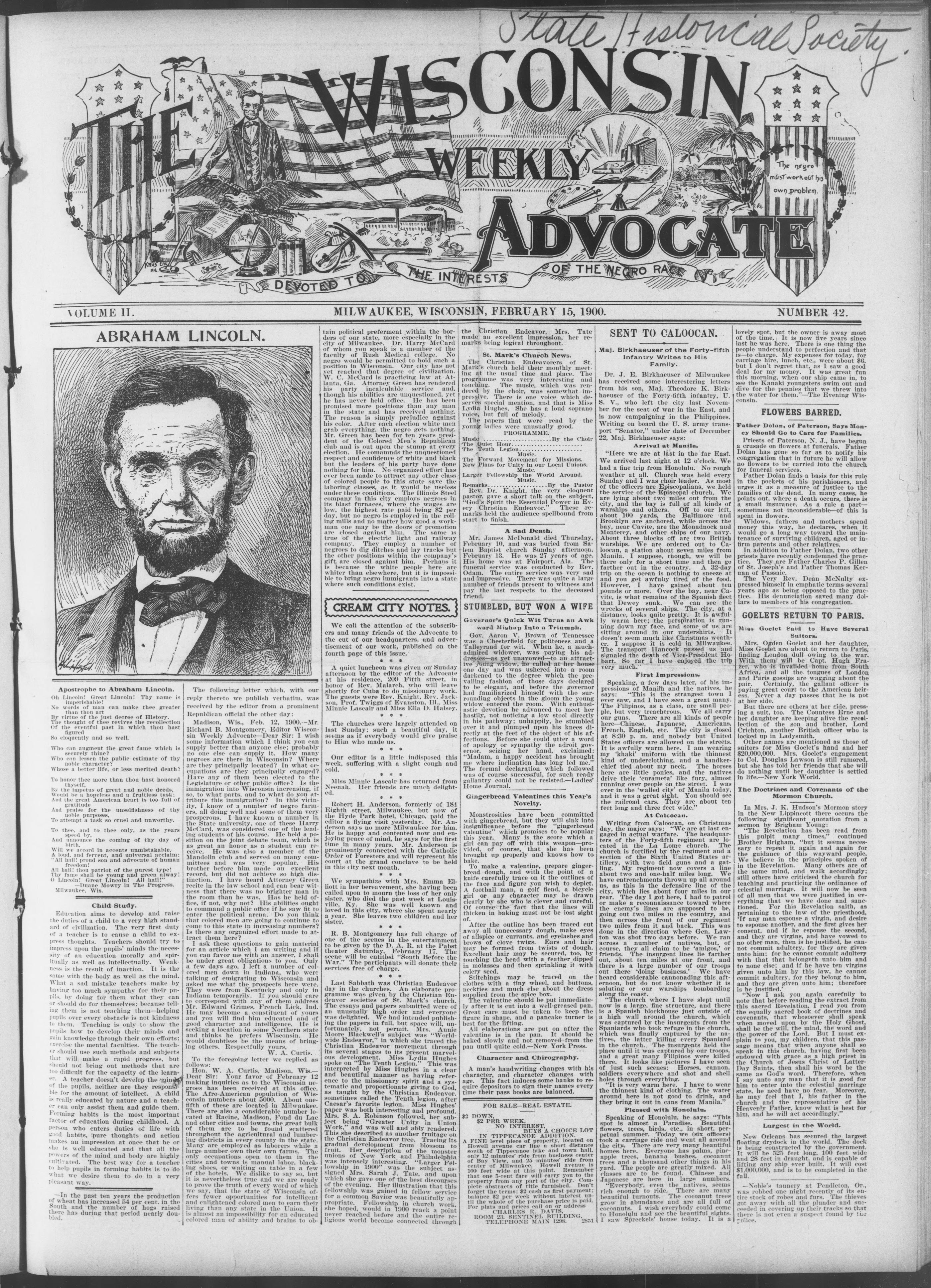
WISCONSIN
WEEKLY
ADVOCATE
DEVOTED TO THE INTERESTS OF THE NEGRO RACE
VOLUME II.
ABRAHAM LINCOLN.
Apostrophe to Abraham Lincoln.
B. H. HUSTON.
Oh Lincoln! Great Lincoln! Thy name is imperishable!
No words of man can make thee greater than thou art
By virtue of the just decree of History.
The thought of thee revives the recollection
Of the eventful past in which thou hast
figured
So eloquently and so well.
Who can augment the great fame which is securely thine?
To honor thee more than thou hast honored
thyself.
thyself.
By the impetus of great and noble deeds.
Would be a hopeless and a fruitless task:
And the great American heart is too full of gratitude
And praise for the unselfishness of thy noble purposes.
And announce the coming of thy day of birth.
Will we accord in accents unmistakable,
A loud, and fervent, and universal acclaim:
"All hail! proud son and advocate of human freedom!
All hail! thou patriot of the purest type!
Thy fame shall be young and green alway!
O Lincoln! Great Lincoln! All hail!"
—Duane Mowry in The Progress.
Milwaukee, Wis.
Child Study.
Education aims to develop and raise the duties of a child to a very high standard of civilization. The very first duty of a teacher is to cause a child to express thoughts. Teachers should try to impress upon the pupils' minds the necessity of an education morally and spiritually as well as intellectually. Weakness is the result of inaction. It is the same with the body as well as the mind. What a sad mistake teachers make by having too much sympathy for their pupils, by doing for them what they can or should do for themselves; because telling them is not teaching them—helping pupils over every obstacle is not kindness to them. Teaching is only to show the pupils how to develop their minds and gain knowledge through their own efforts; exercise the mental faculties. The teacher should use such methods and subjects that will make a rapid progress, but should not bring out methods that are too difficult for the capacity of the learner. A teacher doesn't develop the mind of the pupils, neither are they responsible for the amount of intellect. A child is really educated by nature and a teacher can only assist them and guide them. Forming habits is the most important factor of education during childhood. A person who enters duties of life with good habits, pure thoughts and action makes an impression at once that he or she is well educated and that all the powers of the mind and body are highly cultivated. The best way for a teacher to help pupils in forming habits is to do what we desire them to do in a very pleasant way.
In the past ten years the production of wheat has increased 54 per cent. in the South and the number of hogs raised there has during that period nearly doubled.
A. B. A.
The following letter which, with our reply thereto we publish verbatim, was received by the editor from a prominent Republican official the other day:
Madison, Wis., Feb. 12, 1900. Mr. Richard B. Montgomery, Editor Wisconsin Weekly Advocate—Dear Sir: I wish some information which I think you can supply better than anyone else; probably no one else can supply it. How many negroes are there in Wisconsin? Where are they principally located? In what occupations are they principally engaged? Have any of them been elected to the Legislature or other public office? Is the immigration into Wisconsin increasing, if so, to what parts, and to what do you attribute this immigration? In this vicinity, I know of a number of negro farmers, all doing well and some of them very prosperous. I have known a number in the State university, one of these Harry McCard, was considered one of the leading students of his course. He held a position on the joint debate team, which is as great an honor as a student can receive. He was also a member of the Mandolin club and served on many committees and was very popular. His brother before him made an excellent record, but did not achieve so high distinction. I have heard Attorney Green recite in the law school and can bear witness that there was no brighter man in the room than he was. Has he held office, if not, why not? His abilities ought to command a public office if he saw fit to enter the political arena. Do you think that colored men are going to continue to come to this state in increasing numbers? Is there any organized effort made to attract them here?
I ask these questions to gain material for an article which I am writing and if you can favor me with an answer, I shall be under great obligations to you. Only a few days ago, I left a number of colored men down in Indiana, who were talking of emigrating to Wisconsin and asked me what the prospects here were. They were from Kentucky and only in Indiana temporarily. If you should care to correspond with any of them address Mr. Edward Grimes, French Lick, Ind. He may become a constituent of yours and you will find him educated and of good character and intelligence. He is seeking a location in some Northern state and thinks he prefers Wisconsin. He would doubtless be the means of bringing others. Respectfully yours.
W. A. Curtis.
To the foregoing letter we replied as follows:
Hon. W. A. Curtis, Madison, Wis. Dear Sir: Your favor of February 12 making inquiries as to the Wisconsin negroes has been received at this office. The Afro-American population of Wisconsin numbers about 5000. About one-fifth of these are located in Milwaukee. There are also a considerable number located at Racine, Madison, Fond du Lac and other cities and towns, the great bulk of them are to be found scattered throughout the agricultural and lumbering districts in every county in the state. Many are employed as laborers while a large number own their own farms. The only occupations open to them in the cities and towns is manual labor, blacking shoes, or waiting on table in a few of the hotels. We dislike to say so, but it is nevertheless true and we are ready to prove the truth of every word of which we say, that the state of Wisconsin offers fewer opportunities for intelligent and enlightened colored men to earn their living than any state in the Union. It is almost an impossibility for an educated colored man of ability and brains to ob
---
MILWAUKEE, WISCONSIN, FEBRUARY 15, 1900.
tain political preferment within the borders of our state, more especially in the city of Milwaukee. Dr. Harry McCard of whom you speak is a member of the faculty of Rush Medical college. No negro would be permitted to hold such a position in Wisconsin. Our city has not yet reached that degree of civilization. W. C. McCard is practicing law at Atlanta, Ga. Attorney Green has rendered his party incalculable service and, though his abilities are unquestioned, yet he has never held office. He has been promised more positions than any man in the state and has received nothing. The reason is simply prejudice against his color. After each election white men grab everything, the negro gets nothing. Mr. Green has been for ten years president of the Colored Men's Republican club and is out upon the stump at every election. He commends the unquestioned respect and confidence of white and black but the leaders of his party have done nothing for him. No organized effort has ever been made to attract any other class of colored people to this state save the laboring classes, as it would be useless under these conditions. The Illinois Steel company in this city employs negroes in its blast furnaces, where the wages are low, the highest rate paid being $2 per day, but no negro is employed in the rolling mills and no matter how good a workman one may be the doors of promotion are closed against him. The same is true of the electric light and railway company. They employ a number of negroes to dig ditches and lay tracks but the other positions within the company's gift, are closed against him. Perhaps it is because the white people here are whiter than elsewhere, but it is impossible to bring negro immigrants into a state where such conditions exist.
CREAM CITY NOTES.
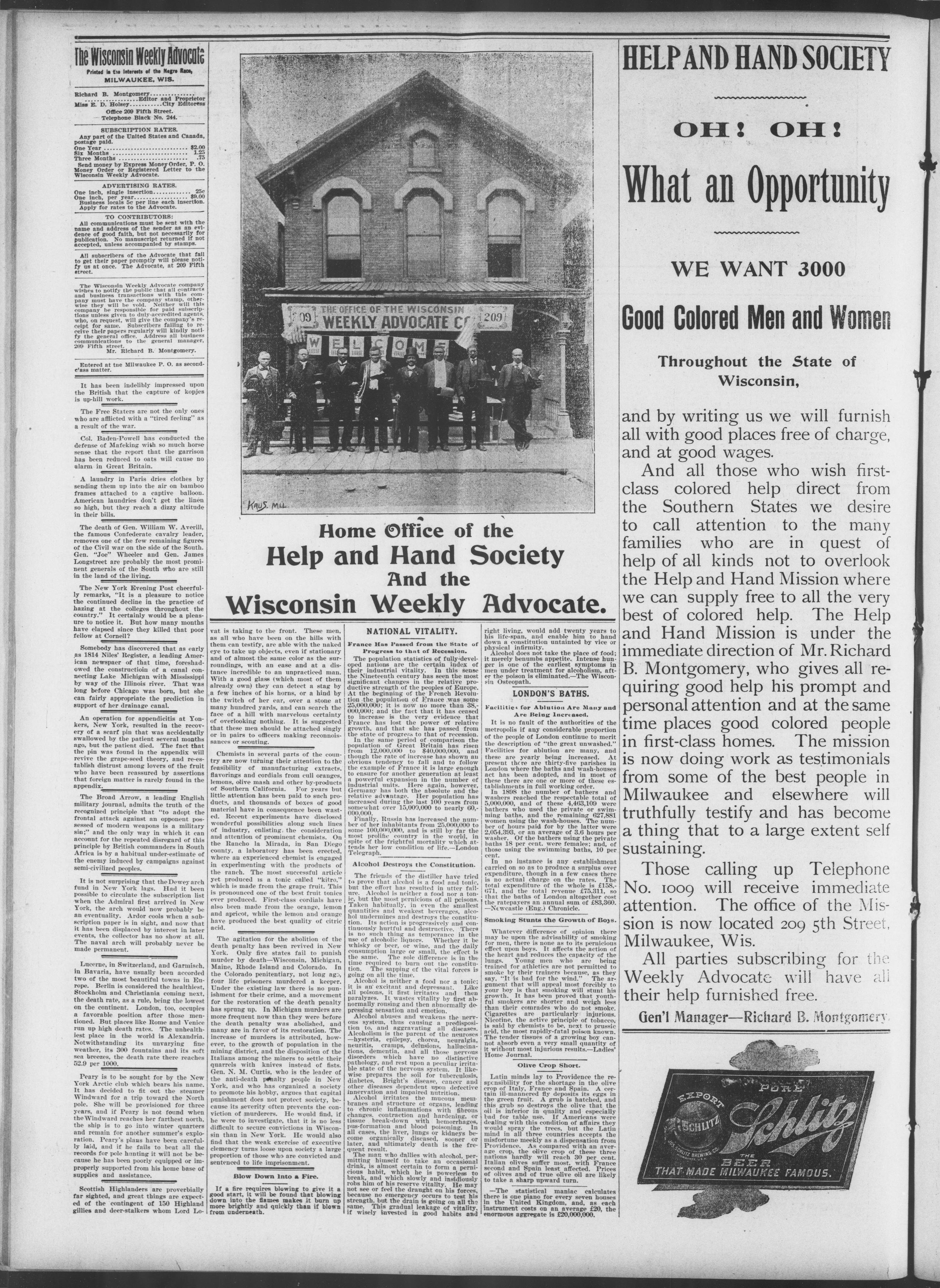
We call the attention of the subscribers and many friends of the Advocate to the cut of our headquarters, and advertisement of our work, published on the fourth page of this issue.
```markdown
```
A quiet luncheon was given on Sunday afternoon by the editor of the Advocate at his residence, 209 Fifth street, in honor of Rev. Malarch, who will leave shortly for Cuba to do missionary work. The guests were Rev. Knight, Rev. Jackson, Prof. Twiggs of Evanston, Ill., Miss Minnie Lascair and Miss Ella D. Halsey.
* * *
The churches were largely attended on last Sunday; such a beautiful day, it seems as if everybody would give praise to Him who made us.
* * *
Our editor is a little indisposed this week, suffering with a slight cough and cold.
* * *
Miss Minnie Lascair has returned from Neenah. Her friends are much delighted.
* * *
Robert H. Anderson, formerly of 184 Eighth street, Milwaukee, but now of the Hyde Park hotel, Chicago, paid the editor a flying visit yesterday. Mr. Anderson says no more Milwaukee for him. He is happy and contented now and enjoying peace of mind, he says for the first time in many years. Mr. Anderson is prominently connected with the Catholic Order of Foresters and will represent his court at the grand conclave to be held in this city next month.
***
We sympathize with Mrs. Emma Elliott in her bereavement, she having been called upon to mourn the loss of her only sister, who died the past week at Louisville, Ky. She was well known and loved in this city, where she spent nearly a year. She leaves two children and her sister.
***
R. B. Montgomery has full charge of one of the scenes in the entertainment to be given by the D. A. R. at the Pabst theater Saturday, February 17. The scene will be entitled "South Before the War." The participants will donate their services free of charge.
南 北 东
Last Sabbath was Christian Endeavor day in the churches. An elaborate programme was given by the Christian Endeavor societies of St. Mark's church. The essays and papers submitted were of an unusually high order and everyone was delighted. We had intended publishing the papers in full, but space will, unfortunately, not permit. Mrs. Annie Moore Blackwell's subject was "Worldwide Endeavor," in which she traced the Christian Endeavor movement through its several stages to its present marvelous development. Miss Lydia Hughes spoke on "The Tenth Legion." This was interpreted by Miss Hughes in a clear and beautiful manner as having reference to the missionary spirit and a systematic and proportionate giving to God, as taught by the Christian Endeavor, sometimes called the Tenth legion, after Caesar's favorite legion. Miss Hughes' paper was both interesting and profound. Mrs. S. A. Robinson followed, her subject being "Greater Unity in Union Work," and was well and ably rendered. This she described as another fruitage on the Christian Endeavor tree. Tracing its gradual development from blossom to fruit. Her description of the monster unions of New York and Philadelphia was intensely interesting. "Larger Fellowship in 1900" was the subject assigned Mrs. Sarah J. Tate, and upon which she gave one of the best discourses of the evening. Her illustration that this fellowship was gained in fellow service for a common Savior was beautifully appropriate. Fellowship in church work, she hoped, would in 1900 reach a point never reached before and the entire religious world become connected through
the Christian Endeavor. Mrs. Tate made an excellent impression, her remarks being logical throughout.
St. Mark's Church News
The Christian Endeavorers of St. Mark's church held their monthly meeting at the usual time and place. The programme was very interesting and touching. The music, which was rendered by the choir, was somewhat impressive. There is one voice which deserves special mention, and that is Miss Lydia Hughes. She has a loud soprano voice, but full of melody.
The papers that were read by the young ladies were unusually good.
PROGRAMME.
Music .....By the Choir
The Quiet Hour.....
The Tenth Legion.....
Music.
The Forward Movement for Missions.
New Plans for Unity in our Local Unions.
Music.
Larger Fellowship the World Around.
Music.
Remarks. By the Pastor Rev. Dr. Knight, the very eloquent pastor, gave a short talk on the subject, "God's Spirit the Essential Power in Every Christian Endeavor." These remarks held the audience spellbound from start to finish.
A Sad Death.
Mr. James McDonald died Thursday, February 10, and was buried from Salem Baptist church Sunday afternoon, February 13. He was 27 years of age. His home was at Fairport, Ala. The funeral service was conducted by Rev. Odam. The entire service was very sad and impressive. There was quite a large number of friends present to witness and pay the last respects to the deceased friend.
STUMBLED, BUT WON A WIFE
Governor's Quick Wit Turns an Awk ward Mishap Into a Triumph.
Gov. Aaron V. Brown of Tennessee was a Chesterfield for politeness and a Talleyrand for wit. When he, a much-admired widower, was paying his addresses—as yet unawowed—to an attractive young widow, he called at her house one day and was ushered into a room darkened to the degree which the prevailing fashion of those days declared to be elegant, and before the governor had familiarized himself with the surrounding objects in the gloom the young widow entered the room. With enthusiastic devotion he advanced to meet her hastily, not noticing a low stool directly in his pathway; unhappily, he stumbled over it and plumped upon his knees directly at the feet of the object of his affections. Before she could utter a word of apology or sympathy the adroit governor, seizing her hand, exclaimed: "Madam, a happy accident has brought me where inclination has long led me." The formal declaration which followed was of course successful, for such ready gallantry could not be resisted.—Ladies' Home Journal.
Gingerbread Valentines this Year's Novelty.
Monstrosities have been committed with gingerbread, but they will sink into insignificance before the "gingerbread valentine" which promises to be popular this year. Many is the score which a girl can pay off with this weapon—provided, of course, that she has been brought up properly and knows how to bake.
To make a valentine, prepare gingerbread dough, and with the point of a knife carefully trace on it the outlines of the face and figure you wish to depict. A football man, a golf fiend, a bicycle girl or any character may be drawn clearly by she who is clever and careful. Of course the fact that the lines will thicken in baking must not be lost sight of.
After the outline has been traced cut away all unnecessary dough, make eyes of allspice or currants, and eyelashes and brows of clove twigs. Ears and hair may be formed from twists of dough. Excellent hair may be secured, too, by touching the head with a feather dipped in molasses and then sprinkling it with celery seed. Stitchings may be traced on the clothes with a tiny wheel, and buttons, neckties and much else about the dress supplied from the spice box. The valentine should be put immediately after it is cut into a well-greased pan. Great care must be taken to keep the figure in shape, and a pancake turner is best for the lifting. All elaborations are put on after the valentine is in the pan. It should be baked slowly and not removed from the pan until quite cold.—New York Press.
Character and Chirography.
A man's handwriting changes with his character, and character changes with age. This fact induces some banks to require depositors to sign their names every time their pass books are balanced.
FOR SALE—REAL ESTATE.
BUYS A CHOICE LOT IN TIPRECANOE ADDITION
IN TIPPECANOE ADDITION.
A FINE level piece of property, located on Howell avenue car line a short distance south of Tippecanoe lake and town hall, only 12 minutes' ride from business center of Bay View, and 25 minutes' ride from center of Milwaukee. Howell avenue is 100 feet wide at this point. Remember that one 5-cent fare will carry you to the property from any part of the city. Complete abstracts of title furnished. Don't forget the terms; $2 cash as first payment; balance $2 per week without interest until the whole of the purchase price is paid. For plats and prices call on or address
CHARLES R. DAVIS.
ROOM 23, SENTINEL BUILDING.
TELEPHONE MAIN 1298. 2851
SENT TO CALOOCAN.
Maj. Birkhaeuser of the Forty-fifth Infantry Writes to His Family.
Dr. J. E. Birkhaeuser of Milwaukee has received some interesting letters from his son, Maj. Theodore K. Birkhaeuser of the Forty-fifth infantry, U. S. V., who left the city last November for the seat of war in the East, and is now campaigning in the Philippines. Writing on board the U. S. army transport "Senator," under date of December 22. Maj. Birkhaeuser says:
Arrival at Manila.
"Here we are at last in the far East. We arrived last night at 12 o'clock. We had a fine trip from Honolulu. No rough weather at all. Church was held every Sunday and I was choir leader. As most of the officers are Episcopalians, we held the service of the Episcopal church. We are lying about two miles out from the city, and the bay is full of all kinds of warships and others. Off to our left, about 100 yards, the Baltimore and Brooklyn are anchored, while across the bay, near Cavite, are the Monadnock and Monterey, and other ships of our navy. About three blocks off are two British warships. We are ordered out to Caloocan, a station about seven miles from Manila. I suppose, though, we will be there only for a short time and then go farther out in the country. A 32-day trip on the ocean is nothing to sneeze at and you get awfully tired of the food. However, I have gained about ten pounds or more. Over the bay, near Cavite, is what remains of the Spanish fleet that Dewey sunk. We can see the wrecks of several ships. The city, at a distance, looks quite pretty. It is awfully warm here; the perspiration is running down my face, and some of us are sitting around in our undershirts. It doesn't seem much like Christmas weather. I suppose it is cold in Milwaukee. The transport Hancock passed us and signaled the death of Vice-President Hobart. So far I have enjoyed the trip very much."
First Impressions.
Speaking, a few days later, of his impressions of Manila and the natives, he says: "This is the strangest town I ever saw, and I have seen a great many. The Filipinos, as a class, are small people, but very treacherous. We all carry our guns. There are all kinds of people here—Chinese, Japanese, Americans, French, English, etc. The city is closed at 8:30 p. m. and nobody but United States officers are allowed on the streets. It is awfully warm here. I am wearing my 'khaki' uniform with the thinnest kind of underclothing, and a handkerchief tied about my neck. The horses here are little ponies, and the natives drive their 'curameta' like fury, almost running over people on the street. I was over in the 'walled city' of Manila today, and it was a great sight. You should see the railroad cars. They are about ten feet long and three feet wide."
At Calcocan.
Writing from Caloocean, on Christmas day, the major says: "We are at last engaged in actual warfare. The headquarters of the Forty-fifth regiment are located in the La Lome church. The church is fortified by the regiment and a section of the Sixth United States artillery, with two field guns and a gattling. My regiment now covers a line about two and one-half miles long. We have entrenchments up all around us, as this is the defensive line of the city, which lies about four miles in our rear. The day I got here, I had to patrol or make a reconnaissance toward where the enemy's lines are supposed to be, going out two miles in the country, and then across the front of our regiment two miles from it and back. This was done in the direction where Gen. Lawton was shot two days before. We ran across a number of natives, but, of course, they all claim to be 'amigos,' or friends. The insurgent lines lie farther out, about ten miles at our front, and there is a large number of our troops out there 'doing business.' We have heard considerable cannonading this afternoon, but do not know whether it is saluting or our warships bombarding along the coast.
"The church where I have slept until now is a large, fine structure, and there is a Spanish blockhouse just outside of a high wall around the church, which was captured by the insurgents from the Spaniards who took refuge in the church, which was finally captured by the natives, the latter killing every Spaniard in the church. The insurgents held the place until it was captured by our troops, and a great many Filipinos were killed there. It looks like pictures I have seen of just such scenes: Horses, cannon, soldiers everywhere and shot and shell holes through everything.
"It is very warm here. I have to wear the thinnest kind of clothing. The water around here is not good to drink, and they bring it out in cans from Manila."
Pleased with Honolulu.
Speaking of Honolulu, he says: "This spot is almost a Paradise. Beautiful flowers, trees, birds, etc., in short, perpetual summer. Today we (six officers) took a carriage ride and went all around the city. There are very many beautiful homes here. Everyone has palms, pineapple trees, banana bushes, cocoanut trees and a thousand other things in his yard. The people are greatly mixed. All classes are to be found. Chinese and Japanese are here in large numbers. "Everybody, even the natives, seems rich enough to ride. There are many beautiful turnouts. The cocoanut trees grow in abundance and are all full of cocoanuts. I wish everybody could come to Honolulu and see the beautiful sights. I saw Spreckels' house today. It is a
lovely spot, but the owner is away most of the time. It is now five years since last he was here. There is one thing the people understand to perfection and that is—to charge. My expenses for today, for carriage hire, lunch, etc., were about $6, but I don't regret that, as I saw a good deal for my money. It was great fun this morning, when our ship came in, to see the Kanaki youngsters swim out and dive for the pennies that we threw into the water for them."—The Evening Wisconsin.
FLOWERS BARRED
Father Dolan, of Paterson, Says Money Should Go to Care for Families.
Priests of Paterson, N. J., have begun a crusade on flowers at funerals. Father Dolan has gone so far as to notify his congregation that in future he will allow no flowers to be carried into the church for funeral services.
Father Dolan finds a basis for this rule in the pockets of his parishioners, and urges it as a measure of justice to the families of the dead. In many cases, he points out, where a death occurs, there is a small insurance. As a rule a part—sometimes not inconsiderable—of this is spent in flowers.
Widows, fathers and mothers spend money this way, he declares, when it would go a long way toward the maintenance of surviving children, aged or infirm parents and other relatives.
In addition to Father Dolan, two other priests have recently condemned the practice. They are Father Charles P. Gillen of St. Joseph's and Father Thomas Kernan of Passaic.
The Very Rev. Dean McNulty expressed himself in emphatic terms several years ago as being opposed to the practice. His denunciation saved many dollars to members of his congregation.
GOELETS RETURN TO PARIS.
Miss Goelet Said to Have Several Suitors.
Mrs. Ogden Goelet and her daughter, Miss Goelet are about to return to Paris, finding London dull owing to the war. With them will be Capt. Hugh Frazer, who is invalided home from South Africa, and all the tongues of London and Paris gossips are wagging about the pair. Certainly, the gallant officer his paying great court to the American heiress. Never a day passes that he is not at her side.
But there are others at her side, pressing a suit, too. The Countess Erne and her daughter are keeping alive the recollection of the son and brother, Lord Crichton, another British officer who is locked up in Ladysmith.
Other names are mentioned as those of suitors for Miss Goelet's hand and her $20,000,000. Mrs. Goelet's engagement to Col. Douglas Lawson is still rumored, but she has told her friends that she will do nothing until her daughter is settled in life.—New York World.
The Doctrines and Covenants of the Mormon Church.
In Mrs. J. K. Hudson's Mormon story in the New Lippincott there occurs the following significant quotation from a sermon by Brigham Young;
"The Revelation has been read from this pulpit many times," continued Brother Brigham, "but it seems necessary to repeat it again and again for the guidance of this wayward people. We believe in the principles spoken of in the Revelation. Many others are of the same mind, and walk accordingly; still others have criticised the church for teaching and practicing the ordinance of celestial marriage. It will now be seen of all men that we were justified in everything that we have done and sanctioned. For this Revelation saith, as pertaining to the law of the priesthood, 'If any man espouse a virgin, and desire to espouse another, and the first gives her consent, and if he espouse the second, and they are virgins, and have vowed to no other man, then is he justified, he cannot commit adultery, for they are given unto him; for he cannot commit adultery with that that belongeth unto him and to none else; and if he have ten virgins given unto him by this law, he cannot commit adultery, for they belong to him, and they are given unto him; therefore is he justified.'
"Now I ask you again carefully to note that before reading the extract from this sacred Revelation, I read you from the equally sacred book of doctrines and covenants, that whosoever shall speak when moved upon by the Holy Ghost, shall be the will, the mind, the word and the power of the Lord. But I must explain to you, my children, that this passage means that when anyone shall so speak in this church, having first been endowed with grace as a high priest in the Church of Jesus Christ of Latter-Day Saints, then shall his word be the same as God's word. Therefore, when I say unto any man that it is good for him to enter into the celestial marriage state, he need have no fear. Moreover, he may feel that I, his father in the church and the representative of his Heavenly Father, know what is best for him, and he will act accordingly."
Largest in the World.
New Orleans has secured the largest floating drydock in the world. The dock is being constructed by the government. It will be 525 feet long, 100 feet wide and 28 feet in draught, and is capable of lifting any ship ever built. It will cost $1,000,000, and is to be completed in the fall.
— Noble's tannery at Pendleton. Or., was robbed one night recently of its entire stock of robes and furs. The thieves got away with all the plunder and succeeded in covering up their tracks so that there is not even a suspect found by the police.
CLOSE IN ON KIMBERLEY.
British Forces Compelled to Fall Back on Rensberg.
CECIL RHODES WANTED
If Caught, Oom Paul will Demand Big Money for His Release— The Jameson Raid.
London, Feb. 13.—The war office has posted a dispatch from Col. Kekewich, dated Sunday, February 11, to the effect that Kimberley was bombarded throughout Thursday, February 8. During the morning of February 9 a small infantry engagement lasting two hours occurred at Alexandersfontein. The situation otherwise is unchanged.
London, Feb. 13.—A private telegram received here says that the force commanded by Gen. Wood has moved up from the southward and seized Zoutpans drift, which it now holds.
Rensburg, Cape Colony, Feb. 13.—The Boers are actively pressing around Rensburg. The British force under Lieut-Col. Page, consisting of a section of artillery and 150 horses which reached Slingerstonein February 10, has been compelled to fall back on Rensburg, owing to its eastern flank being threatened. London, Feb. 13.—6:40 p. m.—A dispatch to the Evening News from Rensberg says severe fighting has occurred during the British retreat, the various outposts on both sides suffering heavy losses. The dispatch adds that it is doubtful if Rensberg can be held.
Rensburg, Feb. 12.—Evening.—The Boers have again driven in the British outposts on the western flank today, all outposts at Bastardsnek, Hobirk's windmill and other points, retiring to Maeder's farm. There were several casualties, but details have not yet been received.
Yesterday's retirement of the Western outposts included the withdrawal from Cole's kop and all the surrounding posts. The Boers placed a forty-pounder at Bastard's Nek commanding the surrounding country and successfully shelled the British positions. The Boers numbered some thousands and were five to ne wherever fighting occurred. The British are chafing under the necessity of a retreat from their posts, some of which they had held since the new year. The British now have no camp west of Rensberg. They safely brought off the guns from Cole's kop.
Bad Outlook for England.
New York, Feb. 13.—A dispatch to the World from the Hague says: Dr. H. P. N. Muller, the Orange Free State minister to the Netherlands, is reported to have said in an interview: "The war is the beginning of the collapse of England's power in South Africa. The longer the war lasts the heavier will be the conditions of peace, for England will not come out of it without giving important concessions." The young Transvaaler secretary of the legation added: "Both republics will have full freedom and independence. Furthermore, England will have to give up those parts of Cape Colony, Natal and Bechuanaland where the inhabitants have thrown in their lot with the republics, for they must not be left in the lurch."
HELD AS A HOSTAGE.
What Boers will Do with Cecil Rhodes When They Catch Him.
London, Feb. 13.—The cessation of war news from South Africa is taken to indicate that the British preparations for a move from Modder river are about completed and that important events may be anticipated within a few days. Interest centers almost wholly upon Field Marshal Roberts, especially since Gen. Buller's report of his withdrawal from Vaalkrantz, came for the first time through Lord Roberts, showing that all the different operations over the wide field will hereafter be more completely co-ordinated. It is now known that the military attaches have gone to join Lord Roberts at the Modder river, another move preluding an advance.
Refugees Expelled.
A dispatch from the Modder river announces the arrival there of 1400 refugees from the Barkley West district. They had been ordered away by the Boers because they refused to join the Republicans. The refugees reached the Modder river via Koodoosberg. It is learned that 200 Boers were killed or wounded during Gen. MacDonald's reconnoissance. There is no confirmation of the reported sortie of British troops from Ladysmith north of the Boer out-flanking movement. A report comes from Durban that the British artillery forced the Boers to evacuate their camp in Hlangwana hill, south of Colenso. It would be an important advantage if the British were able to occupy the position.
The absence of Gen. French from the Rensberg district seems to have given the Boers an opportunity for renewed activity. They have apparently commenced an extended attack on the British lines and are meeting with minor successes which are having considerable moral effect on the border colonists. The Boer invasion of Zululand is causing keen anxiety. Apart from the fact that it threatens Gen. Buller's supplies it is difficult to believe that the Zulus can long be kept quiescent while their cattle is commandeered and their country overrun by their hereditary foes.
Fate of Cecil Rhodes.
The friends of Cecil Rhodes are becoming alarmed at his possible fate, and have sent an emissary to see Dr. Leyds, the diplomatic agent of the Boers in Europe, in regard to the probable course the Boers would pursue in the event of his capture. Dr. Leyds assured the intermediaries that the Boers did not intend to kill Mr. Rhodes, but, he added, they would certainly hold him as a hostage until the indemnity for the Jameson raid was paid. In view of the developments since the raid, the Boers have also decided to double the amount of the indemnity demanded, so Mr. Rhodes' friends will have to hand over £2,000,-000 ($10,000,000) before he is released. It is also learned definitely that Dr. Jameson is still at Ladysmith, in spite of all the conflicting reports.
A semi-official paragraph is published in the Globe this afternoon, saying Germany does not contemplate intervention. The German government, it is added, does not consider itself concerned in the future status or in the existence of the Boer republics.
Roberta Promises Relief.
London, Feb. 13.—An undated dispatch from Mafeking, via Gaberones, February 2, says: "Col. Baden-Powell has received a communication from Lord Roberts promising that relief would be sent in a few weeks. The food will last. The garrison is as game as ever. The Boers have expressed their intention not to fight but to starve us cut. All well."
No More Press Censorship.
Lord Roberts tells the correspondents that when he gets down to business they shall have ample opportunities to send news. His chief press censor yesterday issued new rules, and in future all writ-
ten communications are to go unchecked. Only telegrams will be censored. For the next few days little news is likely to get through, but later there will be more freedom. Thus says the censor, and the last clause may be interpreted to mean that something is about to happen.
Confidence in Lord Roberts.
New York, Feb. 13.—The striking feature of the war situation in London is the boundless confidence reposed in Lord Roberts. Gen. Buller's report of his third repulse, published today, arouses no harsh criticisms, for some of the experts say the attack was only a feint, ordered by Lord Roberts with a view to keeping Gen. Joubert busy and preventing him from sending reinforcements to Gen. Cronje, at Kimberley. The pitiful condition of the inhabitants of Kimberley, who are dying of disease at an appalling rate, leads to the belief that Lord Roberts, with his fine array of 35,000 men, will endeavor to raise the siege at once. On the other hand, experts say that invasion of the Free State would be wiser tactics. But whatever Lord Roberts does will be accepted as the best thing to do.
The Boer raid in Zululand continues to alarm Natal. It is believed the Transvaalers will sweep vast herds of cattle out of Zululand and then raid northeastern Natal. A dispatch from Pietermaritzburg states that fresh meat is abundant in Natal, thirty oxen being slaughtered daily, so that the Boers have 100 guns between the Tugela river and Ladysmith and the Boer artillery fire impresses all who see it, the guns being mounted in almost impossible places.
The Government's Plans.
Charles Williams, the military critic of the Morning Leader, who is understood to have close relations with Lord Wolseley, the commander-in-chief of the British army, writes as follows: "The government last night refused to say whether Lords Roberts and Kitchener were sent to the front without consultation with Lord Wolseley or not. It has already been so stated in this place, and it is again asserted. Lord Wolseley learned the news from the Monday morning papers, and the appointments were made on the previous Saturday."
The remainder of the criticism is devoted to the government's army plans. The writer declares the ministerial scheme developed last, night in both houses is in the main a colossal, costly imposture, designed at once to hoax the country into idea that some satisfactory reform of our military system is at length to be accomplished and to throw dust in the eyes of foreign nations.
Kimberley in Dire Straits.
Kimberley, twenty miles away from the Modder river position, is in sore straits. Details of the December death rate show that in a population of 14,000 whites and 19,000 blacks the mortality was 60 whites and 138 blacks per 1000. The infantile death rate was 671 per 1000 among the whites, and 912 per 1000 among the blacks. Enteric fever was prevalent. This frightful state of things in December cannot have improved much, if at all, since, and the fighting power of the garrison must have been greatly diminished.
Meanwhile, the bombardment by the Boers has increased, and there is imminent danger of the town falling under the very eyes of Lord Roberts. It is believed in circles close to the war office that he will move at once.
British Losses.
A revised list of the British casualties at Potgieter's Drift from February 5 to February 7, shows: Killed, 26; wounded, 319; missing, 5.
No Communication from Germany.
London, Feb. 13.—In the House of Commons today, the under secretary of state for the foreign office was asked whether the government had received any communication from Germany, modifying the declaration made in 1895, by the then minister of foreign affairs, Baron Marshal von Bieberstein, to the effect that Germany's only policy was the maintenance of the Transvaal as an independent state, in accordance with the treaty of 1884. He replied that no communication had been received from the German government relating to the convention of 1884, which, he added, as a matter of fact, was terminated by the state of war.
Selected by Wolseley.
The under-secretary of war for the war office, Mr. Wyndham, definitely set at rest all the stories of government interference in the prerogative of the commander-in-chief, Field Marshal Lord Wolseley, to select the generals commanding in South Africa. Replying to a question, Mr. Wyndham said the commanders in the field were selected by Lord Wolseley, subject to the approval of the secretary of state for war, and added that every selection put forward had been approved.
Continue War Indefinitely.
Rensburg, Feb. 13.—An Australian newspaper correspondent, Mr. Reay, paid an interesting visit to the Boer camp Sunday, to make inquiries as to the fate of his missing colleague, Mr. Hales of the London Daily News, who was captured by the Boers February 7 at the time Mr. Lambie of the Melbourne Age was killed. Mr. Reay arrived at the camp, blindfolded, just as church service was commencing. He sat blindfolded throughout the service. When he was taken before Commandant Delarey his eyes were unbandaged. Delarey was most courteous to the correspondent. He said he deeply regretted that a non-combatant had been killed, and expressed his sympathy with Mr. Lambie's widow. Mr. Reay was then escorted to Mr. Lambie's grave and the latter's watch and other personal effects were handed over to Mr. Reay. The escort informed Mr. Reay that the two republics had 120,000 men fighting and were able to continue the war indefinitely.
FRANCE AND BELGIUM OBJECT
Intend to Protest Against the United States Controlling the Canal. London, Feb. 13.—The Berlin correspondent of the Standard says:
"According to a dispatch from Brussels, Belgium and France intend to protest against any treaty which would completely hand over the Nicaragua canal to the United States alone as their treaties with Nicaragua stipulate that they shall share in the control of all waterways connecting the oceans."
PIONEER DIES AT 97.
Carried the News of Jackson's Election to St. Louis.
Olney, Ill., Feb. 13.—Elijah Nelson, aged 97, died on his farm near this city, upon which he settled in 1820 and had lived since. In his younger days he drove a stage from Vincennes to St. Louis by way of the old Vandalia route. He conducted a tavern at his home and often entertained Thomas Benton, Gen. Winfield Scott, Gen. W. H. Harrison, President Taylor and others. He carried the news of Jackson's election to the presidency to St. Louis. He never used whisky or tobacco.
Foundry Works Destroyed
Chicago, Ill., Feb. 13.—The Western Foundry works were destroyed by fire here today. The loss is estimated at $50,000, covered by insurance. The office and contents were saved.
—The Scottish prima donna, Miss MacIntyre, has not been heard of for some little time, but it seems that she is now successfully fulfilling operatic engagements in Italy.
Tragic Death of New York Congressman-Found on Sidewalk by Milkman.
New York, Feb. 13.—Congressman Charles A. Chickering of Copenhagen, N. Y., was found dead outside the Grand Union hotel in this city today. He had either fallen or jumped from a fourth story window of the hotel.
The body of Mr. Chickering was found on the sidewalk of the Forty-first street side of the hotel, under the open window of his room, which was on the fourth floor, by a milkman who was driving through the street at 5 a.m. Evidently, it had been lying there for some time as the clothing was saturated with rain. It was clothed in underwear, socks, night shirt, trousers and vest. There was a bad gash in the right side of the head. Mr. Chickering had been in the hotel all day yesterday. He had complained considerably of rheumatism, but nothing irrational in his actions had been observed by those in the hotel.
Charles A. Chickering was born at Harrisburg, Lewis county, N. Y., on November 26. 1843. He was educated in the common schools and at the Lowville academy, at which institution he was for a time a teacher. He was a school commissioner of Lewis county from 1865 to 1875; member of Assembly in 1879, 1880 and 1881; he was elected clerk of the Assembly in 1884 and re-elected in the years from and including 1885 to 1890. He had been chairman of the Republican county committee of Lewis county, secretary of the Republican state committee and also a member of the executive committee of that body. He was elected to the Fifty-third Congress and re-elected three times.
A dispatch to the Associated press from Albany says that Mr. Chickering's friends there have been aware that for some time he was afflicted with melancholia, following a severe attack of typhoid fever.
AFTER FAIR'S MILLIONS.
Mrs. Nettie Craven Says She Can
Hurry. She is the Legal Widow.
San Francisco, Cal., Feb. 13.—The attempt of Mrs. Nettie Craven to establish her claim to a share of the estate of the late Senator Fair has come up in a new form. Mrs. Craven recently applied for $5000 as a monthly allowance as the widow of the millionaire. Yesterday her counsel made a long statement of her case in court, reviewing Fair's courtship, the marriage contract and what its claimed as the solemnization of the marriage. Mrs. Craven declared Mr. Fair first proposed marriage in 1889, but she refused him. In 1892, however, after the death of her mother, she accepted him. On May 20, 1892, a marriage contract was prepared under his dictation, and was witnessed by Notary Lee D. Craig. In July of that year Mr. Fair proposed for her better protection that the marriage be solemnized, and this was done before "properly constituted legal authority."
The Fair children deny that their father was ever married to Mrs. Craven, and they say the marriage contract is a forgery. The Fair estate is valued at $15,000,000.
CREWS TAKEN ASHORE.
Rescued by Life-Saving Service—Gate City on the Beach.
New York, Feb. 13.—The life-saving crew of Bayhead this morning took off twenty of the crew of the ship County of Edinburgh, which went ashore last night near Manasquan life-saving station. The captain and officers (nine all told) remain on board. The vessel is making no water. She lies about a quarter of a mile south of Squan Inlet. The remainder of the officers and crew who had been left on board the Savannah line steamer Gate City, stranded near here, were taken off this morning and are quartered at the Moriches life-saving station. They were taken off in the breeches buoy, in a southeast gale. At 9:15 a.m. the Gate City was broadside on the beach; there was a gale beating on her with such force that there are fears of her breaking up.
SHOT THE DETECTIVE.
Escaped Convict was Too Quick for His Pursuer.
Bluefield, W. Va., Feb. 13.—At Swords Creek, in Russell county, Va., Detective I. F. Felts of this place was shot and killed by William Lee, who, a few seconds later, was shot and killed by Deputy Marshal Baldwin, also of this city. Baldwin and Felts had traced Lee, an escaped convict, to a deserted house. Wishing to take him alive, they resorted to the plan of hiding near the house and having a boy ride up at full speed screaming with terror. This brought Lee out of the house. Felts then ordered him to surrender, but Lee swung himself behind the horse and drawing a revolver shot Felts dead. Baldwin threw himself on the ground to get aim on Lee's body. His first shot wounded him and the second killed him instantly.
OLD GROVE THEATER BURNED
Concordia Flat Tenauts Are Driven Out Half Dressed.
Chicago, Ill., Feb. 13.—Fire, starting in the Grove theater, on Cottage Grove avenue, at 1:15 o'clock this morning, spread quickly to the Concordia flats on the south and caused a hurried exodus of the tenants, some of them not having time to dress. The theater, which was an old frame building, was destroyed in a short time. The loss on the theater is total and is put at $5000. The insurance was $500.
Four Bullets in His Body
Chicago, Ill., Feb. 13.—John Clark is in the county hospital with four bullets in his body, and George Hawley, 19 years, and Patrick McGuire, 20 years old, are under arrest at the new city police station, charged with having fired the shots. The prisoners decline to discuss the affray. The shooting occurred in a saloon.
The Elms of Cambridge
The old elms of Cambridge, Mass., will always be dear to Americans for their association with the great men and the historical events of the nation. The Washington elm, under which Washington took charge of the American army, was found recently to need more nourishment. Upon examination it was discovered that the pavement of the street caused the water to flow away from its roots. To overcome the difficulty the commissioners decided to surround the tree with a raised plot of earth about 80 feet long and 16 feet wide at its widest part. This has all been inclosed by curbing.—New York Tribune.
Hotels for German Students
German students and high school pupils traveling in the various mountain regions of their country now have at their disposal 130 taverns, 41 of which give them a bed free, while 78 add breakfast, and 11 supper, too. Similar taverns have lately been opened in the Swiss Alps. New York Post.
—Galesville now has a high school with a four-years' English course.
BULLER IS HARD PRESSED
ROBERTS STILL SILENT
Reconnoissance at Springfield in Which Twelve British Are Wounded and Six Captured.
London, Feb. 14.—6:20 p. m.—It is officially announced that the British cavalry division under Gen. French Monday, February 12, seized the crossing of the Reit river at Dekil's drift, on the east bank, on which the Sixth and Seventh divisions are now camped.
London, Feb. 14.—6:28 p. m.—The following dispatch has been received at the war department from Gen. Roberts:
Relt River, Tuesday, Feb. 13.—Col. Hannay, in command of a brigade of mounted infantry, marching from Orange river to Ramah, had a slight engagement February 11 (Sunday) with the Boers holding the hills and threatening his right flank. With a detached part of his force Col. Hannay detained the enemy while he pushed his baggage and main body through to Ramah. The object of the march was successfully carried out. Four men were killed, 22 were wounded and 13 are missing. Monday, Feb. 12.—The cavalry division under Gen. Freeth seized the crossing of the Relt river at Dekil's drift, on the east bank of which the Sixth and Seventh divisions are now encamped. The casualties were two troopers killed and Capt. Majesdle of the rifle brigade wounded. He has since died. One trooper was wounded. The general commanding at Rensburg reports that on Monday, February 12, he was attacked in force by the Boers. Lieut. Coningham of the Worcester regiment was wounded and has since died. There were other casualties.
Boers After Buller.
London, Feb. 14.—The only war news of any kind this morning is an official dispatch from Gen. Buller at Chieveley, announcing a reconnoissance at Springfield, resulting in no gain of ground on either side. Capt. Hamilton Russell, Lieut. G. Churchill, and ten men were wounded and Lieut. Pitkington and six men were captured by the Boers.
The dispatch contains detailed accounts of what appear to be unimportant operations. They only tend to throw light on the situation by proving that the Boers are actually following Gen. Buller's every move.
From Field Marshal Lord Roberts, at the Modder river, where all eyes are turned, there is no word.
A dispatch from Mafeking says the garrison there can hold out until June. Gen. Buller's dispatch from Chieveley, dated Monday, February 12, says: "The commanding officer at Springfield reports this morning that a squadron of the First dragoons moving to the outpost line covering the right flank of the camp met a party of Boers near Fustenberg. The Boers, reaching the crest of a hill, first opened a heavy fire on the squadron, which retired. He sent out supports and the Boers retired." The dispatch then gives the casualties as already cabled.
Continuing, the Chieveley dispatch says: "Dundonald with 700 mounted men, a field battery and the First Royal Welsh Fusiliers, February 12, reconnoitered the high ground which the enemy has been in the habit of visiting. The enemy evacuated it with the loss of two men, after slight resistance. When the force retired on the completion of the reconnoissance, the enemy returned in considerable numbers and kept up a heavy rifle fire, wounding slightly Lieut. G. Churchill of the South African Light horse. Five men are missing."
It is not quite clear who wrote the dispatch, as Gens. Lyttleton, Hildyard, Warren and other generals are believed to be in the neighborhood of Springfield.
What Two Shells Did.
Advices from Gaberonnes, dated February 4, say: The artillery duel between Col. Plumer's force and 500 Boers continued until today when the British dropped two shells into the Boer fort. The Boer guns have since been silent. Col. Plumer's advance has been checked by floods.
Hard Fighting Near Colesberg.
London, Feb. 14.—A dispatch to the Mail from Rensburg, dated yesterday, says: "There has been hard fighting for two days near Colesberg, the Boers making strenuous efforts to outflank the British left. The enemy occupies strong positions from Achtertang, through Potfontein to a point five miles south of Jasfontein.
"The fighting at the outpost camps has been very severe during the last few days. Yesterday the Boers attacked the position of the Worcesters to the southeast of Colesberg. Fighting continued all day and after dark it was considered necessary to withdraw to Rensburg. Our losses are not yet known."
"On the left the West Australians, Wiltshires and Berkshires had hot fighting, but held their positions against long odds. The Boer losses were considerable. Owing to the growing difficulty experienced by vonvoys in reaching the camps, all of the latter were vacated last night and the troops withdrew to Rensburg.
"The Boers are burning the farms of the loyalists, but the latter have contrived to get away with their stock."
May Cut Roberts' Road to Rear.
Spenser Wilkinson, in the Morning Post, discussing the news from Rensburg, says: "This intelligence is the natural price paid for a blow elsewhere. The concentration at Modder river is apparently accompanied by a weakening of the force at Colesberg and of this the Boers have taken advantage to assume the offensive. "Meanwhile it looks as though the enemy had withdrawn their forces from Magersfontein to re-enforce those at Colesberg, where a Boer victory would threaten the communications between Cape Town and Modder river." Reviewing the whole campaign, Mr. Wilkinson says that the type of the coming operations recalls that of the American Civil war. Developing this thought, he remarks:
"British strategy must be to crush in succession each of the three principal Boer forces near Kimberley, Colesberg and Stormberg by bringing against them greatly-superior numbers.
Jonbert will Not Leave Natal.
"Much depends on what happens in Natal. Gen. Joubert is not likely to abandon his present enterprise against Ladysmith until disasters to the Boer army compel him.
"The opinion that the invasion of the Free State will suffice to bring the Free State troops out of Natal and will induce the Free Staters to submit is not based on a true estimate of the nature of the Boer. The two republics are fighting for national existence and they will stand or fall together.
"This war will not be ended by startegical maneuvering or by the occupation of geographical points, but by the destruction of the Boer army, taking the word destruction in its military sense of decisive defeat, involving dispersion of an army as an organized fighting force." A story of suffering. Brussels, Feb. 14.—Le Petit Bleu, in correspondence from Pretoria, publishes an extraordinary account of 2000 British soldiers who, it is said by the writer, arrived toward the end of December last during the retreat from Dundee at the
River Maputa, the boundary between Swaziland and Portuguese territory. According to the narrative they had lost their way and wandered for weeks in Zululand, arriving shoeless, in rags and dying of hunger. These soldiers, the correspondent says, were thought to have been shut up with Sir George White in Ladysmith.
Portugal is England's Ally.
San Francisco, Cal., Feb. 14.—The Portuguese Union of this city has received the following cablegram, dated Lisbon, Portugal, February 13:
"The King has signed a protocol of a secret offensive and defensive alliance with England with the approval of the leaders of the militant parties of both countries."
The editor of the Union says that his information comes from a reliable source and should be given credence.
Gen. Buller's Constitutionn1.
Vienna, Feb. 14.—The St. Petersburg Herald, in discussing editorially Gen. Buller's latest constitutional across the Tugela and back, considers the situation in which he has placed his troops as decidedly worse than was that at Spionkop, and says that retreat was the only thing possible and the only salvation, and adds:
"But what is incomprehensible is how he ever placed himself in such a position. Thrice he has brilliantly demonstrated his inability, and the only thing lacking was that he should continue his naive explanations with his large words and still larger defeats. He is now in the best possible way to become a perfect example of the comic-opera general."
HOT FIGHTING ALL DAY.
Fears that Clements' "Retirement" at Rensburg was Disturbed.
New York, Feb. 14.—The dispatches announcing the British "retirement" at Rensburg are not satisfactory. "Our losses are not yet known," says the Daily Mail's correspondent. "There was hot fighting all day, and at night the British retreated. This news is the more depressing to London because only a few days ago it was believed Gen. French was about to take Colesburg. If the Boers are able to defeat Gen. Clements in a decisive engagement they may threaten Lord Roberts' base of supplies at Deaar Junction. This unexpected show of strength by the Boers at Colesburg has amazed those who were predicting an easy march for Lord Roberts through the Free State. The experts who saw in Gen. Butler's capture and abandonment of Vaalkrantz a fine piece of strategy say that Gen. Clements' retreat to Rensburg is part of the same policy, to engage large forces of Boers while Lord Roberts demolishes Cronje. It is believed that Gen. Butler has withdrawn his whole force from Potieter's drift and Springfield to Chieveley, and is exactly where he began two months ago.
The London Leader's war expert says: "South African military opinion calls for 50,000 or 75,000 more men as soon as possible, and this on the ground of mercifulness and ultimate economy.
Quarter of a Million Men.
"This would bring our strength there up to nearly a quarter of a million men, and this force to put down two small republics whose united white population is supposed not to exceed 450,000 men, women and outlanders.
"Nothing but this fact was needed to demonstrate the futility of the ministerial scheme of army reorganization laid before Parliament on Monday.
"The precise nature of Lord Roberts' movements on Modder river and Orange river are wrapped in mystery. Certain it is that the country Gen. French manoeuvered the Boers out of in northern Cape Colony has been reoceupied by the Boers. Gen. Buller is keeping his own secrets, but we may look for another move on his part in a day or two, probably to east of Colenso."
Large Force at Modder.
The Morning Post's war expert says: "The announcement of new appointments confirms supposition that a large force has now been assembled at Modder river. The offensive cannot be carried on along the whole line and the commander-in-chief must determine the point at which he will act.
"It looks as though the Boers had taken their forces away from Magersfontein to reinforce the commandos at Colesburg, where a victory would threaten the British communications between Cape Town and Modder river."
The expert compares the situation to the American Civil war at the time when the army of the Potomac had all the Confederate forces in Virginia, while the Western armies moved down the Missisippi and through the heart of the Confederacy to Atlanta and Savannah and hence north in Gen. Lee's rear.
FEDERAL LAW WANTED
Board of Trade Delegates Wants Legislation Suppressing Bucket-Shops.
Chicago, Ill., Feb. 14.—Resolutions cailing for a federal law to suppress bucketshops, and pledging themselves to aid each other in various reforms, were adopted at today's meeting of the board of trade delegates representing thirteen cities. Reasonable commissions on transactions in grain were fixed as follows:
One-eighth per cent. per bushel to be charged nonmembers of the exchanges; one-sixteenth per cent. for transactions carried on between members of different exchanges, with the proper commission for transactions between members of the same exchange left to the judgment of the exchange affected.
A standing committee, composed of the presidents of the New York Produce exchange, Toledo Produce exchange, St. Louis Merchants' exchange, Minneapolis chamber of commerce and the Chicago board of trade, was appointed to keep the matter of securing federal legislation to stamp out bucketshops.
The delegates agreed to do all in their power to discourage privilege trading among members of their Legislatures and voted their moral support to St. Louis and Chicago in maintaining their recent acts suppressing privilege trading.
Deliveries of wheat, it was said, should be made not later than ninety days after purchase.
The committee appointed on railroads and discrimination in freight rates did not report. After the adoption of the resolutions the meeting adjourned sine die.
LARGEST IN THE WORLD
Blast Furnace with a Daily Capacity of 600 Tons.
Youngstown, O., Feb. 14.—The largest blast furnace in the world was lighted last night when stack No. 1 at the Ohio plant of the National Steel company was put in operation. The furnace is $106\frac{1}{2}$ feet higher, 17-foot crucible and 22-foot bosh, the capacity of the furnace is 600 tons every twenty-four hours. Two other furnaces of similar dimensions are under construction and will be completed in two or three months. The output of these furnaces will be used by the National company.
Activity in Logging Camps
Wausau, Wis., Feb. 14.—[Special.]— Since the recent snow and ideal winter weather great activity is being displayed in logging business. Logs are coming to the mills in the city both by rail and bobsleighs. The millowners report that they will now be able to secure and cut their winter's supply of logs as usual, and besides may yet exceed last year's cut.
MANILA TO BEAT HONG KONG.
Its Chances of Becoming the Imperial City of the Pacific.
"The moment we decided to annex the Philippines we felt surprised that there had been any hesitation. We saw that our new expansion was in all respects the most important in our history. Not only are there magnificent opportunities in the Philippines for American civilization, commerce and industry, but there is the dazzling possibility of making Manila the center of western Pacific trade. Manila, adjacent to a population of 850,000,000 people should, before many years, surpass Hong Kong, to which Great Britain owes such a large part of her Chinese commerce.
The chief distributing centers of China, Japan, Corea, Siam, Annam and the East Indies are as near to Manila as Havana is to New York; and the distributing centers of British India and Australia are nearer to Manila than to any other great emporium. At present we furnish only one-twentieth of the billion dollars' worth of goods that the countries within easy commercial range of Manila purchase yearly. Yet the largest part of these imports is made up of goods that we can supply at a lower price than any other country—tools and machinery, cotton and cotton products, provisions and mineral oils."—Ainslee's Magazine.
The Eye in Disease.
A physician in New York, who has made a lifelong study of the eye, thus sums up his experiences:
Falling of the eyelid indicates paralysis of the third pair of nerves.
Inability to close the eye indicates facial hemiplegia and cerebral disease.
Yellow lamina indicates liver disease.
Ecchymosis into the conjunctive indicates laryngitis.
Redness of the conjunctiva, with watery discharges from the eye, indicates the initial stage of eruptive fevers, usually measles. If the tears flow freely, indications favorable.
Spots upon the cornea indicate strumous constitution.
Dilatation of the pupilindicates fatigue, worms in the intestines, meningitis in second stage and blindness occasionally.
Atrophy of the optic nerve, epilepsy and chloroformism.
Unequal dilatation of the pupils indicates progressive paralysis.
Contraction of the pupils indicates progressive paralysis.
Contraction of the pupil indicates tabes dorsates.
Deformity of the pupil shows uritis or syphilis. Cataract in the old is usually of diabetic origin.
Patents to Inventors.
Messrs, Benedict & Morsell, solicitors of patents, Old Insurance building, Milwaukee, report patents issued to Western inventors February 6 as follows:
M. J. Adams, Lancaster, Wis., screen door opener; Fred. Artos, Milwaukee, clamping device; Gilbert Bacon, Autigo, Wis., ironing board; E. J. Birkett & H. F. Crandall, Milwaukee, grain harvester; Jos. Braun & J. Braun, Athens, Wis., stop device or bumper attachment for sawing machines; J. W. Conchar, Dubuque, Ia., fireback; T. L. Davidson, Bard, Ia., foodgate; W. L. Finley, Janesville, Wis., fencepost; W. J. Gallup, New Richmond, Wis., skirt and waist fastener; Bernt Garilus, Westport, Wis., bandcutting knife; W. A. Hennessey, Delavan, Wis., photographers' combination baby-holder and lounge; C. W. Kragh, Madison, Wis., dynamo-electric machine; O. & M. Otteson, Menomonee Falls, Wis., pipe-wrench; E. Van Treeck, Crawford, Neb., railway-hand-car; F. D. Winkley, Madison, Wis., oil-hole cover or cap.
England's Treatment of Prisoners.
England's Treatment of Prisoners.
In contrast with the accounts of the treatment of British wounded and British prisoners by the Boers is the story in the Daily Mail of the arrival at Cairo of Britain's latest captive, the renowned Dervish leader, Osmon Digna. The Mail says: "He was brought in a third-class wagon, and a large crowd pressed forward, eager to see the dark, long face, the brilliant eyes, the large mouth, and the long gray beard of a frightened and dignified old man who sat with chains around his sore ankles and swollen bare feet."
What Do the Children Drink ?
Don't give them tea or coffee. Have you tried the new food drink called GRAIN-O? It is delicious and nourishing, and takes the place of coffee. The more Grain-O you give the children the more health you distribute through their systems. Grain-O is made of pure grains, and when properly prepared tastes like the choice grades of coffee, but costs about $ \frac{1}{4} $ as much. All grocers sell it. 15c and 25c.
Electro-Magnetic Sofas.
Electro-medical treatment is given patients by means of a new sofa, which has batteries and an induction coil contained in the lower portion, with head and foot plates to be placed in contact with the patient.
Special to State People.
Commencing November 20, the Hotel Davidson, Milwaukee, make a rate of $2 per day, American plan. This is to state people only.
—Nearly 2800 residents of Minnesota shared in 1899 in the tree-planting bounty, receiving $2.40 an acre.
Rheude's Business College and Mechanical Drawing School, Milwaukee.
—Vienna policemen are required to understand telegraphy, and to be able to swim and row a boat.
Flavor your Custards, Pies, etc., with "MB" Vanilla or Lemon. All Grocers.
—Pens to the number of 3,500,000 are used throughout the world every day in the week.
Fisher's Flavoring Extracts are endorsed by pure food laws and the U. E. government for their PURITY and STRENGTH. A. J. Hilbert Co., Milw.
—Gold has been discovered in 'the mountains back of Monrovia, Cal.
One small disease germ carried by the blood through the system will convert a healthy human body to a condition of invalidism. Do not wait until you are bedridden. Keep your blood pure and life-giving all the time. Hood's Sarsaparilla accomplishes this as nothing else can. Hood's Sarsaparilla Never Disappoints
ALL OF THESE SEEDS for 12c
Early Scarlet Turnip Radish, All the
York Round Lettuce, Koss' Cream City
Pick, Number and Wild Flower Garden
containing over fifty varieties of
choice hardy flowers which will gladden
your heart every day during the season.
tamps at once for same, you will never
tolerate free.
ALL OF THESE SEEDS for 12c
Early Scarlet Turnip 'Radish, All the Year Round Lettuce, Koss' Cream City Pickle Cucumber and Wild Flower Garden containing over fifty varieties of choice hardy flowers which will gladden your heart every day during the season.
Send six 2c stamps at once for same, you will never regret it. Catalogue free.
THEO. D. KOSS, 287 Grove Street, MILWAUKEE, WIS.
FOR SALE-SAFES—Two Large Safes in Cool Condition. Inquire, The Wolfeeger Mnfg. Co., Milwaukee, Wis.
LAMBS' THROAT CANDY, one of the best confections for vocalists, public speakers, etc. Send 10 cents to the Lamb Mfg. Co., Ottawa, Canada, for sample box.
DROPSY NEW DISCOVERY; gives quick relief and cures worst nees. Book of testimonials and 10 DAYS treatment FREE. D. H. Green's Sons, Box S, Atlanta, Ga.
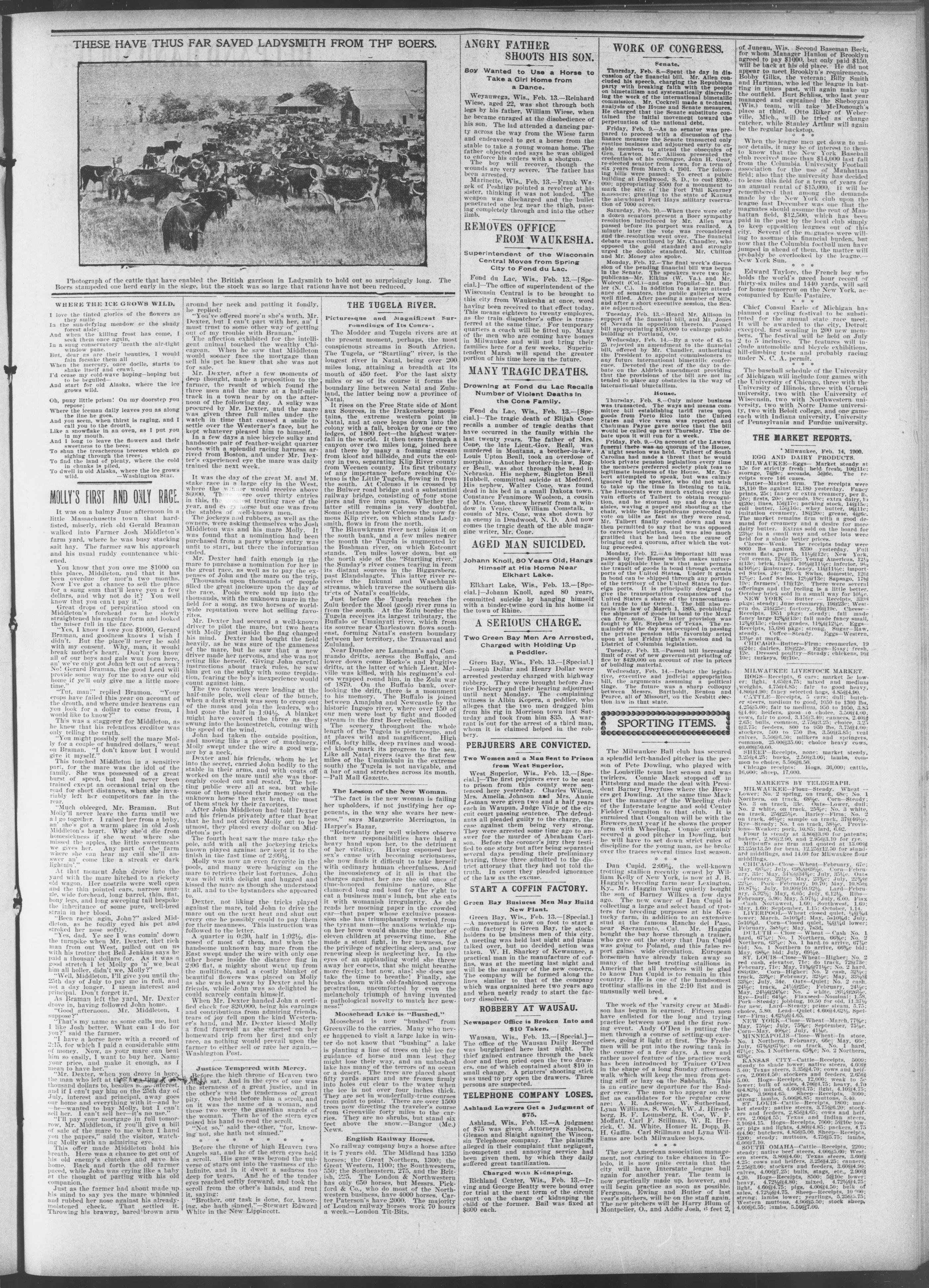
A large herd of cattle grazing in a field, with a farmhouse and trees in the background.
Photograph of the cattle that have enabled the British garrison in Ladysmith to hold out so surprisingly long. The Boers stampeded one herd early in the siege, but the stock was so large that rations have not been reduced.
WHERE THE ICE GROWS WILD.
In the sun-defying meadow or the shady forest alley;
But, dear as are their beauties, I would
fain forsake them all
When the mercury, once docile, starts to
When one mercury, once delicate, starts to shake itself and crawl.
I'd cease my cold-wave hoping—hoping but to be begulled—
And start for old Alaska, where the ice grows wild.
Oh, puny little prism! On my doorstep you repose;
Where the iceman daily leaves you as along the line he goes.
And you seem, when thirst is raging, and I call you to the drouth.
Like a snowflake in an oven, as I put you in my mouth.
And I long to leave the flowers and their sweetness to the bees;
To shun the treacherous breezes which go sighing through the trees;
To find the land of plenty, where the cold in chunks is piled,
To dwell in old Alaska, where the ice grows wild.
—Washington Star.
MOLLY'S FIRST AND ONLY RAGE
It was on a balmy June afternoon in a little Massachusetts town that hard-fisted, miserly, rich old Gerald Braman walked into Farmer Josh Middleton's farm yard, where he was busy stacking salt hay. The farmer saw his approach and his usual ruddy countenance whitened.
You know that you owe me $1000 on this place, Middleton, and that it has been overdue for mor'n two months. Now I've got a chance to sell the place for a snug sum that'll leave you a few dollars, and why not do it? You well know that you can't pay it."
Great drops of perspiration stood on Middleton's forehead as he slowly straightened his angular form and looked the miser full in the face.
"Yes, I know I owe you $1000, Gerard Braman, and goodness knows I wish I didn't. But the place'll never be sold with my consent. Why, man, it would break mother's heart. Don't you know all of our boys and gals wuz born here, an' we've only got John left out of seven? No! Gerard Braman, the good Lord will provide some way for me to save our old home if ye'll only give me a little more time."
"Tut, man!" replied Bramon. "Your crops have failed this year on account of the drouth, and where under heavens can you look for a dollar to come from, I would like to know?"
This was a staggerer for Middleton, as he knew that his relentless creditor was only telling the truth.
"You might possibly sell the mare Molly for a couple of hundred dollars," went on Braman. "I don't know but I would give it myself."
This touched Middleton in a sensitive part, for the mare was the idol of the family. She was possessed of a great burst of speed, but had never been trained except an occasional trial on the road for short distances, when she invariably left her competitors far in the rear.
"Much obleeged, Mr. Braman. But Molly'll never leave the farm until we all go together. I raised her from a baby, an' she's got a warm place in old Josh Middleton's heart. Why she'd die from homesickness if she went where she missed the apples, the little sweetmeats we gives her. Any part of the farm where she can hear my call she'll answer an' come like a streak er dark lightnin'"
At that moment John drove into the yard with the mare hitched to a rickety old wagon. Her nostrils were well open and the thin pointed ears, narrow muzzle, wide forehead, long barrel, thin, flat, bony legs, and long sweeping tail bespoke the inheritance of some pure, well-bred strain in her blood.
"Been racin' agin, John?" asked Middleton, as he fondly eyed his pet and stroked her nose softly.
"Yes, dad. Ye see I was comin' down the turnpike when Mr. Dexter, the rich man from out West, pulled out on us with his trotter the Bell Jenkins says he paid a thousand' dollars for. As it was a good stretch I let Molly go 'n' we beat him all holler, didn't we, Molly?"
"Well, Middleton, I'll give you until the 25th day of July to pay me in full, and not a day longer. I mean interest and principal. Don't forget it."
As Braman left the yard, Mr. Dexter drove in, having followed John home. "Good afternoon. Mr. Middleton, I suppose?"
"That's my name as some calls me, but I like Josh better. What can I do for you?" said the farmer.
"I have a horse here with a record of 2:15, for which I paid a considerable sum of money. Now, as your mare can beat him so easily, I want to buy her. Name your price, and make it enough, as I mean to have her."
"Mr. Dexter, when you drove in here, the man who left at the home time took thousand dollars to, besides some interest, and if I can't pay him on the 25th day of July, interest and principal, away goes our home and everything with it—and he—he—wanted to buy Molly, but I can't sell her. I can't sell her—it's no use."
"I'll pay your mortgage in full tomorrow, Mr. Middleton, if you'll give a bill of sale of the mare to me when I hand you the papers," said the visitor, watching Molly with an admiring eye.
This offer made Middleton hold his breath. Here was a chance to get out of his old enemy's clutches and save his home. Back and forth the old farmer paced, while John was crying like a baby at the thought of parting with his old companion. Just as the farmer had about made up his mind to say yes the mare whinnied and rubbed her nose against his alreadymoistened cheek. That settled it. Throwing his brawny, bared brown arm
around her neck and patting it fondly, he replied:
"You've offered more'n she's wuth, Mr. Dexter, but I can't part with her, an' I must trust to some other way of getting out of my trouble with Braman."
The affection exhibited for the intelligent animal touched the wealthy Chicagoan. When he saw that Middleton would sooner face the mortgage than sell his pet he knew that she was not for sale.
Mr. Dexter, after a few moments of deep thought, made a proposition to the farmer, the result of which found the three men and the mare at a half-mile track in a town near by on the afternoon of the following day. A sulky was procured by Mr. Dexter, and the mare was given three full miles under the watch in time that caused a smile to settle over the Westerner's face, but he kept whatever pleased him to himself. In a few days a nice bicycle sulky and handsome pair of feather-weight quarter boots with a splendid racing harness arrived from Boston, and under Mr. Dexter's experienced eye the mare was daily trained the next week.
It was the day of the great M. and M. stake race in a large city in the West, where the winner would receive above $6000. There were over thirty entries in this, the greatest trotting race of the year, and every horse but one was from the stables of well-known men. The jockeys and rubbers, as well as the owners, were asking themselves who Josh Middleton was and his mare Molly. It was found that a nomination had been purchased from a party whose entry was unfit to start, but there the information ended.
Mr. Dexter had faith enough in the mare to purchase a nomination for her in the great race, as well as to pay the expenses of John and the mare on the trip. Thousands upon thousands of people filled the great inclosure upon the day of the race. Pools were sold up into the thousands, with the unknown mare in the field for a song, as two horses of worldwide reputation were hot selling favorites.
Mr. Dexter had secured a well-known driver to pilot the mare, but two heats with Molly just inside the flag changed his mind. Dexter had bought the field heavily, as he was sure of the gameness of the mare, but he saw that a new driver made her nervous, and she was not acting like herself. Giving John careful instructions about track rules, he saw him get on the sulky with some trepidation, fearing the boy's inexperience would count against him.
The two favorites were leading at the half-mile pole, well clear of the bunch, when a dark streak was seen to creep out of the mass and join the leaders, who had gone the half in $1:04\frac{1}{2}$. A blanket might have covered the three as they swung into the homestretch, coming with the speed of the wind.
John had taken the outside position, and moving like a piece of machinery, Molly swept under the wire a good winner by a neck.
Dexter and his friends, whom he let into the secret, carried John bodily to the stable in their arms, and with coats off worked on the mare until she was thoroughly cooled out and rested. The betting public were all at sea, but while some of them placed their money on the unknown horse the next heat, the most of them stuck by their favorites.
After John Middleton had told Dexter and his friends privately after that heat that he had not driven Molly out to her utmost, they placed every dollar on Middleton's pet.
The fourth heat saw the mare take the pole, aid with all the jockeying tricks known played against her kept it to the finish in the fast time of 2:09%.
Molly was now an even favorite in the pools, and many were hedging on the mare to retrieve their lost fortunes. John was wild with delight and hugged and kissed the mare as though she understood it all, and to the bystanders she appeared to.
Dexter, not liking the tricks played against the mare, told John to drive the mare out on the next heat and shut out every one he possibly could to pay them for their meanness. This instruction was followed to the letter.
A quarter in 0:30, half in 1:02½, disposed of most of them, and when the handsome unknown bay mare from the East swept under the wire with only one other horse inside the distance flag in 2:06 flat, a mighty shout went up from the multitude, and a costly blanket of beautiful flowers was placed on Molly as she was led away by Dexter and his friends, while John was so delighted he could scarcely contain himself.
When Mr. Dexter handed John a certified check for $20,000, being his earnings and contributions from admiring friends, tears of joy fell upon the kind Westerner's hand, and Mr. Dexter kissed Molly a fond farewell as she started on her homeward trip from her first and only race, as nothing would prevail upon the farmer to either sell or race her again.—Washington Post.
Justice Tempered with Mer
Justice Tempered with Mercy.
Before the high throne of Heaven two Angels sat. And in the eyes of one was the sternness of a great justice, and in the other's was the tenderness of great pity. One held before him a scroll, and on it was the name of a woman, and these two were the guardian angels of the woman. Then he of the stern eyes poised his hand to read the scroll.
"Not so," said the other, "for, knowing not, she hath not sinned."
Before the throne of high Heaven two Angels sat, and he of the stern eyes held a scroll. His gaze was beyond the universe of stars out into the vastness of the Infinite, and in it dwelt a sadness too deep for tears. And he of the tender eyes reached softly forward, and took the scroll from the other's hands, and rent it saying:
"Brother, our task is done, for, knowing, she hath sinned."—Stewart Edward White in the New Lippincott
THE TUGELA RIVER.
Picturesque and Magnificent Surroundings of Its Cours. The Modder and Tugela rivers are at the present moment, perhaps, the most conspicuous streams in South Africa. The Tugela, or "Startling" river, is the longest river in Natal, being over 200 miles long, attaining a breadth at its mouth of 450 feet. For the last sixty miles or so of its course it forms the boundary line between Natal and Zululand, the latter being now a province of Natal.
It rises on the Free State side of Mont aux Sources, in the Drakensberg mountains, the extreme western point in Natal, and at once leaps down into the colony with a fall, broken by one or two ledges, of 1800 feet—the highest waterfall in the world. It then tears through a canyon over two miles long, joined here and there by many a foaming stream from kloof and hillside, and cuts the colony in two, separating Klip River county from Weenen county. Its first tributary of any importance before reaching Colenso is the Little Tugela, flowing in from the south. At Colenso it is crossed by the Bulwer road bridge and a substantial railway bridge, consisting of four stone piers and five iron spans. Whether the latter still remains is very doubtful. Some distance below Colenso the now famous Klip river, on which stands Ladysmith, flows in from the north.
The Blauwkranz river next joins it on the south bank, and a few miles nearer the mouth the Tugela is augmented by the Bushman river, on which Estcourt stands. Ten miles lower down, but on the north side of the "Startling river," the Sunday's river comes tearing in from its distant sources in the Biggarsberg, past Elandslaagte. This latter river receives the Inkunzi and Waschbank streams, which traverse the southern districts of Natal's coalfields. Just before the Tugela reaches the Zulu border the Mooi (good) river runs in from the south. At the Zulu border the Tugela receives its largest tributary, the Buffalo or Umzinyati river, which from its source near Charlestown flows southeast, forming Natal's eastern boundary between her territory, the Transvaal and Zululand.
Near Dundee are Landman's and Commando drifts, across the Buffalo, and lower down come Rorke's and Fugitive drifts, at the latter of which Lieut. Melville was killed, with his regiment's colors wrapped round him, in the Zulu war of 1879. On the Buffalo bank, overlooking the drift, there is a monument to his memory. The Buffalo is joined between Amajuba and Newcastle by the historic Ingogo river, where over 150 of our men were lost by fight and flooded stream in the first Boer rebellion.
The scenery throughout the whole length of the Tugela is picturesque, and at places wild and magnificent. High cliffs, lofty hills, deep ravines and wooded kloofs mark its progress to the sea. Like all Natal rivers (save the first few miles of the Umzimkulu in the extreme south) the Tugela is not navigable, and a bar of sand stretches across its mouth.
—Pall Mall Gazette.
The Lesson of the New Woman.
"The fact is the new woman is failing her upholders, if not justifying her opponents, in the way she wears her newness," says Marguerite Merrington, in Harper's Bazar.
"Reluctantly her well wishers observe that new responsibilities have laid a heavy hand upon her, to the detriment of her vitality. Having espoused her sex's cause with becoming seriousness, she now finds it difficult to take herself with ordinary human cheerfulness. And the inconsistency of it all is that the charges against her are the old ones of time-honored feminine nature. She clamored long and loud for the right to eat a business man's lunch, but she eats it with womanish irregularity. As she reads her morning paper in the crowded car—that paper whose exclusive possession she has triumphantly wrested from the tyrant man—the anxious wrinkle upon her brow would shame the mother of eleven children at preserving time. She made a stout fight, in her newness, for the privilege of neglecting sleep, and now renewing sleep is neglecting her. In the eyes of an applauding world she threw away her corsets, that she might breathe more freely; but now, alas! she does not take the time to breathe! Finally, she breaks down with old-fashioned nervous prostration, uncomforted by even the melancholy triumph of having invented a pathological novelty to match her newness."
Moosehead Lake is "Bushed."
Moosehead is now "bushed" from Greenville to the carries. Many who never happened to visit a large lake in winter do not know that "bushing" a lake is planting a line of trees on the ice for guidance of horse and man lest they might lose their way, and an unbushed lake has many of the terrors of an ocean or a desert. The trees are placed about fifty yards apart and are frozen firmly into holes cut clear to the water when the ice is not over four inches thick. They are set in wonderfully-true courses from point to point. There are over 1500 trees now directing the traveler's course from Greenville forty miles to the carries. They are no shrubs, but stand six feet above the snow.—Bangor (Me.) News.
English Railway Horses.
No railway company buys a horse after it is 7 years old. The Midland has 1350 horses; the Great Northern, 1300; the Great Western, 1100; the Southwestern, 550; the Southeastern, 275, and the British, 225. The London & Northwestern has only 650 horses, but Messrs. Pickford & Co., who do most of the Northwestern business, have 4000 horses. Carter Paterson's have 2000. The majority of London railway horses work 70 hours a week.-London Tit-Bits.
ANGRY FATHER SHOOTS HIS SON.
Boy Wanted to Use a Horse to Take a Girl Home from a Dance.
Weyauwega, Wis., Feb. 13.—Reinhard Wiese, aged 22, was shot through both legs by his father, William Wiese, when he became enraged at the disobedience of his son. The lad attended a dancing party across the way from the Wiese farm and endeavored to get a horse from the stable to take a young woman home. The father objected and says he was obliged to enforce his orders with a shotgun. The boy will recover, though the wounds are very severe. The father has been arrested. Marinette, Wis., Feb. 13.—Frank Wazek of Peshtigo pointed a revolver at his sister, thinking it was not loaded. The weapon was discharged and the bullet penetrated one leg near the thigh, passing completely through and into the other limb.
REMOVES OFFICE FROM WAUKESHA.
Fond du Lac, Wis., Feb. 13.—[Special.]—The office of superintendent of the Wisconsin Central is to be brought to this city from Waukesha at once, word having been received to that effect today. This means eighteen to twenty employees, as the train dispatcher's office is transferred at the same time. For temporary quarters a coach will be fitted up. Many of the men who are coming have homes in Milwaukee and will not bring their families here for a few weeks. Superintendent Marsh will spend the greater portion of his time here in the future.
MANY TRAGIC DEATHS.
Drowning at Fond du Lac Recalls Number of Violent Deaths in the Cone Family.
Fond du Lac, Wis., Feb. 13.—[Special.]—The tragic death of Elijah Cone recalls a number of tragic deaths that have occurred in the family within the last twenty years. The father of Mrs. Cone, the late Lieut-Gov. Beall, was murdered in Montana, a brother-in-law, Louis Upton Beall, took an overdose of morphine. Another brother-in-law, Roger Beall, was shot through the head in Nebraska. His nephew, Singleton Beall Hubbell, committed suicide at Medford. His nephew, Walter Cone, was found dead in his bed in a small Dakota town. Constance Fennimore Woolson, a cousin of Mrs. Cone, threw herself from a window in Venice. William Comstalk, a cousin of Mrs. Cone, was shot down by an enemy in Deadwood, N. D. And now comes the tragic death of the able magazine writer, Mr. Cone.
AGED MAN SUICIDED.
Johann Knoll, 80 Years Old, Hangs Himself at His Home Near Elkhart Lake.
Elkhart Lake, Wis., Feb. 13.—[Special.]—Johann Knoll, aged 80 years, committed suicide by hanging himself with a binder-twine cord in his home in the town of Rhine.
A SERIOUS CHARGE.
Two Green Bay Men Are Arrested, Charged with Holding Up a Peddler.
Green Bay, Wis., Feb. 13.—[Special.]
—Joseph Dollar and Henry Dollar were arrested yesterday charged with highway robbery. They were brought before Justice Dockery and their hearing adjourned until next Monday. The complaining witness is Albin Kopera, a peddler, who alleges that the two men dragged him from his rig in Morrison town last Saturday and took from him $35. A warrant is out for the arrest of a third man, whom it is claimed helped in the robbery.
PERJURERS ARE CONVICTED.
Two Women and a Man Sent to Prison from West Superior.
West Superior, Wis., Feb. 13.—[Special.]—The first perjurers ever to be sent to prison from this county were sentenced here yesterday. Charles Wilson, Mrs. Amelia Johnson and Mrs. Annie Lesman were given two and a half years each in Waupun, Judge Vinje of the circuit court passing sentence. The defendants all pleaded guilty to the charge, the case against them being very strong. They were arrested some time ago to answer for the murder of Abraham Carlson. Before the coroner's jury they testified to one story but after being separated several days pending their preliminary hearing, these three admitted to the district attorney that they had not told the truth. In court they pleaded ignorance of the law as the excuse.
START A COFFIN FACTORY.
Green Bay Business Men May Build New Plant.
Green Bay, Wis., Feb. 13.—[Special.]
A movement is now, on foot to start a coffin factory in Green Bay, the stockholders to be business men of this city. A meeting was held last night and plans talked over, but no decided action was taken. W. H. Sharkey of Kewaunee, a practical man in the manufacture of coffins, was at the meeting last night and will be the manager of the new concern. The company will be formed along the lines similar to that of the company which was organized here two years ago and when nearly ready to start the factory dissolved.
ROBBERY AT WAUSAU.
Newspaper Office is Broken Into and $10 Taken.
Wausau, Wis., Feb. 13.—[Special.]—The office of the Wausau Daily Record was burglarized here last night. The thief gained entrance through the back door and then pried open the two drawers, one of which contained about $10 in small change. A printers' shooting stick was used to pry open the drawers. Three persons are suspected.
TELEPHONE COMPANY LOSES.
Ashland Lawyers Get a Judgment of $75.
Ashland, Wis., Feb. 13.—A judgment of $75 was given Attorneys Sanborn, Gleason and Slaight against the Wisconsin Telephone company. The plaintiffs alleged in their complaint that negligent, incompetent and annoying service had been given them, by which they daily suffered great tantilization.
Charged with Kidnaping
Richland Center, Wis., Feb. 13.—Irving and George Beatty were bound over for trial at the next term of the circuit court on the charge of kidnapping the child of the former. Bail was fixed at $600 each.
WORK OF CONGRESS.
Thursday, Feb. 8.-Spent the day in discussion of the financial bill. Mr. Allen concluded his speech, charging the Republican party with breaking faith with the people on bimetallism and systematically discrediting the work of the international bimetallic commission. Mr. Cockrell made a technical analysis of the House and Senate measures. He charged that the Senate substitute contained the initial movement toward the perpetuation of the national debt.
Friday, Feb. 9.—As no senator was prepared to proceed with a discussion of the finance measure the Senate transacted only routine business and adjourned early to enable members to attend the obsequies of Gen. Lawton, Mr. Allison presented the credentials of his colleague, John H. Gear, re-elected senator from Iowa, for a term of six years from March 4, 1901. The following bills were passed: To erect a public building at Deadwood, S. D., to cost $200,000; appropriating $500 for a monument to mark the site of the Fort Phil Kearney massacre; granting to the state of Kansas the abandoned Fort Hays military reservation of 7000 acres.
Saturday, Feb. 10.—When there were only a dozen senators present a Boer sympathy resolution introduced by Mr. Allen was passed before its purport was realized. A minute later the vote was reconsidered and the resolution went over. The financial debate was continued by Mr. Chandler, who opposed the gold standard and strongly urged the double standard. Mr. Chilton and Mr. Money also spoke.
Monday, Feb. 12. The final week's discussion of the pending financial bill was begun in the Senate. The speakers were two Republican's—Mr. Elkins (W. Va.) and Mr. Wolcott (Col.)—and one Populist—Mr. Butler (N. C.). In addition to a large attendance of senators, the public galleries were well filled. After passing a number of bills, and after a short executive session, the Senate adjourned.
Tuesday, Feb. 13.—Heard Mr. Allison in support of the financial bill, and Mr. Jones of Nevada in opposition thereto. Passed bill appropriating $150,000 to enlarge public building at Portland, Or.
Wednesday, Feb. 14.—By a vote of 45 to 25 rejected an amendment to the financial bill, offered by Mr. Chandler, authorizing the President to appoint commissioners to any future international bimetalite conference. Devoted the rest of the day to debate on the Aldrich amendment providing that the provisions of the bill are not intended to place any obstacles in the way of international bimetalism.
Thursday. Feb. 8.--Only minor business was transacted. The ways and means committee bill establishlug tariff rates upon goods from Porto Rico into the United States and vice versa was reported and Chairman Payne gave notice that the bill would be called up next Thursday. The debate upon it will run for a week.
Friday, Feb. 9.—On account of the Lawton funeral there was no quorum of the House. A night session was held. Talbert of South Carolina had made a threat that he would block private pension legislation every time the members preferred society pink teas to legitimate business of the House. Mr. Talbert attempted to speak, but was calmly ignored by the speaker, who did not wish to take up the time in listening to talk. The Democrats were much excited over the vain efforts of Talbert to obtain recognition, and he stormed up and down the aisles, waving a paper and shouting at the chair, while the Republicans proceeded to vote on bills as fast as they were read. Mr. Talbert finally cooled down and was then permitted to say that he was opposed to careless legislation, and was also much gratified that he had been the cause of bringing out a quorum, after which the voting proceeded.
Monday, Feb. 12.—An important bill was passed by the House which makes universally applicable the law that now permits the transit of goods in bond through certain ports of the United States. Under it goods in bond can be shipped through any portion of the territory of the United States to foreign ports. It is principally designed to give the transportation companies of the United States a share of the transcontinental trade to the Orient. The bill also repeals the law of March 1, 1895, prohibiting the shipment of goods in bond to the Mexican free zone. The latter provision was fought by Mr. Stephens of Texas. The remainder of the day was occupied in passing the private pension bills favorably acted upon at last Friday night's session and in District of Columbia legislation.
Tuesday, Feb. 13.—Passed bill increasing limit of cost of new government printing office by $429,000 on account of rise in prices of building material.
Wednesday, Feb. 14.—Debate the legislative, executive and judicial appropriation bill, the arguments assuming a political tinge. The future was a sharp colloquy between Messrs. Bartholdt, Benton and Pearce, all of Missouri, on the Nesbitt election law in that state.
SPORTING ITEMS.
The Milwaukee Ball club has secured a splendid left-handed pitcher in the person of Pete Dowling, who played with the Louisville team last season and was twirlers. Connie Mack stopped off in Pittsburg and made the deal with President Barney Dreyfuss where the Brewers get Dowling. At the same time Mack met the manager of the Wheeling club of the Interstate league and sold Center Fielder Congalton to that club. It is surmised that Congalton will be with the Brewers next year if he shows the proper form with Wheeling. Connie certainly secured a good pitcher in Dowling, but he will have to set down strict rules of discipline for the young man, as he broke over the traces several times last season.
* * *
Dan Cupid, 2:091/4, the well-known trotting stallion recently owned by William Kelly of New York, is now at J. B. Haggin's breeding farm near Lexington, Ky., Mr. Haggin having quietly bought the son of Barney Wilkes a few days ago. The new owner of Dan Cupid is collecting a large and select band of trotters for breeding purposes at his Kentucky farm, in addition to an extensive stud at the famous Rancho del Paso, near Sacramento, Cal. Mr. Haggin bought the bay horse through a trainer, who gave out the story that Dan Cupid was going to Poland, and this false report gained wide circulation. European horsemen have already taken away so many of the best trotting stallions in America that all breeders will be glad to know Dan Cupid is to remain in this country. He is one of the handsomest trotting stallions in the 2:10 list and is unusually well bred.
***
The work of the 'varsity crew at Madison has begun in earnest. Fifteen men have enlisted for the long and trying practice between now and the first rowing event. Andy O'Dea is putting the men through a course of setting-up exercises, going it light at first. The Freshmen will be put into the rowing tank in the course of a few days. A new and rather novel feature of the practice work has been introduced by Trainer O'Dea in the shape of a long Sunday afternoon walk which will keep the men from getting stiff or lazy on the Sabbath. This is an entire new departure for the Badger crew. The men who appear on the list as candidates for the regular crew are: A. R. Anderson, W. Sutherland, Lynn Williams, S. Welch, W. J. Hirschberg, B. F. Lounsberg, R. Coe, W. F. Moffatt, Carl F. Stillman, W. R. Herrick, C. M. White, Homer R. Dopp, B. H. Gaffin. Carl Stillman and Lynn Williams are both Milwaukee boys.
***
The new American association management, not caring to take chances in Toledo, it is now quite certain that the city will have Interstate league ball again for another year. The team is now practically made up, however, and will begin practice as soon as possible. Ferguson, Ewing and Butler of last year's pitchers, will be on the staff again. The new pitchers will be Harry Blum of Montpelier, O., and Addie Josh, 6 feet 2.
of Juneau, Wis. Second Baseman Beck, for whom Manager Hannon of Brooklyn agreed to pay $1000, but only paid $150, will be back at his old place. He did not appear to meet Brooklyn's requirements. Bobby Gilks, the veteran; Billy Smith and Hartman, who led the league in batting in times past, will again make up the outfield. Burt Schliss, who last year managed and captained the Sheboygan (Wis.) team, will take McDonough's place at third. Otto Riker of Weberville, Mich., will be tried as change catcher, while Stanley Arthur will again be the regular backstop.
When the league men get down to minor details, it may be of interest to them to know that the New York Baseball club received more than $14,000 last fall from the Columbia University Football association for the use of Manhattan field; also that the university has decided to lease this field for a term of years for an annual rental of $15,000. It will be remembered that among the demands made by the New York club upon the league last December was one that the magnates should assume the rent of Manhattan field, $12,500, which has been paid in the past by the local club simply to keep opposition leagues out of this city. Several of the magnates were willing to assume this financial burden, but now that the Columbia football men have jumped in ahead of them, the matter will probably be overlooked by the league.—New York Sum.
Edward Taylore, the French boy who holds the world's paced hour record of thirty-six miles and 1440 yards, will sail for home tomorrow on the New York, accompanied by Emile Pastaire.
Chief Consul Earle of Michigan has planned a cycling festival to be substituted for the annual state race meet. It will be awarded to the city, Detroit excepted, first sending in 200 new members. The festival will be field on July 2 to 5 inclusive. The features will include automobile and bicycle exhibitions, hill-climbing tests and probably racing under N. C. A. permit.
The baseball schedule of the University of Michigan will include four games with the University of Chicago, three with the University of Illinois, three with Corneli university, two with the University of Wisconsin, two with Northwestern university, two with Notre Dame university, two with Beloit college, and one game each with Indiana university, University of Pennsylvania and Purdue university.
THE MARKET REPORTS.
* Milwaukee, Feb. 14, 1900.
EGG AND DAIRY PRODUCTS.
MILWAUKEE—Eggs—Market steady at 13c for strictly fresh; held fresh, 10@11c; storage, 7@9c; seconds, 5@6c. The receipts were 146 cases.
Butter—Market firm. The receipts were 18,110 lbs against 12,180 yesterday. Fancy prints, 25c; fancy or extra creamery, per 12c; firsts, 20c; seconds, 18c; extra dairy, 19@20c; lines, 15@17c; packing stock, 14@15c; roll butter, 15@16c; whey butter, 9@11c; juitation creamery, 18@20c; grease, 4@6c.
The market remains firm with a good demand for creamery and a desire for more dairy butter. Extras sold on the board for 23%c in a small way and other lots were held for a shade better prices.
Cheese—Weak. The receipts today were 8060 lbs against 8590 yesterday. Full cream flats, per lb, 11½@12¢; New York, full cream, 12½@13¢; Young Americas, 12½@13¢; brick, fancy, 10½@11½¢; inferior, 9½@10½¢; limburger, fancy, 11½@11½¢; imported Swiss, 24¢; Block Swiss, domestic, 12½¢; Loaf Swiss, 12½@13¢; Sapsago, 17½¢; farmers', 11½@12¢. There were several offerings and the feeling is a little better. October brick sold in a small way for 10¼¢.
NEW YORK — Butter — Receipts, 3398 pkgs; steady; June creamery, 19@23¢; Western do, 21½@25¢; factory, 16@19¢. Cheese—Receipts, 1851 pkgs; steady; fall made fancy large 12½@13¢; fall made fancy small, 12½@13¢; choice grades, 11½@12¼¢. Eggs—Receipts, 15,686 pkgs; strong. Sugar—Raw, steady. Coffee—Steady. Eggs—Western, 13½¢ at mark.
CHICAGO—Butter—Flurm; creameries, 19@24¢; dalries, 19@22¢. Eggs—Easy; fresh, 12¢. Dressed poultry—Steady; chickens, 9½@10¢; turkeys, 9@10¢.
MILWAUKEE LIVESTOCK MARKET
HOGS-Receipts, 6 cars; market 5c lower; light, 4.65@4.75; mixed and medium weights, 4.75@4.85; fair to good heavy, 4.80@4.90; fancy selected cars, 4.85@4.90.
CATTLE-Receipts, 5 cars; dull; butcher steers, medium to good, 1050 to 1300 lbs, 4.25@5.00; fair to medium, 950 to 1050, 3.85@4.40; heifers, good to choice, 3.50@4.00; cows, fair to good, 3.15@3.40; canners, 2.40@2.65; bulls, common, 2.75@3.25; choice, 3.25@3.75; feeders, 800 to 950 lbs, 3.75@4.00; stockers, 500 to 750 lbs, 3.50@3.85; veal calves, 5.50@6.50; milkers and springers, common, 25.00@35.00; choice heavy cows, 40.00@50.00.
SHEEP-Receipts, none; market steady, 3.25@4.25; bucks, 2.50@3.00; lambs, common to choice, 5.50@6.50.
Chicago receipts: Hogs, 36,000; cattle, 16,000; sheep, 17,000.
MARKETS BY TELEGRAPH
MILWAUKEE—Flour—Steady. Wheat—Lower; No. 2 spring, on track, 68c; No. 1 Northern, on track, 68%c. Corn—Steady; No. 3 on track, 33c. Oats—Lower, dull; No. 2 white, on track, 25%c; No. 3 white, on track, 25%c!e. Barley—Firm; No. 2 on track, 46%c; sample on track, 37%46%c. Rye—Steady; No. 1 on track, 58%c. Provisions—Weaker; pork, 10.85; lard, 6.02. Flour is steady at 3.80%3.90 for patents; bakers', 2.80%2.90, and 2.95%3.10 for rye. Millstuffs are firm and quoted at 13.00%13.25%13.50 for bran, 12.25%12.50 for standard middlings, and 14.00 for Milwaukee flour middlings.
CHICAGO—Close—Wheat—February, 67c; May, 68%c; July, 69%%69%c. Corn—February, 33c; May, 34%%34%c; July, 35%%c. Oats—February, 22%%c; May, 23%%c; July, 23%%23%c. Pork—February, 10.70; May, 10.85%10.87%; July, 10.90%10.92%; Lard—February, 5.92%; May, 6.05; July, 6.12%; Ribs—February, 5.90; May, 5.97%; July, 6.00; Flax—Cash Northwest, 1.60; Southwest, 1.60; May, 1.60; September, 1.15; October, 1.14
LIVERPOOL—Wheat closed quiet, 1¼%@d lower; March, 51½%d; May, 51½%d; July, 51½%d. Corn—Closed quiet, 1¼%@d lower; February, 38½%c; May, 73½d. DULUTH—Close—Wheat—Cash No. 1 hard, 67½%c; No. 1 Northern, 66½%c; No. 2 Northern, 62½%c; No. 1 hard to arrive, 67½%c bid; No. 1 Northern to arrive, 66½%c bid; May, 68½%c bid; July, 69½%c. ST. LOUIS—Close—Wheat—Higher; No. 2 red cash, elevator, 71c; do track, 72@73c; February, 71c; May, 71½@71½c; No. 2 hard, 68½@63c. Corn—Higher; No. 2 cash, 32½%c; track, 33½%c; February, 32½%c; May, 33½%c; March, 74c; Oats—Quiet; No. 2 cash, 24½%c; track, 24½@25c; February, 24½%c; May, 24½@24½c; No. 2 white, 26½@26½c; Rye—Dull, 64½%c. Flaxseed—Nominal, 1.58; Pork—Steady; Jobbing, 10.50 for old, 11.37% for new. Lard—Steady; prime steam, 5.75; choice, 5.80. Lead—Quiet, 4.60@4.62%, Speller—Firm, 4.62@4.65. NEW YORK—Close—Wheat—March, 77½%c; May, 75½%c; July, 75½%c; September, 75½%c. Corn—May, 40½%c; July, 41½%c.
MINNEAPOLIS—Close—Wheat—In store.
No. 1 Northern, February, 666; May, 666;
July, 67%@67½c; on track. No. 1 hard,
67½c; No. 1 Northern, 65½c; No. 2 Northern,
63½c.
KANSAS CITY—Cattle—Receipts, 5000;
steady to shade lower; native steers, 4.00%
5.40; Texas steers, 3.35@4.70; cows and heifers,
2.00@4.50; stockers and feeders, 2.65@
5.00. Hogs—Receipts, 12,000; weak to 5
lower; bulk of sales, 4.70@4.75; heavy, 4.70
@4.82½; mixed, 4.60@4.75; light, 4.10@4.75;
pigs, 3.90@4.65. Sheep—Receipts, 3000;
strong, lambs, 5.00@6.85; muttons, 5.40.
ST. LOUIS—Cattle—Receipts, 1800; market steady; native steers, 3.75@6.20; stockers and feeders, 2.85@4.65; cows and heifers,
2.00@4.55; Texas and Indian steers,
3.10@4.15. Hogs—Receipts, 7000; 5@10e lower;
pigs and lights, 4.80@4.85; packers, 4.75
@4.90; butchers, 4.85@5.00. Sheep—Receipts,
1200; steady, muttons, 4.75@5.75; lambs,
6.00@7.10
SOUTH OMAHA—Cattle-Recipients, 2200;
steady; native beef steers, 4.00@4.50; Western steers, 3.80@4.60; Texas steers, 3.60@4.25; cows and heifers, 3.25@4.25; canners, 2.25@3.00; stockers and feeders, 3.60@4.90; calves, 4.00@7.25; bulls, stags, etc., 2.90@4.20. Hogs-Recipients, 8500; 5@10c lower; heavy, 4.72@4.80; mixed, 4.72@4.75;
light, 4.72@4.75; pligs, 4.00@4.50; bulk of sales, 4.72@4.75. Sheep-Recipients, 10'000;
strong; lambs lower; yearlings, 5.25@5.75;
Western muttons, 4.90@5.50; stock sheep, 4.00@6.55; lambs, 5.50@7.00.
THE OFFICE OF THE WISCONSIN
WEEKLY ADVOCATE CO
209
WELCOME
KAUS. MIL
Home Office of the Help and Hand Society And the Wisconsin Weekly Advocate.
The Wisconsin Weekly Advocate
Richard B. Montgomery.....Editor and Proprietor
Miss E. D. Holsey.....City Editoress
Office 209 Fifth Street.
Telephone Black No. 244.
SUBSCRIPTION RATES.
One Year ..... $2.00
Six Months ..... 1.25
Three Months ..... 75
Send money by Express Money Order, P. O.
Money Order or Registered Letter to the
Wisconsin Weekly Advocate.
ADVERTISING RATES.
One inch, single insertion.....25¢
One inch, per year.....$9.00
Business locals 5¢ per line each insertion.
Apply for rates to the Advocate.
TO CONTRIBUTORS:
All communications must be sent with the name and address of the sender as an evidence of good faith, but not necessarily for publication. No manuscript returned if not accepted, unless accompanied by stamps.
All subscribers of the Advocate that fall to get their paper promptly will please notify us at once. The Advocate, at 209 Fifth street.
The Wisconsin Weekly Advocate company wishes to notify the public that all contracts and business transactions with this company must have the company stamp, otherwise they will be void. Neither will this company be responsible for paid subscriptions unless given to duly-accredited agents, who, on request, will give the company's receipt for same. Subscribers failing to receive their papers regularly will kindly notify the general office. Address all business communications to the general manager, 209 Fifth street.
Entered at the Milwaukee P. O. as second-class matter.
It has been indelibly impressed upon the British that the capture of kopjes is up-hill work.
The Free Staters are not the only ones who are afflicted with a "tired feeling" as a result of the war.
Col. Baden-Powell has conducted the defense of Mafeking with so much horse sense that the report that the garrison has been reduced to oats will cause no alarm in Great Britain.
A laundry in Paris dries clothes by sending them up into the air on bamboo frames attached to a captive balloon. American laundries don't get the linen so high, but they reach a dizzy altitude in their bills.
The death of Gen. William W. Averill, the famous Confederate cavalry leader, removes one of the few remaining figures of the Civil war on the side of the South. Gen. "Joe" Wheeler and Gen. James Longstreet are probably the most prominent generals of the South who are still in the land of the living.
The New York Evening Post cheerfully remarks, "It is a pleasure to notice the continued decline in the practice of hazing at the colleges throughout the country." It certainly would be a pleasure to notice it. But how many months have elapsed since they killed that poor fellow at Cornell?
Somebody has discovered that as early as 1814 Niles' Register, a leading American newspaper of that time, foreshadowed the construction of a canal connecting Lake Michigan with Mississippi by way of the Illinois river. That was long before Chicago was born, but she can fairly appropriate the prediction in support of her drainage canal.
An operation for appendicitis at Yonkers, New York, resulted in the recovery of a scarf pin that was accidentally swallowed by the patient several months ago, but the patient died. The fact that the pin was found in the appendix will revive the grape-seed theory, and re-establish distrust among lovers of the fruit who have been reassured by assertions that foreign matter is rarely found in the appendix.
The Broad Arrow, a leading English military journal, admits the truth of the recognized principle that "to adopt the frontal attack against an opponent possessed of modern weapons is a military sin;" and the only way in which it can account for the repeated disregard of this principle by British commanders in South Africa is by a habitual under-estimate of the enemy induced by campaigns against semi-civilized peoples.
It is not surprising that the Dewey arch fund in New York lags. Had it been possible to circulate the subscription list when the Admiral first arrived in New York, the arch would now probably be an eventuality. Ardor cools when a subscription paper is in sight, and now that it has been displaced by interest in later events, the collector has no show at all. The naval arch will probably never be made permanent.
Lucerne, in Switzerland, and Garmisch, in Bavaria, have usually been accorded two of the most beautiful towns in Europe. Berlin is considered the healthiest, Stockholm and Christiania coming next, the death rate, as a rule, being the lowest on the continent. London, too, occupies a favorable position after those mentioned. But places like Rome and Venice run up high death rates. The unhealthiest place in the world is Alexandria. Notwithstanding its unvarying fine weather, its 300 fountains and its soft sea breezes, the death rate there reaches 52.9 per 1000.
Peary is to be sought for by the New York Arctic club which bears his name. It has decided to fit out the steamer Windward for a trip toward the North pole. She will be provisioned for three years, and if Peary is not found when the Windward reaches her farthest north, the ship is to go into winter quarters and remain for another summer's exploration. Peary's plans have been carefully laid, and if he fails to beat all the records for pole hunting it will not be because he has been poorly equipped or improperly supported from his home base of supplies and assistance.
Scottish Highlanders are proverbially far sighted, and great things are expected of the contingent of 150 Highland gillies and deer-stalkers whom Lord Lo-
vat is taking to the front. These men, as all who have been on the hills with them can testify, are able with the naked eye to take up objects, even if stationary and of almost the same color as the surroundings, with an ease and at a distance incredible to an unpracticed man. With a good glass (which most of them already own) they can detect a stag by a few inches of his horns, or a hind by the twitch of her ear, over a stone at many hundred yards, and can search the face of a hill with marvelous certainty of overlooking nothing. It is suggested that these men should be attached singly or in pairs to officers making reconnoissances or scouting.
Chemists in several parts of the country are now turning their attention to the feasibility of manufacturing extracts, flavorings and cordials from cull oranges, lemons, olive mash and other by-products of Southern California. For years but little attention has been paid to such products, and thousands of boxes of good material have in consequence been wasted. Recent experiments have disclosed wonderful possibilities along such lines of industry, enlisting, the consideration and attention of prominent chemists. On the Rancho la Mirada, in San Diego county, a laboratory has been erected, where an experienced chemist is engaged in experimenting with the products of the ranch. The most successful article yet produced is a tonic called "kitro," which is made from the grape fruit. This is pronounced one of the best fruit tonics ever produced. First-class cordials have also been made from the orange, lemon and apricot, while the lemon and orange have produced the best quality of citric acid.
The agitation for the abolition of the death penalty has been revived in New York. Only five states fail to punish murder by death—Wisconsin, Michigan, Maine, Rhode Island and Colorado. In the Colorado penitentiary, not long ago, four life prisoners murdered a keeper. Under the existing law there is no punishment for their crime, and a movement for the restoration of the death penalty has sprung up. In Michigan murders are more frequent now than they were before the death penalty was abolished, and many are in favor of its restoration. The increase of murders is attributed, however, to the growth of population in the mining district, and the disposition of the Italians among the miners to settle their quarrels with knives instead of fists. Gen. N. M. Curtis, who is the leader of the anti-death penalty people in New York, and who has organized a society to promote his hobby, argues that capital punishment does not protect society, because its severity often prevents the conviction of murderers. He would find, if he were to investigate, that it is no less difficult to secure convictions in Wisconsin than in New York. He would also find that the weak exercise of executive clemency turns loose upon society a large proportion of those who are convicted and sentenced to life imprisonment.
Blow Down Into a Fire.
If a fire requires blowing to give it a good start, it will be found that blowing down into the flames makes it burn up more brightly and quickly than if blown from underneath.
NATIONAL VITALITY.
France Has Passed from the State of Progress to that of Recession.
The population statistics of fully-developed nations are the certain index of their industrial vitality. In this sense the Nineteenth century has seen the most significant changes in the relative productive strength of the peoples of Europe. At the beginning of the French Revolution the population of France was some 25,000,000; it is now no more than 38,000,000; and the fact that it has ceased to increase is the very evidence that France has lost the power of relative growth, and that she has passed from the state of progress to that of recession.
the state of progress to that of recession.
In the same period of comparison the population of Great Britain has risen from 12,000,000 to $40,000,000, and though the rate of increase has shown an obvious tendency to fall and to follow the example of France it is large enough to ensure for another generation at least a powerful expansion in the number of industrial units. Here again, however, Germany has both the absolute and the relative advantage. Her population has increased during the last 100 years from somewhat over 15,000,000 to nearly 60,-000,000.
Finally, Russia has increased the number of her inhabitants from 25,000,000 to some 100,000,000, and is still by far the most prolific country in the world, in spite of the frightful mortality which attends her low condition of life.—London Telegraph.
Alcohol Destroys the Constitution.
The friends of the distiller have tried to prove that alcohol is a food and tonic, but the effort has resulted in utter failure. Alcohol is neither a food nor a tonic, but the most pernicious of all poisons. Taken habitually, in even the smallest quantities and weakest beverages, alcohol undermines and destroys the constitution. Its action is progressively and continuously hurtful and destructive. There is no such thing as temperance in the use of alcoholic liquors. Whether it be whisky or beer, or wine, and the daily consumption large or small, the effect is the same. The sole difference is in the time required to burn out the constitution. The sapping of the vital forces is going on all the time.
Alcohol is neither a food nor a tonic; it is an excitant and depressant. Like all poisons, it first irritates and then paralyzes. It wastes vitality by first abnormally rousing and then abnormally depressing sensation and emotion.
Alcohol abuses and weakens the nervous system, thus causing a predisposition to, and aggravating all diseases. Alcoholism is the parent of the neuroses—hysteria, epilepsy, chorea, neuralgia, neuritis, cramps, delusions, hallucinations, dementia, and all those nervous disorders which have no distinctive pathology, and rest upon a peculiar irritable state of the nervous system. It likewise prepares the soil for tuberculosis, diabetes, Bright's disease, cancer and other diseases dependent upon defective innervation and impaired nutrition.
Alcohol irritates the mucous membranes and structure of organs, leading to chronic inflammations with fibrous changes, contraction and hardening, or tissue break-down with hemorrhages, pus-formation and blood poisoning. In all cases, the liver, lungs or kidneys become organically diseased, sooner or later, and ultimately death is the frequent result.
The man who dallies with alcohol, permitting himself to take an occasional drink, is almost certain to form a pernicious habit, which he is powerless to break, and which slowly and insidiously robs him of his reserve vitality. He may not see or feel the draught on his forces, because no emergency occurs to test his strength, but the drain is going on all the same. This gradual leakage of vitality, if wisely invested in good habits and
OH! OH! What an Opportunity
WE WANT 3000
Good Colored Men and Women
Throughout the State of Wisconsin.
and by writing us we will furnish all with good places free of charge, and at good wages.
And all those who wish firstclass colored help direct from the Southern States we desire to call attention to the many families who are in quest of help of all kinds not to overlook the Help and Hand Mission where we can supply free to all the very best of colored help. The Help and Hand Mission is under the immediate direction of Mr. Richard B. Montgomery, who gives all requiring good help his prompt and personal attention and at the same time places good colored people in first-class homes. The mission is now doing work as testimonials from some of the best people in Milwaukee and elsewhere will truthfully testify and has become a thing that to a large extent self sustaining.
right living, would add twenty years to his life-span, and enable him to hand down a constitution untainted by vice or physical infirmity. Alcohol does not take the place of food; it merely benumbs appetite. Intense hunger is one of the earliest symptoms in men under treatment for alcoholism, after the poison is eliminated.—The Wisconsin Osteopath.
LONDON'S BATHS.
Facilities for Ablution Are Many and Are Being Increased. It is no fault of the authorities of the metropolis if any considerable proportion of the people of London continue to merit the description of "the great unwashed." Facilities for ablation are many, and these are yearly being increased. At present there are thirty-five parishes in London where the baths and wash-houses act has been adopted, and in most of these there are one or more of these establishments in full working order.
In 1898 the number of bathers and washers reached the respectable total of 5,000,000, and of these 4,463,109 were bathers who used the private or swimming baths, and the remaining 627,881 women using the wash-houses. The number of hours paid for by the latter were 2,054,393, or an average of 3.6 hours per washer. Of the bathers using the private baths 18 per cent, were females; and, of those using the swimming baths, 10 per cent.
In no instance is any establishment carried on so as to produce a surplus over expenditure, though in a few cases there is no actual charge on the rates. The total expenditure of the whole is £158,671, and the total revenue £75,311, so that the baths of London altogether cost the ratepayers an annual sum of £83,360.
—Newcastle (Eng.) Chronicle.
Those calling up Telephone No.1009 will receive immediate attention. The office of the Mission is now located 209 5th Street Milwaukee. Wis.
Smoking Stunts the Growth of Boys
Whatever difference of opinion there may be upon the advisability of smoking for men, there is none as to its pernicious effect upon boys. It affects the action of the heart and reduces the capacity of the lungs. Young men who are being trained for athletics are not permitted to smoke by their trainers because, as they say, "It is bad for the wind." The argument that will appeal most forcibly to your boy is that smoking will stunt his growth. It has been proved that youthful smokers are shorter and weigh less than their comrades who do not smoke. Cigarettes are particularly injurious. Nicotine, the active principle of tobacco, is said by chemists to be, next to prussic acid, the most rapidly-fatal poison known. The tender tissues of a growing boy cannot absorb even a very small quantity of it without most injurious results.—Ladies' Home Journal.
All parties subscribing for the Weekly Advocate will have all their help furnished free. Gen'l Manager—Richard B. Montgomery.
PURE
EXPORT
SCHLITZ
JOS. SCHLITZ BREWING CO.
MILWAUKEE, U.S.A.
THE
BEER
THAT MADE MILWAUKEE FAMOUS.
Olive Crop Short.
Latin minds lay to Providence the responsibility for the shortage in the olive crop of Italy, France and Spain. A certain ill-mannered fly deposits its eggs in the green fruit. A grub is hatched, and this grub so destroys the olive that the oil is inferior in quality and especially bad for table use. If Americans were dealing with this condition of affairs they would spray the trees, but the Latin mind in all three countries accepts the misfortune meekly as a dispensation from Providence. As compared with an average crop, the olive crop of these three nations hardly will reach 30 per cent. Italian olives suffer most, with France second and Spain least affected. Prices of olives and of true olive oil are likely to take a sharp upward turn.
—The statistical maniac calculates there is one piano for every seven houses in the United Kingdom, and, as each instrument costs on an average £20, the enormous aggregate is £20,000,000.
W. T. GREEN,
Lawyer,
Notary Public.
Offices 17-18 Birchard Block.
105 Grand Avenue.
Telephone 193 Black.
TELEPHONE NO. 1885.
S. L. MARSH
Attorney and Counselor-at-Law
ROOM 26, CAWKER BUILDING,
PRACTICING IN
..ALL COURTS.. Milwaukee, Wis.
THIS IS THE PLACE
If you want a Suit or Overcoat made to order at the lowest price
Cleaning and Repairing Done Promptly
NEW YORK TAILORING CO.
322 Wells Street
TONEY THE ARTIST
FINE ART
Shining Parlor
2161 GRAND AVENUE
Opposite Flanner's Music Store
MILWAUKEE, WIS.
WHEN IN MADISON
Call at the
Avenue
Hotel...
M. J. REGAN, Prop.
$2.00 Rate . . . .
Free 'Bus.
WONDERFUL
DISCOVERY
Curly Hair Made Straight By
TAKEN FROM LIFE:
BEFORE AND AFTER TREATMENT.
OZONIZED OX MARROW
THE ORIGINAL—COPYRIGHTED.
This wonderful hair pomade is the only safe preparation in the world that makes kinky hair straight as shown above. It nourishes the scalp, prevents the hair from falling out and makes it grow. Sold over 40 years and used by thousands. Most testimonials free on request. It was the first ozonized hair straightening kinky hair. Beware of imitations.
Get the Original ozonized Ox Marrow, as the genuine never fails to keep the hair pliable and beautiful. A toilet necessity for ladies and gentlemen. Elegantly perfumed. The great advantage of harmed pomade is that by its use you can straighten your hair without owing to its superior and lasting quality it is the most economical. It is not possible for anybody to produce a preparation equal to it. Full directions with every bottle. Only 50 cents. Sold by dealers or send us $1.40 Postal or Express Money Order for 8 bottles, express paid. Write your name and address plainly to
OZONIZED OX MARROW CO.,
76 Wabash Ave., Chicago, Ill.
Our Friends Should Call on
AUG. H. GEIER,
DEALER IN
FRESH, SALTED and SMOKED
MEATS OF ALL KINDS
Also Fresh Fish and Oysters in Season
A Full Line of Vegetables.
502 WELLS STREET.
Telephone Main 1009.
Northwestern House APPLETON, WIS.
JOHN A. BRILL, - Proprietor.
Terms $1.00 Per Day.
Accommodations the best in the State. When in Appleton stop at the NORTHWESTERN
TALMAGES
(Copyright, Louis Klopsch, 1900.) IN this discourse Dr. Talmage sets forth the responsibility of those who are strong and well, as in a former discourse he preached to the disabled and "the shut in;" text, Judges xiv., 1, "And Samson went down to Timnath."
There are two sides to the character of Samson. The one phase of his life, if followed into particulars, would administer to the grotesque and the mirthful. But there is a phase of his character fraught with lessons of solemn and eternal import. To these graver lessons we devote our sermon.
This giant no doubt in early life gave evidences of what he was to be. It is almost always so. There were two Napoleons—the boy Napoleon and the man Napoleon—but both alike; two Howards—the boy Howard and the man Howard—but both alike; two Samsons—the boy Samson and the man Samson—but both alike. This giant was no doubt the hero of the playground, and nothing could stand before his exhibitions of youthful prowess. At 18 years of age he was betrothed to the daughter of a Philistine. Going down toward Timnath, a lion came out upon him, and although this young giant was weaponless he seized the monster by the long mane and shook him as a hungry hound shakes a March hare and made his bones crack and left him by the wayside bleeding under the smiting of his fist and the grinding heft of his heel.
There he stands, looming up above other men, a mountain of flesh, his arms bunched with muscle that can lift the gate of a city, taking an attitude defiant of everything. His hair had never been cut, and it rolled down in seven great plaits over his shoulders, adding to his bulk, fierceness and terror. The Philistines want to conquer him, and therefore they must find out where the secret of his strength lies.
There is an evil woman living in the valley of Sorek by the name of Delilah. They appoint her the agent in the case. The Philistine are secreted in the same building, and then Delilah goes to work and coaxes Samson to tell what is the secret of his strength. "Well," he says, "if you should take seven green withes such as they fasten wild beasts with and put them around me, I should be perfectly powerless." So she binds him with the seven green withes. Then she claps her hands and says, "They come—the Philistines!" and he walks out as though there were no impediment. She coaxes him again and says, "Now tell me the secret of this great strength?" and he replies, "If you should take some ropes that have never been used and tie me with them, I should be just like other men." She ties him with the ropes, claps her hands and shouts, "They come—the Philistines!" He walks out as easily as he did before—not a single obstruction. She coaxes him again, and he says, "Now, if you should take these seven long plaits of hair and by this house loom weave them into a web, I could not get away." So the house loom is rolled up, and the shuttle flies backward and forward, and the long plaits of hair are woven into a web. Then she claps her hands and says, "They come—the Philistines!" He walks out as easily as he did before, dragging a part of the loom with him.
Show of Strength.
But after awhile she persuades him to tell the truth. He says, "If you should take a razor or shears and cut off this long hair, I should be powerless and in the hands of my enemies." Samson sleeps, and that she may not wake him up during the process of shearing help is called in. You know that the barbers of the cast have such a skillful way of manipulating the head to this very day that instead of waking up a sleeping man they will put a man wide awake sound asleep, I hear the blades of the shears grinding against each other, and I see the long locks falling off. The shears or razor accomplishes what green withes and new ropes and house loom could not do. Suddenly she claps her hands and says, "The Philistines be upon thee, Samson!" He rouses up with a struggle, but his strength is all gone. He is in the hands of his enemies.
I hear the groan of the giant as they take his eyes out, and then I see him staggering on in his blindness, feeling his way as he goes on toward Gaza. The prison door is open, and the giant is thrust in. He sits down and puts his hands on the mill crank, which with exhausting horizontal motion goes day after day, week after week, month after month—work, work, work! The consternation of the world in captivity, his locks shorn, his eyes punctured, grinding corn in Gaza!
First of all, behold in this giant of the text that physical power. He was a huge man—the lion found it out, and the 3,000 men whom he slew found it out; yet he was the subject of petty revenges and outgianted by low passion. I am far from throwing any discredit upon physical stamina. There are those who seem to have great admiration for delicacy and sickliness of constitution. I never could see any glory in weak nerves or sick headache. Whatever effort in our day is made to make the men and women more robust should have the favor of every good citizen as well as of every Christian. Gymnastics may be positively religious.
How often it is that you do not find physical energy indicative of spiritual power! If a clear head is worth more than one dizzy with perpetual vertigo, if muscles with the play of health in them are worth more than those drawn up in chronic "rheumatics," if an eye quick to catch passing objects is better than one with vision dim and uncertain, then God will require of us efficiency just in proportion to what he has given us. Physical energy ought to be a type of moral power. We ought to have as good digestion of truth as we have capacity to assimilate food. Our spiritual hearing ought to be as good as our physical hearing. Our spiritual taste ought to be as clear as
our tongue. Samsons in body, we ought to be giants in moral power But while you find a great many men who realize that they ought to use their money aright and use their intelligence aright how few men you find aware of the fact that they ought to use their physical organism aright. With every thump of the heart there is something saying, "Work, work!" and lest we should complain that we have no tools to work with God gives us our hands and feet, with every knuckle and with every joint and with every muscle, saying to us, "Lay hold and do something."
But how often it is that men with physical strength do not serve Christ. They are like a ship full manned and full rigged, capable of vast tonnage, able to endure all stress of weather, yet swinging idly at the docks, when these men ought to be crossing and recrossing the great ocean of human suffering and sin with God's supplies of mercy. How often it is that physical strength is used in doing positive damage or in luxurious ease, when, with sleeves rolled up and bronzed bosom, fearless of the shafts of opposition, it ought to be laying hold with all its might and tugging away to lift up this sunken wreck of a world.
Giants in Body and Soul.
Wilberforce was told by his doctors that he could not live a fortnight, yet at that very time entering upon philanthropic enterprises that demanded the greatest endurance and perseverance. Robert Hall, suffering excruciations so that often in his pulpit while preaching he would stop and lie down on a sofa, then getting up again to preach about heaven until the glories of the celestial city dropped on the multitude, doing more work perhaps than almost any well man in his day.
Oh, how often it is that men with great physical endurance are not as great in moral and spiritual stature. While there are achievements for those who are bent all their days with sickness—achievements of patience, achievements of Christian endurance—I call upon men of health, men of muscle, men of nerve, men of physical power, to devote themselves to the Lord. Giants in body, you ought to be giants in soul.
Behold also in the story of my text illustration of the fact of the damage that strength can do if it be misguided. It seems to me that this man spent a great deal of his time in doing evil—this Samson of my text. To pay a bet which he had lost by the guessing of his riddle he robs and kills thirty people. He was not only gigantic in strength, but gigantic in mischief and a type of those men in all ages of the world who, powerful in body or mind or any faculty of social position or wealth, have used their strength for iniquitous purposes.
It is not the small, weak men of the day who do the damage. These small men who go swearing and loafing about your stores and shops and banking houses, assailing Christ and the Bible and the church—they do not do the damage. They have no influence. They are vermin that you crush with your foot. But it is the giants of the day, the misguided giants, giants in physical power, or giants in mental acumen, or giants in social position, or giants in wealth, who do the damage—the men with sharp pens that stab religion and throw their poison all through our literature, the men who use the power of wealth to sanction iniquity and bribe justice, and make truth and honor bow to their golden scepter. Misguided giants—look out for them! In the middle and latter part of the last century no doubt there were thousands of men in Paris and Edinburgh and London who hated God and blasphemed the name of the Almighty; but they did but little mischief—they were small men, insignificant men. Yet there were giants in those days. Who can calculate the soul havoc of a Rousseau, going on with a very enthusiasm of iniquity, with fiery imagination seizing upon all the impulsive natures of his day, or David Hume, who employed his life as a spider employs its summer, in spinning out silken webs to trap the unwary, or Voltaire, the most learned man of his day, marshaling a great host of skeptics and leading them out in the dark land of infidelity, or Gibbon, who showed an uncontrollable grudge against religion in his history of one of the most fascinating periods of the world's existence—"The Decline and Fall of the Roman Empire"—a book in which with all the splendors of his genius, he magnified the errors of Christian disciples, while with a sparseness of notice that never can be forgiven he treated of the Christian heroes of whom the world was not worthy?
Understanding One's Power.
Understanding One's Power.
Oh, men of stout physical health, men of great mental stature, men of high social position, men of great power of any sort, I want you to understand your power, and I want you to know that that power devoted to God will be a crown on earth, to you typical of a crown in heaven, but misguided, bedraggled in sin, administrative of evil, God will thunder against you with his condemnation in the day when millionaire and pauper, master and slave, king and subject, shall stand side by side in the judgment and money bags and judicial ermine and royal robe shall be riven with the lightnings.
Behold also how a giant may be slain of a woman. Delilah started the train of circumstances that pulled down the temple of Dagon about Samson's ears. And tens of thousands of giants have gone down to death and hell through the same fascinations. It seems to me that it is high time that pulpit and platform and printing press speak out against the impurities of modern society. Fastidiousness and prudery say: "Better not speak. You will rouse up adverse criticism. You will make worse what you want to make better. Better deal in glittering generalities. The subject is too delicate for polite ears." But there comes a voice from heaven overpowering the mincing sentimentalities of the day, saying, "Cry aloud, spart not, lift up thy voice like a trumpet and show my people their transgressions and the house of Jacob their sins."
The trouble is that when people write or speak upon this theme they are apt to cover it up with the graces of belles lettres, so that the crime is made attractive instead of repulsive. Lord Byron in "Don Juan" adorns this crime until it smiles like a May queen. Michelet, the great French writer, covers it up with bewitching rhetoric until it glows like the rising sun, when it ought to be made loathsome as a smallpox hospital. There
are to-day influences abroad which if unresisted by the pulpit and the printing press will turn our modern cities into Sodoms and Gomorrahs, fit only for the storm of fire and brimstone that whelmed the cities of the plain.
You who are seated in your Christian homes, compassed by moral and religious restraints, do not realize the gulf of iniquity that bounds you on the north and the south and the east and the west. While I speak there are tens of thousands of men and women going over the awful plunge of an impure life, and while I cry to God for mercy upon their souls I cry to you to marshal in the defense of your homes, your church and your nation. There is a banqueting hall that you have never heard described. You know all about the feast of Ahasuerus, where 1,000 lords sat. You know all about Belshazzar's carousal, where the blood of the murdered king spurted into the faces of the banqueters. You may know of the scene of riot and wassail where there was set before Aesopus one dish of food that cost $400,000. But I speak now of a different banqueting hall. Its roof is fretted with fire. Its floor is tessellated with fire. Its chalices are chased with fire. Its song is a song of fire. Its walls are buttresses of fire. Solomon refers to it when he says, "Her guests are in the depths of hell."
Innumerable Homes Blighted.
Our American communities are suffering from the gospel of free lovism which thirty years ago was preached on the platform and in some of the churches of this country. I charge upon free lovism that it has blighted innumerable homes and that it has sent innumerable souls to ruin. Free lovism is bestial; it is worse—it is infernal! It has furnished this land with many thousands of divorces annually. In one county in the State of Indiana it furnished eleven divorces in one day before dinner. It has roused up elopements north, south, east and west. You can hardly take up a paper but you read of an elopement. As far as I can understand the doctrine of free lovism, it is this—that every man ought to have somebody else's wife and every wife somebody else's husband. They do not like our Christian organization of society, and I wish they would all elope, the wretches of one sex taking the wretches of the other, and start to-morrow morning for the great Sahara desert until the simoon shall sweep seven feet of sand all over them and not one passing caravan for the next 600 years bring back one miserable bone of their carcasses! Free lovism! It is the double distilled extract of nux vomica, ratsbane and adder's tongue. Never until society goes back to the old Bible and hears its eulogy of purity and its anathema of uncleanness—never until then will this evil be extirpated.
Behold also in this giant of the text and in the giant of our own century that great physical power must crumble and expire. The Samson of the text long ago went away. He fought the lion. He fought the Philistines. He could fight anything, but death was too much for him. He may have required a longer grave and a broader grave, but the tomb nevertheless was his terminus.
Parting of Body and Soul.
If, then, we are to be compelled to go out of this world, where are we to go to? This body and soul must soon part. What shall be the destiny of the former I know—dust to dust. But what shall be the destiny of the latter? Shall it rise into the companionship of the white robed, whose sins Christ has slain, or will it go down among the unbelieving, who tried to gain the world and save their souls, but were swindled out of both? Blessed be God, we have a Champion! He is so styled in the Bible. A Champion who has conquered death and hell, and he is ready to fight all our battles, from the first to the last. "Who is this that cometh up from Edom with dyed garments from Bozrah, mighty to save?" If we follow in the wake of that Champion, death has no power and the grave no victory. The worst man trusting in him shall have his dying pangs alleviated and his future illuminated.
In the light of this subject I want to call your attention to a fact which may not have been rightly considered, and that is the fact that we must be brought into judgment for the employment of our physical organism. Shoulder, brain, hand, foot—we must answer in judgment for the use we have made of them. Have they been used for the elevation of society or for its depression? In proportion as our arm is strong and our step elastic will our account at last be intensified. Thousands of sermons are preached to invalids. I preach this sermon to stout men and healthful women. We must give to God an account for the right use of this physical organism. These invalids have comparatively little to account for perhaps. They could not lift twenty pounds. They could not walk half a mile without sitting down to rest. Yet how much many of them accomplish. Rising up in judgment, standing beside the men and women who had only little physical energy, and yet consumed that energy in a conflagration of religious enthusiasm, how will we feel abashed! Oh, men of the strong arm and the stout heart, what use are you making of your physical forces? Will you be able to stand the test of that day when we must answer for the use of every talent, whether it were a physical energy, or a mental acumen, or a spiritual power?
The Approval of Christ.
The day approaches, and I see one who in this world was an invalid, and as she stands before the throne of God to answer she says: "I was sick all my days. I had but very little strength, but I did as well as I could in being kind to those who were more sick and more suffering." And Christ will say, "Well done, faithful servant."
And then a little child will stand before the throne, and she will say: "On earth I had a curvature of the spine, and I was very weak, and I was very ill, but I used to gather flowers out of the wildwood and bring them to my sick mother, and she was comforted when she saw the sweet flowers out of the wildwood. I did not do much, but I did something." And Christ shall say, as he takes her up in his arm and kisses her, "Well done, well done, faithful servant; enter thou into the joy of thy Lord." What, then, will be said to us, we to whom the Lord gave physical strength and continuous health? Hark, it thunders again. The judgment, the judgment!
An Explanation.
Mrs. Chicory-That detestable Mrs. Hashen was boasting to-day about how long she keeps her boarders. Mrs. Pruner-Oh, she keeps them so thin that they look longer than they really are.-Philadelphia Record.
BARGAINS IN
FINE CLOTHING
ONE PRICE TO ALL
MEN
FASHIONABLE MISFIT
AN OUR ALLECTION
CUSTOM TAILOR MISST
213 WHOLESALE PRETAIL 217
Extra This Week
Closing Out Overcoats and Heavy Weight Suits prices guaranteed 25 per cent. less than any store in this city also workmanship to be as good and better than any other store in this city. An example of our prices:
$30 Overcoats for $20
$25 Overcoats for $15
$20 Overcoats for $13
$15 Overcoats for $10 and
$12 Overcoats for $8
Also Heavy Weight Suits 25 per cent. less than we have been selling them before. Seeing is convincing. At the
213-217 West Water Street, I door south of News Building and Opposite Barrett's
Photograph
otograph
Photographer..
296 West Water Street,
Opp. Second Ward Bank Bldg.
The Emerss
CORNER GRAND AVENUE
MILWAU
MR. GEORGE A.
ager of R. B.
facturers of the Celebrate
Made Shoes, begs leave
many citizens of Milwaukee have opened a new building on the Third St. and Grand line of goods. This is the firm at the present.
A Goodyear Welt cost $5.00. The goods are honestly solicited.
Persons
Ward Bank Bldg. MILW
Emerson Shoe
HER GRAND AVENUE AND THIRD ST
MILWAUKEE, WIS.
GEORGE A. SCHECK
mer of R. B. Grover & Co.
of the Celebrated Comfortable
shoes, begs leave to announce
zens of Milwaukee and vi
e opened a new store in the
building on the northeast
and Grand Ave. and co
goods. This makes 31 stor
at the present time.
year Welt costs $3.50 and a
goods are honest all through and
Opp. Second Ward Bank Bldg. * MILWAUKEE, WIS:
MR. GEORGE A. SCHECK, the manager of R. B. Grover & Co., manufacturers of the Celebrated Comfortable Custom Made Shoes, begs leave to announce to the many citizens of Milwaukee and vicinity that they have opened a new store in this city in the new building on the northeast corner of Third St. and Grand Ave. and carry a full line of goods. This makes 31 stores run by the firm at the present time.
A Goodyear Welt costs $3.50 and a Handsewed $5.00. The goods are honest all through and inspection is solicited.
A horse and carriage
who desire to hire stylish and nobby rigs for a drive will do well to patronize
GEO. W. SEITZ,
who has one of the best assorted livery stables, not
WHEN IN WAUKESHA
Don't forget to go to the
VALENTINE HOUSE
Where you will be well taken care of.
It has all modern improvements and is only a short distance from the depot.
---
apher..
on Shoe Co.
QUE AND THIRD STREET,
KEE, WIS.
SCHECK, the man-
Grover & Co., manu-
ated Comfortable Custom
to announce to the
Milwaukee and vicinity that
new store in this city in
the northeast corner of
Ave. and carry a full
makes 31 stores run by
time.
$3.50 and a Handsewed
at all through and inspection is
only in Fond du Lac, but in the Northwest. He is one of the most courteous and accommodating gentlemen in the business. A specialty made of traveling men's trade. Remember the place,
34 Forest Ave. Telephone 119.
Fond du Lac, Wis.
WESTERN RELIEF Association
OF OSHKOSH, WIS.
Protects your time against Accident
Sickness or Death for
ONE DOLLAR A MONTH
Good agents wanted. Apply 209 Fifth
Street or 1227 Vliet St.
HE SPRINGS A SURPRISE.
DEMANDS CERTIFICATE
State Board's Efforts to Restrain Him from Practising Medicine May Prove Futile.
Kenosha, Wis., Feb. 14.—[Special.]—From present indications it seems that the suit recently brought by the state board of medical examiners against Dr. Paul Malmstrom of this city to test their rights in regard to the so-called "fake" colleges, will hardly answer the purpose as the doctor this morning sprung a surprise which will probably result in his coming out of the case a complete victor. From the developments in the case this morning it is evident that the doctor will not attempt to make any fight against the board on account of his diploma received from a Chicago medical college not recognized by the board, but he will submit to the board a diploma from the National University of Sweden. The diploma was granted to the doctor in 1881 and carries with it a license to practice medicine in Sweden. The doctor says that he does not think that the state board will dare to refuse to acknowledge this certificate, as it is recognized in every other state in the Union. Before coming to this city Dr. Malmstrom was a practicing physician in Chicago and no action was ever brought against him. Last evening Norman L. Baker, attorney for the doctor, filed mandamus proceedings against the state board making a demand for a certificate. The proceedings against the doctor for practicing without a license have not as yet been decided, but the case has twice been adjourned at the request of the prosecution.
A DASTARDLY DEED.
Young Man Puts a Keg of Spikes on the Railroad Track Near Brookfield.
Waukesha, Wis., Feb. 14.—[Special.]—Pat Casey, in charge of the Milwaukee road's force of detectives and patrolmen, yesterday afternoon arrested Carl Wichmann, a youth about 20 years of age, and this morning secured a warrant in the municipal court here charging the young man with attempted train wrecking.
Wichmann has been in the employ of a butcher named Andrew Smith, whose shop is on Galena street between Nineteenth and Twentieth streets, Milwaukee. The young fellow has been in the habit of making trips through this county and adjoining counties purchasing cattle from the farmers. Last Saturday afternoon he drove by the depot at Brookfield. On the depot platform stood a keg of railway spikes. Wichmann jumped off the wagon and walking up to the keg, deliberately rolled it out onto the railway tracks and then righted it inside the track used by the passenger trains.
A few minutes later a westbound passenger train came tearing along and hit the keg. The spikes flew in every direction and several of them got tangled up with the machinery of the locomotive, doing serious damage. The engineer declares that it was simply a miracle that the train was not derailed and a frightful accident the result. Railroad men declare that in the line of obstructions a keg of these spikes are the most dangerous that trainwreckers could utilize to further their ends. Some of the spikes are almost certain to land on the rails.
The company immediately put several of its officers at work to find out the perpetrators of the outrage. Mr. Casey inquired about Brookfield until he met a party who had seen the butcher wagon stop near the depot and the youth alight. The next step was to learn the identity of the wagon and a farmer vouchsafed this information. This morning Officer Casey repaired to the butcher shop of Smith in Milwaukee and there found young Wichmann at work. He was taken to the central police station in that city and questioned.
To Inspector Riemer he finally, after many denials, acknowledged having placed the keg on the track. He could give no explanation for his conduct at all. He simply said: "I was driving by and as I noticed the keg of spikes it occurred to me that it would be fun to place this on the tracks and see a swift train scatter the spikes in the air. After I had put the keg on the tracks I drove away a short distance and watched for the passenger." Wichmann was taken before the municipal court in this city this morning. His hearing was adjourned until 9 o'clock tomorrow morning.
RIFLE TEAM CHOSEN.
Lieut. Wm. J. Kessler of Eau Claire Wins the Revolver Presented by Gen. Charles King. Madison, Wis., Feb. 14.—[Special.]— An order has just been issued by Adjt. Gen. Boardman designating the following National guard men as the state rifle team for 1900, being the ten making the ten highest scores at Camp Douglas: Sergt. Lewis Dodge, Monroe, score 193; Sergt. Gotlieb Wittner, Monroe, 192; Sergt. Charles Hammer, Beaver Dam, 192; Private C. H. Wiklund, Tomah, 191; Sergt. E. J. Gautsch, La Crosse, 190; Sergt. A. Weigel, La Crosse, 190; Sergt. J. Baldlewein, Sheboygan, 186; Private A. J. Fladlen, La Crosse, 186; Private Oscar Rude, Neillsville, 183; Private F. L. Dyer, Mauston, 179.
The revolver presented by Gen. Charles King for the best score with revolver, possible score being 125, was won by Second Lieut. William J. Kessler of Eau Claire. His score was 123.
A MILITARY FUNERAL.
Appleton Boy was Killed While Fighting in the Philippines.
Appleton, Wis., Feb. 14.—[Special.] The remains of W. J. Merrill, the first Appleton soldier to be killed in the Philippines, have arrived at San Francisco and are expected to reach here in a few days. Merrill served through the Porto Rican campaign with Co. C of the Second Wisconsin volunteers, and re-enlisted last January with the Third United States infantry at Fort Snelling. His regiment landed at Manila last July and the next day went onto the firing line near the city. Almost at the first fire Merrill was shot through the head by a sharpshooter and instantly killed. Upon the arrival of the remains here they will be given a military funeral by Co. G of the Wisconsin National guard, the Grand Army and his old comrades of the Second regiment.
May Enlarge Kenosha Factory.
Kenosha. Wis., Feb. 14.—There is a rumor that the management of the Chicago Hosiery works will make an effort to get possession of the Sterling building. If such an arrangement could be made the machinery of the American Bicycle company would be moved from the Sterling to the Sieg factory and the manufacture of wheels continued there.
BLAMES RAILROAD FOR THE WRECK.
BLAMES RAILROAD FOR THE WRECK.
Holds the North-Western Company Responsible for the Ford River Disaster.
Escanaba, Mich., Feb. 14.—The coroner's jury investigating the wreck of the Felch Mountain accommodation train at Ford River switch last Thursday night returned a verdict holding the Chicago & North-Western Railroad company responsible for the disaster, but failing to specify which of its employees were at fault. It held that train No. 289 was running too close to train No. 21. Testimony was introduced showing that a man named Jacobson of Metropolitan was also in the burned car and has not been accounted for.
PICTURES AT AUCTION.
Sale of the Henry Hilton Collection
—Total of $56,465
Realized.
New York, Feb. 14.—Eighty-two pictures of the Henry Hilton collection were sold at public auction in Chickering hall for a total of $56,465. There was a large attendance, but the bidding as a rule was not brisk. Thirty-four pictures were sold before any one reached $1000. The first twenty-five reached a total of only $5500. The top price of the evening was $9000, paid by Isidor Wormser, Jr., for Dupre's "Landscape and Sheep." Former Mayor Hugh J. Grant bought Jules Worms' "Spanish Dancer" for $4100, and John D. Crimmins secured Munkaczy's "Visit to the Baby" for $6100. The best prices were:
"View on Grand Canal," Felix Ziem, E. C. Converse 1,150
"Spanish Dancer," Jules Worms, Hugh J. Grant 4,100
"Timidity," W. Bougereau, H. S. Arnold 1,025
"Fleet in Venice," Martin Rice, H. Springer 1,750
"Landscape and Sheep," Jules Dupre, Isidor Wormser, Jr. 9,000
"The Memorandum," Ranaundo de Madrazo, H. S. Arnold 1,125
"Visit to the Baby," M. de Munkaesy, J. D. Crimmins 6,100
"The Presentation," Vaczlav Brozik, H. Springer 2,300
MANY LIVES IN PERIL.
Four Fires in Different Parts of Chicago Residence District Heroic Work of Firemen.
Chicago, Ill., Feb. 14.—Eight persons were injured, perhaps fatally, in four fires that occurred late last night and early today in different parts of the residence districts of this city. In all about thirty-five lives were imperiled by the fires and there were heroic deeds of rescue by the firemen. The most serious occurred at a boarding-house at 2021 Indiana avenue where the following were injured: C. F. Slado, a student at a veterinary college, severely burned and carried out unconscious by the firemen; M. W. Littlefield, overcome by smoke and carried out by firemen; Mrs. M. W. Littlefield, overcome by smoke; Curtis Jamison, sleeping on the third floor, overcome and rescued by firemen; Frank Hampden, overcome and carried from building.
The two small children of Mrs. H. E. Bump, sleeping on the first floor, were also overcome by smoke and rescued by their mother at the peril of her own life. The total losses will not amount to $50,000. Most of the fires were caused by overheated furnaces.
PATHETIC SCENE AT FUNERAL
Military Forcibly Permit a Girl Wife to See Her Husband's Body.
Kokomo, Ind., Feb. 14.—There was a dramatic incident at the funeral of Milo Harlan here yesterday afternoon. Harlan, who was a sergeant in the regulars, died here Sunday from wounds received at Manila, passing away at the home of his grandmother. His wife and child live at Sharpsville. The wife did not learn of Harlan's death until this morning, and was not present at the church, the notice of his death being kept from her.
When the funeral procession reached Albright's cemetery, three miles south of here, the young wife stood with the baby waiting for the arrival of the corpse. She had been waiting four hours in the cold, but the Harlans refused to recognize the woman, who pleaded tearfully for permission to view the remains of her husband. She was being pushed aside when the military escort, a company of Kokomo soldiers, crowded the relatives back with force and protected the weeping wife. The coffin was opened, and for half an hour the girl-wife talked to the corpse as though he were alive.
"They kept you from me when alive, but they cannot do it now," she moaned. After the interment she returned to Sharpsville, where she lives with her parents.
GIGANTIC STEEL COMBINE.
Twenty-five Concerns Representing a
Capital of $52,000,000.
Pittsburg, Pa., Feb. 14.—The long-talked-of combination of the steel sheet mills of the country was formed at a meeting here today, twenty-five concerns out of twenty-nine being represented. The capital stock was fixed at $52,000,000, of which $26,000,000 will be preferred, carrying a 7 per cent. dividend, and $26,000,000 common. Ten millions of the preferred will be treasury stock and the entire $26,000,000 of the common stock will be placed in a New York bank for a year.
None of the stock will be put on the market, the mill-owners taking it all. The concerns outside the combine are the Apollo Iron & Steel company of Vandergrift, Pa.; W. D. Woods & Co., McKeesport, Pa.; Zug & Co., Pittsburg, and the Whittaker Iron company of Wheeling. These four firms control fifty-five mills and the combine sixteen mills. The name of the new combine will probably be the American Steel Sheet company. The company expects to start business within thirty days.
DENIES HIS IDENTITY.
Missing Count Blucher Discovered in Soldiers' Home at Bath, N. Y.
Bath, N. Y., Feb. 14.—Gebhard L. Blucher, the missing count, for whom a fortune of $200,000 is said to be waiting in Germany, is an inmate of the Soldiers' home here. The descendant of the general who saved Wellington at Waterloo was disposed to deny his identity and gave a somewhat incoherent account of himself. He appeared to take no interest in the report that a fortune was in store for him and that his wife in New York had long been anxious to find out what had become of him.
He said that it was a singular fact that the missing Count von Blucher and he had the same name. The count, he said, was a cousin of his. He added that his father at his death left $700,000 to his oldest brother, Adolph, and that this brother was murdered some months ago on his estate in Germany by a game-keeper.
Forty Years for Purse Snatching.
Kansas City, Mo., Feb. 14.—A jury in the criminal court today gave Ed Simms, a negro footpad, a forty-year sentence in the penitentiary for snatching a white woman's pocketbook. Two jurors wanted to give him a life sentence.
STARK IS PRESIDENT.
Milwaukee Man is at the Head of the State Bar Association.
Madison, Wis., Feb. 13.—[Special.]— There was an exodus of Milwaukee lawyers to Madison this morning to attend the meeting of the State Bar association in session here today. The meeting is being held in the Supreme courtroom which has been crowded all day. The convention will close tonight with a banquet at the Cornelia Vilas Guild hall. The association today elected officers as follows: President—Joshua Stark Milwaukee. Secretary—C. I. Harling, Milwaukee. Treasurer—S. C. Hanks, Madison.
Vice-Presidents—First circuit—Thomas M. Kearney; Second, J. G. Flanders; Third, L. D. Nash; Fourth, Charles Barbour; Fifth, J. M. Smith; Sixth, Ray S. Reid; Seventh, E. E. Browne; Eighth, J. W. Bashford; Ninth, John M. Olin; Tenth, G. W. Latta; Eleventh, H. H. Grace; Twelfth, B. B
O
O
O
JOSHUA STARK.
(Elected President of the State Bar Association.)
Eldredge; Thirteenth, Edwin Hurlbut;
Fourteenth, C. E. Vroman; Fifteenth, C. A.
Lamoreux; Sixteenth, E. L. Bump; Seventeenth, M. C. Ring.
Two interesting papers were read at the morning session, by George R. Peck of Milwaukee, on Abraham Lincoln, and by S. S. Gregory of Chicago on the Louisiana purchase. Mr. Peck told some new Lincoln stories.
Lincoln in Court.
Concerning Lincoln in court Mr. Peck said:
It is unfortunate that few, if any, of his legal arguments, either to court or jury, have been preserved except in fragments, resting mostly in the memory of his neighbors and of his associates at the bar. A few, alas! a rapidly-diminishing few are left of those who knew him. Among them, the venerable Henry W. Blodgett, for many years judge of the United States court for the northern district of Illinois, and now in his retirement, happy in the respect and affection of all, is, perhaps, as capable of expressing a just opinion of Lincoln's professional characteristics as any one living. I asked him, only a few weeks ago, to tell me something about him as a lawyer, and he said: "He was a good, safe, careful and very successful lawyer, whose arguments were models of clear and convincing reasoning." I inquired: "What are the elements which were most prominent in his conduct of a law suit?" He answered: "His great success was the result, first, of his unrivaled clearness of statement, and secondly, of his absolute fairness and candor." He added, that whatever Lincoln stated to be the law and the facts, no court ever doubted that he honestly believed them to be so. Herdendon says that Lincoln was a good lawyer in a good case and a poor lawyer in a bad case. I wish there were more such lawyers. I imagine his forensic arguments were like his political ones, compact, convincing inexorable.
BUILD CANNING PLANT.
Reedsville Business Men Form a
Company and will Erect Factory.
Manitowoc, Wis., Feb. 13.—[Special.]
Another pea-canning factory is to be built in Manitowoc county. Several of the prominent business men of the village of Reedsville, this county, will erect one, the plans for which are already drawn. The concern will be incorporated with a capital stock of $40,000. The factory will be 58x120 feet and will be one of the best-equipped plants of the kind in the country, supplied with the most improved machinery. If a donation can be obtained from the village an electric-light plant will be erected and the canning plant run by electricity. Four hundred acres of land will be rented and the factory is expected to be in working order by June 1. The annual output will be from 1,000,000 to 1,500,000 cans per season. A number of Manitowoc people will probably be interested in the concern. It is the intention of the owners of the plant to add machinery for the canning of corn and tomatoes later. The soil in the vicinity of Reedsville is excellent for the growing of peas. Postmaster L. A. Busse of Reedsville was in the city yesterday and today in the interest of the new industry.
MARRIED FIFTY YEARS.
Mr. and Mrs. Mangold of Kaukauna
Celebrate.
Kaukauna, Wis., Feb. 13.---[Special]—Mr. and Mrs. Louis Mangold of this city have just celebrated their fifty-fifth wedding anniversary at their home on Eighth street. They are each 77 years of age. They were born in Alsace, Germany, and came to America when children. They were married in Cincinnati, O., and came to Wisconsin forty years ago, settling in the town of Sherwood, about seven miles from here. For the past two years they have resided in Kaukauna.
For the first time in thirty years all of their children were present at this happy and memorable gathering. Their children are nine in number, most of them living in Wisconsin. One son resides in Oregon and two sons in the Indian territory.
Waukesha, Wis., Feb. 13.—[Special.]—On Washington's birthday Mr. and Mrs. Henry Clasen will celebrate their golden wedding. Mr. and Mrs. Clasen have resided in the town of Brookfield up to a few months ago, when they came here and are now living with their son, Fred Clasen at the National hotel. A wide circle of friends will enjoy the reception. There are two sons besides Fred Clasen, who is a well-known and highly-respected attorney of the city.
HOME DESTROYED BY FIRE
Farm Residence of Frank Mead, near Galesville, Buried.
Galesville, Wis., Feb. 13.—[Special.]—The farm residence of Frank Mead was destroyed by fire this morning. A part of the contents were saved, but the building was entirely consumed. The loss is about $1200; insured in the local Farmers' company.
Mrs. M. A. Marshall Injured.
Beloit, Wis., Feb. 13.—[Special.]—Mrs. M. A. Marshall, who is widely known in Methodist church affairs in the state, fell and fractured one of her shoulders.
Weyauwega Mau Kills Himself.
Weyauwega, Wis., Feb. 13.—Daniel Frazier committed suicide by taking paris green. Continued illness is supposed to be the cause.
FREIGHT DITCHED NEAR GREENVILLE.
Pulpwood Train is Wrecked on the Ashland Division of the North-Western Road.
Appleton, Wis., Feb. 14.—[Special.]—By the pulling out of a drawbar which fell on the track, a pulpwood train on the Ashland division of the North-Western road was ditched near Greenville at 1 o'clock last night. Seventeen cars of timber piled up in the ditch and the track was torn up for some distance. No one was injured. The Ashland fast mail at 3 o'clock was compelled to transfer passengers and mail around the wreck. The track was repaired by noon today.
OLD EMPLOYE OF MILWAUKEE ROAD.
The Late A. C. Flanders of Portage was in the Service Nearly Fifty Years.
Portage, Wis., Feb. 14.—The remains of A. C. Flanders will be taken to Milwaukee tomorrow for interment. Mr. Flanders was, with possibly one exception, the oldest employee of the Milwaukee road. Had he lived until May 1 of this year he would have completed a half century's service with this company, having entered the employ of the company as stock and general agent May 1, 1850. At that time the road was known as the Milwaukee & Mississippi railroad and comprised what is now the Prairie du Chien division of the Chicago. Milwaukee & St. Paul system. In 1853 he was made the company's general agent for the purchasing of material and supplies of all kinds to be used in the extension of the road. In 1850 Mr. Flanders was appointed agent at Sun Prairie, then one of the most important stations on the road. In 1866 he was transferred to Portage and has ever since been in charge of the company's business here.
Arthur C. Flanders was born at Piermont, N. H., April 14, 1823. Mr. Flanders came to Wisconsin in the early '40s and for several years experienced all the hardships incident to frontier life. In February, 1853, he returned to Littleton, N. H., where he was married to Miss Catherine Senter, coming after his wedding to Milwaukee, where he was employed in the service of the new railway company. Six children were born of this union—only two of whom survive—Mrs. C. B. Laverty of Pittsburg, Pa., and Julie, wife of Col. J. B. Sanborn of Chicago. Mrs. Flanders died in 1888. In 1893 Mr. Flanders was married to Mrs. L. A. Swift, who survives him.
CAN'T GET LABORERS.
Northern Wisconsin Lumbermen Are Unable to Secure Men at Any Price.
Rhinelander, Wis., Feb. 14.—[Special.]
—Never before have such wages been paid as are being dealt out by the loggers and lumbermen of northern Wisconsin this winter, but in spite of it laboring men are scarce. Some idea as to the demand for skilled labor can be gathered from the fact that a representative of the Menasha Woodenware company, which is engaged in extensive logging operations near here, recently approached a well-known local scaler and offered him $100 per month to scale for the above firm in their camp near this city. The man had
a good job as it was and did not accept the flattering offer. Another resident here was asked on the street the other day if he would take a job as sawyer in the woods near Monico. He was a mason and was offered $50 a month, payments to be made in advance and all expense bills footed by his employer. The offer did not please him in the least and he did not accept. He remarked later that he was waiting for $60.
All the incoming trains are eagerly watched for men and there is much strife among the employers.
The weather could hardly be improved upon for work in the woods and logging contractors are taking every advantage of it.
Clintonville, Wis., Feb. 14.—[Special.]
As an instance of the difficulty experienced in securing men to work in lumber camps, James Devereux of Oconto, who recently scoured the country, says that out of eight men who promised to meet him at the depot in Oconto yesterday morning but one man put in an appearance, and at Stiles Junction, where he expected to meet a squad, not one showed up. He says the season among loggers has been a long one, the men have made their usual "stakes," many are coming out of the woods and inducements strong enough cannot be held out to them to cause them to return.
G. V. Bennett of this place will start up his sawmill about the middle of March with a stock of nearly 1,000,000 feet of hardwood and cedar—enough of the latter to manufacture 4,000,000 shingles. He is paying farmers an average of $7 a thousand for hardwood and $6 for cedar. Green Bay, Wis., Feb. 14.—[Special.]—Most of the Murphy Lumber company's big stock of logs comes from the head waters of the Peshtigo at the rate of twenty to twenty-five carloads a day. One-half of the quantity is being sawed this winter, the balance to be held in reserve for next summer's sawing. Split Lake, Wis., Feb. 14.—[Special.]—D. J. Rohrer of Clintonville is putting in a large stock of logs to be sawed at O. H. Williams' mill at Fritzville.
INCREASE APPROPRIATION.
Petition Congress to Allow More Money for National Guard.
Madison, Wis., Feb. 14.—[Special.]—A circular letter is being sent out by Adjt-Gen. Boardman to officers of the Wisconsin National guard urging them to follow the suggestion made by the secretary of the Interstate National Guard association, that each officer write his congressmen and the senators from his state urging them to support the increase of the annual appropriation by the government for the National guard of the country from $400,000 to $2,000,000.
NEW ARMORY AT PORTAGE.
Building to Contain a Finely-Appointed Gymnasium.
Portage, Wis., Feb. 14.—[Special.]—Co. F. Third Wisconsin National guard, has secured an option on one of the choicest building lots in the heart of the city, and will in the spring erect a spacious armory. Particular attention will be paid to gymnasium and athletic requirements. The intention is to erect a gallery with seating capacity for several hundred people. In this way the drill floor can be kept free from spectators. The new building will cost about $5000.
FORM INSURANCE COMPANY.
Farmers will Insure Against Losses by Hail and Tornadoes.
Appleton, Wis., Feb. 14.—[Special.]
A hail and tornado insurance company has been organized by farmers of the town of Seymour, in this county. It will be mutual in character, and officers chosen are: President, Charles Ploeger; vicepresident, Henry Row; secretary, Julius Buboltz.
HE LIVED NINETY YEARS
Twice Mayor of Oshkosh-At One Time Editor of the Buffalo Courier.
Oshkosh, Wis., Feb. 13.—[Special.]— Shortly after 1:30 o'clock this morning Joseph Stringham died at his residence in this city. He was ex-mayor of this city, formerly deputy treasurer of New York state, and at one time editor of the Buf-
J.
JOSEPH STRINGHAM.
(Died at Oshkosh, Aged 90 Years.)
falo Courier. He was a man of great wealth and was 90 years of age. He never married.
Mr. Stringham was born in the West Indies September 22, 1810. His father was a sea captain. When he was a young man he removed to New York, where he entered the banking business. He was editor of the Buffalo Courier from 1842 to 1846. Later he acted as cashier of a bank at Rome, N. Y., and later at Buffalo.
From 1860 to 1861 he was deputy treasurer of the state of New York. From 1862 to 1863 he was secretary of the Western Insurance company of Buffalo. In 1864 he came to Oshkosh and bought what is now the Third ward. Mr. Stringham built the Seymour house at an early date, and it was considered the finest hostelry this side of Chicago for a long time, and had a large patronage. As this city grew and finer hotels were erected, Mr. Stringham found himself isolated from the traveling public. He, however, kept the hotel open, and a few of the old-timers liked to stop there to partake of the old-fashioned hospitality provided. Among those who remained at the hotel as Col. Bouck, and only when fire destroyed the structure did the colonel think of taking up his abode elsewhere.
Mr. Stringham always prided himself on the fact that he once entertained Gov. Seymour of New York at the hotel, and it was because of an early friendship between the two that the hotel was named in Mr. Seymour's honor.
The only heirs are a nephew and niece in New York and a nephew and niece in Berlin, Germany. He leaves an estate valued at between $350,000 and $400,-000. Mr. Stringham belonged to no orders and to no church. He was a very charitable man and although he did much for charity, always did his kind acts in a very quiet way.
Mr. Stringham was mayor of this city in 1870 and in 1875.
A. C. Flanders.
Portage, Wis., Feb. 13.—[Special.]—A. C. Flanders, agent for the Milwaukee road and one of the oldest railroad employees in the state, died last night, aged nearly 75 years. He had been in the employ of the Milwaukee road for many years. He was a director of the First National bank of this city.
Mrs. Barbara Rehraurer.
Two Rivers, Wis., Feb. 13.—[Special.]
—Mrs. Barbara Rehraurer, one of the early settlers of this county, died at her home, a few miles north of this city, aged 78 years. Mrs. Rehraurer came to the county from Germany over a half a century ago, settling in what was then a wilderness. Her aged husband survives her.
Mrs. Maria Friedrich.
Juneau, Wis., Feb. 12.—Mrs. Maria Friedrick died here at the age of 101. She was born in Pomerania, Germany, October 31, 1798, and came to America and to this country in 1857, being then a widow with four children. She had buried, in all, three husbands. She was the mother of 9 children, had 61 grandchildren, 207 great-grandchildren, and at the time of her one hundredth birthday she had 4 great-great-grandchildren, which last number now in all probability is considerably exceeded.
Mrs. Amanda M. Irvine.
Chippewa Fa'is, Wis., Feb. 13.—Amanda M. Irvine, whose husband was a veteran of the war of 1812, died, aged 91. Mrs. Irvine was the mother of William Irvine, the general manager of the Chippewa Lumber and Boom company of this city and of Mrs. George W. Winans of Waukesha, Wis. The remains were taken to Mt. Carroll, Ill., for interment.
John D. Shaffer.
Stevens Point, Wis., Feb. 13.—[Special.]—John D. Shaffer of the dry goods house of Andrae & Shaffer Co., died this morning at Pueblo, Col., where he had been for the past ten months. Consumption was the cause. He was about 35 years of age and leaves a wife. The body will be brought here for burial.
Other Deaths in the State.
Weyauwega, Wis., Feb. 13.—Martin Meyers died at the age of 89 years.
Rev. Mr. Colburn died at the home of his son-in-law, John R. Woodward. He was prominent in Masonic circles.
Janesville, Wis., Feb. 13.—Miss Inez Stillman of this city died at Riverside, Cal., of consumption. She was the daughter of Mrs. Laura Stillman.
Christian Borbeck, aged 28, died.
Cora Seeman, eldest daughter of Fred Seeman, died, aged 13.
Monroe, Wis., Feb. 13.—William Jones, aged 60 years, dropped dead from heart disease.
Portage, Wis., Feb. 13.—Mrs. John Shaughnessy died yesterday, aged 75.
She was the mother of Chief of Police Thomas Shaughnessy of Madison.
Mrs. Charles Wells died here, aged 61 years.
years.
Beloit, Wis., Feb. 13.—[Special.]
—
WOMAN GETS VERDICT.
Injured in Jumping from a Car to Avoid an Accident.
Eau Claire, Wis., Feb. 13.—[Special.]
—The jury in the case of Mrs. Myrtla Wanzer against the Chippewa Valley Electric railroad returned a verdict of $1575 damages. The plaintiff was hurt in jumping from a car which had collided with a wagon.
HEAVIEST WOMAN IN STATE DIES.
Mrs. A. L. Johnsen of Beloit Weighed 450 Pounds-Funeral at Racine.
Beloit. Wis., Feb. 14.—[Special.]—The death of Mrs. A. L. Johnsen occurred here last night. She was the heaviest woman in the state, weighing nearly 450 pounds. It was necessary to make an extra-size coffin for her. She will be buried at Racine.
Mrs. Elizabeth W. Baxter.
New Lisbon, Wis., Feb. 14.—Mrs. Elizabeth W. Baxter, aged 79, is dead. She leaves three sons, Dr. Leonard Baxter and A. W. Baxter of Milwaukee and Charles Baxter of Leon, Wis., and three daughters, Mrs. E. D. Sage and Mrs. William Barnes of this city and Mrs. Thomas Purvis of Mauston.
Frank R. Reed.
Rhinelander, Wis., Feb. 14.—[Special.]
—Frank R. Reed, a young business man of this city, died suddenly of appendicitis after an illness of a few hours. He leaves a wife.
Other Deaths in the State.
Waukesha, Wis., Feb. 14.—[Special.]
—Word has been received here of the death of Mrs. R. S. Leach at Oklahoma City. The family formerly lived here. Mrs. Leach leaves four sisters, three of whom are from this city.
Mrs. Winans was called to Chippewa Falls by the death of her mother on Monday.
Janesville, Wis., Feb. 14.—Peter Howland, a resident of Janesville for forty years, is dead.
Lake Mills, Wis., Feb. 14.—[Special.]
—James Wallace, aged 75, died yesterday.
Cross Plains, Wis., Feb. 14.—[Special.]
—Gustav Hering died here last night, aged 78 years.
Randolph, Wis., Feb. 14.—[Special.]
—The remains of Mrs. Dan Jones of Aberdeen, S. D., were brought here for burial. Mrs. Jones was a former resident of this locality.
Racine, Wis., Feb. 14.—[Special.]—A funny discovery has just been made in the village of Union Grove. Many years age, when the village was platted and streets opened, much land was dedicated for the highway. Some of these streets were never opened. Recently the village board ordered two or three streets opened, when the discovery was made that the ground had been occupied and used by residents, and that the occupants had been regularly assessed and paid taxes on the same for over forty years when the land in reality belonged to the village. Just how the complication will be settled has not been determined upon.
CATCHES BIG GAME.
Sheriff of Rock County Thinks He Has the Milton Bank Robbers.
Janesville, Wis., Feb. 14.—[Special.]—Sheriff W. H. Appleby left Janesville last evening for Prairie du Chien for the purpose of bringing to the Rock county jail three men, now under arrest there on the charge of carrying burglary tools. The men are badly wanted there and are alleged to have robbed the Bank of Milton during the month of December. They are James Franklin, alias Toronto Jimie; Frank Flynn, alias "Old Dad," and "Lefty" Fitzgerald.
Evidence of a strong nature is in possession of the police here that looks most damaging. On the night of the robbery three strangers were seen in Milton by several farmers. The description answers that of the prisoners. The arrested men are known to have been in Beloit early in the evening of the robbery. After robbing the Milton bank the thieves drove to Janesville in a farmer's rig that they stole and then abandoned at the city limits here. Then they made their escape to Chicago on an early morning freight from this city. The train crew have furnished the police with clues that seems to implicate the three men as being the ones that boarded the train out of Janesville on the next morning of the Milton bank robbery.
Franklin, Flynn and Fitzgerald have paid Janesville frequent visits in late years. Since the robbery they have not been seen here.
WANTS MONEY BACK.
Young Man Gets Marriage License and His Flancee Goes Back on Him.
West Superior, Wis., Feb. 14.—[Special.]—The five-days' waiting clause in the marriage law has borne fruit here. It has been the cause of postponement of at least one match between a very young couple. A young man appeared at the county clerk's office a short time ago and procured a license for himself and a girl, the parents' consent for the marriage of whom was necessary. A few days later the young man returned to the county clerk and demanded his money back. He said that during the five days that the girl must wait for him she had taken another notion into her head and now would not consent to marry him. The clerk could not return the money but advised the young man that the license was good for thirty days. This gave him ground for hope and he kept the license, saying very confidently that his fiancee would undoubtedly change her mind again by that time.
FIRE AT LAKE NEBAGAMON.
Volunteer Department Saves Buildings from Destruction.
West Superior, Wis., Feb. 14.—[Special.]—A chimney burning out started a fire at the town of Lake Nebagamon in this county and a saloon and a hotel building were destroyed. The volunteer fire department, with a hand engine, saved other buildings in that vicinity. The entire loss is about $1600 on the buildings besides the contents, the insurance on both houses being but $850.
Plainfield, Wis., Feb. 14.—[Special.]—L. S. Walker's potato warehouse caught fire Monday night and was partly damaged, the loss on the building being about $200 and on stock of potatoes about $300. The loss is fully covered by insurance.
Ashland, Wis., Feb. 14.—Fire burned the camp building, cook shanty and sleeping apartment of O. Okerstrom's logging establishment near this city. Mr. Okerstrom fixes the loss at $1000.
EXTEND CONTRACT SYSTEM.
State Board of Control Overcoming Certain Difficulties. Madison, Wis., Feb. 14.—[Special.] The state board of control is in session today arranging plans for extending the contract system in the purchase of groceries and other supplies for the state institutions. There are difficulties in the way of the purchase of fruits, canned goods and some other articles by the contract system which the board expects to overcome.
I am Past 80 and Not a Gray Hair
"I have used Ayer's Hair Vigor for a great many years, and although I am past eighty years of age, yet I have not a gray hair in my head." — Geo. Yellott, Towson, Md., Aug. 3, 1899.
Have You Lost It?
We mean all that rich, dark color your hair used to have. But there is no need of mourning over it, for you can find it again. Ayer's Hair Vigor always restores color to gray hair. We know exactly what we are saying when we use that word "always."
It makes the hair grow heavy and long, too: takes out every bit of dandruff, and stops falling of the hair. Keep it on your dressing table and use it every day. $1.00 a bottle. All druggists.
Write the Doctor
If you do not obtain all the benefits you desire from the use of the Viger, write the Doctor about it. He will tell you just the right thing to do, and will send you his book on the Hair and Scalp if you request it. Address,
Dr. J. C. AYER, Lowell, Mass.
Libby's
Peerless
Wafer Sliced
Dried Beef
Try It.
Our Peerless Wafer Sliced Dried Beef is one of our thirty varieties of perfectly packed canned foods and comes to you as fresh, dainty and deliciously flavored as the moment it was sliced. Put up in convenient sized key opening cans. Ask your grocer. If not in stock, he will order it at your request.
SAIZER'S KAGE
gives Rich,
green
food,
at
25c.
a
ton
FARM
SEEDS
BUY NORTHERN GROWN SEEDS
Salzer's Seeds are Warranted to Produce.
Mahlon Lintner, E.Troy, Pa. astonished the world
by growing 250 bushies Big Four Oats: J. Breider,
Mishahtow, Wiss. and H. Lovoyje,
Red Wing, Minn. by growing 250 bush, Salzer's
per acre. If you doubt, write them. We wish to gain
200,00 new customers, hence will send on trial.
10 DOLLAR WORTH FOR 10c.
10 pigs of rare farm seeds, Salsbush, the S-sized
Corn—Spelt, producing 10 bush, food and 4 taw hay
per acre—above cars and barley. Bromus inermis
the greatest grass on earth; Salzer says so.
Rape, Spring Wheat, Zc. including our mam-
moth Plant, Fruit and Seed Cattail; tell
about Salzer's Great Million Dollar
Petato, all mailed for 10c, postage;
positively worth $10 to get a start.
Seed Petalies $1.00 a bbl. and up.
Please
send this
adv. with
10c. to Salzer.
35 pigs earliest vegetable
seeds, $1.00.
Catalog
alone, 5c.
C.N.—
Worth $4 to $6 compared with other makes. Indorsed by over 1,000,000 wearers. The genuine have W. L. Douglas' name and price stamped on bottom. Take no substitute claimed to be as good. Your dealer should keep them—if not, we will send a pair on receipt of price and age. extra for carriage. State kind of leather, size, and width, plain or cap toe. Cat. free. W. L. DOUGLAS SHOE CO., Brookton, Mass.
ELY'S GREAM BALM
ELY'S CREAM BALM CURS COLD IN CATARRH ROSE COLD IN HEAD NAY-FEVER MARRIES BEDBACCH SQ CTR. TRANSFER IN ELY BROS.
Cures CATARRH.
It is placed into the nostrils, spreads over the membrane and is absorbed. Relief is immediate. It is not drying, does not produce sneezing. Drummets, 50 cts, or by mail.
ELY BROS., 55 Warren St., N.Y.
Cures a Cough or Cold at once,
Conquers Group without fall.
Is the best for Bronchitis, Grippie,
Hoarseness, Whooping-Cough, and
for the cure of Consumption.
Mothers praise it. Doctors prescribe it.
Small doses; quick, sure results.
WHEN WRITING TO ADVERTISERS
please say you saw the Advertisement
in this paper.
PISO'S OURE FOR
CURES WHERE ALL ELSE FAILS.
Best Cough Syrup. Tastes Good. Use
in time. Sold by druggists.
CONSUMPTION.
VICTORYFORGOVERNMENT
England's New Policy Sustained by Parliament.
Irish Advocacy of the Boer Cause
Dismisses the Possibility of
Securing Home Rule.
London, Feb. 10.—It has been a great week for the government. As foretold in these dispatches Lord Salisbury held his own in Parliament and with the country. The disunited Liberal party was no match for the Conservative organization and even the small minorities mustered into the lobbies were largely leavened with discontented members, who, much against their wills, voted in favor of the party amendment. The crushing government victory in the bye election at York and the definite break between the Liberals and the reunited Irish leaves the field clear for the party in power. Already a meeting of the Liberal party has been called to express confidence in its leader in the House of Commons, Sir Henry Campbell-Bannerman, and it is freely rumored that he meditates throwing up the thankless task of the nominal leadership and that the opposition is turning wistful eyes in the direction of Lord Rosebery. That so-called sphynx, however, is much too astute to retake the guidance of such an ill-conditioned body during a period so crucial in the country's history and though spasmodically, he evinces a desire to re-enter the field of active politics, he is the last man in the world to take a pig in a poke, hence the remainder of the session will probably be marked by desultory opposition, the Liberals taking the middle-of-the-road course and the Irish adhering to out-and-out denunciation of the government and its war. But neither will be able to prevent the chancellor of the exchequer, Sir Michael Hicks-Beach, from passing any financial measures he decides upon to meet the tremendous drain caused by the hostilities. In the same way, the war secretary's hands cannot be forced and whatever explanations, investigations or reforms may be forthcoming in relation to Great Britain's military system, they must await the consent of that much abused cabinet member.
Only a Personal Triumph
The reuniting of the Irish members under John Redmond may be regarded more as a personal triumph for that stalwart independent than as having a serious bearing upon the politics of the immediate future. The organs of all the Irish parties are unanimous in declaring he is the right man in the right place. Yet, since the downfall of Charles Stewart Parnell, Mr. Redmond's hand has been against almost every other man's, steadily refusing all compromise, until, by sheer strength of character, he has forced his countrymen to acknowledge his abilities as a leader of no mean order. However, while his party continues to act without alliance with any English section, he can accomplish practically nothing. If the present felicitous organization proves permanent, which some people doubt, it may be a powerful factor after the conclusion of the war, especially subsequent to the next general election. But, until then, it is hard to see how the Irish members can effect anything except intermittent obstruction and perfidious advocacy of the Boers' cause, which daily diminishes the possibility of securing home rule. However, it must always be borne in mind that the government's supremacy would be considerably modified in the event of an overwhelming British defeat, or failure to attain some definite and important objective. But, such is Lord Salisbury's strength, and so inured has the nation grown to reverses, that it is scarcely feasible to conceive that the greatest of such disasters could accomplish the complete downfall of the present ministry.
No More Harsh Criticism.
The most instructive index of public feeling is the cessation of bitter criticism of the government by the leading organs after the voting in the House of Commons and at York had proved, right or wrong, Lord Salisbury's cabinet retained its hold. With the exception of Joseph Chamberlain's statesmanlike speech, Timothy Healy's stands out as a bright exception to a rather featureless debate. While he stirred the anger of the Liberals and Conservatives alike and outraged their patriotism, Mr. Healy was unanimously, though grudgingly, accorded praise for making the finest rhetorical effort heard since the House convened. His delivery and language were worthy of Edmund Burke and the best orators who have spoken the English tongue. And those who are saying this have added in the same breath that the man ought to be shot for a traitor.
So much for the political happenings which, with the war, have divided the interest of the week.
The centenary of the birth of the late William Henry Fox Talbot (February 11), the father of photography, is being celebrated by raising a memorial fund, which is to be devoted to the restoration of the church at Laycock abbey, Wiltshire, Talbot's old home. His services to photography have been revived in editorials.
The serious illness of Gen. Sir William Lockhart, the commander-in-chief in India, will probably oblige him to return home. He has not been well since he went out and his duties have greatly devolved on Maj.-Gen. William G. Nicholson, the adjutant-general, who has now gone on Lord Roberts' staff. Another staff officer, to whom Lord Roberts is reported to submit all strategy, is Col. Henderson, who gained a reputation on a "Life of Stonewall Jackson," and a minute study of the Civil war.
Becoming Popular.
Morganatic marriages are becoming popular. It is finally announced that, in spite of all delays, the Crown Princess Stephanie of Austria, widow of Crown Prince Rudolph, will marry Count von Lonyay, March 3, and now, according to Vanity Fair, the heir to the Austrian throne, Archduke Ferdinand, three months ago, married Countess Chotek, for her sake resigning his claims to rule. She is a handsome lady-in-waiting of Princess Stephanie.
The forthcoming marriage of Lord Chesterfield to Miss Enid Wilson will be a brilliant affair and will set precedent at naught, the bride wearing a satin entrain embroidered with silver illies, doves and stars, while the bridesmaids will wear scarlet cloth coats with triple capes and picturesque felt hats. Lord Chesterfield's gift to them are big sable muffs, instead of the orthodox bangle, while his gift to the bride is a diamond tiara and a check for £2000.
A Curious Canal.
Running from Phillipsburg to Newark. N. J., there is a remarkable canal. It is 60 miles long and was operated before any railroads were built in the state. Locks are not used, the boats being drawn up and down elevations on great cars on a truck 18 feet wide. This is likely to be the last year of its operation, as an effort will be made at the next session of the New Jersey Legislature to secure it as a means of furnishing Jersey City with an additional water supply.—New York Telegram.
Some Musical Don'ts.
The London Musical Herald offered a prize and certificate for the best set of twelve "Don't's" for pianists. Many papers were submitted, and they presented graphically the vagaries of all sorts and conditions of pupils, veritable musical microcosms. The prize winner, Miss Janet Lawson, sent the following:
Don't thump.
Don't begin to play until you are ready.
Don't count to your playing, but play to your counting.
Don't jerk your hand when you put your thumb under.
Don't play one hand after the other.
Don't play with your arms.
Don't keep the pedal down all the time.
Don't gallop over an easy part and then stumble over the more difficult.
Don't neglect posture when practicing.
Don't nod your head when you play an emphatic note.
Don't pass over a difficult bar until it is mastered.
German Enterprise
German is the business language of the Balkans. Russian diplomacy complains that Constantinople is becoming as German as Berlin. Asia Minor is slowly being converted into a German colony, and now the Bagdad railway will carry the same influence 2000 miles onward to the Persian gulf, placing the greatest military power of the world upon the most direct of all roads to India. Even the old English scheme of a Euphrates railway is at last in German hands.—London Telegraph.
American Silk Manufactures
In nineteen states silk mills have been established, and the 750 factories are distributed in 230 towns. Last year American manufacturers imported $41,000,000 worth of raw silk, or 50 per cent. more than in 1898.—St. Louis Globe-Democrat.
With LOCAL APPLICATIONS, as they cannot reach the seat of the disease. Catarrh is a blood or constitutional disease, and in order to cure it you must take internal remedies. Hall's Catarrh Cure is taken internally, and acts directly on the blood and mucous surfaces. Hall's Catarrh Cure is not a quack medicine. It was prescribed by one of the best physicians in this country for years, and is a regular prescription. It is composed of the best tonics known, combined with the best blood purifiers, acting directly on the mucous surfaces. The perfect combination of the two ingredients is what produces such wonderful results in curing Catarrh. Send for testimonials, free.
F. J. CHENEY & CO., Props., Toledo, O.
Sold by Druggists, price 75c.
Harness for Bicycle Racers.
Bicycle racers make use of a new harness to increase their leverage on the pedals, two flat straps being joined at the rear and attached to the under side of the saddle, while the front ends are pased over the shoulders and secured to the handlebars without fixed connection to the rider.
Libby, McNeill & Libby
Housekeepers frequently feel the need of luncheon meats which are either ready to serve or can be prepared for the table at a moment's notice. Such a need is abundantly supplied in the superior meats put up by the old reliable house of Libby, McNeill & Libby, Chicago, one of whose specialties is advertised in another column of this paper, and their booklet, "How to Make Good Things to Eat," is offered free on application.
A Long Calendar.
The Judge—"Well, what now?"
The Judge's Son—"If every person that ever lived gets a separate hearing on the day of judgment, how long do you think it will take to dispose of the docket?"—Collier's Weekly.
Try Gram-O! Try Grain-O!
Ask your grocer today to show you a package of GRAIN-O. the new food drink that takes the place of coffee. The children may drink it without injury as well as the adult. All who try it like it. GRAIN-O has that rich seal brown of Mocha or Java, but it is made from pure grains, and the most delicate stomach receives it without distress. One-fourth the price of coffee. 15c and 25c per package. Sold by all grocers.
A Small Parliament
Baratonga is a little dependency of New Zealand, which has a British resident and a miniature Legislature. This little Pacific Parliament has just passed a bill transferring the observance of the Sabbath from Saturday to Sunday.
Medical Book Free.
"Know Thyself," a book for men only, regular price 50 cents, will be sent free (sealed and postpaid) to any male reader of this paper, mentioning this advertisement, inclosing 6e for postage. Address the Peabody Medical Institute, 4 Bufinch street, Boston, Mass., the oldest and best institution of its kind in New England. Write today for free book.
Where Cats Are Venerated.
Cats are greatly venerated in Persia. The feline friends of the Shah number fifty, each having its own attendant and a special room for meals. When the Shah goes on a journey the cats go too, being carried by men on horseback.
Success in the Dairy.
To secure the best results in the care of milk and butter, attention must be given details. The milking must be properly done, and all vessels used must be kept scrupulously clean by washing night and morning in hot water with Ivory soap, then rinsed in cold water and set out to sun and air.
ELIZA R. PARKER
-Collis P. Huntington has already spent $1,000,000 on his project to makes Galveston, at the end of his Galveston, Houghton & Northern railroad, the great port for his southwestern railroads.
Lane's Family Medicine
Moves the bowels each day. In order to be healthy this is necessary. Acts gently on the liver and kidneys. Cures sick headache. Price 25 and 50c.
—The new legal code in Germany ordains that habitual drunkards are put in the same category as minors.
DO YOU
COUGH
DON'T DELAY
TAKE
KEMP'S
BALSAM
THE BEST COUGH CURE
It Cures Colds. Coughs. Sore Throat. Group. Influenza. WhoopingCough, Bronchitis and Asthma. A certain cure for Consumption in first stages, and a sure relief in advanced stages. Use at once. You will see the excellent effect after taking the first dose. Sold by dealers everywhere. Large bottles 25 cents and 50 cents.
WHAT FORMER AMERICAN SAYS
Doubled Their Cultivated Lands and More Their Dugout Slots
More than Doub'ed Their Stock.
The following letter written by Mr. John Cummings of Wetaskiwin, Alberta, Canada, formerly of Washington, to a friend in the United States, is only one of a hundred similar cases, and what was done by Mr. Cummings can more easily be done today by any good, sober and industrious farmer who chooses to make his home in the Dominion:
Dear Sir—You want to know how I got along since I came into Northern Alberta. I am happy to inform you that I am not ashamed to tell.
We located five miles northeast of Wetaskiwin; left Farmington, Washington, on the 29th of May, driving all the way.
We had time to build our log house the first fall and to make us comfortable for the family and stock. We then built four stables, 18x20 inside, so that we could put everything inside them when the cold got down to the fifties, and worked hard getting up the stable, and got through dubbing on the 1st of December, but to our surprise we had no use for the stables, only for the milch cow and two span of horses. The balance of the horses lived on the prairie all winter and took care of themselves. The doors of two stables were left open for them to go into in a cold time, but they would not do it, but stayed out on the prairie the coldest night we had and looked as spry as crickets.
I can go ten rods back of my house and count ten residents. I know all of their circumstances. Every one of them have doubled their cultivated land and doubled their animals, and a great deal more. All of us are comparatively out of debt and an unusually big crop to thresh and prospects of a fair price, and I expect we are as well contented lot of people as there are from Florida to the Klonelike.
My son bought two pounds of twine to the acre, and when we started to bind some barley, we found that instead of taking two pounds to the acre, it was taking nearly five pounds. Then you ought to have seen him hitch up a team and make for town for 100 pounds more. I cannot say how it will thresh. All I can say is that it is well headed, and takes an enormous amount of twine.
A Remarkable Lake
One of the most remarkable lakes on the earth's surface is situated at Tar Point, on the Island of Trinidad, and bears the suggestive name of Pitch lake. At first view the surface of this "lake, which is not a lake," gives one the impression that it is a large body of placid water, but a closer examination proves it to be a vast plain covered with hard and hardening pitch.—New York Post.
Nervous Women
are ailing women. When a woman has some female trouble she is certain to be nervous and wretched. With many women the monthly suffering is so great that they are for days positively insane, and the most diligent efforts of ordinary treatment are unavailing.
Lydia E. Pinkham's Vegetable Compound
comes promptly to the relief of these women. The letters from women cured by it proves this. This paper is constantly printing them.
The advice of Mrs. Pinkham should also be secured by every nervous woman. This costs nothing. Her address is Lynn, Mass.
WOE IS ASSURED
If you take up your homes in Western Canada, the land of plenty. Illustrated pamphlets, giving experiences of farmers who have become wealthy in growing wheat, reports of delegates, etc., and full in-
gates, etc., and full information as to reduced railway rates can be had on application to the Superintendent of Immigration, Department of Interior, Ottawa, Canada. Write to F. Pedley, Supt. Immigration, Ottawa, Canada, or the undersigned. who will mail you atlases, pamphlets, etc., free; T. O. Currie, Stevens Point, Wis. Agent for Government of Canada.
FOR 14 CENTS
We wish to gain this year 200,000
new customers, and hence offer
1 Pkg. City Garden Beet,
1 Pkg. Earl's Emmental December
1 " La Grosse Market Lettuce, 15c
1 " Newbury Melon, 15c
1 " 13 Day Radish, 10c
1 " Early Ripe Cabbage, 10c
1 " Early Dinner Onion, 10c
3 " Brilliant Flower Seeds, 15c
Worth $1.00, for 14 cents.
Above 20 Pkgs. worth $1.00, we will
mail you free, together with our
great Catalog, telling all about
SALZER'S MILLION DOLLAR POTATO
upon receipt of this notice & 14c.
stamps. We invite your trade, and
know when you once try Salzer's
needs you will never do without.
$300 Prizes on Salzer's 1900—rar-
est earliest Tomato Giant on earth. C.N.—
JOHN A. SALZER SEED CO., LA CROSSE, WI.
PURE BRED
Clydesdales, Porcherons
and German Coaches
Mares in foal, yearlings
and two-year olds of all
breeds. Acclimated and
registered. £300 up. Also
Shetland ponies. Largest
Este'd in Northwest.
GEO. KLEIN,
Importer and Breeder,
FORT ATKIN ON. WIS.
If afflicted with
sore eyes, use Thompson's Eye Water
Wild With ECZEMA
Hands and Limbs Covered with Blisters and Great Red Blotches. Scratched Until Almost Wild. Burned Like Fire. Sleep Impossible. CUTICURA Remedies Bring Speedy Relief and a Permanent Cure at a Cost of Only $2.
I was a sufferer for eight years from that most distressing of all diseases, Eczema. I tried some of the best physicians in the
gave them a thorough trial, and after a few applications I noticed the redness and inflammation disappear. Before I had used one box there was not a sign of Eczema left. I can truthfully assert that $2.00 worth of CUTICURA REMEDIES cured me. There has been no sign of its return anywhere upon my body since I wrote you I was cured, nearly four years ago. Hardly a month passes but what I receive a letter or some one calls and wishes to know how I got cured, if I had Eczema bad, and if the cure has been permanent, etc., etc. I always take pleasure in enlightening them the best I can. JOHN D. PORTE, Pittsburg, March 1, 1899.
The agonizing itching and burning of the skin, as in eczema, the frightful scaling, as in psoriasis; the loss of hair and crusting of the scalp, as in scaled head; the facial disfigurement, as in pimples and ringworm, the awful suffering of infants and the anxiety of worn-out parents, as in milk crust, tetter, and salt rheum all demand a remedy of almost superhuman virtues to successfully cope with them. That Cticura
Remedies are such stands proven beyond all doubt. No statement is made regarding them that is not justified by the strongest evidence. The purity and sweetness, the power to afford immediate relief, the certainty of speedy and permanent cure, the absolute safety and great economy, have made them the standard skin curces and humor remedies of the civilized world. The treatment is simple, direct, agreeable, and economical, and is adapted to the youngest infant as well as adults of every age. Bathe the affected parts with hot water and CUTICURA SOAP to cleanse the surface of crusts and scales, and soften the thickened cuticle. Dry, without hard rubbing, and apply CUTICURA Ointment freely, to allay itching, irritation, and inflammation, and soothe and heal, and lastly take CUTICURA RESOLVENT to cool and cleanse the blood. This sweet and wholesome treatment affords instant relief, permits rest and sleep in the severest forms of eczema and other itching, burning, and scaly humors of the skin, scalp, and blood, and points to a speedy, permanent, and economical cure when all other remedies and even the best physicians fail. CUTICURA THE SET, price $1.25; or, CUTICURA SOAP, 25c., CUTICURA OINTMENT, 50c., CUTICURA RESOLVENT, 50c., sold throughout the world. "How to Cure Eczema," free of the Sole Probs., POTTER DRUG AND CHEM. CORP., Boston, Mass.
MILLIONS OF MOTHERS
MILLIONS OF MOTHERS
Use CUTICURA SOAP exclusively for baby's skin, scalp, and hair. It is not only the purest, sweetest, and most refreshing of nursery soaps, but it contains delicate enoilent properties, obtained from CUTICURA, the great skin cure, which preserve, purify, and beautify the skin, scalp, and hair, and prevent simple skin blemlishes from becoming serious. For distressing heat rashes, chafings, inflammations, and eruptions, for crusted, itching irritations of the scalp, with dry, thin, and falling hair, for red, rough hands, and shapeless nails, and simple infantile humors. It is absolutely indispensable.
The Million Dollar Potato.
Most talked-of potato on earth; the next is Sunlight, which is fit to eat in 35 days. Send this notice and 5c to John A. Salzer Seed Co., La Crosse, Wis., for their great catalogue.
Peerage Had a Bad Year:
Last year was a bad one for the British peerage. The death list included three dukes, one marquis, five earls, three viscounts and ten barons. Several peerages became extinct.
Coughing Leads to Consumption
Kemp's Balsam will stop the cough at once. Go to your druggist today and get a sample bottle free. Sold in 25 and 50 cent bottles. Go at once; delays are dangerous.
Emblem of Immortality
The rose was an emblem of immortality among the Syrians, and the Chinese planted it over graves.
To Cure a Cold in One Day
Take Laxative Bromo Quinine Tablets. All druugists refund the money if it fails to cure. 25c. E. W. Grove's signature is on each box.
A pioneer sheep feeder of Fort Collins, Cal., is feeding 25,000 sheep—the largest number ever fed by one individual.
Piso's Remedy for Catarrh is not a liquid or a snuff. It quickly relieves Cold in the Head, Headache, etc., and really cures Catarrh. 50e.
The Bank of Spain has outstanding $19,700,000 less in loans than it reported a year ago.
VITALITY low, debilitated or exhausted cured by Dr. Kline's Invigorating Tonic. FREE $1. Trial Bottle containing 2 weeks' treatment. Dr. Kline's Institute, 931 Arch Street, Philadelphia. Founded 1871.
In the fashionable thoroughfares of London a good house rents for $50,000 a year.
Mrs. Winslow's Soothing Syrup for chil-tree teething, softens the gums, reduces inflammation, allays pain, cures wind colic. 25c a bottle.
Some snakes will eat eggs; others are inordinately fond of milk.
CASTORIA For Infants and Children. The Kind You Have Always Bought
Bears the
Signature of
Charles H. Hitchcock
Wild
ECZI
Hands and Limbs Cov
Great Red Blotches.
Wild. Burned Like
CUTICURA Remedi
and a Permanent C
I was a sufferer for eight ye
all diseases, Eczema. I tried s
A. B.
gave them a thorough trial, and the redness and inflammation one box there was not a sign of assert that $2.00 worth of C There has been no sign of its since I wrote you I was cured, month passes but what I receive wishes to know how I got cure the cure has been permanent, et enlightening them the best I can JOHN D. POR Of JOHN D. PORTE & Co., Re
AFTER THE BANQUET
Man Feels Well, but It's Different in the Morning.
And Yet It's So Easy to Avoid the Dark-Brown Taste, for Science Comes to the Rescue-A Magic Microbe-Killing Tablet.
Good fellowship does it.
You eat too much and wash the good things down with too much drink.
The good time ends in a muddled condition, and the stomach is worse muddled than the head.
Think of mixing up the various lots of food you eat at a dinner, from soup to nuts, in one receptacle, and adding half a dozen different kinds of drinks, alcoholic and otherwise. Stir the mixture up well and imagine what a sickening mess it would make.
Yet that is what you do in your stomach, and your digestive apparatus can't handle it. So the horrible stuff takes a night's lodging in your over-burdened interior and sours there.
All this fermentation of undigested food with its evil consequences can be easily avoided. All that is necessary is to take a tablet of Casearets Candy Cathartic before going to bed, and you'll feel all right in the morning.
You don't need to forego the pleasures of jolly companionship if you will take this advice.
It's what Cascarets do, not what we say they'll do, that proves their merit. All druggists, 10c, 25c, or 50c, or mailed for price. Send for booklet and free sample. Address, Sterling Remedy Co., Chicago; Montreal, Can.; or New York.
This is the CASCARET tablet. Every tablet of the only genuine Cascarets bears the magic letters "CCC." Look at the tablet before you buy, and beware of frauds, imitations and substitutes.
This is the CASCARET tablet Every tablet of the only genuine Cascarets bears the magic letters "CCC." Look at the tablet before you buy, and beware of frauds imitations and substitutes.
THE MILLION DOLLAR POTATO
Most talked of potato on earth! Our Catalog tells—so also about Salzer's Earliest Six Weeks' Potato. Largest farm and vegetable seed growers in U.S. Potatoes, $1.20 and up a bbl. Send this notice and 5c. stamp for Big Catalog. G.N.
JOHN A. SALZER SEED @ LA CROSSEWIS
CARTER'S INK
Have you tested it—No other ink "just as good."
With
EMA
Covered with Blisters and
es. Scratched Until Almost
like Fire. Sleep Impossible.
edies Bring Speedy Relief
Cure at a Cost of Only $2.
country, but they did me little good. The palms of my hands were covered and would become inflamed; little white blisters at first would appear, then they would peel off, leaving a red, smooth surface which would burn like fire and itch; well, there is no name for it. On the inside of the upper part of both my limbs great red blotches, not unlike hives, would appear, and as soon as I became warm the burning and itching would begin. Night after night I would lie awake all night and scratch and almost go wild. I heard of CUTICURA REMEDIES, got them and
and after a few applications I noticed
tion disappear. Before I had used
sign of Eczema left. I can truthfully
of CUTICURA REMEDIES cured me.
its return anywhere upon my body
ed, nearly four years ago. Hardly a
receive a letter or some one calls and
cured, if I had Eczema bad, and if
t, etc., etc. I always take pleasure in
I can.
ORTE, Pittsburg, March 1, 1899.
Real Estate and Insurance,
428 Fourth Avenue, Pittsburg, Pa.
of the skin, as in eczema, the frightful scaling, and crusting of the scalp, as in scaled head; the and ringworm, the awful suffering of infants and milk crust, tetter, and salt rheum—all demandes to successfully cope with them. That
cura
eyond all doubt. No statement is made regard- strongest evidence. The purity and sweetness, the certainty of speedy and permanent cure
EMERSON
FOR THE LEAST MONEY
Can be bought at
373-375 East Water St.,
GEO. GERBER'S
MUSIC HOUSE
Sole Agent for the
World-Renouned
Emerson,
Lindeman & Sons,
Schaff Bros. Co.,
Cramer and Schiller
..PIANOS..
GEO. GERBER,
373-375 East Water St.
For First-Class Music
579% SEVENTH STREET, TULWAUKEE, WIS.
ST. MARK'S A. M. E. CHURCH
Corner Fourth and Cedar Sts.
REV. N. KNIGHT, PASTOR.
Local Preacher, Gilbert Hamilton.
Residence, 256 Seventh Street,
MILWAUKEE, WIS.
SERVICES SUNDAY 10:45 and 7:45
SUNDAY SCHOOL 3 P. M.
CHRISTIAN ENDEAVOR 7 P. M.
ALL ARE WELCOME.
Pabst MaltExtract The Best Tonic Builds up both the body and nerves; brings refreshing sleep, insures a healthy
appetite, aids digestion and feeds blood, brain and bone It cannot fail to benefit in every case where more strength is required Once tried, you will never take a substitute.
MALT LEVY
THE DISTRICT
MALT LEVY
MALT LEVY
MAKER BREWING CO.
MALWAKKE, WIS.
When in the Capitol City Call on CHAS. ELVER.
All Modern Improvements Including Steam Heat.
ELVER HOUSE
This Hotel is Located Opposite the
C. & N. W. and One Block from
C., M. & St. P. Depots.
CHAS. ELVER, Prop.,
MADISON, WIS.
Rates $1.25 Per Day.
Union Laundry and News Co.
328 Wells Street
GEO. W. SAYLES.
All Work Carefully Done.
Lowest Prices and Satisfaction Guaranteed.
Judges Elliott and Ludwig are both occupied with divorce cases today. The case before Judge Ludwig is that of Mathilde Egan vs. John M. Egan, a government mail carrier. She charges inhuman treatment and asks for an equal division of their property and the custody of the three children. Mr. Egan presents counter-charges and alleges that his wife is not a fit person to have the care of his children.
Will of Arthur O. Stevens.
The will of Arthur O. Stevens disposes of $200 in personal property and $1500 in realty. With the exception of the testator's Masonic jewels, books, papers and Masonic apparel which he gives to his brother, Henry C. Stevens, the estate goes to the widow, Mrs. Eliza E. Stevens. The will was made in January, 1894, and names James Petley and Mrs. Stevens as co-executors. As Mr. Petley has since removed from the city Mrs. Stevens asks to be appointed sole executor
Will of Joseph P. Frisch.
The will of Joseph P. Frisch names his wife, Mrs. Anna Frisch as principal beneficiary and also executrix without bond. At her demise the property is to be equally divided between Mrs. Jennie Newman and Abraham L. Frisch, the testator's daughter and son. No petition for probate was filed with the will and the only specific cash legacies mentioned are those to several Hebrew benevolencies, as follows:
Hebrew Union college, Cincinnati..... $200
Hebrew Orphan asylum, Cleveland, O. 100
Hebrew Relief society, Milwaukee..... 50
Chevre Ricker Chollin, a benevolent society of Milwaukee..... 50
Associated Charities of Milwaukee..... 50
Wisconsin Humane society..... 50
Upham Estate Settled.
Final decree was entered by Judge Pereles this morning in the estate of John J. Upham based on the accounting of the executors, Caroline W. and Horace A. J. Upham, which was accompanied by the statement of the appraisers placing the value of the estate, real and personal, at $65,101.46.
Filed Petition in Bankruptcy.
Lorenz C. Fensel, a general merchant at Kewaunee, has filed petition in bankruptcy. His nabilities amount to $3195.11, while the assets, exclusive of exemptions, amount to about $1000.
Writ of Franciska Diel.
According to the will of the late Franciska Diel the Little Sisters of the Poor receive $200, St. Joseph's church, $500; St. Aemilianus orphan asylum, $200. The balance of the estate, valued at $6000, is distributed among relatives.
Harrison Will Contest Settled. The contest over the estate of the late S. A. Harrison has been settled out of court. Yesterday afternoon the will was admitted to probate upon stipulation. Mrs. Alice Harrison, Henry L. Atkins and William Bloodgood were appointed executors.
Anoullied Decree of Divorce.
Judge Ludwig yesterday afternoon signed an order annulling the decree of divorce entered in the proceeding of Fannie M. Riley against Matthew M. Riley. The petition of Mrs. Riley sets forth that she and her husband were remarried by Rev. St. George and asks that the decree be vacated and an order entered allowing the complaint and the files to be withdrawn from the court records.
Judgment Against Isenring.
Judgment was entered against Former Sheriff Fred G. Isenring in the circuit court for $195.49 this morning in favor of Fred Seybold. Part of the judgment is upon a note for $170 and the balance is claimed to be due on a milk account. The suit was served on January 19 this year, nearly a month after Mr. Isenring disappeared, but service was had by leaving a copy of the complaint with his daughter in Whitefish Bay.
Bruss Must Appear.
Julius Bruss must appear before Commissioner Ryan for examination as to the disposition of his property, prior to his filing petition in bankruptcy, under an order granted by Judge Ludwig. The court sustains a decision of Commissioner Ryan who held that a discharge in bankruptcy proceedings did not bar the trustee from proceeding in an attempt to discover whether the bankrupt had unlawfully transferred his property.
Victory for the Tenant.
The jury in the suit of Elizabeth Hunter against Dr. D. G. Hathaway to recover $25 alleged to be due on a lease for the rental of a house in Wauwatosa, has brought in a verdict fixing the damages of the defendant at $150, if the court is minded to order judgment in his favor. Defendant claims damages by reason of the failure of the furnace to furnish sufficient heat to warm the building. Both the plaintiff and the attorneys have moved for a new trial.
Passed Confederate Bills.
In the police court this morning Thomas Smith and Michael Flynn were arraigned on a charge of having passed a $10 Confederate bill upon Marie Herrin at 410 State street, and received in return three cigars and $9.75 in change. Smith pleaded guilty and was sentenced to six months in the house of correction. Flynn stood trial and was acquitted.
E. H. Willard, charged with embezzlement, was arraigned in the police court this morning. His hearing was continued until February 21.
Objections Set Aside.
The objections to the account of Mrs. Kraatz as executrix of the estate of Charles Kraatz were set aside by Judge Belden of Racine today, the court holding, after long deliberation, that Mrs. Kraatz acted wholly within the scope of her authority in making improvements in the brickyards of the estate amounting to about $30,000. The claim was made that Mrs. Kraatz had no right to make improvements and an attempt was made to hold her personally responsible. The estate is valued at $150,000.
North Dakota Intervenes.
The attorney-general of the state of North Dakota came into the Northern Pacific litigation today, Judge Jenkins signing an order permitting to intervene in behalf of Kidder county. The county of Kidder is suing in an endeavor to recover taxes assessed the lands formerly owned by the Northern Pacific company east of the Missouri river. While the land has been sold the county is protected by an order of the court which will bind the Northern Pacific company in the event of judgment being secured.
Glue Company Sued.
Suit to recover $200,000 damages alleged to grow out of the failure to carry out a contract has been begun by the Diamond Glue company of Chicago against the United States Glue company of Milwaukee. The Chicago company agreed to stop the manufacture of calf and hide glues and to purchase from the United States company providing it was given the exclusive right to handle the product. The Chicago concern closed its factories, but a short time after the contract was entered into differences sprang up and the suit is the result. Mutual's Claim Disallowed. The claim of the Mutual Building and Savings association for $1875 against the Home Building and Loan association has been disallowed by Commissioner Har-
TOMORROW'S BARGAIN BULLETIN
5c Thread $ \frac{1}{2} $c
Assorted lot of Basting, Machine and Linen Thread, slightly damaged, worth 1/2c 5c, spool at.....
12c Ice Wool 8c
Large ball of Ice Wool, in black only, sold regularly at 12c, 8c special at.
$1.00 Silk Boas 9c
Ladies' Black Liberty Silk and Chiffon Boas, with black satin ribbon ties, some are slightly mussed, worth up to $1, while they last.. 9c
25c Buckles 5c
Assorted lot of Fine steel and Gilt Buckles, all sizes, suitable for trimming, etc., worth up to 25c, choice.....5c
12c Torchon Laces 5c
Lot of Torchon Laces, Edges and Insertions, variety of good patterns, from $ \frac{1}{2} $ to $ 3 \frac{1}{2} $ inches wide, worth up to 12c yard, special at 5c
$1.50 Over Shirts 39c
Men's heavy fleece lined Jersey
Over Shirts, laced and buttoned
front, extra well made, worth up to
$1.50, while they last 39c
at.....
75c Silks 25c
Short lengths of fine Silk and satins, plain and brocades, worth up 75c yard, while it lasts, yard.....25c
15c Dress Goods 7½c
Spiices of double width Novelty Suiting in green and black mixed only, sold regularly at 15c a yd, special at $ 7_{2}^{1} C $
3c Soap at 1c
White and Pink Lily Bouquet Soap, sold regularly at 3c a cake, special at.....
Infants' all-wool knitted Jackets, in white with fancy colored borders, slightly solled, sold regularly at 50c, special at 14c
39c Serges 22 $ \frac{1}{2} $c
40-inch Black and Colored Storm Serge, well worth 39c, $ 2 2 \frac{1}{2} c $ special at.....
$1,00 Feather Boas 25c
Assorted lot of Black Feather Boas, extra
heavy and 40 inches long, worth
up to $1.00, special
at.....25c
Cord Edge Skirt Binding, in black only, worth 6e yard, special at
per. While the books of the Mutual company showed a balance due the receiver of the Home asserted the claim had been more than paid. John Harvey Myers, who was secretary of both companies, was called as the principal witness for the Mutual but the commissioner said he was unable to accept Mr. Myers testimony as sufficiently establishing the claim of the company. His evidence was contradictory and given with a lack of assurance.
Other Bankruptcy Cases.
Anthony W. Clemens, a Milwaukee plumber, filed petition in bankruptcy today. Mr. Clemens has debts amounting to $1524.18. He has no assets. Of the claims $110.50 is for wages; the balance is for material, the claimants being Milwaukee firms. The heaviest creditor is the Hoffman & Billings Manufacturing company, whose claim is for $744.75. G. J. Lange, the wholesale fruit dealer of Manitowoc, who filed a petition in bankruptcy last month, was examined before Referee Jones today. Mr. Lange said he did not contemplate bankruptcy when he came to Milwaukee, as he thought it would be possible for him to secure someone to help him out, an endeavor that failed.
Court Notes.
Suit was commenced today by Anton Meyer in the foreclosure of a small mortgage against Herman Janzen, Marie Janzen, Pauline Henn and Flora Jacobson. Frederick M. Wilmanns and Akerly Townsend filed their appraisal of the estate of Johann Adam Meier, showing a total valuation of personal and real property of $9538.82.
FOR RENT—Furnished rooms 315 Vliet Street. 1st flat. Morning before 10; evening after 7.
MILWAUKEE...
GAS STOVE CO.,
MANUFACTURERS OF
PERFECTION
MASTER OF THE WORK
PERFECTION GAS RANGES
AND SPECIALTIES
Instantaneous Cleanable Star Burners,
Adjustable Needle Valve,
For Natural, Artificial or Gasoline Gas.
139 Burrell St., Milwaukee, Wis.
W. H. HALSEY,
Successor to Halsey Bros.,
Plumber and Gas Fitter
STEAM HEATING, VENTILATING
—AND—
FINE BATHROOM FIXTURES
460 JEFFERSON ST.
Telephone 873. MILWAUKEE.
BOSTON STORE
Mixed lot of Paper Patterns, consisting of ladies', misses' and children's coats, waists, dresses, underwear, etc., worth up to 25c, choice ..... 1/2c
$1.50 Children's Jackets 49c
Assorted lot of Children's Fancy
Worsted Jackets, trimmed with braid
and fancy buttons, worth
up to $1.50, choice..... 49c
15c Angora Wool 9c
Best quality Angora Wool, in black, gray, pink, light blue and cardinal, sold regularly at 15c a ball, special at.....9c
5c Laundry Soap 2c
Large cake of Green Plum Laundry Soap, sold regularly at 5c cake—special at 2c
50c Rubbers 9c
Assorted lot of Men's and Ladies' First Quality Rubbers, all styles, worth up to 50c pair—while they last..... 9c
40c Black Dress Goods 25c
36-inch Plain Black Brilliantine, sold regularly at 40c, slightly soiled on edges, while it lasts, yard ..... 25c
50c Shawls 19c
Mixed Lot of Wool Shoulder Shawls, fancy checks and plaids, worth up to 50c, while they last.....19c
6c Calicoes $ 2 \frac{1}{2} c $
Balance of Light Colored Shirting Prints, slightly soiled, sold regularly at 6c, while it lasts, 234c yard.
20c Bibs $ 3^{\frac{3}{4}}c $
Mixed Lot of Quilted and Plain White Bibs, some are slightly soiled, worth up to 20c, special at..... $ 3 _ {4} ^ {3} C $
Millinery Department
$2.50 and $3 Trimmed Hats at 98c.
Violets, Feathers and Felt Shapes, 1c.
Large bunches of Violets at 19c, 10c and 5c.
REV. G. W. MUGGAGE,
Pastor A. M. E. Zion Church.
Residence:
218 Morris St., Fond du Lac, Wis.
Preaching.....10:45 a. m. and 7:30 p. m.
Sunday School.....8 p. m.
Prayer Meeting.....9:30 a. m.
Class Meeting.....12 m.
Y. P. C. E.....6:30 p. m.
Sacraments Quarterly Meeting, 2d Sunday every 3d month.
Baptism of Infants, Special Day.
Baptism of Adults, Easter Day.
SPECIAL SERVICES—EASTER DAY.
Missionary Collections.
CHILDREN'S DAY.
Endowment Collection. 50 cents Money—Now.
BOARD MEETINGS.
Official—First and third Monday in each month.
Trustees—Monday after second and fourth Sunday.
S. S. Board—Call of Pastor.
Quarterly Conference—Call of P. E.
THE HOME BAKERY
Has Changed Hands, and
LOUIS GASS
Has Stocked His Store with
CHOICE GOODS
Fresh Bread, Rolls, Pies,
Cakes and Candies, and
Choice Family Groceries,
Milk and Cream,
Tobacco and Cigars.
510 Wells St., Milwaukee, Wis.
S. F. PEACOCK & SON
Funeral Directors
AND
EMBALMERS
431 Broadway. MILWAUKEE. WIS.
BEFORE PLACING
FIRE AND BURGLAR ALARMS
in your residence you would do well
to call on
CHAS. D. MILNE Electrical Contractor
And General Repairwork. The best in the city.
Tel. Main 527.
---
35c Castoria 17c
Pitcher's genuine Castoria, sold regularly at 35c bottle, special at.....17c
60c Table Damask 29c
All Linen Table Damask, unbleached and silver bleached, slightly soiled, worth 60c yard, special at..... 29c
20c Percaline 3c
Balance of 36-inch Colored Percaline Skirt Lining, slightly damaged, worth 20c yard, while it lasts, yard.....3c
50c Fascinators 19c
All-Wool White Fascinators, 27 inches square, double-knitted, with 4-inch border, some slightly soiled, worth 50c, special at... 19c
5c Handkerchiefs 2c
Children's White Lawn Hemstitched Handkerchiefs, with colored borders, sold regularly at 5c, special at..... 2c
25c Talcum Powder 12 $ \frac{1}{4} $c
121/2c Linen Lawn 4c
Tan colored Linen Lawn, sold regularly at 121/2c yard.
Special at.....4c
10c Towels 3c
All Linen Huck Towels, slightly damaged, worth 10c, while they last..... 3c
$5.00 Collarettes $1.48
Ladies' Fine Electric Seal Collar
ettes, edged with chinchilla, large
storm collar, silk lined, slightly
damaged, worth $5.00,
special at..... $1.48
12c Ladies' Hose 5c
1 case Ladies' Black and Tan Colored Seamless Hose, sold regularly at 12c pair,
special at..... 5c
5c Needles 1c
Best quality Sewing and Embroidery Needles, sold regularly at 1c 5c package, special at.....
BRANDS
STOVES
AND
RANGES
ARE STRICTLY FIRST-CLASS.
Sold by all reliable dealers.
If your dealer does not keep them, write
or call on
BRAND STOVE CO.
Corner Sixth and Prairie Sts.
MILWAUKEE, WIS.
GEO. W. DEWEY,
Furniture, Stoves, Carpets,
General House Furnisher,
230-232 West Water St.,
MILWAUKEE, - - WIS.
Cash or Easy Payments.
Established in 1881. Furniture Exchanged.
EXPANSION IN
NORTHERN WISCONSIN
The wise poor man who bought a farm on easy payments, and the wise manufacturer who erected a factory in Northern Wisconsin a few years ago, when times were not as prosperous as they are now, are reaping their reward. Northern Wisconsin is feeling expansion in the truest sense of the word. Opportunities have not passed, by any means. There are still thousands of acres of rich hardwood timber lands awaiting the settler as well as the manufacturer, which can be obtained at low figures and on easy terms. Good roads, fine schoolhouses and other improvements are increasing and civilization is progressing. The plenitude of iron ore, clay, kaolin, marl and timber lands supplies the wants of everybody.
Transportation Facilities
are unexcelled. The Wisconsin Central Railway, a strictly Badger State road, pierces the rich northern portion of the state, offering excellent transit service to the markets of the world. Those interested can obtain maps, illustrated pamphlets, etc., by applying to
W. H. KILLEN,
Land and Industrial Commissioner.
Colby & Abbot Bldg., Milwaukee, Wis.
Burton Johnson, G. F. A.
Jas. C. Pond, G. P. A.
Milwaukee, Wis.
TIN If you want to save money you will surely come here tomor
85c Men's Shirts 5c
Balance of Men's Fancy Striped Madras Cloth Dress Shirts, broken sizes, all of them slightly damaged, worth up to 85c, choice... 5c
50c Beef, Iron and Wine 21c
Burnham's genuine Beef, Iron and Wine, sold regularly at 50c, special, per bottle at.....21c
6c Muslins 2 $ \frac{1}{2} $c yard
36-inch Bleached Muslins, sold regularly at 6c yard, special at..... $ 2_{2}^{1} c $
$1.00 Corsets 9c
Ladies' first quality Corsets in gray, extra well boned and flexible, lace trimmed, all sizes; they are all slightly soiled, worth up to $1.00, special at..... 9c
25c Silk Ties 5c
Mixed lot of Men's Silk Ties, consisting of bows, tecks, strings and four-in-hands, worth up to 5c choice.
39c Table Linen 19c
54-inch Fancy Plaid and Checked Table Linen in red and white, blue and white, and green and white, sold regularly at 39c, slightly 19c soiled, special at.....
10c Corset Steels 3c
Extra heavy Jean Corset Steels, 4 and 5-hook, in black only, sold regularly at 10c, special at ..... 3c
69c Shirts and Drawers 19c
Men's Scarlet Shirts, White Merino Shirts and Drawers, Natural Wool Drawers, and Scotch Wool Drawers, broken sizes, worth up to 69c, while they last .... 19c
50c Perfume 23c oz.
Colgate's Triple Extract, all odors, sold regularly at 50c oz., special at ..... 23c
10c Ginghams 5c
20 pieces of Double Width Dress
Ginghams, fancy checks and plaids,
sold regularly at 10c yard,
special at ..... 5c
15c Infants' Vests 9c
Infants' Fleece-Lined Ecru Vests,
some are slightly soiled, worth
15c, special at ..... 9c
85c Sweaters 29c
85c Sweaters 29c
Balance of Boys' Wool Sweaters, in all colors, with fancy stripes, high neck, some are slightly soiled, worth up to 85c, while they last 29c
GEORGE HAYS.
MILWAUKEE, WIS.
Packing Boxes, Tea Caddies,
Hitching Posts, Butcher Blocks,
Posts for Clothes Lines,
Turning, Planing,
Resawing, Scroll Sawing.
Repairing promptly attended to all work done with dispatch and care. Manufacturer of
Extension, Long, Step and Fire Ladders, Trestels, Swinging Scaffolds.
Rockers and all kinds of Restaurant Blocks
Kept Constantly on Hand and Made to Order.
All Kinds of Rocker Blocks and Ladders Repaired on Short Notice.
Before Starting on Your Travels
CALL ON
Geo. Burroughs & Sons
MANUFACTURERS OF
PREMIUM TRUNKS
VALISES, SAMPLE CASES, Etc.
424 & 428 East Water St., Milwaukee.
Marquette
Houghton
AND
Calumet
RED JACKET
CALUMET
LAKE LINDEN
HANCOCK
HOUGHTON
L'ANSE
NESTORIA
ISHPEMING
MARQUETTE
NEGANNE
NORTH WESTERN
LINE
C & N WRY
GREEN BAY
APPLETON
NEENAH-
MENASHA
OSHKOSH
FOND DU LAC
Same Excellent Service
South Bound.
TICKET OFFICES,
Chicago & North-Western Ry.
102 Wisconsin Street and
Depot on Lake Front.
MILWAUKEE
RACINE
KENOSHA
CHICAGO