Wisconsin Weekly Advocate
Thursday, March 1, 1900
Milwaukee, Wisconsin
Page text (machine-generated)
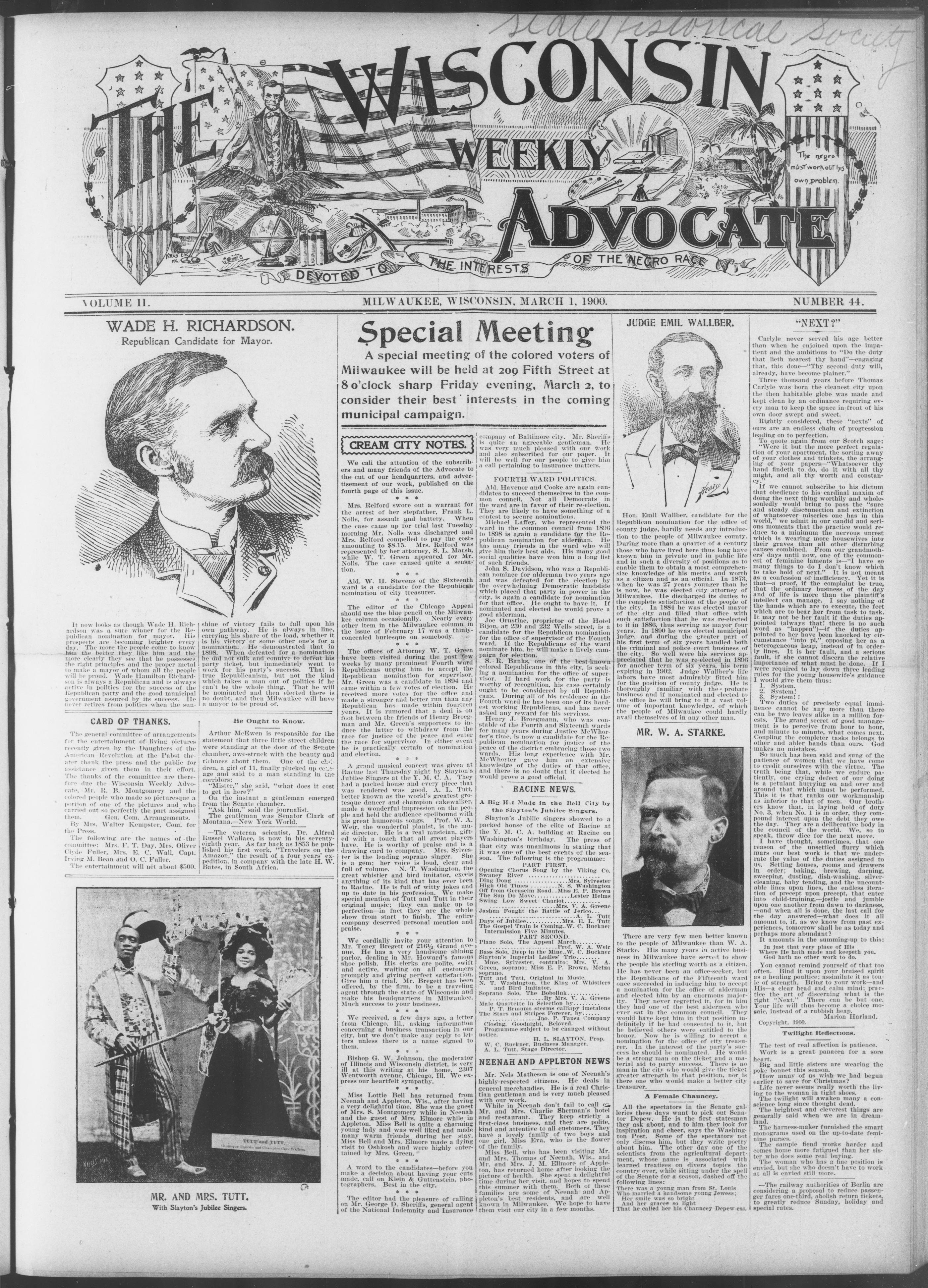
WISCONSIN
WEEKLY
ADVOCATE
DEVOTED TO THE INTERESTS OF THE NEGRO RACE
WADE H. R.
Republican Cand
WADE H. RICHARDSON. Republican Candidate for Mayor.
It now looks as though Wade H. Richardson was a sure winner for the Republican nomination for mayor. His prospects are becoming brighter every day. The more the people come to know him the better they like him and the more clearly they see that he possesses the right principles and the proper metal to make a mayor of whom all the people will be proud. Wade Hamilton Richardson is always a Republican and is always active in politics for the success of the Republican party and the good municipal government assured by its success. He never retires from politics when the sun
CARD OF THANKS.
The general committee of arrangements for the entertainment of living pictures recently given by the Daughters of the American Revolution at the Pabst theater thank the press and the public for assistance given them in their effort. The thanks of the committee are therefore due the Wisconsin Weekly Advocate, Mr. R. B. Montgomery and the colored people who made so picturesque a portion of one of the pictures and who carried out so perfectly the part assigned them. Gen. Com. Arrangements. By Mrs. Walter Kempster, Com. for the Press. The following are the names of the committee: Mrs. F. T. Day, Mrs. Oliver Clyde Fuller, Mrs. E. C. Wall, Capt. Irving M. Bean and O. C. Fuller.
The entertainment will net about $500.
KIRIL MIC
TO
TUTU and TUTU.
Hammond Underwood and Champion Claude Walker
MR. AND MRS. TUTT. With Slayton's Jubilee Singers.
4
---
VOLUME II.
shine of victory fails to fall upon his own pathway. He is always in line, carrying his share of the load, whether it is his victory or some other one's for a nomination. He demonstrated that in 1898. When defeated for a nomination he did not sulk and connive to defeat his party ticket, but immediately went to work for his party's success. That is true Republicanism, but not the kind which takes a man out of politics if he can't be the whole thing. That he will be nominated and then elected there is no doubt, and then Milwaukee will have a mayor to be proud of.
Arthur McEwen is responsible for the statement that three little street children were standing at the door of the Senate chamber, awe-struck with the beauty and richness about them. One of the children, a girl of 11, finally plucked up courage and said to a man standing in the corridors:
"Mister," she said, "what does it cost to get in here?"
On the instant a gentleman emerged from the Senate chamber.
"Ask him," said the journalist.
The gentleman was Senator Clark of Montana—New York World.
—The veteran scientist, Dr. Alfred Russel Wallace, is now in his seventeenth year. As far back as 1853 he published his first work, "Travelers on the Amazon," the result of a four years' expedition, in company with the late H. W. Bates, in South Africa.
TUTV and TUTT.
Actress Ungarba and Champion Cuba Walcens
---
He Ought to Know
Special Meeting
A special meeting of the colored voters of Milwaukee will be held at 209 Fifth Street at 8 o'clock sharp Friday evening, March 2, to consider their best interests in the coming municipal campaign.
CREAM CITY NOTES.
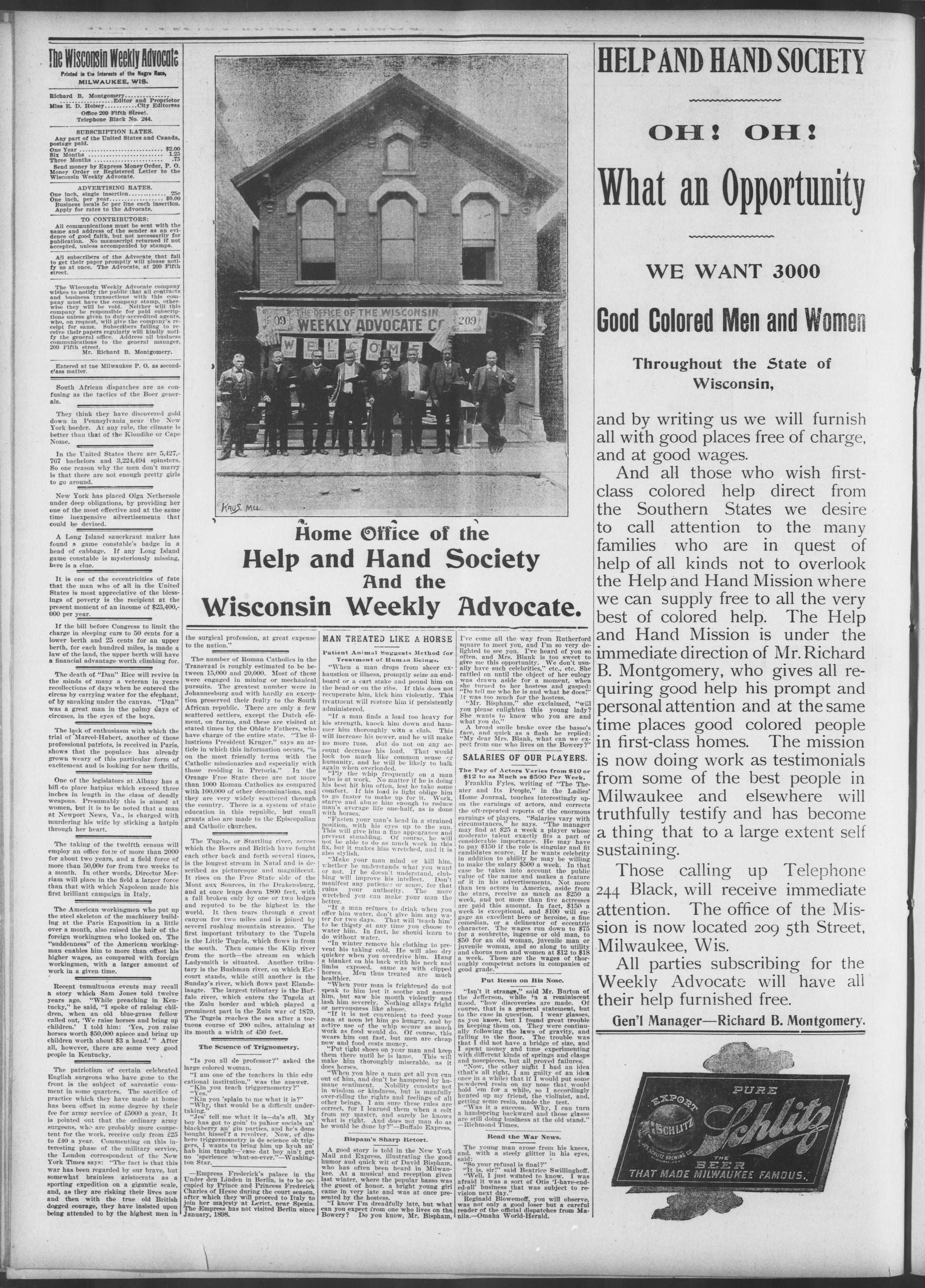
We call the attention of the subscribers and many friends of the Advocate to the cut of our headquarters, and advertisement of our work, published on the fourth page of this issue.
* * *
Mrs. Relford swore out a warrant for the arrest of her stepfather, Frank L. Nolls, for assault and battery. When the case came up for trial last Tuesday morning Mr. Nolls was discharged and Mrs. Relford compelled to pay the costs amounting to $8.15. Mrs. Relford was represented by her attorney, S. L. Marsh, while W. T. Green appeared for Mr. Nolls. The case caused quite a sensation.
☆ ☆ ☆
Ald. W. H. Stevens of the Sixteenth ward is a candidate for the Republican nomination of city treasurer.
* * *
The editor of the Chicago Appeal should use the blue pencil on the Milwaukee column occasionally. Nearly every other item in the Milwaukee column in the issue of February 17 was a thinly-concealed burlesque on somebody.
The offices of Attorney W. T. Green have been visited during the past few weeks by many prominent Fourth ward Republicans urging him to accept the Republican nomination for supervisor. Mr. Green was a candidate in 1894 and came within a few votes of election. He received more votes for the office and made a stronger and better run than any Republican has made within fourteen years. It is rumored that a deal is on foot between the friends of Henry Broegman and Mr. Green's supporters to induce the latter to withdraw from the race for justice of the peace and enter the race for supervisor. In either event he is practically certain of nomination and election.
A grand musical concert was given at Racine last Thursday night by Slayton's Jubilee Singers at the Y. M. C. A. They had a packed house and every piece that was rendered was good. A. L. Tutt, better known as the world's greatest grotesque dancer and champion cakewalker, made a wonderful impression on the people and held the audience spellbound with his great humorous songs. Prof. W. A. Weir, the wonderful pianist, is the music director. He is a real musician, gifted with a touch that all great players have. He is worthy of praise and is a drawing card to company. Mrs. Sylvester is the leading soprano singer. She is a gem; her voice is loud, clear and full of volume. N. T. Washington, the great whistler and bird imitator, excels anything of its kind that has ever been to Racine. He is full of witty jokes and up to date in his profession. We make special mention of Tutt and Tutt in their original music; they can make up to perfection—in fact they are the whole show from start to finish. The entire company deserved personal mention and praise.
***
We cordially invite your attention to Mr. Toney Bregett of $216\frac{1}{2}$ Grand avenue. He has a very handsome shining parlor, dealing in Mr. Howard's famous shoe polish. His clerks are polite, swift and active, waiting on all customers promptly and giving perfect satisfaction. Give him a trial. Mr. Bregett has been offered, by the firm, to be a traveling agent through the state of Wisconsin and make his headquarters in Milwaukee. Much success to your business.
* * *
We received, a few days ago, a letter from Chicago, Ill., asking information concerning a business transaction in our city, but we don't make any reply to letters unless there is a name signed to them.
***
Bishop G. W. Johnson, the moderator of Illinois and Wisconsin district, is very ill at this writing at his home. 2307 Wentworth avenue, Chicago, Ill. We express our heartfelt sympathy.
* * *
Miss Lottie Bell has returned from Neenah and Appleton, Wis., after having a very delightful time. She was the guest of Mrs. S. Montgomery while in Neenah and the guest of Mrs. Elmore while in Appleton. Miss Bell is quite a charming young lady and was well liked and made many warm friends during her stay. Miss Bell and Mrs. Elmore made a flying visit to Oshkosh and were highly entertained by Mrs. Green.
* * *
A word to the candidates—before you make a decision about having your cuts made, call on Klein & Guttenstein, photographers. Best in the city.
* * *
The editor had the pleasure of calling on Mr. George D. Sheriffs, general agent of the National Indemnity and Insurance
company of Baltimore city. Mr. Sheriffs is quite an agreeable gentleman. He was very much pleased with our work and also subscribed for our paper. It will be well for our people to give him a call pertaining to insurance matters.
FOURTH WARD POLITICS
Ald. Havenor and Cooke are again candidates to succeed themselves in the common council. Not all Democrats in the ward are in favor of their re-election. They are likely to have something of a contest to secure nominations. Michael Laffey, who represented the ward in the common council from 1896 to 1898 is again a candidate for the Republican nomination for alderman. He has many friends in the ward who will give him their best aids. His many good social qualities have won him a long list of such friends.
John S. Davidson, who was a Republican nominee for alderman two years ago and was defeated for the election by the overwhelming Democratic landslide which placed that party in power in the city, is again a candidate for nomination for that office. He ought to have it. If nominated and elected he would prove a good alderman.
Joe Ornstine, proprietor of the Hotel Bijou, at 230 and 232 Wells street, is a candidate for the Republican nomination for the office of supervisor of the Fourth ward. If the Republicans of the ward nominate him, he will make a lively campaign for election.
S. R. Banks, one of the best-known colored Republicans in this city, is seeking a nomination for the office of supervisor. If hard work for the party is worthy of recognition, his case certainly ought to be considered by all Republicans. During all of his residence in the Fourth ward he has been one of its hardest working Republicans, and has never asked any reward for his services.
Henry J. Broegmann, who was constable of the Fourth and Sixteenth wards for many years during Justice McWhorter's time, is now a candidate for the Republican nomination for justice of the peace of the district embracing those two wards. His long experience with Mr. McWhorter gave him an extensive knowledge of the duties of that office, and there is no doubt that if elected he would prove a good official.
RACINE NEWS.
A Big Hit Made in the Bell City by the Slayton's Jubilee Singers.
Slayton's Jubille singers showed to a packed house of the elite of Racine at the Y. M. C. A. building at Racine on Washington's birthday. The press of that city was unanimous in stating that it was one of the best events of the season. The following is the programme:
PART FIRST.
Opening Chorus Song by the Viking Co.
Swaney River .....
Ding Dong ....Mrs. Sylvester
High Old Times ....N. S. Washington
Off from Geruselm Road...Miss E. P. Brown
The Sun Do Move....Lester Helms
Swing Low Sweet Charlot....Mrs. Y. A. Greene
Swing Low Sweet Chant.....Mrs. V. A. Greene
Jashua Fought the Battle of Jerico.....A. L. Tutt
Days of Jubilee.....Mrs. E. L. Tutt
The Gospel Train is Coming..W. C. Buckner
Intermission Five Minutes.
PART SECOND.
Piano Solo, The Appeal March.....Prof. W. A. Weir
Bass Solo, Deep in the Mine..W. C. Buckner
Slerton's Injurious Leilis. Trio
Slayton's Imperial Ladies' Trio..... Mme. Sylvester, contralto; Mrs. V. A. Green, soprano; Miss E. P. Brown, Metza soprano.
Tutt and Tutt, Original in Music.
N. T. Washington, the King of Whistlers
and Bird Imitator.
Soprano Solo, The Bobolink.....By Mrs. V. A. Greene
Male Quartette in Selection by.....P. T. Brumms steams calliphy imetalons
The Stars and Stripes Forever, by.....Jno. P. T. Tausa Company
Closing, Goodnight, Beloved.
Programme subject to be changed without notice.
H. L. SLAYTON, Prop.
W. C. Buckner, Business Manager.
A. L. Tutt, Stage Director.
NEENAH AND APPLETON NEWS
Mr. Nels Matheson is one of Neenah's highly-respected citizens. He deals in general merchandise. He is a real Christian gentleman and is very much pleased with our work. While in Neenah don't fail to call on Mr. and Mrs. Charlie Sherman's hotel and restaurant. They keep strictly a first-class business, and they are polite, kind and attentive to all customers. They have a lovely family of two boys and one girl, Miss Eva, who is the flower of the family.
Miss Bell, who has been visiting Mr. and Mrs. Thomas of Neenah, Wis., and Mr. and Mrs. J. M. Ellmore of Appleton, has returned home after looking the picture of health. She spent a delightful time during her visit, and hopes to spend this summer with them. Both of these families are some of Neenah and Appleton's best residents, and are well known in Milwaukee. We hope to have them visit our city in a few months.
Heaty
Hon. Emil Wallber, candidate for the Republican nomination for the office of county judge, hardly needs any introduction to the people of Milwaukee county. During more than a quarter of a century those who have lived here thus long have known him in private and in public life and in such a diversity of positions as to enable them to obtain a most comprehensize knowledge of his merits and worth as a citizen and as an official. In 1873, when he was 27 years younger than he is now, he was elected city attorney of Milwaukee. He discharged its duties to the complete satisfaction of the people of the city. In 1884 he was elected mayor of the city and filled that office with such satisfaction that he was re-elected to it in 1886, thus serving as mayor four years. In 1890 he was elected municipal judge, and during the greater part of his first term of six years handled both the criminal and police court business of the city. So well were his services appreciated that he was re-elected in 1890 for another term of six years, his term expiring in 1902. Judge Wallber's life labors have most admirably fitted him for the position of county judge. He is thoroughly familiar with the probate business and if nominated and elected to the office he will bring to it a vast volume of important knowledge, of which the people of Milwaukee could hardly avail themselves of in any other man.
MR. W. A. STARKE.
J. H.
There are very few men better known to the people of Milwaukee than W. A. Starke. His many years in active business in Milwaukee have served to show the people his sterling worth as a citizen. He has never been an office-seeker, but the Republicans of the Fifteenth ward once succeeded in inducing him to accept a nomination for the office of alderman and elected him by an enormous majority. They never regretted it, for in him they had one of the best aldermen who ever sat in the common council. They would have kept him in that position indefinitely if he had consented to it, but he believed others were entitled to the honor. Now he is willing to accept a nomination for the office of city treasurer. In the interest of the party's success he should be nominated. He would be a strong man on the ticket and a material aid to party success. There is no man in the city who would give the ticket greater strength in that position, nor is there one who would make a better city treasurer.
A Female Chauncey.
All the spectators in the Senate galleries these days want to pick out Senator Depew. He is the first statesman they ask about, and to him they look for inspiration and cheer, says the Washington Post. Some of the spectators not only discuss him, but they write poetry about him. The other day one of the scientists from the agricultural department, whose name is associated with learned treatises on divers topics the country over, while sitting under the spell of the Senate for a season, dashed off the following lines:
There was a young man from St. Louis
Who married a handsome young Jewess;
Her smile was so bright
And her graces so light
That he called her his Chauncey Depew-ess.
Carlyle never served his age better than when he enjoined upon the impatient and the ambitious to "Do the duty that lieth nearest thy hand"—engaging that, this done—"Thy second duty will, already, have become plainer."
Three thousand years before Thomas Carlyle was born the cleanest city upon the then habitable globe was made and kept clean by an ordinance requiring every man to keep the space in front of his own door swept and sweet.
Rightly considered, these "nexts" of ours are an endless chain of progression leading on to perfection.
To quote again from our Scotch sage: "Were it but the more perfect regulation of your apartment, the sorting away of your clothes and trinkets, the arranging of your papers—"Whatsoever thy hand findeth to do, do it with all thy might, and all thy worth and constancy."
If we cannot subscribe to his dictum that obedience to his cardinal maxim of doing the next thing worthily and wholesouledly would bring to pass the "sure and steady disconnection and extinction of whatsoever miseries one has in this world," we admit in our candid and serious moments that the practice would reduce to a minimum the nervous unrest which is wearing more housewives into their graves than all other disturbing causes combined. From our grandmothers' days until now, one of the commonest of feminine laments is—"I have so many things to do I don't know which to take hold of next." It is not meant as a confession of inefficiency. Yet it is that—a proof, if the complaint be true, that the ordinary business of the day and of life is more than the plaintiff's intellect can manage. I say nothing of the hands which are to execute, the feet which are to bear her from task to task. It may not be her fault if the duties appointed (always that! there is no such word as "happen")—if the duties appointed to her have been knocked by circumstance "into pi," opposing her as a heterogeneous heap, instead of in orderly lines. It is her fault, and a serious fault, if she cannot discern the relative importance of what must be done. If I were required to lay down three leading rules for the young housewife's guidance I would give them thus:
Two duties of precisely equal imminence cannot be any more than there can be two leaves alike in a million forests. The grand secret of good management is to perceive from hour to hour, and minute to minute, what comes next. Coupling the completer tasks belongs to other and abler hands than ours. God makes no mistakes.
So much has been said and sung of the patience of women that we have come to credit ourselves with the virtue. The truth being that, while we endure patiently, one crying defect of our doing is a petulant hurrying on and over and around that which must be performed. This it is that ranks our workmanship as inferior to that of men. Our brothers know that, in laying hold of duty No. 3, when No. 1 is in order, they compound interest upon the debt they owe the day. They are a deliberative body in the council of the world. We, so to speak, throw dice for the next move.
I have thought, sometimes, that one reason of the unsettled flurry which mars our best work is that we underrate the value of the duties assigned to us. Setting houses, rooms and drawers in order; baking, brewing, darning, sweeping, dusting, dish-washing, silver-cleaning, baby tending, and the uncountable lines upon lines, the endless iteration of precept upon precept, that enter into child-training,—jostle and jumble upon one another from dawn to darkness,—and when all is done, the last call for the day answered—what does it all amount to, if, as we know from past experiences, tomorrow shall be as today and perhaps more abundant?
Where He hath made and keepeth you.
God hath no other work to do.
You cannot remind yourself of that too often. Bind it upon your bruised spirit as a healing poulce; assimilate it as tonic of strength. Bring to your work—and His—a clear head and calm mind; practice the art of discerning what is the right "Next." There can be but one. Your life will thus become a choice mosaic, instead of a rubbish heap.
Marion Harland.
Twilight Reflections.
The test of real affection is patience.
Work is a great panacea for a sore heart.
Big and little sisters are wearing the poke bonnet this season.
How many of us wish we had begun earlier to save for Christmas?
Life never seems really worth the living to the woman in tight shoes.
The twilight will awaken many a conscience long since thought dead.
The brightest and cleverest things are generally said when we are in dreamland.
The harness-maker furnished the smart monograms used on the up-to-date feminine purses.
The sample fiend works harder and comes home more fatigued than her sister who does some real buying.
The woman who has a fine position is envied, but she who doesn't have to work at all is envied still more.
—The railway authorities of Berlin are considering a proposal to reduce passenger fares one-third, abolish return tickets, to greatly reduce Sunday, holiday and special rates.
SLAUGHTER OF FUSILIERS
Ioniskillings Are Caught in a Boer Trap at Railway Hill.
TERRIBLE CROSS FIRE.
More than 200 Killed and Wounded Queen Victoria Distressed Over the News.
London, Feb. 28.—4:53 p. m.—A dispatch from Arundel says that the Boer troops have again occupied Rensburg.
Lord Roberts has forwarded an additional list of the British casualties during the three-days' fighting at Paardeberg, showing 12 killed, 82 wounded, 4 missing, and including 7 officers and 4 Canadian privates wounded.
London, Feb. 28.—The war office has received a dispatch from Gen. Buller announcing that Pieters hill, the enemy's main position, was magnificently captured yesterday and sixty prisoners tak-
The Queen has telegraphed Gen. Buller as follows:
"I have heard with the deepest concern the heavy losses sustained by my brave Irish soldiers and I desire to express my sympathy and admiration of the splendid fighting qualities they have exhibited throughout these trying operations."
New York, Feb. 28.—But for the surrender of Gen. Cronje overshadowing the news from Natal, England would be shuddering over the British reverse at Railway Hill, where the Inniskilling fusiliers were caught in a Boer trap and slaughtered. The London Mail's correspondent, under date of Pieters, February 24, describes the engagement:
"Last night the Inniskilling fusiliers, mixed with some of the Dublin fusiliers and the Connaught rangers, attempted to carry Railway Hill from Pieters. They were under a continuous fire, through which they passed up the heavy broken ground to the first Boer trench. Half way up the hill the Boers retreated to the crest, and then came back on either flank of the Irish troops, enfilading the captured trench with a savage cross as well as a direct fire.
"All night and until 9 o'clock in the morning our men held the position under a ceaseless fire and at terrible cost. At roll-call only five officers and 100 men answered to their names."
Col. Thackery and Maj. Sanders of the Inniskillings, Col. Sitwell o' the Dublin fusiliers, Capt. Maitland of the Second Gordons and Col. Thorold of the Welsh fusiliers were killed. Two hundred and fifty-two of the rank and file were killed or wounded.
"Gen. Lyttleton's brigade relieved them at 10 o'clock this morning, when the Boer atillery pounded the troops holding the center kopies without pause, but with little effect."
Terrible Cross Fire.
Colenso, Sunday, Feb. 25.—In the attempt of the Inniskillings Friday evening to rush the Boer position on Pieters hill, the Boer fire was so terrible, when the infantry emerged from the cover of the trees that almost every man in the leading half of the company fell wounded. The advance line of the British reached a donga in front of the first Boer trench, which was not apparent until they were actually in it.
The Boers retired to the crest and then returned on either flank of the Inniskillings, enfilading the captured donga with a terrible cross fire. Finding it impossible to advance or to hold the position the British fell back and entrenched themselves half way up the hill. The Boers maintained a heavy fire.
In the course of the night the Dublin fusiliers and the Connaughts arriving to support the Innskillings, another determined attempt was made to take the Boer positions. This also failed. A heavy fire continued throughout the night.
The Innskillings lost fourteen out of seventeen officers killed and wounded, and about 250 non-commissioned officers and men killed and wounded.
Gen. Lyttleton's brigade relieved Gen. Hart's brigade in the morning; and the artillery duel was continued yesterday (Saturday) though no great damage was done.
Today an armistice was agreed upon to enable both sides to collect their dead and wounded.
The Boers admit having had very heavy losses, but scout the idea that the British will compel them to raise the siege of Ladysmith.
ANXIOUS ABOUT BULLER
His Victories Generally Followed by a Long List of Casualties.
London, Feb. 28-2:10 p. m.—Gen. Buller's account of the tremendous resistance he is encountering in his efforts to reach Ladysmith has brought public interest with a sharp turn from complacent contemplation of Lord Roberts' victory to a realization of the serious condition still existing in Natal. Though Gen. Buller's lengthy dispatch is construed as a victory bravely won, the commander of the forces in Natal has so often reported similar victories without achieving his main objective, that the public has learned to contain its jubilation until Ladysmith is actually relieve, while the long list of casualties invariably following any apparent gain by Gen. Buller is always awaited with dread and anxiety, which temporarily rob his partial success of its acclaim.
However, it is the generally-accepted belief that Gen. Buller is determined to reach Gen. White this time, and though the stages are disappointingly slow, the nation confidently awaits news of the relief of those 8000 besieged troops. Gen. Buller's report shows there is urgent need of Lord Roberts' exerting every effort to still further draw off the Boers from Natal to the Free State. That he will do so, and quite likely is already doing so by marching on Bloemfontein, is regarded as almost certain by the military critics here.
Bullier Having a Hard Time.
Sir Redvers Buller is having a hard time in Natal. It is evident now after a fortnight's fighting that he was misled when he wired that there was only a weak rear guard between him and Ladysmith. Apparently some of the hardest fighting of the war took place at the end of last week as an armistice was agreed upon to allow attendance upon the wounded and burial of the dead. Both sides must have lost heavily. At any moment, however, news may come of Gen. Buller's success. Friday will begin the fourth month of the siege of the garrison, which is seemingly in a position where it is unable to do anything to help Gen. Buller.
A Stupendous Task.
A dispatch to the Mail from Pietermaritzburg dated Monday describes at considerable length "the enormous difficulties of Gen. Buller's task," and says: "The real advance began last Wednesday. The stupendous nature of the task was only understood when being on the spot one was able to realize what it means to hurl infantry at positions aligned in every direction with carefully-prepared trenches, and with breastworks
defended by practically-invisible riflemen, armed with the most deadly rapid-firing weapons, and aided by quick-firing guns which put all but our cannon of the largest caliber into the shade."
TAKES PIETER'S HILL.
Gen. Buller Hopes that His Casualties Are Not Large.
London, Feb. 28.—The war office has received the following dispatch from Gen. Buller, dated Hlandwani, Feb. 28, 5 a.m.:
"Finding that the passage of Langewacht's spruit was commanded by strong intrenchments, I recoonoitered for another passage of the Tugela. One was found for me below the cataract by Col. Sandbach, Royal engineers, on February 25. We commenced making an approach thereto, and on February 26, finding that I could make the passage practicable, I crossed the guns and baggage back to the south side of the Tugela, took up the pontoon bridge on Monday night and relaid it at the new site, which is just below the present marked cataract.
"During all this time the troops had been scattered, crouching under hastily-constructed small-stone shelters and exposed to a galling shell and rifle fire, and throughout they maintained the most excellent spirits. Tuesday, Gen. Barton, with two battalions of the Sixth brigade 1 the Dublin fusiliers, crept about a mile and a half down the banks of the river and ascended an almost-perpendicular cliff of about 500 feet, assaulted and carried the top of Pieter's hill.
Enemy's Position Carried.
"This hill, to a certain extent, turned the enemy's left, and the Fourth brigade under Col. North, and the Eleventh brigade, Col. Kitchener commanding, the whole under command of Gen. Warren, assailed the enemy's position, which was magnificently carried by the South Lancashire regiment about sunset. We took about sixty prisoners and scattered the enemy in all directions. There seems to be still a considerable body of them left on and under Bulwana mountain. Our lesses, I hope, are not large. They are certainly much less than they would have been were it not for the admirable manner in which the artillery was served, especially the guns manned by the Royal naval force and the Natal naval volunteers."
SITUATION AT LADYSMITH
Jonbert Now Free to Whip Buller and Make White Surrender
New York, Feb. 28.—A dispatch to the Tribune from London says: The effect of this victory upon Sir Redvers Buller's campaign in Natal was discussed by veterans last night with intense interest. It was generally conceded that while Gen. Joubert's troops would be disheartened and Gen. Buller's soldiers would be inspired to emulate the example of their more fortunate comrades in the West, there would be more desperate fighting in consequence of Lord Roberts' success. Gen. Joubert now has no motive for an immediate retreat, since it is too late to effect Gen. Cronje's deliverance. He has behind him Sir George White's army, which is nearly starved out and helpless from lack of ammunition. If he can repel Gen. Buller's assault upon his strong defensive positions and drive him back to the Tugela he can compel Gen. White to surrender, and in a way offset Lord Roberts' victory, besides changing the balance in the comparative lists of prisoners. The opinion in official circles last night was that Lord Roberts had rendered Gen. Buller's campaign more difficult by his victory.
There was no official news from Gen. Buller when the war office closed at midnight and the press dispatches were fragmentary and inconclusive. It was clear that there had been a week's heavy fighting, with serious losses on the British side. The Boers were apparently reinforced on Friday and made a determined effort to drive back the British brigades. Gen. Buller's men only held their ground after desperate fighting, and they were exposed to a heavy fire from the Boers' guns. Military writers are beginning to criticise Gen. Buller's tactics in putting forward his lines and not massing his troops for an attack, but these strictures are unjust when the reports of his operations are in the main intelligible.
THE BEAR GROWLS.
England's War in South Africa Denounced as Infamous.
St. Petersburg, Feb. 28.—The newspapers here outdo the rest of the continental press in bewailing Gen. Cronje's defeat and in virulently abusing Great Britain. They declare that the Transvaal has fully demonstrated its right to complete political independence, with an outlet to the sea. They suggest that the best help for the Boers would be to create a diversion against Great Britain elsewhere, and maintain it is the duty of Europe to intervene and "end the most infamous of all the wars England has ever waged for predatory purposes."
German Applause for Cronie.
Berlin, Feb. 28.—The newspapers offer the Boers the sympathies of practically the entire German people, and all praise Gen. Cronje's valer. The Neueste Nachrichten thinks that Cronje yielded to failing ammunition, and not to English bravery or superior forces, saying that the English discovered Cronje's magazines with their balloons and blew them up, and if fortune continues with Lord Roberts the surrender may be fatal for the heroic republics. Fritz Hoenig, whose military criticism in the Tageblatt is the best published in the daily press here, says: "The Boers lose the Free State's best leader and troops, but Cronje and his farmers will forever have an honorable place in military history. Estimating the Boer forces in northern Cape Colony at 30,000, Roberts has captured a third, and probably the loss in quality is greater than numerically."
Congratulations for Croatia.
Washington, D. C., Feb. 28.—Representative Fitzgerald of Massachusetts today passed around among his Democratic colleagues the following cable to Gen. Cronje, the defeated Boer general. Up to 2 o'clock today about thirty of them had signed it:
"Gen. Cronje, Cape Town, Africa: Members of the United States House of Representatives congratulate you and your soldiers on the magnificent display of courage and heroism in your brave fight for human rights."
Rejoicing in Cape Colony.
There has been extravagant rejoicing in Cape Colony and Natal at the surrender of Gen. Cronje. Crowds of people have been parading the streets of the different towns, singing and cheering. Flags have been everywhere displayed, the warships and merchantmen have been dressed with bunting and salutes have been fired.
At Durban, Natal, the stars and stripes have been flying alongside the union jack over the town hall.
THE SCENE DESCRIBED
An Eye-Witness Tells the Story of
Croje's Surrender.
Paardeberg, Tuesday, Feb. 27.—Majuba Day, 3 a. m.—The British camp was awakened by the continued rattle of rifle fire at daybreak, and the news arrived that the Canadians, while building a trench quite close to the enemy, were fusilladed at a range of fifty yards. The Canadians gallantly worked forward and occupied the edge of the trenches along the river entirely enfilading the Boers.
This movement was followed by a cessation of the fire, except an occasional solitary shot.
Suddenly a regiment stationed on the crest of a hill perceived a white flag and burst into cheers, thus first announcing the surrender of Gen. Cronje.
Shortly afterwards a note reached Lord Roberts bringing tidings of the Boers' unconditional surrender. Gen. Prettyman was sent to accept the surrender.
At about 7 o'clock a small group of men appeared in the distance crossing the plain towards headquarters. The latter being apprised of Gen. Cronje's approach. Lord Roberts went to the front in the modest cart in which he sleeps and ordered a guard of the Seaforths to line up. A group of horsemen then approached. On Gen. Prettyman's right rode an elderly man clad in a rough short overcoat, a wide-brimmed hat, ordinary tweed trousers and brown shoes. It was the red-doubtable Cronje. His face was burned almost black and his curly beard was tinged with gray.
Lord Roberts walked to and fro in front of the cart until the Boer general arrived, when the British commander advanced gravely and kindly saluted the Boer commander. He then motioned Gen. Cronje to a seat in a chair which had been brought for his accommodation and the two officers conversed through an interpreter. Gen. Cronje's face was absolutely impassive, exhibiting no sign of his inner feelings. Lord Roberts was surrounded by his staff when Gen. Prettyman, addressing the field marshal, said: "Commandant Cronje, sir." The commandant tonched his hat in salute and Lord Roberts saluted in return. The whole group then dismounted and Lord Roberts stepped forward and shook hands with the Boer commander.
"You made a gallant defense, sir," was the first salutation of Lord Roberts to the vanquished Boer leader. Gen. Cronje afterwards breakfasted with the British officers. London, Feb. 28.—8:08 p. m.—The war office has received the following dispatch from Lord Roberts, dated at Paardeberg, February 28:
"Cronje, with his family, left here yesterday in charge of Maj.-Gen. Pretty-man and under the escort of the City Imperial volunteers and mounted infantry. Later in the day the remaining prisoners went in charge of the Earl of Erroll, and, escorted by the Gloucesters and a hundred Imperial volunteers. The women and children are being sent to their homes. I understand that great dissatisfaction was felt by the Boers at Cronje's refusal to accept my offer of safe conduct to the women and children, and medical care for the wounded. 170 of whom are now in our hospital. Very many of them are in a terrible plight for want of care at an earlier stage.
"I inspected the Boers' laager yesterday and was much struck by the ingenuity and energy with which the position was made almost impregnable to assault.
DISASTROUS FIRE IN NEWARK. N. J.
Retail District Devastated-Four Firemen Buried Under a Falling Wall.
New York, Feb. 28.—The greatest fire Newark, N. J., ever experienced swept through the retail dry goods district last night, destroying a score or more buildings.
The fire burned the W. V. Snyder department store and its stock, worth $500,000; a building adjoining, occupied by J. M. Mantz and others; T. R. Allen's confectionery store; C. B. Peddie's trunk store; the rear of David Strauss' department store and of L. S. Plaut's dry goods store, W. T. Kae's jewelry store, P. J. Garrigan's drug store and a number of small stores and Bierman's pawnshop. The fire started at 6:20 p. m. in Snyder's department store, a four-story building. The building was burned to the ground. The four-story building adjoining the Snyder building on Brown street and occupied by J. M. Mantz, dealer in laces and similar goods on the first floor and offices on the upper floors, was soon totally destroyed with everything it contained.
A row of stores and dwellings next to Mantz's store were burned next, and the department store of David Strauss was soon ablaze and on the south side of Cedar street the fire burned from No. 2 at the rear of the Rae's store to No. 24. They were all small stores in buildings. In Bierman's pawnshop many thousands of dollars' worth of articles were destroyed.
On the north side of Cedar street back of Snyder's the fire attacked a row of brown-stone and brick buildings used as offices on the upper floors and stores on the ground floor. A hundred thousand persons gathered around the fire and made the task of the police a difficult one.
Four firemen were buried under a wall at the rear of Snyder's that fell with a terrific crash. Capt. Walter Harrison and Fireman Thomas Brown were taken out unconscious, and may be fatally injured. The other two firemen were severely injured.
Although a number of people were believed to be in the Snyder store when the fire broke out, no bodies have been found. There are several persons unaccounted for, and it is not known whether they escaped or were burned to death. The principal losses are:
W. V. Snyder & Co., $500,000; buildings, various owners, $275,000; J. M. Mantz, L. Bernstein and L. S. Plaut & Co., $15,000 each. A number of firms are losers to the extent of from $5000 to $10,000 each and the scores of smaller losers will bring the amount of losses up to nearly $800,000.
A revised estimate of the damage is $716,000, falling on seventeen different firms and individuals and covered by insurance to about $544,000. The injured men, principally firemen, are all doing fairly well. None are fatally hurt.
LON CURRY KILLED.
Noted Outlaw Shot Dead While Resisting Arrest.
Kansas City, Mo., Feb. 28.—Lon Curry, one of the train robbers who engaged in the Wilcox (Wyo.) hold-up on the Union Pacific last June, when something like $30,000 was secured, was shot and killed by officers at Dodson, near here, this morning, while resisting arrest.
Curry was visiting at the home of Miss Lizzie Lee. Four detectives surrounded the Lee house. Curry, pistol in hand, made a dash to escape. Before he could raise his revolver, however, two of the detectives fired and Curry fell dead.
Curry with five companions held up and robbed a passenger train on the Union Pacific route at Wilcox, Wyo., on July 6 last. Posses that chased the bandits killed all but him. He was a half-Indian.
BRIDE DIES AT WEDDING
Fatally Stricken While the Ceremony is in Progress.
Perry, Ok., Feb. 28.—During the marriage ceremony of John S. Blair and Miss Nannie Somerset, north of here last night, the bride fell dead. The couple had just stepped forward in front of the minister, who began the wedding ceremony, when Miss Somerset was seen to reel. She was caught by her bridesmaid and the bridegroom and carried to a couch near by, where she died. She had complained of feeling sick before she left her dressing-room for the marriage hall.
TRUST CLAUSE UPHELD.
Decision of California Supreme Court in the Fair Case—Mrs. Craven's Affidavit.
San Francisco, Cal., Feb. 27.—The Supreme court upheld the trust clause of the late Senator Fair's will. The will provides that his entire estate amounting .o about $20,000,000 should remain in trust during the lifetime of his three children, Charles L. Fair, Mrs. Herman Oelrichs and Mrs. W. F. Vanderbilt. This decision reverses the ruling of the superior court which held that the trust clause was invalid.
Mrs. Craven was questioned regarding her marriage to Senator Fair, particularly as to the alleged marriage by Justice of the Peace Simpton of Saucelite. Mrs. Craven was asked to produce the affidavit of the marriage, which she did. It is dated August 12, 1899, and in it Simpton declares that he married Mrs. Craven and Senator Fair in the latter part of July, 1892. Simpton has since declared that this affidavit was a part of a trap planned by him to upset the case of Mrs. Craven. The Craven interests seem particularly jubilant over the production of this paper as it will force the Fair heirs to put Simpton on the stand for examination.
The estate is now left for distribution in the hands of three trustees who are to pay the income of the estate equally to Fair's children during their lives. Charles Fair gets nothing but a one-third interest in the income during his lifetime. If he should die the income awarded to him goes to his sisters, should they still survive or to their issue.
REFUTES CONCAS' REPORT.
Admiral Sampson Makes Denials as to Actions in Santiago Battle.
Boston, Mass., Feb. 27.—Rear-Admiral Sampson flatly contradicts several statements in the report made to the Spanish naval department by Capt. Victor M. Cousas y Palu, commander of the cruiser Infanta Maria Teresa at the battle of Santiago. Speaking of Capt. Concas' statement that the move the Brooklyn made saved her from being rammed by the Maria Teresa, Admiral Sampson said:
"The statement is incorrect. The Maria Teresa was 1000 yards distant at the time, so far away that the Brooklyn was in no danger of being rammed. The intervention of the Iowa and the Texas precluded, of course, any possibility of collision with the Brooklyn. But the Brooklyn was not required to make the loop in order to save herself. That is all I care to say in the matter."
Admiral Sampson denied the statement made by Capt. Coneas that the Cristobal Colon could have been saved if the American admiral had closed her sea valves. "The valves had been broken," said Admiral Sampson, "and could not be closed."
BERNHARDT'S NEW PLAY.
Actress Discusses "L'Aiglon," Which will be Produced on March 7.
Paris, Feb. 27.—Sarah Bernhardt is now working desperately at the rehearsals of "L'Aiglon," of which it is now announced the first performance will take place on March 7. In an interview she declared the part was a very hard one from every point of view, and also unusually long.
The character she impersonates hardly ever leaves the stage, and the memorization involved is enormous. Still Mine. Bernhardt is very optimistic, and says it will be one of the great successes of her life.
Rostand, the author of the play, in discussing it, volunteered the information that "Cyrano de Bergerac" was the inspiration of his early youth, while "LAiglon" is the inspiration of his manhood. With regard to the character of the piece he did not care to say anything more than that it contains a very large cast and has frequent changes of scene.
PUZZLING THE PHYSICIANS.
Prof. Phelps' Condition Shows Symptoms of Abscess of the Lungs.
New Haven, Conn., Feb. 27.—The condition of Prof. Edward J. Phelps, former minister to England, is puzzling the physicians. He has recovered from his pneumonia and is slowly gaining strength, but a complication came into his case in the shape of a possible abscess of the lungs. The symptom of this is evident from pus coughed up by the professor. He has not suffered a relapse, but his condition is so weak that if he has a pleural abscess, or empyema, as it is technically known, it must necessarily prove fatal, as he is too weak to sustain the operation necessary to remove the abscess. Whether an abscess has formed cannot be definitely determined for a day or two.
WANTED FOR MURDER.
Officers Employ a Switch Engine in Chasing the Fugitive.
Fort Scott, Kas., Feb. 27.—Sandy Calhoun, an ex-member of the Twentieth Kansas, was run down by officers on a switch engine, and arrested, charged with the murder of his business partner, at Hale, Kas. He was apprehended when the train reached this city, but the officers thought he was a smallpox patient and released him. Shortly after the train left they were notified that he was wanted for murder. The company tendered the use of a switch engine and Calhoun was caught at a crossing just out of town.
WANT BETTER RATES.
Efforts Being Made to Compel Lower Sleeping-Car Fares.
Chicago, Ill., Feb. 27.—Efforts to bring about the long-worked-for distinction between upper and lower sleeping-car berths in the matter of rates have been renewed. Representative Fitzgerald of Massachusetts, backed, it is said, by commercial travelers, has prepared for the consideration of Congress a bill limiting the charges on sleeping cars to 50 cents a hundred miles for a lower berth and 25 cents a hundred miles for an upper berth. A proviso in the measure stipulates minimum charges of $1.25 for a lower berth and $1 for an upper berth.
The finest honey in this country is gathered from hives where white clover and basswood are accessible. In quantity, however, it falls behind that made from the goldenrod and buckwheat blossom. From New York, Pennsylvania and Vermont comes the most of the comb honey, and from Arizona and California the largest amount of extracted or liquid honey.
Wireless telegraphy is to be employed at once on the Dover-Calais and the Folkestone-Boulogne boats from a central station at Dover, where a pole will be erected. The masts of the boat will suffice for the other end of the circuit. The system will then be extended probably to the Dover-Ostend boats, too.
—Simplon tunnel is now progressing at the rate of sixteen feet per day. It was begun fourteen months ago, and must be finished in five years and a half from its commencement.
—Georgia is experiencing the most prosperous winter in a score of years.
WORST OF THE WINTER
Heavy Fall of Snow Throughout the Middle West and in the Mississippi Valley. Chicago, Ill., Feb. 28.-Local traffic was blocked in parts of the city by the snowstorm which started last night and trains were delayed. The weather bureau announced today that the snowfall was the greatest since the winter of 1898, averaging nearly seven inches in the middle Western states. It was stated that the conditions give no promise of any abatement of the storm before tomorrow.
The greatest snowfall, according to the weather map, is in Illinois, Missouri, Kansas, Southern Michigan, Northern Indiana, Southeastern Iowa and Southeastern Wisconsin. Railroads running through these states reported trains from half an hour to five hours late. The Kansas City train was reported five hours late at Galesburg and making progress only with the aid of snow-plows. All the roads sent out their plows during the night.
Great Drifts of Snow.
In Chicago traffic was carried on with the greatest difficulty—the streets being blocked by great drifts of snow. A mile of cable cars were tied up on the north side line for hours and in other portions of the city the snow blockade was so effective that many people were compelled to wade through the snow to their places of business.
Reports received from various cities in Tennessee, Mississippi and Louisiana indicate that the storm is general down the Mississippi valley, although the snow line does not extend very far South of St. Louis, Mo. Heavy sieet storms are reported south of St. Louis and Centralia, Ill., with much damage to telegraph and telephone wires, while severe wind and electrical storms are reported from points in northern Mississippi as far south as Independence, La.
Ice and Slush at St. Louis.
St. Louis, Mo., Feb. 28. The snowfall of yesterday was followed last night by sleet that covered everything with a thick coating of ice. Under foot the snow was reduced to slush.
As a result of this storm, which extended for a distance of twenty miles about the city, the conditions are worse than at any time this winter. Telegraph wires and poles in every direction are down with the weight of ice, and hundreds of trees are broken. Most of the wires of the telephone companies are underground and there was no trouble except in the outlying districts.
For several hours street car traffic was almost entirely blocked by ice-covered rails and broken trolley wires. Several horses were killed by live wires and a number of persons had narrow escapes from death. All trains were late.
Special dispatches from different points in Missouri indicate that the storm is widespread and that railroad traffic is impeded by the heavy fall of snow. At Hannibal the worst snowstorm since 1873 has been raging since noon Tuesday. The snow is 20 inches deep on an average and in places it has drifted to a depth of six and eight feet. All outdoor business has been suspended.
In the South.
Nashville, Tenn., Feb. 28. The storm which was central in southwest Texas yesterday morning has moved slowly to the northeastward and is now central over the Mississippi valley near Memphis. Along its track have occurred heavy rains and high winds. The high wind has done some damage to telegraph wires in the country districts. The storm has developed considerable energy over Alabama, Southern Georgia and Eastern Florida. There is some apprehension for the safety of shipping.
In a Mantle of Snow.
Kansas City, Mo., Feb. 28.—The whole Southwest is a mantle of snow that has from two to three feet deep on the level. All trains are late, telegraph and telephone facilities are badly interrupted, and at some points in Kansas, where the wind has piled the snow in high drifts, outside business has been abandoned. In Kansas City street cars have been almost at a standstill since last night. A high temperature prevailed and no serious suffering is reported. From Kansas and the territories where the snow was accompanied by sleet and a strong wind, come reports of damage to stock.
Blizzard Raging at Pecria.
Peoria, Ill., Feb. 28.—A snowstorm amounting almost to a blizzard has been raging in this city since yesterday evening and shows no sign of abatement. Street railway tracks are almost completely blockaded.
Worst of the Winter.
St. Joseph, Mo., Feb. 28.—The snowstorm of yesterday and last night was by far the worst of the winter. Railroad and street railway traffic was demoralized and many trains were abandoned last night and this morning. Some of the street railway lines were not opened until noon today.
Trains Badly Delayed.
Cleveland, O., Feb. 28.—From three to seven inches of snow fell within a very short time throughout northern Ohio early today. Railway trains were badly delayed as a result of the storm. On the trunk lines trains were reported from thirty minutes to two hours late. Many street car lines in this city were completely tied up during the morning.
Business Paralyzed.
Keokuk, Ia., Feb. 28.—Fourteen inches of snow has fallen since last night and business is paralyzed. All passenger trains are belated and freights are abandoned. This is a record-breaking snowstorm for Keokuk.
Foot Deep on the Level.
Wichita, Kas., Feb. 28.—The deepest snow that has fallen in this section for years covers the ground this morning. It is a foot deep on the level.
FIRED AT CASTRO.
Attempted Assassination of President of Venezuela.
Caracas, Venezuela, Feb. 28.—During the carnival procession yesterday a Venezuelan fired two shots at President Cipriano Castro without effect. The President was afterward acclaimed by the populace. The city is quiet. Gen. Cipriano Castro became President of Venezuela in October last, as a result of a successful revolution against President Andrade, who fled from the republic. But Castro was not recognized as President by the United States until November 20, 1899. Castro is about 36 years old, is well educated and is credited with being possessed of ample means. He has been a strong supporter of the Liberal party.
CAPITAL OF $20,000,000.
Basis Upon Which Armour Interests Are to be Incorporated.
Chicago, Ill., Feb. 28. It is understood that the business of Armour & Co., excepting the Armour Elevator company, will be capitalized for, approximately, $20,000,000. There will be but one class of stock, and it will not be listed on any exchange. The company will be chartered under the laws of Illinois. The completion of details is necessarily slow, since the company owns property in every state in the Union, and must qualify in each before it will be enabled to do business.
HIGH EXPLOSIVES.
An Apprehension Exists as to Their Devastating Effects.
There is a widespread misapprehension in regard to the devastating effect of these high explosives, for when unconfined the effect even of large charges of them upon structures is comparatively slight. At the naval ordnance proving ground, so long ago as 1884, repeated charges of dynamite, varying from five detonated to 100 pounds in weight, were detonated on the face of a vertical target consisting of 11 one-inch wrought-iron plates bolted to a 20-inch oak backing, until 440 pounds of dynamite had been so detonated in contact with it, and yet the target remained practically uninjured, while at Braamfontein the accidental explosion of fifty-five tons of blasting gelatin, which was stored in railway vans, excavated but 30,000 tons of soft earth.
Thus at Fort Lee, on the Hudson, but two tons of dynamite placed in a chamber in the rock and tamped brought down 100,000 tons of the rock; at Lamberis, Wales, two tons and a half of gelatin dynamite similarly placed threw out 180,000 tons of rock, and at the Talcen Mawr, in Wales, seven tons of gunpowder place in two chambers in the rock dislodged from 125,000 to 200,000 tons of rock.
We might cite many such examples, but on comparing these we find that the gunpowder confined in the interior at the Talcen Mawr was over forty-two times as efficient as the explosive gelatin on the surface at Braamfontein, while the dynamite at Fort Lee was over ninety times as destructive.—Appleton's Popular Science Monthly.
A Royal Palace in the Market
The Crown lease of Eltham court and palace, which forms one of the most interesting links with the past which has ever passed into the estate market, is advertised for sale. Its history dates from the time of Edward the Confessor (1042-66). At that time the manor belonged to the Crown. It was granted by William the Conqueror to his brother, Odo, Earl of Kent, but reverted to the Crown. While the date of the erection of the palace is uncertain, it is known that it was a royal residence from 1270 to 1628. "John o' Eltham," Edward II., Edward III., Richard II., Henry IV., Henry V., Henry VI., Edward IV., Richard III., Henry VII., Henry VIII., Mary, Elizabeth and James I. all resided at the palace. It was there, also, that Edward III. held has Parliament, Richard III. entertained the captive King of France, Henry IV. was espoused to Joan of Navarre, and Edward IV.'s daughter Bridget was born. After passing through other royal hands, the palace came into the possession of Sir John Shaw. It is from one of the three parks known as the Middle park that the "Middle Park Plate" takes its name. The present house retains the old moat, and part of the original palace is still standing.—London Chronicle.
Devonshire's Singing Men.
Devonshire, England, has lost its chief "singing man." "The singing men of Devonshire" are those who preserve and chant the old West Country songs and ballads. James Parsons was a hedger by profession and a musician by nature. He was known throughout the county as "The Singing Machine," a title due to the fact that some years ago, after an evening's bout, he took and won a bet that he would go on singing until sunrise and never sing the same song twice. Indianapolis Press.
Mysterious Manuscripts
Two mysterious boxes will be opened this year at the British museum. One was left in 1834 by Mr. Douce, who had been keeper of manuscripts, to be opened January 4, 1900, and no one knows its contents. The other contains the papers of Lord Broughton, better known as Sir John Cam Hobhouse, Byron's friend and three times a cabinet minister. He died in 1869, leaving his diaries, correspondence and memoranda to the museum, with directions not to open them till 1900. New York Sun.
Prosperity in the South
South Carolina continues to lead in the cotton manufacturing industry. Its cotton mills already consume 500,000 bales of cotton, and the day is not far distant when they will consume every bale made in the state and import cotton from Georgia. Five years ago Columbia, S. C., had no cotton mill at all, but now it is the banner mill city of the South.—Atlanta Constitution.
English Postal Employes.
The English postoffice employs not far short of 30,000 women, and it is probable that the largest number are employed in telegraphy, or in duties relating thereto. In London alone the number would appear to exceed 1500, of whom no fewer than 1000 are employed at the central telegraph office of St. Martin's-le-Grand. Scottish American.
Special to State People
Commencing November 20, the Hotel Davidson, Milwaukee, make a rate of $2 per day, American plan. This is to state people only.
Senator Stewart was first elected to the Senate in 1864, and is now serving his fifth term, which will expire in 1905.
Take counterfeit money? No! Why take substitutes for "M-B" Flavors?
Seventeen Russian newspapers had trouble with the censor last year, and two of them were entirely suppressed.
Rheude's Business College and Mechanical Drawing School, Milwaukee.
Prof. John Gifford of Cornell's College of Forestry has been elected a member of the Swiss Society of Foresters.
Fisher's Flavoring Extracts are endorsed by pure food laws and the U. S. government for their PURITY and STRENGTH. A. J. Hilbert Co., Milw.
--Henry James' income from his books during 1899 is said to have been something over $6000.
Libby's
One of Libby's famous canned foods—always delicious—ready to serve. An exclusive meat dainty of superlative excellence. Inexpensive, wholesome, labor saving, fire saving. Put up in convenient size key opening cans. Ask your grocer or write
Libby, McNeill & Libby,
CHICAGO.
Send your name and address on a postal and we will send free our new booklet, "How to Make Good Things to Eat."
Veal Loaf
PENSIONS. Get Your Pension DOUBLE QUICK!
Write Cart O'FARBELL, Pension Agent Washington, D.C.
"SISTER'S BEST FELLER."
My sister's "best feller" is 'most six-foot three,
And handsome and strong as a feller can be;
And Sis, she's so little and slender and small.
You never would think she could boss him at all:
But, my jing!
She don't do a thing
But make him jump round like he worked with a string;
It just makes me 'shamed of him sometimes, you know.
To think that he'll let a girl bully him so.
He goes to walk with her and carries her muff
And coats and umbrellas, and that kind of stuff;
She loads him with things that must weigh 'most a ton:
And, honest, he likes it, as if it was fun.
And, oh, say!
When they go to a play
He'll sit in the parlor and fidget away.
And she won't come down till it's quarter past eight.
And then she'll scold him 'cause they get there so late.
He spends heaps of money a-buyin' her things
Like candy and flowers and presents and rings;
But all he's got for 'em 's a handkerchief case.—
A fussed-up concern made of ribbons and lace.—
But, my land!
He thinks it's just grand,
'Cause she made it, he says, "with her own little hand."
He calls her an "angel"—I heard him—and "saint."
And "beautifulest bein' on earth;"—but she ain't.
'Fore I go an errand for her any time
I just make her coax me and give me a dimetr.
He'd run forty miles if she wanted him to Oh, gee-whiz!
I tell you what 'tis!
I just think it's awful—those actions of his.
I won't fall in love when I'm grown—no, sir-ree!
My sister's "best feller" 's a warnin' to me!
—Puck.
CHANGE PARTNERS.
The club doctor had gone away looking very serious, and promising to call again in half an hour after he had been to see another patient. He was thinking that by that time his patient might have died or recovered consciousness, in either of which cases he would be able to express a more decided opinion about her symptoms. At present they puzzled him, and he contented himself with looking grave, patting John Emanuel on the back and telling him to keep up heart and hope for the best. When he was gone the husband sat and stared at the fire, with his empty pipe in his hand. There was a certain enjoyment in the knowledge that everybody in the village would soon be talking about his wife's accident.
"Tha naabors 'll mebbe coom in ta see Soosan," he said aloud reflectively; and he put down the empty pipe on the mantel shelf, with its cheap clock that seemed to tick more loudly than usual, and its two pot dogs which smiled as foolishly as ever in spite of the calamity which had come to the house.
There was a gentle tap on the door before he could sit down, and John Emanuel's face took a shade of deeper gravity and importance as he crossed the room to open it.
"Oh, it's thoo, Cousin Sarah," he said, as a buxom woman of 30 or so entered, "A thout th' news 'd be getting roond the plaace."
"It's rare an' sad news," said Cousin Sarah, as she shut the door behind her. "A met th' doctor, as a wor coomin', and he says it'll be th' end o' Soosan. Tell us how it coom abawt. They say as thee fawned 'er when thee coom hoam to tha tea."
"Yaas," said John Emanuel, shaking his head slowly, "joost ath' foot o' th' ladder, an' a thowt she死 dead. Hoo long th' poor thing had bean thear a don't know, but she ha'n't mooved a syllabul since, an' I doan't think she ever will."
"Tha woan't find another like her in a hurry," said Cousin Sarah, who had been skirmishing around the place while she talked, and had just discovered a table-cloth, which she proceeded to lay on the wooden table in a bustling, workman-like manner.
"A man mun have his vittles, coom what may," she said, in answer to his inquiring glance. "A'll be boond tha's had nowt sin' tha coom hoam."
"A han't thowt on it," said John Emanuel, looking a little brighter, as the bustling woman poked up the low fire and put on the kettle.
"Tha' woan't find another like Soosan in a hurry," she suggested again as she returned to the table; and John nodded.
"OoP early and ta bed laate," she went on, "an' haard at it all th' time; she wor a wonderful woman. What wor she doin' when she toombled off th' ladder?"
"Whictwashing," said her husband.
"A thowt as much."
"Well! thoo'rt joost such another," suggested John Emanuel, as he watched her bustling about over the meal. "A've often said to mysen', Soosan an' Coosin Sarah are th' only two wimen as a'd like ta see abawt ma plance. 'If Soosan shood be took,' a've said to mysen agaan and agaan. 'Cousin Sarah's th' lass as a shood maak Missis Smith.'"
"Tha' doan't mean it, John Emanuel!" she said, staring at him.
"A do that," said John Emanuel, with determination; "but, of course, there's Patrick in the way naw."
"Of coarse," said Cousin Sarah, going on with her bread-cutting, and her tone became more conversational again. "Patrick coom with me as far as th' hoose," she said. "He sad he'd stop an' smoak in th' garden. He's no good in time o' trubble, ain't Patrick."
"He's noa nearer marryin', I spouse?" said John Emanuel thoughtfully. Cousin Sarah shook her head.
"Patrick's bone idle, A think."
"Then why doan't thee gib him oop?" said the man, looking down at his boots.
"Give Patrick oop? Whatever foer?" said Cousin Sarah, with an excess of innocence, and the man still stared at his boots as he answered:
"Why, ta marry me, of coorse. A shall want somebody ta fend an' to do for me when Soosan's goan."
Cousin Sarah put down the knife again to stare across at him.
"Dost ta mean it, John Emanuel?"
"A do," said he.
"Then, a'll goa and tell Patrick that a caan't keap company wi'm any longer," she said briskly, and she opened the cottage door to put her plan into execution as she smoke.
John Emanuel looked meditatively into the fire when she was gone. The kettle was beginning to sing. The cheap American clock seemed to tick more cheerfully.
"A wonder what Patrick 'll saa," he remarked to himself aloud, and then he stared into the fire again.
Cousin Sarah came back just as the kettle was beginning to boil, and she made a dash for it with the teapot in her hand.
"Tha's not taaken long abaat it." said John Emanuel. "Whaat does Patrick saa?"
"Oh, he doan't mind."
"Has he goan hoam?"
"Noa; he's taalking ta that Mary Em-
---
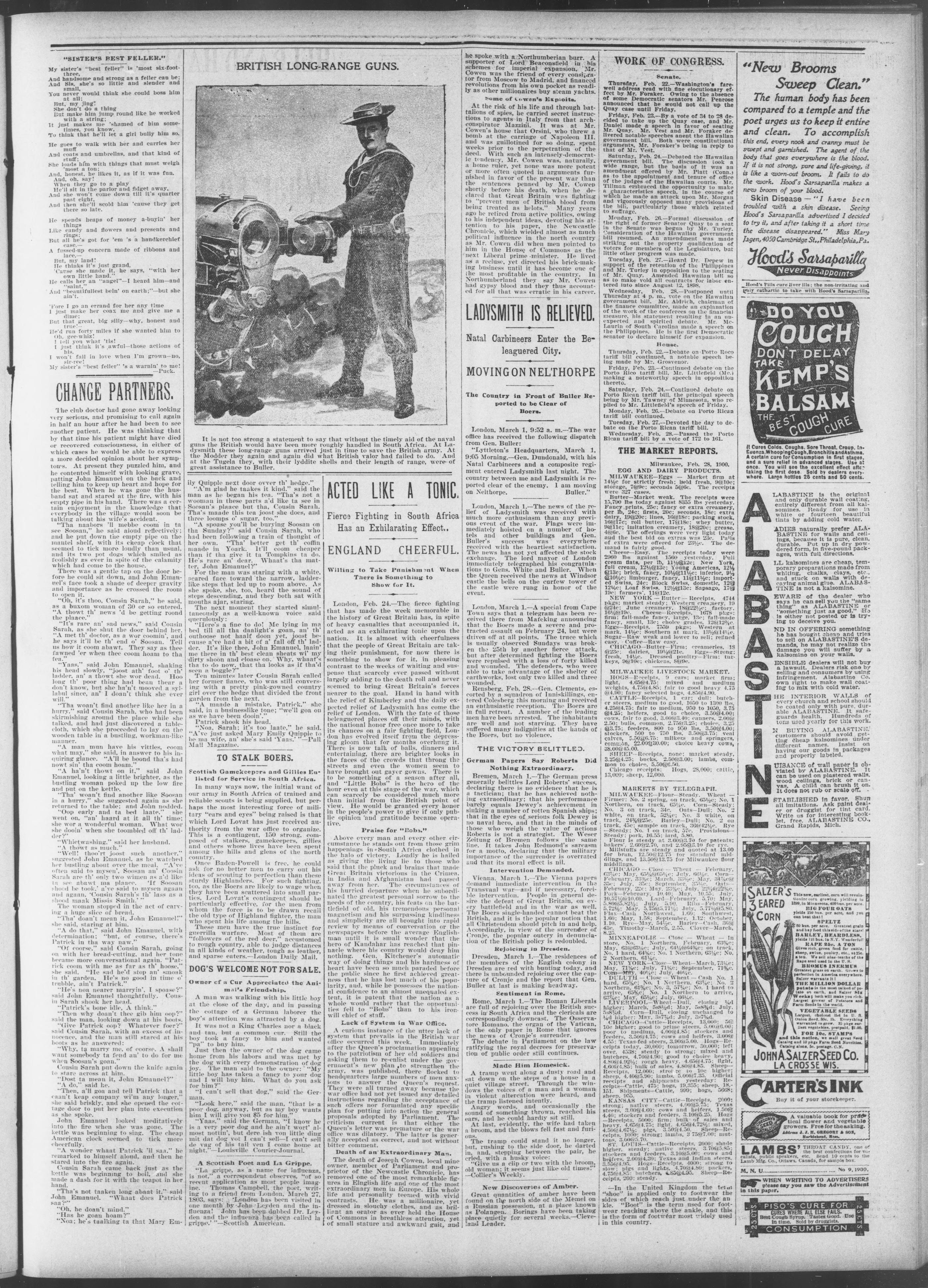
BRITISH LONG-RANGE GUNS.
It is not too strong a statement to say guns the British would have been more dysmith these long-range guns arrived in the Modder they again and again did w at the Tugela they, with their lyddite s great assistance to Buller.
THE CANNON
It is not too strong a statement to say that without the timely aid of the naval guns the British would have been more roughly handled in South Africa. At Ladysmith these long-range guns arrived just in time to save the British army. At the Modder they again and again did what British valor had failed to do. And at the Tugela they, with their lyddite shells and their length of range, were of great assistance to Buller.
ily Quipple next door over th' hedge."
"A'm glad he taakes it kind." said the man as he began his tea. "Tha's not a woooman in these parts a'd like ta see in Soosan's place but tha, Cousin Sarah. Tha's maade this tea joost she does, and three loomps o' sugar, too."
"A spoase you'll be burying Soosan on tha Sunday?" said Cousin Sarah, who had been following a train of thought of her own. "Tha' better get th' coffin maade in Yoark. It'll coom cheaper than if tha give it ta Tompkins ta do. He's rare an' dear. Whatat's tha matter, John Emanuel?"
For the man was staring with a white, scared face toward the narrow, ladder-like steps that led up to room above. As she spoke, she, too, heard the sound of steps descending, and they both sat with months aijr, staring.
The next moment they started simultaneously as a well-known voice said querulously:
"Here's a fine to do! Me lying in ma bed till all tha daalight's goan, an' th' outhoose not haalf doon yet, joost because a've had a bit of a' fall off th' ladder. It's like thee, John Emanuel, laain me there in th' best clean sheats wi' my dirty shoon and cloase on. Why, whata's tha to do now, that tha looks as if tha'd seen a boggle?"
Ten minutes later Cousin Sarah called her former fiance, who was still conversing with a pretty pink-gowned country girl over the hedge that divided the front garden from the next.
"A maade a mistake, Patrick," she said, in a businesslike tone; "we'll goa on as we have been dooin'"
Patrick shook his head.
"Noa, Sarah; it's too laate," he said.
"A've just asked Mary Emily Quipple to be ma wife, an' she's said 'Yaas.'"—Pall Mall Magazine.
TO STALK BOERS.
Scottish Gamekeepers and Gillies Eulisted for Service in South Africa. In many ways now, the initial want of our army in South Africa of trained and reliable scouts is being supplied, but perhaps the most interesting force of military "ears and eyes" being raised is that which Lord Lovat has just received authority from the war office to organize. This is a contingent, 150 strong, composed of stalkers, gamekeepers, gillies and others whose lives have been spent among the hills and glens of the north country.
Once Baden-Powell is free, he could ask for no better men to carry out his ideas of scouting to perfection than these sturdy Highlanders. For such fighting, too, as the Boers are likely to wage when they have been scattered into small parties. Lord Lovat's contingent should be particularly effective, for the men from whom the force is to be drawn recall the old type of Highland fighter, the man who spent his life among the hills. These men have the true instinct for guerrilla warfare. Most of them are "followers of the red deer," accustomed to rough country, able to judge distances in all kinds of weather, tough as leather, and sparse eaters.—London Daily Mail.
DOG'S WELCOME NOT FOR SALE.
Owner of a Cur Appreciated the Animal's Friendship.
A man was walking with his little boy at the close of the day, and in passing the cottage of a German laborer the boy's attention was attracted by a dog.
It was not a King Charles nor a black and tan, but a common cur. Still the boy took a fancy to him and wanted "pa" to buy him.
Just then the owner of the dog came home from his labors and was met by the dog with every demonstration of dog joy. The man said to the owner: "My little boy has taken a fancy to your dog and I will buy him. What do you ask for him?"
"I can't sell that dog," said the German.
"Look here," said the man, "that is a poor dog, anyway, but as my boy wants him I will give you $5 for him."
"Yaas," said the German, "I know he is a very poor dog and he ain't wort' almost nottin', but dere ish von little ding mit dat dog vot I can't sell—I can't sell de vag of his tail ven I come home at night."—Louisville Courier-Journal.
A Scottish Poet and La Grippe.
"La grippe, as a name for influenza, is not," a correspondent observes, "of so recent application as most people imagine. Thomas Campbell, the poet, writing to a friend from London, March 27, 1803, says: 'London has been visited in one month by John Leyden and the influenza! John has been dubbed Dr. Leyden and the influenza has been called la grippe.'"—Scottish American.
y that without the timely aid of the naval
roughly handled in South Africa. At La-
ust in time to save the British army. At
that British valor had failed to do. And
shells and their length of range, were of
ACTED LIKE A TONIC.
Fierce Fighting in South Africa Has an Exhilarating Effect.. ENGLAND CHEERFUL. Willing to Take Punishment When There is Something to Show for It.
London, Feb. 24.—The fierce fighting that has made the week memorable in the history of Great Britain has, in spite of heavy casualties that accompanied it, acted as an exhilarating tonic upon the nation. It is almost with cheerfulness that the people of Great Britain are taking their punishment, for now there is something to show for it, in pleasing contrast to the weeks of waiting and suspense that scarcely ever passed without largely adding to the death roll and never seemed to bring Great Britain's forces nearer to the goal. Hand in hand with the relief of Kimberley and the daily expected relief of Ladysmith has come the relief of London. With the fate of those beleaguered places off their minds, with the national honor free once more to take its chances on a fair fighting field, London has evolved itself from the depressing gloom that for months overhung it. There is now talk of balls, dinners and entertaining, there are brighter looks in the faces of the crowds that throng the streets and even the women seem to have brought out gayer gowns. There is to be something of a season after all, and "Little Bobs" is the hero of the hour even at this stage of the war, which can scarcely be considered much more than initial from the British point of view. He would be granted every honor in the people's power to give if only public opinion and gratitude became operative.
Praise for "Roba."
Above every man and every other circumstance he stands out from those grim happenings in South Africa clothed in the halo of victory. Loudly he is hailed as giving the living lie to those who said that the pluck and brains that made Great Britain victorious in the Crimea, in India and Afghanistan had passed away from her. The circumstances of his hurried departure when he subordinated the greatest personal sorrow to the needs of the country, his feats on the battlefield of old, his tremendous personal magnetism and his surpassing kindness and simplicity are all brought into rapid review by means of conversation or the newspapers before the average Englishman until it is small wonder that the hero of Kandahar has reached that pinnacle where his country would deny him nothing. Gen. Kitchener's automatic way of doing things and his hardness of heart have been so much paraded before the public since he first achieved greatness that he has lost much of his popularity, and, while he possesses the national confidence to an almost unequaled extent, it is patent that the nation as a whole would rather that the opportunities fell to "Bobs" than to his iron-will chief of staff.
Lack of System in War Office.
A curious instance of the utter lack of system that prevails in the British war office occurred this week. Immediately after the Queen's proclamation appealing to the patriotism of her old soldiers and asking them to re-enlist under the government's new plan to strengthen the army, was published, there flocked to headquarters large numbers of men anxious to answer the Queen's request. They were all turned away because the war office had not yet issued any detailed instructions regarding the acceptance of such offers nor formulated any specific plan for putting into action the general proposals adopted by Parliament. The criticism current is that either the Queen's letter was premature or the war office was dilatory. The latter is generally accepted as correct, and not without bitter comment.
Death of an Extraordinary Man.
The death of Joseph Cowen, local mine owner, member of Parliament and proprietor of the Newcastle Chronicle, has removed one of the most remarkable figures in Elnglish life and one of the most extraordinary men in Europe. His whole life and personality teemed with vivid contrasts. He was a millionaire, yet dressed in slouchy clothes, and as brilliant an orator as ever held the House of Commons in breathless attention, yet of small stature and awkward gait, and
Show for It.
he spoke with a Northumberland burr. A supporter of Lord Beaconsfield in his schemes for imperial expansion, Mr. Cowen was the friend of every consiprator from Moscow to Madrid, and financed revolutions from his own pocket as readily as other millionaires buy steam vachts.
Some of Cowen's Exploits.
At the risk of his life and through battalions of spies, he carried secret instructions to agents in Italy from that archconspirator Mazzini. It was at Mr. Cowen's house that Orsini, who threw a bomb at the carriage of Napoleon III. and was guillotined for so doing, spent weeks prior to the perpetration of the deed. With such an intensely-democratic tendency, Mr. Cowen was, naturally, a home ruler, yet none was more potent or more often quoted in arguments furnished in favor of the present war than the sentences penned by Mr. Cowen shortly before his death, when he declared that Great Britain was fighting to "prevent men of British blood from being treated as helots." Many years ago he retired from active politics, owing to his independent ideas, devoting his attention to his paper, the Newcastle Chronicle, which wielded almost as much political influence in the north country as Mr. Cowen did when men pointed to him in the House of Commons as the next Liberal prime minister. He lived as a recluse, yet directed his brick-making business until it has become one of the most profitable in the country. In Northumberland they say Mr. Cowen had gypsy blood and they thus accounted for all that was erratic in his career.
LADYSMITH IS RELIEVED.
MOVING ON NELTHORPE
The Country in Front of Buller Reported to be Clear of Boars
London, March 1, 9:52 a. m.-The war office has received the following dispatch from Gen. Buller: "Lyttleton's Headquarters, March 1, 9:05 Morning.-Gen. Dundonald, with his Natal Carbineers and a composite regiment entered Ladysmith last night. The country between me and Ladysmith is reported clear of the enemy. I am moving on Nelthorpe. Buller."
London, March 1.—The news of the relief of Ladysmith was received with much more enthusiasm than any previous event of the war. Flags were immediately hoisted on a number of hotels and other buildings and Gen. Buller's success was everywhere received with the heartiest satisfaction. The news has not yet affected the stock exchange. The lord mayor of London immediately telegraphed his congratulations to Gens. White and Buller. When the Queen received the news at Windsor castle the bells on the curfew tower of the castle were rung in honor of the event.
London, March 1.—A special from Cape Town says that a telegram has been received there from Mafeking announcing that the Boers made a severe and protracted assault on February 24, but were driven off at all points. The truce which is usually observed Sundays was broken the 25th by another fierce attack, but after determined fighting the Boers were repulsed with a loss of forty killed and wounded. The defenders, who were able to take advantage of the shelter of earthworks, lost only two killed and three wounded.
Rensberg, Feb. 28.--Gen. Clements, escorted by a squadron of Inniskillings, entered Colesberg this morning and received an enthusiastic reception. The Boers are in full retreat. A number of the leading men have been arrested. The inhabitants are well and not starving. They have suffered many indigities at the hands of the Boers, but no violence.
THE VICTORY BELITTLED.
German Papers Say Roberts Did Nothing Extraordinary.
Bremen, March 1.—The German press generally belittles Lord Roberts' success, declaring there is no evidence that he is a tactician; that he has achieved nothing extraordinary; that his performance barely equals Dewey's achievement in sinking a number of rotten Spanish ships; that in the eyes of serious folk Dewey is no naval hero, and that in the minds of those who weigh the value of actions Roberts is not a strategist. The Weser Zeitung of Bremen follows the same line. It takes John Redmond's sarcasm for a motto, declaring that the military importance of the surrender is overrated and that its moral effect is nil.
Intervention Demanded.
Vienna. March 1.—The Vienna papers demand immediate intervention in the Transvaal war—and if necessary, forcible intervention. People in general desire the defeat of Great Britain, on every battlefield and in the war as well. The Boers single-handed cannot beat the British, and it is the popular notion that all Christendom should pitch in and help. Accordingly, in view of the surrender of Cronje, the popular outcy in denunciation of the British policy is redoubled.
Reloicing in Dresden.
Dresden, March 1.—The residences of the members of the English colony in Dresden are red with bunting today, and there is unbounded rejoicing over the capture of Cronje and the report that Gen. Buller at last is making headway.
Sentiment in Rome.
Rome, March 1.—The Roman Liberals are full of rejoicing over the British success in South Africa and the clericals are correspondingly downcast. The Osservatore Romano, the organ of the Vatican, is the only paper in Rome that ignores the news of Cronje's surrender.
The debate in Parliament on the law ratifying the royal decrees for preservation of public order still continues.
Made Him Homesick
A tramp went along a dusty road and sat down on the steps of a house in a quiet village street. Through the windows the voices of a man and a woman in violent altercation were heard, and the tramp listened intently.
Angry words, and occasionally the sound of something thrown, reached his ears, and he could hardly sit still.
At last, evidently, the wife had taken a broom, and the blows fell fast and furious.
The tramp could stand it no longer, but, rushing to the side door, he darted in, and, stepping between the pair, he cried, with a husky voice:
"Give us a clip or two with the broom, old woman; it seems just like old times!" Collier's Weekly.
New Discoveries of Amber
Great quantities of amber have been found on the north side of the Memel on a Russian possession, at a place known as Polangen. Borings have been taking place quietly for several weeks.—Cleveland Leader.
WORK OF CONGRESS.
WORK OF CONGRESS.
Thursday, Feb. 22.—Washington's farewell address read with fine elocutionary effect by Mr. Foraker. Owing to the absence of some Democratic senators Mr. Penrose announced that he would not call up the Quay case until Friday.
Friday, Feb. 23.—By a vote of 34 to 28 decided to take up the Quay case, and Mr. Daniel made a speech in favor of seating Mr. Quay. Mr. Vest and Mr. Foraker delivered notable speeches anent the Hawaiian government bill. Both were constitutional arguments, Mr. Foraker's being in reply to that of Mr. Vest.
Saturday, Feb. 24.—Debated the Hawaiian government bill. The discussion took a wide range, but the basis of it was an amendment offered by Mr. Platt (Conn.) as to the appointment and tenure of office of the judges of the Hawaiian courts. Mr. Tillman embraced the opportunity to make a characteristics speech, in the course of which he made an attack upon Mr. Morgan and vigorously opposed many provisions of the bill, particularly those which related to suffrage.
Monday, Feb. 26.—Formal discussion of the right of former Senator Quay to a seat in the Senate was begun by Mr. Turley. Consideration of the Hawaiian government bill resumed. An amendment was made striking out the property qualification of voters for members of the Legislature, but little other progress was made.
Tuesday, Feb. 27.—Heard Dr. Depew in support of the retention of the Philippines and Mr. Turley in opposition to the seating of Mr. Quay. Amended Hawaiian bill so as to make void all contracts for labor entered into since August 12, 1898.
Wednesday, Feb. 28.—Postponed until Thursday at 4 p. m., vote on the Hawaiian government bill. Mr. Aldrich, chairman of the finance committee, made an explanation of the work of the conferences on the financial measure, his statement resulting in an unexpected and spirited debate. Mr. McLaurin of South Carolina made a speech on the Philippines. He is the first Democratic senator to declare himself for expansion.
House
Thursday, Feb. 22.—Debate on Porto Roco tariff bill continued, a notable speech being made by Mr. Grosvenor.
Friday, Feb. 23.—Continued debate on the Porto Rico tariff bill, Mr. Littlefield (Me.) making a noteworthy speech in opposition thereto.
Saturday, Feb. 24.—Continued debate on Porto Rican tariff bill, the principal speech being by Mr. Tawney of Minnesota, who replied to Mr. Littlefield's speech of Friday.
Monday, Feb. 26.—Debate on Porto Rican tariff bill continued.
Tuesday, Feb. 27.—Devoted the day to debate on the Porto Rican tariff bill.
Wednesday, Feb. 28.—Passed the Porto Rican tariff bill by a vote of 172 to 101.
THE MARKET REPORTS.
EGG AND DAIRY PRODUCTS.
MILWAUKEE—Eggs — Market firm at
14%c for strictly fresh; held fresh, 9@10c;
storage, 7@9c; seconds 5@6c. The receipts
were 327 cases.
Butter—Market weak. The receipts were 15,700 lbs today against 8355 lbs yesterday. Fancy prints, 25c; fancy or extra creamy, per lb, 24c; firsts, 20c; seconds, 18c; extra dairy, 19@20c; lines, 16@18c; packing stock, 16@17c; roll butter, 17@18c; whey butter, 9@11c; imitation creamy, 18@20c; grease, 4@6c. The offerings were very light today and the best bid on extras was 23c. Fails of extra were offered for 23½c. The demand is fairly good. Cheese—Easy. The receipts today were 2960 lbs against 1560 yesterday. Full cream flats, per lb, 11½@12c; New York, full cream, 12½@13c; Young Americas, 12½@13c; brick, fancy, 10½@11½c; inferior, 9½@10½c; limburger, fancy, 11@11½c; imported Swiss, 24c; Block Swiss, domestic, 12@12½c; Loaf Swiss, 12½@13c; Sapsago, 17@19c; farmers', 11@12c.
NEW YORK — Butter — Receipts. 4744
pkgs; market steady; Western creamery, 19
@24c; June creamery, 18@2214c; factory,
16%@19c; Cheese—Receipts. 1678 pkgs;
firm; fall-made fancy, large, 13c; fall-made
fancy, small, 13c; choice grades, 12@1214c.
Eggs—Receipts. 7559 pkgs; Western at
mark, 1412c; Southern at mark, 13%@1414c.
Sugar—Raw weak and lower to sell; refined
easy. Coffee—Raw easy.
CHICAGO—Butter—Firm; creameries, 18
@23c; dairies, 19%@21c. Eggs—Strong;
fresh, 1412c; Dressed poultry—Firm; turkeys,
9@10c; chickens, 8@9c.
MILWAUKEE LIVESTOCK MARKET.
HOGS—Receipts, 9 cars; market firm;
light, 4.65@4.75; mixed and medium
weights, 4.75@4.85; fair to good heavy 4.75
@4.90; fancy selected hogs, 4.85@4.90.
CATTLE—Receipts, 1 car; dull: butcher steers, medium to good, 1050 to 1300 lbs, 4.25@4.75; fair to medium, 350 to 1050, 3.75@4.25; heifers, good to choice, 3.50@4.00; cows, fair to good, 3.00@3.40; canners, 2.00@2.50; bulls, common, 2.75@3.25; choice, 3.25@3.75; feeders, 800 to 950 lbs, 3.50@4.00; stockers, 500 to 750 lbs, 3.50@3.75; veal calves, 5.50@6.75; milkers and springers, common, 22.00@30.00; choice heavy cows, 38.00@45.00.
SHEEP—Receipts, none; market steady, 3.25@4.25; bucks, 2.50@3.00; lambs, common to choice, 5.50@6.50.
Chicago receipts: Hogs, 28,000; cattle, 13,000; sheep, 12,000.
MARKETS BY TELEGRAPH.
MILWAUKEE—Flour—Steady. Wheat — Firmer; No. 2 spring, on track, 65½¢; No. 1 Northern, on track, 65¼¢; Corn—Steady; No. 3 on track, 34¢; Oats—Dull; No. 2 white, on track, 52½¢; No. 3 white, on track, 24¼¢@25¢. Barley—Dull; No. 2 on track, 45¢; sample on track, 60@42¢. Rye — Steady; No. 1 on track, 57¢. Provisions—Steady; pork, 16.55; lard, 5.80. Flour is steady at 3.60@3.70 for patients; bakers', 2.60@2.70, and 2.95@3.10 for rye. Millstuffs are steady and quoted at 13.00 for bran, 12.50@12.75 for standard middlings, and 13.50@13.75 for Milwaukee flour middlings.
CHICAGO — Close — Wheat — February, 63%; May, 65%@65%; July, 60%; Corn—February, 33%; March, 33%; May, 34%; 35%; July, 35%; September, 35%; Oats—February, 22%; May, 23%; July, 22%@22%; Pork—February, 10.40; May, 10.55; July, 10.57%@10.60. Lard—February, 5.70; May, 5.80@5.82%; July, 5.90. Ribs—February, 5.72%; May, 5.75%@5.77%; July, 5.77%@5.80. Flax—Cash Northwest, 1.60; Southwest, 1.60; May, 1.58; September, 1.12; October, 1.10. Ryc—May, 54%; Barley—Cash, 36@43c. Timothy—March, 2.55. Clover—March, 8.25.
MINNEAPOLIS — Close — Wheat — In store, No. 1 Northern. February, 63%; May, 63%@63%; July, 64%@64%; on track. No. 1 hard, 64%; No. 1 Northern, 63%; No. 2 Northern, 61%.
NEW YORK—Close — Wheat—March, 73%; May, 71%; July, 71%; September, 71%; Corn—May, 40%; July, 40%.
DULUTH - Close - Wheat - Cash No. 1
hard, 65%c; No. 1 Northern, 63%c; No. 2
Northern, 61%c; No. 3, 57%c; No. 1 hard to
arrive, 65%c; No. 1 Northern to arrive,
63%c; May, 65%c; July, 66%c.
LIVERPOOL - Wheat-Dull, closing %d
higher; March, 58%d; May, 58%d; July,
58%d; Corn-Dull, closing unchanged to
%d higher; May, 37%d; July, 37%d.
CHICAGO—Cattle—Receipts, 13,000; 50@10c higher; good to prime steers, 5.00@6.00; poor to medium, 4.00@4.85; stockers and feeders, 3.50@4.75; cows and heifers, 3.00@4.55; Texas-fed steers, 3.90@5.00. Hogs—Receipts today, 30,000; tomorrow, 30,000; left over, 4538; steady to strong; mixed and butchers, 4.70@4.90; good to choice heavy, 4.80@4.92%; rough heavy, 4.05@4.75; light, 4.60@4.85; bulk of sales, 4.80@4.85. Sheep—Receipts, 12,000; stronge to 10c higher; sheep, 4.40@5.90; lambs, 5.00@7.35. Official receipts and shipments yesterday: Receipts—Cattle, 475; hogs, 19,355; sheep, 18-151. Shipments—Cattle, 909; hogs, 5668; sheep, 955.
KANSAS CITY—Cattle—Receipts, 2009; strong; native steers, 4.00@5.75; Texas steers, 3.00@4.60; cows and heifers, 1.50@4.40; stockers and feeders, 3.10@5.25. Hogs—Receipts, 5000; firm; bulk of sales and heavy, 4.65@4.75; light, 4.65@4.72%; mixed, 4.50@4.67%; plgs, 3.50@4.50. Sheep—Receipts, 1000; strong; lambs, 3.75@7.00; mutters, 3.00@5.70.
ST. LOUIS—Cattle—Receipts, 2000; shade higher, steady; native steers, 3.70@5.85; stockers and feeders, 3.10@5.00; cows and heifers, 2.00@4.30; Texas and Indian steers, 3.55@4.95. Hogs—Receipts, 4000; strong to slow; pigs and lights, 4.70@4.80; packers, 4.75@4.85; butchers, 85@4.95. Sheep—Receipts, 200; steady.
—In the United Kingdom the term "shoe" is applied only to footwear the sides of which reach just under the ankle. "Boot" is the term used for footwear reaching above the ankle, and this is the form of footwear most widely used in this country.
The human body has been compared to a temple and the poet urges us to keep it entire and clean. To accomplish this end, every nook and cranny must be swept and garnished. The agent of the body that goes everywhere is the blood. If it is not strong, pure and life-giving, it is like a worn-out broom. It fails to do the work. Hood's Sarsaparilla makes a new broom of your blood.
Skin Disease — "I have been troubled with a skin disease. Seeing Hood's Sarsaparilla advertised I decided to try it, and after taking it a short time the disease disappeared." Miss Mary Jagen, 4050 Cambridge St., Philadelphia, Pa.
Hood's Sarsaparilla Never Disappoints
Hood's Pills cure liver ills; the non-irritating and only cachartic to take with Hood's Sarsaparilla,
DO YOU
COUGH
DON'T DELAY
TAKE
KEMP'S
BALSAM
THE BEST COUGH CURE
It Cures Colds. Coughs. Sore Throat. Croup. Influenza. WhoopingCough, Bronchitis and Asthma. A certain cure for Consumption in first stages, and a sure relief in advanced stages. Use at once. You will see the excellent effect after taking the first dose. Sold by dealers everywhere. Large bottles 25 cents and 50 cents.
LABASTINE is the original and only durable wall coating, entirely different from all kalsomines. Ready for use in white or fourteen beautiful tints by adding cold water.
A
ADIES naturally prefer ALABASTINE for walls and ceilings, because it is pure, clean, durable. Put up in dry powdered form, in five-pound packages, with full directions.
LA
LL kalsomines are cheap, temporary preparations made from whiting, chalks, clays, etc., and stuck on walls with decaying animal glue. ALABASTINE is not a kalsomine.
EWARE of the dealer who says he can sell you the "same thing" as ALABASTINE or "something just as good." He is either not posted or is trying to deceive you.
B
ND IN OFFERING something he has bought cheap and tries to sell on ALABASTINE'S demands, he may not realize the damage you will suffer by a kalsomine on your walls.
A
ENSIBLE dealers will not buy a lawsuit. Dealers risk one by selling and consumers by using infringement. Alabastine Co. own right to make wall coating to mix with cold water.
S
HE INTERIOR WALLS of every church and school should be coated only with pure, durable ALABASTINE. It safeguards health. Hundreds of tons used yearly for this work. N BUYING ALABASTINE. customers should avoid getting cheap kalsomines under different names. Insist on having our goods in packages and properly labeled. UISANCE of wall paper is obviated by ALABASTINE. It can be used on plastered walls, wood cellings, brick or canvas. A child can brush it on. It does not rub or scale off.
N
STABLISHED in favor. Shun all imitations. Ask paint dealer or druggist for tint card. Write us for interesting booklet. free. ALABASTINE CO., Grand Rapids, Mich.
SALZER'S
3 EARED
This new, earliest, corn will revolu-
tionize corn growing, yielding in
1399, in Minnesota, 400 bus. per acre.
BIG FOUR OATS
80 bus. per acre. Greatest grain
and hay food this side of the star!
BARLEY, BEARLESS,
yields 11 bus. in N.Y. Wonderful!
KAPE 25, A TON
Gives rich, green food for cattle,
sheep, swine, poultry, etc., at 25c
a ton. We sell nine-tenths of the
Rape seed used in the U.S.
BROMUS INERMUS
Great grass on earth. Grows to
perfect height everywhere.
Saltier warrants it!
THE MILLION DOLLAR
potato is the most talked of pot-
ato on earth, and Salzer Six
Weeka; both will make you rich.
Largest grower of Potatoes and
Farm Seeds in the world.
VEGETABLE SEEDS
Largest, choicest last in U.S.
Union Seed, 50c. 1b. Everything
warranted to grow. 35 pigs ear-
less vegetables, postpaid. $1.00.
FOR 10c. STAMPS
this notice, we moll great Seed
and 10 pigs Farm Seed Novelties.
JOHN A. SALZER SEED CO.
LA CROSSE WIS.
CARTER'S INK
Buy it of your storekeeper.
GREGORY'S
SEED
CATALOG
FREEDOM
A valuable book for practical flower and vegetable growers. Free for the asking.
Address J. J. H. GREGORY & SON,
Marblehead, Mass.
LAMBS' THROAT CANDY, one of the best confections for calisists, public speakers, etc. Send 10 cents to the Lamb Mfg. Co. Ottawa, Canada, for sample box.
WHEN WRITING TO ADVERTISEERS please say you saw the Advertisement in this paper.
PISO'S CURE FOR
CURES WHERE ALL ELSE FAILS.
Best Cough Syrup. Tastes Good. Use in time. Sold by druggists.
CONSUMPTION
The Wisconsin Weekly Advocate
Richard B. Montgomery.....Editor and Proprietor
Miss E. D. Holsey.....City Editoress
Office 209 Fifth Street.
Telephone Black No. 244.
SUBSCRIPTION LATES.
One Year ..... $2.00
Six Months ..... 1.25
Three Months ..... 75
Send money by Express Money Order, P. O.
Money Order or Registered Letter to the
Wisconsin Weekly Advocate.
ADVERTISING RATES.
One inch, single insertion ..... 25c
One inch, per year ..... $9.00
Business locals 5c per line each insertion.
Apply for rates to the Advocate.
TO CONTRIBUTORS:
All communications must be sent with the name and address of the sender as an evidence of good faith, but not necessarily for publication. No manuscript returned if not accepted, unless accompanied by stamps.
All subscribers of the Advocate that fail to get their paper promptly will please notify us at once. The Advocate, at 209 Fifth street.
The Wisconsin Weekly Advocate company wishes to notify the public that all contracts and business transactions with this company must have the company stamp, otherwise they will be void. Neither will this company be responsible for paid subscriptions unless given to duly-accredited agents, who, on request, will give the company's receipt for same. Subscribers failing to receive their papers regularly will kindly notify the general office. Address all business communications to the general manager, 209 Fifth street.
Mr. Richard B. Montgomery.
Entered at the Milwaukee P. O. as second-class matter.
South African dispatches are as confusing as the tactics of the Boer generals.
They think they have discovered gold down in Pennsylvania near the New York border. At any rate, the climate is better than that of the Klondike or Cape Nome.
In the United States there are 5,427,767 bachelors and 3,224,494 spinsters. So one reason why the men don't marry is that there are not enough pretty girls to go around.
New York has placed Olga Nethersole under deep obligations, by providing her one of the most effective and at the same time inexpensive advertisements that could be devised.
A Long Island sauerkraut maker has found a game constable's badge in a head of cabbage. If any Long Island game constable is mysteriously missing, here is a clue.
It is one of the eccentricities of fate that the man who of all in the United States is most appreciative of the blessings of poverty is the recipient at the present moment of an income of $23,400,000 per year.
If the bill before Congress to limit the charge in sleeping cars to 50 cents for a lower berth and 25 cents for an upper berth, for each hundred miles, is made a law of the land, the upper berth will have a financial advantage worth climbing for.
The death of "Dan" Rice will revive in the minds of many a veteran in years recollections of days when he entered the circus by carrying water for the elephant, of by sneaking under the canvas. "Dan" was a great man in the palmy days of circuses, in the eyes of the boys.
The lack of enthusiasm with which the trial of Marcel-Habert, another of those professional patriots, is received in Paris, shows that the populace has already grown weary of this particular form of excitement and is looking for new thrills.
One of the legislators at Albany has a bill-to place hatpins which exceed three inches in length in the class of deadly weapons. Presumably this is aimed at women, but it is to be noted that a man at Newport News, Va., is charged with murdering his wife by sticking a hatpin through her heart.
The taking of the twelfth census will employ an office force of more than 2000 for about two years, and a field force of more than 50,000 for from two weeks to a month. In other words, Director Merriam will place in the field a larger force than that with which Napoleon made his first brilliant campaign in Italy.
The American workingmen who put up the steel skeleton of the machinery building at the Paris Exposition in a little over a month, also raised the hair of the foreign workingmen who looked on. The "suddenness" of the American workingman enables him to more than offset his higher wages, as compared with foreign workingmen, with a larger amount of work in a given time.
Recent tumultuous events may recall a story which Sam Jones told twelve years ago. "While preaching in Kentucky," he said, "I spoke of raising children, when an old blue-grass fellow called out, 'We raise horses and bring up children.' I told him: 'Yes, you raise horses worth $50,000 apiece and bring up children worth about $3 a head.'" After all, however, there are some very good people in Kentucky.
The patriotism of certain celebrated English surgeons who have gone to the front is the subject of sarcastic comment in some quarters. The sacrifice of practice which they have made at home has been offset in some degree by their fee for army service of £5000 a year. It is pointed out that the ordinary army surgeons, who are probably more competent for the work, receive only from £25 to £40 a year. Commenting on this interesting phase of the military service, the London correspondent of the New York Times says: "The fact is that this war has been regarded by our brave, but somewhat brainless aristocrats as a sporting expedition on a gigantic scale, and, as they are risking their lives now and then with the true old British dogged courage, they have insisted upon being attended to by the highest men in
THE OFFICE OF THE WISCONSIN
WEEKLY ADVOCATE CO
209
WELCOME
KRUS. MILL
Home Office of the Help and Hand Society And the Wisconsin Weekly Advocate.
the surgical profession, at great expense to the nation."
The number of Roman Catholics in the Transvaal is roughly estimated to be between 15,000 and 20,000. Most of these were engaged in mining or mechanical pursuits. The greatest number were in Johannesburg and with hardly an exception preserved their fealty to the South African republic. There are only a few scattered settlers, except the Dutch element, on farms, and these are visited at stated times by the Oblate Fathers, who have charge of the entire state. "The illustrious President Kruger," says an article in which this information occurs, "is on the most friendly terms with the Catholic missionaries and especially with those residing in Pretoria." In the Orange Free State there are not more than 1000 Roman Catholics as compared with 100,000 of other denominations, and they are very widely scattered through the country. There is a system of state education in this republic, but small grants also are made to the Episcopalian and Catholic churches.
The Tugela, or Startling river, across which the Boers and British have fought each other back and forth several times, is the longest stream in Natal and is described as picturesque and magnificent. It rises on the Free State side of the Mont aux Sources, in the Drakensburg, and at once leaps down 1800 feet, with a fall broken only by one or two ledges and reputed to be the highest in the world. It then tears through a great canyon for two miles and is joined by several rushing mountain streams. The first important tributary to the Tugela is the Little Tugela, which flows in from the south. Then comes the Klip river from the north—the stream on which Ladysmith is situated. Another tributary is the Bushman river, on which Estcourt stands, while still another is the Sunday's river, which flows past Elandsa-laagte. The largest tributary is the Buffalo river, which enters the Tugela at the Zulu border and which played a prominent part in the Zulu war of 1879. The Tugela reaches the sea after a tortuous course of 200 miles, attaining at its mouth a width of 450 feet.
The Science of Trignometry.
"Is you all de professor?" asked the large colored woman.
"I am one of the teachers in this educational institution," was the answer.
"Kin you teach triggernometry?"
"Yes."
"Kin you 'splain to me what it is?"
"Why, that would be a difficult undertaking."
"Jes' tell me what it is—da's all. My boy has got to goin' to pahior socials an blackberry an' gin parties, and he's done bought hissel'f a revolver. Now, ef dishere triggernometry is de science ob triggers, I wants tu bring him up hyuh an' hab him taught—'case dat boy ain't got no 'sperience whut-so-ever."—Washington Star.
—Empress Frederick's palace in the Under den Linden in Berlin, is to be occupied by Prince and Princess Frederick Charles of Hesse during the court season, after which they will proceed to Italy to join her majesty at Lerict, near Spezia. The Empress has not visited Berlin since January, 1898.
MAN TREATED LIKE A HORSE Patient Animal Suggests Method for Treatment of Human Injuries
"When a man drops from sheer exhaustion or illness, promptly seize an endboard or a cart stake and pound him on the head or on the ribs. If this does not recuperate him, kick him violently. This treatment will restore him if persistently administered.
"If a man finds a load too heavy for his strength, knock him down and hammer him thoroughly with a club. This will increase his power, and he will make no more fuss. But do not on any account decrease his load. That would look too much like common sense or humanity, and he will be likely to balk again when overloaded.
"Ply the whip frequently on a man who is at work. No matter if he is doing his best hit him often, lest he take some comfort. If his load is light oblige him to go faster to make up for it. Work, starve and abuse him enough to reduce man's average life one-half, as is done with horses.
"Fasten your man's head in a strained position, with his eyes up to the sun. This will give him a fine appearance and prevent stumbling. Of course, he will not be able to do as much work in this fix, but it makes him wretched, and it is also stylish."
"Make your man mind or kill him, whether he understands what you want or not. If he doesn't understand, clubbing will improve his intellect. Don't manifest any patience or sense, for that ruins your authority. The more wretched you can make your man the better.
"If a man refuses to drink when you offer him water, don't give him any water for two days. That will 'teach him' to be thirsty at any time you choose to water him. In fact, he should learn to do without water.
"In winter remove his clothing to prevent his taking cold. He will also dry quicker when you overdrive him. Hang a blanket on his back with his neck and limbs exposed, same as with clipped horses. Men thus treated are much healthier.
"When your man is frightened do not speak to him lest it soothe and assure him, but saw his mouth violently and lash him severely. Nothing allays fright or nervousness like abuse.
"If it is not convenient to feed your man at noon let him go hungry, and by active use of the whip secure as much work as food would do. Of course, this wears him out fast, but men are cheap now and food costs money.
"Put tight shoes on your man and keep them there until he is lame. This will make him thoroughly miserable, as it does horses."
"When you hire a man get all you can out of him, and don't be hampered by humane sentiment. Nobility consists not in wisdom or kindness, but is manfully over-riding the rights and feelings of all other beings. I am sure these rules are correct, for I learned them when a colt from my master, and surely he knows what is right. And does not man do as he would be done by?"—Buffalo Express.
Bispam's Sharp Retort
A good story is told in the New York Mail and Express, illustrating the good humor and quick wit of David Bispham, who has often been heard in Milwaukee. At a musical and reception given last winter, where the popular basso was the guest of honor. a bright young girl came in very late and was at once presented by the hostess.
"I know I'm dreadfully late, but what can you expect from one who lives on the Bowery? Do you know. Mr. Bispham
I've come all the way from Rutherford square to meet you, and I'm so very delighted to see you. I've heard of you so often, and Mrs. Blank is too sweet to give me this opportunity. We don't usually have such celebrities," etc., etc. She rattled on until the object of her eulogy was drawn aside for a moment, when she turned to her hostess and gasped: "Do tell me who he is and what he does!" It was too much for the hostess.
"Mr. Bispham," she exclaimed, "will you please enlighten this young lady? She wants to know who you are and what you do."
A broad smile broke over the basso's face, and quick as a flash he replied: "My dear Mrs. Blank, what can we expect from one who lives on the Bowery?"
SALARIES OF OUR PLAYERS.
The Pay of Actors Varies from $10 or $12 to as Much as $500 Per Week.
Franklin Fyles, writing of "The Theater and Its People," in the Ladies' Home Journal, touches interestingly upon the earnings of actors, and corrects the oft-repeated reports of the enormous earnings of players. "Salaries vary with circumstances," he says. "The manager may find at $25 a week a player whose moderate talent exactly fits a part of considerable importance. He may have to pay $150 if the role is singular and fit candidates scarce. If he wants celebrity in addition to ability he may be willing to make the salary $500 a week. In that case he takes into account the public value of the name and makes a feature of it in his advertisements. Not more than ten actors in America, aside from the stars, receive as much as $250 a week, and not more than five actresses are paid this amount. In fact, $150 a week is exceptional, and $100 will engage an excellent hero or heroine, a fine comedian, or a delineator of eccentric character. The wages run down to $75 for a soubrette, ingenuue or old man, to $50 for an old woman, juvenile man or juvenile woman, and so along to utility and chorus men and women at $12 to $18 a week. Those are the wages of thoroughly competent actors in companies of good grade."
Put Resin on His Nose.
"Isn't it strange," said Mr. Burton of the Jefferson, while 'n a reminiscent mood. "how discoveries are made. Of course, that is a general statement, but to the case in question. I wear glasses, as you know, but I found great trouble in keeping them on. They were continually following the laws of gravity, and falling to the floor. The trouble was that I did not have a bridge of size, and I spent money and time experimenting with different kinds of springs and clasps and nosepieces, but all proved failures. "Now, the other night I had an idea (that's all right, I am guilty of an idea once in a while) that if I would put some powdered resin on my nose that would hold 'em for a while, so I accordingly hunted up my friend, the violinist, and, getting some resin, made the test.
"Was it a success. Why, I can turn a handspring backward and those glasses are still doing business at the old stand." Richmond Times.
Read the War News.
The young man arose from his knees, and, with a steely glitter in his eyes, said:
"So your refusal is final?"
"It is, sir!" said Beatrice Swillinghoff. "Well, I just wanted to know. I was afraid it was a sort of Otis 'I-have-ended-all' business that was subject to revision next day." Reginald Blowemoff, you will observe, was not only a good loser but a careful reader of the official dispatches from Manila.—Omaha World-Herald.
OH! OH! What an Opportunity
---
WE WANT 3000
Good Colored Men and Women
Throughout the State of Wisconsin.
and by writing us we will furnish all with good places free of charge and at good wages.
And all those who wish first-class colored help direct from the Southern States we desire to call attention to the many families who are in quest of help of all kinds not to overlook the Help and Hand Mission where we can supply free to all the very best of colored help. The Help and Hand Mission is under the immediate direction of Mr. Richard B. Montgomery, who gives all requiring good help his prompt and personal attention and at the same time places good colored people in first-class homes. The mission is now doing work as testimonials from some of the best people in Milwaukee and elsewhere will truthfully testify and has become a thing that to a large extent self sustaining.
Those calling up Telephone 244 Black, will receive immediate attention. The office of the Mission is now located 209 5th Street, Milwaukee. Wis.
All parties subscribing for the Weekly Advocate will have all their help furnished free. Gen'l Manager—Richard B. Montgomery.
PURE
EXPORT
SCHLITZ
JOS SCHLITZ BREWING CO.
MILWAUKEE, U.S.A.
THE
BEER
THAT MADE MILWAUKEE FAMOUS.
W. T. GREEN,
Lawyer,
Notary Public.
Offices 17-18 Birchard Block.
105 Grand Averue.
If you want a Suit or
Overegat made to order
“at the lowest price
Cleaning and Repairing
Done Promptly
322 Wells Street
Northwestern. Howse
APPLETON, WIS.
JOHN A. BRILL, - Proprietor,
Terms $1.00 Per Day.
NORTHWESTERN ~
r
ARTIST
TONEY
FINE ART
a 8
Shining Parlor
2163 GRAND AVENUE
Opposite Fianner’s Music Store
fee —___ MILWAUKEE, WIS.
| WHEN IN MADISON
Call at the
Avenue
Hotel eee
M, J. REGAN, Prop.
$2.00 Rate ....00-
a=a_————Free Bus.
, wr
DISCOVERY
wv
Curly Hair Made Siraight By
Bos
yeas ARE
WA ao: ISeaes
Re mae: Tete
| (Rae: je eer
= | “ '
| 7 fa
a} iP. epi ga~ |
1 eg is Gh CD h |
EGY LG 0G |
: TAKEN FROM LIFE: ’
1 BEFORE AND AFTER TREATMENT.
-OFONTZW av
(\CZONIZED OX MARROW
: THE ORIGINAL—COPYRIGHTED.
i This wonderful hair pomade is the only safe
Preparation in the world that makes kinky fate
< straight as shown above, It nourishes the scalj 4
1 rey cats the Late feom falling out and makes Ye
row. Sold over 40 years and used by thousauds,
; Warranted harmless. ‘Testimonials free on re:
quest. It was the first preparation ever sold for
FEARS ER hale. ‘howare of imitations
Cct the Original Ozonized Ox Marrow,
as the genuine never fails to keep the hair em
and beautiful. A toilet necessity for ladies and
;eestlemen, Elegantly perfumed: The great ad-
j vantage of this wonderful pomade fs that by its
use you can straighten your own hair at home,
) Owlig to its superior and lasting quality itis the
jos’ economical. It is not possible for anybody.
to produce a preparation equal to it. Full direc-
obs wisk ewan Reticence case eee by
dealers or send, us $1.4@ Postal or mapeoes.
[Honey Order for 3 bottles, express paid. rite
your name and addrees plalniy to
“ZONIZED OX MARROW CO.,
76 Wabash Ave., Chicago, Ill.
civ. W. DEWEY,
Furniture, Stoves, Carpets,
Ceneral House Furnisher,
230-232 West Water St.,
MILWAUKEE, - - WIS,
PERV IERIE ~t.
Cash or Easy Payments.
Established in 1881. Furniture Exchanged,
Union Laundry
and News Co.
328 Wells Street
GEO. W. SAYLES.
All Work Carefully Done.
Lowest Prices and Satis-
faction Guaranteed.
FANGS SEL
COpyrigat, 40Uls AlOpscn, 100V.)
N this “discourse Dr. Talmage dis-
Il eusses a theme never more under ex-
ploration than at this time and warns
people against what he calls a religion of
xhosts: text, I, Samuel xxviii, 7: “Be-
hold, there is a woman that hath a fa-
miliar spirit at En-dor. And Saul dis-
guised himself and put on other raiment,
and he went, and two men with him, and
they came to the woman by night.”
Trouble to the right of him and trouble
to the left of him, Saul knew not what
to do. As a last resort he concluded to
seek out a spiritual medium or a witch or
anything that you please to call her—a
woman who had communication with the
spirits of the cternal world. It was a
very difficult thing to do, for Saul had
either slain all the witches or compelled
them to stop business. A servant one
day said to King Saul, “1 know of a spir-
itual medium down at the village of En-
dor.” “Do you?’ said the king. Night
falls. Saul, putting off his kingly robes
and putting on the dress of a plain citi-
zen, with two servants, goes out to bunt
up this medium,
Saul and his servants after awhile
reached the village, and they say, “I won-
der if this is the house,” aud they look in,
and they see the haggard, weird and
shriveled up spiritual medium sitting by
the light and on the table sculptured
images and divining reds and poisonous
herbs and bottles and vases. They say,
“Yes, this must be the place.” One loud
rap brings the woman to the door, and as
she siauds there, holding the candle or
lamp above her head and peering out
into the darkness, she says, “Who is
here?” The tall king informs her that
he has come to have his fortune told.
When she hears that, she trembles and
aliuust drops the light, for she. knows
there is no chance for a fortune teller or
spiritual mediuin in all the land. But
Saul having sworn that no harm shall
come to her, she says, “Well, who shall
I bring up from the dead?” Saul says,
“Bring up Samuel.” ‘That was the
prophet who had died a little while be-
fore.
I see her waving a wand, or stirring up
some poisonous herbs in a caldron, or
hear her muttering over some incanta-
tions, or stamping with her foot as she
cries out to the realm of the dead: “Sam-
uel, Samuel!” Lo, the freezing horror!
The floor of the tenement opens, and the
gray hairs float up and the forehead, the
eyes, the lips, the shoulders, the arms,
the feet—the entire body of the dead
Samuel—wrapped in sepulchral robe, ap-
pearing to the astonished group, who
stagger back and hold fast and catch
their breath and shiver with terror.
The dead prophet, white and aywful
from the tomb, begins to move his ashen
lips, and he glares upon King Saul and
cries out: “What did you bring me up
for? What do you mean, King Saul?’
Saul, trying to compose and control him-
self, makes this stammering and affright-
ed utterance as he says to the dead
prophet: “The Lord is against me, and |
have come to you for help. What shall
I do?” The dead prophet stretched forth
his finger to King Saul and said: “Die to-
morrow! Come with me into the sepul-
cher. I am going now. Come, come with
me?” And, lo, the floor again opens, and
the feet of the dead prophet disappear
and the arms and the shoulders and the
torehead! The floor closes. Oh, that
was an awful seance!
We are surrounded by mystery—be-
fore us, behind us, to the right of us, to
the left of us, mystery. There is a vast
realm unexplored that science, I have no
doubt, will yet map out. He who ex-
plores that realm will do the world more
service than did ever a Columbus or an
Amerigo Vespucci. There are so many
things that cannot be accounted for, so
many sounds and appearances which defy
acoustics and investigation, so many
things approximating to the spegtral, so
many effects which do not seem to have
a suflicient cause.
‘the Fingers of Superstition,
To unlatch the door between the pres-
ent state and the future state all the fin-
gers of superstition have been busy. We
have books entitled “Footfalls on the
Boundaries of Other Worlds,” “The De-
batable Land Between This World and
the Next,” “Researches into the Phe-
nomena of Spiritualism” and while li-
braries of hocus pocus, enough to deceive
the very elect. I shall not take time to
rehearse the history of divination, Del-
phic oracle, sibyl or palmistry or the
whole ceuturies of imposture.
Modern spiritualisin proposes to open
the door between this world and the next
and put us into communication with the
dead. It has never yet offered oné rea-
sonable credential.
When I find Saul in my text consulting
a familiar spirit, I learn that spiritualism
is a very old religion.
Spiritualism in America was born in
the year 1847, in Hydesville, Wayne
County, N. Y., when one night there was
a loud rap heard against the door of
Michacl Weekman; a rap a second time,
a rap a third time, and all three times,
when the door was opened, there was
nothing found there, the knocking having
been made seemingly by _ invisible
knuckles. In that same house there was
a young woman who had a cold hand
passed over her face, and, there being
seemingly no arm attached to it, ghostly
suspicions were excited.
After awhile Mr. Fox with his family
moved into that house, and then they had
bangiugs at the door every night. One
night Mr. Fox eried out, “Are you a
spirit?’ Two raps—answer in the affirm-
ative. “Are you an injured spirit?” Two
raps—auswer in the affirmative. Then
they knew right away that it was the
spirit of a peddler who had been mur-
dered in that house years before and who
had been robbed of his $500. Whether
the spirit of the peddler came back to
collect bis $500 or his bones I do mot
know.
The excitement spread. There was a
universal rumpus. The Hon. Judge Ed-
tionds declared in a book that he had
actually seen a bell start from the top
SS a ee) a een a, ne a och. eile ahr arti
| over the people in the back parlor and
floated through the folding doors to the
front parlor, rang over the people there
and then dropped on the floor. A Sena-
tor of the United States, afterward Gov-
ernor of Wisconsin, had hig head quite
turned with spiritualistic ddpoustrations:
The tables tipped, and the stools tilted,
and the bedsteads raised, and the chairs
upset, and it seemed as if the spirits ev-
erywhere had gone into the furniture
business! Well, the people said: “We
have got something new in this country.
e is a new religion!” Oh, no, my friend,
thousands of years ago, we find in our
text, a spiritualistie seance!
Strange, Mysterious Things.
Nothing in the spiritualistic circles of
our day has been more strange, mysteri-
ous and wonderful than things which
have been seen in past centuries of the
world. In all ages there have been nec-
romaneers, those who consult with the
spirits of the departed; charmers, those
who put their subjects in a mesmeric
; State; sorcerers, those who by taking
poisonous drugs see everything and hear
everything and tell everything; dreamers,
people who in their sleeping moments
can see the future world and hold con-
sultation with spirits. Yes, before the
time of Christ, the Brahmans went
[through all the table moving, all the fur-
uae excitement, which the spirits have
| exploited in our day, precisely the same
{thing over and over again, under the
| manipulation of the Brahmaus. Now, do
you say that spiritualism is different
| from these? I answer, all these delusions
I have mentioned belong to the same
family. hey are exhumations from the
unseen world.
What does God think of all these de-
|Iusions? He thinks so severely of them
ee he never speaks of them but with
livid thunders of indignation. He says,
|“I will be a swift witness against the
j Soreerer.”” He says, “Thou shalt not
suffer a witeh to live.” And lest you
might make some important distinction
between spiritualism and witchcraft,
God says in so many words, “There shall
not be among you a consulter of familiar
spirits, or wizard, or necromancer, for
they that do these things are an abomi-
nation unto the Lord.” The Lord God
Almighfy in a score of passages which
I have not now timé to quote utters his
indignation against all this great family
of delusions. After that be a spiritualist
lit you dare!
| Still further, we learn from this text
[how it is that people come to fall into
| spiritualism. Saul had enough trouble
{to kill ten men. He did not know where
to go for relief. After awhile he resolved
ie go and see the witch of En-dor. He
| expected that somehow she would afford
him relief. It was his trouble drove
him there. And I have to tell you now
that spiritualism finds its victims in the
troubled, the bankrupt, the sick, the be-
reft. You lose your watch, and you go
to the fortune teller to find where it is.
You lose a friend; you want the spirit-
ual world opened, so that you may have
communication with him. In a highly
wrought, nervous and diseased state of
mind you go and put yourself in that
communication. That is why I hate
spiritualisis, It takes advantage of one
in a moment of weakness, which may
come upon us at any time. We lose a
friend. The trial is keen, sharp, suffo-
eating, almost maddening. If we could
jmarshal a host and storm the eternal
| world and recapture our loved one, the
host would soon be marshaled. The
house is so lonely. The world is so dark.
The separation is so insufferable. But
spiritualism says, “We will open the fu-
ture world, and your loved one can come
{back and talk to you.” Though we may
not hear his voice, we may hear the rap
of his hand. So, clear the table. Sit
down. Put your hands on the table. Be
very quiet. Five minutes gone. Ten
minutes. No motion of the table. No
i response from the future world. Twenty.
minutes. Thirty minutes. Nervous ex-
citement all the time increasing. Forty
minutes. The table shivers. Two raps
j from the future world. The letters of
|the alphabet are called over. The de-
| parted friend’s name is John. At the
| pronounciation of the letter J two raps.
| At the pronunciation of the leter O two
|raps. At the pronunciation of the letter
;H two raps. At the pronunciation of
| the letter N two raps. There you have
the whole name spelled out—J-o-h-n,
Dee Now, the spirit being present,
you say, “John, are you happy?’ Two
|raps give an affirmative answer.
Spirits of Darkness.
Pretty soon the hand of the medium be-
gins to twitch and toss and begins to
write out, after paper and ink are fur-
nished, a message from the eternal world.
What is remarkable, the departed spirit,
although it has been-amid the illumina-
tions of the heaven, cannot spell as well
as it used to. It has lost all grammatical
accuracy and cannot write as distinetly.
I received a letter through a medium
once. I sent it back. I said, “Just please
to tell those ghosts they had better go to
school and get improved in their orthog-
raphy.” Now, just think of spirits, that
the Bible represents as enthroned in glo-
ry, coming down to craw] under the table
and break crockery and ring tea bells be-
fore supper is ready and rap the window
shutter on a gusty night! What consola-
tion in such miserable stuff as compared
with the consolation of our departed
friends free from toil and sin and pain
are forever happy and that we will join
them, not in mysterious and half utter-
;ance which makes the hair stand on end
| and makes cold chills creep the back, but
in a reunion most blessed and happy and
| glorious!
eee aoe Be ee Stee See eS
mitigated humbug. The mysterious red
letters that used to come out on the medi-
um’s arm were found to have been made
by an iron pencil that went heavily over
the flesh, not tearing it, but so disturbing
the blood that it came up in great round
letters. The witnesses of the seances
have locked the door, put the key in their
pocket, arrested the operator and found
out by searching the room that hidden
levers moved the tables. The sealed let-
ters that were mysteriously read without
opening have been found to have been
cut at the side and then afterward slyly
put together with gum arabic, and the
medium who, with a heavy blanket over
his head, could read a book, has been
found to have had a bottle of phosphoric
oil, by the light of which anybody can
read a book, and ventroliquism and leger-
demain and sleight of hand and -optical
delusion account for nearly everything.
Deception being the main staple of spir-
itualism, no wonder it chooses the dark-
ness!
You have all seen strange and unac-
countable things in the night. Almost
every man has at some time had a touch
of hallucination. Some time ago, after
I had been ovegtempted to eat some-
thing indigestibidbefore retiring at night,
after retiring I saw the president of one
of the prominent colleges astride the foot
of the bed, while he demanded of me a
loan of 5 cents! When I awakened, I had
no idea it was anything supernatural.
| And 1 have to advise you, it you hear
| and see strange things at night, to stop
| eating hot mince pie, and take a dose of
bilious medicine. It is an outraged phys-
ical organism, enough to deceive the very
elect after sundown and does nearly all
its work in the night. The witch of En-
dor held her seances at night; so do they
all. Away with this religion of spooks!
Death to Its Disciples.
Still further, I learn from my text that
spiritualism is doom and death to its dis-
ciples. King Saul thought that he would
get help from the “medium,” but the first
that he sees makes him swoon away, and
no sooner is he resuscitated than he is
[told he must die. Spiritualism is doom
| and death to every one that yields to it.
it ruins the body. Look in upon an au-
| dience of spiritualists—cadaverous, weak,
| nervous, exhausted, hands clammy and
cold, voices sepulchral and aminous, be-
wildered with raps. I never knew a con-
firmed spiritualist who had a healthy ner-
vous system. It is incipient epilepsy and
catalepsy. Destroy your nervous system,
and you might as well be dead. I have
noticed that people who are hearing raps
from the future world have but little
strength left to bear the hard raps of
this world. A man can live with only one
lung or with no eyes and be happy, as
men have been under such atfilictions,
but wee be to the man whose nerves are
shattered! Spiritualism smites first of
all, and mightily, against the nervous sys-
tem and sv makes life miserable.
I bring against this delusion a more
fearful indictment—it ruins the soul im-
mortal. First, it makes a man a quarter
of an infidel; then it makes him half an
infidel; then it makes him a whole infidel.
The whole system, as I conceive it, is
founded on the insufficiency of the word
of God as a revelation. God says the
Bible is enough for you to know about
the future world. You say it is not
enough, and there is where you and the
Lord differ. And although the Scriptures
say, “Add thou not unto his words, lest
he reprove thee and thou be found a
liar,” you risk it and say: “Come back,
spirit of my departed father; come back,
spirit of my departed mother, of my com-
panions, of my little child, and tell me
some things I don’t know about you and
about the unseen world.”
Adverse to the Bible.
If God is ever slapped in the face it is
when a spiritual medium puts down her
hand on the table, invoking spirits de-
parted to make a revelation. God has
told you all you ought to know, and how
dare you be prying into that which is
none of your business? You cannot keep
the Bible in one hand and spiritualism in
the other. One or the other will slip out
of your grasp, depend upon it.
“But,” says some one, “wouldn't it be
of advantage to hear from the future
world? Don’t you think it would
strengthen Christians? There are a great
many materialists who do not believe
there are souls, but if spirits from the
future world should knock and talk over
to us they would be persuaded.” To that
I answer in the ringing words of the Son
of God, “If they believe not Moses and
the prophets, neither will they bes per-
| suaded though one rose from the dead.”
I believe these are the days of which
the apostle spake when. he said, “In the
latter times some shall depart from the
faith, giving heed to seducing spirits.”
I invite you now to a Christian seance,
a noonday seance. This congregation is
only one great family, Here is the church
table. Come around the church table:
take your seats for this great Christian
seance; put your Bible on the table, put
your hands on top of the Bible and then
listen and hear if there are any voices
coming from the eternal world. I think
there are. Listen! “Secret things be-
Jong unto the Lord, our God, but things
that are revealed belong unto us and to
our children.” Surely that is a voice from
the spirit world. But before you rise
from this Christian seance I want you
to promise me you will be satisfied with
the divine revelation until the light of
the eternal throne breaks upon your vis-
ion. Do not go after the witch of En-
dor. Do not sit down at table rappings
| gither in sport or in earnest.
ee ae SSE ERT! TN Le Mont fee Lee ab an
aa = fi LSS es SS F
¢ <a | a
38 ie A i nsinaek IEE LT ae
Tie meanmel@eeen| |
ye 1213 WHOLESALE! Lace teal
Extra This Week
Closing Out Overcoats and Heavy Weight Suits—
prices guaranteed 25 per cent. less than any ;
store in this city—also workmanship to be as
good and better than any other store in this
city. An example of our prices:
$30 Overcoats for $20
$25 Overcoats for $15
$20 Overcoats for $13
$15 Overcoats for $10 ana
$12 Overcoats for $8
Also Heavy Weight Suits 25 percent. less than
we have been selling them before. Seeing is
convincing. At the
The Fashionable Misfit Clothing House
213-217 West Water Street, | door south of News Building
_ and Opposite Barrett's
The Emerson Shoe Co.
CORNER GRAND AVENUE AND THIRD STREET,
MILWAUKEE, WIS.
Nf*-. GEORGE A, SCHECK, the man-
- ager of R. B. Grover & Co., manu-
facturers of the Celebrated Comfortable Custom
Made Shoes, begs leave to announce to the
many citizens of Milwaukee and vicinity that
they have opened a new store in this city in.
the new building on the northeast corner of
Third St. and Grand Ave. and carry a full:
line of goods. This makes 31 stores run by.
the firm at the present time.
A Goodyear Welt costs $3.50 and a Handsewed:
— The goods are honest all through and inspection is
solicited.
SS ’ VX AP
a Rs re eS SS
Per poeuee [
> : nd Bah: Pater te
ANY as G V// LIS SP
I eee = Sa rete dilate
| eee eit
“ANZA Ave a %
be Of oer, eee
only in Fond du Lac, but
Crsons = in the Northwest. He is
one of the most courteous
who desire to hire stylish and accommodating gen-
and nobby rigs for a drive tlemen in the business. A
will do well to patronize specialty made of travel-
ing men’s trade. Remem.
GEO. W. SEITZ, ber the place,
who has one of the. best 34 Forest Ave. Telephone 119.
assorted livery stables, not Fond du Lac, Wis.
ST. MARK'S A. M. E. GHURGH
Corner Fourth and Cedar Sts.
REV. N. KNIGHT, PASTOR.
Local Preacher, Gilbert Hamilton.
Residence, 256 Seventh Street,
MILWAUKEE, WIS.
SERVICES SUNDAY 10:45 and 7:45
SUNDAY SCHOOL 3 P. M.
CHRISTIAN ENDEAVOR 7 P. M.
ALL ARE WELCOME.
WESTERN RELIEF Association
OF OSHKOSH, WIS.
Protects your time against Accident
Sickness or Death for
ONE DOLLAR A MONTH
Good agents wanted. Apply 209 Fifth
Street or 1227 Vliet St.
Gee)
ogee
Ae :
SR, EL
; ¥
} ‘
| creas
we. WA Ah ea
ey
7 4
| baa
Si de ‘
5 ‘
| ARE STRICTLY FIRST-CLASS. |
: Sold by all reliable deaiers. 4
If your dealer does not keep them, writ: |
or call on
‘
‘BRAND STOVE 60. :
, Corner Sixth and Prairie Sts. .
MILWAUKEE, Wis. ‘
Men Have Been Robbing on the Wholesale Plan.
STOLE LOAD OF FLOUR.
Operating Near Marshfield, Robbing Freight Cars Standing on the Side Tracks.
La Crosse, Wis., Feb. 28.—[Special.]—Superintendent F. B. Seymour of Green Bay is here arranging to prosecute a gang of thieves that have been operating on the wholesale plan the past few months at Marshland, Trempealeau county. They have been breaking into the cars of the Winona, Green Bay & Western railroad at that point and stealing has been going on for months. Last week, and for some time past, thieves have been so bold that they have backed wagons right up to cars in the night time and carted away great quantities of stuff from cars on the side of the track some distance from the village. The last big job was the theft of a whole wagonload of flour and a barrel of brandy. Mr. Seymour is confident that he has the right parties spotted.
TRAMPS ASPHYXIATED.
Twenty Hoboes Are Overcome by Coal Gas in a Racine Building
Racine, Wis., Feb. 28.—[Special.]— The city came near being twenty tramps short this morning and the coroner having twenty dead hoboes on his hands. The worst part of the whole business is that the coroner's stove in one of his empty buildings was nearly the cause of the extermination of the tramps. Last evening Coroner Christian Stripler gave twenty tramps permission to sleep in a large empty store of his in this city. The men got some coal and built a large fire in the coal stove and then all went to sleep.
This morning, when the coroner went to the store to see how his guests were, he was horrified to find that they were all overcome by coal gas and that several of them were nearly dead. He called physicians and after working over the men for some time brought them back to consciousness. Four of the men are in a very serious condition.
ADAMS GETTING WELL.
Mrs. Adams is Ill. the Nervous Strain Being Too Much for Her.
Madison, Wis., Feb. 28.—[Special.]—President Adams' condition is still slowly but steadily improving and his serious difficulties are clearing away. He is not yet out of danger, however. Mrs. Adams is ill, the nervous strain occasioned by her husband's illness being too much for her.
ACCEPTS SOAP BIDS.
Two Milwaukee Firms will Furnish Part of the Supply.
Madison, Wis., Feb. 28.—[Special.]—The board of control has divided the contracts for supplying soap for the state institution the coming year between Edward Dewey of Milwaukee, the O'Neil Oil & Paint company of Milwaukee and Kirk of Chicago. Dewey supplies the sapolio, about 100 boxes at $8.75 a gross; the O'Neil company the caustic soda and salsoda; Kirk the laundry soap at $0385 cents per pound, while soap at $3.75 per box, large bars and soap chips at $3.74% per 100 pounds. All are to be delivered with 2 per cent, discount for cash. The bids for three months' oil supply were opened, but proved unsatisfactory and the board will readvertise. The grocery bids will be opened this afternoon.
HEIRS TO BIG FORTUNE.
Wisconsin People will Receive Large Amount from Spain.
La Crosse, Wis., Feb. 28.—[Special.]— Through information just received from the Swiss consul at Chicago, it is evident that a number of Wisconsin people are heirs to a large sum of money. They are the heirs of Col Josef Traxler, who during the Napoleonic wars with Spain commanded a regiment of Swiss troops that went to the defense of Spain. Spain has just allowed the Traxler claim, and it amounts to a very large sum. Col. Traxler was the great-grandfather of Mrs. A. B. Moll and Mrs. E. R. Blashek of this city, Mrs. Faunie Moll, formerly of Milwaukee, and Mrs. Fred Ott of Madison.
MANY 'PHONES PLEDGED.
Little Wolf Company Rushing Business at Kaukauna.
Kaukauna, Wis., Feb. 28.—[Special.]
"The Little Wolf River Telephone company, which was granted a franchise to build and maintain a telephone line and exchange in this city, has been securing subscriptions during the past week and now has between 175 and 200 'phones pledged. Miss Maggie McDonough, who was manager for ten years of the Wisconsin Telephone exchange, will have charge of the new office.
MICHIGAN MAN ABRESTED.
Taken to Green Bay on a Charge of Forgery.
Green Bay, Wis., Feb. 28.—[Special.]
—D. J. Basso of Quinnnese, Mich., was
arrested and brought to this city yesterday.
He is wanted here on a charge of
forgery. His hearing has been adjourned
until next Friday afternoon.
COOPERAGE PLANT EURNED.
La Crosse Concern Suffers a Heavy Loss by Fire.
La Crosse, Wis., Feb. 28.—[Special.]—Peter Pfuger's extensive cooperage plant was destroyed by fire this morning and is a total loss. The origin of the fire is not known. This is the third loss by fire Pfuger has suffered of recent years. The building was partially insured.
WOUND PROVES FATAL.
Young Man Accidentally Shot by His Brother Dies at Manitowoc. Manitowoc, Wis., Feb. 28.—[Special.] George Wick of Silver Lake, who was accidentally shot in the thigh by his brother while they were hunting, died at Holy Name hospital this morning.
Rush of Pulpwood.
Kaukauna, Wis., Feb. 28.—The great rush of pulpwood logs, lumber and cordwood continues unabated. The enormous amount of pulpwood arriving in the Fox River valley has never been equaled in the history of papermaking. One mill only in Appleton is receiving pulpwood at the rate of seventy cars each day—this is the sulphide plant of the Interlake Pulp and Paper company.
Mrs. Frank Zualow Living Near Jefferson Shoots and Fatally Wounds Herself.
Jefferson, Wis., Feb. 28.—[Special.]—Mrs. Zualow, wife of Frank Zualow, aged 30 years, residing one mile north of here, last evening shot herself twice with a revolver. One of the bullets entered her lungs. She cannot recover. Domestic troubles are said to have been the cause.
ESCAPE WAS FATAL.
Prisoner Attempting to Get Out of Beloit Jail Falls and is Killed.
Beloit, Wis., Feb. 28.—[Special.]—While attempting to escape from the city jail last night, John Cotter fell and broke his neck.
Cotter had been arrested for drunkenness and was trying to cut his way out by the stone floor below and broke his neck. The jury brought in a verdict of accidental death.
Amherst, Wis., Feb. 28.—[Special.]—A nearly-fatal accident happened to Anton Wysnock. He was ascending a stack of straw with a pitchfork and hayknife and when about ten feet from the ground the ladder slipped from under him and in falling one of the prongs of the fork entered his mouth and penetrated nearly to the eye. It is believed that he will recover. Mr. Wysnock is a prominent and wealthy Polish farmer of this county. Baraboo, Wis., Feb. 27.—[Special.]—Thomas Hannon, an old and respected citizen of the village of Merrimack is in a critical condition as the result of being kicked and trampled upon by a cow. He was in the stable caring for the animal and was nearly killed before help could arrive. The physician who attends him regards his recovery as doubtful.
TAXPAYERS SUE.
Serious Charges Are Made Against Former Administration of the City of Oshkosh.
Oshkosh, Wis., Feb. 28.—[Special.]—Complaints in twenty cases against the city of Oshkosh were filed today, in which serious charges are made against the former city administration. Twenty plaintiffs seek to have entire assessments set aside on the ground that the contracts for special improvements were signed by the former mayor, A. B. Ideson, and the former comptroller, F. S. Ideson, after their terms of office had expired. The total amount of the special improvement tax is about $2000. These taxpayers seek to evade the payment of this amount on the ground that there was no contract in force. The constitutionality of the city charter of Oshkosh is also attacked in the complaints.
SELECT FAIR DATES.
Western Wisconsin Fair Association Meets at Sparta.
Sparta, Wis., Feb. 28.—[Special.]—At the meeting of the Western Fair association the following dates were agreed on:
Mauston, August 28, 29, 30 and 31
Tomah, September 4, 5, 6 and 7.
Sparta, September 11, 12, 13 and 14.
Viroqua, September 18, 19, 20 and 21.
West Salem, September 25, 26, 27 and 28.
Viola, October, 2, 3, 4 and 5.
Hillsboro not being satisfied with dates withdrew.
Portage, Wis., Feb. 28.—[Special.]—At their annual meeting in Portage the directors of the Columbia County Agricultural society decided to hold a three-days' fair this year on September 18, 19 and 20.
HAS HER FATHER ARRESTED.
Daughter Says He Threatened to Kill the Whole Family.
Sturgeon Bay, Wis., Feb. 28.—[Special.]—Miss Hattie Yashowski, who lives about two miles west of Junction City, appeared before Judge Murat and sword out a warrant for the arrest of her father, Casimir Yashowski, who is about 62 years of age. The complaint alleges that Yashowski threatened that he would assault and kill the complaining witness and also her mother, brother and other members of the family. It appears that Miss Hattie had some money, which the father wanted and it is alleged that he came into the house with an axe in his hands and threatened, if he did not get the money, he would kill the entire family, from the youngest to the oldest.
UNION BURSTS UP.
Barbers of Sheboygan Can't Agree So Disband
Sheboygan, Wis., Feb. 28.—[Special.] The Barbers' union of Sheboygan has gone out of existence, having died owing to the inability of the barbers to agree on a scale of prices. During the existence of the union there was continual contention as to what prices to charge for work, and in December it was agreed that on February 1 a scale of prices would be adopted which should be satisfactory to all, and as this was not done, Anton Baumann, president of the union, has resigned and the barbers consider the union an organization of the past.
PASTOR SAVES WIFF.
Her Gown Takes Fire and She Narrowly Escapes Death.
Green Bay, Wis., Feb. 28.—[Special.]
Mrs. J. M. A. Spence, wife of Rev. Spence of Union Congregational church of this city, was saved by her husband from being burned to death. She struck a match the end of which flew off setting fire to her dress. In a moment she was enveloped in flames. The minister hearing his wife's screams rushed to her. He grabbed a rug and smothered the flames. Mrs. Spence escaped with slight injuries.
Strictly Honest.
Tramp—"Here's 25 cents. I want ter pay it to you fer that free lunch, and then you throw in five glasses of 'beer. See?"
Bartender—"Twenty-five cents will buy the beer. The lunch is free, you know."
"I don't want 'er that way. I want ter pay a quarter for the lunch and git the beer free. See?"
"It's all one either way. What difference does it make?"
"It's a matter of personal honor, sir. I promised th' ole lady wot gave me the quarter that I'd spend it fer something to eat. See?"—New York Weekly.
Correct Attire for the Bridegroom.
The bridegroom at a morning wedding wears a frock coat, white duck or pique waistcoat, trousers of dark, striped cloth, patent-leather shoes, gloves and silk "Ascot" tie—white or pearl gray—and boutonniere of gardenias or other small white flowers. At an evening wedding he wears dress clothes, unless the bride is in a traveling costume, when he would wear a morning coat, a colored tie, and no gloves.—Ladies' Home Journal.
Fatal Stroke of Paralysis.
Chippewa Falls, Wis., Feb. 28.—[Special.]—Paul Guyon, ex-sheriff of Chippewa county, suffered a stroke of paralysis this morning while in the city hall. Physicians say he cannot recover.
HIS LAST HOPE GONE.
Christian Miller Must Spend His Life in Waupun.
NEW TRIAL REFUSED.
After Being Thrown Down Stairs Miller Procures an Ax and Kills Willard Taylor.
Madison, Wis., Feb. 27.—[Special.]—The Supreme court this morning affirmed the decision of the lower court in the case of Christian Miller, plaintiff in error, against the state, defendant in error. The court refuses Miller a new trial and he must now serve out his life sentence in Waupun for murder.
Christian Miller and Willard Taylor, with their wives, occupied apartments in the same building in Eau Claire. April 15, 1898, they quarreled and a fight ensued. The wives interfered and separated the men. Later the fight was resumed at the head of a stairway and Taylor threw Miller down the stairs to the floor below. Miller then procured an ax and killed Taylor. He was tried before Judge O'Neill of Eau Claire, found guilty of murder in the first degree and sentenced to the penitentiary for life. On the trial Miller did not plead insanity, but claimed he knew nothing of what he did after being thrown downstairs; that the injuries he then received rendered him irresponsible for his actions. On the Supreme court hearing the defendant asked for a new trial, principally on the ground that the evidence did not warrant a verdict of murder in the first degree. He also laid stress on the claims that the court erred in its instructions to the jury and that the district attorney made improper arguments and comments before the jurors. Miller is about 58 years old.
HAD A HOT TIME.
Physicians Called to Afton to Attend Injuries of Persons Who Attended a Dance.
Janesville, Wis., Feb. 27.—[Special.]—Local physicians were called to the village of Afton yesterday to dress the injuries of several who took part in a dance held on Saturday night. The dance resembled very much one of those celebrated Kentucky affairs. Beer flowed as freely as water in the Rock river. The real trouble commenced when the management attempted to eject two bad men who hailed from the city of Beloit. In the tight that followed William Brinkman of Afton had his thumb badly bitten. Others were badly cut about the head and face. Arrests may follow.
DIE THE SAME DAY.
Husband and Wife Pass Away Within Four Hours of Each Other.
Pardeeville, Wis., Feb. 27.—Richard II. Chapman, aged 76, died Sunday, and his wife, Jane R. Chapman, aged 65, who was ill with pneumonia, passed away four hours later. They leave three sons and two daughters.
Other Deaths in the State.
Janesville, Wis., Feb. 27.—[Special.]— Mrs. Raymond Warren, a highly-respected resident of this city died at 1:30 o'clock this morning. Mrs. Warren was the daughter of J. H. Boyd, a prominent farmer of the town of Harmony. She was 34 years of age. Janesville, Wis., Feb. 27.—Mrs. Betsey L. B. Lewis died from paralysis. She was 81 years old.
Mrs. Margaret Croak died, aged 71, of congestion of the lungs.
Miss Mary McCarthy, aged 23, is dead. Portage, Wis., Feb. 27.—Joseph Robereg died at Pacific, aged 39. Prairie du Chien, Wis., Feb. 27.—Miss Lillian Herold, daughter of John Herold, died here.
Neenah, Wis., Feb. 27.—Knute Johnson died aged 41 years. Fond du Lac, Wis., Feb. 27.—William Cotz of Eldorado, this county, died, aged 75. Mrs. Sarah Ann Whitford, an old resident of this city, died at the Home for the Friendless.
SOLDIERS SWORN IN.
Janesville Military Company Admitted to National Guard.
Janesville, Wis., Feb. 27.—[Special.]—Janesville is now in possession of a military company. Sixty members took the oath at a special called meeting last evening. W. H. Patton, assistant adjutant, general, acted as mustering officer. The men enlisted for three years. The following are the officers elected: Captain, Charles F. Achterberg; first lieutenant, Henry F. Baldwin; second lieutenant, Ollie Thom. The mustering last evening took place at Concordia hall. As yet the company has secured no hall. The new company will be known as the Janesville light infantry.
WASN'T CONVERTED
Man Who Got Religion at Sheboygan Goes Bad.
Sheboygan, Wis., Feb. 27.—[Special.]
—Samuel Wood, who professed conversion while serving a sentence for larceny in the county jail and joined the local branch of the American Volunteers or being released, has disappeared from the city, taking with him a couple of dollars that belong to the Volunteers and leaving a board bill behind. There was a charge of larceny against Wood at Winona, Minn., and owing to his change from bad to good, this charge was not brought against him when he was released from jail.
DROP IN POTATOES.
Plainfield Market Became Uneasy and Farmers Lose Money.
Plainfield, Wis., Feb. 27.—[Special.]— The potato market, which has been steady all winter, dropped very suddenly, causing a surprise among farmers, and the price for Burbank and King potatoes is only 25 cents per bushel. Thousands of bushels have been stored with the dealers here, farmers expecting better prices, but now they have lost money on their crop.
Tried to Pass Forged Check
Ripon, Wis., Feb. 27.—August Thede, a young man about 21 years of age, presented a check at the First National bank for $165, purporting to be signed by D. J. Fenelon, a local stock buyer. A clerk was sent to accompany him to the stockyards for the purpose of verifying the signature. On the way Thede bolted and ran away from his companion. Chief of Police Sullivan was notified and in a short time caught him in a livery stable. He was given a hearing, plead guilty and was bound over to the circuit court.
Rural Delivery at Livingston.
Washington, D. C., Feb. 27.—[Special.]—Rural free delivery will be established March 15 at Livingston, Wis. The length of route will be 25 miles, the area covered 40 square miles and the population served 340. W. C. Livingston has been appointed carrier.
PHONE COMPANY MUST COMPENSATE.
Owners, in Front of Whose Property Poles Are Erected, Entitled to Damages.
Madison, Wis., Feb. 28.—[Special.]—Every property owner in front of whose property a telephone or telegraph pole is erected is entitled to damages, on the same ground that he is entitled to compensation if a steam railway company runs its line in front of his property. This is an important decision rendered by the Wisconsin Supreme court Tuesday, and it is one which will be read with interest all over the country. The case in which the decision was rendered was that of Krueger vs. the Wisconsin Telephone company. Krueger is a property owner in Neenah, Wis., and the Wisconsin Telephone company erected one of its poles in front of his property. He demanded damages for injury to his property, and brought suit, but the lower court dismissed the complaint, holding that there was no cause of action. This decision, however, is reversed by the Supreme court, which in its opinion declares very plainly that telephone and telegraph companies have no more right to a thoroughfare than have steam railroad companies, and that on this ground an abutting property owner can base a claim for damages when a telephone or telegraph pole is erected in front of his property, the same as if a steam railroad should lay its track in front of his residence.
BURNED AND ROBBED.
Luck in Cards May Result in the Death of Michael
Chippewa Falls, Wis., Feb. 28.—Michael Sepkie, a Hungarian, is at St. Joseph's hospital in this city, brought here from Weyerhauser, Wis. Sepkie was playing cards in a bar-room at Weyerhauser and won $200. When he started for his home, over a lonely road two miles distant, it is believed one of the other men who were in the bar-room followed him. Sepkie was found by a farmer an hour afterward. His face and head were covered with bruises and his clothes burned from his body. The flesh from his neck to his feet was horribly burned. The money, which was nearly all specie, was gone. A pipe, not owned by Sepkie, was found near the scene, and it is thought the assailant placed it there to give the impression Sepkie had set fire to his clothes by a lighted pipe in his pocket. It is believed the unfortunate man will die. Officers are making a thorough search for his assailant.
FUNERAL OF CAPT. BECKER.
Early Settier of Manitowoc County Dies in Milwaukee.
Manitowoc, Wis., Feb. 28.—[Special.]
—The remains of Capt. Frederick Becker, who died in Milwaukee last Sunday, where he had resided for the last few years, having formerly been a resident of this city, arrived here on the 9:30 train this morning. The funeral took place this afternoon from the Odd Fellows' hall and will be under the direction of the G. A. R. post. Capt. Becker was 76 years of age and one of the early settlers in this county, coming here from Germany. In 1861, on the breaking out of the Civil war, he organized Co. B. Ninth Wisconsin volunteers, and acted as the company's captain in the service. Fort Atkinson, Wis., Feb. 28.—[Special.]—P. D. Bagley, aged 92 years, died at his home in this city this morning. He came from Vermont in 1845 and settled on a farm near here.
ESTIMATES WATER POWER.
Marathon County Has 70,000 Horse Power Undeveloped.
Wausau, Wis., Feb. 28.—[Special.]—D. L. Plumer, who has for some time past been quietly working to ascertain the aggregate amount of water power in Marathon county, estimates that the water power is upwards of 70,000-horse power, the greater portion of which is now going to waste. At a low estimate, for manufacturing purposes, this water is worth $10 per horse power per annum or $700,000 per year and is destined in time to be one of the greatest natural resources of Marathon county.
LAID AT REST.
Funeral of Joseph Fleshiem at Menominee Under Masonic Auspices.
Menominee, Mich., Feb. 28.—[Special.]
The funeral of the late Joseph Fleshiem, who committed suicide Monday, took place this afternoon. The Masons conducted the funeral.
Mr. Fleshiem was a thirty-second degree Mason, a Shriner and was a member of all the other Menominee Masonic bodies, and belonged to several other fraternal societies.
The coroner's jury decided that he came to his death by his own hand while temporarily insane caused by business reverses.
MAKES THE TRANSFER.
Amount Due from the State Tax to Educational Funds.
Madison, Wis., Feb. 28.—[Special.]— The transfer of the amounts due from the state tax to the university and normal school funds were made by the secretary of state this afternoon. The amount transferred from the university fund income to the regents being $256,303.09; from the agricultural fund, $2443.50; to the normal school regents from the normal school fund, $202,460.08. The receipts of the secretary of state's office during February from corporation fees were $3704.50; miscellaneous fees, $23.10
TO LOCATE IN CHIPPEWA.
1000 Emigrants will be Brought to Wisconsin.
Chippewa Falls, Wis., Feb. 28.—[Special.]—James L. Gates, who has just purchased 8000 acres of county lands, stated today that his agent in Copenhagen, Denmark, writes that this summer he will send over 1000 emigrants from Norway, Germany, Sweden and Denmark. It is planned to locate these emigrants in Chippewa county.
PUT IN THE PEN.
Two Janesville Men Are Scut to
Waunts
Janesville, Wis., Feb. 28.—[Special.] William O'Donnell and Louis O'Rourke, both residents of this city, were yesterday afternoon sentenced to one year each in the state prison at Waupun. At Elkhorn they pleaded guilty to the charge of having received stolen property. Fined for Violating Game Laws.
Fined for Violating Game Laws.
Barron, Wis., Feb. 28.—Frank Buchanan, who was arrested at Amery last week on the charge of shipping partridges out of the state, pleaded guilty and paid his fine and costs, which amounted to $42.
Wed in Illinois.
Waukegan, Ill., Feb. 28.—[Special.]—The county clerk has issued a marriage license to John N. Salentine of Milwaukee and Gertrude Reigh of Oshkosh; also one to Daniel Geyer of Lake Forest, Ill., and Theresa Netzinger of Racine.
900 DROPS
CASTORIA
A Vegetable Preparation for Assimilating the Food and Regulating the Stomachs and Bowels of
INFANTS CHILDREN
Promotes Digestion, Cheerfulness and Rest. Contains neither Opium, Morphine nor Mineral. NOT NARCOTIC.
Recipe of Old Dr. SAMUEL PITCHER
Pumpkin Seed
Aix Sienne
Rockefeller Salts
Amine Seed
Peppermint
Di Carbonate Soda
Worm Seed
Clarified Sugar
Wintergreen Flavor.
Aperfect Remedy for Constipation, Sour Stomach, Diarrhoea, Worms, Convulsions, Feverishness and Loss of SLEEP.
Fac Simile Signature of
Charles H. Flitcher
NEW YORK.
At 6 months old
35 Doses – 35 CENTS
EXACT COPY OF WRAPPER.
CASTORIA
For Infants and Children.
The Kind You Have Always Bought
Bears the Signature of
Chat H. Flitcher
In Use For Over Thirty Years
CASTORIA
THE CENTAUR COMPANY, NEW YORK CITY.
ON THE DEFENSIVE.
Indignation of Napoleon at Being Spied Upon at St. Helena. One of the "Talks with Napoleon" quoted from Dr. O'Meara's diary in the Century records Napoleon's indignation at being, as he considered it, spied upon, while living at St. Helena.
"I understand," said he, "that an officer is placed here to report about me, and to see me two or three times in the twenty-four hours, and that they were talking of making him go into my chamber to see me if I did not come out. Any person," said he then, with considerable agitation, "who endeavors to force his way into my apartment will be a corpse the moment he enters it. If he ever catches bread or meat afterward I am not Napoleon. This I am determined on. I know that I will be killed afterward, as what can one do against a camp? But what of that? I have faced death many a time. Besides, I am convinced that this governor, this chief of jailers, has been sent out on purpose to poison me, or put me to death some way or another, or under some pretext, by Lord Castlereagh.
"I have seen," continued he, "Russians, Prussians, Arabs, Cossacks, Tartars, Spaniards, Persians, Turks" (here he enumerated a great many more), "and never in my life before did I behold so ill-favored and forbidding a countenance, or so down and horrid a look. He carries crime imprinted on his countenance. He is a man, to judge from his physiognomy, that one would select for the committal of any atrocious crime, and as such has been selected out by your ministers, I suppose, on purpose to make way with me."
A MINNESOTA FARMER WRITES OF WESTERN CANADA.
Is Now Located There-Farms Being Rapidly Settled by Former U. S. Residents.
The following extracts from a letter written to Mr. Benj. Davies, Canadian Government Agent at St. Paul, Minn., give an excellent idea of what is said of Western Canada by those who have gone there during the past two or three years:
"When we first arrived here and took up our homes on the prairie near Dalesboro, Assa., for a short time we had a fit of the 'blues,' but now all hands are settled to business, hale, hearty and contented, enjoying the finest winter we have ever seen. We have got very comfortably situated, with considerable preparation for a crop, and all hopeful. I think this is a very fine country, and if the past season's crop is not an exception, which they claim not, I believe this is going to be the wheat field of the West. It is filling up fast. In this township last spring there were twenty-five quarter sections of land vacant, and to-day there is not one; I can stand at my house and count ten houses where there was not one last spring, with six more to go up this spring. This is only a sample of what is going on all round. We intend to build a church next summer, right close to my place, so we will be strictly in line. It would have amused you to have been here last spring. There were crowds of land seekers, and sometimes in the spring the prairie is not very inviting, and of course lots were discontented. There was one in the crowd who jumped on me for putting a letter in the paper, only for which he never would have come here, and he was very hostile, but eventually he got a place and to-day claims he would not take a thousand dollars and move out; so I am glad he is satisfied.
"Well, my dear sir, as Arthur Finney is about to move out in March, with his family, and also one of my sons, anything you can do for them to assist them along and to make things smooth as possible will be greatly appreciated by me. I will close for this time, and will write from time to time to let you know we are living. Drop us a few lines to let us know how things are moving in St. Paul.
Prof. Andrew W. Phillips of Yale will make a trip through the country to get subscriptions to the bicentennial fund. Only $400,000 of the $750,000 needed for new buildings has been pledged.
Coughing Leads to Consumption
Kemp's Balsam will stop the cough at once. Go to your druggist today and get a sample bottle free. Sold in 25 and 50 cent bottles. Go at once; delays are dangerous.
There are 90,000 trees in the city of Paris, including 15,000 willows, 17,000 chestnuts and 26,000 plane trees.
"About a year ago my hair was coming out very fast. I bought a bottle of Ayer's Hair Vigor to stop this. It not only stopped the falling, but also made my hair grow very rapidly, until now it is 45 inches in length and very thick." Mrs. A. Boydston, Atchison, Kans., July 25, 1899.
It Feeds the Hair
Have you ever thought why your hair is falling out? It is because you are starving your hair. If this starvation continues your hair will continue to fall. There is one good hair food. It is Ayer's Hair Vigor. It goes right to the roots of the hair and gives them just the food that they need. The hair stops falling, becomes healthy, and grows thick and long.
Ayer's Hair Vigor will do another thing, also: it always restores color to faded or gray hair. $1.00 a bottle. All druggists.
If you do not obtain all the benefits you desire from the use of the Vigor, write the Doctor about it. He will tell you just the right thing to do, and will send you his book on the riar and Scalp if you request it. Address, Dr. J. C. AYER, Lowell, Mass.
IN 3 OR 4 YEARS
NCE IS ASSURED
If you take up your homes in Western Canada, the land of plenty, illustrated pamphlets, giving experiences of farmers who have become wealthy in growing wheat, reports of delegates, etc., and full in-
WESTERN CANADA
Write to F. Pedley, Supt. Immigration, Ottawa,
Canada, or the undersigned, who will mail you at
lases, pamphlets, etc., free: T. O. Currie, Stevens
Point, Wis. Agent for Government of Canada.
FOR 14 CENTS
We wish to gain this year 200,000 new customers, and hence offer 1 Pkg. City Garden Beet, 10c
1 Pkg. Earliest Emerald Cucumber, 1c
1 " La Crosse Market Lettuce, 15c
1 " Strawberry Melon, 15c
1 " 33 Day Radish, 10c
1 " Kidney Dipe Cabbage, 10c
1 " Early Dinner Onion, 10c
1 " Brilliant Flower Seed, 15c
Worth $1.00, for 14 cents. $1.00
Above 10 Pkgs. worth $1.00, we will mail you free, together with our great Catalog, telling all about SALZER'S MILLION DOLLAR POTATO upon receipt of this notice & 14c stamps, with notice our trade, and when you once buy SALZER's seeds you will never do without. $200 Prizes on Salzer's 1300-zarst earliest Tomato Giant on earth, C.N.—
JOHN A. SALZER SEED CO., LA CROSS, WIS.
Dr.Bull's
Cures all Throat and Lung Affections.
COUGH SYRUP
Get the genuine. Refuse substitutes.
IS SURE
Dr. Bull's Pills cure Dyspepsia. Trial, 20 for 50.
DROPSY NEW DISCOVERY; gives quick relief & cures worst cases. Book of testimonials and 10 DAYS' treatment FREE. Dr. H. H. Green's Sons, Box S, Atlanta, Ga.
CASTORIA For Infants and Children. The Kind You Have Always Bought
GREAT SKAT TOURNEY.
Players Compete for Prizes at the Deuscher Club in Mi- waukee.
The third annual tournament of the North American Skat association was held in the Deutscher club on Saturday, Sunday and Monday, February 17, 18 and 19. The affair was held under the auspices of the Milwaukee. Skat club, which has been very active in promoting the game of skat at the various clubs in Milwaukee during the winter and also in preparing for the great card tournament which brought skat players to the city from St. Louis, Indianapolis, Cincinnati, Detroit, Chicago, Mayville and various smaller German settlements. Prizes amounting in value to about $1000 were played for.
Outside of German circles, where the game is industriously played year in and year out, the game is little known in Milwaukee. Dr. B. J. Mayer has written an interesting account of "The Game of Skat," which has been published by the passenger department of the Chicago, Milwaukee & St. Paul railway. Dr. Mayer says:
Something About the Game.
"While card games have been in existence for many centuries, it remained for a German to evolve a game that is the most scientific. In 1835 Frederick Hempel, of Altenburg, Saxony, issued his pamphlet on skat. He evolved the game, most probably, from two other German games—three-handed, or diamond, solo, and solo sixty, or heart solo. His rules remained in force many years, and annually a tournament was held at Altenburg. Although a scientific game,
NULLO OUVERT.
This was a prize problem, and from the looks of the hand it seems impossible to win with it. To figure out the situation of the cards in the other two hands makes an interesting problem.
it is extremely fascinating. About seven out of ten plays are lost, the percentage varying with the strength of the players.
"In Germany the game has gradually superseded all other card games. In the cafes the skat tables are surrounded by spectators, sitting and standing four or five rows deep. The post-mortems held by them are extremely amusing, except to the players. The game has not made much progress in this country except among the German-Americans. This is due to the fact that all the talking was done in the mother tongue. Recently, however, English words have crept in, and, in a few years, the game will, in many instances, supplant whist.
"Several tournaments have been held in this country. The last one was held at Indianapolis, and the next one will be held at Milwaukee on February 18, and will continue three days. It is expected that 800 players will participate.
"In Milwaukee, Chicago, St. Louis and Indianapolis, skat players are numerous. This is due to the fact that these cities have elegant clubhouses and well-organized skat organizations. Under adverse conditions in this city, the game has thrived, and no doubt there are several hundred players. Not many years ago an advertisement appeared in a Sunday paper, 'Wanted—A third skat player.'
Must be Learned by Practice.
"It is hard to learn any game from books, but the following, coupled with some practical instructions, will place the novice on the right track.
"The game is a three-handed game, and the player always has two opponents. It is customary for four to play, the dealer is out, and wins or loses just the same as the others. That is, if the player wins, he must pay and is paid if he loses. There is no fixed end to the game; it is terminated by agreement. Usually three to four hours are taken up, but games have lasted that many days. By winning a hand a player scores a certain number of points depending upon the value of his hand. What the point is worth depends upon mutual agreement. Anything from 1-10 cent to 25 cents. Usually it is $ \frac{1}{4} $ or $ \frac{1}{2} $ cent. Sometimes
GRAND OUVERT.
The highest hand in the game, and one that seldom appears.
chips or counters are used and each hand is settled. More commonly a tab is kept.
"Each player is credited with his wins and his losses are subtracted and a balance is struck at the windup. For instance:
kules of Play.
"A euchre deck is used, 32 cards, from seven spot to ace. Ten cards are dealt to each player and two are for the blind or skat. The order of the deal is as follows: 3, skat, 4, 3.
"The cards range in this order: Jack of clubs, jack of spades, jack of hearts, jack of diamonds, ace, 10, king, queen; 9, 8, 7 of suit. There are, therefore, eleven trumps in every suit. In nullo the jack returns to its place below the queen and the tenspot below the jack. In grand and ramshack jacks alone are trump. To win any game it is necessary to make 61 in the count. The value of the cards is as follows: Ace, 11; 10-spot, 10; king, 4; queen, 3; jack, 2; 9, 8, 7, nothing."
"Schneider, or tailor, occurs when the player or the opponents do not count 31. Black, when player or opponents fail to take a trick. Both of these may be announced by the player if he plays a solo. In each suit there are three games, question, tourne and solo.
"To play a question the player picks up the blind without examining it, and, discarding two cards, announces trump. The value of the questions are as follows: Diamond 1, heart 2, spade 3, club 4. To play a tourne, the player faces one of the cards in the blind, which is then trump. If a jack is faced he can play a grand. He discards two cards and the game proceeds. The value of tournes are as follows: Diamond, 5; heart, 6; spade, 7; club, 8. Solo—The player plays without the blind. The two cards count for him but he must not look at them. The value of solos is as follows: Diamond, 9; heart, 10; spade, 11; club, 12. In grand the jacks alone are trump. If the player picks up the blind without examining he can play a grand, if he declares it at the same time. The value is 12, and, if lost, the player pays double. If a jack is faced in a tourne, the player can declare grand or suit. The value is 12 if he declares a grand; a solo grand is valued at 16. A
grand ouvert means an open grand. The player declares to take every trick, exposes his cards, and, if he fails, he loses. The value is 24. Nullo means 0, and the player must not take a trick; value 20. Nullo ouvert, an open nullo, cards must
CLUB SOLO BLACK.
This hand occurred in actual play. Club solo black was announced. The player not only failed to make black, but his opponents scored 63.
be faced; value. 40. Ramsch—This is a game in the nature of a punishment for very conservative play. If all the players decline to play, ramsch is in order. The jacks alone are trump. Each player plays for himself, and the one making the highest count loses 30.
"As stated before, to win any game, except nullo or ramsch, the player must take enough tricks to count 61. Suit must be followed. Short of a suit, the player can trump or throw off as he chooses. He is not compelled to trump or play a higher card.
The Value of Hands.
"One of the hard points to grasp is estimating the value of a hand. The value of the games has been stated. That is the primary value, this is greatly enhanced by the cards held. The value of a hand depends upon the number of trumps held in succession from the top (jack of clubs), or upon the number missing in succession from the top. For instance, one may have the four highest, and then the term with four is used. The top four may be missing, and then the play is without four. To determine the value of a hand multiply the primary value of the game by the number of trumps in succession, or missing, adding one for the play. For instance, with four play five times—heart, tourne, spade, gold or whatever it might be. Without four, play five times—the same way. Schneider and black are each worth one more, and, if announced, each counts another one.
"An example is with four, play five, schneider, six announced, seven times the game.
Method and Order of P'ay.
"Cards are dealt for the deal. First jack deals. The player to left of dealer has the play. The second player bids for the game, and if he passes the third player has the chance. The bidding is an important feature of the game, and is used as a means to feel out the strength of the opponent's hand. Having obtained the right to play, the player must play a game that will score him as many points as he bid. Should he fail to win, he must pay the value of his game, which cannot be less than what he bid and may be more.
"A player often overbids, especially in question or tourne, and to win the number of points must make schneider or black. For instance, a player has but one trump, that is the best jack, then he has the heart and diamond and other trumps. The spade jack is missing and spoils the sequence. He plays with one, bids 11 and turns diamonds. Diamonds with one play, 2 times 5 counts 10. If he can schneider, he counts 15. With one play 2 schneider, 3 times 5. If he fails to schneider, he loses 15. If he declines to play he loses 11. The same may occur in a solo. A player is attempting a game without the jacks. One may be in the blind, and the value of the play is cut in two or worse than that. Sometimes it is the other way, and a jack or two in the blind completes a long sequence. A player who is playing with one finds himself playing with 7 or 8.
"Sometimes each player has a game. For instance, the first player has a nullo, which is worth 20. The second player, having a spade solo, bids 21; the first player, of course, passes. The third has a club solo, whose value is 24, and he obtains the play. Sometimes the player with a nullo risks a nullo ouvert, and then the player with a solo will chance a grand.
"The play is announced, and when the player signifies that he is ready the player to the left of the dealer plays first. The winner of that trick plays out next. Playing out of turn loses the game. The offender must pay for all. The same holds good for failure to follow suit. If a player lays down his cards and declares he has enough, and the count fails to show it, he loses the game."—The Evening Wisconsin.
RATS ARE USEFUL.
The Seek Scavengers Prevent Contagion by Eating Up Refuse. The usefulness of the much-despised rat as a scavenger, which induced the owners of an abandoned mine in Michigan to purchase a lot of the rodents the other day and stock the workings of their mine with them, has been demonstrated repeatedly. Wherever man settles, there, as if by magic, the rat makes its appearance. Thousands of rats lived in the camp before Sebastopol, during the Crimean war, and they swarmed at Aldershot, where the sentries saw them at night going to the nearest water to drink, for the rat is a thirsty animal, and soon dies if kept without water.
The rat is the only animal which can thrive and keep a clean coat in the most filthy places, where the air would be fatal to any other creature. It clears away every particle of refuse and filth it can get at, and does invaluable service, not only in camp but in the sewers adjoining some of the London slaughterhouses, which are often choked with offal and refuse animal-matter thrown into them by butchers. But for the persecuted rats, who live there in swarms and devour every morsel, this putrid mass, if left neglected, would cause fearful plagues.
P. L. Simmonds cites an instance in which they were turned to good account in Paris. In that city there is, or was, a large pound, covering some ten acres of ground and surrounded by a stone wall, to which all carcasses were brought. The bones of the animals are valuable and so, of course, are their hides; but they must be freed from the flesh, and how to get rid of this in a sufficiently expeditious, economical and inoffensive way puzzled the authorities, until someone suggested that rats might be employed. They were accordingly introduced by thousands, and did the work required of them to perfection, for a dead horse, put in at night, would be found turned into a neat and even polished skeleton by the following morning.
Rats have very sharp teeth, and are so fond of taking a nibble at the tip of an elephant's tusk that much of the ivory imported bears evidence of having been gnawed by them. Indian ivory they will not touch, because it is deficient in animal glue, or gelatine, and of the African they taste only the best tusks, and of these only the purest and most delicate portion. The turner, well knowing that he may trust to their judgment, chooses a tusk which the rats have gnawed, when he wants a specially good bit of ivory.
Generally speaking, rats are miscellaneous feeders, and, when very hungry, will eat almost anything; but the Norway rat, as it is called, which has nearly exterminated the old English black rat, frequents the premises of bone-boilers and knackers, as well as the sewers.
Irrigation work in Mexico is making a heavy demand for iron pipe, dredging, excavating and pumping machinery.
THIS KNIFE FREE
With Lot No. 77.8 B.
KNIFE
Free
With Lot No. 7.8 B.
June Peas, 1 pkg, yellow Danvers Flat Onion, 1 pkg, Ox Heart Carrots, 1 pkg, Large Early York Cabbage, 1 pkg, Long Green Cucumber, 1 pkg, Perfection Tomato, 1 pkg, Trophy Tomato, 1 pkg, Curled Simpson Lettuce, 1 pkg, Early Dutch Turnip, 1 pkg, Scarlet Turnip Radish, 1 pkg, Long Green Cucumber, 1 pkg, Perfection Tomato, 1 pkg, Trophy Tomato, 1 pkg, Curled Simpson Lettuce, 1 pkg, Early Minnesota Corn. Also 20 other pkgs, fresh garden seeds not grown above, 57 altogether. KNIFE FREE! At 7cts, the 7sb, 4-blade, Congress buckhorn han-
king, best cebel we warranted knife will be sent FREE. The 7sb knife is just what every farmer should have. Every weight finely polished ends, three heavy steel blades, including hoof blade. We give it FREE to every
person ordering the above collection at 97 cts. through this advertisement, or we will furnish the 37 fresh pkgs, of garden seeds without the knife to anyone postpaid for 4cts, or 57 pkgs, fresh garden seeds postpaid for
70 cts. No better seeds grown or sold at any price than our LARGE PKGS. FRESH SEEDS WITH KNIFE FREE. T. M. ROBERTS' SUPPLY HOUSE, MINNEAPOLIS MINN.
"FUNNY MAN" OF REGIMENT
His Widespread Popularity is Easily Accounted For.
"It may safely be said that there is not a ship or regiment in her Majesty's service that has not a funny man, some merry fellow who, by his songs, yarns or antics, or all of them put together, keeps his shipmates or comrades in good humor, and who is tacitly encouraged by his officers for that reason."
Thus spoke a distinguished military officer who has seen a great deal of war service. He went on to say: "Some of these men are known to all the thousands of officers and men in a whole big camp or military station, and I particularly remember one such at Strensall, near York, who, night after night, standing on a mound, would have a huge ring of men from various regiments listening to his vastly amusing entertainment, the chief item of which was the parodying, with particular reference to affairs in camp, of popular songs of the day. This same man turned up in the war with the Afridis, and was the very life and soul of the camp, our Indian allies being even fonder of him than his British comrades.
"In the same way I remember a man in the last Ashanti affair who was known and liked by every officer and man of the expedition, he was a fellow of such infinite jest. He sang and danced, when it was fearfully hot, for hours together. He got both presents and promotion from the officers, for he was as inoffensive as he was clever and merry."—London Tit-Bits.
Success Not Established
"Would you mind telling me how you became a successful man?" asked the visitor.
"Why, I couldn't talk about that now," answered the man with a worried look. "It's too early in life."
"But you have made a fortune and engineered great enterprises and secured the confidence and applause of your people and—"
"Oh, yes. But that's all in my regular work. Haven't you heard about what we're doing now?"
"Why-er, I can't say that I have."
"Why yer, I can't say that I have."
"We're going to give a party. It'll be one of the biggest ever, and you'll have to wait till my wife sees how I behave before it's decided whether I'm a success or not."—Washington Star.
What Do the Children Drink?
Don't give them tea or coffee. Have you tried the new food drink called GRAIN-O? It is delicious and nourishing, and takes the place of coffee. The more Grain-O you give the children the more health you distribute through their systems. Grain-O is made of pure grains, and when properly prepared tastes like the choice grades of coffee, but costs about $ \frac{1}{4} $ as much. All grocers sell it. 15c and 25c.
One of Ruskin's Experiments.
Ruskin was a wealthy man and spent a good deal of money on vain experiments. One of these was a tea shop. He put the business in the hands of two excellent ladies, so the story goes, and left it to commend itself without advertising. This amiable disregard for commercial principles had the natural result. Ruskin thought it was because the competitors in the neighborhood burned so much gas to illuminate their windows.
The liberal offer made by the T. M. Roberts Supply House of Minneapolis, Minn., should be of interest to all our readers. In addition to the best bargain ever offered in seeds they give a high-grade knife free of charge with each purchase. Mention this paper when writing to advertiser.
A custom exists in Italy of pulling the melon from the vine while green and hanging it up in the open air until winter, when it is eaten.
The British war office has sanctioned the formation of a corps of sharpshooters composed of the hunters of big game.
FOR MIDDLE-AGED WOMEN.
Two Letters from Women Helped Through the "Change of Life" by Lydia E. Pinkham's Vegetable Compound.
"DEAR MRS. PINKHAM:—When I first wrote to you I was in a very bad condition. I was passing through the change of life, and the doctors said I had bladder and liver trouble. I had suffered for nine years. Doctors failed to do me any good. Since I have taken Lydia E. Pinkham's Vegetable Compound, my health has improved very much. I will gladly recommend your medicine to others and am sure that it will prove as great a blessing to them as it has to me."—Mrs., GEO. H. JUNE, 901 DeKalb Ave., Brooklyn, N. Y.
Relief Came Promptly
"DEAR MRS. PINKHAM:—I had been under treatment with the doctors for four years, and seemed to get no better. I thought I would try your medicine. My trouble was change of life, and I must say that I never had anything help me so much as Lydia E. Pinkham's Vegetable Compound. Relief came almost immediately. I have better health now than I ever had. I feel like a new woman, perfectly strong. I give Lydia E. Pinkham's Compound all the credit, and would not do without her medicine for anything. I have recommended it to several of my friends. There is no need of women suffering so much for Mrs. Pinkham's remedies are a sure cure." — MAHALA BUTLER, Bridgewater, Ill.
Another Woman Helped
"DEAR MRS. PINKHAM: I took Lydia E. Pinkham's Vegetable Compound during change of life and derived great benefit from its use."—MARY E. JAMES, 136 Coydon St., Bradford, Pa.
Ely's Cream Balm
QUICKLY CURES
COLD IN HEAD
Druggists, 50 Cts.
Apply Balm into each nostril.
ELY BROS., 56 Warren St., N.Y.
Druggists, 50 Cts.
Apply Balm into each nostril.
£LY BROS., 56 Warren St., N.Y.
THE MILLION DOLLAR POTATO
Most talked of potato on earth! Our
Catalog tells—so also about Salzer's Earliest Six Weeks' Potato.
Largest farm and vegetable seed growers in U.S. Potatoes, $1.20 and up a bbl. Send this notice and 5c.
stamp for Big Catalog. C.N.
JOHN A. SALZER SEED @-LA CROSSEWIS.
SPRING HUMORS
Complete External and Internal Treatment
$1.25
Consisting of CUTICURA SOAP (25c.), to cleanse the skin of crusts and scales and soften the thickened cuticle, CUTICURA Ointment (50c.), to instantly allay itching, irritation, and inflammation, and soothe and heal, and CUTICURA RESOLVENT (50c.), to cool and cleanse the blood. A SINGLE SET is often sufficient to cure the most torturing, disfiguring skin, scalp, and blood humors, with loss of hair, when all other remedies fail.
Sold throughout the world. Potter D. & C. Corp., Props., Boston. How to Cure Spring Humors, free.
Paris Ragpickers.
The ragpickers of Paris, to the number of something like 40,000, who make their living by picking over the rubbish put out from houses, are greatly agitated over new boxes, which are to be used to hold the rubbish and which cannot be opened except by the cartmen who carry it away. This device threatens to take the means of livelihood from the ragpickers.
$100 Reward $100
The readers of this paper will be pleased to learn that there is at least one dreaded disease that science has been able to cure in all its stages, and that is Catarrh. Hall's Catarrh Cure is the only positive cure now known to the medical fraternity. Catarrh being a constitutional disease, requires a constitutional treatment. Hall's Catarrh Cure is taken internally, acting directly upon the blood and mucous surfaces of the system, thereby destroying the foundation of the disease, and giving the patient strength by building up the constitution and assisting nature in doing its work. The proprietors have so much faith in its curative powers, that they offer One Hundred Dollars for any case that it fails to cure. Send for list of testimonials. Address: 12345 STREET WEST CO.
Address, F. J. CHENEY & CO., Toledo, O. Sold by Druggers. 75g
A City of Frog Eaters.
We eat daily 4400 lobsters, and of frogs we eat more than any other place on the earth, even outdoing Paris. At present we are consuming 2000 pounds of saddles each day. The best frogs come from Ontario, Canada. The principal markets for frogs are the Fulton, Washington and Catharine.—New York Herald.
Libby, McNeill & Libby
Housekeepers frequently feel the need of luncheon meats which are either ready to serve or can be prepared for the table at a moment's notice. Such a need is abundantly supplied in the superior meats put up by the old reliable house of Libby, McNeill & Libby, Chicago, one of whose specialties is advertised in another column of this paper, and their booklet, "How to Make Good Things to Eat," is offered free on application.
Between the beginning of April, 1899, and the close of January, 1900, Great Britain's public expenditure increased $53,500,000 over the same months in the preceding year.
Medical Book Free.
"Know Thyself," a book for men only, regular price 50 cents, will be sent free (sealed and postpaid) to any male reader of this paper, mentioning this advertisement, inclosing 6e for postage. Address the Peabody Medical Institute, 4 Buffinch street, Boston, Mass., the oldest and best institution of its kind in New England. Write today for free book.
—From Rome comes the suggestion that the salt which from the earliest ages has been mingled with the water for ceremonial purposes should be modified so as to make it a true disinfectant.
Potatoes, $1.20 Per Bbl. and Un.
Potatoes, $1.20 Per Bbl. and Up.
Salzer beats the world on prices. Largest Growers of Farm and Vegetable Seeds and Potatoes on earth. Millions of pounds of Onion seed, Cabbage, Radish, Peas, Beans, Corn, Potatoes, etc. Prices dirt cheap! Send this notice and 5c for catalogue. John A. Salzer Seed Co., La Crosse, Wis.
—French statistics are said to prove that 211 French officers threw up their commissions to join the Boers.
Lane's Family Medicine
Moves the bowels each day. In order to be healthy this is necessary. Acts gently on the liver and kidneys. Cures sick headache. Price 25 and 50c. Thirty-five warships, not including torpedo-boat destroyers, were built in Great Britain last year.
AN APPEAL TO HUMANITY
We need your assistance in announcing to the world the GREATEST REMEDY that Science has ever produced, and you need our assistance to secure relief for yourself and friends through SWANSON'S "5 DROPS." A REMEDY SUPREME As surely as the American Navy has conquered and will conquer all that opposes it, so will "5 DROPS" unfailingly conquer all diseases like Rheumatism, Sciatica, Neuralgia, Lumbago, Catarrh of all kinds. ASTHMA, Dyspepsia, Sleepiness, Nervousness.
Lumbago, Catarrh of all kinds, ASTHMA, Dyspepsia, Backache, Sleeplessness, Nervousness, Heart Weakness, Toothache, Earache, Creeping Numbness, Bronchitis, Liver and Kidney Troubles, etc., etc., or any disease for which we recommend it. "5 DROPS" is the name and the dose. "5 DROPS" is perfectly harmless. It does not contain Salicylate of Soda nor Opiates in any form. The Child can use it as well as the Adult.
Read carefully what Mr. L. R. Smith, of El Dorado Springs, Mo., writes us under date of Nov. 27, 1899, also Martan Bowers, of Caraghar, Ohio, under date of Dec. 16th, 1899:
I do not know how to express how wonderful I think your "5 DROPS" medicine is. I was suffering intensely with NEURALGIA and thought for a month that I would have to die. One day a lady called to see me and brought me an advertisement of your "5 DROPS." I resolved to try it and sent for a sample bottle. Have been taking it for three weeks and have not had an attack of suffering since I took the first dose. I believe it has saved my life. This statement is positively true. I shall also take pleasure in recommending your "5 DROPS" for the cure of NEURALGIA.
L. R. SMITH.
RHEUMATISM Your "5 DROPS" came to hand on the 11th of last month and was glad to receive it for I was suffering at the time with untold agonies. The first dose helped me out of my pain on short notice. Bless the name of God for it. It will do all you say it will, and more too. I had severe pains all over my body, when night came I could not sleep. The worst pain was in my left leg. I could not put my foot to the floor without suffering great pain. Have used four different kinds of medicine for RHEUMATISM and got no relief until I got your "5 DROPS," which gave me immediate relief as above stated. MARTAN BOWERS, Box 3, Caraghan, Ohio. Dec. 16, 1899.
30 DAYS to enable sufferers to give "5 DROPS" at least a trial, we will send a sample bottle, prepaid by mail for 25c. A sample bottle will convince you. Also, large bottles (300 doses) $1.00, 6 bottles for $.
Sold by us and agents. AGENTS WANTED in New Territory. Don't wait! Write now!
SWANSON RHEUMATIC CURE CO., 160 to 164 Lake St., CHICAGO, IL.
England's Richest Nobleman.
The death of England's richest nobleman, the Duke of Westminster, whose estate represented an income of $3,000,000 or $4,000,000 a year, calls attention to great fortunes in this country as well as England. It is estimated that if the present duke should live to the age of the one who has just died the renewals of the London leases will bring his income up from $3,000,000 or $4,000,000 to $12,000,000 or $14,000,000. This great estate has been growing for 300 years. —Indianapolis News.
Try Grain-O! Try Grain-O!
Ask your grocer today to show you a package of GRAIN-O, the new food drink that takes the place of coffee. The children may drink it without injury as well as the adult. All who try it like it. GRAIN-O has that rich seal brown of Mocha or Java, but it is made from pure grains, and the most delicate stomach receives it without distress. One-fourth the price of coffee. 15c and 25c per package. Sold by all grocers.
Cornell's Mosaic Pictures.
The largest mosaic pictures ever executed in this country are soon to be placed in the Sage memorial chapel at Cornell university. The ceiling decoration will embrace angels and archangels surrounding a cross in attitudes of adoration. Indianapolis News.
To Cure a Cold in One Day
Take Laxative Bromo Quinine Tablets.
All drugugists refund the money if it fails to cure. 25c. E. W. Grove's signature is on each box.
—The only European country which has a lower death rate than England is Norway.
Piso's Remedy for Catarrh gives immediate relief, allays inflammation, restores taste and smell, heals the sores and cures the disease.
—Hundreds of squirrels will be turned loose in Lincoln park, Chicago, in the spring.
VITALITY low, debilitated or exhausted cured by Dr. Kline's invigorating Tonic. FREE $1. Trial Bottle containing 2 weeks' treatment. Dr. Kline's Institute, 231 Arch Street, Philadelphia. Founded 1871.
—The first annual poultry show of Green Lake county is being held at Berlin.
Mrs. Winslow's Soothing Syrup for children, teething, softens the gums, reduces inflammation, allays pain, cures wind colic. 25c a bottle.
Sunshine is thoroughly hostile to many disease microbes.
AN APPEAL TO
We need your assistance in announcing to the has ever produced, and you need our assistance through SWANSON'S "5 DROPS."
A REMEDY SUPREME it, so will "5 DROPS" unfailingly conquer all Lumbago, Catarrh of all kinds, ASTHMA, Dy
5 DROPS
[TRADE MARK] medicine is. I was sufferer a month that I had have me an advertisement of "4 DROPS." been taking it for three weeks and have not had an lieve it has saved my life. This statement is positiing your "5 DROPS" for the cure of NEURAI
RHEUMATISM Your "5 was glad agonies. The first dose helped me out of my pain on all you say it will, and more too. I had severe pains. The worst pain was in my left leg. I could not put in used four different kinds of medicine for RHEUMA which gave me immediate relief as above stated. M 30 DAYS to enable sufferers to give "5 DR paid by mail for 25c. A sample $1.00, 6 bottles for 45. Sold by us and agents. AGENTS
Men Hunting for the Gold Mine of Health.
The greatest treasure of all—health. All the gold in the world cannot pay for the loss of it.
The secret of how to remain in good health, and, with reasonable care, live to be a hundred, is worth more than the richest gold mine that has been discovered.
What is the secret?
Keep your bowels open!
Almost every known disease is caused by an irregularity of the bowels. Constipation is the first source or the attendant symptom of nine-tenths of all illness.
To cure constipation, to make the liver lively, clean out the bowels, prevent sour stomach, stop poisonous gases, purify the blood, kill disease germs in the system is to keep the body and mind in good health.
That is what Cascarets Candy Cathartic do for you.
Go buy and try Cascarets to-day. It's what they do, not what we say they'll do, that will convince you of their merit. All druggists, 10c, 25c, or 50c, or mailed for price. Send for booklet and free sample. Address, Sterling Remedy Co., Chicago; Montreal, Can.; or New York.
This is the CASCARET tablet, Every tablet of the only genuine Cascaret bears the magic letters "CCC." Look at the tablet before you buy, and beware of frauds, limitations and substitutes.
W. L. DOUGLAS
$3 & 3.50 SHOES UNION MADE.
Worth $4 to $6 compared with other makes.
Indorsed by over 1,000,000 wearers.
The genuine have W. L. Douglas' name and price stamped on bottom. Take no substitute claimed to be as good. Your dealer should keep them—if not, we will send a pair on receipt of price and 25c.
extra for carriage. State kind of leather, size, and width, plain or cap toe. Cat. free.
W. L. DOUGLAS SHOE CO., Brockton, Mass.
WE USE FAST COLOR EYELETS
If afflicted with sore eyes, use Thompson's Eye Water
EMERSON
FOR THE LEAST MONEY
Can be bought at
373-375 East Water St.,
GEO. GERBER'S
MUSIC HOUSE
Sole Agent for the
World-Renouned
Emerson, Lindeman & Sons, Schaff Bros. Co., Cramer and Schiller
..PIANOS..
GEO. GERBER,
373-375 East Water St.
REV. G. W. MUGGAGE,
Pastor A. M. E. Zion Church.
Residence:
218 Morris St., Fond du Lac, Wis.
REGULAR SERVICES—SUNDAYS:
Preaching. 10:45 a. m. and 7:30 p. m.
Sunday School. 3 p. m.
Prayer Meeting. 9:30 a. m.
Class Meeting. 12 m.
X. P. C. E. 6:30 p. m.
WEEK DAYS:
Thursday Night Prayer Meeting, 7:30 p. m.
Sacraments Quarterly Meeting, 2d Sunday
every 3d month.
Baptism of Infants, Special Day.
Baptism of Adults, Easter Day.
SPECIAL SERVICES-EASTER DAY.
Missionary Collections.
CHILDREN'S DAY.
BOARD MEETINGS.
Official—First and third Monday in each month.
Trustees—Monday after second and fourth Sunday.
S. S. Board—Call of Pastor.
Quarterly Conference—Call of P. B.
For First-Class Music
APPL
Was
Milit
Ba
a
Orche
PEMBROKE WARD, Director.
579% SEVENTH STREET,
MILWAUKEE, WIS.
MILWAUKEE...
GAS STOVE CO.,
MANUFACTURERS OF
PROFECTION
MASTER OF MACHINERY
AND SPECIALTIES
Instantaneous Cleanable Star Burners,
Adjustable Needle Valve,
For Natural, Artificial or Gasoline Gas.
139 Burrell St., Milwaukee, Wis.
Before Starting on Your Travels
CALL ON
Geo. Burroughs & Sons
MANUFACTURERS OF
PREMIUM TRUNKS
VALISES, SAMPLE CASES, Etc.
424 & 426 East Water St., Milwaukee.
S. F. PEACOCK & SON
Funeral Directors
AND
EMBALMERS
431 Broadway, MILWAUKEE, WIS.
NEWS OF THE COURTS.
Petitions in Bankruptcy.
Joseph Denis, a lake captain of Green Bay, filed a petition in bankruptcy yesterday. He has liabilities amounting to $4033. He has assets amounting to $1415, which he claims as his exemptions. Paul Denis, a marine engineer, has filed a similar petition, scheduling liabilities amounting to $3824 and assets, claimed as exempt. $1717.
John A. Burr, Jr. of Waukesha also asked the court to decree him a bankrupt. He has debts in the sum of $1500 and no assets. Judge Seaman has fixed the hearing of the petition of H. P. Knebel for a settlement with his creditors for March 9. F. P. White, a liveryman of Milwaukee and Charles Bender were discharged from their debts, having surrendered all of their property to their creditors.
Greenfield People Answer.
Residents of the town of Greenfield have filed answer in the suit brought by the State Avenue Land company against the street railway company, seeking to oblige the company to abandon parts of its franchise. They say that the company is indifferent, but as it would result detrimentally to them they want an injunction obliging the company to keep the line open.
Stockholders Restrained.
The stockholders of the Sylvan Dell Land company are restrained from surrendering their stock for cancellation under an order granted by Judge Ludwig this noon. Stockholders of the suit are suing the promoters of the company to recover $55,000 growing out of the promotion of the company and they assert that the plan to surrender the stock is in an attempt to escape liability in the action.
The stockholders are about evenly arrayed in the suit, judging from the number of the parties plaintiff and the parties defendant. The threatened surrender of the stock which the court prevents was sought to be made under a resolution adopted at a stockholders' meeting last fall. When the resolution was presented some of the stockholders asked that it be postponed in order to give them time to examine it, asserting that it was so vaguely drawn that no one but a lawyer was able to determine its legal effect. The resolution, however, went through. By its terms stockholders, who paid for their stock at a price in excess of the actual cost of the property, were to be permitted to surrender for cancellation a number of shares sufficient to place them on a cash basis with the stockholders who paid cash, and that upon the acceptance the claims of the corporation against them were to be surrendered.
Pleiss & Heck Must Answer.
The demurrer of Pleiss & Heck, proprietors of the Palm garden, to the suit of John J. Miles, head waiter at the Plankinton house, was overruled by Judge Ludwig this morning, the defendants being given twenty days in which to file answer to the suit. This is the suit instituted by Mr. Miles to recover damages from the owners of the Palm garden because the waiters at that place declined to serve him and several of his friends. It was claimed that the suit could not stand because of the failure to serve notice of injury within the time specified by the statutes. Judge Ludwig, however, held that the injury complained of was a denial of the rights of Mr. Miles and not a personal injury action such as contemplated by the statutes requiring notice.
The claim of Jacob Jaeger that Emil Siebert, the painter who painted his houses, painted them in different colors, was disregarded by Judge Ludwig today, the court ordering judgment in favor of the painter, who sued to recover $105 and the costs of the action. The court on Washington's birthday took a journey to Silver city, where the property is located, and satisfied himself by personal observation of the merits of the work.
Annulled the Marriage.
The marriage ceremony that purported to unite John Bredel and Mildred Marsh in marriage was dissolved by Judge Ludwig today, the court finding that at the time of the ceremony Mrs. Bredel, or Miss Marsh, as she called herself, was the wife of Otto F. Stege.
The ceremony that the court annulled was performed October 21, 1899. Bredel informed Judge Ludwig this morning that he did not know of the prior marriage until a few days ago. He ascertained, he said, that his wife was married to Otto F. Stege in this city August 27, 1898, and that neither party has secured a divorce.
The City Wins.
The application of John Kindt for a new trial in his suit against the city was denied this morning. Kindt was non-suited at the trial. He claimed $5000 damages resulting from a broken arm, caused by a fall on a sidewalk on Sixth street.
Ice-Cream Vender Restrained.
Judge Ludwig today declined to consider the motion to punish Hermann Bennhold, an ice-cream vender, for contempt of court because of an error in the order to show cause which made it returnable January 24 in place of February. The matter will come up next Saturday. The court allowed Mrs. Bennhold's attorney $25 fees and ordered the payment of $3 per week alimony besides restraining defendant from interfering with plaintiff.
Dividend for Lawrie Creditors.
Referee D. Lloyd Jones yesterday declared a dividend of $26\frac{1}{4} cents to the creditors of Daniel J. Lawrie. The dividend is paid on claims amounting to nearly $8000. Claims amounting to $217, being wages due workmen, are paid in full. The contest over the fees of the attorneys was settled out of court.
Sues to Recover $3000.
The suit of George Lord against the Laev Lumber company to recover $3000 is on trial before Judge Seaman. While the making of the notes is admitted, together with the fact that nothing has been paid upon them, the company claims it is entitled to have them canceled and asks judgment in its favor.
Verdict for Mueller.
A. B. Myers lost his suit against L. J. Mueller in the circuit court this morning, the jury returning a verdict finding in favor of Mr. Mueller. Mr. Myers was secretary of a land company in which Mr. Mueller was a stockholder. In his complaint Mr. Myers said he loaned Mr. Mueller $2500 and asked judgment for that amount. Mr. Mueller claims Mr. Myers had purchased his stock outright.
Assignee Gets Judgment.
Judgment for $3440.40 was entered against Joseph Moody in favor of the assignee of the Plankinton bank this morning. On December 16, 1892, Mr. Moody borrowed $2400 from the bank, but no attempt was made to collect the amount, apparently, at least suit was not instituted until the present assignee was appointed. Mr. Moody failed to file answer to the complaint and judgment was entered by default, amounting to $3244.40, being the principal sum with interest and costs.
Judgment for $233.44 was entered in
favor of the assignee of the bank against R. E. Slyver and R. O. Betz.
Applies for a Guardian.
The application of Ald. John Maciolok for the appointment of a guardian of his mother, Mrs. Mary Kaczkowski, came before Judge Pereles in the county court this morning. The alderman asserts that Mrs. Kaczkowski is an habitual drunkard. Mrs. Kaczkowski was in court during the trial, having retained counsel to resist the application. While one of the witnesses was testifying she became somewhat excited and interrupted, saying that the statements of witness were untrue.
Maimed Boy Gets a Verdict.
Frederick Beyersdorf, the 15-year-old lad who lost his right hand while working at a slat-sawing machine in the factories of the Cream City Sash and Door company, secured a straight verdict from the jury in Judge Williamis' court. The jury assesses his damages at $5000.
Was Not Prosecuted.
The suit of the town of Lake against Supervisors Henry Strothenke and Side Supervisors George Grobschmidt and Joseph Grass to recover $3500 which the town officers were alleged to have wasted and squandered was dismissed by Judge Williams this morning for want of prosecution.
Court Notes.
The will of the late Herman Schliebitz filed for probate today bequeathes $1500 to Bertha Schliebitz and $500 to Mrs. Agnes Huehne, sister of deceased. Divorce proceedings were instituted today by Emma against S. J. Northcott. They were married in this city July 30, 1896. Non-support is charged.
Judge Williams is hearing the trial of the suit of H. Spechenetzsky against the Milwaukee Transfer and Storage company. Plaintiff sues to recover $500, the value of goods stored with defendant, which were afterwards sold to pay storage claims. Defendant says plaintiff failed to pay the amount of the charges. Judge Ludwig this morning granted Katherine Hilt a divorce from Michael Hilt. The parties were married April 28, 1881. Cruel treatment was charged. Plaintiff runs a saloon at 1224 Hinman street and defendant is restrained from interfering with her. All of the state court judges enjoyed a holiday today, the courthouse being closed throughout. The trial of the Beyersdorf suit against the Cream City Sash and Door company was continued until Friday by Judge Williams.
Judge Percles has been asked by Thomas McDonald of Oak Creek to proceed in the administration of the estate of his father, who died March 24, 1850, leaving a farm consisting of 120 acres. L. A. Thompson has filed his answer to the complaint of Jonathan Brown, Jr., which seeks to set aside a note and mortgage given to secure payment of $1000. Mr. Thompson says he was substituted as the attorney for Fremont E. Brown in place of Peter Somers, to whom he paid $125 for his services. Mr. Somers released the note to him. It was understood, Mr. Thompson says, he was to have $650 for his services. He says he has paid out $400 expenses in conducting the case. Furthermore, Mr. Thompson says, he is not the owner of the note, having disposed of it before the suit was instituted.
Emilia Kurtz has brought suit against Jacob Kurtz to secure a divorce, claiming her husband has failed to support her, notwithstanding that he is receiving, according to the complaint $35 per week as a designer and has property worth $20,000. Judge Pereles this morning listened to testimony in a claim of J. E. Carriagan against the estate of Sarah A. Delaney for $315 claimed to be due for board.
One of Choate's Good Stories.
Mr. Choate is quite as good a storyteller as he is a lawyer, or an ambassador, either, as far as that goes, says a London correspondent of the Detroit Free Press. He loves a story on himself, and relishes the telling. Here is the most recent effusion of his—an after-dinner affair that not many days ago was sprung at a banquet in London and brought about his ears a thunder of applause that rattled the chunks of ice in the punch bowl.
Mr. Choate said that he went into a book shop in the Strand a few days before to purchase a copy of Dante's "Inferno." It was his intention to present the book to a young friend who particularly wanted to read it. Much to Mr. Choate's chagrin, the instant he stepped foot in the store the word "Inferno" entirely escaped his mind.
He told the salesman that he would be back in a minute, and he walked away down to Whitehall trying to think of the last half of the book he wanted. Of course, it was Dante's "something," but Dante's "what?"—that was the question. Finally he gave up trying to recall the full title and went back to the shop. The clerk asked him what he sought. He made a bold stab. "I want a copy of Dante's 'Hell,'" he replied. The clerk darted back to the rear of the store. By and by he returned with empty hands. "I'm very sorry," he said, "but we haven't got 'Hell,' by Dante, but we've got 'Twenty Years in South Africa,' by Cecil Rhodes, if that would do."
"And feeling," concluded Mr. Choate, "that that was practically the same thing, I took the book."
No Wonder He was Indignant.
One evening, when a traveling circus was on its way to a large town, the proprietor resolved to make a halt for a few hours at a village some two or three miles from the town, relates Tit-Bits. So an agent was sent on in advance to the village to secure a favorable field for the rest by the wayside.
Noticing a large and suitable field, he sought out the owner, and told him he would like to turn something out in the field for an hour or so before going on to the town, and concluded by asking how much he required for the use of the field.
"Well," said the farmer. "I suppose half a crown won't hurt you?"
"That," was the ready reply. "will do very well; perhaps you don't mind taking a crown?"—an offer the somewhat astonished yeoman was only too glad to accept.
Fancy his surprise when, a few hours afterward, a herd of elephants, a dozen dromedaries and about 200 horses and ponies had not only been turned out into the field, but were fairly wiping the herbage out of existence.
That the farmer was furious goes without saying; but the circus proprietor pointed out that he had received twice as much as he had asked for something to be turned out for an hour or two.
"But," roared the farmer, more irate than ever, "do you think I bargained for a Noah's ark?"
Animals that Are Not Dying Out.
Buffalos and elephants are by no means approaching extinction as rapidly as is commonly supposed. Immense herds of buffaloes roam about the vast northern plains of Australia, but bloodthirsty blacks are also numerous in that region, and buffalo hunters carry their lives in their hands. Also, according to the latest number of the British North Borneo Herald, large numbers of elephants occupy the jungles of that colony. The jungles to the south of Sandakan bay are full of them. It is suggested that they could be turned into a valuable asset for the colony if decoy animals were imported from India and the natives were taught how to construct "keddahs," or trapping inclosures—London Chronicle
Because they bring within reach of every one desirable merchandise at matchless low prices. Come in tomorrow and see for yourselves what Bargains we offer prior to our Removal.
THIRD AND PRAIRIE.
From 8 to 9 a.m.
Regular Sc Brass Extension Rods, with fixtures, for..... 3c
8c cake of Colgate's Shaving Soap for..... 2 $ _{1} $ c
25c All-Silk Colored Chenille Dot Veiling, yard at..... 4c
$1.00 bottle of Sarsaparilla for..... 39c
15c Cut Steel Buckles for trimmings at..... 2 $ _{2} $ c
$1.25 Men's Working Pants, broken sizes, while they last..... 39c
10c Double-fold Dress Ginghams, light and medium colors, yard at..... 4 $ _{2} $ c
75c Ladies' All-Wool Knitted Hoods, slightly soiled, at..... 19c
Shoes
Balance of Bankrupt stock of Men's Russia Calf, Cordovan, Vici Kid or Kangaroo Shoes, in 35 different styles, black, tan or brown, all sizes, lace or Congress, worth up to $3.50, choice pair..... 98c
Linings
French Canvasette, all linen, for skirt facing, 36 inches wide, sold regularly at 20c, special at..... 12c
Velvets
800 yards of Black and Colored Plain and Brocaded Velvets, worth up to 75c yard, also lot of Plain Colored Velveteus, worth 50c yard, special, per yard at..... 25c
Books
Assorted lot of Cloth Bound Novels by some of the best authors, some of the covers slightly soiled, worth 25c, special at..... 5c
Yarn
German Knitting Yarn, high colors only, some are slightly soiled, sold regularly at 15c skein, special at..... 10c
From 10 to 11 a. m.
Regular 10c Misses' gray mixed seamless hose,
pair at.....2c
25c paper patterns of Dresses,
Cloaks, Waists, etc.,
pattern at.....1/2c
40c Canvas Covered Telescopes, at.....24c
50c Men's Rubbers, pair
at.....9c
25c Triple Extract Perfumes, oz.
at.....8c
50c Bottle of Eau de
Quinine, for.....21c
6c All-Linen Huck Towels,
slightly damaged,
at.....21/2c
FOR SALE—REAL ESTATE.
$2 DOWN.
$2 PER WEEK.
NO INTEREST.
BUYS A CHOICE LOT
IN TIPPECANOE ADDITION.
IN TIPPECANOE ADDITION.
A FINE level piece of property, located on Howell avenue car line a short distance south of Tippecanoe lake and town hall, only 12 minutes' ride from business center of Bay View, and 25 minutes' ride from center of Milwaukee. Howell avenue is 100 feet wide at this point. Remember that one 5-cent fare will carry you to the property from any part of the city. Complete abstracts of title furnished. Don't forget the terms; $2 cash as first payment; balance $2 per week without interest until the whole of the purchase price is paid. For plats and prices call on or address
CHARLES R. DAVIS.
ROOM 23, SENTINEL BUILDING,
TELEPHONE MAIN 1298. 2851
FOR RENT—Furnished rooms 315 Vlct Street.
1st flat. Morning before 10; evening after 7.
Pabst MaltExtract The Best Tonic Builds up both the body and nerves; brings refreshing sleep, insures a healthy
appetite, aids digestion and feeds blood, brain and bone It cannot fail to benefit in every case where more strength is required Once tried, you will never take a substitute. AT YOUR DRUGGIST
MOST MALT EXTRACT
The Best Tonic
SERVES FOR ONE HOUR
DISPOSABLE
MALT EXTRACT
MOST BREWING CO.
MILWAUKEE, WI.
BEFORE PLACING
FIRE AND BURGLAR ALARMS
in your residence you would do well
to call on
CHAS. D. MILNE Electrical Contractor
And General Repairwork. The best in the city.
Tel. Main 527. IO MASON ST.
Japan will soon receive from Clyde-
bank one of the largest battleships
afloat.
---
Extra Values in Wash Goods
12¾c Dark Colored Dress Lawns,
per yard at.....5c
10c Crash Suitings, spring styles,
per yard.....5c
10c Light Colored Plaid Dress Ging-
hams, per yard at.....5c
15c French Cambries, suitable for ladies'
shirt waists, per yard
at.....10c
15c Light and Dark Colored Duck
Suitings, per yard at.....10c
12¾c Tan Colored Lawns,
per yard at.....4c
Ribbons
Balance of Silk Taffeta Ribbon, in fancy stripes, checks, plaids, plain colored Moires, gauze effects, open lace stripes, Roman stripes and Scotch plaids, from 2 to 5 inches wide, not a yard worth less than 29c. Balance to be closed out, per yard at.....10c
LACES
Balance of black and white Silk Laces, black Chantillies, cream and butter color, Oriental Laces and tan colored Silk Lace, from two to five inches wide, worth up to 25c yard, also lot of Torchon Laces, Insertions and Edges, $ \frac{1}{2} $ to 3 inches wide, choice yard... 5c
Dress Makers' Supplies
5c for Set of Amber Tipped Dress Stays, worth 10c.
1c card for 2 dozen patent Hooks and Eyes, worth 3c.
4c per pair for Stockinet Dress Shields, worth 10c.
9c per bolt for Silk Seam Binding worth 15c.
5c per yard for Brush Edge Skirt Binding on velveteen, worth 8c yard
2c per spool for Sewing Silk, all colors and black, worth 4c.
...CORSETS ...
Ladies' Drab Corsets, such as Thompson Glove Fitting, J. S. Summer Corsets, F. C., etc., trimmed with lace and embroidery, all sizes, slightly soiled, worth up to 75c, choice..... 9c
Bargains in Linen Dept
8c half bleached Crash,
yard at.....5c
$1.00 Crochet Bedspreads, slightly
soiled, at.....59c
75c Turkey red and white fringed
table spreads, 2 yards square, at.....49c
12½c unbleached Turkish Towels, size
45x22, each at.....8c
50c silver bleached Table Damask,
slightly soiled, 60 inches wide, yard at..25c
SHIRTS
Men's heavy fleece lined, double breasted
Jersey Overshirts, in stripes and solid colors,
all sizes, worth up to 75c,
special at.....39c
BLANKETS
Extra heavy wool fleeced Bed Blankets, in
gray with fancy colored borders, sold
regularly at 75c pair, special at.....59c
UMBRELLAS Ladies' and Gents' black silk Umbrellas, steel rods, Paragon frame, natural wood handles, sold regularly at $1.25, special at..... 98c
TO SCOLD HER.
King of Greece Summoned Dancer Courted by His Son but was Charmed.
Courted by His Son but was Charmed.
"It was an interesting half hour that the King of Greece spent in the Paris Theater of Varieties when he invited to his box the dancer, who shares with Princess Victoria of Wales the devotion of Prince George, Prince of Hellenes and administrator of Crete. All the world has heard how Prince George is breaking his heart over his English cousin, to whom he had vowed all his love, and whom the stern Greek religion forbids him to marry. But not everyone knows that the prince loved, also very sincerely, a beautiful and clever actress of the varieties.
George has been a constant visitor in Paris. Sometimes he comes in state; sometimes as a private citizen, just to have a good time. But always he has been to the varieties and applauded sprightly Germaine. When they curtain had fallen they went off together to see life in the Cafe de Paris, to hold a gay supper party later. The prudent, fatherly king, disapproves, and has long sought to break off the friendship and is all the more set
Marquette Houghton AND Calumet
VIA
THE NORTH-WESTERN LINE
C&NWRY
Through Sleepers
TO THE
COPPER COUNTRY
Leave Milwaukee
12.35 a.m.
Daily, and
5.15 a.m.
Daily Except Sunday.
Same Excellent Service South Bound.
TICKET OFFICES,
Chicago & North-Western Ry.
102 Wisconsin Street and Depot on Lake Front.
RED JACKET
CALUMET
LAKE LINDEN
HANCOCK
HOUGHTON
L'ANSE
NESTORIA
ISHPEMING
MARQUETTE
NEGAUNEE
WEST
GLADSTONE
ESCANABA
MENOMINEE
MARINETTE
OCONTO
GREEN BAY
APPLETON
NEENAH-MENASHA
OSHKOSH
FOND DU LAO
MILWAUKEE
RACINE
KENOSHA
CHICAGO
---
Offerings
THIRD AND PRAIRIE.
From 9 to 10 A.M.
5c Skirt Lining in all colors,
short lengths, yard
at.....2c
3c Cake of Buttermilk and
Tar Soap.....1/2c
12c Satin Covered Pin
Cushions,
for.....5c
5c Sample Pieces of Linen
Handkerchiefs, 6
for.....1c
5c Gilt and Black Patent
Skirt Holders, for.....1/2c
35c Men's Fancy Web
Suspenders,
at.....121/2c
15c Can of Borated
Talcum Powder,
for.....4c
Jackets
Ladies' Tailormade Jackets, made
of Kerseys, Oxfords, Boucles,
etc., some silk lined, light and
medium colors, last year's
style, worth up to $8.00,
choice.....98c
Dress Goods
15 pieces of double width serge in
all the new shades, also black,
sold regularly at 20c yard,
special for Friday.....12½c
Handkerchiefs
Lot of Ladies' fine navy blue linon and
lawn hemstitched Handkerchiefs, some
edged with val. lace, others em-
broidered and lot with val. inser-
tion, worth up to 15c, choice for.....5c
Suiting
54-inch Black Jersey Cloth, suitable for
tailor made suits and children's jackets,
this cloth is actually worth
$1.25, but edges are slightly
soiled, special, per yard at..... 39c
Boas
Ladies' Black Feather Boas, extra
long and heavy, well worth up
to $1.00, special at..... 19c
Regular 40c black brocaded Mohair suiting, yard at.....17c
8c piece Ric Rac, containing 6 yards, for.....2c
10c Silk Tassels and Chenille Balls, at..... $ \frac{1}{2} $ c
8c Indigo Blue Handkerchiefs, for men.....3c
50c Men's double-breasted Undershirts, at.....23c
40c Bottle of Burnham's Beef, Iron and Wine, for...21c
6c Dress Prints, spring styles, yard at.....3c
15c Infants' quilted Bibs, for.....3c
upon success now that the ruler of Crete has become a personage in the political world. He wants to marry the fellow solidly, respectably and royally. But rumor says the King spent a very pleasant half hour in the box when he met Germaine Gallois, whom he had summoned to scold, but these graceful, lively dancers have ways of getting hearts of even respectable, elderly kings.—New York World.
Thought it was the Cook.
A former commodore-captain of a famous transatlantic line, while friendly and polite to his passengers when below, was very much the reverse if approached when on duty. As he happened to be on deck one fine afternoon, a lady, quite unaware of this peculiarity, accosting him with some trifling query as to the probable duration of the favorable weather, was both surprised and indignant to get curtly answered:
"Don't know, ma'am—don't know. Better go and ask the cook."
The lady, though taken somewhat aback, was quite equal to the occasion, and rejoined:
"Oh, I beg a thousand pardons. Excuse me, pray. I thought I was addressing the cook!"—Collier's Weekly.
EXPANSION IN NORTHERN WISCONSIN
The wise poor man who bought a farm on easy payments, and the wise manufacturer who erected a factory in Northern Wisconsin a few years ago, when times were not as prosperous as they are now, are reaping their reward. Northern Wisconsin is feeling expansion in the truest sense of the word. Opportunities have not passed, by any means. There are still thousands of acres of rich hardwood timber lands awaiting the settler as well as the manufacturer, which can be obtained at low figures and on easy terms. Good roads, fine schoolhouses and other improvements are increasing and civilization is progressing. The plenitude of iron ore, clay, kaolin, marl and timber lands supplies the wants of everybody.
Transportation Facilities
are unexcelled. The Wisconsin Central Railway, a strictly Badger State road, pierces the rich northern portion of the state, offering excellent transit service to the markets of the world. Those interested can obtain maps, illustrated pamphlets, etc., by applying to W. H. KILLEN. Land and Industrial Commissioner. Colby & Abbot Bldg., Milwaukee, Wis. Burton Johnson, G. F. A.