Wisconsin Weekly Advocate
Thursday, March 8, 1900
Milwaukee, Wisconsin
Page text (machine-generated)
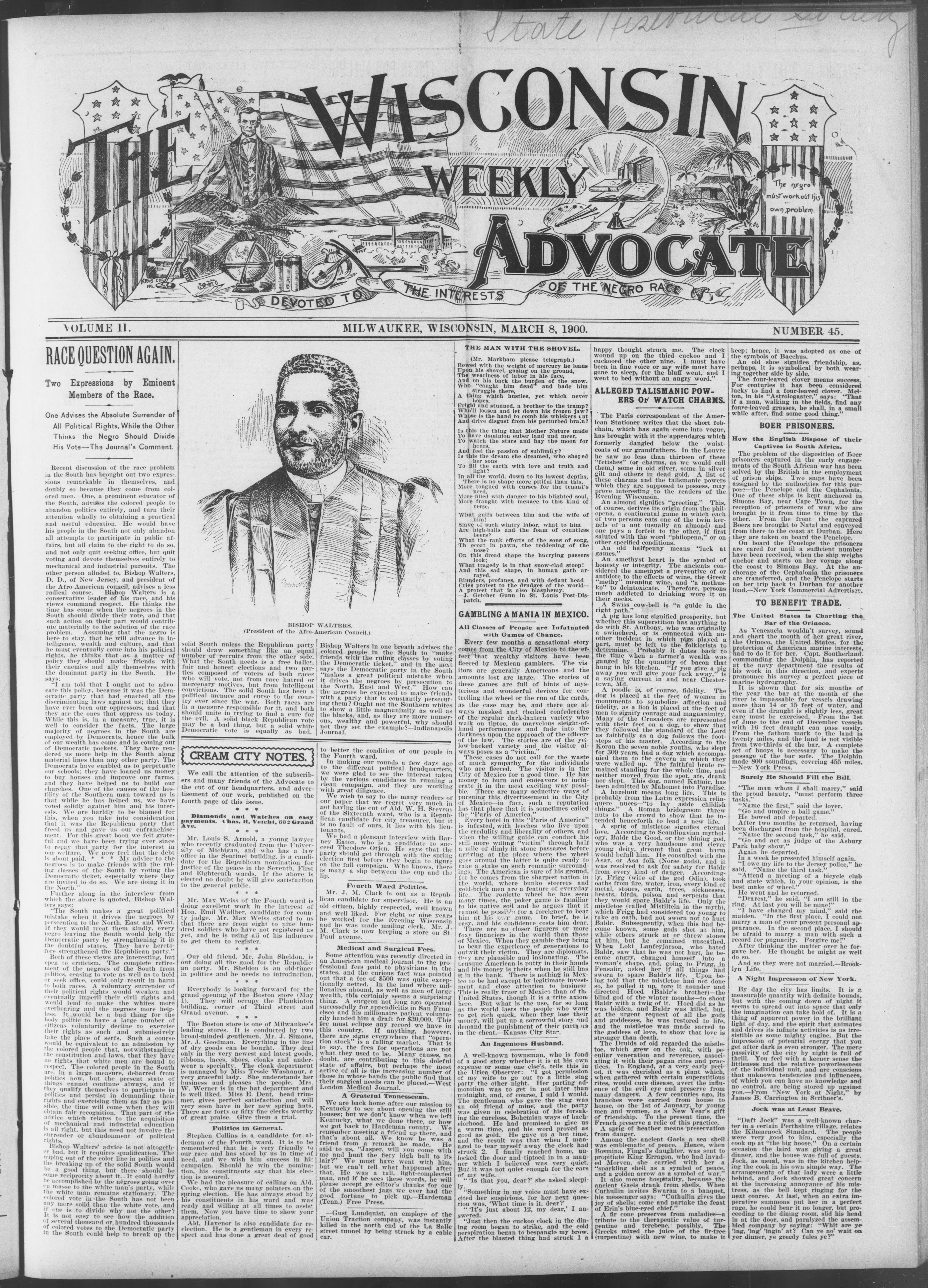
WISCONSIN
WEEKLY
ADVOCATE
DEVOTED TO THE INTERESTS OF THE NEGRO RACE
VOLUME II.
RACE QUESTION AGAIN.
Two Expressions by Eminent Members of the Race.
One Advises the Absolute Surrender of All Political Rights, While the Other Thinks the Negro Should Divide His Vote—The Journal's Comment.
Recent discussion of the race problem in the South has brought out two expressions remarkable in themselves, and doubly so because they come from colored men. One, a prominent educator of the South, advises the colored people to abandon politics entirely, and turn their attention wholly to obtaining a practical and useful education. He would have his people in the South not only abandon all attempts to participate in public affairs, but all claim to the right to do so, and not only quit seeking office, but quit voting and devote themselves entirely to mechanical and industrial pursuits. The other person alluded to, Bishop Walters, D. D., of New Jersey, and president of the Afro-American council, advises a less radical course. Bishop Walters is a conservative leader of his race, and his views command respect. He thinks the time has come when the negroes in the South should divide their vote, and that such action on their part would contribute materially to the solution of the race problem. Assuming that the negro is here to stay, that he will advance in intelligence, wealth and culture, and that he must eventually come into his political rights, he thinks that as a matter of policy they should make friends with their enemies and ally themselves with the dominant party in the South. He says:
"I am told that I ought not to advocate this policy, because it was the Democratic party that had enacted all the discriminating laws against us; that they have ever been our oppressors, and that they are the ones that oppress us today. While this is, in a measure, true, it is well to consider the facts. The large majority of negroes in the South are employed by Democrats, hence the bulk of our wealth has come and is coming out of Democratic pockets. They have rendered us more help in the South along material lines than any other party. The Democrats have enabled us to perpetuate our schools; they have loaned us money to buy houses and improve our farms, and they have helped us to build our churches. One of the causes of the hostility of the Southern man toward us is that while he has helped us, we have voted solidly against him and his interests. We are harldly to be blamed for this, when you take into consideration that it was the Republican party that freed us and gave us our enfranchisement. For this great boon we felt grateful and we have been trying ever since to repay that party for the interest in our welfare. We now feel that the debt is about paid. * * * My advice to the negroes is to make friends with the ruling classes of the South by voting the Democratic ticket, especially where they are invited to do so. We are doing it in the North."
Further along in the interview from which the above is quoted, Bishop Walters says:
"The South makes a great political mistake when it drives the negroes by persecution to the North, East and West. If they would treat them kindly, every negro leaving the South would help the Democratic party by strengthening it in the doubtful states. They have heretofore strengthened the Republican party."
Both of these views are interesting, but open to criticism. The complete retirement of the negroes of the South from politics, ceasing to vote as well as to hold or seek office, could only result in harm to both races. A voluntary surrender of their political rights would weaken and eventually imperil their civil rights and would tend to make the whites more overbearing and the negroes more helpless. It would be a bad thing for the body politic to have a large number of citizens voluntarily decline to exercise their rights as such and submissively take the place of serfs. Such a course would be equivalent to an admission by the colored people that, notwithstanding the constitution and laws, that they have no rights that white men are bound to respect. The colored people in the South are, in a large measure, debarred from politics now, but the present state of things cannot continue always, and if they qualify themselves to participate in politics and persist in demanding their rights and exercising them as far as possible, the time will come when they will obtain fair recognition. That part of the advice which relates to the acquisition of mechanical and industrial education is all right, but this need not involve the surrender or abandonment of political rights.
Bishop Walters' advice is not altogether bad, but it requires qualification. The wiping out of the color line in politics and the breaking up of the solid South would be a good thing, but there should be some reciprocity about it. It could hardly be accomplished by the negroes going over en masse to the white man's party, while the white man remains stationary. The colored vote in the South has not been any more solid than the white vote, and if one is to divide why not the other? It is not easy to see how the addition of several thousand or hundred thousands of colored votes to the Democratic party in the South could help to break up the
P.
solid South unless the Republican party should draw something like an equal number of recruits from the other side. What the South needs is a free ballet, fair and honest elections and two parties composed of voters of both races who will vote, not from race hatred or mercenary motives, but from intelligent convictions. The solid South has been a political menace and curse to the country ever since the war. Both races are in a measure responsible for it, and both should unite in trying to find a cure for the evil. A solid black Republican vote may be a bad thing, but a solid white Democratic vote is equally as bad.
Bishop Walters colored people friends with the the Democratic says the Democ 'makes a great it drives the n the North, Eas the negroes be with a party th ing them? Ough to show a little the blacks, and, ous, wealthy an not they set the Journal
CREAM CITY NOTES.
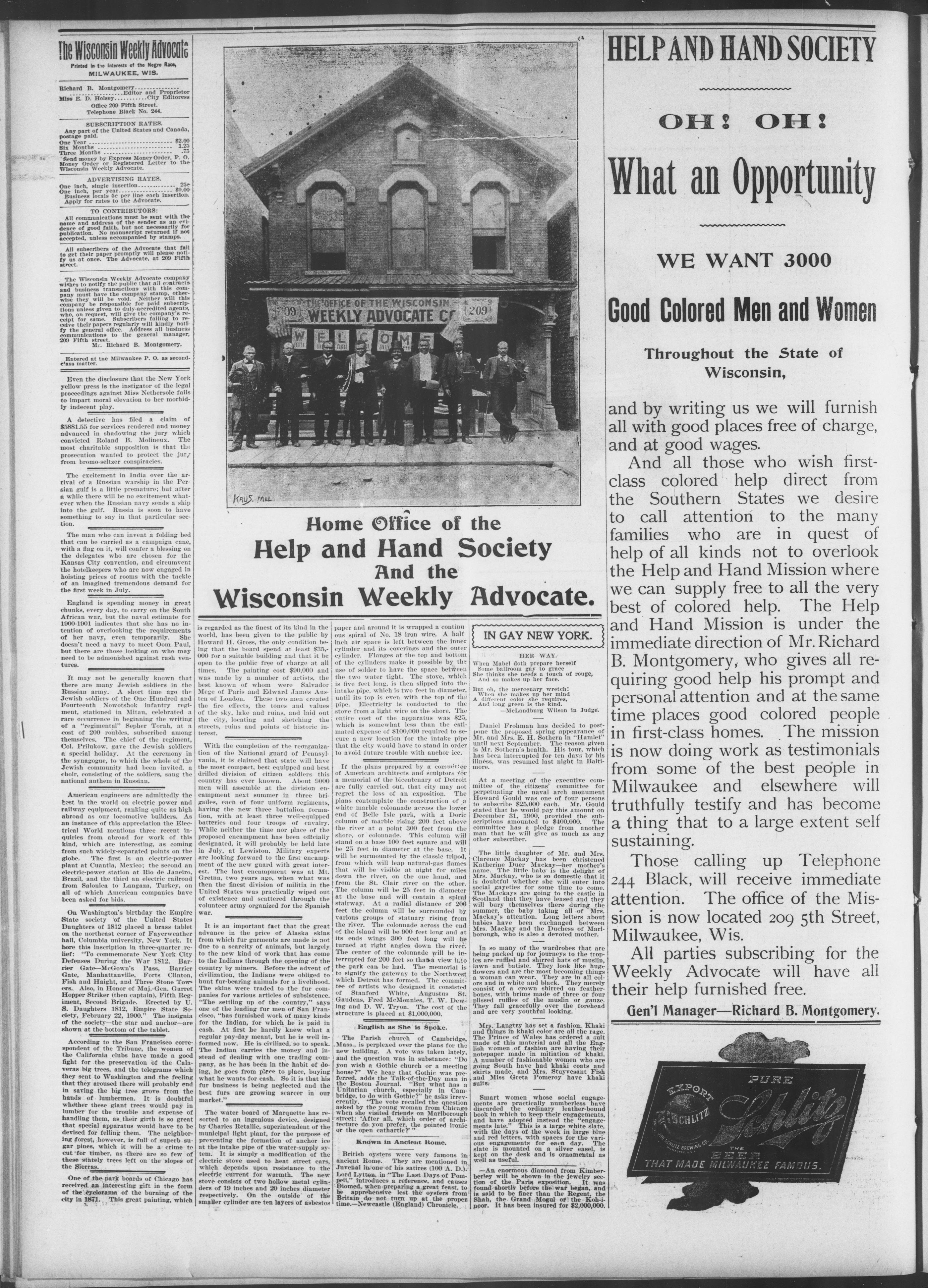
We call the attention of the subscribers and many friends of the Advocate to the cut of our headquarters, and advertisement of our work, published on the fourth page of this issue.
Diamonds and Watches on easy payments. Chas. H. Veicht, 602 Grand Ave.
Mr. Louis S. Arnold, a young lawyer who recently graduated from the University of Michigan, and who has a law office in the Sentinel building, is a candidate for the Republican nomination for justice of the peace in the Seventh, First and Eighteenth wards. If the above is elected no doubt he will give satisfaction to the general public.
* * *
Mr. Max Weiss of the Fourth ward is doing excellent work in the interest of Hon. Emil Wallber, candidate for county judge. Mr. Max Weiss stated to us that there are from eight to nine hundred soldiers who have not registered as yet, and he is using all of his influence to get them to register.
Our old friend, Mr. John Sheldon, is out doing all the good for the Republican party. Mr. Sheldon is an old-timer in politics and he needs no introduction.
* * *
Everybody is looking forward for the grand opening of the Boston store (May 1). They will occupy the Plankinton building, corner of Third street and Grand avenue.
The Boston store is one of Milwaukee's leading stores. It is conducted by two broad-minded gentlemen, Mr. J. Simons, Mr. J. Goodman. Everything in the line of dry goods can be bought. They deal only in the very newest and latest goods, ribbons, laces, shoes, cloaks and underwear a specialty. The cloak department is managed by Miss Tessie Washanur, a very graceful lady. She understands her business and pleases the people. Mrs. W. Werner is in the hat department and is well liked. Miss E. Dent, head trimmer, gives perfect satisfaction and will very soon have in her new spring hats. There are forty or fifty clerks worthy of great praise. Give them a trial.
Politics in General.
Stephen Collins is a candidate for alderman of the Fourth ward. It is to be remembered that he is very friendly to our race and has stood by us in time of need, and we wish him success in his campaign. Should he win the nomination, his constituents say that his election is assured.
We had the pleasure of calling on Ald. Cooke, who gave us many pointers on the spring election. He has always stood by his constituents in his ward and was ready and willing at all times to assist them. Now you have time to show your appreciation.
Ald. Havenor is also candidate for reelection. He is a gentleman in every respect and has done a great deal of good
* * *
```markdown
```
***
MILWAUKEE, WISCONSIN, MARCH 8, 1900.
Bishop Walters in one breath advises the colored people in the South to "make friends with the ruling classes by voting the Democratic ticket," and in the next says the Democratic party in the South "makes a great political mistake when it drives the negroes by persecution to the North, East and West." How can the negroes be expected to make friends with a party that is constantly persecuting them? Ought not the Southern whites to show a little magnanimity as well as the blacks, and, as they are more numerous, wealthy and powerful, why should not they set the example?—Indianapolis Journal.
to better the condition of our people in the Fourth ward.
In making our rounds a few days ago to the different political headquarters, we were glad to see the interest taken by the various candidates in running a clean campaign, and they are working with great diligence.
We wish to say to the many readers of our paper that we regret very much in not having the cut of Ald. W. H. Stevens of the Sixteenth ward, who is a Republican candidate for city treasurer, but it is no fault of ours, it lies with his lieutenants.
We had a pleasant interview with Barney Eaton, who is a candidate to succeed Theodore Otjen. He says that the party should get through with the spring election first before they begin to figure on the fall campaign. Who knows, there is many a slip between the cup and the lip.
Fourth Ward Politics
Mr. J. M. Clark is out as a Republican candidate for supervisor. He is an old citizen, highly respected, well known and well liked. For eight or nine years he worked for the Evening Wisconsin and he was made mailing clerk. Mr. J. M. Clark is now keeping a store on St. Paul avenue.
Medical and Surgical Fees.
Some attention was recently directed in an American medical journal to the professional fees paid to physicians in the states, and the curious fact was pointed out that a fee of $500 was quite exceptionally netted. In the land where millionaires abound, as well as men of large wealth, this certainly seems a surprising thing. A surgeon not long ago operated successfully for appendicitis in San Francisco and his millionaire patient voluntarily handed him a draft for $30,000. This fee must eclipse any record we have in this country. If anything, however, there are signs everywhere that "operation stock" is a falling market. That is to say, the fees for operations are not what they used to be. Many causes, no doubt, are contributing to this doleful state of affairs, but perhaps the most active of all is the increasing number of those in whose hands the public find that their surgical needs can be placed.—West London Medical Journal.
A Grateful Tennesseean.
We are back home after our mission to Kentucky to see about opening the still houses; but we don't know when we left Kentucky, what we done there, or how we got back to Hardeman county. We remember meeting a friend up there, and that's about all. We know he was a friend from a remark he made. He said to us, "Jasper, will you come with me and hunt the fiery high ball to its lair?" We must have went with him, but we can't tell what happened after that. He was a tall, light-completed man, and if he sees these words, he will please accept ye editor's thanks for one of the smoothest jags we ever had the good fortune to pick up.—Hardeman (Tenn.) Free Press.
--Gust Lundquist, an employee of the Union Traction company, was instantly killed in the north end of the La Salle street tunnel by being struck by a cable car.
THE MAN WITH THE SHOVEL.
(Mr. Markham please telegraph.) Rowed with the weight of mercury he leans Upon his shovel, gazing on the ground, The weariness of labor in his face, And on his back the burden of the snow.
And on his back the burden of the snow. Who "caught him dead" and bade him struggle there.
A thing which hustles, yet which never hopes
Frigid and stunned, a brother to the tramp? Who'll loosen and let down his frozen jaw? Whose is the hand to comb his whiskers cut And drive disgust from his perturbed brain?
Is this the thing that Mother Nature made To have dominion euber land und meer, To watch the stars and bay the moon for hours, And feel the passion of sublimity? Is this the dream she dreamed, who shared her sons To fill the earth with love and truth and light?
In all the world, down to its lowest deptis,
There is no shape more pitiful than this.
More tongued with curses for the tenant's
need.
More filled with danger to his blighted soul.
More fraught with menace to this kind of verse.
What gulfs between him and the wife of him!
Slave of such wintry labor, what to him
Are high-balls and the foam of countless beers?
What the rank efforts of the sons of song,
Th ecoat in pawn, the reddening of the
nose?
On this dread shape the hurrying passers look:
What tragedy is in that snow-clad stoop! And this sad shape, in human garb arrayed
—J. Getcher Gunn in St. Louis Post-Dis patch.
GAMBLING AMANIA IN MEXICO.
All Classes of People are Infatuated with Games of Chance.
Every few months a sensational story comes from the City of Mexico to the effect that wealthy visitors have been fleeced by Mexican gamblers. The visitors are generally Americans and the amounts lost are large. The stories of these games are full of hints of mysterious and wonderful devices for controlling the wheel or the run of the cards, as the case may be, and there are always masked and cloaked confederates of the regular dark-lantern variety who walk on tiptoe, do marvelous sleight-of-hand performances and fade into the darkness upon the approach of the officers of the law. The stories are of the yellow-backed variety and the visitor always poses as a "victim."
These cases do not call for the waste of much sympathy for the individuals who are fleeced. The visitor is in the City of Mexico for a good time. He has money to burn and endeavors to incinerate it in the most exciting way possible. There are many seductive ways of pursuing this divertissement in the City of Mexico—in fact, such a reputation has that place that it is sometimes called the "Paris of America."
Every hotel in this "Paris of America" is infested, with leeches who live upon the credulity and liberality of others, and when the willing guide can conduct his still more willing "victim" through half a mile of dimly-lit stone passages before arriving at the place where the wheel goes around the latter is quite ready to take a stake on such romantic surroundings. The American is sure of his ground, for he comes from the sharpest nation in the world, where bunko steerers and gold-brick men are a feature of everyday life. The roulette wheel he has seen many times, the poker game is familiar to his native soil and he argues that it cannot be possible for a foreigner to beat him at his own game. In brief, he is easy, and his confidence costs him dear.
There are no closer figurers or more foxy financiers in the world than those of Mexico. When they gamble they bring to bear the experience of generations to outwit their victim. They are diplomats, they are plausible and insinuating. The brusque American is putty in their hands and his money is theirs when he still has it in the bank. There is nothing in Mexico to be had except by legitimate investment and close attention to business. This is really truer of Mexico than of the United States, though it is a trite axiom here. But what is the use, for so long as the world lasts the people who want to get rich quick, when they lose their money, will put up a sorrowful story and demand the punishment of their partners in the cheat—Kansas City Star.
An Ingenious Husband
A well-known townsman, who is fond of a good story whether it is at his own expense or some one else's, tells this in the Utica Observer: "I got permission of my wife to go out to a little stag party the other night. Her parting admonition was to get in not later than midnight, and, of course, I said I would. The gentleman who gave the stag was an old friend of mine, and the party was given in celebration of his forsaking the careless, Bohemian ways of bachelorhood. He had promised to give us a warm time, and his word proved as good as gold. He gave us a hot time, and the result was that when I managed to tear myself away the clock had struck 2. I finally reached home, unlocked the door and tiptoed in in a manner which I believed was very quiet. But it was not quiet enough for the ears of my wife.
"Is that you, dear?" she asked sleepily.
"Something in my voice must have excited her suspicions, for her next question was, 'What time is it, dear?'
"It's just about 12, my dear,' I answered.
"Just then the cuckoo clock in the dining room began to strike, and the cold perspiration began to bespangle my brow. After the blasted thing had struck 1 a
happy thought struck me. The clock wound up on the third cuckoo and I cuckooed the other nine. I must have been in fine voice or my wife must have gone to sleep, for the bluff went, and I went to bed without an angry word."
ALLEGED TALISMANIC POW- ERS Or WATCH CHARMS.
The Paris correspondent of the American Stationer writes that the short fobchain, which has again come into vogue, has brought with it the appendages which formerly dangled below the waist-coats of our grandfathers. In the Louvre he saw no less than thirteen of these "fetishes" (or charms, as we would call them,) some in old silver, some in silver gilt and others in dead gold. A list of these charms and the talismanic powers which they are supposed to possess, may prove interesting to the readers of the Evening Wisconsin.
An almond signifies "greeting." This, of course, derives its origin from the philopena, a continental game in which each of two persons eats one of the twin kernels of a nut (usually an almond) and one pays a forfeit to the other, if first saluted with the word "philopena," or on other specified conditions.
An old halfpenny means "luck at games."
An amethyst heart is the symbol of honesty or integrity. The ancients considered the amethyst a preventive of or antidote to the effects of wine, the Greek "methy" meaning wine, and "a methusko" to deintoxicate. Therefore, persons much addicted to drinking wore it on their necks.
A Swiss cow-bell is "a guide in the right path."
A pig has long signified prosperity, but whether this superstition has anything to do with St. Anthony, who was originally a swineherd, or is connected with another incident in which pigs played a part, must be left to the folklorists to determine. Probably it dates back to the time when a farmer's wealth was gauged by the quantity of bacon that hung in his kitchen. "If you give a pig away you will give your luck away," is a saying current in and near Chestertown, Md.
A poodle is, of course, fidelity. The dog is placed at the feet of women in monuments to symbolize affection and fidelity, as a lion is placed at the feet of men to signify courage and magnanimity. Many of the Crusaders are represented with their feet on a dog, to show that they followed the standard of the Lord as faithfully as a dog follows the footsteps of his master. According to the Koran the seven noble youths, who slept for 309 years, had a dog which accompanied them to the cavern in which they were walled up. The faithful brute remained standing for the whole time, and neither moved from the spot, ate, drank nor slept. This dog, named Katmir, has been admitted by Mahomet into Paradise
A hazelnut means long life. This is probably from the Latin expression relinquere nuces—"to lay aside childish things." A Roman bridegroom threw nuts to the crowd to show that he intended henceforth to lead a new life.
A sprig of mistletoe signifies eternal love. According to Scandinavian mythology, Baldr the Good, or the shining god, who was a very handsome and clever young deity, dreamt that great harm would befall him. He consulted with the Asar, or Asa folk (Norse gods), and it was resolved to ask for safety for Baldr from every kind of danger. Accordingly, Frigg (wife of the god Odin), took oaths from fire, water, iron, every kind of metal, stones, earth, trees, sicknesses, beasts, birds, poison and serpents that they would spare Baldr's life. Only the mistletoe (called Mistiltein in the myth), which Frigg had considered too young to take an oath, had not sworn to hurt Baldr. Subsequently, when this had become known, some gods shot at him, while others struck at or threw stones at him, but he remained unscathed. When Loki Lanfeyjarson, who hated Baldr, saw that he was not hurt, he became angry, changed himself into a woman's shape, and, going to Frigg, in Fensair, asked her if all things had sworn to spare Baldr's life. Upon being told that the mistletoe had not done so, he pulled it up, tore it asunder and directed Hoed (Baldr's brother)—the blind god of the winter months—to shoot Baldr with a twig of it. Hoed did as he was bidden, and Baldr was killed, but, at the urgent request of all the gods and goddesses, he was restored to life, and the mistletoe was made sacred to the goddess of love, to show that love is stronger than death.
The Druids of old regarded the mistletoe, which grew on the oak, with peculiar veneration and reverence, associating it with their pagan rites and practices. In England, at a very early period, it was cherished as a plant which, when gathered with certain superstitions rites, would cure disease, avert the influence of the evil eye and preserve from many dangers. A few centuries ago, its branches were carried from house to house, on the 1st of January, by young men and women, as a New Year's gift of friendship. To the present time, the French preserve a relic of this practice. A sprig of heather means preservation from danger.
Among the ancient Gaels a sea shell was emblematic of peace. Hence, when Bosmina, Fingal's daughter, was sent to propitiate King Erragon, who had invaded Morven, she carried with her a "sparkling shell as a symbol of peace, and a golden arrow as a symbol of war." It also means hospitality, because the ancient Gaels drank from shells. When Cuthullin invites Swaran to a banquet, his messenger says: "Cuthullin gives the joy of shells; come and partake the feast of Erin's blue-eyed chief."
A fir cone preserves from maladies—a tribute to the therapeutic value of turpentine and terebene, possibly. The Greeks mixed the juice of the fir-tree (turpentine) with new wine, to make it
keep; hence, it was adopted as one of the symbols of Bacchus. An old shoe signifies friendship, as, perhaps, it is symbolical by both wearing together side by side. The four-leaved clover means success. For centuries it has been considered lucky to find a four-leaved clover. Melton, in his "Astrologogaster," says: "That if a man, walking in the fields, find any foure-leaved grasses, he shall, in a small while after, find some good thing."
BOER PRISONERS.
How the English Dispose of their Captives in South Africa.
The problem of the disposition of Boer prisoners captured in the early engagements of the South African war has been solved by the British in the employment of prison ships. Two ships have been assigned by the authorities for this purpose—the Penelope and the Cephalonia. One of these ships is kept anchored in Simons Bay, near Cape Town, for the reception of prisoners of war who are brought to it from time to time by the other. From the front the captured Boers are brought to Natal and conveyed from there to the coast at Durban. Here they are taken on board the Penelope.
On board the Penelope the prisoners are cared for until a sufficient number have been received, when the ship weighs anchor and starts on her voyage along the coast to Simons Bay. At the anchorage of the Cephalonia the prisoners are transferred, and the Penelope starts on her trip back to Durban for another load.—New York Commercial Advertisery.
TO BENEFIT TRADE.
The United States is Charting the Bar of the Orinoco.
As Venezuela wouldn't survey, sound and chart the mouth of her great river, the Orinoco, the United States. for the protection of American marine interests, had to do it for her. Capt. Southerland, commanding the Dolphin, has reported at the navy department the results of his work in this direction, and experts pronounce his survey a perfect piece of marine hydrography.
It is shown that for six months of the year the bar at the mouth of the river is impassable for vessels drawing more than 14 or 15 feet of water, and even if the draught is slightly less, great care must be exercised. From the 1st of June to the end of December vessels with 16 feet draught can pass easily. From the fathom mark to the land is twenty miles, and the land is not visible from two-thirds of the bar. A complete set of buoys is necessary to make the passage of the bar safe. The Dolphin made 800 soundings, covering 455 miles. New York Press
Surely He Should Fill the Bill.
"The man whom I shall marry," said the proud beauty, "must perform three tasks."
"Name the first," said the lover.
"Go and umpire a ball game."
He bowed and departed.
After two months he returned, having been discharged from the hospital, cured.
"Name the second task," he said.
"Go and act as judge of the Asbury Park baby show."
Again he departed.
In a week he presented himself again.
"I owe my life to the Jersey police," he said.
"Name the third task."
"Attend a meeting of a bicycle club and state which, in your opinion, is the best make of wheel."
He went and he returned.
"Dearest," he said, "I am still in the ring. At last you will be mine!" "I have changed my mind," said the maiden. "In the first place, I could not marry a man of your present personal appearance. In the second place, I should be afraid to marry a man with such a record for pugnacity. Forgive me!" After thinking the matter over he forgave her. He thought he might as well do so. And so they were not married.—Brooklyn Life.
A Night Impression of New York.
By day the city has limits. It is 2 measurable quantity with definite bounds, but with the coming down of night it seems to spread out into space that only the imagination can take hold of. It is a thing of apparent power in the brilliant light of day, and the spirit that animates and drives its infinite activities is as irresistible as some mighty engine. But the impression of potential energy that you get after dark is even stronger. The mere passivity of the city by night is full of thrill. You feel with a keener sense the littleness and the relative powerlessness of the individual unit, and are consciences that unknown tendencies and influences, of which you can have no knowledge and no control, are being stored up against you.—From "New York at Night," by James B. Carrington in Scribner's.
Jock was at Least Brave.
"Daft Jock" was a well-known charter in a certain Perthshire village, relates the Kilmarnock Standard. The people were very good to him, especially the cook up at "the big hoose." On a certain occasion the laird was giving a great dinner, and the house was full of guests. Jock, as usual, was in the kitchen helping the cook in his own simple way. The arrangements of that lady were a little behind, and Jock showed great concern at the increasing annoyance of his mistress, as the bell kept ringing for the next course. At last, when an extra imperative summons put her in a perfect rage, he could bear it no longer, but proceeding to the dining room, slid his head in at the door, and paralyzed the assembled company by saying: "Whit are ye 'ing, 'ing 'ingin' at? Can ye no' wait on yer dinner, ye greedy fules ye?"
INVASION OF TRANSVAAL.
Flying Column of British Troops Enters the Republic.
Boers Expected to Contest the Glencoe Passes-The Defense of Bismontain.
London, March 7.—4:16 p. m.—A special dispatch from Durban says a flying column of British troops from Zululand has entered the Transvaal and has been daily skirmishing with small parties of Boers.
The force consists of mounted infantry, Natal scouts and artillery all commanded by Maj. Prendergast. The column first crossed the bridge on February 28. It now occupies an entrenched position on Catasa hill, nine miles within the Transvaal.
London, March 7.—Field Marshal Lord Roberts telegraphs as follows from Ostontem, under date of March 7, 4:30 p.m.: "Our operations today promise to be a great success. The enemy occupied a position four miles and eleven miles south of the Modder river. I placed Gen. Colvill's division on the north bank and Gen. Kelly-Kenny's and Tucker's divisions, with cavalry, on the south bank. The cavalry division succeeded in tuning the enemy's left nank, opening a road for the Sixth division, which is advancing without having been oonged to hire a shot up to the present time. The enemy are in full retreat towards the north and east. They are being closely followed by cavalry, norse artemery and mounted infantry, while Tucker's Seventh division, Colvill's Ninth division, and the Guards brigade, under Pole-Carew, are making their way across the river at Ponsiar's drift, where I propose to place my headquarters this evening.
"Our casualties will, I trust, be few, as the enemy were quite unprepared for being attacked by the nank and having their communications with Bloemontem threatened."
---
Boer Camp, Biggarsburg, Saturday, March 3.—The federalists have fallen back on the Biggarsburg chain that crosses Natal south of Dundee. Retreat from Ladysmith was due to the mistake of a certain commandant in ordering his men to retire from the key of the position without any reason for the move. On the receipt of bad news from the Modder river Wednesday it was resolved to send the wagons back to Biggarsburg and soon long strings of ox-wagons lined the roads. Over a thousand wagons took the westerly route to the laager southwest of Ladysmith. Another convoy was sent to the foot of the Drakensberg. A large number of tents captured from the British at Dundee and also the ammunition were abandoned. The chief difficulty was in dismounting "Long Tom."
London, March 7.—For lack of news from Field Marshal Lord Roberts attention turns to Natal. It is reported that Gen. Buller has pushed forward a force along the Harrismith railroad line toward Van Reenen's pass, using the railroad freely for communication. It appears that the Boers intend to take up a strong position in the Biggarsburg range and contest the 'Glencoe passes, although it hardly seems likely that Gen. Buller will attempt to force these for the present. His plans, however, are kept almost as secret as those of Lord Roberts.
While waiting for important developments which are daily expected to occur in the Free State, rumors of peace recur. The second edition of the Times today contains a dispatch from Cape Town which says that there is a crying need for an explicit statement by the British ministry that nothing short of annexation is intended in order to "damp the mischievous agitation that is going on under the pretext of a demand for peace."
Buller Lost 1859 Men.
Another list of the casualties sustained by Gen. Buller's forces from February 14 to February 27 shows: Killer, 123; wounded, 573; missing, 54.
Of these the losses of the Inniskillings were as follows: Killed, 54; wounded, 162; missing, 22. Dublin Fusileers: Killed, 15; wounded, 97; missing, 18. Connaught Rangers; Killed, 19; wounded, 105; missing, 8. Royal Irish Fusileers: Killed, 11; wounded, 63; missing, 25. Scots Fusileers: Killed, 18; wounded, 68; missing, 0.
With the loss of casualties issued Monday, this makes the total cost to the rank and file in the final relief of Ladysmith, 1859 men.
For and Against Anexation.
London, March 7.—The round robin in favor of the annexation of the Transvaal and the Free State which is being promoted among the supporters of the government in the House of Commons continues to receive signatures. The signatories of the memorial to Mr. Balfour affirm that the time has arrived for plain speaking inside and outside of Parliament and that Lord Salisbury's words are being construed into a pledge against annexation and Lord Roberts' proclamation into a promise of no confiscation of Boer property.
The Transvaal agency at Brussels threatens a rising of the Cape Dutch in the event of annexation, though why the Dutch should rise then rather than now is not explained.
Free Staters Want Peace.
London, March 7.—A dispatch to the News from Modder river, dated Monday, March 5, and describing the Boer position in front of Lord Roberts, says: "The Boers seem to like to be so busy entrenching. They have mounted eight guns on high kopjes. It is marvelous how they drag these weapons into such positions. "It is reported here that at a recent emergency meeting of the Free State Raad at Bloemfontein, a radical difference of opinion developed, the majority favoring peace at any price, but the minority, including President Steyn, advocating a fight to the end."
Care Dutch kebel.
Cape Town. March 7.—Nearly the whole of the Dutch population of the Prieska and Kenhardt district are in rebellion. Many of the Dutch from neighboring districts are reported to have joined them, notably Piet Moolman, who will lead the rebels to Brandbles. Lucas Steinkamp, commanding the Boers, is reported marching on Carnarvon. It is believed that Gordonia and Victoria West will rise. It is thought that the total number of men in arms will exceed 3000. It is the general opinion of the loyalists that a strong force of British will be required, as a reverse would spread the rebellion.
DEFENSE OF BLOEMFONTEIN.
Plans of the Boers for the Next Engagement with Lord Roberts
New York, March 7.—A dispatch to the Tribune from London says: The extent to which Gen. Joubert and President Steyn have succeeded in massing their forces is not yet clear, but they are covering Bloemfontein by a long defensive line on the hills south of the Modder river. Their tactics are the same as those which were employed on the Tu-
gela when the Dutch commandoes covered a distance of eighteen miles, but the country is less favorable for their system of defense. There is no river in front of them and Lord Roberts has four mounted brigades with horse artillery, with which their line can be turned. The Seventh division, under Gen. Tucker, has not yet been in action, and will probably have the brunt of the fighting if a battle precedes the occupation of Bloemfontein, but it is probable that a frontal attack will be avoided and that Gen. French's brigades will take a long circuit northward so as to shut off a retreat toward the Vet river.
The Dutch forces, if defeated, will fall back upon Winburg, and the high hills between Vontersburg and Senekal, between the Vet and the Valsch rivers. This is described by South Africans as the most formidable defensive position in the Free State, and lateral railways lead up behind it at Bethlehem and Kronstad. The Vaal river is a long distance behind these commanding kopjes, and the Witwaters Rand ridge, of which Johannesburg is the key, lies to the north. If Lord Roberts has sent a strong body of infantry toward Vryburg and Mafeking, it will naturally be reinforced and converted in due time into a turning column against that strong position.
The results of the Dutch concentration are disclosed in the facility with which the district south of Orange river has been cleared. Gen. Gatacre's army is not strong, since an entire brigade was called back to reinforce Lord Roberts' corps, yet he has been able to take possession of Stormberg without a struggle. The Boers had retreated from that natural fortress to Rooikop, and left the road open to Burghersdorp. The occupation of Stormberg gives to Gen. Gatacre the control of the railway westward to Middleberg and enables him to advance northward toward the Orange river.
GEN. BULLER'S ORDER.
Says His Troops Have Added a Glorious Page to Country's History.
Durban, March 6.—Gen. Buller, in a general order regarding the relief of Ladysmith, says: "Two forces during the last few months have striven with conspicuous gallantry and splendid determination to maintain the honor of the Queen and the country. The Ladysmith garrison for four months held that position against every attack with complete success and endured many privations with admirable fortitude. The relieving force had to force its way through an unknown country, across unfordable rivers and on almost inaccessible heights face a fully-prepared, well-armed and tenacious enemy. By the exhibition of the truest courage, courage that burns steadily besides flashing brilliantly, accomplished its object and added a glorious page to the history of the country.
"Ladysmith was successfully held and relieved and the sailors and soldiers, colonial and home-born, who had done this, were united by one desire and inspired by one patriotism."
The order congratulates both forces on the martial qualities displayed and thanked them for their determined effort. Gen. Buller also sympathizes with the relatives and friends of the gallant comrades who have fallen.
Symon was Over-Confident.
London, March 7.—The Morning Post prints an interview with Gen. White, commander of the garrison which was imprisoned at Ladysmith for 100 days. Gen. White said he had arrived in South Africa scarcely ten days before the outbreak of the war, and found certain arrangements in progress. He had full confidence in Gen. Symons, who, he said, proposed to hold Dundee and Ladysmith, and underrated the Boers gravely. Gen. White states that he viewed the situation in a more serious light. He determined to ask the opinion of Sir W. R. Hely-Hutchinson on the political results of the abandonment of Dundee. The governor gave it as his opinion that grave consequences would result therefrom, notably a rising of the disloyal Dutch in the Klip country. Gen. White doubted whether he could hold Dundee, but had no doubt of his ability to hold Ladysmith, which was the first main objective of the Boers. Here the lines of railway met, and here the republican armies were to make an effective junction and capture Ladysmith, which the Boers were certain would be the signal for a rising of the Natal Dutch.
CHINN'S LIBEL SUITS.
Numerous Actions Growing Out of Goebel Assassination.
Frankfort, Ky., March 7.—Col. Jack Chinn has filed suit against Mrs. Kate L. Banta of this place for $35,000 damages for saying that he shot William Goebel. In the bill there are two counts, the first of which sets forth that Mrs. Banta said in the presence of several persons that "she saw William Goebel shot, and that Jack Chinn was responsible." For this Chinn wants $25,000. The second count complains that Mrs. Banta said she saw Chinn shoot Goebel, and Chinn asks $10,000 damages for this statement.
Chinn said tonight that he proposed to file suits against several other persons, one of them being a man worth more than $100,000. The colonel added that when he got through with these cases he proposed to have certain other persons indicted for criminal libel.
COST OF THE WAR.
Filipino Insurrection Entailed Expense of $48,928,060.
Washington, D. C., March 7.—Secretary Root, in response to a resolution, sent a schedule to the House showing the cost of the war in the Philippines. It amounts to $48,928,060, and is divided among the different branches of the army as follows:
Quartermaster General's dept. $25,715,901
Pay department 10,883,131
Bureau of Subsistence 8,950,000
Ordnance department 1,860,239
Medical department 1,206,173
Signal Corps 286,923
Engineer department 64,692
The office of the Secretary of War 9,777
Judge Advocate General 1,233
TWO WERE KILLED.
Locomotive Crashed Through Steel
Bridge at Aliegheny, Fa.
Pittsburg, Pa., March 7.—The locomotive hauling the Chicago fast freight west on the Pittsburg, Chicago & Fort Wayne crashed through the steel bridge spanning Robinson street, Allegheny, today, and dragged the tender and one car with it. Fireman A. K. Miller of Bolivar, Pa., and Brakeman George Dewald of Pitcairn, Pa., were killed outright, and Conductor James F. Martin of Pitcairn, Pa., dangerously injured. The rest of the crew escaped unhurt.
INSANE ASYLUM CURNED
Thirty-five Employees Escape in Their Night Clothes.
St. Paul, Minn., March 7.—A St. Peter, Minn., special to the Dispatch says: The state insane asylum was badly burned today, but fortunately no lives were lost, though thirty-five employees narrowly escaped in their nightclothes. The fire was confined to the laundry, light plant and a building occupied by employees, the main building occupied by patients being saved by a dividing fireproof structure. Loss $40,000, partially insured. Much excitement prevailed among the patients during the fire.
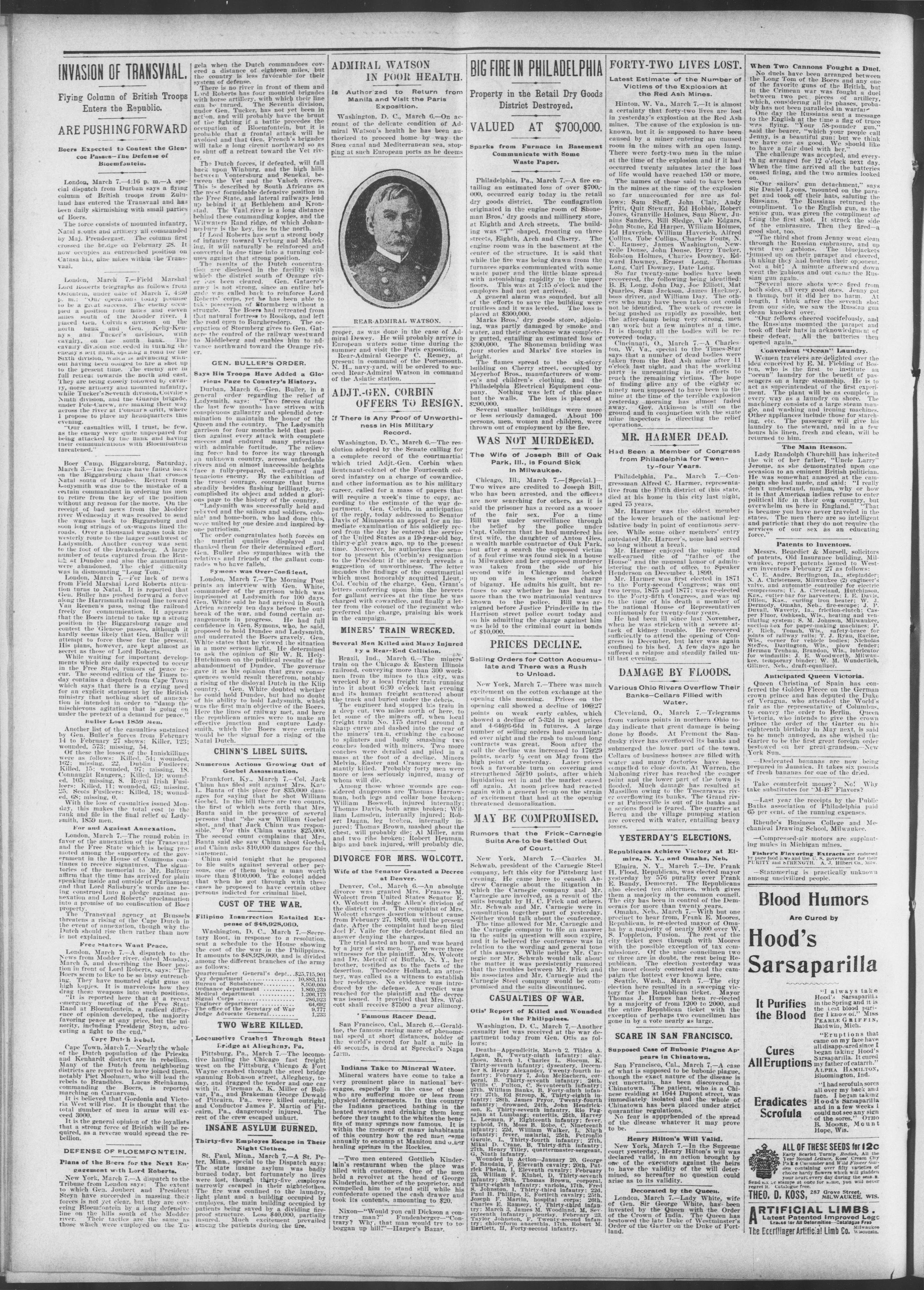
ADMIRAL WATSON IN POOR HEALTH.
Is Authorized to Return from Manila and Visit the Paris Exposition.
Washington, D. C., March 6. On account of the delicate condition of Admiral Watson's health he has been authorized to proceed home by way the Suez canal and Mediterranean sea, stopping at such European ports as he deems
[Image of a man in a military uniform].
REAR-ADMIRAL WATSON. proper, as was done in the case of Admiral Dewey. He will probably arrive in European waters some time during the summer and visit the Paris exposition. Rear-Admiral George C. Remey, at present in command of the Portsmouth, N. H., navy-yard, will be ordered to succeed Rear-Admiral Watson in command of the Asiatic station.
ADJT.-GEN. CORBIN OFFERS TO RESIGN.
ADJT.-GEN. CORBIN OFFERS TO RESIGN.
If There is Any Proof of Unworthiness in His Military
Washington, D. C., March 6.—The resolution adopted by the Senate calling for a complete record of the courtmartial which tried Adjt.-Gen. Corbin when lieutenant-colonel of the Fourteenth colored infantry on a charge of cowardice, and other information as to his military career, called for a mass of papers that will require a week's time to copy, according to the estimate of the war department. Gen. Corbin, in anticipation of the reply, today addressed to Senator Davis of Minnesota an appeal for an immediate examination of his soldierly record from the day he entered the service of the United States as a 19-year-old boy, thirty-eight years ago, up to the present time. Moreover, he authorizes the senator to present his (Corbin's) resignation to the President if the search reveals a suggestion of unworthiness. The letter includes the findings of the courtmartial which most honorably acquitted Lieut.-Col. Corbin of the charge. Gen. Grant's letters conferring upon him the brevets for gallant services at the time he was charged with cowardice, and finally a letter from the cotonel of the regiment who preferred the charge, praising his work in the campaign.
MINERS' TRAIN WRECKED.
Several Men Killed and Many Injured by a BearRear Collision
Brazil, Ind., March 6.—The miners' train on the Chicago & Eastern Illinois railroad, conveying more than 300 workmen from the mines to this city, was wrecked by a local freight train running into it about 6:30 o'clock last evening and its human freight scattered about the track and buried under the debris.
The engineer had stopped his train in a deep cut, two miles north of here, to let some of the miners off, when local freight train No. 175 darted around a sharp curve and dashed into the rear of the miners' train, crushing the caboose to splinters and badly smashing two coaches loaded with miners. Two more coaches were derailed and piled in a mass at the foot of a decline. Miners Melvin, Easter and Crampey were instantly killed. Probably forty men were more or less seriously injured, many of whom will die.
Among those whose wounds are considered dangerous are Thomas Harrowman, both legs and collar bone broken; William Boswell, injured internally; Thomas Davis, both arms broken; William Lumsden, internally injured; Robert Dagan, leg broken, internally injured; Thomas Brown, mashed about the chest, will probably die; Al Miller, arm and two ribs broken; Robert Henman, hips and back injured, will probably die.
DIVORCE FOR MRS. WOLCOTT.
Wife of the Senator Granted a Decree at Denver.
Denver, Col., March 6.—An absolute divorce was granted Mrs. Frances M. Wolcott from United States Senator E. O. Wolcott in Judge Allen's division of the district court. The complaint of Mrs. Wolcott charges desertion without cause from February 27, 1899, until the present date. After the complaint had been filed Joel F. Vaile for the defendant filed an answer denying the charges.
The trial lasted an hour, and was heard by a jury of six men. There were three witnesses for the plaintiff. Mrs. Wolcott and Dr. Metcalf of Buffalo, N. Y., her brother, testified as to the facts of the desertion. Theodore Holland, an attorney, was called as a witness to establish her residence. No evidence was introduced by the defense. A verdict was reached for the plaintiff and the decree was issued. It provided that Mrs. Wolcott shall receive $7500 a year alimony.
' Famous Racer Dead.
San Francisco, Cal., March 6.—Geraldine, the famous racing mare of phenomenal speed at short distances, holder of the world's record for half a mile in 46 seconds, is dead at Spreckel's Napa farm.
Indians Take to Mineral W
Mineral waters have come to take a very prominent place in national beverages, especially in the case of those who are suffering more or less from physical derangements. In this country the Indians practiced bathing in the heated waters and drinking them long before they taught to the whites the benefits of many springs now famous. It is within the memory of many inhabitants of this country how the red man came annually to encamp at Manitou and other healing springs in the Rockies.
—Two men entered Gottlieb Kindellain's restaurant when the place was filled with customers. One of the men held a revolver at the head of George Kindellain, brother of the proprietor, and compelled him to stand still while his confederate opened the cash drawer and took its contents, amounting to $20.
Nixon—"Would you call Dickson a contrary man?" Fundenberger—"Contrary? Why, that man would try to tobogan up hill!"—Harper's Bazar.
BIG FIRE IN PHILADELPHIA
Property in the Retail Dry Goods District Destroyed.
VALUED AT $700,000.
Philadelphia, Pa., March 7.—A fire entailing an estimated loss of over $700,000, occurred early today in the retail dry goods district. The conflagration originated in the engine room of Shoneman Bros.' dry goods and millinery store, at Eighth and Arch streets. The building was "T" shaped, fronting on three streets, Eighth, Arch and Cherry. The engine room was in the basement at the center of the structure. It is said that while the fire was being drawn from the furnaces sparks communicated with some waste paper and the little blaze spread with astonishing rapidity to the upper floors. This was at 7:15 o'clock and the employees had not yet arrived.
A general alarm was sounded, but all of the efforts to save the building were fruitless and it was leveled. The loss is placed at $300,000.
Marks Bros.' dry goods store, adjoining, was partly damaged by smoke and water, and their storehouse was completely gutted, entailing an estimated loss of $300,000. The Shoneman building was four stories and Marks' five stories in height.
The flames spread to the six-story building on Cherry street, occupied by Meyerhof Bros., manufacturers of women's and children's clothing, and the Philadelphia Electrical Equipment company. Nothing was left of this place but the walls. The loss is placed at $200,000.
Several smaller buildings were more or less seriously damaged. About 100 persons, men, women and children, were thrown out of employment by the fire.
WAS NOT MURDERED.
The Wife of Joseph Bill of Oak Park, Ill., is Found Sick in Milwaukee.
Chicago, Ill., March 7.—[Special.] Two wives are credited to Joseph Bill, who has been arrested, and the officers are now searching for others, as it is said the prisoner has a record as a wooer of the fair sex. For a time Bill was under surveillance through the belief by the police under Capt. Colleran that he had murdered his first wife, the daughter of Anton Gies, a wealth marble contractor of Oak Park, but after a search the supposed victim of a foul crime was found sick in a house in Milwaukee and her supposed murderer was taken from the side of his second wife in Chicago and locked up on a less serious charge of bigamy. He admits his guilt, but refuses to say whether he has had any more than the two matrimonial ventures known to the police. Bill was arraigned before Justice Prindeville in the Harrison street police court today and on his admitting the charge against him was held to the criminal court in bonds of $10,000.
PRICES DECLINE.
Selling Orders for Cotton Accumulate and There was a Rush to Unload.
New York, March 7.—There was much excitement on the cotton exchange at the opening this morning. Prices on the opening call showed a decline of 10@27 points on weak early cables, which showed a decline of 5-32d in spot prices and 4-64@6-64d in futures. A large number of selling orders had accumulated over night and the rush to unload long contracts was great. Soon after the call the decline was increased to 17@29 points, nearly $ \frac{1}{2} $ cent on May from the high point of yesterday. Later prices took a favorable turn on covering and strengthened 5@10 points, after which liquidation set in and the market eased off again. At noon prices had reacted again with a general let-up on the strain of excitement that had at the opening threatened demoralization.
MAY BE COMPROMISED.
Rumors that the Frick-Carnegie Suits Are to be Settled Out of Court.
New York, March 7.—Charles M. Schwab, president of the Carnegie Steel company, left this city for Pittsburg last evening. He came here to consult Andrew Carnegie about the litigation in which the Carnegie company and Mr. Carnegie are involved, as a result of the suits brought by H. C. Frick and others. Mr. Schwab and Mr. Carnegie were in consultation together part of yesterday. Neither would talk about the conference.
The time allowed for Mr. Carnegie and the Carnegie company to file an answer in the suits in question will soon expire, and it is believed the conference was in relation to the wording and general tone of this answer. While neither Mr. Carnegie nor Mr. Schwab would talk about the matter it was persistently rumored that the troubles between Mr. Frick and his associates and Mr. Carnegie and the Carnegie Steel company would be compromised and the suits discontinued.
CASUALTIES OF WAR.
Otis' Report of Killed and Wounded in the Philippines.
Washington, D. C., March 7.—Another casualty list was received at the war department today from Gen. Otis as follows:
Deaths—Appendicitis, March 2, Tilden A. Logan, B, Twenty-ninth infantry; diarrhoea, March 1, Charles L. Slocum, K, Thirty-seventh infantry; dysentery, December 8, Henry Alexander, Twenty-fourth infantry; February 7, John McEachern, corporal, B. Thirty-seventh infantry; 24th. Willis C. Fulton, C, Seventeenth infantry; 27th. William Banks, B. Forty-ninth infantry; 27th. Ed Stroup, K, Thirty-eighth infantry; 28th. James Pryor, Twenty-fourth infantry; drowned, 24th, John Hendrickson, E. Thirty-seventh infantry, Rio Pagsajan at Lumbang; enteritis, 25th, Harvey L. Leeman, F, Elgighteenth infantry; fever, typhoid, 7th, Moss B. Robe, C, Nineteenth infantry; 22d, William Walker, L. Ninth infantry; fever, malarial, 25th, Petronilio Gurule, L, Thirty-fourth infantry; 27th, Mikal D. Crane, B, Thirty-fifth infantry; 27th, Henry Tilley, quartermaster-sergeant, G, Ninth infantry.
Wounded in Action—January 20, George F. Baudain, F. Eleventh cavalry; 20th, Patrick Phelan, I. Eleventh cavalry; February 23, William F. Klinhel, D. Thirty-seventh infantry; 28th, Thomas Brown, corporal, Thirty-eighth infantry; variola, 17th, Fred S. Johnston, I. Thirty-third infantry; 22d, Paul H. Phillips, E. Fortieth cavalry; 25th, Joseph F. Martin, hospital corps; 26th, Charles E. Ramsey, C. Thirty-third infantry; March 3, James M. Woodland, M. Seventeenth infantry; pleurisy, February 23, Taylor Johnston, F. Twenty-second infantry; chloroform anaesthia, 17th, Robert M. Bartlett, H. Forty-second infantry.
FORTY-TWO LIVES LOST.
Latest Estimate of the Number of Victims of the Explosion at the Red Ash Mines.
Hinton, W. Va., March 7.—It is almost a certainty that forty-two lives are lost in yesterday's explosion at the Red Ash mines. The cause of the explosion is unknown, but it is supposed to have been caused by a miner entering an unused room in the mines with an open lamp. There were forty-two men in the mine at the time of the explosion and if it had occurred twenty minutes later the loss of life would have reached 150 or more.
The names of those said to have been in the mines at the time of the explosion so far unaccounted for are as follows: Sam Sheff, John Clair, Andy Pritt, Quit Stewart, Ed Hobbie, Robert Jones, Granville Holmes, Sam Shew, Junius Sanders, Bill Sledge, Vale Edgars, John Stone, Ed Harper, William Holmes, Ed Haverich, William Haverich, Alfred Collins, Tobe Collins, Charles Fouts, N. C. Ramsey, James Washington, Newville Douse, John Douse, Berry Tucker, Rolston Holmes, Charles Downey, Edward Downey, Ernest Long, Thomas Long, Carl Downey, Date Long.
So far twenty-nine bodies have been recovered, the following being identified: B. B. Long, John Day, Joe Elliott, Mat Quarles, Sam Jackson, James Hackney, boss driver, and William Day. The others who may have been taken out could not be identified. The work of rescue is being pushed as rapidly as possible, but the after-damp being very strong, men can work but a few minutes at a time. It is thought all the bodies will be recovered today.
Cincinnati, O., March 7.—A Charles-ton, W. Va., special to the Times-Star says that a number of dead bodies were taken from the Red Ash mine after 11 o'clock last night, and that the working party is unremitting in its efforts to reach the remaining victims. The hope of finding alive any of the eighty or ninety men supposed to have been in the mine at the time of the terrible explosion yesterday morning has almost faded away. Gov. Atkinson is still on the ground and in conjunction with the state mine inspectors is directing the relief operations.
MR. HARMER DEAD.
Had Been a Member of Congress from Philadelphia for Twenty- four Years
Philadelphia, Pa., March 7.—Congressman Alfred C. Harmer, representative from the Fifth district of this state, died at his home in this city last night, aged 75 years. Mr. Harmer was the oldest member of the lower branch of the national legislative body in point of continuous service. While some other members' entry antedated Mr. Harmer's, none had served so long without a break. Mr. Harmer enjoyed the unique and well-earned title of "father of the House" and the unusual honor of administering the oath of office, to Speaker Henderson on December 4, 1899.
Mr. Harmer was first elected in 1871 to the Forty-second Congress; was out two terms, 1875 and 1877; was re-elected to the Forty-fifth Congress, and was up to the time of his death a member of the national House of Representatives continuously for twenty-four years.
He had been ill since last November, when he was stricken with a severe attack of kidney trouble. He recovered sufficiently to attend the opening of Congress in December, but later was again confined to his bed. A few days ago he suffered a relapse and steadily failed until last evening.
DAMAGE BY FLOODS.
Various Ohio Rivers Overflow Their Banks-Cellars Filled with
Cleveland, O., March 7.—Telegrams from various points in northern Ohio today indicate that great damage is being done by floods. At Fremont the Sandusky river has overflowed its banks and submerged the lower part of the town. Cellars of business houses are filled with water and many factories have been compelled to close down. At Warren, the Mahoning river has reached the canger point and the lower part of the town is flooded. Much damage has resulted at Massillon owing to the Tuscarawas river overflowing its banks. The Grand river at Painesville is out of its banks and a serious flood is feared. The quarries at Berea and the village pumping station are covered with water, entailing heavy losses.
YESTERDAY'S ELECTIONS.
Republicans Achieve Victory at Elmira, N. Y., and Omaha, Neb.
Elmira, N. Y., March 7.—Dr. Frank H. Flood, Republican, was elected mayor yesterday by 576 purality over Frank E. Bundy, Democrat. The Republicans also elected ten aldermen, which gives them a majority in the common council. The city has been in control of the Democrats for more than twenty years.
Omaha, Neb., March 7.—With but one precinct to hear from, Frank E. Moores, Republican, is re-elected mayor of Omaha by a majority of nearly 1000 over W. S. Poppleton, Fusion. The rest of the city ticket goes through with Moores with the possible exception of tax commissioner. Of the nine councilmen two or three are in doubt, the rest being Republican. The election yesterday was the most closely contested and the campaign the hottest ever known here.
Seattle, Wash., March 7.—The city election here resulted in a sweeping victory for the Republican ticket. Mayor Thomas J. Humes has been re-elected by a majority of from 1200 to 2000, and the entire Republican ticket with the exception of perhaps two councilmen has gone in by a vote nearly as large.
SCARE IN SAN FRANCISCO.
Supposed Case of Bubonic Plague Appears in Chinatown.
San Francisco, Cal., March 7.—A case of what is supposed to be bubonic plague, though the exact nature of the disease is yet uncertain, has been discovered in Chinatown. The patient, who is a Chinese residing at 1044 Dupont street, was immediately isolated and the whole of Chinatown has been placed under strict quarantine regulations.
No fear is apprended of the spread of the disease whatever it may prove to be.
Henry Hilton's Will Valid.
New York, March 7.—In the Supreme court yesterday, Henry Hilton's will was declared valid, in an action brought by one of the executors against the heirs to have the validity of the will determined, so hereafter no question could arise as to its validity.
Decorated by the Queen
London, March 7.-Lady White, wife of Gen. Sir George White, has been invested by the Queen with the Order of the Crown of India. The Queen has bestowed the late Duke of Westminster's Order of the Garter on the Duke of Portland.
When Two Cannons Fought a Duel.
No duels have been arranged between the Long Tom of the Boers and any one of the favorite guns of the British, but in the Crimean war was fought a duel between two pet pieces of artillery, which, considering all its phases, probably has not been paralleled in warfare.
One day the Russians sent a message to the English at the time a flag of truce was flying. "Your 58-pounder gun," said the bearer, "which your people call Jenny, is a beautiful gun; but we think we have one as good. We should like to have a fair duel with her."
The challenge was accepted, and everything arranged for 12 o'clock next day. When the time arrived all the batteries ceased firing, and the two armies looked on.
"Our sailors' gun detachment," says Sir Daniel Lyons, 'mounted on the parapet and took off their hats, saluting the Russians. The Russians returned the compliment. To the English gun, as the senior gun, was given the compliment of firing the first shot. It struck the side of the embrasure. Then they fired—a good shot, too.
"The third shot from Jenny went clean through the Russian embrasure, and up went two gabions. The bluejackets jumped up on their parapet and cheered, in uking they had beaten their opponent. Not a bit! A minute afterward down went the gabions and out came the Russian gun again.
"Several more shots were fired from both sides, all very good ones. Jenny got a thump, but it did her no harm. At length, I think after the seventh shot from our side, we saw the Russian gun clean knocked over.
"Our fellows cheered vociferously, and the Russians mounted the parapet and took off their hats in acknowledgment of their defeat. All the batteries then opened again."
Convenient "Ocean" Laundry.
Women travelers are delighted over the idea conceived by E. M. Fielding of Boston, who is the first to institute an "ocean" laundry for the benefit of passengers on a large steamship. He is to act as superintendent of the first experiment. The plant will be as complete in every way as a laundry on shore. The machinery consists of a large steam mangle, and washing and ironing machines. Other appliances include those for starching, etc. The passenger will give his laundry to the steward, and in a few hours his linen, fresh and clean, will be returned to him.
The Main Reason.
Lady Randolph Churchill has inherited the wit of her father, "Uncle Larry" Jerome, as she demonstrated upon one occasion to an eminent British politician. He was somewhat annoyed at the campaign she had made, and said: "I really don't understand, madam, why or how it is that American ladies refuse to enter political life in their own country, but overwhelm us here in England." "That is because you have never traveled in the states. The men there are so intelligent and patriotic that they do not require the services of our sex as an educating force."
Patents to Inventors.
Messrs. Benedict & Morsell, solicitors of patents, Old Insurance building, Milwaukee, report patents issued to Western inventors February 27 as follows: C. E. Andre, Burlington, Ia., stepladder; N. A. Christensen, Milwaukee (2) engineer's valve, and automatic controller for electric compressors; U. A. Cleveland, Hutchinson, Kas., cutter-bar for harvesters; I. E. Davis, Dillon, Kas., curling iron heater; W. J. Dermody, Omaha, Neb., fire-escape; J. P. Duvall, Waverly, Ia., friction-clutch; Casper Fluor, Oshkosh, Wis., heating and ventilating system; S. M. Johnson, Milwaukee, suction-box for paper-making machines; P. F. Rich, Tomah, Wis., safety-brace for joints of railway rails; T. J. Ryan, Racine, Wis., corner for vehicle bodies; Nicholas Steffes, Darlington, Wis., plow fender; Herman Tenham, Brandon, Wis., lubricator for windmills; J. E. Woodworth, Milwaukee, temporary binder; W. M. Wunderlich, Giltner, Neb., draft-equalizer.
Anticipated Queen Victoria.
Queen Christina of Spain has conferred the Golden Fleece on the German crown prince and has deputed the Duke of Veragna, who attended the World's fair as the representative of Columbus, to convey the order to Berlin. Queen Victoria, who intends to give the crown prince the order of the Garter on his eighteenth birthday in May next, is said to be much annoyed, as she wished the Garter to be the first great foreign order bestowed on her great-grandson.—New York Sun.
—Desiccated bananas are now being prepared in Jamaica. It takes six pounds of fresh bananas for one of the dried.
Take counterfeit money? No! Why take substitutes for "M-B" Flavors?
—Last year the receipts by the Public Baths association of Philadelphia paid 65 per cent. of the running expenses.
Rheude's Business College and Mechanical Drawing School, Milwaukee.
—Compressed-air motors are supplanting mules in Michigan mines.
Fisher's Flavoring Extracts are endorsed by pure food laws and the U.S. government for their PURITY and STRENGTH. A. J. Hilbert Co., Milw.
—Stammering is practically unknown among uncivilized people.
Blood Humors
Are Cured by Hood's Sarsaparilla
---
"I always take Hood's Sarsaparilla in the Spring and it is the best blood purifier I know of." Miss PEALER GRIFFIN, Baldwin, Mich.
It Purifies the Blood
"Eruptions that came on my face have all disappeared since I began taking Hood's Sarsaparilla. It cured my father of catarrh." ALPHA HAMILTON, Bloomington, Ind.
Cures AllEruptions
"I had serofula sores all over my back and face. I began taking Hood's Sarsaparilla and in a few weeks I could not see any sign of the sores." OTHO B. MOORE, Mount Hone, Wis.
Eradicates Scrofula
ALL OF THESE SEEDS for 12c
Early Scarlet Turnip Radish, All the
Year Round Lettuce, Koss' Cream City
Pick e Cucumber and Wild Flower Garden
containing over fifty varieties of
choice hardy flowers which will gladden
your heart every day during the seas.
tamps at once for sane, you will never
talque free.
ALL OF THESE SEEDS for 12c
Early Scarlet Turnip Radish, All the
Year Round Lettuce, Koss' Cream City
Picke Cucumber and Wild Flower Garden
containing over fifty varieties of
choice hardy flowers which will gladden
your heart every day during the season.
Send six six stamps at once for same, you will never
regret it. Catalogue free.
THEO. D. KOSS, 287 Grove Street,
MILWAUKEE, WIS.
ARTIFICIAL LIMBS.
Latest Patented Improved Lego
Lraces for All Deformities--Catalogue Free
The Eccrflinger Artificial Limb Co.
Milwaukee
Wisconsin.
A PRESENT INFLICTION
That "khaki!" is "the only wear"
Of late has freely been asserted;
Some dastards e'en to khaking care
Behind the yeomen have adverted.
From "Kensingdorp" now slowly "trek"
Up Ludgate "Kop" and wonted busses,
While over "spruit" and "kioof" and "nek"
The military expert fusses.
The streams of talk have all one "drift,"
A huntsman calls his double thong a
"Sjambok," while jockeys try to lift
Their mounts safe o'er the "open-donga."
When Sikes, who's pinched a watch and
chain,
For theft once more has to appear, it
Gives him unjust and needless pain-
He merely sought to "commandeer" it.
While boys cut up the good old plays.
And mellow dramas term transpontine,
With half-unconscious paraphrase
The greybeards yarn of Sadler's "Fontein."
Plain English words have even grown
Obscured in Darkest-Afric dimness.
For now a man of twenty stone,
if cute, may prove his claim to "slim"-
ness.
These thoughts, my Muse, have made us
seek.
Although we are and must be shoppy,
To gain if not Parnassus' Peak
At any rate a little "kopje." — Punch.
UNDER ARREST.
UNDER ARREST.
She was an uncommonly pretty girl, and it was not mere beauty of feature and coloring, there was something more in the face. Perhaps it was the expression of the blue eyes that changed in sympathy with one's mood, or perhaps it was an indescribable something about the small mouth, which was smiling one moment and serious the next. At any rate, I went to Mrs. Parker's dance quite fancy free, and came away that night minus my heart.
Her name was Helen Evertson. We had danced together three or four times, had eaten our supper in a dimly-lighted corner of the great, square hall, and at parting I had helped her on with her long, fur-trimmed cloak, and held her hand in mine for a moment. Then she had vanished into a carriage that was waiting at the door—and that was all.
I strolled home, determined that very shortly I would ask Mrs. Parker, who was an old friend of my mother's, to take me to call upon Miss Evertson.
Some two weeks later we moved from the home where my boyhood had been spent, my father having bought a house farther up town. Our new residence was one of a row of houses that extended over half a block, each one being the exact counterpart of all the others. This made it rather confusing at first, particularly as the numbers were on the lower panels of the doors, and, in consequence, quite useless after dark. The first few evenings, when returning home from business, I counted the houses to avoid any possibility of mistake, after which I came to know our own door instinctively and ceased to give the matter any thought.
The Christmas holidays had come and gone and I had still no opportunity of following up my acquaintance with Miss Evertson. I had called several times at Mrs. Parker's, but had always been so unfortunate as to find her out. At last I wrote her a note, to which she replied, saying that she was just going to Washington for a few weeks, but would he glad to take me to call at the Evertsons' on her return.
I left the office one afternoon in a blinding snowstorm, and alighting from the car at the corner of our street, hurried along through the gathering gloom, feeling thankful when I found myself at the door of my home. I turned the key in the lock, and entering the house closed the door after me, giving, as I did so, a sigh of satisfaction and relief. The house was all in darkness, but not knowing where to put my hand on a match, and taking it for granted that the maid would light the hall gas presently. I did not trouble myself about it, but made my way up to my own room, which was in the third story.
I had just reached the upper hall when the front door opened and then closed, after which came the sound of an unfamiliar footstep on the stir. It was lighter than father's and quicker than mother's, and could not possibly belong to either of the servants, who were both middle-aged and moved slowly. Along the second-story hall and up the next flight of stairs came the strange step, while I grew more and more curious. I had to hunt sometime to find the matches, which were not in their accustomed place on the mantelpiece. I discovered them at last, and as I struck a light a heard a stifled exclamation from the head of the stairs. Hastily lighting the gas I turned around and at the same moment the door of my room was closed with what seemed to me most unnecessary violence, and the sound of the key being turned in the lock fell upon my astonished ear.
Down the stairs flew the feet which a few moments before I had heard coming up, and once more the front door was opened and then closed.
Wondering very much at these singular proceedings I rattled the knob and called out, but ali to no purpose. There was no bell in my room and it was evident that father and mother were out. It was useless to try to make myself heard by the servants.
At last, deciding that this must be a joke on the part of one of my young cousins, who occasionally visited us, and who had probably arrived that day during my absence down town. I took off my overcoat and sat down before the grate fire that I had lighted.
It was very soothing and comfortable to feel the warmth stealing over by wellnigh benumbed limbs, and, lost in day dreams, I soon forgot that I was a prisoner.
I do not know how long I had sat there half dozing, when I was aroused by the sound of voices in the hall.
"He is in there," came in an audible whisper. "Oh, do be careful, I have no doubt he is armed!"
The next moment the door opened, and a tall, muscular Hibernian, wearing a policeman's uniform, entered the room.
He looked considerably astonished at seeing me sitting quietly before the fire, but quickly recovering himself, he laid hold of my arm, saying as he did so:
"Will yer come along wid me quiet, or will I have ter make yer? It's under arrest yet are. What does a dacent-looking man like yerself want to be snak-thavin' for an' scarin' young ladies out of their wits?"
I stared at the man in amazement, Looking about I assured myself that I was surrounded by my own familiar possessions, while my uninvited visitor's vice-like grip on my arm convinced me that I was awake. "Officer," I finally managed to utter, "there is some mistake."
He gave a sarcastic laugh as he answered:
"That's what they always say, every toime. Come along wid me, now."
"But this is my father's house, and this is my own room!" I exclaimed. "I don't know who the young lady to whom you refer may be, but I should say she had come a considerable distance out of her way to get frightened."
"He is quite right—I am the real intruder," said a gentle, feminine voice.
A very much mortified-looking young girl was standing in the doorway.
"Miss Everston!"
"Mr. Clark, I do not know what I can say—how I can explain this mistake."
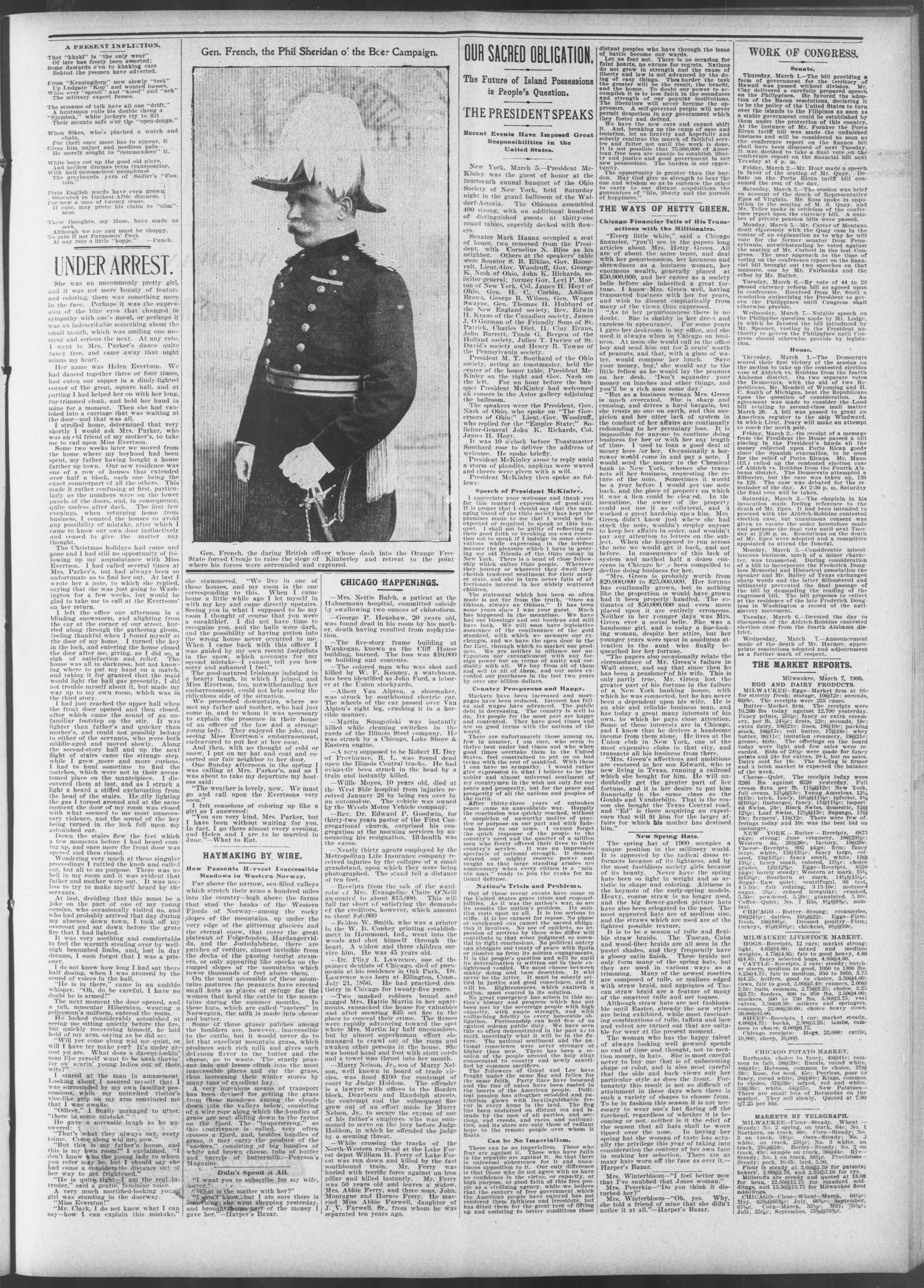
Gen. French, the Phil Sheridan of the Beer Campaign.
1914
Gen. French, the daring British officer whose dash into the Orange Free State forced Cronje to raise the siege of Kimberley and retreat to the point where his forces were surrounded and captured.
she stammered. "We live in one of these houses, and my room is the one corresponding to this. When I came home a little while ago I let myself in with my key and came directly upstairs. Seeing you in what I supposed to be my room I thought of course that you were a sneakthief. I did not have time to recognize you, and the halls were dark, and the possibility of having gotten into the wrong house never occurred to me. When I came back with this officer I was guided by my own recent footprints in the snow, which accounts for my second mistake—I cannot tell you how sorry and ashamed I feel."
CHICAGO HAPPENINGS.
—Mrs. Nettie Balch, a patient at the Hahnemann hospital, committed suicide by swallowing two ounces of chloroform.
—George P. Henshaw, 20 years old was found dead in his room by his mother, death having resulted from asphyxiation.
—The five-story frame building at Waukegan, known as the Cliff House building, burned. The loss was $10,000 on building and contents.
—The colored man who was shot and
The good-natured Irishman indulged in a hearty laugh, in which I joined, and Miss Evertson, too, notwithstanding her embarrassment, could not help seeing the ridiculous side of the situation.
We proceeded downstairs, where we met my father and mother, who had just come in, and to whom it was necessary to explain the presence in their house of an officer of the law and a strange young lady. They enjoyed the joke, and seeing Miss Evertson's embarrassment, endeavored to put her at her ease.
And then, with no thought of cold or snow, I put on my hat and coat and escorted our fair neighbor to her door.
One Sunday afternoon in the spring I was calling at Mrs. Parker's, and as I was about to take my departure my hostess said:
"The weather is lovely, now. We must go and call upon the Evertsons very soon."
I felt conscious of coloring up like a girl as I answered:
"You are very kind, Mrs. Parker, but I have been without waiting for you. In fact, I go there almost every evening, and Helen and I are to be married in June."—What to Eat.
HAYMAKING BY WIRE.
How Peasants Harvest Inaccessible Meadows in Western Norway.
Far above the narrow, sea-filled valleys which stretch their arms a hundred miles into the country-high above the farms that stud the banks of the Western Fjords of Norway--among the rocky slopes of the mountains, up under the very edge of the glittering glaciers and the eternal snow, that cover the great plateaux of Folgefonden, Hardangervidda, and the Jostedalsbrae, there are patches of verdure, almost invisible from the decks of the passing tourist steamers, or only appearing like specks on the rugged slopes of the mountains which tower thousands of feet above them.
On the most accessible of these mountains pastures the peasants have erected small huts as places of refuge for the women that herd the cattle in the mountains during the summer months. In these huts, which are called "saeters" in Norwegian, the milk is made into cheese and butter.
Some of these grassy patches among the boulders are, however, inaccessible to the cattle, but it would never do to let that excellent mountain grass, which produces such rich milk and gives such delicious flavor to the butter and the cheese, go to waste. The sturdy peasant lads and lasses climb into the most inaccessible places and cut the grass, thus increasing their winter stores by many tons of excellent hay.
A very ingenious means of transport has been devised for getting the grass from these meadows among the clouds down into the valleys below, consisting of a wire rope along which the bundles of grass are sent sliding down to the farms on the fjord. The "lauparstreng," as this contrivance is called, very often crosses a fjord, and, besides bundles of grass, it may carry the produce of the "saeters," consisting of big bundles of white and brown cheese, tubs of butter and barrels of buttermilk.—Pearson's Magazine.
Didn't Spend it All.
"I want you to subscribe for my wife, doctor."
"What is the matter with her?"
"I don't know; but I am sure there is something; she went shopping yesterday, and brought home part of the money I gave her."—Harper's Bazar.
CHICAGO HAPPENINGS.
—Mrs. Nettie Balch, a patient at the Hahnemann hospital, committed suicide by swallowing two ounces of chloroform.
—George P. Henshaw, 20 years old, was found dead in his room by his mother, death having resulted from asphyxiation.
—The five-story frame building at Waukegan, known as the Cliff House building, burned. The loss was $10,000 on building and contents.
—The colored man who was shot and killed by W. F. Kenney, a watchman, has been identified as John Ford, a laborer at the Union stockyards.
—Albert Van Alpten, a shoemaker, was struck by southbound electric car. The wheels of the car passed over Van Alpten's right leg, crushing it in a horrible manner.
--Martin Smogoriski was instantly killed while cleaning switches in the yards of the Illinois Steel company. He was struck by a Chicago, Lake Shore & Eastern engine.
--A man supposed to be Robert H. Day of Providence, R. L., was found dead upon the Illinois Central tracks. He had evidently been struck in the head by a train and instantly killed.
--Willie Moyes, 10 years old, died at the West Side hospital from injuries received January 26 by being run over by an automobile. The vehicle was owned by the Weods Motor Vehicle company.
--Rev. Dr. Edward P. Goodwin, for thirty-two years pastor of the First Congregational church, surprised his congregation at the morning services by announcing his resignation. Ill-health was the cause.
--Nearly thirty agents employed by the Metropolitan Life Insurance company received injuries by the collapse of a small grandstand, upon which they were being photographed. The stand fell a distance of ten feet.
--Receipts from the sale of the wardrobe of Mrs. Evangeline Claire O'Neill amounted to about $15,000. This will fall far short of satisfying the demands of the creditors, however, which amount to about $40,000
--Seldon W. Smith, who was a printer in the W. B. Conkey printing establishment in Hammond, Ind., went into the woods and shot himself through the heart. A widow and three children survive him. He was 45 years old.
—Dr. Pliny I. Lawrence, one of the pioneer dentists of Chicago, died of pneumonia at his residence in Oak Park. Dr. Lawrence was born at Ellington, Conn., July 21, 1856. He had practiced dentistry in Chicago for twenty-five years.
—Two masked robbers bound and gagged Mrs. Hattie Martin in her apartments, ransacked the house for valuables and after securing $35 set fire to the place to conceal their crime. The flames were rapidly advancing toward the spot where Mrs. Martin lay half unconscious, but by almost superhuman effort she managed to crawl out of the room and awaken other persons in the house. She was bound hand and foot with stout cords and a towel was thrust into her mouth.
Murry Nelson, Jr., son of Murry Nelson, well known in board of trade circles, was fined $100 for contempt of court by Judge Holdom. The offender is a lawyer with offices in the Borden block, Dearborn and Randolph streets. the contempt and the subsequent fine grew out of an effort made by Murry Nelson, Jr., to secure the excuse of one of his father's employees who was summoned to serve on the jury before Judge Holdom, in which he offended the judge by a seeming threat.
While crossing the tracks of the North-Western railroad at the Lake Forest depot William H. Ferry of Lake Forest was run down and killed by the fast southbound train. Mr. Ferry was hurled with terrific force against an iron pillar and killed instantly. Mr. Ferry was 50 years old and leaves a widow, Mrs. Abbie Ferry, and three sons, John, Montague and Horace Ferry. He married Miss Abbie Farwell, daughter of J. V. Farwell, Sr., from whom he was separated ten years ago.
OUR SACRED OBLIGATION.
The Future of Island Possessions is People's Question.
THE PRESIDENT SPEAKS
New York, March 5.—President McKinley was the guest of honor at the fourteenth annual banquet of the Ohio Society of New York, held Saturday night in the grand ballroom of the Waldorf-Astoria. The Ohioans assembled 400 strong, with an additional hundred of distinguished guests at thirty-one round tables, superbly decked with flowers.
Senator Mark Hanna occupied a seat of honor, two removed from the President, with Cornelius N. Bliss as his neighbor. Others at the speakers' table were Senator S. B. Elkins, Gov. Roosevelt, Lieut.-Gov. Woodruff, Gov. George K. Nash of Ohio, John K. Richards, solicitor-general; former Gov. Levi P. Morton of New York, Col. James H. Hoyt of Ohio, Gen. H. C. Corbin, Addison Brown, George B. Wilson, Gen. Wager Swayne, Gen. Thomas H. Hubbard of the New England society, Rev. Edwin H. Kraus of the Canadian society, James J. O'Gorman of the Friendly Sons of St. Patrick, Charles Diet, H. Clay Evans, John Barrett, Tunis G. Bergen of the Holland society, Julien T. Davies of St. David's society and Henry R. Towns of the Pennsylvania society.
President M. T. Southard of the Ohio society, acting as toastmaster, held the center of the honor table, President McKinley on the right and Gov. Nash on the left. For an hour before the banquet President McKinley had welcomed all comers in the Astor gallery adjoining the ballroom.
The speakers were the President, Gov. Nash of Ohio, who spoke on "The Governors of Ohio;" Lieut.-Gov. Woodruff, who replied for the "Empire State;" Solicitor-General John K. Richards, Col. James H. Hoyt.
It was 10 o'clock before Toastmaster Southard rose to deliver the address of welcome. He spoke briefly.
President McKinley arose to reply amid a storm of plaudits, napkins were waved and cheers were given with a will.
President McKinley then spoke as follows:
Speech of President McKinley.
I appreciate your welcome and thank you for this renewed expression of good-will. It is proper that I should say that the managing board of the Ohio society has kept the promises made to me that I would not be expected or required to speak at this banquet. I shall not be guilty of reflecting on their good faith or breaking my own resolution not to speak if I indulge in some observations while expressing in the briefest manner the pleasure which I have in greeting my old friends of the Ohio colony in New York. There is a bond of close fellowship which unites Ohio people. Wherever they journey or wherever they dwell they cherish tenderest sentiment for their mother state, and she in turn never falls of affectionate interest in her widely scattered children.
The statement which has been so often made is not far from the truth, "Once an Ohioan, always an Ohioan." It has been some years since I was your guest. Much has happened in the meantime. We have had our blessings and our burdens and still have both. We will soon have legislative assurance of the continuance of the gold standard, with which we measure our exchanges, and we have the open door in the far East, through which to market our products. We are neither in alliance nor antagonism nor entanglement with any foreign power but on terms of amity and cordiality with all. We buy from all of them and sell to all of them, and our sales exceeded our purchases in the last two years by over one billion dollars.
Country Prosperous and Happy.
Markets have been increased and mortgages have been reduced. Interest has fallen and wages have advanced. The public debt is decreasing. The country is well to do. Its people for the most part are happy and contented. They have good times and are on good terms with the nations of the world.
There are unfortunately those among us, few in number, I am sure, who seem to thrive best under bad times and who when good times overtake them in the United States, feel constrained to put us on bad terms with the rest of mankind. With them I can have no sympathy. I would rather give expression to what I believe to be the nobler and almost universal sentiment of my countrymen in the wish not only for our peace and prosperity, but for the peace and prosperity of all the nations and peoples of the earth.
After thirty-three years of unbroken peace came an unavoidable war. Happily the conclusion was quickly reached, without a suspicion of unworthy motive of practice or purpose on our part and with fadeless honor to our arms. I cannot forget the quick response of the people to the country's need and the quarter of a million men who freely offered their lives to their country's service. It was an impressive spectacle of national strength. It demonstrated our mighty reserve power and taught us that large standing armies are unnecessary when every citizen is a "minute man." ready to join the ranks for national defense.
Nation's Trials and Problems.
Out of these recent events have come to the United States grave trials and responsibilities. As it was the nation's war, so are its results the nation's problem. Its solution rests upon us all. It is too serious to stifle. It is too earnest for repose. No phase or catchword can cancel the sacred obligation it involves. No use of epithets, no asperation of motives by those who differ will contribute to that sober judgment so essential to right conclusions. No political outcry can abrogate our treaty of peace with Spain or absolve us from its solemn engagements. It is the people's question and will be until its determination is written out in their enlightened verdict. We must choose between manly doing and base desertion. It will never be the latter. It must be soberly settled in justice and good conscience, and it will be. Righteousness, which exalteth a nation, must control in its solution.
No great emergency has arisen in this nation's history and progress which has not been met by the sovereign people with high capacity, with ample strength, and with unfinishing fidelity to every honorable obligation. Partisanship can hold few of us against solemn public duty. We have seen this so often demonstrated in the past as to mark unerringly what it will be in the future. The national sentiment and the national conscience were never stronger or higher than now. There has been a reunion of the people around the holy altar consecrated to country and newly sanctified by common sacrifices.
The followers of Grant and Lee have fought under the same flag and fallen for the same faith. Party lines have loosened and the ties of union have been rooted in the hearts of the American people. Political passion has altogether subsided and patriotism glows with inextingishable fervor in every home in the land. The flag has been sustained on distant sea and islands by the men of all parties, and sections, and creeds, and races, and nationalities, and its stars are only those of radiant hope to the remote people over whom it floats.
Can be No Imperialism.
There can be no imperialism. Those who fear are against it. Those who have faith in the republic are against it. So that there is universal abhorrence for it and unanimous opposition to it. Our only difference is that those who do not agree with us have no confidence in the virtue, or capacity, or high purpose, or good faith of this free people as a civilizing agency, while we believe that the century of free government which the American people have enjoyed has not rendered them faithless and irresolute, but has fitted them for the great task of lifting up and assisting to better conditions those
distant peoples who have through the issue of battle become our wards.
or battle become our wards.
Let us fear not. There is no occasion for falnt hearts, no excuse for regrets. Nations do not grow in strength and the cause of liberty and law is not advanced by the doing of easy things. The harder the task the greater will be the result, the benefit, and the honor. To doubt our power to accomplish it is to lose faith in the soundness and strength of our popular institutions. The liberators will never become the oppressors. A self-governed people will never permit despotism in any government which they foster and defend.
We have the new care and cannot shift it. And, breaking up the camp of ease and isolation, let us bravely and hopefully and soberly continue the march of faithful service and falter not until the work is done. It is not possible that 75,000,000 of American free men are unable to establish liberty and justice and good government in our new possessions. The burden is our opportunity.
The opportunity is greater than the burden. May God give us strength to bear the one and wisdom so as to embrace the other to carry to our distant acquisitions the guarantees of "life, liberty and the pursuit of happiness."
THE WAYS OF HETTY GREEN.
Chicago Financier Tells of His Transactions with the Millionaire.
"Every little while," said a Chicago financier, "you'll see in the papers long articles about Mrs. Hetty Green. All are of about the same tenor, and deal with her penuriousness, her keenness and shrewdness as a business woman, her enormous wealth, generally placed at $50,000,000, and her career as a society belle before she inherited a great fortune. I know Mrs. Green well, having transacted business with her for years, and wish to dissent emphatically from many of the views thus expressed.
"As to her penuriousness there is no doubt. She is shabby in her dress and careless in appearance. For some years I gave her deskroom in my office, and she used it always when in Chicago on business. At noon she would call in the office boy and send him out for 5 cents' worth of peanuts, and that, with a glass of water, would compose her lunch. 'Save your money, boy,' she would say to the little fellow as he would lay the peanuts on her desk. 'Don't squander your money on lunches and other things, and you'll be a rich man some day.'
"But as a business woman Mrs. Green is much overrated. She is sharp and cunning, and drives a hard bargain, but she trusts no one on earth, and this suspicion and her utter lack of system in the conduct of her affairs are continually redounding to her pecuniary loss. It is impossible for anyone to continue doing business for her or with her any length of time. I used to loan a good deal of money here for her. Occasionally a borrower would come in and pay a note. I would send the money to the Chemical bank in New York, whence she transacts all her business, requesting the return of the note. Sometimes it would be a year before I would get the note back, and the piece of property on which it was a lien could be cleared. In the meantime, the owner of the property could not use it as collateral, and it worked a great hardship upon a him. Mrs. Green didn't know just where she had stuck the note, wouldn't employ anyone to keep her affairs in order, and wouldn't pay any attention to letters on the subject. When she happened to run across the note we would get it back, and not before. In consequence of this lack of system and method half a dozen concerns in Chicago have been compelled to decline doing business for her.
"Mrs. Green is probably worth from $20,000,000 to $25,000,000. Her fortune has continually grown, but in nothing like the proportion is would have grown had it been properly handled. The estimates of $50,000,000 and even more placed upon it are entirely erroneous. Neither in her younger days was Mrs. Green ever a social belle. She was a handsome girl, and is today a fine-looking woman, despite her attire, but her younger years were spent in assiduous attention to the aunt who finally bequeathed her her fortune.
"The papers also occasionally relate the circumstance of Mr. Green's failure in Wall street, and say that since then he has been a pensioner of his wife. This is only partly true. Mr. Green lost the greater part of his fortune in the failure of a New York banking house, with which he was connected, but he has never been a dependent upon his wife. He is an able and reliable business man, and has today a great many interests of his own, to which he pays close attention. Some of these interests are in Chicago, and I know that he derives a handsome income from them alone. He lives at the Union club in New York, one of the most expensive clubs in that city, and transacts all his business from there.
"Mrs. Green's affections and ambitions are centered in her son Edward, who is new living in Texas, running a railroad which she bought for him. He will undoubtedly get the greater part of her fortune, and it is her desire to put him financially in the same class as the Goulds and Vanderbilts. That is the reason she bought the Texas Central road, and "Ed" is there acquiring an experience that will fit him for the larger affairs for which his mother has destined him."
New Spring Hats.
The spring hat of 1900 occupies a unique position in the millinery world. It is approved by the radical dress reformers because of its lightness, and by the most fastidious society girls because of its beauty. Never have the spring hats been so light in weight and so artistic in shape and coloring. Airiness is the keynote of the early-spring models. Heavy, coarse straw is no longer used, and the big flower-garden picture hats have also been relegated to the past. The most approved hats are of medium size, and the straws which are used are of the lightest possible texture.
It is to be a season of tulle and flexible straw braids. The Tuscan, Cuba and wood-fiber braids are all seen in the pastel shades, and they frequently have a glossy satin finish. These braids not only form many of the spring hats, but they are used in various ways as a trimming. Many of the newest rosettes are composed of tulle, or malines edged with straw braid, and appiques of Tuscan straw braid are a feature of many of the smartest tulle and net toques. Although straw hats are not fashionable until Easter, already the new styles are being exhibited, while most fascinating combinations of tulle, taffeta and lace and velvet are turned out that are suitable for wear at the present moment.
The woman who has the happy talent of always looking well gowned spends no end of time and thought, not to mention money, in hats. She is most careful never to buy one that is of unbecoming shape or color, and is also most careful that the side and back views suit her particular style as does the front. Fortunately this result is not so difficult of attainment in these days when there is such a variety of shapes to choose from. To be in fashion this season it is not necessary to wear one's hat flaring off the forehead, regardless of whether it is becoming or not, neither is it the edict of the season that all hats shall be worn tipped over the nose. In buying her spring hat the woman of taste has actually the privilege this year of taking into consideration the contour of her own face in making her selection. There are as many hats worn off the face as over it.—Harper's Bazar.
Mrs. Winterbloom—"I feel better now that I've snubbed that Jones woman." Mrs. Peterkin—"Do you think it disturbed her?" Mrs. Winterbloom—"Oh. yes. Why, she told a friend of mine that she didn't notice it at all."—Harper's Bazar.
WORK OF CONGRESS.
Thursday, March 1.—The bill providing a form of government for the territory of Hawaii was passed without division. Mr. Clay delivered a carefully prepared speech on the Philippines. He favored the adoption of the Bacon resolutions, declaring it to be the policy of the United States to turn over the islands to the Filipinos as soon as a stable government could be established by them under the protection of this country. At the instance of Mr. Foraker the Porto Rican tariff bill was made the unfinished business and will be considered as soon as the conference report on the finance bill shall have been disposed of next Tuesday. It was decided to take a final vote on the conference report on the financial bill next Tuesday at 4 p. m.
Friday, March 2.—Mr. Hoar made a speech in favor of the seating of Mr. Quay. Debate on the Porto Rican tariff bill consumed the rest of the day.
Saturday, March 3.—The session was brief on account of the death of Representative Epes of Virginia. Mr. Ross spoke in opposition to the seating of M. S. Quay, and Mr. Teller spoke in criticism of the conference report upon the currency bill. A number of private pension bills were passed.
Monday, March 5.—Mr. Carter of Montana dealt vigorously with the Quay case in the course of an explanation as to why he will vote for the former senator from Pennsylvania, notwithstanding he voted against the seating of Mr. Corbett in the last Congress. The near approach to the time of voting on the conference report on the financial bill brought out two speeches on that measure, one by Mr. Fairbanks and the other by Mr. Butler.
Tuesday, March 6.—By vote of 44 to 25 passed currency reform bill as agreed upon in conference. Received from Mr. Scott a resolution authorizing the President to govern the Philippines until Congress shall otherwise provide.
Wednesday, March 7.—Notable speech on the Philippine question made by Mr. Lodge, in which he favored the bill introduced by Mr. Spooner, vesting in the President authority to govern the Philippines until Congress should otherwise provide by legislation.
House.
Thursday. March 1.—The Democrats scored their first victory of the session on the motion to take up the contested election case of Aldrich vs. Robbins from the fourth Alabama district. On two separate votes the Democrats, with the aid of two Republicans, Mr. Mondell of Wyoming and H. C. Smith of Michigan, beat the Republicans upon the question of consideration. An agreement was made to consider the Loud bill relating to second-class mail matter March 20. A bill was passed to grant an American register to the ship Windward, in which Lieut. Peary will make an attempt to reach the north pole.
Friday, March 2.--On receipt of a message from the President the House passed a bill placing in the President's hands all the money collected upon Porto Rican goods since the Spanish evacuation, to be used for the relief of Porto Rican. Mr. Mann (Ill.) called up the contested election case of Aldrich vs. Robbins from the Fourth Alabama district. The Democrats attempted a filibuster, but the case was taken up, 136 to 129. The case was debated for the remainder of the day. At 2:30 p. m. Saturday the final vote will be taken.
Saturday, March 3.--The chaplain in his invocation made feeling reference to the death of Mr. Epes. It had been intended to proceed with the Aldrich-Robbins contested election case, but unanimous consent was given to vacate the order heretofore made and postpone the final vote until next Tuesday at 2:30 p. m. Resolutions on the death of Mr. Epes were adopted and a committee appointed to attend the funeral.
Monday, March 5.—Considerable miscellaneous business, much of a minor character, was transacted. During consideration of a bill to incorporate the Frederick Douglass Memorial and Historical association the speaker and Mr. Bailey of Texas exchanged sharp words and the latter fillbustered and ultimately prevented the final passage of the bill by demanding the reading of the engrossed bill. The bill proposes to collect at the residence of the late Frederick Douglass in Washington a record of the anti-slavery movement.
Tuesday, March 6.—Devoted the day to discussion of the Aldrich-Robbins contested election case from the fourth Alabama district.
Wednesday, March 7.—Announcement made of the death of Mr. Harmer, appropriate resolutions adopted and adjournment as a further mark of respect.
THE MARKET REPORTS.
Milwaukee, March 7, 1900.
EGG AND DAIRY PRODUCTS.
MILWAUKEE—Eggs—Market firm at 16c for strictly fresh; storage, 10@12c; seconds, 6@8c. The receipts were 255 cases.
Butter—Market firm. The receipts were 16,260 lbs today against 12,700 yesterday.
Fancy prints, 25%c; fancy or extra creamery, per lb, 24%c; firsts, 22c; seconds, 19c; extra dairy, 19@21c; lines, 18@19c; packing stock, 16@17c; roll butter, 17@18c; whey butter, 9@11c; imitation creamery, 19@21c; grease, 4@6c. The offerings on the board today were light and few sales were recorded. Bids of 24%c were made for fancy prints and 24c for extras, 10-1, but no sales. Dairy sold for 18c. The feeling is firmer and a brisk market is expected the balance of the week.
Cheese—Quiet. The receipts today were 3268 Ibs against 6520 yesterday. Full cream flats, per lb. 11½¼@12c; New York, full cream, 12½¼@13c; Young Americas, 12½¼@13c; brick, fancy, 10½¼@11½c; inferior, 9½¼@10½c; limburger, fancy, 11@11½c; imported Swiss, 24c; Block Swiss, domestic, 12@12½c; Loaf Swiss, 12½¼@13c; Sapsago, 17@19c; farmers', 11@12c. There were few offerings today and 10c was the best bid on limburger.
NEW YORK — Butter — Receipts, 6875
pkgs; strong; June creamery, 18% 123%c;
Western do, 20% 28c; factory, 19% 20c.
Cheese—Receipts, 602 pkgs; firm; fancy
large, white, 13% 134%c; fancy large, colored, 13% 134%c; fancy small, white, 13% 134%c; fancy small, colored, 13% 134%c; choice
grades, 12% 123%c. Eggs—Receipts, 8520
pkgs; barely steady; Western at mark, 15% 154%c; Southern at mark, 14% 154%c;
Sugar—Raw quiet; centrifugal, 96 test, 4 5-16c; fair refining, 3 13-16c; molasses
sugar, 3%c; refined irregular; crushed, 5.50c; powdered, 5.20c; granulated, 5.10c.
Coffee—Quilet; No. 7 Rio, 8% 84%c, nominal.
CHICAGO — Butter—Strong; creameries,
19% 241%c; dairyes, 16% 222c. Eggs—Firm;
fresh, 16% 161%c. Dressed poultry—Firm;
turkeys, 8% 141%c; chickens, 9% 141%c.
MILWAUKEE LIVESTOCK MARKET
HOGS—Receipts, 12 cars; market strong; light, 4.65@4.80; mixed and medium weights, 4.75@4.85; fair to good heavy, 4.80@4.85; fancy selected hogs, 4.85@4.90.
CATTLE—Receipts, 2 cars; steady; butcher steers, medium to good, 1050 to 1300 lbs, 4.25@4.75; fair to medium, 950 to 1050, 3.75@4.25; helfers, good to choice, 3.50@4.00; cows, fair to good, 3.00@3.40; canners, 2.00@2.50; bulls, common, 2.75@3.25; choice, 3.25@3.75; feeders, 800 to 950 lbs, 3.50@4.00; stockers, 500 to 750 lbs, 3.50@3.75; veal calves, 5.50@6.50; milkers and springers, common, 22.00@30.00; choice heavy cows, 38.00@45.00.
SHEEP-Receipts, 1 car; market steady,
4.00@4.75; bucks, 2.50@3.25; lambs, common
to choice, 6.00@6.75.
Chicago receipts: Hogs, 23,000; cattle,
10,000; sheep, 10,000.
CHICAGO POTATO MARKET
Burbanks, choice to fancy, 40@41c; common to fair, 38@39c; Rurals, round white, 40@41c; Hebrons, common to choice, 37@39c; Rose, for seed, 45c; Peerless, poor to fancy, round white, 38@40c; Kings, common to choice, 37@39c; mixed, red and white, 33@36c; white, 34@37c. New Potatoes—There are small lots of Bermudas on the market. They sell slowly. Quoted at 7.00 @7.25 per bbl.
MARKETS BY TELEGRAPH.
MILWAUKEE—Flour—Steady. Wheat — Steady; No. 2 spring, on track, 64c; No. 1 Northern, on track, 66c. Corn—Steady; No. 3 on track, 34½c. Oats—Steady; No. 2 white, on track, 25½c; No. 3 white, on track, 22½@24c. Barley—Steady; No. 2 on track, 43c; sample on track, 36@44c. Rye—Steady; No. 1 on track, 58½c. Provisions—pork, 10.65; lard, 5.90.
Flour is steady at 3.60@3.70 for patents; bakers', 2.60@2.70, and 2.95@3.10 for rye. Millstuffs are steady and quoted at 13.00 for bran, 12.50@12.75 for standard middlings, and 13.50@13.75 for Milwaukee flour middlings.
CHICAGO—Close—Wheat—March, 64½c; May, 65½@65½c; July, 66½c; September, 67½c. Corn—March, 33½c; May, 35½c; July, 35½c; September, 35½@35½c.
The Wisconsin Weekly Advocate
Richard B. Montgomery
.....Editor and Proprietor
Miss E. D. Holsey.....City Editoress
Office 200 Fifth Street.
Telephone Black No. 244.
postage paid.
One Year ..... $2.00
Six Months ..... 1.25
Three Months ..... .75
Send money by Express Money Order, P. O.
Money Order or Registered Letter to the
Wisconsin Weekly Advocate.
One inch, single insertion ..... 25c
One inch, per year ..... $9.00
Business locals 5c per line each insertion.
Apply for rates to the Advocate.
TO CONTRIBUTORS:
All communications must be sent with the name and address of the sender as an evidence of good faith, but not necessarily for publication. No manuscript returned if not accepted, unless accompanied by stamps.
All subscribers of the Advocate that fall to get their paper promptly will please notify us at once. The Advocate, at 200 Fifth street.
The Wisconsin Weekly Advocate company wishes to notify the public that all contracts and business transactions with this company must have the company stamp, otherwise they will be void. Neither will this company be responsible for paid subscriptions unless given to duly-accredited agents, who, on request, will give the company's receipt for same. Subscribers falling to receive their papers regularly will kindly notify the general office. Address all business communications to the general manager, 200 Fifth street.
Entered at the Milwaukee P. O. as second-class matter.
Even the disclosure that the New York yellow press is the instigator of the legal proceedings against Miss Nethersole fails to impart moral elevation to her morbidly indecent play.
A detective has filed a claim of $5881.55 for services rendered and money advanced in shadowing the jury which convicted Roland B. Molineux. The most charitable supposition is that the prosecution wanted to protect the jury from bromo-seltzer conspiracies.
The excitement in India over the arrival of a Russian warship in the Persian gulf is a little premature; but after a while there will be no excitement whatever when the Russian navy sends a ship into the gulf. Russia is soon to have something to say in that particular section.
The man who can invent a folding bed that can be carried as a campaign cane, with a flag on it, will confer a blessing on the delegates who are chosen for the Kansas City convention, and circumvent the hotelkeepers who are now engaged in hoisting prices of rooms with the tackle of an imagined tremendous demand for the first week in July.
England is spending money in great chunks, every day, to carry on the South African war, but the naval estimate for 1900-1901 indicates that she has no intention of overlooking the requirements of her navy, even temporarily. She doesn't need a navy to meet Oom Paul, but there are those looking on who may need to be admonished against rash ventures.
It may not be generally known that there are many Jewish soldiers in the Russian army. A short time ago the Jewish soldiers of the One Hundred and Fourteenth Nowotshok infantry regiment, stationed in Mitau, celebrated a rare occurrence in beginning the writing of a "regimental" Sepher Torah, at a cost of 200 roubles, subscribed among themselves. The chief of the regiment, Col. Prilukow, gave the Jewish soldiers a special holiday. At the ceremony in the synagogue, to which the whole of the Jewish community had been invited, a choir, consisting of the soldiers, sang the national anthem in Russian.
American engineers are admittedly the best in the world on electric power and railway equipment, ranking quite as high abroad as our locomotive builders. As an instance of this appreciation the Electrical World mentions three recent inquiries from abroad for work of this kind, which are interesting, as coming from such widely-separated points on the globe. The first is an electric-power plant at Cuantla, Mexico; the second an electric-power station at Rio de Janeiro, Brazil, and the third an electric railroad from Salonica to Langaza, Turkey, on all of which American companies have been asked for bids.
On Washington's birthday the Empire State society of the United States Daughters of 1812 placed a brass tablet on the northeast corner of Fayerweather hall, Columbia university, New York. It bore this inscription in three-quarter relief: "To commemorate New York City Defenses During the War 1812. Barrier Gate—McGown's Pass, Barrier Gate, Manhattanville, Forts Clinton, Fish and Haight, and Three Stone Towers. Also, in Honor of Maj.-Gen. Garret Hopper Striker (then captain), Fifth Regiment, Second Brigade. Erected by U. S. Daughters 1812, Empire State Society, February 22, 1900." The insignia of the society—the star and anchor—are shown at the bottom of the tablet.
According to the San Francisco correspondent of the Tribune, the women of the California clubs have made a good fight for the preservation of the Calaveras big trees, and the telegrams which they sent to Washington and the feeling that they aroused there will probably end in saving the big tree grove from the hands of lumbermen. It is doubtful whether these giant trees would pay in lumber for the trouble and expense of handling them, as their girth is so great that special apparatus would have to be devised for felling them. The neighboring forest, however, is full of superb sugar pines, which it will be a crime to cut for timber, as there are so few of these stately trees left on the slopes of the Sierras.
One of the park boards of Chicago has received an interesting gift in the form of the cyclorama of the burning of the city in 1871. This great painting, which
THE OFFICE OF THE WISCONSIN
WEEKLY ADVOCATE CO
WELCOME
KRUS. MILL
Home Office of the Help and Hand Society And the Wisconsin Weekly Advocate.
is regarded as the finest of its kind in the world, has been given to the public by Howard H. Gross, the only condition being that the board spend at least $35,000 for a suitable building and that it be open to the public free of charge at all times. The painting cost $90,000 and was made by a number of artists, the best known of whom were Salvador Mege of Paris and Edward James Austen of London. These two men created the fire effects, the tones and values of the sky, lake and ruins, and laid out the city, locating and sketching the streets, ruins and points of historic interest.
With the completion of the reorganization of the National guard of Pennsylvania, it is claimed that state will have the most compact, best equipped and best drilled division of citizen soldiers this country has ever known. About 9000 men will assemble at the division encampment next summer in three brigades, each of four uniform regiments, having the new three battalion formation, with at least three well-equipped batteries and four troops of cavalry. While neither the time nor place of the proposed encampment has been officially designated, it will probably be held late in July, at Lewiston. Military experts are looking forward to the first encampment of the new guard with great interest. The last encampment was at Mt. Gretna, two years ago, when what was then the finest division of militia in the United States was practically wiped out of existence and scattered through the volunteer army organized for the Spanish war.
It is an important fact that the great advance in the price of Alaska skins from which fur garments are made is not due to a scarcity of animals, but largely to the new kind of work that has come to the Indians through the opening of the country by miners. Before the advent of civilization, the Indians were obliged to hunt fur-bearing animals for a livelihood. The skins were traded to the fur companies for various articles of subsistence. "The settling up of the country," says one of the leading fur men of San Francisco, "has furnished work of many kinds for the Indian, for which he is paid in cash. At first he hardly knew what a regular pay-day meant, but he is well informed now. He is civilized, so to speak. The Indian carries the money and instead of dealing with one trading company, as he has been in the habit of doing, he goes from place to place, buying what he wants for cash. So it is that his fur business is being neglected and the best furs are growing scarcer in our market."
The water board of Marquette has resorted to an ingenious device, designed by Charles Retallic, superintendent of the municipal light plant, for the purpose of preventing the formation of anchor ice at the intake pipe of the water-supply system. It is simply a modification of the electric stove used to heat street cars, which depends upon resistance to the electric current for warmth. The new stove consists of two hollow metal cylinders of 19 inches and 20 inches diameter respectively. On the outside of the smaller cylinder are ten layers of asbestos
paper and around it is wrapped a continuous spiral of No. 18 iron wire. A half inch air space is left between the inner cylinder and its coverings and the outer cylinder. Flanges at the top and bottom of the cylinders make it possible by the use of solder to have the space between the two water tight. The stove, which is five feet long, is then slipped into the intake pipe, which is two feet in diameter, until its top is even with the top of the pipe. Electricity is conducted to the stove from a light wire on the shore. The entire cost of the apparatus was $25, which is somewhat less than the estimated expense of $100,000 required to secure a new location for the intake pipe that the city would have to stand in order to avoid future trouble with anchor ice.
If the plans prepared by a committee of American architects and sculptors for a memorial of the bicentenary of Detroit are fully carried out, that city may not regret the loss of an exposition. The plans contemplate the construction of a white marble colonnade across the lower end of Belle Isle park, with a Doric column of marble rising 200 feet above the river at a point 300 feet from the shore, or colonnade. This column will stand on a base 100 feet square and will be 25 feet in diameter at the base. It will be surmounted by the classic tripod, from which will leap natural-gas flames that will be visible at night for miles down the river, on the one hand, and from the St. Clair river on the other. The column will be 25 feet in diameter at the base and will contain a spiral stairway. At a radial distance of 200 feet the column will be surrounded by various groups of statuary rising from the river. The colonnade across the end of the island will be 900 feet long and at its ends wings 300 feet long will be turned at right angles down the river. The center of the colonnade will be interrupted for 200 feet so that a view in to the park can be had. The memorial is to signify the gateway to the Northwest which Detroit has formed. The committee of artists who designed it consisted of Stanford White, Augustus St. Gaudens, Fred McMonnies, T. W. Dewing and D. W. Tryon. The cost of the structure is placed at $1,000,000.
English as She is Spoke.
The Parish church of Cambridge, Mass., is perplexed over the plans for the new building. A vote was taken lately, and the question was in substance: "Do you wish a Gothic church or a meeting house?" We hear that Gothic was preferred, adds the Talk-of-the-Day man in the Boston Journal. "But what has a Unitarian church, especially in Cambridge, to do with Gothic?" he asks irreverently. "The vote recalled the question asked by the young woman from Chicago when she visited friends on Marlborough street: 'After all, which order of architecture do you prefer, the pointed ironic or the open cathartic?'"
Known in Ancient Rome.
British oysters were very famous in ancient Rome. They are mentioned in Juvenal in one of his satires (100 A. D.). Lord Lytton, in "The Last Days of Pompeii," introduces a reference, and causes Diomed, when preparing a great feast, to be apprehensive lest the oysters from Britain do not turn up at the proper time.—Newcastle (England) Chronicle
IN GAY NEW YORK.
When Mabel doth prepare herself
Some ballroom gay to grace
She thinks she needs a touch of rouge,
And so makes up her face.
But oh, the mercenary wretch!
When she makes up her mind
A different color she requires,
And long green is the kind.
—McLandburg Wilson in Judge.
Daniel Frohman has decided to postpone the proposed spring appearance of Mr. and Mrs. E. H. Sothern in "Hamlet" until next September. The reason given is Mr. Sothern's health. His tour, which has been interrupted for ten days by his illness, was resumed last night in Baltimore.
At a meeting of the executive committee of the citizens' committee for perpetuating the naval arch monument Howard Gould was one of four persons to subscribe $25,000 each. Mr. Gould stated that he would pay this amount on December 31, 1900, provided the subscriptions amounted to $400,000. The committee has a pledge from another man that he will give as much as any other subscriber.
The little daughter of Mr. and Mrs. Clarence Mackay has been christened Katherine Duer Mackay—her mother's name. The little baby is the delight of Mrs. Mackay, who is so domestic that it is doubtful whether she will enter into social gayeties for some time to come. The Mackays are going to the castle in Scotland that they have leased and they will bury themselves there during the summer, the baby taking all of Mrs. Mackay's attention. Long letters about babies have been exchanged between Mrs. Mackay and the Duchess of Marlborough, who is also a devoted mother.
In so many of the wardrobes that are being packed up for journeys to the tropics are ruffled and shirred hats of muslin, lawn and batiste. They look like huge flowers and are the most becoming things a woman can wear. They are in all colors and in white and black. They merely consist of a crown shirred on featherbones, with brims made of three or four plissed ruffles of the muslin or gauze. They fall gracefully over the forehead and are very youthful looking.
Mrs. Langtry has set a fashion. Khaki and things in khaki color are all the rage. The Prince of Wales has ordered a suit made of this material and all the English women of fashion are having their notepaper made in mitiation of khaki. A number of fashionable women who are going South have had khaki coats and skirts made, and Mrs. Stuyvesant Fish and Miss Greta Pomeroy have khaki suits.
Smart women whose social engagements are practically numberless have discarded the ordinary leather-bound book in which to keep their engagements, and have adopted instead the "engagements late." This is a large white slate, with the days of the week in large blue and red letters, with spaces for the various engagements for each day. The slate is mounted on a silver easel, is kept on the desk and is ornamental as well as useful.
—An enormous diamond from Kimberberley will be shown in the jewelry section of the Paris exposition. It was found shortly before the war began, and is said to be finer than the Regent, the Shah, the Grand Mogul or the Koh-i-noor. It has been insured for $2,000,000.
What an Opportunity
---
WE WANT 3000
Throughout the State of Wisconsin.
and by writing us we will furnish all with good places free of charge, and at good wages.
And all those who wish first-class colored help direct from the Southern States we desire to call attention to the many families who are in quest of help of all kinds not to overlook the Help and Hand Mission where we can supply free to all the very best of colored help. The Help and Hand Mission is under the immediate direction of Mr. Richard B. Montgomery, who gives all requiring good help his prompt and personal attention and at the same time places good colored people in first-class homes. The mission is now doing work as testimonials from some of the best people in Milwaukee and elsewhere will truthfully testify and has become a thing that to a large extent self sustaining.
Those calling up Telephone 244 Black, will receive immediate attention. The office of the Mission is now located 209 5th Street, Milwaukee. Wis.
All parties subscribing for the Weekly Advocate will have all their help furnished free. Gen'l Manager—Richard B. Montgomery.
PURE
EXPORT
MISCHLITZ
JUF SCHLITZ BREWING CO.
MILWAUKEE, U.S.A.
THE
BEER
THAT MADE MILWAUKEE FAMOUS.
BRIEF NOTES OF NOTABLES.
It is announced that Kentucky university of Lexington will elect Prof. Edward S. Ames of Butler college as president. He is a graduate of Drake university, a bachelor of divinity from Yale and a doctor of philosophy from the University of Chicago.
Lady Roberts, wife of Gen. Lord Roberts, knows something of the sorrows of war. Her only son lies in a soldier's grave at Colenso, Natal. Her husband, who is at the front actively engaged in directing affairs, is 67 years old. Lord and Lady Roberts have been married forty-one years.
At the woman suffrage convention in Washington the name of a Mrs. Smith was read from the roll as "Mrs. George Smith." Miss Susan B. Anthony arose at once and objected, saying the name was not sufficiently individual and that it ought to be written "Mrs. Jane Smith."
Sir Philip Burne-Jones, Kipling's cousin, relates of that author that when he is absorbed in his subject he writes with great rapidity, and each succeeding line on a page begins a little farther to the right, so that when he gets to the end of a sheet there are but two or three words to a line.
The heads of commonwealths were well represented in one Washington hotel the other day where by an odd coincidence the following had registered one after the other: Gov. Loundsbury of Connecticut; Gov. Voorhees of New Jersey, Gov. Brown of Indiana and ex-Gov. Crawford of Kansas.
Dean Kitchin of Durham cathedral, Eng., has brought down on his head the wrath of the city authorities by refusing to preach or to pray in a warlike manner. They want to discharge him from his post of honorary chaplain to the corporation and to erase his name from the panels in the town hall.
Prof. Rudolph Genee, the critic, historian and orator, who has done so much to popularize Shakespeare in Germany, has just celebrated his seventy-fifth birthday. He began his public recitations of Shakespeare's plays in Coburg about forty years ago, but since 1879 he has been settled in Berlin.
Mrs. G. McCrea, selected as landscape gardener for Lincoln park, is the widow of a successful landscape gardener in Denver. After his death, seven years ago, she began a study of his work, in which she had been interested, and fitted herself to support her two daughters by continuing her husband's profession.
Although Pope Leo. XIII. is a non-agenarian, he is by no means the oldest of the successors to St. Peter. That distinction belongs to Pope Agathon, who reigned from 686 to 688, and died at the age of 107 years. Pope Gregory IX. (1241) was 99 when he died. Celestin III. (1198) 92. Gregory XIII. (1417) 91 and John XXII. (1339) 90.
The election of Paul Deschanel, president of the French Chamber of Deputies, to the French academy to succeed the late Edonard Herve, is considered in France evidence of the degeneration of the academy. His literary accomplishments, it is said, amount to nothing, and his election is called a sign of the times of disturbed political conditions.
—Pastor Albert Beyschlag, one of the most prominent Lutheran preachers in Germany, has arrived in Washington for the purpose of interesting the Protestant clergymen and laymen in a movement to erect a memorial church as a monument to Protestantism at Speyers, a little town on the Rhine, near Worms, where the reformation actually started.
—Col. Baden-Powell is a great admirer of Sir Frederick Carrington, who has just been commissioned a major-general to lead guerrillas in the South African war. He once said of the general: "In a terrible charge against Zulus his horse was shot in the jaw and Carrington extracted the ball with a penknife as deftly and calmly as if he were taking a splinter from his own finger."
—Rev, Samuel P. Dunlap of Maywood, Ill., claims to be the originator of the intercollegiate debate. He brought about what he says was the first of these twenty-seven years ago. This was participated in by two representatives from each of four colleges—Mommouth college, Lombard university, Abington college and Knox college, at the last of which Mr. Dunlap was a student.
—Thomas Eggleston, who died in New York recently, was the planner and founder of the school of mines at the Columbia university, where he was professor emeritus of mineralogy and metallurgy. He was born in New York city in 1832, graduated from Yale in 1854 and from the Ecole des Mines in France in 1860. He was also one of the founders of the American Institute of Mining Engineers.
Only One who Could do It
On one of "Old Hoss" Hoey's trips across the Atlantic, the steamer, moving slowly along in a dense fog at about 3 o'clock in the morning, struck on the rocks off Fastnet, the light not being visible. Fortunately, nothing more than a scare for the passengers resulted. Everybody was soon on deck except Hoey, who had been having a hilarious time the night before and had slept all through the trouble. One of his friends sent a steward for him, and at last he appeared, still a trifle befogged. When the facts were explained to him he joined fervidly in an impromptu praise-service which the passengers were holding. Finally, there came a hull in the proceedings, and "Old Hoss" took advantage of it to propose three cheers and a tiger for the captain. This proposition caused much astonishment, and some one ventured to ask on what grounds he based the proposed honor to the captain. Drawing himself up to his full height, "Old Hoss" replied impressively, "On the ground that he is the only man sailing the Atlantic ocean who could have hit that — rock without a light."
Gen. Butler's Sharp Retort
I see that Watkins Grant of Boston has lately been telling some stories about Gen. Butler, says the New York Mail and Express man. I have in mind several good ones which he didn't tell. Once when Gen. Butler was in Congress, he rose in his place and gently insinuated that the member who was occupying the floor was transgressing the limit of debate. "Why, general," said the member in reproachful tones, "you divided your time with me." "I know I did," replied the grim old warrior, "but I did not divide eternity with you." But perhaps Butler's most savage retort was made in a political convention, in which a distinguished Unitarian divine. I think it was James Freeman Clarke, sat as a delegate. While the subject of candidates was being discussed this clergyman announced that if a certain nomination was made he would bolt it. "Very likely," Butler blurted out. "You are good at bolting; in your religion you bolt two-thirds of the Trinity." The convention broke into a roar of laughter in which the clergyman joined.
Rev. Peter MacQueen of Somerville, Mass., whose letters on the Philippine question attracted much attention some months ago, is to resign his pastorate on March 1, and will leave for South Africa early in the spring to observe conditions there.
Honors have been fairly bestowed on royal physicians for successful services. Sir William Jenner and Dr. Gull pulled the Prince of Wales through a serious typhoid attack in 1871. Dr. Jenner was made K. C. B. and Dr. Gull was given a baronetcy.
10c Embroidery 1c
Short Lengths of Lavender Embroidery, slightly soiled, worth up to 10c yard, while it lasts, yard.....1c
60c Bedspreads 39c
Lot of Slightly Soiled White
Crochet Bedspreads,
worth up to 60c,
choice.....39c
65c Corsets 9c
Ladies' Soiled Corsets, some
of the best makes, all
sizes, worth 65c,
special at.....9c
12 $ \frac{1}{2} $c Crash Suiting 5c
25 Pieces of New Crash Suiting, stripes and plaids,worth 121c, special, yard
8c Toweling at 5c
19-inch Half Bleached Toweling, with fancy red borders, sold regularly at 8c, special at..... 5c
50c Hoods 5c
Assorted Lot of Children's All-Wool Knit Hoods and Caps, some slightly soiled, worth up to 50c, while they last.....5c
30c Table Linen 12 1/2c
Fancy Plaid Turkey Red Table Linen, slightly soiled, worth 30c, while it lasts,
at.....12 1/2c
85c Overshirts 38c
Men's Jersey Overshirts, double-breasted, corded and plain, slightly soiled, well worth 85c, special at.....38c
Was No Gentleman.
"The last shooting in Kentucky reminds me," said a deputy United States marshal to a Washington Star man, "of an incident that occurred when I was doing mountain work in that state. And, by the way, I want to say that I think the man who shot Goebel was from the mountains, because the mountaineers shoot from cover, while the blue-grass Kentuckian—that is, the Kentuckian who is the real thing—does his shooting face to face. But to the incident. One day I met a man in the road with his arm in a sling and a pistol belted around his waist. I stopped to talk to him about the roads and the nearest way to reach a sawmill I was looking for, and at last got to talking of a small local feud that was prevailing at the time. I had some acquaintance with him, and he was rather more free to talk than if I had been a stranger.
"Did you get that arm in it?" I asked, nodding toward the slung member.
"He nodded with a melancholy smile.
"When?"
"Las' week.'
"Who did it?"
"That chicken thief, Jim Guillion; and he ain't no gentleman, nuther.'
"Why not? Didn't he shoot fair?"
"I reckon he shot fair enough. He wuz behint a log over on the hillside acrost the crick frum my field, and I wuz behint a fodder shock. But that ain't whut I've got agin' him. I hain't got nothin' but a squirrel rifle that won't carry more'n 200 yards, an' he's got a Winchester that'll carry half a mile. He done his shootin' whar I couldn't tetch him, an' a gentleman as is a gentleman wouldn't take no mean advantidge like that."
Johnny Would Catch It.
It was lodge night, and when the old man reached home it was after 12 o'elock, says the Syracuse Herald. He hadn't much under his vest, but he thought it would be just as well to get into the house without noise and escape the curtain lecture. He stepped on the porch. Br-r-r-rbifftebang! He waited till the stars got by, then rose cautiously. "What the——." He took another step.
Br-r-r-rbifftebang!
He spoke about the weather in a pleasant undertone. The next step landed safely. Then he stood perfectly still.
"Now, what the blamed nation is the matter with this porch? I must be worse than I thought I was."
He was about to peace the key in the keyhole, when—Br-r-rbifftebang! He got up cursing loudly and violently.
Br-r-r-rbifftebang! Rablebybang! Slamtebang! Biff! This time he was carried to the sidewalk. He was crawling back on his hands and knees when his wife spoke from the window.
"Oh, John," she cried, "before you come in please pick up little Johnny's marbles. He left them on the porch and I forgot to bring them in."—Syracuse Herald.
Always Thankful.
Throughout the whole township Aunt Lucy Hobart was noted for proverbially sunny disposition, says the Christian Endeavor World.
"Come what may—I never saw anything like it—you'll always find Aunt Lucy thankful," exclaimed Mrs. Bixby, positively, as she stuck her needle in the unfinished stocking, preparatory to getting supper.
"It's all very well to say so, but I'll wager anything," bantered Grandfather Bixby, good-naturedly, "there's one thing that doesn't give her much rejoicing; and that's her teeth."
"Teeth!" repeated Mrs. Bixby, emphatically.
"Just so! Hasn't she lived for the last fifteen years and been compelled to chew every morsel she's eaten in all that time with just two, an upper and a lower? Tell me she's thankful for that, and—"
"Bless my soul, father!" interrupted Mrs. Bixby hastily, as she turned to fill the teakettle, "you'd lose your wager amazing quick. Why, I've heard her say—I don't know how many times—that she didn't know how to praise the Lord enough just because those two teeth match!"
Pierre Loti is making good use of his time in India. He recently left Shoranur for Pondicherry, where he has been the guest of the Rajah of Cochin. Everything native is engaging his closest attention, and he has spent days at the palace and synagogues of the white and black Hebrews. He is taking numerous notes and photographs, and the record of his travels will, no doubt, be looked forward to with considerable interest.
A miner's lamp, using acetylene gas, has been introduced into the Selbeck mines of Germany.
---
Great Salvage Shoe Sale
We bought over 3500 pairs of Men's, Ladies' and Children's Shoes at 20c on the dollar, which were sold at auction at the Western Salvage and Wrecking Co., in Chicago. As we bought so we will sell, and we can assure you that better shoe bargains never were offered anywhere. In this lot you will find all sizes and widths and some of the best makes
Lot of Men's Fine Calf, Russia Calf, Vici Kid or Patent Leather Shoes, in black or colored vesting or leather tops, Goodyear welt soles, the new round toes, all sizes, worth up to $5.00.
Special Friday.....$1.98
$3.00 Ladies' Shoes 98c
$3.00 Ladies' Shoes 98c
Lot of Ladies' Fine Vici Kid Shoes, in black or tan, lace or button, vesting or leather tops, hand-turned or McKay sewed soles, all sizes, worth-up 98c to $3.00. Choice Friday.....
$5.00 Ladies' Shoes $1.98
Lot of Ladies' Fine Vici Kid or Patent Leather Shoes, hand-turned or McKay sewed soles, vesting or all leather tops, all the newest styles, sizes from 2½ to 7, widths from A to E, worth up to $5.00 pair. Choice Friday.
$5.00 Men's Shoes $ Lot of Men's Fine Calf, Russia Calf, Vici Kid or black or colored vesting or leather tops, Goodyear new round toes, all sizes, worth up to $5.00. Special Friday.
10c Combs 3c
7-inch Black Rubber
Toilet Combs, sold regular-
ly at 10c,
special at..... 3c
10c Egg Beat-
ers 4c
Double-action Egg Beat-
ers, the regular 100
kind, at..... 4c
10c Crepe Paper
7c
Large roll of fancy col-
ored Crepe paper, sold
regularly at 10c,
special at..... 7c
35c Men's Shirts
at 12c
Men's black and white
striped Overshirts, brok-
en sizes, worth 35c,
while they last, 12c
Big Silk
Just purchased ove-
half their regular
yards. These sam-
for Friday choice
fancy plaid silks,
taffatas, plain colo-
silks, black broca-
variety of new col-
less than 75c and
Friday yard at...
29c Suiting 16½c
40-inch Black Brocaded
Suiting, variety of new
designs, sold regularly
at 29c yard,
special at..... 16½c
$1 Feather Boas,
9c.—Ladies'
Black Feather
Boas, extra large
size, worth up to
$1. Special at
9c
Would Not be Hurried.
George Gordon, an old man of miserly habits, was dying. A neighbor who was on friendly terms with the old man's relatives agreed to call on the minister, and beg him to try and induce the old fellow to make a will. The minister consented, and at length persuaded the miser to allow a lawyer to be sent for. By the time he arrived the old man was rapidly sinking; but the will was smartly drawn up, and duly awaited his signature. He was propped up in bed, and managed to write "George Gor——;" then he fell back exhausted. An eager relative who stood by seized the pen and stuck it in the dying man's hand. "D,' Geordie, 'd!'" he urged, referring to the next letter of the signature. The old man glared up wrathfully. "Dee?" he snapped, "I'll dee when I'm ready, ye avaricious wratch!"
He Failed in Just One Thing.
One of the boys was bragging of his manifold accomplishments, until one of the company at the round table lost patience, and said, in a gruff voice:
"Now, we've heard enough about what you can do. Come, tell us what there is you can't do, and I'll undertake to do it myself."
"Well," replied the student, with a yawn, "I can't pay my account here. So glad to find you're the man to do it."—Collier's Weekly.
FOR SALE—REAL ESTATE.
$2 DOWN.
$2 PER WEEK.
NO INTEREST.
BUYS A CHOICE LOT
IN TIPPECANOE ADDITION.
A FINE level piece of property, located on Howell avenue car line a short distance south of Tippecanoe lake and town hall, only 12 minutes' ride from business center of Bay View, and 25 minutes' ride from center of Milwaukee. Howell avenue is 100 feet wide at this point. Remember that one 5-cent fare will carry you to the property from any part of the city. Complete abstracts of title furnished. Don't forget the terms; $2 cash as first payment; balance $2 per week without interest until the whole of the purchase price is paid. For plats and prices call on or address
CHARLES R. DAVIS
CHARLES R. DAVIS,
ROOM 23. SENTINEL BUILDING,
TELEPHONE MAIN 1298. 2851
FOR RENT—Furnished rooms 315 Vlct Street.
1st flat. Morning before 10; evening after 7.
GEO. W. DEWEY,
Furniture, Stoves, Carpets,
General House Furnisher,
230-232 West Water St.,
MILWAUKEE, WIS.
Cash or Easy Payments.
Established in 1881. Furniture Exchanged.
TONEY THE ARTIST
FINE ART
Shining Parlor
216½ GRAND AVENUE
Opposite Flanner's Music Store
MILWAUKEE, WIS.
Union Laundry
and News Co.
328 Wells Street
GEO. W. SAYLES.
All Work Carefully Done.
Lowest Prices and Satisfaction Guaranteed.
```markdown
```
$1.98 per pair. Choice B
Sauce
$1.98
Per Patent Leather
Shoes, in
ear welt soles, the
$1.98 Infants' fine kid bu
worth 25c a pair.
STON STREET
THIRD & PRAIRIE STREETS
K Sale==75c and $1.00 S
over 2800 yards of new silks from an eastern
value, on account of pieces being cut, con-
tine silks if bought regular would sell for 75c
price 25c a yard. The lot consists of black
skins, plain col'd taffetas, checked novelty s
colored surahs, new brocaded satins, checked
brocaded silks and brocaded taffetas. You will
colorings and choice patterns and not a yard
up to $1.00, for one day only,
per pair. Choice Friday
Same in sizes 6 to 8 at 49c
25c Infants' Shoes 9c
Infants' fine kid button Shoes, sizes from
worth 25c a pair. Choice
N STORE
RAIRIE STREETS
5c and $1.00 Silks at 25c
New silks from an eastern jobber at less than
of pieces being cut, containing from 8 to 20
regular would sell for 75c and $1.00 per yard,
lot consists of black and colored satins,
as, checked novelty silks, fancy striped
brocaded satins, checked and striped wash
ed taffetas. You will find a
patterns and not a yard worth
day only,
25c
4c Drapery
both, 2½c.
Inch Fancy
drapery
in, wth 12½c
Special at
2½c
4c Thread 1c.
Large Spool of
Linen and
Basting Thread,
worth up to 4c.
Special at
1c
25: Scissors 10c.
Nickel Plated
Scissors, large
size, sold regu-
larly at 25c.
Special at
10c
12½¢ Drapery
Cloth, 2½¢.
36-inch Fancy
Striped Drapery
Cloth, w/12½¢
yd. Special at
3c 2½c 1c
THE BAKERY
...UNION...
Laundry and
328 Wel
GEO. W.
...ALL WORK CAR
Lowest Prices and Sa
and New
328 Wells Street
E.O. W. SAYL
WORK CAREFULLY
lowest Prices and Satisfaction Guarantee
W. T. GREEN,
Lawyer,
Notary Public.
Offices 17-18 Birchard Block.
105 Grand Avenue. Telephone 193 Black.
Northwestern House
JOHN A. BRILL, - Proprietor.
Accommodations the best in the State. When in Appleton stop at the NORTHWESTERN
Avenue Hotel...
Free 'Bus.
BEFORE PLACING
FIRE AND BURGLAR ALARMS
in your residence you would do well
to call on
CHAS. D. MILNE Electrical Contractor
And General Repairwork. The best in the city.
Tel. Main 527. IIO MASON ST.
---
---
5c Crochet Cotton
Cotton
Clark's
Crochet Cotton
sold regularly
at 5c. Special
at
WHEN IN MADISON Call at the
M. J. REGAN, Prop.
$2.00 Rate . . . . .
$2.00 Youths' Shoes 98c.
Lot of Youths' and Little gents' fine
satin calf, box calf, or vici kid Shoes,
back stay, enameled eyelets, single or
double soles, all solid shoes that were
never sold for less than $2.00
a pair. Choice.....98c
90c Children's Shoes 59c.
Children's fine vici kid Shoes, in black
lace, patent leather or stock tips, round
toes, size 9 to 11, worth 90c
friday.....59c
one in sizes 6 to 8 at 49c.
Infants' Shoes 9c.
Button Shoes, sizes from 2 to 5,
Choice.....9c
25c
J
d News Co. Is Street SAYLES. REFULLY DONE... satisfaction Guaranteed.
THIS IS THE PLACE If you want a Suit or Overcoat made to order at the lowest price
Cleaning and Repairing Done Promptly
NEW YORK TAILORING CO.
322 Wells Street
WONDERFUL
DISCOVERY
Curly Hair Made Straight By
```markdown
```
This wonderful hair pomade is the only safe preparation in the world that makes thick hair straight as shown above. It nourishes the scalp, prevents the hair from falling out and makes it grow. Sold over 40 years and used by thousands. Warranted harmless. Testimonials free on request. It was the first preparation ever sold for the hair of a child. Get the Original Ozonized Ox Marrow, as the genuine never fails to keep the hair pliable and beautiful. A toilet necessity for ladies and gentlemen. Elegantly perfumed. The great advantage of this wonderful pomade is that by its gentleness it does not owing to its superior and lasting quality it is the most economical. It is not possible for anybody to produce a preparation equal to it. Full directions with every bottle. Only 50 cents. Sold by dealers or send us $1.40 Postal or Express Money Order for 3 bottles, express paid. Write your name and address plainly to
OZONIZED OX MARROW CO.,
76 Wabash Ave., Chicago, Ill.
---
50c Cassimere 20c
Fancy striped Cassimere
for Boys' Pants, etc.,—
slightly soiled on edges,
worth 50c yard, special at..... 20c
30c Sofa Pillows
16c
Assorted lot of Fancy
Sofa Pillows with wide
ruffle, slightly mussed,
sold reg. at 30c, special at..... 16c
40c Petticoats 25c
Ladies' Fancy Striped
Flannelette Petticoats,
sold regularly at
40c, special at..... 25c
Men's double-breasted heavy wool mixed Undershirts, slightly soiled worth up to 50c, special at.....21c
15c Silesia 7c
36-inch Silesia in gray, brown, tan and light colors, sold regularly at 15c, special 7c
at.....
25c RitSons 9c
Balance of all-silk Taffeta Ribbons, plaids, checks, stripes, etc., from 3 to 5 inches wide, worth 25c yard, special at .... 9c
15c Hose 5c
Children's extra heavy black ribbed seamless Hose, double heels and toes, sold regularly at 15c, special at ..... 5c
Heminway's Embroidery Silk all colors, at 1c
All-linen Battenberg Braid, containing 36 yards, sold regularly at 39c, special for.....23c
25c Toilet Soap 10c
Armour's Milady Toilet Soap, three cakes in box, sold all over at 25c special at 10c
25c Neckties 10c
Gents' New Silk Neckties, in stripes, checks, plaids and brocades, sold regularly at 25c, special each 10c at.....
20c Silk Lace 5c
Black, White and Cream Silk Laces, from 2 to 5 inches wide, worth up to 20c yard, special yard at.....5c
25c Splashers 10c
Mixed lot of All-Linen Stamped Splashers and Tray Cloths, worth up to 25c, special at.....10c
Pabst
Malt Extract
The Best Tonic
Builds up both the body
and nerves; brings refresh-
ing sleep, insures a healthy
appetite, aids
digestion and
feeds blood,
brain and bone
It cannot fail
to benefit in
every case
where more
strength is re-
quired Once
tried, you will
never take a
substitute.
AT YOUR DRUGGIST
Marquette
Houghton
AND
Calumet
VIA
THE
NORTH WESTERN
LINE
CANWRY
RED JACKET
CALUMET
LAKE LINDEN
HANCOCK
HOUGHTON
L'ANSE
NESTORIA
ISHPEMING
MARQUETTE
NEGAUNEE
WEST
GLADSTONE
ESCANABA
MENOMINEE
MARINETTE
Through Sleepers
TO THE
COPPER
COUNTRY
Leave Milwaukee
12.35 a.m.
Daily, and
5.15 a.m.
Daily Except Sunday.
Same Excellent Service
South Bound.
TICKET OFFICES,
OCONTO
GREEN BAY
APPLETON
NEENAH-
MENASHA
OSHKOSH
FOND DU LAO
MILWAUKEE
RACINE
KENOSHA
TICKET OFFICES,
Chicago & North-Western Ry.
102 Wisconsin Street and
Depot on Lake Front.
KENOSHA
CHICAGO
EXPANSION IN
NORTHERN WISCONSIN
The wise poor man who bought a farm on easy payments, and the wise manufacturer who erected a factory in Northern Wisconsin a few years ago, when times were not as prosperous as they are now, are reaping their reward. Northern Wisconsin is feeling expansion in the truest sense of the word. Opportunities have not passed, by any means. There are still thousands of acres of rich hardwood timber lands awaiting the settler as well as the manufacturer, which can be obtained at low figures and on easy terms. Good roads, fine schoolhouses and other improvements are increasing and civilization is progressing. The plenitude of iron ore, clay, kaolin, marl and timber lands supplies the wants of everybody.
Transportation Facilities
are unexcelled. The Wisconsin Central Railway, a strictly Badger State road, pierces the rich northern portion of the state, offering excellent transit service to the markets of the world. Those interested can obtain maps, illustrated pamphlets, etc., by applying to W. H. KILLEN, Land and Industrial Commissioner. Colby & Abbot Bldg., Milwaukee, Wis. Burton Johnson, G. F. A.
Jas. C. Pond, G. P. A.
Milwaukee, Wis.
PLANS FOR CARROLL COLLEGE BUILDING, WAUKESHA.
THE MUSEUM
The above shows the building which the trustees of Carroll college hope to erect as the home of the institution in the near future. This addition to the col-
GIRLS WOULD NOT GO.
A Young Croesus from New York Gives a Great Farewell Ball.
He Secured Everything to Make a Successful Dance Except Dancers —He Has Money to Burn.
Janesville, Wis., March 6.—[Special.]
—Louis G. Hancock, the wealthy young man who has been attending Valentine Brothers' School of Telegraphy and who leaves tomorrow for Poughkeepsie, N. Y., to enter a military school, was the lone host at a farewell ball which took place in the armory last evening. Everything needed to make a successful dancing party was secured by Mr. Hancock with the single exception of the dancers.
The dancers were lacking. There were seven girls on hand and fifty boys when the first waitz was played. When the last waltz was played the number of girls had increased but little. But the boys kept coming. At 10 o'clock the affair looked like a stag party; but the invitations said a masquerade. Of the numerous young men present not over a dozen were masquered and only four of the girls were masquered.
The cause of all this difficulty was the report that had gone out to the effect that the party was likely to be a little bit queer. Mr. Hancock was a total stranger in Janesville. He has been here only a few weeks. He is rich and has spent his money freely. This soon made him friends without number. Everything that money could buy was given the few guests last evening and in that respect the function was all that could be desired.
The young fellow recently fell heir to a fortune and it is said that since his arrival in Janesville, six weeks ago, he has spent $3000. He has given wine suppers, and on several occasions has taken parties of half a dozen or more to dinner with him at Kinsley's in Chicago. He has steered clear of the sports and young men about town and taken the high school and business college boys under his wing.
This has caused the school authorities much anxiety and they are glad he is going away. He says when he gets to the Poughkeepsie military school he expects to have some fun.
DEAD MAN HIS HEIR.
William Schleiden, Who Died at Fond du Lac, Inherited a Large Fortune from an Uncle.
Fond du Lac, Wis., March 6.—[Special.]—Just eight hours after William Schleiden passed away a letter was received from Germany announcing that Mr. Schleiden had fallen heir to a large fortune left to him by an uncle who died there recently. The letter went on to state that the property left to Mr. Schleiden was valued at more than $250,000.
Mr. Schleiden had been very unfortunate during the past year, both his wife and daughter dying. He had heard of his uncle's death in Germany, but did not expect to be one of the heirs.
The funeral took place this morning and was attended by a great many of Mr. Schleiden's friends, who came to pay a last tribute to his memory. He had been a railway mail clerk and was very popular.
WOMAN WAS BRAVE.
Pretends to be Asleep While Burglar Stands Over Her—She Gives the Alarm.
Janesville, Wis., March 6.—[Special.]—With a burglar bending over her, Mrs. McDaniels, a daughter of Mr. and Mrs. S. H. Joiner, farmers residing near this city, never for once lost her senses. She pretended that she was asleep, then, after the robber had taken his departure from the house, the brave woman gave the alarm. The thief was traced to this city, a distance of five miles. His footprints in the snow were plainly visible. He has not yet been arrested. Mrs. McDaniels says that the robber's face was so near hers that she could smell his strong whisky breath. She could easily identify the man and has given the police a good description. The thief took $35, a silver watch and some clothing.
SHOT HIMSELF IN HEAD.
John Vogtmann of Oshkosh Tries to Commit Suicide at Elgin, Ill.
Elgin, Ill., March 6.—[Special.]—John Vogtmann, a cigar maker, shot himself three times in the head this morning. He still lives, but probably he will die. Vogtmann has a wife and six adult children living at Oskakosh, Wis. A letter received Monday from home appeared to displease him. He is about 55 years old and he is said two have committed the deed because of family troubles.
Basketball Player Injured.
Fond in Lac, Wis., March 6.—[Special.]—Word was received here this morning that August Buch, who played back on the Co., E championship basketball team, had b had his wrist broken in a game at Indianapolis. This injury will lay him out of the game for the rest of the season.
lege, if erected, will greatly increase the accommodations and attractions, furnishing a laboratory, gymnasium, assembly room, four class rooms, etc.
INDIAN WOMAN TRIES SUICIDE.
About to Cut Throat When Courage Fails and She Jumps Out of Window.
Barron, Wis., March 6.—[Special:]—Mrs. Passaqualina Marino, an Indian woman in jail here awaiting trial, today attempted suicide by jumping from the third story window of the jail. She had procured a knife and intended to cut her throat, but her courage failed her. She was injured about the spine and is in a critical condition.
FARMERS' BULLETIN.
A Preventive of Oat Smut and Potato Scab Suggested by State Agriculturist.
Madison, Wis., March 6.—[Special.] W. A. Henry, director of the agricultural experiment station at Madison, has issued the following bulletin to farmers:
The loss to the farmers of Wisconsin due to smut in oats amounts to hundreds of thousands of dollars annually; practically all of this loss may be saved by treating the seed oats before planting, at a very slight cost. All that is necessary is to thoroughly saturate the seed oats with a solution made by adding one pound of formalin to fifty gallons of water. To use this remedy, place a layer of oats three or four inches thick on the barn floor and sprinkle them with the formalin solution until they are entirely wet; then another layer may be placed on the first layer and sprinkled as before, repeating the process until all the seed oats have been sprinkled; then leave them in the pile for two hours, when they should be spread out thinly to dry. They should be shoveled over once or twice a day until dry. If they are to be sown broadcast, it will not be necessary to dry them.
Formalin may be purchased at any drug store, and costs from 60 to 75 cents per pound. About one gallon of the solution is enough to sprinkle a bushel of oats, hence one pound of formalin is enough to treat fifty bushels of seed oats. Formalin is not dangerous to use. The oats will not be likely to be injured by it, even if left in the pile somewhat longer than two hours. The value of formalin as a preventive of potato scab has been demonstrated by several experiment stations. The treatment is easily applied, and gives in most cases a crop much freer from scab than untreated seed, and in soil free from scab germs the prevention is generally complete. Immersed the unsprouted seed potatoes, before cutting, for two hours in a solution of one-half pound of formalin in fifteen gallons of water. If the tubers are deeply scabbed, extend the time to three or four hours. After treatment cut the tubers in the usual manner. The same solution may be used five or six times in succession if the immersion is continued a little longer each time.
Do not use the potato solution for out
smut, as it is too strong, nor the oats so-
lution for potatoes, as it is too weak.
E. 8. GOFF.
Horiculturist, Wisconsin Experiment
Station, Madison, WI.
ARBOR AND BIRD DAY.
Gov. Scofield Issues a Proclamation Designating Friday, May 4, as the Day.
Madison, Wis., March 6.—[Special.]—Gov. Seefield today issued a proclamation designating Friday, May 4, as Arbor and Bird day. It is as follows:
By legislative enactment the governor is authorized to set apart one day in the year to be known as Arbor and Bird day.
The beneficent results of this enactment are everywhere apparent. Not only are the school grounds and public parks of the state being made attractive by tree-planting and a deep interest in the preservation of our song birds being awakened among the young, but there is coming to be among the people of the state generally a clearer understanding of the economic value of forest and bird preservation.
In order that this interest in the forests and birds may be maintained I. Edward Scofield, governor of Wisconsin, by the authority vested in me by the Legislature, do hereby set apart and designate Friday, May 4, 1900, to be Arbor and Bird Day.
It is highly desirable that all the public schools and the places of learning generally throughout the state do, upon that day, hold appropriate exercises, to the end that the young may grow into an intelligent appreciation of those attractions with which nature has endowed our state, and come to discern the close relationship between beauty and usefulness. Let an effort be made on that day to add in some degree to the attractiveness of all school grounds and public parks, and to impart to the little children especially a love for the birds.
STOLE MUCH DRY GOODS
Racine Clerk Took Property Valued
at Over $400.
Racine, Wis., March 6.—[Special.]—The chief-of-police this morning arrested Arthur Kohlkurstz, a clerk in the employ of the Ban & Stoll Dry Goods company. The young man was charged with stealing over $400 worth of goods. His room was searched and a great quantity of neckties, collars, cuffs and other goods were found there. He confessed that he was guilty. A settlement will probably be made.
PEOPLE'S CHURCH OFFICERS.
Green Bay Non-Sectarian Society will be Permanently Organized. Green Bay, Wis., March 6.—[Special.] At a meeting of the people interested in the nonsectarian service, a board of directors to manage the affairs of the new pulpit was elected last night. D. W. Britton was elected chairman of the board. Dr. C. H. Holmes, P. T. Benton, Mitchell Joannes, J. T. Backstrom and Jerome R. North are the other members. Rev. Thomas R. Ban of Chicago is expected in a few weeks to help in the permanent organization.
When the $100,000 fund is raised work on the improvements will be begun, but not until that time.
EARLY SETTLERS OF CREAM CITY.
Mr. and Mrs. Charles Sieler of Roxbury, Dane County, Celebrate Their Golden Wedding.
Madison, Wis., March 6.—[Special.]—Mr. and Mrs. Charles Sieler, who have lived on the same farm in the town of Roxbury, Dane county, near the Sauk county line, nearly the entire fifty years since their marriage, are celebrating their golden wedding today, with the assistance of their five children and most of their twelve grandchildren, and the celebration is being made a royal one. Mr. and Mrs. Sieler were sweethearts in Germany, and came to America on the same ship from Leipsic, fifty-one years ago. Mrs. Sieler's maiden name was Theresa Lieverus. They both settled in Milwaukee, and were married there about a year after their arrival. Mr. Sieler bought a farm of five acres within a stone's throw of where the Pabst brewery now stands. The industrious couple found the five-acre farm too small for them, so they came still farther west and bought the farm of 180 acres, where they still live. Six children have been born to them, of whom five are still living. The eldest, Herman, who was born in Milwaukee, died there February 9, 1899; his widow and three children now live there, on Vliet street, in Milwaukee. Those living are William F. Sieler of this city, with one daughter; Mrs. Lena Watlack of Milwaukee, with two sons and two daughters; Mrs. Rose Breerdeen, Roxbury, two sons and two daughters; Mrs. Minnie Matz of Roxbury, and Otto who runs the home farm.
RECEIVER APPOINTED.
The Racine & Wyoming Land and Cattle Company Goes to the Wall
Racine, Wis., March 6.—[Special.] Attorney-General Hicks has made application that the Racine & Wyoming Land and Cattle company be rounded up and dissolved. Hand-in-hand with this application the stockholders of the company this afternoon applied to the courts for a receiver for the company. The application was granted and W. W. Rowlands of this city was appointed receiver.
The Racine & Wyoming Land and Cattle company was incorporated January 20, 1885, and the general offices located in Racine. The company had a capital of $145,000. For the first ten years everything ran smoothly and the company bought up thousands of head of cattle. But little by little the capital of the company was eaten up by general expenses until the company was in a bankrupted condition. Since 1895 the company has been unable to get a meeting of the stockholders, as a quorum could never be gotten together. It is estimated that Racine citizens put in over $50,000 in the company, and this will be a total loss.
The heaviest stockholders are the estate of the late P. S. Fuller, C. J. Richards, Jackson I. Case and J. M. Kuykenball of Chicago. The directors of the company, elected in 1892 and who have served since, are W. L. Kuykenball, J. I. Case, C. J. Richards and P. S. Fuller. The officers are: President, W. J. Kuykenball; vice-president, J. I. Case; secretary and treasurer, C. J. Richards; and manager, J. M. Kuykenball.
MUST GRANT FRANCHISE
Wisconsin Telephone Company Trying to Force Its Way Into Sheboygan.
Sheboygan, Wis., March 6.—[Special.]
The Wisconsin Telephone company is again making an effort to secure a franchise from the city of Sheboygan, and at the meeting of the common council last evening Mayor Born and the members of the common council were served with a petition and order from the circuit court, issued by Judge Kirwan, in which it was set forth that the city must either issue a franchise to the company or show cause why not. The city offered the Wisconsin Telephone company a franchise similar to that under which the Sheboygan County Telephone exchange operates its system here, but the representative of the company here at the time refused to accept it, as it was objectionable to them. The mandamus proceedings brought by the company seem to be an action to compel the city to accept a franchise that is according to the ideas of the telephone company. The attorneys for the telephone company are Miller, Noyes, Miller & Wahl of Milwaukee.
SIGNS WITH TOLEDO.
Bert Schils of Sheboygan will Play in Interstate League.
Sheboygan, Wis., March 6.—[Special.]
—Bert Schils, third baseman on the Sheboygan baseball team, has been signed by Manager Charles J. Strobel of the Toledo, O., Interstate league team and will leave for that city in April. He has played on the Sheboygan team the past five years, and was one of the best fielders and batters of the club. He will play third base, having been recommended for the place by H. Lewis, a traveling salesman of Toledo, who saw him play here two years ago. Mr. Schils managed the Sheboygan team last season with much success. He will be a valuable man on the Toledo team.
A CALL FROM DETROIT.
Rev. Edward H. Pence will Leave Janesville Church.
A FLATTERING OFFER.
He will Become Pastor of the Fort Street Church in the Michigan City.
Janesville, Wis., March 7.—[Special.]
—Rev. Edward H. Pence, who has been rector of the First Presbyterian church of Janesville since November, 1893, has received a call from the Fort Street Presbyterian church at Detroit, Mich., and it is probable that he will accept. He will take a trip to the Michigan city next week to look over the field.
Rev. Mr. Pence is 32 years old, being born in Columbus, Ind. He studied for a time in the Denver university at Hanover, Ind., and graduated from the McCormick Theological seminary with the class of 1892
He preached for a year and a half in Georgetown, Col., where he stood extremely well. He is a brother to Lafe, Pence, the silver congressman from Colorado. Mr. Pence is idolized by the congregation of the local church, of which he is pastor, and they will regret his departure very much. The Detroit church wanting him is one of the largest and most influential churches in that city. His salary here is $1200 and the Detroit offer provides for $3500.
AN ORGANIZED GANG.
Appleton Police Round-up Boys Who Have Systematically Robbed Pulp Mills. Appleton Wis., March 7.—[Special.]—Four boys were caught here last night in the act of stealing brass and lead fittings from the Riverside pulpmill. Their ages average 17 years. Confessions made this morning show the existence of an organized gang of boys who for months have been systematically robbing mills of metal at Appleton, Kimberly and Little Chute. Those now in custody are Will Schumacher, Joseph Kuennel, David and Robert Loessl. A number of other arrests will follow.
The paper and pulp mills use quantities of bronze, brass and lead fittings, the metal of which is valuable, and they are so placed as to be necessarily exposed. The stealing of these fittings has caused a loss of thousands of dollars to the mills in the past few years, and existence of such a gang as now captured has long been suspected.
HIS HEALTH BREAKING.
Rev. Harry Thompson will Leave Kenosha at Easter Time-His Resignation Accepted.
Kenosha, Wis., March 7.—[Special.]—At the regular meeting of the vestry of St. Matthew's Episcopal church Rev. Harry Thompson presented a new resignation asking that he be released from his work in Kenosha at Easter. The reason assigned was that the failing health of Mr. Thompson makes it imperative that he change his home at once. The vestry accepted the resignation. As yet no move has been made to secure a new pastor for the church.
EZEK ANGEL DEAD.
He Went to Fond du Lac in 1849 Dies Aged 95 Years.
Foud du Lac, Wis., March 7.—[Special.]—Ezek Angel, aged 95 years, died this morning. He came to this country in 1849 and was one of the earliest settlers here.
Mrs. Delia Derbyshire.
Kenosha, Wis., March 7.—[Special.]—A telegram was received here this afternoon announcing the death of Mrs. Delia Derbyshire, one of the earliest settlers of this county, which occurred at the home of her daughter in Mount Pleasant, Ia., yesterday. The deceased was 95 years of age and had lived in Kenosha county for over sixty years. The remains will be brought back to this city for burial.
Other Deaths in the State.
Trempealeau, Wis., March 7.—[Special.] The funeral of Mrs. E. J. Hankey, who died Sunday, took place today. She was the wife of Trempealeau's leading merchant. Portage, Wis., March 7.—Mrs. John Lockhart, resident of Caledonia since 1850, died, aged 74 years. Janesville, Wis., March 7.—Walter Daily died, aged 77. He was an old resident. Robert Strang of Footville died, aged 39. Thomas Vanalstine, a resident of the town of Plymouth, died of pneumonia, aged 84. Green Bay, Wis., March 7.—George Hawley, brother of Chief of Police Hawley, is dead.
Kiel, Wis., March 7.—[Special.]—Mrs. Henry Kissinger died at the age of 30 years, of consumption. She leaves two small children and her husband to mourn her loss.
CHANGES ON PERE MARQUETTE
Harry Dean is Appointed Commercial Agent at Detroit.
Milwaukee, Wis., March 3.—[Special.]
—Harry Dean, Wisconsin state agent of the Pere Marquette Railroad company, has been appointed commercial agent of the same company at Detroit, Mich., to take effect today.
Since the consolidation of the D., G. R. & W. and C. & W. M. with the F. & P. M., forming the Pere Marquette road, the position of commercial agent at Detroit becomes a most responsible one, and is considered the best commercial agency in the gift of the company.
Mr. Dean will leave for his new field next week, but his family will remain in Milwaukee until the close of the present school year.
IMPROVING THE BREWERY
Hochgreve Company of Green Bay is Enlarging Its Plant.
Green, Bay, Wis., March 7.—[Special.] The Hochgreve Brewing company of this city will double the capacity of its boiler room and make other extensive improvements to its plant. Work will be commenced by a large force of men the first of next week. Many changes will be made in the brewroom and the work will take several weeks.
Trump Sells His Hotel.
Sparta, Wis., March 7.—[Special.]—It is currently reported about Sparta that Daniel Trump, now in the Monroe county jail in this city, awaiting the result of preliminary examinations on charge of murder, has sold his hotel in Wilton, the Mansion house, the scene of the supposed murder of James Lewellin last October, to Hayard Bros. of Wilton, and that they paid $6300 for the property as it stands.
A NOTED JUDGE SAVED BY PERUNA.
Had Catarrh Nine Years—All Doctors Failed.
HON. GEORGE KERSTEN, OF CHICAGO.
"I was afflicted with catarrh for nine years. My catarrh was located chiefly in my head. I tried many remedies without avail. I applied to several doctors, but they were not able to cure me. I learned of the remedy, Peruna, through the daily newspapers. After taking the remedy for 18 weeks I was entirely cured. I consider my cure permanent, as it has been two and a half years since I was cured."
Any man who wishes perfect health must be entirely free from catarrh. Catarrh is well-nigh universal; almost omnipresent. Peruna is the only absolute safeguard known. A cold is the beginning of catarrh. To prevent colds, to cure colds, is to cheat catarrh out of its victims. Peruna not only cures catarrh, but prevents it.
All families should provide themselves with a copy of Dr. Hartman's free book entitled "Winter Catarrh." This book consists of seven lectures on catarrh and la gripe delivered at The Hartman Sanitarium. It contains the latest information on the treatment of catarrhal diseases. Address Dr. Hartman, Columbus, Ohio.
Speaker Henderson and the Dying Soldier.
Apropos of Mr. Henderson's war experience, the following story was told by one of his colleagues at dinner the other night, which illustrates as well as any of the stories concerning him his ready sympathy and tact: "In the days when Dave Henderson was a raw young lieutenant, and before he had lost a leg in the service of his country, he was called to a man who had been mortally wounded by the explosion of a gun. He found the poor fellow lying on the grass, swearing a blue streak at the unfortunate accident that would cost him his life, while a callow, young chaplain, kneeling beside the wounded soldier, vainly expostulated with him for such blasphemy and besought him to pray, since he was about to be called into the presence of his Maker. The chaplain's exhortations had no effect upon the suffering soldier, however, who continued to swear more loudly than ever.
"Make way," ordered Henderson, and kneeling by the side of the soldier, he said in a voice as tender as a woman's: 'Can we do nothing for you, my brave fellow?'
"The soldier looked up wistfully at the sound of the sympathetic words. 'I'm afraid it's all up,' he said, faintly.
"Well, if it is, my man, it must be a happiness and satisfaction to you to know that you died for your country. You are just as much of a hero as though you had been killed on the field of battle, and your name will always be revered. God help you, my brave boy.'
"Is that so? Is that so?" murmured the dying soldier. 'It's a comfort, sir; it's a great comfort,' and, holding the hand of his young officer, the poor lad died."—Leslie's Weekly.
"Oh! How Happy I Am."
"HOW HAPPY I AM to be able to say that I am free from pain after five years of severe suffering from neuralgia," writes Mrs. Archie Young, 1817 Oaks avenue, West Superior, Wis. "I am so thankful to be able to say that your '5 Drops' is the best medicine I ever got in my life. When I received it from you last November, I used some of it right away. The first dose helped me.
"It is impossible to explain how I was suffering from neuralgia. I thought no one could get worse and that death would soon come. I was very weak, and I hardly thought I could live to see my husband come back from his daily labor.
"Now I can say that I am free from pain, my cheeks are red, my appetite is good and I sleep well all night. Many of my friends are surprised, and say they will send for some '5 Drops.'" Sample bottles of this wonderful remedy 25c, large bottles, containing 300 doses, $1.00. For information write Swanson Rheumatic Cure Co., 164 E. Lake street, Chicago.
Lot's Wife Rubbered
"What happened to Lot's wife?" inquired a Cleveland Sunday school superintendent. A large, whoisome and comprehensive silence permeated the atmosphere. At last one little boy hesitatingly rose, and the teacher smiled encouragingly. "Well," he said, "tell us, John; what was it Lot's wife turned to?" The boy hesitated. "She turned," he said, "er—she—er turned to rubber." And the class was dismissed.
Don't give them tea or coffee. Have you tried the new food drink called GRAIN-O? It is delicious and nourishing, and takes the place of coffee. The more Grain-O you give the children the more health you distribute through their systems. Grain-O is made of pure grains, and when properly prepared tastes like the choice grades of coffee, but costs about $ \frac{1}{4} $ as much. All grocers sell it. 15c and 25c.
The volunteer in the Philippines wrote home to the old man as follows:
home to the old man as follows:
"Father: I need $50 immediately. Lost another leg in battle yesterday."
And this was the reply he received from the old man:
"James: As this is the fourth leg you've lost—according to your letters—you ought to be acclomsted to it by this time. Try and wobble along on any other legs you may have left. That's all I can say to you!"--Atlanta Constitution.
—Fences are easily grown in Cuba from pinion twigs, which are planted in rows a few inches apart.
for nine years. My catarrh was sed many remedies without avail. They were not able to cure me. I through the daily newspapers. After was entirely cured. I consider my and a half years since I was cured."
All families should provide themselves with a copy of Dr. Hartman's free book entitled "Winter Catarrh." This book consists of seven lectures on catarrh and la gripe delivered at The Hartman Sanitarium. It contains the latest information on the treatment of catarrhal diseases. Address Dr. Hartman, Columbus, Ohio.
A Bicycle Revival Year.
Manufacturers of bicycles predict that 1900 is to be the greatest year of their business that this country has ever seen, and they base this prediction on the size of the orders already received. The West, especially, is sending in big orders. Good roads in the prairie districts and the prosperity of the farms account for it. While the well-paved cities of the East and West are pretty well supplied with machines, countless farm lads in the agricultural regions of the West and South are having their first experience with the bicycle, and this development of the trade bids fair to reach enormous proportions in 1900. A well-known bicycle expert figures that for every mile of good road constructed a sale of from ten to twenty bicycles in its vicinity can be expected. For a time there was a fear that the automobile craze might interfere with the bicycle business. On the contrary, its effect has apparently been to stimulate the movements of the wheel.—Leslie's Weekly.
STATE OF OHIO, CITY OF TOLEDO, } ss
LUCAS, COUNTY
Frank J. Cheney makes oath that he is the senior partner of the firm of F. J. Cheney & Co., doing business in the City of Toledo, county and state aforesaid, and that said firm will pay the sum of ONE HUNDRED DOLLARS for each and every case of Catarrh that cannot be cured by the use of Hall's Catarrh Cure.
FRANK J. CHENEY.
Sworn to before me and subscribed in my presence, this 6th day of December, A. D. 1886.
SEAL
A. W. GLEASON,
Notary Public.
Hall's Catarrh Cure is taken internally and acts directly on the blood and mucous surfaces of the system. Send for testimonial, free.
F. J. CHENEY & CO., Toledo, O.
Sold by druggists 75c.
"Oh, my friends, there are some spectacles that one never forgets!" said a lecturer, after giving a graphic description of a terrible accident he had witnessed.
"I'd like to know where they sells 'em." remarked an absent-minded old lady in the audience—Collier's Weekly.
SAIZER'S KAPO
green food,
at 25c.
a ton
BUY NORTHERN GROWN SEEDS
FARM SEEDS
Salzer's Seeds are Warranted to Produce.
Mahon Luther, E.Trey, P.a., astonished the world by growing 250 bushels Big Four Oats; J. Breider, Mighty Winn, Win., and H. Breider, Red Wing, Minn., by growing 250 bushels Salzer's oorn per acre. If you doubt, write them. We wish to gain 200,000 new customers, hence will send on trial.
10 DOLLARS WORTH FOR 10c.
10 pkgs of rice seed, Salt Bush, the $-sared Corn-Spelt, producing 80 bush, food and 4 tons hay per acre—above oats and barley. Corn Inermals—the greatest grass on earth; Salzer says so. Rape Spring Wheat, on manmoth Plant. Fruit and Seed Culturing telling about Salzer's Great Million Dollar Potato, all mailed for 10c. postage; positively worth $10 to get a start. Seed Potatoes $1.20 a bbl. and up.
Please send this adv. with 10c. to Salzer.
35 pkgs carliest vegetable seeds, $1.00.
Catalog alone, 5c.
C. N.
This High-Grade GUITAR for Only $2.65
The top edge is bound with white celluloid.
Has fancy inlay around sound-hole. The best American-made patent head. RAISEN German silver frets, with inlaid pearl position dots.
The scale is as near perfect as it is possible to make. Is strung with a full set of BEST quality steel strings. A complete Instruction Book sent FREE with each Guitar.ceipt of $99.00 in O.D. D.,subject to examination. OUR SPRING CATALOGUE of 1,000 illustrated pages will be sent prepaid on receipt of 15 cents, which pass part of the express charges, and will be refunded on receipt of first order. This catalogue quotes wholesale prices on EVERYTHING you EAT, WEAR and USE.
Established 1867. JOHN M. SMYTH CO., 1500 W. Madison St., Chicago. Order by this No. 200 K.
GREGORY'S SEEDS
For 40 years the favorite with practical cardones and florists. The new 1900 catalogue describes all varieties. Send for it.
J. J. H. GREGORY & SON. Marblehead, Mass.
CARTER'S INK
Has the largest sale of any ink
in the world.
PENSION JOHN W. MORRIS,
Washington, D.C.
Successfully Prosecutes Claims.
Late Principal Examiner U.S. Pension Bureau.
3 yrs in civil war, 15 adjudicating claims, atty since.
FREE
DYES
Agents Wanted, both Old and Young.
Send 2 Stamps for full particulars and sample
of Dye-mine Dyes for household use. SAW-
YER & BOYLE, Mfrs., Dover, Me.
```markdown
```
Worthless Stuff!
What a lot of trash is sold as cough cures. The hollow drum makes the loudest noise—the biggest advertisement often covers worthlessness.
Sixty years of cures and such testimony as the following have taught us what Ayer's Cherry Pectoral will do.
"I had a most stubborn cough for many years. It deprived me of sleep and made me lose flesh rapidly. I was treated by many eminent physicians, but could get no permanent relief. I then tried Ayer's Cherry Pectoral, and I began to get better at once. I now sleep well, my old flesh is back, and I enjoy myself in every way at the age of seventy-four."—R. N. MANN, Fall Mills, Tenn., Feb. 7, 1899.
It's the do-as-you-would-bedone-by cough medicine. Try a 25-cent bottle.
DO YOU
COUGH
DON'T DELAY
TAKE
KEMP'S
BALSAM
THE BEST COUGH CURE
It Cures Colds. Coughs. Sore Threat. Croup. Influenza. WhoopingCough, Bronchitis and Asthma. A certain cure for Consumption in first stages, and a sure relief in advanced stages. Use at once. You will see the excellent effect after taking the first dose. Sold by dealers everywhere. Large bottles 25 cents and 50 cents.
We wish to gain this year 200,000
new customers, and hence offer
1 Pkg. City Garden Beet, 10c
1 Pkg. Earl's Emerald Cucumber 15c
1 " La Crosse Market Lettuce, 15c
1 " Strawberry Melon, 15c
1 " 13 Day Radish, 10c
1 " Early Ripe Cabbage, 10c
1 " Early Dinner Onion, 10c
3 " Brilliant Flower Seeds, 15c
Worth $1.00, for 14 cents. $1.00
Above 10 Pigs, worth $1.00, we will
mail you free, together with our
great Catalog, telling all about
SALZER'S MILLION DOLLAR POTATO
number of seeds, stamps. We invite your trade, and
know when you once try Salzer's
seeds you will never do without.
$200 Prizes on Salzer's 1900—rarest
earliest Tomato Giant on earth. C.N.—
JOHN A. SALZER SEED CO., LA CROSSE, WIS.
W. L. DOUGLAS
$3 & 3.50 SHOES UNION
MADE.
Worth $4 to $6 compared
with other makes.
Indorsed by over
1,000,000 wearers.
The genuine have W. L. L.
Douglas' name and price
stamped on bottom. Take
no substitute claimed to be
as good. Your dealer
should keep them — if
not, we will send a pair
on receipt of price and 25c.
extra for carriage. State kind of leather,
size, and width, plain or cap toe. Cat. free.
W. L. DOUGLAS SHOE CO., Brockton, Mass.
WESTERN CANADA
to Western Canada and particulars as to how to secure 160 acres of the best Wheat growing land on the Continent, can be secured on application to the Superintendent's Immigration, Western Canada. Specially con- dersigned. Specially con-
ducted excursions will leave St. Paul, Minn., on the lest and 3d Tuesday in each month, and specially low rates on all lines of railway are being quoted for excursions leaving St. Paul on March 28th and April 4th, for Manitoba, Assiniboia, Saskatchewan and Alberta.
Write to F. Pedley, Supt. Immigration, Ottawa, Canada, or the undersigned, who will mail you at-lases, pamphlets, etc., free: T. O. Currie, Stevens Point, Wis., Agent for Government of Canada.
Dr.Bull's COUCH SYRUP
Cures Croup and Whooping-Cough Unexcelled for Consumptives. Gives quick, sure results. Refuse substitutes.
Dr. Bull's Pills cure Biliousness. Trial, 20 for 50.
THE MILLION DOLLAR POTATO
Most talked of potato on earth! Our Catalog tells—so also about Salzer's Earliest Six Weeks' Potato. Largest farm and vegetable seed growers in U.S. Potatoes, $1.20 and up a bbl. Send this notice and so. stamp for Big Catalog. C.N.
JOHN A. SALZER SEED @-LA CROSSEWIS.
WHEN WRITING TO ADVERTISERS please say you saw the Advertisement in this paper.
DROPSY NEW DISCOVERY; gives quick relief & cure worst cases. Book of testimonials and 10 DAYS' treatment FREE. Dr. H. H. Green's Sons, Box S, Atlanta, Ga.
A
The picture shows a scene at a ford, with English soldiers washing their clothes. The destructive work of the Boers in their retreat is shown by the wrecked bridge in the background.
The picture shows a scene at a ford, with English soldiers washing their clothes. The destructive work of the Boers in their retreat is shown by the wrecked bridge in the background.
IN STAID OLD ENGLAND.
People Wild Over Capture of Cronje and Relief of Ladysmith.
Intoxication of Victory Makes Them Fully as Demonstrative as the Impressionable French.
London, March 3.—A dukedom for Roberts, an earldom for Kitchener and a peerage for Buller, thus say the prophets already busy at this occupation. If only the marvelous wave of enthusiastic rejoicing that swept over the country this week could find its prototype in material rewards, Lord Roberts and his fellow heroes of the hour would all be made dukes forthwith. The change that has come over the spirit of Great Britain's war dream can only be appreciated by those who went through those long four months of unequaled gloominess and depression and what are now freely admitted to be defeats. The scenes accompanying this change equaled the wildest delight that ever gushed through impressionable France. To a certain extent they were quite uncharacteristic of the British race and quite put in the shade a demonstration that occurred in the United States during the Spanish-American war.
Had to be an Outlet.
It must be borne in mind that Great Britain had been sentimentally bottled up so long that there was bound to be an outlet. Kimberley was relieved and scarcely a stir was noticeable in this densely populated United Kingdom. Lord Roberts, by excellent strategy, caught Gen. Cronje in a vice and annihilated him and the nation said well done with several degrees less fervor than it would have made the same remark had England oaten Australia at cricket. The barriers of British self-restraint and reserve were not yet broken down. Though hundreds went about their daily business apparently complacent but in their hearts were dying for a chance to cheer and yell in sheer delight, it was still Napoleon's race of shopkeepers, placid and eminently proper. Ladysmith was relieved. Then came the deluge of desire to publicly exhibit rejoicing which would no longer be denied. The mad forms it took have already been described in these dispatches. The long casualty lists passed almost unnoticed. Who cared for the dead except to sing their praises? The intoxication of victory, coming after months of reverses, pervaded the length and breadth of the land. The cry of Great Britain's military weakness, the rottenness of her army organization and the menacing acts of other powers was stilled and the tears of those who had become widows or fatherless because of this great thing were only so much more incense to the triumphant war god.
No Doubt About it Now.
Since the strife began nearly everyone has said: "There is no doubt about the result. We are bound to win." But, it was not until this week that a large percentage of the people could actually convince themselves of the certainty of the phrase so glibly repeated. Small wonder, then, that the war is the sole topic of the week. Some of the demonstrations quite outdid those of the people of Paris. It takes an effort of imagination to picture the ordinary middle-class English girl marching bare-headed through the streets, singing and shouting and waving flags, but this is what occurred. About 1000 male and female students of the Kensington Art schools, the girls hatless and wearing their modeling gowns, and the men in overalls, marched, singing and cheering, to the Albert Memorial and thence to Joseph Chamberlain's house, where Mrs. Chamberlain smilingly acknowledged the ovation and J. Austen Chamberlain, the colonial secretary's eldest son, made a speech.
Contempt for the French.
At Col. Baden-Powell's house they sang "For He is a Jolly Good Fellow," and, passing the French embassy, to indicate their feelings, they maintained an ominous silence. It was a weird procession for staid old England. The scenes after the battle of Waterloo, as described by the writers of that day, were as nothing compared with the scenes witnessed this week.
The Pope's attitude towards Great Britain and the British Catholics' attitude towards the war were interestingly exhibited at an influential meeting of the British Catholic union this week, when the president, the Duke of Norfolk, read some correspondence exchanged between him,self and Cardinal Bampolla, the papal secretary of state. The union had requested the Duke of Norfolk to interrogate the Holy See in relation to the anti-British tone taken by the Osservatore Romano in commenting on the Boer war. The paper is supposed to be the Pope's official organ, receiving a financial subsidy from him. The Duke of Norfolk wrote:
"To us it seems very grievous that any opportunity should be given to anyone to persuade the British people that the holy see regards them with hostility or dislike. I cannot deny that an impression of this sort is creeping into the public mind. When it is remembered that Catholics are in the minority in Great Britain it will, we think, be admitted that in the freedom of our religion, in the great question of education and in matters of relig-
ious ministrations to soldiers and sailors, we need not fear comparison with other countries in which Catholics form the great majority."
The Cardinal's Rep'y.
To which Cardinal Rampolla cordially replied that the Osservatore Romano only printed one column which was official and this was devoted to religious news, adding his refusal to accept responsibility for any political views it might express and declaring that the "holy father always cherishes for England that lively special interest which he has already found many occasions of displaying," and that "as the vicar of the god of peace he desires nothing more ernestly than a cessation of the actual state of things which costs the English nation so many victims."
Lord Herries, discussing the correspondence at a meeting of the union, declared that in religious matters the English Catholics implicitly obeyed the Pope, but when it came to civil government they took their places side by side with their fellow-countrymen.
Tue Pope's Organ.
The Times, commenting upon the patriotism of the many titled persons and others who were present at the meeting, said: "It is a pity that Cardinal Rampolla did not speak out plainer, in view of the fact that the subsidized Osservatore Romano all the world over is supposed to represent the Pope's personal opinions."
F. W. Pringle of Chicago, who came over this week, representing Rev. C. M. Sheldon, has arranged with the Westminster Gazette to reproduce in England the edition of the Topeka Capital, which the author of "In His Steps" begins March 13. Religious societies have also warmly taken up the idea. The Sunday School Chronicle and Christian Endeavor are arranging to publish the bulk of Mr. Sheldon's week's work, in order to show the English religious societies how a man God would control a newspaper.
HUMOROUS ITEMS.
General—"What is that noise? It sounds like a steam whistle." Aid—"One of the correspondents was shot through the cheek, sir, and his expressions are leaking."—Judge.
Son-in-Law—"I married your daughter, sir, and I must say I have never ceased to regret it."
"I sympathize with you, my boy; I married her mother."—Tit-Bits.
Gayboy—"What are you going to wear at the fancy-dress ball?" Mrs. Golightly—"I shall go as a Hawaiian belle in a grass costume." Gayboy—"In that event, I shall go as a lawnmower."—Town Topics.
A Modern Test.—"He's a very great man," said the awe-stricken young woman. "Oh, I don't know," answered Miss Cayenne; "I haven't seen any magazine articles written by him about himself."—Washington Star.
Georgie—"Auntie, I want to run my railroad train across here." Auntie—"I can't move now, Georgie." Georgie—"All right, auntie; I'll just play there's a great big fat cow on the track."—Indianapolis Journal. KRUGER AND THE RAND.
Mine mines that are mine, or No miner mines mine but my mine!" —New York Press.
A Bargain.—Tess—"Isn't she a peculiar girl? She wouldn't look at him when he was rich, but now, after he's lost all his money, she accepts him." Jess—"Oh, well, you know how crazy every woman is to get anything that's reduced."
Johnny has been whipped for telling a falsehood. His mother follows it with the stereotyped consolation. "It hurts me more than it does you, Johnny."
Johnny—"It's all right for you to tell that. Grown-ups don't get licked for lying."—Boston Transcript.
"I must confess to a great deal of egotism," said Willie Wishington. "Indeed?" responded Miss Cayenne. "Yes, I think about myself entirely too much." "Oh, that isn't egotism. That's merely the usual human tendency to worry over trifles."—Washington Star.
"I am going to a masquerade ball this evening and I want an appropriate dress," he said to the costumer.
"What is your business?"
"Oh, I am a milkman."
"Ah! Then you'd better put on a pair of pumps and go disguised as a waterfall."—Ohio State Journal.
This queer little twist comes from the West; Call a girl a chick and she smiles; call a woman a hen and she howls. Call a young woman a witch and she is pleased; call an old woman a witch and she is indignant. Call a young girl a kitten and she rather likes it; call a woman a cat and she'll hate you. Women are queer.
The Insurance Agent—"Well, I wrote five thousand on Olesport yesterday."
The Other Agent—"What! I was after him for a year."
"You didn't know how to tackle him. I went at him with a proposition to bet him $5000 against the amount of the first payment that he would live another year."—Indianapolis Press.
Helps to Educate.
A zoological garden is a great ornament to a city and a most desirable adjunct to school education. The child who can see and study a moose, an eagle, an alligator or any other strange beast of the field gets what no book can teach.—Meehan's Monthly.
—Gov. Leary of Guam has placed a tariff of $4 a gallon on whisky and 10 cents a quart on beer. Paintings and stationery are admitted free of duty.
Thirty Days' Trial Absolutely Free.
We offer to each new student, enrolling at the beginning of the spring term, March 26, 1900, thirty days' trial FREE in either our Preparatory, Normal, College, Commercial, Shorthand and Typewriting Departments. This offers a magnificent opportunity to test one of the most thoroughly practical colleges of Iowa. Board very low.
Address at once for particulars: President J. F. Hirsch, Charles City, Iowa.
A strange method of cooking an egg is sometimes employed by shepherds in the East. The egg is placed in a sling and whirled round and round until the heat of the motion has cooked it.
Medical Book Free.
"Know Thyself," a book for men only, regular price 50 cents, will be sent free (sealed and postpaid) to any male reader of this paper, mentioning this advertisement, inclosing 6c for postage. Address the Peabody Medical Institute, 4 Bulfinch street, Boston, Mass., the oldest and best institution of its kind in New England. Write today for free book.
—A coffin packed with rifles and ammunition was found in a Dutch farm by a British private with Gatacre's forces.
$1,000,000 in 13 Years
Read the story of the Million Dollar Potato, also of Rape, Bromus, Speitz, 3-sared Corn, etc., all great money-makers for the farmer, in John A. Salzer Seed Co.'s, La Crosse, Wis., catalogue. Send 10c postage for same and 10 rare samples of farm seeds. Largest Vegetable Seed Growers in the United States.
Spiral armlets of copper form good protection for the arm in battle, and the King of Dahomey uses his as defensive weapons.
Coughing Leads to Consumption:
Kemp's Balsam will stop the cough at once. Go to your druggist today and get a sample bottle free. Sold in 25 and 50 cent bottles. Go at once; delays are dangerous.
—The opening of the first electric line in Mexico was marked by the coinage of a new Spanish word—motorista, for motorman.
—In the Rock of Gibraltar there are seventy miles of tunnels.
Woman's Kidney Troubles
Why trifle with health when the easiest and surest help is the best known medicine in the world?
Lydia E. Pinkham's Vegetable Compound
is known everywhere and thousands of women have been cured of serious kidney derangements by it.
Mrs. Pinkham's methods have the endorsement of the mayor, the postmaster and others of her own city. Her medicine has the endorsement of an unnumbered multitude of grateful women whose letters are constantly printed in this paper. Every woman should read these letters.
Mrs. Pinkham advises suffering women free of charge. Her address is Lynn, Mass.
NOT the CHEAPEST BUT THE BEST
BUGGY our factory can build for the money. $89.90 buys the Buggy here illustrated, fully equipped, with the customer's choice of e.ther HEAT konverter. END or Brewster side-bar spring. Your choice of color in painting. Cloth or leather trimmed. The BEST HICKORY rimmed Wheel.
BUGGY our factory can build for the money. $89.90 buys the Buggy here illustrated, fully equipped, with the customer's name on the HWY Rabbit or leather quarter-top. End or Brewster bar springs. Your choice of color in painting. Cloth or leather trimmed. The BEST HICKORY Screwed Rim Wheels, % or 1 inch tread. Full length Brussela Carpet. BOOT, STORM APNOR, Whip Socket, Toe Rail, SPRING Back, NICKEL Line Rail, LEATHER Trimmed Shafts. We have vehicles from $9.85 up, including Road Wagon, Journeys, U.S. Army Wagon, Bushnell Rig, Shipped C. O. D. east of the Rocky Mountains on receipt of $2.00, subject to examination. For these who prefer to send the full amount with the order, we will include a good whip. OUR SPRING CATALOGUE of 1,000 pages, illustrating some of the line in NATURAL COLORS, will be sent prepaid upon receipt of 15 cents, which pays part of the express charges, and will be refunded on receipt of the first order. This catalogue quotes wholesale prices on EVERYTHING YOU EAT, WEAR and USE.
Established 1867. JOHN M. SMYTH CO., 150-166 W. Madison St. Order by this No. 200 K. CHICAGO, ILL.
THE CLEANSING AND HEALING CURE FOR
ELY'S CREAM BALM CURES COLD IN HEAD CATARRH ROSSE COLD HAY-FEVER DEFENSE HEADACHE ELY BROS. NEW YORK GRATE MARK COLD IN HEAD
Ely's Cream Balm
Easy and pleasant to
use. Contains no injurious drug.
It is quickly absorbed.
Gives Relief at once.
It Opens and Cleanses the Nasal Passages.
Allays Inflammation.
Heals and Protects the Membrane. Restores the
Senses of Taste and Smell. Large Size, 50 cents at
Druggists or by mail; Trial Size, 10 cents by mail.
ELY BROTHERS. 56 Warren Street, New York.
WINCHESTER
GUN CATALOGUE
FREE
Send your name and address on a
postal, and we will send you our 156-
page illustrated catalogue free.
WINCHESTER REPEATING ARMS CO.
180 Winchester Avenue, New Haven, Conn.
PISO'S CURE FOR
CURES WHERE ALL ELSE FAILS.
Best Cough Syrup. Tastes Good. Use
in time. Sold by druggists.
CONSUMPTION
Sleep for Skin-Tortured Babies
A boy is sleeping.
In a Warm Bath with Cuticura SOAP
And a single anointing with CUTICURA purest of emollients and greatest of skin cures. This is the purest, sweetest, most speedy, permanent, and economical treatment for torturing, disfiguring, itching, burning, bleeding, scaly, crusted, and pimply skin and scalp humors with loss of hair, of infants and children, and is sure to succeed when all other remedies fail.
Millions of Women Use Cuticura Soap
Exclusively for preserving, purifying, and beautifying the skin, for cleansing the scalp of crusts, scales, and dandruff, and the stopping of falling hair, for softening, whitening, and soothing red, rough, and sore hands, in the form of baths for annoying irritations, inflammations, and chafings, or too free or offensive perspiration, in the form of washes for ulcerative weaknesses, and for many sanative antiseptic purposes which readily suggest themselves to women, and especially mothers, and for all the purposes of the toilet, bath, and nursery. No amount of persuasion can induce those who have once used it to use any other, especially for preserving and purifying the skin, scalp, and hair of infants and children. CUTICURA SOAP combines delicate emollient properties derived from CUTICURA, the great skin cure, with the purest of cleansing ingredients and the most refreshing of flower odors. No other medicated or toilet soap ever compounded is to be compared with it for preserving, purifying, and beautifying the skin, scalp, hair, and hands. No other foreign or domestic toilet soap, however expensive, is to be compared with it for all the purposes of the toilet, bath, and nursery. Thus it combines in ONE SOAP at ONE PRICE, viz., TWENTY-FIVE CENTS, the best skin and complexion soap, the BEST toilet soap and BEST baby soap in the world.
Complete External and Internal Treatment for Every Humor, consisting of CUTICURA SOAP (25c.), to cleanse the skin of crusts and scales and soften the thickened cuticle, CUTICURA OINTMENT (50c.), to instantly allay itching, inflammatory and irritation, and soothe and heal, and CUTICURA RESOLVENT (50.) to cool and cleanse the blood. A SINGLE SET is often sufficient to cure the most torturing, disfiguring, p, and blood humors, with loss of hair, when all else fails. POTTER rope, Boston, U. S. A. "All about the Skin, Scalp, and Hair," free.
The Problems of Polygamy.
"I'm sorry for Mr. Roberts of Utah," said Mr. Meekton thoughtfully.
"The idea!" exclaimed his wife.
"I can't help it. The thought of that man having to go back to all those homes and break the news to all those wives, who were expecting to be in Washington society this winter—it's positively tragic!"—Collier's Weekly.
Try Grain Oil Try Grain Oil
Ask your grocer today to show you a package of GRAIN-O, the new food drink that takes the place of coffee. The children may drink it without injury as well as the adult. All who try it like it. GRAIN-O has that rich seal brown of Mocha or Java, but it is made from pure grains, and the most delicate stomach receives it without distress. One-fourth the price of coffee. 15c and 25c per package. Sold by all grocers.
-Reports of Munkacsy's failing health are denied by his wife, who says he is improving, that he always recognizes her, but that he cannot be roused out of his apathy.
Lane's Family Medicine
Moves the bowels each day. In order to be healthy this is necessary. Acts gently on the liver and kidneys. Cures sick headache. Price 25 and 50c.
—Returns of French foreign trade for 1899 show that the imports from the United States decreased $45,000,000 from 1898, while its exports to this country increased $5,300,000.
To Cure a Cold in One Day
Take Laxative Bromo Quinine Tablets. All drugugists refund the money if it fails to cure. 25c. E. W. Grove's signature is on each box.
Conservative authorities at Bradford, England, express the opinion that merino wool has gone as high as it is likely to go.
Piso's Cure for Consumption eured a case of Pneumonia after the family doctor gave up all hope.—M. F. McDowes, Conowingo, Md.
The Argentine republic's deficit for the current fiscal year is officially estimated at $15,000,000.
Mrs. Winslow's Soothing Syrup for children teething, softens the gums, reduces inflammation, always pain, cures wind colic. 25c a bottle.
-Paris has 1000 professional fortune-tellers.
Nothing hobbies the muscles and units for work like
SORENESS
and
STIFFNESS
Nothing relaxes them and makes
a speedy perfect cure like
St. Jacobs Oil
[Emblem of the University of Pennsylvania]
FOR 50 CENTS we will send you our TWO-QUART FOUNTAIN SYRINGE, fitted with a full length STEEL NICKEL-PLATED VALVE & THREE hygienic, hard rubber pipes--for INFANTS, ADULTS, RECTAL and VAGINAL. These pipes have the slip expansion air-tight joints, guarantee not to leak or wear. All covered full jacked in a straw-board, paper-covered box. The postage will be 12 cts. Our Spring Catalogue of
The Spring Catalogue of
1000 illustrated pages will be
sent prepaid on receipt of 15 cents, which will be part of
the express charges, and will be refunded on receipt of
your first order. This catalogue quotes wholesale price
on EVERYTHING you EAT, WEAR and USE.
Established
1867.
JOHN M. SMYTH COMPANY,
150-166 W, Madison St.
Order Style No. II. 200 K.
CHICAGO, ILL.
LAMBS' THROAT CANDY, one of
the best confections for vocalists, public speakers, etc. Send 10 cents to the Lamb Mfg. Co., Ottawa, Canada, for sample box.
SPECULATION Twenty Dollars
Margins, one
thousand grain, 2c; send for our book, "Speculation,
free. J. K. Comstock & Co. 23 Traders' Bldg. Chicago.
p for