Wisconsin Weekly Advocate
Thursday, March 15, 1900
Milwaukee, Wisconsin
Page text (machine-generated)
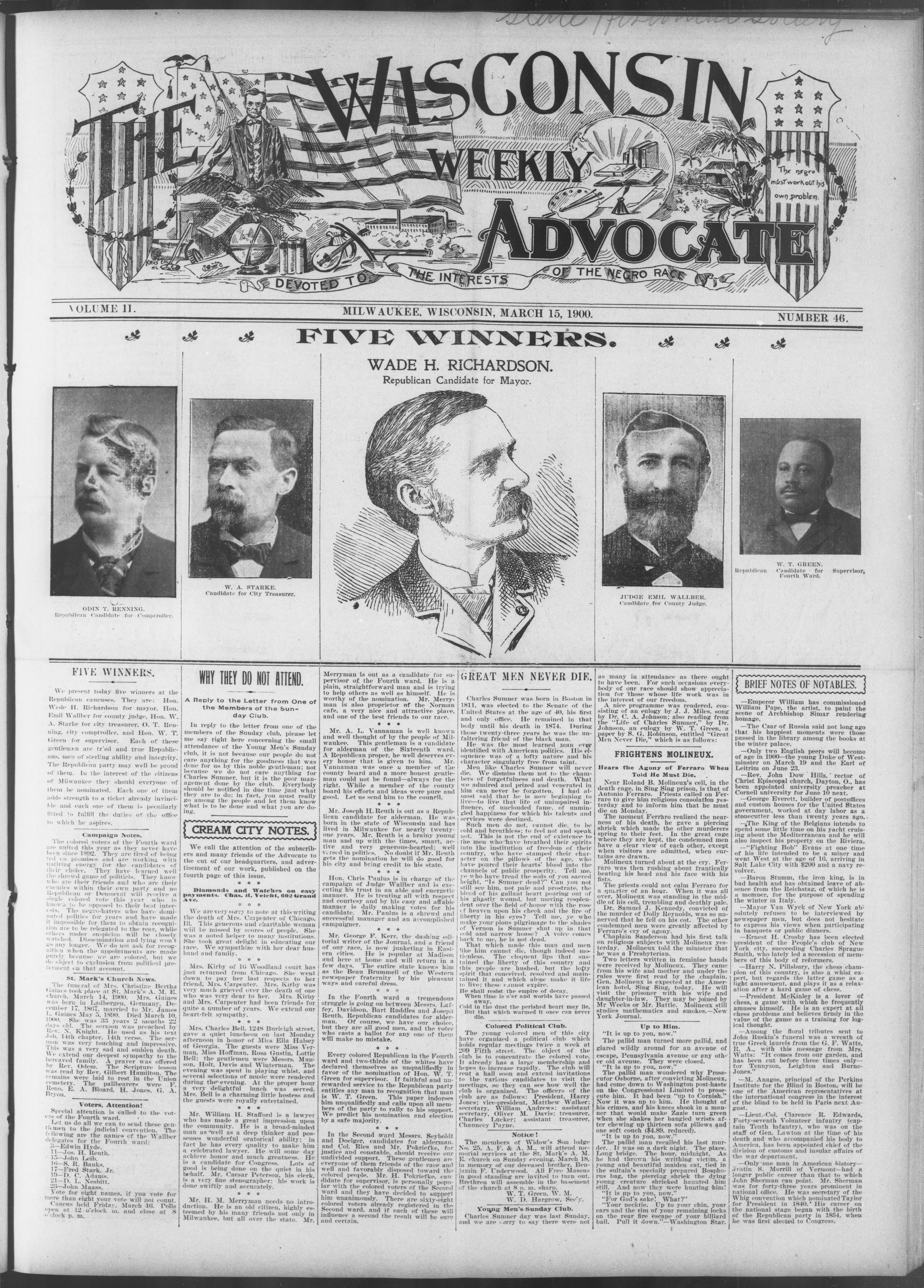
WISCONSIN
WEEKLY
Advocate
DEVOTED TO THE INTERESTS OF THE NEGRO RACE
VOLUME II.
[Name]
ODIN T. RENNING.
Republican Candidate for Comptroller.
FIVE WINNERS.
We present today five winners at the Republican caucuses. They are: Hon. Wade H. Richardson for mayor, Hon. Emil Wallber for county judge, Hon. W. A. Starke for city treasurer, O. T. Renuing, city comptroller, and Hon. W. T. Green for supervisor. Each of these gentlemen are tr'ed and true Republicans, men of sterling ability and integrity. The Republican party may well be proud of them. In the interest of the citizens of Milwaukee they should everyone of them be nominated. Each one of them adds strength to a ticket already invincible and each one of them is peculiarly fitted to fulfill the duties of the office to which he aspires.
Campaign Notes.
The colored voters of the Fourth ward are united this year as they never have been since 1892. They are tired of being tied on promises and are working with untiring energy for the candidates of their choice. They have learned well the shrewd game of politics. They know who are their friends and who are their enemies within their own party and no Republican or Democrat will receive a single colored vote this year who is known to be opposed to their best interests. The negro-haters who have dominated politics for years and have made it impossible for them to obtain recognition are to be relegated to the rear, while others under suspicion will be closely watched. Dissemination and lying won't go any longer. We do not ask for recognition when the appointments are made purely because we are colored, but we do object to exclusion from political preferment on that account.
St. Mark's Church News.
The funeral of Mrs. Christine Bertha Gaines took place at St. Mark's A. M. E. church, March 14, 1900. Mrs. Gaines was born in Ladbergen, Germany, December 17, 1867, married to Mr. James L. Gaines May 5, 1890. Died March 10, 1900. She was 33 years 2 months 22 days old. The sermon was preached by Rev. N. Knight. He used as his text Job, 14th chapter, 14th verse. The sermon was very touching and impressive. This was a very sad and sudden death. We extend our deepest sympathy to the bereaved family. A prayer was offered by Rev. Odem. The Scripture lesson was read by Rev. Gilbert Hamilton. The remains were laid to rest in the Union cemetery. The pallbearers were F. Reno, E. A. Bloard, H. Jones, G. A. Bryon.
Voters. Attention!
Special attention is called to the voters of the Fourth ward.
Let us do all we can to send these gentlemen to the judicial convention. The following are the names of the Wallber delegates for the Fourth ward:
3—Edwin Hyde.
11—Jos. H. Reuth.
15—John Leib.
16—S. R. Banks.
17—Fred Stark, Jr.
19—D. C. Adams.
21—D. L. Nesbitt.
23—John Maass.
Vote for eight names, if you vote for more than eight your vote will not count.
Caucus held Friday, March 16. Polls open at 12 o'clock m. and close at 8 o'clock p. m.
---
J. B.
W. A. STARKE.
Candidate for City Treasurer.
WHY THEY DO NOT ATTEND.
---
A Reply to the Letter from One of the Members of the Sunday Club.
In reply to the letter from one of the members of the Sunday club, please let me say right here concerning the small attendance of the Young Men's Sunday club, it is not because our people do not care anything for the goodness that was done for us by this noble gentleman; not because we do not care anything for Charles Sumner, but it is the poor management done by the club. Everybody should be notified in due time just what they are to do; in fact, you must really go among the people and let them know what is to be done and what you are doing.
CREAM CITY NOTES.
We call the attention of the subscribers and many friends of the Advocate to the cut of our headquarters, and advertisement of our work, published on the fourth page of this issue.
※ ※ ※
Diamonds and Watches on easy payments. Chas, H. Veicht, 602 Grand Ave.
* * *
We are very sorry to note at this writing the death of Mrs. Carpenter of Chicago, Ill. This generous and charitable woman will be missed by scores of people. She was a noted helper to many institutions. She took great delight in educating our race. We sympathize with her dear husband and family.
```markdown
```
Mrs. Kirby of 16 Woodland court has just returned from Chicago. She went down to pay her last respects to her friend, Mrs. Carpenter. Mrs. Kirby was very much grieved over the death of one who was very dear to her. Mrs. Kirby and Mrs. Carpenter had been friends for quite a number of years. We extend our heart-felt sympathy.
* * *
Mrs. Charles Bell, 1248 Burleigh street, gave a quiet luncheon on last Monday afternoon in honor of Miss Ella Halsey of Georgia. The guests were Miss Verman, Miss Hoffman, Rosa Gustin, Lottie Bell; the gentlemen were Messrs. Munson, Holt, Davis and Winterman. The evening was spent in playing whist, and several selections of music were rendered during the evening. At the proper hour a very delightful lunch was served. Mrs. Bell is a charming little hostess and the guests were royally entertained.
***
Mr. William H. Stafford is a lawyer who has made a great impression upon the community. He is a broad-minded man as well as a deep thinker and possesses wonderful oratorical ability; in fact he has every quality to make him a celebrated lawyer. He will some day achieve honor and much greatness. He is a candidate for Congress. Lots of good is being done on the quiet in his behalf. Mr. Caesar Peterson, his clerk, is a very fine stenographer; his work is done swiftly and accurately.
* * *
Mr. H. M. Merryman needs no introduction. He is an old citizen, highly esteemed by his many friends not only in Milwaukee, but all over the state. Mr.
Merryman is out as a candidate for supervisor of the Fourth ward. He is a plain, straightforward man and is trying to help others as well as himself. He is worthy of the nomination. Mr. Merryman is also proprietor of the Norman cafe, a very nice and attractive place, and one of the best friends to our race.
***
Mr. A. L. Vannaman is well known and well thought of by the people of Milwaukee. This gentleman is a candidate for alderman of the Sixteenth ward. A Republican proper, he well deserves every honor that is given to him. Mr. Vannaman was once a member of the county board and a more honest gentleman could not be found—always for the right. While a member of the county board his efforts and ideas were pure and good. Let us send him to the council.
实 实 实
Mr. Joseph H. Reuth is out as a Republican candidate for alderman. He was born in the state of Wisconsin and has lived in Milwaukee for nearly twenty-one years. Mr. Reuth is a brainy young man and up with the times, smart, active and very generous-hearted; well versed in politics. No doubt if Mr. Reuth gets the nomination he will do good for his city and bring credit to his state.
* * *
Hon. Chris Paulus is in charge of the campaign of Judge Wallber and is executing his trust in an able and energetic manner. He is treating all with respect and courtesy and by his easy and affable manner is daily making votes for his candidate. Mr. Paulus is a shrewd and successful manager and an accomplished campaigner.
* * *
Mr. George F. Kerr, the dashing editorial writer of the Journal, and a friend of our race, is now junketing in Eastern cities. He is popular at Madison and here at home and will return in a few days. The entire state knows him as the Beau Brummell of the Western newspaper fraternity by his pleasant ways and careful dress.
```markdown
```
In the Fourth ward a tremendous struggle is going on between Messrs. Lafey, Davidson, Bart Ruddles and Joseph Reuth, Republican candidates for alderman. Of course, we have our choice, but they are all good men, and the voter who casts a ballot for any one of them will make no mistake.
* * * .
Every colored Republican in the Fourth ward and two-thirds of the whites have declared themselves as unqualifiedly in favor of the nomination of Hon. W. T. Green for supervisor. If faithful and unrewarded service to the Republican party entitles any man to recognition that man is W. T. Green. This paper indorses him unqualifiedly and calls upon all members of the party to rally to his support. We predict his nomination and election by a safe majority.
***
In the Second ward Messrs. Seyboldt and Doelger, candidates for alderman and Col. Ries and Mr. Pokriekke, for justice and constable, should receive our undivided support. These gentlemen are everyone of them friends of the race and well and favorably disposed toward the colored people. Mr. H. Pokriekke, candidate for supervisor, is personally popular with the colored voters of the Second ward and they have decided to support him unanimously. There are sixty-eight colored voters already registered in the Second ward, and if each of these will influence a second the result will be sure and certain.
GREAT MEN NEVER DIE.
Charles Sumner was born in Boston in 1811, was elected to the Senate of the United States at the age of 40, his first and only office. He remained in that body until his death in 1874. During those twenty-three years he was the unfaltering friend of the black man. He was the most learned man ever identified with American politics. His eloquence was of a lofty nature and his character singularly free from taint. Men like Charles Sumner will never die. We dismiss them not to the chambers of forgetfulness and death. What we admired and prized and venerated in him can never be forgotten. I had almost said that he is now beginning to live—to live that life of unimpaired influence, of unclouded fame, of unmingled happiness for which his talents and services were destined.
Such men do not, cannot die, to be cold and breathless; to feel not and speak not. This is not the end of existence to the men who have breathed their spirits into the institution of freedom of their country, who have stamped their character on the pillows of the age, who have poured their hearts' blood into the channels of public prosperity. Tell me, ye who have tread the sods of son sacred height, "Is Sumner dead?" Can you not still see him, not pale and prostrate, the blood of his gallant heart pouring out of his ghastly wound, but moving resplendent over the field of honor with the rose of heaven upon his cheek and the fire of liberty in his eyes? Tell me, ye who make your pious pilgrimage to the shades of Vernon is Sunner shut up in that cold and narrow house? A voice comes back to me, he is not dead.
That which made this man and men like him cannot die, though indeed motionless. The eloquent lips that sustained the liberty of this country and this people are hushed, but the lofty spirit that conceived, resolved and maintained it and which alone make it life to live; these cannot expire. He shall resist the empire of decay. When time is o'er and worlds have passed away
Cold in the dust the perished heart may lie. But that which warmed it once can never die.
Colored Political Club.
The young colored men of this city have organized a political club which holds regular meetings twice a week at 209 Fifth street. The object of the club is to concentrate the colored vote. It already has a large membership and hopes to increase rapidly. The club will rent a hall soon and extend invitations to the various candidates to visit the meetings, so they can see how well the club is organized. The officers of the club are as follows: President, Harry Jones; vice-president, Matthew Walker; secretary, William Andrews; assistant secretary, Oliver M. Davis; treasurer, Charles Lucker; assistant treasurer, Chauncey Payne.
Notice!
The members of Widow's Son lodge No. 25, A. F. & A. M., will attend memorial services at the St. Mark's A. M. E. church on Sunday evening, March 18, in memory of our deceased brother, Benjamin F. Underwood. All Free Masons in good standing are invited to turn out. Brethren will assemble in the basement of the church at 8 p.m. sharp.
Young Men's Sunday Club.
Young Men's Sunday Club.
Charles Sumner day was last Sunday,
and we are sorry to say there were not
M. B.
JUDGE EMIL WALLBER
Candidate for County Judge
as many in attendance as there ought to have been. For such occasions everybody of our race should show appreciation for those whose life work was in the interest of our freedom. A nice programme was rendered, consisting of an eulogy by J. J. Miles, song by Dr. C. A. Johnson; also reading from the "Life of Charles Sumner," by Dr. Johnson, an eulogy by W. T. Green, a paper by S. G. Robinson, entitled "Great Men Never Die," which is as follows:
FRIGHTENS MOLINEUX.
Hears the Agony of Ferraro When Told He Must Die.
Near Roland B. Molineux's cell, in the death cage, in Sing Sing prison, is that of Antonio Ferraro. Priests called on Ferraro to give him religious consolation yesterday and to inform him that he must die on Monday.
The moment Ferraro realized the nearness of his death, he gave a piercing shriek which made the other murderers spring to their feet. In the great cage where they are kept, the condemned men have a clear view of each other, except when visitors are admitted, when curtains are drawn.
Molineux turned about at the cry. Ferraro was then rushing about frantically beating his head and his face with his fists.
The priests could not calm Ferraro for a quarter of an hour. When it was all over, Molineux was standing in the middle of his cell, trembling and deathly pale.
Dr. Samuel J. Kennedy, convicted of the murder of Dolly Reynolds, was so unnerved that he fell on his cot. The other condemned men were greatly affected by Ferraro's cry of agony.
Chaplain Sanderson had his first talk on religious subjects with Molineux yesterday. Molineux told the minister that he was a Presbyterian.
Two letters written in feminine hands were received by Molineux. They came from his wife and mother and under the rules were first read by the chaplain. Gen. Molineux is expected at the American hotel, Sing Sing, today. He will visit the prisoner with his wife and daughter-in-law. They may be joined by Mr Weeks or Mr. Battle. Molineux still studies mathematics and smokes.—New York Journal.
Up to Him.
"It is up to you, now."
The pallid man turned more pallid, and glared wildly around for an avenue of escape, Pennsylvania avenue or any other old avenue. They were closed.
"It is up to you, now."
The pallid man wondered why Prosecutor Osborne, after convicting Molineux, had come down to Washington post-haste on the Congressional Limited to prosecute him. It had been "up to Cornish." Now it was up to him. He thought of his crimes, and his knees shook in a manner that would make Zazie turn green when she shakes her bangled wrists after chewing up thirteen sofa pillows and one soft couch ($4.89, reduced).
The pallid man recalled his last murder. It was on a dark night. The place, Long bridge. The hour, midnight. As he had thrown his writhing victim, a young and beautiful maiden cat, tied in the sultain's specially prepared Bosphorus bag, the piercing shriek the dying young creature shrieked haunted him still. And now they were hunting him! "It is up to you, now."
"For God's sake! What?"
For God's sake. What? "Your necktie. Up to your chin, your ears and the rim of your remaining locks on the rear fire escape of your billiard ball. Pull it down."—Washington Star.
[Picture of a man in a suit and bow tie].
W. T. GREEN.
Republican Candidate for Supervisor,
Fourth Ward.
BRIEF NOTES OF NOTABLES.
—Emperor William has commissioned William Pape, the artist, to paint the scene of Archbishop Simar rendering homage.
—The Czar of Russia said not long ago that his happiest moments were those passed in the library among the books at the winter palace.
—Only two English peers will become of age in 1900—the young Duke of Westminster on March 19 and the Earl of Leitrim on June 23.
—Rev. John Dow Hills, rector of Christ Episcopal church, Dayton, O., has been appointed university preacher at Cornell university for June 10 next.
—George Everett, builder of postoffices and custom houses for the United States government, worked at day labor as a stonecutter less than twenty years ago.
—The King of the Belgians intends to spend some little time on his yacht cruising about the Mediterranean and he will also inspect his property on the Riviera.
also inspect his property on the Riviera.
—"Fighting Bob" Evans at one time of his life intended to be a miner and went West at the age of 16, arriving in Salt Lake City with $200 and a navy revolver.
—Baron Stumm, the iron king, is in bad health and has obtained leave of absence from the Reichstag, of which he is a member, for the purpose of spending the winter in Italy.
—Mayor Van Wyck of New York absolutely refuses to be interviewed by newspaper men, but does not hesitate to express his views when participating in banquets or public dinners.
—Ernest H. Crosby has been elected president of the People's club of New York city, succeeding Charles Sprague Smith, who lately led a secession of members of this body of reformers.
—Harry N. Pillsbury, the chess champion of this country, is also a whist expert, but regards the latter game as a light amusement, and plays it as a relaxation after a hard game of chess.
—President McKinley is a lover of chess, a game with which he frequently amuses himself. He is an expert at all chess problems and believes firmly in the value of the game as a training for logical thought.
—Among the floral tributes sent to John Ruskin's funeral was a wreath of true Greek laurels from the G. F. Watts, R. A., with this message from Mrs. Watts: "It comes from our garden, and has been cut before three times only—for Tennyson, Leighton and Burne-Jones."
—M. Anagos, principal of the Perkins Institute for the Blind in Boston, will be one of the American representatives at the international congress in the interest of the blind to be held in Paris next August.
—Lieut.-Col. Clarence R. Edwards, Forty-seventh Volunteer infantry (captain Tenth infantry), who was on the staff of Gen. Lawton at the time of his death and who accompanied his body to America, has been appointed chief of the division of customs and insular affairs of the war department.
Only one man in American history—Justin S. Morrill of Vermont—had a longer public career than that to which John Sherman can point. Mr. Sherman was for forty-three years prominent in national office. He was secretary of the Whig convention which nominated Taylor for President in 1840. His career on the national stage began with the birth of the Republican party in 1854, when he was first elected to Congress.
Livestock and Other Property Destroyed by the Ovarflow of Rivers in Illinois.
Chicago. Ill., March 13.—Reports received here today show that serious floods are prevailing in the northern portion of Illinois by the overflowing of the Illinois, Des Plaines, Fox, Sangamon and Kankakee rivers. Much livestock and property have already been destroyed. At La Salle the Illinois river and tributary streams are fourteen inches above normal height and are still rising. Not since 1882 has there been so much water in this vicinity, and if the rivers continue to rise during the next twenty-four hours the damage to property will be enormous. One pump at the waterworks is already shut down, the engineers are working in twenty inches of water, and Supt. Walker says that one foot more of water will mean the stoppage of the entire plant, thus placing the city in jeoo ardy from fire.
The fires in the engine room of the Dickinson Cement works were extinguished and the kiln flooded. William Chapin and family were driven from their home and water stands a foot deep on the floors of the summer cottages. At Peru, Water street is flooded and store basements are filled with water, doing much damage to merchants' reserve stocks. Fears are entertained that the fires of the big Illinois Zinc company's works may be reached by the rapidly-rising water, which already covers part of the company's premises.
Ice Gorge Formed.
At Peoria the Illinois river is out of its banks and is doing considerable damage along the valley. It is still rising. This usually staid stream has risen more than two feet in the last sx hours, mostly caused by the rapidly-melting snows of the last few days. Today the floating ice formed a gorge backing up the water to such an extent that families living along the river banks were in danger of their lives and some property was destroyed. At Havana the Herget levee on the Sangamon river broke last night, compelling 300 families to flee to higher ground. Much stock has been lost.
At Lorenzo John Zipp's family, living on an island at the junction of the Kankakee and Despainhes rivers, had a narrow escape. An ice gorge formed above the island and broke. The released waters submerged the entire island, and the family found refuge on a large cake of ice and were carried several miles down stream before rescued. The house and all the stock were destroyed. At Pontiac the Vermillion river is higher than it has been for the last twenty years. Several negro families had a narrow escape from drowning and were compelled to leave their residences for safety.
Factoria Idle.
Ottawa, Ill., March 13.—Many factories in towns and cities of the upper Illinois valley are idle on account of the almost unprecedented floods. Most damage is done to industrial plants and private property in this section by vast quantities of ice which passed yesterday. Large gorges are formed which threaten damage to bridges, if not broken up. The water is twenty-one feet above normal stage. North families have been driven from their homes. Great apprehension is felt at Marrilos for its dam, which has been slightly damaged. Thousands of men are idle as a result of the floods.
Bridge in Danger.
Peoria, Ill., March 13.—The river has risen twenty inches during the past twenty-four hours, standing 15 feet 6 inches above low-water mark and still rising. No damage has been done so far in Peoria or immediate vicinity. Should the heavy ice in the river break up today, river men believe that it would carry out the lower wagon-bridge that spans the river in the business portion of the city.
La Salle, Ill., March 13.—The Illinois river has now reached a height of fifteen feet above the normal stage. The waterworks pumping station has $2\frac{1}{2}$ feet of water on its floor. Much damage is reported from Jonesville, Oglesby and Deer Park. At Peru the Illinois Zinc company's factory and the Peru Plow works are in imminent danger of being flooded, with a prospect that 1000 men will be thrown out of employment. The basements of the stores on Water street, Peru, are all flooded.
PREPARING FOR DEWEY'S VISIT
Congressmen, Cabinet Officers and Governors to be at Savannah. Savannah, Ga., March 13.—Savannah is being decorated in anticipation of the visit of Admiral and Mrs. Dewey on March 21 and 22. Every white military company in South Carolina, Georgia and Florida has been invited to take part in the military parade. Govs. Candler, Bloxham and McSweeney are expected along with Secretaries Long and Wilson, to attend the banquet. A number of congressmen will also be present.
NEW GERMAN COINS.
Gold Pieces Called in and Silver in Limited Quantities Substituted.
Berlin, March 13. The Reichstag today adopted by a large majority the coinage bill providing for calling in the gold 5-mark pieces and 20-pfenning pieces, issuing silver up to 15 marks per head of the population and calling in provincial coins for reminting.
Dr. Arendt, free conservative, offered an amendment proposing the purchase of silver bullion for minting the new coins, but it was rejected by 161 to 61 votes.
WETS APPARENTLY AHEAD.
Temperance Question Paramount in Michigan Local Elections
Detroit, Mich., March 13.—Politics were practically forgotten in the village elections held through Michigan yesterday, and where big votes were polled local issues alone were responsible. The temperance question was the absorbing one in many places and where the line was strictly drawn, the "wets" had a trifle the better of it.
—Last Christmas in Jerusalem was bitter cold, the thermometer showing 32 to 40 degrees every day. There is no provision for heating the hotels, and all tourists in winter suffer much from the cold.
The Mainstay of Civilization
It is quite possible, though of course not demonstrable, that the humble chuckle barn fowl has been a larger benefactor of our race than any mechanical invention in our possession, for there is no inhabited country on earth today where the barn fowi is not a mainstay of health. There are vast regions in South America and Europe were it is the mainstay, and nowhere is there known anything that can take its place, which is probably more than can be said of anything in the world of mechanics.—The Century.
—Burlington, N. Y., will not collect any taxes this year, the saving on appropriations having gone on so long that the township has sufficient funds to run all departments.
—The London stock exchange has raised $42,500 for the Indian famine relief fund.
—Clinton may have an electric light plant.
London, March 14-9 p. m.-
It is officially announced that
Lord Roberts has occupied
Bloemfontein, and that the
British flag is flying from the
top of the capitol.
The following is the text of Lord Roberts' dispatch to the war office announcing his occupation of Bloemfontein. It is dated March 13, 8, p. m.:
"By the help of God and by the bravery of her majesty's soldiers the troops have taken possession of Bloemfontein. The British flag now flies over the presidency, evacuated last evening by Mr. Steyn, late President of the Orange Free State. Fraser, member of the late executive government; the mayor, the secretary to the late government, the Landrost and other officials met me two miles from the town and presented me with the keys of the public offices. "The enemy have withdrawn from the neighborhood and all seems quiet. The inhabitants of Bloemfontein gave the troops a cordial welcome."
The above dispatch, though dated Tuesday, was not received at the war office until 7:30 p. m. Wednesday. It was made public a few minutes before 9 o'clock. The delay is attributed to the field telegraphs not being connected with Bioemfontein on Tuesday evening. Extra papers are already out on the streets and the night crowds of London are singing patriotic songs and engaging in demonstrations. Pretoria, Tuesday, March 13.—A dispatch from Bioemfontein says that in view of the military situation the seat of government may be removed to Kroonstadt.
Lobatsi, March 8.—Col. Plumer's force reached here Tuesday, March 6. It is known that only a single bridge southward has been destroyed and that otherwise the railroad is intact within five miles of Mafeking. Col. Plumer has already destroyed several Boer posts in the neighborhood and is actively pushing his advance southward.
Cape Town, March 14.—Col. Plumer is now within forty miles of Mafeking. London, March 14.—2 p. m.—Attention now turns to Mafeking which can scarcely hold out much longer. The news of Col. Plumer's approach having given substance to rumors of its relief, those best informed are inclined to think the relief is more likely to become accomplished by Col. Peakman's column from Kimberley. Private cables have set forth that Col. Plumer had almost given up hope of accomplishing anything more than harassing the Boers. A dispatch from Pietermaritzburg published in the second edition of the Times says: "The reply, especially the last paragraph, relating to independence, has been received in Natal with a feeling of great relief and is dispelling all doubts."
A private dispatch from Johannesburg has been received in London, dated Saturday. March 10, contradicting the reports that the mines are flooded and all the machinery broken and asserting that all is well."
WAR WILL GO ON.
Krenger's Appeal Characterized as Absurd and Insulting.
London, March 14.—Now that the communications on the subject of peace are known, the situation is seen to be unchanged. It is realized that the war will go on until the Boers, crushed, surrender unconditionally. Londoners are pleased by the absence from Lord Salisbury's reply of any diplomatic palace, and they approve the directness and somewhat resentful tone of the premier's language. The government will not allow the Kruger-Steyn appeal to influence in any way their determination not to spare any effort to prosecute the war. There will be no diminution of measures calculated to maintain the full efficiency of the field force and whatever reinforcements were previously considered advisable, will still be sent out.
The whole talk of the clubs last night was Lord Salisbury's reply to the communication of the Boer presidents, which was generally felt to be grossly impertinent, adding insolence to injury. The London papers this morning voice the same view. The Daily Telegraph characterizes the offer of the two presidents as "simply nauseating," and adds: "They got a reply to their insulting demands with a vengeance, and it is the unanimous reply of the British empire."
No Republic in Any Form.
The Daily Mail says: "The appeal is in the tone of a sanctimonious burglar. We must have no more Boer republics in any form. Their policy is wholly unsatisfactory. 'There must be no root of Boer misrule left in South Africa.' The Daily News declares Kruger's claims preposterous. "To suppose," it says, "that after a successful war Great Britain will admit a claim which was one of its causes is too absurd for further argument."
The Times, commenting editorially upon the reply of Lord Salisbury, says: "The government has given the only conceivable reply to the extraordinary Kruger-Steyn telegram, a reply which will be hailed with profound satisfaction throughout the empire. We are sincerely glad to see the attitude the United States has assumed in transmitting the proposals. Washington's services, of course, have been declined, but declined, we need hardly say, in the same cordial and friendly spirit in which they were offered. The news that Gen. French commands Bloemfontein is an instructive comment on the preposterous character of the Boer pretensions."
The Daily Chronicle says: "The worst enemies of the Boers could not have anticipated the full extent and audacity of their demands. President McKinley has been forced by the exigencies of his position to approach Lord Salisbury with a harmless intimation of his readiness to exercise his good offices. When he reads the correspondence he will feel thankful that he has not compromised himself with a cause that is now resolved into the arrogant obstinacy of Kruger."
Protest from Labouchere.
Henry Labouchere, advanced Liberal, protested against Lord Salisbury's reply to President Kruger and President Steyn. It was, he said, not only a crime, but a blunder. The terms of peace proposed were an iniquity and a disgrace to Great Britain. Turkey, he declared might just as well have insisted upon blotting out Greece as an independent country. Greece insulted Turkey and compelled her to go to war.
Thomas Gibson Bowles. Conservative, said that the last telegram from Presidents Kruger and Steyn was even more
insulting than the one which began the war.
Methuen Takes Boshof.
London, March 14.—The Daily Mail has the following dispatch from Kimberley, dated Tuesday, March 13: "Lord Methuen occupied Boshof on Sunday without opposition. He left a garrison there and returned here.
"The railway and telegraph lines have been repaired thirty miles northward on Slyp Klip.
"It is understood that the line between Fourteen Streams and Vryburg is not badly damaged."
A sharp Engagement.
Aliwal North, Cape Colony, by Courrier to Burghersdorp, via Stormberg Junction, Tuesday, March 13.—Gen. Brabant's forces arrived here on Sunday. The Boers had retired the previous night, taking up a position four miles beyond the Orange river, where Gen. Brabant attacked and drove them back, securing the position after a sharp engagement.
battle at Abraham's Kraal.
Pretoria, Tuesday, March 13.—Commander Delarey's report of the fight at Abraham's Kraal, Saturday, says: "The British were estimated to number 40,000 men. Their first assault was repulsed. Only two Boers were wounded. The second assault was made on the hills to the left of our position. These hills were of great strategic importance. Appreciating this, three hundred men defended the position from 9 in the morning until sundown. The burghers fought like heroes and three times repulsed masses of the British, who kept relieving their tired men. Every attempt to storm was defeated. At sundown there were not fifty yards between us. The British lost heavily. No accurate returns of our loss are available."
Alliance Impossible.
London, March 14.—Regarding the United States' offer of mediation the Globe says:
"The incident is of interest only in the light it throws on American politics. Republicans and Democrats alike are always prepared to risk the friendship of England in the party game. We may preserve amicable relations with the United States, and it is to be hoped we always shall do so, but an alliance is impossible. We were brought to the verge of war four years ago for the sake of Mr. Cleveland's reelection, and a pretext for a diplomatic quarrel will never be wanting when the anti-English elements of the republic have to be corollated."
Plot to Free Prisoners.
Cape Town. March 14.—Another plot has just been discovered to free the Boer prisoners at Simonstown. The remarkable quantities of watermelons received by the prisoners aroused comment and an investigation discovered that compromising letters were contained in the melons, the writers planning the escape of the captives. Great satisfaction is felt here at the fact that transports with the bulk of the prisoners sail for St. Helena tonight.
ONE POINT GAINED.
Kruger's Appeal Secured Acknowledgment of England's Designs.
New York, March 14.—The Journal and Advertiser says: "Presidents Kruger and Steyn have apparently made a shrewd diplomatic move, for it cannot be supposed that they expected Lord Salisbury to consent to peace on any such terms as those they proposed. They have, however, obtained from the premier a tangible statement of the intentions of England and her determination to take from the two republics their independence. This gives them something on which they may appeal to the powers, asking if the latter will stand by and see them crushed and turmed into integral parts of the British empire.
The strengthening of England's fleet in Chinese waters is a part of her answer to the peace proposition of the Boer republic. Lord Salisbury realizes that England's enemies have never had so good an excuse for making trouble for her as they have now. Should the Boer Presidents appeal to the powers against the premier's ultimatum and ask them to interfere to prevent the political annihilation of the republics, Russia and France would very likely notify England that they would not consent to the taking away of the Boers' independence. And that would mean war. For England would allow no such interference in what she regards as her private affairs. Russia and France have important interests in China—the one on the north and the other on the south—and Russia has been unwontedly aggressive of late. Hence the dispatch of two such powerful warships as the Terribla and the Argonaut to reinforce the Chinese squadron, already stronger than that of any other power in the Pacific waters. What may have direct bearing upon this phase of the situation is the determination of our own government in Washington to dispatch a fleet under Rear Admiral Kempff to Chinese waters. The ostensible reason for this is the protection of American interests, but England's enemies, who have been jealously watching the growing friendship between Washington and London, will certainly regard it as a demonstration favorable to Great Britain.
RESTORED TO FAVOR.
Dr. Jamesor's Services in Caring for the Sick at Ladysmith.
New York, March 14.—A dispatch to the Tribune from London says: "Dr. Jameson was down with enteric fever and crtically ill when Ladysmith was relieved. A private cable received here by a South African states that he rallied and is likely to recover. Dr. Jameson was anxious to have a military command in the campaign, but as the leader of the raid he was excluded from the service for political reasons, and was not welcomed when he arrived at Ladysmith a few days before the investment of the town. His opportunity came. When the garrison was fever-stricken he reverted to medical practice, and did an immense work in caring for the fever patients and the wounded soldiers.
Pen P.ctures of the Envoys.
The peace envoys who have arrived at Lourenco Marques are high officials in the two republics. Mr. Wolmans is a member of the Boer executive council and a blind follower of President Kruger, who has implicit confidence in his fidelity. While nearer 40 than 50 years old, he fought as a youth in the first war of independence, and was bitterly hostile to the outlanders and reformers. The South Africans describe him as an astute and crafty man, who has learned all he knows about politics from Mr. Kruger. Mr. Fischer has been state secretary of the Free State and has exerted a strong influence over the Dutch leaders in Cape Colony. He had the reputation of being a strong advocate of peace a year ago, but President Steyn carried him into the war and has been faithfully served by him.
War to Go On.
The ministers, having the moral support of the united nation, are indifferent to the appeals which the Dutch republics are making for foreign mediation, whether in Europe or America. They confidently expect Lord Roberts to go from Bloemfontein to Pretoria, and are resolute in fighting the battle of the united empire. They will regard the intervention of any European power as an unfriendly act, precisely as the Americans would have done at the close of the war with Spain, when the British government refused to meddle in what did not concern it.
There is evidently the hope on the part
of one or two European powers that have been approached through their consults at Pretoria that the American government, which was under special obligations to the British foreign office during the war with Spain, will make a serious mistake in its policy at the present crisis, but there are no signs that the state department has any intention of thrusting its services upon a British government which is satisfied with the present work of Lord Roberts as a capable and efficient diplomatist.
RAPID PROGRESS ON THE BATTLESHIPS.
Several of Them Are Nearly Completed-Admiral Hichborn's Latest Report.
Washington, D. C., March 14.—Admiral Hichborn's latest report of the progress of the work of building up the navy shows that of the battleships under construction the Kearsarge and the Kentucky at Newport News are advanced toward completion 99 per cent. and 98 per cent. respectively. The Illinois, at the same place, stands at 75 per cent., and the Missouri has just been started. The Alabama at Cramps' is set down at 93 per cent.; the Maine, at the same place, at 22 per cent., and the Wisconsin and the Ohio at the Union Iron works at 88 per cent. and 15 per cent. respectively.
The Albany, the only sheathed protected cruiser upon which any work has been done, is practically finished. Work has not yet begun on the Denver, Des Moines, Chattanooga, Galveston, Tacoma and Cleveland.
Of the four monitors the Kansas, at Newport News, is 19 per cent. completed; the Connecticut at Bath 41 per cent.; the Florida at Nixon's, 25 per cent., and the Wyoming at the Union Iron works, 43 per cent. All of the sixteen torpedo boat destroyers are at last under construction, the work accomplished ranging from 85 per cent. upon the Lawrence, down to 9 per cent. for three boats in the yards of the Maryland Steel company.
The fifteen torpedo-boats are also now on the stocks or affloat, the state of the work ranging from 98 per cent. in the case of the Goldsborough at Wolff & Zwicker's, to 5 per cent. on the Biddle at Bath. The submarine boat Plunger stands at 85 per cent.
COL. WALLACE DEAD.
Highly Recommended by Gen. Mac Arthur for Gallant and Meritorious Services.
Washington, D. C., March 14.—The war department has been informed of the death at Fort Huachuca, Ari., yesterday, of Col. Robert B. Wallace (first lieutenant, Second cavalry), commanding the Thirty-seventh Volunteer infantry. Col. Wallace was born in Illinois, and was appointed to the military academy from Montana. He graduated in 1890, and was assigned to the Second cavalry as a second lieutenant. He assisted in the organization of the First Montana volunteers, was appointed lieutenant-colonel of that regiment and accompanied it to the Philippines. He was severely wounded at the action of Caloocan, February 10, 1899.
Maj.-Gen. MacArthur recommended him for brevet-colonel of volunteers and brevet captain and major, U. S. A., for gallant and meritorious services in the battles of February 5 and 10, 1899, in front of Manila and at the crossing of the Rio Grande de la Pampanga, April 27, 1899. Subsequently, he was appointed colonel of the Thirty-seventh United States Volunteer infantry, but on account of continued illness, resulting from wounds received in battle, he was compelled to return to the United States for medical treatment, and was at Fort Huachuca on sick leave when he died.
WORK MAY BE LOST.
Various Treaties Designed to Promote Peace Have Not Been Perfected.
Washington, D. C., March 14.—In diplomatic circles here an unpleasant suggestion has been thrown out to the effect that The Hague conference had resulted in complete failure and that even the limited programme agreed upon is never to be perfected. The basis for this view is the fact that up to this moment it is not known officially that a single one of the powers represented in the conference has ratified the three conventions prepared there. The treaties themselves require that each of the participants in the conference shall be notified whenever the other parties ratify the conventions. Up to this time no such notice has reached this country. So far as the United States government is concerned, only one of the three treaties has been ratified by the Senate, and even in that case the formalities have not been carried to completion. It is probable, however, that the appearance in Washington of the newly-appointed Dutch minister bringing with him the official copies of the conventions, may result in further action by the United States upon them.
ILLNESS OF CRISPI.
Rome, March 14.—Former Premier Crispi is seriously ill with influenza complicated with bronchitis, and he is unable to retain food. Moreover, a recent operation which he underwent for the removal of a cataract proves to have been a failure, and his condition is causing anxiety.
KEEP EVERY OBLIGATION.
Secretary Root's Assurance to Planters' Association at Havana. Havana, Morrow, J4.—Elihu Root, the United States secretary of war in addressing the members of the Planters' association yesterday said he understood that distrust existed as to the carrying out of the joint resolution of the United States Congress. He declared, however, that the American government intended to fulfill every obligation, and that the Cubans should believe and act accordingly.
Ishpeming, Mich., March 14.—Dissatisfaction exists among underground employees of the Lake Superior mine over an increase of working hours from eight to ten, which began March 1. Wages were raised on an average of 10 per cent., but miners claim this does not pay for 25 per cent. increase in hours.
No Evidence Against Him.
Frankfort, Ky., March 14.—Gabriel Taul, the Breckenridge county suspect, will be dismissed during the day. The detectives say that there is nothing in the charge against him.
Scythe Factory Destroyed.
Saratoga, N. Y., March 14.—Fire has destroyed the scythe-manufacturing department of the American Ax and Tool company near Ballstons, Pa. Loss, $70,000.
BURNED BY INSURGENTS.
American Officer and Sixteen Men Surrounded--Chinese and Native Refugees
Manila, March 13.—A merchant steamer, which has just arrived here from ports on the southeastern coast of Luzon, brought hundreds of Chinese and native refugees. She reports that the town of Gubat, fifty-two miles from Albay, was burning when she left, and that an American officer and sixteen men were surrounded by insurgents. The officer was unable to give clearance papers to the steamer, but he sent a request that reinforcements be at once forwarded to him. The captain of the steamer, instead of proceeding to the nearest American garrison, hurried to Manila with the request for help. Troops will be dispatched to Gubat with all possible speed.
Washington. D. C., March 13.—Acting Secretary Meiklejohn said last night: "All official and private advices I have received show that the insurgent forces in the Philippines have disintegrated and that many of their members have been retraining to their homes and ordinary avocations. The insurgents now in the field are organized into guerrilla bands, which Gen. Otis is destroying as rapidly as possible." Gen. Otis' latest casualty report is as follows:
Manila, March 12.—Deaths by suicide: February 27, Daniel H. Collins, Co. F. Seventeenth regiment infantry; March 6. William Parsons, Co. C. Twenty-second infantry; March 9, while mentally deranged. Second Lieut. Louis P. Weber, Co. E. Forty-second infantry, Friday, 11 p. m. Died from wounds received in action: February 23, First Lieut. Battailon-Adjutant John R. Galleher, Fortieth regiment; February 5, James L. Jones, Co. E. Thirtieth infantry; March 5. William Boese, Co. H. Forty-sixth infantry, Variola, March 1. Lewis Lille, corporal, Co. G. Forty-first infantry; March 2, Thomas M. Brooke, Co. H. Thirty-sixth infantry; March 5. Walter L. Burlinggame, Co. F. Thirty-uinth infantry; chronic diarrhoea, March 3. Pinkney Flinn, Co. E. Thirty-seventh infantry; subacute diarrhoea, March 4. Theodore Chaffer, Co. D. Thirty-second (or Forty-second) regiment infantry; multiple uveritis, March 4. William Wightman, sergeant, Co. E. Third infantry; Henri O. Green, Co. G. Eighteenth infantry; March 5. Frank C. Ocker, Co. B. Sixth infantry; March 8. Henry Fitzgerald, Co. F. Ninth infantry; enteritis, March 1, Charles F. Herrick, Battery G. Sixth regiment artillery; accidental, March 6. William J. Wood, Battery L. Sixth artillery, run over by truck; March 4, Earl C. Ward, corporal, Co. A. Thirtieth infantry, shot by sentry; March 8. Albert Knittle, Battery O. Sixth artillery, fell through hatchway; malarial fever, March 4. Edgar J. Manning, Co. A. Ninth infantry; dysentery, March 6, Leon W. Wiltshire, Co. E. Ninth infantry; March 9. David A. Ferguson, Troop I. Fourth cavalry; measles, March 7. Milton L. Smart. Thirty-eighth infantry; appendicitis, March 10. James Thompson, Co. D. Forty-eighth infantry.
Gen. Otis has notified the war department that he has appointed Brig.-Gen William A. Kobbe, U. S. V., military governor of the island of Cataduenes, Luzon, and of the island of Cataduenes and temporarily to subserve immediate purposes of the islands of Samar and Leite. Gen. Kobbe is directed to occupy with his troops the towns of Sorsogon, Legaspi, Donsol and Bulan of the province of Albay, the town of Virac, on the island of Cataduenes, the towns of Calbayoc and Catbalogan on the island of Samar, and the town of Taclocan on the island of Leite and establish civil government as rapidly as possible. He is to appoint officers of his command as customs and internal revenue officers for the more important coast and interior towns that are occupied by our troops.
Gen. Otis says it is desirable that the ports in question be opened to trade as soon as practicable.
CALM IN KENTUCKY.
No Further Trouble is Apprehended for the Present.
Frankfort, Ky., March 13.—The Kentucky Legislature will adjourn sine die some time before midnight. Before the sessions met this morning there was a strong inlination shown by members of both houses to expedite matters as much as possible and secure final adjournment some time this afternoon. Beyond the Triplett resolution appropriating $100,000 for a reorganization of the state militia under Gov. Beckham, there is little legislation of importance pending and Democratic members of the House expressed confidence of passing this without trouble. Apparently no apprehension of further trouble for the present, at least, exists among members of either party. Republican Lieut.Gov. John Marshall held consultations during the morning with Democratic Adjt.-Gen. Castleman and several Democratic members of the Legislature, discussing the general situation.
LOSE THEIR SAVINGS.
Private Bank in Chicago Looted and the Depositors Mourn.
Chicago, Ill., March 13.—Thousands of dollars, representing the life-savings of scores of residents of Chicago, have disappeared from the vaults of Giraldi Frank's private bank. The local police are looking for Frank, who is believed to have left the city. It was discovered today that the bank, which Frank started six weeks ago, had been thoroughly cleaned of its funds. The matter was brought before the police by many Italians, who had put their fortunes, in sums ranging from $20 to $300 into Frank's bank. The exact amount missing is not yet known.
APPLICATION DENIED.
New York Judge Refuses to Adjudge Harper Brothers Bankrupts. New York, March 13.—In the matter of Albert Smith et al., to have Harper & Bros. adjudged a bankrupt corporation, Judge Brown of the United States district court today handed down his decision denying the adjudication of the corporation. Judge Brown holds that the best interests of the creditors, amounting to $3,000,000, would not be served by such adjudication.
INJUNCTION DENIED.
Tippicanee Club May Oust Two Members Who Voted Against Hanna. Columbus, O.. March 13.—The Supreme court today sustained the Cuyahoga courts in refusing to grant an injunction restraining the Tippicanee club from ousting Messrs. Mason and Bramley from the membership. The club holds that the two men are not Republicans, they having refused to vote for Mark Hanna for United States senator.
War Loan Bill Passed.
London. March 13.—7:30 p. m.—The war loan bill passed its second reading in the House of Commons today by a vote of 268 to 21.
The list of London subscriptions to the new £30,000,000 war loan has been closed. The bonds are now quoted at 2% per cent. premium.
I Look 25 Years Younger
"I am now seventy-two years of age and my hair is as dark as it was twenty-five years ago. People say I look at least that much younger than I am. I would be entirely bald or snowwhite if it were not for your Hair Vigor." Mrs. Anna Lawrence, Chicago, Ill., Dec. 22, 1898.
There is no getting around such a testimonial as this. You can't read it over without being convinced. These persons do not misrepresent, for their testimonials are all unsolicited. Ayer's Hair Vigor restores color to gray hair every time. And it is a wonderful food to the hair, making it grow rich and heavy, and keeping it soft and glossy all the time. It is also an elegant dressing.
Write the Doctor
If you do not obtain all the benefits you desire from the use of the Vigor, write the Doctor about it. He will tell you just the right thing to do, and will send you his book on the Hair and Scalp if you request it. Address,
Dr. J. C. AYER, Lowell, Mass.
DO YOU
COUGH
DON'T DELAY
TAKE
KEMP'S
BALSAM
THE BEST COUGH CURE
It Cures Colds, Coughs, Sore Throat, Croup, Influenza, Whooping Cough, Bronchitis and Asthma. A certain cure for Consumption in first stages, and a sure relief in advanced stages. Use at once. You will see the excellent effect after taking the first dose. Sold by dealers everywhere. Large bottles 25 cents and 50 cents.
SALZER'S 3 EARED CORN
This new, earliest, corn will revolutionize corn growing, yielding in 1899, in Minnesota, 400 bus. per acre.
BIG FOUR OATS yields 250 bus. per acre, and you can beat that!
80 bus. per acre. Greatest grain and hay food this side of the staral BARLEY, BEARLESS, yields 121 bus. in N. Y. Wonderful RAPE 256, A TON gives rich, green food for cattle, sheep, swine, poultry, etc., at 25c. aton. We sell nine-tenths of the Rape seed used in the U. S. BROMUS INERMUS Greatest grass on earth. Grows to perfection in America everywhere. Salzer warrants it! THE MILLION DOLLAR potato is the most talked of potatoes. Weeke! both will make you rich. Largest grower of Potatoes and Farm Seeds in the world. VEGETABLE SEEDS Largest, choicest list in U. S. Onion Seed, 80c. ib. Everything warranted to grow. 35 pigs earliest vegetables, postpaid, $1.00. FOR 10c. STAMPS this notice, we mail Great Seed g and 10pk Farm Seed Novelies.
JOHN A.SALZER SEED CO.
LA CROSSE WIS.
ed
Indorsed by over
1,000,000 wearers.
The genuine have W. L.
Douglas' name and price
stamped on bottom. Take
no substitute claimed to be
as good. Your dealer
should keen them—if
not, we will send a pair
on receipt of price and 25c.
extra for carriage. State kind of leather,
size, and width, plain or cap toe. Cat. free.
W. L. DOUGLAS SHOE CO., Brockton, Mass.
60 ACRE
FARMS IN
WESTERN
CANADA
FREE
EXCURSION RATES
to Western Canada and parti-
culars as to how to secure
160 acres of the best Whee
growing land on the Conti-
nent, can be secured on ap-
plication to the Superin-
tendent of Immigration
Ottawa, Canada, or the un-
EXCURSION RATES to Western Canada and partitions as to how to secure the acerate Wheats ground land on the Continent, can be secured on application to the Superintendent of Immigration, Ottawa, Canada, or the undersigned. Specially con-
duced excursions will leave St. Paul, Minn., on the last and 3d Tuesday in each month, and specially low rates on all lines of railway are being quoted for excursions leaving St. Paul on March 26th and April 4th, for Manitoba, Assiniboia, Saskatchewan and Alberta.
Write to F. Pedley, Supt. Immigration, Ottawa, Canada, or the undersigned, who will mail you at-lases, pamphlets, etc., free: T. O. Currie, Stevens Point, Wis., Agent for Government of Canada.
If afflicted with
sore eyes, use
Thompson's Eye Water
PISO'S CURE FOR
CURES WHERE ALL ELSE FAILS.
Best Cough Syrup. Tastes Good. Use in time. Sold by druggists.
CONSUMPTION
FARMERS
CORNER
Making a Garden.
"A good garden is half the farm," says one writer, and "the garden furnishes about one-half of our living in summer, and its products are on the table every day in winter," says another, and neither of them is a vegetarian, though with a liking for fresh vegetables and fruits in season. To have a good garden the first requisite is a piece of strong but well-drained land, well manured. It should not be shaded with trees, nor should it be on a northerly slope, if possible to get a southerly or easterly slope. Certain crops belong in a permanent garden, and may be in one place for several years. The pie plant, asparagus, the bush fruits and grapes or peach trees may be on the south side of a high board fence at the north end of the garden. In front of these the hotbeds and cold frames may be permanent fixtures. Onions do well for many years in the same locality, and so will celery or carrots, though not so long. Sweet corn may follow sweet corn for many years in the same place, and so may peas, but if it is desired to put in another crop after peas or early corn, it is not so easy to find the late crop that grows well two years in the same locality. Cabbages and turnips certainly will not. For this reason, when on a farm, we preferred to move our garden, or at least the peas, corn, vines of all kinds, beans and all roots to a new location every few years, or so often that we did not have the same place oftener than once in five or six years. Even for such crops as lettuce, spinach, kale and dandelion a new locality is better than to continue them for many years, though sometimes they can be changed about with other crops. But with only a village lot one must change about, or omit some crops for a few years to get insects and fungous diseases out of the soil. If one will take this trouble, and will be sure to obtain good seed from reliable seedsmen, and put in work enough to keep it in good condition, the garden will not only furnish half the living for the family, but sales of surplus from it may help greatly in buying the other half. American Cultivator.
Hotbeds.
Whoever has a hotbed in which to start early plants for setting in the garden should also have a cold frame into which he can transplant some of them to give them more room and harden them up a little before setting them in the open ground. Of course there are some who sow so late in the hotbed that this is not necessary, but they do not get their plants so well advanced, and gain but a week or two when they should gain as many months. Many are at a loss to know when the temperature is right for sowing seed in the hotbed. The best way is to use a thermometer, as one fairly good can be bought for a few cents. Plants which require much heat to germinate in open air, like tomatoes, peppers, egg plants or melons, should go in when the heat is at or about 90 degrees, while cabbages, cauliflowers and other medium early plants will do better if the glass does not mark above 80 degrees, and lettuce or radish would sprout readily at 70 degrees.—Exchange.
Changing Plans.
The farmer who is continually changing his breeds of stock or his favorite crops is very seldom a money-maker. He is apt to find out that he made the change just a little too late. He sees some one making money on beef cattle, and he abandons dairy farming to breed fat cattle, only to learn that he ought to have bred hogs. He tries hogs, and becomes convinced that sheep are more profitable. He gives up a crop that he knows how to grow to take up some specialty that his neighbor has found a profitable one, and a few years' experience teaches him how to grow it, but it also teaches him that he could have bought his experience much cheaper. We do not mean that a man should not change his breeds of stock, his crops or his methods of farming, but he will do well to make his changes gradually, and not part with a good thing every time he thinks any one else has a better thing.—Exchange.
Care of Sheep.
There are two things that the sheep need as much as any animals on the farm. They need fresh air and they need exercise. The sheep shed should be so built that when it rains or snows so that the sheep cannot take their daily run in the field, the windows or upperhalf doors can be opened to allow the fresh air to enter freely. If they have not been shorn they will not feel the cold, and only those who grow winter lambs shear in the fall. But whenever the weather is suitable they should have a run out in the field, not a yard bare of grass and filled with mud and manure, but in an open field. Even in a damp day they may be out for a short time, but not long enough to get their wool wet through. The uneasiness of sheep when in a pasture shows their need of exercise. They will not eat and lie down as a cow does, and some of the smaller breeds are almost as ready to jump on a wall for the fun of jumping, as goats are.
Excess of Plant Food. It is sometimes claimed that a garden becomes too rich, and that it produces an enormous growth of vine, with but little seeds or fruit. The difficulty is that the garden contains an excess of
some kind of plant food. Rotate the crops or make a garden in a new location, growing corn, potatoes and cabbages successively on the old location, when it may be used as a garden plot again. It is doubtful, however, if a garden can be too rich.
Salting Their Land.
Two farmers living near Iola, Kan., have received a 40,000-pound car of salt from Hutchinson, which they will use on their farm. Both have extensive farm interests which they look after themselves, and they propose to sow the salt with oats, wheat and flax, on the theory that land so treated is given the chemicals required by those grains and in the belief that chinch bugs will shun the fields. Some of their unpractical town friends have rather a hankering for the belief that wheat so treated will grow loaves of salt-rising bread. At any rate the test is one which will be watched with interest, and the farmers may reap good returns from the $100 or more invested by these gentlemen in an experiment. Abilene Chronicle.
Stretching Wire Fence.
I want to tell how I "paid out" wire in an easy and expeditious manner. Bored a hole in floor of small manure sled and in it fitted a pin made of an old fork handle. On this pin put a buggy wheel, on the wheel inverted a bushel basket and tied handles to spokes to keep it in place. Put a coil of wire over the basket, put one end through end post and into ratchet, hitched horse to sled and drove across field, cut wire and stretched it up and fastened in proper place on post. Went back across field, stapling wire loosely to each post, turned up the ratchet and was ready for another wire. If on opposite side of fence from where wire is wanted, a person following sled can easily pass it over tops of post.—J. V. McElhenle.
Jersey Cow.
The Jersey cow Tulip 7th was bred by Lord Rothschild, Tring Park, Hertfordshire, England, and has just been purchased by Mr. W. Rockefeller, New York. She is a beautiful cow, dark
TULIP 7TH.
TULIP 7TH. fawn, calved in 1808; got by Spot's Lad 44380; dam Tulip by Sultan's Favorite. She has been highly successful in the show ring, among the prizes she has won being second in a strong class at the Royal Agricultural Society's show at Birmingham.
Well-Arranged Apiary.
A well-arranged apiary that is simple and convenient is thus described: The hives are placed diagonally in the row which runs southeast and northwest, so that in each pair of rows the hives front east in one and south in the other, making each alternate alley free from bees to be used as a passageway to work around the hives. The rows are placed seven feet apart on centers, and the hives four feet on centers. The hives are so placed that a line drawn from the rear of the first one will touch the front of that immediately behind it. There is one wide alley crosswise through the center and in a large apiary more alleys would be advisable.
Clover Meal.
Feed grinders are now made to grind clover, the result being clover meal. As food for calves it has been found excellent, the meal being scalded at night and allowed to remain until morning. For ducks, geese and chickens, when mixed with ground grain, it serves as a nitrogenous diet and adds greatly to the value of the whole. As an addition to the food of young pigs it has given excellent results. When scalded the clover meal swells, becomes soft and is very palatable. It is not a substitute for clover hay for adults, however, but should be used where ground grain is made a portion of the diet for young stock.
Killing Weeds.
When the land has been plowed in the fall the farmer sometimes objects to cultivating or cross-plowing the field early in the season because the hardy weeds put in an appearance almost before frost leaves the ground. This is in favor of the farmer if he will give the subject the proper view, as he can destroy the weeds by loosening the soil, allowing warmth to enter, thus forcing the weeds to germinate, so as to destroy them before the seeding of grain is done. The earlier the weeds can be started the fewer there will be later on if the cultivator is used frequently after the weeds begin to appear.
Green Peas.
Green peas can be planted early, and successive crops may be grown. For an early supply use the dwarf varieties, as they need no supports, but they do not afford but one or two pickings. For the later crops the tall kinds should be used, and they will give better results, if supported with sticks or wire. Make the ground deep and fine, and use manure liberally if good crops are expected.
To Cure a Kicking Cow.
When milking set your head tight in her flank against her hip bone. When she gets ready to kick, raising her foot, push her over with your head; this will throw her off her balance and make her put her feet down. This will soon cure her, unless she is a born kicker. In that case, fatten and sell her to the butcher.—G. Camerer.
HOUSEHOLD DEPARTMENT
Poor Man's Menu.
BREAKFAST.
Rice cakes. Bread and butter.
Coffee. Eggs.
DINNER.
Roast ham. Apple sauce.
Creamed onions. Browned parsnips.
Boiled potatoes.
Malvina pudding.
SUPPER.
Cold ham. Potato salad. Preserves.
Biscuits. Tea.
1Steak Seasoning
To season your steak take a tablespoonful of butter, seasoned with salt and pepper and garlic; the clove of the latter is to be left in the seasoning plate when you have just rubbed it in only a clove, you know. (Garlic, it was whispered, will do more for the complexion than all the cosmetics. Spinach and carrots are also beautifiers.) All the seasoning must be rubbed in. While waiting for its garnish the steak must be set back in the open oven. One may garnish with the potatoes; Saratoga chips are effective, "but do destroy them immediately lest the children should eat them, for they are deadly." Or tomato paste may serve. At any rate, you'll mince a tablespoonful of parsley. Mrs. Rorer does it with a knife in no time—and dip the three slices of lemon in it. These were placed on the steak, while a taut, crisp little spray of the parsley was placed at one side. Needless to say, it must be served "at once."
To Make Hair Grow.
"The very best thing to promote the growth of hair and prevent its falling out." says a popular madame, whose parlors are always filled with a crowd of fashionable women eager to know how to remain beautiful though no longer young, "is olive oil. Take a half bottle full, saturate the hair thoroughly and keep it on for a week. At the end of that time wash it out with soap and water." Rain water, says this same authority, is the best thing to use for the complexion, using but little soap, and a soft cloth. Do not dry with a towel, but let the moisture dry itself. In massaging the face she says, rub very gently, so as not to move the skin, before the crow's feet come; but after that the muscles will bear hard pressing. Never rub the cheeks inward, but always outward.
Expedients in the Sick-Room.
Where no regular system of ventilation exists, the windows may be raised several inches, resting on a board made to fit the window, thus forcing an indirect draft over the top of the sash. An adjoining room may be well ventilated, and then the doors opened into the sick room. In warm weather a screen may keep the draft from the bed, and plenty of air be admitted. When a sick person begins to count the pictures on the wall paper, following the designs with eye or finger, it will waste the flagging energy as almost nothing else will do. It is time then to cover the wall with a curtain of cheesecloth, or even a sheet, hanging a favorite picture for a central object of vision, to be replaced occasionally with a fresh one.—Woman's Home Companion.
Apple Sauce.
Choose tart apples as they neutralize the excessive fat of the goose. Pare, core and quarter six apples and put just enough water in the saucepan to keep them from burning. Cook them five minutes—longer will turn them brown. (Cabbage cooks in twenty minutes, turnips in thirty-five; a longer cooking makes them that queer pink color.) Press the apples through a vegetable strained, adding four tablespoonfuls of sugar and the juice of half a lemon. Turn at once into the dish.
Heating of the House:
Seventy degrees Fahrenheit is a good temperature at which to keep the house. If the ventilation is so arranged that the impure air passes out and there is a proper supply of pure air, all the healthy members of the family will feel comfortably warm. It is a mistake to make one or two rooms hot and keep the rest of the house at a much lower temperature; no better system could be devised for producing colds.-Ladies' Home Journal.
Glazed Sweet Potatoes.
Take these out of the water when they are two-thirds done. Skin them, and cut into halves, lengthwise. Lay the rounding sides up in the baking dish; dust with granulated sugar, and pour in a tablespoonful of water. When nicely browned and glazed turn and let the other side do the same. They may also be basted with good effect. They are delicious.
Gleanings.
A meat fret, which is intended for making the meat tender without destroying the juices or mutilating the steak, cuts it by piercing tiny holes through the surface.
To remove white marks from mahogany furniture rub the stains with a little sweet oil. Rub it off and then apply a few drops of spirits of wine and polish with an old silk handkerchief.
Bronze may be renovated and recolored by mixing one part of muriatic acid and two parts of water; free the article from all grease and dirt, and apply the diluted acid with a cloth; when dry polish with sweet oil.
A cupful of leftover mashed potatoes may be made into croquettes by the addition of the yolk of two eggs, a little grated nutmeg, a half spoonful of onion juice, a pinch of salt and a little chopped parsley.
HIS BODY IS RECOVERED.
Knowing the Awful Fate Awaiting Him if He Lived, He Commits Suicide.
Oshkosh, Wis., March 13.—[Special.]—Fearful that he was going insane Buel Davis left his home in this city last Sunday night and, after writing a farewell letter to his mother, sought rest in the icy waters of the river. After dragging the river for many hours the body of the young man was found this morning in the river about 10 feet from the North-Western bridge and fifty feet from shore.
Last evening about 6 o'clock a millhand going to his home saw a cap in the water at the south approach of the Chicago & North-Western railroad bridge. He thought nothing of it until he reached home and saw by the evening paper that a boy was missing. He at once notified the police of his find and went with a police officer to the place where he saw the cap. It was fished out of the river and taken to the boy's father. Mr. Davis identified it as the one his son had worn. Steps were at once taken to raise the body.
River Dragged for Many Hours.
During the early evening the river was dragged by the police and Emil Hoepner, a fisherman, who has in his time saved many persons from drowning and has recovered about thirty bodies of people drowned.
At 10 o'clock last night the dragging was stopped. It was reared that the swift current of the river had carried the body out into the lake under the ice. Early this morning the dragging was begun again and at 9:15 o'clock Emil Hoepner recovered the remains. He brought the body to shore and it was taken to an undertaking establishment where the father of the boy identified it.
The pieces of paper which his mother found in his room have been pieced together as well as possible and the following disconnected words have been made out:
Will be surprised to get this letter * *
tired of life * * * will be out of the
world * * * understand why * * *
on account of school life * * * have decided to end my life * * *
This melancholy message is what led Mrs. Davis to believe that her son had committed suicide.
Feared He was Going Insane.
It was this morning discovered that young Davis had gone to the Tremont house, after leaving his home Sunday night. He went to the writing room of the hotel and wrote a long letter and mailed it in the letter box at the hotel. The letter was yesterday delivered to the boy's mother. The boy stated to her in the letter that he was sure that he was becoming insane and there was only two courses open to him, one to live his life out in an asylum and the other to seek rest in death. He said that he had decided upon the latter course and that when she received the letter he would be no more. He asked her not to grieve too much for him as he was doing right.
Buel Davis was 17 years of age. He was a student at the normal school and was very well advanced in his studies. He was the only son of Buel T. Davis, formerly superintendent of the city schools. Buel was ill with the gripe in February and was out of school three days. It is learned, however, that there is no insanity in the family, and the father does not think his son was insane unless for a moment when he threw himself into the water.
CHAFIN WANTS HIS FEE
Waukesha Attorney's Claim will be Thoroughly Investigated by the Governor.
Madison, Wis., March 13.—[Special.]—Attorney E. W. Chafin of Waukesha is in this city looking after his claim for services as attorney in the investigation of the industrial school at Waukesha nearly three years ago. There seems to be a question as to the manner in which Mr. Chafin came into the case. Attorney-General Hicks gave the governor an opinion some time ago, that if he was employed by the board of control his claim is a valid one; but it is said the board did not employ him. A hearing on the matter will be held Thursday afternoon by Gov. Scofield. Attorney-General Hicks and President Lyon of the board of control. The claim is understood to be for about $300.
SUBSCRIPTION TO PAY GIRL'S FINE.
Jennie Hemstock III in Jail at Janesville—Servinz Three Months' Sentence.
Janesville, Wis., March 13.—[Special.]
—Jennie Hemstock, the domestic now serving a three months' sentence in the Rock county pail for having committed a robbery at the J. M. Bostwick residence, has been ill since her confinement in jail. She refuses to eat and is very much run down over her misfortune. She is a bright, interesting and intelligent girl and there is much sympathy for her here. A subscription paper is in circulation to pay her fine and release her. Over half of the $53 necessary has been raised.
INHERITS LARGE FORTUNE.
Kaukauna Engineer Expects Soon to be Very Rich.
Kaukauna, Wis., March 13.—[Special.]—Lew Wandell of this city is soon to become a rich man through the death of an uncle who died intestate sometime ago in New York, leaving a fortune of from $10,000,000 to $12,000,000. One account places it as high as $20,000,000. Mr. Wandell left here yesterday for Chicago and the East to consult with his lawyers in regard to the matter and arrange affairs with other relatives who are also heirs. Mr. Wandell is a well-known engineer of the Chicago & North-Western Railroad company.
BURAL MAIL ROUTES.
Established at Oconomowoc and at Prairie du Sac April 2.
Washington, D. C., March 13.—[Special.]—Rural free delivery will be established April 2 at Oconomowoc, Waukesha county, Wis. The length of the route is 27 miles; area covered, 46 square miles; population served, 815; the carrier, A. C. Lymann. Also at Prairie du Sac, Sank county, Wis., length of route, 26 miles; area covered, 30 square miles; population served, 675; carrier, N. C. Keller.
One Year for a Incendiary.
Marquette, Mich., March 13.—John Robinson was sentenced to serve one year in the branch prison at Marquette for firing Reichel brothers' barn in this city last December.
WORK OF CONGRESS.
Senate.
Thursday, March 8.—Heard Mr. Foraker in support of the Porto Rican tariff bill and Messrs. Pettus, Tillman and Hoar against it. Mr. Mason made his motion to discharge the committee on foreign relations from further consideration of his resolution expressing sympathy for the Boers, and it went over for one day under the rules.
Friday, March 9.—Speech in opposition to the Porto Rican tariff bill made by Mr. Lindsay. Mr. Mason's resolution expressing sympathy for the Boers discussed in executive session, the question being the discharge of the committee from consideration. Mr. Allison reported from the committee on appropriations the House bill making appropriations of customs dues exacted from the island of Porto Rico from October 18, 1898, to January 1, 1900, amounting to $2,095,455, and gave notice that he would call up the measure Saturday. At a night session reading of the Alaska code bill was resumed.
Saturday, March 10.—Passed the diplomatic and consular appropriation bill, after defeating an amendment to give former Queen Liluokalani of Hawaii $20,000 and an annuity of $10,000.
Monday, March 12.—During almost the entire session of the Senate Mr. Rawlins (Utah) occupied the floor in a discussion of the Philippines question and the bill of Mr. Spooner conferring authority upon the President to govern the Philippines until Congress otherwise provided. At the conclusion of Mr. Rawlins' speech the Senate passed eighty-six private pension bills.
Tuesday, March 13.—Personal explanations were made by Mr. Allen and Mr. Butler of their positions on the financial question, both announcing their belief in the free and unlimited coinage of silver at the ratio of 16 to 1. Mr. Turner began an extended speech on the Porto Rico bill, maintaining that the pending measure is clearly unconstitutional.
Wednesday, March 14.—Two speeches on the Philippine question consumed the day. Mr. Teller maintained that the constitution could not extend over territory acquired by the United States. Mr. Turner took a view precisely opposite.
House.
Thursday, March 8.—Unseated Gaston A. Robbins, a Democrat, from the fourth Alabama district, and seated in his stead William F. Aldrich, a Republican, who has been three times a contestant from the same district, on the ground of fraud, and who is now given his seat for the third time by a Republican house. The vote was a strict party one. A new rule was brought in to set aside the day sessions on the second and fourth Fridays of each month for pension legislation. The rule limits debate on each bill to ten minutes on a side, but this provision was withdrawn upon the assurance of Mr. Richardson, the minority leader, that his side of the house would not indulge in filibustering. Mr. Overstreet (Ind.), in charge of the conference report upon the financial bill, gave notice that he would call up the report next Tuesday. By unanimous consent it was agreed that the vote on the report should be taken at 4:30 Tuesday afternoon.
Friday, March 9.—The first day pension session provided for under the new rule proved a great success. There was comparatively little friction and ninety-seven bills were favorably acted upon in committee of the whole and subsequently passed. The only incident of the session was a brisk exchange between Mr. Loud of California and Mr. Sulloway of New Hampshire upon the general policy of special pension legislation, in which the former attacked and the latter defended the system.
Saturday, March 10.—Agreed to take up the bill providing a government for Hawaii on April 3, the final vote to be taken on April 5 at 4 p. m. Consideration of the Wise-Young election contest was resumed. Speeches were made by Mr. Weeks (Rep., Mich.) Mr. Burke (Dem., Texas), Mr. Hull (Rep., Iowa.) and Mr. Linney (Rep., N. C.)
Monday, March 12.—For the second time within a week, a Democrat was unsecured by the House and a Republican seated in his place. R. A. Wise was given the seat hitherto occupied by W. A. Young from the second Virginia district. Previous to taking the vote John S. Wise of New York, who was formerly a member of the House from Virginia, and who is a brother of R. A. Wise and his attorney in the case, was excluded from the hall by Speaker Henderson on the protest of the Democrats that he was abusing the privileges of the floor, to which he was entitled by the rules, by interfering with the debate upon the case. An urgency deficiency bill carrying $1,439,580 was passed. The speaker announced the appointment of Mr. McCleary (Minn.) as chairman of the committee on library, vice Mr. Harmer (Pa.), deceased. Mr. Powers (Vt.), was appointed to the vacancy on the committee. A bill to extend the placer mining laws of the United States, with certain modifications, to shore rights, beach workings, etc., in Alaska was passed. This bill is designed to meet the conditions obtaining at Cape Nome.
Tuesday, March 13.—Passed the conference report on the currency reform bill by a vote of 166 to 120. The report had previously been accepted by the Senate.
Wednesday, March 14.—The District of Columbia appropriation bill was taken up and under the latitude allowed Mr. Adamson (Ga.) discussed the Nicaragua canal, Mr. Cowherd (Mo.) the Philippine question, Mr. Howard (Ga.) questions relating to the Philippines and the "open door" policy in the Orient, Mr. Rucker (Mo.) the advisability of electing senators by the people and Mr. Boutell (Ill.) replied to Mr. Cowherd. A resolution setting aside alternate Fridays for the consideration of private bills reported by the war claims committee was adopted. Bills were passed to settle the title to real estate in the city of Santa Fe, N. M., and for the relief of Thomas Paul.
Eddie Santry, the clever featherweight boxer of Chicago, will be the next fighter to tackle Terry McGovern in the roped arena. They have been matched to try conclusions in a twenty-five-round bout at the Broadway Athletic club, New York, on April 16.
* * *
Perry Queenan and Adam Ryan fought a fast twenty-round draw at Hot Springs Saturday. Queenan was the aggressor, but the referee called it a draw.
Terry McGovern and Tomy White will meet in the arena at Chicago on March 28 under the management of Lou Houseman. The bout will take place at Tattersall's.
The First Regiment of Chicago will hold an indoor meet on March 24. The Milwaukee Athletic club will send a team and the Wisconsin university will also be represented.
* * *
At the athletic meet at South Bend, Ind., the University of Chicago won first place, Notre Dame second and Illinois third. Corcoran, the wonderful runner of Notre Dame, won the quarter-mile even from W. L. Maloney of Chicago in the fast time of 5415.
* * *
Alvin Kraenzlein of Milwaukee, representing the University of Pennsylvania, ran the 120-yard hurdle at New York Saturday in 15 1-5 seconds, equaling the world's outdoor record. The Milwaukee boy is in grand form and should be able to set some new marks while abroad this summer.
* * *
The announcement is made by President Ebbetts of the Brooklyn club that "Mugsy" McGraw, Catcher Robinson and Infielder Keister have been sold to the St. Louis club for a consideration of $15,000. McGraw will be worth $10,000 as a drawing card this season, owing to the advertising he received in connection with the American association deal.
Harmony now reigns between Bob Fitzsimmons and Wrestler Ernest Roeber. A few days ago Roeber brought suit against the former champion for back salary, which Roeber says amounted to $875. Fitzsimmons called on Roeber and gave him all the money that he owed him, and the two made up. Walter Johnson, the Philadelphia na
gro heavyweight, stayed twenty rounds with Jim Jeffords at the Hawthorne club, Buffalo, last Monday. Jeffords had the advantage of height and ten or twelve pounds in weight, but he was not enough of a ring general to get in and finish his man at the right time.
***
After a thorough trial of the running turf, which brought him little money and still less glory, Jimmy Michael, once the peer of all middle-distance cyclists, has come to the conclusion that the bicycle and not the horse is his game.
Richard Dwyer, the "prince of starters," will handle the flag at Washington park and Hawthorne this year.
Frank Gould of New York has telegraphed to Superintendent Clayton of the St. Paul bench show, offering as a special prize a silver cup for the best dog in the coming show in that city.
J. Fred Powers, Notre Dame's star track athlete, will not be seen in Western track athletic contests this year. If Powers' strength will permit him he will be a member of the crew representing the Massachusetts Boat club at the Paris exposition. The crew will be composed of Ten Eyak, Lewis, Johnson and Powers.
THE MARKET REPORTS.
Milwaukee, March 14, 1900.
EGG AND DAIRY PRODUCTS.
MILWAUKEE—Eggs—Market easy at 13c for strictly fresh; storage, 9@11c; seconds, 5@7c. The receipts were 379 cases.
Butter—Market steady. The receipts were 15,410 lbs today against 12,095 yesterday.
Fancy prints, 25½c; fancy or extra creamery, per lb, 24½c; firsts, 22c; seconds, 19c; extra dairy, 19@21c; lines, 18@19c; packing stock, 16@17c; roll butter, 17@18c; whey butter, 9@11c; imitation creamery, 19@21c; grease, 4@6c. There were few offerings today on the board, one small lot of extra bringing out a bld of 23½c. The market is steady with a good demand. Dairy butter is very scarce and wanted here. Fancy dairy will command a good price at present.
Cheese—Quiet. The receipts today were 3600 lbs against 5120 yesterday. Full cream flats, per lb, 11½¼¹2c; New York, full cream, 12½¼¹3c; Young Americas, 12½¼¹¤3c; brick, fancy, 10½¼¹¤11½¹¢; inferior, 9½¼¹¤10½¹¢; limburger, fancy, 11½¼¹¢; imported Swiss, 24c; Block Swiss, domestic, 12¹¾¹2c; Loaf Swiss, 12½¼¹¤13c; Sapsago, 17¹¾¹9c; farmers', 11½¹¢.
NEW YORK—Butter—Receipts, 5933 pkgs; firm; Western cremery, 20¹²³¹¢; factory, 17¹²³¹¢. Cheese—Receipts, 3023 pkgs; strong; fancy large white, 13¹¢; fancy large colored, 13¹¾¹¢; fancy small white, 13¹¾¹¢; fancy small colored, 13¹¾¹¢; Eggs—Receipts, 7829 pkgs; market barely steady; Western at mark, 16½¼¹¤16¹¾¹¢; Southern at mark, 15½¼¹¤16¹¾¹¢; Sugar—Raw firm; refined firm. Coffee—Steady; No. 7 Rio, 8¼¹¢.
CHICAGO—Butter — Easy; creameries, 19¹²³¹¢; dairyes, 16¹²2³¹¢. Eggs—Firm; fresh, 14½¹¢; Dressed poultry—Steady; turkeys, 8½¼¹¤11£; chickens, 9½¹¢.
MILWAUKEE LIVESTOCK MARKET.
HOGS-Receipts, 8 cars; market slow; light, 4.80@4.90; mixed and medium weights, 4.85@4.95; fair to good heavy, 4.85@4.95; fancy selected hogs, 4.95@5.00.
CATTLE-Receipts, 2 cars; weak; butcher steers, medium to good, 1050 to 1300 lbs, 4.25@4.75; fair to medium, 950 to 1050, 3.75@4.25; heifers, good to choice, 3.50@4.00; cows, fair to good, 2.75@3.25; canners, 2.25@2.65; bulls, common, 2.75@3.25; choice, 3.25@3.75; feeders, 800 to 950 lbs, 3.50@4.00; stockers, 500 to 750 lbs, 3.50@3.75; veal calves, 4.50@6.00; milkers and springers, common, 22.00@30.00; choice heavy cows, 38.00@45.00.
SHEEP-Receipts, none; market steady, 4.00@4.75; bucks, 2.50@3.25; lambs, common to choice, 5.50@6.00.
Chicago receipts: Hogs, 32,000; cattle, 21,000; sheep, 18,000.
CHICAGO POTATO MARKET
Burbanks, choice to fancy, 40@41c; common to fair, 60@38c; Rurals, round white, 40@41c; Hebrous, common to choice, 36@39c; Rose, for seed, 40c; Peerless, poor to fancy, round white, 36@40c; Kings, common to choice, 36@39c; mixed, red and white, 30@35c; white, 32@37c. New Potatoes—Bermudias sell moderately in a small way at 7.00@7.25 per bbl.
MARKETS BY TELEGRAPH.
MILWAUKEE—Flour—Steady. Wheat —
Quiet; No. 2 spring, on track, 66c; No. 1
Northern, on track, 67c. Corn—Firm; No.
3 on track, 37c. Oats—Steady; No. 2 white,
on track, 25%c; No. 3 white, on track, 24%c.
Barley—Steady; No. 2, 43c; sample on track,
36@44c. Rye—Steady; No. 1 on track, 59c.
Provisions—Steady: pork, 11.05; lard, 6.05.
CHICAGO—Close—Wheat—March, 69c;
May, 66%c; July, 67%c; September, 67%c;
Corn—March, 36%c; May, 37%c; July, 37%c;
September, 38%c; 38%c; Oats—March,
23%c; May, 23%c; July, 22%c; Pork—
March, 10.02%c; May, 11.02%c; July, 10.97%
Lard—March, 5.92%c; May, 6.02%c; July, 6.10%
September, 6.20; Ribs—March, 6.02%c; May,
6.00%c; 6.02%c; July, 6.02%c; September, 6.10%
Flax—Cash Northwest, 1.60; Southwest,
1.60; May, 1.58; September, 1.11%c; October,
1.60; Rye—May, 56c. Barley—Cash,
36%c; 43c. Timothy—March, 2.50. Clover—
March, 8.40.
DULUTH - Close - Wheat - Cash No. 1
hard, 67c; No. 1 Northern, 65c; No. 2
Northern, 63c; No. 3, 59c; No. 1 hard
to arrive, 67c; No. 1 Northern to arrive,
65c; May, 66c; July, 67c.
ST. LOUISE - Close - Wheat-No. 2 red
cash, elevator, 71c;c track, 73d733c;
March, 71c;c May, 70c;c July, 66%@60%c;
No. 1 hard, 66%@67c; Corn-No. 2 cash, 36;
track, 37c; March, 36c; May, 36%@36%c;
July, 36c;c Oats-No. 2 cash, 25c; track,
25c; March, 25c; May, 24c;c No. 2 white,
26%@27c; Rye-56;c Flax-1.57; Lead-
4.57%@4.60. Speler-4.45.
NEW YORK - Close - Wheat-March, 77%c;
May, 73%c; July, 73%c; September, 73%c;
Corn-May, 42%c; July, 42%c.
LIVERPOOL - Wheat-Quiet, closing 1/4%
1/4 lower; March, 58%d; May, 59%d; July,
55%8%d; Corn-Quiet; closing unchanged;
May, 3510%d; July, 3810%d.
KANSAS CITY—Cattle—Receipts, 9000; 10@15c lower; native steers, 3.75@5.35; Texas steers, 3.75@4.55; cows and heifers, 1.65@4.65; stockers and feeders, 3.63@5.25; Hogs—Receipts, 15,000; weak; bulk of sales, 4.75@4.87%; heavy, 4.85@4.95; mixed, 4.70@4.85; light, 4.50@4.77½; pigs, 3.95@4.65; Sheep—Receipts, 3000; steady; lambs, 5.00@6.90; muttons, 3.00@6.00.
ST. LOUIS—Cattle—Receipts, 3000; lower to steady; native steers, 3.60@5.85; stockers and feeders, 3.50@4.60; cows and heifers, 2.00@4.40; Indian steers, 3.50@4.70; Hogs—Receipts, 6500; shade lower; hogs and lights, 4.80@4.90; packers, 4.85@4.95; butchers, 4.90@5.00. Sheep—Receipts, 1800; firm; muttons, 5.00@5.85; lambs, 5.25.
BEAUTY IS BLOOD DEEP
Pure, Healthy Blood Means Beautiful Complexion.
Liver Lively.
"Beauty is skin deep." That is wrong. Beauty is blood deep. A person constipated, with a lazy liver, billions blood, dyspeptic stomach, has pimples and liver spots and a sole leather complexion.
No one with a furred tongue, a bad breath, a jaundiced eye, can be beautiful, no matter how perfect are form and features.
To be beautiful, to become beautiful or to remain beautiful, the blood must be kept pure and clean, free from bile, microbes, disease-germs and other impurities.
Cascarets Candy Cathartic will do it for you quickly, surely, naturally. They never grip nor gripe, but make the liver lively, prevent sour stomach, kill disease germs, tone up the bowels, purify the blood, and make all things right, as they should be. Then beauty comes of itself and to stay.
Buy and try Cascarets to-day. It's what they do, not what we say they do, that will please you. All druggists 10c, 25c, 50c or mailed for price. Send for booklet and free sample. Address Sterling Remedy Co., Chicago; Montreal, Can., or New York.
This is the CASCARET tablet. Every tablet of the only genuine Cascarets bears the magic letters "CCC." Look at the tablet before you buy, and beware of frauds, imitations and substitutes.
CCC
THE OFFICE OF THE WISCONSIN
WEEKLY ADVOCATE CO
WELCOME
KRUS. MLL.
Home Office of the Help and Hand Society And the Wisconsin Weekly Advocate.
The Wisconsin Weekly Advocate
Richard B. Montgomery.....Editor and Proprietor
Miss E. D. Holey.....City Editoress
Office 209 Fifth Street.
Telephone Black No. 244.
SUBSCRIPTION RATES
postage paid.
One Year ..... $2.00
Six Months ..... 1.25
Three Months ..... .75
Send money by Express Money Order, P. O.
Money Order or Registered Letter to the
Wisconsin Weekly Advocate.
ADVERTISING RATES
One inch, single insertion..... 25c
One inch, per year..... $9.00
Business locals 5c per line each insertion.
Apply for rates to the Advocate.
TO CONTRIBUTORS:
All communications must be sent with the name and address of the sender as an evidence of good faith, but not necessarily for publication. No manuscript returned if not accepted, unless accompanied by stamps.
All subscribers of the Advocate that fall to get their paper promptly will please notify us at once. The Advocate, at 200 Fifth street.
The Wisconsin Weekly Advocate company wishes to notify the public that all contracts and business transactions with this company must have the company stamp, otherwise they will be void. Neither will this company be responsible for paid subscriptions unless given to duly-accredited agents, who, on request, will give the company's receipt for same. Subcribers failing to receive their papers regularly will kindly notify the general office. Address all business communications to the general manager, 200 Fifth street.
Entered at the Milwaukee P. O. as second-class matter.
Gen. Dundonald relieved England as well as Ladysmith.
Queen Liliuokalani might secure consolation from the Duke of Veragua, whose pension was not renewed by the United States.
Chicagoans scoff at Prof. Sumner's calculation that the proportion of happy married couples is 10 per cent. They think he has placed his figure astonishingly high.
There is some difference of opinion as to how United States senators ought to be elected; but there is agreement on the proposition that they ought to be elected, and ought not to buy their way in.
Count Boni de Castellane prints an article on imperialism in the Paris Gaulois instead of crunching the bones of the editor of the Figaro. Perhaps he imagines that jealousy over this bit of help to a rival will crush his editorial antagonist more than a physical demonstration.
The house at 63 Prince street, New York, which was sold the other day, was the residence of President Monroe after his retirement from the chief magistracy of the nation. He died there on July 4, 1831. Since that date the property has been used as a billiard table factory, a Viennese restaurant, a Hungarian restaurant and a furrier's establishment.
Jekyl island, off the coast of Georgia, which has been made the resort of several rich New Yorkers, who own it, may be dug up in a search for hidden treasure supposed to have been buried there by some of the earlier pirates. A lot of old Mexican silver dollars has already been found, it is said, and the belief is that much gold has been buried there.
Secretary Long has ordered Admiral Farquhar to take the North Atlantic squadron to Boston to take part in the ceremonies attending the observance of Bunker Hill day, on June 17 next. The squadron will then probably consist of the New York, Kearsarge, Texas, Machias, Detroit, Vixen and possibly one or two other vessels which the commander may pick up on his cruise north next month. The squadron is now in Southern waters.
The minting of gold by the Boers under false dates is explained by the fact that they are using old dies, those for 1899 and 1900 having been seized by the British government. In spite of the fact that there is no guarantee that this gold is of the proper standard of purity, it is freely circulated in Lourenco Marques, an order of the Portuguese government compelling the local banks to accept it as legal tender as they would British money. This edict has been seriously questioned as a breach of neutrality, as it at once gave the Boers a vast additional power.
An investigation has been made by the Egyptian government into the recent fall of the columns of the Hypostle hall at Karnak. The commission appointed to make inquiry into the cause of the disaster concludes that it was mainly due to the removal of debris from the floor of the temple, which had acted as a partial support to the columns, and that owing to its removal the water had some play around the bases of the columns. This indicates that this architectural monument is in a precarious state, and it is hoped that every effort will be made to prevent further damage.
Steps have been taken by the war department for the return to the United States of the entire Fifth regiment of cavalry, now distributed at different posts in Porto Rico. The movement will be made gradually, however, and so far as possible the vacated posts will be occupied by native troops recruited in Porto Rico. Orders have been already issued for four troops of the Fifth cavalry to be brought to the United States and stationed at Jefferson barracks, St Louis. They will start home from San Juan, Porto Rico, within the next few weeks. The transport Kilpatrick will probably be used in their transportation. It will be several months before the entire regiment can be relieved from duty in Porto Rico.
The fact that some of the so-called "ocean grayhounds" do not pay as investments because of the expense incident to driving them back and forth across the sea, has given some people the idea that the transatlantic transportation companies are all in a losing busi-
ness. This idea cannot stand against the report by the Hamburg-American line that its profits for 1899 were 18,000,000 marks ($4,284,000), an increase of 4,000,000 marks ($952,000) over the profits of 1898. This enables the company to pay dividends of 8 per cent, and reserve some of the earnings for other uses. Transatlantic steamers are profitable if they are run for profit instead of being run for records, against time; and the travel to the Paris Exposition this year will enable them to measurably increase their eranings.
The heliotrope, or heliograph, which plays such a prominent part in the war in South Africa, is by no means a new device for communication, having been invented in 1821 by Gauss. The instrument is varied in form, but the principal in each case is the same. By means of a small mirror, conveniently mounted on a tripod, flashes of sunlight are sent to distant points with which it is desired to communicate. The mirror is turned by means of a Morse key and dots and dashes in the form of long and short flashes are sent out. Communication between points twenty miles apart is comparatively easy on days so hazy that certain large objects could not be seen over that distance. Bright sunlight and perfectly clear atmosphere, however, give best results. The longest line thus far observed was 192 miles. It was observed in California and required a mirror of 77 square inches in area. Ordinary heliotropes used on lines less than fifty miles in length are only about two inches in area. Two hours before sunset is the most favorable time.
The Tennessee Coal, Iron and Railroad company has booked an order for 30,000 tons of Alabama coal for Mexico. This is in addition to an order for 7800 tons booked by this company some time ago for the Mexican Central railroad. The same company has just filled an order for 3000 tons of coal for Cuba. The scarcity of coal in Europe, together with the advance in price of the European product, has caused an active demand for American coal to come from Mexico and the West Indies, which have heretofore obtained their supplies chiefly from Wales. It is also stated that this same condition has caused inquiries from Europe for the American product, the Tennessee company having recently declined an order for 100,000 tons of coal from the British government. The only thing which has operated against Alabama coal for export purposes heretofore has been the double freight rate by rail and water. The advance in European prices seems to have practically offset this drawback, and it looks now as if Alabama operators will have more orders for coal for foreign delivery than they will care to fill, in view of the large home demand.
Gifford Pinchot, chief of the division of forestry, United States Department of agriculture, delivered an address to Harvard students at Cambridge the other day on "Forestry as a Profession." He said the science of forestry began in France about the time of the revolution, and spread to Germany, where it soon afterward became a profession. Forestry is in itself merely economic; it has to do with making masses of trees useful to
man. Upon its results depend to a great extent the industrial future of the United States. The great work of the forester will be to plant the treeless West and to master the economic problems connected with lumbering in its relations to taxes. Three questions are naturally asked by a man who intends taking up forestry as his profession. They are: If he prepares, will he find work to do? Will it pay? What sort of life is it? As to the first question, there is no fear of lack of work to do for years to come, and it is college graduates who are wanted. In New York, New Jersey, Michigan, California and other states activity in this field is beginning. In regard to pay, salaries range from $1000 to $2500. Hardiness, cheerfulness, power of observation are necessary qualities. For thorough preparation, two years at a forestry school and one year abroad are necessary.
Where Absence Makes Hearts Fonder
"The inevitable periods of separation which come to men and women in navy life act as a preservation of a lover-like tenderness in the relation between husband and wife that is unspeakably touching," writes Anna A. Rogers in the Woman's Home Companion. "Wives, even amid the cares of a growing family and an all-engrossing thriftiness of living, find time to write a batch of six or eight letters, to be opened one a week at sea by the departing husband bound on a long cruise. And far out at sea he draws his stateroom curtain for the pathetic tryst, with a whispered 'Bless her heart!' on his lips. Christmas boxes are prepared months beforehand by loving hands, and marked with the warning, 'Not to be opened until Christmas day'—a defendu for once cheerfully respected, knowing how dreary would be that day but for the waiting box. Many an officer has confessed to sitting up in his bunk bright and early, like the veriest boy, and unpacking that box with hands that were not altogether steady and eyes not altogether dry. Half laughing, but with tears not very far away, a father—a manly giant of a fellow—took the writer to his stateroom (that cramped repository of an officer's personal aura), and from a drawer of a so-called 'desk' he drew forth an envelope, and from it a wee bow of baby ribbon. Disappointed in his auditor's lack of instantaneous enthusiasm, he held it up against the electric light, and there sure enough were two tiny whitish-yellow hairs tied together—all he had ever seen of his first-born, thousands of miles away across two oceans."
Chauncey Depew's Station.
Here is a story on Senator Depew told by his anecdotal alter ego, Joseph H. Choate. At a recent diplomatic dinner in London Mr. Choate sat next to a distinguished English nobleman, who, during the course of conversation, had occasion to inquire: "And to what station in your country, Mr. Choate, does your Mr. Chauncey M. Depew belong?"
"To the Grand Central station, my lord," readily replied the diplomat, without a quiver.
The Englishman's face clouded for a moment with uncertainty.
"I'm afraid you don't know what I mean," added Mr. Choate, about to go to his rescue. But his neighbor quickly smiled a glad smile of intelligence. "Ah! I see, I see, Mr. Choate!" he exclaimed. "Mr. Depew belongs to your grand, great middle class."—Collier's Weekly.
—Irrigation work in Mexico is making a heavy demand for iron pipe, dredging, excavating and pumping machinery.
OH! OH! What an Opportunity
WE WANT 3000
Throughout the State of Wisconsin.
and by writing us we will furnish all with good places free of charge and at good wages.
And all those who wish first-class colored help direct from the Southern States we desire to call attention to the many families who are in quest of help of all kinds not to overlook the Help and Hand Mission where we can supply free to all the very best of colored help. The Help and Hand Mission is under the immediate direction of Mr. Richard B. Montgomery, who gives all requiring good help his prompt and personal attention and at the same time places good colored people in first-class homes. The mission is now doing work as testimonials from some of the best people in Milwaukee and elsewhere will truthfully testify and has become a thing that to a large extent self sustaining.
A City Girl's Poultry Farm.
She was decidedly a clever girl, with success written on her face. But a few years of studio life had dimmed the glow of cheek and eyes. Rest and relaxation had been ordered, but how could she afford either? Of course there was the old place in the country, but she would die of ennui there. Then came a bright suggestion; kill two birds with one stone—rest and make a fortune raising chickens! So she tried it for two years, and found her poultry farm so much more remunerative than her studio had been that she renounced the latter entirely—except as a luxury. Now she would not exchange her independence and health for any amount of transitory glory. Her experience may contain some hints for others who contemplate a like experiment.
First of all, she secured all possible information on the subject, practical and scientific—for there is science in raising chickens. Next she decided upon a small beginning, and put aside $150 as capital to invest at the outset. Most of this was spent upon the home for the feathered community.
Some distance from the house a shed was built for the young chicks. This nursery consisted of about a dozen coops, 5x2 feet. One half of each coop was dark, for a sleeping room, and floored; the other light, with a sand floor and exits for the tenants. The whole was protected by the shed.
On the other side of the house were a number of nests for setting bens. These were thick boxes with a door on one side. All buildings were whitewashed, and the floor of the chicken house covered with dust for dust baths, and this needs to be changed every week.
Those calling up Telephone 244 Black, will receive immediate attention. The office of the Mission is now located 209 5th Street, Milwaukee. Wis.
When the little chicks began to break the shells they were left undisturbed for twenty-four hours, then removed to a coop and given their first meal. Provisions were purchased wholesale, and everything was conducted upon business principles. No desultory or home trade was done. One good market was found and shipments made regularly. Attention was devoted especially to the sale of eggs in winter and of young chickens in spring and summer. The eggs were supplied the first year by 200 pullets—all home bred. The next season the business was undertaken on a much larger scale.—Margaret E. Sanger in Collier's Weekly.
All parties subscribing for the Weekly Advocate will have all their help furnished free.
A New Farmers' Pest.
Another farmers' pest has made its appearance in the world, this time beginning its career in Belgium. It is in the form of the hamster, a small, rat-like creature. While the hamster has been hitherto by no means an unknown animal in Europe, it has only in recent years appeared in Belgium, and has there apparently developed a new and alarming appetite for all kinds of grain. It has increased so rapidly in numbers, and its ravages among the wheat and barley fields of Belgium have become so great, that the farmers and the government have united in measures of extermination. A large bounty has been offered for dead hamsters, and an energetic warfare is being waged against them. If to the phyloxeria, the potato bug, and the hundred, and one other creatures that help to eat away the margin of profit in agriculture must now be added the hamster, the hard-working and deserving farmer will stand a poor show indeed. It is to be hoped that the grain-eating hamster of Belgium will not be allowed to infect the other European hamsters with his new and dangerous propensity.—Leslie's Weekly.
Gen'l Manager—Richard B. Montgomery
PURE
EXPORT
SCHLITZ
JUS SCHLITZ BREWING CO.
MILWAUKEE, U.S.A.
THE
BEER
THAT MADE MILWAUKEE FAMOUS.
Miss Annie Peck, the woman mountain-climber, wears in her trips above the clouds, a man's suit of duck canvas with leggings of the same material and stout boo's of the regulation mountaineer description.
EMERSON
FOR THE LEAST MONEY
Can be bought at
373-375 East Water St.,
GEO. GERBER'S
MUSIC HOUSE
Sole Agent for the
World-Renouned
Lindeman & Sons,
Schaff Bros. Co.,
Cramer and Schiller
..PIANOS..
GEO. GERBER,
373-375 East Water St.
REV. G. W. MUGGAGE,
Pastor A. M. E. Zion Church.
Residence:
218 Morris St., Fond du Lac, Wis.
REGULAR SERVICES—SUNDAYS:
Preaching.....10:45 a. m. and 7:30 p. m.
Sunday School.....3 p. m.
Prayer Meeting.....9:30 a. m.
Class Meeting.....12 m.
Y. P. C. E.....6:30 p. m.
Sacraments Quarterly Meeting, 2d Sunday
every 3d month.
Baptism of Infants, Special Day.
Baptism of Adults, Easter Day.
SPECIAL SERVICES—EASTER DAY.
Missionary Collections.
CHILDREN'S DAY.
Endowment Collection. 50 cents Money—Now.
BOARD MEETINGS.
Official—First and third Monday in each
month.
Trustees—Monday after second and fourth
Sunday.
S. S. Board—Call of Pastor.
Quarterly Conference—Call of P. E.
For First-Class Music
5791/2 SEVENTH STREET,
MILWAUKEE, WIS.
MILWAUKEE...
GAS STOVE CO.,
MANUFACTURERS OF
PERFECTION
AND SPECIALTIES
Instantaneous Cleanable Star Burners,
Adjustable Needle Valve.
For Natural, Artificial or Gasoline Gas.
139 Burrell St., Milwaukee, Wis.
Before Starting on Your Travels
CALL ON
Geo. Burroughs & Sons
MANUFACTURERS OF
PREMIUM TRUNKS
VALISES, SAMPLE CASES, Etc.
424 & 426 East Water St., Milwaukee.
S. F. PEACOCK & SON
```markdown
```
(Copyright, Louis Klopsch. 1900.) THIS discourse of Dr. Talmage is an appeal for mercy in behalf of oppressed womanhood, and offers encouragement to those struggling for a livelihood; text, Ecclesiastes iv., 1, "Behold the tears of such as were oppressed, and they had no comforter."
Very long ago the needle was busy. It was considered honorable for women to toil in olden times. Alexander the Great stood in his place showing garments made by his own mother. The finest tapestries at Bayeux were made by the queen of William the Conqueror. Augustus the emperor would not wear any garments except those that were fashioned by some member of his royal family. So let the toiler everywhere be respected!
The needle has slain more than the sword. When the sewing machine was invented, some thought that invention would alleviate woman's toil and put an end to the despotism of the needle. But no; while the sewing machine has been a great blessing to well-to-do families in many cases, it has added to the stab of the needle the crush of the wheel, and multitudes of women, notwithstanding the re-enforcement of the sewing machine, can only make, work hard as they will, between $2 and $3 a week.
The greatest blessing that could have happened to our first parents was being turned out of Eden after they had done wrong. Adam and Eve in their perfect state might have got along without work or only such slight employment as a perfect garden with no weeds in it demanded, but as soon as they had sinned the best thing for them was to be turned out where they would have to work. We know what a withering thing it is for a man to have nothing to do. Of the 1,000 prosperous and honorable men that you know 999 had to work vigorously at the beginning. But I am now to tell you that industry is just as important for a woman's safety and happiness. The most unhappy women in our communities to-day are those who have no engagements to call them up in the morning, who once having risen and breakfasted lounge through the dull forenoon in slippers down at the heel and with disheveled hair, reading the last novel, and who, having dragged through a wretched forenoon and taken their afternoon sleep and having passed an hour and a half at their toilet, pick up their cardcase and go out to make calls, and who pass their evenings waiting for somebody to come in and break up the monotony. Arabella Stuart never was imprisoned in so dark a dungeon as that.
No Happiness in Idleness.
There is no happiness in an idle woman. It may be with hand, it may be with brain, it may be with foot, but work she must or be wretched forever. The little girls of our families must be started with that idea. The curse of American society is that our young women are taught that the first, second, third, fourth, fifth, sixth, seventh, tenth, fiftieth, thousandth thing in their life is to get somebody to take care of them. Instead of that the first lesson should be how under God they may take care of themselves. The simple fact is that a majority of them do have to take care of themselves and that, too, after having through the false notions of their parents wasted the years in which they ought to have learned how successfully to maintain themselves. We now and here declare the inhumanity, cruelty and outrage of that father and mother who pass their daughters into womanhood having given them no facility for earning their livelihood.
Mme. de Stael said, "It is not these writings that I am proud of, but the fact that I have facility in ten occupations in any one of which I could make a livelihood." You say you have a fortune to leave them. O man and woman! Have you not learned that, like vultures, like hawks, like eagles, riches have wings and fly away? Though you should be successful in leaving a competency behind you, the trickery of executors may swamp it in a night, or some officials in our churches may get up a mining company and induce your orphans to put their money into a hole in Colorado and if by the most skillful machinery the sunken money cannot be brought up again prove to them that it was eternally decreed that that was the way they were to lose it and that it went in the most orthodox and heavenly style. Oh, the damnable schemes that professed Christians will engage in until God puts his fingers into the collar of the hypocrite's robe and strips it clear down to the bottom! You have no right because you are well off to conclude that your children are going to be well off. A man died leaving a large fortune. His son fell dead in a Philadelphia grogshop. His old comrades came in and said as they bent over his corpse, "What is the matter with you, Boggsey?" The surgeon standing over him said: "Hush, ye! He is dead!" "Oh, he is dead!" they said. "Come, boys, let us go and take a drink in memory of poor Boggsey!" Have you nothing better than money to leave your children? If you have not, but send your daughters into the world with empty brain and unskilled hand, you are guilty of assassination, homicide, infanticide.
There are women toiling in our cities for $2 or $3 a week who were the daughters of merchant princes. These suffering ones now would be glad to have the crumbs that once fell from their father's table. That wornout, broken shoe that she wears is the lineal descendant of the $12 gaiter in which her mother walked, and that torn and faded calico had ancestry of magnificent brocade that swept Pennsylvania avenue and Broadway clean without any expense to the street commissioners.
No Disgrace to Work.
Though you live in an elegant residence and fare sumptuously every day, let your daughters feel it is a disgrace for them not to know how to work. I denounce the idea prevalent in society that, though our young women may embroider slip-
pers and crochet and make mats for lamps to stand on without disgrace, the idea of doing anything for a livelihood is dishonorable. It is a shame for a young woman belonging to a large family to be inefficient when her father toils his life away for her support. It is a shame for a daughter to be idle while her mother toils at the washtub. It is as honorable to sweep house, make beds or trim hats as it is to twist a watch chain.
So far as I can understand, the line of respectability lies between that which is useful and that which is useless. If women do that which is of no value, their work is honorable. If they do practical work, it is dishonorable. That our young women may escape the censure of doing dishonorable work, I shall particularize. You may knit a tidy for the back of an armchair, but by no means make the money wherewith to buy the chair. You may with a delicate brush beautify a mantel ornament, but die rather than earn enough to buy a marble mantel. You may learn artistic music until you can squall Italian, but never sing "Ortonville" or "Old Hundredth." Do nothing practical if you would, in the eyes of refined society, preserve your respectability. I scout these finical notions. I tell you a woman, no more than a man, has a right to occupy a place in this world unless she pays a rent for it.
In the course of a lifetime you consume whole harvests and droves of cattle and every day you live and breathe forty hogsheads of good, pure air. You must by some kind of usefulness pay for all this. Our race was the last thing created—the birds and fishes on the fourth day, the cattle and lizards on the fifth day and man on the sixth day. If geologists are right, the earth was 1,000,000 of years in the possession of the insects, beasts and birds before our race came upon it. In one sense we were invaders. The cattle, the lizards and the hawks had pre-emption right. The question is not what we are to do with the lizards and summer insects, but what the lizards and summer insects are to do with us. If we want a place in this world, we must earn it. The partridge makes its own nest before it occupies it. The lark by its morning song earns its breakfast before it eats it, and the Bible gives an intimation that the first duty of an idler is to starve when it says, "If he will not work, neither shall he eat." Idleness ruins the health, and very soon nature says: "This man has refused to pay his rent. Out with him!" Society is to be reconstructed on the subject of woman's toil. A vast majority of those who would have woman industrious shut her up to a few kinds of work. My judgment in this matter is that a woman has a right to do anything she can do well. There should be no department of merchandise, mechanism, art or science barred against her. If Miss Hosmer has genius for sculpture, give her a chisel. If Rosa Bonheur has a fondness for delineating animals, let her make "The Horse Fair." If Miss Mitchell will study astronomy, let her mount the starry ladder. If Lydia will be a merchant, let her sell purple. If Lucretia Mott will preach the gospel, let her thrill with her womanly eloquence the Quaker meeting house.
It is said if woman is given such opportunities she will occupy places that might be taken by men. I say if she have more skill and adaptedness for any position than a man has, let her have it! She has as much right to her bread, to her apparel and to her home as men have. But it is said that her nature is so delicate that she is unfited for exhausting toil. I ask in the name of all past history what toil on earth is more severe, exhausting and tremendous than that toil of the needle to which for ages she has been subjected? The battering ram, the sword, the carbine, the battleax, have made no such havoc as the needle. I would that these living sepulchers in which women have for ages been buried might be opened and that some resurrection trumpet might bring up these living corpses to the fresh air and sunlight.
Go with me and I will show you a woman who by hardest toil supports her children, her drunken husband, her old father and mother, pays her house rent, always has wholesome food on her table, and when she can get some neighbor on the Sabbath to come in and take care of her family appears in church with hat and cloak that are far from indicating the toil to which she is subjected. Such a woman as that has body and soul enough to fit her for any position. She could stand beside the majority of your salesmen and dispose of more goods. She could go into your wheelwright shops and beat one-half of your workmen at making carriages. We talk about women as though we had resigned to her all the light work and ourselves had shouldered the heavier. But the day of judgment, which will reveal the sufferings of the stake and inquisition, will marshal before the throne of God and the hierarchs of heaven the martyrs of washtub and needle. Now, I say if there be any preference in occupation, let woman have it. God knows her trials are the severest. By her acuter sensitiveness to misfortune, by her hour of anguish, I demand that no one hedge up her pathway to a livelihood. Oh, the meanness, the despicability of men who begrudge a woman the right to work anywhere in any honorable calling!
Equal Wages with Men. I go still further and say that woman should have equal compensation with man. By what principle of justice is it that women in many of our cities get only two-thirds as much pay as men and in many cases only half? Here is a gigantic injustice—that for work equally well if not better done woman receives far less compensation than man. Start with the national government. Women clerks in Washington get $900 for doing that for which men receive $1,800. The wheel of oppression is rolling over the necks of thousands of women who are at this moment in despair about what they are to do. Many of the largest mercantile establishments of our cities are accessory to these abominations, and from their large establishments there are scores of souls being pitched off into death, and their employers know it. Is there a God? Will there be a judgment? I tell you if God rises up to redress woman's wrongs many of our large establishments will be swallowed up quicker than a South American earthquake ever took down a city. God will catch these oppressors between the two millstones of his wrath and grind them to powder.
Why is it that a female principal in a school gets only $825 for doing work for which a male principal gets $1,650? I hear from all this land the wail of womanhood. Man has nothing to answer to that wail but flatteries. He says she is an angel. She is not. She knows she is not. She is a human being who gets hungry when she has no food and cold when she has no fire. Give her no more flatteries. Give her justice. Oh, the thousands of sewing girls! Across the sunlight comes their death groan. It is not such a cry as comes from those who are suddenly hurled out of life, but a slow, grinding, horrible wasting away. Gather them before you and look into their faces, pinched, ghastly, hungerstruck. Look at their fingers, needlepricked and blood-tipped. See that premature stoop in the shoulders. Hear that dry, hacking, merciless cough. At a large meeting of these women held in Philadelphia grand speeches were delivered, but a needlewoman took the stand, threw aside her faded shawl and with her shriveled arm hurled a very thunderbolt of eloquence, speaking out the horrors of her own experience.
Stand at the corner of a street in some great city at 6 or 7 o'clock in the morning as the women go to work. Many of them had no breakfast except the crumbs that were left over from the night before or the crumbs they chew on their way through the street. Here they come! The working girls of the cities. These engaged in bead work, these in flower making, in millinery, in paper box making; but, most overworked of all and least compensated, the sewing women. Why do they not take the city cars on their way up? They cannot afford the 5 cents. If, concluding to deny herself something else, she gets into the car, give her a seat. You want to see how Latimer and Ridley appeared in the fire. Look at that woman and behold a more horrible martyrdom, a hotter fire, a more agonizing death. Ask that woman how much she gets for her work, and she will tell you 6 cents for making coarse shirts and finds her own thread.
Years ago, one Sabbath night in the vestibule of our church, after service, a woman fell in convulsions. The doctor said she needed medicine not so much as something to eat. As she began to revive in her delirium she said, gaspingly: "Eight cents! Eight cents! I wish I could get it done. I am so tired. I wish I could get some sleep, but I must get it done. Eight cents! Eight cents!" We found afterward that she was making garments for 8 cents apiece and that she could make but three of them in a day. Hear it! Three times eight are 24. Hear it, men and women who have comfortable homes! Some of the worst villains of our cities are the employers of these women. They beat them down to the last penny and try to cheat them out of that. The woman must deposit a dollar or two before she gets the garments to work on. When the work is done, it is sharply inspected, the most insignificant flaws picked out and the wages refused and sometimes the dollar deposited not given back. The Women's Protective Union reports a case where one of the poor souls, finding a place where she could get more wages, resolved to change employers and went to get her pay for work done. The employer said, "I hear you are going to leave me?" "Yes," she said, "and I have come to get what you owe me." He made no answer. She said, "Are you not going to pay me?" "Yes," he said, "I will pay you," and he kicked her down stairs.
Oh, that Women's Protective Union! The blessings of heaven be on it for the merciful and divine work it is doing in the defense of toiling womanhood. What tragedies of suffering are presented to them day by day! A paragraph from their report: "Can you make Mr. Jones pay me? He owes me for three weeks at $2.50 a week, and I can't get anything, and my child is very sick.' The speaker, a young woman lately widowed, burst into a flood of tears as she spoke. She was bidden to come again the next afternoon and repeat her story to the attorney at his usual weekly hearing of frauds and impositions. Means were found by which Mr. Jones was induced to pay the $7.50."
Another paragraph from their report: "A fortnight had passed, when she modestly hinted a desire to know how much her services were worth. 'Oh, my dear,' he replied, 'you are getting to be one of the most valuable hands in the trade. You will always get the very best price. Ten dollars a week you will be able to earn very easily.' And the girl's fingers flew on with her work at a marvelous rate. The picture of $10 a week had almost turned her head. A few nights later, while crossing the ferry, she overheard the name of her employer in the conversation of girls who stood near: 'What, John Snipes? Why, he don't pay! Look out for him every time. He'll keep you on trial, as he calls it, for weeks, and then he'll let you go, and get some other fool!" And thus Jane Smith gained her warning against the swindler. But the union held him in the toils of the law until he paid the worth of each of those days of 'trial.'"
Another paragraph: "Her mortification may be imagined when told that one of the two $5 bills which she had just received for her work was counterfeit. But her mortification was swallowed up with indignation when her employer denied having paid her the money and insultingly asked her to prove it. When the Protective union had placed this matter in the courts, the judge said: 'You will pay Eleanor the amount of her claim, $5.83, and also the costs of the court.'"
How are these evils to be eradicated? Some say, "Give woman the ballot." What effect such ballot might have on other questions I am not here to discuss, but what would be the effect of female suffrage on women's wages? I do not believe that woman will ever get justice by woman's ballot. Indeed women oppress women as much as men do. Do not women, as much as men, beat down to the lowest figure the woman who sews for them? Are not women as sharp as men on washerwomen and milliners and mantua makers. If a woman asks $1 for her work, does not her female employer ask her if she will not take 90 cents? You say, "Only 10 cents difference." But that is sometimes the difference between heaven and hell. Women often have less commiseration for women than men. If a woman steps aside from the path of rectitude, man may forgive; woman never! Woman will never get justice done her from woman's ballot. Neither will she get it from man's ballot. How then? God will rise up for her. God has more resources than we know of. The flaming sword that hung at Eden's gate when woman was driven out will cleave with its terrible edge her oppressors.
BARGAINS IN
FINE CLOTHING
ONE PRICE TO ALL
MEN
FASHIONABLE MISFIT AND UNCALLED FOR
CUSTOM TAILOR MARK
CLOTHING
213 WHOLESALE RETAIL 217
Extra This Week
Closing Out Overcoats and Heavy Weight Suits prices guaranteed 25 per cent. less than any store in this city also workmanship to be as good and better than any other store in this city. An example of our prices:
$30 Overcoats for $20
$25 Overcoats for $15
$20 Overcoats for $13
$15 Overcoats for $10 and
$12 Overcoats for $8
Also Heavy Weight Suits 25 per cent. less than
we have been selling them before. Seeing is
convincing. At the
213-217 West Water Street, I door south of News Building and Opposite Barrett's
CORNER GRAND AVENUE AND THIRD STREET MILWAUKEE, WIS.
MR. GEORGE A. SCHECK, the manager of R. B. Grover & Co., manufacturers of the Celebrated Comfortable Custom Made Shoes, begs leave to announce to the many citizens of Milwaukee and vicinity that they have opened a new store in this city in the new building on the northeast corner of Third St. and Grand Ave. and carry a full line of goods. This makes 31 stores run by the firm at the present time.
A Goodyear Welt costs $3.50 and a Handsewed $5.00. The goods are honest all through and inspection is solicited.
A
who desire to hire stylish and nobby rigs for a drive will do well to patronize
GEO. W. SEITZ,
who has one of the best assorted livery stables, not
ST. MARK'S A. M. E. CHURCH
Corner Fourth and Cedar Sts.
REV. N. KNIGHT, PASTOR.
Local Preacher, Gilbert Hamilton.
Residence, 256 Seventh Street,
MILWAUKEE, WIS.
SERVICES SUNDAY 10:45 and 7:45
SUNDAY SCHOOL 3 P. M.
CHRISTIAN ENDEAVOR 7 P. M.
ALL ARE WELCOME.
WESTERN RELIEF Association
OF OSHKOSH, WIS.
Protects your time against Accident
Sickness or Death for
ONE DOLLAR A MONTH
Good agents wanted. Apply 209 Fifth
Street or 1227 Villet St.
only in Fond du Lac, but in the Northwest. He is one of the most courteous and accommodating gentlemen in the business. A specialty made of traveling men's trade. Remember the place,
34 Forest Ave. Telephone 119.
Fond du Lac. Wis.
BRANDS
STOVES
AND
RANGES
ARE STRICTLY FIRST-CLASS.
Sold by all reliable dealers.
If your dealer does not keep them, write
or call on
BRAND STOVE CO.
Corner Sixth and Prairie Sto.
MILWAUKEE, WI.
FINANCIAL BILL SIGNED.
GOLD STANDARD FIXED
Explanatory Statements Issued by the Secretary of the Treasury and Comptroller Dawes. Washington, D. C., March 14.—The President signed the financial bill at 12:45 p. m.
Washington. D. C., March 14. The last legislative step in the enactment of the financial bill was taken by the House of Representatives last evening when the conference report on the bill was adopted by a vote of yeas 166, nays 120, present and not voting 10. Nine Democrats voted with the Republicans to agree to the report, namely: Clayton, Driggs, Underhill, Levy, Scudder (N. Y.), Denny (Md.), McAleer (Pa.), Thayer and Fitzgerald (Mass.). The Senate had already adopted one conference report, so that it remains only for President McKinley to affix his signature to the measure to make it a law.
The Bill Explained.
Secretary Gage last evening gave out the following statement in explanation of the provisions of the financial bill:
The financial bill has for its first object what its title indicates, the fixing of the standard of value and the maintaining at a parity with that standard of all forms of money issued or coined by the United States. It reaffirms that the unit of value is the dollar consisting of twenty-five and eight-tenths grains of gold, nine-tenths fine, but from that point it goes on to make it the duty of the secretary of the treasury to maintain all forms of money issued or coined at a parity with this standard. It puts into the hands of the secretary ample power to do that. For that purpose the bill provides in the treasury bureau of issue and redemption, and transfers from the general fund of the treasury's cash $150,000,000 in gold coin and bullion to the redemption fund, that gold to be used for the redemption of United States notes and treasury notes. That fund is henceforth absolutely cut out of and separated from the cash balance in the treasury and the available cash balance will hereafter show a reduction of $150,000,000 from the figures that have heretofore prevailed. This $150,000,000 redemption fund is to be used for no other purpose than the redemption of United States notes and treasury notes, and those notes so redeemed may be exchanged for gold in the general fund or with the public, so that the reserve fund is kept full with gold to the $150,000,000 limit.
Must Maintain the Reserve.
The secretary is given further power. If redemptions go on so that the gold in this reserve fund is reduced below $100,000,000 and he is unable to build it up to the $150,000,000 mark, by exchange for gold in the general fund or otherwise he is given power to sell bonds and it is made his duty to replenish the gold to the $150,000,000 mark by such means. The "endless chain" is broken by a provision which prohibits the use of notes so redeemed to meet deficiencies in the current revenues. The act provides for the ultimate retirement of all the treasury notes issued in payment for silver bullion under the Sherman act. As fast as that bullion is coined into silver dollars, treasury notes are to be retired and replaced with an equal amount of silver certificates.
Authorizes Gold Certificates.
Increase in Subsidiary Silver Coin.
Increase in subsidiary silver coin.
One clause of the bill which the public will greatly appreciate is the right that if gives to the secretary to coin any of the 1890 bullion into subsidiary silver coins up to a limit of $100,000,000. There has for years been a scarcity of subsidiary silver during periods of active retail trade, but this provision will give the treasury ample opportunity to supply all the subsidiary silver that is needed. Another provision that the public will greatly appreciate is the authority given to the secretary to recolon worn and uncurrent subsidiary silver now in the treasury or hereafter received. The bill makes a continuing appropriation for paying the difference between the face value of such coin and the amount the same will produce in the new coin.
The Refunding Clause.
A dishect feature of the bill is in reference to refunding the 3 per cent. Spanish war bon, the 2 per cent. bonds maturing in 1007 and the 5 per cent. bonds maturing in 1907, a total of $39,000,000 into new 2 per cent. bonds. These new 2 per cent. bonds will not be offered for sale, but will only be issued in exchange for an equal amount, face value of old bonds. The holders of old bonds will receive a premium in cash to compensate them in a measure for the sacrifice of interest which they make. The cash premium will be computed on a basis of the present worth of the old bonds at 2% per cent, and will be on April 1, the date that the new 2 per cent. bonds will bear $105,685 for the 3s, $111,6765 for the 4s and $110,0751 for each $100 of the 5s. This exchange will save the government, after deducting the premium paid, nearly $23,000,000, if all the holders of the old bonds exchange them for the new ones. National banks that take out circulation based on the new bonds are to be taxed only one-half of 1 per cent. on the average amount of circulation outstanding, while those who have circulation based on a deposit of old bonds will be taxed, as at present. 1 per cent.
Capitalization of Country Banks.
There are some other changes in the national banking act. The law permits national banks with $25,000 capital to be organized in places of 3000 inhabitants or less, whereas heretofore the minimum capital has been $50,000. It also permits banks to issue circulation on all classes of bonds deposited up to the par value of the bonds, instead of 90 per cent, of their face as heretofore. This ought to make an immediate increase in national bank circulation of something like $24,000,000 as the amount of bonds now deposited to secure circulation is about $242,000,000. If the price of the new 2s is not forced so high in the market that there is no profit left to national banks in taking out circulation we may also look for a material increase in national bank circulation based on additional deposits of bonds. National banks are permitted under the law to issue circulation up to an amount equal to their capital. The total capital of all national banks is $616,000,000. The total circulation outstanding is $253,000,000. There is therefore a possibility of an increase in circulation of $363,000,000, although the price of the new 2 per cent. bonds, as already shadowed by market quotations in advance of their issue, promises to be so high that the profit to the banks in taking out circulation will not be enough to make the increase anything like such a possible total.
comptroller will be Watchfu. Comptroller Dawes, when asked what his course would be in connection with
requests for national bank charters under the new law, said:
The question of the best methods of preventing the abuse of the new law which authorizes the establishment of banks of $25,000 capital in towns with not exceeding 3000 population has had my careful consideration. The law places the power of granting national bank charters in the hands of the comptroller and authorizes him to refuse them if he has reason to believe that improper use is to be made of them. The comptroller is peculiarly charged with the protection of the depositor class and should use all the powers of his office to prevent the custodianship of the funds of a community from passing into unworthy and irresponsible hands.
In view of the large number of applications for charters of small banks, I shall institute special inquiry in addition to the usual examination as authorized by section 5169 of the revised statutes of the United States whenever there is the slightest ground to suspect the existence of improper motives on the part of those applying for charters under the national system. This course will also be followed in the case of state banks applying for leave to convert themselves into national banks, a special examination being made as at present into the affairs of each state bank previous to conversion.
It is essential to the welfare of the community that great care should be taken in this matter and this office will endeavor in every way possible to prevent fraud and do its duty.
SHELDON IMPOSED UPON.
Correspondents Send Rubbish to Editor for Publication.
Omaha, Neb., March 14.—An amusing experiment with Rev. C. M. Sheldon, as the editor of a modern daily, was made by some Omaha newspaper men. Two queries were sent to the Topeka Capital, each offering a special news story on a religious subject. These two subjects, neither of them of any news value, were picked out of a mass of much better matter that came into Omaha by wire from the Black hills and the West. One was the appeal of the Methodist hospital for a new site to build on, and the other a scheme to build a large people's church with a religious tenement-house in connection.
The first story was ordered at once, and permission given to send 300 words. The Omaha men were somewhat at a loss for facts, but they sent out for an interview with a prominent Methodist and dug up the last annual report of the hospital for some statistics. While they were working a second order to rush the story came.
As sent and accepted the story was a long-drawn-out and uninteresting account of a movement not large enough to interest readers in another state, and not in any particular different from the philanthropic work carried on in every Christian community. The telegram would have been thrown on the floor by the editors of any metropolitan newspaper and the tolls charged up to the correspondent
The correspondents are telling Rev. Mr. Sheldon a number of alleged pathetic stories, one of which is the reputed conversion of a notorious character of Omaha and the donation of all her property to the church.
MISS DALY SECRETLY MARRIED
Big Surprise for Her Father, a Banker at Salt Lake City.
New York, March 14.—Margaret Daly, daughter of John J. Daly, one of Utah's silver kings and most influential bankers, after spending six months in a convent, has admitted, when courrented with her husband's confession, that she was secretly married last August to T. Roy Brown, a young clerk in the offices of the Rio Grande railroad in Salt Lake City. Miss Daly has been in the Visitation convent in Georgetown, D. C., since October 1. So well had she guarded her secret that her parents had not the slightest inkling of it. Alarmed by Mr. Daly's announcement that he intended to take his family to Europe in April for a long trip, Mr. Brown called on the father and informed him that he and Mr. Daly's daughter Margaret had been married on August 22 last. A tumultuous scene is said to have followed. After Mr. Daly demanded proof, Brown went to Farmington, a summer resort about four miles from Salt Lake City, and procured a duplicate of the marriage certificate. While Brown and Miss Daly had been out driving he had persuaded her to allow a clerk of the Farmington courts to make them man and wife.
FAMOUS PREACHER DEAD.
Henri Didon of the Dominican Order Passes Away Guidely.
Paris, March 14.—Rev. Father Henri Didon, the celebrated Dominican preacher, died suddenly yesterday of apoplexy. Henri Didon was born at Towvet, Isere, March 17, 1840, and at an early age entered the Dominican order, taking his vows in 1862. At the age of 28, after studying in Rome, he made his first appearance as a preacher in Paris and soon became noted as a disciple of Lacordaire, of whose liberal Catholicism he was an ardent advocate. After his appointment as prior of the Dominican monastery of the Rue St. Jean de Beauvais in Paris he gave a series of lectures which made him notable.
In 1879 he took up the subject of divorce and treated the subject so plainly from the pulpit that he was summoned to Rome and sent into disciplinary seclusion in Corsica, where for eighteen months he devoted himself to study. This was followed by extensive journeys and courses of study in Germany and Palestine.
Several of his works of a speculative religious nature have attracted wide attention among theologians.
MUST HAND OVER $5000.
Hotel Man Not Entitled to Money Found by a Guest.
Paris, Mich., March 14.—A Boston lawyer of the name of Burdett has just won a curious suit against the management of the Grand hotel. About a year ago Burdett found $5000 in a closet of the hotel. He handed the money to the manager of the hotel, who promised to make inquiries for the owner. Some time after Burdett received $200 from the hotel manager, with the statement that the owner had been found, and that he sent that sum as a recognition of the sincerity of the honesty of Burdett. Suspecting the sincerity of this, Burdett made inquiries and found that the owner had not been discovered, and that the sum was still in the possession of the hotel. Burdett brought suit, which resulted in an order from the court for the payment of the remainder of the money.
SOLDIERS MUST SERVE.
Secretary Root Says No More Discharges will be Granted.
Detroit, Mich., March 14.—Gov. Pingree has received many letters from relatives of soldiers serving in the army in the Philippines to get their discharges before their terms expire. Yesterday he received a letter from Secretary of War Root, which states that no more discharge papers will be granted. He says it sets a bad precedent.
Republic's Big Output
Republic, Mich., March 14.—[Special.]
—Twelve thousand tons of iron ore were taken out of the Republic mine every month, which is being stocked and will be shipped to Cleveland in the spring. It will be railed to Marquette, commencing about April 1, where it will be loaded on boats and shipped East as soon as navigation opens.
They Are Reminded of a Regulation Forbidding Them to Go to Protestant Churches
Green Bay, Wis., March 14.—[Special.]—Bishop Messmer has issued a circular order, directed principally to the Catholics of Green Bay, reminding them that according to the regulations of the church they must not attend the People's pulpit services, held Sunday evenings in the Green Bay theater under the direction of Revs. William Forkell and J. M. A. Spence.
A local authority says the order is not intended directly as a thrust at the People's service, and explains that as the organization of the People's pulpit association marks the institution of another house of worship of Protestant faith the bishop believed it necessary to remind Catholics of the general rule of their church which forbids Catholics to attend Protestant churches
The executive board of the People's Pulpit association has started an effort to secure money to conduct the weekly meetings in the Green Bay theater through weekly or monthly cash contributions. It is estimated by the board that $750 will be required to meet the expenses of the association during the ensuing year.
TO BUILD RAILROAD.
Articles Are Filed at Madison by the Bayfield, Superior & Minneapolis.
Madison, Wis., March 14.—[Special.]—A new railway company, the Bayfield, Superior & Minneapolis, filed articles of organization with the secretary of state today, its purpose being to run a railway line from Bayfield to Superior and thence to Minneapolis, a distance of 300 miles, all in Wisconsin. The line will pass through the counties of Bayfield, Douglas, Burnett, Polk, Barron, Dunn and St. Croix, partly over a line already partially constructed.
The capital stock is $1,000,000, and the incorporators are John A. Rice of Merton, John T. Lamb of Bayfield, Harry Whigman of Raton, N. M., George Lines and George A. West of Milwaukee. Whether or not the organization is in the interest of one of the large companies is not known here.
HE ESCAPES PROSECUTION.
But Had to Give His Wife a House and Lot.
La Crosse, Wis., March 14.—[Special.]
—Judge Brindley issued a warrant for the arrest of a farmer named Reinhold Koss on a charge of abusing his wife. It is said that he has been in the habit of beating his better half, but the latter stood it about as long as she could and came to La Crosse to remain with relatives. Before Sheriff Nelson could serve the warrant Mr. and Mrs. Koss went to Judge Brindley's office and the latter stated that the matter had been settled outside of court. Koss had offered to give her a house and lot valued at $1000 if she would cease prosecuting him. She had agreed to this and the deed was filed.
HIS INJURIES PROVE FATAL.
Charles C. Turner of Toledo, O., Crushed by Cars at Rhinelander.
Rhinelander. Wis., March 14.—[Special.]—Charles C. Turner of Toledo, O., who was run over by a train in the North-Western yards here last night, died this morning from his injuries. Turner was intoxicated and wandered between two cars attached to the yard engine. When the train started he was dragged down and under the wheels. He lived for several hours after the accident. Turner was unknown here, having come here from Kaukauga yesterday morning. rchpecalen. Wis., March 14.—[Special.]—A man giving his name as French N. Thompson, residing at 3335 Armour avenue, Chicago, was probably fatally injured by a North-Western train near here last night. He boarded a stock train at the depot, hanging on to the side of the car. He lost his grip and fell into a pile of rocks.
Rhinelander, Wis., March 14.—Charles C. Turner, a railroad man from Toledo, had his right arm and leg cut off and his left arm and left leg broken in two places and his head crushed by a North-Western switch engine. He cannot live. Nothing is known of his relatives.
BROTHERS ASSIST HER.
Jennie O'Neill-Potter, the Dying Elocutionist. Provided For
Patch Grove. Wis., March 14.—[Special.]—H. J. O'Neill, brother of Jennie O'Neill-Potter, the talented elocutionist who is dying in a New York hospital, is now in the South and will start for New York city this month to visit his stricken sister. He has, with his brother, Charles W. O'Neill of this place, furnished her with all the money she needs during her last illness. When her death occurs they will bring the remains here for burial.
ACCEPTS DETROIT CALL
Rcv. E. H. Pence will Leave His Pastorate at Janeville.
Janesville, Wis., March 14.—[Special.]
—Rev. Edward H. Pence, pastor of the First Presbyterian church of this city, has accepted the call of the Fort Street Presbyterian church at Detroit and will leave for that city about April 1.
May Cut Down Departments.
Appleton, Wis., March 14.—[Special.]
—A meeting of the fire and police commissioners will be held this evening to carry out the resolution of the common council providing for an investigation of the police and fire departments with a view of ascertaining whether the force in either can be cut down with advantage to the city.
Closing Institute at Delavan.
Delavan, Wis., March 14.—The fourteenth annual closing of the Wisconsin Farmers' institute and the fifth annual meeting of the American Association of Farmers' Institute workers, is in session here. Gov. Scofield will speak this evening.
Wounded Soldier Returns
Green Bay Wis., March 14.—Peter Decoster has arrived home after a fifteen-months' experience in the Philippines as a member of Co. B, Twentieth regiment, United States infantry. Decoster has been disabled for life by a shot through the leg.
Want a Curfew Ordinance.
Neenah, Wis., March 14.—[Special.]—A meeting of the ministers of the Twin Cities was held to organize a campaign to bring about if possible the passage of a curfew ordinance. The ministers will interview business men and start a petition.
Frank Dickmann of New Prospect is Examined as to His Mental Condition.
Fond du Lac, Wis., March 14.—[Special.]--Frank Dickmann, proprietor of the summer resort hotel at New Prospect, who some weeks ago caused a sensation in his town by barricading the doors of his hotel when the officers attempted to get service upon him at the time his wife commenced divorce proceedings, is being examined today as to his sanity, residents of New Prospect having appeared before Judge Richter Tuesday afternoon and made affidavit that his actions were not that of a same man. Drs. Hoffman and Weld of Campbellsport were appointed to examine him and report to the county judge.
Attempting to avoid the service of any papers he has also ignored all proceedings brought, even when a division of his property was to take place. At no time has he been represented, and the court, a few days ago, allowed Mrs. Dickmann a divorce, the custody of the 10-year-old son and the greater portion of her husband's property.
While the proceedings have been on, neighbors claim that Dickmann has been closed up in his hotel, or in the bar-room, squandering his money among those who came there to visit. When approached regarding the recent divorce suit, he replied that should his wife secure a divorce it would be all right, for he would still have plenty left, and would find it no trouble to get married in the course of a few days. His actions have been so strange that the insurance company at Campbell'sport cancelled the policy on his hotel and other buildings, deeming it an unsafe risk. Attorney Swett, for Mrs. Dickmann, will ask the court to appoint a guardian, to look after his client's interests.
TRUST BUYS TANNERY.
Leather Combine Pays $4,000,-000 for the Allen P.ant at Kenosha.
Kenosha, Wis., March 14.—[Special.]
—It is reported here this afternoon the tannery belonging to the N. R. Allen's Sons has been sold to the leather trust. The consideration is said to have been $4,000,000. For some time the trust has been negotiating for the purchase of the plant, but all efforts have been in vain. Last week, it is reported, the big combine made the company an offer of $3,000,000, but this was refused and the company held to their original demand of $4,000,000. The tannery employs some 1200 men and is said to be paying nearly $500,000 a year.
SAENGERFEST PLANS.
William Borchert Outlines Programme for Great Event at Green Bay in June. Green Bay, Wis., March 14.—[Special.] William Borchert of Fond du Lac, leader of the mass choruses of the Saengerfest, which is to be held here in June, was in the city yesterday and, in a conference with the officers, outlined a programme to be carried out at that time. Notices have been received already from more singers who will attend than ever before present at a sacugerfest in Wisconsin. Leader Borchert will leave about the middle of May for an inspection trip through the state.
CITY HALL AND THEATER
Will be Built This Year at Elkhorn Ready by January 1, 1901.
Elkhorn, Wis., March 14.—[Special.]—The proposition of E. H. Sprague to build a theater and public library building in this city was accepted by the city council last night and the contract drawn. The building is to be completed by January 1, 1901. This assures to the city of Elkhorn one of the finest theaters as well as one of the best public libraries in the state.
ATTORNEY BLACK DEAD.
W. Kugn Lawyer Passes Away at His Home in Richland Center.
Richland Center, Wis., March 14.—[Special.]—O. F. Black, a well-known citizen and attorney, died at his home in this city of paralysis of the brain. His death was unexpected, he having been sick but a short time. Mr. Black was well-known throughout the state as an attorney. He was district attorney for Richland county for several terms. Deceased was 60 years of age and leaves a wife and two children.
Janesville, Wis., March 14.—John Gallety, a resident of Janesville since 1856, died last night, aged 78 years. He leaves a widow and two daughters, Mrs. J. P. Baker of this city and Mrs. Fergus Broomhoyde of Beaver Dam, Wis.
Berlin. Wis., March 13.—Archie McCallum died yesterday from a severe attack of rheumatism. He was 45 years of age. Mrs. Louis Mucersetti of this city is dead. Beloit. Wis., March 14.—Miss Nora Ortmann, aged 19 years, died yesterday. Watertown. Wis., March 14.—Mrs. Margaret Healey is dead at the age of 97 years. Sheboygan. Wis., March 14.—[Special.—August John, aged 57, a well-known resident, died suddenly of heart disease with which he had been troubled for some time. He is survived by his wife. Baraboo. Wis., March 14.—[Special.] Rev. W. Shumway died last night at Reedsburg, aged 87. He is a retired minister of the Christian church.
Sparta. Wis., March 14.—[Sparta.]—A. W. Dunbair, aged 65 years, an old and prominent citizen of this city, died last night of dropsy.
CERTIFICATES OF NOMINATION
Will be Sent to Candidates for the Circuit Bench. Madison, Wis., March 14.—[Special.] All the nomination papers of candidates for the circuit bench have now been received by the secretary of state and their certificates of nomination will be sent them tomorrow.
Suicide to Stop Suffering.
La Crosse, Wis., March 14.—[Special.]—Francis Haynes, a young farmer residing near Delavan, Minn., while stealing a ride between two freight cars on the Milwaukee road fell, in trying to alight, and his left leg was crushed. Haynes tried to drag himself home, but failing in this, cut his own throat.
Arrested at La Crosse.
La Crosse, Wis., March 14.—[Special.]—Henry Olson, wanted at Madison on a charge of deserting his family and embezzlement, has been arrested here. He has been taken back to Madison for trial.
McCoy Ill in Texas.
Oshkosh, Wis., March 14.—[Special.]—H. W. McCoy, a wealthy lumberman, is ill with pneumonia at Fort Worth, Tex. His wife and son have gone there to attend him.
Sore Hands
Cuticura
SOAP
MEDICINAL
TOILET
PRICE25CENTS
Red, Rough Hands, Itching, Burning Palms, and Painful Finger Ends.
One Night Treatment
One Night Treatment
Soak the hands on retiring in a strong, hot, creamy lather of CUTICURA SOAP. Dry, and anoint freely with CUTICURA, the great skin cure and purest of emollients. Wear, during the night, old, loose kid gloves, with the finger ends cut off and air holes cut in the palms. For red, rough, chapped hands, dry, fissured, itching, feverish palms, with shapeless nails and painful finger ends, this treatment is simply wonderful, and points to a speedy cure of the most distressing cases when physicians and all else fail.
Sore Hands 8 Years Cured.
Pain So Intense Would Nearly Twist. Fingers From Sockets. Hands Puffed Up Like a Toad. Water Ran Through Bandages to Floor. Had to Walk the Floor Until Would Fall Asleep. Fingers Would Peel Like an Onion. Doctors Could Not Cure.
Eight years ago I got sore hands, commencing with a burning sensation on my fingers and on top of the hand. When I rubbed them, you could see little white pimples. I felt like twisting my fingers out of their sockets. I had high fever, and cold chills ran over me, and so I kept it going until I was tired out. Nights, I had to walk the floor until I fell asleep. My hands peeled like an onion, the finger nails got loose, and the water ran out, and wherever there was a little pimple there the burning fire was that happened at least ten times. I am running a blacksmith shop, horse-shoeing, and I would not shut up the shop for anybody, but it was hard. My hands puffed up worse than a toad. When I drove horse nails, the water from my hands ran through the bandage, on to the floor. My customers refused to look at my hand. I had a friend take me to the doctor; he gave a solution of something to bathe my hands. I went to another doctor, I think, for a year. I found your advertisement in a Utica newspaper, and I got the CUTICURA remedies. As soon as I used them I began to gain, and after using a small quantity of them I was entirely cured. I would not take fifty dollars for a cake of CUTICURA SOAP if I could not get any more. I would not suffer any more as I did, for the whole country. Feb. 22, 1898. CASPER DIETSCHLER, Pembroke, Genesee Co. N.Y.
Complete External and Internal Treatment for Every Humor, consisting of CUTICURA SOAP (25c.), to cleanse the skin of crusts and scales and soften the thickened cuticle, CUTICURA OINTMENT (50c.), to instantly ally itching, inflammation, and irritation, and soothe and heal, and CUTICURA REJEVENT (50c.), to cool and cleanse the blood. A SINGLE SET is often sufficient to cure the most torturing, disfiguring, scalp, and blood humors, with loss of hair, when all else fails. Sold POTTER DRUG AND CHEM. CORP., Sole Props., Boston, U. S. A. "All and Hair," free.
Millions of Women Use Cuticura Soap
Exclusively for preserving, purifying, and beautifying the skin, for cleansing the scalp of crusts, scales, and dandruff, and the stopping of falling hair, for softening, whitening, and soothing red, rough, and sore hands, in the form of baths for annoying irritations, inflammations, and chafings, or too free or offensive perspiration, in the form of washes for ulcerative weaknesses, and for many sanative antiseptic purposes which readily suggest themselves to women, and especially mothers, and for all the purposes of the toilet, bath, and nursery. No amount of persuasion can induce those who have once used it to use any other, especially for preserving and purifying the skin, scalp, and hair of infants and children. CUTICURA SOAP combines delicate emollient properties derived from CUTICURA, the great skin cure, with the purest of cleansing ingredients and the most refreshing of flower odors. No other medicated soap ever compounded is to be compared with it for preserving, purifying, and beautifying the skin, scalp, hair, and hands. No other foreign or domestic toilet soap, however expensive, is to be compared with it for all the purposes of the toilet, bath, and nursery. Thus it combines in ONE SOAP at ONE PRICE, viz., TWENTY-FIVE CENTS, the BEST skin and complexion soap, the BEST toilet and BEST baby soap in the world.
COINING GOLD.
The Transvaal Government is Not Forced to Issue Scrip.
"Do you know what the Boers are doing with the gold they are taking out of the English-owned mines in the Transvaal?" asked James C. Lumon of Cape Town at the Arlington. "They are coining it. They have at the present plenty of spare men at Johannesburg. All the laborers that can be had are at work in the mines, and they are forcing them to their utmost capacity.
"There is no practical way of getting this money out of the country to furnish anything that is needed, and even if the money could be sent there is no way of getting great quantities of anything purchased back into the country. Therefore, the money is being used at home. It is customary in revolutions to issue scrip to pay for property which is confiscated or taken by other means for government use. The Boers are coining gold for this purpose, and paying for what they need from farmers and others in pure yellow metal."—Washington Post.
What Do the Children Drink?
Don't give them tea or coffee. Have you tried the new food drink called GRAIN-O ? It is delicious and nourishing, and takes the place of coffee. The more Grain-O you give the children the more health you distribute through their systems. Grain-O is made of pure grains, and when properly prepared tastes like the choice grades of coffee, but costs about $1/4 as much. All grocers sell it. 15c and 25c.
- While 3 cents is the lowest price at which one can get shaved in New York, the lowest price for a haircut is 5 cents.
- It costs $4,400,000 a year to maintain the twenty-four royal palaces of Emperor William throughout the German empire.
CASTORIA
For Infants and Children.
The Kind You Have Always Bought
Bears the
Signature of
Charles H. Flitchie
The Million Dollar Potato.
It's marvelous. Salzer's catalogue tells, so also about, Rape for cattle, sheep and swine. Costs 25c a ton to grow. Send 5c and this notice, today, to John A. Salzer Seed Co., La Crosse, Wis., for his big catalogue.
—A new directory of Toronto places the population of that city at 250,000.
Spring Medicine
There's no season when good medicine is so much needed as in spring, and there's no medicine which does so much good in Spring as Hood's Sarsaparilla. In fact, Spring Medicine is another name for Hood's Sarsaparilla. Do not delay taking it. Don't put it off till your health tone gets too low to be lifted.
Hood's Sarsaparilla
Will give you a good appetite, purify and enrich your blood, overcome that tired feeling, give you mental and digestive strength and steady nerves. Be sure to ask for HOOD'S, and be sure that you get Hood's, the best medicine money can buy. Get a bottle TO-DAY. All druggists. Price $1.
THE MILLION DOLLAR POTATO
Most talked of potato on earth! Our Catalog tells—so also about Salzer's Earliest Six Weeks' Potato. Largest farm and vegetable seed growers in U.S. Potatoes, $1.20 and up a bbl. Send this notice and 5c. stamp for Big Catalog. C.N.
JOHN A. SALZER SEED @ LA CROSSEWIS.
A
Showing one of the men wounded at the Spionkop fight. If too badly hurt for quick recovery, but able to bear removal, the wounded are transferred to the splendid hospital ship Maine, the gift of the American women in London.
SAW A BULL FIGHT.
Mexico is one of the most satisfactory countries in the world to be visited by Americans, because of the entirely foreign character of the population and the queer modes of living compared with the more advanced civilization of this country. But as a permanent abiding place it offers few inducements to men and women used to activity and the divertissements of a busy world. Such are the comments of Charles W. Ott of Milwaukee, who recently returned from a thirty-five-day's tour through our sister republic. Mr. Ott was one of a small party of Milwaukee people, including Col. Otto Falk, Christian Wahl, Mr. and Mrs. Fred Pritzlaff and Mrs. William Steinmeyer, who with seventy other tourists from all parts of the country traveled together, with Reau Campbell as tourist director, through all the principal cities of old Mexico, spending eight days in the ancient capital and going as far south as Vera Cruz.
Kathing in the Gulf.
While at the last-named place they had a taste of sea bathing in the warm waters of the Gulf of Mexico and visited the adjacent coffee plantations about which one hears so much nowadays. Mr. Ott was impressed by the future possibilities of coffee cultivation and as he is informed on the virtues of coffees his opinion is valuable. He believes that by blending with other coffees it will come into very general use. The tropical luxuriance of that part of the country, down on the isthmus of Tehauntepec, more nearly conformed to his idea of Mexico than the rest of the country. Farther north Mr. Ott says there is very little vegetation and notwithstanding the fact that the City of Mexico is south of the tropic of Cancer, it, is, because of its high altitude of more than 7000 feet above the level of the sea, no more tropical than Texas, and the adjoining country has as little diversity of scenery as is found in that state.
A Bullfight
While at Mexico, the entire party attended a bullfight. And like all Americans they left the scene of the popular Mexican sport disgusted with its horrid brutality and vowing never again to witness such a scene. Some time ago the President of Mexico made an effort to do away with the bullfight, but the outcry was so great that he acceded to the wish of the masses and now as regularly as Sunday comes around there is a bullfight in which from one to six bulls and usually as many horses are killed all for amusement. The first stage of the fight is the attack on the bull by the picador who rides into the arena and goods the beast to a frenzy by pricking him, but with no intention to kill. The bull drives at the horse and it is either gored to death or fearfully mangled. Then the tooreador tries his hand at further aggravating the enraged brute by driving into him a beribboned spear and still with no intention to kill.
It remains for the matador, on foot, to do the crowning act, and the one supposed to require the most bravery by plunging a knife into a vital spot between the shoulder blades and ending the misery of Sir Bull. If the blow is landed with particular nicety the crowds rise almost as a man, and, with huzzas, throws coins and trinkets to their hero who gathers them up and retires to repeat his act again and again. On the afternoon in question six bulls and five horses were killed and to all intents the Mexicans were loath to leave the amphitheater then. The American ladies soon retired from the scene, but the Mexican senoras and sencritas seemed to enjoy the sport as well as their menfolk. There is always the possibility of one of the bullfighters being killed in the fray and that fact seems to give added zest to the sport as viewed by the Mexican.
Pulque and Tequila.
Mr. Ott had an opportunity to sip some pulque and also some tequila, the first named made being the magney plant and which tastes as much like liquid yeast as anything, and the second from the boiled leaves of the same plant, which is almost pure alcohol. Both beverages are very intoxicating and President Diaz is making an effort to attract brewers to his country, believing that the substitution of beer will have a desirable effect in decreasing the drunkenness that is now so common. The magney plant is native to a province some distance from the city of Mexico, and as pulque is only fit to drink for twenty-four nours after taken from the plant, it is hurried to its main destination each day to express pulque trains just as milk is sent into large cities like Chicago and Milwaukee.
Poor Hotels.
The hotel accommodations in Mexico are very crude, and were it not for the fact that tourists have most of their meals in their own dining cars, traveling in Mexico would be anything but a pleasure, because of the strange cookery and the entire absence of dishes which appeal to the palate of an American. The Iturbide, which is the best hotel in Mexico, was converted to its present use from the former palace of the Emperor Maximilian and is considered a marvel
of splendor. It is the only hotel at which tourists stop for any time during their entire trip and in many ways it seems crude to those accustomed to the far superior hotels of this country. Few Mexicans seem to be engaged in business either in the City of Mexico or in Guadalajara, some 200 miles distant, and which is considered by many the most attractive city in the republic. Mr. Ott states that the German residents have secured control of the hardware business and the dry goods stores are conducted by Frenchmen.
The people are very hospitable, their favorite form of greeting being "The house is yours." Every courtesy is shown foreign travelers and they are given free access to museums and to the ancient buildings, such as cathedrals and palaces. The government maintains at the capital a museum similar somewhat to our Smithsonian institute, in which the collection of relics of the ancient Toltecs and Aztecs is particularly valuable. The Evening Wisconsin.
During the early part of the season Mrs. Cushman K. Davis' only entertainments were her days "at home." Later, however, she gave several large dinners and, as a concluding function, a reception-dance, which was attended by about everyone of prominence in Washington. Mrs. Davis is now a feature in Washington life and is, as she has always been, a great favorite with the bohemian set. Prince Troubetskoi, Chevalier Trentanove and many others have received much help from her.
I asked a New York Central railroad man the other day if he knew what salary is paid to Senator Depew, chairman of the board. He answered promptly, "Sixty thousand dollars a year." Before he retired from the presidency in favor of Mr. Callaway it was generally understood that he received $50,000. "He wanted to be President of the United States," said my acquaintance, "and was ready to accept the nomination in Harrison's year, but Cornelius Vanderbilt said that if he would drop the bee he would raise his salary to $60,000, which was $10,000 more than the President of the United States gets. You know the result."—"Tips," in New York Press.
Mascagni's new opera, "Masks," is to be given in Rome early in April, but it is not yet decided at what theater. A curiosity of this new opera is its dedication, "To myself with immense esteem and immutable respect." If the opera is as amusing as its dedication we shall have some fun when it comes out.
Lady Grey Egerton, who was formerly Miss May Wayne Cuyler of Morristown, N. J., daughter of Maj. J. Wayne Cuyler of the United States army, and a grand-daughter of the late E. D. Holton of Milwaukee, and very popular at their home in England, and their house parties at Oulton park, Tarporley, are among the most charming and up-to-date gatherings of the kind. Oulton park, their country home, has been in possession of the family since the time of King Richard III. The house itself was built by the famous architect, Vanbrugh. Lady Egerton is a pronounced blonde, with an abundance of yellow hair, deep violet eyes, incompatible neck and shoulders, and a wonderfully-rounded figure. Her gowns are so beautiful as always to excite more or less comment, and she has a great many remarkable jewels, which become her strikingly. Her marriage to Sir Philip Grey Egerton is said to have been an affair of romance purely, as Miss Cuyler brought her husband scarcely any dowry but her personal charm and the beauty which has since caused her to be acknowledged as the most beautiful chate-laine in England.
A Costly Place to Live
The wonders of the Cape Nome gold fields in Alaska are just being heard in the East, and it is computed that 50,000 fortune-seekers are prepared to make the long journey of from 2000 to 3000 miles from Seattle or Victoria to the distant mining region on the shores of the Arctic ocean. The trip is long and arduous, costing $100 for first-class passage and $40 a ton for freight. The American consul at Victoria points out that living expenses at Cape Nome are extravagantly high, and that fortune-hunters should be prepared with an abundance of ready cash. The charge at the restaurants for a dish of ham and eggs is $2, for three eggs the same; pork and beans, 75 cents; a loaf of bread, 25 cents; and for coffee and bread and butter, $1. Beef and butter are $1 a pound; potatoes, $10 a hundred; tomatoes, $3 a can. A shave costs $1; a hair-cut, $1.50; a bath, $2, and washing a shirt, 75 cents. Carpenters receive $1.50 an hour, and the hire for a horse, team and wagon is $10 an hour. In the mad rush for the new gold fields these simple, practical facts should not be forgotten.—Leslie's Weekly.
Patient—"Don't you feel cold, doctor, on such a raw day as this?"
Doctor—"No: you see I have a patient down the street who is in a high fever. I took his temperature the first thing this morning, and so have been quite comfortable all day."—Boston Transcript.
The above illustration shows one of the mammoth buildings occupied by the great Mail Order House of the John M. Smyth Company of Chicago.
For one-third of a century this company has been in business. Beginning in a small way, they supplied their neighbors in the near-by towns, each year widening their field. They are now selling merchandise direct to the consumer at wholesale prices throughout the United States.
Some years ago they began supplying their customers with an illustrated catalogue. As the business expanded they were obliged to increase the size of this catalogue, until to-day it exceeds 1,000 illustrated pages, quoting the lowest wholesale prices on everything to Eat, Wear and Use. By a superior process of color photography they illustrate many of their goods in natural colors, bringing out the rich color value of curtains, carpets, draperies, and the latest designs in wall paper, etc., thus enabling the customer hundreds of miles distant to select goods at his own fireside, knowing by the description, illustration and price the class of goods he may expect.
This feature of their business is becoming more and more popular each year, for it not only saves long and tiresome railroad journeys but is a great time saver. It leaves out the profit of the jobbing house, the retailer, the expensive commercial traveler, the general agent, the sub-agent, and thus eliminates from one to four profits, saving this amount for the consumer. In short, it is a great wholesale store brought to the home. The mammoth catalogue referred to is a 20th century dictionary of economy. The illustration below shows the recent building added to this great enterprise. The success of this company seems incredible, considering the fact that they have advertised so little. Their spirit of
fairness and industry is the secret of this wonderful success. The quantity of goods they require in some lines enables them to handle train loads of merchandise secured at the lowest possible cost and freight rate.
When goods in the rough are coming from the mills and factories in the East, the lake steamers are pressed into service at a freight expense which is but little in advance of the iron ore rates.
Their references are: Any bank or express company, or any man, woman or child in Chicago.
Since the Tyrol first offered a bounty on poisonous snakes, in 1806, it has been paid on 3171 snakes.
VITALITY law, debilitated or exhausted cured by Dr. Kline's invigorating Tonic, FREE $1. Trial Bottle containing 2 weeks' treatment. Dr. Kline's Institute, 931 Arch Street, Philadelphia, Founded 1871.
Since the close of the Civil war $100,000,000 has been spent in the South for negro education.
Several hundred Doukhobors are employed in building a railroad in Manitoba, and are said to be good "navies."
Kentucky furnished more soldiers, Confederate and Union, than any other state, according to population.
The Australian rabbit is said to be as far from extinction as ever.
Mrs. Winslow's Soothing Syrup for children teething, softens the gums, reduces inflammation, always pain, cures wind colic. 25c a bottle.
-In Chili two-thirds of the public school teachers are women.
LAXATIVE BROMO QUININE
TABLETS
WILL CURE A COLD IN ONE DAY
A STATE STREET SCENE ON A STORMY DAY.
NOTE—Laxative Bromo-Quinine which is advertised on the large banner over State Street, Chicago, as represented above, is the only exclusive cold prescription sold by every druggist in the United States, Canada and in England. This is the signature of the inventor and plainly appears on every box of the genuine article. It is sold for 25c a box, and all druggists refund the money if it fails to cure.
How the Germs Are Nurtured and the Discase Is Spread.
It would seem that people will never learn to be careful. The recent alarming spread of that dire epidemic, small-pox, throughout different sections of the country has been traced by physicians and sanitarians in many instances directly to the moldy and rotting layers of paper and paste which cover the walls of many houses. The practice of laying layer after layer of paper on a wall, using common flour paste, is especially calculated to create homes for disease germs. People could not do more to effect such a result if they tried. The rotting vegetable matter affords caves from which are ready to dart forth the infection at every opportunity. There is no excuse for this practice, as walls and ceilings can be coated with a pure, cleanly and sanitary material like Alabastine, for instance, at no greater expense. Alabastine is a rock-base cement, which incorporates itself with the wall or ceiling. It is easily applied, comes ready to mix with cold water, requires no washing or scraping before renewing or retinting, is beautiful, long-lasting and safe.
For walls that have been infected, nothing is equal to Alabastine as a disinfectant to render them pure and clean and the rooms once more habitable.
Fatted Calf for One
Bridegroom (anxiously)—"What does he say?"
Bride—"All is forgiven, providing you don't come back."—Collier's Weekly.
Try Gram-O! Try Grain-O!
Ask your grocer today to show you a package of GRAIN-O, the new food drink that takes the place of coffee. The children may drink it without injury as well as the adult. All who try it like it. GRAIN-O has that rich seal brown of Mocha or Java, but it is made from pure grains, and the most delicate stem ach receives it without distress. One-fourth the price of coffee. 15c and 25c per package. Sold by all grocers.
Recent investigations have shown that there are in the state of Maryland at least 18,000 voters who could not meet an educational test, should one be required, as has been proposed.
To Cure a Cold in One Day
Take Laxative Bromo Quinine Tablets. All druugists refund the money if it fails to cure. 25c. E. W. Grove's signature is on each box.
—Except during the Tel-el-Kebir campaign British troops have hardly since the Crimea been under serious regulated artillery fire.
You Can Get Allen's Foot-Ease FREE.
Write to-day to Allen S. Olmsted, Le Roy, N. Y., for a FREE sample of Allen's Foot-Ease, a powder to shake into your shoes. It cures tired, sweating, damp, swollen, aching feet. It makes new or tight shoes easy. A certain cure for Corns and Bunions. All druugists and shoe stores sell it. 25 cents.
The Australians are trying hard to obtain a market in London for the passion fruit, which is so popular at the Antipodes.
Kemp's Balsam will stop the cough at once. Go to your druggist today and get a sample bottle free. Sold in 25 and 50 cent bottles. Go at once; delays are dangerous.
Rev. Dr. Mackenzie, a Presbyterian minister of San Francisco, has made a fortune by raising oranges.
Moves the bowels each day. In order to be healthy this is necessary. Acts gently on the liver and kidneys. Cures sick headache, Price 25 and 50c.
A referendum of the labor unions in Colorado decided to nominate a state ticket.
Special to State People.
Commencing November 20, the Hotel Davidson, Milwaukee, make a rate of $2 per day, American plan. This is to state people only.
Piso's Remedy for Catarrh is the best medicine for that disease I have ever used.—L. C. Johnston, Iola, Texas, June 24th, 1891.
An orange hit in the exact center by a rifle ball will vanish at once from sight, scattered into infinitesimal pieces.
Take counterfeit money? No! Why take substitutes for "M-B" Flavors?
In Nebraska there are 141 log school houses, 517 built of sod, one of baled straw and one of steel.
Fisher's Flavoring Extracts are endorsed by pure food laws and the U. S. government for their PURITY and STRENGTL. A. J. Hilbert Co., Milw.
Capital invested in farming in this country is estimated at $16,000,000.
BROADWAY
Libby's Luncheon Meats.
From point of economy of purse, fire and time, Libby's Luncheon Meats appeal to every housekeeper. They save an endless amount of worry and give the greatest of satisfaction.
They are always ready when you want them and are cooked and deliciously seasoned. All you have to do is to serve. There are more than thirty varieties put up in convenient size key-opening cans. A neat little book called "How to Make Good Things to Eat," giving more than 100 recipes for preparing Libby's Luncheons will be mailed free to all who write for it to Libby, McNeill & Libby, Chicago.
President McKinley is a Rapid Walker
The President now takes his airing and exercise in walking, and it has had the effect of reviving interest in the good old-fashioned way of getting about. He is a brisk walker and those who accompany him, to talk over matters and economize time, have to keep a lively pace to carry on the conversation, and catch their second wind.—The National Magazine.
Beware of Ointments for Catarrh that Contain Mercury.
as mercury will surely destroy the sense of smell and completely derange the whole system when entering it through the mucous surfaces. Such articles should never be used except on prescriptions from reputable physicians, as the damage they will do is tenfold to the good you can possibly derive from them. Hall's Catarrh Cure, manufactured by F. J. Cheney & Co., Toledo, O., contains no mercury, and is taken internally, acting directly upon the blood and mucous surfaces of the system. In buying Hall's Catarrh Cure be sure you get the genuine. It is taken internally, and made in Toledo, Ohio, by F. J. Cheney & Co. Testimonials free.
Sold by druggists, price 75c per bottle.
When Extremes Meet.
Editor-in-Chief—"I understand young Bluegore, the millionaire's son, has gone in for journalism?"
City Editor—"Yes. He's on my staff."
Editor-in-Chief—"And what do you think of him?"
City Editor—"Well, he's a unique figure in journalism."
Editor-in-Chief—"You don't say?"
City Editor—"Yes. He's at once the richest and poorest reporter in the city."
—Collier's Weekly.
NOT the CHEAPEST BUT THE BEST
BUGGY our factory can build for the money. $89.90 buys the Buggy here illustrated, fully equipped, with the customer's choice of ether HEAVY Kabber or Leather quarter-top. End of the month's choice of color in painting. Cloth or leather trimmed. The BEST HICKORY bursed Rim Wheels,
BUGGY our factory can build for the money. $89.90 buys the Buggy here illustrated, fully equipped, with the customer's choice of ether HEAVY Rubber or Leather quarter-top. End customer's choice of leather trimming. Your choice of color in painting. Cloth or leather trimmed. The BEST HICKORY Screw Rim Wheels. % or 1 inch tread. Full length Brussels Carpet. Boot, STORM APNOR. Whip Socket, Toe Rail, Spring Back, NICKEL, Line Rail, LEATHER Trimmed Shafts. We have vehicles from $9.85 up, including Road Carts, Road Wagons, Surreys, Shippers, Traps, Spring Wagons and Infinite Rigs. Shipped CO. D. east of the Rocky Mountains on request of $2.00. We prefer to send the full amount on the order, we will include a good whip. OUR SPRING CATALOGUE of 1,000 pages, illustrating some of the line in NATURAL COLORS, will be sent prepaid upon receipt of 18 cents, which pays part of the express charges, and will be refunded on receipt of the first order. This catalogue quotes wholesale prices on EVERYTHING YOU EAT, WEAR and USE.
Established
1887.
JOHN M. SMYTH CO.
150-166 W. Madi-on St.
Order by this No. 200 K.
CHICAGO, ILL.
This High-Grade
GUITAR for Only
$2.65
The top edge is bound with white celluloid.
Has fancy inlay around sound-hole. The best
American-made patent head. RAISED German
finger tets, with inlaced pearl position dots.
The scale assays are made to fit the
to make. Is string with a full set of BEST
quality steel strings. A complete Instruction
书 is sent FREE with each guitar. On receipt
of $1.00 we will send it C. O. D., subject
to examination. OUR SPRING CATALOGUE of 1,000 illustrated pages will be sent
on receipt of 15 cents, which pays
part of the express charge, and will
receipt of first order. This catalogue quotes wholesale
prices on EVERYTRING you EAT, WEAR and USE.
Established 1867. JOHN M. SMYTH CO., 150-16
W. Madison St., Chicago. Order by this No. 200 K.
FOR 50 CENTS we will send you our TWO-QUART FOUNTAIN SYRINGE, fitted with a full length STEEL NICKEL-PLATED VALVE & THREE hygienic, hard rubber pipes—for INFANTS, ADULTS, RECTAL and VAGINAL. These pipes have the slip expansion air-tight joints, guaranteed not to leak or wear. All carefully packed in a rawhide board, paper-covered box. The postage will be 12 cts.
Our Spring Catalogue of
Spring Catalogue of
sent prepaid on receipt of 15 cents, which pays part of
the express charges, and will be paid your first order. This catalogue quotes wholesale prices
on EVERYTHING YOU FAT. WEAR AND USE.
Established
1867.
JOHN M. SMYTH COMPANY,
150-106 W. Madison St.,
Order Style No. L. 200 K.
CHICAGO, ILL.
SAFE Cures a Cough or Cold at once. Conquers Group without fail. Is the best for Bronchitis, Grippie Hoarseness, Whooping-Cough, and for the cure of Consumption. Mothers praise it. Doctors prescribe it. Small doses; quick, sure results.
CARTER'S INK Is THE BEST Ink.
DROPSY NEW DISCOVERY; gives quick relief and cure worst cases. Book of testimonials and 10 DAYS' treatment FREE. Dr. H. H. Green's Son, Box S. Atlanta, Ga.
Working Women
are invited to write to Mrs. Pinkham for free advice about their health. Mrs. Pinkham is a woman. If you have painful periods, backaches or any of the more serious ills of women, write to Mrs. Pinkham; she has helped multitudes. Your letter will be sacredly confidential.
Lydia E. Pinkham's Vegetable Compound is known wherever the English language is spoken.
Nothing else can possibly be so sure to help suffering women. No other medicine has helped so many.
Remember this when something else is suggested.
Mrs. Pinkham's address is Lynn. Mass.
Her helping hand is always outstretched to suffering women.
Ely's Cream Balm
WILL CURE
CATARRH
Druggists, 50 Cts.
Apply Balm into each nostril.
ELY BROS. 16 Warren St. N.Y.
Druggists, 50 Cts.
Apply Balm into each nostril.
ELY BROS., 58 Warren St., N.Y.
Libby's
Luncheons
cooked just right, seasoned deliciously, ready to use for lunches and suppers. and convenient at all times:
DEVILED HAM POTTED HAM
BEEF and TONGUE VEAL LOAF
COTTAGE LOAF COTTAGE BEEF
COTTAGE HEAD CHEESE
and twenty more varieties. New Booklet tells all about them. Sent free—"How to MAKE GOOD THINGS TO EAT."
Libby, McNeill & Libby
CHICAGO
FOR 14 CENTS
We wish to gain this year 200,000
new customers, and a once offer
10 Pkg. Berry Beet. 10
1 Pkg. Earl's at Emerald Cucumber
1 " La Crosse Market Lettuce. 150
1 " Strawberry Melon. 150
1 " 13 Day Radish. 100
1 " Early Ripe Cabbage. 100
1 " Kale. 100
3 " Brilliant Flower Seeds. 150
Worth $1.00, for 14 cents. $1.00
Above 10 Pkgs. worth $1.00, we will
mail you face on sheet with our
great Catalog, telling all about
SALZER'S MILLION DOLLAR POTATO
upon receipt of this notice & 14c.
stamps. We invite your trade, and
know when you once try Salzer's
seeds you will never do without.
$200 Prizes on Salzer's 1900—earst
earliest Tomato Giant on earth. C.N.—
JOHN A. SALZER SEED CO., LA CROSSE, WI.
WHEN WRITING TO ADVERTISERS please say you saw the Advertisement in this paper.
GREAT SLAUGHTER SALE of Gents' Furnishings, Notions, Laces, Hosiery, Leather Goods, Ladies' Underwear, Dress Trimmings, Jewelry, Handkerchiefs, etc., etc., from the Wholesale Stock of Glade, Fornoff & Co., in Chicago,
which was sold at auction about a week ago; we bought a big portion of the stock at about 331/3c on the dollar, all goods are in good condition and will go on sale FRIDAY A. M. at wonderful low prices. We always offer something new and our low price
Not even Lent may bring the average woman to consider properly the injunction to take no thought "wherewithal she shall be clothed," as she counts the tempting requirements of the spring wardrobe, for it will require a long purse to attain the standard set by the new fashions; nor may she solace herself with visions of gowns remodeled, as no amount of cleverness or skill will convert the present sheath skirt into the plaited or flaring effect of the new models; and last summer's hat was not made of taffeta or tuile, as in the present season.
Tucks, say the dressmakers, make the difference between the new gowns and the old. Everything is tucked, and if there is any lack of finish it is supplied by machine stitching and the addition of a bit of garniture.
People are leaving town so early for Europe and the South that the dressmakers and tailors have had little rest between seasons.
A tailor-made gown completed last week was of pastel blue cloth of light weight, having the front seams of the plain gored skirt finished with rows of white machine stitching. The short jacket had rows of stitching where the buttons should be, the fastening being concealed beneath. A modified sailor collar was finished with stitching, the high standing collar of white tucked taffeta being attached to a vest of the same material, combined with a clever arrangement of lace, over which the jacket opened. A hat of white tucked taffeta and cecru lace straw, a favorite combination this year, with an added bit of black velvet and roses, will be worn with the gown.
Another gown is of delicate, biscuit-colored broadcloth, trimmed with broad bands of blue taffeta stitched in white. The skirt, which flares at the bottom, is laid in small plaits at the back and in front has an overskirt effect, cut Vandyke and faced with silk. The bodice has a deep yoke of lace over blue silk and is finished with bands of the silk. A small bonnet of blue and gold lace and crushed roses will be worn with it.
One of the new black net gowns has a foundation of black or colored taffeta, the former being the more elegant, but the latter lending itself to brilliant spangled effects in shades harmonizing with the taffeta. One of the imported modes of black net has three-deep plaited ruffles at the bottom of the skirt, edged with narrow black satin ribbon, with a still narrower plaited ruffle around the Vandyke overskirt, set above with three rows of the satin ribbon. A picture hat of black tulle completes a costume which is unrelieved by color.
Already the handsomest designs for the summer shirtwaists have been selected, and will require an extra skirt to set off their freshness. If one of the plaited skirts is insisted upon it would be wiser to choose one of the canvas materials in the delicate shades of brown and gray. No woman who must practice economy should buy one of the brilliant handkerchief waists offered in every store. They will be relegated soon to the bargain counter, and the unfortunate possessor will repent of her extravagance. Gloves in delicate shades of gray and tan will be preferred to white on many dress occasions. The spring jackets are simple little affairs, generally to match the gown, and having small revers faced with lace or satin in white or delicate shades braided in gold or black. Jewelry is not much worn, the long, slender chains being discarded and the bugs, and beetles and frogs banished.
As the season advances white gowns will be worn made of the sheerest of muslins and lawns, with many tucks and ruffles. It is said that hats of the same material, having tucked brims and Tam O'Shanter cowns will be worn with the white gowns and laundered as frequently. This may or may not be true, but it is certain that the stiff, tailor-made pique and duck skirts will give place to the pleated muslin, so transparent as to show the colored foundation beneath. Touches of black and flowers and lace will be used much in the trimmings of these gowns.—Chicago Tribune.
Made Trouble in the Neighborhood.
He will be a mighty monopolist, a confidence man or something else. At present he is a trifle shorter than a yard-stick and has a face like a cherub. This little rascal stood at the front door of a Second avenue residence, a snow shovel in one hand and a broom in the other. "Walk cleaned, mum?" he asked briskly. "Clean it fur a dime." "This is a very narrow lot, bubby. I never pay but a nickel." "That's what the lady next door said, that you'd beat me down to a nickel. She said you was closer'n the cover on a baseball." "She did, hey? I'll show her. She's so stingy that she works her potato parings into hash. Close, am I? How much did she pay you?" "Fifteen cents, mum." "I'll pay you a quarter. When you're through come in and have a warm piece of mince pie. Poor little fellow." The programme was carried out to the letter, and the little boy with big blue eyes, fair face and golden hair went whistling down the street. When the two women faced each other over the line fence they glared. "Told a mere baby that I was mean and would rob him, did you?" began the woman who had furnished the pie. "I told him nothing. What did you mean by advising him to make a bargain with me first, or I'd only pay him 2 cents, and to look out that I didn't give him a plugged coin?" "Why, I never did. He went to your house first. Did you ever see or hear of such an angel-looking little villain?" and they talked the whole matter over. Two maternal strong right hands are itching for that cherub to show up again.—Detroit Free Press.
Things Are Not Always Equal
The late Sir Robert Peel—I do not mean the great Sir Robert Peel, but his son, who has been many years dead—used to make good jokes sometimes. During a debate on some of the earlier workings of the Volunteer movement in England, it suited his humor to throw ridicule on certain of those who were mainly instrumental in promoting the organization. One learned and eminent lawyer, who had become the chief officer in a regiment of volunteers, especially moved his mirth. There were dangers, he argued, in those field-days of volunteers, no one could tell what accidents might not happen, "and my advice to the honorable and learned gentleman would be in medio tutissimus ibis—you will get along much more safely in the Middle Temple," the recognized home of staid and steady-going lawyers in London.
One of the Irish law officers of a former Liberal government, who was afterward raised to the bench of justice and became Baron Dowse, used to amuse the House very much by his rattling Irish humor. During a debate many years ago on one of the schemes for the admission of women to the learned professions, Dowse delivered a characteristic speech. "I don't deny," he said in the course of it, "that there may be some truth in the assertion that some of our judges are old women, but I do not think that is sufficient reason why every old woman should try to become a judge."
Purchased the Old Homestead.
Workmen have begun the repair and enlargement of the McKinley cottage in Canton, O., where so many delegations were welcomed in the presidential campaign of 1896. The President and Mrs. McKinley began married life there, and he purchased the property a few months ago.—New York Times.
5c Skirt Binding 2c
Brush Edge Skirt Binding in colors and black, regular 5c kind, special, yard at..... 2c
50c Shirts and Drawers 23c—Men's Heavy Gray Double-Breasted Undershirts and Drawers, wool mixed, broken sizes, worth 50c, special at..... 23c
25c Suspenders 9c—Men's Strong Elastic Suspenders, with wire buckles and drawer supporters, worth 25c, special at..... 9c
25c Neckwear 2c—500 Men's Ties, consisting of tecks, bows and four-in-hands, all neat shapes and colors, worth 25c, special at..... 2c
25c Socks 9c—Lot of Men's Socks in black, tan and mixed colors, high spliced heels, double heel and toe, fast colors, worth 25c, special at..... 9c
3c Crochet Hooks 1c—Mixed lot of Bone Crochet Hooks, assorted sizes, worth 3c, special at..... 1c
10c Hair Pins 3c—Fancy Wood Cabinets containing 100 assorted wire hairpins, worth 10c, special at..... 3c
15c Shawl Straps 7c—Extra long Leather Shawl Straps, sold all over at 15c, our price..... 7c
10c Hose Supporters 4c—Children's Patent Hose Supporters, sold regularly at 10c, special at..... 4c
10c Safety Pins 5c—Safety Pin Book containing 24 nickel-plated safety pins, 3 different sizes, worth 10c, special at..... 5c
15c Bodice Clasps 5c—Patent 6 hook and Eye Bodice Clasp, sold regularly at 15c, at.....5c
8c Shoe Blacking 1c—Large size box of Shoe Blacking, sold regularly at 8c, special at.....1c
3c Soap ½c—Buttermilk and Tar Soap, regular 3c cake for.....½c
25c Leather Belts 10c—Sample lot of Ladies' Leather Belts, all colors, with fancy buckles, worth up to 25c, special at.....10c
25c Buckles 5c—Assorted lot of Fancy Gilt and Enameled Trimming Buckles, worth up to 25c, special at.....5c
What to Wear in Manila.
A man going to Manila with a sufficient supply of underclothing, American boots and one or two spruce-looking suits of light, summer woolen clothing, can wait for the rest at the hands of the Filipino tailors. These latter will make for him the thin white suits which are in vogue here during the hottest period of the year indeed, all the year around. With hats, both felt and straw, he can easily, satisfactorily and cheaply supply himself in Manila. A good mackintosh, however, for use in the rainy season, he should bring with him from the United States, and also a good umbrella, unless he is easily suited in that direction.
For a woman coming out here, practically everything needed can be obtained here, if she is handy with her: scissors and needle, and at much cheaper price than in the United States. But the woman depending upon the dressmaker would do well to bring out a pientiful wardrobe of the same kind of clothing that she would furnish herself with in New York during the heated term. No greater mistake could be made than to suppose that, in matters of dress, Manila is a "shoddy" place. On the contrary, the city is as gay as the climate permits. Everyone likes to look at his best, especially during the late afternoon and evening. The drive along the Luneta during the hour around sundown is a scene kaleidoscopic with color. Circumstances permitting, there is plenty of social life in the evening. Evening gowns are quite as pretty and dainty here as elsewhere, while the man who comes out with social inclinations, but without an evening dress suit, will undoubtedly write back to his tailor for one. He can't get one made in Manila that wouldn't look grotesque.—H. Irving Hancock in Leslie's Weekly.
The New Sailor Hat.
The sailor hat—that is, trimmed sailor—is to be fashionable again, but until summer will be so much trimmed that there will be very little of the straw visible. Trimmings of straw will also again be worn, and the same fancy weaves will be used. The first straw hats worn in this part of the country will be the shapes over the face, like the sailor, the English walking hat, and the turban, with velvet, silk or satin bows. A noticeable feature of the walking hats is that they are low and broad, with flat trimming, and are not becoming to every style of beauty. Indeed, all the hats intended for so-called hack wear lack very much the smart look that hats have had for the last few seasons, owing to there not being any high or stiff trimming. This rule, however, is not carried out in the other shapes, and there is certainly a quiet elegance about the low hats that will commend them to conservative taste. The sailors show soft folds of velvet, silk ribbon, or coarse fish net, with effective feathers of a modified quill form. One pretty sailor has a bow of sheer white batiste with trimmings of yellow corn and the contrasting soft, cool green of the corn husks.—Harper's Bazar.
—Gen. d'Exea Donmerce, senior officer of the French army, is 94 years old and has served under three Kings, an Emperor and two republics.
FOR RENT—Furnished rooms 315 Vliet Street.
1st flat. Morning before 10; evening after 7.
FOR SALE—REAL ESTATE.
IN TIPPECANOE ADDITION.
A FINE level piece of property, located on Howell avenue car line a short distance south of Tippecanoe lake and town hall, only 12 minutes' ride from business center of Bay View, and 25 minutes' ride from center of Milwaukee. Howell avenue is 100 feet wide at this point. Remember that one 5-cent fare will carry you to the property from any part of the city. Complete abstracts of title furnished. Don't forget the terms; $2 cash as first payment; balance $2 per week without interest until the whole of the purchase price is paid. For plats and prices call on or address CHARLES R. DAVIS
ROOM 23. SENTINEL BUILDING.
TELEPHONE MAIN 1298. 2851
THIRD AND PRAIRIE.
75c Silks 25c
Balance of Plain Colored Taffeta Silks, Fancy Striped and Checked Novelty Silks, Plain Colored Surahs, and Satins and Black Brocaded Silks, worth up to 25c
75c, special yard at.....
19c Children's Hose 9c
Extra Heavy Fleece-Lined Children's Black Seamless Hose, double knee, always sold at 19c, special at.....
9c
25c Soutache Braids 15c
Extra Heavy Quality Soutache Braid, in white, black, old gold, green, cardinal, blue, scarlet, gray, etc., containing 24 yards, worth 25c, special at.....
15c
4c Hercules Braid 2c
All-Wool Hercules Braid, in black, white and colors, 1/2-inch wide, worth 4c yard, special at.....
2c
12c Torchon Laces 5c
Torchon Laces, Insertings and Edges, variety of patterns, worth 12c yard, special at..... 5c
15c Pocket Books 4c
Assorted lot of black and colored leather
Pocket Books, with patent clasp,
worth up to 15c, special at..... 4c
75c Corsets 9c
Ladies' High Grade Corsets, all sizes, 15
different styles, some slightly soiled,
worth up to 75c, choice..... 9c
25c Silk Ribbons 9c
25c Stock Collars 10c
Ladies' Satin Plaisted Stock Collars,
all colors, worth 25c, special at..... 10c
5c Handkerchiefs 2c
Assorted Lot of Misses' Lawn Hemstitched
Handkerchiefs, with colored borders,
worth 5c, special at..... 2c
25c Silk Lace 5c
Black, White and Cream Silk and Chantillie
Laces, from 2 to 5-inches wide, worth
up to 25c yard, special at..... 5c
50c Sweaters 19c
Men's and Boys' Sweaters, tight fitting,
closed collar and front, assorted
colors, worth 50c, special..... 19c
THIS IS THE PLACE
If you want a Suit or Overcoat made to order at the lowest price
Cleaning and Repairing
Done Promptly
NEW YORK TAILORING CO.
322 Wells Street
W. T. GREEN,
Lawyer,
Notary Public.
Offices 17-18 Birchard Block.
105 Grand Avenue.
Telephone 193 Black.
TONEY THE ARTIST
FINE ART
Shining Parlor
216 GRAND AVENUE
Opposite Flanner's Music Store
MILWAUKEE, WIS.
WHEN IN MADISON
Call at the
Avenue
Hotel...
M. J. REGAN, Prop.
$2.00 Rate .....
Free 'Bus.
A Curiosity in Its Way.
The soldiers of the Fitch Home for Soldiers and Sailors at Noroton, Conn., have presented a unique cane to Gov. George E. Lounsbury. It is of natural logwood, and upon it are carved likenesses of the governor and Admiral Dewey, the battleship Maine, the state arms and the state capitol, and representations of marines, cavalrymen, infantry, flags and cannon. All the work was done with a jacket knife and file.—Philadelphia Call.
THE BANK
75c Sweaters 35c
Men's and Boys' Pure Worsted Sweaters,
round tight-fitting closed collar, come in all
popular shades, extra heavy weight,
worth 75c, special at. 35c
59c Shirts 29c
Men's Working Shirts, made of outing flannel,
black and white striped twilled and chevi-
tons shirts, none in the lot worth less
than 59c, special at.....29c
50c Hoods 5c
Mixed lot of Misses' and Children's Wool
Knit Hoods, worth up to 50c,
choice each at.....5c
75c Fascinators 15c
75c Fascinators 15c
Sample line of Extra Long All-Wool
Fascinators, worth 75c, special at..... 15c
50c Boas 5c
75c Ladies' Union Suits 35c
Ladies' Fleece-Lined Ecru Union Suits, pearl
button trimmed, regular 75c value,
per suit at.....35c
$1.00 Union Suits 49c
Ladies' Wool Mixed Union Suits, also lot of
Black Wool Combination Suits,
regular $1.00 value, at.....49c
59c Combination Suits 29c
Ladies' Ecru Ribbed Combination Suits,
medium weight, silk stitched and pearl
button trimmed, regular 50c
value, at.....29c
15c Pearl Buttons 10c
1 card of 2 dozen Best Quality Pearl But
tons, all sizes, worth 15c,
special at.....10c
10c Braid 5c
White and Colored Finishing Braid, piece of
six yards, sold regularly at 10c,
special at.....5c
35c Silk Elastic 10c 10c
l bolt of Fancy Frilled Silk Garter
Elastic, all colors, worth 35c, special...
10c Hair Nets 3c
Assorted lot of Silk and Invisible Hair
Nets, all colors, worth up to 10c, special
Clearing Sale of Ladies,' Misses' and Children's Trimmed Winter Hats, worth up to $1.50, special at..... 69c
Violets, Feathers, Wings and Quills, choice..... 1c
Spring Announcement in Sunday Papers
...UNI
Laundry an
328 Wel
GEO. W.
...ALL WORK CAR
Lowest Prices and Sa
GEO. W. DEWEY, Furniture, Stoves, Carpets, General House Furnisher, 230-232 West Water St., MILWAUKEE. WIS.
Cash or Easy Payments.
Established in 1881. Furniture Exchanged.
Pabst
MaltExtract
The 'Best Tonic
Builds up both the body
and nerves; brings refresh-
ing sleep, insures a healthy
appetite, aids digestion and feeds blood, brain and bone It cannot fail to benefit in every case where more strength is required Once tried, you will never take a substitute. AT YOUR DRUGGIST
MALTED
The Best Tonic
MASTER BREWING CO.
BILLINGHURST, WILLS
---
THIRD AND PRAIRIE.
35c Stock Collars 15c
Ladies' Fancy Stock Collars, some
shirred, some trimmed with val. lace,
others trimmed with 4 rows of ruby
trimming, all the up-to-date
colors, worth up to 35c—
special at.....15c
50c Pants Cloth 20c
Wool Pants Cloth, in fancy stripes, slightly
soiled, worth 50c yard—
special at.....20c
12½c Canvas Cloth 5c
Fancy Striped and checked Canvas Cloth,
suitable for ladies' skirts, worth
12½c yard—special at.....5c
50c Table Linen 25c
60-inch Half-Bleached Table Linen, slightly
soiled, worth 50c yard—
special at.....25c
10c Hose 2c
Assorted lot of Misses' heavy seamless 2c
Cotton Hose, worth 10c—special at.....
25c Moreen Skirting 8c
Black and Gray Moreen Skirting, slightly
soiled on edges, worth 25c—
special yard at..... 8c
85c Table Covers 49c
6-4 size Chenille Table Covers, variety of
new patterns, worth 85c—
special at..... 49c
75c Lace Curtains 49c
Nottingham Lace Curtains, full size,
worth 75c pair—special at..... 49c
8c Extension Rods 3c
Brass Extension Rods with fixtures,
worth 8c—special at..... 3c
$3.00 Men's Shoes $1.29
Lot of Men's fine satin calfand dongola Shoes,
lace or Congress, coin or plain globe toes,
single and double soles, Bradley & Metcalf
make, all sizes, worth $3.
special at..... $1.29
$1.00 Wrappers 49c
Ladies' Fancy Figured Flannelette Wrappers,
trimmed with colored braid,
ruffles over shoulder, well worth
$1.00, special at..... 49c
15c Sterling Hearts 7c
Assorted lot of Plain and Engraved Sterling
Friendship Hearts, worth 15c,
special at..... 7c
10c Handkerchiefs 3c
Ladies' White Lawn Hemstitched Handkerchiefs, slightly soiled, worth 10c,
special at..... 3c
ON...
Bad News Co.
Is Street
SAYLES.
FREULLY DONE...
Satisfaction Guaranteed.
WONDERFUL
DISCOVERY
Curly Hair Made Straight By
TAKEN FROM LIFE:
BEFORE AND AFTER TREATMENT.
OZONIZED OX MARROW
THE ORIGINAL—COPYRIGHTED.
This wonderful hair pomade is the only safe preparation in the world that makes kinky hair straight as shown above. It nourishes the scalp, prevents the hair from falling out and makes it grow. Sold over 40 years and used by thousands. Warranted harmless. Testimonials free on request. It was the first preparation ever sold for straightening kinky hair. Beware of limitations. Get the Original Ozonized Ox Marrow, as the genuine never fails to keep the hair pliable and beautiful. A toilet necessity for ladies and gentlemen. Elegantly perfumed. The great advantage of this wonderful pomade is that by its use you can straighten your own hair at home. Owing to its superior and lasting quality it is the most economical. It is not possible for anyone to produce a preparation equal to it. Full directions with every bottle. Only 50 cents. Sold by dealers or send us $1.40 Postal or Express Money Order for 3 bottles, express paid. Write your name and address plainly to
OZONIZED OX MARROW CO.,
76 Wabash Ave., Chicago, Ill.
BEFORE PLACING
FIRE AND BURGLAR ALARMS
in your residence you would do well
to call on
CHAS. D. MILNE Electrical Contractor
And General Repairwork. The best in the city.
Tel. Main 527. HIO MASON ST.
---
10c Dress Buttons 2c
500 gross fancy dress Buttons,
35 different styles, worth 10c
dozen, special at.....2c
20c Bibs 3c—Infants' quilted bibs,
edged with lace, worth 20c,
while they last each h.....3c
35c Mittens 13c—Ladies', Misses'
and Children's all-wool black Mittens,
worth up to 35c pair,
special at.....13c
25c Nazareth Waists 15c—Children's ribbed Nazareth Seamless
Waists with patent button bands, all sizes,
sold all over at 25c,
special at.....15c
$1.00 Overshirts 35c—Men's all wool Jersey Overshirts, 36 inches long, extra well made, worth $1.00, special at.....35c
35c Dress Shields 15c—All silk dress Shields, sold all over at 35c a pair, special at.....15c
6c Toilet Pins 3c—Pin cubes containing 100 best toilet pins, sold regularly at 6c, special at.....3c
35c Jackets 9c—Infant's white wool knit Jackets, slightly soiled, worth 35c, special at.....9c
12c Dress Goods 5c—Double width Novelty Dress Goods in green and black mixed, worth 12c yard, special at.....5c
25c Tray Cloths 10c—Assorted lot of stamped tray cloths and splashers, worth 25c, special at 10c
20c Piques 10c—Figured Piques, all the new designs, fully worth 20c yard, special at.....10c
50c Rubbers 9c—Men's best quality Rubbers, 4 different styles, worth 50c pair, special at.....9c
15c Bicycle Suiting 10c—Heavy bicycle Suiting, 15 different mixtures, worth 15c yd, special 10c
10c Lawn 4c—Tan colored Lawn, sold regularly at 10c yard, special at..... 4c
50c Slippers 19c—Men's Felt Slippers, extra well made, worth 50c, while they last..... 19c
10c Ladies' Hose 4c—Ladies' heavy black mixed seamless Hose, double heels and toes, extra long, worth 10c pair, special at..... 4c
Northwestern House
APPLETON, WIS.
JOHN A. BRILL, - Proprietor.
Terms $1.00 Per Day.
Accommodations the best in the State. When in Appleton stop at the
NORTHWESTERN EXPANSION IN NORTHERN WISCONSIN
The wise poor man who bought a farm on easy payments, and the wise manufacturer who erected a factory in Northern Wisconsin a few years ago, when times were not as prosperous as they are now, are reaping their reward. Northern Wisconsin is feeling expansion in the truest sense of the word. Opportunities have not passed, by any means. There are still thousands of acres of rich hardwood timber lands awaiting the settler as well as the manufacturer, which can be obtained at low figures and on easy terms. Good roads, fine schoolhouses and other improvements are increasing and civilization is progressing. The plenitude of iron ore, clay, kaolin, marl and timber lands supplies the wants of everybody.
Transportation Facilities
are unexcelled. The Wisconsin Central Railway, a strictly Badger State road, pierces the rich northern portion of the state, offering excellent transit service to the markets of the world. Those interested can obtain maps, illustrated pamphlets, etc., by applying to W. H. KILLEN, Land and Industrial Commissioner. Colby & Abbot Bldg., Milwaukee, Wis. Burton Johnson, G. F. A. Jas. C. Pond. G. P. A.
Milwaukee, Wis.
Marquette
Houghton
AND
Calumet
VIA
THE
NORTH WESTERN
LINE
RED JACKET
CALUMET
LAKE LINDEN
HANCOCK
HOUGHTON
L'ANSE
NESTORIA
ISHPEMING
MARQUETTE
NEGAUNEE
WEST
GLADSTONE
ESCANABA
MENOMINEE
MARINETTE