Wisconsin Weekly Advocate
Thursday, March 22, 1900
Milwaukee, Wisconsin
Page text (machine-generated)
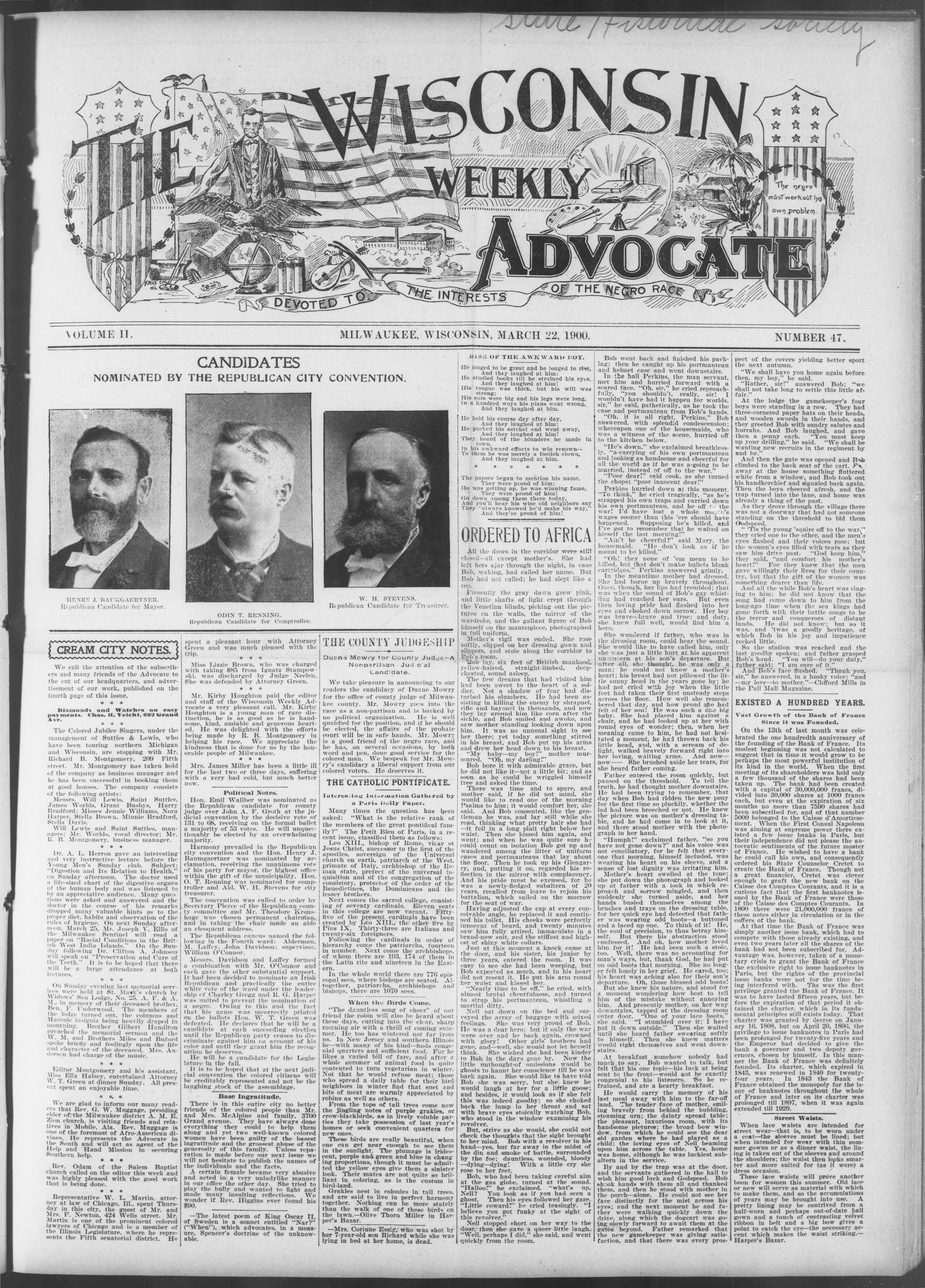
WISCONSIN
WEEKLY
ADVOCATE
DEVOTED TO THE INTERESTS OF THE NEGRO RACE
CANDIDATES NOMINATED BY THE REPUBLICAN CITY CONVENTION.
VOLUME II.
NOMINATED BY
M. B.
HENRY J. BAUMGAERTNER.
Republican Candidate for Mayor.
CREAM CITY NOTES.
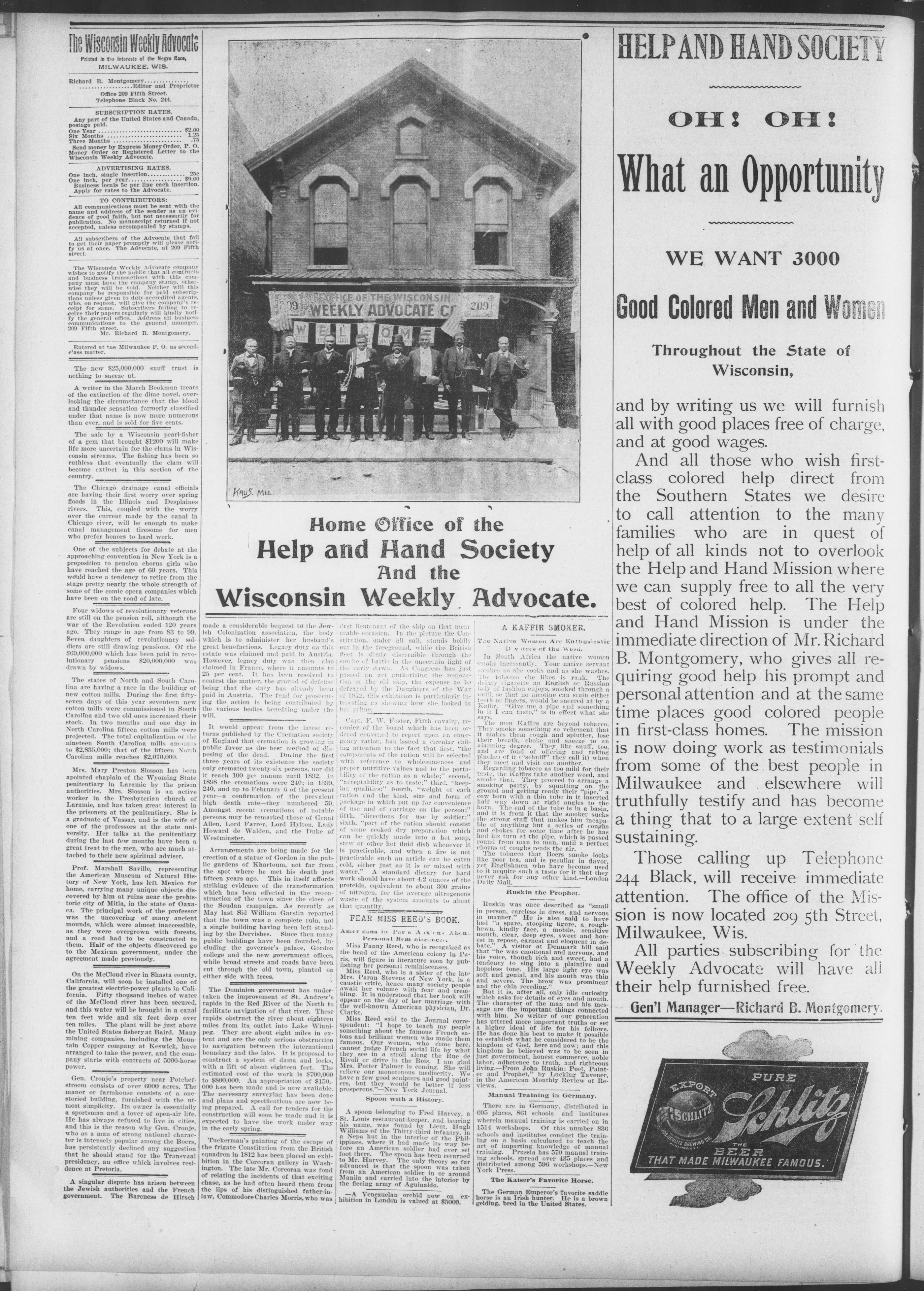
We call the attention of the subscribers and many friends of the Advocate to the cut of our headquarters, and advertisement of our work, published on the fourth page of this issue.
* * *
Diamonds and Watches on easy payments. Chas. H. Veicht, 602 Grand Ave.
The Colored Jubilee Singers, under the management of Suttles & Lewis, who have been touring northern Michigan and Wisconsin, are stopping with Mr. Richard B. Montgomery, 209 Fifth street. Mr. Montgomery has taken hold of the company as business manager and he has been successful in booking them at good houses. The company consists of the following artists:
Messrs. Will Lewis, Saint Suttles, James Worlds, Grant Busbys, Harry Bradford; Misses Jennie Williams, Nora Harper, Stella Brown, Minnie Bradford, Stella Davis.
Will Lewis and Saint Suttles, managers; Mr. Worlds, vocal director; Mr. R. B. Montgomery, business manager.
* * *
Dr. A. L. Herron gave an interesting and very instructive lecture before the Young Men's Sunday club. Subject: "Digestion and Its Relation to Health," on Sunday afternoon. The doctor used a life-sized chart of the digestive organs of the human body and was listened to by an appreciative audience. Many questions were asked and answered and the doctor in the course of his remarks dropped many valuable hints as to the proper diet, habits and observation of the rules of hygiene. On next Sunday afternoon, March 25, Mr. Joseph V. Ellis of the Milwaukee Sentinel will read a paper on "Racial Conditions in the British West India Islands." On the Sunday following Dr. Clifton A. Johnson will speak on "Preservation and Care of the Teeth." It is to be hoped that there will be a large attendance at both lectures.
* * *
On Sunday evening last memorial services were held at St. Mark's church by Widows' Son Lodge, No. 25. A. F. & A. M., in memory of their deceased brother, Ben. F. Underwood. The members of the lodge turned out, the columns and Masonic insignia being heavily draped in mourning. Brother Gilbert Hamilton preached the memorial sermon and the W. M. and Brothers Miles and Buford spoke briefly and feelingly upon the life and character of the deceased. Mrs. Anderson had charge of the music.
串串串
Editor Montgomery and his assistant, Miss Ella Halsey, entertained Attorney W. T. Green at dinner Sunday. All present spent an enjoyable time.
单 效 角
We are glad to inform our many readers that Rev. G. W. Muggage, presiding elder of the Milwaukee district A. M. E. Zion church, is visiting friends and relatives in Mobile, Ala. Rev. Muggage is one of the foremost of Afro-American divines. He represents the Advocate in the South and will act as agent of the Help and Hand Mission in securing Southern help.
* * *
Rev. Odam of the Salem Baptist church called on the editor this week and was highly pleased with the good work that is being done.
***
Representative W. L. Martin, attorney at law of Chicago, Ill., spent Thursday in this city, the guest of Mr. and Mrs. F. Newton, 424 Wells street. Mr. Martin is one of the prominent colored lawyers of Chicago and is a member of the Illinois Legislature, where he represents the Fifth senatorial district. He
[Name]
ODIN T. RENNING.
Republican Candidate for Comptroller.
spent a pleasant hour with Attorney Green and was much pleased with the trip.
* * *
Miss Lizzie Brown, who was charged with taking $85 from Ignatz Stampowski, was discharged by Judge Neelen. She was defended by Attorney Green.
* * *
Mr. Kirby Houghton paid the editor and staff of the Wisconsin Weekly Advocate a very pleasant call. Mr. Kirby Houghton is a young man of rare distinction, he is as good as he is handsome, kind, amiable and generous hearted. He was delighted with the efforts being made by R. B. Montgomery in helping his race. We appreciate the kindness that is done for us by the honorable people of Milwaukee.
* * *
Mrs. James Miller has been a little ill for the last two or three days, suffering with a very bad cold, but much better now.
Political Notes.
Hon. Emil Wallber was nominated as the Republican candidate for county judge over John A. F. Groth at the judicial convention by the decisive vote of 131 to 68, receiving on the formal ballet a majority of 53 votes. He will unquestionably be elected by an overwhelming majority.
Harmony prevailed in the Republican city convention and the Hon. Henry J. Baumgaertner was nominated by acclamation, receiving the unanimous vote of his party for mayor, the highest office within the gift of the municipality. Hon. O. T. Renning was nominated for controller and Ald. W. H. Stevens for city treasurer.
The convention was called to order by Secretary Pierce of the Republican county committee and Mr. Theodore Kronshage was chosen permanent chairman, and in taking the chair made an able an eleoquent address.
The Republican caucus named the following in the Fourth ward: Alderman, M. Laffey, John Davidson; supervisor, William O'Connor.
Messrs. Davidson and Laffey formed a combination with Mr. O'Connor and each gave the other substantial support. It had been decided to nominate an Irish Republican and practically the entire white vote of the ward under the leadership of Charley Gregg and R. G. Harper was united to prevent the nomination of a negro. Owing to this and the fact that his name was incorrectly printed on the ballots Hon. W. T. Green was defeated. He declares that he will be a candidate at each succeeding election until the Republican party ceases to discriminate against him on account of his color and until they grant him the recognition he deserves. He will be a candidate for the Legislature in the fall.
It is to be hoped that at the next judicial convention the colored citizens will be creditably represented and not be the laughing stock of the assemblage.
Base Ingratitude.
There is in this entire city no better friends of the colored people than Mr. and Mrs. McAlpine and family, 3700 Grand avenue. They have always done everything they could to help them along and yet two well-known colored women have been guilty of the basest ingratitude and the grossest abuse of the generosity of this family. Unless reparation is made before our next issue we will not hesitate to publish the names of the individuals and the facts.
A certain female became very abusive and acted in a very unladylike manner in our office the other day. She tried to play the bully and wanted to fight and made many insulting reflections. We wonder if Rev. Higgins ever found his $90.
—The latest poem of King Oscar II. of Sweden is a sonnet entitled "Nar?" ("When"), which advocates, in a measure, Spencer's doctrine of the unknowable.
MILWAUKEE, WISCONSIN, MARCH 22, 1900.
[Picture of a man with a long white beard and a dark suit with a white bow tie. He is facing slightly to the right.]
W. H. STEVENS.
Republican Candidate for Treasurer.
THE COUNTY JUDGESHIP
Duane Mowry for County Judge-A Nonpartisan Judicial
Candidate.
We take pleasure in announcing to our readers the candidacy of Duane Mowry for the office of county judge of Milwaukee county. Mr. Mowry goes into the race as a non-partisan and is backed by no political organization. He is well qualified for the position, and if he should be elected, the affairs of the probate court will be in safe hands. Mr. Mowry is a good friend of the negro race, and he has, on several occasions, by both word and pen, done good service for the colored man. We bespeak for Mr. Mowry's candidacy a liberal support from our colored voters. He deserves it.
THE CATHOLIC PONTIFICATE.
Interesting Information Gathered by a Paris Daily Paper.
Many times the question has been asked: "What is the relative rank of the members of the great pontifical family?" The Petit Bleu of Paris, in a recent issue, classified them as follows: Leo XIII., bishop of Rome, vicar of Jesus Christ, successor to the first of the apostles, sovereign of the Universal church on earth, patriarch of the West, primate of Italy, archbishop of the Roman state, prefect of the universal inquisition and of the congregation of the consistory, protector of the order of the Benedictines, the Dominicans and the lesser brothers.
Next comes the sacred college, consisting of seventy cardinals. Eleven seats in this college are now vacant. Fifty-five of the present cardinals have been created by Leo XIII., the other five by Pius IX. Thirty-three are Italians and twenty-six foreigners.
Following the cardinals in order of hierarchy come the patriarchs, fourteen in number. Next come the archbishops, of whom there are 193, 174 of them in the Latin rite and nineteen in the Eastern.
In the whole world there are 776 episcopal sees, where bishops are seated. Altogether, patriarchs, archbishops and bishops, there are 1070 sees.
When the Birds Come
"The dauntless song of cheer" of our friend the robin will also be heard about these days, cutting into the clear, sharp morning air with a thrill of coming summer. He too has wintered not far from us. In New Jersey and southern Illinois he—with many of his kind—finds congenial quarters and sufficient food. For he likes a varied bill of fare, and after a whole summer of animal food is quite contented to turn vegetarian in winter. Not that he would refuse meat; those who spread a daily table for their bird neighbors in winter find that suet and bits of meat are warmly appreciated by robins as well as others.
From the tops of tall trees come now the jingling notes of purple grakles, or crow-blackbirds, as in lively voluble parties they take possession of last year's homes or seek convenient quarters for new ones.
These birds are really beautiful, when one can get near enough to see them in the sunlight. The plumage is iridescent, purple and green and blue in changing proportions, though it must be admitted the yellow eyes give them a sinister look. Their mates are not quite so brilliant in coloring, as is the custom in bird-land.
Grakles nest in colonies in tall trees, and are said to live in perfect harmony together. Nothing can be more stately than the walk of one of these birds on the lawn.—Olive Thorn Miller in Harper's Bazar.
—Mrs. Corinne Essig, who was shot by her 7-year-old son Richard while she was lying in bed at her home, is dead.
---
RISE OF THE AWK WARD BOY.
He longed to be great and he longed to rise,
And they laughed at him:
He studied books till he strained his eyes,
And they laughed at him!
His tongue was thick, but his will was
strong;
His ears were big and his legs were long,
In a hundred ways his plans went wrong,
And they laughed at him.
They heard of the blunders he made in town.
In his awkward efforts to win renown—
To them he was merely a foolish clown,
And they laughed at him.
The papers began to mention his name,
They were proud of him;
He was getting up, he was winning fame,
They were proud of him!
Go down among them there today.
And you'll hear his wise old neighbors say
They "always knowed he'd make his way"
And they're proud of him!
ORDERED TO AFRICA
ORDERED TO AFRICA
All the doors in the corridor were still closed—all except mother's. She had left hers ajar through the night, in case Bob, waking, had called her name. But Bob had not called; he had slept like a top.
Presently the gray dawn grew pink, and little shafts of light crept through the Venetian blinds, picking out the pictures on the walls, the mirror of the wardrobe, and the gallant figure of Bob himself on the manteipiece, photographed in full uniform.
Mother's vigil was ended. She rose softly, slipped on her dressing gown and slippers, and stole along the corridor to Bob's room.
Bob lay, six feet of British manhood, yellow-haired, straight-limbed, deep-chested, sound asleep.
The few dreams that had visited him had been sweet to the heart of a soldier. Not a shadow of fear had disturbed his slumbers. He had been assisting in killing the enemy by shrapnel, rifle and bayonet in thousands, and now they lay around him like corn after the sickle, and Bob smiled and awoke, and saw mother standing looking down upon him. It was no unusual sight to see her there; yet today something stirred in his breast, and Bob put up his arms and drew her head down to his breast. "My baby—my boy!" mother murmured. "Oh, my darling!" Bob bore it with admirable grace, but he did not like it—not a little bit; and as soon as he could he wriggled himself free and asked the time.
There was time and to spare, and mother said, if he did not mind, she would like to read one of the morning Psalms to him; it would comfort her, she said. And Bob consented, like the gentleman he was, and lay still while she read, thinking what pretty hair she had—it fell in a long plait right below her waist. Then she kissed him again, and went; and when he was quite sure he could count on isolation Bob got up and wandered among the litter of uniform cases and portmanteaus that lay about the floor. Then he took up his Glengarry, and, putting it on, regarded his reflection in the mirror with complacency. And his pride must be excused, for he was a newly-fledged subaltern of 20 years, recalled from leave to rejoin his battalion, which sailed on the morrow for the seat of war.
Having adjusted the cap at every conceivable angle, he replaced it and continued his toilet. His cheeks were perfectly innocent of beard, and twenty minutes saw him fully attired, immaculate in a brand-new suit, and the stiffest and highest of shiny white collars.
Just at this moment a knock came at the door, and his sister, his junior by three years, entered the room. It was easy to see she had been weeping, but Bob expected as much, and in his heart did not resent it. He put his arm round her wrist and kissed her.
"Nearly time to be off," he cried, with almost brutal cheerfulness, and turned to strap his portmanteau, whistling a martial ditty.
Nell sat down on the bed and surveyed the array of baggage with mixed feelings. She was very proud of Bob. He was a dear hero; but if only the war were over and he back again, crowned with glory! Other girls' brothers had gone, and—well, she would not let herself think. She wished she had been kinder to Bob in the days gone by. Now the little unthought-of omissions would be ghosts to haunt her conscience till he was back again. She would like to have told Bob she was sorry, but she knew he would laugh at her for a little goose; and besides, it would look as if she felt this was indeed goodby; so she choked back the lump in her throat and sat with brave eyes stoically watching Bob, who stood in the window examining his revolver.
But, strive as she would, she could not check the thoughts that the sight brought to her mind. Bob with a revolver in his hand—yes, but far away in the midst of the din and smoke of battle, surrounded by the foe; dauntless, wounded, bloody—dying—dying! With a little cry she rose to her feet.
Bob, who had been taking careful aim at the gas globe, turned at the sound. "Halloo!" he exclaimed. "what's up, Nell? You look as if you had seen a ghost. Then his eyes followed her gaze. "Little coward!" he cried teasingly. "I believe you got funky at the sight of this revolver."
Nell stopped short on her way to the door; then she gave a queer little laugh. "Well, perhaps I did," she said, and went quickly from the room.
Bob went back and finished his packing; then he caught up his portmanteau and helmet case and went downstairs.
In the hall Perkins, the man servant, met him and hurried forward with a scared face. "Oh, sir," he cried reproachfully, "you shouldn't, really, sir! I wouldn't have had it happen for worlds, sir," he said, pathetically, as he took the case and portmanteau from Bob's hands.
"Oh, it is all right, Perkins," Bob answered, with splendid condescension; whereupon one of the housemaids, who was a witness of the scene, hurried off to the kitchen below.
"He's down," she exclaimed breathlessly, "a-carrying of his own portmanteau and looking as handsome and cheerful for all the world as if he was a-going to be married, instead of off to the war."
"Poor dear!" said cook, as she turned the chops; "poor innocent dear!"
Perkins hurried down at this moment. "To think," he cried tragically, "as he's strapped his own traps and carried down his own portmanteau, and he off to the war! I'd have lost a whole month's wages sooner than this 'ere should have happened. Supposing he's killed, and I've got to remember that he waited on hisself the last morning." "Ain't he cheerful?" said Mary, the housemaid. "He don't look as if he meant to be killed." "Oh! they none of 'em mean to be killed, but that don't make bullets blank cartridges." Perkins answered grimly.
In the meantime mother had dressed. She had borne up bravely throughout. Once, though, her lips had trembled; that was when the sound of Bob's gay whistling had reached her ears. But even then loving pride had flashed into her eyes and choked down sorrow. Her boy was brave—brave and true; and duty, she knew full well, would find him a hero.
She wondered if father, who was in the dressing room, could hear the sound. She would like to have called him, only she was just a little hurt at his apparent unconcern at his son's departure. But after all, she thought, he was only a man; he could not know a mother's heart; his breast had not pillowed the little sunny head in the years gone by; he had not cried with joy when the little feet had taken their first unsteady steps across the floor. How well she remembered that day, and how proud she had felt of her son! He was such a fine big baby. She had placed him against a chair, and he had looked up at her with round eyes of wonder; then, when her meaning came to him, he had not hesitated a moment, he had thrown back his little head, and, with a scream of delight, walked bravely forward right into her loving, waiting arms. And now—now— She brushed aside her tears, for she heard father coming.
Father entered the room quickly, but paused on the threshold. To tell the truth, he had thought mother downstairs. He had been trying to remember, that day when Bob had ridden the new pony for the first time so pluckily, whether the lad had been breeched or not. He knew the picture was on mother's dressing table, and he had come in to look at it, and there stood mother with the photograph in her hand.
"Humph!" exclaimed father, "so you have not gone down?" and his voice was not conciliatory, for he felt that everyone that morning, himself included, was wearing his heart on his sleeve, and a sense of lost dignity was irritating him.
Mother's heart swelled at the tone; she put down the photograph and looked up at father with a look in which reproach and sorrow mingled, and then suddenly she turned aside, and her hands busied themselves among the brushes and trays on the dressing table, for her quick eye had detected that father was wearing odd boots—a buttoned and a laced up one. To think of it! He, the soul of precision, to thus betray himself. But there his abstraction stood confessed. And oh, how mother loved him for it! He had been such a stoic, too. Well, there was no accounting for man's ways, but, thank God, he had put on odd boots that morning. She no longer felt lonely in her grief. He cared, too; his heart was aching also for their son's departure. Oh, those blessed odd boots!
But she knew his nature, and stood for a moment wondering how best to tell him of the mistake without annoying him. And presently mother, on her way downstairs, tapped at the dressing room outer door. "One of your lace boots," she said. "I stumbled over it; I have put it down outside." Then she waited until she heard father swearing softly to himself. Then she knew matters would right themselves and went downstairs.
At breakfast somehow nobody had much to say. Bob wanted to talk, but felt that his one topic—his luck at being sent to the front—would not be exactly congenial to his listeners. So he refrained, and ate a hearty breakfast.
He would carry the memory of his last meal away with him to the far-off land. The tender face of mother, smiling bravely from behind the bubbling, steaming urn; the dainty spread table; the pleasant, luxurious room, with its handsome pictures; the broad bow window, from which he could see the dear old garden where he had played as a child; the loving eyes of Nell beaming upon him across the table. Yes, home was home, although he was luckiest subaltern in the service.
By and by the trap was at the door, and the servants gathered in the hall to wish him good luck and Godspeed. Bob shook hands with them all and thanked them, and then he stood with mother in the porch—alone. He could not see her face distinctly for the mist across his eyes; and the next moment he and father were walking quickly down the drive, along which the dogcart was going slowly forward to await them at the gates beyond. Father remarked that the new gamekeeper was giving satisfaction, and that there was every pros-
pect of the covers yielding better sport the next autumn.
"We shall have you home again before then, my boy," he said.
"Rather, sir!" answered Bob; "we shall not take long to settle this little affair."
At the lodge the gamekeeper's four boys were standing in a row. They had three-cornered paper hats on their heads, and wooden swords in their hands, and they greeted Bob with sundry salutes and hurrahs. And Bob laughed, and gave then a penny each. "You must keep up your drilling," he said. "We shall be wanting new recruits in the regiment by and by."
And then the gate was opened and Bob climbed to the back seat of the cart. Pa away at the house something fluttered white from a window, and Bob took out his handkerchief and signaled back again. Then the boys cheered afresh, and the trap turned into the lane, and home was already a thing of the past.
As they drove through the village there was not a doorway that had not someone standing on the threshold to bid them Godspeed.
"Tis the young 'squire off to the war," they cried one to the other, and the men's eyes flashed and their voices rose; but the women's eyes filled with tears as they saw him drive past. "God keep him," they said, "and comfort his mother's heart!" For they knew that the men gave willingly their lives for their country, but that the gift of the women was something dearer than life.
And all the while Bob's heart was singing to him; he did not know that the song had come down to him from the long-ago time when the sea kings had gone forth with their battle songs to be the terror and conquerors of distant lands. He did not know; but so it was, and 'twas a goodly heritage, of which Bob in his joy and impatience recked little.
So the station was reached and the last goodbye spoken; and father grasped Bob's hand. "You will—do your duty," father said; "I am sure of it."
And Bob's face flushed. "Thank you, sir," he answered, in a husky voice; "and—my love—to mother."—Chifford Mills in the Pall Mall Magazine.
EXISTED A HUNDRED YEARS.
Vast Growth of the Bank of France Since it was Founded.
On the 13th of last month was celebrated the one hundredth anniversary of the founding of the Bank of France. Its modest beginning was not calculated to suggest that in time it would grow to be perhaps the most powerful institution of its kind in the world. When the first meeting of its shareholders was held only a few thousand of the shares had been taken up. The bank had been created with a capital of 30,000,000 francs, divided into 30,000 shares at 1000 francs each, but even at the expiration of six months no more than 7590 shares had been subscribed for, and of that number 5000 belonged to the Caisse d'Amortissement. When the First Consul Napoleon was aiming at supreme power there existed a few issue banks in Paris, but their independence did not please the autocratic sentiments of the future master of France. He wished to have a bank he could call his own, and consequently ordered his State Counselor Cretet to create the Bank of France. Though not a great financier, Cretet was clever enough to graft the new bank on the Caisse des Competes Courants, and it is a curious fact that the first banknotes issued by the Bank of France were those of the Caisse des Competes Courants. In 1800 there were 21,000,000 francs of these notes either in circulation or in the coffers of the bank.
At that time the Bank of France was simply another issue bank, which had to compete with those already existing, and even two years later all the shares of the bank had not been subscribed for. Advantage was, however, taken of a monetary crisis to grant the Bank of France the exclusive right to issue banknotes in Paris, but the rights of the provincial issue banks were not for the time being interfered with. This was the first privilege granted the Bank of France. It was to have lasted fifteen years, but before the expiration of that period it obtained the charter, which in its fundamental principles still exists today. That charter was granted by decree on January 16, 1808, but on April 20, 1806, the privilege to issue banknotes in Paris had been prolonged for twenty-five years and the Emperor had decided to give the bank a governor and two deputy governors, chosen by himself. In this manner the Bank of France was definitely founded. Its charter, which expired in 1843, was renewed in 1840 for twenty-four years. In 1843 the Bank of France obtained the monopoly for the issue of banknotes throughout the whole of France and later on its charter was prolonged till 1897, when it was again extended till 1920.
Street Waists.
When lace waists are intended for street wear—that is, to be worn under a coat—the sleeves must be lined; but when intended for wear with thin summer gowns or as a dinner waist, the lining is taken out of the sleeves and around the shoulders; the waist then looks smarter and more suited for (as it were) a dress occasion.
These lace waists will prove another boon for women this summer. Old lace or new will serve as material with which to make them, and so the accumulations of years may be brought into use. A pretty lining may be contrived from a half-worn and perhaps out-of-date ball gown and a touch of contrasting velvet ribbon in belt and a big bow gives a point to catch the eye—the necessary accent which makes the waist striking.—Harper's Bazar.
MAFLEKING IS WAITING.
Indicates Abandonment of the Free State by the Boers-Kipling at Bloemfontein.
London, March 21.—2:20 p. m.—The only news from South Africa showing activity on either side comes from Warrentown, north of Kimberley, where desultory fighting occurred all Sunday, resulting in the retreat of the Boers towards Christiana, under shell fire. The progress of this column towards Mafeking has either almost ceased, or is forbidden to be mentioned in dispatches. Nothing new comes from Col. Plumer, and Mafeking apparently still awaits relief.
The Pretoria account of the skirmish at Fourteen Streams, March 16, says that a Boer command was preparing to destroy a railroad bridge and that the engagement lasted half an hour, with the result that one bugler was slightly wounded. The same dispatch announces the arrival at the Transvaal capital of Gen. Schalkburger from Natal.
Free State Abandoned.
The second edition of the Times today publishes a dispatch from Bloemfontein dated Monday, March 19, which says: "The blowing up of bridges by the Boers is an evident sign that the Transvaalers intend to abandon the defense of the Free State." All is quiet in the south and west. A corps of young Boers from the farms surrounding Bloemfontein, under an im-
GEN. HUTTON.
In command of the Canadian volunteers in South Africa. He has been commended for bravery.
perial officer, have been detailed for police work and to prevent the further looting of abandoned farms by the Kaffirs.
Steyn'+ Advice to Kruger.
It is said that when President Kruger left Bloemfontein after his recent visit there, President Steyn's parting remark was: "Mind the British do not catch you, or you will get better quarters at St. Helena than I." Rudyard Kipling has gone to Bloemfontein. The Boers at Aliwal North are reported to be still holding a position in the big hills on the Free State side. From a Pretoria dispatch it appears some misunderstanding regarding Lord Salisbury's reply to America's offer of mediation exists there. It had been quoted to the effect that Lord Salisbury said he could accept the intervention of no other power, which leads to the belief that the American representations would be listened to in the final settlement.
Private Cole, the Canadian whom the Queen visited at Nettley hospital, returned to South Africa today, fully recovered from his wounds.
KITCHENER TAKES PRIESKA.
Transvaalers Reported as Fleeing Across the Orange River.
London, March 21. Now that Prieska has fallen into the hands of Lord Kitchener without opposition and the Transvaalers are fleeing across the Orange river, leaving behind them considerable quantities of arms, explosives and supplies, little doubt is felt that the rebellion of the Dutch in Cape Colony will speedily collapse. There is no indication anywhere in the southern half of the Orange Free State that there will be any more fighting.
It is to be presumed, however, that President Steyn has not abandoned active operations. That he has hope of redeeming some of the burghers from the persuasions of Lord Roberts' proclamation is shown by official information that the President is circulating a pronunciamento to the effect that any burgher who signs a declaration that he will not fight the British again will be treated as a traitor and shot.
Advices from Lord Roberts.
The following dispatch from Lord Roberts was issued by the war office last night. It is dated Bloemfontein, Tuesday, March 20:
"Kitchener occupied Prieska yesterday unopposed. The rebels surrendered their arms. The Transvaalers escaped across the river.
"Mr. Steyn is circulating a notice by means of dispatch riders in reply to my proclamation to the effect that any burglar who signs a declaration that he will not fight against us again will be treated as a traitor and shot.
"The Bloemfontein people are affording us every assistance in the matter of hospital accommodations. We have consequently been able to arrange for 500 beds. Thirty-three prisoners were taken at Prieska, 200 stands of arms and some supplies and explosives. The Boers have begun to surrender on the Basutoland frontier."
The War Not Over.
Some of the dispatches declare that the Boers are making preparations for a stand at Kroonstadt, but many think resistance will not become determined before the Vaal river is reached. There are even those who say that the war is over; who declare that President Kruger is only making a final bluff when he talks about fighting to the death. In the sounder judgment of the situation, however, it is held that there is still some grim work between the British and the effectual conquest of the Transvaal.
Johnniesburg Mines All Right.
A correspondent of the Daily News at Bloemfontein, telegraphing Monday, March 19, says: "I learn from Johannesburg that it is not true that the mines have been flooded or otherwise damaged, beyond the fact that the machinery is suffering from disuse. My informant de-
clares that the whole story was 'fabricated to court sympathy.'" White Flags on Farm Houses. A dispatch to the Daily Mail from Donkerspoort, dated Monday, March 19, says: "A reconnoissance toward Philippolis, twenty-five miles west of Springfontein, found the farms all flying white flags. The British troops are cordially received. It is reported that Mr. Steyn is trying to rally the Boers, but the latter say they have had enough."
REPLY OF SWITZERLAND.
Federal Council Unable to Offer Mediation Under the Circumstances. Berne, Switzerland, March 21. The federal council has answered the Boer appeal for mediation as follows:
"The Swiss federal council would have been pleased to co-operate in friendly mediation in order to end further bloodshed, but as the Presidents of both South African republics have directly approached the British government in order to conclude peace on a basis indicated, and the British government has shown itself against the proposal; and, as furthermore, the British government has declared to the cabinet at Washington that it did not propose to accept the intervention of any power, the Swiss federal council, to its regret, must also renounce the idea of taking any steps on the lines of the request made by the Presidents of the South African republics. There remains for the federal council, in the circumstances, nothing but to express its sincere wish that the belligerents will have succeeded, at no too distant date, in finding a basis for an understanding honorable to both parties."
Work of the Hospital Train.
New York, March 21.—A dispatch to the World from Pictermaritzburg says: A temporary bridge across the Tugela at Colcous is now open for traffic and there is at least a direct railway service between Durban and Elandslaagte. The first train to cross the bridge was the Princess Christian's hospital train. This magnificent train has been badly wanted in Natal since the beginning of the war. Maj. Brazier Creagh's improved hospital train has removed about 4000 wounded, but though every care was taken the narrow doors of the carriages and the bumping and shunting has caused much pain which with appliances now at hand may be avoided. There are still over 2000 patients in the Ladysmith hospital, so the train is not too late.
WOULD BE EMBARRASSING.
Proposition that France Offer Madagascar as Asylum for Boers.
Paris, March 21. Though the continued success of the British arms in the Transvaal has not yet brought the French public to consider the Boer cause hopeless, still there are many signs that this idea is rapidly spreading. There is just now a prevalent disposition to predict all sorts of horrible things when the British reach Pretoria. This, however, is a mere cover from which to urge the British to make peace, so that the French may escape gracefully from a foolish position which they ought never to have assumed.
Madagascar as an Asylum.
Several readers of the Matin suggest that in case the English triumph over the Boers France offers the Boers asylum in Madagascar, setting apart land there for their colonization. The Matin devotes a leading article to this "generous idea." Taking it for granted that the whole population of the Transvaal would cross to Madagascar, it expresses the fear that 450,000 Boers might become embarrassing guests, because they would outnumber the French residents. This is indeed probable, inasmuch as outside of the Malgache military and official world there doubtless are not 5000 Frenchmen in the whole island.
Finally the Matin kills the whole proposition by asking: "If the Boers leave the Transvaal because of the loss of their independence why come to Madagascar, where they will not regain it?"
Going to St. Helena.
Col. Challice of the army service corps sails for the island of St. Helena tomorrow in order to make the necessary arrangements for the accommodation there of Gen. Cronje and the other banished Boers. It is still doubtful whether all the prisoners will be sent there, owing to the feuds between the Transvaalers and the Free Staters. If all the Boers are sent to St. Helena considerable increase in the strength of the garrison will be required.
FIRED AT THE JUDGE.
Attempted Assassination in the Palace of Justice at Paris—Had a Narrow Escape.
Paris, March 21.—In the palace of justice today, an attempt was made to murder the presiding judge of the Fifth court by a druggist named Bardin, who had just lost a suit. The judges had just taken their seats and counsel in another case had begun his speech, when Bardin aimed a revolver and fired three shots at the judge, who had a narrow escape, the bullet grazing his head. Municipal guards threw themselves on Bardin and removed him to a cell, while the judge, with perfect coolness, said to counsel: "You can continue, Maitre; it is nothing."
HEAD-END COLLISION
Fatal Accident on Milwaukee Road Near Hull, Ia.—Conductor McKeever Killed.
St. Paul, Minn., March 21.—A Mason City, Ia., special to the Dispatch says: A head-end collision on the Chicago, Milwaukee & St. Paul railroad at Hull last night caused the death of Conductor Mike McKeever, while Brakenman French lost his hand. No. 73 passenger west ran into No. 62 freight while the latter was switching in the yards at Hull. The air brakes failed to work. Both trains were badly damaged.
SAUGATUCK HOTEL BURNS.
Resort House, Erected Last Fall, Destroyed—Loss $20,000.
Saugatuck, Mich., March 21.—The Hotel Kalamazoo, which has been built since the summer resort season of 1899 closed, and which was the most elaborate and finest of the resort hotels at this place, has been destroyed by fire. The flames are supposed to have started from fires which were kindled in the hotel to dry out the plastering. The loss will reach $20,000, insured for about half that amount.
THE PRESIDENT'S THANKS.
Gift to the United States of a Bust of Washington.
London, March 21.—In acknowledging the gift to the United States of a bust of Washington, presented by M. Coates of Bournemouth, Secretary Hay writes: "The President directs me to express his sincere thanks to you, not only for the valuable and acceptable gift, but also for the friendly spirit of good will which prompted it."
Fell with the Elevator
Chicago, Ill., March 21.—Thirty employees of the Blakely Printing company were injured about 7 o'clock this morning by an elevator falling from the third floor.
Prizefight Arranged with Fitzsimmons Declared Off-Kid McCoy Substituted.
New York, March 20.—Bob Fitzsimmons appeared at the Delavan house at 10 o'clock today, with his forfeit of $5000, as agreed on last night. After waiting half an hour and Sharkey not appearing, Fitzsimmons said he declared off the fight with Sharkey. Martin Julian, representing the Tuckahoe club, was present with a certified check for $5000 offering 67 per cent. of the gross receipts for the fight. Fitzsimmons said to Julian that he would accept this offer and fight any man Julian would select. Julian asked Fitzsimmons to name a man. Fitzsimmons named "Kid" McCoy.
GERMANY WILL HELP.
To Co-operate with United States in Protecting American Missionaries in China.
New York; March 20.—A special to the Herald from Washington says: It developed today that Germany stands ready with troops to protect American missionaries in Shan Tung province. It was further ascertained that the Berlin government, to the gratification of the United States, recently dispatched an expeditionary force from Kiao-Chou to Ichou-Fu for the protection of American missionaries. This force suppressed the rioters at Ichou-Fu and arrested the ringleaders, who have been punished, and taught the anti-foreign crusaders a salutary lesson.
The state department has been informed that the German government contemplates another expedition force to the interior of Shan Tung, where most of the American missionaries are located, but it fully understands the willingness of the German authorities to take such action. In fact, I learned in a high diplomatic quarter that the German governor at Kiao-Chou has standing instructions to take such measures for the protection not only of German missionaries and other interests in Shan Tung province, as may seem necessary, but of American missionaries as well.
To Preserve Order.
Because of the peculiar relation which Germany stands to the province of Shan Tung, by reason of her acquisition of Kiao-Chou and of certain property rights in the promontory, she is particularly desirous of preserving order in the territory.
The fact that Germany dispatched troops to Ichou-Fu to protect American missionaries has never hitherto been published. The offer of Germany to send a force to this point was received with pleasure by the authorities, who do not contemplate any designs whatever on Chinese territory, and who are consequently very glad to assent to the German proposition.
Minister Wu Ting Fang, the diplomatic representative of China here, is inclined to look upon the reports of trouble in China as exaggerated.
Warships Going to Taku.
Washington, D. C., March 20.—The secretary of the navy has received a cablegram from Admiral Watson stating that the gunboat Wheeling had proceeded to Taku. She will be relieved by the Concord about May 10 and will go as usual in the summer, to Unalaska on the Alaskan coast.
The state department is in a quandary to devise means to render effective protection to the American missionaries at Shan Tung. The difficulty lies in the fact that the missionaries have in most cases gone as far as 200 miles inland and are along the western border of Shan Tung, beyond reach of any aid that can be extended from a warship.
It is 200 miles from Kiao Chou, the German seaport, to western Shan Tung, but it is presumed that Germany has assumed military responsibility.
RESULT OF AN EARTHQUAKE.
Part of San Jacinto Mountain Slips Into a Subterranean Cavern. San Jacinto, Cal., March 20.—Great excitement prevails in San Jacinto, as it has been discovered that part of San Jacinto mountain has slipped into a subterranean cavern. A territory covering 600 acres, at an elevation of 4000 feet, was dislodged by the Christmas earthquake, and slipped 150 feet lower than it had previously stood for centuries.
The face of the new valley is thickly traversed with fissures and cracks, varying in width from an inch to six feet across, and it is possible to see neither bottom nor to sound the depths by throwing stones into them. A young man was lowered forty feet in the crevice, and the bottom could not be seen by the venture-some youth. Every procurable vehicle was driven eleven miles to the southeastern foot of this great spur of San Jacinto peak. Once at the broken rim of this mountain range the eye surveyed a scene of terrible devastation.
The great earthquake of December 25 has been succeeded by dozens of light shocks, and, although these are becoming infrequent, residents are much alarmed.
HERMAN E. TAUBENECK DEAD.
Former Leader of the People's Party Expires at Seattle.
Seattle, Wash., March 20.—Herman E. Taubeneck, long identified with the People's party and formerly chairman of its national committee, died in this city yesterday. Mr. Taubeneck had been in this city about two months, having come here in delicate health with the hope that a change would be beneficial to him. He rested quietly at the home of his brother, avoiding all publicity. The hope of improved health, however, proved delusive, and he gradually declined. Mr. Taubeneck was a fine specimen of Western manhood, vigorous and sturdy, and during the Weaver campaign he exercised a commanding influence. He was about 44 years of age. The body will be embalmed tonight and sent East to Chicago for burial in his native state of Illinois.
Duration of a Wink.
A German scientist has gone to some trouble to calculate the average duration of a wink, in order to ascertain just what the phrase "in the twinkling of an eye" means. He says that a wink occupies four-tenths of a second. The eyelid descends in one-tenth of a second, stays down thirteen-hundredths of a second and rises again in seventeen hundredths.
—In India the military authorities have just issued an interesting order. In future mounted officers traveling by rail on temporary duty may, if they prefer it, take a bicycle with them at government expense, in lieu of a charger, when the duty for which they are detailed will admit of such a course.
—Nome City, the new mining town on the Alaskan coast, already has a newspaper—a four-page sheet which measures about 12x16 inches, but which sells at 50 cents a copy.
—The word "cossack" is Turkish and means "free man" or "free lance."
WERE FORCED INTO WAR.
Complete Surrender of Independence Would Satisfy England.
Says that America Should be with the Boers in a Struggle for Liberty.
New York, March 20.—A dispatch to the Herald from Pretoria, dated February 10, says: Your correspondent has just had an interview with President Kruger. He shows but little evidence in his countenance of the tremendous strain he is undergoing.
"This war was forced upon us by England, which has been misled by Cecil Rhodes and the millionaires who want the country," he said. "The Boers yielded as far as possible, until they saw that nothing but complete surrender of their independence would satisfy England.
"Having been forced into the war, the Boers will conquer or die. I expect no aid from other nations, but we are glad of sympathy and friendship. The Transvaal is willing to make peace at any time, but we want no more conventions. Only absolute independence is possible. We do not want more territory, but are content with our present frontier, if we are permitted to live peacefully. This is all we ask.
Salisbury a Dodger.
"The Transvaal will stipulate in the peace terms that Natal and Cape Colony Dutch now fighting with the Boers shall be regarded as belligerents and suffer no loss of property. I learned that some of these men had been captured and were being tried at Cape Town, charged with treason. This government cabled to Lord Salisbury stating that if such men were not treated as prisoners of war we would make reprisals on the British prisoners held here. Lord Salisbury replied, dodging the real point and threatening if we injured a single British prisoner to hold me personally responsible. I suppose he meant the British would hang me. Such threats are contemptible and cannot prevent me from performing my duty to my country. The Transvaal government replied today, informing Lord Salisbury that they despise his threats.
Perish Rather Than Yield.
"It is too early to prophesy the outcome of the war or its duration. The Boers are in God's hands and He will not let us perish. Our total fighting strength is but 40,000, but with God's aid we can prevail. I have 200 blood relatives, fighting, and would rather see them all perish than to yield to England's unholy aggression. It is liberty or death. I have protected British property in the Transvaal and shall continue to do so.
"Convey to the American people my esteem. We feel that every American should be with us in this struggle for liberty."
A SNUB FOR GERMANY.
What Would Follow an Attempt to Interfere with Britain's War Plans. London, March 20.—2:30 p. m.—For all the news that reached here yesterday and today, Great Britain might almost as well be at peace. It is reasonable to believe that the relief of Mafeking may be heard of at any hour. Gen. Kitchener has entered Prieska, Cape Colony, without opposition, the insurgents laying down their arms, which merely confirms the previous reports of their willingness to submit. Gens. Roberts and Buller are still inactive, pending developments at the theater of war.
Fate of Johannesburg.
Considerable interest is attached to the fate of Johannesburg. Commenting on the reported consultation between Secretary Hay and the German ambassador at Washington, Dr. Von Holleben, as to a proposition that both belligerents be urged to leave Johannesburg alone, the Pall Mall Gazette says: "The story that the German ambassador at Washington and the American consul at Pretoria are concocting a little scheme of German intervention is really a glorious yarn, and one which shows to what desperate straits the enemies of this country are reduced. Just imagine a government which has formally declined all outside intervention permitting Germany to dictate the course of Lord Roberts' march to Pretoria. The German foreign office knows better than to invite the snub it would infallibly receive if it ventured to whisper so preposterous a proposal in Downing street."
Rhodes May Have Told the Truth.
The storm of indignation aroused by Cecil Rhodes' utterances alleging stupidity and neglect of duty on the part of the British generals is still raging. Certain persons with a liking for hard facts are asking significant questions. Where, they say, is the large number of Boers represented as arrayed against the British? Where are the long-range guns? Have men and guns vanished into thin air? Conviction is forcing itself on all minds open to conviction that there has been a deal of overestimating of Boer numbers and equipment and a deal of underestimating of the comparative strength of the imperial army. It is admitted that Cecil Rhodes may have been dictatorial; that he may have got his deserts in being suppressed; yet the facts, wherever they have appeared, seem to have borne out his affirmation that the total strength of the Boers in the field never exceeded 30,000. The census of the voting population of the Transvaal and Orange Free State reveals unmistakably that the Boer force never could have numbered anything like the vast army the British commanders originally reported. Mr. James Bryce declares that the British people have been wretchedly served by the newspapers in London in the matter of presentation of facts during the war, and it would seem that the charge had much to support it.
Buller May Wait for Roberts.
There are some reports to indicate that Gen. Buller is about to move against the Boers at the junction of the Drakensberg and Biggarsberg ranges. The move may be to turn their flanks, but it is the general opinion, nevertheless, that he will wait till the enemy shall have been maneuvered out of its position by Lord Roberts' advancing army. Dispatches agree that the Transvaalers are intrenching at Vereenining, where the Bloemfontein-Pretoria railway crosses the Vaal river from Viljoen's drift.
LOCATED IN SOUTH AFRICA.
Fugitive Adjutant General Sorry He Did Not Remain in Michigan. Grand Rapids, Mich., March 20.—The mystery concerning the whereabouts of Gen. White, fugitive quartermaster-general of the Michigan state troops, was solved today, when an intimate friend of the missing man received a letter from him written in Cape Town, South Africa, dated February 19. Gen. White says he is sorry he did not remain in Michigan and fight his troubles cut. He claims to be innocent of any intention of wrong-doing.
A GENERAL STRIKE.
President James O'Connell Says One is Contemplated but Not Ordered.
Cleveland, O., March 21.—President James O'Connell, of the International Machinists' union, arrived here from Chicago today, and subsequently held a long conference with the officials of the local machinists' union in regard to the proposed strike in this city. A meeting will be held tonight which it is expected will be largely attended by both union and non-union machinists. It will then be decided whether a strike will take place. In an interview Mr. O'Connell said: "No national strike has yet been called, but arrangements are being made for one. In Cleveland the men want so little that I cannot understand why the employers should prefer to have a strike on their hands." It is said that 2500 machinists will go out in this city if a strike is ordered
New York, March 21.—In anticipation of an extension to this city of the strike of machinists now in progress in Chicago, Columbus, O., and Paterson, N. J., local manufacturers of machinery are pushing forward the work of perfecting an organization to cope with it when it comes. The threats recently made by the International Association of Machinists to make the Chicago strike national and call out 100,000 men in addition to the 6000 now out in Chicago and the 1000 in Columbus and Paterson, causes increased activity among manufacturers here.
According to Delegate George H. Warner of the International Machinists' association the causes that have led to the strikes of machinists in Chicago will, if the Chicago men win, precipitate strikes in all the large cities of the country, New York included, if the manufacturers do not accede to the demand for a nine-hour working day, which began in Chicago and is to be made everywhere.
"The machinists," he said, "may not find it necessary to wait for our movement to succeed in Chicago before extending it to other cities, and the nine-hour demand may be made in New York and elsewhere before many days."
Manufacturers Driven from Chicago.
Manufacturers Driven from Chicago.
Chicago, Ill., March 21.—The subcommittee of the congressional industrial commission spent several hours today in listening to testimony of James L. Board of the firm of G. A. Crosby & Co., metal working machinery manufacturers. Mr. Board was emphatic in his opinion that if it were not for the continual labor trouble and the poor protection accorded manufacturers, the city would be the largest manufacturing center in the world.
Mr. Board said that he had asked for police protection for his plant and workmen but had been refused. Mr. Board said that in his opinion the police courts generally were intimidated by the strike spirit that prevails among the labor unions.
In answer to a question by Col. Clarke of the commission as to the probable result if the labor troubles continue, Mr. Board said that manufacturers would be surely driven from Chicago to smaller towns, where wages are some times 25 per cent, less owing to the cheaper cost of living. He also said in answer to a question that he considered trades' unionism placed a premium on inefficiency and that labor leaders from his experience with them were looking solely for their own aggrandizement. "The average American mechanic," said Mr. Board, "is nothing but an overgrown boy."
STATEMENT DENIED.
Report that Philippine War Costs 1000 Lives Each Month Pronounced Untrue.
Washington, D. C., March 21.—War department officials deny recently published statement that Gen. Otis' campaign is costing upward of 1000 men every month. According to the official records, since the American occupation of the Philippines, June 1, 1898, up to February 17, 1900, the date of the last official compilation, the actual mortality in the army in the Philippines was 65 officers and 1460 men, a total of 1525, or at the rate of 74 deaths a month.
More details are contained in the report of Col. Woodhull, chief surgeon of the Philippine army. His report, however, does not extend beyond the end of the last calendar year. It shows that from the time American troops landed in Manila up to December 1, 1899, the total number of deaths were 58 officers and 1263 men. Of this number 42 officers and 570 men died by violence, and 16 officers and 693 men died of disease. Most of the deaths by violence occurred in battle. There were, however, 137 deaths from violence outside of actual hostilities. It is a singular fact that more than one-half of the latter class of deaths were caused by drowning. The total number of wounded without fatal results during the period covered by the report was 1767.
Surgeon-General Sternberg says that many of the alarming statements of disease and death in the Philippines seem to be based on the fact that large details of contract surgeons are being forwarded to the Philippines. The contract surgeons now being sent there, he says, are simply to take the places of others whose contracts have expired. He admitted that twenty-four officers of the medical department were on the transport which sailed from San Francisco a few days ago, but explained that they had been gathering at San Francisco for several weeks awaiting transportation, under orders issued in the usual routines.
SAVED SIX LIVES
Colored Man, at Great Peril, Resques Little Children from Burning House.
New York, March 21.—Six lives were saved by the gallant work of a young colored man during a fire at a flat-house in West One Hundred and Thirty-fourth street today. The man's name is M. S. Anderson. He detected the fire while on his way to work. The flames had gained considerable headway, and in a window of the second floor stood a man named Nelson, with his six little children hovering about him, their escape having been cut off by the flames. With two passersby, Anderson ran into the building next door, and up to the third floor. With his two companions holding his legs, Anderson swung head downward and, swaying his body backward and forward, managed to reach the children as they were held up to him by the father. All were taken out safely in this manner. The firemen brought the other occupants of the building down the ladder.
ENGINE LEFT THE TRACK.
The Engineer Crushed to Death and the Fireman Injured.
Altoona, Pa., March 21.—The engine pulling the second section of the Western express, due here at 3:40 o'clock this morning, from some cause unknown left the track in the Altoona yards and fell over on its side.
Engineer Kauffman, aged 45, of Harrisburg, was crushed and died a few hours afterwards in the Altoona hospital. Fireman Shuman escaped with a slight scalp wound. Brakeman Otto was hurt by flying debris. None of the passengers were injured.
DYNAMITE MINFS AT JOHANN_SBURG.
Transvaal Engineers Think Boers Are in Earnest-Place Orders for New Equipment.
Houghton, Mich., March 21.—[Special.]—Boer threats to dynamite the mines and machinery of Johannesburg may merely be a bluff, as the London dispatches assert, but leading mine managers and engineers from the Transvaal, who have visited the copper district in large numbers since the beginning of hostilities, think differently. The mine managers are in the United States to place orders for new equipment immediately after the destruction of the old machinery. One Johannesburg mine manager, now here, Pope Yeatman of the Robinson mines, has full plans and specifications for a complete new equipment which will cost about £1,000,000 sterling. The leading American machinery manufacturers have made conditional bids on probably $20,000,000 worth of new mining machinery for South African gold mines.
GEN. WHEELER'S CASE.
The Soldier-Congressman Would Like to Find Out Where He Is At.
Washington, D. C., March 21.—Gen. Wheeler called at the war department this morning and officially reported his return from the Philippines to Secretary Root. It was expected that the question of Gen. Wheeler's future military status would be determined at this meeting, but Secretary Root was so busy with other important questions that it was concluded best to defer the consideration of Gen. Wheeler's case to a more opportune time. Meanwhile the resignation of Gen. Wheeler from the volunteer army will be in abeyance and the question as to Gen. Wheeler's eligibility to a seat in Congress will be held up pending the settlement of his military status.
There is a strong desire to put the names of Gen. Wheeler and Gen. Lee on the retired list of the army with the rank of brigadier-general, and the execution of this plan requires special legislation by Congress. Existing law prohibits a man 64 years of age from serving on the active list in the army. Gen. Lee is over 64 and Gen. Wheeler will be 64 in September. The last-named, therefore, is the only one eligible for appointment to the regular army. The desire of the President is understood to be to honor both in the same way. With the consent of Congress, it would be possible to appoint them brigadier-generals on the retired list. There is reason to believe that Gen. Wheeler would be willing to forego his rights to a seat in Congress under existing conditions, providing he was assured of an appointment to the regular army. As an officer on the retired list, there would be no question as to his eligibility to a seat in the national Legislature in case his former constituents desired to elect him.
SAVED HIS MOTHER.
SAVED HIS MOTHER.
Chicago Lad Prevents a Murder by Shooting His Father Though the Heart.
Chicago, Ill., March 21.—To save his mother from being cut to pieces by her husband, who had attacked her with a large butcher knife, Bertie Finch, 15 years old, shot his father, George Finch, through the heart at 9 o'clock last night. When taken into custody the boy wept bitterly and said he expected to be hanged at once, but that he would do the deed again if necessary to protect his mother.
Finch was a laborer. He frequently quarreled with his wife and had been arrested several times for beating her. Last night he complained of the supper and sent his children, Bertie and a daughter 12 years old, to bed when they remonstrated with him. He then seized a butcher knife and asserted that he intended taking his wife's life.
He advanced toward her in a threatening manner, but he had only taken a step or two when a shot rang out and Finch fell to the floor. He died almost instantly. Standing in the doorway, was Bertie with a shotgun in his hand.
After being ordered from the room by his father the boy obtained the weapon and stood near the door so that he could hear the conversation between his parents and be ready to assist his mother. He heard the threat of the man when he asserted that he would kill his wife and opened the door just as his father took the knife off the table. Mrs. Finch begged for mercy when her husband started toward her. She did not see her son and did not know of his presence until he had fired the shot which ended his father's life.
BIG MINING SUIT.
Montana Silver Kings Go to Law and Many Millions Are Involved.
St. Paul, Minn., March 21.—A special from Butte, Mont., to the Dispatch says: A mining suit between the rival copper kings, Marcus Daly and United States Senator Clark, began in the United States court yesterday. There are three suits in all, but the trial of one will determine all contentions. The mines involved are the Never Sweat of the Anaconda company and the Colusa and Parrot, owned by the Colusa-Parrot Mining company, of which Senator W. A. Clark is the head. The question of apex is involved in this, as in similar suits tried in the courts and the determination of the matter will mean millions of dollars to the company securing a favorable decision. Both sides have been actively preparing for trial for a year past and every section of the country has been scoured for mining experts to give testimony in the case. Mine models costing thousands of dollars have been constructed for the purpose of the trial, which will be one of the most notable ones ever tried in the West. Some of the best-known geologists and mining men of the country are arrayed on either side.
DID NOT SEE THE ENGINE.
One Working Girl Killed and Another Fatally Injured.
Chicago, Ill., March 21.—Jennie Patterson was killed and her sister Maggie fatally injured here today by a locomotive at the crossing of the Belt railway at Twenty-ninth street and Stewart avenue.
The girls, neither of whom appeared to be over 17 years of age, were evidently on their way to work, as both carried lunch baskets. They did not see the engine which was backing rapidly towards them and both were run over.
COAL TO BE HIGHER.
Public to Pay for the Increase Granted the Miners.
Cleveland, O., March 21. As a result of the recent increase of wages granted the Massillon miners, the Massillon District Coal Operators' association has decided to raise the price of coal 25 cents per ton. The increase in the wages of the miners, it is stated, amounted to 20 per cent. The advance in the price of coal is to take effect April 1.
AT AN AFTERNOON TEA.
"Tis Lent at last, and with it, balls
And parties have been banished;
How speedily have "teas" and calls
Supplanted what has vanished!
Promptly today at five o'clock
I left my latest verses,
And sauntered forth "around the block"
To "ten" at Madame Purse's.
The glare of golden lights within
A giamour to the eye lent;
I entered. What a merry dln!
For not a soul was silent.
I greeted Madame, spoke her fair,
Then, left to my devices,
Went flitting here and flitting there
In search of mental spices.
In vain my search. Where'er I went
The talk was void and vapid;
Some spoke slow-honeyed compliment,
Some gushed in phrases rapid.
From one I heard of coming style,
From one of coming scandal;
One said she hated old Carlyle,
Another hated Handel.
Miss Pry laughed slyly at Miss Prim. Miss Prim at pert Miss Pry laughed; Miss Pride scorned both, ad interm Why marvel then that I laughed?
Around me thus flowed gibly out
Small mots and commonplaces;
Pique, pride, dissembled joy, and doubt
On fair and ugly faces.
And as the tall tea-urn I sought,
Twixt gowns of bright and black cloth,
"Why is this called the time," I thought,
"Of ashes and of sackcloth?"
—Town Topics.
A REPENTANT ROGUE
A REPENTANT ROGUE
I.
When Jimmie McKoy died he bequeathed his mansion on North Shore, his founders' shares in the Great Poobah Gold Mining company, and the respectable sum of £250,000 sterling, invested entirely in Colonial stocks, to his "only and beloved child" Victoria Marie McKoy. Jimmie was a child of fortune, a man obviously born lucky, yet his sole pride was in the fact that he was born Colonial.
Victoria Marie was a lady. She had been well educated by divers teachers. She could play "Home, Sweet Home" with variations, not only absolutely correct, but with a feeling which could disturb no conversation. She had read "Trilby" and "The Woman Who Did." She rode a bicycle, and refused to take advantage of the voting paper presented to her by a maternal government. She was the richest heiress in Australasia.
II.
It was at Lady Boughtem's garden party that Victoria Marie met Cyr.1 Fitzherbert.
His raven black hair—won rather long—his small, but artistically drooping, mustache, his olive complexion that told of the inherited fire and passion of warmer southern blood than the hyperborean fluid of his father's and, above all, his pale-blue eyes, with which he often gazed intently at nothing, showed, so the ladies said, that there was a secret, doubtless a romantic one, in his past life.
"I must introduce you to our heiress, Miss McKoy," said Lady Boughtem.
"Is that she?" asked Mr. Fitzherbert, fixing his blue eyes on the identical young lady.
"Yes," said her ladyship wonderingly; "how did you guess?"
"I do not know," he replied, speaking in a low, far-away voice. "She is not beautiful; not to the mere outward eye, but to those who look beyond the physical outline there is a depth, a soul, a character—but what am I saying?"
His voice changed as if he had awaked from some pleasant dream to the reality of a mundane existence, and he continued with artless lightness:
"I had no idea she was your heiress, though I was anxious to be introduced to her. Still, it would be mere esthetic folly to say that the possession of a certain number of golden coins could in any way spoil my ideal."
"My dear Victoria," cried her ladyship, after the ceremony of introduction had been duly enacted, "I must leave Mr. Fitzherbert with you. I know you will look after him well, you dear girl, and really I must—it is my duty to her majesty—I must attend on his excellency. He has not had a cup of tea this afternoon. Positively he must be thirsty—such a hot afternoon!—and wearing a frock coat!"
Strange to say, though he never spoke of them to Lady Boughtem, Mr. Fitzherbert's talk to Victoria was entirely of outdoor pastimes, of hunting, shooting, boating, tennis and bicycling.
He recounted nothing impossible; no extraordinary leaps, miraculous shots, prodigious record-breakings. Everything was kept within small and seemly bounds.
She began to admire him, not so much for the things he had done, as for the truth with which he retailed them.
To her surprise she felt sorry when the thinning crowd on the lawn told her it was time to depart.
"You must call on us," she said, eagerly: "my aunt will be delighted to see you, and I—I should like you to have a look at my horses."
III.
The shortest road to friendship runs over a common land.
Victoria Marie and Cyril soon discovered this. Both were interested—Cyril, it appeared, deeply—in all the mysteries of horseflesh, and in a mutual exchange of confidences on that prosaic subject they sealed an agreement of comradeship, that word, rather than friendship, defining the good fellowship which for the first few days existed between them.
Of course, the proprieties were maintained by the presence at lunch and dinner of Victoria's aunt, Mrs. Lisle, and as society, in the person of Lady Boughtem, had determined on the advisability of a match between the two young people, they were allowed to pursue their dual loneliness undisturbed.
By the fourth day, so strong had their acquaintance grown, that Cyril, arriving, as usual, early in the morning, brought with him a birthday book.
"A friend of mine," he explained, negligently, "has sent me this from home, and, as I have no names in it yet, I thought I should like you to be the first to write your name in it. If you will be so kind?"
The book was really very pretty. It was almost as large as a photograph album and the cardboard pages were hand-painted with illustrations of the seasons, the graces, cupids and many other pretty devices. Under each date a little space was cut in the cardboard and a piece of light-green colored paper inserted for the name to be written on.
He opened the book and laid it on the table.
"How funny!" said Victoria, "you have opened it at my birthday. Is that lucky?" He blushed in a most unnecessary way as he handed her a pen.
"I hope so," he murmured.
She had taken the pen, and sitting at the table was preparing to write, while he stood at her side watching the operation seriously, when a new difficulty presented itself.
"How shall I sign?" she asked, looking at him with a perplexity which, if she had been a pretty girl, might have been suspected for coquetry. "To my best friends (she accented the words) I always sign my full name, but to acquaintances or on checks I merely put Victoria M. It saves time, you see."
To her surprise he reddened—a suspi-
ly: "I would rather you did not.
Victoria was hurt. Innocently she had wished to show him her friendship by the harmless ruse of her two signatures, but now she pushed his hand aside impetuously.
"I will sign," she said, her face suffused with a ruddier glow than his own; "you asked me to, so I will."
With every sign of impatience she dashed off her signature—Victoria Marie McKoy.
"There!" she cried, throwing aside the pen petulantly. He went away earlier that evening, taking with him the book, which she had grown positively to hate. When he had gone she put on her hat, and to escape the weariness of a tete-a-tete with her aunt, determined to go for a walk. She had not walked far when at the corner of a road, where a benighted oil lamp was showing a feeble and flickering light, she saw Cyril standing and talking to a strange man. She drew back in the shadow of the paling fence which bounded the footpath; not that she wished to play eavesdropper to their conversation, but with a nervous feeling that, if he saw her, Cyril would think that she had followed him.
It was not until she stood still that she found she could plainly hear all that they said. She would have crept away, but having heard a few words, she was tempted—and listened.
The stranger—a tall man with a big moustache, which he negligently twisted between his forefingers and thumb while he spoke—was talking.
"My dear Cyril"—it was the voice of a gentleman—"there must be no more delay. I am getting too old—really, you know. I am 50—to be as impatient as a youth. Still, I am not stagnant with age."
"I tell you," said Cyril, interrupting him, "that I must get the other signature. Victoria Marie is no good. We must have Victoria M., as you know."
The mention of her name was a surprise, but not so great a one as Cyril's lie about the signature. Victoria, in her hiding place, gasped with astonishment.
"Very well, my dear friend," replied the stranger, twirling his mustache still more vigorously; "I shall trust you till the eighth day; this is the fourth. We know each other, dear boy. We are comrades in sorrow, friends in need—what is the proverb, eh? But if you play me false—well, I do not like double dealings between partners—it is as if a man struck me in the back. I should feel justified in retaliating in the same way. A tooth for a tooth, eh?—that's in the Bible. Yes, better to wait in a dark road—how would this do?—wait till he passed you, and then! It is very simple. It is a code of honor I learned in the service.
The eighth day mentioned by the stranger, and not forgotten by Victoria, had come. It had indeed nearly gone by, for at 9 o'clock in the evening Cyril and Victoria were in the billiard room, apparently engrossed in scoring the required hundred. Cyril had earlier in the evening made several attempts to leave, but Victoria, with unusual denseness, had refused to understand the plainest hints which he let drop, and had at last practically commanded him to follow her to the billiard room, thus escaping the sleeping espionage of Mrs. Lisle in the drawing room. The game was finished, Cyril had run out with a break of thirty-five, scoring far more rapidly than in any previous game with Victoria.
He put his cue carefully into the rack and flicking some chalk stains off his coat, remarked casually: "I must really be off, I have an appointment."
"With the tall gentleman with the big mustache?" said Victoria gently.
"How do you know?" cried Cyril in astonishment. For answer Victoria methodically put aside her cue, and sitting down on the settee, patted the seat at her side with a quietly-suggestive motion.
"You will come and tell me everything," she said.
He sat down, leaning forward with his elbows resting on his knees and his hands clasped.
"It is better not," he replied, moodily eyeing the pattern on the linoleum carpeting.
She leaned forward, and taking his hands in hers, unclasped them; then, releasing one, she held the other in both of hers.
Their heads were close together, and her wavy brown hair—her one pride and beauty—brushed his temples.
There was no need to speak loud.
"You will tell me everything," she reiterated softly.
"You know part of it," he answered huskily; "you've guessed somehow that I love you (she pressed his hand), and I wish you hadn't. You see, I'm—I'm a scamp, a rogue and a cheat."
He pulled his hand from hers almost roughly and continued excitedly: "I'm not fit for you to touch. I've been in jail. I'm a hardened criminal. I ought not rightly to be able to love anyone, and no one should love me. My name isn't Fitzherbert. It's Brown—Cyril Brown." "I'm glad it is still Cyril," she interrupted. "I love Cyril." "Oh, that is nothing—not the name," he went on, passionately; "I came here to swindle you, to rob you. Look here." He took something out of his pocket and handed it to her without turning his head. It was a piece of folded paper, and when she opened it she disclosed a check—a check on her bank for £10,000. The signature, unmistakable and clear, was hers—Victoria Marie McKoy. "This is not a forgery," she said, hesitating over the ugly word.
"No," he replied, dropping his voice to a whisper, "you signed it in that birthday book."
"I understand," she said thoughtfully.
She understood his hesitation at last; his regret on that day, and she remembered the lie he had told to the stranger.
She held the check in her hands for a moment, regarding it thoughtfully; then, bidding him wait for her, she hurried from the room.
"See here," she said, speaking hurriedly, as one who wishes to pass quickly over an unpleasant tale. "I've put my private mark in that thing like a tadpole. They will cash it now; they wouldn't have before. You will go halves with the stranger, I suppose; still with £5000 you can leave him and—and live honestly. Of course I—I will never tell."
She leaned against the table, looking at him with an expression of expectation rather than of the finality her words conveyed. He looked at the check she held out to him quite carelessly, hardly as one would expect a seedy adventurer to regard a small fortune thus absolutely offered to him. Then taking it in his hands, he tore it into tiny pieces and threw them on the floor.
"You forget that I love you," he said. He moved toward the door, but though her eyes followed him, she never stirred. As he opened the door he turned and looked her full in the face for the first time during that talk. "It was a repentant rogue that loved you," he said, sadly. "Goodby." She nodded her head with a gesture of parting just as if it had been one of the preceding uneventful nights. "Au revoir," she said. She listened to him walking through the hall, and not till she heard the noise of the closing of the front door did she move. Then on tiptoe she ran after him. As he passed along the dark road she followed—as she had listened that night—in the shadow of the fence. Underneath the solitary lamp the Stranger was wait-
ing, twisting his mustache and tapping with his foot on the ground as if he grew impatient.
"Ah!" he said, sharply, when Cyril joined him; "you are an hour late. No matter. Have you got it?"
"No," replied Cyril, slowly, "I have not."
"Ah, you mean that you have doubled on me.
"No, I mean that we will part."
"Very well."
She could see the heavy mustache lift and disclose the Stranger's teeth. She knew the sign; the dog meant to bite.
"Very well, go! Go, my dear Cyril, to the devil. I will wait."
Cyril held out his hand.
"Let us part friends, Maxwell," he said with some emotion. "I cannot forget what we have gone through together."
"I cannot forget the kiss of Judas," replied the Stranger, smiling again in his peculiar, wolfish way.
Cyril turned on his heel, and almost instantly the Stranger, putting his hand into his side pocket, drew out something, and still with the same ugly smile lifted his hand.
There was a momentary flash of fire licking out into the darkness like a devil's tongue, the sharp report of a pistol shot, and the Stranger, his hands raised to the pitiless heavens, his lips parted in their last snarl, spun round once and collapsed in the roadway, a mere limp heap of clothed flesh and bones.
"You have killed him," whispered Cyril, gazing pale and awestruck at the thing at his feet.
"You forget that I love you," said Victoria Marie, and hiding her face on his breast she wept hysterically.—E. M. Dell in the Royal Magazine.
Business Chances in Manila
Manila, P. I., Dec. 22, 1899.—Ice is highly esteemed in Manila, because it is hard to get. It is also very high-priced. This statement should give a hint as to a very profitable field of investment out here. In the hospitals government-made ice is supplied. The people at large, including the American and European residents, are obliged to go to the local ice company, which has a plant with a daily output of something like twenty-four tons.
Few better opportunities of the smaller kind exist than for the man who thoroughly understands the retail tobacco business as it is carried on in the United States. It is purely a matter of taste as to which is the best tobacco for a pipe. Hence there must be a great variety, including all the well-known American brands. About the only American tobaccos to be found here at present are those supplied by the army commissaries. All tobacco sent out here must come in sealed tin. Otherwise the climate will get at the weed and cause it to mould. Of American cigarettes there is already a plentiful supply in Manila. As to American or Havana cigars, it would be hopeless to try to sell them in a place where a good cigar can be bought, retail, at the rate of fifty cigars for 55 cents in American money. But for a thoroughly assorted stock of sweet American smoking tobaccos there is every prospect in the world. Happy will be the man who first starts a typewriter agency in Manila. Outside of those owned by the government, there are very few to be had in this new metropolis of ours. The demand for them is growing every day, but not the supply.
At the same time it is well to say that, at the present writing, there is a very healthy demand for competent American stenographers and typewriter operators, both in American business houses here and in some of the government offices. Good salaries are obtainable for the work. Furthermore, as the market for such labor may become glutted at any time, I would advise those who wish to try it to do so only after obtaining a guaranteed position through correspondence. Under no circumstances come out here without the price of a return ticket! Of saddlery and harness goods there is an abundance in the market, but it is cheap and trashy.
The man owning from three to six express wagons can establish an excellent business in Manila at any time in the near future. At present there is no such thing as an express company for local and suburban work.
And this naturally brings us to another subject—American horses. Here is a splendid opportunity for the man who knows the business and who has the capital to conduct it. The demand is simply out of sight in the distance beyond the point of supply. Horseflesh of any kind is at present a source of wealth in Manila.
There is considerable wealth here, some in the army families and some in the commercial circles, and these people want as handsome horseflesh as they can get, for Manila is essentially a showy and extravagant town. Matched pairs, single drivers and saddle-horses would change owners speedily here. All the horses should be of the best.—H. Irving Hancock in Leslie's Weekly.
The United States Building the Trans-Siberian Railroad
Three great engineering feats, now in the minds of three leading nations, promise to alter the commercial and diplomatic conditions of the world. One is the trans-continental canal route across Central America. Another is the African Cape-to-Cairo railway of Cecil Rhodes. The third is the Trans-Siberian railway of the Czar. The first and second of these are hardly beyond the stage of contemplation. They will be known as Twentieth century feats. The last, however, is a Nineteenth century fact; it is well under way. European powers are watching its progress attentively; for it is recognized that in spite of the peace conference suggested by its projector, it contains all of the essentials for a great diplomatic coup—a ruse of "the man who walks like a bear" to secure ultimately his slice in the partition of the East. Just now, too, it is of even more interest to the people of this country than the Isthmian canal, because, abstractly speaking, the Trans-Siberian railroad is being built in the United States.
Let the latter proposition be explained first. The contracts for the equipment of the Siberian road are being given to American firms. Carnegie and the Maryland Steel company are to supply the rails; the Baldwin Locomotive works are working night and day on the locomotives; the Pressed Steel Car company is to supply freight-car bodies; Westinghouse and another New York firm will make the airbrakes and the electrical apparatus; the bridges are being made at Sparrow Point, Md. Stationary engines and other features of the machine shop equipment have been made in Pittsburg, Cincinnati, Schenectady and other American cities. Altogether this means the employment of an army of American workmen and the influx from Europe of many thousands of dollars. Furthermore, the adoption of these American-made goods means that many of the supplies of the future necessarily will be bought from this country. In practice it is found much cheaper for a foreign country to replace a broken driving wheel, for instance, from the original maker, who keeps it in stock, than it is to make the wheel abroad. This applies to most of the equipment. So the effect of these Siberian contracts is highly cumulative.—Theodore Waters in Frank Leslie's Popular Monthly.
The great need of Havana is a modern slaughtering plant, and plans have been made for one to be built at the expense of the city.
KILLS WIFE AND SELF.
Farmer of Manitowoc County Commits a Desperate Act.
AGREED TO A DIVORCE.
Horrible Deed Committed by Frank Schad at His Home at St.
Manitowoc, Wis., March, 20.—[Special.]—Frank Schad and wife of St. Nazianz, this county, mutually agreed yesterday to separate because of some domestic trouble. This morning both were found dead at their home. The presumption is that Schad first killed his wife and then committed suicide. It is thought that he was mentally deranged. The farmer was well known through out this county. He was very well off and about 32 years of age. His wife was formerly Mrs. Albert Hackner of Cado, this county, and was divorced from her first husband about five years ago. She was about 30 years of age.
The district attorney, sheriff and coroner went to St. Nazianz early this morning to investigate the case. It is not known just what the cause of death was but it is reported that Schad used a revolver.
RING ROBS RAILROAD.
Combination of Junk Gatherers in Fox River Valley Steal Copper and Brass.
Oshkosh, Wis., March 20.—[Special.]
While definite particulars are scarce, it is reported that detectives for the Chicago & North-Western railroad have discovered a combination of junk men in the Fox river valley which they claim is responsible for a large number of thefts of copper and brass in this vicinity during the past several months. About a carload of copper and brass junk has been discovered in Chicago and several hundred pounds have been found in Milwaukee by the railroad detectives. A large portion of the stuff has been identified, it is said, as fixtures taken from locomotives of the North-Western Railroad company. The find led to an investigation and Monday afternoon a junk man was subjected to a sweating process which promises well to locate the ringleaders in the business. It is said the junk handler admitted enough to cause the detectives to believe that a ring in this section has been formed for the easy disposal of brass and copper junk.
Arrests of young boys in various cities in the Fox river valley during the past month cause the belief that the junk men have employed the youngsters to steal brass and copper in whatever form it may be found. The method which the men who are under suspicion are said to employ is to ship the brass and copper to Manitowoc as a central point and from there to dispose of it in Chicago and Milwaukee. The railroad yards in this city are so located that it is an easy matter to make away with large quantities of goods stolen from box cars as well as with brass and copper taken from engines and, according to the local police officers, much of this has been going on in Oshkosh for some time past.
SUMMER SCHOOL PLANS.
Prominent Educational Men Are Engaged to Lecture at the University.
Madison, Wis., March 20.—[Special.]
The list of lecturers for the summer school at the university has just been completed and it includes many prominent educational men, offering unusual opportunities for those who will study during the hot season. Prof. Kuno Francke of Harvard will lecture on German literature. Flemish and German religious painting and German masterpieces. Prof. Franklin H. Giddings of Columbia university will give a course of lectures in advanced sociology. Prof. Moses Coit Tylor of Cornell, who has male a specialty of American politics, will give a series of lectures on the great issues in American politics since 1873. Prof. H. Morse Stevens, also of Cornell, will take up the subject of "The Enlightened Despotism of the Eighteenth Century." William M. Payne, editor of the Dial of Chicago, will lecture on English literature. Prof. Jesse B. Carter of Princeton university will conduct a course in Roman religion. Each of the lecturers are considered specialists in their respective branches.
DROPS DEAD ON STREET.
Isaac Woodruff of Chippewa Falls
Dies at Green Bay.
Green Bay, Wis., March 20.—[Special.]—Isaac Woodruff, whose home is at Chippewa Falls, Wis., dropped dead on the street in this city about 7 o'clock this morning while going to the depot to take a train over the Milwaukee road for his home. He had been visiting his nephew, E. H. Woodruff, and niece, Mrs. E. Boaler, in this city, for some time past, and while here had been in the best of health. The deceased was over 70 years of age. The remains will be taken to Rosendale, his old home, for burial.
Mrs. A. C. Greenleaf.
Portage, Wis., March 20.—[Special.]—Mrs. A. C. Greenleaf died Sunday on the twenty-fourth anniversary of her wedding day, aged 61 years. Her maiden name was Cornelia Chapel. She was born in New York, but removed to Fond du Lac at an early age, where her father was a prominent attorney. She was married at Kingston to A. C. Greenleaf in 1876. The funeral will occur today. Henry Henthorn died Sunday at Par-
Charles H. Bunting.
La Crosse, Wis., March 20.—[Special.]—Charles Henry Bunting died this morning of cancer, aged 55 years. He was the oldest commercial traveler in point of service in the city. He has been on the road for a Philadelphia hardware concern for 28 years. He is survived by a wife and four children, one son Charles Henry, Jr., was for several years a prominent universityman at Madison and is now doing post-graduate work at the Johns Hopkins university in Baltimore.
Mrs. Fannie M. Rutherford.
Minneapolis, Minn., March 20.—Mrs. Fannie May Rutherford, wife of Lee M. Rutherford, died at her home in this city after a long and painful illness. Mrs. Rutherford was the seventh of a family of nine children born to Rev. William and Julia Haw, who was for thirty years a member of the west Wisconsin conference of the Methodist Episcopal church. Mrs. Rutherford was born in Platteville, Wis., June 4, 1874.
Mrs. J. E. Richardson.
Green Bay, Wis., March 20.—[Special.] Mrs. J. E. Richardson died suddenly at her home in this city yesterday afternoon. Her death was caused by heart failure.
WORK OF CONGRESS
Senate.
Thursday, March 15.—Devoted most of the day to discussion of the $2,000,000 Porto Rican appropriation bill. Heard Mr. Wellington in opposition to the seating of Mr. Quay. When Mr. Penrose asked to have time set for a vote on the Quay case Mr. Gallinger said he desired to speak on the subject. Mr. Penrose said the New Hampshire man had told him he did not wish to speak thereon, and Mr. Gallinger replied by passing the lie direct. The proposition to fix a time for a vote was postponed one day.
Friday, March 16.—Passed the $2,000,000 Porto Rican appropriation bill without division. Agreed to take up the Quay case Tuesday, April 3, and to discuss it until disposed of, the discussion not to interfere with the unfinished business, the Spooner bill authorizing the President to govern the Philippines until otherwise directed, the appropriation bills or conference reports. Voted to adjourn to Monday, March 19.
Monday, March 10.—Passed the legislative, executive and judicial appropriation bill, carrying more than $25,000,000, and the measure providing for the appointment of a commission to adjudicate and settle claims of the people of the United States growing out of the war with Spain. For a brief time the Porto Rican government and tariff measure was under consideration. Mr. Foraker, in charge of the bill, submitted some committee amendments. A few of them were agreed to, but the important ones are still pending. A free trade amendment to the bill was offered by Senator Beveridge. Tuesday, March 20.—Received majority report from the committee on privileges and elections declaring Senator Scott of West Virginia entitled to his seat. Listened to extended speech by Mr. Morgan on the Porto Rico bill.
Wednesday, March 21.—Mr. Turner (Wash.) stated he was informed by the governor of Alaska that exclusive concessions for gold mining in the bed of the sea near Cape Nome, Alaska, has been granted by the secretary of war, and upon that statement he based a resolution of inquiry. Senator Turner said if such a grant had been made it was "a shame, a reproach and a scandal." The resolution was agreed to. The additional urgent deficiency bill was passed.
House.
Thursday, March 15.—Passed the District of Columbia appropriation bill carrying $6,608,378, and also a bill granting the abandoned Fort Hays military reservation to the state of Kansas for experimental station and normal school purposes.
Friday, March 16.—First private bill day under the new rule. About two hours were spent in the discussion of a bill to pay Representative Swanson $1760 for extra expenses incurred by him in his contest in the last Congress, but the bill was ultimately abandoned. Six bills of minor importance were passed.
Saturday, March 17.—Representative Fitzgerald introduced a resolution stating that the Standard Oil company had declared a special dividend of $17,000,000 and that as it had recently increased the cost of oil 3 cents a gallon, thereby levying a tax on all the homes of the country, it was violating the anti-trust law. The attorney-general is therefore directed to prosecute the company under the Sherman anti-trust law, Representative Richardson introduced a joint anti-trust resolution, similar to those he has introduced earlier in the session, prohibiting the interstate transportation of coke, pig iron, steel billets, and wire, the products of the American Steel and Wire company, and another resolution of the same character relating to the iron ore, coke and steel of the Federal Steel company.
Monday, March 19.—Refused to concur in the Senate amendments to the Porto Rican tariff bill and conferees were appointed. Rest of the day devoted to District of Columbia business.
Tuesday, March 20.-Mr. Sulzer of New York attacked the administration in a speech upon his resolution calling upon the war department for information as to what fortifications Great Britain was erecting on the Canadian border. The committee on military affairs submitted a reply of Adjit-Gen. Corbin, saying such information was secret, but that Great Britain was erecting no works which threatened American rights. The committee recommended that the resolution lie upon the table and this was done by a vote of 110 to 97. Consideration of the Loud bill to restrict the character of publications entitled to pound rates as second-class mail matter was then taken up. Mr. Loud defended it in a long speech. The other speakers were H. C. Smith (Mich.), in favor of the bill, and Messrs. Little (Ark.), Bell (Col.), Henry (Miss.), Stokes (S. C.) and Brown (O.) in opposition to it.
Wednesday, March 21.—During the debate upon the Loud bill relating to second-class mail matter Mr. McPherson (Rep., Ia.) charged that Mr. Lentz (Dem., O.) was the attorney of the lobby which is fighting the bill. Otherwise the debate was without incident. Mr. Loud agreed to accept amendments to increase the number of sample copies which newspapers can send out as second-class rates from 500 to 2000 and to limit the provision requiring newspapers to separate their mail to those having in excess of 5000 circulation. The speakers today were Messrs. Bromwell (Ohio), Griggs (Ga.), McPherson (Iowa), Burke (Texas), Bingham (Pa.), Heatwole (Minn.) and Latimer (S. C.) in favor of the bill and Messrs. Moon (Tenn.), Lentz (Ohio), Vandiver (Mo.), Snodgrass (Tenn.), Cochran (Mo.) and Neville (Neb.) against it.
SPORTING ITEMS.
There is a strong possibility that the American league will place a club in Chicago without bringing on a war with the National league. That is the way the wind blows now, and unless something unforeseen develops it will probably be accomplished. This is made possible by an agreement between the American league and the big organization whereby the forces of Ban Johnson will pledge themselves not to further encroach upon the sacred territory of the National league. James A. Hart, president of the Chicago club, has been very obdurate, but now he is thawing out and has agreed to consider the matter with the rest of the magnates. Should the big league try to harass the American league, however, the latter organization will pay no attention to the agreement, but go ahead and place a team in Chicago and do business to suit themselves.
It developed at the meeting that several St. Louis people have made an effort to get into the American league, and should the National league declare war they would have a bigger fight on their hands than bargained for. This is no doubt the cause of Jim Hart's thawing out. He realizes that such a fight would be costly to both, and probably more so to the big league, as they would have the most to lose. He also figures that by getting the American league to agree now to stop further encroachments he will prevent trouble in the future and give the National league the exclusive right to the territory it now occupies.
President Johnson made the emphatic statement last Friday that the American league would have a club in Chicago, whether it had the consent of the National league or not. This, with Cleveland, will add much to the strength of the league, but later developments are awaited in regard to the Louisville matter. President Saulspaugh of Minneapolis does not want to sell out, and if he persists in holding off why it will be impossible to admit Louisville this year.
President Johnson said the league was on a strong war footing if war came. The American leaguers are angry at Pat Powers, president of the Eastern league. Powers wrote Franklin of Buffalo telling him there was going to be a fight in the Western organization, and that he had better cut loose from it and come into the Eastern league. Franklin told Powers if there was any fight he wanted to be in it.
* * *
The American league magnates were greatly pleased with Mr. Kilfoyle and Jimmy McAleer at the meeting in Chicago. Both were in the executive chamber and took part in the proceedings.
Mr. Kilfoyle said that McAleer had been decided upon as manager for Cleveland, and Jimmy will have full power to get a winning team together if possible. Mr. Kilfoyle said the people of Cleveland were with the American league, heart and soul and the newspapers there were doing all in their power to assist them. He said that the National league magnates would simply help the American league team along by placing a rival club there.
Jimmy McAleer, the new manager of the Cleveland club, will be a welcome guest in Milwaukee when the Ohio men play there. It was in Milwaukee that Mac got his first start toward fame as a ball player. It was in 1891 that the old Milwaukee club purchased his release from the Southern league. His playing here was so sensational that the National league magnates were after him in a hurry and he was finally sold to the Cleveland club. Jimmy is a model for ball players to pattern after. He has never touched a drop of liquor and avoids the use of slang as practiced by most ball players. He is a gentleman and like "Adonis" Terry, a credit to the game.
It developed at the meeting of the American league that all of the clubs—those in a position to do so—have agreed to help the Cleveland club by turning over a player each gratis. This is done to give the new city as strong a team as possible and at the same time encourage the new magnates. This is quite different than the action of the National league moguls toward Freedman after the New York meeting. It is not known yet what players will be turned over to Cleveland, as Manager McAleer has not had time to size up the entire situation. However, it shows that harmony and good fellowship exists in the ranks of the American league.
Dave Sullivan of Boston defeated Kid Broad of Cleveland in a twenty-five-round bout at 124 pounds at the Broadway Athletic club, New York, last week. Gus Ruhlin has decided to bring some of the top-notchers to time by posting a forfeit of $2500. Billy Madden, Ruhlin's manager, is of the opinion that if any of the heavyweights intend to fight his man this is the only way to test their sincerity. He says Ruhlin is anxious for a go with either Sharkey, McCoy, Fitzsimmons or Jeffries. He prefers Sharkey.
MARKET REPORTS
Milwaukee, March 21, 1900.
EGG AND DAIRY PRODUCTS.
MILWAUKEE—Eggs -- Market easier at
12%c for strictly fresh; dirties and seconds,
7@9c. The receipts were 547 cases.
Batter—Market steady. The receipts were 11,755 lbs today against 14,089 yesterday. Faucy prints, 25c; fancy or extra creamy, per lb, 24c; firsts, 21c; seconds, 19c; extra dairy, 19@21c; lines, 18@19c; packing stock, 16@17c; roll butter, 18@19c; whey butter, 9@11c; imitation creamy, 19@21c; grease, 4@6c. There were very few offerings on the board. Dairy prints sold for 20c and extra creamy brought out bids of 23%c for 10-1, but was declined. The demand here is fairly good, but merchants are looking for a decline.
Cheese—Quiet. The receipts today were 1910 lbs against 6180 yesterday. Full cream flats, per lb, 11½@12c; New York, full cream, 12½@13c; Young Americas, 12½@13c; brick, fancy, 10½@11½c; inferior, 9½@10½c; limburger, fancy, 11½@11½c; imported Swiss, 24c; Block Swiss, domestic, 12½@12c; Loaf Swiss, 12½@13c; Sapsago, 17½@19c; farmers', 11@12c. Limburger was offered for 11c, but 10%c was the best bid.
NEW YORK—Butter—Receipts, 6531
pkgs; firm; Western creamery, 21425c; factory, 18@20c. Cheese—Receipts, 2573 pkgs; firm; fancy large, white, 13½c; fancy large, colored, 13@13½c; fancy small, white, 13@13½c; fancy small, colored, 13½@13½c.
Eggs—Receipts, 10,547 pkgs; firm; Western at mark, 15½@16c; Southern at mark, 14½@15½c. Sugar—Raw and refined strong. Coffee—Irregular, No. 7 Rio, 8½@8½c.
CHICAGO—Butter—Easier; creameries, 19@23½c; dairies, 16@22c. Eggs—Steady; fresh, 12c. Dressed poultry—Easy; turkeys, 8½@11½c; chickens, 8½@9c.
MILWAUKEE LIVESTOCK MARKET.
HOGS—Receipts, 9 cars; market 5c to 10c lower; light, 4.80@4.95; mixed and medium weights, 4.90@5.00; fair to good heavy, 4.90@5.05; fancy selected hogs, 5.00@5.05
CATTLE—Receipts, 1 car; firm; butcher steers, medium to good, 1050 to 1300 lbs, 4.25@4.75; fair to medium, 950 to 1050, 3.35@4.40; heifers, good to choice, 3.50@4.00; cows, fair to good, 2.85@3.40; canners, 2.25@2.65; bulls, common, 2.75@3.25; choice, 3.25@3.75; feeders, 800 to 950 lbs, 3.50@4.00; stockers, 500 to 750 lbs, 3.50@3.75; ven calves, 4.55@6.00; milkers and springers, common, 22.00@30.00; choice heavy cows, 40.00@50.00.
SHEEP—Receipts, none; market steady, 4.00@4.75; bucks, 2.50@3.25; lambs, common to choice, 5.00@6.00.
Chicago receipts: Hogs, 32,000; cattle, 16,000; sheep, 12,000.
MARKETS BY TELEGRAPH
MILWAUKEE—Flour—Steady. Wheat — Firmer; No. 2 spring, on track, 66c; No. 1 Northern, on track, 66½c. Corn—Firm; No. 3 on track, 37½c. Oats—Steady; No. 2 white, on track, 26½c; No. 3 white, on track, 25½@25½c. Barley—Higher; No. 2 on track, 44c; sample on track, 36@44c. Rye—Steady; No. 1 on track, 57c. Provisions—Easier; pork, 11.35; lard, 6.07. Flour is steady at 3.65@3.75 for patents: bakers', 2.65@2.75, and 2.95@3.10 for rye. Milstuffs are firm and quoted at 13.75 for bran, 13.00 for standard middlings, and 14.00 for Milwaukee flour middlings.
CHICAGO — Close — Wheat — March,
65%; May, 66%@66%; July, 67%@71%; September,
67%@67%; Corn—March, 35%; May, 37%; July, 37%@37%; September,
38%@38%; Oats—March, 23%; May, 24%; July, 23c; Pork—Park—March, 11.25; May,
11.25; July, 11.25; Lard—March, 6.02%; May, 6.07%; July, 6.15; Ribs—March, 6.15; May, 6.15; July, 6.17%; Flax—Cash N. W, 1.65; S. W, 1.65; May, 1.65@1.65; September, 1.15%; October, 1.11@1.11%, Rye—May, 55c; Barley—Cash, 37@43c; Timothy—March, 2.45; Clover—March 8.40.
ST. LOUIS—Wheat—No 2 red cash, elevator, 71%; track, 71@72%; March, 71%; May, 70%; July, 65%@66%; No 2 hard, 65%@66%; Corn—No 2 cash, 35%; track, 36%; March, 35%; May, 33%; July, 36%; Oats—No 2 cash, 25c; track, 25@25%; March, 25%; May, 24%; July, 22%; No 2 white, 26%@26%; Rye—55c; Flax-1.62. Lead-4.55@4.57%. Speler-4.40@4.45.
NEW YORK—Close — Wheat — March, 76%; May, 72%; July, 73%; September, 72%; Corn—May, 42%; July, 42%
DULUTH—Close — Wheat — Cash No. 1 hard, 64%c: No. 1 Northern, 65%c: No. 2 Northern, 62%c: No. 3, 59%c: No. 1 hard, to arrive, 66%c: No. 1 Northern, to arrive, 65%c: May, 66%c: July, 67%c:
MINNEAPOLIS—Close — Wheat — In store, No. 1 Northern, March, 65c: May, 64%c@64%c: July, 65%c: on track, No. 1 hard, 66c: No. 1 Northern, 65c: No. 2 Northern, 63%c:
LIVERPOOL—Close — Wheat—Steady, 1/4 lower to 1/4 higher; March, nominal; May, 59%c: July, 58%c: Corn—Dull, 1/4 lower; May, 3s10%c: July, 3s9%c:
KANSAS CITY—Cattle—Receipts, 7000: steady to lower: native steers, 3.55@5.40: Texas steers, 3.50@4.50: cows and helpers, 2.40@4.40: stockers and feeders, 3.50@5.35: Hogs—Receipts, 12,000: weak to 5c lower: bulk of sales, 4.80@4.95: heavy, 4.80@5.00: mixed, 4.75@4.90: light, 4.50@4.85: plugs, 3.95@4.65: Sheep—Receipts, 3000: strong, lambs, 5.55@6.75: muttons, 4.00@5.75.
ST. LOUIS-Cattle-Receipts, 3000; market steady; native steers, 7.00@7.55; stockers and feeders, 3.40@4.75; cows and heifers, 2.00@4.90; Texas and Indian steers, 3.55@4.95; Hogs-Receipts, 5000; 5c lower; pligs and lights, 4.80@4.95; packers, 4.85@5.00; butchers, 4.95@5.15. Sheep-Receipts, 500; market strong; muttons, 5.00@5.85; lambs, 5.00@5.75.
SOUTH OMAHA-Cattle-Receipts, 2800; steady; native steers, 4.00@5.35; cows and heifers, 3.30@4.30; stockers and feeders, 3.70@4.80. Hogs-Receipts, 8500; market 5@10c lower; heavy, 4.80@4.90; mixed, 4.77@4.80; light, 4.70@4.82%; pligs, 4.00@4.75; bulk of sales, 4.77%@4.82%. Sheep-Receipts, 3900; steady; muttons, 5.30@5.80; lambs, 6.00@6.90.
—The Sultan of Turkey is most inquisitive as to what is said and written about him abroad. Every day translations are laid before him from the newspapers of the world, and these are all closely perused.
The Wisconsin Weekly Advocate
Printed in the Interests of the Negro Race,
MILWAUKEE, WIS.
Richard B. Montgomery.....
.....Editor and Proprietor
Office 200 Fifth Street.
Telenphone Black No. 244.
SUBSCRIPTION RATES.
Any part of the United States and Canada, postage paid.
One Year ..... $2.00
Six Months ..... 1.25
Three Months ..... 75
Send money by Express Money Order, P. O.
Money Order or Registered Letter to the
Wisconsin Weekly Advocate.
ADVERTISING RATES.
One inch, single insertion..... 250
One inch, per year..... $9.00
Business locals 5c per line each insertion.
Apply for rates to the Advocate.
TO CONTRIBUTORS:
All communications must be sent with the name and address of the sender as an evidence of good faith, but not necessarily for publication. No manuscript returned if not accepted, unless accompanied by stamps.
All subscribers of the Advocate that fail to get their paper promptly will please notify us at once. The Advocate, at 209 Fifth street.
The Wisconsin Weekly Advocate company wishes to notify the public that all contracts and business transactions with this company must have the company stamp, otherwise they will be void. Neither will this company be responsible for paid subscriptions unless given to duly-accredited agents, who, on request, will give the company's receipt for same. Subscribers failing to receive their papers regularly will kindly notify the general office. Address all business communications to the general manager, 209 Fifth street.
Entered at the Milwaukee P. O. as second-class matter.
The new $25,000,000 snuff trust is nothing to sneeze at.
A writer in the March Bookman treats of the extinction of the dime novel, overlooking the circumstance that the blood and thunder sensation formerly classified under that name is now more numerous than ever, and is sold for five cents.
The sale by a Wisconsin pearl-fisher of a gem that brought $1200 will make life more uncertain for the clams in Wisconsin streams. The fishing has been so ruthless that eventually the clam will become extinct in this section of the country.
The Chicago drainage canal officials are having their first worry over spring floods in the Illinois and Desplaines rivers. This, coupled with the worry over the current made by the canal in Chicago river, will be enough to make canal management tiresome for men who prefer honors to hard work.
One of the subjects for debate at the approaching convention in New York is a proposition to pension chorus girls who have reached the age of 60 years. This would have a tendency to retire from the stage pretty nearly the whole strength of some of the comic opera companies which have been on the road of late.
Four widows of revolutionary veterans are still on the pension roll, although the war of the Revolution ended 120 years ago. They range in age from 83 to 99. Seven daughters of revolutionary soldiers are still drawing pensions. Of the $69,000,000 which has been paid in revolutionary pensions $20,000,000 was drawn by widows.
The states of North and South Carolina are having a race in the building of new cotton mills. During the first fifty-seven days of this year seventeen new cotton mills were commissioned in South Carolina and two old ones increased their stock. In two months and one day in North Carolina fifteen cotton mills were projected. The total capitalization of the nineteen South Carolina mills amounts to $2,835,000; that of the fifteen North Carolina mills reaches $2,070,000.
Mrs. Mary Preston Slosson has been apointed chaplain of the Wyoming State penitentiary in Laramie by the prison authorities. Mrs. Slosson is an active worker in the Presbyterian church of Laramie, and has taken great interest in the prisoners at the penitentiary. She is a graduate of Vassar, and is the wife of one of the professors at the state university. Her talks at the penitentiary during the last few months have been a great treat to the men, who are much attached to their new spiritual adviser.
Prof. Marshall Saville, representing the American Museum of Natural History of New York, has left Mexico for home, carrying many unique objects discovered by him at ruins near the prehistoric city of Mitla, in the state of Oaxaca. The principal work of the professor was the uncovering of many ancient mounds, which were almost inaccessible, as they were overgrown with forests, and a road had to be constructed to them. Half of the objects discovered go to the Mexican government, under the agreement made previously.
On the McCloud river in Shasta county, California, will soon be installed one of the greatest electric-power plants in California. Fifty thousand inches of water of the McCloud river has been secured, and this water will be brought in a canal ten feet wide and six feet deep over ten miles. The plant will be just above the United States fishery at Baird. Many mining companies, including the Mountain Copper company at Keswick, have arranged to take the power, and the company starts with contracts of 5000-horse power.
Gen. Cronje's property near Potchefstroom consists of over 6000 acres. The manor or farmhouse consists of a one-storied building, furnished with the utmost simplicity. Its owner is essentially a sportsman and a lover of open-air life. He has always refused to live in cities, and this is the reason why Gen. Cronje, who as a man of strong national character is intensely popular among the Boers, has persistently declined any suggestion that he should stand for the Transvaal presidency, an office which involves residence at Pretoria.
A singular dispute has arisen between the Jewish authorities and the French government. The Bareness de Hirsch
09
WEEKLY ADVOCATE CO
209
WELCOME
KRUS. MILL
Home Office of the Help and Hand Society And the Wisconsin Weekly Advocate.
made a considerable bequest to the Jewish Colonization association, the body which is to administer her husband's great benefactions. Legacy duty on this estate was claimed and paid in Austria. However, legacy duty was then also claimed in France, where it amounts to 25 per cent. It has been resolved to contest the matter, the ground of defense being that the duty has already been paid in Austria. The fund for prosecuting the action is being contributed by the various bodies benefiting under the will.
It would appear from the latest returns published by the Cremation society of England that cremation is growing in public favor as the best method of disposing of the dead. During the first three years of its existence the society only cremated twenty-six persons, nor did it reach 100 per annum until 1892. In 1898 the cremations were 240; in 1899, 240, and up to February 6 of the present year—a confirmation of the prevalent high death rate—they numbered 59. Amongst recent cremations of notable persons may be remarked those of Grant Allen, Lord Farrer, Lord Hylton. Lady Howard de Walden, and the Duke of Westminster.
Arrangements are being made for the erection of a statue of Gordon in the public gardens of Khartoum, not far from the spot where he met his death just fifteen years ago. This in itself affords striking evidence of the transformation which has been effected in the reconstruction of the town since the close of the Soudan campaign. As recently as May last Sid William Garstin reported that the town was a complete ruin, not a single building having been left standing by the Dervishes. Since then many public buildings have been founded, including the governor's palace, Gordon college and the new government offices, while broad streets and roads have been cut through the old town, planted on either side with trees.
The Dominion government has undertaken the improvement of St. Andrew's rapids in the Red River of the North to facilitate navigation of that river. These rapids obstruct the river about eighteen miles from its outlet into Lake Winnipeg. They are about eight miles in extent and are the only serious obstruction to navigation between the international boundary and the lake. It is proposed to construct a system of dams and locks, with a lift of about eighteen feet. The estimated cost of the work is $700,000 to $800,000. An appropriation of $150,000 has been made and is now available. The necessary surveying has been done and plans and specifications are now being prepared. A call for tenders for the construction will soon be made and it is expected to have the work under way in the early spring.
Tuckerman's painting of the escape of the frigate Constitution from the British squadron in 1812 has been placed on exhibition in the Corcoran gallery in Washington. The late Mr. Corcoran was fond of relating the incidents of that exciting chase, as he had often heard them from the lips of his distinguished father-in-law, Commodore Charles Morris, who was
first lieutenant of the ship on that memorable occasion. In the picture the Constitution, under all sail, stands boldly out in the foreground, while the British fleet is dimly discernible through the smoke of battle in the uncertain light of the early dawn. As Congress has just passed an act authorizing the restoration of the old ship, the expense to be defrayed by the Daughters of the War of 1812, this exhibition is particularly interesting as showing how she looked in her prime.
Capt. F. W. Foster, Fifth cavalry, recorder of the board which has been ordered convened to report upon an emergency ration, has issued a circular calling attention to the fact that first, "the components of the ration will be selected with reference to wholesomeness and proper nutritive values and to the portability of the ration as a whole;" second, "acceptability as to taste;" third, "keeping qualities;" fourth, "weight of each ration and the kind, size and form of package in which put up for convenience of use and of carriage on the person;" fifth, "directions for use by soldier;" sixth, "part of the ration should consist of some cooked dry preparation which can be quickly made into a hot soup, stew or other hot fluid dish whenever it is practicable, and when a fire is not practicable such an article can be eaten cold, either just as it is or mixed with water." A standard dietary for hard work should have about 4.2 ounces of the proteids, equivalent to about 300 grains of nitrogen, for the average nitrogenous waste of the system amounts to about that quantity.
FEAR MISS REED'S BOOK.
Americans in Paris: Anxious About Personal Reminiscences. Miss Fanny Reed, who is recognized as the head of the American colony in Paris, will figure in literature soon by publishing her personal reminiscences.
Miss Reed, who is a sister of the late Mrs. Paran Stevens of New York, is a caustic critic, hence many society people await her volume with fear and trembling. It is understood that her book will appear on the day of her marriage with the well-known American physician, Dr. Clarke.
Miss Reed said to the Journal correspondent: "I hope to teach my people something about the famous French salons and brilliant women who made them famous. Our women, who come here, cannot judge French social life by what they see in a stroll along the Rue de Rivoli or drive in the Bois. I am glad Mrs. Potter Palmer is coming. She will relieve our monotonous mediocrity. We have a few good sculptors and good painters, but they would be better if less prosperous."—New York Journal.
Spoon with a History.
A spoon belonging to Fred Harvey, a St. Louis restaurant-keeper, and bearing his name, was found by Lieut. Hugh Williams of the Thirty-third infantry, in a Nepa hut in the interior of the Philippines, where it had made its way before an American soldier had ever set foot there. The spoon has been returned to Mr. Harvey. The only theory so far advanced is that the spoon was taken from an American soldier in or around Manila and carried into the interior by the fleeing army of Aguinaldo.
—A Venezuelan orchid now on exhibition in London is valued at $5000.
A KAFFIR SMOKER.
The Native Women Are Enthusiastic Devices of the Weed.
In South Africa the native women smoke incessantly. Your native servant smokes as she cooks and as she washes. The tobacco she likes is rank. The dainty cigarette an English or Russian lady of fashion enjoys, smoked through a oill, so that no nicotine can stain either teeth or fingers, would be sneered at by a Kaffir. "Give me a pipe and something in it I can taste," is in effect what she says.
The men Kaffirs are beyond tobacco. They smoke something so vehement that it makes them cough and splutter, lose their breath, choke and sneeze to an alarming degree. They like snuff, too, and are fond of offering and taking pinches of it ("schniff" they call it) when they meet and visit one another. Regarding tobacco as too mild for their taste, the Kaffirs take another weed, and smoke that. They proceed to arrange a smoking party, by squatting on the ground and getting ready their "pipe," a cow horn with a thin tube in it inserted half way down at right angles to the horn. The end of the tube is in a basin, and it is from it that the smoker sucks the strong stuff that makes him incapable of anything but a series of coughs and chokes for some time after he has had his turn at the pipe, which is passed round from man to man, until a perfect chorus of coughs rendes the air.
The tobacco that Boers smoke looks like poor tea, and is peculiar in flavor, yet Englishmen who have become used to it acquire such a taste for it that they never ask for any other kind.—London Daily Mail.
Ruskin the Prophet.
Ruskin was once described as "small in person, careless in dress, and nervous in manner." He is also said to have had "a spare, stooping figure, a rough-hewn, kindly face, a mobile, sensitive mouth, clear, deep eyes, sweet and honest in repose, earnest and eloquent in debate." A visitor at Denmark hill said that "he was emotional and nervous, and his voice, though rich and sweet, had a tendency to sing into a plaintive and hopeless tone. His large light eye was soft and genial, and his mouth was thin and severe. The brow was prominent and the chin receding."
But it is, after all, only idle curiosity which asks for details of eyes and mouth. The character of the man and his message are the important things connected with him. No writer of our generation has uttered more important truths or set a higher ideal of life for his fellows. He has done his best to make it possible to establish what he considered to be the kingdom of God, here and now; and this kingdom he believed was to be seen in just government, honest commerce, noble labor, adherence to truth, and righteous living.—From John Ruskin: Poet, Painter and Prophet," by Lucking Tavener, in the American Monthly Review of Reviews.
Manual Training in Germany
There are in Germany, distributed in 605 places, 861 schools and institutes wherein manual training is carried on in 1514 workshops. Of this number 836 schools and institutes conduct the training on a basis calculated to teach the art of imparting knowledge of manual training. Prussia has 570 manual training schools, spread over 435 places and distributed among 596 workshops.New York Press.
The Kaiser's Favorite Horse.
The German Emperor's favorite saddle horse is an Irish hunter. He is a brown gelding, bred in the United States.
HELP AND HAND SOCIETY
OH! OH! What an Opportunity
---
WE WANT 3000
Good Colored Men and Women
Throughout the State of Wisconsin.
and by writing us we will furnish all with good places free of charge and at good wages.
And all those who wish firstclass colored help direct from the Southern States we desire to call attention to the many families who are in quest of help of all kinds not to overlook the Help and Hand Mission where we can supply free to all the very best of colored help. The Help and Hand Mission is under the immediate direction of Mr. Richard B. Montgomery, who gives all requiring good help his prompt and personal attention and at the same time places good colored people in first-class homes. The mission is now doing work as testimonials from some of the best people in Milwaukee and elsewhere will truthfully testify and has become a thing that to a large extent self sustaining.
Those calling up Telephone 244 Black, will receive immediate attention. The office of the Mission is now located 209 5th Street, Milwaukee. Wis.
All parties subscribing for the Weekly Advocate will have all their help furnished free. Gen'l Manager—Richard B. Montgomery.
PURE
EXPORT
SCHLITZ
JOE SCHLITZ BREWING CO.
MILWAUKEE, U.S.A.
THE
BEER
THAT MADE MILWAUKEE FAMOUS.
EMERSON
FOR THE LEAST MONEY
Can be bought at
373-375 East Water St.,
GEO. GERBER'S
MUSIC HOUSE
Sole Agent for the
World-Renouned
Emerson, Lindeman & Sons, Schaff Bros. Co., Cramer and Schiller
..PIANOS..
GEO. GERBER,
373-375 East Water St.
REV. G. W. MUGGAGE,
Pastor A. M. E. Zion Church.
Residence:
218 Morris St., Fond du Lac, Wis.
REGULAR SERVICES—SUNDAYS:
Preaching.....10:45 a. m. and 7:30 p. m.
Sunday School.....3 p. m.
Prayer Meeting.....9:30 a. m.
Class Meeting.....12 m.
Y. P. C. E.....6:30 p. m.
WEEK DAYS:
Thursday Night Prayer Meeting, 7:30 p. m.
Sacraments Quarterly Meeting, 2d Sunday
every 3d month.
Baptism of Infants, Special Day.
Baptism of Adults, Easter Day.
SPECIAL SERVICES—EASTER DAY.
Missionary Collections.
CHILDREN'S DAY.
Endowment Collection. 50 cents Money—Now.
BOARD MEETINGS.
Official—First and third Monday in each month.
Trustees—Monday after second and fourth Sunday.
S. S. Board—Call of Pastor.
Quarterly Conference—Call of P. E.
For First-Class Music
APPL
Wat
Mil
Ba
a
Orch
PEMBROKE WARD, Director
57912 SEVENTH STREET,
MILWAUKEE, WIS.
MILWAUKEE...
GAS STOVE CO.,
MANUFACTURERS OF
PERFECTION
MACHINE FOR
WORKING WITH
WOOD
AND SPECIALTIES
Instantaneous Cleanable Star Burners,
Adjustable Needle Valve.
For Natural, Artificial or Gasoline Gas.
139 Burrell St., Milwaukee, Wis.
Before Starting on Your Travels
CALL ON
Geo. Burroughs & Sons
MANUFACTURERS OF
PREMIUM TRUNKS
VALISES, SAMPLE CASES, Etc.
424 & 426 East Water St., Milwaukee.
```markdown
```
A time when the whole country is in controversy as never before concerning the theater, and some plays are being arrested by the police, and others are being patronized by Christian people, this sermon of Dr. Talmage is of much interest. The text is I. Corinthians vii., 31, "They that use this world as not abusing it."
My reason for preaching this discourse is that I have been kindly invited by two of the leading newspapers of this country to inspect and report on two of the popular plays of the day—to go some weeks ago to Chicago and see the drama "Quo Vadis" and criticise it with respect to its moral effect and to go to New York and see the drama "Ben-Hur" and write my opinion of it for public use. Instead of doing that I propose in a sermon to discuss what we shall do with the dramatic element which God has implanted in many of our natures, not in 10 or 100 or 1,000, but in the vast majority of the human race. Some people speak of the drama as though it were something built up outside of ourselves by the Congreves and the Goldsmiths and the Shakspeares and the Sheridans of literature and that then we attune our tastes to correspond with human inventions. Not at all. The drama is an echo from the feeling which God has implanted in our immortal souls. It is seen first in the domestic circle among the children 3 or 4 years of age playing with their dolls and their cradles and their carts, seen ten years after in the playhouses of wood, ten years after in the parlor charade, after that in the elaborate impersonations in the academies of music. The dithyrambic and classic drama, the sentimental drama, the romantic drama, were merely echoes of the human soul.
I do not speak of the drama on the poetic shelf, nor of the drama in the playhouse, but I speak of the dramatic element in your soul and mine. We make men responsible for it. They are not responsible. They are responsible for the perversion of it, but not for the original implantation. God did that work, and I suppose he knew what he was about when he made us. We are nearly all moved by the spectacular. When on Thanksgiving day we decorate our churches with the cotton and the rice and the apples and the wheat and the rye and the oats, our gratitude to God is stirred. When on Easter morning we see written in letters of flowers the inscription, "He Is Risen," our emotions are stirred. Every parent likes to go to the school exhibition with its recitations and its dialogues and its droll costumes. The torchlight procession of the political campaign is merely the dramatization of principles involved. No intelligent man can look in any secular or religious direction without finding this dramatic element revealing, unrolling, demonstrating itself. What shall we do with it?
Correct, Do Not Suppress.
Correct, Do Not Suppress.
Shall we suppress it? You can as easily suppress its Creator. You may direct it, you may educate it, you may purify it, you may harness it to multipotent usefulness, and that it is your duty to do. Just as we cultivate the taste for the beautiful and the sublime by bird haunted glen and roistering stream and cataracts let down in uproar over the mossed rocks, and the day lifting its banner of victory in the east, and then setting everything on fire as it retreats through the gates of the west, and the Austerlitz and Waterloo of an August thunderstorm blazing their batteries into a sultry afternoon, and the round, glittering tear of a world wet on the cheek of the night—as in this way we cultivate our taste for the beautiful and sublime, so in every lawful way we are to cultivate the dramatic element in our nature, by every staccato passage in literature, by antithesis and synthesis, by every tragic passage in human life.
Now, I have to tell you not only that God has implanted this dramatic element in our natures, but I have to tell you in the Scriptures he cultivates it, he appeals to it, he develops it. I do not care where you open the Bible, your eye will fall upon a drama. Here it is in the book of Judges, the fir tree, the vine, the olive tree, the bramble—they all make speeches. Then at the close of the scene there is a coronation, and the bramble is proclaimed king. That is a political drama. Here it is in the book of Job: Enter Eliphaz, Bildad, Zophar, Elihu and Job. The opening act of the drama, all darkness; the closing act of the drama, all sunshine. Magnificent drama is the book of Job!
Here it is in Solomon's Song: The region, an oriental region—vineyards, pomegranates, mountain of myrrh, flock of sheep, garden of spices, a wooing, a bride, a bridegroom, dialogue after dialogue—intense, gorgeous, all suggestive drama is the book of Solomon's Song. Here it is in the book of Luke: Costly mansion in the night! All the windows bright with illumination! The floor a-quake with the dance. Returned son in costly garments which do not very well fit him perhaps, for they were not made for him, but he must swiftly leave off his old garb and prepare for this extemporized levee! Pouting son at the back door, too mad to go in, because they are making such a fuss! Tears of sympathy running down the old man's cheek at the story of his son's wandering and suffering and tears of joy at his return! When you heard Murdock recite "The Prodigal Son" in one of his readings, you did not know whether to sob or shout. Revivals of religion have started just under the reading of that soul revolutionizing drama of "The Prodigal Son."
Here it is in the book of Revelation: Crystalline sea, pearly gate, opaline river, amethystine capstone, showering coronets, one vial poured out incarnadining the waters, cavalrymen of heaven galloping on white horses, nations in doxology, halleluiahs to the right of them, halleluiahs to the left of them. As the Bible opens with the drama of the first para-
dise, so it closes with the drama of the second paradise.
Antiquity of the Drama.
Mind you, when I say drama, I do not mean myth or fable, for my theology is of the oldest type—500 years old, thousands of years old, as old as the Bible. When I speak of the drama at the beginning and the close of the Bible, I do not mean an allegory, but I mean the truth so stated that in grouping and in startling effect it is a God given, world resounding, heaven echoing drama. Now, if God implanted this dramatic element in our natures, and if he has cultivated and developed it in the Scriptures, I demand that you recognize it.
Because the drama has again and again been degraded and employed for destructive purposes is nothing against the drama, any more, than music ought to be accursed because it has been taken again and again into the saturnalian wassails of 4,000 yers. Will you refuse to enthrone music on the church organ because the art has been trampled again and again under the feet of the lascivious dance?
It is nothing against painting and sculpture that in Corinth and Herculaneum they were demonstrative of vulgarity and turpitude. The dreadful museum at Pompeii shall throw no discredit on Powers' "Greek Slave" or Church's "Heart of the Andes" or Rubens' "Descent from the Cross" or Angelo's "Last Judgment." The very fact that again and again the drama has been dragged through the sewers of iniquity is the reason why we should snatch it up and start it out on a grand and a holy and a magnificent mission. Let me say at this point in my sermon that the drama will never be lifted to its rightful sphere by those people who have not sense enough to distinguish between the drama and the playhouse. The drama is no more the theater than a hymn book is a church. I am not speaking in regard to the theater at all. The drama is a literary expression of that feeling which God implanted in the human soul. Neither will the drama ever be lifted to its proper sphere by wholesale denunciation of all dramatists. If you have not known men and women connected with the drama who are pure in heart and pure in speech and pure in life, it is because you have not had very wide acquaintance.
Wholesale denunciation of all dramatists will never elevate the drama. Yonder stand a church and a theater on opposite sides of the street. The church shouts over to the theater, "You are all scoundrels." The theater shouts back, "You are all hypocrites," and they both falsify.
Employment of Dramatic Art.
Fifty essays about the sorrows of the poor could not affect me as a little drama of accident and suffering I saw one slippery morning in the streets of Philadelphia. Just ahead of me was a lad, wretched in apparel, his limb amputated at the knee; from the pallor of the boy's cheek, the amputation not long before. He had a package of broken food under his arm—food he had begged, I suppose, at the doors. As he passed on over the slippery pavement, cautiously and carefully, I steadied him until his crutch slipped and he fell. I helped him up as well as I could, gathered up the fragments of the package as well as I could, put them under one arm and the crutch under the other arm. But when I saw the blood run down his pale cheek I burst into tears. Fifty essays about the sufferings of the poor could not touch one like that little drama of accident and suffering.
Oh, we want in all our different departments of usefulness more of the dramatic element and less of the didactic. The tendency in this day is to drone religion, to whine religion, to cant religion, to moan religion, to croak religion, to sepulcharize religion, when we ought to present it in animated and spectacular manner.
Let me say to all young ministers of the gospel: If you have this dramatic element in your nature, use it for God and heaven. What we want, ministers and laymen, is to get our sermons and our exhortations and our prayers out of the old rut. The old hackneyed religious phrases that come snoring down through the centuries will never arrest the masses. What we want to-day, you in your sphere and I in my sphere, is to freshen up. People do not want in their sermons the sham flowers bought at the millinery shop, but the japonicas wet with the morning dew; not the heavy bones of extinct megatherium of past ages, but the living reindeer caught last August at the edge of Schroon lake. We want to drive out the drowsy, and the prosaic, and the tedious, and the humdrum, and introduce the brightness, and the vivacity, and the holy sarcasm, and the sanctified wit, and the epigrammatic power, and the blood red earnestness, and the fire of religious zeal, and I do not know of any way of doing it as well as through the dramatic.
Purpose of the Drama.
But now let us turn to the drama as an amusement and entertainment.
Rev. Dr. Bellows of New York many years ago, in a very brilliant but much criticised sermon, took the position that the theater might be renovated and made auxiliary to the church. Many Christian people are of the same opinion. I do not agree with them. I have no idea that success is in that direction. What I have said heretofore on this subject, as far as I remember, is my sentiment now. But to-day I take a step in advance of my former theory. Christianity is going to take full possession of this world and control its maxims, its laws, its literature, its science and its amusements. Shut out from the realm of Christianity anything, and you give it up to sin and death.
If Christianity is mighty enough to manage everything but the amusements of the world, then it is a very defective Christianity. Is it capable of keeping account of the fears of the world and incompetent to make record of its smiles? Is it good to follow the funeral, but dumb at the world's play? Can it control all the other elements of our nature but the dramatic element? My idea of Christianity is that it can and will conquer everything. What we want is a reformed amusement association in every city and town of the United State. I would have this reformed amusement association having in charge this new institution of the spectacular take possession of some hall or academy. It might take a smaller
building at the start, but it would soon need the largest hall, and even that would not hold the people; for he who opens before the dramatic element in human nature an opportunity of gratification without compromise and without danger does the mightiest thing of this century, and the tides of such an institution would rise as the Atlantic rises at Liverpool docks.
The Spectacular.
There are tens of thousands of Christian homes where the sons and daughters are held back from dramatic entertainment for reasons which some of you would say are good reasons and others would say are poor reasons, but still held back. But on the establishment of such an institution they would feel the arrest of their anxieties and would say on the establishment of this new institution which I have called the spectacular, "Thank God, this is what we have all been waiting for."
Now, as I believe that I make suggestion of an institution which wiser men will develop. I want to give some characteristics of this new institution, this spectacular, if it is to be a grand social and moral success. In the first place, its entertainments must be compressed within an hour and three-quarters. What kills sermons, prayers and lectures and entertainments of all sorts is prolixity. At a reasonable hour every night every curtain of public entertainment ought to drop, every church service ought to cease, the instruments of orchestras ought to be unstrung. What comes more than this comes too late.
On the platform of this new institution there will be a drama which before rendering has been read, expurgated, abbreviated and passed upon by a board of trustees connected with this reformed amusement association. If there be in a drama a sentence suggesting evil, it will be stricken out. If there be in a Shakspearean play a word with two meanings, a good meaning and a bad meaning, another word will be substituted, an honest word looking only one way. The caterers to public taste will have to learn that Shakspearean nastiness is no better than Congrevean nastiness. You say, "Who will dare to change by expurgation or abbreviation a Shakspearean play?" I dare. The board of trustees of this reformed amusement association will dare. It is no depreciation of a drama, the abbreviation of it.
Purification of the Drama.
On the platform of this new institution this spectacular, under the care of the very best men and women in the community there shall be nothing witnessed that would be unfit for a parlor. Any attitude, any look, any word that would offend you seated at your own fireside in your family circle will be prohibited from that platform. By what law of common sense or of morality does that which is not fit to be seen or heard by five people become fit to be seen or heard by 1,500 people? On the platform of that spectacular all the scenes of the drama will be as chaste as was ever a lecture by Edward Everett or a sermon by F. W. Robertson. On the platform shall come only such men and women as you would welcome to your homes. I do not make the requisition that they be professors of religion. There are professors of religion that I would not want in my parlor or kitchen or coal cellar. It is not what we profess, but what we are. All who come on that platform of the spectacular will be gentlemen and ladies in the ordinary acceptance of those terms, persons whom you would invite to sit at your table and whom you would introduce to your children and with whom you would not be compromised if you were seen passing down Pennsylvania avenue or Broadway with them. On that platform there shall be no carouser, no inebriate, no cyprian, no foe of good morals, masculine or feminine.
Prediction of the Future.
I would go to such an institution, such a spectacular. I should go once a week the rest of my life and take my family with me, and the majority of the families of the earth would go to such an institution. I expect the time will come when I can, without bringing upon myself criticism, without being an inconsistent Christian, when I, a minister of the good old Presbyterian Church, will be able to go to some new institution like this, the spectacular, and see "Hamlet" and "King Lear" and the "Merchant of Venice" and the "Hunchback" and "Joshua Whitcomb." Meanwhile many of us will have this dramatic element unmet and unregaled.
Beware of Contamination.
The amusements of life are beautiful and they are valuable, but they cannot pay you for the loss of your soul. I could not tell your character, I could not tell your prospects for this world or the next by the particular church you attend, but if you will tell me where you were last night and where you were the night before and where you have been the nights of the last month, I think I could guess where you will spend eternity.
As to the drama of your life and mine, it will soon end. There will be no encore to bring us back. At the beginning of that drama of life stood a cradle, at the end of it will stand a grave. The first act, welcome. The last act, farewell. The intermediate acts, banquet and battle, processions bridal and funeral, songs and tears, laughter and groans.
It was not original with Shakspeare when he said, "All the world's a stage and all the men and women merely players." He got it from St. Paul, who 15 centuries before that had written, "We are made a spectacle unto the world and to angels and to men." A spectacle in a coliseum fighting with wild beasts in an amphitheater, the galleries full, looking down. Here we destroy a lion. Here we grapple with a gladiator. When we fall, devils shout. When we rise, angels sing. A spectacle before gallery above gallery, gallery above gallery. Gallery of our departed kindred looking down to see if we are faithful and worthy of our Christian ancestry, hoping for our victory, wanting to throw us a garland, glorified children and parents, with cheer on cheer urging us on. Oh, the spectacle in which you and I are the actors! Oh, the piled up galleries looking down!
Scene: The last day. Stage: The rocking earth. Enter: Dukes, lords, kings, beggars, clowns. No skord. No tinsel. No crown. For footlights: The kindling flames of a world. For orchestra: The trumpets that wake the dead. For applause: The clapping floods of the sea. For curtain: The heavens rolled together as a scroll. For tragedy: "The Doom of the Profligate." For the last scene of the fifth act: The tramp of nations across the stage, some to the right, others to the left. Then the bell of the last thunder will ring, and the curtain will drop!
BARGAINS IN
FINE CLOTHING
ONE PRICE TO ALL
WEAR ALL SIZES
MEN
FASHIONABLE MISFIT AND UNCALLLED FOR
CUSTOM TAILOR MADE
CLOTHING
213 WHOLESALE RETAIL 217
Extra This Week
Closing Out Overcoats and Heavy Weight Suits prices guaranteed 25 per cent. less than any store in this city also workmanship to be as good and better than any other store in this city. An example of our prices:
$30 Overcoats for $20
$25 Overcoats for $15
$20 Overcoats for $13
$15 Overcoats for $10 and
$12 Overcoats for $8
Also Heavy Weight Suits 25 per cent. less than
we have been selling them before. Seeing is
convincing. At the
213-217 West Water Street, I door south of News Building and Opposite Barrett's
CORNER GRAND AVENUE AND THIRD STREET MILWAUKEE, WIS.
MR. GEORGE A. SCHECK, the manager of R. B. Grover & Co., manufacturers of the Celebrated Comfortable Custom Made Shoes, begs leave to announce to the many citizens of Milwaukee and vicinity that they have opened a new store in this city in the new building on the northeast corner of Third St. and Grand Ave. and carry a full line of goods. This makes 31 stores run by the firm at the present time.
A Goodyear Welt costs $3.50 and a Handsewed $5.00. The goods are honest all through and inspection is solicited.
A horse pulling a carriage.
who desire to hire stylish and nobby rigs for a drive will do well to patronize GEO. W. SEITZ, who has one of the best assorted livery stables, not
ST. MARK'S A. M. E. CHURCH
Corner Fourth and Cedar Sts.
REV. N. KNIGHT, PASTOR.
Local Preacher, Gilbert Hamilton.
Residence, 25G Seventh Street,
MILWAUKEE, WIS.
SERVICES SUNDAY 10:45 and 7:45
SUNDAY SCHOOL 3 P. M.
CHRISTIAN ENDEAVOR 7 P. M.
ALL ARE WELCOME.
WESTERN RELIEF Association
OF OSHKOSH, WIS.
Protects your time against Accident
Sickness or Death for
ONE DOLLAR A MONTH
Good agents wanted. Apply 209 Fifth
Street or 1227 Vliet St.
only in Fond du Lac, but in the Northwest. He is one of the most courteous and accommodating gentlemen in the business. A specialty made of traveling men's trade. Remember the place,
34 Forest Ave. Telephone 119.
Fond du Lac, Wis.
BRANDS
STOVES
AND
RANGES
ARE STRICTLY FIRST-CLASS.
Sold by all reliable dealers.
If your dealer does not keep them, write
or call on
BRAND STOVE CO.
Corner Sixth and Prairie Sts.
MILWAUKEE, WI.
G. A. R. Burial Ritual Carried Out at Grave-Gov. Scofield a Palhearer.
Madison, Wis., March 21.—[Special.]
The funeral of Gen. Henry Harnden took place this afternoon at 1:30 o'clock from the Congregational church. The body was taken from the residence to the church at 11 o'clock this morning, where it lay in state until the funeral services.
The G. A. R. post and Co. F of the W. N. G. marched to the church in a body and after the services marched to Forest Home cemetery, where the interment took place.
Representatives from almost all the 200 Grand Army posts of the state were in attendance and marched to the cemetery.
At the grave the burial ritual of the G. A. R. was carried out, the new department commander, S. H. Tallmadge, and Department Chaplain Sanborn of Manawa officiating. The post's floral tributes were offered. Senior Vice-Department Commander B. N. Robinson deposited the wreath on the casket; Assistant Adjutant-General C. A. Curtis, the rose, and Assistant Quartermaster F. A. Bird the laurel. After Co. G had fired the military salute, three buglers, Joseph Schmitt, Co. F, Third United States infantry; Phil. Regan and Paul Kingston of Co. G, sounded taps. The buglers were stationed at different points some distance from the grave, which increased the solemn effect. The religious services at the grave were conducted by Rev. Lathrop of Ashland, who was chaplain of the First Wisconsin cavalry, Gen. Harnden's old regiment.
The plan of Laving only past department commanders as honorary pallbearers was changed in two instances. The family desired that W. S. Main and L. B. Caswell of Fort Atkinson, warm friends of deceased, be among the eight. The others were Gov. Edward Scofield. Post Commander-in-Chief A. G. Weissert. Post Department Commanders B. F. Bryant, C. B. Welton, E. B. Gray, C. H. Russell. The active pallbearers were A. H. Hollister, L. S. Brown, W. D. Stillman, W. P. Higgins, M. J. Vincent, T. J. Davis, Anthony Donovan and D. L. Davidson.
The Wisconsin Veterans' home sent a floral design in the shape of a star, the insignia of Commander Harnden's rank as brigadier-general, on behalf of the trustees of the home. The star had the letters W. V. H. across it. The W. R. C. of Madison attended the funeral in a body. Owing to the absence of Adjutant-General Boardman, Henry G. Rogers, senior P. D. C., acted as marshal of the day.
La Crosse, Wis., March 21.—[Special. The funeral of the late Frank Pooler, which took place from his home in Onalaska this afternoon, was one of the largest ever held in La Crosse county. Mr. Pooler was prominent in business and politics and in secret society circles, and there were delegations of lumbermen and Masons and Elks and Republicans from all over the state in attendance. The floral tributes were very numerous and handsome. At the grave the Masons officiated. Mr. Pooler was a member of the Wisconsin consistory.
SCHAD WAS INSANE.
Cut His Wife's Throat While in a Frenzy and Then Committed Suicide.
Manitowoc, Wis., March 21.—[Special.]—The verdict of the jury as rendered late yesterday afternoon in the terrible Schad tragedy was homicide and suicide committed by Frank Schad, as the result of temporary insanity. The terrible deed took place in the neighborhood of 12 o'clock Monday night. Mrs. Schad's first husband, Albert Hacker of Cato, was still living, and this fact prevented the young couple from living peaceably together any longer. It was therefore agreed between husband and wife to separate, and in accordance with this understanding Schad deeded all his property to his wife Monday afternoon. A son of Mrs. Schad by her first husband, who was staying with them, retired for the evening. Schad's father, who lives close by, came over for a brief visit and found things apparently all right. Late that night he saw someone moving about with a lantern around Schad's house—it was Schad carrying out his horrible work. In the morning when the stepson arose he noticed bloodstains on the floor, and on entering Schad's bedroom the father found him dead, his throat cut from ear to ear. The boy, who is only 10 years old, hastened to his grandparents and gave the alarm. They soon found Mrs. Schad lying in an open shed some distance from the house with a horrible open gash cut from ear to ear, almost severing the head from the body. She was terribly hacked up and lay in a pool of her own blood. After his struggle with his wife, her death resulting, Schad moved toward the house and from all indications when about twenty rods away from his wife, at a spot where were found a large jack-knife and a razor, smeared with blood, attempted to take his own life by cutting his throat with the razor. From there the blood spots could be plainly traced to his bed chamber, he undoubtedly having dragged himself to the house, where he died. The evidence taken before the jury showed that about four yars ago Schad showed signs of insanity and wandered about in an almost naked condition. Fears as to his sanity were again expressed but recently.
CASE AGAIN SENT BACK.
Famous La Crosse Foreclosure Suit to be Opened Again.
La Crosse, Wis., March 21.—[Special.]
—The famous Neumeister foreclosure suit (John Paul Lumber company vs. William Neumeister et al.) involving the mile racing track and a large tract of other valuable property on the outskirts of the city has been to the Supreme court and again decided by that tribunal. Several times attempts have been made to dispose of the property by foreclosure proceedings, but each time the matter has been taken to the Supreme court and sent back for further proceedings. This last decision is favorable to the defendant, and the proceedings must all be gone over again. The proceedings have already dragged through several years.
MAN STRUCK BY A TRAIN.
Town of Grover Farmer is Badly Injured Near Peshtigo.
Peshtige, Wis., March 21.—[Special.]
—Louis Leitzke, a well-known farmer of the town of Grover, while returning to his home from Marinette, was struck by a North-Western passenger train one mile east of here. He was thrown into the air, alighting on his face and shoulder. One arm was broken near the elbow and his head was severely bruised.
FREQUENTLY ROBS EMPLOYER'S SAFE.
Spring Valley Young Man Caught
in the Act-Has Taken
About: $1000.
Spring Valley, Wis., March 21.—[Special.]—Ira C. Holt, a young man who has been one of the most respected in town, a member of the Congregational church, head officer in four or five lodges, confidential book-keeper in the North Wisconsin Land company's office, was last night caught in the act of robbing the safe of Tauberg Bros., grain and lumber dealers. He formerly worked for Tauberg Bros., and at that time made a key, and, knowing the combination, has once or twice a week for the past year robbed them of small sums, the total being somewhere about $1000. They set a watch finally. Last night, after acting as usher in the church, Mr. Holt left quietly and went to the office, which he entered and was caught. In default of bonds he now lies in jail at Ellsworth, the county seat. He is not yet 21, and has many friends here who will not cast him off. He has spent nearly all the money, though as he does not drink, smoke or gamble, nor go in fast company, it is a mystery where it went.
COMPANIES COMBINE.
Independent Telephone Companies of Wisconsin Form an Association at Weyauwega.
At the meeting last evening the delegates discussed the telephone question and decided that it was necessary for their companies to form a combination against the American company in this state. A committee of five was appointed to draft a constitution and bylaws.
The following officers were elected:
President—A. L. Hutchinson, Weyauwega.
Vice-President—Charles H. Switzer, La Crosse.
Secretary-Treasurer—H. C. Winter, Madison.
It was decided to divide the state into eight districts and to have the executive committee made up of representatives from each district. The following is the board:
First district, Richard Valentine, Janesville; second district, W. R. Hoppe, Knowles; third district, Clark Pease, Richland Center; fourth district, W. J. Bell, Baraboo; fifth district, Judge Jaynor, Grand Rapids; sixth district, Dr. E. H. Jones, Weyauwega; seventh district, Emil Mauer, Arcadia; eighth district, an officer of the Sunset Telegraph company of West Superior.
It was decided that the next meeting of the association should be held at Madison the second Wednesday in June. The meeting adjourned after ratifying the constitution and bylaws.
THE TRAXLER FORTUNE
Fannie Moll of Milwaukee will Probably Receive Large Amount.
La Crosse, Wis., March 21.—[Special.]
—In the light of the latest advices received from Switzerland, it would seem that there is more in the Traxler fortune that is to be divided among the American heirs than has been generally supposed. Mrs. A. B. Moll of this city and Miss Fannie Moll of Milwaukee, who is temporarily making her home in this city, have just returned from Chicago, where they spent some days in consultation with the Swiss consul. They report that the outlook for establishing their claims is very good, and that the prospect of securing a large sum of money seems to be brighter than ever before. Mrs. A. B. Moll will go to Switzerland in May to prosecute the claim of the family.
PATRICK REGAN DEAD.
Well-Known Resident of Madison
Dies of Paralysis.
Madison, Wis., March 21.—Patrick Regan, aged 60 years, a well-known resident of Madison, died last night from paralysis. During the Civil war he was a member of the Twelfth Wisconsin infantry. He served as orderly to Gen. George E. Bryant and later in the same capacity to Gen. Ewing. He came from Ireland to Milwaukee late in the '50s and after the war settled in Madison. He has a brother, Michael Regan, now living in Milwaukee. He leaves a wifes and five children.
Leonard Meider.
Waukesha, Wis., March 21.—[Special.] Last evening occurred the death of Leonard Meider, at his home on Pearl street. The deceased was 36 years of age, and is survived by a wife and two children. Mr. Meider had been in the employ of the Wisconsin Central for about twelve years as a carsmith. He was always known as "the man who never missed a day's work." The cause of his death was pneumonia.
Mrs. Julius Blankenburg.
Portage, Wis., March 21.—[Special.]
—Mrs. Julius Blankenburg died yesterday, aged 66 years. She was a native of Germany, but had resided in this city more than forty years. She was married in this city to Julius Blankenburg, August 27, 1863. The funeral will occur Friday afternoon.
Mrs. Charlotte Brieske.
Elkhart Lake, Wis., March 21.—[Special.]
—Mrs. Charlotte Brieske, aged 70 years, one of the oldest residents of Rhine, died at her Elkhart home this morning.
Other Deaths in the State.
Beloit, Wis., March 21.—Christian Edward Junderson, who has been living at Waseca, Minn., for the past year, died there suddenly. The funeral took place here today.
Sparta, Wis., March 21.—Lucias Bacon, aged 20 years, died yesterday.
Racine, Wis., March 21.—Frederick Yungans, aged 90 years, died yesterday.
Waupun, Wis., March 21.—W. H. Miekle, aged 63, an old resident of this vicinity, is dead.
Coloma, Wis., March 21.—[Special.]—Harmon Duncan, aged 82 years, died this morning. He was one of the oldest settlers here.
Kenosha, Wis., March 21.—[Special.]—Mrs. Katherine Elizabeth O'Malley, wife of Owen O'Malley, died at her home in this city this morning at the age of 50 years.
Goat Company Incorporates.
Madison, Wis., March 21.—[Special.] The Bayfield Angora Goat company has filed articles of association with the secretary of state. The object is to raise Angora goats.
TWO CADOTT MEN KILLED BY TRAIN.
John and Joseph Chasmor Meet Instant Death While Driving Near Their Homes.
Chippewa Falls, Wis., March 21. [Special.]—John and Joseph Chasmor, brothers, were struck by the noon train on the Wisconsin Central while crossing the track in a buggy near Cadott. Both were instantly killed. They were residents of Cadott.
AGAINST OFFICIALS.
Women Say Oneida Sheriff and District Attorney Made Them Pay for Protection.
Rhinelander, Wis., March 21.—[Special.]—The case against the Oncida county sheriff and district attorney was continued in court this morning, before Judge Lyon, a large crowd being present at the examination of the witnesses. Mrs. Brigham and Helen Cochran testified to the payment of money to the officers mentioned for protection.
Attorneys for the defense subjected the women to a severe cross-examination, but failed to shake their evidence on material points. The Brigham woman was on the stand nearly an hour and was very closely questioned by Attorney Barnes, who failed to weaken her testimony.
At the close of Helen Cochran's examination Judge Lyon brought tears to the eyes of nearly every person in the courtroom by words of kindly advice which seemed to touch the girl's heart. The judge talked to her as a father would and showed her the path of duty. His remarks were very impressive and a strong plea for morality.
BOARD WILL APPEAL.
Dental Examiners will Take Rice Mandamus Proceedings to the Supreme Court.
La Crosse, Wis., March 21.—[Special.]
—The March term of the circuit court for Monroe county opened yesterday in Sparta, Judge O. B. Wyman presiding. At an evening session held last night, the demurrer in the mandamus proceedings brought against the state board of dental examiners by Dr. J. M. Rice of Sparta was argued. Gen. Joseph Doe of Milwaukee appeared in behalf of the state board in support of the demurrer, and United States District Attorney D. F. Jones of Sparta appeared in behalf of plaintiff and in opposition to the demurrer. The demurrer was overruled by Judge Wyman and the case will probably go to the Supreme court on appeal by the state board.
Judge Wyman declined to order paid the expenses of the Altizer investigating committee, amounting to some $125, but the court referred the bill to the county board and he said that he would recommend its payment, though he had no authority to issue an order on the county treasurer for its payment.
CORPSE IS EXPOSED.
Shocking Accident Occurs at Funeral of George Smith at Beloit.
Beloit, Wis., March 21.—[Special.]—A shocking accident occurred here today at the funeral of George Smith, a brother-in-law of Potter Palmer of Chicago. Mr. Smith's body was brought here from Chicago for burial. While the relatives were taking a last look at the remains at the grave, one of the cross sticks supporting the casket broke, letting it plunge forward into the grave, breaking the coffin and exposing the corpse in a shocking manner.
A BIG SANDSTORM.
People of La Crosse Are Frightened by a Dust Blizzard Lasted Several Minutes.
La Crosse, Wis., March 21.—[Special.]—The southern part of the city was visited late yesterday afternoon by what was to all appearances a genuine Western sandstorm. It resembled a blizzard, the only difference was that the material carried along by the high wind was sand instead of snow. The storm came up over the Mississippi flats across from the Minnesota side and for some minutes occasioned considerable alarm in the southern part of the city.
BELOIT STORE ROBBED.
Thieves Carry Away $600 Worth of Silk Goods--Reward Offered.
Beloit, Wis., March 21.—[Special.]
The dry goods store of Bort, Bailey & Co. was entered by robbers last night. Silk dress goods to the value of $600 were taken. The robbery was discovered this morning. The thieves entered the store by cutting out windows in the rear. A reward is offered for the return of the goods.
BRAVE BADGER SOLDIER.
James Morin of Kenosha County Home from Philippines.
Kenosha, Wis., March 21.—[Special.]
James Morin received a telegram this morning stating that his nephew, William J. Morin, a well-known Kenosha county boy, who has been serving with the American army in the Philippines for the past year and a half, had returned to San Francisco. Young Morin was with the first troops that went to the islands under Gen. Otis and since that time he has been in almost every engagement about Manila. As a member of the celebrated First California battery he took part in the capture of Manila and in this fight he was badly wounded and forced to be taken to a hospital. A short time ago he was honorably discharged and his work was highly commended by the commanding officers. He will be given a public reception at the town of Brighton as soon as he reaches his old home.
NEENAH MAN IS PROMOTED.
E. Moerke Appointed Traveling Freight Agent of Wisconsin Central. Neenah, Wis., March 21.—[Special.]—E. Moerke, who has been local agent of the Wisconsin Central railroad for the past two years, has just been promoted to the position of traveling freight agent under Division Agent L. W. Wood. He entered upon his new duties today and will make Oshkosh his headquarters. He is succeeded by H. F. Gustavus of Oshkosh, who was promoted to his present position from that of cashier in the freight department of the Wisconsin Central lines in Oshkosh.
Pax for Neillsville Soldiers
Madison, Wis., March 21,—[Special.]—Gov. Scofield has received a dispatch from Ed. G. Mullen, the state's agent in Washington, stating that checks for amounts due the men of Co. A, Third infantry, Neillsville, on supplemental payrolls, were mailed today.
The Chief Justice of Samoa Says Peruna Is the Very Best Catarrh Cure.
Court Room Scene Where Judge Chambers Maintained the Supremacy of the United States in Samoa. In a recent letter to The Peruna Medicine Co., Chief Justice Chambers says the following of Peruna:
"I have tried one bottle of Peruna, and can truthfully say it is one of the best tonics I ever used, and I take pleasure in recommending it to all sufferers who are in need of a good medicine. I can recommend it as one of the very best remedies for catarrh."
BATTERY PLACE.
New York's Famous Landing Place was at One Time Fortified. Battery place is the traditional spot where, on May 6, 1626, the Indian owners of Manhattan bartered it to the Dutch for baubles worth 60 guilders. As early as 1693, there being a war with the French, "a platform upon the outmost point of rocks under the fort" was designated as a suitable place for a battery, and the council was called upon by Gov. Fletcher to furnish "eighty-six cords of stockades, twelve feet in length, for the purpose of building."
In 1735 a really imposing battery, with a no less imposing title, "The George Augustus Royal Battery," was erected by Gov. Cosby, and "The Battery" has remained on our city map ever since, associated though it has been with the pleasures of peace to a much greater extent than with the art or the practice of warfare.New York Sun.
Ristori Seventy-eight Years Old.
That great actress of a former day, Adelaide Ristori, celebrated her seventeenth birthday a week or so ago. Before she was 17 years old Ristori had become the leading actress of Italy, and from that time to 1885 she earned and held the attention of the whole world. Paris she conquered in 1855, when the famous Rachel was queen of the stage; then London, and in 1866 the United States. She married in 1847 the Marquis Del Grillo, who died in 1861, but the match met with great opposition on the part of the nobleman's high-born relatives, who raged at the prospect of an alliance with the low-born Ristori. In spite of all sorts of devices and tricks the lovers managed to meet, and at a country church were made man and wife. They parted at the door of the edifice, but soon came together again. The bridegroom's family, however, long refused to acknowledge them, till, the Pope intervening, a second marriage was solennized, and all was as happy as the proverbial marriage bell.
Efficient Cavalrymen.
"Speaking of cavalry," says a veteran officer, "probably the hardiest and most effective cavalry forces the world ever saw were some of the Confederate squadrons in the Civil war. The English mounted forces are calling for more horses, and it is estimated each cavalryman will need four remounts during the year. Why, Forrest's troop, harassing Sherman to the sea, used up horses at the rate of eleven per man in a twelve-month."—Indianapolis News.
Indians Are Anxious to Learn.
"The Indians of the Sioux tribe do not need compulsory education," said Agent C. E. McCheney recently. "We have twenty-one day schools and four boarding schools, with a total attendance of about 1400 scholars. The Sioux Indian is anxious to learn, and we have no trouble in getting the children to attend school. There are some states in which compulsory education for the Indian is a necessity, but this is not so in South Dakota." —Washington Post.
—"There are some queer experiences out in the Alaskan country," says a returning miner. "I saw a man bring in 1000 gallons of whisky. He sold out his cargo in less than three hours at $100 a gallon."
—Dr. Leyds, the Boer representative in Europe, is something of a versemaker and has recently written several patriotic songs for the use of the Boer soldier.
—Work has been begun on the Canso & Louisburg railway in Nova Scotia.
A. KNOCK OUT
There is more disability and helplessness from
LUMBAGO
than any other muscular ailment, but
St. Jacobs Oil
has found it the easiest and promptest to cure of any form of
LAME BACK
---
SPFITZ-WHAT IS IT?
It's positively the greatest cereal and straw food on earth. Salzer says so.
Yields 80 bus. richer grain than corn and 4 tons straw hay, better than timothy.
Big Four Oats—Sworn yield 250 bus. and you, Mr. Farmer, can beat that! It's the best oats on earth. Salzer says so!
3-Eared Earliest Corn will revolutionize corn growing. Salzer says so.
Bremus Inermis—Greatest grass on earth, 4 to 6 tons hay per acre. Will flourish everywhere. Salzer says so.
Rape—Cheapest food on earth for sheep, hogs and cattle. Will fatten sheep as 3/4 a lb. Costs but 25c. a ton to grow. Salzer says so!
Vegetables—Largest growers. Onion seed only 80c. a lb.
35 Pkgs. Earliest Vegetables, postpaid, $1.00.
THE MILLION DOLLAR POTATO
Greatest potato wonder on earth; enormously prolific; also Sunlight, the earliest potato on earth. Hipe in 25 days.
For 10c. Stamps and this notice we send
10 pkgs. Grain, Grass and Forage Farm. Seeds worth $10 to get a start, and great seed Catalog, telling you all about above Rare Seeds also over 50 kinds clovers and grasses. Tessinta, Spurry, Millet, Velvet and Cow beans, tools, etc. C.N.
JOHN A. SALZER-SEED @ LACROSSE.WIS
Japan's Development.
Japan today has 2500 miles of railway. 11,720 miles of land telegraphs, 387 of submarine and 1114 telegraph offices. Telephonic communication is supplied profusely in the cities and in the common use of electric light the country is declared to be ahead of England, while the light electric railways are penetrating the mountain regions.New York Post.
How's This?
We offer One Hundred Dollars Reward for any case of Catarrh that cannot be cured by Hall's Catarrh Cure.
F. J. CHENEY & CO., Toledo, O.
We, the undersigned, have known F. J. Cheney for the last 15 years, and believe him perfectly honorable in all business transactions and financially able to carry out any obligation made by their firm.
West & Truax, Wholesale Druggists, Toledo, O.
Walding, Kinnan & Marvin, Wholesale Druggists, Toledo, Ohio.
Hall's Catarrh Cure is taken internally, acting directly upon the blood and mucous surfaces of the system. Testimonials sent free. Price 75c. per bottle. Sold by all Druggists.
Electricity on Warships.
The conclusion of naval experts regarding the use of electricity on warships is that electric motors will ere long be employed to drive all auxiliaries on warships, steam being used only for the main engines and the central electric generating plant. Turrets are handled by machinery as easily as a boy spins a top.—Philadelphia Press.
You Can Get Allen's Foot-Ease FREE.
Write to-day to Allen S. Olmsted. Le Roy, N. Y., for a FREE sample of Allen's Foot-Ease, a powder to shake into your shoes. It cures tired, sweating, damp, swomen, aching reet. It makes new or tight shoes easy. A certain cure for Corns and Bunions. All druggists and shoe stores sell it. 25 cents.
James Lane Allen said the other day that his "Choir Invisible" has sold in England and America to the extent of 500,000 copies.
Speltz, Bromus, Rape, Corn, Oats.
Five remarkable things. Bound to make you rich, Mr. Farmer. Salzer's catalogue tells the story. Send 5c postage and this notice today for catalogue to John A. Salzer Seed Co., La Crosse, Wis.
The 3-cent piece is not entirely out of circulation, according to a Pennsylvania baker. He took in 900 of them last year.
What Do the Children Drink?
Don't give them tea or coffee. Have you tried the new food drink called GRAIN-O? It is delicious and nourishing, and takes the place of coffee. The more Grain-O you give the children the more health you distribute through their systems. Grain-O is made of pure grains, and when properly prepared tastes like the choice grades of coffee, but costs about 1/4 as much. All grocers sell it. 15c and 25c. _____
—Ladysmith's death list from all causes during the siege was 605, or at the rate of 2420 a year in a population of 18,000.
Lane's Family Medicine
Moves the bowels each day. In order to be healthy this is necessary. Acts gently on the liver and kidneys. Cures sick headache. Price 25 and 50c.
—Jerusalem has fifteen hospitals, the Baron Rothschild's and others being very fine, all free and all full to overflowing.
To Cure a Cold in One Day
Take Laxative Bromo Quinine Tablets. All druugists refund the money if it fails to cure. 25c. E. W. Grove's signature is on each box.
—The copper production of the United States is about 65 per cent. of the total copper production of the world.
Only a trial of Piso's Cure for Consumption is needed to convince you that it is a good remedy for Coughs, Asthma and Bronchitis.
Even a stylish lawyer doesn't object to a ready-made suit.
Take counterfeit money? No! Why take substitutes for "M-B" Flavors?
Men of different temperaments—Hot-tentot and coolie.
An Irish fusilier, writing from the Pretoria race course, says the prisoners are not allowed to receive letters.
Mrs. Winslow's Soothing SYRUP for children teething, softens the gums, reduces inflammation, allays pain, cures wind colic. 25c a bottle.
A milliner should forego borrowed plumes.
Fisher's Flavoring Extracts are endorsed by pure food laws and the U. S. government for their PURITY and STRENGTH. A. J. Hilbert Co., Milw.
It's turning cold—the ice cream freezer.
ALABASTINE Is a durable and natural coating for walls and ceilings, made ready for use by mixing with cold water. It is a cement that goes through a process of setting, hardens with age, and can be coated and recooled without washing off its old coats before renewing. Alabastine is made in white and fourteen beautiful tints. It is put up in five-pound packages in dry form, with complete directions on every package.
somines, as it is entirely different from all the various kalsomines on the market, being durable and not stuck on the wall with glue, Alabastine customers should avoid getting cheap kalsomines under different names, by insisting on having the goods in packages properly labeled. They should reject all imitations. There is nothing "just as good."
Prevents much sickness, particularly throats and lung difficulties, attributable to unsanitary coatings on walls. It has been recommended in a paper published by the Michigan State Board of Health on account of its sanitary features; which paper strongly condemned kalsomines. Alabastine can be used on either plastered walls, wood ceilings, brick or canvas, and any one can brush it on. It admits of radical changes from wall paper decorations, thus securing at reasonable expense the latest and best effects. Alabastine is manufactured by the ALABASTINE COMPANY, of GRAND RAPIDS, MICHIGAN, from whom all special information can be obtained. Write for instructive and interesting booklet, mailed free to all applicants.
FOR 14 CENTS
We wish to gain this year 200,000 new customers, and hence offer 1 pkg. City Garden Beet, 10c
1 Pkg. Earliest Emerald Cucumber, 15c
1 " 1 Lemon Lettuce, 15c
1 " Strawberry Melon, 15c
1 " 13 Day Radish, 15c
1 " Early Ripe Cabbage, 10c
1 " Early Dinner Onion, 10c
3 " Brilliant Flower Seeds, 15c
Worth $1.00, for 14 cents. $1.00
Above 10 Pkgs. worth $1.00, we will mail you free, together with our great Catalog, telling all about SALZER'S MILLION DOLLAR POTATO upon receipt of this notice & 14c. stamps. We invite your trade, and know when you once try Salzer's potato dish with about $200 Prizes on Salzer's 1900-zarst earliest Tomato Giant on earth. C.N.—
JOHN A. SALZER SEED CO., LA CROSSE, WIS.
W. L. DOUGLAS
$3 & 3.50 SHOES UNION MADE.
Worth $4 to $6 compared with other makes.
Indorsed by over 1,000,000 wearers.
The genuine have W. L. Douglas' name and price stamped on bottom. Take no substitute claimed to be as good. Your dealer should keep them—if not, we will send a pair on receipt of price and 250.
extra for carriage. State kind of leather, size, and width, plain or cap toe. Cat. free.
W. L. DOUGLAS SHOE CO., Brockton, Mass.
ARTIFICIAL LIMBS. Latest Patented Improved Legs Braces for All Deformities—Catalogue Fras Milwaukee Wisconsin. The Doerflinger Artificial Limb Co. Dr.Bull's Cough Syrup The best remedy for children and adults. Cures at once coughs, cools, croup, whooping-cough, asthma, gripe, bronchitis and incipient consumption. Price 25c. FREE DYES Agents Wanted, both Old and Young. Send 2 Stampe for full particulars and sample of Dye-mine Dyes for household use. NAW YER & BOYLE, Mfrs., Dover, M
Patents to Inventors.
Messrs. Benedict & Morsell, solicitors
of patents, Old Insurance building, Mil-
waukee, report patents issued to ‘West-
ern inventors March 13 as follows:
G. W. Boll, Mount Hope, Kas., tank-
heater: G. Christensen, Hampton, Neb.,
automatic ent-off; Nicholas Dedrick, Mani:
towoc, Wis. (2), engraving machine table,
nnd tool grinder for engraving machines;
c. F. Dittmar, Milwaukee, child's carriage;
Kinsey Jones, Janesville, Wis.. sleigh-
knee; E. B. Kirkendall, Leando, Ia., road-
tading machine; ‘Tf. H. Leckband, Adair,
fi “gas meter; E. M. MeVicker, Milwaukee,
raiiway-rail joint; J, A. Ramsey, Beatrice,
Neb. corniuisker; €, D. Richmondt, | Mil-
waukee, wire conduit tubing; A. G. Saberg,
x. H. Benson and EB. G. Saberg, Racine,
Wis., cloth eutter; Nicholas Thomas, Bur-
lingion, Wis., panoramic camera: 8S. H.
Warren, Keosauqua, Ia., watch-chainz 0.
i. Watkins, Clinton, Ia., end-gate; Wm.
lfeidecker, New Hampton, I., brace for
threshing machines.
a ee epee
‘The Strand of Old.
In the reign of Edward IT, the strand
was an open country read, with a man-
sjon here and there, on the banks of the
River Thames, most probably a castle or
stronghold. In this state it no doubt re-
mained during the greater part of the
York and Lancaster period. From Hen-
ry VIL.'s time the castles most likely be-
yan to be exchanged for mansions of a
more peaceful character. These gradu-
ully increased, and in the reign of Ed-
ward VI. the Strand ecnsisted, on the
south side, of a line of mansions with
garden walls, and on the north of a sin-
gie row of houses, behind which all was
feld.-Neweastle (Bng.) Chronicle,
Curious Facts About Coal.
Australian soft or bituminous coal pro-
duces twice as much gas as Europan or
‘American coal. For this reason, the
‘Australian coal is imported into Europe,
although it is very costly. ‘This is a case
of the best coal going to Neweastle to
oust an inferior kind. Pernsylvania an-
thracite weighs twice as much as Euro-
pean anthracite and takes but half the
space. This fact enables it to compete
on favorable terms with the Buropan
product, because of the advantage in rail-
road freights—St. Louis Post-Dispateh.
‘The Prince’s Neat Compliment.
The Prince of Wales is--occasionally at
Jeast—clever at paying a compliment, In
connection with the fitting out of the
‘American hospital ship Maine, he was
surrounded by «a number of American
women, including Mrs. Bradley Martin,
Mrs, Joseph Chamberlain, the Duchess
of Marlborough, Lady Randelph Church-
ill, Mrs. Ronalds and Mrs. Arthur Paget,
when he said, “I have the greatest faith
in the good the ship will do: American
girls have healed many an Englishman's
wounded heart.”"—Philadelphia Post.
Looks Like Tweed.
‘There is a man in charge of the vaults
of a safe deposit company in New York
who, in personal appearance, is the ex-
act counterpart of William M. Tweed,
as the big Tammany boss appeared in
the days of his prosperity on Manhat-
tan island. He is very much unlike
‘Tweed, however, in the fact that the
property of other people, of which he is
the guardian, has no temptation for bim.
~—New York Commercial.
Try Grain-O! Try Grain-O¢
Ask your grocer today to show you a
package of GRAIN-O, the new food
drink that takes the place of coffee. The
children may drink it without injury as
well as the adult. Ail who try it like it.
GRAIN-O has that rich seal brown of
Mocha or Java, but it is made from
pure grains, and the most delicate stor
ach receives it without distress. One-
fourth the price of coffee. 15e and 2he
per package. Sold by all grocers.
“Which is the head barber?” inquired
the customer. “We're all head barbers,”
replied the artist; “what did you sup-
pose we were—corn doctors *?"’—Yonkers
Statesman.
Coughing Leads to Consumption:
Kemp's Balsam ‘will stop the cough at
once. Go to your orange today and get
a sample bottle free. Id in 25 and 50
vent bottles. Go at once; delays are dan-
gerous.
-Dr. Mach of Berlin has made a new
alloy of magnesium and aluminum, pro-
dneing a compound like brass, white as
silver. and cun be turned and bored.
Spring Humors —
Come to a certain percentage of all the
people. Probably 75 per cent. of these
people are cured every year by Hood's:
Sarsaparilla, and we hope by this ad-
vertisement to get the other 25 per
cent. to take Hood’s Sarsaparilla. Lt
has made more people weil, effected
more wonderful cures than any other
medicine in the world. Its strength
as a blood purifier is demonstrated by
its marvelous cures of
Scrofula Salt Rheum
Scald Head Boils, Pimples
All Kinds of Humor Psoriasis
Blood Poisoning Rheumatism
Catarrh Malaria, Etc.
All of which are prevalent at this season.
You need Hood's Sarsaparilla now.
1t will do you wonderful good.
Hood’s
Sarsaparilla
ls America’s Greatest Blood Medicine.
20 HOF... y
ees
A List of Prominent and Reliable Business
Concernsin Milwaukee by Whom Correspond-
ence is Solicited,
ARCHITECTS AND SUPERINTENDENTS.
CUAS. PITZGERALD, room.39, Mack block.
EDUCATIONAL.
ST JOHN'S MILITARY ACAD., Delafield, Wis.
ENGRAVERS AND ILLUSTRATORS.
LLARK ENGRAVING CO., 84 Mason street.
THE CRAMER-BOARDMAN CO., MeGeoch bidg.
FRANK KRUS, Bvening Wisconsin bldg.
hl BNITORE—PINE AND MEDIUM GRADES.
later. Price & Dempsey, 137-9 Wisconsin st.,
Latest styles, Photes a0@ prices so'nequest.
GRALN, PROVISIONS, STOCKS AND BONDS.
it Hadden-Krull Co,, Chamber of, Commerce Didg,
LIQUOR AND MORPHINE HABIT.
Keeley Institute, Waukesha, Wis. Permanent care
VATENT ATTORNEYS AND SOLICITORS
(REGISTERED.\
Fewlp. Wheeler & Wheeler. 58-9 Loan & Trust.
JNO. S GREEN. 63 New Insurance bidg.
r oO Estab. 1879.
HACK & ALTEN »izsick i.
534 Clinton St.
ladies’ and Gent's Glothes Cleaned and Dyed. Lace
{iriains a Spectaity. ‘Mall orcers promptiy aitended to.
ranches:
544 Grove Street.
1107 Vee street: DYE WORKS.
MYSTIC BOOKS, Gth and 7th Book of
n ja Moses: Albertus Magnus
Eeyplian Secrets, each, English or German, $1.0)
Jostpaid. Send lor cireularsof these and others.
Aldress: G, N. CASPAR CO., 437 East Water, Mil-
waukse, Wis.
BEGINNING OF CRONJE’S CAPTURE.
Ses See Soe eames eee gee 2S ge RS
Se eecenieee a ener a e St Si ae Sees onal
ete ee cam Cee ae opt
= Pee Xi a
al Re See eae | we art a bens
ae ee ED ¥8 yt VA ARS Ah
ek a ee eee OE PEND / aN) ES
Sa ‘ payee oe ee ee NS
es : pu Ceol on ee : a Sega
ESS ang hs aaee a SEe sgk y e
“Ee ieee ee te kn ad
RC ¥ Bar TES OE Rote SS a
Sieber OS hs oe . eS
Artillery starting out on the bold d ash into the very heart of the enemy's
country that compelled the surrender o f Gen. P. A. Cronje and bis brave fight-
ers. These are the guns whose lydd ite shells made such awful havoc in tho
laager and forced the lion-hearted ieade r to capitulate.
| and converted into a dispatch tessel fo
\ | the use of the admiralty.
‘ { Bicycles for Volunteers.
Enthus astic Celebration of Shem-
rock Day.
HER ViSIT TO DUBLIN.
Treland and the Shumrock Now Mo
noOpoliziug the Attention of
London People.
London, March 17.—Shamrock day
promises to vie with Primrose day in the
hearts of the people, judg.ng from the
enthusiasm with which, for the first time
in the history of the nation, Loyalists all
over the United Kingdom are celebrating
and everywhere the green is conspicuous.
From Windsor castle where the Queen
observed the day by wearing a sprig of
genuine four-leaved shamrock, to the
east end of the siums of London,
where the ragged urchin glories in
his morsel of green weed, nearly
everyone sports something in the shape
of a green favor. A word from her ma-
jesty has turned the emblem of semi-
disloyalty into a badge of bonor and has
made the shamrock the most prized of
all the plants in the British isles.
By the Queen's order the bills in the
curfew tower of Windsor castle, honored
St. Patrick this morning; Irish airs
played by the Grenadiers enlivened the
Queen's luncheon, and on London's man-
sion house floats a new loyal Irish flag
with the Union Jack in the upper corner
and a crowned harp in the center of a
green field, as distinguished from the
Irish flag which bears the harp without
the union or crown. The street venders
have done a roaring trade with flags,
buttons. clover, moss spinach, bits of
green ribbon, ete. Houses and stores
lavishly display green flags and bunting,
and Irish soldiers and sailors showing
special pride in wearing the national em-
blem.
Great Britain Irritated.
London, March 17.—Between the lines
of the politely-worded editorial comments
on President MeKinley’s expression of
willingness to aid in the restoration of
peace between Great Britain and the
Boer republies can be discerned many evi-
dences of an inward irritation hie the
less responsible public does not hesitate
to outwardly express, while even mem-
bers of the government privately display
pique that of all the powers America
should have consented to assume what
one oflicial designated as the “ungracious
role of suggesting some form of inter-
ference,” to which he added this expres-
‘sion: “Englishmen cannot help contrast-
ing the perfect correctness of the attitude
‘of openly-unfriendly France with the of-
fer of the United States, which, if it had
come from a less disinterested source,
could only have been regarded as an un-
friendly act.”
There is no doubt that the overtures
of the United States, even through care-
fully worded, have sensibly irritated
Great Britain as a whole, while circles es-
pecially friendly to the United States ex
press open regret at the opportunity of-
fered to critics to compare the refusal
of M. Deleasse, the French minister of
foreign affairs, to gratify the hostile sen-
timent in France by making proposals to
Lord Salisbury which were sure of rejec-
tion with what they testily call the “in-
terference” of Washington, and which,
though only tentative and clothed — in
words of perfect friendliness and
courtesy, came at an inopportune mo-
ment, when the supreme self-sutticiency
ofthe British empire is’ the predominat-
ing feeling of the day. Everywhere one
hears expressions of satisfaction that
while the answer to the proposal was
clothed in words of perfect courtesy, the
language of Lord Salisbury in “brush-
ing aside’ President MeKinley's proffer
was so extremely definite as to kill all
possibility of a repetition of the offers
from any source, unless those proposing
them are desirous of being recognized as
openly antagonistic to this country.
No Ontside Interierence.
Emphasis is laid on the fact that Great
Britain declared at the outset her un-
willingness to consent to any outside in-
terference, and therefore, as, according
to the well-established principle of in-
ternational law that the right of inter-
vention is conditional on the willingness
of both parties to the quarrel to accept
the good offices of a mediating power,
such interference was, in this case, out-
side the bounds of diplomatic possibili-
ties and gave Lord Salisbury full justi-
fication for his “retort courteous.”
Outside the international politics, Ire-
land and the shamrock largely monopolize
the attention of London. The internecine
strife in the Nationalistic ranks engen-
dered by the Dublin corporation's ad-
dress to the Queen and the bitterness
felt in Loyalist circles in Ireland at the
outward exhibitions of disrespect of her
majesty, keep the officials guessing as to
what is likely to occur at the Irish capi-
tal next month. An official in the office
of the chief secretary of Ireland. Gerald
Balfonr, said he was not surprised at
the Nationalists opposing the address of
welcome, “which, necessarily, was either
hypocrisy or a lie, in addition to which
it would go far to stop the flow of Ameri-
can contributions.”
Speaking of the Queen’s visit, the same
official sa'd he had little doubt that
“wigs would litter Dublin green” before
the visit was concluded.
Supply of Shamrock Insufficient.
In the meantime St. Patrick's day is
being observed ‘throughout the United
Kingdom as never before. The supply
of shamrock is quite insufficient to meet
‘the demands.
The new yacht built for the Queen in
the government dockyards, at a cost of
about $2,500,000, will probably never be
used by her majesty. Her instability,
palpably demonstrated ai the time of her
indecking. has caused the Queen to take
a strong dislike to the vessel and the al-
terations necessitated so materially re-
duced her comfort and convenience that
it is believed they will render the vessel
unsuited for the perverse originally in-
‘tended. The probability is that the yacht
will ultimately be renamed Enchantress
and converted into a dispatch vessel for
the use of the admiralty.
Bicycles for Volunteers,
Of the $2,000,000 which the govern-
ment purposes to spend in developing the
volunteers $250,000 will be spent, at the
rate of $10 per man, to encourage each
regiment to form a company of bicyclists,
Lord Lansdowne, the secretary of war,
and George Wyndham, the parliamenta-
ry secretary of the war office, both ride
wheels and they know from personal expe-
rience what can bedone with the machine
on the fine English roads. Of course they
do vot expect the soldiers to use the
wheels on the South African plains or in
the Indian hill country, but they aver
that in assembling for home defense and
in concentrating at any point on the
coast battalions of bicyclists could trans-
port themselves and their arms and am-
munition and emergency rations with less
fatigue and with as much speed as
though on horseback. A volunteer
trained to the use of the bieycle, they
claim, would have at hand for instant
use the means of reaching, by a direct
road, a point of mobilization possibly
twenty or fifty miles distant. With a
bieyele it would be as though a charger
stood ready saddled at the volunteer's
ee
NURSES IN THE WAR.
Views of Some Who Are Now ferv-
| ing in South Africa,
Nurses who are serving in hospitals in
South Africa say it is astonishing how
severely wounded many of the soldiers
can be and still live. An added discom-
fort from which the wounded suffer is
|the intense heat. At Pietermaritzburg
the thermometer often registers 138 de-
grees outside and 94 degrees in the
wards. A temperature of 88 degrees is
considered cool.
X-rays are universally used in the hos-
pitals. After a battle nurses and sur-
geons are on duty night and day in the
“theaters,” as these places of suffering
are called. In all cases the men con-
sider it a disgrace to be ill of typhoid
or dysentery, and would rather be
wounded. They say the most awful ex-
perience is lying wounded on the field
after a battle waiting to be picked up,
and wondering if they will be found at
all. Sometimes it is claimed that they
endure forty-eight hours of this sus-
pense.
Women nurres are not permitted to
serve in stationary hospitals at all, while
in base hospitals only four are allowed
for every 100 beds. At Mafeking Lady
Sarah Wilson is in charge of the auxili-
ary hospital. It is said that where wom-
en nurses are employed they give their
patients unstinted care and sympathy.
The English ambulance trains used in
South Africa are declared to be models
of comfort and common sense, cach being
splendidly equipped with a kitchen, pan-
try and dispensary. The bunks are ar-
ranged on either side of a narrow center
aisle, and have detachable sides, so that
the patient can be easily slipped from
stretcher to bed. One hundred men can
be comfortably accommodated,
As they are without water for weeks
on the field of battle, the men generally
begged to be bathed before anything
further is done for their relief.” They
are then put’ to bed and operated upon
if the case is urgent, though this is not
done on the train if it ean be avoided,
Each man is provided with a shirt,
sponge, brush, socks, handkerchief, knife,
fork, spoon and cup within reach. The
trains carry two nursing sisters, several
trained orderlies and surgeons.
In a recent discussion in England as to
when a man should be considered incapa-
citated for service, it was stated that no
age Jimit should be set. In fact, it is
claimed that age, so long as it does not
accompany physical incapacity, has the
advantage of youth in the varied expe-
rience it brings to the work.--New York
"Tribune.
The Press and Christian science.
To those unfamiliar with the healing
system known as Christian Science, there
nay seem to be a lack of wisdom in dis-
carding the well-known and jong-estab-
lished systems of healing by drugs and
other material means, and trusting to a
system which, to them, is unknown and
uncertain. This is true of our newspaper
friends who have not investigated Chris-
tian Science as well as of others.
We are nevertheless aware that fair-
minded mews Eien men, even though they
may not endorse Christian Science, do
not wish to do it and its adherents in-
justice. Their natural desire is to treat
it fairly, and give it the credit to which
it is entitled.
This suggests the question whether, if
they desire to publish anything relating
to Christian Science, they can occupy
this fair attitude toward it unless they
take reasonable pains to inform them-
selves as to what Christian Science is,
what it purports to be able to accomplish
in the way of healing disease, and what
it has actually accomplished and is ae-
complishing.
To the Seas fraternity who de-
sire legitimate and candid uses, Christian
Scientists will afferd every facility in
their power in the way of furnishing such
information. There is plenty of evidence
to be had, although there are some cases
where, for obvious reasons, publicity is
not desired by those interested: aud their
wishes should be respected. ‘There are,
on the other hand, numerous instances
where the beneficiary is only too glad
to make known the fact of having been
healed. The Christian Science publica-
tions, extending back for many years,
contain testimonies from thousands of
this class.
In view of the whole situation, there.
fore, we feel warranted in asking, and
do hereby respectfully. and earnestly ask,
our newspaper friends to look into cur
methods, satisfy themselves as to the
work accomplished aud being accom-
es and then give us sueh a hearing
fore the bar of public opinion as is
justly ours.
We especially ask that particular eases,
where rumor would often place Christian
Science in a false position, be fairly
locked into and treated in accordance
with the facts.—Christian Seience Senti-
ines
Tricks of Rural Postmasters.
The postoftice department wishes to put
a stop to the practice of large merchants
buying their stamps .of small postoffices.
Postmasters of a certain grade are paid
according to their stamp sales, and hence
they have induced some users of many
stamps to buy of them, either through
friendship or throngh pecuniary induce-
ments.—New York Commercial Adver-
tiser.
MY BEAUTIFUL BABY BOY
‘Seak Women Made Happy by Lydia F.
Pinkham’s Vegetable Compound —
Letters from Two Who Now Have
Children,
“DEAR Mrs, Pryewas:—It was my
erdent desire to have a child. I had
been married three years and was
childless, so wrote to you to find out
reason. After fol-
‘ing your kind ad-
2 and taking Lydia
Pinkham’s Vege-
ble Compound, I be-
came the mother of
a@ beautiful baby
) boy, the joy of our
home. He is a
fat, healthy baby,
hanks to your medi-
ine.”—Mns. Minna
FINkLE, Roscoe,
Nex.
From Grateful
Mrs. Lane
“Dean Mrs.
Prnxuam: — I
wrote you a let-
ter some time
i
ago, Stating my case to you.
“I had pains through my bowels,
headache, and backache, felt tired
and sleepy ali the time, was troubled
with the whites. I followed your
advice, took your Vegetable Com-
pound, and it did me lots of good. 1
now have a baby girl, I certainly be-
lieve I would have miscarried had it
not been for Lydia E. Pinkham’s Vege-
table Compound. lhad a very easy
time; was sick only a short time. I
think your medicine is a godsend to
women in the condition in which I
was. I recommend it toall as the best
medicine for women.”—Mrs. Mary
Lane, Coytee, Tenn.
|
“Ditch Rider” of lrrigating States.
Qne of the newest of occunations is
that of “ditch rider” in the Western
states which have large irrigating eanals.
The “ditch rider’ patrols the ditch
throughout the season of actual operation
to see that the works are in good repair
and to superintend the proper distribu-
tion of water to the various stockholders
or irrigators from the system. Where a
ditch is not ionger than twelve or fifteen
miles, one ditch rider is expected to pa-
trol its entire length, but upon more ex-
tensive systems several may be required.
In the latter ease the canal is divided
into divisions, each of which is patroled
by a separate rider and the iength of a
division depends upon the character of
the duties, varying with the amount of
repairs, the danger of breaks and leaks,
and the number of regulating gates to
look after. The average Jength of a di-
vision is from twelve to fifteen miles, and
the average compensation for the work
ranges from $50 to $75 a month, out of
which he must pay his own board and
furnish and maintain bis own horse and
eart.
Careless Mothers Who Use
Dangerous Purgatives
A Menace to Masktei Fasity Avolies by the
Use of a Rational Remedy—Every Mother
Should Heed the Warning.
‘The slaughter of the innocents was noth-
ing in comparisen with the destruction of
infants caused by “physic.’”
Not so very long ago the poor littie suffer.
ers were usually forced to swallow violent
purges, and it was luck if they got over it
all right.
The stomach and bowels of the baby are
sources of constant discomfort. The milk
food sours In the baby’s delicate little in-
sides, and forms curd, and the fermentation
of this undigested substance makes gases
which produce wind colle. Then the little
ete egin to screain with agony. and the
exe ted mother or wurse pours down the
physic.
Pithat's the time for the nse of Cascarets
Candy Cathartic. If the babe be suckling
the mother makes her milk mildly purgative
by eating a Cascaret. Older Infants ent a
Uitle piece like candy. In all casex Cas-
carets are mild but positive, never grip nor
gripe, stop sour stomach, move the bowels
uuturally, and put things right as tuey
should be.
Now, mamma, buy and try Cascarets [>
day. It’s what they do, not what we sity
they'll do, proves their merit, All drug.
isis, 10¢, 25¢ or 50¢, or mailed for price.
Sena for booklet and free sample. Address
Sterling Remedy Co., Chicago; Montreal,
Can... or New York.
This Is the CASCARET tablet.
Every tablet of the only genuine
G C ss Cascarets bears the aaa letters
“CCC.” Look at the tablet before
. you buy, and beware of frauds,
imitations and substitutes.
IC each)
PO py = as
eA
UIA
THE he
: ae ah
grows cove, Count, Sore Tat zap.
tnd sire aie in arenes say, aga
taking ia Hep es: eeie Sees sta:
OO ODO OO Oe
@ @)
© o
WINGHESTESS
5)
©
$ Wwe
eK Gill Free :
©
$ Send your name and address on a
3 postal, and we will send you our 156-
© page illustrated catalogue free.
@ — @
© WINCHESTER REPEATING ARMS CO. ©
@ 180 Winchestor Avenue, New Haven, Conn.
FODODOOSOODOSOHOOHGHOHOSHOO)
Dp R oO eS Ss Yy NEW DISCOVERY ; gives
cases, Dook of tentimonials naTo DAYS treaument
TREE. Dr. H. I. Greon’s bons, Lex 8, Atlanta, Ga
RRR RNR a!
HH
H/ \
\
K \\ ~~
\\ VAN
") WY ~
i) SH}
Ui WSS
i\ \ WY SSS ~*~
mh Ser’ yy Dp
WP NY A
WG
C Wy
fj Ree a 47
BA —<~Ly
‘ & VA
Uy) BE S&S
iG yy i} Cy SS
( Z Dy S 2
y) ‘ 2
WY 2, ’ My
q K
\ y
Save Your flair with
a
t } :
And light dressings of CUTICURA, purest of
emollient skin cures. This treatment at once
stops falling hair, removes crusts, scales, and
dandruff, soothes irritated, itching surfaces,
stimulates the hair follicles, supplies the roots
with energy and nourishment, and makes the
hair grow upon a sweet, wholesome, healthy
scalp when all else fails.
Millions of Women
Use CuTicura Soap exclusively for preserving, purifying, and beautifying
the skin, for cleansing the scalp of crusts, scales, and dandruff, and the stop-
ping of falling hair, for softening, whitening, and healing, red, rough, and
sore hands, in the form of baths for annoying irritations and chafings, or
too free or offensive perspiration, in the form of washes for ulcerative weak-
nesses, and for many antiseptic purposes which readily suggest themselves
to women, and especially msihers, and for all the purposes of the tollet,
bath, and uursery. No amount of persuasion can induce those who have once
used it to use any other, especially for preserving and purifying the skin,
scalp, and hair of infants and children. Cuticura Soap combines delicate
emollient properties derived from Cuvicuna, the great skin cure, with the
purest of cleansing ingredients, and the most refreshing of flower odors. No
other medicated soap ever compounded is to be compared with it for pre-
serving, purifying, and beautifying the skin, scalp, halr, and hands. No
other foreign or domestic toilet soap, however expensive, is to be compared
with it for all the purposes of the toilet, bath, and nursery. ‘Thus it com-
bines, in ONE Soar at ONE PRICE, viz., TWENTY-FIVE CENTS, the BEST
skin and complexion soap, the BEST toilet and BEST baby soap in the world,
All that has been said of Coricuza Soar may bo said with even ee emphasis
of Curicura Ointment, the most delicate, and yet most effective of emolli«nts, and
greatest of skin cures, Its use in connection with Cuticura Soar & per directions
around each peceagey. in the “Ong Nigar Curg ror Sone Haxps,” in the
“Instant Reviee TREATMENT FoR DisFicurinG Ircninas aND IrRiTaTions,”
and in many uses too numerous to mention, is sufficient to prove its superiority
nmuam atl atheor nranarationse far tha ekin.
Comolete External and Internal Treatment for every Humor,
What the British Soldier is Fighting
For.
_ There was a residuum of horrid reality
in the reply of the warrior at the front
whose parents had asked him for help to
keep them ont of the workhouse. He
told them, as we related yesterday, to
wait till he returned, when they could
all “go to the workhouse together.’
Writing from Modder River, a corporal
in the Black Watch complains that out
of 7 shillings a week he must pay 1
sbilling for a small pot of jam and the
same sum for eighteen very small bis-
cuits. Milk costs 1 shilling a tin, and
then there is tobacco. _No wonder the
workhouse looms omipously!—London
Chronicle.
| Drying preparations simply develop
dry catarrh; they dry up the secretions
which adhere to the membrane and de-
compose, causing a far more serious trou-
ble than the ordinary form of catarrh.
Avoid ail drying inhalants, fumes, smokes
and snuffs and use that which cleanses,
soothes and heals. Kly’s Cream Balm is
such a remedy and will cnre catarrh or
cold in the head easily and pleasantly. A
trial size will be mailed for 10 cents. All
druggists sell the 50c. size. Ely Broth-
ers, 6 Warren St. N.Y.
The Balm cures without pain. does not
nritate or canse sneezing. It spreads it-
self over an irritated and angry surface,
relieving immediately the painful inflam-
mation.
With Fly's Cream Balm you are armed
against Nasal Catarrh and Hay Fever.
0A S N EXCURSION RATES
N to Westeru Canads and par-
figulars as to how to secure
60 nores of thie best Wiens
S$ growing land on thy Conti-
[3 Sent, can be secured on #)-
AZ pllestion to the Superin
3 Yendent of Immigration,
e id Qian, Canada, or the on.
lgrnignied. | Bpecinlly, oon:
ducted excursions will leave St. Pau), bee pe on the Jet
and $4 Toesday in each month, and specially low rates
G2 all dines of railway are being quoted for excursions
fouving St. Paul on March ith and April th, for Hans
‘toda, iniboia, Saskatchewan and Alberta.
Write to F. Pediey, Supt. Immigration, Ottawa,
Qenada, o the undersigned, who will mail you at-
Iases, pamphiets, etc., free: ‘I’. O. Currie, Stevens
Point, Wis., Agent for Government of Canada.
THE OLD AND RELIABLE
LaCrosse Mutual Aid Associa’ion
is the Piooeter Compaay in Wisconsin.
paying for loss of time from aecident
or sickness. Rates reasonable.
Monthly payments. Agents wanted. Addreés
J. 0. PADDOCK, SEC’Y,
605 GERMANIA BLDG, MILWAUKEP, Wis
BIG Uoces Ne 12: 10002
oe ey WRITING TO ADVERTISERS
please say you saw the Advertisement
in this paper.
m PISO'S CURE FOR 43
py GURES WHERE ELSE FAILS a
ven Cavan h Dire, fares one | Good. Use BS
re) in time. Sold by druggists. ne
"CONSUMPTION. #4
BRIEF NOTES OF NOTABLES.
—Admiral and Mrs. Dewey will be the guests of honor at the Chicago military and naval ball to be held in the Auditorium next May.
—Harry N. Pillsbury, the chess champion, says that he learned the game with great difficulty, and for some time any great amount of playing always resulted in severe headaches.
—Despite the Eastern flavor of some of his verse, T. B. Aldrich does not know any Oriental language. He is at present, however, studying Persian with a view to a translation of Omar Khayyam.
The remodeled residence of William C. Whitney, on Fifth avenue, New York, will be one of the finest in the city. All the marble in the house—and there is a great deal of it—is Siena, Istrian and Kanamora.
Among the immortals elected members of the new Russian Academy of Letters are Count Tolstoi, Korolenko, the poet, and the Grand Duke Constantine, the most literary member of the house of Romanoff.
William Dean Howells has been doing nearly all of his writings of late with a quill pen. He says the pen writes easily and that this has a good deal to do with the quality as well as the quantity of the matter produced.
—Chevalier Michel de la Zarovitsch, member of the Hungarian nobility, and related to the royal family of Obreovitch of Servia, is a member of a Hungarian orchestra in New York. He claims kinship with King Milan, to whom he bears a resemblance.
—In England the war has revived the custom of bracelet wearing in honor of the soldiers, which dates back to the Vikings. The Prince of Wales, the Duke of York and many of the younger members of the royal family are observing the custom.
—Announcement is made that Prince Yoshihito, the Crown Prince of Japan, will, immediately after his marriage in the spring, make a tour of America with his bride, visiting Washington, D. C., New York, Chicago, Philadelphia, Boston and San Francisco.
—Prof. Edmund Morris Hyde, dean of Ursinus college, in Collegeville, Pa., has resigned his professorship of Latin and literature, and will occupy the rest of the year in work at the University of Chicago and in supervising the publication of Latin textbooks.
—The Shah of Persia, on his way to the Paris exposition, will visit the Hague, an event to which the young Queen looks forward with no little apprehension, having heard much of the varied experiences of other sovereigns on the occasion of the visits of the late Shah.
—Gladstone once expressed his opinion of Gen. Buller at a dinner where someone referred to Joshua as a leader who could not be matched in modern times. Mr. Gladstone broke out: "Joshua! Joshua! Why, Joshua couldn't hold a candle to Redvers Buller as a leader of men."
—Rev. Dr. Maunsell van Rensselaer, who was at one time president of Hobart college, and who was a direct descendant of the first Van Rensselaer who settled in this country, died at Lakewood recently after a brief illness. Dr. Van Rensselaer was born in Albany in 1815.
—The Duchess of Roxburghe, who has been passing the winter at Floors castle, has gone to Osborne as lady-in-waiting on Queen Victoria, replacing Lady Lytton. The duchess, who returns to Windsor with the court, will be succeeded by either Lady Autrim or Dowager Lady Churchill.
Two months before war was begun in South Africa Paul Kruger commissioned W. H. Mullins, the American sculptor, to make a bronze monument in honor of the Boer victory over the Jameson raiders. It was Oom Paul's intention to have the monument placed in a public square in Pretoria.
When John I. Blair of New Jersey died it was widely published that his estate would prove up in the neighborhood of $30,000,000. This shows once more how the wealth of rich men is liable to be overestimated, for Mr. Blair's estate is found to be worth just about one-sixth the figure named.
—In olden days when tea was a rare and precious luxury silver strainers were used, into which the exhausted leaves were put when they had been well watered and drained. They were afterward eaten with sugar on bread and butter. This fact is recorded by Sir Walter Scott in "St. Ronan's Well."
—The Prince of Monaco joined his yacht, the Princess Alice, at Gosport recently and she left for Cherbourg on her way to the Mediterranean. The Princess Alice has undergone an overhaul and refit since she arrived at Gosport from Birkenhead, where she was laid up for several months.
The Turkish minister at Washington, Ali Ferrough Bey, has requested representatives of the press at the national capital to refrain from making references to his family in the public prints. He explains that this is a mark of respect shown to a man of his rank in his own country and he expects to have the same consideration shown for him here.
Donelson Caffery, Jr., the "Lily White" nominee for governor of Louisiana, is the oldest son of United States Senator Caffery. He is a young man, and has always taken an active part in the politics of his parish. He is a lawyer and a partner of his father. For a time he was private secretary to his father, and spent some time in Washington with him.
-Reuben Daily, editor of the News and Democrat at Jeffersonville, Ind., and a candidate for county treasurer, has introduced a novelty in his campaign in the shape of a stump speech by phonograph. It is only a three-minute speech, but has proved very popular. It is followed by a number of musical selections on the phonograph and a series of popular songs.
-Denmark's King is now so well that he does not intend to leave Copenhagen again until he goes to Wiesbaden in May for his annual cure, after which he will probably visit the Paris exhibition, and then go to England for a short time before returning home. The Empress Dowager of Russia and the Princess of Wales will pay the King a visit in the spring and they are to be at Copenhagen for the celebration of his birthday, April 8.
The Rush for Water
Describing the rush for water after the battle, Color Sergeant Baugh concludes: "I took a party down to a stream to get water. I will not tell you what it is like to be thirsty, when you can hardly speak and your lips are as black as mine. When I reached the stream I saw lots of others the same. At the water's side it was enough to make one ill. Wounded men who had managed to get there were lying down, some dead beat and asleep, others groaning with their wounds. In the water (muddy as soup) were three horses; two were dead and a wounded one was looking very pitiful at us. * * * We gave the wounded men a drink and covered them from the sun. We then took our water bottles back to camp for our chaps, and the water was like wine to them."—London Leader.
—Sleds can be steered without wearing out the boots by a new apparatus patented by a Rhode Island man, comprising a lever mounted on either side of the sled, with handles on the long ends of the levers and flat blocks on the short ends, which are forced against the ground by lifting the levers.
Odds and Ends of 15c Dress Buttons, 25 different styles, dozen at 1c
Sample lot of 60c Nottingham Lace Curtains, each at 24c
Remnants of 25c black, white and cream Silk Lace, yard at 5c
Odds and Ends of Men's 60c Sweaters, special at 29c
Odds and Ends of 20c Linen Towels, to close at 10c
Odds and Ends of Boys' 25c Ribbon Shirts and Drawers, special at 19c
Sample Line of Ladies' 15c Plush and Leather Pocket-Books, at 5c
Remnants of 19c Plaid Dress Goods, yard at 10c
Remnants of $1.00 Moquette Carpet, at 65c
Mixed Lot of 15c Steel, gilt and enameled Buckles, at 2c
Remnants of 12½c Light Colored, Figured and Striped Per-cales, 36-inch wide, yard at 5¾c
Remnants of 25c Silk Veiling with chenille dots, yard at 5c
Sample line of 25c Stamped Splashers and Tray Cloths, at 9c
Remnants of 85c Black Brocaded Satins at 48c
Odds and Ends of Men's 15c Bow and String Ties, at 1c
Mixed lot of 25c Infants' Wool Jackets at 9c
Sample lot of 50c Wool Fascinators, 1 yard square, at 15c
Mixed lot of 10c Silk Tassels and Chenille Balls, each at 1/2c
Odds and Ends of Men's 25c Suspenders at 8c
Remnants of 12c Torchon Laces, Insertings and Edges, yard at 5c
Sample line of Ladies' 50c Combination Suits at 29c
Sample line of Ladies' $2 Oxford, black and colored broken sizes, pair at 59c
CLARK AND DALY.
Pen Portraits of the Millionaire Enemies.
"In appearance W. A. Clark and Marcus Daly differ vastly. Clark is slender, elegant in appearance, with auburn hair and beard, just beginning to show gray threads. His sixty years rest lightly upon his shoulders, his blue eyes are keen and alert. He is a man who knows how to grasp an opportunity, and how to bend it to his own advantage. His dress is correct, and no one would fail to recognize in him the man of culture and wealth, the clubman and the traveler. Yet when in Butte he dons oilskins and goes underground, inspecting every nook of his mines. In addition to his practical education as a miner he attended Columbia college, taking a full course in assaying and analysis. When fortune came his way he immediately sent his family to Europe, where they spent several years in Paris acquiring French, and the same length of time in Dresden, studying German. He spent his winters traveling with them on the continent. He is much interested in art, and for a number of years studied it in all its branches. He wanted to know all about rugs and tapestries, and spent two years studying them. He has collected magnificent specimens. It will be remembered that he offered Prince Murat $300,000 for Gobelin tapestries. He is now trying to obtain the tapestries belonging to the Earl of Coventry, which originally cost $350,000. No art treasure seems too valuable for him to purchase, if he takes a fancy to it. He prefers the modern painters to the old masters. He paid $42,000 for Fortuny's "The Choice of a Model." In fact, he has the genuine artistic temperament, and the rare good luck also to have the millions to gratify it.
"Daly appears to care nothing for dress. the plainest business suit sufficing. He is often as not seen in the garb of a miner. Although he is quite gray now, he still retains his magnificent physique and upright bearing. He has devoted his life to mining, and has no equal in the world in sizing up a mine. The magnificent smelters at Anaconda stand as monument to his acumen. He keeps right on purchasing and developing mines. He does not care for the world of fashion, and Europe possesses no charms for him, although his family has had every advantage of his wealth. He seems to possess the intuition of a woman, and that has often enabled him to win out in the face of certain defeat. While Clark is the cleverer financier, Daly is the better judge of human nature. His righthand men and confidants have never betrayed him, but have worked for him with heart and soul, seeming to have but one ambition—to serve Marcus Daly in any and all things. Clark, on the other hand, has made some unwise selections, and in consequence has been the sufferer. Daly is a model husband and father, and he delights in his home.
"In many things the rivals are alike. Both began as miners underground, and both have made their money, and are not like most of the multi-millionaires, merely farmers of millions bequeathed them. Both men rank high in Masonry. Both are loyal friends and strong enemies. Both can point to hundreds of men in Montana whose success in life they have secured. Both are easily accessible to their friends, though it is difficult for strangers to approach them, owing to the fact that nearly every moment is taken up with their business affairs. Both are charitable and give freely to worthy enterprises. And both are alike in that they cordially hate each other, and each is determined to be the winner in the Clark-Daly feud."—Ainslee's Magazine.
The Venerable John Sherman
John Sherman was in prominent national office—in the House of Representatives, the Senate and the cabinet—for more than forty-three years, or considerably over the lifetime of an average generation. Only one man in American history—Justin S. Morrill of Vermont—served longer. Sherman was a secretary of the Whig convention which nominated Taylor for President back in 1848, and was a figure of some prominence in local politics in his state at that early day, but his career on the national stage began with the birth of the Republican party in 1854, when he was elected to Congress the first time. During his pub-
equaled anywhere. All Remnants, Od prior to Our Removal.
Remnants of 75c Fancy
Striped
and Checked Silks
at..... 19c
BOSTON STORE
12½c Dimities 8c
New Dimities choice patterns, fast colors, worth 12½c yard, special at..... 8c
18c Ginghams 12½c
32 inch Scotch Ginghams, variety of new patterns with silk stripes, worth 18c yard, special at..... 12½c
20c Piques 12½c
Extra heavy striped and figured piques, always sold at 20c yard, special at..... 12½c
$5.50 Iron Beds $3.75—Brass Trimmed Enameled Beds, white or colored, 1¼-inch posts, fancy scroll patterns, sold all over at $5.50, our price..... $3.75
$2.50 Springs $1.49—Double Woven Wire Springs, all sizes, regular $2.50 value at..... $1.49
70c Pillows 44c—2½-lb. Feather Pillows, covered with fancy ticking, sold regularly at 70c, special at..... 44c
50c Carpets 39c—Half Wool Ingrain Carpet, good assortment of new patterns, sold elsewhere at 50c, special at..... 39c
$1.75 Rugs $1.19—Extra Heavy Reversible Smyrna Rugs, size 27x65, all select designs, well worth $1.75, special at..... $1.19
$6.00 Art Squares $4.25—Strictly All-Wool Ingrain Art Squares, size 9x7½ feet, 20 different patterns to select from, well worth $6.00, special at..... $4.25
Sample lot of 50c Fringed Table Cloths, 1½-yards square, at..... 29c
Odds and ends of 20c German Knitting Yarn and Imported Spanish Yarn, at skein..... 10c
lic life he has seen the Whig and Free Soil parties disappear, the Know Nothing, the Constitutional Union, the Liberal Republican, the Greenback, the Labor (with several alliases), the Populist and other minor parties flit on and off the stage, the mighty Democratic party diminish in prestige and dimensions, and the Republican party, of which he was one of the founders, sway the destinies of the country for over thirty years. The country has tripled in population in this time, growing from 25,000,000 to 75,000,-000; it has extended its boundaries thousands of miles to the northwest in taking in Alaska and its islands, hundreds of miles to the south in annexing Cuba and Porto Rico, and thousands of miles to the west in absorbing Hawaii and the Philippines, while it has grown in an even greater degree in prestige and influence among the great nations of the earth. —Leslie's Weekly.
IN TIPPECANOE ADDITION.
A FINE level piece of property, located on Howell avenue car line a short distance south of Tippecanoe lake and town hall, only 12 minutes' ride from business center of Bay View, and 25 minutes' ride from center of Milwaukee. Howell avenue is 100 feet wide at this point. Remember that one 5-cent fare will carry you to the property from any part of the city. Complete abstracts of title furnished. Don't forget the terms; $2 cash as first payment; balance $2 per week without interest until the whole of the purchase price is paid. For plats and prices call on or address CHARLES R. DAVIS
Avenue Hotel...
Free 'Bus.
Pabst
MaltExtract
The 'Best Tonic
BEFORE PLACING
FIRE AND BURGLAR ALARMS
in your residence you would do well
to call on
CHAS. D. MILNE Electrical Contractor
And General Repairwork. The best in the city.
Tel. Main 527.
110 MASON ST.
A Great
Wash Goods Bargains
Small Wares at Small Prices
Large bottle of Extra 3c
Strong Ammonia at.....
Double-action Egg Beaters,
value 10c, special
at..... 4c
Cloth Bound Books, by popular authors, worth up to 5c
25c, special at.....
Large Box 5c Shoe 1c
Blacking at.....
Best quality Horn Pocket Combs, in cases, at..... 3c
Good Tack Hammers, sold regularly at 8c,
special at..... 4c
FOR SALE—REAL ESTATE.
BUYS A CHOICE LOT
IN TIPPECANOE ADDITION.
CHARLES R. DAVIS,
ROOM 23, SENTINEL BUILDING,
TELEPHONE MAIN 1298. 2851
WHEN IN MADISON Call at the
M. J. REGAN, Prop.
$2.00 Rate . . . . .
Free 'Bus
Builds up both the body and nerves; brings refreshing sleep, insures a healthy
appetite; aids digestion and feeds blood, brain and bone It cannot fail to benefit in every case where more strength is required Once tried, you will never take a substitute. AT YOUR DRUGGIST
MALT EXTRA
The Best Tonic
MALT EXTRA
HOPS
FIRST BREWING CO.
MILWAUKEE, WIS.
RIBBON BARGAINS
```markdown
```
Setting Coins in Our Carcass
Iron Beds $3.75—Brass, 1¼-inch posts, fancy sofa, our price...
Springs $1.49—Double, regular $2.50 value at...
Flows 44c—2½-lb. Feathery, sold regularly at 70c, carpets 39c—Half Wool Drapes, patterns, sold elsewhere.
Rugs $1.19—Extra Heavy, 65, all select designs, w Art Squares $4.25—Stuff 7½ feet, 20 different patterns, north $6.00, special at...
Lot of 50c Fringed Cloths, 1½-yards at 29...
Free Noth-Libe La-pulist off the di- and was tinities. The in this 0,000,- without tak- hundreds Cuba miles and the an influ-earth.
LOT
ed onistance hall. center from rue is member to the Com-Don't ment; not un-paid. less
2851
Laur
GEO. W
Furniture, S
in Our Carpet Department
Beds $3.75—Brass Trimmed Enameled Beds,
-inch posts, fancy scroll patterns, sold all over
our price.
Wings $1.49—Double Woven Wire Springs, all
dollar $2.50 value at.
44c—2½-lb. Feather Pillows, covered with fanc-
edly regularly at 70c, special at.
39c—Half Wool Ingrain Carpet, good assortment
patterns, sold elsewhere at 50c, special at.
$1.19—Extra Heavy Reversible Smyrna Rugs,
all select designs, well worth $1.75, special at.
Squares $4.25—Strictly All-Wool Ingrain Art
set, 20 different patterns to select from,
$6.00, special at.
of 50c Fringed
ins, 1½-yards 29c Odds and ends of 20c Ge-
Knitting Yarn and Imported Spanish Yarn,
at skein.
...UNIC
Laundry and
328 Wells S
GEO. W. S
...ALL WORK CAREF
Lowest Prices and Satisfac
GEO. W. DEWEY,
Furniture, Stoves, Carpets,
THE SEAFOOD STORE
General House Furnisher, 230-232 West Water St., MILWAUKEE. - - WIS.
Cash or B
Established in 1881.
WONDE
Curly Hair
Cash or Easy Payments.
Established in 1881. Furniture Exchanged.
WONDERFUL
DISCOVERY
Curly Hair Made Straight By
TAKEN FROM LATE
This wonderful hair pomade is the only safe preparation in the world that makes kinky hair straight as shown above. It nourishes the scalp, prevents the hair from falling out and makes it Warranted over 40 years and used by thousands. Warranted over 40 years and used by thousands. Testimonialists free on request. It was the first Ozonized hair straightening kinky hair. Beware of imitations. Get the Original Ozonized Ox Marrow, as the genuine never fails to keep the hair pliable and beautiful. A toilet necessity for ladies and gentlemen. Elegantly perfumed. The great advantage of this elegant pomade that by its use you can straighten your hair even when Owing to its superior and lasting quality it is the most economical. It is not possible for anybody to produce a preparation equal to it. Full direction with every bottle. Only 50 cents. Sold by denier on 100 Postal or Express Money Order for 3 bottles excess paid. Write your name and address plainly to
OZONIZED OX MARROW CO., 76 Wabash Ave., Chicago, Ill.
ST.
.
for Economical
Shoppers. of-
fer values
be cleared out regardless of cost
ORE
Remnants of 60
ed Muslins,
1 yard
wide,
at...
NS
Striped
checkwear
of plain
from 3 to
9c
9c—1500
beta Rib-
de,extra
Taffeta
19c
Dress Goods Ba
35c Brilliantines
36 inch navy and b
Brilliantines, regular 35c
values, yard at...
85c Cheviots 4
44 inch all-wool unfinish
iots, in all the new sh
black, well worth 85c,
special at...
65c Novelties 3
All our Jamestown Novelty Su-
and wool mixtures, 3 ton
checked and lace striped novel
and crepon effects, not a yard
worth less than 65c, special y
rtment
Beds, white or
Extra
Values in Dressm
Supplies
that cannot be
regardless of cost or value,
Remnants of 6c Bleached Muslins,
1 yard wide,
at..... 3½c
Press Goods Bargains
35c Brilliantines 19c
inch navy and black
brilliantines, regular 35c
dues, yard at..... 19c
85c Cheviots 49c
inch all-wool unfinished Chev-
s, in all the new shades and
black, well worth 85c,
special at..... 49c
65c Novelties 39c
our Jamestown Novelty Suitings, silk
1 wool mixtures, 3 toned effects,
stucked and lace striped novelties
crepon effects, not a yard
th less than 65c, special yd at
Extra
Values in Dressmakers'
Supplies
Brush Edge Skirt Binding, all colors, regular price 5c, special, yard at.....2c
Card of 2 dozen Hooks and Eyes, worth 3c, special at.....1c
Metal Tipped Dress Stays, worth 10c, dozen at.....5c
Black Cord Edge Skirt Braid, while it lasts.....2c
Odds and Ends in Belding Bros. and Corticelli Sewing Silk, 100 yard spools, at.....5c
Stockinet Dress Shields, worth 8c, pair at.....4c
ION....
and News Co.
Is Street
SAYLES.
REFULLY DONE...
tisfaction Guaranteed.
W. T. GREEN,
Lawyer,
Notary Public.
news Co.
LES.
Y DONE...
granteed.
GREEN,
lawyer,
y Public.
THIS
If Ove
at
Clean
NEW
NORT
The w
on easy
facturer
ern Wis
times we
now, are
Wiscons
truest se
have not
are still
wood ti
as well
be obtain
terms.
and oth
and civil
itude of
timber la
body.
Tra
are unex
Railway
pierces u
Offices 17-18 Birchard Block.
105 Grand Avenue.
Telephone 193 Black.
TONEY THE ARTIST
FINE ART
Shining Parlor
and Avenue.
black.
Y THE
ARTIST
E ART
g Parlor
2161 GRAND AVENUE Opposite Flanner's Music Store
MILWAUKEE, WIS.
Northwestern House
APPLETON, WIS.
JOHN A. BRILL, - Proprietor
Terms $1.00 Per Day.
Accommodations the best in the State. When in Appleton stop at the
NORTHWESTERN
MILWAUKEE, WIS.
Eastern House
BETON, WIS.
CALL, - Proprietor.
1.00 Per Day.
best in the State. When
Beton stop at the
WESTERN
Through
COU
COU
Leave
12.0
5.0
Daily M
Same Ex
Sou
TICK
Chicago &
102 Wise
Depot
THIS IS THE PLACE
Cleaning and Repairing Done Promptly NEW YORK TAILORING CO.
EXPANSION IN NORTHERN WISCONSIN
The wise poor man who bought a farm on easy payments, and the wise manufacturer who erected a factory in Northern Wisconsin a few years ago, when times were not as prosperous as they are now, are reaping their reward. Northern Wisconsin is feeling expansion in the truest sense of the word. Opportunities have not passed, by any means. There are still thousands of acres of rich hardwood timber lands awaiting the settler as well as the manufacturer, which can be obtained at low figures and on easy terms. Good roads, fine schoolhouses and other improvements are increasing and civilization is progressing. The plenitude of iron ore, clay, kaolin, marl and timber lands supplies the wants of everybody.
are unexcelled. The Wisconsin Central Railway, a strictly Badger State road, pierces the rich northern portion of the state, offering excellent transit service to the markets of the world. Those interested can obtain maps, illustrated pamphlets, etc., by applying to W. H. KILLEN, Land and Industrial Commissioner. Colby & Abbot Bldg., Milwaukee, Wis. Burton Johnson, G. F. A.
Jas. C. Pond, G. P. A.
Milwaukee, Wis.
Marquette
Houghton
AND
Calumet
RED JACKET
CALUMET
LAKE LINDEN
HANCOCK
HOUGHTON
L'ANSE
NESTORIA
ISHPEMING
MARQUETTE
NORTH WESTERN
LINE
C & N W R Y
Through Sleepers
TO THE
COPPER
COUNTRY
Leave Milwaukee
12.35 a.m.
Daily, and
5.15 a.m.
Daily Except Sunday.
Same Excellent Service
South Bound.
TICKET OFFICES,
Chicago & North-Western Ry.
102 Wisconsin Street and
Depot on Lake Front.
OCONTO
GREEN BAY
APPLETON
NEENAH-MENASHA
OSHKOSH
FOND DU LAC
MILWAUKEE
RACINE
KENOSHA
CHICAGO
Remnants of 75c
Black All-Over Embroidery, yard at... 25c
Sample lot of 25c Wool
Dusters at... 10c
Remnants of $3.00
Black Silk Crepons... $1.50
Mixed lot of 75c Comforters
for Children's Beds
at... 25c
Odds and ends of Men's 49c
White Unlaundered
Shirts, slightly soiled, at 29c
Odds and ends of Men's $1.29
Shoes, while they last... 49c
Sample lot of $1.00 Chenille
Table Covers, 6-4
size, at... 49c
Odds and ends of 75c
White Bedspreads at... 39c
Remnants of 50c Pants Cloth,
fancy stripes,
yard at... 20c
Mixed lot of Children's $1
Black Lace or Button
Shoes at... 49c
Remnants of 18c Percaline
and Silesia, yard
at... $7\frac{1}{2}c
Remnants of 30c Fancy Plaid
and Checked Table Linen,
slightly soiled, yard
at... $12\frac{1}{2}c
Sample lot of Ladies'
35c Leather Belts at... 9c
Sample lot of 30c Sofa
Pillows, with wide ruffle 16c
Odds and Ends of 25c Files,
Tweezers and Manicure
Knives, at... 7c
Remnants of 10c Fancy
Frilled Garter Elastic,
per yard at... 3c
Sample line of Children's
$1.50 Worsted Jackets,
at... 49c
Sample lot of 15c Tooth
Brushes
at... 5c
Mixed lot of 25c Paper Patterns,
consisting of Ladies' and
Children's Cloaks, Dresses,
Waists, etc., each at... $\frac{1}{2}c$
Remnants of 75c Black
Brocaded Dress Goods,
at... 49c
If you want a Suit or Overcoat made to order at the lowest price
322 Wells Street
Transportation Facilities