Wisconsin Weekly Advocate
Thursday, March 29, 1900
Milwaukee, Wisconsin
Page text (machine-generated)
WISCONSIN
WEEKLY
ADVOCATE
DEVOTED TO THE INTERESTS OF THE NEGRO RACE
VOLUME II.
PHILETUS SAWYER DEAD.
Expires Without Warning at His Son's Residence in Oshkosh.
The Fatal Illness Developed During a Recent Visit to His Former Haunts in Washington.
Oshkosh, Wis., March 29.—[Special.]—Former Senator Philetus Sawyer died suddenly at the residence of his son Edgar at 9:15 o'clock this morning.
No one was in the room with Mr. Sawyer except his grand-daughter-in-law, Mrs. Phil Sawyer. Three minutes before death came Edgar had left the room. The senator was in bed. He had a few moments before complained that his feet were cold and had put his shoes and socks on his feet. After Edgar had left the room he became restless and asked to have his shoes taken off. Mrs. Sawyer went to assist him, when at that moment he drew a long breath and fell back on the bed. Mrs. Sawyer went on helping him, thinking that he was asleep. Suddenly she thought that perhaps Mr. Sawyer was dead. She felt of his heart and found that its beating had stopped, and she immediately called the rest of the family. Dr. Russell, the family physician, was hurriedly summoned, and pronounced Mr. Sawyer dead. General debility was the cause.
Dr. P. Russell said that the senator had been in his usual health up to last Saturday. On that day he felt a little indisposed and did not sleep well that night. On Sunday he felt a little better, but passed a bad night. On Monday he was examined by the physician and the doctor discovered that his heart was irregular. The trouble with his heart steadily grew worse. His kidneys became effected on Tuesday.
At the Bank Tuesday.
Senator Sawyer went down town to the bank Tuesday morning and in the afternoon called on Dr. Russell. He complained of feeling badly at that time. Dr. Russell did not, until last evening, realize that Mr. Sawyer's condition was at all serious. He made an engagement with Dr. W. A. Gardner of the state hospital to hold a consultation this morning at 10 o'clock. Dr. Gardner arrived at the Sawyer residence just a few moments after the senator had passed away. Edgar Sawyer, son of the senator, stated to a reporter this morning that he had no idea that death was so near and the passing away of his father was a great shock to him. He said that his father acted as if he thought that the end was near and that on Tuesday he had talked over all his business affairs with his son, saying that he wanted to finish up the work before he was called.
Was Recently in Washington.
Mr. Sawyer went to Washington about three weeks ago with Postmaster Ole Olson. He was in good health during the first week that he was there, but some stomach trouble developed, and he came home feeling somewhat run down. His daughter-in-law, Mrs. Edgar Sawyer, and his grand-daughter, Mrs. C. C. Case, and his daughter, Mrs. W. O. Goodman, are in Washington. They were telegraphed for this morning, and will come on to Oshkosh as soon as possible. The arrangements for the funeral are being made. The funeral will probably take place Sunday afternoon, although nothing definite will be decided until the members of the family, now in Washington, are heard from.
Within twenty minutes after the news of the death of Mr. Sawyer had been given out all the flags in the city were at half-mast. There is great grief expressed on all sides.
Was 84 Years Old.
On September 22 Mr. Sawyer celebrated his last birthday. He was 84 years old and received the congratulations of his many friends and telegrams and letters from all parts of the country were received by him.
About three months ago he underwent an operation in Chicago for ulceration of the neck. He then recovered and seemed to have obtained a new lease of life.
The remains will be placed in the family vault at Riverside cemetery, erected a few years ago at a cost of $10,000.
Mr. Sawyer was a member of the Masonic and Odd Fellows' fraternities. He was known as the "Grand Old Man" of Oshkosh and was universally loved and respected.
Mr. Sawyer's public bequests were numerous and generous, amounting annually to thousands of dollars. There was scarcely a public or charitable movement in which he did not head the list of donors. It is expected that large bequests will be provided by his will for charitable, educational and philanthropic purposes.
STORY OF HIS CAREER.
Early Struggles and the Success Which Followed Personality
The death of Philetus Sawyer, which occurred at Oshkosh this morning, terminates a long and useful life. For more than half a century Mr. Sawyer has been a most conspicuous and influential factor in the political and industrial life of this state. He was a leader in politics and received every honor that his home city, his district and the state could give him. Plain and straightforward in speech, with a generous dispo-
K. P.
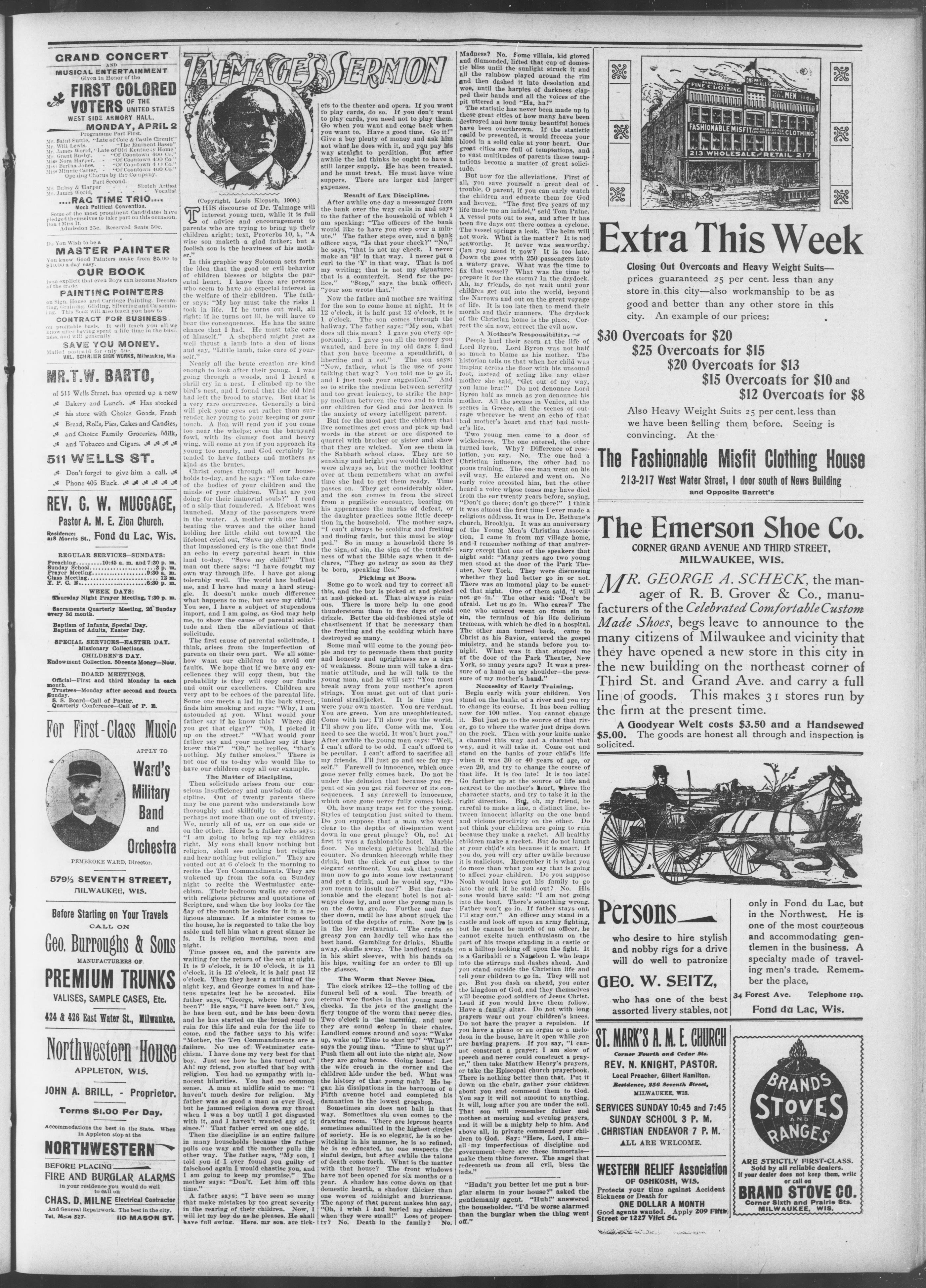
THE LATE PHILETUS SAWYER.
sition, he attached all classes of men to him, and it may be said without disparagement of others that no man in the state had such a host of warm friends. In a public career covering a period of fifty years he had many hot political contests, often at great odds, yet he always won, and his record of twenty-two years continuous service in Congress has never been equaled. Of recent years his part in politics was that of an onlooker, but whenever an issue was raised in which he was personally involved he showed all his old-time activity.
His Early Strugles.
Ex-Senator Philetus Sawyer was born at Whiting, Vt., September 22, 1816. When he was a year old the family moved to Crown Point, N. Y., on the west shore of Lake Champlain, the father being a blacksmith who had become impoverished by signing notes for others, and who hoped to repair his fortunes in a new locality. The son did his share of the tasks around the home, farm and shop, and at 14 years of age hired out for the summer at $6 per month. At 17 years of age he borrowed $100 from an older brother, "bought" his time of his father and began to work as a sawmill hand. Before the four years had expired he had paid his brother and had given himself two more terms in the district school. He then operated the mill under contract, the capacity being two or three thousand feet per day. So successful was he in this venture that fourteen years after purchasing his time he was ready to emigrate with his wife and two sons to the great West and take with him $2200 in cash as the fruit of his earnings.
He Had Just $2200.
This was in the year 1847. An interesting story is connected with the securing of the last dollar of his savings. When he was starting on the journey westward an older brother, who lived and died a farmer on the Ticonderoga flats, asked him, how much he had. He replied that he had $2000 secured in his belt, but the amount in his pocket he did not know. Upon counting it he found it was just $199. His brother handed him $1 with the remark: "Now remember that when you went to the West you had just $2200." Years afterward, when this brother was an old man and was visited at his home by the younger man, then a United States senator, and possessor of an ample fortune, the latter, thinking that he saw some signs of depression or uneasiness about his brother, asked him if he was in debt. The brother confessing that he was to the extent of about $1200, from the falling off in the profits of the farm and because of his advancing years, the senator quietly bought up all the claims of the creditors and delivered them to his astonished host with the remark: "I am not giving you this; I am paying my debt to you." "What debt?" he inquired. "Do you remember," said Mr. Sawyer, "giving me $1 when I started for the West? This is that $1 with the accumulations. I have made about that amount with it."
"Ah!" said the brother, seeing the twinkle in the senator's eyes. "I wish I had given you $10 or $15 more."
Settled in Fond du Lac County.
Mr. Sawyer returned to Wisconsin and settled upon a farm in Fond du Lac county, but after two years of short crops sold that and going to the pineries of the Wolf river, at Algoma, now the city of Oshkosh, he began lumbering and operating a sawmill until 1850, upon contract by the thousand feet. Then he rented the mill and operated it upon his
own account with reasonable success until 1853, when he formed a partnership and purchased the mill. In 1862, he purchased the interest of his remaining partner at an advance of $70,000 above his original capital in the business. During the year 1863, his son, E. P. Sawyer, was taken into the business and since that date the firm has been P. Sawyer & Son, their mill at Menomonie turning out 150,000 feet of sawed lumber daily. In 1868, Mr. Sawyer explored the head waters of the Wolf river, bought up large tracts of the finest timber land at prices which a few years later would have been merely nominal, and by the formation and work of the Keshena Improvevent company, brought into market millions of feet of the best timber in the state. The earnings of the enterprise increasing, needful improvements were made as required and handsome dividends were paid.
Went Into Politics.
In 1849, and subsequently, he was repeatedly chosen an alderman of the city of Oshkosh, and in 1857 he was induced to serve in the state Legislature as a Republican representative. He declined any further offices until 1861, when he was again chosen to the Legislature. In 1862 he was solicited to be the Republican candidate for Congress from his congressional district, but declined. In 1863-4 he served as mayor of Oshkosh, and in the latter year was elected to the Thirty-ninth Congress as a Republican by about 3000 majority in a district ordinarily doubtful.
Mr. Sawyer took his seat on the first Monday of December, 1865. The Congress into which he entered was confronted with the problems of the reconstruction of the federal Union, together with those pertaining to the national finances and currency, the great changes in the industries of the country consequent upon the close of the war, and the debt of gratitude to its surviving soldiers, to be at least recognized by pension laws. There was work enough to be done not only by statesmen but by men of clear-headed business qualifications and financial skill and sagacity. As to Mr. Sawyer's discharge of his duty in dealing with these problems, James G. Blaine well said of him in his "Twenty Years in Congress:" "It is easy to supply superlatives in eulogy of popular favorites; but in modest phrases Mr. Sawyer deserves to be ranged among the best of men—honest, industrious, generous, true to every tie and to every obligation of life. He remained ten years in the House, with constantly increasing influence, and was afterwards promoted to the Senate." The reason of this influence, unnamed by Mr. Blaine, was not his ability as a debater—for he made no speeches, although he worked on House committees and elsewhere most faithfully—but in his personal character and in his possession in an unusual degree of common sense, which amounted in reality to profound sagacity, not alone in matters of business and finance but in political management; of a genial manner which made personal friends even of political enemies, and of a remarkable faculty of persuading and convincing others of the correctness of his conclusions.
Elected to the Senate.
Retiring from Congress on March 4, 1875, he found his private business still prospering under the management of his son. He was a member of the executive committee of the Chicago, St. Paul, Minneapolis & Omaha Railroad company until 1880, when he severed his connection
with it and prepared to visit Europe with his family. This plan was abandoned, however, and when the Wisconsin Legislature of 1881 met, and the Republican members assembled in caucus to agree upon a senatorial candidate, Mr. Sawyer was found to be the choice of a large majority. In January he was elected senator for six years from March 4, 1881. In January, 1887, he was reelected without opposition in his own party for the term ending in 1893. His career in the Senate showed the same useful and conscientious discharge of his duties which characterized his terms in the House of Representatives.
Senator Sawyer was married near Crown Point, N. Y., in 1841, to Miss M. M. Hadley, who died May 21, 1888. It may be added that the liberality of Mr. Sawyer as a citizen has long been conspicuous in his community in many ways. As mayor of the city of Oshkosh during two years of the Civil war his expenditures of both time and money in the effort to fill the quota of the city and so avoid the conscription was large, and no claim was made for reimbursement. Churches and educational institutions in the state have often been the recipients of liberal contributions toward their necessities or their improvements. The Y. M. C. A. of Oshkosh is indebted to his bounty for its ability to secure a large and commodious business block in the heart of the city. Generosity to deserving objects marked his career from the beginning.
The Treasury Cases.
An incident of Mr. Sawyer's later years which gave great pain to himself and his friends was the prosecution of the sureties on the official bonds of certain state treasurers who had been appropriating the interest paid by banks on deposits of state funds. This was in pursuance of a practice which had continued for years, yet the opportunity was presented to make a partisan attack on Mr. Sawyer, one of the sureties. It was not show that Mr. Sawyer profited by the practice, yet he was made to suffer for it. It was during the prosecution of the case that the La Follette incident occurred. Mr. Sawyer desired to secure La Follette's services as counsel and asked him to come to Milwaukee. They met at the Plankinton house and when Mr. Sawyer made the offer it was construed by Mr. La Follette as an attempt to reach Judge Siebecker, who is La Follette's brother-in-law and who was to try the treasury cases. There was much sensational talk about bribery, etc., but with the exception of a few Democrats and a few personal enemies of Mr. Sawyer's nobody took any stock in the charge.
Money Made in Lumbering.
In an interview published several years ago, when asked how he acquired his great fortune with so little to start with, Mr. Sawyer replied:
"The most of my money was made in buying and selling lumber. While I lived in New York state I could see that lumber was worth a great deal. The forests there had been rapidly cut, and the prices of timber had risen. When I came to Wisconsin it was a new state. It had vast tracts of pine lands, and I believed the day would come when these lands would be very valuable. I invested what I had in pine, and bought more as I could. Later on I borrowed a great deal of money and bought pine. I made a number of good deals, turned my money over rapidly and bought more and more. One time I got hold of a tract for $16,000. I had a partner with me in that purchase, and we each made more than $100,000 out of the deal. At another time I bought for $1500 some pine lands which I afterward sold for $64,000. I made other investments which paid me $100,000 and upward apiece, and in this way a fortune was gradually accumulated. After a time I became interested in railroads, and made some money in them, especially in the pine lands along the roads. You see, all of my life has been spent in dealing in lumber."
OCONOMOWOC NEWS
The editor made a flying visit to Oeconomowoc. While there we had the pleasure of meeting Dr. Mueller and family, who are very much interested in our work. They have two colored servants furnished by us, and they have proved satisfactory in every respect. We will have an opportunity in the near future to put in quite a few colored servants in this beautiful little city.
We next called on Mr. Ernest Thompson, who keeps one of the largest wholesale and retail groceries in the city, and who is very much interested in our work. His clerks are obliging and kind. Give them a call.
We next called upon Mr. W. A. Jones, postmaster, who is very much interested in our work and who subscribed for our paper, and we thank him for his kindness.
Our next call was on Mr. W. S. Dibble, who after an interview with the editor engaged one of our people. Mrs. Dr. Mueller's colored servants are getting along so nicely that quite a number of the families are striving hard to get such servants for their homes. We dropped in on Dr. J. H. Voje, who is one of the leading doctors of that city. He is very much interested in our work and subscribed for our paper.
Before leaving we called upon Mr. Edwards, attorney-at-law, who gave us good advice and assisted us in our work. Oconomowoc is a very beautiful place for a summer resort, and the people are always ready to help to better the conditions of our race. We thank the many families for what they have done for us.
—Lieut.-Col. Russell B. Harrison, who has been looking after electric railroad interests in northern Indiana, will start within ten days for Porto Rico, where he will report to Gen. Davis. He was recently appointed inspector-general on Gen. Davis' staff by President McKinley.
The Friends of Col. Hoyt A. Winslow Pushing Him for the
A Better Selection Could Not be Made Within the State.
The name of Col. Hoyt A. Winslow has been prominently mentioned in connection with the state board of control as the successor of Judge William P. Lyon, whose term expires in April, and it is generally looked upon as being one of the best appointments the governor could make, as the colonel's experience would be valuable upon the board if he could be induced to accept the position. He is a staunch Republican and a man of broad ideas and education and a leader among men. It will be remembered that he withdrew his name as a candidate for railroad commissioner in the last Republican state convention in order that peace, harmony and location might prevail. The colonel is a good speaker and has done much for his party through several campaigns, but has never asked for recognition but once and that was for railroad commissioner. He has a bright future before him and it is not out of place to predict that he may be governor some day. His acquaintance throughout the state is large and his friends are many. His business takes him to nearly every city in the state as a commercial traveler.
It is said of Judge Lyon, whose term will expire April 15, that his age prevents him from taking the active part he would like to and on that account would not ask for reappointment. The judge has been a valuable member since he was placed on the board and has done much for the state institutions. The judge has passed three score years and ten and when he retires from public life he will have served the people of Wisconsin faithfully and well during his public life. May his teachings be an example for others. Col. Winslow is known throughout the United States among the traveling fraternity, having been a national officer of the Traveling Men's association of the United States. He has been honored by Gov. Upham and Gov. Scofield by being appointed upon their staff with rank of colonel.
STILL ADVANCING.
The Twelfth Census- Its Importance to the After-American.
To the negro race, particularly, the completion of each census bears the relation of a milestone, marking our progress along the path of life. The whirligig of time has brought on many changes, and the world, gazing upon the vast compilation of statistics, marvels at the rapid strides of a race so recently removed from barbarous slavery. The history we are now making will guide future generations, and the status given us by the twelfth census will reveal to the world a race that is slowly but surely working out its own salvation.
No better proof can be given of the general industry of a people than a classification of their occupations, trades and professions; no greater incentive can actuate a struggling people than a compilation of statistics showing the value, in each state, of the real and personal property held by them, nor can there be a stronger blow given those who have long maintained that the American negro is an inferior being, but little removed from the brute, than an authoritative statement showing that our illiteracy has diminished; that the misty cloud of superstition and of ignorance that has long surrounded us is rapidly passing away before a favorable breeze of intelligence.
From 1790 to 1890 we have only been considered from a numerical standpoint, the main object having been to ascertain the proportion of the negroelement to the total population. In 1890 the race was classified into negroes, mulattoes, quadroons and octoroons, but this information was of no material benefit in fact, so little have we known about ourselves and so inaccurate have been the statements given to the world by previous reports, that Director Merriam, seeing the necessity of more reliable and important information, departed from the old methods and will endenvor to collect data that will determine our status as a race, along all lines. For this evidence of interest in our people he has our thanks and it should be the duty of every race-loving negro to assist in every way possible the supervisor and enumerator of his respective district.
The census bureau gives employment to a number of our people, and when the work has more fully developed there will doubtless be a considerable force of colored clerks, it being the policy of the bureau to recognize merit rather than race, creed or color. In this connection it should be borne in mind that the patronage of the office has long since been
NUMBER 48.
given to the members of Congress who alone can be held responsible for the political recognition, whether much or little, given to members of our race. Inasmuch as in certain Southern states the Democratic party, only, is represented in Congress, the director, in order to avoid any possibility of discrimination against the colored race in those states, has requested the head of the representative organization, in such states, to designate a portion of the appointees. This is not only carrying out the spirit of the census law, but is an evidence of the director's purpose to deal fairly and justly with all of our citizens in the administration of his office.
FROM THE SOUTH.
Mobile, Ala., March 20, 1900.—To the Advocate, 206 Fifth Avenue, Milwaukee, Wis.—Dear Sirs: I am spending a very nice time in my old home. I am having a high time at home. There has been a great change since I left. I have had the pleasure of visiting the schools and several churches, and preached three times in the old Mother State Street A. M. E. Zion, and have plucked some of the sweetest violets. I have met lots of my old friends and have had a good time.
It can be truly said that the South is a land of sunshine and flowers. I have visited the editors of the Southern Watchman, Mr. Lovell Landers and Gen. Mang, and of the Mobile Press, Mr. A. N. Johnson and Gen. Mang, and have asked them to exchange with our Milwaukee Advocate and they have kindly consented to do so, and you will oblige me by exchanging with them. I find what is true of Mobile is true of Birmingham, Montgomery and other cities. I owe much of my pleasure of the trip to the following persons: Rev. Tipton, pastor of State Street A. M. E. Zion church; Rev. Dr. Owens, pastor of Union Baptist church; Rev. Dr. Morissy, pastor of Big Zion A. M. E. church, and Mr. Frank Lora and a host of other friends. I was most royally entertained last Sunday, the 18th, at the home of Mr. and Mrs. George Page and Mr. and Mrs. R. Thornton. Mrs. R. Thornton is an old schoolmate of mine. It is needless to say that the repast was a very enjoyable one and that I am glad to say after twenty-two or twenty-three years Mobilians are ever noted for their hospitality. I find among the business men Mr. Vivian Packer, a wholesale dealer in all kinds of groceries; Mr. Henry Henderson, wholesale dealer in groceries—he is a nephew of mine; Mr. A. N. Johnson, undertaker; Mr. A. Boyd, undertaker; Mr. Starks, hardware; Mr. Mobile, shoe department, and Mr. M. W. Houze, one of my old friends, employed at G. Van Antwerp's drug store. I wish this letter to appear in full in our Milwaukee Advocate, as it will be a very great advantage to yourself and all who are concerned in the future welfare of the Advocate. Yours fraternally,
G. W. Muggage.
CREAM CITY NOTES.
We call the attention of the subscribers and many friends of the Advocate to the cut of our headquarters, and advertisement of our work, published on the fourth page of this issue.
Diamonds and Watches on easy payments. Chas, H. Veicht, 602 Grand Ave.
We are sorry to learn of the sickness of Mr. James Johnson, who is one of the most prominent young men in this city. We wish him a speedy recovery.
Mrs. Charles Bell of 1248 Burleigh street paid us a most agreeable call, and after receiving our drawing room to the many friends who had gathered to greet her, and Mrs. Bell, accompanied by Miss Ella D. Holsey, gave all present a few selections on the violin. Prof. S. R. Banks, who was present, said these two ladies excel anything in the Cream city in the line of music. Mrs. Bell is considered to be one of the handsomest young ladies in the state of Wisconsin.
水 水 水
We heard some good news from Miss Minnie Le Sair, who is getting on nicely at her new home at Oconomowoc.
* * *
Miss Maud Johnson of Fond du Lac called at our office. She is bright and intelligent and one of the leaders of our race.
心力神
The colored quartette has been kept busy most of the time singing at different parts of the city with their Southern plantation songs. They are under the management of Mr. Saint Suttle, Mr. Will Lewis and Mr. Grant Busby. They can be found at 209 Fifth street.
```markdown
```
Messrs. Duke & Son, wholesale and retail dealers in fresh fish, oysters and game, 508 Grand avenue, telephone 245 white. You can get anything you call for. Their game and fowls are the best in town and now they have prairie hens; in fact, everything can be gotten at half price. Messrs. Duke & Son are kind, polite and cheerful, and will try to please the people. Call on them.
—When Representative James Daniel Richardson, formerly grand high priest of the Royal Arch Masons of Tennessee, and now leader of the Democrats in the House, looked over his morning's mail on the next day after the Porto Rican tariff bill passed he found a letter from Willian J. Bryan in the pile. Right under was a letter from Grover Cleveland.
MAFEKING IS BOMBARDED
It is Probable that Before Very Long the Rations will be Still Further Reduced.
London, March 28. The British high commissioner, Sir Alfred Milner, arrived at Bloemfontein last night, and was met by Lord Roberts and his staff. According to a dispatch from Bloemfontein, published in the second edition of the Times, the high commissioner's visit is of a private nature. It is thought this can scarcely be anything but an official subterfuge, the question of the pacification of the Free State and the treatment of the insurgents doubtless being discussed between Lord Roberts and Sir Alfred Milner. According to the same dispatch, Gen. French, previous to returning to Bloemfontein, occupied the flour mills near Batter, which are considered an important acquisition.
Kurzere Lax Down Their Arms:
Reports from Rouxville and other towns say the surrender of arms to the British continues satisfactorily.
Gen. Clements' column entered Fauresmith, Tuesday, March 27, having previously occupied Jagersfontein. Magistrates were appointed, the proclamation was read, bands of music met the troops and flags were flown. The scenes resembled the American occupation of Porto Rican towns. Among the spectators at Fauresmith was President Steyn's daughter.
Heavy rains made Gen. Clements' march hard and are causing sickness among the troops.
Fight Near Ladybrand Imminent.
A dispatch from Maseru, Basutoland, dated Tuesday, March 27, says the apparently reliable reports that the Boers are re-entering Ladybrand cause the presumption that the British troops have crossed the line of the Boer retreat towards Kroonstadt, and that a light or surrender near Ladybrand, is imminent. As Maseru dispatches are not distinguished for their accuracy, and as the British force near Ladybrand, under Col. Pilcher, is quite small, nothing very definite seems likely to result from the operations.
Further advices from Mateking, dated March 16, reiterate that all was well there, and that the cordon was not so tightly drawn, the Boers allowing natives to pass through their lines, which they had previously forbidden. The native refugees are reported to be too stupid and lazy to work or take cover from the shells. They gather in crowds around the soup kitchens and have to be driven away when the warning bell rings.
Rations Further Reduced.
The bombardment, just previous to the dispatch being sent, had been unusually vigorous, and it was added that it was probable that before long the rations would be still further reduced. Two Boer prisoners escaped from the camp at Simonstown March 26. The sickness there is unabated and many of the prisoners are in a serious condition. The only word from Gen. Buller is a report of the officers who have recovered from wounds and who have returned to duty, which list includes the name of Lieut. John Churchill, brother of Winston Churchill.
A special dispatch from Bloemfontein says: "The period of inaction is coming to an end. Troops are being pushed to the front and transports and stores are being collected. The men are in grand condition and the horses are picking up wonderfully." However, the reports regarding the imminence of a forward movement are so conflicting that they cannot be taken as in any way authoritative.
ROBERTS IS CAUTIOUS.
Wants the Free State Pacified Before Making an Advance.
London, March 28.—Unlike many of his fellow countrymen, Lord Roberts apparently does not think lightly of the problem with which he has to deal in making his way from Bloemfontein to Pretoria. He knows that in spite of numerous surrenders and all optimistic reports from the British point of view the Boers are pressing close to his outposts and will lose no opportunity of firing on his men.
The commander-in-chief is peculiar among English military officers for his ability to guard against overconfidence and accurately to estimate the fighting qualities of his foe.
The prolonged pause at Bloemfontein is likely to last until Gens, Gataacre and Clements and Brabant shall have swept the belligerent burghers from the southern half of the Orange Free State, so as to make Lord Roberts' communications perfectly secure.
Certainly no movement is probable while Boer forces of indefinite size are reported to be lurking in the hills of a territory which correspondents long ago "pacified" by the power of the new.
Olivier Eludes the British
With his army from the south of the Free State Commandant Olivier is apparently eluding the British pursuit and making good his escape. All the evidence goes to show that the retreating invaders of Cape Colony have practically succeeded in getting away from the British columns, which it was thought would encompass and capture them. They have accomplished a long, daring and difficult flank march in the face of a vastly superior force. Olivier is said to have already reached Clocolan, which is near the border of Basutoland and on the road running from Ladybrand northeast to Ricksburg. This is north of the line on which French's cavalry has been operating, and the fact that the British general has returned to Bloemfontein seems to prove that his attempt to stop the progress of the Boer column was a failure.
A small British force that entered Ladybrand was forced to retreat hurriedly before a large number of Boers, who may have been part of Olivier's command. Firing has been heard at Modder point, which would seem to be near Modder Poort, to the southwest of Clocolan. Possibly the Boer rear guard has been engaged there.
COAL MINES DESTROYED.
Olivier Etudes Pursuit and Joins
Groblaar and Lemner.²
Pretoria, Monday, March 26.—United States Consul Hay and his secretary have gone to Kroonstadt to make necessary arrangements for United States representation in the Free State. A dispatch received here from the Boer headquarters in Natal announces that the destruction continues of coal mines likely to be useful to the British. The Dundee colliery has been blown up. The machinery in the mine has been rendered useless for three months to come. According to a dispatch from Kroonstadt Commander Olivier has joined Gens. Groblaar and Lemner, who are safe. Gen. Delarey is still sick at Pre-
toria, but he will proceed to the front Sunday. Trains are frequently leaving with burghers for the fighting line on this side of Bloemfontein.
The Standard and Diggers News says it learns that Gens. Olivier, Groblaar and Lemner have arrived at a point sufficiently far north to relieve all apprehensions of the possibility of their being cut on. It is expected they will arrive at Winburg in a few days and affect a junction with Gen. Dewet, when the federals' position, it is declared, will formidably oppose Lord Roberts.
Reports received from the various banks of the republic show that the cash holdings amount to £2,233,057.
BECOMING AGGRESSIVE.
Boers Harass Roberts' Outposts and Set Trap for Hussars.
New York, March 28.—A dispatch to the Herald from London says: A small British force that entered Ladybrand was forced to retreat hurriedly before a larger number of Boers, who may have been part of Olivier's command. Firing has been heard at Modder pont, which would seem to be near Modderpoort to the southwest of Cloclan. Possibly the Boer rear guard has been engaged there. There have been cavalry skirmishes at Lord Roberts' outposts in the Free State and Gen. Buller's in Natal. Gen. Buller reports that the Boers tried unsuccessfully to trap some men of the Thirteenth Hussars. Gen. Botha, who commands at Glencoe, declares, on the other hand, that he cut off an advance guard of Lancers.
British Losses 16.652.
The weekly casualty list shows that the British losses will be very heavy. Mr. Wyndham's original roseate estimate that the war would be carried through at a cost of not more than 3000 lives is bound to be very much exceeded. Up to Saturday the British forces had lost 2130 men killed, while 9807 were wounded and 3515 missing or prisoners, making a total of 15,453. To these must be added 1200 deaths from disease, or a grand total of 16,652.
These figures, however, do not make evident the actual weakening of the British army due to illness, hardships and long marches. Gen. MacDonald, writing from Paardeberg, states that the Highland brigade had at the time only 24 officers and 1600 men fit for duty out of a total of 37 officers and 3000 men. Hard marching, bivouacs in the open and other trials of the severe campaign had reduced the brigade's strength nearly 50 per cent.
Condition was Desperate.
The 6000 men that remained of the garrison at Ladysmith are recovering very slowly from the effects of the siege. It may be weeks before they are able to participate in any military movement. Letters are now arriving from Ladysmith which show the desperate condition to which the garrison had come when the city was relieved. Only 1000 men were physically fit to offer any determined resistance to the Boers at the time Lord Dundonald arrived. New York, March 28.—A special to the Herald from Washington says: It is learned from an excellent diplomatic authority that the United States is the only nation whose official mail to and from Pretoria is not subject to the scrutiny of the British censors in Cape Town and Durban.
On the other hand, Great Britain recently notified the powers that, in accordance with article 8 of the Paris convention of 1875, she intended to exercise her discretion with reference to stopping cable messages intended for Pretoria. It was this declaration which caused Russia to ask the United States for an, expression of its views, not for any use at this time but for the guidance of the St. Petersburg government in the future.
Ladybrand Retaken.
Kroonstadt, Orange Free State, Tuesday, March 27.—Commandant Crowther, who commands the Transvaal fighting line in the south, reports that he has retaken Ladybrand after the British had been there an hour. He adds that Landdrost, Vangorkum and Field Cornet Smith fell into the hands of the British, of whom three were wounded and one was made a prisoner. The Boer loss he claims was nil. The British fled in the direction of Maseru. In a skirmish near Brandfort four Lancers were killed and six were wound-ed
HAY APPLAUDED.
His Chinese Achievement a Benefit to the Whole Civilized
London, March 28.—The afternoon newspapers here unanimously applaud Secretary Hay's diplomatic achievement in establishing the doctrine of the open door in China, and say his success is much more considerable than hitherto realized. The St. James Gazette remarks: "The United States has conferred a benefit on the whole civilized world by securing an agreement on a subject of such vast importance to the prospects of peace as well as commerce."
The Globe thinks there is substantial reason for according the final leadership in "this immensely-important movement inaugurated by Lord Salisbury to the United States, owing to Europe's jealousy of Great Britain, while on the contrary, all the great powers will now vie with one another in their professions of friendship for America," and adds: "Secretary Hay's dexterous skill in completing his task has left nothing to be desired."
The Westminster Gazette expresses the hope that a similar open-door policy will prevail in the American colonies, including the Philippine islands.
France is Well Pleased.
Paris, March 28-6:30 p. m. The Journal Des De Bats commenting on the publication of the open door correspondence, says: "The United States has in contestibly just achieved a great success, and has, moreover, rendered a thorough service to other interested nations, among whom France has the greatest reason to congratulate herself on what has been done. We were the first to sign the declaration when asked by Secretary Hay and this is not the only mark of confidence which reigns between the two countries. Everything indicates that the old cordiality still obtains in our mutual relations and what has just occurred at Rouen shows no opportunity for a demonstration of friendship will be allowed to pass."
NEAT JOB BY ROBBERS.
Iowa Bank Burglarized Without Alarming Anybody.
St. Paul, Minn., March 28.—A Mason City, Ia., special to the Dispatch says: Robbers last night broke into the O. F. Ulland-bank at Hanlontown, blew open the safe with nitro-glycerin, stole $2000 in currency and escaped. The job was so well done that no one in the town knew anything about the robbery until the doors were found open this morning. Robbers escaped on a North-Western handcar. The bank carried burglary insurance and will lose nothing. President Ulland is now in California.
Death of Consul Barnes
Washington. D. C., March 28.—The state department has been advised of the death last night at Cologne of United States Consul John A. Barnes. Mr. Barnes was born in Ohio and was appointed from Illinois in October, 1897, as consul to Cologne.
GREAT BRITAIN HAS MADE NO APOLOGY.
No Attention Paid to Macrum's Charges that His Official Mail was Tampered With.
Washington, D. C., March 27.—It is said at the state department regarding the story that Great Britain has apologized to the United States for the action of the censor in opening letters addressed to the United States consul at Pretoria, that the United States government has made no demand upon the British government for an apology as the officials say Mr. Macrum, who was consul at Pretoria when the mail is said to have been opened, made no official complaints on that subject and thus the state department had nothing official before it to serve as a basis for a demand for an apology.
As stated before, however, the British government itself voluntarily took notice of Mr. Macrum's complaint, and finding that, as an incident to the transfer of a large quantity of mail from Durban (which was the place where our consular mail was usually landed) to Cape Town, resulting in great congestion, and the handling of mail by new agents there had been an indiscriminate opening of letters which probably had affected the consular mail with others. Lord Pauncefote, speaking for his government, disavowed the action of the censor, and declared that it was unauthorized in respect to Mr. Macrum's mail. This assurance was given long ago and some of the members of the House committee on foreign affairs were made acquainted with it at the time.
London. March 27. 6:17 p. m.—The report published in the United States that Lord Salisbury has apologized for the opening of American consular mail in South Africa is untrue. Nothing whatever has passed between the two governments on this matter, and the British premier has taken no action to investigate the allegations of Charles E. Macrum, former consul of the United States at Pretoria, nor has he been requested to do so. A printed fac simile of a letter to Mr. Macrum alleged to have been opened was given to Lord Salisbury by a representative of the Associated press, but he made no comment, nor did he direct that anything be done.
UNEASY FEELING EXISTS IN JAPAN.
Russian Squadron Arrives at Chemulipo-British Mission-
ary Killed.
Yokohama. March 27.—A Russian squadron has arrived at Chemulpo. It is believed this presages a demand for a concession of land at Masanso, and is arousing uneasy comments in Japan. Shanghai. March 27.—A private dispatch received here confirms the report that a British missionary has been killed at Kaining.
UNITED STATES SECURES ISLANDS.
Announcement that Sale of Danish Antilles Has Practically Been Completed.
London, March 27.—4:30 p. m.—A dispatch to the Exchange Telegraph company from Paris says the sale of the Danish Antilles to the United States has practically been completed.
GIRL'S STRANGE POWER
Located Body of Jesse : saunders After Search Had Been Abandoned.
Peoria, Ill., March 27.—Yesterday afternoon the body of Jesse Saunders, the negro who was killed ten days ago in a brawl with Tom Murphy, was found in the Illinois river at a point in the willows just opposite the city.
The search had been given up until little Grace Holmes, who created such a sensation a week ago by successfully locating the body of Mrs. Sommers, a woman who had run away from her home while temporarily insane, asked for a chance to locate the body of the murdered man. This opportunity was allowed her, most people thinking that her failure was inevitable, and with failure, of course, the disclosure of a fake.
The child led more than 1000 people across the lower free bridge and pointed to a spot in among the willows, where she said the body might be found. Searching all day Sunday failed to find the man, but shortly after noon yesterday a man named Kirkpatrick, a stone-cutter living near the bridge, found the body, and it was at once identified as that of Saunders.
BONI BACKS OUT
Castellane's Friends Arrange Affair with Editor of the Figaro. Paris, March 27. After all his warlike threats Count Boni de Castellane has asked his friends to arrange the affair with the Figaro and prevent the paper suing him. His friends, through certain promises made to the French government, have succeeded in obtaining the government influence to stop the Figaro suit. This the Figaro consented to on condition that Castellane withdraws his suit against the paper and makes proper amends to M. de Rodays.
FATHER TIGHE DEAD
Pastor of One of the Largest Catholic Congregations in Chicago.
Chicago, Ill., March 27.—Rey. Father Dennis A. Tighe, priest since its organization of the Holy Angels' church, Oakwood boulevard and Vincennes avenue, one of the largest Catholic congregations in the city, died today of pneumonia following an attack of appendicitis. He was born in County Sligo, Ireland, in 1851, and came to America when 16 years old. He was a graduate of the University of Notre Dame, receiving the highest honors.
Caterer's Inventoin Illegal
The caterer who served the dinner for the recent bankers' banquet in New York thought it would be a good idea to touch up the loyalty of his patrons to the gold standard by serving the ice cream in papier-mache boxes the tops of which would be decorated with a gilt imitation of a $20 gold coin. But the treasury secret service would not permit imitations of coins to be made, even in gilt paper, and seized the models and plaster cast.
—Helen M. Francis, aged 3 years and 8 months, has arrived safely at Stroud, Ok., after having traveled from New York city without escort other than the trainmen to whose care she had been committed.
Education costs $450,000,000 a year in the United States, Great Britain, France and Germany. The United States spends three-sevenths of the whole amount, and leads with an educational per capita of $2.67.
Representative Gibson of Tennessee says that a tombstone in a cemetery down in his district bears this epitaph: "Some have children, others none; here lies the mother of twenty-one."
GEN. JOUBERT IS DEAD.
Defeated British at Mejuba Hill and was President of the Republic in 1883-4.
Lourenco Marques, March 28.—Gen. Joubert is dead.
London Press Respectful.
London, March 28.—The afternoon newspapers today publish long biographies of Gen. Joubert. Generally they are in a kindly tone.
The Pall Mall Gazette says: "Piet Joubert was the one contemporary Transvaal Boer, except ex-Chief Justice Kotze, whose death could call forth a sincere tribute of respect from English men of all parties. He was the antipodes in the Transvaal world of Leyds, and personally was honest, straight and clear handed."
Pretoria Plunged in Mourning.
Pretoria, March 28.—Gen. Joubert died last night at 11:30 o'clock. He had
been suffering from a stomach complaint. The town is plunged into mourning for the true patriot, gallant general and upright and honorable gentleman.
Gen. Pietrus Jacobus Joubert, commandant-general of the Transvaal forces, better known as Piet Joubert or "slien Piet" (Slim Peter), was born about sixty-eight years ago. He was descended from an old French Huguenot family which settled in South Africa many years ago. He was born in Cape Colony, but was taken by his parents, when 7 years old, to the Orange Free State, where he was taught from early childhood to shoot straight and hate the British. He is described as having been utterly fearless.
Was Self-Educated.
Of schooling he had but little and he never saw a newspaper until he was 19 years old. In spite of this his ambition prompted him to read the few books he could obtain, and he succeeded in obtaining a fair knowledge of history and languages. In consequence of the acquisition of Natal by the British his family moved from Natal and settled in the Transvaal. Soon afterwards he became a burgher of the South African republic and a daring fighter. It was claimed in his behalf, that he could lead a body of men more successfully against hostile natives than any other man in the Transvaal. He came to be so feared by the natives that the knowledge that he was at the head of the punitive expedition usually resulted in their surrender.
Defeated British at Maiuba Hill.
It was during these wars with the natives that Joubert became acquainted with Paul Kruger, and the two men became bosom friends. He was elected vice-president of the Transvaal in 1896, defeated Sir George Colley at Majuba Hill in 1881, and acted as President of the republic in 1883-84, during Kruger's absence in Europe.
Gen. Joubert was always in favor of the use of force instead of diplomacy, and President Kruger on several occasions had great difficulty in repressing his hot-headed colleague, notably in 1879, when Joubert, with Kruger and Pretorius, was planning the rebellion to overthrow the British rule in the Transvaal. The result was Majuba Hill and the practical independence of the Transvaal.
Organized the Boer Forces.
It was Joubert who organized the army of the South African republic, later on dividing the country into seventeen military departments and each of these departments into smaller divisions, with commandants, field cornets and lieutenants of various ranks in charge. According to the general's plans, every man became a trained soldier without leaving his farm, and had his equipment ready at hand. To such a point of perfection was the system carried that within forty-eight hours after the present war was declared, the Boer nation was under arms.
Had Great Foresight.
It was also due to Gen. Joubert that the South African republics succeeded in massing the immense stores of war munitions and provisions which have stood them in such good stead during the conflict now in progress. When the Jameson raiders were locked up in Pretoria jail Joubert was strongly in favor of their immediate execution. It was not until Joubert and Kruger had been closeted together for a whole night that the more merciful counsels of Kruger prevailed.
In spite of these characteristics, Joubert, on some occasions, showed considerable regard for the usages of civilization. When the Boers raided British territory, Bechuanaland, in 1884, Joubert was probably the only prominent Boer who refused to support the movement, and his opposition resulted in the withdrawal of the Boers from the territory seized, as he threatened to resign unless he had his way, saying: "I positively refuse to hold office under a government that deliberately breaks its covenants, and we have made covenants with England."
Previously Reported Killed.
In November last it was reported that Gen. Joubert had been killed in action, and late reports said he was dangerously wounded and had to use a cart in order to follow the operations in the field.
The circumstances of the death of Gen. Joubert are not explained in the dispatch from Lourenco Marques, which recalls the fact that William Cox, a newspaper correspondent who was recently released from imprisonment at Pretoria, and who has arrived at Durban, said Gen. Joubert was apparently suspected of half-heartedness and that his life would be in danger at the hands of the burghers if Pretoria was besieged.
Death of Private Timming
Washington, D. C., March 28.-Gen. Wood of Havana has notified the war department of the death, on the 26th inst., at Pinar del Río, from meningitis, of William Timmins. First infantry.
Bismarck's Idea of a Fleet will Not Answer Present Changed Conditions.
Berlin, March 28.—The budget committee today resumed consideration of the naval bill. Secrecy was maintained as to the details of the deliberations, but it became known that Herren Bebel and Richter opposed the measure. The minister of foreign affairs, Count von Buelow, addressed the committee. He reiterated that the measure was exclusively of a defensive character toward all the powers, adding that aggressiveness was foreign to German policy, which aimed to maintain peace and preserve the dignity of the empire. Circumstances, he added, had greatly changed since Prince Bismarck had considered that a small fleet was sufficient, as German trade and transoceanic interests had developed, the areas of political friction had widened, and, although Prince Bismarck in 1885 regarded a fleet of about the strength of the American navy sufficient for Germany, the extensive changes in the situation which existed then and which prevailed now were shown by the fact that the United States had abandoned its former paths and made itself stronger at sea. The British policy, he continued, had likewise changed since the days of John Bright. It then followed the principle of non-intervention, but now an imperialist current was overrunning England. One of Germany's principal solicitudes was the maintenance of good relations with all the powers, which, however, was the only proper basis for the fullest reciprocity and mutual consideration of official relations everywhere. But the days of "cabinet policy" were past, and popular passion was coming more and more to the fore as an influential factor. For that reason an increase in Germany's material resources was indispensable for assuring peace.
ENGLAND IN THE RIGHT
Boers Should be Brought Under the Civilizing Influence of Education and of Liberty.
New York, March 28.—A dispatch to the Tribune from London says: Bishop Hart sell, who has been in charge of Methodist mission work in South Africa for four years, is, spending a fortnight in London before sailing for America to attend the mission and general conference at New York and Chicago. He has been studying racial and political questions during his series of journeys in Dutch, English and Portuguese possessions, and has met Sir Alfred Milner, Cecil Rhodes, Presidents Kruger and Steyn, Dr. Leyds, Dr. Jameson and other conspicuous men in South Africa. He has had exceptional facilities for forming a correct judgment on the moral questions involved in the struggle now in progress and as an American bishop he is without prejudice or partisanship. He talks about the war in a most temperate way, gives to the Dutch leaders and people credit for many excellent traits and robust virtues, but does not hesitate to express his deliberate conviction that the English cause is just and commands his sympathies.
General Civilization.
Bishop Hartsell bases his opinion that England is in the right on these grounds: First, there is the broad argument from the interests of general civilization. England, with her ideas of civil liberty, honest administration and common justice, stands against the Dutch countries with their inferior progress, their retrograde ideas and their stagnant conservatism.
Second, there is the overshadowing importance of the native problem. The bishop describes the increase of the black races in Africa as something almost incredible. That which he considers to be the overwhelming problem of the whole continent is the development of the black races under the tutelage of white men. He believes that under English rule the black men will have a better chance of improvement and progress than under the Dutch, and he asserts that the Boers do not measure with the English in their relations to the negro races. The Boers have never conducted any missionary work among the natives, and the average Boer hardly admits that the negro has a soul. The great Dutch trek northward in 1833 was made because the English had abolished slavery in Cape Colony and put the negro in a position for testifying as a witness in court. The Boers have relaxed their harsh methods of dealing with the blacks, but are not as well prepared as the English to take up the problem of development of an inferior race.
Best for the Boers.
The third ground upon which the bishop has hoped for English success in this war is the welfare of the Boers themselves. Pious, robust and patriotic as they are, they are also narrow, superstitious and ignorant. Shut in upon their own resources, they have fallen behind their own people in Holland, and the best thing that can happen is for them to be overwhelmed by the superior numbers of the British and be brought under the broadening influence of education and of English ideas of liberty.
The bishop draws a striking parallel between the American Civil war and the Dutch struggle against England. There were in 1861, he says, 12,000,000 of people in the South who honestly believed they were right, yet were fighting on the wrong side to break up American union and to preserve slavery. The defeat of the South by superior numbers was necessary in order to save the Union and to effect deliverance from the evils of slavery.
Saved from Their Own Folly.
The military disaster when it came was the best thing for the Southern people themselves, because it rescued them from the blighting influence of their own ideas respecting slavery and its relations to civilization. As the South now rejoices over the perpetuation of the Union and the abolition of slavery, so the Boers also will live to thank God in the end for having failed to break up British rule in South Africa. The triumph of the British arms will be best for the world, best for England and best for the Boer. There is now a struggle of Briton against Boer, but when it is over Boer and Briton will stand together, with schools and liberty everywhere in South Africa, and with a better chance for just and enlightened treatment of the blacks. For these reasons Bishop Hart-sell considers that England is in the right in the war with the Boers, and that her triumph will be a distinct gain for civilization.
CROPS IN FRANCE.
Condition of Wheat and Rye Officially Reported.
Washington, D. C., March 28.—Consul Atwell, at Roubaix, reports to the state department upon the condition of the wheat and winter rye crops in France. A recent estimate published by the minister of agriculture shows this acreage of wheat sown amounted to 16,869,509 acres, as against 17,097,837 acres last year. The production is estimated to be over 344,000,000 bushels this year, as compared to 366,000,000 bushels in 1899. The acreage of winter rye sown is about 3,500,000 acres, a little less than the amount last year, and present prospects indicate a production of about 64,000,000 bushels against nearly 70,000,000 bushels last season.
Washington, D. C., March 28. Ninety-three rooms will be added to the accommodations available for House and Senate by the contemplated additions to the capitol at Washington. The plans are all drawn, and it only remains for Congress to authorize the necessary expenditure. That an enlargement of the quarters provided by the historic edifice is needed there can be no doubt, and it is certain that the Senate is eager to carry out the improvement, members of that body being much dissatisfied with the committee rooms in the Maltby building, which they are compelled to occupy for lack of adequate space at home. Lately the subject has been seriously discussed in the upper house, and the expectation is that important alterations in the architecture of the building will soon be begun.
The change involved in the plans, however, will be in the nature of a completion rather than a mere alteration of the structure as it now stands, inasmuch as the capitol today, beautiful as it is, is not a finished edifice from an architectural viewpoint. On the contrary, in a technical sense, it lacks symmetry in one very important respect. As everybody knows, it does not represent any single original plan, but was put together piecemeal, first one part being added and then another. It is, as a whole, one of the most superb buildings in the world, but it is not perfect, and one of its faults is that the dome is set over close to one edge of it, instead of being placed in the middle to give a proper balance.
Two New Porticos.
It is proposed to do away with this lack of symmetry by throwing out a great portico, with "aprons," in the middle of the east front, to match and correspond with the porticos of the two great wings. This arrangement, while satisfying the artistic requirement, would furnish a large amount of additional and much-needed space for committee rooms and similar purposes. According to the plans, it alone would provide thirty-nine extra rooms.
The front of this middle portico, as well as the "aprons" on either side, will be of white marble—quite an addition, in itself in point of decorative effect, inasmuch as the central portion of the capitol today is merely of sandstone painted white. At a casual glance one might suppose that the entire building was of marble, but, as a matter of fact, only the wings and the massive terrace on the west front are of that material. Of course, the portico will have a magnificent, flight of steps, having ascended which the visitor will pass through a pillared pylon into a great marble vestibule, vying in beauty with the famous marble room of the Senate.
But this is not all, by any means. In the middle of the west front, also, a new portico of marble is to be added, and two extensions of "aprons" will be constructed on that side between the old or central portion of the building and the wings. These "aprons" will furnish twenty-four additional rooms, and, like those in the extensions on the east front, they will open into a long corridor or passageway running north and south and lighted from interior courts, the latter being left as open spaces in making the alterations.
These corridors, running lengthwise on the building on both of its flanks, will add greatly to the convenience of getting about in the capitol, where now there is practically only one passageway through which to go to any place. The corridor on the east side will open at its south end into the corridor of the Supreme court. This applies, however, only to the main floor. On the same floor the west side corridor will open at its south end into statuary hall and at its north end into the conference room of the Supreme court. Arrangements on the ground floor correspond.
New Committee Rooms.
Now, in addition to the improvements already described, it is proposed to take the space formerly occupied by the library of Congress and chop it up into rooms for use by committees. In this way thirty more rooms will be obtained, making a total of ninety-three in all. As shown by the plans, every one of these ninety-three rooms will be lighted by exterior windows—an obvious advantage. An alternative plan, extending the middle portico out further on the east front, would provide sixty rooms in the "aprons" on that side alone. So it would appear that Congress is not likely to find itself seriously hampered for lack of space in the near future if it is willing to expend the millions required. Senators urge that it is high time that the Supreme court was expelled from the capitol and obliged to seek quarters elsewhere, the apartment it occupies being required for legislative purposes.
Just how great the expense of the suggested alterations will be can hardly be estimated with accuracy, though it is likely to run up to a couple of millions of dollars, or even more. The capitol has cost a lot of money from start to finish, and every change made in its architecture has involved an expenditure much larger than was originally contemplated. For example, when the two wings were ordered to be built the sum of $2,675,000 was appropriated, and it was supposed that this would be sufficient, but in the end the bill for them ran up to $8,000,000. For the construction of the new done $100,000 was provided, but it cost that much to remove the old one, and $1,150,000 in addition was required to complete the job. As it stands today, with the grounds surrounding it, the huge edifice represents a cash outlay of nearly $20,000,000—an investment that would have startled its original projectors.
Probably Uncle Sam will be lucky if he gets off with a disbursement of $3,000,000 for the new porticos and "aprons." According to the statement of Mr. Clark, the architect, the items of expenditure to date are as follows:
Cost of old Capitol. $2,750,000
Enlargement of site. 685,000
Rebuilding after British invasion 700,000
New dome 1,250,000
Senate and House rooms 8,000,000
Works of art 1,400,000
Furnishings 2,750,000
New terrace and approaches 1,200,000
Improvements of grounds 500,000
One of the Largest Coke Producers in the Country.
Cleveland, O., March 28.—A telegram received here from Baltimore today reports the death of W. J. Rainey, the millionaire coal and coke operator, at the Johns Hopkins hospital.
Mr. Rainey lived at 1666 Euclid avenue, this city. He went to Baltimore about a week ago to have an operation performed. He was one of the largest coke producers in the country, controlling nearly 2300 ovens in the Connellsville (Pa.) district. Mr. Rainey was 63 years of age.
LIFE IMPRISONMENT.
Jury Renders Verdict of Guilty in Krueger Murder Case.
Waukegan, Ill. March 28.—[Special.] The trial of George Krueger, charged with the murder of his wife and her mother at Long Grove last July, ended this morning, when the jury brought in a verdict of guilty with a sentence of imprisonment for life. All the evidence was circumstantial.
AND THAT IS LIFE.
A crust of bread and a corner to sleep in,
A minute to smile and an hour to weep in,
A pint of joy to a peck of trouble,
And power a laugh, but the moans come
A crust and a corner that love makes precious.
With a smile to warm and the tears to refresh us;
And the joys seem sweeter when care comes after.
So grief must be bordered with gladness;
And the light of a smile
More than once in a while
becomes its sadness
THE ALTERNATIVE.
"The question at issue," Charles Shaefer said, quietly, "is between this and that."
"This" was a man, a native black South African runner. He lay flat on his back in the little valley, his unseeing eyes wide open, motionless save for an occasional twitching of the muscles, his life blood trickling through the hastily-applied bandage which concealed the bullet wound in the head. The man was silent, except when his parched lips moved in the inarticulate mutter of delirium.
Charles Shaefer. Reuter's special correspondent in the Transvaal, did not allow his eyes to linger long upon the piteous black figure. His gaze reverted to "that," a small package of papers, evidently of great importance, carefully wrapped in a waterproof covering, which he had drawn from his breast pocket. "Now that we are reduced to two horses only," he went on, his eyes shifting for a moment to the carcass of a third horse which lay dead some twenty yards off, "and seeing that we are in the enemy's country, probably twenty-four hours' ride from the nearest well of water, and that this nigger is a dead weight on our hands—" "You surely don't dream of abandoning the poor devil?" Tom Barker broke in.
Shaefer glanced uneasily at his companion. Barker was a puzzle to him: a poor man of distinguished literary ability, young, but already a success as a journalist, yet occasionally betraying a vein of sentimentality altogether out of place in connection with his friend of Teutonic origin. Shaefer had had inconvenient experience of this "too English" peculiarity more than once during the three months' enforced imprisonment in Ladysmith, from which they had just escaped with the invaluable help of the negro runner.
"You wouldn't leave him here to die?" the Englishman persisted.
Shaefer rubbed his chin thoughtfully. "He's sure to die soon in any case." "I don't think so. If we can get him on my horse and carry him a bit out of this—" "It's out of the question. Barker. He cannot walk, and these two horses are already tired out, and we cannot possibly do it." "Besides, the horses are my property," continued the German. "I had to pay a big price for them in Ladysmith, and we've already lost one in our recent encounter with the Boer outposts. I must get my dispatches in at the nearest telegraph station; it's forty miles off yet, and I suppose you want to get yours in, too, for the London T—. I reckon on selling these beasts when we get safely over the Tugela river, and I don't propose leaving one behind," and the German's eyes gleamed angrily, his voice thick with passion.
"What's the life of a nigger runner worth?" he growled.
"He's a man, anyway," Tom Barker retorted. "Suppose I refuse to leave the fellow?"
"Then"—and now Shaefer became ominously cool—"I shall again be forced to remind you that your horse is my property. I go, and the horse you ride goes with me. You can come or not, as you please."
Barker turned pale. "That is the choice you offer me? Then I say you are a blackguard."
"And I say," indifferently, "that you are a fool. Come, will you mount?"
"No," furiously.
The Reuter correspondent shrugged his shoulders.
"Have it your own way," he said, you'll be food for the Boers before morning." And gathering up the reins of the second horse, he prepared to jump into his own saddle. But here Barker sprang upon him suddenly. "No, you don't," he cried. "You shall leave me one horse, you brute, though it were a hundred times your property." "Stand off," the German cried.
Tom Barker's answer was to close with him silently, and there ensued a trial of strength, the issue of which seemed for several minutes doubtful. The men were not badly matched. Shafer was a little heavier, but he was also the elder by fifteen years, and Barker's lithe body had known an English public-school training. The result of the fight seemed uncertain, when the German suddenly loosed his hold and fell back, leaving the reins of the second horse almost in the other's clutches. But Barker, raising his head, and about to seize the reins, found himself covered by his antagonist's revolver.
"Now, perhaps," the German correspondent observed, "you will listen to reason. I know you haven't got a gun on you, my friend. I know something of your strange English character. There is nothing like being ready for any emergency that may arise." Tom Barker, under the covering revolver, stood erect and mute. To argue further with a man prepared to commit murder on behalf of a horse and a few news dispatches of no great importance would be simple waste of breath.
Keeping the muzzle of the revolver pointed full at Barker's breast, Shaefer jumped into his saddle, and seizing the reins of the other horse, he started off at a sharp trot. As long as Barker remained in running distance the German occasionally looked back to be sure he was not followed. In five minutes he was but a speck in the distance on the South African veldt. "It's your own fault, remember, if you lose your life and fail to get your news in Monday's London T——," was his final greeting as he disappeared over the crest of the nearest kopje, turning to his right.
When he had disappeared, Barker looked around him, reviewing the situation. It was not a very cheering prospect that met his eye two hills, or kopjes, of some thousand feet rose to the right and left, and he could see the setting sun on the horizon between them far beyond on the veldt. The day had been intensely hot.
"I don't know what the deuce to do now," thought Barker. As if in answer to the question, the wounded guide rolled over on his side, making an effort to rise.
"Where's Mass' Shaefer," he said, looking around him in surprise.
Barker gave the negro a drink of brandy, mixed with water, from his canteen, and the man presently seemed to revive sufficiently to sit up. Barker laughed grimly, "He's gone down the path leading to the Tugela river, leaving us both here in a nice mess," he said. The darky rubbed his hand over his eyes, wearily, and then gazed steadily along the road road.
"Yo' say he go 'long the trail?" muttered the man.
"Yes." replied Barker.
"Then he's sure gone wrong. That
right trail leads down to the Bo' camp, and he'll get nab or killed for spy," the guide said slowly. It was too late now to warn the German correspondent. He was far out of sight by this time.
When Tom Barker and the negro guide, the latter resting against the Englishman's shoulder, staggered into the hut of a friendly Kaffir just before sunrise the next morning, they could obtain no tidings of the German. But they received a rude welcome and a rough shakedown from the long-suffering Kaffirs, who had during the war learned to respect the British race. The next day Tom Barker, with a new guide, started off once more for the British camp on the Tugela. They reached it at sunset the next evening, and Barker reported himself to the commanding officer, who was glad to get news of the beleaguered army in Ladysmith, and although Tom Barker begged for a party to go out in search of the lost German correspondent, the stern general steadily refused to listen to his request.
And Heaven only knows to this hour what did become of the wretched Shafer. There were many rumors. Some said he was shot as a spy by a Boer commandant, but his fate remains as unknown to his employers and the world as does that of many another whose life story lies buried with them, deep in the grassy breast of the South African veldt.
TEA-DRINKING HABIT.
Minister Wu Ting Fang Tells How the Beveridge is Brewed in China.
To get down to the basic principles of tea-brewing and tea-drinking as practiced in China you must realize that at home we do not drink tea on stated occasions or only at meals, as you do here. With us tea is the national beverage. I might almost say, speaking to an American, that tea is the ice-water of China. Instead of the silver water-cooler, which constitutes an almost invariable ornament of your dining rooms, you will find everywhere in China the teapot. Whenever we are thirsty we have recourse to the teapot instead of the cooler.
Lt us first consider the teapot itself. It is invariably of porcelain and varies in style, cost and dimensions in accordance with the taste, wealth and size of the family possessing it. It is, as you say, constantly "in commission." In the morning a sufficient quantity of the dry tea leaves is placed in it and on this is
poured hot water. Let this infusion stand for a few minutes-say four or five-and you have what we. I think rightly, regard as a drink fit for the gods. It is always ready. Whenever the pot needs replenishing all we have to do is to add a little more tea and a little more water. There is no hard and fast rule as to the proportions of tea and water or as to the character of the tea itself. It is all a matter of individual taste. We use black or green tea and have it either weak or strong just as our tastes direct.
We never drink it boiling hot, as is done in America and England, but at a moderate degree of warmth. To maintain this desirable temperature it is customary to cover the teapot with a sort of bag padded with cotton and lined with silk. A similar arrangement is often used in England and is there known as a "cozy."
This is the usual family manner of preparing and drinking tea in China, but when visitors come courtesy demands that we should be a little more ceremonious. Then we have the tea brewed in individual cups, covered with dainty lids in order to retain the heat and aroma. As a matter of course, tea is always thus offered to a visitor the moment he enters the house.
The family teapot is simply emptied and replenished every morning, and not scoured inside, as that would rob the vessel of its delicate aroma. In this way an old teapot acquires a degree of fragrance that is analogous to the seasoning of a pipe that has been long in use. We would regard with horror the suggestion that we should add anything to the contents of our teapots beyond hot water and tea. Imagine putting rum in tea, as I am told is sometimes done here, and is said to be a common practice in Russia! A cultured taste revolts from the thought. The idea of milk and sugar is almost as bad.
Remember that while there are expensive teas and cheap teas, there are no really bad teas except those that have been adulterated with deleterious ingredients, and this very adulteration is practiced solely to meet the taste, or lack of taste, of consumers who persist in so spoiling their tea by the addition of such adulterants as rum and milk and sugar. If only they would drink their tea pure, as nature intended it to be drunk, they would instantly detect any attempt at adulteration and that would be the end of the importation of impure teas.—New York World.
The Mystical Number 9.
"Lucky seven," and "unlucky thirteen" are so often quoted that they have become household numbers; but, upon investigation, number nine, with the facts, fancies, and phrases clustering around it, is quite as interesting. Nine, as three times three, is the "trinity of trinities," a mystical number, and combinations in which it has figured are known since ancient times. The "nine worthies" of old are depicted in tapestry and painting, and in early literature their lives were held up as examples to mankind; they were three Jewish—Joshua, Daniel, and Judas Maccabaeus; three Pagan—Hector, Alexander the Great and Julius Caesar; and three Christian knights, Arthur, Charlemagne and Godfrey of Bouillon.
Astronomers count nine planets in the system to which the earth belongs, but a belief in nine earths formerly existed.
According to Mohammed there were nine heavens, and to be in the "seventh" was the height of bliss, hence the saying. In modern theology there are nine orders of angels, the seraphim, cherubim and archangel being the principal ones
Milton writes, "The effulgent bands in triple circles move;" and when the "fallen angels were cast out of heaven, "nine days they fell," according to the blind poet.
The number of Sabine gods was nine, but more familiar are "The sacred nine celestial Muses. It is by nines that Eastern presents are given, when they would be especially munificent. In ecclesiastical ornaments there are nine varieties of crosses; and in heraldry as many crowns.
-Jennie Day Haines in Leslie's Weekly.
WHAT ASTONISHED THE SCOUT
Ostriches in South Africa Are Often Exceedingly Familiar.
The war in South Africa is productive of the greatest curiosities that have ever come under the notice of British soldiers. One of the latest reports from the scene states that the simple-minded British soldiers have mistaken troops of ostriches for bands of Boers and bands of Boers for troops of ostriches. In some cases the ostriches have made friends with the soldiers. One of the best-known correspondents at the front, who was with Gen. Methuen at the Modder river, reports this remarkable incident:
"While I ranged the valley or plain with my glasses something slipped and tumbled heavily over the loose stones behind me. I turned, thinking to dodge or help a stumbling man, and found myself staring into the great brown eyes of an ostrich 6 feet tall and with legs almost as thick and longer than my own.
"He came up here some days ago," said a soldier, 'and he always stays here now. We feed him and fool with him, and he seems very happy.' The ostrich stalked past me and took a position between the major and the captain, where, after appearing to observe that they were very busy scanning the landscape, he, too, stared at the plain and remained erect and watchful, the highest type of a sentry in appearance. He marred this fine effect for just a moment by seizing and swallowing a box of safety matches. After that he continued his sentry duty with satisfaction in his eyes."
The ostrich is a great figure in public life in South Africa. He is a source of wealth and often a friend and companion. He is a valuable substitute for a watch dog. He can kick a horse to death and is, therefore, very formidable to burglars. He eats with relish things that would poison the strongest goat that ever lived.—New York Journal.
The California Missions.
The "business management" of the California missions, for fifty years, says Charles F. Lumnis, in Truth, is one of the most extraordinary chapters in our history. By a diplomacy of which we have never discovered the rootlets, a handful of men controlled and persuaded a mass of savages who never outnumbered them by a less figure than 1000 to 1. They built—on lines which are the admiration of our best architect's today, and with wild, untrained "labor" only—not only far larger churches than there were anywhere else in the United States then, but enormous establishments, of which the huge church was a mere item, so far as bulk goes. The missions were not mere frontier chapels, but little walled cities, with church, school, "quarters," workshops, not only for the religious and educational, but for all the material needs of the patriarchal community—and a town of 2000 Indians and five or six Europeans is not a small thing for circumvallation. At San Fernando there was a "mile of buildings." The latter were as far from any town of 500 Europeans as is Chicago, today, from San Francisco, in miles, and ten times as far in days. They had to produce everything. The missionaries bred up a few sample animals to enormous herds—so enormous that Boston schooners came around the Horn to buy the hides and tallow. Inside the great wall, the community tanned leather and made it into shoes and harness, and wove wool into cloth and made the cloth into garments. They made soap and candles, ropes, wagons, wine, tools, furniture—everything, in fact, that was needed, and of the surplus there came to be great store. Grain, vegetables and fruit were raised in abundance—the first large agriculture in our West. San Fernando, for instance, had in its prime, 32,000 grape vines and 1600 fruit trees.
The spiritual harvest was no less astonishing. More Indians learned Spanish in what is now the state of California than have ever learned English in the whole United States; more Indians became members of the one church than we have ever coaxed inside all our folds, east of New Mexico.
Logic of Little Folks.
When a child begins to talk it develops in some cases an aptness for prevarication. One small boy displayed such a marked tendency in this direction that he was informed that "liars have their portion in the lake of fire." He was somewhat impressed by the statement, but after cogitating a few moments he exclaimed with the air of one who has solved some great question: "I'll tell you what I'd do, mamma: I'd crawl out while the devil was striking the match."
A contributor to "The Trained Motherhood Advertiser" gives the following instances of the quaint sayings of children:
"Tommy," said a father to his precocious 5-year-old son and heir, "your mother tells me she gives you pennies to be good. Do you think that is right?"
"Of course it is," replied Tommy. "You certainly don't want me to grow up and be good for nothing, do you?" Robbie had longed earnestly for a baby brother and a pair of white rabbits. The answer to both wishes came on the same morning, but it was not quite satisfactory, for there were two baby brothers and only one rabbit. Robbie was greatly disgusted at the mistake. The next day his father found the following notice tacked to the gate post:
"For sale—One nice fat baby or I will swap him for a white Rabbit."
Nostrilogy.
Nostrilogy, or nasology, the study of character by the shape of the nose, is said to be a new science—as new as other things under the sun, at least. It certainly helps out the fortune-telling palmist and physiognomist to no small extent. The apostles of this science claim that every line and curve of the nose has an important significance, and in its relation to the other features character stands revealed. It is claimed that the nose often blocks the way to success. This reminds me of a little story Julia Marlowe tells of herself. "When I was a child," she said the other day, apropos of this science of noses, "I used to dream of the time when I would be a great tragedienne. Nothing but tragedy had any charms for me. But my family assured me that such a thing as a tragedienne with a pug-nose had never been heard of. I was greatly concerned about my nose, and one day I consulted our family physician in regard to an operation to which I wished to submit in order to remove the terrible obstacle of a pug-nose. I remember that he was greatly amused, and assured me my nose was all right. I knew that was not so, and I knew that success was more difficult on account of it. But one can succeed even in spite of such an obstacle as an uncompromising pug-nose."—Harper's Bazar.
The long-considered question of amalgamation between the Primitive Methodists and the Bible Christians in England is to be again brought up for discussion at the spring meetings of the latter denomination, when the decisions arrived at will be presented to the next conference.
DEATH OF RABBI WISE.
END OF USEFUL CAREER
Had Been in Ill-Health for Some Time-Succumbed to Stroke of Paralysis.
Cincinnati, O., March 27.—Rabbi Isaac M. Wise died at his residence last night from old age. He was unconscious at the time and had been so for thirty-six hours. He had nearly reached his eighty-first birthday and preparations were being made by the students of the Hebrew Union college to celebrate that day on April 3.
He had been in ill-health for some time and a sudden collapse on Saturday caused the members of the family to become apprehensive that this attack would be the last.
The physicians concluded that it was not merely a temporary faintness that overcame him, but that it was a genuine stroke of paralysis. His family was informed of the dangerous condition of the patient and those not in the city were informed by telegraph and arrived here during the day. At the bedside were his devoted wife and children, Mr. and Mrs. Leo Wise, Mr. and Mrs. Ben May, Mrs. James Maloney, Isadore, Jonah, Regina and Isaac Wise; his grandchildren, Max B. May and Miss Alice Bernheim; his niece, Miss Celia Wise, and nephew, Sig. Wise; and son-in-law, Henry Bernheim. Other children who arrived yesterday were his daughter, Mrs. Adolph Ochs and her husband of New York: Dr. Julius Wise of Chicago, his son; Harry Wise, another son at Chattanooga, and his daughter, Mrs. Henry Bernheim.
The funeral will be held from Plum Street temple, of which deceased was rabbi, on Wednesday afternoon. The entire faculty of the Hebrew Union college were present at the final scene this evening.
His Early Life.
Dr. Isaac Mayer Wise was born in Steingrub, Austria, April 13, 1819. His birthplace was a hamlet at the foot of the mountains of Bohemia and not far from the frontier of Saxony. Until his eighteenth year his studies were almost wholly devoted to the Talmud, and following these came several years of secular training in the University of Prague and the Jewish Theological seminary in that city. He then entered the University of Vienna and in 1843 he was graduated with honors from that school. Soon after receiving his degree he was appointed rabbi in Radnitz, Bohemia, where he remained until 1846. It was here that he first formed his purpose of leaving the land in which he had been born and to cast his lot with the people of America.
With such facilities as were at hand in the heart of Europe at that time he succeeded after much study in gaining a knowledge of the language of his future home, and in the early part of 1846 he arrived in New York city. His first charge in America was the congregation of Bethel in Albany, and in that position he continued until 1850. The earnestness, eloquence and learning of the young man made a deep impression upon all who came in contact with him, but his congregation so little understood him and were of so conservative a nature that they decided his ideas were of too radical a nature for that time and generation.
Rabbi Wise was not a radical, but he felt the impulses of the new country and the thrill of progressive conditions, and to his thoughts he gave utterance in such forcible speech that the patriarchs were shocked and he was taken from his pulpit and ejected from the building. This same congregation afterwards extended him a flattering call to return.
Called to Cincinnati.
In 1849 he accepted a call from the B'nai Jeshurun congregation in Cincinnati. He began his pastorate with that congregation in 1854 and continued as its rabbi until his death. In July, 1854, Dr. Wise and his brother-in-law, Edward Bloch, founded the American Israelite, which is now the oldest Jewish newspaper in the United States.
With his removal to what was then the largest city west of the Alleghanies a career of wonderful activity was opened to him. He took the deepest interest in everything pertaining to the welfare of his people. For many years he alone of all the rabbis in the West could address a congregation in the vernacular, and as a consequence his services were in constant demand. He lectured, laid cornerstones, dedicated temples and preached in all the large cities of the West, even to San Francisco. For many years he was a brilliant correspondent of the Occident and the American Jewish Advocate, and it was these labors which gave birth to the American Advocate and Die Deborah.
Dr. Wise did not confine his efforts to the pulpit and press. He was a man of action and did not rest until he had succeeded in organizing the Union of American Hebrew congregations, of which nearly every congregation in America is now a member.
Founder of Hebrew Union College.
It was out of these labors for the unification of the Jewish congregations that sprang the Hebrew Union college, a work which will always constitute his chief claim to greatness. From the college founded by Dr. Wise have been graduated a great number of students who are now occupying pulpits in the largest Hebrew congregations in the West. The central conference of American rabbis, composed of upward of 140 rabbis from all parts of the country, was another creation of Dr. Wise and one for which he had long labored. Dr. Wise also produced much literary matter of a permanent form.
Dr. Wise had eleven children, of whom three are residents of Chicago. A son, Dr. Julius Wise, is the editor of the American Iraelite. He has a sister in Chicago, Mrs. Dora Korsoski. Another son resides in Chattanooga, Tenn., and another daughter is Mrs. Ada S. Ochs, whose husband is with the New York Times. He leaves a wife and several children in Cincinnati.
NO BEER OR CIGARETTES.
But Girls Had a Frat, and Its Motto was "Die Game."
Decatur, Ill., March 27.—Misses Noy Montgomery and Sue Harris, members of the most prominent families in Decatur, and among the thirteen young ladies suspended and expelled from the Western college at Oxford, O., deny many statements sent out from Oxford.
"There was no beer drinking, no cigarettes, no hard cider and no initiations in a cemetery vault," said Miss Montgomery.
"We did belong to a 'frat' called Alpha Tau, and its motto was 'Die Game.' We had an initiation, but the faculty did not surprise us. It was all over before they knew about it."
Letters received from the parents of Miss Eleanor Murphy of Springfield, O., indicate that a united effort is to be made to have the girls readmitted to the college.
WORK OF CONGRESS.
Senate.
Thursday, March 22.—Passed a resolution by Mr. Butler asking the secretary of the treasury for information as to the bank charters granted since the passage of the currency bill, and for other information concerning the operations of the new law. Devoted the rest of the day to debate on the Porto Rico problem.
Friday, March 23.—Agreed to send the diplomatic and consular bill to conference. Passed the Porto Rico $2,000,000 appropriation bill as amended in conference by a vote of 35 to 15.
Saturday, March 24.—Recommitted the bill providing for a civil government for Porto Rico. Accepted a statue of Oliver P. Morton from the state of Indiana to be placed in Statuary hall. Passed bills to equalize the duties of district federal judges in Alabama; to pay James Drake, marshal of Washington, $1529 expended by him, and appropriating $75,000 to pay the expenses of a commission to study commercial conditions in the Orient.
Monday, March 26.—Mr. Foraker, in charge of the Porto Rican bill, announced that, beginning with Monday's session, he would press the measure to a vote as soon as possible. The Alaskan civil code bill was under consideration during the greater part of the session. An amendment was agreed to fixing a license upon almost every kind of trade and commerce in the district of Alaska, the licenses ranging from $10 to $500 per annum. The measure had not been disposed of at the conclusion of the session.
Tuesday, March 27.—Agreed to the conference report on the pension appropriation bill. Devoted the rest of the day to debate on the Alaskan civil code bill and the Porto Rico problem.
Wednesday, March 28.—Agreed to vote on the Porto Rico bill Tuesday afternoon, April 3. Listened to a speech by Mr. Davis in support of free trade. Amended the Alaskan civil code bill by declaring void all permits heretofore given to mine for gold in tide waters under the jurisdiction of the United States and allowing all citizens of the United States to do such mining under regulations imposed by organized mining districts. Defeated the Morgan free coinage amendment to the Porto Rican bill by a vote of 15 yeas to 33 nays. In executive session the Democrats broke a quorum and prevented confirmation of the appointment of William D. Bynum as a member of the board of general appraisals at New York.
House.
Thursday, March 22.—By a vote of 148 to 96 recommitted to the committee on postoffice the Loud bill relating to second-class mail matter. It is not thought the bill will reappear in the present session.
Friday, March 23.—Passed the bill. Introduced at the request of Northwestern lumbermen, authorizing the secretary of war to make regulations permitting the running of loose logs, rafts and lumber on streams in Minnesota and Wisconsin. Passed 142 private pension bills. Agreed to vote on the conference report of the Porto Rican appropriation bill at 1 o'clock Saturday afternoon, March 24.
Saturday, March 24.—Agreed to the conference report on the Porto Rico relief bill by a vote of 135 to 87. Passed the bill appropriating $10,000 for plans for a Grant memorial to be erected in Washington.
Monday, March 26.—Entered upon the consideration of the army appropriation bill. Mr. Jett (Ill.) criticised the policy of rushing officers through the high grades of the army just prior to retirement. Mr. Cox (Tenn.) and Mr. Ridgely (Kas.) opposed generally a permanent increase of the army as prejudicial to the best interests of the country, and Mr. Meyer (La.) discussed the Philippine policy, opposing the retention of the islands.
Tuesday, March 27.—There was lively debate during the consideration of the army appropriation bill. The charge that the Porto Rican tariff bill was the result of a deal for raising a Republican campaign fund was again referred to by Mr. Pierce (Tenn.), but Mr. Hull declared the anonymous author of the charge would never dare to avow himself and be branded as a falsifier. Mr. Sulzer (N. Y.) made an appeal for the extension of official sympathy to the Boes in their struggle for independence, and Mr. Lentz of Ohio delivered a scathing enunciation of militarism and the war in the Philippines. This attack aroused the indignation of Mr. Marsh (Ill.), who declared Mr. Lentz's speech was a disgrace to Congress.
Wednesday, March 28.—Devoted the day to consideration of the army appropriation bill. Several minor amendments were adopted, and about half the bill was considered. Mr. Driggs (N. Y.) created a diversion by charging reckless extravagance in the fitting up of the transport Sumner and precipitated a lively tilt upon the subject. He gave notice that later he should ask the House to investigate the subject. The conference reports on the urgent deficiency and the pension appropriation bills were agreed to.
CHICAGO HAPPENINGS.
—J. Ogden Bryant, a resident of Chicago for nearly forty years, died at his residence of pneumonia, aged 61.
—John Montgomery, late book-keeper and cashier for the Chicago Coffin company, pleaded guilty to the embezzlement of $7200.
—Albert Whittaker was run over by a wagon driven by Fred Rodtke. He was injured internally and he was taken to the county hospital.
—Ferdinand D. Frost, a flagman on the Chicago, Pittsburg & Fort Wayne railroad, was killed by being struck by a train. Frost was 63 years old.
—Thomas Goode died at his home, aged 84 years. He had suffered some time from pneumonia. He was born in Ponders End, a suburb of London, England, in 1816, and came to Chicago in 1845.
—Rev. Father Dennis A. Tighe, pastor of the Holy Angels' Roman Catholic church, Oakwood boulevard and Vincennes avenue, is in a very critical condition at Mercy hospital. His physicians have given up hope.
—Police Lieutenant John Collins and Detective Michael Whalen surrendered their stars to Capt. Haas on an imperative order from Chief Kipley. The two men aided in an effort to keep secret the O'Malley-Lyman shooting.
—Virginia, the 5-year-old daughter of Dr. C. M. Pusey, a wealthy Chicagoan wintering at the Montross hotel, Biloxi, Miss., was drowned. It is supposed while playing on the wharf she fell into the water and was drowned.
—John E. Tarbell was wayward, but a tyro as a burglar. He attempted to break into and rob a grocery store at Lemont, was shot at and dropped dead from fright. Tarbell's father is John S. Tarbell, a business man of Joliet.
—A runaway attached to a cab, driven by J. W. O'Brien, became frightened on the bridge at Jackson boulevard and dashed down the east incline. Near Franklin street the cab was upset and O'Brien thrown to the pavement, his left leg and arm being injured.
—Confession to charges of improper conduct was made by Rev. Willard J. Frost, pastor of the Congregational church of Harvey, at a trial before the prudential committee of the congregation and the young clergyman's resignation was demanded, was tendered and accepted at once.
The identity of the man whose body was found in a refrigerator car on the Pan-Handle railroad about a year ago seems to have been established. Reiatives of Charles Lindsey of Oskaloosa, Ia., have identified a photograph as that of Lindsey. His head was crushed and his face had many cuts on it, indicating he had been murdered.
Mrs. Margaret Keating died at her home from the effects of a bullet wound accidentally inflicted. She was taking a revolver from a bureau drawer when the hammer caught on the edge of a box and one chamber of the weapon was discharged. Mrs. Keating was 65 years old and the wife of Thomas Keating, a contractor.
Frank Anton Giavito was shot and killed by Vito Paoleto, his partner, in
their saloon. The shooting was the outcome of a quarrel over the division of the profits. Paoleto, who is a cripple, was arrested. When taken before Capt. Wheeler of the Maxwell street police station he was suddenly stricken dumb and his partly-made confession had to be left incomplete for the time. Physicians were called in and treated him at the station.
—Gifts aggregating $127,500 have been received by the University of Chicago in the last few days, leaving $175,000 to be raised before April 1 to meet the conditions of John D. Rockefeller's offer of $2,000,000. These gifts are from four sources. Most of the money will be used in the erection of new buildings on the campus. One man, whose name is withheld, and will not be announced at the convocation, has offered $60,000 for a students' dining hall, to be erected in Fifty-seventh street, near Lexington avenue.
ATTACKS SOCIETY.
Julia Ward Howe Says Americans Reverse the Ass and Lion's Skin Fable.
Mrs Julia Ward Howe is not satisfied with the manners of the general public; especially is she displeased with the manners of what she terms "high society." She so announced at a meeting of the New York League of Unitarian Women in All Souls' church, Twentieth street and Fourth avenue, recently.
The object of the meeting was a discussion on "The Century's Progress in Morals and Manners." Mrs. Mariana W. Chapman and Rev. Antoinette Blackwell took care of the morals. Mrs. Blackwell spoke for nearly an hour, and not fifty persons in the church heard a word that she said.
"I wonder," said Mrs. Howe, "if the manners of the general public have improved at all. I contrast with the manners of my youth the free use in high society of what we may call the dialects of low life, but far more and worse of all, the modern aristocracy of the millionaire class, the aping by Americans of foreign tastes and ambition.
"In Aesop's Fables the ass put on the lion's skin, but in our modern society the American lion would gladly be mistaken for the European ass, and has, here and there, acquired the foreign bray."—New York Journal.
MARKET REPORTS.
Millwaukee, March 28, 1900.
EGG AND DAIRY PRODUCTS
EGG AND DAIRY PRODUCTS.
MILWAUKEE—Eggs — Market lower at 10c for strictly fresh; dirties and seconds, 7@8c. The receipts were 524 cases.
Butter—Market steady. The receipts were 20,895 lbs today against 4618 yesterday.
Fancy prints, 25c; fancy or extra creamery, per lb, 24c; firsts, 21c; seconds, 19c; extra dairy, 19@21c; lines, 18@19c; packing stock, 16@17c; roll butter, 18@19c; whey butter, 9@11c; imitation creamery 19@21c; grease, 4@6c. There were numerous offerings on the board. Fancy prints sold at 23½c while extras were offered at 23¾c and no bids. Roll sold at 19½c while other bids of 19c were freely made. The demand is fairly good, but the increased receipts are causing an easier feeling.
Cheese—Quiet. The receipts today were 1988 fb against 2060 yesterday. Full cream flats, per lb, 11½@12c; New York, full pre: u, 12@12¾; Young Americans, 12¾@13c; brick, fancy October make, 10@11c; winter, 9½@10c; inferior, 9@9½c; limburger, fancy, 10¾@11½c; imported Swiss, 24c; Block Swiss, domestic, 12¾@13¾c. No. 1 imitation loaf, 13@14c; Sapsago, 19@20c; farmers' 11@12c.
NEW YORK — Butter — Receipts. 5875 pkgs; steady; Western creamery, 21@25c; factory, 18@20c. Cheese—Receipts. 1588 pkgs; firm; fancy large, white, 13c; fancy large, colored, 13@13¾c; fancy small, white, 13@13¾c; fancy small, colored, 13@13¾c. Eggs—Receipts, 24,730 pkgs; steady at decline; Western at mark, 11½@12c; Southern at mark, 11½@11¾c. Sugar—Raw steady; fair refining, 3 3-32c; centrifugal, 90 test, 4 15-32c; molasses sugar, 7 25-32c; refined firm, Coffee—Steady; No. 7 Rfo, 8c. Molasses—Firm.
CHICAGO — Butter — Weak; creameries,
19@23½c; dairyes, 16@22c; steady. Eggs—
Steady; fresh, 10½c. Dressed Poultry—
Firm; turkeys, 8½@12c; chickens, 8½@
9½c.
MILWAUKEE LIVESTOCK MARKET.
HOGS—Receipts, 13 cars; market 5@10c
higher; light, 5.00@5.20; mixed and medium
weights, 5.10@5.25; fair to good heavy, 5.10
@5.25; fancy selected hogs, 5.25@5.30.
CATTLE—Receipts, 2 cars; higher; butcher
steers, medium to good, 1050 to 1300 lbs,
4.50@4.85; fair to medium, 950 to 1050, 4.00
@4.50; heifers, good to choice, 3.50@4.25;
cows, fair to good, 3.00@3.50; canners, 2.25
@2.60; bulls, common, 2.75@3.25; choice, 3.25
@3.75; feeders, 800 to 950 lbs, 3.25@4.25;
stockers, 500 to 750 lbs, 3.50@3.75; veal
calves, 4.00@5.00; milkers and springers,
common, 20.00@25.00; choice heavy cows,
38.00@45.00.
SHEEP—Receipts, none; market steady,
4.00@4.75; bucks, 2.50@3.25; lambs, com-
mon to choice, 5.00@6.00.
Chicago receipts: Hogs, 21,000; cattle, 7500; sheep, 10,000.
MARKETS BY TELEGRAPH
MILWAUKEE—Flour—Steady. Wheat—Stronger; No. 2 spring, on track, 67c; No. 1 Northern, on track, 67c%; Corn—Firm; No. 3 on track, 37c%; Oats—Steady; No. 2 white, on track, 26c%; No. 3 white, on track, 26c%; Barley—Firm; No. 2 on track, 45c; sample on track, 38@45c. Rye—Steady; No. 1 on track, 57c%; Provisions—Higher; pork, 12.35; lard, 6.45.
Flour is steady at 3.65@3.75 for patents; bakers', 2.65@2.75, and 2.95@3.10 for rye. Millstuffs are firm and quoted at 13.75 for bran, 13.00 for standard middlings, and 14.00 for Milwaukee flour middlings.
CHICAGO — Close — Wheat — March, 36c%; May, 66%@67c; May, 67%@68c; September, 68c%; Corn—March, 36c; May, 38c%; July, 38%@38c%; September, 39c%; Oats—March, 28c%; May, 24c%; July, 23%@23c%. Pork—March, 12.37½; May, 12.47½; July, 12.27½. Lard—March, 6.47½; May, 3.52½; July, 6.62½; September, 6.72½; Ribs—March, 6.62½; May, 6.62½; July, 6.60; September, 6.62½@6.65. Flax—Cash N. W., 1.65; S. W., 1.65; May, 1.65; September, 1.15%@1.17; October, 1.14%@1.14%.
ST. LOUISE—Close — Wheat — No. 2 red cash elevator. 71%c; track. 72@72%c; March. 71%c; May. 70%c; July. 66%c; No. 2 hard. 64%@65%c. Corn-No. 2 cash. 36%c; track. 37%@37%c. March. 36%c; May. 37c; July. 37%@37%c. Oats-No. 2 cash. 24%c; track. 25%@25%c. March. 25%c; May. 24%@24%c. July. 23%c; No. 2 white. 27%c. Rye -55c. Flax-1.62. Lead-Flrm. 4.57@4.60. Spelter-4.37%c.
DULUTH — Close — Wheat — Cash No. 1 hard. 67%c; No. 1 Northern. 66%c; No. 2 Northern. 68%c; No. 3. 60%c; No. 1 hard to arrive. 65%c; May. 67%c; July. 68%c.
NEW YORK—Close—Wheat—March, 78%c;
May, 73%c; July, 73%c; September, 73%c;
Corn-May, 43%c; July, 43%c.
LIVERPOOL — Close — Wheat — Firm,
4%d higher; March, nominal; May, 5%
2%d; July, 58%d; Corn-Firm, %d lower
0%d higher; May, 48%d; July, 31%d.
ST. LOUIS—Cattle—Receipts, 2000; market
strong, steady; native steers, 3.60@5.75;
stockers and feeders, 3.40@4.65; cows and
heifers, 2.00@4.60; Texas and Indian steers,
3.45@5.00. Hogs—Receipts, 6000; 5c higher;
pigs and lights, 5.05@5.15; packers, 5.00
@5.20; butchers, 5.15@5.30. Sheep—Receipts,
800; strong; muttons, 5.15@5.85;
ambs, 6.00@7.20.
KANSAS CITY—Cattle—Receipts, 7000;
strong to 10c higher; native steers, 3.75@
6.50; Texas steers, 3.75@4.60; cows and
heifers, 2.00@4.75; stockers and feeders, 3.80@
6.50. Hogs—Receipts, 10.00; 57%c higher;
bulk of sales, 5.00@5.10; heavy, 5.00@
5.17%; packers, 5.00@5.15; light, 4.70@5.05;
glugs, 4.30@5.35. Sheep—Receipts, 3000; firm;
ambs, 5.90@7.00; muttons, 3.50@5.70.
SOUTH OMAHA—Cattle—Recelpts, 1200; 100c higher; native steers, 4.00@5.30; cows and heifers, 3.25@4.30; stockers and feeders, 3.70@4.90. Hogs—Recelpts, 5500; 5.10c higher; heavy, 5.02½@5.12½; mixed, 5.00@5.02½; light, 4.95@5.05; plugs, 4.00@5.00; bulk of sales, 5.00@5.05. Sheep—Recelpts, 2200; stronger; muttons, 5.40@5.85; lambs, 6.00@7.00.
—The Klamath (Or.) Express reports that this was a hard winter on beeffeeders, with prices lower at present than last fall. It says California has been loaded up with Mexican and Arizona cattle, shipped in during the autumn months, which are now being put on the market.
The Wisconsin Weekly Advocate
Richard B. Montgomery.....Editor and Proprietor
Office 200 Fifth Street.
Telephone Black No. 244.
SUBSCRIPTION RATES
postage paid.
One Year ..... $2.00
Six Months ..... 1.25
Three Months ..... 7.5
Send money by Express Money Order, P. O.
Money Order or Registered Letter to the
Wisconsin Weekly Advocate.
ADVERTISING RATES.
One inch, single insertion ..... 25c
One inch, per year ..... $9.00
Business locals 5c per line each insertion.
Apply for rates to the Advocate.
TO CONTRIBUTORS:
All communications must be sent with the name and address of the sender as an evidence of good faith, but not necessarily for publication. No manuscript returned if not accepted, unless accompanied by stamps.
All subscribers of the Advocate that fail to get their paper promptly will please notify us at once. The Advocate, at 209 Fifth street.
The Wisconsin Weekly Advocate company wishes to notify the public that all contracts and business transactions with this company must have the company stamp, otherwise they will be void. Neither will this company be responsible for paid subscriptions unless given to duly-accredited agents, who, on request, will give the company's receipt for same. Subscribers failing to receive their papers regularly will kindly notify the general office. Address all business communications to the general manager, 209 Fifth street.
Mr. Richard B. Montgomery.
Entered at the Milwaukee P. O. as second-class matter.
The Czar to the inhabitants of Finland,
"I see you're Finnish."
The "hobo" should not permit his egotism to misinterpret the report that the craze for pedestrianism among the girls of New York has made them eager for tramps.
Lord Beauchamp, the governor of New South Wales, has had a novel experience. While on a visit to the collieries of Newcastle he was entertained at a banquet in a coal mine 300 feet below the surface of the earth. In a chamber 90 feet long, 15 feet wide and 9 feet high, seventy guests sat down to dinner. The novel dining room showed no signs of what it had been, for electric lights, flags, evergreens and carpets had transformed it into an elegant apartment.
There will probably be no America cup race in 1901, as the Glasgow International Exhibition has appointed a delegation to wait on Sir Thomas Lipton and ask him to forego racing during that year, in the interest of the international regatta which is to take place on the Clyde. Sir Thomas will yield to this request, like a true sportsman, and will probably be found on the Clyde with his improved Shamrock. Possibly the Columbia may be there also, and in that event Sir Thomas would be able to measure the extent of the Shamrock's betterment.
Street railway men have long declared that the average American is in too much of a hurry to take time to climb to the second story of a double-deck car, but there is every reason to believe that a type of automobile, built after the fashion of a tally-ho or an omnibus with seats on top, will ultimately find favor with suburban and long-distance passengers. The possibilities in the matter of speed may be realized from the recent record of an English machine which made the journey from Coventry to London, a distance of ninety-two miles, in four hours, an average of twenty-three miles an hour.
The war craze has reached such a height in England that the makers of a very popular camera in Great Britain have placed upon the market a khaki-covered camera. The idea may be to make all that is possible during the war fever, but there is a practical side to the matter in the fact that a khaki-clothed soldier who may happen to be equipped with a camera is rendered less conspicuous if, instead of a black box, he carries a camera covered with a material which is as conspicuous as his uniform. At any rate, be the idea philanthropic or mercenary, it must be admitted that it is novel, and is worthy of a Yankee.
The steamer Yucatan has just unloaded at New York the first consignment of new potatoes harvested on the New England industrial relief farm at Ceiba Mocha, in the province of Matanzas, Cuba. The seed for these potatoes was procured in Maine and shipped from Boston last October. The potatoes are practically the same as the Bermudas. Only an expert, it is said, could tell the difference. They are offered for sale in New York at 7 cents a pound, which is a trifle less than the current market price for Bermudas. All profits realized from the sale of these potatoes goes back into the industrial relief work at Ceiba Mocha.
Army doctors look out for good news even more eagerly than the general in command of the forces, for they know that it makes the difference between life and death to many of their patients. Nothing hinders the recovery of the wounded so much as depression of spirits and anxiety. And when they hear that things are going badly at the front, many of them who are on the turning point grow worse and die. On the other hand the news of a great victory will pull a man out of the jaws of death. This fact was very noticeable when both British and French wounded were congregated at Antwerp during the Waterloo campaign. When news of Napoleon's complete defeat reached the hospital the French began to die at about twice the rate of the British troops.
A monument in honor of Rosa Bonheur will soon be erected at Fontainebleau. It is the gift of M. Gambard, a great admirer of the celebrated painter. On the pedestal stands a bronze bull which the artist herself modeled. The pedestal bears four has reliefs, modeled by her brother, M. Isidore Bonheur, in which he has endeavored to sum up the story of her life, for he has modeled her first great success, "Ploughing in Nivernais," "The Horse Market" marking the
THE OFFICE OF THE WISCONSIN
WEEKLY ADVOCATE CO
WELCOME
KRUS. MIL.
Home Office of the Help and Hand Society And the Wisconsin Weekly Advocate.
first half of her artistic career, and "The Monarch of the Forest," which raised her to the rank of officer of the Legion of Honor. On the fourth side of the pedestal, Mr. Pevrol, the son of Rosa's beloved sister, Juliette, has made a very beautiful medallion portrait of Rosa Bonheur, reproducing her strong features with great power and effect.
Consul Touvelle writes from Belfast that there is a pronounced improvement in the textile trade there, which is attributed to the reopening of the Cuban market. Prior to the Spanish-American war, manufacturers of linen were severely handicapped in the struggle to compete with Spanish producers for two reasons: First, the high import duties on entrance into Cuba, and, second, the cost of remitting in bills of exchange on London, which the purchasers in Cuba had to pay in gold, while remittances to Spain were made in Spanish currency, which cost much less. The result of the war, with the revised and justly executed tariff, alters the whole condition of affairs, and Belfast shippers are now able to compete successfully with Spanish or other foreign manufacturers. The improved condition of credit in Cuba is gratifying. It is remarkable that Cuban merchants have been through the year remitting promptly for their purchases, so that delay and difficulty are disappearing.
Candy has been added to the regular ration of the American soldier. One New York firm has shipped more than fifty tons of confectionery during the past year for the troops in the Philippines, Cuba and Porto Rico. The government buys candy of good quality, which would retail from 30 to 40 cents a pound. It consists of mixed chocolates, creams, lemon drops, cocoanut maroons and acidulated fruit drops. These are put in sealed one-pound cans of a special oval shape designed to fit the pockets of a uniform coat. The use of candy as an army ration originated in some experiments on the diet of the troops conducted by the German government ten years ago. They showed that the addition of candy and chocolate to the regular ration greatly improved the health and endurance of the troops using it. Since that time the German government has issued cakes of chocolate and a limited amount of other confectionery.
The London School of Medicine for Women has just issued its report for 1899. A list is appended of 254 medical women it has trained. They seem now to be called to the furthest ends of the earth to serve in hospitals and as medical missionaries. Nearly every important town in India has a qualified woman doctor. China claims a large number; even Persia claims one, and South Africa has several. Among the different posts held by women doctors are those of medical examiner of a life assurance company, and to female staffs of postoffices. Women are medical inspectors to high schools for girls, and to children boarded out under the Church of England society for Waifs and Strays; they are lecturers to the London school board, to the church army and to the local government board. One lady's name is given as assistant to a mere male doctor in Lincolnshire; and
at least one has married a medical man, and both have set up in practice together.
None but the stoutest ships and the hardiest sailors are fit for our Northern coasting trade in the winter season. The story of the three-masted schooner William P. Hood, which reached Boston the other day six weeks out from Baltimore, is a vivid example of the peril and the suffering undergone by the men who bring up to New England the indispensable coal which keeps the wheels of New England industry going when ice has locked the Northern streams. The Hood had fought almost continuous tempests, had lost suit after suit of sails, and had been blown offshore time and time again, until she was so long overdue that she had been posted as missing. As the Boston Journal says, the iron Yankee pluck that after all brought the vessel safely into port is as admirable as that which wins glory on the battlefield.
The Fastest Train in the World.
Whether rightly or wrongly, the French now claim to hold the championship in the matter of fast railroad service. Very recently the Compagnie du Nord has put on a special train between Paris and Calais which makes the trip at the certainly-remarkable speed of one hundred and twenty-five kilometers per hour—a most unheard-of record for France, and indeed for all Europe, unless Great Britain be excepted. Although not an authority on the subject, I incline to the opinion that some of our New York and Western expresses do as well if not better. The new service was, of course, organized in view of the coming exposition and for the purpose of attracting English custom, but if the first day's trip is to be taken as an indication of the future, the company's expectations will be far from realized, for English travelers there were few or none at all.—Paris Correspondence in Collier's Weekly.
Warmth of Birds' Blood
The blood of birds offers some data for thought not found in the blood of any other class of animals. The blood corpuscles are shaped differently, being oval, instead of round; but this is not the difference to which I refer. Birds' blood is several degrees warmer than that of other animals. To man such a temperature of the blood as birds possess would be a fever. This high temperature causes molecular changes in the tissues and brain to take place more rapidly, which would cause the consumption of more food, and brain activity would be more intense, so that for the same amount of work a smaller brain would meet all the requirements, which at a lower temperature would require one of greater size.—Phrenological Journal.
A Memorial of Gladstone
The London statue of Mr. Gladstone is to be a rather ambitious work. About 500 feet of ground will be required for its erection, as, in addition to a large bronze figure of the deceased statesman in his robes as chancellor of the exchequer, there are to be seated statues and groups at the corners, also in bronze. The site suggested for the monument is that between the two churches in the Strand, on which Holywell and Wych streets now stand.—Newcastle (Eng.) Chronicle.
—Queen Victoria knits beautifully, and has made several woolen wraps, the Princess of Wales has worked cushions, and Princess Christian knitted a number of comforters for use in the hospital train equipment under her supervision.
PRECIOUS GEMS ARE GUARDED. Dealers Make Careful Note of All Changes in Their Ownorship
Changes in Their Ownership. The dealer in precious stones keeps remarkable account of the valuable gems which come into this country. His business does not end when he succeeds in disposing of a precious stone or mounted piece at a good round figure. He can tell how many times it has changed hands since it reached these shores and usually he can tell every person in the country who owns anything in gems worth knowing about. This city is the great center of these dealers, as it is through this port that practically all gems enter.
The American woman buys the finest diamonds that can be had in the medium sizes, in which the purest stone comes. The mine from which the most beautiful stones are taken, at Jaegersfontein, in the Orange Free State, has been shut up, as a great reef encountered made it unprofitable to mine further. The next best diamonds come from Wesselton, about fifty-two miles from Kimberley, and that, too, is shut up on account of the war.
The finest large diamond which ever came into this country belonged to the Morgan collection. It weighed twenty-five carats and sold for about $100,000. There was one diamond of 128 carats sold in this city and another Kimberley stone of 26 carats, but both were tinged with color and not nearly so valuable as the Morgan gem. Another single diamond sold in this city less than three years ago for $42,000 and it is now owned by a Western woman. The American woman likes her diamonds, not by ones or twos, but by dozens and hundreds, and these are formed into tiaras, necklaces, corselets, corsages and hair bouquets and sprays, all arranged with or without other stones, and so that they can be easily detached and worn in separate pieces.
As the wealthy families of this country come into possession of a large number of diamonds, their taste turns toward colored stones. The ruby is pre-eminently the next in favor, and prices higher than those paid for diamonds are given for it. Two years ago a firm in this city sold a single ruby for $25,000. Last year there came a demand for an emerald and a single beautiful stone in the autumn brought a dealer $20,000.—New York Evening Post.
The Open Door in China.
Her policy is greatly misunderstood and misconstrued. She is the most tolerant on religious questions of all the countries of the world, except the United States. China in her length and breadth is open today to the missionary of every nation and every creed. The electric wire is stretched in every province in China. Her navigable streams are open to the ships of all nations. In this country a foreign ship cannot leave New York bound for New Orleans or Boston. No foreign keel can plow the Mississippi river. In China, the opposite condition exists. The finest ships in the world go up the Yangtse, and recently the West river has been opened to the trade of all foreign nations.—Charles Denby in Collier's Weekly.
South Carolina's Income Tax.
South Carolina has a new income-tax law which applies to all incomes of $2500 or more. The returns from the collection of this tax are now all in, and they appeal to indicate that the people of South Carolina are in an astonishing state of poverty. Some seventeen counties have reported no collections at all. Many other counties made returns of from $16 to $90, and in only two did the collections exceed $1000.—Philadelphia Record.
OH! OH! What an Opportunity
---
WE WANT 3000
Good Colored Men and Women
Throughout the State of Wisconsin.
and by writing us we will furnish all with good places free of charge and at good wages.
And all those who wish first-class colored help direct from the Southern States we desire to call attention to the many families who are in quest of help of all kinds not to overlook the Help and Hand Mission where we can supply free to all the very best of colored help. The Help and Hand Mission is under the immediate direction of Mr. Richard B. Montgomery, who gives all requiring good help his prompt and personal attention and at the same time places good colored people in first-class homes. The mission is now doing work as testimonials from some of the best people in Milwaukee and elsewhere will truthfully testify and has become a thing that to a large extent self sustaining.
Those calling up Telephone 244 Black, will receive immediate attention. The office of the Mission is now located 209 5th Street Milwaukee. Wis.
All parties subscribing for the Weekly Advocate will have all their help furnished free. Gen'l Manager—Richard B. Montgomery.
PURE
EXPORT
SCHLITZ
JOS SCHLITZ BREWING CO.
MILWAUKEE, U.S.A.
THE
BEER
THAT MADE MILWAUKEE FAMOUS.
GRAND CONCERT
AND
MUSICAL ENTERTAINMENT
Given in Honor of the
FIRST COLORED
VOTERS OF THE
UNITED STATES
WEST SIDE ARMORY HALL.
Programme Part First.
Mr. Saint Suttle, "Late of Coie & Castle Circuit"
Mr. Will Lewis, - - "The Eminent Basso"
Mr. James World, "Late of Old Kentney Home"
Mr. Grant Busby, - "Of Coontown 400 Co"
Miss Nora Harper, - "Of Coontown 400 Co"
Miss Bertha Jones, - "Of Coontown 400 Co"
Miss Minnie Carter, - "Of Coontown 400 Co"
Opening Chorus by the Company.
Part Second.
Mr. Bubsy & Harper - - Sketch Artist
Mr. James World, - - Vocalist
Some of the most prominent Candidates have pledged themselves to take part on this occasion. Don't Miss It.
MASTER PAINTER
You know Good Painters make from $5.00 to
$10.00 a day easy.
OUR BOOK
is so explicit that even Boys can become Masters
of the trade.
PAINTING POINTERS
on Sign, House and Carriage Painting. Decorating, Graining, Gilding, Silvering and Caismining. This Book will also teach you how to
CONTRACT FOR BUSINESS
on profitable basis. It will teach you all we know after having spent a life time in the business, and will generally
SAVE YOU MONEY.
Mailed postpaid for only 50c.
HAL SCHRIER SIGN WORKS, Milwaukee, Wis.
MR.T.W. BARTO.
of 511 Wells Street. has opened up a new Bakery and Lunch. Has stocked his store with Choice Goods, Fresh Bread, Rolls, Pies, Cakes and Candies and Choice Family Groceries, Milk and Tobacco and Cigars.
511 WELLS ST.
Don't forget to give him a call.
Phone 405 Black.
REV. G. W. MUGGAGE,
Pastor A. M. E. Zion Church.
Residence:
218 Morris St., Fond du Lac, Wis.
REGULAR SERVICES—SUNDAYS:
Preaching...10:45 a. m. and 7:30 p. m.
Sunday School...3 p. m.
Prayer Meeting...9:30 a. m.
Class Meeting...12 m.
Y. P. C. E...6:30 p. m.
Sacraments Quarterly Meeting, 2d Sunday every 3d month.
Baptism of Infants, Special Day.
Baptism of Adults, Easter Day.
SPECIAL SERVICES—EASTER DAY.
Missionary Collections.
CHILDREN'S DAY.
BOARD MEETINGS.
Official—First and third Monday in each month.
Trustees—Monday after second and fourth Sunday.
S. S. Board—Call of Pastor.
Quarterly Conference—Call of P. E.
For First-Class Music
APPI
Wa
Mili
Ba
a
Orch
PEMBROKE WARD, Director
5791/2 SEVENTH STREET, MILWAUKEE, WIS.
Before Starting on Your Travels
CALL ON
Geo. Burroughs & Sons
MANUFACTURERS OF
PREMIUM TRUNKS
VALISES, SAMPLE CASES, Etc.
424 & 426 East Water St., Milwaukee.
Northwestern House
APPLETON, WIS.
JOHN A. BRILL, - Proprietor.
Terms $1.00 Per Day.
Accommodations the best in the State. When
in Appleton stop at the
NORTHWESTERN
BEFORE PLACING
FIRE AND BURGLAR ALARMS
in your residence you would do well
to call on
CHAS. D. MILNE Electrical Contractor
And General Repairwork. The best in the city.
Tel. Main 527.
IO MASON ST.
A.
THIS discourse of Dr. Talmage will interest young men, while it is full of advice and encouragement to parents who are trying to bring up their children aright; text, Proverbs 10, i., "A wise son maketh a glad father; but a foolish son is the heaviness of his mother."
In this graphic way Solomon sets forth the idea that the good or evil behavior of children blesses or blights the parental heart. I know there are persons who seem to have no especial interest in the welfare of their children. The father says: "My boy must take the risks I took in life. If he turns out well, all right; if he turns out ill, he will have to bear the consequences. He has the same chance that I had. He must take care of himself." A shepherd might just as well thrust a lamb into a den of lions and say, "Little lamb, take care of yourself."
Nearly all the brute creation are kind enough to look after their young. I was going through a woods, and I heard a shrill cry in a nest. I climbed up to the bird's nest, and I found that the old bird had left the brood to starve. But that is a very rare occurrence. Generally a bird will pick your eyes out rather than surrender her young to your keeping or your touch. A lion will rend you if you come too near the whelps; even the barnyard fowl, with its clumsy foot and heavy wing, will come at you if you approach its young too nearly, and God certainly intended to have fathers and mothers as kind as the brutes.
Christ comes through all our house-holds to-day, and he says: "You take care of the bodies of your children and the minds of your children. What are you doing for their immortal souls?" I read of a ship that foundered. A lifeboat was launched. Many of the passengers were in the water. A mother with one hand beating the waves and the other hand holding her little child out toward the lifeboat cried out, "Save my child!" And that impassioned cry is the one that finds an echo in every parental heart in this land to-day. "Save my child!" That man out there says: "I have fought my own way through life. I have got along tolerably well. The world has buffeted me, and I have had many a hard struggle. It doesn't make much difference what happens to me, but save my child." You see, I have a subject of stupendous import, and I am going, as God may help me, to show the cause of parental solicitude and then the alleviations of that solicitude.
The first cause of parental solicitude, I think, arises from the imperfection of parents on their own part. We all somehow want our children to avoid our faults. We hope that if we have any excellences they will copy them, but the probability is they will copy our faults and omit our excellences. Children are very apt to be echoes of the parental life. Some one meets a lad in the back street, finds him smoking and says: "Why, I am astounded at you. What would your father say if he know this? Where did you get that cigar?" "Oh, I picked it up on the street." "What would your father say and your mother say if they knew this?" "Oh," he replies, "that's nothing. My father smokes." There is not one of us to-day who would like to have our children copy all our example.
Then solicitude arises from our conscious insufficiency and unwisdom of discipline. Out of twenty parents there may be one parent who understands how thoroughly and skillfully to discipline; perhaps not more than one out of twenty. We, nearly all of us, err on one side or on the other. Here is a father who says: "I am going to bring up my children right. My sons shall know nothing but religion, shall see nothing but religion and hear nothing but religion." They are routed out at 6 o'clock in the morning to recite the Ten Commandments. They are wakened up from the sofa on Sunday night to recite the Westminster catechism. Their bedroom walls are covered with religious pictures and quotations of Scripture, and when the boy looks for the day of the month he looks for it in a religious almanac. If a minister comes to the house, he is requested to take the boy aside and tell him what a great sinner he is. It is religion morning, noon and night.
Time passes on, and the parents are waiting for the return of the son at night. It is 9 o'clock, it is 10 o'clock, it is 11 o'clock, it is 12 o'clock, it is half past 12 o'clock. Then they hear a rattling of the night key, and George comes in and hastens upstairs lest he be accosted. His father says, "George, where have you been?" He says, "I have been out." Yes, he has been out, and he has been down and he has started on the broad road to ruin for this life and ruin for the life to come, and the father says to his wife: "Mother, the Ten Commandments are a failure. No use of Westminster catechism. I have done my very best for that boy. Just see how he has turned out." Ah! my friend, you stuffed that boy with religion. You had no sympathy with innocent hilarities. You had no common sense. A man at midlife said to me: "I haven't much desire for religion. My father was as good a man as ever lived, but he jammed religion down my throat when I was a boy until I got disgusted with it, and I haven't wanted any of it since." That father erred on one side.
Then the discipline is an entire failure in many households because the father pulls one way and the mother pulls the other way. The father says, "My son, I told you if I ever found you guilty of falschood again I would chastise you, and I am going to keep my promise." The mother says: "Don't. Let him off this time."
A father says: "I have seen so many that make mistakes by too great severity in the rearing of their children. Now, I will let my boy do as he pleases. He shall have full swing. Here, my son are tick-
ets to the theater and opera. If you want to play cards, do so. If you don't want to play cards, you need not to play them. Go when you want and come back when you want to. Have a good time. Go it!" Give a boy plenty of money and ask him not what he does with it, and you pay his way straight to perdition. But after awhile the lad thinks he ought to have a still larger supply. He has been treated. and he must treat. He must have wine suppers. There are larger and larger expenses.
Result of Lax Discipline.
After awhile one day a messenger from the bank over the way calls in and says to the father of the household of which I am speaking: "The officers of the bank would like to have you step over a minute." The father steps over, and a bank officer says, "Is that your check?" "No," he says, "that is not my check. I never make an 'H' in that way. I never put a curl to the 'Y' in that way. That is not my writing; that is not my signature; that is a counterfeit. Send for the police." "Stop," says the bank officer, "your son wrote that."
Now the father and mother are waiting for the son to come home at night. It is 12 o'clock, it is half past 12 o'clock, it is 1 o'clock. The son comes through the hallway. The father says: "My son, what does all this mean? I gave you every opportunity. I gave you all the money you wanted, and here in my old days I find that you have become a spendthrift, a libertine and a sot." The son says: "Now, father, what is the use of your talking that way? You told me to go it, and I just took your suggestion." And so to strike the medium between severity and too great leniency, to strike the happy medium between the two and to train our children for God and for heaven is the anxiety of every intelligent parent.
But for the most part the children that live sometimes get cross and pick up bad words in the street or are disposed to quarrel with brother or sister and show that they are wicked. You see them in the Sabbath school class. They are so sunshiny and bright you would think they were always so, but the mother looking over at them remembers what an awful time she had to get them ready. Time passes on. They get considerably older, and the son comes in from the street from a pugilistic encounter, bearing on his appearance the marks of defeat, or the daughter practices some little deception in the household. The mother says, "I can't always be scolding and fretting and finding fault, but this must be stopped." So in many a household there is the sign of sin, the sign of the truthfulness of what the Bible says when it declares, "They go astray as soon as they be born, speaking lies."
Picking at Boys.
Some go to work and try to correct all this, and the boy is picked at and picked at and picked at. That always is ruinous. There is more help in one good thunderstorm than in five days of cold drizzle. Better the old-fashioned style of chastisement if that be necessary than the fretting and the scolding which have destroyed so many.
Some man will come to the young people and try to persuade them that purity and honesty and uprightness are a sign of weakness. Some man will take a dramatic attitude, and he will talk to the young man, and he will say: "You must break away from your mother's apron strings. You must get out of that puritanical straitjacket. It is time you were your own master. You are verdant. You are green. You are unsophisticated. Come with me; I'll show you the world. I'll show you life. Come with me. You need to see the world. It won't hurt you." After awhile the young man says: "Well, I can't afford to be odd. I can't afford to be peculiar. I can't afford to sacrifice all my friends. I'll just go and see for myself." Farewell to innocence, which once gone never fully comes back. Do not be under the delusion that because you repent of sin you get rid forever of its consequences. I say farewell to innocence, which once gone never fully comes back.
Oh, how many traps set for the young. Styles of temptation just suited to them. Do you suppose that a man who went clear to the depths of dissipation went down in one great plunge? Oh, no! At first it was a fashionable hotel. Marble floor. No unclean pictures behind the counter. No drunken hiccough while they drink, but the click of cut glass to the elegant sentiment. You ask that young man now to go into some low restaurant and get a drink, and he would say, "Do you mean to insult me?" But the fashionable and the elegant hotel is not always close by, and now the young man is on the down grade. Further and further down, until he has about struck the bottom of the depths of ruin. Now he is in the low restaurant. The cards so greasy you can hardly tell who has the best hand. Gambling for drinks. Shuffle away, shuffle away. The landlord stands in his shirt sleeves, with his hands on his hips, waiting for an order to fill up the glasses.
The Worm that Never Dies.
The clock strikes 12—the tolling of the funeral bell of a soul. The breath of eternal woe flushes in that young man's cheeks. In the jets of the gaslight the fiery tongue of the worm that never dies. Two o'clock in the morning, and now they are sound asleep in their chairs. Landlord comes around and says: "Wake up, wake up! Time to shut up!" "What?" says the young man. "Time to shut up?" Push them all out into the night air. Now they are going home. Going home! Let the wife crouch in the corner and the children hide under the bed. What was the history of that young mah? He began his dissipations in the barroom of a Fifth avenue hotel and completed his damnation in the lowest grogshop.
Sometimes sin does not halt in that way. Sometimes sin even comes to the drawing room. There are leprous hearts sometimes admitted in the highest circles of society. He is so elegant, he is so bewitching in his manner, he is so refined, he is so educated, no one suspects the sinful design, but after awhile the talons of death come forth. What is the matter with that house? The front windows have not been opened for six months or a year. A shadow has come down on that domestic hearth, a shadow thicker than one woven of midnight and hurricane. The agony of that parent makes him say, "Oh, I wish I had buried my children when they were small!" Loss of property? No. Death in the family? No.
Madness? No. Some villain, kid gloved and diamonded, lifted that cup of domestic bliss until the sunlight struck it and all the rainbow played around the rim and then dashed it into desolation and woe, until the harpies of darkness clapped their hands and all the voices of the pit uttered a loud "Ha, ha!" The statistic has never been made up in these great cities of how many have been destroyed and how many beautiful homes have been overthrown. If the statistic could be presented, it would freeze your blood in a solid cake at your heart. Our great cities are full of temptations, and to vast multitudes of parents these temptations become a matter of great solicitude.
But now for the alleviations. First of all, you save yourself a great deal of trouble, O parent, if you can early watch the children and educate them for God and heaven. "The first five years of my life made me an infidel," said Tom Paine. A vessel puts out to sea, and after it has been five days out there comes a cyclone. The vessel springs a leak. The helm will not work. What is the matter? It is not seaworthy. It never was seaworthy. Can you mend it now? It is too late. Down she goes with 250 passengers into a watery grave. What was the time to fix that vessel? What was the time to prepare it for the storm? In the drydock. Ah, my friends, do not wait until your children get out into the world, beyond the Narrows and out on the great voyage of life. It is too late then to mend their morals and their manners. The drydock of the Christian home is the place. Correct the sin now, correct the evil now.
A Mother's Responsibility. People hurl their scorn at the life of Lord Byron. Lord Byron was not half so much to blame as his mother. The historian tells us that when her child was limping across the floor with his unsound foot, instead of acting like any other mother she said, "Get out of my way, you lame brat!" Do not denounce Lord Byron half as much as you denounce his mother. All the scenes in Venice, all the scenes in Greece, all the scenes of outrage wherever he went an echo of that bad mother's heart and that bad mother's life.
Two young men came to a door of wickedness. The one entered, the other turned back. Why? Difference of resolution, you say. No. The one had a Christian influence, the other had no pious training. The one man went on his evil way. He entered and went on. No early voice accosted him, but the other heard a voice whose tones may have died from the ear twenty years before, saying, "Don't go there; don't go there!" I think it was almost the first time I ever made a religious address. It was in Dr. Bethune's church, Brooklyn. It was an anniversary of the Young Men's Christian Association. I came in from my village home, and I remember nothing of that anniversary except that one of the speakers that night said: "Many years ago two young men stood at the door of the Park Theater, New York. They were discussing whether they had better go in or not. There was an immoral play to be enacted that night. One of them said, 'I will not go in.' The other said: 'Don't be afraid. Let us go in. Who cares?' The one who entered went on from sin to sin, the terminus of his life delirium tremens, with which he died in a hospital. The other man turned back, came to Christ as his Savior, entered the gospel ministry, and he stands before you tonight. What was it that stopped me at the door of the Park Theater, New York, so many years ago? It was a pressure of a hand on my shoulder—the pressure of my mother's hand."
Necessity of Early Training.
Begin early with your children. You stand on the banks of a river and you try to change its course. It has been rolling now for 100 miles. You cannot change it. But just go to the source of that river, go to where the water just drips down on the rock. Then with your knife make a channel this way and a channel that way, and it will take it. Come out and stand on the banks of your child's life when it was 30 or 40 years of age, or even 20, and try to change the course of that life. It is too late! It is too late! Go farther up at the source of life and nearest to the mother's heart, where the character starts, and try to take it in the right direction. But, oh, my friend, be careful to make a line, a distinct line, between innocent hilarity on the one hand and vicious proclivity on the other. Do not think your children are going to ruin because they make a racket. All healthy children make a racket. But do not laugh at your child's sin because it is smart. If you do, you will cry after awhile because it is malicious. Remember it is what you do more than what you say that is going to affect your children. Do you suppose Noah would have got his family to go into the ark if he staid out? No. His sons would have said: "I am not going into the boat. There's something wrong. Father won't go in. If father stays out, I'll stay out." An officer may stand in a castle and look off upon an army fighting, but he cannot be much of an officer, he cannot excite much enthusiasm on the part of his troops standing in a castle or on a hilltop looking off upon the fight. It is a Garibaldi or a Napoleon I. who leaps into the stirrups and dashes ahead. And you stand outside the Christian life and tell your children to go in. They will not go. But you dash on ahead, you enter the kingdom of God, and they themselves will become good soldiers of Jesus Christ. Lead if you would have them follow. Have a family altar. Do not with long prayers wear out your children's knees. Do not have the prayer a repulsion. If you have a piano or an organ or a melodeon in the house, have it open while you are having prayers. If you say, "I cannot construct a prayer; I am slow of speech and never could construct a prayer," then take Matthew Henry's prayers, or take the Episcopal church prayerbook. There is nothing better than that. Put it down on the chair, gather your children about you and commend them to God. You say it will not amount to anything. It will, long after you are under the soil. That son will remember father and mother at morning and evening prayers, and it will be a mighty help to him. And above all, in private commend your children to God. Say: "Here, Lord, I am—all my imperfections of discipline and government—here are these immortals—make them thine forever. The angel that redeemeth us from all evil, bless the lads."
"Hadn't you better let me put a burglar alarm in your house?" asked the gentlemanly agent. "Huh!" answered the householder. "I'd be worse alarmed than the burglar when the thing went off."
BARGAIN IN
FINE CLOTHING
ONE PAGE TO ALL
WEIGHT SHEETS MEN
FASHIONABLE MISFIT AND UNCALLLED FOR
CUSTOM TAILOR MADE
213 WHOLESALE RETAIL 217
Extra This Week
Closing Out Overcoats and Heavy Weight Suits prices guaranteed 25 per cent. less than any store in this city also workmanship to be as good and better than any other store in this city. An example of our prices:
$30 Overcoats for $20
$25 Overcoats for $15
$20 Overcoats for $13
$15 Overcoats for $10 and
$12 Overcoats for $8
Also Heavy Weight Suits 25 per cent. less than
we have been selling them before. Seeing is
convincing. At the
213-217 West Water Street, I door south of News Building and Opposite Barrett's
MR. GEORGE A. SCHECK, the manager of R. B. Grover & Co., manufacturers of the Celebrated Comfortable Custom Made Shoes, begs leave to announce to the many citizens of Milwaukee and vicinity that they have opened a new store in this city in the new building on the northeast corner of Third St. and Grand Ave. and carry a full line of goods. This makes 31 stores run by the firm at the present time.
A Goodyear Welt costs $3.50 and a Handsewed $5.00. The goods are honest all through and inspection is solicited.
A
who desire to hire stylish and nobby rigs for a drive will do well to patronize GEO. W. SEITZ, who has one of the best assorted livery stables, not
ST. MARK'S A. M. E. CHURCH
Corner Fourth and Cedar Sts.
REV. N. KNIGHT, PASTOR.
Local Preacher, Gilbert Hamilton.
Residence, 250 Seventh Street,
MILWAUKEE, WIS.
SERVICES SUNDAY 10:45 and 7:45
SUNDAY SCHOOL 3 P. M.
CHRISTIAN ENDEAVOR 7 P. M.
ALL ARE WELCOME.
WESTERN RELIEF Association
Protects your time against Accident Sickness or Death for ONE DOLLAR A MONTH Good agents wanted. Apply 209 Fifth Street or 1227 Vilet St.
only in Fond du Lac, but in the Northwest. He is one of the most courteous and accommodating gentlemen in the business. A specialty made of traveling men's trade. Remember the place,
34 Forest Ave. Telephone 119.
Fond du Lac, Wis.
BRANDS
STOVES
AND
RANGES
ARE STRICTLY FIRST-CLASS.
Sold by all reliable dealers.
If your dealer does not keep them, write
or call on
BRAND STOVE CO.
Corner Sixth and Prairie Sts.
MILWAUKEE, WIS.
MINISTER AS MAGISTRAT
Au Episcopal Clergyman Presiding Judge in Police Court.
UP FOR RE-ELECTION.
Rev. C. Alex Corbitt Deals Out Justice to Offenders at Onalaska, La Crosse County.
La Crosse, Wis., March 27.—[Special.]
What might be called an example of what Jesus would do if he were in police court as presiding magistrate is being given daily by Rev. C. Alex. Corbitt in the city of Onalaska, the second city of La Crosse county, and just barely outside of the city limits of La Crosse on the north. Rev. Mr. Corbitt is the rector of St. Paul's Episcopal church in that city and has been on the bench since August last, when Judge Alex. Moran, who had filled the post for many years with dignity and honor to himself, died. Recently Rev. Corbitt was renominated by the Republicans at their city convention, and as yet no one has been nominated in opposition to the clergyman, though Mr. Corbitt announced in the convention that he would not accept even if he was nominated and elected. Still he says that he sees a great many opportunities for doing good in the police court and he sees no good reason why a minister of the gospel should not fill the place without detracting from his clerical dignity, if he has time outside of that required by his church duties, which should come first always. Mr. Corbitt has been in the Milwaukee diocese for a number of years and for twenty-three months past has been at the head of St. Paul's parish.
HE FINDS NO FRAUD.
Judge Vinje's Decision in National Electric Manufacturing Company's Case at Eau Claire.
Eau Claire, Wis., March 27.—[Special.]—Judge Vinje's decision in the case of Harrigan et al. against the National Electric Manufacturing company of Eau Claire and thirty other defendants, which occupied fifty-two days in trial and in which 7000 pages of testimony besides exhibits was taken, was filed today. The plaintiff's claim aggregated about $280,000, based on an alleged fraudulent issue of stock, alleged fraudulent hypothecations by the National Electric company's officers and directors to the amount of $110,000, which, with interest, would amount at he time of trial to substantially $170,000, and alleged improper disbursements made by the late R. E. Rust, receiver.
The court finds that the stock divided was issued in good faith, that such hypothecations were made to secure bonande loans, but that the orders of Judge Bailey, fixing the compensation of the receiver and his attorneys and permitting the receiver to charge to expense disbursements by him were improperly made and all of such orders are set aside.
The result of the findings is that a large number of the defendants get judgment, dismissing the plaintiff's complaint, while as to the defendants affected by the court orders set aside, judgment is entered against such defendants jointly, aggregating $38,844.40 with interest. This judgment is in favor of all the creditors of the National Electric company, who are to be paid in proportion to the amount due each.
The defendant stockholders and directors own and hold 60 per cent. of the whole indebtedness of the company and therefore 60 per cent. of this judgment will go to pay the claims of the defendants. This leaves $15,537 to be divided among the other creditors of the company. This will not begin to pay the expenses of the litigation. The defendants adversely affected by the judgment will appeal.
TO RECOMPENSE STATE.
$1,500,000 Due Wisconsin from United States Swamp Lands Under Old Grant.
Madison, Wis., March 27.—[Special.]—Secretary of State W. H. Froehlich returned last night from Washington, where he has been for about two weeks, pushing the bill to recompense Wisconsin for the 300,000 acres of swamp lands still due her under the old grant to the state, the value of which is estimated at about $1,500,000. The bill has passed the Senate, and has the approval of the House committee except Chairman Lacey of Iowa. A two-thirds vote is necessary to its passage. It will come up next Monday.
The Porto Rican bill is the absorbing topic in Washington now. Mr. Froehlich says the Wisconsin delegation is for the bill, and has convinced many opponents, who have visited Washington, of its merit. The only opposition before the committee, it is said, come from representatives of the trusts which have bought up the sugar and tobacco on the island.
WAUSAU AFTERCOLLEGE
Tempting Offer to Presbyterian Synod to Locate Its Institution in Northern City.
La Crosse, Wis., March 27.—[Special.]
—La Crosse is in danger of losing the proposed Presbyterian college. It is reported that Wausau is very anxious to secure the location of the proposed college in that city, and in fact so desirous are they to succeed in their efforts that the Presbyterian synod has been offered a forty-acre site and $30,000 if the institution will be brought to Wausau. Ex-Attorney-General Mylrea and Senator Cook have offered the site and responsible parties are said to be back of the cash bonus.
SOLDIERS GET BACK PAY.
Wausau and Sheboygan Companies Receive Checks from Washington.
Wausau, Wis., March 27.—[Special.]—Capt. H. J. Abrahams was notified today from Washington, D. C., that the checks for Co. G. Third regiment, W. N. G., of this city, were mailed to each member yesterday and would arrive here in a few days. This is the back pay for the two weeks at Camp Harvey, Milwaukee, previous to being sworn into the regular army for the Spanish-American war.
Sheboygan, Wis., March 27.—[Special.]—The Sheboygan volunteers who participated in the Spanish-American war received pay today for service at Camp Harvey.
Racine Sport Arrested.
Racine, Wis., March 27.—[Special.]— Henry Grace, president of the South Side Athletic association, who conducted a boxing match here last week, was this morning arrested with obtaining money under false pretenses. Until a week ago he was president of the local Trades and Labor council.
LOOKS FOR HUSBAND.
Mrs. Harriet Treat of Sharon, Wls. Takes a Tr.p to New York City.
New York, March 28.—[Special.]—Mrs. Harriet Treat, wife of Charles R. Treat, came to this city from her home, Sharon, Wis., to search for her husband. The pair could not agree, according to Mrs. Treat, so the husband left Sharon last June without telling her where he was going to live. She heard that he was in this city and wrote to the county clerk, who said Dr. C. R. Treat was living at East Forty-seventh street. Her uncle, Washington Lewis, informed her that her husband was connected with two hospitals and had a good income. Summons were made out and served on Dr. Treat at the hospital. When Mrs. Treat asked the Yorkville court to have him put under bonds, as he had a fine house in Forty-seventh street and had a good income, he said he didn't live there and didn't have a good income. It has turned out that the Forty-seventh street Treat was a different man. Mrs. Treat admitted her husband had left her a house worth $2800 fully furnished. The magistrate decided that he had no jurisdiction.
DRAGGED UNDER WAGON.
Lumberjack Terribly Injured in Camp
Near Ashland
Ashland, Wis., March 28.—[Special.]—Pat Horton was brought here today from Red's logging camp, near Iron River, with three ribs and his collarbone broken and severe internal injuries. He was caught under a logging wagon while at work and dragged down a hill before the team could be stopped.
Mineral Point, Wis., March 28.—[Special.]—A workman at the plant of the Mineral Point Zine company, named Jacobs, was quite seriously injured by being caught between a dumpcart and a large pillar. He received internal injuries in the chest and may not recover.
BUYS STURGEON BAY QUARRY
Adolph Green of Green Bay is the New Owner.
Green Bay, Wis., March 28.—[Special.]—Negotiations have been completed for the transfer of the greater part of the ownership of the large stone quarry in the city of Sturgeon Bay, owned by Frank A. Hagen of Green Bay, to Adolph Green, the well-known contractor of this city. The new company in possession of the quarry is known as the Green Stone Quarry company of Sturgeon Bay. The consideration was $9000 in cash.
SURVEYING CREW AT WORK.
Milwaukee Road Running Line from Superior to St. Paul.
Grantsburg, Wis., March 28.—[Special.]—The Chicago, Milwaukee & St. Paul railway's surveying crew removed from here today to Maidmans Meadow, about twelve miles southwest of this place. They have run three lines here, one about three miles east of the village, one one mile east and one through the village. The road will run from Superior to St. Paul. It is claimed grading will be begun at once and that trains will be running by this fall.
BLEW OUT THE GAS.
Servant Girl at Chippewa Falls in a Critical Condition.
Chippewa Falls, Wis., March 28,—[Special.]—Mary Austin, aged 16, a domestic employed in the residence of E. F. Allen, blew out gas when she retired last night. She was found this morning in a critical condition and may die.
KILLED BY A HORSE.
Peter Vander Hei, a Wrightstown Farmer, Fatally Injured.
Wrightstown, Wis., March 28.—[Special.]—Peter Vander Hei was kicked by a horse and died in six hours from his injuries. He was 50 years old and leaves a wife and large family of children.
Honors at Kenosha High School.
Kenosha, Wis., March 28.—[Special.]
The announcement of the honors of the four-year course in the high school department and the speakers for the commencement which will be held on June 22 were as follows: Valedictorian. Miss Amy Shearer; salutatorian. Miss Elga Shearer; other honors were awarded to Miss Bardie Bartter and Frank Rowbottom. The class elected speakers for the annual exercises as follows: Fred Petit, to deliver the annual class history and prophcy, while Arthur Holderness will deliver the class oration.
Charged with Violating Game Laws.
Charged With Violating Game Laws
Grantsbury. Wis., March 28.—[Special.]—Word has just reached here of the arrest of E. O. Kreiner, Charles Wold and Axel Lindberg by Douglas county authorities, charged with illegal killing and handling of game. Kreiner had a logging camp about twenty-five miles from here. It is claimed that Wold and Lindberg have kept him supplied with venison for his crew all winter. They were taken to Superior for trial.
Becomes a Professor.
Watertown, Wis., March 28.—Paul Biefeld of this city, who has been pursuing a course of post-graduate study for the past three years at the University of Zurich, Switzerland, has recently received the degree of doctor of philosophy from that institution. On April 1 he will enter on his duties as professor in the Polytechnic institute at Friedrichs-haven, in the Grand Duchy of Saxe-Meiningen. He is a graduate of the Wisconsin state university in the class of 1894.
Electric Company Incorpore
Madison, Wis., March 28.—[Special.]
—Senator James H. Stout, John Hopwood and John H. Knapp are the incorporators of a new company, the Submerged Electric Motor company of Memononie, organized for the purpose of manufacturing electric-propelling mechanism for boats, the invention of Tracy B. Hatch and S. N. Smith. The capital stock of the company is $50,000.
Wautoma Woman Insane:
Wautoma, Wis., March 28.—[Special.]—Mrs. J. H. Bailey of this village was taken before Judge J. S. Bugh and examined by Drs. Hammond and Pickett as to her sanity. She was found by them to be insane and was taken to the Northern hospital at Oshkosh by Sheriff Hawk-
Plattyillites Get Funny
La Crosse, Wis., March 28.—[Special.]
—Two would-be toughs from Platteville,
giving their names as Charles L. Crane
and Frank Powers, are spending thirty
days in jail here for trying to annihilate
the police force the other night.
Oshkosh Butcher in Trouble.
Oshkosh, Wis., March 28.—[Special.] --Charles A. Hoervig, a prominent butcher, was held for trial today charged with violating the pure food laws. He is charged with selling colored oleomargarine representing it as butter.
Girl Run Away from Home
Monroe, Wis., March 28.—Three girls, each aged 20 years, ran away from home Monday night. They are Mamie and Addie Adair of South Wayne and Oliver Rhodes of Browntown.
INDIANS DEMAND JUSTICE
Determined that Alleged Murderer Shall be Brought to Trial.
Want Vengeance for the Death of One of Their Young Braves.
Black River Falls, March 26.—[Special.]—The district attorney is busy taking testimony in the Blowsnake murder case. The wife of Longtail was examined to a great length through an interpreter. Longtail is accused of the murder. It is probable that a warrant will be issued for Longtail, who is hiding in Nebraska. His wife is the only eye witness to the tragedy, and the fear of not being able to make out a case is the reason of the law's delay in the affair. The Winnebago Indians are determined that the case shall be prosecuted and they are insisting upon their right to be heard in the case the same as any body of citizens.
Early last fall the Winnebagoes were startled by the murder of one of their young braves, Blowsnake by name. The Indians accused Longtail of the crime. He disappeared about that time. Longtail's wife saw the murder committed and on her testimony alone could a conviction be secured.
VAN DOREN WILL SUE.
Aged Fond du Lac Minister Does Not Think Rev. Mr. Bill Pays Fast Enough.
Fond du Lac, Wis., March 26.—[Specit.]—Rev. J. E. Van Doren, the Presbyterian preacher who has caused so much commotion in the Milwaukee presbytery by his enforced claim for money, is in evidence again. It will be remembered that the presbytery voted $100 for the use of Mr. Van Doren, and gave the sum to Rev. A. W. Bill, restor of the Fond du Lac Presbyterian church, formerly of Westminster church, Milwaukee, with explicit instructions to pay it to the aged preacher, and erstwhile city charge, in small installments, so that he would not squander it, as it was feared that he might. Two payments of $20 each were made to Mr. Van Doren by Rev. Bill. The money did not seem to him to come fast enough, and now he has secured the services of Col. A. A. Kelly, one of the city's well-known lawyers, to enforce his claim for the entire amount of money held by Mr. Bill. Mr. Kelly served notice on Rev. Bill Saturday afternoon, with the instructions that "to save trouble" he should call at the office of the lawyer and pay over the amount called for—$60. It is not known what the outcome of the matter will be.
MAY CALL OFF DEBATE.
Difficulties Between the Orators of Georgetown and Wisconsin Universities.
Madison, Wis., March 26.—[Special.]—Ill feeling has grown out of the difficulties between Georgetown university of Washington, D. C., and the Wisconsin law school debaters. The Georgetown team has finally decided to take the negative of the municipal ownership question, but with such conditions that the debate may be declared off. The Georgetown school has a reputation of having defeated all of its Eastern opponents and it is generally believed that they fear Wisconsin orators.
DIES IN FLORIDA.
Mrs. Jessie Lee, the Divorced Wife of the Eau Claire Man.
Eau Claire, Wis., March 26.—Mrs. Jessie Lee, who was the wife of Ald. Charles W. Lee of this city, died at Daytona, Fla., yesterday. After the sensational developments which resulted in the suit of Ald. Lee against Ald. E. S. Hammond, for $30,000, for the alleged alienation of the affections of Mrs. Lee and the divorce secured by Ald. Lee, she was completely prostrated and went South in January.
J. S. Monroe.
Wausaukee, Wis., March 26.—[Special.]—J. S. Monroe died of old age yesterday. He came here from Depere, Wis., and founded the town fifteen years ago. He was postmaster here for about eight years, under Cleveland's administration. He leaves several grown-up children. Mr. Monroe was 74 years of age.
Dr. Henry D. Hardacker
Hortonville, Wis., March 26.—Dr. Henry D. Hardacker died aged 53 years. He was a native of this county, a graduate of Lawrence university, the Chicago Medical college and had practiced in Hortonville twenty-five years. Other Deaths in the State.
lagman, aged 73, died of paralysis. Waldo, Wis., March 26.—Mrs. William Gallagher died of heart disease, aged 73 years. Sun Prairie, Wis., March 26.—William McIlwain is dead at the age of 84 years. Grand Rapids, Wis., March 26.—[Special.]—Mrs. Walter L. Wood of this city died at St. Luke's hospital, Chicago, Friday evening, the result of an operation. She leaves a son 9 years of age. Oshkosh, Wis., March 26.—[Special.]—A. J. Locks, a well-known resident of the town of Algoma, died at his home near Oakwood, aged 65 years. St. Louis, Mo., March 26.—[Special.]—John F. Geiger is dead here. He was born forty-seven years ago near Monroe, Wis. Racine, Wis., March 26.—[Special.]—William Rigleman, a resident of Racine for fifty years, died Sunday, aged 60 years.
Charles Gaubein, living six miles north of here, died of heart disease. He was 58 years old.
BOARD OF CONTROL MEETS
Contract for Addition to Home for Feeble-Minded.
Madison, Wis., March 26.—[Special.]
The state board of control met today for the March session. The most important matter to be considered, outside of routine business, is the letting of the contract for the addition to the Home for the Feeble-Minded at Chippewa Falls, which it is estimated by architects will cost something less than $40,000. Contracts for oils and other supplies are also to be let.
SOLDIERS ARE DESERTING.
Wisconsin Boy Serving in Alaska- 74 Degrees Below Zero.
Baraboo, Wis., March 26.—[Special.]
—Frank Link of this city is with a company of United States soldiers at Circle City, Alaska, and in a letter to friends here says that many of the boys are deserting and are casting their fortunes with the seekers for gold. The writer says that the coldest day in Circle City was January 17, when the thermometer went down to 74 degrees below zero.
WAUSAU OR LA CROSSE.
Northern Wisconsin City Used as Spur-Presbyterian College Location.
Wausau, Wis., March 28.—[Special.]
—The people of Wausau hope that the proposed Presbyterian college will be located here, but from present indications it seems that Wausau is being used as a club to force La Crosse to put up a bonus for obtaining the college. It also appears the synod is anxious to have the college located in La Crosse and that city is correspondingly anxious to get it, but will not offer a bonus to have it located there.
About a month ago ex-Attorney-General Mylrea was in La Crosse and at that time made an offer of forty acres of land and a certain sum of money to Dr. W. D. Thomas in the event that the Presbyterian college would be located in Wausau
A GENERAL STRIKE.
Rumored that Union Men at Sheboygan will Stop Work in the Spring.
Sheboygan, Wis., March 28.—[Special.]—There are whisperings among the labor organizations in Sheboygan that there is to be a general strike here this spring, the plans for which it is claimed are now being arranged. The strike, it is said, will include every union in the city and extend to all of the manufacturing institutions. Hints at such a movement have been thrown out by the members of the union for some time, and now it is occasionally heard openly discussed. A general strike has been annually threatened in the spring in Sheboygan for each each year for several years past and has not yet occurred.
HE BEHEADS HIMSELF.
Woodsman Commits Suicide While Confined in a Hospital at Ashland.
Ashland, Wis.. March 28.—[Special.]
—Andrew Anderson, a woodsman, who was brought to Rinehard's hospital with a broken leg in December, last night committed suicide while in his room.
His injury had about healed, but the last few days he has been despondent.
last few days he has been despondent. He secured a jack-knife in some way and last night cut his throat, severing the windpipe and the blood arteries. His head was nearly severed from his body.
DIES IN ALASKA.
Frank Schmidelkoser of Fond du Lac Dead Several Months.
Fond du Lac, Wis., March 28.—[Special.]
—A letter was this morning received from Frank K. Bean in Nome, Alaska, announcing the death of Frank Schmidelkoser, son of Assemblyman Andrew Schmidelkoser of the town of Marshfield, this county. The young man died November 28 last. He was 22 years old and held a responsible position with the Nome Mining company.
Watertown, Wis., March 28.—[Special.]—S. B. Fuller, engaged in the sewing machine and musical instrument business here since 1866, died suddenly at Hustisford yesterday while transacting business there. He was 58 years of age, and leaves a wife, one son and three daughters surviving him. Two of his daughters are teachers in the public schools of Milwaukee, and one is a public school teacher in this city.
Ashland, Wis., March 28.—[Special.]
—James Maloney, the Eau Claire young man who was hurt in the woods two weeks ago, died this morning.
Portage, Wis., March 28.—George Geymann, a pioneer resident of Caledonia, died, aged 82 years.
Ironwood, Mich., March 28.—Mrs. Duncan McVichie, wife of the manager of the Deleamar mines in Utah, died at Salt Lake City. She was the youngest daughter of W. H. Corning of Portage, Wis., and a sister of Mrs. Luther Wright of this city. Burial will probably be at Portage.
Pardeeville, Wis., March 28.—Miss Gertie Smith, aged 16 years, is dead.
Fond du Lac, Wis., March 28.—[Special.]—Mrs. Jessie Kirkwood Watson, wife of D. G. Watson of Eldorado township, died today in her forty-fourth year. She leaves six children. She was the sister-in-law of ex-Sheriff George W. Watson of this city.
Mrs. Frank Lausmich, aged 91 years, died here yesterday. Mrs. Lausmich was very well connected here. T. H. O'Brien, a local merchant, is her grandson. The funeral will take place tomorrow at 9 o'clock from St. Mary's Catholic church.
Wrightstown, Wis., March 28.—[Special.]—Mrs. Mary Jane Wright, aged 72 years, one of the oldest settlers here, died suddenly.
VIOLATES PAROLE CONDITIONS
Young Oneida Indian May Have to Go Back to Prison.
Green Bay, Wis., March 28.—[Special.]—Wilson Skenadore, a young Oneida Indian from the reservation near Green Bay, may have to return to a cell in the state penitentiary at Waupun, from which he was recently released on parole by order of Gov. Scofield. Skenadore was sent up from Outagamie county for a term of three years in the state prison for larceny. After serving less than a year Skenadore was paroled by Gov. Scofield on condition that he abstain from liquor for five years. But, it is said, the old appetite was too strong for Skenadore to combat and he is alleged to have become again addicted to drink in excessive amount. Skenadore is now in jail at Madison awaiting the governor's decision.
SMALLPOX AT WILD ROSE.
Postmaster's Year-Old Daughter Has the Dread Disease.
Wautoma, Wis., March 28.—[Special.]—The citizens of the village of Wild Rose, nine miles north of here, are considerably worked up over a disease that has appeared in the family of Postmaster F. M. Clark's family. His little 9-year-old daughter has been ill for several days with smallpox. All due precaution has been taken against the spreading of the disease and the family put in quarantine. The state board of medical examiners have been notified and a physician is expected to arrive and make a thorough investigation of the case.
CLAPP MINER'S WILL.
Leaves Entire Estate of $100,000 to His Daughter.
Kenosha, Wis., March 28.—[Special.]—The will of the late Clapp Miner was filed for probate in the county court here today. The property of the deceased, which is estimated at $100,000, is left entirely to one daughter, Mrs. Mary Knapp of this county. Mrs. Knapp is named as sole executrix of the will.
Kaukauna Man'a Fortune.
Kaukauna, Wis., March 28,—H. A. Frambach is home from Denver, where he and Col. Brownlee of Chicago sold their Consolidated Stanley mine to a Montreal syndicate for $1,300,000.
900 DROPS
CASTORIA
A Vegetable Preparation for Assimilating the Food and Regulating the Stomachs and Bowels of
INFANTS. CHILDREN
Promotes Digestion, Cheerfulness and Rest. Contains neither Opium, Morphine nor Mineral. NOT NARCOTIC.
Recipe of Old Dr. SAMUEL PITCHER
Pumpkin Seed -
Alk. Serrina +
Rockell's Salts -
Anise Seed +
Peppermint -
Bil Carbonate Soda +
Warm Seed -
Clarified Sugar -
Watergreen Flavor.
A perfect Remedy for Constipation, Sour Stomach, Diarrhoea, Worms, Convulsions, Feverishness and LOSS OF SLEEP.
Fac Simile Signature of
Char. H. Flitcher.
NEW YORK.
At 6 months old
35 Doses - 35 CENTS
EXACT COPY OF WRAPPER.
CASTORIA
For Infants and Children.
The Kind You Have Always Bought
Bears the Signature of
Char. H. Flitcher.
In Use For Over Thirty Years
CASTORIA
THE CENTAUR COMPANY, NEW YORK CITY.
HIS OWN DRESSER.
How Lord Salisbury Appeared When He Had no Valet.
Our London correspondent supplies an amusing and characteristic story of Lord Salisbury. It is known that the premier is most careless in his dress, and that he is much too serious in his mind and occupations to have much regard for the merely ceremonial side of life.
For some years this failing produced no evil results, for Lord Salisbury had a faithful valet, who looked after him; but one unhappy day the valet left, and Lord Salisbury was reduced to his own resources. It was levee day, and the minister was in the midst of serious business up to the last moment. He rushed home, turned out a large bundle of uniforms, of which, of course, he has a quantity, and took the first that came to his hand, with the astonishing result that he wore a coat that belonged to the Elder Brethren of Trinity house, a deputy lieutenant's pair of trousers and a hat of the Royal Archers. Even that was not the worst. He wore his garter on the wrong side, and things reached their climax in the waistcoat, which, dating from an earlier and less robust period of his life, left between it and the trousers what was once called, in the case of another parliamentarian, "a lucid interval."—New York Commercial.
He Likes Western Canada.
Duhamel, Jan. 24, 1900
Dear Sir and Friend—We had a lucky trip, made good connections and got to Wetaskiwin Monday afternoon; stayed there all night, bought a pony and saddle for the boy and hired a three-seated rig for the balance of us and got home to dinner next day; caught the boys cleaning up and getting ready to come after us. Wednesday the snow was all gone and we had bare ground and bright sunshine for a month and it has been pleasant weather ever since. The ground is frozen about two feet, and about six inches of snow, just enough for good sleighing. We had one cold spell in December. The thermometer went down to 32 below zero, but we did not suffer with the cold at all. We have worked every day all winter. Are all well and feeling well. Have built a log house 18x18, two log stables 16x18, and are now busy on a well. We have ten cows, three other cattle and six head of horses. The boys send their best respects to Mr. Huchison and say they will talk to him enough to pay for not writing when he gets up here. Will write you again next spring and tell you all about the winter. We all unite in sending you and family our best wishes and respects and hope this will find you all well. Yours very respectfully.
(Signed) THOMAS TATE.
Duhamel, Alberta, Canada.
P. S.—It has not been down to zero this month. It is 22 above now.
Becoming Obsolete.
The title of "dowager" seems likely in the near future to become obsolete. Queen Victoria's eldest daughter was the first to resent the title of dowager, and is now known by virtue of a royal decree as "Empress Frederick." Queen Wilhelmina of Holland has been much disturbed by the idea of her mother being looked upon as an old lady, and has caused to be published a decree commanding that henceforth the former regent is to be styled, not "Queen dowager," but "Queen Emma of the Netherlands."—New York Herald.
Try Grain-O! Try Grain-O!
Ask your grocer today to show you a package of GRAIN-O, the new food drink that takes the place of coffee. The children may drink it without injury as well as the adult. All who try it like it. GRAIN-O has that rich seal brown of Mocha or Java, but it is made from pure grains, and the most delicate stomach receives it without distress. One-fourth the price of coffee. 15c and 25c per package. Sold by all grocers.
The civil code in Alaska is that of Oregon, which was taken bodily and dumped on the territory without regard to application.
Coughing Leads to Consumption.
Kemp's Balsam will stop the cough at once. Go to your druggist today and get a sample bottle free. Sold in 25 and 50 cent bottles. Go at once; delays are dangerous.
—Among the stuff in the Boer laager near Kimberley seized by Gen. French twenty cases of champagne were found.
VITALITY low, debilitated or exhausted cured by Dr. Kline's Invigorating Tonic. FREE $1. Trial Bottle containing 2 weeks' treatment. Dr. Kline's Institute, $1 Arch Street, Philadelphia. Founded 1871.
—The Chinese minister at Washington makes his official and social visits about the capital in an automobile.
Washington, D. C.—"When our boy was about 16 months old he broke out with a rash which was thought to be measles. In a few days he had a swelling on the left side of his neck and it was decided to be mumps. He was given medical attendance for about three weeks when the doctor said it was scrofula and ordered a salve. He wanted to lance the sore, but I would not let him and continued giving him medicine for about four months when the bunch broke in two places and became a running sore. Three doctors said it was scrofula and each ordered a blood medicine. A neighbor told me of a case somewhat like our baby's which was cured by Hood's Sarsaparilla. I decided to give it to my boy, and in a short while his health improved and his neck healed so nicely that I stopped giving him the medicine. The sore broke out again, however, whereupon I again gave him Hood's Sarsaparilla and its persistent use has accomplished a complete cure." MRS. NETTIE CHASE, 47 K St., N. E.
The MELBA
ONE Profit. Our
HIGH ARM MELBA
Sewing Machine has all
the Up-to-Date Improvements, necessary Attachments, and Accessories needed nut cabinet. It furnishes with the latest improved AUTOMATIC SELF THREADING SHUTTLE. Bryone movement the nutlet is threaded ready the MELBA has the patent
TAKE-UP, Automatic BOBBIN WINDER, patented COMPLETE set of best steel attachments, carefully packed in a handsome VELYET lined case. Weight of the machine, weather wrapped and crated, is about 110 lbs. It is shipped at first-class rate. The freight will average about $1.00 within 300 miles of Chicago. The cabinet work is ornamental, the seven drawers and cove being built, and highly finished, having the NICKEL-PLATEN design. Each machine is carefully tested before leaving our factory. A MELBA sale to us means a new friend and customer for our general line of EVERYTHING you EAT, WEAR and USE; therefore we can afford to sell on close margin and fully GUARANTEE it for TWO years. We ship this machine C. D., with examination privilege, to our U.S. on receipt of $2.00 with order. Price of 7-drawer machine, all complete, is $14.25.
OUR SPRING CATALOGUE of 1,000 illustrated pages will be sent prepaid on receipt of 15 cents, which pays part of express charges, and will be refunded on receipt of first order. This catalogue quotes wholesale prices on EVERYTHING you EAT, WEAR and USE.
Established
1967.
JOHN M. SMYTH CO.
150-166 W. Madison St.
Order by this No. 200 K.
CHICAGO, IL.
Planning to Paper This Spring?
```markdown
```
will be refunded on receipt of your first order. This catalogue quotes wholesale prices on EVERYTHING you EAT, WEAR and USE.
Established 1867.
JOHN M. SMYTH COMPANY.
150 to 166 West Madison St.
Order by this No. 200 K.
CHICAGO, ILL.
160 ACRE IN
FARMS IN
WESTERN
CANADA
FREE
EXCURSION RATE.
to Western Canada and particulars as to how to secure
100 acres of the best Wheat growing land on the Continent, can be secured on application to the Superintendent of Immigration,
Ottawa, Canada, or the un-
160 ACRE
FARMS IN
WESTERN
CANADA
FREE
EXCURSION RATE.
to Western Canada and particulars us as to how to secure
land in the B.C. province growing land on the Continent,
can be secured on application to the Superintendent of Immigration,
Ottawa, Canada, or the under-
duced excursions will leave.
K. Paul, Minn., on the 1st and 3d Tuesday in each month, will be
on all lines of railway are being quoted for excursions
leaving St. Paul on March 26th and April 4th, for Manitoba,
Assiniboia, Saskatchewan and Alberta.
Write to F. Pedley, Supt. Immigration, Ottawa,
Canada, or the undersigned, who will mail you at-lases,
pamphlets, etc., free: T. O. Currie, Stevens
Point, Wis., Agent for Government of Canada.
Dr. Bull's
Cough Syrup
Positively cures coughs,
colds in the chest or
lungs and incipient
consumption! Always
reliable. It is splendid
for children. Tastes good. Doses are small. 25c.
DROPSY NEW DISCOVERY; gives quick relief & cures worst cases. Book of testimonials and 10 DAYS' treatment FREE. Dr. H. R. Green's Sons. Box 8. Atlanta, Ga.
ANIMALS INSENSIBLE TO PAIN.
They Do Not Feel the Whip as Keenly as Do Human Beings.
If it is true that animals feel pain less than men, then it is also true that the tortures and cruelties sometimes inflicted upon animals if administered to men would be unbearable to the point almost of insanity or death. The most sensitive part of the human frame is the skin, and while this is true relatively of animals it is certain also that the skin of dogs or other animals is not so sensitive as that of man. Besides, the animal's skin is protected by a coat of insensitive hair. In the case of surgical operations on men reaching, for instance, to the abdominal cavity it is the incision into the cavity that requires the taking of anaesthetics, and not so much the work to be done after the cavity is opened. After serious operations upon animals which have been placed under chloroform it frequently happens that a few minutes after recovering consciousness the animals frisk about the room, sometimes jumping from the floor to the operating table.
Patents to Inventors
Messrs. Benedict & Morsell, solicitors of patents, Old Insurance building, Milwaukee, report patents issued to Western inventors March 20 as follows:
Anton Anderson, Menominee, Wis., harrow; L. A. Arlaud, Leavenworth, Kas., land marker; B. C. Dahl, Viroqua, Wis., apparatus for sorting tobacco leaves; Frank Diehl, Sheboygan, Wis., planer attachment; Duncan Downs, West Superior, Wis., door fastener; J. H. Fellows, El Dorado, Kas., wire stretcher; R. F. Logan, Ottumwa, Ia., stovepee thimble; J. W. Martin, Omaha, Neb., mechanical movement; M. W. Beuens, Pt. Washington, Wis., sash cord fastener; L. D. Norris, Madrid, Ia., weighing wagon; W. E. Pigsley, Lincoln, Neb., screw propeller; Chas. Schake, Davenport, Ia., dental plunger; C. W. Taylor, Sioux City, Ia., toy; C. E. Varnum, Vinland, Kas., fly-trap; Waukesha Spring Brewing Co., Waukesha, Wis., beer, porter and ale (trade-mark).
Lent and the Universalists.
At the meeting of the Universalist club at the Thorndike recently Rev. D. Hamilton spoke of the increased observance of Lent in the Universalist church. Dr. Bemis said he had authentic figures to show that 500 Universalist churches were now observing Lent. President E. H. Capen went into the history of Lent and said that the times had changed as regards fasting, bodily abstinence not being as great as it was. The fact that is of real importance is the spiritual fast, a fast which we are justified in advocating and more than justified in observing. Rev. J. M. Pullman said the church should make itself into a school of spiritual and moral culture, whereof one of the great means is observance of his season made by God for this very thing. "What the Universalist church needs is the ethical passion."—Boston Evening Transcript.
Special to State People
Commencing November 20, the Hotel Davidson, Milwaukee, make a rate of $2 per day, American plan. This is to state people only.
—The British war office has declined the services of Gen. R. Garibaldi for South Africa on the simple ground of his nationality.
Take counterfeit money? No! Why take substitutes for "M-B" Flavors?
The Transvaal was an unknown land, so far as European knowledge or influence went, prior to the year 1830.
Fisher's Flavoring Extracts are endorsed by pure food laws and the U. S. government for their PURITY and STRENGTH. A. J. Hilbert Co., Milw.
—During 1898, 278,829 pounds of good ivory were brought to the markets of Zanzibar.
Soup 11/4 c. Per Plate
Lloyd's Premier Soup makes 8 plates-full of rich, pure, all-ready, labor-saving Oxtail, Mullagatawny, Mock-Turtle, Chicken, Tomato, Kidney or Giblet soup.
Drop postal for book, "How to Make Good Things to Eat."
DO YOU
COUGH
DON'T DELAY
TAKE
KEMP'S
BALSAM
THE
BEST
COUGH
CURE
It Cures Colds, Coughs, Sore Throat, Croup, Influenza, WhoopingCough, Bronchitis and Asthma. A certain cure for Consumption in first stages, and a sure relief in advanced stages. Use at once. You will see the excellent effect after taking the first dose. Sold by dealers everywhere. Large bottles 26 cents and 50 cents.
ELY'S CREAM BALM
FLY'S
CREAM BALM
CURSES COLD
CATARPH
WATER COOL
HEAD
NAP FLEER
NASTROUS
HEADBREATH
50 CTS
BALSAM
BALSAM
ELY BROS.
NEW YORK
Cures CATARRH.
It is placed into the nostrils,
spreads over the membrane
and is absorbed. Relief is im-
mediate. It is not drying, does
not produce sneezing.
Druggists, 50 cts, or by mail.
$10,000 Given away to advertise. Our Company will give $10 in Mining Stock to any one making out our name from the following letters,
.OCGNINIMDNAGNITCEPSORPSETATSNEVES
Office 1030 Masonic Temple, Chicago, Ills.
THE OLD AND RELIABLE
LaGrosse Mutual Aid Association
is the Pioneer Company in Wisconsin,
paying for loss of time from accident or sickness. Rates reasonable.
THE OLD AND RELIABLE LaCrosse Mutual Aid Association is the Pioneer Company in Wisconsin, paying for loss of time from accident or sickness. Rates reasonable. yments. Agents wanted. Address:
HACK & ALTEN
Estab. 1879
Milwaukee, Wis.
534 Clinton St.
Ladies' and Gent's Clothes Cleaned and Dyed. Lace
Curtains a Specialty. Mail orders promptly attended to.
Branches:
544 Grove Street.
1197 Villet Street.
DYE WORKS.
REPAIRING BOER RAVAGES.
"Tommy Atkins" is a jack-of-all-trains his duties in the South African war, as a repairing of railroads wrecked by the Hally tear up a section or so of track boostered ties and rails has not been very
THE RAILWAYS
"Tommy Atkins" is a jack-of-all-trades, even when he is soldiering. One of his duties in the South African war, as shown by the above snapshot, has been the repairing of railroads wrecked by the Boers in their retreat. The burghers usually tear up a section or so of track bodily, and the work of replacing the scattered ties and rails has not been very difficult.
"Tommy Atkins" is a jack-of-all-trades, even when he is soldiering. One of his duties in the South African war, as shown by the above snapshot, has been the repairing of railroads wrecked by the Boers in their retreat. The burghers usually tear up a section or so of track bodily, and the work of replacing the scattered ties and rails has not been very difficult.
IN GAY NEW YORK.
Oh! she was a gay little cigarette,
And he was a fat cigar.
And side by side, on a tabouret,
They stood in a ginger jar.
Tho' nary a word could I understand,
(For they chattered in actobac).
Yet wonderful things I am sure they
planned;
Like lovers all do—alack!
Today she's a sad little cigarette,
For gone is her brave cigar,
And all alone on the tabouret
She stands in the ginger jar.
* * * * * *
Ah! love is a marvelous thing, 'tis true,
And many a fault 'twill cloak—
But often it ends, as the dream of those
But often it ends, as the dream of these two.
In nothing at all but smoke. —Life.
The Countess of Strafford, formerly Mrs. Samuel J. Colgate, arrived on the White Star line steamship Teutonic. She was accompanied by her daughter, Miss Adgle Colgate.
"Ben Hur" began its fifth month in the Broadway last night. It is the same old story of crowded houses and large advance sales.
Anna Held will finish her engagement in "Papa's Wife" at the end of this month. Satin-lined jewel-caskets were the souvenirs at the 150th performance in the Manhattan.
James K. Hackett in "The Pride of Jennico" slays many men nightly in the Criterion in fine style, much to the delight of the large audiences.
Flowers in finger bowls are the latest of fashionable fads. The credit for this novelty belongs to the Japanese, who are noted for designing beautiful things. They have prepared little pieces of wood, which, when thrown into water, expand into odd flowers which they call "water flowers." The wood is painted in all sorts of pretty colors and is cut into little sticks. The sticks are not thrown into the water until after the finger bowls have been placed before the guests. It is quite interesting to watch the little splinters expand into flowers. Some of the prettiest of the sticks are those which form chrysanthemums and these are favored most by the Japanese because the chrysanthemum is their national flower.
Lillian Russell has received from Paris, from some person whose name is not disclosed, two packets of gems. One contained a diamond collarette, composed of 78 diamonds, each of one and one-half carats, and 1180 smaller stones. In the other two were jeweled serpent bracelets, one of diamonds and sapphires, the other of emeralds and diamonds. The value of the ornaments is estimated at $20,000.
Alfred Conkling has sold his Newport place to a business man, who is going to divide it into small lots. This is the Catherine Wolfe cottage, which was left as a legacy to Mr. Conkling. The Tooker place is also to be pulled down and a small hotel built on the site. This with Marietta and the queer structure on the Ocean drive, will give Newport quite a supply of hotels for the season.
One of the street fakirs, who of late have ceased selling "Sapho" and have taken to peddling in its stead the Sheldon edition of the Topeka Capital, caused much amusement to passersby at Nassau street and Maiden lane yesterday. Had the Rev. Mr. Sheldon been there he would probably have tried to cause the man's arrest for slander. The fakir had no clear idea why the paper should sell on the streets of this city, but he surmised that it must be for the same reason that the novel had sold. So all day long he introduced the Sheldon paper in this manner: "Here you are, the Topeka Capital; the suppressed paper, 5 cents a copy."
The gold statue of Maude Adams as "The American Girl," for exhibition at Paris, weighs 712 pounds and the bullion used in valued at $187,000. The statue mounted on its base will be 6 feet in height, the figure being of Miss Adams' own height. Miss Adams' gown is of the simplest sort. It is a summer dress of chiffon. Lace ruffles extend its length, and gathered at the waist they give a kind of blouse effect at the bosom. The sleeves are tight from shoulder to wrist, the arms drop full length on both sides. The hair waves back from the forehead and is parted slightly to the left. The pose is that of taking a step forward, denoting "progress."
The sale of the late Augustin Daly's collection was continued Wednesday at the American Art galleries, when a large amount of antique and modern furniture, draperies, rugs and relies was disposed of. The sale in the afternoon brought $10,944. The galleries were crowded, and the bidding today was for the most part very good. There was spirited bidding for a number of tiger and bear skins and other rugs from Daly's theater. David Garrick's secretary desk, decorated in oil with his portrait and with views of his city and country houses and scenes from the plays in which he became famous, was sold for $550, though it cost Mr. Daly $1200.
It is possible that everyone does not know what "art nouveau" is, speaking of it as an article of jewelry. Inasmuch as "art nouveau" is one of the fads of the spring in New York for buckles and clasps for feminine wear, it may be well to explain that it is a process of enameling, in lustrous colors, flowers, birds and beasts of unusual form. It is intended to take the place of paste or strass this year. Place such a buckle in a black
des, even when he is soldiering. One of shown by the above snapshot, has been the oers in their retreat. The burghers usually, and the work of replacing the scatifficult.
hat or on a dark frock, and it forms a rich spot of color, less tawdry than the rhinestone or paste, which it drives out of vogue. An uptown modiste showed a black peau de soie costume set into diminutive pleats on the hips, the pleats seemingly drawn up through two of these "art nouveau" buckles, the ruby, emerald and blue shades of which were repeated in the vest and capuchin of Oriental printed panne, while a gold chain appeared to pass from the left to the right side, confining a fringed scarf or strawberry-tinted panne at the waist, the long ends resting on the skirt. This description is by an expert and presumably may be accepted as correct.
TIRED OF WAR EXPERTS
English People Grow Weary of Their Deductions and Pin Their Faith on Roberts.
London, March 24.—Great Britain has grown weary of her seriousness and of her military experts with their cold, calculating deductions, and lengthy casualty lists no longer make the daily papers things of sadness and terror. The war, according to the average opinion, is practically over. To be sure, it may be months before Lord Roberts reaches Pretoria, but his going there is regarded as sure as the hands move round a clock and it is claimed he is not going to lose many men in getting there. A dozen defeats could scarcely spoil this supreme self-satisfaction and assurance of ultimate victory that reigns among the average public. It is not altogether shared by the press and officials, but it is what the great majority of the English people feel. In society the cry now is, "Ho, for the Cape," and the dressmakers are up to their eyes in work, making toilette suited for the climate of the great war base.
For those who cannot participate in the prevailing rush to Cape Town there is any amount of gossip regarding the probable reception of the Queen in Ireland and what kind of a greeting Cecil Rhodes will get in England after his scathing strictures of Gen. Buller and Col. Kekewich, to say nothing of the curious stories which come from South Africa about women who have been out there. However, the gaiety which reigns in London is none the less genuine because many of the gowns at dinner parties are somber-hued, for the sake of some relative lost on the battlefield. The period of reverse seems to have vanished from the memory of Great Britain as quickly as any fleeting dream.
Queen Takes a Serious Risk.
While London society celebrates it also speculates, and not without misgivings, regarding the Queen's visit to Ireland. The sovereign's great age makes the trip itself one of serious risk, while the possibility of hostile demonstrations or even personal attack creates a nervousness that will only be stilled when her majesty is safely back in England. The murder of Lord Frederick Cavendish and Under Secretary Burke in Phoenix park has not been forgotten and while the party led by John Redmond is not credited with any tendency towards physical force it is universally felt in court and society circles that the Queen is taking her life in her own hands in making the proposed visit. On this question an interview has been had with Ireland's premier, the Duke of Abercorn, who will be a visitor to Dublin castle during the royal visit and will receive her majesty as first by right of blood in all Ireland. The duke said: "I do not think there will be hostile demonstrations. There may be a few black flags and other silent signs of disapproval. Still, there is the rabble of Dublin which cannot be answered for and which is entirely unrepresentative of Irish feeling. I sincerely trust that the voice of national chivalry, apart from any political considerations, will not be overshadowed by some rowdy demonstration. Still, I must admit there not little risk, though if the preponderance of Irish opinion from genuine sons of the soil, irrespective of religion and politics, can have its way, her majesty will meet with the warmest reception that ever greeted the ruler of any country."
Scandalous Conduct.
If anything is interesting society more than the constant departure of fashionable women for Cape Town it is the scandals that come back about those already out there. The latest is that of a woman, long prominent in society and the wife of a well-known baronet. She went out to nurse Gen. Buller's wounded, but, becoming the worse for liquor, she was shut up by that commander in the room of the local stationmaster. Discovering his pajamas and a short coat, she donned them, after sacrificing her own raiment. She afterwards refused to make a change and thus scantily clothed she was carried through the lines of Gen. Buller's troops in an ambulance, was shipped to Cape Town and is now in England.
The tremendous influx at Cape Town of English society women and wives of the more wealthy soldiers, especially those of the volunteers, has created many heart-burnings among the majority of officers' families who, through lack of pecuniary resources, are obliged to stay at home. It is pointed out that Kipling will have ample chance to write up another series of satires such as he did upon Indian army society.
Its Meaning:
"So she has rejected you? Oh, well, old fellow, you know what a woman's negative usually means."
"Yes, but in this instance I am afraid it is positive."—Harper's Bazar.
—Pickled Russian sardines, not having a place on the tariff list, are held to be dutiable as herrings, pickled or salted, at half a cent a pound.
How Are Your Bowels?
A
Now what you want is Cascarets. Go and get them today--Cascarets--in metal box with the long-tailed "C" on the lid--cost 10c. Be sure you get the genuine! Cascarets are never sold in bulk. Take one! Eat it like candy, and it will work gently--while you sleep. It cures, that means it strengthens the muscular walls of the bowels, gives them new life. Then they act regularly and naturally. That's what you want. It's guaranteed to be found in
THE IDEAL LAXATIVE
Cascarets
Get the genuine if you want results! Tablet is marked "CCC." Cascarets are never sold in bulk, but only and always in the light blue metal box with the long-tailed "C." Look for the trade-mark—the C with a long tail—on the lid!
BEST FOR THE BOWELS
10c.
25c. 50c.
ALL DRUGGISTS
This is the genuine tablet. never sold in bulk.
To any needy mortal, suffering from bowel troubles and too poor to buy CASCARETS, we will send a box free.
Address Sterling Remedy Co., Chicago or New York, mentioning advertisement and paper.
Two Kinds of American Wheat.
The wheat grown in the United States is of two general kinds. One is the old rashioned plump-kernel winter wheat, grown through all the Central and Southern states; and the other is the hard spring wheat—the "Scotch Fife" and the "Blue Stem" of Minnesota and the two Dakotas—for many purposes the best wheat grown in the world and the kind that has made the fame of Minneapolis flour. For the season of 1899, the product of the hard, or spring, wheat sections of the country will amount to upward of 240,000,000 bushels, about two-fifths of the entire production of the United States.—McClure's Magazine
Deafness Cannot be Cured
by local applications, as they cannot reach the diseased portion of the ear. There is only one way to cure Deafness, and that is by constitutional remedies. Deafness is caused by an inflamed condition of the mucous lining of the Eustachian Tube. When this tube gets inflamed you have a rumbling sound or imperfect hearing, and when it is entirely closed Deafness is the result, and unless the inflammation can be taken out and this tube restored to its normal condition, hearing will be destroyed forever; nine cases out of ten are caused by catarrh, which is nothing but an inflamed condition of the mucous surfaces.
We will give One Hundred Dollars for any case of Deafness (caused by catarrh) that cannot be cured by Hall's Catarrh Cure. Send for circulars, free.
F. J. CHENEY & CO., Toledo, O.
Sold by Druggists, 75c.
Largest Orchards in the World
Largest Orchards in the World. Views have been taken of the orchards of Messrs. Miller and Pancake in the vicinity of Romney, W. Va., for exhibition at the Paris exposition. These orchards are the largest in the world, comprising 250,000 peach and plum trees. They planted 181,000 trees the past year and cleared for planting 1735 acres of timber land. The first season their orchards came into bearing they shipped 100 carloads of peaches and plums.
Libby, McNeill & Libby.
Housekeepers frequently feel the need of luncheon meats which are either ready to serve or can be prepared for the table at a moment's notice. Such a need is abundantly supplied in the superior meats put up by the old reliable house of Libby, McNeill & Libby, Chicago, one of whose specialties is advertised in another column of this paper, and their booklet, "How to Make Good Things to Eat," is offered free on application.
Only One Gift
Excepting the Smithsonian collection, which, though an accession, was not a gift but a deposit, and the Gardiner Greene Hubbard collection of engravings, not yet transferred, the Library of Congress has, in the course of its entire history, received but a single eminent gift—that, in 1882, of the Toner collection. In its entire history it has not received a single gift of money.—Atlantic Monthly.
You Can Get Allen's Foot-Ease FREE.
Write to-day to Allen S. Olmsted, Le Roy, N. Y., for a FREE sample of Allen's Foot-Ease, a powder to shake into your shoes. It cures tired, sweating, damp, swollen, aching feet. It makes new or tight shoes easy. A certain cure for Corns and Bunions. All druggists and shoe stores sell it. 25 cents.
The superintendent of a children's home in Cincinnati refuses to send any children to Kentucky for adoption, because of the bad record of that state.
Now what you want is with the long-tailed "C" on never sold in bulk. Take sleep. It cures, that means life. Then they act regular be found in
Get the genuine sold in bulk, but for the
10c.
25c. 50c.
CCC
This is the genuine tablet. never sold in bulk.
To any needy m
Addre
Lake of Sulphuric Acid.
It may be difficult to believe in the existence of a lake of sulphuric acid, but, according to Tit-Bits, there is such a lake in the center of Sulphur island, off New Zealand. It is fifty acres in extent, about twelve feet in depth and fifteen feet above the level of the sea. The most remarkable characteristic of this lake, however, is that the water contains vast quantities of hydrochloric and sulphuric acids, hissing and bubbling at a temperature of 110 degrees Fahrenheit. The dark, green-colored water looks particularly uninviting. Dense clouds of sulphuric fumes constantly roll off this boiling caldron, and care has to be exercised in approaching this lake to avoid the risk of suffocation. On the opposite side of the lake may be seen the tremendous blowholes, which, when in full blast, present an awe-inspiring sight. The roar of the steam as it rushes forth into the air is deafening, and often huge boulders and stones are hurled out to a height of several hundred feet by the various internal forces of nature.
```markdown
```
What Do the Children Drink?
Don't give them tea or coffee. Have you tried the new food drink called GRAIN-O? It is delicious and nourishing, and takes the place of coffee. The more Grain-O you give the children the more health you distribute through their systems. Grain-O is made of pure grains, and when properly prepared tastes like the choice grades of coffee, but costs about 1/4 as much. All grocers sell it. 15c and 25c.
There are 90,000 trees in the city of Paris, including 15,000 willows, 17,000 chestnuts and 26,000 plane trees.
Rape and Speltz and Bromus.
Greatest, cheapest, richest food on earth these three make. Wonderful testimonials on same. See Salzer's Big Catalogue, sent you for 5c postage and this notice. John A. Salzer Seed Co., La Crosse, Wis.
Export of manufactures from the United States in January increased over 1899 $9,780,070, or 18 per cent.
To Cure a Cold in One Day
Take Laxative Bromo Quinine Tablets.
All druugists refund the money if it fails to cure. 25c. E. W. Grove's signature is on each box.
Russia in Europe has a forest area of about 500,000,000 acres. One-third of the country, indeed, is forest.
Lane's Family Medicine
Moves the bowels each day. In order to be healthy this is necessary. Acts gently on the liver and kidneys. Cures sick headache. Price 25 and 50c.
London has 6102 physicians; the English provinces, 15,794: Wales, 1127; Scotland, 3462; Ireland, 2559.
Piso's Cure for Consumption is an especially good medicine for Croup.—Mrs. M. R. Avent, Jonesboro, Texas, May 9th, 1891.
—Just now there is considerable talk on drilling deep wells for water in the famine districts of India.
Mrs. Winslow's Soothing Syrup for children, toothing, softens the gums, reduces inflammation, allays pain, cures wind colic. 250 a bottle.
—Germany's net import of gold during the whole of 1899 is estimated at $32,750,000.
My I am to NEURALGIA from 1817 Oaks Ave., West Superior, Wis., writes us on Jan. 25th, 1900. Do say that your SWANSON'S '5 DROPS' is the best medicine I sent for last November and commenced using it right away and ate. Oh, I cannot explain to you how I was suffering from neuralgia at hand. I thought no one could be worse. I was so very weak that my husband come back from his daily labor. But now I am free and I sleep well the whole night through. Many of my friends are so well that they will send for some of your '5 DROPS.'"
"I have been afflicted with rheumatism for 2 years. I was in bed with it when I saw your advertisement in a paper, recommending SWANSON'S '5 DROPS' very highly. I thought I would. It has completely cured me, but I like it so well that I want two bottles for fear I will get into the same fix I was before I sent for DROPS," writes Mr. Alexander Futrell of Vanndale, Ark., Feb. 1900.
Most powerful specific known. Free from oplates and perfectly harmless. It almost instantaneous relief, and is a positive cure for Rheumatism, Sciatica, Neuralgia, Dyspepsia, Backache, Asthma, Hay Fever, Canker, La Clyphe, Group Sleepiness, Nervousness, Nervous and Angular Headaches, Earache, Toothache, Heart Weakness, Dyss, Malaria, Creeping Numbness, etc., etc.
DAYS to enable sufferers to give "5 DROPS" at least a trial, we will send a 25c sample bottle, prepaid by mail for 10c. The bottle will convince you. Also, large bottles (300 dogs) $1.00, 6 bottles for $6.00 us and agents. AGENTS WANTED in New Territory. Write us to-day.
Our Bowels?
About the first thing the doctor says--
O, How Happy I am to
BE FREE from
Is what Mrs. Archie Young of 1817 Oaks Ave.
"I am so thankful to be able to say that your SW
have ever used in my life. I sent for some last I
it helped me from the first dose. Oh, I cannot e
It seemed that death was near at hand. I thought
I hardly expected to live to see my husband com
from pain, my cheeks are red, and I sleep well t
so surprised to see me looking so well that they
RHEUMATISM
"I have been aff
with it when I sa
SWANSON?
O, How Happy I am to BE FREE from NEURALGIA
Is what Mrs. Archie Young of 1817 Oaks Ave., West Superior, Wis., writes us on Jan. 25th, 1900. "I am so thankful to be able to say that your SWANSON'S '5 DROPS' is the best medicine I have ever used in my life. I sent for some last November and commenced using it right away and it helped me from the first dose. Oh, I cannot explain to you how I was suffering from neuralgia. It seemed that death was near at hand. I thought no one could be worse. I was so very weak that I hardly expected to live to see my husband come back from his daily labor. But now I am free from pain, my cheeks are red, and I sleep well the whole night through. Many of my friends are so surprised to see me looking so well that they will send for some of your '5 DROPS.'"
RHEUMATISM
"I have been afflicted with rheumatism for 2 years. I was in bed with it when I saw your advertisement in a paper, recommending SWANSON'S '5 DROPS' very highly. I thought I would try it. It has completely cured me, but I like it so well that I want two more bottles for fear I will get into the same fix I was before I sent for '5 DROPS,'" writes Mr. Alexander Futrell of Vanndale, Ark., Feb. 6th, 1900.
Is the most powerful specific known. Free from oplates and perfectly harmless. It gives almost instantaneous relief, and is a positive cure for rheumatism, Sciatica, Neuralgia, Dyspepsia. Backache, Asthma, Hay Fever, Catarrh, La Gripppe, Group, Sleeplessness, Nervousness, Nervous and Neuralgic Headaches, Earache, Toothache, Heart Weakness, Dropy, Malaria, Creeping Numbness, etc., etc.
30 DAYS to enable sufferers to give "5 DROPS" at least a trial, we will send a 25c sample bottle, prepaid by mail for 10c. A sample bottle will convince you. Also, large bottles (300 doses) $1.00, 6 bottles for 85. Sold by us and agents. AGENTS WANTED in New Territory. Write us to-day.
[TRADE MARK.] Sample bottle will convince Sold by us and agents. AGENT SWANSON RHEUMATIC CURE CO. re Your B About doctor say
About the first thing the doctor says-- Then. "Let's see your tongue."
Because bowels go the bowels, We all know to keep and You can healthy and or bird-shoot you with you're worst Cascarets. Go and get them the lid-cost 10c. Be sure you get one! Eat it like candy, and it strengthens the muscular walls only and naturally. That's what you
THE IDEAL LAXAT
if you want results! Tablet is marked "CCC." Cas only and always in the light blue metal box with the long-ta trade-mark—the C with a long tail—on the lid!
FOR THE BO
portal, suffering from bowel troubles and too poor mass Sterling Remedy Co., Chicago or New York, me
Because bad tongue and bad bowels go together. Regulate bowels, clean up the tongue. We all know that this is the way to keep and look well.
You can't keep the bowels healthy and regular with purges and bird-shot pills. They move you with awful gripes, then you're worse than ever.
I get them today--Cascarets--in metal box sure you get the genuine! Cascarets are candy, and it will work gently--while you circular walls of the bowels, gives them new what's what you want. It's guaranteed to
LAXATIVE
Cascarets
ked "CCC." Cascarets are never box with the long-tailed "C." Lock on the lid!
E BOWELS
ALL DRUGGISTS
oles and too poor to buy CASCARETS, we will send a box free. or New York, mentioning advertisement and paper.
Because bad tongue and bad bowels go together. Regulate the bowels, clean up the tongue. We all know that this is the way to keep and look well.
You can't keep the bowels healthy and regular with purges or bird-shot pills. They move you with awful gripes, then you're worse than ever.
W. L. DOUGLAS
$3 & 3.50 SHOES UNION MADE.
Worth $4 to $6 compared with other makes.
Indorsed by over 1,000,000 wearers.
The genuine have W. L. Douglas' name and price stamped on bottom. Take no substitute claimed to be as good. Your dealer should keep them—if not, we will send a pair on receipt of price and 25c.
extra for carriage. State kind of leather, size, and width, plain or cap toe. Cat. free.
W. L. DOUGLAS SHOE CO., Brockton, Mass.
WHEN WRITING TO ADVERTISERS please say you saw the Advertisement in this paper.
If afflicted with sore eyes, use Thompson's Eye Water
```markdown
```
Rape and Speltz and Bromus.
To Cure a Cold in One Day
DROPS
Backaches of Women
are wearying beyond description and they indicate real trouble somewhere. Efforts to bear the dull pain are heroic, but they do not overcome it and the backaches continue until the cause is removed.
Lydia E. Pinkham's Vegetble Compound
does this more certainly than any other medicine. It has been doing it for thirty years. It is a woman's medicine for woman's ills. It has done much for the health of American women. Read the grateful letters from women constantly appearing in this paper.
Mrs. Pinkham counsels women free of charge. Her address is Lynn, Mass.
FOR 14 CENTS
We wish to gain this year 200,000 new customers, and hence offer 1 Pkg. City Garden Best, 10c
1 Pkg. Earl of Emerald Cucumber, 10c
1 " La Cone Market Lettuce, 15c
1 " Strawberry Melon, 15c
1 " 13 Day Radish, 10c
1 " Early Ripe Cabbage, 10c
1 " Early Dinner Onion, 10c
3 " Brilliant Flower Seeds, 15c
Worth $1.00, for 14 cents. $1.00
Above 10 Pigs, worth $1.00, we will mail you free, together with our great Catalog, telling all about SALIZER'S MILLION DOLLAR POTATO upon receipt of this notice and 14c stamps. We invite your trade, and know when you once try Salizer's seeds you will never do without. $200 Prizes on Salizer's 1900-rarest earliest Tomato Giant on earth. C.N.—
JOHN A. SALZER SEED CO., LA CROSS, WI.
PISO'S CURE FOR
GURES WHERE ALL ELSE FAILS.
Best Cough Syrup. Tastes Good. Use in time. Sold by druggists.
CONSUMPTION
IN TIPPECANOE ADDITION.
A FINE level piece of property, located on Howell avenue car line a short distance south of Tippecanoe lake and town hall, only 12 minutes' ride from business center of Bay View, and 25 minutes' ride from center of Milwaukee. Howell avenue is 100 feet wide at this point. Remember that one 5-cent fare will carry you to the property from any part of the city. Complete abstracts of title furnished. Don't forget the terms: $2 cash as first payment; balance $2 per week without interest until the whole of the purchase price is paid. For plats and prices call on or address
CHARLES R. DAVIS,
ROOM 23. SENTINEL BUILDING,
TELEPHONE MAIN 1298. 2851
FOR RENT-Furnished rooms 315 Vict Street 1st flat. Morning before 10; evening after 7. THIS IS THE PLACE
FOR RENT—Furnished rooms 315 Vict Street
1st flat. Morning before 10; evening after 7.
THIS IS THE PLACE
If you want a Suit or Overcoat made to order at the lowest price
Cleaning and Repairing
Done Promptly
NEW YORK TAILORING CO.
322 Wells Street
MILWAUKEE...
GAS STOVE CO.,
MANUFACTURERS OF
PERFECTION GAS RANGES
AND SPECIALTIES
Instantaneous Cleanable Star Burners,
Adjustable Needle Valve,
For Natural, Artificial or Gasoline Gas.
139 Burrell St., Milwaukee, Wis.
AND SPECIALTIES Instantaneous Cleanable Star Burners, Adjustable Needle Valve. For Natural, Artificial or Gasoline Gas. 130 Burrell St., Milwaukee, Wis.
WHEN IN MADISON
Call at the
Avenue
Hotel...
M. J. REGAN, Prop.
$2.00 Rate.
Free 'Bus.
GEO. W. DEWEY,
Furniture, Stoves, Carpets,
General House Furnisher,
230-232 West Water St.,
MILWAUKEE, WIS.
Cash or Easy Payments.
Established in 1881. Furniture Exchanged.
W. T. GREEN,
Lawyer,
Notary Public.
Offices 17-18 Birchard Block.
Free 'Bus
General House Furnisher, 230-232 West Water St.,
Cash or Easy Payments. Established in 1881. Furniture Exchanged.
W. T. GREEN,
Lawyer,
Notary Public.
Offices 17-18 Birchard Block.
105 Grand Avenue.
Telephone 193 Black.
WONDERFUL
DISCOVERY
Curly Hair Made Straight By
TAKEN FROM LIFE:
BEFORE AND AFTER TREATMENT.
OZONIZED OX MARROW
THE ORIGINAL—COPYRIGHTED
This wonderful hair pomade is the only safe preparation in the world that makes kinky hair straight as shown above. It nourishes the scalp, prevents the hair from falling out and makes it grow. Sold over 40 years and used by thousands. Warranted harmless. Testimonials free on re-reviewing. Preparation ever so solid for straightening kinky hair of仪仗. Get the Original Ozonized Ox Marmalade as the genuine never fails to keep the hair pliable and beautiful. A toilet necessity for ladies and gentlemen. Elegantly perfumed. The great advantage of this wonderful pomade is that by its softness, you can keep your own hair at home. Owing to its superior quality it is the most economical. It is not possible for anybody to produce a preparation equal to it. Full directions with every bottle. Only 50 cents. Sold by dealers or send us $1.40 Postal or Express Money Order for 3 bottles, express paid. Write your name and address plainly to
OZONIZED OX MARROW CO.,
76 Wabash Ave., Chicago, Ill.
---
Jno. Davidson of the Fourth ward is one of the best friends of the colored people in the ward and every colored man in the ward should support him for alderman. When a colored family were burned out a year or two ago this same John Davidson took them into his house and gave them a home and shelter. When Attorney Green made his famous run for supervisor in 1894 Mr. Davidson was one of his warmest supporters. The election will be a close one and everyone should rally to his assistance.
* * *
Michael Laffey, former alderman, is again a candidate. He promises great things for the boys—a great many of whom will support him at the polls.
***
William L. O'Connor, Republican candidate for supervisor, is a brother of Steward James O'Connor of the Plankinton house. He is a fair and honest man and if elected has promised to be a second Dan O'Keefe. He will receive a united Republican support.
* * *
There will be a grand Republican rally of Fourth ward colored voters on Thursday evening next. Place of meeting to be announced later. It is hoped all will turn out and make it a grand success. It is hoped to make this a union meeting of all the clubs.
The Sunday club was fairly well attended and was quite interesting. Mr. J. V. Ellis, who was to have spoken on "Racial Conditions in the British West Indies," was unable to appear. He will address the club at a later date. Quite an interesting discussion arose over a statement from the Chicago Record to the effect that there were isolated instances in the South where the colored people did not know that they were free, and citing a recent instance from Mississippi. A majority seemed to scout the idea as preposterous. On next Sunday Dr. Clifton A. Johnson will lecture on "Preservation and Care of the Teeth." On the Sunday following the pastor, Rev. Knight, will speak on "The Divinity of Christ."
* * *
Her many friends will regret to learn of the death of Mrs. Argent Hawkins, wife of John O. Hawkins, who formerly lived in this city and who moved to Chicago about two years ago. Mrs. Hawkins died in Chicago on Friday, March 23, of consumption, surrounded by her family and friends, and was buried on Sunday at Greenwood cemetery. She was of a bright and sunny disposition, and beloved by all who knew her. She leaves a husband and several brothers and sisters to mourn her loss.
* * *
Mrs. Laura Hughes of Tenth street was suddenly stricken with paralysis of the entire left side on Saturday last. Mrs. Hughes, who lives alone, fell when stricken and being unable to summon help lay where she fell until Sunday at 11 a. m., before she was found by the neighbors. Her husband was immediately telegraphed for from La Salle, Ill., and arrived the following day. She is being attended by Dr. Herron.
* * *
Mr. Byron D. Paine of the law firm of Buell & Paine is a candidate on the Republican ticket for alderman of the First ward. Mr. Paine is a son of the late Judge Byron Paine and is a prominent attorney. The offices of the firm, 411- 412 Camp building, are veritable palaces and equipped with everything requisite for the successful lawyer. Mr. Paine should receive the united support of his party besides a large number of Democratic votes.
* * *
Miss Ella Halsey of the Advocate office has been in ill-health for a long time. The climate of Wisconsin does not seem to agree with her. Unless she improves she will return South.
***
We print in this issue a letter from Rev. G. W. Muggage, who is visiting in Alabama and other places in the South. He reports an enjoyable time.
Mr. W. D. Hargrow left for Florida and other Southern points with the Carnegie private car. He will be gone about three weeks.
Mrs. Stevens has opened a chophouse and restaurant at 500% Edison avenue. Everything is neat and clean and service prompt. Parties visiting the east side should give her a call.
***
Mr. T. W. Barto of 511 Wells street has opened a first-class bakery and lunchroom. Mr. T. W. Barto is a nice gentleman and will be pleased to wait on you at any time.
Mr. A. Bird, the proprietor of the New York Tailoring company, has moved into his new place of business, which is fitted up to the queen's taste. This gentleman has a large force of help and deals in lady's tailor work. You can have cleaning, pressing and repairing done satisfactorily. His telephone is 9343 black.
Mr. L. P. Rupp of 324 Wells street has had over twenty-five years' experience in the drug business, and will give his personal attention to the compounding of medicines and perscription. He deals in all kinds of toilet articles at cutrate prices. You can secure special delivery stamps. Give him a call. Mr. Rupp and his son are very fine people, polite and obliging to all.
* * *
The Mobile Weekly Press, which is printed in the city of Mobile, Ala., Mr. A. N. Johnson editor, is a clean, newsy sheet and is bringing great credit to the race.
Old-Age Pensions in Germany
Wages in Germany are tending to ward. In ten years they have advanced to 25 per cent. The working man has been made easier by means of the invalid and accident insurance. The system owes its origin to Bismarck to the old Emperor. The original schemes for the manufacturers, empire, up to contribute each one-third of mount necessary to support the system today the manufacturers, as a rule, two-thirds and the state the rest. The system has proved so successful that Eudid is being urged to adopt it.—New York Times.
Wages in Germany are tending upward. In ten years they have advanced 20 to 25 per cent. The workingman's lot has been made easier by means of old age, invalid and accident insurance. The system owes its origin to Bismarck and the old Emperor. The original scheme was for the manufacturers, empire, and help to contribute each one-third of the amount necessary to support the system. Today the manufacturers, as a rule, pay two-thirds and the state the rest. The system has proved so successful that England is being urged to adopt it.-New York Times.
Old Indian Jewelry
Indian jewelry is renowned the world over. The kind of which we see most is the gold and silver-hammered designs of the Hindoo gods and filigree silver work. The beautiful enamels and art works of the goldsmith are rarely on view. There is an all-prevailing fad in India of owning jewels, not for wearing purposes, but because they are safe investments, and, if necessary, can be easily hidden or buried. The famous Nana Sahib's wealth, when dug up, filled wagon after wagon.—Chicago News. !
—Giles F. Filley, who recently died in St. Louis, gave up his whole fortune, nearly $1,500,000, a few years ago to meet the notes of a friend which he had indorsed, although he might have taken advantage of the bankruptcy laws.
Bargains
yard for $1.50 all-wool clay diagonal Cheviot,rough finish, just the cloth for tailor-made suits, special at.....
Spring M Easter, with all that is be soon be here. Do not wait for your hat, but come now while ments during our Millinery C Elegant display of newest linery at prices like these.
Easter, with all that is bright and spring-like, will soon be here. Do not wait for the great Easter rush for your hat, but come now while we offer special inducements during our Millinery Opening.
Elegant display of newest styles and up-to-date millinery at prices like these.
$2.49 for new Turbans and Dressy Bonnets, trimmed ready for use.
$3.49 for Misses' Baby Hats, made of all the new colors of straw, with taffeta silk bows and chiffon facing.
98c for Children's and Misses' ready-to-wear school hats, with straw Tam O'Shanter crowns.
$1.49 for plain English Promenade Hats, made of straw and mohair.
$1.49 for Walking Hats trimmed with silk velvet and quills.
$1.98 for Children's Nobby Poke Style Hats, nicely trimmed.
12 $12 per bunch of 3 velvet roses.
$3.98 for the new Pasha Turban Russian effect, Tuscan crown, soft straw roll and Ostrich pennons.
S. F. PEACOCK & SON
Funeral Directors
AND
EMBALMERS
431 Broadway. MILWAUKEE, WIS.
EXPANSION IN
NORTHERN WISCONSIN
The wise poor man who bought a farm on easy payments, and the wise man facturer who erected a factory in Northern Wisconsin a few years ago, when times were not as prosperous as they are now, are reaping their reward. Northern Wisconsin is feeling expansion in the truest sense of the word. Opportunities have not passed, by any means. There are still thousands of acres of rich hard wood timber lands awaiting the settle as well as the manufacturer, which can be obtained at low figures and on easy terms. Good roads, fine schoolhouse and other improvements are increasing and civilization is progressing. The plenitude of iron ore, clay, kaolin, marl and timber lands supplies the wants of every body.
directors
SUMERS
MILWAUKEE, WIS.
ON IN
WISCONSIN
no bought a farm
of the wise manu-
factory in North-
years ago, when
numerous as they are
eward. Northern
expansion in the
d. Opportunities
means. There
res of rich hard-
hitting the settler
setturer, which can
atures and on easy
ine schoolhouses
is are increasing
pressing. The plen-
kaolin, marl and
wants of every-
431 Broadway. MILWAUKEE, WIS.
The wise poor man bought a farm on easy payments, and the wise manufacturer who erected a factory in Northern Wisconsin a few years ago, when times were not as prosperous as they are now, are reaping their reward. Northern Wisconsin is feeling expansion in the truest sense of the word. Opportunities have not passed, by any means. There are still thousands of acres of rich hardwood timber lands awaiting the settler as well as the manufacturer, which can be obtained at low figures and on easy terms. Good roads, fine schoolhouses and other improvements are increasing and civilization is progressing. The plenitude of iron ore, clay, kaolin, marl and timber lands supplies the wants of everybody.
Transportation Facilities
are unexcelled. The Wisconsin Central Railway, a strictly Badger State road pierces the rich northern portion of the state, offering excellent transit service to the markets of the world. Those interested can obtain maps, illustrate pamphlets, etc., by applying to W. H. KILLEN, Land and Industrial Commissioner. Colby & Abbot Bldg., Milwaukee, W. Burton Johnson, G. F. A.
are unexcelled. The Wisconsin Central Railway, a strictly Badger State road, pierces the rich northern portion of the state, offering excellent transit service to the markets of the world. Those interested can obtain maps, illustrated pamphlets, etc., by applying to
transit service world. Those inns, illustrated lying to H. KILLEN. Commissioner. Milwaukee, Wis. A. Long Island cedar of Lebanon old wants to sediment, so that planted in one o is a giant. It seventeen limbs.
Land and Industrial Commissioner.
Colby & Abbot Bldg., Milwaukee, Wis.
Burton Johnson, G. F. A.
Jas. C. Pond, G. P. A.
Milwaukee, Wis.
that the spread
Silks
Balance of all Silk Taffetas, in brocades, plaids, changeable effects and plain black taffetas, worth up to 85c yard. Special at.....48c
Shoes
Infants' Black Kid Button Shoes, regular 19c kind, pair at.....8c
Yard for 85c all-wool cheviots in navy and black only, 50 inches wide, at
50c
Wrappers
Ladies' Fancy Figured Flannelette Wrappers, trimmed with braid, ruffles over shoulders, wide flounce skirts, well worth $1, special at.....49c
yard for $1.25 Imported Poplin in all the new shades and black, these are 46 inches wide, special at.....
89c
yard for $1.00 black allwool boucle cloth, 54 in. wide, suitable for separate skirts, special at
49c
Torchon Laces
Large variety of Torchon
Laces, Insertions and Edges,
from 1/2 to 3 inches wide,
well worth 12c,
special at.....5c
Portieres
Sample lot of Extra Heavy Chenille Portieres, with fancy borders, can also be used as couch covers. worth $1.39, special... 98c
Linens
64-inch silver bleached allinen Table Damask, worth 75c yard, 15 different patterns to choose from, special at.....59c
Hose
Ladies' Fast Black Seamless Cotton Hose, sold regularly at 10c, special, per pair at..... 5c
68-inch silver bleached allinen Table Damask, soft finished, regular $1.00 quality, all choice designs, special, per yard.....69c
Nazareth Waists
Children's Jersey Ribbed
Nazareth Waists,with patent
button band,all sizes,sold
all over at 25c,
special at.....15c
Wash Ties
Dress Braids
Lot of Men's Wash Ties, band and shield bows, stripes, dots and figures, worth $ \frac{1}{2} $ up to 10c, choice, each...
8c for 121/2c Hercules Braid
Black Mohair Hercules Braid,
2 inches wide, regular 121/2c
quality, special, per
yard..... 8c
3 Packages Containing 36 Different Colors of 20th Century Egg Dyes, sold regularly at 5c package, special, 3 packages for.....10c
Braid
Mohair Soutache Braids, all colors, 24 yards in piece, sold regularly at 25c, special at 15c
Stock Collars
Stock Collars
Ladles' Fancy Shirred Stock
Collars, in all the new spring
shades, worth up to
29c, choice 15c
Napkins
Crash Suiting
Fancy Striped Crash Suiting,
choice colorings, worth
10c, special yard at.....5c
$-size soft finished silver
bleached all-linen Napkins,
worth $1.50 a dozen,
special at..... $1.19
Silk Guimp
Narrow Silk Guimp, suitable
for trimming, in all colors,
sold regularly at 10c,
while it lasts, yard..... 5c
$1.49 for $2.00 Napkins
4-size extra fine silver bleached all-linen Napkins, regular
$2.00 value,
at..... $1.49
Large Box of Silver Polish, for cleaning gold, silver, nickel, tin, etc., sold regularly at 10c, special 4c
A
Percales
36-inch Fancy Figured Dress
Percales, worth 10c
yd. special at..... $ ^{3} \mathrm{~ C} $
Books
Balance of 25c Cloth Covered Novels, while they last 5c
Bath Towels
Extra Heavy Bath Towels,
size 45x23, always sold
at 12½c, special at 8c
Table Damask
Balance of Fancy Figured Plaid
and Checked Table Damask, slightly
solled, worth 30c yd.,
while it lasts,
yard 12½c
TONEY THE ARTIST FINE ART Shining Parlor
Opposite Flanner's Music Store
MILWAUKEE, WIS.
Pabst MaltExtract The Best Tonic Builds up both the body and nerves; brings refreshing sleep, insures a healthy
appetite, aids digestion and feeds blood brain and bone It cannot fail to benefit in every case where more strength is required Once tried, you will never take a substitute.
FARST MALT ELITE
The Best Tonic
MALT ELITE
MOPS
FARST BREWING CO.
MILWAUKEE, WI.
White Goods
15c yard for 25c, extra fine quality, 40 inch long cloth, special at.....15c
7c yard for 12 1c India Linon, short lengths, special at.....7c
15c yard for 25c, extra fine quality, 40 inch long cloth, special at.....15c
12 $ \frac{1}{2} $ C yard for 25c Dotted Swiss, assortment of large and small dots,
98c for $1.49 Rugs
25 slightly soiled Persian Velvet Rugs, Oriental designs,
size 27x54, well worth
$1.49, special at.....98c
$1.19 for $1.75 Rugs
Extra heavy Smyrna Rugs,
size 30x60, 15 different patterns, sold all over
at $1.75, special at.....$1.19
Infants' Wear
12c for 19c Vests
Infants' ecru ribbed Vests,
silk stitched, regular 19c
value, special at.....12c
27c for 39c Slips
Infants' white Cambric Slips,
with embroidered yoke, others
hemstitched, well worth
39c, special at.....27c
Leather Goods
5c for 25c Pocket Books
Fancy plush and leather
Pocket Books, with jeweled
setting, worth 25c,
at.....5c
9c for 25c Belts
Assorted lot of Leather Belts,
all colors, with fancy buckles,
some worth up to 25c,
special at.....9c
58c for $1 Medicines.
Celery Compound, Sarsaparilla and Vegetable Compound, sold regularly
at $1.00, special at.....58c
9c for 25c Tooth Soap
Antisepside Tooth Soap, sold
all over at 25c, special,
per box at.....9c
ing Millinery all that is bright and spring-like, will not wait for the great Easter rush for me now while we offer special induce- Millinery Opening. lay of newest styles and up-to-date mil-ke these.
Spring Millinery
Spring Millinery
...UNION
Laundry and
328 Wells St
GEO. W. SA
ALL WORK CAREF
Lowest Prices and Satisfact
THE BANK
...UNION.... Laundry and News Co. 328 Wells Street GEO. W. SAYLES. ...ALL WORK CAREFULLY DONE...
Giant Cedar Must be Removed
A Long Island City man who owns a cedar of Lebanon more than 50 years wants to sell it to the park department, so that the giant may be transplanted in one of the public parks, for it a giant. It is 75 feet high and has twelveen limbs. The trunk is 3 feet in diameter at the base, and it is estimated at the spreading foliage would shelter
260 per cent to make the owner be a pile of trans park cedar the best big cedar one of them for New Y
A Long Island City man who owns a cedar of Lebanon more than 50 years old wants to sell it to the park department, so that the giant may be transplanted in one of the public parks, for it is a giant. It is 75 feet high and has seventeen limbs. The trunk is 3 feet in diameter at the base, and it is estimated that the spreading foliage would shelter
Rugs
Drugs
picked from all over the house, and marked at quick selling prices. Every item advertised a genuine bargain. Come in and convince yourself;
Lowest Prices and Satisfaction Guaranteed.
yard for 75c Organdies, extra fine quality, 72 inches wide, special at
Petticoats
$2.98 for $5 Silk Petticoats
Ladies' Taffeta Silk Petticoats,
with corded flounce, bound
with velvet binding, some with
dust ruffle, slightly mussed
from show window,
worth $5, special at... $2.98
29c for 65c Petticoats
Ladies' Black Sateen Petticoats
with wide ruffle, extra
well made, worth 65c,
special at..... 29c
Shoes
98c for $2.00 Men's Shoes
Assortment of Men's Calf
Shoes, lace or congress, odd
sizes, worth up to $2.00
pair, choice.....98c
Ladies' Fine Dongola Kid Shoes, black or tan, lace and button, patent leather or stock tips, worth up to $1.75 89c pair, choice.
Linings
Best Quality French and Herringbone Hair Cloth, in black and gray, sold regularly at 55c yard, special at.....39c
20c for 29c Lining
Spun Glass Silk, a new dress lining, in all the wanted shades, sold all over at 29c yard, special at.....20c
$1.49 for plain English Promenade Hats, made of straw and mohair.
$1.49 for Walking Hats trimmed with silk velvet and quills.
$1.98 for Children's Nobby Poke Style Hats, nicely trimmed.
$12_{2}^{1}c$ per bunch of 3 velvet roses.
$2c,3c,5c$ for large bunches of violets.
$10c$ for American Beauty Roses.
Drawers
Children's Canton Flannel Drawers, trimmed with torchon lace, also muslin drawers, tucked and lace trimmed, worth 15c pair, all sizes, choice.....10c
Corset Steels
Extra Heavy Jean Corset Steels, in black, 4 and 5-hook, sold regularly at 8c, special at.....3c
Handkerchiefs
Ladies' White Lawn Hemstitched Handkerchiefs with hand emb. initial, sold regularly at 10c, special.. 5c
Puff Ties
Assorted lot of striped and checked madras Puff Ties, sold regularly at 25c, special at..... 5c
Rubbers
Men's Best Quality Rubbers, all sizes, worth 50c pair, special at.....9c
Crochet Cotton
Clark's Crochet Cotton, all colors, sold regularly at 5c, special at.....2c
Seidlitz Powders
Box containing 2 dozen genuine Seidlitz Powders, always sold at 25c, special at.....18c
Braid
6-yard piece of Finishing Braid. in white and colors, sold regularly at 10c, special at ..... 5c
Towels
All linen Hemmed Huck
Towels with red borders,size
16x18, regular 15c
value, for.....10c
Hair Nets
Silk Hair Nets, all colors,
sold regularly at 10c,
special at.....3c
Hoods
Children's Colored Silk
Hoods, trimmed with lace,
fur and ribbons, worth
up to 50c,
choice.....15c
Jackets
Balance of Infants' Wool
Knit Jackets, edged in pink
and blue, slightly soiled,
worth 29c,
choice.....5c
Face Powder
Lily Glow Toilet and Face
Powder, regular 10c
box for.....5c
2 dozen patent Hooks and Eyes, sold regularly at 3c, special at... 1c
Children's Hose
Balance of children's
extra heavy gray mixed
seamless hose, regular
8c quality, for pair ..... 2c
Soap
White and Pink Lily
Bouquet Toilet Soap,
regular 8c cake for.....1c
260 persons. The tree must be removed to make way for building operations, and the owner of the tree thinks it would be a pity to have it cut down. The cost of transplanting would be heavy, but the park commissioners have a keen eye for the beautiful, and they may think this big cedar would be such an ornament to one of the new parks that it would repay them for the expense of the removal. New York Letter.