Wisconsin Weekly Advocate
Thursday, April 5, 1900
Milwaukee, Wisconsin

Page text (machine-generated)
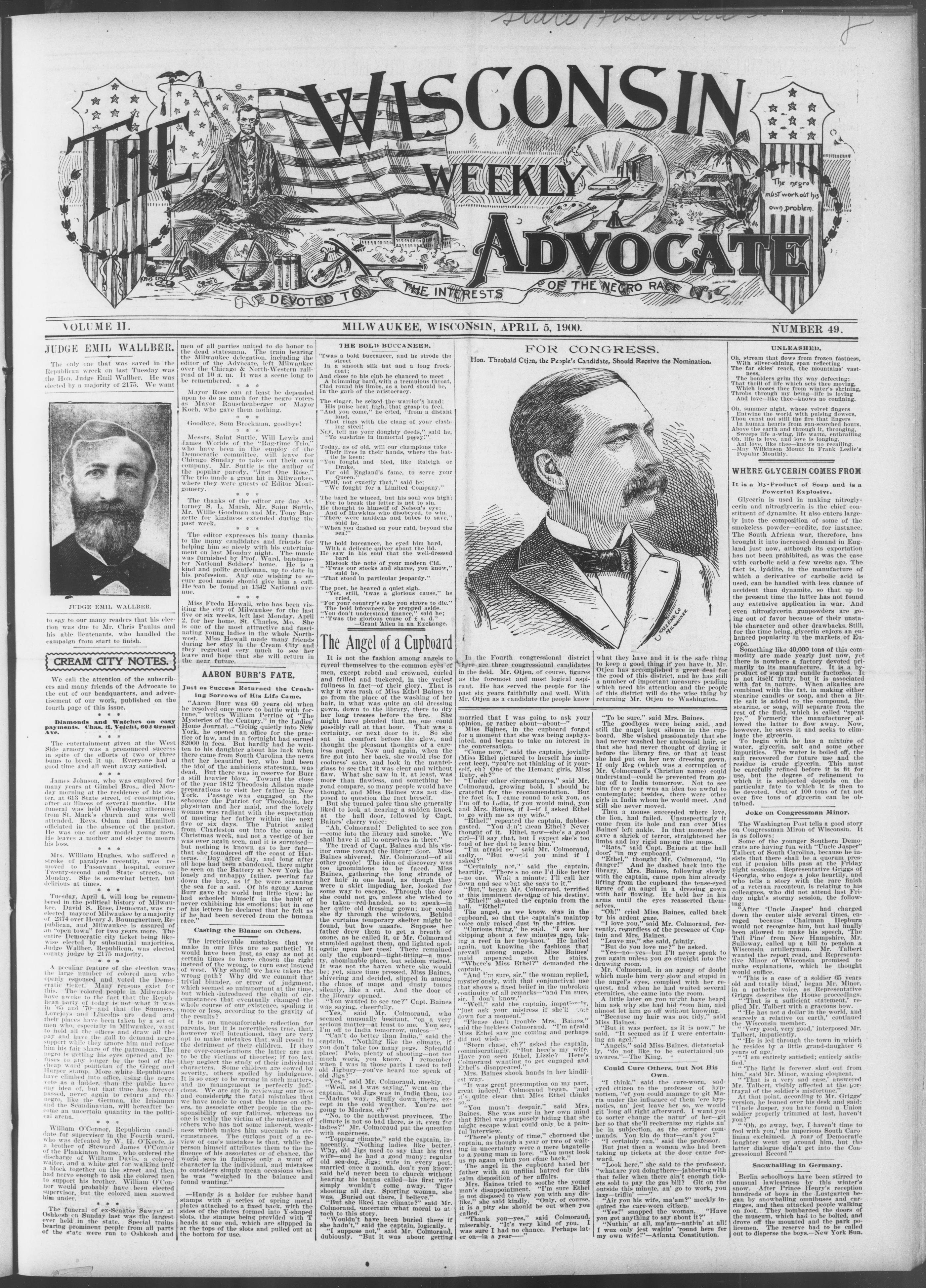
WISCONSIN
WEEKLY
ADVOCATE
DEVOTED TO THE INTERESTS OF THE NEGRO RACE
JUDGE EMIL WALLBER.
The only one that was saved in the Republican wreck on last Tuesday was the Hon. Judge Emil Wallber. He was elected by a majority of 2175. We want
J. B.
JUDGE EMIL WALLBER. to say to our many readers that his election was due to Mr. Chris Paulus and his able lieutenants, who handled the campaign from start to finish.
CREAM CITY NOTES.
We call the attention of the subscribers and many friends of the Advocate to the cut of our headquarters, and advertisement of our work, published on the fourth page of this issue.
***
Diamonds and Watches on easy payments. Chas. H. Veicht, 602 Grand Ave.
* * *
The entertainment given at the West Side armory was a pronounced success in spite of the efforts of two or three bums to break it up. Everyone had a good time and all went away satisfied.
***
James Johnson, who was employed for many years at Gimbel Bros., died Menday morning at the residence of his sister, at 613 State street, of consumption, after an illness of several months. His funeral was held Wednesday afternoon from St. Mark's church and was well attended. Reys, Odam and Hamilton officiated in the absence of the pastor. He was one of our model young men. He leaves a mother and sister to mourn his loss.
* * *
Mrs. William Hughes, who suffered a stroke of paralysis recently, was removed to Passavant hospital, corner Twenty-second and State streets, on Monday. She is somewhat better, but delirious at times.
☆ ☆ ☆
Tuesday, April 4, will long be remembered in the political history of Milwaukee. David S. Rose, Democrat, was reelected mayor of Milwaukee by a majority of 2374 over Henry J. Baumgaertner, Republican, and Milwaukee is assured of an "open town" for two years more. The entire Democratic city ticket being likewise elected by substantial majorities, Judge Wallber, Republican, was elected county judge by 2175 majority.
* * *
A peculiar feature of the election was the large number of colored men who openly espoused and voted the Democratic ticket. Many reasons exist for this. The colored people in Milwaukee have awoke to the fact that the Republican party of today is not what it was in '65 and '70—and that the Summers, Lovejoys and Lineolns are dead and their places have been taken by a set of men who, especially in Milwaukee, want to hold all the offices and draw all the pay and have the gall to demand negro support while they ignore him and refuse him his fair share of the patronage. The negro is getting his eyes opened and refuses to any longer be the tool of the cheap ward politician of the Gregg and Harper stamp. More white Republicans have climbed into office, using the negro vote as a ladder, than the public have any idea of, but that time has forever passed, never again to return and the negro, like the German, the Irishman and the Scandinavian, will hereafter become an uncertain quantity in the political arena.
***
William O'Connor, Republican candidate for supervisor in the Fourth ward, who was defeated by W. H. O'Keefe, is a brother of Steward James O'Connor of the Plankinton house, who ordered the discharge of William Davis, a colored waiter, and a white girl for walking half a block together on the street and then had nerve enough to ask the colored men to support his brother. William O'Connor would probably have been elected supervisor, but the colored men snowed him under.
* * *
The funeral of ex-Senator Sawyer at Oshkosh on Sunday last was the largest ever held in the state. Special trains bearing prominent people from all parts of the state were run to Oshkosh and
men of all parties united to do honor to the dead statesman. The train bearing the Milwaukee delegation, including the editor of the Advocate, left Milwaukee over the Chicago & North-Western railroad at 10 a. m. It was a scene long to be remembered.
Mayor Rose can at least be depended upon to do as much for the negro voters as Mayor Rauschenberger or Mayor Koch, who gave them nothing.
Goodbye, Sam Brockman, goodbye!
Messrs. Saint Suttle, Will Lewis and James Worlds of the "Rag-time Trio," who have been in the employ of the Democratic committee, will leave for Chicago Sunday to take out their own company. Mr. Suttle is the author of the popular parody, "Just One Rose." The trio made a great hit in Milwaukee, where they were guests of Editor Montgomery.
* * *
The thanks of the editor are due Attorney S. L. Marsh, Mr. Saint Suttle, Mr. Willie Goodman and Mr. Tony Burgette for kindness extended during the past week.
* * *
The editor expresses his many thanks to the many candidates and friends for helping him so nicely with his entertainment on last Monday night. The music was furnished by Prof. Ward, bandmaster National Soldiers' home. He is a kind and polite gentleman, up to date in his profession. Any one wishing to secure good music should give him a call. He can be found at 1342 National avenue.
* * *
Miss Freda Howall, who has been visiting the city of Milwaukee for the last five or six weeks, left last Monday, April 2, for her home, St. Charles, Mo. She is one of the most attractive and fascinating young ladies in the whole Northwest. Miss Howall made many friends during her stay in the Cream City and they regretted very much to see her leave and hope that she will return in the near future.
AARON BURR'S FATE.
Just as Success Returned the Crushing Sorrows of His Life Came.
"Aaron Burr was 60 years old when he resolved once more to battle with fortune," writes William Perrine of "The Mysteries of the Century," in the Ladies' Home Journal. "Going quietly into New York, he opened an office for the practice of law, and in a fortnight had earned $2000 in fees. But hardly had he written to his daughter about his luck when there came from South Carolina the news that her beautiful boy, who had been the idol of the ambitious statesman, was dead. But there was in reserve for Burr a still heavier blow. Toward the close of the year 1812 Theodosia Allston made preparations to visit her father in New York. Passage was engaged on the schooner the Patriot for Theodosia, her physician and her maid, and the lovely woman was radiant with the expectation of meeting her father within the next five or six days. The Patriot sailed from Charleston out into the ocean in Christmas week, and not a vestige of her was ever again seen, and it is surmised—but nothing is known as to her fate—that she foundered off the coast of Hatteras. Day after day, and long after all hope had been abandoned, there might be seen on the Battery at New York the lonely and unhappy father, peering far down the bay, as if he were scanning the sea for a sail. Of his agony Aaron Burr gave the world but little view; he had schooled himself in the habit of never exhibiting his emotions; but in one of his letters he declared that he felt as if he had been severed from the human race."
Casting the Blame on Others.
The irretrievable mistakes that we make in our lives are so pathetic! It would have been just, as easy as not at certain times to have chosen the right instead of the wrong, to turn east instead of west. Why should we have taken the wrong path? Why did we commit that trivial blunder, or error of judgment, which seemed so unimportant at the time, but which introduced the chain of circumstances that eventually changed the whole course of our existence, spoiling it more or less, according to the gravity of the results?
It is an uncomfortable reflection for parents, but it is nevertheless true, that, however well intentioned, they are very apt to make mistakes that will result to the detriment of their children. If they are over-conscientious the latter are apt to be the victims of theories; if too lax, they neglect the study of their individual characters. Some children are cowed by severity, others spoiled by indulgence. It is so easy to be wrong in such matters, and no management is perfectly judicious. We are apt in reviewing our lives and considering the fatal mistakes that we have made to cast the blame on others, to associate other people in the responsibility of our failures, whereas no one is really the victim of the mistakes of others who has not some inherent, weakness which makes him succumb to circumstances. The curious part of a review of one's mistakes is that, while the person himself attributes them to the influence of his associates or of chance, the world sees in failures only a want of character in the individual, and mistakes to outsiders simply mean occasions when he was "weighed in the balance and found wanting."
—Handy is a holder for rubber hand stamps with a series of spring metal plates attached to a fixed back, with the sides of the plates formed into Y-shaped slots, the stamps being provided with T heads at one end, which are slipped in at the tops of the slots and pulled out at the bottom for use.
THE BOLD BUCCANEER.
'Twas a bold buccaneer, and he strode the street
In a smooth silk hat and a long frock-
cont;
And close to his club he chanced to meet
A brimming bard, with a tremulous throat,
Clad round his limbs, as a bard should be,
In the garb of the aristocracy.
The singer, he seized the warrior's hand;
His pulse beat high, that grasp to feel.
"And you come," he cried, "from a distant
land,
That rings with the clang of your clash-
ing steel!
Nay, tell me your doughty deeds," said he,
"To enshrine in immortal poesy!"
Today, as of old, will our champions take
Their lives in their hands, where the battle
is keen:
"You fought and bled, like Raleigh or
Drake.
Drake,
For old England's fame, to serve your
"Owen."
The bard he winced, but his soul was high
For to break the letter is not to sin.
He thought to himself of Nelson's eye;
And of Hawkins who disobeyed, to win.
"There were maidens and babes to save,"
sald he.
"When you dashed on your raid, beyond the sea!"
The bold buccaneer, he eyed him hard,
With a delicate quiver about the lid.
He saw in his soul that the well-dressed bard
Mistook the note of your modern Cid.
"Twas our stocks and shares, you know," said he.
"That stood in particular jeopardy."
The poet, he heaved a quiet sigh.
"Yet, still, 'twas a glorious cause," he cried.
"For your country's sake you strove to die."
The bold butcaneer, he stepped aside.
"You don't understand finance," said he;
"Twas the glorious cause of £ s. d."
The Angel of a Cupboard
The Angel of a Cupboard
It is not the fashion among angels to reveal themselves to the common eyes of men, except robed and crowned, curled and frilled and tuckered, in the veriest fullness in fact—of their glory. That is why it was rash of Miss Ethel Baines to go from the place of the washing of her hair, in what was quite an old dressing gown, down to the library, there to dry her long tresses before the fire. She might have pleaded that no one could possibly call at that hour. That was a certainty, or next door to it. So she sat in comfort before the glow, and thought the pleasant thoughts of a careless angel. Now and again, when the fire got into her back, she would rise for coolness' sake, and look in the mantelglass to see that it was clear and without flaw. What she saw in it, at least, was more than flawless, and something beyond compare, so many people would have thought, and Miss Baines was not disposed to question the fact herself.
But she turned paler than she generally liked to look at hearing a sudden knock at the hall door, followed by Capt. Baines' cherry voice: "Ah, Colmoraud! Delighted to see you—come into the library and smoke. We shall have it all to ourselves in there."
The tread of Capt. Baines and his visitor came toward the library door. Miss Baines shivered. Mr. Colmoraud—of all other people! The idea of discovery was too ignominious to be faced. Miss Baines, gathering the long strands of her hair in one hand, as though they were a skirt impeding her, looked for some way to escape. Through the door she could not go, unless she wished to be taken—red-handed, so to speak—in her quite old dressing gown; nor could she fly through the windows. Behind the curtains temporary shelter might be found, but how unsafe. Suppose her father drew them to get a breath of ozone, as he called it, or Mr. Colmoraud stumbled against them, and lighted apologetic upon her toes! There remained only the cupboard—tight-fitting—a musty, abominable place, but seldom visited. It was not the haven where she would be; yet, since time pressed, Miss Baines, shivering and decided, slipped in among the chaos of maps and dusty tomes silently, like a cat. And the door of the library opened.
"You wanted to see me?" Capt. Baines was saying, cheerfully.
"Yes," said Mr. Colmoraud, who seemed unusually besitant, "on a very serious matter—at least to me. You see, I'm off to India tomorrow, unless—"
"Can't do better than India," said the captain. "Nothing like the climate, if you don't take too many pegs. Splendid place! Polo, plenty of shooting—not too much work, you know. I remember when I was in those parts I used to tell old Jigbury—you've heard me speak of old Jigs?"
"Yes," said Mr. Colmoraud, meekly.
"Well, as I was saying," went on the captain, "old Jigs was in India then, too—Madras way. Stuffy down there, except in the cold weather. You're not going to Madras, eh?"
"No, to the northwest provinces. The climate is not so bad there, is it, even for ladies?" Mr. Colmoraud put the question with eagerness.
"Topping climate," said the captain, innocently. "Nothing ladies like better. Why, old Jigs used to say that his first wife—and he had a good many; regular old sea-dog, Jigs; wife in every port, married once a month, don't you know? said he'd never been to church without hearing his banns called—his first wife simply wouldn't come away. Tiger shooting all day. Sporting woman, she was. Buried out there, I believe."
"But she liked the climate?" said Mr. Colmoraud, uncertain what moral to attach to this story.
"Wouldn't have been buried there if she hadn't," said the captain, logically.
"I suppose not," said Mr. Colmoraud, dubiously. "But it was about getting
Hon. Thzobald Ctjen, the People's Candidate, Should Receive the Nomination.
In the Fourth congressional district there are three congressional candidates in the field. Mr. Otjen, of course, figures as the foremost and most logical aspirant. He has served the people for the past six years faithfully and well. With Mr. Otjen as a candidate the people know
married that I was going to ask your opinion, or rather about—about—" Miss Baines, in the cupboard forgot for a moment that she was being asphyxiated, and began to take an interest in the conversation. "Come now," said the captain, jovially (Miss Ethel pictured to herself his innocent leer), "you're not thinking of it yourself, eh? One of the Hemant girls, Miss Ruby, eh?" "Under other circumstances," said Mr. Colmoraud, growing bold, I should be grateful for the recommendation. But the fact is, I came round to ask you, as I'm off to India, if you would mind, you and Mrs. Baines, if I—if I asked Ethel to go with me as my wife." "Ethel!" repeated the captain, flabbargasted. "You don't mean Ethel? Never thought of it. Ethel, now—she's a good girl—I'll say that, but I expect she's too fond of her dad to leave him."
"I'm afraid so," said Mr. Colmoraud, sadly. "But would you mind if I asked?"
"Certainly not," said the captain, heartily. "There's no one I'd like better—no one. Wait a minute; I'll call her down and see what she says to it."
"But," began Mr. Colmoraud, terrified at this imminent deciding of his destiny. "Ethel!" she shouted the captain from the hall. "Ethel!"
The angel, as we know, was in the cupboard, so that the captain's maintop voice only raised dust in the attics. "Curious thing," he said. "I saw her skipping about a few minutes ago, taking a reef in her top-knot." He hailed again, not knowing the fashions that prevail among angels. Miss Baines' maid appeared upon the stairs. "Where's Miss Ethel?" demanded the captain.
"And I'm sure, sir," the woman replied, mysteriously, with that conjunctival use that shows a fixed belief in the unbroken continuity of all remarks—"and I'm sure, sir, I don't know."
"Well," said the captain, impatiently, "just ask your mistress if she'll come down for a moment."
"Please don't trouble Mrs. Baines," said the luckless Colmoraud. "I'm afraid Miss Ethel saw me coming and perhaps did not wish—"
"Stern chase, eh?" asked the captain, commiseratingly. "But here's my wife. Have you seen Ethel, Lizzie? Here's Colmoraud wanting to get engaged and Ethel's disappeared."
Mrs. Baines shook hands in her kindliest way.
"It was great presumption on my part, great indeed," Colmoraud began, "and it's quite clear that Miss Ethel thinks so."
"You musn't despair," said Mrs. Baines. She was sure in her own mind that Ethel was purposely hiding that she might escape what could only be a painful interview.
"There's plenty of time," chorused the captain, as though a year or two of waiting in uncertainty were a mere bagatelle to a young man in love. "You must look us up again when you come back."
The angel in the cupboard hated her father with an unfilial hatred for this calm disposition of her affairs.
Mrs. Baines tried to soothe the young man's disappointment. "I'm sure Ethel is not disposed to view you with any dislike," she said kindly. "Only, of course, it is a pity she should be out when you called."
"Thank you—yes," said Colmoraud, miserably. "It's very kind of you. I was sure I had no chance. Perhaps later on—in a year—"
what they have and it is the safe thing to keep a good thing if you have it. Mr. Otjen has accomplished a great deal for the good of this district, and he has still a number of important measures pending which need his attention and the people of this district will do the wise thing by returning Mr. Otjen to Washington.
"To be sure," said Mrs. Baines. The goodbyes were being said, and still the angel kept silence in the cupboard. She wished passionately that she had never washed her ambrosial hair, or that she had never thought of drying it before the library fire, or that at least she had put on her new dressing gown. If only Reg (which was a corruption of Mr. Colmoraud's Christian name) could understand—could be prevented from going off to India tomorrow. Not to see him for a year was an idea too awful to contemplate; besides, there were other girls in India whom he would meet. And still she never moved.
Then a mouse succeeded where love, the lion, had failed. Unsuspectingly it came from its hole and ran over Miss Baines' left ankle. In that moment she gave a shriek of terror, straightened her limbs and lay rigid among the maps.
"Rats," said Capt. Baines at the hall door. "in my cupboard."
"Ethel," thought Mr. Colmoraud, "in danger!" And he dashed back into the library. Mrs. Baines, following slowly with the captain, came upon him already lifting from the cupboard the tense-eyed figure of an angel in a dressing gown with hair flowing. He held her in his arms until the eyes reasserted themselves.
"Oh!" cried Miss Baines, called back by his ardent gaze.
"I love you," said Mr. Colmoraud, fervently, regardless of the presence of Captain and Mrs. Baines.
"Leave me," she said, faintly.
"But do you love me?" he asked.
"Yes—no—yes—but I'll never speak to you again unless you go straight into the drawing room.
Mr. Colmoraud, in an agony of doubt which made him very slow and stupid in the angel's eyes, complied with her request, and when he had waited several eternities, she came into the room.
A little later on you might have heard him ask why she had hid from him, and almost let him go off without knowing.
"Because my hair was not tidy," said Miss Baines.
"But it was perfect, as it is now," he said. "It seemed as if I were entertaining an agel."
"Angels," said Miss Baines, dictatorially, "do not like to be entertained unawares."—The King.
Could Cure Others, but Not His Own
"I think," said the care-worn, sad-eyed citizen to the professor of hypnotism, "ef you could manage to git Maria under the influence of them 'ere hypnotics, an' jest leave her so, we would git 'long all right afterward. I want you to sorter change the natur' of her—git her so that she'll reckernize my rights an' be in subjection, as the scripter commands. You kin do that—can't you?" "I certainly can," said the professor. But just then a woman who had been taking up tickets at the door came forward. "Look here," she said to the professor, "what are you doing there—jabbering with that feller when there ain't enough tickets sold to pay the gas bill? Git on the outside this minute, an' go to work, you lazy—triflin' —"
"Air you his wife, ma'am?" meekly inquired the care-worn citizen.
"Yes!" snapped the woman. "Have you got anything to say about it?"
you got anything to say about it?" "Nuthin' at all, ma'am—nuthin' at all! I wuz only jest waitin' 'round here fer my own wife!"—Atlanta Constitution.
UNLEASHED.
Oh, stream that flows from frozen fastness,
With silver-shining span reflecting
The far skies' reach, the mountains' vastness,
The boulders grim thy way defecting;
That thrill of life which sets thee moving,
Which looses thee from winter's shrining,
Throbs through my being—life is loving
And love—like thee—knows no confining.
Oh, summer night, whose velvet fingers
Entwine the world with pulsing flowers,
Thou canst not still the fire that lingers
In human hearts from sun-scorched hours.
Above the earth and through it, thronging,
Sweeps life a-wing, life warm, enthralling
Oh, life is love, and love is longing,
Anl love, like thee—knows no recalling.
—May Wilkinson Mount in Frank Leslie's Popular Monthly.
WHERE GLYCERIN COMES FROM
It is a By-Product of Soap and is a Powerful Explosive.
Glycerin is used in making nitroglycerin and nitroglycerin is the chief constituent of dynamite. It also enters largely into the composition of some of the smokeless powder—cordite, for instance. The South African war, therefore, has brought it into increased demand in England just now, although its exportation has not been prohibited, as was the case with carbolic acid a few weeks ago. The fact is, lydite, in the manufacture of which a derivative of carbolic acid is used, can be handled with less chance of accident than dynamite, so that up to the present time the latter has not found any extensive application in war. And even nitroglycerin gunpowders are going out of favor because of their unstable character and other drawbacks. Still, for the time being, glycerin enjoys an enhanced popularity in the markets, of Europe.
Something like 40,000 tons of this commodity are made yearly just now, yet there is nowhere a factory devoted primarily to its manufacture. It is a byproduct of soap and candle factories. It is not itself fatty, but it is associated with fat in nature. When alkalies are combined with the fat, in making either stearine candles or soap, and then a little salt is added to the compound, the stearine, or soap, will separate from the rest of the fluid, which is called "spent lye." Formerly the manufacturer allowed the latter to flow away. Now, however, he saves it and seeks to eliminate the glycerin.
To begin with he has a mixture of water, glycerin, salt and some other impurities. The water is boiled off, the salt recovered for future use and the residue is crude glycerin. This must be carefully refined before it is fit for use, but the degree of refinement to which it is subjected depends on the particular fate to which it is then to be devoted. Out of 100 tons of fat not over five tons of glycerin can be obtained.
Joke on Congressman Minor.
The Washington Post tells a good story on Congressman Miron of Wisconsin. It is as follows:
Some of the younger Southern Democrats are having fun with "Uncle Jasper" Talbert of South Carolina, because he insists that there shall be a quorum present if pension bills pass at the Friday night sessions. Representative Griggs of Georgia, who enjoys a joke heartily, and who tells a story with the rare finish of a veteran raconteur, is relating to his colleagues, who did not attend last Friday night's stormy session, the following:
"After 'Uncle Jasper' had charged down the center aisle several times, enraged because Chairman Hepburn would not recognize him, but had finally been allowed to make his speech, 'The Tall Pine' from New Hampshire, Mr. Sulloway, called up a bill to pension a Wisconsin artilleryman. Mr. Talbert wanted the report read, and Representative Minor of Wisconsin promised to make explanations, which he thought would suffice.
"This is a case of a soldier 65 years old and totally blind,' began Mr. Minor, in a pathetic voice, as Representative Griggs describes the House proceedings.
"That is a sufficient statement,' replied Mr. Talbert with a gracious bow.
"He has not a dollar in the world, and scarcely a relative on earth,' continued the Wisconsin member.
" 'Very good, very good,' interposed Mr. Talbert, impatiently.
"He is led through the town in which he resides by a little grand-daughter 6 years of age." "I am entirely satisfied; entirely satisfied."
"The light is forever shut out from him," said Mr. Minor, waxing eloquent.
him,' said Mr. Minor, waxing eloquent.
"That is a very sad case," answered Mr. Talbert, visibly affected at the portrayal of the soldier's misfortune."
At that point, according to Mr. Griggs' version, he leaned over his desk and said: "Uncle Jasper, you have found a Union soldier properly trimmed at last, haven't you?"
"Oh, go away, boy, I haven't time to fool with you,' the imperious South Carolinian exclaimed. A roar of Democratic laughter went up around him, but the latter dialogue didn't get into the Congressional Record."
Snowballing in Germany.
Berlin schoolboys have been stirred to unusual lawlessness by this winter's snow. After Prince Henry's reception hundreds of boys in the Lustgarten began by snowballing omnibuses and carriages, and then attacked people walking on foot. They bombarded the doors of the museum, which had to be bolted, and drove off the mounted and the park policemen. The reserve had to be called out to disperse the boys.—New York Sun.
The Situation Bewildering for the Time Being-Boers Have Moved Elsewhere.
Bloemfontein, Monday, April 2.—Gen. Colville's division and cavalry have returned here. Everything is quiet.
London, April 4.—Gen. Colville and Gen. French have given up the movement against the Boers east of Bloemfontein, and have rejoined the main army. It doubtless seemed to Lord Roberts a vain thing to send from 10,000 to 12,000 of his best troops into the wilderness, with a field transport, in the direction at right angle with his chosen line of advance. The Boers have probably moved elsewhere, and if to the southwest Gen. Colville could as easily strike them from Bloemfontein as by following them up across the plains. These inferences still leave the situation bewildering for the time being. The enormously-superior British forces appear inactive in every part of the war field, waiting yet, probably, for the accumulation of material for a swift advance on the Transvaal frontier.
The London military commentators and the public to some extent are irritated and confused by the situation.
Lord Roberts did not meet his wife at Cape Town. She will proceed to Bloemfontein.
The permanent bridge at the Modder river station has been finished. The first train passed over it Tuesday.
The British garrison at Springfontein was roused at midnight Monday by the intimation that the Boers in force were about to make an attack, but not a burgher appeared.
Gen. Gatacre Active.
Springfontein, Orange Free State, Tuesday, April 3.—Owing to information that the Boers are hovering in the neighborhood of the railroad running from this place to Bloemfontein, Gen. Gatacre is preparing to take vigorous measures to cope with any attempt to cut off Lord Roberts' line of communication at that point.
The Bloemfontein Reverse.
New York, April 4.—A dispatch to the Tribune from London says: Further details of the British reverses near Bloemfontein waterworks tend to show that greater cohesion exists among the burghers of the Free State than had been imagined. The Standard's correspondent illustrates the "slimness" of the Boers by mentioning that they concealed themselves in the long grass and further deceived Coi. Brodwood's troops by deputing some of their number to appear unarmed, as merely uninterested spectators. The Boers were at first forced back by the fire of the artillery, but were quickly reinforced and resumed the offensive, pursuing the British for some distance. On the arrival of the Ninth and cavalry divisions an attempt was made to surround the federal troops, but they fell back to a strong position, and Gen. Colville, finding them provided with Creusot guns, decided not to engage them, and returned to Bushman's kop.
The Capetown Incident.
London, April 4.—Details received of the scenes on Green Market square, Cape Town, Tuesday, when Premier Schreiner encountered an English demonstration, show that the premier, fearing personal violence, sought refuge in a restaurant. He was hooted and tried to reach Parliament house protected by police. The people shouted "Traitor," but he succeeded in reaching the house. Finally on the people again singing "God Save the Queen," he raised his hat amid cheers and was heard to say: "Reserve your judgment."
British Losses.
London, April 4.—A further list of the casualties sustained by the British officers at Kooru (Karee?) spruit, March 31, adds eleven missing and one wounded, making the total thus far thirty-two.
PRETORIA IMPREGNABLE
Surrounded by Hills Bristling with Modern High-Power Guns.
Washington, D. C., April 4.—Webster Davis, late assistant secretary of the interior, who has just returned from Pretoria, speaks as follows regarding the defenses of the Transvaal capital and its ability to withstand a prolonged siege: "I viewed the defenses of Pretoria, and I consider them impregnable. I do not believe the English troops will ever pass the line of hills surrounding the town, bristling as they are with high power Krupp and Creusot guns.
"There seems a very general impression that the guns used by the Boers in the field were taken from the fortresses at Pretoria, but I saw every earthwork and forts surrounding the town, and I could not see where any guns had been removed. They were all there and formidable they looked. Pretoria lies in a basin surrounded by rugged hills, affording most admirable opportunities for defense. While there I learned enough to know that the city is one vast storehouse of foodstuffs and ammunition.
Slaughter at Spionkop.
"I was present at the battle of Spionkop and saw a thin line of Boers drive an army before them. After the fight I walked over the field and counted the dead bodies of 125 Englishmen in one trench, where the Boers had placed them for burial. During my stay in the neighborhood I visited every laager in the lines surrounding the city and talked with scores of officers and men.
"I visited the lines along the Tugela, where Buller and his 40,000 men were held at bay, and I speak from the most positive knowledge when I say that all of the Boer troops in that region numbered but 7000. With this force Joubert and Botha held Buller back and kept White and his 15,000 men corralled in the town."
Buller's Great Victory.
"When Cronje was threatened 3000 men were sent to him from Ladysmith, leaving about 4000 to face the 55,000 men of the enemy.
"At Pretoria I met President Steyn and learned that there is no truth in the report coming from English sources concerning dissensions between the two Presidents. They are in perfect accord.
"As I said before, I do not believe the British will ever enter Pretoria. Even the women of the town are supplied with rifles and are daily practicing in marksmanship. Some of them are very expert, and their average shooting good. The strength of Kruger and his burghers lies in the belief that God is with them."
Portu ai's Neutrality.
Lisbon, April 4.—The question of transport of British troops across Portuguese territory from Beira, Portuguese East Africa, into Rhodesia, having been brought up in the chamber of deputies, the foreign minister, Senhor Beirao, made the following statement:
The transport of British soldiers by railroad from Beira to Umtall was requested by Great Britain and consented to by Portugal, because the British government there-
by only exercised a right recognized in the treaties between the two countries. The outbreak of war has not abrogated these treaties, which were concluded and signed prior to the war by Portugal in a spirit of loyalty. I have informed the Transvaal of this resolution. Portugal has loyally adhered to its duties and neutrality, and its resolutions have been communicated to all interested parties. There occurred no more solemn occasion than the present to declare that the British cabinet has maintained with Portugal relations of cordiality and loyalty, for which there is reason for congratulation. Please God that these good relations shall always be maintained.
DEWEY'S AMBITION.
The Hero of Manila Bay Changes His Mind in Regard to Political Honors.
Washington, D. C., April 4.—Admiral George Dewey this morning confirmed the interview published this morning in the New York World to the effect that he will accept the presidency of the United States should the American people desire him to fill that office. He refused to make any further statement.
In his plans for higher office he is said to be largely influenced by Mrs. Dewey, who is known in Washington as a woman of ambition, energy and tact. Her practiced hand has already been recog-
: If the American people want me :
: for this high office I shall be only :
: too willing to serve them. It is the :
: highest honor in the gift of the na-
tion; what citizen would refuse it?
nized in some peculiarly adroit and discreet operations having in view the elevation of her husband to the presidency. It is said also that the Admiral and Mrs. Dewey have arranged a preliminary campaign, which shall include a conservative reception of people who are likely to have some say in the making of the next President or who possess some influence of value in the convention. The admiral has determined to accept so far as possible all invitations which bring him into public view, and it is possible should the outlook be promising he will abandon his projected trip to Europe. His official duties, now confined to the presidency of the so-called naval policy board, are not exacting and his presence at the occasional sessions of the board is not a necessity.
Dewey's Formal Declaration.
Admiral Dewey gave the following interview to the correspondent of the New York World:
"I realize that the time has arrived when I must definitely define my position. When I arrived in this country last September I said then that nothing would induce me to be a candidate for the presidency. Since then, however, I have had the leisure and inclination to study the matter, and have reached a different conclusion, inasmuch as so many assurances have come to me from my countrymen that I would be acceptable as a candidate for this great office.
"If the American people want me for this high office I shall be only too willing to serve them. It is the highest honor in the gift of the nation; what citizen would refuse it?
"Since studying the subject I am convinced that the office of the President is not such a difficult one to fill, his duties being mainly to execute the laws of Congress.
"Should I be chosen for this exalted position I would execute the laws of Congress as faithfully as I have always executed the orders of my superiors."
"Is there any political significance in your trip West?" was asked.
your trip West? was asked.
"No; I am simply filling the engagements made months ago—long before I ever thought seriously of the presidency."
"On what platform will you stand?
"I think I have said enough at this time, and possibly too much."
The greatest interest was manifested in official and other circles by the announcement made by Admiral Dewey in the published interview. His home on Rhode Island avenue was besieged all the morning by newspaper reporters who were anxious to obtain any additional information which might be forthcoming regarding the admiral's intentions and plaus for the future. To all he extended a cordial greeting, but he indicated that for the present at least there was nothing to add to what had already been published concerning his willingness to stand for the presidential office should the people elect to nominate him.
Must Withdraw from Active Duty.
Naturally the chief point of inquiry was as to which of the great political parties Admiral Dewey would be the candidate of, but to questions of this character the replies indicated that no positive determination had been reached. "There are no definite plans as to the future," said a member of his official household, when asked for information on that subject.
None of the officials or naval officers at the navy department care to express publicly any opinion as to the admiral's announcement. But it is plain to be seen that the announcement created profound surprise in every circle. The impression prevails that regardless of the outcome of the admiral's movement from a political point of view, his entrance into the arena of politics marks a termination of his activities in the navy. Not that it is believed that his retirement is impending, but it is felt that, engrossed as he will be in his other aspirations, the admiral will not be able to spare the time necessary for the discharge of naval duties. It is intimated that he practically indicated his purpose to withdraw from active naval work in a conversation recently with an intimate friend and brother officer.
THE CHICAGO MYSTERY.
Police Searching a Sewer for a Missing Girl's Body.
Chicago, Ill., April 4.—No arrests have as yet been made in connection with the disappearance of Melita Kuehn, the daughter of Otto Kuehn, a Wells street baker, and Chief Heidelmeir said today that until the police secured more evidence of foul play than they have now no arrests would be made. Tenants of the storeroom adjoining Kuehn's bakery at 127 Wells street complained this afternoon of an unbearable stench in the sewer running from the baker's basement and after an investigation of the matter a thorough examination of the sewer was ordered and will take place this evening. Conflicting stories as to their sister's disappearance were told the police today by Kuehn's two sons, Frank and Willie.
MAYHEM IS CHARGED
Ear, Thumb and Finger Bitten Off in a Fight.
Ashland, Wis., April 4.—[Special.]—H. Coombs, who had his preliminary examination at Glidden yesterday on the charge of mayhem, was bound over to the circuit court under $1000 bonds. Coombs had a fight with a man named O'Brien and is accused of biting off his left ear, left thumb and one finger.
FIVE-MILE LIMIT BILL FAILS.
Iowa's Prohibition Measure Lack Two Votes of Getting Through. Des Moines, Ia., April 4.—What is known as the five-mile limit bill failed of sage in the House by lack of two votes. It would have prohibited the sale of liquor within five miles of the State university, State Agricultural college and the state normal school.
SCHLEY WINS OUT.
His Advancement for Conspicuous Services at Santiago is Confirmed.
Washington, April 3.—Rear Admiral Schley, by the confirmation by the Senate of Capt. Francis J. Higginson as commodore, was also confirmed in his advancement and promotion for eminent services and, conspicuous conduct in the battle of Santiago.
This is the direct effect of the decision lately rendered by the attorney-general in the case of Capt. McCalla.
In this case, in brief, it was held by the attorney-general, and so reported to the treasury department, that the advancement of Lieut. Commander Pillsbury confirmed by implication the promotion and advancement of Capt. McCalla.
This fact being established, it is only necessary to recall that on December 7, 1898, the President sent to the Senate the name of Francis J. Higginson to "be a commodore in the navy from August 10, 1898, vice Commodore Winfield Scott Schley, advanced and promoted."
Action was taken by the Senate only in the case of Higginson, and now it is held by eminent authorities that the application of the attorney-general's rule to this case shows that by the advancement of Higginson. Schley was also "advanced and promoted."
This discovery has created considerable commotion in the bureau of navigation, where the hostility to Schley is rampant. The effort of this bureau has been consistently to defeat any of the legislation in which Schley was interested. Already the opinion is expressed in the bureau, contrary to that of the attorney-general, that there is no analogy in the case.
Rear Admiral Schley is two numbers ahead of Sampson as the record stands, but it is not the matter of numbers that so keenly affects the bureau of navigation ring. The ring does not desire that there should be any official recognition of the fact that Schley was promoted for "eminent and conspicuous conduct in battle."
The attorney-general's decision, however, must be followed by the navy department, and there is no getting around the fact that while the decision stands Schley was by law advanced, promoted and mentioned for conspicuous conduct in battle.
THE PHILIPPINE WAR.
Gen. Otis Corrects Certain Impressions Regarding the Insurrection.
Washington, D. C., April 3.—Gen. Otis has cabled to the war department, probably with a view to correcting erroneous impressions that exist in this country as to the state of the insurrection in the Philippines, a summary of the result of the development of the campaign since the first of the calendar year. His figures go far toward offsetting the belief that exists in some quarters that since adoption of guerrilla methods of warfare the insurgents have inflicted substantial loss upon American arms in comparison with the punishment which they have themselves received. A significant sentence in the report differentiates between insurgents and ladrones, showing that Otis has taken cognizance of the fact that a considerable number of hostiles are not solders under the rules of war and may not expect the same treatment. The report, which is dated Manila, April 3, is as follows:
"Since January 1 one hundred and twenty-four skirmishes in the Philippines have been reported, mostly very slight affairs. Our casualties were three officers and seventy-eight enlisted men killed; thirteen officers and 151 men wounded. Insurgent and ladrone loss in killed and left on field, 1426; captured, mostly wounded, 1453; small arms secured, 3051; pieces of artillery, 165; large captures of other insurgent property. A number of important insurgent officers are surrendering, and the situation is gradually becoming more pacific."
Bates Occupies Five Towns.
Manila, April 3-6 p. m.—Gen. John C. Bates has peacefully occupied Surigao, Cagayan, Hagan, Misamis and Mindanao. A number of rifles and cannon were captured.
The presence of the gunboats Yorktown, Manila and Panay prevented resistance at Cagayan. Insurgent atrocities in Cagayan and Camarines provinces continue. Spaniards, Chinamen and natives have been murdered.
NETHERSOLE ON TRIAL.
Persecution of the Actress Begun in New York Criminal Court. New York, April 3.—Olga Nethersole and others jointly accused in a blanket indictment of maintaining a nuisance and offending public decency in the production of a dramatization of Daudet's "Sapho," were put on trial today in the criminal branch of the Supreme court, where Justice Fursman presided.
Assistant District Attorney McIntyre endeavored to secure an adjournment for two weeks in order to get a special jury panel. Justice Fursman, however, denied the motion, saying that he was satisfied a fair jury could be obtained from the general panel. $ ^{*} $ The examination of talesmen then began. Charles G. Becker, a clerk, the first talesman examined, was acceptable to both parties. Several rejections followed, and then Joseph M. Kauffmann, secretary of a manufacturing company, was the second accepted.
AGUINALDO IN SINGAPORE
Filipino Chieftain a Refugee in the British Colony.
San Francisco, Cal., April 3.—According to advices received here Aguinaldo is in Singapore, having arrived there on a recent steamer. The Singapore papers publish interviews with him.
Decorations to be Restored
The old question of restoring the traceries to the windows in the palace of the dogs at Venice is again agitating artistic Italy. The exterior of the palace as it stands today was begun in the early part of the Thirteenth century, and required 100 years for its completion. In 1577 fire destroyed all but the walls. Up to that time the windows were enriched with beautiful tracery.
—A French newspaper announces a "new eccentricity of American ladies." It seems, according to the authority, that in this country Japanese mice are supplanting dogs as ladies' pets. One mouse costs $100. The French newspaper intimates that in the near future an exhibition of these pets is to be held, "to follow the exhibition of cats."
Dropsy treated free by Dr. H. H. Green's Sons of Atlanta, Ga. The greatest dropsy specialists in the world. Read their ad. in another column of this paper.
—Flexible shafting has been put to a new use. It is arranged so as to be attached to a source of motive power for tree trimming.
—Boston is agitating the question of curtailing the ringing of church hells.
KANSAS CITY'S BIG LOSS.
Less than Half an Hour Occupied in the Destruction of the
Kansas City, Mo., April 4.—Convention hall, in which the Democratic convention was to have been held on July 4, took fire this afternoon and was completely destroyed in less than half an hour. The fire broke out about 1:30. Within a few minutes after the fire caught, the whole structure, taking in half a block each way on Thirteenth and Central streets, was a mass of flames, and twenty minutes after the first alarm was turned in the great roof fell in with a crash, throwing showers of burning embers in every direction.
The fire started over the furnace room in the rear end of the building. A still alarm was turned in and before the first engines arrived the fire had gotten beyond control. Within twenty minutes every department in the city was at the scene, but the work of the firemen proved of no avail, and efforts were soon directed to saving the surrounding property. The children at the Lathrop school were just returning to their rooms after the dinner hour when the fire started, and as far as known all escaped to places of safety.
At 1:30 the fire jumped two ways, attacking a half block of three-story residences in the rear of the hall on Twelfth street and across Central street, where it first caught the Second Presbyterian church, one of the finest edifices in the city, and then the Lathrop public school, which was partially destroyed by a tornado in 1888.
The residences on Twelfth street, together with the church and school, will undoubtedly be a total loss, and at 1:50 the indications are that the fire will spread further west into a densely-populated residence district, and north of the hall, where some of the finest residences in the city are located.
At 2 o'clock the wind had driven the flames north and west from the hall, and the efforts of the firemen to save the fine residence property to the east on Wyandotte street had proven successful.
The Second Presbyterian church, which was a brick structure of old style, is a total loss. The building burned fiercely and was a ruin twenty minutes after it caught, the immense steeple falling with a crash, and spreading flames in all directions. The Lathrop school, a three-story, thirteen room structure, situated just north of the church, was also quickly leveled, and is a total loss. The row of Twelfth street residences was a complete loss.
All efforts were made to prevent the flames from reaching west and north. One building a block west of the hall caught fire from flying brands, but the flames were subdued
The hall is well insured, and will be rebuilt immediately, in time for use for the national Democratic convention. Fifteen minutes after the hall was known to be doomed, members of the Commercial club, through whose efforts the structure was built, began soliciting funds to begin a new building, which, it is stated, will be started as soon as the ruins can be cleared away. The foundation remained intact. At 2:15 the fire was pronounced under control, the flames were confined to three or four small residences outside the hall, church, school and Twelfth street row of residences. The total loss is roughly estimated at from $350,000 to $450,000, with insurance about half the loss.
Convention hall was situated at Thirteenth and Central streets, four blocks from the retail district of the city, and has been classed by travelers as one of the largest and most perfectly constructed auditoriums in the world.
HAS FAITH IN KANSAS CITY.
Former Governor Stone Mourns the Loss of Convention Hall.
St. Louis, Mo., April 4.—Ex-Gov. William J. Stone, vice-chairman of the Democratic National committee, received the first news of the burning of Kansas City's convention hall from the Associated press. "I am surprised and shocked at this bad news," he said, "the convention hall at Kansas City I considered one of the finest in the country and it was because of this that the national committee selected that city. It will be a great blow to the enterprising city, which I think will rise to the occasion and prepare a suitable place in which to hold the convention.
"Until I hear from the people as to what will be done, I cannot say where the convention will be held, but I think it is the disposition of the national committee and the Democracy at large to stand by Kansas City in her affliction. Whether the people of Kansas City can finish the hall between now and July 4, or prepare a temporary place of meeting, I do not know, but if any city can do so, that city can."
WILL TAKE NO ACTION.
Democratic National Committee will
Give Kansas City a Chance.
Washington, D. C., April 4.—Senator Jones, chairman of the National Democratic committee, says that the committee will take no action until he hus further information concerning what Kansas City proposes to do. If it is true, as reported that the hall is to be rebuilt there will be no necessity for making other arrangements. Senator Jones says that if the citizens of Kansas City go at it in the right way there is no reason why they cannot complete the new building by July 4.
DEWEY TROPHIES TO BE SEEN.
War Relice, Swords, and Loving Cups in Smithsonian Institution.
Washington, D. C., April 4.—Admiral Dewey has sent his collection of trophies of the Civil and Spanish wars to the Smithsonian institution, and they will be installed there as soon as a place has been fitted up to receive them. This includes all of the canes and swords which have been given him, the sword recently voted him by Congress, and the loving cup made out of the dimes donated by the people. The admiral's object in turning over these precious relics is to have them placed where they are accessible to the public, as visitors to Washington often make requests to the admiral to be allowed to see them and this constant application puts him to inconvenience. The collection is valued at $100,-000.
Burned Bridges and Tollbo
Logansport, Ind., April 4.—One hundred and fifty masked men blew up two bridges and burned two tollhouses on the Logansport and Burlington pike last night. The road is the only toll pike in the county and those obliged to patronize it have been hostile for a year. The Burlington bridge was burned three months ago and the company refused to rebuild it.
TRIED TO KILL PRINCE
Heir to the English Throne Shot at by a Fanatic in Brussels.
Brussels, April 4.—The Prince of Wales was shot at while leaving the railroad station here. He was not hurt.
The attempt upon the life of the Prince of Wales occurred at 3:35 p. m. The would-be assassin jumped upon the footboard of the prince's saloon car as the train was starting and fired into the car, aiming at the Prince of Wales.
The man was immediately arrested.
He fired two shots at the prince. The Princess of Wales and others were in the car, but no one was touched.
When examined by the station officials Sipide declared he intended to kill the Prince of Wales, that he did not regret his action and that he was ready to do it again if given a chance.
The would-be assassin is a tinsmith named Sipide, a resident of Brussels, 16 years of age. His pockets were found to be full of Anarchist literature.
Sipide subsequently said he wanted to kill the Prince of Wales "because he caused thousands of men to be slaughtered in South Africa."
Hearing the shots, the stationmaster rushed to the scene and knocked down the would-be assassin's arm as he prepared to fire a third shot and a number of persons threw themselves on the prince's assailant.
In the confusion a second man, who was quite innocent, was seized, roughly handled and beaten.
After the Prince of Wales had ascertained that the man who fired the shots had been arrested he declared himself and the princess uninjured and the train started.
The News in London.
London, April 4.—The news of the attempt upon the life of the Prince of Wales spread with marvelous rapidity in all parts of London and created the most intense excitement and bitter indignation among all classes. The fact that the attempted assassination occurred in a city where Dr. Leyds, the diplomatic agent of the Transvaal, makes his headquarters, was generally taken to indicate that the would-be assassin was a Boer sympathizer, and this so inflamed passions that the most bitter invectives were hurled against the Boers and everything connected with them.
The government was wholly ignorant of the attempt on the life of the Prince of Wales until the press dispatches on the subject were communicated to the foreign office.
The Marquis of Salisbury immediately telegraphed to the Prince of Wales his congratulations on his escape, while the United States charge d'affaires, Henry White, who was calling on the premier at the time, promptly repaired to Marlborough house and left his card there.
May Net Go to Paris Exposition:
All the officers were greatly disturbed by the occurrence and the general view was that it must be connected in some way with the Transvaal, especially as the Prince of Wales has always heretofore been such a favorite on the continent and never before has been molested in the slightest degree.
One high official remarked: "That settles the question of the Prince of Wales' visit to the Paris exposition."
Some fears were expressed as to the effect the occurrence may have in Dublin. It was pointed out that such attempts are contagious. On the other hand, those who are best acquainted with Ireland contended that the only effect would be to increase the determination of the Irish that no untoward incident should mar the success of the Queen's visit.
The news of the attempt on the life of the Prince of Wales was immediately telegraphed to Queen Victoria.
QUEEN IN IRELAND.
First Time in Thirty-nine Years to Set Her Foot on Erin's Soil
Dublin, April 4.—11:45 a. m.—Queen Victoria landed in Ireland this morning for the first time in thirty-nine years.
The disembarkation from the royal yacht was accomplished at 11:30. The commander of the forces in Ireland, the Duke of Connaught, the lord-lieutenant, Earl Cadogan, and their staffs greeted her majesty and the ride from Kingstown to Dublin commenced in splendid weather and before huge and good-natured crowds.
At the entrance to the city she received an address of welcome and handed the lord mayor a reply. The following is her majesty's reply in full:
"I thank you heartily for the loyal welcome and good wishes which you have tendered me on behalf of yourself and your fellow citizens on my arrival in the ancient capital of my Irish dominion. I came to this fair country to seek a change and rest, and to revisit scenes which recall to my mind the warm welcome given to both myself and my beloved husband. I am deeply gratified that I have been able at this time to see again the motherland of those brave sons who have recently distinguished themselves in the defense of my crown and empire with cheerful valor as conspicuous now as ever in their glorious past. I pray that the Almighty God may ever bless and direct you in the high functions which you exercise for the benefit of your fellow-citizens." The Queen appeared to be much affected by the warmth of her welcome.
Mr. Burke, a son of the former city sword-bearer, took the place of James Egan, the sword-bearer who had refused to officiate, but the lord mayor himself handed the sword and keys to her majesty, who touched them.
The ceremonies at the city gate were most picturesque. London's jubilee lord mayor, Sir George Faudel Philips, declared that the reception and ceremonies were the finest he had ever seen, far surpassing those of the great jubilee.
In reply to the address of welcome of the township commissioners of Kings-town the Queen handed the following to the chairman:
"I thank you for your lawful and dutiful address and for the warm welcome wherewith you have greeted me. On setting foot again on Irish soil I received with heartfelt satisfaction your assurances of devotion and affection toward me. I am looking forward with much pleasure to my visit to this part of my domain and I pray may God bless Ireland with increasing welfare and prosperity."
As the written reply was handed to the chairman her majesty said: "I am very pleased to find myself in Ireland again."
THE GRANTS ARE PLEASED.
Princess Cantacuzene is Well Cared for by Russia.
St. Petersburg, April 4.—Mrs. Frederick Dent Grant left St. Petersburg on her way to the United States yesterday evening. Her daughter, the Princess Cantacuzene, who has been suffering for some time with pneumonia, is very much improved in health. Mrs. Grant says her daughter has not been seriously ill and has no occasion for the services of herself or of the trained nurse whom she brought from the United States. Mrs. Grant is more than pleased with her son-in-law and his family, as well as with the cordial manner in which her daughter has been received by the imperial family and prominent society people.
In the spring those Pimples, Boils, Eruptions and General Bad Feelings indicate that there are cobwebs in the system. It needs a thorough brushing, and the best brush is Hood's Sarsaparilla, which sweeps all humors before it. This great medicine eradicates Scrofula, subdues Salt Rheum, neutralizes the acidity which causes Rheumatism in short, purifies the blood and thoroughly renovates the whole physical system.
"We have used Hood's Sarsaparilla and it has given the best of satisfaction, especially as a spring medicine. It builds up the general system and gives new life." Dwight C. Park, Whiteland, Indiana.
The Sick Child
Of the minor details of the sickroom, that which most impresses the untrained observer is the fashion in which the nurse gives a drink to the patient who must be kept in a recumbent position. The ordinary lay attendant, whose sole idea of the operation is to lift the sick person to a half or at least quarter sitting posture, looks on in wonder and admiration while the nurse slips her hand under the sick child's head, inclines it ever so slightly forward, and holds the full glass to his lips. In cases of heart weakness, where the safety of the patient may depend upon keeping him flat on his back, such a knack in giving nourishment is indispensable.
More difficult to acquire than this is the trick of changing the sheet on a bed without distressing the patient. In order to do this, the soiled sheet is loosened at one side of the bed, and folded in a long, compact roll close to the patient. The clean sheet is tucked in or pinned down in place of that which has been removed, and after being drawn over the uncovered part of the mattress, is also folded in a roll close to the rolled soiled sheets. The child has been turned on his side, the rolled sheets against his back. He is now turned on his other side, both sheets drawn from under him, the soiled one whisked off the bed, and the clean covering fastened down in its place. When the patient is very ill he may be lifted by two nurses, while a third draws out the sheets.—Harper's Bazar.
Patents to Inventors.
Messrs. Benedict & Morsell, solicitors of patents, Old Insurance building, Milwaukee, report patents issued to Western inventors March 27 as follows:
F. R. Eral, Rolfe, Ia., corn planter; Wilson Howard, Belvidere, Kas., corn-harvester; Martin Koeck, Oshkosh, Wis., woven fabric; J. J. McAreavy, Silver Creek, Ia., milk-cooler; G. W. McGill, Kearney, Neb., pumping-engine; A. G. McIntosh, Athissa, Ia., grain-binder; H. R. Moore, Fort Scott, Kas., ribbon-spool rack; Auton Palm, Milwaukee, vehicle wheel; Jos. Schiffender, Sheboygan, Wis., match box; J. R. Schler, Morning Sun, Ia., carbureter; M. D. Taylor, Janesville, Wis., fence-machine; W. J. Frost, Kenosha, Wis., bicycle-lamp (design); L. S. Larson, Racine, Wis., whifftree-hook (design); Kamps & Sacksteer, Appleton, Wis., iron tonic pills (trade-mark); Pabst Brewing Co., Milwaukee, lager beer (trade-mark).
No Time to Get Acquainted.
A man employed on the street cars in New York walked into a station house and inquired if a lost child had been brought there. He was shown into a back room, where three waifs had been collected from the streets. After inspecting them in a perplexed way he asked one, "Are you Johnny?" The child was too sleepy to answer. "I must send for my wife," said the puzzled applicant. The woman came and picked out another child as her own. "You must excuse me, said the man to the police officials. "I work on the surface road and never see the children except when in bed."
Appreciated Only His Own Jokes
Oliver Wendell Holmes enjoyed that humor best which was of his own production. On one occasion he was holding forth at great length on the subject of cannibalism, and having wound himself up to the proper pitch, he turned suddenly to Thomas Bailey Aldrich, who was sitting near him, and asked: "Imagine? What would you do if you were to meet a cannibal?" "I think," Mr. Aldrich sweetly replied. "that I should stop to pick up an acquaintance with him." This rejoinder cast such a gloom over Dr. Holmes that during the rest of the dinner his conversation was limited to monosyllables.
Happy Women
who have been relieved of painful menstruation by Lydia E. Pinkham's Vegetable Compound, are constantly writing grateful letters to Mrs. Pinkham.
Lydia E. Pinkham's Vegetable Compound
cured them. It always relieves painful periods and no woman who suffers should be without this knowledge. Nearly all the ills of women result from some derangement of the female organism. Mrs. Pinkham's great medicine makes women healthy; of this there is overwhelming proof.
Don't experiment. If you suffer get this medicine and get Mrs. Pinkham's free advice. Her address is Lynn, Mass.
THE HIGHLANDERS AT MAGERS FONTEIN.
When winter's cauld blast o'er Ben Lomend flits by,
An' hills o' the Highlands are frosted an' bare—
When Yuletide wi' a' its blithe pleasures is nigh—
Then Scotia thy grief will be heavy an' salir;
By hillside an' valley, in cot an' in ha',
Will sad eyes be greetin' for them that's awa'.
The springtime will come, wi' her sweet, sunny smile,
An' strew the brown earth wi' blossoms sae rare;
Each wee, saucy burn wimple gaily the whilo
As song o' the laverock mounts high on the air;
The bonnie brown bells will bloom winsome an' fair—
But hearts that aye loe'd ye—ye'll welcome nae mair.
Where Modder's broad stream ripples on to the west,
An' stretches the wide grassy veldt to the hills,
'Neath African skies they hae laid them to rest,
While a world o'er the tale o' their bravery thrills—
The lads an' their chieftain—brave Wau-chope, sae leal—
An' wha can his pride in such valour conceal?
In Seaforths an' Gordons, and Sutherlands, a'
The flower o' the clans where the heather bells blow;
As swift passing rains o' the midsummer fa',
Fell the death-dealing hall o' invisible foe
Roun' each gallant head that aye bent I' the fray.
Like wind-drifted heath o' their ain native brae.
By a long, shallow grave in the breast o' the veidt—
Where African sunsets their splendour will shed
Through years when the grief o' this hour is unfelt,
An' a' else forgot save the fame o' the dead—
Wi' sad glances bent where their comrades are laid.
Stan' a' that is left o' the Highland bilgade!
The proud heads are drooped, an' though silent their woe.
Yet stern bosoms heave wi' the weight o' the pain;
While near, in their rock-fronted fortress,
the foe
Look down frae the heights on the grave o' the slain,
Where lights o' the sunset fu' lovingly steal
Like visions o' bliss frae the land o' the leal.
As mutely the weather-scarred faces are bent,
In one last unspoken an' fervent fareweel,
The vell o' the fair tropic silence is rent,
An' far hills re-echo the soul-thrilling peal
That touches each sair, stricken heart to the core
As exilles remember their ain native shore.
As slowly "Lochaber" wails keen through the air,
The sweet, tender notes bringing glimpses o' hame,
Then swift as the tiger springs forth frae his lair,
There leaps in each breast an unquenchable flame.
An' strong hands are clenched, an' tears checked unshed.
An' vengeance is born wi' each thought o' the dead!
An' woe to the llon o' Africa when
The Highlanders' pibroch again shall re-sound;
Nae power o' the world will succour him then,
Should he at the points o' their bayonet be found;
When saber to saber, an' God for the right.
A charge unto death will be theirs in the fight.
Ay, weep for them, Scotia, but blend wi' each tear
A nation's just pride in their heroes sae brave;
An' haud, as thine honour, their memory dear,
Wha crowned thee anew frae the depths o' the grave.
Thy brave Highland laddles! Wha wi' them compares
When the heart o' a Bruce 'neath each tartan Is theirs?
—Mrs. Beatrice Harlowe of Milwaukee in Scottish-American.
HIS BEST FRIEND
HIS BEST FRIEND
Everything about Genevieve that day told me there was something wrong, but it would never have entered my head to ask her what it was. She was one of those frank, open girls, who don't tell things beyond a certain point, and who, by their very good fellowship, keep a man at a certain distance. She gave me more than she did to some people, and I was grateful, but I never rushed in. A chance remark, made without a suspicion of where I was treading, brought things to a crisis.
It was at the end of a stormy afternoon and we were sitting over the fire, she in a deep wicker chair, and I down on the hearth rug. She wasn't paying the least attention to what I was saying. When a bucket of rain would slash against the window she would look over her shoulder with a nervous twisting of her lips, and her fingers kept doing exercises on the arm of her chair or plaiting up the ribbons on her dress. The house shook a little, and that made me think of the ocean, and that suggested Powers, and I spoke without a glimmer of intention.
"Why, Powers sailed today, didn't he?"
She didn't answer and I looked up. I don't suppose I had ever really seen the girl herself before. The guard was gone and she was staring into the fire with an expression that struck me dumb. She rubbed the back of her forefinger first across one cheek and then across the other, as though absently, but I saw. The conventionally-suitable thing would have been for me to clear out, but I didn't. I took one of her hands and gripped it. Her head went down on the arm of her chair, and we sat there without speaking for a while. Then she began in the middle, as though she had been telling me about it all along.
"He couldn't have cared for me, anyway. We aren't the same kind," she said. "He looks on life, while I am always in the very center, living it. He is interested and sympathetic, but always the impersonal critic. I don't believe he ever had an overwhelming impulse in his life. He moves by deliberate theories. We're altogether different."
"But, Genevieve, he thought a lot of you, I know," I was blundering on, but she broke in:
"Oh, he likes me; he is even fond of me. He was telling me I was his best friend, his comrade. Can't you see what that meant? But it was that or nothing, and I couldn't give him up, so I kept the other way down under. I don't think he guessed."
"If you had shown it a little, wouldn't it have—" I continued.
She shook her head and started to speak, then faltered. Evidently this was the hardest of all to say. At last it came, with an effort that made me set my teeth.
"He couldn't have fallen in love with a woman who—hadn't beauty! The artist in him was too strong. I should have recognized that in him, even if he hadn't—once—told me so. He told me as if he—meant me to understand it!
"It is not his fault; it's the way he's made. But it kept me from ever showing what I felt as nothing else could have—nothing on earth!"
I looked up in surprise, for I had forgotten that Genevieve was not pretty.
Cried that the devil was not pretty.
You grew so fond of her face that you never thought of her features. "I can see perfectly that we couldn't have been happy together," she went on, as though impressing a line of reasoning on herself. "I should have been horribly jealous of every pretty woman he came across, especially if he were to paint her! I could forgive her face, but not her shoulders. I'm such a poor little bag of bones!" I wanted to tell her a hundred comforting things, but I knew better. She was not in a mood for anything but what she considered the truth.
"It would have been a real calamity if he cared," she said, going on with her pitiful argument against herself. "He must be free, if he is to succeed, and, oh, he has genius! Did you ever see his head of Gerard? Oh, it would be a crime to come between him and his career. I couldn't wish it to happen. I care as much for his success as I do for him."
"A man couldn't care like that," I said, with a long breath.
"Perhaps it's just because I know it's hopeless, anyway, and so I put on a fine motive. I don't know," she went on, leaning back as though tired beyond expression. "I can't answer for myself any more, not since I've caught myself, night after night, refusing invitations and making excuses to stay at home, just in case he should drop in. Did you ever hear of anything so abject?"
We sat silent for a while, she staring into the fire with the same hopeless look, while I—but this story is not about me. Then a door slammed, and in an instant she was her other self, alert and self-controlled. "How did I come to tell you all this?" she exclaimed. "This storm made me blue and foolish, I suppose. Promise me, on your honor, that you'll never tell this or even hint it to anyone else all your life long." I promised readily enough. I wasn't likely to want to tell.
It was the same kind of an afternoon, nearly two years later, that I hunted up Powers in Paris. His success hadn't brought a bit of big head with it, and he was as glad to see me as if we still belonged to the same world. Almost his first question was about Genevieve, but I couldn't tell him much. I hadn't seen her for a year, and though she had promised to write to me, I had never received more than one or two conventional notes. "That girl," said Powers thoughtfully, "meant more to me than any woman I ever knew in my life." I held my breath and waited. Powers was never moved to a burst of confidence in his life, but he was always ready to coolly analyze himself, body and mind and soul, for anyone who was interested.
"I don't suppose a man ever was as much in love as I was, and I fought it so resolutely," he went on. "I suppose she knew it—girls generally do—but I never once let it come to the surface. I didn't really acknowledge it to myself till the day I sailed, a day something like this. Then—whew!" He shook his head, his eyes contracting at the memory.
"But what did you fight?" I asked.
"Well, there I was with my future absolutely uncertain and the big fight before me, and I wanted to go into it free. I was horribly ambitious, and when it came to choosing between myself and my work, myself had to go every time. Besides, it would have been brutally unfair to her, even if she had cared. It might have been years and years before I could marry. How could I know I was going to be so lucky?"
"Then she didn't care?" I asked. I had sworn not to tell, and heaven knows I didn't want to, but the secret was forcing its way out in spite of me. I felt as though I had two lives in my hand.
"No, she was just a good comrade, and I tried to fool myself by taking the same attitude, though I don't suppose it fooled anybody else. If she had ever shown the least symptom—oh, I'd have given in in a second. But she never cared a bit—said goodby to me as jolly as could be the night before I left."
The secret was scorching my tongue, but my promise to Genevieve still kept me debating.
"Her features weren't a bit good, but she had the most expressive face I ever saw, and the most attractive," Powers said. "It had a beauty higher than that of form and coloring, a sort of inspiration. I have tried a hundred times to catch it, especially in that martyr over there on the easel. It's a look of pluck and radiance, and—oh, I don't know! I can't get it!" I knew, and opened my lips to speak, then hesitated again.
"It's so strange," he went on. She always prophesied that I would fall in love, quite deliberately, with some beautiful peasant girl over here, a woman of the people, perfect physically, with a lovely nature and no intellectual power whatever. Queer, wasn't it? But I forgot," he added. "You haven't seen my wife."
I started up. There was a tumult in my mind, but. God forgive me, it wasn't an unhappy one.
"You are married?"
"Yes, my wife is an Italian. She sat for that head in the corner. Genevieve sent me such a bright little note about it, when I wrote and told her. She was the only clever woman I wanted to marry. Odd how a man can go through what I did and yet marry another woman eighteen months later. I wonder if women are that way?"
"I wonder!" I echoed from the very bottom of my soul.—The Puritan.
The Transplantation of a Race
The negroes who came to North America had to undergo as complete a transition as ever fell to the lot of man, without the least chance to undergo an acclimatizing process. They were brought from the hottest part of the earth to the region where the winter's cold is of almost arctic severity—from an exceedingly humid to a very dry air. They came to service under alien taskmasters, strange to them in speech and purpose. They had to betake themselves to unacustomed food and to clothing such as they had never worn before. Rarely could one of the creatures find about him a familiar face or friend, parent, or child, or an object that recalled his past life to him. It was an appalling change. Only those who know how the negro cleaves to all the dear, familiar things of life, how fond he is of warmtn and friendliness, can conceive the physical and mental shock that this introduction to new conditions meant to them. To people of our own race it could have meant death. But these wonderful folk appear to have withstood the trials of their deportation in a marvelous way. They showed no peculiar liability to disease. Their longevity or period of usefulness was not diminished, or their fecundity obviously impaired. So far as I have been able to learn, nostalgia was not a source of mortality, as it would have been with any Aryan population. The price they brought in the market and the satisfaction of their purchasers with their qualities shows that they were from the first almost ideal laborers. If we compare the Algonkin Indian, in appearance a sturdy fellow, with these negroes, we see of what stuff the blacks are made. A touch of housework and of honest toil took the breath of the aborigines away, but these tropical exotics fell to their tasks and trials far better than the men of our own kind could have done.—From an article by Prof. N. S. Shaler, in Appletons' Popular Science Monthly.
Weight Before and After Meals
It has been seriously asserted by many people that we are naturally lighter after a meal and they have even gone the length of explaining by the amount of
gas that is developed from food. Average observations, however, show we lose three pounds six ounces between night and morning; that we gain one pound twelve ounces by breakfast; that we again lose about fourteen ounces before lunch; that lunch puts on an average of one pound; that we again lose during the afternoon an average of eight ounces, but that an ordinary dinner to healthy persons adds two pounds two ounces to their weight.
QUEEN'S DUBLIN VISIT.
Interest Centers on the Manner In Which Her Majesty will be Received.
London, March 31.—The Life guards, couriers, carriages, pots and pans, and other royal paraphernalia have already gone to the Emerald isle, which eagerly waits for Queen Victoria to follow. How her majesty will be received and the prospects of her doings in Dublin have quite overshadowed all other topics, even in a week which has been marked by the annual inter-varsity boat race, the resignation of the Duke of Norfolk as postmaster-general, the announcement of the Delagoa bay railroad award, and the rumors of possible war in the Far East. Great Britain's own war in South Africa has almost been forgotten, so uninteresting has been the progress of peace in the Orange Free State compared with the stirring accounts of battles which the British people had grown accustomed to read daily.
The Queen is said to be in excellent health and well able to bear the strain of the trip to Ireland. She commences her journey April 2 and sleeps on board the royal yacht Victoria and Albert, landing at Kingstown April 4. In anticipation of her majesty's progress through the city the streets of Dublin are already gay with flags and decorations.
Queen's Kitchen Arrangements.
A curious feature of the preparations at the vice-regal lodge, where the Queen will stay, are the pots and pans already referred to. Her majesty is tremendously particular about her kitchen arrangements and those at the vice-regal lodge were found to be quite below the royal standard. Consequently, no less than 300 copper fricandeau pans, 84 sauce-pans, 50 copper stock pots and many other varieties of cooking utensils have been sent to Dublin especially for the visit. The Earl of Denbigh, who goes to Ireland as chief of the royal entourage and lord-in-waiting, holds three Irish titles and was formerly aide-de-camp to the lord lieutenant.
Though the Queen is said to be full of excitement and enthusiasm in regard to her approaching visit, she is not forgetful of South Africa. A story is going the rounds that the Queen remarked that she was aware many people imagined her anxiety about the war would cause her death. "I may die," added her majesty, "but it will be from some other cause. I do not mean to let Mr. Kruger kill me."
Yellow Journals Suppressed.
London, or rather that great residential part of it which is outside the city proper, has been relieved this week from a grievance almost as great as the war itself. For months yelling newsboys have been in the habit of making the quiet streets hideous at all hours, day and night, with endeavors to hawk "extras" often with nothing in them. The London county council has now stopped this nuisance, and any newsboy shouting his wares is liable to arrest.
The almost unprecedented action of a cabinet minister giving up his office to go to fight for his country results in giving South Africa not only England's premier peer, but three other holders of the highest rank in the peerage, namely, the Duke of Marlborough, the Duke of Roxburgh and the Duke of Westminster, ranging from 52 years old, in the case of the Duke of Norfolk, to the Duke of Westminster's 21.
The United States cruiser Albany remains at Newcastle, though her officers expected she would have sailed long before this. Several weeks will probably elapse before she leaves England, no opportunity having yet been secured for testing her guns and several minor changes are being made. In the meanwhile her officers and crew are having a dreary time at Newcastle. Capt. Craig managed to get steam heat put in for the crews, but the officers' quarters are merely warmed by a couple of stoves, which arrangement, during the recent bitterly-cold weather, has not added to the happiness of their existence.
Commander Clover Relieved.
Commander Clover relieves Lieutenant-Commander Colwell April 2 as United States naval attache here. The retiring incumbent has been the recipient during the last few weeks of many valedictory dinners and on all sides there are expressions of regret that he is leaving the naval and social circles here. Both he and Mrs. Colwell are very popular. The Spanish war devolved upon him more important duties than ever fell to the lot of an American attache during his three years' tenure. Over $15,000,000 passed through Lieutenant-Commander Colwell's hands.
Col. Cary Sanger is busy in London collecting facts regarding the war and in sending a special report to the war department at Washington regarding the lessons learned from transport and kindred matters. Col. Sanger makes the United States embassy his headquarters. Military circles here are somewhat puzzled by the appearance of a volunteer officer specially commissioned by the United States war department to do what is generally considered to be the peculiar function of the military attache, which post Col. Sumner still formally holds.
Th Indians at Paris.
The Indian village at Paris will occupy a space of two hundred by one hundred feet. It will represent the Indian at home on his reservation. There will be seen the wigwams of skin and cat-tail rushes. The squaws will prepare the meals in the crude utensils. They will pound the corn in the wooden mortars and cook the stews in the big kettles. The women of rank will be distinguished from the others by their ear-rings, their jewelry, their fine feathers and the paint upon their faces. The ghost-dance and the marriage-dance will be performed. There will be the exhibitions of skill with the rifle, and tests of horsemanship. The keeper of the wampum, of the secret lodge—the chief of the medicine men—will sit in his wigwam in Paris as he sits in Black River Falls, making medicine for the safe return of his people to the prairies and the forests of the West that they love so well. Fifty of the finest specimens of men, women and children from the eight leading tribes will be selected for the trip. They will comprise members of the royal families and personages of high rank in several Indian nations—the chiefs, the princesses, the head councilmen and the great medicine men.—Frederick Boyd Stevenson in the Woman's Home Companion.
A wonderful reserve fund for the human appetite is to be found in the vegetable diet of the Klamath Indians. A novel variety of food forming a menu unknown to the civilized is offered in the pulp of the great yellow water lily, which is converted into a farinaceous food; in the weed known as goosefoot, which bears a black seed that is ground up for loaves and cakes, and in the arrowhead, which in the fall develops a starchy white tuber at the end of the roots.
AN ADDRESS BY BREWER.
Associate Justice will Speak to Law Class at Madison.
GRADUATION JUNE 18.
Members of Wisconsin Bar Invited to Attend Reception to Eminent Jurist.
Madison, Wis., April 3.—[Special.]—Associate Justice David J. Brewer of the Supreme court of the United States has written a letter to Gen. E. E. Bryant, dean of the Wisconsin law school, accepting an invitation to deliver the commencement address to the law students on June 18. The announcement will be of considerable interest to the members of the Wisconsin bar, who will be invited to attend the reception to be given to the eminent jurist at that time. Mr. Brewer will come here from Washington especially for this purpose, and in this fact the law faculty feels that it has been shown a flattering distinction
For a number of years the law faculty has been endeavoring to secure men of national repute to address the students at the close of the year, as a part of the graduating exercises. Lawyers from all parts of the state and alumni gather in Madison and the event has come to be recognized as one of general interest to the bar.
Mr. Brewer was born in Smyrna, Asia Minor, in 1837, while his father, Rev. Josiah Brewer, was a missionary there. He graduated from Yale college and then studied at Albany law school. His home was at Leavensworth, Kas., where he served in turn as district attorney, county judge, justice of the Supreme court of the state, judge of the United States circuit court and in 1889 was appointed a member of the United States Supreme court. President Grover Cleveland in 1896 made him a member of the Venezuelan boundary commission.
The subject of his address has not been made known, but his high standing in legal circles and his reputation as a public speaker will attract a great deal of attention to him.
PROTECT FREE LABOR.
Sheboygan Manufacturers Interested in the Fight Against Prison Made Chairs.
Sheboygan, Wis., April 3.—[Special.]—Albert Raabe, the well-known worker in the Northwest against prison-made goods, whose office is located at Chicago, received word from Congressman Barney, while in Sheboygan the past few days, that his prison bill is now before the House of Representatives. The bill in question is to protect free labor from prison competition, and affects Sheboygan owing to the large quantities of prison-made chairs that are manufactured at other points. Mr. Raabe is a former well-known Sheboygan chairman, and for a number of years has devoted his entire time to fighting the manufacture of prison-made goods. He is as well-known as a worker in this line in Chicago and the great Nortwest as he is in Sheboygan. The bill in question is to protect free labor from prison labor and if passed would be a lasting benefit to the chair industries of Sheboygan, and to other cities in the country, where free labor competes with prison labor.
FIGS CURE CANCER.
Successful Self-Treatment of Mrs. G. P. Wooster, a Leading Resident of Palmyra.
Palmyra, Wis., April 3.-Mrs. G. P. Wooster, a leading resident here and energetic church worker, is very happy and wants everybody to know the cause of her happiness. Many months ago a council of all the physicians in town decided she had a cancer and only by a prompt surgical operation would she be cured. To this she objected, determined to die a natural death from it than be thus tortured.
Someone, however, suggested that she try the "fig cure" and treat herself. It could certainly do no harm if it did not effect a cure. Accordingly a short time ago she laid in a supply of the best figs the market afforded. She ate figs, took fig syrup and used fig salve and poultices until, greatly to her surprise, the cancer loosened its hold, and by her own hands was transferred to a bottle of alcohol. This she today exhibits as the result of the "fig cure" in answer to her prayers.
HORSES BURNED ALIVE.
Cremated in a Barn at Butternut, Near Ashland.
Butternut. Wis., April 3.—[Special.]—Eighteen horses belonging to the South Side Lumber company were cremated. The horses, which were fine, large animals, averaging 1600 each, had just been brought in from the camps, and were to be employed in the mill yard this summer. The cause of the fire is unknown. Two or three of the animals escaped from the burning structure, but they were so badly burned that they had to be shot. There was no insurance on the horses and the loss on them is about $4000. The barn, which was insured, was worth about $800.
SUES TO RECOVER MONEY.
Civil Action is to be Begun in Jelleff Case.
Fond du Lac, Wis., April 3.—[Special.]
—The Jelleff case is liable to be on in the circuit court of this county for some time to come, as it is understood that E. J. Burnside, who had his store burglarized on the night of October 12, 1899, will bring civil action to have the court turn over to him the $258.91 taken from the person of Stewart Jelleff at the time of his arrest. Carter & Pedrick of Ripon are preparing garnissee papers to be served upon Clerk of the Court Leonard ordering him to turn over the money in his possession to Mr. Burnside.
BUYS VALUABLE FARMS.
Chicago Man Takes Possession of Property Near Oshkosh. Oshkosh, Wis., April 3.—[Special.]—The Morgan farm on the lake shore, a few miles from this city, was this morning sold to E. C. Fahney of Chicago. The farm contains 150 acres and was sold for $10,150. Mr. Fahney also bought the Randall farm of thirty-one acres, also on the shore of Lake Winnebago, paying $3000 for the property. The farms will be used for summer places.
LUMBERMAN ASPHYXIATED.
Waldo Hair of Drummond Blows Out the Gas at Ashland.
Ashland, Wis., April 3.—[Special.]—Waldo Hair was found dead this morning in one of the sleeping rooms of the Colby cafe. He had blown out the gas when retiring and was asphyxiated. Hair was a lumberman from Drummond.
WORK OF CONGRESS.
WORK OF CONGRESS.
Thursday, March 29.—Agreed to the conference report on the diplomatic and consular appropriation bill. Heard an extended speech by Mr. Beveridge in support of free trade with Porto Rico. By a vote of 13 yeas to 32 nays refused to strike out the committee amendment to the Porto Rico bill imposing a duty of 5 cents a pound upon coffee imported into the island. By a vote of 16 yeas to 33 nays refused to strike out the provision for a duty of 15 per cent, of the Dingley law rates on products of Porto Rico imported into the United States.
Friday, March 30.—Heard Mr. Proctor in support of free trade with Porto Rico and Mr. Pettus on the constitutional phases of the problem. During the latter's speech he convulsed his colleagues with humorous sallies at the expense of Senators Gallinger and Beveridge. Devoted the rest of the day to consideration of the Porto Rican subject.
Saturday, March 31.—Completed consideration of the Porto Rican bill with the exception of two amendments, which lie over till Monday, final vote to be taken Tuesday. Senator Fairbanks made a lengthy speech defending the 15 per cent. tariff. Bills were passed, granting lands to the state of Alabama for the education of colored students, and to establish a light and fog signal at Brown's Point, Puget Sound. Monday, April 2.—Seven hours devoted to debate on Porto Rican tariff bill. Tuesday, April 3.—Passed Porto Rican tariff bill by a vote of 40 to 31.
Wednesday, April 4.—Pace was restored before the body convened, and during the proceedings of the session there was only a reminder of the harsh language used just before adjournment Tuesday. The session opened with a lively and interesting discussion of the status of the Quay case, in the course of which Mr. Wolcott apologized for the language he had used Tuesday, disclaiming any intention of being offensive to anybody, least of all to his friend, Mr. Lodge, The Colorado senator made a vehement and eloquent appeal for early action upon the Quay case. He was supported by other friends of Mr. Quay, and it was decided finally to take up the case Thursday, under the unanimous consent agreement made on March 16. In accordance with that agreement the Spooner bill was made the unfinished Business, thereby bringing the Philippine question to a direct issue in the Senate.
House.
Thursday. March 29.—Passed the army appropriation bill in a form only slightly modified from that in which it came from the committee. One of the amendments adopted opens the soldiers' homes to the officers and men of the volunteer and regular armies incapacitated by service during or since the Spanish war. An incident of the day was a defense of the war department against the charge of reckless extravagance in the fitting up of the transport Sumner, made by Mr. Driggs of New York yesterday. Mr. Parker (N. J.) produced the itemized expenses furnished by the war department to show there had been no extravagance. Vincent Boerling's right to his seat from the Eleventh Kentucky district was confirmed without opposition. His seat was contested by Mr. White, another Republican.
Friday, March 30.—Devoted the day to war claims, taking no action of importance thereon. Adopted the conference report on the diplomatic and consular appropriation bill.
Saturday, March 31.—Passed the fortifications appropriation bill as it came from the committee. It carries $7,093,488. A three hours' political debate was precipitated by a general political speech made by Mr. Shattuce of Ohio, many members on both sides being drawn into it. A resolution was adopted to re-elect the present board of managers of the national soldiers' home. Monday, April 2.—Adopted a resolution by Mr. Payne, Republican floor leader, calling upon the secretary of the treasury for information as to the probable surplus existing revenue laws would create during this and the coming fiscal year. Under suspension of the rules bills were passed to open to settlement 418,000 acres in the Fort Hall Indian reservation and 2,500,000 acres in Oklahoma by ratifying the agreements with the Bannock and Shosbone Indians and the Klowas, Comanches and Apaches; to divide the northern judicial district of New York into two districts and to appropriate $100,000 for a military post at Sheridan, Wyo.
Tuesday, April 3. Entered upon consideration of the substitute for the Senate Hawaiian territorial bill under a special order, which will bring the question to a vote on Thursday afternoon at 1 o'clock. The debate was in committee of the whole, and only three of the six speeches were pertinent to the bill. Mr. Knox (Mass.), chairman of the committee on territories, delivered a carefully prepared speech in advocacy of its passage. Mr. Robinson (Ind.) criticised a section in the bill, which, he said, continued in force labor contracts existing in Hawaii, denouncing it as legalizing a system of wage slavery. Mr. Mondell (Wyo.) spoke generally in support of the bill. Mr. Lane (Iowa), one of the Republicans who opposed the Porto Rico tariff bill, made a vigorous speech, reaffirming his position, and warning his Republican associates that the country would not support an unfair policy toward the Porto Ricans. Mr. Thomas (N.-C.), Mr. Williams (Miss.) and Mr. Boutell (Ill.) discussed imperialism.
Wednesday, April 4.—There was an exciting scene as the climax of a discussion of the Kentucky situation when Mr. Wheeler, a Kentucky Democrat, and Mr. Pugh, a Kentucky Republican, faced each other from opposite sides of the main ally and indulged in a wordy duel. Mr. Pugh charged Mr. Wheeler with misrepresenting certain facts. He was laboring under great excitement. Mr. Wheeler showed admirable temper, and, though quick to resent the fancied insult, awaited the explanation of Mr. Pugh, in which he disclaimed any intention of imputing to him personally a desire to distort the facts. Throughout the debate, which was precipitated by Mr. Boreing, the other Republican member from Kentucky, there was an alr of suppressed excitement. It was the first time the subject had been broached in the House, and intense interest was manifested. Mr. Lacey of Iowa concluded the debate with a general denunciation of the Goebel election law. This incident overshadowed the other speeches on the Hawaiian bill, many of which were irrelevant.
Women of the Bible.
The model held up to Christian women is not the Amazon, glorying in her martial deeds and prowess; it is not the Spartan woman who made female perfection consist in the development of physical strength at the expense of feminine decorum and modesty; it is not the goddess of impure love, like Venus, whose votaries regard beauty of form and personal charms as the highest type of female excellence, nor is it the goddess of imperial will like Juno. No; the model held up to woman from the very dawn of Christianity is the peerless Mother of our Blessed Redeemer.
She is the pattern of virtue alike to maiden, wife and mother. She exhibits the virginal modesty becoming the maid, the conjugal fidelity and loyalty of the spouse and the untiring devotedness of the mother.
The Christian woman is everywhere confronted by her great model. Mary's portrait gazes down upon her from the wall. Her name is repeated in the pages of the book before her. Her eulogy is pronounced from the pulpit. Altars and temples are dedicated in her honor. Festivals are celebrated in her praise. In a word, the Virgin Mother is indelibly stamped on the intellect, the heart, the memory, and the imagination of the Christian daughter.
The influence of Mary, therefore, in the moral elevation of woman can hardly be overestimated. She is the perfect combination of all that is great and good and noble in Pagan womanhood, with no allow of degradation.—Cardinal Gibbons in Harper's Bazar.
Must Not be Pawned.
The Victoria Cross, the intrinsic value of which is 1 penny and 1 farthing, or $2\frac{1}{2}$ cents, cannot be accepted as a pledge by a pawnbroker anywhere in Great Britain under penalty of a heavy fine. The cross is made from cannon captured from the enemy, and weighs just $3\frac{1}{2}$ grains less than 1 ounce.
—Father Ponziglione, priest at the bridewell, who died on Wednesday, was an Italian count.
—Henry Dittman was killed by a train. The crossing is said to be an especially-dangerous one, being without gates.
—A. R. Peacock, Carnegie shareholder, made the run from Los Angeles to Chicago by special train in fifty-eight hours, breaking an overland record.
—Hubbard Cittrian, a newsboy, was run over and almost instantly killed by an Atchison, Topeka & Santa Fe train while attempting to cross the tracks.
—Leonard Danderhiur of Hammond, Ind., a car repairer employed by the Chicago Terminal Transfer company, was fatally injured while working under some cars.
—Timothy B. Blackstone, formerly president for many years of the Chicago & Alton railroad, is seriously ill. He has been suffering from pneumonia, and his condition on Saturday was regarded as critical, but was reported yesterday
—A jury in the United States district court returned a verdict of guilty in the case of Clyde H. Wallace, former subtreasury clerk, who was charged with having stolen a sack of gold containing $5000. Sentence was suspended pending a motion for a new trial.
—Watson S. Hinkley, friend of Horace Greeley, William H. Seward, Roscoe Conkling and other prominent figures of western New York, died of pneumonia at his residence, aged 85. He leaves a widow, Clara Thacher Hinkley, and two sons, Charles Watson Hinkley and James Otis Hinkley.
—In defending himself from an assault made by two strikers, Albert Goltschalk, a steamfitter at Swift & Co.'s, shot one of his assailants. The wounded man, William Gerlich, is at the county hospital. A bullet struck him in the back of the neck, grazed the spinal cord and lodged in the lower jaw.
—While Christian Fourier was sleeping in a room of the Oakley Pleasure club a lamp which hung above him exploded and set fire to the bunting which hung from the ceiling. The young man was awakened by the heat, and he succeeded in extinguishing the flames. He was severely burned about the face, breast, and hands.
—Rt. Rev. Alexander J. McGavick, coadjutor bishop to Most Rev. Patrick A. Feehan, Catholic archbishop of Chicago, was appointed by the latter as the successor to the late Rev. Dennis A. Tighe in the pastorate of the Church of the Holy Angels.
MARKET REPORTS.
MILWAUKEE—Eggs — Market easier at 10½c for strictly fresh; dirties and secands. 7@8c. The receipts were 765 cases. Butter—Market easy. The receipts were 26,045 Ibs today against 13,155 yesterday, Fancy prints, 23½c; fancy or extra creamery, per lb, 22½c; firsts, 20c; seconds, 18c; extra dairy, 17@19c; lines, 16@17c; packing, stock, 14@15c; roll butter, 16@17c; whey butter, 10@11c; limitation creamery, 17@19c; grease, 4@6c. Fancy dairy prints are in the market here and sell at 20@22c. There were large offerings on the board but only one bid of 15c for roll. The demand is fair and the receipts heavy. Cheese—Quiet. The receipts today were 200 Ibs against 26,140 yesterday. Full cream flats, per lb, 11½@12c; New York, full cream, 12@12½c; Young Americas, 12½@13c; brick, fancy October make, 10@11c; winter, 9½@10c; inferior, 9@9½c; limburger, fancy, 10%@11½c; imported Swiss, 24c; Block Swiss, domestic, 12½@13c; No. 1 imitation loaf, 13@14c; Sapsago, 19@20c; farmers', 11@12c
CHICAGO—Butter—Weak; creameries, 10
@22c; dairies, 16@20c. Eggs—Steady; fresh,
10@10¼c.
NEW YORK — Butter — Receipts, 5464
pkgs; steady; Western creamery, 18@21c;
factory, 17@18¼c. Cheese—Receipts, 1842
pkgs; slow and easy; fancy large white, 12¼
@12½c; fancy large colored, 13@13¼c; fancy
small white, 13@13¼c; fancy small colored,
13¼@13¼c. Eggs—Receipts, 19,517 pkgs;
steady; state and Pennsylvania, at mark,
12@12½c; Western, at mark, 11½@12c;
Southern, at mark, 11@11¼c. Sugar—Raw,
steady; fair refining, 77½c; centrifugal, 96
test, 4¾c; molasses sugar, irregular. Coffee—Steady.
MILWAUKEE LIVESTOCK MARKET.
HOGS—Receipts, 5 cars; market 10c higher;
light, 5.25@5.40; mixed and medium
weights, 5.25@5.45; fair to good heavy, 5.25
@5.45; fancy selected hogs, 5.45@5.55.
CATTLE—Receipts, 2 cars; higher; butcher steers, medium to good, 1050 to 1300 lbs, 4.50@5.00; fair to medium, 950 to 1050, 4.25@4.65; heifers, good to choice, 3.50@4.25; cows, fair to good, 3.00@3.50; canners, 2.25@2.60; bulls, common, 2.75@3.25; choice, 3.25@3.75; feeders, 800 to 950 lbs, 3.75@4.25; stockers, 500 to 750 lbs, 3.50@4.00; veal calves, 4.50@5.50; milkers and springers, dull; common, 20.00@28.00; choice heavy cows, 32.00@40.00.
SHEEP—Receipts, none; market steady, 4.50@5.00; bucks, 2.50@3.25; lambs, common to choice, 5.00@6.50.
Chicago receplts; Hogs, 19,000; cattle, 11,500; sheep, 12,000.
MARKETS BY TELEGRAPH.
MILWAUKEE—Flour—Steady: Wheat—Higher; No. 2 spring, on track, 68c; No. 1 Northern, on track, 68c%; Corn—Firm; No. 3 on track, 39c%; Oats—Firm; No. 2 white, on track, 29c; No. 3 white, on track, 27c; Barley—Firm; No. 2 on track, 43c; sample on track, 38@45c. Rye—Steady; No. 1 on track, 58c. Provisions—Higher; pork, 13.20; lard, 6.70.
Flour is steady at 275@3.80 for patents; bakers', 2.70@2.80, and 2.95@3.10 for rye.
Milstuffs are firm and quoted at 13.75 for bran, 13.00 for standard middlings, and 14.00 for Milwaukee flour middlings.
CHICAGO — Close — Wheat—April, 67%; May, 68%; July, 69%@69%; September, 69%@69%; Corn—April, 40%; May, 41%; July, 42@42%; September, 42%; Oats—April, 24%; May, 25%; July, 25%; September, 23%; Pork—April, 13.20; May, 13.20; July, 12.82%. Lard—April, 6.65; May, 6.70; July, 6.77%@6.80; September, 6.87%; Ribs—April, 6.90@6.92%; May, 6.90@6.92%; July, 6.85; September, 6.85. Flax—Cash N. W., 1.65; S. W., 1.65; May, 1.65; September, 1.20; October, 1.15%@1.16.
ST. LOUISE—Close — Wheat — No. 2 red cash elevator, 72%; track, 73%; April, 72%; May, 71%; July, 68%; No. 2 hard, 65%@67c. Corn—No. 2 cash, 39%; track, 39%@40%; April, 39%; May, 39%@40%; July, 40%; Oats—No. 2 cash, 25%; track, 25%@26%; April, 25%; May, 25%; July, 25%; No. 2 white, 29c. Rye—56c. Flax—1.62. Lead—4.55@4.57%. Spelter—4.42%; 65%@51%; July, 67%@67%; September, 66%; on track, No. 1 hard, 67%; No. 1 Northern, 66%; No. 2 Northern, 64%.
MINNEAPOLIS -- Close -- Wheat -- In store. No. 1 Northern, April, 66%c; May,
NEW YORK—Close—Wheat—May, 74%c; July, 74%c; September, 75%c; Corn—May,
46%c; July, 47%c; September, 47%c
DULUTH — Close — Wheat — Cash No. 1
hard, 69%c; No. 1 Northern, 67%c; No. 2
Northern, 65%c; No. 3, 62%c; No. 1 hard
to arrive, 69%c; No. 1 Northern to arrive,
67%c; May, 68%c; July, 60%c.
CHICAGO — Rye — May, 55%@6c. Barley
— Cash, 38%@45c. Timothy — April, 2.40.
Clover — April, 7.60.
LIVERPOOL—Close—Wheat—Quiet, ¼d higher; May, 51½d; July, 59½d; Corn—Steady, ¼d higher; May, 4s1½d; July, 4s1½d; September, 4s1½d.
KANSAS CITY—Cattle—Recelpts, 7000; strong to 10c higher; native steers, 3.75@5.35; Texas steers, 4.20@4.77½; cows and heifers, 2.25@4.80; stockers and feeders, 5.50@5.15. Hogs—Recelpts, 10,000; 5@10c higher; active; bulk of sales, 5.20@5.35; heavy, 5.20@5.45; mixed, 3.15@5.35; light, 5.05@5.35; pigs, 4.55@5.00. Sheep—Recelpts, 2000; strong; lambs, 5.50@9.00; muttons, 4.00@6.00.
ST. LOUIS—Cattle—Recelpts, 2500; market strong to 10c higher; native steers, 3.45@5.75; stockers and feeders, 3.40@4.65; cows and heifers, 2.00@4.75; Texas and Indian steers, 3.65@5.05. Hogs—Recelpts, 6000; 10c higher; pigs and lights, 5.20@5.40; packers, 5.25@5.45; butchers, 5.40@5.65. Sheep—Recelpts, 1500; firm; muttons, 5.35@6.10; lambs, 6.00@7.25.
—A brickmaking plant is to be located at Tomahawk.
THE OFFICE OF THE WISCONSIN
WEEKLY ADVOCATE CO
209
WELCOME
KAUS. MIL
Home Office of the Help and Hand Society And the Wisconsin Weekly Advocate.
The Wisconsin Weekly Advocate
Richard B. Montgomery.....Editor and Proprietor
Office 200 Fifth Street.
Telephone Black No. 244.
SUBSCRIPTION RATES.
Any part of the United States and Canada,
postage paid.
One Year ..... $2.00
Six Months ..... 1.25
Three Months ..... .75
Send money by Express Money Order, P. O.
Money Order or Registered Letter to the
Wisconsin Weekly Advocate.
ADVERTISING RATES
One inch, single insertion..... 25c
One inch, per year..... $9.00
Business locals 5c per line each insertion.
Apply for rates to the Advocate.
TO CONTRIBUTORS:
All communications must be sent with the name and address of the sender as an evidence of good faith, but not necessarily for publication. No manuscript returned if not accepted, unless accompanied by stamps.
All subscribers of the Advocate that fall to get their paper promptly will please notify us at once. The Advocate, at 200 Fifth street.
The Wisconsin Weekly Advocate company wishes to notify the public that all contracts and business transactions with this company must have the company stamp, otherwise they will be void. Neither will this company be responsible for paid subscriptions unless given to duly-accredited agents, who, on request, will give the company's receipt for same. Subscribers failing to receive their papers regularly will kindly notify the general office. Address all business communications to the general manager, 200 Fifth street.
Mr. Richard B. Montgomery.
Entered at the Milwaukee P. O. as second-class matter.
The court of claims at Washington has just settled a case one hundred and two years old. It took pretty able lawyers to protract it to that length.
A Chicago barber was stricken with silence while engaged upon a patron, and the man who caused the phenomenon with a shotgun is now being sought for by the police.
It is early in the season to receive reports of the damage to the corn crop in Rock county; but a locomotive can do the business if the corn is in a stack, or crib, as was the case with the crop badly damaged near Janesville the other day.
The dropping of English history from the Chicago public schools is in harmony with the general neglect of English. But the schools can spare the histories if the time gained by dropping them is used to strengthen the teaching of the English language.
A slouch hat, with the rim turned up at one side, will be worn by the Canadian battalion which is to garrison Halifax for a year. The rest of the uniform will be the same as that worn by the Royal regiment of Canadian Infantry—red coats and blue trousers.
Kansas is to have a cucumber farm on a large scale. The promoters of the project are negotiating for a tract of 1100 acres near Lawrence, on the line of a proposed electric railroad. The cucumber crop matures just as the school term ends, when pickers may be easily secured.
The American Ornithologists' Union is defending the gulls and terns of New York bay and adjacent waters against the pot hunters who are under contract with the wholesale milliners. The plea for the birds is based upon their work as scavengers, which saves the seaside beaches from defilement by the decaying flotsam from the garbage dump scows. The attractive feature of the gulls is their wings; and fair woman is not willing to bide her time for these feathered attachments.
The field stretcher for rapidly removing the wounded from the firing line which has recently been introduced in the British army, is extremely light, weighing a little under $3\frac{1}{2}$ pounds, as against 34 pounds, the weight of the old stretcher. The new contrivance consists of two bamboo poles—each 5 feet 8 inches in length, and 1 inch in thickness—with strong duck between them, 5 feet long and 22 inches wide. This stretcher can easily be carried by two bearers, both lengthwise and transversely.
The German Emperor has offered a prize of $25,000 for the best automobile war carriage, which is to combine all the requisites for service in the field. It appears that experiments have already been made in this direction with considerable success. The French are likely to be competitors for this prize, as the president of the German Automobile club has been to Paris arranging with the French club for a great race between Paris and Berlin. Is it reserved for the motor car to draw closer the bonds of sympathy between France and Germany?
An agitation has started among the department stores of Philadelphia for the issue by the government of a new coin of the denomination of a half-cent. A petition in favor of it has been numerously signed in Philadelphia, and an effort is being made to arouse interest in other cities. The merchants claim that in these days of keen competition, when large sales and small profits are the rule, some such plan is necessary. Several individual firms in Chicago have issued their own half-cent pieces, which, of course, are only redeemable in their own establishments.
The recent annual report of the Silk association of America states that sixty-two new silk mills have been started in the United States in the past twelve months. Silk manufacture is one of the oldest industries in this country, but prior to the Civil war the value of the home product amounted to little more than 10 per cent: of the entire consumption. Statistics gathered in the census year 1890 showed that the American factories then produced 55 per cent. of the total consumption, the output being valued at over $87,000,000 in one year. In 1890 the value of American-made silk ribbons alone exceeded $17,000,000. Since that time great strides have been made in silk manufacture, and Pennsylvania has taken a prominent part in the establishment
of new silk mills. There are quite a number of towns in Pennsylvania which were formerly classed as iron-manufacturing localities, but which have now become better known as silk-manufacturing centers.
The recent destruction of the Theater Francais recalls other and even more disastrous fires at Paris theaters. The first which obtained celebrity was at the Opera in 1763. This theater was then situated near the Palais Royal, in a culde-sac. The building was destroyed, and two lives were lost. Another fire took place at the Opera house in 1781, when twenty-one persons were burnt to death. Two Paris theaters were burnt down in 1798. Fires broke out at the Odeon in 1799 and 1818, two persons being killed and twelve injured. Other theaters shared a similar fate, culminating in the terrible catastrophe at the Opera Comique in 1887, when about 300 lives were lost.
A farmer writes to the Wisconsin Horticulturist, calling attention to the ignorance of a neighboring farmer, who, on purchasing a farm having on it a grove of fine young second-growth timber, proceeded without delay to cut the timber to make a potato patch. Forestry enthusiasts and reformers have been teaching a great deal in regard to the value of growing timber, but they can't prevent ignorance from occasionally doing mischief. Recently a farmer on one of the lakes not far distant from Milwaukee provided himself with wood by cutting down two rows of fine trees which shaded a driveway leading to the lake. He owned the trees, and nobody could prevent the act.
There stands in Harrisburg, Pa., on Front street below Mulberry, the mansion erected in 1766 by John Harris, the founder of the city. Many associations tend to make this house a landmark of great interest. Today the place looks as stanch and strong as if it had just been erected. The workmen of long ago evidently did their work well. The house is made of stone, and was three years in the building. The outside of the house retains its original appearance, although the arrangement of the interior has been altered in many respects. The place was for many long decades the most pretentious structure in Harrisburg. It is very large and roomy; a great hall runs through the center of the house, according to the custom of that century.
At Washington the Senate library committee has reported favorably a bill incorporating another woman's patriotic association, to be known as the National Society United States Daughters of 1812. Among the corporators are Mrs. Flora Adams Darling, Mrs. Le Roy Sunderland Smith and Mrs. William Tod Helmuth. The objects of the new society are as follows: "To perpetrate the memory and spirit of the men and women who were identified with the War of 1812 by the publication of memoirs of famous women of the United States during that period, and the investigation, preservation and publication of authentic records of men in the military, naval and civil service of the United States during the said period, by making the society one of the factors of educational and pa
triotic progress, and by the promotion and erection of a house or home where the descendants of zealous and brave patriots who achieved American independence; who have need of such a home, may be sheltered from the storms of life."
The most conspicuous article in the issue of Science for March 9 is the interesting paper on "The Plankton of Fresh Water Lakes," by Prof. C. D. Marsh of Ripon college, which he read last winter at the meeting of the Wisconsin Academy of Sciences, as his address on retiring from the presidency of that organization. Prof. Marsh procured original materials for this paper by dredging in Wisconsin lakes. He urges further explorations, particularly of those lakes whose geological history indicates their former connection with the sea. While treading upon ground familiar only to scientific specialists, Prof. Marsh has brought to his subject such personal enthusiasm and such quiet charms of style, that he has made it attractive to every intelligent reader. It is a source of pride to Wisconsin people generally to witness the important extent to which Wisconsin contributes to the literature of science.
One of the curious consequences of the South African war is the increase in the price of barbed wire in America. This, at any rate, is the statement of the dealers in this commodity. The demand for barbed wire at the seat of war is enormous. The market there has been almost entirely stripped of the stuff. It is constantly in use, both among the British and the Boers, for the strengthening of kopjes and field positions. The United States troops also found it most useful for similar purposes in Cuba, where the Spanish used it to great effect against us, and the rebels, at an early date, used it against the Spanish. The Philippine islands have also seen it play a part in warfare of which its inventor little dreamed. These things being so, barbed wire has probably won for itself a permanent place in the list of munitions of war, and at no far distant date we shall probably have an international court of awards holding it as a contraband.
The report of the House of Representatives in favor of the bill to preserve the great battlefields in Virginia, states that more men were here engaged than in any other battles in the world's history, aggregating 500,000, with losses in killed and wounded on both sides amounting to 129,838. The intrenchments over the entire fields are said to be in a remarkable state of preservation. At Fredericksburg, also, is the home of the mother of Washington still intact, and a monument erected by the Daughters of the American Revolution. Here, too, Capt. John Smith anchored his little bark and fought the Indians in 1608, and within sight of the city were born Washington, Monroe, Jefferson, Madison, the Lees of both the Revolution and the Civil war, and Zachary Taylor. The report adds that in Virginia the great war began and ended and not an acre of this soil, where more men fell than on all the other battlefields of the war, has yet been dedicated as a national park.
OH! OH! What an Opportunity
WE WANT 3000
Throughout the State of Wisconsin,
and by writing us we will furnish all with good places free of charge, and at good wages.
And all those who wish first-class colored help direct from the Southern States we desire to call attention to the many families who are in quest of help of all kinds not to overlook the Help and Hand Mission where we can supply free to all the very best of colored help. The Help and Hand Mission is under the immediate direction of Mr. Richard B. Montgomery, who gives all requiring good help his prompt and personal attention and at the same time places good colored people in first-class homes. The mission is now doing work as testimonials from some of the best people in Milwaukee and elsewhere will truthfully testify and has become a thing that to a large extent self sustaining.
CHURCH GOING IN OLDEN TIMES Attendants at Divine Service Used to Have a Very Sociable Season.
Sir Walter Besant writes whimsically, giving a glimpse of churchgoing a couple of hundred years ago. He says: "Did you ever go to a church in the year 1703? I have just come from a service at St. Stephen's, Walbrook, a Sunday morning service in that year. The congregation began to arrive a quarter of an hour or so before the service commenced. The ladies were dressed finely. A footman or a page or an apprentice walked behind them carrying their prayerbooks; he preceded them up the aisle, opened the door of their pew and placed the books on the desk before the seats. This done, he retired to a place under the gallery, where the domestics sat.
"The women in the pew stood up and exchanged smiles of greeting with their acquaintances; with those in the pews before and behind they conversed openly; the church was filled with the buzz of conversation. When the service began a great many, to show their devoutness, repeated everything out aloud, even the absolution and the verses assigned to the clergymen. They even read out loud the lessons of the day and the gospel and epistle. Some of the people continued to talk to each other from one pew to the other. A psalm, not a hymn, was sung, and only one.
"During the singing most of the people sat down. After the service was over the congregation renewed their civilities toward each other and their conversation on things of the most worldly kind. My companion lamented the ill-timed talk of the people and the foolish habit of repeating the whole service out loud; as for sitting while the psalm was sung he said it was to be excused on the ground that the version was miserable. Besides, it was a 'custom so inveterate' that there was no hope of getting it altered
Those calling up Telephone 244 Black, will receive immediate attention. The office of the Mission is now located 209 5th Street, Milwaukee, Wis.
"Yet when I went to church with Hegarth thirty years later the people all stood up for the singing. How and when was the custom changed? How long did the people continue reading the service aloud? And when was the practice of conversation and the exchange of civilities before the service discontinued?"
All parties subscribing for the Weekly Advocate will have all their help furnished free.
Would be a Great Pleasure.
"Private" John Allen of Mississippi has deservedly acquired and brilliantly sustained the reputation of being the witt of the House, says the St. Louis Republic. While on especially good terms with himself some nights ago he told this little tale in a very sad tone of voice:
Gen'l Manager—Richard B. Montgomery.
PURE
EXPORT
SCHLITZ
JOS SCHLITZ BREWING CO.
MILWAUKEE, U.S.A.
THE
BEER
THAT MADE MILWAUKEE FAMOUS.
"When you speak about your dead members," he said, "it reminds me of a speech I made once against the extravagance of congressional funerals. That speech went down to Mississippi, and when I got back there an old friend of mine came up to me and said: 'John, old fellow, we read what you had to say about them congressional funerals, and your constituents endorse every word of it. By glad, you just tell them up there in Washington that if you die you don't ask them to bury you; you've got lots of friends down here who'll take pleasure in doing it.'"
Even the Small Boy Knew
The latest school story comes from Paisley, says the Scottish American. A teacher in one of the local schools was examining a child on general knowledge, and, talking of languages, he asked a small boy what was the most useful of modern tongues. The child looked bewildered. To suggest the answer the teacher put it in another way.
"What is it," he asked, "that your elder brothers learn?" A light dawned on the little chap, and he answered with great alacrity: "Swearin', sir!"
$2 DOWN,
$2 PER WEEK,
NO INTEREST,
BUYS A CHOICE LOT
MICHIGAN AUTOMATION
A FINE level piece of property, located on Howell avenue car line a short distance south of Tippecanoe lake and town hall, only 12 minutes' ride from business center of Bay View, and 25 minutes' ride from center of Milwaukee. Howell avenue is 100 feet wide at this point. Remember that one 5-cent fare will carry you to the property from any part of the city. Complete abstracts of title furnished. Don't forget the terms; $2 cash as first payment; balance $2 per week without interest until the whole of the purchase price is paid. For plats and prices call on or address CHARLES R. DAVIS.
ROOM 23. SENTINEL BUILDING.
TELEPHONE MAIN 1208. 2851
FOR RENT—Furnished rooms 315 Vict Street.
1st flat. Morning before 10; evening after 7.
THIS IS THE PLACE
If you want a Suit or Overcoat made to order at the lowest price
Cleaning and Repairing
Done Promptly
NEW YORK TAILORING CO.
322 Wells Street
MILWAUKEE...
GAS STOVE CO.,
MANUFACTURERS OF
AND SPECIALTIES
Instantaneous Cleanable Star Burners,
Adjustable Needle Valve,
For Natural, Artificial or Gasoline Gas.
139 Burrell St., Milwaukee, Wis.
WHEN IN MADISON
Call at the
Avenue
Hotel...
M. J. REGAN, Prop.
$2.00 Rate.....
Free 'Bus.
GEO. W. DEWEY,
Furniture, Stoves, Carpets,
General House Furnisher,
230-232 West Water St.,
MILWAUKEE. WIS.
Cash or Easy Payments.
Established in 1881. Furniture Exchanged.
W. T. GREEN,
Lawyer,
Notary Public.
Offices 17-18 Birchard Block.
105 Grand Avenue.
Telephone 193 Black.
WONDERFUL
DISCOVERY
Curly Hair Made Straight By
TAKEN FROM LIFE.
THE ORIGINAL-COPYRIGHTED.
This wonderful hair pomade is the only safe preparation in the world that makes kinky hair straight as shown above. It nourishes the scalp, prevents hair loss and makes it grow. Sold over 40 years annually and the warranty is warranted harmless. Testimonials free on request. It was the first preparation ever sold for straightening kinky hair. Beware of imitations. The original Ozonized Ox Marrow, as the genuine Ozonized Ox Marrow, is the genuine hair product intended to the most economical. It is not possible for anybody to produce a preparation equal to it. Full directions with every bottle. Only 50 cents. Sold by dealers or send us $1.40 Postal or Express Money Order for 3 bottles, express paid. Write your name and address plainly to
OZONIZED OX MARROW CO.,
76 Wabash Ave., Chicago, Ill.
---
TALMAGES
(Copyright, Louis Klepsch, 1900.) N this discourse Dr. Talmage shows how Christ brings harmony and melody into every life that he enters; text, Psalm cxviii., 14, "The Lord is my strength and song."
The most fascinating theme for a heart properly attuned is the Savior. There is something in the morning light to suggest him and something in the evening shadow to speak his praise. The flower breathes him, the stars shine him, the cascade proclaims him, all the voices of nature chant him. Whatever is grand, bright and beautiful if you only listen to it will speak his praise. So when in the summer time I pluck a flower I think of him who is "the Rose of Sharon and the Lily of the Valley." When I see in the fields a lamb, I say, "Behold the Lamb of God that taketh away the sin of the world." When in very hot, weather I come under a projecting cliff, I say:
Rock of ages, cleft for me,
Let me hide myself in thee!
Over the old-fashioned pulpits there was a sounding board. The voice of the minister rose to the sounding board and then was struck back again upon the ears of the people. And so the 10,000 voices of earth rising up find the heavens a sounding board which strikes back to the ear of all nations the praises of Christ. The heavens tell his glory, and the earth shows his handiwork. The Bible thrills with one great story of redemption. Upon a biasted and faded paradise it poured a light of glorious restoration. It looked upon Abraham from the ram caught in the thicket. It spoke in the bleating of the herds driven down to Jerusalem for sacrifice. It put infinite pathos into the speech of uncouth fishermen. It lifted Paul into the third heaven, and it broke upon the ear of St. John with the brazen trumpets and the doxology of the elders and the rushing wings of the seraphim.
Instead of waiting until you get sick and worn out before you sing the praise of Christ, while your heart is happiest and your step is lightest and your fortunes smile and your pathway blossoms and the overarching heavens drop upon you their benediction, speak the praises of Jesus.
Power of the Hymn.
Taking the suggestion of the text, 1 shall speak to you of Christ our Song. 1 remark, in the first place, that Christ ought to be the cradle song. What our mothers sang to us when they put us to sleep is singing yet. We may have forgotten the words; but they went into the fiber of our soul and will forever be a part of it. It is not so much what you formally teach your children as what you sing to them. A hymn has wings and can fly everywhither. One hundred and fifty years after you are dead and "Old Mortality" has worn out his chisel recutting your name on the tombstone your great-grandchildren will be singing the song which last night you sang to your little ones gathered about your knee. There is a place in Switzerland where, if you distinctly utter your voice, there come back ten or fifteen distinct echoes, and every Christian song sung by a mother in the ear of her child shall have 10,000 echoes coming back from all the gates of heaven. Oh, if mothers only knew the power of this sacred spell, how much oftener the little ones would be gathered, and all our homes would chime with the songs of Jesus!
We want some counteracting influence upon our children. The very moment your child steps into the street he steps into the path of temptation. There are foul-mouthed children who would like to soil your little ones. It will not do to keep your boys and girls in the house and make them house plants. They must have fresh air and recreation. God save your children from the scathing, blasting, damning influence of the street! I know of no counteracting influence but the power of Christian culture and example. Hold before your little ones the pure life of Jesus. Let that name be the word that shall exorcise evil from their hearts. Give to your instruction all the fascination of music morning, noon and night. Let it be Jesus, the cradle song. This is important if your children grow up, but perhaps they may not. Their pathway may be short. Jesus may be wanting that child. Then there will be a soundless step in the dwelling, and the youthful pulse will begin to flutter, and little hands will be lifted for help. You cannot help. And a great agony will pinch at your heart, and the cradle will be empty, and the nursery will be empty, and the world will be empty, and your soul will be empty. No little feet standing on the stairs. No toys scattered on the carpet. No quick following from room to room. No strange and wondering questions. No upturned face with laughing blue eyes come for a kiss, but only a grave and a wreath of white blossoms on the top of it and bitter desolation and a sighing at nightfall with no one to put to bed. The heavenly Shepherd will take that lamb safely anyhow, whether you have been faithful or unfaithful, but would it not have been pleasanter if you could have heard from those lips the praises of Christ? I never read anything more beautiful than this about a child's departure. The account said, "She folded her hands, kissed her mother good-by, sang her hymn, turned her face to the wall, said her little prayer and then died."
Oh, if I could gather up in one paragraph the last words of the little ones who have gone out from all these Christian circles, and I could picture the calm looks and the folded hands and sweet departure, methinks it would be grand and beautiful as one of heaven's great doxologies!
Songs for the Old.
I next of Christ as the old man's song. Quick music loses its charm for the aged ear. The school girl asks for a schottish or a glee, but her grandmother asks for "Balerma" or the "Portuguese Hymn." Fifty years of trouble have
tamed the spirit, and the keys of the music board must have a solemn tread. Though the voice may be tremulous, so that grandfather will not trust it in church, still he has the psalm book open before him, and he sings with his soul. He hums his grandchild asleep with the same tune he sang forty years ago in the old country meeting house. Some day the choir sings a tune so old that the young people do not know it, but it starts the tears down the cheek of the aged man, for it reminds him of the revival scene in which he participated and of the radiant faces that long since went to dust and of the gray haired minister leaning over the pulpit and sounding the good things of great joy.
I was one Thanksgiving day in my pulpit in Syracuse, and Rev. Daniel Waldo, at 98 years of age, stood beside me. The choir sang a tune. I said, "I am sorry they sang that new tune; nobody seems to know it." "Bless you, my son," said the old man, "I heard that seventy years ago."
There was a song to-day that touched the life of the aged with holy fire and kindled a glory on their vision that your younger eyesight cannot see. It was the song of salvation—Jesus, who fed them all their lives long; Jesus, who wiped away their tears; Jesus, who stood by them when all else failed; Jesus, in whose name their marriage was consecrated and whose resurrection has poured light upon the graves of their departed. "Do you know me?" said the wife to her aged husband who was dying, his mind already having gone out. He said, "No." And the son said, "Father, do you know me?" He said, "No." The daughter said, "Father, do you know me?" He said, "No." The minister of the gospel standing by said, "Do you know Jesus?" "Oh, yes," he said, "I know him, 'chief among 10,000, the one altogether lovely!'" Blessed the Bible in which spectacled old age reads the promise, "I will never leave you, never forsake you!" Blessed the staff on which the wornout pilgrim totters on toward the welcome of his Redeemer! Blessed the hymn book in which the faltering tongue and the failing eyes find Jesus, the old man's song! When my mother had been put away for the resurrection, we, the children, came to the old homestead, and each one wanted to take away a memento of her who had loved us so long and loved us so well. I think I took away the best of all the mementoes; it was the old-fashioned, round glass spectacles through which she used to read her Bible, and I put them on, but they were too old for me, and I could not see across the room. But through them I could see back to childhood and forward to the hills of heaven, where the ankles that were stiff with age have become limber again, and the spirit, with restored eyesight, stands in rapt exultation, crying, "This is heaven!"
Words of Peace.
I speak to you again of Jesus as the night song. Job speaks of him who giveth songs in the night. John Welch, the old Scotch minister, used to put a plaid across his bed on cold nights, and some one asked him why he put that there. He said, "Oh, sometimes in the night I want to sing the praise of Jesus and to get down and pray. Then I just take that plaid and wrap it around me to keep myself from the cold." Songs in the night! Night of trouble has come down upon many of you. Commercial losses put out one star, slanderous abuse puts out another star, domestic bereavement has put out 1,000 lights, and gloom has been added to gloom and chill to chill and sting to sting, and one midnight has seemed to borrow the fold from another midnight to wrap itself in more unbearable darkness, but Christ has spoken peace to your heart, and you sing:
Jesus, lover of my soul,
Let me to thy bosom fly,
While the billows near me roll,
While the tempest still is high.
Hide me, O my Savior! Hide
Till the storm of life is past,
Safe into the haven guide;
Oh, receive my soul at last.
Jesus Everywhere.
This Sabbath day came. From the altars of 10,000 churches has smoked up the savor of sacrifice. Ministers of the gospel preached in plain English, in broad Scotch, in flowing Italian, in harsh Choctaw. God's people assembled in Hindoo temple and Moravian church and Quaker meeting house and sailors bethel and king's chapel and high towered cathedral. They sang, and the song floated off amid the spice groves or struck the icebergs or floated off into the western pines or was drowned in the clamor of the great cities. Lumbermen sang it and the factory girls and the children in the Sabbath class and the trained choirs in great assemblages. Trappers, with the same voice with which they shouted yesterday in the star hunt, and mariners
with throats that only a few days ago sounded in the hoarse blast of the sea hurricane, they sang it. One theme for the sermons. One burden for the song. Jesus for the invocation. Jesus for the Scripture lesson. Jesus for the baptismal font. Jesus for the sacramental cup. Jesus for the benediction. But the day has gone. It rolled away on swift wheels of light and love. Again the churches are lighted. Tides of people again setting down the streets. Whole families coming up the church aisle. We must have one more service. What shall we preach? What shall we read? Let it be Jesus, everybody says; let it be Jesus. We must have one more song. What shall it be, children? Aged men and women, what shall it be? Young men and maidens, what shall it be? If you dared to break the silence of this auditory, there would come up thousands of quick and jubilant voices, crying out, "Let it be Jesus! Jesus! Jesus!"
A Great Harmony.
I say once more Christ is the everlasting song. The very best singers sometimes get tired, the strongest throats sometimes get weary, and many who sang very sweetly do not sing now, but I hope by the grace of God we will after awhile go up and sing the praises of Christ where we will never be weary. You know there are some songs that are especially appropriate for the home circle. They stir the soul, they start the tears, they turn the heart in on itself and keep sounding after the tune has stopped, like some cathedral bell which, long after the tap of the brazen tongue has ceased, keeps throbbing on the air. Well, it will be a home song in heaven, all the sweeter because those who sang with us in the domestic circle on earth shall join that great harmony.
Jerusalem, my happy home,
Name ever dear to me;
When shall my labors have an end
In joy and peace in thee?
On earth we sang harvest songs as the wheat came into the barn and the barracks were filled. You know there is no such time on a farm as when they get the crops in, and so in heaven it will be a harvest song on the part of those who on earth sowed in tears and reaped in joy. Lift up your heads, ye everlasting gates, and let the sheaves come in! Angels shout all through the heavens, and multitudes come down the hills crying: "Harvest home! Harvest home!"
There is nothing more bewitching to one's ear than the song of sailors far out at sea, whether in day or night, as they pull away at the ropes—not much sense often in the words they utter, but the music is thrilling. So the song in heaven will be a sailor's song. They were voyagers once and thought they could never get to shore, and before they could get things snug and trim the cyclone struck them. But now they are safe. Once they went with damaged rigging, guns of distress booming through the storm, but the pilot came aboard, and he brought them into the harbor. Now they sing of the breakers past, the lighthouses that showed them where to sail, the pilot that took them through the straits, the eternal shore on which they landed.
The*Children's Song.
The Children's Song.
Aye, it will be the children's song. You know very well that the vast majority of our race die in infancy, and it is estimated that sixteen thousand millions of the little ones are standing before God. When they shall rise up about the throne to sing, the millions and the millions of the little ones—ah, that will be music for you! These played in the streets of Babylon and Thebes; these plucked lilies from the foot of Olivet while Christ was preaching about them; these waded in Siloam; these were victims of Herod's massacre; these were thrown to crocodiles or into the fire; these came up from Christian homes, and there were foundlings on the city commons—children everywhere in all that land, children in the towers, children on the seas of glass, children on the battlements. Ah, if you do not like children, do not go there! They are in vast majority. And what a song when they lift it around about the throne!
The Christian singers and composers of all ages will be there to join in that song. Thomas Hastings will be there. Lowell Mason will be there. Beethoven and Mozart will be there. They who sounded the cymbals and the trumpets in the ancient temples will be there. The 40,000 harpers that stood at the ancient dedication will be there. The 200 singers that assisted on that day will be there. Patriarchs who lived amid thrashing floors, shepherds who watched amid Chaldean hills, prophets who walked, with long beards and coarse apparel, pronouncing woe against ancient abominations, will meet the more recent martyrs who went up with leaping cohorts of fire; and some will speak of the Jesus of whom they prophesied, and others of the Jesus for whom they died. Oh, what a sonf! It came to John upon Patmos, it came to Calvin in the prison, it dropped to Ridley in the fire, and sometimes that song has come to your ear, perhaps, for I really do think it sometimes breaks over the battlements of heaven.
A Heavenly Chorus.
A Christian woman, the wife of a minister of the gospel, was dying in the parsonage near the old church, where on Saturday night the choir used to assemble and rehearse for the following Sabbath, and she said: "How strangely sweet the choir rehearses to-night. They have been rehearsing there for an hour." "No," said some one about her, "the choir is not rehearsing to-night." "Yes," she said, "I know they are. I hear them singing. How very sweetly they sing!" Now, it was not a choir of earth that she heard, but the choir of heaven. I think that Jesus sometimes sets ajar the door of heaven, and a passage of that rapture greets our ears. The minstrels of heaven strike such a tremendous strain the walls of jasper cannot hold it.
I wonder—and this is a question I have been asking myself all the service—will you sing that song? Will I sing it? Not unless our sins are pardoned and we learn now to sing the praise of Christ will we ever sing it there.
Genuine Temerity.
Blobbs—Buggins has considerable confidence in himself, hasn't he?
Slobbs—Confidence! Why. I have actually heard him attempt to argue with his son, who is just out of college.—Philadelphia Record.
The resting place of Daniel Defoe is in the heart of one of London's busiest quarters, about a quarter of a mile from the Bank of England.
Do not make a hobby of personal infirmities.
BARGAINING IN
FINE CLOTHING
ONE PRICE TO ALL
WEFT SIZE MEN
FASHIONABLE MISFIT AND UNCALLED FOR
CUSTOM FAILURE MODE
213 WHOLESALE RETAIL 217
Extra This Week
Closing Out Overcoats and Heavy Weight Suits prices guaranteed 25 per cent. less than any store in this city also workmanship to be as good and better than any other store in this city. An example of our prices:
Also Heavy Weight Suits 25 per cent. less than we have been selling them before. Seeing is convincing. At the
The Fashionable Misfit Clothing House
213-217 West Water Street, I door south of News Building and Opposite Barrett's
MR. GEORGE A. SCHECK, the manager of R. B. Grover & Co., manufacturers of the Celebrated Comfortable Custom Made Shoes, begs leave to announce to the many citizens of Milwaukee and vicinity that they have opened a new store in this city in the new building on the northeast corner of Third St. and Grand Ave. and carry a full line of goods. This makes 31 stores run by the firm at the present time.
A Goodyear Welt costs $3.50 and a Handsewed $5.00. The goods are honest all through and inspection is solicited.
A
who desire to hire stylish and nobby rigs for a drive will do well to patronize GEO. W. SEITZ, who has one of the best assorted livery stables, not
ST. MARK'S A. M. E. CHURCH
Corner Fourth and Cedar Sts.
REV. N. KNIGHT, PASTOR.
Local Preacher, Gilbert Hamilton.
Residence, 256 Seventh Street,
MILWAUKEE, WIS.
SERVICES SUNDAY 10:45 and 7:45
SUNDAY SCHOOL 3 P. M.
CHRISTIAN ENDEAVOR 7 P. M.
ALL ARE WELCOME.
WESTERN RELIEF Association OF OSHKOSH, WIS.
ONE DOLLAR A MONTH
Good agents wanted. Apply 209 Fifthj
Street or 1227 Violet St.
only in Fond du Lac, but in the Northwest. He is one of the most courteous and accommodating gentlemen in the business. A specialty made of traveling men's trade. Remember the place, 34 Forest Ave. Telephone 119. Fond du Lac, Wis.
BRANDS
STOVES
AND
RANGES
MAYOR ROSE WINS AGAIN.
Many Republicans Help to Swell the Democratic Vote on the Issue.
Milwaukee, April 4.—One of the hottest municipal campaigns Milwaukee has ever seen closed last night with the re-election of Mayor David S. Rose by a majority of 2500 or more.
The principal issue was the passage by the council of a new street car ordinance which extended the franchise of the street railway company ten years or from 1924 to 1934. In return a 4-cent fare was granted by the company for five years in the morning and evening, when the working people patronize the cars, and a 4-cent fare at all hours after five years. The question was whether the workingmen would be satisfied with this or feel that Mayor Rose's Democratic administration, had, as claimed by the opponents of the measure, bartered away the rights of the people for a pittance. The result of the election shows the laboring classes are satisfied with the cheaper fare.
Both parties split badly on this issue. Both Mayor Rose and his Republican opponent, Henry J. Baumgaertner, were supported by Republicans, Democrats and Populists alike. The re-election of Mayor Rose is due to a remarkable defection of Republican voters. This was especially noticeable in sturdy Republican wards like the Seventh, Sixteenth and Fifteenth. For the first time in its history the Seventh ward went Democratic.
During the campaign Mayor Rose and his friends claimed he would receive 5000 Republican votes and the returns seem to show the estimate was not too high. Even in his own ward Mr. Baumgertner only carried the precincts by small pluralities and the northwestern part of the city, the German wards, which were expected to go for him by rousing majorities, were a sore disappointment in that regard. It was practically a nonpartisan victory, for without Republican votes Mayor Rose, would have been defeated. It means, however, that he will have to be reckoned with hereafter as an important factor in the Democratic councils of the West.
THE CRISIS IS PASSED.
N. H. Brokaw of Kaukauna is Reported Out of Danger.
Kaukauna, Wiss. April 4.—[Special.]—N. H. Brokaw, who was taken seriously ill with appendicitis and to whom Dr. Oviatt of Oshkosh was called, is past danger at the present. Dr. Senn of Chicago was sent for, but before he could come the crisis had passed. An operation is to be performed later. Frederick Johnson, aged 75 years, died yesterday at the home of Ald. C. A. Anderson. He came to Wisconsin from Denmark twenty-seven years ago and was visiting his daughter, Mrs. Anderson, when he was stricken with pneumonia. He will be buried at his home in Mackford today.
ONE YEAR AT WAUPUN.
Man Who Robbed Tailor at La
Crosse Sent Up.
La Crosse, Wis., April 4.—[Special.]—Burt Morton, alias Martin, an all-round confidence man arrested in Madison charged with stealing a lot of high-priced imported woolens from Thomas Hermann, a tailor of this city, pleaded guilty before Judge Brindley and was sentenced to one year at Waupun. The stolen goods were all recovered in Baraboo and Madison. A part of the plunder was sold here.
MAY KILL HER MOTHER.
News of Daughter's Death Brings on Stroke of Paralysis.
Lake Mills, Wis., April 4.—[Special.]
—Mrs. Albert Miechaelis died yesterday of heart disease. She was 47 years of age. She leaves a husband, two sons and two daughters. The news to her mother, Mrs. David Schultz, who is 73, brought on a stroke of paralysis and she lays very low.
Buys Stock of Wolf River Boom Co.
Oshkosh. Wis., April 4.—[Special.]—Seymour W. Hollister of the Hollister-Amos & Co., has purchased the stock of the Wolf River Boom company. The company was originally capitalized at $50,000. The purchase includes the franchise of the Wolf River Boom company, which gave it certain rights of navigation, also the boomhouse and other properties located at the Bay boom.
After Old Offender.
Marinette, Wis., April 4.—[Special.]—Deputy Sheriff McDonald of Paulding, O., arrived here today to secure "Libe" Hogue, who was arrested in Marinette this week charged with blackmail and grand larceny. He has extradition papers. Hogue is an old criminal. He has served two terms in the penitentiary and was tried for murder once.
Celebrates Birthday Anniversary
Stevens Point, Wis., April 4.—[Special.]
—Twenty-five gentlemen friends were entertained this evening at an elaborate dinner given in honor of Mayor J. L. Baker's forty-fourth birthday anniversary. An elegant oak chair was presented the mayor in honor of the occasion.
Will Operate Day and Night.
Green Bay, Wis., April 4.—[Special.] —Tomorrow morning the Diamond Match company's sawmill will be started in operation for the season. On account of the prevailing strong demands and high prices for lumber the plant may be operated night and day during the coming season.
Mother and Daughter:
Port Washington, Wis., April 4.—Mrs. Margaret Arnet Wittman, aged 80 years, was buried on Sunday afternoon. On that evening her daughter, Mrs. Christine Wittman Mamer, died at the age of 43 years in the same home. Mrs. Mamer leaves a husband and a daughter and a son.
Ormsby Hall Improvements.
Appleton, Wis., April 4.-Mrs. D. G. Ormsby of Milwaukee, who has been the guest of Dr. and Mrs. Plantz for the past few days, has decided to make some much-needed improvements in Ormsby hall, generously founded by her late husband.
Held on Serious Charge.
Wausau, Wis., April 4.—[Special.]—Joe Malack was arrested at Pike lake by Constable Steltz on a warrant charging him with having made a murderous assault on one John Walkaski. It is alleged that Malack stabbed Walkaski eight times in the back with a knife.
WRECK ON CENTRAL.
Two Freight Trains Collide at Duplainville and Cars Are Smashed-Up.
Waukesha, Wis., April 3.—[Special.]—There was a bad wreck on the Wisconsin Central near Duplainville yesterday afternoon. No one was seriously injured, but ten loaded freight cars were piled up and traffic on the division was held up for several hours.
The accident has some peculiar features about it. A freight train leaving here for Fond du Lac and one coming from there, met at Duplainville. The new engineer on the train leaving here did not understand his orders, which were to sidetrack at that point, in consequence the two trains met while running at a pretty fast rate of speed. The engineers, True and Cullen, with Firemen Burke and Jenkins, were unhurt.
Ten cars were piled up into a heap, some on and a good many off the track. One car was thrown to such a height by the force of the collision that it came down on the telegraph wires. A telegraph pole, some distance off, was broken in two by the strain, as if it were a crisp straw. Among the cars which were wrecked was one filled with turkeys. The wreck seemed to do no injury to them outside of breaking open the car far enough to permit the escape of the flock. As soon as they were at liberty the turkeys deliberately walked off.
The one car which was directly behind the ten which were piled up, in all sorts of conditions of wreckage, remained intact. After the noise of the concussion the door of this car slid cautiously open and the heads of four tramps protruded. They were anxious to find out what the trouble was all about. Upon the result of their investigation they followed the turkeys. The few onlookers who saw them wondered whether their haste was to be accounted for by a fear of being questioned too closely or if they thought that Providence had protected them faithfully so far and they would not wait for further assurances of her good will. There was no one seriously hurt in the accident, all of course having a good shaking up. The crash was heard three miles from the spot of disaster.
STUDENTS WIN PRIZES.
Medals Are Awarded to Men in Agricultural School at Wisconsin University.
Madison, Wis., April 3.—[Special.]— Prizes have been awarded to agricultural students as follows: Gold medal, value $75—E. E. Jones of Rockland, Wis. Given by R. S. Ogilvie of Chicago for judging livestock.
or Jackson for judging of fat stock
Silver medal, value $10-Otto Foll of
Deerfield, Wis. Given by M. J. Hoven for
judging fat stock.
Dairy medal, value $10—Ralph Tratt of Whitewater. Given by ex-Gov. W. D. Hoard for judging dairy cows.
Silver medal, value $10—M. L. Welles of Perry Center, N. Y. Given by George Harding of Waukesha for judging cattle.
Silver medal, value $10—H. A. Briggs of Elkhorn, Wis. Given by E. E. Jones of Rockland, Wis. for judging horses.
Silver medal, value $10—George D. Little of Sussex, Wis. Given by George McKerrow of Sussex, Wis. for judging sheep.
row of Sussex, Wis., for judging sheep.
Silver medal, value $10—P. J. Drissen of Alaska, Wis. Given by W. A. Jones, Indian commissioner, Washington, D. C., for judging swine.
Silver medal, value $10—F. W. McRoe of West Salem, Wis. Given by George C. Hill of Rosendale, Wis., for judging Guernsey cattle.
Silver medal, value $10—William Abbott of Appleton, Wis. Given by W. J. Gillett & Son of Rosendale, Wis., for judging Holstein cattle.
Gold medal, value $25—H. E. Bailey of Cobb, Wis. Given by H. C. Taylor of Orfordville, Wis., for judging Jersey cattle.
Gold medal, value $40—A. G. Banks, Alamucy, N. Y. Given by Clay, Robinson & company of Chicago for judging beef cattle, sheep and swine.
Second gold prize, value $40—Roy Gordon of Mineral Point.
Silver medal, value $10-E. P. Welborn, Cynthia, Ind. Given by Clay, Robinson & Co. for judging beef cattle, sheep and swine. Second silver medal, value $10-I. J. Drissen of Alaska, Wis.
Suiky plow, value $50—W. A. Swalndale of Iowa. Given by B. R. Clarke of Madison for proficiency in agricultural physics. Complete bookkeeping set won by A. L. Stone of Burnett Junction for proficiency in bookkeeping. Other prizes were awarded to J. D. Little of Janesville, Wis.; E. P. Welborn of Cynthia, Ind.; J. D. Clark, Johnstown, Wis.; A. L. Stone, Burnett Junction, Wis.; G. E. Hanchett, Sparta, Wis.; G. A. Anderson, Whitehall, Wis.; R. E. Baker, Britt, Ia., and P. H. Davis, St. John, Mich.
RAILROAD MAN PROMOTED.
Thomas Erickson Gues from Baraboo to Ianesville.
Baraboo, Wis., April 3.—[Special.]—Thomas Erickson, who has been foreman of the Chicago & Northwestern shops in this city, has gone to Janesville to fill a like position for the same company. His place here will be filled by E. E. Whalen, who formerly resided at Janesville, but who has been here for some time. Mr. Erickson was foreman of the shops at Kaukauna, Wis., for a number of years. S. M. Braden, who has been employed by the Chicago & North-Western road at Baraboo until a short time ago, has been promoted to the office of superintendent of the Iowa & Minnesota division of the same company with headquarters at Belle Plain, Ia.
CORPSE IS PHOTOGRAPHED.
Efforts Made to Identify Stranger Who Died at Madison.
Madison, Wis., April 3.—[Special.]—George Burns, the stranger who died in the police station Sunday evening, was photographed yesterday and the pictures will be sent out to other cities by the police in an endeavor to identify him. Nothing but a piece-of soap was found in his pockets. His body will not be buried for three or four days in the hope that he may be identified.
JUNK MAN DISAPPEARS.
Charge of Receiving Stolen Goods was Pending Against Him.
Appleton, Wis., April 3.—[Special.]—Fred Phillips, a junk dealer, who, it is alleged, bought brass castings stolen by boys from paper mills and against whom a charge of receiving stolen property was pending, has disappeared. Six boys from whom he bought stolen metal are now in the reform school.
Going t. Sheboygan.
Sheboygan, Wis., April 3.—[Special.]
—The Lyric Glee club of Milwaukee has accepted the invitation of the Lyric club of Sheboygan to participate in the May concert of the local organization. The invitation was formally presented to the Milwaukee organization at its last meeting, and the acceptance announced to the Lyric club of Sheboygan last evening.
Mississippi is Open.
La Crosse, Wis., April 3.—[Special.]—The ice in the harbor on the Mississippi went out without doing much damage five days earlier than last year. There are no prospects of high water. Navigation will begin much earlier than usual. The government improvement operations also begin at an earlier date than customary.
FARMERS ARE VICTIMIZED
Three Prominent Monticello Men Fleeced by Swindlers.
PATRONIZEGREAT CURE
Sign Contracts Which Are Converted Into Judgment Notes and Cashed by Bank.
Monticello, Wis., April 4.—[Special.] Three prominent farmers of this vicinity who last July were taken in by sharks from Chicago, one claiming to be president and the other secretary of a fraudulent Chicago medical house, are now mourning over the deal so far as the financial part is concerned. These three farmers were persuaded to enter into a contract whereby they, the farmers, were to receive medical treatment from the fraudulent institution for six months or one year and no consideration was to be paid until a permanent cure was affected. This the farmers agreed to and accordingly signed contracts.
These contracts were immediately converted into judgment notes and presented at the Bank of Monticello where they were cashed at a discount. All were for six months' time with interest at 7 per cent. Not having signed notes nor even being asked to do so, the farmers refused to make payments to the bank. The bank therefore instituted suit and Sheriff John Gardner had the matter in hand for settlement. The farmers all paid their $100 notes with $35 additional on each for costs and interest. The matter is not ended yet. The notes were paid under protest and now suit will be instituted against the bank for the return of the money. Various charges will be brought up in the coming action.
LAST OF LOGGING ON BLACK RIVER.
A Clean Drive will be Made This Spring-High Wages Being Paid.
Black River Falls, Wis., April 4.—[Special.]—The river shows indications of a break-up. The water has risen six feet and the ice for some distance above this place has gone out. Lumbermen are engaging drivers and wages rule from $2 to $3 a day, the highest paid for several years. This spring virtually ends lumbering on Black river, so far as log driving goes, and an absolute clean drive will be made. The crew will start in at Medford and if the water holds out they will follow the last log into the booms at Onalaska. There are about 44,000,000 to drive, including the season cut just past, and the old logs along the stream which were hung up last season.
LITTLE CHILD KILLED.
Three-Year-Old Son of Mr. and Mrs. Anger of Manitowoc in Fatal Accident.
Manitowoc, Wis., April 4.—[Special.]
—The 3-year-old son of Mr. and Mrs.
Anger of this city was accidentally killed
yesterday afternoon. Mr. Anger was
hauling a load of sand and the child was
riding on the wagon with his father. The
child fell off and the wheel passed over
his head, crushing his skull. Death was
instantaneous. The parents are prostrated
with grief.
RAN "TEMPERANCE SALOON."
Henry Luten of Dane County Suffers Large Loss.
Madison, Wis., April 4.—[Special.]— Henry Luten of Utica, town of Christiana, has come to the conclusion that running a "temperance saloon" does not pay. He was arrested for selling liquor without a license and paid a fine of $50 and costs. His brother William was also arrested, but the case against him was dismissed on payment of the costs, $12.50. This made the total bill $170.94. But this is not Luten's only loss. Sunday night his place burned down, and all his stock was destroyed. It is thought the fire was of incendiary origin.
THREE COMPETITIVE DRILLS.
Preliminary Contests Are Held at the University of Wisconsin.
Madison, Wis., April 4.—[Special.]—The first of the preliminary competitive drills of the University regiment was held yesterday afternoon and the second drill was held this afternoon. The result of the drill will not be announced until April 17, when the final contest will take place with Capt. Charles King of Milwaukee, Lieut. A. T. Abbott, U. S. A., and Lieut. C. O. Towsley, U. S. A., of St. John's Military academy, as judges.
YOUNG MOTHER GOES INSANE.
Green Bay Woman Attempts Suicide
--Sent to Asylum.
Green Bay, Wis., April 4.—[Special.]
—Mrs. Kate Paul was adjudged insane and committed to the Northern hospital at Oshkosh. She is a young woman and is very violent at times. On her way to the county building she attempted to jump over the railing of the bridge and make an end to her life. Her husband caught her in time. She has several young children.
Obituary Mention.
Janesville, Wis., April 4.—John Donahoe died, aged 71. He leaves a wife, one son and three daughters.
Ole C. Newhouse, one of the oldest residents of Rock county, died at his home near Clinton, aged 93.
Mrs. George M. Lewis, a former resident of Janesville, died at Bozeman, Mont. She was formerly Miss Alice Corson.
Mrs. Hattie Dobson, a former resident of this city, died at Obeson, N. D., aged 34 years.
Fond du Lac, Wis., April 4.—Miss Katherine Keys died in the town of Empire yesterday, aged 50 years.
Fort Atkinson, Wis., April 4.—Mrs. Hannah Gaus Haumerson, wife of William F. Haumerson, died of pneumonia, aged 52 years.
Viroqua, Wis., April 4.—Le Grant Sterling died at his home in Sterling. He was 81 years of age.
Weyauwega, Wis., April 4.—Mrs. Nora O'Brien Bradt, the first white child born in the town of Mukwa, this county, died of lung trouble. She was 49 years old. La Crosse, Wis., April 4.—[Special.]—Louis F. Ranis died this morning, aged 67. He came to Watertown, this state, from Germany in 1848, and moved to La Crosse a few years later. He was well known in western Wisconsin. He is survived by a large family.
$2000 Fire at La Crosac.
La Crosse, Wis., April 4.—[Special.]
—Fire destroyed Theodore Mader and
Lawrence Stelpflug's property today.
The loss is $2000, fully covered by
insurance.
PERUNA PROTECTS OUR HOMES.
The Roberts Family, of Falls City, Neb., Are Healthy and Happy—A Rare Sight in These Days. They Say, "We Think Peruna Is the Greatest Medicine on Earth."
No man is better known in the State of Nebraska than Mr. Carl T. Roberts, contractor and mason. A typical American—active, shrewd and full of business sagacity. He is not only a provider for his family, but a protector. In a recent letter to Dr. Hartman he writes, among other things, as follows:
Hon. William Youngblood, Auditor for the Interior, writes from Washington, D.C., to Dr. Hartman, Columbus, Ohio, as follows: "I've often heard of your great medicine and have per that I am better than I have been for many years. I believe Peruna is with out a doubt the best medicine that ever was used in a family. It has cured me nervousness, with which I had been flicted for a great number of years."
"Our boy, James, had the membranous croup and repeated attacks of lung fever. Our boy, Charlie, was also subject to attacks of pneumonia and pleurisy. Our third boy, John, was subject to fever and ague (malarial) and liver trouble. Your remedy, Peruna, cured my boys entirely, and now I have three of the healthiest boys in the State of Nebraska, which I attribute to your medicine. My wife had a stomach trouble which Peruna also cured. Altogether for my whole family we have used nineteen bottles of Peruna, and have thus saved $500 in doctors' bills. I am a contractor and mason by trade, and am known all over Nebraska. I have had a stomach trouble which has been greatly relieved by your remedy, Peruna, for which I am still taking it. We think it is the greatest medicine on earth."—C. T. Roberts, Falls City, Neb.
PROFITABLE TRAVEL
Have an Open, Receptive Mind and
Don't Frown Wrry Conclusions
"The American is wise," writes Edward Bok, in the Ladies' Home Journal, "who going to Paris this year spends enough time in the French capital to see the exposition, and the beauties and spots of fragrant memories which the city unquestionably possesses, but who then leaves Paris behind and goes into those quaint, romantic and gone-to-sleep old places with which France abounds—in the Balzae country, for example, where French life is still lived in the old, delightful way. This is the secret of profitable travel anywhere; to go about with the mind open and receptive; to judge people from the conditions which surround them; to get an impression of a nation not from the life which floats on the surface of its great centers, but from its own people living in the heart of their own lands, in their own homes and in their own way. Thus we will see the real people of the country wherein we travel. But we cannot truly judge the English from what we see in London or the French from the boulevards and cafes of Paris, any more than a foreigner can judge the entire population of America merely from the people he sees in the city of New York."
Lord Westbury's Wit.
Sir Algernon West tells some good stories of Lord Westbury's wit and sharp sayings. On his becoming solicitor-general in Lord Palmerston's government, he was called upon by the committee of the Conservative club to resign his membership. "Before obeying," says Sir Algernon, "he presented himself and addressed them. He had a small, and, if I may use the expression, a mincing or finikin voice. Someone at the end of the room called out, 'Speak up!' 'I should have thought,' he said, 'that the ears of anyone in this committee were long enough to have heard me.' A deputation came to see him as attorney-general, and, having heard his advice, their spokesman said they would retire to make up their minds. He said, 'Certainly—retire from this room, and when you have made up what you are pleased to call your minds, you will return, but you will not find me here.' When the horses in his carriage bolted he shouted to his coachman, 'Drive into something cheap!'"
Old as the Hills
are the pains and aches of
RHEUMATISM
NEURALGIA
SCIATICA
Sure as taxes is the cure of
them by
St. Jacobs Oil
Hon. William Youngblood, Auditor for the Interior, writes from Washington, D.
C., to Dr. Hartman, Columbus, Ohio, as follows: "I've often heard of your great medicine and have persuaded my wife, who has been much of a sufferer from catarrh, to try Peruna, and after using one bottle she has wonderfully improved. It has proved all you have claimed for it, and I take pleasure in recommending it to anyone who is afflicted with catarrh."
Hon. William
Youngblood.
Peruna has become, in a multitude of households, absolutely indispensable.
Mr. T. G. Walker, Carneiro, Kansas, writes: "It is with pleasure that I report
To the Queen
An old Scottish fire brigade superintendent, whose private pursuits were of an agricultural nature, presided recently at the annual festival. He proposed the first toast in the following manner: "Noo, gentlemen, will ye a' fill your glasses, for I'm aboot to bring forrit 'The Queen.' (Applause.) Oor Queen, gentlemen, is really a wonderful woman, if I may say it. She's one o' the guid auld sort; nae whigmeleeries or falderals aboot her, but a douce, decent body. She's respectable beyond a doot. She has brocht up a grand family of weel-faured lads and lasses—her auldest son being a credit to ony mither—and they're a' weel married. Ae dochter is nae less than married to the Duke o' Argyll's son and heir. (Cheers.) Gentlemen, you'll maybe no be believe it, but I ance saw the Queen. (Sensation.) I did. It was when I took my auld broon coo to Perth show. I remember her weel—such color, such hair. (Interruption, and cries of 'Is't the coo or the Queen ye're proposin'?) The Queen, gentlemen. I beg your pardon, I was talking aboot the coo. Hooever, as to the Queen, somebody pointed her oot to me at Perth station, and there she was, smart and tidylike; and says I to myself'—Gin my auld woman at hame slips awa' ye needna remain a widow anither hour langer.' (Cheers.) Noo, gentlemen, the whusky's guid, the nicht's lang, the weather's wet, and the roads are saft, and'll harm maebody that comes to grief. Sae wi wi' yer drink to the bottom. 'The Queen.' (Cheers.)
Street Car Conversation
What is more diverting than a loud conversation on a street car or elevated train between utter strangers who are so full of a subject that they will burst if they cannot let off steam? Their voices generally are high pitched and loud, and the rest of the passengers might as well lay down their papers or magazines and listen. The New York Press man heard this one afternoon recently:
Emaciated Old Gent in Silk Hat and White Whiskers—"Whutjier think of that? Took 50,000 Englishmen to capture 3000 Boers."
Complacent Citizen—"No. It took 28,000 Britishers to capture 4000 Boers. The highest military authorities agree that in order to effect a capture the victorious force should outnumber the enemy about 7 to 1."
"Why, man, in Cuba the United States with 14,000 soldiers captured nearly 300,000 Spaniards, and—"
"You don't call that war, do you?"
"War? War! That's just what war is!"
"Shuh! There wasn't more than an hour of war in Cuba. The rest of it was a picnic."
"Were you there?"
"No. Were you?"
"No, but—"
A shout from the passengers ended the threatened controversy.
Nailed Himself in the Coon
A West Hoboken (N. J.) man started to build a chicken coop the other morning. He constructed the floor first and then stood on it and nailed up the sideboards from the inside. After he had finished the work to his satisfaction he found that he had left no place by which he could get out, the only opening in the coop being all right for a chicken, but hardly large enough for a man. The coop was uncovered, but he could not climb up the sides and he was not able to pry off any of the boards with his hammer, so he had to shout for help. After the neighbor who heard his cries had finished laughing he demolished a part of the coop and the builder was set at liberty.
She'd Find It.
"Doctor, my wife has lost her voice; what can I do about it?"
"Go home late some night."—Harper's Bazar.
—The German Emperor is a believer in luck attending horseshoes, never passes one by, and was once seen walking home through the streets of Berlin carrying a huge shoe in his left hand.
that I am better than I have been for many years. I believe Peruna is without a doubt the best medicine that ever was used in a family. It has cured my nervousness, with which I had been afflicted for a great number of years." It is a fact of ever-increasing astonishment that so many otherwise sensible and provident people will, for the neglect of so simple a precaution as to have a bottle of Peruna at hand, bring upon themselves the needless suffering and foolish expense that a practitioner of medicine is forced to witness every day.
As soon as the value of Peruna is fully appreciated by every household, both as a preventive and cure of these affections, tens of thousands of lives will be saved, and hundreds of thousands of chronic, lingering cases of disease prevented. Peruna is the household safeguard.
A complete work on chronic catarrh sent free to any address by The Peruna Medicine Company, Columbus, Ohio.
Was Always a Liar.
A few years ago Henry Pettitt happened to meet an old schoolifellow. "By the way," said his friend, "are you any relation to Henry Pettitt, the dramatist?"
"I am he," replied Pettitt.
"No, no," was the reply. "I mean the great Henry Pettitt, who writes plays for Drury Lane."
"Yes," said Henry, modestly, "that's me."
"Well," said his friend, with disgust, "you always were a liar, Pettitt."—Weekly Telegraph.
Try Grain-O! Try Grain-O!
Ask your grocer today to show you a package of GRAIN-O, the new food drink that takes the place of coffee. The children may drink it without injury as well as the adult. All who try it like it. GRAIN-O has that rich seal brown of Mocha or Java, but it is made from pure grains, and the most delicate stomach receives it without distress. One-fourth the price of coffee. 15c and 25c per package. Sold by all grocers.
Left in Paris Cabs.
In Paris last year among the articles left in cabs were 8000 umbrellas, 500 corsets and about 100 funeral wreaths.
Coughing Leads to Consumption.
Kemp's Balsam will stop the cough at once. Go to your druggist today and get a sample bottle free. Sold in 25 and 50 cent bottles. Go at once; delays are dangerous.
Tea Drinking Causes Rheumatism.
The habitual use of tea as a means of relieving headache is, says a doctor, without doubt an efficient cause of rheumatism in numerous ways.
You have heard of Swanson's 5 DROPS Rheumatic Cure, still you are suffering from Rheumatism and other diseases that this remedy so surely cures. Many of your friends have advised you to use it, and yet you hesitate before giving it a trial. Why delay any longer, and why waste any more money and time? You will certainly find what you have sought in vain for, as we are confident it will do for you what it has done for others similarly afflicted. If all knew what thousands know of the efficacy of 5 DROPS as a curative as well as preventive of any ache or pain known to the human body, there would not be a family in all America without a bottle of Swanson's 5 DROPS Rheumatic Cure. You can try it for the small amount of 25c. On receipt of same will send you a sample bottle; or, send us a dollar and we will send you a large bottle prepaid by express, containing 300 doses. 5 DROPS is the name and dose. Free from opiates in any form. Absolutely harmless; a child can use it as well as an adult. For further particulars write Swanson Rheumatic Cure Co., 160 Lake street, Chicago.
—Apprehension of a great war in Europe is said to be one cause of the great increase of immigration to this country.
WINCHESTER
GUN CATALOGUE
FREE
Send your name and address on a
postal, and we will send you our 156-
page illustrated catalogue free.
WINCHESTER REPEATING ARMS CO.
180 Winchester Avenue, New Haven, Conn.
If afflicted with
sore eyes, use
Thompson's Eve Water
MORE GUNS FOR THE FRONT.
THE WORKING FORCES IN THE CITY OF BIRMINGHAM, N.Y.
Sending out another train of artillery from Cape Town to add to Sir Redvers Buller's forces. These guns have all been painted khaki color, so as to make them less conspicuous in the field and also afford more protection to the men who serve them.
FACTS AND FANCIES.
Infant—"Papa, what does decollete mean?"
Papa—"It's a French word, my boy, and means—oh, practically nothing."—Town Topics.
"My mother found my little brother putting his stockings on wrong side out this morning." "Yes? What did she do?" "Turned the hose on him."—Harvard Lampoon.
"Dorothy, how do you know you are in love with that man?"
"Christ is risen," to which came the invariable response, "Christ is risen in deed." So we should try to remind as many as possible of the joyous news of a risen Lord.—Florence Marian Critchlow in Woman's Home Companion.
ACTRESSES PAINT THEIR FACES
But They Are Frequently Handsome Off the stage than in a Play.
"It is a mistaken idea that actresses are as a general rule handsomer on the stage than off," writes Franklin Fyles of "The Theater and Its People," in the
"Oh, whenever I see him my heart beats faster and my nose turns cold."—Detroit Free Press.
"Is that cement any good?" asked a prospective purchaser of a peddler.
"Any good!" was the reply. "Why, you could mend the break of day with that cement!"—Weekly Telegraph.
Crimsonbeak—"Who was the first man mentioned in the Bible to have real estate in his own name?"
"I'm sure I don't know."
"Why, Lot."—Yonkers Statesman.
AT GOLF.
The girl in a fifty-cent Tam.
Swats the ball a really good slam. But she talks through her hat,
Man's Obiter Dictum.—He—"There are two periods in a man's life when he never understands a woman." She—"Indeed, and when are they?" He—"Before he is married and afterward."—Collier's Weekly.
Citizen—"See here, I'll give you a dime, but I believe you asked me for money only yesterday. Why don't you learn some good business?" Able-bodied Beggar—"I have learned one, sir; I'm a retoucher."—Life.
In Chicago.—Excited Lady (at the telephone)—"I want my husband, please, at once." Voice (from the exchange)—"Number, please?" Excited Lady (snappishly)—"Only the fourth, you impudent thing."—Ex.
"They say," said the landlady, "that a piece of steak dropped into liquid air can be broken with a hammer."
"Steak like this?" asked the sandy-whiskered boarder, in a tone of mild astonishment.—Indianapolis Press.
"Katherine is so high-tempered that she never reads a novel through."
"Pray, tell me, what has her temper to do with her novel-reading?"
"Why, she gets mad at some character in the book and throws it in the fire."—Detroit Free Press.
An Accident.—Kindly Gentleman (in alarm)—"Goodness! Have you had an accident, little boy?" Little Boy—"Yessir; a turrible accident!" Kindly Gentleman—"Gracious! What was it?" Little Boy—"I met pop when I was playin' hookey."—Harper's Bazar.
Bunco Steerer—"Excuse me, s'r, but your face is familiar!"
Farmer Greene—"Yew probably seen it in the Connecticut Farmer fer last July, whar I wuz-a-standin' beside my prize Holstein bull in a photygraft! I kinder thought I'd be recognized when I go to New York."—Puck.
Newton told us, says Grant Duff, in "Notes from a Diary," that —, being in one of his periodical mad fits, was walking with a keeper. "Don't you think you had better go 'ome?' said the man. "Don't you think," was the reply, "that you had better go to 'ell and bring back the letter 'h?'"
A shopkeeper wrote to one of his customers as follows: "I am able to offer you cloth like the enclosed sample at half a crown a yard. In case I do not hear from you, I shall conclude that you wish to pay only 2 shillings a yard. In order to lose no time, I accept the last-mentioned price."—Tit-Bits.
The court jester lay dying. Round the couch were gathered those who waited to hear his last words. Suddenly his lips moved as if in an effort to speak. "What is it thou wouldst say?" they queried. A smile crossed his wan face, as he replied: "Wait, and you will understand; I'm just getting out a die-jest."—Yale Record.
"Oh, why," moaned the hapless victim, "do you kill me?"
"Because I am of unsound mind, of course?" retorted the assassin, brusquely. For this was no time to be asking questions which in the light of even a casual knowledge of contemporary jurisprudence, answered themselves.—Detroit Journal.
A well-known Radical politician once got badly hit. Col. Saunderson, in a heated speech, compared him to a "gargoyle."
"I believe you don't know what a gargoyle is," sputtered his opponent.
spotted his opponent.
"Yes, I do!" shouted Col. Saunderson. "It is a grotesque gutterspout!"—Weekly Telegraph.
"Suffering cats!" exclaimed the war editor of the yellow journal, "I can't make head or tail of this dispatch from our special correspondent in South Africa." "Neither could I," said his assistant. "James," called the editor to the officeboy, "ask the South African correspondent to step in here a moment."—Times and Standard.
Easter Remembrances
Good taste demands that in Easter gifts we follow a certain law of propriety not necessary in Christmas presents. This is not a time for replenishing a friend's wardrobe, for preparing bountiful dinners and indulging in frolics. Rather every gift should in some subtle manner suggest the deeper sources of joy, the awakening of spiritual forces, the hope of an everlasting life which death cannot touch. Easter gifts should not as a rule be costly, but should be made to reach as many as possible. In the olden days men went about the streets on Easter morning hailing everybody they met with the glorious words.
"Christ is risen," to which came the invariable response, "Christ is risen indeed." So we should try to remind as many as possible of the joyous news of a risen Lord.—Florence Marian Critchlow in Woman's Home Companion.
ACTRESSES PAINT THEIR FACES
But They Are Frequently Handsome Off the stage than in a Play.
"It is a mistaken idea that actresses are as a general rule handsomer on the stage than off," writes Franklin Fyles of "The Theater and Its People," in the Ladies' Home Journal. "The reverse is as likely to be true. Nevertheless, all theatrical faces have to be painted. It may be assumed safely that none of the complexion is genuine. An exceptionally clear and pink skin may require no falsity. A dark one may chance to suit the character to be assumed. But these exceptions to the rule are rare. The glare of artificial light would make most faces ghastly white or unpleasantly sallow if bright hues were not laid on. The art of coloring a pretty visage just enough, and not overdoing it, is one which all actresses should learn. Many do not, and so we see beauty disfigured instead of enhanced. Others are very expert. There are two distinct processes. One makes use of colored powders applied dry. The other mixes the same powders with grease, making a substance called grease paint."
A Little Essay on Toys.
"Speaking of toys, although women know better than men what will please a child, they rarely make much money out of their inventions in this line. This is said to be because they haven't the business head and the foresight. Men have these gifts, and women haven't. You must have noticed that. Of course, it sometimes happens that a woman is left a widow with four little children, and they get along much better than when papa was living, but that is an exception, and everybody knows that it simply proves the rule, which is that women are meant to be bright and beautiful creatures to cheer us on our pilgrimage through this vale of tears, and never should have a penny of their own. Now, when a man invents a toy for a child, he gets us something that winds with a key. Say you buy the toy on Wednesday; Friday morning the key cannot be found high or low. But that doesn't make any difference, for the baby broke the toy or Uncle Henry stepped on it when he was looking for a match. Anyhow, when the baby saw the mechanical mouse running right straight at him it scared him so that he set up a howl, and it was half an hour before he quieted down again. But, of course, his mother and Aunt Allie put him up to that. Women are so afraid of mice. The baby would like it all right enough when he got used to it. Women know what the baby does like is a rag doll with pen-and-ink eyes and nose and mouth, but a man cannot see that. He has too much business foresight. This is why he buys the mechanical scare-me-to-deaths that the street fakirs have skating about on the sidewalks. Don't you suppose the manufacturers know that every toy they make will go down the dumb waiter with the garbage within four days of its purchase? Of course they do, but they make their money out of the foresight of the men folks. What the baby wants for a toy doesn't count any more than what the people would like for a story in the magazines. It is what papa thinks the baby wants, and what the editor thinks the people want that is considered at the factory.
"There is very little money to be made out of the invention of new toys, anyhow. The old ones are so cheap and nice, and, another thing, children do not change much from generation to generation. They don't progress for a cent. They are essentially conservative."—Harvey Sutherland in Ainslee's.
Qualities of the Modern Jew.
"He (the Jew) lives mainly in the present, and makes no comprehensive or elaborate schemes for the far future. None of our greatest industrial or commercial schemes are in the hands of Jews. Jesus spoke as a true Jew when he said: 'Worry not over the things of tomorrow, for tomorrow will look out for itself.'
"With such a disposition the Jew is usually buoyant and hopeful, even in the midst of the severest trials and losses. He has little sense of, or interest in, the order of nature, and hence rarely devotes himself to science or philosophy. There are hardly any Jewish scientists or philosophers of the first rank. The Jew is extremely devoted to his race, his kin and his God, so much so that he finds it difficult to meet other people on equal terms. He voluntarily clings to established usages, even when they are childish or stand in his way. (This is strikingly brought out in Zangwill's 'Children of the Ghetto.') He is singularly free from the coarser vices, and his family life is usually sweet, tender and pure. He has a power of endurance and an immunity from certain diseases such as no other race possesses. His patience and persistence, which make him successful in business, are the cause of much of the suspicion and obloquy to which he is subjected. He quickly seizes and takes advantage of a situation; but he finds it difficult to explain his actions by logical analysis. Hence, in certain cases, he is apt to assume the role of a prophet, or even of a Messiah. The 'Dreamers of the Ghetto' are not rare, even at the present day. He seldom cultivates any art but lyric poetry and music, and in these he frequently excels. Germany has no lyric poet to place by the side of Heine; but we shall look in vain for a Jewish architect, sculptor or painter of the first rank. If acting be counted a fine art, then it is one in which the Jews excel, as, indeed, we might expect. We think at once of Davidson, Rachel, Bernhardt."—From "The History of a Race and Its Expressional Power," by Thomas Davidson in Werner's Magazine.
LAXATIVE BROMO-QUININE TABLETS
Stops the Cough
and
Works Off
The Cold.
CURES
LA GRIPPE
NO CURE.
NO PAY.
PRICE 25c.
NOTE Every Druggist from Klondike to Cuba sells Laxative Bromo-Quinine Tablets for Colds and Grip. In fact it is the only Cold and Grip prescription sold throughout this vast territory which is striking evidence of its virtue and popularity. This signature appears on every box of the genuine article. No Cure, No Pay. Price 25c.
ALABASTINE
Mr. B. Davies, Canadian Government Agent, St. Paul, Minn.
Dear Sir-As I promised you about two years ago that at some future time I would let you know what I thought of Western Canada and the chances of a poor man making a start and supporting a family at same time, so will write a few facts concerning my own experience the past twenty-one months, and what I have done any able-bodied man can do, provided he will work.
I left Traverse country March 20, 1898, landed in Alameda at noon the 21st, with $3.55 in my pocket, a stranger and among strangers, and when my family came in October, 1898, my wife had nearly $10, or barely enough to pay freight on her stove, sewing machine and clothes and beds. I commenced work March 28; also made entry for homestead same day (the man I started work for loaning me $15 to pay entrance fee), and I have earned, or at least received, $478.10 in wages since then and have been idle at least two months of the twenty-one since I came. The homestead I took had 12 acres broke by a former occupant. I paid $20 to have it replowed in July, '98, and the seed wheat for it cost me $8.25. I let it to a neighbor for half in elevator clear of all expense except the seed, and this fall I received $70.10 for my part of the crops off of the 12 acres, so my total receipts the past twenty-one months have been $548.10 and my expenses, besides living for self and family, have been as follows:
Entrance fee ($5 being paid for cancellation)
Summer fallowing 12 acres..... 20 00
Seed for same..... 8 25
Cost of house, besides my own
labor on same..... 75 85
Twenty acres of breaking and
double discing same..... 60 00
$179 10
My half of wheat..... $70 10
Net expense on homestead.....$109 00
We moved on our homestead July 10,
1899. Have 32 acres in good shape for
crops in 1900. My wife joins me in
sending best wishes to you and yours.
You can truly say to any poor man who pays a big rent to get a farm (somebody else's land), or works for wages to support a family, that I have personally tried both in Minnesota and tried hard to make a success of it, but found to my sorrow that after working hard a poor living was all I could get out of it, and after nearly two years of Western Canadian life I will say that I am very thankful to you for helping me to decide to try it in Canada. Yours respectfully, W. H. KINKADE.
Knew of His Opposition.
Gen. Buller was once in company with Lord Charles Bergsford coming down the Nile, and as their boat approached the first cataract, a sharp discussion arose as to which was the proper channel to take. The soldier advised one, the sailor another, but in the end Buller's channel was followed, with perfect success. "You see, I was right," the general exclaimed, exultingly. "What of that?" retorted Beresford; "I knew it was the right one myself, and I only recommended the other because I knew you would oppose whatever I said."
Very Slow Lawyer.
A well-known lawyer of Buffalo is an enthusiastic entomologist who has devoted many hours in searching for "big bugs and little bugs," says Harper's Bazar. He is reputed to be very slow in his movements, so that when our friend, Judge Byrnes, was told that Mr. Dodd found a large snail, he dryly said. "It must have been coming toward him!" A remark which seemed to fit the case so well that it was greeted with a shout of laughter.
—The flower trade of London exceeds in value $10,000,000 per annum.
AL WHAT ALABASTINE IS.
Alabastine is the original and only durable wall coating on the market. It is entirely different from all kalsomine preparations. Alabastine is made ready for use in white or fourteen beautiful tints by the addition of cold water. It is put up in dry powdered form, in packages properly labeled, with full directions on every package. It takes the place of scaling kalsomines, wall paper and paint for walls. Alabastine can be used on plaster, brick, wood or canvas, and a child can brush it on.
ASTI
WHAT "KALSOMINES" ARE. CHURC
The interior walls of churches, schoolhouses and all public halls should never be coated with anything but the durable and pure Alabastine. So evident has this fact become, that hundreds of tons are used annually for this work. The genuine Alabastine does not rub or scale off. It is cleanly during the long period of its usefulness. Every owner of a building should use it. Ask your paint dealer or druggist for card of tints, and write for free copy of our interesting booklet to Alabastine Co., Grand Rapids, Mich.
```markdown
```
John J. Jenkins, author of the new trust bill now before Congress, writes as follows in the National Magazine:
If the power is given, Congress can act and should act promptly. There is nothing to prevent the Legislature of every state being called into extra session for the purpose of ratifying an amendment of this kind, and in less than one year every corporation would be under the control of Congress. Then if there is any oppression on the part of any of these gigantic corporations, they can be easily controlled by broad and just legislation, so as to compel them to respect the rights of others, while endeavoring to enhance their own interests. It is useless to talk about the various states controlling these corporations; they can do it if they want to, but in many cases it would require an amendment to their constitutions, and in all cases uniformity of action, and this would take up much more time than it will to pass an amendment to the constitution of the United States.
"To be effective, legislation must be uniform, and this cannot be expected from forty-five states."
There is more Catarrh in this section of the country than all other diseases put together, and until the last few years was supposed to be incurable. For a great many years doctors pronounced it a local disease, and prescribed local remedies, and by constantly failing to cure with local treatment, pronounced it incurable. Science has proven catarrh to be a constitutional disease and therefore requires constitutional treatment. Hall's Catarrh Cure, manufactured by F. J. Cheney & Co., Toledo, Ohio, is the only constitutional cure on the market. It is taken internally in doses from 10 drops to a teaspoonful. It acts directly on the blood and mucous surfaces of the system. They offer one hundred dollars for any case it fails to cure. Send for circulars and testimonials. Address,
F. J. CHENEY & Co., Toledo, O.
Sold by Druggists, 75e.
Kate Chase Sprague Buried in Ohio. The body of Kate Chase Sprague, daughter of Salmon P. Chase, which arrived in Cincinnati from Washington, D. C., was buried beside the grave of her father, the late chief justice, at Spring Grove cemetery. Since August last the remains have rested in a vault in Washington.
What Do the Children Drink?
Don't give them tea or coffee. Have you tried the new food drink called GRAIN-O? It is delicious and nourishing, and takes the place of coffee. The more Grain-O you give the children the more health you distribute through their systems. Grain-O is made of pure grains, and when properly prepared tastes like the choice grades of coffee, but costs about $ \frac{1}{4} $ as much. All grocers sell it. 15c and 25c.
—Switzerland's exports to the United States—chiefly laces, silks, aniline colors, cheese and watches—amounted to 80.184,606 francs last year, as against 72.068,740 in 1898.
You Can Get Allen's Foot-Ease FREE.
Write to-day to Allen S. Olmsted. Le Roy, N.
Y., for a FREE sample of Allen's Foot-Ease, a
powder to shake into your shoes. It cures tired,
sweating, damp, swollen, aching feet. It makes
new or tight shoes easy. A certain cure for
Corns and Bunions. All druggists and shoe stores
sell it. 25 cents.
Everybody in Paris has just had influenza or is going to have, or, at the
very least, has a bad cold; the prevailing maladies, due to a long spell of damp,
cold weather.
Rape and Speltz and Bromns.
Greatest, cheapest, richest food on earth these three make. Wonderful testimonials on same. See Salzer's Big Catalogue, sent you for 5c postage and this notice. John A. Salzer Seed Co., La Crosse, Wis.
—Lord Roberts has authorized the formation of a squadron of 100 picked Irishmen for special duties. Forty have already been enrolled.
To Gure a Cold in One Day
Take Laxative Bromo Quinine Tablets.
All druggists refund the money if it fails to cure. 25c. E. W. Grove's signature is on each box.
—Canon Gore complains of the poverty among many of the clergy, in England, and lays it to the charge of lukewarmness among the laity.
Noah was the first man on record as having set up a dry goods establishment.
Kalsomines are cheap and temporary preparations, manufactured from whiting, chalks, clays, etc. They are stuck on the walls with decaying animal glue. Alabastine is not a kalsomine. It is a rockbase cement, which sets, and it hardens with age. It can be re-coated and re-decorated without having to wash and scrape off its old coats. Alabastine is utilized to a great extent in hospitals, as it prevents the accumulation of dirt and the congregating of disease germs, being disinfectant in its nature.
Where Our Interest is.
"However we may disagree, the majority of us Americans are genuinely patriotic."
"Oh, I don't know. I notice that most of us turn to the South African war news before we think of the Philippines."—Harper's Bazar.
Lane's Family Medicine
Moves the bowels each day. In order to be healthy this is necessary. Acts gently on the liver and kidneys. Cures sick headache. Price 25 and 50c.
—Merchandise exports from France in January increased $5,000,000 over 1899; merchandise imports increased $4,000,000.
MYSTIC BOOKS—6th & 7th Book of Moses; Albertus Magnus Egyptian Secrets, each, English or German, $1.00 postpaid. Send for circulars of these and others. Address, C. N. Caspar Co., 437 East Water, Milwaukee, Wis.
—Electric cars are immensely popular in England and the equipment companies can hardly keep up with their orders.
Piso's Remedy for Catarrh is not a liquid or a snuff. It quickly relieves Cold in the Head, Headache, etc., and really cures Catarrh. 50c.
—Minnie, the 11-year-old daughter of Gen. Botha of the Transvaal army is a pupil in a school in Highgate, London.
For your Easter Cakes and Candy use "M-B" Flavoring Extracts.
—The evolution of the bicycle is about complete. There are no violent innovations in the models for wheels this year.
Mrs. Winslow's Soothing Syrup for children teething, softens the gums, reduces inflammation, allays pain, cures wind colic. 25c a bottle.
—Arizona has something like 100,000 population.
Fisher's Flavoring Extracts are endorsed by pure food laws and the U.S. government for their PURITY and STRENGTH. A. J. Hilbert Co., Milw.
—A Boer shatters the traditions of his race if he weeds an Englishwoman.
LIVELY LIVERS Perfect Purification the Only Life Prolonger.
Keep the Sewerage System Open If You Want to Enjoy Many Years of Health and Happiness—The Advice of Reason.
The liver is the biggest organ in the human body, and has lots of work to do. It passes judgment on the food we eat, separating the useful from the useless. All food must pass the liver. All food must go this one way, and if the liver is lazy and doesn't attend to its duties all the other organs suffer.
It is just like stopping the engine in a factory. All the rest of the machines are thrown out of work until it starts up again. Another duty of the liver is to take the bile out of the blood and send it into the bowels where it acts as a sort of lubricant and helps the undigested matter out of the body.
If the liver does not act properly, the bile goes wrong, remains in the blood, makes yellow-greenish complexion, "liver spots," and causes all kinds of aches, palms and sickness.
The liver must be kept lively and attending to its duties, and the safest, surest, simplest way is to use Cascarets Candy Cathartic, the ideal laxative, agreeable to the taste, convenient in form, antiseptic, and a fine stomach tonic. They purify the blood, never grip nor gripe, and do their work mildly but positively.
Buy and try Cascarets to-day. You'll find that it's what they do, not what we say they'll do, that proves their merit. All drugists, 10c, 25c, 50c, or by mail for price. Send for booklet and free sample. Address Sterling Remedy Co., Chicago; Montreal, Can., or New York.
This is the CASCARET tablet. Every tablet of the only genuine Cascarets bears the magic letters "CCC." Look at the tablet before you buy, and beware of frauds, limitations and substitutes.
CCC
Every tablet of the only genuine Cascarets bears the magic letters "CCC." Look at the tablet before you buy, and beware of frauds imitations and substitutes.
Dr.Bull's Cough Syrup
Is the best remedy for bronchitis. It relieves the troublesome cough at once, effects an easy expectoration and cures in a few days. Price 25c. at all druggists.
CHURCHES AND SCHOOLHOUSES.
LOCAL and CLIMATIC
ELY'S
CREAM BALM
CATARRH
ROSE COLD
HEAD
HAYFEVER
DEATHNESS
HEADACHE
ELY BROS.
NEW YORK
Nothing but a local remedy or change of climate will cure
CATARRH.
The specific is Ely's Cream Balm
It is quickly Abgorbed,
Gives Relief at once.
Opens and cleanses the
Nasal Passages.
Allays Inflammation.
Heals Damage.
Protects the
Membrane.
Removes the Senses of Taste and Smell.
No Mercury.
No Injurious drug.
Regular Size.
$6 cents.
Family Size.
$1.00 at Druggists or by mail.
ELY BROTHERS.
$6 Warren Street. New York
W. L. DOUGLAS
$3 & 3.50 SHOES UNION MADE.
Worth $4 to $6 compared with other makes.
Indorsed by over 1,000,000 wearers.
The genuine have W. L. Douglas' name and price stamped on bottom. Take no substitute claimed to be as good. Your dealer should keep them—if not, we will send a pair on receipt of price and 25c.
extra for carriage. State kind of leather, size, and width, plain or cap toe. Cat. free.
W. L. DOUGLAS SHOE CO., Brockton, Mass.
WESTERN CANADA
EXCURSION RATES
to Western Canada and particulars as to how to secure 160 acres of the best Whaat growing land on the Continent, can be secured on application to the Superintendent of Immigration, Ottawa, Canada, or the undersigned. Specially con-
ducted excursions will leave St. Paul, Minn., on the list and 5d Tuesday in each month, and specially low rates on all lines of railway are being quoted for excursions leaving St. Paul on March 26th and April 4th, for Manitoba, Assiniboine, Saskatchewan and Alberta.
Write to F. Pedley, Supt. Immigration, Ottawa, Canada, or the undersigned, who will mail you atlases, phihets, etc., free: T. O. Currie, Stevens Point, Wis., Agent for Government of Canada.
Just a Tailor
Sir Henry Erskine once quelled a riot in Edinburgh when Mrs. Siddons was playing to a crowded house in the largest theater in the town. A surly fellow in the pit refused to sit down, and a howl went up from all around him. The crowd was likely to do him and the house a damage, when Sir Henry came to the front of his box with the quiet statement: "Pray excuse the gentleman; don't you see it is only a tailor resting himself?" The man sat down without further urging.
POTATOES $1.20
a Bbl.
Largest Seed POTATO Growers in America.
Prices $1.20 & up. Enormous stocks of Grass,
Clover and Farn Seeds. Send this notice and
10c for catalog and
11 RARE FARM
SEED SAMPLES.
JOHN A. SALZER SEED CO., LA CROSSE, WIS. c. n.
ARTIFICIAL LIMBS. Latest Patented Improved Legs Braces for All Deformities—Catalogus Free The Doerflinger Artificial Limb Co. Milwaukee Wisconsin.
FREE Agents Wanted, both Old and Young. Send 2 Stamps for full particulars and samples of Dye-mine Dyes for household use. SAW-YER & BOYLE, Mfrs., Dover, Me.
PENSION JOHN W. MORRIS, Washington, D.C. Successfully Prosecutes Claims. Late Principal Examiner U.S. Pension Bureau. 3 yrs in civil war, 15 adjudicating claims, atty since.
DROPSY NEW DISCOVERY; gives quick relief & cures worst cases. Book of testimonials and 10 DAYS' treatment FREE. Dr. H. H. Green's Sons, Box 2, Atlanta, Ga.
WHEN WRITING TO ADVERTISERS please say you saw the Advertisement in this paper.
PISO'S CURE FOR
CURES WHERE ALL ELSE FAILS.
Beat Cough Syrup. Tastes Good. Use in time. Sold by druggiste.
CONSUMPTION
REJECT THE "JUST AS GOOD."
The dealer who tells you that he can sell you the "same thing" as Alabastine or "something just as good," either is not posted or is trying to deceive you. In offering something he has bought cheap and is trying to sell on Alabastine's demands, he may not realize the danger to himself as well as to you. Beware of all new substitutes. Dealers risk a suit for damages by selling and consumers by using an infringement. Alabastine Co. own the right to make and sell wall coatings adapted to mix with cold water.
Three smart young men and three nice girls—
All lovers true as steel—
Decided, in a friendly way,
To spend the day awheel.
They started in the early morn,
And nothing seemed amiss;
And when they reached the leafy lanes
They in like
rode twos this!
They wandered by the verdant dale,
Beside the rippling rill;
The sun shone brightly all the while;
They heard the song bird's trill.
They sped through many a woodland glade,
The world was full of bliss—
And when they rested in the shade,
Theysat intwos likethis!
The sun went down and even came,
A lot too soon, they said:
Too long they tarried on the way,
The clouds grew black o'erhead,
Down dashed the rain! They homeward flew,
Till one unlucky miss
Slipped sideways—Crash! Great Scot!
The lot
Wereallmixeduplikethis!
—California Curio.
MISCELLANEOUS ITEMS.
-The average cost of a British soldier is £64 a year. The Swiss soldier costs about £14 a year.
-The Japanese House of Representatives has passed a proposal to prohibit boys below the age of 20 from smoking.
-The revenue of the Manchester (England) ship canal in the last six months was £140,591, and the expenditure £99,-806.
-A Sheffield (England) firm has produced a steel plate 3-16ths thick which cannot be drilled or pierced by a Lee-Metford bullet.
-It is not many years since Gov. Wells of Utah was a newspaper reporter in San Francisco on a salary of a few dollars a week.
—Gov. Rollins of New Hampshire is something of a mountain climber and there is no difficult peak in his state which he has not ascended.
—Portland, Or., exported 9,500,000 bushels of wheat during the last eight months. More than half of this was raised in the state of Washington.
—While a London church was on fire a bridal party entered and insisted upon being wed, so that the parson tied the knot while the edifice was in flames.
—The bishop of London, speaking at the Royal Society club, defined a club as a place where the women ceased from troubling and the wicked were at rest.
—There are now 214 transports engaged by the British government. They aggregate 1,050,350 tons, and the largest is the Cymric, which is of 12,552 tons.
-Not only are farmers in South Bucks, Eng., complaining of the scarcity of labor through the war, but it is seriously affecting the district in other ways.
-A plant has recently been installed at Rouen in which use will be made of the carbonic gas given off during fermentation in breweries and distilleries.
-The growth of the Italian cotton industry has caused a corresponding increase in the importation of raw material, and the greater percentage of this comes from the United States.
-Reports say that little will be left of Dawson City, the Klondike metropolis, after the home rush in May and June. Merchants are closing out their stocks, and "to rent" signs are frequent.
—An agent for the American Bible society says that the first book printed in Minnesota was a Bible. It was printed in 1836, about thirteen years before the first issue of a newspaper in St. Paul.
—To lessen the wear on brooms and make sweeping easier an improved handle is divided into three sections, the center section being a flat spring plate set in the same plane with the broom head.
—There are a number of deep places in the Hudson, as everyone is aware, but few know that spots ranging from a depth of 20 to 24 fathoms are frequently met with south of the highlands.
—A correspondent of Truth of London states that under instructions from the treasury the Canadian, Australian and New Zealand contingents now in the field are to be charged income tax on their pay.
Everyone knows the peculiar qualities of Japanese paper and the many
Do You Wish to be a
MASTER PAINTER
You know Good Painters make from $5.00 to $10.00 a day easy.
OUR BOOK
is so explicit that even Boys can become Masters of the trade.
PAINTING POINTERS
on Sign, House and Carriage Painting. Decorating, Graining, Gilding, Silvering and Calsomining. This Book will also teach you how to
CONTRACT FOR BUSINESS
on profitable basis. It will teach you all we know after having spent a life time in the business, and will generally
SAVE YOU MONEY.
Mailed postpaid for only 50c.
VAL. SCHRIER SIGN WORKS. Milwaukee, Wis.
MR.T.W. BARTO.
of 511 Wells Street. has opened up a new Bakery and Lunch. Has stocked his store with Choice Goods, Fresh Bread, Rolls, Pies, Cakes and Candies and Choice Family Groceries, Milk and Tobacco and Cigars.
511 WELLS ST.
Don't forget to give him a call.
Phone 405 Black.
REV. G. W. MUGGAGE,
Pastor A. M. E. Zion Church.
Residence:
218 Morris St., Fond du Lac, Wis.
Preaching.....10:45 a. m. and 7:30 p. m.
Sunday School.....3 p. m.
Prayer Meeting.....9:30 a. m.
Class Meeting.....12 m.
X. P. C. E.....6:30 p. m.
Sacraments Quarterly Meeting, 2d Sunday every 3d month.
Baptism of Infants, Special Day.
Baptism of Adults, Easter Day.
SPECIAL SERVICES—EASTER DAY.
Missionary Collections.
CHILDREN'S DAY.
Endowment Collection. 50cents Money—Now.
BOARD MEETINGS.
Official—First and third Monday in each month.
Trustees—Monday after second and fourth Sunday.
S. S. Board—Call of Pastor.
Quarterly Conference—Call of P. R.
uses to which it may be put. It is made from wood or bark and its properties are the result of its material and manufacture.
—Many young half-castes are in the New Zealand contingent in South Africa. They have a Maori war cry which may be translated: "Be strong, be brave, New Zealand, for your Queen and country."
—In Japan vaccination is compulsory, and the government makes its own lymph and issues it free of charge. Revaccination at stated periods is also rigidly enforced. Only calf lymph is used.
—Russia possesses a pipe-line over 100 miles long in the petroleum region of Bagu. This conduit, which is eight inches in diameter, brings oil collected in ne Caucasus region to Batoum, on the Black sea.
—New York hotel proprietors are gratified at the increase of summer guests. Formerly they gave over their houses to emptiness in summer. Now they are able to count on a certain number of guests at all seasons.
—The sheep possesses a less degree of nervous energy than the horse, ox or pig, but it is capable of enduring great extremes of heat and cold with less inconvenience, and possesses a more vigorous digestion than those animals.
—Prospectors are boring for zinc in four counties in northern Arkansas and within the last year several changes in the ownership of land there has resulted in consequence. One syndicate is said to have purchased 13,000 acres of land.
-When cattle arrive in Havana from South America, Mexico or Texas they are first inspected in the yards, and then a large percentage of them are driven out to pastures for several weeks' grazing. When they arrive they are thin and rough-looking.
-A railroad school for candidates and men in training for appointment in the regular permanent service in the operating department of the Prussia state railroads has recently been opened at Berlin, and six hours' instruction is given each week for a year in a regular course.
-The Erie canal, in addition to paying cost of construction, maintenance and operation, has paid over $360,000,000 of freight money within the limits of the state. On the continent of Europe in the past ten years' canals, far from being decadent, have constantly been enlarged and improved.
—It is probable that lumber shipments from the head of the lakes for 1900 will aggregate 500,000,000 feet, and may even exceed that amount, as considerable may go forward on rail. The shipments by lake will be upward of 400,000,000 feet, despite the high freight rates that will probably have to be paid.
DOCTORING THE HUMAN BRAIN
Some Wonderful Recoveries from Seemingly Fatal Injuries
This is an age of surprises. The other day a man who had been cured of a broken neck was discharged from a New York hospital. Frederick Barto of Somerville, N. J., has not only lived for five days with a part of the front of his skull torn away, but with a fracture at its base. Besides, he has been conscious and able to converse intelligently the while. These facts are strange when it is known that previous to receiving his injuries he was a paralytic and inclined to melancholia. His condition, so far as these troubles are concerned, is remarkably improved. That mysterious organ, the brain, is yet imperfectly understood, with all the progress that has been made in medical science. Perhaps the investigations of the near future will disclose facts concerning its dominating influence in many bodily ills that will enable the practitioner to more successfully combat disease.—Washington Times.
Doctoring the brain is nowadays a delicate and a frequently fatal process. There may come a time when the secrets of the sensitive seat of the mind will be penetrated and when it will be discovered that the body has often been treated where the brain itself should have been the direct recipient of curatives. A thoroughly unbalanced mind has sometimes been restored to a normal condition by an accidentally blow. In this there is a crude suggestion for relief which some studious investigation may yet develop into a scientific system. When that day comes nervous diseases may be made to yield as readily to treatment as the measles, and there may be no such unfortunates as the hopelessly insane.
Go East, Young Man!
Young Americans should be sent to China and made to study the language. A civil-service system, so far as our consuls are concerned, should be adopted for the far East. We cannot do better than copy the English system. There arrive at Peking every year eight or ten young Englishmen, selected by competitive examination, and intended for the consular service. They are required to study Chinese, as well as technical consular studies, for at least two or three years. Having been taught for that length of time under competent teachers, these young men are detailed as clerks in the various consulates. They go from one consulate to another, until they have served in every port in China. As they become proficient in their duties they advance step by step until they become consuls. They never leave China, and it goes without saying that they are perfectly au fait in all the duties of their position, and have a complete knowledge of all business conditions.
I was in China under four administrations, and practically all the consuls were changed under each administration. This was not, however, entirely the case; there were usually one or two who held over. I must say for these gentlemen that in the main they were honest, intelligent, and industrious, but there was always before them the specter of dismissal from office after a year or two. They could not look forward to the carrying out of any matured plans, and it was perfectly useless to contemplate for a moment the idea of learning the language. While I express no opinion with regard to the establishment of a permanent diplomatic corps, I do believe that we should have civil service, as applied to our consuls at least, in the far East. It would be desirable, also, to establish at Shanghai a museum, or exhibition room, in which could be shown specimens of the various goods manufactured in America.—Charles Denby in Collier's Weekly.
Etiquette is Out of Style.
A gentleman of the old school said some years ago: "When I was young two gentlemen meeting in the street took off their hats to each other; a few years later and the bow had ceased; then came a time when they merely touched the brims of their hats; and now a jerk of the chin and a little grunt—H'm. h'm—is considered sufficient salutation between two men of quality and fashion." The habit of remaining uncovered in the presence of ladies died hard, but it is a good many years since the late Lord D—was conspicuous as the only man who always stood bareheaded in the crush room of the opera. "Mesdames," said an old lady, some fifty years ago, in reply to some complaints upon the changes in men's manners, "vous etes descendues de votre piedestal le jour ou vous avez permis aus messieurs de fumes devant vous." She little thought that in the days of the granddaughters of the women whom she was upbraiding the smoking room would be common to both sexes, and the very idea of standing on a pedestal almost a subject of derision.—Cornhill Magazine.
The Biggest
at the Lowest Possible Prices during Our Great Removal Sale. Every Counter has Removal Sale Bargains for you and it will pay to come in Tomorrow and share in this great money-saving opportunity.
Men's Fancy Striped and Checked Outing Flannel and Cheviot Overshirts, extra well made, all sizes, worth up to 50c, special for 19c
$4 Ladies' Silk Waists, silk waists, ed taffeta s different sance to close
$1.
35c Boys' Tan Ribbed Shirts and Drawers, at 17c
50c Fancy Figured Eiderdown, at 25c
10c Fancy Frilled Garter Elastic, at 5c
12 Gold Beauty Pins, for 5c
25c Infants' Black Button Shoes, at 5c
50c Jeweled Pompadour and Side Combs, at 23c
5c package Sewing Needles, at 1/2c
3c package of good Pins, at 1c
5c card of 1 dozen Collar Buttons for 2c
25c bottle of Beef, Iron and Wine. 9c
12c Light Colored Percaline Skirt Lining at 5c
10c Horn Pocket Combs 4c
25c Dress Buttons ... Large variety of Dress Buttons, Colored Flat Lift and Steel Buttons and others, 15 different worth up to 25c, for -per
6c Bleached Muslins, good quality at 3½c
Line
72-inch Silver Ble worth 60c, at.....
62-inch heavy Silk worth 89c, at.....
68-inch extra head Tabie Damask, w special at.....
58-inch Bleached mask, worth 39c,
60-inch absolutely Fancy Figured T worth 40c, yard a
White Goods
10c
25c Wire Hair Brushes
15c
15c Men's Heavy Bal. Half Hose, while they last,
5c
25c can Mennen's Borated Talcum Powder
12½c
$6.50 strictly all-wool Art Squares, 7½ x 9 feet, special at $4.25
40-inch White Lin
20c quality......
36-inch White Lo
15c quality, at......
40-inch Long Clo
quality......
40-inch White Or
50c quality......
72-inch White Or
75c quality, at......
32-inch Satin Stri
Checked Lawns,
nch White Linon Lawn, 12
quality......
nch White Long Cloth, 10
quality, at......
nch Long Cloth, 25c
quality.....15
nch White Organdie, 23
quality......
nch White Organdie, 40
quality, at......
nch Satin Striped and
secked Lawns, worth 25c... 15
For First-Class Music
APPLY TO
Ward's
Military
Band
and
Orchestra
Director.
5791/2 SEVENTH STREET,
MILWAUKEE, WIS.
Before Starting on Your Travels CALL ON Geo. Burroughs & Sons MANUFACTURERS OF
& Sons G
PREMIUM TRUNKS
VALISES, SAMPLE CASES, Etc.
424 & 426 East Water St., Milwaukee.
Northwestern House
APPLETON, WIS.
Shini
JOHN A. BRILL, - Proprietor.
Terms $1.00 Per Day.
Accommodations the best in the State. When in Appleton stop at the
ERN S. f. F
Funer
NORTHWESTERN
FIRE AND BURGLAR ALARMS
in your residence you would do well
to call on
CHAS. D. MILNE Electrical Contractor
And General Repairwork. The best in the city.
Tel. Main 527.
IO MASON ST.
---
25 cases of Lake Foam Laundry Soap, special for cake
2
prices during Our Great Removal Sale. Every Counter has Removal Sale Bar-pay to come in Tomorrow and share in this great money-saving opportunity.
BOSTON STORE
1500 yards Imitation Torchon Laces, 3½ inches wide, regular 12c value, at 5c
THIRD & PRAIRIE STREETS
Easter Novelties From 3c Up.
Large assortment of Easter Ducks, Geese, Rabbits, Chicks, Roosters, etc., can be use as pen wipers, pin cushions, thimble holders, etc., from 10c up, also hand-painted and decorated China Easter Eggs, all sizes, from 29c down to 3c.
$1.50 Ladies' Flannel-ette Wrappers, trimmed with 5 rows of braid, ruffles over shoulder, box plaited back, wide flounce skirts, special for 75c
$1.75 Silkoline Com-forters, size 72x78, filled with one sheet of good white processed cotton, hand tied, special at $1.25
Suiting—79c German Silk and Wool Henrietta—85c Black Sicillians, 52 inches wide. These goods are from 38 to 54 inches wide and worth from 69c to 98c a yard, special for
48c 5c
55c bottle of genuine Eye Water
10c
12½c Turkish Bath Towels at
8c
15c bottle of White Pine for coughs and colds, at
9c
$2 double woven Wire Springs, all sizes, at
$1.33
50c Men's Gray Drawers, light weight, at
19c
$2.00 Ladies' Fine Oxfords, broken sizes, at
39c
In Department
Bleached Table Damask,
35c
Bleached Table Damask,
59c
Drapery Dep't
32-inch Oriental Drapery Silk, sold regularly at 50c, special Friday.
36-inch fancy striped and brocaded Art Denims, all colors, regular 18c value, for
29c
12½c
10c
50c 6-4 Fringed Table Spreads,
25c
50c Children's Silk Hoods, trimmed with lace, ruching and fur,
15c
10c Plaid Dress Ginghams, at
5c
8c Half Bleached Toweling, at
5c
60c Crochet Bedspreads
39c
Goods $3.50 Turbans and Pompadours $2.49 Wash Goods 12½c Striped Crash Suiting, at 5c 25c Nickel Plated
THE BAKERY
UNION.... Laundry and News Co.
TONEY THE ARTIST FINE ART
EMBALMERS
431 Broadway, MILWAUKEE, WIS
never take a substitute.
AT YOUR DRUGGIST
TICKET OFFICES,
Chicago & North-Western Ry.
102 Wisconsin Street and Depot on Lake Front.
RACINE
KENOSHA
CHICAGO
48c
Bargains
1500 yards Imitation Laces, $ 3 \frac{1}{2} $ inches wide, regular 12c value,
5c
$1.50 Ladies' Flannelette Wrappers, trimmed with 5 rows of braid, ruffles over shoulder, box plaited back, wide flounce skirts, special for
Large assortment of Easter Ducks, Geese, Rabbits, Chicks, Roosters, etc., can be use as pen wipers, pin cushions, thimble holders, etc., from 10c up, also hand-painted and decorated China Easter Eggs, all sizes, from 29c down to 3c.
75c
Dress Goods Offer
yard for Dress Goods worth up to 98c—98c Black Brocatelle Crepons—80c Black Silk and Mohair Crepons—69c All-Wool Invisible Checks—75c English Covert Suiting (all-wool)—85c All-Wool French Mix-
48c
5c
36-inch Fish Net Curtaining, 6 different patterns, sold regularly at 25c, special .....15c
Special Sale of Easter Millinery
A
A complete stock of stylish millinery for Easter marked at special low prices.
White Embroidered Swiss Curtaining with open work embroidered edges, well worth 20c, slightly soiled, special at..... $ 1 2_{2}^{1} \mathrm{c} $
$3.50 Turbans
and Pompadours $2.49
Ladies' Trimmed Pompadours and Tur-
Wash Goods
White Pique, colored figures and stripes, worth 20c,
at.....10c
Organdie Lawns, royal and navy blue, 18c quality,
at.....12 $ _{2}^{1} $ c
12 $ _{2}^{1} $ yard wide Percales,
short lengths.....5 $ _{4}^{3} $ c
50c Foulard Sateens, in all the latest shades,
at.....25c
12 $ _{2}^{1} $ Colored Dimities,
special at.....8c
bans, all the late colorings and new designs, sold regularly at $3.50. $2.49
special for .....
Velvet Roses, American Beauties, Lilies, Daisies, Cornflowers, Violets, Foliage, Rosebuds, Crysanthemums and Apple Blossoms, large bunches at 19c, 15c and 10c.
EXPANSION IN NORTHERN WISCONSIN
The wise poor man who bought a farm on easy payments, and the wise manufacturer who erected a factory in Northern Wisconsin a few years ago, when times were not as prosperous as they are now, are reaping their reward. Northern Wisconsin is feeling expansion in the truest sense of the word. Opportunities have not passed, by any means. There are still thousands of acres of rich hardwood timber lands awaiting the settler as well as the manufacturer, which can be obtained at low figures and on easy terms. Good roads, fine schoolhouses and other improvements are increasing and civilization is progressing. The plenitude of iron ore, clay, kaolin, marl and timber lands supplies the wants of everybody.
Transportation Facilities
are unexcelled. The Wisconsin Central Railway, a strictly Badger State road, pierces the rich northern portion of the state, offering excellent transit service to the markets of the world. Those interested can obtain maps, illustrated pamphlets, etc., by applying to W. H. KILLEN, Land and Industrial Commissioner. Colby & Abbot Bldg., Milwaukee, Wis. Burton Johnson, G. F. A.
Marquette
Houghton
AND
Calumet
VIA
THE
NORTHWESTERN
LINE
CANWRY
Through Sleepers
TO THE
COPPER
COUNTRY
Leave Milwaukee
12.35 a.m.
Daily, and
5.15 a.m.
Daily Except Sunday.
Same Excellent Service
South Bound.
TICKET OFFICES,
Chicago & North-Western Ry.
102 Wisconsin Street and
Depot on Lake Front.
RED JACKET
CALUMET
LAKE LINDEN
HANCOCK
HOUGHTON
L'ANSE
NESTORIA
ISHPEMING
MARQUETTE
NEGAUNEE
WEST
GLADSTONE
ESCANABA
MENOMINEE
MARINETTE
OCONTO
GREEN BAY
APPLETON
NEENAH-MENASHA
OSHKOSH
FOND DU LAC
MILWAUKEE
RACINE
KENOSHA
CHICAGO
Lowest Prices and Satisfaction Guaranteed.
Builds up both the body and nerves; brings refreshing sleep, insures a healthy
appetite, aids digestion and feeds blood, brain and bone It cannot fail to benefit in every case where more strength is required Once tried, you will never take a substitute.
ABST MALTEDER
The Best Tonic
MASTER HOPS
FAST BREWING
MILWAUKEE, WI