Wisconsin Weekly Advocate
Thursday, April 12, 1900
Milwaukee, Wisconsin
Page text (machine-generated)
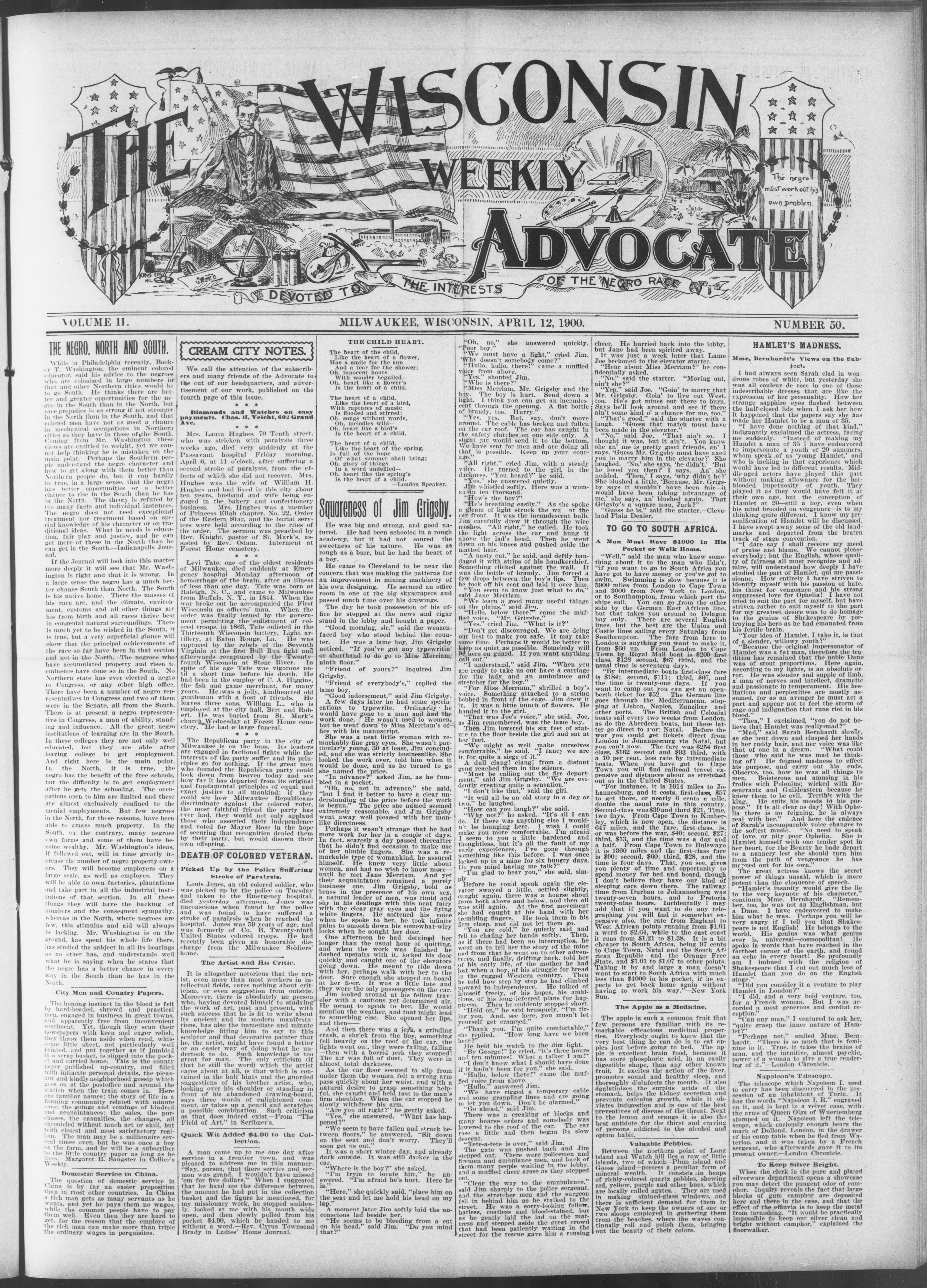
WISCONSIN
WEEKLY
ADVOCATE
DEVOTED TO THE INTERESTS OF THE NEGRO RACE
VOLUME II.
THE NEGRO. NORTH AND SOUTH.
While in Philadelphia recently, Booker T. Washington, the eminent colored educator, said his advice to the negroes who are colonized in large numbers in that and other Northern cities would be to go South. He thinks there are better and greater opportunities for the negro in the South than in the North, but race prejudice is as strong if not stronger in the North than in the South, and that colored men have not as good a chance in mechanical occupations in Northern cities as they have in those of the South. Coming from Mr. Washington these views are entitled to weight, yet we cannot help thinking he is mistaken on the main point. Perhaps the Southern people understand the negro character and how to get along with them better than Northern people do, but it can hardly be true, in a large sense, that the negro has better opportunities or a better chance to rise in the South than he has in the North. The theory is refuted by too many facts and individual instances. The negro does not need exceptional treatment nor treatment based on special knowledge of his character or on traditional ideas. What he needs is education, fair play and justice, and he can get more of these in the North than he can get in the South.—Indianapolis Journal.
If the Journal will look into this matter more deeply it will see that Mr. Washington is right and that it is wrong. In a large sense the negro has a much better chance South than North. The South is his native home. There the masses of his race are, and the climate, environment, customs and all other things are his from birth and all races thrive best in congenial natural surroundings. There is much yet to be wished in the South, it is true, but a very superficial glance will show that the principal achievements of the race so far have been in that section and not in the North. The negroes who have accumulated property and risen to eminence have done so in the South. No Northern state has ever elected a negro to Congress, or any other high office. There have been a number of negro representatives in Congress and two of them were in the Senate, all from the South. There is at present a negro representative in Congress, a man of ability, standing and influence. All the great negro institutions of learning are in the South. In these colleges they are not only well educated, but they are able after leaving college to get employment. And right here is the main point. In the North, it is true, the negro has the benefit of the free schools, but the difficulty is to get employment after he gets the schooling. The occupations open to him are limited and these are almost exclusively confined to the menial employments. But few negroes in the North, for these reasons, have been able to amass much property. In the South, on the contrary, many negroes own farms and some of them have become wealthy. Mr. Washington's ideas, if followed out, will in time greatly increase the number of negro property owners. They will become employers on a large scale, as well as employees. They will be able to own factories, plantations and take part in all the industrial institutions of that section. In all these things they will have the backing of numbers and the consequent sympathy, whereas in the North, where negroes are few, this stimulus and aid will always be lacking. Mr. Washington is on the ground, has spent his whole life there, has studied the subject in all its bearings as no other has, and understands well what he is saying when he states that the negro has a better chance in every way in the South than he has in the North.
City Men and Country Papers.
The homing instinct in the blood is felt by hard-headed, shrewd and practical men, engaged in business in great towns, and apparently free from inconvenient sentiment. Yet, though they scan their newspapers with keen and eager relish, they throw them aside when read, while some little sheet, not particularly well printed, and put together as if jumbled in a scrap-basket, is slipped into the pocket and carried home. This is the county paper published up-country, and filled with intimate personal details, the pleasant and kindly neighborhood gossip which goes on at the postoffice and around the station when the train comes in. Here are familiar names; the story of life in a farming community related with minute care; the goings and comings of kindred and acquaintances; the sales, the purchases, the casualties, the changes, all chronicled without much art or skill, but with closest and most satisfactory realism. The man may be a millionaire several times over, but he was once a boy on the farm, and he will be a subscriber to the little country paper as long as he lives.—Margaret E. Sangster in Collier's Weekly.
Domestic Service in China
The question of domestic service in China is by far an easier proposition than in most other countries. In China a rich man gets as many servants as he wants, and yet he pays them no wages, while the common people have to pay them well. Even then they are hard to get, for the reason that the employee of the rich man can make more than triple the ordinary wages in perquisites.
CREAM CITY NOTES.
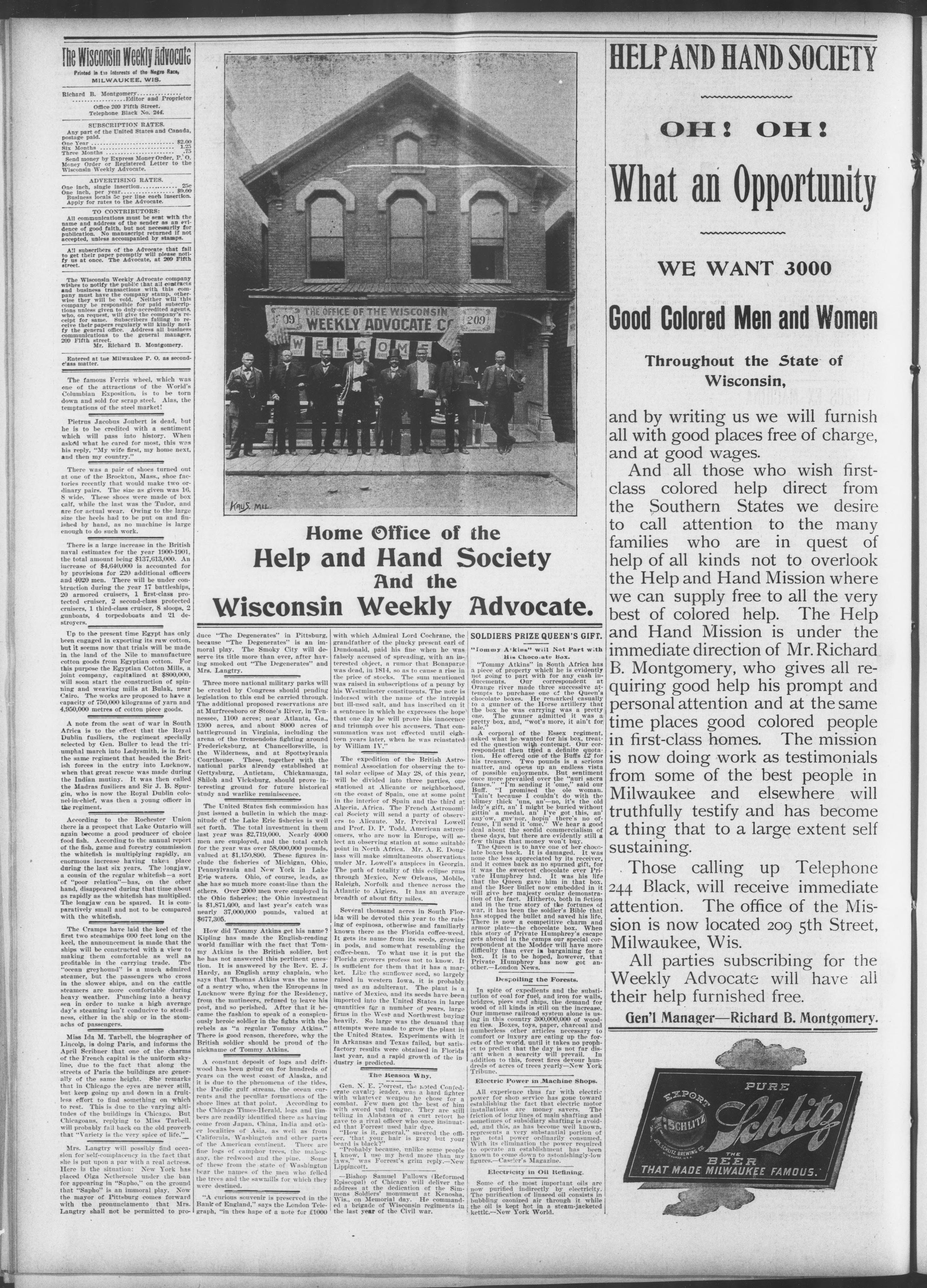
We call the attention of the subscribers and many friends of the Advocate to the cut of our headquarters, and advertisement of our work, published on the fourth page of this issue.
* * *
Diamonds and Watches on easy payments. Chas. H. Veicht, 602 Grand Ave.
Mrs. Laura Hughes, 70 Tenth street, who was stricken with paralysis three weeks ago, died very suddenly at the Passavant hospital Friday morning, April 6, at 11 o'clock, after suffering a second stroke of paralysis, from the effects of which she did not recover. Mrs. Hughes was the wife of William H. Hughes and had lived in this city about ten years, husband and wife being engaged in the bakery and confectionery business. Mrs. Hughes was a member of Princess Ellah chapter, No. 22, Order of the Eastern Star, and the burial services were held according to the rites of the order. The sermon was preached by Rev. Knight, pastor of St. Mark's, assisted by Rev. Odam. Interment at Forest Home cemetery.
```markdown
```
Levi Tate, one of the oldest residents of Milwaukee, died suddenly at Emergency hospital Monday afternoon of hemorrhage of the brain, after an illness of less than one day. Tate was born at Raleigh, N. C., and came to Milwaukee from Buffalo, N. Y., in 1844. When the war broke out he accompanied the First Wisconsin as officers' man. When the order was finally issued by the government permitting the enlistment of colored troops, in 1863, Tate enlisted in the Thirteenth Wisconsin battery, Light artillery, at Baton Rouge, La. He was captured by the rebels of the Seventh Virginia at the first Bull Run fight and afterwards recaptured by the Twenty-fourth Wisconsin at Stone River. In spite of his age Tate was vigorous until a short time before his death. He had been in the employ of C. A. Higgins, the fish and game merchant, for many years. He was a jolly, kindhearted old gentleman with a host of friends. He leaves three sons, William L., who is employed at the city hall, Bert and Robert. He was buried from St. Mark's church Wednesday at Forest Home cemetery. He had a large funeral.
咯 嗽 芯
The Republican party in the city of Milwaukee is on the bum. Its leaders are engaged in factional fights while the interests of the party suffer and its principles go for nothing. If the great men who founded the Republican party could look down from heaven today and see how far it has departed from its original and fundamental principles of equal and exact justice to all mankind; if they could see how Milwaukee Republicans discriminate against the colored voter, the most faithful friend the party has ever had, they would not only applaud those who asserted their independence and voted for Mayor Rose in the hope of securing that recognition denied them by their party, but would disown their own offspring.
DEATH OF COLORED VETERAN.
Picked Up by the Police Suffering Stroke of Paralysis.
Louis Jones, an old colored soldier, who was picked up by the police on Tuesday and taken to the Emergency hospital, died yesterday afternoon. Jones was unconscious when found by the police and was found to have suffered a stroke of paralysis when he reached the hospital. Jones was 59 years of age, and was formerly of Co. B. Twenty-ninth United States colored troops. He had recently been given an honorable discharge from the Milwaukee Soldiers' home.
The Artist and His Critic
It is altogether notorious that the artist, even more than most workers in intellectual fields, cares nothing about criticism, or even suggestion from outside. Moreover, there is absolutely no person who, having devoted himself to studying the work of art, past and present, with such success that he is fit to write about its ancient and its modern manifestations, has also the immediate and minute knowledge fitting him to say to this sculptor and that decorative painter that he, the artist, might have found a better or an easier way of doing what he undertook to do. Such knowledge is too great for man. The only criticism (if that be still the word) which the artist cares about at all, is that which is contained in the half hints and the guarded suggestions of his brother artist, who, looking over his shoulder or standing in front of his abandoned drawing-board, says three words of enlightened comment, or takes up a pencil and scratches a possible combination. Such criticism as that does indeed exist.—From "The Field of Art," in Scribner's.
Quick Wit Added $4.90 to the Collection.
A man came up to me one day after service in a frontier town, and was pleased to address me in this manner: "Say, parson, that there service and sermon was grand. I wouldn't have missed 'em for five dollars." When I suggested that he hand me the difference between the amount he had put in the collection basket and the figure he mentioned, for my missionary work, he stopped suddenly, looked at me with his mouth wide open, and then slowly pulled from his pocket $4.90, which he handed to me without a word.—Rev. Cyrus Townsend Brady in Ladies' Home Journal.
THE CHILD HEART.
With wonder beguiled—
Oh, heart like a flower's
Is the heart of a child.
The heart of a child,
Like the heart of a bird,
With raptures of music
Is flooded and stirred:
Oh, songs without words,
Oh, melodies wild—
Oh, heart like a bird's
Is the heart of a child.
The heart of a child,
Like the heart of the spring,
Is full of the hope
Of what summer shall bring;
Oh, glory of things
In a word undefiled—
Oh, heart like the spring's
Is the heart of a child.
Squareness of Jim Grigsby.
He was big and strong, and good natured. He had been schooled in a rough academy, but it had not soured the sweetness of his nature. He was as rough as a burr, but he had the heart of a boy. He came to Cleveland to be near the concern that was making the patterns for an improvement in mining machinery of his own designing. He secured an office room in one of the big skyscrapers and passed much time over his drawings. The day he took possession of his office he stopped at the news and cigar stand in the lobby and bought a paper.
"Good morning, sir," said the weazen-faced boy who stood behind the counter. He was a lame boy, Jim Grigsby noticed. "If you've got any typewritin' or shorthand to do go to Miss Merriam, ninth floor."
"Friend of yours?" inquired Jim Grigsby.
"Friend of everybody's," replied the lame boy.
"Good indorsement." said Jim Grigsby. A few days later he had some specifications to typewrite. Ordinarily he would have gone to a man and had the work done. He wasn't used to women, but he went down to Miss Merriam's office with his manuscript.
She was a neat little woman with remarkably-fine gray eyes. She wasn't particularly young, 30 at least, Jim concluded, and she was strictly businesslike. She looked the work over, told him when it would be done, and as he turned to go she named the price.
"In advance?" asked Jim, as he fumbled in a pocket.
"Oh, no, not in advance," she said, "but I find it better to have a clear understanding of the price before the work is begun." The price she named seemed extremely reasonable, and Jim Grigsby went away well pleased with her manlike directness.
Perhaps it wasn't strange that he had more work for her in a couple of days. In fact, scarcely a day passed thereafter that he didn't find occasion to make use of her nimble fingers. She was a remarkable type of womankind, he assured himself. He knew very little about women, and had no wish to know more—until he met Jane Merriam. And yet their acquaintance remained a purely business one. Jim Grigsby, bold as brass in the presence of his own sex, a natural leader of men, was timid and shy in his dealings with this neat fairy with the clear gray eyes and the flying white fingers. He softened his voice when he spoke to her, he took infinite pains to smooth down his somewhat-wiry locks when he sought her door.
One afternoon he had detained her longer than the usual hour of quitting, and when the work was finished he dashed upstairs with it, locked his door quickly and caught one of the elevators going down. He meant to ride down with her, perhaps walk with her to the door. Sure enough she stepped on board at her floor. It was a little late and they were the only passengers on the car. Jim looked around at his fellow traveler with a cautious yet determined air. He meant to speak to her. He would mention the weather, and that might lead to something else. She opened her lips, and then——
And then there was a jerk, a grinding crash, a shriek from the boy, something fell heavily on the roof of the car, the lights went out, they were falling, falling—then with a horrid jerk they stopped! The air was full of dust. They were in almost total darkness.
As the car floor seemed to slip from under them the woman felt a strong arm pass quickly about her waist, and with a natural desire to grasp something helpful, she caught and held fast to the man's firm shoulder. When the car stopped he slowly withdrew his arm.
"Are you all right?" he gently asked.
"Yes," she answered. "What has happened?"
"We seem to have fallen and struck between floors," he answered. "Sit down on the seat and don't worry. They'll soon get us out."
It was a short winter day, and already dark outside. It was still darker in the car.
"Where is the boy?" she asked.
"I'm tryin to locate him," he answered. "I'm afraid he's hurt. Here he is."
"Here," she quickly said, "place him on the seat and let me hold his head on my lap." A moment later Jim softly laid the unconscious lad beside her. "He seems to be bleeding from a cut on his head," said Jim. "Do you mind that?"
"Oh, no," she answered quickly. "Poor boy."
"We must have a light," cried Jim. 'Why doesn't somebody come?'
"Hullo, hullo, there!" came a muffled voice from above. "Yes." shouted Jim.
Yes, shouted Jim.
"Who is there?"
"Miss Merriam, Mr. Grigsby and the boy. The boy is hurt. Send down a light. I think you can get an incendescent through the opening. A flat bottle of brandy, too. Hurry."
"Yes, yes. But, say, don't move around. The cable has broken and fallen on the car roof. The car has caught in the safety clutches on one side only. A slight jar would send it to the bottom. We have sent for men and are doing all that is possible. Keep up your courage."
"All right." cried Jim, with a steady voice. He turned to the girl, in the darkness. "You heard?" he said.
"Yes," she answered quietly.
Jim whistled softly. Here was a woman in ten thousand.
"How's the boy?"
"He's breathing easily." As she spoke a gleam of light struck the waist at the car front. It was the incandescent bulb. Jim carefully drew it through the wire meshes. "All right," he called. He took the light across the car and hung it above the lad's head. Then he went down on his knees and pushed aside the matted hair.
"A nasty cut," he said, and deftly bandaged it with strips of his handkerchief. Something clicked against the wall. It was the bottle of brandy. Jim forced a few drops between the boy's lips. Then he took off his coat and laid it over him. "You seem to know just what to do," said Jane Merriam.
"We learn a good many useful things on the plains," said Jim.
"Hello, below there." came the muffled voice. "Mr. Grissby."
ned voice. Mr. Griszwv.
"Yes." cried Jim. "What is it?"
"Don't get discouraged. We are doing our best to make you safe. It may take some time. Perhaps it would be better to keep as quiet as possible. Somebody will be here on guard. If you want anything call out."
"I understand," said Jim. "When you are ready to take us out have a carriage for the lady and an ambulance and stretcher for the boy."
"For Miss Merriam," shrilled a boy's voice. Something attached to a string bobbed in front of the cage. Jim drew it in. It was a little bunch of flowers. He handed it to the girl.
"That was Joe's voice," she said. Joe, as Jim remembered, was the lame boy.
Then Jim lowered his six feet of stature to the floor beside the girl and sat at her feet.
"We might as well make ourselves comfortable," he said. "I fancy we are in for quite a siege of it."
A dull clang! clang! from a distant gong reached them in the silence.
"Must be calling out the fire department," said Jim Grigsby. "We are evidently creating quite a sensation."
"I don't like that," said the girl.
"It will all be an old story in a day or two," he laughed.
"How can you laugh?" she said.
"Why not?" he asked. "It's all I can do. If there was anything else I wouldn't be lounging here. I wish I could make you more comfortable. I'm afraid I seem to you a little hardened and thoughtless, but it's all the fault of my early experiences. I've gone through something like this before. I was once locked up in a mine for six hungry days. Do you mind having me talk?
"I'm glad to hear you," she said, simply.
Before he could speak again the elevator swayed a little, settled slightly, caught again, there was a hoarse shout from both above and below, and then all was still again. At the first movement she had caught at his hand with her trembling fingers. He took them in his firm clasp, and did not let them go.
"You are cold," he quietly said and fell to chafing her hands softly. Then, as if there had been no interruption, he went on to tell her the story of the mine and from that he went on to other adventures, and finally, drifting back, told her of his early life, of the mother he had lost when a boy, of his struggle for bread in the rugged Western country. Then he told how step by step he had climbed upward to independence. He talked of himself freely, of his hopes, his ambitions, of his long-deferred plans for happiness. Then he suddenly stopped short. "Hold on," he said brusquely. "I'm tiring you. And, see here, you mustn't let yourself get cramped."
"Thank you. I'm quite comfortable," she replied. "How long have we been here?"
He held his watch to the dim light. "By George!" he cried. "it's three hours and ten minutes! What a talker I am!" "I don't know what I should have done if it hadn't been for you," she said. "Hullo, below there!" came the muffled voice from above.
"Hullo," answered Jim.
"We have rigged a temporary cable and some grappling lines and are going to let you down. Don't be alarmed."
"Go ahead," said Jim.
There was a creaking of blocks and many hoarse orders and somebody was lowered to the roof of the car. The car rose a little and then began its slow descent.
"Tete-a-tete is over," said Jim.
The gate was pushed back and Jim stepped out. There were policemen and firemen and ambulance men, and back of them many people waiting in the lobby, and a muffled cheer arose as they stepped out.
"Clear the way to the amubulance," said Jim sharply to the police sergeant, and the stretcher men and the surgeon fell in behind him as he stalked to the street. He was a sorry-looking fellow, hatless, coatless and blood-stained, but as he gently laid the lad on the mattress and stepped aside the great crowd that had been patiently waiting in the street for the rescue gave him a rousing
cheer. He hurried back into the lobby, but Jane had been spirited away.
It was just a week later that Lame Joe beckoned to the elevator starter.
Joe beckoned to the elevator starter.
"Hear about Miss Merriam?" he confidentially asked.
"No," said the starter. "Moving out, ain't she?"
"That's good," said the starter with a laugh. "Guess that match must have been made in the elevator."
"No," said Joe. "That ain't so. I thought it was, but it ain't. You know she an' me is pretty good friends, an' I says, 'Guess Mr. Grigsby must have axed you to marry him in the elevator?' She laughed. 'No,' she says, 'he didn't.' 'But he loved you then?' I says. An' she nodded. 'Then,' I says, 'why didn't he?' She blushed a little. 'Because, Mr. Grigsby says it wouldn't have been fair—it would have been taking advantage of me,' she says, an' blushed again. That Grigsby's a square man, Jack?"
"Guess he is," said the starter.—Cleveland Plain Dealer.
TO GO TO SOUTH AFRICA.
A Man Must Have $1000 in His Pocket or Walk Home.
"Well," said the man who knew something about it to the man who didn't, "if you want to go to South Africa you have got to have money or you've got to swim. Swimming is slow because it is 5900 miles from London to Cape Town and 3000 from New York to London, or to Southampton, from which port the ships sail. You can go from the other side by the German East African line, but that takes you around to Delagoa bay only. There are several English lines, but the best are the Union and Castle lines sailing every Saturday from Southampton. The fare from here to London is anything you want to make it, from $60 up. From London to Cape Town by Royal Mail boat is $200 first class, $128 second, $67 third, and the usual time is seventeen days.
"By intermediate boats first-class fare is $184; second, $117; third, $67, and the time is twenty-one days. If you want to camp out you can get an open-berth ticket for $52. The German line goes through the Mediterranean, stopping at Lisbon, Naples, Zanzibar and other ports. The British and Colonial boats sail every two weeks from London, as do the Aberdeen boats, but these latter go direct to Port Natal. Before the war you could get tickets direct from London to Jönnansnesurg via Natal, but you can't now. The fare was $254 first class, $162 second and $93 third, with a 10 per cent. less rate by intermediate boats. When you have got to Cape Town you will find railroad travel expensive and distances about as stretched out as in the United States.
"For instance, it is 1014 miles to Johannesburg, and it costs, first-class, $57 to get there, or nearly 6 cents a mile, double the usual rate in this country. Second-class was $39 and third $21. Time, two days. From Cape Town to Kimberley, which is now open, the distance is 647 miles, and the fare, first-class, is, or was before the war, $40; second, $27; third, $13, and the time was a day and a half. From Cape Town to Bulewayo it is 1360 miles and the first-class fare is $90; second, $60; third, $28, and the time is four days. That, you see, gives you plenty of time and opportunity to spend money for bed and board, though I don't believe they have our kind of sleeping cars down there. The railway time from Durban to Johannesburg was twenty-seven hours, and to Pretoria twenty-nine hours. Incidentally I may add that if you want to do any telegraphing you will find it somewhat expensive also, the rate from England to West African points running from $1.01 a word to $2.64, while to the east coast it runs from $1.21 to $1.38. It is a bit cheaper to South Africa, being 97 cents to Cape Town, Natal and the South African Republic and the Orange Free State, and $1.01 to $1.07 to other points. Taking it by and large a man doesn't want to start to South Africa with much less than $1000 in his pocket, if he expects to get back home again without having to work his way."—New York Sun.
The Apple as a Medicine.
The apple is such a common fruit that few persons are familiar with its remarkable efficacious medicinal properties. Everybody ought to know that the very best thing he can do is to eat apples just before going to bed. The apple is excellent brain food, because it has more phosphoric acid, in an easily digestible shape, than any other known fruit. It excites the action of the liver, promotes sound and healthy sleep, and thoroughly disinfects the mouth. It also agglutinizes the surplus acids of the stomach, helps the kidney secretion and prevents calculus growth, while it obviates indigestion and is one of the best preventives of disease of the throat. Next to the lemon and orange it is also the best antidote for the thirst and craving of persons addicted to the alcohol and opium habit.
Valuable Pebbles.
Between the northern point of Long island and Watch hill lies a row of little islands, two of which—Plum island and Goose island—possess a peculiar form of mineral wealth. It consists in heaps of richly-colored quartz pebbles, showing red, yellow, purple and other hues, which are locally called agates. They are used in making stained-glass windows, and there is sufficient demand for them in New York to keep the owners of one or two sloops employed in gathering them from the beaches, where the waves continually roll and polish them, bringing out the beauty of their colors.
HAMLET'S MADNESS.
Mme. Bernhardt's Views on the Subj-
I had always seen Sarah clad in wondrous robes of white, but yesterday she was all couleur de rose in one of those indescribable dresses that are like the expression of her personality. How her strange sapphire eyes flashed between the half-closed lids when I ask her how it happened that the papers say she has made her Hamlet to be a man of 35
"I have done nothing of that kind," indignantly exclaimed the actress, facing me suddenly. "Instead of making my Hamlet a man of 35 I have endeavored to impersonate a youth of 20 summers, whom speak of as 'young Hamlet,' and who is lacking in that experience which would have led to different results. Middle-aged actors have played this part without making allowance for the hot-blooded impetuosity of youth. They played it as they would have felt it at their own age, but the conception of Hamlet at 20—still a boy, even when his mind brooded on vengeance—is to my thinking quite different. I know my personification of Hamlet will be discussed. I have swept away some of the old landmarks and departed from the beaten track of stage convention.
"I dare say I shall receive my meed of praise and blame. We cannot please everybody; but the English, whose quality of fairness all must recognize and admire, will understand how deeply I have studied the part of Hamlet, qui passionene. How entirely I have striven to identify myself with his passion of hate, his thirst for vengeance and his strong suppressed love for Ophelia! I have not tried to suit the part for myself, but have striven rather to suit myself to the part for my greatest desire was to do homage to the genius of Shakespeare by portraying his hero as he had emanated from his fertile brain.
"Your idea of Hamlet, I take it, is that of a slender, willow youth?"
"Because the original impersonator of Hamlet was a fat man, therefore the tradition has remained that the noble Dane was of stout proportions. Here again, according to my lights, is an absolute error. He was slender and supple of limb, a man of nerves and intellect, dramatic and passionate in temperament. His hesitations and perplexities are mostly assumed, for as an avenger he must act a part and appear not to feel the storm of rage and indignation that runs riot in his blood."
"Then," I exclaimed, "you do not believe that Hamlet was really mad?"
"Mad," said Sarah Bernhardt slowly, as she bent down and clasped her hands in her ruddy hair, and her voice was like that of one in a dream. "What could those who said he was mad be thinking of? He feigned madness to effect his purpose, and carry out his ends. Observe, too, how he was all things to men. Boisterous and amusing in his frolics with Polonius; wicked with Rosencrantz and Guildenstern because he knew them to be evil. Terrible with the king. He suits his moods to his purpose." It is all clear as day! With Ophelia there is no feigning, he is always real with her." And here the cadence of Sarah's incomparable voice changes to the softest music. "No need to speak of love, or pity poor Ophelia. She is Hamlet himself with one tender spot in her heart, for the Beauty he bade depart to a nunnery lest she should turn him from the path of vengeance he has nerved out for his own."
The great actress knows the secret power of things unsaid, which is more potent than the eloquence of speech. "Hamlet's insanity would give the lie to the very keynote of his character," continues Mme. Bernhardt. "Remember, too, he was not an Englishman, but a Dane. I have endeavored to make him what he was. Perhaps you will be very angry if I tell you that Shakespeare is not English! He belongs to the world. His genius was what genius ever is, universal—cosmopolitan! He spoke in words that have reached in the farthest corner of the earth, and found an echo in every heart! So profoundly am I imbued with the religion of Shakespeare that I cut out much less of Hamlet than you do on the English stage." "Did you consider it a venture to play Hamlet in London?"
"I did, and a very bold venture, too, for a French woman. But I was accorded a most generous and cordial reception."
"Can any man," I ventured to ask her, "quite grasp the inner nature of Hamlet?
"Perhaps not," smiled Mme. Bernhardt. "There is so much that is feminine in it. True. it takes the brains of man, and the intuitive, almost psychic, power of a woman to give a true rendering of it."—London Chronicle.
Napoleon's Telescope.
The telescope which Napoleon I. used to carry has been discovered in the possession of an inhabitant of Turin. It has the words "Napoleon I. R." engraved on it, and is kept in a velvet case, with the arms of Queen Olga of Wuertemburg stamped on it. Napoleon left the telescope, which curiously enough bears the mark of Dollond, London, in the drawer of his camp table when he fled from Waterloo, and it was taken by a French sergeant, who afterwards gave it to its present owner.—London Chronicle.
To Keep Silver Bright.
When the clerk in the pure and plated silverware department opens a showcase you may detect the pungent odor of camphor. Inquiry reveals the fact that large blocks of gum camphor are deposited here and there in the case, and that the effect of the effluva is to keep the metal from tarnishing. "It would be practically impossible to keep our silver clean and bright without camphor," explained the floorwalker.
FIGHTING AT WEPENER.
Three Boer Commandos Make a Combined Attack on Wepener from Basutoland.
Aliwal North, April 10.—Heavy fighting was continued at Wepener this morning. The result is unknown. Three Boer commandoes are attacking the town.
Aliwal North, April 9.—An engagement took place today at Wepener. The Boers' Vickers-Maxim did considerable execution at first, but the British guns soon got the range and did great havoc. The fighting was severe and lasted all day long. The Boers received a check. The casualties were rather heavy on both sides. Another commando is advancing toward Wepener from Dewet's Dorp. The Rouxville commando has gone to Wepener.
Garrison Isolated.
London, April 10, 3 a. m.—The most significant item of news from the front this morning is the announcement that the Boers in the South Free State are about to move through Basutoland against the British detachment at Wepener. The garrison is practically isolated now and is already faced by a Boer force of 2000, with four guns, encamped only five miles away. If the Boers are reinforced they can easily surround Col. Dalgetty's position and perhaps force a surrender with the aid of the four field guns, though the Times' Wepener correspondent declares Dalgetty's lines are enormously strong and the force fully provisioned.
Fighting Resumed at Dawn.
London, April 10.—The Boer attack on Gen. Brabant's force at Wepener was resumed again at dawn today. The enemy's attack on two or three sides on Monday lasted until 2:30 o'clock in the afternoon, when the firing ceased and it was believed the enemy had been beaten off, but it was announced this morning from Aliwal North that the fighting had again begun.
Gen. Brabant's force, numbering from 2000 to 3000, hold positions in a rough country. It is not known what the numerical strength of the Boers is, but whatever it may be, it is being rapidly augmented. A body of 2000 Boers is marching towards Springfontein from Smithfield, between Wepener and Springfontein. The detonation of heavy guns was heard at Maseru on Monday. Sir Godfrey Lagden, the British resident commissioner of Basutoland, has left Maseru for the border. The events in the southeast portion of the Free State have caused the Eighth division, which had been ordered to Fourteen Streams, to be diverted to Springfontein.
After the Boer Raiders.
Mysterious movements of troops at Bloomfontein are proceeding. The newspaper correspondents are not allowed to telegraph their destinations, and the presumption is that Lord Roberts is making dispositions to cut off the raiding Boer forces when they try to withdraw northward from the pursuing British columns. The reappearance of the Boers in the occupied country has caused a revival of the war-like feeling among the Free Staters of the Fauresmith and Philippolis districts. The Federal agents are busy getting details of the surrendered Boers and owing to the British garrisons being withdrawn from these districts the British residents are uneasy and sent delegates to Springfentein to ask for help. They were told that steps for their defense would be immediately taken.
The Boers are reported to have ventured south of the Biggarsberg, and to have posted heavy guns four miles north of Elandslagte. They are also said to have fortified the vicinity of Wessel's Nok
What Buller will Do.
In connection with the resumption of hostilities in Natal an interesting rumor is current that Gen. Buller has obtained command of one of the Drakenesberg passes whereby he hopes to take the Boers in the rear. In the event of his being successful, Gen. Buller has enough troops to leave 20,000 men to hold Natal while he advances by way of Harrismith, whence he would be able to threaten the Boer positions at Bethlehem and Krooustad.
The Statement Ridiculed.
The officials of the foreign office here ridicule the statement made in a dispatch from St. Petersburg, published in the Aftenbladet of Stockholm, saying the Czar is "extremely agitated" over the Anglo-Portuguese arrangement in regard to landing British troops and supplies at Beira, and that he intends to issue a proclamation protesting against it in the course of his forthcoming visit to Moscow, and say there is no base for the statement that the foreign office has received letters on the subject.
No Business of Russia.
The British foreign officials consider that it is entirely outside of the province of Russia to interfere with the Anglo-Portuguese arrangements. The Boer war is evidently regarded at the foreign office here as being in the nature of a rebellion and quite outside the category of what was provided for by the Hague conference, so intervention of any kind under the Hague convention is regarded as impossible.
FIGHTING NEAR LADYSMITH
Cannonading in V.incinity of Elandsw
Ianagle and Sunday's River.
Ladysmith, April 10.—Heavy firing was heard early this morning in the direction of Sunday's River. It continued for four hours. No details of the engagement have been received. Pietermaritzburg, April 10.—Heavy cannonading commenced this morning in the vicinity of Elandslaagte.
Boers Strongly Entrenched.
New York, April 10.—A dispatch to the Herald from Ladysmith, April 8, says: "The Boers have posted a big gun on Knight's hill, north of Elandslaagte, and another in the vicinity of Wessel's Nek station. The enemy are reported to be strongly intrenched at Helpmakaa."
Federala Encouraged.
Bethulie, Orange Free State, Monday, April 9.—It is expected that the Boers will endeavor to retake and destroy the bridge over the Orange river. Consequently, extraordinary precautions have been taken. A force of Boers is located twelve miles east. As a matter of fact, the Boers practically again hold the Free State eastward of the railroad and are greatly encouraged by their successes at Reddersburg and Korn spruit.
SITUATION AT MAFEKING
Stubborn Resistance to the Advance of the Relief Column.
Mafeking, Tuesday, March 27.—News was received yesterday of the advance of the southern relief column. The
Boers, this morning opened fire at sunrise with seven guns, including one 100-pounder. This has been the most vigorous bombardment of the season. The Boer seige alone has already fired over sixty rounds. Under cover of the fire the Boers advanced to the northern face of the works but retired precipitately on coming within rifle range. They also advanced to the southwestern parts, but were repulsed. There was one casualty. The Boers under Commandant Jan Cronje are evidently falling back before the advance of the southern relief column and are concentrating with two commandos who are retiring before Col. Plumer in order to make a final effort to reduce the town.
All the forts and outlying positions are manned, the troops are standing to arms and everybody is under cover. All are conceding that this is the Boers' last attempt
Stormed the Kaffirs.
Pretoria, Saturday, April 7.—Advices from Mafeking say a band of armed Kaffirs left Mafeking through the burgher lines during the night of April 5 and were surrounded in the bush, when they were shelled by a Maxim Nordefeldt gun. The Boers then stormed the Kaffir position, killing thirty-one. The Kaffirs fought stubbornly.
Skirmishes are reported at Biggarsberg and in the Free State, mostly between patrols.
Buluwayo, March 31.—Col. Baden-Powell wires from Mafeking under date of March 27, confirming the report that the Boers had been pushed back so far that the town was comparatively out of range of musketry. He concludes with saying:
"All promises well for eventually cutting off this force of the enemy if we can hold Snyman here."
Island of St. Helena, April 10.—The Niobe and the Milwaukee have arrived here with the Boer prisoners. Their health is good, with the exception of four cases of measles, necessitating the Milwaukee being quarantined. The prisoners are quiet and well-behaved. They will probably land tomorrow. The governor has been notified of the desire of the authorities that the prisoners be treated with every courtesy and consideration.
"Lions Led by Asses."
London, April 10.—The Leader says: "The reports from Boer as well as British sources of our reverses near the Bloemfontein railway are truly lamentable. They show a distinct lack of care and leading.
"In the face of surprise we seem utterly without resource except reliance on pluck. That is a safe card in the play, but a costly one.
"'Lions led by asses,' was an old description of the British army, but we thought we had learned something of late years in the commissioned ranks. What light does this war throw upon that possibility?"
The War office proposes to land at Cape Town before the end of May 20,000 horses, which will be conveyed there in twenty-three steamers sailing from New Orleans, Buenos Ayres and Australian ports.
Likened to Spain.
The Westminster Gazette likens the British campaign to "the fruitless series of campaigns in which the large, disciplined armies of Spain sought to crush the Cuban insurrection," adding: "Of course, our troops far excel in valor and discipline the conscript armies of Spain and the tide is in our favor, but our enemies equally excel the ragged levies of the Cuban insurgents."
FORCED TO RETREAT.
Plumer Gets in Sight of Mafeking but is Driven Back.
Gaberones, Sunday, April 1.—Yesterday Col. Plumer with 270 mounted men and a few infantry and one Maxim gun arrived at Ramathlabama, where he left the dismounted men and proceeded along the railroad to within sight of Mafeking. The advance guard, under Col. White, encountered a large body of Boers and almost simultaneously the left and right flanks were attacked and sharp fighting followed. The Boers were in crescent formation and outnumbered the British two to one. They advanced with skill and stubbornness and persistently endeavored to encircle the British. After holding his ground for an hour Col. Plumer retired with the Boers slowly following him up.
The fighting continued throughout the ten-miles' retreat to Ramathlabama, where the British Maxim gun was brought into play. After a stiff fight Col. Plumer reached his camp. The British casualties were: Killed, three officers and seven men; wounded, three officers and twenty-four men; missing, eleven. The Boer loss was serious.
Col. Plumer Wounded.
At the conclusion of the fight, Gen. Snyman informed Col. Baden-Powell that he had some British wounded and both Baden-Powell and Plumer sent ambulances. The Boers were also busy Sunday collecting their dead and wounded. Most of the British wounded were only slightly hurt. Col. Plumer was wounded, but was able to carry out his duty.
While the ambulance was still at Ramathlabama, April 2, Gen. Snyman with 800 men and three guns arrived there and finding no British troops in the vicinity returned to Mafeking.
It has been reported here that the advance guard of Lord Methuen's relief force has left Vryburg for Mafeking.
Another Version.
Buluwayo, Tuesday, April 3.—Col. Plumer engaged the Boers between Ramathlabama and Mafeking March 31. The Boers appeared in considerable force six miles from Mafeking and to prevent being outflanked on both sides Plumer had to withdraw on Ramathlabama, subsequently retiring to his base camp. The engagement lasted three hours and the retirement was carried out in good order under a heavy fire.
RHODES IS OSTRACISED
London Society Turns Its Back on the Kimberley bus.
London, April 10.—England's bitter resentment of unfriendly criticism of British officers is illustrated in the treatment Cecil Rhodes is receiving at this moment. The pan-Britannic South African is completely ignored except by those who are associated with him in a business way. Society, of which three years ago he was the idol, has now turned its back on him. Suggestions from the inside represent Mr. Rhodes as imperiously indifferent. He is said to have declared that he never cared for social blandishments any way, and is glad to escape them now, despite the fact that they imply something very closely resembling hatred on the part of his fellow countrymen.
Mr. Rhodes is reported to be making a campaign in the interests of the Chartered company in the matter of the future taxation of mining properties, and he is said to be seconded in his undertaking by some of the greatest capitalists in England.
Securities Have Disappeared.
The Daily Mail's Cape Town dispatch of Sunday says: "Information has been received that £130,000 worth of negotiable securities, lodged by law with the Free State government by the foreign insurance companies, has disappeared, and a New York company has issued a warning against dealing therein.
New Name for the Free State.
Bloemfontein was recently engaged in
an exciting ballot as to what name is to be given the Free State when conquered by the British. Brandesia, in memory of the late President Brand.
Tried for Treason.
Lourence Marques, April 8.—A sensational high-treason trial has just been finished at Johannesburg. Three men, Dempsey, Perron and Thompson, were charged with decoying Acting State Mining Engineer Munnik to a house at the City and Suburban mine with the intention of holding him as hostage against the destruction of mining property and compelling him to reveal any state secrets he might have on the subject.
DEFENSE OF GATACRE.
His Troops Fought Bravely as Long as Their Cartridges Held Out
New York, April 10.—A dispatch to the Tribune from London says: The press dispatches are still filled with belated accounts of the Reddersburg fight, and the adventures of Burnham, the American scout. Gen. Gatacre does not deserve censure for sending out a British column without artillery, as it had been dispatched on a long circuit for the purpose of receiving arms and pacifying the country and was caught through a sudden change of the Boer tactics. The troops offered a stubborn resistance, and fought bravely as long as their cartridges held out. There was nothing discredible to the British arms in this affair, and Gen. Gatacre was well advised in not renewing the attack with an inferior force when he arrived with reinforcements from Springfontein. The Boers are now reported to have retired eastward, dispersing in small bands. They were probably bent upon sending the prisoners northward before renewing their attack upon the isolated British posts.
When Things Go Wrong.
There are many dispatches from the southern half of the Free State, but it is difficult to get a clear idea of the situation. The correspondents have a confirmed habit of overstating the Boer force whenever anything goes wrong. The estimates of the Boer strength in the Thaba Nchu, Ladybrand and Wepener districts are grossly exaggerated, and the importance of the Dutch flanking movement is over-rated, as was done when Sir Redvers Buller's army was broken up into three sections by a small force of raiders below Estcoult.
The sensational rumors of the general concentration of the Boer commandees south and east of Bloemfontein are from the British point of view too good to be true. Nothing would suit Lord Roberts' plan so admirably as the massing of the Dutch forces where they could be overwhelmed with superior numbers before the British line of communications to be guarded should be lengthened, first to the Vaal and thence to Pretoria. The moral effect of the return of the Boers to the central reaches of the Free State is mixed. Recruits are gained and farmers are intimated, and this makes for the advantage of the Boers, but supplies are taken without being paid for and houses and farms are looted, and these losses tend to reconcile the burghers to British occupation.
Buller's Inaction Continues.
The inaction of Sir Redvers Buller's army continues, and on the western flanks there is nothing more important than sniping and shelling between Warrenton and Fourteen Streams. Sir Henry Rundle is reported as under orders for Kimberley and this may be the signal for a movement of the Eighth division, now arriving at Cape Town, toward Mafeking, but this is not definitely announced. The relief of Mafeking can hardly be dependent upon the operations of a column sent into Rhodesia from Beira across Portuguese territory by railway.
Parliament has risen for the Easter recess, after a series of dull debates. The government has strengthened its position, and the Liberals are dreading the effects of a premature appeal to the country, which some ministers are known to favor.
CONSUL HAY REPORTS.
Can Find No Evidence to Support Macrum's Charges-Mail Not Interfered With.
Washington, D. C., April 10. United States Consul Hay, at Pretoria, has responded to the inquiry addressed to him by the department respecting ex-Consul Macrum's charge that the official mail of the consulate was tampered with. Mr. Hay reports that after a careful search he has failed to find in the consulate the slightest evidence to support the statement. The consul, however, reports that there is absolutely no interference, so far as he has been able to ascertain, with any of the official communications, either telegraphic or mail, which pass between the department of state and the consulate.
TIED WITH THE QUEEN'S HANDS
Victoria Cross for Lord and Lady Roberts' Dead Son.
London, April, 10.—A member of parliament tells a charming story of the Queen and Lady Roberts. When Lady Roberts visited Windsor, a few days before she sailed for the Cape, the Queen handed her a small parcel saying.
"Here is sometbing I have tied up with my own hands and that I beg you will not open till you get home."
Lady Roberts found that the parcel contained the Victoria cross, won by her dead son by his gallantry at Colenso
Hebrews in the Army
It is interesting to note that among the troops mustered into the service by the British war office are several companies composed exclusively of Hebrews. In Bombay there are two companies of Hebrew soldiers, and the army register shows that thousands of Hebrews have enlisted in the British army in recent years, most of them being now with the army in South Africa.—St. Louis Republic.
Injured by jumping the Roof
Joliet, Ill., April 10.—Violet White, 8 years old, met with misfortune while jumping the rope. When she had jumped 200 times she was taken ill. A physician was called and after an examination stated that she was suffering from spinal meningitis caused by the violent exercise.
As Capt. Kidd Would Run a Newspaper.
From the Bowersville Clarion: "Next week we will begin running this paper as Capt. Kidd would have run it. DeLINquent subscribers may expect a call from us with their accounts stuck in the muzzle of a six-shooter. Otherwise this paper will be running as the sheriff would run it."—Baltimore American
Death Penalty Inflicted
Kingston, Jamaica, April 10.—News has been received here from Nicaragua that James Daly of Jamaica was hanged in that republic last Thursday for murdering a native. This is the first occasion of the death penalty being enforced in Nicaragua for murder.
Prices of Sugar Advanced
New York, April 10.—Arbuckle Bros. today advanced the price of refined sugar 5 cents per 100 pounds.
Winter Wheat Bulletin
Washington, D. C., April 10.-The condition of winter wheat is 82.1, against 77.9 in April., 1899; winter wre. 84
TO LOSE HIS SEAT.
Unanimous Report of the Senate Committee in the Case o Senator Clark.
Washington, D. C., April 10.—The senate committee on privileges and elections today decided by a unanimous vote to recommend the adoption of a resolution declaring that W. A. Clark of Montana is not entitled to occupy his seat as a senator from Montana. The decision was reached after a two-hours' sitting, at which all the members of the committee were present except one. The absentee was Senator Caffery of Louisiana, and he wired his vote in opposition to Mr. Clark. The ballot was not taken until all the members present had expressed themselves upon the question, some of them speaking at some length and all expressing different shades of opinion.
Senator Harris of Kansas indicated the most pronounced leaning toward leniency for Mr. Clark. He did not express any doubt that there had been a lavish expenditure of money in Mr. Clark's behalf, and while not condoning this course he spoke in terms of strong condemnation of the tactics pursued by some of his (Clark's) opponents, referring especially to Congressman Campbell and former State Senator Whiteside. He said that whatever Mr. Clark's offenses they were but little worse than the methods pursued by Campbell and Whiteside in their efforts to expose the senator, and he insisted that if the report was to be antagonistic to Mr. Clark it should at the same time relate in full detail the course pursued by the two principal witnesses against him.
Candidacy tor the Senate.
Senator Pettus practically agreed with Mr. Harris. The two senators also expressed some doubt as to the justification of the conclusion drawn by a majority of the committee, that Senator Clark's candidacy for the Senate began in August, 1898, when he returned to Butte from New York. The result of this conclusion was to charge up the entire $130,000 which Senator Clark confessed to having spent in his campaign for the Senate, while the contention was made in Mr. Clark's behalf that he had not become a candidate until the state election thus eliminating from the campaign in his individual behalf the amount spent in the general contest.
Senator McComas was among the senators who expressed himself as convinced that the senatorial seat was in view from the beginning. Mr. McComas, however, united with other senators in condemning the methods pursued in prosecuting the case.
The consensus of opinion of the committee appeared unfavorable to accepting any one special feature against Mr. Clark as the basis for the report against him, the general opinion being that it was the cumulative character of the testimony that should be considered rather than any one especial detail.
Senator Harris raised the point in Mr. Clark's behalf that cumulative effect of the testimony could not properly be considered, but he was overruled on this position.
Purchase of Property.
If prominence was given to any one line of testimony more than to another it was that dealing with transactions apparently of a regular business nature between Senator Clark or his agents and members of the Legislature. The purchase of property from Senator Warner and Representative McLaughlin and the money tendered Representative Wood to lift the mortgage from his ranch were considered as bearing directly upon the case. Of these matters the Wood case received especial attention. The payment of money to Representative Day after Mr. Clark's election also had weight. The opinion was expressed that no one of these facts was sufficient basis for an adverse report, but all agreed that all facts, many of them admitted, together with other occurrences connected with the campaign, were sufficient to justify a positive position against the senator's continuing to occupy his place.
The fact that Senator Clark and his representatives had failed to make their reports to the state authorities of Montana as required by the state law also was urged against him in the discussion in the committee, as was the fact that he and his representatives had destroyed all their vouchers showing where money had been used and to whom paid.
The Whiteside Exposure.
When attention was called to the fact that this course was usual with campaign managers, the statement was met with the contention that while the plan might be more commonly adopted than it should be, still there could be no reasonable excuse for it after the Whiteside exposure. It was then known, it was asserted, that there would be a contest and the argument was made that every scrap of paper bearing upon the election should have been preserved after this development in the case. Senators Chandler and Turley were directed to prepare the report. It is expected to be presented at an early day. Senator Clark was at the capitol when the announcement of the action of the committee was made known. He was surprised at the result, but refused to make a statement until after consultation with his friends and attorneys.
PRESIDENT ACCEPTS
Will Attend G. A. R. Encampment in Chicago in August.
Chicago, Ill., April 10.—A special to the News from Washington says that at a conference today between President McKinley and Gen. Shaw, commander-in-chief of the G. A. R., the President assured Gen. Shaw he will fulfill his engagement to attend the G. A. R. encampment at Chicago in August.
Flour Mill Wrecked.
Columbia City, Ind.. April 10.—The large flouring mill of R. Tuttle & Co. was wrecked by an explosion of natural gas today, resulting in the death of Henry Landon, fireman, and O. S. Young, teamster.
Commodore Mayo Dead
Washington, D. C., April 10.—Commodore William K. Mayo, United States navy, retired, died at his home in this city last night, aged 76 years.
How One Boer was Caught.
An amusing incident of Magersfontein is related by Corp. B. Thompson, Scots Guards, in a letter to his mother at Wellingborough. A Boer whose horse had been shot under him seized a stray horse belonging to a fallen British trooper. Soon afterward a 3 British bugle call rang out, and the horse galloped rapidly back to the British Fles, with the result that the Boer was promptly made a prisoner. —London Star.
—Lamps can be opened for filling without the necessity of unscrewing the burn-of Illinois, has estimated that without the assistance of birds the state of Illinois would be carpeted with insects, one to each square inch of ground, at the end of twelve years.
—Louie Schackenberg killed a cougar on Wild Cat mountain, near Fox Valley. Or., recently, that measured seven feet three inches from tip to tip, says the Stayton Mail.
—Perfumes are much in vogue again, after the few years of comparative disuse.
AWFUL BLOW FOR BRITISH
Reported to Have Met a Crushing Defeat at Meerkatsfontein.
LONDON DISCREDITS IT
Eritish Loss in Killed, Wounded and Missing Placed at 1500-Gatacrs Recalled.
* London, April 11.—Returns * of casualties for the past week * including the sick and wounded, * aggregating about 10,000 men, * make a grand total of upwards * of 23,000 officers and men put * out of action.
Ladysmith, Tuesday, April 10.—The Boers opened fire this morning early, sending shells into the British camp at Elandslaagte from three positions widely separated. The shells did no damage. The troops moved out to reconnoiter and found the Boers in strong force and well fortified. One naval 4.7-inch gun replied to the Boers, who have again placed a "Long Tom" in position.
British Were Drilling.
Ladysmith, Tuesday, April 10.—Evening.—When the Boers commenced shelling the British were drilling and, one private was killed and another was wounded before the soldiers were withdrawn from range. Then the naval brigade opened fire and drew a heavy Boer fusillade and two of the cruiser Philomel's gunners were killed. The naval men stuck to their positions, however, and the Boers unmasked six guns, including a hundred pounder, and shells fell in all the British camps.
After three hours' bombardment the British fire sackened and the burghers cleared from a kopje on the right. Another command was seen moving toward the British left, apparently with the intention of flanking them, but the British shells forced them to retire.
British Pickets Sniped.
The British advance pickets were continually sniped. But few casualties have been reported.
In the afternoon the naval brigade again fired a few shells. It is rumored that a body of Boers had gathered south-west of Elandslaagte, with the apparent intention of cutting the British line of communication.
Roberts Threatens Martial Law.
Colesberg, Cape Colony, April 11.—In view of the state of unrest across the border, Lord Roberts has proclaimed a warning to the Cape Colonists that further acts of hostility will be treated with the utmost rigor of martial law.
British Losses at Wepener.
Aliwal North, April 10.—The British loss in the fighting at Wcpener was eleven killed and forty-one wounded. Fighting was resumed today. The British are holding their own well.
British Defeat at Dewetsdorp.
Pretoria, April 6, via Lourenco Marques, April 9, 4 p. m.—A dispatch from the Boer laager at Brandfort, dated April 5, says: "Gen. Dewet yesterday attacked a British cavalry column close to Dewetsdorp and defeated it. He captured nearly 500 prisoners and a large convoy of wagons containing ammunition and food. (This probably refers to the five companies at Reddersburg.) The Boer losses were small, while those of the British were heavy. The country east and south of Bloemfontein is now in the hands of the federal troops."
TO MANY OBSTRUCTIONS.
Very Good Reasons Why Roberts Doesn't March Into Protaria
London, April 11.—Much speculation has been indulged in regarding the cause of Lord Roberts' delay in marching into Pretoria, and there has been some impatience manifested at his prolonged halt at Bloemfontein. It was thought that with Cronje's surrender the balance would be easy. The sequel became known this morning with the news of a staggering defeat of the British at Meerkatsfontein, a few miles north of Roberts' headquarters and directly on the line by which Roberts' was to make his triumphal entry into Pretoria.
According to an official announcement in Pretoria, a terrific reverse has been inflicted upon the British arms. A battle has been fought south of Brandfort, in which the British suffered a loss of 600 killed and wounded, in addition to 900 captured by the Boers. This intelligence is amply confirmed by the Mail's correspondent on the Boer side, who reports from Brandfort that Gen. Dewet on Saturday defeated the British for the third time within a week, the scene of this last engagement being Meerkatsfontein.
A dispatch to the Mail, dated Lourenco Marques, April 10, says:
"The Netherlands Railway company here professes to have received a telegram today reporting a Boer victory near Kroonstad, resulting in 900 British being taken prisoners. The Boer loss was nil.
Boers Greatly Encouraged.
"The owner of a hotel in Pretoria, who is on his way to Europe, says the Boers were almost ready to surrender after the fall of Bloemfontein, but they were enormously encouraged by the success at the waterworks, especially when some 300 prisoners arrived in Pretoria. Many hundred burghers who had returned to their farms went back to the front. My informant says it is expected that a stand will be made at both Johannesburg and Pretoria and finally the seat of government will be transferred to Lyadenburg."
The present situation is one which is exceedingly galling to British pride. Today begins the seventh month of the Anglo-Boer war, and it is almost startling for the British people to recall how little has been accomplished in six months' campaigning. Indeed it now looks as if the subjugation of the Boers, which seemed an easy proposition last October, is now no nearer accomplishment than when the war began. Apparently the invasion of the Transvaal is a thing of the distant future.
Gatacre Recalled.
Gen. Gatacre's return to England is accepted as being in the nature of a recall, though no reason is given for it and it will be associated in the public mind with his lack of success. Lord Roberts criticised his management of the Stormberg attack and possibly Gatacre's having arrived an hour and a half too late to rescue the Reddersburg force may have decided his return. Gen. Rundle, seemingly, succeeds Gen. Gatacre, and, according to a dispatch from Bloemfontein, the commanders of several brigades are about to be changed.
NO ACTION BY FRANCE
Cannot Guarantee Neutrality While Other Powers Hold Back.
Paris, April 11.—The question of the transport of British troops across Portuguese territory to Rhodesia with the permission of Portugal was brought up in the Chamber of Deputies today by two interpellations. The minister of foreign affairs, Mr. Delcasse, in refusing to dis-
cuss the matter, said France had declared her neutrality at the opening of the war, but that she was not expected to guarantee the neutrality of other powers. France, he added, cannot be expected to undertake alone such a guarantee while the other powers hold back. There was no reason to suppose that French capital invested in Mozambique would be endangered, but if such a condition arose the government would not fail to furnish protection.
London, April 11.—The British government, the Associated press is officially informed, stands ready to take the part of Portugal in case the Boers attempt reprisals, but so far Portugal has not applied for British aid nor has she replied to the Boer notification. With Great Britain at her back, it is said, she will not give in in the slightest in maintaining that the transactions at Beira are fully justified by the long-standing treaties between Great Britain and Portugal.
SMUGGLED AMMUNITION.
How the Boers Receive Fresh Supplies—Prisoners Die of Fever.
London, April 11.—The correspondent of the Times at Lourenco Marques, telegraphing Monday, says: "Trustworthy refugees assert that the Boers recently obtained at least thirty pieces of artillery, some of large caliber, which were brought overland as machinery from a West African port. Eight of these guns were dispatched to the Free State a week ago. The Boer officials openly boast that they have succeeded in smuggling ammunition through Portuguese territory.
"In the course of the Dempsey trial, State Engineer Munnik admitted under pressure that acting under instructions from State Secretary Reitz of the Transvaal he had bored holes in twenty-five mines."
Carl Reichmann an American.
London, April 11.—The Berlin correspondent of the Mail asserts that the Reichmann who is credited with having led the Boers at Kornspruit, is certainly the American military attache, Capt. Carl Reichmann.
Great Loss to Boer Cause.
Paris, April 11.—The brother of the late Gen. De Villebois Mareuil received a cable message today from State Secretary Reitzat, Pretoria, communicating information of the death of the general. The telegram concludes: "In offering you my sincere condolence I assure you that we deplore his death, which is a great loss to our country and cause."
Kipling Sails for England.
Cape Town, April 11.—Rudyard Kipling and Sir John Henry de Villiers, chief justice of Cape Colony, will sail for England today.
ROBERTS IS SILENT.
No Report from "Bobs" of the Battle at Merkatsfontein.
London, April 11.—Lord Roberts wires to the war office from Bloemfontein, under date of Tuesday, April 10, as follows:
"The enemy have been very active during the past few days. One commando is now on the north bank of the Orange river, not far from Aliwal North, while another is attacking Wepener. The garrison there is holding out bravely and inflicted serious loss on the Boers. Maj. Springe of the Cape Mounted rifles was killed. No other casualties have been reported as yet.
"The troops are being moved up rapidly. A patrol of six men of the Seventh Dragoon guards under Lieut. Wetherly, which had been reported missing since April 7, has returned safely."
Reports Discredited.
As the foregoing dispatch does not mention the alleged British reverse on Saturday at Meerkatsfontein, the Boer telegrams are not credited at the war office and they are further discredited on account of the discrepancies in the dispatches, as Meerkatsfontein in one message is located near Brandfort, and in another it is located southeast of Bloemfontein, the places being 100 miles apart
Reinforcements for Brabant.
The Reuter Telegram company's correspondent at Aliwal North, wiring at 9:30 this morning, says: "There is no further news from Wepener. Too cloudy to heliograph. More British troops are arriving." It is learned that the Boer governments have formally notified Portugal that they consider the shipping of British troops and munitions of war to Rhodesia by way of Beira, Portuguese East Africa, to be tantamount to hostile action. This, however, will not stop Gen. Sir Frederick Carrington's force from entering Rhodesia. Whether or not the Boers will make reprisals upon Portugal remains to be seen, though the best informed opinion here inclines to the belief that the Boers are not likely to back up their protest with action that would bring them into hostilities with still another power.
Keep Cronje Company.
Simonstown, April 11.—Owing to the unfavorable conditions for keeping the Boer prisoners here, the authorities have decided to ship them all to St. Helena with the least possible delay. The sickness among the captured burghers is abating.
WANTED A TRANSFER
Cincinnati Woman Declared She Would Ride Until She Got It.
Cincinnati, O., April 11.—A handsomely dressed woman boarded a street car at Marion avenue in Avondale. When the conductor came through for the fares the woman refused to pay, saying she had no seat, but after some time yielded. When the car reached the barn a new motorman and conductor took charge. The car had almost reached the city when the woman discovered that she had failed to ask for a transfer. The new conductor, who had received no money from her, could not issue one.
At Fountain square she would neither let passengers out nor in, and declared that she would remain on the car all night but what she got the transfer. The passengers went out by the front door and the car started. The conductor left the car at the offices and asked what he should do with her. "Let her ride until she gets tired or sleepy," was the reply. At last accounts she was still riding from Cincinnati to Winton place and return.
PAINTING SELLS FOR $10,000
Alfred Montgomery Gets Handsome Price for "A Farm Ballad." Chicago, Ill., April 11.—Alfred Montgomery, the farmer artist, yesterday sold one of his paintings entitled "A Farm Ballad" to Hale Bros. of San Francisco for $10,000. It is a counterpart of the painting "Down on the Farm," which is now in Paris awaiting hanging in the American section of the Fine Arts building. The work has already been formally accepted by Commissioner-General Park.
SOMEWHAT IMPROVED.
Richard Mansfield Suffering From Acute Laryngitis.
Cleveland, O.. April 11.—The condition of Richard Mansfield, the actor, who has been ill at the Hollenden hotel since his arrival here Sunday last, has improved sufficiently to permit him to appear at Euclid Avenue Opera house tonight. Mr. Mansfield has been suffering from acute laryngitis.
THE FLAG.
Shall it ever be said that "Old Glory,"
An emblem of conquest, waves
O'er men deprived of their freedom,
O'er colonies, dupes, and slaves?
Or will we obey the fathers,
Who gave unto us command
That the flag and the constitution
Shall ever go hand in hand?
For a few little crumbs of commerce,
At the blind dictation of greed,
Will we follow the ways of the despot,
Unmindful of where they lead?
Or will we follow the true way
That our hero-statesman planned,
Where the flag and the constitution
Forever go hand in hand?
Will we make of our declaration
A mockery and a lie?
The rights that to us were given
Will we to others deny?
Or will we become a blessing
To every crime and land,
While the flag and the constitution
Forever go hand in hand?
Let all who believe in freedom,
Let all who support the right.
Who would help and uplift their brothers
Whether black, or brown, or white,
Speak out in behalf of justice
And once and for all demand
That the flag and the constitution
Shall ever go hand in hand.
For we gave our blood as water
That our own slaves might go free,
And now we are forging shackles
For others across the sea.
On the foreheads of God's own children
We are placing the subject's brand,
Though the flag and the constitution
Should ever go hand in hand.
It may be destiny's edict
That our banner shall be unfurled
As a badge of hope and promise
Till it floats all 'round the world;
But if we carry it onward.
Let this be the object grand:
That the flag and the constitution
Shall ever go hand in hand.
A DEUS EX MACHINA.
"I don't like your riding about by yourself," he said, gruffly.
"Oh, indeed! I have been longing so eagerly to have your opinion on the subject, notwithstanding that, as I haven't asked for it, you might have inferred that it was a matter of indifference to me. Thank you so much, now I know. You don't like it."
Her words pricked and galled him and made him speak more gruffly still.
"You know it's wrong. You don't know, though, what harm you might come to, or who might meet you. There are tramps, and—and all sorts of brutes."
"Bears, for instance?" she asked, with a pretty and tantalizing arching of her eyebrows. "One meets them in so many other places, too, that I have grown quite accustomed to them, and now they really don't frighten me a bit."
"You think that very clever and satirical, no doubt." he said. "But I tell you, you oughtn't to be riding about the country alone, Dolly. It's dangerous, and —" he paused, feeling vaguely that he was making a weak climax—"it's not proper."
Dolly answered him with a mocking laugh.
"Of course, we ought to be worshipers at the shrine of St. Grundy, but I'm not, and just understand, please," setting her square, well-modeled chin firmly and flashing defiance at him from her bright brown eyes, "that I am going out by myself as much as I like, and I shall like to go offener and farther than ever for a long time to come, and whatever your opinion about my conduct may be, will you kindly keep it to yourself till I ask for it? Even second cousins may abuse their privileges. Goodby."
"Second cousins! You know that I'm more than that. Dolly you know that—"
second cousin. You know that I'm more than that, Dolly, you know that—" But she had gone in and shut the garden gate between them. Dick loved the pretty self-willed girl with all his heart and at times he thought she cared more than a little for him. But at other times he had doubts, haunting, torturing doubts. Her contempt for conventionalities often shocked, and her habit of cycling about the country alone seriously alarmed him. What he felt earnestly he was bound to express earnestly, and as Dolly held presumption the worst of offenses and the worst form of it an attempt to interfere with her sovereign will and pleasure, their disagreements were many and always ended in his utter discomfiture. He turned away now, sour and angry, while convinced that his protest was wise, for only a month before the vicar's wife had been waylaid by tramps on the Haydon road and had only escaped by promptly wheeling round and flying back at top speed to the vicarage.
Dolly, holding her head very high, made her way into the drawing room, thoroughly vexed with herself and all the world besides and trying to grow firm in the conviction that all the world besides was wrong and she alone in the right. Her mother, looking up, saw that something was the matter and discreetly avoided the show of curiosity.
"Back again, dearest," she said with a bright smile.
"I'm going to Cumberlege tomorrow," said Dolly, rushing at her fences. "I shall ride there and stay all night. Perhaps Molly will ride back with me next day."
"Going to Cumberlege! Why, my dear, it's over sixty miles and you've never been more than thirty."
"But I can do sixty easily enough. Don't be afraid about that." Dolly spoke a little crossly, for she herself was not without misgivings as to her powers of endurance.
"But I'm sure it's too far; and then, who's going with you?"
"No one. I'm going alone. I prefer it."
Her mother strangled a little scream of fear and then poured forth her ineffectual protest.
"It's not safe. You don't know what may happen to you. I shall be in a fever of anxiety all day. Besides, what will people say? I'm sure your cousin Dick"
Dolly gave a little stamp of impatience.
"I'm tired to death of my cousin Dick and his old-fashioned ideas."
"Oh, Dolly, you shouldn't say so. I'm sure he's devoted to you. And I have often wished, darling; indeed, I am always wishing—"
But Dolly, blushing violently, came and sat on her mother's knee, and stopped her speech with kisses.
"You won't worry about me, will you? Because if you will, I shan't go, and I've set my heart on going."
"My dear, I shall be in agonies all day long; but you will go, nevertheless, because you always get your way with me."
Of course, Dolly went. She started at 8 in the morning, taking some sandwiches with her. The sweet morning air and a delightful sense of freedom exhilarated her, and her only anxiety was lest she should be disappointed of her desire to meet some of the tattling gossips of the village whom she could horrify by announcing her intention of journeying sixty miles by herself. Happily, the prim Miss Taberton was in her garden as Dolly rode up.
"Good morning," cried Dolly, cheerfully. "Wish me luck; I'm off for a dreadful long ride to Haydon."
"But, surely not alone!" cried Miss Taberton.
"Alone, of course. You wouldn't have
me a slave of conventions, would you? No, independence for ever!" With a wave of her hand which nearly caused her the ignominy of a fall, and a toss of her pretty head, she rode on, with Miss Taberton gazing after her in horror-struck amazement.
In the early part of the day, before the sun was at its fiercest, Dolly went along easily, and by 11 her cyclometer told her she had made twenty-four miles, and she sat beneath a spreading beech and daintily munched her sandwiches. She was really happy, she was as fresh as when she started, and she had no disturbing memory save the echo of the ribald remark of an unwashed youth in the last town she had passed through. She sat a long while in blissful idleness, and then, rising at last, she rode to the next farmhouse, where she got a glass of milk. Thus refreshed she rode on, a little slower now, for the noonday heat of the July day was oppressive, but thoroughly satisfied with herself as she prepared a glowing account of her journey to be related to Dick as a punishment for daring to oppose her will.
At the end of six more miles the first accident occurred, a puncture. It was nearly 1, there was no shade, the sun was pouring fierce rays upon her and not a soul was in sight. Denied assistance, she had to repair the mischief herself, and this took much time and brought on her many inconveniences, and when at last the bicycle was once more in working order she was hot, tired and cross, and for the first time she began to regret the arduousness of her self-appointed task. Still she went bravely on, though at a poor six miles an hour, even when the road was at its best. It was 3 o'clock when she reached Fulford Heath, with over twenty miles to go. Two of these were across the bare, open heath, now half baked beneath the blazing sun. She gave a little sob of pain as she came out of the leafy lane through which she had been riding on to the white, dusty, scorching road. She checked herself in the act of saying aloud, "What a perverse fool I am!" taking solace in the resolve to call at the very next inn and beg the landlady to let her have a bath. There was luxury in the thought of splashing in the sweet, cold water and washing off the dust and heat of that dreadful road.
When she was nearly across the heath two dangers confronted her in human form, for suddenly, from a sheltering gorse bush, two villainous-looking tramps leaped on to the roadway in front of her. She was about to turn back, when she heard a shout behind her, and saw, as she looked around, a cyclist coming full speed to her aid. The tramps saw him as well, and incontinently fled. Dolly stayed still for a moment, thinking she would seek the stranger's protection, but she instantly bethought herself of her appearance, and, hastily remounting, she dashed off at top speed. When she next looked round the cyclist was out of sight. After four hours of painful toiling she came to an inn, and entering through the bar where a crowd of rough-appearing men were drinking, she found the land-lady and proffered her request.
"I never heerd of such a thing," cried the landlady, with a vulgar, brutal laugh. Then, seeing the real pain she gave the girl, she relented so far as to say: "You can have a wash at our back sink if you like." Dolly gratefully accepted, and for a time rode on with renewed strength, but it was 6 when she came to a milestone bearing the disheartening inscription, "To Cumberlege, thirteen miles."
"I can never do it," she said, as she struggled on, worn out and agonized to find that she had overtaxed her strength. Suddenly at the end of a winding road, the machine came near to stopping, and nearly jerked her out of the saddle. She turned the curve of the road, dismounted and found that a really-bad puncture was the cause. She sat down on the bank disconplate, and for the first time the tears came pouring down her cheeks. "I can't do it, I can't do it!" she sobbed aloud. "You needn't try," said a voice beside her, as a cyclist dismounted by her side and took her machine from the ground where it lay disabled. She looked up to see Dick beside her. All her anger with him fled at once, and only a grateful sense of his protecting presence remained.
"Oh, Dick! I'm so glad you're here," "Drink this," he said, offering her his flask. "It's only sherry, but you want it."
She took it meekly, and watched him as he skillfully repaired the puncture. When it was done she rose and mounted, but now she was so tired that she nearly fell. He was by her side in a moment.
"Put your feet on the rests," he said. She obeyed, and guiding his own machine with his right hand and hers with his left on the bar, he drove along. Not a word was said but her timid "Thank you, Dick," and his curt comment, "You're not to talk." It was very restful and comforting to her to travel thus after her long and dire fatigue, and she sat looking at his broad shoulders and noting how strong he was. She felt very contrite as she remembered how kind, and good, and brave, and what a true lover he was, and she was making up her mind to make amends for all her ill-treatment of him. When they came to a hotel after about fifteen minutes' ride he took her into the coffee room, and ordering a cup of tea for her at once, he said, "Drink it when it comes. I shall be back directly." and went out.
When he came back she had finished the tea and said: "I think I can get on by myself now, Dick."
"You come with me," was all his answer, as he took her to the door and handed her into a carriage that was in readiness.
"The bicycles will come on tonight," was all the explanation he offered her as they drove off.
It was delightful to recline on the seats of that well-cushioned carriage with a feeling of restfulness, and it was pleasant, too, to have Dick beside her.
"Dick," she said presently in a low voice and with penitent, downcast eyes, "I won't go cycling alone again."
"You certainly won't," he assented.
"That was you behind me on Fulford Heath, wasn't it, Dick?"
No answer. She smiled, paused and went on, "Did mother send you after me?" "You're not to talk," he said.
She smiled again quite happily. Presently she said: "Dick, I'm very sorry, and I was very unkind to you, and——" That melted him. "Never mind. Dolly.
and I was very kind to you, and
That melted him. "Never mind, Dolly,
old girl, that's all right."
"And you do—you do—still—don't you?"
She was looking down with blushing cheeks, and he could see the teardrops glistening in her eyes as he stooped forward and whispered:
"You know I love you more than all the world."
That was enough, and when they at last reached Cumberlege, Dolly had sufficiently recovered her spirits and her pretty audacity to whisper to him as they got out:
"How thoughtful it was of you to take a closed carriage!"—Madame.
Lawton's Worst Score.
It has been said of Gen. Lawton as of Bayard, le chevalier sans peur et sans reproche, that he was never known to be afraid in all his life. Maj. Putnam Bradley Strong, who served on the staff of Gen. MacArthur in the Philippines, denies this. He says that Gen. Lawton himself confessed to him that he had been badly scared by bullets and that very recently. It happened just beyond the Paco cemetery in Manila. Gen. Lawton was rid-
ing past the cemetery one day with his little boy, when a number of our soldiers were burying some of their comrades. The firing squad found that they had nothing but ball cartridges.
"Oh, they'll do," said the sergeant of the volunteers.
"Ready, fire!" came the order a moment later.
The bullets went whizzing over the grave and over the stone wall, on the other side of which rode Gen. Lawton and his boy, their heads only a few inches below the wall. The bullets made a breeze as they went past.
"That blast of bullets whizzing over our heads scared me blue," said Gen. Lawton as he related the incident, "but the kid only looked up innocently and asked: 'Say, papa, does it sound like that when you're under fire?' "—Collier's Weekly.
HUMOROUS ITEMS.
Christian Lady—"Why don't you come to our Sunday school, John?" John Wah Lee—"Me flaidee Clistian hoodlums smashee head."—New York Weekly.
"Hello, Mike, do you find much to do now?"
"Yis. I'm jest after cuttin' down a trae and tomorrow I'll have to cut it up."
A Condition, Not a Theory.—Politicus—"The question is, 'What shall we do with our new possessions?'" Younghub—"I'll tell you what I do with mine; I walk the floor nights with it."—Harper's Bazar.
The Broker's Wife—"What kept you downtown so late today?"
The Broker—"New typewriter."
"Slow, is she?"
"Well, I should say not!"—Yonkers Statesman.
What is an exit, pa?
"Exit, Freddy? Well, it is a Latin placard hung around on the walls in theaters and opera houses to keep people from thinking they smell fire."—Indianapolis Journal.
"The house is afire," cried the tenor.
"The audience must be dismissed as quickly as possible." "All right," replied the manager, "Say nothing about the fire. Go out and sing."—Philadelphia North American.
"Mother says would you please loan her two or three of your flatirons?" "She won't iron anything rough with them, will she, little boy?" "No'm! She just wants to heat 'em and iron the ice off the front steps."
"We don't hear you sing nowadays, Miss Medeline."
"My physician has strictly forbidden me to practice."
"Does he live in your neighborhood?"
—New York World.
Lady (with high hat)—"I beg your pardon, but I forgot my opera glass. Would you kindly lend me yours just a moment?" Tyrant man (in the seat behind)
—"Very sorry, madam, but I need it to sit on."—New York Weekly.
"I could regulate that weather man if I had half a chance."
"How would you go about it?"
"Why, if he had to keep the sidewalks cleaned off he wouldn't be so lavish at handing out snowstorms."—Ohio State Journal.
The Pullet—"What are you sitting on the water trough crowing that way for, over nothing?"
The Shanghai—"There's a strange Cochin looking through the fence, and I'm making a naval demonstration."—New York Press.
"Madam. I am soliciting for home charities. We have hundreds of poor, ragged, vicious children like those at your gate, and —"
"Sir, those children are mine," and the slamming of the door could be heard in the next street.—Weekly Telegraph.
"I s'pose it's all right," said Mr. Cumrox. "But it doesn't seem fair." "What doesn't seem fair?" "For Matilda to scold because I want to eat dinner in my shirtsleeves. I don't make any fuss about her party dresses, an' they haven't any sleeves at all."—Washington Star.
The doomed man shuddered. "There will be no music when I march to the scaffold?" he asked anxiously.
They reassured him.
"There was a march played when I was married," he muttered. "I—I could not bear to be reminded of that!"—New York Press.
The Wires Were Crossed.—Hotel man (who thinks he is calling down his butcher)—"Say, I am shy a heart and a liver, eight ribs and a shoulder. Now, I want 'em right away." Railway office (which has been connected by mistake)—"Sorry, sir, but the wreck has been cleared up."—Baltimore American.
Two men were walking down Wisconsin street the other day, when one of them, looking up at the place in the tower of the Pabst building, from which the clock was recently removed, said to the other:
"I wonder what Bunde & Upmeyer intend to use that room in the tower for?" "Why," replied the one addressed, "they are going to do all their 'high' art engraving up there."
Jack—"How did you come out on that bulldog pup you bought?"
Dick—"lost over 100 per cent, on the transaction."
Jack-"Oh, I guess not. A hundred per cent. is all you can possibly lose."
per cent, so all you can possibly use.
Dick—"Think so, do you? Well, I paid $10 for the pup and then I had to give a boy $1 to take him out and drown him. If that isn't 110 per cent, loss, I like to know what you call it."—Ex.
The Arch Destroyer
"He is a mean, sneaking, underhanded element, the moth is," protests John Kendrick Bangs in an article on these household pests in the Woman's Home Companion. "Fire has a decent sense of the proprieties. Moths have none at all. When fire attacks you it smokes, and crackles, and hisses, and roars, and lets you know in clarion tones that it has come. The moth steals upon you in the dead of night, and chews up your best trousers, gorges himself upon your wife's furs, tickles his palate with your swellest flannel golf-shirt, munches away upon your handsomest rug, punches holes in your best sofa cushions with his tusks, and then silently folds his tent and steals away without so much as a thank-you for his meal. For unmitigated meanness commend me to the moth! Alongside of the moth and his nefarious work even a book agent pales into insignificance, and an unpaid grocer's bill becomes an absolute pleasure."
A Persian Dinner.
Here is a description of a Persian dinner: The feast is preceded by pipes, while tea and sweets are handed about. Then the servants of the house appear, bringing in a long leather sheet, which they spread in the middle of the floor; the guests squat around this, tailor fashion. When all are seated, a flat loaf of bread is placed before everyone, and the music begins. The various dishes are brought in on trays, and arranged round the leather sheet at intervals. The covers are then removed, the host says "Bismillah" (in the name of God), and without another word they all fall to.—Newcastle (Eng.) Chronicle.
Spain's Neglected Resources
Spain has only 11,500 kilometers of railway, while France, of about the same area, has 36,000. Spain transports annually 16,000,000 passengers and 8,000,000 tons of freight; France 400,000,000 passengers and 110,000,000 tons of freight.New York Post.
DOMESTIC TRAGEDIES.
DOMESTIC TRAGEDIES.
One Chicago Man Kills Sister-in-Law and Another Wounds His Wife.
Chicago, Ill., April 11.—John Tomasek of 129 West Nineteenth street, shot and seriously wounded his wife and then killed himself. Reinhardt Tonn killed his sister-in-law, Ida Keller, and then attempted to take his own life.
Tonn and Miss Keller were walking on Augusta street last night, and those who noticed them observed that they were quarreling. When they reached the corner of Paulina street Tonn pulled a revolver from his pocket and fired two shots at Miss Keller, both of which took effect in her head. He then turned the weapon upon himself and put a shot in his forehead. The girl died. The physicians say that Tonn can live but a short time. Tonn is said to have been desperately in love with the girl.
The other crime took place at the home of the Tomaseks, 129 West Nineteenth street. Mrs. Tomasek was wounded in the left side and above the right eye, but at the county hospital, where she was taken, it was thought that she would recover.
Tomasek was 50 years of age, and he lived nearly thirty years with his first wife. Two years ago he procured a divorce from her and married Mary Kittner, who had been in his employment as a domestic. Tomasek desired to get a divorce from his second wife and remarry the first. He made several vain attempts to persuade his second wife to sign papers which would permit him to file suit for a divorce. His failure preyed heavily on his mind, and yesterday Tomasek went to see his children and bade them goodby, telling them that they would never see him again. He then went to his home and the tragedy followed.
RED RIVER RISING.
Fears of a Flood in Indian Territory and Northern Texas-Other Rivers Subside.
Dallas, Texas, April 11.—Reports this morning state that all the rivers of the Texas flood district are falling but the Red river. It is rising and a flood is feared in the Indian territory and northern Texas. Reports to the railroad and telegraph headquarters at Dallas state that the conditions in southern and southwestern Texas are very bad. It will require ten to fifteen days time and expenditure of large sums of money to make permanent repairs.
Denison, Tex., April 11.—High water is reported at all points in the Red river territory. The Red river has risen ten feet within the past twenty-four hours. The Wichita is on a big boom, and an overflow is threatened. Advices from Texarkana say that the Red river has risen eight feet and is increasing eight inches an hour. The rise comes from the upper tributaries and will be augmented by the heavy water-spouts of the past twenty-four hours in this section. The Sulphur river and Little river are also booming, the latter being out of its banks in the lower lands.
MRS. DEWEY'S RELIGION.
Admiral's Wife Appears to Have Made Numerous Changes.
Washington, D. C., April 11.—It appears that Mrs. Dewey has been in the habit of changing her religion. She was born and brought up in the Presbyterian church and remained a member of that communion until after the death of her first husband, Gen. Hazen. Then she joined the Episcopal church and belonged to St. John's parish. Next she became interested in theosophy and joined a society for the study of occult science, until converted to Catholicism through the influence of Mrs. Bellamy Storer, the wife of our minister to Spain, and Archbishop Keane, while the latter was director of the Catholic university at Washington. She has since been a communicant at St. Paul's Catholic church and was married by Father Mackin, its pastor. When the term for which she had rented her pew at St. Paul's church expired last month Father Mackin called upon her and found that she was undergoing a change of heart. He endeavored to persuade her to adhere to the faith, but she gave him little encouragement and did not renew the rental of her pew. Nobody observed her absence from St. Paul's, or at least it attracted no comment until a few days ago, when it was noticed that she was attending the Lenten service of St. John's Episcopal church with her husband, where he is a member of the vestry. In answer to inquiries, Mrs. Dewey informed her friends she had decided to return to the Episcopal faith, and yesterday she was elected one of the patronessess of the Episcopal cathedral foundation, of which Mrs. Phoebe A. Hearst is president. Mrs. Dewey declines to discuss the subject and the admiral frankly informs the public that his wife's religion is nobody's business.
DEWEY STILL A CANDIDATE.
Admiral Denies that He Has Withdrawn; as a Presidential Aspicant.
"It is entirely without foundation. Why, I have scarcely entered the race, and why should I withdraw at this time? I have not been nominated. There is nothing for me to withdraw from at present. You can state most positively that I have said nothing which would give the impression that I have withdrawn." Admiral Dewey stated, also, that he had not yet prepared the statement of his position on important political questions, which he contemplates giving to the public. He could not say when the statement would be ready.
WARSHIP MODELS INJURED.
Repairs will be Made in French Ship-
yard at Cherbourg.
Washington, D. C., April 11.—RearAdmiral Hichborn, chief naval constructor, has been informed that eleven valuable models of American warships were seriously injured during their transportation from New York to Havre on the converted cruiser Prairie. All the models shipped are valued at $100,000. The model which suffered the greatest damage was that of the Olympia. To make the needed repairs the French government offered the use of the French shipyard at Cherbourg, which was accepted.
THE FLOOR COLLAPSED.
Priest was Administering the Sacrament to a Dying Man.
Corrunna, Spain, April 10.--While a priest was administering the last sacrament to a dying man, in the presence of his relatives, near here, the floor of the room collapsed and the dying man and four other persons were killed and fourteen were injured.
Private Bank Closed.
Columbus, O., April 10.—Reinhard & Co.'s private bank closed its doors at noon today. No statement has yet been made.
WORK OF CONGRESS.
WORK OF CONGRESS.
Senate.
Thursday. April 5.—Mr. Gallinger presented an argument against the seating of M. S. Quay as a senator from Pennsylvania. He devoted himself almost entirely to the constitutional phases of the question. Most of the day was spent in executive session on the Hay-Pauncefote treaty.
Friday, April 6.—Mr. Deboe gave notice that he would move to refer the credentials of former Senator J. C. S. Blackburn as a senator from Kentucky to the committee on privileges and elections. During the greater part of the session the Senate had under consideration the Indian appropriation bill. Mr. Sullivan delivered a speech in favor of the seating of M. S. Quay.
Saturday, April 7.—During almost the entire session an amendment to the Indian appropriation bill offered by Mr. Jones (Ark.) providing for the continuance of the government's employment of the contract Indian schools, in certain circumstances, was under consideration. The debate took a wide range, the whole question of sectarian schools being gone over at length. The notable feature of the discussion was an eloquent speech delivered in support of the amendment by Mr. Vest. The amendment was pending when the Senate adjourned, the vote upon it disclosing the fact that no quorum was present.
Monday, April 9.—After some further discussion the Senate rejected the sectarian school amendment to the Indian appropriation bill offered by Mr. Jones (Dem., Ark.) by a vote of 30 to 16. As has been the practice for two or three years, the free homes measure was offered as an amendment to the bill, but it was ruled out on the point of order that it was general legislation and therefore not germane to an appropriation bill. Without division, the bill was passed. The measure carries about $8,414.000. An unsuccessful effort was made to agree upon a date for a vote on the resolution relative to the seating of Mr. Quay as a senator from Pennsylvania. The effort will be renewed tomorrow. During the last two hours of the session the Alaskan civil code bill was under consideration. An amendment offered by Mr. Hansbrough concerning the title to mining claims in the Cape Nome district provoked a warm debate.
Tuesday, April 10.—Unanimous consent given for a vote on April 24, 4 p. m., on a resolution relative to seating M. S. Quay as a senator from Pennsylvania. Eulogies were pronounced upon Richard Parks Bland, late member of the House of Representatives. On motion of Mr. Cullom the Senate nonconcurred in the House amendments to the Hawaiian civil government bill, and Senators Cullom, Lodge and Morgan were named as conferees.
Wednesday, April 11.—With little debate of importance passed the Pacific cable bill, a measure appropriating $3,000,000 for the construction of a cable line between San Francisco and Honolulu. The bill was unanimously reported by the committee on naval affairs, and that it was passed without serious objection is regarded as a compliment to the committee. During the greater part of the session the District of Columbia appropriation bill was under consideration. As passed it carries nearly $8,000,000.
House.
Thursday, April 5.—When 4 o'clock, the hour fixed for taking a vote on the bill to provide territorial government for Hawaii, arrived, less than half the bill had been covered and so many amendments remained that it was agreed to continue the consideration of the bill under the five-minute rule until it was finished. Several important amendments were agreed to, among them the following: To nullify all labor contracts in the islands, to extend the alien labor laws to the islands, to prohibit the sale of intoxicating liquor in saloons, to limit the land holdings of corporations to 1000 acres, to substitute for the House provision relating to the appointment of judges and other officers of the island the Senate provision. The House provision lodged the appointing power in the governor, the Senate placed it in the President.
Friday, April 6.—Passed the substitute for the Senate bill providing for a territorial form of government for Hawaii.
Saturday, April 7.—Paid tribute to the memory of the late Richard Parks Bland of Missouri, popularly known as "Silver Dick" Bland, who was a member of the House for twenty-six years. Splendid eulogies of the life and career of the great champion of silver were offered by members on both sides of the political aisle. At the conclusion of the ceremonies the House, as further mark of respect, adjourned. A resolution was adopted calling upon the secretary of war for information as to whether Charles E. Magoon, the legal adviser of the insular bureau, had ever rendered an opinion that, by the treaty with Spain, the constitution was extended over Porto Rico and the Philippines.
Monday, April 9.—The agricultural appropriation bill was under consideration and was made the vehicle of considerable desultory debate on irrelevant political topics. Good progress was made with the bill after the close of general debate, twenty-five of the thirty-seven being covered before adjournment.
Tuesday, April 10.—Agricultural bill passed substantially as reported. Objectives to free distribution of seeds and vaccine were voted down. Mr. Hepburn said Nicaragua bill would be brought up for passage if he could effect it. A bill passed to create a commission to make a settlement with the Sloux City and Pacific Railroad of its indebtedness to the United States.
Wednesday, April 11.—Passed the Porto Rico tariff bill as amended by the Senate by a vote of 161 to 153.
Patents to Inventors.
Messrs. Benedict & Morsell, solicitors of patents, Old Insurance building, Milwaukee, report patents issued to Western inventors April 3, as follows:
R. W. Balch & J. J. Merrill, Neillsville, Wis., magazine camera; J. N. Barr, Milwaukee, headlight; F. W. Brooks, West Superior, Wis., ordnance; N. A. Christensen, Milwaukee, engineer's valve for fluid pressure brake systems; J. P. Dorau, Lark, Wis. (2), rotary engine; O. Enger, Chippewa Falls, Wis., lumber-loading device; M. S. Field, Racine, Wis., milk-pail strainer; J. F. Gail, Kenosha, Wis., springbed bottom; W. Johnson, Milwaukee, awning-operating mechanism; L. G. Krueger, Wrightstown, Wis., combined pulverizer and harrow; E. O. Linton, West Superior, Wis., oil can or tank; A. G. Mather, Milwaukee, water supply and heating apparatus; A. G. Mather and W. W. McCallum, Milwaukee, means for automatically opening or closing gascocks; A. McAvoy, Racine, Wis., thill-coupling; H. R. Nehrbass, Hartford, Wis., artificial tooth; B. V. Nordberg, Milwaukee, bottle-washer; J. E. Quatsoe and W. Beeler, Janesville, Wis., portable dark room.
A Novel Exhibit.
One of the features of the drawing room at Gen. Baden-Powell's home in London is the apiary. Two large beehives, with glass sides, stand on ornamental pedestals close to a large organ which occupies one wall of the large room overlooking Hyde park. The bees escape through a wind pipe which leads out of the window. The bees build their honeycomb over wooden models of various objects, such as bicycles, for instance, and then the honey is drained from these beautiful specimens of waxen architecture and they are placed on exhibition.—Baltimore News.
Cultivate Friendship
A little social life is good for one. As time goes on, and the old friends have gone to their promotion, it is well to keep up one's interest in the world of today by cultivating friendly relations with those about us.-Ladies' Home Journal.
Khaki Note Paper.
Khaki letter paper is the latest, and being linen it might be made out of the very material made into uniforms, from its appearance. This may not mean that it is altogether beautiful.
—W. W. Fish, a millionaire of Elmira, N. Y., and Prof. B. F. Barge have leased 1200 acres of choice lands on the Yakima Indian reservation at Simco station, Wash., and have a large force of men engaged in plowing and seeding. They propose making a great stock farm, in which alfalfa will form the basis of feeding several thousand cattle, sheep and hogs every winter for the early spring market.
---
GREAT ARMY OF OCTOPUSES.
They Destroy Fishing and Bathing at Cherbourg.
A correspondent writes as follows from Rivage de Questichou, a small watering place on the coast of the Cherbourg promontory: "For the last two or three months this coast has been visited by a perfect octopus plague. They have quite ruined the fisheries, and many men have laid up their boats in despair. They devour everything, even crabs and lobsters and oysters and shellfish. The other day a man employed at the large oyster beds near here told me he had that day found one that had eaten eighteen oysters that tide.
"The shore is strewn with octopuses, and the other morning along high-water mark I counted sixty-eight in a distance of 200 yards. A friend here measured one, and it was 5 feet 7 inches across the tentacles, but there are far larger ones than that. They are most loathsome beasts. Unless the cold winter destroys them there will be no bathing next summer along this coast."—Pall Mall Gazette.
Mme. Blauc's Latest Noveletts
Mme. Blanc's (Th. Bentzon) novelette begun in the Critic is to my mind the best thing that she has ever done in the way of fiction, and is a little masterpiece. Mme. Blanc has the advantage over most French writers who write about this country of knowing her subject. She has visited the United States, and studied its institutions carefully; she also has many friends among the American visitors to Paris. No American could understand the much-discussed "American girl" better than she does, and certainly no American could understand Frenchmen as well as she. I would advise every American young woman who thinks of studying art in Paris to read "At Cross Purposes" (Malentendus), and she will have a better understanding of the sort of thing she is likely to encounter. The translation, made by Mrs. John von Vorst, was done in Paris under the supervision of Mme. Blanc. The scene of the story is laid in the Home Club for Art Students in Paris.—Louinger in Critic.
MARKET REPORTS.
Milwaukee, April 11, 1900.
AND DAIRY PRODUCTS.
MILWAUKEE—Eggs—Market steady at 11c for new, cases included; 10%c for new, cases returned; 10%c for old, cases included; dirties and seconds, 7@8c. The receipts were 1085 cases.
Butter—Market easy. The receipts were 27,355 lbs today against 11,220 yesterday. Fancy prints, 21c; fancy or extra creamery, per lb, 20c; firsts, 17c; seconds, 16c; extra dairy, 17c; lines, 14@15c; packing stock, 13c; roll butter, 15c; whey butter, 9@10c; imitation creamery, 10@17c; grease, 4@6c. Fancy dairy prints, 17@18c. The feeling on butter is very weak, the demand being limited and the receipts heavy. There were large offerings on the board, but no sales. Bids of 18c and 18½c for extras and 19c for fancy prints.
Cheese—Quiet. The receipts today were 60 lbs against 21,500 yesterday. Full cream flats, per lb, 11½@12c; New York, full cream, 12@12½c; Young Americas, 12½@13c; brick, fancy October make, 10@11c; winter, 9½@10c; inferior, 9@9½c; limburger, fancy, 19½@11½c; imported Swiss, 24c; Block Swiss, domestic, 12½@13½c. No. 1 imitation loaf, 13@14c; Sapsago, 19@20c; farmers' 11@12c.
NEW YORK—Butter—Receipts, 5028 pkgs; steady; Western creamery, 17@20c; factory, 15@17c. Cheese—Receipts, 2497 pkgs; dull and weak; fancy large, white, 12@12½c; fancy large, colored, 13c; fancy small, white, 12½@12½c; fancy small, colored, 13@13½c. Eggs—Receipts, 23,502 pkgs; easier; storage Western at mark, 12½@12½c; regular packing at mark, 12½@12½c; Southern at mark, 11½@12½c. Sugar—Raw stronger; fair refining, 4c; centrifugal, 96 test, 4½c; molasses sugar, -3 13-16; refined strong, Coffee—Steady; No. 7 Rio, 77¾c.
CHICAGO—Butter—Easy; creameries, 14
@18c; dairies, 13@16c. Eggs; firm; fresh,
10%@11c. Dressed poultry—Firm; turkeys,
8%@12c; chickens, 10c.
MILWAUKEE LIVESTOCK MARKET.
HOGS—Receipts, 10 cars; market slow;
light, 5.30@5.45; mixed and medium
weights, 5.35@5.50; fair to good heavy, 5.40
@5.55; fancy selected hogs. 5.55@5.00.
CATTLE—Receipts, 2 cars; steady; butcher
steers, medium to good, 1050 to 1300 lbs,
4.50@5.00; fair to medium, 950 to 1050, 4.25
@4.65; helfers, good to choice, 3.50@4.25;
cows, fair to good, 3.00@3.50; canners, 2.00
@2.60; bulls, common, 2.75@3.25; choice, 3.25
@3.75; feeders, 800 to 950 lbs, 3.75@4.35;
stockers, 500 to 750 lbs, 3.65@4.10; veal
calves, 5.00@6.00; milkers and springers,
dull; common, 20.00@28.00; choice heavy
cows, 35.00@45.00.
SHEEP—Receipts, 1 car; market steady,
4.50@5.00; bucks, 2.50@3.25; lambs, common
to choice, 5.00@6.50.
Chicago receipts: Hogs, 32,000; cattle, 18,000; sheep, 18,000.
MILWAUKEE—Flour—Steady. Wheat — Active; No. 2 spring, on track, 67½c; No. 1 Northern, on track, 68½c. Corn—Firm; No. 3 on track, 40c. Oats—Firm; No. 2 white, on track, 28c; No. 3 white, on track, 27½c. Barley—Firm; No. 2 on track, 45c; sample on track, 38@45c. Rye—Firm; No. 1 on track, 58½c. Provisions—Firm; pork, 12.85; lard, 6.92. Flour is steady at 3.75@3.80 for patents; bakers', 2.70@2.80, and 2.95@3.10 for rye.
Millstuffs are firm and quoted at 13.75
@14.00 for bran, 13.50@13.75 for standard
middlings, and 14.25 for Milwaukee fcur
middlings.
CHICAGO — Close — Wheat — April, 67c;
May, 67½@67½c; July, 68½c; September,
69½c; Corn—Carpain, 39c; May, 39½c; July,
49½@40½c; September, 41½c; Oats—April,
24½c; May, 24½c; July, 24½@24½c; Sept-
ember, 23½c; Pork—April, 12.67½c; May,
12.67½c; July, 12.80. Lard—April, 6.85½
@6.87½c; May, 6.85@6.87½c; July, 6.95; Sept-
ember, 7.05. Ribs—April, 7.00; May, 7.00;
July, 6.97½c; September, 6.95@6.97½c. Flax-
seed—Cash N. W., 1.73; S. W., 1.73; May,
1.73; September, 1.24; October, 1.19.
Chi wheat and corn
MINNEAPOLIS—Close—Wheat—In store.
No. 1 Northern, April, 65½c; May, 65c;
July, 66½c; September, 65½c; on track.
No. 1 hard, 66½c; No. 1 Northern, 65½c;
No. 2 Northern, 64½c.
DULUTH — Close — Wheat — Cash No. 1
hard, 67%c bid; No. 1 Northern, 67%c; No.
2 Northern, 65%c bid; No. 3, 62%c bid; No.
1 hard to arrive, 69%c; No. 1 Northern to
arrive, 67%c; May, 67%c bid; July, 68%c.
ST. LOUIS—Close—Wheat—No. 2 red
cash, elevator, 72%c; track, 73@73%c; April,
71%c; May, 71%c; July, 67%c; No. 2 hard,
64%@67c; Corn-No. 2 cash, 39c; track,
40c; April, 38%c; May, 38%@38%c; July,
39%@39%c; Oats-No. 2 cash, 25%c; track,
26c; April, 25%c; May, 25%@25%c; July,
24%c; No. 2 white, 28c. Rye-56c. Flax-
seed-1.70.
NEW YORK—Close—Wheat—May, 74%c;
July, 74%c; September, 75c asked. Corn—
May, 45%c; July, 36; September, 46%c.
ST. LOUIS—Cattle—Receipts, 2500; natives shade lower; Texans steady; native shipping and beef steers, 3.90@5.80; stockers and feeders, 3.45@4.90; cows and heifers, 2.00@4.75; Texas and Indian steers, 3.80@5.05; cows and heifers, 2.55@3.90. Hogs—Receipts, 6000; 5c lower; pigs and lights, 5.35@5.50; butchers', 5.50@5.65. Sheep—Receipts, 800; strong; muttons, 4.50@6.40; lambs, 6.00@6.85; spring lambs, 7.00@8.00; culls and bucks, 4.50@5.25.
KANSAS CITY—Cattle—Receipts, 7000; steady to 10c lower; native steers, 3.00@5.50; Texas steers, 4.15@4.80; native cows and heifers, 2.00@5.00; stockers and feeders, 3.00@5.20. Hogs—Receipts, 14,000; steady to shade lower; bulk of sales, 5.35@5.45; heavy, 5.37½@5.50; mixed, 5.30@5.45; light, 5.10@5.40; pigs, 4.00@5.30. Sheep—Receipts, 3000; steady; lambs, 6.00@7.75; muttons, 3.50@6.25.
LIVERPOOL—Wheat—Steady, closing ½¼ higher; May, 5a10½d; July, 5a10½d. Corn—Qulet, closing changed to ½¼ higher; May, 4s2½d; July, 4s1½d; September, 4s1¼d.
SOUTH OMAHA—Cattle—Receipts, 3800; steady; native beef steers, 4.25@5.40; cows and heifers, 3.40@4.50; stockers and feeders, 3.70@5.10. Hogs—Receipts, 10,000; shade to 5c lower; heavy, 5.37½@5.45; mixed, 5.32½@5.35; light, 5.30@5.37¹⁰; plugs, 4.75@5.30; bulk of sales, 5.32½@5.37¹⁰. Sheep—Receipts, 6500; active, steady; yearlings, 5.80@6.25; muttons, 5.60@6.15; sheep, 4.70@5.25; lambs, 6.00@7.25.
The Wisconsin Weekly Advocate
Richard B. Montgomery.....Editor and Proprietor
Office 200 Fifth Street.
Telephone Black No. 244.
SUBSCRIPTION RATES.
Any part of the United States and Canada,
postage pald.
One Year ..... $2.00
Six Months ..... 1.25
Three Months ..... .75
Send money by Express Money Order, P. O.
Money Order or Registered Letter to the
Wisconsin Weekly Advocate.
ADVERTISING RATES.
One inch, single insertion ..... 25c
One inch, per year ..... $9.00
Business locals 5c per line each insertion.
Apply for rates to the Advocate.
TO CONTRIBUTORS:
All communications must be sent with the name and address of the sender as an evidence of good faith, but not necessarily for publication. No manuscript returned if not accepted, unless accompanied by stamps.
All subscribers of the Advocate that fall to get their paper promptly will please notify us at once. The Advocate, at 200 Fifth street.
The Wisconsin Weekly Advocate company wishes to notify the public that all contracts and business transactions with this company must have the company stamp, otherwise they will be void. Neither will this company be responsible for paid subscriptions unless given to duly-accredited agents, who, on request, will give the company's receipt for same. Subscribers failing to receive their papers regularly will kindly notify the general office. Address all business communications to the general manager, 200 Fifth street.
Mr. Richard B. Montgomery.
Entered at the Milwaukee P. O. as second-class matter.
The famous Ferris wheel, which was one of the attractions of the World's Columbian Exposition, is to be torn down and sold for scrap steel. Alas, the temptations of the steel market!
Pietrus Jacobus Joubert is dead, but he is to be credited with a sentiment which will pass into history. When asked what he cared for most, this was his reply, "My wife first, my home next, and then my country."
There was a pair of shoes turned out at one of the Brockton, Mass., shoe factories recently that would make two ordinary pairs. The size as given was 16, 8 wide. These shoes were made of box calf, while the last was the Tudor, and are for actual wear. Owing to the large size the heels had to be put on and finished by hand, as no machine is large enough to do such work.
There is a large increase in the British naval estimates for the year 1900-1901, the total amount being $137,613,000. An increase of $4,640,000 is accounted for by provisions for 220 additional officers and 4020 men. There will be under construction during the year 17 battleships, 20 armored cruisers, 1 first-class protected cruiser, 2 second-class protected cruisers, 1 third-class cruiser, 8 sloops, 2 gunboats, 4 torpedoboats and 21 destroyers.
Up to the present time Egypt has only been engaged in exporting its raw cotton, but it seems now that trials will be made in the land of the Nile to manufacture cotton goods from Egyptian cotton. For this purpose the Egyptian Cotton Mills, a joint company, capitalized at $800,000, will soon start the construction of spinning and weaving mills at Bulak, near Cairo. The works are proposed to have a capacity of 750,000 kilograms of yarn and 4,950,000 metres of cotton piece goods.
A note from the seat of war in South Africa is to the effect that the Royal Dublin fusiliers, the regiment specially selected by Gen. Buller to lead the triumphal march into Ladysmith, is in fact the same regiment that headed the British forces in the entry into Lucknow, when that great rescue was made during the Indian mutiny. It was then called the Madras fusiliers and Sir J. B. Spurgin, who is now the Royal Dublin colonel-in-chief, was then a young officer in the regiment.
According to the Rochester Union there is a prospect that Lake Ontario will again become a good producer of choice food fish. According to the annual report of the fish, game and forestry commission the whitefish is multiplying rapidly, an enormous increase having taken place during the last six years. The longjaw, a cousin of the regular whitefish—a sort of "poor relation"—has, on the other hand, disappeared during that time about as rapidly as the whitefish has multiplied. The longjaw can be spared. It is comparatively small and not to be compared with the whitefish.
The Cramps have laid the keel of the first two steamships 600 feet long on the keel, the announcement is made that the ships will be constructed with a view to making them comfortable as well as profitable in the carrying trade. The "ocean greyhound" is a much admired steamer, but the passengers who cross in the slower ships, and on the cattle steamers are more comfortable during heavy weather. Punching into a heavy sea in order to make a high average day's steaming isn't conducive to steadiness, either in the ship or in the stomachs of passengers.
Miss Ida M. Tarbell, the biographer of Lincoln, is doing Paris, and informs the April Scribner that one of the charms of the French capital is the uniform skyline, due to the fact that along the streets of Paris the buildings are generally of the same height. She remarks that in Chicago the eyes are never still, but keep going up and down in a fruitless effort to find something on which to rest. This is due to the varying altitudes of the buildings in Chicago. But Chicagoans, replying to Miss Tarbell, will probably fall back on the old proverb that "Variety is the very spice of life."
Mrs. Langtry will possibly find occasion for self-complacency in the fact that she is put upon a par with a real actress. Here is the situation: New York has placed Olga Nethersole under the ban for appearing in "Sapho," on the ground that "Sapho" is an immoral play. Now the mayor of Pittsburg comes forward with the pronunciamento that Mrs. Langtry shall not be permitted to pro-
THE OFFICE OF THE WISCONSIN
WEEKLY ADVOCATE CO
WELCOME
KRUS. MHL
Home Office of the Help and Hand Society And the Wisconsin Weekly Advocate.
duce "The Degenerates" in Pittsburg, because "The Degenerates" is an immoral play. The Smoky City will deserve its title more than ever, after having smoked out "The Degenerates" and Mrs. Langtry.
Three more national military parks will be created by Congress should pending legislation to this end be carried through. The additional proposed reservations are at Murfreesboro or Stone's River, in Tennessee, 1100 acres; near Atlanta, Ga., 1300 acres, and about 8000 acres of battleground in Virginia, including the arena of the tremendous fighting around Fredericksburg, at Chancellorsville, in the Wilderness, and at Spottsylvania Courthouse. These, together with the national parks already established at Gettysburg, Antietam, Chickamauga, Shiloh and Vicksburg, should prove interesting ground for future historical study and warlike reminiscence.
The United States fish commission has just issued a bulletin in which the magnitude of the Lake Erie fisheries is well set forth. The total investment in them last year was $2,719,000. Nearly 4000 men are employed, and the total catch for the year was over 58,000,000 pounds, valued at $1,150,890. These figures include the fisheries of Michigan, Ohio, Pennsylvania and New York in Lake Erie waters. Ohio, of course, leads, as she has so much more coast-line than the others. Over 2000 men were employed in the Ohio fisheries; the Ohio investment is $1,871,000, and last year's catch was nearly 37,000,000 pounds, valued at $677,305.
How did Tommy Atkins get his name? Kipling has made the English-reading world familiar with the fact that Tommy Atkins is the British soldier, but he has not answered this pertinent question. It is answered by the Rev. E. J. Hardy, an English army chaplain, who says that Thomas Atkins was the name of a sentry who, when the Europeans in Lucknow were flying for the Residency, from the mutineers, refused to leave his post, and so perished. After that it became the fashion to speak of a conspicuously heroic soldier in the fights with the rebels as "a regular Tommy Atkins." There is good reason, therefore, why the British soldier should be proud of the nickname of Tommy Atkins.
A constant deposit of logs and driftwood has been going on for hundreds of years on the west coast of Alaska, and it is due to the phenomena of the tides, the Pacific gulf stream, the ocean currents and the peculiar formations of the shore lines at that point. According to the Chicago Times-Herald, logs and timbers are readily identified there as having come from Japan, China, India and other localities of Asia, as well as from California, Washington and other parts of the American continent. There are fine logs of camphor trees, the mahogany, the redwood and the pine. Some of these from the state of Washington bear the names of the men who felled the trees and the sawnmills for which they were destined.
"A curious souvenir is preserved in the Bank of England," says the London Telegraph, "in the hape of a note for £1000
with which Admiral Lord Cochrane, the grandfather of the plucky present earl of Dundonald, paid his fine when he was falsely accused of spreading, with an interested object, a rumor that Bonaparre was dead, in 1814, so as to cause a rise in the price of stocks. The sum mentioned was raised in subscriptions of a penny by his Westminster constituents. The note is indorsed with the name of the intrepid but ill-used salt, and has inscribed on it a sentence in which he expresses the hope that one day he will prove his innocence and triumph over his accusers. That consummation was not effected until eighteen years later, when he was reinstated by William IV."
The expedition of the British Astronomical Association for observing the total solar eclipse of May 28, of this year, will be divided into three parties, one stationed at Alicante or neighborhood, on the coast of Spain, one at some point in the interior of Spain and the third at Algeria, Africa. The French Astronomical Society will send a party of observers to Alicante. Mr. Percival Lowell and Prof. D. P. Todd, American astronomers, who are now in Europe, will select an observing station at some suitable point in North Africa. Mr. A. E. Douglass will make simultaneous observations under Mr. Lowell's auspices in Georgia. The path of totality of this eclipse runs through Mexico, New Orleans, Mobile, Raleigh, Norfolk and thence across the Atlantic to Algiers. It has an average breadth of about fifty miles.
Several thousand acres in South Florida will be devoted this year to the raising of espinosa, otherwise and familiarly known there as the Florida coffee-weed. It gets its name from its seeds, growing in pods, and somewhat resembling the coffee-bean. To what use it is put the Florida growers profess not to know. It is sufficient for them that it has a market. Like the sunflower seed, so largely raised in western Iowa, it is probably used as an adulterant. The plant is a native of Mexico, and its seeds have been imported into the United States in large quantities for a number of years, large firms in the West and Northwest buying heavily. So large was the demand that attempts were made to grow the plant in the United States. Experiments with it in Arkansas and Texas failed, but satisfactory results were obtained in Florida last year, and a rapid growth of the industry is predicted.
The Reason Why.
Gen. N. E. Forrest, the noted Confederate cavalry leader, was a hard fighter with whatever weapon he chose for a combat. Few men got the best of him with sword and tongue. They are still telling in Alabama of a curt retort he gave to a rival officer who once insinuated that Forrest used hair dye.
"How is it, general," sneered the officer, "that your hair is gray but your beard is black?"
"Probably because, unlike some people I know, I use my head more than my jaws," was Forrest's grim reply.—New Lippincott.
—Bishop Samuel Fallows (Reformed Episcopal) of Chicago will deliver the address at the dedication of the Simmons Soldiers' monument at Kenosha, Wis., on Memorial day. He commanded a brigade of Wisconsin regiments in the last year of the Civil war.
SOLDIERS PRIZE QUEEN'S GIFT. "Tommy Atkins" will Not Part with His Chocolate Box.
"Tommy Atkins" in South Africa has a piece of property which he is evidently not going to part with for any cash inducements. Our correspondent at Orange river made three successive attempts to purchase one of the Queen's chocolate boxes. He remarked casually to a gunner of the Horse artillery that the box he was carrying was a pretty one. The gunner admitted it was a pretty box, and, "wot's more, it ain't for sale."
A corporal of the Essex regiment, asked what he wanted for his box, treated the question with contempt. Our correspondent then tried a definite quotation. He offered one of the Buffs £2 for his treasure. Two pounds is a serious matter, and opens up an endless vista of possible enjoyments. But sentiment once more prevailed over the "auri sacra fames." "I'm sending it 'ome,' said our Buff. "I promised the ole woman. 'Tain't because I couldn't do with the blimey thick 'uns, an'—no, it's the old lady's gift, an' I might be buried without gittin' a medal, an' I've got this, an' any'ow, guv'nor, hopin' there's no offense, I'll send it 'ome.' We hear a good deal about the sordid commercialism of these days, but there are evidently still a few things that money won't buy.
The Queen is to have one of her chocolate boxes back. It is damaged. It was none the less appreciated by its receiver, and it comes back as no spurned gift, for it was the sweetest chocolate ever Private Humphrey had. It was his life that the Queen gave him in that box, and the Boer bullet now embedded in it will give her majesty ocular demonstration of the fact. Hitherto, both in fiction and in the true story of the fortunes of war, it has been the soldier's Bible that has stopped the bullet and saved his life. There is now a competitive charm and armor plate—the chocolate box. When this story of Private Humphrey's escape gets abroad in the camps our special correspondent at the Modder will have more difficulty than ever in bargaining for a box. It is to be hoped, however, that Private Humphrey has now got another.—London News.
Despoiling the Forests
In spite of expedients and the substitution of coal for fuel, and iron for walls, bridges, piers and ships, the demand for wood of all kinds is still on the increase. Our immense railroad system alone is using in this country 300,000,000 of wooden ties. Boxes, toys, paper, charcoal and numberless other articles necessary to comfort or luxury are eating up the forests of the world, until it takes no prophet to predict that the day is not far distant when a scarcity will prevail. In addition to this, forest fires devour hundreds of acres of trees yearly—New York Tribune.
Electric Power in Machine Shops.
All experience thus far with electric power for shop service has gone toward establishing the fact that electric motor installations are money savers. The friction of long lines of main shafting and sometimes of subsidiary shafting is avoided, and this, as has become well known, represents a very substantial portion of the total power ordinarily consumed. With its elimination the power required to operate an establishment has been known to come down to astonishingly-low figures.—Cassier's Magazine.
Electricity in Oil Refining.
Some of the most important oils are now purified indirectly by electricity. The purification of linseed oil consists in bubbling ozonized air through it while the oil is kept hot in a steam-jacketed kettle.—New York World.
OH! OH! What an Opportunity
---
WE WANT 3000
Throughout the State of Wisconsin.
and by writing us we will furnish all with good places free of charge, and at good wages.
And all those who wish firstclass colored help direct from the Southern States we desire to call attention to the many families who are in quest of help of all kinds not to overlook the Help and Hand Mission where we can supply free to all the very best of colored help. The Help and Hand Mission is under the immediate direction of Mr. Richard B. Montgomery, who gives all requiring good help his prompt and personal attention and at the same time places good colored people in first-class homes. The mission is now doing work as testimonials from some of the best people in Milwaukee and elsewhere will truthfully testify and has become a thing that to a large extent self sustaining.
Those calling up Telephone 244 Black, will receive immediate attention. The office of the Mission is now located 209 5th Street, Milwaukee, Wis.
All parties subscribing for the Weekly Advocate will have all their help furnished free. Gen'l Manager—Richard B. Montgomery.
PURE
EXPORT
SCHLITZ
JUIS SCHLITZ BREWING CO.
MILWAUKEE, U.S.A.
THE
BEER
THAT MADE MILWAUKEE FAMOUS.
$2 DOWN.
$2 PER WEEK.
NO INTEREST,
BUYS A CHOICE LOT
IN TIPPECANOE ADDITION.
A FINE level piece of property, located on Howell avenue car line a short distance south of Tippecanoe lake and town hall, only 12 minutes' ride from business center of Bay View, and 25 minutes' ride from center of Milwaukee. Howell avenue is 100 feet wide at this point. Remember that one 5-cent fare will carry you to the property from any part of the city. Complete abstracts of title furnished. Don't forget the terms; $2 cash as first payment; balance $2 per week without interest until the whole of the purchase price is paid. For plats and prices call on or address CHARLES R. DAVIS.
ROOM 23. SENTINEL BUILDING.
TELEPHONE MAIN 1298. 2851
FOR RENT-Fornished rooms 315 Vlct Street.
1st flat. Morning before 10; evening after 7.
THIS IS THE PLACE
If you want a Suit or Overcoat made to order at the lowest price
Cleaning and Repairing
Done Promptly
NEW YORK TAILORING CO.
322 Wells Street
MILWAUKEE...
GAS STOVE CO.,
MANUFACTURERS OF
AND SPECIALTIES
Instantaneous Cleanable Star Burners,
Adjustable Needle Valve,
For Natural, Artificial or Gasoline Gas.
139 Burrell St., Milwaukee, Wis.
WHEN IN MADISON
Call at the
Avenue
Hotel...
M. J. REGAN, Prop.
$2.00 Rate .....
Free 'Bus.
GEO. W. DEWEY,
Furniture, Stoves, Carpets,
General House Furnisher,
230-232 West Water St.,
MILWAUKEE, WIS.
Cash or Easy Payments.
Established in 1881. Furniture Exchanged.
W. T. GREEN,
Lawyer,
Notary Public.
Offices 17-18 Birchard Block.
105 Grand Avenue.
Telephone 193 Black.
WONDERFUL
DISCOVERY
Curly Hair Made Straight By
TAKEN FROM THE
This wonderful hair pomade is the only safe preparation in the world that makes kinky hair straight as shown above. It nourishes the scalp, prevents the hair from falling out and makes it grow. Sold over 40 years and used by thousands. It warranted harmless. Testimonials free on request. Preparation instructions for straightening kinky hair. How to obtain it. Get the Original Ozonized Ox Marrow, as the genuine never fails to keep the hair pliable and beautiful. A toilet necessity for ladies and gentlemen. Elegantly perfumed. The great advantage of this pomade is that you can straighten your own hair at home. Owing to its superior and lasting quality it is the most economical. It is not possible for anybody to produce a preparation equal to it. Full directions with every bottle. Only 50 cents. Sold by dealers or send us $1.40 Postal or Express Money Order for 3 bottles, express paid. Write your name and address plainly to
OZONIZED OX MARROW CO.,
76 Wabash Ave., Chicago, Ill.
---
TALMAGES
ROM an old time battle scene Dr. Talmage in this discourse makes some startling suggestions as to the best styles of Christian work and points out the reason of so many pious failures; text, Joshua viii., 7, "Then shall ye rise up from the ambush and seize upon the city."
One Sabbath evening, with my family around me, we were talking over the scene of the text. In the wide open eyes and the quick interrogations and the blanched cheeks I realized what a thrilling drama it was. There is the old city, shorter by name than any other city in the ages, spelled with two letters, A, I, Ai. Joshua and his men want to take it. How to do it is the question. On a former occasion, in a straightforward, face to face fight, they had been defeated, but now they are going to take it by ambuscade. Gen. Joshua has two divisions in his army. The one division the battle worn commander will lead himself, the other division he sends off to encamp in an ambush on the west side of the city of Ai. No torches, no lanterns, no sound of heavy battalions, but 30,000 swarthy warriors moving in silence, speaking only in a whisper; no clicking of swords against shields, lest the watchmen of Ai discover it and the stratagem be a failure. If the roistering soldier in the Israelitish army forgets himself, all along the line the word is "Hush!"
Joshua takes the other division, the one with which he is to march, and puts it on the north side of the city of Ai and then spends the night in reconnoitering in the valley. There he is, thinking over the fortunes of the coming day with something of the feelings of Wellington the night before Waterloo or of Meade and Lee the night before Gettysburg. There he stands in the night and says to himself: "Yonder is the division in ambush on the west side of Ai. Here is the division I have under my especial command on the north side of Ai. There is the old city slumbering in its sin. Tomorrow will be the battle." Look! The morning already begins to tip the hills. The military officers of Ai look out in the morning very early, and, while they do not see the division in ambush, they behold the other divisions of Joshua, and the cry, "To arms! To arms!" rings through all the streets of the old town, and every sword, whether hacked and bent or newly welded, is brought out, and all the inhabitants of the city of Ai pour through the gates, an infuriated torrent, and their cry is, "Come, we'll make quick work with Joshua and his troops!"
A Seeming Repulse.
No sooner had these people of Ai come out against the troops of Joshua than Joshua gave such a command as he seldom gave—"Fall back!" Why, they could not believe their own cars! Is Joshua's courage failing him? The retreat is beaten, and the Israelites are flying, throwing blankets and canteens on every side under this worse than Bull Run defeat. And you ought to hear the soldiers of Ai cheer and cheer and cheer. But they huzza too soon. The men lying in ambush are straining their vision to get some signal from Joshua that they may know what time to drop upon the city. Joshua takes his burnished spear, glittering in the sun like a shaft of doom, and points it toward the city, and when the men up yonder in the ambush see it with hawklike swoop they drop upon Ai and without stroke of sword or stab of spear take the city and put it to the torch.
So much for the division that was in ambush. How about the division under Joshua's command? No sooner does Joshua stop in the flight than all his men stop with him, and as he wheels they wheel, for in a voice of thunder he cried "Halt!" one strong arm driving back a torrent of flying troops. And then, as he points his spear through the golden light toward that fated city, his troops know that they are to start for it. What a scene it was when the division in ambush which had taken the city marched down against the men of Ai on the one side, and the troops under Joshua doubled up their enemies from the other side, and the men of Ai were caught between these two hurricanes of Israelitish courage, thrust before and behind, stabbed in breast and back, ground between the upper and the nether millstones of God's indignation! Woe to the city of Ai! Cheer for Israel!
Victorious Retreat.
Lesson the first: There is such a thing as victorious retreat. Joshua's falling back was the first chapter in his successful besiegement. And there are times in your life when the best thing you can do is to run. You were once the victim of strong drink. The demijohn and the decanter were your fierce foes. They came down upon you with greater fury than the men of Ai upon the men of Joshua. Your only safety is to get away from them. Your dissipating companions will come around you for your overthrow. Run for your life! Fall back! Fall back from the drinking saloon! Fall back from the wine party! Your flight is your advance; your retreat is your victory. There is a saloon down on the next street that has almost been the ruin of your soul. Then why do you go along that street? Why do you not pass through some other street rather than by the place of your calamity? A spoonful of brandy taken for medicinal purposes by a man who twenty years before had been reformed from drunkenness hurled into inebriety and the grave one of the best friends I ever had. Retreat is victory!
So, also, there is victorious retreat in the religious world. Thousands of times the kingdom of Christ has seemed to fall back. When the blood of the Scotch Covenanters gave a deeper dye to the heather of the highlands, when the Vaudois of France chose extermination rather than make an unchristian surrender, when on St. Bartholomew's day mounted assassins rode through the streets of Paris, crying "Kill! Bloodletting is good in August!
Kill! Death to the Ruguenots! Kill!" when Lady Jane Grey's head rolled from the executioner's block, when Calvin was imprisoned in the castle, when John Knox died for the truth, when John Bunyan lay rotting in Bedford jail, saying, "If God will help me and my physical life continues, I will stay here until the moss grows on my eyebrows rather than give up my faith," the days of retreat for the church were days of victory.
The pilgrim fathers fell back from the other side of the sea to Plymouth Rock, but now are marshaling a continent for the Christianization of the world. The church of Christ falling back from Piedmont, falling back from Rue St. Jacques, falling back from St. Denis, falling back from Wurttemberg castles, falling back from the Brussels market place, yet all the time triumphing. Notwithstanding all the shocking reverses which the church of Christ suffers, what do we see to-day? Twelve thousand missionaries of the cross on heathen grounds; eighty thousand ministers of Jesus Christ in this land; at least four hundred millions of Christians on the earth. Falling back, yet advancing until the old Wesleyan hymn will prove true:
The Lion of Judah shall break the chain And give us the victory again and again Reasons for Retreat.
But there is a more marked illustration of victorious retreat in the life of our Joshua, the Jesus of the ages. First falling back from an appalling height to an appalling depth, falling from celestial hills to terrestrial valleys, from throne to manger; yet that did not seem to suffice him as a retreat. Falling back still farther from Bethlehem to Nazareth, from Nazareth to Jerusalem, back from Jerusalem to Golgotha, back from Golgotha to the mausoleum in the rock, back down over the precipices of perdition until he walked amid the caverns of the eternal captives and drank of the wine of the wrath of Almighty God, amid the Ahabs, and the Jezebels, and the Belshazzars. Oh, men of the pulpit and men of the pew, Christ's descent from heaven to earth does not measure half the distance! It was from glory to perdition. He descended into hell. All the records of earthly retreat are as nothing compared with this falling back. Santa Anna, with the fragments of his army flying over the plateaus of Mexico and Napoleon and his army retreating from Moscow into the awful snows of Russia are not worthy to be mentioned with this retreat, when all the powers of darkness seem to be pursuing Christ as he fell back, until the body of him who came to do such wonderful things lay pulseless and stripped. Methinks that the city of Ai was not so emptied of its inhabitants when they went to pursue Joshua as perdition was emptied of devils when they started for the pursuit of Christ, and he fell back and back, down lower, down lower, chasm below chasm, pit below pit, until he seeme dto strike the bottom of objurgation and scorn and torture. Oh, the long, loud, jubilant shout of hell at the defeat of the Lord God Almighty!
But let not the powers of darkness rejoice quite so soon. Do you hear that disturbance in the tomb of Arimathea? I hear the sheet rending! What means that stone hurled down the side of the hill? Who is this coming out? Push him back! The dead must not stalk in this open sunlight. Oh, it is our Joshua. Let him come out. He comes forth and starts for the city. He takes the spear of the Roman guard and points that way. Church militant marches up on one side, and the church triumphant marches down on the other side. And the powers of darkness being caught between these ranks of celestial and terrestrial valor nothing is left of them save just enough to illustrate the direful overthrow of hell and our Joshua's eternal victory. On his head be all the crowns. In his hands be all the scepters. At his feet be all the human hearts; and here, Lord, is one of them.
Sin's Triumph Brief.
Lesson the second: The triumph of the wicked is short. Did you ever see an army in a panic? There is nothing so uncontrollable. If you had stood at Long bridge, Washington, during the opening of our sad civil war, you would know what it is to see an army run. And when those men of Ai looked out and saw those men of Joshua in a stampede they expected easy work. They would scatter them as the equinox the leaves. Oh, the gleeful and jubilant descent of the men of Ai upon the men of Joshua! But their exhilaration was brief, for the tide of battle turned, and these quondam conquerors left their miserable carcasses in the wilderness of Bethaven. So it always is. The triumph of the wicked is short. You make $20,000 at the gaming table. Do you expect to keep it? You will die in the poorhouse. You made a fortune by iniquitous traffic. Do you expect to keep it? Your money will scatter, or it will stay long enough to curse your children after you are dead. Call over the roll of bad men who prospered and see how short was their prosperity. For awhile, like the men of Ai, they went from conquest to conquest, but after awhile disaster rolled back upon them, and they were divided into three parts. Misfortune took their property, the grave took their body and the lost world took their soul. I am always interested in the building of palaces of dissipation. I like to have them built of the best granite and have the rooms made large and to have the pillars made very firm. God is going to conquer them, and they will be turned into asylums and art galleries and churches. The stores in which fraudulent men do business, the splendid banking institutions where the president and cashier put all their property in their wives' hands and then fail for $500,000, all these institutions are to become the places where honest Christian men do business.
How long will it take your boys to get through your ill gotten gains? The wicked do not live out half their days. For awhile they swagger and strut and make a great splash in the newspapers, but after awhile it all dwindles down into a brief paragraph: "Died suddenly, April 8, 1900, at 35 years of age. Relatives and friends of the family are invited to attend the funeral on Wednesday at 2 o'clock from his late residence on Madison square. Interment at Greenwood or Oak Hill." Some of them jumped off the docks. Some of them took prussic acid. Some of them fell under the snap of a Derringer pistol. Some of them spent
their days in a lunatic asylum. Where are William Tweed and his associates? Where are Ketcham and Swartwout, absconding swindlers? Where are James Fisk, the libertine, and all the other misdemeanants? The wicked do not live out half their days. Disembogue, O world of darkness! ome up, Hildebrand and Henry II. and Robespierre and, with blistering and blaspheming and ashen lips, hiss out, "The triumph of the wicked is short."
Awaiting Opportunities.!
Lesson the third: How much may be accomplished by lying in ambush for opportunities. Are you hypercritical of Joshua's maneuver? Do you say that it was cheating for him to take that city by ambuscade? Was it wrong for Washington to kindle campfires on Jersey heights, giving the impression to the opposing force that a great army was encamped there when there was none at all? I answer, if the war was right, then Joshua was right in his strategem. He violated no flag of truce. He broke no treaty, but by a lawful ambuscade captured the city of Ai. Oh, that we all knew how to lie in ambush for opportunities to serve God. The best of our opportunities do not lie on the surface, but are secreted. By tact, by strategem, by Christian ambuscade, you may take almost any castle of sin for Christ. Come up toward men with a regular besiegement of argument and you will be defeated, but just wait until the door of their hearts is set ajar, or they are off their guard, or their severe caution is away from home, and then drop in on them from a Christian ambuscade. There has been many a man up to his chin in scientific portfolios which proved there was no Christ and no divine revelation, his pen a scimeter flung into the heart of theological opponents, who nevertheless has been discomfited and captured for God by some little 3-year-old child who has got up and put her snowy arms around his sinewy neck and asked some simple question about God.
Oh, make a flank movement! Steal a march on the devil! Cheat that man into heaven! A $5 treatise that will stand all the laws of homiletics may fail to do that which a penny tract of Christian entreaty may accomplish. Oh, for more Christians in ambuscade—not lying in idleness, but waiting for a quick spring, waiting until just the right time comes! Do not talk to a man about the vanity of this world on the day when he has bought something at "12" and is going to sell it at "15." But talk to him about the vanity of the world on the day when he has bought something at "15" and is compelled to sell it at "12." Do not rub a man's disposition the wrong way; do not take the imperative mood when the subjunctive mood will do just as well; do not talk in perfervid style to a phlegmatic nor try to tickle a torrid temperament with an icicle. You can take any man for Christ if you know how to get at him. Do not send word to him that to-morrow at 10 o'clock you propose to open your batteries upon him, but come on him by a skillful, persevering, God directed ambuscade.
Importance of Good Aim.
Importance of Good Aim.
Lesson the fourth: The importance of taking good aim. There is Joshua, but how are those people in ambush up yonder to know when they are to drop on the city, and how are these men around Joshua to know when they are to stop their flight and advance? There must be some signal—a signal to stop the one division and to start the other. Joshua, with a spear on which were ordinarily hung the colors of battle, points toward the city. He stands in such a conspicuous position, and there is so much of the morning light dripping from that spear tip, that all around the horizon they see it. It was as much as to say: "There is the city. Take it!"
God knows and we know that a great deal of Christian attack amounts to nothing simply because we do not take good aim. Nobody knows and we do not know ourselves which point we want to take when we ought to make up our minds what God will have us to do and point our spear in that direction and then hurl our body, mind, soul, time, eternity at that one target. In our pulpits and pews and Sunday schools and prayer meetings we want to get a reputation for saying pretty things, and so we point our spear toward the flowers, or we want a reputation for saying sublime things, and we point our spear toward the stars, or we want to get a reputation for historical knowledge, and we point our spear toward the past, or we want to get a reputation for great liberality, so we swing our spear all around, while there is the old world, proud, rebellious and armed against all righteousness, and instead of running any farther away from its pursuit we ought to turn around, plant our foot in the strength of the eternal God, lift the old cross and point it in the direction of the world's conquest till, the redeemed of earth, marching up from one side and the glorified of heaven marching down from the other side, the last battlement of sin is compelled to swing out the streamers of Emanuel. O church of God, take aim and conquer!
A Year of Mercies.
I believe that the next year will be the most stupendous year that heaven ever saw. The nations are quaking now with the coming of God. It will be a year of successes for the men of Joshua, but of doom for the men of Ai. You put your ear to the rail track, and you can hear the train coming miles away. So I put my ear to the ground, and I hear the thundering on of the lightning train of God's mercies and judgments. The mercy of God is first to be tried upon this nation. It will be preached in the pulpits, in theaters, on the streets—everywhere. People will be invited to accept the mercy of the gospel, and the story and the song and the prayer will be "mercy." But suppose they do not accept the offer of mercy—what then? Then God will come with his judgments, and the grasshoppers will eat the crops, and the freshs will devastate the valleys, and the defalcations will swallow the money markets, and the fires will burn the cities, and the earth will quake from pole to pole. Year of mercies and of judgments; year of invitation and of warning; year of jubilee and of woe. Which side are you going to be on—with the men of Ai or the men of Joshua? Pass over this Sabbath into the ranks of Israel. I would clap my hands at the joy of your coming. You will have a poor chance for this world and the world to come without Jesus. You cannot stand what is to come upon you and upon the world unless you have the pardon and the comfort and the help of Christ. Come over! On this side are your happiness and safety; on the other side are disquietude and despair. Eternal defeat to the men of Ai! Eternal victory to the men of Joshua!
BARGAINS IN
FINE CLOTHING
ONE PRICE TO ALL
MEN
FASHIONABLE MISFIT AND UNCALLED FOR
CUSTOM TAILOR MISFIT
213 WHOLESALE RETAIL 217
Extra This Week
Closing Out Overcoats and Heavy Weight Suits prices guaranteed 25 per cent. less than any store in this city also workmanship to be as good and better than any other store in this city. An example of our prices:
$30 Overcoats for $20
$25 Overcoats for $15
$20 Overcoats for $13
$15 Overcoats for $10 and
$12 Overcoats for $8
Also Heavy Weight Suits 25 per cent. less than
we have been selling them before. Seeing is
convincing. At the
213-217 West Water Street, I door south of News Building and Opposite Barrett's
MR. GEORGE A. SCHECK, the manager of R. B. Grover & Co., manufacturers of the Celebrated Comfortable Custom Made Shoes, begs leave to announce to the many citizens of Milwaukee and vicinity that they have opened a new store in this city in the new building on the northeast corner of Third St. and Grand Ave. and carry a full line of goods. This makes 31 stores run by the firm at the present time.
A Goodyear Welt costs $3.50 and a Handsewed $5.00. The goods are honest all through and inspection is solicited.
THE BANK
...UNION.... Laundry and News Co. 328 Wells Street GEO. W. SAYLES. ...ALL WORK CAREFULLY DONE... Lowest Prices and Satisfaction Guaranteed.
BRANDS
STOVES
AND
RANGES
ARE STRICTLY FIRST-CLASS.
Sold by all reliable dealers.
If your dealer does not keep them, write
or call on
TONEY THE ARTIST
FINE ART
Shining Parlor
2161 GRAND AVENUE
Opposite Flanner's Music Store
MILWAUKEE, WIS.
An Insane Man Resists Being Taken to Asylum.
OUTWITTED BY OFFICER
A Terrible Struggle in Which the Sheriff of Manitowoc Comes Off Victorious.
Manitowoc, Wis., April 11.—[Special.]
—Sheriff Lehrman had a somewhat thrilling experience with Franz Bauer of this city, who had been declared insane Monday and locked himself up in his house under cover of a shotgun when the sheriff came to take him to the asylum that afternoon. Yesterday, however, the sheriff was successful in his attempt to capture the insane man, but only after a hard struggle and one that might have cost him his life. Bauer had a sore foot and had Dr. Luhman treating it. So it was decided to have Dr. Luhman gain entrance to the house on the pretext of visiting his patient for treatment. The sheriff was to follow shortly after. Accordingly Dr. Luhman yesterday called at Bauer's home and had no trouble in gaining admission. While he was conversing with the insane man the sheriff entered. In the twinkle of an eve, however, before the sheriff could lay a hand on him, recognizing the sheriff, Bauer stepped to a cupboard and drew a loaded revolver from it, pointing it at the sheriff. He was in the very act of cocking the gun, when Sheriff Lehrman pounced upon him, grasping the revolver just in time to prevent its discharge. It was only after a hard struggle that the sheriff succeeded in overpowering the insane man and procuring the loaded pistol. The sheriff left yesterday afternoon for the northern hospital with Bauer in charge.
LECTURERS ENGAGED.
An Interesting Programme is Arranged for Columbian Catholic Summer School.
Green Bay, Wis., April 11.—The Columbian Catholic summer school, of which Bishop Messmer is president, and which, up to this year, has been held at Madison, will be in session from July 10 to August 1 at Detroit. Rev. T. E. Shields, Ph. D., the psychologist, will give three lecture on psychology. Dr. Thomas O'Hagan of Canada will give three lectures on the following subjects: Alfred Tennyson, Henry Wadsworth Longfellow and French Canadian Life and Literature. Joseph G. Donnelly of Milwaukee, the author of Jesus Delaney, will deliver one lecture on Mexico. Rev. H. M. Calmer, S. J., will give a course of three lectures, as well as the eminent convert, Rev. B. F. De Costa, D. D., of New York. Rev. H. A. Waldron, O. S. D., D. D., and Rev. W. J. Kerby, D. D., of the Catholic university at Washington, will each give three lectures. The subjects of Dr. Kerby's lectures are: "The Labor Movement," two lectures, and "Socialism." Rev. M. S. Brennan, A. M., of St. Louis, will give one of his illustrated lectures. The general subject of education will be treated in a course of lectures by Right Rev. Thomas J. Conaty, D. D., the rector of the Catholic university. "The Triumph of Christianity" is the subject of a lecture by Rev. J. P. Carroll, D. D., president of St. Joseph's college, Dubuque. Rev. Morgan M. Sheedy of Altoona, Pa., and H. J. Wade of Iowa City, Ia., will each give two lectures, subjects not yet announced. Rev. B. F. Kuhlman, D. D., professor of philosophy at St. Mary's seminary, Cincinnati, and the Very Rev. P. R. Heffron, D. D., president of St. Paul seminary, St. Paul, will each deliver one lecture. It is expected that Henry Austin Adams and Most Rev. Archbishop Keane will each deliver a course of lectures.
MAY HAVE MET DEATH.
Two Brown County. Young Men May Have Been Killed in Big Ice Shove.
Marinette, Wis., April 11.—[Special.]
Great fear is expressed here for the safety of Wallace Hill and Charles Jones, two venturesome Fish Creek young men. They left for their home in Door county on sail sleds yesterday afternoon, just before the big ice shove occurred. Unless they reached the other side of the bay before the ice started to move, they may have been lost.
No serious damage was done in Marinette by the ice shove. The ice piled up thirty and forty feet high, but the government pier and the breakwater saved Shantytown, which lies on the low ground, from destruction. This afternoon it is reported that the ice has again started to move and it may prove disastrous in Menominee.
Menominee, Mich., April 11.—Ice from the day shoved up along the shore back of the city yesterday afternoon, causing much damage to docks, warehouses, boathouses, iceboats, etc. A strong cast wind prevailed, but suddenly the immense body of ice stopped. For a time it was feared that the buildings along Main street would be covered up. The ice is piled up thirty feet high in some places, several warehouses and barns were moved fully twenty feet and others crushed in.
The damage done by the ice shove does not exceed $200. The shove only lasted eighteen minutes.
FIGHT CHICAGO FIRM.
Kenosha Bicycle Lamp Factory is Mixed Up in a Very Unique Disagreement.
Kenosha, Wis., April 11.—[Special.]—The Badger Brass works of this city is engaged in a unique war with a department store in Chicago. The company make a bicycle lamp and they are sold under an iron-clad agreement not to be sold for less than $2. The Chicago store recently attempted to purchase a large consignment of the lamps, but did not sign the agreement and the lamps were not shipped. However, in some manner they managed to get hold of a number of the lamps and on Saturday last they placed them on sale at $1.90. This at once caused trouble among the customers of the Kenosha factory and Pinkerton detectives were employed to find out where the lamps were obtained. The detectives failed and the factory have now resorted to buying all the lamps offered for sale at the store. One of the managers of the company stated that the factory would purchase every lamp offered for sale and that the Chicago store was losing 10 cents on every lamp sold.
Four Horses Burned to Death.
Wautoma, Wis., April 11.—[Special.]
—A large barn on the farm of John Enrigh, nine miles east of this village, was destroyed by fire with all of its contents, besides four valuable horses which the neighbors were unable to save. It was insured in the Aurora Fire Insurance company.
ARRESTED ON SERIOUS CHARGE.
Twin City Man Alleged to Have Attempted to Kill a Stranger.
Neenah, Wis., April 11.—[Special.]—L. Van Blaren, the aged man who was almost beaten to death Monday, has found friends in Neenah to such an extent that counsel has been engaged in his behalf and August Wauck has been arrested charged with assault to do great bodily harm. The case came up in justice court yesterday afternoon but was held over until this afternoon.
ELI HAWKS DEAD.
Prominent Dodge County Republican Dies at His Home in Juneau.
Juneau, Wis., April 11.—[Special.]—Eli Hawks, postmaster at this city and one of the most prominent of Dodge county's citizens, died last night after a brief illness, although he was in failing health for some months past. He was born in Madison county, N. Y., January 15, 1829, where he spent his boyhood and received his education. In 1855 he came to Juneau and soon after engaged in the grain business and erected the first elevator at Juneau. He conducted the business successfully until a few years ago, when he rented his business and entered upon his duties as postmaster. Mr. Hawks was a man of ability, prominence and influence, and was for many years one of the leaders of the Republican party. He served as member of the Assembly a number of terms and was also a presidential elector. He has been city mayor and was elected city treasurer a number of times. He was a public-spirited citizen and was highly honored. His wife and two children, Mrs. G. W. Lueck of Fox Lake and C. E. Hawks, cashier of the Horicon State bank, survive him. He was a Royal Arch Mason and his funeral will take place Friday afternoon under Masonic auspices.
Elias D. Correll.
Chicago, Ill., April 11.—[Special.]—Elias D. Correll, one of the oldest conductors of the Milwaukee road, and father of Trainmaster Herbert E. Correll, died yesterday at his nome of a stroke of apoplexy. The funeral will be held tomorrow afternoon and the remains will be taken to Madison, Wis., for burial.
Alten Jeardeau.
Platteville, Wis., April 11.—[Special.]
—Allen Jeardeau, aged 33 years, died at his home near this city yesterday of pneumonia. He was a son of Mr. and Mrs. Paul Jeardeau, Sr., who are now visiting in California; also a brother of Richard O. Jeardeau, employee in treasury department at Washington, D. C., but formerly of Milwaukee. Deceased was a graduate of Platteville normal school, student of Harvard college, and for two years professor of manual training in the University of Louisiana. He was a member of the Knights of Pythias, who will take charge of the burial services.
Isaac N. Waite.
Delavan, Wis., April 11. Isaae N. Waite, an old settler of Darien, died this morning, aged 82 years. He was a brother of Anthony and Daniel Waite, early settlers of Milwaukee.
John Eising.
Waukesha. Wis., April 11.—[Special.] John Eising, a pioneer resident of Brookfield, died at his home yesterday. The deceased was 81 years of age. Services will be held from the house at 9 o'clock tomorrow morning.
Other Deaths in the State.
Baraboo, Wis., April 11.-Mrs. Joseph Briscoe and George Newson, two of the oldest settlers in this section, are dead.
Appleton, Wis., April 11.-Mrs. William Garvey, 69 years.
Irene Glaser, the 4-year-old daughter of Mr. and Mrs. Lawrence Glaser.
Janesville, Wis., April 11.-Curtis Chapin, aged 72.
Lake Mills, Wis., April 11.-[Special.]--Mrs. Theron Plumb, aged 82.
Fond du Lac, Wis., April 11.-[Special.]--
Foud du Lac, Wis., April 11.—[Special.]
Mrs. Elizabeth Adams Flow, aged 85.
Beloit, Wis., April 11.—[Special.]—Mrs
Almon Bennett, aged 77 years.
Mrs. W. F. Brown, wife of Rev. Dr.
Brown.
FOR WOMAN'S PARDON.
Effort Being Made to Secure Mrs Marie Pleva's Release from Prison
Kenosha, Wis., April 11.—[Special.]—The friends of Mrs. Marie Pleva, who was convicted of murder in this city in 1897, have made an announcement that they will appear before the governor, in a few weeks, and ask for a pardon for the woman. The petition for the pardon is signed by all the members of the county board and will be endorsed by the presiding judge of the circuit and the attorneys in the case.
Mrs. Pleva was tried for murder on the grounds that she killed her husband by putting arsenic in his coffee. The conditions leading up to the murder seemed to offer some excuse for the woman. She was found guilty and sent to the state prison for twenty years.
HOME-FINDING SOCIETY.
Wisconsin Auxiliary to American Association Incorporated in Portage.
Portage, Wis., April 11.—[Special.]
The Wisconsin auxiliary of the American Home-Finding association was incorporated in this city yesterday afternoon. The officers elected were: President, Rev. H. W. Bushnell, Portage; vice-president, Warren Gilbert, Lowville; secretary, Kennedy Scott, Rio; assistant secretary, E. H. Burlingame, Portage; treasurer, Rev. J. M. Bain, Portage; superintendent, Rev. G. W. Jackman, Portage; attorney, H. E. Andrews, Portage. The headquarters of the state organization will be located in this city.
TAKEN TO WHITEWATER.
Rev. Schermhorn Charged with Deserting His Wife.
Whitewater. Wis., April 11.—[Special.]—Rev. L. V. Schermerhorn was brought here last evening from Dubuque, Ia., by Deputy Sheriff McMillan. He was pastor of the Baptist church of this city for about a year, severing his connection with the church nearly a year ago. Since that time his wife has lived here, and now brings action against him for non-support. Mr. Schermerhorn was known here as a good preacher and fairly good worker in his charge. The warrant for his arrest was sworn out last fall, and the authorities have since been trying to locate him.
Three Rural Mail Routes.
Washington, D. C., April 11.—[Special.]—Rural free delivery will be established May 1 at Lancaster, Grant county, Wis. The length of the routes is $79\%$ miles. The area covered is 113 square miles, and the population served is 1765. C. E. Garside, John Manke and D. H. Starr are the carriers.
YOUNG CRIMINAL CAUGHT
A 19-Year-Old Boy Confesses to a Long String of Burglaries.
Police Question Him Carefully in Regard to the Shooting of Rav. Cheney.
Racine, Wis., April 10.—[Special.]—The police have in custody a boy by the name of Charles Nelson, who this morning confessed to having committed several burglaries in the city during the past few weeks. Nelson, who is 19 years old, stated to Chief Schumacher this morning that he had on Sunday broken into the office of the C. R. Shoot Medicine company and stolen $25 worth of postage stamps which he sold to merchants in the city. He says that during the last few months he has robbed the offices of H. D. Dutton & Co., Joseph Carroll, the Barry Bros.' Transportation company and several others. He says that eight years ago he was sent to the reform school at Waukesha for stealing a harness valued at $25.
He was an inmate of the school until about six months ago when he, together with five other boys sawed the bars and made their escape. The boys parted when they were well out of Waukesha, part going north and the rest going south. Nelson was with the party that went south. He says that they held up three farmer boys and made them give them their clothes. The boys went to Chicago, where they parted company. Later Nelson came to Racine and has since been living here with his mother.
There was a report current here that he was the person who shot Rev. and Mrs. Cheney last December. The young man answers the description of the man seen running away from the house and has a scar on his face like the one Mrs. Cheney insisted her assailant had. The police after investigating the matter found that the young fellow was in the city at the time the crime was committed. He was closely questioned in regard to the affair but denied that he knows anything about the shooting. The boy will probably be sent to the state reformatory at Green Bay. He will be held here a few days pending any inquiry into what he has been doing in the city the last few months.
WAS TERRIBLY BEATEN.
Menasha Man Avenges Supposed Insult to His Wife In Vigorous Manner.
Neenah, Wis., April 10.—[Special.]—Considerable excitement has been aroused by an occurrence that happened on the outskirts of the city yesterday and in which a supposed tramp was beaten by August Rock, a molder, and so severely that he may not recover. At noon Mr. Rock was notified that a tramp had broken in the panel of his house door and had insulted his wife. Simultaneously a messenger was dispatched to police headquarters. Mr. Rock left for his home at once, and ascertaining the state of affairs, he at once set out in search of the unknown man. He overtook him finally and without ado began pounding him with a club. Chief of Police Watts reached the scene about this time and found Rock standing over the man, who was a mass of blood from the wounds he had received. Chief Watts took the man in charge and turned him over to the city physician for treatment. The man gave his name as L. Van Blaren. He is 53 years old. He says he knocked at the Rock residence asking for a drink of water. This was refused him and the dog was set upon him and he was bitten in the leg. To defend himself against further attack he picked up a stone and threw it at the dog, but the stone flew wide of its mark, hitting the door and cracking the panel. Van Blaren has been recognized as a once-prosperous resident of Shiocton, where he conducted a photographer's gallery.
His wife died five years ago, when he drifted away from home and circumstances compelled him to follow the life of a tramp. He has one son and one daughter living with an aunt at Shiocton.
CR. USHED BENEATH LUMBER.
A Fatal Accident to a Laborer at Stanley.
Stanley, Wis., April 10.—[Special.]—Ole Haugen, an employee of the Northwestern Lumber company in this city, received injuries today in the lumber yard which will undoubtedly prove fatal. He was near a large pile of lumber when it suddenly collapsed. Haugen was struck to the ground and when extricated he was in an unconscious condition. Both legs are crushed at the ankle and physicians think internal injuries will prove fatal. Wausaukee, Wis., April 10.—[Special.] Albert Mocco, a knot-sawyer, cut off the four fingers on the right hand at the Bird & Wells Lumber company's shingle mill.
La Crosse, Wis., April 10.—[Special.]
—C. N. Hawley, one of the leading business men of the city, had a narrow escape from death last evening. He had kindled the fire in the furnace at his residence, using kerosene, thinking that the fire was entirely out. An explosion followed and he was badly burned about the face and neck and hands.
Neenah, Wis., April 10.—[Special.]
James Mikkelson was terribly scaled while at work in the Neenah Paper company mill. He was working a lever on a rotary when one of the pipes bursted and the boiling sediment covered his face and body. It is not known as yet whether he will lose his eyesight.
Death of Former Badger Teacher.
Death of Former Badger Teacher.
Stevens Point, Wis., April 10.—[Special.]—Miss Olive M. Jones, some years ago a teacher in the Stevens Point high school, but who has been following her profession in the Eozeman (Mont.) schools for about fifteen years, died in one of the New York city hospitals yesterday, from the effects of an operation. A sister, Mrs. Frank B. Thompson, lives in the town of Buena Vista, this county, and the remains will probably be brought here for burial. Miss Jones was about 50 years of age.
Eagle, Wis., April 10.—Mrs. Katie Connolly Huddlestone, who died in Chicago Sunday, was a teacher in the public school here about thirty years ago.
Killed at Ashland.
Ashland, Wis., April 10.—[Special.]—A man named Finnegan, who came here from Sheboygan to work on dock improvements made by the North-Western railway, was accidentally killed this morning. The boom of a derrick fell and crushed him.
Offer Reward for Zimmerman
Monroe, Wis., April 10.—Fred Klass and Herman Klass, bondsmen and brothers-in-law of George P. Zimmerman, the missing administrator of the estate of David and Amelia Klass, have authorized a reward of $300 for Zimmerman's arrest.
CORBETT CALLS ON REV. CHENEY.
The Minister was Not at Home and Corbett is Greatly Disappointed.
Racine, Wis., April 10.—[Special.]—Henry F. Corbett, the Milwaukee picture solicitor who was tried and acquitted of a charge of attempting to kill Rev. David B. Cheney, has, since the trial, expressed a desire to have an interview with the minister. He wrote a letter to him asking him to visit him at the hospital, but he received no reply. Recently Corbett determined to call upon Mr. Cheney. He ordered a carriage, was driven to the Cheney residence. Rev. Cheney was not at home and Mr. Corbett was very much disappointed. He says that he will call again later.
A reporter called on Mr. Cheney in regard to Corbett's desire for an interview and Mr. Cheney says that he had nothing whatever to say in regard to Mr. Corbett.
Mr. Corbett is still very weak and ill, but his general condition is improving and his physician hopes for a speedy recovery.
INSTITUTE CONDUCTORS.
School for Their Instruction at Madison is Very Largely Attended.
Madison, Wis., April 10.—[Special.] There was an increase of attendance today at the session of the school for instruction for institute conductors of the state being held this week by Supt. Harvey in the Assembly chamber, the number present today being 141. Supt. Harvey gave an address on general method of institute work and organization and management of institutes. An address by Prof. F. E. Mitchell on the importance of education in relation to trade centers as a feature of instruction in geography brought out an interesting discussion. This afternoon's programme included addresses and discussions on features of institute work by Supt. Harvey, Prof. W. H. Cheever, Prof. Albert Hardy, Prof. A. J. Hutton, Prof. A. A. Upham, Prof. Mitchell, Prof. H. A. Adrian and others. The school will continue all the week.
SHE SUES HER FATHER.
Woman Who was Examined as to Her Sanity Makes Trouble for Her Parents.
La Crosse, Wis., April 10.—[Specialf.]
—Mrs. W. J. Cameron, who was examined as to her sanity some days ago upon the application of her father, Ole Sandbo, will bring suit against him for damages to her reputation and social and general position in life to the amount of $1000. She will also bring suit to recover the value of the chickens which she alleges were stolen and which it is claimed were taken at the instigation of her husband. The value of these she places at $30, and she says she intends to get it. She was charged with threatening to shoot her parents when examined as to her sanity.
RETURNING TO WORK.
Strike at Beaver Dam Cotton Factory Has Nearly Ended-Only a Few Out
Beaver Dam, Wis., April 10.—[Special.]—The Beaver Dam Cotton factory, which has been closed four weeks on account of a general strike, opened yesterday morning, when twenty-seven out of the 175 employees returned to work. At noon seventy-five reported, and the forty who still remained out held a meeting in the city hall. No definite action was taken by them. Mayor Harvey instructed the city marshal to be at the mills at the hour of closing and inform those who had not commenced work that they must not interfere in any manner with those willing to work.
LYON IS REAPPOINTED.
Will Succeed Himself as a Member of the State Board of Control.
Madison, Wis., April 10.—[Special]—Gov. Scofield today reappointed Judge William P. Lyon a member of the state board of control for the term of five years, beginning April 15, when his present term expires. The appointment is announced early in order that there may be no lapse.
NOSE IS WORTH $100
The Man Who Laughed Secures a Judgment Against Irate Husband.
La Crosse, Wis., April 10.—[Special.]
—Justice Kleeber places the value of a human nose at $100. Such was the verdict rendered by him in the damage case of Gollinick vs. Wolfe in which the plaintiff sued for $200, as damage resulting from Wolfe's breaking his nose. Wolfe claimed justification as Gollinick laughed at Mrs. Wolfe every time he saw her.
The Colored Population.
Although not generally known, it is nevertheless a fact that Washington, the fourteenth city of the Union in point of population, contains the greatest negro population of them all. There are more negroes in Washington than in any other city of the Union, not excepting the great cities of St. Louis, Baltimore and New Orleans, all situated in former slave states, and, excepting New Orleans, with more than double its population. There are nearly three times as many black people in Washington as St. Louis. Washington contains more than double the number of negroes counted among New York's 3,500,000—New York Sun.
Traveling German Students.
German students are returning to the medieval notion of wandering about the world. The modern Goliards, however, are personally conducted and know beforehand precisely what their journeys will cost them. Last year they visited Italy; this spring 1500 of them will go to Constantinople and to Asia Minor. On the way they will fraternize with the Roumanian university students, who are preparing a big "fruhschoppen" for them in Bucharest.-New York Sun.
Diamonds Found in America.
Diamonds have been discovered during the last few years in the neighborhood of the great lakes, principally in the state of Wisconsin, and the first discovery recorded was at Eagle, Waukesha county, in 1876. Since that time 17 well-identified diamonds weighing from $ \frac{1}{2} $ carat to $ 21\frac{1}{4} $ carats have been found about the great lakes, and their discovery has given rise to considerable speculation and the formulating of theories.New York Post.
New Postoffice at Green Bay
Green Bay, Wis., April 10.—[Special.]
—Word has been received here that the Senate committee has reported favorably on the bill to appropriate $150,000 for a new postoffice at Green Bay.
SCRIBBLE ON CARD BACKS.
Habit Which Frequently Gets Society Women Into Trouble.
Women are thoughtless creatures and often suffer the price of their thoughtless errors. Many have found to their cost that it is a dangerous habit to write memoranda of any kind on the back of one's card, especially if it is put into the purse or cardcase again. A society woman called a few days ago at the mansion of a certain great dame, and, finding the latter out, deposited her collection of cards on the silver salver which the servant held for the purpose. As she turned to go down the steps she suddenly felt a doubt as to whether everything was right, and, turning quickly, motioned the footman to reopen the door.
"Let me see my cards again," she demanded to his surprise, and, taking them up, she found, as she had feared, that the back of one was covered with a list for the butcher, headed "For Wednesday's dinner," a function to which the great dame in question had been invited. Even worse, however, was the mistake of this kind made by another careless caller who had scribbled a list of visits she intended making, not on the back of her own card, but on one belonging to an acquaintance which she picked up at random from a collection in the receiver. One of the names on her memorandum was that of an exclusive dame who, as was well known, decidedly objected to enlarging her visiting list, and, of course, such was the irony of fate, that it was precisely on that haughty personage that she left the casually-scribbled card of her friend who had not the pleasure of the former's acquaintance. It goes without saying that the card was never heard from or that Mrs. M. ever dared to confess her mistake to the victim.
HOOD'S Sarsaparilla
"How nice it is of the great Mrs. Z. to call in person," remarked an impecuniuous member of one of the old families who had felt quite flattered one day on returning home to find a card of the well-known society leader on her table in ordinary fashion.
"Don't flatter yourself," laughed her friend to whom the remark had been addressed; "her secretary leaves all her cards. Mrs. Z. is of the old school and likes to do everything in the good old-fashioned way in contradiction. I am told, to the 'new people' with whom the ancient shibboleth 'noblesse oblige' is not recognized. I thought, like you, she made personal visits, but one day I picked up on my doorsteps her secretary's list, which the footman had presumably dropped. My name was on it, and opposite was written, 'Personal visit; leave one card with one corner turned down.'"
Calve, the woman, is a topic not a whit less fascinating than her career as a prima donna. Each summer is spent at her chateau at Cavriere, near Aveyron, France. There is a pretty romance connected with this countryseat. When as a girl she used to walk past this place each day her most daring dream was to some time be rich enough to purchase it. After success came the dream was realized. Today she spends as much time as possible there in company with her parents and brothers and sisters. To the village folks Calve is an ideal Lady Bountiful. She visits the poor, takes the sick all sorts of tempting delicacies, interests herself in securing positions for the unemployed. The village children fairly worship her. Calve loves children. She will sit for hours on the lawn under the big trees surrounded by a group of admiring children, telling them strange tales of what she has seen and heard in foreign lands, or relating legends of long ago.—George T. B. Davis in Woman's Home Companion.
What Do the Children Drink?
Don't give them tea or coffee. Have you tried the new food drink called GRAIN-O? It is delicious and nourishing, and takes the place of coffee. The more Grain-O you give the children the more health you distribute through their systems. Grain-O is made of pure grains, and when properly prepared tastes like the choice grades of coffee, but costs about $ \frac{1}{4} $ as much. All grocers sell it. 15c and 25c.
de of pure grains,
paired tastes like
coffee, but costs
procers sell it. 15c
W. L. DOUGLAS
$3 & 3.50 SHOES UNION
MADE.
Worth $4 to $6 compared
with other makes.
Indorsed by over
1,000,000 wearers.
The genuine have W. L.
Douglas' name and price
stamped on bottom. Take
no substitute claimed to be
as good. Your dealer
should keep them—if
not, we will send a pair
on receipt of price and 25c.
extra for carriage. State kind of leather,
size, and width, plain or cap toe. Cat. free.
W. L. DOUGLAS SHOE CO., Brockton, Mass.
Enterprise.
in Paris by two
so, has now grown
powerful newspa-
metropolis. Six
enough money in
submarine boats—
ien—which it pre-
ent. Now the pa-
equip a surveying
-Sahara railroad,
help in equip-
ss.
WE USE
FAST
COLOR EYELETS
French Newspaper Enterprise
Le Matin, founded in Paris by two Americans ten years ago, has now grown to be one of the most powerful newspapers in the French metropolis. Six months ago it raised enough money in one week to build two submarine boats—Le Francais and l'Algerien—which it presented to the government. Now the paper devotes $200,000 to equip a surveying mission for the Trans-Sahara railroad, declining to accept any help in equipping.—Indianapolis Press.
FAG
That's Impure Blood
Now you know what the tr
cure,—a perfect Sarsaparilla,
name of the medicine, for in a
great many remedies.
What you want is a Sarsapar
pure, a Sarsaparilla that will ma
rilla that is a powerful nerve t
and best.
That's
"The only Sarsaparilla made under
graduales: a graduate in
know what the trouble is, you certainly know the perfect Sarsaparilla. "Sarsaparilla" is simply the medicine, for in a perfect Sarsaparilla there are a remedies.
I want is a Sarsaparilla that will make your blood arilla that will make it rich and strong, a Sarsapapowerful nerve tonic. You want the strongest
nat's AYER'S
arsaparilla made under the personal supervision of three
s: a graduate in pharmacy, a graduate in
Now you know what the trouble is, you certainly know the cure,—a perfect Sarsaparilla. "Sarsaparilla" is simply the name of the medicine, for in a perfect Sarsaparilla there are a great many remedies.
What you want is a Sarsaparilla that will make your blood pure, a Sarsaparilla that will make it rich and strong, a Sarsaparilla that is a powerful nerve tonic. You want the strongest and best.
That's AYER'S
"The only Sarsaparilla made under the personal supervision of three graduates: a graduate in pharmacy, a graduate in chemistry, and a graduate in medicine."
"Last July my oldest daughter was taken sick, and by the time she began to mend I was down sick myself from caring for her. I was discouraged, and did not care much whether I lived or died. My husband got me a bottle of Ayer's Sarsaparilla, and its effects were magical. Two bottles of it put me on my feet and made a well woman of me."—JANE M. BROWN, Bentonsport, Iowa, Jan. 19, 1900.
Calve, the Woman.
Cleanse Your Blood
The thing most desired of a Spring Medicine is thorough purification of the blood. With this work of cleansing going on there is complete renovation of every part of your system. Not only is the corrupt blood made fresh, bright and lively, but the stomach also responds in better digestion, its readiness for food at proper times gives sharp appetite, the kidneys and liver properly perform their allotted functions, and there is, in short, new brain, nerve, mental and digestive strength.
Possesses the peculiar qualities—Peculiar to Itself—which accomplish these good things for all who take it. An unlimited list of wonderful cures prove its merit.
ALABASTINE Is a durable and natural coating for walls and ceilings, made ready for use by mixing with cold water. It is a cement that goes through a process of setting, hardens with age, and can be coated and recooled without washing off its old coats before renewing. Alabestine is made in white and fourteen beautiful tints. It is put up in five-pound packages in dry form, with complete directions on every package.
somines, as it is entirely different from all the various kalsomines on the market, being durable and not stuck on the wall with glue. Alabastine customers should avoid getting cheap kalsomines under different names, by insisting on having the goods in packages properly labeled. They should reject all imitations. There is nothing "just as good." ALABASTINE Prevents much sickness, particularly throat and lung difficulties, attributable to unsanitary coatings on walls. It has been recommended in a paper published by the Michigan State Board of Health on account of its sanitary features; which paper strongly condemned kalsomines. Alabastine can be used on either plastered walls, wood ceilings, brick or canvas, and any one can brush it on. It admits of radical changes from wall paper decorations, thus securing at reasonable expense the latest and best effects. Alabastine is manufactured by the
ALABASTINE COMPANY, of GRAND RAPIDS, MICHIGAN, from whom all special information can be obtained. Write for instructive and interesting booklet, mailed free to all applicants.
A Swallow
is one of the earliest harbingers of spring—an
equally sure indication is that feeling of lan-
guid depression. Many swallows of
HIRES Rootbeer
are best for a spring tonic—and for a summer
beverage. 5 gallons for 25 cents. Write for
list of premiums offered free for labels.
Charles E. Hires Co.
Maivern, Pa.
What a story of suffering that one word tells. It says: "I am all tired out. It seems to me I can hardly take another step. I haven't a particle of ambition. I can't do half my work, I am weak, nervous, and depressed."
A Successful Farmer.
Within three miles of the town, going eastward, is the farm of Mr. W. Creamer, one of the municipality's largest and most prosperous mixed farmers. Mr. Creamer came to this country in 1880 and settled on a portion of the land which comprises his present enormous farm of 1,280 acres. In common with many others of a similar period he experienced all the hardships and difficulties common to the absence of railway and market facilities. In nowise daunted, by energy, industry and indomitable will he has been able to surmount all obstacles and has achieved an unparalleled success, and is known throughout the district as one of its pre-eminent farmers. His operations extend over 1,280 acres, two sections (the thought alone of so much land makes the Eastern farmer dizzy); 800 acres of this is broken and the remainder is excellent pasture land and wood. This harvest he took off a crop of 500 acres of wheat and 200 of other grains. Four hundred acres are plowed and ready for wheat next spring. Mr. Creamer is, as has been stated, a mixed farmer of no mean proportions, having at the present time 40 horses, 60 head of cattle and 50 pigs. The most modern farm buildings are found on his premises, the main building being a barn 55 feet square on a stone foundation, containing stabling for 16 horses and a large number of cattle. The loft is stored with 29 loads of sheaf oats for feed and tons of hay; there is also a cutting box. Another building of large dimensions is the granary, in which, after teaming large quantities to market, he still has stored 3,000 bushels of wheat. A crushing machine is in the building. There are a number of lesser buildings containing chicken house, pig pens and cattle sheds. The farm residence is a handsome frame structure of ample proportions, in connection with it is a wood shed. The water supply is unexcelled; besides house supply there is a well in the stables and a never failing spring situated in a bluff, which never freezes. Surrounded by a thick bluff of poplars, extending in a semi-circle to the west, north and east, the winter storms are broken and accumulation of snow unknown. Added to his farming operations, Mr. Creamer conducts a threshing outfit for the season. His success is an instance of what can be accomplished in Western Canada.—Baldur (Man.) Gazette, Nov. 16, 1899.
Thousands of settlers are going from the United States to take advantage of the free homestead lands that are being offered by the Canadian Government.
Polite Lie in Embryo.
A little child has given us a peep into the process by which the polite lie is developed. Mamma was talking to Effie about the absence of Edith from the children's party. "You are sorry," said mamma, "that Edith could not come?" Effie replied, having enjoyed herself, "Oh, I don't mind much." To which mamma rejoined, "But Edith is ill! that is why she couldn't come. You must be sorry." Effie considered. "Yes, of course, I'm sorry," she said, "but it doesn't hurt me—inside."
For your Easter Cakes and Candy use "M-B" Flavoring Extracts.
—Herds of buffaloes roam about the vast northern plains of Australia, but bloodthirsty blacks are also numerous in that region and buffalo hunters carry their lives in their hands.
Fisher's Flavoring Extracts are endorsed by pure food laws and the U. S. government for their PURITY and STRENGTH. A. J. Hilbert Co., Milw.
—There is a clock in Brussels which has never been wound up by human hands. It is kept going by the wind.
DO YOU
COUGH
DON'T DELAY
TAKE
KEMP'S
BALSAM
THE BEST
COUGH
CURE
ft Cures Colds, Coughs, Sore Throat, Croup, Influenza, Whooping Cough, Bronchitis and Asthma. A certain cure for Consumption in first stages, and a sure relief in advanced stages. Use at once. You will see the excellent effect after taking the first dose. Sold by dealers everywhere. Large bottles 25 cents and 50 cents.
LIBBY'S
VEAL LOAF
IT was the Food Success of 1899, and the first of the kind ever offered the American People, Cooked, Seasoned and put up in convenient-sized, key-opening cans.
All other brands of Veal Loaf in tins are imitations of Libby's.
When you want a delicious lunch or supper of daintily seasoned meat, get Libby's Veal Loaf, Chicken Loaf, Cottage Loaf. There are 71 Varieties of Libby's Foods in tins. New edition, "How to Make Good Things to Eat," sent free if you write LIBBY, McNEILL & LIBBY, Chicago
Dr.Bull's Cough Syrup The best remedy for whooping-cough. Give the child Dr. Bull's CoughSyrup,relief will come at once and the sufferer will soon be cured. Price only 25 cts.
LACE CURTAINS La les' and Gents' Clothes and all kinds of Family Dyeing at real sonaile prices. Mall orders promptly attended to. Wri e. HACK & ALTEN, 534 Clinton Street, Milwaukee, Wis.
THE GUNS OF THE GREAT WAR
This photograph shows one of the light field guns that is at present in use following up the retreat of the sturdy Dutch Free Staters.
MARK FOR ASSASSINS.
Five Attempts Have Been Made to Take the Life of Queen
London. April 7.—The scatterbrain youth and his pistol gave England a thrill that has not yet been quite effaced by the instant knowledge that the Prince of Wales was unharmed. This was the first time the Prince of Wales had been attacked, although the assassination of the Queen had been attempted five times, by Oxford in 1840, by Francis in 1842, by Bean in the same year, by Hamilton in 1849, and by McLean, at Windsor, in 1882. The life of no monarch in Europe has been in danger so many times as has that of Queen Victoria, though with the exception of Emperor William, the hereditary ruler of every principal power has had at least one experience with assassins.
The Prince of Wales' cool and gentle demeanor, when he emerged from the smoke of the gunpowder and requested those who had laid hands upon Sipido not to treat him harshly is admired immensely. In perfect composure the prince returned to his carriage and sat down to a game of nap with the gentlemen attending him. He displayed similar impassiveness in the South of France at the time of the terrible earthquake several years ago. He was asleep when the shock was first felt, but was awakened at once and warned to escape, but he refused to be disturbed of his rest by so trivial a thing as an earthquake. It is for such British qualities as this that the Prince of Wales is admired as well as for his uniform good fellowship in social life.
The attempt upon the prince has placed in still stronger relief Ireland's chivalrous reception of the Queen.
Queen's Gift to Lady Roberts.
A member of Parliament tells a charming story of the Queen and Lady Roberts. When Lady Roberts visited Windsor, a few days before she sailed for the Cape, the Queen handed her a small parcel, saying: "Here is something I have tied up with my own hands and that I beg you will not open until you get home." Lady Roberts found that the parcel contained the Victoria cross won by her dead son by his gaiantry at Colenso.
George Wyndham, parliamentary under-secretary of war, appeared in the House of Commons this week with the back numbers of several magazines containing articles about West Point and with papers concerning the United States system of providing for officers. He read from these at intervals during the sitting, looking for suggestions regarding the pay of British officers. Mr. Wyndham is thoroughly awakened to the need of making the profession of arms possible to poor men. Everyone here knows that either the army or the navy subalterns must have from $500 to $1500 yearly outside of their pay, which is scarcely more than enough to pay their mess bills.
The vice-chancellor of Cambridge, when inviting applications for commissions the other day, said the candidates would have to show that they possessed means enough to enable them to hold commissions, and the head master of Harrow recently wrote, "The army is the profession of rich men."
Mr. Wyndham, who has the courage to express his feeling that something is wrong, is working out a plan to make it possible for subalterns to live on their pay. Army men are divided into factions on the subject.
Enjoy British Freedom.
Joseph I. Tarte, the Canadian minister of public works, who, while in London this week, addressed the colonial secretary of the Society of Arts on the subject of "French-Canadians Under British Rule," met Dr. Leyds, the diplomatic agent of the Transvaal Republic Saturday last at the reception of M. Delcasse, the French minister of foreign affairs in Paris. They had a long talk.
"My dear Dr. Leyds," said Mr. Tarte, in effect, "I am the son of a rebel. My father rose with Papineaux against British rule in 1837. See what we French-Canadians are under British rule. You will, of course, be beaten. You will be crushed. Why don't you accept the inevitable and enjoy it? Enjoy the freedom of your own institutions under the British flag."
Dr. Leyd's reply is not known.
Dr. Leyd's reply is not known. London is apparently to be denuded for the next few months of certain more or less distinguished personages, such as confidence men and jewel thieves, for this class of criminals are betaking themselves to Paris. It is computed by a Scotland yard official that 200 detectives are engaged at the channel ports of England and France in watching this migration of thieves.
Pretty Easter Gifts.
The sending of Easter gifts has become a custom which appeals to very many. Easter lilies, hyacinths and tulips growing in prettily-decorated pots and tied with ribbons are among the most appropriate of the season's offerings. Cut flowers are also given—American beauty roses and violets sharing equally the honors. Next to flowers are the dainty and attractive Easter sweets. These are of
course done up in one of the thousand novel fashions of the season. Some are enclosed in satin-lined porcelain or silver eggs, some are offered by cunning little furry bunnies on silver salvers. Silver desk fittings, an umbrella, articles of jewelry and gloves are permissible for more expensive gifts:—New York World.
GORDON CUMMING'S WIFE.
Baccarat Scandal Recalled by Nobleman's Offer of Army Service. Sir William Gordon-Cumming has volunteered his services as a soldier in the British army in South Africa. This announcement recalls the baccarat scandal of Tranby Croft and the unparalleled devotion of an American girl who is now Lady Gordon-Cumming.
Lord Gordon-Cumming was the plaintiff in the famous suit which grew out of the gambling party at the Yorkshire home of Arthur Wilson. Among the guests was Lady Brooke, famous among other things as a one-time favorite of the Prince of Wales. The Tranby Croft affair took place in 1891. Sir William Gordon-Cumming was a soldier of high repute and a member of a famous old Scotch family and he, with the Prince of Wales and other distinguished guests, made up a house party at the Wilons'. On the first evening some one reported to the hostess that Sir William was cheating at baccarat and adding to his counts after he had won in order to be paid more than he had staked. Mrs. Wilson the next day claimed to have discovered the fraud.
When accused Sir William saw the Prince, to whom he appealed as one who know his long service and his unblemished reputation. His royal highness constantly interrupted him with "There are five witnesses against you," referring to the lady of the house and her family.
Sir William Gordon-Cumming was finally badgered into signing a semi-admission of the charge, promising never to touch a card again. The next day somebody blabbed, said to have been Lady Brooke, who was piqued because Sir William had proved inappreciative of her beauty. Then came the famous trial with the Wilsons ostensibly, but in reality the Prince of Wales, as defendant. Sir Gordon-Cumming was defeated, and dismissed from the army in disgrace, although many fair-minded Englishmen have never accepted the verdict. He wrote a pathetic note to Miss Garner, the rich New York girl to whom he was engaged, releasing her from her promise. But the American woman never flinched.
"I decline to be released," she wrote. "I love you and believe in your innocence absolutely. I beg you to hasten our marriage. Let it be at once, and let all the world know that I love and trust you and confide myself and my life to you."
The Garner family protested. They even caused a manifesto to be printed in the London papers to the effect that the marriage was against their wishes, but all to no avail.
Lady Gordon-Cumming, in her Scotch home, ostracized by English society, has been as happy as a queen, they say, with her husband and her two children. And now Sir William Gordon-Cumming is anxious to efface Tranby-Croft's stain in the sands of South Africa.
British Unprepared.
The whole world had a little fun with us because of our unpreparedness when we went to war with Spain, and the English enjoyed their share of it. The English criticism was kindly and blended with a confidence that we would come out all right. Well, now, we see that England was quite as unprepared for this war as we were for the Spanish war. True, England has not failed in her commissariat and transport service as we did, but she has erred in a more serious way by absurdly underestimating the job she was undertaking. It's quite in keeping with the Anglo-Saxon character. She cannot throw stones at us and we can throw none at her. Nevertheless, she saw these "simple pastoral republicans" preparing to fight her twenty years ago, and for more than three years she saw them arming with such lavish purchases that they seemed to be going to take a chief part in Armageddon. Yet she did nothing. She did not even prepare maps of the regions in which she is fighting all these battles! She could have crushed the Afrikander bond twenty years ago, and if she had at the same time forbidden the use of Dutch in her own Legislature and law courts down here there would have been no war today. Now she finds her own colony an enemy's country, where no man trusts his neighbors, where two out of three are rebels in fact or at heart, and where no army can move without a certainty that its programme has been made known to the Boers before it starts. If Great Britain had begun the war at Cape Town with a proclamation of martial law, and then had fought, arrested and shot her own disloyal subjects all the way to Kimberley and Mafeking, she would have disheartened the Boer republics more than she has yet done in her present mode of warfare.
Within the last two years about 100 postoffices have been established in China. The registry fee for letters is only 214 cents.
Spring Body Cleaning
RAHORO
surely, leaving your blood pure and nourishing, your stomach and bowels clean and lively, and your liver and kidneys healthy and active. Try a 10-cent box today, and if not satisfied get your money back—but you'll see how the cleaning of your body is
MADE EASY BY
CASCARETS
CANDY CATHARTIC
BEST FOR THE BOWELS
10c.
25c. 50c.
ALL
DRUGGISTS
To any needy mortal suffering from bowel troubles and too poor to buy CASCARETS we will send a box free. Address
Sterling Remedy Company, Chicago or New York, mentioning advertisement and paper.
$100 Reward. $100
The readers of this paper will be pleased to learn that there is at least one dreaded disease that science has been able to cure in all its stages, and that is Catarrh. Hall's Catarrh Cure is the only positive cure known to the medical fraternity. Catarrh being a constitutional disease, requires a constitutional treatment. Hall's Catarrh Cure is taken internally, acting directly on the blood and mucous surfaces of the system, thereby destroying the foundation of the disease, and giving the patient strength by building up the constitution and assisting nature in doing its work. The proprietors have so much faith in its curative powers, that they offer One Hundred Dollars for any case that it falls to cure. Send for list of testimonials.
Address, F. J. CHENEY & CO., Toledo, O.
Sold by Druggists, 75c. Hall's Family Pills are the best.
Summer Children Are Tall
That children tall for their ages are generally born in the summer is a novel theory. As far as boys alone are concerned those who first see light during autumn and winter are not so tall as those born in spring and summer. Those born in November are the shortest, in July the tallest. Averages for girls show that those born in winter and spring have less length of body than those born in summer and autumn. The tallest girls are born in August.
Libby, McNeill & Libby
Housekeepers frequently feel the need of luncheon meats which are either ready to serve or can be prepared for the table at a moment's notice. Such a need is abundantly supplied in the superior meats put up by the old reliable house of Libby, McNeill & Libby, Chicago, one of whose specialties is advertised in another column of this paper, and their booklet, "How to Make Good Things to Eat," is offered free on application.
A new shirt takes just about twice as much time to be laundered as one that has been through the process before. This is particularly true of a colored shirt.
A Sensible Man
Would use Kemp's Balsam for the Throat and Lungs. It is curing more Cougns, Colds, Asthma, Bronchitis, Croup and all Throat and Lung troubles, than any other medicine. The proprietor has authorized any druggist to give you a Sample Bottle Free to convince you of the merit of this great remedy. Price 25c. and 50c.
In Japan handkerchiefs are made of paper, cords are twisted from it and imitations of cordova leather are skillfully contrived from it.
Ask Your Dealer for Allen's Foot-Ease. A powder to shake into your shoes. It rests the feet. Cures Corns, Bunlons, Swollen, Sore, Hot, Callous, Aching, Sweating feet and Ingrowing Nails. Allen's Foot-Ease makes new or tight shoes easy. Sold by all druggists and shoe stores, 25c. Sample mailed FREE. Address Allen S. Olmsted, Le Roy, N. Y.
During the past year professional fishermen caught 2,000,000 pounds of fish in the Illinois river between Depu and Graften.
Coughing Leads to Consumption.
Kemp's Balsam will stop the cough at once. Go to your druggist today and get a sample bottle free. Sold in 25 and 50 cent bottles. Go at once; delays are dangerous.
There are over 200 distinct muscles in the human body, of which the best of us keep about 100 in prime condition by proper use.
surely, leaving your blood
lively, and your liver and k
not satisfied get your mon
10c.
25c. 50c.
To any needy mortal suffering from
Sterling Remedy Com
Energy in Plants.
Live plants are plants with their particles in motion building up the plant's structure. This motion is known as vital energy. Physical energy results in decomposition. The material out of which plant structure is formed is known as protoplasm. The forms of flowers result from varying degrees and directions of vital energy—but what starts the motion of protoplasm, and so directs the energy that a little cell may develop in one instance to an oak, or in another to a buttercup, has not been demonstrated. Mehan's Monthly.
Horses Almost as Cheap as Dogs.
Horses Almost as Cheap as Dogs.
Maj. Samuel Winters of Philadelphia, who is interested in the manufacture of street-railway appliances, says that reports from Auckland are not promising for early development there of the troley. "The reason is the cheapness of horses," said he. "There are more horses there than in any other place of its size in the world, and they are as cheap almost as dogs."—New York Commercial.
---
O, How Happy I am to BE FREE from NEURALGIA
Is what Mrs. Archie Young of 1817 Oaks Ave., West Superior, Wis., writes us on Jan. 25th, 1900, "I am so thankful to be able to say that your SWANSON'S *5 DROPS* is the best medicine I have ever used in my life. I sent for some last November and commenced using it right away and it helped me from the first dose. Oh, I cannot explain to you how I was suffering from neuralgia! It seemed that death was near at hand. I thought no one could be worse. I was so very weak that I hardly expected to live to see my husband come back from his daily labor. But now I am free from pain, my cheeks are red, and I sleep well the whole night through. Many of my friends are so surprised to see me looking so well that they will send for some of your *5 DROPS.*"
RHEUMATISM
"I have been afflicted with rheumatism for 2 years. I was in bed with it when I saw your advertisement in a paper, recommending SWANSON'S *5 DROPS* very highly. I thought I would try it. It has completely cured me, but I like it so well that I want two more bottles for fear I will get into the same fix I was before I sent for *5 DROPS.*" writes Mr. Alexander Futrell of Vaundale, Ark., Feb. 6th, 1900.
Is the most powerful specific known. Free from opiates and perfectly harmless. It gives almost instantaneous relief, and is a positive cure for Rheumatism, Sciatica, Neuralgia, Dyspepsia. Backache, Asthma, Hay Fever, Catarrh, La Grippie, Group, Sleeplessness, Nervousness, Nervous and Neuralgic Headaches, Earache, Toothache, Heart Weakness, Dropsy, Malaria, Creeping Numbness, etc., etc.
30 DAYS to enable sufferers to give "5 DROPS" at least a trial, we will send a 256 sample bottle, prepaid by mail for 10c. A sample bottle will convince you. Also, large bottles (300 doses) £1.00, 6 bottles for £5. Sold by us and agents. AGENTS WANTED in New Territory. Write us to-day.
Every spring you clean the house you live in, to get rid of the dust and dirt which collected in the winter. Your body, the house your soul lives in, also becomes filled up during the winter with all manner of filth, which should have been removed from day to day, but was not. Your body needs cleaning inside. If your bowels, your liver, your kidneys are full of putrid filth, and you don't clean them out in the spring, you'll be in bad odor with yourself and everybody else all summer.
DON'T USE A HOSE to clean your body inside, but sweet, fragrant, mild but positive and forceful CASCARETS, that work while you sleep, prepare all the filth collected in your body for removal, and drive it off softly, gently, but none the less
Ask your grocer today to show you a package of GRAIN-O, the new food drink that takes the place of coffee. The children may drink it without injury as well as the adult. All who try it like it. GRAIN-O has that rich seal brown of Mocha or Java, but it is made from pure grains, and the most delicate stomach receives it without distress. One fourth the price of coffee. 15c and 25c per package. Sold by all grocers.
—Miss Edith Rhodes, one of the sisters of Cecil Rhodes, has better and larger diamonds, it is said, than most of the royalty. These were given to her by her brother, and taken from the famous Wesselton mine at Kimberley.
Lane's Family Medicine
Moves the bowels each day. In order to be healthy this is necessary. Acts gently on the liver and kidneys. Cures sick headache. Price 25 and 50c.
American exports to Africa have decreased slightly in the seven months ending with January, showing that the war has lost us more than it has profited.
To Cure a Cold in One Day
Take Laxative Bromo Quinine Tablets. All drugugists refund the money if it fails to cure. 25c. E. W. Grove's signature is on each box.
The prime of life in a man of regular habits and sound constitution is from 30 to 55 years of age; of a woman, from 24 or 25 to about 40 years of age.
I do not believe Piso's Cure for Consumption has an equal for coughs and colds.—John F. Boyer, Trinity Springs, Ind., Feb. 15, 1900.
—The Bank of England destroys about 350,000 of its notes every week, to replace them with freshly-printed ones.
VITALITY low, debilitated or exhausted cured by Dr. Kline's Invigorating Tonic. FREE $1. Trial bottle containing 2 weeks' treatment. Dr. Kline's Institute, 91 Arch Street, Philadelphia. Founded 1871.
—The 3602 national banks of the United States hold $1,013,122 nickels and cents in their cash reserves.
Mrs. Winslow's Soothing Syrup for children teething, softens the gums, reduces inflammation, allays pain, cures wind colic. 25c a bottle.
Khaki is the latest English shade in fashionable stationery.
O, How Happy I am to BE FREE from
Is what Mrs. Archie Young of 1817 Oaks Ave., "I am so thankful to be able to say that your SW have ever used in my life. I sent for some last N it helped me from the first dose. Oh, I cannot e. It seemed that death was near at hand. I thought I hardly expected to live to see my husband come from pain, my cheeks are red, and I sleep well tl so surprised to see me looking so well that they
RHEUMATISM "I have been aff with it when I sa SWANSON28
DROPS
[TRADE MARK.]
SWANSON RHEUMATIC CURE CO.
Body Cl
Every spring live in, to get rich collected in the house your soul up during the filth, which show day to day, but cleaning inside. your kidneys and you don't clean you'll be in bad everybody else
DON'T USE body inside, but positive and for work while you collected in you drive it off softl pure and nourishing, your store kidneys healthy and active. Try they back—but you'll see how the
MADE EASY
ANDY CATHART
FOR THE BO
owel troubles and too poor to buy CASCARE company, Chicago or New York, mentioning adve
EXCURSION RATES
to Western Canada and particulars as to how to secure 150 acres of the best Wheat growing land on the Continent, can be secured, appoentendent of the Superintendent of Immigration, Ottawa, Canada, or the underigned. Specially con-
160 ACRE IN
FARMS IN
WESTERN
CANADA
FREE
EXCURSION RATES
in Western Canada and particulars as to how to secure
160 acres of the best Wheat
growing land on the Continent,
can be secured on application to the Superintendent of Immigration,
Ottawa, Canada, or the un-
derground, usually on
ducted excursions will leave St. Paul, Minn., on the 1st
and 3d Tuesday in each month, and specially low rates
on all lines of railway are being quoted for excursions
leaving St. Paul on March 26th and April 4th, for Manitoba,
Assiniboia, Saskatchewan and Alberta.
Write to F. Pedley, Supt. Immigration, Ottawa,
Canada, or the undersigned, who will mail you at
lases, pamphlets, etc., free: T. O. Currie, Stevens
Point, Wis. Agent for Government of Canada.
ELY'S
CREAM BALM
OVER
CATARPH
NO HEAT
NO COLD
NO HEAD
NAT-FEVER
BURNS
BURNS
SO CYT
BURNS
ELY'S
BROWS
UP YEAR
Druggists, 50 Cts.
Apply Balm into each nostril.
ELY BROS., 50 Warren St., N.Y.
A MOTHER'S STORY.
Tells About Her Daughter's Illness and How She was Relieved Two Letters to Mrs. Pinkham. "Mrs. PINKHAM:—I write to tell you about my daughter. She is nineteen years old and is flowing all the time.
an
th
to
lit
and has been for about three months. The doctor does her but very little good, if any. I thought I would try Lydia E. Pinkham's Vegetable Compound, but I want your advice before beginning its use. I have become very much alarmed about her, as she is getting so weak."—MRS. MATILDA A. CAMP, Manchester Mill, Macon, Ga., May 21, 1899.
"DEAR MRS. PINKHAM:—It affords me great pleasure to tell you of the benefit my
daughter has received from the use of Lydia E. Pinkham's Vegetable Compound. After beginning the use of your medicine she began to mend rapidly and is now able to be at her work. Her menses are regular and almost painless. I feel very thankful to you and expect to always keep your Vegetable Compound in my house. It is the best medicine I ever knew. You have my permission to publish this letter if you wish, it may be the means of doing others good."—MRS. MATILDA A. CAMP, Manchester Mill, Macou, Ga., September 18, 1899.
NEURALGIA
West Superior, Wis., writes us on Jan. 25th, 1900, that WANSON'S '5 DROPS' is the best medicine I November and commenced using it right away and explain to you how I was suffering from neuralgia; but no one could be worse. I was so very weak that I back from his daily labor. But now I am free, the whole night through. Many of my friends are will send for some of your '5 DROPS,' I detected with rheumatism for 2 years. I was in bed, now your advertisement in a paper, recommending '5 DROPS' very highly. I thought I would cure me, but I like it so well that I want two will get into the same fix I was before I sent for Mr. Alexander Futrell of Vaundale, Ark., Feb.
Excertain. Free from opiates and perfectly harmless. 10 reliever, and is a positive cure for Rheumatism, Setepela, Backache, Asthma, Huy Fever, Croup, Alcopleasm, Nervousness, Nervous and Earache, Toothache, Heart Weakness, Hip Numbness, etc., etc.
able sufferers to give "5 DROPS" at least a trial, we and a 25c sample bottle, prepaid by mail for 10c. A you. Also, large bottles (300 doses) £1.00, 6 bottles for 80 DROPS WANTED in New Territory. Write us to-day.
Cleaning
If you clean the house you feel of the dust and dirt which is winter. Your body, the lives in, also becomes filled with all manner of dust have been removed from was not. Your body needs If your bowels, your liver, are full of putrid filth, and them out in the spring, odor with yourself and all summer.
BE A HOSE to clean your sweet, fragrant, mild but careful CASCARETS, that you sleep, prepare all the filth your body for removal, and gently, but none the less mach and bowels clean and a 10-cent box today, and if the cleaning of your body is BY
IC
OWELS
ALL DRUGGISTS
TS we will send a box free. Address titement and paper.
POTATOES $1.20
a Bbl.
Largest Seed POTATO Growers in Ameri-
nce. Prices $1.20 & up. Enormous stocks of Grass.
Clover and Farm Seeds. Send this notice and
10 for central and
11 RARE FARM
SEED SAMPLES.
JOHN A. SALZER SEED CO., LA CROSSE, WI. c. n.
DROPSY NEW DISCOVERY; gives
quick relief & cures worst
cases. Book of testimonials and 10 DAYS' treatment
FREE. Dr. H. M. Green's Sons, Box S, Atlanta, Ga.
WHEN WRITING TO ADVERTISERS, please say you saw the Advertisement in this paper.
PISO'S CURE FOR
CURES WHERE ALL ELSE FAILS.
Best Cough Syrup. Tastes Good. Use in time. Sold by druggists.
CONSUMPTION
A HINT OF SPRING.
There's a lazy time a-comin'
And it's comin' purty soon;
It'll git a start in April
And'll keep it up through June.
The sun'll come a-streakin'
Crosst the valleys and the hills,
With its warmin' light a-drivin'
Out the shivers and the chills.
It'll loaf around the gardens
And'll roost among the trees,
A-coaxin' and persuadin'
With a mighty power to please;
Till the earth will be in color,
With the roses all in bloom
And the trees in leaf, and Nater
Injoyin' of the boom.
It'll ketch a fellor workin'
In the house er out of doors,
And'll start the tired feelin'
Oozin' out of all his pores.
It'll make his eyelids heavy,
It'll set his brain on dreams
Of the cool and shady places
By the quiet runnin' streams.
Then's the time to go a fishin',
For the lazy time is best,
'Cause a fish ain't hardly human,
And it never wants to rest.
By the ripplin' of the waters,
Makin' music all the day,
He can stretch out where its shady
And jest fish his life away.
It's the sunshine time, the fishin' time,
The lazy time that's best,
When a feller don't want nothin'
But to soak his soul in rest.
William J. Lampton in New York Sun.
VALUE OF CHEMISTRY.
Manufacturers Realize Its Practical Relation to Business in These Days of Progress.
Among the various indications of progress in American manufacturing is the alliance, daily growing closer, between the merchant and the chemist and physicist.
"Twenty years ago," said a well-known New York foundryman to a Mail and Express reporter, "chemistry was almost unknown in its practical relation to business; but today there is hardly a manufacturing or construction company that does not employ from one to fifty chemists. Railroads, coal companies, gas companies, iron and steel works, brass, copper and iron foundries, powder mills, paper mills, ink, glue and mucilage factories, oil companies, tobacco companies, soapmakers, cloth manufacturers and dyers; almost all of them have their own laboratories where a few years ago they would have scouted the idea.
"Take, for instance, the Pennsylvania railroad," he continued. "It has a splendid laboratory and employs. I have understood, some thirty men in this one department. Certain it is, also, that this company would not run a laboratory unless it was economy to do so. The seat of every breakage on the Pennsylvania system, if it be metal or wood, is subject to analysis. The supplies, such as oil for both lubricating and illuminating purposes, rails, wheels, axles, lumber, structural iron, coal, etc., are all analyzed, and contracts made for these supplies are all drawn up according to specifications and limitations set down by chemist or physicist.
Chemical Test Made.
"In buying illuminating oil a chemical test is made to find the illuminating power, and in buying oil for lubricating purposes the chemical test for friction is applied. The structural iron in cars, wheels, rails, fishplates, etc., is all of different quality, and each must be tested for certain properties. Some of it must be elastic, and some firm. These tests come largely within the province of the physicist. Machines are provided for making these tests. The metal is pulled apart, to try its tensile strength. To find what pressure it will stand before breaking, it is put into a compressor. A transverse test is applied by laying the metal across two supports, one at each end, and applying pressure in the middle, while a tortional test is made by twisting. If a wheel, or any other part of the equipment, breaks on the road, it is brought to the laboratory and analyzed. When the weakness is discovered the specifications under which such materials are bought in future carefully exclude the weakening substance.
"The Carnegie Steel company employs some fifty chemists, and the Illinois Steel company has thirty men. These men are in three shifts, so that there is a staff of chemists working all the time. Soap companies have large laboratories as a rule. Here chemical tests for alkalies and fats are made.
"I have a friend in the soap business who told me a story showing the value of chemistry to him. He said that he happened to be in the factory of a rival soapmaker, and noticed a certain part of the material being thrown out. 'Why are you throwing that away?' 'It's waste,' said the man who was with him. 'You may call it that here,' he answered, 'but we make fine soap out of it in our factory,' and, sure enough, the material which was being thrown out, when properly treated, made splendid soap.
Big Saving Effected.
"A few years ago my foundry company was at loggerheads with the chemists, and none of them was employed in our place. One day a young man came in and put up such a strong talk for chemistry that we gave him some money with which to fit up a laboratory in a corner of the building. We were having a great deal of trouble with the lack of uniformity in castings, and what did this young chap do but put us right on this matter within a week. We then gave him more money to fit up a laboratory, and now we have several other chemists working under him. Our laboratory is the means of saving several thousand dollars to us annually.
"Our chemist is also our buyer, for his knowledge of chemical work enables him to draw up iron-bound specifications and limitations such as no ordinary buyer would likely be able to make.
"The government has, I understand, a splendid laboratory in Washington for testing everything used by any branch of the service.
"The recognition of the colleges is a testimonial to what chemistry is today. A great many of the large colleges are now giving courses in engineering chemistry, as well as ordinary chemistry."
The Game of Correspondence.
The receipt of a letter is no longer the event it was in the old stage-coach days; railways and the penny postage have robbed it of all excitement. We have forgotten how to write interesting letters as we have how to fold a sheet of foolscap or sharpen a quill. Yet at times, on red-letter days, we find one among the number which demands epicurean perusal; it is not to be ripped open and devoured in haste; it insists on privacy and attention. This has a flavor which the salt of silence alone can bring out; a dash of interruption destroys its exquisite delicacy. More than this, it must be answered while it is still fresh and sparkling.
Though the fire of such a letter need have neither the artificiality of flirtation nor the intensity of love, yet it must both light and warm the reader. It is not valuable for the news it brings, for if it be a work of art the tidings it bears are not so important as the telling of them. The communication must be
OUR LAST
Don't wait until the last moment-for w article in the house is marked at such 19c Easter Novelties 10c
Ladies' $2.00 Shoes 19c Ea $1.19 Fancy co and Goods
Fancy colored Ducks, Chicks and Geese on Pen Wipers and Pin Cushions, worth up to 19c special for choice
$1.19
$2.00 Bed Springs
$1.29
New Dress Ginghams, neat color- ings, worth 15c. Special.....10c
Fancy Striped Crash Suiting, sold regularly 10c per yard. Special for.....5c
Fancy Figured Organdies in navy and royal blue, worth 20c yard. Special for.....12 $ \frac{1}{2} $ c
36-inch Percales for boys' waists and ladies' shirt waists, regular 10c quality at.....5 $ \frac{3}{4} $ c
15c Sterling Friendship Hearts at 7c
12c Torchon Laces, 3 $ \frac{1}{2} $ inches wide, at 5c
10c Japon- ette Silk Initial Hand- kerchiefs at 5c
5c P of East D
balance of Ladies' Sample Underwear
$1.29
5c Silk
Hair Nets
at
3c
15c set of
Metal Tipped
Dress Stays
at
8c
15c Sterling
Friendship
Hearts
at
7c
15c Men's Seamless
Half Hose, clouded effect, at
9c
25c Manicure Knives
and Files at
7c
39c Mercerized Sateen
Belt with fancy Buckles at
15c
50c Hose Supporters
for ladies, on satin
belts, at
19c
5c Bottle of Ammonia
at
3c
35c Fancy Web Suspenders, for men, at
12c
25c Silk Bow Ties, for
men, at
5c
Balance of Lace
19c White and
at.....
40c Ribbed Ve
sleeves, at.....
$1.50 Fine Lisle
Suits, at.....
35c Children's
at.....
85c Silk Mixed
Lisle Thread U
$1.25 Black Lis
Combination S
Ribb
8c yard for 4
Striped a
Effect Silk
worth 15c.
10c yard
Plaid At
Ribbons, 1 in.
colorings, worth
15c yard for
Black B
bons, 4 inches
lar 25c quality.
White and Ecru Ribbed Vests, all styles, 8c
Ribbed Vests, all styles, with or without
lives, at 19c
00 Fine Lisle and Merino Combination
s, at 65c
Chiildren's Balbriggan Shirts, 19c
Silk Mixed and
e Thread Under'r 39c 25c Children's
R'd Corset Waists 12c
55 Black Lisle
nbination Suits... 59c 59c Ecru Ribbed
Union Suits... 25c
Ribbons
yard for 4-inch Satin Striped and Gauzeect Silk Ribbons, with 15c. 36-in. Silesia, extra good quality, dark colors, sold regularly at 15c, special at.....7c yard for Fancy Plaid All-Silk Hair bons, 1 in. wide, new springs, worth 15c. Mercerized Sateen, in all the wanted shades and black, regular 50c value, for.....25c
spelled in the cipher of your friendship, to which you only have the key. It must be writ in the native dialect of the heart.
So one has not the commonplace view of things, and escapes the obvious, it matters little whether one uses the telescope or the microscope. One may deal with macrocosm or microcosm, discuss philosophy and systems, or gild homely little common things till they shine and twinkle with joy. Indeed, the perfect letter-writer must do both, and change from the intensely subjective to the intensely objective point of view. He must, as it were, look you in the eye and hold you by the hand.—Gelett Burgess, in Harper's Bazar.
WOMAN OWNS BIG ORCHARD.
Contains 8000 Trees and Covers an Area of 150 Acres.
Little reference has ever been made in the newspapers to the fruit interests of South Dakota, yet according to a statement furnished by W. N. Irwin, chief of the division of pomology of the department of agriculture at Washington, South Dakota enjoys the distinction of surpassing Iowa in the size of its largest orchard. According to the records in Mr. Irwin's office the largest orchard in Iowa is situated near Fort Dodge and contains 140 acres. The largest orchard in South Dakota is owned by Mrs. Laura A. Alderman, near Hurley, Turner county, and contains 150 acres. This orchard contains 8000 trees. Two acres are covered with plum trees. Besides the trees there are 1000 currant bushes, 1000 gooseberry bushes and 500 grape vines. Three acres are devoted to strawberries.
Lombroso and the Italian school say that they have discovered a type of man who is born a criminal, and who may be recognized by a Mongolian face, abnormal features, ill-shaped ears, unsymmetrical skull, and various psychical peculiarities, which are the result of bad organization. This doctrine is illustrated by descriptions of criminals who have the abnormalities, and in the hands of skillful writers the case is made very plausible. The theory is in harmony with so much popular modern thought, which loosely interprets the doctrine of evolution by a crass materialism, that it has infected American prison literature, while it has never misled those men to whom practical experience has given the most right to have an opinion on the subject. The sense of personal responsibility is still the foundation of social order, and if in truth there is no such thing, the world is awake at last from its dream of morality; righteousness is resolved into heredity, structure and habit; living is a mere puppet show, and the wreck of things impends. If Lombroso is right, modern scientific methods are sure to prove him so, and we shall have at last sound theories; but we shall have no world in which they can be used, for the dissolution predicted by Herbert Spencer will have come.—From an Article by Rev. Samuel G. Smith. LL. D., in Appleton's Popular Science Monthly.
One of the largest belts for machinery that has ever been produced was recently finished by the Gutta-Percha and Rubber Manufacturing company of Toronto. The belt was of rubber, and measured 3529 feet in length, over two-thirds of a mile. Its weight was nine tons. This mammoth belt was made for the grain elevator of the Inter-Colonial railway at St. John, N. B., and is now in use there.—Baltimore News.
—The Bay City Sugar company contemplates erecting an evaporating works this season for the purpose of preserving the large quantity of sugar beet pulp which is annually turned out from the factory as refuse and hauled away by farmers. It is proposed to dry the pulp and pack it into bales for shipment to any section of the country where it may be used for the feeding of stock.
1.
---
```markdown
```
Tan Dongola Lace Shoes,
the newest style, all
sizes, also lot of black
Kid Shoes, all sizes and
styles, worth up to $2.00
pair, choice
25 Double Woven Wire Bed Springs, all sizes, sold all over at $2.00, special for
$1.29
Typical Criminals.
A Mammoth Machine Belt.
Wash Goods
At Half Price.
Linings
Silk Finished Taffeta Skirt
Lining, all colors, sold
elsewhere at 15c,
special at.....10c
$100 FOR BRIGHT PEOPLE.
If you are bright enough to rearrange these four groups of letters ("Guras," "Eat," "Uofrl," "Foecef,") into the names of four well-known and common food articles, which are used by every housekeeper, you are sure to secure a cash reward for the publisher of that interesting illustrated monthly magazine "Evening Hours," will pay One Hundred Dollars to the persons sending the correct names. You can only use each letter in its own group and use no letter more times than it appears in its own group, each group makes a name. The object is to advertise and introduce my publication into new homes. Send ten cents silver or six 2-cent stamps for a sample copy, and I will also send you free three packets of fresh and beautiful flower seeds. You will like "Evening Hours," and every member of the family will enjoy its illustrated short stories, literary selections, artistic fashions and its departments for women, children, the household and garden. The $100 will be paid at close of contest April 30, 1900. If two or more persons send the correct answer the $100 will be equally divided. Send your answer as early as possible, and if your answer is correct, you will receive cash reward as above stated. Address, J. W. RING, Publisher, 120 Market street, Newark, N. J.
New Shoes and Slippers.
The new shoes show great changes. Even walking boots now are made with heels high in comparison with those of last year. The square toe is rapidly disappearing, and the medium toe, known as the "Opera." is fast taking its place. The pointed toe is gradually coming back into fashion again. Shoes are no longer made on flat lasts. The arched last is used entirely. The novelty of the moment is known as the new Cuban heel. It is less dangerous to walk in than the high Louis XV. heel, and yet gives the much-desired height. It is a heel which claims to be sensible, and yet is from one and a half to two inches high. Instead of being made of wood, like the usual Louis XV. heel, it is built entirely of leather.
The newest walking boots for everyday wear are made with this Cuban heel. The toe has a decided tendency toward the pointed, and the sole is of medium thickness. The new slippers are frivolous and gay in the extreme. They glisten with spangles and glitter with jeweled buckles, and are much ornamented.
Patent-leather slippers with an Opera toe and a Louis XV. heel are the height of fashion. One design especially in vogue is a slipper of this description all of shining patent-leather with the exception of the heek, and that is a dainty affair of bright-colored kid, generally matching the shade of the gown with which it is worn. Black patent-leather slippers with bright red leather-covered heels are an especial favorite. They are ornamented with a cut-steel buckle filled in with red silk. Then there are the patent-leather slippers with glistening gilt heels, and buckles of French gilt studded with rhinestones, and still others with silvery heels and silver buckles to match. Patent-leather slippers made with a conspicuously high tongue and a heel correspondingly high are much in favor. The very newest idea is to have these slippers ornamented with a light-colored velvet bow caught with a dainty jeweled buckle. These slippers are extremely pretty with the bow made of yellow panne velvet, and a rhinestone buckle made in the form of an artistic wreath. When the high tongue is used, it is often split in the center in such a way as to represent the wings of a butterfly, and is then lined with kid the same color as the velvet bow.—Harper's Bazar.
—Application has been filed at Washington, D. C., for another National bank for New London with a capital stock of $25,000
—Perfumes are much in vogue again, after the few years of comparative disuse.
BANNER BARGAINS
18 Cotton Top Mattresses, covered with fancy striped ticking, extra well tufted. All sizes, regular $3.00 values, special for
39c French Balbriggan Underwear,
at.....19c
50c Fancy Striped and French Balbriggan
Underwear, at.....25c
59c Colored Balbriggan Underwear,
at.....29c
75c Silk Finished French Balbriggan
Underwear, all colors, at.....39c
$1.25 Imported Lisle and Silk Mixed
Balbriggan Underwear.....59c
$1.50 Mercerized Silk and Sanitarian Wool
Underwear.....75c
$2.00 Pure Silk Underwear, in all colors,
at.....98c
50c Bleached and Unbleached Jean
Drawers, at.....19c
SERVICES SUNDAY 10:45 and 7:45 SUNDAY SCHOOL 3 P. M.
S
Dress Goods
Black Brocaded Suitings, variety of new designs, regular 25c kind at.
38-inch Silk and Wool Plaids, preservation of colorings, well worth 75c yard, special.....
Black Silk Warp Henriettas, sold at $1.00 yard, special for
50-inch Storm Serges, all the wanted shades, sold regularly at 85c,
Package Easter Egg Dyes for
$2^{1}_{2}c$
19c Silk Neckties for men, stripes and plaids, at
10c
$1.00 Sample Corsets for Ladies, fancy stripes and solid colors, at
49c
150c Apr ww blucc che
19c Silk Neck ties for men, stripes and plaids, at
15c Gingham Aprons, with wide hem, blue and white checked, at
Ge piece of
10-yard Lace
Shelf Paper,
all colors, for
49c
3c for 5c Decorated China Easter Eggs.
10c Decorated China Easter 5c Eggs, at.....
10c for 15c Hand Painted Easter Eggs on Easels.
Easter Millinery At Special Prices.
Girls' Confirmation Hats,
nicely trimmed with foliage and pretty
flowers, sold
reg. at $2.50,
spec. at $1.98
Ladies' Fashionable trimmed $3.50
bl'ck Hats, reg. $4 & $5 val. for
Modern Pompadour Hats and Turbans,
in all colors, regular $3.50
kind at..... $2.49
Children's Trimmed Hats, from
$1.98 down to..... 98c
48c yard for black and colored Taffeta Silks, 2 and 3 toned effects, regular 85c quality.
---
Do You Wish to be a
MASTER.PAINTER
You know Good Painters make from $5.00 to
$10.00 a day easy.
OUR BOOK
is so explicit that even Boys can become Masters
of the trade.
PAINTING POINTERS
on Sign, House and Carriage Painting, Decorat-
ing, Graining, Gilding, Silvering and Calsomin-
ing. This Book will also teach you how to
CONTRACT FOR BUSINESS
on profitable basis. It will teach you all we
know after having spent a life time in the busi-
ness, and will generally
SAVE YOU MONEY.
Mailed postpaid for only 50c.
VAL. SCHNEIER SIGN WORKS, Milwaukee, Wis.
REV. G. W. MUGGAGE,
Pastor A. M. E. Zion Church.
Residence: 218 Morris St., Fond du Lac, Wis.
REGULAR SERVICES—SUNDAYS:
Preaching...10:45 a. m. and 7:30 p. m.
Sunday School...3 p. m.
Prayer Meeting...9:30 a. m.
Class Meeting...12 m.
X. P. C. E...6:30 p. m.
WEEK DAYS:
Thursday Night Prayer Meeting, 7:30 p. m.
Sacraments Quarterly Meeting, 2d Sunday every 3d month.
Baptism of Infants, Special Day.
Baptism of Adults, Easter Day.
MR.T.W. BARTO.
SPECIAL SERVICES—EASTER DAY.
Missionary Collections.
CHILDREN'S DAY.
of 511 Wells Street. has opened up a new Bakery and Lunch. Has stocked his store with Choice Goods, Fresh Bread, Rolls, Pies, Cakes and Candies and Choice Family Groceries, Milk and Tobacco and Cigars.
Endowment Collection. 50 cents Money—Now.
BOARD MEETINGS.
Official—First and third Monday in each month.
Trustees—Monday after second and fourth Sunday.
S. S. Board—Call of Pastor.
Quarterly Conference—Call of P. M.
For First-Class Music
511 WELLS ST.
Don't forget to give him a call. Phone 405 Black.
8
ST. MARK'S A. M. E. CHURCH
REV. N. KNIGHT, PASTOR. Local Preacher, Gilbert Hamilton. Residence, 256 Seventh Street, MILWAUKEE, WIS.
Orchestra PEMBROKE WARD, Director.
CHRISTIAN ENDEAVOR 7 P.M.
ALL ARE WELCOME.
5791/2 SEVENTH STREET, MILWAUKEE, WIS. Northwestern House
Pabst MaltExtract
APPLETON, WIS.
Builds up both the body and nerves; brings refreshing sleep, insures a healthy
JOHN A. BRILL, - Proprietor. Terms $1.00 Per Day.
appetite, aids digestion and feeds blood brain and bone It cannot fail to benefit in every case where more strength is required Once tried, you will never take a substitute.
FIRST MALT EVER
The Beer Toast
MA41
HOP
PAST BREWING CO.
MILWAUKEE, WI.
Accommodations the best in the State. When in Appleton stop at the NORTHWESTERN S. F. PEACOCK & SON Funeral Directors AND
EMBALMERS
431 Broadway. MILWAUKEE, WIS
50c Children's Caps
25c
White Lawn Caps for
children, trimmed with
rusching and lace,3 rows
of tucks, all sizes, worth
50c. Special for
$1.98
$2.75 Lace Curtains
$1.19
Balance of Nottingham
and Brussels Net Design
Lace Curtains, 31 yards
long and 60 in. wide, sell
regularly at $2.75 per
pair. Special for
5c $1.19
$4 Black Taffeta Silk Waists for ladies, corded and tucked fronts, at $1.98
15c Plaid Dress Goods, crepon effect, at 10c
15c White Cotton Seamless Hose for Misses, all sizes, at 9c
Underwear at ½ Price
19c
Briggan 25c
29c
39c
59c
75c
98c
19c
19c Enameled Playing Cards, per deck, at 10c
8c Brass Extension Rods with fixtures, for 3c
10c Bar of Pure Glycerin Soap for 5c
$1.00 Bottle of Vegetable Compound for 58c
12c Bath Towels, extra large size, for 8c
Large Cake of Laundry Soap for 1c
75c Black Kid Lace Shoes for Children at 49c
White Goods
White Organdies, over at 20c special at 12½c
Linon Lawn, the 12½c quality, for 7c
Corded Pique, sold at 20c yd, 12½c
Before Starting on Your Travels
CALL ON
Geo. Burroughs & Sons
MANUFACTURERS OF
15c All-Linen Hemmed Towels, with red borders, at
PREMIUM TRUNKS
VALISES, SAMPLE CASES, Etc.
424 & 426 East Water St., Milwaukee.
Marquette
Houghton
AND
Calumet
RED JACKET
CALUMET
LAKE LINDEN
HANCOCK
HOUGHTON
L'ANSE
NESTORIA
ISHPEMING
MARQUETTE
NORTH-WESTERN LINE
WEST
GLADSTONE
ESCANABA
MENOMINEE
MARINETTE
Through Sleepers TO THE
OCONTO
GREEN BAY
APPLETON
NEENAH-
MENASHA
Leave Milwaukee
12.35 a.m.
Daily, and
5.15 a.m.
Daily Except Sunday.
Same Excellent Service
South Bound.
TICKET OFFICES,
Chicago & North-Western Ry.
102 Wisconsin Street and
Depot on Lake Front.
FOND DU LAO
MILWAUKEE
RACINE
KENOSHA
CHICAGO
EXPANSION IN NORTHERN WISCONSIN
The wise poor man who bought a farm on easy payments, and the wise manufacturer who erected a factory in Northern Wisconsin a few years ago, when times were not as prosperous as they are now, are reaping their reward. Northern Wisconsin is feeling expansion in the truest sense of the word. Opportunities have not passed, by any means. There are still thousands of acres of rich hardwood timber lands awaiting the settler as well as the manufacturer, which can be obtained at low figures and on easy terms. Good roads, fine schoolhouses and other improvements are increasing and civilization is progressing. The plenitude of iron ore, clay, kaolin, marl and timber lands supplies the wants of everybody.
Transportation Facilities
are unexcelled. The Wisconsin Central Railway, a strictly Badger State road, pierces the rich northern portion of the state, offering excellent transit service to the markets of the world. Those interested can obtain maps, illustrated pamphlets, etc., by applying to
W. H. KILLEN,
Land and Industrial Commissioner.
Colby & Abbot Bldg., Milwaukee, Wis.
Burton Johnson, G. F. A.
Jas. C. Pond, G. P. A.
Milwaukee, Wis.