Wisconsin Weekly Advocate
Thursday, May 10, 1900
Milwaukee, Wisconsin
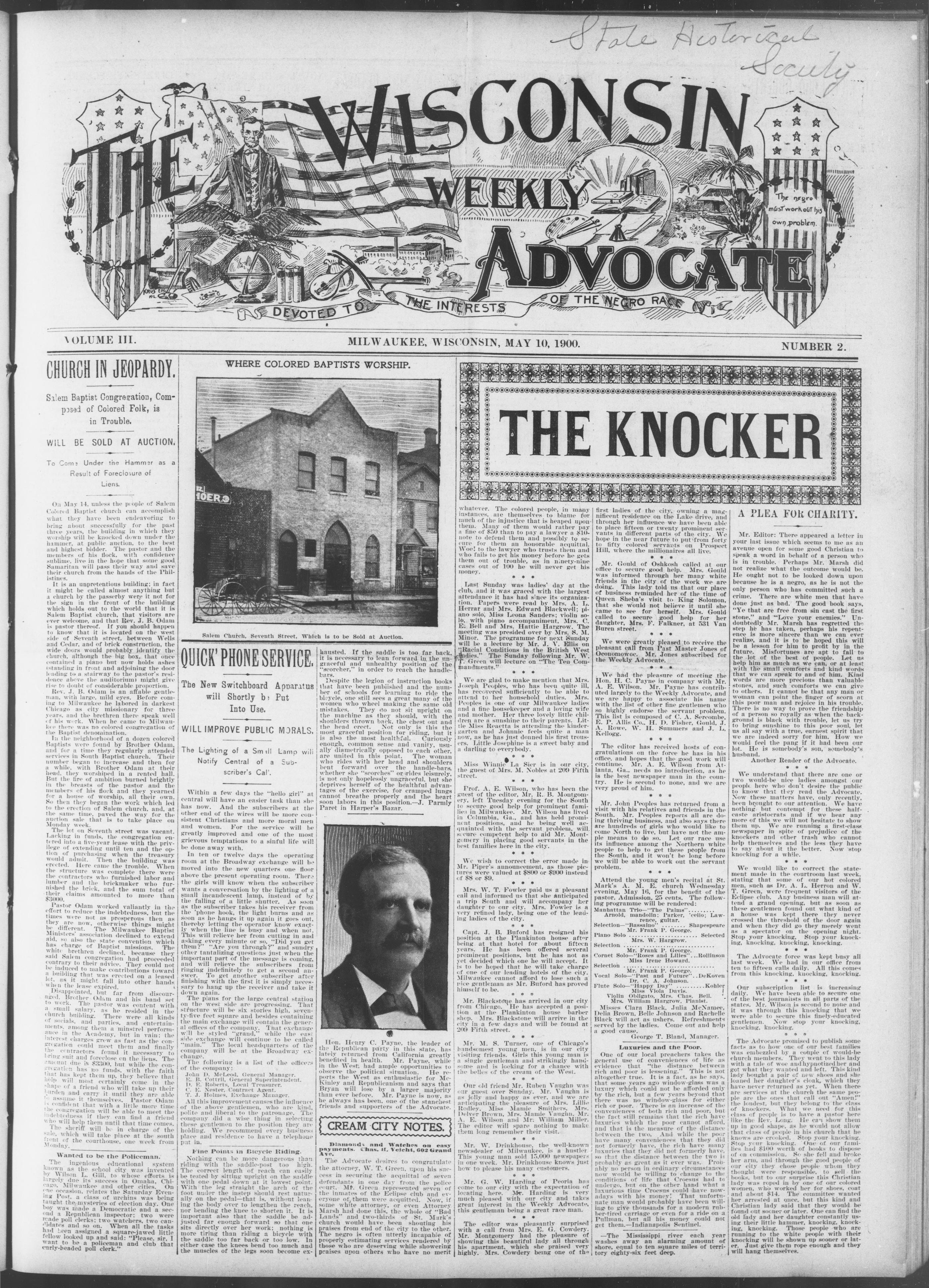
Page text (machine-generated)
Rumor in London that There is a Plot to Assassinate Him.
Relief for the Beleaguered Garrison at Mafeking Must Come
London, May 8.—The Standard hears that information has been officially received of a plot to assassinate Lord Roberts, that the latter has been warned, and that telegrams are now passing between the Cape authorities, Lord Roberts and the home authorities on the subject.
The parliamentary secretary for the war office, Mr. Wyndham, informs the Associated press that the war office has no information tending to confirm the reports of an alleged plot to assassinate Lord Roberts.
Lourenco Marques, Sunday, May 6. A dispatch received here from Col. Plumer's camp, bearing date April 26, states that the Boers around Mafeking have been gradually reinforced, and their strength is estimated at 3000. Col. Plumer has succeeded in communicating with Mafeking by means of carrier pigeons and is endeavoring to communicate with the southern relief column.
Relief May Come Soon.
London, May 8.—Fifteen thousand British are now operating on the Western frontier of the Free State. As the deadlock at Warrenton has been broken and the Boers are retreating, there is nothing formidable, except distance, between Warrenton and Mafeking. The most hopeful advices from Mafeking of April 22 were that the garrison would be barely able to hold out for a month as the fever was spreading.
Lady Sarah Wilson wires from Mafeking, under date of April 22, and says: "The situation is unchanged. The garrison is depressed at there being no sign of relief, but is as determined as ever to deprive the Boers of a crowning triumph on the western border. A case of whisky realized $540 at a raffle, and a pound of flour was sold at auction for 2 guineas."
Not Warranted by the Facts.
London, May 8.—The Cape Town correspondent who says "the relief of Mafeking is expected at any moment" is too optimistic. Judging from the direct dispatches the British forces south of Mafeking are still nearly 200 miles from their objective, while the latest advices from Mafeking itself, dated April 29, show little amelioration in the conditions there.
The dispatches say: "With the exception of a little rifle fire at the outlying trenches everything is quiet. The slight epidemic of typhoid is abating as a result of the medical precautions. The enemy's artillery, with the exception of two five-pounders, has apparently been withdrawn.
Refused to Advance.
"It was learned April 24 that the enemy intended to attack and the entire garrison stood to its arms. When day broke Col. Baden-Powell took up a position on the lookout and the heavy rattle of musketry and the boom of four guns convinced us that an attack was about to occur. But it became apparent that the Boer officers could not persuade their men to advance. Through glasses we saw the officer vainly urging the infantry forward. The enemy reformed and retired. Our men fired a shot in the hope of inducing the enemy to come to close quarters.
"The native distress has been alleviated, many of them slipping through the lines. The men of the garrison forego their sugar ration for the benefit of the women and children.
"After the bombardment April 24 all was comparatively quiet."
Eating Horse Dinners.
The besieged are celebrating the two hundredth day of the siege with horse dinners, and Col. Baden-Powell sent a message to Lord Roberts saying: "After 200 days of siege I desire to bring to your lordship's notice the exceptionally good spirit and loyalty which pervades all classes of the garrison and the patience of everybody at Mafeking in making the best of things under the long strain of anxiety, hardship and privations, which is beyond all praise and a revelation to me. The men, half of whom are not accustomed to the use of arms, have adapted themselves to their duties with the greatest zeal and readiness. The pluck and devotion of the women have been remarkable. With such spirits our organization runs like clockwork. I have every hone it will pull us through."
No Demonstration for Rhodes.
Cecil Rhodes has arrived at Cape Town, without any demonstration being made. He goes to Beira, Portuguese East Africa, and thence to Rhodesia, probably visiting Gen. Sir Frederick Carrington.
It is announced that no more Boer prisoners will be sent to St. Helena.
A special dispatch from Lourenco Marques says the colored American citizen named Richards, who was committed for trial by the special court on the charge of murder in connection with the explosion at Begbies Works, is alleged to have said he was offered £5000 to blow up the foundry.
The same dispatch says that when President Kruger heard of the explosion he dramatically exclaimed: "Is there a God?"
COMPELLED TO HALT.
Roberta Finds Railway Damaged and Bridge Honelessly Wrecked.
London, May 8.—The following dispatch from Lord Roberts has been received at the war office dated Smaldeel, May 8: "The railway from Brandfort to this place has been considerably damaged and a bridge over the Vet river has been hopelessly wrecked. This delays supplies coming up. Every few yards charges of rackarock have been laid under the rails. This might have created loss of life, but was fortunately discovered by a West Australian infantry man.
"Winberg has been occupied by the Highland brigade."
Roberts Continues to Advance.
In spite of these wrecked railroads the British advance goes on steadily. Lord Roberts' outposts are apparently about twelve miles north of Smaldeel, Gen. Brabant has joined Gen. Rundle at Thaba N'Chu, whence they are moving forward. The country is all quiet in that direction. A reconnaissance made by Gen. Rundle of the Boers' recent positions at Thaba N'Chu resulted in their being pronounced impregnable and their evacuation is reported to have been due to the receipt of an urgent message from President Steyn. The Boers are said to be moving northward, and their immediate destination is not known.
The whereabouts of the British cavalry under Gen. Franch is still a mystery, while Gen. Kelly-Kenny's and Gen. Chermside's divisions are also unaccounted for.
A dispatch from Capt Town, dated today, says:
"Lord Roberts' phenomenal advance is
not only utterly demoralizing the Boers, but is striking terror into the rebel colonists.
Every Farmhouse an Arsenal.
Lord Roberts has been extremely strict in his examination of the farms, with the result of disclosing the fact that nearly every house is a miniature arsenal, Mausers, Martinis and abundant ammunition being found. If these had not been discovered the army would be leaving in its rear the material in arms and men for a dangerous move for the inhabitants.
The Cape Town correspondent is slightly optimistic. Boera Proceed to Christiana.
Warrentown, Cape Colony, Monday, May 7.—A British camp is now being formed at Fourteen Streams. The old railroad bridge can be repaired in a week. A Boer prisoner says the burghers, who number 10,000 men, are now on their way to Christiana.
ATTACKED .BY REBELS.
Three Men of Company I, Forty third Regiment are Killed and Seven Wounded.
Manila, May 8.—A force of rebels, May 2, attacked twenty men of Co. I of the Forty-fourth regiment stationed at Barotac, Iloilo province on the island of Panay. Three of the Americans were killed and seven were wounded. The enemy, estimated to number 400 men, surrounded Barotac and attacked the place on all sides. After two men had been killed and four wounded, the American commander sent four men to try and get through to communicate with the remainder of the company at Dumanges. A friendly native finally brought news of the fight to a company from the Twenty-sixth, who succored the garrison of Barotac on the night of May 3. The enemy's losses were heavy.
A court-martial composed of Gen. Hall presiding, Gen. Grant and several colonels, today convened at Manila to try Col. Pettit on the charge of delivering a Filipino prisoner to the local authorities at Gamboang and with the result that the prisoner was immediately "boloed." Pedro Paterno, the former president of the so-called Filipino cabinet, who was recently captured in the mountains of Trinidad, has arrived here, and has been placed in communicado in the political jail. He is suffering greatly from sickness. Washington, D. C., May 8.—The war department has received the following cablegram from Gen. MacArthur, dated Manila, May 8: "Gen. Pantaleon Garcia, prominent insurgent officer, northern provinces, was captured yesterday with some valuable documents by Funston's troop. Regard capture important.
RESTRICT IMMIGRATION.
Labor Representatives Considering a Bill to Exclude Japanese Conference in New York.
New York, May 8.—A conference of represntatives of District Assembly 49, Knights of Labor; District Assembly 75 and 220 of Brooklyn, the Central Federated union and the Central Labor union of Brooklyn was held in this city last evening, to devise means to secure legislation to restrict immigration, and to amend the Chinese exclusion act so as to include Jananese in its provisions.
The call for the conference began by saying that an army of foreign laborers were flocking to these shores and were crowding into occupations that were already overstocked, thus inflicting great hardships upon American workmen. It was declared that a large proportion of these aliens were merely birds of passage and did not intend becoming citizens.
Delegate William Allen submitted a rough draft of a bill prohibiting any alien from entering the United States to engage in any occupation who did not intend to become a citizen, or who intended to engage in any congested occupation or to take the place of a striker or locked-out workman, or to work for less than the prevailing rate of wages. The bill finally proposes an amendment to the Chinese exclusion act, providing that all laws now in force prohibiting the immigration of Chinese or persons of Chinese descent be amended so as to include the Japanese in its provisions. A committee was appointed to draft a bill and submit it for consideration to the various central labor organizations and to report.
BURNING OF A HOTEL.
Two Persons Are Burned to Death Story of a Waitress.
Genesee, N. Y., May 8.—The American hotel here was destroyed by fire at an early hour today. Lafayette Carney and Sherman Deboray of West Sparta were burned to death, and it is thought a woman also lost her life, but her identity is unknown and the body has not yet been found. Miss Schreiner, a waitress, said she saw two men run away from the building and almost immediately the fire occurred. The loss is $15,000.
Will Go to New York and on Thursday will Sail for Germany
Chicago, Ill., May 8.-P. D. Armour, the millionaire packer, will leave Chicago at 5:30 o'clock today for New York, whence he will sail on Thursday by one of the German line steamers for Nauheim, Germany, to be absent until about the middle of September.
Accompanying Mr. Armour will be Dr. Joseph L. Miller, his family physician, and his private secretary, John Kerr. They will travel to New York in a private car over the Lake Shore and Michigan Southern railway. After Dr. Miller has seen Mr. Armour safely at Nauheim he will make a tour of Germany, returning to Mr. Armour before the latter is ready to sail for America.
At his residence, 2115 Prairie avenue, last night, Mr. Armour said: "I feel well, and perhaps could remain here and keep in good health, but I enjoyed my trip abroad last year, and so decided to go again this year. I was at my office yesterday and shook hands with my employees. I go away with a light heart, and feeling that I shall return next fall in excellent health and spirits. My only regret is that Mrs. Armour is not going with me."
SHELDON'S GIFT TO CHARITY.
Proposes to Donate One Thousand Dollars to a Detention Hospital. Topeka, Kas., May S.—Charles M. Sheldon will give $1000 toward the cost of a detention hospital, to be made a part of the city hall. The city of Topeka will pay $1000. It is supposed that Mr. Sheldon's contribution is from his share of the profits of his "Christian daily."
Will Knock Raising.
San Francisco, Cal., May 8.-The outlook for raisin growers is not cheerful. The co-operative association will not be continued, and M. Theodore Kearney, its president, threatens to cut prices of raisins to $2\frac{1}{2}$ cents a pound. He attributes the failure to continue the association to the packers. Meanwhile, the packers are loaded up with 250 carloads of last year's raisins, on which they have secured liberal loans from the banks. As the price of raisins has declined, the securities which the banks possess are not sufficient to cover the loans.
FLAMES ARE FED BY PETROLEUM.
Flerce Fire in New York Harbor
Causes a Loss of About
$1,000,000.
New York, May S.—A spectacular oil fire which destroyed property valued at nearly $1,000,000 occurred last night at the docks of the National Storage company in Bayonne. There is a canning factory on the pier, where the oil is placed in five-gallon cans and the cans into cases for shipment. Three piers, 250 feet in length and housed over with one-story buildings, extend from the dock into the Kill and are used for storage purposes.
The big American ship Josephine—one of the largest full-rigged clippers afloat—lay alongside one of the piers loading with oil for China. There were eight oil barges between piers 1 and 2, and two large piledrivers
The fire was discovered about 9 o'clock by a watchman. He saw a sheet of flame flare up on one of the piledrivers. Everything within reach was oil-soaked, and the fire spread with amazing rapidity. From the piledrivers it licked its way quickly to pier No. 1, where the cases of oil were stored tier after tier up to the roofs of the storage sheds. There were hundreds of explosions as case after case burst and fed its contents into the roaring furnace. It was apparent that pier No. 1 and its structure was doomed. The oil on the surface of the water burned in sheets intermittently and conveyed the flames to the barges in the slip. Once they got to burning there was no saving them.
Then pier No. 2 caught and the cases of oil there began to burst. The big ship Josephine was on fire before the crew realized that it was in danger, and spars and rigging were aflame above the fiery hull. It made a beautiful picture. Two tugs got lines to the vessel and tried to tow it into midstream, but its three masts fell as it was being pulled away, and the crew with difficulty escaped with their lives. The two piers, the warehouses and their contents, the barges and the ship Josephine were destroyed.
ALGER PURCHASES TIMBER LANDS.
Million Dollar Deal Made in Alabama Lands, with a Southern Timber King as Partner.
Washington, D. C., May 8.—Gen. R. A. Alger and associates, it is reported here, have just completed the purchase of 230,000 acres of choice long-leaf yellow pine lands, situated in the counties of Escambia, Conecuh, Monroe and Baldwin, Alabama, extending from the Alabama river on the north to the Florida state line on the south. The purchase was made from Martin H. Sullivan, the millionaire lumber king of the South. The price paid was $1,000,000.
This is said to be the last large body of timber land in the South. This land being connected by water with Pensacola the logs can be floated direct to the mills, while ample railway facilities afford transportation to the wharves for shipping the timber to foreign ports.
Included in the purchase is the finest wharf at Pensacola, upon which the new company will expend $100,000 in improving and extending it. The water is of sufficient depth to accommodate the largest ocean-going steamers.
LOCUSTS DESTROY CROPS.
Great Cloud of Insects Falls in Michigan and Eat Vegetation.
Kalamazoo, Mich., May S.—A report comes from Troy, Berrien county, in the extreme southwestern part of Michigan, that a shower of locusts, millions in numbers, fell in that section Sunday, and that the insects completely devastated the land of all vegetation. They filled the air like a cloud and darkened the view of the sun.
The insects were yellow and green, with long legs and big heads. People who saw the approach of the locusts describe it as an extraordinary spectacle. A large crowd, denser in its lower than in its upper part, came from the West. The nearer side opened up suddenly and millions of the insects began pelting everything. Horses and people could not stand a moment against the aggressive rain of the buzzing creatures. Animals and men at once sought shelter.
As the locusts alighted a vast area of land changed color. Every little creature veered himself around head to wind and the countless multitude attacked vegetation. In an incredibly short time the insects had eaten up every green thing, and after the grass and leaves were devoured they ate the bark off shrubs and trees. Then they flew away.
WALES IN TAN SHOES.
Orchardson Found to Have Made an Unpardonable Blunder.
London, May 8.—"Have you seen the prince's boots?" This was the question the throngs of the public allowed to view the Royal Academy exhibition for the first time yesterday asked of each other on coming out.
The question was always asked and answered with a smile.
One detail of Orchardson's great painting of the royal family is the sensation of the exhibition, and was the cause of the comment. It was overlooked apparently by the prince himself and all the other notables who attended the private view of the exhibition Saturday. But the great public was not slow in discovering it yesterday, and within an hour after the doors were opened an intelligent crowd massed in front of the Orchardson picture was startled by one of their number almost shouting: "See the prince has on tan boots with a frock coat and tweed trousers."
Then there was a sensation, for sure enough Orchardson, the great artist, is discovered to have committed an unpardonable blunder, and, to make the matter worse, the Duke of York seems to have been given the same incongruous makeup, though his boots are not quite so yellow as his father's.
Modern Boiler Making
During the past twenty years the boiler shop has undergone a change, the magnitude of which is paralleled only by that in the machine shop. But while the latter has been mainly brought about by the introduction of new and improved machine tools, the former is due chiefly to the development of a new material steel. But for this the old methods which were applicable to wrought iron would probably have not been altered much even at the present time.—Cassier's Magazine.
—The two leading agricultural societies in Britain, the Royal Agricultural and the Highland Agricultural, have united their forces and are henceforth to have a national agricultural examination board and to grant prizes and diplomas to farmers after examination.
—Bordeaux buys about 40,000,000 barrel staves per year, all but 2,000,000 of which come from Austria.
—France, Algeria and Tunis produced 1,268,016,000 gallons of wine in 1890
FEDERALS IN RETREAT.
Not Inclined to Make a Stand Against British Troops.
President Kruger Reported as Being Much Depressed Over the Situation.
London, May 9.—6:30 p. m.—It is announced in a special dispatch from Lorenco Marques that the government of the Orange Free State has been moved from Kroonstad to Heilbron.
London, May 9.—Although the British expected considerable opposition at the difficult drift of the Zand river, the latest advices from Smaldeel, Orange Free State, indicate that the Federals are not yet ready to make a determined attack to stem Lord Roberts' advance. The latter's front, indeed, is so wide and overwhelming in numbers that it is difficult to see how the Boers can help being ousted out of Virginia Siding as they were out of Smaldeel, even if they elected to give battle.
The same considerations would probably affect the situation at Kreconstadt, hence the belief that little real opposition will be encountered south of the Vaak.
Riberts' Maren Retarded.
The repairs to the bridges over the Vet river and the Vaal are expected to retard the general march from Smaldeel and Fourteen Streams for three or four days, when Gen. Buller will also be ready. The general idea is that Lord Roberts will direct his right on Harrismith in order to get in touch with the Natal army, coming through Van Reenen's Pass. A dispatch from Maseru, dated May 8, says the Boers have deserted both Ladybrand and Ficksburg in a panicky condition, owing to reports that the British had occupied Zenickal, thus threatening their retreat to the Transvaal.
Federals Retreating.
Smaldeel, Tuesday, May 8.—It is reported that the Federals are quitting Zand river, and it is variously stated that they are retreating towards the Vaal and are taking up their position at Boshrand, south of Kroonstadt. Large numbers of burghers have come in and delivered their Mausers and horses to the British. They affirm that there is a bitter quarrel between the Free Staters and the Transvaalers which is likely to end in the speedy surrender of the former. Gen. French has arrived here.
Want M'Kinley to Interfere.
The Hague, May 9.—The Netherlands Peace society has addressed an appeal to President McKinley begging him to further the peaceful object of the Boer mission, to investigate their case, to bring about arbitration and put a stop to the pernicious war in South Africa.
Oom Paul Depressed.
Copenhagen, May 8.—Capt. Allum, the Norwegian military attache with the Boer forces, publishes in the Politiken a conversation he had with Kruger.
"I thought the President much aged in appearance," the captain writes. "Besides this, he was much depressed and reticent. He (Kruger) said: 'What are we poor Boers to do? The English have 100,000 men here, 40,000 there, 30,000 in another place, and now they are sending 30,000 Kaffirs to hit us in the back.'"
President Kruger referred to the report he had just received of a Kaffir invasion by way of Derdepoort.
Capt. Allum got the impression that not only the Transvaal President but all the other government officials looked upon everything but honor as lost, but in spite of that had no intention of giving in.
NEW SHELL INVENTED.
No Armor Now Manufactured Has Sufficient Resistance to Withstand It.
Washington, D. C., May 9.—Some facts almost startling in their importance were laid before the Senate in secret session yesterday. They related, it is understood, to the invention of a shell by a prominent officer of the United States navy—a shell superior in every essential quality to any now in use either by this or by any other government. The quality of penetration possessed by the shell is said to be so great that no armor now manufactured in the United States or abroad has sufficient resistance to withstand it. The facts, which were in possession of only a few senators, were deemed so important that the Senate decided to consider them in secret session.
MINERS IN A RIOT.
Strikers Disperse Workmen and
Wilkesbarre, Pa., May 9.—During a riot between strikers and workmen at the Buttonwood mine of the Parrish Coal company, this morning, some twenty men were badly injured, including Supt. W. T. Smythe. The strikers dispersed the workmen. The sheriff has been called on.
FAVORABLE PROGRESS.
Several Battleships, Including the Wisconsin, Nearing Completion. Washington, D. C., May 9.—Favorable progress in the construction of naval vessels is shown in a statement just prepared by Admiral Hirchborn, chief of the bureau of construction and repair. The battleships Kearsarge and Kentucky, at Newport News; the protected cruiser Albany at Armstrong's, England, and the torpedo-boat Goldsborough by Alff & Zewicker, are practically completed, less than 1 per cent. work remaining to be done. Other vessels nearing completion are the battleship Alabama at Philadelphia, 95 per cent.; battleship Wisconsin, at San Francisco, 91 per cent.; the torpedo destroyers Lawrence and MacDonough at Fore river, Mass., 90 per cent.
BRIDGE-JUMPER GOES INSANE
Marie Dinse Removed from Prison to an Asylum.
New York, May 9.—Marie Rosalie Dinse, the first woman to jump from Brooklyn bridge, will pay a penalty for her deed worse than the death she sought: She is hopelessly insane. She was removed from the prison ward in Bellevue hospital today to the insane pavilion. The doctors declare there is no chance for her recovery.
BRITISH SHIP WRECKED
Captain and Twenty-two of the Crew Probably Lost.
Melbourne, May 3.—The British ship Sierra Nevada, Capt. Scott, from Liverpool. January 16, for this port, was totally wrecked outside the Heads. Five of her crew were saved, but it is believed that twenty-two others, including the captain, perished.
NOVEL SCHEME TO STOP COUNTERFEITS.
Banks Require that All Twenty Dollar Notes be Endored
Philadelphia, Pa., May 9.—Every $20 note now accepted by a local bank has to be indorsed by the depositor, so great is the flood of the recently-discovered counterfeits in the city. The counterfeit is a dangerous one, almost an exact reproduction of the silver certificate. To protect themselves the banks appealed to the local bureau of the secret service for instructions, and the order was issued that hereafter all notes must have the name of the person changing or depositing a note written across the face of it in red ink. Unless the name of the person is well known there is likely to be an unpleasant investigation made, in which the possessor of the note will have to tell where he got the note and all about himself or herself.
By this means a secret-service official said yesterday, all of the bogus notes will soon be driven out of circulation.
THEY PAY DEARLY FOR THEIR FOLLY.
Four Tourists Are Terribly Bruised by Emissions from Mount Vesuvius. Naples, May 9.—The cable-car service up Mount Vesusius has been suspended in consequence of the eruption. Four Englishmen attempted to ascend the mountain on foot and eluding the vigilance of the carbineers, who form a cordon at a height beyond which the ascent is considered unsafe, they approached the summit. Suddenly the volcano belched forth a stream of lava and large stones, which descended upon the tourists, who were rescued in a terribly-bruised and battered condition and removed to the hospital.
The activity of Vesuvius is becoming more formidable and the observatory officials announce that the seismic instruments are extremely agitated. A thick column of smoke is rising from the crater and the earth shocks are violent.
HEMMED IN BY FOREST FIRES.
New York Town Completely Surrounded-Impossible to Get In or Out.
Buffalo, N. Y., May 9.—A special to the News from Empire, Pa., says: This village is completely surrounded by forest fires and it is impossible for anyone to get in or out. Five houses have been destroyed and three children were burned to death. The inhabitants are panicstricken.
WEEKS A FREE MAN.
Embazzer Reduces His Sentence at Sing Sing Prison by Good Conduct.
New York, May 9.—Francis H. Weeks, lawyer, financier, trustee of estates and embezzler of $1,300,000, walked out of Sing Sing yesterday a free man after six and one-half years' imprisonment. He was in splendid health. He came directly to New York, and left for Salt Lake City, Utah, to join his wife. "I was as busy as a clerk in a big wholesale store," he said, "and glad of it, for the occupation of mind. I have not lost my appetite for business, but I suppose will find it hard to apply myself now."
Weeks was trustee for many estates, but he was ambitious for financial conquest. His speculations failed and he took trust funds. In May, 1893, he made an assignment, quietly left the city and embarked, with his wife, for Jamaica. He was arrested in Costa Rica. He pleaded guilty when brought home and was sentenced to ten years, which good behavior reduced by one-third. Four indictments were pending against Weeks, but they were dismissed yesterday by Judge Foster on application of the district attorney's office.
SETTLERS NOT TO LOSE.
Interior Department Trying to Compromise the Matter with the N. P. Road.
Duluth, Minn., May 9.—[Special.]—The settlers who located on land between here and Ashland, which by the recent decision of the Supreme court is held as being the property of the Northern Pacific road, will not be made to lose the time and money they have put in on this land. The department of the interior will make amends for the erroneous decision from that office which caused these settlers to go in there. Secretary of the Interior Hitchcock made this statement in reply to an inquiry made by Congressman Page Morris of Duluth.
SUES THE ROCKEFELLERS.
Sensational Case Begun by Upper Michigan Mining Company.
Duluth, May 9.—Wellington R. Burt, a Saginaw (Mich.) millionaire lumberman, has begun a sensational suit here against the Lake Superior Consolidated Iron mines, the principal Rockefeller iron-ore corporation, in which it is charged that the defendant has attempted to bring about a monopoly or trust on Mesaba iron ore by keeping properties out of the market, and by fixing an exorbitant freight rate for ore on the railroad controlled by the concern. It is alleged that the attempt is keeping iron properties dormant that ought to be developed. The suit is to set aside a lease held by Rockefeller on a large amount of iron property owned by the plaintiff on the ground that he has failed to comply with the terms of the lease in which he has failed to mine as much ore as it would have been profitable to mine.
THE FIREMAN KILLED.
Several Others Injured by Collision on the Southern Railroad. Savannah, Ga., May 9.—The southbound passenger train on the Plant system and the northbound train of the Southern collided at Hardeville, S. C., forty miles from here, this morning. John Jackson, colored fireman of the Southern, was killed. Several other employees were injured.
HOTEL CLERK FOUND DEAD.
Charles Morton Euds His Life by Taking Carbolic Acid. St. Louis, Mo., May 9.—The body of Charles Morton, former night clerk of the Southern hotel, who disappeared last Friday night, was found in a room at the Regent hotel today. He had evidently ended his life with a dose of carbolic acid. The dead man was one of the most widely-known hotel clerks in the country. Previous to coming here he was for many years at the Grand Pacific in Chicago.
IMPRESSIVE SCENES.
Formal Inauguration of the Transvaal Volksraad for the Session of 1900. Pretoria, Monday, May 7.—The official closing of the 1899 Volksraad, which broke up unofficially in September last, took place today. The vacant seats of Gen. Joubert and Gen. Decock and others were filled with flowers. The hall was crowded, a large number of ladies being present.
In the prayer of the chaplain an allusion to Gen. Joubert moved many to tears. After the prayer the raad adjourned to the afternoon, when the session of 1900 was inaugurated. The ceremonies were accompanied by the customary salute. President Kruger arrived in the state carriage with the usual escort. All the diplomatists and foreign attaches, including Gen. Gourko, the Russian attache, were present. The raadsaal was crowded to its fullest capacity and the scene was most impressive. President Kruger, in his speech opening the session, alluded feelingly to the vacancies. Referring to Gen. Joubert he said:
"Future generations will be able to judge the work of the deceased, whose demeanor inspired the enemy with respect and whose humane and brave conduct gave fame and importance to the state among civilized nations."
Free State Has Been True.
He was profoundly struck, he said, by the proof of sincere friendship given by the people of the Free State who had fulfilled their obligations to the Transvaal under the treaty. They realized that a united front was required, as an attack upon the independence of the Transvaal meant a threat against the Free State. He had implicit confidence in the future of the Afrikander nation. By deeds, the Free State had shown, the President declared, a good example to the people of the Transvaal, which had proved of great moral value to those guiding the efforts of a small state to maintain its independence. He was pleased to say that the relations of the Transvaal with the foreign states, with the exception of Great Britain, were
Anxious to Restore Peace.
of the Presidents of both republics to Lord Salisbury, President Kruger said: "We have proved by legislation and our dealings with Great Britain last year that it was our desire to preserve peace and now that war has broken out we will do everything to restore peace." After alluding to the deputation now on a mission to Europe and the United States and the presence of so many attaches, proving the intense interest of the powers in the republics, and to their methods of fighting, he said he was pleased to see that the sympathy of the world was on their side in the war, that ambulances had been sent and that their friends were united in endeavoring to alleviate the distress caused by the struggle
The Government Finances.
After references to alleged violations of the Red Cross convention, and to the consequent protests of foreign powers, President Kruger continued:
"Notwithstanding the difficult circumstances I am glad to say that our finances will enable us to bear the great expense of the war and that the mines are flourishing."
The President concluded with a reference to the Free State loan and suggested that the session be not prolonged and that only matters of importance be dealt with. In a moving peroration he invoked the blessing and help of the Almighty.
The proceedings terminated with unusually impressive speeches and prayers. Fifty out of a total of sixty legislators were present, several of them still suffering from wounds.
ATTACKED BY CHINESE.
London, May 8.—A war office dispatch confirming the Chinese attack on Wei Hai Wei adds: "On May 5 Capt. Watson and sixty men were attacked by 3000 Chinese. The latter were repulsed with no casualties to the British."
CO-OPERATIVE PLAN AMENDED
Chicago Firm Abandons Popular Subscription and Substitut Stock
Chicago, Ill., May 8.—In view of the fact that popular demand for subscriptions to small lots of stock in the projected co-operative enterprise was not so great as had been expected, Siegel, Cooper & Co. determined last night to abandon that feature of the plan which contemplated popular participation in the profits of the concern.
"The people did not seem to understand our idea, which was to interest as many shareholders as possible." Frank H. Cooper said last night. "The number of subscriptions turned in today, both in New York and Chicago, was so unsatisfactory that word was sent from New York last night that the plan had better be given up. We did not, however, intend to abandon co-operation as far as our employees are concerned."
The following notice was given out last night by the firm:
"Not having received as many subscriptions for small lots of stock as we anticipated, we are convinced that a co-operative store on the plans set forth in our prospectus and as prevails in many European cities cannot at present be successfully established here, and we, therefore, have concluded to receive no further subscriptions for the preferred stock of the Siegel-Cooper company and shall return all subscriptions that have been made. We shall, nevertheless, establish in our Chicago and New York stores cooperation on a profit-sharing basis with our employees."
VESUVIUS AGAIN ACTIVE.
Masses of Rock and Lava Thrown to a Great Height.
Rome, May 8.—Mount Vesuvius has been in a state of eruption for the last three days, and explosions within the crater have thrown lava and masses of rock to a great height. Last night the eruption was especially violent and was accompanied by menacing rumhblings.
Strike Declared Off
Atlanta, Ga., May S.—President W. V. Powell of the Order of Railway Telegraphers has issued an order formally discontinuing the strike of the Southern Railway telegraphers.
Man Bun Over and Killed
Iron Mountain, Mich., May 8.—[Special.]—Joseph Parent was run over by a loaded ore car last night and died this morning at the hospital. He was unmarried and about 23 years of age.
Drunken Man Injures Little Child.
Iron Mountain, Mich., May 8.—[Special.]—The little child of D. Contarino, who was so badly injured by a drunken lumberjack, is considered out of danger.
King Otto in a Bad Wax
Berlin, May 8.—The health of the demented King Otto of Bavaria is completely broken and the end is expected soon.
—The ledges lately discovered on the middle fork of Clearwater, in Central Idaho, are from sixty to eighty feet wide, and prospect well in free gold, besides containing good quantities of sulphurets. A good many locations have already been made.
FOR AMERICAN SHIPS.
THE MUCH-DISCUSSED HANNA- PAYNE-FRYE BILL.
Senators Favor Passage of the Subsidy Measure-Why It Is Needed and What It Will Accomplish-Opposed by Free Traders and Foreign Shlp Owners.
Sentiment among members of the upper branch of Congress so strongly favors the shipping bill that its passage at the present session is assured. It is known as the Frye shipping bill, having been introduced by the President pro tem. of the Senate, Hon. William P. Frye, of Maine, who is also chairman of the Senate Commerce Committee, to which legislation affecting our marine is always referred. For twenty-five years Senator Frye has been the leading champion of American shipping in Congress. Senator Hanna first introduced this bill in the Senate, however, at the time Senator Frye was a member of the Peace Commission in Paris. It was introduced in the House of Representatives by Sereno E. Payne, of New York. This explains its several hyphenated titles.
This bill is necessary, because our shipping in the foreign trade is unprotected in competition with the cheaperbuilt, cheaper-operated, heavily subsidized and bountied shipping of other nations. Our ships now carry less than nine per cent. of our imports and exports. Foreign vessels annually receive $200,000,000 for carrying 91 per cent. This vast sum is taken out of the country and employs aliens, instead of being spent in American shipyards and giving employment to our own citizens, and thereafter being used over and over again in adding to the employment and enhancing the wealth of the American people. This bill extends to American shipping on the sea precisely the same kind of protection that is given to American land industries that are subject to foreign competition.
More important than the expenditure of $4,000,000,000 during the last thirty-five years in paying foreign ships for doing our foreign carrying, is our growing national danger because of our increasing weakness upon the sea. For the support and re-enforcement of our navy, we need merchant ships and seamen. The difficulty now experienced in securing sailors for our navy would be removed if we possessed a merchant shipping equal to the needs of our foreign commerce. Our neglect of our shipping makes our foreign commerce a means for building up the auxiliary naval strength of our maritime and commercial rivals. This commerce, now annually valued at over $2,000,000,000, pays for the auxiliary naval training of foreign merchant ships and seamen.
This shipping bill is now upon the calendar in each branch of Congress, having been favorably reported from the House Merchant Marine and Fisheries Committee, and from the Senate Commerce Committee.
Briefly, the bill provides that all vessels under American register, making a foreign voyage distant more than 150 miles from the United States, shall be paid for the first 1,500 miles not to exceed $1\frac{1}{2}$ cents per gross ton per hundred miles sailed outward and inward, and 1 cent per ton for each additional hundred miles sailed outward and inward, this compensation being limited to not to exceed sixteen round voyages in any successive twelve months. In addition, vessels whose speed exceeds twelve knots per hour are paid extra compensation, graduated proportionately to their size and speed. This barely meets the extra cost involved in building and operating ships of high speed, although these vessels, for auxiliary naval and for mail carrying purposes, are most useful to the government. The compensation paid to slow-sailing and steam vessels is just equal to the higher cost of their construction in the United States, and their operation under the American flag; and the same is true of all vessels receiving this compensation. Owners of existing American vessels for which compensation is sought must have 25 per cent, additional new tonnage built in the United States before receiving any pay. It is proposed to admit to American register such foreign vessels as are now owned by American citizens, on condition that these owners have new tonnage built in the United States equal to that so admitted. The compensation to the foreign-built vessels is but one-half that paid to American-built ships. Not to exceed nine million dollars may be expended in any one year. If the amount earned exceeds the amount available, there is a pro rata reduction in the payments made to each vessel under contract. All vessels receiving compensation must carry the mails free of extra charge. The bill remains in force for ten years, during which time any American citizen can build any number of vessels and put them in our foreign trade, and receive, according to size, speed and cargo carried, the same amount of compensation that is paid to other vessels. High speed steamships are not to receive more than $2,000,000 in any one year, out of the total amount, and 30 per cent. of the latter is reserved exclusively for Pacific Ocean shipping under the American flag.
Foreign governments now pay their merchant ships over $26,000,000 a year in subsidies, mail pay, subventions, naval reserve retainers and bounties, to enable them to successfully compete with their rivals. To secure a merchant marine equal to the carrying of our foreign commerce, this nation must do likewise. Unprotected American ships cannot compete with the ships of other nations, aided as shown. President McKinley's recommendations to Congress in his last two annual messages have been conformed to in the drafting of this bill, which is supported by the Republicans and a number of Democrats in each branch of
Congress. It has the specific indorsement of about 250 of the leading commercial and agricultural associations all over the country, and has been widely commended by the press in every section of the United States. Its passage will strengthen the one weak spot in the national armor of the United States. Its opponents are the free-tradars and the foreign shipping interests.
Porto Rican Affairs.
Speaking of affairs in Porto Rico, C. F. Sayton, an official of the Department of Agriculture, who has recently been there, says: "Whatever capital is invested in the sugar factories, emanating at all from island sources, is purely Spanish. It does not belong to Porto Rico. The peculiar system maintained by Spain through all of the business concerns, and so far as their own capital was employed, threw everything into the hands of the Spaniards, who were simply in Porto Rico doing business. They do not belong to that element of Porto Ricans that we feel so tender about, and would not become citizens of Porto Rico or this country, whatever becomes of the constitutional question. Other factories are owned and controlled by English capital, others by German, and the entire factory system by Spanish, English and German.
"They agree with the planters or manufacturers to take their sugar, refine it, and place it on the market, dividing the profit on a certain basis, as is now being done, and as has been done between the Hawaiian planters and the sugar trust for years. How will they divide the profits? Even? Each getting $37\frac{1}{2}$ per cent.? We do not know. Only the parties interested know. This point is clear, however, and that is that the Porto Ricans are not benefited. Simply the sugar combinations of this country and the foreign planters or manufacturers of Porto Rico.
"Isn't it a great deal that we should have freed the Porto Ricans from a condition as bad as slavery, making what concession we of right ought to make, in justice to the people of this country, assuring them that after they had attained the standard that one ought to have to enjoy the rights and privileges of the Constitution of the country, that then they might be admitted with equal privileges with the rest? Do you think this ought to be before wages are paid in that country somewhere near in comparison with wages in this country, or before the average citizen of that country shall at least be able to understand the primary principles of our government and institutions? We say no. We should especially not bring in this great horde of cheap laborers who receive less per day than one person could live on in this country, and yet they are supposed to support families on this. We believe the laborers of this country will en masse resent this proposition.
"I am a thorough believer in expansion. I believe that expansion is fraught with incalculable benefit both to the inhabitants of the island and to the people of this country, when Congress shall have framed such fair, honest, just and equitable regulations as are consistent with the right of our own labor and industries."
Admissions from a Democrat
Admissions from a Democrat.
The other day, says the Louisville Commercial, Eli Perkins was introduced to Judge Scott, an old dyed-in-the-wool Kentucky Democrat. The judge is well known in the Blue Grass region and the grand old Kentuckian has always been looked up to as a High Priest of "befo' the wah Democracy."
Perkins was introduced by an old Democrat, and Judge Scott supposed that Eli was a Democrat, too, and he became confidential with him at once.
"How are we Democrats getting along, Judge?" asked Eli, in a confidential tone.
The Judge looked at Eli a moment to see if he really wanted information about the party, and slowly remarked: "Well, sir, we are getting on very well financially, but politically we are running behind. Yes, I'm afraid we are running behind."
2 "What causes this?" asked Eli
"Well, sir," said the Judge, sadly, "I am afraid our party has not been altogether right. We have erred in some things." "Where have we erred, Judge?"
"Well, sir, I hate to admit it, but our Grover Cleveland policy hurt us Kentuckians. I wouldn't say it to a black Republican, but we Democrats all admit it among ourselves. You see," said the Judge, "we used to get 35 cents for wool, and a big price for hemp and tobacco before Grover came in, but that Wilson bill hurt us. It knocked wool down to 12 cents. Free jute, put in to help the cotton fellows, ruined our hemp and it rotted in the ground. Then we lowered the tariff on tobacco and our tobacco went down on us. We didn't complain, but we Democrats did a good deal of thinking. Cattle and hogs got lower and lower, and when Grover went out we were pretty poor—yes, dog-gone hard up, sir!"
"Are they still bad—the times?" asked Eli.
"No, honestly the times are good. Wool and hemp and tobacco have doubled in price and are still going up. Cattle and hogs are high and our blue grass farmers are getting rich."
"Well, what is the matter, then?"
"Why, these good times have knocked out our dear old Democratic party. Our Democratic farmers say they will never vote for free trade or low tariff again."
"Well, what can we Democrats do?" asked Eli.
"I hate to admit it," said the Judge, sadly, "but if we Democrats want to win in Kentucky again we've got to keep the tariff right where it is. That old Wilson bill and Bryan's free silver will be a scarecrow to every farmer in Kentucky and Tennessee. We've tried low tariff and we know—I'm ashamed to say so, but we know it hurt us! No.
sir; the people are prosperous, but our Democratic party is doing poorly. I wouldn't say it to a black Republican, but that is the way we Democrats talk among ourselves." As the Judge got off the train at Lexington he remarked: "Yes, and there was another mistake we Democrats made. Grover Cleveland wanted to sink the Republic of Hawaii and put a nigger on the throne. We Democrats didn't complain, but it made us sick, for, between you and me, we Democrats ain't puttin' niggers on thrones. McKinley's white Governor over a republic suits old Kentucky and the South."
Free Trade Trusts.
United States Consul Halstead, who is at Birmingham, calls the attention of the State Department at Washington to the fact that the constantly recurring announcements that another "trust" has been formed does not create alarm in Great Britain. The London Mail refers to the formation of a bleaching trust with a capitalization of $50,000,000 or $60,000,000. This, in the judgment of the managing editor, is worthy of only one headline, twenty-two lines of nonpareil sype, set solid, so common has the formation of trusts in England become. The Daily Mail article reads as follows:
"The Lancashire bleaching trade will shortly be in the hands of a powerful company.
"It is said that the combination will involve the capitalization of from £10,000,000 to £12,000,000 ($48,665,000 to $58,398,000), and the object in view is to prevent individual concerns from indulging in sharp practices, cutting prices, discounts, etc.
"Individual businesses are to be taken over and worked from March 31 by the company, which will be known as the Lancashire Bleachers' Association, Limited, and the prospectus will probably be in the hands of the public soon after that date.
"Experts are confident that there is no branch of the textile industries which will so well and profitably lend itself to the adoption of joint-stock-combination principles as that of the Lancashire bleaching trade. "A provisional committee has been appointed from among the members of the largest firms."
Another large trust, called the United Velvet Cutters' Association, Limited, has just been formed in England. It combines four of the largest businesses engaged in velvet cutting in the free trade country. The capital stock is $1,000,000 and there is an issue of first mortgage debenture stock amounting to $500,000.
For Campaign Purposes.
It was with refreshing candor that Col. Nicholas N. Cox, one of the most prominent Democratic members of the House Military Affairs Committee investigating the Couer d'Alene mining troubles, admitted that the investigation was gotten up for Democratic campaign purposes. The Colonel did not express himself in exactly those words, but in an exchange of views previous to the assembling of the committee, he suggested:
"Why not adjourn this meeting until the next session of Congress? After the campaign is over we'll have no use for the investigation." The purpose of Mr. Lentz's resolution providing for the investigation was not that he cared so much to relieve the critical situation in Shoshone County, but that he hoped to fabricate some hostility to organized labor on the part of the Republican party, and thus afford Democracy new material with which to fight in the coming campaign.
Dr. France concluded his testimony by flatly and plainly contradicting, paragraph by paragraph, every charge and accusation made against the United States troops and the local authorities that was contained in the resolution of Representative Lentz, upon which the House of Representatives ordered the inquiry.
Railroads and Prosperity.
Railroads afford a good index of prosperity or poverty. Study the following exhibit of the number of miles of new road built during the last decade, and note the administration:
Harrison. Year. Miles. Cleveland. Year. Miles. McKinley. Year. Miles.
1890.....5,378 1893.....2,346 1897.....1,822
1891.....4,075 1894.....1,890 1898.....2,219
1892.....4,041 1895.....1,650 1899.....4,500
1896.....1,704
An average of 4,494 miles of new road built in President Harrison's term; an average of only 1,900 miles under President Cleveland; and now we are up again to 4,500 miles last year, under President McKinley.
Democratic Change of Mind.
The Democratic editors affect great perturbation over the fact that some Republican legislators have seen fit to change their minds on the Porto Rican question. Mr. Cleveland rather counteracts the effect of their agitation by telling the Princeton students how he took a Democratic Congress in hand and changed its mind on the financial question.
Question of Expansion:
Senator Morgan's great victory in Alabama is a criterion of the feeling of the South on the question of expansion. (The Southern politicians may be a trifle slow in heeding the mandates of public sentiment, but they will get around in course of time.
Unreliable at Fignrea.
Coin Harvey expects to figure conspicuously in the Democratic campaign management. He will doubtless figure in the same old unreliable manner.
Boodle in Sight.
Mr. Croker has firmly denied the rumor of his death, and this time the public doesn't suspect him of dissembling.
A Pointer for Turkey.
Turkey should not overlook the fact that Uncle Sam is a great disturber of stuffing. We knocked it out of Spain.
MANY FIRES SET BY INCENDIARIES.
Dobry Mill at Green Bay Totally Destroyed-Firebugs Hard at Work.
Green Bay, Wis., May 7.—[Special.]— The Dorby mill was destroyed by fire at an early hour Sunday morning and will be a total loss. The origin of the fire is unknown. The loss will be $10,000 and the insurance carried was $7000. It is thought that the fire was the result of a firebug who has been operating here for the past month. The mill has not been in operation since early last fall. In the past two weeks there have been on an average of a fire a night in the city and it is the common idea that all have been set. Most of these fires have been barns and small sheds and the manner and time at which they have occurred leads the police to believe that they have been the work of one man or a gang of men. On Saturday night there were three fires in the city—one being a shed and the other a dwelling house. The damage done in all of these fires was quite heavy.
POLISH CHURCH AT CRIVITZ DEDICATED.
Many Poles from Milwaukee and Chicago Attend—Services Conducted by Bishop Messmer.
Marinette, Wis., May 7.—[Special.]— The new Polish Catholic church at Crivitz was dedicated yesterday. Bishop Messmer and several priests officiated at the ceremonies. The dedicatory sermon was delivered by Rev. Kurzjeka of this city. Prominent Poles from Chicago and Milwaukee attended. The Kosciusko guards of Milwaukee attended in a body. The new church is a large frame structure and cost several thousand dollars. There were two hundred visiting Poles and a large number of them remained over today and expect to purchase farms from the Poleska Industrial association, which purchased the village of Crivitz about a year ago. It will be the largest exclusively Polish village in the United States.
TO BE TRIED AGAIN.
Murder Charge Against John Canfield of Oshkosh will Not be Droppad.
Oshkosh, Wis., May 7.—[Special.]—The circuit court convened here this morning. The case of John Camfield, charged with the murder of Alfonse Sandon, August 30, 1898, was called and continued until the December term of court. It was expected that the district attorney would enter a nolle in the case, but the official states that he will have Camfield tried again. Camfield has stood trial twice on the charge of murdering Sandon and on each occasion the jury has disagreed. Camfield was in court this morning and was greatly disappointed that the case was not taken up today and disposed of. He is out and on bail but is very anxious to have his trial and have matters settled up. The last trial took up fifty days and over 200 witnesses were examined.
The case of A. H. F. Baher, a former prominent dry goods merchant of this city, was called. Baher has been a fugitive from justice for the past two years. He was arrested some time ago charged with forging his partner's name. He jumped his bail bond, which was declared forfeited. Recently his attorneys had the order declaring the bail forfeited revoked and Baher returned for trial. His case was adjourned until the December term.
Judge Burnell will not try the waterworks cases against the city. The water company sues for $50,000, claimed to be due for hydrant rental. Judge Burnell was formerly the company's attorney and will send the case to another circuit for trial.
GEN. HARNDEN'S WILL.
Madison, Wis., May 7.—[Special.]—The will of the late Gen. Henry Harnden has been filed for probate. All of his estate, which foots up about $10,000 in value, is divided among the members of his family. His widow, who owns the home on West Main street, is given one-third of his estate absolutely. The remaining two-thirds is divided, share and share alike, between his three daughters, Mrs. W. E. Main of this city, Mrs. William Clark, now of Omaha, and Miss Flora Harnden, living at home, and his only grandchild, Henry Harnden Noble. The will was drawn June 3, 1897, and a codicil drawn December 31 of the same year gives his rifle, watch and chain to his grandson, Mr. Noble, and his diamond to his daughter Flora. Attorney F. W. Hall is made administrator of the estate.
OLD BANK NOTES.
Paper Money was Issued in China in the Ninth Century.
Among the many products of civilization which were familiar to the Chinese many centuries before they came into use in Europe may be reckoned bank notes. There is in the possession of "The Old Lady in Threadneedle Street" a specimen supposed to be one of the oldest extant, dating from the Fourteenth century of our era.
It is now proved, however, that paper money was issued in China as early as 807 A. D. These securities closely resembled the famous French assignats in being based upon the estates of the kingdom. The Bank of Stockholm claims to have been the first Western institution to adopt a paper currency, but the Bank of England must have followed very close with its £20 notes, which were issued in 1696.
TRAMPS BURN DEPOT.
Chicago & North-Western Roads Station Near Kaukauna Destroyed. Kaukauna, Wis., May 7.—[Special.]— The depot of the Chicago & North-Western road at Combined Locks, near here, was burned by tramps last evening. The loss is $1000, covered by insurance.
Chickens Hear the Whistle
Chickens Hear the Whistle.
A curious spectacle is afforded travelers on the Monon railroad every day at Monon, the junction of the main line and the Indianapolis division. There two of the through trains, carrying diners, meet, and the dining cars are set out. The cooks clean up their kitchens, throwing the refuse overboard, and the chickens in the neighborhood are wont to come there and feed on scraps. It is said that there is not a fowl within half a mile that has not come to recognize the whistles of the engines pulling the passenger trains, and when they are sounded for the station it is the signal for the chickens to come running, flying over fences and hustling pell mell to get on the ground for the feast.
Sad Death of a Young Wife.
Dodgeville, Wis., May 7.—[Special.]— Mrs. William J. Simpson died at her home near this city, aged 28 years. She had been married about three months. Her remains were taken to Lancaster for interment.
WORK OF CONGRESS.
Senate.
Thursday, May 3.—Adopted the motion of Mr. Hoar to take up the resolution of the committee on elections declaring that Mr. Clark of Montana was not duly elected to the Senate and then postponed consideration of the question for a week. The army appropriation bill, after a rather spirited debate, was passed without division. The day closed with the passage of a number of private pension bills, including bills to pension Mrs. Julia MacV. Henry, widow of the late Gen. Guy V. Henry; Gen. James Longstreet, Mrs. Margaret M. Badger, widow of the late Commodore Badger, and Mrs. Harriet Gridley, widow of the late Capt. Gridley of the navy.
Friday, May 4.--The Senate session was rendered especially notable by the passage, after a debate lasting only three hours, of the army reorganization bill. In military circles the measure is regarded as one of the most important of the present session. It practically revolutionizes the present staff arrangements of the army. It proposes to change the present system of permanent appointments in certain staff corps to one of detail by a gradual process, as the officers now in those corps go out of active service. A Senate bill to pay $2998 to Rachel Wilson of Harrison county, West Virginia, for the services of her father, Col. Benjamin Wilson, in the revolutionary war, was passed. The beneficiary of the bill is one of twenty-nine children of Col. Wilson. After a short executive session the Senate at 5:10 adjourned until Monday.
Monday, May 7—Mr. Teller delivered a speech in which he strongly urged the Senate to extend its sympathy to the Boers in their contest with Great Britain. The adoption of his resolution of sympathy, he maintained, could not be considered as an unfriendly act by the British government. During most of the session the Senate had under consideration the naval appropriation bill. Mr. Chandler's amendment to curtail the increase of the marine corps created some debate, and finally was laid on the table, 30 to 14. The bill was not completed. Notice was given that the armor plate provision would be considered in secret session, on account of certain facts that were to be called to the Senate's attention. A bill was passed to provide for a survey of the Illinois river.
Tuesday, May 8.—Concluded consideration of the naval appropriation bill, with the exception of that section relating to armor and armament. This went over until Wednesday, when it will be considered in secret legislative session. A number of minor bills were passed, among them one to reimburse various collectors of internal revenue for internal revenue stamps charged against them, but not accounted for. The debate on the naval bill was practically confined to the paragraph relating to the commissioning of naval cadets. The committee's amendment striking out the proposition in the House bill which sought to commission the cadets at the expiration of the four years' term at the naval academy, abolishing the preliminary two years at sea, was carried after a warm debate.
Wednesday, May 9.—Practically the entire session was devoted to the section of the naval appropriation bill relating to armor and armament. The debate largely hinged on the proposition that the government should erect an armor plant of its own. Senator Tillman presented an amendment limiting the price to be paid for armor to $300 per ton, and providing also that the government should erect a plant of its own. Senators Tillman, Money and Chandler advocated the erection of a plant, while Mr. Hale supported the committee amendment providing for a plant in the contingency that armor could not be produced for $445 per ton. No action was taken on the proposition, the bill going over until Thursday.
House.
Thursday, May 3.—Passed the "Nee Home" bill without division. The remainder of the day was devoted to the sundry civil appropriation bill, the last but one of the great supply bills.
Friday, May 4.—The House made fair progress with the sundry civil appropriation bill, completing 73 of the 132 pages of the measure. Much of the time was consumed in an effort of the members of the naval committee to cripple the coast and geodetic survey in retaliation for the refusal of the House to agree to their recommendation, when the naval bill was before the House, to place the survey of the waters of our insular possessions in the hands of the navy. They tried to strike out the item in the bill authorizing the coast survey to survey the coasts in the jurisdiction of the United States, but were defeated. They made a point of order held against a new vessel for the survey and against an appropriation of $182,745 for enlisted men on survey vessels, but the latter appropriation went back in the bill in another form.
Saturday, May 5.—The Senate amendments to the army appropriation bill were disagreed to and the bill was sent to conference. The House resumed the consideration of the sundry civil appropriation bill. There was a protracted contest over several propositions to buy 140 acres additional for the St. Elizabeth insane asylum at $1500 an acre. Although it was urged that the land was badly needed for additional quarters for the insane, every proposition was defeated. A few minor amendments were adopted. The committee then rose and the bill was passed. The fortifications appropriation bill was sent to conference. Notice was given that the Peterson-Crawford contested election case would be called up on Wednesday next.
Monday, May 7.--Suspension day and a number of bills were passed. The most important was the Senate bill to amend the general pension laws so as to provide for aggregating disabilities under the act of 1800 without regard to service origin, and to increase the net income a widow may have without destroying her right to a pension from $96 to $250. The purpose of the bill is to modify rulings of the pension office in accordance with the recommendations of the G. A. R. It was passed without a dissenting voice. The bill to increase the appropriation for the National guard from $400,000 to $1,000,000 was among those passed. Mr. Sulzer (N. Y.) attempted to secure action upon his resolution expressing sympathy with the Boers, but was cut off by the speaker.
Tuesday, May 8.—Devoted most of today to the consideration of private bills recommended from the committee on claims and ten bills were passed. The most important was one to recit the penalties imposed by the government on the Union iron works of San Francisco, the builders of the monitor Monterey, for her failure to make contract speed. Resolution was adopted calling upon the secretary of the treasury to inform the House of the material used in the manufacture of oleomargarine.
Wednesday, May 9.—Considered the contested election case of Pearson versus Crawford from the Ninth North Carolina district. The report of the majority was against the sitting member, a Democrat, on the general ground that Mr. Pearson's election was prevented by fraud, intimidation, bribery and bloodshed. The minority deny all the allegations of the majority. The debate was on party lines.
BLER IN BRAZIL.
Cooled by Putting Ice in it and Cos's Nine Cents 2 Glass.
Few sights are funnier than to see a Brazilian drinking beer and putting ice in the glass to cool it. In that equatorial country no attempt is made to keep the beer cool before it is drawn. In the wholesaler's house is cooled before delivery, but if the man who drinks it doesn't like its temperature in goes a bit of ice, if ice is handy. Brazilian beer can be chilled only once, and it is undrinkable overnight. Bahia draws its beer supply from the Rio Janeiro and Sao Paulo breweries, which make for the most part light beer. A glass of beer is called "chopps," and it sells for 600 reis, or 9 cents. Teutonia halle in Bahia, the only establishment in the town that approaches the dignity of a saloon, sells as many as three and sometimes six kegs of beer a day. There is another place in town whose sales average two kegs a day. A keg once opened has to be sold before the day is over or else it spoils, for refrigerators are unknown. Most of the lower classes buy cheap wines, and especially the native rum, "cachaca," a glassful of which costs only 40 reis. So with them the drinking of beer is a cultivated taste.
At society functions it is the custom to have all kinds of drinks in a room set inside especially for that purpose. Beer in the cask is on tap at the weddings of the Four Hundred.
MAKING PROGRESS.
New York's Colored Population is Improving Its Condition Handicap
Though a large proportion of the negro population of this city still remains in the degraded condition which was the natural result of the race's servitude, there are many—both men and women—who have broken through the barriers surrounding them, and have won for themselves respectable positions in various walks of life. No longer are they crowded together to the same extent as formerly. They are to be found above the Harlem as well as below it, and in the suburbs of Brooklyn as well as in the quarters which in times past were considered peculiarly their own. In the latter borough there is a society of Sons of Virginia, and in Manhattan the colored people from North Carolina have banded themselves together under the name of Sons of the Old North State. They have several churches of their own, and also places of instruction in which pupils are prepared for special callings.
The negro medical fraternity numbers about fifteen, all with diplomas from well-known institutions. Five are graduates of the Long Island college, and Harvard, Dartmouth, the University of Pennsylvania and Howard university are all represented.—Scottish American.
MARKET REPORTS.
EGG AND DAIRY PRODUCTS.
MILWAUKEE—Eggs — Market easy at 10%c for new, cases included; 10%c for new, cases returned; 10%c for old, cases included; dirties and seconds, 7@8c. The receipts were 991 cases.
Butter—Market firm. The receipts were 23,160 lbs today against 9790 yesterday. The market remains firm with a fair local demand. Extras are well cleaned up and a firm market may be expected for another week, as outside markets are comparatively as firm and some of them firmer. The offerings on the board were light today. Bids of 18%c and 19c were made for extras, 10-1, and declined.
Fancy prints, 20%c; fancy or extra creamery, per lb, 19@19%c; firsts, 17c; seconds, 16c; extra dairy, 15c; lines, 13@14c; packing stock, 10@11c; roll butter, 12@13c; whey butter, 9@10c; imitation creamery, 15@16c; grease, 4@6c. Fancy dairy prints, 17c.
Cheese—Quiet. The receipts today were 600 lbs against 1500 yesterday. The receipts for the week were 31,190 lbs against 95,075 lbs last week. Full cream-flatts, October, per lb, 11½¼¹2c; full cream-flatts, new, 9½¼¹2c; New York, full cream, 12½¼¹2c; Young Americas, October, 12½¼¹3c; brick, fancy October make, 10¹¼¹1c; winter, 9½¼¹10c; inferior, 9¹¼¹¹c; new brick, 9¹¼¹¹c; limburger, fancy, October, 10¹¼¹¹c; winter made, 9¹¼¹¹c; imported Swiss, 24c; Block Swiss, domestic, 12¹¼¹2c; No. 1 limitation loaf, 12¹¼¹¹c; Sapsago, 19¹²¹0c; farmers' 9¹⁰¹c; brick, winter make, sold on the board for 9c.
NEW YORK—Butter—Receipts, 5016 pkgs; firm; Western creamery, 14¹⁰¹2c; factory, 13¹⁴¹5c; Cheese—Receipts, 3367 pkgs; steady; fancy large, white, 10¹¼¹c; do colored, 10c; fancy small, white, 9¹¼¹¹c; do colored, 9¹¼¹¹c. Eggs—Receipts, 13,511 pkgs; steady; storage Western at mark, 13¹¼¹³c; regular packing at mark, 12¹¼¹²c; Southern at mark, 11¹¼¹²c. Sugar—Raw steady; refined quiet. Coffee—Irregular; No. 7 Rio, 7¹³c; nominal.
CHICAGO—Butter — Steady; creameries,
14@19%c; dairyes, 15@19%c. Eggs—Steady;
fresh, 10%@11%c. Poultry—Steady; turkeys,
11@12%c; cickens, 8%@9%c; ducks, 8@9%c.
SHEBOGAN—On the board eighteen factories offered 1162 boxes. Demand active and prices fair. Sales, 444 Young Americans from 9@9%c; 550 daisies at 9%c; 79 long horns at 10%c; 95 twins at 9c.
PLYMOUTH—On the board twenty factories offered 129 boxes cheese, which sold as follows: 846 daisies 10c; 92 daisies 9%c;
186 twins 9%c; 110 twins 9%c; 105 Young Americans 10c. Market active.
(GHILTON, Choose 192 boxes sold as fol-
CHILTON—Cheese—192 boxes sold as follows: 50 Young Americas 9¾c; 65 twins 9c; 17 Young Americas 9¾c; 60 twins 9¾c.
MILWAUKEE LIVESTOCK MARKET.
HOGS—Receipts, 10 cars; market 5c higher; light, 5.00@5.15; mixed and medium weights, 5.10@5.25; common to choice heavy, 5.05@5.25; coarse heavy stags, 4.00.
CATTLE—Receipts, 2 cars; steady; butcher steers, medium to good, 1050 to 1300 lbs, 4.60@5.00; fair to medium, 950 to 1050, 4.40@4.65; helfers, good to choice, 3.50@4.25; cows, fair to good, 3.25@3.75; canners, 2.00@2.60; bulls, common, 2.75@3.25; choice, 3.50@4.00; feeders, 800 to 950 lbs, 4.00@4.50; stockers, 506 to 750 lbs, 3.85@4.25; veal calves, 4.00@5.00; milkers and springers, common, 20.00@28.00; choice heavy cows, 38.00@48.00.
SHEEP- Receipts, 1 car; market steady:
shorn, 4.00@4.75; bucks, 2.50@3.25; lumbs,
shorn, common to choice, 4.50@6.00.
Chicago receipts: Hogs, 22,000; cattle,
19,000; sheep, 14,000.
CHICAGO POTATO MARKET
Burbanks, good to choice, 29@30e; do common to fair, 27@28c; Rurals, round white, 28@31c; Hebrons, common to choice, 27@28c; Peerless, poor to choice, 25@28c; Kings, common to choice, 25@28c; Early Ohlos, 22@24c; mixed, red and white, 20@27c; do white, 25@28c.
MARKETS BY TELEGRAPH
MILWAUKEE—Flour—Steady. Wheat — Steady; No 2 spring, on track, 67c; No 1 Northern, on track, 68c. Corn—Steady; No 3 on track, 39¾c. Oats—Steady; No 2 white, on track, 26¾c; No 3 white, on track, 26@26¾c. Barley—Unchanged; No 2 on track, 43c; sample on track, 37¾@45c. Rye—Firm: No 1 on track, 37¾c. Provisions—Firm: pork, 11.50; lard, 6.70.
Flour is steady at 3.65@3.75 for patents; bakers', 2.65@2.75, and 2.90@3.05 for rye.
Millstuffs are firm and quoted at 13.00 for bran, 13.25 for standard middlings, and 14.25 for Milwaukee flour middlings.
CHICAGO — Close — Wheat—May, 65½¢; July, 67½¢; Corn—May, 37½@37½¢; July, 38½@38½¢; Oats—May, 22½¢; June, 22½¢; July, 22½¢; Pork—May, 11.50; July, 11.55; Lard—May, 6.82½; July, 6.87½; September, 6.90; Ribs—May, 6.55; July, 6.00@3.62¢; September, 6.80; Flax—Cash Northwest, 1.80; Southwest, 1.80; May, 1.80; September, 1.26@1.26¢; October, 1.20; Rye—53½¢; Barley—37@44; Timothy—2.50; Clover—7.00.
DULUTH — Close — Wheat — Cash No. 1 hard, 68½¢; No. 1 Northern, 67½¢; No. 3, 61½¢; No. 1 hard to arrive, 69½¢; No. 1 Northern to arrive, 67½¢; May, 68½; July, 67½¢; September, 67½¢.
ST. LOUISE—Close—Wheat—No. 2 rel
cash, elevator, 71; c训; tape, 72@72%c; May,
70; c July, 671%@67%c; August, 67%c; No. 2
hard, 65@66c. Corn—No. 2 cash, 37%c;
track, 30; c May, 37%c; July, 37%@37%c;
Oats—No. 2 cash, 24%c; track, 24%c; May,
24; c July, 221%@22%c; September, 22%c; No.
2 white, 27c. Rye-55c. Flax-1.77. Lead
-4.50. Spelter-4.50.
NEW YORK—Close—Wheat—May, 71%c;
July, 72%c; September, 75%c; Corn—May,
43; c July, 44%c; September, 44%c.
MINNEAPOLIS—Close—Wheat—In store,
No. 1 Northern, May, 651%@65%c; July,
65%c; September, 65%c; on track, No. 1
hard, 67%c; No. 1 Northern, 65%c; No. 2
Northern, 64%c.
LIVERPOOL—Close—Wheat—Quiet,
unchanged to 1/2 higher; July, 58%8d; Sept
ember, 58%8d. Corn—Steady, unchanged
to 1/2 higher; May, 451%d; July, 4s; Sept
ember, 4s.
ST. LOUIS—Cattle—Receipts, 1500; shade lower to steady; native steers, 3.80@5.65; stockers and feeders, 2.90@4.90; cows and heifers, 2.25@4.75; Texas and Indian steers, 3.80@5.05. Hogs—Receipts, 7000; 5@100 higher; pigs and lights, 5.10@5.25; packers, 5.15@5.30; butchers, 5.25@5.40. Sheep—Receipts, 3500; steady; muttons, 4.50@5.15; lambs, 6.00@7.25.
KANSAS CITY—Cattle—Receipts, 7000; steady to shade lower; native steers, 4.00@5.50; Texas steers, 3.90@5.20; cows and heifers, 2.25@4.85; stockers and feeders, 4.00@5.40. Hogs—Receipts, 15.000 strong to 5e higher; bulk of sales, 5.00@5.10; heavy, 5.00@5.20; mixed, 5.00@5.10; light, 4.60@5.00; pigs, 4.20@4.85. Sheep—Receipts, 4000; m ricket strong; lambs, 4.50@7.25; muttons, 3.50@5.55.
SOUTH OMAHA—Cattle—Receipts, 3000; steady; native steers, 4.20@5.30; cows and heifers, 3.70@4.80; stockers and feeders, 3.75@5.15; Hogs—Receipts, 8200; shade to 5e higher; heavy, 5.15@5.22; mixed, 5.10@5.15; light, 4.90@5.15; plugs, 4.75@5.00; bulk of sales, 5.10@5.15. Sheep—Receipts, 5200; steady; muttons, 5.00@5.40; clambs, 5.75@7.10.
—France consumes 925,000,000 gallons of wine annually, equal to 24.25 gallons per capita of population.
The Wisconsin Weekly Advocate
Richard B. Montgomery.....Editor and Proprietor
Office 209 Fifth Street.
Telephone Black No. 244.
postage paid.
One Year ..... $2.00
Six Months ..... 1.25
Three Months ..... .75
Send money by Express Money Order, P. O.
Money Order or Registered Letter to the
Wisconsin Weekly Advocate.
ADVERTISING RATES
One inch, single insertion..... 25c
One inch, per year..... $9.00
Business locals 5c per line each insertion.
Apply for rates to the Advocate.
TO CONTRIBUTORS:
All communications must be sent with the name and address of the sender as an evidence of good faith, but not necessarily for publication. No manuscript returned if not accepted, unless accompanied by stamps.
All subscribers of the Advocate that fail to get their paper promptly will please notify us at once. The Advocate, at 209 Fifth street.
The Wisconsin Weekly Advocate company wishes to notify the public that all contracts and business transactions with this company must have the company stamp, otherwise they will be void. Neither will this company be responsible for paid subscriptions unless given to duly-accredited agents, who, on request, will give the company's receipt for same. Subscribers failing to receive their papers regularly will kindly notify the general office. Address all business communications to the general manager,
Entered at the Milwaukee P. O. as second-cass matter.
The Sultan would do well to pay his bill before collection charges accumulate.
If he forces Uncle Sam to take extreme measures, "Abdul the d-d" will read "Abdul the 'drubbed.'"
The man who deplores the strife which he creates is always ready to end it by any arrangement that will enable him to become the top of the heap.
New Hampshire's gift to the battleship Kearsarge will be a bronze bas-relief to be placed on the forward turret, between the two 13-inch guns. It is reported that the gift for the battleship Alabama will also take the same form. The fashion initiated by Massachusetts is becoming popular, which, as the Boston Journal remarks, is another way of saying that the days of embossed punch bowls and silver services are passing.
Final action is soon to be taken for the preservation of the Plains of Abraham at Quebec. It is learned that the Canadian government, while intending to preserve the Plains, does not want to make the purchase. It will, therefore, be made through the city of Quebec, to whom the government will refund the purchase money. It will then make a present to the city of Quebec of the property, and the municipal authorities will preserve and maintain the historic site.
The Chicago Times-Herald has discovered another Chicago man who has "beaten the record." John Vance Cherey, it affirms, "has had more poems printed in magazines during the past ten years than any nine of our other poets combined, and in addition to this he has had more poems published without attracting attention than any other bard that ever lived." Chicago is bound to be famous. It doesn't so much matter for what.
St. Louis has temporarily solved the problem of overcrowded schools by using portable buildings. These structures cost $800, are of wood and can be put in place on forty-eight hours' notice. There is but one room in the building and this accommodates 100 pupils. Heretofore it has been the custom in St. Louis to rent rooms in near-by buildings for the overflow from any school, but the new portable structures, which are light, airy and perfectly sanitary, are regarded as a decided improvement over the former method.
A prominent American automobile manufacturer, recently returned from abroad, says: "It strikes me that the foreign motor-vehicles are very clumsy as compared with our own, though having been much longer at the game they are doubtless considerable ahead of us on the motors at present. I think, though, it will be the old story of the bicycle over again. They will hold their own until our makers have more experience and really get going and then we will beat them out on lightness and mechanism in the same old way."
Steamships, refrigerators and cold storage are revolutionizing the markets for perishable articles. Butter, cheese, eggs, fruits and meats are now carried safely around the world. "Not only are frozen meat and frozen rabbits taken to London in large quantities from Australia and sold in competition with the home-raised meat butchered within sight of the city, but," says the Manufacturer, "butter and eggs now find their way to London from the antipodes. These must be shipped, it must be remembered, thousands of miles through tropical waters and across the equator. The idea of carrying butter and eggs and a carcass of beef half around the world to find a customer is something which would have impressed out ancestors as preposterous."
According to the latest report of the School Savings bank system of the United States the children of the public schools of Pittsburg lead those of all other cities in the total of their bank deposits. Since the system was inaugurated in Pittsburg two years ago, no less than $35,000 has been deposited, of which $5000 has been withdrawn. There are ninety-seven cities in the United States in which the school savings system is in operation. The system in this country was first started in Long Island City in March, 1885, and since then $806,015.97 has been deposited by the school children of the country. Of this amount $525,209.77 has been withdrawn, leaving a balance of $286,806.20. The idea of having school children open bank accounts originated, it is said, with Prof. Dulac of Du Mans, France, in 1834. In 1866 the system was introduced in the
schools of Gand, Belgium, by Prof. J. Francis Laurent. The plan became so successful in Belgium and France that it was adopted by the school authorities of all the European countries. It is believed by those interested in the work of establishing the school saving system that the end of this century will find the school children of America with over $500,000 to their credit in the banks.
There are at present about 115 vacancies in the rank of second lieutenant in the army, distributed among the three arms as follows: In the infantry, 68; in the cavalry, 27, and in the artillery, 15. Boards have been detailed in the various military departments to conduct the examinations of non-commissioned officers of the regular service who may wish to enter the competition for commission. Preference will, of course, be given to this year's graduates of the Military academy, but after these appointments are made there will still be open for the non-commissioned staff and civilian candidates sixty-five or seventy commissions. In making these latter appointments the President will probably be strongly influenced by the military record of the applicants.
The special committee of the National Educational association, charged with the inquiry into the proper seating, lighting, heating and ventilating of school buildings, has offered a prize of $200 for the best essay submitted on each of these topics and $100 for the second best. Each essay shall be limited to 10,000 words and shall be submitted in printed or typewritten copy, without signature, out with the name of the author inclosed in a sealed envelope and addressed to the chairman of the committee, A. R. Taylor, at Emporia, Kas. Three copies of each essay shall be submitted not later than February 1, 1901. The essays and envelopes will be properly marked for identification and the former will then pass through the hands of three expert critics, none of whom shall know who the others are. The problem to be discussed in this manner are among the most vexing of those of school affairs and considerable enlightenment on these subjects may be expected from this contest.
A SALT LAKE IN TEXAS
Its Product Has Been Utilized for Over 200 Years.
About 200 miles southwest of Houston, Tex., in Hidalgo county, is now claimed to be one of the most remarkable salt lakes in the world. This lake, which contains 788 acres of pure salt, is surrounded by a wild fringe of dense thickets. The salt is 3 to 4 feet deep in a crystal form, and the water is a brine of unusual strength, crystallizing with great rapidity. But few people outside of the state know of the existence of this lake; in fact, nearly all Texas maps omit it, although it has been known to be a source of supply for local consumption over 200 years; wagon trains moving in the Southwest to and from Brownsville, during the Civil war, handled the salt; in fact, it was the only supply that Texas had to draw from during that period.
The property on which this lake is situated consists of a tract of seventy-one leagues of land, originally known as "La Nonia de San Salvador del Tule," and claimed to have been granted by the government of Spain about the year 1798 to one Juan Jose Balli.—Philadelphia Record
THE CLOTH OF CEREMONY.
Its Sale Constitutes a Government Monopoly in Tibet.
One of the Tibetans was dressed in white, one in black, with square-cut caps, Tartar physiognomy, very dark complexions and pigtails, and were well known to our people, says Sir Richard Strachy in the Geographical Journal. They approached us making many polite bows and, taking off their caps, presented the cloth of ceremony, as was becoming from inferiorors to superiors. This is a form which is universal in Tibet and extends into China, though I do not remember ever to have heard an explanation of the custom.
The cloth we received was of cotton, badly woven, but of fine texture, about the size of a small handkerchief, but so dirty as to show that it had frequently performed similar offices of civility before. The more wealthy classes employ silk instead of cotton cloths, the legend, "Om mane padme hum," being commonly woven in damask at each end. The sale of these cloths of ceremony, I was given to understand, constituted a government monopoly in this part of Tibet.
A Sportsman's Paradise.
A year ago, as an accessory to Georgiancourt, his country place at Lakewood, George Gould, who had already appreciated the real significance of the better side of athletics, began the building of what is today the most ideal grouping of facilities for the enjoyment of sport that one can well conceive.
To fully grasp the breadth of this ideal one must think of a polo field which could readily swallow up any two or three of the largest fields in the country; of stabling room given this last winter to as many as 150 ponies at a time; of other practice fields by the side of the main field; of tennis courts and accommodations for pigeon shooting; of all this in one grand stretch of level shut in by lines of trees through which there comes with a soughing that air of the balmy scented pine. That is the out-of-doors, that is the prospect over which his eye wanders when looking out from the balcony or esplanade of a court or clubhouse so well conceived that one finds within it opportunities for riding on a tanbark larger than the arena of Madison Square garden; for playing raequets or tennis in courts unequaled for room and light; for exercising in a gymnasium fully appointed, and for swimming in a pool whose green, clear water has a depth of twelve feet. Bowling, billiards, shuffle-board—none of them is forgotten, until one feels that one has but to rub the lamp and ask and the genii of the place will provide the impossible. Walter Camp in Collier's Weekly.
Only Asked for Mercy
The wife of the admiral of the navy is noted for her brightness at repartee. At the time of her engagement to the hero of Manila bay she was much annoyed at the publicity given to her every movement and very sensitive to criticism. An editor of one of the Washington papers called to her over the telephone one day in regard to a photograph that had been sent to him to use in a descriptive article. "It is so poor," explained the editor, who was an old friend of Mrs. Dewey's, "that I dislike to use it. Are you sure you know which one I refer to?" "Oh, yes." said Mrs. Dewey, "that's all right." "But I don't think it is all right," said the editor, "Don't you want justice done you?" "No," replied Mrs. Dewey, "I only hope for mercy."—Philadelphia Saturday Evening Post.
CHICAGO NOTES.
```markdown
```
THE M. E. CONFERENCE.
The Methodist Episcopals Are Holding Their 34th Quadrennial.
In the city at the Auditorium, where they are having a grand old time, ministers from all over the world are meeting and greeting each other on this grand event. They have 750 delegates and 70 of them are colored. Rev. J. W. E. Bowen of Georgia is the leading colored candidate for bishop.
CHURCH NOTES
All the churches of the city, both white and colored, had visiting ministers last Sunday, as the Methodist Episcopals are now holding their conference in the city.
Quinn Chapel, A. M. E.
had preaching in the morning by one of the M. E. ministers of the conference, and also in the evening. The Odd Fellows' sermon was preached in the afternoon. Good collections.
Bethel. A. M. E.
Rev. Gillum preached the morning sermon and Rev. Forest preached the evening sermon; the church was well attended all day, and good collections for all services.
Olivet, Baptist.
The Olivet Baptist church also had ministers of the conference to entertain them in all of their Sunday services, and a funeral was preached by the pastor in the afternoon.
St. Thomas and St. Stephen's
St. Thomas and St. Stephen's church was well attended all day Sunday; had preaching by strange ministers, good singing by choirs and good collections all day.
SPORTING NEWS
Joe Walcott, the leading colored pugilist, won a well-carned decision over Mysterious Billy Smith in a twenty-five-round fight last Friday evening. Young Brown is in hard training at his headquarters. Thirty-first and Armour avenues, and says he expects to win his next battle, which will come off at the Star theater Friday night next.
Wins First City Games.
The Columbia Giants baseball team won their first city game last Sunday by defeating the South Bend Greens at a score of 5 to 0.
The Unions.
The Union is winning all her games easy this season, they again take a game from the Spaldings, score 11 to 9.
easy this season, they again take a game from the Spaldings, score 11 to 9. It is thought and talked very much among the interested baseball patrons that the Unions will give the Columbia Giants, the champions, a tough game this season as they have several new players, but look out for the eastern boys, the Cuban Giants, for they always come like they mean business.
A Negro Bishop.
A negro bishop of unlimited authority and widest jurisdiction will be one of the creations of the Methodist General conference. He will have all the rights and prerogatives of any member of the board. Dr. John W. E. Bowen, acting president of Gammon Theological seminary, at Atlanta, Ga., who was given a large complimentary vote in the Episcopal elections of 1896 and was chosen secretary of the committee on Episcopacy today, is slated for the place. He will be the first negro bishop in the Methodist church. The presentation of the reports of the various committees for the past quadrennium occupied a large part of the time of the session.
The Odd Fellows' Thanksgiving Exercises
were held at Quinn chapel Sunday, May 6. at 3 p. m. The services were largely attended and a very fine programme was well rendered. Lawyer E. H. Morris, who is the grand master of the order and member of lodge No. 1362, made a grand speech in behalf of the order. The pastor, Rev. A. J. Cary, delivered the sermon, which was an intellectual treat. The H. H. "of Ruth" were present in large numbers. The line of parade was headed and ended by two of the city's best colored bands.
Person v.
The editor, Mr. George W. Faulkner and Miss Anna Seymore, was invited out by Mr. P. Fields on Dewey day to take lunch at one of the city's finest cafes. Mr. Fields is one of the city's most prominent colored property-owners.
CHICAGO NEWS.
Last Monday night the colored citizens of the south side held a mass meeting at Olivet Baptist church to protest against the city authorities peopling that part of the city, largely inhabited by respectable colored citizens, with undesirable characters, which are being driven from the "levee district."
Mistress Hattie Brown of Wilberforce, O., is announced as a candidate for secretary of the educational department of the church. Mistress Brown is the first woman that has tried for an office.
The fourth annual entertainment of the household of Ruth No. 153, of G. U. O. of O. F., was given at Central hall. Twenty-second street and Wabash avenue, May 7.
The Paul Laurence-Dunbar entertainment, which was to be held at Quinn chapel May 7, was postponed on account of the rainy weather.
The Hyde Park Pleasure club gave their grand entertainment and ball at Central hall May 1. The hall was crowded and every one was entertained highly. Rev. R. C. Ranson of the city, who is pastor of Bethel A. M. E. church, has been selected as delegate to the Methodist ecumenical conference in London. Last Friday night the members of the United Brotherhood, Fraternal Insurance company of Colored Men, held a reception and speaking meeting for the distinguished ministers of the A. M. E. conference at Bethel church. A grand musical contest concert between Olivet Baptist and Quinn chapel Sunday schools, will be held at Quinn chapel, May 14, Twenty-fourth and Wabash avenue.
Miss Isbell Fowler, the belle of the south side, is expecting to take her usual trip South very soon, and it is expected that Miss Fowler will get married this trip.
Mr. Thomas Leigh, a young man who has been residing in the city for the last ten years, died at his home, Saturday, April 29, at Paducah, Ky., where he went a short time ago to improve his health. Mr. Leigh died from consumption, and leaves a wife.
Mr. H. C. Faulkner, who has been confined somewhat from a severe strain, is now improving wonderful.
Miss E. B. Standley of 2824 Lasalle street is on the sick list this
Mrs. Rev. M. Craft is on the sick list also this week, from an attack of cold. The friends of the Illinois club will give a grand ball and entertainment at Central hall Monday, May 14.
HOW YOUNG ELBOW THE OLD
They Are Crowding Into 1 Haces Where
Mature Injury is Behind Neck
"The part of wisdom is not to drop one's tasks too early, not to be in haste to retire from posts of influence and duty," writes Margaret E. Sangster in the Ladies' Home Journal. "Insensibly the young, with a certain unconscious arrogance, elbow the old out of the way, and monopolize the places in every profession and branch of business. Yet the young are not dowered with experience, nor have they the riper judgment of maturity. But they do have what age has often lost—enthusiasm, self-confidence and pluck. Old people are sometimes out of touch with the present age. They have ceased to be receptive: they have grown mentally inhospitable and inert. Is there, however, the slightest reason why a woman should rust out through mere indolence before she has done the full measure of service required by her Master for the time in which she lives. As a teacher, as an artist, as a house mistress and mother, in whatever field you are, my friend, do not withdraw from active duty too soon. There is need at the front for the woman of warm heart and trained capacity for affairs, and her age is of little consequence if she is equal to her work. There never was a time when the judgment of mature age was more needed than it is today."
The Religious Problem in the Philippines.
The problem of the moment—a serious problem, according to Frederick Palmer, correspondent of Collier's Weekly—is that raised by the presence of Archbishop Chapelle. At his request the Spanish friars who have been rescued by the advance of our troops into outlying districts are remaining in town instead of returning to Spain. Now, when they take their constitutionals under the areca palms of the Malecon at sunset they chat with something of the old time spirit of the Spanish days. They are quite confident that through the interposition of Washington the archbishop will win out in the end in his argument with Gen. Otis. The archbishop is committed to the return of the friars to the parishes from which they were evicted by the insurgents; the general is committed to their return to Spain. As you know, the Filipinos made the alleged extortion of money from the native and the alleged misuse of office, even to the wronging of women, by the friars, the ground for their uprisings against the Spaniards. Aguinaldo made their expulsion or reform in their methods one of the conditions of his treaty of peace with the Spaniards before he retired to Hong Kong. At the present moment, nine-tenths of the parishes of the islands are without priests to celebrate marriages, bury the dead, or perform the other functions of the church. Many delegations visit the archbishop and many addresses are sent to him from various parts of the islands, praying that the people be not asked to receive the friars again. Gen. Otis is convinced that to send them back by an order of the American government would lead to their assassination in many instances, would give to the remnants of the rebellion a rallying cry, and would disaffect those portions of Luzon which, if they are not friendly to us, are at least indifferent as to who rules them.
On his side, the archbishop thinks that they would be a power in strengthening and upholding the authority of the United States through the very awe in which, at heart, the people hold the priestly robe and office as long as no mestizo agitator is about to delude them with fine words. He calls attention to the fact that there are not enough native priests for one-fifth of the churches. We have no American priests to spare. If we had, they would be helpless because they would not know the language of their parishioners. Therefore, as he views the situation, the only thing to do is to return the friars for the present and gradually supplant them by priests from our own country. Meanwhile, he and the general, equally stubborn, are waiting for the home government to announce its decision. Possibly the solution will be a plebiscite of each parish as to whether it shall have its old padre back or not. This would be quite satisfactory to the local presidents and headmen of barrios, who express no doubt of a negative vote in nine cases out of ten.
Used All the Pack.
A young married lady had just acquired a new coach and a new footman to match, relates the Scottish American, "John," she said one day, "we will drive out to make a few calls. But I shan't get out of the carriage; you will, therefore, take the cards that are on my dressing table and leave one of them at each house we stop at."
"Very good, ma'am." answered John, and he ran upstairs to fetch the cards.
After they had driven about a considerable time, and cards had been left at a large number of houses, the lady remarked:
"Now we must call on the Dales, the Framptons and Clarkes."
"We can't do it," here broke in the footman, in alarm; "I've only the ace of spades and the ten of clubs left!"
Wanted His Wife to See.
A Lebanon man tells the following for a fact in the Morning Oregonian: One day a Linn county farmer bought a banana at his store, the first one he had ever eaten. After finishing it he threw the peel on the floor. After gazing at it a moment he picked it up and wrapped it in a piece of paper and remarked: "Guess I'll take that home to my wife and let her see what a banana looks like. She never seed one." And the man had an income of several thousand dollars a year.
Princesses Who Can Cook.
It would be hard to find in all Germany a princess who is not a good cook and housekeeper. Empress Augusta Victoria took lessons in cooking when she was a young girl. Grand Duchess Louise of Baden told her only daughter, Princess Victoria, wife of the crown prince of Sweden, never to forget that "even woman, whether she lives in a palace or a cottage, should be a careful housekeeper and a perfect cook."—New York Telegram.
Frost in California.
Reports from California show that the hard frosts recently have done much damage to apricots, peaches and other early fruits in several sections, notably in the Santa Clara valley. In southern counties another dry year—the third successive season without much rain—will have to be weathered, but the water supply is being increased and the citrus fruit crop is fair.
THE AMERICAN NEGRO TO-DAY.
New Generation Objects to Thorough and Continuous Work.
The distaste which the new generation of blacks feel for thorough and continuous work is most conspicuously shown in their objection to following trades, says the Contemporary Review. Owing to the distance caused by the size of the estates in the age of slavery, which made it inconvenient to send for white mechanics, who generally lived in the villages, it was the custom to train negroes to most of the common handicrafts. There were blacksmiths, carpenters, wheelwrights, masons, bricklayers, shoemakers and saddlers on all of the most extensive plantations, and many of these men were very skillful in their trades. They had from boyhood served an apprenticeship with older slaves, and for years had been called on to do a great quantity of work. A craft was often passed down from father to son, and had thus, on the same estate, been in the hands of the members of the same family for a century or more. One may travel now many hundreds of miles through the rural districts of the South and not come upon a single black mechanic. And this seems all the more remarkable when it is recalled that in the numerous colleges for the blacks established in all parts of the Southern States manual tasks have been used as an important branch of the system of instruction.
The graduates of these industrial schools either give up their trades altogether or they do not return to their remote rural communities as the most promising field for such pursuits. In most cases the trades are abandoned, because to follow them would make necessary a confining and exacting life in one place. White men have practically usurped all the handicrafts in the rural districts, while the negroes still continue to look to the tasks of the field for subsistence. These tasks they can drop in one locality without risking their chance of securing work in another, as would be the case if they were mechanics. Such tasks they can also perform with as many intervals of indolence as they like.
He Missed the Motive
This is a story which Representative Eddy of Minnesota telis on himself. Mr. Eddy not only enjoys the situation when the laugh is turned against him, but has a sense of humor which leads him to start the laugh sometimes himself.
"In making the campaign in my district one year," said Mr. Eddy, "I took along as an attraction a veteran of the war of 1812 and of the civil war who was a famous hand at beating the drum. He was a drummer from away back and could arouse a whole township. Drum music is an incendiary kind of thing, anyhow, and the old captain's drumming was particularly stirring.
"Well, one night, after the captain's drum had given the usual overture, I commenced my speech to the populace which had been lured to the scene by his drum. I noticed at the foot of the rostrum, the same being a big dry goods box, a bright-eyed little fellow about 12 years old, who sat through the speech, following me with great attention. It pleased me very much. Any fool can interest an audience of adults, but it takes a genius to hold a child. "So, after the speaking, I went down and spoke to the little fellow, and after shaking hands with him asked him how he liked my speech.
"Oh, it will do,' he said; 'but if I was you I would keep the captain a drummin' all the time.'"—Washington Star.
Youthful Classification.
In this household the true and only Vermont maple sirup has never lost its sweetness, and several times a week from the head of the table paterfamilias pours out judiciously measured quantities of it on the plates of his children. To give piquancy to the ceremony, he always explains that this time he is going to give Bob an ostrich and Mazie an antelope, with something else from the nursery books for Teddy. One day the latter small philosopher was seen to regard the various plates for a considerable space of time in silence. "What is it, Edward?" his mother asked.
"Nuffin," replied the hopeful. "I was just finkin' that me an' Bob an Mazie allus seems to get birds an' snakes an' fings wiv skinny legs, but pop he generally gets a el'phant or a hipperpotamus."—New York Commercial Advertiser.
A Beauty of the Arctic
There is a beautiful bird called the rosy gull, very few specimens of which exist in any museum, and whose entire life is spent in the immediate neighborhood of the eternal ice that surrounds the north pole. A paper describing these curious birds was read at the recent meeting of the American Association in Boston by John Murdoch. They follow the advance of the ice toward the south as winter comes on, keeping near the loose edge of the floating pack ice, and then retreat with it toward the north when the summer sun begins to rise high upon the Arctic circle. The bird is small and of a deep rose color, whereas all other gulls are white.
Angora's Silky Fur.
A recent writer on the Angora goat calls attention to the fact that the climate of Angora possesses some remarkable peculiarity causing the development of a silky coat on animals of various kinds. Not only the famous goats which produce mohair, are thus furnished, but a similar tendency is exhibited among such animals as cats and greyhounds living in the same country.
Some men think they are good citizens because there is no snow on their walks in July.
EMPLOYMENT AGENTS
2938 State Street, CHICAGO
JOHN F. JEFFREY'S
Billiard Parlor
and Buffet . . .
3004 State Street, - - Chicago.
Fitted up with Seven Brunswick and Balke Tables.
...Give Him a Call...
WILKINS, FAULKNER & CO.
... The Leading...
Colored Real Estate Brokers,
Are Now Selling Property Cheap and
on Easy Terms at
GLENCO, ROBEY,
ENGLEWOOD and
SOUTH CHICAGO.
Their Office
at 2938 State St. South Side of
the City.
THE KEYSTONE
3022 STATE ST.
HOTEL,
BUFFET and
RESTAURANT
The Leading Colored Hotel of the West.
Moderate Rates and Best of Accommodations.
Don't fail to register at this Hotel on your trip to the city.
Frenchie Bell, Prop.
THE ELITE
3030 STATE STREET.
The Most Fashionable Buffet on the South Side, Best of Imported and Domestic Liquors and Cigars. Don't Fail to Give Them a Call.
The B.B.B. Restaurant
2958 State Street,
Is the most complete Colored
Restaurant on the South
Side. All dishes in
season, and best
of service.
Don't Forget to Buy
Your GROCERIES
of the
H. M. Turner Grocery Co.
Correct Prices and Quick Services.
35th and STATE STREETS.
'The Favorite'
Ladies' and Gents'
Shining Parlor,
2900 State St. Phone 50 So.
J. J. FAULKNER, Prop.
Get Shined and Look Nice.
For the Safest and Quickest Road between
Milwaukee and Chicago Take the Chicago, Milwaukee & St. Paul Railway.
Fastest Cruiser.
The fastest cruiser in the world, the Hai Tien, has recently been completed for China. It has a speed of 23.6 knots per hour. At this rate she would cross the Atlantic in about four and a half days.
$2 DOWN,
$2 PER WEEK,
NO INTEREST,
BUYS A CHOICE LOT
IN TIPPECANOE ADDITION.
A FINE level piece of property, located on Howell avenue car line a short distance south of Tippecanoe lake and town hall, only 12 minutes' ride from business center of Bay View, and 25 minutes' ride from center of Milwaukee. Howell avenue is 100 feet wide at this point. Remember that one 5-cent fare will carry you to the property from any part of the city. Complete abstracts of title furnished. Don't forget the terms; $2 cash as first payment; balance $2 per week without interest until the whole of the purchase price is paid. For plats and prices call on or address CHARLES R. DAVIS.
ROOM 23, SENTINEL BUILDING
TELEPHONE MAIN 1298. 2851
FOR RENT—Furnished rooms 315 Vliet Street.
1st flat. Morning before 10; evening after 7.
THIS IS THE PLACE
If you want a Suit or
Overcoat made to order
at the lowest price
Cleaning and Repairing
Done Promptly
NEW YORK TAILORING CO.
322 Wells Street
MILWAUKEE...
GAS STOVE CO.,
MANUFACTURERS OF
PERFECTION
PERFECTION GAS RANGES
AND SPECIALTIES
Instantaneous Cleanable Star Burners,
Adjustable Needle Valve,
For Natural, Artificial or Gasoline Gas.
139 Burrell St., Milwaukee, Wis.
WHEN IN MADISON
Call at the
Avenue
Hotel...
M. J. REGAN, Prop.
$2.00 Rate ...
Free 'Bus.
GE0. W. DEWEY.
General House Furnisher,
230-232 West Water St.,
MILWAUKEE, - - WIS.
Cash or Easy Payments.
Established in 1881. Furniture Exchanged.
W. T. GREEN,
Lawyer,
Notary Public.
Offices 17-18 Birchard Block.
105 Grand Avenue.
Telephone 193 Black.
WONDERFUL DISCOVERY Curly Hair Made Straight By
TAKEN FROM LATE
This wonderful hair pomade is the only safe preparation in the world that makes hair hair straight as shown above. It nourishes the scalp, prevents the hair from falling out and makes it grow. Sold over 40 years and used by thousands, requested harmless. Testimonials free on request. First preparation ever sold for straightening kinks. A secure ware of imitations. Get the Original Ozonation hair as the genuine never fails to keep the hair pliable and beautiful. A toilet necessity for ladies and gentlemen. Elegantly perfumed. The great advantage of this wonderful pomade is that by its use you can tighten your own hair at home. Owing to its superior quality it is the most economical. It is not possible for anybody to produce a preparation equal to it. Full directions with every bottle. Only 50 cents. Sold by dealers or send us $1.40 Postal or Express Money Order for 3 bottles, express paid. Write your name and address plainly to
AZONIZED OX MARROW CO.,
76 Wabash Ave., Chicago, Ill.
---
WAHO
5791/2 SEVENTH STREET, MILWAUKEE, WIS.
ST. MARK'S A. M. E. CHURCH
REV. N. KNIGHT, PASTOR.
Local Preacher, Gilbert Hamilton.
Residence, 25G Seventh Street,
MILWAUKEE, WIS.
SERVICES SUNDAY 10:45 and 7:45
SUNDAY SCHOOL 3 P. M.
CHRISTIAN ENDEAVOR 7 P. M.
ALL ARE WELCOME.
Before Starting on Your Travels
CALL ON
Geo. Burroughs & Sons
MANUFACTURERS OF
PREMIUM TRUNKS
VALISES, SAMPLE CASES, Etc.
424 & 426 East Water St., Milwaukee.
Pabst MaltExtract The 'Best Tonic Builds up both the body and nerves; brings refreshing sleep, insures a healthy
appetite, aids digestion and feeds blood, brain and bone It cannot fail to benefit in every case where more strength is required Once tried, you will never take a substitute. AT YOUR DRUGGIST
RAPIDLY DEVELOPING NORTHERN WISCONSIN.
RAPIDLY DEVELOPING NORTHERN WISCONSIN.
The settler and manufacturer who have located in the northern portion of the Badger State are developing and improving that immense tract of rich country very rapidly. Tillers of the soil are coming in and new factories are going up. There is reason for this. The quality and quantity of iron ore, clay, kaolin, marl and timber lands tell the secret. Nature yields its riches to those who toil. Opportunities are still plentiful, for much of the rich undeveloped land is awaiting the settler and manufacturer. It can be obtained on easy terms and at low figures.
The Wisconsin Central Ry.
The pioneer road of the northern section of Wisconsin, affords cheap and excellent transportation facilities, thus opening the markets of the entire country to the products of that section. Those interested can obtain free illustrated pamphlets and maps upon application to W. H. KILLEN, Land and Industrial Commissioner. Burton Johnson, G. F. A. Jas. C. Pond, Gen. Pass. Agent. Colby & Abbot Building, Milwaukee, Wis.
Marquette
Houghton
AND
Calumet
VIA
THE
NORTH-WESTERN
LINE
CAN WRY
Through Sleepers
TO THE
COPPER
COUNTRY
Leave Milwaukee
12.35 a.m.
Daily, and
5.15 a.m.
Daily Except Sunday.
Same Excellent Service
South Bound.
TICKET OFFICES,
Chicago & North-Western Ry.
102 Wisconsin Street and
Depet on Lake Front.
RED JACKET
CALUMET
LAKE LINDEN
HANCOCK
HOUGHTON
L'ANSE
NESTORIA
ISHPEMING
MARQUETTE
NEGAUNEE
WEST
GLADSTONE
ESCANABA
MENOMINEE
MARINETTE
OCONTO
GREEN BAY
APPLETON
NEENAH-MENASHA
OSHKOSH
FOND DU LAO
MILWAUKEE
RACINE
KENOSHA
CHICAGO
```markdown
```
THE RACE PROBLEM
What to Do with the Negro Considered at the Montgomery Conventiou.
D clares that Crime and Idieness Are Not Materially Lessened By
RIGHT TO EXERCISE SUFFRAGE.
Montgomery, Ala., May 9.—Former Gov. MacCorkle of West Virginia addressed the Race Problem convention this morning, his topic being "The Negro and the Intelligence and Property Franchise." He said in part:
I assert that the constitutional exercise of the right of franchise is the vital and underlying principle of the life of this free people, and that the infraction of this principle is surely attended with ultimate ruin to our system of republican government. Stripped of every covering it is but the annunciation of the right of the people to choose their servants, indicate their policy and live under the laws they themselves have created. The infraction of the right of franchise, the impairment of the constitutional right of the citizen to exercise the franchise in South Carolina or Alabama, provoke the desire and willingness to commit the same wrong in the populous city of New York or in Pennsylvania. The passing of enactments in Montgomery or Charleston, interfering with or restricting the franchise against the spirit of the constitution and its amendments, provokes the terror of the Force bill in Congress.
The Negro's Right to Vote.
The fifteenth amendment to the constitution, "That the right of the citizens of the United States to vote shall not be denied or abridged by the United States or by any state, on account of race, color or previous condition of servitude," is as much a part and parcel of the organic law governing this country as any section of the constitution. His privilege of franchise is as sacred as ours and should be as sacredly guarded. I challenge any transgression whatsoever without ultimate and grievous hurt to the constitution, and as grave injury to the white man as to the black.
Today the old South is being resurrected in a new form and exceeding glory. New people are clasping our hands, and, as bone of our bone. We are bidding them welcome to the dear land. Millions of dollars start the music of the machine and the engine. Mills are distilling their cloudy incense over our increasing fields.
The first demand of this industrial regeneration is the absolute settlement of political complexities. It seems to me by far the best to adopt an honest and inflexible educational and property basis administered fairly for black and white. It appeals to the elements most needed in good citizenship. It will cultivate the desire for the acquisition of property and of education, and whilst attaining these two great ends of good government it will accomplish the immediate purpose for which we are striving—the settlement and composing of our anomalous system of franchise.
Specter Disappearing.
There is no shadow of suspicion that this fair franchise amendment will again give the negroes control of the South. Day by day, even the specter of such contention disappears before the industrial growth of the South.
Let us appeal to the figures. The three states of the South in which the negro element is in greatest strength are South Carolina, Mississippi and Louisiana. If the suffrage were restricted to those owing their farms or their homes, the whites of the South would outnumber the colored two to one, of Mississippi nearly four to one, and of Louisiana three and one-half to one. If the suffrage be restricted to the literate, the whites of South Carolina would outnumber the colored two to one, those of Mississippi more than two to one; and those of Louisiana more than three to one.
In this day of industrial and financial change, the South, in the adjustment of the commercial affairs in the next twenty-five years, will be the chief factor. We can no longer devote ourselves to the one sole idea of holding ourselves solid on the negro question. I believe that the time for change is upon us. The South has other things to occupy its attention. How can we proceed on the grand march of industrial progress when our whole attention is absorbed with our inherent political complexities? The tyranny of the solid vote to be maintained on the one question is the most burdensome and exhausting which ever afflicted a people. Let us now cast it off.
Will Soon Need the Negro Vote:
There is another and higher aspect of this question to be considered. By the ancestral clause in many states you will pull the white man down, and with an educational franchise you push the negro to the highest educational exercise. You place a premium upon the ignorance of the white man of the South.
A Policy of Repression.
The franchise system, as it is at present constituted in many of the states of the South, is to say the least practically the policy of repression. Repression has been tried at every stage of the world's history and always with the same unvarying result, utter and tremendous failure. We have the alternative plainly presented to us. Place the franchise on a fair and wise permanent basis or leave it in its present condition of unrest.
Is not the fair settlement of this question in the manner I have indicated far wiser than any attempt to appeal or modify the fifteenth amendment, which has been so ably pressed by a respected member of this conference? We are striving to close the gulf between the two great sections. This demand would again open wide the bitterness of the olden days. It would be a backward step. It would be practically a revolution. It would loose from its moorings the crystallized sentiment of a third of a century. It would practically again raise the issues of the war.
The repeal or modification of the fifteenth amendment means the practical turning over to the South of the negro question as a local question. Are we able to bear it? Is not the question of the political status of 10,000,000 of a different race, living amidst us, burden sufficient for the whole nation, which can only be settled under the province of the Almighty, by the earnest, hearty and loving co-operation of the North and South?
With all my soul I plead that with us no narrow spirit should prevent the intertwining of our lives and our energies in the unraveling of the complexities of a situation which more vitally affects modern civilization than any question of the present day.
The following is the address delivered by Hilary A. Herbert, for many years a representative in Congress from this state and secretary of the navy in President Cleveland's cabinet.
Mr. Herbert said the negro question had been always with the people of the South and would abide with them, in one phase or another. The present is happily an era of good feeling between the sections, more complete and perfect than any that has ever existed. The Force bill has been dropped, the negro was not in the presidential campaign of 1896, the new constitution of Mississippi has been decided by the Supreme court of the United States to be valid, and Southern people have now the sympathy of
thoughtful men in the North to an extent that never before existed. Continuing, Mr. Herbert said: Sociologists in the North are studying our situation. No paper could portray more clearly the gravity of the problems now before the South than an address by Prof. Willcox, chief statistician of the census, on "Negro Criminology," delivered at Saratoga last summer. We are here to see what can be done towards the purification of the ballot box, the protection of our women and the adjustment of the relations between the two races In such a spirit of moderation, charity and justice as shall strengthen anew the foundations of government and perpetuate its blessings to our children.
The two races are here and must abide together. The deportation of eight or ten millions of blacks is an impossibility. Necessity has compelled us to resort to election methods which we desire to abandon. The results of the expenditure of millions on negro education has been so unsatisfactory that some good people are advocating the abandonment of the system. The cost of trying negroes for crime is out of all proportion to the cost of trying white men; and assaults by negroes upon white women have brought us to lynch law. Idleness among negroes is undoubtedly growing and crime increasing. Prof. Willecox states facts showing idleness to a degree that is startling; and he gives census figures to show us that in the South the crimes of negroes, compared according to population with whites, were, in 1890, as a little less than 5 to 1, and in the North considerably over 5 to 1. Government statistics show that for ten years, beginning with 1879, of births among the negroes of the District of Columbia 19.6 per cent. were illegitimate, and that for the next period of eleven years, ending with 1889, the percentage of illegitimate births was 26.9.
The situation becomes graver still when we consider that assault by a negro upon a white woman, such an alarming feature of the present situation, was unknown when the negroes were slaves, and remained unknown until a new generation of negroes, born in freedom, had grown into manhood; and this after all our efforts to elevate the negro by education. What does this mean? Two answers have been suggested: First, that these crimes proceed from a split of revenge. Prof. Willcox, who suggests this, says that such crimes frequently resulted during the Middle ages from hatred of the church. The other theory is that these crimes indicate a tendency among these people, whose ancestors, some of them a few generations ago, were savages, to relapse into barbarism.
We cannot stop crimes against women by ceasing to educate the negro. But while continuing to urge education I would not have you underestimate the task that is before us. The negro is not the equal of the white man; science and history alike proclaim this truth. His skull is thicker and his brain smaller than the white man's, and Prof. Cope tells us that the sutures of the skull which promote growth and expansion, usually grow up, as they do not in the white man's, at about the age of 14 years. The negro has never civilized himself. He has always been a savage in Africa. In Hayti and San Domingo during a century of self-government he has retrograded. In the British and Danish West Indies he has made little progress.
The moment of emancipation was a critical period in the history of the Southern negro. He had not been taught to provide for the morrow. Liberty brought responsibilities for which he was utterly unequal; and false teachings just now might do no incalculable injury. Abraham Lincoln knew that the negro, who had never learned to take care of himself, was not competent to aid in taking care of the state. And so Mr. Lincoln's plan of reconstriction was to bring back the seceded states into the Union with only such voters as were qualified under the laws of the several states.
Never was there such a blunder as in the theory that suffrage would help educate the negro. What the negro wanted above all things was to know how to take care of himself, so that he might develop. He needed sympathy and tutelage, and this he would have had, especially from his old master, on terms that would have been advantageous to both. W. H. Council, an Alabama negro, in an able article in the Forum said: "When the veterans who followed Lee to Appomattox shall be gathered to their graves, the negro will have lost his best friends."
But there is a more encouraging view, and you will consider it. Is not the negro distinctly and clearly improving in the white counties where white men predominate? Is not negro criminology largely due to poverty, want of education and of home training? Is not the system of industrial education as taught at Tuskegee by that remarkable man, Booker Washington, a key to the situation? And are there not so many thousand instances of negroes becoming orderly and faithful citizens as to lead us to the conclusion that much of the evil we now see is the result of miseducation, and that in the establishment of more harmonious relations between the races and better training for the negro, we are to look for the solution of that problem?
Another question relates to the purity of the ballot box. Why is neither life nor liberty safe in the little states of Central America? The answer is, because there is no such thing known as pure elections. Every administration is the creature of revolution or of an election dominated by force. No one has any respect for the title by which any official holds his place, and so revolutions come and go and there neither is nor can be prosperity. If in the Southern states we have departed from the teachings of our fathers in this instance, it was from the necessity of preserving our civilization. But, as we have found, it is just one step from defrauding the negro to defrauding the white man, and we know that as long as matters remain as they are now we never can have, as we wish to have, two respectable parties in these Southern states.
In conclusion, my friends, the problem that is set before us is one in which not only our brethren in the North are, but all humanity is interested; but it is peculiarly ours, because negroes, being among us and among us to stay, we alone have at the same time the opportunity and the inducement to solve it. We must work it out, or God only can tell what is to become of us. It is a mighty task, but it can be accomplished. if we enter upon it with courage and faith in ourselves and our people.
MR.T.W. BARTO.
of 511 Wells Street. has opened up a new Bakery and Lunch. Has stocked his store with Choice Goods, Fresh Bread, Rolls, Pies, Cakes and Candies and Choice Family Groceries, Milk and Tobacco and Cigars.
Don't forget to give him a call. Phone 405 Black.
BARGAINSUR
FINE CLOTHING
ONE PRICE TO ALL
MEN
FASHIONABLE MISFIT AND UNCALLLED FOR CUSTOM TAILOR MARK
213 WHOLESALE RETAIL 217
Extra This Week
Closing Out Overcoats and Heavy Weight Suits prices guaranteed 25 per cent. less than any store in this city also workmanship to be as good and better than any other store in this city. An example of our prices:
$30 Overcoats for $20
$25 Overcoats for $15
$20 Overcoats for $13
$15 Overcoats for $10 and
$12 Overcoats for $8
Also Heavy Weight Suits 25 per cent. less than
we have been selling them before. Seeing is
convincing. At the
The Fashionable Misfit Clothing House
213-217 West Water Street, I door south of News Building and Opposite Barrett's
MR. GEORGE A. SCHECK, the manager of R. B. Grover & Co., manufacturers of the Celebrated Comfortable Custom Made Shoes, begs leave to announce to the many citizens of Milwaukee and vicinity that they have opened a new store in this city in the new building on the northeast corner of Third St. and Grand Ave. and carry a full line of goods. This makes 31 stores run by the firm at the present time.
A Goodyear Welt costs $3.50 and a Handsewed $5.00. The goods are honest all through and inspection is solicited.
THE BAKERY
...UNION.... Laundry and News Co. 328 Wells Street GEO. W. SAYLES. ...ALL WORK CAREFULLY DONE... Lowest Prices and Satisfaction Guaranteed.
BRANDS
STOVES
AND
RANGES
TONEY THE ARTIST
FINE ART
Shining Parlor
2161 GRAND AVENUE
Opposite Flanner's Music Store
MILWAUKEE, WIS.
BEFORE PLACING
FIRE AND BURGLAR ALARMS
in your residence you would do well
to call on
CHAS. D. MILNE Electrical Contractor
And General Repairwork. The best in the city.
Tel. Main 527.
NO MASON ST.
Commander of the Iron Brigade Thrown from His Horse.
There is Much Alarm Felt for the Gallant Little War-
Fond du Lac, Wis., May 9.—[Special.]
—Gen. Edward S. Bragg was thrown from his horse this morning and his right leg was broken in two places. Much alarm is felt for the general, as he is also suffering from the nervous shock.
The general was taking an early morning ride in the southern part of the city. He encountered a street car at Main and Eleventh streets. His horses became frightened and reared up. The general got the animal under control when his dog, Romulus, barked at the horse and sprung at him. This started the horse again and he backed into a catch-basin, lost his footing and fell over. In the fall the general's right leg was broken at the ankle, both bones being fractured. In getting up the horse stepped on the leg above the knee, injuring the muscles. Dr. T. S. Mayham was summoned and had Gen. Bragg taken home. He says the general's age makes it a severe accident. He says recovery will be slow.
DISTINGUISHED MEN.
Selection of Judges for the Joint Debate Between Wisconsin and Georgetown.
Madison, Wis. May 9.—[Special.]—Secretary of War Elihu Root, Speaker Henderson of the House of Representatives and Senators Fry and Hoar are the judges who have been submitted to the Wisconsin debaters for approval for the contest to be held in Washington, D. C., on May 17. The debate will be held in the La Fayette Square theater and will be attended by prominent men in the national capitol circles who have accepted invitations to sit on the stage. President Alexander C. Botkin, a graduate of Wisconsin university, ex-governor of Montana and a former United States district judge, has written to the Wisconsin debaters assuring them of the support of the local alumni association and offering to entertain the Badgers during their stay there.
Some difficulties have arisen between the Georgetown and Wisconsin teams over the use of charts, the latter refusing to refrain from this practice, which has long been in vogue in the debates on practical subjects in all of its contests. If this does not prove a stumbling block, the other arrangements will be completed in a few days.
SALARY OF ONE CENT.
Iowa County Has Lowest-Saleried Official in the Employee of the United States
Dodgeville, Wis., May 9.—This county, Iowa, lays claim to having the lowest-salaried official in the employ of the United States government. The government hires Frank Lynch for 1 cent a year to carry the mail between Dodgeville, the county seat of Iowa county, and Mineral Point, nine miles distant.
It is the law that such employees shall be paid quarterly, but Lynch, although he has been carrying the mails regularly since last July, has as yet received no quarters of a cent or checks for those amounts. The young man is not looking for any remittances on his salary until next July, when he expects a check for a whole cent. It is supposed this will be the smallest check ever issued by the government and efforts have already been made to secure possession of it. The mail carrier has received several offers of $15 or $20 for the check, but he has so far warily avoided any definite entanglements.
Both Dodgeville and Mineral Point have railroads, but there is none between the two towns. The trip from one place to the other by rail is so roundabout that it is out of the question, so passengers and mail are driven across country. Whoever has the contract for carrying the mail feels that, he is certain of all the passenger trade, for no one has yet had the courage to compete for passenger business with the United States mail carrier. For this reason the transfer of the mail is deemed a valuable privilege.
Every four years the postoffice department contracts to lowest bidders for transfer of mail sack. Last year there was the liveliest competition ever known for the Dodgeville-Mineral Point contract. Several different men signified their intention of going into the contest, and the "talk" was kept up until each bidder knew he would have to go pretty low to get the prize. The men who then held the contract had been receiving about $40 a year for carrying the mail. It is said that when the bids for the new contract were opened in Washington it was found that the three lowest offers for carrying the mail per year were 1 cent, 39 cents and $1.50. Frank Lynch, being the 1 cent bidder, was awarded the contract for four years.
MARRIED SIXTY-FOUR YEARS.
Palmyra, Wis., May 9.—[Special.]—Tomorrow Rev. George S. Bryant and wife will celebrate their sixty-fourth wedding anniversary. Mr. Bryant was born at Parish Northam, County Sussex, England, in 1813. Mrs. Bryant was born in England in 1817. Three children were born to the couple, but all have died.
Mr. Bryant is a preacher of the old school, having entered the ministry when 25 years of age. He was one of the pioneer preachers of this part of the country.
Janesville, Wis., May 9.—Mr. and Mrs. E. Hall celebrated their fifty-eighth wedding anniversary at their home in this city. Mr. Hall is a prominent merchant, being engaged in active business, although he is 83 years of age. Mrs. Hall is 78 years of age.
SETTLES WITH DR. KITTO.
Racine Physician Lost an Eye in
Street Railway Accident
Racine, Wis., May 9.—[Special.]—Dr. Robert Kitto, who lost an eye in a street car accident here, a few months ago, has agreed to a settlement of his case against the Milwaukee Street Railway company. The amount of the settlement is not known, but it is reported that the company paid him $5000. Dr. Kitto will bring suit against an accident insurance company for $17,000 insurance, which he claims the company refuses to pay him on policies he holds.
Morgan Securer Options
Beloit, Wis., May 9.—[Special.]—Options on the desired property have been secured for the Morgan 1000-acre farm to be established near Beloit and it is said that the transfers will be made soon.
TO EJECT MANY PROPERTY HOLDERS.
Racine Men Sue to Recover Valuable Burlington Property which They Claim.
Racine, Wis., May 9.—[Special.]— Suits were begun here today by S. W. Perkins and three of his brothers, the children of the late S. S. Perkins, the poet and painter who resided at Burlington, to eject many residents of Burlington from property they now occupy. It is alleged that the property once belonged to the Perkins family and that Origin Perkins, the grandfather of the plaintiffs, executed a deed of the property to Dr. Dyer, father of Judge Charles E. Dyer of Milwaukee. He was to hold the property in trust for the wife and children. The property was later sold by Dr. Dyer. The plaintiffs allege that the deed of the land was worthless and that the sale of the property was therefore void and now ask for the property which they claim is theirs. The case involves thousands of dollars worth of property.
W.E.HOEHLEAPPOINTED
He Succeeds F. S. Baker as Municipal Judge of Douglas
Madison, Wis., May 9.—[Special.]— Gov. Scofield today appointed Assemblyman W, S. Hoechle of Superior municipal judge of Douglas county, to succeed Judge F. S. Parker, who resigned to become mayor of Superior. There has been an active contest for the appointment, the Douglas county bar being divided among several candidates, who included besides Mr. Hauley, Messrs. A. W. Stow, P. H. Perkins, A. C. Titus, H. E. Tichnor, J. B. French and Carl W. Wilson.
The governor considered Mr. Hoehle's endorses the strongest. He is a lawyer, 34 years old, coming from New York to Wisconsin in 1869, and has lived at Port Washington, Green Bay, Oshkosh, Appleton and Sheboygan. He was educated in the common and high schools and a business college. He studied law with ex-Senator William Kennedy of Appleton. He was elected to the Assembly in 1898 and had previously been city attorney of Superior and president of the board of education.
The governor has also appointed W. W. Murphey of Darlington a delegate to the mining congress to be held in Milwaukee June 19 to 23.
GETS NEXT MEETING.
Grand Lodge of the Knights of Pythias will Go to Waukesha in 1901.
La Crosse, Wis., May 9.—[Special.]—The next meeting of the grand lodge of the Knights of Pythias will be held at Waukesha. The Spring City was selected at the meeting here today without contest. The following officers were elected:
Grand Chancellor, U. S. Burns, Sheboygan.
Grand Vice, Walter C. Winter, La Crosse.
Prelate, Zeno M. Host, Milwaukee.
Keeper of records and seal, Frank Barry, Milwaukee.
Master Exchequer, Fred Kraus, Milwaukee.
Master at Arms, Champ Green, Superior.
Inner Guard, Grant L. Minor, Richland
Center.
Outer Guard, J. A. Farnam, Fennimore.
Trustee, L. W. Halsey, Milwaukee.
Frank Barry of Milwaukee was reelected, for the eleventh time, by acclamation. The new officers were installed and the convention adjourned. This afternoon the members were given a carriage drive about the city and this evening a banquet will be given at the Deuts her Verein clubhouse.
KILLED HIS BROTHER.
Intoxicated Man, Horrified at His Terrible Deed, Commits Suicide.
Shell Lake, Wis., May 9.—[Special.]—Rudolph and Adolph Bartosh, two brothers living in Orange, Burnett county, quarreled last night, while in a state of intoxication. Rudolph pulled out a revolver and shot Adolph below the heart. When he saw what he had done he turned the revolver on himself, blowing the top of his head almost off. Adolph is dying. The tragedy occurred in Rudolph's house before his family.
WELCOME FOR WESCOTT.
Lawrence University Students Plan a Great Celebration.
Appleton, Wis., May 9.—[Special.]—A royal welcome is awaiting W. S. Wescott, who won the interstate oratorical contest at Denver, on his return to Lawrence tomorrow or Friday. A triumphant arch is being built at the northeast corner of the campus, which will be brilliantly illuminated with electric lights. Mr. Wescott will be met at the station by the students and citizens. He will be drawn to the college in a coach, by the students themselves, and conducted directly to the chapel, where a reception will be held. It is expected that the Arion band of Oshkosh will furnish music, and a number of short speeches will be delivered. Later the audience will adjourn to the campus, where a huge bonfire will be lighted, and fireworks and impromptu speeches will be in order.
THE FACULTY TAKES A HAND
Underclassmen Disturbances at Madison Must Cease at Once.
Madison, Wis., May 9.—[Special.]— It seems that the faculty will take a hand in checking the spirit of rivalry between the underclassmen which has broken out during the past week. The disturbances, which have gone on during the past few evenings, have occasioned no little excitement and the matter has come to the attention of those in authority with the result that the class officers have been asked to co-operate in suppressing such outbreaks and bring the offenders to account.
Bays Apollonia Paper.
Apollonia, Wis., May 9.—[Special.]—The Weekly Budget, published at this place for the last five years by F. E. Munroe, has been purchased by Dr. G. G. Gobar, E. W. Hill and G. W. Heaverin, all of this place. The paper will continue to be published under the business management of Dr. G. G. Gobar. Mr. Munroe will continue as editor.
Baby Show in a Church.
Marinette, Wis., May 9.—A mission for babies was conducted at the French Catholic church in this city. It was a very unique affair. Over 300 little tots from a month to 11 years of age attended and it proved to be one of the greatest baby shows ever held. The little children were blessed and then presented with souvenir medals.
Spring Valley Banker III.
Spring Valley. Wis., May 9.—[Special.]—W. G. Spence, president of the Exchange bank, is in a hospital at St. Paul, where he will have to stay for a month or two. He was married May 1 and his young bride is staying at home to help attend to the business.
BABY HELD FOR A BILL.
Boarding-House Keeper Keeps Little Girl as Security.
MOTHER WANTS CHILD.
Woman, Formerly of Merrill, Can't Have Little One Until Account is Settled.
Janesville, Wis., May 8.—[Special.]—Mrs. Ida Collins, this city, made complaint to Chief of Police Hogan alleging that Joseph T. Waggoner, 67 Palm street, is unlawfully in possession of her 4-year-old daughter, Sarah Collins, and that he would not surrender the child till its board bill of $3.75 was paid.
Mrs. Collins formerly resided at Merrill, Wis., but for the past few months has made Janesville her home. She is a hard-working domestic employed in the family of Orville Morse, 106 Dodge street.
With tears streaming down her face Mrs. Collins sought Chief Hogan, who went to Mr. Waggoner's second-hand store on North Main street, where he sought to unravel the complication.
In speaking of the trouble Mrs. Collins said: "Just think of that man holding human flesh for the sake of an unpaid board bill. Last February I placed Sarah in the Waggoner family with the understanding that I was to pay for her board at the rate of $1.25 a week. Just a short time ago I paid $12 on the board bill. Now when I want my daughter I am deprived of a mother's privilege just because there yet remains $3.75 to be paid. Just at present I have not the money, but just as soon as I get it I will pay the bill."
Sarah Collins is a handsome and bright little girl of 4 years who was born at Menomonie, Wis. The child seems contented in the Waggoner family where it has received good care. The case is a most peculiar one.
Late in the afternoon the police, attorneys and interested parties brought about temporary peace by agreeing to allow the child to remain in the Waggoner family till the mother had paid the unsettled board bill.
HELD CROWD AT BAY.
Hostilities Between the Underclassmen at Wisconsin University Break Out Again.
Madison, Wis., May 8.—[Special.] Hostilites between underclassmen broke out again last night and two Sophomores were rather severely dealt with and a third man held off a crowd at the point of a revolver from entering a second-story window by means of a ladder.
It had been rumored during the day that the Freshmen would gather last night for the purpose of chastising some of the ringleaders of the class above, and accordingly about 150 students gathered on the hill early in the evening and organized themselves into a vigilance committee. They proceeded to the home of one of the students, got him out through the window and carried him up to Ladies' hall, with his coat off and his feet bared, to make a speech to the young ladies who were gathered on the doorsteps. They then carried their victim down to the lake and threw him in after a severe struggle.
Later the crowd gathered at another student's lodging-house and was held off by threats of shooting and the flourish of a revolver. The police were notified and caught the crowd at the corner of State and Francis streets and dispersed them. Several Freshmen have had similar treatment at the hands of the Sophomores and are determined to get even with them.
FIRES NOT QUENCHED.
Rain Not Heavy Enough to Extingush the Flames and They Are Still Raging.
Marinette, Wis., May 8.—[Special.]— The rain last night was not heavy enough to extinguish the forest fires and they are still raging all over this part of the country. Superintendent Stephenson of the boom company returned today from Norway, Mich. He says that everybody in the woods there is fighting fires, and the big farm of the Menominee River Lumber company was in great danger. On account of the dense clouds of smoke hanging over Green Bay today, navigation is dangerous and fog whistles were all blowing. This city is enveloped in smoke and the fires seem to be even worse now than they were a few days ago. The N. Ludington company has had considerable standing timber burned.
Minocqua, Wis., May 8.—[Special.]—The Mississippi River Logging company's timber in the vicinity of Trout lake has been considerably damaged by forest fires and fire has swept through timber lands along the St. Germain river, which must of necessity have to be logged before the worms have an opportunity of destroying the trees.
Gaylord, Mich., May 8.—Forest fires last night burned three Michigan Central cars on the Bagley branch, loaded with wood, also 1,250,000 feet of logs. The wood and logs belonged to Hartnell & King. The total loss is $10,000.
FAMILY LOSES EVERYTHING.
Forest Fires Near Chippewa Falls
Quenched by Rains.
Chippewa Falls, Wis., May 8.—[Special.]—Forest fires destroyed everything on the farm of B. O. Christianson, near Bruce, this county. The family were unable to save their clothing. E. N. Kellogg lost a barn by fire. Rain has been falling during the day and the fires have been nearly extinguished.
Iron Mountain, Mich., May 8.—[Special.]—The heavy fall of rain last night put a stop to the forest fires around this city, much to the joy of the many homesteaders who were threatened with the loss of their property.
ELKS' BIG BLOWOUT.
Madison Lodge Entertains Business and Professional Men.
Madison, Wis., May 8.—[Special.]—The Elk lodge of Madison gave a banquet and entertainment at the Turner hall last night. The guests, who numbered 350 included nearly all the business and professional men of Madison besides several of the state officers and justices of the Supreme court. Ex-Mayor C. E. Whalen acted as toastmaster. Exalted Grand Ruler A. F. Warden of Waukesha was among the speakers. The programme included a number of turns by vaudeville artists of Chicago and a six-round boxing bout between Jake Magmer of Milwaukee and Joe Goss of Chicago.
Prisoner Had $1100 on His Person.
Janesville, Wis., May 8.—[Special.]—Martin Gagan of this city was arrested this morning for flourishing a revolver in a saloon while intoxicated. When searched the police found $1100 on his person.
MARITAL BONDS CUT.
Mrs. Anna H. Stone-Baker Is Divorced from Lewis Baker at Madison.
Madison, Wis., May 8.—[Special.]—The marital bonds between Lewis Baker, an aged farmer of the town of Westport, and Mrs. Anna H. Stone-Baker of this city, have been severed by decree of the circuit court. With her decree Mrs. Baker receives alimony in the sum of $5500. Mr. and Mrs. Baker were married in Des Moines, Ia., November 23 last. They lived there and in Colfax Springs, Ia., one week, and then started for Madison, stopping in Chicago. There Mr. Baker gave his wife $50, telling her to come on to Madison and he would come on in a day or two. Mr. Baker has a son living in Chicago, and it is claimed that he induced his father to have nothing further to do with the woman he had married. At any rate, Mr. and Mrs. Baker have never since lived together.
ays it was a "Pretended Marriage."
March 7 Mr. Baker commenced suit in the circuit court against his wife, under the name Anna H. Stone, asking to have the "pretended marriage" set aside on the ground that she had induced him to go through the ceremony of marriage by fraudulent representations. Mr. Baker alleged that through some means Mrs. Stone had gained complete domination over him, and that because of her strong will and his enfeebled condition, caused by sickness and grief over the recent death of his wife, he was not responsible for his own acts. Mr. Baker further alleged that he was induced to go to Iowa upon Mrs. Stone's representation that a stay at Colfax Springs would better his health; that he had no idea she intended to accompany him until he found her on the train, and that he never intended to marry her.
Romanced About Alleged Romance.
When the parties reached Des Moines, according to Mr. Baker's complaint, Mrs. Stone registered at a hotel "C. H. Baker and wife." She procured a marriage license and on the following day they were married by a Rev. Mr. Griffith. He further alleges that Mrs. Stone told the newspaper men that the marriage was the continuation of an exceedingly interesting romance; that she had saved his life by nursing him through a very severe illness, and consequently he had fallen desperately in love with her. He further alleges that during the week spent at Colfax Springs he was not permitted to talk with any one except in the presence of the defendant, but at the end of that time he succeeded in getting information to one of his sons as to his whereabouts and was "then rescued and taken away from the possession of the defendant."
Mrs. Baker's answer denied most of the allegations of the complaint and set forth that she and her husband were separated by the intervention of his children.
Case Did Not Come to Trial.
This case never came on for trial. The parties reached an agreement whereby Mrs. Baker was permitted to secure a divorce on the grounds of desertion and non-support, and to receive $5500 in lieu of all claim against Mr. Baker or his estate.
This was Mrs. Baker's fourth matrimonial experience. Her maiden name was Anna H. Miller, and her father was one of the first proprietors of the Capital house. Her first marriage was to a man named Rice, by whom she had two sons. Her next marriage was to a man named Stone, by whom she had one daughter, now 13 years old, and living with her mother. Stone died, and in 1898 she married Frank E. Bingham, a carpenter, who has been in St. Louis for about a year, but returned to Madison a few weeks ago. May 25, 1899, she was divorced from Bingham, granted $10 a month alimony, and permitted to resume the name of Stone.
Mrs. Baker is 38 years old, and is living in the northeastern part of the city. Baker is about 73 years old, and is living on his farm just out of the village of Waunakee, with a married son. He owns 250 acres of land, and enough personal property to bring his fortune up to probably $60,000 or $70,000.
RAIN IS MUCH NEEDED.
Millions of Logs Are Held Up Because of Lack of Water.
Black River Falls, Wis., May 8.—[Special.]—The log drive on the Black river, which gave promise of being a speedy success on the spring water, has been hung up at Mead's island for want of water. Not to exceed 15,000,000 feet have reached the booms at La Crosse—leaving in the neighborhood of 30,000,000 feet scattered along the river banks between the mouth and what is known as the Hemlock dam.
Marinette, Wis., May 8.—On account of the lack of rain, the log drive on the north branch of the Pike river is hung up and the work of getting the logs down on several other streams will have to be suspended unless there is a heavy fall of rain during the next few days. It is the driest spring known in twenty years.
EMPLOYES PANIC-STRICKEN.
They Thought State Historical Library Building was on Fire.
Madison. Wis., May, S.—There was a panic in the State Historical society's library yesterday afternoon. It was thought for a few minutes that the building was on fire. The panic-stricken employees hastily called State Superintendent Scott, who after an investigation found that the smoke which caused the scare came from a clogged chimney fire.
STABBED WRONG MAN.
Ed Smith of Wausaukee is Arrested on Serious Charge.
Wausaukee, Wis., May 8.—[Special.]—Ed Smith is under arrest charged with stabbing a man at Amberg last night. Smith, it is alleged, was out to stab a saloonkeeper but missed his man and mistock this party. The unfortunate man was taken to the hospital and his hopes for recovery are doubtful.
Obituary Mention.
Waukesha, Wis., May 8.—[Special.]—Word has been received here of the death of Fred Monteith at Spokane Falls on May 4. Mr. Monteith leaves a wife and daughter, Mrs. Ihrig, residing here, and a son, Fred, who lived in Spokane Falls with him. Mr. Monteith was known as one of the most brilliant lawyers in this part of the country and practiced here for a number of years. He had been living in the West since leaving Waukesha.
Beloit, Wis., May 8.-Paul Robinson, aged 70 years.
Fort Atkinson, Wis., May 8.-William Spoor, 48 years of age.
Sport, 20 years of age.
Janesville, Wis., May 8.—Louis Johnson,
an old resident of this city, died of pneumonia.
Baraboo, Wis., May 8.-Mrs. Dodd, aged 80 years, wife of Jared Dodd. Marshall. Wis., May 8.-Miles Norton, aged 78 years. Hudson, Wis., May 8.-Magnus Suogmo, 38 years of age.
Racine, Wls., May 8.-John Johnson, an old resident of the town of Mount Pleasant, died, aged 51 years. Sheboygan, Wls., May 8.-Miss Mary Hammes, aged 49. Appleton, Wls., May 8.-Mrs. Ellen E. Crider, wife of Jacob Crider.
FIRE BURNS FIERCELY.
Two Towns in the Upper Peninsula Are Threatened.
FLAMES DOING DAMAGE
Sturgeon and Carney, Mich., Are in Danger-High Winds Are Prevailing.
Menominee, Mich., May 7.—[Special.]
—The forest fires are raging fiercely near Sturgeon, Mich., and the town is threatened. The mill of the O. Callaghan Lumber company is threatened at Carney, Mich., thirty miles north of here. The high winds are fanning the flames which are spreading rapidly.
The forest fires in this immediate vicinity have burned out. Others are starting on the Menominee range. Rain is greatly needed.
Arbor Vitae, Wis., May 7.—[Special.]
—Forest fires surround the town, but not near enough to cause apprehensions for the safety of the company's property or the dwellings of its employees. A small patch of timber is said to have been destroyed.
Friendship, Wis., May 7.—[Special.]—Forest fires have not been so bad in years as they are this spring in this vicinity. The forest south of this place is all burned over for miles. The fire came within one-half mile of the village today and from there south it is all burned over for five or six miles wide and twenty miles in length. The loss to timber is very great, some of the land owners losing thousands of dollars' worth of pine and hardwood timber.
A RUNAWAY ACCIDENT.
Mr. and Mrs. James Burns of Fond du Lac Have Narrow Escape from Death.
Fond du Lac, Wis., May 7.—[Special.]
—Mr. and Mrs. James Burns, residing on Johnson street, figured in an exciting runaway yesterday afternoon and miraculously escaped with their lives. A team from the M. J. Kinney livery got beyond the control of Mr. Burns and made a clean sweep through North Main street and into Lakeside park. Going at tremendous speed the team ran into an electric light pole at the street railway park platform, the pole of the buggy striking the obstruction. Both the occupants of the carriage were hurled out over the dashboard on either side of the two horses, whose hind heels were playing a tattoo on the front part of the rig.
Mr. Burns' head struck a rock and he was picked up in an unconscious condition and removed to his home. Mrs. Burns escaped without a scratch but suffered a severe nervous shock.
The horses kicked themselves loose from the rig and one came out of the melee without a strap left on him. The men at the stable claim that the horses show evidences of the free use of the whip and assign the cause of their stampeding to misuse.
The doctors upon examining Mr. Burns find that his skull is fractured and an operation is necessary. His condition is very critical.
DEAF POET AT REST.
Ed. Cavanaugh's Funeral Takes Place at Galesville-His Mother His Only Mourner.
Galesville, Wis., May 7.—The body of Ed Cavanaugh, who was known from Maine to California as the "Deaf Poet," was brought here for burial. He lived on a farm in this vicinity for nearly thirty years, but for the past ten years he traveled from state to state. As a boy he was unusually clever, but as he grew older poetry became a mania with him. He was about 50 years of age when he was run down by a street car in Milwaukee recently. He died of his injuries. His aged mother has lived here for many years and was the one near relative to follow his remains to the grave in the local cemetery.
WARNINGS ARE GIVEN.
Forest Fires Extended from Star Lake to Mingocqua.
Arbor Vitae, Wis., May 7.—[Special.]
—The forty-acre tract of timber through which the recent fire swept was owned by the Ross Lumber company. The timber will be put in next winter. Fire wardens are busy posting notices, warning people to exercise caution in setting fires in the woods—to do so only in case of necessity, such as for the purpose of cooking food, etc., and to extinguish such blaze on leaving. No prosecution for violation of the law has been made thus far in this vicinity.
Fires extend along the tracks of the Milwaukee road from Star lake to Minocqua, but have been kept under control.
PAPER MILLS CLOSE DOWN.
The Demand for Book Paper Has Fallen Off.
Appleton, Wis., May 7.—[Special.]— All the book paper mills in Wisconsin, Michigan, Ohio and Indiana closed today for one week. During the last six weeks the demand for these grades of paper has been falling off at an astonishing rate. The mills in the Fox river valley included in the shut-down are those of the Neenah Paper company, the Neenah mills of the Kimberly & Clark company, the Gilbert Paper company, and Whiting Paper company of Menasha, the Fox River Paper company, the Telulah Paper company and the Vulcan and Tioga mills of Appleton.
BREAKS JAIL AT GREEN BAY.
Frank Fauset, Charged with Stealing a Bicycle, Makes His Escape. Green Bay, Wis., May 7.—[Special.]—Frank Fauset, who was being held here in the county jail to appear in the circuit court on a charge of stealing a bicycle, broke jail at an early hour this morning and made off. Since then no trace of the man has been discovered. A large number have broken out of the jail in the past few months.
Farmers Pray for Rain.
Oshkosh, Wis., May 7.—[Special.]—The farmers in Winnebago county are praying for rain. The dry weather threatens to destroy all the crops.
Little Child Dies from Burns.
Manitowoc, Wis., May 7.—Veronica Glysz, the little girl badly burned while playing around a bonfire, died after terrible suffering.
Appleton Boy Killed by a Train.
Appleton, Wis., May 7.—Michael Witmer, the 7-year-old son of John Witmer of this city, was struck by a passenger train while returning from church yesterday. He died soon afterwards.
Charged with Attempted Murder.
Neenah, Wis., May 7.—[Special.]—Andrew Roloff was arrested late this afternoon charged with attempting to kill his wife.
UNIVERSITY FEES GREATLY INCREASED.
Regents Provide New Scale Which will Make Nonresident Students Pay More.
Madison, Wis., May 7.—[Special.]—The board of regents of the University of Wisconsin has increased the student fees about 331-3 per cent. The present increase was deemed absolutely necessary to make the receipts of the institution meet the expenditures. It is estimated that the increase in fees will bring the receipts from this source up to about $40,000 a year, which is about $10,000 more than they are at present. The increase falls principally on students from outside the state. A comparison of the old and the new fees follows:
College of Letters and Science. School of Economics, Political Science and History, School of Education—
Tuition for non-resident students, per semester ..... $9
Incidental fee for all students, per semester ..... 6
Additional fee for students electing studies in the College of Law, per year ..... 25
College of Mechanics and Engineering, School of Pharmacy—Resident students, per semester ..... 6
Non-resident, per semester ..... 15
College of Agriculture—Non-resident students, long course, per semester ..... 9
Incidental fee, long course, to all, per semester ..... 6
Non-resident, short course, per term Incidental fee, short course, Wisconsin students ..... 0
Incidental fee, short course, non-resident students ..... 10
Non-resident, dairy course, per term Incidental fee, dairy course, non-resident students ..... 10
Incidental fee, dairy course, Wisconsin students ..... 0
Non-resident, dairy course, lecture fee ..... 10
The general fee for tse summer session has been increased from $10 to $15. The Law school fees and those of the summer school of library science remain unchanged. First year law students pay $75, second year $50, third year $25 and those graduating in one year $100. The fees in the Summer School of Library of Science pay $15 for the full course and $10 for the special course in cataloguing. All candidates for advanced degrees will hereafter be compelled to pay a diploma fee of $5.
AN EARLY SETTLER.
Death of Benjamin Hunkins, Formerly of Waukesha, at Beaver Crossing, Neb.
Waukesha, Wis., May 7.—[Special.]—The news of the death of Benjamin Hunkins, a former well-known resident of this city, at Beaver Crossing, Neb., last Thursday, was received here today. Mr. Hunkins was an early settler of this county. He will be remembered by the pioneers as an influential citizen prominent in Democratic politics. He was also a member of the first convention that met in Madison to form a constitution for the state. Mr. Hunkins was a brother of James and Hagen H. Hunkins, formerly residents of Waukesha, and uncle of R. H. Hunkins. He was born in Charleston, Vt., September 10, 1810, came to Wisconsin in 1837 and married Sophronia Hollister in 1842. After living thirty years in New Berlin he removed to Beaver Crossing, Neb., in 1867, where Mrs. Hunkins died thirteen years ago. There were seven children, four of whom survive him—Hiram A., Clarence E., Clara A. Beaver and Frank Hunkins.
Mrs. Eva Fiedler died at her home in Pewaukee this morning. She was born in Germany November 14, 1858. In 1872 she came to America and settled with the family in California. In 1875 the family moved to Wisconsin where she was married to Charles Fiedler. They lived at Pewaukee and had four children. Mr. Fiedler died last March. The children all survive.
Fond du Lac, Wis., May 7.—Thomas Reilly, a pioneer resident of this city, died last night, aged 73. He is survived by one daughter, Mrs. John E. Sullivan. He was a brother of James Reilly of Milwaukee, Wis. Mr. Reilly came here forty-nine years ago.
Rio, Wis., May 7.—[Special.]—Holver Roberts, a prominent farmer of this place, died this morning at West Baden, Ind., where he went last week for treatment.
WOMAN HOLDS A THIEF.
Tramp is Caught in the Act of Robbing a Safe.
Watertown, Wis., May 7.—A tramp was caught while robbing the safe in the Junction hotel yesterday. The safe had been left open a few minutes and the thief entered the building and was abstracting the cash, about $300, when he was discovered by Mrs. Buthorn, wife of the proprietor. She caught the man and held him until her husband arrived. The fellow was taken to jail.
CRUSADE AGAINST CIGARETTES
Movement on Foot at Kenosha to Enforce State Laws.
Kenosha, Wis., May 7.—[Special.]—A crusade has been started in this city to prevent the sale of cigarettes to minors and the state law on the subject will be enforced to the letter. This movement is the result of the work of Hoyt Giles, a 14-year-old boy who came to the city from Chicago a short time ago to start an anti-cigarette league in Kenosha.
PROF. BULL IS HONORED.
Wisconsin Professor a Judge of Machinery at Paris Exposition
Madison, Wis., May 7.—[Special.]—Prof. Storm Bull of the College of Mechanics and Engineering of the University of Wisconsin has been appointed a member of the jury of awards to pass on all machinery shown at the exposition. Prof. Bull will leave Madison tomorrow for Paris. He is required to reach the French capital by May 17. His appointment runs until August 1.
Had a Miraculous Escape
Star Lake, Wis., May 7.—[Special.]—Otto Mistele of Clifton, Wis., a section hand working in the yards of the Chicago, Milwaukee & St. Paul road at this point, while in the act of stepping on the front of an approaching engine was struck by the pilot, thrown upon the rail and pushed along over the ties a distance of twelve feet before the engine could be brought to a standstill. His right leg and thigh were terribly bruised. His escape from death was miraculous. He was taken to his home on the first train out.
Fire in Lumber Camp:
Spring Valley, Wis., May 7.—[Special.]—Fire destroyed the boardinghouses and some of the stock piled in the yard of the Glenwood Manufacturing company's plant at Klondyke, near here. It was only through hard fighting that the fire was kept out of the mill.
Heavy Frosts Kill Fruit.
Spring Valley, Wis., May 7.—[Special.]—All the wild fruit and most of the tame has been killed by continued heavy frosts at night. Vegetation and crops are otherwise very far advanced in this vicinity. Some farmers are planting corn.
THE SUDD OF THE NILE.
A Floating Mass Which Blockades Channels and Impedes Navigation. In recent telegrams from Cairo there have been plentiful allusions to the "sudd." What the "sudd" is exactly it is probable that even that well-informed person, "the man in the street," does not know for certain. He has been heard to describe it in a non-committal way as "a kind of undergrowth." However, Maj. Peake and others of the Sirdar's officers are by this time well acquainted with its nature, since they have been occupied for months in clearing away this nuisance to navigation
The sudd appears to consist chiefly of floating masses of papyrus, grass and a soft-wooded tree called ambatch, and it has blocked the channels of the White Nile from time immemorial. It was partly cut through in 1874, but in 1898 had collected again in vast quantities. A remedy was proposed in Mr. Willcock's report of last year, which was to plant willows and poplars so as to assist the formation of definite banks to the River Nile—Newcastle (Eng.) Chronicle.
Patents to Inventors.
Messrs. Benedict & Morsell, solicitors of patents, Old Insurance building, Milwaukee, report patents issued to Western inventors May 1 as follows:
R. F. Barker, Marinette, Wis., steam setworks for sawmills; Julius Bauer, Milwaukee, temporary binder; E. C. Berghoefer, Milwaukee, elevator and carrier; W. G. Bunker, Portage, Wis., hame and trace connector; A. D. Crocker, Sheboygan, Wis., chair; Jos. Koenig, Two Rivers, Wis. (4), grinding polishing or buffing machine; comb pointing machine, and comb-tooth beveling machine; C. D. Koeser, Oshkosh, Wis., chair; G. W. Lester, Racine, Wis., ant-rattling thill-coupling; F. W. Moldenhauer, Oconomowoc, Wis., shaft-stop mechanism; B. V. Seger, Milwaukee, garment supporter; L. F. Tebel, Milwaukee, elevator lock; Clare S. Bradley, Beloit, Wis., dental crown driver (design); John Gilson, Pt. Washington, Wis., brace-piece for preserve jars (design).
Same as Diphtheria.
Philadelphia physicians now must report cases of membranous croup. The Philadelphia board of health, considering diphtheria and membranous croup to be identical diseases, has adopted a resolution that all cases of this kind of croup be considered and recorded as diphtheria.
Try Grain-O! Try Grain-O!
Ask your grocer today to show you a package of GRAIN-O, the new food drink that takes the place of coffee. The children may drink it without injury as well as the adult. All who try it like it. GRAIN-O has that rich seal brown of Mocha or Java, but it is made from pure grains, and the most delicate stomach receives it without distress. One-fourth the price of coffee. 15c and 25c per package. Sold by all grocers.
Cause of Bubonic Plague.
The bubonic plague is primarily due to a specific organism or microbe of infinitesimal size—so small that probably 250,-000,000 of them would be required to cover a square inch of surface.
Sterling silver hearts 10c and upwards, engraving free. Archie Tegtmeyer Gold and Silversmith Co., Grove and National Ave., Milwaukee, Wis.
—More deaths are due in England to alcoholism than to diphtheria or typhoid fever.
Cures Talk
Great Fame of a Great Medicine Won by Actual Merit. The fame of Hood's Sarsaparilla has been won by the good it has done to those who were suffering from disease. Its cures have excited wonder and admiration. It has caused thousands to rejoice in the enjoyment of good health, and it will do you the same good it has done others. It will expel from your blood all impurities; will give you a good appetite and make you strong and vigorous.
Indigestion--"After suffering six months from indigestion, headache, nervousness and impure blood, I began taking Hood's Sarsaparilla, and when I had taken six bottles I was well." Frank Nolen, Oakland, Ill.
Hood's Sarsaparilla
Libby's
Peerless
Wafer Sliced
Dried Beef
Our Peerless Wafer Sliced Dried Beef is one of our thirty varieties of perfectly packed canned foods and comes to you as fresh, dainty and deliciously flavored as the moment it was sliced. Put up in convenient sized key opening cans. Ask your grocer. If not in stock, he will order it at your request.
Drop a postal for new edition free "How to make good things to eat." Libby, McNeil & Libby, Chicago.
Save the Labels
and write for list of premiums we offer
free for them.
HIRES
Rootbeer
The favorite
summer
drink
Chas. C. Hires
Malvern
Par
THE FILM MAKER
Edna May is back in London with the promise of an early release from the yoke of matrimony. A growing aggregation of British peers, baronets, blue-blooded men-about-town and padded dandies of Piccadilly are striving to win the heart of the popular actress with a view of stepping into the divorced husband's shoes as soon as the courts lift him out of them. Edna, so far, has expressed no preference for any of them.
IN GAY NEW YORK.
Let boys delight to slug and fight,
'Tis thus they'll make their mark,
Though all may not, like Teddy,
Be Governor of New York.
Contradictory rumors have been set at rest by the positive announcement that James Brown Potter had begun suit for divorce. The case is now pending in Rhode Island. Desertion is given as the cause for action. Mrs. Potter is an actress.
Mrs. A. M. Palmer, back from London, has delivered an address to some New York women in which she said the London women have the courage of their convictions and wear the rainy-day skirt in wet weather, whether their feet are pretty or not.
Mrs. Daniel Manning, who was appointed commissioner to represent the United States government and the D. A. R. at Paris during the unveiling of the statue of Lafayette, will receive compensation for her services. An item in the sundry civil bill calls for $3000 for Mrs. Manning.
Mr. and Mrs. Edwin Gould, Edwin Gould, Jr., and Frank Miller Gould, 18 months old, were passengers on the steamship St. Louis. They were accompanied by Mrs. Gould's mother, Mrs. George F. Shrady. Mr. Gould said that they would be back in September. While abroad they will visit the Count and Countess de Castellane.
The Victoria hotel, recently reopened, is "wide open" in a literal sense. Every part of the ground floor is in full view of Broadway and the street at the side. One can look into the dining room, the cafe and the office as one passes along, and see just what everyone is doing. Most of the uptown hotels on Broadway reveal the interior of their restaurants to Broadway at night by means of brilliant illumination and finely lace curtains, but the Victoria has set the new fashion of entire publicity in all departments on the lower floor.
The auto-stages on Fifth avenue, which have taken the place of the "arks" that so long graced that thoroughfare, do not pay with a 5-cent fare the operating companies. It desires to charge 10 cents, but is not sure that the public will pay it in large enough numbers to make it a good paying proposition. The company has the right to demand 10 cents under the law, but is rather afraid of the experiment. New York is so used to a 5-cent fare for public conveyances that it is feared it will shy at a double charge, even for the sake of riding in the luxurious Fifth avenue autos.
The new American beauty, Miss Isabel Huntington, who has caused such a sensation in London because of the admiration expressed for her by both the Prince and Princess of Wales, has gone on a coaching trip with some of the ladies and gentlemen of the nobility. Miss Huntington seems to have gained the most enviable position without the least effort. Perhaps the fact that she was brought up in England has a deal to do with her success, for Miss Huntington seems to have all the frank charm and brightness of an American girl, coupled with the modesty and gentleness of a typical highbred English girl.
At one of the art-furnishing establishments uptown there is on exhibition a unique set of bedroom furniture, intended for the Paris exposition. On a Wilton pile carpet of rose red, set off with a blue and white design, is arranged the furniture of Austrian oak, curiously inlaid with ebony and pewter. The pair of bedsteads are on patent aluminum rails, to prevent the carpet being worn. There is a curtain at the head of the bed of ceru linen with appliques of birds in deep blue among red pomegranates and green leaves. The effect is dazzling as you as rich. All the furniture harmonizes with the bedsteads, ebony and pewter being used everywhere. The set is the only one of its kind ever made and has been viewed with admiration by a great many people in the last few days.
Currence Lionel Collins, a member of the wholesale dry goods firm of Within & Collins, has begun an action for an absolute divorce from his wife, Rosalba Beecher Collins, on the ground of alleged faithlessness in Paris and other cities in Europe with a Dr. Rykert, an American dentist, and Thomas Pearsall, an American living in Paris. The pair were married January 6, 1886, soon after Collins
and his first wife, Louise Clark, a granddaughter of Commodore Vanderbilt, had been separated by divorce. Mrs. Collins denies all her husband's allegations. She says she engaged Dr. Rykert professionally to attend her mother and other members of her family. Mr. Collins says he has honored bills to the extent of nearly $40,000 incurred by his wife between 1894 and December 30 last. Her extravagance has, he says, seriously inconvenienced him, and has made it impossible to pay the $450 a month alimony she asks for pending a settlement of the litigation.
The pretty custom which obtains in New York of allowing the children of the city to have "May parties" in the public parks will be taken up for the season by Saturday. The little ones are allowed to run about on the grass that is held sacred from human feet at all other times, and there is no one to tell them they must not do this or that. The park belongs to the youngsters for the time being, and they can have all the fun they like. Golf, tennis and other games can be played, and, temporarily, at least, the children forget they live in a close city at all. What it means to the pale-faced army of the tenement districts on the east side can be imagined. Permits are issued for the May parties, but there is never any trouble in obtaining these permits, the only possibility of disappointment being in the fact that too many are asked for on one day. The authorities have to watch that there is no conflict of dates, but otherwise the parks are wide open to all the little ones of the city from the Bronx to the Battery and from Avenue A to the North river.
Mrs. Edwin Gould has gained quite a reputation for fine dressing and she wears her clothes exceedingly well. She has some very handsome toilets this spring and her wardrobe is one of the most elegant in town. One of her prettiest gowns is of ashes-of-roses canvas, trimmed elaborately with Russian lace. It has white silk revers, square over the shoulders, and sewed over with cut-steel beads, with the border of Russian lace. The corsage opens over a tucked white silk vest and the front is strapped across with black velvet ribbon an inch wide, drawn through buckles of cut steel, and finished on each side by choux of the velvet. There is a triple box-blaited flounce about the bottom, having the selvedge of the canvas for its border. The high stock is of Russian lace and the lower part of the sleeves is formed of the same lace.
With this gown Mrs. Gould wears a hat of sunburned straw, with the crown of chiffon corded with featherbone, and the front trimmed with clusters of primroses and masses of large pale-green foliage.
Suicide hall, the Bowery dive of ghastly fame, is dead. All is silence there now. Where death so often clutched the throat of a girl and sent her screaming before her God death now reigns over all. Where mad and wanton revelry danced to the jangle of drunken music and where the oaths of vice, the crash of glass, the fearful yelp of terror and the hoarse shout of rage made Bedlam blush, all is now dust and quiet. Nothing remains of the sickening scenes that once held high riot but the stale and sodden odor of the place that still clings as a memory of its historic wickedness. The excise commissioners have not renewed McGurk's license. The place is still open, but nothing obtains of its bleary denizens but one solitary barkeeper, who stands guard over the ruins. The tables and the chairs in the back room stand idly gaping for the custom that comes not. The alleged piano leans its warped mahogany against one of the reeking walls. The nightmares of color that stood for pictures of the Spanish-American war are there to further offend the eye, but there are no rum-stained fingers to draw discord from the piano. There are no bloodshot eyes to view the pictures. Outside in the bar-room there hangs over the bottles and the glasses and the mirrors a huge black cloth like a funeral pall. Across its somber folds stands out in staring white the legend:
* SOFT DRINKS ONLY. *
* That is the deathknell that has killed Suicide hall.
One of Africa's Civilizers.
The mayor of Mafeking, Frank Whitely, is a Yorkshire man who has led a most adventurous life. He left Bradford when a youth and roamed about the then unknown regions of Bechuanaland, hunting big game and trading in ivory. It was he who for years was the chief adviser of Khama, the chief of Baralong, and who was responsible for the conversion of the savage into one of the most enlightened of the native rulers.—New York Commercial Advertiser.
A Danger in Schoolrooms and How to Prevent It
Owing to the gathering of so many different classes of persons therein, the interior walls of the churches, schoolhouses, hospitals, etc., are apt to become repositories of disease germs unless preventive measures are taken. These walls should always be coated with a clean and pure cement, such as Alabastine, which is disinfectant in its nature and more convenient to renew and retint than any other walt coating. The first cost is no greater than for inferior work, while renewals are more easily and cheaply made.
A patent record which has been unearthed at Toronto shows that the original inventors of the electric are light were two Toronto men, Henry Woodward, a medical student, and Matthew Evans, a saloonkeeper. The invention, completed in 1873, was the fruit of their joint experiments. It was patented in the following year.—Philadelphia Record.
A salary of $18 per week and expenses will be paid to man with one or two horse rig to introduce our Poultry Compound and Lice Killer among Farmers, Address, with stamp, Acme Mfg. Co., Des Moines, Iowa.
Married couples in Norway are privileged to travel on railways at a fare and a half.
Piso's Cure cannot be too highly spoken of as a cough cure. J. W. O'Brien, 322 Third Ave., N. Minneapolis, Minn., Jan. 6, 1900.
The entertainment of royalty costs British society each year fully £2,000,-000.
VITALITY low, debilitated or exhausted cured by Dr. Kilne's Invigorating Tonic. FREE $1. Trial Bottle containing 2 weeks' treatment. Dr. Kilne's Institute, 931 Arch Street, Philadelphia. Founded 1871.
Nearly 400 new laws were passed by the New York state Legislature this session.
Mrs. Winslow's Soothing Syrup for children teething, softens the gums, reduces inflammation, allays pain, cures wind colic. 25c a bottle.
Western Australia has thirteen bank holidays.
CASTORIA For Infants and Children. The Kind You Have Always Bought
Bears the Signature of Charles H. Fletcher. EBL
BILE
BILE BLOAT
A
you naturally and easily and without gr
a week and help the liver clean up the
face look clean, eyes bright. Get a 10c
cured or satisfied you get your money ba
CANDY
BEST FOR
10c.
25c. 50c.
To any needy mortal suffering from bowel troubles a
Sterling Remedy Company, Chicago
poisons out of the without gripe or pain. Start to-nig can up the bowels, and you will feel Get a 10c box of CASCARETS, take money back. Bile bloat is quickly CURED BY NDY CATHART FOR THE BO wwel troubles and too poor to buy CASCARE any, Chicago or New York, mentioning adver
you naturally and easily and without gripe or pain. Start to-night-one tablet-keep it up for a week and help the liver clean up the bowels, and you will feel right, your blood will be rich, face look clean, eyes bright. Get a 10c box of CASCARETS, take as directed. If you are not cured or satisfied you get your money back. Bile bloat is quickly and permanently
CURED BY
CASCARETS
CANDY CATHARTIC
BEST FOR THE BOWELS
10c.
25c. 50c.
ALL
DRUGGISTS
To any needy mortal suffering from bowel troubles and too poor to buy CASCARETS we will send a box free. Address
Sterling Remedy Company, Chicago or New York, mentioning advertisement and paper.
That voting would take women from their homes and household duties was recently advanced as an argument against woman suffrage. But a woman in the audience testified that one day when she went to the vote she took her little girl to school, did one day's marketing, cast her ballot and got home inside of twenty minutes.—Philadelphia Record.
Housekeepers frequently feel the need of luncheon meats which are either ready to serve or can be prepared for the table at a moment's notice. Such a need is abundantly supplied in the superior meats put up by the old reliable house of Libby, McNeill & Libby, Chicago one of whose specialties is advertised in another column of this paper, and their booklet, "How to Make Good Things to Eat," is offered free on application.
—Pottery is anything made of baked clay. The chief members of the pottery family are earthenware, stoneware and porcelain.
Ask Your Dealer for Allen's Foot-
Ease.
A powder to shake into your shoes. It rests the feet. Cures Corns, Bunions, Swollen, Sore, Hot, Callous, Aching, Sweating feet and Ingrowing Nails. Allen's Foot-Ease makes new or tight shoes easy. Sold by all druggists and shoe stores, 25c. Sample malled FREE. Address Allen S. Olmsted, Le Roy, N. Y.
—It is estimated that the people of England spend £250,000 a day in furniture moving.
---
A pretty custom of the Michigan Central railroad is the distribution of bouquets to women passengers on the trains at the station of Niles. A man in the employ of the railroad company cultivates the flowers on a five-acre plot near the railroad station, on which there are three large hothouses, where several men are kept at work. The distribution to the passengers is made every day, winter and summer, one train each way, and sometimes more, being served.—Indianapolis Press.
Catarrh Cannot Be Cured
With LOCAL APPLICATIONS, as they cannot reach the seat of the disease. Catarrh is a blood or constitutional disease, and in order to cure it you must take internal remedies. Hall's Catarrh Cure is taken internally, and acts directly on the blood and mucous surfaces. Hall's Catarrh Cure is not a quack medicine. It was prescribed by one of the best physicians in this country for years, and is a regular prescription. It is composed of the best tonics known, combined with the best blood purifiers, acting directly on the mucous surfaces. The perfect combination of the two ingredients is what produces such wonderful results in curing Catarrh. Send for testimonials, free.
F. J. CHENEY & CO., Props., Toledo, O.
Sold by Druggists, price 75c.
The Sultan's Crimson Sword.
Since 1604, when the Persians surrendered Armenia to Turkey, the numerous Sultans of Turkey have never sheathed their swords, in regard to the former country, save in the flesh of the inhabitants. True, every now and again, when matters are very slow in European politics, some country becomes rightously indignant, and a concert of Europe is called and a note sent to the Sultan. Still the fighting goes on—or, rather, the butchering.—New York Telegram.
What Do the Children Drink?
Don't give them tea or coffee. Have you tried the new food drink called GRAIN-O? It is delicious and nourishing, and takes the place of coffee. The more Grain-O you give the children the more health you distribute through their systems. Grain-O is made of pure grains, and when properly prepared tastes like the choice grades of coffee, but costs about 1/4 as much. All grocers sell it. 15c and 25e.
The Imperial Bank of Russia now holds $63,400,000 less gold than it held a year ago.
Have you tried "M-B" Flavors? If not, why? Your grocer sells them.
Three turpentine plantations of 10,000 acres each will soon be started in the South.
Fisher's Flavoring Extracts are endorsed by pure food laws and the U. S. government for their PURITY and STRENGTH. A. J. Hilbert Co., Milw.
Australia coins its own gold, but not its silver.
Our Alcoholic Consumption.
In 1899 the people of the United States consumed alcoholic drinks to the value of $973,589,080, and $173,308,742 worth of nonalcoholic stimulants. The latter item includes $134,695,145 worth of coffee, $33,613,588 worth of tea and $5,000,000 worth of cocoa. The whole represents a yearly per capita expenditure for beverages of $15.09, assuming that the population of the United States last year was a little over 76,000,000.
A Pretty Booklet.
"The best of everything" is the keynote of the success of The Chicago and Northwestern Railway. In the equipment and furnishings of its magnificent passenger trains the best of everything is sumptuously used for the pleasure and comfort of the traveling public. The literature of the Northwestern line is also in keeping with this well-known motto. The passenger department has recently issued a little brochure describing scenes along the route of the famous electric lighted Northwestern Limited, which is an artistic gem. This little booklet contains a number of elegant half-tone engravings—glimpses of principal cities, nature's freaks and scenes between Chicago and the Twin Cities. It is the latest and handsomest effort of the printers' and engravers' art in modern bookmaking. Four cents in stamps, sent to W. B. Kniskern, 22 Fifth avenue, Chicago, will secure a copy of this beautiful souvenir.
-In Paris on an average one out of every seventy-two people rides a bicycle.
Puffs under the eyes; red nose; pimple blotched, greasy face don't mean hard drinking always as much as it shows that there is BILE IN THE BLOOD. It is true, drinking and over-eating overloads the stomach, but failure to assist nature in regularly disposing of the partially digested lumps of food that are dumped into the bowels and allowed to rot there, is what causes all the trouble. CASCARETS will help nature help you, and will keep the system from filling with poisons, will clean out the sores that tell of the system's rottenness. Bloated by bile the figure becomes unshapely, the breath foul, eyes and skin yellow; in fact the whole body kind of fills up with filth. Every time you neglect to help nature you lay the foundation for just such troubles. CASCARETS will carry the poisons out of the system and will regulate
SEE TO THE WALLS.
Invented the Arc Light
$18 Per Week
All Done in Twenty Minutes
Lubby, McNeill & Libby.
Gained 45 Pounds
"DEAR MRS. PINKHAM I was very thin and my friends thought I was in consumption.
"Had continual headaches, backache and falling of uterus, and my eyes were affected.
"Every one noticed how poorly I looked and I was advised to take Lydia E. Pinkham's Vegetable Compound.
"One bottle relieved me, and after taking eight bottles am now a healthy woman; have gained in weight from 95 pounds to 140; everyone asks what makes me so stout." MRS. A. TOLLE, 1946 Hilton St., Philadelphia, Pa. Mrs. Pinkham has fifty thousand such letters from grateful women.
M. N. U. No 19, 1900.
WHEN WRITING TO ADVERTISERS please say you saw the Advertisement in this paper.
MONEY MAKES MONEY. If properly invested, S. all investments bring great results, absolutely sure by our plan. S.nd stamp for partncrants. NELSON & NELSON, 100 and 103 Wall St., New York City.
DROPSY NEW DISCOVERY; gives quick relief & curses worse causes. Book of testimonials and 10 DAYS' treatment FREE. Dr. R. H. Green's骨. Box S. Atlanta, Ga.
e eyes; red nose; pimple-
ce don't mean hard drink-
th as it shows that there is
BLOOD. It is true, drink-
ing overloads the stomach,
not nature in regularly dis-
sally digested lumps of food
into the bowels and allowed
that causes all the trouble.
It help nature help you, and
from filling with poisons,
sores that tell of the sys-
Bloated by bile the figure
the breath foul, eyes and
the whole body kind of
Every time you neglect to
pay the foundation for just
SCARETS will carry the
system and will regulate
right—one tablet—keep it up for
right, your blood will be rich,
like as directed. If you are not
and permanently
OWELS
ALL
DRUGGISTS
TS we will send a box free. Address
disement and paper.
WESTERN CANADA
Write to F. Pedley, Supt. Immigration, Ottawa,
Canada, or the undersigned, who will mail you at
lases, pamphlets, etc., free: T. O. Currie, Stevens
Point, Wis., Agent for Government of Canada.
ELY'S CREAM BALM
ELY'S
CREAM BALM
CATERPILLAR
HARLEY COURT
WAY-FEVER
BARBERS
50 CTS.
TWO LINES
ELY BROS
NEW YORK
Cures CATARRH.
It is placed into the nostrils, spreads over the membrane and is absorbed. Relief is immediate. It is not drying, does not produce sneezing. Druggists, 50 cts, or by mail.
ELY BROOS, 56 Warren St. N.Y.
Laies' and Gentis' Clothes and skirts of Family Dyeing at real salonic prices. Mail orders promptly attended to. Writ e. HACK & ALTEN, 534 Clinton Street, Milwaukee, Wls.
PISO'S CURE FOR
CURES WHERE ALL ELSE FAILS.
Best Cough Syrup. Tastes Good. Use
in time. Sold by druggists.
CONSUMPTION
Tempting Trinity of Trustworthiness--Good Quality, Ample Quantity and Lowest Prices
THE GYMNASITC GIRL.
I'm studying so that I may pass,
And as I onward climb
I hear them warn each lad and lass,
"Do one thing at a time."
A mind that's fresh each morn I bring
'Mid present tasks to soar.
With care forgetting everything
I learned the day before.
HUMOROUS ITEMS.
A St. Louis spinster was recently kissed
in a dark hall, and she hasn't had a light
in her house since.—Chicago News.
Preacher—"What is your highest idea
of Heaven?"
Mr. Hardpushed—"It's a place where
there's no rent to pay."—Detroit Free
Press.
The Book Agent—"I would like to show you this beautiful work. It tells about the habits of savage animals." The Severe Lady at the Door—"I don't need it. I have been married four times."—Indianapolis Press.
Friend—"I can't understand why you don't discharge your impertinent cook. Isn't it possible to get another?"
Housewife—"To cook, yes; but who will help my children in their French lessons?"—Fliegende Blaetter.
"I see that Sousa and his band have started for Paris. Pity he couldn't get there on the 1st of May."
"Why?"
"I'd like to hear what the May Queen would say to the March King?"—Cleveland Plain Dealer.
"I give is up," said Mr. Cumron, as he put on his hat. "I'm not going to stay here to be harrowed by false alarms any longer."
"What's the matter?"
"I can't tell whether Dolly is practicing an aria from a grand opera or whether she has seen a mouse and is scared."
"Bobby is attending to his pianoforte lessons very faithfully of late," said the youth's uncle.
"Yes," replied his mother. "I don't have any trouble with him about that now."
"How did you manage it?"
"Some of the neighbors complained of the noise his exercise made, and I told him about it. Now he thinks it's fun to practice."—Stray Stories.
Notes for Visitors to the Exposition.
If going abroad it is always best to take a passport; although one is not necessary in France, it is often useful in case of admittance to public buildings, or should one's identity be required.
The first thing to do upon arriving in Paris is to register at the American consulate, and it is well to know that the hours are from 11 a. m. to 2 p. m. The hours of the American bankers are from 10 a. m. to 4 p. m.
All postal money-orders from foreign countries, made payable at Paris, must be cashed at the general postoffice.
If uncertain of one's address, letters with G. P. O.—general postoffice—Paris, will be found at the general postoffice. Letters for foreign countries should be posted before 6 p. m. at the general postoffice, instead of at branch offices. There are eighty-five branch offices—bureau de poste—in the different districts of Paris; they are open from 7 a. m. till 9 p. m. Boxes for the posting of letters are also to be found at most public buildings and at tobaccoists' shops, where stamps (timbres-poste) and post-cards (cartes postales) can be purchased. A telegraph office is found at nearly all branch postoffices, which are open till 9 p. m.; at the bourse the telegraph office is open all night. The tariff for telegrams, for any part of France, is 5 cents per word; for Great Britain, 20 cents per word, and for New York 60 cents per word—that is, for cablegrams.
There is communication by telephone with all parts of Paris from most of the postoffices; the charge is 50 cents per five minutes. There is also communication by telephone with Marseilles, Lyons, Havre and Brussels.—Leslie's Weekly.
Remarkable Ancient Paintings
At Bosco Reale, on the slopes of Vesuvius near Pompeii, excavations have brought up the most remarkable paintings of the Roman period yet discovered. In the grounds of the Del Prisco villa a great peristyle and four large rooms have been unearthed, the walls of which are covered by twenty large frescoes of rich coloring and careful execution. The figures are life size.
No Excuse
During the present century 400 and odd marriages have been stopped by the nonappearance of the bridegroom. In no case was a reasonable excuse forthcoming.
REV. G. W. MUGGAGE,
Pastor A. M. E. Zion Church.
Residence:
918 Morris St., Fond du Lac, Wis.
Preaching.....10:45 a. m. and 7:30 p. m.
Sunday School.....3 p. m.
Prayer Meeting.....9:30 a. m.
Class Meeting.....12 m.
X. P. C. E.....6:30 p. m.
Sacraments Quarterly Meeting, 2d Sunday every 3d month.
Baptism of Infants, Special Day.
Baptism of Adults, Easter Day.
Endowment Collection. 50 cents Money—Now.
BOARD MEETINGS.
Official—First and third Monday in each month.
Trustees—Monday after second and fourth Sunday.
S. S. Board—Call of Pastor.
Do You Wish to be a
MASTER PAINTER
You know Good Painters make from $5.00 to
$10.00 a day easy.
OUR BOOK
is so explicit that even Boys can become Masters
of the trade.
PAINTING POINTERS
on Sign, House and Carriage Painting, Decorat-
ting, Graining, Gilding, Silvering and Caisomin-
ting. This Book will also teach you how to
CONTRACT FOR BUSINESS
on profitable basis. It will teach you all we
know after having spent a life time in the busi-
ness, and will generally
SAVE YOU MONEY.
Mailed postpaid for only 50c.
VAL. SCHRIER SIGN WORKS, Milwaukee, Wis
CHAS. D. MILNE,
Electrical Contractor
110 Mason St.
General Repairwork.
Tel. Main 527.
Estimates Furnished.
Silk Bargain
Black Brocaded and Striped
Silks that usually sell for
60c. we sell
per yard for.....25c
Nazareth Waists
Comfortable Woven Waists for boys and girls, strapped with tape to catch the strains the lively youngster is apt to give. Always sold everywhere for 25c. Our price.....15c
Umbrella Special
200 Ladies' Changeable Union
Taffeta Silk Sun Umbre las, natural
wood princess handles, sterling
silver and ribbon trimmed,
worth $2.00,
special
$1.39
A large lot of these dresses of many designs and colors, they are nicely trimmed with fancy braids, all sizes; your choice for. 25c each
R. bbons
100 pieces beautiful Hemstitched
Taftleta Ribbons, in all the new
color g. 3½-inch wide.
value 39c, per yard only.... 19c
Toilet Articles
Pears Soap,
cake.....9c
Cuticura Soap,
2 cakes for.....25c
Graves' Tooth
Powder.....12 $ _{2}^{1} $ c
Rubisoam
at.....17c
Malvina Cream
at.....33c
Cuticura Resolvent
at.....79c
Cuticura SAVE
at.....39c
Royers & Gillet superfine
1let soap x uss tely per-
mium in voot blay and
s antewool special, each.
---
"THE CHILDREN.
"When the lessons and tasks are all ended
And the school for the day is dismissed,
And the little ones gather around me,
To bid me goodnight and be kissed.
Oh, the little white arms that encircle
My neck in a tender embrace!
Oh, the smiles that are halos of heaven,
Shedding sunshine of love on my face!"
And when they are gone I sit dreaming,
Of my childhood too lovely to last;
Of love that my heart will remember
When the glory of God was about me,
And the glory of gladness within.
Oh, my heart grows weak as a woman's,
And the fountains of feeling will flow,
When I think of the paths steep and stony
Where the feet of the dear ones must go;
Of the mountains of sin hanging o'er them,
Of the tempest of fate blowing wild;
Oh, there's nothing of earth half so holy
As the innocent heart of a child.
They are idols of hearts and of households,
They are angles of God in disguise;
His sunlight still sleeps in their tresses,
His glory still gleams in their eyes.
Oh, those truants from home and from
heaven,
They have made me more manly and mild,
And I know how Jesus could liken
The kingdom of God to a child.
But that life may have just enough shadow
To temper the glare of the sun.
I would pray God to guard them from evil,
But my prayer would bound back to myself:
Ah, a seraph may pray for a sinner.
But a sinner must pray for himself.
The twig is so easily bended,
I have banished the rule and the rod:
I have taught them the goodness of knowledge.
They have taught me the goodness of God.
My heart is a dungeon of darkness.
Where I shut them from breaking a rule;
My frown is sufficient correction:
My love is the law of the school.
I shall leave the old house in the autumn,
To traverse its threshold no more:
Ah, how shall I sigh for the dear ones
That meet me each morn at the door.
I shall miss the "good nights" and the kisses.
And the gush of their innocent glee,
The group on the green, and the flowers
That are brought every morning to me.
I shall miss them at noon and at eve,
Their song in the school and the street;
I shall miss the low hum of their voices,
And the tramp of their delicate feet.
When the lessons and tasks are all ended,
And Death says, "The school is dis
missed!"
May the little ones gather around me
To bid me goodnight and be kissed!
HOW TO LIVE IN PARIS.
American Visitors to the Exposition Are Finding Out Things
to Their Cost.
Paris, April 13.—Every day now witnesses the arrival of fresh Innocents, who go to swell the number of Uncle Sam's representatives in Paris. Some of these, after flutters of expectation and pangs of disappointment, are at last in the dens they have secured for the exposition, and are hanging up their little framed mottoes of "God Bless Our Home." Some less fortunate, are still arguing it out with landlords, who will not rent for less than three, six or nine month terms; and others still, just landed, have only arrived at the stage of debating whether to put up permanently at a hotel or to launch upon the ventures of housekeeping. You may see them everywhere—on the
---
Ladies' Suit Sale
Our stock is new and complete with the season's latest fashions. Master designers have produced for us some exceedingly catchy variations in Eton Jacket Suits. We purchased our stock very late in the season and paid "slump" prices for it, and we can sell them accordingly—this sale will be a record-breaker.
A Special Sale of Smyrna and Axminster Rugs for
Smyrna Rugs, 30x54 inches, in all the new patterns and colors, rugs that sell everywhere for $1.50.
Special $1.19
Smyrna Rugs, 36x72 inches, all patterns styles and colors, $1.79
Axminster Rugs, new designs, size 30x54, $1.75
Axminster Rugs, 36x72, choice patterns, $2.98
Extra Superine Union Ingrain Carpet, in latest colors and patterns, sold usually for 45c, per yard. 35c
Skirt Facing Black Brush Skirt Facing, per yard.. 5c
```markdown
```
Shoes
Lot of Men's Satin Calf and Dongola in Lace or Congress.
Lot Men's Kangaroo Calf and Dongola Oxfords, plain toes, all worth $2. per pair.....98c
Lot of Boys' and Youths' Tennis Oxfords, rubber soles, worth 65c. .....35c
Women's Dongola Kid Oxfords, McKay sew's soles, coin toes, all sizes, worth $1.25. .....75c
Lot Infant's Tan Kid Lace or Button Shoes, hand turned soles, coin toes, sizes 3 to 5, worth 65c.
Pair at .....39c
RUGS
A Special Sale of Smyrna Rugs for
Smyrna Rugs, 30x54 inches, in all the
colors, rugs that sell everywhere for $1
Special
Smyrna Rugs, 36x72 inches, all pattern
styles and colors,
Axminster Rugs, new designs,
size 30x54,
Axminster Rugs, 36x72, choice pattern
Extra Superine Union Ingrain Carpet,
patterns, sold usually for 45c,
per yard.
boulevards, passing remarks upon the beautiful fit of the soldiers' uniforms, in the places of amusement, laughing at jokes that they do not understand; at tramway kiosks, waiting ingenuously with such numbers as 197 and 203 in their hands, while No. 86 has just secured the only vacant seat in the last vehicle, and the crowd is still gently rebuking them for their unknowing attempts upon the rights of priority. What a bewildered lot they are! Some are just being initiated into the mysteries of Parisian life; have discovered that one single drink entitles a man to the monopoly of a chair and a table during four or five hours in the cafes; that a 2 to 5 cent tip is all it is necessary to give the waiters there, and may be have got so far acclimatized as to cease running around each street corner in search of a non-existing bootblack.
Enjoying it, Too.
They seem to enjoy it, too, though the great majority have come here wrapped up comfortably in the delusion that living in gay Paris is cheap and profitable, and the prices are, in consequence, something of a surprise to them. The fact is that they were never so high, and it does not arise from any desire on the part of the population to exploit visitors, but merely from the general law of supply and demand. Among all advances the greatest is in rents. There have been hundreds of hotels and thousands of apartment houses specially built to receive the expected visitors, and yet it would seem that the number will hardly suffice for their accommodation.
It is a matter of considerable difficulty to find a suitable apartment that may be leased for so short a period as six months, and when you do it is ten to one you are in a pet because of the "denier a Dieu"—usually $2\frac{1}{2}$ per cent. of the yearly rent—which the concierge, or janitor, expects as an earnest of your generosity. This, however, is the customary closing of all such bargains, and it insures your being let in at night, when you have forgot your key, at the same time that it entitles you to such kind offices and courtly bows as French janitors are wonted to bestow upon the inmates of their establishments. These concierges have a much longer tether than our own janitors. They are, as it were, the landlord's agents, as well as the caretakers of his property, and have such things within their province as the imposing of penalties upon the tenants, as, for instance, the fine for driving nails in the walls—item, 5 cents for each nail. Again, when you have taken possession of your apartment, and, after sleeping on your trunks and steamer rugs, have decided on furnishing it, the furniture man will not deliver the movables you have rented from him unless the concierge agrees to waive claims upon them in case of nonpayment of the flat rent. In that case what you have to do is to buy the furniture or pay your full year's rent in advance, as it is only on that condition that your petty tyrant will consent to waive his claims. All these things must, in a measure, be trying to foreigners, but they cannot fail to impress upon them that a concierge is a man to be respected—not one to be bullied like the common, every-day janitors at home.
Hotels and Boarding Houses.
Some experienced people there are who are very positive about that kind of housekeeping, and will have none of it for anything in the world—doubtless entertaining some ranking recollections of the "penalties" and of a long account for damages presented by the furniture man at expiration of the time of location. These wiseacres will, therefore, turn to the hotels, either the old ones or the new ones, wherever a room is to be had with an elevator wherein to creep up to it and stairs by which to descend from
First Stupendous
adies'Suck is new and complete with designeers have produced for ons in Eton Jacket Suits. Whe the season and paid "slump" accordingly—this sale will be a
ies' Suit
and complete with the season's
has produced for us some exci
on Jacket Suits. We purchased
n and paid "slump" prices for it
y—this sale will be a record-break
Suits that
are up to
$10.00.
Suits that
are up to
$15.00.
Suit Sale te with the season's latest fashions. ceed for us some exceedingly catchy its. We purchased our stock very "slump" prices for it, and we can sell will be a record-breaker.
for Suits that were up to $10.00.
$15.00 for Suits that were up to $20.00.
wear
and white
10c
Corsets
A Full Line of Summer Cor-sets at Lowest Prices
for Suits that were up to $12.00.
Women's Knit
and Muslin Underwear
Old lot white, green and white
stripe, light weight under-
vests, 10c
Silk and Lisle Undervests in pink,
blue, red and lavender shades,
at 39c and 25c
Ladies' White Silk and Lisle
Undervests 35c
Cambric Ruffled Tucked Muslin Drawers 23c
Emoire style Lace Trimmed 75c
Night Gowns, full length only
Plain muslin, low or high neck,
Cor et Covers. Each 9c
and Axminster
new patterns and
50. $1.19
rns $1.79
s $1.75
ns, $2.98
in latest colors and
35c
White
Half Bleached Crash
8 c. per yard
Heavy Corded Cream
per yard
40-inch Linon Lawn
only
Plaid and Striped D
signs, the 12½ c qua
yard wide fine qual
only
Yard wide Seersuck
per yard
Short lengths Bleach
yard
153 Covert Cloth for
per yard
Crash Suiting in pla
per pard only
Tan and White Grow
per yard
A JAUNT
This little putty-colored cloth coat is
Its style consists in its beautiful cut an
White and Wash Goods
Half Bleached Crash Toweling, 19 inch wide, worth 5c
8 c, per yard......
Heavy Corded Cream Pique, 16c quality, for 9c
per yard......
40-inch Linon Lawns in short lengths, 15c quality 9c
only......
Plaid and Striped Dress Ginghams. In all newest spring de-
signs, the 12½c quality for only, per yd..... 8c
Yard wide fine quality Percales, per yard,
only..... 9c
Yard wide Seersucker, worth 12½c,
per yard..... 9c
Short lengths Bleached Muslim, per 3¾c
yard..... 10c
152 Covert Cloth for cycle and outing suitings,
per yard......
Crash Suiting in plaids and stripes, worth 10c,
per pard only..... 5c
Tan and White Ground Swiss, with colored dots,
per yard..... 6c
Half Bleached Crash Toweling, 19 inch,
8 c., per yard.
Heavy Corded Cream Pique, 16 c quality,
per yard.
40-inch Linon Lawns in short lengths,
only.
Plaid and Striped Dress Ginghams. In a
signs, the 12½ c quality for only.
Yard wide fine quality Percales, per yard
only.
Yard wide Seersucker, worth 12½ c,
per yard.
Short lengths Bleached Muslin, per
yard.
152 Covert Cloth for cycle and outing suit
per yard.
Crash Suiting in plaids and stripes, worn
per pard only.
Tan and White Ground Swiss, with colo
per yard.
A JAUNTY COAT.
Leached Crash Toweling, 19 inch wide, worth per yard. 5c
Corded Cream Pique, 16c quality, for sale. 9c
Linon Lawns in short lengths, 15c quality only. 9c
Striped Dress Ginghams. In all newest spring de-
the 12½c quality for only, per yard. 8c
Side fine quality Percales, per yard. 9c
Seersucker, worth 12½c, for sale. 9c
Lengths Bleached Muslin, per sale. 3¾c
Vert Cloth for cycle and outing suitings, for sale. 10c
Quiting in plaids and stripes, worth 10c, for sale. 5c
White Ground Swiss, with colored dots, for sale. 6c
JAUNTY COAT.
Cloth coat is one of the prettiest of the spring models. Fashion cut and perfect tailoring.
THE WOMAN WHO WAS THE FIRST WOMAN TO BE A FILM ACTRESS
it, or else they will have resort to the boarding houses, where accommodation may be had at prices ranging from 8 francs a day, "tout compris" (the vernacular for inclusive terms), except such extras as candle, soap, grate fire, maid attendance, and other superfluities.
What of that? These people hold they have yet the better of it, in comparison with the misguided housekeepers who will have to hire cooks at 50 francs a month, plus 10 francs for wine, and think it cheap, being unaware that they are paying her an extra 5 per cent. on all her marketing. There is the rub. It is especially in the end that it becomes apparent that things are not cheap.
As to Tips.
The tips, for instance, are very deceive
---
---
"Kabo," "Za Za" and others in all shades at.. 49c Dr. Warner's Famous Corsets in pink, blue, plain white and fancy colors, per pair, $1.00 and..... $2.00 Thompson's Glove Fitting Corsets, drab, black and white..... $1.00
will have to hire cooks at 50 francs a month, plus 10 francs for wine, and think it cheap, being unaware that they are paying her an extra 5 per cent, on all her marketing. There is the rub. It is especially in the end that it becomes apparent that things are not cheap.
As to Tips.
The tips, for instance, are very deceiv-
for Suits that were up to $15.00.
```markdown
```
Dress Goods Bargain
50-inch Strictly All-Wool
Granite, the 75c kind,
at.....38c per
yd.
Men's and Boys' Hats
A lot of 25c and 35c Boys' and Children's Caps, as long as they last.....13c
Pearl, Tan, Brown and Black Fedoras, latest style, worth $1.50,
as long as they last.....98c
Our latest Block Stiff Hat that others ask $2 for, are.....$1.49
Men's Shirts
Men's Percale and Madras Shirts, in fancy stripes and checks, all sizes, large lot to choose from. special price.....39c
Boys' Shirt Waists
Fancy Percale and Madras Boys' Shirt Waists, with wide sailor collars; these waists were made to sell for $1, but we purchased them for about 1-3 value and will sell them for.....39c
Children's Aprons
Colored stripe and check Gingham Aprons in latest styles, lace trimmed, large variety for choice 19c, 23c, 29c and 35c
Draperies for Decorations
Colored Swiss in stripes and fig-
ures—many attractive shades—15c
quality, goes for,
per yard.....10c
Regular 15c Scrim.
only.....10c
Lot of Nottingham Lace Curtains
in several attractive pat-
terns, per yard.....15c
Swiss Ruffling for Bed Room
Curtains, per yard, only.....2c
One to six yard remnants of Art
Denins in attractive pat-
terns, reg. 18c quality, at.....12c
50-inch Tape-tries in various pa-
terns and coloring, always have
sold for 50c, special
price, per yard.....39c
All-wool Rug Fringe
only.....9c
100 Pair Nottingham Curtains, 3½
yards long, plain centers, Battenberg
back. $2.75 quality for.
per pair.....$1.98
ing. They need not be large, but they recur so frequently as to play a very great part in Parisian life. It seems indeed wonderful that with the French in the field Americans should none the less be known as the greatest money-making people in the world. They make capital here not only out of conveniences but also out of the veriest affections. If you want to sit on a chair in the Champs Elysees or in any of the public gardens it costs you 2 cents, and if you wish to see your friends off at the railway stations it is also 2 cents. This kind of genius is displayed in everything.
But that is the worst side of all, and Americans generally enjoy even that part, because they think it is funny. When customs are different they are always so nice. Some things are certainly very agreeable when one is holiday-making, and the least pleasant of them is not to see how people go about their business here and how happy they all seem to be. They are so overflowing with good spirits that they cannot help showing it, and particularly in places where you go to buy anything it is impressed upon you that you are well liked. Much time appears to be lost in welcoming you, but as you enter a shop with your wife and daughters it is very grateful to be the objects of such great salutations as are customary on such occasions. No one seems to be in a hurry and no one seems to be overworked. To illustrate this it may be sufficient to mention that clerks are given two hours leave at midday to digest their dinner and ward off nervous prostration—a fact than which none could give a better idea of the prevailing stage-coach methods of business.
The American man may be set to thinking about these various things, but the conclusion he generally comes to is merely that here is a greater knowledge in all matters conducing to the enjoyment of life. And according as he has lived or toiled in Uncle Sam's dominions he lives or enjoys life here. There are crowds of American men strolling on the boulevards, and adorning the outside precincts of cafes, where they unprofitably censure absinthe drinkers and lament at the scarcity of cocktails, and there are shoals of the younger boys who fall, more advantageously, to ogling of pretty bare-headed grisettes, or patiently smoke their cigars in front of the Conservatoire, waiting the sortie of the aspiring stars among whom it may happen they have a relation, in all probability some recent connection. And so the days pass pleasantly, a dispute with a cabman perhaps making a diversion now and then, or a promenade in the Bois or the Tuileries, where the privates still carry on their untiring fittations with buxom nurses, and furnish topics of cogitation to meditative minds.
The ladies are devoting more time to the investigation of bonnet shops, haberdashers' establishments, dressmakers' salons, or, it may be, the art galleries, the Louvre, the glittering show windows in the arcades of the Rue de Rivoli. Howbeit, this is certain, that neither sex feel the time weigh heavily on their hands, but, on the contrary, make the most of every divertissement, and that wherever the laughter is purest and most rippling there you will surely find Americans are congregated. Even the parties of Boston people you stumble across about the monuments, either with a guidebook in their hands or computing the height of the obelisk, the width of the Seine and the frontage of the Luxembourg, seem to be less frigid than they look at home. Walter Tisne in New York Mail and Express.
One of the exhilarating winter sports of Kansas is chasing jackrabbits. The Kansas "jack" is fleet of foot, and will run away from the ordinary rabbit deg. In many localities the farmers' boys have hounds, and the chase is exciting.