Wisconsin Weekly Advocate
Thursday, May 17, 1900
Milwaukee, Wisconsin
Page text (machine-generated)
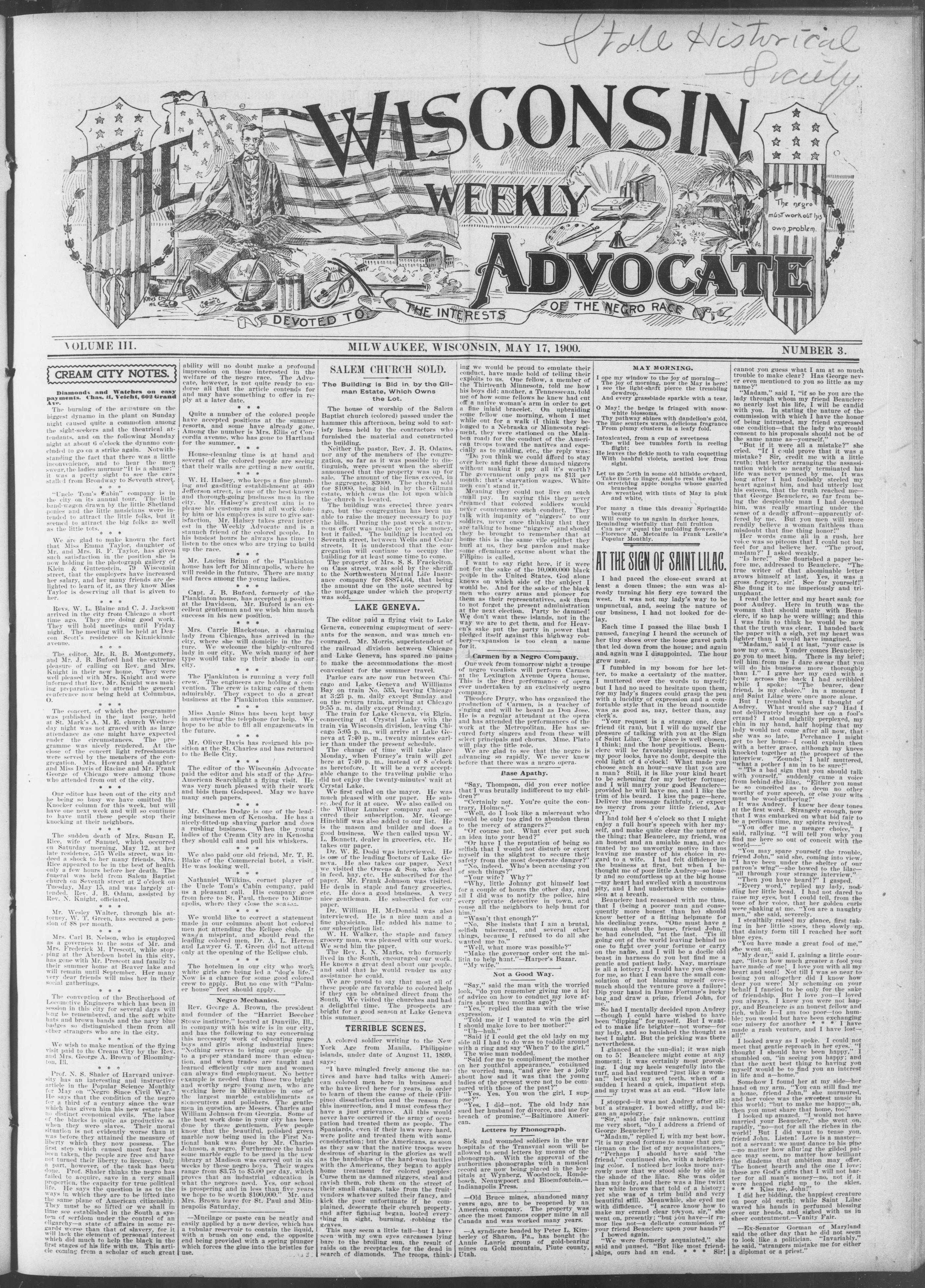
STATE HISTORICAL
SOCIety
WISCONSIN
WEEKLY
ADVOCATE
DEVOTED TO THE INTERESTS OF THE NEGRO RACE
CREAM CITY NOTES.
Diamonds and Watches on easy payments. Chas. H. Veicht, 602 Grand Ave.
The burning of the armature on the biggest dynamo in the plant on Sunday night caused quite a commotion among the sight-seekers and the theatrical attendants, and on the following Monday night at about 6 o'clock the dynamo concluded to go on a strike again. Notwithstanding the fact that there was a little inconvenience, and to hear the men swear, the ladies murmur "It is a shame;" it was a pretty sight to see the cars stalled from Broadway to Seventh street.
"Uncle Tom's Cabin" company is in the city on its annual tour. The little band-wagon drawn by the little Shetland ponies and the little musicians were intended to attract the little folks, but it seemed to attract the big folks as well as the little tots.
* * *
We are glad to make known the fact that Miss Emma Taylor, daughter of Mr. and Mrs. B. F. Taylor, has given such satisfaction in the position she is now holding in the photograph gallery of Klein & Guttenstein, 79 Wisconsin street, that the employers have increased her salary, and her many friends are delighted to learn of it, as they know Miss Taylor is deserving all that is given to her.
冰 寒 恋
Revs. W. L. Blaine and C. J. Jackson arrived in the city from Chicago a short time ago. They are doing good work. They will hold meetings until Friday night. The meeting will be held at Deacon Scott's residence on Kinnickinnic avenue.
☆ ☆ ☆
The editor, Mr. R. B. Montgomery, and Mr. J. B. Buford had the extreme pleasure of calling on Rev. and Mrs. Knight in their new home. They were well pleased with Mrs. Knight and were informed that Rev. Mr. Knight was making preparations to attend the general conference now being held at Columbus. O
***
The concert, of which the programme was published in the last issue, held at St. Mark's A. M. E. church Wednesday night was not graced with as large attendance as one might have expected under the circumstances. The programme was nicely rendered. At the close of the concert light refreshments were served by the members of the congregation. Mrs. Howard and daughter Miss Davis of Racine and Mr. Frank George of Chicago were among those who attended from out of the city.
***
Our editor has been out of the city and he being so busy we have omitted the Knocker column for this week, but will have one next week and will so continue to have until these people stop their knocking at their neighbors.
* * *
The sudden death of Mrs. Susan E. Rice, wife of Samuel, which occurred on Saturday morning, May 12, at her late residence, 515 Wells street, was indeed a shock to her many friends. Mrs. Rice appeared to be in the best of health only a few hours before her death. The funeral was held from Salem Baptist church on Seventh street at 2 o'clock on Tuesday, May 15, and was largely attended. Rev. J. B. Odam, assisted by Rev. N. Knight, officiated.
* * *
Mr. Wesley Walter, through his attorney, W. T. Green, has secured a pension of $8 per month.
空 空 空
Mrs. Carl B. Nelson, who is employed as a governess to the sons of Mr. and Mrs. Frederick M. Prescott, while stopping at the Aberdeen hotel in this city, has gone with Mr. Prescott and family to their summer home at Beaver lake and will remain until September. Her many very dear friends will miss her in their social gatherings.
* * *
The convention of the Brotherhood of Locomotive Engineers which has been in session in this city for several days will long be remembered, and the soft white hats and brown bands and the navy blue badges so distinguished them from all other strangers who are in the city.
求 求
We wish to make mention of the flying visit paid to the Cream City by the Rev. and Mrs. George A. Brown of Bloomington, Ill.
* * *
Prof. N. S. Shaler of Harvard university has an interesting and instructive article in the Popular Science Monthly for May on "Negro Since Civil War." He says that the condition of the negro for a third of a century since the war which has given him his new estate has no distinct economical evils. The labor of the blacks is quite as productive as when they were slaves. Their moral situation is not evidently worse than it was before they attained the measure of liberty which they now possess. The first step which caused most fear has been taken, the people are free and have not turned their liberty to license. Only a part, however, of the task has been done. Prof. Shaler thinks the negro has failed to acquire, save in a very small proportion, the capacity for true political life. He says the question is as to the ways in which they are to be lifted into the same plane of American citizenship. They must be so lifted or we shall in time see established in the South a system of serfdom under the control of an cligarchy—a state of affairs in some regards worse than that of slavery, for it will lack the element of personal interest which did much to help the black in the first stages of his life with us. This article coming from a scholar of such great
ability will no doubt make a profound impression on those interested in the welfare of the negro race. The Advocate, however, is not quite ready to endorse all that the article contends for and may have something to offer in reply at a later date.
***
Quite a number of the colored people have accepted positions at the summer resorts, and some have already gone. Among the number is Mrs. Ellis of Concordia avenue, who has gone to Hartland for the summer.
枣枣枣
House-cleaning time is at hand and several of the colored people are seeing that their walls are getting a new outfit.
* * *
W. H. Halsey, who keeps a fine plumbing and gasfitting establishment at 460 Jefferson street, is one of the best-known and thorough-going business men in the city. Mr. Halsey's greatest aim is to please his customers and all work done by him or his employees is sure to give satisfaction. Mr. Halsey takes great interest in the Weekly Advocate and is a staunch friend of the colored people. In his busiest hours he always has time to listen to the ones who are trying to build up the race.
* * *
Mr. Lucius Brinn of the Plankinton house has left for Minneapolis, where he will reside in the future. There are many sad faces among the young ladies.
* * *
Capt. J. B. Buford, formerly of the Plankinton house, has accepted a position at the Davidson. Mr. Buford is an excellent gentleman and we wish him much success in his new position.
* * *
Mrs. Carrie Blackstone, a charming lady from Chicago, has arrived in the city, where she will domicile in the future. We welcome the highly-cultured lady in our city. We wish many of her type would take up their abode in our city.
* * *
The Plankinton is running a very full crew. The engineers are holding a convention. The crew is taking care of them admirably. They expect to do a great business at the Plankinton this summer.
* * *
Miss Annie Sims has been kept busy in answering the telephone for help. We hope to be able to fill all engagements in the future.
* * *
Mr. Oliver Davis has resigned his position at the St. Charles and has returned to the Belle City.
* * *
The editor of the Wisconsin Advocate paid the editor and his staff of the Afro-American Searchlight a flying visit. He was very much pleased with their work and bids them Godspeed. May we have many such papers.
* * *
Mr. Charles Dodge is one of the leading business men of Kenosha. He has a nicely-fitted-up shaving parlor and does a rushing business. When the young ladies of the Cream City are in Kenosha they should call and pull his whiskers.
求 求
We also paid our old friend, Mr. T. E. Blake of the Commercial hotel, a visit. He was looking well.
收 存 出
Nathaniel Wilkins, cornet player of the Uncle Tom's Cabin company, paid us a pleasant call. His company goes from here to St. Paul, thence to Minneapolis, where they close the seaside.
串 恋 恋
We would like to correct a statement made in our columns about hot colored men not attending the Eclipse club. It was a misprint, and should read the leading colored men, Dr. A. L. Herron and Lawyer G. T. Green did not attend only at the opening of the Eclipse club.
```markdown
```
The hotelmen in our city who work white girls are being led a "dog's life." Now is a chance for some good colored crew to apply. But no one with "Palmer house" feet should apply.
Negro Mechanics.
Rev. George A. Brown, the president and founder of the "Harriet Beecher Stowe institute," located at Danville, Ill., in company with his wife is in our city, and has the following to say concerning this necessary work of educating negro boys and girls along industrial lines: "Nothing serves to bring our people up to a proper standard more than education, and when trades are taught and learned efficiently our men and women can always find employment. No better example is needed than those two bright and worthy negro young men, who are working here in Milwaukee in one of the largest marble establishments as stonecutters and polishers. The gentlemen in question are Messrs. Charles and William Johnson from Georgia. Some of the best work done in your city has been done by these gentlemen. Few people know that the beautiful, polished green marble now being used in the First National bank was done by Mr. Charles Johnson, a negro. Furthermore the handsome marble eagle to be used in the new library at Madison was carved out in six weeks by these negro boys. Their wages range from $3.75 to $5.00 per day, which proves that an industrial education is what the negroes need. Yes, our school is prospering and in less than five years we hope to be worth $100,000." Mr. and Mrs. Brown leave for St. Paul and Minneapolis Saturday.
—Mucilage or paste can be neatly and easily applied by a new device, which has a tubular reservoir to contain the liquid, with a brush on one end, the opposite end being provided with a spring plunger which forces the glue into the bristles for use.
SALEM CHURCH SOLD.
The Building is Bid in by the Gilman Estate, Which Owns the Lot.
The house of worship of the Salem Baptist church (colored) passed under the hammer this afternoon, being sold to satisfy liens held by the contractors who furnished the material and constructed the building. Neither the pastor, Rev. J. B. Odams, nor any of the members of the congregation, so far as it was possible to distinguish, were present when the sheriff announced that the property was up for sale. The amount of the liens exceed, in the aggregate, $3000. The church sold for $1000, being bid in by the Gilman estate, which owns the lot upon which the church is located.
The building was erected three years ago, but the congregation has been unable to raise the money necessary to pay the bills. During the past week a strenuous effort was made to get the money, but it failed. The building is located on Seventh street, between Wells and Cedar streets. It is understood that the congregation will continue to occupy the building for at least some time to come. The property of Mrs. S. S. Frackelton, on Cass street, was sold by the sheriff to the Northwestern Mutual Life Insurance company for $8874.64, that being the amount due on the note secured by the mortgage under which the property was sold.
LAKE GENEVA.
The editor paid a flying visit to Lake Geneva, concerning employment of servants for the season, and was much encouraged. Mr. Morris, superintendent of the railroad division between Chicago and Lake Geneva, has spared no pains to make the accommodations the most convenient for the summer travel.
Parlor cars are now run between Chicago and Lake Geneva and Williams Bay on train No. 535, leaving Chicago at 3:23 p. m. daily except Sunday, and on the return train, arriving at Chicago 9:55 a. m. daily except Sunday.
The train for Lake Geneva, via Elgin, connecting at Crystal Lake with the train via Wisconsin division, leaving Chicago 5:05 p. m., will arrive at Lake Geneva at 7:40 p. m., twenty minutes earlier than under the present schedule.
The change of time will take place Monday, when Furney's train will get here at 7:40 p. m., instead of 8 o'clock as heretofore. It will be a very acceptable change to the traveling public who did not enjoy the twenty-minutes' wait at Crystal Lake.
We first called on the mayor. He was much pleased with our paper. He subscribed for it at once. We also called on the Wilbur Lumber company and secured their subscription. Mr. George Hinchliff was also added to our list. He is the mason and builder and does a good business. We then called upon W. L. Bonnett, dealer in groceries, etc. He takes our paper.
Dr. W. E. Dodd was interviewed. He is one of the leading doctors of Lake Geneva. He also takes our paper. Next we visited the Owens & Son, who deal in feed, hay, etc. He subscribed for the paper. Mr. Frank Johnson was visited. He deals in staple and fancy groceries, etc. He does a good business. A very nice gentleman. He subscribed for our paper.
Dr. William H. McDonald was also interviewed. He is a nice man and a fine physician. He added his name to our subscription list.
W. H. Walker, the staple and fancy grocery man, was pleased with our work. We send him the paper.
The Rev. I. N. Marks, who formerly lived in the South, encouraged our work. He knows a great deal about our people, and said that he would render us any assistance he could.
We are proud to say that most all of these people are favorable to colored help if they can be obtained direct from the South. We visited the churches and had a delightful time. The prospects are bright for a good season at Lake Geneva this summer.
TERRIBLE SCENES
A colored soldier writing to the New York Age from Manila, Philippine islands, under date of August 11, 1899, says:
"I have mingled freely among the natives and have had talks with American colored men here in business and who have lived here for years, in order to learn of them the cause of their (Filipino) dissatisfaction and the reason for this insurrection, and I must confess they have a just grievance. All this would never have occurred if the army of occupation had treated them as people. The Spaniards, even if their laws were hard, were polite and treated them with some consideration; but the Americans, as soon as they saw that the native troops were desirous of sharing in the glories as well as the hardships of the hard-won battles with the Americans, they began to apply home treatment for colored peoples: Curse them as damned niggers, steal and ravish them, rob them on the street of their small change, take from the fruit-vendors whatever suited their fancy, and kick the poor unfortunate if he complained, desecrate their church property, and after fighting began, looted everything in sight, burning, robbing the graves.
This may seem a little tall—but I have seen with my own eyes carcasses lying bare to the broiling sun, the result of raids on the receptacles for the dead in search of diamonds. The troops, think-
ing we would be proud to emulate their conduct, have made bold of telling their exploits to us. One fellow, a member of the Thirteenth Minnesota, told me how his boys did; another, a Tennesseean, told me of how some fellows he knew had cut off a native woman's arm in order to get a fine inlaid bracelet. On upbraiding some fellow one morning, whom I met while out for a walk (I think they belonged to a Nebraska or Minnesota regiment, they were stationed on the Malabon road) for the conduct of the American troops toward the natives and especially as to raiding, etc., the reply was: "Do you think we could afford to stay over here and fight these damned niggers without making it pay all it's worth? The government only pays us $13 per month; that's starvation wages. White men can't stand it."
Meaning they could not live on such small pay. In saying this they never dreamed that colored soldiers would never countenance such conduct. They talk with impunity of "niggers" to our soldiers, never once thinking that they are talking to home "niggers" and should they be brought to remember that at home this is the same vile epithet they hurl at us, they beg pardon and make some effeminate excuse about what the Filipino is called.
I want to say right here, if it were not for the sake of the 10,000,000 black people in the United States. God alone knows on which side of the subject I would be. And for the sake of the black men who carry arms and pioneer for them as their representatives, ask them to not forget the present administration at the next election. Party be damned! We don't want these islands, not in the way we are to get them, and for Heaven's sake put the party in power that pledged itself against this highway robbery—expansion is too clean a name for it.
One week from tomorrow night a troupe of negro vocalists will perform Carmen at the Lexington Avenue Opera house. This is the first performance of opera ever undertaken by an exclusively negro company. Theodore Drury, who has organized the production of Carmen, is a teacher of singing and will be heard as Don Jose. He is a regular attendant at the opera and has attended the performances of the work at the Metropolitan. He has secured forty singers and from these will select principals and chorus. Mme. Plato will play the title role. We are glad to see that the negro is advancing so rapidly. We never knew before that there was a negro opera.
Base Apathy
"Say, Thompson, did you ever notice that I was brutally indifferent to my children?" "Certainly not. You're quite the contrary. Holmes."
"Well, do I look like a miscreant who would be only too glad to abondon them to the mercy of strangers?" "Of course not. What ever put such an idea into your head?"
"Or have I the reputation of being so selfish that I would not disturb or exert myself in the slightest to secure their safety from the most desperate danger?" "No, indeed. Who's been accusing you of such things?"
"Your wife? Why?"
"Why, little Johnny got himself lost for a couple of hours the other day, and all I did was to notify the police, hire every private detective in town, and rouse all the neighbors to help hunt for him."
"Wasn't that enough?"
"No. She insists that I am a brutal, selfish miscreant, and several other things, because I refused to do all she wanted me to."
"Well, what more was possible?"
"Make the governor order out the militia to help hunt."—Harper's Bazar.
"My wife."
Not a Good Way.
"Say," said the man with the worried look, "do you remember giving me a lot of advice on how to conduct my love affairs about two months ago?"
"Yes," replied the man with the wise expression.
"Told me if I wanted to win the girl I should make love to her mother!"
"Uh—huh."
"Said if I could get the old lady on my side all I had to do was to toddle around with a ring and say 'When?' to the girl."
The wise man nodded.
"Said for me to compliment the mother on her youthful appearance," continued the worried man, "and give her a jolly about how sad it was that the young ladies of the present were not to be compared with those of the past?"
"Yes. Yes. You won the girl, I suppose?"
"Yes, I did—not. The old lady has sued her husband for divorce, and me for breach of promise."—Baltimore American.
Letters by Phonograph.
Sick and wounded soldiers in the war hospitals of the Transvaal soon will be allowed to send letters by means of the phonograph. With the approval of the authorities phonographs with a musical record are now being placed in the hospitals at Wynberg, Woodstock, Rondebosch, Neauwpoort and Bloemfontein. Indianapolis Press.
Old Bruce mines, abandoned many years ago, are to be reopened by an American company. The property was once the most famous copper mine in all Canada and was worked many years.
A syndicate headed by Peter L. Kimberley of Sharon, Pa., has bought the Annie Laurie group of gold-bearing mines on Gold mountain, Piute county, Utah.
MAY MORNING.
I ope my window to the joy of morning—
The joy of morning, now the May is here!
I see the light-shaft pierce the trembling
dewdrop.
And every grassblade sparkle with a tear.
O May! the hedge is fringed with snow-white blossoms
white blossoms,
Thy pathway shines with dandelion's gold,
The lilac scatters warm, delicious fragrance
From plumy clusters in a leafy fold.
Intoxicated, from a cup of sweetness
The wild bee tumbles forth in reeling flight;
He leaves the fickle moth to vain coquetting
With bashful violets, nestled low from sight.
Let us go forth in some old hillside orchard,
Take time to linger, and to rest the sight
On stretching apple boughs whose gnarled branches
Are wreathed with tints of May in pink and white,
For many a time this dreamy Springtide beauty
Will come to us again in darker hours, Reminding wistfully that full fruition Can never equal the unfolding flowers. —Florence M. Metcalfe in Frank Leslie's Popular Monthly.
AT THE SIGN OF SAINT LILAC.
I had paced the close-cut sward at least a dozen times; the sun was already turning his fiery eye toward the west. It was not my lady's way to be unpunctual, and, seeing the nature of our business, I had not looked for delay.
Each time I passed the lilac bush I paused, fancying I heard the scrunch of her tiny shoes over the loose gravel path that led down from the house; and again and again was I disappointed. The hour grew near.
I fumbled in my bosom for her letter, to make a certainty of the matter. I muttered over the words to myself; but I had no need to hesitate upon them, for my lady's fingers could grasp the pen with a lucidity of expression and a comfortable style that in the broad noontide was as good as, nay, better than, any clerk's.
"Your request is a strange one, dear friend (it ran), but I will do myself the pleasure of talking with you at the Sign of Saint Lilac. The place is well chosen, I think; and the hour propitious. Beauclerc will be favorably impressed with my poor looks, have no doubt, despite the cold light of 4 o'clock! What made you choose such an hour—save that you are a man? Still, it is like your kind heart to be scheming for my better fortune; and I will marry your good Beauclerc—provided he will have me, and I like the trim of his beard. I kiss the page—here. Deliver the message faithfully, or expect no mercy from your little friend, Audrey."
I had told her 4 o'clock so that I might enjoy a full hour's speech with her myself, and make quite clear the nature of the thing; that Beauclerc, my friend, was an honest and an amiable man, and actuated by no unworthy motive in thus leaving me master of his choice in regard to a wife. I had felt diffidence in the business at first, but when I be thought me of poor little Audrey—so lonely and so comfortless up at the big house—my heart had swelled with a monstrous pity, and I had undertaken the commission at a breath.
Beauclerc had reasoned with me thus, that I (being a poorer man and consequently more honest than he) should know better of a fitting helpmate for his declining years. "One must have a woman about the house, friend John," he had concluded, "at the last. 'Tis ill going out of the world leaving behind no one to fight over your fortune or carry on the name, and I will be a docile old beast in harness do you but find me a gentle and patient lady. Nay, marriage is all a lottery; I would have you choose for me, so that I can have the small consolation of not blaming myself over much should the venture prove a failure! Dip your hand in Dame Fortune's lucky bag and draw a prize, friend John, for me."
So had I mentally decided upon Audrey—though I could have wished to have been "dipping" for myself. But I wanted to make life brighter—not worse—for my lady, and so banished the thought as best I might. But the pricking was there nevertheless.
I glanced at the sun-dial; it was nigh on to 5! Beauclerc might come at any moment; it was certainly most provoking. I dug my heels vengefully into the turf, and had ventured "just like a woman!" betwixt my set teeth. when of a sudden I heard a quick, impatient step, and my tryst was at an end. "How late
I stopped—it was not Audrey after all; but a stranger. I bowed stiffly, and began an apology.
"Sir," said the fair unknown, cutting me very short, "do I address a friend of George Beauclerc?"
"Madam," replied I, with my best bow, "it is my good fortune to name that gentleman on the list of my acquaintances." "Perhaps I should have said the friend,'" continued she, with a heightening color. I noticed her looks more narrowly now that we stood side by side in the shade of the lilac. She was older than my lady, and there was a line twixt her white brows that told of a history; yet she was of a trim build and very beautiful still. Meanwhile, she eyed me with diffidence. "I scarce know how to make my errand clear to you, sir," she went on, presently; "but you have—if rumor lies not—a delicate commission of your friend Beauclerc upon your hands?" I bowed again.
"We were formerly acquainted," she said and paused. "But like most friendships, ours had an end. * * * Sir!
cannot you guess what I am at so much trouble to make clear? Has George never even mentioned to you so little as my name?"
"Madam," said I, "if so be you are the lady through whom my friend Beauclerc so nearly lost his life, I will be candid with you. In stating the nature of the commission with which I have the honor of being intrusted, my friend expressed one condition—that the lady who would consent to his proposals should not be of the same name as—yourself."
"But if it were all a mistake?" she cried. "If I could prove that it was a mistake? Sir, credit me with a little truth; that letter arranging the assassination which so nearly terminated his life was never penned by me. It was long after I had foolishly steeled my heart against him, and had utterly lost his esteem, that the truth reached me—that George Beauclerc, so far from being the despicable man I had deemed him, was really smarting under the sense of a deadly affront—apparently offered by me. But you men will more readily believe a woman faithless than misdoubt that fine thing honor!" Her words came all in a rush, her voice was so piteous that I could not but feel for and believe her. "The proof, madam?" I asked weakly.
"Is here!" She flourished a paper before me, addressed to Beauclerc. "The true writer of that abominable letter avows himself at last. Yes, it was a gross forgery, sir! See for yourself!" She flung it to me imperiously and triumphant.
I read the letter and my heart sank for poor Audrey. Here in truth was the woman that should mate with Beauclerc, if so hap he were willing; and this I was fain to think he would be now that the truth was clear. I handed back the paper with a sigh, yet my heart was lighter than I would have imagined.
"Madam," said I at last, "your case is now my own. Yonder comes Beauclere; go you to meet him. There is my brief; tell him from me I dare swear that you will do his business more thoroughly than I." I gave her my card with a bow; across the back I had scribbled while I spoke: "The bearer, dear friend, is my choice." In a moment I and Saint Lilac were once more alone. But I trembled when I thought of Audrey. What would she say? Had I not deliberately brought her on a fool's errand? I stood mightily perplexed, my chin in my hand, half hoping that my lady would not come after all now, that she was so late. Perchance I might get to her home—I could explain then with a better grace, although my knees knocked together at the prospect of the interview. "Zounds!" I half muttered, "what a pother I am in to be sure"
"Tis a bad sign that you should talk with yourself," suddenly came a voice from behind the lilac. "Either you must be so conceited as to deem no other worthy of your speech, or else your wits must be wool-gathering!"
It was Audrey. I knew her dear tones at the first word. Strangely enough, now that I was embarked on what bid fair to be a perilous time, my spirits revived.
"You offer me a meager choice," I said, rallying. "I will tell you why you find me here so out of conceit with the world——"
"You may spare yourself the trouble, friend John," said she, coming into view. "I have been under the shelter of our patron's wing"—she bowed to the lilac—"all through your strange interview."
"When you have heard: I gasped.
"Every word," replied my lady, nodding her little head. I had not dared to raise my eyes, but I could tell, from the tone of her voice, that her golden curls were shaking at me. "You are a naughty man," she said, severely.
I stealthily raised my glance, first taking in her little shoes, then slowly up that dainty form till I reached her soft blue eyes.
"You have made a great fool of me," she went on.
"My dear," said I, gaining a little courage, "listen how much greater a fool you have made of me! I love you with all my heart and soul! Not till I was so near to losing you altogether did I know how dear you were! My scheming on your behalf I fancied to be only for the sake of friendship. But I love you—I loved you always. I knew you were not happy, and Beanclere is an honest fellow and rich, while I—I am too poor—too humble; you would but have been exchanging one misery for another * * * I have made a rash venture, and I have lost—all!"
I looked away as I spoke. I could not meet that gentle reproach in her eyes. "I thought I should have been happy," I stumbled on, "in seeing you happy; and that the next best thing to having you myself would be to find you an interest in life and a—home."
Somehow I found her at my side—her hand on my arm. "You can still find me a home, friend John," she murmured, and her voice was the sweetest music in this world; "but to make me happy—ah, then you must share that home, too!" I looked up amazed. "I would not have married your Beauclerc," she went on, rapidly, "no—not for all the riches in the world! But I did want to tease you, friend John. Listen! Love is a master—not a servant; we must dance to his pipe—no matter how alluring the gilded palace may seem, no matter how brilliant the diadems that ambition may offer. The honest hearth and the one I love; these are God's gifts that I will not barter for all man's money—no, not if it were heaped right up to the skies. * * * Kiss me, John!"
I did her bidding, the happiest creature on poor old earth; while Saint Lilac waved his hands in perfumed blessing over our heads, and sighed with us in sheer contentment.—Vanity Fair.
—Ex-Senator Gorman of Maryland said the other day that he did not seem to look like a politician. "Invariably," he said. "strangers mistake me for either a diplomat or a priest."
FIGHTING NEAR MAFEKING.
BULLER TAKES GLENCOE
Story that the Boers Were Advised to Surrender if Defeated at the Vaal.
Lourenco Marques, May 16.—A portuguese official dispatch says an encounter has occurred at Mafeking and that the Boers have been repulsed, with heavy loss. Buluwayo, May 13.—Messages from Mafeking show the stock of provisions is exceedingly low, and it is doubtful whether the garrison will hold out much beyond the end of the present month. Col. Plumer up to the present has contrived to cover the escape of 1000 native noncombatants from the town, though his attempts to get cattle in through the enemy's lines have hitherto been unsuccessful.
London, May 16-10:35 a. m.—The war office has posted the following dispatch from Gen. Buller, dated Dundee, May 16; "We occupied Glencoe yesterday. The Transvaalers have now evacuated Biggarsberg. The Free Staters on the Drakensburg are much reduced in numbers. The Carolina, Lydenberg and Pretoria commandoes trekked north from Blatikulu on the 13th and 14th of May. Eleven guns were trained at Glencoe. The last train, with ambulance, left there at dawn, May 15. This result has been largely produced by the action of the Fifth division, which during the last few days, has done a great deal of very hard work—marching, mountain climbing and road making.
"Trains are now running to Wessel's Nek station."
Nothing Definite About Mafeking. All sorts of rumors are heard regarding Mafeking, but nothing definite is known as to what has taken place since May 7. It was reported at Pretoria yesterday that the Boers had taken the town after hard fighting. On the other hand the Netherlands Railroad company announced that the British garrison had captured a large number of Boers. The following message from Lord Roberts is the latest official news: "Kroonstad, May 15, 1 p. m.—Baden-Powell reports, under date of May 7, all going well. Fever is decreasing; the garrison is cheerful and the food will last until about June 10."
Desperate Fighting Takes Place.
The Daily Mail prints the following, dated May 15, from its special correspondent at Lourenco Marques: "There is no doubt there was desperate fighting at Mafeking Saturday, but it is believed to have gone in favor of the garrison. The Boers, using artillery, attacked the town, and very soon the Kaffir location was in flames; some say as the result of shell fire, others as the result of treachery. Fighting at close quarters became general, and in the midst of the confusion the Boers gained possession of the Kaffir location, from which point of vantage brought guns to bear on the town at close range.
"By an adroit move the garrison, despite its attenuated numbers, succeeded in actually surrounding the party of Boers. Severe fighting followed, but, according to the latest reports, the Boers still hold the location, in which they are probably surrounded.
Boers Report Victory.
"I believe the Pretoria authorities, knowing of the progress of the relief column, gave orders to Gen. Snyman to storm the place. As soon as the location was in flames Boer bulletins of victory were flying about everywhere to encourage the weak-kneed burghers. Boers who came down here yesterday from Pretoria produced for the edification of incredulous Britishers two telegrams by officials, one of which was signed by Snyman, and said: 'I was lucky enough to capture Baden-Powell with 900 this morning.'"
British Casualties to Date.
London, May 16.—The war office last evening issued an abstract of British casualties since the beginning of the war. This shows a total of 20,035, exclusive of the sick in the field and the invalids, including the wounded sent home, who number 8901.
PLAY AN OLD TRICK.
Doers Fly Flag of Truce and Shoot the British Who Approch.
London, May 16—10:50 a. m.—The war office posts the following dispatch from Lord Roberts, under date of Kroonstad, May 15:
"Two officers and six men of Prince Alfred's guards, while out foraging yesterday, a few miles from Kroonstad, visited a farm flying a white flag, the owner of which surrendered himself, with arms and ammunition. They then approached another farm, also flying a white flag. When within forty yards of the enclosure, they were fired upon by fifteen or sixteen Boers concealed behind the farm wall. Two of the men were killed, Lieut. F. B. Walton was wounded and Lieut. W. B. Everton and two non-commissioned officers were taken prisoners.
"The owner of the farm states that the Boers threatened to shoot him when he protested against their making improper use of the white flag."
PLAYTHINGS OF POLITICIANS
Mission of Boer Envoys in America Beilttled in London.
London, May 16.—The afternoon papers here pay scant attention to the reception accorded to the Boer delegates in New York. The Pall Mall Gazette dubs them "playthings of American politicians" and the Evening Standard says: "The proceedings certainly showed unfriendliness to Great Britain, but no deeds will be forthcoming to prove the sympathy of the United States. Had American statesmen previously any hesitation President Kruger's offer to bribe them with a protectorate would have finally settled the matter."
The Reception in Washington.
Washington, D. C., May 16.—Representative Suzer of New York, chairman of the committee to receive the Boer delegates in Washington, today received a telegram from Messrs. Fischer, Wessels and Wolmarns, sating that they could not leave New York before Friday. Mr. Sulzer then announced the programme as follows:
On Thursday night a committee, consisting of three United States senators, three representatives and a number of prominent citizens, will go to New York to escort the delegates here. They will leave New York Friday morning and will be met at the depot here by a committee of 200 and taken to the Arlington hotel, where quarters have been engaged by the reception committee.
On Friday night an informal reception will be held at the hotel and on Saturday the Boer delegates will call to see the President.
On Saturday night there will be a meeting at the Grand Opera house, when the delegates will speak, and there will
be addresses also by senators and representatives.
Many Invitations Received.
New York, May 16.—Beyond a drive through Central park and the principal localities of interest in the city, no programme was arranged for the Boer envoys today. They spent the forenoon in answering telegrams and letters from more than sixty cities in the United States from which invitations had been received.
C. U. Wessels, one of the envoys, discredited the cable dispatches to the effect that President Steyn of the Orange Free state is said to have lashed the Free Staters to make them fight. He said the Free Staters were all working together and in perfect harmony. Asked concerning the English advances and successes reported in recent cables, he said:
Crucial Test at Vaal River.
"Everything is going according to the plan of action prepared some time ago. Every time we fall back it is given out as a British success, but it is all a preconceived plan and does not hurt us in any way. The final crisis has not yet come. What I consider the crucial test will be at the Vaal river, near Pretoria. I do not think that the stories published about the British successes are neutral news, but highly optimistic from a British standpoint."
OBTAINS SOME CREDENCE.
Report that Boers Were Advised to Survive
render if Defeated at the Vaal.
London, May 16.—The most important development in today's war news is the statement cabled from Cape Town announcing that the Boer delegates had advised the Transvaalers to surrender if defeated at the Vaal. This remarkable announcement is vouchered for on good authority and evidently obtains more credence in Cape Town than would a mere rumor.
The occupation of Glencoe was merely a logical sequel of Gen. Buller's advance and the Boers' retiring movement. As usual, the Boers are reported to be flying precipitately, but, also as usual, the accounts add that their transport and gun were removed in safety, which in itself is a contradiction of any statement that the Boers were panic-stricken.
Mafeking Siege Prolonged.
Nothing further has been heard from Mafeking and it is reasonable to suppose that the conditions there are unchanged. The prolongation of the siege only intensifies Great Britain's anxiety to hear of its relief.
About 1100 more troops have arrived at Beira, Portuguese East Africa. Among them is Lord Dunraven, who accompanied the Dunraven snarpshooters as a supernumerary captain on the battalion staff.
Apparently Lord Roberts is still waiting at Kroonstad, preparatory to making a swift movement on the Vaal river.
Cape Town Canard Denied.
New York, May 16.—Messrs. Fischer, Wolmarins and Wessels, constituting the envoys from the South African republic and Orange Free State, were questioned today regarding the statement from London that a cablegram from Cape Town asserted that they had advised surrender should their countrymen be defeated on the Vaal river. Severally and collectively the envoys vehemently denied that they had given any such advice, and they declared that they were unalterably opposed to surrender.
POSTAL FRAUDS IN CUBA.
Resolution Introduced Calling for an Investigation - Postmaster Tompson's Confession.
Washington, D. C., May 16.—Representative Hay of Virginia today introduced in the House a resolution providing for an investigation of the postal tronds in Cuba.
Havana, May 16.—Postmaster E. P. Thompson of Havana local office has signed a sworn statement in which he says that September 16 last, being in need of money, he took from the money-order funds $435, giving his memorandum as a receipt for the same. When the inspections were held, Mr. Thompson ordered a clerk in charge of the money-order department to place remittances received that day, which would not have to be accounted for until the following day, sufficient to cover the amount of his receipt, which was there withdrawn until after the inspection. This was kept up until April 7, when the special agents unexpectedly discovered the receipt, which Mr. Thompson then paid. He also admits that Charles F. Neely, late financial agent of posts at Havana, endorsed a bill for $350 which Thompson had discounted by the North American Trust company. Thompson admits other irregularities in connection with his department.
FIVE GIRLS ELOPE.
Discovered on Military Train, Two Are Torn from Their Heroes and Sent Home.
Chicago, Ill., May 16.—[Special.]—Inspired by the love for gallant soldier boys and longing for adventure and life with their sweethearts in a strange land, five young women cut off their tresses, donned blue uniforms and started for Santiago, Cuba, with the battalion of the Fifth regiment, United States infantry, that left Fort Sheridan Monday night on a special train. The young women, close beside their sweethearts, crouched under seats in the hope of escaping detection. They had "made up" to appear as mannish as possible, and hoped to avoid being recognized as women by the officers in charge of the train, even though circumstances forced them to a face-to-face encounter. They intended to accompany the regiment to New York city, and from there to the boats bound for Santiago, where the soldiers will do duty for Uncle Sam. Five weddings had been planned in the strange land, and a life of happiness, under the sunny skies of Cuba, was in prospect for the fair adventures.
The train whisked through Chicago and the southern suburbs, and the young women and their sweethearts had just begun to believe that their coup would prove successful when one of the officers discovered one of the fair passengers. The train was brought to a halt just inside the state line and Jessie Sherwood, 17 years of age, was compelled to leave the train, bringing sorrow to the heart of Sergt. Michael Langmeyer of Co. K. The officers decided to make a search of the train and Emma Winoski, 18 years of age, was discovered and put off.
The three other girls had escaped detection, according to latest reports, but it is probable that they will be restrained from accompanying their sweethearts to Cuba.
The romantic maidens are said to be residents of the town of Fort Sheridan, but their names are as yet undisclosed.
Jumped from Brooklyn Bridge
New York. May 16.—An unknown man jumped from the Brooklyn bridge at 2:30 o'clock this afternoon. When he came to the surface he was picked up by a passing tug. It is not known whether he was hurt.
From letters and memoranda found in the pockets of his coat the man is supposed to be August A. Pless of New York.
Tammany Chieftain will Probably Suffer for the Action of His Fellows in America.
London, May 15.—The Express of today advocates the ostracism of Richard Croker in England in revenge for Tammany's attitude on the Boer war. It says: "It has not escaped notice in this country that an American welcome to the Boer delegates has been inspired and encouraged by Tammany hall, which is controlled by the notorious boss, Richard Croker.
"The records of Tammany are already black enough without the addition of this new infamy. But what makes the action of Tammany peculiarly infamous now is the fact that Croker claims this hospitality of an English domicile, poses as an English country gentleman and runs race horses on the English turf, yet is adding and encouraging the worst of England's enemies."
SOLVES THE DANISH ISLAND MUDDLE.
Will Put Them Into the Hands of a Chartered Company-Waiting for Congress.
New York, May 15.—An article in the Vorland, the organ of the Danish government in Copenhagen, states that Denmark is considering a plan to put an end to the Danish West Indies islands muddle by placing the islands in the hands of a chartered company, which will conduct their affairs under the Danish flag, and thereby cutting off Germany as well as the United States from obtaining possession of the islands.
It is perfectly well understood in diplomatic circles in Washington, it is stated, that unless Congress acts on the matter of the islands during this session this government cannot become a purchaser. The chartered company is composed of leading Danes, and they have shown the government clearly that they can make the islands a source of profit to the crown instead of a loss, as heretofore. The Danish government awaits only the close of Congress to ratify publicly the agreements already privately entered into.
RIOTING IN ST. LOUIS.
Crowd Stones a Repair Wagon and One of Them is Shot-De-laying the Mails.
St. Louis, Mo., May 15.—Thomas King, aged 22, who was in a crowd of men and boys that stoned a transit company repair wagon at Olive and Twentieth streets today was shot and badly wounded by one of the men in the wagon.
Additional complaints relative to the obstructions of railway mail cars was filed with the United States authorities here today.
All street car lines in East St. Louis are in operation today and the management says the strike amounts to nothing. A committee from the Suburban line complained to President Mahon, the strike leader, today that the company was not keeping the agreement adopted last night.
Sixty additional special policemen were sworn in today and with the 210 recruited yesterday were armed with revolvers and clubs and put on duty. The grievance committee of the street railway strikers and President Whitaker and Attorneys Priest and Lehman of the St. Louis Transit company resumed the conference that broke up last night without reaching any conclusion. As before, the meeting is being held behind closed doors. Arrangements are being made for a monster street parade of all the labor unions in St. Louis next Sunday. It is expected to have 35,000 men in line. Six cars on the Bellefontaine line were started this afternoon under heavy guard.
AGUINALDO'S WARNING
Gen. Otis Sends Proof that the Americans Did Not Inaugurate the War.
Washington, D. C., May 15.—The President today sent to the Senate a letter from Gen. Otis transmitting a translation of a letter written by Aguinaldo to a friend in Manila, warning him to leave that city. Aguinaldo's letter is dated Malolos, January 17, 1899, and is addressed to Senor Bonito Legardo. In it Aguinaldo says:
"I beg you to leave Manila with your family and to come here to Malolos, but not because I wish to frighten you. I merely wish to warn you for your safety, although it is not the day or the week."
In his communication of transmittal, Gen. Otis says:
"The letter is forwarded to meet still fur her the absurd charge that the American authorities in Manila inaugurated the war."
Gen. Otis also states that this letter is one of a number written by Aguinaldo to his friends in Manila warning them to leave the city for their safety. He adds that many families left the city in consequence of this warning.
WITH THEIR THROATS CIT.
Mother and Four Little Children Cruelly Slaughtered. Peoria, Ill., May 15.—Mrs. Thomas Moser, wife of a farmer living three miles north of Tremont, Ill., and her four small children were found dead in their home today. All had apparently been dead since Sunday. Their throats were cut from ear to ear. Mrs. Moser's body was found in the cellar, covered with old carpet. The children lay in their beds upstairs, apparently having been killed as they slept. Moser has disappeared, but there is no known evidence pointing to his having committed the crime.
A Market for Fish Scales
It might puzzle many persons to guess what use could be made of fish scales, but in the extreme Orient, the Indies and China they are employed as buttons, passementeries, in trimmings, embroidery and certain kinds of jewelry. The manufacture is carried on in France, where the price paid for the scales is from eight to twelve francs ($1.74 to $2.31) a kilogram, 2.2046 pounds. The scales must be small and bright. Those now used are the scales of the bleak or blay, a small fish which is called the ablette in French. Some samples from New York are pronounced "too large and despiled of their brightness."
American Duels in Germany
To show how little Germany knows of the way Americans have of settling affairs of honor, it is mentioned that students have instituted what they call the "American duel." The parties to a quarrel draw lots and the loser is in honor bound to commit suicide. Someone with a grudge against this country must have invented this idea of the code of honor.
—In Illinois during the last fifteen years birds have decreased 38 per cent
TWO BURNED TO DEATH.
Fifteen Persons Receive Severe Injuries Which will Probably Result Fatally.
Chicago, Ill., May 16.—Two persons were killed, one is missing and fifteen were injured in a fire which early today destroyed the Hotel Helene at 110 to 114 Fifty-third street. Five of the injured will probably die. The dead:
CHARLOTTE PETERSON, dining room girl, found in her room burned to a crisp.
LENA PEARSON, found burned almost beyond recognition in room with Miss Peterson.
The missing;
W. E. Horn, burned about face, hands and body, leg broken; will die.
S. G. McHaddin, flesh partly burned from body; will die.
body; will die. E. E. Tarbux, burned about body; recovery doubtful. Elizabeth Elwrence, internally injured and
Elizabeth Florence, internally injured and skull fractured; unconscious; recovery doubtful.
E. E. Allen, both ankles sprained and internally injured in jumping from third-story window.
Mrs. T. D. Allen, back broken and internally injured; jumped from third-story window; will die.
Miss Helen Joseph, badly bruised and overcome by smoke. Stella Neilwolski, chambermaid, jumped from first floor; overcome by smoke and injured internally.
L. James O'Neil, porter, burned about face.
Mrs Sarah Hutchinson, a high school teacher; injured in falling from second floor.
James Costin, fireman, cut by falling glass.
Mrs. Bruce and baby, overcome by smoke.
Thomas Morgan, policeman, back injured.
Mrs. Adelia Lawson, badly bruised.
Patterson.
The loss to the building and furnishings was $40,000.
The destruction of the hotel was replete with daring rescues and narrow escapes. James McNeil earned his title of hero. He was a porter in the hotel and the first to warn the sleeping occupants of their danger. He carried Helen Joseph down a swaying ladder from the third floor, and then, amid the cheers of the onlookers, returned to the second floor, where a woman was lying unconscious, her clothing on fire. He carried her to the window and dropped her into the arms of Policeman Wolf.
A Daring Rescue.
The effort and the heat were too much for McNeil and he staggered back into the smoke. The people below thought he was lost. A policeman mounted to the shoulders of a brother officer and, clambering over the window-ledge, dragged McNeil from the room. He soon recovered consciousness.
The rescue of a woman and her baby aroused the enthusiasm of the crowd. Mrs. Bruce, with one arm around her infant, was clinging with the other arm to the ledge of a second story window. Smoke was pouring out in smothering cloaks and her fingers were relaxing when three policemen, carrying a blanket, rushed into the flames which were then darting from the basement.windows, just in time to catch the woman and her child in the blanket. Mrs. Bruce was badly burned, but succeeded in protecting her baby.
Blaze Spread Rapidly.
There were many other narrow escapes and exhibitions of courage during the burning of the structure. There was but one entrance to the building, which compelled the greater number of the guests to make their exits through the windows. The rescues were nearly all accomplished before the firemen arrived. The blaze spread so rapidly that had the people in the hotel been compelled to await the arrival of the hook and ladder company many more lives would have been lost. The policeman and others early on the ground were able to secure ladders from a paint store nearby and by this means many were saved. The fire started in the basement and spread with great rapidity. But for the heroic action of Porter McNeil every person in the building would probably have perished.
Girl Hangs from Window Ledge.
Miss Florence, who was probably fatally injured, was seen by Sergt. Donovan as she hung from a third-story window.
"Hang on till I get a ladder," he cried as he turned and ran for the article needed. But the young woman, nearly fainting from smoke and nervousness, gradually lost her grip. The officer, hurrying back with the ladder, appeared just in time to see her let go of the ledge and fall to the stone sidewalk below. She was picked up, bleeding and unconscious and placed in an ambulance.
Dr. N. R. Yeager, who occupied one of the upper rooms, escaped with a few bruises by jumping to an awning which had been left down over night. It broke the force of his fall.
Farmer's Wise Precaution.
W. T. L. Morrow, a farmer whose home is in Columbia, Tenn., owes his escape to his horror of fires. He always sleeps with a rope under his pillow. When the alarm was sounded he had made fast the rope to his bed and slid to the ground. Police, firemen and spectations united in one voice in praise of Porter McNeil. He was formerly a gunner in the English navy on board the battleship Dreadnaught and holds medals for marksmanship and proficiency in drilling. He took part in the Jameson raid and it was while in South Africa that the illness which compelled him to secure a discharge came upon him.
DIE OF YELLOW FEVER.
Members of Italian Opera Company Victims of the Dreaded Disease. New York, May 16.—A dispatch to the Times from Rio Janeiro says: One of the most disastrous accidents that ever befell an opera company was the almost-complete destruction by yellow fever of an Italian opera company which gave performances recently in the city of Manor, Amazonas, and other cities in central Brazil.
The first evidence of the dreaded disease made its appearance when several members of the company attended a mask ball to which they were invited. Upon returning from the affair the director of the company, Signor Solnik, was taken sick and died of the fever three hours later. Shortly after the director's death the leading prima donna, Theresa Zeicchi, developed symptoms of the fever, which frightened her into hysterics. In a paroxysm she bit her tongue through and bled to death.
Twelve members of the company were then taken with the fever and died, three only surviving. Those who escaped took their departure from the country for Genoa.
Royal Marriage Announced
Moscow, May 16. The Czar has just issued a manifesto announcing the marriage of the Grand Duke George Michaelovitch to Princess Maria, the daughter of the King of Greece, at Corfu.
ONLY ROBBER BANDS.
Outlaws Incited by Native Politicians Continue the War in the Philippines.
San Francisco, Cal., May 16.—Brig. Gen. Schwan, who was Gen. Otis' chief of staff in the Philippines for nearly a year, has arrived here from Manila on the transport Thomas. He will remain in San Francisco for a short time awaiting orders from Washington assigning him to duty elsewhere. Concerning the situation in the Philippines, Gen. Schwan is hopeful that it will not be many months before affairs will have naturally adjusted themselves to the American control and the robber gangs will have been stamped out. "The robber bands," said Gen. Schwan, "are incited by native politicians who impose upon the credulity of the masses. No people are as credulous as the lower class of the Filipinos. These leaders have been inciting the ex-soldiers to continue on the warpath, assuring them that an American election was soon coming and that McKinley would be defeated and the Americans withdrawn from the Philippines.
There are about 60,000 troops in the Philippines now, which number is ample for the situation. The robber bands are armed principally with keen-edged bolos, the native weapon. They pillage small towns and frequently cut the throats of natives who have been friendly to Americans. However, the distributed garrisons are gaining the confidence of the townspeople, where they are stationed, and have succeeded in some cases in getting native help to guide them to the robbers.
"After the wet season and after the national elections in this country, the pacification of the Philippines will naturally complete itself. We are in complete military possession of the islands. The only problem is the civil government of the islands and that will come as a natural consequence of the others."
BLOODIEST OF THE WAR.
Heavy Loss by American Troops in the Battle at Catubig.
Washington, D. C., May 16.—The officials of the war department, after waiting for nearly a week to hear something from Gen. MacArthur at Manila confirmatory of the press report of the bloody three days' engagement at Catubig, which resulted in the heaviest loss of life the American army has sustained in any one engagement in the Philippines, yesterday cabled Gen. MacArthur a request for information. The answer was received today confirming the press reports and adding some interesting details. Gen. MacArthur transmitted a report from Henry T. Allen, a major of the Forty-third volunteers, who commanded the United States forces on the island of Samar. It appears that this force was divided among several posts on Samar, and while details are still lacking, it is believed that this particular force which was besieged at Catubig was not commanded by a commissioned officer but by a sergeant, either George or Hall, both of whom were killed. Catubig, where the engagement occurred, is a seaport town of nearly 10,000 inhabitants.
Gen. MacArthur's cablegram is as follows:
Manila, May 16, 1900.—With reference to your telegram of the 14th, the rumored engagement on Samar, reported by cablegram of Gen. Otis May 4, has been confirmed by reports recently received from Henry T. Allen, Forty-third regiment, United States Volunteer infantry, commanding Samar island. That detachment of thirty-one men stationed at Catubig were attacked April 15 by 600 men with 200 rifles and one cannon. Our men were quartered in a convent, which was fired the next day by burning hemp thrown from an adjoining church. The detachment attempted to escape by the river. Men getting into boats were killed; the remaining men intrenched themselves near the river and held out two days longer, facing most adverse circumstances, until rescued by Lleut, Sweeney and ten men. Over 200 of the attacking party (many of them are reported having come from Luzon island) are reported killed and many wounded. Lleut. Sweeney reports the streets covered with dead insurgents.
The Killed and Wounded.
Killed—Sergts. Duston George, William J. Hall; Corps, Herbert H. Edwards, John F. J. Hamilton, Cook, Burton E. Hess, Musician Burton R. Wagner; Privates Treffle Pomslow, Otto B. Loose, Stephen Apperti, Joseph Noell, John E. Kuhn, Ralph H. Zim, Edward Braman, Chester A. Conklin, Walter E. Collins, Joseph J. Kerins, Henry Dumas, Philip Sailing and George A. Slack, all of Co. H, Forty-third regiment, U. S. V. infantry.
Wounded—Privates Lester Ruchworth, Harry C. Lee, Michael J. Faron, James H. Claney, Co. H, Forty-third regiment, U. S. V. infantry; Corp, White, Co. F, Forty-third Volunteer infantry.
A copy of Henry T. Allen's report forwarded by mail yesterday. Hoilo (Panay) cable is broken by earthquake. Difficult to procure more definite information.
SCHLEY WILL REFUSE.
Talk of His Nomination for Vice President is Worse than Fultile
Omaha, Neb., May 16.—Gen. Charles F. Manderson, an intimate friend of Admiral Schley, said discussion of the grand naval heres name in connection with the vice-presidential nomination was worse than futile.
"The admiral is not a fool," continued the general. "He could not be induced to accept any political office. His tenure of office is for life, and he will be retired on a salary nearly equal to that of the vice-president, and upon his demise in the service his wife would be taken care of. Should he accept political office his sacrifice would be too great, admitting for the moment that his election would be possible.
"The admiral said to me in person, what he had written to me some months ago and what he had said to friends who had mentioned political office to him, that nothing could induce him to accept, He answered his friends as did Gen. Sherman, that if nominated he would not accept and if elected he would not serve. And he made them believe what he said, for the admiral has no political ambition whatever. In his conversation with me he said he was an expansionist and believed the government must hold the L.ines. The admiral is no more of a Democrat than he is a Republican."
SUCCESSION DUTY ALLOWED.
Judgment for $6,000,000 Against Jewish Colonization Society. London, May 16.—In the Queen's bench division of the high court of justice today Judges Ridley and Darling gave judgment in favor of the crown in the case of the government versus the Jewish Colonization association on a claim for succession duty amounting to £1,250,000 upon property valued at upwards of £8,000,000 settled by the late Baron Hirsch, in 1892, upon the Colonization association.
MASSACRE OF CHRISTIANS.
More Boxer Outrages Reported North of Tien Tsin.
Tien Tsin, May 16.—More "Boxer" outrages are reported sixty miles north of Tien Tsin, where a number of native Christians have been massacred. The British admiral has arrived here and proceeded for Pekin.
1
Mrs. F. W.
Goulder, 1506
4th ave., Rock
Island, 111. $
writes:
"I was afflicted for five or six years with catarrhal difficulties and was growing worse all the time. I began taking your Peruna with a marked improvement from the first. Independent of curing that, the Peruna has greatly improved my general health."
"Every bottle of Peruna is worth its weight in gold; especially to me, for I owe my present good health to Peruna."
All over the country there are women who have been invalids for many years, suffering with female derangements which the family doctor cannot cure.
What a boon to such women is Dr. Hartman's free advice! So famous has his skill made him that hardly a hamlet or town in the country but knows his name. He cures tens of thousands, and he offers to every woman who will write to him her symptoms and a history of her trouble, free advice and treatment.
The medicines he prescribes can be obtained at any drug store, and the co t is within the reach of any woman. He describes minutely and carefully just what she shall do and get to make a healthy, robust woman of herself.
The Doctor has written a book especially for this class of women, entitled "Health and Beauty." This book contains many facts of interest to women, and will be sent free to any address by Dr. Hartman, Columbus, Ohio.
A New Romance by Julia Magruder.
A New Romance by Julia Magruder.
"The Voice in the Choir" is the latest romance from the pen of Julia Magruder, and its publication will begin immediately in the Ladies' Home Journal. It is a love story that has its inception through an accidental meeting in a church choir, and which by strange accidents is shifted to the hospital tent in the wake of an invading army. Miss Magruder heightens the charm of "The Voice in the Choir" by uniquely velling the climax.
Row's This?
We offer One Hundred Dollars Reward for any case of Catarrh that cannot be cured by Hall's Catarrh Cure.
F. J. CHENEY & CO., Props. Toledo, O.
We, the undersigned, have known F. J. Cheney for the last 15 years, and believe him perfectly honorable in all business transactions and financially able to carry out any obligation made by their firm.
West & Truax, Wholesale Druggists, Toledo, O.
Walding, Kinnan & Marvin, Wholesale Druggists, Toledo, O.
Hall's Catarrh Cure is taken internally, acting directly upon the blood and mucous surfaces of the system. Price, 75c. per bottle. Sold by all Druggists. Testimonials free.
A Dictionary for the Blind.
The printing of a dictionary for the blind in the New York alphabet point system has been undertaken at the printing office of the Maryland School for the Blind. There are at present a number of dictionaries in the raised-letter system, but only in three and four volumes. The new dictionary will be in about eighteen volumes and will contain over 1800 pages.—New York Post.
What Do the Children Drink?
Don't give them tea or coffee. Have you tried the new food drink called GRAIN-O? It is delicious and nourishing, and takes the place of coffee. The more Grain-O you give the children the more health you distribute through their systems. Grain-O is made of pure grains, and when properly prepared tastes like the choice grades of coffee, but costs about $ \frac{1}{4} $ as much. All grocers sell it. 15c and 25c.
Relic of the Rebellion.
Among the interesting relics recently secured by the Confederate museum at Richmond, Va., is the main shaft of the old frigate Merrimac, or as she was renamed by the Confederate authorities, Virginia. The shaft is much worn and rust-eaten, but shows that it was originally a fine piece of work.
Sterling silver Pulley Buckles. Send 25 cents. Quality guaranteed. Archie Tegtmeyer, Gold and Silversmith, Grove street and National avenue, Milwaukee.
—England sold to foreign countries 338 steamers and 266 sailing vessels in 1899.
Have you tried "M-B" Flavors? If not, why? Your grocer sells them.
—The number of Mormon missionaries in the field is said to be 1700.
Fisher's Flavoring Extracts are endorsed by pure food laws and the U. S. government for their PURITY and STRENGTH. A. J. Hilbert Co., Milw.
Since 1891 Colorado has produced over $75,000,000 in gold.
Is tired feeling—blood lacks vitality and richness, and hence you feel like a laggard all day and can't get rested at night. Hood's Sarsaparilla will cure you because it will restore to the blood the qualities it needs to nourish, strengthen and sustain the muscles, nerves and organs of the body. It gives sweet, refreshing sleep and imparts new life and vigor.
Felt Tired—"In the spring I would have no appetite and would feel tired and without ambition. Took Hood's Sarsaparilla in small doses, increasing as I grew stronger. That tired feeling left me and I felt better in every way." W. E. Baker, Box 96, Milford, Ohio. Remember
Hood's Sarsaparilla
Hood's Sarsaparilla
Is the Best Medicine Money Can Buy.
Prepared by C. I. Hood & Co., Lowell,
Mass. Sold by all druggists. Price $1.
LACE
CURTAINS
25 to 40c pair.
Laies' and Gent's Clothes and alkinds of Family Dyeing at real
sona le prices. Mail or orders promptly
attended to. Wrle. HACK &
ALTEN, 534 Clinton Street, Milwaukee. Wis.
LACE
CURTAINS
Laies' and Genis' Clothes and aikinds of Family Dyeing at real sona le prices. Mail orders promptly attended to. Wri e. HACK & ALTEN. 534 Clinton Street, Milwaukee. Wis.
ARTIFICIAL LIMBS.
Latest Patented Improved Legs
Braces for All Deformities—Catalogs Free
The Doerflinger Artificial Limb Co. Milwaukee Wisconsin.
FAVORS THE CANTEEN
ARMY CHAPLAIN SAYS IT IMPROVES SOBRIETY.
American Saloon Has Superseded the Native Philippine Gin Mill Where Poisonous Liquor Was Sold- Condemns Democratic Criticism.
Chaplain Charles C. Pierce, of the United States army, who has been on the firing line with our troops in the Philippines since February 4, 1899, was commanded to report to the adjutant general upon the physical and moral welfare of the American soldiers there. His report reads as follows:
I am compelled by you to write "without fear or favor." I have no favor to ask, General, because, although I have been in Manila for eighteen months, my work is there and I desire to return to it. As to fear, I have never known such a feeling in the army. My treatment has always been courteous, and I have always been permitted to say, freely and frankly, all that I thought necessary, in the matters involving my legitimate sphere of work.
As to matters of moral import I have been pained to note in many alleged interviews in newspapers a disposition to give to the facts but a partial publication. I have read the statement that but two saloons existed in Manila, at the time of its occupation by the Americans. As I first saw that city, only eight days later, I can say that this figure is too small; and although it is a fact that more public saloons exist to-day, it is also true that there are not so many of them as to involve a net increase in the number of places in Manila where liquor may be procured, but, on the contrary, a diminution. The truth is (and I have not yet seen a statement of this fact in any newspaper purporting to give an interview with persons who have returned from there), that the American saloon has superseded something else. What it has superseded is a most important question in this interesting controversy.
When I first saw Manila the streets were practically lined with little nipa huts, perhaps about twelve feet square, in which the natives were selling, at a merely nominal price, not only fruit and tobacco, but also native gin. These "gin shacks" should certainly be included in the number of drinking places existing at the beginning, and their number was very large. The character of this native drink was so fiery and villainous that its effect upon such of our men as used it was deplorable. It became my duty to bury two soldiers who never recovered from the effect of drinking it. One of them had been in the service about eighteen years, and received from his officers, in personal conversation with me, a commendation so flattering with regard to his character for sobriety and soldierly honor that it might be coveted by any man. He had never been a drunkard, but this native poison was so virulent in its effect that he became maddened, and lingered in his delirium a whole week, never having recovered his reason, at the time of his death. Our authorities set to work to restrict this traffic, by a system which finally resulted in its prohibition.
I am not personally an advocate of any saloon, but I am forced to give my testimony that the substitution of regimental canteens, in which only beer was sold, in place of this traffic in native gin, resulted in a most immediate and perceptible improvement in the sobriety of the troops. I should welcome the day when all men, out of the army as well as in it, might find it agreeable by their abstinence, to crush out the market for all malt or spirituous products. That millennial age, however, has not dawned, and my opinion is that it is better to accept such forms of restriction as are feasible than to insist upon a theory which, however ideal, is impossible of enforcement.
I bear my cheerful testimony to the earnest effort of the commanding general, supplemented by the vigilance of the two incumbents of the provost marshal general's office, to crush out the more dangerous forms of this traffic, and to impose such restrictive regulations as will reduce the whole business to a minimum. The whole history of our occupation of Manila has been one of development and progress, along physical, intellectual and moral lines, and I believe that no man could refuse to admit it had he been permitted to see the progress of this work and to be admitted, to some slight extent, into the confidence of those who are charged with it. I am quite sure that the desire of the authorities would involve the further diminution of these saloons, by some gradual process, which will lead up to the very limit of feasibility.
The critics of those who have this work in charge may have a share in the improvement of our men, which is more practical than mere criticism. In the first place they should see to it that some provision is made, through Congress, for furnishing a chaplain for each regiment stationed there, so that religious and moral instruction may persistently be given to all our troops. In the second place their contributions ought to be given to those who have in mind the establishment of reading rooms and club houses for soldiers, so that men may find some other place, furnished by Christian people, which is as bright and as attractive to them in their leisure hours as the saloon itself.
These measures will doubtless serve to lessen very greatly the attendance at saloons, and I conceive it to be the duty of the American people, in behalf of the men whom they have sent forth, to hold their territory and to fight their battles (as brave and noble and true a body of men as ever stood in the defense of any nation) to make sacrifices, if need be, to insure the establishment of such agencies as may, along the line of moral suasion and religious influence, counteract more baneful agencies, and supplant lower instincts with loftier ideals.
"The Next Step."
The next step will be promptly taken, but it will not be "to free the United States from the incubus of its Asiatic possessions." "The next step" which the administration has had in view from the outset must be the establishment of good order, of stable government, throughout the archipelago. To this duty the United States is irrevocably pledged. To leave it unperformed would be to court infamy. The consummation of the task of stamping out the troublesome remains of insur-
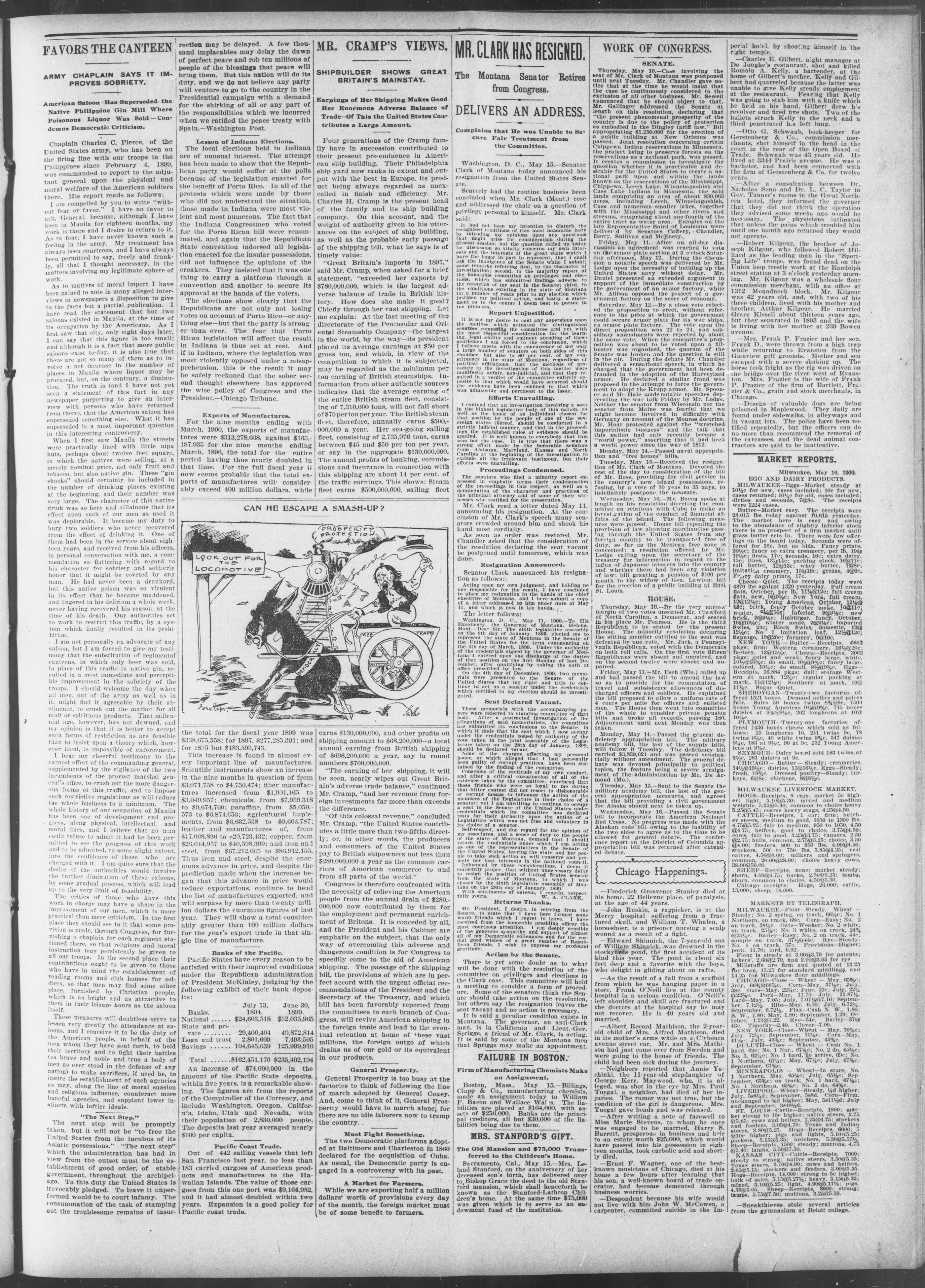
CAN HE ESCAPE A SMASH-UP?
PROSPERITY
PROTECTION
LOOK OUT FOR
THE
LOCOMOTIVE
DEMOCRACY
FREE
TRADE
rection may be delayed. A few thousand implacables may delay the dawn of perfect peace and rob ten millions of people of the blessings that peace will bring them. But this nation will do its duty, and we do not believe any party will venture to go to the country in the Presidential campaign with a demand for the shirking of all or any part of the responsibilities which we incurred when we ratified the peace treaty with Spain.—Washington Post.
Leason of Indiana Elections.
The local elections held in Indiana are of unusual interest. The attempt has been made to show that the Republican party would suffer at the polls because of the legislation enacted for the benefit of Porto Rico. In all of the protests which were made by those who did not understand the situation, those made in Indiana were most violent and most numerous. The fact that the Indiana Congressmen who voted for the Porto Rican bill were renominated, and again that the Republican State convention indorsed all legislation enacted for the insular possessions, did not influence the opinions of the croakers. They insisted that it was one thing to carry a platform through a convention and another to secure its approval at the hands of the voters.
The elections show clearly that the Republicans are not only not losing votes on account of Porto Rico—or anything else—but that the party is stronger than ever. The fear that Porto Rican legislation will affect the result in Indiana is thus set at rest. And if in Indiana, where the legislation was most violently opposed under a misapprehension, this is the result it may be safely reckoned that the sober second thought elsewhere has approved the wise policy of Congress and the President.—Chicago Tribune.
Exports of Manufactures.
For the nine months ending with March, 1900, the exports of manufactures were $313,278,668, against $163,187,935 for the nine months ending March, 1896, the total for the entire period having thus nearly doubled in that time. For the full fiscal year it now seems probable that the total exports of manufactures will considerably exceed 400 million dollars, while
CAN HE ESCAPE
LOOK OUT FOR
THE
LOCOMOTIVE
DEMOCRAT
the total for the fiscal year 1899 was $338,675,558; for 1897, $277,285,391; and for 1895 but $183,595,743.
This increase is found in almost every important line of manufactures. Scientific instruments show an increase in the nine months in question of from $3,071,758 to $4,750,474; fiber manufactures increased from $1,901,165 to $3,049,957; chemicals, from $7,959,318 to $9,674,760; paraffine, from $5,050. 573 to $6,874,653; agricultural implements, from $6,632,538 to $9,663,787; leather and manufactures of, from $17,008,896 to $20,723,432; copper, from $23,644,957 to $40,598,399; and iron and steel, from $67,212,605 to $86,912,155. Thus iron and steel, despite the enormous advance in price, and despite the prediction made when the increase began that this advance in price would reduce exportations, continue to head the list of manufactures exported, and will surpass by more than twenty million dollars the enormous figures of last year. They will show a total considerably greater than 100 million dollars for the year's export trade in that single line of manufacture.
Banks of the Pacific.
Pacific States have every reason to be satisfied with their improved conditions under the Republican administration of President McKinley, judging by the following exhibit of their bank deposits:
Banks. July 13, June 30,
1894. 1899.
National $24,603,518 $52,035,965
State and private 29,400,404 49,872,814
Loan and trust 2,801,609 7,493,505
Savings 104,645,639 125,999,910
Total ..... $162,451,170 $235,402,194 An increase of $74,000,000 in the amount of the Pacific State deposits, within five years, is a remarkable showing. The figures are from the reports of the Comptroller of the Currency, and include Washington, Oregon, California, Idaho, Utah and Nevada, with their population of 2,830,000 people. The deposits last year averaged nearly $100 per capita.
Pacific Coast Trade.
Out of 442 sailing vessels that left San Francisco last year, no less than 183 carried cargoes of American products and manufactures to the Hawaiian Islands. The value of those cargoes from this one port was $9,164,982, and it had almost doubled within two years. Expansion is a good policy for Pacific coast trade.
---
MR. CRAMP'S VIEWS.
SHIPBUILDER SHOWS GREAT BRITAIN'S MAINSTAY.
Earnings of Her Shipping Makes Good Her Enormous Adverse Balance of Trade-Of This the United States Contributes a Large Amount.
Four generations of the Cramp family have in succession contributed to their present pre-eminence in American ship building. Their Philadelphia ship yard now ranks in extent and output with the best in Europe, its product being always regarded as unexcelled in finish and efficiency. Mr. Charles H. Cramp is the present head of the family and its ship building company. On this account, and the weight of authority given to his utterances on the subject of ship building, as well as the probable early passage of the shipping bill, what he says is of timely value:
"Great Britain's imports in 1897," said Mr. Cramp, when asked for a brief statement, "exceeded her exports by $780,000,000, which is the largest adverse balance of trade in British history. How does she make it good? Chiefly through her vast shipping. Let me explain: At the last meeting of the directorate of the Peninsular and Oriental Steamship Company—the largest in the world, by the way—its president placed its average earnings at $50 per gross ton, and which, in view of the competition to which it is subjected, may be regarded as the minimum per ton earning of British steamships. Information from other authentic sources indicates that the average earning of the entire British steam fleet, consisting of 7,310,000 tons, will not fall short of $70 per ton per year. The British steam fleet, therefore, annually earns $500,000,000 a year. Her sea-going sailing fleet, consisting of 2,735,976 tons, earns between $45 and $50 per ton per year, or say in the aggregate $130,000,000. The annual profits of banking, commissions and insurance in connection with this shipping are about 14 per cent. of the traffic earnings. This shows: Steam fleet earns $500,000,000, sailing fleet
E A SMASH-UP?
PROSPERITY
PROTECTION
FREE
TRADE
earns $130,000,000, and other profits on shipping amount to $68,200,000—a total annual earning from British shipping of $698,200,000 a year, say in round numbers $700,000,000.
"The earning of her shipping, it will be seen, nearly wipes out Great Britain's adverse trade balance," continued Mr. Cramp, "and her revenue from foreign investments far more than exceeds the difference.
"Of this colossal revenue," concluded Mr. Cramp, "the United States contributes a little more than two-fifths directly; or, in other words, the producers and consumers of the United States pay to British shipowners not less than $280,000,000 a year as the common carriers of American commerce to and from all parts of the world."
Congress is therefore confronted with the necessity of relieving the American people from the annual drain of $280,000,000 now contributed by them for the employment and permanent enrichment of Britons. It is conceded by all, and the President and his Cabinet are emphatic on the subject, that the only way of overcoming this adverse and dangerous condition is for Congress to speedily come to the aid of American shipping. The passage of the shipping bill, the provisions of which are in perfect accord with the urgent official recommendations of the President and the Secretary of the Treasury, and which bill has been favorably reported from the committees to each branch of Congress, will revive American shipping in the foreign trade and lead to the eventual retention at home of these vast millions, the foreign outgo of which drains us of our gold or its equivalent in our products.
General Prosperity.
General Prosperity is too busy at the factories to think of following the line of march adopted by General Coxey. And, come to think of it, General Prosperity would have to march alone, for there are no idle laborers now to tramp the country.
Must Fight Something.
The two Democratic platforms adopted at Baltimore and Charleston in 1860 declared for the acquisition of Cuba. As usual, the Democratic party is engaged in a controversy with its past.
A Market for Farmers.
While we are exporting half a million dollars' worth of provisions every day of the month, the foreign market must be of some benefit to farmers.
MR. CLARK HAS RESIGNED
DELIVERS AN ADDRESS.
Complains that He was Unable to Secure Fair Treatment from the Committee.
Washington, D. C., May 15.—Senator Clark of Montana today announced his resignation from the United States Senate. Scarcely had the routine business been concluded when Mr. Clark (Mont.) rose and addressed the chair on a question of privilege personal to himself. Mr. Clark said:
It had not been my intention to disturb the recognized traditions of this most honorable body by intruding my opinions upon any questions that might arise for consideration during the present session; but the question called up today for discussion so vitally concerns my own interests and the interests of the great state which I have the honor in part to represent, that I shall ask the inulgence of the Senate while I submit some remarks referring first, to the character of investigation; second, to the majority report of the honorable committee on privileges and elections, which has submitted findings adverse to the retention of my seat in the Senate; third, to the conditions existing in the state; fourth, for a number of years prior to the election which justified my political action, and lastly, a statement as to the course I deem best to pursue in the prem.ses.
Report Unjustified.
It is not my desire to cast any aspersions upon the motives which actuated the distinguished senators composing the committee and yet with the most respectful consideration for the learning, legal ability and eminent standing of these gentlemen I am forced to the conclusion, which I believe meets with the concurrence of not only a large number of senators on both sides of this chamber, but also to 80 per cent. of my constituency in the state of Montana, regardless of procedure in the legislative session of the state, manifestly unfair, non-judicial, and that they resulted in a verdict of the committee entirely opposite to that which would have occurred should the evidence have been confined to that which was admissible and pertinent to the issue.
Efforts Unavailing:
I contend that an investigation involving a seat in the highest legislative body of this nation, as well as the honor of an individual chosen for that position by the people of one of the sovereign states thereof, should be conducted in a strictly judicial manner, and that in the proceedings the established rules of evidence should be applied. It is well known to everybody that this was not the case. It is true that there was a strong effort made by the honorable seminars from Alabama, Maryland, Kausas and North Carolina at the beginning of the investigation to exclude all the irrelevant testimony, but their efforts were unavailing.
Proceedings Condemned.
the senators who filed a minority report expressed in emphatic terms their condemnation of the proceedings in this respect, as well as a denunciation of the character and practices of the principal attorney and of some of their witnesses who testified for the prosecution.
Mr. Clark read a letter dated May 11, announcing his resignation. At the conclusion of Mr. Clark's speech many senators crowded around him and shook his hand most cordially.
As soon as order was restored Mr. Chandler asked that the consideration of the resolution declaring the seat vacant be postponed until tomorrow, which was done.
Resignation Announced.
Senator Clark announced his resignation as follows:
Acting upon my own judgment, and holding no one responsible for the result, I have concluded to place my resignation in the hands of the chief executive of Montana, and I here submit a copy of a letter addressed to him under date of May 11, and which is now in his hands.
The letter follows:
Washington, D. C., May 11, 1900.—To His Excellency, the Governor of Montana, Helena, Montana, Sir: The sixth legislative assembly on the 5th day of January, 1899, elected me to represent the state of Montana in the Senate of the United States for the term commencing on the 4th day of March, 1899. Under the authority of the credentials signed by the governor of Montana I entered upon the discharge of the duties of that position on the first Monday of last December, after qualifying by taking the oath of office prescribed by law.
On the 4th day of December, 1899, two memorials were presented to the Senate of the United States that my right and title to continue to act as a senator under the credentials which certified to my election should be investigated.
Seat Declared Vacant.
Those memorials with the accompanying papers were referred to standing committee of that body. After a protracted investigation of the allegations of said memorialists, the committee has submitted its conclusions to the Senate, in which it finds that the seat which I now occupy under the credentials issued by authority of the vote taken in the joint assembly of the Legislature taken on the 28th day of January, 1899, should be declared vacant. None of the charges affecting my personal honor, or which alleged that I had personally been guilty of corrupt practices, have been sustained by the finding of the committee. Conscious of the rectitude of my own conduct, and after a critical examination of all of the evidence taken by the committee; convinced that those friends who were so loyal to me during this bitter contest did not resort to dishonorable corrupt action, we agree the action of the members of the Legislature in their choice of a senator; yet I am unwilling to occupy a seat in the Senate of the United States under credentials which its committee has declared rests for their authority upon the action of a Legislature which was not free and voluntary in its choice of a senator.
Self-respect, and due regard for the opinion of my associates, and a sense of duty to the people of the state of Montana, demand that I should return the credentials under which I am acting as one of the representatives in the Senate of the United States, leaving the state and her people to take such action as will conserve and promote her best interests in the national council. Influence these considerations, I deem it eminently proper, without unnecessary delay to resign the position of United States senator from the state of Montana, to which I was chosen by the sixth legislative association of Montana on the 28th day of January, 1899. With sentiments of esteem, I remain respect-
Returns Thanks.
Mr. President, I desire, in retiring from the Senate, to state that I have here formed some warm friends which I regret to leave. I have received from the honorable presiding officer the most courteous attention. I am deeply sensible of the generous sympathy and support of almost all of my Democratic colleagues and for the cordial good wishes of a great number of Republican friends. I wish to express my profound gratitude.
Action by the Senate.
There is yet some doubt as to what will be done with the resolution of the committee on privileges and elections in the Clark case. This committee will hold a meeting to consider a form of procedure. Some of the senators think the Senate should take action on the resolution, but others say the resignation leaves the seat vacant and no action is necessary. It is said a peculiar condition exists in Montana. The governor, an anti-Clark man, is in California and Lieut.-Gov. Spriggs, a friend of Mr. Clark, is acting. It is said by some of the Montana men that Spriggs may make an appointment.
FAILURE IN BOSTON.
Firm of Manufacturing Chemists Make an Assignment.
Boston, Mass., May 15.—Billings,
Clapp & Co., manufacturing chemists,
made an assignment today to William
F. Bacon and Wallace Walts. The liabilities are placed at $104,000, with assets of $256,000. Banks are the principal creditors, all but $30,000 of the liabilities being due to them.
MRS. STANFORD'S GIFT.
The Old Mansion and $75,000 Transferred to the Children's Home. Sacramento, Cal., May 15.—Mrs. Leland Stanford, on the anniversary of her deceased son's birth, has delivered over to Bishop Grace the deed to the old Stanford mansion, which shall henceforth be known as the Stanford-Lathrop Children's home. At the same time $75,000 was given which is to serve as an endowment fund of the institution.
WORK OF CONGRESS.
SENATE.
Thursday, May 10.—Case involving the seat of Mr. Clark of Montana was postponed until next Tuesday. Mr. Chandler gave notice that at the time he would insist that the case be continuously considered to the exclusion of all other business. Mr. Sewell announced that he should object to that. Mr. Gallinger addressed the Senate at length on this resolution, declaring that "the present phenomenal prosperity of the country is due to the policy of protection as embodied in the Dingley tariff law." Bill appropriating $1,250,000 for the erection of a public building at New Orleans was passed. Joint resolution concerning certain Chippewa Indian reservations in Minnesota, the project being to preserve forests on the reservations as a national park, was passed. It creates a commission to investigate the question whether it is practicable and desirable for the United States to create a national park upon and within the lands known as the reservations of the Mississippi, Chippewa, Leech Lake, Winnebagashish and Cass Lake Indians in Minnesota, the said lands comprising an area of about $30,063 acres, including Leech, Winnebagashish, Cass and numerous smaller lakes, together with the Mississippi and other rivers and streams, comprising about one-fourth of the entire tract as water area. Eulogies on the late Representative Baird of Louisiana were delivered by Senators Caffery, Chandler, Berry, Sullivan and McEnery.
Friday, May 11.—After an all-day discussion an agreement was reached to vote on the armor plate section at 3 o'clock Saturday afternoon, May 12. During the discussion a notable speech was delivered by Mr. Lodge upon the necessity of building up the United States navy without delay. Mr. Daniel presented an extended argument in support of the immediate construction by the government of an armor factory, while Mr. Allison opposed the project of a government factory on the score of economy.
Saturday, May 12.—By a close vote rejected the proposition to erect, without reference to the price at which the government could secure armor plate for its war ships, an armor plate factory. The vote upon the direct proposition was 22 to 24, and subsidiary amendments were rejected by about the same vote. When the committee's proposition was about to be voted upon a fillbuster was organized, the quorum of the Senate was broken and the question is still in the air. During the debate Mr. Chandler delivered a sensational speech, in which he charged that the government had been defrauded in the adoption of the Harveyized armor. He declared a similar fraud was proposed in the attempt to force the government to adopt the Krupp armor. Mr. Spooner and Mr. Hale made notable speeches deprecating the war talk Friday by Mr. Lodge. Neither the senator from Wisconsin nor the senator from Maine was fearful that we might become involved in difficulty with Germany on account of the Monroe doctrine. Mr. Hoar protested against the "wretched imperialistic business" and the talk that this nation had only recently become a "world power," asserting that it had been a world power since the war of 1812.
Monday, May 14. -Passed naval appropriation and, "free homes", bills.
Tuesday, May 15.—Received the resignation of Mr. Clark of Montana. Devoted the rest of the day to consideration of the bill of Mr. Ross, providing for civil service in the country's new island possessions, refusing, by a vote of 10 yeas to 35 nays, to indefinitely postpone the measure.
Wednesday, May 16.—Mr. Bacon spoke at length on his resolution directing the committee on relations with Cuba to make an investigation of the conduct of financial affairs of the island. The following measures were passed. House bill repealing the provision of law allowing merchandise passing through the United States from any foreign country to be transported free of duty, so far as the Mexican free zone is concerned: a resolution offered by Mr. Lodge calling upon the secretary of the treasury for information in regard to the influx of Japanese laborers into the country and whether there had been any violation of law: bill granting a pension of $100 per month to the widow of Gen. Lawton: bill for the erection of a public building at East St. Louis.
HOUSE:
Thursday, May 10.—By the very narrow margin of two votes unseated Mr. Crawford of North Carolina, a Democrat, and seated in his place Mr. Pearson. He is the third Republican to be seated by the present House. The minority resolution declaring the sitting member entitled to the seat was defeated by one vote. Mr. Jack, a Pennsylvania Republican, voted with the Democrats on both roll calls. On the first vote fifteen Republicans were absent and unpaired, and on the second twelve were absent and unpaired.
Friday, May 11.—Mr. Esch (Wis.) called up and had passed the bill to amend the law so as to provide for the commutation of travel and subsistence allowances of discharged officers and soldiers. He explained the bill proposed to allow a uniform rate of 4 cents per mile for officers and enlisted men. The House then went into committee of the whole to consider private pension bills and broke all records, passing 180. Adjournment until next Monday was then taken.
Monday, May 14.—Passed the general deficiency appropriation bill. The military academy bill, the last of the supply bills, will follow it Tuesday. The deficiency bill carried $3,839,021 and was passed substantially without amendment. The general debate was devoted principally to political topics, the feature being a severe arraignment of the administration by Mr. De Armond (Mo.).
Tuesday, May 15.—Sent to the Senate the military academy bill, the last of the general appropriation mesures, and agreed that the bill providing a civil government for Alaska should next be taken up.
Wednesday, May 16.—Passed the Senate bill to incorporate the American National Red Cross. No progress was made with the Alaskan code bill owing to the inability of the two sides to agree as to the time to be allowed for general debate. The conference report on the District of Columbia appropriation bill was returned after extended debate.
—Frederick Grosvenor Stanley died at his home. 22 Bellevue place, of paralysis, at the age of 44 years.
—John Ruskin, a rapgicker, is at the Mercy hospital suffering from a fractured skull, and William T. Whalen, a horseshoe, is a prisoner nursing a scalp wound as a result of a fight.
—Edward Shinnick, the 7-year-old son of William Shinnick, was drowned in the stockyards pond, the first accident of its kind this year. The pond is about six feet deep and a favorite with the boys, who delight in gliding about on rafts.
As the result of a fall from a scaffold from which he was hanging paper in a store, Frank O'Neill lies at the county hospital in a serious condition. O'Neill's left shoulder and skull are fractured and the doctors at the hospital say he may not recover. He is 40 years old and married.
Albert Record Mathison, the 2-year-old child of Mrs. Alfred Mathison, died in its mother's arms while on a Clybourn avenue street car. Mr. and Mrs. Mathison had just come over from Sweden and were going to the house of friends. The child had been sick during the journey.
—Neighbors reported that Annie Yashinki, the 11-year-old stepdaughter of George Kerr, Maywood, who, it is alleged, was shot in the eye by Mrs. Paul Tuegal, a neighbor, had died of her injuries. The rumor was not true, but the condition of the girl is dangerous. Mrs. Tuegal gave bonds and was released.
—After writing a note of farewell to Miss Marie Stevens, to whom he once was engaged to be married, Harry S. Barrett, prosperous in business and heir to an estate worth $25,000, which would have passed into his possession in eighteen months, took carbolic acid and shortly died.
—Ernst F. Wagner, one of the best-known musicians of Chicago, died at his home a few hours after learning that his son, a well-known board of trade operator, had become demented through business worries.
—Despondent because his wife would not live with him John W. McCowen, a carpenter, committed suicide in the Im-
perial hotel, by shooting himself in the right temple.
—Charles E. Gilbert, night manager at De Jonghe's restaurant, shot and killed Romain A. Kelly, a bartender, at the home of Gilbert's mother. Kelly and Gilbert had quarreled because the latter was unable to give Kelly steady employment at the restaurant. Fearing that Kelly was going to stab him with a knife which he held in his hand, Gilbert drew h's revolver and fired five shots. Two of the bullets struck Kelly in the neck and a third penetrated h.s left lung.
—Otto G. Schwaab, book-keeper for Gerstenberg & Co., commission merchants, shot himself in the head in the court in the rear of the Open Board of Trade. Schwaab was 43 years old. He lived at 3344 Prairie avenue. He was a bachelor, and had been connected with the firm of Gerstenberg & Co. for twelve years.
—After a consultation between Dr. Nicholas Senn and Dr. L. C. Taylor in Gov. Tanner's rooms in the Great Northern hotel, they informed the governor that they did not think the operation they advised some weeks ago would be necessary. The physicians intimated that unless the pains which troubled him until one month ago returned they would not operate.
—Robert Kilgour, the brother of Joseph Kilgour, who followed Robert Hilliard as the leading man in the "Sporting Life" troupe, was found dead on the Union loop trestle work at the Randolph street station at 3 o'clock yesterday morning. Mr. Kilgour was a wholesale flour commission merchant, with an office at 1312 Monadnock block. Mr. Kilgour was 42 years old, and, with two of his three children, lived with his mother and brother, Arthur Kilgour. He married Grace Kissell about thirteen years ago, but they separated in 1893 and the wife is living with her mother at 269 Bowen avenue.
Mrs. Frank P. Frazier and her son, Frank D., were thrown from a high trap while returning to Evanston from the Glenview golf grounds. Mother and son escaped with a severe shaking up. The horse took fright as the rig was driven on the bridge over the river west of Evanston. Mrs. Frazier is the wife of Frank P. Frazier of the firm of Bartlett, Frazier & Co., grain and stock merchants, in Chicago.
Dozens of valuable dogs are being poisoned in Maplewood. They daily are found under sidewalks, in alleyways and in vacant lots. The police have been notified repeatedly, but the officers can do no more than recommend the removal of the carcasses, and the dead animal contractors are said to be inattentive.
MARKET REPORTS.
EGG AND DAIRY PRODUCTS.
MILWAUKEE—Eggs—Market steady at 10%c for new, cases included; 10c for new, cases returned; 10%c for old, cases included; dirties and seconds, 7@8c. The receipts were 1224 cases.
Butter—Market easy. The receipts were 28,015 lbs today against 10,615 yesterday. The market here is easy and owing to the abundance of slightly inferior stock there is no prospect of a firm market until grass butter sets in. There were few offerings on the board today. Seconds were offered for 16c, but no bids. Fancy prints, 20%c; fancy or extra creamery, per lb, 19@ 19%c; firsts, 17c; seconds, 16c; extra dairy, 15c; lines, 13%14c; packing stock, 10@11c; roll butter, 12@13c; whey butter, 7@8c; limitatica creamery, 15@16c; grease, 4@6c. Francy dairy prints, 17c.
Cheesec—Quiet. The receipts today were 4870 lbs against 1820 yesterday. Full cream flats, October, per lb, 11½%@12c; full cream flats, new, 9@9½c; New York, full cream, 12@12½c; Young Americas, October, 12½%@13c; brick, fancy October make, 10@11c; winter, 9½%@10c; inferior, 9@9½c; new brick, 9@9½c; limburger, fancy, October, 10@10½c; winter made, 9@9½c; imported Swiss, 24c; Block Swiss, domestic, 12@12½c; No. 1 imitation loaf, 12½%@13c; Sapsago, 19@20c; farmers', 9@10c.
NEW YORK—Butter—Receipts, 4883 pkgs; firm; Western creamery, 16½%@20c; factory, 13@15½c. Cheesec—Receipts, 3062 pkgs; quiet and weak; fancy large, white, 10½%@10½c; do small, 9½%@9½c; fancy large, colored, 10½%; do small, 9½%@9½c. Eggs—Receipts, 16,884 pkgs; dull; storage Western at mark, 12½c; regular packing at mark, 11@12½c; Southern at mark, 10@11½c. Sugar—Quiet.
SHEBOYGAN—Twenty-two factories offered 1521 boxes. Demand active and prices fair. Sales 59 boxes twins 8%@9c, 1500 boxes Young Americas 9%@9%c, 745 boxes daisies at 9%@9%c, 202 longhorns at 10@10%c.
PLYMOUTH—Twenty-one factories offered 1436 boxes cheese which sold as follows: 25 longhorns 10, 241 twins 9c, 78 twins 9%c, 40 white twins 9%c, 547 daisies 9%c, 183 at 9%c, 90 at 9c, 232 Young Americas at 9%c.
SEYMOUR—Dairy board sold 183 twins at 8½c, 281 dairies at 9c.
CHICAGO—Butter—Steady; creameries, 14½% to 19½%; dairyes, 13% to 16½c. Eggs—Steady; fresh, 10½c. Dressed poultry—Steady; turkeys, 6&8c; chickens, 8&8c.
MILWAUKEE LIVESTOCK MARKET
HOGS—Receipts, 8 cars; market 5c higher; light, 5.10@5.30; mixed and medium weights, 5.25@5.40; common to choice heavy 5.25@5.45; coarse heavy stags, 4.25@4.50.
CATTLE—Receipts, 1 car; firm; butcher steers, medium to good, 1050 to 1300 lbs, 4.75@5.25; fair to medium, 950 to 1050, 4.50 @4.75; helfers, good to choice, 3.75@4.50; cows, fair to good, 3.25@3.75; cankers, 2.50 @2.75; bulls, common, 2.75@3.25; choice, 3.50 @4.00; feeders, 800 to 950 lbs, 4.00@4.50; stockers, 506 to 750 lbs, 3.85@4.25; veal calves, 4.50@6.00; milkers and springers, common, 20.00@28.00; choice heavy cows, 38.00@50.00.
SHEEP—Receipts, none; market steady; shorn, 4.00@4.75; bucks, 2.50@3.25; lambs, shorn, common to choice, 4.50@5.50.
Chicago receipts: Hogs, 26,000; cattle, 13,000; sheep, 18,000.
MILWAUKEE—Flour—Steady. Wheat — Steady; No. 2 spring, on track, 66%c; No. 1 Northern, on track, 68c. Corn—Easy; No. 2 on track, 38%c. Oats—Weaker; No. 2 white, on track, 25%c; No. 3 white, on track, 24%@25%c. Barley—Easy; No. 2 on track, 44c; sample on track, 37%@42%c. Rye—Steady; No. 1 on track, 57c. Provlions—Higher; pork, 11.70; lard, 6.92. Flour is steady at 3.60@3.70 for patents, bakers', 2.60@2.70, and 2.90@3.05 for rye. Millstuffs are firm and quoted at 13.25 for bran, 13.25 for standard middlings, and 14.25 for Milwaukee flour middlings.
CHICAGO—Close — Wheat — May, 65%c; July, 66%@60%c. Corn—May, 37%c; July, 38c. Oats—May, 22%c; June, 22c; July, 22%@22%c. Pork—May, 11.73; July, 11.87%. Lard—May, 7.05; July, 7.01%@7.10; September, 7.12%%. Ribs—May, 6.70; July, 6.72% September, 6.72% Flax—Cash N. W, 1.80; S. W, 1.80; May, 1.80; September, 1.29; October, 1.21@1.22. Rye—54c. Barley—37@43c. Timothy—2.40. Clover—7.00.
NEW YORK—Close—Wheat — May, 70%c
July, 72%c; September, 73%c; Corn—May,
41%c; July, 43%c; September, 43%c.
DULUTH—Close — Wheat Cn. No. 1
hard, 69c; No. 1 Nor, 67%c; No. 2 do, 65%c;
No. 3, 62%c; No. 1 hard, no arrive, 60c; No.
1 Northern, 67%c; May, 67%c; July, 67%c;
September, 67%c.
MINNEAPOLIS — Wheat—In store, No.
1 Northern, May, 65%c; July, 65%c; Sept
ember, 65%c; on track, No. 1 hard, 67%c;
No. 1 Northern, 65%c; No. 2 do, 64%c.
LIVERPOOL—Wheat—Steady, 1/4d higher;
July, 588%d; September, 588d. Corn—Firm,
unchanged to 1/4d higher; May, 5811%d; July
and September, 8101%d.
ST. LOUIS—Cattle—Receipts, 1800; market
strong to 10c higher; native steers, 3.75
@5.65; cows and heifers, 2.255@7.10; stockers
and feeders, 3.05@4.70; Texas and Indian
steers, 3.80@5.25. Hogs—Receipts, 6000; 5
@10c higher; pigs and lights, 5.10@5.25.
packers, 5.15@5.35; butchers, 5.30@5.57.
Sheep—Receipts, 1500; steady; muttons, 4.75
@5.40; lambs, 5.50@7.50.
KANSAS CITY—Cattle—Receipts, 7000; steady to strong; native steers, 3.50@5.35; Texas steers, 3.70@4.90; cows and helters, 2.65@5.15; stockers and feeders, 3.00@5.55; Hogs—Receipts, 14.00; strong to 5c higher; bulk of sales, 5.15@5.27½; heavy, 5.15@5.35; mixed, 5.10@5.25; light, 4.90@5.17½; pigs, 4.35@5.05; Sheep—Receipts, 3000; strong; lambs, 5.75@7.50; muttons, 3.25@5.50.
—Sneakthieves stole several articles from the gymnasium at Beloit college.
The Wisconsin Weekly Advocate
Richard B. Montgomery.....Editor and Proprietor
Office 200 Fifth Street.
Telephone Black No. 244.
SUBSCRIPTION RATES.
Any part of the United States and Canada,
postage paid.
postage paid.
One Year ..... $2.00
Six Months ..... 1.25
Three Months ..... .75
Send money by Express Money Order, P. O.
Money Order or Registered Letter to the
Wisconsin Weekly Advocate.
One inch, single insertion..... 25c
One inch, per year..... $9.00
Business locals 5c per line each insertion.
Apply for rates to the Advocate.
TO CONTRIBUTORS:
All communications must be sent with the name and address of the sender as an evidence of good faith, but not necessarily for publication. No manuscript returned if not accepted, unless accompanied by stamps.
All subscribers of the Advocate that fail to get their paper promptly will please notify us at once. The Advocate, at 209 Fifth street.
The Wisconsin Weekly Advocate company wishes to notify the public that all contracts and business transactions with this company must have the company stamp, otherwise they will be void. Neither will this company be responsible for paid subscriptions unless given to duly-accredited agents, who, on request, will give the company's receipt for same. Subscribers failing to receive their papers regularly will kindly notify the general office. Address all business communications to the general manager, 209 Fifth street.
Entered at the Milwaukee P. O. as second-class matter.
Tornadoes seem to be doing the spring plowing in Kansas.
Opinion seems to be growing that a certain Mr. Gates is a wiry chap in catch-as-catch-can affairs in the stock pit.
An American vice-president makes a much greater stir while he is being chosen than at any other period of his career.
The hen's egg has been slighted in Nebraska, where it is reported that hailstones as big as baseballs fell in a recent storm.
Dewey's voyage on Chicago's "raging canawl" has not proofed him against sea sickness, should he venture on the stormy seas of politics.
A Baptist preacher at Bamberg, South Carolina, demonstrated that he is a part of his people by shooting a stenographer dead during a quarrel over a fence line.
The latest North German Lloyd liner is to be 752 feet long, just 248 feet shorter than the predicted 1000-footer that will soon be crossing the Atlantic between New York and Liverpool.
Gen. Greely's indictment of the army condemns the whole military establishment of the United States, with the exception of the Signal Corps. Gen. Greely is the chief of the Signal Corps himself.
After the fatal accident at Lockport during the Dewey celebration, residents along the line of Chicago's great drainage channel should not be disposed to bigotedly insist upon the armament of the Nicaragua canal.
The liverymen and undertakers of Indianapolis are making a stand for a premium of 33 1-3 per cent. on Sunday burials. The people of the Hoosier capital will have to do their dying early in the week, in order to beat this gruesome trust.
Had the umbrella which the latest Brooklyn bridge jumper carried down with him been of any service in the descent, perhaps an advertisement of the fact by an umbrella manufacturer might have thrown some light upon the real object of the jump.
It could not have been one of the "oldest inhabitants" who at Trenton, New Jersey, recently turned in a fire alarm because he observed a cloud like smoke about the belfry of one of the city churches. The average citizen of New Jersey knows the difference between a flock of "Jersey skeeters" and a cloud of smoke.
The brand "Made in Germany" is an expensive luxury for the German people, when it is used on war materials. Herr Krupp's cut in the price for field guns from $1145 to $464.30 under competition, and his reduction in the price of shrapnel from $2.03 to $1.10, afford comparisons which show the extent of the tribute which the people of Germany have been paying to the industrial king of Essen
Arrangements have been completed for the dedication of the Mansfield monument at Antietam on May 24. A party of 200 persons from Connecticut will have the dedication in charge. The monument is to Major-General Joseph K. S. Mansfield, commanding the Twelfth Army Corps of the Potomac, who was mortally wounded on the Antietam battlefield September 17, 1862, while deploying his corps in action.
German students are returning to the mediaeval notion of wandering about the world. The modern pilgrims, however, are personally conducted and know beforehand precisely what their journeys will cost them. Last year they visited Italy; this spring 1500 of them will go to Constantinople and to Asia Minor. On the way they will fraternize with the Roumanian university students, who are preparing a big fruhschoppen for them in Bucharest.
The average annual production of cottonseed oil in Mexico during the past few years has been, according to data furnished by Consul Griffith at Matamoras, about 3,306,900 pounds, and the consumption last year, as near as can be determined, was 30,864,400 pounds. The price has averaged about 12 cents per pound. Inasmuch as the crop in Mexico, as well as in the United States, has been below the average, and there is a strong probability (owing to the scarcity of rainfall in the cotton-growing sections of Mexico) of another short crop, the pros-
pects for the oil trade during the coming year are bright. In the manufacture of soap this oil has no competitor; but both the castor bean and the coyol, on account of their hardiness, may be cultivated in such quantities in the near future as to affect the market. In fact, some of the latest improved machinery for crushing the oil from the castor bean has recently been purchased and will be used to refit a plant near Durango, which has been in operation for two years with unsatisfactory apparatus.
A correspondent of the Chicago Tribune argues in favor of the minting of a 75-cent piece, for the reason that "it would stimulate trade." "A consumer," he remarks illustratively, is struck more forcibly by the cost of a 75-cent garment when he hands over for it a half-dollar and a quarter-dollar, being two coins, than he would be were he to hand over a 75-cent piece." But do the American people need additional temptations to spend, as much as they need increased inducements to save?
The United States legislation at Pekin, China, has sent to the Essex Institute of Massachusetts an attested copy of the imperial edict making a demi-god of Gen. Frederick Townsend Ward of Salem, who was killed in the service of China. General Ward was the creator of the Chinese army afterward commanded by "Chinese" Gordon. The document referred to is authenticated with the seals at the Chinese and American governments, and is believed to be the only copy in the original Chinese to be found in this country, as the state department at Washington has only an English translation thereof.
The Royal Meteorological society recently celebrated its fiftieth anniversary. From the address which had been prepared for the occasion by the late president of the society, G. J. Symons, it appears that the earliest English meteorological observer was Rev. William Merle, whose records, made at Driby, from 1837 to 1844, are still preserved in the Bodleian library. Sir Christopher Wren, the architect of St. Paul's, was the inventor of the rain guage. An English meteorological society was founded in 1823, but did little work. Another was founded in 1830, but did not take any part in the formation of the present society, which was founded on April 3, 1850.
Immediate steps are to be taken at Columbia university, New York, to erect the gate planned as a memorial to the late Hamilton Fish, Jr. The gate is to correspond to the Mapes memorial gate on the Broadway entrance to the green, and will be placed on One Hundred and Nineteenth street and Amsterdam avenue as soon as the required funds are assured. The inscription on the successful design reads: "This tablet is erected to the memory of Hamilton Fish, Jr., sergeant of the First United States volunteer cavalry, who while fighting for his country was the first to give up his life, and was killed at the engagement of Las Guasimas, Cuba, June 24, 1898. A member of of the class of '95 Columbia college."
A French medical journal has published some interesting, if not reliable, data upon baldness, which it claims affects 12 per cent. of the male population. In the cases of doctors this proportion is doubled, but musicians, with a few exceptions, retain their hair until late in life. Brass wind instruments cause baldness, the trombone especially being said to remove the player's hair in less than five years. The piano and violin have the opposite effect, preventing and arresting the falling off of the hair. The physician who made these curious investigations gives no reason for the result, but claims that they may be verified by observing the musicians in an orchestra and the members of regimental bands, taking especial notice of those afflicted with so-called "trumpeter's baldness."
Hudson river fishermen have reported the greatest shad catch this season for many years. The state forest, fish and game commissioner reports that some down-the-river fishermen have had such liberal returns in the use of the nets that they have voluntarily withdrawn nets to await until opportunity offers to dispose of all the fish already taken. The commission attributes the abundance of shad this year to the fact that the Legislature enacted a law prohibiting the lower Hudson fishermen from taking shad in nets from Friday night until Monday morning of each week, thus affording the fish a chance on two days in the week to get to the upper Hudson spawning beds, and also to the fact that for a number of years the commission has annually planted in the Hudson ten millions of shad fry.
"To understand the Kentucky mountaineers one must live among them," said J. H. Henry of Newport to a reporter of the Washington Post. "They are not a lawless set. They are honest in their opinions. They are isolated from civilization. They believe that what their father had before them is theirs by right. This is true of their land. Many of them have not the slightest title to property, yet they have occupied this land all their lives. They say it was occupied before them by their fathers. That is sufficient. The same is true of the illegal manufacture of whisky. They argue that as they raise the corn they should have the right to manufacture moonshine without being taxed. They think this is common justice. Any argument to the contrary at once brings the stranger under suspicion."
The state department has been furnished by Consul Halstead at Birmingham with some interesting facts and figures concerning the importation of eggs and poultry into Great Britain. The importation of eggs into Great Britain last year was valued at $24,548,227, while the poultry and game figures were $3,821,633. There is a growing demand for turkeys in Great Britain, and of late years importations from abroad have increased enormously, but the United States is not mentioned as sending poultry of this kind to the English market. Geese, on the other hand, are less in favor with the British public than formerly, but still there is a demand in excess of the home supply, especially at Christmas time, when it is estimated that from 100,000 to 150,000 geese, mostly from France, are sold in London. France and Denmark control the bulk of
the egg trade with Great Britain, while most of the foreign poultry supply comes from Italy and France, though Canada of late has made a strong bid to establish a poultry trade with England.
Brunswick, Me., a place of about 7000 inhabitants, is probably the first municipality in the United States to undertake forest planting on a large scale, or what is practically the Old World institution of a town forest. The town owns a tract of about 1000 acres of what was once pine land, but long since given over to fire and huckleberries. At a recent meeting of the council, $100 was appropriated to improve this land by planting it to white pine. Seed will be purchased and a nursery established to raise the young trees. At the right age they will be transplanted in rows and set out in the positions they will finally occupy, and will then require little more care except protection from fire. The land at present is absolutely unproductive. If the new plan is successful, it will not only be ornamental but profitable. Town forests are common in Europe, and often furnish a large part of the municipal revenue.
WESTERN MINING NOTES.
—Colorado Springs reports the sale of the Touraine Gold Mining company's property for $100,000.
—T. D. McDermott reports finding a quartz ledge on Basin creek, twelve miles from Nome, that assayed $250 a ton.
—The Black Bear mine at Loomis, Wash., is opening up a splendid reserve of gold ore, and the mill will be engaged in dropping stamps next month.
—The Salt Lake Tribune states that the Victor company, after having paid $1,155,000 in dividends, now finds itself without ore and $145,000 in debt.
—The management of the Humbug mine at Tintic, Utah, is reveling over another of the series of rich strikes that have marked its career. The ore occurs in the quartz and shows as much as 1500 ounces silver per ton, with some lead.
March closed with the shattering of all kinds of records and, as the end of the first quarter in 1900 sets a pace that if maintained must swell the annual output of gold, silver, lead and copper bullion from the camps of Utah to quite $30,000,000.
The principal occupation of the 2500 men and women who have remained at Nome all winter appears to be the jumping of mining claims located and owned by men who came out to spend the winter among their Eastern friends in a more congenial climate.
One of the largest mining deals ever made in Mexico has just been consumed by the sale of a group of four exceedingly rich and productive gold mines located in the Zacualpam district, by their Mexican owners to a London (Eng.) syndicate for $4,000,000 in gold.
—Couriers from Koyokuk have reached Dawson, bringing news of important strikes on Bryan and McKinley creeks and other streams heading into the hills south of that place. The four creeks are known to possess a pay streak over 30 feet wide and 3 to 7 feet thick. Bedrock is 12 feet deep.
—There is much excitement here over a strike of gold-bearing quartz, eight miles from Jerome, Ari., on the United Verde & Pacific road, where a big vein of free gold was discovered by section hands. A hole four feet deep has been made, and a sample assay is said to show $22,000 per ton.
The streak of sensationally rich gold ore uncovered in the Uncle Sam mine at Knightsville, Tintic district, Utah, last season, and that created so much excitement among the neighbors when the assayer returned a valuation of over $10,000 per ton, has just made its reappearance in the main slope.
The copper districts of Grand and San Juan counties, Utah, have been developed far enough to show that there are large bodies of copper ore, ranging from 3 to 10 per cent, in copper and considerable silver. It is mostly a deposit in sandstone and is difficult to smelt into matte. A leaching process, or a mechanical, of extracting the metal is needed to make it a paying proposition.
—Information has reached Austin, Tex., that the lost Spanish silver mine near the head of the Frio river has been rediscovered, after a century of inactivity, and preparations are being made to work it on an extensive scale. The discovery was made by Thomas Hodell, a ranchman. The mine is about sixty-five miles from Pondo, Mex. Spanish records say the mine is fabulously rich.
—Reports are made of a rich strike about one and a half miles from the Ziona copper camp, Arizona. The ledge has been cross-cut for a distance of 100 feet and several veins from two inches to two feet wide have been cut. Assays run from one to four ounces gold, thirty to forty ounces silver and 40 per cent. lead. It is thought by some that this ledge is the feeder of the French Gulch placers.
The shipping of mica from Custer county, in the southern Black Hills, has new become a permanent industry. Last week 300 tons were shipped to Valpariso, Ind., by the Chicago Mica company. At that place this company has a large plant where a new process has recently been developed of splicing small pieces of mica together and making large sheets. The small pieces of mica are purchased by this company for about $40 per ton.
Not a little excitement has been caused in Salt Lake City mining circles over reports from the gold sampling rooms of the Consolidated Kansas City Smelting and Refining company that timbearing ores have again been discovered in Utah. After the tests for the ordinary metals were made they were followed by assays for the rarer ones. The result showed as much as 20 per cent. tin per ton and the certificate returned to the prospectors they at once returned to the diggings from which the ore had been obtained to perfect their location.
—A Seattle dispatch states that negotiations are on for the Britannia group of copper-gold mines on Howe sound, the consideration being $1,250,000 for the entire property, embracing seven claims, or 296 acres. Seven-tenths of this property was purchased by an energetic syndicate of Americans last December for $100.000. The greater portion of the work has been confined to the Jane claim, where experts, who have recently examined the property, estimate 250,000 tons of workable gold copper ore in sight. The average of this ore is $15 per ton in copper, gold and silver.
- J. H. Brownlee, the provincial surveyor, has returned to Victoria, B. C., from Atlin and says it has been proven that a ledge of free-milling quartz extends above and below the discovery on Pine creek. It has been strippd for 700 or 800 feet in places and locaters have sunk to a depth of 35 feet. In no place is the ledge narrower than 18 inches, carrying gold values as high as $800 to the ton. The richest strike of free gold, however, is that made on Spruce creek, in a cavern. The discoverer in drifting to reach a supposed old channel of the creek was rewarded by striking a pocket of gold, out of which a pound in almost a solid mass was taken.
SHORT, IMPRESSIVE TEMPERANCE SERMONS.
Dangers that Lurk in the Flowing Bowl-How Bright and Influential Men Have Been Dragged Down by the Demon Drink-Suppress the Traffic.
He was a man, was neighbor William Brown,
That nearly everybody liked, and liked him well.
I am safe to say, there was not another man in town
(And it's the common, barest truth I tell)
That had as much respect always shown to him as he,
And it wasn't pushed now forced, but just came nach'ely.
He was only av'rige smart—merely common run—
For intellect, nothing extraordinary keen nor bright,
But he had a wholesome, open hearted way that won
Him friends we used to say on sight.
When you'd shake hands with him, you'd think, you would
There's a man clean through and no discount on his good.
Old folks liked him just the same as young.
And babies'd cry to have him take them up.
And he had more friends, and good ones, too, among
The children, and the onlikliest cur, or pup,
Whether man or dog—no odds how low or mean
Would find him out, like he was their gardeen.
He never could say "no" when no would make
Some one feel bad, and "yes" make them feel good.
And all kinds of kindest things he'd undertake;
And it was pretty generally known and understood.
If he was asked, he'd give away his coat.
And hat, lend a man money, or go upon his note.
He married just the nicest girl around.
And best off, too—her father kept a store—
The folks they all was glad, for no one could be found
We thought too good for him, and what was more.
She thought the same, and he just thought she
Could not be perfecter, no odds what she might be.
Now, from this on, the heft there is to say.
Will not nowise be new nor startling, like some things,
He drank a toast upon his wedding day—
Strange what results a seeming trifle brings;
The bride held up her glass with hand as white as snow
And bade him drink to her, he could not answer "No."
And somehow that one drink changed the whole world to him.
Just seemed like some wild beast was wakened up; It was known before this time that from principle or whim.
Was given him by one who loved him last and best.
And he loved her the same—better than all the rest.
From that big wedding day (we all had an invite)
Things never went as they had gone before.
He lost in that one glass all sense of good and right.
By when he was William Brown, now counted, so you'd think.
They both are living yet-she with a broken heart;
He with the wasted years to haunt him day and night.
Loyal as love can be, she knows the cruel part
Unwittingly she played; and with tears to blind her sight
She prays her sobbing prayer, a broken hearted wife.
He goes his maudlin way—a wasted, ruined life.
--S. B. McManus, in Ram's Horn.
Military Authority and Temperance. At one of the military posts of the United States there were recently two "canteens," where intoxicating drinks were to be had, and one branch of the Young Men's Christian Association. More room was needed for the troops, and it was found necessary to remove one of the three establishments. It was the Young Men's Christian Association that "had to go." A fine bit of irony, in view of the law of the survival of the fittest!
Temperance Notes
The Free Church Temperance Society of Scotland is celebrating its jubilee this year.
The United Norwegian Lutheran Church, which numbers 225,000 members, at its recent convention at St. Paul, memorialized President McKinley on the canteen question.
The Supreme Court of Michigan has rendered a unanimous decision to the effect that villages have the right to prohibit the sale of intoxicating liquors in every form if they choose.
Judge Marshall, of the Supreme Court of Wisconsin, has decided that the will of Elizabeth Ann Sutton, who bequeathed three-fourths of her estate to temperance work in Milwaukee, is valid. The last saloon was voted out of Isanti County, Minnesota, in 1888. During the last year of license the Criminal Court's expenses of the county, all told, amounted to $955.71. By 1896 criminal expenses had dropped to only $10.
For First-Class Music
APPLY TO Ward's Military Band and Orchestra
APPL
Was
Milit
Ban
an
Orche
PEMBROKÉ WARD, Director.
5791/2 SEVENTH STREET, MILWAUKEE, WIS.
ST. MARK'S A. M. E. CHURCH
REV. N. KNIGHT, PASTOR.
Local Preacher, Gilbert Hamilton.
Residence, 25G Seventh Street,
MILWAUKEE, WIS.
SERVICES SUNDAY 10:45 and 7:45
SUNDAY SCHOOL 3 P. M.
CHRISTIAN ENDEAVOR 7 P. M.
ALL ARE WELCOME.
VALISES, SAMPLE CASES, Etc.
424 & 426 East Water St., Milwaukee.
Builds up both the body and nerves; brings refreshing sleep, insures a healthy
appetite, aids digestion and feeds blood, brain and bone It cannot fail to benefit in every case where more strength is required Once tried, you will never take a substitute. AT YOUR DRUGGIST
BABST MALT EXTRACT
The Best Tonic
MALT EXTRACT
HOPP
FARST BREWING CO.
MILWAUKEE, WI.
RAPIDLY DEVELOPING NORTHERN WISCONSIN.
The settler and manufacturer who have located in the northern portion of the Badger State are developing and improving that immense tract of rich country very rapidly. Tillers of the soil are coming in and new factories are going up. There is reason for this. The quality and quantity of iron ore, clay, kaolin, marl and timber lands tell the secret. Nature yields its riches to those who toil. Opportunities are still plentiful, for much of the rich undeveloped land is awaiting the settler and manufacturer. It can be obtained on easy terms and at low figures.
The Wisconsin Central Rv.
The pioneer road of the northern section of Wisconsin, affords cheap and excellent transportation facilities, thus opening the markets of the entire country to the products of that section. Those interested can obtain free illustrated pamphlets and maps upon application to W. H. KILLEN, Land and Industrial Commissioner. Burton Johnson, G. F. A.
Jas. C. Pond, Gen. Pass. Agent. Colby & Abbot Building, Milwaukee, Wis.
THE
NORTH WESTERN
LINE
C & N WRY
GREEN BAY
APPLETON
NEENAH-
MENASHA
OSHKOSH
FOND DU LAO
TICKET OFFICES,
Chicago & North-Western Ry.
102 Wisconsin Street and
Depot on Lake Front.
EMPLOYMENT AGENTS
2938 State Street, CHICAGO
JOHN F. JEFFREY'S
Billiard Parlor
and Buffet . . .
3004 State Street, - - Chicago.
Fitted up with Seven Brunswick and Balke Tables.
...Give Him a Call...
WILKINS, FAULKNER & CO.
... The Leading...
Colored Real Estate Brokers,
Are Now Selling Property Cheap and
on Easy Terms at
GLENCO, ROBEY,
ENGLEWOOD and
SOUTH CHICAGO.
Their Office
at 2938 State St. South Side of
the City.
THE ELITE
3030 STATE STREET.
The Most Fashionable Buffet on the South Side, Best of Imported and Domestic Liquors and Cigars.
Don't Fail to Give Them a Call.
THE KEYSTONE
HOTEL, BUFFET and RESTAURANT
HOTEL, BUFFET and RESTAURANT The Leading Colored Hotel of the West. Moderate Rates and Best of Accommodations. Don't fail to register at this Hotel on your trip to the city. Frenchie Bell. Prop.
The B.B.B. Restaurant
The B.B.B. Restaurant
2958 State Street,
Is the most complete Colored
Restaurant on the South
Side. All dishes in
season, and best
of service.
Don't Forget to Buy
Your GROCERIES
of the-
H. M. Turner
Grocery Co.
Correct Prices and
Quick Services.
35th and STATE
STREETS.
For the Safest and
Quickest Road be=
tween
Milwaukee and Chicago
Take the Chicago.
Milwaukee & St.
Paul Railway. 'The Favorite'
Ladies' and Gents' Shining Parlor.
2900 State St. Phone 50 So.
J. J. FAULKNER, Prop.
Get Shined and Look Nice.
CHAS. D. MILNE,
Electrical Contractor
110 Mason St.
General Repairwork.
Tel. Main 527.
Estimates Furnished.
THE BUTTERFLY.
[Nicolaas Beets.]
The sun is warm, the air is, too;
The heaven's blue.
The tiny globe of morning dew
Hangs like a diamond gleaming.
From bloom to bloom I flit around
To rese and lily with no sound—
To where the sweetest kiss is found,
And there I hover dreaming.
And once I crept, e'en like a thief,
From leaf to leaf.
My ugliiness became my grief,
From shade to shadow driven:
I slept, awoke—my web broke through;
Felt vigor strange, my life renew;
Felt two wings small—and with them flew
Away—away to heaven.
THE PLAY HOUR.
[Helene Swarth.]
Ah! hear the joyful bell, the sweet deliverer.
With copper-clamor, twelve times clanging wildly.
And troops of merry schoolgirls stream out blithely.
And gladsome babblings fill the happy playground.
Two fair-haired lassies swing the rope so nimble
For a brown, blushing maid, with raven ringlets.
Whose playful feet now up, then down, leap lightly.
Another throws aloft the colored play-ball
And in her hand again receives it deftly.
How lovely seems where yon bright group is dancing,
With laugh and song, that wreath of children's faces!
The while one child, on sunny sandheap seated.
Her dolly rocks and lisps, "Be sweet, my baby!"
And on its waxen lips showers fervent kisses.
-Leonard Charles Van Noppen in the Transcript.
TRIBUTE TO THE FLAG.
TRIBUTE TO THE FLAG.
From him that hath not shall be taken away even that which he hath.
It is 2 o'clock in the afternoon, and a blaze of scorching sunlight is beating down on the cracked yellow plaster walls of the hotel. The brown leaves of the vine that clambers over the lattice-like roofing of dried reeds which shades the stone terrace below are crisp and brittle with the heat. The little blue waves are lapping softly against the red of jutting rocks and the sharp white line of the landing place belonging to the opposite villa. It seems as though the landscape, in a fit of that frothy French patriotism of which we hear so much, has turned itself red, white and blue, like the dingy old flag which hangs at the door of the cafe.
The dingy old flag is not there today and the cafe is deserted. A few skinny fowls scratch about among the stones and hard-baked earth. A dragon fly darts like a green flame across the sunshine, and down toward the peacock-blue bay.
Do you want to know why the eternal tricolor has been taken from the cafe door? I will tell you.
My story begins years ago, on a bare hillside blotched here and there by a few crimson vine leaves clinging still to the stakes which had held up the grapes. It was as desolate a spot as one could very well see, though the sky which hung above it was blue and the bright Mediterranean waves glittered below. People talk of the giety of this Southern land—people who walk in their best clothes on the Promenade des Anglais or the Boulevard de la Croisette. They are mistaken. They have never seen the South in all its sadness, in all its unutterable desolation—the South, silent and deserted, with its tracks of fertile land left unplanted, sacred to the hymn of that monotonous little sun worshipper, the cicala.
Here, on the hillside, beyond the dead belt of the vines, someone had built a queer little shanty—built of broken stones, of split bricks, of all kinds of odds and ends of rubbish. It had been erected very long ago, for there were holes in the walls, into which had been thrust bunches of dried reeds—the tall reeds whose feathery heads wave over the little river below, like the crests of ghostly knights and paiadins in some old, forgotten romance. Here was no snug garden plot, gay with yellow marigolds and nasturtiums, and fenced round with a hedge of scented privet, such as we see before the door of a country cottage in England. The earth was all baked and beaten down before the door, and a little yellow grass showed in sickly patches upon the burnt soil, from which the cicalas sprang up in clouds at every foot-step, twirling their blue and red petticoats in the sunshine like innumerable different colored ballet dancers.
On the day I remember a woman was standing by the door harnessing a small, dusty-looking donkey to a broken down kind of cart. In the cart was a supply of milk bottles—the neat tin can of our civilized areas is here a thing unknown. The donkey had a weary, patient air, as though he had never known thoroughly rested bones or a thoroughly satisfied appetite. The woman, with her shabby dress, of which no atom of distinctive color remained beneath the fierce onslaughts of the sun, and her big country hat tied about her ears, seemed a creature of labor, a thing of endless and hopeless toil.
Yet I remember when I spoke to her she had the quick cheerfulness of her race, and all its childish disposition toward loitering gossip. Yes—she lived there. She was the milk woman of the district, driving down at 6 o'clock every morning to the little toy station by the hotel, more than a mile away, and then climbing all the sloping heights around to carry milk to the tiny huts, or sometimes villas, perched upon them. She got very little by this mode of living, she said, in her breezy, cheerful way, as though it hardly mattered to her. Everyone was poor. She had almost always enough for the children and her husband, and she did not look for more. Of herself she did not speak, and I felt that there were times when she and the dusty, patient donkey kept their fast together.
Then she opened the door of her little shanty and showed me the interior—a strange, dim place, which had a poverty-stricken weirdness of its own. A paralyzed man, some years her senior, was sitting near the tiny slit of window, with the light falling on his pale face and vacant eyes. This was the husband of whom she spoke. On the floor a boy of 3 or 4 was eating wild figs, and playing with a battered tin trumpet. This was her youngest child. The other, some years older, was gone to pick mushrooms. As she spoke he came in, his basket brimming with zampignans, as he called them in his queer childish patois. These children hardly understood civilized French. They were small and pale, like all Southern children, with an underfed air, and big, sad eyes. They sat munching their figs and handling the toy trumpet with a strange, old-fashioned solemnity.
Yes, she said; they would be a help to her by and by, when they had done their service and come back to their old home. They could get work in the quarry over the hill, and, when she was too old, one of them could help her with the milk.
Odd, simple dream of rest and content! Only to leave off trudging up the rough hillsides where the cart could not go—only to drudge a little less bitterly in old age than she had done in youth! To sit in the sun sometimes and stare at the blue sky, and the sea, and be at peace—what a little thing it secures! Who
THE FASHION OF THE EASTERN WORLD
Pastel pink is one of the favorite shades of the season. This model is made in this shade. The skirt has a shallow yoke at the sides to which is added breadths of the material laid in groups of plaits. A full double box plait is in the center back. The bolero is entirely tucked, also the lower half of the sleeves. There is a white net vest and a wide waistband of light blue velvet. The entire gown is trimmed with applications of guipure.
would think that so humble an ambition could never be realized?
I remember always, when I think of her, the senseless husband staring at us with unmeaning eyes—the two children on the earthen floor playing with the tin trumpet.
Perhaps it was an omen, that tin trumpet.
struction before the altar of that nation al vanity which is miscalled glory.
"La France—la Gloire—ie Drapeau! They are fine words these. But to that gray old woman left alone upon her hill side, France is only a dim, terrible thing to which her children have been sacrificed in vain. Glory is but another name for death, and the flag is that battere
I have seen her many times since then. I have seen her driving down to the little station in the cool fresh morning, with the milk bottles in shining rows behind her; or trudging up the narrow winding path, beset with dancing cicalas and shining black bees, and here and there by glorious swallow-tailed butterflies, like flames of brocaded gold. Sometimes I have seen her digging in the valley below, where the melons lie yellow in the sun, and thyme and southernwood grow as weeds beside the way. But wherever and whenever I have seen her, she has always been at work and alone.
She always wears the same dress—or one like it—faded to the color of the brown earth. The straw of her wide, flapping hat is burned to the same tint. She is grayer now than when I first saw her, and her face is scorched and wrinkled into the appearance of extreme old age, and the vacant husband still sits in the hovel on the hill, like a grim, speechless vampire sucking the poor fruit of her labor.
But the tin trumpet has hung on the wall for many a year.
They went out, those little pickers of zampignans and figs, into the world beyond the sunny herb-scented Esterel. The elder, released from his service, drifted away into other paths—going in the end, of course, to swell the ruffianism of lowest Paris. The younger came back, broken down by fever, poisoned by the deadly miasma of some pestilential African marsh—back to the mother whom he was to help, and the little bare hut on the hillside.
Neither of these two men had ever struck a blow at an enemy. Neither had lifted a finger in the defense of his country. Yet both were to die for it—one, years later, by the hand of the executioner—one, only today, in the grip of disease.
For the last act in this humble drama ended today. As I came through the lonely rough road leading through the forest to St. Raphael, only an hour ago, I heard the cracking of a whip in the stillness, and the rumble of wheels. Presently one of the great stonecarts of the quarry came in sight, rocking stormily among the ruts, and drawn by a couple of mules, and I looked up in sudden surprise, for upon the high seat, holding the reins in her motionless hands, sat my old milkwoman of the hill.
Her face was still and gray, and impassive as stone under the shadow of the faded hat. Her bent brown figure hardly moved to the jolting of the cart. Her eyes, staring past me, had the look of some dumb beast of burden which has bene goaded beyond even despair.
Three or four quarrymen ran beside the cart with whips in their hands, urging the mules on with an occasional cut, and a-resonant Italian curse; and in the cart lay a coffin, over which someone had flung the dingy French flag from the door of the dirty little cafe—fit covering for a soldier of France, whose life had been offered up on the altar of his country's folly.
I stod aside, and the strange procession swept past me. There was something infinitely savage, but infinitely sad. The big, black mules, with their high-peaked collars, the shape of which had perhaps never changed since the days of the Saracens—the brass laurel wreaths worked upon the leather trappings, dim survivals of Roman conquests; the running men, with their dark, unmoved faces and their brutal exclamations, and, high above all, the jaded, motionless figure, sitting alone with its desolation and despair, and behind it, the rough coffin covered with a flag, torn by the fingers of playing children, and bespattered, not with blood but with wine.
And yet France laughs at those who speak to her of peace, and the trumpet calls from the empty fields those whose labor it should be to make fru fruitful this fertile desert—calls them to useless do
struction before the altar of that nation al vanity which is miscalled glory
"La France—la Gloire—ie Drapeau!" They are fine words these. But to that gray old woman left alone upon her hillside. France is only a dim, terrible thing, to which her children have been sacrificed in vain. Glory is but another name for death, and the flag is that battered tricolor before the cafe door, which has lain, like a sad, unspoken epitaph, above the wreck of all her simple hopes and the ruin of a broken life.—Blackwood's Magazine.
SALAMANDER CATS.
Southern States Honeycombed with Their Underground [n. n.].
In many places in the extreme Southern states, especially in what is locally known as the "piney woods," one of the most notable features is the constantly recurring mounds of yellow sand which everywhere dot, and, it must be confessed, disfigure the monotonous landscape. These piles of earth are usually nearly circular in form, fairly symmetrical in contour, from six inches to two feet in diameter, and, save where they have been heaten down by rain or winds or the trampling of cattle, about half as high as they are broa. Often these sand heaps are pretty evenly distributed, sometimes so thickly as to cover at least one-fourth of the soil surface. If you ask a native the cause of this singular phenomenon, which you will perhaps at first be disposed to consider a kind of arenaceous eruption which has somehow broken out on the face of nature, your informant will sententiously reply, "Salamanders!"
All this disfigurement is indeed the work of a curious little rodent popularly so name and about the size and color of an ordinary rat. He is never seen above ground if he can possibly help it. He digs innumerable branching underground tunnels at depths varying from one to six feet, and these mounds of sand are simply the "dump heaps" which, in his engineering operations, he finds it necessary to make.
After carrying the excavated earth to the surface this cautious little miner takes the greatest pains to cover up his tracks. No opening into his burrow is left. How he manages to so carefully smooth over his little sand mound and then literally "pull the hole in after him." is as yet unexplained.
Strange Tastes.
One day at Versailles, during the Franco-German war, Lord Odo Russell went to call on Bismarck, but found him closeted with Count Henry Arnim, who was known as the "Ape," from his fantastical ways, says Tit-Bits. Before long Arnim came out, fanning himself with his handkerchief and looking as if about to choke. "Weil," he gasped, "I cannot understand how Bismarck can bear that--smoking the strongest Havana in a stuffy little room. I had to beg him to open the window."
When Lord Russell entered the room he found the chancellor fanning himself beside an open casement.
"What strange tastes some people have?" he exclaimed. "Arnim has just left me, and he was so overpoweringly perfumed that I had to open the window."
Forgot He Ate His Lunch.
A story is told that Edison one day, after spending many hours in his laboratory, engrossed in an experiment, joined one of his assistants at luncheon in an adjoining room, says the New York Mail and Express. When he had helped himself he sat before his untouched plate, brooding over his problem until he began to nod from weariness and fell asleep.
While his employer was sleeping the assistant removed his full plate and substituted an empty one. Edison, on awakening, looked at his empty plate, rubbed his eyes, and looked again.
"Dear me!" he said at last, as he rose to leave the room. "I'm hanged if I haven't eaten my lunch and forgotten all about it."
—The Turkish government has issued an irade, prohibiting the importation of all apparatus connected with electricity.
WHY THE WORLD GROANS.
Somebody wrote a bit of verse
For want of more employment.
A thing quite pleasant to rehearse
In moods of mild enjoyment.
And as you read it o'er again
And bade companions note it
You thanked with all your might and main
The willing bard who wrote it.
But Mrs. Brown recited it
At some small social function,
And Mr. Smithers made a hit
By singing it with unction.
To music Mr. Bloobs composed,
Van Dabbs, of course, must mingle
New magic lantern views he shows,
For that infernal jingle.
'Twas parodied from land to land,
In satire and polemic;
And no one dared to raise a hand
To stay the epidemic.
And now it haunts the weary mind,
With music all departed.
And life is but a gruesome grind
That leaves us broken-hearted.
—Washington Star.
COAL MINES IN INDIA.
Fits Which Can be Worked Without Liberating Fire-Damp.
Coal is widely distributed throughout India, except in Bombay and Sind, the Northwest provinces, and Oudh, Rajputana and Mysore, where the mineral is either scantily distributed or entirely absent. The seams in Bengal and Assam are frequently from 50 feet and 80 feet to as much as 180 feet in thickness. The pits are often of considerable depth. At present the deepest appears to be about 700 feet. In many cases the working of the seams leads to the escape of little or no fire-damp, so that the miners are able to work with naked lights. At the present time Bengal produces more than three-fourths of the coal mined in India. Indian coal varies much in composition and quality. Most of it is quite suitable for ordinary purposes, while some of the samples, e.g., certain of these from Bengal and Central India, are of excellent quality, equal to that of some of the best British coals.
The fixed carbon of the Bengal coal ranges between 50 and 60 per cent., and the calorific value exceeds 6000 calories equal to about ten British thermal units—while the ash often does not much exceed and in some instances falls below 10 per cent., and the sulphur frequently present in but very small proportion. Philadelphia Record.
Eccentric Colonnas.
By the death of the old Prince Colonna, at the age of 92 years, his nephew, who married Mrs. Mackay's daughter, and who bore the courtesy title of prince, takes rank as a full-fledged nobleman. His full name is Ferdinando Marco Antonio Giuliano Colonna, and he was born in 1858, and married Miss Evelyn Julia Bryant in 1885. The prince shortly afterward took his bride to his ancestral gallery and related for her delectation the deeds of the Colonnas
An English paper reported a conversation that then took place, during which the princess inquired of her spouse: "And for what shall you be distinguished when your portrait is among these?" To which he replied: "For marrying the most beautiful and amiable of the fair daughters of America!" Whether his opinion of his bride's amiability underwent a swift and sudden change, it is not known, but six months later she found him brutal, vulgar, gaming and fast. It was said at
M.
DONNA MARIA COLONNA.
the time that he lost so much money at gambling that Mrs. Mackay once gave him a million francs with which to pay his debts. The ruture came in 1893.
instruments. The capture came in 1908. The Colonnas were living in style in Paris, and after various disputes, in which the children figured frequently as a casus belli, they decided to remove to Naples. Here the princess sued for a separation, and after several hearings and postponements this was granted her, as was also the custody of the children, the father, who went to a hotel, having permission to see them every day. On the somewhat flimsy ground, however, that the court's order did not provide that they should go to him, the children were not taken to see him.
About a year ago Signorina Maria Colonna created a sensation by making a proposal of marriage to M. Guillaume, the famous sculptor of the French academy, and, upon his refusal to accept her, donned widow's weeds and said she would never dress in any other attire. Even the Romans were astounded at this action by a member of the great Colonna family.
Polygamy and Alcoholism Among the Birds.
Cow blackbirds are common to this locality during the summers, and they are found in our pastures with the cattle. I have never found their eggs in the nests of other birds, but they are Mormonistic in their habits, one often having as many as a dozen wives, and I have known the crow blackbird to have more than one mate.
Some years ago an article went the rounds of the newspapers telling of a man catching a flock of crows by soaking corn in alcohol and leaving it for the crows to eat, and when they became drunk he caught them. I tried bread crumbs soaked in whisky on English sparrows, but they would not eat them, and I finally got a crow, and though I kept him until he was very hungry I could not get him to eat corn soaked in whisky, and he found no difficulty in picking up every unsoaked kernel and leaving the others. You may draw your own moral, but I am satisfied that the crow will not eat food saturated with alcohol. He is either too uncivilized or too intelligent.—From the Birds of the Adirondacks by Senator George Chahoon, in Appletons' Popular Science Monthly.
What One Boy Ate.
George Day, a colored boy, was arraigned in the police court at Evansville, Ind., charged with breaking in a fruit store. He admitted he ate seventy-five bananas and fifty-three oranges, besides three pounds of nuts, all in three hours' time. He is only 14 years old.—Cincinnati Enquirer.
—Prof. Harnock, a Berlin theologian, has come forward with the startling theory that the epistle to the Romans was written by a woman, probably Priscilla, whom Paal mentions in one of his letters.
MAGAINS IN
FINE CLOTHING
ONE PRICE TO ALL
WEIGHT
SIZES
MEN
FASHIONABLE MISFIT
AND URCALLLED FOR
CUSTOM TAILOR MADE
213 WHOLESALE RETAIL 217
Extra This Week
Closing Out Overcoats and Heavy Weight Suits prices guaranteed 25 per cent. less than any store in this city-also workmanship to be as good and better than any other store in this city. An example of our prices:
Also Heavy Weight Suits 25 per cent. less than we have been selling them before. Seeing is convincing. At the
The Fashionable Misfit Clothing House
213-217 West Water Street, I door south of News Building and Opposite Barrett's
MR. GEORGE A. SCHECK, the manager of R. B. Grover & Co., manufacturers of the Celebrated Comfortable Custom Made Shoes, begs leave to announce to the many citizens of Milwaukee and vicinity that they have opened a new store in this city in the new building on the northeast corner of Third St. and Grand Ave. and carry a full line of goods. This makes 31 stores run by the firm at the present time.
A Goodyear Welt costs $3.50 and a Handsewed $5.00. The goods are honest all through and inspection is solicited.
THE BAKERY
BRANDS
STOVES
AND
RANGES
ARE STRICTLY FIRST-CLASS.
Sold by all reliable dealers.
If your dealer does not keep them, write
BEFORE PLACING
FIRE AND BURGLAR ALARMS
in your residence you would do well
to call on
CHAS. D. MILNE Electrical Contractor
And General Repairwork. The best in the city.
Tel. Main 527.
GIRLS PANIC STRICKEN
Hosiery Factory at Kenosha Destroyed by Fire.
ENTIRE PLANT BURNED
The Loss is Estimated at Over $100,000, Which is Covered by
Kenosha. Wis., May 16.—[Special.]—A bad fire broke out late yesterday afternoon in the large warehouses of the Chicago & Rockford Hosiery works. The fire was first discovered by a workman employed in the dyeing department next to the warehouse, and it is supposed to have originated in a pile of cotton near the center of the building. It is supposed that a match had been dropped in the cotton and it became ignited by someone stepping on it.
As soon as the fire was discovered the cry of "fire" rang through the large factory buildings adjoining the warehouse and made a panic among the 300 girls who were employed in the weaving department of the factory. All of them made a mad rush for the doors and it was only after the greatest efforts that the girls were released from the peril of the burning building. A few of them are reported to have received slight injuries by being pushed down the steps at the front of the building, but the majority of them escaped uninjured. The only person seriously injured was Fred Anderson, an employee of the works, who was assisting a fireman. He fell from the roof of the buildings and is supposed to be badly injured. Fireman H. A. Kupfer also had a narrow escape but only a slight injury is reported.
The warehouse and all the stock packed away in it is a total loss. The building destroyed was a frame building with steel veneer and was valued at about $16,000.
Ald. G. H. Curtis, one of the head managers of the plant, was seen after the fire last evening and when asked to give an estimate on the loss on the stock he stated that it would be over $100,000. In the building which was destroyed Mr. Curtis stated that the company had stored 275,000 boxes of finished hosiery worth at the least calculation $75,000. All of this was completely destroyed. Besides this loss two of the rooms of the warehouse were packed full of raw material which was destroyed, involving a loss of $17,000.
The horse of Charles Cooper, which was standing in a shed near the building, was burned before any of the firemen could reach the shed.
As to the insurance on the building and stock it is thought that it is ample to cover all the loss. The companies with the amounts are as follows: New England Mutual, on building and stock, $100,000; the A. H. French agency, $150,000; other smaller policies in different companies, $50,000. Hartford, Wis., May 16.—Fire burned out the harness shop of Fred Tetzlaff. The loss is nearly complete. The buildings of T. Walderbach and P. Kreutz were badly damaged. The buildings and contents were insured. W. W. Cooper, general manager of the hosiery works, gave a signed statement to the papers this morning that the loss from the fire would not exceed $30,000. Work at the plant was resumed this morning and there will be no delay in the filling of orders on account of the conflagration.
RAIN STOPS FIRE.
Homes of the People of Fisher, Mich., Are Saved from Destruction. Marinette, Wis., May 16.—[Special.]—The remaining portion of the town of Fisher, Mich., was in great danger of destruction last night, and the inhabitants had practically given up the struggle when a heavy rainstorm saved their homes. The fire is still burning, but it is now thought to be under control.
NEW CLUB AT MERBILL.
Business and Professional Men Form a Social Organization.
Merrill, Wis., May 16.—[Special.]—A club which will be known as the Quarter Century club has recently been organized by twenty-five of the prominent lawyers, merchants and doctors of this city. The purpose of the club will be to promote social enjoyment among its members. Already apartments have been secured, billiard and pool tables purchased and officers elected. Those elected are: President, Dr. A. Cuolahan; vice-president, R. N. Reid; secretary, A. D. Gorham; treasurer, E. S. King; directors, D. Livingston, William Connors and F. J. Smith. The club will build a bowling alley, buy a steam launch and run it on the Wisconsin river and will otherwise make many ventures which they are financially well able to sustain.
HE OPPOSES ANY CHANGES.
Presbyterian Clergyman Thinks Articles of Belief Are All Right.
La Crosse, Wis., May 16.—[Special.]—Rev. Dr. W. D. Thomas left today for St. Louis to attend the general assembly of the Presbyterian church. He will oppose any and all of the proposed changes in the confession of the faith, and firmly believes that the articles of belief of the church should remain as they are, unchanged.
BODY FOUND IN SINKHOLE.
Peter Dey Meets Death in Lonely Place Near Green Bay.
Green Bay, Wis., May 16.—The body of Peter Dey, a farmer living a few miles east of the city, who has been missing for a few days, has been found in a sinkhole near his home. Death was due to drowning. When found his legs were securely bound with a cord.
THERE WAS LITTLE IN SAFE.
Cracksmen Get $2.50 for Their Work at Boyd. Chippewa Falls, Wis., May 16.—[Special.]—Burglars entered the office of F. G. & C. A. Stanley during the night and blew open the safe, securing $2.50, all the money there was in the safe.
Prof. Monaghan at Madison.
Madison, Wis., May 16.—Prof. Monaghan, ex-consul to Mannheim and Cheminitz, Germany, during the two Cleveland administrations, who has been offered and will undoubtedly accept the chair of commerce in the new school of commerce in the Wisconsin university, is being entertained by Dr. W. A. Scott, director of the new school. Friday he will address the weekly convocation.
Dog Fight Starts a Runaway.
Three Lakes, Wis., May 16.—[Special.]—Mrs. Theodore Cigellski was thrown from a buggy while out riding and sustained internal injuries. The horses became frightened at two dogs fighting and ran away.
SAID GIRL WAS OVER EIGHTEEN.
Remarkable Testimony of Witness in an Abduction Case—Claims Affidavit Was True.
Eau Claire, Wis., May 16.—[Special.]
—Some very interesting testimony was brought out in the trial of Cyrus K. Dennis, an elderly man charged with the abduction of 16-year-old Marie Dickinson. The prisoner, Dennis, was on the stand in his own behalf. He testified he and the girl went to Elk Mound and he sent her to Menomonie, whence she went to Wabasha, and he drove to Durand and thence west to Wabasha, where they were married. Here a remarkable statement was made by Dennis. He was asked by District Attorney Thomas whether he (Dennis) had not made affidavit at Wabasha that the girl was over 18. He admitted he had. Asked whether or not it was not true and as a matter of fact she was under 18, he admitted that, too, but he explained that the girl had the figures "18" in one of her shoes, and so he was enabled to make affidavit that she was "over 18." The witness' meaning did not dawn on the court and lawyers at once.
"Had 18 in her shoe?" was asked. "Yes. So, she was 'over 18,' you see," was the reply. The court took the case under advisement.
SHOCK PROVES FATAL.
Well-Known North-Western Locomotive Fireman of Fond du Lac Succumbs to Injuries.
Fond du Lac, Wis., May 16.—[Special.]—William A. Yates, the Chicago & North-Western fireman who was run over by an engine in the Princeton yards near noon yesterday, died shortly before 5 o'clock yesterday afternoon at St. Agnes hospital in this city. The young fireman's left leg was severed in the accident and death was caused by the shock and loss of blood.
Young Yates was a popular fellow in Fond du Lac railroad circles. He came here a few months ago from Janesville and six months ago married a young woman of Fond du Lac. They had gone to housekeeping in the second story flat at 44 Doty street. The news of the accident was a terrible shock to the young bride. The death only a few hours later prostrated her.
Mr. Yates received prompt medical attendance after the accident, Dr. Nelson McConnell of Princeton being called. A special train consisting of an engine and a caboose brought the injured man to Fond du Lac. Amputation of the limb above the knee was made by Drs. Bowe, Krumme and Mears.
The remains have been taken to the home of Mrs. Holt, North Sibley street, a sister of Mrs. Yates. The funeral will be held tomorrow and the body will be taken to Sharon for burial. Mr. Yates was 31 years of age. He was a brother of D. F. Yates of Janesville. His mother lives in that city. A sister, Mrs. William Pellington, lives at Sharon. Wis.
JUMPED TO DEATH.
Sensational Suicide of Aged Man at Marinette-Despondent Over Child's Death.
Marinette, Wis., May 16.—The body of George Davidson, an old resident of the city, was found last night in his barn. He had tied a clothesline around his neck, fastened it to a rafter, climbed upon something and then jumped. The fall severed the rope, but broke his neck, and he was dead when found. He was an old and trusted employee of Gov. Scofield for years, working in the latter's mill. He was worth considerable money. Despondency over the death of a daughter is supposed to have been the cause of his tragic end.
SUES FOR WIFE'S DEATH.
Black River Falls Man Wants Damages from Town of Irving.
Black River Falls, Wis., May 16.—[Special.]—Henry Jenewine of this city has brought action against the town of Irving for $5000 for the loss of his wife, who was drowned on April 5 last while on her way from Melrose to this city. The accident took place one mile from the village of Irving, on the way to this city. Mrs. Jenewine and her two children were driving along the highway and drove off of a culvert on its upper side. The water was high, owing to the melting snow and the insufficiency of the culvert to carry off the water. The two children went through the sluice and the mother, owing to her size, was caught and was drowned. The town refuse to settle on Mr. Jenewine's terms.
NEW BANK AT WAUTOMA.
It will Have a Capital Stock of $25,000.
Wautoma, Wis., May 16.—[Special.]—R. A. Christie, cashier of the First National Bank of Berlin, Wis., accompanied by some stockholders, spent a couple of days in this village the first of the week. Mr. Christie was here for the purpose of having the citizens of this village take stock in a new bank which is to be established here. The bank is to be a state bank with a capital of $25,000, and the organization will be perfected inside of two weeks. Wautoma people will take $5000 of the stock, the balance by parties at Berlin and Oshkosh. A solid brick building 22x40 is to be erected which will cost about $3000, including the fixtures.
WOMAN STOPS RUNAWAY.
Old Man Dragged to Death by a Horse.
Glenwood, Wis., May 16.—James Chase, an aged resident of Knapp, was thrown out of a wagon, by the horse becoming frightened and started to run away. His foot caught in the lines and he was dragged, head down, a quarter of a mile. The animal was stopped by Mrs. George Brown, who was herself dragged some distance. Mr. Chase died just as the horse stopped.
TOWN DESTROYED BY FIRE.
North York, Near Ashland, is Completely Wiped Out.
Ashland, Wis., May 16.—North York, a hamlet lying along the line of the Wisconsin Central, was completely burned by fire which had its origin in the woods. Three Lakes, Wis., May 16.—[Special.]
—The coal shed, old roundhouse, two box cars and one coal car belonging to the North-Western road burned at Watersmeet, Mich. About sixty-five tons of coal also burned. The fire started from a spark from an engine.
La Crosse Soldiers Are Paid.
La Crosse, Wis., May 16.—[Special.]—The enlisted men of Co. M, Third Wisconsin Volunteer infantry, who served through the Porto Rican campaign, have been paid $6.72 each, the amount due for the twelve days they spent in camp previous to bing sworn into the United States service.
Escaped from Insane Asylum.
Oshkosh, Wis., May 16.—[Special.]—Sam Scrivan, aged 32, escaped from the insane asylum last night.
Spark from Switch Engine Ignites Sawdust and High Wind Spreads the Fire.
Stephenson, Mich., May 15.—[Special.]
The village of Fisher, five miles west of here, was wiped out by fire. A switch engine set fire to some sawdust and the high winds carried the flames to the mill and lumber yard which were soon destroyed.
The flames spread very rapidly and the people could do nothing to stay their progress. The citizens of the village turned their attention to saving their lives and what property they could carry to places of safety. The heat was terrible and the suffering of the women and children was awful.
The mill, lumberyard, eleven buildings, schoolhouse and cedaryard were totally destroyed. The losses approximate $200,000; partly insured.
The fire engines sent from Marinette and Menominee were useless, as the water was so scarce. There were no facilities at hand to fight the fire, and it was allowed to burn itself out. Forest fires are reported to be raging in the vicinity of Fischer and rain is badly needed. The timber is very dry and the fires spread rapidly. Several men are reported badly burned while fighting the fire, but the names cannot be learned. As the Worcester company owns large tracts of timber about the town, the mill will be rebuilt.
Menominee, Mich., May 15.—[Special.]
The fire is still burning at Fischer, Mich. The east side of the town, with the exception of the depot and office, is in ruins. C. H. Worcester & Co. estimate their loss at $225,000. The school building, hospital owned by Dr. O. M. Layton and eight dwellings are burned, and the fires are spreading to the west side of the town, which is the residence portion.
C. H. Worcester & Co. lost besides their sawmill and shinglenill plant 10,000,000 feet of hardwood lumber and 14,000,000 shingles, besides quantities of cedar products.
The fire still burns in the sawdust and slab foundation upon which the town was built.
One hundred men, two fire engines and iocomotives are still at work fighting the flames. High northerly winds are blowing and there are indications of rain.
The total loss by the fire will be $260,000.
Marinette, Wis., May 15.—[Special.]—The fire is still burning at Fischer, Mich., and Chief Hodgins with part of the Marinette department is still there fighting it. The flames are now in a lumberyard on the west side of the track, and an effort is being made to hold them in check there. Only one-fourth of the little town is now standing, three-fourths of it having been destroyed. The total loss is about $200,000, with about $100,000 insurance. Everything on the east side of the track except the Worcester company's office, the depot and company store was burned.
Fire in Marinette County.
Marinette, Wis., May 15.—[Special.]—A big forest fire is raging just above Amberg at Pike hill. A cedar yard belonging to C. S. Hart of Oconto was burned out, destroying a large amount of cedar ties, posts and poles and causing a loss of about $5000. Over 400,000 feet of logs belonging to Depere parties were also destroyed, causing a loss of about $4000. After destroying this property the fire took a jump out into the woods and is running north and west of Pike Hill, causing heavy damage to standing timber.
OUTWITTED WARDENS.
The Fishermen of Lake Winnebago Are Too Smart to be Caught.
Oshkosh, Wis., May 15.—[Special.]—The fish and game wardens will have to get up very early in the morning to get ahead of the fishermen of Lake Winnebago. It seems that when the wardens went to the house of L. Malchow yesterday to search the place and arrest him on a charge of stealing fish from the lake, the fisherman managed to outwit them and make it impossible for them to prosecute him on a charge of grand larceny. After they had searched the house and discovered that there were five barrels of fish in the cellar, Malchow invited the wardens into the house. They went and while they were there partaking of the fisherman's hospitality other fishermen removed, in a mysterious manner, three barrels of fish, leaving only two for the wardens. The five barrels were valued at $20 and the crime of stealing these was grand larceny, but the two barrels being all the wardens can now find the crime charged must be petit larceny. The wardens are not certain what they will do next.
FORGER AT FOND DU LAC.
Jewelers Cash Several Forged Checks for a Stranger.
Fond du Lac, Wis., May 15.—[Special.]
—A forger worked several prominent jewelers here today. Three forged checks which had been cashed, turned up at the bank this morning. Ed. M. Moore, the teller of the Fond du Lac National bank, discovered the forgeries and notified the police. A check for $24 was cashed by A. Huelsman. A young man bought a ring and gave him a check in payment. Another check of $26 was cashed by H. D. Desomber and a third of $26 by A. H. Furstnow company. All three were made payable to John Grupe and were signed "O. C. Sternberg company, per Fred G. Sternburg, treas." The stranger who passed the checks appeared to be about 30 years old. He has black mustache and prominent cheekbones and was of medium height. He was very shabbily dressed. The local police are working on the case.
RACINE BUSINESS ASSOCIATION
The Annual Meeting and Election of Officers.
Racine, Wis., May 15.—The annual meeting of the Racine Business Men's association was held last night. It was found that financially the organization is in first-class condition and there are 140 members. George N. Fratt was re-elected president, W. H. Kranz, vice-president; H. J. Smith, treasurer, and B. J. Buckingham, secretary. It was voted to attend the memorial services at Kenosha, May 30, in a body. A resolution was also adopted that the city authorities stop fakirs from appearing on Monument square.
Charged with Abduction:
Eau Claire, Wis., May 15.—[Special.]
—The case of Cyrus K. Dennis, an elderly man, charged with abducting 16-year-old Marie Dickinson, was taken under advisement. Dennis' attorney succeeded in excluding the girl's evidence on the ground that she was the wife of Dennis. They were married at Wabasha.
UNION TREASURER STEALS THE FUNDS.
Frank McGeary of London, Ont., is Under Arrest at Janesville.
Janesville. Wis., May 16.—[Special.]— Frank McGeary, financial secretary of the International Cigarmakers' union at London, Ont., was arrested this morning in this city on the charge of stealing $300 and valuable papers from the union. He has confessed his guilt and the Canadian officials have been notified.
THREATENS TO SHOOT.
People of Two Creeks Greatly Frightened by Display
Manitowoc, Wis., May 16.—[Special.]
—The people of the village of Two Greeks, this county, have been greatly alarmed and frightened by the actions of William Ihlenfeldt, a former resident of that place, who, it is said, has been brandishing dangerous weapons rather freely the past few days and threatening to kill several persons. About three years ago Ihlenfeldt, a man of about 30 years of
age, was committed to the asylum for the insane at Winnebago, from Kewannee. He remained there as a patient for one year, when he was discharged and has since been wandering about rather aimlessly, having been heard from in Milwaukee, Kenosha and Racine at different times. The other day he turned up at Two Creeks, his former home, where he has a wife and two children living, armed with a Winchester rifle and a revolver, both being loaded. When asked what he meant by such a display of firearms, he answered that he had come to kill his brother-in-law, Robert Schroeder, who, he claimed, had in some way wronged him. During the afternoon he visited the school where his two children were attending, and finding the children outside on the playgrounds, he began making threats of what he intended to do. The children, becoming frightened, fled for protection into the schoolhouse and the teacher hurriedly fastened the doors and thus prevented his gaining entrance.
Robert Schroeder, fearing that he might carry his threat into execution, hastened to the city and Judge Anderson issued a warrant for Ihlenfeldt's arrest. Sheriff Lehrman left yesterday afternoon to bring him to the city for trial as to his mental condition.
Deputy Sheriffs Are Chased Out of Niagara by Crowd
Marinette, Wis., May 16.—[Special.]—A mob drove two officers out of Niagara on Sunday. The officers were chased into the woods and had to get out of the place entirely. Niagara is the new paper-mill town in Marinette county where the Kimberley-Clark mills are located. Sunday afternoon Officer James Clune attempted to arrest a man by the name of Gus Renier, whom he says was using abusive language. Renier offered resistance and a son of the officer came to the rescue. A crowd of papermill men then collected to assist Renier. Both officers drew revolvers and snapped them, but for some reason they did not discharge. The crowd grew furious and the officers had to fly. They were chased into the woods and finally found their way to Amberg, about ten miles distant. They have not yet returned. Officers from here made several arrests.
GETS HER VOICE BACK.
After Being Silent for Four Months Union Grove Girl Can
Racine, Wis. May 16.—[Special.]—About four months ago Miss Jessie Thompson, daughter of Mr. and Mrs. Charles Thompson of Union Grove, lost her voice. She could not speak a word, not even whisper. Physicians said that her vocal organs were hopelessly paralyzed and that it would be impossible for her ever to speak again. Today while at dinner she suddenly recovered her voice and is now able to talk without difficulty.
BEMARKABLY LARGE MEN.
One of Them Is Six Feet Nine Inches and Is Still Growing.
Marinette, Wis., May 16.—[Special.]— Marinette has two men who are somewhat remarkable in size. Willie Witte, a lumber-shover, is probably the tallest man in the county. He is 6 feet 9 inches tall and still growing. He is a young man yet and bids fair to reach the 7-foot mark.
Joshua Cooley, barn boss for the Menominee River Lumber company, is a large man every way and a fine specimen of physical manhood. He is 6 feet 6 inches tall and weighs about 300 pounds. He is not portly and bears his weight with ease.
PAY LARGE LEGACY TAXES.
the Sawyer Estate Has to Give $67,500 to the Government.
Oshkosh, Wis., May 16.—[Special.]—E-states in Winnebago county will pay a large legacy tax to the government in a short time. The Sawyer estate alone is taxed $67,500 and there are eleven other large estates to be settled. The heirs of Joseph Stringham will have to pay $10,500. Other large estates to settle the tax are Elisha D. Smith, Hiram Smith, John Buckstaff, William Gilbert, Horace McCoy, Albert Morgan, Adolph Pfeiffer, Edward Brusch, Mrs. Kemetie Barber, Mrs. Mary P. Morgan.
PARDON FOR DYING MAN.
Application Made to Governor to Release William H. Holzer.
Platteville, Wis., May 16.—[Special.]—An application for the pardon of William H. Holzer will be made by Attorney D. J. Gardner of this city to Gov. Scofield on June 12. Holzer was found guilty of the murder of John Fauk in September, 1898, and sentenced to Waupun for fourteen years' imprisonment. He is ill and cannot live long.
REUNION AT ALGOMA.
Fourteenth Wisconsin Veteran Volunteer Infantry will Meet.
La Crosse, Wis., May 16.—[Special.]
—The call has been issued for the thirteenth annual reunion of the Fourteenth Wisconsin Veteran Volunteer infantry, which will be held this year at Algoma. The dates are June 5, 6 and 7.
Call Upon Younger Men.
Menomonic, Wis., May 16.—The G. A. R. declared last evening that the burden of taking complete charge of Memorial day services was getting too onerous for the veterans, and requested that a committee composed of younger men be appointed to take charge of the exercises. Senator John M. Whitehead of Janesville has consented to deliver the Memorial day address.
TOWN IS BURNING UP.
Village of Fischer, Mich., is Being Destroyed by Fire.
ASSISTANCE ASKED FOR.
Big Sawmill and Lumber Yards of C. H. Worcester Company Are Wiped Out.
Marinette, Wis., May 14.—[Special.] A telegram was received here this morning stating that the town of Fischer, Mich., was burning up. The local fire department was requested to come up and help fight the flames. Assistance was sent and great efforts are being made to save the town. A strong wind is blowing and it is feared that all the property will be totally destroyed. The town is a place of about 1000 inhabitants and the C. H. Worcester company's big sawmill and lumber yard is located there. The loss will be several hundred thousand dollars.
The fire started from the embers of the recent forest fires and spread rapidly. Later reports from Fisher, Mich., are to the effect that the entire town is doomed. The Marinette and Menominee fire departments are there trying to stop the spread of the flames. The loss will be $300,000.
Lumber Mills Destroyed.
Menominee, Mich., May 14.—[Special.]
--Fire started in the big lumber and cedar yards of C. H. Worcester & Co. at Fischer, Mich., twenty-eight miles west of here, this noon. The town is doomed, as high westerly winds are blowing. The big sawmill and planing mills and dry-sheds with stock of cedar products and lumber valued at $75,000 have burned. The flames spread to several houses, which were burned. Forest fires in that region are raging again.
A special train was sent out over the Wisconsin, Michigan & Northern road with fire engines and apparatus.
Men Go to Fight Fire.
Marinette, Wis., May 14.—[Special.]—The fire departments of Menominee and Marinette sent engines and hose carts to Fischer, Mich., on a special train this noon. About 100 men went along to help fight fire.
The C. H. Worcester company, which practically owned Fischer, is a Chicago corporation headed by C. H. Worcester. There are several hundred houses, a big sawmill, planing mill, lumber yard, stores, church and other buildings in the town. George Arnold, the superintendent, a brother-in-law of Gov. Scofield, is one of the heavy losers. Many Marinette people are living at Fischer and are employed by the company there.
Fischer is Destroyed.
A report received this afternoon is to the effect that all the town on the east side of the railroad track is destroyed. This includes the greater part of the town, there being only a few buildings on the west side.
The forest fires which were thought to be all extinguished by the recent rains are breaking out again and fierce fires were reported burning north of Beaver, in this county, yesterday. Unless there is more rain another spread of forest fires is expected.
DETERMINED TO DIE.
Man Tries Three Methods of Suicide and All of Them
Marinette, Wis., May 14.—[Special.]—Harry White, a railroad man, who was suffering with delirium tremens, tried to commit suicide Saturday night in a hotel at Crivitz. He first broke a lamp chimney and with the broken glass tried to cut the arteries in his wrist and neck. He was unsuccessful in this and then ate considerable of broken glass, badly cutting his mouth both inside and out. To cap the climax he drank most of the oil out of the lamp. He was brought to the county jail here and the doctors believe he will live unless the glass he ate causes internal injuries. He is a man about 35 years old.
O'KEEFE IS HELD.
Ashland Attorney Must Stand Trial on a Charge of Embezzlement
Ashland, Wis., May 14.—[Special.]—Judge Larson decided this forenoon that there was sufficient evidence to hold Attorney W. W. O'Keefe on a charge of embezzlement, and he bound him over to the circuit court in $500 bonds. Mr. O'Keefe is charged with collecting a judgment of $333 for a client and keeping it. The examination lasted two days and was vigorously conducted on both sides. Judge Larson held that if O'Keefe collected this money six months ago, and had never accounted for a cent of it to anyone, he was guilty of embezzlement.
KILLED IN A PAPERMILL.
Will Peterson of Marinette Meets a Terrible Death.
Marinette, Wis., May 14.—[Special.]—Will Peterson, son of an old resident of Marinette, was almost instantly killed in the papermills here this afternoon. His clothes became caught in a revolving belt and he was whirled around the shaft until life was extinct. He was about 24 years old.
AN AGED CLERGYMAN DEAD.
Rev. R. J. Judd Well Known in Wisconsin Methodist Circles.
Oshkosh, Wis., May 14.—[Special.]—The news of the death of Rev. R. J. Judd, a superannuated minister of the Wisconsin Methodist conference, has been received in this city. The deceased was visiting a daughter in Nebraska when his death occurred. He had been a member of the Wisconsin conference for twenty-five years, his last charge being at Eureka. The deceased was nearly 80 years of age.
Galesville Mill Nearly Finished.
Galesville, Wis., May 14.—[Special.]—The new plant of the Galesville Milling company, which concern succeeded the Davis Milling company subsequent to the fire which destroyed the plant last June, is nearing completion. The contract for the machinery was let to the E. P. Allis company of Milwaukee. The new plant will cost about $60,000, and is expected to be in operation by July 1.
Will Cleanse Grand Rapids.
Grand Rapids, Wis., May 14.—[Special.]—Streets, alleys and back yards will be cleaned this spring as they were never cleaned before. The city will employ teams to haul away the refuse. All unsightly spots, billboards, etc., will be done away with. This is done to make the city appear at its best when the Wisconsin Editorial association reaches this place in June.
Box Cars Are Blown Onto Main Track in Front of a Passenger.
Merrill. Wis., May 15.—[Special.]—The wind blew a hurricane through this section last night and the rain fell in torrents. Slight damage resulted here, but at Brokaw the wind was so strong that several box cars were blown by the force of the wind from the siding onto the main track.
When the northbound passenger came through the train collided with the cars. No one was injured, but the cab was torn from the engine and the back of the baggage car was completely demolished.
Kaukauna, Wis., May 15.—[Special.]—A high wind prevailed here, doing some damage. At Hollandtown, where Coppes Bros. of this city are engaged in building the spire to St. Paul's church, the wind blew down the high staging, breaking one of George Coppes' legs and injuring his shoulder badly.
The city of Kaukauna was in darkness last evening, caused by damage from the wind to the electric wires throughout various parts of the city. The company is making every effort to remedy the difficulty. La Crosse, Wis., May 15.—[Special.] The damage from last night's heavy rain, hail and wind storm turns out much more extensive and disastrous than at first anticipated. Almost all the glass in the local greenhouses was destroyed and the highways, streets and pavements were ripped up. There were bad washouts on many country roads. The Burlington road is the only railroad to suffer washouts sufficient to delay traffic. The hail did heavy damage to spring vegetables and early crops. The street railway was stalled for a short time.
PROGRAMME IS OUT.
Entertainment of the G. A. R. at State Encampment at West Superior. West Superior, Wis., May 15.—[Special.]—The programme for the state G. A. R. encampment to be held here commencing June 20 has been made out by the local committees in charge. It is as follows:
Afternoon—Parade and banquet at fair building. Ball at Maryland hall in the evening.
FRIDAY.
Boat excursion around harbor and on Lake Superior.
NEW RAILWAY PROJECT.
An Electric Road will be Built from Mineral Point to High-
Mineral Point, Wis., May 15.—[Special.]—A project, which has been on foot for several years, bids fair to be a realized fact in a short time. An electric railway will be built from here to Highland, taking in Mifflin. The land has been surveyed and preparations are rapidly nearing culmination. It is not known by what parties this railway combine is headed but it is said there is capital enough to carry out the plan. The object is not only for ordinary traffic but more especially for transportation of ore to the zinc works and sulphuric acid plant of this city. The demands of supply for these plants and the rapidly-increasing industry of mining in this section has long needed this railway for the transit of the product. The entire community is looking forward to the completion of the trolley line with interest as it will be the first of its kind in this part of the state. Officials have been on the grounds for the past few days and work will soon be commenced.
GOES VIOLENTLY INSANE
A Janesville Man Thought that the Y. M. C. A. was Hounding Him.
Janesville, Wis.. May 15.—[Special.]—Constant worrying over the thought that the Young Men's Christian association was hounding him has driven John McMannus of this city violently insane and this morning the unfortunate man was taken to the State Hospital for the Insane at Mendota.
McMannus is a Catholic and friends allege that since the erection of the costly Y. M. C. A. building in this city he has worried.
UNIVERSITY FELLOWSHIPS.
Wisconsin Faculty Holds the Annual Election.
Madison, Wis., May 15.—The faculty of the University of Wisconsin elected the following fellows for the next school year:
American History—Louise P. Ke logg, graduate of Wisconsin university in 1897;
Charles McCarthy, present scholar.
European History—James F. Willard, present scholar.
Economics and Political Science—Allyn A. Young, graduate of Hiram college in 1898; H. N. Qualhance, graduate of University of Nebraska in 1896. English Literature—A. H. R. Fairchild, graduate of University of Toronto in 1900. German Philology—Charles B. Handschin, present scholar. Latin—Lee Byrne, graduate of University of Illinois in 1898. Greek—Annie N. Scribner, present fellow. Electrical Engineering—George H. Jones, graduate of Wisconsin university, 1897. Civil Engineering—L. K. Klug, graduate of Wisconsin university in 1898.
of Wisconsin university in 1898. Chemistry-Herman Schlund, graduate of Wisconsin university in 1894. Mathematics-Charlotte E. Pengra, present fellow.
Philosophy-J. W. Baird, present fellow. Alumni—Edward A. Hooke of South Milwaukee, member of present graduating class. Honorary Fellow in Electrical Engineering—Prof. Fisher of Ohio State university at Columbus, O. Economics and Political Science—Mary Schaffner, graduate of Emporia (Kas.) college in 1899; A. B. Davies, graduate of Iowa college in 1900, and L. A. Anderson, graduate of Wisconsin; university in 1899.
WANT ASSESSMENT REDUCED.
Winnebago County Sends a Committee to Madison. Oshkosh, Wis., May 15.—[Special.]—The board of supervisors has appointed John Harrington, J. A. Fridd and L. Pinkerton to go to Madison tomorrow and appear before the state tax commission in regard to lowering the assessment of Winnebago county. The commission has raised the assessed valuation of the county $1,000,000.
Attacked by Three Men.
Plymouth, Wis., May 15.—[Special.]— Aug. Dassow, John Dassow and John Peters were arrested yesterday, charged with assaulting Paul Laack at a country dance. Judge Berrgeman fined each of them $6.08.
Serious
lis of
Women
The derangements OF
the female organism that
breed all kinds of trouble
and which ordinary prac-~
tice does not cure, are the
very things that give way
promptly to Lydia E. Pink-
ham’s Vegetable Com-
pound.
Uterine and ovarian
troubles, kidney troubles,
ulcerations, tumors, un-
usual discharges, hack-
aches and painful periods
these are the ilis that
hang on and wreck health
and happiness and dis-
position:
| Lydia E. Pinkham’s Vegetable Compound |
has a wonderful record
of absolute cures of these
troubles—a constant
series of successes for
thirty years. Thousands
of women vouch for this.
Their letters constantly
appear in this papers
in Europe.
In the National Magazine is an in-
teresting article descriptive of a noted
European city. The writer says in part:
“Although Budapest is distinctively a
modern city—indeed, one of the most
modern in Europe—still there is avast
deal of the Oriental love fer, splendor.
'The love of beauty for beauty’s sake is
probably stronger. in Budapest than in
any other Kuropean city. The men and
women are beautiful; the public and _pri-
vate buildings are beautiful; the manners
and customs are beautiful: in short, the
city and all contained therein is beau-
tiful.
“The university at Budapest is a noted
seat of learning, and its faculty of in-
structors include some of the most ceie-
brated masters of science, art and litera-
ture. The Hungarians are a cultured
people, and nowhere do the fine arts find
better patrons or better recognition. The
public buildings are profusely decorated
with the most artistie works of sculpture;
the interiors are lavishly supplied with
magnificent paintings, all the work of
Hungarians; the libraries are filled with
priceless masterpieces of literature, many
of which are the creations of Hungarian
authors. It is true that we do not know
a great deal about this beautiful Eastern
literature, but the explanation is sim-
ple. The Magyar language, or dialect,
is used almost entirely in Budapest, and
it is in this dialect that the literature is
written °?
Effect of Lyddite Vapor.
The vapor given off by lyddite when it
explodes has an extraordinary effect on
the hair and face. When the British
troops took possession of Cronje’s laager,
the Boer children, of whom there were
about twenty-two, presented a enrious
appearance. Through the effects of lyd-
dite their hair and faces had become
quite yellow.
The cemeteries around Londen cover
2009 acres, and the land they occupy
represents a capital of £20,000,000,
Happiness and Good Feeling
Killed by Lazy Liver.
Constipation Breeds Intestinal Microbes That
Poison the Blood—Depressing Effect on
the Sensitive Brain Tissue.
26 wan Re Mihedd ce Cee er ee
If you do. bright days will be dark, de-
pression will gather, xnd you'll have’ one
lirst-class ft of the Iues after another.
It is the poison that remains in your blood
nstead. of being expelled from the. body
that Irritates the delicate Drain tissue,
makes your head ache, makes you despond:
ent,
lazy liver causes constipation and
makes the whole machinery of the body
move slowly; depresses the vital energy.
‘There's un easy way to avoid it, if you'll
take our advice. Make your liver lively,
keep your howels moving naturally and
drive the poison from your system, by
taking Casenrets Candy Cathartic, | the
ideal laxative,
Cascarets never fall. We want you to
believe what we say. It's the truth, backed
by an absolute Rene.
If Casearets fall to please when you use
them you get your money back. It's what
Casearets do, not what we say they do, that
proves their merit.
You can buy them for a trifle, 10¢, 25¢, or
Me a box, at_ your own druggist’s or mailed
for price.” Write for booklet, “Lighten the
lils of Humanity,” and free sample, mailed
for the asking, Address Sterling Remedy
©o., Chicago; Montreal, Can.; ér New York.
=a ete, be ee dia. Ce
This is the CASCARRT tablet.
Every tablet of the only genuine
Cascarets bears the magic letters
“CCC.” Look at the tablet before
you buy, and beware of frauds,
imitations and substitutes.
W. L. DOUGLAS
$3 & 3.50 SHOES UNION
Worth $4 to$6 compared
with other makes. 4 y
q Indorsed by over E =
1,000,000 wearers, FAW SE. 4
1 The genuine have W. L. ¥
Dooghs’ nase. and price
\ 'S stamped on bottom. ‘Take Qa
no substitute claimed to be .
as Sood. Your dealer Aer”
‘ should keep them — it NN
Ls not, we will send a palt EW agg
on receipt of price and 25c.
ve extra for cartage- State kind of leather,
a size, and #idth, plain or cap toe. Cat. free.
Goeemers |W. L DOUGLAS SHOE 60., Brockton, Mass.
Ens 5 1b |) EXCURSION RATES
nS N to Western Canadaand par
ig R ticulars as to how to secure
4 TE 18) acres of the best Wheat
pS f) growing land on the Conti
Rent, can be secured on ap-
CAN dg esis? Ree
. a4 iss Gttawa, Canada, or the un:
ducted excursions will leave St. Paul, Minn. on the let
and Sd Tuesday In each month, and specially low rates
feering Se"Peat on Natt Shed Sent Gas for Meee
fobs, Assiniboia, Saskatchew)n and Alberta.”
Write to F. Pediey, Supt. Immigration, Ottawa,
Canada, or the undersigned, who will mail you at-
lacs, pamphlets, etc, free: T. 0. Currie, Sevens
Point, Wis., Agent for Government of Canada.
THE LETTER WAS GENUINE AND
CONTAINED FACTS.
A Former American Settled in West-
ern Canada Flooded with Inquiries.
A short time since a letter appeared
in tkese celumns signed by Mr. W. H.
Kinkade, of Alameda, Assiniboia, West-
ern Canada, which caused that gentle-
man to receive a great many inquiries,
most of them anxious to know if the
Jetier was genuine. To a large number
of the inquiries answers were sent, but
it was impossible to reply to all. We
take pleasure in submitting to our read-
ers a specimen of replies sent by Mr.
Kinkade:
“Yes, the letter dated Dee. 22, 1899,
‘supposed to have been written by me,
which you saw in your local papers.
Was genuine and contained facts. I will
say of the information received from
the Canadian Government agents prior
to coming here I did not tind a single
untrue statement. The Canadian Govy-
ernment is honorable, and its agents
dare not misrepresent this country, or
they would lose thelr jobs. There is
quite a bit of land for homesteading
yet, a very little close to market, but
mainly from six to twenty miles from
stations. The country hereabouts is a
prairie, nearly level, slightly rolling;
net a rough country by any means.
Homestead entriés cost $10; on land
that has been cancelled there is a $5
cancellation fee extra, and in’ some
cases an inspection fee of $5; and
where the former occupant has made
‘ny substantial improvements thee
are small amounts to pay for improve-
nents. This is a poor place for a poor
man, unless-he has brains and muscle
and ‘git and grit,” but with these
requisites he can succeed. The popula-
tion of this part of Assiniboia has dou-
bled during the past two years. There
has been as much prairie broken the
past two years as wus already broken
previous to 1898, C. P. R. land (odd
sections) joining homestead land sells
at $3 per acre. Improved quarters
within four to five miles of town sell
at $1,000 this spring. This is not a gar-
den of Eden at all. No man need think
he can come here and get rich in a
short time without much labor; but if
he will work and be saving he can soon
be an independent farmer tilling his
own soil and getting good returns for
his labor.
“We burn coal, which costs us $1.85
per load at the mines, which are twen-
ty miles southwest of us.
“People with stock and machinery
should come in May, so as to have all
June to break in. Those who expect
to work for wages for the first year or
two should come by the end of July to
work through harvest and threshing,
and then go to the coal fields and work
all winter, and by the spring he could
be ready to improve homestead.
“A quarter section of railway iand
seUs at $3 per acre. The interest is all
figured up, and a man has about $71 to
pay cash, and if he breaks at least ten
acres first breaking season his $21 inter-
est for the first year is thrown cff, and
the second fall following purchase he
has $60 to pay, and then $60 to pay tor
eight more falls, which makes a total
of $611 the quarter costs him, inelud-
ing all interest. Paying for a quarter
of land that way is like keeping a life
insurance policy paid, only it does not
take so long to do it. By a man home-
steading one quarter and buying an-
other quarter gives him a chance to
have a 320-acre farm all his own and
haye it paid for in ten years, and after
that he is sure of an easy living if he is
any good at all.
(“Signed) W. H. KINKADE.”
Living in expectation of gratitude
dulls all our best actions. There is in
such living always a touch of the pose;
it is playing to the gallery, it is asking
for a receipt for a good act, it is demand-
ing compound interest on trifies of fa-
vors.. We minst let the consciousness of
doing right, of living in harmony with
our ideals, be our reward and stimulus,
or life will become to us a series of fail-
ures and disappointments. Let us defy
ingratitude; let us tower above it and be
independent of it. Let us never surren-
der to the pessimism that falsely tells us
there is no gratitude in the world, that
our good deeds are wasted.
People who make one individual the
legatee of the ingratitude of another are
unjust. There is too much of this suffer-
ing by deputy already in the world. The
worst enemy to the philanthropy of the
rich is the ingratitude of the poor. It
requires moral heroism to continue giv-
ing to the poor and planning for their
betterment and development in the face
of so many instances, one after the
ether, of fraud and ingratitude.
Profuse expressions of gratitude do
not cancel an indebtedness any more
than a eo note setti-= an ac-
count. It is a beginning, not a ‘nality.
Gratitude that is so extravagant in
words is usually economical*in every-
thing else. A friends need is gratitude’s
en George Jordan in
‘arper’s Bazar.
Westfield, Mass., Nov. 27, 1899.
The Genesee Pure Food Co., Le Roy,
NOX. :
Gentlemen — Having used your
GRAIN-O for the past three months I
thought I would write and let you know
how much good it has done me. When I
was. away on my vacation last summer
the people I visited asked me to try some
GRALIN-O, and I drank some, but I d'di’t
like it at all, but the more I drank it the
better I liked it, and now I wouldn't
drink anything else. I never weighed
over 106 pounds and last winter I was
down to 103 pounds, and now I weigh
just 120, and I never felt better in my
life. It gives me an awful appetite, and
makes me strong. It is doing me more
good than anything I ever took, and I
would recommend it to eve: ybody.
Yours truly,
MRS. GEO. R. BROWN.
—There were 500,000,000 fowls in the
United States last year, and the number
of eggs laid wasestimated at abvut 1,450,-
000,000 dozen, or 17,400,000,000 eggs.
The value of these fowls and their prod-
uct is set down at $420,000,000.
—Viennese ee girls are required
to change their clothing and wear a uni-
form when on duty, in order that the
dust which they bring in with them will
not interfere with the instruments.
—The annual consumption of meat in
England is seventy pounds per head, 16
per cent. of which is imported.
American Artists to Entert in Their Friznds in this Structure
_< 2 Lr
io Se ero
ee
PSS ot ee eS Le be Sees
he A Fe ‘i EI oe x
We Ba Agere ao ‘| A By
gg BR 2 nN an AS ben Se
Timer eer Ie reve Fee Slt
pe d jot ‘oh ease on ul
ie ees. [Str iC aes. ae
Saee age Ca CPE | en OS Ley,
oN a a | Ghee ry
ti afi aes PN Ge Ls ay |
es Bees em = wat eed
ery te Maen hol cll oe ER (aE Bete |
}) ee ated eee BP sol ie ost ee
Pavitt etn Cava taal | Bho
i Miers! ulate LE ee LP oe C1) Fpciggee Bee aca
mee EH) (Pe) | A ee
Masi)is} Io esl EVN Pall oy RS
os eases Sala AN rice ON fa tecn
ie Ye SUE. Nera Gat ie
Wea ret —— acres OR aga seeks phi 2 1a
Pe cn AC ae HOP Vina a) S878 SO
once. Gs ni ae y eh
Sewer a 7 age We ie es %
p ! ry 1 Bt if i) a i Vig
Hell “™"r SS r vy | ae
ute PRS ee ee TT a
Palace of Genins at the Paris exposition, where the members of the Ameri-
eau art colony in Paris will this week meet their friends and introduce to them
the splendid works on exhibition in the bailding. The structure itself is one of
the handsomest at the fair, as can be sen from the above illustration.
v A younger was thrice and the elder one
ENGLAND IS AMAZED. | sonst ygs, thrice nd, the cider on
oF eer | afternoon's performance. _ It will surel;
Lord Salisbury’s Belligerent Speech | he some time before either ‘lengthei
the Sdle Topic.cf Con their stirrup leathers.’ The youngest 0:
mara rucies | these gifted, industrious, yet quiet anc
London, May 12.—Lord Salisbury ad-
dressed the members of the Primrose
league on Wednesday, but the drift of his
meaning has not yet filtered into British
minds. The remarkable utterances of
the premier on that occasion continue to
form almost the. sole topic of conversa-
tien, though editorial writers quickly
gave up the attempt to analyze for the
benefit of the public the numerous fea-
tures of the speech and were well-nigh
staggered into silence by its baffling un-
expectedness and the multiplicity of the
issues it contained. It was delivered
when the nation expected just the oppo-
site kind of remarks. To implore his
countrymen to awake to the dangers
greatly menacing their great empire and
its interests at a time when hee had
got over their jubilation at Lord Rob-
erts’ success was violating the first. prin-
ciples of politics, especially considering
the approach of the elections. Some of
Lord Salisbury’s own supporters believe
he was almost off his head when he
spoke.
Bury the Political Hatchet,
Not content with this he pulled down
every pretty fabric that had been built
xround the Queen’s visit to Ireland, calm-
ly comparing the present efforts to cbtain
home rule to Boer conspiracy and hos-
tility. And this after the Queen and
every leading member of Lord Sualis-
bury’s own cabinet and party had’ been
at particular pains to bury the political
hatchet. Moreover, the whole tone of
the speech lacked all of the formalities,
reticencies and veiled allusions to which
the English people have been accustomed
since the days of Palmerston. Lord
Salisbury heretofore had followed such
precedents, but on Tuesday he spoke to
the coantry as he might to an intimate
friend after dinner. So amusing and sv
amazing has Lord Salisbury been him-
self this week that the most important,
most sensational part of the speech has
passed unnoticed. Were the premicr of
any other European state to get up in
these times of wars and rumors of wars
and urge the people of an empire
to accustom themselves to the use of
firearms and establish rifle clubs in every
village and hamlet, there would ran
through Kurope such a shiver of feight
and such vivid anticipation of hostile in-
tentions of devastating conflict the mar-
kets would drop by decades and mobiliza-
tion plans would be at the finger tips of
every war minister,
Talking Tnrouch His Hat.
That this has not occurred seems to be
due to the generally accepted fact that
Salisbury is more of a philosopher than
statesman and that when he graphically
painted the hostility to England the
world over he was speaking purely in the
abstract without harboring in his mind
one concerete instance whereby that hos-
tility might become a menace. A curious
incident connected with tne parade of
the Ladysmith naval brigade of the
British cruiser Powerful was that the
decorating authorities almost smothered
the officers of Lord Strathcona and
Mount Royal, the Canadian high com-
missioner, with the stars and stripes,
while on the outs'de of the United States
embassy, in the same street, there was no
sgn of an American flag. Lord Strath-
cona pointed out the unsuitability of the
prominence of the stars and stripes and
the number of these emblems was re-
duced. pas S
The latest display of British ingenuity
is a new Bible. J. K. Starley, who de-
scribes himself as a “bicycle director of
Coventry,” has issued, under the auspices
of the Sunday School Supply company.
a bible in which the New ‘Testament pre-
cedes the old. Inthe preface Mr, Star-
ley justifies his action by saying the Old
Testament was meant to be a “candle-
stick on which the new should stand,”
adding: “Yet we have largely made the
old an extinguisher which puts out its
light.”
Bunccess of American Jockeys,
Great Britain continues to be bewil-
dered. by the continual success of tie
American jockeys and vainly seeks un
explanation. One of the leading authori-
ties on English racing matters, however,
puts this in a nutshell in an article in
the Man of the World, saying: “Our
English jockeys appear to have. relin-
guished all-efforts at competing with the
indefatigible team of trans-Atlantic
horsemen now, with us. Had some of
our young aspirants the energy and de-
termination to get to the front possessed
by Sloan, Martin, Reif and company,
their chances of success would be con-
siderably impreved. At present they,
with some half a dozen exceptions, ap-
pear absolutely paralyzed at the turn
things haye taken. It was a notable
fact thet the brothers nae as first oe
second In eve! race @ only first an
second Deicceettcciy at Hurst park last
younger was thrice and the elder once
second. This was a really remarkable
afternoon's performance. it will surely
be some time before either ‘lengthen
their stirrup leathers.’ The youngest of
these gifted, industrious, yet quiet and
unassuming jockeys is an example to
some of our own school, who no sooner
get to the front than, like the frog, they
swell to bursting. ‘These two young
American horsemen are really fine ex-
amples for the great majority of our
jockeys. who are gradually” allowing
themselves to be snuffed out.”
& w Jackstraws. &
A personal loss—the appetite.
High time it struck—the tower clock.
Long drawn out—the tape measure.
Said the breeze to the ‘down-dilly,
“You're ‘daffy.’ ””
Indians and detectives long for a hap-
py hunting ground.
Stuff and nonsense—the banquet and
its funny after speeches.
It takes considerable to supply a drink-
ing fountain and an eating house.
Nowedays the average shortcake cer-
tainly has its shortcomings.
When a girl fishes for a compliment,
she usually gets it by hook or crook.
They who think that “Rubber!” means
anything in particuiar, have quite a
stretch of the imagination.
A woman's hair would soon look sweet
if she tried to dress it with a honeycomb.
A broth of a boy is quite a different
thing from a man in the soup,
Many a walking delegate is clected to
do the board walk at Atlantic City this
summer,
When a breezy girl sails by, every man
knows that there’s something in the
wind.
The bargain fiend doesn’t often get left
in the buy ways of life.
The only letters in “pie” are p, i, and
e, but there's a presidential bee in the
political pie at preseut.—Philadelphia
CUM ee a tae es
Summer Homes of Stage Favorites.
Viela Allen will go to a Long Island
farm,
Mr. and Mrs, James K. Hackett will
camp out in the Adirondacks.
Mr. and Mrs. E. H. Sothern will be
among the European travelers.
Modjeska already has sought her Cali-
fornia ranch home, near San Diego.
Ada Rehan will spend a portion of the
summer at her English country resi-
dence.
Miss Nethersole will take a much-
needed rest at her beautiful home in
England.
Maude Adams will take a month's rest
at her Long Island farm on her retura
from Europe.
May Irwin will divide her time be-
tween Irwin island, in the Thousand
Isles, and Paris, going first to the Expo-
sition city.
Alice Nielsen will go to her ranch on
the Pacific slope, and later may take a
trip to Honolulu.
Anna Held has returned to Europe.
Miss Held will go to Paris first and later
en to Ostend. She may play a short
tie in Paris during the summer, but
that is not settled.
Mr. and Mrs, N. C. Goodwin will re-
cuperate under English skies, scoaine
the entire summer at Jackwood, the resi-
dence they have owned for two years.
Miss Gertrude Elliott will be with them.
Mr. and Mrs. Kendal will rest for the
summer in their seaside home at Filey.
In the antumn they will tour the English
provinces, and peepyese in London dur-
ing the winter with “The Elder Miss
Blossom” and a new play. Season after
next they hope to-return to America for
a brief season.
—There is again under consideration. a,
plan for establishing a telegraphic cir-
«nit of the earth by uniting Alaska with
l ara s £ i { ; | 8
Cee so How are the children this vs!
4 “Ghee Complaining a good deal of head-
: ERS. ce can't study as well as usual,
Nie Seay easily fell asleep, and are tired
ul CR SEAM alithetine? And how is it
yee & eS with yourself? Is your
Bt < strength slippingaway? Doyou §
| tremble easily, are your nerves all
unstrung, do you feel dull and sleepy,
iz ae Y and have you fost a!l ambition ? F
| \ ’
sey =—Sts«é That's
ie .
»” Spring Poisoni
7 Spring Poisoning
Nearly every one needsa good spring medicine: medicine
> that will remove impurities from the system, strengthen the
> digestion, and bring back the old force and vigor to the
nerves, A = Sarsapsrifla is just such a medicine: a
Sarsaparifla that contains the choicest and most valuable in-
gredients: a Sarsaparilla accurately and carefully made, and
im one that experience has shown is perfect ia every way.
a That's AYER’S|
4 «The only Sarsaparilla made under the personal svpervision of pe
ne) three graduates: a graduate in pharmacy, a graducte ia eS
$ chemistry, and a gradvate in medicine.”
5 5 $1.00 2 bottle. All Drusgists.
°F +1 am perfectly confident that Ayer's Sersaparilla and Pille have caved mylife [i
by taking them every fall and soring. I have kept them in the house for the
post twenty yean."”—Eva N. Hast, Buffalo, N. Y., March 29, 1990. (>,
Date FT YEE Re rN my Ree : ay
HOW MOODY BEAT A RIVAL,
Kept His Rule About Sunday and at
the Same Time Collected the Debt.
aE) PN cet WO ee EE ee Le
“One Saturday afternoon young Moody
‘was dispatched to make a collection from
an establishment whose credit was under
suspicion. While on the train he discey-
ered that the representatives of another
firm, to whom the same store was deeply
indebted, was hastening to the same
ee on the same mission,” says William
t. Moody, writing of his father, Dwight
I, Moody, in a series of article in the
Saturday Evening Post. “A continuous
ride to the town would break into Sun-
day, and it was one of Mr. Moody's prin-
ciples not to travel on the Sabbath. It
Was necessary for him, therefore, to
spend Sunday at some point and resume
his journey early Monday morning. The
other collector did not have such scrup'es,
but planned to proceed, arrive on Sunday
morning, and thus secure his claim the
first thing on Monday morning, which
would probably have shut out Mr.
Moody's firm. However, where principle
was invelved Mr. Moody never hesitated,
and yet his business pride was at stake
and it was rather hard for him to see
the other man win. oneen he de-
termined to do what he could, legitimate-
ly, to get even chances, It was in the
early days of railway travel and changes
were frequent; se at one of those changes
Mr. Moody and his rival took a walk,
and Mr. Moody engrossed him so in con-
versation that he missed his train, and
thus both men got to the town at the
same time on Monday.”
Useful Bon Voyage Gift.
Tf you have ever notice? how forgetful
and bewildered people become when
packing a satchel you will not smilé-at
the useful little parting token a quick-
witted niece gave her aunt. It was sini
ply a ecard some four inches long and
three inches wide, on which was nextly
written an enumeration of the neces:
sary and desirable artieles that should
go into a satchel. Besides a full list oi
toilet implements it included soap, seis:
sors, court-plaster, cork-screw, needles,
thread, clothes-brusb, small mirror, ad
dress book and pencil—Woman’s Lome
Companion,
Try Grain-O! Try Grain-O!
Ask your grocer today to show you a
package of GRAIN-O, the new food
drink that takes the place of coffee
The children may drink it without injury
as well as the adult. ~All who try it like
it. GRAIN-O has that rich seal browr
of Mocha or Java, but it is made from
pure. grains, and the most delicate stom
ach receives it without distress. One
fourth the price of coffee. Ie and 25
per package. Sold by all grocers.
Ce Reianiet ites Cideese
Smirking up to his mother one day,
Tommy said:
| “Ma, haven't Tbeen a good boy since
I began eh} to Sunday school?”
| “Yes, my lamb,” answered the moth-
er, fondly.
“And you trust me now, don't you,
ma?"
“Yes, darling.” 8
“Then what makes you ree the mince
pies locked up in the pantry the same as
ever ?’—Collier’s Weekly.
Ask Your Dealer for Allen's Foot-
Ease,
A powder to shake into your shoes, It
rests the feet. Cures Corns, Bunions,
| Swollen, Sore, Hot, Callous Aching.
Sweating feet and Ingrowing Nails. Al-
len’s Foot-Ease makes new or tight
shoes easy. Sold by all druggists and
shoe stores. 25c. Sampie mailed PREE.
Address Allen 8. Olmsted. Le Roy, N. Y.
Roberts a Chess Player.
Lord Roberts is a clever chess player,
but dislikes all card games. Chess may
be called his favorite recreation,
Carter's Ink is the best Ink
made, but no dearer than the poorest.
Has jthe largest sale of any ink in the
ae
Outposts Don't Salute,
Troops on outpost duty do not salute
their superiors or notice them unless ad-
drésped eso) tee
I do not believe Piso’s Cure for Con-
sumption has an equal for coughs and
colds.—John F. Boyer, Trinity Springs,
Ind., Feb, 15, 1900.
—Never before in the history of the
United States has there been such a
great demand for watches of all kinds.
Mrs, Winslow's Sooriixe SYRUP for co L'ren
teething, softens the gums, reduces inflamma tion,
allays pain, cures wind colic. "25c a bortie,
—Uruguay gets her table salt from
England and her common salt from
Cadiz.
PEE NE eho Pai kage Meters Oa aN sen
1900
| mene eae
- St. Jacobs Oil
should cure z
} - RHEUMATISM
} NEURALGIA
} LUMBAGO
7 SCIATICA
aaes maeaoeene
LABASTINE fs the original
and only durable wall coating,
entirely different from all kal-
somines. Ready for use in
white or fourteen beautiful
tints by adding cold water.
ADIES naturally prefer ALA»
BASTINE for walls and ceil-
ings, because It is pure, clean,
durable. Put up in dry pow-
dered form, in five-pound pack=
ages, with fuil directions,
Li kaisomines are or terme
porary preparations made from:
whiting, chalks, clays, etc.,
and stuck on walls with de-
caying animal giue. ALABAS-
TINE ‘és not a kalsomine.
BEWARE of the dealer who
fays he can sel! you the “samo
thing” as ALABASTINE or
“something just as good.” He
is either not posted er {3 try-
ing to deceive you.
ND IN OFFERING something
he has bougnt cheap and tries
to sel! on ALABASTINE'S da-
mands, he may not realize the
Gamage you will suffer by @
kalsomine on your walls,
ENSIBLE deslers will not buy
| @ lawsuit. Dealers risk one by
selling and consumers by using
infringement. Alabastine Co.
own right to make wall coat-
ing to mix with cold wator.
HE INTERIOR WALLS of
. every church and school should
be coated only with pure, dur-
able ALABASTINE. It ‘safe:
guards health, Hundreds of
tons used yearly for this work.
N BUYING ALABASTINB,
customers should avoid get-
ting cheap kalsomines under
@ifferent names. Insist on
having our goods in packages
and properly labeled.
ISANCB of wall paver is ob=
Uated by ALABASTING. Tt
ean be used on plastered walls,
wood ceilings, brick or can-
vas. A child can brush it om
It does not rub or scale off,
STABLISHED in favor. Shun
all tmitations. Ask paint @eal-
er or druggist for tint card.
; ‘Write us for interesting book-
let, free. ALABASTINE CO.e
Grané Rapids, Mich.
4 PISO'’S CURE FOR.
ie URES WHERE ALL ELSE FAILS. PS
Best Cough Syrup. ‘Tastes Good. Use P&
2 in time. Sold by drogaiste. 4
CONSUMPTION | x
“MONEY MAKES MONEY.—I¢ properly in-
vested, S all investingy bring great results. abso-
lutely wure by our pla. Sond stainp for particulars
NELSON & NELSON, 100 and 102 Wnll 8t.,
see ane sae a 5 New Yors City.
WI is cence al OED, OOD
gee WHEN WRITING To ADVERTISERS
please say you saw the Advertisement
in this paper.
D R oO P SY NEW DISCOVERY; gives
quick relief & curev worst
cases, Book of fesiponials: and 10 DAYS’ trentment
FREE. Dr. i. if. Green's Sons, Box 8, AUlanta, Ga.
8:30 to 9:30 A.M.
Extra quality Black Nearsilk Petticoats,
white ruffled flounce—$1.00 quality, for
this hour,
only..... 49c
Black Sateen Skirts, worth 50c—
this hour only..... 25c
8:30 to 9:30 A.M.
Ladies' Knit Under
vests, summer 7c
weight
Ladies' Plain Muslim
Drawers, dou
ble row tuck'g
Ladies' Muslin Und
derskirts,
trimmed well 45c
Corset
Covers
ac. 9c
Positively one hour sale only.
9:30 to 10:30 A. M.
One lot 24-inch Black Faille and Gros Grain Silks, the regular 85c quality, for one hour only, at.....39c
9:30 to 10:30 A.M.
One lot 50c and 60c (odd colors) Satins, for this hour we will sell them for only.....25c
9:30 to 10:30 A.M.
60-inch Bleached Table Damask, that always sold for 30c for this hour per yard only.....17c
10:30 to 11:30 A. M.
Full size summer weight blankets in grey and white, for one hour, pair only 49c
10:30 to 11:30 A. M.
All sizes in very coolest mesh summer corsets, for one hour they sell at only, each.....19c
10:30 to 11:30 A. M.
Fancy Percale Petticoats in many colors and patterns regular price 98c-This hour your choice.....59c
TO-DAY ONLY
Lot Men's Unlaunched Shirts, all linen
bosom and cuffs—reinforced in ab
weak points, reg. 50c shirt, today...
10 dozen Men's Baby-green Sox in broken
sizes—while they ins—on y
per pair ...
SPORTING ITEMS.
The returns from the various high schools in the state as to the entries each will make in the interscholastic athletic field meet to be held at Madison on Saturday, May 26, have been coming into Manager Fisher's office at a lively rate. The schools which have responded thus far are as follows:
West Division High School, Milwaukee—Louis Koch, Don Mowry, Albert Roberts, Max Bodenbach, Edward Doll, Gardner Green, James Nelson, David Dugan, James Chamberlain, Carroll Storey, Fred Wliamson, Zebulon Kinsey, Robert Grant, Waiter Ehlman, Marc Segnitz, Harry Mitchell, Ben Castle, Archie Carson, Hubert Elvis, Hugo Schnetzky, Harry Schneider and Edward Hoffman.
East Division High School, Milwaukee—Duncan Beilows, Paul Bechtner, Clare Rewick, William Schacht, Valentine Schrank, Howard Shurr, Walter Daring, Ernest Cribb, Alfred Klingelhofer, George Dyer, Ralph Hill, Bert Conklin, William Ulhlein, Howard Hamilton, Frank Inbusch, Harold Falk, Allen Hibbard, Lawrence Rukeyser, Joseph Robinson and Robert Romuencer. Milwaukee Academy—Mitchell Mackie, H. F. Whitecomb, H. H. Button, Pearson Wells, J. H. Verner (captain), E. Gold and A. J. Roberts. Kenosha High School—Roy Holderness, Arthur Holderness, Edward Baker, Robert Allen and Theodore Abel.
Ryan (Appleton) High School—Joseph Plank, Bert Hilfert, Elmer Merrill, Victor Hobart and Nicholas Madler.
Beloit High School—William Little, Thomas Mills, Lee Blair, Albert Blair, Belden Rau and Edward Daven.
West Bend High School—John Regner and Benjamin Meyer.
Benjamin Meyer.
Viroqua High School—William Ady,
Charles Chase and Whitney Nichols.
La Crosse! High School—Richard Remp,
Rollo Chamberlain, Herbert Cole and Roy
Schmiller.
Kaukauna High School—Guy Nicholson,
Knight Hallock, Joseph Krahn, Elmer Fullerton, Lester Morrill, Kenneth Tanner and
James Grignon.
Prairie du Sac High School—John Buehler, David Conger, Earl Colby, Eddie Fitzgerald, Charles Hatz, Eddie Meyers, Herbert Gross, Dan Hutchins and John Meisser.
Eau Claire High School—Wilfred Rowe,
Allard Rowe, Arthur Pollock, Charles Hopper, Hugh Henry, Herbert Porter, Eugene Archambaeuil, Knute Anderson, Shirley Burce, John Johnson.
James G. Blaine (West Superior) High
School—Robert V. L. Hoxby, Hal Maclean,
Roy Mattoon, Charles Neison, John Lait
and Herbert W. Woodard.
Berlin High School—Calvin Stedman, Roy Buck, Clarence Welker and Edward Luker, Grand Rapids High School—Paul Love, Fred Lipke, Guy Wood, Charles Jenkins, William Corcoran, Oliver Taylor and Earl Wood.
Wausau High School—Ralph MacCrossen, Alex Gebhart, Arthur Menzel, Fred Brummond, Emil Breitkreutz, Will Schofield, Ross Beebe, James Silverthorn, Lyle Clark, Joseph Fleming, George Sexmith, Fred Schmidt and Herman Becker.
Manitowoc North Side High School—George Jones, Charles Zeman, Chester Smallley, Arthur Barrie, John Barnes, Ed Spindler, Adolph Shlnek, Tim Kelley, Emil Barta, Will Strathman, Carl Hanson and Anker Torrison.
The Wisconsin university has entered the following track and field men in the Western Intercollegiate meet at Ravenswood on June 2:
100-Yards Dash—McGovern, Senn, Nash, Page, Sanders, Gross and McNitt.
Half Mile Run—Burdick, Ross, Wright, Cassells and Bachelder.
Mile Run—McFarland, Hahn, Cassells, Keachim and Bachelder.
120-Yards Hurdles-Schule, O'Dea, Saridakes, Senn and Helmholz.
220-Yards Hurdles-Helmholz, O'Dea, Steele, Senn and W. E. Smith.
Broad Jump—Steele, O'Dea, Gust, Bishop and Wheeler.
Discus—Granke, Cochems, Wheeler and Earle.
THRONG-BRINGING
VALUES FOR FRIDAY
You have only two more days to take advantage of this Big Clearance Sale. Our Store has been crowded right along with wise shoppers. Many of the hour sale items are Way Below Cost. Grasp the unusual bargains while they last. Remember our policy—"Please the people at low prices."
CLOAK DEP'T BARGAINS
The time for cutting prices of Suits and Jackets is here and we are very liberal with you. 1/3 off and 1/2 off is the rule and if you are wise you will come Friday and help us make room for the large stock of summer goods arriving daily.
$3.98 for 25 Suits that were priced up to $10.00, will go Friday at $3.98.
$1.98 for All Wool Covert Cloth Jackets, all lined, that others ask $5 for, your choice Friday at $1.98.
49c for Wrappers made of excellent percale, yoke trimmed with fancy soutache braid, flare skirt, a ready seller at $1. Friday at 49c.
$1.98 Handsome Black Fancy Mohair Skirts, trimmed with satin fringed ribbons, skirts that were made to sell at $4, your choice Friday at $1.98.
$2.98 for High Grade Guaranteed Taffeta Silk Waists, waists absolutely worth $7.50. You must see them to appreciate them. Friday at $2.98. 29c for 50 dozen guaranteed fast colors, Percale Waists, all colors and sizes, worth 75c. Friday at 29c.
Special Attention is called to our window display of Harness and Horse Goods.
CLOAK DEP'T
The time for cutting prices on
we are very liberal with you. 1/3
if you are wise you will come Fr
for the large stock of summer go
$3.98 for 25 Suits that were p
at $3.98.
$1.98 for All Wool Covert Cloth
for, your choice Friday at $1.
49c for Wrappers made of excellent
soutache braid, flare skirt, a rea
$1.98 Handsome Black Fancy Mold
ged ribbons, skirts that wee
day at $1.98.
$2.98 for High Grade Guaranteed
lutely worth $7.50. You n
Friday at $2.98.
29c for 50 dozen guaranteed fast
sizes, worth 75c, Friday at 29c.
Gloves
Among the large assortment of Ladies' Gloves the following stand out as special values.
Ladies' 2-clasp Black
Taffeta Silk Gloves,
Special, pair at.....25c
Ladies' black and white 2-
clasp Silk Gloves, fingers tipped and fully guaranteed—
also reds, modes,
slate and cadet
shades—special at.....49c
Ladies' 2-clasp embroidered
back Kid Gloves, al-
the new shades—
Special at.....59c
25c
49c
Mile Bicycle Race—Cowley, H. Taylor, C. Taylor, Alley, Goodenough and Hauser.
One-Lap Bicycle Race—Cowley, C. C. Allen. C. Taylor, H. Taylor, Hansen and Goodenough.
* * *
A. G. Spalding, president of the American commission of sports at the exposition, has appointed Spaulding de Garmentina to act in his place during a necessary absence in America.
***
Gilbert, the Milwaukee third baseman, who was loaned to the Syracuse club for the season, is putting up a fine fielding game and getting his two hits pretty nearly every game.
The Syracuse club has released Outfielder Buttermore and re-signed Lynch. The directors of the club have notified Manager Irwin that he must get better men. There are other managers in the same box.
There are eleven men on the Milwaukee team who played in the National league. The five pitchers—Reidy, Sparks, Dowling, Rettger and Wheeler—have all seen service in the big league. Catcher Yeager was with Boston; Clark with Pittsburg; Reitz with Pittsburg; Fultz with Baltimore; Anderson with Brooklyn, and Burke with Cleveland.
Charlie McDonald pitched against Des Moines the other day and held them down to seven hits, still Des Moines won. What made the victory all the more peculiar was the fact that Des Moines made twelve errors, Thiel, the ex-Cowboy, having four of them.
Beville, the Indianapolis catcher, is doing good work for the Columbus team in the Interstate league.
Hon. Fricken, who pitched for the St. Paul club several years, has joined Jack Glasscock's team at Fort Wayne and is twirling there. Letcher and Hollingsworth, former Saints, are also playing with Fort Wayne.
Charley Frank, the ex-Saint, is playing in the field for the Dayton club and managing the team.
Houtz, the Texas wonder, whom Comiskey had for a time last fall, has caught on with the Mansfield team.
Tom McCarthy, who was interested in the proposed Boston club of the new American association, which did not materialize, has purchased the interest of his former partner in the Charles River park.
Manager Strobel of the Toledo Ball club has released Third Baseman Bert Schilis. The young player has been doing some terrible execution with the bat, but has been weak in the field. He leads the Toledo team in batting by several points. Schilis belongs to the Milwaukee club.
Pitcher "Rusie" Pardee, whom Manager Manning released this spring, has signed with the Wheeling club and is pitching good ball. Congalton of the Milwaukee club is with the same team, being loaned.
The vacancy in the National league umpire staff caused by Umpire Connelly's retirement has not been filled. President Young finds it difficult to pick up men now who are up to the standard of the single umpire system. President Johnson having turned down an offer to release Frank Dwyer to the National, an effort will probably be made to secure Tom Lynch.
* * *
"Billy" Taylor, at one time one of the most famous pitchers in baseball circles in this country, died at Jacksonville, Fla., recently, of a complication of diseases. At one time he pitched for the famous Athletics and also for the Philadelphia Athletics and other leading clubs. He was coach for the first American team that visited Europe and Cuba.
* * *
The veteran Al. Maul is with the Phillies, looking as frisky as a youngster and claiming to feel better. "All I want is a few weeks of hot weather and I will pitch as well as I ever did. My arm is stronger this spring than it usually is at this season of the year, and when the weather gets warm I'll win my share of the games. You can bank on that."
BOSTON STORE GRAND AVE. AND FOURTH ST.
Carpets and Matting.
You will see in this department a profitable place tomorrow. Special prices are quoted on floor coverings that show big values.
Heavy Ingrain Carpets in attractive patterns and colors, per yd 25c
Half Wool Ingrain Carpets all colorings 45c
Strictly All Wool Ingrains, 60c 49c
10 Pieces Velvet Carpet, worth $1, 72c
we will close out for, per yard.
Bru-sels Carpet, all colorings and
designs, per yard, only. 39c
27x54 inch Wilton Rugs, $2
quality, each. $1.69
27x54 inch Wilton Rugs,
each. $1.49
Best 50c quality Oh Cloth Floor
Covering, per yard. 39c
Best 65c quality Lino eum Floor
Covering, yard. 49c
China and Japanese ma-
tings, yard. 10c to 30c
Carpet Sweepers, worth $2.00.
on y. $1.59
W. T. GREEN, Lawyer, Notary Public.
Offices 17-18 Birchard Block.
105 Grand Avenue.
Telephone 193 Black.
BRIEF NOTES OF NOTABLES.
—The Earl of Albemarle, commanding the city of London Imperial volunteers, finds recreation in racing, hunting and yachting.
—Gen. Funston is described as really a patient, amiable man, with nothing sanguinary about him except his style of fighting.
—Joseph Chamberlain has changed his plans for the American trip which he planned for next autumn and has postponed it indefinitely.
Although the Prince of Wales is now settled at Marlborough house, the princess will make Sandringham her headquarters until she goes to Copenhagen next month.
Senator Hanna has had set as a scarfpin a ruby which for ages adorned the brow of an East Indian idol. The jewel has been in the senator's family for several generations.
Sardou has written for Sara Bernhardt a drama dealing seriously with medieval witchcraft. In his younger days the author was a Spiritualist and thought himself a medium.
N. C. D. Hodges, librarian of the scientific library at Harvard university, has been elected librarian of the public library of Cincinnati, to succeed A. W. Whelpley, the librarian, who recently died.
—Congressman Charles B. Landis of Indiana, whose abilities as an orator are attracting considerable attention, says of himself: "I pitched hay as a lad, worked in a gravel-pit in my youth, and attended college only when I reached manhood."
—Dr. Edward Caird, master of Balliol college, Oxford, who was formerly professor of moral philosophy at Glasgow university, has been nominated as Gifford lecturer in the latter university, in succession to Sir Michael Foster, M. P.
—Considerable anxiety is felt in Belgian circles as to the condition of King Leopold's eyes. For a long time past he has been given to working very late into the night. Since his return from Wiesbaden he has been obliged to give up all reading and writing.
—Gen. H. V. Boynton has accepted an invitation to attend the annual Fourth of July celebration at Guilford battlefield, Guilford Courthouse, N. C., and to deliver the address on the occasion. Gen. Joseph Wheeler has also been invited, and is expected to attend.
—Many of the friends of Archbishop Corrigan expect him to return from his visit to Rome the possessor of the red hat of a cardinal. His claim to the distinction, it is said, will be urged by prominent New York Catholics, who have gone to Rome in advance of his visit.
—Sir Charles Hastings, the famous Indian soldier, ordered that after his death his body should be wrapped in anything that would hold together, buried in an open field, and the soil around him planted with acorns, so that he might render a last service to his country by nourishing a good English oak.
—The wholesale price of English shoes imported to Sweden is from $1.09 to $2.53 a pair.
TRIMMED HAT BARGAINS
Friday's selling of Trimmed Hats at the Boston Store will long be remembered as the greatest bargain-giving sale ever held at the height of the season. Eight counters loaded with this season's choicest styles in Trimmed Hats Every desirable style, including Black Chiffon Effect Turbans, Mushroom, Round Hats and Tuscan Hats, that you cannot match for double our sale price anywhere. Compare them with hats marked elsewhere at $10.00 and $12.00. Choice at $4.98
These Values for Friday Only.
200 dozen Assorted Flowers at 50 p. Roses, Foliage, Violets, Carnations at one price. Bargains Friday, each Stupendous bargains in Children's trimmed with flowers.....
Pretty, fancy Straw Tam Crowns, M regular $1.00 hat, Friday at.....
100 dozen Dress Hat Shapes, all new Mushrooms, Turbans, Black, Grey, isirable color, many of these are hat every other store for $1.00 and up to Friday.
200 dozen Assorted Flowers at 50 per cent less than manufacturer's cost--- Roses, Foliage, Violets, Carnations and Lilacs---values 25 to 75c---all at one price. Bargains Friday, each..... 9c
Stupendous bargains in Children's Headwear. An excellent hat trimmed with flowers..... 49c
Pretty, fancy Straw Tam Crowns, Misses' Hat in Pastelle shades, regular $1.00 hat, Friday at..... 29c
100 dozen Dress Hat Shapes, all new designs, including short back sailors, Mushrooms, Turbans, Black, Grey, Brown, Castor and Tuscan and every desirable color, many of these are hand sewed fancy braid hats and sold at every other store for $1.00 and up to $1.50----All at one price---- Friday..... 39c
Draperies and Lace Curtains
Considering qualities and prices the offerings this week are the best we have ever been able to make in such desirable goods.
Rope Portieres, combination colors in red, green and brown. sold elsewhere at $2.50 per pair, our special price..... $1.98
Fine Net Lace Curtains, plain center, value $2.50 per pair..... $1.98
Swiss Ruffled Pe1 Room Curtains, 98c qual., only 59c pair
100 pair Point Esprit Curtains, lace and insertion effects, 4 yards long and 54 inches wide, only..... $1.98
Fine Imported Net Lace Curtains,
3½ yards long, 48 inches wide,
worth $10.00,
special price.....$6.00
All-Wool Rug, fringe,
worth 12c. only.....9c per
yd.
WONDERFUL DISCOVERY Curly Hair Made Straight By
Curly Hair Made Straight By
TAKEN FROM LIFE:
BEFORE AND AFTER TREATMENT.
OZONIZED OX MARROW
THE ORIGINAL—COPYRIGHTED
This wonderful hair pomade is the only safe preparation in the world that makes kinky hair straight as shown above. It nourishes the scalp, prevents the hair from falling out and makes it grow. Sold over 40 years and used by thousands.
Wanted harmless. Testimonial free on request. Wanted Ozonized OX Marrow. Offer sold for straightening kinky hair. Beauty of the original Ozonized OX Marrow, as the genuine never fails to keep the hair pliable and beautiful. A toilet necessity for ladies and gentlemen equally perfumed. The great advantage of this wonderful pomade is by its use you can straighten your own hair at Owing to its superior and lasting quality it is the most economical. It is not possible for anybody to produce a preparation equal to it. Full directions available on bottle only 50 cents. Sold by dealers or send us $1.40 Deposit or Express Money Order for 3 bottles, express pay. Write your name and address plainly to
OZONIZED OX MARROW CO., 76 Wabash Ave., Chicago, Ill.
MR.T.W. BARTO.
of 511 Wells Street. has opened up a new Bakery and Lunch. Has stocked
his store with Choice Goods, Fresh
and Tobacco and Cigars.
511 WELLS ST.
Don't forget to give him a call. Phone 405 Black.
GEO. W. DEWEY,
Furniture, Stoves, Carpets,
General House Furnisher,
230-232 West Water St.,
MILWAUKEE. WIS.
Cash or Easy Payments.
Established in 1881. Furniture Exchanged.
Fights are a recognized part of the school education among the boys. In America, when boys fight, it is because they are angry with each other; in England they fight because they are anxious to find out which is the better man physically. They may have no quarrel or ill-feeling, but if their friends cannot agree as to their respective prowess the ultimate result is pretty apt to be a "mill."—Self Culture.
The English Way.
Clothing Department SECOND FLOOR
MONEY-SAVING OPPORTUNITY FRIDAY
9c for Boys' 29c $1.49 for Boys $2.95
odd knee pants. School Suits.
$3.95 for Men's $7.50 All-Wool
Suits.
HAT BARGAINS
armed Hats at the Boston Store
the greatest bargain-giving sale
season.
Son's choiceest styles in Trimmed Hats—
back Chiffon Effect Turbans, Mushroom,
you cannot match for
compare them with hats
100. Choice at..... $4.98
er cent less than manufacturer's cost
and Lilacs---values 25 to 75c---all 9c
Headwear. An excellent hat 49c
Kisses' Hat in Pastelle shades, 29c
new designs, including short back sailors,
Brown, Castor and Tuscan and every de-
sed sewed fancy braid hats and sold at
$1.50---All at one price--- 39c
Special attention is called to the following items in Laces and Embroideries. Just a few of the many attractive values in this department.
A new lot of Torchon Laces, edgings and insertions, worth 10c to 15c per yard, all at..... 5c
A new lot of Openwork Hamburg Embroidered Insertions, 1 to 1/2 inches wide. Special, per yard at..... 10c
Narrow Valenciennes Edgings
in 12-ward pieces.
Special, per piece
at.....10c
WHEN IN MADISON
Call at the
Avenue Hotel...
M. J. REGAN, Prop.
$2.00 Rate .....
Free 'Bus.
REV. G. W. MUGGAGE,
Pastor A. M. E. Zion Church.
Residence:
218 Morris St., Fond du Lac, Wis.
REGULAR SERVICES—SUNDAYS:
Preaching.....10:45 a. m. and 7:30 p. m.
Sunday School.....3 p. m.
Prayer Meeting.....9:30 a. m.
Class Meeting.....12 m.
Y. P. C. E.....6:30 p. m.
Sacraments Quarterly Meeting, 2d Sunday every 3d month.
Baptism of Infants, Special Day.
Baptism of Adults, Easter Day.
SPECIAL SERVICES—EASTER DAY.
Missionary Collections.
CHILDREN'S DAY.
Official—First and third Monday in each month.
Trustees—Monday after second and fourth Sunday.
S. S. Board—Call of Pastor.
Quarterly Conference—Call of P. E.
MASTER PAINTER You know Good Painters make from $5.00 to $10.00 a day easy.
OUR BOOK
PAINTING POINTERS on Sign, House and Carriage Painting, Decorating, Graining, Gilding, Silvering and Calsomining. This Book will also teach you how to
CONTRACT FOR BUSINESS on profitable basis. It will teach you all we know after having spent a life time in the business, and will generally
SAVE YOU MONEY. Mailed postpaid for only 50c
Northwestern House
APPLETON, WIS.
JOHN A. BRILL, - Proprietor.
Terms $1.00 Per Day.
Accommodations the best in the State. When in Appleton stop at the
NORTHWESTERN
Laces
8:30 to 9:30 A.M.
"Fruit of the Loom" and "Lonsdale" Muslims, for this hour only, at per yard. $ 6 _ {4} C^{3} $
8:30 to 9:30 A.M.
Lot Ladies' Tan Dongola Lace
Shoes, round toe, all sizes,
worth easily $1.65,
for this hour.....89c
9:30 to 10:30 A. M.
4-inch All Silk Taffeta
Ribbon, 25c value, yd...17c
Fancy Lace Hemstitched
Ribbon, for this hour,yd.17c
9:30 to 10:30 A. M.
Lot of Men's Satin Calf Shoes, lace or congress, plain globe or round toes, all sizes, worth $1.65, this hour. 95c
9:30 to 10:30 A. M.
One lot 36-inch Black Imported Henrietta Cloth, reg, price 60c— For one hour sale, per yard..... 16c
One lot 50c quality Novelty and Check Dress Fabrics— this hour, per yard..... 15c
10:30 to 11:30 A. M.
One lot 36x17 inch plaid heavy Towels,
worth 5c each. This
hour..... 2 for 5c
Odd lot Dress Ginghams, the 18c quality.
This hour, per yard
at..... 5c
10:30 to 11:30 A. M.
Hard enameled Beauty Pins, 6 on card
worth 25c. This hour, a card.....
Sterling Silver 925-1000 fine Friend-
ship Hearts; each.....
Jewelled Gilt Hat
!Pins.....
Gold-plated Shirt Waist sets, worth
50c, set at.....
9c
4c
5c
25c
10:30 to 11:30 A. M.
ONE HOUR FOR TOILET ARTICLES
Cuticura Soap, 2 cakes for... 25c
Mennen's Borated Talium Powder, 2 for 25c
Cuticura Resolvent, large size bottle... 73c
Roger & Gallet Parisian Toilet Soap, in Violet, Lliac and Sandalwood, very strongly scented, cake only... 17c
TO-DAY ONLY
NOTIONS
Black Brush 3c King's 500-yd. Bast-4c
Braid... ing Thread.
Fancy Hose Support-17c Sperm Ma-
er., satin belt... enine Oil.
Twirl Covered Featherbone, al colors.
FOR SALE—REAL ESTATE.
$2 DOWN.
$2 PER WEEK.
NO INTEREST,
BUYS A CHOICE LOT
IN TIPPECANOE ADDITION.
IN TIPPECANOE ADDITION.
A FINE level piece of property, located on Howell avenue car line a short distance south of Tippecanoe lake and town hall, only 12 minutes' ride from business center of Bay View, and 25 minutes' ride from center of Milwaukee. Howell avenue is 100 feet wide at this point. Remember that one 5-cent fare will carry you to the property from any part of the city. Complete abstracts of title furnished. Don't forget the terms; $2 cash as first payment; balance $2 per week without interest until the whole of the purchase price is paid. For plats and prices call on or address
CHARLES R. DAVIS,
ROOM 23, SENTINEL BUILDING.
TELEPHONE MAIN 1298. 2851
FOR RENT—Furnished rooms 315 Vliet Street.
1st flat. Morning before 10; evening after 7.
THIS IS THE PLACE
If you want a Suit or Overcoat made to order at the lowest price
Cleaning and Repairing Done Promptly
NEW YORK TAILORING CO. 322 Wells Street
MILWAUKEE...
GAS STOVE CO.,
MANUFACTURERS OF
AND SPECIALTIES
Instantaneous Cleanable Star Burners,
Adjustable Needle Valve,
For Natural, Artificial or Gasoline Gas.
139 Burrell St., Milwaukee, Wis.
S. F. PEACOCK & SON
Funeral Directors
AND
EMBALMERS
431 Broadway. MILWAUKEE, WIS.