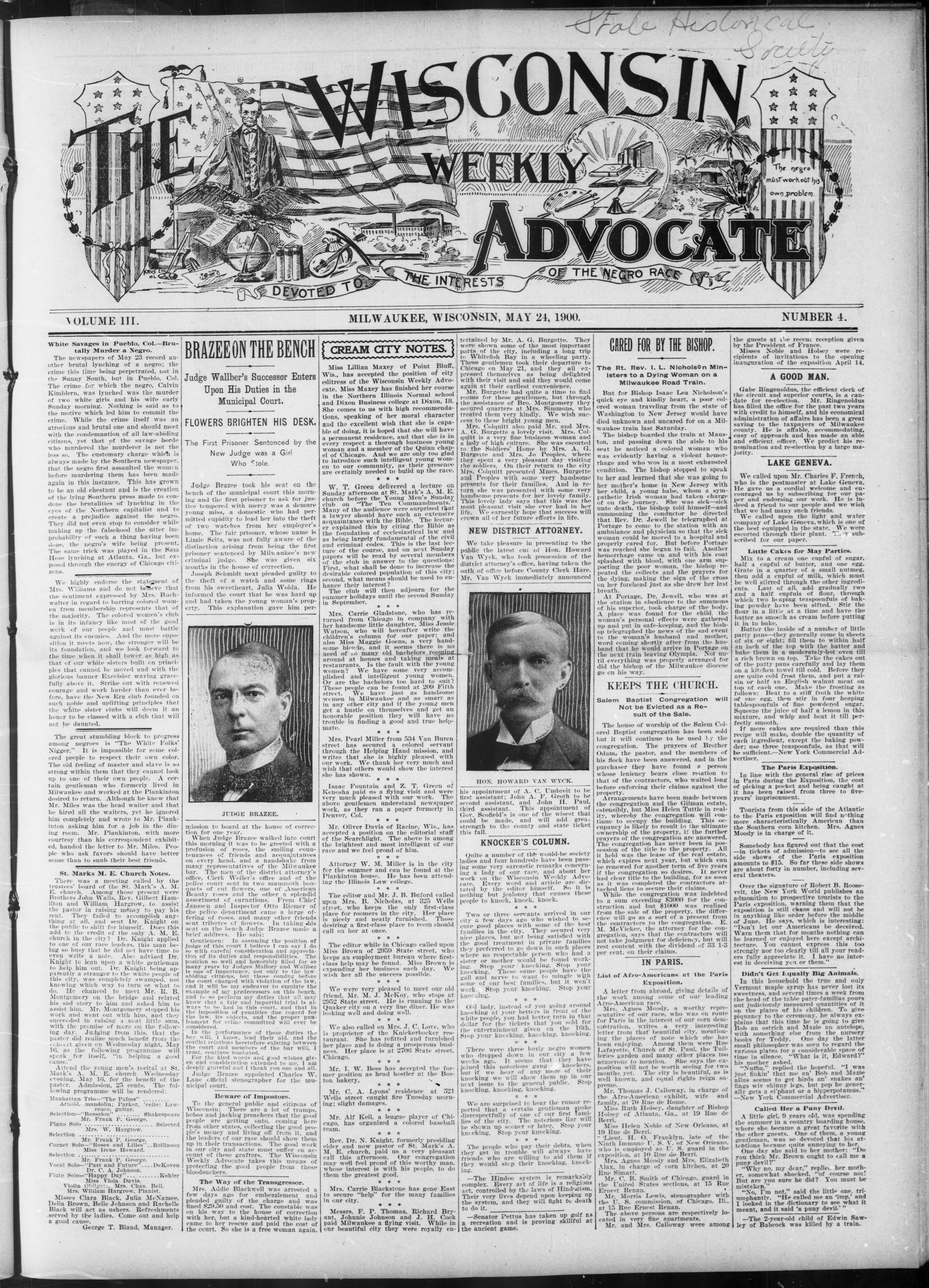
Wisconsin Weekly Advocate
Thursday, May 24, 1900
Milwaukee, Wisconsin
Page text (machine-generated)
STATE HISTORICAL SOCIETY
WISCONSIN
WEEKLY
The negro must work out his own problem.
ADVOCATE
DEVOTED TO THE INTERESTS OF THE NEGRO RACE
White Savages in Pueblo, Col.—Brutally, Murder a Negro.
The newspapers of May 23 record another brutal lynching of a negro; the crime this time being perpetrated, not in the Sunny South, but in Pueblo, Col. The crime for which the negro, Calvin Kimblern, was lynched was the murder of two white girls and his wife early Sunday morning. Nothing is said as to the motive which led him to commit the crime. While the crime itself was an atrocious and brutal one and should meet with the condemnation of all law-abiding citizens, yet that of the savage horde who murdered the murderer is not the less so. The customary charge which is always made by the Southern newspaper, that the negro first assaulted the women before murdering them has been made again in this instance. This has grown to be an old chestnut and is the creation of the lying Southern press made to condone the brutalities of lynching in the eyes of the Northern capitalist and to create a prejudice against the negro. They did not even stop to consider while making up the falsehood the utter improbability of such a thing having been done, the negro's wife being present. The same trick was played in the Sam Hose lynching at Atlanta, Ga., but exposed through the energy of Chicago citizens.
We highly endorse the statement of Mrs. Williams and do not believe that the sentiment expressed by Mrs. Buchwalter in regard to barring colored women from membership represents that of the majority. The colored women's club is in its infancy like most of the good work of our people and must battle against its enemies. And the more opposition it meets now, the stronger will be its foundation, and we look forward to the time when it shall tower as high as that of our white sisters built on principles that cannot be moved and with the glorious banner Excelsior waving gracefully above it. Strike out with renewed courage and work harder than ever before, have the New Era club founded on such noble and uplifting principles that the white sister clubs will deem it an honor to be classed with a club that will not be daunted.
The great stumbling block to progress among negroes is "The White Folks' Nigger." It is impossible for some colored people to respect their own color. The old feeling of master and slave is so strong within them that they cannot look up to one of their own people. A certain gentleman who formerly lived in Milwaukee and worked at the Plankinton desired to return. Although he knew that Mr. Miles was the head waiter and that he hired all the waiters, yet he ignored him completely and wrote to Mr. Plankinton asking him for a job in the dining room. Mr. Plankinton, with more courtesy than his correspondent exhibited, handed the letter to Mr. Miles. People who ask favors should have better sense than to snub their best friends.
St. Marks M. E. Church Notes
There was a meeting called by the trustees' board of the St. Mark's A. M. E. church. Among those present were Brothers John Walls, Rev. Gilbert Hamilton and William Hargrow, to assist the pastor in raising money to pay his rent. They failed to accomplish anything at all, and sent Dr. Knight on the public to shift for himself. Does this add to the credit of the only A. M. E. church in the city? Dr. Knight applied to one of our race leaders, this man being so busy that he did not have time to even write a note. Also advised Dr. Knight to lean upon a white gentleman to help him out. Dr. Knight being apparently a stranger to the white people of this city, was completely swamped, not knowing which way to turn or what to do. He chanced to meet Mr. R. B. Montgomery on the bridge and related his sad story to him and asked him to assist him. Mr. Montgomery stopped his work and went out with him, and they succeeded in raising a neat little sum, with the promise of more on the following day. Judging from this, that the pastor did realize much benefit from the concert given on Wednesday night, May 16, as the following programme will speak for itself, "in helping a good cause."
Attend the young men's recital at St. Mark's A. M. E. church Wednesday evening, May 16, for the benefit of the pastor. Admission, 25 cents. The following programme will be rendered: Manhattan Trio—"The Palms" Arnold, mandolin; Parker, 'cello: Lawrence, guitar. Selection—"Bassalon" Shakespeare Mr. Frank P. George.
Cornet Solo—"Roses and Lilies". Rollinson:
Miss Irene Howard.
Selection
Misses Clara Black, Julia McNamee, Delia Brown, Belle Johnson and Rachelle Black will act as ushers. Refreshments served by the ladies. Come out and help a good cause. George T. Bland, Manager.
BRAZEE ON THE BENCH
Judge Wallber's Successor Enters Upon His Duties in the Municipal Court.
FLOWERS BRIGHTEN HIS DESK.
The First Prisoner Sentenced by the New Judge was a Girl Who Stole.
Judge Brazee took his seat on the bench of the municipal court this morning and the first prisoner to ask for justice tempered with mercy was a demure young miss, a domestic who had permitted cupidity to lead her into the theft of two watches from her employer's home. The fair prisoner, whose name is Lizzie Seitz, was not fully aware of the distinction arising from being the first prisoner sentenced by Milwaukee's new criminal judge. She was given six months in the house of correction. Joseph Schmidt next pleaded guilty to the theft of a watch and some rings from his sweetheart, Julia Woida. He informed the court that he was hard up and had taken the young woman's property. This explanation gave him per-
J.
JUDGE BRAZEE.
mission to board at the house of correction for one year.
When Judge Brazee walked into court this morning it was to be greeted with a profusion of roses, the smiling countenances of friends and acquaintances on every hand, and a handshake from many representatives of the Milwaukee bar. The men of the district attorney's office, Clerk Woller's office and of the police court sent in two mammoth bouquets of cut flowers, one of American Beauty roses and the other a splendid assortment of carnations. From Chief Janssen and Inspector Otto Riemer of the police department came a large offering of roses, and many other friends sent tributes of flowers. In taking his seat on the bench Judge Brazee made a brief address. He said:
Gentlemen: In assuming the position of judge of this court I believe I can say I do so with careful consideration and appreciation of its duties and responsibilities. The position so well and honorably filled for so many years by Judges Mallory and Waller is one of importance, not only to the law, abiding citizens, but those coming before the court charged with violation of the law, and it will be my endeavor to enulate the example of my predecessors on this bench, and to so perform my duties that all may know that a fair and impartial trial is always to be had in this court, and that in the imposition of penalties due regard for the law, its objects, and the proper punishment for crime committed will ever be considered.
In the performance of these duties the bar will, I know, lend their aid, and the cordial relations heretofore existing between the court and members of the bar will, I trust, continue unabated.
For the kind words and good wishes given and consideration extended to me, I am deeply grateful and I thank you one and all. Judge Brazee appointed Charles W. Lane official stenographer for the municipal court.
Beware of Impostors
To the general public and citizens of Wisconsin: There are a lot of tramps, hobos and jackleg preachers that the good people are getting onto, coming here from other states, collecting the good people's money and living off from it, and the leaders of our race should show them up in their transactions. The good work in our city and state must suffer on account of these grafters. The Wisconsin Weekly Advocate takes this means of protecting the good people from these bloodsuckers.
The Way of the Transgressor
Mrs. Addie Blackwell was arrested a few days ago for embezzlement and pleaded guilty of the charge and was fined $20.50 and cost. The constable was on his way to the house of correction with her, but a kind-hearted white lady came to her rescue and paid the cost of the court. So she is a free woman again.
CREAM CITY NOTES.
Miss Lillian Maxey of Point Bluff, Wis., has accepted the position of city editress of the Wisconsin Weekly Advocate. Miss Maxey has finished her course in the Northern Illinois Normal school and Dixon Business college at Dixon, Ill. She comes to us with high recommendations, speaking of her moral character and the excellent wish that she is capable of doing, it is hoped that she will have a permanent residence, and that she is in every respect a thorough business young woman and a member of the Quinn chapel of Chicago. And we are only too glad to introduce such intelligent young women to our community, as their presence are certainly needed to build up the race.
* * *
W. T. Green delivered a lecture on Sunday afternoon at St. Mark's A. M. E. church before the Young Men's Sunday club on "The Ten Commandments." Many of the audience were surprised that a lawyer should have such an extensive acquaintance with the Bible. The lecturer explained this by citing the Bible as the foundation of ecclesiastical law and as being largely fundamental of the civil and criminal codes. This is the last lecture of the course, and on next Sunday papers will be read by several members of the club in answer to the questions: First, what shall be done to increase the desirable colored population of this city; second, what means should be used to enhance their interest? The club will then adjourn for the summer holidays until the second Sunday in September.
Mrs. Carrie Gladstone, who has returned from Chicago in company with her handsome little daughter, Miss Jessie Watson, who will hereafter write the children's column for our paper; and also Miss Maggie Goens, a very handsome blonde, and it seems there is no need of so many old bachelors rooming around at houses and taking meals at restaurants. Is the fault with the young women? We have some very accomplished and intelligent young women. Or are the bachelors too hard to suit? These people can be found at 209 Fifth street. We have just as handsome women in Milwaukee and as smart as in any other city and if the young men get a hustle on themselves and get an honorable position they will have no trouble in finding a good and true helpmate.
* * *
Mrs. Pearl Miller from 534 Van Buren street has secured a colored servant through the Helping Hand mission, and writes that she is highly pleased with our work. We thank her very much and wish that others would show the interest she has shown.
\* \* \*
Isaac Fountain and Z. T. Green of Kenosha paid us a flying visit and were very much pleased with our work. The above gentlemen understand newspaper work, as they ran a paper formerly in Denver, Col.
* * *
Mr. Oliver Davis of Racine, Wis., has accepted a position on the editorial staff of the Searchlight. The above is among the brightest and most intelligent of our race and we feel proud of him.
* * *
Attorney W. M. Miller is in the city for the summer and can be found at the Plankinton house. He has been attending the Illinois Law college.
***
The editor and Mr. J. B. Buford called upon Mrs. B. Nicholas, at 325 Wells street, who keeps the only first-class place for roomers in the city. Her place is nicely and neatly furnished. Those desiring a first-class place to room should call on her at once.
***
The editor while in Chicago called upon Miss Brown of 2959 State street, who keeps an employment bureau where first-class help may be found. Miss Brown is expanding her business each day. We wish her all the success possible.
***
We were very pleased to meet our old friend, Mr. M. J. McKoy, who stops at 2952 State street. He is running to the Quaker city on a very fine diner. He was looking well and doing well.
* * *
We also called on Mrs. J. C. Love, who is proprietor of the Knickerbocker restaurant. She has refitted and furnished her place and is doing a prosperous business. Her place is at 2706 State street, Chicago.
Mr. I. W. Bess has accepted the former position as head hostler at the Boston bakery.
Mr. C. A. Lyons' residence at 521 Wells street caught fire Tuesday morning; slight damages.
Mr. Alf Keil, a league player of Chicago, has organized a colored baseball team.
* * *
Rev. Dr. N. Knight, formerly presiding elder and now pastor of St. Mark's A.M. M. E. church, paid us a very pleasant call this afternoon. Our congregation may well feel proud of this worthy man, whose interest is with his people, to do them the greatest good.
* * *
Mrs. Carrie Blackstone has gone East to secure "help" for the many families in our city.
* * *
Messrs. F. P. Thomas, Richard Bryant, Johnnie Johnson and J. H. Cock paid Milwaukee a flying visit. While in our beautiful city they were royally en-
tertained by Mr. A. G. Burgette. They were shown some of the most important parts of the city, including a long trip to Whitefish Bay in a wheeling party. These gentlemen took their departure to Chicago on May 21, and they all expressed themselves as being delighted with their visit and said they would come again at their earliest convenience. Mr. Burgette had quite a time to find rooms for these gentlemen, but through the assistance of Bro. Montgomery they secured quarters at Mrs. Simmons, who treated them very kindly. We wish success to these bright young men.
Mrs. Colquitt also paid Mr. and Mrs. A. G. Burgette a lovely visit. Mrs. Colquitt is a very fine business woman and a lady of high culture. She was escorted to the Soldiers' Home by Mrs. A. G. Burgette and Mrs. Jo Peoples, where they spent a very pleasant day visiting the soldiers. On their return to the city Mrs. Colquitt presented Mmes. Burgette and Peoples with some very handsome presents for their families. And in return she was presented with some very handsome presents for her lovely family. This lovely lady says that this was the most pleasant visit she ever had in her life. We earnestly hope that success will crown all of her future efforts in life.
NEW DISTRICT ATTORNEY.
We take pleasure in presenting to the public the latest cut of Hon. Howard Van Wyck, who took possession of the district attorney's office, having taken the oath of office before County Clerk Hare. Mr. Van Wyck immediately announced
J. B.
HON. HOWARD VAN WYCK.
his appointment of A. C. Umbreth to be first assistant; John A. F. Groth to be second assistant, and John H. Paul, third assistant. This appointment of Gov. Scofield's is one of the wisest that could be made, and will add great strength to the county and state ticket this fall.
KNOCKER'S COLUMN.
Quite a number of the would-be society ladies and four hundreds have been passing some very sarcastic remarks concerning a lady of our race, and about her work on the Wisconsin Weekly Advocate. Every word and article are dictated by the editor himself. So it is nothing but jealousy that causes these people to knock, knock, knock.
家 家 家
Two or three servants arrived in our city a few days ago who wished to secure good places with some of the best families in the city. They secured very nice places, but not being satisfied with the good treatment in private families they preferred to go down in such places where no respectable person who had a sister or mother would be found working. Stop your knocking. Stop your knocking. These same people have the gall and nerve to want to mingle with some of our best families, but it won't work. Stop your knocking. Stop your knocking.
章 章 章
Old lady, instead of you going around knocking at your betters in front of the white people, you had better turn in that dollar for the tickets that you sold for the entertainment given on the 16th. Stop your knocking, knocking, knocking.
心 心 心
There were three burly negro women who dropped down in our city a few weeks ago. It seems that they have joined this notorious gang knockers, but if we hear of any more of their knocking we will show them up in our next issue to the general public. Stop knocking, knocking, knocking.
☆ ☆ ☆
We are surprised to hear the rumor reported that a certain gentleman spoke disrespectfully of one of our first families of the city. The notorious liar will be shown up sconer or later. Stop your knocking. Stop your knocking.
* * *
The people who pay their debts, when they get in trouble will always have friends who are willing to aid them if they would stop their knocking, knocking.
—The Hindoo system is remarkably complex. Every act of life is a religious act, controlled by the laws of Hindooism. Their very lives depend upon keeping up the system, and they will fight to death to do it.
—Senator Pettus has taken up golf as a recreation and is proving skillful at the ancient game.
CARED FOR BY THE BISHOP.
The Rt. Rev. I. L. Nicholson Ministers to a Dying Woman on a Milwaukee Road Train.
But for Bishop Isaac Lea Nicholson's quick eye and kindly heart, a poor colored woman traveling from the state of Washington to New Jersey would have died unknown and uncared for on a Milwaukee train last Saturday.
The bishop boarded the train at Mauston, and passing down the aisle to his seat he noticed a colored woman who was evidently having a violent hemorrhage and who wos in a most exhausted condition. The bishop stopped to speak to her and learned that she was going to her mother's home in New Jersey with her child, a young babe, whom a sympathetic Irish woman had taken charge of on the journey. She was sick—sick unto death, the bishop told himself—and summoning the conductor he directed that Rev. Dr. Jewell be telegraphed at Portage to come to the station with an ambulance and physician so that the sick woman could be moved to a hospital and properly cared for. But before Portage was reached she began to fail. Another hemorrhage came on and with his coat splashed with blood, with one arm supporting the poor woman, the bishop repeated the collects and the prayers for the dying, making the sign of the cross on her forehead just as she drew her last breath.
At Portage, Dr. Jewell, who was at the station in obedience to the summons of his superior, took charge of the body. A place was found for the child, the woman's personal effects were gathered up and put in safe-keeping, and the bishop telegraphed the news of the sad event to the woman's husband and mother, word coming shortly after from the husband that he would arrive in Portage on the next train leaving Olympia. Not until everything was properly arranged for did the bishop of the Milwaukee diocese go on his way.
KEEPS THE CHURCH.
Salem Baptist Congregation will Not be Evicted as a Result of the Sale.
The house of worship of the Salem Colored Baptist congregation has been sold but it will continue to be used by the congregation. The prayers of Brother Odam, the pastor, and the members of his flock have been answered, and in the purchaser they have found a person whose leniency bears close relation to that of the contractors, who waited long before enforcing their claims against the property.
Arrangements have been made between the congregation and the Gilman estate, ostensibly, but Miss Helen Tuttle in reality, whereby the congregation will continue to occupy the building. This occupancy is likely to result in the ultimate ownership of the property, if the further prayers of the congregation are answered. The congregation has never been in possession of the title to the property. All it held was the lease of the real estate, which expires next year, but which can be renewed for another term of five years if the congregation so desires. It never had clear title to the building, for as soon as it was completed the contractors attached liens to secure their claims.
While the congregation was indebted to a sum exceeding $3000 for the construction and but $1000 was realized from the sale of the property, the difference will go as a sort of a present from the contractors to the congregation. E. M. McVicker, the attorney for the congregation, says that the contractors will not take judgment for deficiency, but will rest content with the dividend of 33 1-3 per cent, on their claims.
IN PARIS.
List of Afro-Americans at the Paris Exposition
A letter from abroad, giving details of the work among some of our leading Afro-American race. Mrs. Agnes Moody, a worthy representative of our race, who was en route for Paris in the interest of our corn demonstration, writes a very interesting letter from that beautiful city, mentioning the places of note which she has been enjoying. Among them were Rue Lafayette, Church of St. Paul, the Tuilleries garden and many other places too numerous to mention. She says the exposition will not be worth seeing for two months, yet. The city is beautiful, as is well known, and equal rights reign supreme. Mr. Thomas J. Calloway, in charge of the Afro-American exhibit, wife and family, at 79 Rue de Rome.
Miss Ruth Holsey, daughter of Bishop Holsey of Atlanta, Ga., at 19 Rue de Berri.
Miss Helen Noble of New Orleans, at 19 Rue de Berri.
Lieut. H. O. Franklyn, late of the Ninth Immune U. S. V. of New Orleans, who is employed as U. S. guard in the exposition, at 10 Rue de Berri.
Mrs. Agnes Moody and Mrs. Elizabeth Alax, in charge of corn kitchen, at 20 Rue Simart.
Mr. C. B. Smith of Chicago, guard in the United States sections, at 15 Rue Ernest Renan. Mr. Morris Lewis, stenographer with the U. S. commission, of Chicago. Ill. at 15 Rue Ernest Renan. The above persons are respectively located in very fine apartments. Mr. Colleman were among
Mr. and Mrs. Calloway were among
the guests at the recent reception given by the President of France. Misses Noble and Holsey were recipients of invitations to the opening inauguration of the exposition April 14.
A GOOD MAN.
Gabe Ringenoldus, the efficient clerk of the circuit and superior courts, is a candidate for re-election. Mr. Ringenoldus has filled the office for the past two years with credit to himself, and his economical administration of affairs has been a great saving to the taxpayers of Milwaukee county. He is affable, accommodating, easy of approach and has made an able and efficient officer. We predict his renomination and re-election by a large majority.
LAKE GENEVA.
We called upon Mr. Charles F. French, who is the postmaster at Lake Geneva. He gave us a cordial welcome and encouraged us by subscribing for our paper and endorsing our work. He is indeed a friend to our people and we wish that we had many such friends. We called upon the light and water company of Lake Geneva, which is one of the best equipped in the state. We were escorted through their plant. They subscribed for our paper.
Little Cakes for May Parties
Mix to a cream one cupful of sugar, half a cupful of butter, and one egg. Grate in a quarter of a small nutmeg, then add a cupful of milk, which must be well stirred through the other ingredients. Last of all, add gradually two and a half cupfuls of flour, through which two heaping teaspoonfuls of baking powder have been sifted. Stir the flour in a little at a time and have the batter as smooth as cream before putting it in to bake.
Butter the inside of a number of little patty pans—they generally come in sheets of six or eight; fill them to within half an inch of the top with the batter and bake them in a moderately-hot oven till a rich brown on top. Take the cakes out of the patty pans carefully and lay them on a kitchen towel till cold. Before they are quite cold frost them, and put a raisin or half an English walnut meat on top of each one. Make the frosting as follows: Beat to a stiff froth the white of one egg, then stir in four heaping tablespoonfuls of fine powdered sugar. Squeeze the juice of half a lemon in this mixture, and whip and beat it till perfectly smooth.
If more cakes are required than this recipe will make, double the quantity of each ingredient, except the baking powder; use three teaspoonfuls, as that will be sufficient.—New York Commercial Advertiser
The Paris Exposition.
In line with the general rise of prices in Paris during the Exposition, the cost of picking a pocket and being caught at it has been raised from three to five-years imprisonment.
Tourists from this side of the Atlantic to the Paris exposition will find nothing more characteristically American than the Southern corn kitchen. Mrs. Agnes Moody is in charge of it.
Somebody has figured out that the cost—in tickets of admission—to see all the side shows of the Paris exposition amounts to $15. So far these side shows are about forty in number, including several theaters.
Over the signature of Robert B. Roosevelt, the New York World publishes an admonition to prospective tourists to the Paris exposition, warning them that the exposition is still chaos and will not be in anything like order before the middle of June. He says, which is interesting: "Don't let our Americans be deceived. Warn them that for months nothing can be learned or enjoyed here except architecture. You cannot express this too strongly nor too clearly till all your readers fully appreciate it. I have no interest in deceiving you or them."
Didn't Get Equally Big Animals
In this household the true and only Vermont maple syrup has never lost its sweetness, and several times a week from the head of the table pater-familias pours out judiciously measured quantities of it on the plates of his children. To give piquancy to the ceremony, he always explains that this time he is going to give Bob an ostrich and Mazie an antelope, with something else from the nursery books for Teddy. One day the latter small philosopher was seen to regard the various plates for a considerable space of time in silence. "What is it, Edward?" his mother asked. "Nuffin," replied the hopeful. "I was just finkin' that me an' Bob and Mazie allus seems to get birds an' snakes an' fings wiv skinny legs, but pop he generally gets a el'phant or a hipperpotamus."—New York Commercial Advertiser.
Called Her a Puny Devil.
A little girl, 9 years old, was spending the summer in a country boarding house, where she became a great favorite with the other guests. One of them, a young gentleman, was so devoted that his attentions became quite annoying to her.
One day she said to her mother: "Do you think Mr. Brown ought to call me a puny devil?"
"Why no, my dear," replied her mother, somewhat shocked. "of course not! But are you sure he did? You must be mistaken."
"No, I'm not," said the little one, triumphantly. "He called me an 'imp.' and I looked in the dictionary to see what it meant, and it said 'a puny devil.'"
—The 2-year-old child of Edwin Sawley of Babcock was killed by a train.
BAGGED 800 FEDERALS.
District in the Vicinity of Mafeking Cleared of Boers.
Boer Positions Untenable for Twenty Miles in Front of British Army.
Kimberley, Tuesday, May 22. About 800 Boers have surrendered at Vryburg (north of Kimberley, and a little more than half way between that-place and Mafeking). The road is all clear from Mafeking and all opposition in this district is practically ended. Cape Town, Tuesday, May 22. Gen. Warren has occupied Douglas after heavy fighting and without sustaining any loss. The Boers have retreated to the north.
Hong Spruit, Orange Free State, Tuesday Evening, May 22.—Gen. French has crossed the Rhenoster river, northwest of here. This movement, combined with Gen. Ian Hamilton's occupation of Heilbron, renders the Boer position twenty miles in the British front untenable. The latest reports, however, received say the burghers are prepared to make a strong resistance and possess fifteen guns. Fifteen prisoners were taken today.
ROBERTS ON THE MARCH.
British Commander Following Up the Retreating Boers.
London, May 23.—2:06 p. m.—Once more Lord Roberts is advancing in force. The wait at Kroonstad is over and already the main British army is about twenty miles north of its former resting place. Judging from the dispatches of Lord Roberts at Honingsprunt station, while flanking him on either side of the railroad, Gen. French's cavalry and Gen. Ian Hamilton's mounted infantry are both slightly in advance of Lord Roberts and threatening to envelope the Boer position which extends for twenty miles due north.
Gen. French probably crossed the Rhenoster river near the junction with Honingspruit which runs thence to Honingspruit station. The main British army will probably advance along the railroad while Gen. French converges from the west and Gen. Hamilton from the east. Against this overwhelming force the Boers will probably follow their usual tactics of retiring to positions, which doubtless have been prepared in advance for their occupation.
Gen. French and Gen. Hamilton are separated from each other by about forty miles, while Lord Roberts is within twelve miles of Gen. French and thirty miles of Gen. Hamilton.
Pursuing the Boers.
Since the last dispatch left Honing-spruit, yesterday, Lord Roberts has doubtless still further advanced and by now is either engaging or following the retreating Boers. Definite dispatches received this morning make it clear that the Vaal river has not been crossed, as nearly forty miles intervene between it and Lord Roberts' advance flankers. The small number of casualties sustained by Gen. Hamilton in his occupation of Heilbron bears out the theory that the Boers will make no strenuous resistance until the Vaal is reached, or until even later. Dispatches to the Associated press from Heilbron say that the Boer Gen. Dewet had 4000 men posted on adjacent hills, but that he retired when Gen. Hamilton approached. President Steyn fled from Heilbron May 20 and his destination is not known.
The first word received from Col. Baden-Powell at Mafeking heightens rather than diminishes the reports heretofore cabled of the gallantry exhibited by the garrison during the closing days of the siege.
Baden-Powell Cautious.
In an interview with the correspondent of the Reuter's Telegram company, May 11, Col. Baden-Powel said:
"My great endeavor is to prevent the relief force from trying to rush into the place before they are strong enough to do so. It would be better to make certain of relief in two months than to be beaten in an attempted relief in one month. You remember it was said in the old days in Zululand that the natives called me Umhala Pansa, the man who does not rush things. The knowledge that the whole empire was watching with appreciation the good fight of the garrison has been worth an extra pound of rations a day to the garrison. It was difficult to persuade the civilians of the necessity of submitting to martial law. We had our little difficulties, but later there was a loyal acceptance of the military administration and there was no trouble at all. The devotion of the nurses and the women generally was most marked."
Referring to the requests of newspapers for messages, Baden-Powell looked embarrassed and said:
"These chaps have got an exaggerated idea of the importance of my personality. I look upon myself as the figurehead of the good ship Mafeking. It has been her stout canvas and shape, and her brave hull that really shoved the ship along and brought her safely through the stormy cruise. So, whenever I read nice things people say of me, I take it that they are said inasmuch as I am the head representative of the garrison."
ENTITLED TO RESPECT.
One English Officer Who Can Do Justice to the Boers.
London, May 23.—Sir Alfred Milner, speaking at Cape Town before an enormous assemblage celebrating the relief of Mafeking, referred to the remark of a previous speaker who had condemned the Boers as "cowardly scoundrels." He said: "There are many among our enemies who deserve to be honored for their heroism. Although cases of treachery and barbarity have occurred they have been exceptional. The conduct of the enemy is that of brave men fighting for a bad cause. Yet they are entitled to respect."
British Prisoners Get News.
The British who are in the hands of the Boers at Pretoria by some extraordinary means learn of the British victories as soon as the Transvaal authorities, and they build bonfires and sing "God Save the Queen." The Pretoria people are apprehensive of a rising of the prisoners and agitate for a transference of the whole number to a point inside the British lines, saying that 4000 more or less makes no difference.
Collapse of Boer Hopes.
The morning papers continue to discuss at length President McKinley's refusal to intervene, pointing out the collapse of Boer hopes. The Times says: "The Boer delegates in the United States have had an interview with President McKinley and the answer is exactly what we had a right to expect from the chief magistrate of a great, friendly nation."
Kruger's Property Sequestered.
The Lourenco Marques correspondent of the Times says he has it on unquestionable authority that within the last six weeks President Kruger has transferred the bulk of his property in the
Transvaal to personal friends in order to avoid its confiscation by Great Britain
When Buller Returns.
Gen. Buller, replying to residents of Newcastle, who presented to him a trophy, said he expected to return from Bristol soon
Sword for Col. Lady Sarah.
One of the morning papers suggests that the men of England should present a sword to Lady Sarah Wilson, the Daily Mail's correspondent at Mafeking during the siege.
How the Tunnel was Wrecked.
The method employed by the Boers in wrecking the railway tunnel at Laing's Nek, news of which was recently cabled by the Inter Ocean's correspondent in the field with the burghers, is said to have been novel. They started engines, both leaded with dynamite, into the tunnel from each end. The locomotives came together with a terrible crash, the shock exploding the dynamite, which completely wrecked the tunnel.
Continue the War.
Pretoria, May 21. After two days of consultation President Kruger and President Steyn and all the prominent Transvaal and Free State officials and generals have decided to continue the war unless England will consent to grant favorable terms. Steyn and Kruger are both firm and determined to fight, but many of the Transvaal officials favor peace and unconditional surrender. It is problematical how long the Boers will continue to fight.
Johannesburg is Warned.
The government has warned the inhabitants of Johannesburg of its resolution to defend the witwatersrand to the uttermost, disclaiming responsibility for the destruction of property which is likely to occur. Your correspondent's opinion is that the government does not intend to destroy the mines, but is making a bluff. The average Boer believes that destruction is warranted and trouble is likely when the smash comes.
May Send Away Prisoners.
The majority of the Boers are sick of war and want to quit. Their courage may revive. The people are alarmed at the presence of the British prisoners and the government is considering the advisability of sending them over the border. It is not improbable that Pretoria will be defended. The Free State capital has again been moved to Vrede. Mrs. Reitz and family have gone to Delagoa bay. The families of other officials will be leaving soon.
No Peace Proposals.
Inquiries made by representatives of the Associated press today confirm the announcement made yesterday that no peace proposals or communication of any kind from President Kruger have been received, as reported in press dispatches here.
MESSAGE FROM BADEN-POWELL
Relieving Force Unites with the Garrison and Defeats the Boers.
London, May 23.—11:50 a. m.—The war office issues a dispatch from Lord Roberts, under date of Honings Spruit, May 22, announcing the receipt by him of the following message from Maj.-Gen. Baden-Powell, dated Mafeking, May 17: "I am happy to inform you that Mafeking was safely relieved today. The northern and southern columns joined hands on May 15 and attacked the enemy yesterday, and after a small engagement, entirely defeated them with loss. The British casualties were three killed and twenty-two wounded.
"The relieving force marched into Mafeking at 9 this morning and the relief and defense forces combined and moved out and attacked the enemy's head laager. We shelled them out and nearly captured Snyman, and took one gun, a flag and a large amount of ammunition, stores, etc. Five dead and fifteen wounded Boers were found. The enemy appears to be retreating in all directions except one commando which is lying low, possibly to cover the retreat of the remainder.
"Capt, MacLaren and Corp. Murray were found in the Boer hospital. They are doing well. The townspeople and the garrison of Mafeking are heartily grateful for their relief."
Douglas, Cape Colony, Tuesday, May 22.—A force under Gen. Warren consisting of mounted infantry, imperial yeomanry and two guns of the Canadian artillery, left Rooi Pan, Cape Colony, on the night of May 20, and marched in two columns under Cols, Hughes and Spence. Nothing was seen of the Boers until the British were within two miles of Douglas, when a few shells from the Canadian artillery sent the burghers in full retreat towards Douglas.
Col. Hughes' column advanced in skirmishing order and after lengthy exchange of shots, the Boers fled, leaving their laager and a quantity of stores and ammunition.
Again today, 300 Boers opened a hot fire on a detachment of yeomanry and the Canadian artillery repeated their excellent practice and compelled the enemy to retire.
NEW WAGE SCALE.
If Not Adopted by June 1 Iron and Steel Workers Cease Work.
Indianapolis, Ind.. May 23.—A report of the wage-scale committee of the Amalgamated association is not likely until Friday or Saturday. The conservative element is opposing many radical demands, prominent in which are those of Indiana tinplate workers for big increases. If a new scale is not adopted by June 1 iron and steel workers will cease work. The wage scale committee of the Amalgamated Association of Iron and Steel workers sprang a surprise this afternoon by announcing that it has finished its report, which was taken up in secret session this afternoon. It is now likely that the convention will end next Tuesday.
ENGINE IN THE DITCH.
Accident on the Big Four Results in Two Deaths.
Cleveland, O., May 23.—The engine attached to the westbound fast mail on the Lake Shore road went into the ditch at Westfield, N. Y., at 8:30 today and Engineer Reagan and his fireman, Teighbody, was killed. The train, for some reason not yet ascertained, was taking a sidetrack at Westfield when the accident occurred. The engine was derailed and badly wrecked, blocking the main line of the road. It was expected that the tracks would be cleared at noon today. The train carried no passengers.
APARTMENT HOUSE BURNED.
Inmates Escaped, but the Building is a Total Loss.
Chicago, Ill., May 23.—A fire which started in the four-story Jackson apartment building, Twenty-ninth street and Calumet avenue, at 12:30 o'clock this afternoon destroyed the building inside of forty-five minutes. All occupants escaped. An explosion of a natural-gas stove on the second floor started the fire. The loss is estimated at $75,000; fully insured.
SEE THE PRESIDENT.
Oom Paul's Envoys Are Unofficially Received at the Executive Mansion.
Washington, D. C., May 22. Messrs. Fischer, Wessels and Wolmarans, the three Boer envoys, who are now in this country, visited the white house at 10 o'clock this morning, according to previous arrangements to pay their respects to the President. No official status was given the visitors and they presented no credentials.
The envoys were received in the blue parlor, no one being present but themselves, the President and Secretary Cortelyou. At the first the conversation touched upon a variety of subjects. The Boers talked about Washington; told how they admired the city, and the President escorted them to the porch, at the rear of the executive mansion, where a splendid view is obtained of the Washington monument and the Potomac river. President Kruger's name finally was mentioned and the visitors then stated their purpose in coming to this country. They said they understood that what Secretary Hay told them yesterday was final, and that the position of the United States was that this country could not interfere in the present struggle in South Africa. The President confirmed this view. He said that the action he took some time ago (when, at the request of the government of the Transvaal that this government should intervene, he offered his good offices to England to bring about peace) he did with great pleasure in the hope that it might possibly bring the conflict to an end. This offer had been declined by Great Britain, and, he said, there was nothing further that the United States could do in the premises.
The envoy intimated that they were glad to feel they had friends in this country and then bade the President goodbye.
NEELY REARRESTED.
His Attorney Claims that a Fair Trial Cannot be Had in Cube
New York, May 22.—Charles F. W. Neely, former chief of the financial agent of the postoffice department at Havana, Cuba, was rearrested today by a United States marshal. The arrest was made on a warrant issued by United States Circuit Judge Lacombe in a civil suit against Neely by the United States. He is charged with the wrongful conversion of $45,300.26. His bail was fixed at $50,000.
Washington, D. C., May 22.—John D. Lindsey, attorney for Charles P. Neely, appeared before the House judiciary committee today and submitted an argument against the proposed extradition bill. The proposition to subject an American citizen to trial in a country where a Spanish system of laws are in vogue, he contended, was utterly opposed to American traditions. Mr. Lindsey claimed that Neely could only be tried in the United States and only upon the charge of violating a law making it a felony to bring in the United States money embezzled from the United States. The funds in the custody of the United States, though the property of the island of Cuba, were assumed by law to be the property of the United States. Mr. Lindsey said the proceedings pending before Gov. Kooseveit in the requisition from Gov.-Gen. Wood for Neely's surrender was for the purpose of trying him under section 401 of the penal code of Cuba. That section fixed a penalty of imprisonment from one day to twelve years for malversation. Mr. Lindsey said he understood that conviction for violating this statute carried with it provision for shackling the prisoner and confining him in a dungeon. He argued that it was impossible for an American citizen to obtain a fair trial in Cuba at this time. The fact that Neely can be tried in the United States, he claimed, was a complete reason why he should not be taken to Cuba.
PUBLIC IS WARNED.
No Great Estates or Money in England Awaiting Claimants Schemes of Swindlers.
Washington, D. C., May 22.—The department of state warns the public against the swindling advertisements and other publications of schemers relating to pretended estates in England and cautions the people against remitting money in view of such advertisements to any strangers under any circumstances. Upon inquiry at the department it is learned that there are no great estates unclaimed in England. It is also said at the department that there are no large deposits awaiting claimants in the Bank of England.
WORTH $25,000,000.
Death of F. A. Bell Who Made Vast Fortune in the Coal Business.
New York, May 22.—Frederic A. Bell,
who made a vast fortune in the hituminous coal business in Philadelphia and
who was subsequently president of the Buffalo Elevating company, is dead at
his home in Madison, N. J., aged 55
years. He leaves an estate valued at
$25,000,000.
NONUNION MAN SHOT
Street Railway Employee Hit by an Unknown Assailant.
St. Louis, Mo., May 22.-E. E. Kilgore, an employee of the St. Louis Transit company and a nonunion man, was shot in the back by an unknown assailant today and seriously hurt. It is expected he will recover. No clue to the assailant has been found.
GOVERNMENT SUSTAINED
Vote of Confidence Given by French Chamber of Deputies. Paris, May 22.—The Chamber of Deputies, by three successive votes, declared its confidence in the government. The crucial vote approved the declarations of the premier by 277 ayes to 226 noes.
A Graceful Acknowledgment.
Miss Effie Duggan of Bridgeport, Pa., has received a letter from Gen. Lord Kitchener. Some time after the outbreak of hostilities between the Boers and the British Miss Duggan sent Lord Kitchener a three-leafed spring of laurel plucked from the hills of Valley Forge. With it she enclosed a tiny American flag and a few lines extending her best wishes. Lord Kitchener promptly responded, acknowledging her favor. His letter was written at Osfontein, Orange Free State.—New York Commercial Advertiser.
Miss Jobyne Howland, the "Gibson girl" and actress, is visiting her old home in Denver, where she spent all but a few years of her life. She was born in Indianapolis, but moved with her parents to Denver when 2 years old, and lived there twenty-two years. Miss Howland is now 25 years old. She has not made a theatrical engagement for next year.
A Chicago professor predicts that in 1500 years Chicago will be inundated by Lake Michigan. The city is sinking at the rate of 9 inches every 100 years.
ABOUT TO COLLAPSE.
ABOUT TO COLLAPSE.
Gen. ISchwan's Prediction in Reference to the Insurrection in the Philippines.
Washington, D. C., May 23.—The war department has received an interesting report from Brig.-Gen. Theodore Schwan. U. S. V., dated on the transport Thomas at sea, May 12, 1900, in which he submits a thorough review of the state of affairs in the Philippines up to the time of his departure from Manila on April 16 last, making particular reference to what he believes to be the irretrievable collapse of the Filipino insurrection as a whole, and expressing the conviction that, if left alone, the Filipinos would so demonstrate their absolute inability to govern themselves. The principal islands, he says, "are now, as never before, held with an iron grasp by the military. In Luzon all the interior as well as all the coast towns of importance, are occupied by American troops."
Gen. Schwan states that the sole hope entertained by the insurgents for a revival of the insurrection lies in the supposition that the United States troops will be obliged to abandon many of their present positions at the opening of the wet season, owing to inability to secure supplies during that period, and also "in the possibility of victory for the Democratic or anti-expansion party in the coming presidential campaign."
Gen. Schwan says the insurgents think that such a victory will mean the withdrawal of all the military forces now in the islands.
Under American Rule.
With the exception of the savage mountain tribes, and the numerous bands of brigands, says the report, the greater majority of both the educated and peasant classes in the Philippines heartily desire a restoration of peace and order under American rule. The many bands of robbers and brigands form a disjointed nucleus for a prospective reconcentration of insurgent forces and the renewed prosecution of the rebellion, says Gen. Schwan.
Continuing, the report says: "Indeed, these guerilla bands, and their depredations constitute all that is implied by the 'Philippine insurrection' as it now exists, the leaders, military and political, of this 'forlorn hope,' realizing that, should they allow the insurgent movement to die its natural death and American rule to be firmly established, they would have to abandon forever their present positions of influence and be relegated to their former obscurity in private station.
"The operations of troops and the pacification of the towns not yet subdued will be carried on regardless of the rainy season, which, as stated above, the insurgents believe will cause an abandonment of many important towns by our troops. Abundant supplies have been accumulated at the various posts in anticipation of this exigency, the roads placed in such a state of repair as to prevent the heavy rains from destroying their usefulness in forwarding the same."
Distrust will Disappear.
In concluding his report, Gen. Schwan says: "The most serious obstacle in the way of the complete pacification of the island now lies in the mutual distrust between the troops and the inhabitants. This, I believe, will disappear after each class becomes more thoroughly acquainted with the other and the benefits to be derived from an intimate relationship with the military becomes appreciated by the natives. On the other hand, the work cut out for the troops will be greatly facilitated when they gain the confidence of the well-disposed natives. When the latter find that the troops have come to stay, they undoubtedly will resist the exactions of the robber bands, turn about and assist the American troops in ferreting out their haunts and plans, and the days of this guerilla rebellion will be numbered."
LIST OF CASUALTIES.
Gen. MacArthur's List of American Soldiers Killed or Wounded.
Washington, D. C., May 23.—Gen. MacArthur's latest casualty list is as follows:
Manila, May 21.—Deaths: May 6, band, Thirty-fourth regiment infantry, Ray C. Perkins; Co. C. Thirty-seventh infantry, Howard M. McFall; May 8, Co. F. Forty-sixth infantry, Corp. Edward Flood; May 10, Co. C. Thirty-seventh infantry, James T. Haskell, May 12, Co. F. Fourth infantry, Sergt. Thomas Ryan, May 14, troop I, Fourth cavalry, Hugh H. Thompson; Co. A. Thirty-ninth infantry, Gustav A. Krueger; May 15, Co. B. Thirty-ninth infantry, Artificer Isaac N. Wise; Co. A, Thirty-seventh infantry, William W. Farham; May 16, Co. H. Thirteenth infantry, William W. Crowell, Co. C. Thirty-ninth infantry, George Boddin.
Typhoid-fever, April 29, Co. I, Forty-seventh infantry, Howard Templin; May 12, Co. G, Thirty-ninth infantry, Scott I. Larson
Drowned, accidentally, May 15, Co. M, Fourth infantry, Frederick W. Franz, Co. M, Fourth infantry, Harrison Dirks. Suicide, May 15, troop D, Third regiment, cavalry, Farrer Edward Watson. Appendicitis, May 13, Co. H, Forty-eighth infantry, Isaac H. Hoskins. Malarial fever, May 13, Co. D, Forty-first infantry, Edward Bastian.
Peritonitis, May 11, Co. A, Thirteenth infantry, Lee Shepherd, Septicalmia, May 6, Co. E, Twenty-ninth infantry, Robert F. Floyd, Pneumonia, May 12, Co. A, Twenty-sixth infantry, James W. Moran. Accidentally shot, May 3, Co. M, Fortieth infantry, Corp. Fliskine H. Dorman. Tetanus, May 17, Battery E, Sixth artillery, Corp. Charles Sweeney.
MADE BABY STOP CRYING.
The Means Employed Resulted in the Child's Death.
Martinsville, Ind., May 23.-Ida Fultz, aged 21 years, is charged with smothering her 6-weeks'-old baby. It cried during the night and annoyed the mother, who is reported to have said: "Now maybe you will stop crying." The corner ordered the woman arrested, saying she had held her hands over the baby's mouth and nose and smothered it. The woman, it is said, has confessed.
WEEKLY SALARY LAW.
Indiana Judge Holds that the Statute is Constitutional.
Anderson, Ind., May 23.—Judge Ryan in the superior court held the law constitutional requiring factories to pay their employes weekly. The specific cases were against the American Tinplate and the Wright Shovel companies of this city and the American Plate-Glass company of Alexandria. The manufacturers took the stand that the state had no right to legislate against the rights of any person.
RAN OVER A SMALL DOG.
Supt. Donkin of Great Northern Railway Killed in Consequence.
Larimore, N. D., May 23.—Supt. Donkin of the Dakota division of the Great Northern railway was accidentally killed yesterday afternoon. He was on his way to Inkster on his railroad gasoline motor, when a small dog crossed in front of the machine, throwing him and the car from the track. He was brought to this city, where he expired. He leaves a widow and four children.
Exempt from Stamp Tax.
Washington, D. C., May 23.—Commissioner Wilson of the internal revenue bureau has held that bank checks issued by clerks of United States and state courts, by direction or authority of the court, are exempt from taxation.
DEADLOCK IS BROKEN.
DEADLOCK IS BROKEN.
Drs. Hamilton and Moore Are Elected Bishops by Methodist General Conference.
Chicago, Ill., May 22.—Dr. J. W. Hamilton and D. H. Moore were elected bishops by the Methodist Episcopal general conference. The vote was as follows: D. H. Moore, 534; J. W. Hamilton, 510; J. R. Day, 104; H. Spellmeyer, 71; T. B. Neely, 41; J. F. Berry, 22. Necessary to a choice, 444.
Various changes recommended by the commission on revision were adopted, with little debate, until Dr. Buckley reported that the committee was unable to agree upon any recommendation as to
M. B.
DR. JOHN W. HAMILTON.
Secretary Freedmen's Aid Society, Cincinnati, O.
sections 1 and 5, article 3. These involve the question of admitting women to annual conferences, but recess cut off debate.
To Admit Women.
The conference voted to admit women to lay, electoral and general conferences. Amid tremendous applause the motion to substitute the words "lay member" in sections one and five of article three for the words "lay man" was adopted, and a question which has been agitating the Methodist conference a generation was settled in favor of the women.
Few men in Methodism are more widely known than Dr. Moore, who is now the editor of the Western Christian Advocate, published in Cincinnati. He was born in Ohio in 1838 and graduated from the Ohio university in 1860. In the same year he entered the Ohio conference, but when the Civil war broke out he enlisted in the Union army as a private. His service in the army was of so brilliant and noteworthy a character
Dk. DAVID H. MOORE.
Editor Western Christian Advocate, Cincinnati, O.
that he was rapidly advanced to the rank of colonel. At the close of the war he returned to the Methodist ministry in which he had a singularly-varied experience. In 1875 he was made president of the Wesleyan College for Women in Cincinnati, which position he resigned in 1880 when he was made president of Denver university. He returned to Cincinnati a number of years ago to assume the position of editor of the Western Christian Advocate. The popularity of Dr. Moore is very great. He is much in demand for dedication exercises and has spoken at the dedication of about 400 churches. He has a very genial manner, is thoroughly manly and impresses everyone with his sincerity.
Rev. Dr. John W. Hamilton was born in western Virginia in 1845. He is a graduate of Boston university and was licensed to preach in 1865 and joined the Pittsburg conference a year later. In 1868 he was transferred to the New England conference, of which he has been ever since a member. Five times in succession Dr. Hamilton has been sent as a delegate to the general conference, an undoubted proof of the regard in which he is held by his conference. For the past eight years he has been the secretary of the Freedman's Aid society and his work in that office has been highly commended. Dr. Hamilton is an earnest, energetic worker. He is generous and ready at all times to serve his followers. He has a strong and winning personality and has made for himself an abiding place in the affections of his church.
PREACHER SUES FOR SALARY.
Baptist Minister of Indiana Says He Hasn't Been Paid in Two Years. Anderson, Ind., May 22.—Rev. J. W. Williams, pastor of the Second Baptist church in this city, has begun suit in the superior court against his congregation for his salary. He was engaged in 1898 and claims that he was to be paid monthly for his prayers and gospel teachings, but has not received a cent. The congregation was surprised, as the minister had not intimated to them his intentions. Mr. Williams says that he will never preach in this church again.
TO SUPPRESS BOXERS.
China Realizes That the Massacre of Missionaries is a Serious Matter*
Pekin, May 22.—The authorities apparently have begun to realize that the "boxer" movement is too serious to remain longer undealt with. Troops are being sent to the disturbed districts with instructions to rigidly suppress the outrages. Six leaders of the movement in Pekin have been arrested.
Potters Strike.
Akron, O., May 22. All the potters in this city, including 500 or more men, went on strike today for higher wages, and practically all of the potteries here are shut down.
WORK OF CONGRESS.
SENATE.
Thursday, May 17.—Considered the postoffice appropriation bill. The committee amendment for the extension of the pneumatic tube service created some debate and was under discussion when the measure was laid aside for the day. Mr. Wolcott, chairman of the committee on postoffices and postroads, vigorously attacked the committee's proposition to appropriate $750,000 for pneumatic tube service, declaring the extension of the service was unnecessary and the appropriation a waste of public money. Mr. Mason quite as vigorously supported the proposition. An amendment of Mr. Butler to reduce by 10 per cent. the amount to be paid the railroads for the transportation of mall was rejected, 11 to 41. A bill was passed granting a pension to Gen. Robert G. Dyrenforth of $30 a month. Mr. Jones offered and had adopted a resolution calling upon the secretary of war to inform the Senate how many Filipinos have been killed and wounded since the beginning of hostilities, and also how many have been captured and are now in our possession.
Friday, May 18.—Nearly the entire day was devoted to the pneumatic tube system service in the postoffice appropriation bill. The debate at times was sharp and almost personal. The appropriation was defended by Senators Chandler, Mason, Carter and Wellington and opposed by Senators Allison, Hale, Tillman, Lodge and Wolcott. Senator Morgan introduced a resolution to investigate the Panama Canal company, and in a speech severely criticised that company. Senator McCumber made a speech in favor of the retention of the Philippine islands, during which Senator Tillman took issue with him over an assertion that the people of the South were glad the confederacy was unsuccessful.
Saturday, May 19.—After a spirited debate, by the decisive vote of 32 to 16, laid on the table the whole proposition relating to the transportation of mail by the pneumatic tube system. An effort was made to secure the adoption of an amendment to appropriate $225,000 to carry out existing contracts for the service in New York, Brooklyn, Boston and Philadelphia, but no action was taken upon it, special orders superseding the appropriation bill. The closing hours of the session were occupied in accepting from the state of Missouri statues of Benton and Blair, located in Statuary hall of the capitol, and from the Grand Army of the Republic the statue of Gen. Ulysses S. Grant, located in the capitol rotunda.
Monday, May 21.—A pyrotechnic discussion of the status of the Boer commissioners now in Washington was precipitated in the Senate today by a resolution offered by Mr. Allen (Pop., Neb.) extending to the commissioners the privileges of the floor of the Senate during their sojourn in the national capital. The resolution was defeated by a vote of 36 to 21, but not until after a sharp controversy between its author and Mr. Davis, chairman of the committee on foreign relations. The postoffice appropriation bill was passed, the amendment to carry out existing contracts for the pneumatic tube service being agreed to. An effort was made by Mr. Morgan (Ala.) to displace the Spooner Philippine bill with the Nicaragua canal bill as the unfinished business, but it failed by a vote of 21 to 28. A bill to create the southern division of the southern district of Iowa for judicial purposes was passed.
Tuesday, May 22.—Heard Mr. Spooner in support of his resolution giving the President full power over the Philippines until the suppression of the rebellion. Received the credentials of Senator Clark of Montana, on the appointment of Lleut.-Gov. Spriggs, and allowed them temporarily lie on the table. Adopted a resolution by Mr. Allen asking the President to send to the Senate translations of the constitutions of the South African republic and the Orange Free State; also one by Mr. Jones of Arkansas directing the secretary of war thoroughly to investigate the operations of the North American Trust company in Havana; also one by Mr. Allen calling upon the secretary of war for information regarding conditions in the Philippines.
Wednesday, May 23.—Agreed to the conference report on the army appropriation bill, passed the Morgan resolution calling upon the secretaries of war and navy for information regarding the cost of the transportation of troops to the Philippines, and devoted the rest of the day to debate on the Cuban postal frauds, with Messrs. Platt (Conn.) Sooner and Hale as speakers.
HOUSE.
Thursday, May 17.—Passed a special river and harbor bill carrying $400,000 for surveys and emergency work, and devoted the remainder of the day to the Alaskan code bill. Four pages of the 617 pages of the bill were disposed of before adjournment.
Friday, May 18.—Devoted the day to the consideration of bills reported by the committee on war claims and in committee of the whole favorably acted upon a bill to appropriate $200,000 to pay ex-confederate soldiers for horses and other property taken from them in violation of the terms of Lee's surrender to Grant at Appomattox. A number of other bills were also favorably acted upon.
Saturday, May 19.—Day devoted to unveiling of the Grand Army statue of Gen. Ulysses S. Grant.
Monday, May 21.—Two important labor measures were passed under suspension of the rules, one to extend the eight-hour law to all laborers employed under contract on government work, the other to prohibit interstate traffic in prison-made goods by bringing them under the jurisdiction of the police powers of the state. Mr. Payne, floor leader of the majority, offered a joint resolution for a sine die adjournment of Congress on June 6. It was referred to the ways and means committee.
Tuesday, May 22.—Devoted the entire day to the Alaskan civil government bill. An amendment to reduce the number of judges in Alaska from three to two was defeated. The conference report on the arny appropriation bill was adopted. The Senate amendment for the library at Manila having been stricken out.
Wednesday, May 23.—Passed resolution for she die adjournment June 6; also resolution authorizing committee on ways and means to sit during recess of Congress to frame bill reducing war taxes; also the Neely extradition bill.
TWO TESTIMONIALS.
Also an Order, Showing the Popularity of a Well-Known Remedy. Ladysmith, March 2, 1900.—Dear Dr. Baller: I cannot say too much in praise of your justly famous Ready Relief. Ever since last October I have been confined to the house most of the time, and of late have been able to eat almost nothing. I was bothered by flashes before my eyes, and at times was forced to go into the cellar in order to breathe freely. I rejoice to say that your treatment has been successful, and that I can now eat readily and breathe calmly. I take pleasure in bringing your system of relief to the notice of others who are afflicted as I have been. GEN. WHITE.
Kimberley, March 1, 1900.—Dr. Roberts: For many days it was impossible for me to take any journey longer than a walk of a few squares. I could not eat very much either. I also was bothered by a constant booming and roaring in my ears. I am happy to state that after one treatment from you all these troubles have been dispelled. and I cheerfully recommend your services to all who suffer as I did.
CECIL RHODES.
Mafeking, March 2, 1900.—(By Heliograph.)—Drs. Roberts and Buller: Send me immediately complete treatment for that hemmed-in feeling. My symptoms are same as those of Rhodes and White.
BADEN-POWELL
-Baltimore American.
An Interesting Fact.
An interesting fact in connection with a new overland train that is about to be put into service between St. Louis and Puget Sound, by way of Billings, Mont., is that for nearly the entire distance of 2500 miles it will run through country acquired by the United States at the time of the Louisiana purchase in 1894.
Wealth in Growing Vegetables.
There are over 600 acres of Philadelphia land under cultivation south of Porter street, in the district known as the Neck, and there is now living in Germantown a man who has amassed a fortune of $500,000 in raising early vegetables in that locality.
The common council of Plainfield has voted to light the city by electricity.
EXPANSION MAP OF THE UNITED STATES.
COEUR D'ALENE CASE.
INVESTIGATION IS CLOSED IN WASHINGTON.
Idaho's Attorney Shows that Gov. Steunenberg Acted According to Law and United States Troops Were Properly Summoned.
The arguments in the Coeur d'Alene investigation were closed by John C. Chaney, attorney for Gov. Steunenberg, and the State of Idaho. He confined himself strictly to the preamble and resolutions which alleged that the constitution had been violated by the declaration of martial law in the State of Idaho without a request from the State Legislature. Attorney Robertson, for the Democrats, devoted almost his entire time to the subject of martial law, which was a practical admission that the testimony did not prove the other allegations set forth. Part of the time he assumed that martial law was not in force and again he undertook to hold Gen. Merriam responsible for all acts committed under martial law, whether by the soldiers or the civil authorities.
Mr. Chaney took the position that martial law did exist and had been properly proclaimed. He quoted from the preamble of the resolution, and asserted the rule of law that the parties in the prosecution must be bound by their pleading.
"If martial law is the subject of investigation before this committee," he said, "it is too late for them to go back on their pleading or to say that their case has not been fairly stated." He then took up the question as to whether or not martial law was in violation of
DEMOCRATIC
EXPANSION,
1805-11-19.
Without "Consent of the governed."
(Area 184,760,960 acres.)
FORCIBLE
DEMOCRATIC
EXPANSION,
1848.
Without "Consent of the governed."
(Area 334,443,520 acres.)
DEMOCRATIC
EXPANSION, 1858.
Without "Consent
of the governed."
Area 29,142,400 acres
the constitution. He showed conclusively that it devolved upon the President of the United States, and likewise upon the executive of a State, under the constitutions, both Federal and State, to see that the laws are duly executed and enforced, and that they may use force whenever it is necessary to do so.
After clearly demonstrating that the Governor of Idaho was right in calling upon the military, without giving the Legislature a summons to appear in twenty days and determine whether martial law was necessary or not, which would be utterly absurd in view of the crisis which was at hand, he showed that the State militia was engaged in service in the Philippines, and that national troops were the only ones that he could summon for his relief. That is how the Federal and not the State forces were called upon for duty in Shoshone County.
"The presumption," declared Mr. Chaney, "is always that a public official will perform his duty according to law. He who alleges that an officer has exceeded his authority or has transcended the law must prove it fully." He said that this principle applied equally to Gov. Steunenberg, Gen. Merrlam and all of the military officers under him. After showing conclusively that martial law had been legally declared, he proceeded to discuss the necessity for it, and showed that this was borne out by the testimony of Gov. Steunenberg, of Bartlett Sinclair, and by the telegrams and correspondence of the State officials. Moreover, he declared, that Shoshone County had been in a continual State of insurrection and rebellion for the past six years.
Considering the permit system, the attorney demonstrated that it was proclaimed by the Governor to weed out the dynamiters. He said that it was not directed against organized labor as such, but against a lawless element. He said that no complaints were to be made against unions, because there was nothing in their constitutions or by-laws to show that they were not organized for good and noble purposes. But the trouble was that they were dominated, in Shoshone County, by lawless leaders. He said in conclusion that the conduct of the military authorities was absolutely free from criticism, and that there was nothing to show that they had transcended the law.
---
A BUSINESS LESSON.
Seven Millions More Trade Now Daily than Under Cleveland.
Bank clearings afford the best guide to the volume of business that is transacted throughout the country. The following figures are from Bradstreet's, 000,000's omitted:
Year. Am't. Year. Am't. Year. Am't.
1890..$60,807 1893..$54,020 1897..$57,085
1891..56,805 1894..45,396 1898..68,500
1892..61,902 1895..53,028 1899..93,503
1896..50,032
These figures represent hundreds of millions of dollars. Under the McKinley tariff, in President Harrison's administration, the average volume of business transacted in the United States was almost sixty billions of dollars a year. During President Cleveland's administration it averaged nine billions a year less. In other words, there was three million dollars less business transacted every business day of the year.
Under the Dingley tariff and the administration of President McKinley the average volume of business was twenty-three billions a year more than in the preceding Democratic administration of President Cleveland. In other words, there has been over seven million dollars' worth more business transacted every day during President McKinley's term than there was under President Cleveland. Moral: Vote for a continuation of the Republican administration with a protective tariff.
Senator Jones and the Trust. Don't forget this fact during the campaign: Senator Jones, Chairman of the Democratic National Committee, offered an amendment to the Porto Rican
DEMOCRATIC
EXPANSION,
1803.
Without "Consent of the governed.
(Area 565,165,080 acres.)
DEMOCRATIC EXPANSION,
1835-1845.
(Area 242,235,840 acres.)
FORCIBLE DE
Without
"Consent of the
Area 44,639
tariff bill to return the duties on sugar imported from that island "to the persons from whom they were collected." The sugar trust had paid $637,551 of these duties, and if the amendment of the Democratic Senator had not been opposed by the Republicans, then he would have caused the return of that sum to the trust!
The Free-Trade Idea.
The Democracy is so devoted to free trade that the small temporary duty imposed on imports from Porto Rico is denounced as a national disgrace. Were that party to gain control of the Government, it would attempt to establish free trade between the United States and Europe, so that everything we bought with the cheap money it promises us would "be made in Germany, England or any other old place" rather than in the United States.
Increased Circulation.
The Treasury Department's latest circulation statement shows the total amount of money in circulation in the United States to have been $2,060,525,-463. A year ago, on May 1, 1899, it was only $1,933,867,892, having increased more than $120,000,000 within a year. When Mr. Bryan was nominated, in 1896, it was $1,528,629,463, and has increased 35 per cent, since that time.
Rural Free Delivery
Rural free delivery is being extended among the farmers under Republican rule in the executive departments and in Congress. This Republican Congress has increased the appropriation for this purpose to $1,750,000, so that more farmers than ever will soon be having their mail delivered at their doors.
Agricultural Products
In 1895, one of the Democratic panic years, we exported agricultural products worth $553,210,026. In 1890 they were worth $784,980,087. An increase of $230,000,000 in the foreign demand for American farm products is a pretty good year's record under a Republican administration.
Windy.
After deciding on the Hon. Joe Bailey for the United States Senate, Texas organized a company to build air ships.
Naturally So.
Good business during a Presidential year is one of the good results of three years of Republican rule.
PORTO RICAN TARIFF.
NOMINAL DUTIES COLLECTED ON LEADING ARTICLES.
Those of General Consumption Subject to Very Low Tariff Rate-Free List of Dingley Law Applies to Porto Rico Except as to Coffee.
The following are the rates of duty which will be collected under the new law on the more important articles entering Porto Rico from the United States:
Flour, free of duty.
Corn, 21/4 cents per bushel.
Bacon, free of duty.
Corn meal, 3 cents per bushel.
Rice, free of duty.
Oatmeal, 11/4 cents per bushel.
Pork, free of duty.
Dried apples, 1 pound valued at 6 cents, 3 mills.
Codfish, free of duty.
Brooms, valued at $1.20 per dozen, on each broom, 6 mills.
Mutton, free of duty.
Candles, on 1 pound valued at 5 cents, $1/2 mills.
Fresh beef, free of duty.
Coal, bituminous, per ton, 10 cents.
Coopers' wares and wood, cut, for making casks for sugar or molasses, free of duty.
Cotton cloth, unbleached
On 1 yard valued at 8 cents, 3 mills.
On 1 yard valued at 10 cents, 4 mills.
On 1 yard valued at 12 cents, 0 mills.
Shirting cloth, on 1 yard valued at 121/2 cents, 6 mills.
UNITED STATES.
MINAL
IRTEEN
STATES.
652,000 acres.
DEMOCRATIC EXPANSION, 1819.
Control demanded
DEMOCRATIC PARTY, 1860,
but regard to "Consent of governed."
Bags for sugar, free of duty.
Machinery for making and refining sugar, free of duty.
Wire, Nos. 13-16, per pound, 22-10 mills.
Plows, free of duty.
Nails, cut, per pound, 9-10 of 1 mill.
Hoes, free of duty.
Wire nails, per pound, $ \frac{1}{2} $ mills.
Machetes, free of duty.
Steel bars, per pound, 9-10 of 1 mill.
Agricultural implements, not machinery, free of duty.
Boots and shoes, on 1 pair valued at $1, 3 7-10 cents.
Hatchets, free of duty.
India rubber boots and shoes, on 1 pair valued at 50 cents, $ \frac{2}{4} $ cents.
Cotton thread, on each dozen spools of 200 yards, valued at 26 cents, 1 8-10 cents.
Clocks, valued at $1, 6 cents.
Carpets, valued at 35 cents per yard, on each yard 2 6-10 cents. Modern school furniture, free of duty. Dried herring, per pound, 1 mill.
Bred herring, per pound, 1 mm.
Writing paper, on each pound valued at 17 cents, 8 mills.
Lard, on each pound valued at 6 cents, 3 mills.
Butter, on each pound valued at 14 cents, 9 mills.
Soap, on each pound valued at 10 cents, 3 mills.
Lime, free of duty.
A Democratic Issue.
In its quest of martyrs the Democratic party should not overlook one Oberlin M. Carter, late of the United States army, who is at present located at Leavenworth, Kan. He is posing as a victim of the administration.
BULLER'S MEN AMBUSHED
Mounted Squadron Captured by Boers and 66 Men Lost.
BUT VERY FEW ESCAPED
Roberts Crosses the Vaal River, and is but a Few Miles from Johannesburg.
Cape Town, Monday, May 21.—British troops have arrived at Vereeniging (in the Transvaal, north of the Vaal river). The bridge across the Vaal was found to be intact. Twenty-seven Free State and Transvaal locomotives were captured.
London, May 22.—A dispatch from Pietermaritzburg, dated Monday, May 21, says the Boers are reported to have entirely left Natal, leaving Laings Nek free. If this be true it leaves the way open for Gen. Buller to advance into the Transvaal so soon as the repairs of the railroads are sufficient to insure good communications.
Boers Still There.
London, May 22-4:37 p. m.-It is officially announced that Col. Bethune has reported that while marching in the direction of Newcastle, Natal, yesterday, he was ambushed by a party of Boers six miles west of Vryheid, in the Transvaal, and that very few of his force escaped. His casualties numbered sixty-six men.
Buller Loses 66 Men.
London, May 22—4:48 p. m.—The war office has received the following dispatch from Gen. Buller, dated Newcastle, May 22:
"I have received the following from Bethune: 'May 21, while marching in the direction of Newcastle, one of my squadrons was ambushed by Boers six miles west of Vryheid and very few escaped. Lieuts. Lausum and Capell are among the missing. Capt. the Earl De La Mar is wounded in the leg. The total casualties are about 66. I have returned to N'Qutu for supplies. Will march tomorrow for Newcastle via Dundee."
Gen. Buller then proceeds: "I detached Col. Bethune and about 500 men from Dundee May 17 with instructions to march by Vautsdrift and show his force at N Qutn, which was reported to have been evacuated by the enemy, preparatory to the return of the magistrates and civil establishment to the district. He was to rejoin me at Newcastle afterwards."
A patrol, four miles from Trommel, was attacked by the Boers. One man was wounded and some horses were killed. The affair was unimportant except in showing that the Boers are still in the neighborhood and on the lookout for any chance of sniping.
Deserted by His Men.
Further details of the fighting at Mafeking say that Commandant Sarel Eloff's followers deserted him, whereupon Eloff fired on them himself and then surrendered with eighty followers. The dispatch also says that one party of Boers was driven out of the staat and allowed to escape, as "we had sufficient prisoners."
The capture of Eloff and his followers cost Baden-Powell three men killed and seven wounded.
SIEGE OF PRETORIA.
Citizens of Transvaal Capital Anticipating British Bombardment. Pretoria, Monday, May 21.—An openair meeting was held today by the local Hollanders, 200 of whom were present, to consider the situation in the event Pretoria should be beleaguered. A committee was appointed to secure a place of safety for the women and children. The consul-general of the Netherlands, Mr. Nieuwenhuys, was asked to advise his government to take its subjects. One speaker said the position was most dark. The British, he declared, would be masters of the Free State and the Transvaal; might would be right; the capitalists would dominate; the poor would be the sufferers and the Hollanders would have no chance.
Dr. Heyman contradicts the reports circulated regarding the health of President Kruger, which he says is good. Mr. Kruger is transacting all the work of the presidency.
Government Circular Issued.
In accordance with an understanding with Gen. Botha and President Steyn, the government has issued a circular stating that should the enemy succeed in gaining a position in the Transvaal and take possession of one or the other district, the inhabitants would be free to decide whether or not to leave their families on the farms; but the men must remain with the commandees.
A Successful Maneuver.
London, May 22.—The second edition of the Daily Mail this morning contains a dispatch from Janmadibis, under date of May 15, which says: The British left Salagalon Sunday at sunrise, making a detour to the westward in order to avoid Koedoosrand, where there was a strong force of Boers. The maneuver was successful, but a large force of Boers, in ambush, was encountered. A column of light horse dislodged the Boers, who develored to enfilade the convoy, but were prevented by the artillery, and the enemy fled, our rear guard, composed of the Kimberley horse, enfilading their retreat.
Capt. Hands was wounded, sustaining a compound fracture of the thigh. The Boers left thirty dead. The column arrived here this morning and met Col. Plumer's force.
NEARING THE VAAL RIVER.
British Cavalry Are Now within Few
London, May 22.—British horsemen, according to a dispatch from Lourenco Marques, are now close to the Vaal river within forty miles of Johannesburg. The migration from Pretoria has begun. Women and children are being sent in trains to Machadadorp on the way to Lydenburg. Trains are arriving at Lourenco Marques filled with passengers, among whom are many Germans who are bound for Europe.
Defenses of Johannesburg.
A dispatch from Lourenco Marques, received yesterday, says that the work of erecting defenses for Johannesburg is progressing rapidly. Schanzes (breast-works) and trenches are being completed near the race course, and six guns have been emplaced on the fort.
The Queen Approves.
The Queen has approved of the promotion of Col. Baden-Powell to be a major-general.
Deaths of Correspondents.
Deaths of Correspondents. Twenty-one war correspondents have been killed or have died of disease during the war. In this respect the Daily Mail has been particularly unfortunate, ten of its representatives having been out of service by death or illness.
SCOURGED WITH FEVER.
Desperate Ride of the Relief Column for Nearly 300 Miles.
London, May 22.—Lord Roberts reports to the war office in a dispatch
dated Kroonstad, May 21, as follows: "Mahon reports that the flying column entered Mafeking at 4 a. m., May 18. He was stubbornly opposed by 1500 men on May 17, nine miles from Mafeking, but the Boers were driven from their strong positions after five hours' fighting. A detachment of Canadian artillery, by a series of forced marches, reached him the morning of the fighting and rendered very valuable assistance. Mahon's casualties were about thirty. The Boer losses were heavy."
A dispatch to the Daily Mail from Majanamabili, dated May 11, says: "Lient. Moorsome, with the protectorate regiment from Mafeking, joined us. They went first to Col. Plumer making a wide, Western circuit, and got through the Boer lines with many hairbreadth escapes, reaching Vryburg after a daring ride of nearly 300 miles through a country scourged with a destructive fever similar to the influenza. There was hardly a Boer house or a native kraal without a case of disease, and hundreds died. The column is continually moving and is healthy, active and clean. The troops entirely escaped. Many concealed arms have been discovered and their owners arrested promptly. They inform against their neighbors. The natives render every assistance. Mafeking knows the column is coming."
A dispatch to the Daily Mail, dated Mafeking, May 13, says: "Among the prisoners captured with Commandant Sarel Eloff are Count De Bremont, a Frenchman, and Count Von Weiss, a German. It is found that the Boers were guided by two deserters named Hay and Bolton. At the enemy's request we have handed over their dead.
"Today one of our men was asked to surrender and replied 'Never.' The Boers at once shot him through the head."
HOW IT WAS DONE.
Story of the Long Struggle to Reach Mafeking—Race Between Armies.
London, May 22.—There are as yet only a few accounts of Col. Mahon's march to the relief of Mafeking, and they are disjointed, but they show that until the fighting on May 13, the progress of the column was uneventful. Leaving Barkly West on May 4, with secret orders, the column advanced at the average rate of speed, twenty-five miles a day, notwithstanding the fact that it was numbered with twenty wagons with stores. Reaching Vryburg on May 10 it was found that the Boers were in force on the right flank.
Race Between Armies.
Then, according to one account, followed a race on parallel lines for Koo-doosrand, the Boers aiming to head off the column there. The Boers arrived first, but Col. Mahon, finding that he had been outdistanced, made a detour to the west in the night. The Boers, however, were alert. They followed the British closely, and on May 13 hotly attacked the British, as recorded in Gen. Roberts' dispatch.
The encounter was fierce, both forces fighting under the stimulus of the important issue involved, but according to the British accounts, the Boers suffered severely, leaving eighteen of their dead on the field. After this the column made a wide detour and joined Col. Plumer. The united forces then marched against the besiegers, and heavily bombarded their lagers, inflicting considerable loss. The resistance of the burghers was not strong, they being anxious to preserve their line of retreat. They finally fled, taking their guns with them. The British captured a number of prisoners and considerable arms and ammunition. The Boer loss, according to a dispatch from Laurence Marques, was eighty killed. It is said that the members of the Irish-American ambulance corps, who had joined the fighters, were almost annihilated.
Mafeking Entered May 18.
Col. Mahon and Col. Plumer entered the town on May 18. Nothing whatever has been received to confirm the dispatch from Lourenco Marques, which stated that the besiegers had been captured.
The correspondent of the Daily Mail at Mafeking tells a wordy story of President Kruger's grandson's disastrous adventure, which resulted in his capture, but does not add anything of importance to the official account. He mentions, however, an incident that was apparently the basis of the Volks-stem's accusation that Col. Baden-Powell had violated the white flag. He says that during the fighting Capt. Wilson, Col. Baden-Powell's aid, went with a white flag to ask one of the surrounded Boer forces to surrender. They refused to do so, and the fighting was resumed. This was in April.
SOLDIERS HALF-FARE.
Railroad Officials Talk of a Plan Which Would Benefit 1,200,000 Men.
Chicago, Ill., May 22.—Permanent half-fare rates for all members of the Grand Army of the Republic, ex-Confederate veterans and other men who were in arms back in the '60s may be established by the railroads of the Western Passenger association. At its meeting to be held in the Monadnock building Thursday morning the executive committee of the association, composed of P. S. Eustis of the Burlington, George H. Heafford of the St. Paul, George T. Nicholson of the Santa Fe, W. B. Kniskern of the North-Western, George J. Charlton of the Alton, John Sebastian of the Rock Island, and H. C. Townsend of the Missouri Pacific, will consider a proposition to authorize such rates, which have been repeatedly asked for by many old soldiers.
About 1,200,000 men would be affected by the adoption of the proposition-700,000 members and men eligible to membership in the Grand Army of the Republic, and 500,000 former wearers of the gray.
INSURGENTS CAPTURED.
Two Companies of Rebels Are Taken by the American Troops at Tarlac.
Manila, May 22.—Two companies of insurgents surrendered to Col. Emerson H. Lascum at Tarlac today. They included a major, a captain, four lieutenants, 163 men and 168 rifles and ammunition. The enemy intimated their intention to surrender by a letter sent to the president of Tarlac, who communicated it to Col. Lascum.
Capt. Tinio, a nephew of Gen. Tinio, and twenty-three other rebels were killed May 18, by scouts in an engagement near Malibicong, province of Iloco. There was no loss to the American side. With the men were captured, twenty-three rifles, horses and saddles. The rebel colonel, Almeda, who was paroled April 23, arrived here last evening and has been making incendiary speeches.
Michigan Man Shot.
Chattanooga, Tenn., May 22.—Charles Henry of Blissfield, Mich., was shot and seriously wounded last night by C. R. Dalby. It is said that the shooting resulted from a domestic difficulty. Both men were arrested. Henry will recover.
Clark's Credentials on the Table.
Washington, D. C., May 22.—The credentials of W. A. Clark, appointed by Lieut.-Gov. Spriggs of Montana, were presented by Senator Carter. They were allowed to lie on the table.
BAIT REFRIGERATORS.
A Canadian Government Enterprise for the benefit of Fishermen.
One of the most important schemes which has occupied the attention of the Canadian government has been inaugurated this year, viz: the establishment of refrigerators for the storage of fresh bait by the government in co-operation with associations of fishermen along the coast. Season after season the complaint arises that bait is scarce precisely when it is most urgently required, yet such bait can, as a rule, be obtained in abundance earlier in the season when the men are not in need of it. A parliamentary appropriation of $25.000 enabled the department of agriculture to remedy the difficulty. Bait associations were organized and freezers constructed.
Among the more important features characterizing the fishermen's bait associations are their entirely voluntary nature, the co-operative method of conducting them, the assistance by the Dominion government to the extent of 50 per cent. of cost of building the freezers, and the payment of a proportion of the cost of operating the freezers.—Commercial Agent F. S. S. Johnson.
Justice Hawkins Hated a Draught.
Justice Hawkins Hated a Draught.
Harry Furniss, who was one of the speakers at the Society of Arts recently, told an amusing story of Justice Hawkins, says the London News. The learned judge had a horror of draughts, and used to close up every cranny of his court, to the great discomfort of everybody. Meeting a brother judge the latter said: "Oh, Hawkins, I had a frightful dream the other night! I dreamt you were dead and taken to Woking to be cremated. I caught the last train down, and bribed an official to let me peep through one of the loopholes of the crematorium. All that I saw was a heap of ashes, but I heard a voice cry out: 'Shut the door, Keating; there's a draught here.'"
MARKET REPORTS.
Milwaukee, May 23, 1900.
EGG AND DAIRY PRODUCTS.
EGG AND DAILY PRODUCTS.
MILWAUKEE-Eggs-Market steady to firm at 10%c for new, cases included; 10%c for new, cases returned; 10%c for old, cases included; dirties and seconds, 7@8c. The receipts were 376 cases.
Butter-Market steady. The receipts were 28,275 lbs today against 12,100 yesterday. The market here is firm on choice dairies while creamyery is rather dull. Good dairy butter is wanted here. Extras were offered on the board today for 18½¢, but no bids. Fancy prints, 20¢; fancy or extra creamyery, per lb, 19¢; firsts, 17¢; seconds, 16¢; extra dairy, 15¢; lines, 12¾¢; packing stock, 10¾¢; roll butter, 12¾¢; whey butter, 7@8¢; imitation creamyery, 15¢; grease, 4@6¢. Fancy dairy prints, 17¢. Cheese-Quiet. The receipts today were 6300 lbs against 600 yesterday. Full cream flats, October, per lb, 11½¾¢; full cream flats, new, 9¾¾¢; New York, full cream, 12¾¾¢; Young Americas, October, 12¾¾¢; brisk, fancy October make, 10¾¾¢; new brick, 8½¾¢; limburger, fancy October, 10¾¾¢; new limburger, per lb, 8¾¾¢; imported Swiss, 24¢; Block Swiss, domestic, 12¾¾¢; No. 1 imitation toaf, 12¾¾¢; Sapsago, 19¾¢; farmers'. 9¾¥.
SHEBOYGAN—Twenty-three factories offered 1735 boxes. Demand active and sales were 118 boxes twins at 8@8½c; 696 boxes Young Americas at 8½@9c; 749 dalsies at 8½@8½c, and 209 boxes longhorns at 8½@9c.
PLYMOUTH—Twenty-six factories offered 1672 boxes cheese; sold as follows: Thirty-eight longhorns, 9c; 769 dalsies, 9½c; 511 twins, 8c; 354 Young Americas, 9½c. Market active.
CHICAGO—Butter—Firm; creameries, 15 @19½c; dairies, 13½@17c. Eggs—Strong; fresh, 11½c. Dressed poultry—Steady; turkeys, 6@6½c; chickens, 8@9c.
NEW YORK—Butter—Receipts, 6945 pkgs; market firm; Western creamery, 16½@20c; factory, 14@16c. Cheese—Receipts, 2759 pkgs; easy; fancy large, white, 9½c; fancy large, colored, 9½c; fancy small, white, 9½@9c; fancy small, colored, 9½@9c. Eggs—Receipts, 9841 pkgs; steady; Western loss off, 13½@14c; Southern at mark, 10½@12c. Sugar—Raw steady; refined firm. Coffee—Firm; No. 7 Rio, 7½c.
MILWAUKEE LIVESTOCK MARKET
HOGS—Receipts, 15 cats, market bc lower; light, 5.00@5.15; mixed and medium weights, 5.10@5.20; common to choice heavy, 5.10@5.20; coarse heavy stags, 4.25@4.50.
CATTLE—Receipts, 5 cars; strong; butcher steers, medium to good, 1050 to 1300 lbs, 4.75@5.25; fair to medium, 950 to 1050, 4.50@4.75; heifers, good to choice, 3.75@4.50; cows, fair to good, 3.25@3.25; canners, 2.50@2.75; bulls, common, 2.75@3.25; choice, 3.50@4.00; feeders, 800 to 950 lbs, 4.00@4.50; stockers, 500 to 750 lbs, 3.85@4.25; veal calves, 4.50@6.00; milkers and springers, common, 20.00@28.00; choice heavy cows, 38.00@45.00.
SHEEK—Receipts, 1 car; market steady; shorn, 4.00@4.75; bucks, 2.50@3.25; lambs, shorn, common to choice, 4.50@5.25.
Chicago receipts: Hogs, 28,000; cattle, 12,500; sheen, 15,000.
CHICAGO POTATO MARKET
Buyers were not so anxious for supplies and trade was slow, with rather an easy feeling, but prices are no lower. There were good receipts for Tuesday, but the supply on track is not large. Burbanks, good to choice, 33@35c; do common to fair, 30@32c; Rurals, round white, 31@35c; Hebrons, common to choice, 28@31c; Peerless, poor to choice, 29@33c; Kings, common to choice, 28@31c; mixed, red and white, 20@28c; do white, 29@30c.
MARKETS BY TELEGRAPH.
MILWAUKEE—Flour—Steady. Wheat — Firm; No. 2 spring, on track, 66c; No. 1 Northern, on track, 68c. Corn—Easy; No. 3 on track, 38½c. Oats—Firm; No. 2 white, on track, 25½c. Barley—Steady; No. 2 on track, 43c; sample on track, 37¾c. Rye—Steady; No. 1 on track, 56c. Provisions—Steady; pork, 11.30; lard, 6.85.
Flour is steady at 3.60@3.70 for patents; bakers', 2.60@2.70, and 2.90@3.05 for rye.
Millstuffs are firm and quoted at 13.25 for bran, 13.25 for standard middlings, and 14.25 for Milwaukee flour middlings.
CHICAGO—Close — Wheat — May, 66½c; July, 67½@61½c. Corn—May, 37½@37½c; July, 37½@37½c. Oats—May, 22½c; July, 22c. Pork—May, 22½c; July, 22c. Pork—May, 11.37½c; July, 11.47½c. Lard—May, 6.90; July, 6.95; September, 6.95. Ribs—May, 6.52½c; July, 6.57½c. September, 6.55. Flax—Cash N. W, 1.80; S. W, 1.80; May, 1.80; September, 1.27½c; October, 1.22. Rye—May, 55½c; July, 53c. Barley—36@41c. Timothy, 2.40. Closer, 7.25.
NEW YORK—Close—Wheat—May, 71%c;
July, 72%c; September, 73%c. Corn—May,
42c; July, 42%c; September, 43%c.
DULUTH—Close—Wheat—Cash No. 1
hard, 69%c; No. 1 Northern, 67%c; No. 2
Northern, 65%c; No. 3, 62%c; No. 1 hard
to arrive, 67%c; No. 1 Northern do, 67%c;
July, 67%c@67%c; September, 67%c.
MINNEAPOLIS—Close—Wheat—In store,
No. 1 Northern, May, 65c; July, 65%c; Sept
ember, 63%@65%c; on track, No. 1 hard,
67%c; No. 1 Northern, 66%c; No. 2 Northern,
64%c.
ST. LOUIS—Close—Wheat—No. 2 red
cash, elevator, 70%c; track, 71@71%c; May,
70%c; July, 67%@68c; August, 67%c; Sept
ember, 68%c; No. 2 hard, 64@65c. Corn—
No. 2 cash, 37%c; track, 38@38%c; May, 37c;
July, 37@37%c; September, 37%c. Oats—
No. 2 cash, 23%c; track, 23%@24%c; May,
23%c; July, 21%c; September, 21%c; No. 2
white, 27%c. Rye-56%56%c. Flax-1.77%
Lead-3.95. Speler-4.40@4.45.
ST. LOUIS—Cattle—Receipts, 2300; market steady; native steers, 3.55@5.60; stockers and feeders, 3.10@4.70; cows and heifers, 2.25@5.00; Texas and Indian steers, 3.40@5.25. Hogs—Receipts, 6000; 5c lower; pigs and lights, 5.00@5.15; packers, 5.05@5.20; butchers, 5.20@5.30. Sheep—Receipts, 3300; steady; muttons, 4.50@5.00; lambs, 5.50@7.50.
KANSAS CITY—Cattle—Receipts, 7000; steady to strong; native steers, 4.00@5.40; Texas steers, 3.80@5.00; cows and heifers, 2.00@5.00; stockers and feeders, 3.00@5.50. Hogs—Receipts, 14,000; weak to 5c lower; bulk of sales, 4.95@5.10; heavy, 5.00@5.15; mixed, 4.90@5.05; light, 4.80@5.05; pigs, 4.05@5.00. Sheep—Receipts, 4000; strong; lambs, 5.25@5.00; muttons, 3.75@5.50.
Printed In the Interests of the Negro Race,
MILWAUKEE, WIS.
ee
Richard B. Montgomery.....-.-..---+-
ws seseceeeseeeee+Editor and Proprieter
Office 209 Fifth Street.
Telephone Black No. 244.
gh SOE Se a
SUBSCRIPTION RATES.
Any part of the United States and Canada,
postage paid.
One Year ...--ecsccceererecececeseess $200
Six MOMths ..c.ccceceeeeeeeeeseseeee LD
Three Months ....-.sececeeseeserecer dD
Send money by Express Money. Order, P. 0.
Money Order or Registered Letter to the
Wisconsin Weekly Advocate.
ADVERTISING RATES.
One inch, single insertion.....+.--;-+-.25¢
One inch, per year......----++.-22-+ $9.00
Business locals Se per line each insertion.
Apply for rates to the Advocate.
TO CONTRIBUTORS:
‘All communications must be sent with the
name and address of the sender as an evi-
dence of good faith, but not necessarily for
pnblieation. No manuscript returned if not
fecepted, unless accompanied by stamps.
SE Ee EE eee ee
‘All subscribers of the Advocate that fail
to get their paper promptly will please noti-
fy us at once. The Advocate, at 209 Fifth
street.
‘The Wisconsin Weekly Advocate company
wishes to notify the public that all contracts
and business transactions with this com-
pany must have the company stamp, other-
wise they will be void. Neither will this
company be responsible for paid subscrip-
tions unless given to duly-accredited agents,
who, on request, Will give the company’s re-
ceipt for same. Subscribers ae to re-
ceive their papers regularly will kindly nott-
fy the gencral office, Address all business
communications to the general manager,
209 Fifth street. .
Mr. Richard B. Montgomery.
pee eee
Entered at tne Milwaukee P. O. as second-
lass matter.
——OoOOOoOOOOOOOO
The Hoosac tunnel dock, located on
the Charlestown side of the Boston har-
bor, has just been equipped with an elec-
tric hoisting system, which makes it pos-
sible to unload freight on ovean-going
steamers at a rate and with an ease that
cannot be approached at any other sea-
port. According to the Electrical World,
there are nine of these hoists in the sheds
and they are the only ones of their kind
in existence. They work most economic-
alley at maximum loads.
Among the curious devices recently of-
fered for examination to the ordnance
board of the army to ameliorate the hor-
rors of war is a helmet equipped with
a trellis from which is suspended a mag-
net. The purpose of this magnet is to
deflect a bullet which is heading for a
vital, or, in fact, any part of the soldier's
body, and make it skip over his head.
The same device is proposed for war-
ships, the magnet in this case being sus-
pended at the masthead for the purpose
of coaxing projectiles out of their normal
course and over the ship far above the
men. It’s a pity the energy wasted on
such foolish projects cannot be turned in-
to useful channels.
The new United States mint at Phila-
delphia will have a model electrical plant,
the use of electrie motors being given the
preference for every purpose over coun-
tershaft driving. Current will be sup-
plied for light and power purposes from
four engines and four direct connected
dynamos. All the presses, milling ma-
chines, ete., are io be operated by mo-
tors, of which there will be fourteen of
45-horsepower each, sixteen of 5-horse-
power, six of 25-horsepower, thirty of 5-
horsepower each for the presses, and fif-
teen of 5-horsepower each for the milling
machines. It is also understood that
there is to be an electro-refining plant,
and that electric power will be used in
the engraving department.
The state tenement-house commission
inspected some of the new model tene-
ments in New York the other day. In
some of the “tenements” not only is pfo-
vision made for the wheelers on bicycles
and in baby carriages, but automatic
meters are provided, and there are ar-
tangements for cooking by gas, which is
said to be economical. The rents are
from $1.85 to $2.25 per week for two
rooms and $3.25 to $4.35 a week for four
rooms. The arrangements made for es-
cape in case of fire in some of the model
houses are far better, the members of
the commission remarked, than the pro-
visions made for like emergency in some
so-called flat-houses or apartment houses,
and even in some hotels, On each floor
there are galleries of solid stone, with
outside entrances.
Robert P. Skinner, United States con-
sul at Marseilles, has provided the state
department with statistics recently ob-
tained showing the production of wine
in the principal countries of the old
work] in 1898 and 1899. The table
shows France far in the lead, with a har-
vest last year of 1,265,601,664 gallons.
Italy’s production was the next largest,
in 1899, with a total of 766,107,600 gal-
lons, and Spain stood third, with 594,-
393,750 gallons. While France's pro-
duction last year was a decided increase
over the preceding year, the amount in
1898 being 852,817,660 gallons, the wine
produced by Italy’ and Spain suffered a
decrease, in 1898 being 832,151,250 and
653,833,125 gallons respectively. These
three countries are far in adyance of all
the other countries in the production of
wine. The total harvest of 1899 in all
the countries of the old world amounted
to 3,338,001,704 gallons.
The North Atlantic squadron will be at
New York the last of the month, arriy-
ing there in time to give the annual sa-
lute off Grant’s tomb, in Riverside park,
May 30. After some fitting out at the
navy-yard at New York, the New York
and Texas will proceed to Newport, R.
1., where the Kearsarge will join them,
and the three ships, with the torpedo flo-
tilla, will work out some of the plans of
the Naval War college, which will be in
sessiog at the time in Newport. This
work will be undertaken about June 1.
It will be concluded in time to enable the
squadron to reach Boston before June 17
to take part in the celebration of the an-
niversary of the battle of Bunker Hill.
The ships will then proceed to Ports-
mouth, N. H., where the citizens have
arranged a celebration on August 6,
during which they will present to the
battleship Kearsarge a bronze tablet, the
gift of New Hampshire. The project in-
cludes the presentation of a similar tab-
let to the Kearsarge’s sister ship, Ala-
bama, and the governor of Alabama will
be invited to receive the tablet as a mark
of the complete extinguishment of sec-
tienal feeling.
A plan for developing a 10,000-acre
truck farm at Muskegon, Mich., has been
prepared for several Chieago men and
by another season it is expected that a
profitabie crop of celery, cabbages, onions,
lettuce and radishes can be taken to the
Chicago markets. The land lies along
the north bank of t!.e Muskegon river and
hassbeen held by a boom company fer
thirty years in order to prevent farmers
from locating on the river. During this
time the tract, which is very low, has
been the haunt of great numbers of wild
fowl and the resort of hunters. Fre-
quent overflowing of the river has left
rich alluvial deposits and experts who
have examined the site say that it is as
fine as any in the country for a truck
farm. It is estimated that with an out-
lay of about $60,000 in improvements and
cultivation the tract will be worth at
least $600,000, Cheap freight rates by
steamer to Chicago make the project a
most promising one from a financial view-
‘we ee
The death of James M. Constabie of
the well-known dry goods firm, which
has just occurred, removed a prominent
figure from the business life of New
York. Mr. Constable was 88 years old
and until the last was actively engaged
in business, getting to his office at 9
o'clock every morning. He was born
in Stonington, England, in 1Si2, and
first came to this country in 1836 on a
yisit with his father. He was so im-
pressed with the business prospects in
New York that he soon decided to make
that city his home. In 1840 he got a
place in the dry goods house conducted
by Aaron Arnold and a few years there-
after married his employer's daughter
and became a member of the firm. Upon
Mr. Arnold’s death he became head of
the house. Mr. Constable was a member
of several clubs and scientific and art so-
cieties and was a generous patron of
charities, though generally with the pro-
viso that his gifts should not be made
public. He is survived by a sen snd two
daughters.
TESTING CANNED MEATS.
Experts Can Tell Their Condition by
Tapping Upon the Lid.
Among the most incomprehensive pro-
ceedings to be observed within the vast
area of Woolwich reserve depot are the
doings of a small party of officials, one
of whom appears to do notning all day
long but sit at a table and tap on the
top of tin canisters with a couple of
bits of stick, something after the manner
of a child beating on the upturned end
of his drum. ‘The tins are passed before
him about as fast as he can tap them,
and absolutely nothing seems to come of
the game.
To the unenlightened onlooker it is
quite unintelligible. The tins contain
meat, and before they are passed into
store it is, of course, important to ex-
amine the condition of what is inclosed,
and this, in fact, is the way it is done.
The trained ear of the expert examiner
can tell whether the meat is in a whole-
some or a putrid condition by the sound
emitted when rapped with the stick, just
as the examiner of railway carriage
wheels is sauporet to be able to tell
whether the wheel he taps with his ham-
mer is cracked or not The rapidity
with which the business is gone through
and the seeming inattention of the per-
former with the sticks and his total in-
difference to all sorts of noises about him
render the procedure a very curious one
to watch. The test is said_to be prac-
tically infallible—London News.
A Japanese Doll Story.
t eee Pal ee
Japanese children believe that their
dolls in time become possessed of souls.
‘They think that their little paper or cloth
playmate knows them, can understand
them, feels sorrow for their misfortunes
and can speak to them in dreams. In
Japan a doll is not cast away after it
has been used for two or three years.
It is given by mother to daughter, and
when the daughter is a mother, to her
daughter, And the longer a doll is in
the family the more soul it is said to
gain, and the more it is said to feel for
its little owner.
A little Japanese girl treats her doll
with all the respect that she feels is due
to another person. She shares her joys
and her sorrows with it, and keeps it
carefully, knowing that So long as_ the
| doll lasts, so long will its soul continue
to grow. | When a little Japanese girl
dies, her doll is put in the temple where
the spirits of the children are supposed
to come and play, so that the plaything
she loved most_in this life will also be
in the other tepelieht her.
O-Tuki-San 4vas a little girl in Tokio,
snd she had a most beautiful doll. It
was dressed in shimmering colored silk,
and had real black hair stuck full of but-
terflies and dragon flies. This doll had
been with the famiiy for over 100 years.
O-Tuki-San would sit and talk with it
for hours, and the little smiling doll
would smile at her and seemed to nod its
little head_as though it understood. But
one day O-Tuki-San wandered off into
the woods, carrying with her the doll.
That night parties searched all over for
the little girl, but no one could find her.
But _O-Tuki-San’s mother had been
weeping so long that she fell asleep out
Ghee vrarineee Taber sleep she saw
a little smiling doll come through the
door, all dressed in shimmering, gaily-
colored silks. It was O-Tuki-San’s doll.
It turned, and the mother seemed to fol-
low. Straight into the forest they went,
the doll turning now and then to smile
npon the trembling mother. At last, in
the hollow of the rocks, in the depth ot
the forest, the doll ran suddenly _for-
ward and leaped into the arms of little
O-Tuki-San, who was sleeping peace-
fully.
The mother awoke. A party immedi-
ately set out with her to the place of
her dream. They went along the, road
shown her by the dol! until they came to
a hollow in the rocks, and there, sure
enough, was O-Tuki-San with the smil-
ing little doll clasped tightly in her arms.
After that there were no honors too
great for the little doll. The family of
O-Tuki-San adopted it as their daugh-
ter, and even now it is called O-Tuki-
Okara-San, which means The Honorable
Little Sister of Tuki.
The Witty Boarder.
eee .
“TI was looking at a Chinese typewriter
today,” said the pet of the boarding
house, after he had rattled his fork
against his plate to let everybody know
he was going to say something funny,
“Indeed?” said the landlady, who likes
him because he lets her be interlocutor.
“In what way was it peculiar?”
“Well, it looked like any other type-
writer, excepting for the slant of its i
and its Jong q.””
And everybody laughed, because they
all knew the landlady was on his side.—
Washington Star.
A syndicate headed by Peter L. Kim-
berly of Sharon, Pa., and L, C. Huck of
Chicago has pues the holdings of
the Snyder prac company on
Gold mountain, Piute county, Utah, for
$30,000.
TEMPERANCE TOPICS
HOMES ARE RUINED BY STRONG
DRINK,
—=
Thousands of Lives, Characters aad
Fortunes Are Annually Wrecked
Along the Gilded Pathway Having
‘te Begining in the Wine Roow
‘te Begiuning in the Wine Room
Some of the results of the ten no-
license years in Cambridge, Mass., can
be picked out of a chapter of remin-
iscences given in the history of the
movement. All classes have beeu
brought close together. The college
graduate has served on the campaign
committee with the day laborer; wealth
and leisure have served with the poor-
est and least educated man. One of the
most valued members of the committee
for many years was in the employ of
the city driving a cart. His interest
and attendance never flagged and his
honesty and sincerity won many con-
yerts. In 1887 on election day an Irish
woman deposited $50 in the Cambridge
Savings Bank, declaring, “There is my
‘No’ vote.” Her husband, she explained,
had been a drinking man and they had
not saved anything until the city voted
no-license, when he took the. pledge,
and she was making that first deposit
while he went to the polls to vote “No.”
Five years later this couple had paid
for their home and were buying a sec-
ond house.
Mrs. Alice Freeman Palmer says she
asked a seamstress what the young
workingwomen thought of no-license.
The girl replied that under license, any
room that she could afford to hire was
in a section of the city where saloons
were common and where she was liable
to insult from street rowdies as she
went to and from work. Since the sa-
loons were closed she was not in dan-
ger from rowdyism.
A truant officer said that a few years
ago when he went out to hunt up chil-
dren he found them picking over ash
heaps for bits of coal, and parents said
‘they must have the coal and begged
for the time of the children. Nowadays
he doesn’t meet that so much, for
parents have the coal in the coal bin
now. A kindergarten teacher said ner
entries against at least thirty of her
children had been “intemperate fath-
er,” or “intemperate mother,” but after
a year or two of no-license these entries
‘became rare. After a few years of no-
license one man of drinking propensi-
ties was heard to remark that he in-
tended to vote for no-license because
he could go to Boston and get what he
wanted, but with no saloons in Cam-
bridge, “the old woman couldn't get
any.” These incidents speak volumes
of heartaches and heartbreaks, and
give volumes of argument against the
saloon.
But the practical fesults as obtained
by a comparison of the ten no-license
years with the previous ten license
years gives an equally satisfactory test
in figures. The population of Cam-
bridge during the decade from 1875 to
1885, the license years, Increased 11,-
$20, or at the rate of 1,182 per annum;
during the next ten years under no-
license, it increased 21,985 or 2,198 per
annum. In other words the rate of in-
crease very near doubled. The number
of houses in the license decade rose
from 7,882 to 9,398; in the no-license
decade succeeding, the number rose
from 9,398 to 12,728. The valuation of
property is even more striking. During
the license years the valuation of prop-
erty fell from $62,636,453 to $59,445,670,
a shrinkage of more than three million
dollars. During the next ten years un-
der no-license, the valuation rose from
$59,445,670 to $83,147,700, a gain of $23,-
702,030, “On this increased valuation
the city collects annually several times
as much money as it could get from li-
cense fees, if it were to call the saloons
back.” It is true, therefore, that the
old ery of “revenue” from the saloon is
killed in Cambridge, as it would been
any other place where the saloon was
dispensed with long enough to make a
fair test.
The savings banks tell the samestory.
During the ten license years, the aver-
age net annual increase in savings bank
deposits was only $155,833.75. During
the ten no-license years the average net
annual increase was $266,654.42.
Cambridge has thus furnished tneon-
trovertible facts in favor of the prohi-
bition of the liquor traffic, and what is
even better. she has told all towns and
cities similarly cireumstanced how to
do it.—Union Signal.
Very Good Till He Took to Drink
A few years since a large farm house
on my country place, being vacant, I
offered, through one of the settlements,
to take some poor woman with small
children who seemed to need it for a
two months’ rest and fresh air. Among
those sent up was a good-looking and
soft-spoken young woman with three
small children. She had just come from
the hospital, and had a scar nearly all
around her neck which was just heal-
Saloons in New York,
In the city of New York are 7,000
saloons, or one for every 200 people.
These are } “eds of vice—breeding
places of : 4 crime. With the excep-
tion of a few Germans, they are kept
by low, illiterate, blasphemous men,
full 50 per cent. of whom are convicts.
—Rey. Madison C. Peters.
Truth Briefly Stated,
The man who sells whisky makes his
money easier than the man whe buys
it—Atchison Globe.
— 4 »./ FSS Or
SO EOI
os aa
ES 2M BPXo
r pee ae AU IN
Wines: Ye
Why do they say “boys will be boys?”
They know well enough boys will be
One swallow may not make a sum.
mer, but ene bull frog makes a spring
| and one banana skin a fall.
Never ask a crust of a crusty man.
Ask him for meat, for he'll give you a
vold shoulder with pleasure.
_ He—What if I should catch myselt
proposing to you ? She—I should con-
sider you a pretty goed catch.
Mrs. Hix—I’m glad to hear that your
husband is working again. Mrs. Dix—
But he isn’t working; he has a political
job.
_ Couldn't Stick Willie: Teacher—Wil-
lie, what’s the masculine of “laun-
dress?" Willie Wiseguy—Chinaman!—
Brooklyn Life.
The following epitaph may be seen
fu an Ulster churchyard: “Erected to
the memory of John Phillips accident-
ally shot as a mark of affection by his
brother.”
. She—A married couple should pull to-
gether like a team of horses. He—Yes,
and they probably would if like a team
of horses they had but one tongue be-
tween them.
Evidently Holding Hands.—“Is that
young man in the parlor with Maude
still?’ asked her father, suddenly look-
ing up from bis paper. “Very still,” re-
plied her mother.
Photographer—How shaM I finish
your photographs, madam? Madam—
Well, retouch half of them to look ten
years younger than I am. I want those
to send out of town.—Chicago Record.
At the Dinner Table: “Georgie, don’t
stare at Mr. Crumley that way; it isn’t
polite.” “I was just waitin’ to see him
pick up his glass of water, ma; I heard
pa tell you that he drinks like a fish.”—
Cleveland Plain Dealer.
A lady residing in North Columbus,
meeting a girl the other day who had
lately been in her service. inquired:
“Well, Mary, where do you live now?”
“Please, ma’am, I don’t live nowhere,”
rejoined the girl. “I'm married.”
“l’ve bought a bulldog,” said Parsniff
to bis friend Lessup, “and 1 want a
motto to put over his kennel; can you
think of something?” “Why not use a
dentist's notice — ‘Teeth inserted
here?” suggested Lessup.—Tit-Bits.
“See here,” howled the manager,
“does it take you four bours to carry
Q message three squares and return?”
“W'y,” said the new office boy. “you
‘told me to see how long it would take
me to go there and back, and I done it.”
‘Teacher (infant natural history class)
—You will remember that, will you.
Tommy—that wasps lie in a_ torpid
state all winter? Tommy (with 0 air
of retrospection)—Yes'm, an’ I'll try un’
remember that they make up for it in
summer.
Mother—I notice, Ostend, that you
did not eat any pie at dinner. Ostend—
I asked for a piece, ma. Mother—But
I did not hear you. You should have
asked a second time. Ostend—But, ma,
you told me never to ask for pie the
second time.
Following _ Instructions: “Young
Sammie Spender is carrying out his
governor's wishes faithfully, isn’t be?"
“How's that?” “Why, the old gentle-
man left instructions in his will that
after his death his dust was to be scat-
tered to the winds.”—Life.
Mrs. Jackson~Speakin’ ob your hus-
ban’, Mrs. Wimple, did he evab convey
to you dat be done propose to me befo’
he married you? Mrs. Wimple—’Deed
he didn’t tell me! He was so ashamed
ob some ob de fings he did dat [ nevah
insisted upon a confession,
“How about the loan of one hundred
‘marks that you were to baye returued
}to me six weeks ago?” “I wanted to
‘return it then, s'~. bat you had just
met with a bereavement. How could 1
[break in on your deep grief wilh so
| cheerful an announcement?”
| Mamma—Whit is Willie crying
about? Bridget—Shure, ma’am. te
| wanted to go across the street to Tom-
my Green's. Mamma—Well, why didn't
you let him go? Bridget—They were
jhaving eharades, he said, ma'am, and I
wasn’t sure as he’d had ‘em yet.—Dx-
change.
Stage Manager—By Jove. there’s a
nice thing happening on the stage! Pro-
prietor—Eh? What’s up? Stage Man-
ager—The hero and villain are doing
their duel act, and the latter won’t die
nutil you signal him that he'll get his
arrears of salary at the end of the piece.
—-Tit-Bits,
“Your American soldiers,” said the
disgusted Filipino envoy, “are dead to
the rules of civilized warfare.” “What
lave they done now?” inquired the dig-
nified president of tne commission.
“Perhaps you wou’t believe it,” said the
envoy, with great bitterness, “but they
actually ambushed one of our ambush-
es.”—Cleveland Plain Dealer.
“You seem to have guite a sum in
your bank, Bobby,” remarked the vis:t-
fa ord RET
3 ML
fy) eee al a
Ci: a ba SS TE TESLA CI
= gli eeman ae eeeag| —
Ste EIR 8 ed ae 2174
be eral ace
eS eer eS
Extra This Week
Closing Out Overcoats and Heavy Weight Suits—
prices guaranteed 25 per cent. less than any
store in this city—also workmanship to be as
good and better than any other store in this
city. An example of our prices:
$30 Overcoats for $20
$25 Overcoats for $15
$20 Overcoats for $13
$15 Overcoats for $10 ana
$12 Overcoats for $8
Also Heavy Weight Suits 25 per cent. less than
we have been selling them before. Seeing is
convincing. At the
The Fashionable Misfit Clothing House
213-217 West Water Street, | door south of News Building
and Sprosite Barrett’s
The Emerson Shoe Co.
CORNER GRAND AVENUE AND THIRD STREET,
MILWAUKEE, WIS.
Nf *- GEORGE A. SCHECK, the man-
is ager of R. B. Grover & Co., manu-
facturers of the Celebvated Comfortable Custom
Made Shoes, begs leave to announce to the
many citizens of Milwaukee and vicinity that
they have opened a new store in this city in
the new building on the northeast corner of
Third St. and Grand Ave. and carry a full
line of goods. This makes 31 stores run by
the firm at the present time.
A Goodyear Welt costs $3.50 and a Handsewed
— The goods are honest all through and inspection is
solicited.
[ Br. Ea aor ae 7 See
eee | ¥ , : Fame Ae
ae E ooeere ny i ED
eS | y : Ae aah
oa Py E i a pga 3 Bi
a al merit fe ee J a ¢
me oe ke ee he
FES hry pn oon Wee Va aes eee
Pvc E Spe at pad au Ht ame oS
me fs Siete ah ee |
=< | a ae
er See ome tis) / Mee eee) Es Oe bic
eas Pati J Cee . Ren Spi ee a = 5
a La Be alae a Pr
Fi ff §tee lige fe, Boe eas
BP Re Bea ean rien Bae
Sel ieee e Bo
ret OS es i AES Teteg NL)
.e LINION....
Laundry and News Co.
328 Wells Street
GEO. W. SAYLES.
ALL WORK CAREFULLY DONE...
“Lowest Prices and Satisfaction Guaranteed.
ee ee
ft
: By,
ee
ENE
BO GRE,
Eee
| fy :
} RAND. :
ANY:
ee By, ,
ea
“ANSE ‘
i ;
| TOVE
Beh or,
mae Ay = Eolas
: Lulgayy
iby
EXG b See
ae eed
/ ARE STRICTLY FIRST-CLASS. |
Sold by ali reliable dealers.
If your dealer does not keep them, write ;
or call on
‘BRAND STOVE 0.
} s 7
. Corner Sixth and Prairis Sts.
; MILWAUKEE, Wis, ‘
SS ee Oe | Oe Bt
yy Tee
A
T 0 N E Y RTIST
Shini |
ining Parlor
2162 GRAND AVENUE
Opposite Fiaaner’s Music Store
ae ——__ MILWAUKEE, WIS.
BEFORE PLACING ————_=
FIRE AND BURGLAR ALARMS
in your pondenee 0 would do well
CHAS. D, MILNE Electrical Contractor
And General Repairwork. The best in the city.
Tel. Ma:n 527- NO MASON ST.
EVERLASTINGLY GIVING THE MOST FOR THE MONEY
Great Bargains for Friday, thousands of sweeping price reductions calculated to draw a tremendous crowd of shrewd buyers to the BIG STORE Friday-Bargains in the broadest sense of the word, dependable qualities and desirable goods at astonishingly low prices, you will find we are dealing with facts. Not advertising fictions as some stores resort to You can't fully comprehend the immensity of these bargains until you see them and these few items represent only a few of the thousands that are worth your while to investigate.
THE OLD DRUM CORPS.
I've been readin', comrade, lately, of the fights our boys have had.
How they whipped the haughty Spaniard, and they whipped him mighty bad.
How they fought in Eastern jungles, where the climate was so hot.
Their potatoes all were roasted 'fore they put them in the pot:
And I've wondered at the spirit and the bravery they showed.
As they struggled through the marshes, as they waded down the road:
For they'd gone to fight an enemy upon a foreign shore.
Without the inspiration of the old drum-corps.
Oh no, I've not forgotten 'bout the regimental band.
And from all reports I take it that their
mellodies were grand;
And they say they did their duty, and they
took a leadin' part,
When the boys were half-discouraged, and
were gettin' out o' heart;
But there's nothin' to my thinkin' that will
charge a man with fight,
That will rouse him in the morning, and
will keep him up all night.
Like the soul-inspirin' music that our fathers heard, of yore,
When they fought and died for freedom,
with the old drum-corps.
When they start on "John Brown's Body"
or "A Marchin' to the Sea,"
Why, the light of patriotism gets to shinin' from your face.
you hear the thousands roar,
As they welcome the returnin' of the old
drum-corps.
When our battles here are over, and our
march through life is done.
As we're mustered out of service, slowly,
surely, one by one.
When those battle-scarred old vet'rans who
were foemen in the fray.
Shall assemble for the roll-call, on the
comin' judgment day;
When at last the bugle calls us to those
mansions in the skies.
Where we're bound in one great union by
the Savior's sacrifice;
I shall catch a glimpse of heaven ere I
reach that golden shore.
If they'll meet me at the river with the old
drum-corps.
—Harry D. Burner in the Transcript.
ALMOST A TRAGEDY
"Why, hasn't Mary got back yet?" Mr. Blair asked as he came in at 8:30, and Ralph Duncan, one of Mary's admirers, who was with him, scowled.
"No, she has not come yet," Mrs. Blair replied. "And she said positively she would be home for tea."
"It's a lovely evening for riding. I think they've gone around by the lake," said Laura.
"She's no business staying off," Fred complained. "She promised to show us something before dark, didn't she, Jack?"
"You don't suppose she's always thinking of you boys, do you?" asked Cissy scornfully.
Mary was Mrs. Blair's niece, who was spending some months with them.
Nine o'clock came. Mrs. Blair walked about uneasily; the boys camped down to wait, refusing to go to bed till Mary had disclosed to them the promised secret.
Ten o'clock.
"This begins to look serious," said Mr. Blair.
"Perhaps she went at once to her room," suggested Duncan.
All pretense was thrown away, they were openly anxious and went in a body to search the house.
"I'll go and see if anything has been heard of Dick," said Duncan, when they gathered again in the parlor.
"Perhaps the buggy broke down out in the country somewhere," Mr. Blair said.
Duncan rushed away and they waited silently. In twenty minutes he was back, accompanied by an excited young man.
"Tell them what you told me," he commanded.
"I brought Miss Stanton home about half-past six," the other said briefly.
"I impossible!" exclaimed Mr. Blair.
"I swear I did!" he declared vehemently. "I left the horse standing and walked to the door with her."
They looked at each other blankly; then said Mrs. Blair solemnly: "Not a soul on this place has seen her since she left with you at three."
"She might be——" he began.
"We've looked the place over," Mr. Blair interrupted.
"Perhaps she is at some of the neighbors." Dick went on. Duncan smiled contemptuously.
"Mary would never frighten us by going off without telling us. O, I'm afraid something dreadful has happened her. What will her mother say to us?" and Mrs. Blair broke into lamentations.
"Don't anticipate trouble," said Mr. Blair. "Go to bed, boys." All efforts were useless, and as the crowd of searchers gathered toward evening of the next day there were many open expressions of opinion that there had been foul play." "It's unaccountable, unaccountable!" muttered Mr. Blair, walking the floor.
"I have told all I know, over and over again. I brought Miss Stanton safely home last evening," Dick replied.
"But we haven't found a person who saw you," said 'Squire Woods.
"It was getting dusk and I suppose people were at supper." Dick explained.
"You did not come in at half-past six. You were not at home until nine last night." Duncan asserted.
Dick's white face grew whiter, but he said nothing.
"Is that true?" demanded Mr. Blair.
"It is true that I was not at home till about 9," Dick replied.
"Where were you?" 'Squire Woods asked.
"I cannot tell you—at present," Dick hesitated. "But it had nothing to do with Miss Stanton."
"That's for you to prove," said Duncan. "It is——"
But he was interrupted by Cissy, who threw herself upon Dick, crying: "Oh, Dick! Dick! Don't you see they think you have murdered our darling Mary. You couldn't! You couldn't have done such a dreadful thing!"
"No, I couldn't have done such a dreadful thing, Cissy," he faltered, taking the child in his arms.
"Leave the room, Cissy!" her father commanded.
"You were seen about 7 driving on the Harris road with a woman," Duncan went on. "The person could not say it was Miss Stanton or not. Explain that!" Dick was silent.
"Roberts," Mr. Blair said sternly, "if you can say anything in explanation you had better do it."
"Mr. Blair—Laura!" Dick cried suddenly, "Does it seem to you possible that I could have harmed Mary? I love her. I asked her to be my wife. I was to wait for my answer until she had returned to her home. Do you think I could harm her under such circumstances?"
"That's your story," Duncan sneered in jealous fury. "It remains to be proved."
"He'll have a chance to prove it if he can," said 'Squire Woods. "Here comes the officer to arrest him."
But at this instant wild shrieks were
GINGHAMS—3,000 yds. Madras Ginghams in stripes, pin head checks and plain colors, worth 10c, Friday the yard only. 5c
MILL ENDS—Double-Faced Satin Damask, in 2, 2½ and 3 yard lengths, worth $1.50 per yard. 89c
Friday the yard only.
Men's Furnishings
We are anxious to have every man know that we carry a large line of Men's Summer Wear. Here are four items in this department that are for Friday only, marked way down to tempt your investigation.
To close out a lot of Men's Underwear,
including Tecks, Bow and String Ties
made of fine silks, large variety of
patterns. Choice Friday at..... 8c
Men's Unlaundere 1 Shirts, all linen
bosom and cuff bands, reinforced
in all weak points. Friday each 25c
Men's Negligee Shirts made of Madras
and Percale in checks and stripes, extra
well made, worth 50c. Friday
each only..... 29c
Hosiery
You can always buy here with the comfortable assurance that you are getting full money's worth and more.
Ladies' Plain Colored and Lock Stitch Hose,
all colors, and Fancy Colored Top Hose, 7c
Friday the pair only.....
Children's Ribbed Full Seamless Hose, 5c
Fast Black, the pair.....
Infants' Fire Ribbed Lisle Thread 12<sup>1</sup>c
Black Hose, friday, the pair only....
Shoes
Here are four unusually strong bargains in lots of odd Shoes that we wish to clear out regardless of cost—
Balance of lot of Men's $1.50
Shoes, while they last.....98c
Balance of a lot of Youths' Fine Satin
Calf Button Shoes, solid soles and
counters—sizes, 12 to 2—regular $1.25 shoe, while they last.....69c
Balance of lot of Infants' Black and
Tan Lace or Button Kid Shoes, new
coin toe, hand turned soles, sizes 4 to 8,
worth 75c, while they
last.....49c
heard and Cissy flew in screaming: "Papa!
Dick! Come—come, Mary!" and she
turned back, followed by the crowd.
Down the hall she darted, through the back entry into the old wing, where there was a large room with a closet the length of one side. Into this Cissy dived crying: "She is here! She is here! I heard her!" It seemed impossible; the closet was empty, the plaster falling and paper hanging in strips, the far end dark as a dungeon. "Listen! Listen!" shrieked Cissy, herself drowning all other noise.
Hushing her, Mr. Blair listened a moment, then exclaimed: "It's true. She is here somewhere."
He struck a match, disclosing a small door, against which Dick flung himself furiously, bursting it in.
In a moment he dashed out into the air with Mary lying limp in his arms.
Half an hour later she had recovered sufficiently to tell her story.
"I found that little dark place a few days ago. I was making a secret of it to tease the boys, because they never had found it, and they played in those old rooms so much. When Dick left me last night I went there, intending to show it to them; they were not there, but I thought I heard them coming, and I called and then ran in the little closet and pushed the door to, and somehow it fastened so that I could not open it. At first I laughed at getting myself in such a predicament. I thought the boys would come in soon and I knew what a joke it would be to them. But they didn't come and I called for help, and my voice sounded so muffled I grew frightened, fearing no one would ever hear me. It seems to be ceiled up almost air-tight, and but for the rat holes I believe I should have smothered. It was dreadful, all the hours and hours, and I would scream and beat the doors as long as I had strength—see," and she held up bruised and swollen hands, "and then lie there almost unconscious; the rats came and I had to fight them. I had nearly given up all hope when you found me," and indeed her whole appearance testified to her sufferings.
"I'll have that old part torn down at once," declared Mr. Blair.—New Orleans Times-Democrat.
She Finally Made a Hit.
The other day a married couple were walking down one of the main thoroughfares of a north-country town, and the husband, noting the attention other women obtained from passers-by, remarked to his better half:
"Folk nivver look at thee. I wish I'd married some one better looking."
The woman tartly replied:
"It's thy fault. Dusta think a man'll stare at me when you're walking wi' me? Thee step behind, and thah'll see whether folk don't look at me."
He hung back about a dozen yards, and for the length of the street was surprised to see every man his wife passed stare hard at her, and turn round and look after her when she had passed.
"Sal, lass!" he exclaimed, "I was wrang, an' I tak it back. I'll nivver say owt about thy face again."
His wily spouse had accomplished the trick by putting out her tongue at every man she met.—Tit-Bits.
Rev. Wooltop's Sermon
"Er—h'm!—Now, bruddren an' sistahs, an' mo' specially de bruddren," parenthetically remarked the Rev. Washington Woolton, after giving out the text on a recent Sabbath morning, "a thought occurs to me at dis junction, dat perhaps I ort to be a little mo' microscopical right at de induction ob my specifications, an' say dat dar am times an' occasions when eben de most sonorous proverbs an' al-
Gigantic Sale of Shirt Waists and Wash Skirts
It did not require much thought to forecast the present craze for shirt waists. Do you suppose we rested in the knowledge? O. course not—it was an incentive—our task was plain—started out to give you better values than you have received before. Here they are:
75c 1,000 Dickey Waists will be sold here tomorrow. They are made of fast color Percales and Lawns with fancy tucked front, the prettiest waist of the season. Copied from a $5 French model and worth fully $1.50. A chance purchase gives it to you 75c for......
$1.49—An assortment of waists that will totally eclipse anything shown in the city for $2. Lovely styles in Anderson Ging-
98c for White and Colored Duck, Pique and Linen Wash Skirts, nicely trimmed with new flare effect and new inverted pleat, values up to $2.50. Friday 98c at......
$2 up to $12.50 for sample line, high grade wash and outing Skirts, made of linens, piques and the new white and colored unlined serges and unlined brilliants in flare and
19c We are bound to undersell everybody and will let you be the judge—no competitor can meet this price for a genuine percale waist—not made of cheap calico, but a genuine Sea Island percale that costs 12½c per 10c
Seasonable Dress Goods and Silks
On Friday we will offer five very special lots of fine Dress Fabrics at prices that are simply astonishing. Be sure to inspect these five great bargains Friday.
12 pieces 45-inch High Luster Sicilians, regu-
$1.00 quality—Friday the yard.....69c
One case Black Figured Mohair Grenadine,
sold everywhere at 50c—Friday, the yard.....25c
10 pieces 54-inch Imported Black Brilliante,
worth $1.25—Friday the yard.....79c
Finest New York Mills soft finish bleached Muslin, 12½c quality, the yard only..... 10c
"Pride of the West" Bleached Muslin, the yard only..... 11c
"Fruit of the Loom" and "Lonsdale" Bleached Muslin, the yard only..... 7c
Langdon "G. B." Muslin, the yard only..... 8c
75c 1,000 Dickey
Waists will be
sold here to
morrow. They are made
of fast color Percales and
Lawns with fancy tucked
front, the prettiest waist
of the season. Copied
from a $5 French model
and worth fully $1.50.
A chance purchase gives
it to you 75c
of waists that will totally
eclipse anything shown in
the city for $2. Lovely
styles in Anderson Ging-
hams, Sneer Lawn, Madras,
Zephyrs, White and
Fancy Striped Linens,
made up in most desirable
styles, all
at.....$1.49
Seasonable
On Friday we will offer are simply astonishing. Be 12 pieces 45-inch High Luster Sicilian $1.00 quality—Friday the yard... One case Black Figured Mohair sold everywhere at 50c—Friday, the 10 pieces 54-inch Imported Black worth $1.25—Friday the yard...
White,
White Goods and Linens—At Finest New York Mills soft finish Muslin, 12½c quality, the yard on "Pride of the West" Bleached Muslin yard only... "Fruit of the Loom" and "Lonsdale Muslin, the yard only... Langdon "G. B." Muslin, the yard only... Wash Goods—All the season's Special items for Friday's Bargain Balance of Silk Stripe Ginghams, 20c quality, to close, the yard only Covert Cloth Suiting for cycle cost 15c value, the yard only...
literations should be follered wid incrimination an' what am vulgarly known as hoss-sense.
"My taixt, dis mawnin', am 'Lub yo' enemies,' but I wants to sternly an' salaciously indemnify dat dar ain' nothin' in dat avocation to warrant yo' all—an', mo' tragically, de brudders, as I done predicated befor'—in twistin' an' scrutinizin' de adjunct into a hallucination dat, b'cuz dat 'ar pusillanimous an' invulnerable nigger gin am yo' enemy, yo' is in any way advocated to lub it to de extent ob drinkin' it. An', wid dese few words ob preambulation. I will now purseed wid my reg'lar dislocation."—Tom P. Morgan in the Smart Set.
STRANGERS IN THE CITY
and those desiring a first-class place to room should not fail to call upon
Mrs. B. Nicolas
who has the nicest and best equipped rooms in the city. Give her a call.
W. T. GREEN,
Lawyer,
Notary Public.
Offices 17-18 Birchard Block.
105 Grand Avenue.
Telephone 193 Black.
REV. G. W. MUGGAGE,
Pastor A. M. E. Zion Church.
Residence:
218 Morris St., Fond du Lac, Wis.
REGULAR SERVICES—SUNDAYS:
Preaching.....10:45 a. m. and 7:30 p. m.
Sunday School.....3 p. m.
Prayer Meeting.....9:30 a. m.
Class Meeting.....12 m.
Y. P. C. E.....6:30 p. m.
Thursday Night Prayer Meeting, 7:30 p. m.
Sacraments Quarterly Meeting, 2d Sunday every 3d month.
Baptism of Infants, Special Day.
Baptism of Adults, Easter Day.
SPECIAL SERVICES—EASTER DAY.
Missionary Collections.
CHILDREN'S DAY.
Endowment Collection. 50cents Money—Now.
BOARD MEETINGS.
Official—First and third Monday in each month.
Trustees—Monday after second and fourth Sunday.
S. S. Board—Call of Pastor.
S. S. Board—Call of Pastor.
Quarterly Conference—Call of P. M.
9-4 Unbleached Heavy Sheeting, the 18c
quality, the yard at.....12 $ _{2}^{1} $ c
9-4 Bleached Heavy Sheeting, the regular
20c kind, the yard for.....14c
100 dozen $ _{3}^{4} $ size all linen unbleached Dice
Napkins, worth $1.75--Friday, the doz.....$1.25
45x22-inch Linen "Oatmeal" Towe's, regu-
lar price 35c--Friday.....23c
ash fabrics are priced extremely low, especially these
Plain Colors Dotted and Striped Dimities,
the 25c value, the yard only.....15c
Black Stripe Grenadine, the regular 12 $ _{2}^{1} $ c
quality, while it lasts Friday, the yard only.....5c
Tan Colored Grenadine with yellow dots, the
18c quality, while they last, the yard only.....6c
PERFECTION
PERFECTION GAS RANGES
AND SPECIALTIES
Instantaneous Cleanable Star Burners,
Adjustable Needle Valve.
For Natural, Artificial or Gasoline Gas.
139 Burrell St., Milwaukee, Wis.
MR.T.W. BARTO.
of 511 Wells Street. has opened up a new Bakery and Lunch. Has stocked his store with Choice Goods, Fresh Bread, Rolls, Pies, Cakes and Candies and Choice Family Groceries, Milk and Tobacco and Cigars.
511 WELLS ST.
Don't forget to give him a call.
Phone 405 Black.
GEO. W. DEWEY,
Furniture, Stoves, Carpets,
General House Furnisher,
230-232 West Water St.,
MILWAUKEE, WIS.
Cash or Easy Payments.
Established in 1881. Furniture Exchanged.
Northwestern House
APPLETON, WIS.
JOHN A. BRILL, - Proprietor.
Accommodations the best in the State. When in Appleton stop at the NORTHWESTERN
Clothing Department
Men's & Boys' Clothing Reduced for Friday' Quick Selling.
127 Dozen Boys Knee Pants, 189 Double-Breasted and Vestee
regular 25c quality. 9c Style Suits, regular
only $2.50 quality $1.39
79 Men's All-Wool Suits, medium and dark
mixtures, regular $7.50 suits, only $3.95
Wash Skirts
at waists. Do you suppose we
was plain—started out to give you
98¢ for White and
Colored Duck,
Pique and
Linen Wash Skirts, nicely
trimmed with new flare
effect and new inverted
pleat, values up to $2.50.
Friday at... 98¢
$2 up to $12.50 for
sample line, high
grade wash and
outing Skirts, made of
linens, piques and the new
white and colored unlined
serges and unlined brilliantines in flare and
flouce effects, appliqued
and made with insertions
—a fine opportunity to
buy a skirt early in the
season at exactly HALF Price.
and Silks
Press Fabrics at prices that
argains Friday.
Boxed Silks in 1 to 5-yard lengths,
last, ... 12½¢
Imported Silk Bar Plaids, worth
your choice, ... 22½¢
Linens
Than ever:
Very Sheeting, the 18¢ ... 12½¢
Sheeting, the regular
or... 14¢
Linen unbleached Dice
75--Friday, the doz... $1.25
Datmeal" Towe's, regu-
lately extremely low, especially these
and Striped Dimities,
ward only... 15¢
Line, the regular 12½¢
as Friday, the yard only... 5¢
Line with yellow dots, the
day last, the yard only... 6¢
No
The
plete
ways
Varsity
at...
Stocking
pair at
Gold-Bat
at...
Good on care
"Hook
pair...
Childre
black
Paper at...
White
black,
Bixby,
Polish,
Menne
2 boxes
Arnica
box...
Dr. Gr
bottle,
La Bl
box...
Dra
Fri
money
ies and
the lo
for th
Plaid d
and C
the y
Tapes
yard.
Special
Hunza
signs.
Special
Odd lo
colors
Friday.
Striped
Friday.
Tamb
slighthe
the y
Avalo
only.
Point
100 qu
Boys' Clothing Reduced for Friday'. Quick Selling.
In Boys Knee Pants, 189 Double-Breasted and Vestee
25c quality, 9c Style Suits, regular $1.39
$2.50 quality
All-Wool Suits, medium and dark
regular $7.50 suits, only $3.95
Plaid and colored figured Swiss for Draperies and Curtains—Special, the yard at... 6c
Tapestry Bordered Table Covers, square yard, variety of colors, worth 6c—Special at... 35c
Hungarian Cloth Couch Covers, Oriental designs, ringe all around, value $2—Special Friday... $1.59
Odd lot Cherile and Tapestry Portiers in all colors and patterns, worth up to $2—98c
Striped Curtain Scrim, worth 8s, Friday the yard at... 3c
Tambourne Muslin for Bedroom Curtains, slightly soiled, 30c quality, the yard at... 15c
Avalon Draperies, 25c quality, only... 14c
Point Esprit Ruffling for Curtains, 100c quality, yard for... 5c
WONDERFUL DISCOVERY
Curly Hair Made Straight By
NO INITIALIZE
BUYS A CHOICE LOT
IN TIPPECANOE ADDITION.
A FINE level piece of property, located on Howell avenue car line a short distance south of Tippecanoe lake and town hall, only 12 minutes' ride from business center of Bay View, and 25 minutes' ride from center of Milwaukee. Howell avenue is 100 feet wide at this point. Remember that one 5-cent fare will carry you to the property from any part of the city. Complete abstracts of title furnished. Don't forget the terms; $2 cash as first payment; balance $2 per week without interest until the whole of the purchase price is paid. For plats and prices call on or address
CHARLES R. DAVIS,
ROOM 23, SENTINEL BUILDING,
TELEPHONE MAIN 1298. 2851
FOR RENT—Furnished rooms 315 Vliet Street.
1st flat. Morning before 10; evening after 7.
THIS IS THE PLACE
Cleaning and Repairing Done Promptly NEW YORK TAILORING CO.
MASTER PAINTER
You know Good Painters make from $5.00 to
$10.00 a day easy.
OUR BOOK
Is so explicit that even Boys can become Masters
of the trade.
Free 'Bus.
BUSINESS
each you all we
me in the busi-
NEY.
Milwaukee, Wis.
S. F. PEACOCK & SON
PAINTING POINTERS
On Sign, House and Carriage Painting, Decorating, Graining, Gilding, Silvering and Calsomining. This Book will also teach you how to
CONTRACT FOR BUSINESS
on profitable basis. It will teach you all we know after having spent a life time in the business, and will generally
SAVE YOU MONEY.
Mailed postpaid for only 50c.
VAL. SCHREIER SIGN WORKS, Milwaukee, Wis.
EMBALMERS
431 Broadway, MILWAUKEE, WIS.
CHAS. D. MILNE,
Electrical Contractor
110 Mason St.
General Repairwork.
Tel. Main 527.
Estimates Furnished.
Take the Chicago Milwaukee & St. Paul Railway.
FOR SALE—REAL ESTATE.
If you want a Suit or Overcoat made to order at the lowest price
322 Wells Street
For the Safest and Quickest Road between
Milwaukee and Chicago
Notions and Toilet Articles
These departments are always complete and low priced, qualities are always the best—Varieties large—
Varsity Brush Braid
at..... 3c
Stockinet Dress Shields, 10c quality.
pair at..... 3c
Gold-Eyed Needles, paper
at..... 1c
Good quality Pearl Buttons, 2 dozen
on card..... 10c
"Hookon" Ladies' Hose Supporter,
pair..... 19c
Children's Velvet Grip Hose Supporter,
black or white, pair..... 10c
Paper 280 sharp-pointed Pins
at..... 1c
White Cloud Sewing Silk, all colors and
black, 20 yard spool..... 1c
Bixby's Satinola Combination Shoe
Polish, bottle..... 5c
Mennen's Borated Talcum Powder,
2 boxes for..... 25c
Arnica Tooth Soap,
box..... 17c
Dr. Graves Tooth Powder,
bottle..... 12c
La Blache Face Powder,
box..... 34c
Linings
Remnants Fancy Black Selica, worth 10c
20c, Friday, a yard..... 12 $ _{1/2} $ c
36-inch Canvas, 20c kind. Friday,
the yard..... 12 $ _{1/2} $ c
Colored Percaline, 36-inches wide.
Friday only, the yard..... 7 $ _{1/2} $ c
Draperies and Curtains
Friday's special prices will save you money on the purchase of your Diapers and Curtains e.c., as the prices are the lowest named anywhere at present for the equal qualities.
DANIEL EWEN LATE
This wonderful hair pomade is the only safe preparation in the world that makes kinky hair straight as shown above. It nourishes the scalp, prevents the hair from falling out and makes it grow. Sold over 40 years and used by thousands. Warranted harmless. Testimonials free on request. It is the preeminent straightening kinky hair. Beware of imitations. Get the Original Ozonized Ox Marrow, as the genuine never falls to keep the hair pliable and beautiful. A toilet necessity for ladies and gentlemen. Elegantly perfumed. The great advantage of this pomade is that you can straighten your own hair at home. Owing to its superior and lasting quality it is the most economical. It is not possible for anybody to produce a preparation equal to it. Full collections with every bottle. Only 50 cents. Sold by discount. Order at www.ozonizedoxmarrow.com. Money Order for 3 bottles, express paid. Write your name and address plainly to
OZONIZED OX MARROW CO., 76 Wabash Ave., Chicago, Ill.
WHEN IN MADISON
Call at the
Avenue
Hotel...
M. J. REGAN, Prop.
$2.00 Rate.....
Free 'Bus.
Funeral Directors AND
AN AGED MAN SUICIDES.
August Stocton of Collins Takes His Own Life.
NO CAUSE FOR HIS ACT.
He Hung Himself in His Barn and Had Been Dead Many Hours When Found.
Reedsville, Wis., May 23.—[Special.]—August Stocton, an aged farmer living near Collins, a small town near this place, hung himself in his barn. His body was found early in the morning and it was evident that the old man had been dead for many hours. No cause was given for his rash act. Mr. Stocton was 98 years of age and was in fairly good health and comfortable circumstances.
PIONEER OF MILWAUKEE
Carl Woerfel, an Early Settier of Cream City, Dies at
Sheboygan, Wis., May 23.—[Special.]— Carl Woerfel, who lived at Milwaukee when it was an Indian village, died at this city yesterday. He was a cabinetmaker and was employed at William Miller's planing mill at Milwaukee in pioneer days. He came to Sheboygan to live ten years ago. The remains will be taken to Milwaukee for burial in Forest Home cemetery tomorrow morning.
Other Deaths in the State.
Waukesha, Wis., May 23.—[Special.]
—Mrs. Myra Louise McGregor, nee Passmore, who formerly resided here and was very well known among a large number of friends, died of consumption at her home in Atkins, Ia., on April 28. This is the first news of her death received here. Mrs. McGregor was a woman possessed of rare qualities of mind and heart and will be greatly missed by her large circle of friends.
Monroe, Wis., May 23.—Francis F. White,
54 years of age.
Iacine, Wis., May 23.—Adolph Hilker,
aged 62 years.
Janesville, Wis., May 23.—Miss Nora Holloway
of this city died at Pittsfield, Ill.
Babeck, Wis., May 23.—Charles Kline,
aged 69.
Kenosha, Wis., May 23.—[Special.]—Miss Maria E, Marsh, 84 years of age.
Maria E. Marsun, 84 years of age.
A telegram was received from Syracuse,
N. Y., announcing the death of Mrs. C. W.
Lewis, a former resident of this city.
TO MURDER FAMILY.
Girl of Twelve Tries to Kill Her Parents and Three Sisters.
Chippewa Fails. Wis., May 23.—[Special.]—Laura Humber, 12 years old, daughter of Mr. and Mrs. John Humber, was brought into court here, charged with attempting to murder her parents and three sisters. The girl broke glass into fine particles and placed it in several articles of food about to be served, but the glass was discovered by one of the sisters before any of the food was eaten. According to the father's story the girl is utterly depraved. He stated that she had tortured to death three domestic animals and a dozen chickens, and destroyed nearly all the family's wearing apparel. Judge Condit committed the girl to the industrial school in Milwaukee.
AN INCENDIARY FIRE.
A Blaze is Set in a Store at Killbourn - Loss is $3000.
Kilbourn, Wis., May 23.—[Special.]—Fire broke out in the general store of D. McManman & Co., in this village. The building and part of the stock was saved. The fire started near a window, in the rear of the basement. When the window was first broken in one of the firemen took out a large bundle of rags which had been saturated with kerosene and put in the window and fired. It is not known what the loss will be, but it is thought it will exceed $3000.
VILLAGE ISTHREATENED
Fierce Forest Fires Are Raging Around Wagner in Mari- nette County. Marinette, Wis., May 23.—[Special.] The Marinette fire department received today a request from the little village of Wagner, in this county, to hold itself in readiness to send assistance if it is need- ed. The town is threatened by forest fires, but the inhabitants hope to subdue the flames without any further damage. Considerable property is endangered.
BIG PICNIC AT WEST SALEM
Modera Woodmen of Western Wisconsin will Have an Outing.
La Crosse, Wis., May 23.—[Special.]—What promises to be one of the largest outdoor demonstrations of the Modern Woodmen of America in Wisconsin will occur on June 12 in West Salem. It will be the sixth annual picnic of the Western Wisconsin Picnic association of that order, in which La Crosse and eleven other counties unite. Special trains will be run on all roads, and the programme calls for a monster street parade, speeches, etc. Head Consul W. A. Northcutt of Peoria, Ill., is to be the guest of honor and the principal orator. There will also be athletic contests, competitive drills and a ball in the evening.
TWO BURGLARS SENT UP.
Plead Guilty at Janesville and Get Prison Sentences.
Janesville, Wis., May 23.—[Special.]—Clarence Wollhaupter and Frank Parks this morning pleaded guilty to burglary. Wollhaupter was sentenced to five years in state prison and Parks to four years. Parks resides in North Carolina and entered the Evansville residence of William Libby. Wollhaupter entered S. L. James' residence in Janesville.
CAN'T GET INTO OMRO.
The Wisconsin Telephone Company is Refused a Franchise.
Omro, Wis., May 23.—[Special.]—The village council rejected the application of the Wisconsin Telephone company for a franchise to put in an exchange here. The Wolf River company has an exchange here. The franchise asked for by J. P. Hoyt of Missouri to put in an electric light plant was passed by the council.
Killed by a Train.
Apollonia, Wis., May 23.—[Special.]—Fred Gilbertson, aged 16 years, who was working upon the "Soo" line section, west of this place, while attempting to pass in front of a passenger train, was struck by the train, receiving injuries of which the boy died. The young man's home was at Weyerhauser.
CANNOT BE SETTLED.
State Board of Arbitration Fails to Arrange Matters at Two Rivers.
Two Rivers, Wis., May 23.—[Special.]
—The state board of arbitration failed in its attempt to settle the strike here and the members of the board have returned to their homes. There was no show for a settlement. It was to be a fight to the finish. The members of the board met the management of the Hamilton Manufacturing company and learned from them that under no condition would they recognize the union. Out of 235 men in its employ but 90 belonged to the union and the others did not wish to join it. The company would hire all the old men, but it would be regardless of the union. The board met a committee of the strikers and listened to their grievance. They would not listen to any arbitration, but demanded that the Hamilton company recognize their union and that all men in their employ be members of it.
They visited the Eggers plant, where ten men went out purely on sympathy with the Hamilton strikers, and found that they had filled the places of the strikers and that the plant was running as usual.
It was the opinion of the board that the strike would be of long duration. Both sides were firm. If it had been a question of wages an adjustment of the difficulty could be easily effected. They did not believe that even should the Hamilton company succeed in procuring men to take the places of the strikers that any acts of violence would be shown to the nonunion men.
ENDORSE THE BILL.
Confectioners' Meeting at La Crosse Want Pure Food Measure to Pass.
La Crosse, Wis., May 23.—[Special.] At a meeting of the Confectioners' club, held in this city, a number of matters of prime importance in a business way were acted upon, and the social features were given due attention at the same time. The organization includes most of the leading wholesalers in the Northwest, and is really a part of the national organization. Arrangements were completed to send a large delegation to the National Confectioners' association convention, which is held at Niagara in July. Freight rates were discussed, but the principal business was the discussion and endorsement of the Brosius pure food bill, now pending and reported for passage in the House of Representatives. In the afternoon the visitors were given a launch ride on the Mississippi, and in the evening a banquet at the Cameron house. Among those in attendance were George P. Zeigler, W. J. Pflugradt, Oscar J. Vollat, M. Carpenter, Louis Kuhn of Milwaukee; E. H. Teckemeyer and F. Mosel of Madison; Fred C. Parker of Chicago and J. P. Annen of Green Bay.
PASTORS ASSIGNED.
Primitive Methodists Hold a Four Days' Conference at Platteville.
Platteville, Wis., May 23.—[Special.]
—The Primitive Methodist conference has been held here for the past four days with a large attendance. The following appointments were made last evening:
Platteville, Wis., S. R. Chubb, Sr.; New Diggings, Wis., J. D. Blenkinsopp; Mineral Point, Wis., J. Hardcastle; Dodgeville, Wis., B. f. Shoenfeldt; Albion, Wis., J. R. Lindsley; Grant, Wis., A. S. Davis; Ridgway, Wis., A. D. Maes; Mifflin, Wis., S. R. Chubb, Jr.; Cuba, Wis., William Andiss; Kewanee, Ill., T. Kent; Persant View, Ill., M. D. Peavy; Braidwood, Ill., M. Henderson; Streator, Ill., M. C. Baker; Willow Springs, Wis., to be supplied; Cable, Ill., J. W. Hunter; Angus, Ill., William Morris.
CAUGHT IN MACHINE.
An Employee in Linen Milis at Albany Meets with Terrible Accident.
Albany, Wis., May 23.—[Special.] While William Burt, an employee in the linen mills here, was oiling the machinery his clothing was caught by a shaft which revolves 180 times per minute. Every stitch of clothing and even his shoes and stockings were town off, both legs ad one arm broken and he was terribly bruised all over his body. Notwithstanding his terrible injuries, the physicians say, he has a fighting chance to live. One leg had to be amputated. Burt was married only two weeks ago.
COLT'S FATAL KICK.
Young Wankesha Farmer Dies of His Injuries.
Waukesha, Wis., May 23.—[Special.]
—Lawrence Beinhe, a young farmer living in the town of New Berlin, died yesterday afternoon, the victim of a painful accident. Monday evening about 6:30 o'clock he, in company with another young man, attempted to catch a colt. They drove it from the pasture into a stable, where it turned and kicked Beinhe in the abdomen. He was injured internally and died yesterday afternoon, suffering intensely. He was conscious up to the last. The deceased was a brother-in-law of Rev. Herzog of this city. He was 30 years of age and married. He is survived by his aged parents, wife and infant son and five brothers and a sister. The funeral will be held Thursday at 1 o'clock at the house and at 2:30 o'clock at the church here. Rev. Schroeder of New Berlin will conduct the services. The interment will be at Prairie Home cemetery.
FOR A ONE-CENT RATE.
G. A. R. Trying to Get Concessions from the Railroads.
Madison, Wis., May 23.—Department Commander S. H. Tallmadge is trying to get a 1-cent railroad fare for the state encampment at Superior June 20 and 21. The railroads have consented to give a fare of 1½ cents. The department commander believes that if a 1-cent fare is secured, the attendance at the encampment will be large, perhaps double that with the fare now offered by the roads. The headquarters of the department will be at the West Superior hotel. During the national encampment in Chicago the last week in August the Wisconsin headquarters will be at the Sherman house.
ALLEGED BURGLAR ARRESTED.
Charged with Breaking Into Depot at Oconto Junction.
Green Bay, Wis., May 23.—[Special.]
—Gus Anderson was arrested in this city yesterday afternoon on the charge of being one of a gang of thieves who broke into the Chicago, Milwaukee & St. Paul depot at Oconto Junction. Officers from there were in the city yesterday evening and identified him as the man that was wanted there. He was taken to Oconto this morning.
Former Grand Rapids Woman Dead.
Grand Rapids, Wis., May 23.—[Special.]
—Word has been received here of the death of the wife of Dr. George F. Witter in San Carlos, Cal. Grand Rapids was her home for many years. Interment will be at San Carlos.
Winnebago Indian Challenges Chicago Irishman to a Duel.
Torm Thunder Planning to Make it Warm for Thomas Roddy
Black River Falls, Wis., May 23. [Special.]—Tom Thunder has got on his war paint and has issued a challenge to fight White Buffalo over the grave of Chief Black Hawk and he asks White Buffalo to name the date.
Thomas Roddy, the Irish chief, will be here on May 26 and Young Thunder is planning a hostile demonstration to greet White Buffalo.
The challenge was made and signed in the presence of several citizens and was mailed to White Buffalo last night. Young Thunder will have another meeting of the older members of the tribe this week and will make a big effort to have White Buffalo turned down and have himself proclaimed chief.
Kaukauna Company Gets an Option on a Farm Near Green Bay.
Green Bay, Wis., May 23.—[Special.]
A deal was closed in Green Bay several days ago by the terms of which Mrs. M. L. Coffen gave an option on her farm of eighty acres in the town of Gardner, Deer county, to a recently-organized mining and prospecting company, which has its headquarters at Kaukauna. By the terms of the contract Mrs. Coffen will receive $12,000 for her farm if the company should desire to take advantage of the option and purchase the property. The option is given for a term of two years. The company holding the option was recently organized for the purpose of exploring for iron ore in Door county. If the prospective mines should be opened it will be necessary to build a new line of railroad to them, either from Green Bay or Sturgeon Bay, and to build ore docks at the shipping point selected. The ore is said to lie in the town of Brussels and also in the town of Gardner, both of which are in Door county. It is said the option for the Coffen farm is only one of a number of similar contracts that are pending for options on Door county farms. The Coffen farm lies in the eastern end of Garden, almost adjoining the town of Brussels. The iron ore is supposed to be contained in a ridge that runs through both towns. Several Green Bay men are said to be connected with present or past explorations for ore in Door county. Among those mentioned are J. H. Comstock, Henry F. Hagemeister and Henry Bertram. Mrs. Coffen, the owner of the farm on which the option for $12,000 was given, is a sister of George A. Snavely of this city.
A BAD LOG FAMINE.
Rafting Works and Booms in Upper Mississippi River Have Been Closed Down.
La Crosse, Wis., May 23.—[Special.]—A dispatch from West Newton announces that the rafting works and boom at that place, one of the largest on the upper Mississippi, have been closed down indefinitely on account of the low stage of water which makes log driving impracticable and exceedingly expensive. A large number of men have, by this action, been thrown out of employment, and at the same time this action, which was imperative, cuts off the last remaining source of supply of logs for the sawmills in the upper and middle Mississippi districts. The constantly-receding waters, with no prospect, immediate or remote, of a rise either on the Chippewa or the Black rivers of their tributaries, made this action necessary.
No one dares to predict when the works at West Newton will be reopened for business. Meanwhile the log famine continues and the situation for the sawmill men grows more serious daily.
PRESENTS FROM PAPA.
Isaac Stephenson's Wedding Gifts to His Son Aggregate Thousands of Dollars.
Marinette, Wis., May 23.—The marriage of Miss Kathryn McLaughlin to I. Watson Stephenson took place here last evening. Among the wedding presents were 100 shares of stock in the Stephenson Manufacturing company worth $10,000, 50 shares of stock of the American National bank of Chicago worth $90,000 and a $15,000 residence to be built on Riverside avenue, all from Isaac Stephenson, the father of the groom.
YOUNG THIEVES CAUGHT.
Two Illinois Boys in Jail at Monroe
Admit Their Guilt.
Monroe, Wis., May 23.—Willie Salter, 17 years of age, and Clark McCabe, aged 16, are two wayward lads from Illinois, who are in jail here charged with burglary and horse stealing. They admit stealing a horse and buggy at Winslow, after robbing the general store of Carroll Bros. at that place. Sheriff Fox of Stephenson county will take them to Freeport. The Salter boy formerly lived at Winslow and is an orphan. The other lad claims that his father runs the National hotel at Belvidere. They had about $5 in money and a large amount of stolen articles concealed about their clothes. A large grip, containing stolen goods, was shipped by express from this city to Madison and the officers have wired to have it returned.
Wautoma, Wis., May 23.—[Special.]— W. Johnson, residing near Hancock, was arrested by Sheriff Hawkins, charged with robbing a cottage on the banks of Silver lake, two miles east of this village, belonging to Arthur Wilson of Berlin.
EPIDEMIC AMONG HORSES
Animals at Madison Have Disease Resembling the Grinpe.
Madison, Wis., May 23.—[Special.]—About half the horses in Madison are affected with an epidemic closely resembling the gripe, and for which the doctors prescribe the same remedy as for persons, whisky and quinine. The livery stables and merchants' deliveries are seriously inconvenienced by the epidemic.
Camera Factory Offered Bonus
La Crosse, Wis., May 23.—[Special.]— The city of Onalaska, a few miles from here, has offered a bonus of $5000 for location there of a branch factory of the Aiken-Gleason company, manufacturers of cameras. The company will probably accept the proposition, though the main factory will remain here.
TRUE ELECTED TO HARVARD FACULTY.
Wisconsin Teacher Becomes a Pro-
Baraboo, Wis., May 22.—[Special.]—Prof. Rodney H. True, son of John M. True of this city, has been elected to a professorship at Harvard university with a salary' of $2500 a year. Prof. True graduated from the State university at Madison and taught there for several years. Previous to his teaching in Madison he studied several years in Europe. Last fall he went to Harvard to do some special work and succeeds Dr. Goodale, who goes to Europe. Prof. True's field is botany.
PAPER MILLS COMBINE.
Wisconsin Concerns will Form an Association-Meeting Held at Marinette.
Marinette, Wis., May 22.—[Special.]—Walter Alexander of Wausau, D. R. Davis of Eau Claire and George Whiting of Neenah, all paper manufacturers, were here today in conference with the owners of local paper mills. An effort is being made to form an association of the Wisconsin mills for the better handling of the product and their visit here was on that mission. Marinette, Wis., May 22.—Owing to an overproduction of No. 2 and Butcher's manila paper, it was decided by the Western paper manufacturers in Chicago to suspend the manufacture of these grades for twenty days. This affects the local mills and there is a partial suspension of operations. This is being partly remedied by the increased manufacture of other grades.
PETITION THE FACULTY
University Students will Endeavor to Have Hazers' Punishment Lightened.
Madison, Wis., May 22.—[Special.]—A petition is being circulated among the underclassmen here today asking the faculty to lighten the punishment which the investigating committee recommended to be inflicted upon the students who participated in the recent hazing affairs. Everyone signing the petition agrees to do all in his power to avoid disturbances in the future. The action of the faculty has been postponed until Monday night. The committee recommended that seven of the students be indefinitely suspended. It is thought that the petition will have considerable effect upon the faculty.
FIRE AT RIB LAKE.
Fayette Shaw's Tannery is Badly Damaged -The Loss Estimated at $10,000.
Rib Lake, Wis., May 22.—[Special.]— Fire broke out in the leach house of Fayette Shaw's tannery and destroyed that building, the engine, two bark mills, pump house, several pumps, coolers the boiler house. The fire was hard, fight as a strong north wind fanned the flames. Surrounding buildings and J. J. Kennedy Lumber company's mill was in danger. The loss is estimated at $10,000, with little insurance. Two months will be required to restore the buildings.
NARROW ESCAPE.
Three Persons in a Buggy Are Run Down By a Heavy Team.
Kiel, Wis., May 22.—[Special.]—A team drawing a heavy lumber wagon ran down a carriage containing the Misses Buhrineleu and Gessert and a young brother of Miss Buhrineleu. The three were driving slowly along Main street when the team dashed up behind them and ran into the buggy, throwing the occupants to the ground and wrecking the wagon and buggy. All escaped with slight injuries.
KNOWS WHO KILLED MORRIS.
Sensational Statement Made by City Attorney of Oshkosh.
Oshkosh, Wis., May 22.-City Attorney Kluwin made the sensational announcement in Circuit court that he would produce evidence to show who killed Striker Morris in the riot at McMillen's factory during the great woodworkers' strike two years ago. The city attorney said that the blow was struck in self-defense. The statement was made in the trial of the case of Charles Blake against the city of Oshkosh for injuries he received during the riots.
FOR THREATENING TWO LIVES
Charge Upon Which Gabriel Green is Lodged in Jail.
Stevens Point, Wis.. May 22.—Gabriel Green, who was tried as to his sanity by Drs. Mindores and Alwell, was released yesterday afternoon. He was immediately rearrested on the charge of threatening the lives of Henry Bender and Max Wirth and was placed under $1000 bond to keep the peace for six months. This he was unable to secure and is again in jail. Green is also under $5000 bond to stand trial on the charge of killing Mr. Wiesner.
LESSENS INSURANCE RATE.
Water System at Galesville of Great Benefit.
Galesville, Wis., May 22.—[Special.] Since the completion of the new city water system insurance rates have been materially reduced. Prior to the building of the new plant the rate was as high as 7 per cent, on some of the business districts. While taxes are somewhat higher than before the system was built the decrease in insurance more than makes up for this.
NEW BANK AT MERRILL
C. P. Larkin of Milwaukee Making Final Arrangements.
Merrill, Wis., May 22.—[Special.]—C. P. Larkin of Milwaukee arrived in the city this morning in order to complete arrangements with H. S. Wright, the lumberman, for starting a bank on the west side. The bank will be located in one of the Larkin buildings and will be capitalized at $50,000, most of this having already been subscribed.
JUSTICE MARSHALL ILL.
He is Confined to His Home at Chippewa Falls.
Chippewa Falls, Wis., May 22.—[Special.]—Justice R. D. Marshall of the state Supreme court arrived home Saturday and is confined to his home with sickness.
Falls from a Ladder.
Stoughton, Wis., May 22.—Sever Gregerson, a single man about 40 years of age, accidentally fell from a ladder and was instantly killed.
BOTH REFUSE TO PAY.
Dispute Over Expense of Interring a Dead Woodsman.
QUESTION OF DOMICILE
Dying Man Sent to Marinette Claimed Iron Mountain as His
Marinette, Wis., May 22.—[Special.]—The cities of Marinette and Iron Mountain, Mich., will lock horns over the expense of interring the remains of Peter Rood, a woodsman, who was sent to this city in a dying condition last night. The Iron Mountain officials claimed that he was a resident of Marinette and they put him aboard of the train yesterday in a dying condition. He arrived here and was taken to a hospital and died a few hours afterwards. He stated before dying that he had been living in Iron Mountain for seven years past, which would give him a residence there. Doctors here refuse to sign a death certificate and his remains may have to be shipped back to Iron Mountain for interment. The man's death was due to congestion of the lungs.
MAY SETTLE STRIKE.
State Board of Arbitration is Called to Two Rivers to Look In to the Trouble.
Two Rivers, Wis., May 22.—[Special.]
—The state board of arbitration is here trying to settle the woodworkers' strike. The board is composed of R. H. Edwards of Oshkosh, president, representing the employer, and G. E. Willott of Madison, secretary, and A. McMillen of Milwaukee, representing the union. There have been several conferences between the board and the men, but nothing has as yet been accomplished. There was a meeting between the officers of the company and the board this morning, at which time the company stated that it would be impossible to take the men back as a body.
The men have been quiet and orderly and there has been no trouble of any kind. New men are taking the places of the strikers.
The strike situation at the plants of the Hamilton Manufacturing company and the Eggers Veneer works remains practically unchanged. The strikers in both instances have been paid off by the employers and the plants of the respective companies are running with a small force.
Madison, Wis.. May 22.—Twenty machinists employed by the Gisholt Machine company, walked out of the shops because the company refused to recognize a branch of the Machinists' union recently organized here. The Gisholt company employs 130 machinists.
WAUKESHA BREWER DEAD.
William A. Weber Dies Suddenly at His Spring City Home.
Waukesha, Wis., May 22.—[Special.]—Yesterday afternoon occurred the death of William A. Weber. He died of rheumatism of the heart. The news came as a great shock to the family and the community, as he was able to be out riding
J. B.
THE LATE WILLIAM A. WEBER.
on Sunday and was about yesterday morning. He had been in ill-health and a great sufferer from rheumatism for a number of years, but no such sudden termination was locked for. Mr. Weber was one of the best-known, respected and most influential men in Waukesha. Since 1884, when his father, Stephen Weber, retired from business, the deceased managed the large interests of the Bethesda brewery and greatly extended business connections. He is survived by his father, a wife and seven children, and his sister, Mrs. John Land. Mr. Weber's personality was a pleasing one, his manner genial, and he made and retained friends among all classes of people. The funeral arrangements have not yet been made.
Other Deaths in the State.
Muscoda, Wis., May 22.—Maj. G. R. Frank, a well-known citizen, died suddenly from apoplexy, aged 76 years. Maj. Frank settled in Grant county in 1845. He served in the Thirty-third Wisconsin regiment in the Civil war. He will be buried at Fremont, O. He leaves a wife.
Blanchardville, Wis., May 22.—[Special.]—The Lyons cheese factory, about six miles southwest from here, was totally destroyed by fire last night. The cause of the fire is unknown. The loss is $1000, with no insurance.
Kenosha, Wis., May 22.-Mrs. Mary Kober, aged 62.
Racine, Wis., May 22.-Thomas Ryan, aged 70 years.
aged to years.
Mrs. Josephine Sebastian, aged 52 years.
Wausaukee, Wis.. May 21.—William
Pomeroy, an old soldier, 74 years of age.
TO END ALL DISCORD.
What Baraboo Pastor Hopes to Accomplish by Resigning.
Baraboo, Wis., May 22.—Rev. C. L. Richards of the First Presbyterian church has tendered his resignation. There has been discord among members for some time, and Mr. Richards thought that by his resigning it would again unite the church. Mr. Richards has been pastor of the church nearly ten years.
Boy Meets Tragic Death.
Menominee, Mich, May 22.—William Wypiszynski, aged 17 years, was caught in the main drive belt in one of the Kirby Carpenter company's sawmills and was torn to pieces. The boy's parents live in Green Bay.
Burglars at Chippewa Falls.
Chippewa Falls, Wis., May 22.—[Special.]—The home of Charles Stinson, a prominent logger, was burglarized last night. The burglars secured a gold watch and $60 in cash.
Pueblo, Col., May 23.—Five minutes after Calvin Kimblern, the colored murderer, reached Pueblo, early today, he was being dragged through the streets by as many men as could lay hands on the rope around his neck, followed by a mob of at least 3000 people. Not the slightest attempt to protect the prisoner was made by the half dozen officers having him in charge. In fact they had drawn the charges from their revolvers lest by any chance blood should be shed in a faint at resisting the mob.
Kimblern made but the slightest attempt at resistance. Heavy steel manacles bound his wrists and he was dragged face downward over the railroad tracks and was undoubtedly dead before he was hanged to a telegraph pole two blocks from the depot. Twice the rope broke after the body had been hauled up, but the third attempt at hanging was successful. After the body had been allowed to dangle in the air a few minutes the rope was cut and the corpse was dragged half a block further, the crowd clamoring for a fire to burn the corpse. Mayor West, in the center of the throng, exhorted them to disperse, but his words were unheeded by many. Long after the more respectable element in the crowd had gone home or stood upon the outskirts boys and young men danced about the remains. They stripped him to the waist and a man who claimed to be a doctor said that his heart was still beating. The mob tore the clothes from him, tied a cloth around his naked loins, hooked the manacles into one of the spikes on the side of the pole, and again suspended the body. The remains were finally taken to the morgue late this morning. The rough treatment had almost torn one side of Kimblern's face from his skull. The noose had cut deeply into the neck and blood splashed his clothing. Apparently in the melee which attended his seizure by the mob, somebody, moved either by mercy or impelled by a desire to add a personal atrocity to the tragedy, struck the negro a blow on the side of the head with a sledge-hammer, inflicting a wound which must have caused instant unconsciousness. There were many well-dressed women in the mob.
On the journey from Denver Kimblern was fully aware of the fate that awaited him, but he retained his composure and smoked or slept much of the time. The autopsy held on the bodies of the two young girls whom he killed on Sunday morning revealed the fact that the negro had outraged his victims before shooting them.
ABOLISH THE LIMIT.
Methodist Churches May Keep Their Pastors as Long as They Are Satisfactory.
Chicago, Ill., May 23.—The Methodist Episcopal general conference today voted to abolish the time limit on pastorates. Discussion this morning was mainly over the minority report of the committee, which provided for a five-year extension of the pastorate only on a three-fourths vote of a quarterly conference, which one speaker declared to be a "vicious proposition," and an amendment offered by Secretary D. S. Monroe, substituting the word "three" for "five" in section 3 of paragraph 173 of the discipline, thus returning to the three-year time limit, but with the provision that the pastorate may be extended for periods of three years by a majority report of a quarterly conference.
Dr. J. M. Buckley advocated as a compromise measure the adoption of the minority report with a majority vote of a quarterly conference instead of three-fourths as a requisite for extension.
Unqualified Abolition.
Dr. R. S. Copeland, a lay delegate of Ann Arbor, aroused a storm of applause by advocating an "unmodified, unrestricted, unqualified abolition of the time limit," and when he concluded cries of "Vote, vote," came from all over the hall. The previous question was ordered by an overwhelming vote and Dr. S. F. Upham, chairman of the committee on itinerancy, closed the debate in a speech frequently interrupted by hand-clapping. He warmly advocated the majority report. "The minority report," he said, amid laughter, "provides for a first-class disturbance in every Methodist church. It will be a return to old-fashioned Methodism. Give us an unlimited itinerancy without a time limit."
Brought to a Crisis.
Amid much confusion a motion was made to lay on the table the substitute (minority) report and all amendments. This brought things to a crisis and a standing vote was called for.
"The minority vote is laid on the table by a vote of 345 to 288," announced Presiding Bishop Foss amid great applause. Substitutes offered by various delegates were howled down. Amidst a babel of voices calling "Vote, vote!" demands for a vote by orders from both ministers and laymen were voted down. but a yea and nay vote was ordered.
The majority report of the committee on itinerancy, as adopted by the conference, reads as follows: "Section 3, paragraph 173 of the Discipline, is amended by striking out sub-section one of section three and inserting therefor the words 'He (the bishop) shall appoint the preachers to the several pastoral charges annually.'"
RESULT OF A PRAYER.
Rumored a Minister Who Invoked Lightning Against Brewery will be Sued.
Stroudsburg, Pa., May 23.—Rev. E. E. Dixon, a prominent Methodist clergyman of this borough, will be called upon to defend in court an answer to a prayer offered calling for Divine vengeance on a brewery. Capitalists recently erected a large brewery in Rev. Mr. Dixon's parish. It caused much comment and was made the subject of a vehement prayer from the minister, in which he called upon God to strike with lightning the new brewery being erected in that place. Shortly after, during a violent storm, lightning struck the brewery, partially wrecking it, and knocking from a ladder two sons of another Methodist minister who were at work on the building.
No one was killed and the brewery was not burned, but the prayer created so much comment that the capitalists, who are prominent in social circles, decided that they were engaged in a legitimate calling and should not be made the target of pulpit imprecations, as it injured the social standing of themselves and families. Lawyers who have looked up the case say the men have a first-class cause of action and it is stated the case will be fought to a finish.
Rev. Mr. Dixon claims he cannot be held responsible for an act of Providence which brought the subjects into unenviable notoriety, and the question promises to be one of the most novel ever tried in a Pennsylvania court.
Anticipate the Interest.
Washington, D. C., May 23. The treasury department today will anticipate the interest due June 1, on the old 2 per cent. bonds now being received under the recent call.
What Do the Children Drink?
Don't give them tea or coffee. Have you tried the new food drink called GRAIN-O? It is delicious and nourishing, and takes the place of coffee. The more Grain-O you give the children the more health you distribute through their systems. Grain-O is made of pure grains, and when properly prepared tastes like the choice grades of coffee, but costs about $ \frac{1}{4} $ as much. All grocers sell it. 15c and 25c.
A Golden Combination.
Tact, sincerity and amiability are a golden combination in the character of any girl, the first enabling her to avoid those subjects which are likely to prove irritating and keeping her from rubbing others the wrong way; the second showing her flawless as a crystal in her truth of word and thought, and the third making her to overflow with loving-kindness. —Ladies' Home Journal.
Sterling silver Pulley Buckles. Send 25 cents. Quality guaranteed. Archie Tegtmeyer, Gold and Silversmith, Grove street and National avenue, Milwaukee.
—Wiesbaden harbors a woman who has been a prompter in a theater for fifty years.
Have you tried "M-B" Flavors? If not, why? Your grocer sells them.
The production of rice in the United States is becoming quite an industry.
Fisher's Flavoring Extracts are endorsed by pure food laws and the U. S. government for their PURITY and STRENGTH. A. J. Hilbert Co., Milw.
Tourist parties to South Africa promise to become the fad next season.
THE HEALTH OF YOUNG WOMEN
Two of Them Helped by Mrs. Pinkham —Read their Letters.
"DEAR MRS. PINKHAM:I am sixteen years old and am troubled with my monthly sickness. It is very irregular, occurring only once in two or three months, and also very painful. I also suffer with cramps and once in a while pain strikes me in the heart and I have drowsy headaches. If there is anything you can do for me, I will gladly follow
your advice."
—MISS MARY
Gomes, Aptos,
Cal., July 31,
1898.
e- th
nk-
e Com-
"DEAR MRS. PINKHAM: After receiving your letter I began the use of your remedies, taking both Lydia E. Pinkham's Vegetable Compound and Blood Purifier. I am now regular every month and suffer no pain. Your medicine is the best that any suffering girl can take."—MISS MARY GOMES, Aptos, Cal., July 6, 1899.
Nervous and Dizzy
"DEAR MRS. PINKHAM:—I wish to express my thanks to you for the great benefit I have received from the use of Lydia E. Pinkham's Vegetable Compound. I suffered constantly from terrible sideache, had chills, was nervous and dizzy. I had tried different kinds of medicine but they all failed entirely. After taking three bottles of Vegetable Compound and three of Blood Purifier I am all right. I cannot thank you enough for what your remedies have done for me."—MISS MATILDA JENSEN, Box 18, Ogdensburg, Wis., June 10, 1899.
Soup 1/4 c. Per Plate
makes 8 plates-full of rich, pure, all-ready, labor-saving Oxtail, Mullaghtawny, Mock-Turtle, Chicken, Tomato, Kidney or Giblet soup.
Drop postal for book, "How to Make Good Things to Eat."
Save the Labels
and write for list of premiums we offer
free for them.
HIRES
Rootbeer
The favorite
summer
drink
Chas Hires Co
Malvern
Par
LACE
CURTAINS
25 to 40c pair.
Laies' and Gen's Clothes and alkinds of Family Dyeing at real
sonale prices. Mail orders promptly
attended to. Wrie e. HACK &
ALTEN. 534 Clinton Street, Milwaukee. Wls.
M. N. U.... No 21, 1900.
WHEN WRITING TO ADVERTISERS
please say you saw the Advertisement
in this paper.
Mary
Scientists are indebted to Mrs. Phoebe A. Hearst for the means to excavate and explore the ruins of ancient civilization. The expense of expeditions to Egypt under Dr. George A. Roseiner, to South America under Dr. Uhl and to Yucatan, California, New Mexico and Mexico under Dr. Philip Mills Jones, will all be borne by Mrs. Hearst. The material collected will be placed in the Archaelogical museum at Berkeley, Cal.
CONTEST OVER A TITLE.
London, May 19.—While parts of the United States have been switering, England and most of Europe returned to winter furs and the heaviest overcoats this week. Northeast winds, amounting to a gale in many places, have devastated the fruit blossoms in the country, and the prospects of the orchards are decidedly unfavorable.
The Barrymore peerage will be revived in favor of the Right Hon. Arthur Hugh Smith Barry, chairman of the National Union of Conservative associations. It became extinct in 1824 with the death of the sixteenth Earl Barrymore, who was one of the largest land owners in Ireland. Smith Barry maintains that he is the rightful Baron Barrymore. It is one of the ancient Irish peerages and was in existence long before it was formally recognized by Henry VIII. The Right Hon. Arthur Hugh Smith Barry, who was born in 1843, was first married to a daughter of Lord Dunraven, who died in 1884, and in 1889 he married Mrs. Elizabeth Post of New York, widow of Arthur Post and daughter of Gen. Wadsworth, United States army, of Genesee, N. Y.
Interest in the Derby.
American interest in the Derby was stimulated this week by the excellent reports of James R. Keene's Disguise II. Those who recall the tragic end of "Tod" Sloan's mount on Holocaust in 1899 are watching with renewed interest the developments of his Keene mount this year.
While the Prince of Wales' Diamond Jubilee has won the distinction of being no less than a two to one favorite and T. R. Dewars' Fortfarshire is second favorite, those looking for longer odds note with interest the good reports about Disguise II. The Sportsman's well-informed Newmarket correspondent says today: "Very useful Sir Fretful was bought for 610 guineas to lead Disguise II. for the next ten days, and more important still, the American owner of Rensselaer, J. E. McDonald, has kindly lent him for the purpose of trying Disguise II. While observation stiffens the belief that Fortfarshire will win, we look on Disguise II. as a more-likely source of danger than Chevening."
The University of Oxford intends to confer the honorary degree of doctor of divinity on Rev. Morgan Dix of Trinity church, New York.
Expedition to Abyssinia.
Fresh advices received from the excedition to Abyssinia headed by William Fitzhugh Whitehouse of Newport, R. L., show the party will probably divide near Lake Rudolph, if it is found that in the country to the north between the lake and the Nile there is difficulty in obtaining supplies. This is regarded as probable, as the country has not been explored and is reported to be continually raided. The expedition had, according to the last news received, sixty-four camels, but there was an insufficiency of food, which necessitate only a portion of the party of travelers proceeding to the Nile, while the remainder may retrace their steps to the coast.
It is estimated that £6,000,000 (830,000,000) was represented in jewelry among the audience at the opening night of Grau's opera. Yet the most brilliant night of the week, so far as costumes and enthusiasm are concerned, was the one which was made notable by Mme Calve's first appearance this season as Carmen, Friday, May 18, though many of the royalties were detained at Windsor by the christening of the son of the Duke and Duchess of York. The Duke and Duchess of Fife, Earl and Countess Cadogan, Mr. and Mrs. Bradley-Martin, Lady Randolph Churchill, J. Pierpeat Morgan and many other prominent Americans were present.
Theatrical Gossip.
The presence of the Princess of Wales at a performance of "Quo Vadis," this week, seems to have the effect of turning the tide of fortune towards that production, in spite of the press attacks. The princess presence seems to have demonstrated that the play contains nothing to offend the Christian conscience and the box office at last shows a balance on the profit side of the ledger.
Franklin McLeay, a young Canadian long identified with Beerbohm Tree's successes, has the support of the Canadian high commissioner, Lord Strathcona and Mount Royal, and many other prominent colonials in a matinee which McLeay is arranging to take place at the Drury Lane, June 19, for the benefit of the Ottawa fire sufferers. Sir Henry Irving has cabled his intention to participate, and Mr. Willard will reappear, for the first time in two years, on the same occasion. McLeay and Tree are to do the third act of "Othello." Charles Frohman has secured the American rights of Carton's comedy, "Lady Huntington's Experiment," and Walter Frith's "Man of Forty."
Biscuits for "Bobs."
According to the latest story going the rounds "Bobs" fights on "Batholivers." These are not a new-fangled form of compressed creation but a simple-looking biscuit made at Bath, the first recipe for which is credited to the celebrated Dr. Oliver, a friend of Pope, and another Eighteenth century notabilities. "Bobs" apparently took out a large supply of these and since has sent for more, which were taken by Lady Roberts. Regarding Gen. Buller and his supplies there is also an interesting anecdote cur-
rent. Buller, it appears, telegraphed from Natal to some wine merchants to send out fifty cases of champagne, marked "Castor Oil." About the time the wine was due Buller wired to the officer in charge of the base notifying him that he expected fifty cases of castor oil, which he wished dispatched without delay. The officer at the base replied, regretting the cases had not arrived, but saying he had procured all the available castor oil, twenty cases, which he had forwarded in the hope that it would suffice for the present. Gen. Buller's remarks are not recorded.
Andrew Carnegie's Castle.
The Highland people are wondering hugely at the amount of steel Andrew Carnegie is using in the erection of his addition to Skibo castle. These sleepy hollowers have never before seen a building so done. All comes from Pittsburg. Skiho is now locally dubbed "Iron castle." It is said a mason mistook the millionaire for some poor visitor and patronized him. On learning his identity, he excused himself, saying he "ought to wear better clothes so that people may be able to tell who you are." The Tailor, a newspaper, evidently agrees with the mason, for in a sartorial criticism of the clothes represented at this year's academy, it declares that the lapels of Mr. Carnegie's coat were clumsy, the edges very wobbly and had been forced through a machine of the worst character.
Scotland Getting Bad.
Scotland is fast losing its reputation for stolid piety. Last year's statistics, just issued, show the prisons were full to overflowing and that the officials were at their wits' ends to know where to confine the culprits. The number of prisoners shows an increase of over 600, chiefly due to husbands attacking their wives and indecent assaults, which, the commissioners declare, spring from intemperance.
One of the curious features of the last few days is the persistency with which the Express has kept up a campaign against Richard Croker of New York. Unlike the Duke of Orleans, Mr. Croker remains serenely impassive, neither showing any signs of giving up his residence in England nor writing self-excusing letters. A correspondent wired him asking him if he had anything to say in reply to the Express, whereupon Mr. Croker wired back: "I don't know what you refer to. Am well," apparently thinking that nothing more serious could come up than reiterated reports of his death.
MYSTERIOUS KIPPUR.
It Holds the Key to the Beginnings of History.
"Calneb, or Ancient Kippur, where excavations by the University of Pennsylvania are now being made, lies at the bottom of a great sand dune in Mesopotamia—that is, ancient Babylonia, and today—May, 1900—a party of archaeologists is delving through the debris of 4000 years for the records that were made contemporaneous to old-time reckoning of the deluge. From the marshy plain surrounding Calneb the sand dune cooks like the key to the beginning of history.
Standing amid a clump of Arab mud huts, where the horses are still of native strain and the men still use matchblocks inlaid with Arabesques, one might figure a mighty whirlwind of the desert staggering across the waste, picking up sand until it could carry no more and collapsing, finally, on the site of the ancient city. But in that huge mound are tunnels leading in and down, and deep rifts and pits and projecting walls of ancient cities, and platforms of baked clay, and stone stairways up which today hundreds of Arab porters are carrying baskets of sand.
From the summit of the pile one can look afar off to the sun just gleaming above the horizon of the Twentieth century, and then walk slowly down toward the beginnings of civilization. Walk as s'owly as you may, and at the first dozen steps of descent you have passed the level of the Christian era. The baked clay to the right of you was placed there by Ashurbanapal, King more than 600 years before Christ. A few steps further and at your feet are the markings of Kadashman-Turg, 1400 B. C. Down again, further, and you are walking on a platform laid in the time of Uin-Gur centuries before Abraham, the founder of the Jewish nation, was born.—Ainslee's Magazine.
Electricity on Warship
Capt. Folger of the Kearsarge says that electricity does nearly everything on that battleship except to call the roll and scrub the decks. Sixty different motors of 480-horse power and 350 kilowatts furnish power for every device that was formerly operated by steam. The ship is wired on the three-wire system, so that the motors can be operated at two voltages—160 and 180—which is analogous to the use of 160 and 180 pounds of steam. On the previous group of battleships—the Indiana, the Massachusetts and the Oregon class—the motors are only 96-horse power and 72 kilowatts. On English ships the use of electricity is still confined to incandescent lights, searchlights and signal apparatus, but upon the Kearsarge and the Kentucky steam pipes are almost entirely abolished. All this makes it necessary for the officers and sailors of the navy to have a thorough knowledge of the electrical science, and schools of instruction, both for officers and enlisted men, with electrical workshops, have been established at Newport and at the navy yards in this city, Boston, Norfolk and San Francisco.
BABY'S BAWLS
benefit. Try it! Send for a 10c box of CASCARETS to-day guarantee, all irregularities of the little and big childrens insides are
CURED BY
CASCARETS
CANDY CATHARTIC
BEST FOR THE BOWELS
10c.
25c. 50c.
ALL
DRUGGISTS
To any needy mortal suffering from bowel troubles and too poor to buy CASCARETS we will send a box free. Address
Sterling Remedy Company, Chicago or New York, mentioning advertisement and paper.
D'ANNUNZIO AT WORK.
He Avoids Interruptions by the Use of a Ladder.
Gabriele d'Annunzio's method of working is as original as his work itself. A student and at the same time a man of the world, he resolutely abandon pleasure at certain seasons and devotes himself wholly to literary work. That nothing may distrub him, he goes to the country house of his friend, Michetti, the painter, and there, in a large room, he labors strenuously over his romances. No staircase leads to this room, neither has it any door. In the morning a ladder is placed against the window, and D'Annunzio climbs up and thus reaches his desk. Thereupon the ladder is removed by Michetti, and the novelist works at his ease until noon, when his friend climbs up to him with a light luncheon.
The entire afternoon is also devoted to work, and not until evening does D'Anunzio descend the ladder. He then joins Micchetti in a short walk, after which the two friends chat together until late in the night. In this way D'Anunzio forces himself to work steadily, for no matter how much he may be tempted to wander away and enjoy himself in society, the absence of stairs and of the ladder during the working hours renders it impossible for him to escape from his temporary prison. Several of his romances have been written under such conditions, and their success has been so great that the author is becoming yearly more attached to the large and cloistral room in his friend's country house.
The Scythe in the Tree:
"Thirty-eight years ago," says the Springfield Republican, "young Augustus Bliss of Warwick quit cutting brush on his father's farm, hung his scythe on a pine tree and went off to the war. The soldier boy never came back, and the scythe has never been taken down from the tree where he hung it, but has become imbedded in the growing pine until it is a fixture. This pathetic reminder of the great civil struggle is a familiar sight to members of the Sheomet club of this city, as the tree stands near the club's comfortable quarters in Blissville, a hamlet just across the North Orange line into Warwick. Blissville was a busy center of small industries, traces of which remain to tell the story of the shifting of the scene of manufacturing from the small country hamlet to large centers. The tree has witnessed all these changes, has seen the mill standing near slowly falling into decay, the population changing, but still the scythe hangs there, summer and winter, a mute testimonial to the devotion to duty that animated young Bliss."
$100 Reward, $100.
The readers of this paper will be pleased to learn that there is at least one dreaded disease that science has been able to cure in all its stages, and that is Catarrh. Hall's Catarrh Cure is the only positive cure now known to the medical fraternity. Catarrh being a constitutional disease, requires a constitutional treatment. Hall's Catarrh Cure is taken internally, acting directly upon the blood and mucous surfaces of the system, thereby destroying the foundation of the disease, and giving the patient strength by building up the constitution and assisting nature in doing its work. The proprietors have so much faith in its curative powers, that they offer One Hundred Dollars for any case that it fails to cure. Send for list of testimonials.
Address,
F. J. CHENEY & CO.
Toledo, O.
Sold by: Dupontde,
Municipal Ownership.
The city of St. Joseph, Mo., gained municipal ownership of its street-lighting plant four years ago, and comparison of the results in this period with those of the preceding four years shows a saving of $28,914.60, or an average of more than $7000 a year. The average cost per lamp during the first four years was $81.95, and during the last four years $61.73, an annual saving of $20.22 per lamp.—Syracuse Herald.
Ask Your Dealer for Allen's Foot-
Fase.
A powder to shake into your shoes. It rests the feet. Cures Corns, Bunions, Swollen, Sore, Hot, Callous, Aching. Sweating feet and Ingrowing Nails. Allen's Foot-Ease makes new or tight shoes easy. Sold by all druggists and shoe stores, 25c. Sample mailed FREE. Address Allen S. Olmsted, Le Roy, N. Y.
—A newsboy at Earl Park, Ind., has been made insane by a practical joke of companions, who gave him a shock by a pretended hanging.
900 DROPS
CASTORIA
A Vegetable Preparation for Assimilating the Food and Regulating the Stomachs and Bowels of
INFANTS CHILDREN
Promote Digestion, Cheerfulness and Rest. Contains neither Opium, Morphine nor Mineral. NOT NARCOTIC.
Recipe of Old Dr. SAMUEL PITCHER
Pumpkin Seed -
Alx. Senna +
Rochelle Salts -
Anise Seed +
Peppermint -
Pi Carbonate Soda +
Worm Seed -
Clarified Sugar -
Wintergreen Flavor.
Aperfect Remedy for Constipation, Sour Stomach, Diarrhoea, Worms, Convulsions, Feverishness and LOSS OF SLEEP.
Fac Simile Signature of
Charles H. Flitcher.
NEW YORK.
At 6 months old
35 Doses – 35 CENTS.
EXACT COPY OF WRAPPER.
CASTORIA
For Infants and Children.
The Kind You Have Always Bought
Bears the Signature of
Charles H. Flitcher.
In Use For Over Thirty Years
CASTORIA
THE CENTAUR COMPANY, NEW YORK CITY.
DON'T YOU HEAR BABY CRY? Do you forget that summer's coming with all its dangers to the little ones-all troubles bred in the bowels. The summer's heat kills babies and little children because their little insides are not in good, clean, strong condition.
Winter has filled the system with bile. Belching, vomiting up of sour food, rash, flushed skin, colic, restlessness, diarrhoea or constipation, all testify that the bowels are out of order. If you want the little ones to face the coming dangers without anxious fear for their lives, see that the baby's bowels are gently, soothingly, but positively cleaned out in the spring time, and made strong and healthy before hot weather sets in.
The only safe laxative for children,pleasant to take (they ask for more) is CASCARETS. Nursing mothers make their milk mildly purgative for the baby by eating a CASCARET now and then. Mama eats a CASCARET, baby gets the 10c box of CASCARETS to-day and you will find that, as we little and big childrens insides are
Try Grain-O! Try Grain-O!
Ask your grocer today to show you a package of GRAIN-O, the new food drink that takes the place of coffee. The children may drink it without injury as well as the adult. All who try it like it. GRAIN-O has that rich seal brown of Mocha or Java, but it is made from pure grains, and the most delicate stomach receives it without distress. One-fourth the price of coffee. 15c and 25c per package. Sold by all grocers.
Bohemianism.
Those who have had only glimpses into Bohemia can scarcely imagine the real heart-sickness of a fuller knowledge of it, for the first glimpses are apt to seem most fascinating; but any man who knows Bohemia thoroughly is apt to have a very grave face as he hears a woman say so. No one can live her best in Bohemia; it is far easier to live your worst there.—"Autobiography of a Girl," in Ladies' Home Journal.
—The Gersoppa Falls on the Sharavatti river, in South Kanara, India, are larger and more magnificent than Niagara. The water makes a clear drop of 830 feet.
I am sure Piso's Cure for Consumption saved my life three years ago.—Mrs. Thos. Robbins, Maple Street, Norwich, N. Y., Feb. 17, 1900.
A Lithuanian in Chicago bears the name of John Uppermost Short.
VITALITY low, debilitated or exhausted cured by Dr. Kline's invigorating Tonic, FREE $1. Trial Bottle containing 2 weeks' treatment. Dr. Kline's Institute, $31 Arch Street, Philadelphia, Founded 1871.
London manufactures £2,000,000 worth of umbrellas annually.
Mrs. Winslow's Soothing Syrup for children's teething, softens the gums, reduces inflammation; allays pain, cures wind colic, 25c a bottle.
Pleasant Duck and Black Pigg are two Missouri gentlemen.
900 DROPS
CASTORIA
A Vegetable Preparation for Assimilating the Food and Regulating the Stomachs and Bowels of
INFANTS CHILDREN
Promote Digestion, Cheerfulness and Rest. Contains neither Opium, Morphine nor Mineral.
NOT NARCOTIC.
Recipe of Old Dr. SAMUEL PITCHER
Pumpkin Seed -
Alx.Sanna +
Rochelle Salta -
Anise Seed +
Peppermint -
Di Carbonate Soda +
Warm Seed -
Corned Sugar -
Wintergreen Flavor.
Aperfect Remedy for Constipation, Sour Stomach, Diarrhoea, Worms, Convulsions, Feverishness and LOSS OF SLEEP.
Fac Simile Signature of
Cha. H. Pitcher.
NEW YORK.
At 6 months old
35 Doses—35 CENTS
EXACT COPY OF WRAPPER.
MAM-M-MA!!
DON'T YOU HE
Do you forget that
all its dangers to the
bred in the bowels.
The summer's heat
children because their
good, clean, strong cond
Winter has filled
Belching, vomiting up
flushed skin, colic, res
Is a serious complaint. It's a warning that should be heeded. It is different from an honest tired feeling. It is a sure sign of poor blood. You can cure it by making your blood rich and pure with Hood's Sarsaparilla. That is what other people do-thousands of them. Take a few bottles of this good medicine now and you will get rid of that weak, languid, exhausted feeling.
Tired Feeling—"I had that tired feeling and did not have life or ambition to accomplish my usual amount of household work. Hood's Sarsaprilla gave me relief and also cured a scrofula tendency." Mrs. R. Merritt, Dowagiac, Mich. Remember.
Hood's Sarsaparilla
Is the Best Medicine Money Can Buy.
160 ACRE IN
FARMS IN
WESTERN
CANADA
FREE
EXCURSION RATES
to Western Canada and particulars as to how to acquire
160 acres of the best Wheat
growing land on the Continent, can be secured on application to the Superintendent of Immigration,
Ottawa, Canada, or the un-
authorized landlord.
duced excursions will leave St. Paul, Minn., on the last and $d Tuesday in each month, and specially low rates on all lines of railway are being quoted for excursions leaving St. Paul on March 28th and April 4th, for Manitoba, A. stiniboin, Saskatchewan and Alberta.
Write to F. Pedley, Supt. Immigration, Ottawa, Canada, or the understated, who will mail you at lases, pamphlets, etc., free: T. O. Currie, Steven Point, Wis., Agent for Government of Canada.
DROPSY NEW DISCOVERY: gives quick relief & cure worst cases. Book of testimonials and 10 DAY'T treatment FREE. Dr. H. H. Green's Sons, Bs. S. Atlanta, Ga.
THE FIELD OF BATTLE
INCIDENTS AND ANECDOTES OF THE WAR.
The Veterans of the Rebellion Tell of Whistling Bullets, Bright Bayonets, Bursting Bombs, Bloody Battles, Camp Fire, Festive Bugs, Etc., Etc.
"One story brings another," said the Colonel. "I went down the other night to the meeting of Encampment No. 102, Union Veterans' Legion, held in Memorial Hall. There were present men who had worn the blue as well as men who had worn the gray, and it was a great night for stories. After the addresses and the music and the recitations had stirred the boys up we could scarcely mention a general or a brigade or a division or a regiment, without calling out a story of stirring incident or adventure or without bringing to the front an anecdote.
"A member of the Fifth New York Cavalry, Custer's division, smiled at some reference to General Jubal Early, and said: 'I was present at the capture of the remnant of General Early's Confederate army at Waynesboro in March, 1865. My most vivid recollections are of the muddy roads between Waynesboro and Staunton. Early had marched his army over the route, and was followed by General Sheridan's army in pursuit, and the roads were a bed of mortar from fence to fence, and the fields on either side were almost as impassable. General Sheridan had made a special detail of well-mounted men to guard 1,800 prisoners back down the valley to Winchester, and I was with this detachment.
"The people told us that General Imboden would capture the prisoners before we reached Winchester, but neither the guards nor the prisoners believed it. The latter were in the most distressing and hopeless frame of mind, and we fell to comparing notes as to where we had met them in previous campaigns, and we soon cheered them up and they seemed to us like old friends. We gave them a hand to pull them out of the mud and to keep them from drowning when fording the swollen streams. We gave them plenty of good rations, and we all felt an interest in these fellows who had fought us so valiantly on so many fields.
"At Roods Hall Flat, as we were marching down the valley, Imboden, who had been following us all the way, practically surrounded us and took possession of all the fords except one. We availed ourselves of this ford, which the rebel general had overlooked, got our prisoners across the river, and prepared to give General Imboden a reminder that Custer's cavalry was still in the valley. When Imboden's men charged on us we held our fire until they were less than 100 feet away. Then we let them have it, made a counter charge, and drove them back three-quarters of a mile. The major of a New Hampshire regiment told me that it was the loveliest fight he ever looked at. To me it was exciting mainly because I was interested in the welfare of the prisoners we were guarding.'
"Scarcely was the cavalryman's story well out of his mouth when another Union Veteran Legion comrade said: 'Do any of you boys know how General Early escaped after that battle of Waynesboro, in March, 1865? When old Jube saw the day was lost he boarded a freight train attached to an old, wheezy, wood-burning engine on the Chesapeake and Ohio Railroad, and, with a few of his staff, struck out for Richmond. Sheridan in the meantime had dispatched some cavalry to hold the gap through which runs the railroad and under which is the big tunnel."
"As this cavalry command neared the west mouth of the tunnel, they heard Early's train coming, and deployed along the side of the road. As the train passed the boys pegged away with their carbines, galloping alongside. Finally it got so hot that Early climbed over the tender into the engine cab. The cars were cut loose and Early and his staff crouched on the engine and escaped through the tunnel, simply by outrunning our cavalry. General Early does not appear to have reached General Lee, as the records do not mention that he was found in the last ditch, but I certainly saw him go into the tunnel."
"Speaking of General Early,' said the Major, 'I saw at General Sheridan's headquarters a day or so after the fight at Cedar Creek, Oct. 19, 1864, forty-two cannon captured from the rebs, on which was written with chalk "From the C. S. A. arsenal, Richmond, Va., for General Phil Sheridan, U. S. A., care of General Jubal Early, C. S. A.," and one of the boys who went along and parked these same guns at the War Department yards at Washington said the guns bore this motto when they were turned over to the custody of the War Department.'
"This story stirred up an ex-Confederate who served as courier on General Longstreet's and Early's staff, and he said: 'When I was in Staunton, just prior to the evacuation of that place by the Confederates, I saw on some flat cars waiting to be unloaded a lot of light field artillery sent from the Confederate arsenal at Richmond to replace the guns captured by Sheridan. Upon these guns was written by some joking Confederate: "For General Jubal Early, C. S. A., care General Sheridan of the Yankee army."' Quick as a flash one of Custer's cavalry said, "We got those guns all right, and in good condition, for I helped unload and put them on wheels when we captured Staunton.'"—Chicago Inter Ocean.
Stories Not in the Records.
An old soldier of Detroit has a couple of stories of the late war that will not
be preserved in the archives of accepted history.
"In the pioneer brigade, to which I belonged." relates this veteran, "there was a Wisconsin man who seemed to have the gift of perpetual good feeling. After Bragg had left Tullahoma on his way to some safer locality, we pushed on to Elk River to repair a bridge. The Wisconsin man, whom I remember as Hank, went down the stream a little way to take a swim, and while he was disporting himself in the water five of Bragg's boys appeared on the bank, covered him with their guns and cordially invited him to come in out of the wet. He promptly yielded to the percussion and dressed while laughingly telling his captors that if there had been but four of them he would have declined to recognize them as a superior land force, and fought them from the water.
"While the prisoner was awaiting an order to march, the five surprised him by stacking their arms, notifying him that they surrendered and asking him to be taken into camp. Like hundreds of others in lower Tennessee during the summer of 1863, they were tired of the fight and glad to get within our lines. The last time I was at a national encampment I came across the hero of the occasion, and I'll be blowed if he wasn't telling in solemn earnest how he made a sudden dash upon those five Johnnies, surrounded them, disarmed them and marched them to headquarters. Such stories are apt to grow, even with one who participated in the event, and I was convinced that Hank thought he was telling the gospel truth.
The veteran's other story is about a big member of the red sash brigade who had done yeoman service in the pine woods of Michigan before he entered the army. "I didn't see this," he acknowledges, "but I can bring proof if it be demanded." At the Bull Run retreat the woodsman stopped to assist a wounded comrade. While he was doing this good Samaritan work he was suddenly surrounded by pursuers and ordered to surrender. He had not yet been weaned from the favorite method of fighting in the lumber camps, so he threw aside his gun and bayonet as useless incumbrances and sailed in for a rough and tumble, repeatedly announcing that he could lick the whole outfit. The onslaught was so sudden and so ludicrous that those assaulted were temporarily paralyzed by laughter, and half-a-dozen of them had gone down with damaged heads or bleeding noses before they could rally. Then the bold puncher was taken by a good-natured exertion of force, and was only reconciled when assured that some man would be found to do him battle in a rough and tumble.—Detroit Free Press.
Before Pickett Charged.
One of the most terribly dramatic scenes of the civil war was Pickett's charge on the third day of Gettysburg. The moments of anticipation were awful in their intensity. They are thus recorded in the recent volume, "Pickett and His Men."
Pickett had received a note from headquarters. He handed it to Longstreet.
"Gen. Longstreet, shall I go forward?" he asked.
Longstreet looked at him with an expression which seldom comes to any face. He held out his hand and bowed his head in assent. Not a word did he speak.
"Then I shall lead my division forward, sir," said Pickett, and galloped off.
He had gone only a few yards when he came back and took a letter from his pocket. On it he wrote in pencil:
"If old Peter's nod means death, good-by and God bless you, little one."
good-by and God bless you, little one.
He gave the letter to Longstreet and rode back. That letter, with its faintly penciled words, reached its destination, far down in Virginia.
Pickett gave orders to his brigade commanders, and rode along the line, his men springing to their feet with a shout of delight as he told them what was expected of them.
He was sitting on his horse when Wilcox rode up. Taking a flask from his-pocket, Wilcox said:
"Pickett, take a drink with me. In an hour you'll be in hell or glory."
Pickett declined to drink, saying, "I promised the little girl who is waiting and praying for me down in Virginia that I would keep fresh upon my lips until we shall meet again the breath of the violets she gave me when we parted. Whatever my fate, Wilcox, I shall try to do my duty like a man, and I hope that, by that little girl's prayers, I shall reach either glory or Glory."
A Relic of Sumter.
In General Corbin's office at the War Department at Washington is a section of the flagstaff from which floated the stars and stripes over Fort Sumter when the garrison stationed there struck its colors, April 14, 1861, and left the fort in possession of the Confederates. The staff was of yellow pine, and the piece in General Corbin's office is about one foot long and nearly the same in diameter. It is bound with a brass hoop half an inch wide to prevent splitting, and where it is cracked the wood looks new, and thirty-eight years' time has not made any ravages upon it. Major Robert Anderson was in command of the famous fort when it surrendered, and with his own hands hauled down the colors, but four years later, after he had won his spurs and ranked as a major general, he raised the flag on the same staff from which he had lowered it four years earlier. After the ceremonies attending the flag-raising were concluded the staff was divided into sections and one piece sent to the War Department, where it has since remained and is highly prized.
Congressmen and Senators have 15. 000,000 packages of seeds to distribute among their rural constituents.
TALMAGES
At a time when in various districts labor troubles are existing or impending the effort Dr. Talmage makes in this discourse to bring about a better feeling between both sides of this difficult question is well timed; text, Galatians v., 15, "But if ye bite and devour one another take heed that ye be not consumed one of another," and Philippians ii., 4, "Look not every man on his own things, but every man also on the things of others."
About every six months there is a great labor agitation. There are violent questions now in discussion between employers and employees. The present "strikes" will go into the past. Of course, the damage done cannot immediately be repaired. Wages will not be so high as they were. Spasmodically they may be higher, but they will drop lower. Strikes, whether right or wrong, always injure laborers as well as capitalists. You will see this in the starvation of next winter. Boycotting and violence and murder never pay. They a.e. different stages of anarchy. God never blessed murder. The worst use you can put a man to is to kill him. Blow up to-morrow all the country seats on the banks of the Hudson and the Rhine and all the fine houses on Madison square and Brooklyn Heights and Rittenhouse square and Beacon street, and all the bricks and timber and stones will just fall back on the bare hands of American and European labor.
The worst enemies of the working classes in the United States and Ireland are their demented coadjutors. Years ago assassination—the assassination of Lord Frederick Cavendish and Mr. Burke in Phoenix park, Dublin, Ireland, in the attempt to avenge the wrongs of Ireland, only turned away from that afflicted people millions of sympathizers. The attempts to blow up the house of commons in London had only this effect—to throw out of employment tens of thousands of innocent Irish people in England. In this country the torch put to the factories that have discharged hands for good or bad reason, obstructions on the rail tracks, in front of midnight express trains because the offenders do not like the president of the company; strikes on shipboard the hour they were going to sail or in printing offices the hour the paper was to go to press or in the mines the day the coal was to be delivered or on house scaffoldings so the builder fails in keeping his contract—all these are only a hard blow on the head of American labor and cripple its arms and lame its feet and pierce its heart. Traps sprung suddenly upon employers and violence never took one knot out of the knuckles of toil or put one farthing of wages into a callous palm. Barbarism will never cure the wrongs of civilization. Mark that!
Defiance of Law.
Frederick the Great admired some land near his palace at Potsdam, and he resolved to get it. It was owned by a miller. He offered the miller three times the value of the property. The miller would not take it because it was the old homestead, and he felt about as Naboth felt about his vineyard when Ahab wanted it. Frederick the Great was a rough and terrible man, and he ordered the miller into his presence, and the king, with a stick in his hand—a stick with which he sometimes struck the officers of state—said to the miller, "Now, I have offered you three times the value of that property, and if you won't sell it I'll take it anyhow." The miller said, "Your majesty, you won't." "Yes," said the king, "I will take it." "Then," said the miller, "if your majesty does take it I will sue you in the chancery court." At that threat Frederick the Great yielded his infamous demand. And the most imperious outrage against the working classes will yet cower before the law. Violence and defiance of the law will never accomplish anything; but righteousness and submission to the law will accomplish it.
But gradually the damages done the laborer by the strikes will be repaired, and some important things ought now to be said. The whole tendency of our times, as you have noticed, is to make the chasm between employer and employee wider and wider. In olden times the head man of the factory, the master builder, the capitalist, the head man of the firm, worked side by side with their employees, working sometimes at the same bench, dining at the same table, and there are those here who can remember the time when the clerks of large commercial establishments were accustomed to board with the head men of the firm.
All that is changed, and the tendency is to make the distance between employer and employee wider and wider. The tendency is to make the employee feel that he is wronged by the success of the capitalist and to make the capitalist feel: "Now, my laborers are only beasts of burden; I must give so much money for so much drudgery, just so many pieces of silver for so many beads of sweat." In other words, the bridge of sympathy is broken down at-both ends.
Neglect of Christian Duty.
Neglect of Christian Duty.
The behavior of a multitude of laborers toward their employers during the last three months may have induced some employers to neglect the real Christian duties that they owe to those whom they employ. Therefore I want to say to you whom I confront face to face and those to whom these words may come that all ship owners, all capitalists, all commercial firms, all master builders, all housewives, are bound to be interested in the entire welfare of their subordinates. Years ago some one gave three prescriptions for becoming a millionaire: "First, spend your life in getting and keeping the earnings of other people; secondly, have no anxiety about the worriments, the losses, the disappointments, of others; thirdly, do not mind the fact that your vast wealth implies the poverty of a great many people." Now, there is not a man here who would consent to go into life with those three principles to earn
a fortune. It is your desire to do your whole duty to the men and women in your service.
First of all, then, pay as large wages as are reasonable and as your business will afford—not necessarily what others pay, certainly not what your hired help say you must pay, for that is tyranny on the part of labor unbearable. The right of a laborer to tell his employer what he must pay implies the right of an employer to compel a man into a service whether he will or not, and either of those ideas is despicable. When any employer allows a laborer to say what he must do or have his business ruined and the employer submits to it, he does every business man in the United States a wrong and yields to the principle which, carried out, would dissolve society. Look over your affairs and put yourselves in imagination in your laborer's place, and then pay him what before God and your own conscience you think you ought to pay him.
"God bless yous" are well in their place, but they do not buy coal nor pay house rent nor get shoes for the children. At the same time you, the employer, ought to remember through what straits and strains you got the fortune by which you built your store or run the factory. You are to remember that you take all the risks and the employee takes none or scarcely any. You are to remember that there may be reverses in fortune and that some new style of machinery may make your machinery valueless or some new style of tariff set your business back hopelessly and forever. You must take all that into consideration, and then pay what is reasonable.
Cutting Down Wages.
Do not be too ready to cut down wages. As far as possible, pay all, and pay promptly. There is a great deal of Bible teaching on this subject. Malachi: "I will be a swift witness against all sorcerers and against all adulterers and against those who oppose the hireling in his wges." Leviticus: "Thou shalt not keep the wages of the hireling all night unto the morning." Colossians: "Masters, give unto your servants that which is just and equal, knowing that ye also have a Master in heaven." So you see it is not a question between you and your employee so much as it is a question between you and God.
Do not say to your employes, "Now, if you don't like this place get another," when you know they cannot get another. As far as possible, once a year visit at their homes your clerks and your workmen. That is the only way you can become acquainted with their wants. You will by such process find out that there is a blind parent or a sick sister being supported. You will find some of your young men in rooms without any fire in winter, and in summer sweltering in ill ventilated apartments. You will find out how much depends on the wages you pay or withhold.
Moreover, it is your duty as employer, as far as possible, to mold the welfare of the employee. You ought to advise him about investments, about life insurance, about savings banks. You ought to give him the benefit of your experience. There are hundreds and thousands of employers, I am glad to say, who are settling in the very best possible way the destiny of their employees.
Again, I counsel all employers to look well after the physical health of their subordinates. Do not put on them any unnecessary fatigue. I never could understand why the drivers on our city cars must stand all day when they might just as well sit down and drive. It seems to me most unrighteous that so many of the female clerks in our stores should be compelled to stand all day and through those hours when there are but few or no customers. These people have aches and annoyances and weariness enough without putting upon them additional fatigue. Unless these female clerks must go up and down on the business of the store, let them sit down.
Then I would have you carry out this sanitary idea and put into as few hours as possible the work of the day. It seems to me all the merchants in all departments ought, by simultaneous movement, to come out in behalf of the early closing theory. These young men ought to have an opportunity of going to the mercantile library, to the reading rooms, to the concert hall, to the gymnasium, to the church. They have nerves, they have brains, they have intellectual aspirations, they have immortal spirits. If they can do a good round day's work in the eight or ten hours, you have no right to keep them harnessed for seventeen.
The Duty of Employers.
But, above all, I charge you. O employers, that you look after the moral and spiritual welfare of your employees. First, know where they spend their evenings. That decides everything. You do not want around your money drawer a young man who went last night to see "Jack Sheppard." A man that comes into the store in the morning ghastly with midnight revelry is not the man for your store. The young man who spends his evening in the society of refined women or in musical or artistic circles or in literary improvement is the young man for your store.
Do not say of these young men, "If they do their work in the business hours, that is all I have to ask." God has made you that man's guardian. I want you to understand that many of these young men are orphans, or worse than orphans, flung out into society to struggle for themselves. A young man is pitched into the middle of the Atlantic ocean, and a plank is pitched after him, and then he is told to take that and swim ashore. Treat that young man as you would like to have your son treated if you were dead. Do not tread on him. Do not swear at him. Do not send him on a useless errand. Say "good morning" and "good night" and "good by." You are deciding that man's destiny for two worlds.
One of my earliest remembrances is of old Arthur Tappan. There were many differences of opinion about his politics, but no one who ever knew Arthur Tappan, and knew him well, doubted his being an earnest Christian. In his store in New York he had a room where every morning he called his employees together, and he prayed with them, read the Scriptures to them, sang with them, and then they entered on the duties of the day. On Monday morning the exercises differed, and he gathered the young men together and asked them where they had attended church, what had been their
Sabbath experiences and what had been the sermon. Samuel Budgett had the largest business in the west of England. He had in a room of his warehouse a place pleasantly furnished with comfortable seats and Fletcher's "Family Devotions" and Wesleyan hymn books, and he gathered his employees together every morning and, having sung, they knelt down and prayed side by side—the employer and the employes. Do you wonder at that man's success and that, though thirty years before he had been a partner in a small retail shop in a small village, at his death he bequeathed many millions? God can trust such a man as that with plenty of money.
Pleasant Surroundings.
Pleasant Surroundings.
Sir Titus Salt had wealth which was beyond computation, and at Saltaire, England, he had a church and a chapel built and supported by himself—the church for those who preferred the Episcopal service, and the chapel for those who preferred the Methodist service. At the opening of one of his factories he gave a great dinner, and there were 3,500 people present, and in his after dinner speech he said to these people gathered: "I cannot look around me and see this vast assemblage of friends and work people without being moved. I feel greatly honored by the presence of the nobleman at my side, and I am especially delighted at the presence of my work people. I hope to draw around me a population that will enjoy the beauties of this neighborhood—a population of well-paid, contented, happy operatives. I have given instructions to my architects that nothing is to be spared to render the dwellings of the operatives a pattern to the country, and if my life is spared by divine Providence I hope to see contentment, satisfaction and happiness around me."
That is Christian character demonstrated. There are others in this country and in other lands on a smaller scale doing their best for their employees. They have not forgotten their own early struggles. They remember how they were discouraged, how hungry they were and how cold and how tired they were, and, though they may be 60 or 70 years of age, they know just how a boy feels between 10 and 12 and how a young man feels between 20 and 30. They have not forgotten it. Those wealthy employers were not originally let down out of heaven with pulleys of silk in a wicker basket satin lined, fanned by cherubic wings. They started in roughest cradle, on whose rocker misfortune put her violent foot and tipped them into the cold world. Those old men are sympathetic with boys.
But you are not only to be kind to those who are under you—Christianly kind—but you are also to see that your boss workman and your head clerks and your agents and your overseers in stores are kind to those under them. Sometimes a man will get a little brief authority in a store or in a factory, and, while they are very courteous to you, the capitalist, or to you, the head man of the firm, they are most brutal in their treatment of those under them. God only knows what some of the lads suffer in the cellars and in the lofts of some of our great establishments. They have no one to appeal to. The time will come when their arm will be strong and they can defend themselves, but not now. Alas for some of the cashboys and the messenger boys and the boys that sweep the store! Alas for some of them! Now, you capitalist, you, the head man of the firm, must look, supervise, see those all around you, investigate all beneath you.
Temptations of Young Men.
And then I charge you not to put unnecessary temptation in the way of your young men. Do not keep large sums of money lying around unguarded. Know how much money there is in the till. Do not have the account books loosely kept. There are temptations inevitable to young men, and enough of them, without your putting any unnecessary temptations in their way. Men in Wall street, having thirty years of reputation for honesty, have dropped into Sing Sing and perdition, and you must be careful how you try a lad of 15. And if he do wrong do not pounce on him like a hyena. If he prove himself unworthy of your confidence, do not call in the police, but take him home. Tell why you dismissed him to those who will give him another chance. Many a young man has done wrong once who will never do wrong again. Ah, my friends, I think we can afford to give everybody another chance when God knows we should all have been in perdition if he had not given us 10,000 chances.
Then, if in moving around your factory or mill or barn or store, you are inexorable with young men God will remember it. Some day the wheel of fortune will turn, and you will be a pauper, and your daughter will go to the workhouse, and your son will die on the scaffold. If in moving among your young men you see one with an ominous pallor of cheek or you hear him coughing behind the counter, say to him, "Stay home a day or two and rest or go out and breathe the breath of the hills." If his mother die, do not demand that on the day after the funeral he be in the store. Give him at least a week to get over that which he will never get over.
A Religious Life.
Employers, urge upon your employes, above all, a religious life. So far from that, how is it, young men? Instead of being cheered on the road to heaven some of you are caricatured, and it is a hard thing for you to keep your Christian integrity in that store or factory where there are so many hostile to religion. Oh, there are many being scoffed at for their religion. Go to heaven yourself, O employer! Take all your people with you. Soon you will be through buying and selling and through with manufacturing and building, and God will ask you: "Where are all those people over whom you had so great influence? Are they here? Will they be here?" O ship owners, into what harbor will your crew sail? O you merchant grocer, are those young men that under your care are providing food for the bodies and families of men to go starved forever? O you manufacturers, with so many wheels flying and so many bands pulling and so many new patterns turned out and so many goods shipped, are the spinners, are the carmen, are the draymen, are the salesmen, are the watchers of your establishments working out everything but their own salvation? Can it be that, having those people under your care, five, ten, twenty years, you have made no everlasting impression for good on their immortal souls? God turn us all back from such selfishness and teach us to live for others and not for ourselves! Christ sets us the example of sacrifice, and so do many of his disciples.
For First-Class Music
M. B.
5791/2 SEVENTH STREET, MILWAUKEE, WIS.
ST. MARK'S A. M. E. CHURCH
Corner Fourth and Cedar Sts.
REV. N. KNIGHT, PASTOR.
Local Preacher, Gilbert Hamilton.
Residence, 256 Seventh Street,
MILWAUKEE, WIS.
SERVICES SUNDAY 10:45 and 7:45
SUNDAY SCHOOL 3 P. M.
CHRISTIAN ENDEAVOR 7 P. M.
ALL ARE WELCOME.
Before Starting on Your Travels
CALL ON
Geo. Burroughs & Sons
MANUFACTURERS OF
PREMIUM TRUNKS
VALISES, SAMPLE CASES, Etc.
424 & 426 East Water St., Milwaukee.
Pabst
MaltExtract
The 'Best' Tonic
Builds up both the body
and nerves; brings refresh-
ing sleep, insures a healthy
appetite, aids
digestion and
feeds blood,
brain and bone
It cannot fail
to benefit in
every case
where more
strength is re-
quired Once
tried, you will
never take a
substitute.
AT YOUR DRUGGIST
RAPIDLY DEVELOPING NORTHERN WISCONSIN.
The settler and manufacturer who have located in the northern portion of the Badger State are developing and improving that immense tract of rich country very rapidly. Tillers of the soil are coming in and new factories are going up. There is reason for this. The quality and quantity of iron ore, clay, kaolin, marl and timber lands tell the secret. Nature yields its riches to those who toil. Opportunities are still plentiful, for much of the rich undeveloped land is awaiting the settler and manufacturer. It can be obtained on easy terms and at low figures.
The Wisconsin Central Ry.
The pioneer road of the northern section of Wisconsin, affords cheap and excellent transportation facilities, thus opening the markets of the entire country to the products of that section. Those interested can obtain free illustrated pamphlets and maps upon application to W. H. KILLEN, Land and Industrial Commissioner. Burton Johnson, G. F. A. Jas. C. Pond, Gen. Pass. Agent. Colby & Abbot Building, Milwaukee, Wis.
Marquette
Houghton
AND
Calumet
VIA
THE
NORTH-WESTERN
LINE
CANWRY
Through Sleepers
TO THE
COPPER
COUNTRY
Leave Milwaukee
12.35 a.m.
Daily, and
5.15 a.m.
Daily Except Sunday.
Same Excellent Service
South Bound.
TICKET OFFICES,
Chicago & North-Western Ry.
102 Wisconsin Street and
Depot on Lake Front.
RED JACKET
CALUMET
LAKE LINDEN
HANCOCK
HOUGHTON
L'ANSE
NESTORIA
ISHPEMING
MARQUETTE
NEGAUNEE
WEST
GLADSTONE
ESCANABA
MENOMINEE
MARINETTE
OCONTO
GREEN BAY
APPLETON
NEENAH-MENASHA
OSHKOSH
FOND DU LAO
MILWAUKEE
RACINE
KENOSHA
CHICAGO
---