Wisconsin Weekly Advocate
Thursday, May 31, 1900
Milwaukee, Wisconsin
Page text (machine-generated)
WISCONSIN
WEEKLY
ADVOCATE
DEVOTED TO THE INTERESTS OF THE NEGRO RACE
VOLUME III.
TRIBUTE TO DEAD HEROES.
Monument at Kenosha Unveiled with Fitting Ceremonies.
Address of the Day was Delivered by Right Rev. Samuel Fallows of Chicago
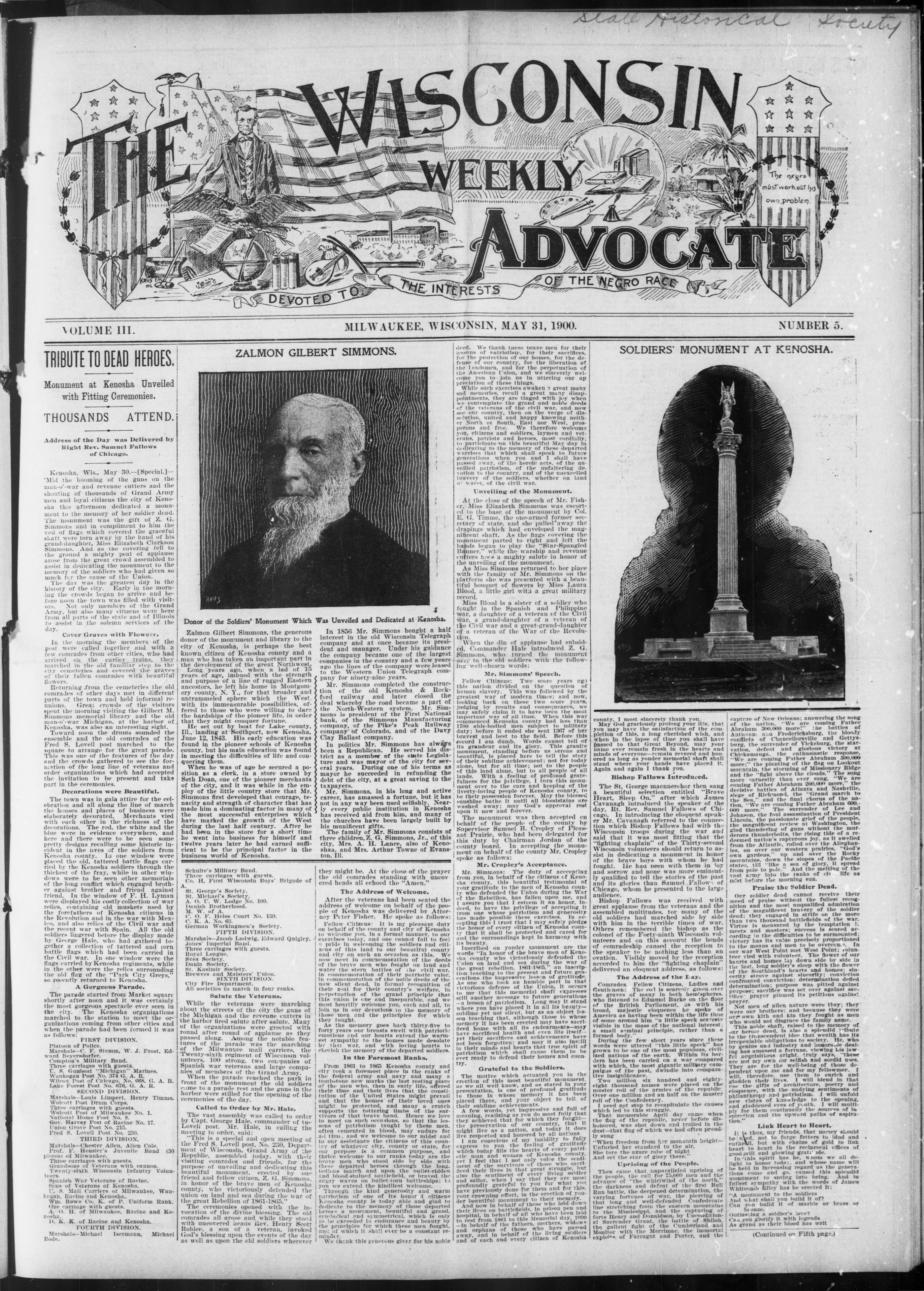
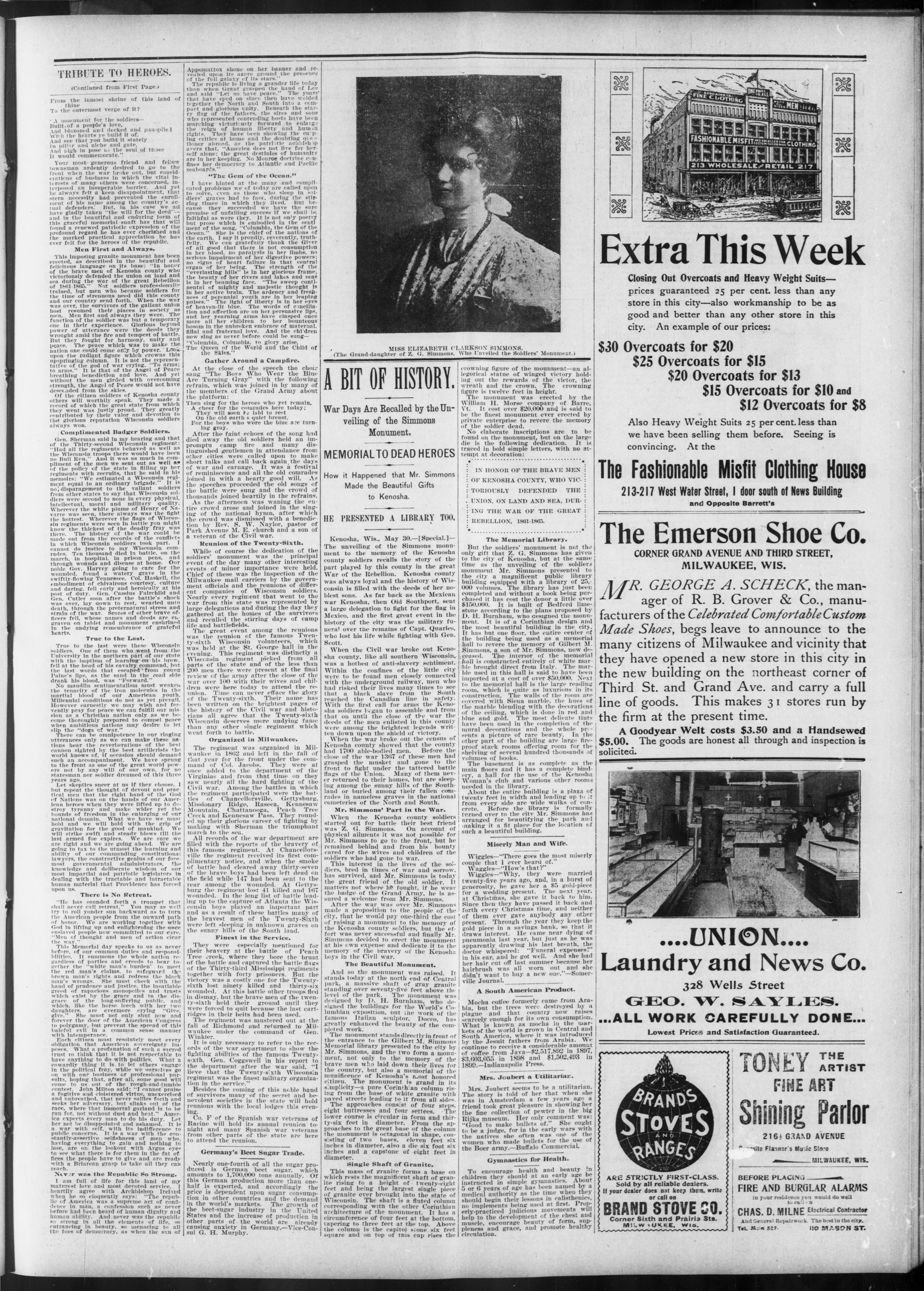
Kenosha, Wis., May 30.—[Special.]—'Mid the booming of the guns on the man-o'-war and revenue cutters and the shouting of thousands of Grand Army men and loyal citizens the city of Kenosha this afternoon dedicated a monument to the memory of her soldier dead. The monument was the gift of Z. G. Simmons and in compliment to him the veil of flags which covered the graceful shaft were torn away by the hand of his grand-daughter, Miss Elizabeth Clarkson Simmons. And as the covering fell to the ground a mighty peal of applause arose from the great crowd assembled to assist in dedicating the monument to the memory of the soldiers who had given so much for the cause of the Union.
The day was the greatest day in the history of the city. Early in the morning the crowds began to arrive and before noon the town was filled with visitors. Not only members of the Grand Army, but also many citizens were here from all parts of the state and of Illinois to assist in the solemn services of the day.
Cover Graves with Flowers.
In the morning the members of the post were called together and with a few comrades from other cities, who had arrived on the earlier trains, they marched in the old familiar step to the city cemeteries and covered the graves of their fallen comrades with beautiful flowers.
Returning from the cemeteries the old comrades of other days met in different parts of the town and held informal reunions. Great crowds of the visitors spent the morning visiting the Gilbert M. Simmons memorial library and the old man-o'-war Michigan, at the harbor of Kenosha, was also an interesting sight.
Toward noon the drums sounded the ensemble and the old comrades of the Fred S. Lovell post marched to the square to arrange for the great parade. This was one of the features of the day and the crowds gathered to see the formation of the long line of veterans and order organizations which had accepted the invitation to be present and take part in the ceremonies.
Decorations were Beautiful.
The town was in gala attire for the celebration and all along the line of march the houses and places of business were elaborately decorated. Merchants vied with each other in the richness of the decorations. The red, the white and the blue were in evidence everywhere, and here and there were to be seen some pretty designs recalling some historic incident in the inves of the soldiers from Kenosha county. In one window were placed the old, tattered battle flags carried by the Kenosha soldiers through the thickest of the fray, while in other windows were to be seen other memorials of the long conflict which engaged brother against brother and friend against friend. In the window of F. H. Lyman were displayed his costly collection of war relics, containing old muskets used by the forefathers of Kenosha citizens in the Revolution and in the war with Mexico, and also relics of the Civil war and the recent war with Spain. All the old soldiers lingered before the display made by George Hale, who had gathered together a collection of tattered and corn battle flags which had been carried in the Civil war. In one window were the flags carried by Kenosha regiments, while in the other were the relics surrounding the old flag of the "Park City Greys," so recently returned to Kenosha.
A Gorgeous Parade.
The parade started from Market square shortly after noon and it was certainly the most gorgeous spectacle ever seen in the city. The Kenosha organizations marched to the station to meet the organizations coming from other cities and when the parade had been formed it was as follows:
Platoon of Police.
Marshals—C. F. Stemm, W. J. Frost, Edward Beyersdorfer.
Compton's Military Band.
Three carriages with guests.
U. S. Gunboat "Michigan" Marines.
Waukegan Post No. 374 G. A. R.
Wilcox Post of Chicago, No. 668, G. A. R.
Lake Forest Post No. 676, G. A. R.
SECOND DIVISION.
Marshals—Louis Limpert, Henry Timme,
Wolcott Post Drum Corps.
Three carriages with guests.
Wolcott Post of Milwaukee No. 1.
National Home Post No. 8.
Gov. Harvey Post of Racine No. 17.
Union Grove Post No. 215.
Fred S. Lovell Post No. 230.
THIRD DIVISION.
Marshals—Chester Allen, Allen Cole.
Prof. F. Heusier's Juvenile Band (30 pieces) of Milwaukee.
Three carriages with guests.
Grandsons of Veterans with cannon.
Twenty-sixth Wisconsin Infantry Volunteers.
Spanish War Veterans of Racine.
Sons of Veterans of Kenosha.
U. S. Mail Carriers of Milwaukee, Waukegan, Racine and Kenosha.
Wm. Rowe Co. K. of P. Uniform Rank.
One carriage with guests.
A. O. H. of Milwaukee, Racine and Kenosha.
D. K. K. of Racine and Kenosha.
FOURTH DIVISION.
Marshals—Michael Isermann, Michael Bode.
ZALMON GILBERT SIMMONS.
Donor of the Soldiers' Monument Which
KRUS
Donor of the Soldiers' Monument Which Was Unveiled and Dedicated at Kenosha.
Zalmon Gilbert Simmons, the generous donor of the monument and library to the city of Kenosha, is perhaps the best known citizen of Kenosha county and a man who has taken an important part in the development of the great Northwest. Long years ago, when a lad of 15 years of age, imbued with the strength and purpose of a line of rugged Eastern ancestors, he left his home in Montgomery county, N. Y., for that broader and untrammeled sphere which the West, with its immeasurable possibilities, offered to those who were willing to dare the hardships of the pioneer life, in order that they might conquer fortune.
In 1856 Mr. Simmons bought a half interest in the old Wisconsin Telegraph company and at once became its president and manager. Under his guidance the company became one of the larger companies in the country and a few years ago the lines of the company were lease to the Western Union Telegraph company for ninety-nine years.
Mr. Simmons completed the construction of the old Kenosha & Rockford railway and later closed the deal whereby the road became a part of the North-Western system. Mr. Simmons is president of the First National bank, of the Simmons Manufacturing.
He set out by boat for Lake county, Ill., landing at Southport, now Kenosha, June 12, 1843. His early education was found in the pioneer schools of Kenosha county, but his main education was found in meeting the difficulties of life and conquering them.
When he was of age he secured a position as a clerk, in a store owned by Seth Doan, one of the pioneer merchants of the city, and it was while in the employ of the little country store that Mr. Simmons first developed that courage, tenacity and strength of character that has made him a dominating factor in many of the most successful enterprises which have marked the growth of the West during the last half century. After he had been in the store for a short time he went into business for himself and twelve years later he had earned sufficient to be the principal factor in the business world of Kenosha.
Schulte's Military Band.
Three carriages with guests.
Co. H, First Wisconsin Boys' Brigade of
A.
St. George's Society.
St. Michael's Society.
A. O. U. W. Lodge No. 109.
Danish Brotherhood.
M. W. of A.
C. O. F. Heiss Court No. 159.
C. K. A. No. 63.
German Workingmen's Society.
FIFTH DIVISION.
Marshals—Jacob Ludwig, Edward Quigley.
Jones' Imperial Band.
Three carriages with guests.
Royal League.
Svea Society.
Dania Society.
St. Kasimir Society.
Brewers and Malsters' Union.
SIXTH DIVISION.
City Fire Department.
All societies to march in four ranks.
Salute the Veterans.
While the veterans were marching about the streets of the city the guns of the Michigan and the revenue cutters in the harbor fired salute after salute. Many of the organizations were greeted with round after round of applause as they passed along. Among the notable features of the parade was the marching of the Milwaukee mail carriers, the Twenty-sixth regiment of Wisconsin volunteers, 100 strong, two companies of Spanish war veterans and large companies of members of the Grand Army.
When the parade reached the park in front of the monument the old soldiers came to a parade rest and the guns in the harbor were stilled for the opening of the ceremonies of the day.
Called to Order by Mr. Hale.
The vast assembly was called to order by Capt. George Hale, commander of two Loveli post. Mr. Hale, in calling the meeting to order, said:
"This is a special and open meeting of the Fred S. Lovell post, No. 230, Department of Wisconsin, Grand Army of the Republic, assembled today, with their visiting comrades and friends, for the purpose of unveiling and dedicating this beautiful monument, erected by our friend and fellow citizen, Z. G. Simmons, in honor of the brave men of Kenosha county, who victoriously defended the union on land and sea during the war of the great Rebellion of 1861-1865."
The ceremonies opened with the invocation of the divine blessing. The old comrades all arose and while they stood with uncovered heads Rev. Henry Scott Roblee, a son of a veteran, invoked God's blessing upon the events of the day as well as upon the old soldiers wherever
---
Was Unveiled and Dedicated at Kenosha.
In 1856 Mr. Simmons bought a half interest in the old Wisconsin Telegraph company and at once became its president and manager. Under his guidance the company became one of the largest companies in the country and a few years ago the lines of the company were leased to the Western Union Telegraph company for ninety-nine years. Mr. Simmons completed the construction of the old Kenosha & Rockford railway and later closed the deal whereby the road became a part of the North-Western system. Mr. Simmons is president of the First National bank, of the Simmons Manufacturing company, of the Pike's Peak Railway company of Colorado, and of the Davy Clay Ballast company.
In politics Mr. Simmons has always been a Republican. He served his district as a member of the state Legislature and was mayor of the city for several years. During one of his terms as mayor he succeeded in refunding the debt of the city, at a great saving to the taxpayers.
Mr. Simmons, in his long and active career, has amassed a fortune, but it has not in any way been used selfishly. Nearly every public institution in Kenosha has received aid from him, and many of the churches have been largely built by his munificent gifts.
The family of Mr. Simmons consists of three children, Z. G. Simmons, Jr., of this city, Mrs. A. H. Lance, also of Kenoshaa, and Mrs. Arthur Towne of Evanston, Ill.
they might be. At the close of the prayer the old comrades standing with uncovered heads all echoed the "Amen."
The Address of Welcome.
After the veterans had been seated the address of welcome on behalf of the people of Kenosha was delivered by Attorney Peter Fisher. He spoke as follows: Fellow Citizens: It is my pleasant duty on behalf of the county and city of Kenosha to welcome you, in a formal manner, to our exercises today, and one cannot fail to feel a pride in welcoming the soldiers and citizens of this land to our beautiful county and city on such an occasion as this. We now meet in commemoration of the deeds of the brave men who fought on land and water the stern battles of the civil war, in commemoration of their patriotic valor, in commemoration of the noble deeds of the now silent dead, in formal recognition of their zeal for their country's welfare, in perpetuation of the grand principle that this union is one and inseparable, and we most heartily welcome you, each and all, to join us in our devotions to the memory of those men and the principles for which they fought.
As the memory goes back thirty-five to forty years our breasts swell with patriotic emotions and our hearts extend the warmest sympathy to the homes made desolate by that war, and with loving hearts to cherish the memory of the departed soldiers.
In the Foremost Ranks.
From 1861 to 1865 Kenosha county and city took a foremost place in the ranks of the federal army and navy and many a tombstone now marks the last resting place of the men who, then in early life, offered their time and their lives that the constitution of the United States might prevail and that the homes of their loved ones might be protected, and many a crutch supports the toottering limbs of the survivors of that brave band. Hence we love to meet on such occasions, so that the lessons of patriotism taught by these men, often cemented in blood, may endure for ad time, and we welcome to our midst and to our assistance the citizens of this country of whatever city, county or state, for our purpose is a common purpose, and thrice welcome to our ranks today are the brave men who stood side by side with these departed heroes through the long, tedious march and upon the bullet-ridden and blood-stained battlefield, or braved the angry waves on bullet-torn battleships; to you we extend the kindlest welcome.
Through the kind generosity and warm patriotism of one of its honor d citizens Kenosha county is today able and glad to dedicate to the memory of those departed heroes a monument, beautiful and grand, symbolical and symmetrical, which is only to be exceeded in endurance and beauty by the principles for which these men fought, and of which it shall ever be a constant reminder.
We thank this generous giver for his noble
deed. We thank these brave men for their lessons of patriotism, for their sacrifices, for the protection of our homes, for the defense of our country, for the liberation of the bondsmen, and for the perpetuation of the American Union, and we sincerely welcome you to join us in uttering our apreciation of these things.
While such exercises awaken a great many sad memories, recall a great many disappointments, they are tinged with joy when we contemplate the grand and noble deeds of the veterans of the civil war, and now see our country, then on the verge of dissolution, united and happy knowing neither North or South, East nor West, prosperous and free. We therefore welcome you, citizens and soldiers, laymen and veterans, patriots and heroes, most cordially, to participate on this beautiful May day in dedicating to the memory of these departed warriors that which shall speak to future generations when you and I shall have passed away, of the heroic acts, of the unsuilled patriotism, of the unfaltering devotion to the country, and of the unexcelled bravery of the soldiers, whether on land or water, of the civil war.
Unveiling of the Monument.
At the close of the speech of Mr. Fisher, Miss Elizabeth Simmons was escorted to the base of the monument by Col. E. G. Timme, the one-armed former secretary of state, and she pulled away the drapings which had enveloped the magnificent shaft. As the flags covering the monument parted to right and left the bands began to play the "Star-Spangled Banner," while the warship and revenue cutters fire a mighty salute in honor of the unveiling of the monument. As Miss Simmons returned to her place with the family of Mr. Simmons on the platform she was presented with a beautiful bouquet of flowers by Miss Laura Blood, a little girl with a great military record
Miss Blood is a sister of a soldier who fought in the Spanish and Philippine war, a daughter of a veteran of the Civil war, a grand-daughter of a veteran of the Civil war and a great-grand-daughter of a veteran of the War of the Revolution.
When the din of applause had subsided, Commander Hale introduced Z. G. Simmons, who turned the monument over to the old soldiers with the following well-chosen words:
Fellow Citizens: Two score years ago this nation divided on the question of human slavery. This was followed by the greatest war of modern times; and now, looking back on these two score years, judging by results and consequences, we may safely claim it to have been the most important war of all time. When this war commenced Kenosha county had less than 1700 able-bodied men subject to military duty; before it ended she sent 1367 of her bravest and best to the field. Before this record I am dumb. Words cannot tell of its grandeur and its glory. This granite monument, standing before us serene and beautiful, is placed here to tell the story of their sublime achievement; not for today alone, but for all time; not to the people of this land alone, but to all people of all lands. With a feeling of profound gratefulness for the privilege, I turn this monument over to the care and keeping of the livery-loving people of Kenosha county, to be their possession forever. May the blessed sunshine bathe it until all bloodstains are washed away; may God's approval rest upon it now and forever.
The monument was then accepted on behalf of the people of the county by Supervisor Samuel B. Cropley of Pleasant Prairie, who had been delegated for this duty by Chairman Jordan of the county board. In accepting the monument on behalf of the county Mr. Cropley spoke as follows:
Mr. Cropley's Acceptance.
Mr. Simmons: The duty of accepting from you, in behalf of the citizens of Kenosha county, this beautiful testimonial of your gratitude to the men of Kenosha county who defended the Union during the War of the Rebellion, has fallen upon me, and I assure you that I esteem it an honor, indeed, to have the privilege of accepting it from one whose patriotism and generosity has made possible these exercises. In accepting this I trust that I may safely pledge the honor of every citizen of Kenosha county that it shall be protected and cared for and the surroundings kept in harmony with its beauty.
Inscribed on yonder monument are the words "In honor of the brave men of Kenosha county who victoriously defended the Union on land and sea during the war of the great rebellion, 1861-1865," an inscription teaching to the present and future generations the impressive lesson of gratitude. As one who took an humble part in that victorious defense of the Union, it occurs to me that this memorial shaft expresses still another message to future generations—a lesson of patriotism. Long may it stand where you have placed it in all its beauty—sublime yet not silent, but as an object lesson teaching that, although those to whose memory it has been erected may have sacrificed home with all its endearments—may have sacrificed health and even life itself—yet their sacrifices and achievements have not been forgotten; and may it also instill in their minds and hearts that true spirit of patriotism which shall cause them to be ready to defend their homes and coun-
Grateful to the Soldiers.
The motive which actuated you in the erection of this most beautiful monument, as we all well know, and as stated in your presentation, is one of profound gratitude to those in whose memory it has been placed there, and your object to tell of their sublime achievements.
A few words, yet impressive and full of meaning, realizing as you do most fully that they achieved that for which they fought—the preservation of our country, that it might live as a nation, and today it does live respected and honored by all nations.
I am conscious of my inability to fully express to you the feeling of gratitude which today fills the hearts of every patriotic man and woman of Kenosha county, yet I feel that I not only voice the sentiment of the survivors of those who sacrificed their lives in that great struggle, but also the sentiment of every living soldier and sailor, when I say that they are most profoundly grateful to you for what you have previously done for them and for this, your crowning effort, in the erection of your beautiful monument to their memory.
And now in behalf of those who laid down their lives on battlefields, in prison pen and hospital, in behalf of all who have been laid to rest from 1861 to this Memorial day, 1900—in behalf of the fathers, mothers, widows and orphans of those who have passed away, and in behalf of the living soldiers and of each and every citizen of Kenosha
KRUS.
county, I most sincerely thank you. May God graciously prolong your life, that you may have the satisfaction of the completion of this, a long cherished wish, and when in the lapse of time you shall have passed to that Great Beyond, may your name ever remain fresh in the hearts and minds of everyone—remain revered and honored as long as yonder memorial shaft shall stand where your hands have placed it. Again and again I thank you.
Bishop Fallows Introduced.
The St. George maennerchor then sang a beautiful selection entitled "Brave Heart, Sleep On," after which James Cavanagh introduced the speaker of the day, Rt. Rev. Samuel Fallows of Chicago. In introducing the eloquent speaker Mr. Cavanagh referred to the connection which Bishop Fallows had with the Wisconsin troops during the war and said that it was most fitting that the "fighting chaplain" of the Thirty-second Wisconsin volunteers should return to assist in dedicating a monument in honor of the brave boys with whom he had fought. He had been with them in joy and sorrow and none was more eminently qualified to tell the stories of the past and its glories than Samuel Fallows of Chicago, whom he presented to the large audience.
Bishop Fallows was received with great applause from the veterans and the assembled multitudes, tor many of the old soldiers had marched side by side with him in the terrible times of war. Others remembered the bishop as the colonel of the Forty-ninth Wisconsin volunteers and on this account the bonds of comradeship caused the reception to the speaker to be nothing less than an ovation. Visibly moved by the reception accorded to him the "fighting chaplain delivered an eloquent address, as follows:
The Address of the Day
Comrades, Fellow Citizens, Ladies and Gentlemen: The soil is scarce; green over the graves of many in both hemispheres, who listened to Edmund Burke on the floor of the British Parliament, as with his broad, majestic eloquence he spoke of America as having been within the life time of some around him "a little speck scarceely visible in the mass of the national interest; a small seminal principle, rather than a formed body."
During the few short years since these words were uttered "this little speck" has grown to be one of the most populous, civilized nations of the earth. Within its borders has been carried on a war compared with which, the most gigantic military campaigns of the past, dwindle into comparative insignificance.
Two million six hundred and eighty-eight thousand names were placed on the muster roll of the armies of the republic. Over one million and an half on the muster roll of the Confederacy.
I need not stop to recapitulate the causes which led to this struggle.
That memorable April day came when the flag of the republic, never before dishonored, was shot down and trailed in the dust—that flag of which we had often proudly sung
"When freedom from her mountain height—Unfurled her standard to the air,
She tore the azure robe of night
And set the star of glory there."
Uprising of the People.
Then came that unparalleled uprising of the people, the call for 75,000 men and the advance of "the whirlwind of the north," the darkness and defeat of the first Bull Run battle, the deepened determination, the varying fortunes of war, the piercing of that long and well-defended Confederate line stretching from the eastern mountains to the Mississippi, and the capturing of forts Henry and Donaldson, by Unconditional Surrender Grant, the battle of Shiloh, the gallant fight of the Cumberland and Monitor with the Merrimac, the immortal exploits of Farragut and Porter, and the
NUMBER 5.
ENT AT KENOSHA.
capture of New Orleans; answering the song of the nation, "We are coming Father Abraham 300,000 more!" the battles of Antietam and Fredericksburg, the bloody conflicts of Chancellorsville and Gettysburg, the surrender of Vicksburg, the starvation, defeat and glorious victory at Chickamauga, the enthusiastic response, "We are coming Father Abraham 300,000 more;" the planting of the flag on Lookout mountain, the storming of Missionary Ridge and the "fight above the clouds." The song more earnestly than ever sung, "We are coming Father Abraham 200,000 more," the decisive battles of Atlanta and Nashville, siege of Richmond, the "Grand march to the Sea," and the final chorus of the nation, "We are coming Father Abraham 600,000 more." The surrender of Lee and Johnson, the foul assassination of President Lincoln, the passionate grief of the people, the magnificent review at Washington, the glad thundering of guns without the murderous thunderbolts, the rising tide of a redeemed nation's rapturous joy, as it swelled from the Atlantic, rolled over the Alleghanies, on over our western prairies, "God's own gardens," up and over the Rocky mountains, down the slopes of the Pacific states, till "like a sea of glory, it spread from pole to pole." And the melting of the vast army into the ranks of civilians as mist before the morning sun.
Praise the Soldier Dead.
Our soldier dead cannot receive their meed of praise without the fullest recognition and the most unqualified admiration of the magnificent bravery of the soldier dead; they engaged in strife on the more than two thousand battlefields of the war. Virtue is measured by the temptation it meets and masters; success is scored according to the difficulties to be surmounted; victory has its value precisely proportioned to the means and men to be overcome. In our war West Point met West Point; volunteer tied with volunteer. The flower of our hearts and homes lay down side by side in the last, long soldier's sleep with the flower of the Southland's hearts and homes: sincerity strove against sincerity; conviction confronted conviction; determination defied determination; purpose was pitted against purpose; sacrifice was set over against sacrifice; prayer plumed its petitions against prayer.
Not men of alien nature were they; they were our brothers; and because they were our own kith and kin they fought as men who would not disgrace the family name. This noble shaft, raised to the memory of our heroic dead, is also a splendid tribute to the transcendent idea that wealth has its irrepeable obligations to society. He, who by genius and industry and honorable dealing has amassed a fortune, viewing his lawful acquisitions aright, truly says, "these are not my own forself and sordid uses. They are for the well-being of those dependent upon me and for my fellowmer. I will, therefore, use them to enrich and gladden their lives. I will blend in that use the gifts of architecture, poetry and eloquence, with the undying sentiments of philanthropy and patriotism. I will unfold vistas of knowledge to the opening, and gladdened eyes of youth. I will multiply for them continually the sources of inspiration and the upward paths of aspiration."
Link Heart to Heart.
It is thus, my friends, that money should be used, not to forge fetters to bind and enthrall, but with chains of gold to link heart to heart in the reciprocal offices of good will and glowing gratitude.
In this spirit has he, whom we all delight to honor today, and whose name will be held in increasing regard as the generations come and go, caused this splendid monument to spring into being. And in fullest sympathy with the words of James Whitcomb Riley has he erected it:
"A monument to the soldiers
And what shall you build it of?
Can you build it of marble or brass or bronze,
Outlasting a soldier's love?
Can you glorify it with legends
As grand as their blood has writ
(Continued on Fifth page.)
WAR IS VIRTUALLY OVER.
Dispatch from Pretoria Says that Boers will Sue for Peace.
British Army Now at the Gates of Johannesburg-Anuexation Ceremony at Bloemfontein.
London, May 30.—It is officially announced that the Boers are leaving Natal. Gen. Hildyard has occupied Utrecht in the southeastern portion of the Transvaal.
Excitement at Pretoria.
Pretoria, Tuesday, May 29.—A dispatch sent from Johannesburg last night describes the town as intensely excited throughout the day on reports that the British were approaching, but says the excitement subsided in the evening, owing to rumors that the British had been driven back. There are large numbers of burghers at Johannesburg, but remarkable order prevails there.
London, May 30.—The war is virtually over. The news first came in a dispatch from Pretoria, which was sent from the Boer capital Monday, and received here at 5 o'clock yesterday afternoon, saying that the Boers had abandoned further resistance and would sue for peace. Four hours later came Gen. Roberts' dispatch announcing that he had occupied the suburbs of Johannesburg without opposition, and would enter the city at noon today. There is undoubtedly a section of the Transvaalers who would keep up the hopeless struggle to the end, but it is now regarded as almost certain that Pretoria will capitulate within a few days without further fighting. In fact, the last hours of the South African Republic have been reached, and little remains except to haul down the flag.
Boers will be Liberally Treated.
The pacification of the country will be undertaken most energetically. To this end the treatment of the conquered burghers will be much more liberal than they themselves expect. The irreconcilables will probably give trouble by carrying on guerrilla operations for some time, but the greater part of the regular British troops will be sent back to England at the earliest possible moment. The news that Gen. Roberts was virtually in control of Johannesburg became public in London shortly after 9 o'clock. It caused no public demonstration beyond cheering in the theaters and music halls when it was announced.
May Reach Pretoria Friday.
Lord Roberts gives no information regarding the direction in which the Boer forces have gone, but it is supposed that they have trekked north or northeast before the oncoming tide. The invaders, assuming that Lord Roberts takes possession of Johannesburg today as predicted, will be in front of Pretoria not later than next Friday. Gen. Buller remains stationary in Natal, where he evidently is awaiting direct pressure of the Boers by force from the north.
Boers Annoy Baller
London, May 30.—The following dispatch has been received at the war office from Gen. Buller, dated Newcastle, May 30:
"The enemy having formed a laager east of the town at Dornberg, pressed my right rear annoyingly. On May 27 I directed a force under Hildyard, by Wooldsrift and Utrecht, and another under Lyttleton, by Scmangaudrift, on Dornberg. These movements have caused the enemy to retire north.
"Hildyard is at Utrecht and the town has surrendered. Clery is bombarding Laing's Nek. The enemy are much disheartened and were they not in such very strong positions I doubt if they would show fight. The railway was opened to Newcastle on May 28."
Federals Acknowledge Defeat.
Pretoria, May 29, Tuesday.—An official war bulletin just issued is as follows:
"On Sunday a fight occurred close to Van Wyck's rust, in Gabrand. The Federaals fought well and the British troops seemed tired out. At dark the Federaals were forced to retire in the direction of Van Wyck's rust on account of the overwhelming force of the British.
"The British attacked Witwatersrand yesterday and were in contact with the Federaals at Gatsrand, but they were beaten back with good results by the Federaals under Commandant Louis Botha. The Federaals were heavily bombarded all day long, but kept their positions. The British loss is reported to be considerable.
"The British are near Utrecht, and they are also marching on Laings Nek."
OOM PAUL WAVERING.
Would Like a Guarantee that He will Not be Exiled to St. Helena.
Newcastle, May 30.—The following proclamation has been issued by the general in command: "The troops of the Queen are now passing through the Transvaal. Her majesty does not war upon individuals, but, on the contrary, she is anxious to spare them, so far as possible, the horrors of war. The quarrel which England has is with the government and not the people of the Transvaal, and provided they remain neutral, no attempt will be made to interfere with persons living near the line of march. Every possible protection will be given them. Any of their property which it may be necessary to take will be paid for. But, on the other hand—those thus allowed to remain near the line of march must respect and maintain neutrality. The residents of any locality will be held responsible, in both their persons and property, for any damage done to the railway or telegraph, or for violence done to any member of the British forces in the vicinity of their homes." The Standard has the following ad-vices from Pretoria under Monday's date:
"The Transvaal government has opened, or is about to open, peace negotiations. It has cabled a final inquiry to its agents abroad, asking whether any hope exists of aid."
Without doubt the presence of Lord Roberts with 40,000 men at Johannesburg will hasten the Transvaal's decision. Dispatches from Lourenco Marques yesterday described President Kruger as "wavering, but demanding a guarantee that he shall not be exiled to St. Helena."
The fighting burghers still continue to desert and the total collapse of the Boer military organization is not far off. Bennet Burleigh, wiring from Lord Roberts' headquarters at Veereninging, on Sunday, says: "I doubt if President Kruger can muster 15,000 men, as many of the burghers have gone to their homes."
ORANGE RIVER COLONY.
Imposing Annexation Ceremonies at Bloemfontein.
Bloemfontein, Monday, May 28. Amid salutes and cheers and the singing of "God Save the Queen" the military governor, Maj.-Gen. George Prettyman, at noon formally proclaimed the annexation of the Free State under the designa-
tion of the Orange River Colony. The ceremony was somewhat imposing and the scene in the market square inspiring. An immense concourse had gathered and the town was gay with bunting. The balconies and windows surrounding the square were crowded with ladies, among them Lady Roberts and the Misses Roberts, the Countess of Airlie and Ladies Henry Rentick and Settrington.
The troops were drawn up under command of Gen. Knox and entertained the spectators. The governor, accompanied by Gen. Kelly-Kenny and their staffs, escorted by the Welsh Yeomanry, was greeted with a general salute after which, amid an impressive silence and in a clear voice, heard in every part of the square, Gen. Prettyman read Lord Roberts' proclamation annexing the Orange Free State as conquered by her majesty's forces, to the Queen's dominions and proclaiming that the state shall henceforth be known as the Orange River Colony.
Lusty cheers greeted the concluding words of the proclamation and these were renewed with ever-increasing volume as Lord Acheson unfurled the royal standard and the bands struck up "God Save the Queen," all present joining in singing the national hymn. The ceremony concluded with cheers for the Queen. Lord Roberts and the army, and a salute of twenty-one guns.
FATE OF THE REPUBLICS.
Lord Salisbury Announces His Government's South African Policy.
London, May 30. Lord Salisbury, who was entertained at dinner last evening by the City of London Conservative association, made an important announcement regarding the government's South African policy.
"The 'stop-the-war' party has used my name," said the premier, "in support of its ideas by stating that I promised there should be no annexation of territory, no annexation of gold fields. I never gave a pledge. I never meant to give a pledge.
(Loud cheers.)
"I state a simple historical fact. We were accused of going to war for lust of gold and territory. It was one of those calumnies which, under the favoring influences of Dr. Leyds, spread itself over the press of Europe. Nothing could be more untrue. We went to war to abate oppression of the Queen's subjects in the Transvaal and because our remonstrances were met by an insulting ultimatum, to which, if the Queen's government had submitted, her power, not only in South Africa, but over her colonies and dependencies, would have been at an end. We were forced into the war by the action of our opponents.
Onite Ridiculous.
"To say that because we repudiated the greed of territory we therefore bound ourselves never to annex any territory is a most ridiculous misconstruction. I dwell on this point because this matter of annexation is about to become a burning question.
"We have made a tremendous sacrifice of blood and treasure in this conflict. There are misleading prophets, whose action bulks as large in the columns of the newspapers as the action of more influential and powerful people, who mislead the unlucky rulers of the Transvaal to continue resistance far beyond the time when all resistance has ceased to be even possibly successful. These men are perpetually pressing us to make some conditions, to offer some arranged stipulations that shall leave a shred of independence to the two republics. Our only certainty of preventing a recurrence of this fearful war is to insure that never again shall such vast accumulations of armament occur and that not a shred of the former independence of the republics shall remain. (Cheering.)
War Not Yet Ended.
"We are not yet at the end of the war, but I shall venture to lay it down as a primary condition of any future settlement that precautions will be taken of such a character that such a war will never occur again. Of course what measures will be necessary it is impossible at any moment to determine, because that depends largely upon the action and temper of those with whom we have to deal.
"I have already intimated that their resistance has gone beyond the limit to which resistance could wisely go. It is not for us to criticise their actions in what they are pleased to call self-defense, but they have acted so that every bitterness created by the war and every severance of classes and races have been stimulated by every measure they have taken, and so they go on.
"It will also be our duty to protect those native races who have been so sorely afflicted, and at the same time so to conduct their policy that so far as possible there shall be a reconciliation and that every one shall be a happy member of the British empire."
PLAGUE IN CHINATOWN.
Quarantine Enforced by a Force of 159 Policemen-Chinese Are Hemmed In.
San Francisco, Cal., May 30.—Dr. Kellogg, who has been investigating the corpse of a Chinaman found in a Chinese undertaking establishment, expressed an opinion late last night that the Chinaman had died of the plague.
"I am satisfied it is plague," he said, "and I am confident that animal inoculation and the autopsy will confirm it. One not conversant with the situation in Chinatown cannot appreciate the difficulties that confront the inspectors, but they may be imagined from the fact that we have only discovered the cases after the victim is dead."
The quarantine of Chinatown is being rigorously enforced, 159 policemen being detailed to maintain a cordon around the district. Ropes are stretched across the streets and the Chinese are closely hemmed in, even the secret exits through some blocks being closed against them. The Asiatics took the quarantine stoically. They had warning of what was coming and many left the district before the arrival of the police. The proportion of those who fled was small, however, and there are thousands behind the lines. All whites in Chinatown were allowed to pass out, but persons outside the lines are not permitted to enter.
The policemen have stopped freight of all kinds from coming out, but have let the Chinese understand that supplies for themselves might pass in. The Chinese watch for newspapers with eagerness. Cable cars are permitted to pass through the quarantined district only on condition that the passengers go inside the cars before entering the lines, and no person be allowed to get on or off the cars in Chinatown. Another condition is the fumigating of cars at both ends of the line.
Health Officer O'Brien states that a careful house to house inspection will be begun in Chinatown today and that the inspectors will, after receiving the sanction of the board of health, force their way into the houses if necessary.
FIVE MILLIONS FOR EDUCATION
Munificent Donation to Washington University at St. Louis.
St. Louis, Mo., May 30.—Samuel S. Cupples and Robert S. Brookings have transferred stock valued at $5,000,000 to the Washington university of St. Louis, which will make it one of the best-endowed educational institutions in the world. It already has an endowment of $2,000,000 and $2,000,000 more is in prospect now that something big has been done in this line.
—Fifteen feet of ore that runs from $20 to $100 in gold per ton has been opened up in the Uncle Sam mine, in the Cripple Creek district.
TROUBLE IMMINENT.
Russian Minister at Shanghai Calls for Warships -- American Cruiser at Taku.
Shanghai, May 29.—The Russian minister at Pekin has telegraphed asking that all the available gunboats be sent to Taku.
Tientsin, May 29.—A detachment of 200 Chinese soldiers has cleared the railway between here and Pekin, and the ordinary service was resumed at noon.
No news has been received from the Belgian engineers engaged in the construction of the Luhan line.
Thirty Japanese have arrived from the gunboat Atagokan. The French flagship D'Entrescasteaux and the gunboat Surprise have left Taku.
Tien Tsin, May 29.—A hundred American marines from the United States cruiser New York are expected here at 11 c'clock tonight. An armed reserve party of Frenchmen and Germans started to try to relieve the besieged Belgians. The viceroy, under the pressure of the French consul, has permitted the rescuers to travel by railroad to Feng Tai, where Chinese protection ends.
The Belgians are besieged at Chang Tsin Tein, near Teng Tai.
NOT BY POPULAR VOTE.
Washington, D. C., May 29. The Senate committee on privileges and elections today, through its chairman, Senator Chandler, made an adverse report upon the House joint resolution providing for the election of United States senators by direct vote of the people.
WELLAND CANAL PLOT.
Canadian Secret Service Implicates Maud Gonne with the Affair.
Montreal, May 29.—The Dominion government secret service has discovered that Carl Dullman, John Nolan and John Walsh, convicted of trying to destroy the Welland canal, came to Canada for the express purpose of wreaking vengeance on the colony for having sent troops to South Africa: that they threw up positions in Dublin to do so; and that at least two of them were provided with funds by the Clan-Na-Gael, which obtained the money through Maud Gonne, "The Irish Joan of Arc," who has made several visits to the United States in the interest of the "physical force" section of the Irish extremists. The agents do not say that Maud Gonne knew the Welland canal was to be blown up.
ST. LOUIS SHOOTINGS.
Street Railway Employes Continue the Use of Dangerous Weapons.
St. Louis, Mo., May 29. Shortly after 10 o'clock the motorman and conductor on a Sixth street car fired into a crowd which was jeering them. William Brenneman was shot in the knee and will probably lose his leg in consequence. Dolly Mitchell, a little girl, was hit in the wrist by one of the bullets, while standing in her yard near the scene of the shooting. The motorman and conductor were arrested.
Another disturbance occurred on South Broadway at 1 o'clock and three persons were reported badly hurt. Shots were fired from a moving car into a crowd on South Broadway, wounding Herman Tesihke, George Lacasten and Albert Wackwitz. The first named is probably fatally injured.
COL. STEVENS DEAD.
First White Settler in Minneapolis Educated in Wisconsin.
Minneapolis, Minn., May 29.—Col. John H. Stevens, the first white man to settle in the original city of Minneapolis, died yesterday afternoon at the age of 80 years. He was widely known in the state and the house he built in 1849 is still standing at Minnehaha park, where it was placed by the school children of the city. Col. Stevens served through the Mexican war. During the Indian troubles in Minnesota he served as brigadier-general of militia. He received his education in Wisconsin and Illinois. He was married at Rockford, Ill., in 1850, to Helen Miller. During his life he edited and owned several newspapers and has contributed valuable articles to the histories of Minnesota.
COMMITTED FOR TRIAL.
Sir Robert Peel Held at the Old Bailey Charged with Libel.
London, May 29.—At the Marlborough street police court today Sir Robert Peel was committed for trial at the Old Bailey on the charge of libeling Daniel Von Der Heydt, one of the trustees of the Peel estates, and a brother-in-law of Sir Robert. The libel is contained in letters describing Von Der Heydt as a scoundrel, blackmailer and thief. The defendant urged that proceedings were now pending in chancery relative to alleged breaches of trust under the Peel settlements and that the present proceedings ought to be suspended ad interim. But the magistrate committed the baronet for trial, accepting his own recognizances for his appearance.
MACHINERY ADMITTED.
Turkish Authorities Yield to the Demands of the United States.
Constantinople, May 29. After a delay of a month, Lloyd C. Griscom, United States charge d'affaires, has obtained permission for the importation of an important consignment of flour-milling machinery ordered in the United States by a merchant of Ismidt. It is probable the difficulty was due to the action of the native millers, who are fearful of the competition of a mill equipped on American principles.
Safe-Robber Badly Injured
Muskogee, I. T., May 29.—Lloyd Wilson, in trying to rob a store at Holdenville, blew open the safe with dynamite. The explosion mashed his right hand and injured the other and he will probably die. Wilson says he is an old railreader.
A Novel Checker Board
It is said the most valuable draught board in existence is that of the late Prince Bismarck, who was a great lover of the game. The squares of the board are made of silver and gold, to represent the usual light and dark-colored leather. The draughts are of silver and gold, having a diamond or a ruby in the center of each.—Baltimore American.
One Useful Spider
Silk of the great spider of Madagascar is strong, fine and elastic. It is used by the natives for fastening flowers to sunshades. The spiders which produce it are busy spinners, and a spider has been known to produce two miles of it in twenty-four hours.
— Landscape gardening, in the eyes of Miss Beatrix Jones, has attractions super- or to those of society. She has adopted it seriously as a profession. Miss Jones is a daughter of Mrs. Cadwallader Jones, and belongs to the Four Hundred in New York.
HONOR THE BRAVE.
Surviving Comrades Cover Their Graves with Wreaths of Beautiful Flowers.
Hagerstown, Md., May 30. On the battlefield of Antietam, where the bloodiest single day's fight of the entire Civil war took place, was unveiled today, in the presence of a mingled host of the survivors of both sides, the handsome monument erected by the state of Maryland and dedicated to the memory of her sons who fell, regardless of whether they wore the blue or the gray. Two special trains from Washington arrived at Keedysville shortly before 11 o'clock and from there carriages were taken to the battlefield. The party included President McKinley, Secretary Long, Secretary Root and other cabinet officers. Gen. Miles and several other prominent army officers were also of the party.
The dedicatory ceremonies included short addresses, mainly of a reminiscent character, by Gens. John B. Brooke, James Longstreet, Orlando B. Wilcox, J. E. Duryee, Senators Foraker, Burrows, Daniel and others who were prominent on the opposing sides in the great struggle. These were followed in turn by George B. McClellan of New York and other members of the United States Senate and House of Representatives. This concluded, the band played "Hail to the Chief," and Gen. Douglass introduced President McKinley.
The President, upon being introduced, said that he was not aware that he was expected to make a speech on the occasion, and therefore had prepared no setation, as he should otherwise have done. He spoke briefly of the spirit of patriotism which had inspired the erection of the monument to the soldiers of both sides of the late conflict.
"The union of the North and South," he said, "could work nothing but good for the entire country."
The monument, which is located on a central point of the ground swept over by the contesting forces, is a beautiful open-sided octagon. It is of granite, topped with bronze. At the base it is 22 feet in diameter and has a total height of 35 feet. The dome is supported by eight columns, representing the eight Maryland commands which were engaged in the battle. Surmounting the bronze dome is a female statue in bronze, symbolic of peace. On the faces of the monument are bronze bas-reliefs representing scenes in the conflict, and there are also eight bronze tablets bearing in raised letters the names and records in commemoration of the eight regiments.
Confederate Reunion.
Louisville, Ky., May 30.—The United Confederate veterans had undisputed possession of Louisville today, the occasion being the opening of the organization's tenth annual reunion. Public buildings, business houses and residences are elaborately decorated in honor of the 30,000 veterans and their visitors. The feature of the day was the annual reunion exercises held early this afternoon in the big hall at Sixth and Water streets. Veterans cheered to the echo speeches which cullogized confederacy, extolled "one nation" and cast glowing tributes upon the achievements of the men of the South. On all sides was the red and white of the confederacy twined about the red, white and blue of the nation. Loud cheers from the crowded house greeted the appearance on the stage of Gen. John B. Gordon, Gen. Simon Bolivar Buckner, Gen. Wade Hampton, Gen. Stephen D. Lee and other surviving generals of the confederacy. Gen. Gordon delivered a splendid speech which thrilled the hearts of his auditors and sent the famous rebel yell echoing into the rafters. The oration of the day was delivered by Rev. B. M. Palmer of New Orleans.
At Arlington Cemetery.
Washington, D. C., May 30. The observance of Memorial day was general among all classes of the national capital today. Government offices were closed, public and private business was suspended, and the streets were filled with marching veterans, national guardsmen, military and civic organizations, all moving toward the various cemeteries where memorial exercises were to be held, and the graves of the veterans covered with flags and flowers. At Arlington cemetery the usual impressive exercises were held with appropriate addresses delivered by men of national prominence. Exercises were also held, under the auspices of the Grand Army of the Republic, at Battle Ground National cemetery, where rest the remains of forty comrades from the states of New York, Pennsylvania, Massachusetts, Maine, Rhode Island and Vermont, who fell in action on July 11 and 12, 1864, while defending the capital from capture by a portion of the Army of Northern Virginia, under Gen. Jubal Early. The Congressional cemetery was also the scene of notable exercises this afternoon. Here the principal oration was delivered by Congressman Washington Gardner of Michigan.
Gettysburg, Pa., May 30.—School children and veterans of the Civil war united in the work of decorating the graves in the National cemetery here today. In the foreconon there was a large parade of veterans, which was followed by appropriate memorial exercises at the cemetery.
Lafayette's Tomb Decorated.
Paris, May 30.—Larger than ever before was the number of Americans who made the pilgrimage to the Cemetery Piepus today and in celebration of Memorial day paid a tribute of respect at the tomb of Lafayette. Ambassador Porter, Consul-General Gowdy and Commissioner Peck of the exposition were among those who took part in the ceremonies of decorating the tomb with flowers and the two flags of France and America. In observance of the day many American business houses, as well as the American national pavilion in the exposition grounds, were decorated with French and American flags.
At Manila.
Manila, May 30.—Memorial day was observed here as a general holiday. Military ceremonies were held at the various stations and salutes were fired from the forts at Santiago and Manila. A military escort proceeded to the Malate cemetery, where the graves of United States soldiers were decorated and an address was adopted by the chaplain. Memorial exercises were held also in the theater, at which a number of addresses were delivered, interspersed with vocal and instrumental music. The observance of the day was very successful.
SHOBT IN HIS ACCOUNTS.
J. R. Murphy of Laurium, Mich., Charged with Embezzlement. Calumet, Mich., May 30.—[Special.] Joseph R. Murphy, former secretary of the water board of Laurium village, is alleged to be short $2430 in his accounts, and a warrant has been issued for his arrest on the charge of embezzling the funds of the village. Murphy has not been seen since last Friday morning and is supposed to be in Chicago or Duluth.
FINDS A LARGE PEARL.
Genoa Fisherman is in Great Luck—
Valued at $150.
Genoa, Wis., May 30.—[Special.]—Bert Clements has found another large pearl in the Mississippi as a result of his clam-fishing operations in that river. He sold his first pearl for $150, and his last find has been appraised at about the same amount.
WORK OF CONGRESS.
SENATE.
Thursday, May 24.—Devoted the day to debate on the nation's duty toward its new island possessions, Messrs. Spooner, Allen and Bacon leading in the discussion. Seut to the committee on contingent expenses Mr. Bacon's resolution directing the committee on relations with Cuba to make an investigation into the island's finances.
Friday, May 25.—Discussion of the Spooner Philippine bill was continued by Mr. Morgan. On the general question of government of the islands by the United States he was in accord with Senators Spooner and Lodge, but he regarded the Spooner bill as unwise and dangerous legislation because of the great power it placed in the hands of the President. Mr. Allison then called up the sundry civil appropriation bill, which carries $65,812,930, or over $4,000,000 more than the bill as it passed the House. Sixty-five of the 157 pages of the bill were disposed of.
Saturday, May 26.—Agreed to the resolution for an investigation by the committee on Cuban affairs of the Cuban postal and other irregularities, authorizing the committee to visit Cuba if necessary to pursue the inquiry. Some time was given to the sundry civil appropriation bill without completing it, and to District of Columbia business. One of the latter measures provides extensive depot and terminal improvements in Washington for the Baltimore & Potomac and Baltimore & Ohio railroads, and for the removal of the historic "long bridge," to a highway from the North to the South during the war of the rebellion. Passed the bill granting a pension of $50 a month to Mrs. Mary L. Stotsenberg, widow of the late Col. Stotsenberg of the First Nebraska Volunteers, who was killed in the Philippines.
Monday, May 28.--Reading of the sundry civil appropriation bill completed, but not all of the committee amendments disposed of. A lively debate was precipitated over the proposition to continue the life of the industrial commission until October 31, 1901. Charges were made that the commission was being used as a Republican campaign machine and that important testimony had been suppressed. The committee amendment, however, was agreed to.
Tuesday, May 29.—The Senate added to the sundry civil appropriation bill an amendment appropriating $5,000,000 for the Louisiana purchase exposition, to be held in St. Louis in 1903, on condition that $10,000,000 in addition be raised by the exposition authorities. The amendment was adopted without debate and without division. Because an amendment offered by him subsequently was stricken out on a point of order, Mr. Gallinger (N. H.) moved to reconsider the St. Louis fair amendment, and that motion now is pending. Mr. Bacon (Ga.) addressed the Senate at length on the Teller resolution expressing sympathy for the Boers, after which the resolution was referred to the committee on foreign relations by a vote of 40 to 26. Mr. Fairbanks (Ind.) endeavored to secure consideration of the bill providing for the extradition of criminals from the United States to Cuba, but Mr. Allison declined to lay aside the appropriation bill for that purpose. Senate adjourned until Thursday.
HOUSE.
Thursday, May 22.—Devoted eight hours to consideration of the Alaska civil government bill. Three amendments of importance were adopted. One authorizes the secretary of war to issue permits to excavate or dredge for gold below low water mark on the beach at Cape Nome. The secretary has heretofore issued permits, but the bill as it passed the Senate canceled them. Another provides for a territorial delegate to Congress. The House also struck out the chapter relating to arrest and bail which permitted arrests in certain civil actions. The conference report on the Indian appropriation bill was adopted.
Friday, May 25.—Devoted two hours to consideration of the Alaskan civil government bill without completing it. The session from noon until adjournment was devoted to private pension bills. Mr. Talberd (S. C.) continued his obstructive tactics. After 150 bills had been favorably acted upon in committee of the whole he blocked their passage in the House with the point of no quorum. Among the bills favorably acted upon were the Senate measures to pension the widow of Capt. Gridley, who commanded the Olympia in the battle of Manila, at $50 a month, the widow of Commodore R. W. Meade at $40 a month and the widow of Gen. M. F. Force of Ohio at $50 a month.
Saturday, May 26. — Practically completed the consideration of the Alaska civil government bill. A few paragraphs, passed over during the reading of the bill, will be considered Monday. Mr. Cooper (Wis.), chairman of the committee on insular affairs, presented a favorable report on the Hay resolution calling upon the postmaster general for certain information regarding the reports of E. G. Rathbone, director of the posts in Cuba, and the resolution was adopted without division. Another resolution from the same committee, introduced by Mr. Jones (Va.), cailing upon the secretary of war to report in detail the payments made and to whom from the revenue of Cuba and Porto Rico, was also adopted.
Monday, May 28.—Alaskan civil government bill was passed and some odds and ends of legislation were cleaned up. Mr. Dalzell gave notice that the anti-trust resolution and bill reported by the judicial committee would be considered Wednesday, Thursday and Friday of this week under a special order.
Tuesday, May 29.—The House, by a vote of 107 to 124, refused to accept the Senate amendment to the naval appropriation bill relating to armor plate, and adopted a modified proposition authorizing the secretary of the navy to secure armor by contract, and if he cannot purchase it at what he deems a reasonable price, he is instructed to purchase a site and erect a factory for the manufacture of armor plate, appropriating the sum of $4,000,000 for this purpose. With regard to ocean and take surveys, the House refused any appropriation for surveys by the navy, and tied up the conferees with instructions. It also refused to concur in the Senate amendment to abolish the two years' sea cruise for naval cadets. With the above action the naval bill was sent back to conference, the conference report on the other items having been agreed to. The conference report on the postoffice appropriation bill, agreeing on all items except the Senate amendment appropriating $225,000 for pneumatic tube service, was adopted, and the House then concurred in the excepted amendment. The opponents of the extended service in the House reconciled their concurrence in this action upon the ground that the $225,000 simply carried out the existing contract. The bill now goes to the President. The House adjourned to Wednesday.
Wednesday, May 30.--The programme of the leaders contemplated the launching of the debate upon the anti-trust resolution and bill, but there was a strong undercurrent in favor of adjournment on account of Decoration day. Mr. Dalzell, who presented the special order under which the House was to operate, in deference to this sentiment withdrew it in order that the 190 pension bills might be passed, and after they had been disposed of, as a further mark of respect the House adjourned. The Chinese commission bill, which was under consideration several weeks ago, has gone back to the calendar, the motion to strike out the enacting clause having been defeated.
Postal Service in Corea.
For a couple of years past Corea has maintained a domestic postal service in good working order, under the supervision of a French postal expert, M. Clemencet, using stamps printed in the United States. On or about January 3 last the first mail ever sent out to foreign countries by the Corean post was dispatched from the central office in Seoul. The stamps used were the ones still in use in the domestic postal service and printed in the United States. A new issue has been ordered from Japan. —Consul-General H. N. Allen.
Our Unused Resources.
The amount of arid lands which lie in Arizona, New Mexico, Oklahoma, Texas and Colorado is estimated to be at least five hundred millions of acres. This is rendered useless by the need of water, and the reclamation of this land would add billions of dollars to the wealth of the country. In many sections of Colorado and other states in which irrigation is used, the best farming lands in the country are those which were formerly worthless and are now artificially watered.—New York Journal.
Milwaukee, May 29, 1900.
EGG AND DAIRY MARKET.
MILWAUKEE—Eggs—Market firm at 11c
fer new, cases included; 10%c for new, cases
returned; 10%c for old, cases included;
dirties and seconds, 7@8c. The receipts
were 362 cases.
Butter—Market steady. The receipts were 20.850 lbs today against 12.550 yesterday. The market here is not as firm as outside markets would warrant, Elgin going 19½¢ and firm yesterday. There is a good demand here for dairy butter and high-class grades are wanted here. Creameries are not so firm, only a fair demand existing. Extras were offered on the board today at 18½¢, but no bids. Prints sold for 19½¢. The local board voted to make the market on extras 19¢. Fancy prints, 20¢; fancy or extra creamery, per lb, 19¢; firsts, 17¢; seconds, 16¢; extra dairy, 15¢; lines, 13¤14¢; packing stock, 10@11¢; roll butter, 12@13¢; whey butter, 10¢; imitation creamery, 15@16¢; grease, 4@6¢. Fancy dairy prints, 17¢. Cheese—Quilt. The receipts today were 780 lbs against 8540 yesterday. Full cream flats, October, per lb, 11½¤12¢; full cream flats, new, 9@9¢; New York, full cream, 12@12¢; Young Americans, October, 12@12¢; brisk, fancy October make, 10@10¢; new brick, 8½¤9¢; limburger, fancy October, 10@10¢; new limburger, per lb, 8@8½¢; imported Swiss, 24¢; Block Swiss, domestic, 12@12¢; No. 1 imitation ioaf, 12@12¢; Sapsago, 19@20¢; farmers', 9@10¢. Brick, new, sold on the board today at 8¢. Bids of 8½¢ were made on American Twins.
NEW YORK—Butter — Receipts, 19,332 pkgs; steady; Western cream, 16%@ 20½c; factory, 14@16c. Cheese—Receipts, 6075 pkgs; weak; fancy large white, 9½c; do small, 8½@8½c; fancy large colored, 9½c; do small, 8½@8½c. Eggs—Receipts, 2001 pkgs; barely steady; state and Pennsylvania, 14@14½c; Western, loss off, 13½c@14c; Western, at mark, 11@13c. Sugar—Raw, firm; fair refining, 4c; centrifugal, 96 test, 4½c; molasses sugar, 3 13-16c; refined, steady; crushed, 5.70c; powdered, 5.40c; granulated, 5.30c. Coffee—Steady; No. 7 Rio, 71 3-16c.
FOND DU LAC—Sales of 88 cheddars at 7½@7½c; 580 twins at 7½c; 150 daisies at 8½c; market active.
CHICAGO — Butter — Steady; creameries, 15@19½c; dairyes, 13½@17c. Eggs—Steady; fresh, 17½c. Dressed poultry—Steady; turkeys, 6@6½c; chickens, 8@9c.
MILWAUKEE LIVESTOCK MARKET.
HOGS—Receipts, 49 cars; market weak; light, 4.95@5.10; mixed and medium weights, 5.05@5.20; common to choice heavy, 5.05@5.20; coarse weight stags, 4.25@4.50.
light, 4.95@5.10; mixed and medium weights, 5.05@5.20; common to choice heavy, 5.05@5.20; coarse heavy stags, 4.25@4.50.
CATTLE-Receipts, 12 cars; steady; butcher steers, medium to good, 1050 to 1300 lbs, 4.75@5.25; fair to medium, 950 to 1050, 4.50 @4.75; heifers, good to choice, 3.75@4.25; cows, fair to good, 2.80@3.50; canners, 2.25 @2.75; bulls, common, 2.75@3.25; choice, 3.50 @4.00; feeders, 800 to 950 lbs, 4.00@4.50; stockers, 500 to 750 lbs, 3.85@4.25; veal calves, 5.50@6.75; milkers and springers, common, 20.00@28.00; choice heavy cows, 38.00@45.00.
SHEEP—Receipts, 1 car; market steady; shorn, 4.00@4.75; bucks, 2.50@3.25; lambs, shorn, common to choice, 4.50@5.25.
Chicago receipts: Hogs, 23,000; cattle, 2500; sheep, 5000
CHICAGO POTATO MARKET
Prices were 1@2c higher, with a good local demand early. A number of cars were sold at the advance. Trains were late in getting in and arrivals may be increased by later runs. There were sales of 2 cars choice Burbanks at 42c, 1 car at 41c, 1 car white stock at 41c, 2 at 40c. Burbanks, good to choice, 40@41c; do common to fair, 37@39c; Rurals, round white, 39@41c; Hebrons, common to choice, 35@38c; Peerless, poor to choice, 35@38c; Kings, common to choice, 35@38c; mixed, red and white, 31@38c; do white, 36@40c.
MARKETS BY TELEGRAPH.
MILWAUKEE—Flour—Steady. Wheat—Steady; No. 2 spring, on track, 68c; No. 1 Northern, on track, 67½c. Corn—Steady; No. 3 on track, 37½c. Oats—Easy; No. 2 white, on track, 25c; No. 3 white, on track, 24½c. Barley—Steady; No. 2 on track, 43c; sample on track, 37¼c. Rye—Steady; No. 1 on track, 56½c. Provisions—Steady; pork, 11.20; lard, 6.77.
Flour is steady at 3.60@3.70 for patents; bakers', 2.60@2.70, and 2.85@3.00 for rye.
Millstuffs are firm and quoted at 13.25 for bran, 13.25 for standard middlings, and 14.25 for Milwaukee flour middlings.
CHICAGO—Close—Wheat—May, 66c; July, 67@67½c. Corn—May, 37c; July, 37¼@37½c. Oats—May, 21½c. June, 21½c. July, 21½c. Pork—May, 11.17½c. July, 11.27½c. September, 11.27½c. Lard—May, 6.80; July, 6.82½c. September, 6.82½c. Ribs—May, 6.50; July, 6.52½c. September, 6.50@6.52½c. Flax—Cash Northwest, 1.80; Southwest, 1.80; May, 1.80; September, 1.28@1.28½c. Rye—May, 54½c; July, 53@53½c. Barley—36@42c. Timothy—2.40. Clover—7.50
MINNEAPOLIN—Close—Wheat—In store,
No. 1 Northern, May, 65¢; July, 65¢; September,
65¼¢@65¢¢; on track, No. 1 hard,
67¢¢; No. 1 Northern, 65¢¢; No. 2 Northern,
64¢¢.
DULUTH — Close — Wheat — Cash No. 1 hard,
69¢¢; No. 1 Northern, 67¢¢; No. 2 Northern,
65¢¢; No. 3, 62¢¢; No. 1 hard to arrive,
65¢¢; No. 1 Northern do, 67¢¢; July,
67¢¢; September, 67¢¢.
NEW YORK-Close-Wheat-May, 71%c;
July, 72%c; September, 73%c; Corn-May,
41%c; July, 42%c; September, 42%c.
LIVERPOOL-Wheat-Steady, 5%d higher;
July, 58%d; September, 58d; Corn-Quiet,
4%d higher; July, 39%d; September, 39%d.
SOUTH OMAHA-Cattle-Receipts, 4500;
steady to 5@10c lower; native steers, 4.40@
5.25; cows and heifers, 3.60@4.60; stockers
and feeders, 3.75@4.25. Hogs-Receipts,
15.200; 5c lower; heavy, 4.90@5.00; mixed,
4.90; light, 4.80@4.90; pigs, 4.50@4.90; bulk
of sales, 4.90. Sheep-Receipts, 3200;
steady to strong; muttons, 4.60@5.20; lambs,
5.25@6.90.
ST. LOUIS-Cattle-Receipts, 4500; market
steady to lower; native steers, 3.50@
5.65; stockers and feeders, 3.20@4.80; cows
and heifers, 2.00@4.95; Texas and Indian
steers, 3.65@5.00. Hogs-Receipts, 8000;
shade lower; pigs and lights, 5.05@5.15.
packers, 5.00@5.20; butchers, 5.15@5.25.
Sheep-Receipts, 3500; shade lower; mut-
tons, 4.50@5.00; larabs, 5.50@7.00.
PE-RU-NA
FOR WOMEN
The debilitating drains and discharges which weaken so many women are caused by Catarrh of the distinctly feminine organs. The sufferer may call her trouble Leuchorrhoea, or Weakness, or Female Disease or some other name, but the real trouble is catarrh of the female organs and nothing else.
Pe-ru-na radically and permanently cures this and all other forms of Catarrh. It is a positive specific for female troubles caused by catarrh of the delicate lining of the organs peculiar to women. It always cures if used persistently. It is prompt and certain.
MEASURE HAS BADLY DISCONCERTED THE DEMOCRATS.
In Attempting to Make Party Capital Out of the Shipping Bill They Show Themselves to Be About Evenly Divided For and Against It.
The Democratic leaders in Congress have been making elaborate preparations to make the shipping bill a campaign issue. They have attempted to terrorize the Republicans into the abandonment of the bill at the present session at least. It is not known how much the foreign shipping lobby is willing to contribute to the Democratic campaign fund if the bill's consideration is deferred until the short session. Postponement, say the foreign shipping lobby, means the bill's defeat.
A $200,000,000 a year business is the stake. If Democratic threats of filibustering are effective enough to induce Republicans to postpone the consideration of the shipping bill, the foreign shipping lobby, their free trade allies and Democratic dupes will each have carried their point.
Democratic success up to this time is the more amazing, as their own disorganization on this question is disclosed. It would be imagined that they would be united in opposition to the bill, if intending to make a campaign issue of it. Just the reverse is the case. They are about evenly divided for and against it. This is shown by the two minority reports that have been filed by the Democratic members of the House Merchant Marine and Fisheries Committee. The first report filed was signed by Messrs. William Astor Chanler, of New York; John H. Small, of North Carolina, and Joseph E. Ransdell, of Louisiana. Their report advocates government aid and opposes free ships. Their suggested amendments to the bill are not of a character to seriously minimize its effectiveness.
The other four Democratic members of the House Merchant Marine and Fisheries Committee who signed the other report are Messrs. John F. Fitzgerald, of Massachusetts; Marion DeVries, of California; Thomas Speight, of Mississippi, and Wm. D. Daly, of New Jersey. Their support opposes subsidies and in effect advocates free ships. Their report, said to have been written by an attorney of the foreign steamship lines, is largely an attack upon the only American steamship line engaged in the transatlantic trade.
The odium attaching to the Democrats who are fighting the battle of the foreign shipping lobby in Congress, and who advocate the purchase of ships built abroad, instead of their construction in the United States, presents them in a very sorry figure. They will be infinitely more busy in defending their own attitude on this question than they can be in assailing that of the Republicans and a large contingent of their own party associates. The Democratic leaders had made desperate efforts to prevent a public disclosure of their differences, but the courage of nearly one-half of the minority made further concealment of their condition impossible. The Democratic members of the committee who advocate government aid by independently filing their report in advance of the submission of the other minority report, forced the signers of the latter to lamely limp last into the public eye. Their hopeless division shows how utterly impossible it will be for them to make a successful campaign issue of the shipping question.
If Democrats attack a government-aided shipping, Democrats who have the best of the argument may be quoted in answer. Republican ammunition with which to refute Democratic attacks of this character need not be used—it is furnished by the more honest and courageous of the Democrats themselves.
This is a situation which seems almost providential for the united Republicans. They seem to be assured of the votes of a large contingent—possibly one-half—of the Democrats in the House in favor of the ship subsidy bill, if it is brought up for passage now. Such an opportunity has not been presented in a generation, and may never again occur so favorable.
The same situation exists in the Senate. The Democrats there are unable to prepare, much less present, a minority report in opposition to the ship subsidy bill. It is well and publicly known that a number of Democrats will speak and vote for the bill. What the Democratic leaders desire to avoid, at all hazards, is the effect it will have upon their party followers that will surely result from the discussion in the Senate of the ship subsidy bill at this session, to disclose a substantial contingent of their own party associates in advocacy and voting for that bill.
If Republicans can be coerced, intimidated or cajoled into postponing the consideration of the ship subsidy bill at the present session, the Democrats may be able to conceal their own weakness in divided opposition to the ship subsidy bill in the Senate. A little incident has clearly demonstrated this, and shown the desperation of the Democratic leaders.
The Chairman of the Democratic National Committee, in his rage at the filing of the Chanler-Small-Ransdell report, sent for these gentlemen and began to angrily upbraid them as traitors to their party, so the report goes, and he told them that by their ill-timed exhibition of independence and honesty they had sacrificed a splendid issue upon which the Democrats could have attacked the Republicans in the coming campaign. The Democratic Chairman, so it is said, was rendered almost speechless when he was very emphatically told by Messrs. Chanler, Small and Ransdell that he had no authority to denounce their action: that the Demo-
cratic party had not declared itself on this subject in its last national platform; and that in any event they were decidedly opposed to the dragging of the shipping question into partisan politics. They told him that the shipping question was a business proposition—a commercial question, and of great and pressing national importance; that they so considered it, and that they were quite ready to defend their position at any time.
In these very favorable circumstances, for the Republicans to defer action on the ship subsidy bill until the Democratic National Convention can be whipped into adopting an expression in its next national platform, opposing Government aid for the upbuilding of American shipping, will make it infinitely more difficult than ever for courageous and patriotic Democrats to support the measure. It means to gravely imperil, if not actually defeat, its final passage.
The prestige of Democratic success in compelling the Republicans to defer action at this session on the ship subsidy bill—since postponement will be regarded the country over as a Democratic, free trade, foreign shipping victory—will make it all the easier for them to defeat action at the next session, and all the harder for Republicans to secure favorable action.
The opportunity of a generation is within the grasp of the Republican leaders in Congress if they have the courage to grasp it by passing the shipping bill before adjournment at this session.
PORTO RICANS PLEASED.
British Consul There About the Only
Must Ride Wine Trucks
Man Who Wants Free Trade. A private letter received from an American in Porto Rica indicates that talk of the hardships predicted to fall upon the Porto Ricans following the enactment of the tariff and civil government laws for the island is moonshine. In his letter he says:
"The people here, irrespective of caste or condition, hail the passage of the Foraker bbl with the greatest delight, and are now beginning to prepare for a revival of business and good times. There seems to have been a very grave misrepresentation of facts made in the United States concerning the wants of the natives and business men of this island in so far as it relates to the tariff. It is a mistaken idea that free trade is wanted here. On the contrary the merchants (99 out of every hundred) want a small tariff in preference, and in fact did not at any time object to the 25 per cent. first talked of. They are bright enough to prefer a small indirect tax to a heavy direct form of taxation, to raise the revenues necessary to conduct the government of the island. About the only ones desiring the benefit of free trade are a few foreigners like Mr. Finley, the British consul at San Juan, who have bought up all the sugar and tobacco in sight at a low figure, and have been holding the same in anticipation of a free entry to the States, thereby enabling them to realize more largely on their investment.
Pearl Button Industry.
Pearl button-making was first made possible in the United States by the McKinley tariff of 1892. Of course the industry was nearly destroyed by the free-trade Wilson bill of 1894. After further protection was given the industry by the Dingley tariff of 1897, the eighth biennial report of the Bureau of Labor Statistics for the State of Iowa says: "A remarkable development of the business was witnessed in 1898, no less than thirty-six factories being established during the first six months of that year."
Seven towns in Illinois and six in Iowa are centers of button-making. It supports an important fishery, and as the report says:
"Besides the people thus directly connected with the business, many others in more than a score of towns are benefited, including merchants, machinists, boatmen, draymen and transportation companies."
Democratic free trade will kill the pearl button business, throw lots of people out of employment and injure local trade and transportation.
The Republicans have captured the Bryan kopjes in Nebraska, the boy orator's own State, and are lining up in great shape for the big tussle next fall. They were successful in many municipal contests, and carried Lincoln. Bryan's home city, by the largest majority in years. Is Nebraska becoming also "the enemy's country?"—Troy (N. Y.) Times.
Fewer Trade Failures.
Only 706 trade failures last month, with liabilities of $7,214,787. Compare that with the April failures in the two Democratic years of 1895 and 1896.
Thus:
April. Number. Liabilities.
1895.....1,086 $13,665,756
1896.....1,050 14,920,714
1900.....706 7,214,787
Where Is that Slump?
We would humbly inquire of the Minneapolis Journal and some other ghost dancing contemporaries where they find the great anti-Republican slump that was to punish the perpetrators of the Porto Ricc bill? The election returns show heavy Republican gains almost everywhere. Sioux Falls (S. D) Leader.
Demand for Cornmeal.
The foreign demand for cornmeal is becoming quite a factor, thanks to the efforts of the Department of Agriculture, under this administration.
Not Convincible
This year the Democratic orator will be charged with the difficult task of trying to convince the man with the full stomach that he is hungry.
COTTON MILL MEN.
FIVE HUNDRED OF THEM MEET IN THE SOUTH.
President J. H. McAden Saves Every Industry Is Prospering and that All Are Together for Prosperity-Believes in the "Open Door."
One of the largest assemblages of cotton mill representatives ever held in the United States convened recently at Charlotte, N. C., the occasion being the fourth annual session of the Southern Cotton. Spinners' Association. Five hundred mill men were in attendance, and it is estimated that the total capital represented aggregated $500,000,000.
President J. H. McAden called the convention to order. After congratulating the members of the association upon the large attendance at the convention. President McAden said:
"A long period of depression is at an end, every industry is prospering; every man who can work and will work, can find employment at good wages. Money is easy, the finances of the country are on a sound and safe basis, confidence is restored, a bright future awaits us, and we may confidently look for a period of industrial development unequaled in the history of this country. It gives us great pleasure to give you a cordial welcome at all our meetings. There will be no division of territory, no Mason and Dixon's line, with the manufacturers. We are all together in one common interest and one common cause.
"We are endeavoring to convert the raw material into manufactured products and to find a good market in foreign countries. Our export trade alone with the empire of China, without any organized efforts on our part, will exceed $25,000,000. We should favor and urge a permanent and vigorous policy on the part of our general government in favor of the 'open door' policy with China, and we should hold and govern the Philippine Islands, which are destined to become the distributing center of the Eastern world, and make our country the center of Eastern civilization.
"The great hope of the South is in its manufactures. We ask for no class legislation. With extended commercial relations with foreign countries, new territory opened before us, we can plant our products wherever our flag floats, and successfully compete with the world. " We should give strong expressions in favor of appropriations by the State governments for building and maintaining textile schools.
"There are many things we could do for our operatives—make tenement houses comfortable, adopt improved sanitary and ventilation regulations, build churches and schools, and provide libraries. We should do all in our power to erect a high standard of morals, and elevate and dignify labor."
Our Trade Expansion.
A series of special articles recently appearing in the London Times, addressed to the British manufacturers, calls attention to the increasing exports of American products, especially to Great Britain and her colonies. The Times considers the matter one of grave importance, and it is not in England only that our increasing export trade causes comment. Continental papers have treated the matter with interest and alarm. A recent shipment of manufactured goods to Australia, the largest ever sent to that part of the world from the United States, indicated the kind of articles that constitute these increased exports. The cargo consisted of sewing machines, musical instruments, vehicles, typewriters, trolley appliances and shoes. Another large shipment recently made was seventeen carloads of cotton goods from an Alabama mill to China. Europe evidently doesn't like our expansion.
Western Wool Values.
Oregon wool prices are interesting, as the following values, at which the same staple grades were sold in that State, show:
Year. High. Low. Average.
Cents. Cents. Cents.
1894. 9 6 8
1895. $11\frac{1}{2}$ $7\frac{1}{2}$ 101-6
1896. $10\frac{1}{2}$ 6 8
1897. 12 8 $10\frac{1}{2}$
1898. 14 9 13
1899. $15\frac{1}{4}$ $9\frac{1}{2}$ $13\frac{1}{2}$
During the last three years, on a clip of 15,000,000 pounds, there has been an average gain of half a million dollars to the farmers of Oregon every year.
The Democratic Millstone.
The adoption by the Democrats of Nebraska of a Populist platform, at the dictation of Bryan, shows that the free silver agent is still willing to take up with "any old thing" for the sake of catching a few votes, but his fool performance has ripped the Democratic party up the back, and they are wondering how they can get rid of the millstone that hangs about their necks. Next November will see the end of Bryan.—Norwich (Ohio) Reflector.
In 1895, one of the years of Democratic disaster, the exports of American cotton goods were worth only $13,789,-810. In 1899 they amounted to $23,-506,914. Under the policy of protection there was an increase of nearly $10,000,000 in the foreign demand for American goods, and fully $8,000,000 of this amount was paid by foreigners to American wage-earners.
Internal Revenue Cost.
Internal revenue collections, in 1895 and 1896, cost 2.62 per cent. of the money collected. In 1899 only 1.50 per cent. of these revenues was chargeable to collection expenses. A Republican administration is always careful of the people's money.
Lena Hoffman of Onalaska Poisoned by a Reptile.
She Has Been Unconscious Most of the Time and Has Suffered Terrible Agony.
Onalaska, Wis., May 20.—[Special.]—Dr. J. W. Lester of this city reports a most peculiar case of poisoning. Lena Hoffman, daughter of a farmer residing a short distance from town, while out after the cows, stepped on and was bitten by a snake, one of the striped water snakes common hereabouts. This was some days ago and she has ever since suffered great agony, notwithstanding the fact that she has been given every possible medical attention. She is unconscious most of the time, and each afternoon at 5 o'clock, the hour she was bitten, she experiences great pain and the sensation is just that she felt when she was bitten. Blood poisoning has set in and it is feared she will die.
STRIKE AT MARINETTE.
Marinette, Wis., May 29.—[Special.]— There was a strike in the lumber yards of the Pezley-Lowe company this morning. Thirty lumber-pilers, all union men, refused to continue work because three non-union men were employed in the yards. It is hard to tell when the strike will be settled. The union men demand the discharge of the non-union workmen. The lumber pilers in the Sawyer-Goodman yards went out this morning. They quit because the company refused to discharge three nonunion men. About forty men went out. There is a fear here that these small lockouts are only the beginning of a strike that may involve the thousands of other workmen employed in the mills of Marinette and Menominee. All the labor here is unionized.
DUEL FALLS THROUGH.
"White Buffalo" and Tom Thunder Decide to Go Into the Show Business.
Chicago, Ill.. May 29.—"White Buffalo," the Irish-Indian chief, has returned to Chicago, accompanied by twenty-two Winnebago Indians, who will be exhibited. The match with Tom Thunder for the chieftainship of the Winnebago tribe fell through after both contestants were on the field, by the grave of the old chief, Black Hawk. A crowd of several hundred Indians and whites were much disappointed. "White Buffalo," whose other name is Tom Roddy, said Thunder was ready to fight and the tomahawks and war clubs were all ready, but the government Indian agent interposed as mediator. Tom Thunder will now come to Chicago to join the Roddy aggregation, and the rival chiefs expect to make a hit as sparring partners with tomahawks.
BURGLARS AT MONICO.
Two Saloons and a Store Are Entered and Small Change Stolen.
Monico, Wis., May 29.—[Special.]—The saloons of E. L. Graef and H. Dressen and the store of M. Kelly were burglarized early this morning. Entrance was gained by raising the windows in the backs of the building. Money to the amount of $5 was taken from Graef's place and $25 from Dressen. The burglar's took a slot machine from Dressen's into the back yard and broke it open. Shoes and clothing was taken from Kelly's.
OLD SETTLER PASSES AWAY.
Death of Mrs. Maria Gertrade Klein in Kaukauna.
Kaukauna, Wis., May 29.—[Special.]
—Mrs. Maria Gertrude Klein, one of the very oldest settlers in this vicinity, died yesterday at the home of her son, Joseph Klein, at the age of 88 years. Her husband, Michael Klein, died twelve years ago. Mr. and Mrs. Klein took up a homestead in Buchanan in 1844, where they lived until a few years ago. Six sons and two daughters survive, most of whom reside here and at Appleton.
Other Deaths in the State.
Beloit, Wis., May 29.—James Madagan, 82 years.
years.
Mrs. William T. Hall, an early resident of Rock county, is dead.
Janesville, Wis., May 29—Patrick Sweeney, formerly of this city, died in Chicago.
Mrs. J. M. Roach of the town of Harmony, died, aged 36 years.
Appleton, Wis., May 29.—Frank Baumann, of the town of Center, aged 61 years.
Mayville, Wis., May 29.—Mrs. Clemens Fleischmann, aged 69 years.
CLAIMS HE WAS ROBBED.
Explanation of a Collector—Arrested Charged with Embezzlement. Galesville, Wis., May 29.—[Special.]—William Patterson, a resident of Trempealeau, was today arrested upon the charge of embezzlement preferred by W. M. Allen, in whose employ Patterson had been as a collector. After having collected a considerable sum for Mr. Allen, Patterson failed to make returns and after being pressed for payment he claimed that he had been robbed of the amount. The story is that a burglar entered his room in the night and rifled his pockets. It is said that Patterson did not inform his family, or Mr. Allen, of his loss until hard pressed for payment several days after. Patterson will have his preliminary hearing before Justice Coleman June 2.
ON A PLEASURE TRIP.
Mr. and Mrs. John Stevens of Neenah Tour Lake Superior.
Kaukauna, Wis., May 29.—[Special.]
—John Stevens' steam yacht Cambria, with Mr. and Mrs. Stevens of Neenah on board, passed here yesterday. They are on their way for an extended pleasure excursion on Lake Superior. At Mackinac they will be joined by their daughter, Mrs. Herbert Alward of Chicago and Mrs. J. K. Ilsley of Milwaukee.
HEAVY RAINS IN THE NORTH.
A Great Benefit to the Farmers—For
est Fire Fxtingnished.
Marinette, Wis., May 29.—[Special.]—A heavy rain last night and today has drenched the entire northern country. It is a great benefit to the farmers and will extinguish completely the forest fires which have continued to burn in different places for several weeks past. The drives will also be greatly benefited. It is the first heavy rain of the present spring.
FRESH ATROCITIES.
Three Christian Families Massacred by Boxers Sixty Miles from Pekin.
Pekin, May 29 (Tuesday).—From all parts of the surrounding country, news is constantly arriving of fresh atrocities committed by the "Boxers." Three Christian families were massacred at Shan Lai Ying, sixty miles from Pekin, Friday, May 25. Only two escaped. A representative of the Associated press visited Fang Tai this morning and found the place occupied by a battalion of troops. The railroad station, workshops and locomotive sheds were gutted and much rolling stock was destroyed, including the imperial palace car. Large godowns (Chinese warehouses) full of valuable merchandise were burned after having been looted by the rioters. The damage done is estimated at half a million taels.
The neighboring villagers seem to have joined in the attack, showing that the movement is not confined to the "Boxers." Eight rioters who were captured will be decapitated.
Riding through the south gate of Pekin the correspondent found the road inside the walls lined with troops, who greeted the traveler and his party with a fusillade of stones.
The whole country is much excited.
Shanghai, May 30.—The British warships Orlando and Algerine are landing 100 men at Taku, where the French, Russian and Japanese guards have already disembarked.
The "Boxers" are apparently without arms except those they have obtained from the soldiers, many of whom are openly joining the rebels.
Tien Tsin, May 30.—American, British, Japanese, German, Italian, Russian and French troops to the number of 100 each have been ordered to guard their respective legations at Pekin, but the viceroy here will not allow them to proceed hence to Pekin on the railway without the authority of Tsung-Li-Yamen. One hundred and eight Americans with a machine gun and a field gun landed here last night amidst great enthusiasm on the part of the residents. Five Russian and one British warship have arrived at Taku and the British are now landing.
Other warships are hourly expected.
Three thousand Chinese troops from Lu Tai are expected here today en route to Fang Tai.
There is a disposition here to believe that the "Boxers" will disperse before the foreign troops are ready to act. Tien Tsin is in no danger.
As Viewed in Washington.
Washington, D. C., May 30.—American interests have so far not been directly attacked during the present uprising by the "Boxers," and state department officials direct attention to the fact that up to this time the massacres have been confined to the native Christians. Not a single American citizen has been killed so far as it is known. If the situation were to continue on this basis it might be difficult to find ground for such arbitrary action as the landing of United States marines in the Chinese capital, but Mr. Conger's reports so clearly indicated the apprehension that the development of the "Boxers" uprising would involve the jeopardy of American life and property that the state department could no longer neglect his warning, hence the dispatch of marines to Pekin.
LIEUT. EVANS KILLED.
Rebels Attack Caterman and Lose 150 -Several Other En-
Manila, May 30.—Maj. Henry T. Allen of the Forty-third infantry, while scouting from Catbalogon, Island of Samar, May 9, drove a party of insurgents from the valleys. Four Americans were killed, including Lieut. W. H. Evans (John H. Evans), who was slain while gallantly leading a charge against the entrenchments. Eleven of the enemy were killed and four were wounded. The town of Caterman, Island of Samar, was attacked at midnight, April 30, by a thousand rebels who entrenched themselves near the town over night. Capt. John Colle of the Forty-third regiment fought the Filipinos for six hours and afterward buried 150 of the enemy. One American was killed and one was wounded.
The hamlet of Pawin, in the province of Laguna, Island of Luzon, the headquarters of Gen. Cailles, was surrounded May 26 by three detachments of the Forty-second regiment, Thirty-seventh regiment and Eleventh cavalry. Only a few of the enemy were encountered, Cailles having departed the day before. Pawin, which was manifestly a rebel stronghold, was burned to the ground.
Capt. Nordon's scouts and two companies of the Eighteenth regiment while scouting May 12 in Western Panay, surprised a number of the enemy near Valderama and killed thirty-five of them. There were no casualties among the Americans, but some of them suffered from sunstroke. The official reports announce scouting and small engagements in Panay and Ceba islands, the Tayabas, Laguna, Zambales, Benguet and Pangazin provinces, resulting in 14 of the enemy being killed and many wounded.
Lieut. Jens E. Stedje of Co. L. Forty-seventh volunteers, commanding a scouting party, in the southern part of Albay province, had several engagements with the insurgents, in which seventeen of the enemy were killed, and twenty-three, including a captain, were captured. Six explosive bombs and a number of valuable insurgent documents also fell into the hands of the Americans. The scouts burned the town of Yubi, the headquarters of the rebels. Sergt. Brickley was killed during a slight engagement near Higao, province of Albay, yesterday. Scouts of the Thirty-sixth and Thirty-fourth regiments have captured thirty-two rifles and 500 rounds of ammunition in the Pangasinin province.
BIG BANKS MAY UNITE
Overtures Looking to Consolidation of Two Chicago Institutions
Chicago, Ill., May 30.—There is high authority for the assertion that a plan is under consideration for a merging of the First and Union National banks. Influential stockholders of both institutions have been approached to test their feeling in the matter. It is generally conceded among bankers that the modern tendency to centralize business and industry has brought about such conditions as to make combinations of banking capital inevitable.
The ambition of the First National to be one of the mammoth banks of the country is well known. Its deposits April 26 amounted to $45,886,179 and the deposits of the Union that day were $14,740,144. Combined they would make $60,262,323 and would put the First National fifth in the list of American banks.
BECAUSE OF ILL HEALTH.
Gen. de Gallifet Resighs French War Portfolio—Gen. Andre Appointed.
Paris, May 30.—Gen. de Gallifet, the minister of war, has resigned. His successor is Gen. Andre.
In his letter to M. Waldeck-Rousseau the premier, asking him to place the resignation in the hands of the President of the republic, Gen. de Gallifet says: "I am very sick and my health prevents me resisting all emotions of the moment."
The Flambeau Mill Owned by Milwaukee Men is Totally Wiped Out.
Park Falls, Wis., May 28.—[Special.]
—The Flambeau Paper company's mill and warehouse were destroyed by fire Saturday evening. The loss is estimated at $300,000. The village had a close call from destruction and had it not been for assistance sent from Medford the fire could not have been confined to the mill. A hand-engine and two hosecarts were sent here from Medford and Phillips.
Property of Milwaukee Men.
The mill is the property of the Sherry family and F. T. Russell of Neenah, but the First National bank of Milwaukee holds a large part of the bonds of the company. Robert Camp of Milwaukee is secretary and general manager of the company, in recognition of the bonded interest of the Milwaukeeans. The village of Park Falls developed after Henry Sherry of Neenah started his sawmills at that point on the Flambeau river some years ago, and a little later a mill was erected at the dam for the manufacture of paper pulp from spruce wood.
The paper mill is valued at between $200,00 and $300,000, together with the paper which was in stock. The plant manufactures chiefly print and manila papers, but can be run on book paper also. It consumes about 4000 cords of wood annually, and its product is about twenty-five tons of finish print paper a day. The pulp mill has a capacity of twelve tons a day. It employed 125 men. The mill will be rebuilt at once.
Has a Narrow Escape.
Soon after the fire broke out it looked as if the entire village would be swept from the map. The protection against fire here is very limited at best, and aid was asked from Phillips, Medford and other places. The Medford department responded to the call and a special train with an engine, hose reels and a force of fire fighters was sent. The work of saving the town was the duty of the visiting firemen and it was accomplished. By the time they arrived the paper mill was in ruins.
The property destroyed includes the machine room, pulphouse and a large storage building and one residence, the engine and boiler room being of brick were saved. The paper machines, which are very valuable, are badly warped and twisted into all conceivable shapes. The fire started in the engine room. It caught from an explosion of a lantern. It spread very rapidly and within forty-five minutes the entire plant was enveloped in flames. The mill will be rebuilt this summer.
LITTLE CHILD DIES OF BROKEN HEART.
Elsie Whitsan of Menasha Grieves for Her Mother's Loss Until Death Comes.
Neenah, Wis., May 28.—[Special.]—Elsie Whitsan, the 4-year-old child of Henry Whitsan, died this morning of grief. Her mother died on Friday and from then until her death the child cried without stopping. Physicians say that death was caused by a broken heart.
SCHOONER CUT IN TWO.
Pere Marquette Runs Down the Silver Lake in a Fog Off Manitowoc.
Manitowoc, Wis., May 28.—[Special.]
—The scow schooner Silver Lake was cut in two by the carferry Pere Marquette in the fog at 3 o'clock this morning about fifteen miles east of this port. Henry Eastman, one of the crew of the schooner, was knocked out of the boat and drowned. His body has not yet been recovered.
The Silver Lake hails from Racine and was owned by Nels Johnson. It was on its way from Eagle Harbor, Door county, Wis., to Racine, with a cargo of maple wood. When about fifteen miles off this place at 3 o'clock this morning it was run into by the Pere Marquette, which had a speed on of about two miles an hour. The Marquette was running from Ludington, Mich., to Manitowoc.
There was a heavy fog on at the time and the crew of the ill-fated schooner were not aware that the Marquette was upon them until the ferry was within a few feet and it was too late to avoid the collision. The ferry struck the schooner directly in the middle, cutting it in two. The schooner immediately sunk, carrying with it Henry Eastman. The other members of the crew and the captain had barely time to make their escape.
Capt. Samuel Martin of Racine was in charge of the schooner. He says that the fog horn had been sounded for an hour before the accident. About 10 minutes of 3 o'clock the whistle of the carferry was heard. The fog horn was then sounded with greater frequence. A few moments later the ferry loomed up and crashed into the schooner. The captain and two sailors succeeded in getting into the yawl before the Silver Lake went down and were rescued by the Pere Marquette. The lost vessel was bound for Racine with a cargo of wood and ran into a dense fog half an hour before the collision occurred. The Pere Marquette struck the scow amidship, cutting her in two. It is said that the steamer was running at nearly full speed.
Henry Eastman, who was drowned, was 46 years old, unmarried, and a resident of Racine. His only relative is a sister who lives in Norway. Newman was the steward. Severin Anderson, one of the sailors, jumped on the anchor of the Marquette and saved himself by climbing over the side of the ferry. The vessel was eleven years old and was valued at about $1500. It had a net tonnage of 105. The cargo was valued at $500. Nothing was saved and there is no insurance.
ANOTHER INCENDIARY FIRE.
Large Barn in Heart of La Crosse is Destroved.
La Crosse, Wis., May 28.—[Special.]— This city was visited by another incendiary fire early Sunday morning. A barn, which has been unoccupied for some time, in the rear of a long row of business blocks in the heart of the business section of the city, was burned to the ground. A man was seen skulking about that neighborhood about midnight, and the fire is charged up to him.
Automobile Burns on the Street.
Racine, Wis., May 28.—An automobile of Hi Henry's Minstrel company caught fire on Main street, and the body of the machine was burned. The fire department was called out to put the fire out. The accident was due to a leak in a pipe and the gasoline catching fire.
Richard B. Montgomery
Editor and Proprietor
Office 200 Fifth Street.
Telephone Black No. 244.
SUBSCRIPTION RATES.
postage paid
One Year $2.00
Six Months 1.27
Three Months .73
Send money by Express Money Order, P. O.
Money Order or Registered Letter to the
Wisconsin Weekly Advocate.
ADVERTISING RATES.
One inch single insertion..... 25c
One inch, per year..... $0.00
Business locals 5c per line each insertion.
Apply for rates to the Advocate.
TO CONTRIBUTORS:
All communications must be sent with the name and address of the sender as an evidence of good faith, but not necessarily for publication. No manuscript returned if not accepted, unless accompanied by stamps.
All subscribers of the Advocate that fail to get their paper promptly will please notify us at once. The Advocate, at 200 Fifth street.
The Wisconsin Weekly Advocate company wishes to notify the public that all contracts and business transactions with this company must have the company stamp, otherwise they will be void. Neither will this company be responsible for paid subscriptions unless given to duly-accredited agents, who, on request, will give the company's receipt for same. Subscribers failing to receive their papers regularly will kindly notify the general office. Address all business communications to the general manager, 200 Fifth street.
Mr. Richard B. Montgomery.
Entered at the Milwaukee P. O. as second-class matter.
The turmoil at Atlanta over the appointment of colored census enumerators proves that the negro cannot be made to count in the South, despite the Constitution and its relevant amendment.
The discovery by the compilers of the new Oxford Dictionary that nonintercommunicability is the longest word in the English language puts valetudinarianism into a secondary place, as Jeffries did Fitzsimmons. Lexicography has its triumphs, not less entertaining than those of pugilism.
Windmills are largely being used in France as a source of mechanical power, used to generate electricity. The wind as hitherto bloweth when and where it listeth, but now whenever it blows where there is a windmill with a dynamo geared to it, it may be made to charge accumulators whether it listeth or not, and the accumulators will give up their stored energy when the wind is taking a rest.
One of the greatest salt plains in the West is being opened up by the Santa Fe railroad in Oklahoma. This salt deposit is located in Woods county and has never been developed on account of not having the proper railroad facilities. The bed is ten miles east and west across its center and fifteen miles from north to south. The salt deposit is from one to four inches deep. The salt plain is 1320 feet above sea level. Government tests show the salt to be 98 per cent. pure.
An English health officer recently traced cases of typhoid fever, diphtheria and similar ailments to water cresses raised near London on a farm irrigated by a stream which, upon analysis, showed the presence of liquid sewage, and thus calls attention to the danger of eating water cress, lettuce and similar "salads" which may be contaminated by irrigation. No matter how cleanly these green foods may seem, they should be thoroughly washed, piece by piece, in plenty of water, the best way being to hold each piece under the cold water faucet with the water turned on to its full pressure.
British statesmen and military experts are deeply interested in the commercial and military consequences likely to follow the construction of Emperor William's 1000-mile railroad through the long-neglected battle-ground of the human race, the Euphrates valley. It has prompted Russia to great railway activity in Persia and Armenia and the southern shores of the Black sea. Great Britain's leading statesmen now regret they withdrew their active influence from Turkey years ago, for now Emperor William's railroad to Bagdad promises to create a colonizing factor in the Far East that is full of momentous possibilities to German influence and German policies.
The only Victoria Cross ever won in Canada was won during the Fenian raid, under the following circumstances related by the Canadian Military Gazette: On June 9, 1866, Private T. O'Hea of the First battalion of the Rifle brigade was one of an escort under Sergt. Hill in charge of a railway van containing 2000 rounds of ammunition, en route from Quebec to Kingston, for the use of the militia on the frontier. On reaching Danville the van was found to be on fire, and was hastily pushed down the line away from the station, the inhabitants of the neighboring houses flying in terror. O'Hea ran down to the van, burst open the door, tore away the covering from the ammunition and extinguished the fire.
Kansas City will pay dearly for the honor of entertaining the national Democratic convention July 4. This is due to certain complications which have arisen since the convention was secured. The original subscription to the national committee, which was given by the city to secure the gathering, was $50,000; it was estimated at the time that the expenses of the committee in addition would be about $25,000. It was expected that $100,000 would fully cover all the expenses. It is evident now, however, that the city will have to stand an expense of at least $250,000 to have things in readiness in July, and this sum only includes direct outlay. There is no way of estimating how much the people of the city individually will be out owing to the labor complications which have arisen through the rebuilding of Convention hall.
Work upon the new Bremen cotton exchange is progressing rapidly, according to a report to the state department from
Consul Diederich at Bremen. This building is to be the first one in Germany constructed entirely upon the American plan, and for the first time, says Consul Diederich, the people of Bremen will see an iron framework rise from the foundation up to the roof, and the construction of the walls, floors and ceilings afterward. Bremen stands next to Liverpool as the leading cotton market on the continent, and the exchange has grown rapidly from a small beginning, last year arbitrating upon 1,431,000 bales of cotton. When it is borne in mind, says the consul, that by far the greater part of the cotton brought into Bremen and bought and sold at the exchange comes from the United States, the completion of the new building will be watched with special interest by Americans.
Today the South produces on an average 10,000,000 to 11,000,000 bales of cotton, representing, including the cottonseed, a valuation of from $350,000,000 to $400,000,000, says the Baltimore News. This enormous crop is produced on 5 per cent. of the total area of the cotton region. Of the entire cotton-growing territory of the South, only 20 per cent. is now in improved land. It is possible, with new land added to the cotton-growing area and with more scientific cultivation to increase our cotton production to 100,000,000 bales. It will be many years before we can conceive of the production of such a crop, but there is every probability that within the next twenty years the world will be demanding of the South at least 20,000,000 to 25,000,000 bales, and that the South will produce it with as much ease as it is today producing its 10,000,000 bales.
Consul-General Guenther, at Frankfort, reports to the state department that railway and steamship companies in Germany are experimenting with the use of oil for fuel, and the merits of oil-fired locomotives and steamers are being thoroughly investigated. Benzine and gasoline are also used to furnish motive power for many different purposes. A benzine-worked locomotive has been running in the Kattowitz coal district for over a year, and has performed its work most satisfactorily. About twenty-two pounds of benzine are consumed daily, and this, with the remaining daily expenses, brings the daily cost of a benzine locomotive to $1.80. The locomotive has a hauling capacity of about 120 metric tons, making the cost of hauling per ton $1/2 cents, as against 2 5-6 cents with horses. The experiments in oil, benzine and gasoline as motive powers have so far, according to the consul, been encouraging to a degree, and it is claimed that liquid fuel will soon to a great extent supplant the use of coal for manufacturing purposes in Europe.
Adjt.-Gen. Corbin has come in possession of a quaint and interesting specimen of the ordnance that was relied upon by the Spanish in part for the defense of Manila. It is a bronze howitzer mortar, curiously banded and wrought into a shape which, artistically attractive, is at the same time mechanically weak. The mortar is cast in one piece with a bronze slab forming its base, and the range of the projectile was changed either by graduating the charge of powder or by tilting the base plate. The bore of the ancient weapon is about eight inches, and from the marks of heavy scouring inside it seems probable that the old piece was used to fire spikes, stones and almost every kind of missile, as well as bombshells. The piece was cast early in the Seventeenth century. When the Spanish government evacuated Manila it sold a lot of the ordnance from the fortifications which was not up to modern standards, and so this piece was purchased by a friend, who sent it to Gen. Corbin. Many similar pieces were bought by an English firm in Hong Kong and melted down for the sake of the metal.
SCIENCE AND ART.
Medals get tired as well as human beings. Telegraph wires are better conductors on Monday than on Saturday on account of their Sunday rest, and a rest of three weeks adds 10 per cent. to the conductivity of a wire.
There has been patented by a New York man a folding ladder comprising a tube cut in two sections lengthwise, with a row of pivot pins in each half to support the rungs, which are loosely mounted to allow the two parts of the tube to be shut up and contain the rungs in the interior.
An improved spade for breaking up earth into fine particles has a steel frame shaped like a shovel blade, with the interior portion cut away and strung with wires, which are headed in the lower edge of the blade and have screw-threaded ends which are tightened by nuts to stiffen the spade.
Water can be drawn from a well and carried to the house by a new apparatus having a carriage riding on a cable and carrying a windlass, which is revolved by a gear wheel, the latter being operated by the movement of the cable, which in turn is driven by a crank to move the carriage and windlass in either direction. At the Lotus club, New York, is an interesting exhibition of decorative panels in burnt wood. There are bowls and pipes from the Zulus, flutes and vessels from Java, teapots and caddies from Japan, together with efforts by the North American Indians, who have heated wires and drawn them across different articles with a rude idea of decoration.
The Converted Lady.
I was talking to a lady whom I was sitting by at a dinner party recently, and deploring the loss of so many useful British lives in South Africa. She took this coolly, for she said that Great Britain is over-populated, and that it can well afford a little blood-letting. I pointed out, however, to her that there are about a million more women in Great Britain than men, and that, consequently, the difficulty in finding a husband would be even greater after the war than it already is. The lady is unmarried herself, and this view of the South African butcher's bill so struck her that by the time we arrived at the entrees, she had her doubts as to the policy of the war; at the sweets, she was convinced that it was an immoral war; and I left her a peace-at-any-price girl.—London Truth.
American Rails in Japan.
An exporter calls attention to the rapid growth of our business with Japan in rails and machinery during the past four years as an indication of what may be accomplished in that quarter in the future under proper encouragement. Four years ago American rails were unknown in Japan, but at the present they more than double in quantity the rails which come from England, which up to 1896 constituted the chief source of supply. New York Commercial.
Large Percentage of Graduates from Fisk University Have Become Useful Members of Society.
"A negro has the same gray matter in his brain that the Caucasian has, and he is entitled to the same education," says Rev. Dr. J. G. Merrill, dean of Fisk university.
In a speech at Washington two weeks ago Charles Dudley Warner took the ground that higher education is doing the negro more harm than good, and declared that increasing idleness and lawlessness among the negroes is due to false ideas of education. He also intimated that industrial training with a knowledge of the elementary branches and moral instruction are the only methods by which the masses of the negro race can be expected to improve in character and usefulness.
Mr. Warner's remarks have stirred up Southern educators in schools for colored people to vigorous protest. Dr. Merrill is the head of what is perhaps the most important advanced school for negroes in the South—Fisk university, at Nashville, Tenn. He has had a long experience in teaching negro people, and he dissents from all of Charles Dudley Warner's propositions, with one exception. He heartily indorses industrial education, but he holds that a negro has just as much need as a white man to go beyond the indiments of learning.
"I think that Mr. Warner was talking without knowledge of his subject," said Dr. Merrill to a reporter for the Sunday Inter-Ocean. "There is nothing so convincing as figures, and I can give statistics from Fisk university which completely upset Mr. Warner's theory. Facts are a good deal better than theories, especially when you deal with the human equation.
Good Results at Fisk University.
Good Results at Fisk University.
"Fisk university has had 400 graduates, and out of that 400 I can locate today all but thirty-two. Most of the unclassified thirty-two are not living. The list of 400 negro graduates, with their present occupations, is as follows:
College professors ..... 8
Principals of high and normal schools ..... 12
Principals of grammar schools ..... 34
Teachers ..... 165
Ministers ..... 19
Doctors ..... 17
Lawyers ..... 9
In United States government employ ..... 9
In commercial pursuits ..... 13
Students in professional schools ..... 16
Wives at home ..... 44
Living at home ..... 13
Unclassified ..... 9
Business and homes not registered by university ..... 32
"Now I challenge any Northern institution," said Dr. Merrill, "to show me a more creditable list than that. They are all pursuing work in accord with the course of instruction which they have received."
Dr. Merrill declares that it ill accords with the scientific spirit of the age that the negro should be denied the opportunity to cultivate his intellect, especially in view of the above record of the use which he makes of his education. He deprecates the formation of a caste in education. To doom a race because of its color to perpetual intellectual inferiority savors little of true Americanism. It seems far better fitted to Oriental civilization than to our progressive American life.
"Caste in education means caste in occupations and in life," says Dr. Merrill, "and the caste system is not in harmony with American institutions and ideas. I am sure that if once the attention of the North is called to the fact that caste education is imminent, those who fought to emancipate the negro and believe in the Declaration of Independence will vehemently protest against it. The negroes of the future must have teachers, lawyers, doctors and ministers, and certainly it is too late in the civilization of the world to hold that men who are to be leaders of society in these professions can be fitted by means of elemental and industrial training. Every year the Caucasian who is to enter any of these professions finds that the course of study which he must pursue is longer and more strenuous than in the past. Certainly a race with the heredity of fifty years of education needs an equipment no less inferior than the race which has had 500 years of education in its past.
Safety Lies in Education.
"That the people of our country believe in affording for professional life the best equipment is abundantly evident in the fact that in 1899 $50,000,000 was given to endow Northern higher educational institutions. Certainly fair play, which is an attribute of American life, would make exceeding fitting the equipment of educational institutions which are sending out into the dense mass of ignorance among the black people of the South young men and women of culture. Unless these people are led intelligently the direct future awaits our free institutions."
Dr. Merrill has been attending the meeting of the General Missionary association of Illinois, which met in Oak Park this week.
WAUKESHA NEWS.
If you want a balsam unequaled in its results, nature's blood purifier and a beverage that will preserve health—in fact the best in the world—drink Almanaris. Address Almanaris Co., A. C. Powers, Manager, 275 Kinzie St., Chicago, Ill.
Go to the London dining hall and lunch room for something good to eat. J. M. Kendall, proprietor, corner Main and Clinton, Chicago.
Keep clean. D. T. Coates has Waukesha baths of all kinds at 512 Main street. Madam Coates, lady attendant.
Mr. Charles O. Merica, superintendent of Industrial School for Boys at Waukesha, is a very pleasant gentleman to meet. He was telling us how nicely one of our colored boys was getting on in his school and we expect to find a place for him at once.
We dropped in to see our old friend, Postmaster Arthur James, who is always glad and ready to receive us. The above is never too busy to help us in our work when we come to his city. We look upon him some day to be candidate for governor and then we will be with him first, last and always.
Waukesha is a beautiful summer resort. The people are cleaning up and getting ready for a very pleasant summer. The season opens in June.
Mrs. Carrie Blackstone.
The newly-discovered copper lodes in the Red Rock country, Nevada, are turning out better than the fondest expectations of their owners. Recent assays showed their ore to carry 36 per cent. copper, besides good values in gold and silver.
CREAM CITY NOTES.
One taste of evil in Eden made bitter the religious taste of the whole race.
* * *
One step from the highway of righteousness may be sufficient to hurl us over the precipice of ruin.
* * *
The plate oftenest refused—the collection plate.
* * *
Don't be somebody else's fool; it is enough to be your own.—J. M. Steadman in Southern Advocate.
* * *
Mrs. Stephen Robertson of 716 Wells street entertained us very pleasantly Tues ay afternoon during our short call. She has a lovely home and can nicely accommodate these seeking rooms.
* * *
The Student says that the annual commencement exercises of Tuskegee begin Sunday, May 27, at which time the annual commencement sermon is to be preached by Rev. H. H. Procter of Atlanta, and continue until Thursday, May 31, at which time the graduation exercises are to be held. Dr. i. B. Scott of New Orleans is to deliver the commencement address. The meeting of the Alumni association is to be held Friday, June 1.
* * *
We hope soon to have another eminent doctor added to our list of colored M. Ds in the person of Mr. G. W. Lay of Meharry Medical college, Nashville, Tenn. He can be found at the Plankinton house. He is well pleased with the Wisconsin Weekly Advocate. We extend him a hearty welcome to our city.
单 单 单
What the world needs most is good mothers. Mothers control the fate of nations. In a company of 120 ministers, who were testifying for Christ, 100 referred to their mothers as the means of their conversion.—Dr. Price.
* * *
Miss Edna Jackson of 3123 State street, Chicago, will be in our city on a visit in a few days, in company with Miss Janette Patterson.
您 您 您
There are quite a number of strangers in our city claiming to be looking for work, all the while praying not to find any.
Rev. D. R. Wilkins of the Conservator is the right man in the right place. This distinguished gentleman is one of the smartest negro journalists in our country. The circulation of the paper has wonderfully increased and we wish him success in his work.
* * *
Col. Faulkner, real estate broker, is a hustler and is hustling up to date in his business. He is kept busy day and night with his charming little secretary, Miss Seymour from Kentucky. She is a beautiful brunette and adds much improvement to the business. They rented thirty-six houses in one day and sold seven corner lots. For their laundry wagon they have a fine 3-minute horse. They are up to date in their business.
```markdown
```
In speaking of Mrs. Stephen Roberts I find that much interest is shown in the line of church work. The ladies want to get up a club the object of which is to look after the welfare of the church and aid it in every way possible. Long may this desire live, thrive and prosper.
* * *
The lady who so distinctly draws the color line, a member of the Ladies' club which will meet in our city next week, who pretends to be a Christian; the name should be changed from Buckwalter to Goatwalter because she will be numbered with the goats, unless she changes, because there will be no color line drawn in the kind of heaven.
***
We have a solicitor for our paper in the person of Mrs. Carrie Blackstone, whom we feel assured will do all in her power to increase our number of subscriptions by proving to the people the value of our paper. She is a lady of talent and determination.
凉 凉
Another one of Chicago's first families, Mr. and Mrs. Conrad, who reside at 2824 La Salle street, Chicago, formerly of Jacksonville, Ill., have a beautiful home surrounded with all the luxuries of life. Mr. Conrad is a very nice gentleman to approach and his wife is a pleasant and entertaining lady.
恋 亲 事
George Washington Scott was found dead in bed by his wife early on the morning of May 31, after a long illness. Scott was a pioneer of Milwaukee and was by all odds the best-known colored man in the city. He drove an express wagon for years and stood on the corner of Broadway and Wisconsin streets. He became famous during the Centennial by accompanying Gov. Ludington and has since been prominent as a lecturer and politician. He leaves a widow to mourn his loss. He will be buried from St. Mark's church, where he had long been a member.
We noticed the following from Milwaukee in the ranks at the Kenosha celebration: E. B. Wolcott post, G. A. R., with their famous drum corps; Veterans' post, No. 8, Soldiers' home; the Letter Carriers' association; Hensler's Juvenile band, and many distinguished citizens, including Maj. C. H. Anson, ex-Chief of Police Florian G. Ries, Supervisor Bell, Hon. J. J. Miles, Hon. W. H. Starkweather, Col. Henry Fink, Postmaster Stillman and many others.
PROGRESS OF THE NEGROES.
The negroes have made wonderful advancement since their emancipation, some thirty-five years ago. Then they were slaves, now they are free, and many of them are cultured men and women. Illiteracy has been reduced 45 per cent. There are 1,500,000 negro children in the public schools, 40,000 students in the higher schools, 30,000 negro teachers and 156 institutions for the higher education of negroes. The negro physicians number 500, authors 300, lawyers 200, and there are there banks conducted by negroes, and 400 newspapers and three magazines under negro management. The value of negro libraries is estimated at $500,000, their school property at $12,000,000, church property $27,000,000, farms $400,000,000, homes $235,000,000, and they have $165,000,000 in personal property. The negroes have raised $10,000,000 for their own education. Not a bad showing for thirty-five years.—Penny Magazine.
Cermany's Increasing Trade.
Germany's commerce with the world in all commodities except the precious metals amounted to $2,186,744,000 in 1899; in 1898 it was $2,103,444,000, and in 1897, $1,979,208,000. Imports in the last three years were: In 1899, $1,236,886,000; in 1898, $1,209,278,000, and in 1897, $1,114,078,000. Exports in 1899 were $949,858,000; in 1898, $894,166,000, and in 1897, $865,130,000.—Vice-Consul J. F. Monaghan.
Over Two Hundred Years Old.
In the trial of the suit of Oxford university against a New York publishing house for infringement of copyright, the plaintiffs introduced as evidence the first Oxford Bible ever published. It was issued from the university press in 1675, and is valued by the university at $2500. Baltimore American.
A WORD TO MOTHERS.
The way some of the mothers bring up their little ones is wrong: They learn them everything that is wrong and forget to teach them what is right. When they get grown they try to correct them, but it is too late, for they are beyond control. A colored man was passing down the street the other afternoon and as he passed by one of our aristocratic residences the lady of the house was seated in the portico and her little boy by her side. When the man got in front of them the little boy cried out: "Oh, mamma, there is one of those niggers." The mother said: "You must be ashamed. You must not say that." She turned to the gentleman and said: "Please excuse him; he don't know any better." But the boy said: "You told me all black people were niggers."
The man told her: "You should have taught him better years ago," and passed on. The colored man's haters will never be dead. Do you know the reason why? The young ones grow up before the old ones die. Wright Kellerbrue.
LET US HEAR
What Each One Would Like to Do When Grown Up Women and Men.
When I am grown up I would like to be a nice school teacher and have a nice class of girls and boys, but I would not be mean like some of the teachers are now. I would be kind to my pupils, and if they were very nice I would give them each a nice present at the end of the term, and I would have a missionary class, so they could give pennies for the poor, because the poor need a good education as well as the rich, and I asked other boys and girls to write and tell what they want to be when grown up.
Conscience Pleads for the Church.
What am I doing?
Our good pastor is devoting his time, strength and energy preaching, explaining, suggesting, entreating and pleading for my help—only asking me to improve the opportunities to do good that are within my reach, and I just shake my head and murmur, "There are plenty to work and help the church along without me." But all the time conscience is gnawing and continually annoying me with the answer, "Whatever thy hands find to do, do with all your might." But I can't find anything to do, and then, if I did, I haven't the time to spare.
There you have struck the keynote. Whose time is this that we are using? Who gives us health and strength, active mind, memory and hope? Along the history of man, what nation (however powerful and mighty) was ever known to neglect or disobey the first commandment (our duty to God), to thrive and prosper long? Here we have the advantage of a nice church (a privilege denied so many), and we don't even go and fill up the seats. There's one thing. We may lend an attentive ear to the words that caused our kind speaker so much study and anxious thought. We can blend our voices to those dear old familiar hymns. It has been well said that music is the life of the church. We can give the widow's mite, th' it all belongs to God. Dear young people, let us be up and a-doing, the time is not long. Our brothers are now in the field, and why stand we idle? We are called to the front to fall in and fill up the ranks. The old soldiers have fought long and well, and will we not hold up the banner which was purchased at the sacrifice of many brave soldiers? Rouse up, young people, we are called to the front. The warfare is raging, it is fearful and strong; gird on your armor and we will march to the front. The old soldiers are falling fast and we must fight or the enemy will capture us and turn our churches into dens of vice.
A Fortune for a Pink.
Our Vienna correspondent writes: It had long been thought in Austria that among the aristocratic ladies here the Princess Pauline Metternich, widow of the former Paris ambassador under the second empire, bore the palm in the accomplishment of charitable works in Vienna. This honor, however, the princess disclaimment not long ago in conversation with some of her friends. She said: "The most charitable lady in Austria is the Baroness Reinelt of Trieste, whose husband lately died, leaving behind him a fortune of 20,000,000 florins to the state for benevolent purposes. Three years ago," continued the princess, "when I was president of the committee for the music exhibition, we made the disagreeable discovery on winding it up that we had a large deficit. I got up a flower corso and a flower show, where ladies sold flowers. Among the visitors was Baroness Reinelt, to whom I offered a pink. 'How much may I pay for this flower?' she asked. 'There are no limits set to your generosity, baroness,' I answered. 'Well, then,' she said, 'I will pay enough for it to cover the arrears of the music exhibition.' The amount required for this purpose," added the princess, was 95,000 florins, or £8000." Possibly no future pink will ever again realize such an amount.
The Middle Daughter.
In large families, I think a little special favor should be shown to the middle daughter, who often has to have her new things made out of her sister's old ones; the daughter for whom frocks are turned, and hats trimmed, while the next older sisters walk out resplendent in the new purchases. A pretty ribbon, a dainty pair of gloves, a fresh parasol, something to make up for what she must go without. should be the portion of this girl, on whom fall many of the family burdens, while her seniors are going through college, and her juniors are the petted occupants of the nursery. Mary E. Sangster in Good Housekeeping
To Search for the South Pole
For a considerable time there was much talk of fitting out an expedition for a more thorough exploration of the Antarctic regions, but recently it has been thought that nothing practical was being done. Now, however, it has transpired that it is likely to be one of the probabilities of the early future. At a lecture in Edinburgh on the 22d ult., Sir John Murray of Challenger fame was able to make this important announcement to the members of the Royal Scottish Geographical society. The expedition will be equipped at a cost of between £30,000 and £40,000.—Scottish American.
Frogs in Every State.
Of the forty species of frogs known the largest is the gigantic bellower of the Louisiana swamps, which grows to four pounds' weight and is one of the most choice for table use. Next come the Potomac and the Illinois and New York frogs—all large and of superior flavor. There is not a state in the Union in which fine eating frogs cannot be found in abundance.—Chicago Inter Ocean.
—Sturgeon have arrived in the Delaware river and promise to be very numerous.
on the choice juicy mea's served by us is just what our athletic bicycle riding, tennis playing and golfing twentieth century men and women need. P days have gone with the spin ning wheel. Good bone, muscle and tissue is what is needed now. You can get them by patronizing the Chicago Market. Our meats are fresh, tempting and choice, and are sold at prices that will let you feast in comfort.
GENEVA LAKE, WIS.
ST. MARK'S A. M. E. CHURCH
Corner Fourth and Cedar Sts.
REV. N. KNIGHT, PASTOR.
Local Preacher, Gilbert Hamilton.
Residence, 256 Seventh Street,
MILWAUKEE, WIS.
SERVICES SUNDAY 10:45 and 7:45
SUNDAY SCHOOL 3 P. M.
CHRISTIAN ENDEAVOR 7 P. M.
ALL ARE WELCOME.
Before Starting on Your Travels
CALL ON
Geo. Burroughs & Sons
MANUFACTURERS OF
PREMIUM TRUNKS
VALISES, SAMPLE CASES, Etc.
424 & 426 East Water St., Milwaukee.
Pabst
MaltExtract
The Best Tonic
Builds up both the body
and nerves; brings refresh-
ing sleep, insures a healthy
appetite, aids
digestion and
feeds blood,
brain and bone
It cannot fail
to benefit in
every case
where more
strength is re-
quired Once
tried, you will
never take a
substitute.
AT YOUR DRUGGIST
RAPIDLY DEVELOPING NORTHERN WISCONSIN.
The settler and manufacturer who have located in the northern portion of the Badger State are developing and improving that immense tract of rich country very rapidly. Tillers of the soil are coming in and new factories are going up. There is reason for this. The quality and quantity of iron ore, clay, kaolin, marl and timber lands tell the secret. Nature yields its riches to those who toil. Opportunities are still plentiful, for much of the rich undeveloped land is awaiting the settler and manufacturer. It can be obtained on easy terms and at low figures.
The Wisconsin Central Ry.
The pioneer road of the northern section of Wisconsin, affords cheap and excellent transportation facilities, thus opening the markets of the entire country to the products of that section. Those interested can obtain free illustrated pamphlets and maps upon application to W. H. KILLEN. Land and Industrial Commissioner. Burton Johnson, G. F. A. Jas. C. Pond, Gen. Pass. Agent. Colby & Abbot Building, Milwaukee, Wis.
Marquette
Houghton
AND
Calumet
VIA
THE
NORTH-WESTERN
LINE
CANWRY
Through Sleepers
TO THE
COPPER
COUNTRY
Leave Milwaukee
12.35 a.m.
Daily, and
5.15 a.m.
Daily Except Sunday.
Same Excellent Service
South Bound.
TICKET OFFICES,
Chicago & North-Western Ry.
102 Wisconsin Street and
Depot on Lake Front.
RED JACKET
CALUMET
LAKE LINDEN
HANCOCK
HOUGHTON
L'ANSE
NESTORIA
ISHPEMING
MARQUETTE
NEGAUNEE
WEST
GLADSTONE
ESCANABA
MENOMINEE
MARINETTE
OCONTO
GREEN BAY
APPLETON
NEENAH-MENASHA
OSHKOSH
FOND DU LAO
MILWAUKEE
RACINE
KENOSHA
CHICAGO
---
TRIBUTE TO HEROES.
(Continued from First Page.)
From the inmost shrine of this land of thine
To the outermost verge of it?
"A monument for the soldiers—
Built of a people's love,
And blazoned and decked and panoplied
With the hearts ye build it of.
And see that you build it stately
In pillar and niche and gate,
And high in pose as the soul of those
It would commemorate."
Your most generous friend and fellow townsman ardently desired to go to the front when the war broke out, but considerations of business in which the vital interests of many others were concerned, interposed an insuperable barrier. And yet he always felt a keen disappointment, that stern necessity had prevented the enrollment of his name among the country's actual defenders. But, in his case we all have gladly taken "the will for the deed"—and in the beautiful and enduring form of this graceful memorial snaft has that will found a renewed patriotic expression of the profound regard he has ever cherished and the marked practical appreciation he has ever felt for the heroes of the republic.
Men First and Always.
This imposing granite monument has been erected, as described in the beautiful and felicitous language on its base: "In honor of the brave men of Kenosha county who victoriously defended the union on land and sea during the war of the great Rebellion of 1861-1865." Not soldiers professionally trained, but men who became soldiers for the time of strenuous need did this county and our country send forth. When the war was over, the survivors of the gallant union host resumed their places in society as men. Men first and always they were. The function of the soldier was but a temporary one in their experience. Glorious beyond power of utterance were the deeds they wrought amid the fire and tempest of battle. But they fought for harmony, unity and peace. The peace which was to make the nation one could come only by power. Loos upon the radiant figure which crowns this upspringing column. It is not the representative of the god of war crying. "To arms; to arms." It is that of the Angel of Peace breathing benediction and love. And yet without the men girded with overcoming strength, the Angel of Peace would not have descended from the skies.
Of the citizen soldiers of Kenosha county others will worthily speak. They made a record of which the great state from which they went was justly proud. They greatly contributed by their valor and devotion to the glorious reputation Wisconsin soldiers always won.
Complimented Badger Soldiers.
Gen. Sherman said in my hearing and that of the Thirty-second Wisconsin regiment: "Had all the regiments behaved as well as the Wisconsin troops there would have been no Bull Run." And it was as much in compliment of the men we sent out as well as of the policy of the state in filling up her regiments with recruits, that he said in his memoirs: "We estimated a Wisconsin regiment equal to an ordinary brigade." It is no disparagement to the valiant soldiers from other states to say that Wisconsin soldiers were second to none in every physical, intellectual, moral and military quality. Wherever the white plume of Henry of Navarre was seen, there always was the fight the hottest. Wherever the flags of Wisconsin regiments were seen in battle you might know the thickest of the deadly fray was there. The history of the war could be made out from the records of the conflicts in which Wisconsin soldiers took part. I cannot do justice to my Wisconsin comrades. Ten thousand died in battle, on the march, in hospital, in prison pens, and through wounds and disease at home. Our noble Gov. Harvey going to care for the wounded, found a watery grave in the swiftly-flowing Tennessee. Col. Haskell, the embodiment of chivalrous courtesy, culture and daring, fell early and heroically at his post of duty. Gen. Cassius Falchild and Gen. Cutler soon after the battle's shock was over, lay down to rest, weared unto death, through the preternatural stress and strain of the war. Scores of other brave officers fell, whose names and deeds are engraven on tablet and monument enshrined in the undying remembrance of grateful hearts.
True to the Last.
True to the last were these Wisconsin soldiers. One of them who went from the University in the northern part of our state with the baptism of learning on his brow, fell at the head of his cavalry command, but the last words that escaped from young Paine's lips, as the sand in the road side drank his blood, was "Forward."
No mouldin sentimentalism must weaken the tenacity of the iron molecules in the martial blood of our American youth. Millennial conditions do not as yet prevail. However earnestly we may wish and fervently pray for peace we can fulfill our mission as a Christian nation only as we become thoroughly prepared to compel peace when ambitious nations may desire to let slip the "dogs of war."
There can be onnipotence in our ringing utterances only as we can make these nations hear the reverberations of the best cannon sighted by the best artillerists the world knows of, if occasion should demand such an accompaniment. We have sprung to the front as one of the great world powers not by any will of our own, for no statesman nor soldier dreamed of this three years ago.
Let skeptics sneer at us if they choose. I but repent the thought of devout and practical men that the right hand of the God of Nations was on the hands of our American heroes when they were lifted up to destroy tyranny and make wider yet the bounds of freedom in the enlarging of our national domain. What we have we must hold and we will hold with the grip of gravitation for the good of mankind. We will strike swift and steady blows till the last armed foe expires. We are sure we are right and we are going ahead. We are going to tax to the utmost the learning and ability of our commanding constitutional lawyers, the constructive genius of our foremost governmental administrators, the knowledge and deliberate wisdom of our most impartial and patriotic legislators in dealing with the tractable and intractable human material that Providence has forced upon us.
There is No Retreat.
"He has sounded forth a trumpet that shall never call retreat." You may as well try to roll yonder sun backward as to turn the American people from the onward path of honor. We are working together with God in lifting up and enlightening the once enslaved people now committed to our care. "Men of thought and men of action clear the way."
This Memorial day speaks to us as never before, of our common duties and responsibilities. It summons the whole nation regardless of parties and creeds to bear together the "white man's burden" to meet the red man's claims, to safeguard the brown man's rights and redress the black man's wrongs. She must check with the hand of prudence and justice, the insatiable greed of rapacious monopolies and trusts which exist by the grace and to the disgrace of the long-suffering public, and which, like the horse leech with her two daughters, are evermore crying "Give, give." She must not only shut now and forever the door of the American Congress to polygamy, but prevent the spread of this baleful evil in a common sense manner with intemperance.
Each citizen must resolutely meet every obligation that American sovereignty imposes. What a profanation of such a sacred trust to think that it is not respectable to have anything to do with politics. What a cowardly thing it is to let others engage in the political fray, while we ourselves go on with our business or professional pursuits, hoping that, after all, some good will come to us out of the rough-and-tumble contest. John Milton said; "I cannot praise a fugitive and cloistered virtue, unexercised and unbreathed, that never sallies forth and seeks her adversary, but slinks out of the race, where that immortal garland is to be run for, not without dust and heat." America expects every man to do his duty. Let her not be disappointed and ashamed. It is a war with self, with its indifference to public concerns. It is a war with the constantly-assertive selfishness of men who, having everything to gain and nothing to lose, are on the lookout with Argus eyes to see what there is for them in the fat offices the people have to give and are ready with a Brifarean grasp to take all they can reach.
Never was the Republic So Strong.
I am full of life for this land of my maturest love and most devoted service. I heartily agree with Archbishop Ireland when he so eloquently says: "The republic of America was a supreme act of confidence in man, a confession such as never before had been heard of human dignity and human ability. And never was the republic so strong in all the elements of life, so entrancing in beauty, so menacing to all the foes of democracy, as when the sun of
Appomattox shone on her banner and revealed upon its azure ground the presence of the full galaxy of its stars."
of the run galaxy of its stars.
The republic is living a grander life today than when Grant grasped the hand of Lee and said "Let us have peace." The years that have sped on since then have welded together the North and South into a compact and glorious unity. Beneath the starry flag of the fathers, the sires and sons who represented contending hosts have been marching victoriously forward to enlarge the reign of human liberty and human rights. They have been showing the caring critics at home and the doubting questioner abroad, as the patriotic achbishop avers that, "America does not live for herself alone; the great destinies of humanity are in her keeping. No Monroe doctrine confines her democracy to Atlantic and Pacific seaboards."
"The Gem of the Ocean."
I have hinted at the many and complicated problems we of today are called upon to solve, even as those who sleep in soldiers' graves had to face, during the stirring times in which they lived. But because they succeeded we have the sure promise of unfailing success if we shall be faithful as were they. It is not only poetry but prose which is embodied in the sentiment of the song, "Columbia, the Gem of the Ocean." She is the chief of the nations of the earth. I say it proudly, reverently, truthfully. We can gratefully thank the Given of all good that there is not consumption in her blood, no paralysis in her limbs, no serious impairment of her digestive powers; no signs of heart failure in that central organ of her being. The strength of the "everlasting hills" is in her glorious frame; the beauty of her rivers and lakes and seas is in her beaming face. "The sweep continental of mighty and majestic thought is in her active brain. The ardency and freshness of perennial youth are in her leaping pulses." The light of liberty is in her eyes of heaven-lit blue. The words of conciliation and affection are on her persuasive lips, and her yearning arms have clasped once more all her children to her bountious bosom in the unbroken embrace of maternal, filial and fraternal love. And the children now sing as never before could be sung—"Columbia, Columbia, to glory arise,
The Queen of the World and the Child of the Skies."
Gather Around a Campfire.
At the close of the speech the choir sang "The Boys Who Wear the Blue Are Turning Gray" with the following refrain, which was joined in by many of the members of the Grand Army about the platform:
Then sing for the heroes who yet remain,
A cheer for the comrades here today;
They will soon be laid to rest
On the old earth's quiet breast,
For the boys who wore the blue are turning
gray.
After the faint echoes of the song had died away the old soldiers held an impromptu camp fire and many distinguished gentlemen in attendance from other cities were called upon to make short talks and call back again the days of war and carnage. It was a festival of reminiscence and all the old comrades joined in with a hearty good will. As the speeches proceeded the old songs of the battle were sung and the crowd of thousands joined heartily in the refrains. As the afternoon was waning the entire crowd arose and joined in the singing of the national hymn, after which the crowd was dismissed with a benediction by Rev. S. W. Naylor, pastor of Park Avenue M. E. church and a son of a veteran of the Civil war.
Reunion of the Twenty-Sixth.
While of course the dedication of the soldiers' monument was the principal event of the day many other interesting events of minor importance were held. Chief of these was the inspection of the Milwaukee mail carriers by the government officials and the reunions of different companies of Wisconsin soldiers. Nearly every regiment that went to the war from this state was represented by large delegations and during the day they gathered at the homes of the survivors and recalled the stirring days of camp life and battlefields.
The great event among the reunions was the reunion of the famous Twenty-sixth Wisconsin volunteers, which was held at the St. George hall in the evening. This regiment was distinctly a Wisconsin regiment picked from all parts of the state and of the less than 200 men there were present at the final review of the army after the close of the war over 100 with their wives and children were here today to attend the reunion. Time can never efface the glory of the Twenty-sixth. Their name has been written on the brightest pages of the history of the Civil war and historians all agree that the Twenty-sixth Wisconsin deserves more undying fame than any other single regiment which went forth to battle.
Organized in Milwaukee.
The regiment was organized in Milwaukee in 1862 and left in the fall of that year for the front under the command of Col. Jacobs. They were at once added to the department of the Virginias and from that time on they saw nearly all the hard fighting of the Civil war. Among the battles in which the regiment participated were the battles of Chancellorsville, Gettysburg, Missionary Ridge, Raseca, Kennesaw Mountain, Chattanooga, Peach Tree Creek and Kennesaw Pass. They rounded up their glorious career of fighting by making with Sherman the triumphant march to the sea.
All records of the war department are filled with the reports of the bravery of this famous regiment. At Chancellorsville the regiment received its first complimentary notice, and when the smoke of battle had cleared away thirty-seven of the brave boys had been left dead on the field while 147 had been sent to the rear among the wounded. At Gettysburg the regiment lost 41 killed and 167 wounded. In the long list of battle leading up to the capture of Atlanta the Wisconsin boys played an important part and as a result of these battles many of the bravest men of the Twenty-Sixth were left sleeping in unknown graves on the sunny hills of the South land.
Finest in the Service.
They were especially mentioned for their bravery at the battle of Peach Tree creek, where they bore the brunt of the battle and captured the battle flags of the Thirty-third Mississippi regiments together with forty prisoners. But the victory was a costly one for the Twenty-sixth lost ninety killed and thirty-six wounded. At this battle other troops fled in dismay, but the brave men of the twenty-sixth held their ground until they were forced to quit because the last cartridges in their belts had been used.
The regiment was mustered out at the fall of Richmond and returned to Milwaukee under the command of Gen. Winkler.
It is only necessary to refer to the records of the war department to show the fighting abilities of the famous Twenty-sixth. Gen. Coggswell in his report to the department after the war said, "I lieve that the Twenty-sixth Wisconsin regiment was the finest military organization in the service." Besides the coming of this noble band of survivors many of the secret and benevolent societies in the state will hold reunions with the local lodges this evening. Co. F of the Spanish war veterans of Racine will hold its annual reunion tonight and many Spanish war veterans from other parts of the state are here to attend the reunion.
Germany's Beet Sugar Trade.
Nearly one-fourth of all the sugar produced is German beet sugar, which amounts to 1,700,000 tons annually. Of this German production more than one-half is exported, and accordingly the price is dependent upon sugar consumption in other countries and the demand in the world's markets. The growth of the beet-sugar industry in the United States and the increase of production in other parts of the world are already causing anxiety in Germany.-Vice-Consul G. H. Murphy.
M.
MISS ELIZABETH CLARKSON SIMMONS. (The Grand-daughter of Z. G. Simmons, Who Unveiled the Soldiers' Monument.)
A BIT OF HISTORY.
How it Happened that Mr. Simmons Made the Beautiful Gifts
HE PRESENTED A LIBRARY TOO.
Kenosha, Wis., May 30.—[Special.]—The unveiling of the Simmons monument to the memory of the Kenosha county soldiers recalls the story of the part played by this county in the great War of the Rebellion. Kenosha county was always loyal and the history of Wisconsin is filled with the deeds of her noblest sons. As far back as the Mexican war Kenosha, then Old Southport, sent a large delegation to fight for the flag in Mexico, and the first great event in the history of the city was the military funeral over the remains of Capt. Quarles, who lost his life while fighting with Gen. Scott.
When the Civil war broke out Kenosha county, like all southern Wisconsin, was a hotbed of anti-slavery sentiment. Within the confines of the little city were to be found men closely connected with the underground railway, men who had risked their lives many times to see that a black slave from the South reached the Canadian line in safety. With the first call for arms the Kenosha soldiers began to assemble and from that on until the close of the war the deeds of the men enlisted in this county were among the brightest legends written down upon the shield of victory.
When the war broke out the census of Kenosha county showed that the county had 1700 able-bodied men. Before the close of the war 1367 of these men had grasped the musket and gone to the front to fight under the tattered battle flags of the Union. Many of them never returned to their homes, but are sleeping among the sunny hills of the Southland or buried among their fallen comrades in nameless graves in the national cometeries of the North and South.
Mr. Simmons' Part in the War.
When the Kenosha county soldiers started out for battle their best friend was Z. G. Simmons. On account of physical ailments it was not possible for Mr. Simmons to go to the front, but he remained behind and from his bounty cared for the wives and children of the soldiers who had gone to war.
This interest in the lives of the soldiers, bred in times of war and sorrow, has survived, and Mr. Simmons is today the great friend of the old soldier. It matters not where he fought, if he wear the badge of the Grand Army, he is assured a welcome from Mr. Simmons.
After the war was over Mr. Simmons made a proposition to the people of the city, that he would pay one-third the cost of raising a monument to the memory of the Kenosha county soldiers, but the effort was never successful and finally Mr. Simmons decided to erect the monument at his own expense and dedicate it to the memory of the bravery of the Kenosha boys in the Civil war.
The Beautiful Monument.
And so the monument was raised. It stands today at the north end of Central park, a massive shaft of gray granite standing over seventy-five feet above the level of the park. The monument was designed by D. H. Burnham, who designed the buildings for the World's Columbian exposition, but the work of the famous Italian sculptor, Doceo, has greatly enhanced the beauty of the completed work.
The monument stands directly in front of the entrance to the Gilbert M. Simmons Memorial library presented to the city by Mr. Simmons, and the two form a monument, not only to the memory of the brave men who laid down their lives for the country, but also a memorial of the munificence of Kenosha's nost honored citizen. The monument is grand in its simplicity—a pure Corinthian column rising from the base of white granite with paved streets leading to it from all sides. The approaches consist of four steps, eight buttresses and four settees. The lower course is circular in form and thirty-six feet in diameter. From the approaches to the great base of the column the monument is octagonal in shape, consisting of two bases, eleven feet six inches in diameter, also a die six foot six inches and a capstone of eight feet in diameter.
Single Shaft of Granite.
This mass of granite forms a base on which rests the magnificent shaft of granite rising to a height of twenty-eight feet and being the largest single piece of granite ever brought into the state of Wisconsin. The shaft is a fluted column corresponding with the other Corinthian architecture of the monument. It has a circumference of four feet at the bottom, tapering to three feet at the top. Above the column is the capitol stone six feet square and on top of this capris the
crowning figure of the monument—an allegorical statue of winged victory holding out the rewards of the victor, the wreath and the crown. The crowning figure is twelve feet in height.
The monument was erected by the William H. Morse company of Barre, Vt. It cost over $20,000 and is said to be the finest monument ever erected by private enterprise to revere the memory of the soldier dead.
No elaborate inscriptions are to be found on the monument, but on the large die is the following dedication. It is traced in bold simple letters, with no attempt at decoration:
IN HONOR OF THE BRAVE MEN OF KENOSHA COUNTY, WHO VIC TORIOUSLY DEFENDED THE UNION, ON LAND AND SEA, DURING THE WAR OF THE GREAT REBELLION, 1861-1865.
The Memorial Library.
But the soldiers' monument is not the only gift that Z. G. Simmons has given to the city of Kenosha, but at the same time as the unveiling of the soldiers monument Mr. Simmons presented to the city a magnificent public library building equipped with a library of 25,000 volumes. The library has just been completed and without a book being purchased it has cost the donor a little over $150,000. It is built of Bedford limestone according to the plans proposed by D. H. Burnham, who designed the monument. It is of a Corinthian design and the most beautiful building in the city. It has but one floor, the entire center of the building being used as a memorial hall to revere the memory of Gilbert M. Simmons, a son of Mr. Simmons, now deceased. The interior of the memorial hall is constructed entirely of white marble brought direct from Italy. The marble used in this hall is said to have been imported at a cost of over $50,000. Next to the memorial hall is the large reading room, which is quite as luxurious in its construction. The walls of the room are covered with Siena marble, the hues of the marble blending with the decorations of the ceiling, which is done in red and blue and gold. The most delicate tints have been used in the completion of the mural decorations and the whole presents a picture of rare beauty. In the other part of the building are large fireproof stack rooms offering room for the shelving of several hundred thousands of volumes of books.
The basement is as complete as the main floors and it has a complete bindery, a hall for the use of the Kenosha Woman's club and various other rooms needed in the library.
About the entire building is a plaza of twenty feet in width and leading up to it from every side are wide walks of concrete. Before the library is formally turned over to the city Mr. Simmons has arranged for beautifying the park and making it a fit place for the location of such a beautiful building.
Miserly Man and Wife.
Wiggles—"There goes the most miserly couple that I ever heard of."
Waggles—"How's that?"
Wiggles—"Why, they were married twenty-five years ago, and, in a burst of generosity, he gave her a $5 gold-piece for a wedding present. The next year, at Christmas, she gave it back to him. Since then they have passed it back and forth every Christmas time, and neither of them ever gave anybody any other present. Through the year they keep the gold piece in a savings bank, so that it draws interest. He came near dying of pneumonia last year, but just as he was apparently drawing his last breath, the doctor whispered: "Funeral expenses!" in his ear, and he got well. And she had her hair cut off last summer because her hairbrush was all worn out and she didn't want to buy a new one."—Somerville Journal.
A South American Product.
Mocha coffee formerly came from Arabia, but the trees were destroyed by a plague and that country now raises scarcely enough for its own consumption. What is known as mocha in the markets of the world is grown in Central and South America, where it was introduced by the Jesuit fathers from Arabia. We continue to receive a considerable amount of coffee from Java—$2,517,892 in 1897, $3,603,055 in 1898 and $1,502,493 in 1899.—Indianapolis Press.
Mrs. Joubert a Utilitarian.
Mrs. Joubert seems to be a utilitarian. The story is told of her that when she was in Amsterdam a few years ago a friend took great pleasure in showing her the fine collection of pewter in the big Rijks museum. Her only comment was: "Good to make bullets of." She ought to be a judge, for in the early wars with the natives she often was one of the women who made bullets for the use of the Boer army.—Buffalo Commercial.
Gymnastics for Health.
To encourage health and beauty in children they should at an early age be instructed in simple gymnastics. About 5 or 6 years of age has been named by a medical authority as the time when they should begin their lessons in calisthenics, no implements being used at first. Properly-practiced judicious movements will help to the development of the chest and muscle, encourage beauty of form, suppleness and grace, and promote healthy circulation.
BARGAINS IN
FINE CLOTHING
ONE PRICE TO ALL
MULTIPLE RISE
MEM
FASHIONABLE MISFIT AND UNCALLED FOR
COSTOM TAILOR MAIL
CLOTHING
213 WHOLESALE RETAIL 217
Extra This Week
Closing Out Overcoats and Heavy Weight Suits prices guaranteed 25 per cent. less than any store in this city-also workmanship to be as good and better than any other store in this city. An example of our prices:
$30 Overcoats for $20
$25 Overcoats for $15
$20 Overcoats for $13
$15 Overcoats for $10 and
$12 Overcoats for $8
Also Heavy Weight Suits 25 per cent. less than we have been selling them before. Seeing is convincing. At the
The Fashionable Misfit Clothing House 213-217 West Water Street, I door south of News Building and Opposite Barrett's
CORNER GRAND AVENUE AND THIRD STREET MILWAUKEE, WIS.
MR. GEORGE A. SCHECK, the manager of R. B. Grover & Co., manufacturers of the Celebrated Comfortable Custom Made Shoes, begs leave to announce to the many citizens of Milwaukee and vicinity that they have opened a new store in this city in the new building on the northeast corner of Third St. and Grand Ave. and carry a full line of goods. This makes 31 stores run by the firm at the present time.
A Goodyear Welt costs $3.50 and a Handsewed $5.00. The goods are honest all through and inspection is solicited.
FRESH MEAT
BRANDS
STOVES
AND
RANGES
ARE STRICTLY FIRST-CLASS. Sold by all reliable dealers. If your dealer does not keep them, write or call on
TONEY THE ARTIST
FINE ART
Shining Parlor
2164 GRAND AVENUE
Crestite Flanner's Music Store
MILWAUKEE, WIS.
BEFORE PLACING
FIRE AND BURGLAR ALARMS
in your residence you would do well
to call n
CHAS. D. MILNE Electrical Contractor
And General Repairwork. The best in the city.
Tel. Main 527.
CONTEST IN FEDERATION.
Uncertainty Regarding Reorgan-
ization of Clubwomen.
MRS. NEVILLE’S VIEWS.
Advantages and Disadvantages of the
Changes that Are Pro-
posed.
Milwaukee, Wis., May 23.—[Special.]—
‘Wisconsin's stand on the reorganiza-
tion question cannot be foretold at this
time,” said Mrs. Arthur Courtney Ne-
ville, president of the Wisconsin State
Federation of Women’s clubs, this morn-
ing. “Personally desirous for the ac-
complishment cf reorganization, I may
be inclined to take a rosy view of the
outlook, hence I shall make no prophecy.
But there is this fact, wherever the
question of reorganization has been can-
vassed by Wisconsin clubwomen, at dis-
trict nieetings and the like. the senti-
iff MU
Me Om
ee
me 1)
Te ay
| ae me ti 7)
MRS. A. C. NEVILLE.
President of the Wisconsin Federation of
Woman's Clubs.)
(Photo by Stein.)
ment in its favor has been marked, and
it is significant that very few clubs will
send instructed delegates, thus leaving
them open te conviction after their ar-
rival.
Delegation Meets June 5.
“There has been no meeting of the
Wisconsin delegation, but Miss Hilbert,
state chairman of correspondence, has
issued a call for the delegates to meet on
‘Tuesday, June 5, and the hour and place
of the meeting will be announced on the
bulletin boards. Then the question will
be thoroughly discussed and arguments
presented pro and con, but whether the
delegation will present a_united front
remains to be seen. Wisconsin has
about eighty votes.”
“The reorganization questien will, of
course, be the burning and yital issue to
be decided,” continued Mrs. Neville, “and
the arguments in its favor are many and
strong. If elubs were represented through
the state federations, as proposed, there
is no question but that the value of the
work accomplished would be increased
tenfold. There would then be uniformity
ef organization, and surely all must ad-
mit that the individual club receives its
strength and inspiration through the
state federation. Tne general federation,
so Vast and widespread. cannot in any
pessible way have the interest in the
small, individual club that is shown by
the state federation, which hovers the
clubs within its boundaries and cherishes
and fosters them all.
Effect in Wisconsin.
“The opponents of reorganization are
perhaps loth to lose the direct representa-
tion in the General federation that is af-
forded them under the present method,
| ANTE
HUT 4 HAY
ae re
i oe ae)
ai me)
om, BM
MRS. JAMES SYDNEY PECK.
resident of the Locat Biennial Board.
{Photo by Stein.)
by which every president of a club is a
vice-president in the General federation
and a member of the council, but the
clubs would be amply represented
through the state organization under the
proposed method, the simplest solution
Soom the apportioning of the delegates
to each congressional district. The mi-
nority report suggests five delegates for
the first thousand members, and one del-
egate for each additional 300 members.
This would give Wisconsin nineteen dele-
gates, figuring on a basis of 5000 mem-
bers, which is approximately the mem-
bership in the state federation, or prac-
tically two delegates for each congres-
sional district, And under this method
each congressional district would proba-
bly pay the expenses of its delegates to
the biennial convention. As the state
federation is composed of clubs,- this is
just as direct representation as where
the delegate represents a club.
Per Capita Plan a Fair One.
“To my mind the per capita plan of
representation is the oniy right and just
one. As things now are, the bylaws pro-
yide that each federated club of fifty
members or less shall ve represented by
its president or her appointee only; each
club of between 50 and 100 members
shall be entitled to be represented by its
president or her appointee and one dele-
gate, and for each additional 100 mem-
bers, or major fraction thereof, a club
shall be entitled to one additional dele-
gate and each state federation of over
25 clubs is entitled to one additional dele-
gate for every 25 clubs or majority frac-
tion thereof. S
“Now, there is injustice in this. Penn-
sylvania, for instance, in the last printed
report of the G. F. W. C. has 71 clubs,
and Kansas has 124, but S600 mem-
bers are represented by the Pennsylva-
nia clubs, while Kansas’ membership is
| but 3000. But under the rule just quot:
ed Kansas would have a much lar~
‘representation than Pennsylvania. a
“As to dues, cera it must be evi-
dent that to levy the dues per capita is
far more just and logical than the present
method of levying a tax upon the clubs,
irrespective of the size of their member-
ship. If dues were collected per federa-
tion, Oklahoma, with a membership of
two hundred, would pay the same tax as
the District of Columbia, with a roll call
of five thousand.
“As to the sentiment among clubs
throughout the country, it is hard to say.
The East. with the exception of Massa-
chusetts and Pennsy!vania, is opposed to
reorganization. The Middle West favors
it; the opinion of the Southern clubs is
an unknown quantity to me, except that
it seems probable that they will follow
Mrs. Lowe's lead aud oppose it.
No Wire-Pulling.
“I do not know,” said Mrs. Neyille, in
answer to a question, “of any wire-pull-
ing or office-seeking in Wisconsin. Cer-
tainly we, as hostesses of this great gath-
ering, cannot enter into a race for place
or honor. All that the state federation
desires is to extend to its guests the
warmest weleome, the most cordial enter-
tainment, the most gracious and beauti-
ful hospitality. ‘To do this will be our de-
light, and we hope to make the Milwau-
kee biennial the pleasantest memory of
each and every visitor.
“Candidates for offices will be nominat-
ed by the nominating cothmittee, one
member of which is appointed by the
state delegation in caucus.”
2ET (YITTIQIN
A FIRST COUSIN
OF CECIL RHODES.
Farmer Living Near Galesville Does
Not Agree with His
Kinsman.
Galesville, Wis., May 28.—[Special.]—
The fact has just become public that
there lives in this vicinity a near relative
of Ceci! Rhodes of South African fame.
The individual in question is Joshua
Rhodes, a well-known farmer of the
town of,Caledonia, near this city. Mr.
Rhodes has been aware for some time
that he and the celebrated Cecil were of
the same bloud, but he did. net know
that he was a first cousin nntil he traced
the geneology of his family, which was
but recently. It might be stated in this
connection that Mr. Rhodes of South
Africa and Mr. Rhodes of Galesville en-
tertain entirely different opinions in
regard to the war which is now being
conducted in that country.
7 Tq r, 1
BOY IS CAUGHT
IN A WHIRLPOOL.
Terrible Accident at a Sunday
School Picnic Near Mineral Point
~Dredge for Body.
Mineral Point, Wis., May 28.—[ Special. ]
—Ernest Tyrer, aged 13, was drowned at
Calamine, ten miles south of this city.
He was a member of a Sunday school
class of this city who went to Calamine
on a fishing excursion. He was wading
for clams and was carried by the current
into a twenty-five-foot hole, where a
whirlpool drew him to the bottom and
efforts for rescue proved of no avail
The body was recovered by dredging.
STP NTN, he
LIGHTNING STRIKES.
Many Buildings Throughout the
State Are Damaged-Fires Are
Started.
Kaukauna, Wis., May 28.—[{Special.]
/—Lightning struck the two-story frame
dwelling of Joseph Bromer last night,
and a fire resulted which badly damaged
the building and destroyed all of the
goods in the upper rooms. Several peo-
ple composed the family, but none were
injured. The house and contents was
valued at $2000 on which there was an
insurance of $800 on the building and on
household goods $200.
Algoma, Wis. May 28—The long
drouth was broken by a thunderstorm of
unusual severity. Large quantities of
hail fell and the lightning struck a num-
ber of buildings, doing considerable dam-
age. Among the residences struck ws
that of E. Decker, Jr., where the current
tore the walls of the building, wrecking
the bed occupied by Mr. and Mrs, Deek-
oe neither 5f whom sustained injuries
other than a slight shock.
- Racine, Wis.. May 28.—During an elec-
tric storm lightning struck the house of
| Hugo Klopfer tearing down the chimney
and the entire west end of the house.
The furniture was scattered and every-
‘thing in the kitchen overturned. The
house then caught fire and was damaged
$1000 before it was put out.
Whitewater, Wis., May 28.—The tower
of the city hall was struék by lightning.
ake, slate was torn frem the roof, but
the building was not seriously damaged.
Palmyra, Wis., May 28.—[ Special. |
Lightning struck the Palmyra high
school during the storm last night, de-
molishing one of its large ghinmeys and
rendering useless the piping through the
| building. The estimated damage | is
placed at $150. W. M. Millard. living
fonr miles southwest of here, lost three
valuable cows Saturday night, being
setrnek byw lightning.
HICH PLACE TE. *
WHICH PLACE LEADS.
Galesville, Trempeatean and Arca-
dia Interested in the Census
Being Taken.
Galesyille, Wis., May 28.—[Special:]—
Next in interest to the senatorial tight
which is now being waged in this county
is the outeome of the census which will
be taken next month. Three towns in
the county rival each other for. the su-
premacy, Galesville, Trempealean and
Arcadia, and each believes that it will
become the metropolis after the census
is taken. Trempealeau held the honor
for many years, but gave way to Ar
eadia in the last census, and it is doubt-
ful if it can ever regain its lost prestige,
and quite probable that it will be rele-
gated to third place.
BUTTON PLANT AT LA CROSSE.
Business Men Offer a Bonus for Loca-
tion of Factory.
La_ Crosse. Wis., May 28.—[Special.]J—
La Crosse business men are taking steps
to secure for this city one of the numer-
ous pearl button factories that are being
located along the upper Mississippi. The
city will give $500 toward starting the
project. Soundings have been made on
the river in this vicinity and it has been
shown that there are thousands of tons
of clams easily obtainable, and the su-
perior shipping facilities this town has
to offer make the location of a plant
here a certainty. *
MANITOWOC BOY DROWNED.
Young Man Falis Into Lake While
Fishing.
Manitowoc, Wis. May 28.—William
Diedrich, aged 20, while fishing on Har-
bor pier, was seized with an epileptic fit
and fell into the lake and was drowned.
His body was recovered.
Eau Claire, Wis., May 28.—William
Fountain, aged 18 years, swam across
the Chippewa river and started to swim
back. He was seized with cramps when
100 feet from shore and drowned. The
dody wes recovered. .
PATRICK CARNEY EAD.
Well-Known Democratic Leader of
Waukesha County Dies.
ILL FOR MANY MONTHS
He Has Held Many Responsible Po-
litical Positions in the
Spring City.
Waukesha, Wis. May 30.—[Special.]
—Last evening occurred the death of
Patrick Carney, one of Waukesha’s best-
known and_ highest-respected citizens.
He had been-ill for some time, having
been confined to his room for the past
eighteen months and to his bed for three
months. His death has been expected
for some time. but when it came the
end was rather sudden.
Mr. Carney was born in Lincoln coun-
ty, Me. May 17, 1836. He came to
Waukesha in October, 1847. and attend-
are
Pd =
es ° *
‘ee ik
Wiles: «4
3 De ih
gee al
oF
THE LATE PATRICK H. CARNEY.
ed Carroll college until he graduated. In
1872 he married Mary Ann Siane of
New Berlin, to whom were born three
children, a daughter and two sons. Mrs.
Carney died in 1878. In 1880 he was
married to Mary Jane Hennessey, who
is still living.
After leaving college he became the
editor of the Waukesha County Demo-
erat, and it has remained iu his posses-
sion ever since. In 1868 he was elected
county judge. which position he held one
term, and after that began the study of
l.w. During Cleveland's first adminis-
tration he was postinaster, and during
his life held the positions of president of
the village for two terms and a member
ot the state Democratic central commit-
tee for four years.
During Mr. Carney’s long and active
career he was the leader in every project
in which he took part. In polities he
was the recognized leader of the Dem-
ocratic party in this county for years.
At the bar he was no less distinguished
and until physical ailments compelled
him to retire from the active practice of
his profession there was little important
litigation in this part of the state in
which he was not retained on one side
or the other. During the time when
he was in active control of his paper it
was looked up to as the source of all
sound party organs in this county. and
was regarded as one of the most influ-
ential Demoeratie papers in the state.
Mr. Carney’s death will be more deep-
ly lamented and widely mourned than
that of many other citizens who have
died in recent years.
The Bar association will hold a meet-
ing to adopt resolutions and make prep-
arations for attending his funeral in a
body. The funeral will be held Friday
morning. but’ exact arrangements haye
not yet been completed.
The deceased is survived by a wife
and two sons, Harry and James.
TIRE AT OFRFRTICE
FIRE AT OFFICER.
Two Bad Men Escape from the
Watchman at Sun
Prairie.
Sun Prairie, Wis., May 30.—[Special.]
—E. E. Beers, the night watchman, had
an exciting time with two suspicious-
looking characters. In his attempt to
get them into jail they turned on him,
each firing several times and escaped
into the darkness. Beers aroused the
people, but no traces of his assailants
were to be found.
FOR WOMANS RIGHTS.
————_———_
Remarkable Will of a Brodhead
Man~—Leaves Aid for Female
Protection.
Monroe, Wis., May 30.—Joseph W.
Stuart of Brodhead left a will giving to
Meses Harman of Topeka, Kas., who
was recently committed to the peniten-
tiary, one $250 bond of Atlantic & Pa-
cifie Railway Tunnel company, to aid
him in his contest for the freedom of the
press in advocacy of the right of all wom-
en to equal protection after marriage
without regard to the decisions of courts,
enforcing marital subjection of husbands.
He also directed that no church ceremo-
nies be perfermed over his remains, and
that his body be cremated. The will dis-
poses of $7000 worth of property among
his heirs.
SMASH-UP NEAR LA CROSSE.
A Bad Wreck is Narrowly Averted on
the Milwaukee Road.
La Crosse, Wis., May 30.—[Special.|—
The Milwaukee read narrowly escaped a
very serious wreck on the River division
this morning. A freight car broke down
and jumped the track above this city,
which resulted in a general smashup. No
lives were lost and no one was hurt.
Traffic was delayed some time. The ear-
ly northbound fast mail was forced to re-
turn to La Crosse. It went as far as
Winona over the Burlington tracks.
CORNERSTONE LAYING JUNE 16
Dedication of St. Croix Courthouse at
Hudson.
Hudson, Wis., May 30.—Messrs.
Smith, Andrews and Kinsey of the build-
ing committee have completed arrange-
ments for laying the cornerstone of the
new St. Croix courthouse at Hudson.
June 16 is the date for the ceremony and
the whole county is invited to participate.
Gen. Moses E. Clapp of St. Pan! and
William F. McNally of New Richmond
will be the orators.
La Crosse Man Drowned.
La Crosse, Wis., May 30.—[Special.]—
Arthur Lawrence, a La Crosse man em-
ployed by Fetter & Crosby, government
river improvement contractors near Pe-
ruque, Mo., was drowned. He was 29
years old and single.
|
BOLT SHATTERS A
) PESHTIGO CHURCH.
Seats eae
Lightning Strikes the Steeple and
Demolishes the Building—
Damage is Heavy.
Marinette, Wis., May 29.—[Special.]—
The German Methodist church near
Peshtigo was struck by lightning last
night and the entire building was shat-
tered by the bolt. It struck the steeplt
and ran down the building. The dam-
age will be several thousand dollars.
_ Manitowoc, Wis., May 29.—[Special.]
—The barn and granary of Mrs. Wa-
halea, an aged widow, two miles north of
this city, on the Neshoto read, was struck
by lightning last night and destroyed by
fire. The contents, with the exception of
a cow and a horse, were burned. ‘The
loss is $800, with $300 insurance. Mrs.
Wahalea is 70 years of age. Her house
is close by and had it not been for the
heavy rain it would have been destroyed.
Mrs. Wahalea lives alone.
CTR
RESCUES A LITTLE
7
BABE FROM DEATH.
—_-_—_
Heroic Act of Miss Laura Anderson
of Oconomowoc—Narrow
Escape.
Oconomowoc, Wis. May 29.—{Spe-
cial.]—Last evening about 7 o'clock, the
time when the new passenger train is
due and had nearly reached the station.
Miss Laura Anderson discovered the 2-
year-old daughter of Mr. and Mrs. Herro
upon the track and paying no heed to the
whistling and efforts of the engineer and
fireman to make her move. Wherenpou
Miss Anderson ran to the track, grabbed
the little child of just in time to save
the little one’s life. The cylinders of the
engine brushed the children’s dresses.
moar 7 r DDO
"; KILLED IN A WRECK.
ter ceete!
Train on the Kewaunee, Green
Bayand Western Road Ditch- -
ed Near Kewaunee.
Green Bay, Wis., May 29.—[Special.]
—A train coming west on the Kewaunee,
Green Bay & Western road was ditched
at an early hour this morning, just west
of Kewaunee.
The fireman, John Brown of this city,
was killed outright. The engineer, M.
Reardon, had his left leg so badly injured
that it had to be amputated.
The wreck was caused by a washout.
Fuil particulars have not been received
at the general offices in this city this
morning.
Kewaunee, Wis., May 29,.—[Special.]
—A train on the Kewaunee, Green Bay
& Western road leaving here at 7 o'clock
this morning for Green Bay was wrecked
seven miles from here. It was caused by
a washout. Engineer M. Riordan lost
his leg and may not live, Fireman John
Brown was instantly killed. The loco-
motive and three or four cars loaded with
coal, were badly wrecked.
r 7 = > o
WILL REMOVE PLANT.
The Jackson County Rolling Mills to
be Taken to Courtney,
N. DD.
Black River Falls, Wis.. May 29.—
[Special.|—The Jackson county roller
mills of this city, erected a few years ago
at a cost of $30,000, will be taken down
and removed to Courtney, N. D., on the
“Soo” line. The reason for the removal
of the plant is the fact that rates could
not be secured from the railroads that
would allow the mill to compete with the
big concerns in the Northwest. The en-
terprising citizens of Courtney are under-
stood to have offered a handsome bonus
for the plant, which is a first-class and
up-to-date mill.
WEDS HIS NURSE.
A Pretty Little Romance Which Cul-
minates at Marinette.
Marinette, Wis., May 29.—[Special.]—
A romance culminated here Sauirday
evening in the marriage of A. Brown, an
electrical supply man of Chicago, and
Mrs. Mollie Eader of Waukegan, Ut.
‘The latter is a trained nurse. Mr. Browu
was taken sick at the railroad cating
house here. He asked for a trained
nurse and Mrs. Eader was sent to care
for him. By the time Mr. Brown had re-
covered from his bodily illness he had an
affection of the heart and the nurse was
similarly affected. A proposai of mur-
riage met with a favorable response aud
Justice O'Leary tied the nuptial knot.
THIRD TIME IN PRISON.
Janesville Boy Sent Up for Stealing
Goods Valned at $4.35.
Janesville, Wis., May 29.—f Special. ]—
Ernest Byers of this city was sentenced
this morning to state prisen for ene year
for larceny of goods valued at $435. This
makes the prisoner's third prison trip.
He is 22 years of age.
Only “Dusted.”
A few days ago a well-known Wash-
ington woman, being unexpectedly bereft
‘of her kitchen assistance, advertised for
a colored woman capable of performing
general housework,
The first caller in response te the ad-
vertisement was a mulatto damsel, be-
decked with ribbon and finery. From her
airs and graces she might have been a
graduate from a seminary. She an-
nounced that she had noticed the adver-
tisement and was desirous of securing
employment.
“Are you a good cook?” inquired the
lady of the house.
“No, indeed, I don't cook,” was the
reply.
“Are you a good washer and ironer?”
was the next query.
“I wouldn't do washing and ironing:
it’s too hard on the hands,” declared the
caller.
“Can you sweep?” the housewife then
wanted to know.
“No.” was the answer, and it was a
positive one. “I'm not strong enough for
that.”
“Well, in the name of goodness, what
can you do?” said the lady of the house,
exasperated. The placid reply was:
“I dusts.”—Washington Star.
The Work of Reformers.
Walter Crane has painted a signboard
for. the Reform publie house. the Fox and
Pelican, which was opened at Guildford,
FEng.. last autumn, and is managed on
the Gothenburg system by an association
of local residents with Sir Frederick Pol-
lock as president. The name of the
house commemorates Fox, the great
bishop of Winchester, whose device was
“aq pelican in her piety.”"—New York
Post.
Two Cannon for Racine.
Racine, Wis., May 29.—[Special.J—A
telegram was this morning received from
Congressman Cooper saying that he had
secured two Spanish cannon for Racine.
They will be forwarded at once and
placed in Monument square.
—Goy. Robert B. Smith of Montana,
has, like Senator Clark, made a fortune
in mining. He is popular in the mining
districts, the men regarding him almost
as one of themselves, but respecting him
none the less.
SSFILD
Fighting Bedbues.
While house cleaning is the time
when a good bedbug remedy can best
be used, if the family could leave the
house for a few days the work could
| be more quickly and thoroughly done.
‘If not, then take one room at a time,
take the beds all apart, put up a clothes
line in room, hang bedding and clothes
on it, open everything in room so smoke
can penetrate, and if you have plants
or birds in there take them out, or the
strong sulphur fumes will kill them.
Of the druggist get a three or four
ounce bottle full of corrosive sublimate
(poison) and alcohol. Get also not less
than five pounds of sulphur to a room.
if rooms are ready, take an old iron
kettle or tin pan, into which put live
coals and plenty of sulphur to make a
dense smoke, which must be kept up
not less than a day and night. Close
every door, window and crack so as not
to lose any smoke. When done, open
doors and windows and carry every-
thing out of doors to air. Give the
room a thorough cleaning. With a
feather put corrosive sublimate in ev-
ery crack and crevice of the bedstead—
every place where a bug can enter. Be
careful in pulling feather out of bottle
that not a particle flies in the eyes.
Smoke will penetrate where nothing
else will. Be not afraid of using too
much sulphur. Corrosive sublimate is
a deadly poison; keep it out of the
reach of children.
System in Housework.
Brush all the sashes with a small
whisk broom.
Wipe the windows bard with a dry
cloth.
Wash sashes with a cloth dipped in
warm water.
Have clean water to wash glass; nev-
er use soap.
Use a few drops of ammonia in wa-
ter; wring out the cloth hard and wash
one pane ata time and dry immediately
with a dry cloth.
Polish with tissue paper or crumpled
newspaper.
Sweeping:
Raise the shades.
Sweep with windows closed.
Commencing at corners and edges,
sweep toward the center.
Sweep with short strokes, holding
broom close to floor.
In sweeping stairs, sweep into dust-
pan held under each stair.
Sweep sick-rooms with cloth on broom
if floor is bare, or wring out eloths in
another room and bring in in pail and
rub carpet with one and then another
rapidly and quietly —Kitechen Maga-
zine.
Egg Pie.
Grease a pie dish, then break into it
about half as many whole eggs as it
will conta.». They should be dropped
in carefu:y, so as not to break the
yolks. Then for each egg add a table-
spoonful of cream and one teaspoonful
of run butter. Season the whole with
pepper, salt and chopped parsley, sar-
lic, if it be liked. Cover the pie dish
with a top crust, eut slits acress it and
bake at once in a sharp oven to a deli-
eate brown.
Siiditatin: Miinten Bie
Two cupfulwof graham flour, one tea-
cupful of corn meal, half-teacupfui of
white flour, one teacupful of black Or-
leans molasses, one teaspoonful of
soda, one tablespoonful of butter, one
and a half cups of sour milk or butter-
milk; mix flonr together, add molasses,
put soda in little cold water; add that
and the butter and milk, mix all to-
gether; put in one tin and steam for
three hours or in two tins for two
hours.
Aiuminnm Kitchen Utensils,
Alumiuum utensils are beloved by
amateur cooks aud professors of the
art of light housekeeping. They are
always bright. easily kept clean and
very light. Any number of attractive
table cooking utensils come in this
metal, such as chafing dishes, egg boil-
ers and coffee pots. The skillful house-
wife is able almost to cook breakfast
seated at her own place at the table.
Shirt Bosom Board.
The best shirt-bosom bozrd is one
made of seasoned wood, 1 foot wide. 144
feet long and 1 inch thick. This should
be covered with two or three thick-
nesses of flannel, drawn tight and well
tacked in place. Cover again with can-
ton flannel drawn very tight. and tack
it. Make outside slips of white cotton
cloth fitted te the board. These slips
should be frequently changed.
Curried Rice,
Boil one cup of thoroughly washed
rice in two cups of boiling salted wa-
‘ter. Boil for ten minutes and strain.
Add a teaspoonful of curry powder
‘that has been rubbed smooth in cold
water. Boil the rice thus seasoned in a
-cupful of s.ock until tender. Strain,
place in the center of a platter. cover
with the liquor and sprinkle with chop-
ped parsley.
Douzhnuts. S
Half a teacup thin sour cream or rich
buttermilk, one teaspoon soda dissolved
in a seant teacup sweet milk, one tea-
spoon salt, one and one-half teacups
sugar, made into a dough with flour a
little stiffer than when eggs are used.
Flavor with nutmeg.-—S. W.
How to Wash Lamp Chimneys,
Wash chimney first in a lukewarm
suds, then rinse well in warm water
and polish with a soft cloth until dry.
This is an excellent way to clean them
Try it.
MISS CLARK’S WEDDING.
Daughter of Montana Millionaire
Married to Lewis Ruther-
ford Morris.
New York, May 28.—The wedding of
Dr. Lewis Butherford Morris and Miss
Katherine Stauffer Clark, daughter of
William A. Clark of Montana, took place
this afternoon in St. Thomas’ Protestant
Episcopal church. The ineidents which
attended the union were of such a char-
acter as to render the event quite as
splendid as the Paget-Whitney nuptials
and other notable weddings that have
taken place in fashionable St. Thomas’
in recent years.
‘The interior of the church presented a
gorgeous picture. White and pink were
the prevailing colors. With the exception
of three or four altar vases filled with
roses the decorations within the chancei
rail were few, and the beauty of the
chancel was not hidden behind a curtain
of plants, as has often been done in the
past. The elaborate decorations were
contined to the body of the church. Here
the first decoration to catch the eye was
that of the twelve Gothic arches. These
followed the line of the church. They
were fifteen feet high and made entirely
of white and pink flowers. The nave anid
the side aisles, midway between the en-
trance and the altar, were spanned by
arches of the same height. ‘The floral
gates under these arciies were in charg
of small pages. The columns of tle
churth were prettily ornamented with
cherry and apple blossoms, and hanging
from the columus were festoons of tlower-
ing vines.
The musical arrangements were on 2
scale fitting to the ceremony. Soon after
3 o'clock, to the strains of the wedding
march, the bridal yates. proceeded to th
chancel in the following order: Ushers,
William Andrews Clark, Jr., brother of
the bride; her brother-in-law, Dr. Ever
ett H. Culver, Dr. Charles Thorndyk-
Parker, Newbold Morris, Frederick Stat.
ford Young and Wirt Howe. Then came
four little flower maidens, each carryinz
a_large basket of lilies-of-the-valley and
pink and white roses. Following thes.
came the bridesmaids, Miss Christin
Pomeroy of California and Miss Mai
Pfouts of Butte City, Mont. Mrs, Ever
ett M. Culver acted as her sister's mat
ron of honor, The bridesmaids’ gowns,
to correspond with the decorations in th
church, were of pink silk, veiled with
white organdie.
An Exquisite Gown.
Miss Clark’s wedding gown was one of
exquisite beauty. It was of heavy, ivor-
white satin, but little of this was to b.
seen, so entirely was it covered by point
lace of rare value. The long train was
flounced with yards and yards of almos:
priceless lace of the rose pattern, and
about the neck it was arranged in Sch.
fashion. A cluster of white orchids was
famened at the left side on the waist
line, and the veil was made of whit+
tulle, which augmented the beauty of th
gown.
The bridal eed were met at the chan-
cel steps by the groom and the best man.
William M. Harriman. The bride ami
groom were met at the chancel steps by
Bishop Tuttle of Missouri and the re<-
tor, Dr. John Wesley Brown, where the
charge was read, Bishop Tutile perform-
ing the betrothal service ané Dr. Brown
officiating at the marriage service proper
at the altar rail.
At the close of the ceremony at the
church the guests repaired to the home
of the bride’s sister, Mrs. Culver, in
West Fifty-eighth street, where | the
wedding reception was held. Here the
wedding gifts were displayed to inti-
mate friends.
To Go Abroad.
After a brief wedding trip to the South,
Dr. Morris and his bride will go abroad.
and will spend the summer cruising along
the English coast, and afterwards will
proceed to the North Cape, thence to
Norway, through the Baltie sea and Gulf
of Finland to St. Petersburg. The voy-
age will be made on the steam yacht
Latharna, which has been chartered for
the summer.
Mr. Clark's gift to bis daughter is a
diamond and ruby tiara and stomacher of
pure white diamonds.
A jeweler who knows says that Mr.
Clark must have parted with $80,000 to
have possessed himself of the trinkets.
The design of the tiara and the stomach-
er is Mr. Clark’s own.
SUD Vt) 1 Taye
DEWEY’S PRIZE MONEY.
a eek
Supreme Court Renders an Opinion
Adverse to the Admiral’s
Claim.
Washington, D. C., May 28.—The
United States Supreme court today de
ceded Admiral Dewey’s bounty claim
against the admiral’s contention. The
effect is to deprive the admiral and the
men engaged with him at Manila of half
the amount claimed by them. Chief Jus-
tice Fuller delivered a dissenting opinioa.
FORBIDDEN TO LAND.
Phoenix Park Assassins to Appeal
to Authorities at Washineton.
, New York, May 28.—The special board
of inquiry at the immigration station bos
forbidden the landing of James Fitzhsr
ris and Joseph MulLett, and orders that
they be deported.
These men were recently released from
prison in Ireland, where they have serve
sentences for complicity in the Phoenix
Park murders of 1882. The law explic't
ly states that the United States will not
admit anyone who has been adjudze!
guilty of a “felony, infamous crime +
misdemeanor involving moral turpitude.”
and the board rules that Fitzharris and
Mullett come under this paragraph.
The decree comes as a distinct surpris
to the two men, and it is announced that
they will probably appeal from the boar!
of inquiry to the authorities at Washin<
ton.
COLLEGE YELLS COSTLY.
Millionaire Revenged by Cutting Rut-
gers’ Out of His Will.
New Brunswick, N. J., May 28.—It
eosts much to make a noise in this tow!
Rutgers’ college has lost probably $25".
000 because her students yelled Jong and
loud when at their games.
_Mahlon ©. Martin, a rubber million
aire, owned a great home and floral gar-
den adjoining Rutgers. When an athleti
field was to be built he offered to buy +
plot in another part of town, but his of
fer was declined. Then he_ protest!
against it being built on the collec»
grounds. Again he was ignored. Then
he cut out a large slice of his will. Then
he died.
When the will was read Rutgers got
not a cent and a relative officially an
“nounced the reason therefor, as Mr. Mar-
tin had given it to him.
| REGARDED AS DEAD.
| Maj. Rockefeller Not Heard from for
More than a Year.
Washington, D. C.. May 28.—Ti«
name of Maj. Charles M. Rockefeller is
no longer borne on the army register
He is regarded by the war department as
dead. Maj. Rockefeller went to the
Philippines in April, 1899, and disap-
peared while inspecting outposts. All
sorts of stories reached Manila regarding
the lost officer, but nothing conclusire.
_ Should Maj. Rockefeller now show up
it would require an act of Congress to
restore him to his rights. Military au-
thorities are convinced that he is dead.
W: NCHESTE Ff
FACTORY LOADED SHOTGUN SHELLS
“New Rival,’ “Leader,” and “Repeater”
~~ aes,
How Much You Eat
Js not the question, but, how much you
digest, because food does good only
when it is digested and assimilated,
taken up by the blood and made into
muscle, nerve, bone and tissue. Hood's
sarsaparilla restores to the stomach its
powers of digestion. Then appetite is
patural and healthy, and dyspepsia is
gone.
Stomach Trouble—“My
mother had a very bad stomach trouble.
She weighed only 111 pounds. After
taking four bottles of Hood’s Sarsapar-
illa she weighed 136 pounds. She took
t again after the grip and one bottle
got her up.” Miss Otie McCoy, 528 La-
fayette ave., Lebanon, Ind.
3
Hood’s
Sarsaparilla
Ie America’s Greatest Blood Medicine.
An Aristocratic Peasant.
A curious case of historic ancestry has
just been discovered in Gascony. There
lives in a village of the old province a
peasant named Auguste de Noyers, who
is a lineal descendant of Miles de Noyers,
marshal of France in the reign of Philip
the Fair. This noble was one of the
most powerful vassals of the monarchy,
und_was in high command at the battle
of Crecy. His humbie descendant goes
daily to work in the vineyards, and is lit-
tle affected by the fallen fortunes of his
family.—New York Commercial Adver-
tiser.
The Situation in France.
Should the exposition be a pronounced
success, and should, ere its close, the war
in South Africa be over, the Waldeck-
Rousseau government will have a fair
oppertunity to complete the work it has
so well begun. But.should wailure attend
the great industrial enterprise, and should
the Boers be still holding their own,
France will again be at the parting of
the ways, with the revived spirit of An-
glophobia drawing it toward certain dis-
aster.—Harper’s Weekly.
——_——
PILES OF PAIN.
“For Twenty Years I’ve Suffered,
and Now I Am Well.”
A Miracle Performed for a Father and His
Three-Year-Old Son—Millions of
People Need Relief.
ef oie oe
Nothing but irregular working of the
bowels. When a nauseous mass of undl-
gested food ferments in the intestines in-
Stead of being passed out of the body, its
pressure congests the blood vessels, ‘and
produces ali kinds of piles—bleeding, Wind,
itching, all horribly painful and annoying.
Nothing will cure them except to go at
the cause, make the bowels regular, and
then tone up the intestines so they can keep
regular. Only a strong intestinal tonic can
do it, and Cascarets Candy Cathartic are
the best known. ‘The best kind of a proof
is the experience of Mr. Heitz:
Chicago, Ill, February 19, 1899.
Gentiemen—I have been using your Cas-
carets for almost a year with great success,
not only relieving chronic constipation, but
they have enred ine of bleeding piles (which
two surgical operations failed to do, putting
me to great expense and needless pain). I
have recommended them to many friends,
with good results. Very truly yours, PRANK
ROGERS, No. 228 East Forty-first street,
Chicago, 1,
Sufferers from piles! Go and do lixewise!
Buy and try Cascarets to-day! It's what
they do, not what we say they'll do, that
proves their merit. They make the liver
lively, the bowels regular, the blood pure.
All druggists, 10c, 25¢. or 50c. or mailed for
price. Send’ for booklet and free sample.
Address. Sterling Remedy Co., Chicago;
Montreal, Can.; New York.
‘This is the CASCARET tablet.
Every tablet of the only genuine
Bred okerd (asciinets bears the magte letters
“CCC.” Look at the tablet before
BJ von buy, and bewnre of frauds,
imitations and substitutes.
W. L. DOUCLAS
$3 & 3.50 SHOES Union
Faw orth $4 to $6 compared
¥) with other makes. ‘
Indorsed by over 5B
fit} 1,000,000 wearers. [oH
, af The genuine have W. L. 3
f Douglas’ name and price % y
1 B stamped on bottom. ‘Take
Ba no substitute claimed to be &,
j Fs as good. Your dealer ae
(\ 4 should keep them —if a
. not, we will send a pair .
Ne on receipt of price and 25c. eh Waea/ 2"
WEN. Gextra for carriage. | State kind of leather,
use Nag) size, and width, plain or cap toe. Cat, free.
TST eee Hi. L DOUGLAS SHOE GO., Brockton, Mass.
Goenless tndin.
In spite of British rule India is still
virtually a seapless country. Throughout
the villages of Hindustan soap is indeed
regarded as a natural curiosity, and it is
rarely, if. ever, kept in stock by the na-
tive shopkeeper, In the towns it is now
sold to a certain extent. but how small
this is may be gathered from the fact
that the total yearly consumption of soap
in India is about 100,000 hundredweight
that is to say, every 2500 persons use
on the average only 112 pounds of soap
among them. or, in other words, consid-
erably less than an ounce is the average
consumption per person,
Son of “Informer” Carey.
One of the soldiers now on the way to
the Cape is going there for the second
time in his life. His first visit was paid
under strange conditions seventeen years
ago. He went with his father, James
Carey, the “Invincible” informer, who
was shot on board the Melrose by Pat-
rick O'Donnell. Now he is journeying
once more to the land where his father
lies buried on the outskirts of Port Eliz-
abeth. He joined the army some years
ago, and before being called out as a_re-
servist was employed as a tram conduc-
tor in London, bearing an assumed name.
—Weekly Telegraph.
agp hceebe ete eendee sis
Ruse of a Wounded Burelar.
A wounded man went to the Red Cross
hospital in New York and said he was
a soldier and had been shot in the Phil-
ippines. It turned out that he was a
burglar and had been shot in the hip.
~-A placer proposition on the Lower
Boise river has been sold for $75,000,
Amer egtaAe LIMBS.
rer Patented oes sae
The Doerflinger Artificial Limb Go, Wiscouss:
THE BENEFIT OF RAILWAYS.
Into Direct Communication.
The construction of the great Siberian
railway has even now begun to produce a
marked effect on Siberian trade, which
formerly was carried on entirely by
monopolists. In each district or town
there was a local capitalist, who laid in
a stock of goods at the fairs of Nijni-
Novgorod, or elsewhere, and then fixed
his own prices according to the means of
his customers, and competition was non-
existent. An enterprising man, who had
neither capital nor credit, could not com-
pete with these monopolists, because of
the absence of good means of communi-
cation.
This abnormal state of affairs is al-
ready improving. The railway which
has connected Siberia with centers of
production has rendered traveling cheap-
er and quicker and made capital circulate
more freely. People of small means are
now enabled to make long journeys for
the purchase of stock, and they can enter
into direct communication with the pro-
ducers and wholesale merchants in large
centers. The trade of Siberia has be-
come more democratic, and increasing
competition has affected a change in its
character.—North American Review.
THE SURGICAL ANT.
Natives of Brazil Utilize it for Sew-
ing Up Wounds.
The native Brazilian, far removed, as
he usually is, from doctors and surgeons,
depends upon a little ant to sew up his
wounds when he is slashed or scratched.
This odd creature is called the surgical
ant, from the use to which it is put.
The ant has two strong nippers on his
head. They are his weapons for battie
or forage.
When a Brazilian has cut himself, for
example, he picks up an ant, presses the
nippers against the wound, oue on cach
side and then gives the bug a squeeze.
The indignant insect snaps his uippers
together, piercing the flesh and bringin
the lacerated parts close together. The
Brazilian at that moment gives the ant’s
body a jerk and away it flies, leaving the
nippers embedded in the fiesh. To be
sure that kills the ant, but he has served
his most useful purpose in life. ‘The
operation is repeated until the wound is
sewed up neatly and thoroughly.
To Grow Earthworms, Cut ‘Em in Two
At the meeting yesterday of the 4o-
ological club Mrs. W. H. Pinney read an
interesting paper on earthworms: “I saw
stated in a natural history volume that
if a worm should be divided the anterior
part would grow a tail and the posterior
part would grow a head. I took twelve
worms and divided them, placing the di-
vided parts of each worm in a separate
glass. In less than a month I had twen-
ty-two worms, losing only two tail parts.
The head parts had grown tails and the
tail parts had grown heads, Two weeks
ago I divided two worms into halves
and put the four parts into a glass into
which I placed earth, but no food, and
the head parts ate the tail parts.—Spring-
field Union.
STATE oF O10, CITY OF TOLEDO, } gg
Tucas COUNTY.
Frank J. Cheney makes oath that he Is
the senior partner of the firm of F, J.
Cheney & Co., doing business in the City
of ‘Toledo, county aud state aforesaid, and
that said’ firm will pay the sum of ONE
HUNDRED DOLLARS for each and every
case of Catarrh that cannot be cured by
the use of Hall's Catarrh Cure.
FRANK J. CHENEY.
Sworn to before me and subseribed In my
presence, this 6th day of December, A. D.
A886.
A. W. GLEASON
{ sxat.} ‘Notary Public.
ae er}
W. GLEASON,
{ seat } a Notary Public.
ayes
Hall's Catarrh Cure is taken Interna!ly
and acts directly on the blood and mucous
surfaces of the system. Send for testi-
monials, free.
ir. J. CHENEY & CO., Toledo, 0.
Sold by druggists, T5c.
An English Tronsides.
The British ironclad Warrior, which
is the oldest warship of her kind in her
majesty’s navy, has just been stricken
from the roll of vessels in active service.
‘The Warrior was launched in 1830 and
completed the next year. She has a dis-
placement of 9210 tons, and her iron ar-
mor is 444 inches thick.—Washingtou
‘Times,
What Do the Children Drink ?
Don't give them tea or coffee. Have
you tried the new food drink called
GRAIN-O? It is delicious and nourish-
ing, and takes the place of coffee. The
more Grain-O you give the children the
more health you distribute through their
systems, Grain-O is made of pure
grains, and when properly prepared
tastes like the choice grades of coffee,
but costs about 4 as much. All grocers
sell it. We and 2he
In six months it will be a whole half
century since Galusha A. Grow was
elected for his first term in Congress.
4
* NONE SUCH
ae
SORENESS
and
STIFFNESS
piel Sesion rape
St. Jacobs Oil
fr. ~
A a A
( dy :}
\y 3 i ij
“4 _ PISO’S CURE FOR,
= RES WHERE ALL ELSE FAILS. a
pq Best Cough Syrup. ‘Tastes Good. Use pM
rel in time. Sold by druggists, aa
“CONSUMPTION. &%
WILL BECOME A VANDERBILT
ae t—iS
Pe
| és 3 oe A eg Sy |
ee te
= di »
& : 4
i : eel: 9) |
: BS ee |
i i = ee i
: }
3 a
. ® |
eae res S |
ae os . ste |
eS & ba oes ah Bei 8
SO. oo
This is an excellent likeness of Miss Elsie French, fiancee of Alfred Gwynne
Vanderbilt, whose father, the late Cornelius Vanderbilt, Jeft him the bulk ot his
huge fortune, It is announced that the wedding will not take place for a year.
eee 5 lite at present. There is just a suggestion
3 TEA-TABLE SALAD. 3 Jo! resemblance in its weave to the or
“a . leondie so much used fer summer gowns
A Wise Woman—"“Nobody can per-
suade Aunt Hetty to get on a_bieycle.”
“She knows when she's well off.’—Phil-
adelphia Bulletin.
Frank—“Mr. Speedwell must be awful-
ly rich; he’s got-tive automobiles.”
Florz—“Yes. T guess he’s an automo-
bilionaire."—New York Herald.
“They've gota calf in Wilkesbarre
with twe tails.”
“LI bet it shudders every time a boy
with a tin pail passes through the lot."
Cleveland Plain Dealer.
A girl from the Nineteenti ward,
when asked where she lives, | says:
“Bobtail fiush half-minute street." On
being asked what she meant she replies,
"1234 Thirty-second street.”
Foreed Economy: De Sporte—Speak-
ing of economy; my brother Jack hasn't
spent a cent in five years.” Chappie—
“Indeed?” De Sporte—*Yes; but he'll
be out next week.”—Harlem Life.
A bow-legged Baltimore man has sub-
mitted to an operation in order to over
come the objections of a girl who doesn't
admire the wishbone effect in husbands.
Yet there are persons who affect to be-
lieve that love is deteriorating.
THE OLD SHELL GAME.
A turtle one day, on the shore,
Wished to race Mr. Hare, as of yore;
But the rabbit said, “Nit,
Mr, Turtle, I've bit
On that little old shel game before.”
—Philadeiphia Inquirer.
Nodd—“I guess that doctor of mine will
give me something to stop the baby's
crying now.
Todd—“Why ?"
Nodd—"'m going to move next door to
him.” —Tit-Bits.
Doctor—"The bicycle gives people the
best exercise in the world.”
Patient—“But 1 can’t afford to ride a
bicycle.”
Doctor—“Oh, you needn't ride one; just
dodge them.”—Tit-B.ts.
Billings—"You are the last man to
play the races, What ‘do you know
about horseflesh, anyway?”
Stillson—“T ought to know a good deal
gbout it. T was in the army and lived
en szlt horse for months at a time.”—
Toston Transcript.
Mr. Jackson—*Mose Johnson got fine
S2 an’ costs fo’ drunkenness, and his wife
came around and paid it and took him
home!”
Mr. Linkum—“Yes. She suspected dat
he wanted to go to jail so’s to get out ob
house cleaning!’—Duck.
Motker—"So you have been at the jam
again, Adolphus!’ Son— “The cupboard
docr came open of itself, mother, and I
thought-——" Mother—“Why didn't you
say. ‘Get thee behind me, Satan’?” Son
—"So I did, mother; and he went and
pushed me right in!’—Brooklyn Life.
Police Captain—*Why dont you do
something? You haven't made an arrest
for a week.”
Wherenpon the police officer brushes
up his coat and helmet, scours his star
and club and goes out to the park, where
he arrests the attention of the house-
maids.
New Combination —"We are having
changeable weather,” said) Mr. _Titt.
we are, indeed,” replied Mr. Penn,
“Ino you know what my theory is?”
“What is your theory?” “I have an
idea that the icemen and the fuelmen
have divided the weather between
them.”—Pittsbarg Chronicle.
The Bronson-Wilkins had been quarrel-
ing as usual, when he wearily groaned:
“Oh, dear! I wish I were dead.”
“Ah!” replied Mrs. B. W. “You'd see
how different it was then!”
“Well! I’m sure to go to heaven!”
“You! You go to heaven!”
“Yes! It would be no change if 1 went
to the other place.”—Pick-Me-Up,
Inclined to be Cautions.
The death of the venerable Corsican
brigand, Antonio Bellacascia, who in the
later years of his life was a very re-
spectable: member of. society, and_ with
whom M. Lockroy lunched when, as
minister of marine, he was making a
tour in the island, calls to mind a remark
made by Edmond About, who had the
very quintessence of Paris wit, and who,
like M. Lockroy, was partaking of an al
fresco repast with Bellacascia. — Ed-
mond About was anxious to make him a
little present, and noticing that Bella-
cascia had heen eyeing very attentively a
table’ knife of delicate workmanship
which he was in the habit of carrying
with him to use when traveling, he of-
fered this to the brigand, who very cor-
dially thanked him and accepted it. As
he handed it over to Bellacascia he said
in an undertone: “If you should hap-
bey to use it elsewhere than at table do
not leave it in the wound: it has my
name cn the handle.”—London World.
Novelties in Writing Paper.
ihe most approved tint for writing
paper at present is _ pistachio green.
And the women who are fortunate
enough to have a country house have the
name of their summer home printed i:
white letters at the topof the green sheet.
It is a matter of individual fancy wheth-
er the paper has a white border or not.
It is equally correct either way. The
pistachio green paper is also stamped
with the owner’s monogram in very small
white ietters inside a circlet of silver.
Khaki paper is much used by the
young person addicted to fads. But it
is-not an attractive paper. Khaki color.
that dull shade of Manila brown, is auy-
thing but pleasing. The Khaki paper
can be bought plain, and also with a
narrow red, white or dark blue border.
The newest papers sre known as or-
gandie, chiffon, coquille, Tarlatan and
Dongola.
The organdie paper is a special fayor-
ite at present. There is just 1 suggestion
of resemblince in its weave to the or-
gendie so much used for summer gowns.
Tt can now be bought in the bend paper,
as weil as thicker quality, and comes ir
heliotrope, bine and white.
The coguille paper, which has an egg
shell finish, is also mach in demand. The
majority of the tinted papers at present
ave made with a very narrow wh te be:
dey. Both the oblong and the square en
velope are used. An envelope novelty
which promises to be a favorite is oblong
in shape, with the flap extending diagon-
ally acress the back of the enve.ope, and
the point ‘nstead of bemg in the center,
as usual, is at the extreme left hand cor-
ner. ‘
Deep-tinted papers, with the exception
of the new fad of khaki, are seldom nsed
by the woman of refinement. The pale
tints are the fashion of the moment.
Delicate heliotrope, p'stachio green, pate
blue and faint gray are all in favor,
Monograms and crests (are smaller
than they were at the beginning of the
winter, and are invariably inside ef a
circle,
The woman who always does the cor
vect thing never perfumes her note pa-
per She never uses paper of a striking.
y pronounced tint, and she does not
change it with every whim of fashion.
She adopts a style of paper which she
intends to make distinetively her own
and then clings to it—New York Jour-
a
SNAP SHOTS.
Away with ‘em—trunks.
A money drawer—the dentist's foreeps.
Eggs never get beaten because they are
bad.
| The top manufacturer makes hum-spun
goods.
With the deaf and dumb, actions speak
louder than words.
Every town and city makes its mark.
‘That is, its postmark,
That fellow in the moon is net the only
man who gets under a cloud.
Piano-playing girls seem to be fond of
putting irills on their bangs.
An appropriate piece of slang when you
order apple pie is “cheese it.”
Some people consider a circus bad, and
stil we say “as good as a circus.”
Picnic parties who forget to carry salt
2nd pepper are entirely out of season.
If the “open door” prevails, what an
opening there will be for book agents!
Mother Hubbard dresses ought to be
econcmical, they xo seldom get worn out.
“Figures can’t lie,’ they say. but the
artist sometimes requires his model to sit.
Yon can't outdo open-air amusements,
but they are continually being dene out.
Bargain day in_a big store looks very
much like the Woman's Press associa-
tion,
| A woman gives her hand in marriage,
‘but after she's been married x while she
tikes a, hand herself.—Philadelphia Bul-
letin.
Unintentionally Roasted Jay Gould.
Some years ago George Jay Gould and
a companion came cowntown on the ele-
| vated road and were standing on the plat-
form of the car, relates the New York
| Triana, Mr. Gould, after selecting a
cigarette from his case, offered the case
Ito the guard. That worthy took a cigar-
lette, and with a “thank you” stowed it
| away in his pocket. “Ob, take more than
that,” Mr. Gould urged, good-naturedly.
[fake a half dozen,” “No, thanks,” re-
‘turned the guard, “one will do me. It’s
;lucky, though,” he added; as an after-
thought, “that I'm not old Gould. You
weuldn’t have got off so easy. He'd
probably have taken all you have, and
the case as well.”
Gould and his friend looked at each
lochér silently for a moment and then
burst into uncontrollable shrieks of
laughter. The guard looked suspiciously
first_at one and then at the other of the
laughing pair, and then apparently com-
ing to the conclusion that he had fathered
Jan tmexpectedly-witty speech, joined in
the mirth, and at intervals said to one
jor the other, “That's a pretty good crack
I made, wasn’t it?’ “It was,” they
beth assured him. “Hanever square!”
called the guard, and this being their des-
itination the other man said. “Give me
one of your cards, George,” which being
done he pressed it into the hand ef the
man as he got off the car. The guard
said “Thank you. Come and ride with
me again.” Then he glanced at the card,
and from the brick red of his natural
i ¢ lot he turned a pasty, motiled white,
bis jaw worked and he seemed to essay
| speech as the train drew out of the sta-
tion.
“It seems like fate,” commented the
other man, “that out of the two million
or mere to whom he could have made
that remark without ill effect he should
have made it to ene of the very few
with whom it could work him harm. J
hope you won't do anything to him.
“Of course I won't,” replied Mr. Gould.
“He's punished enough as it is.” And
sure enough, he didn’t.
Our Meat Product Exports.
‘This country last year exported more
meat products, leaving out sheep and
mutton, than all the rest of the world
combined. The amount was nearly $200.-
000,000, and the great crops of Indiax
corn are the foundation of the trade.
i y - Perhaps you have already discovered that FE
: powders and washes will not cure
; f- 28 these eruptions on your face.
; {f° They may cover up and sup-
F ) ee ptess, but they cannot re-
Jf move. Rashes, boils, salt-rheum,
e re h: K shingles, hives, eczema, tetter, etc. |
s ate but surface indications of a deeper jt
FP OS trouble. And A
ij / That’s
The question for you now is, — how to make bad blood
good blood: how to get rid of all these impurities in your
system. Everybody knows the answer,—a perfect Sarse-
parilla, No ordinary Sarsaparille, such as you can buy at
almost any store, will answer; it must be a perfect one.
et There is such a Sarsaparilla, and it differs widely in every
oe wy from all other Sersaparilles.
| Thats AYER’S
} “The only Sarsaparilla made under the personal supervision of
three gradvates: a gradvate in pharmacy, a graduate in
chemistry, and a graduate in medicine.”
a Be ) $1.00 a bottle. All druggists. :
“" «6 hiad frequent and most painf1 boils. I was treated by a number of phy- ff
sicans, but they did me ro good. I tried many Kinds of patent medicines, but
without effect ; but whe I tried Ayer’s Sanaparilla I got hoid of the right thing,
for 1 was s00n complete'y cured.""—R. P. Caovse, Attica, N.Y. ;
CE nn a; * ‘ y
The Perils of Panama.
Valuable information was furnished
iast winter to Washington officials con-
zerning Panama conditions by David W.
Bartlett, who died recently at Spring-
field, Mass. Before De Lesseps’ far-
reaching scheme had been exploited, Mr.
Bartlett took a contract to build twelve
miles ef railroad on the isthmus. He
took with him 120 men, and left behind
on the isthmus more than 100 graves,
malarial fever being an overpowering ad-
versary to all except the strongest of con-
stitutions. Despite the havoc, Mr. Bart-
lett carried out his contract.—New York
Commercial.
Try Grain-O! Try Grain-O!
Ask your grocer today to show yon a
package of GRAIN-O, the new food
drink that takes the place of coffee.
The children may drink it without injury
as well as the adult. All who try it like
it. GRAIN-O has that rich seal brown
of Mocha or Java; but it is made from
pure grains, and the most delicate stom-
ach receives it without distress. One-
fourth the price of coffee. Ic and 25¢e
per package. Sold by all grocers.
Seven Presidents were Masons.
Seven Presidents of the United States
were members of the Masonic fraternity
~ Washington, Jackson, Polk, Buchanan,
Johnson, Garfield and McKinley. Wash”
ington was master of his lodge at Alex-
andria, Va. Jackson was at one time
grand master of the grand lodge of ‘Ten-
hessee, and Buchanan was sepaty grand
master of the grand lodge of Penusylva-
nia.
Ask Your Dealer for Allen’s Foot-
Ease,
A powder to shake into your shoes. It
rests the feet. Cures Corns, Bunions,
Swollen, Sore, Hot, Callous. Aching,
Sweating feet and Ingrowing Nails. _Al-
len’s Foot-Hase makes new or tight
shoes easy. Sold by all druggists and
shoe stores. 25c, Sample mailed FREE.
Address Alien S. Olmsted. Le Roy, N. Y.
What Children Fear.
It has been ascertained by a series of
questions that what children are most
afraid of are thunderstorms. Next come
reptiles, strangers, darkness, fire, death,
domestic animals, illness, wild animals,
water, insects, ete.—New York Post.
Lane's Family Medicine
Moves the bowels each day. In order to
be healthy this is necessary. Acts gently
ou the liver and_ kidneys. Cures sick
headache. Price 25 and 50c.
First Manufacture of Quinine.
_ The manufacture of quinine was begun
in Philadelphia by John Farr in 1820,
the year of its discovery.
You will Never Know
what good ink is unless you use Car-
ter’s, It costs no more than poor ink.
All dealers.
—There is such a variety of climate in
Costa Rica that by going a few miles
north or south ef a given point avy kind
of climate may be enjoyed.
Dropsy treated free by Dr. H. H,
Green's Sons of Atlanta, Ga. The great-
est dropsy specialists in the world. Read
their ad. in another column ef this paper.
—-Nutmegs are slight stimulants. and
when administered in warm water they
make a gentle nervous sedative and a
fair stomachie.
The population of Vanceuver, B. C.,
increased 5000 in 1899.
a me bepae: SSRN
t |
i y - Perhaps:
JS powd
“fs ae “
HOW THEY GET TH&IR FIRE.
Madagascar Savages Are the Most In-
genious in the World.
Various savages have different methods
of kindling fire. In New Holland a peint-
ed stock is twirled between the palms of
the hand until the wood on which it
stands begins to smoke, and at last breaks
into flame. Other savages obtain a spark
by sticking one bit of wood upright in
the earth, cutting a slit in it lengthwise,
in which’ they rub another bit of wood
with a protruding piece until it flames.
The most ingenious method is, however,
that followed by the inhabitants of west-
ern Madagascar. These use a string of
animal hide, by which they twirl the up-
right stick rapidly and hasten the fire
lighting. To us who have merely to
strike a match under the mantelpiece the
value of fire is little appreciated, but_sup-
pose that we were caught in the wilder-
ness without a match, how would we go
about lighting the tire to warm ourselves
er cook our food? Perhaps the savage
will point a way, especially as every boy
of any account has a piece of twine in
his pocket.—Washington Post.
Lincoitn Casket Moved Ten Times.
The casket containing the remains of
Lincoln, through fear of vandal thieves,
has been removed no less than ten times
since it was first placed in the vault ia
Oak Ridge cemetery, May 4, 1865.
Animals Recognize Themselves.
A German naturalist has collected evi-
dence that monkeys, dogs, cats, birds and
other animals recognize themselves or
other animals in mirrors and pictures.
Pinkham
Plemedies
For disorders of the
feminine organs have
gained their great renown
and enormous sale ke~
cause of the permanent
good they have done and
are doing for the women
of this country.
if all ailing or suffer-
ing women could be mada
to understand how ab-
solutely true are the
statements about Lydia E.
Pinkham’s Vegetable
Compound, their suffer-
ings would end.
Mrs. Pinkham counsels
women free of charge.
Her address is Lynn,
Mass. The advice she
gives is practical and
honest. You can write
freely to her; she is a wa-
72M
La tes and Gents’ Clothes and l-
LACE Kinds of 'aamils idy-etungs at real
sonable prices, Mail orders prompt-
CURTAINS ly attended to. Wrie HACK &
ALTEN, 534 Clinton Street, Aid-
25 to 40c pair, waukes Wis.
ee er
picase say you saw the Advertisement
ta this paper,
NSION 2 W.MOBRIS,
MS Washington, D.c.
ai
ras eeeee petylly Rrospoutes, Clnims:
$rsincivil war, adjudicating claims, atty auon,
D R o PSY NEW DISCOVERY: cives
quick rusts cures wort
cases. Book of testimonials and 10 DATS" treatmeos
PREE. Dr. 8. M. Green's Sons, Box 8, Atlanta, Ga
This is the path to Wake-Robin-Land,
Oh, come, my dearest, and we will g...
Like two little children, hand in hand—
This is the path to Wake-Robin-Land!
The waves break silver along the sand,
The air is sweet and the time is low—
This is the path to Wake-Robin-Land,
Oh, come, my dearest, and we will go!
Love, let us tarry in Wake-Robin-Land,
With only the bird-songs and blossoms and
God!
Tis even sweeter than we had planned—
Love, let us tarry in Wake-Robin-Land!
Like two little children, hand in hand—
The sky our tent, and our pillow, the sod—
Love, let us tarry in Wake-Robin-Land,
With only the bird-songs and blossoms and
God!
-Ella Higginson in Woman's Home Companion. _____
HAUNTED BY A TELEGRIP MESSAGE.
Dick Ramsey and I had gone West to make our fortunes. What that means none but a Eastern boy who has tried it can tell.
We roughed it together, sometimes faring well, when we happened to fall into the camp of a hospitable Westerner, but more often tramping it from village to village looking for the work which was never found and wondering when we should strike our "streak" of luck.
Finally we separated, Dick to take the position of station agent at Lakeville, a new settlement, I to go on to Riverdale, ten miles beyond, to hold a similar position. We could talk by wire, but we found that further communication would be impossible, for we were well tied down, and, after our separation, did not see each other again.
Dick was a gentle sort of fellow, one of those dreamers who never get on in a worldly way, but the dearest companion imaginable. I missed him terribly for awhile, but his occasional talk at the wire told me he was alive and well.
One afternoon there came a frantic call at the wire, and I hurried to the instrument to hear Dick tapping off the words that the express train had been delayed and to hold the "runaway," due at the station ten minutes later, until I heard from him. Directly after the message came the line "Express train in sight. Something wrong. Stand by." I waited a full minute, then came Dick's familiar tap-tap: "Express is being run by strange hands. They have stopped at this station. Send relief."
There was a second's silence; then, before I could flash the alarm along the line, the tapping began again. It ran: "Everything all right. Goodby." "I signaled for him to repeat the message, and again came the words: "Everything all right." Goodby." I held the instrument in my hand and debated with myself upon my course of conduct. I did not want to needlessly send the alarm along the line. On the other hand, why had Dick sent his first message. I touched the instrument and asked, "Is everything all right, Dick?" And the answer came back, "Everything is all right."
If did not seem at all like Dick's touch, but I laid it to nervousness and quieted my fears while I waited for the "runaway." "I recalled that Dick had told me over the wire the previous evening that the "runaway" would have a large sum of money aboard, which it was to transfer to the express at his station. When the "runaway" came up I notified the engineer that the express was waiting for him at Lakeville, and I also casually mentioned that the alarm had come from there; but that afterward I had received a message that all was well.
He seemed disturbed and advised me to repeat the story to the United States marshal aboard, which I did, with the result that the train pulled out of the station prepared for emergencies, though neither they nor I thought anything of the hasty message that had been flashed to me.
Ten minutes later the message came over the wires from Lakeville: "Found train in charge of highwaymen. Dick Ramsey murdered at instrument. Object was to rob the 'runaway,' but we overpowered them after a desperate struggle. Notify the stations along the line to send relief."
This, in brief, was the story of the death of Dick Ramsey, and after I had seen him laid away in the graveyard at Lakeville I packed up my goods and journeyed farther on, for I could not remain so near the scene of my old friend's death.
Well, strange things happen, and after I had found a position with the same company fifty miles away I was assigned back to Lakeville.
I found the village grown into a settlement of very fair size and the simple little station replaced by a very pretentious one, while the humble little churchyard, where they had buried poor Dick Ramsey, was gay with flowering shrubs, and spires of marble lifted themselves here and there among the trees. Dick's grave was still marked by the rude cross I had placed over it.
Well, in the duties of my new position, I am afraid I forgot Dick and for weeks at a time I never thought of the mound behind the church, and the poor fellow who had come with me from home and whose joys and sorrows had been mine for so long.
In Dick's place at the instrument there sat an honest little chap and assisting him was another lad, for the station at Lakeville now boasted half a dozen employees.
High above the station, on a bluff that commanded the finest view in town, was the home of the president of the company, a man who had fought his way up and who now boasted his millions.
The president was a tall, dark man, with stern features, but a kind heart, and often I watched him with envy as he alighted from his private car and entered the handsome victoria which carried him behind his spanking black team up to his home on Lakeville heights.
Often the president did not go up to the city, and on these occasions he wired me on his private line, and I wired to the city for him.
One day, chancing to sit at the instrument, there came a call on the president's wire and responding I received this message: "Let me know if the road is clear."
A minute later I called up his private wire and tapped, "The road is clear."
"All right," came back the answer.
It was a simple-enough message, but it set my pulses throbbing. Mechanically I touched the button and repeated the message, "The road is clear." and immediately came back the words, "All right."
I sat at the instrument like a man in a dream and my thoughts were with Dick, who had sat at the same spot five years before and had touched that same instrument. What was there in that reply that so fascinated me? Or was it the anniversary of poor Dick's death that made me fanciful?
That afternoon the president came down to the station on business, and I looked at him closely. He must have seen me watching him, for he shifted his position uneasily and nervously handled the instrument. I may say that he was an expert operator and preferred telegraphing his messages to writing them. As I watched him I remembered hearing the strange story of his rise. How from an operator on a distant road, he had suddenly become a stockholder, a director, and finally the president of the road; and how his wealth and holdings were known far and wide. He seemed ill at ease that day, and I withdrew my eyes and busied myself elsewhere: but more than once he caught me looking at him.
GIVING SUPERI
Men's Furnishings
Men's Balbriggan Underwear, fancy colors,
regular 35c garment 18c
Bargain Friday only.
One lot Men's Ties including tecks, bows and
string ties, made of the finest silks,
your choice, Bargain Friday. 8c
Men's Unlaundered Shirts, all lineu bosom and
cuff bands, reinforced in all weak
points, Bargain Friday, only. 25c
Men's Negigee Shirts made of best madras
and percales, in checks, stripes, etc., well made
and really worth 50c, Bargain
Friday, only. 29c
This shoe section would not maintain its enviable position in local shoedom if it did not meet the demands for every new and stylish shoe.
Balance of a lot of Ladies' Dongola Button 59c or Lace Shoes while they last only.
Balance of a lot of Men's $1.50 Shoes while 98c they last.
Balance of a lot of Youth's Fine Satin Calf Button Shoes, solid soles and counters, sizes 12 to 69c 2-a regular $1.25 shoe at.
Balance of a lot of Infants' Black or Tan Button Shoes, new coin toe, hand turned soles, sizes 4 to 8—really worth 75c. Bargain Friday.
Draperies and Curtains
Women with thoughts of home decorating will be interested in this brief notice of Draperies. The styles are not new, but who would know it? They look for all the world like the latest patterns. The mill man sent them here at half prices. You can buy them on that basis.
Plaid and Figured Swiss for draperies (in colors). Bargain Friday, the yard.....6c
Tapestry Bordered Table Covers yard square, regular 69c quality. Bargain Friday.....35c
Hungarian Cloth Couch Covers in Oriental designs, with tringe all around, sold usually at $2.00. Bargain Friday only.....$1.59
Odd lot Chenile and Tapestry Portieres, worth up to $2, Bargain Friday.....98c
Striped Scrim for curtains, 8c quality Bargain Friday, only.....3c
Tambourne Musiin for bed room curtains, they're slightly soiled and go for.....15c
Avalion Draperies, the 25c quality, Bargain Friday, per yd.....15c
It is estimated that during the past fourteen months upwards of 10,000 wolves have been killed in Wyoming, in addition to mountain lions, wildcats, lynx, bear and coyotes.
$2 DOWN.
$2 PER WEEK.
NO INTEREST.
BUYS A CHOICE LOT
IN TIPPECANOE ADDITION.
A FINE level piece of property, located on
Howell avenue car line a short distance
south of Tippecanoe lake and town hall,
only 12 minutes' ride from business center
of Bay View, and 25 minutes' ride from
center of Milwaukee. Howell avenue is
100 feet wide at this point. Remember
that one 5-cent fare will carry you to the
property from any part of the city. Complete abstracts of title furnished. Don't
forget the terms; $2 cash as first payment;
balance $2 per week without interest until
the whole of the purchase price is paid.
For plats and prices call on or address
CHARLES R. DAVIS.
FOR RENT—Furnished rooms 315 Vict Street
1st flat. Morning before 10; evening after 7.
Avenue Hotel...
Free 'Bus.
GEO. W. DEWEY,
Furniture, Stoves, Carpets,
General House Furnisher,
230-232 West Water St.,
MILWAUKEE, WIS.
Cash or Easy Payments.
Established in 1881. Furniture Exchanged.
For the Safest and
Quickest Road be-
tween
Milwaukee
and Chicago
---
Twice that day the president drove down to the station, and slowly he drove home again as though he were disturbed about something. The third time he came it was almost dark, and I heard him send his coachman home, telling him that he would follow soon on foot.
For half an hour the president busied himself around the station, a most unusual thing for him, and when he finally took leave it was to walk hurriedly away in the direction of the churchyard, a journey which I often took myself.
Scarcely realizing what I was doing, I pulled my cap over my eyes and started after him. What excuse I would make if he turned and saw me I knew not. I only understood that some force was pulling me onward and that same force was taking me over the same road and in the very footprints of President Greydon of the Lakeville & Laska railway.
To my surprise he turned the corner as he reached the church and plodding his way past it, opened the gate which led into the churchyard and slowly wended his way among the graves. Noiselessly I followed him. Through the narrow paths we went, he the substance, I the shadow close after him.
When, horror of horrors, he stopped! And, my God, he bent over Dick Ramsey's grave. Lower and lower he sank until he was upon his knees and his hands were spread out upon the sod. In the uncertain light of the rising moon I could see that he threw back his head and his face was drawn and deadly white, and that his lips were moving.
I must have stepped upon a twig, for a sound betrayed me. Springing to his feet he turned and faced me, not ten feet away.
With a cry of rage, he sprang toward me. "So you followed me," he cried fiercely, between his teeth; "you dogged my steps!" He was a powerful man, but in the struggle which followed I easily mastered him and had him pinioned, white and panting. "Do not add another murder." I said, fiercely, "to that of Dick Ramsey." "How did you know?" he whispered. "I recognized your hand upon the wire. I was the agent at the next station when you—took Dick's place—you remember—five years ago—today?"
"Oh, God, yes!" he cried. "Shall I ever forget? When I had come to this cursed place to live I thought it might disappear after a while. But it grows stronger every day. I live with it, see it, hear it: that poor fellow—all the time. Yet I had to do it or be killed. There was a gang of us. Oh, oh!" he cried, and breaking down utterly the proud president of the road buried his face in his hands.
It was a strange scene, we two there in the moonlight, accuser and accused, he trembling, I revengeful.
"I tried to lead a better life," he continued, "and, on my gains, I succeeded well. But oh! the misery of these years. I thought tonight if I could see his grave and pray upon it I might be forgiven and have rest." His eyes sought the spot where poor Dick lay with crushed skull. "What are you going to do?" I asked, after we had stood there in silence. "Give myself up, now, I suppose?" said he; "there is no other way."
The next day the whole country was ringing with the strange confession of President Greydon. He made a clean breast of it and was so manly and sincere in his repentance that nobody was sorry when his sentence was placed at a term of imprisonment instead of the death penalty which is so summarily dealt out to criminals in the newest of the Western towns.—Columbus Dispatch.
-In 1895 and 1896 many of the American railways were in the hands of receivers. Now they are doing an unprecedented business.
BOSTON ST GRAND AVE. AND FOURTH ST.
Sensational Suit
We do not hesitate at an enormous loss to clean up our Prices one-half and less. Our entire line of suiits have bee lots-none reserved, The entire stock will be sacrificed.
Some assortments have been broken by the brisk selling days—lines that had eight or ten colors are now represented—these remaining ones have had their price reduced for bar Striped Taffeta Silks, regular 80c 45c Genuine Swiss Pure quality, the yard. worth $1, the yard a Regular $1.00 Black Satin Du Chessse, 27 inches wide, warranted all suk. Friday the yard.
White and Wash Goo
A bright array of newness-a generous gathering describes the stock-to particularize there are Swiss Mus Cotton Mulls, Piques, Patistis, Nainsooks and Fancy Men priced very low for bargain Friday.
WASH GOODS-All the seasonable and stylish wash far extremely low, especially these special items for Friday Bargain Balance of Silk Stripe Ginghams, Covert Cloth Suiting for cycle Plain regular 20c quality, to costumes, 15c value, 10c Dim close the yard only..... the yard only..... the Black Stripe Grenadines, the regular 121/2c Tan Colored Grenad quality, while it lasts Friday, the yd. only 5c 18c quality, while
Great Slaughter of Wolves.
FOR SALE—REAL ESTATE.
ROOM 23. SENTINEL BUILDING.
TELEPHONE MAIN 1298. 2851
WHEN IN MADISON Call at the
M. J. REGAN, Prop.
$2.00 Rate . . . . .
Take the Chicago Milwaukee & St. Paul Railway.
LOT---Includes values ranging up to $23 the popular materials in all colors, garn silk man-tailored suits, never offered bet ally low price.
LOT---This lot includes all of the highest ed suits in all the popular styles, tight-collarettes, Etons, etc. Suits lined with b naud silks, values in this lot are from $
Silk Bargains
ments have been broken by the brisk selling
he had eight or ten colors are now represent-
ing ones have had their price reduced for ba
, regular 80c 45c Genuine Swiss Pure worth $1, the yard a
Satin Du Chesse, 27 inches wide, warranted all suk
White and Wash Go
array of newness—a generous gathering
ock—to particularize there are Swiss M
Piques, Patistis, Nainsoooks and Fancy M
for bargain Friday.
in by the brisk selling
s are now represented
price reduced for bar
Genuine Swiss Pure
worth $1, the yard a
wide, warranted all suk..
Wash Good
a generous gathering
there are Swiss Mus
books and Fancy Mer
"Fruit of the Loom" and Bleached Muslin, the yard
9-4 Unbleached Heavy Sh
18c quality, the yard at ...
9-4 Bleached Heavy Sheetin
lar 20c kind, the yard for ...
100 doz. 3/4-size all linen unb
Dce Napkins, w'rth $1.75, I
ODS—All the seasonable and stylish was especially these special items for Friday Bath Ginghams, Covert Cloth Suiting for cycle Plain to costumes. 15c value, Dam the yard only.....10c the lines, the regular 12½c 5c Tan Colored Grenadines Friday, the yd. only 18c quality, while
iting for cycle Plain value, 10c the Tan Colored Grenadine 18c quality, while
WONDERFUL
Curly Hair Made
TAKEN FROM LIFE
This wonderful hair pomade is the only safe preparation in the world that makes kinky hair straight as shown above. It nirrises the scalp, prevents the hair from falling out and makes it grow. Sold over 40 years and used by thousands, it is the first preparation ever sold for straightening kinky hair. Beware of imitations. Get the Original Ozonized Ox Marrow, as the genuine never fails to keep the hair pliable and beautiful. A toilet necessity for ladies and gentlemen. Elegantly perfumed. The great advantage of wonderful pomade is you can straighten your hair at home. Owing to its superior and lasting quality it is the most economical. It is not possible for anybody to produce a preparation equal to it. Full directions with every bottle. Only 50 cents. Sold by dealers or send us $1.40 Postal or Express Money Order for 3 bottles, express paid. Write your name and address plainly to
OZONIZED OX MARROW CO., 76 Wabash Ave., Chicago, Ill.
W. T. GREEN,
Lawyer,
Notary Public.
Offices 17-18 Birchard Block.
105 Grand Avenue.
Telephone 193 Black.
REEN,
yer,
Public.
irchard Block.
Avenue.
Instant
Adjusta
For Nat
139
Do You
M
You know
$10.00 a
is so exp
of the tr
PA
on Signa
ting, Gra
ing. TH
CO
on profa
know af
MR.T.W. BARTO,
of 511 Wells Street. has opened up a new Bakery and Lunch. Has stocked his store with Choice Goods, Fresh Bread, Rolls, Pies, Cakes and Candies and Choice Family Groceries, Milk and Tobacco and Cigars.
511 WELLS ST.
Don't forget to give him a call. Phone 405 Black.
—Nelson was 39 when he won the victory of the Nile. Wellington was only 40 when he opened the Peninsular war. Cromwell was 46 when he won at Naseby.
---
PERFECTION GAS RANGES
AND SPECIALITIES
Instantaneous Cleanable Star Burners,
Adjustable Needle Valve.
For Natural, Artificial or Gasoline Gas.
139 Burrell St., Milwaukee, Wis.
Do You Wish to be a
MASTER PAINTER
You know Good Painters make from $5.00 to
$10.00 a day easy.
OUR BOOK
is so explicit that even Boys can become Masters
of the trade.
PAINTING POINTERS
on Sign, House and Carriage Painting, Decorating, Graining, Gilding, Silvering and Calsomining.
This Book will also teach you how to
CONTRACT FOR BUSINESS on profitable basis. It will teach you all we know after having spent a life time in the business, and will generally SAVE YOU MONEY. Mailed postpaid for only 50c. VAL. SCHREIER SIGN WORKS, Milwaukee, Wis.
Northwestern House
APPLETON, WIS.
JOHN A. BRILL, - Proprietor.
At exactly one-half price for
Bargain Friday—
Ladies' Plain Colored and Lock
Stitch Hose, all colors, and Fancy
Colored Top Hose, Friday
the pair.....7c
Children's Ribbed Full Seamless
Hose, fast black, the pair.....5c
Infants' Fine Ribbed Lis'e Thread
Black Hose, Friday,
the pair only.....12 $ _{2}^{1} $ c
Linings
Mercerized Sateen for skirts
and linings, all colors, per yd... 25c
All Linen Canvass Skirt Facing,
per yard..... 8c
Black Taffeta Skirt Lining,
per yard..... 9c
'Varsity Brush Braid
at.....3c
Stockinet Dress Shields, regular 10c
quality.....3c
Gold-eyed Needles, the paper
at.....1c
Good quality Pearl Buttons, 2 dozen
on the card.....10c
"Hook-on" Laces' Hose Supporters,
the pair.....19c
Children's "Velvet Grip" Hose Sup-
porters, black or white, the pair.....10c
"White Cloud" Sewing Silk, all colors
and black, 20 yard spool.....1c
Paper 200 sharp pointed Pins
at.....1c
Bixby's "Satino'a" Combination Shoe
Polish, the bott e.....5c
Mennen's Boraetd Talcum Powder, 2
boxes for.....25c
Arnica Tooth Soap—box
at.....17c
Dr. Graves' Tooth Powder, the bottle
at.....12c
On Blache Face Powder, the box
.....34c
EV. G. W. MUGGAGE,
A. M. E. Zion Church.
se., Fond du Lac, Wis.
REGULAR SERVICES—SUNDAYS:
SPECIAL SERVICES—EASTER DAY.
Missionary Collections.
CHILDREN'S DAY.
Endowment Collection. 50cents Money—Now.
BOARD MEETINGS.
Official—First and third Monday in each month.
Trustees—Monday after second and fourth Sunday.
S. S. Board—Call of Pastor.
Quarterly Conference—Call of P. M.
NEW YORK TAILORING CO.
322 Wells Street
Funeral Directors
AND
EMBALMERS
431 Broadway. MILWAUKEE. WIS
CHAS. D. MILNE,
Electrical Contractor
110 Mason St. Tel. Main 527.
CONECTOR
Hosiery Sale
---
Mining.....10:45 a. m. and 7:30 p. m.
Day School.....3 p. m.
Peer Meeting.....9:30 a. m.
Ms Meeting.....12 m.
P. C. M.....6:30 p. m.
Sacraments Quarterly Meeting, 2d Sunday every 3d month.
Baptism of Infants, Special Day.
Baptism of Adults, Easter Day.
THIS IS THE PLACE
If you want a Suit or Overcoat made to order at the lowest price
Cleaning and Repairing Done Promptly
S. F. PEACOCK & SON