Wisconsin Weekly Advocate
Thursday, June 7, 1900
Milwaukee, Wisconsin
Page text (machine-generated)
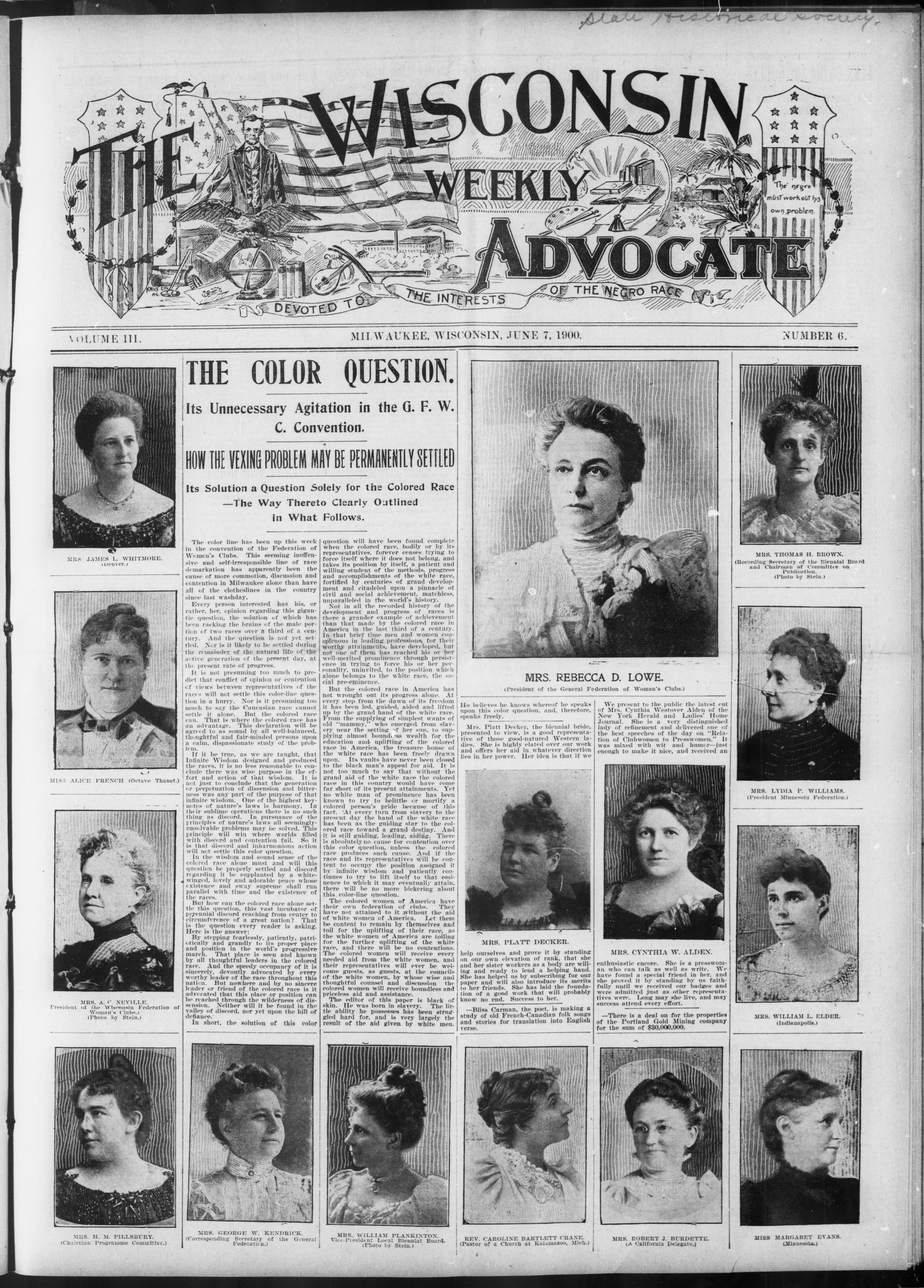
WISCONSIN
WEEKLY
ADVOCATE
DEVOTED TO THE INTERESTS OF THE NEGRO RACE
17
MRS JAMES L. WHITMORE.
(Denver.)
Mary Ann
MISS ALICE FRENCH (Octave Thanet.)
M.
MRS. A. C. NEVILLE.
President of the Wisconsin Federation of
Woman's Clubs.(
(Photo by Stein.)
M.
MRS. H. M. PILLSBURY.
(Chairman Programme Committee.)
THE COLOR QUESTION.
Its Unnecessary Agitation in the G. F. W. C. Convention.
Its Solution a Question Solely for the Colored Race The Way Thereto Clearly Outlined in What Follows.
The color line has been up this week in the convention of the Federation of Women's Clubs. This seeming inoffensive and self-irresponsible line of race demarkation has apparently been the cause of more commotion, discussion and contention in Milwaukee alone than have all of the clotheslines in the country since last washday. Every person interested has his, or rather, her, opinion regarding this gigantic question, the solution of which has been racking the brains of the male portion of two races over a third of a century. And the question is not yet settled. Nor is it likely to be settled during the remainder of the natural life of the active generation of the present day, at the present rate of progress.
It is not presuming too much to predict that conflict of opinion or contention of views between representatives of the races will not settle this color-line question in a hurry. Nor is it presuming too much to say the Caucasian race cannot settle it alone. But the colored race can. That is where the colored race has an advantage. This declaration will be agreed to as sound by all well-balanced, thoughtful and fair-minded persons upon a calm, dispassionate study of the problem.
If it be true, as we are taught, that Infinite Wisdom designed and produced the races, it is no less reasonable to conclude there was wise purpose in the effort and action of that wisdom. It is not just to conclude that the generation or perpetuation of dissension and bitterness was any part of the purpose of that infinite wisdom. One of the highest keynotes of nature's laws is harmony. In their sublime operations there is no such thing as discord. In pursuance of the principles of nature's laws all seemingly unsolvable problems may be solved. This principle will win where worlds filled with discord and contention fail. So it is that discord and inharmonious action will not settle this color question.
In the wisdom and sound sense of the colored race alone must and will this question be properly settled and discord regarding it be supplanted by a white-winged, lovely and adorable peace whose existence and sway supreme shall run parallel with time and the existence of the races.
But how can the colored race alone settle this question, this vast incubator of perennial discord reaching from center to circumference of a great nation? That is the question every reader is asking. Here is the answer:
By stepping fearlessly, patiently, patriotically and grandly to its proper place and position in the world's progressive march. That place is seen and known by all thoughtful leaders in the colored race. And the speedy occupancy of it is sincerely, devoutly advocated by every worthy leader of the race throughout this nation. But nowhere and by no sincere leader or friend of the colored race is it advocated that this place or position can be reached through the wilderness of dissension. Neither will it be found in the valley of discord, nor yet upon the hill of defiance.
In short, the solution of this color
M.
MRS. GEORGE W. KENDRICK. (Corresponding Secretary of the General Federation.)
MILWAUKEE, WISCONSIN, JUNE 7, 1900.
question will have been found complete when the colored race, bodily or by its representatives, forever ceases trying to force itself where it does not belong, and takes its position by itself, a patient and willing student of the methods, progress and accomplishments of the white race, fortified by centuries of grand development and citadeled upon a pinnacle of civil and social achievement, matchless, unparalleled in the world's history.
Not in all the recorded history of the development and progress of races is there a grander example of achievement than that made by the colored race in America in the last third of a century. In that brief time men and women conspicuous in leading professions, for their worthy attainments, have developed, but not one of them has reached his or her well-merited prominence through persistence in trying to force his or her personality, uninvited, to the position which alone belongs to the white race, the social pre-eminence.
But the colored race in America has not wrought out its progress alone. At every step from the dawn of its freedom it has been led, guided, aided and lifted up by the grand hand of the white race. From the supplying of simplest wants of old "mammy," who emerged from slavery near the setting of her sun, to supplying almost boundless wealth for the education and uplifting of the colored race in America, the treasure house of the white race has been freely drawn upon. Its vaults have never been closed to the black man's appeal for aid. It is not too much to say that without the grand aid of the white race the colored race in this country would have come far short of its present attainments. Yet no white man of prominence has been known to try to belittle or mortify a colored person's pride because of this fact. At every turn from slavery to the present day the hand of the white race has been as the guiding star to the colored race toward a grand destiny. And it is still guiding, leading, aiding. There is absolutely no cause for contention over this color question, unless the colored race produces such cause. And if the race and its representatives will be content to occupy the position assigned it by infinite wisdom and patiently continues to try to lift itself to that eminence to which it may eventually attain, there will be no more bickering about this color-line question.
The colored women of America have their own federation of clubs. They have not attained to it without the aid of white women of America. Let them be content to remain by themselves and toil for the uplifting of their race, as the white women of America are toiling for the further uplifting of the white race, and there will be no contentions. The colored women will receive every needed aid from the white women, and their representatives will ever be welcome guests, as guests, at the councils of the white women, by whose wise and thoughtful counsel and discussion the colored women will receive boundless and priceless aid and assistance.
The editor of this paper is black of skin. He was born in slavery. The little ability he possesses has been struggled hard for, and is very largely the result of the aid given by white men.
M.
MRS. WILLIAM PLANKINTON.
Vice-President Local Biennial Board.
(Photo by Stein.)
Mary E.
He believes he knows whereof he speaks upon this color question, and, therefore, speaks freely.
Mrs. Platt Decker, the biennial bride, presented to view, is a good representative of those good-natured Western ladies. She is highly elated over our work and offers her aid in whatever direction lies in her power. Her idea is that if we
M.
MRS. PLATT DECKER.
help ourselves and prove it by standing on our own elevation of rank, that she and her sister workers as a body are willing and ready to lend a helping hand. She has helped us by subscribing for our paper and will also introduce its merits to her friends. She has laid the foundation of a good work that will probably know no end. Success to her.
—Bliss Carman, the poet, is making a study of old French-Canadian folk songs and stories for translation into English verse.
M.
REV. CAROLINE BARTLETT CRANE. (Pastor of a Church at Kalamazoo, Mich.
We present to the public the latest cut of Mrs. Cynthia Westover Alden of the New York Herald and Ladies' Home Journal. She is a very distinguished lady of refinement and delivered one of the best speeches of the day on "Relation of Clubwomen to Presswomen." It was mixed with wit and humor—just enough to make it nice, and received an
M. H.
MRS. CYNTHIA W. ALDEN. enthusiastic encore. She is a presswoman who can talk as well as write. We have found a special friend in her, and she proved it by standing by us faithfully until we received our badges and were admitted just as other representatives were. Long may she live, and may success attend every effort.
There is a deal on for the properties of the Portland Gold Mining company for the sum of $30,000,000.
Mary E.
MRS. ROBERT J. BURDETTE.
(A California Delegate.)
NUMBER 6.
M.
MRS. THOMAS H. BROWN.
(Recording Secretary of the Biennial Board and Chairman of Committee on Publication.
(Photo by Stein.)
Mary Ann
MRS. LYDIA P. WILLIAMS.
(President Minnesota Federation.
Mary C.
MRS. WILLIAM L. ELDER.
(Indianapolis.)
Mary E.
MISS MARGARET EVANS.
(Minnesota.)
GENS. BOTHA AND BULLER.
The Two Commanders Meet at Laing's Nek.
UTRECHT IS EVACUATED
Ease with Which Roberts Took Johannesburg and Pretoria Excites Some Suspicion.
London, June 6.—A special dispatch from Lourenco Marques dated Tuesday, June 5, says:
"Gens. Buller and Christian Botha met at Laing's Nek at Buller's request, when a three-days' armistice was agreed upon. The dispatch adds that the British have evacuated Utrecht.
London, June 6.—Until the situation in the neighborhood of Pretoria is enlightened, the officials here as well as others will find difficulty in prognosticating Lord Roberts' immediate programme. It appears evident that the Boer commander-in-chief, Gen. Botha, with all his guns, withdrew in good order, probably along the Delagoa Bay railroad, with the view of joining President Kruger. So the Transvaal forces remain practically intact, with Presidents Kruger and Steyn and Gen. Botha and Secretary of State Reitz all safe and in a position to continue the direction of affairs. The more optimistic see in the fact that President Kruger's wife and Gen. Botha's wife were left at Pretoria an indication that the President does not count on a long resistance. In any case it will probably take Lord Roberts at least a week to organize a campaign of pursuit. The military authorities anticipate that the next important news will come from Gen. Buller's direction, as plenty of time has elapsed to complete the turning movement at Laings Nek.
A belated dispatch from Mafeking, dated May 31, announces the British occupation of Manmani, where 200 Boers surrendered.
EASY FOR ROBERTS.
British Troops Enthusiastically Received at Transvaal Capital.
London, June 6-10:35 a. m.—Lord Roberts telegraphed to the war office as follows, dated Pretoria, June 5, 5:35 p. m.:
"The occupation of the town passed off most satisfactorily and the British flag is now hoisted on top of the government offices. The troops met with a much more enthusiastic reception than I anticipated. The Third battalion of the Grenadier guards lined the square when the march past took place. Owing to their having been on duty at some distance around the town, very few cavalry and infantry were able to take part in the ceremony. Several of our officers who had been prisoners were among the outlookers."
The forts, constructed at the expense of the mine owners and strengthened during the war, were abandoned, the Creusots and Krupps and the famous Long Toms, which were to render Pretoria impregnable, were taken east to the mountains, and the capital, which President Kruger's burghers had boasted would be defended for months was surrendered after a single feeble engagement
The facility with which Johannesburg and Pretoria have been taken leads many military men to suspect that there has been a secret understanding between President Kruger and the British government by which the war will be brought to an end without unnecessary loss of life and wasteful destruction of property. This theory, while plausible, cannot be proved, since neither President Kruger nor Lord Roberts will admit that there has been any secret intrigue or that the closing scenes of the war have been prearranged in any sense. The safer generalization is that the Boers have fought gallantly against the resources of a mighty empire, and have been finally overwhelmed by superior numbers.
Future Operations.
The campaign may now be said to have ended west of the line drawn from Pretoria to Ficksburg. Gen. Hunter's division is reported to have entered Lichtenburg, Lord Methuen will probably turn up at Pothefstroom, and Gens. Baden-Powell and Carrington will occupy Zeerust and Rustenburg. The occupation of Pretoria will probably dishearten the Free State forces and the Bethlehem, Harrismith and Vrodo districts will be gradually overrun by Gen. Rundle's forces. The remaining operations of the war will be restricted to Lydeburg district, to which the forces still holding Laings Nek must retreat through Ermelo.
There are many signs that the struggle will end in the course of a fortnight, and the details of the surrender of Pretoria, communicated by Lord Roberts at midnight, support this view.
IRISH YEOMANRY CAPTURED.
Roberts "Regrets to Report," and Hopes They will Soon be Released.
London, June 6.—Lord Roberts reports to the war office that the Thirteenth battalion of the Imperial Yeomanry (Irish) was "overwhelmed by the Boers at Lindley."
Lord Methuen made a "magnificent march to the rescue," but was too late. Following is the text of the dispatch announcing the disaster:
"I regret to report that the Thirteenth Imperial Yeomanry had to surrender to a very superior force of the enemy on May 31 near Lindley. I ordered Methuen to proceed with all speed to its assistance.
"Methuen was then on the march on the Heilbron side of Kroonstad, and half an hour after the receipt of my telegram on June 1 he started off. By 10 a. m. of the following day he had marched forty-four miles in twenty-five hours, but he was too late to rescue Col. Spragge's yeomanry.
"Methuen attacked the Boers, who were between 2000 and 3000 strong, and after a running fight of five hours completely routed the enemy.
"It is a very regrettable circumstance, but I trust it will not be very long before the Irish yeomanry are released from captivity."
The Thirteenth Imperial Yeomany battalion, captured by the Boers Friday near Lindley, Orange river colony, consisted of two Irish units and two companies of the Duke of Cambridge's Own, including Lord Donoughmore's company, which was regarded as the crack company of the corps, a number of men in the ranks being closely allied to noble families.
THE FALL OF PRETORIA
Roberts' Play to Make a Great Victory Out of the Affair.
London, June 6.—The promenade from Cape Town to Pretoria was ended yesterday after a battle of maneuvers, rather than serious fighting. Lord Roberts gives a detailed description of this engagement and helps thereby to dignify the entry of the British troops into the capital. The details have a hollow ring, and it is not clear that the resistance offered by the Boers was serious.
Lord Roberts was embarrassed by the Earl of Rosslyn's enterprise last week
in revealing the helplessness of panic-stricken Pretoria and the facility with which it could be entered by the British troops, and he was deprived of the credit of forcing his way into the Boer capital, since the eagerness of the officials to surrender the town was proclaimed when he was not prepared to advance. By waiting six days he gave to the Boers time to recover from their panic and to make some show of defending the capital. The account of Monday's engagement and Tuesday's entry is better reading for each side in consequence of the delay. The Boers have the credit for making a final stand at Six Miles Spruit and of seeking to ambuscade the British and then to outflank them, and Lord Roberts, instead of marching in several days after the enemy had scuttled out, has the honor of entering the capital in gallant style after a successful engagement.
Lord Rebberts tells the story of the fall of Pretoria in the following dispatch received at the war office:
"De Liste sent an officer with a flag of truce into the town, demanding its surrender in my name. Shortly after midnight I was awakened by two officials of the South African Republic, Sandberg, military secretary to Commandant-Gen. Botha, and a general officer of the Boer army, who brought me a letter from Botha, proposing an armistice for the purpose of settling the terms of surrender."
"I replied that I would gladly meet the commandant-general the next morning, but that I was not prepared to discuss any terms, as the surrender of the town must be unconditional. I asked for a reply by daybreak, as I had ordered the troops to march on the town as soon as it was light
"In his reply Botha told me that he had decided to defend Pretoria, and that he trusted women, children and property would be protected. At 1 o'clock a. m. today, while on the line of march, I was met by three of the principal officials with a flag of truce, stating their wish to surrender the town."
Refused to Remove His Hat.
London, June 6.—An incident of the ceremonies at Pretoria was the rebuke administered to a member of the "home guards" by one of Roberts' soldiers. A tall Free State artillerist who was watching the ceremony refused to remove his hat, and a bystander tried to force him to do so, when a British guardsman forcefully interposed, saying:
"Leave him alone. He fought for his flag. You are too cowardly to fight for any flag!"
NO CERTAINTY ABOUT AGUINALDO.
Stories About His Being Shot Are Guesswork-Maj. March's Hard Task.
Manila, June 6.—A dispatch from Candon, dated June 4, says Maj. P. C. March's men of the Thirty-third regiment returned to Candon that day by steamer from Aparri. A majority of the men are ready for the hospital. They are thin and weak, having traveled 250 miles in the mountains, during which they suffered greatly from hunger.
Of the fifty horses which started with the battalion, thirteen survived. The remainder died on the march or fell into canyons. The battalion practically collapsed at Pial, thirty miles from Tugueatac, as the result of fevers and exhaustion. Eighty-seven of the men were conveyed from Pial to Muguegarao in bull carts and those falling on the way were carried in litters by the Igorottis with the column. The officers accompanying Maj. March were Capts. Henry L. Jenkinson and Edward Davis; Lieuts. Carroll Power and Frank L. Case, and Dr. John O. Greenwalt, assistant surgeon. They say it is all guesswork as to whether Arginaldo was shot.
Before the Americans struck Sagat the insurgent chief divided his forces into parties of ten, following different trails. The officer shot was perhaps Aguinaldo's secretary or adjutant. The report among the natives of the region is that Aguinaldo was wounded in the shoulder. Papers secured show that nearly all the presidents installed by the Americans in Gen. Young's territory are treacherous and have been making regular reports to Aguinaldo for the disposition and movement of the American troops and have been collecting and forwarding taxes. The captured papers also prove the disloyalty of the native telegraph operators whom the Americans retained on the Cayagan valley line.
REV. DR. STORRS DEAD.
Distinguished Divine Who Held a Brooklyn Pastorate for Fifty Years.
New York, June 6.—Rev. Dr. Richard Salter Storrs, pastor emeritus of the Church of the Pilgrims, Brooklyn, and for many years president of the Home Missionary society, died last night at his home in Brooklyn, aged 79 years. He passed a comfortable night Monday, but his strength was failing and his physicians felt that the end was near. He sank gradually to the close, which was peaceful.
Dr. Storrs was a distinguished member of a distinguished New England family, which has given many clergymen to the church in America. His ancestor, Samuel Storrs, came from England in 1663 and settled in Massachusetts. The late pastor of Pilgrims' church was a native of Braintree, and was graduated from Amherst at the age of 18. That was in 1838. Seven years later he came out of Andover seminary and was made pastor of Harvard Congregational church at Brookline, Mass. One year later he accepted a call from the Church of the Pilgrims, Brooklyn, and preached to that charge for the half-century that has since passed away.
The Church of the Pilgrims has had practically no preacher but him. His splendid oratory and great magnetism, to say nothing of his kindness and tenderness of character, won him the love of all his neighbors and acquaintances, as well as that of his flock. He was one of the landmarks of Christianity in New York state, and his influence has been felt throughout the country.
INCREASE PRICE OF LEAD.
Purpose of Utah Producers Who Are Forming an Organization.
Salt Lake, Utah, June 6.—Lead producers of Utah have taken the first steps towards forming a state and later a national organization, to put up the price of lead by increasing exports. They will work in co-operation with the smelter trust.
About twenty-five leading mine owners attended the first meeting. A committee was appointed to report on permanent organization next Saturday evening, when it is hoped to have every lead producer in the state present in person or by proxy.
CORNER ON RICE.
Chinese Merchants Take Advantage of Situation in Chinatown.
San Francisco, Cal., June 6.—No new cases of plague have been reported. Owing to the quarantine, the prices of all kinds of food have nearly doubled in Chinatown. The available supply of rice, it is said, has been cornered by a few Chinese merchants.
Natives Co-operating with Americans in the Restoration of Peace Conditions.
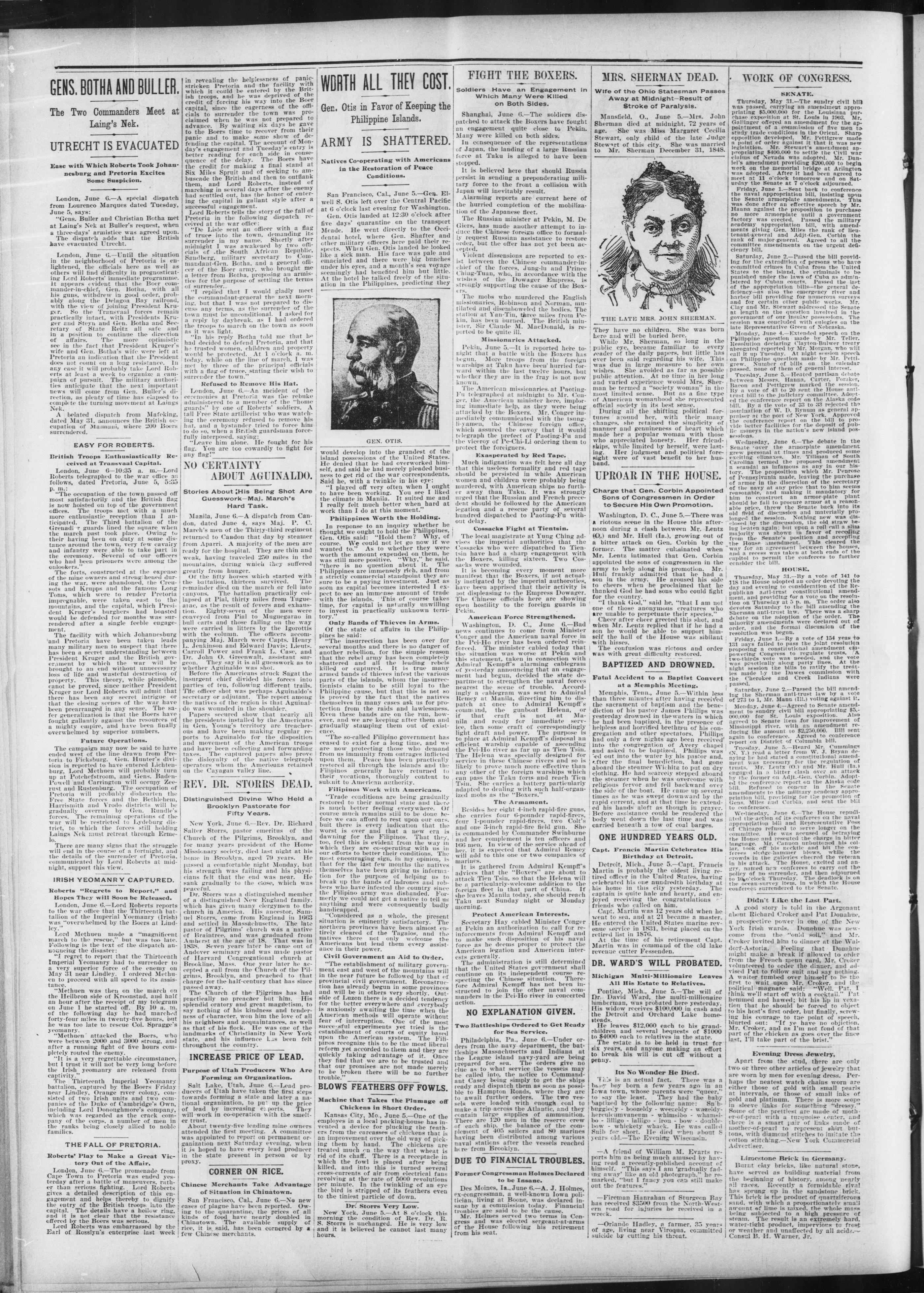
San Francisco, Cal., June 5.—Gen. Elwell S. Otis left over the Central Pacific at 6 o'clock last evening for Washington. Gen. Otis landed at 12:30 o'clock after five days' quarantine on the transport Meade. He went directly to the Occidental hotel, where Gen. Shafter and other military officers here paid their respects. When Gen. Otis landed he looked like a sick man. His face was pale and emaciated and there were big bunches under his eyes, and a month's sea voyage seemingly had benefited him but little. At the hotel he talked freely of the situation in the Philippines, predicting they
would develop into the grandest of the island possessions of the United States. He denied that he had overworked himself, and said he had merely pleaded business to get rid of the war correspondents. Said he, with a twinkle in his eye: "I played off very often when I ought to have been working. You see I liked the climate in Manila. It suited me and I really felt much better when hard at work than I do at this moment."
Philippines Worth the Holding.
In response to an inquiry whether he thought we ought to hold the Philippines, Gen. Otis said: "Hold them? Why, of course. We could not let go now if we wanted to." As to whether they were worth the amount expended on them, he was still more positive. "Why," he said, "there is no question about it. The Philippines are immensely rich, and from a strictly commercial standpoint they are sure to be a paying investment. Just as soon as capital becomes interested I expect to see an immense amount of trade with the islands. This of course takes time, for capital is naturally unwilling to invest in practically unknown territory."
Only Bands of Thieves in Arms.
Of the state of affairs in the Philippines he said:
"The insurrection has been over for several months and there is no danger of another rebellion, for the simple reason that the rebel army has been completely shattered and all the leading rebels killed or captured. It is true many armed bands of thieves infest the various parts of the islands, whom the insurrectionists claim to be still loyal to the Philippine cause, but that this is not so is proved by the fact that the natives themselves in many cases ask us for protection from the raids and lawlessness. Even these bands are on the run, however, and we are keeping after them and gradually stamping them out of existence.
"The so-called Filipino government has ceased to exist for a long time, and we are now protecting those who demand from us immunity from outrages inflicted upon them. Peace has been practically restored all through the islands and the Filipinos generally have returned to their vocations, thoroughly content to submit to American authority.
Filipinos Work with Americans.
Trade conditions are being gradually restored to their normal state and there is much better feeling everywhere. Of course much remains still to be done before we can afford to rest upon our oars, buit there is every indication that the worst is over and that a new era is dawning for the Filipinos. That they, too, feel this is evident from the way in which they are co-operating with us in our efforts to better their conditions. The most encouraging sign, in my opinion, is that for the last few months the natives themselves have been giving us information for the purpose of helping us to break up the bands of ladrones and robbers who have infested the country since the Filipino army was disbanded. Formerly we could not get a native to tell us anything and were consequently badly handicapped.
"Considered as a whole, the present situation is eminently satisfactory. The northern provinces have been almost entirely cleared of the Tagalos, and the natives there not only welcome the Americans but lend them every assistance in their power.
CIVIL Government an Aid to Order.
"The establishment of military government east and west of the mountains will in the near future be followed by that of provincial civil government. Reconstruction has already begun in some provinces and will be in others very shortly. Outside of Luzon there is a decided tendency for the better everywhere and everybody is anxiously awaiting the time when the American methods will operate without fear of interruption. One of the most successful experiments yet tried is the establishment of courts of equity based upon the American system. The Filipinos recognize this to be the most liberal reform yet accorded to them and they are quickly taking advantage of it. Once they find that we are to be trusted and that our promises are not made merely to be broken there will be no further trouble."
BLOWS FEATHERS OFF FOWLS.
Machine that Takes the Plumage off Chickens in Short Order.
Kansas City, Mo., June 5.—One of the employees in a local packing-house has invented a device for plucking the feathers from the carcasses of chickens that is an improvement over the old way of picking them by hand. The chickens are treated much on the way that wheat is rid of its chaff. There is a receptacle in which the fowl is placed after being killed, and into this is turned several cross-currents of air from electrical fans revolving at the rate of 5000 revolutions per minute. In the twinkling of an eye the bird is stripped of its feathers even to the tiniest particle of down.
Dr. Storrs Very Low.
New York, June 5.—At 8 o'clock this morning the condition of Rev. Dr. R. S. Storrs is unchanged. He is very low and it is believed he cannot last many hours.
FIGHT THE BOXERS.
FIGHT THE BOXERS.
Soldiers Have an Engagement in Which Many Were Killed on Both Sides.
Shanghai, June 6.—The soldiers dispatched to attack the Boxers have fought an engagement quite close to Pekin. Many were killed on both sides.
In consequence of the representations of Japan, the landing of a large Russian force at Taku is alleged to have been stopped.
It is believed here that should Russia persist in sending a preponderating military force to the front a collision with Japan will inevitably result.
Alarming reports are current here of the hurried completion of the mobilization of the Japanese fleet.
The Russian minister at Pekin, M. De Giers, has made another attempt to induce the Chinese foreign office to formally request Russian assistance to restore order, but the offer has not yet been accepted.
Violent dissensions are reported to exist between the Chinese commander-in-chief of the forces, Jung-lu and Prince Ching-Tuan, who, in accordance with the wishes of the Dowager Empress, is strongly supporting the cause of the Boxers.
The mobs who murdered the English missionaries, Robinson and Norman, mutilated and disemboweled the bodies. The station at Yan-Tin, three miles from Pekin, has been burned. The British minister, Sir Claude M. MacDonald, is reported to be quite ill.
Missionaries Attacked.
Pekin, June 5.—It is reported here tonight that a battle with the Boxers has begun. More troops from the foreign warships at Taku have been hurried forward within the last twelve hours, but whether they are in the fray is not now known.
The American missionaries at Paoting-Fu telegraphed at midnight to Mr. Conger, the American minister here, imploring immediate help, as they were being attacked by the Boxers. Mr. Conger immediately communicated with the tsungli-yamen, the Chinese foreign office, which assured the envoy that it would telegraph the prefect of Paoting-Fu and the viceroy of Pe-Chi-Li ordering them to protect the foreigners.
Exasperated by Red Tape.
Much indignation was felt here all day that this useless formality and red tape should be persisted in while American women and children were probably being murdered, with American ships no further away than Taku. It was strongly urged that the Russian and French precedent should be followed by the American legation and a rescue party of several hundred dispatched to Paoting-Fu without delay.
Cossacks Fight at Tientsin.
The local magistrate at Yung Ching advises the imperial authorities that the Cossacks who were dispatched to Tientsin have had a sharp engagement with the Boxers, killing sixteen. Two Cossacks were wounded. It is becoming every moment more manifest that the Boxers, if not actually instigated by the imperial authoroties, have been apprised that their activity is not displeasing to the Empress Dowager. The Chinese officials here are showing open hostility to the foreign guards in Pekin.
American Force Strengthened.
Washington, D. C., June 6.—Bad news continues to come from Minister Conger and the American naval force in the Pei-Ho river has been ordered reinforced. The minister cabled today that the situation was worse at Pekin and this statement, taken in connection with Admiral Kempff's alarming cablegram of yesterday announcing that an engagement had begun, decided the state department to strengthen the naval forces nearest the scene of trouble. Accordingly a cablegram was sent to Admiral Kemey at Manila, directing him to dispatch at once to Admiral Kempff's command, the gunboat Helena, or if that craft is not at Manila and ready for immediate service, then some craft of correspondingly light draft and power. The purpose is to place at Admiral Kempff's disposal an efficient warship capable of ascending the Pei-Ho river as far up as Tien Tsin. The Helena was specially designed for service in these Chinese rivers and so is likely to prove much more effective than any other of the foreign warships which can pass the Taku torus and reach Tien Tsin. She carries a battery particularly adapted to dealing with such half-organized mobs as the "Boxers."
The Armament.
Besides her eight 4-inch rapid-fire guns, she carries four 6-pounder rapid-firers, four 1-pounder rapid-firers, two Colt's and one 3-inch rapid-fire field gun. She is commanded by Commander Swinburne and her complement is ten officers and 166 men. In view of the service ahead of her, it is expected that Admiral Remey will add to this one or two companies of marines.
It is gathered from Admiral Kempff's advices that the "Boxers" are about to attack Tien Tsin, so that the Helena will be a particularly-welcome addition to the foreign fleet in that part of China. If she leaves Manila today, she should reach Taku next Sunday night or Monday morning.
Protect American Interests.
Secretary Hay cabled Minister Conger at Pekin an authorization to call for reinforcements from Admiral Kempff and to make such disposition of his naval force as he deems proper to protect the American legation and American interests generally.
The administration is still determined that the United States government shall continue on its independent course respecting the Chinese situation. Therefore Admiral Kempff has not been instructed to join the other naval commanders in the Pei-Ho river in concerted action.
NO EXPLANATION GIVEN.
Two Battleships Ordered to Get Ready for Sea Service.
Philadelphia, Pa., June 6.—Under orders from the navy department, the battleships Massachusetts and Indiana at the League island navy-yard are being prepared for sea. The orders give no clue as to what service the vessels may be called into, the notice to Commandant Casey being simply to get the ships ready and dispatch them as soon as possible to Hampton Roads, where they are to await further orders. The two vessels were loaded with enough coal to make a trip across the Atlantic, and they contain large supplies of ammunition. There are 120 men in the reserve crew of each ship, the balance of the complement of 405 sailors and 80 marines having been distributed among various naval stations after the vessels reached here from Brooklyn.
DUE TO FINANCIAL TROUBLES.
Former Congressman Holmes Declared to be Insane.
Des Moines, Ia., June 6.—A. J. Holmes, ex-congressman, a well-known Iowa politician, living at Boone, was declared insane by a commission today. Financial troubles are said to be the cause.
Mr. Holmes served two terms in Congress and was elected sergeant-at-arms of the House following his retirement from his seat.
MRS. SHERMAN DEAD.
Wife of the Ohio Statesman Passes Away at Midnight-Result of Stroke of Paralysis.
Mansfield, O., June 5.—Mrs. John Sherman died at midnight, 72 years of age. She was Miss Margaret Cecilia Stewart, only child of the late Judge Stewart of this city. She was married to Mr. Sherman December 31, 1848.
[Pencil sketch of a woman with curly hair and a necklace.]
They have no children. She was born here and will be buried here. While Mr. Sherman, so long in the public eye, became familiar to every reader of the daily papers, but little has ever been said regarding his wife. This was due in large measure to her own wishes. She avoided as far as possible public attention. At no time in her long and varied experience would Mrs. Sherman be termed a "society woman" in the most limited sense. But as a fine type of American womanhood she represented official society in its best sense.
During all the shifting political fortunes around her, with their many changes, she retained the simplicity of manner and genuineness of heart which made her a popular woman with those who appreciated honesty. Her friendships, while limited by herself, were lasting. Her judgment and political fore-sight were of vast benefit to her husband.
UPROAR IN THE HOUSE.
Charge that Gen. Corbin Appointed Sons of Congressmen in Order to Secure His Own Promotion.
Washington, D. C., June 5.—There was a riotous scene in the House this afternoon during a clash between Mr. Lentz (O.) and Mr. Hull (Ia.), growing out of a bitter attack on Gen. Corbin by the former. The matter culhainated when Mr. Lentz intimated that Gen. Corbin appointed the sons of congressmen in the army to help along his promotion. Mr. Hull frankly admitted that he had a son in the army. He aroused his side to cheers when he proclaimed that he thanked God he had sons who could fight for the country.
"I thank God," said he, "that I am not one of those anonymous creatures who are unable to perpetuate their species."
Cheer after cheer greeted this shot, and when Mr. Lentz replied that if he had a son he would be able to support himself the hall of the House was sibilant with hisses. The confusion was riotous and order was with great difficulty restored.
BAPTIZED AND DROWNED.
Fatal Accident to a Baptist Convert at a Memphis Meeting.
Memphis, Tenn., June 5.—Within less than three minutes after having received the sacrament of baptism and the benediction of his pastor James Phillips was yesterday drowned in the waters in which he had been baptized, in the presence of helpless and horrified brethren of his congregation and other spectators. Phillips had only a few nights ago been received into the congregation of Avery chapel and asked to be baptized. Phillips was 'ed out into the water by his pastor and, after the final benediction, had gone aboard the steamer Wichita to put on dry clothing. He had scarcely stepped aboard the steamer when he was overcome with religious fervor and fell backward over the side of the boat. He came up several times as he was swept downward by the rapid current, and at that time he extended his hands aloft as though in prayer. Before assistance could be rendered the body went down the last time and was carried beneath a tow of coal barges.
ONE HUNDRED YEARS OLD.
Capt. Francis Martin Celebrates His Birthday at Detroit.
Detroit, Mich., June 5.—Capt. Francis Martin is probably the oldest living retired officer in the United States, having celebrated his one hundredth birthday at his home in this city yesterday. The captain is quite hale and hearty, and enjoyed receiving the congratulations friends who called on him.
Capt. Martin was 12 years old when he went to sea, and at 21 became a master. He entered the United States marine revenue service in 1831, being placed on the retired list in 1876.
At the time of his retirement Capt. Martin was in command of the old lake revenue cutter Fessenden.
DR. WARD'S WILL PROBATED.
Michigan Multi-Millionaire Leaves All His Estate to Relatives.
Pontiac, Mich., June 5.—The will of Dr. David Ward, the multi-millionaire lumberman, was probated here yesterday. His widow receives $100,000 in cash and the Detroit and Orchard Lake homesteads.
He leaves $12,000 each to his grandchildren and several bequests of $1000 to $4000 each to relatives in the state.
The estate is to be held in trust for six years, and anyone making an effort to break his will is cut off without a penny.
Its No Wonder He Died.
This is an actual fact. There was a baby boy born a few years ago in an Iowa town, whose parents were "queer." to say the least. They had the baby baptized by the following name: Snibbuggledy - boozeldy - weezeldy - wazeldy-herculumvaneum - whimsibo - whamsibo - lilligo - lalligo - iron - bow - doublebow - whickety whack. He was called Snib for short. He died when about 8 years old.—The Evening Wisconsin.
—A friend of William M. Evarts reports him as being much amused by having read a recently-published account of himself. "This says I am 'gradually fading away' like an old photograph." he remarked, "but I fancy you can still make out the features."
—Fireman Hanrahan of Sturgeon Bay has received $3500 from the North-Western road for injuries he received in a wreck.
—Orlando Hadley, a farmer, 35 years of age, living near Viroqua, committed suicide by cutting his throat.
WORK OF CONGRESS.
SENATE.
Thursday, May 31.—The sundry civil bill was passed, carrying an amendment appropriating $5,000,000 for the Louisiana purchase exposition at St. Louis in 1903. Mr. Gallinger offered an amendment for the appointment of a commission of five men to study trade conditions in the Orient. Sharp opposition developed. Mr. Pettigrew made a point of order against it that it was new legislation. Mr. Stewart's amendment appropriating $400,000 to settle the Civil war claims of Nevada was adopted. Mr. Daniel's amendment providing $200,000 to begin work on the memorial bridge at Arlington was adopted. After it had been agreed to meet at 11 o'clock tomorrow and on Saturday the Senate at 7 o'clock adjourned.
Friday, June 1.-Sent back to conference the naval appropriation bill, insisting upon the Senate armorplate amendments. This was done after an effective speech by Mr. Hanna against the proposition to purchase no more armorplate until a government factory was erected. Passed the military academy appropriation bill, with amendments giving Gen. Miles the rank of lieutenant-general and Adjit-Gen. Corbin the rank of major-general. Agreed to all the committee amendments on the urgent deficiency bill.
Saturday, June 2.—Passed the bill providing for the extradition of persons who have committed crimes in Cuba from the United States to the island, the criminals to be punished under the laws of Cuba as administered by Cuban courts. Passed the last of the appropriation bills—the general deficiency—as also the emergency river and harbor bill providing for numerous surveys and for certain other public works. Mr. Clay and Mr. Stewart addressed the Senate at length on the question involved in the government of our insular possessions. The session was concluded with eulogies on the late Representative Green of Nebraska.
Monday, June 4.—Extended speech on the Philippine question made by Mr. Teller. Resolution declaring Clayton-Bulwer treaty abrogated reported by Mr. Morgan, who will call it up Tuesday. At night session speech on Philippine question made by Mr. Pettigrew. Number of bills on the calendar passed, none of them of general interest.
Tuesday, June 5.—Heated partisan debate between Messrs. Hanna, Carter, Foraker, Bacon and Pettigrew marked the session. By a vote of 43 to 20 sent the House antitrust bill to the judiciary committee. Adopted the conference report on the Alaska code bill. By a vote of 33 to 33 rejected the nomination of W. D. Bynum as general appraiser at the port of New York. Approved the conference report on the bill to provide better facilities for the deposit of public moneyes in the nation's new island possessions.
Wednesday, June 6.—The debate in the Senate over the armorplate amendment grew personal at times and produced some exciting climaxes. Mr. Tillman of South Carolina termed the proposed amendment a scandal as infamous as any in our history. The proposition which Mr. Penrose of Pennsylvania made, leaving the purchase of armor in the discretion of the secretary of the navy at any price that to him seems reasonable, and making it mandatory for him to construct an armor-plate plant should he fail to procure armor at a reasonable price, threw the Senate back into its old field of discussion and materially prolonged the session. Nothing new was disclosed by the discussion, the old straw being beaten again; but upon a roll call a slim majority was shown in favor of receding from the Senate's position and accepting the House amendment. This cleared the way for an agreement between the houses, and a recess was taken at both ends of the capitol to permit the conferences to further consider the bill.
HOUSE.
Thursday, May 31.—By a vote of 141 to 118 the House adopted an order devoting the day and evening to consideration of the Republican anti-trust constitutional amendment, and providing for a vote on the resolution on Thursday at 5 p. m. The order also devotes Saturday to the bill amending the Sherman anti-trust law. There was a sharp debate on the adoption of the order. The minority amendments were declared out of order, and the formal discussion of the resolution was begun.
Friday, June 1.—By a vote of 154 yeas to 131 nays failed to pass the joint resolution proposing a constitutional amendment empowering Congress to regulate trusts. A two-thirds vote was needed, and the vote was practically along party lines. At the night session the bills to ratify the treaties made by the Dawes commission with the Cherokee and Creek Indians were passed
Saturday, June 2.—Passed the bill amending the Sherman anti-trust law by a vote of 273 to 1, Mr. Mann (Ill.) voting against it.
Monday, June 4.—Agreed to Senate amendment to sundry civil bill appropriating $5,000,000 for St. Louis exposition. Also agreed to Senate item for improvement of Mississippi river, with an amendment reducing the amount to $2,250,000. Bill sent again to conference. Agreed to conference report on District of Columbia bill.
Tuesday, June 5.—Heard Mr. Cummings (N. Y.) read a letter from W. J. Bryan denying he had stated a constitutional amendment was necessary for the regulation of trusts. Mr. Lentz (O.) and Mr. Hull (Ia.) engaged in a bitter clash over an attack by the former on Adjt.-Gen. Corbin. Adopted the conference report on the Alaska code. Refused to concur in the Senate amendments to the military academy appropriation bill, providing for the promotion of Gens. Miles and Corbin, and sent the bill to conference.
Wednesday, June 6. The House repudiated the action of its conferees on the naval appropriation bill and Representative Foss of Chicago refused to serve longer on the committee. He was accused of betraying the House and resented the charge in bitter language. Mr. Cannon unbuttoned his collar, took off his necktie and hit the conferees sledge-hammer blows, while the crowds in the galleries cheered the veteran in his attack. The House, excited and angry, named new conferees to carry out the policy of no surrender, and then adjourned to 10 o'clock Thursday. The deadlock is on the ocean-survey item, in which the House conferees surrendered to the Senate.
Didn't Like the Last Part.
A good story is told in the Argonaut about Richard Croker and Pat Donahue, a prospective power in one of the New York Irish wards. Donahue was newcome from the "ould soil," and Mr. Croker invited him to dinner at the Waldorf-Astoria. Feeling that Donahue might make a break if allowed to order from the French menu card, Mr. Croker volunteered to order the dinner, and advised Pat to follow suit and say nothing. A waiter tumbed over himself to be the first to wait upon Mr. Croker, and the political magnate said: "Well. Pat. I think we'll start off with a cocktail." Pat hemmed and hawed; bit his lip in vexation that he should be forced to object to his host's first order, but finally, screwing his courage to the point of speech, blurted out: "If ye have no objection, Mr. Croker, and as I'm not fond of that part of the chicken as goes over the since last, I'll take part of the brist."
Evening Dress Jewelry.
Apart from the stud, there are only two or three other articles of jewelry that are worn by men for evening dress. Perhaps the neatest watch chains worn are either those of gold with small pearls at intervals, or those of small inks of gold and platinum. There is more scope in sleeve links for something "dressy." Some of the prettiest are made of mother-of-pearl with a turquoise center, and there is a smart pair of links made of mother-of-pearl to represent shirt buttons, with diamond stitches to imitate the cotton stitching.—New York Commercial Advertiser.
Limestone Brick in Germany
Burnt clay bricks, like natural stone, have served as building material from the beginning of history, among nearly all races. Recently a formidable rival has sprung up in the sandstone brick. This brick is the product of quartziferous sand, with which a proportionately small amount of lime is mixed, the whole mass being subjected to a high pressure of steam. The result is an extremely hard, water-tight product, impervious to frost or weather and unaffected by all acids. Consul B. H. Warner, Jr.
PACIFIC RAILROAD SETTLEMENT. Ranks as One of the Greatest Achievements of President McKinley's Administration.
"The settlement of the Pacific Railroad indebtedness must be ranked as one of the greatest achievements of President McKinley's administration," said Gen. Charles Dick, member of Congress from the Nineteenth district of Ohio, and secretary of the Republican national committee, in Washington the other day. "All efforts, either by Congress or the executive departments prior to 1897, were of little avail in protecting the Government's interests in these roads. In fact, there were grave doubts whether the Government would succeed in being reimbursed, even in part, the vast sum expended by the United States in aid of their construction. But the Government has realized in cash or its equivalent, within two years, the sum of $124,421,671 out of about $130,000,000 that was due, and more than half the money collected was for accrued interest that had not been paid.
"The discovery of gold in California: the rapid increase in wealth and population in the territory west of the Rocky Mountains, and a movement on the part of the older States to establish closer connections during the civil war with those outlying communities, led Congress in 1862 to authorize the construction of a railroad to the Pacific ocean. The direct benefit to be derived by the Government was its use for postal, military and other purposes. The act of July 1, 1862, chartering the Union Pacific Railroad Company, was not sufficiently liberal, and therefore nothing was accomplished under its provisions. Though the Union Pacific Company was organized no one was found who would venture money in the construction of the road.
"On July 2, 1864, Congress amended the act of 1862 by making provisions more favorable to the companies. The act of 1862 provided that the Government should have a first mortgage on the property of the company, while the act of 1864 provided substantially that, for the bonds the Government should issue in aid of the construction of the road, it should take a second mortgage. Two companies were organized under the provisions of the act of 1864, and entered energetically upon the work of construction. The road was built from the California end eastward by the Central Pacific Railroad Company, and from the Missouri river westward to the common meeting point at Ogden by the Union Pacific Company.
"Their lines were united May 10, 1869, anticipating by more than seven years the time required by Congress. The Union Pacific Company constructed 1,034 miles, and the Central Pacific 743 miles. The road of the latter company was subsequently extended 140 miles, and the lines of the two companies from the Missouri river to San Francisco represented a mileage of 1,917 miles.
"In aid of these roads and connecting branches, the United States issued bonds to the amount of $64,623,512. Failing to be reimbursed for the interest paid on these bonds, it became necessary, in protection of the interests of the Government, to pass the act of May 7, 1878, known as the 'Thurman Act.' This act provided that the whole amount of compensation which might from time to time be due to the railroad companies for services rendered the Government should be retained by the Government, one-half to be applied to the liquidation of the interest paid and to be paid by the United States upon the bonds issued to each of the companies, the other half to be turned into a sinking fund. But it soon became apparent that, with the approaching maturity of bonds issued in aid of the roads, the provisions of the 'Thurman Act' were not adequate to the protection of the Government's interests. Efforts were persistently made looking to a settlement of this vast indebtedness, but without success. So recently as the Fifty-fourth Congress an attempt was made to pass a bill to refund the debts of the Pacific Railroad companies, but it was defeated in the House by a vote of 167 nays and 102 yeas.
"On Jan. 12, 1897," continued Gen. Dick, "the day following the defeat of the funding bill, the Attorney General was informed by the President that default had occurred in the payment of the Union Pacific and the Kansas Pacific indebtedness to the Government, and he was directed to make arrangements to secure, as far as practicable, the payment of their indebtedness. An agreement was entered into between the Government and the reorganization committee of the Union Pacific Railroad, by which the committee guaranteed, should the Government undertake to enforce its lien by sule, a minimum bid for the Union and Kansas Pacific lines that would produce to the Government, over and above any prior liens and charges upon the railroads and sinking fund, the net sum of $45,754,059.99. In performance of this agreement the bid was guaranteed by a deposit of $4,500,000.
"Bills were then filed in the United States Circuit Courts for the foreclosure of the Government lien. The decrees entered for the sale of the roads not being satisfactory to the Government, papers were prepared for an appeal. Then the reorganization committee came forward with an offer to increase its bid to $50,000,000 instead of $45,754,059.99. Subsequently, to settle all points in dispute, the reorganization committee decided to abandon this second bid and to increase the minimum amount to be offered for the property to $58,448,223.75, being the total amount due the Government on account of the Union Pacific Road, as stated by the Secretary of the Treasury, including the sum of $4,549,-338.26 cash in the sinking fund. Such an amount was bid by the reorganization committee on Nov. 1, 1897, and the sale was confirmed by the court on Nov. 6, 1897. After the confirmation of the sale, the whole amount was paid into the Treasury of the United States in convenient installments, thus relieving the Government from any loss whatever upon its claim for principal and interest due upon its subsidy, and bringing to a final and most satisfactory termination one of these long-standing and troublesome questions.
In the case of the Kansas Pacific indebtedness, by decree of the court an upset price on the sale of the property was fixed at a sum which would yield to the Government $2,500,000. The reorganization committee in conference with the Government declared its purpose of making no higher bid than that fixed by the decree of the court, so that the Government was confronted with the danger of receiving for its total lien upon this line, amounting to nearly $13,000,000, principal and interest, only the sum of $2,500,000. Believing the interest of the Government required that an effort should be made to obtain a larger sum, and the Government having the right to redeem the incumbrances upon the property, which were prior to the lien of the Government subsidy, by paying the sum lawfully due in respect thereof out of the Treasury of the United States, the President, on Feb. 8, 1898, authorized the Secretary of the Treasury to pay the
AMOUNT DUE THE UNITED STATES MARCH 1, 1900, FROM PACIFIC RAILROADS.
Name of Road— Principal. Interest. Total.
Central Branch Union Pacific.....$1,600,000 $2,152,359.54 $3,752,359.54
Sioux City and Pacific.....1,628,320 2,578,677.68 4,206,997.68
Total ..... $3,228,320 $4,731,037.22 $7,959,357.22
amounts lawfully due upon the prior mortgages upon the eastern and middle divisions of said road
"Then the reorganization committee of the Kansas Pacific offered to bid for the road a sum which would realize to the Government the whole amount of the principal of the debt, $6,303,000. It was believed that no better price than this could be obtained at a later date if the sale should be postponed, and it was deemed best to permit the sale to proceed upon the guarantee of a minimum bid which would realize to the Government the whole principal of its debt. The sale thereupon took place, and the property was purchased by the reorganization committee. The sum yielded to the Government was $6,303,000. It will thus be perceived that the Government secured an advance of $3,803,000 on account of its lien, over and above the sum which the court had fixed as the upset-price, and which the reorganization committee had declared was the maximum which they were willing to pay for the property.
"The result of these proceedings against the Union Pacific system, embracing the main line and the Kansas Pacific line, is that the Government has received, on account of its subsidy claim, the sum of $64, 751,223.75, which is an increase of $18,997, 163.76 over the sum which the reorganization committee first agreed to bid for the joint property, leaving due the sum of $6, 588,900.19 interest on the Kansas Pacific subsidy. The prosecution of a claim for this amount against the receivers of the Union Pacific Company in 1898 resulted in securing to the Government the further amount of $821,897.70
The indebtedness of the Central Pacific Railroad Company to the Government became due Jan. 1, 1898, when default in payment was made by the company. The deficiency appropriation act of July 7, 1898, appointed the Secretary of the Treasury, the Secretary of the Interior, and the Attorney General, a commission with full power to settle the indebtedness to the Government growing out of the issue of bonds to aid in the construction of the Central Pacific and Western Pacific Roads, subject to the approval of the President.
"An agreement for the settlement of this indebtedness was entered into between the commissioners and the railroad companies on Feb. 1, 1899. The amount then due to the United States for principal and interest upon its subsidy liens upon the Central Pacific and Western Pacific Railroads was $58,812,715.48, more than one-half of which was accrued interest upon the principal debt. The agreement for settlement provided for the funding of this amount into promissory notes bearing date of Feb. 1, 1899, payable respectively on or before the expiration of each successive six months for ten years, each note being for the sum of $2,940,635.78, or one-twentieth of the total amount due. The notes bore interest at the rate of 3 per cent. per annum, payable semi-annually, and had a condition attached to the effect that, if default be made either in the payment of principal or interest of either of said notes or in any part thereof, then all of the notes outstanding, principal and interest, immediately became due and payable, notwithstanding any other stipulation of the agreement of settlement.
"It was further agreed that the payment of principal and interest of the notes should be secured by the deposit with the United States Treasury of $57,820,000 face value of first refunding mortgage 4 per cent. gold holds, to be thereafter issued by the Central Pacific or its successor having charge of the railroads then owned by the company, such bonds to be part of an issue of not exceeding $100,000,000 in all, and to be secured by mortgage upon all railroads, equipments and terminals owned by the Central Pacific Railroad Company, the mortgage being a first lien upon the property.
In pursance of another provision of the agreement, the four earliest maturing notes were purchased by Speyer & Co., March 10, 1899, and the proceeds, amounting to $11,762,543.12, and accrued interest to the date of payment, $35,771.02, in all $11,798,314.14, were received by the Treasury March 27, 1899, as part payment of the indebtedness of the Central Pacific and Western Pacific Railroad Companies. The properties of the various companies comprising the Central Pacific system were subsequently conveyed to a new corporation called the Central Pacific Railway Company, which latter executed the mortgage and bonds provided for by the agreement of settlement.
"On Oct. 7, 1899, bonds were delivered to the Treasury Department by the Central Pacific Railway Company to secure the outstanding notes held by the Treasury. The United States, therefore, holds the notes of the Central Pacific Railroad Company guaranteed by the Southern Pacific Railroad Company to the amount of $47,050,172.36, bearing interest payable semi-annually at the rate of 3 per cent. per annum, and secured by the deposit of an equal amount of first mortgage bonds of the Pacific Railway Company, thus providing, beyond any doubt, for the sure and gradual payment of the whole of this subsidy debt, and providing in the meantime for the payment of interest at the rate of 3 per cent. upon the unpaid balances. The United States, through the settlement agreement thus entered into, will be reimbursed the full amount of the principal and interest of the Central Pacific and Western Pacific debt, aggregating $58,812,715.48.
"The amounts due to the United States March 1, 1900, from Pacific railroads on account of bonds issued in aid of their construction, were as follows:
"Efforts are now pending looking to the collection of this indebtedness
collection of this indebtedness. "Out of an indebtedness of about $130,000,000, more than one-half of which consisted of accrued interest, the Government has realized in cash, or its equivalent, the sum of $124,421,670.95, within a period of less than two years. No other administration in the history of the United States has ever so quickly, so thoroughly, and so satisfactorily enforced the settlement of large claims held by the Government against business corporations, nor has any similar settlement ever previously been made by the Government to such good financial advantage. The claims were due. The President insisted upon their collection, and this was done in a prompt and business-like manner."
Big Bank Clearings.
Outside of the city of New York the bank clearings of the United States during the first four months of this year were $205,000,000 greater than in the corresponding months of 1899. There were good gains in all parts of the country except at New York, where the dull stock market lessened the bank clearings.
Tammany's Trust.
Tammany leaders are at the head of an ice trust which will filch the pennies of the poor of New York. Yet the Tammany Democrats are whooping up the anti-trust cry.
AMAZING FIGURES.
IMPORTS AND EXPORTS CARRIED IN AMERICAN SHIPS.
Attack by Foreign Shipping Interests and Free Traders Centers on the One American Line Now Engaging in Our Trade with Europe.
In an open letter addressed to Gen. Charles H. Grosvenor, chairman of the House merchant marine and fisheries committee, Alexander R. Smith of New York, a former member of the New York commerce commission, answers an attack on the ship subsidy bill which has been favorably reported to each branch of Congress. Mr. Smith openly charges that the foreign shipping interests, aided by the free traders and other enemies of American shipping, are striving with might and main to destroy the one American line now engaging in our trade with Europe. In his letter Mr. Smith says in part:
Mr. Peabody's assertion that "the cream of the subsidy is designed to fall to those vessels of the International Steamship Company" is not only erroneous, but seems purposely designed to prejudice the public against that line—the only line, by the way, engaged in our trade with Europe under the American flag. This line has been singled out for the most virulent, malignant and frequent attacks ever since the shipping bill has been before the public. It has been asserted, but without a word of truth, that it is controlled by the Standard Oil and the Pennsylvania Railroad companies.
That line has been pictured as part of a monopolistic trust, whereas it is battling, single-handed and alone, against the most powerful steamship lines in the world. These other lines—all under foreign flags—are backed up with unlimited wealth and the support of their several Governments to whatever extent may be necessary to enable them to successfully compete for the transatlantic trade. The American line in question is struggling at considerable pecuniary loss to succeed and to still further increase its tonnage under the Stars and Stripes in the face of this concentrated and united opposition. In doing so it has been subjected to the unbridled abuse of every free trader, every free trade newspaper, every enemy of American shipping, and every defender of foreign shipping in the United States.
If the stockholders of this line are ready to invest still further in American ships, in the hope of ultimately earning a profit, and are ready to subject themselves to the fiercest and most concentrated competition of the most wealthy and powerful ships in all the world under foreign flags, the American people will applaud and commend them.
The deadly purpose of this opposition is manifest, when we study the statistics of the United States for the last fiscal year. Of the total foreign trade of the United States 67.07 per cent, is with Europe—more than two-thirds of our total foreign trade is with Europe. Of our imports from Europe, valued at $353,884,534, only $15,430,242, or 4.35 per cent, was carried in American vessels. Of this, the ships of the American line carried imports valued at $14,813,033. Of our exports to Europe, valued at $936,602,093, but $27,558,076, or 1.30 per cent, was carried in American vessels, the ships of the American line carrying exports to Europe valued at $25,077,749.
The value of the imports and exports carried in the ships of this line was $39,800,782, out of a total of $160,612,206 carried in all of the American ships engaging in our entire foreign trade. The ships of this American line carried within a fraction of 25 per cent, of all of the imports and exports of the United States that were carried in American ships. If, therefore, the four steamships of the American line—which rendered such exceptional and invaluable auxiliary naval service to our Government during the war with Spain—can be driven out of our trade with Europe, the proportion of our carrying under the American flag in our trade with Europe will drop from the present 2.15 per cent. of the total to but 0.2 (two-tenths of 1) per cent. That is to say, the foreign ships now monopolize 97.85 per cent. of our carrying with Europe, and are striving with all of the power and influence at their command to increase their proportion of our carrying to 99.8, leaving for the stray American vessel that will dare to venture into that trade, the carrying of 0.2 of our imports and exports! By driving these ships out of our foreign trade, the proportion of the entire foreign trade of the United States carried in American vessels would be reduced from 8.9 to just 7 per cent., leaving for foreign ships the carrying of 93 per cent. of our imports and exports, and the estimated $200,000,000 in freight earnings that are taken from the United States each year.
"No wonder," concluded Mr. Smith in discussing this portion of his reply, "the foreign steamship lines, and all other friends of foreign shipping, and every enemy of American shipping, concentrates his opposition on the American line—the single heroic carrier of the American flag in our transatlantic trade."
The Boer Envoys:
Secretary Hay quickly made it clear to the Boer envoys that the administration could not do more than it already has done to bring about peace in South Africa. The United States Government acted promptly when an opportunity offered, through the appeal made to the representatives of the various nations at Pretoria, and was the
only nation which did act. As its offer of mediation was then courteously declined by England no further opportunity is now afforded.
Between Two Stools.
Mr. Pulitzer, editor of the New York World, told a London interviewer that Mr. Bryan cannot be elected unless he abandons the issue upon which he has gained all his prominence. On the other hand, Senator Teller declares that the Nebraskan must stand squarely for the defunct 16 to 1 idea. Mr. Bryan is occupying a rather unpleasant position between the upper and the lower millstone.
A Double Method
The editor of the Louisville Courier-Journal announces that he has abandoned the double-column editorial habit, but he retains the double entry mode of political thinking.
Joining the Big Show.
The various, Democratic side-shows have given their performances, and many of the freaks will be transferred to the big tent at Kansas City.
Entirely So.
Commercial gloom this year will be confined to the Democratic platforms.
BURY A WHOLE FAMILY.
Funeral of the Persons Killed at Forest Junction.
LAST TRIBUTE TO DEAD
Mr. and Mrs. William Broehm and Their Children Are Laid at Rest.
Kaukauna, Wis., June 4.—[Special.]—The largest funeral ever witnessed in this part of the country was that of the five dead members of the Broehm family. The dead were laid in their last resting place at the cemetery near their home, and about one and a half miles from the little hamlet of Forest Junction. Over 200 teams were in the procession. The funeral was held at the only church in the place, Zion German Methodist, which could hold only a small part of the vast assemblage gathered to pay their last tribute to their late friends and neighbors. The scene was most impressive and very sad. The parents of the dead father and mother seem almost dazed with the grief in which they were so suddenly plunged.
The whole countryside for many miles around came to take part in the sad pageant, showing their sympathy. After the burial of the Broehm family from the little church at Forest Junction another funeral was held at Wrightstown, the home of Mrs. Broehm's brother, William Stevens, who was killed by the same explosion.
The dead buried at the Forest Junction cemetery from this explosion are: William Broehm, husband, aged 26 years; Lydia Broehm, wife, aged 23 years; William Broehm, son, aged 5 years; Walter Broehm, son, aged 3 years; Alfred Broehm, son, aged $1\frac{1}{2}$ years; at the Wrightstown cemetery, William Stevens, brother to Mrs. Broehm, aged 11 years.
SHUT UP IN GLASS.
Williams Bay Astronomers Wait for Secrets Held by Photographic Plates.
Williams Bay, Wis., June 4.—Astronomers of the Yerkes observatory have returned from Wadesboro, N. C., with secrets of the solar eclipse locked in the photographic plates exposed during totality. The results of the work in the South will be known when these plates have been developed. The process by which the development will be made will be slow, and great care will be exercised to obtain good results. Seven photographs were taken with the sixty-foot lens camera. Dr. Hale states that in spite of the accident to his bolometer, which cost him the entire period of totality, he has secured some valuable results from work during other periods of the eclipse.
By comparison with the results obtained by Mr. Abbott of the Smithsonian party, Dr. Hale states it has been ascertained that the corona does radiate a quantity of heat sufficient to be measured. From the results of the heat tests the astronomers state that a much more sensitive instrument must be used than that which was employed during the eclipse. The unit of measurement in that was the heat of a candle one mile distant.
FINDS MUCH MONEY.
A Manitowoc County Farmer Discovers $1300 in Gold and Silver Coin.
Manitowoc, Wis., June 4.—[Special.]—John Spacek, a well-known farmer residing in the town of Maple Grove, this county, was excavating in his cellar one day recently, when rather unexpectedly his shovel struck against a hard, metallic substance, and on investigation found to his surprise that it was $1300 in gold and silver coin. The money was piled in a heap and was found at a considerable depth. Mr. Spacek says he cannot understand when or how the money got there.
MONEY IN GINSENG.
Emanuel Lewis of Hemlock is Raising the Plant on an Extensive Scale.
Black River Falls, Wis., June 4. [Special.]—Emanuel Lewis of Hemlock, Wis., is the first man in the state that conceived the idea of propagating the ginseng root, from a commercial standpoint. Living in a territory indigenous to the growth of the root, he went into the business. He has now growing on his small farm over 36,000 healthy plants and expects to continue increasing his acreage until he has the best-paying farm in Clark county, which, judging from the marked demand for the root, will not be long.
WILL INSPECT ARMORIES
Lieut. Caldwell to Make Tour of the State. Madison, Wis., June 4.—[Special.]—First Lieut. Frank M. Caldwell of the Seventh United States cavalry and late lieutenant of the Fourth Wisconsin volunteers, will make the armory inspections of the companies of the Wisconsin National guard commencing this week in the northern part of the state. The armory inspections will be completed before the state troops go into camp August 4.
MARRIED APPLETON GIRL.
Claimed that the Man Has Another Wife.
La Porte, Ind., June 4.—[Special.]—Inquiries have been received by the officials at Goshen, this state, regarding what divorce proceeding were instituted in the courts there in behalf of E. J. Hoover. He is alleged to have married a young woman at Appleton, Wis., where he went under the name of Henderson, and he is now alleged to have deserted her and disappeared. The records show that no divorce was granted and the Indiana officials cling to the belief that Hoover, alias Henderson, is wanted for bigamy.
WORKMAN IS KILLED.
Fatal Accident at Coal Docks at West Superior.
West Superior, Wis., June 4.—[Special.]—George Sandquist, a member of the crew at the Lehigh Coal and Coke company's dock, was instantly killed here today and another of the crew was seriously injured. A broken cable allowed a coal bucket to drop in the midst of the workmen.
State Bank for Stanley.
Stanley, Wis., June 4.—[Special.]—The Citizens' bank in this city, heretofore a private bank, has been reorganized as a state bank with a capital stock of $25,000. L. I. Roe was elected president, E. F. Burns vice-president and George D. Bartlett cashier.
WORSE THAN WASTED.
WORSE THAN WASTED.
Prodigality with Which Public Money is Spent by Ferdinand W. Peck.
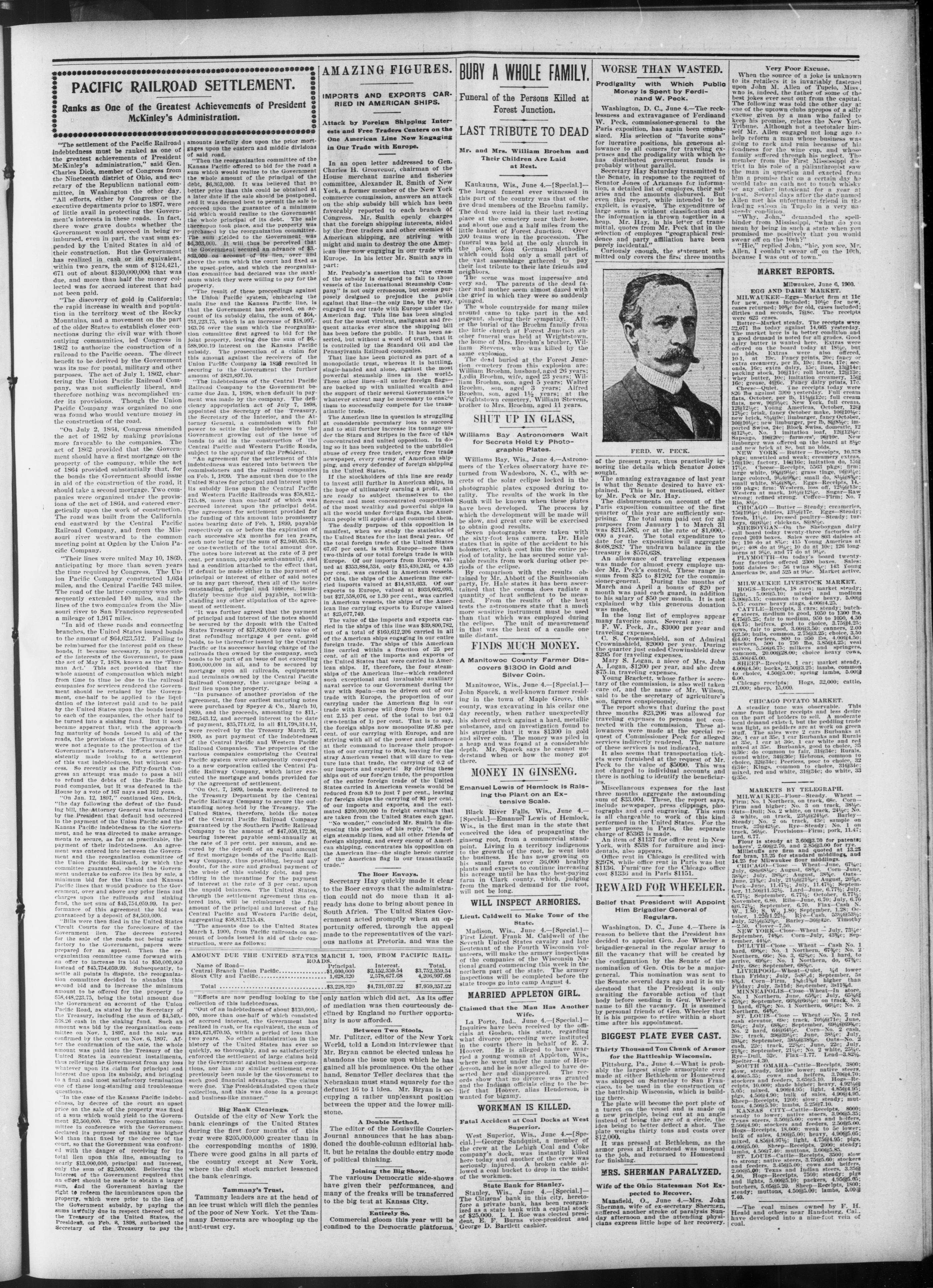
Washington, D. C., June 4.—The recklessness and extravagance of Ferdinand W. Peck, commissioner-general to the Paris exposition, has again been emphasized. His selection of "favorite sons" for lucrative positions, his generous allowance to all comers for traveling expenses and the prodigality with which he has distributed government funds is probably without parallel.
Secretary Hay Saturday transmitted to the Senate, in response to the request of Senator Jones of Arkansas for information, a detailed list of employees, their salaries and the amounts disbursed. But even this report, while intended to be explicit, is evasive. The expenditure of large sums is without classification and the information is thrown together in a heap. Mr. Hay, in his letter of transmittal, quotes from Mr. Peek that in the selection of employees "geographical residence and party affiliation have been purely incidental." Curiously enough, the statement submitted only covers the first three months
M.
FERD. W. PECK.
of the present year, thus practically ignoring the details which Senator Jones sought.
The amazing extravagance of last year is what the Senate desired to have explained. This is not mentioned, either by Mr. Peck or Mr. Hay.
The disbursements on account of the Paris exposition committee of the first quarter of this year are sufficiently surprising. The total sum paid out for all purposes from January 1 to March 31 was $211,583, or at the rate of $1,000,-000 a year. The total expenditure to date for the exposition will aggregate $608,283.' The undrawn balance in the treasury is $576,638.
An allowance of traveling expenses was made for almost every employee under Mr. Peck's control. These range in sums from $25 to $1202 for the commissioner-general. During the months of March and April a bonus of $20 per month was paid each guard, in addition to his salary of $50 per month. It is not explained why this generous donation was made.
In the long list of employees appear many favorite sons. Several are:
F. W. Peck, Jr., $3000 per year and traveling expenses.
C. S. Crowninshield, son of Admiral Crowninshield, $2000 per year. During the quarter just ended Crowninshield drew $295 for traveling expenses. Mary S. Logan, a niece of Mrs. John A. Logan, $1200 per year, and she drew $75 in traveling expenses. Young Brackett, whose father is secretary of the commission, is also well taken care of, and the name of Mr. Wilson, said to be the secretary of agriculture's son, figures conspicuously. The report shows that during the past three months $23,206 was allowed for traveling expenses to persons not connected with the commission. These allowances were made at the special request of Commissioner Peck for alleged services indirectly rendered. The nature of these services is not indicated.
It also seems that transportation tickets were furnished at the request of Mr. Peck to the value of $5090. This was not charged to individual accounts and there is nothing to identify the beneficiaries.
Miscellaneous expenses for the last three months aggregate the astounding sum of $33.004. These, the report says, include newspaper, press clippings, photographs and card engraving. This sum is all chargeable to work of this kind performed in the United States. For the same purposes in Paris, the separate charge of $5363 is made.
An item of $1137 for office rent in New York, with $538 for furniture and incidentals, also appears.
Office rent in Chicago is credited with $2978, while office rent in Paris was but $1136. Furniture for the Chicago office cost $1336 and in Paris $1151.
REWARD FOR WHEELER.
Belief that President will Appoint Him Brigadier General of Regulars.
Washington, D. C., June 4.—There is reason to believe that the President has decided to appoint Gen. Joe Wheeler a brigadier-general in the regular army to fill the vacancy that will be created by the confirmation by the Senate of the nomination of Gen. Otis to be a major-general. This nomination was sent to the Senate several days ago and it is understood that the President is only awaiting the favorable action of that body before sending in Gen. Wheeler's name to fill the vacancy. It is assumed by personal friends of Gen. Wheeler that it is his purpose to retire within a short time after his appointment.
BIGGEST PLATE EVER CAST.
Thirty Thousand Ton Chunk of Armor for the Battleship Wisconsin.
Pittsburg, Pa., June 4.—What is probably the largest single armorplate ever made at either Bethlehem or Homestead was shipped on Saturday to San Francisco, to be used in the construction of the battleship Wisconsin, which is building there.
The plate will become the port plate of a turret on the vessel and is made on a new principle, being cut at an angle instead of being the arc of a circle, the idea being to better deflect a shot. The plate weighs thirty tons and costs over $12,000.
It was pressed at Bethlehem, as the armor press at Homestead was unequal to the job, and returned to Homestead for finishing.
MRS. SHERMAN PARALYZED.
Wife of the Ohio Statesman Not Expected to Recover.
Mansfield, O., June 4.-Mrs. John Sherman, wife of ex-secretary Sherman, suffered another stroke of paralysis Sunday afternoon and the attending physicians express little hope of her recovery.
Very Poor Excuse.
When the source of a joke is unknown to its retailers it is invariably fastened upon John M. Allen of Tupelo, Miss. who is, indeed, the father of some of the best jokes ever sent out from the capital. The following was told the other day at one of the uptown clubs apropos of a silly excuse given by a man who failed to keep his promise, relates the New York Tribune. Although not a teetotaler himself Mr. Allen engaged not long ago to help reform a man whose business was going to rack and ruin because of his tenderness for the wine cup, and whose family suffered through his neglect. The member from the First Mississippi district in his role of a philanthropist saw the man in question and exacted from him a promise that on a certain day he would take an cath not to touch whisky or any other intoxicant for a year at least. Several days after the date named Allen met his unfortunate friend in the leading saloon in Tupelo in a very unsteady condition.
"Why, John," demanded the spellbinder from Mississippi, "what do you mean by being in such a state when you promised me positively that you would swear off on the 10th?" "Hic," replied John, "hic, you see, Mr. Allen, I couldn't swear off on the 10th, because I was out of town."
MARKET REPORTS.
Milwaukee, June 6, 1900.
DAIRY NEST
EGG AND DAIRY MARKET.
MILWAUKEE—Eggs—Market firm at 11c for new, cases included; 10%c for new, cases returned; 10%c for old, cases included; dirties and seconds, 7@8c. The receipts were 623 cases.
Butter—Market steady. The receipts were 32,071 lbs today against 14,605 yesterday. The market here is in better condition and a good demand is noted for all grades. Good dairy butter is wanted here. Extras were offered on the board today at 18½c, but no bids. Extras were also offered, 10-1, at 19c. Fancy prints, 20c; fancy or extra creamery, per lb, 11½c; firsts, 17c; seconds, 16c; extra dairy, 15c; lines, 13½c; packing stock, 10@11c; roll butter, 12@13c; whey butter, 10c; imitation creamery, 15@16c; grease, 4@6c. Fancy dairy prints, 17c. Cheese—Quiet. The receipts today were 820 lbs against 3000 yesterday. Full cream flats, October, per lb, 11½@12c; full cream flats, new, 9@9½c; New York, full cream, 12@12½c; Young Americas, October, 12@12½c; brisk, fancy October make, 10@10½c; new brick, 8½@9c; limburger, fancy October, 10@10½c; new limburger, per lb, 8@8½c; imported Swiss, 24c; Block Swiss, domestic, 12@12½c. No. 1 imitation loaf, 12@12½c; Sapsago, 19@2c; farmers', 9@19c. New limburger was offered on the board at 8½c and new brick at 8c, but no bids.
NEW YORK — Butter — Receipts, 10.378 pkgs; unsettled and weak; creamy extras. 16@19c; factory, 14@16c; imitation do, 15@17%c. Cheese—Receipts, 5563 pkgs; firm; large white, 9%@19%c; grass tinge, 9%@19%c; large colored, 9%@19%c; small do, 8%@18%c; small white, 8%@18%c. Eggs—Receipts, 14..199 pkgs; firm; Western, loss off, 12%@13%c; Western at mark, 10%@12%c. Sugar—Raw strong; refined strong. Coffee—Firm; No. 7 Rio, 8%c.
CHICAGO — Butter — Steady; creameries, 15@19%c; dairies, 13%@17%c. Eggs—Steady; fresh, 11%c. Dressed poultry—Steady; turkeys, 6@6%c; chickens, 8@8%c.
SHEBOYGAN—On the Sheboygan dairy call board today twenty-three factories offered 2019 boxes. Sales were 803 daisies at 9c; 110 do at 8%c; 415 Young Americas at 9%c; 408 do at 9%c; 10 do at 10c; 126 longhorns at 9%c; and 77 do at 9%c.
PLYMOUTH—On today's board twenty-four factories offered 2300 boxes. Sales: 1066 daisies 9c; 56 twins 8%c; 143 Young Americas 9c; and 525 at 9%c. Market active.
MILWAUKEE LIVESTOCK MARKET.
HOGS—Receipts, 18 cars; market steady; light, 5.00@5.10; mixed and medium 5.00@5.15; common to choice heavy, 5.00@5.15; coarse heavy stags, 4.00@4.25.
CATTLE—Receipts, 3 cars; steady; butcher steers, medium to good, 1050 to 1300 lbs, 4.75@5.25; fair to medium, 950 to 1050, 4.50@4.75; helfers, good to choice, 3.75@4.25; cows, fair to good, 3.00@3.50; canners, 2.00@2.50; bulls, common, 2.75@3.25; choice, 3.50@4.00; feeders, 800 to 950 lbs, 4.00@4.50; stockers, 500 to 750 lbs, 3.85@4.25; veal calves, 5.50@6.75; milkers and springers, common, 20.00@28.00; choice heavy cows, 35.00@45.00.
SHEEP—Receipts, 1 car; market steady, 4.00@4.50; bucks, 2.50@3.25; lambs, common to choice, 4.50@5.00; spring lambs, 5.00@6.00.
Chicago receipts: Hogs, 32,000; cattle, 21,000; sheep, 15,000.
CHICAGO POTATO MARKET
A steadier tone was observable. This came from lighter receipts and less desire on the part of holders to sell. A moderate local demand existed, but the peddling trade was light, as peddlers are at work on green stuff. The sales were 2 cars Burbanks at 36c, 1 car at 35c, 1 car Burbanks and Rurals at 35c, 1 car at 36c, 1 car white and red mixed at 35c. Burbanks, good to choice, 35 @36c; do common to fair, 31@34c; Rurals, round white, 34@36c; Hebrons, common to choice, 32@34c; Peerless, poor to choice, 32 @34c; Kings, common to choice, 31@34c; mixed, red and white, 31@34c; do white, 33 @35c.
MARKETS BY TELEGRAPH.
MILWAUKEE—Flour—Steady. Wheat—Firm; No. 1 Northern, on track, 68c. Corn—Firm and higher; No. 3 on track, 38½c. Oats—Dull; No. 2 white, on track, 24½c; No. 3 white, on track, 23½@24½c. Barley—Steady; No. 2 on track, 43c; sample on track, 37@42½c. Rye—Steady; No. 1 on track, 56½c. Provisions—Firm, pork, 11.47; lard, 6.77. Flour is steamed at 3.60@3.70 for patents; bakers', 2.60@2.70, and 2.85@3.00 for rye. Millstuffs are firm and quoted at 13.25 for bran, 13.25 for standard middlings, and 12.25 for Milwaukee flour middlings.
CHICAGO—Close — Wheat—June, 67%c;
July, 68@68%c; August, 68%c; Corn—June,
38%c; July, 38%c; August, 38%c; Oats—
June, 21%c; July, 21%@21%c; August, 20%c;
Pork—June, 11.47%c; July, 11.47%c; September,
11.50@11.52%c; Lard—June, 6.77%c; July,
6.77%c; September, 6.77%c; October, 6.77%c;
November, 6.80; Ribs—June, 6.70; July, 6.70
@6.72%c; September, 6.70; Flax-Cash N.
W., 1.80; S. W., 1.80; September, 1.28;
October, 1.22@1.22%c; Rye—Cash, 53%@53%c;
July, 52%@52%c; Barley-36@42c. Timothy
-2.50. Clover-7.50.
NEW YORK—Close—Wheat — July, 73%c;
September, 74%c; Corn—July, 43%c; September,
44%c.
DULUTH—Close — Wheat — Cash No. 1
hard, 69%c; No. 1 Northern, 67%c; No. 2
Northern, 66c; No. 3, 62%c; No. 1 hard, to
arrive, 69%c; No. 1 Northern, do, 67%c;
July, 68c; September, 68%c.
LIVERPOOL—Wheat—Qulet, 1%d lower
than Friday; July, 58%d; 1%d month,
58%d; Corn—Firm, 1%@1%d higher than
Friday; July, 311d; September, 311%d.
MINNEAPOLIS—Close—Wheat—In store.
No. 1 Northern, June, 65%c; July, 65%c;
65%c; September, 65%c@63%c; on track, No.
1 hard, 67%c; No. 1 Northern, 66%c; No. 2
Northern, 64%c.
ST. LOUIS—Close — Wheat — No. 2 red
cash elevator, 69c; track, 70%@71c; June,
59%c; July, 68%c; September, 69%@69%c;
No. 2 hard, 64%@64%c. Corn-No. 2 cash,
38c; track, 39@39%c; June, 38%c; July,
38%c; September, 38%@38%c. Oats-No. 2
cash, 22c; track, 22%c; June, 22c; July,
21%c; September, 21%c; No. 2 white, 25%c.
Rye-Dull, 52c. Flax-1.77. Lead-3.82%2.
Spelter-4.30.
SOUTH OMAHA—Cattle—Recelpts, 3800;
slow, steady, 5@10c lower; native steers,
4.40%c; 53cs and helfers, 3.70%@4.70;
stockers and feeders, 3.65@5.10. Hogs—Recelpts, 10.000; shade higher; heavy, 4.92%@5.05; mixed, 4.90%@4.95; light, 4.85%@4.95;
plugs, 4.50%@4.90; bulk of sales, 4.90%@4.95.
Sheep—Recelpts, 1200; slow; steady; mut-
tion, 4.50%@5.10; lambs, 5.25%@7.10.
KANSAS CITY—Cattle—Receipts, 8000; steady to lower; native steers, 3.90@5.33; Texas steers, 3.50@5.00; cows and heifers, 2.50@4.90; stockers and feeders, 2.50@5.00; Hogs—Receipts, 18.00; weak to 5c lower; bulk of sales, 4.90@5.00; heavy, 4.90@5.05; mixed, 4.85@9.12½; light, 4.75@4.95; plugs, 4.00@5.00; Sheep—Receipts, 2000; steady; lambs, 4.50@7.40; muttons, 3.00@5.85. ST. LOUIS—Cattle—Receipts, 3500; slow to strong; native steers, 3.75@5.00; stockers and feeders, 3.45@5.00; cows and heifers, 2.00@5.00; Texas and Indian steers, 3.35@4.90. Hogs—Receipts, 7500; steady; plugs and lights, 5.00@5.10; packers, 4.95@5.05; butchers, 5.05@5.20. Sheep—Receipts, 1800; steady; muttons, 4.50@5.00; lambs, 5.00@7.40.
—The coal mines owned by F. H. Heald and others near Randsburg, Cal., have developed into a nine-foot vein of coal.
The Wisconsin Weekly Advocate
Printed in the Interests of the Negro Race,
MILWAUKEE, WIS.
Richard B. Montgomery.....
.....Editor and Proprietor
Office 200 Fifth Street.
Telephone Black No. 244.
SUBSCRIPTION RATES.
Any part of the United States and Canada,
postage paid.
One Year ..... $2.00
Six Months ..... 1.25
Three Months ..... 7.5
Send money by Express Money Order, P. O.
Money Order or Registered Letter to the
Wisconsin Weekly Advocate.
ADVERTISING RATES.
One inch. single insertion..... 25c
One inch. per year..... $9.00
Business locals 5c per line each insertion.
Apply for rates to the Advocate.
TO CONTRIBUTORS:
All communications must be sent with the name and address of the sender as an evidence of good faith, but not necessarily for publication. No manuscript returned if not accepted, unless accompanied by stamps.
All subscribers of the Advocate that fail to get their paper promptly will please notify us at once. The Advocate, at 200 Fifth street.
The Wisconsin Weekly Advocate company wishes to notify the public that all contracts and business transactions with this company must have the company stamp, otherwise they will be void. Neither will this company be responsible for paid subscriptions unless given to duly-accredited agents, who, on request, will give the company's receipt for same. Subscribers falling to receive their papers regularly will kindly notify the general office. Address all business communications to the general manager, 200 Fifth street.
Entered at the Milwaukee P. O. as second class matter.
Rutgers College can brag, notwithstanding the fact that Martin Mahlon, because he didn't like its yell, cut it out of its will, in which he had listed it for a bequest of a quarter of a million. It isn't every college that has a $250,000 yell.
The attendance at the Paris Exposition is increasing, the daily attendance averaging 150,000, but the French say they must have an attendance of 60,000,000 for the entire season to render the show a paying institution. It looks very dubious whether this high mark will be reached.
If the Kansas professor man who stirred up the National Congress of Mothers by declaring that men do not love is not mistaken, what is the significance of the tons of loving-cups that men have presented to Admiral Dewey and Sir Thomas Lipton?
The spectacle of the Neely frauds was not new to the Cubans. They were accustomed to official roguery under Spanish rule. But the spectacle of Neely's prosecution and punishment will be a novelty to them, and is likely to excite in their minds admiration for American governmental methods.
The statement that only one bullet out of every five hundred fired in battle does execution reveals the impropriety of comparing the St. Louis street car strike to a state of war. A very large proportion of the shots fired in encounters between mobs and armed guardians of the peace carry a deadly message.
The Seattle story from the Manila Freedom is something for the marines. If the wrecked cruiser Charleston were only barely submerged at low tide, the navy department would undoubtedly be making some effort toward recovering guns and upper-deck equipment. The ship has disappeared, according to official report, and this means that she is out of reach as well as out of sight.
The abolition of the time-limit of pastorates in the Methodist church is a recognition of a new condition due to the growth of cities. Hereafter when a Methodist pastor of a city congregation becomes a power over his people he will not be dragged away to another charge in obedience to a cast-iron rule that was well adapted to the state of affairs in an earlier generation but has outlived its applicability and usefulness.
San Francisco's crusade against filth in Chinatown will scatter the Chinese and obliterate the dens of filth and infamy which have been objects of interest to tourists. Incidentally, it will take away the occupation of the guides to Chinatown who have profited richly by the desire of travelers to get a glimpse of Chinese low life. San Francisco has felt for years that this special attraction was a menace to the public health, and her determination to get rid of it is one good result of the plague scare.
Hardly any mineral can be named that is not obtainable somewhere in Siberia in abundant amounts. The mountains surrounding the Kingisian plains are known to contain not only gold, but also copper, silver and lead ore. The Altai mountains, covering an area ten times as large as Switzerland, abound in copper ore, silver and lead ore, gold and precious stones. In the Kusnezki valley are beds of coal so vast as to suggest comparison with the Pennsylvania fields. The richest and most extensive gold deposits occur in Eastern Siberia, and large petroleum deposits have recently been discovered on the island of Saghalin.
The three new battleships, Pennsylvania, New Jersey and Georgia, will not have superimposed turrets, like the Kearsarge and Kentucky, but they will have two main turrets, fore and aft, carrying four 12-inch guns, and four minor turrets, one at each corner of the superstructure, carrying eight 8-inch guns, ten 6-inch broadside guns, and a secondary battery consisting of twelve 3-inch, or 14-pounder guns, twelve 3-pounders, and machine and other pieces of small caliber. This will give the new ships an actual gun power nearly double that of the Oregon and Massachusetts, which a few years ago were the most heavily armed line of battleships afloat.
The manufacturers of funeral wreaths in Paris have drawn up a petition which will be presented to the Chamber whereby they object to an attempt on the part of the church authorities to render un-
popular floral displays at funerals. For some time there has been a campaign carried on by certain of the Parisian clergy deprecating the money spent on outward show at funerals. They have made no secret of the fact that their chief objection to the extravagance is the fact that it lessens the number of masses ordered by the relatives of deceased persons. What the petition of the wreath manufacturers actually asks is to make the saying of masses a punishable offense in order to protect their own interests.
An article in the Boston Globe shows that the safety of the mails in this country is simply marvelous. Some 17,000,000 pieces of registered mail matter, estimated value $500,000,000, are handled annually, and the net loss is not above 1-1000 of 1 per cent. When John Wanamaker was postmaster-general he estimated that there were carried in the mails 1,854,667,802 ordinary letters per annum, and that the value of the ordinary letter mail of the United States for one year was $467,376,286.10. Yet, Mr. Wanamaker added: "The total supposed losses of ordinary mail throughout the United States amounted in twelve months past to 51,745 pieces. Of these 20,900, or 40 per cent., were packages, the remaining 60 per cent. being letters. The total losses ascertained to be due to carelessness or depredation of postal employees numbered 23,985, of which 60 per cent. would be 14,391. Assuming the average value to be 25 cents, the total ascertained loss of ordinary letters chargeable to the postal service would be $3526, or 77-10,000 of 1 per cent."
The Deering Harvester company of Chicago has applied to the division of forestry for a working plan for its 54,000-acre tract of hardwood timber in Southeastern Missouri. This marks what is probably the first attempt of an American manufacturing establishment to employ modern forest methods in raising hardwood timber for its own use. The timber owned by the company consists chiefly of oak, ash and hickory, woods especially adapted to the manufacture of agricultural implements. The owners intend to remove all the less valuable species, such as cottonwood, gum, honey locust and cypress, so as to give the others all possible advantage for growth. A plan will be made by which the merchantable timber may be removed without injury to the producing power of the forest. The division will send experts to the tract to make the observations necessary for such a plan.
The ninth continental congress of the Society of the Daughters of the American Revolution, held at Washington in February last, adopted the recommendation of its assistant historian-general, Mrs. Robert Stockwell Hatcher, to send a wreath of immortelles, to be deposited upon the tomb of Gen. Miranda, in the Pantheon at Caracas, Venezuela, in the name of the society. Francis B. Loomis, United States minister at Caracas, has advised the society of the safe arrival of the wreath at the United States legation, and says that the presentation ceremonies, in which President Castro and his wife will participate, will take place on May 23 in the Pantheon. The minister writes that the fact that the Venezuelan government has within the last three years erected at large cost two very handsome monuments to the ten Americans who fought with Miranda and were executed at Puerto Cabella by the Spaniards, ought not on this occasion to be overlooked.
THE PHILIPPINE CLIMATE.
It is Comparable with that of the Gulf States in Summer.
The climate of Manila is almost identical with that of San Juan de Porto Rico, and is comparable with that of the Gulf states during the warmer portion of the year. It seems less trying to most people, however, than July and August even in Washington or Baltimore, because the climate is a very equable one. Having no sudden changes to fear, men can, and habitually do, dress in the lightest of underclothing, wearing over it only a thin, unlined duck coat and trousers; and inasmuch as the variations of temperature are very small, people presently become accustomed to the warmth. The mean temperature of the year is 79 degrees F., a degree of heat to be found in winter in many dwellings and offices of the Atlantic coast. The cool season, coinciding with the prevalence of the northeast monsoon, lasts from early in November to about March 1. The coolest month is February, and its mean temperature is 76 degrees F., but the mercury has been known to descend temporarily to 61 degrees F., producing great suffering among the people. During this season the humidity is fairly low, about 78 per cent., which is approximately the prevalent relative moisture of the air in the seaboard towns of the Atlantic coast in September. In the cool months the rainfall is very small, and consists ordinarily in occasional thunder-showers. The hot season, at Manila, includes March, April and May, the last being the hottest month. May has an average temperature of between 85 and 86 degrees F., and once only, since records began, the mercury rose to 100 degrees F. The air during the hot season is, as a rule, decidedly dry, a fact which assuages the seeming intensity of the heat. In April the average humidity is 71 per cent. Most of the cities on the Atlantic seaboard are more humid in June than is Manila in April. Many of our interior towns, however, have an average humidity in June of between 70 and 72 per cent.; such are Atlanta, Bismarck, Chicago, Lynchburg and Nashville. Hot nights are rare in Manila, and by midnight it is almost always possible to sleep comfortably. From "Are the Philippines Worth Having?" by George F. Becker in Scribner's.
The Boers' Piano.
A special correspondent of the Manchester (England) Guardian reports wholesale destruction of property in the path of the British advance through the Orange Free State. The way from Bloemfontein to Kimberley, he says, "is a line of desolation." "The farm-houses have not merely been sacked; they have been savagely destroyed—mirrors smashed, pianos wrecked, works torn from clocks, children's toys and books wantonly destroyed." There is one interesting question in connection with the story. It is, where did all these pianos, mirrors, books and other evidences of art and culture come from if the Boers are really the rude, unwashed, uneducated people they have been painted by some of their enemies?—Charleston News and Courier.
Senator Frye of Maine is fondest of the pine woods of his state. "I long for the session to end," he said the other day, "to get into the summer woods and breathe in the pine scents again."
PRESS WOMEN TALK SHOP.
They Discuss that Club Column and Other Things.
Some Clever Observations by Some Clever Folk.
Interesting Papers Presented at an interesting Session.
At 10 o'clock Wednesday morning, when the reorganization question was temporarily over at the Alhambra, there was a general exodus of new paper people and people interested in newspapers, to the Davidson, where the newspaper session was held. Mrs. Margaret Hamilton Welch, editor of Harper's Bazar, Mrs. Cynthia Westover Alden, formerly of the New York Tribune. Miss Helen M. Winslow, editor of the Clubwoman, Mrs. Sally Joy White, Mrs. Mary S. Gist and Miss Bertha Damaris Knobe, who is "Madame President" in the Times-Herald, were down for papers and discussions, and these and Mrs. Mary S. Lockwood was chairman, and Mrs. Lowe was upon the stage. Several of the general officers, Mrs. Buchwalter, Mrs. Neville, Mrs. Morris, Mrs. Winkler and others were in the boxes, and the session was an extremely interesting one.
Miss Helen M. Winslow's paper came first. Miss Winslow is known the country over for her work as editor of the General federation's official organ.
NOTABLE EVENT IS PRESS RECEPTION.
arge Party of Leading Clubwomen Attend Function at Home of Mrs. Ray. The Biennial press committee and the auxiliary committee gave a reception to 300 guests Monday afternoon from 3 until 6 o'clock at the home of Mrs. Charles Ray, 88 Prospect avenue. The affair was a very brilliant one, and was attended by a good many notable people among the biennial delegates and others. The rooms were beautifully decorated with vases and roses and with snowballs, fleur de lis and palms. Mrs. George Nash, assisted by others, presided at the ices and poured the coffee.
The following ladies received with the hostess: Miss Clara Ray, Mrs. John F Cramer, Mrs. Frederick C. Winkler and Miss Zona Gale. The others who assisted were:
Press—Advisory chairman, Mrs. Frederick C. Winkler; chairman, Miss Zona Gale, Milwaukee Journal; Miss Ida M. Jackson, Sentinel; Miss Jessie Knowles and Miss Helen Glenny, Evening Wisconsin; Mrs. W. A. Bowldish, News; Mrs. Martha Goes, Germania; Mrs. Edgar Coleman, Herold; Mrs. Elizabeth Evans, Wauwatosa Independent; Miss Helen Boynton, Wavside; Miss L. E. Stearns, State Press; Mesdames William MacLaren, William A. Rublee, Geo. H. Yenowine, Arthur Weld, Geo. W. Peck, Jr., David E. Roberts: Misses Anne Hazleton, Gertrude Bean, Fanny F. Jennings, Crossdella C. Foss, Mary Stewart, Mrs. D. Thornton; for the state, Mrs. Henry M. Youmans, Waukesha; Mrs. Phip van Reeten, Wausau; Helen Sexton, George R. Nash, Charles P. Spooner, James H. Turner, Willette Spooner, Charles Gale, Frederick Fitzgerald, Frank Cottrill, George Grant Mason, Frederick M. Mann; Misses Katharine Peck, Frances Winkler, Elizabeth Whalley, Mary Butler, Emily Rogers, Edit Crombie, Henrietta Bloodgood, Margaret Bloodgood, Katherine McCord, Myrte Carter, Sue Carter, Mary Bell, Martha Bell, Lillian Wahl, Edith Cramer, Elizabeth Bigelow, Mary Bigelow, Agnes Wahl, Sasle Markham.
Among those present were:
Messrs, and Mesdames Frank Keene, H.
H. Coleman, Woodbury, Hamilin Garland,
John A. Brtler, George L. Graves, Prof. and
Mrs. Klauser, George Peckham, Abbot
Thorndike, E. W. Frost, Howard Morris,
Charles Morris, Rev. and Mrs. Titsworta,
Rev. and Mrs. Lester, Rev. and Mrs. Beveridge Lee, Rev. and Mrs. Richardson.
Mesdames Matthew Carpetner, Edward Sanderson, W. E. Cramer, E. Peattie, J. G. Jenkins, Chauency Williams, Channing Seabury of St. Paul, Howard Green, John Vance Cheney, J. E. Rogers of Portage, J. C. Noyes, C. Gneedn, W. O. Many, J. G. Flanders, A. A. L. Smith, Q. D. Hastings and Greene of Green Bay, William Mayhew, E. K. Gregory, Martin Iherman, H. A. J. Upham, Conley, Ward, C. Cumler, William Klister, Florence Kelly, C. S. Kinney, G. W. Kendrick, Jr., N. M. Landers, W. N. Lyon, C. Lanahan, M. H. Lacy, Rebecca D. Dowe, Mary S. Lockwood, George A. Meyer, P. N. Moore, C. S. Morris, E. G. McKay, Mc N. Miller, J. L. McMurphy, N. S. Murphy of Waukesha, Della Needham, T. K. Noble, F. Nathan, A. C. Neville, W. P. Orr, J. K. Ottley, Mary Pappenheim, D. S. Pinneo, Henry N. Pyle, C. A. Perkins, Louisa L. Riekets, Edwin Rotan, M. E. Root, S. B Sweath, Charlotte P. Sterson Thaddeus Stanwood, A. P. Stevens, E. M. Smith, N. M. Towner, E. B. Thompson, C. W. Thinee H. C Terne, M. H. Welch, L. P. Williams, A. D. West, A. W. Williams, E. P. Vitas, C. C. Wikinson, A. D. Warner, F. L. Charles, the Rev. Caroline B. Crane, E. M. Clerk J. L. Crear, O. R. Clerk, Phil-Carpenter, Iva C. Chatterson, Charles E. Crane, E. L. Campbell, S. S. Cotton, Catlin, Castello J. M. Clatt, C. M. Dorr, Selwyn Douglas, S. S. Platy, Myra Dock, E. M. Elbridge, F. R. Elliott, F. A. Eastman, L. A. Foe, R. F. Farron, C. E. El
J. A. Fee, R. B. Forson, C. F. Flage, S. J. Friedland, D. N. Fletcher, Emma A. Fox, F. M. Ford, W. Guitterman, Gasterman, F. Hanger, M. D. Hutchinson, James Humphrey, A. B. Howe, Stewart Hartshorn, William L. Helmuth, George C. Hitt, J. A. Hale, J. L. Johnson, J. N. Jewett, C. W. Kelley, C. E. Kent, M. A. Keating, Anna Apperson, H. Brock, C. W. Basset, R. J. Burdette, J. N. Baker, E. N. Bacon, G. Williams, L. F. Blomestein, C. S. Brown, J. C. Beekman, L. E. Blommet, C. P. Barnes, E. L. Buchwalter, M. W. Coleman, C. E. Coulter, C. D. Coe, W. J. Cook, Kate Upson Clark, W. J. Christie and the Misses Alice Chapman, Gertrude Bean, Nellie Isley, Fannie Jenkins, Lillian Carpenter, Mary Graves, Rosa Winkler, Marie Berry, Mary McDowell, Maud Summers, H. Winslow, Florence H. Hall, Lenore Hilbert, S. J. White, W. F. Watson, J. N. Windsor, A. G. Whittemore, W. P. Wilson, Jennie McKee, Bertha D. Knobe, A. M. Jones, Kate T. Holmes, Ellen Henrotin, Emma A. Fox, H. Ellott, Connor, Madame Friedland of Moscow, Russia; Messrs. Leslie Garver, Edward Johnson, G. H. Yenowine, Donald McLaren, Gen. Charles King and others.
Another friend of our race is found in the personage of Mrs. C. B. Buchwalter, whose cut we take pleasure in presenting to our readers. She highly endorses our work and will help another of our race by giving her the paper. She is a dignified lady and is said to be a Bark maker as well as a Buchwalter. Her ideas on the subject of admitting colored women's clubs are, that we as a body will make more progress toward solving that great question, race problem, by standing alone and being independent of any club. By this means we will gain self-confidence and strengthen our ability to press forward, whether or not we are helped by sister clubs. We believe her statement is the sentiment of all the leaders of the colored clubs of this country. We were treated exceptionally well by all of the ladies whom we chanced to meet.
The full details of the session will be continued in next week's issue.
M.
MRS GEOPGE H NOYES.
Chairman of the Credentials Committee.
(Photo by Stein.)
A. M. E. GENERAL CONFERENCE
The week just passed has been an interesting one from many standpoints. Perhaps never in the history of the African Methodist Episcopal church has a general conference been stirred from center to circumference as has been this one. First, the report of the Episcopal committee recommending five bishops instead of four was only decided when the last vote was taken.
After came the election of general officers, and this also created considerable excitement from the fact that combinations were formed that could not be overcome, and as a consequence considerable feeling was manifested because many of the candidates felt that they had not had a fair show. This possibly developed stronger in the case of Dr. E. W. Lampon than that of anyone else. Dr. Lampon and his friends felt very sure that he would land the prize, but the combination against him was too strong and he was defeated by a very small margin.
The death of Dr. Cheeks, for whom the rules were suspended and whose election was unanimous, cast a gloom over the entire conference. Dr. Cheeks, by his patient suffering and untiring devotion to his work, had the sympathy of every member of the general conference without exception, and it is safe to say that he was the one man who could concentrate and focus the different elements upon himself without any feeling of bitterness whatever.
One of the surprises of the week was the election of Rev. R. H. W. Leak of Raleigh, N. C., as business manager of the Christian Recorder. Mr. Leak was not known to be in the race until Friday morning, at which time it was sprung upon the conference, he succeeded in securing 232 votes and was elected. Rev. T. W. Henderson, who failed in being elected bishop, was naturally looked upon as being his own successor, but he only received 89 votes. Another surprise was the re-election of Dr. H. T. Johnson as editor of the Christian Recorder, as it had been generally conceded that he would be retired.
Dr. Ransom of Chicago was looked upon as the coming man for editor, but his friends claim that a speech he made defeated him. Dr. Parks was re-elected missionary secretary by acclamation, the same honor being accorded to Prof. H. T. Kealing, editor of the A. M. E. Review, as also Prof. John R. Hawkins, secretary of education. Miss Hallie Q. Brown, M. S. of Wulbertforce, was in the field against Prof. Hawkins, but did not get a show, the conference evidently being not yet ready for woman's right to hold office. Rev. P. A. Hubbard of Colorado was elected financial secretary. Dr. E. W. Lampten of Mississippi was generally accepted as being in the lead, but the combination was against him and he went down. Rev. W. D. Chappelle of South Carolina was elected secretary of the Sunday School union, although it was generally conceded that after the second ballot Rev. James A. Davis would have been elected. Rev. Mr. Downs, Rev. Mr. Hurley and J. H. Murphy had agreed to throw their interest with Mr. Davis, but Dr. Davis seems to have lost his head and given up the fight when victory seemed in sight. Dr. Chappelle, however, was the candidate of the combine and it was impossible to overcome it.
The laymen of the conference were better organized at this conference than at any previous one. Prof. S. T. Mitchell of Wilberforce was chairman and Prof. W. B. Cloman of Arkansas was secretary.
The five bishops elected here on last Thursday were ordained today. The sermon was by Bishop J. A. Handy, D. D. The new bishops were ordained in the following order: Evans Tyree, Morris Marcellus Moore, Charles Spencer Smith, Cornelius Thaddeus Schaffer, Levi Jenkins Coppin. It was decided that Dr. Tyree had received more votes than Dr. Moore and in consequence was entitled to have his name mentioned first as senior bishop.
Rev. B. F. Watson of Springfield, NL., who was elected secretary of the Church Extension society, is well known in that connection as he was the originator of the Church Extension society and its first secretary. Dr. Watkins is well acquainted with the work and will no doubt do considerable toward extending its usefulness. After his election they called upon him to make a speech and in reply he sang "The Savier Has Found Me." The appropriateness of the selection struck the delegates very forcibly and Mr. Watson was applauded.
Bishops assigned:
First District—New England. New York. New Jersey and Philadelphia conferences, W. D. Derrick. D. D.
Second District—Baltimore, Virginia, West and North Carolina, Benjamin F. Lee, D. D., LL, D., Ph. D.
Third District -Ohio and Pittsburg, B. W. Arnett, D. D., LL. D.
Eighth District—Arkansas and Mississippi, Evans Tyree, D. D.
Fourteenth District—South Africa, L. J.
Coppin, D. D.
—Baltimore Afro-American Ledger.
In Honor of the Concord Grape.
It was veritably a unique occasion at Old Concord on Monday afternoon and one that smacked of the soil. All the elements were in harmony with the "remembrance meeting" in honor of Ephraim Wales Bull, the originator of the Concord grape.—Boston Evening Transcript.
M.
MRS. W. H. KISTLER.
(Denver.)
EDITOR'S OPINION.
What is my opinion regarding the General Federation of Women's clubs in barring out the colored women's club? These grand and noble women were right in their decision, and we endorse every movement made by them.
In the first place, the club is not old enough, and, secondly, this grand organization cannot be too careful in what clubs they add to their national organization. And my next reason is, that we can do more good by ourselves than we can with white clubs. Some of these same negro women drew the color line three years ago at the Teachers' National convention which met here in our city. They formed a committee and called on our white citizens here to give them so much money so that they could entertain their delegates by themselves. If that isn't drawing the color line I have no more to say, when this was a national affair.
They secured Lincoln hall and gave a mock banquet on the ham sandwich order, and barred one of our most respectable ladies and had the other one put out. One of the colored newspaper reporters went there to get news for an Eastern paper. She did not have the common decency to ask this gentleman to retire from the hall but sent for a policeman to escort him from the hall. It was a money-making scheme and we can prove it. And what money remained the gang went South with it. Now they have the gall to be wanting admittance into white organizations. A great trouble with our people is wanting to force themselves where they are not wanted, and will be turned down every time they don't come right. Yours.
R. B. Montgomery.
CREAM CITY NOTES.
This gentleman is Mr. A. G. Burgette: The colored gentlemen who run a shoeshining establishment on Grand avenue between Second and Third streets have added another line to their welcoming sign. It now reads:
Welcome to the Federation of Women's Clubs.
Come in and Get a Shine.
We Don't Draw the Color Line.
There will be quarterly meeting held at St. Mark's church on Sunday, June 10.
All the singers, those who can and those who think they can, and those who know they can are cordially invited to take a part in our choir which we are starting at St. Mark's. Come on and have a real song service, too.
Sunday night, June 3, Rev. N. Knight greeted his large audience with a most pleasant smile. The sermon delivered was uplifting, inspiring and very consoling. Let us have the house filled every Sunday. If we go and listen attentively all will agree that they were glad they came.
* * *
We extend a most hearty welcome to the young men who have lately come to our city. Welcome, thrice welcome.
☆ ☆ ☆
While in Kenosha we called on Messrs, Head and Hewitt, who are editor and proprietor of the Kenosha Daily News and Weekly Courier. These are the two best newspaper gentlemen in the United States. We thank them for the many favors shown us while in their city. We wish we had more white newspaper people who treat us as above.
* * *
The Wisconsin Weekly Advocate sincerely hopes that Mrs. Nobles' daughter, Miss Nellie, who is ill at the hospital, may have a successful operation performed and speedily recover. At this time she is resting very comfortable. The operation will be completed on Saturday.
Thursday afternoon, by request, the editor and his staff called on Mrs. French and Mrs. Crawford of Arkansas, who are at the Hotel Pfister. We were met by Mrs. French, a lady of culture and refinement, that one could see at a glance, and she must have read our thoughts for as soon as we met her she rang the bell and treated us to delicious lemonade. We exchanged our thoughts and opinions regarding this admission of colored women's clubs and we all agreed that when we prove the fitness the recognition always awaits us. We are now at the bottom of the ladder and cannot reach the top with one bound. We must go slow and sure and cannot push ourselves among them. We will; we are taking the same steps as our great leader and sister, Mrs. Booker T. Washington. Mrs. French has most graciously offered her aid in any way which may prove beneficial. When presented with our paper and asked to subscribe she jokingly said: "Where's my purse? Cash with subscriptions. Everybody likes a good write up." In conclusion, speaking of this color line, she truthfully said, "It is better far to be the biggest frog in a little puddle than the littlest frog in the biggest puddle.
Good Things Come to Those Who Wait.
A party of white gentlemen from Washington City, D. C., are here making plans for a convention next month. One of these gentlemen made the remark that some colored gentlemen ought to be represented in that body at the convention. So they made inquiries among the hotel people who would be the best one to represent our people. They selected Mr. S. R. Banks. He, like Mr. Washington, did not force his way in but waited patiently until the white people sent for him. Race problem.
Prof. Sir William Geddes, principal of Aberdeen university, who died very suddenly on Fberuny 9, was a self-made man. He was born on a humble farm in Aberdeenshire in 1828.
M.
MRS. WILLIAM C. HERRON.
(Cinchnatt.)
MRS. WILLIAM C. HERRON.
(Cinchnatt.)
NEWS OF GREAT WOMEN.
On Tuesday morning at about 9 o'clock at the sound of a gavel tapped on the table, a large audience—all ladies with the exception of a few scattering reporters—turned their eyes and attention to the stage in the Alhambra. Before them stood a lady clad in black, to whom, one could see at a glance, a word of command meant obedience. On the main floor and first gallery the seats were crowded to their utmost, and the hum that prevailed before the tap of the gavel can only be compared to the buzz of as many bees or the sound of a mighty cataract. After the call to order by the chairman, an eloquent prayer by Miss Ellen Sabin, followed by an address of welcome rendered by the mayor, Hon. Rose, followed by the greetings of a number of ladies of this state and city and responded to by Mrs. Decker, Mrs. Neville, president of the Wisconsin State federation, then spoke on "Universal Brotherhood of Man." Among other subjects the one of child wage-earners was dwelt on with interest. Clubs for women wage-earners, and shorter hours for ladies who work in stores, were discussed.
At 12 the meeting was adjourned until 2, when they met again and the order of the exercises were a little different. The reports of different committees on rules and regulations were read and discussed in the afternoon. Resolutions made and accepted. Among those who discussed these subjects were Mrs. Brock of Pennsylvania, Mrs. Green of Ohio and Mrs. Buchwalter of Ohio. All of these ladies stated their points well.
On Wednesday there was a parliamentary tangle, the majority and minority reports on reorganization being presented to the convention and discussed by their champions. The session devoted to education, at which public school needs were discussed, was very beneficial.
LAKE GENEVA NEWS.
We had the pleasure of calling on Father Riley of this city. He is a great friend to our race and is very much pleased with our paper and subscribed for it at once. Would that we had more good Catholics like Father Riley.
Father Riley has been at St. Francis' church for the past sixteen years. The members of his flock met together at their hall June 3 and decided to move the old building from where it now stands to a lot east of the church. There will be a two-story building put up where the old one stood, to be fitted up with the latest modern improvements.
We wish to thank Mr. William O'Neil, superintendent of the Lake Geneva Water and Light company for the kind treatment he has shown us in assisting us while we were in the city. He is one of Lake Geneva's leading business men.
We wish to thank Mrs. McD. Sturges and Miss Helen Sturges for their sympathies and kindly interest shown in our work, and greatly appreciate their benevolence. May God ever bless them. These kind ladies are using their influence among their friends to have them employ colored servants at this beautiful summer resort.
Mr. H. M. Marsh has a beautiful home on the lake, fitted up to the queen's taste. We thank him for the kindness he shown us while in the city.
Mr. H. S. Rich has proven himself a friend to us and will lend his influence toward having his friends patronize us by hiring help from our office. He, too, has a lovely home along the lake.
One of the nicest, barber shops in Geneva is kept by Messrs. Chapman. Lewunski, John Engels and H. Swartz. They are as polite and obliging a set of gentlemen as you would like to meet. Give them your patronage.
A NOBLE WOMAN.
Mrs. Rebecca Lowe of Atlanta, Ga., who delivered one of the greatest addresses during the history of the Confederation of Women's club and also president of the same, is a charming lady and is a true friend to our race. Much has been said in the newspapers concerning a key given to the head bellman at the Plankinton in a hurry. This kind lady was on her way to the Alhambra to deliver her address and had no time to spare, so the colored boy in his excitement thought this lady was prejudiced toward our people. So it did not amount to anything worth mentioning.
Mrs. Lowe has an old black mammy who is 82 years old, and she bought a home for her and is caring for her. She has also four colored servants in her family and they all love her and say that she is the grandest woman that ever lived. In fact our race understands our Southern white ladies and gentlemen because they look after our best interest and are trying to he'p us work out the race problem. We greatly appreciate her love for our race and long may she and her good work live.
Now, if some of our Northern white people who claim to be such friends to our race would do half as well by us as this lady has done it would not be long before the race problem would be worked out up North.
Kansas Man Had Traveled Faster.
The New York man was showing the visiting merchant from Kansas the compressed air cars in Twenty-ninth street, says the New York Sun, and after one of those lucid explanations for which a New Yorker is famous, he asked the Kansas man to take a ride with him.
"Not much!" protested the visitor, pulling back like a steer on a rope.
"Why not?" expostulated the New Yorker.
"Because, by gravy," explained the Kansas man, "I've been moved two or three times by a cyclone, and I've got all I want of it."
FOR HER RACE.
From the Evening Wisconsin of June 4. "I have not known officially," said Mrs. Josephine St. Pierre Ruffin at the Plankinton this morning, "of any friction in the matter of admitting colored clubs to the General federation. "Our club made application about a month ago, in the regular way, our application was accepted, and certificate of admission given to us, without question upon the part of any one of the officers, and I received from Mrs. Lowe a personal letter of congratulation.
Expects No Trouble.
"I do not anticipate any friction in the matter of being admitted as a delegate. Indeed, under the constitution and by-laws, as they now stand, there is no
M.
MRS. JOSEPHINE ST. PIERRE RUFFIN.
(Delegate from the Woman's Era Club of Boston.)
MRS. JOSEPHINE ST. PIERRE RUFFIN. (Delegate from the Woman's Era Club of Boston.)
method of ejecting us. It is not a matter of exclusion, for we are already in the federation, and if it be determined to eject us, the only way is to alter the by-laws. As I said, I do not look for the slightest difficulty in the question of admission. It was thought best for the club to join the federation, we have joined, and we are here to stay."
Mrs. Ruffin is a woman of most attractive and pleasing personality. Of middle age, with a pompadour of soft white hair surrounding a face only brunette in color, with eyeglasses perched upon a very decided nose, and bright dark eyes, full of intellect and purpose and determination. Mrs. Ruffin stated her intention of doing what was for the benefit of the colored race.
"I am at the disposal of my people," she said, "because they need me. There is much that I can do for their uplifting, and I am always on the side of the weak. As to the great question of race, I believe that education is to be the final solution of that. And it will come in time. I find that the Southern women are gradually evolving, if I may use that word, in this manner of color distinction. And we can afford to wait, laboring all the while for the advancement of our race."
"In organizing the Association for the Promotion of Child Training in the South I received valuable aid and cooperation from the most representative women in the South. And we expect great results from this movement, the nucleus of which is a kindergarten school in Atlanta, started last winter, and we hope to establish similar schools, in time, throughout the South.
"I believe," continued Mrs. Ruffin, "in the beneficial effects of club life for women, and the colored woman needs it vastly more than the white woman. She needs every opportunity to receive strength and education and help along the way. And club life is going to be of the greatest help to her."
When asked if Mrs. Lowe was aware that the New Era club was composed mainly of colored women Mrs. Ruffin replied:
"Really I do not know, but I presume she does." I met Mrs. Lowe personally in Boston a year ago, and was introduced to her as president of the club, and certainly she must have known at once that I was a colored woman."
"But all this question will be determined when the biennial opens, and I look for nothing but harmony along the line. I have not come here in a spirit of aggression or forcefulness, but as the accredited representative of the Woman's Era club, which is composed of white women as well as colored.
"The question of a place upon the programme was not raised by the colored people at all, and they have no unpleasant feeling on that score. As far as I know, the club I represent is the only colored club belonging directly to the general federation, but there are many that belong to the state federations."
Mrs. Ruffin is one of the best representatives of what the colored race can do, if the opportunity is given. She was educated in Boston and Salem, and married, when 16 years old, George L. Ruffin, a bright young colored man who was a graduate of Harvard. He was prominent in public life in Boston, serving several terms in the council, two terms in the Legislature, and finally being appointed by Gov. Benjamin F. Butler to a judgeship in the municipal court of Charlestown, being the first colored man to occupy a position on the bench north of the dividing line between North and South.
The Woman's Era Club.
The Woman's Era club, which Mrs. Ruffin represents, was organized by her in 1892. It is one of the most prominent clubs in Boston, and numbers among its members graduates of colleges and universities, not all of whom are colored people. Lucy Stone's last words, "Aim to make the world better," were taken for its motto, and it follows lines of educational work.
In 1892, the same year that the club was organized, Mrs. Ruffin began the publication of a monthly magazine, called the New Era, issued in the interest of colored women, which she continued for five years. She frequently writes for the Eastern press, and numbers among her friends and coworkers in the cause of uplifting her race some of the ablest men and women of New England, people like Julia Ward Howe, Edna Cheney, the editor of the Transcript, and many others of that ilk.
She belongs to the Moral Education society, and the Massachusetts Woman's Suffrage association. She is a member of the New England Women's Press association and was elected a delegate to the Milwaukee biennial by that body, as well as being chosen as a delegate to represent the Massachusetts Federation of Women's clubs, but she preferred to come as the representative of the colored women. Mrs. Ruffin's amount of colored blood is small, her mother being a white woman and her father a blending of French and Indian, and the colored strain came from further back. "But," she said, "I stand as a colored woman, and whatever I have, of courage, energy, determination, or small talents, is at the service of my race, so long as I shall live."
Mrs. Lowe, when questioned as to
whether she was aware that the Woman's Era club was composed of colored women, replied at once, "Why, I never dreamed of such a thing, honey. I supposed of course it was a white club." But when asked what she would have done had she known, Mrs. Lowe diplomatically replied that she never said what she might have done.
BROKEN CHINA.
From the White House Auctioned to Curio Collectors.
Broken china from the white house commands a very high price. Unless it is broken it is not supposed to be outside of the executive mansion, and possession of a perfect piece is prima facie evidence of theft by the possessor. But when nicked or broken the china is disposed of by the steward at public auction. Then collectors, professional and otherwise, buy it up, and mend it, and add it to their collections or dispose of it again at a profit.
There is a white house set for nearly every administration. Whenever it seems to be necessary Congress appropriates $3000 for a new state dinner service. The master and mistress of the white house have designs made and then the service is made by some such maker as Havelin. When a new service is brought in the one which has been in use is put in a cabinet, and is kept for show purposes alone. The Lincoln, Grant, Hayes and Cleveland sets are now thus preserved. Harrison, when President, did not have a set made. The Hayes set is the handsomest and most costly
is the handsomest and most costly. Mrs. Senator Fairbanks recently bought at an old curio shop a Lincoln, a Grant and a Hayes plate, and considered herself forunate to get them at a price which would have bought a small house. The last auction held by the steward of the white house was the 20th of last December. Mrs. Dawes secured a fine Grant plate. There is never any question about the genuineness of these specimens, as they all bear the special white house mark which is copyrighted. There is other china used at the executive mansion on ordinary occasions which has no marks, but it is not particularly choice and is not sought after. A Rochester, N. Y., lady recently secured a Lincoln plate and communicated the fact to a local paper, which wrote it up and published a picture of it.
But their enterprise did not stop here, for they proceeded to accuse Mr. McKinley of gross vandalism in smashing up the historic crockery of the white house and then peddling it out to secondhand dealers. As a matter of fact, the President had nothing to do with it. It is all in the hands of the steward, and he has to account for every plate, saucer, or butterdish. If he has not the original, he must have the prices or the price brought at public sale.
STEEL WOOL.
Curious Material Used as a Substitute for Sandpaper.
Steel wool, introduced five or six years ago, is a machine-produced material that is used as a substitute for sandpaper. It is composed of sharp-edged threads of steel, which curl up together like wool, or somewhat as the wool fibers of the familiar material known as excelsior curl up together, though the steel is very much finer; the finest of it being not much coarser than the coarsest of natural wools. The steel wool is put up in packages containing one pound each. These are something like rolls of cotton batting, but smaller, making, rolled in paper and open at the ends, a package perhaps fifteen inches long and two or three inches in diameter.
Made in various degrees of coarseness, steel wool is put to a variety of uses, the finer wools for polishing wood and metal, and the coarser for rubbing down paint and varnish. It is often used on several special parts of work, while, for example, on the flat surface of a door a man would use sandpaper with a block back of it; for the mouldings he would use steel wool, which fits into the crevices and conforms itself to irregular shapes. Such work can be done with steel wool far more readily and quickly than with sandpaper; and it is used with like advantage on irregular and small surfaces and on carved work.
Besides the steel wool there is a coarser material of the same kind called steel shayings, which is put to various uses, as in taking off old paint or varnish, and in polishing wood before painting, and it is used on bowling alleys and on floors for smoothing and cleaning them.
Sandpaper clogs in use, steel wool breaks down. The wool is commonly used with gloves to keep the ends from sticking into the fingers.
Ladysmith Servants.
A besieged correspondent from Ladysmith gives rather an amusing account in Household Words of his native servant under fire. "Some of us," he says, "were sitting outside the bomb-proof quarters, my natives being just outside theirs. Suddenly we heard the distant boom of a low-velocity five-pounder gun. There was a moment's pause, and then we heard the shriek of a shell approaching us. There was a shout of 'Look out,' and every one was below ground except Jem, who remained watching curiously to see where the shell would burst and what it would do. He saw the shell burst above him; it was shrapnel, and he learned something of what it could do, because a small and, luckily, almost spent piece laid his head open to the bone. This appeared to please him immensely, and by the time we appeared above ground again he was smiling a rather sickly smile, mopping up the blood which was flowing pretty freely from his head with a dirty dishcloth. I gave him a tot of brandy, and Hospital Sergt-Maj. Dowling bound up his head for him. Another native, named Charlie, remarked that Jem had all the luck, for he would gladly have suffered a blow on the head for the same compensation—a tot of brandy. I cannot persuade them to make their bomb-proofs secure. They remark that 'what is to be will.'"
Tale of a Dachshund.
"Stimler's collar button rolled under the bureau.
"Yes."
"And he 'sicked' his dachshund after it."
"Go on."
"The bureau is heavy and stands close to the floor."
"Proceed."
"The dachshund is the thinnest dachshund that ever breathed, and he could just squeeze under the bureau."
"Well?"
"Well, the dachshund reached the collar button and at once swallowed it. It stuck half way down and thickened the dog so that he couldn't pull himself past the lump. So Stimler had to call in the janitor of the flat and they lifted the bureau off the dog."
that about the button.
"Stimler said he'd let the dog keep the button. He might need it."
"Need it?"
"Yes, in case somebody collared him!"
—Cleveland Plain Dealer.
A Black Diamond Monopoly.
Brazil has practically a monopoly of the carbonado or black diamond, which is used in diamond drills and for other abrasive purposes. It is found in Cape Colony and some other places, but is commercially important only in Brazil.
WILD ANIMALS I HAVE KNOWN.
I've met this beast in drawing rooms,
'Mong ladies gay with silks and plumes,
He looks quite bored, and silly, too,
When he's held up to social view.
I think I like him better when,
Alone, I brave him in his den.
The Bear.
I never seek the surly Bear,
But if I meet him in his lair
I say: "Good day, sir; sir, good day,"
And then make hasse to get away.
It is no pleasure, I declare,
To meet the cross, ill-natured Bear.
The Pig.
This animal I've seen on view
In dining rooms and street cars, too;
He wants the most, he wants the best,
He makes himself a perfect pest.
And (though I think it to their shame)
Many give him a grosser name.
I know it would be of no use
To say I'd never met a Goose,
There are so many all around,
With idle look and clacking sound;
And sometimes it has come to pass
I've seen one in my looking glass.
The Duck.
This merry one, with laughing eyes,
Not too sedate nor overwise,
Is best of comrades, frank and free,
A clever hand at making tea;
A fearless nature, full of pluck,
I like her well—she is a Duck.
—Carolyn Wells in the Smart S
BRIEF NOTES OF NOTABLES.
—Mrs. Howard Gould has collected one of the finest libraries of works on the English drama extant in this country.
—The Prince of Wales receives on an average between 500 and 600 letters a day. Over 200 of these are usually begging letters.
—The Prince of Wales still pursues his law studies most systematically. He was chosen a bachelor of the Middle Temple a number of years ago.
—The Prince of Wales was the first Christian that ever dined with the Sultan of Turkey, or, according to the Moslem idea, the first infidel.
—The President drank no wine at the Ohio Society banquet. He turned his glasses down at the beginning of the feast and used only apollinaris water.
Alfred Vanderbilt is more of an athlete than most of his family. He is a splendid horseman, a good polo player, is as skillful at golf as he used to be at tennis, and is a first-rate hand at hockey.
Sousa and his band have made a hit in Paris, and the leader is receiving many compliments, one from a Viennese visitor being: "You have not a band under your direction. Rather it is a living organ."
Dr. Seward Webb recently cabled from Paris that he intended to present as a mark of his appreciation a check for $75 to every dispatcher on the Adirondack & St. Lawrence railroad, of which he is a director.
President Eliot of Harvard is a good horseman, and frequently spends a part of his vacations in riding through New England. When, at such times, he passes a country schoolhouse he never fails to dismount and visit it if the school is in session.
Vice-Admiral Bienaime, the new chief of the French naval staff, gained his promotion over the heads of eleven rear-admirals, an honor probably due to his participation in the Madagascar expedition, when he commanded the naval division on the coast.
While being entertained at dinner in the Waldorf-Astoria, New York, the other evening, Gov. John G. Brady of Alaska recalled the days when he was a homeless waif in that city, and pointed to his own career as evidence of what a hustling American youth can make of himself.
—In at least one respect Fred W. Atkinson, who has been appointed superintendent of education in the Philippines, will impress the undersized natives of these islands. He is 6 feet 4 inches tall, broad in proportion and of immense personal strength. Like Dr. Frye, superintendent of education in Cuba, he is a graduate of Harvard. He is just 35 years old, and before receiving his present appointment was principal of the high school at Springfield, Mass.
THE BOERS' CAPITAL.
It is Regarded by Them as the Jewel of South Africa.
Although the great commercial center of the Transvaal is Johannesburg, the seat of government is at Pretoria. It is the universal habit to speak of Pretoria as the capital of the Transvaal, but, although to all intents and purposes the town does hold that position, the real official capital is Potchefstroom, which is situated on the Mooi river. It is, however, towards Pretoria that the hopes of our soldiers turn today. President Kruger lives there; from there the whole affairs of the country are directed and ordered, and in all probability the capture of Pretoria will mean the close of the war. The aspect of Pretoria is being rapidly changed by the erection of fine shops with large and attractively-dressed windows, such as one may see in any first-class town. For years the Boers were content with the most primitive forms of stores, but time changes all things, and latterly Pretoria has become one of the jewels of South Africa. The population is now estimated at about 11,000 persons, of whom about one-half are colored. Pretoria boasts one of the largest and most complete distilleries for the manufacture of spirituous liquors in South Africa, and although the Boer is a sober person as a rule, the concern is highly successful. Perhaps one should call Pretoria a "city" and not a town. In England the possession of a cathedral usually gives a place the right to be designated a "city." Pretoria has an English cathedral dedicated to St. Alban. The city was named after Commandant Pretorius, the first and greatest President of the South African Republic.—London Daily Mail.
Peeler was no "Willy."
Two men in an automolile on Sunday before last were whirling up the crowded boulevard at a speed far in excess of that allowed by the law, says the New York Tribune. A policeman brought them to a stop, but he was a nice, good-natured "cop," and did not want to spoil their pleasure, and so he said: "Shure, gints, it's sorry I am to spile your fun, but it's dangerous, it is, to the childer to get up sich spade on a Sunday, whin the boulevard's crowded. Any ither day I wouldn't moind, but of a Sabbath you have to go slow." The two men first looked surprised and then pleased, and one of them pulled out his cigar case and offered the policeman a cigar. He of the finest, as is the custom on the force, took off his helmet to stow it away against the time when he might smoke it. The two misinterpreted the action and lifted their hats in return salute, but when they realized the reason for the "cop's" removing his headgear, hastily replacing their own they started away, looking rather crestfallen. The big policeman gazed after them musingly. "Shure, that's a funny stunt," he made comment. "I really believe those guys took me for a 'Willy' boy, and thought I lifted me lid to thim."
—Gen. Thomas H. Hubbard of New York has given $150,000 to Bowdoin college, at Brunswick, Me., for the construction of a new library building.
"SPELLBINDERS."
An Element Which Figures Largely in Every Political Campaign.
Each party, in the state of New York, maintains a corps of young men with good voices and fair vocabulary. They are ignorant of public questions, except as they are informed by party newspapers. But this casual information, mainly inaccurate, is not considered binding. In emergencies, or to meet local exigencies, the orators will vary it, enlarge or curtail it, twist and reverse it, lie about it in any way which will further the ends of those who pay their wages. They have few scruples, very little mind and large lungs. They tell the most startling tales of fancy to their auditors, confident that they will not be found out. They give their opponents no credit for honesty or patriotism. They load the opposition candidate with objurgations, and, according to them, every four years the country is in danger of going to rack and ruin the day after election. The individual is to lose his liberty, the republic is to give way to a corrupt plutocratic despotism or to socialistic spoliation or to anarchy.
Such prophesies as these have been made quadrenially for at least 100 years by both sides in every contest. As the republic still exists, each party must admit itself guilty of many false prophecies; and as no election has been followed by a revolt, except that of 1860, it may be taken for granted that the false prophets have not really believed their Cassandra-like tales even while they were uttering them.—Collier's Weekly.
Automobiles Taxed Heavily.
Motor carriages and motor bicycles have already attracted the attention of European tax leviers, and in Antwerp these vehicles are doubly taxed, first by the province to the extent of 50 francs on motor carriages and 20 francs on motor bicycles, and second by a municipal tax of 100 francs on the former and 50 francs on the latter.
FOR RENT—Furnished rooms 315 Vliet Street. 1st flat. Morning before 10; evening after 7.
ST. MARK'S A. M. E. CHURCH
REV. N. KNIGHT, PASTOR.
Local Preacher, Gilbert Hamilton.
Residence, 256 Seventh Street,
MILWAUKEE, WIS.
SERVICES SUNDAY 10:45 and 7:45
SUNDAY SCHOOL 3 P. M.
CHRISTIAN ENDEAVOR 7 P. M.
ALL ARE WELCOME.
WHEN IN KENOSHA
CALL ON
MATT GREENWALD
Who is Up-to-Date in His Business.
AGENT FOR
E. KLINKERT'S RACINE KEG and
BOTTLED BEER.
CALL ON
Depot: No. 15 North Main Street.
Telephone 163.
KENOSHA - WISCONSIN
Before Starting on Your Travels
CALL ON
Geo. Burroughs & Sons
MANUFACTURERS OF
PREMIUM TRUNKS
VALISES, SAMPLE CASES, Etc.
424 & 426 East Water St., Milwaukee. FOR SALE—REAL ESTATE.
IN TIPPECANOE ADDITION.
A FINE level piece of property, located on Howell avenue car line a short distance south of Tippecanoe lake and town hall, only 12 minutes' ride from business center of Bay View, and 25 minutes' ride from center of Milwaukee. Howell avenue is 100 feet wide at this point. Remember that one 5-cent fare will carry you to the property from any part of the city. Complete abstracts of title furnished. Don't forget the terms; $2 cash as first payment; balance $2 per week without interest until the whole of the purchase price is paid. For plats and prices call on or address
CHARLES R. DAVIS.
ROOM 23, SENTINEL BUILDING.
TELEPHONE MAIN 1298. 2851
Pabst MaltExtract The Best Tonic Builds up both the body and nerves; brings refreshing sleep, insures a healthy
appetite, aids digestion and feeds blood. brain and bone It cannot fail to benefit in every case where more strength is required Once tried, you will never take a substitute. AT YOUR DRUGGIST
FAIRST MALT LUKE
The Best Tone
MALT
HOP
FAIRST BREWING CO.
WILMAVUKE, WI.
S. F. PEACOCK & SON
Funeral Directors
AND
EMBALMERS
431 Broadway, MILWAUKEE, WIS.
THE BAKERY
...UNION.... Laundry and News Co. 328 Wells Street GEO. W. SAYLES. ...ALL WORK CAREFULLY DONE... Lowest Prices and Satisfaction Guaranteed.
CORNER GRAND AVENUE AND THIRD STREET MILWAUKEE, WIS.
MR. GEORGE A. SCHECK, the manager of R. B. Grover & Co., manufacturers of the Celebrated Comfortable Custom Made Shoes, begs leave to announce to the many citizens of Milwaukee and vicinity that they have opened a new store in this city in the new building on the northeast corner of Third St. and Grand Ave. and carry a full line of goods. This makes 31 stores run by the firm at the present time.
A Goodyear Welt costs $3.50 and a Handsewed $5.00. The goods are honest all through and inspection is solicited.
THIS IS THE PLACE
If you want a Suit or Overcoat made to order at the lowest price
Cleaning and Repairing
Done Promptly
NEW YORK TAILORING CO.
322 Wells Street
MILWAUKEE...
GAS STOVE CO.,
MANUFACTURERS OF
PERFECTION GAS RANGES
AND SPECIALTIES
Instantaneous Cleanable Star Burners,
Adjustable Needle Valve.
For Natural. Artificial or Gasoline Gs.
139 Burrell St., Milwaukee, Wis.
WHEN IN MADISON
Call at the
Avenue
Hotel...
M. J. REGAN, Prop.
$2.00 Rate .....
Free 'Bus.
For the Safest and Quickest Road between Milwaukee and Chicago Take the Chicago. Milwaukee & St. Paul Railway.
---
WONDERFUL DISCOVERY
Curly Hair Made Straight By
TAKEN FROM LIFE:
BEFORE AND AFTER TREATMENT.
OZONIZED OX MARROW
THE ORIGINAL—COPYRIGHTED.
This wonderful hair pomade is the only safe preparation in the world that makes kinky hair straight as shown above. It nourishes the scalp, prevents the hair from falling out and makes it grow. Sold over 40 years and used by thousands. We wanted harmless. Testimonials threaten our request. It was the first preparation ever sold for straightening kinky hair. Beware of imitations.
Get the Original Ozonized Ox Marrow, as the genuine never fails to keep the hair pliable and beautiful. A toilet necessity for ladies and gentlemen. Elegantly perfumed. The great advantage of the world. Ful pomade that by use you can straighten your own hair at home. Owing to its superior and lasting quality it is the most economical. It is not possible for anybody to produce a preparation equal to it. Full directions with every bottle. Only 50 cents. Sold by dealers or send us $1.40 Postal or Express Money Order for 3 bottles, express paid. Write your name and address plainly to
OZONIZED OX MARROW CO.,
76 Wabash Ave., Chicago, Ill.
MASTER PAINTER
You know Good Painters make from $5.00 to
$10.00 a day easy.
OUR BOOK
is so explicit that even Boys can become Masters
of the trade.
PAINTING POINTERS
on Sign, House and Carriage Painting. Decorat-
ing, Graining, Gilding, Silvering and Calsomin-
ing. This Book will also teach you how to
CONTRACT FOR BUSINESS
on profitable basis. It will teach you all we
know after having spent a life time in the bus-
ness, and will generally
SAVE YOU MONEY.
Mailed postpaid for only 500.
VAL. SCHRIER SIGN WORKS, Milwaukee, Wis.
REV. G. W. MUGGAGE,
Pastor A. M. E. Zion Church.
Residence: 218 Morris St., Fond du Lac, Wis.
REGULAR SERVICES—SUNDAYS:
Preaching...10:45 a. m. and 7:30 p. m.
Sunday School...3 p. m.
Prayer Meeting...9:30 a. m.
Class Meeting...12 m.
Y. P. C. E...6:30 p. m.
WEEK DAYS:
Thursday Night Prayer Meeting, 7:30 p. m.
Sacraments Quarterly Meeting, 2d Sunday
every 3d month.
Baptism of Infants, Special Day.
Baptism of Adults, Easter Day.
SPECIAL SERVICES—EASTER DAY.
Missionary Collections.
CHILDREN'S DAY.
Endowment Collection. 50 cents Money—Now.
BOARD MEETINGS.
Official—First and third Monday in each month.
Trustees—Monday after second and fourth Sunday.
S. S. Board—Call of Pastor.
Quarterly Conference—Call of P. E.
---
LOCOMOTIVES COLLIDE
Six Persons Injured in a Smash-Up on the North-Western.
ENGINES ARE SMASHED
A Passenger Train is Wrecked by a Locomotive at a Dangerous Curve.
Fond du Lac, Wis., June 6.—[Special.]
—Two North-Western locomotives came together in head-end collision at a few minutes before 5 o'clock yesterday afternoon on the Moore & Galloway curve, between McWilliam and Cotton streets. One of them was running light and the other was pulling the Green Lake & Fond du Lac passenger train due here at 4:55 o'clock. Five or six persons received injury. They were:
Mrs. F. P. Blumenfeld, Milwaukee; head bruised, and limb sprained.
brushed and tumb sprained.
Joseph R. Reek, Neenah, hurt about chest
and in region of heart by being thrown
against a seat.
a man, a Prof. Dwight Marsh, Ripon, face scratched.
M. Clark, Fond du Lac, hand hurt by falling trunks.
C. B. Smith, fireman on engine No. 826,
cut above earlobe and face skinnued.
cut above eyebrow and face skinned. Engineer Tom Roberts, of the passenger train, muscles of abdomen wrenched and foot painfully hurt.
The passenger from Green Lake was pulling into the yards on time, when it met engine No. 826 proceeding north on the main line. Persons who came to the city on the Green Lake train state that the 826 was seen running north for a distance of nearly two miles; then to back up and return to the yards, and then later was to be seen going north again, at which time the collision occurred. It is said that Engineer Northrup of the 826 made a statement to the effect that he was bound for Oshkosh and that after he ran almost to North Fond du Lac he discovered that he would not be able to make Van Dyne before the passenger which was due over the main line at 5:05 o'clock, and that he then backed to the first tower—Cotton street—where he was given a clear track north, and that he again started towards Oshkosh. He had not gone far when the Green Lake train came around the curve. He reversed his lever, and he and his fireman, C. B. Smith, jumped.
Both Engines Smashed.
Statements go to show that Engineer Roberts got his train slowed down pretty well before the engines struck. However, the collision was sufficiently hard to smash the head ends of both the locomotives and to cause the tender of the passenger engine to crawl up into the engineer's cab, and if Roberts and Conron had not jumped they would have been crushed to death in a most horrible manner. The passenger train had sufficient momentum to push the opposite engine a distance of fifty feet backwards. The boiler of the passenger engine was sprung in such a manner that its contents blew out immediately, causing the roadside to be flooded.
The passengers were tossed forward in their seats in a forcible manner and there were many narrow escapes from painful and lasting injury. In some instances they were thrown over two and three seats. Engineer Roberts did a graceful act as soon as he took a brief look at his ruined engine, by going back to the coaches to see if any of the passengers were hurt and to give assistance if needed. He found that Mrs. Blumenfeld had fainted and that the men who were able to get out had deserted her. He opened the car window and bathed the woman's face with cold water, thus reviving her.
Explanation of the Accident.
Isadore De Rusha, M. Clark and James Sweeney, who had been at Princeton looking for work, were riding in the baggage car. Sweeney states that he heard the whistling of an engine "up ahead," and stepped towards the door to look out, but before he could reach it he was covered with trunks and grips and was lying several feet farther forward in the car. He was uninjured. He states that he saw the light engine run almost to North Fond du Lac and then back down into the yards before the passenger passed from the Princeton tracks to the North-Western main line.
Later information gives a somewhat remarkable explanation to the accident. Engineer Northrup had orders to take his engine to Oshkosh and pass the southbound passenger at aiding this side of Van Dyne. About a mile and a half out he discovered that he was running without a fireman, his engine, known in railroad circles as a "hog," being so arranged that the engineer and fireman, when in their seats in the cab, cannot see each other. Mr. Northrup stopped his engine and backed into the city, notifying his fireman near Johnson street. The latter had stepped off the engine to get a jug of water and had supposed that his engineer had witnessed his movements. The engine then was again started north, colliding with the Princeton passenger at the point above described.
Train Wrecked at Wausaukee.
Wausaukee, Wis., June 6.—[Special.] While train No. 92 was coming in this morning it struck a string of boxcars on the curve near the turntable there on the main line by the Branch train while switching. One car was piled on the engine, while several others were wrecked. A number of passengers in the caboose got a severe shaking up. The loss will be about $2000. The engine of the freight was disabled before it got here and the engineer was unable to control it.
WEDDING AT PLYMOUTN.
Miss Hallie A. Fuller Weds Chester
Ewer of Sheboygan.
Plymouth, Wis., June 6.—[Special.]—Miss Hallie A. Fuller and Chester Ewer of Sheboygan were married at high noon today. Rev. D. C. Hinton of St. Paul's Episcopal church performed the ceremony. The groom's sister, Miss Evangeline acted as bridesmaid and the best man was Ivar Lohman of Sheboygan. The bride is a graduate of the high school here and also of the Milwaukee normal. She has taught in that city for several years. Mr. Ewer holds a position with the Goodrich line at Sheboygan. Menasha, Wis., June 6.—[Special.]—Mr. and Mrs. William Kloepfel, early settlers in Menasha, will celebrate their golden wedding anniversary June 9. Mr. Kloepfel conducted the Winnebago Observer, a German newspaper, here for many years.
Menasha, Wis., June 6.—[Special.]— Charles R. Smith, the president of the Menasha Woodenware company and Mrs. Isabell Rogers were married this morning.
FUNERAL OF COL. M'MYNN.
Will be Held at Madison on Thursday Morning.
Madison, Wis., June 6.—[Special.]— The funeral of Col. John G. McMynn, who died at his home here yesterday afternoon, will be held at 10:30 o'clock Thursday morning at the family residence. Rev. E. G. Updike of the First Congregational church will conduct the services. The body will be taken to Racine for burial.
FIRST WHITE CHILD BORN IN SHEBOYGAN.
FIRST WHITE CHILD BORN IN SHEBOYGAN.
Mrs. Harvey F. Carter, Formerly Martha Fairweather, Has that Honor.
Sheboygan, Wis., June 6.—[Special.]— The census enumerators, through the many questions they of necessity must ask to obtain the information wanted, discovered who was the first white child born in Sheboygan. Mrs. Harvey F. Carter, who lives at 1839 South Thirteenth street, has that honor. There has long been a discussion as to who was the first white born in Sheboygan, and
Mary
MRS. HARVEY F. CARTER. (The First White Born in Sheboygan, Wis.)
the facts concerning the time of the birth of Mrs. Carter undeniably give that honor to her.
Before marriage her name was Martha Fairweather, daughter of Mr. and Mrs. Isaac Fairweather, who were born in London, England, and who came to Sheboygan in the early '40s. They built a log cabin which, if it still stood, would be in the northern portion of the city, where a truck garden is now located, remaining the property of the Fairweathers.
On June 13, 1845, Martha was born, and there was a big celebration in the neighborhood, in which the Indians joined, there being many Indian camps in the vicinity. The news of the birth spread far and wide, and the reds and whites alike came to view the child on which great interest centered.
AN AGED WOMAN COMMITS SUICIDE.
Ill Health Drives Mrs. David Phillips of Lime Ridge to Kill
Baraboo, Wis., June 6.—[Special.]— Mrs. David Phillips committed suicide at Lime Ridge this morning by hanging herself with a halter in the barn. She was despondent because of ill health and so took her own life. She was 60 years of age.
AT OSHKOSH IN 1902.
State Convention of Catholic Benevolent Societies at Fond du Lac Comes to a Close.
Fond du Lac, Wis., June 6.—[Special.]—The next convention of the Catholic Benevolent Societies of Wisconsin will be held in Oshkosh in 1902. The seventh biennial, which has been in session here for the last three days, closed this afternoon after electing the following officers:
President—Theodore Kersten of Chilton.
First Vice-President—Christian Koemer of Appleton.
Second Vice-President—Joseph Herrle of Oshkosh.
Financial Secretary—Anton Bickel of Milwaukee.
Recording Secretary—Alois Steinberg of
Recording Secretary—Alois Steinberg of Milwaukee.
Treasurer—Anton Gmeiner of Milwaukee.
Executive Committee—Henry A. Broecker.
Racine; Mathlas Schmidt, Kenosha; John B. Heim, Madison; Edward Hackner, La Crosse; Paul Gehl, Milwaukee; Elmer Prendergast, La Crosse; Oscar W. Nitschke, Appleton.
The young men of the societies made a fight for representation in the committee and were successful, having secured three places. President Kersten was this morning presented with a handsome gold watch charm by the delegates. An excursion to Columbia park ended the convention.
Committees Appointed.
The following committees were appointed at yesterday's session of the convention of Catholic Benevolent societies of the state:
Credentials—Christ Roemer, Appleton; Wm. Michier, Potosi; Michael Geckl, St. Lawrence; John Mason, Milwaukee; Frank Golkehne, Menominee; Jos. Meyer, Newburg; John A. Franzen, Medford; Caspar Trapp, East Bristol.
Resolutions—Jos. Host, Milwaukee; Rev. N. Dierenger, Jefferson, Jos. Schweltzer, Appleton; Francis Stigbauer, Milwaukee; Rev. J. Gelsler, Two Rivers; Henry Kessench, Madison; Mat. Mueller, Racine; And. Greulich, Milwaukee; And. Schmidt, Boston, Bylaws Staats Verbandes—H. Schloenner, Milwaukee; Mich Link, Koshaş; P. Dornut, Milwaukee; Jos. Schwab, Menasha; J. J. Nigl, Oshkosh; Jos. Mayer, Appleton; John Traut, Milwaukee; B. Brehm, Burlington; Louis Riedel, Beaver Dam.
Printing—Jos. Egerer, Chilton, Jos. C. Kastenholz, Milwaukee; Mat. Ruetz, Racine; Mat. Baier, Oshkosh; P. Mannenbach, Sheboygan; F. Eder, West Bend; M. George, Port Washington; C. Austrup, Milwaukee; John Dietzler, Kaukauna; Nick Marx, Kaukauna.
To examine the constitutions of new societies taken in—F. Gottsneker, Sheboygan; P. Schmidt, Milwaukee; John Weber, La Crosse; George Rudolph, Milwaukee; John Zingsheim, Green Bay; F. Piler, Oshkosh; Nic D. Schwinn, Kaukauna; Adam Hergus, Milwaukee; John Brusenbach, Watertown; Henry Hegemann, Racine.
To examine books of secretary and treasurer—Theo. Knappstein, New London; George Stechling, Milwaukee; J. P. Schreibart, Manitowoc; And. Regenery, Oshkosh; John Stauber, Marshfield; P. Jssten, Milwaukee; Jac. Ferdinand, Fond de Lac; J. P. Mannenbach, Sheboygan; John A. Wirth, Mount Calvary; P. J. Schmidt, Milwaukee.
Grievances—Mat, Richter, Fond du Lae; William Noe, Racine; Herman Muth, Milwaukee; William J. Dreis, La Crosse; Joseph Meyer, Newburg; Al. Wolf, Sheboygan; C. Hoffman, Milwaukee; S. Hautzinger, Stevens Point; Adam Mueller, La Crosse.
The visitors were guests of a public entertainment at Armory E last evening; the musical numbers of which were furnished by the St. Agnes Juvenile band of thirty-five pieces. The speakers of the evening were Bishop Messmer of Green Bay, Father Ignatius of Appleton, Nicholas Gonner of Dubuque, Ia., and Francis Stiglauer of Milwaukee.
To Contest Will.
Fond du Lac, Wis., June 6.—[Special.]
—The will of the late Mrs. Marie C. Powers is to be contested. She left a portion of her estate to a nephew, Byron Perry. It now transpires that she has two nephews by that name, and the courts will be called upon to determine the lucky Byron
FALSE IMPRISONMENT.
Man, Who was Sentenced to Jail, was Confined in the Workhouse.
Manitowoc, Wis., June 6.—[Special.]
—The attention of Circuit Court Judge Michael Kirwan is today being occupied by the case of Sebastian Feldschmidt against F. W. Hoefer, Fred Heinemann, John Foss and Otto Zuehlke. It is proving of considerable interest, especially so since the defendants are very prominent citizens of Appleton, whom Feldschmidt sues for $5000 damages, for an imprisonment of less than two hours in the public workhouse or Appleton, claiming that he was wrongfully and unlawfully deprived of his liberty. The facts of the case, briefly stated, are these: It is alleged that Feldschmidt was out having a general good time and creating considerable disturbance on the principal streets of Appleton. About 12 o'clock that night he was arrested for drunk and disorderly conduct by the defendant, Zuehlke, a policeman, and the next day taken by F. W. Hoefer, the city marshal, before Justice F. Heinemann, where, according to his own statement on the witness stand here in court, he admitted he was guilty of the offense charged, and it was so found by the court. The court thereupon fined him $1.05 and ordered him committed to the jail of Outagamie county at hard labor, according to the provisions of the statutes. There was, however, no arrangement by which he could be subjected to hard labor at the county jail proper, and therefore the city marshal took him to the county workhouse, which is separate from the jail, and there confined him. Fieldschmidt claims to have been taken sick while there and not properly treated by the defendant Foss, the keeper of the workhouse. The plaintiff claims that he was improperly confined to the workhouse, that being entirely distinct from the jail, while the defendants claim that the provision of the statute includes the workhouse and that therefore his confinement there was legal. Plaintiff then commenced habeas corpus proceedings to obtain his liberty, and has sued the city marshal, the justice, the policeman and the keeper of the workhouse for damages. F. Heinemann, one of the defendants, and the justice who decided the case, was for many years a resident of this city and is well known here. The defendants claim that ex-Sheriff Robert McMurdo of Outagamie county is back of the whole matter, and wants to get his fees for commitment to the county jail during his term. This is the first jury case to be tried.
INJURES DAIRY INTERESTS.
Dry Weather will Hurt Business in Sheboygan County.
Sheboygan, Wis., June 6.—[Special.]— It is predicted that the dairy interests in Sheboygan county will be greatly injured by the present long spell of dry weather. Cows are now being fed on stock, the pastures being unable to furnish the amount required, and if a rain does not soon come pastures will be worthless for feed for the present. In consequence there is a big falling off in the amount of cheese manufactured over that of a year ago, and further injury is expected by the continued dry weather. There is no sign of grass for the hay crop and there will be none until a steady rain of from twenty-four hours to forty-eight hours' duration sets in. It is now about two months since there has been a good rain in the county, though there has been falls of rain on all sides of this vicinity.
STOLE TEAM OF HORSES.
Sold Green Bay Horses in Manitowoc for $80.
Manitowoc, Wis., June 6.—Chief of Police Pierce has arrested George E. Pettibone, who is wanted at Green Bay on the charge of stealing a team of horses from a liveryman at that place. Pettibone is alleged to have represented himself as a salesman, and engaged the team for a two-days' trip to Sturgeon Bay. Instead he came here and disposed of the team to a local liveryman for $80, of which he received $25 in cash. After his arrest he admitted that he had recently stolen a team at Fond du Lac and sold it to Oconto parties. He is 40 years of age.
FISHERMAN DROWNED.
Charles Scheer of Port Washington Meets Death.
Port Washington, Wis., June 6.—[Special.]—Charles Scheer, one of the fishermen on the fishing tug belonging to Smith Bros., fell from the deck into the harbor and was drowned. He leaves a wife and three small children. F. A. Dennett and C. C. Henry of the Wisconsin Chair company have gone North to inspect some of the land belonging to the company and bring back a load of fish.
BALL OF FIRE IN THE SKY.
A Remarkably Large Meteor is Seen at Baraboo. Baraboo, Wis., June 6.—[Special.] Early yesterday morning a very large meteor illuminated the eastern heavens and presented a remarkable spectacle when it burst in the azure sky. The ball of fire, for such it was, traveled over about thirty degrees from north to south, and when it burst all of the varied colors of the spectrum were plainly seen.
CONNECT IOWA AND WISCONSIN
Bridge to be Built, Crossing the Mississippi River.
Dubuque, Ia., June 6.—[Special.]—Plans for a new high bridge to connect southwestern Wisconsin with northeastern Iowa have been approved by the government engineers and the construction of the bridge will be commenced shortly. Bills authorizing the construction of the bridge were passed by both houses of Congress some time since.
Obituary Mention.
Baraboo, Wis., June 6.—[Special.]—Mrs. M. E. Simpson of Neilsville, Wis., died here, aged about 46 years. A few weeks ago she had a cancer removed from her neck and death was the result of the operation. She will be buried at her former home at Prairie du Sac. Beloit, Wis., June 6.—[Special.]—F. F. Cox died, aged 71. He was an early-day business man and for the past twenty-five years was a commercial traveler. He is survived by a wife and twelve children. Marshall, Wis., June 6.—Levi Flint, formerly of this place, died at Chicago. Mauston, Wis., June 6.—Mrs. Etta Peck, wife of Oscar Peck.
wife of Oscar Dam, Wis., June 6.—Mrs. August
Gauske, wife of a well-known farmer in
Trenton, aged 62 years.
Green Bay, Wis., June 6.—Mrs. C. Leath-
hart, aged 72 years.
Mary Ann Bread, one of the oldest women on the Onuelda reservation.
Menasha Woman Shot.
Menasha, Wis., June 6.—[Special.]—Mrs. Anna Ladd was shot through the thigh this morning, but not seriously injured. A revolver was in the trunk which she was paeking and in some manner, while she was closing the trunk, the revolver was discharged.
Stricken on the Street.
Marinette, Wis., June 6.—[Special.]—Mrs. Thomas Davis, a pioneer resident of Menominee, was stricken with apoplexy while on the street here last night and cannot recover. She is 70 years old and has lived in Menominee forty years
CATE-DAHL WEDDING.
CATE-DAHL WEDDING.
The City Attorney of Waupaca Marries a Stevens Point Girl
Stevens Point, Wis., June 6.—[Special.]—In many respects the handsomest and probably the most elaborate church wedding that ever took place in Stevens Point was solemnized at 8 o'clock last evening at Church of the Intercession, when Miss Georgiana Cate, youngest daughter of Judge and Mrs. George W. Cate, and Gearhard Melvin Dahl of Waupaca were married by Rev. R. H. Weller. Miss Kuth Cate acted as maid of honor. The bridesmaids were Misses Emlen Knight of Ashland; Mary Thayer, Milwaukee; Genevieve McDill, Grace Corcoran, Nellie Lamoreux and Ina Fenwick of Stevens Point. Joseph E. Davies of Watertown was best man and the following young men acted as ushers; Henry B. Cate, Menominee, Mich.; Walter S. Cate, Ashland; A. F. Kindt, Milwaukee; I. B. Kirkland, Jefferson; C. L. Baldwin, La Crosse; Isaac P. Witter, Grand Rapids. The five last named were fellow members with Mr. Dahl in the Theta Delta Chi fraternity at the state university.
The groom is a graduate of Wisconsin university, class of '96, and later finished a course at the university law school. For the past ten months he has been located at Waupaca, where he was this year elected city attorney. The bride has always lived in this city, attending the public schools, and for a few years took a course at the normal, graduating with the class of '99. Among the guests were Rev. and Mrs. T. H. Dahl of Stoughton, parents of the groom; Dr. and Mrs. W. J. Cronyn, Milwaukee; Dr. and Mrs. L. R. Pelton, Waupaca; Mr. and Mrs. A. W. Sanborn, Ashland; Isaac Peterson, Minneapolis.
Columbus, Wis., June 6.—W. C. Leitsch, mayor of this city, and Mrs. Emily Stoppenbach were married at Jefferson, Rev. Henry Vogel officiating. In honor of the mayor's marriage all public and many private buildings were decorated with flags and bunting. There was general rejoicing.
PETER MARTIN DEAD.
A Pioneer Innkeeper of Kaukaua- Well-Known in the State.
Kaukauna, Wis., June 6.—[Special.]—Peter Martin, for many years a resident here, was buried in Appleton yesterday by the side of his wife, who died in 1878. Mr. Martin died at the home of his daughter, Mrs. Richard Jackson of Appleton, in his ninety-second year.
Mr. and Mrs. Martin were old settlers of Wisconsin, coming to Beloit in 1847 and to Kaukauna in 1849. Mr. Martin built the first public tavern here the next year after his arrival. It was situated at the foot of the Kakalin rapids, the then commercial center of Kakalin. The Whitneys had a large stone warehouse at that point, and all of the goods passing through the Fox River valley landed at Martin's tavern and were transferred for up-river points by team to Appleton to get them past the rapids. Mr. Martin afterwards became a contractor and got out large lots of timber for builders. He furnished the timber for the first railroad bridge built by the Chicago & North-Western Railroad company at Janesville. He is survived by seven children. They are J. J. Martin of Kaukauna, Mrs. Maria Inman of Calumet, Mich., N. Wells Martin of Appleton, A. S. Martin of Geneseo, Ill., Mrs. Richard Jackson of Appleton, Mrs. Abigail Wells of St. Paul, and Mrs. Charles Marquette of Appleton. This is a remarkable family of children, as the youngest is 58 years of age and the oldest 69. Another remarkable fact was that up to the time of the elder Martin's death there were five generations alive. Peter Martin, his son, J. J. Martin, his daughter, Mrs. Schofield of Neenah, her daughter, Mrs. Henry Hilfert of Appleton, who has a 3-year-old daughter.
I. O. O. F. ELECTION.
F. S. Woodworth of Weyauwega is Grand Master—Next Session in Milwaukee.
Green Bay, Wis., June 6.—The election of officers by the Grand lodge, I. O. O. F., resulted as follows: Frank S. Woodworth, Weyauwega, grand master; A. F. Brandt, Sparta, deputy grand master; Sam J. Shafer, Colby, grand warden; R. Hoe, Milwaukee, grand secretary; David Adler, Milwaukee, grand treasurer; David Schreiner, Lancaster, trustee; Jackson Silbaugh, Viroqua, grand representative to the Sovereign Grand lodge. Directors for the home, J. L. Jorgenson, Green Bay; Martin Rich, Horicon, three years; H. E. Manuel, Oshkosh, two years. The next session will be held in Milwaukee.
CLOSES SUCCESSFUL YEAR.
Racine College is in Excellent Condition-Four Graduate.
Racine, Wis., June 6.—The annual meeting of the trustees of Racine college was held with the following trustees present: Justice of the Supreme Court J. B. Winslow, Madison; Rev. Dr. Faude, Minnesota; F. Osborne, St. Paul; G. S. McReynolds, Chicago; Rev. Luther Pardee, Chicago; Cannon Ritchie, Milwaukee; Rev. Arthur Piper; Warden Harry D. Robinson, Prof. R. C. Hindley, William Horlick and S. S. Rogers, Racine. The reports showed that the number of pupils enrolled this year was 25 per cent. more than last year and the increase in funds 35 per cent. more. The board passed thanks to E. G. Richmond of Tennessee for a gift of $5000 to the college and Frederick Robinson of Racine for a handsome gift. Prospects for next year are ahead of anything in twelve years before. It is not believed that there will be any changes in the faculty. Today the closing exercises of the college took place. There are four graduates, as follows: John J. Blake, S. H. Redman, Everett Marshall, Racine, and William R. Bartley, Evansville, Ill. Bishop Nicholson of Milwaukee delivered the address.
WOULDN'T MOVE OUT.
Fight Nearly Prevents Erection of $50,000 Building.
West Superior, Wis., June 6.—[Special.]—A fight between landlord and tenant, which bids fair to prevent the erection of a $50,000 business block here, has just been ended, the two parties coming to an agreement. The Grand Union tea company occupied part of a building, which was to be torn down to make room for the new one. The other tenants moved, but the tea company refused, claiming to have a lease. It demanded damages, but the prospective builders refused and although the excavation had already been commenced it was decided, the builders claimed, to stop work for a year if the ejectment suit against the tea company was not won. The suit will not now be tried.
Peculiar Accident to a Child.
West Superior, Wis., June 6.—[Special.]—The 8-year-old son of T. M. Thorson of this city fell from a ladder while at play, and struck his lower jaw on the edge of a tub which had an iron rim. The lower row of teeth, with the gums, was broken in, but the doctors hope to save teeth which were pulled back into place.
TRY TO WRECK A TRAIN.
A Chicago & North-Western Engine is Thrown Off the Track.
A Serious Accident is Narrowly Averted-Track Torn Up for Some Distance.
Fond du Lac, Wis., June 5.—[Special.]
—What appeared to the officials of the North-Western as a deliberate attempt at train-wrecking occurred at 6:40 last evening, when passenger train No. 9 of the Chicago & North-Western pulled into the station. The switch at Second and Brooke streets, which had evidently been tampered with, was partially open, and the engine left the track, toppling over on its right and blocking the line for over two hours.
Train No. 9 was in charge of Conductor Eugene Dixon. It was pulled by engine 99, with Charles Anderson at the throttle. Mr. Anderson and his fireman made a leap for safety as the engine went over, and escaped. The only damage done was to the engine and the main track, the ties of which were plowed up for a distance of nearly 100 feet. The switch which was left open was one of the spring-split kind but recently placed by the North-Western. Assistant Division Superintendent Moulton, who was at the station and who saw the wreck, declares that it would have been impossible for the switch to have been open had it not been tampered with. A fact that adds strength to Mr. Moulton's theory is that the key to this switch could not be found after the accident.
After a delay of two and a half hours engine 431, in charge of Engineer Irving, was attached to the train, which proceeded to Green Bay.
WELSH CHURCH MEET.
State Convention of Congregationalists in Session at Dodgeville Delegates Present.
Dodgeville, Wis., June 5.—[Special.]—The state convention of the Welsh Congregational church closed a six-days' meeting here yesterday, which was one of the most interesting held for several years. The following delegates and ministers were present:
Ministers—Rev. John Cadwalader, D. D., Big Rock, Ill.; Rev. G. Evans, Racine; Rev. John D. Davis, Waukesha; Rev. G. Morgan, Cambria; Rev. Timothy Jones, Springwater; Rev. Morris J. Cadwalader, Springwater, Wis.; Rev. Thomas Evans, Berlin; Rev. Richard Williams, Humble Park, Chicago, Ill.; Rev. R. T. Evans, Oshkosh; Rev. J. W. Price, Froed Rhied, Wales; Rev. D. D. Davis, Dodgeville; Rev. Dr. Carter, Belcit; Rev. G. H. Kemp, Dodgeville.
Delegates—Dodgeville, David Jones, John N. Williams, Thomas Williams, Samuel Griffiths; Holyhead, John S. Davis; Barnveld, Evan Evans, David Thomas; Pecatonica, J. M. Thomas; Waukesha, Mrs. Lem Phillips; Ixonia, E. G. Humphreys; Milwaukee, William D. Davis; Rosendale, Robert Roberts; Springwater, E. R. Humphreys; Racine, C. C. Gettings.
The next convention, in 1901, is to be held at Rosendale, Cambria and Randolph, two days at each place.
HORSE WAS A KICKER.
The Strange Story of a Deal Made in La Crosse by a Census Enumerator.
Galesville, Wis., June 5.—[Special.]—Sam Thompson, a census enumerator of the town of Holmen, was in the city last night armed with a shotgun, looking for a gang of horse traders with whom he had swapped horses the day before. Thompson had need of a driving horse in taking the census, and traded a fine heavy draft horse for a sleek-looking animal which the traders had in their string. Thompson was much pleased with the trade, but he changed his mind a few hours later when the animal kicked his road cart to pieces and threw him out in the road. He rushed into the house, grabbed a shotgun and started after the traders with blood in his eye. When he reached this city some friends hearing of his difficulty and learning of his intentions, persuaded him to give up his murderous designs. He then decided to shoot the horse, but wound up by selling him to a livery stable for $10. The next day the traders tried to buy the horse from the livery at a low price, but could not do it. It seems that the horse was noted for his kicking propensities, and was kept in stock by the traders continuously, they trading him one day and getting him back the next at a profit.
LOWEST IN YEARS.
Business on the Mississippi River Delayed Because of Water Stage.
La Crosse, Wis., June 5.—[Special.]— The stage of water in the Mississippi river this morning is but two and nineteenth feet above the low water mark. This is the lowest point reached at this season in many years. The Diamond Joe packet Dubuque, up from St. Louis, is over eighteen hours late and not yet reached the city. Raft boats have practically suspended business. The N. B. Holway estate sawmill, the last mill in operation on the north side, closed down owing to the log famine. A large number of men were thrown out of work. The only sawmill in the city now in operation is that of the C. L. Colman Lumber company. Their supply of logs is about exhausted.
LA CROSSE GIRL SCORES A HIT
Miss Anna Hickisch Sings Before New York Women's Club.
La Crosse, Wis., June 5.—[Special.]—Miss Anna Hickisch, a La Crosse girl, 23 years of age, sang and scored a notable hit at the last meeting of the College Women's club at the Waldorf-Astoria in New York City, where she appeared under the patronage of Mrs. Angus Cameron of this city. Miss Hickisch sang Vander Stuecken's "Oh, Come in the Summer Night," and George Chadwick's "Before the Dawn." Hiss Hickisch comes of one of the old German families of La Crosse. She is a graduate of the La Crosse high school and spent something over two years in study under the best masters in Paris and Berlin. After a short visit at home, Miss Hickisch went back East and has since devoted herself to church and concert singing. She has a remarkably clear and sweet soprano voice. She will in all probability be one of the soloists at the saengerfest in Davenport, Ia., this summer.
Made Good His Shortage.
Galesville, Wis., June 5.—[Special.]—William Patterson of Trempealeau, who was arrested for embezzlement last week, was given his preliminary hearing today. He adhered to his story of having been robbed, but, inasmuch as he made good his shortages, he was released.
BREACH OF PROMISE SUIT IS SETTLED.
BREACH OF PROMISE SUIT IS SETTLED.
Defendant Pays Fair Plaintiff $500 as Balm to Her Injured Affections.
Manitowoc, Wis., June 5.—[Special.]
The case of Mary Wellner of Manitowoc Rapids against Samuel Hall, a well-known young man of the town of Manitowoc, for breach of promise, has been settled. The defendant late yesterday afternoon paid the plaintiff $500. Miss Wellner some months ago instituted in gal proceedings against Samuel Hall for breach of promise to marry. She asked for $3500 damages. The case was to have been tried at the present term of circuit court.
The June term of the circuit court of Manitowee county, Judge Michael Kirwan presiding, convened here at 2 o'clock this afternoon. The calendar is a light one, consisting of thirty cases in all. Of this number five are criminal cases, ten fact for jury and fifteen fact in law for court. The most important criminal case is that of the state against Anton F. Schauer, who is charged with embezzlement, having wrongfully appropriated to his own use, it is alleged, the sum $450 belonging to Frank Schroff, a Milwaukee Eleventh avenue cigar manufacturer, while in the latter's employ as a traveling salesman. Schauer is a young man residing in Kewaunee. His parents are prominent and wealthy farmers, living in this county. Schauer has put in the plea of not guilty.
WOODMEN CAPTURE THE CAPITAL CITY.
Over Thirty Thousand Attending Monster Picnic-Address by Gov. Scofield.
Madison, Wis., June 5.—[Special.]—The Capital city is in possession of the Modern Woodmen today, the occasion being the annual picnic of the Northern Illinois and Southern Wisconsin association. All the thirty-five special trains as well as the regulars arriving on the three roads centering here were overcrowded, and the estimate of 30,000 visitors was fully realized. No accident occurred to mar the event. The first feature of the exercises was the parade of Woodmen camps at 11 o'clock, in which about 7000 were in line, interspersed with thirty bands. At 2 o'clock this afternoon the exercises began in the capitol park. Addresses were made by Mayor Hoven and Gov. Scofield. A response was made by Head Consul W. A. Northcott.
At 3 o'clock the crowd surged toward Camp Randall to see the baseball game between Wisconsin and Beloit universities. Two hours later the Woodman prize drill occurs on Monona avenue, preceded by a vaudeville performance in the park.
ENGINE JUMPS TRACK.
Passengers on a North-Western Train Are Shaken Up-A Baby Injured.
Fond du Lac, Wis., June 5.—Passenger train No. 99 on the North-Western line due here at 6:45, in charge of Conductor Dixon and Engineer Anderson, met with an accident as it was entering the passenger yards last night, and had it been running at greater speed serious damage and perhaps loss of life would have resulted. The engine, No. 99, left the track at the switch and plowed its way 100 feet before toppling over. The baggage car also left the track. The passengers were badly shaken up and a baby was severely injured by being thrown against a seat, striking its head. All north and south bound trains were delayed over three hours.
FIRE AT FOND DU LAC.
Unknown Incendiaries Burn a Boathouse Containing Much Valuable Property.
Fond du Lac, Wis., June 5.—[Special.]—The boathouse owned by Charles Lucas at North Fond du Lac was destroyed by fire this morning. Eight boats were burned, including a valuable racing shell belonging to W. C. Reinig.
Game Warden Carpenter had three boats stored in the house and several guns, nets, etc. All of these were destroyed. There is no doubt but that the building was set on fire by incendiaries. A reward of $100 has been offered for information as to who set the fire. The loss is about $600, with no insurance.
COL. M'MYNN IS DEAD.
Madison, Wis., June 5.—[Special.]—Col. John G. McMynn, one of the oldest educators of Wisconsin and state superintendent from 1864 to 1868, died this afternoon at his home here. He was a Racine county man and taught school there before the '50s and served with distinction through the Civil war. He leaves three children, Robert N., an attorney in Milwaukee; John A., a mechanical engineer in the East, and Mrs. Chauncey Williams of Chicago.
BUY GRAIN ELEVATOR.
Jones Lumber and Mercantile Company of Black River Falls Sells Out.
Black River Falls, Wis., June 5. [Special.]—The Jones Lumber and Mercantile company of this city has sold its grain elevator and apparatus for handling grain to Al Elbertson, an employee of the W. W. Cargill company, extensive grain shippers, who have elevators along the line of the Green Bay & Western railroad and at many other points in Minnesota and Wisconsin. The impression is quite general that Mr. Elbertson has purchased the property for the Cargill company.
OPPOSE ICE CREAM SOCIALS.
The La Crosse School Board Also Tahoes Strawberry Gatherings.
La Crosse, Wis., June 5.—[Special.]— The board of education last night went on record as opposing strawberry and ice-cream socials which have been given in a number of the district schools throughout the city as a means of raising money to supplement the very limited appropriation in the library fund. The principals will be instructed to give up the practice, and they have been promised that $500 additional will be placed in the library fund.
GIVES LA CROSSE A PARK.
The Ex-Mayor Buys an Island in the Mississippi River. La Crosse, Wis., June 5.—[Special.]—Ex-Mayor A. W. Pettibone has purchased Barron's island, something over a mile long and nearly half a mile wide, in the center of the channel of the Mississippi river, opposite the city. He will improve the same and present it as a park, free of all cost, to the city.
GLASGOW'S EXPERIENCE.
Better Service Since the City Operates the Traction Lines.
Since Glasgow took over the tramways in 1894 the cars have been kept well painted, well cleaned and well lighted. Advertisements have been banished, further improving the appearance of the cars, although diminishing by many thousands the revenue of the undertaking. The routes are painted conspicuously on the end and side boards, and the cars of the various routes can easily be distinguished at some distance by their different colors. Standing in the aisles is not permitted, and the cars are run so frequently that one seldom has to wait for the car he wishes. Fully twice as many cars are now being run by the city as were used by the old company, although the track mileage has been increased only slightly. Routes passing through the heart of the city have been instituted.
All traffic employees, from conductor to point boy, have been uniformed. The horses are kept in excellent condition, and one does not see the poor old "shacks" which adorn the streets in some cities. Further, horse traction will soon be replaced by electricity. On two lines the overhead trolley system has been in operation some time; a third was opened last November; and the electrical conversion of the entire system is being proceeded with.-Municipal Affairs.
Nicholas I's Chivalry.
Rough and harsh as he was, Nicholas I., Czar of Russia, had a measure of chivalry in his disposition. While driving through the streets of St. Petersburg on one occasion, he caught sight of an officer of his household in the act of upsetting an old beggar woman, whose hands were raised in a prayer for alms. The official was quite unmindful of the august witness of his act, and was rather pleased when, a* few hours later, he was summoned to the imperial presence. Nicholas soon undeceived him, and in the presence of a dozen courtiers cut him to the quick with his indignant reproof. "Enough!" said Nicholas, finally: "you will walk up and down that corridor all night, and every time you turn you will say, in a loud voice, 'I am a puppy! I am a puppy!'"
Libby, McNeill & Libby.
Housekeepers frequently feel the need of luncheon meats which are either ready to serve or can be prepared for the table at a moment's notice. Such a need is abundantly supplied in the superior meats put up by the old reliable house of Libby, McNeill & Libby. Chicago, one of whose specialties is advertised in another column of this paper, and their booklet, "How to Make Good Things to Eat," is offered free on application.
Treatment of Siberian Prisoners
A traveler returning from Siberia says: "The prisoners are not chained. They eat at the same table with their guards. The government provides a pension of $0 a month to the family of each prisoner. At the expiration of his sentence the prisoner can take up his home in Siberia, and the government will assist him. It allows him a home and implements with which to work."
What Do the Children Drink?
Don't give them tea or coffee. Have you tried the new food drink called GRAIN-O? It is delicious and nourishing, and takes the place of coffee. The more Grain-O you give the children the more health you distribute through their systems. Grain-O is made of pure grains, and when properly prepared tastes like the choice grades of coffee, but costs about 1/4 as much. All grocers sell it. 15c and 25c.
A Good Argument.
The education of women must play an important part in the development of the South, according to Dr. C. D. McIver, the principal of the normal school at Greensboro, N. C. "Educate a man and you do well" he says. "Educate a woman and you do better, for you have not only educated her, but have made sure of the education of four or five of the next generation."
Better Blood Better Health
If you don't feel well to-day you can be made to feel better by making your blood better. Hood's Sarsaparilla is the great pure blood maker. That is how it cures that tired feeling, pimples, sores, salt rheum, scrofula and catarrh. Get a bottle of this great medicine and begin taking it at once and see how quickly it will bring your blood up to the Good Health point.
Hood's Sarsaparilla
Is America's Greatest Blood Medicine.
LIBBY'S
VEAL LOAF
IT was the Food Success of 1899, and
the first of the kind ever offered the
American People, Cooked, Seasoned
and put up in convenient-sized, key-
opening cans.
Success attracts imitators.
LIBBY'S VEAL LOAF
All other brands of Veal Loaf in tins are imitations of Libby's.
When you want a delicious lunch or supper of daintily seasoned meat, get Libby's Veal Loaf, Chicken Loaf, Cottage Loaf. There are 71 Varieties of Libby's Foods in tins.
New edition, "How to Make Good Things to Eat," sent free if you write LIBBY, McNEILL & LIBBY, Chicago
LOOK OUT!
For your family's comfort and your own.
HIRES Rootbeer
will contribute more to it than tons of ice and a gross of fans.
5 gallons for 25 cents.
Write for list of premiums offered free for labels.
CHARLES E. HIRES CO.
Malvern, Pa.
PISO'S CURE FOR
GURES WHERE ALL ELSE FAILS.
Best Cough Syrup. Tastes Good. Use in time. Sold by druggists.
CONSUMPTION
FOR SUMMER WEAR
Cape of lavender chiffon, accordeon is plain chiffon. It has applications a satin ribbon passes over the shoulders From Lord & Taylor.
Cape of lavender chiffon, accordeon plaited and satin lined. The cape portion is plain chiffon. It has applications and ruches of chiffon. A wide lavender satin ribbon passes over the shoulders and is tied in front in a large double bow. From Lord & Taylor.
THE FRUITS OF WAR.
British Prestige Restored, Priceless Territory Annexed, President Kruger Vanguished.
London, June 2.—Popular opinion has proclaimed the advent of victory and whatever happens heceforth in South Africa the interest of the British public will be but little, unless the event is endorsed by a peculiarly personal element. The nation has made up its mind that the war is over; that prestige of British arms is restored, that President Kruger is vanquished, that priceless territory has been annexed, that humanity has not been staggered and that, led by that little Sir Galahad "Little Bobs" Great Britain's army has filled the most optimistic expectations. Neverthless, among the new more serious minded who have intimate knowledge of the Boers and the plans of the war office there exist grave apprehensions of developments in the near future. In the systematic retreat of the Boers, they see the possibility of long drawn out guerrilla fighting, treks into Khodesia, internal disorganization in the Transvaal due to bandits, and a thousand and one lawless elements that evolve themselves from a heterogeneous army after it ceases to become an organized body.
Problems for Britain to Tackle.
Some of the acute authorities on South Africa matters say Maj.-Gen. Frederick Carrington's work in Rhodesia may only begin when Lord Roberts finishes. Such speculation, however, can only be left for time to prove and this war, so far, has abounded in surprises which have completely upset the surmises of those best titted to express opinions. Probably the most reasonable forecast of immediate developments in the Transvaal can be gained by reviewing the events in the Free State or Orange River colony. There, though the country is formally annexed and is subjected to a winnowing process by a long line of British troops, virile opposition still exists. The preponderance of numbers is bound to eventually reduce the inhabitants to subjection and so it will be, probably, with the Transvaal, the occupation of Pretoria and Johannesburg being followed by operations similar to those uninteresting movements now undertaken by Gens. Rundle and Brabant in the Orange River colony.
Kruger is Still President.
The personal status of President Kruger since he left the capital is creating some discussion. A representative of the Associated press learns that Lord Salisbury will consider him to be President of the South African republic until Lord Roberts is ready to annex that territory. Hence, wherever President Kruger may be, even if he goes into Portuguese territory, and any communications which he might make to the British or other governments looking to a cessation of hostilities would receive official recognition and be answered, though it is safe to say Lord Salisbury would merely refer President Kruger to Lord Roberts. Some such message from "Oom Paul" is now expected at the foreign office. If the indicated line of procedure in answering it is carried out it can result in nothing unless President Kruger is willing to assist Lord Roberts in persuading the people to lay down their arms. On one thing the British government is determined—i. e., President Kruger cannot stay in the Transvaal. In the event of his capture he must be transported, not necessarily in durance; but he must be got out of the territory which Lord Salisbury expects will shortly be part of the British empire. Every effort will be made to capture President Kruger, but the government officials are inclined to believe he will manage to get into Portuguese territory, where the British will be unable to touch
Butler Lost in the Shuffle.
One of the most curious features of the closing chapters of the great war is the oblivion into which Gen. Buller has fallen. A few months ago it was Buller who would stem the tide of Boer invasion; it was Buller who would enter Pretoria on Christmas day. Yet now Gen. Buller is scarcely mentioned. Gens. French, Hamilton and others are all more frequently talked of and cheered than the former commander-in-chief who seems to have become a negligible quantity in the shadow of the Biggarsberg.
Words fail to describe the national gratefulness to Lord Roberts. Wellington never was to England what Roberts is today in the eyes of the general public. A dukedom and the order of the garter at the Queen's disposal through the death of the Duke of Argyl are the least rewards that could be bestowed on him. Already people are talking of the scenes which wil lmark his homecoming. Conscientious military critics occasionally try to bring on Lord Kitchener's name, but their efforts have small effect on the popular sentiments.
An extraordinary incident in connec-
laired and satin lined. The cape portion and ruches of chiffon. A wide lavender and is tied in front in a large double bow.
tion with the battering of the coast-defense ironclad Belle Isle by the battleship Majestic has just leaked out. It appears that the loaded bow torpedo of the Belle Isle was discharged by the effect of the shells of the Majestic and only smart maneuvering on the part of the modern warship saved her from being blown up by the self-released projectile of the old hulk.
Royal Residence in Ireland.
The fact of the Duke of Connaught having taken Lord Francis Clinton Hope's castle Blayney, County Monaghan, for the season, with the option for five years, seems to indicate the establishment of a royal residence in Ireland. But, whether the Queen will occupy the residence which May Yohe (the American actress), otherwise Lady Hope, has just vacated in order to fulfill theatrical engagements in Australia, it is impossible to say, but Castle Blayney is one of the finest properties in Ireland, and it is understood that if the Duke and Duchess of Connaught are satisfied with it they will take it for a long term.
The Duke of Argyle announces that Inverary castle, with its immense domain, is for rent and England is wondering what American millionaire is likely to occupy this historic mansion.
Scandal in High Life.
One of the most remarkable, though posthumous exposures of the looseness of English life in high places, came up this week when Mrs. Brinkworth sned the estate of the late William Beckett, a former member of Parliament, for continued support of herself and her alleged children. Mr. Beckett was head of one of the wealthiest private banking firms in England and eminently respected in Parliament and in society. It now transpires that Mrs. Brinkworth lived as his mistress for many years and that the couple amused themselves by buying children which they passed off as their own, as Beckett wished to use the children to "bluff" his own family into consenting to the payment of large sums to his mistress. She accumulated seven children so adeptly that the judge remarked: "You seem to have bought babies as some people buy puppies." Mrs. Brinkworth was nonsuited.
The executor of the estate sued is Ernest Beckett, son of the man who lived such a double life. He is also a member of Parliament and owns one of the finest houses in Piccadilly, where the Prince of Wales is of en entertained. He married a few years ago Mrs. Tracy Lee, a niece of the late W. H. Hurlbutt, since dead.
FACTS AND FANCIES.
Mistress—"Bridget, you've been a long time in coming; didn't you hear me calling?" Bridget—"No, ma'am; not till yez called th' third toim, ma'am."—Ex.
"Do you know anything at all about drilling?" asked the sergeant. "Faith, I know all about it." replied the raw recruit; "I wurked in a quarry for monny years befoor I j'ined th' army."—Philadelphia Press.
Dollie—"Oh, did I tell you about getting a pearl from an oyster last week?" Tottie—"No, dear. By the way, did I tell you about getting a diamond necklace from a lobster last evening?"—Indianapolis Press.
"What is blanc mange, pa?" "Blanc mange? It is that ghastly, horrible, nervous, clammy dessert which your mother generally gets up when we have company so that I can't shirk out of eating it."—Indianapolis Journal.
She (interrupting hastily)—"John, John! Don't swear about it!"
He—"Who's swearing. I was merely about to remark it's a dog-gone big relief."—Philadelphia Press.
Wicherly—"Jimson chopped the head off a dynamite cartridge this morning by mistake."
Corcoran—"Great Scott! Wasn't he scared?"
Wicherly—"Oh, no! He never gave it a second thought."—Exchange.
"Were you interested at the piano recital?" asked the musician. "Well," answered Mr. Cumrox, "it was a little slow at first; but after I caught the spirit of it and got to guessing with the others whether it was time to applaud or only a rest, it got to be quite a game."—Washington Star.
When they stopped the machinery and dragged the crumpled workman out from between the wheels, they feared he was finished. However, he opened his eyes and spoke in a faint, far-away voice: "You kin say wot you please," he said. "but as fer me, this traveling in cog ain't the game they make it out to be."—Princeton Tiger.
Old Lady (to chemist)—"I want a box of canine pills."
Chemist—"What is the matter with the dog?"
Old Lady (indignantly)—"I want you to know, sir, that my husband is a gentleman."
(Chemist puts up some quinine pills in profound silence.)—London Tit-Bits.
---
RICH, BUT WRETCHED
THE WORLD'S MOST FAMOUS MAN
gives them new life; then they act regularly and naturally; that is what you want— it is guaranteed to be found in—
THE IDEAL LAXATIVE
CASCARETS
CANDY CATHARTIC
BEST FOR THE BOWELS
10c.
25c. 50c.
ALL
DRUGGISTS
To any needy mortal suffering from bowel troubles and too poor to buy CASCARETS we will send a box free. Address
Sterling Remedy Company, Chicago or New York, mentioning advertisement and paper.
A CHINESE WONDER.
The Great Tide at Hang-Chan a National Phenomenon.
Elliza Ruhamah Scidmore describes in the Century a great national phenomenon which she has observed on one of her many visits to the long-lived Chinese empire.
"There are three wonders in the history of China," she writes, "the Demons at Tang-chau, the Tunder at Lung-chau, and the Great Tide at Hang-chau, the last the greatest of all, and a living wonder to this day of the 'open door,' while its rivals are lost in myth and oblivion. On the eighteenth night of the second moon, and on the eighteenth night of the eighth and ninth moons of the Chinese year, the greatest flood-tides from the Pacific surge into the funnel mouth of Hang-chau bay to the bars and flats at the mouth of the swift-flowing Tsientang. The river current opposes for a while, until the angry sea rises and rides on, in a great, white, roaring, bubbling wave, ten, twelve, fifteen and even twenty feet in height. The Great Bore, the White Thing, charges up the narrowing river at a speed of ten to thirteen miles an hour, with a roar that can be heard for an hour before it arrives, the most sensational, spectacular, fascinating tidal phenomenon—a real wonder of the whole world, worth going far and waiting long to see."
"Oh! How Happy I Am."
"HOW HAPPY I AM to be able to say that I am free from pain after five years of severe suffering from neuralgia," writes Mrs Archie Young, 1817 Oaks avenue, West Superior, Wis. "I am so thankful to be able to say that your '5 Drops' is the best medicine I ever got in my life. When I received it from you last November, I used some of it right away. The first dose helped me. It is impossible to explain how I was suffering from neuralgia. I thought no one could get worse and that death would soon come. I was very weak, and I hardly thought I could live to see my husband come back from his daily labor. Now I can say that I am free from pain, my cheeks are red, my appetite is good and I sleep well all night. Many of my friends are surprised, and say they will send for some '5 Drops.'" Sample bottles of this wonderful remedy 25c, large bottles, containing 300 doses, $1.00. For information write Swanson Rheumatic Cure Co., 164 E. Lake street, Chicago.
"As I reached home last night I saw our cow running off down the road."
"Well?"
"I chased her a mile and a half in a pouring rain."
"Catch her?"
"Yes; but when I got the old thing back to our yard I found out she wasn't our cow."—Indianapolis Journal.
Binder Twine at Low Pressure
Binder Twine at Low Prices.
If you want a special inside price on binder twine, either Sisal, Standard or Manila, cut this notice out and mail to Sears, Koebuck & Co. (Binder Twine Department), Chicago, stating about how much twine you will require and how soon you will want it, and they will save you money by quoting you a price that will either secure your order or compel the party who supplies you to sell to you at a lower price than he otherwise would.
Unique Exclusion Methods
Either the queue or the Chinaman will have to leave the mines in British Columbia. The Parliament has under consideration a peculiar Chinese exclusion act. The province hesitates to pass a direct act against the subjects of a friendly power, so this will be "an act to regulate the length of hair worn by employes in mines."—Washington Times.
Electric Gondolas.
The latest electric enterprise to make its appearance in Chicago, Ill., is the American Electric Carnival and Gondola company, which is seeking a right of way for a line of electric boats on the Chicago river and drainage canal.
Do Your Feet Ache and Burn?
Shake into your shoes Allen's Foot-Ease, a powder for the feet. It makes tight or new shoes feel easy. Cures Corns, Bunions, Swollen, Hot and Sweating Feet. At all druggists and shoe stores, 25c. Sample sent FREE. Address Allen S. Olmsted, LeRoy, N. Y.
—The average charge for tuition fees in American colleges is $75 a year, while the cost to colleges is $115.
WINCHESTER
GUN CATALOGUE FREE
Tells all about Winchester Rifles, Shotguns, and Ammunition
Send name and address on a postal now. Don't delay if you are interested.
WINCHESTER REPEATING ARMS CO.
180 WINCHESTER AVENUE NEW HAVEN, CONN.
Fight on for wealth, old "Money Bags," your liver is drying up and bowels wearing out, some day you will cry aloud for health, offering all your wealth, but you will not get it because you neglected Nature in your mad rush to get gold. No matter what you do, or what ails you, to-day is the day-every day is the day-to keep watch of Nature's wants—and help your bowels act regularly-CASCARETS will help Nature help you. Neglect means bile in the blood, foul breath, and awful pains in the back of the head with a loathing and bad feeling for all that is good in life. Don't care how rich or poor you are, you can't be well if you have bowel trouble, you will be regular if you take CASCARETS-get them to-day-CASCARETS in metal box; cost 10 cents; take one, eat it like candy and it will work gently while you sleep. It cures; that means it strengthens the muscular walls of the bowels and
Baby Made a Hit.
H. C. Barnabee, the popular comedian of the Bostonians, tells a story about a baby which made the hit of the evening at a certain performance of "Patience," in which he took part. "There was a young couple up in the gallery," he says, "and they had the baby contingent along. My thunderous tones repeating my lines: 'Where the dust of an earthy today is the earth of a dusty tomorrow,' awakened the baby, and it began to cry loud and long. Then came my lines. 'It's a little thing of my own.' I made the most of them, and the house caught on and yelled itself hoarse."
Try Grain-O! Try Grain-O!
Ask your grocer today to show you a package of GRAIN-O, the new food drink that takes the place of coffee. The children may drink it without injury as well as the adult. All who try it like it. GRAIN-O has that rich seal brown of Mocha or Java, but it is made from pure grains, and the most delicate stomach receives it without distress. One-fourth the price of coffee. 15c and 25c per package. Sold by all grocers.
Bonuses for Faithful Employes
Bonuses for Faithful Employees. The Market Street Railway company of San Francisco has decided to give a special bonus for the faithful service of its employees. The men who have been with the company for five years receive 1 cent per hour, for ten years 2 cents, for fifteen years 3 cents and for twenty years 4 cents per hour.—Street Railway Review.
Lane's Family Medicine
Moves the bowels each day. In order to be healthy this is necessary. Acts gently on the liver and kidneys. Cures sick headache. Price 25 and 50c.
Originally Named Dunleary.
It is interesting to recall the fact that the name of Kingstown, the Irish port at which the Queen landed, was originally Dunleary.
Sterling silver Pulley Buckles. Send 25 cents. Quality guaranteed. Archie Tegtmeyer, Gold and Silversmith, Grove street and National avenue, Milwaukee.
Morocco is famous for its fine mules. The best come from Fez and are worth $200 each.
Piso's Cure is the best medicine we ever used for all affections of the throat and lungs.—Wm. O. Endsley, Vanburen, Ind., Feb. 10, 1900.
Nearly one-third of the beer consumed in the world is brewed in Germany.
Hall's Catarrh Cure
Is a constitutional cure. Price 75 cents.
—The demand for old, high-back mahogany chairs with claw feet is now large.
VITALITY low, debilitated or exhausted cured by Dr. Kline's invigorating Tonic. FREE $1. Trial Bottle containing 2 weeks' treatment. Dr. Kline's Institute, 91 Arch Street, Philadelphia. Founded 1871.
Vienna's great municipal railway system is now in perfect running order.
Fisher's Flavoring Extracts are endorsed by pure food laws and the U. S. government for their PURITY and STRENGTH. A. J. Hilbert Co., Milw.
The fire department of Chicago has ninety-eight steam fire' engines.
Mrs. Winslow's Soothing SYRUP for chltr-teething, softens the gums, reduces indamination, allays pain, cures wind colic. 25c a bottle.
Washington is ahead of New York in its automobiles.
Bears the
Signature of
Charl H. Klitchie.
Fresh Water Three Miles Off Shore. Every little schoolboy and girl in America has learned from the geography that the fresh water current of the Amazon extends into the ocean twenty miles from the mouth of that noble river, so that ships are able to get drinking water from the ocean when out of sight of land. But even among the grown folk it is not generally known that Americans have a river in which they can take similar pride. On still, calm days the crew of the lightship anchored three miles south-west of the mouth of the Columbia River, Oregon, are able at strong ebb tide to send a bucket over the side and bring up water so palatably fresh as to be used for drinking. This fresh water spreads out over the surface of the ocean in the shape of a fan, the apex being the mouth of the Columbia. It is only about two feet in depth, and if the bucket is allowed to sink below that the water with which it is filled is strong with ocean brine.
Weary Women
Rest and help for weary women are found in Lydia E. Pinkham's Vegetable Compound. It makes women strong and healthy to bear their burdens, and overcomes those His to which women are subject because they are women. Lydia E. Pinkham's Vegetable Compound
is known from coast to coast. it has cured more sick women than any other medicine. Its friends are everywhere and they are constantly writing thankful letters which appear in this paper.
If you are puzzled write for Mrs. Pinkham's advice. Her address is Lynn, Mass. She will charge you nothing and she has restored a million women to health.
LACE
CURTAINS
25 to 40c pair.
La tes and Gents' Clothes and al-kinds of Family Dyeing at real sonable prices. Mall orders prompt-1. attended to. Write. HACK & ALTEN, 534 Clinton Street, Milwaukee, Ws.
M. N. U..... No 23, 1900.
WHEN WRITING TO ADVERTISERS please say you saw the Advertisement in this paper.
DROPSY NEW DISCOVERY; gives quick relief & cures worst cases. Book of testimonials and 10 DAYS' WORST FREE. Dr. H. H. Green's Sons, Box 8, Atlanta, Ga.
If afflicted with sore eyes, use Thompson's Eye Water
NOTED HOMES IN RUIN
TWO HISTORIC PLACES ARE GOING TO DECAY.
Aaron Burr's Mansion in New York in Hands of Wreckers-James Buchanan's Log Cabin Home Has Also Gone to Decay.
In New York the home of Aaron Burr and in Mercersburg, Pa., the home of James Buchanan, are falling into decay. Both men were once signally honored by the country, and both have interesting records. The old homes of both are full of historic interest not only attaching to their owners, but to the great men who visited them.
Burr's house on the southwest corner of Hudson and Charleston streets in New York City will soon be torn down to make room for a modern structure. At one time it was the finest residence
BUCHANAN'S BIRTHPLACE.
on Manhattan Island—the Richmond Hill mansion, celebrated as the place where distinguished men gathered, and to which guests from all over the world were proud to be invited. In this house Washington had his headquarters awhile during his stay in New York; here Mrs. John Adams lived for a number of years, making it the social center of the city, and it was here that Aaron Buur passed the most happy years of his life.
In 1782 Burr married Mrs. Prevost, the widow of a British officer, and so came into possession of the Richmond Hill house. On account of his gallant services during the revolutionary war Aaron Burr was a popular hero of the time. He at once entered politics, and was elected a member of the New York Legislature the year after he settled
BARBACO
BARBER'S
in the city. At that time the mansion stood on what is now the corner of Varick and Charleston streets. It was surrounded by a park of 160 acres, extending to the water. notion is its own complacently awe sense of the rid sense of humor to the boast. But
When Burr's wife died twelve years later, she left one daughter, Theodosia, who became mistress of the most beautiful house in the city. Between the father and daughter there existed an unusually strong affection. Theodosia was a beautiful girl, and many traditions of her wit and charms are still extant. Among visitors to the mansion in those days were Alexander Hamilton, Talleyrand, Volney, Jerome Bonaparte and Louise Philippe. Nearly all distinguished foreigners coming from Europe were entertained there by Aaron Burr and his daughter. At this time Burr's fame was at its height. His home life was happy, and a great career was open to him.
Theodosia Burr, while still quite young, married Gov. Allston, of South Carolina and went to Charleston to live. In 1800 Burr and Jefferson received an equal number of votes for the Presidency, the House of Representatives finally deciding in favor of Jefferson, Burr being made Vice President. This caused much bitter feeling, the result of which was the duel between Burr and Hamilton, resulting in the latter's death. Burr fled from New York, going down the Mississippi to the Southwest. There he bought several hundred thousand acres of land, intending to found an empire and conquer Mexico.
Jefferson had him arrested, brought to Richmond, Va., and tried. No act of treason could be proved, so he was set at liberty. He then went to Europe, trying to carry out his schemes for conquering Mexico and founding an empire, all of which came to nothing. After a few years in Europe, where he was scorned by men who had known him in former times, he returned to New York, broken in mind and spirit. He looked forward eagerly to meeting his daughter again, and she set out by boat from her home in Charleston.
Disappearance of Theodosia Burr.
The vessel on which she sailed was never heard of again. It has been said that the boat was wrecked at Nag's Head. Another story is to the effect that it was boarded by pirates and that all on board were forced to walk the plank. Burr afterward married Mme. Jumel, but they were soon divorced. Richmond Hill house passed out of his hands, and for a time was used as a
theater. Seventy-five years ago the house was torn down when Richmond Hill was leveled, and part of the materials were set up again in the house which stands now on Hudson street, and is all that is left of what was once the finest mansion on Staten Island. Pennsylvania has had one President, James Buchanan, and the house in which he was born stands neglected on Fayette street, Mercersburg, Pa. At present the building is fairly preserved, but unless steps are taken to maintain it, it must soon make way for modern houses.
As it stands now the house was Buchanan's birthplace and the house in which he received his schooling. Both the residence and the school house once stood at Stony Batter, in Franklin County, and were removed to Mercersburg, the logs from the school house being used to build an annex to the residence. This school was kept by the Rev. James R. Sharon, and was located in Mercersburg. Many other noted men besides the future President gained their first instruction there. Considering that this school was situated in a thinly settled section of the State and was attended only slightly, the scope and erudite nature of the studies were little short of marvelous, for Greek, Latin, French, German, metaphysics and philosophy were included.
It was here that Buchanan gained the foundation of his remarkable talents as a linguist and profound reasoner, and which gained him so much praise on his celebrated tour of the world, when he was entertained at the courts of Europe and held his own with the most brilliant and erudite minds. The father of President Buchanan, James Buchanan, for whom he was named, was a resident of Mercersburg for thirty years. During his long residence he was one of the best-respected citizens of the town, a prosperous merchant, and man of affairs, and held many positions of trust.
James Buchanan's early school days did not very well presage his character and his life. At school he was exceedingly nimble-witted and mischievous, and at one time he failed of winning a prize for scholarship because it was considered a bad example to reward a boy whose deportment had been so far below the standard.
Common Delusions.
Full nine out of ten persons plume themselves on being different from others, when their very belief in the
```markdown
```
notion is its own contradiction. We complacently aver, "I have such a keen sense of the ridiculous," when a true sense of humor would have prohibited the boast. But what we most plume ourselves upon—if we are the average woman or man—is our power to read character. "I may not be particularly clever," we'll observe, with that guileless braggadocio which masquerades as humility, "but of one thing I'm certain, and that is, I'm a good judge of human nature. I'm never deceived in a person, when, if such perspicacity were really possessed, we'd say nothing about it before those capable of secuting our limitations.
Dickens at Tynemouth.
The London Academy quotes from an unpublished letter of Dickens his account of his visit to Tynemouth, on one of his "reading tours."
"I wish you could have been with me (of course, in a snowstorm) one day on the pier at Tynemouth. There was a very heavy sea running, and a perfect fleet of screw-merchantmen were plunging in and out on the turn of the tide at high water. Suddenly there came a golden horizon, and a most glorious rainbow burst out, arching one large ship, as if she were sailing direct for heaven. I was so enchanted with the scene that I became oblivious of a thousand tons of water coming on in an enormous roller, and was knocked down and beaten over by its spray when it broke, and so completely wetted through and through that the very pockets in my pocketbook were full of sea."
It was at Tynemouth, by the way, that Dickens was tickled by the story of a poor dressmaker, who, when a lady lodging in the same house sent her up a plate of goose on Christmas day, returned it with a request that the lady would "disseminate her goose in her own sphere."
It is an unfortunate and mistaken notion of women that when they discuss the latest novel, they are "talking over the heads" of the hard working men present who haven't had time to read it
It will usually be found that the girl who has no originality in any other way spells her name in the newest and most ridiculous fashion.
When a woman decides that her husband would be more cheerful if he saw more company, she at once sends away for her kin.
JUST WHAT YOU WANT AT THE PRICE YOU WANT TO PAY
That's the idea at the Big Store. Thoroughly reliable, up-to-date goods, big variety in every line to choose from, prompt and courteous service, quick delivery. These are a few of the many GREAT FRIDAY BARGAINS.
Friday Cloak Dept. Bargains
$10.00 For Silk Lined Suits made of Scotch Cheviots, Homespuns, etc., new flare and inverted pleat skirt-jacket and skirt all lined with best taffeta silk. Silk alone worth price of suit $10.00.
$4.95 For large variety of homespun unlined summer skirts, trimmed with taffeta silk and satin bands. Solid comfort for summer wear. Really worth $7.50.
$2.95 For regular $7.50 fancy silk and corded Taffeta Waists. Large variety to choose from.
for regular 75c Shirt Waists, made
of fine percales and madras, all sizes.
"Ka Bo" Corset
and the best m
TRUNKS and Satchels
Large size Square Top Trunk, covered with canvas,
protected with steel clamps, brass lock, set up cover,
finished, 34 inch.
$5.50 for Square Top Trunk, round corners,
hardwood slats, heavy clamps, hinges.
65c for Telescope Cases, covered with heart
straps, extra large size.
Men's Dress Suit Cases, covered with rubber cloth,
long lock and catches, 24 inch.
Japanese H
at...
Shoes
are four unusually strong bargains in lots of odd Shoes,
clear out regardless of cost.
Fine Serge Slippers 4 to 8,
19c Balance of lot of Men's $1.50
Shoes, while they last...
lot of Youths' fine Satin Calf Button Shoes, solid soles and count
to 2, regular $1.25 shoe, while they last...
lot of Infants' black and tan lace or button Kid Shoes, new coi-
ned soles, sizes 4 to 8, worth 75c, while they last..
39c For regular 75c Shirt Waists, made of fine percales and madras, all sizes.
LEATHER SATCHELS AND BAGS
Large size Square Top Trunk, covered with canvas, painted hard wood slats, protected with steel clamps, brass lock, set up covered tray linen $4.75 finished, 34 inch..... $5.50 for Square Top Trunk,round corners,covered with heavy black enamel, hardwood slats, heavy clamps, hinge tray, extra dress tray, 36-inch. 65c for Telescope Cases, covered with heavy canvas, linen lined, 3 leather straps, extra large size. it Cases, covered with rubber cloth, Japanese Hand Satchels, 30c
90c for Men's Dress Suit Cases, covered with rubber cloth, Japanese Hand Satchels, 39c up strong lock and catches, 24 inch. at.....
90c for Men's Dress Suit Cases strong lock and catches, 24
Here are four unusually st
wish to clear out regardless
Lot Ladies' fine Serge Slippers 4 to
worth 45c, at.....
Balance of a lot of Youths' fine Satt
ters, sizes 12 to 2, regular $1.25 she
Balance of a lot of Infants' black an
toe, hand turned soles, sizes 4 to 8,
Here are four unusually strong bargains in lots of odd Shoes that we wish to clear out regardless of cost.
Lot Ladies' fine Serge Slippers 4 to 8, 19c Balance of lot of Men's $1.50 worth 45c, at..... 98c Shoes, while they last.....
Balance of a lot of Youths' fine Satin Calf Button Shoes, solid soles and counters, sizes 12 to 2, regular $1.25 shoe, while they last..... 69c
Balance of a lot of Infants' black and tan lace or button Kid Shoes, new coin toe, hand turned soles, sizes 4 to 8, worth 75c, while they last..... 49c
Silk Sacrifices
A sensational, money-losing sa-
ilk toulards, novelty warp printen-
silks. These extraordinary reduc-
with a rush tomorrow morning.
$1.25 quality rich Taffeta Silks and
styles, all color combinations, sple-
reduced to, yard.
Black Silks—$1.25 All Black Fano-
satins and gros grains, reduced to
$1.35 Plain Black Peau de Soie, all
ever offered in a staple black dress.
$1.00 quality Foulard Silks in vari-
patterns, only.
CARNIVAL BU
national, money-losing sacrifice of every yard of summer
novelty warp printed taffetas and monotone stripe
the extraordinary reductions in price will make them go
tomorrow morning.
By rich Taffeta Silks and Monotone Stripe Taffetas, good
color combinations, splendid assortment,
ward.....68c
-$1.25 All Black Fancy Corded Silks, brocade
gros grains, reduced to.....75c
Black Peau de So'e, all silk, 24-inches, best val.
in a staple black dress silk, reduced to.....98c
By Foulard Silks in variety of colorings and
only.....55c
ARNIVAL BUNTING AND PAPER
A sensational, money-losing sacrifice of every yard of summer silk toulards, novelty warp printed taffetas and monotone stripe silks. These extraordinary reductions in price will make them go with a rush tomorrow morning.
$1.25 quality rich Taffeta Silks and Monotone Stripe Taffetas, good styles, all color combinations, splendid assortment, reduced to, yard..... 68c
Black Silks—$1.25 All Black Fancy Corded Silks, brocade satins and gros grains, reduced to..... 75c
$1.35 Plain Black Peau de So'e, all silk, 24-inches, best val. ever offered in a staple black dress silk, reduced to..... 98c
$1.00 quality Fonlard Silks in variety of colorings and patterns, only..... 55c
MR.T.W. BARTO.
of 511 Wells Street. has opened up a new Bakery and Lunch. Has stocked his store with Choice Goods, Fresh Bread, Rolls, Pies, Cakes and Candies and Choice Family Groceries, Milk and Tobacco and Cigars.
511 WELLS ST.
Don't forget to give him a call. Phone 405 Black. W. T. GREEN, Lawyer, Notary Public.
Our meats are fresh, tempting and choice, and are sold at prices that will let you feast in comfort.
WILLIAM RASCH
GENEVA LAKE, WIS.
Offices 17-18 Birchard Block.
105 Grand Avenue.
Telephone 193 Black.
FINE ART Shining Parlor
GEO. W. DEWEY.
Furniture, Stoves, Carpets,
Coneral House Furnisher,
230-232 West Water St.,
MILWAUKEE, - - WIS.
Cash or Easy Payments.
Established in 1881. Furniture Exchanged.
CHAS. D. MILNE. Electrical Contractor
---
---
110 Mason St.
General Repairwork.
Corset Sale Friday
Summer Corsets, "F. C.", "ZaZa" and True Fit Corsets, excellent quality, and all colors, only.....49c
P. N. Corsets, cork protected steels, all shades at.....79c
"Ka Bo" Bust Perfector is designed to be worn with or without corset, size same as corset; they give the wearer perfectly natural form; they are cool and especially adapted to wear with shirt waists, our price.....$1.00
"Ka Bo" Corsets, in all shades and the best materials..... $1.00
Trunks and Satchels Third Floor
Sustaining Life
on the choice juicy meats served by us is just what our athletic, bicycle riding, tennis playing and golfing twentieth century men and women need. Pi days have gone with the spin
Northwestern House
JOHN A. BRILL, - Proprietor.
Terms $1.00 Per Day.
Accommodations the best in the State. When in Appleton stop at the
NORTHWESTERN
Shoes
Third Floor
painted hard wood slats, pro-
d tray linen $4.75
covered with heavy black enamel,
tray, extra dress tray, 36-inch.
y canvas, linen lined, 3 leather
and Satchels, 39c up
that we
98c
69c
49c
Special
No. 1 Special
No. 2
2 cases Men's Balbriggan Underwear,ribb'd and plain,regular price 75c. Friday special, the garment at 35c
150 pieces
White Valenciennes and cotton all-over
laces, regular
75c values. Friday specials
the yard
at ..... 45c
ER FLOWERS
RAPIDLY DEVELOPING NORTHERN WISCONSIN.
RAPIDLY DEVELOPING NORTHERN WISCONSIN.
The settler and manufacturer who have located in the northern portion of the Badger State are developing and improving that immense tract of rich country very rapidly. Tillers of the soil are coming in and new factories are going up. There is reason for this. The quality and quantity of iron ore, clay, kaolin, marl and timber lands tell the secret. Nature yields its riches to those who toil. Opportunities are still plentiful, for much of the rich undeveloped land is awaiting the settler and manufacturer. It can be obtained on easy terms and at low figures.
The Wisconsin Central Ry.
The pioneer road of the northern section of Wisconsin, affords cheap and excellent transportation facilities, thus opening the markets of the entire country to the products of that section. Those interested can obtain free illustrated pamphlets and maps upon application to W. H. KILLEN,
Land and Industrial Commissioner.
Burton Johnson, G. F. A.
Jas. C. Pond. Gen. Pass. Agent.
Colby & Abbot Building, Milwaukee,
Wis.
STRANGERS IN THE CITY
and those desiring a first-class place to room should not fail to call upon
Mrs. B. Nicolas
who has the nicest and best equipped rooms in the city. Give her a call.
BEFORE PLACING
FIRE AND BURGLAR ALARMS
in your residence you would do well
to call on
CHAS. D. MILNE Electrical Contractor
And General Repairwork. The best in the city.
Tel. Mein 527. NO MASON ST.
---
Carpet Department SECOND FLOOR
CARPETS
Our large variety of Rugs and Carpets is sure to meet the demands of any one. Special Friday prices on the following:
Heavy Ingrain Carpets, always sold for 35c. Special Friday, 25c the yard.....
Extra Superfine Union Ingrain Carpet, 45c value, Friday the yd.. 35c
All-Wool Ingrain Carpet, 65c value, Friday, the yard..... 49c
Large assortment Floor Oil Cloth, all the latest patterns and colors, square yard..... 18c
Chinese and Japanese Mattings, all patterns and colors, the yard.. 10c
Friday Notions
Waterproof Skirt Binding,
the yard.....5c
Ladies' Satin Hose Supporter att-
tached to belt,all colors and black 17c
Gold-Eyed Needles,
the paper.....1c
Invisible Hair Nets,
3 for.....10c
Finishing Braid in white and c-
ors—6 yard pieces.....5c
Bixby Royal Shoe Dressing,
10c bottles for.....6c
Drapery Department
SECOND FLOOR
Japanese split Bamboo Porch Screens 4 to 12 feet wide-suitable for summer houses and city porches per yard 98c to $3.25
Oak and cherry 3-fold Screens fil ed with handsome art Silkaline
$1.49 $2.25 and $3.49
CURTAINS
Irish Point Lace Curtains, slightly soiled, regular $3.00 curtain, $1.49 the pair at only..... Two tone effect Lace Curtains, 54 inches wide and 31/2 yards long, $1.98 worth $2.75, only..... Nottingham Lace Curtains, actually worth $1.50, the pair at..... 98c
BRANDS
STOVES
AND
RANGES
ARE STRICTLY FIRST-CLASS
Sold by all reliable dealers.
If your dealer does not keep them, write
or call on
RED JACKET
CALUMET
LAKE LINDEN
HANCOCK
HOUGHTON
L'ANSE
NESTORIA
ISHPEMING
MARQUETTE
NEGAUNEE
THE
NORTH-WESTERN
LINE
WEST
GLADSTONE
ESCANADA
MENOMINEE
MARINETTE
Through Sleepers TO THE
OCONTO
GREEN BAY
APPLETON
NEENAH-
MENASHA
MILWAUKEE
RACINE
KENOSHA
CHICAGO