Wisconsin Weekly Advocate
Thursday, June 14, 1900
Milwaukee, Wisconsin
Page text (machine-generated)
WISCONSIN
WEEKLY
ADVOCATE
DEVOTED TO THE INTERESTS OF THE NEGRO RACE
Frank Johnson
M.S. EMU.6
FRANK JOHNSON
M.S. EXH. C.
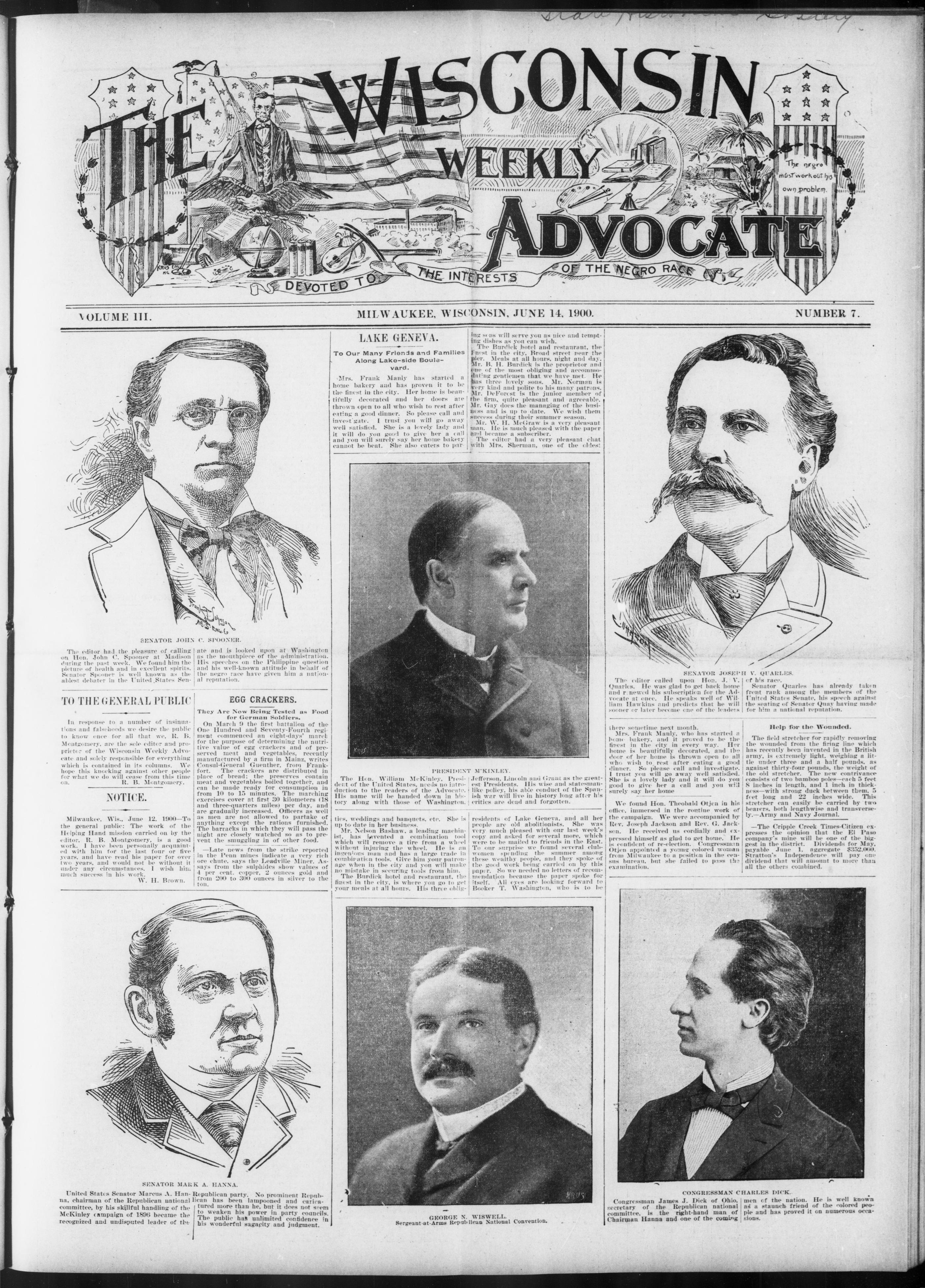
SENATOR JOHN C. SPOONER.
ate and is looked upon at Washington as the mouthpiece of the administration. His speeches on the Philippine question and his well-known attitude in behalf of the negro race have given him a national reputation.
They Are Now Being Tested as Food for German Soldiers.
On March 9 the first battalion of the One Hundred and Seventy-Fourth regiment commenced an eight-days' march for the purpose of determining the nutritive value of egg crackers and of preserved meat and vegetables, recently manufactured by a firm in Mainz, writes Consul-General Guenther, from Frankfort. The crackers are distributed in place of bread; the preserves contain meat and vegetables boiled together, and can be made ready for consumption in from 10 to 15 minutes. The marching exercises cover at first 30 kilometers (18 and three-quarters miles) per day, and are gradually increased. Officers as well as men are not allowed to partake of anything except the rations furnished. The barracks in which they will pass the night are closely watched so as to prevent the smuggling in of other food.
NOTICE. can be made from 10 to 1 exercises cove and three-qua are gradually
—Late news from the strike reported in the Penn mines indicate a very rich ore chute, says the Leadville Miner. Assays from the sulphides show values of 4 per cent. copper, 2 ounces gold and from 200 to 300 ounces in silver to the ton.
W. H. Brown.
A.
M.
United States Senator Marcus A. Han-Republican par-
na, chairman of the Republican national lican has been
committee, by his skillful handling of the
McKinley campaign of 1896 became the
recognized and undisputed leader of the tured more tha
to weaken hi
The public h
his wonderful
Republican party. No prominent Republican has been lampooned and caricatured more than he, but it does not seem to weaken his power in party councils. The public has unlimited confidence in his wonderful sagacity and judgment.
United States Senator Marcus A. Han-Republican party. No prominent Repubna, chairman of the Republican national lican has been lampoooned and carica-tured more than he, but it does not seem to weaken his power in party councils. The public has unlimited confidence in his wonderful sagacity and judgment.
VOLUME III.
The editor had the pleasure of calling on Hon. John C. Spooner at Madison during the past week. We found him the picture of health and in excellent spirits. Senator Spooner is well known as the ablest debater in the United States Sen-
TO THE GENERAL PUBLIC
In response to a number of insinuations and falshechoes we desire the public to know once for all that we, R. B. Montgomery, are the sole editor and proprietor of the Wisconsin Weekly Advocate and solely responsible for everything which is contained in its columns. We hope this knocking against other people for what we do will cease from this time on. R. B. Montgomery.
NOTICE.
Milwaukee, Wis., June 12, 1900—To the general public: The work of the Helping Hand mission carried on by the editor, R. B. Montgomery, is a good work. I have been personally acquainted with him for the last four or five years, and have read his paper for over two years, and would not be without it under any circumstances. I wish him much success in his work.
W. H. Brown.
EGG CRACKERS.
MILWAUKEE, WISCONSIN, JUNE 14, 1900.
LAKE GENEVA.
To Our Many Friends and Families Along Lake-side Boulevard.
Mrs. Frank Manly has started a home bakery and has proven it to be the finest in the city. Her home is beautifully decorated and her doors are thrown open to all who wish to rest after eating a good dinner. So please call and investigate. I trust you will go away well satisfied. She is a lovely lady and it will do you good to give her a call and you will surely say her home bakery cannot be beat. She also caters to par
KRUS
[Name not provided]
KRUS
PRESIDENT M'KINLEY.
The Hon. William McKinley, President of the United States, needs no introduction to the readers of the Advocate. His name will be handed down in history along with those of Washington.
ties, weddings and banquets, etc. She is up to date in her business.
Mr. Nelson Bashaw, a leading machinist, has invented a combination tool which will remove a tire from a wheel without injuring the wheel. He is an ingenious man and has a large trade in combination tools. Give him your patronage when in the city and you will make no mistake in securing tools from him.
The Burdick hotel and restaurant, the finest in the city, is where you go to get your meals at all hours. His three oblig-
[Image of a man with a mustache and a suit].
MR. J. S.
GEORGE N. WISWELL
Sergeant-at-Arms Republican National Convention.
---
ing sons will serve you as nice and tempting dishes as you can wish.
The Burdick hotel and restaurant, the finest in the city, Broad street near the pier. Meals at all hours, night and day. Mr. B. H. Burdick is the proprietor and one of the most obliging and accommodating gentlemen that we have met. He has three lovely sons. Mr. Norman is very kind and polite to his many patrons. Mr. DeForest is the junior member of the firm, quite pleasant and agreeable. Mr. Gay does the managing of the business and is up to date. We wish them success during their summer season. Mr. W. H. McGraw is a very pleasant man. He is much pleased with the paper and became a subscriber.
The editor had a very pleasant chat with Mrs. Sherman, one of the oldest
L.
Jefferson, Lincoln and Grant as the greatest Presidents. His wise and statesmanlike policy, his able conduct of the Spanish war will live in history long after his critics are dead and forgotten.
residents of Lake Geneva, and all her people are old abolitionists. She was very much pleased with our last week's copy and asked for several more, which were to be mailed to friends in the East. To our surprise we found several clubwomen spending the summer among these wealthy people, and they spoke of the good work being carried on by this paper. So we needed no letters of recommendation because the paper spoke for itself. All eyes are looking forward to Booker T. Washington, who is to be
# RU93
---
J. UHNERTON
SENATOR JOSEPH V. QUARLES. The editor called upon Hon. J. V. Quarles. He was glad to get back home and r newed his subscription for the Advocate at once. He speaks well of William Hawkins and predicts that he will sooner or later become one of the leaders of his race. Senator Quar front rank am United States in the seating of S for him a natio
Mrs. Frank Manly, who has started a home bakery, and it proved to be the finest in the city in every way. Her home is beautifully decorated, and the door of her home is thrown open to all who wish to rest after eating a good dinner. So please call and investigate. I trust you will go away well satisfied. She is a lovely lady and it will do you good to give her a call and you will surely say her home
We found Hon. Theobald Otjen in his office, immersed in the routine work of the campaign. We were accompanied by Rev. Joseph Jackson and Rev. G. Jackson. He received us cordially and expressed himself as glad to get home. He is confident of re-election. Congressman Otjen appointed a young colored woman from Milwaukee to a position in the census bureau, but she failed to pass the examination.
C
CONGRESSMAN CHARLES DICK.
Congressman James J. Dick of Ohio, secretary of the Republican national committee, is the right-hand man of Chairman Hanna and one of the coming men of the nation as a staunch foe and has presiSIONs.
J. Dick of Ohio, republican national right-hand man of one of the coming men of the nation as a staunch foe and has prosions.
Congressman James J. Dick of Ohio, secretary of the Republican national committee, is the right-hand man of Chairman Hanna and one of the coming men of the nation. He is well known as a staunch friend of the colored people and has proved it on numerous occasions.
here sometime next month.
J.
Senator Quarles has already taken front rank among the members of the United States Senate, his speech against the seating of Senator Quay having made for him a national reputation.
Help for the Wounded.
The field stretcher for rapidly removing the wounded from the firing line which has recently been invented in the British army, is extremely light, weighing a little under three and a half pounds, as against thirty-four pounds, the weight of the old stretcher. The new contrivance consists of two bamboo poles—each 5 feet 8 inches in length, and 1 inch in thickness—with strong duck between them, 5 feet long and 22 inches wide. This stretcher can easily be carried by two bearers, both lengthwise and transversely.—Army and Navy Journal.
—The Cripple Creek Times-Citizen expresses the opinion that the El Paso company's mine will be one of the biggest in the district. Dividends for May, payable June 1, aggregate $352,000. Stratton's Independence will pay one dividend that will amount to more than all the others combined.
C
men of the nation. He is well known as a staunch friend of the colored people and has proved it on numerous occasions.
NUMBER 7.
———————
DR. TERRY |S SLAIN
She Had Charge of the Mission-
ary Station at Tsung Hua.
EXPEL PRINCE CHING.
Rioting Directed Against the Foreign
Legations--Japanese Official
Murdered.
New York, June 13.—News has been
received in this city of the murder of
Dr. Edna G. Terry, in charge of the
station of the Methodist Episcopal Wom-
an’s Foreign Missionary society at Tsung
Hua, China. The tidings came in the
shape of the following message to Dr.
‘Terry's brother-in-law: “Dr. Terry mur-
dered. Break news gently.”
This was the first indication of trouble
at Tsung Hua.
Later the Methodist Episcopal board
received this message, dated Tien Tsin,
June 12: “Hopkins‘and Hayner safe.”
‘The persons named are missionaries at
Tsung Hua. .There is one other Metho-
dist missionary at the same place, a Miss
Croucher of Boston. Tsung Hua is six
or seven miles north of the great wall,
and about 100 miles from Pekin.
Other Methodist missionaries at Pekin
and Tien Tsin are Wilbur C. Longden
and wife of the Wisconsin conference,
and William T. Hobart and wife of the
Minnesota conference.
REPORT FROM CONGER.
Safety of the Capital Assured When
the Railway is Repaired.
Washington, D. C., June 1%.—A cable-
gram has been received at the state de-
partment from Minister Conger at Pekin,
stating that Tuan, the father of the heir
apparent, has been appointed president of
the Tsung-li-Yamen; also that three oth-
er new ministers have been appointed, all
affiliated with the party opposed to for-
eigners. On the whole, Mr. Conger re-
ports, the situation is not materialy im-
proved. Guards are repairing the rail-
way and as soon as they have arrived at
Pekin, it is Mr. Conger’s belief that the
safety of the foreigners at that capital
will be assured. &
Shanghai, June 13.—Extraordinary ru-
mors current here are to the effect that
the powers have settled the Chinese ques-
tion by agreeing to forgive the Dowager
Empress and her Manchu advisers, pro-
vided they promise to amend their fu-
ture conduct.
London, June 13.—There is a general
feeling in diplomatic cireles that the En-
ropean powers have been united by the
disuissal of Prince Ching, and that in
the purging of the Tsung li Yamen of all
its moderate men the Empress Dowager
has gone to the Boxers, bag and baggage,
and that the powers have been forced to
co-operate in the restoration of order at
Pekin, even if the services of Russian
troops are required.
'Talleyrand’s “Good Europeans” have
reappeared upon the scene and have
dropped their jealousies and suspicions.
A mixed force of 2000 marines will be
inadequate if Pekin should be in the pos-
session of the Boxers and if the inswr-
rection spreads from province to prov-
ince. The Russians will go in with a
European mandate, and probably will
have as many reasons for remaining as
the English have thought useful and nec-
essary in Egypt.
REACHED AN ACUTE STAGE.
Rioting in Pekin Directed Against
Foreign Legations.
Washington, D. C., June 13.—Official
dispatches received in diplomatic quar-
ters in Washington show that the rioting
in Pekin has reached an acute stage, |
with the rioters directing a number of |
their assaults against members of the
different foreign legations there. One of
these dispatches states that the secretary
of the Belgian legation was attacked:
two stecessive times on Monday and es-
caped after being maltreated by the mob.
On the same day two officials of the
British legation, serving as student in
terpreters, were attacked by a large
crowd of roughs. ‘The young Engtish-
men held the attacking party back for a
time, but when the mob threatened to
‘close in on them they drew revolvers,
and by a show of force made their re-
treat without bodily injury. About the
same time the British summer quarters,
fourteen mites from Pekin, were burned
down, These quarters were quite ex-
teusive and had just been completed.
They belonged to the British —xovern-
ment and not to Sir Claude MacDon
ald, the British minister at Pekin, which
gives added significance to the
depredation. The killing of — the
chancellor of _ the — Japanese —_lega-
tion at Pekin, Sugiyama Akira
is net referred to in the official dispatches
received here, but full credit is given to
this report by dhe Japanese officials who
are personally “acquainted with Mr. Aki-
ira, and with many of the circumstances
detailed. The killing of a member of
the diplomatic body, and the foregoing
assaults upon the officials of the foreign
countries, are regarded as presenting the
most serious phase of the situation that
has thus far occurred.
Japanese Official Murdered.
London, June 13.—The Times in an ex-
tra edition publishes the following dis-
patch from Pekin, dated June 12, 2 p. m.:
“The chancellor of the Japanese lega-
tion, Sugiyama Akira, while proceeding
alone and unprotected on official duty,
was brutally murdered by soldiers of
‘Tung Fuh Siang, the favorite bodyguard
of the Empress, at Manigate railroad sta-
tion yesterday.
“The eye reinforcements are daily
expected. The present isolated position
of Pekin, the destruction of foreign prop-
erty in the country, and the insecurity
of life are directly attributable to treach-
ery of the Chinese government.”
British Fight the Boxers.
London, June 13.—Sixteen British ma-
rines, reconnoitering in advance of the
international column marehing to Pekin,
fought and chased 2000 Boxers Monday,
killing twenty or thirty. A correspond:
ent accompanying the column, in a dis-
patch dated Tien-Tsin, June 12, via
Shanghai, June 13, 6:15 a. m., says:
“While the working parties, accompa:
nied by a patrol of sixteen British ma-
rines, commanded by Maj. Johnson, were
repairing the line Monday afternoon,
cight miles beyond Lofa, they encoun-
tered smull parties of Boxers who were
destroying the line. The Boxers moved
away from the advanced marines and
apparently dispersed inte the country,
leaving the rails moved and the sleepers
burning.
“The marines, when two miles in ad-
vance of the first train, near Lang Fang,
suddenly perceived Boxers _ streaming
from a village on their left. It was esti-
mated that they numbered 2000, some of
them being mounted, and they were try-
ing to get between the marines and the
train. © Most of them were armed with
spears and swords. A few had firearms,
which they handled awkwardly.
“The marines retreated. keeping up a
running fight for over a mile and killing
between twenty and thirty Boxers.
“The Boxers pursued the British for
some distance. Then, seeing more ma-
rines from the train coming to their as-
sistance, Maj. Johnson's sixteen men
halted and poured a heavy continuous
fire into the crowd, driving them across
the front of the reinforeing bluejackets,
who punished the Boxers ‘severely with
Maxims.
“The Boxers fled, and the Europeans,
following up their success, cleared out
two villages. The total loss of the Box-
ers is estimated at forty killed and
wounded. Seven of their wounded were
attended by British surgeons. The Brit-
ish loss was nothing.”
British Interests Unprotected. ¢
London, June 13, 3 a. m.—A dispatch
to the Times from Pekin Tuesday says:
“It is noteworthy in this crisis that
the British interests in the Yangtse val-
ley are practically unprotected, the entire
force available between ‘Shanghai and
Ichang consisting of three diminutive
gunboats.
“Apart from the fact that elements of
unrest are always latent at river ports.
indications are not wanting to show that
it is desirable for us at this juneture to
keep in touch with and afford moral sup-
port to the well-disposed provincial au-
thorities while insuring adequate protec-
tion for British interests.” .
Relying on Russia.
A telegram from the Tsung-li-Yamen
to Wang-Chischun, governor of Ngan-
whei, dated June 9, states that Russia
is about to bring a large force to Pekin.
‘The Japanese minister is pressing for a
recognition of the Japanese sphere of in-
fluence in the provinces of Chekiang, Fo-
kien and Kiang-si.
“The Naking Viceroy has received or-
ders to use special vigilance to prevent
British aggression in the Yangtse valley,
which the Manchu party appears to ex-
pect as a result of the events in the
north.
Boxer Mob Attacks Convent.
Tien Tsin, June 13.—The latest news
from Pao Tung Fu is that the Boxers,
6000 strong, are attacking the Catholic
convent there. The situation is critical
and the officials are evidently inactive.
British Troops from Hong Kong.
Hong Kong, June 13.—Orders | have
been issued to the contingent of British
troops assembled here for service in the
north to sail for Tien Tsin June 14.
The Policy of Japan.
Londen, June 13.—In regard to the re-
pofts that Japan is about to declare war
on China, it was learned by a representa-
tive of the Associated press at the Jap-
anese embassy today that the attitude of
Japan in Chinese crisis is to co-operate
loyally with the European powers. In
the existing situation Japan would net
he willing to see any single power take
the lead.
The murder of the chancellor of the
Japanese legation at Pekin is regarded as
likely to lead to serious complications,
but no decision has been reacned by
Japan as to what political measures will
be necessary to meet the situation.
Disturbances in Shantung.
Washington, D. C., June 13.—The
navy department has been informed that
the Yorktown sailed yesterday from
Shanghai for Chefoo. The United
States consul at Chefoo informed the
state department of Boxer disturbances
at that place, but no particulars were
furnished. Chefoo is on the northern
coast of the Shantung peninsula.
American Marines.
Manila, June 13.—The United States
hospital ship Solace sailed at midnight
last night, having on board 100 marines
and 5 officers, Maj. Waller commanding.
in response to the telegraphic request
sent from Tong Ku June 11, by Rear
Admiral Kempff. Thirty other marines
left last week on the United States gun-
bo-t Nashville. bound for Tien Tsin.
GAVE HIMSELF UP.
Alleged Embezzler of $80,000 Re-
turns After an Absence of
Eleven Years.
Indianapolis, Ind., June 13.—John E.
Sullivan, the alleged abseonding clerk of
Marion county, who fled in 1889 under a
charge of embezzling about $80,000 of
public money, returned to Indianapolis
this afternoon. He came from Green-
castle, Ind. He says that after eleven
years of wandering he wants to face his
accusers. When Sulivan left here he
went direct to Canada where he remained
several years.
REDEMPTION OF BONDS.
Money is Plentiful in New York City
at 1 1-2 Per Cent.
New York, June 13.—Secretary Gace
was asked, says a Washington special
to the Herald, if he would continue with-
drawing government funds from national
depositories. and if this action meant that
the money stringency had disappeared.
“These funds,” said he, “will be with-
drawn from the depositories in proportion
to the amounts deposited until $25,000,-
000 has been turned into the treasury
for the purpose of paying for the 2 per
cent. bonds which will be redeemed short-
ly. Yes, this is a sign that the money
stringency has disappeared, but a_ still
better one is the fact that money is plen-
tifel in New York at 144 ver cent.
“1 cannot tell whether any more than
$25,000,000 will be called “in. If the
condition of the treasury requires it, this
will be done. No, I cannot say whether
any of the special depositories will, be
abolished. There is one thing certain-
it is not the intention of the department
to take any of the money out ef these
depositories and place it in the vaults of
the treasury, where it will do no one
goed. It will be left where it is, if need-
ed. ,
“t¢ conditions demand and it becomes
necessary, more money Will be placed in
these institutions during the fall, when
the movement of the crops begins and a
great deal of money is needed for that
> apts pony
FRAUDS ON THE CUSTOMS.
Diamonds Valued at $75,000 Seized
at Niagara Falls.
Buffalo, N. Y., June 13.—A_ special to
the News says: “Diamonds have _been
seized at Niagara Falls valued at $75,000,
Max Lasar and two ulleged confederates,
a man and a woman, are under arrest.
Dr. P. Van Dandaigue is said to be un-
der surveillance.
Lasar, according te the customs offi-
cials, brought the diamonds to Montreal
from Europe and through Mr. Van Dar-
daigue met the man and woman who
were on a wedding tour and induced
them to take charge of the packages,
representing that it was a present which
he did not want them to open until they
reached the United States.
THE TERM “UNITED STATES.”
Inciudes Porto Rico and Hawaii, but
Not the Philippine Islands.
Washington, D. C., June 1o.—The post-
master-general has’ issued an order
amending a previous regulation in regard
to postage rates between the United
States and its island possessions. The
order says that the “island of Porto Rico
and the territory of Hawaii are included
in the term “United States” and the is-
land of Guam, the Philippine archipelago
and Tuituila are included in the term
“island possessions of the United
States.”
It is directed that the United States
postage stamps shall be valid for the
payment of postage in the island posses-
sions and the over ones or = “sur-
charged” stamps of the island posses-
sions shall be accepted in payment of
postage wherever the United States
stamps are valid.
NEW TRUST PLAN
OF CHAIR MAKERS.
This Time it is Proposed to Form
a Company with Only $6,000,-
000 Capital.
New York, June i2.—[Special.J—A
mecting will be held in this city tomor-
row of some of the organizers of the pro-
posed chair consolidation to discuss
plans. The consolidation, if effected, will
be on much different lines than those
laid down in the two previous attempts,
as instead cf a $25,000,000 company a+
proposed last year, @ capitalization of
only $6,000,000 is now proposed. About
a dozen plants are, it, is understood,
ready to enter the consolidation. Among
these are the Indianapolis Chair com
pany, the Central Chair company, the
Cochran Chair company, the Marietta
Chair company, the Joliet Chair com-
pany, the Cincinnati Chair company,
the Parkersburg Chair company, the
Cambridge Chair company, the Marietta
(Ga.) Chair company, the Conrades
Chair company, and Heller & Hoffman
company of St. Louis. The organizers
of the new company, it is stated, have
assurances from numerous other con-
cerns of willingness to come into the
deal. Former Judge J. W. Campbell of
Cambridge, O., is the active organizer of
the new consolidation. It is understood
that Charles R. Flint is also interested,
Judge Campbell said that the companies
which it was now expected to take over
handled a business of $4,000,000 annu-
TRAGEDY AVERTED.
Insane Man Attempts to Assassin-
ate an Indiana Judge—Saved
by Policeman.
Indianapolis, Ind., June 12.—An es-
caped lunatic teday attempted to take
the life of Fremont Alford, criminal
judge of this (Marion) county, and Prose-
cutor Edwin B. Pugh. The would-be as-
sassin was George W, Bennett, who es-
caped from the; state hospital for
the insane Saturday. Bennett en-
tered the courtroom shortly after court
convened and attracted the court by his
incoherent talk. Judge Alford started to
the telephone, when Bennett sprang at
him with a leveled revolver. Judge Al-
ford ran into his private room, with the
maniac after him. Prosecutor Pugh went
to the rescue and Bennett turned on him.
A policeman appeared just in time to
catch the fall of the revolver's hammer
on his thumb and save Pugh. It took
four men to overpower Bennett, although
he has but one arm. It is said Bennett
lost his mind brooding over labor trou-
bles.
Bennett killed two men at Lafayette in
1889. For this he was sent to prison but
afterwards transferred to the insane asy-
lum. coe
x Q T aN
LEADERS SURRENDER.
American Troops Capture Two
Commanders of Filipino
Guerrillas.
Washington, D. C., June 12.—Gen.
MacArthur at Manila, cabled the war de-
partment today as follows:
“Report capture Gens. Hizon, near
Mexico, and Cavyestany, at Alcala, the
latter a leader of guerrillas in Pangasin-
ian province (Luzon).”
Gen. Corbin attaches considerable im-
portance to these captures. In his opin-
ion they are more neariy in the nature of
surrenders than captures, and indicate
that the principal leaders of the insur-
rection areabandoning that cause and are
coming into Manila to accept American
supremacy.
Washington, D. C.. June 12.--It is the
understanding of the war department
that Gen. MacArthur has sent officers of
the army to various points in China un-
der instructions to learn of the fitting out
of filibustering expeditions.
The information will at once be com-
municated to the naval authorities, who
will take measures for the capture of ex-
peditions. In addition to looking out for
the expeditions, it is expected that the
officers in China will report upon the sit-
uation so as to keep the authorities ad-
vised of the feeling among the Chinese.
hom 7 AN
DUE TO BROKEN RAIL.
Great Northern Train Wrecked at
Summit, Mont.—S. J. Leland of
Superior Injured.
St. Louis, Mo., June 12.—A special to
the Globe-Democrat from Spokane,
Wash., says: “Meager particulars
reached here to the effect that the Great
Northern eastbound passenger train
which left here yesterday was derailed at
Summit, Mont., at an early hour this
morning. It is supposed tne accident was
the result of a broken rail. Two engines
and four coaches were reported to have
gone into the ditch, A score or more
passengers were injured, but none were
killed outright. The severely injured
are: S. J. Leland, West Superior; R.
Matub, Seattle; Frank R. Gantor, Win-
nipeg; Leo Adrain, New York: ’ Jacob
Hanson, Portland; Mrs. E. J. Broderick,
Leavenworth; William James Morgan,
St. Panl; L. G. Mortinson, Whitehill,
Mich.: George Olson, Spokane; C. M.
Ogard, Edena. Minn.; Martin MeCulley,
Butte; Emil Borgan, Fergus Falls.
“Some of these are said to be fatally
MOR Se
1 TPN 7 Hy >
THREATENED BY FIRE.
Plant of the New York Tribune
Endangered by a Blaze at
Midnight.
New York, June 12.--Fire which start-
ed on the fifth floor of the Tribune build-
ing at midnight threatened for a time te
get beyond the control of the firemen and
destroy the structure.
‘The fire burned fiercely for twenty min-
utes before the engines arrived, and the
flames shot out of the windows aeross
Frankfort street and on the rear, mak-
ing a brilliant light. The entire building
was filled with smoke, and compositors
ot the Tribune and Journal and all oth-
ers in the building hurried out for safety.
The floor where the fire started, how-
ever, was not occupied by any depart-
ments of the newspapers. The firemen
got at the fire from the roof of the Sun
building and by means of the water tow-
er, and in half an hour bad the blaze un-
der coutr@l.
Forest Reserve in Canada.
Ontar.o’s government has complete] ar-
rangements for the formation of a forest
reserve of almost 3000 square miles in
extent, embracing the district in which
Lakes Tamagami and Lady Evelyn are
situated. The bulk of the reserve js vir-
gin forest, with the finest white pine in
Canada upor it.
Relics of the French Revolution.
Queen Victoria has lent to the Pavilion
of thé city of Paris four fragments of
low relief sculpture. which ornamented
the old statue of Louis Quatorze, on the
Place des Victoires, before the great
revolution. _The fragments found their
way to England during the upheaval in
France_and were given to Queen Vic-
toria.—New York Post.
BRITISH GAIN GROUND.
Field Marshal Roberts Has a
Battle with Gen. Botha.
DELIVERANCEOF NATAL
Methuen and Kitchener Report a
areca
London, June 13.—Lord Roberts has
fought a battle with Gen. Botha, at the
end of which, though the British gained
considerable ground, the Boers were not
beaten. All is quiet at Bretoria and
Johannesburg.
Lord Roberts’ line of communications
has been practically restored by a com-
plete victory gained by Gens. Methuen
and Kitchener over Gen. Dewet yester-
day. The Boer camp was captured and
the burghers, it is added, were scattered
in all directions,
Deliverance of Natal.
London, June 13, 1 a. m.—The defeat
of the Boers at Honing Spruit by forces
from the north has partly cleared the
situation between Kroonstad and Pre-
toria, while Sir Redvers Buller has car-
ried the last defile at Charlestown and
has completed the deliverance of Natal
from an invasion, precisely eight months
after the war began.
Gen. Buller has compelled the Boers to
evacuate Laing’s Nek and Majuba_ hill.
He deserves the same credit which Lord
Roberts has freely felt for turning the
Boers out of their strong positions with-
vut running up a heavy butcher's bill.
He wouid receive this credit more gen-
erously it his bulletins were not badly
written, and if he had not granted an
armistice when. according to the version
given, the enemy was surrounded.
ROBERTS HEARD FROM.
Field Marshal Tells of the British
Victory at Vredefort.
London, June 13.—A lengthy dispatch
forwarded to the war office by Maj.-Gen.
Knox from Kroonstad, presumably sent
there by messenger, reads as follows:
Kroonstad, June 12,.—We have been re
quested to forward you from Lord Rober:s
the following: “‘Hretoria, June 12.—After
surrendering the city, Botha retired to, 1
plice about fitteen miles east on the Mid
dicburg road, He had a smail force at
first, but during the last few days bis num-
hers increased and bis being so near the
town kept up the excitement in the country
and prevented the burghers from laying
down’ their. arms and’ fntertered with the
collection of supplies. It therefore became
necessary to attack him. This I did yves-
terday, | He held, a very strong position,
practically unassatlable in front, which en-
abled him to place the main portion of his
troops on his flanks, which he knew from
former experience were ils vulnerable parts.
I sent French with Porter's and Dixon's
cavalry brigades and Hutton’s mounted tn-
fantry around by our left, and tan Hami!-
ton with Broadwood and Gordon's caval:
ry brigade, Ridley’s mounted infantry and
Broce Hamilton's Infantry brigade round by
our right. Both columns met. with greai
opposition, At about 3 o'clock in the after-
noon | saw two of Hamilton's infantry bat-
talions advancing to what appeared to be
the key to the enemy's defense on their left
flank. This was almost gained before dark
and I ordered the force to bivouae on the
ground they had won.
“On hearing that the Free Staters had
taken advantage of our crossing the Vaa!
to interrupt our communications, I ordered
Kitchener with such troops as I could spare
to Vredefort with orders to push south and
communicate with Methuen. I also dis
patched a special mesenger, to Methuen.
ustrncting him to push on at all speed to
the main line of the enemy. ‘These two of-
ficers marched yesterday to Rhenoster river,
where Methuen gained a complete victors
over Dewet and took possession of his cam)
and scattered his troops in all directions.
Need Have No Apprehensions.
“Her majesty’s government need have no
apprehension as to the security of the army
in South Africa, The enemy gained a sl'glit
puecesk, which was unfortunate, but which
will be remedied very shortly, and it will
not take long to repair the damage done to
the railway. As these diversions are al in
existence 1am now able to hold the line
between this and Rhenoster in strength.
Methuen will arrange to guard it onward
ax he advances. We have communicate!
with Buller, who will, no doubt, soon make
the presence of his force in the field felt.
“Onr losses yesterday were not, I trust,
serions, but I deplore the death ef that
gallant soldier, the Earl of Airlie, The
only other casualties reported as yet are:
Seventeenth lanecrs, Mai. the Hen. Lionel
Fortescue and Lieut. the Hon. C. Cavendieh,
both killed.”
Koberts Reports Casualties.
London, June 13, 6:05 p. m.—The fol-
lowing dispatch has been received at the
war office from Lord Roberts, dated
Katsbosch, June 12:
“In yesterday’s engagement Methuen
had one killed and eighteen wounded.
Among the latter is Lieut. Cearle ef the
Twelfth battalion of yeomanry. On
June 7 the Derbyshire militia lost thirty-
Sx killed and 104 wounded, all of whom
were in the yeomanry hospital, which
was captured by the Boers and retaken
by Methuen.”
TO BECOME CROWN COLONIES.
Great Britain Working Out Civil Set-
tlement for South Africa.
London, June 13.—The government has
at last decided upon a plan for the civil
settlement of South Africa. The details
are gr most secret, but it can safely be
said that the Orange River Colony aud
the Transvaal will become crown col-
onies, the latter probably aa renamed
the Transvaal Colony. ‘Sir Alfred Mél-
ner, it is declared, is to be high commis
sioner of South Africa, in spite of the op-
position he has incurred.
‘The colonial office is said to be of the
opinion that the maintenance of, good-
sized garrisons at such centers as Bloom-
fontein, Kroeonstad, Johannesburg and
Pretoria will be necessary for a long
time after the crown-colony system gets
in working order. For this reason and
others put forward by Sir Alfred Milner,
the idea of granting an autonomous form
of government has been abandoned. Tt ix
believed, though it cannot be veritied,
that a portion of the Transvaal will be
partitioned off to Natal.
PLYMOUTH CHURCH REJOICES.
Pprtety Girl Baby Arrives at the
Home of Pastor Hillis.
New York, June 13.—Plymouth church
is rejoicing because, for the first time in
forty-five years, it has a “pastor's baby.”
The baby is a girl, and Dr. Hillis an-
nounced her arrival on Friday night.
‘This is the first baby that Plymouth
church has had to pet since the birth of
Herbert Beecher, the youngest son of
Henry Ward Beecher, forty-five years
ago.
‘Little Miss Hillis is described as being
a beauty and her parents are very proud
of her und happy because of her birth.
The church joins with the parents in
welcoming the baby girl, and from the
present prospects her future will be a
very happy_one.
A FOOLHARDY FEAT.
Nine Men Attempt to Cross a River in
a Basket Suspended from a Cable.
Tallahassee, Fla., June 13.—While nive
men in a basket cable line suspended
eighty-five fect above the Tallapoosa riv-
er at this point were crossing the river
one of the cables broke and the men
fe!l into the river. One was killed and
two are reported unable to live. AU
the etber received injuries.
BLOCKED BY RUSSIA.
Negotiations for an ‘Open Door’
in China Not a Complete
Success.
Washington, D. C., June 13.—While
they admit that-the “open door’ nego-
tiations are not’as conclusive as Secre-
tary Hay desired, officials of the admin-
istration point out that a long step to-
ward the preservation of American
ireaty rights in the sphere of influence
in China have at least been taken.
Secretary Hay declined to discuss the
doubts cast upon the success of negotia-
ions in an article printed in the National
Review, written by Robert A. Yerburgh,
member of Paritament. A European
diplomat, thoroughly acquainted with
Chinese affairs, said today that the gen-
eral conclusions reached by Mr. Yer-
burgh were practically those of every
diplomat who has taken pains to study
the notes exchanged. _
‘That the agreement reached is not iron-
clad was apparent not only to members
of the diplomatic corps, but to adminis-
tration officials after the receipt of the
replies of foreign governments to the
American representations. The assertion
has been made that Great Britain com-
plied in every respect with the wishes of
Secretary Hay. ‘The diplomat whe dis-
cussed the matter this afternoon points
out that this is not the case. |
“I have much pleasure in informing
your excellency,” Lord Salisbury’s note
stated, “that her majesty’s government
will be prepared to make a declaration in
the seuse desired by your government in
relation to the leased territory of Wei
Hai Wei and all territery in China which
may hereafter be acquired by Greut
Britain by lease or otherwise, and all
spheres of influence held, or which may
herafter be held by her in China, pro-
vided that a similar declaration is made
by the other powers concerned.”
it is this provision which is an obsta-
ele in the way of complete success of ne-
gotiations. ‘Russia declined to accede
to the- proposition advanced by Eng-
lard. Direetly north of Wei Hei
Wei and jutting into the Gulf
of Pe Chi Li, fs Port Arthur, now a
Russian stronghold. It_is believed in
diplomatic circles that Lord Salisbury
made his declaration respecting Wei Hai
Wei for the purpose of inducing Russia
to throw Port Arthur open to the world,
It has been noted that no reference to
Port Arthur is made in the Russian
note,
A. comparison of the British and Rus-
sian notes will show their great dissim-
ilarity, and neither can be regarded as
binding when the proposals are so differ-
ent. As Germany, France, Japan and
Italy gave assurances on condition, it is
evident that the whole fabric of the
“open door” is likely to be torn away
should a foreign nation think a demand
made by the United States exacting and
the moment propitious, for it to refuse.
Y 7 TWO
CALL FOR MARINES.
ae
Admiral Remey Asks Navy Depart-
ment to Send a Battalion to
the Philippines.
Washington, D. C., June 18.—The
navy department bas received the follow-
ing cablegram from Admiral Remey at
Cavite, dated yesterday:
“Army turned over Cavite peninsula
and Basilan island to naval control and
defense. The army also wants to give
up Olongapo. We cannot take the
latter while short of marines. Can the
department send a battalion of marines
to the Philippines? Think it important
the former Spanish naval station be un-
der naval control. Additional forces
needed if the navy is to secure naval sta-
tion at the present time. The York-
town has been placed at Kempff"s
disposal. The Castine is at Shanghai
and her repairs will be completed July
20. The Austria is at Canton with or-
ders to proceed to Swatow and Amoy.”
DR. ROGERS RESIGNS.
President of Northwestern University
Retires—An Anti-Expansionist.
Chicago, Il, June 13.—Dr. Henry
Wade Rogers formally vesigned the pres-
idency of Northwestern university yes-
terday afternoon at the fiftieth annual
nweting of the board of trustees. The
resignation, to take effect on July 15,
was accepted Raa eae, It came as
a surprise to all except the members of
the board. Even they did not think it
would come at that meeting, bat
President Rogers’ friends, find-
ing ene of his opponents was ready with
a resolution asking such action, induced
him to resign rather than cause an wn-
pleasant crisis. The reason given, hy
both the trustees and Dr. Rogers, is that
a certain clique in the board has been
dissatisfied with his work in trying to
push the institution ahead, and that he
could not carry out his plan without
their aid, thus making his resignation a
necessity for the well-being of the uni-
versity,
‘The fact that Dr. Rogers was identified
with the anti-expansion movement in Chi-
cago in its beginning took from him many
of his best supporters. His speech at the
Central Music hall meeting of that move-
ment, according to a trustee, was re-
garded by the board as a mistake. It
was discussed at that time in informal
meetings, and Dr. Rogers’ opponents
agreed to lay the matter over for an-
ee eee.
SAMPSON WAS IN COMMAND.
So Finds the Court of Claims as to
the Santiago Battle.
Washington, D. C., June 13.—Rear-
Admiral W. T. Sampson, United States
navy, was the communder-in-chief of the
United States naval forces or fleet and
Commodore W. 8. Schley, United States
navy, was the commanding officer of a
division or squadron thereof, on duty un-
der the orders of said commander-in-
chief.”
In these words the court of claims has
judicially determined the famous Samp
son-Schley controversy. They are part of
a finding of fact in the decision of the
court on the claims of Rear-Admiral
Sampson and his men to bounty for the
destruction of the Spanish squadron un-
der Admiral Cervera. The Spanish
squadron is found to have been inferior
to the American force and a bounty cf
$100 has therefore been awarded for
every officer and man under Admiral
Cervera’s command. The total amount
of bounty allowed is $166,700, of which
Rear-Admiral Sampsen will receive
$8355 and Rear-Admiral Schley about
$3000. The court specifically declares
that the New York was among the ves-
sels engaged in the Santiago battle.
ELOPES IN BOY’S CLOTHES.
Romantic Runaway of Wisconsin Boy
and Washington Girl.
Tacoma, Wash., June 13.—Sherman
H. Enos, the son of Charles N. Enos. a
rich Eau Claire attorney, and Miss
Frances Barrow eloped from Seattle lasi
Saturday. The couple hired two horses
at a livery stable and requested that
men’s saddles be put on. When last
seen they were dressed as boys and were
making for eastern Washington.
Madison, Wis., June 13.—Because her
rents object for religious reasons when
Mins Margaret M. Schwoegler wanted
to wed Luth Swensen, a popular young
man of Madison, the couple took an ear-
ly train for Chicago and later tele
graphed that they had been married
there. The groom if a book-keeper in
the employ of Sumner & Morris, hard-
ware dealers.
WORK OF CONGRESS.
SENATE.
Thursday, Junc 7.—In the Senate at 4:30
o'clock the President announced his signa-
ture to the naval appropriation bill. The
committee reported from tbe President that
he extended to Congress his felicitations on
the great. amount of work. aceomplisbed in
so short a time and replied that he had no
further communications to make. A reso-
Ivtion. of thanks to Mr. Frre, Soa pre.
tem. of the Senate, was adopted. At 5
o'clock the President's gayel fell and Mr.
Frye declared the Senate adjourned sine die.
HOUSE. y
Thursday, June 7.—The principal feature
of the closing day in the House was the
reversal of its action last night in ‘turning
down” the conferees on the naval bill for
yielding on the item relating to ocean sur-
veys. Over night the sentiment of the
House underwent a complete change. To-
day the nrembers voted by a large majority
to accept outright the Senate amendment,
which goes much farther than the compro-
mise which the conferees offered last night.
The new conferees, led by Mr. Cannon, who-
had brought in a’ compromise which’ they
considered more satistactory, were iguo-
|miniously pushed aside. It Was a distiner
vietory for the old conferees—Messrs. Foss
of Illinois, Dayton of West Virginia and
Cummings of New York. The closing day
was the course of Mr. Lentz of Ohio in
blocking unanimous-consent legislation. For
three days he has objected to bills because
the majority would not allow the testimony
in the Cocur d'Alene investigation to be
/printed, and he maintained his position to
the end.
Record of the Session.
Thursday, June 7.—Congress adjourned
sine die this afternoon at 5 o'clock, the
House in scenes of excitement, the Senate
sedate and decorous.
This Congress will go into history as one
of the most industrious on record and this
session as the shortest “long session” on
record. In 187 working days both houses
have passed 1215 bills, of which 283 are
public acts of general ‘importance and 032
are private acts granting pensions, paying
claims ‘and giving rellef to people who have
been Injured or suffered damage fn some
| way or another throvgh the government. A
large number of the privace acts were pen
‘sions growing out of the war with Spoin
‘Phe best previous record was 723 bills in
175 days.
During the session 12,152 bills have been
Introduced, so that, 10° per cent. of them
‘have been’ enacted into laws, which is an
other remarkable record. The bulk of this
business exceeds the work of the four pre
‘vious congresses combined during their
“long sessions.”
Of course, so many bills could not be
passed without a great deal of debate, sud
‘the Congressional Record for this session
‘will make ten big voiumes of 700 urge
pages, with two coumns of fine type to the
“page.
The two most important bills that have
failed of passage ‘re those for the con-
‘struction of the Nicaragna canal and to
‘tax olcomargarine. ‘The House passed the
Nicaragua Dill, but it was held up in the
‘Senate until ‘the Clayton-Bulwer_ treaty
‘could be amended, ‘That treaty pledges the
‘United States not to build a canal across
the isthmus, Several of the best lawyers
in Congress believe that the treaty is dead.
but there Is so great 2 difference of opin
jon that the President instructed the seere-
tary of state to negotlite for the formal
revocation of the canal item, to which Eng-
Jand promptly assented, but the Senate re
fused to ratify the new treaty for fear of
nntagonizing the Irish vote. It will be rati-
fied after election, however, aud the canal
hill made a special order for the 10th of
December.
In the meantime the secretary of state
will have an opportunity to negotlite trea-
ties with Nicaragua and Costa Rico seeur-
ing for the United States a right of way
ueross thelr territory for the eanal.
CHICAGO HAPPENINGS.
—Philip Tregando, 3 years old, of 151
Larrabee streec was run over and fatally
injured by a wagon. He died shortly a1-
ter bemg removed to his home.
—the burglar shot and killed by
Watchman James ee was identified
at the morgue as ‘I. H. MeCauley, a
painter, by the walking delegate of the
ainters’ union.
—aAsa Mitchell, the colored stable hand
who was shot by Louis White, a fellow
hostler at Hariem, died at the county
hospital from lis injuries. White, who
was arrested at the ume, was he.d with-
out bal to the grand jury.
—Charies Miller, 14 years old, the
youngest cattle buyer and seller at the
stockyards, and said by many packer& to
be the shrewdest in the bus:ness, has
been missing tor several days, and it 1s
feared by his relatives that he has either
met with foul p.ay or an accident.
—Frightened by the noise of an elevat-
ed train, the horses attached to a wagon
driven by Char.es D.ttmer ran ino a
crowd of children. The children ran, but
Charles Falken, who was but 3 years
old, was knocked down and run over.
He died before a physician could be sum-
moned.
—Mrs,. Catana looked trom the window
of her home and saw her 3-year-old son
in danger of being run over in the street
below. She held an 11-months-old baby in
her arms. Placing the baby on the kiteh-
en floor she ran to save her son. When
she returned a few minutes later the
baby's clothes were ablaze from the fire
in the stove, to which the child had
crawled. She had saved one child, but
lost the other.
—Fourteen people were injured by the
collapse of a section of seating at Da-
vis’ circus. Many womens and small chii-
dren were among the scores who were
thrown to the ground, and their cries
caused a general panic. Seven hundred
people made a rush for the entrance. In
the confusion several children were
knocked down and bruised. No one was
fatally hurt.
RARE BIRDS.
New Zealand.
The rarest bird in existence, known as
the purple gallinule, once supposed to be
extinet, has recently been killed in New
Zealand, near Lake Te Anau, the speci-
men now being in the possession of Dr.
Young of Invercargil.
In Annam there is a species of pheas-
ant, also now extremely scarce. Its bril-
aunt plumage is utilized as a special dec-
oration for the mandarins, and 1s so difti-
cuit to procure that a single dead bird is
worth £50 to £100, while one living is al-
most unprocurable at any price. The
heath hen is now limited to an area of
about forty square miles on the island of
Martha’s Vineyard, Mass., and no speci-
men of the piedduck of Labrador has
been obtained since 1852. Other disap-
pearing birds are the horned screamer
trom the jungles of South America, and
2 paroquet, which is contned to the
Mascarene islands in the Indian ocean,
where in recent times many species
have dropped comp’etely out of exis:ence.
The Carouna paroquet and the owl par-
ret of New Zealand are becoming rare
in the only dstr.ets in- which they are
found, aud the California vulture seems
threatened w.th speedy extermination.
A Bold Buccleuc’.
The spirit of the bold Beccleuch would
seem to have descended with full force
to Lord George Scott, the third son of
the present duke. He has been frequent-
ly mentioned in dispatches from South
Africa on account of the daring deeds he
has performed, and it is now announced
that he had the distinguished honor of
unfurling the union jack and running it
up over the roof of the presidency at
Bloemfontein. The flag was a silken one,
which had been worked by Lady Roberts
in anticipation, no doubt, of this or a
similar event in the progress of the war,
and with the aid of Commander Fortes-
cue of the royal navy, Lord George Scott
displayed the British emblem amid the
cheers of the soldiers and the populace.—
Secttish American.
SENATOR C. D. CLARK
TALKS ABOUT THE PROSPERITY
OF OUR RAILROADS.
Bhows Difference in Their Condition
Now and Under Democratic Admin-
istration—More Men at Work New
end More Wages in Circulation.
Washington.—“There is no better in-
dex of business prosperity or depres-
sion, in the United States than the con-
dition of the railroads,” said Hon. Clar-
ence D. Clark, United States Senator
from Wyoming, who is chairman of
the Senate Committee on Railroads.
“When railroads are carrying lots of
passengers we know that the people
have money to spend in traveling, or
that business compels them to travel.
As the movement of freight grows, the
volume of business transacted is on
the increase. The larger the earnings
of the railroads the more satisfactory
are, not only their own balance sheets,
but also those of the merchants and
manufacturers who are shipping and
receiving the goods.
“Between the years 1893 and 1895
there was a loss of $350 per mile in
the passenger earnings of the rail-
roads of the United States. In 1895
the freight earnings, of all the roads
were $776 per mile less than in 1893.
Adding this to the loss of passenger
earnings gives a total loss of $1,126 per
mile in 1895, as compared with the
freight and passenger earnings for all
the roads in 1893. Apply this to the
180,000 miles of road in operation in
that year, and we have a total loss of
$202,680,000, and for all the roads.
“Now, look at the other side of the
picture. In 1898 both passenger and
freight earnings had begun to pick up
again, the passenger earnings in that
year being $49 per mile more than in
1895, and the freight earnings being
$643 more per mile than in 1895. Last
year the showing was even better, the
gain in passenger earnings being $181
per mile over 1895, and in freight earn-
ings $801 per mile over 1895. This gives
us a gain of $982 per mile in 1899, over
the earnings of the roads in 1895, or a
total of $176,760,000 more earnings
from these two sources last year than
in 1895.
“Now, summarize these figures, and
we have in 1893 total gross earnings
of $7,090 per mile. In 1895 the total
gross earnings were only $6,050 per
mile, a loss of $1,040 per mile within
two years. In 1898 the total gross
earnings were $6,775 per mile, an in-
crease of $705 over 1895, but last year
the total earnings were $7,067 per mile,
an increase of $1,007 over 1895.
“Naturally enough, when the rail-
roads were carrying fewer passengers
snd less freight in 1895 and their earn-
ings were falling away, they began to
economize and more than 100,000 men
were discharged during the second ad-
ministration of President Cleveland. In
1898, during President McKinley's ad-
ministration, 89,524 men had been re-
employed, making a total of 956 more
men employed in 1898 than there were
in 1893. Last year the railroads in-
creased their additional help to up-
wards of 100,000 men, and the total
additional amount of wages circulated
throughout the country, from this one
source alone, exceeded $100,000,000.
“But this is not all. Business pros-
perity is continuing in the country,
and bids fair to continue. Arrange-
ments have been made for the con-
struction of about 59,000 miles of new
road during the coming year. The ay-
erage number of employes is 474 to
every 100 miles of road, so that this
new construction means employment
for 279,660 more railroad men, and
this means the further circulation of
$280,000,000 more in wages. Unless
business seemed to be on a sound ba-
sis, and the railroad managers felt that
it would continue so, you can be quite
sure that such large additional expen-
ditures of money for wages would be
instantly stopped.
“A few more facts and I have done.
‘The dividends paid by the railroads of
the United States décreased under
President Cleveland’s second adminis-
tration by $12,610,041. In the three fol-
lowing years there was an increase in
dividends paid of $18,251,752, thus
bringing the earning capacity of the
roads in 1898 back to a condition a
little better than it was in 1892. The
net earnings of the roads decreased
by almost $30,000,000 in President
Cleveland’s time, but have since in-
creased by almost $66,500,000.
“During Mr. Cleveland’s second term
railroad building was almost at a
standstill, there being only 3,549 miles
built. But in 1898 and 1899 there were
6,719 miles built, and there will be
about 59,000 miles built this year. In
the total freight tonnage carried by
the railroads there has been an in-
crease of a little more than 23 per cent.
under the present Republican admin-
istration. The total passenger earn-
ings were $293,557,476 in 1892, in 1895
they amounted to only $260,949,741,
showing a loss of $32,627,735. In 1898
the earnings were $272,598,591, show-
ing a gain over 1895 of $11,659,850 in
passenger earnings alone.”
On the Right Side.
The New York Herald has decided
that there can be no half-way station
am thie wonawe Gfoht Tt fa ea niein ceca
Hon. Ben T.’s Position.
‘The position of the Hon. Ben Tillman
is easily understood. He is in favor of
nonest elections in the Northern States
and suppression and disfranchisement
in the South. -
The Missing Link.
Mr. Bryan now has two-thirds of
his nomination. The missing link will
‘be supplied by the Kansas City conven-
tion, heey ‘
eee i fe Se Af
TRANS-PACIFIC TRADE
Ee ee ee ee ee ee ee
lars This Fiscal Year.
| Exports to Asia and Oceanica, in the
fiscal year which ends on June 30, will
for the first time in our histéry exceed
$100,000,000. In no part of the world
has our export trade grown with such
amazing rapidity, with the single ex-
ception of Africa. In 1893 our total
exports to all Asia and Oceanica
amounted to only $27,421,831, so that
in the fiscal year now about to end they
will be about four times as great as
those of eight years earlier.
The growth in exports to Asia and
Oceanica is chiefly in cotton, bread-
stuffs, provisions and manufactures.
Exports of agricultural machinery to
British Australasia in the nine months
ending with March, 1900, were $609,-
323, against $349,550 in the correspond-
ing months of 1898. Exports of flour
to China in the nine months ending
with March, 1900, was 46,961 barrels,
against 14,616 barrels in the same
months of 1898; to Japan, 417,430 bar-
rels, against 107,401 barrels in 1898;
and to Hong Kong, 1,009,248 barrels,
against 647,688 barrels in the.same
months of 1898. Carriages and cars to
Australia amounted to $412,254, against
$251,802 in the corresponding months
of 1898; cotton cloth to China in the
same period, 156,830,255 yards, against
77,990,676 yards in 1898. Raw cotton
exported to Japan amounted in the
nine months ending with March, 1900,
to $11,517,968, as against $5,843,071 in
the same months of 1898. Builders’
hardware exported to Asia and Ocean-
ica in the nine months ending with
March, 1900, amounted to $1,254,000,
an increase of 50 per cent. over the
same months of 1898; while boots and
shoes sent to Asia and Oceanica in the
nine months ending with March. 1900,
reached nearly one million dollars,
against a quarter of a million in the
game months of 1898.
Democrats for McKinley.
Judge Allen B, Morse and Hon. R. A.
Montgomery, two of Michigan’s most
prominent Democrats, have announced
their intention of supporting the Re-
publican ticket this year. They stuck
to the party, hoping it would purge
itself of Populism, but now realizé that
the present Democratic managers are
bent on going to the extremes, The
exits of the Democratic party are going
to be busy places this year.
Democratic Frauds.
Democratic papers are nfaking a
great outery about the Cuban postal
frauds. But they forgot to point out
that the record of defalcations of Goy-
ernment funds shows stealings of $5.17
in every $1,000 under Democratic ad-
ministrations, as compared with only
46 cents in every $1,000 under Repub-
lican administrations.
Bryan's Farm.
The statement has been going the
rounds of the press that “Bryan has
retired to his farm.” This is all done
for effect, and to make farmers believe
he is one of themselves. As a matter
of fact, Bryan’s farm has but recently
been purchased out of the proceeds ac-
quired from his gas belt. He is green
at the plow.
Farm Values,
It was under the last Democratic ad-
ministration and the last free trade
tariff that the farmer could exchange
his pound of wool for a pound and a
half of sugar. But under the McKinley
administration his woot was worth
more, while sugar was cheaper, and
the pound of wool brings four pounds
of sugar.
‘Sige be eees Dene
The export trade of the South for
the past twelve months amounted to
over $400,000,000, more than one-third
of that of the entire country. These
are figures which speak more eloquent-
ly than the narrow Southern politi-
cians who contribute so liberally to the
Congressional Record.
A Democratic Chance,
A Wisconsin judge has granted an in-
junction to prevent a man marrying a
widow with four children. Perhaps
some such heroic treatment may be
adopted by the gentlemen who have
been trying to rescue the Democratic
party from the embraces of Populism.
A Great Opportunity,
The Hon, David B. Hill has forgiven
the Democrats for throwing him out
of the Chicago convention and will give
them an opportunity to repeat the per-
formance at Kansas City. David has
a forgiving disposition.
As Unreliable as Ever,
Mr. James Creelman, the statistician
of the New York Journal, is to have
charge of the Democratic predictions
this year. The public hasa very fair
idea of the reliability of New York
Journal information.
Seading Eggs Abroad.
Supplying our colonies with eggs is
one of the benefits to farmers of the
expansion policy. Last year we ex-
ported 3,700,000 dozen eggs, as com-
pared with only 151,000 dozen in 1895.
Lay on, Oh, Hen!
Aguinaldo’s Representative.
The voters of South Dakota will not
have to go to the Philippines to de-
liver a blow to Aguinaldo. They will
have this opportunity when they choose
a legislature to elect the successor to
Mr. Petigrew.
A Matter of Interests,
The foreign shipping interests are
represented at Washington by an ac-
tive lobby. The American shipping in-
terests should be represented by the
American legislators.
They Like Disaster.
A treasury surplus always furnishes
a Democratic convention view-with-
alarm material. Democracy never fails
to shy at solvency.
EXPANSION BENEFITS
SENATOR LODGE ON GROWTH
OF HAWAIIAN TRADE.
Has Increased’ Threefold Within Five
Years and Largely Since Annexation
—Of More Value than Our Business
with Many European Nations.
“One reason why I am an expansion-
ist,” said Senator Lodge in Washing-
ton the other day, while discussing the
possibilities of our trade with our isl-
and possessions, “is because I have
watched the great growth of our com-
merce with the Hawaiian Islands.
“Five years ago, in 1895, the total
“Hawaiian trade with the United States
amounted to only $11,500,000. Last
year it reached $33,500,000, having in-
creased almost three-fold within five
years, and most of this increase has oc-
curred within the past eighteen months
oF So.
“We may not think that a business
of $33,500,000 amounts to very much
when our foreign trade is now running
up into the billions, but compare our
trade with the Hawaiian Islands, with
their handful of people, with some of
the larger countries of the world, and
it gives a better idea of the value of
colonies to the United States which
ship their products to us and buy their
food, provisions and clothing from this
country.
“Let us begin with Evrope.
“Our trade with the Hawaiian Isi-
ands is over 150 per cent larger than
our total trade with Austria-Hungary.
“It is 75 per cent larger than our
trade with Denmark.
“It is GO per cent as large as our
total trade with Italy.
“It is nearly four times as large as
our trade with Portugal.
“It Is over 150 per cent larger than
our total trade with Russia.
“It is almost double our trade with
Spain,
“It is 125 per cent greaier than our
trade with Sweden and Norway com-
bined.
“It is more than double our trade
with Switzerland.
“It is ten times as large as our trade
| with Turkey.
“It is nearly thirty times larger than
our trade with Greece.
“These comparisons are with the
thtekly peopled countries of Europe.
Now we will take the American conti-
nent.
| “Hawaiian trade with the United
States is equal to 30 per cent of our
trade with the whole dominion of Can-
ada,
“It is nearly 150 per cent. greater
than our trade with all the Central
American States,
“It is 60 per cent. as large as our
trade with Mexico.
- “It is 50 per cent. larger than our
trade with all the British West Indies.
“It 1s nearly five times as large as
our trade with Porto Rico.
“It is three times as large as our
trade with the Danish, Dutch and
French West Indies, with Hayti and
San Domingo included.
| “It is almost twice as large as our
| trade with Argentine.
“It is almost half as large as our
trade with Brazil, whence we import
most of our coffee.
“It is nearly 400 per cent. larger
than our trade with Chili.
“It is nearly 400 per cent. larger than
our trade With the United States of
Colombia.
“It is nearly fifteen times larger than
our trade with Ecuador.
“It is more than six times larger than
our trade with British, Dutch and
French Guiana.
“It is ten times larger than our trade
with Peru.
“It is ten times larger than our trade
with Uruguay.
“It is more than five times larger
than our trade with Venezuela.
“Now let us make some comparison
with countries across the Pacific, and
we find that our trade with Hawaii is
| within six million dollars of being as
large as our trade with the Empire of
China.
“It is more than three times as large
as our trade with Hong Kong.
“It is nearly half as large as our to-
tal trade with all the British, Dutch
and French East Indies, which send
us such large supplies of sugar.
“It is equal to 65 per cent. of our to-
tal trade with Japan.
“It is more than five times larger
than our last year’s trade with the
Philippines.
“It is nearly twenty times larger
than our trade with Asiatic Russia.
“It was larger by four million dollars
than our trade with the whole of the
Australian Colonies last year, with
their five millions of people.
“It was larger last year by more
than three million dollars than our
trade with the entire continent of Af-
riea.
“As I said, the increase in our trade
with Hawali has been very marked
since its*annexation by ‘a United
States, and I look for equally rapid im-
provement in our trade with Porto Rico
and the Philippines. These colonies
will absorb some of our surplus man-
ufactures, and they will also draw up-
on this country for their provisions,
Scarce as Buffaloes,
Another year of prosperity will make
the advocates of free silyer as scarce
as buffaloes in Kansas.
Not Yet a Populist.
The Kaiser has dismissed his barber,
but ‘s showing no other indications of
turning Populist.
Where It Belongs.
The Sioux Falls platform should be
referred to the committee on imagin-
ary wrongs. a
ELECT THEIR DELEGATES,
Democrats of Wisconsin Meet in
Convention.
FOR KANSAS CITY.
Sharp een mee! Cc. Walland
T. E. Ryan for Place on the
National Committee.
There were eight uames presented to
the Democratic state convention yester-
day for the honor of delegate-at-large to
the national convention at Kansas City.
; Four of the men placed in nomination
were elected as such delegates and the
other four were elected alternates. The
principal fight in the convention was he-
tween David S. Rose of Milwaukee and
| ‘Thomas J, Fleming of Wauwatosa-Mil-
| Waukee. The mayor had a narrew es-
| cape, and Mr, Ileming made a_ strong
| showing against the head-of the Milwan-
kee county Democracy. Mr. Fleming se-
cured 23 out of the 109 votes in Mil-
wankee county and he had a liberal sup-
port from various portions of the state.
| Mr. Rose’s large block of votes in this
| county made good trading material, how-
| ever, ‘and by this means he was enabled
io effect combinations which defeated
| Mr. Fleming.
|, The contest between E. C. Waii and
Y. KE. Ryan for national committeeman
| erepped out in some of the district can-
cuses in the forencou, but it was net
brought to the surface in the conveutien.
| 1t appears at present that Mr. Ryan has
[2 clear majority of the delegates to Kan-
| sas City 2nd that Mr. Wall will not sue-
; ceed himself ou the national committee of
the Democrats, but some of the delegates
| decline to express themselves and influ-
| ences may be brought to bear to effect
| changes before July 4. Mr. Ryan, who is
| himself a Fifth district delegate, says
| that he has won out and will be the next
Wisconsin navional committeeman of the
| Democratic party.
| The Platform.
| The foliowing platform was 2dopted:
| ‘The Democratic party of the state of Wis-
‘eunsin, by its convention here convened,
| proclaims the following declarations.
|" 1. We adhere to the principles of the
| Chicago platform of 1896 and pledge our-
| selves to abide by the platform to be adopt-
ed by the National Democratic conventioa
of 1900,
2. We gladly express our love and devo-
tion for the xreat standard-bearer of our
| party, the ‘Thomas Jefferson of the mew
century, Hon. W. J. Bryan, commit our rep-
resentitives to support his nomination and
our party to the support of his candidacy.
| 3. We denounce the Republican party for
| its brazen inconsistency in treating Porto
Rico as a part-of our territorial possessions
and at the same time unjustly discriminat-
ing against its people as well as our own by
| imposing a burden of tariff in express viola-
| tion of the constitution of our country; in
| establishing a system of imperialism grossty
repugnant to the spirit of our institutions
and necessitating the maintenance of a sys-
tem of militarism that threatens the per-
petuity of our government for the sole pur-
pose of gain and conquest; In establishing
for all time a scheme of taxation under the
guise of war taxes for the purpose of main-
tainiig a standing army at a time when
peace should prevail and providing revenue
Made necessary. by_f policy of exorbitant
and prohibitory tariff impositions practiced
in the interests of monopolies and trust
combinations that have been fostered by the
present administration; in | the profligate
and corrupt use of the public funds in
fraudulent army contracts and the purchase
of war vessels and we point to the gigantic
postal, frauds in Cuba‘as a fair sample of
Republican integrity.
4. We demand a reduction in the interna:
revenue taxes and especially upon those
iiems of manufacture and commercial tnter-
-eourse that most seriously affect and injure
the manufacturing and comuercial interests
of our country
5. We favor the election of United States
senators by direct vote of the people.
G. We are in favor of tariff for revenue
enly.
7. We express our unqualified opposition
to those immense combinations of capitat
commonly known as trusts which concen
trate and monopolize industry and business,
crush out independent producers, destroy
competition ‘aud restrict. opportunities for
labor, limit production and arbitrarily raise
the prices of the necessaries of Ife.
8. We unqgualitiediy extend our sympathy
and good will to the sister republics of
South Africa in thelr heroic struggle for the
maintenance of those rights to which they
are entitled by the laws of nations, nature
and of God.
List of Delegates.
Following is a list of the delegates
elected:
DELEGATES-AT-LARGE.
DAVID 8. ROSE, Milwaukee.
GEORGE B. MHILTON, Oshkosh,
D, L. PLUMER, Wausau.
LOUIS G. BOHMRICH, Kenosha.
ALTERNATES-AT-LARGE.
THOMAS J. FLEMING, North Greenfield.
THOMAS L. CLEARY, Platteville.
GEORGE W. BIRD, Madison.
CLARKE L. HOOD, La Crosse.
DISTRICT DELEGATES.
First—Gilbert T. Hodges, Monroe; R. E.
Richardson, Burlington.
Second—J. KE. Malone, Juneau; Job Mills,
Lodi, Columbia county.
Third—J. Montgomery Smith, Mineral
| Point; C.F. White, Ontarlo, Vernon county.
Fourth—Frank Falk, Milwaukee; Clinton
Burnham, Milwaukee.
Fifth—-T. E. Ryan, Waukesha; Charies
Wiese, Sheboygan Falls.
Sixth—F. B. Hoskins, Fond du Lac; W. F.
Nash, ‘Two Rivers.
Seventh—W. H. Frawley, Hau Claire; BR.
B. McCoy, Sparta. i
Highth—J. M. Baer, Appleton; W. W.
Crane, Weyauwega. s
Ninth—-John Noonan, Oconto; Julius Thiel-
mav, Merrill. es
‘Texth—W. H. Stafford, Chippewa Falls;
G. C. Cooper, Oconto.
DISTRICT ALTERNATES.
rt —Delegates to elect.
Bcwod i Hoard, Dodge county: 3.
re ye fferson county. a
D, Bree Brooks, Boscobel; Witlard
an county.
tas. Maher, Milwaukee: Frank
» wski, Milwaukee.
“Piftiedoseply A. Meyers, Milwankee; C.
. Koenitzer, waukee. eS
“sisth--William Wells, Green Lake; T. B.
ainfield. ss
POD, Pelt exis, Jackson; J. M. Fer-
dit.
Oe ah. 1, Gray, Green Bay; J. 3. Pin-
eon Bay. .
"igen fosepl | Radner, Ashland; George
jade county.
Va Bundy, Dunn county; A, M.
Warden, Bayfield county.
Leave Here July 1+
Chairman Peck says that arrangements
are now being made for a special train
to carry the Wisconsin. delegation of
Democrats to Kansas City. |The oe
is to leave here on Sunday, Jay 1, a
will run over lines of the ee
road all the way. A hundred vie fe 4
needed to insure a special and it is
thought there will be no difficulty in get-
ting them. Mr. Peck said soar ere
was thought of taking about per-
sons from this state, among them a_uni-
formed marching club. Col. W. J. —
has the matter of the special train under
Her Devotion to Science.
The most recent patron for the toil of
the astronomer is Mis¢ Alice Bache
Gould, who has given $20,000 to the
American National Academy of Sci-
ences. The income of this sum is to be
devoted to aiding such. researches in the
astronomy of precision as shall be
judged worthy of it by, a committee of
competent professors.—St. Louis Globe-
Democrat.
HAPPENED LONG AGO.
How the “Chicken” - Yarn and
“Eight Men Killed”* Story was
Started.
Kaukauna, Wis.. June 11.—[Special.]
—The foundation for the blood-curdling
story of the death of eight Indians at
Stockbridge and the beheading of a child
playing chicken has come to light. The
facts are these:
On Tuesday evening of last week at a
large dancing party, held at a little coun-
try hamlet near Kaukauna, the dreadful
explosion at Forest Junction was under
discussion and other dreadful accidents
were called to mind, amongst them one
that happened twenty or twenty-five
years ago at a barn-raising, where the
good mother, in preparing the dinner, be-
headed some chickens, in the presence of
her children, who, when left alone,
“played chicken,” one of them laying his
neck across the log and another severing
it from the body by a blow with the axe.
The dreadfil act seen by the men who
were just then raising the purline plate,
paralyzed them so that the frame was
dropped sweeping several men from their
high platform to the basement, thirty feet
below, killing eight of them.
A listener to a part of this awful story,
who was on the point. of leaving for
home, was told by a practical joker that
it happened that day two miles from
Stockbridge, and the story gained cre-
dence everywhere it was repeated. _
‘Three parallel cases of almost this ex-
act nature have been called to mind by
three of Kaukauna’s leading citizens,
whose statements are always known to
be strictly truthful. One happening at
Oaktield, Wis.. one in Indiana and anoth-
er in Michigan, all of them several years
TRAIN ROBBER CASE.
Trial of Men Charged with Holding
Up Wisconsin Central
Train.
Dartford, Wis., June 11.—[Special.J—
The trial of the men charged with at-
tempting to rob the express car on the
Wisconsin Centeal road train near Wau-
paca on September 19, 1895, was taken
up today. The case was brought here
on a change of venue. The defendants
are Andrew O'Grady, Robert MeArtbur,
Michael Madigan, William Conners ana
William McCraven. The prosecution is
being conducted by E. E. Brown, district
attorney of Waupaca county, assisted by
B. B. Park of Stevens Point, ‘The de-
fendants are represented by Henry Fitz-
gibbon of Menasha and Earl T. Finch
of Oshkosh. The day was taken up in
securing a jury. The trial promises to
be a very. long one, as there are between
seventy-five and 100 witnesses to be ex-
amined.
It is charged that the defendants on
September 19, 1895, held up the Wis-
consin Central limited train four miles
west of Waupaca in a swamp. An ob-
struction was placed across the track and
the train was signaled to stop. As soon
as the train had stopped several masked
men surrounded it while one of the men,
it is charged that it was McArthur,
boarded the express car and attempted
to blow open the safe.
‘The man tried eight times, but was un-
successful, and finding that it was use-
less to try and open the safe, the men
disappeared into the woods.
Detectives have worked on the base for
years and the railroad and county offi-
cials feel certain that they have a very
strong case against the defendants.
BIG TANNERY BURNS.
———_-_-
Fayette, Shaw & Co.’s Large Plant
at Neelen is Destroyed
by Fire.
Mellen, Wis., June 11.—[Special.]—
Fayette Shaw & Co.’s tannery burned
Saturday night. The origin of the fire
is unknown. Everything is an entire
less. The amount of the loss is esti-
mated at $100,000, At one time it was
thought it would be impossibl> to save
the Foster Lumber company’s mills and
yards. Nine hundred men were thrown
out _of employment.
Washburn, Wis.. June 11.—Fire de-
stroyed about 2,000,000 feet of choice
lumber owned by Rittenhouse & Embree
of Chicago, which was piled in Thomp-
son’s yard here. The estimated loss is
$25,000, covered by insurance. The fire
caught from a spark in the millyard.
ae
MANY DISCHARGED.
Rs Ee
North-Western Lays Off 79 Fire-
men and 25 Engineers from
Madison Division.
Baraboo, Wis., June 11.—[Speeial.]—
On the Madison division of the Chicago
& North-Western railway seventy-nine
firemen were discharged last Saturday
evening and twenty-five engineers lost
their positions and are now firemen. The
foree of brakemen and conductors was
also reduced. A decrease in the volume
of freight and a desire to use the earn-
ings on some of the extensions in Iowa
and Minnesota is said to be the cause of
the discharge of the men. -It is thought
that this state of affairs will only be
temporary, and that the men will resume
their places when business improves.
STRAWBERRIES ARE RUINED.
Crops Are Terribly Damaged by the
Long-Continued Drouth.
Valley Jenction, Wis., June 11.—[{Spe-
cial.J—The drouth of over six weeks’
duration was broken ay. @ heavy rain
most of last night. The early straw-
berry erop is ruined and blueberries have
suffered much from the drouth. Scarce-
ly two inches of rainfall was recorded
by the observers here for the last two
weeks of ae and the month of May.
Grain crop has not been damaged.
Baraboo, Wis., June 11.—The straw-
berry crop, of which there was a large
acer is a total failure. and the
drouth is now effecting the apple crop.
A POLISH CELEBRATION.
Big Time at Manitowoc Pianned fo:
June 22.
Manitowoc, Wis., June 11.—[Special.]
—Sunday, June 22, will be a gala day
for Manitowoc. About 1000 Milwaukee
people are expected here on that day.
Arrangements have already been ae
for the use of Silver Creek park. An ex-
eursion will be run from Milwaukee and
will be under the auspices of the Polish
Publishing company. ‘The Kosciosko
fers. the Polish Lancers and the Po-
ish Knights are among the societies
which will participate in the celebration.
It is said that among the visitors will be
Mayor David S. Rose, James L. O'Con-
nor and ex-Gov. George W. Peck, who
will deliver an address.
pi hiecntinataea ots ne AERO
FAIL TO CRACK SAFE.
Burglars Get but Little at Metropol-
itan, Mich.
Marinette, Wis., June 11.—[Special.]—
Burglars broke into the North-Western
depot and p»stoffice at Metropolitan,
Mich. They took fifty pennies from the
cash drawer in the depot and rifled the
express, but did not take much of the
conteats except a box of cigars They
attempted to open'the safe, but did not
succeed. Two holes were bored in the
safe door. but ho powder —*s used,
ST. CECILIA LIVED. :
Patron of Music was a Roman Mar-
tyr, Not a Myth.
‘That St. Cecilia, patron of music and
‘musicians, was once a human being wita
human interests and habits and not a
mere myth or a fanciful creation of the
painter, who has made us so familiar
with the rapt, upturned fac» gazing into
heaven, is emphasized by some discov-
eries in Rome. There has been a_tradi-
tion that the church of St. Cecilia in
the Eternal city was built over the site
of and residence ee by St. Cecilia
and her husband, St. Valerian.
_ Recent discoveries tend to confirm the
truth of this tradition.
With the permission of Cardinal Ram-
polla el Tindaro, the titular protector
of the church, archaeologists have been
excavating under the pavement of the
ehurch and have found there the rem-
nants of an ancient Roman house buiit
upon the earliest models, with later
walls belonging to the imperial epoch.
In_its original form the edifice was
evidently luxurious, as indicated by «a
great hall in the form of a basilica, a
niche fer household goods and a fine
bathroom. The bathroom is importani,
for, according to the traditions regarding
St. Cecilia, it was here that she met her
death. She was converted to Chris-
‘tianity after her marriage. so the story
runs, and displayed all the zeal of a
convert, bringing upon herself the doom
of a martyr. The decree was that she
was to be scalded to death in her bath,
and a bathroom adjoining the right tran-
‘sept of the church has been shown to
‘the devout for years as the spot in which
she gave up her life for her religion. The
discovery of the new bathroom leads the
archaeologists to believe that they have
found the real room of her martyrdom.
although they admit that the remains in
‘the transept may have been a part of the
original bathroom, which was large and
‘magnificently fitted up. The work of
excavating is still in progress, and
churchmen and students believe that oth-
er relics of St. Cecilia will presently be
disclosed.
MARKET REPORTS.
Milwaukee, June 13, 1900.
rea AND DAIRY MARKET.
MILWAUKEE—Eges — Market firm at
11% for new, cases included; 10% for new,
cases returned; Ile for old, cases included;
dirties and seconds, 7@S8c. The receipts
were 488 cases.
Butter—Market steady. The receipts were
30,613 Ibs today against 14.440 yesterday.
The market is in good condition, expecially
for dairy butter. Good grades of d&iry are
wanted here. Choice creamery is also tu
food demand and 1s@lsiie Is pald readily.
Choice dairy will bring 5c. There were
light offerings on the board today and no
sales, although 17\%e was offered for extras.
Fancy prints, 19tc; faney or extra creaia-
ery, per Ib, i8tge: firsts, 16c; seconds, Lie:
extra dairy, 14¢e; lines, 12@13c; packing
stock, 10@lic: whey butter, 9c:" hnitation
creamery, 15@16c; grease,‘ 4@6e. Fancy
dairy prints, 17¢.
Cheese—Quiet. The receipts today were
3085 Ibs against 11,725 yesterday. Full cream
firsts, October, per 1b, M@l0c; full cream fats,
uew, colored, 84@9e; New York, full cream
N@ize; Young Aniericas, October, eae
lic; Young Americas," new, — 9@9%e:
brick, faney October make. Mowe: new
brick, Sa@8izc: limburger, fancy October, 9's
@l0c: new limburger, per Ib, S@s%e;" im-
ported Swiss, 24c: Block Swiss, domestic, 12
@l2tc, No. 1 imitation lonf, 12@12%e:
Sapsigo, 19@20e; farmers’, %@10e.
NEW | YORK — Butter — Receipts, 11,8°9
pkgs: steady: factory, M@is%e. Cheere--
Receipts, 8484 pkgs; firm; large white, 944
Mee; large colored, O9Ke; sauail white, Sa
fe; small colored. SMéive. Eggs—Recelpts
11,835 pkgs: steady; Western, loss off, 134@
4e; Western at mark, 10@Utge. Sugar—
Raw firm. Coffee—Steady.
CHICAGO— Butter — Steady; ecreame-tes.
Malic: dairies, 12@15%e. “Eggs—Easy.
fresh, 10%@lic. "Dressed Poultry—Steady:
turkeys, Ge: chickens, Sa@Sec.
SHEBOYGAN—On ihe board twenty-three
factories offered 2147 boxes. Sales were:
75 twins at Sic; 72 at S%e: 792 daisies at
O%4c: 26 Young Americas at M4ec; 738 at
Ke: G at 9; 2 longhorns at ae: 52 at
Dye: 40 at Ve!
PLYMOUTH —On todas’s board 23 factor-
ies offered 1893 boxes cheese which sold os
follows: (58 daisies at Me: 442 twins €%e:
758 Yorng Americas at 9%; 35 do Mac.
Moatket active.
MILWATKEE LIVESTOCK MARKET.
HOGS—Receipts, 9 cars; market 5e jlow-
er; light, 5.00@5.05; mixed and medinm
weights, | 5.00@5.10; common to choice
heavy, 4.95@5.10; corse heavy stags. 4.0040
25,
CATTLE Receipts, 4 cars; stendy; butch
er steers medium to good, 1050 to 1300 Tbs,
4.755.25: fair to medium, 950 to 1050. 4.50
GA.75; heifers, good to ‘choice, 3.50@4.00;
cows, fair to good, %.00@3.50: camuers, 2.00
42.50: bulls, common, 2.5003.00; choice. 3.25
@3.75; feeders, 800 to 950 Ibs, 3.75G4.25;
stockers, 500 to 750. Ibs, 3.65@4.002 veal
calves, 5.00@6.00; milkers and springers,
common, 20.00@25.00; choice heavy cows,
35.000043.00.
SHEEP- Receipts, none; market steady;
3.5004.25; bucks, 2.5043.00; lambe. commer
tp choice: 4.5005.00; spring lambs, 5.00%
Chicago receipts: Hogs, 36,000; cattle,
15,500; sheep, 16,000.
MARKETS BY TELEGRAPH.
MILWAUKEE—Filour—Steads. | Wheat —
Firm; No. 2 spring, on track, 7c; No. 1
Northern, on track, 73e. Cora—Finn:; No.
3 on track, 304%c. Oats—Firm; No. 2 white.
on track, 2514c; No. 3 white, on track, 24%
@2c. Barles—Firm and unchanged: No. 2
on track, 44c; sample on track, 30@43%c.
Rye—Higher; No. 1 on track, S74ye Provis
jons—Lower: pork, 11.25; lard, 6.07.
Flour is steady at 4.6005.70 for patents;
bakers’, 2.60@2.70, and 2.85@3.00 for rye.
Miilstuffs are firm and quoted at 12.7%
@13.00 for bran, 13.00013.25 for standard
middiings, and 14.25 for Milwaukee flour
middlings.
CHICK GO—Close — Wheat—June, 72%:
July, T4aTsKe: August, 74%." Corn
B8S%he: July, B8t%ee; August, S04@S9%C. Oats
June, Ze; July. She; August, 22c. Tork
June, 11.35; July, 11.25; September, 11.35.
Lard—June, 6.55: July, 6.55: September,
6.55; Septen:ber, 6.5714: October, G.5Ti4: No-
vember, 6.5714. “Ribs—June, 6.55; July. 6.55;
September, 8.5506. 5714. Finx—Cash N. W.,
1.80; 8. W.. 180; September, 1341.24:
October, 1.2841.29, Rye—oo\ansige. Bar’
ley—27@43c. Timothy—Cash, 2.55; Septem.
ber, 2.65. Clover—7.75@8.00.
DULUTH—Cloge — Wheat — Cash No. 1
hard, 74%c: No. 1 Nortkern, Tic bid: No.
2, 2, 684e bid: No. 1 hard, to arrive, 74%
bid: No. 1. Northern, to ‘arrive, Te bid;
July, 734 bid; Septembe:, 744 bid.
NEW_YORK Close —Wheat—June. T314¢;
July, 77sec bid; September, TSige; October,
Foye. Corn—July, 4444c; September, 45c.
LIVERPOOL — Wheat — Easy, gai
lower: July, 5s10%d: September, 5x10%4.
Corn—guict, wayd tower; July, 3si0V-d:
September, Bel 07.
MINNEAPOLIS —- Close — Wheat — I
store, No. 1 Northern, June, Tle: July, 71%¢:
September, 724; on track, No. 1 hard,
Take: No. 1 Northern, 72%; No. 2 Northern,
TOK.
KANSAS CITY—Cattie—Receipts. 6000:
strong to 10c higher; native steers, 4.25
5.60; Texas steers, 3.25@5.20: heifers, 2.7:
5.15: stockers and feeders, 3.2005.25. Hogs—
eens ant eae to Se Jower: balk of
sales, 4.854.974; heavy, 4.50665.05: mixed
and light, 4.50@4.92%: pigs, 4.8074.00.
Sheep—lteccipts, 2000; strong; lambs, 4.2508
5.25, muttons, 3205.00.
ST. LOUIS—Cattle—Rece'pts, 1800: mar
ket firm to higher; beef steers, 3.75905.00:
stockers and fccders, %.40%4.70; cows and
helfers, 2.004.485; Texas and Indian strer-,
3,6005.00; cows" and heifers, 2.:5443.90.
Hogs—Receipts. 5000: Se lower; (play and
lights, 4.95@5.05: packers, 4.90@5.05; buteh-
ere, "5.0003.15. Sheep— Receipts, 740:
ald muttons, 4.004@5.00; lambs, 5.0.
SOUTH OMAHA—Cattle—Receipts, 3400:
active and strong. 34l0c higher: "native
steers, 4.5005.%5; cows and heifers, 3.734
4.75; stockers und feeders, een Hogs
—Receipts, 4709; market 5@102 tower:
Vy, 4.5004.95; mixed, 4.85: light and pizs,
MAAS: Wolk of sates, 4.85. ye
ceipts, 2800. tends wethers, 4.2 00;
Jermbhe 5.25617.00.
—Rhodesia has its civil list and its
rival grants with other older and more
settled and Popcinet communities. The
late ae Lobengula, it appears, left
eighty wives as pensioners on the com-
munity.
The Wisconsin Weekly Advocate
Printed in the Interests of the Negro Race,
MILWAUKEE, WIS.
Richard B. Montgomery.
Editor and Proprietor
Office 200 Fifth Street.
Telephone Black No. 244.
SUBSCRIPTION RATES.
Any part of the United States and Canada, postage paid.
One Year ..... $2.00
Six Months ..... 1.25
Three Months ..... 75
Send money by Express Money Order, P. O.
Money Order or Registered Letter to the
Wisconsin Weekly Advocate.
ADVERTISING RATES.
One inch, single insertion..... 25c
One inch, per year..... $9.00
Business locals 5c per line each insertion.
Apply for rates to the Advocate.
TO CONTRIBUTORS:
All communications must be sent with the name and address of the sender as an evidence of good faith, but not necessarily for publication. No manuscript returned if not accepted, unless accompanied by stamps.
All subscribers of the Advocate that fail to get their paper promptly will please notify us at once. The Advocate, at 200 Fifth street.
The Wisconsin Weekly Advocate company wishes to notify the public that all contracts and business transactions with this company must have the company stamp, otherwise they will be void. Neither will this company be responsible for paid subscriptions unless given to duly-accredited agents, who, on request, will give the company's receipt for same. Subscribers failing to receive their papers regularly will kindly notify the general office. Address all business communications to the general manager, 200 Fifth street.
Mr. Richard B. Montgomery.
Entered at the Milwaukee P. O. as second-class matter.
A Madison newspaper in a church notice says: "Sermon and litany at $10.30." Very few Madison people are likely to frequent the market for salvation while quotations are as high as that.
In 1907 will fall the 300th anniversary of the founding of Jamestown, the first permanent English colony in America. The anniversary is one of great historic interest and a correspondent of the Richmond Dispatch urges that it should be made the subject of national observance at Richmond, the capital of Virginia, the father of states.
Over 1700 trees have been planted in New York city during the past year by the New York Tree Planting Association of which former Mayor William L. Strong is president. Nearly all the planting was done along the river front and in residence streets. But it is now intended to extend the work to the tenement house district, both for sanitary and aesthetic reasons.
It would seem to be needless to moralize about the absolute folly of carelessness with dynamite; but such shocking occurrences as the extinction of a family at Forest Junction and the blowing up of an excessively curious band of oil prospectors near Marietta, Ohio, indicate that the warnings against dynamite are as futile as the warnings of supposedly empty guns and revolvers and the kitchen kerosene can.
When the United States reaches its high water mark as a wheat producing country the nations of the world which buy wheat will turn their eyes and their ships to Argentina. It is the next great wheat field of the world. Its Parana valley from 200 to 750 miles broad, is vastly rich, and is formed of the alluvial deposits, the washings of the Andes for ages. The soil is fertile to an extraordinary degree and capable, under intelligent tillage, of supplying the world with wheat. The total of this fertile area is estimated at 240,000,000 acres of which about 16,000,000 is under cultivation, but the cultivation is shamefully backward.
A California man has what is thought to be the largest herd of Angora goats in the world. It varies from eight to ten thousand head. He considers a thousand to fifteen hundred the best number for a herd. Pure-bred bucks are worth from $4 to $8, according to grade. The average fleece of the thoroughbreds is from 4 to 6 pounds, but clippings of 8 and 10 pounds are not uncommon. There is a South African Angora buck, Pasha by name, that can be depended upon for at least twelve pounds of mohair annually. From another and larger buck brought from Turkey, a fleece was taken one year that weighed 14 pounds and 12 ounces, and one weighing 15 pounds and 3 ounces the next year. These animals are appraised at $500 each, but are not for sale.
Veterans of the Civil war are dying off at about the rate of 3 1-3 per cent. per annum. Commissioner of Pensions Evans estimates that there are about 925,000 survivors of the Civil war. Of this number there were on the pension rolls last year 742,467. During the year 24,787 pension veterans died. This number is slightly more than 3 1-3 per cent. Assuming that the death rate among those not pensioned is the same as among the pensioners the total number of veterans who died during the year would be about 30,855. Commissioner Evans estimates that the average age of the veterans who still survive is about 59 years. The last survivor of the War of 1812 died last summer, seventy-five years after the close of the war. At the same rate there will probably be a few survivors of the Civil war still living in 1940.
In compliance with requests from firms in this country, the state department recently sent instructions to various consular offices in England, Germany and Russia to ascertain the disposition made there of waste products of cotton mills, with a view to utilizing these products in the United States. The reports indicate that great difficulty was experienced by the consuls in obtaining the desired information. In a good many cases the foreign manufacturers refused, for obvious reasons, to disclose their methods of utilizing the waste cotton material, but it was learned that most of the waste cotton is reworked into fabrics and spun into low yarns. Waste products of American cotton mills are, and have been exported in large quantities from this country, and the desire to utilize the waste to good advantage at home if pos-
sible, prompted the inquiries upon this subject from manufacturers in the United States.
A new Canadian periodical, North American Notes and Queries, calls attention to a fact of interest to students of American history, illustrating anew the remarkable activity of the indefatigable Ben Franklin. It says the first printing press in Montreal was set up by Franklin in 1775, in order to print manifestos appealing to the Canadians to cast their lot with the colonies farther south. The press was not long in operation and was removed to the United States, but the vault in which it was set up is still standing. It is in the Chateau Ramezay, a quaint old building whose history is contemporary with that of the cty, and which is carefully preserved as a relic of the French regime in New France. Franklin's idea from the first was to include Canada in the confederation, and he wished to include Ireland as well. His journey to Canada later, however, convinced him that there was no possibility of the Canadian possessions joining in the revolt.
The little animal known as the mongoose, which it is proposed to exclude from this country by act of Congress, has a great reputation for killing snakes and rats, but, unhappily, his tastes are not confined to vermin. The Chicago Inter Ocean tells the story of his career in Jamaica, whither he was taken about forty years ago to kill the rats in the cane-fields: "The climate agreed with him, and he multiplied rapidly. He killed the rats, but he also killed the birds and hens. It became almost impossible to raise poultry in Jamaica, for the coop that will keep out the mongoose's sinuous body must be built like a burglar-proof safe. With the destruction of the native birds the insects upon which they fed became a plague. The mongoose question became the question of the hour, and has never since once lost that proud position among Jamaicans. Debate upon the mongoose has been a standing order in the colonial Legislature for long years, and fills thousands of pages in the island archives. Numberless committees have reported and hundreds of bills have been proposed, but still the mongoose lives on and multiplies."
MR. WM. L. FLOHR.
The Most Favored Republican Candidate for Register of Deeds
Mr. Wm. L. Flohr, at present time a subordinate in the office of the register of deeds, is a man of academical and commercial education, a man of practice and experience of many years. He also speaks several languages and he is well
M.
acquainted with the duties in the office. In his prior position as a subordinate in the city treasurer's office in the years from 1889 till 1896 he always was known as a hard worker, excellent and authentic in his duties. Mr. Wm. L. Flohr is well known all over the city and county and towns; he is well related and in the public opinion he is the most favored candidate for the office of register of deeds and without any doubt he will get the nomination.
M. S. QUAY.
Cyrus Field Adams, who was recently elected South town clerk in Chicago, made a novel campaign. Mr. Adams is conversant with several languages, so he reached the many foreigners in Chicago by making speeches and having his literature printed in various foreign languages. To the German he said: "Der einzige Deutsch-sprehende Kandidat fuer South Town Clerk bitten um ihre gefaellige Unterstuetzung." The Frenchman was confronted by the words: "Le seul candidat parlant française se presentant comme South Town Clerk vous demande votre aimable appui." The Italian, the Swede, the Bohemian were addressed in their mother tongues. When the votes were counted it was found that in a district normally Democratic, Mr. Adams had overcome the large Democratic vote and was elected by a good round majority.
The South town of Chicago is the richest town in the world. It comprises that portion of the city from the river on the north to Thirty-ninth street on the south and from Lake Michigan on the east to the river on the west and includes within its limits the intense business district with its skyscrapers and vast mercantile emporiums. The tax levy, which amounts to about $12,500,000 annually, is collected by the South town clerk, and represents one-third of all the taxes paid in Cook county.
RACE PROBLEM SOUTH
BOOKER WASHINGTON'S PLAN OF SOLVING IT.
THE PRACTICAL WORK OF THE TUSKEGEE INSTITUTE.
Doing More to Wipe Out the Race Prejudice than All the Conferences Ever Projected and the Whole South Looking to it as the Greatest Factor in the Race Problem-The Recent Commencement Exercises.
Tuskegee, Ala., May 31.—However peculiar and unsettled the conditions in the South, and while others are discussing their improvement, meaning always of course the race problem, Booker Washington's school at Tuskegee continues to demonstrate in practical ways that command the respect of whites and blacks that the negro is capable of being developed into an educated, trained, valuable citizen.
Over 400 graduates from this institution, and 1300 students who have not entirely finished the course are scattered through different parts of the South, carrying out the policy of the Tuskegee Normal Industrial institute, and so great is the impression made by them that the demand by the whites through all the states of the South for these students has become much larger than can possibly be supplied. That the whites are willing to recognize the negro industrially is one of the most hopeful signs of this section, for both races, and will no doubt in time win larger privileges for the colored man.
At the nineteenth annual commencement exercises, which close tonight with the meeting of the aunnae, not less than 4000 visitors have been on the grounds. The larger number have been colored relatives and friends of the students, but many prominent whites from Alabama and distant states were present to see as they term it "this wonderful work of a negro man," and their praise, like their prejudice, is unstinted.
Booker Washington's school is doing more toward wiping out race prejudice than will all the race conferences that may ever be projected. Here the white planter, the man of large means, comes through curiosity to learn what these colored students are really doing and they go away impressed with the earnest, determined, practical requirements of this people that they put their hands in their pockets and lend their support to the colored school in their own neighborhood; more than this, they allow their names to be used as trustees of the colored schools and stand as their moral support under fire of criticism from their white neighbors. Two planters who were present at the last closing exercises occupy such positions and one of them said to me: "I tell you, madam, this is the grandest work I ever saw, and I believe Booker Washington is one of the greatest men living. His work has converted me entirely to his way of thinking and I believe in educating the negroes. I believe in giving them a chance." This man had sat by my side at the race conference in Montgomery, and in speaking of the sentiments uttered there he declared that "Dr. Curry's speech embodied the greatest wisdom spoken there, and that his advice to the South ought to be followed." Dr. Curry was strongly opposed to the radical propositions offered at the conference. This class of men is growing larger and through them a quiet influence is disseminated that will in time bear good fruit among the whites.
The commencement sermon was preached by Rev. H. H. Proctor of Atlanta, pastor of the First Congregational church there. Mr. Proctor was born in a cue-room cabin, is a graduate of Fisk and also of Yale college, is an eloquent speaker of fine presence and every inch a gentleman. He has worked his own way to the position he now occupies and believes in his own race.
The fifth annual prize for the Trinity church, Boston, oratorical prize of $25, founded by E. Winchester Donald, rector of Trinity church, occurred on Tuesday evening. There were six contestants for this prize, three from the graduating class and three from the next lower class. Their orations were excellent in thought and delivery, showing most careful preparation and bearing out the wisdom of Dr. Donald in offering this incentive to oratory. The committee awarded the prize to Joseph McDuffie of Georgia, the valedictorian of his class. His subject was "Industry as Related to Character," and his victory created the wildest enthusiasm, as this is the first time the seniors have carried off the honor.
Under the direction of J. H. Washington, brother of Booker Washington, the exercises of the industrial department have come to be the great event of the week and these occurred on Wednesday evening. About 2000 persons were in the chapel. On the front of the rostrum where palms and flowers are usually seen bunches of onions, beets, cabbages and other vegetables were artistically arranged. Shocks of wheat, oats, rye and stalks of corn varying in size from two to seven feet in height according to the richness of the soil in which they were grown were quite as effective as the absent palms. In full view stood a large beehive full of honey gathered from the sweets of magnolia and the Baytree blossoms and honey of such flavor was never tasted by Northern epicure made by Northern bees. In close proximity buttermilk and yellow cream from ten Jersey cows that browse in the sweet pine woods completed the picture of the plantation song, "Ise Gwine to the Land Wha' Tha's Corn and Mulls, Milk and Honey," and surely the singers have here realized their Canaan.
Behind these good things a bright array of tinware represented the tin shop and off in a corner a beautiful trap from the carriage shop. The machine shop had an engine and castings: harness, shoes, suits of clothing for men, dresses for women and forge work represented the various other industrial departments. The programme included the following subjects, interspersed with plantation songs sung by the quartette which Mr. Washington takes with him to the North, and was intensely interesting: "The Evolution of Our Southern Soil." "The Necessity of Two-fold Education," "Nurse Training as Taught at Tuskegee," "How to Market for a Family of Ten," "The Possibility of a Southern Dairy" and "Horse Shoeing." Each subject was scientifically demonstrated as far as possible and when the last subject was taken up and a real sure enough live horse was brought on the platform and a shoe put on him while he behaved in the most perfect matter-of-course way as if it were quite accustomed to being shod in a chapel before audiences, the visitor was ready to suspect that Booker Washington is verily an all-round trainer.
During this part of the programme the neighbor at my side was a New England minister of the gospel. I asked him how he thought the ordinary congregation would look upon shoeing a horse in the pulpit. "Why," he replied, "I hadn't thought of it, but I am sure no greater work can be done from any pulpit than is being done here tonight." And so we all felt at this intelligent, precise demonstration of educated handicraft with which these students are so splendidly equipped that wherever they go the
word Tuskegee is an open sesame to success. From the industrial departments twenty-nine received certificates, eleven of whom are young women who represent housekeeping, dressmaking, dairying, cooking, nurse training, millinery and laundry. Agriculture, horticulture and bee tending have recently been added to the girls' department. At first the girls raised the objection to agriculture that they had always hoed in the field, it seemed so well taken that Mrs. Washington, who is at the head of the industrial department for girls, decided to place the city and village girls at this work and it proved to be a very happy thought, as these girls were delighted with outdoor work. Their example has removed the objection from the country girls and agriculture has taken a dignified place among the other trades.
On Thursday the Academic and every industrial department was open to the inspection of visitors. By 5 o'clock in the morning vehicles of all descriptions were bringing the people into the grounds from the trains and from the country many miles away. And they came on horseback, mule-back, ox cart and afoot. They were the educated and the uneducated: they were the military and the civilians. They were the whites and they were the blacks and they were all equally animated and equally interested and equally delighted.
Every trades-room had been lavishly decorated with greens and such a display of great, pure, fragrant magnolias never so feasted Northern eyes. Palms and immense branches of sweet, white buckleberry with ferns and other greens from the woods were everywhere in luxuriant profusion. The carpenter shop was as handsome as the printing office, and the paint shop was as much of a Niry land as the dairy room, and so on all over the grounds, and each department in full operation, so that all might see the exact process of work.
Every guest, teacher and student was arrayed in her very prettiest suit and gown that the wardrobe could turn out. The military and the brass band vied with each other in their uniforms and their prettiest girls. The multitude of 4000 was in its brightest mood and gayest flutter. The school, happy in the great demonstration to its friends of its annual work, and the friends enjoying with them their well-earned success. All day long this throng intermingled. The planter and the slave, the new generation of blacks, learned and unlearned, the Northern visitor with the Southern citizen. All political differences, social caste and color were for this day obliterated on this wonderful spot, where everything stands for God and brotherhood, or as their motto reads: "Lifting as we climb."
To stimulate interest in the trades, Mr. W. Graham Tyler of Philadelphia has established "the W. Graham Tyler prizes." five prizes for $10 each. The first to be given to the student who does the most perfect work during the year: the second, third, fourth and fifth to those students of worthy character who exhibit greatest earnestness and appreciation to their work. The prizes will be confined to the senior class.
At 1:30 p. m. of this day the procession of students formed in front of Alabama ball and led by the school band and the Capitol City guards, who were guests, marched to the chapel, where the graduating exercises were held. The following were the subjects selected for these closing exercises: "The Model Farm," "Women in the Industries," "Trades versus Professions," "Ownership of Soil as Related to Human Progress," "Business Opportunities for the Negro," and the valedictory. "Fixedness of Purpose," by Joseph McDuffie.
The last address with its farewell words was one of the most earnest, eloquent and graceful speeches that any audience ever listened to. The young man who delivered it was the same who carried off the Boston prize for oratory. The annual address was delivered by Rev. I. B. Scott, D. D., editor of the Southwestern Christian Advocate, New Orleans, La., a colored man of ripe scholarly attainments and profound wisdom. The Hallelujah chorus, followed by the presentation of diplomas by Booker Washington to a class of thirty-six, ended this wonderful day and the meeting of the Alumnae this evening will close one of the most interesting and most edifying of works. It is not exaggeration to state that the whole South looks toward this school as the greatest factor in the solution of its problem. Go where you will and Booker Washington's name is uttered with the greatest respect by the highest and lowest of both races and through the army of students who go out from here. "Surely his works do follow him." Alice J. Kaine.
J. B.
HENRY C. PAYNE.
Our own Henry C. Payne holds the position of vice-chairman of the Republican national committee, being second only to Senator Hanna. He is looked upon as the Western candidate and is loudly spoken of for the vice-presidency. We received hundreds of letters from colored editors who did not understand his position on the question of state representation in the national convention, and it took us some months to set them right. They have now withdrawn all opposition and are enthusiastic in his support.
Obstructions Partially Removed
Obstructions Partially Removed.
Sir William Garstin has returned to Khartoum from his visit to the south to examine the Nile sudd. His report to Lord Cromer states that he steamed up the Bahrel-Jebel 217 miles from Lake No with Maj. Peake and arrived within twenty miles of Shambeh. Maj. Peake's party has removed altogether fourteen blocks of sudd, the total length of the river cleared being eighty-three miles.—New York Post.
Afro-American Newspapers. (Ezon, Pulitzer's Ink.)
In the March issue of the American Newspaper Directory for 1900 twelve Afro-American weeklies get credit for actual average issues of more than 1000 copies and three are rated above 5000. The Chicago (Ill.) Appeal leads with an average of 13.826 during 1899.
CYRUS FIELD ADAMS.
Editor and Publisher of the Afro-American Paper, the Appeal.
(From Chicago Daily Inter-Ocean.)
About the time of the successful laying of the Atlantic cable, when the name of Cyrus Field, its promoter, was on every tongue, a child was born in the city of Louisville, Ky., who was named for the man who linked two continents together. The parents of Cyrus Field Adams were Rev. Henry and Margaret P. Adams. Rev. Mr. Adams was pastor of the Fifth Avenue Baptist church and a man heed
J.
CYRUS FIELD ADAM8. Who will address the multitude of people at the Afro-American celebration at Kenosha July 4, 1900.
in high esteem by all classes of citizens for his learning and piety. Young Adams attended the private school conducted by his father until he was 8 years old, when he was sent to Cincinnati and placed in the public schools of that city. At the age or 12 he entered the high school of Oberlin, O., and later the college. He did not complete the course, as the death of his father occurred and he was obliged to leave the school and go to work in Cincinnati. His first employment was as office boy for a real estate firm. He was next employed as messenger boy by the banking firm of Andrews, Bissel & Co. When the firm went out of business young Adams, who had saved a little money, began business for himself as a dealer in foreign stamps, and coins, and other curiosities, and he was quite successful.
In 1877 he moved to Louisville, Ky., where he accepted a place as teacher in the public schools and also continued his curiosity business. In 1879 Mr. Adams and his brother, John O., commenced the publication of the Bulletin, a weekly newspaper devoted to the interests of the Afro-American race, which, on account of its great enterprise, was in a short time accorded the leadership among journals of its class. In 1882, although kept busy with his newspaper, school duties, and curiosity business, Mr. Adams found time to study German, and after applying himself to the study for little more than a year, he began the instruction of a class in the language. This class was composed principally of the teachers of the Afro-American public schools of Louisville, and Mr. Adams used the natural method, teaching a fair conversational knowledge of the language in six weeks.
In 1884 Mr. Adams visited Europe and traveled through the principal countries, spending some time in Germany perfecting himself in the language of the Fatherland. When he returned to America he was appointed professor of the German language in the state university, Louisville, Ky., where he remained one year. For two years Prof. Adams traveled through the United States, teaching German-in-six-weeks classes in the principal cities. That he was successful is evidenced by the fact that he is the possessor of eight gold and diamond medals presented by his classes in various parts of the country.
In 1885 the Appeal was launched with offices in Chicago, St. Paul, St. Louis, Louisville and Dallas. The Appeal has built up a large clientele all over the United States and is said to have the largest circulation of any journal of its class. The paper has been Republican at all times and under all circumstances. During the recent campaign the Appeal was one of the most vigorously-edited Afro-American newspapers, and it struck many hard blows for protection and sound money.
Mr. Adams has one of the largest collections of stamps in the United States (6000 varieties), and is something of a linguist, being conversant with several modern languages. Three years ago Mr. Adams published an edition of the Appeal, dated September 22, 1903, in which the white and colored races changed places. That is, the whites were represented as a decadent race, and the colored people taking toward them the attitude of toleration and condescension assumed by the whites toward the negroes of this day. Telegrams of the time were cleverly paraphrased, white men taking the place of colored men, in cases of accusation and crime. This issue of the Appeal attracted wide attention because there was, in spite of the satire, the spirit of fun running through the treatment of most of the incidents.
CREAM CITY NOTES.
We do not prepose that anyone shall dictate to us how we shall run our paper. Hereafter the Advocate will publish the truth though the Heavens fall. We intend to cover up nothing for anybody and we will have no respecter of persons. So look out.
* * *
A certain colored business man met the editor on the street and attempted to give him some instructions how to run his paper; he wanted to know what he was going to say about the Phillis Wheatly club, which was about a week old and had the nerve to apply to the Federation for admission. We told him it was not old enough and we endorsed the action of the women in throwing them out.
* * *
For the first time in our official life we have heard of a colored servant being accused of treachery. The stealing of the resolutions out of the ash pile of the Georgia delegation was, if true, a most unfortunate occurrence and was a direct blow at the trustworthiness of the colored servant. We do not believe the president of the Phillis Wheatly club was guilty of any such conduct. She went there to make a dollar and nothing else.
* * *
There was a greater demand for the Advocate during the meeting of the Federation than ever before. We sold nearly 3000 copies. The Advocate in spite of its enemies is being sold all over the United States and Europe. We propose to publish a clean paper and we invite the cooperation of all our friends. It can be found at every news stand in the city.
Whatever opinions the editor of this paper may entertain concerning current events they have nothing to do with the work of the Helping Hand mission and his never-ceasing labors for the better-
ment of the condition of the poor of his race. A lady visited the place of business of a certain would-be church leader and member of the choir. Instead of this good brother going on and blacking the lady's shoes and trying to make an honest dollar for himself, he began to knock the editor and knock his work. He tried to insinuate that the great number of recommendations and letters of endorsement which the best citizens have given us were forgeries. He knocked us in every way he could and then had nerve enough to go around making inquiries among our friends. We had intended having the fellow arrested for slander and if we hear any more of it we will.
We wender what has become of poor little Clara Newcomb. Has anyone heard from her?
The Milwaukee Co-operative association meets every Tuesday at 8 o'clock at room 22 Gram's building, 207 Grand avenue. Mr. John Ulrich of 879 Ninth street is secretary and Henry Eichfield, 1140 Eighteenth street, is treasurer. The association is formed in opposition to trusts. It is legally incorporated under the laws of Wisconsin and is establishing co-operative stores in all parts of the country.
There has been considerable commotion caused during the past week concerning our position in the excitement attending the biennial of the Federation of Women's clubs. The excitement has helped us in many ways. It has advertised our paper and greatly increased our circulation. We were entirely in sympathy with Mrs. Ruffin and intended no reflection whatever on her position. The editor leaves tonight to attend the national convention at Philadelphia. We regret that we go to press before the holding of the "great indignation meeting." We have an invitation to speak in one of the largest churches in the Quaker city and shall not forget to pay our respects to those we leave behind us.
An Interesting Discovery.
In excavating the old Roman camp of Carnuntum, near Haimburg, on the Danube, between Vienna and Pressburg, the explorers have come upon an armory and provision house containing 1037 weapons and pieces of armor and stores of barley, peas, etc. A great many inscriptions were found as well, and the means by which the camp was supplied with water.
A bond of $100,000 has been signed by Tebbetts & Porter of Helena for an option upon a group of mines in the comparatively-new Wallace district, in Montana. The Florence Mining company of Missoula has also bonded for $75,000 a group in the same vicinity, while a Milwaukee company has acquired still another group near by.
FOR RENT—Furnished rooms 31^1 Victor Street. 1st flat. Morning before 10; evening after 7.
A FINE level piece of property, located on Howell avenue car line a short distance south of Tippecanoe lake and town hall, only 12 minutes' ride from business center of Bay View, and 25 minutes' ride from center of Milwaukee. Howell avenue is 100 feet wide at this point. Remember that one 5-cent fare will carry you to the property from any part of the city. Complete abstracts of title furnished. Don't forget the terms; $2 cash as first payment; balance $2 per week without interest until the whole of the purchase price is paid. For plats and prices call on or address
CHARLES R. DAVIS,
ROOM 23. SENTINEL BUILDING.
TELEPHONE MAIN 1298. 2851
REV. N. KNIGHT, PASTOR.
Local Preacher, Gilbert Hamilton.
Residence, 256 Seventh Street,
MILWAUKEE, WIS.
SERVICES SUNDAY 10:45 and 7:45
SUNDAY SCHOOL 3 P. M.
CHRISTIAN ENDEAVOR 7 P. M.
ALL ARE WELCOME.
424 & 426 East Water St., Milwaukee.
Builds up both the body and nerves; brings refreshing sleep, insures a healthy
appetite, aids digestion and feeds blood, brain and bone It cannot fail to benefit in every case where more strength is required Once tried, you will never take a substitute. AT YOUR DRUGGIST
FIRST/MALT EXTRA
The Best Tank
MALT
MGP
MANUFACTURED BY
LARGEST BREWING CO.
MILWAUKEE, WI.
S. F. PEACOCK & SON
Funeral Directors
AND
EMBALMERS
431 Broadway. MILWAUKEE, WIS.
TALMAGES
(Copyright. Louis Klopsch, 1900.) DR. TALMAGE, who is now in Europe preaching to immense congregations in the great cities, sends this sermon, in which he describes the rough places of life and indicates the best means of getting over them and shows how many people fail to understand their best blessings; text, Mark iv., 39. "And he arose and rebuked the wind and said unto the sea, Peace, be still."
Here in Capernaum, the seashore village, was the temporary home of that Christ who for the most of his life was homeless. On the site of this village, now in ruins, and all around this lake what scenes of kindness and power and glory and pathos when our Lord lived here! I can understand the feeling of the immortal Scotchman, Robert McCheyne, when, sitting on the banks of this lake, he wrote:
It is not that the wild gazelle
Comes down to drink thy tide,
But he that was pierced to save from hell
Oft wandered by thy side.
Graceful around thee the mountains meet.
Thou calm, reposing sea.
But, ah, far more the beautiful feet
Of Jesus walked o'er thee.
I can easily understand from the contour of the country that bounds this lake that storms were easily tempted to make these waters their playground. This lake, in Christ's time, lay in a scene of great luxuriance; the surrounding hills, terraced, sloped, groved; so many hanging gardens of beauty. On the shore were castles, armed towers, Roman baths, everything attractive and beautiful—all styles of vegetation in smaller space than in almost any other space in the world, from the palm tree of the forest to the trees of rigorous climate. It seemed as if the Lord had launched one wave of beauty on all the scene and it hung and swung from rock and hill and oleander. Roman gentlemen in pleasure boats sailing this lake and countrymen in fishing smacks coming down to drop their nets pass each other with nod and shout and laughter or swinging idly at their moorings. Oh, what a beautiful scene!
It seems as if we shall have a quiet night. Not a leaf quivered in the air, not a ripple disturbed the face of Gennesaret. But there seems to be a little excitement up the beach, and we hasten to see what it is, and we find it an embarkation. From the western shore a flotilla pushing out; not a squadron of deadly armament, nor clipper with valuable merchandise, nor piratic vessels ready to destroy everything they could seize, but a flotilla, bearing messengers of light and life and peace. Christ is in the stern of the boat. His disciples are in the bow and amidships. Jesus, weary with much speaking to large multitudes, is put into somnolence by the rocking of the waves. If there was any motion at all, the ship was easily righted; if the wind passed from starboard to larboard, or from larboard to starboard, the boat would rock and, by the gentleness of the motion, putting the Master asleep. And they extemporized a pillow made out of a fisherman's coat. I think no sooner is Christ prostrate and his head touched the pillow than he is sound asleep. The breezes of the lake run their fingers through the locks of the worn sleeper, and the boat rises and falls like a sleeping child on the bosom of a sleeping mother.
Coming of the Storm.
Calm night, starry night, beautiful night! Run up all the sails, ply all the oars, and let the large boat and the small boat glide over gentle Gennesaret. But the sailors say there is going to be a change of weather. And even the passengers can hear the moaning of the storm as it comes on with great stride and all the terrors of hurricane and darkness. The large boat trembles, like a deer at bay among the clangor of the hounds; great patches of foam are flung into the air; the sails of the vessel loosen and in the strong wind crack like pistols; the smaller boats, like petrels, poise on the cliffs of the waves and then plunge. Overboard go cargo, tackling and masts, and the drenched disciples rush into the back part of the boat and lay hold of Christ and say unto him. "Master, carest thou not that we perish?"
That great personage lifts his head from the pillow of the fisherman's coat, walks to the front of the vessel and looks out into the storm. All around him are the smaller boats, driven in the tempest, and through it comes the cry of drowning men. By the flash of the lightning I see the calm brow of Christ as the spray dropped from his beard. He has one word for the sky and another for the waves. Looking upward, he cries, "Peace!" Looking downward, he says, "Be still!" The waves fall flat on their faces, the foam melts, the extinguished stars relight their torches. The tempest falls dead, and Christ stands with his foot on the neck of the storm. And while the sailors are baling out the boats and while they are trying to untangle the cordage the disciples stand in amazement, now looking into the calm sea, then into the calm sky, then into the calm Saviour's countenance, and they cry out, "What manner of man is this, that even the winds and the sea obey him?"
The subject, in the first place, impresses me with the fact that it is very important to have Christ in the ship; for all those boats would have gone to the bottom of Gennesaret if Christ had not been present. Oh, what a lesson for you and for me to learn! Whatever voyage we undertake, into whatever enterprise we start, let us always have Christ in the ship. All you can do with utmost tension of body, mind and soul you are bound to do; but, oh, have Christ in every enterprise!
There are men who ask God's help at the beginning of great enterprises. He has been with them in the past; no trouble can overthrow them; the storms might come down from the top of Mount Hermon and lash Gennesaret into foam and into agony, but it could not hurt them. But here is another man who starts out in worldly enterprise, and he depends upon the uncertainties of this life. He has no God to help him. After awhile the storm comes, tosses off the masts of the ship; he puts out his life-boat and the longboat; the sheriff and the auctioneer try to help him off; they can't help him off; he must go down; no Christ in the ship. Your life will be made up of sunshine and shadows. There may be in it arctic blasts or tropical tornadoes; I know not what is before you, but I know if you have Christ with you all shall be well. You may seem to get along without the religion of Christ while everything goes smoothly, but after awhile, when sorrow hovers over the soul, when the waves of trial dash clear over the hurricane deck and the decks are crowded with piratical disasters—oh, what would you do then without Christ in the ship? Take God for your portion, God for your guide, God for your help; then all is well; all is well for a time; all shall be well forever. Blessed is that man who puts in the Lord his trust. He shall never be confounded.
But my subject also impresses me with the fact that when people start to follow Christ they must not expect smooth sailing. These disciples got into the small boats, and I have no doubt they said: "What a beautiful day this is! How delightful is sailing in this boat! And as for the waves under the keel of the boat, why, they only make the motion of our little boat the more delightful." But when the winds swept down and the sea was tossed into wrath, then they found that following Christ was not smooth sailing. So you have found it; so I have found it.
Did you ever notice the end of the life of the apostle of Jesus Christ? You would say if ever men ought to have had a smooth life, a smooth departure, then those men, the disciples of Jesus Christ, ought to have had such a departure and such a life. St. James lost his head. St. Philip was hung to death on a pillar. St. Matthew had his life dashed out with a halbert. St. Mark was dragged to death through the streets. St. James the Less was beaten to death with a fuller's club. St. Thomas was struck through with a spear. They did not find following Christ smooth sailing. Oh, how they were all tossed in the tempest! John Huss in a fire; Hugh McKail in the hour of martyrdom; the Albigenses, the Waldenses, the Scotch Covenanters—did they find it smooth sailing? But why go into history when we can draw from our own memory illustrations of the truth of what I say?
Not Always Smooth Sailing.
My subject also impresses me with the fact that good people sometimes get frightened. In the tones of these disciples as they rushed into the back part of the boat I find they are frightened almost to death. They say, "Master, carest thou not that we perish?" They had no reason to be frightened, for Christ was in the boat. I suppose if we had been there we would have been just as much affrighted. Perhaps more. In all ages very good people get very much affrighted. It is often so in our day, and men say: "Why, look at the bad lectures. Look at the various errors going over the church of God. We are going to founder. The church is going to perish. She is going down." Oh, how many good people are affrighted by iniquity in our day and think the church of Jesus Christ is going to be overthrown and are just as much affrighted as were the disciples of my text! Don't worry, don't fret, as though iniquity were going to triumph over righteousness. A lion goes into a cavern to sleep. He lies down with his shaggy mane covering the paws. Meanwhile the spiders spin a web across the mouth of the cavern and say, "We have captured him." Gossamer thread after gossamer thread until the whole front of the cavern is covered with the spider's web, and the spiders say, "The lion is done; the lion is fast." After awhile the lion has got through sleeping. He rouses himself, he shakes his mane, he walks out into the sunlight. He does not even know the spider's web is spun, and with his roar he shakes the mountain. So men come spinning their sophistries and skepticism about Jesus Christ. He seems to be sleeping. They say: "We have captured the Lord. He will never come forth again upon the nation. Christ is overcome forever. His religion will never make any conquest among men." But after awhile the Lion of the tribe of Judah will rouse himself and come forth to shake mightily the nations. What's a spider's web to the aroused lion? Give truth and error a fair grapple, and truth will come off victor.
Frightened by Revivals.
But there are a great many good people who get affrighted in other respects. They are affrighted about revivals. They say: "Oh, this is a strong religious gale! We are afraid the church of God is going to be upset and there are going to be a great many people brought into the church that are going to be of no use to it." And they are affrighted whenever they see a revival taking hold of the churches. As though a ship captain, with 5,000 bushels of wheat for a cargo, should say some day, coming upon deck, "Throw overboard all the cargo!" and
the sailors should say: "Why, captain, what do you mean? Throw over all the cargo?" "Oh," says the captain, "we have a peck of chaff that has got into this 5,000 bushels of wheat, and the only way to get rid of the chaff is to throw all the wheat overboard!" Now, that is a great deal wiser than the talk of many Christians who want to throw overboard all the thousands and tens of thousands of souls who are the subjects of revivals Throw all overboard because they are brought into the kingdom of God through great revivals, because there is a peck of chaff, a quart of chaff, a pint of chaff! I say, let them stay until the last day. The Lord will divide the chaff from the wheat.
Do not be afraid of a great revival. Oh, that such gales from heaven might sweep through all our churches! Oh, for such days as Richard Baxter saw in England and Robert McCheyne saw in Dundee! Oh, for such days as Jonathan Edwards saw in Northampton! I have often heard my father tell of the fact that in the early part of this century there broke out a revival at Somerville, N. J., and some people were very inuch agitated about it. They said, "You are going to bring too many people into the church at once." and they sent down to New Brunswick to get John Livingston to stop the revival. Well, there was no better soul in all the world than John Livingston. He went and looked at the revival. They wanted him to stop it. He stood in the pulpit on the Lord's day and looked over the solemn auditory, and he said: "This, brethren, is in reality the work of God. Beware how you stop it." And he was an old man, leaning heavily on his staff—a very old man. And he lifted that staff and took hold of the small end of the staff and began to let it fall slowly through between the finger and the thumb, and he said: "Oh, thou impenitent, thou art falling now—falling from life, falling away from peace and heaven, falling as certainly as that cane is falling through my hand—falling certainly, though perhaps falling slowly!" And the cane kept on falling through John Livingston's hand. The religious emotion in the audience was overpowering, and men saw a type of their doom as the cane kept falling and falling, until the knob of the cane struck Mr. Livingston's hand, and he clasped it stoutly and said, "But the grace of God can stop you as I stopped that cane," and then there was gladness all through the house at the fact of pardon and peace and salvation. "Well," said the people after the service, "I guess you had better send Livingston home. He is making the revival worse." Oh, for gales from heaven to sweep all the continents! The danger of the church of God is not in revivals.
Calming the Storm.
Again, my subject impressed me with the fact that Jesus was God and man in the same being. Here he is in the back part of the boat. Oh, how tired he looks! What sad dreams he must have! Look at his countenance; he must be thinking of the cross to come. Look at him; he is a man—bone of our bone, flesh of our flesh. Tired, he falls asleep; he is a man. But then I find Christ at the prow of the boat; I hear him say, "Peace, be still," and I see the storm kneeling at his feet and the tempests folding their wings in his presence; he is a God. If I have sorrow and trouble and want sympathy, I go and kneel down at the back part of the boat and say: "O Christ, weary One of Geunnesaret, sympathize with all my sorrow! Man of Nazareth! Man of the Cross!" A Man, a Man! But if I want to conquer my spiritual foes, if I want to get the victory over sin, death and hell, I come to the front of the boat, and I kneel down, and I say, "O Lord Jesus Christ, thou who didst hush the tempest, hush all my grief, hush all my temptation, hush all my sin!"
I learn once more from this subject that Christ can hush a tempest. It did seem as if everything must go to ruin. The disciples had given up the idea of managing the ship; the crew were entirely demoralized; yet Christ rises, and the storm crouches at his feet. Oh, yes, Christ can hush the tempest! You have had trouble. Perhaps it was the little child taken away from you—the sweetest child of the household, the one who asked the most curious questions and stood around you with the greatest fondness, and the spade cut down through your bleeding heart. Perhaps it was an only son, and your heart has ever since been like a desolated castle; the owls of the night hooting among the fallen arches and the crumbling stairways. Or all your property swept away, you said: "I had so much bank stock; I had so many government securities; I had so many houses; I had so many farms—all gone, all gone." Why, sir, all the storms that ever trampled with their thunders, all the shipwrecks, have not been worse than this to you. Yet you have not been completely overthrown. Why? Christ says: "I have that little one in my keeping. I can care for him as well as you can, better than you can, O bereaved mother!" Hushing the tempest. When your property went away, God said, "There are treasures in heaven in banks that never break." Jesus hushing the tempest.
There is one storm into, which we will all have to run. The moment when we let go of this world and try to take hold of the next, we will want all the grace possible. Yonder I see a Christian soul rocking on the surges of death. All the powers of darkness seem let out against that soul—the swirling wave, the thunder of the sky, the shriek of the wind, all seem to unite together. But that soul is not troubled. There is no sighing, there are no tears; plenty of tears in the room at the departure, but he weeps no tears—calm, satisfied and peaceful; all is well. By the flash of the storm you see the harbor just ahead, and you are making for that harbor. All shall be well, Jesus being our pilot.
Into the harbor of heaven now we glide;
We're home at last, home at last.
Softly we drift on the bright, silv'ry tide;
We're home at last.
Glory to God, all our dangers are o'er;
We stand secure on the glorified shore!
Glory to God, we will shout evermore,
We're home at last.
Sea Shells for Slippery Streets
Sea Shells for Slippery Streets. The board of works for the district of St. Giles, London, instead of using sand and fine gravel to sprinkle asphalt pavements when they are wet and slippery for horses, all of which are smooth shod in London, as in Paris, scatters small sea shells, which are kept in bins here and there along the curbstone. These seem to be an excellent substitute for gravel.
JOLLY JOKER
It's not half so unlucky to walk under a ladder as it is to fall off of one. She—Have they decided what the National air is? He—Oh, yes! She—What is it? He—Millionaire.
"Here's Smith's note for $100. I doubt if it's worth more than the paper it's written on." "Yes. Say $50."—Detroit Journal.
He—"Why are you so sad, dear?" She—"Oh, my friend Irma has told me a secret, and I've forgotten what it is!"—Heitere Welt.
Customer—"I've got money to burn and I want the best wheel you have." Dealer—"That's all right. We have bicycles to scorch."—Detroit Free Press.
"Dicky, if you were polite you would get up and offer that lady your seat."
"But, pa, she's too big for my seat; you better offer her yours."—Chicago Record.
First Deaf Mute—"We all have our troubles." Second Deaf Mute—"That's so; I have to tie my wife's hands so she won't talk in her sleep."—Harper's Bazar.
Beggar (to gentleman)—Do you happen, sir, to have lost your purse? Gentleman (feeling in his pockets)—No! Beggar—Then you can let me have a little assistance.
Briggs—"I hope you have not been worrying about that five I owe you?" Griggs—"Not a bit, old man. If I had I never would have let you have it."—Detroit Free Press.
Tommy—"Say, papa." Mr. Figg—"Well, what do you want?" "What is 'manifest destiny?' " It is another name for an overbearing disposition." Indianapolis Press.
First Correspondent--A native runner has arrived, but the Boers waylaid him and he swallowed his dispatches. Second Correspondent—Oh, well! that's probably more than the public would have done.
"You've got your linen suit on a trifle early, Hopkins." "Yes, but my folks are interested in a rummage sale, and when I carry my clothes around with me I know where they are."—Indianapolis Journal.
Nodd—"I wonder if miracles will ever happen again." Todd—"One happened at my house only the other day. A thunderbolt struck within a few feet of my wife, and she was speechless for thirty minutes."
Neli—Mad at him? Why, he wrote a lovely poem to her. Belle—Yes; but she never read it. When she saw the title she tore the whole thing up in a fit of anger. You see, he called it. "Lines on Mabel's Face."
"The Dwiggses are queer people." "What's the matter now?" "Well somebody in the neighborhood broke their lawn mower last summer, and they are round taking up a collection to buy a new one."—Indianapolis Journal.
"I want to marry your daughter," said Foxey. "Have you spoken to her yet?" asked the father. "No." replied the suitor. "You see, I want to get your refusan, so that I will have something to work on."—Philadelphia North American.
"Yes, he started a hotel and he's made a hit, too. You know the old-established place across the street advertised itself as 'a hotel with all the comforts of home.'" "Yes." "Well, he advertised his place as 'a hotel without the discomforts of home.'"—Philadelphia Press.
The Tramp (who has been given a pair of old shoes)—Pardon me, lady, but do yer know where yer husband bought dese? The Lady—Why do you ask? The Tramp—Because it's likely de store he got dem frum shines dere shoes free uv charge, an' dat would save me lot of labor.
"Where's your watch?" asked the observant man. "Why, here it is," replied the man whose prosperity had slipped a cog or two recently. "But that's a silver one. The one you used to carry had a handsome gold case." "Well—er—circumstances alter cases, you know"--Philadelphia Press.
The last anecdote about Dr. Randall Davidson, Bishop of Winchester, told in the London Outlook. After a recent function, as the clergy were trooping in to luncheon, one of the most unctuous observed: "Now, to put a bridle on our appetites." "Now, to put a bit between my teeth," retorted the Bishop.
"Biggars, I believe, is really sorry he married the widow." "Think?" "Yes. She doesn't seem to care whether he stays out late or not. It makes him mad to see the other married fellows acting like runaway schoolboys when they are out after hours, and he knows he has no call to do anything of that kind."—Indianapolis Press.
The Reward of Virtue.—Employer—I have noticed, Mr. Johnson, that you, of all the clerks, seem to put your whole life and soul into your work; that no detail is too small to escape your critical attention, no hours too long to cause you to repine. Clerk (joyfully)—Y-yes, sir! Employer—And so, Mr. Johnson, I am forced to discharge you at once. It is such chaps as you that go out and start rival establishments after they have got the whole thing down pat. Judge.
It is a good plan to subscribe for books on the installment plan; it gives your friends a chance to call you a fool every time a book comes in.
If you do not talk too much, others will, and their talk will make you as much trouble as your own.
THE BAKERY
...UNION.... Laundry and News Co. 328 Wells Street GEO. W. SAYLES. ...ALL WORK CAREFULLY DONE... Lowest Prices and Satisfaction Guaranteed.
The Emerson Shoe Co.
CORNER GRAND AVENUE AND THIRD STREET MILWAUKEE, WIS.
MR. GEORGE A. SCHECK, the manager of R. B. Grover & Co., manufacturers of the Celebrated Comfortable Custom Made Shoes, begs leave to announce to the many citizens of Milwaukee and vicinity that they have opened a new store in this city in the new building on the northeast corner of Third St. and Grand Ave. and carry a full line of goods. This makes 31 stores run by the firm at the present time.
A Goodyear Welt costs $3.50 and a Handsewed $5.00. The goods are honest all through and inspection is solicited.
If you want a Suit or Overcoat made to order at the lowest price
Cleaning and Repairing
Done Promptly
NEW YORK TAILORING CO.
322 Wells Street
MILWAUKEE...
GAS STOVE CO.,
MANUFACTURERS OF
PERFECTION
MACHINE FOR THE
WORKING OF PAPER
AND SPECIALTIES
Instantaneous Cleanable Star Burners,
Adjustable Needle Valve.
For Natural. Artificial or Gasoline Gs.
139 Burrell St., Milwaukee, Wis.
WHEN IN MADISON
Call at the
Avenue
Hotel...
M. J. REGAN, Prop.
$2.00 Rate......
Free 'Bus.
For the Saiest and Quickest Road between
Milwaukee and Chicago
Take the Chicago Milwaukee & St. Paul Railway.
WONDERFUL DISCOVERY
Curly Hair Made Straight By
TAKEN FROM LIFE:
BEFORE AND AFTER TREATMENT.
OZONIZED OX MARROW
THE ORIGINAL—COPYRIGHTED.
This wonderful hair pomade is the only safe preparation in the world that makes kinky hair straight as shown above. It nourishes the scalp, prevents the hair from falling out and makes it grow. Sold over 40 years and used by thousands. Warranted harmless. Testimonials free on request. It was thickened preparation ever sold for straightening kinky hair. Beware of imitations.
Get the Original Ozonized Ox Marrow, as the genuine never fails to keep the hair pliable and beautiful. A toilet necessity for ladies and gentlemen. Elegantly perfumed. The great advantage of this wonderful pomade than by its use, you can straighten your wavy hair at home. Owing to its superior and lasting quality it is the most economical. It is not possible for anybody to produce a preparation equal to it. Full directions with every bottle. Only 50 cents. Sold by dealers or send us $1.40 Postal or Express Money Order for 3 bottles, express paid. Write your name and address plainly to
OZONIZED OX MARROW CO.,
76 Wabash Ave., Chicago, Ill.
Do You Wish to be a MASTER PAINTER You know Good Painters make from $5.00 to $10.00 a day easy. OUR BOOK
PAINTING POINTERS
on Sign, House and Carriage Painting. Decorating, Graining, Gilding, Silvering and Calsomining. This Book will also teach you how to
CONTRACT FOR BUSINESS
on profitable basis. It will teach you all we know after having spent a life time in the business, and will generally
SAVE YOU MONEY.
Mailed postpaid for only 50c.
VAL. SCHREIER SIGN WORKS, Milwaukee, Wis.
REV. G. W. MUGGAGE,
Pastor A. M. E. Zion Church.
Residence:
218 Morris St., Fond du Lac, Wis.
REGULAR SERVICES—SUNDAYS:
Preaching... 10:45 a. m. and 7:30 p. m.
Sunday School... 3 p. m.
Prayer Meeting... 9:30 a. m.
Class Meeting... 12 m.
Y. P. C. E... 6:30 p. m.
WEEK DAYS:
Thursday Night Prayer Meeting, 7:30 p. m.
Sacraments Quarterly Meeting, 2d Sunday
every 3d month.
Baptism of Infants, Special Day.
Baptism of Adults, Easter Day.
SPECIAL SERVICES—EASTER DAY.
Missionary Collections.
CHILDREN'S DAY.
BOARD MEETINGS.
Official—First and third Monday in each month.
Trustees—Monday after second and fourth Sunday.
S. S. Board—Call of Pastor.
Quarterly Conference—Call of P. M.
Brakeman John Nelson Shows Great Presence of Mind.
One of the Women was Struck by the Engine and Very Badly Injured.
Antigo, Wis., June 13.—[Special.]—The heroism and presence of mind of Brakeman John Nelson of the Chicago & North-Western railway saved two women from a horrible death this morning. Mrs. A. Jagler of Lily and Mrs. W. Furst of this city met this morning a deaf-and-dumb daughter of Mrs. Jagler, who was returning from the Delavan school. They went to cross the railroad track in front of the passenger engine, not noticing the switch engine that was bearing down upon them. Nelson saw their danger, and, at the peril of his own life, seized and dragged them from the track, and none too soon. As it was, Mrs. Furst suffered a broken leg, bruised head and severe internal injuries.
AT MADISON JULY 3.
Meeting is Called to Form a State Educational Al-
Menomonie, Wis., June 13.—[Special.]
—A circular letter will be sent out the last of this week by the committee of the Wisconsin Educational alliance, of which J. H. Stout of this city is the chairman. The letter calls a meeting of the educators of the state at Madison July 3 to complete and make permanent the organization of the alliance. The letter is as follows:
MEET WITH US IN MADISON JULY 3.
Menomonie, Wis., June 16, 1900.—To the Friends of Education: Every one is interested in a general way in the progress of education. Comparatively few are interested so deeply as to sacrifice time and ease for promoting any definite educational project.
Hence the necessity for organization and concerted action on the part of those who realize that not only the intellectual and moral growth of the next generation, but also the continued material prosperity of our nation depend upon the still greater perfection of our educational system. It is evident that the highest advancement of the educational interests of any community can be secured only when there is an enlightened public sentiment in favor of a rational system of education. Far more can be accomplished in this direction by the cooperation of those who are not immediately engaged in the work of instruction with those who are so engaged, than by either class acting separately. In order that the forces already existing within the commonwealth may be properly organized for the advancement of the educational interests of the state, it has been proposed to form an educational alliance whose membership shall include representatives of the teaching profession and those who, though not directly connected with teaching, are nevertheless keenly alive to the educational problems of the present day.
To arouse a public sentiment in favor of manual training, domestic sciences and the elements of agriculture as an integral part of the course of study, and, if need be, to secure the necessary legislation for the accomplishment of this object have been suggested as legitimate ends for which the alliance should work immediately. A meeting for the purpose of perfecting such an organization will be held in Madison, Tuesday, July 3, at 2 o'clock p. m., in the office of the superintendent of public instruction. Feeling that you are heartily in sympathy with the purposes for which this organization is being formed, we cordially invite you to be present at this meeting.
The interest in educational matters is so keen and widespread throughout the state that it will be impossible for the committee to reach directly all who may desire to take part in the organization of the alliance; it is, therefore, the desire of the committee that all friends of education who may learn of the meeting, whether by letter or through the newspapers, shall consider themselves invited to be present at the meeting. If you cannot be present, may we still count upon your interest in and support of this movement?
A letter to the chairman would be appreciated.
J. H. STOUT, Chairman, Menomonic, Wis.
R. H. Halsey, Oshkosh, Wis.
S. C. Carr, Milton Junction, Wis.
Edna E. Chynoweth, Madison, Wis.
R. B. Dudgeon, Madison, Wis.
C. E. Estabrook, Milwaukee, Wis.
M. V. O'Shea, Madison, Wis.
MIRACULOUS ESCAPE.
Boy Tossed, Trampled and Kicked by Wild Bull but Not Badly Injured.
La Crosse, Wis., June 13.—[Special.]—Edwin, aged 9, son of James Johnson, a farmer residing a few miles out from town in the Mormon Coolie, had a miraculous escape from death. He was attacked by an infuriated bull, and though repeatedly tossed and kicked and trampled upon suffered no serious or permanent injury.
Athens, Wis., June 13.—[Special.]—Joseph Boehm narrowly escaped serious injuries, his team running away for three blocks, when it turned a sharp corner and threw him to the ground and part of the wagon passed over him. He was picked up by men and carried to the residence of his son-in-law, bleeding profusely. He was badly bruised, but no bones were broken.
SMOTHERED TO DEATH.
A Peculiar Growth in a Girl's Throat Suddenly Closes Her Windpipe.
La Crosse, Wis., June 13,—[Special.]—Annie Henriette Selke, the 14-year-old daughter of Herman Selke, died suddenly in a very unusual manner. She was smothered by some peculiar growth in her throat that, without warning, closed the windpipe, and she died before relief could get to her.
GOES UP IN SMOKE.
Godkin's Lumber Yard at Rhine-
lander Destroyed by Fire
Loss is $15,000.
Rhinelander, Wis., June 13.—Fire, presumably originating from a locomotive
spark, burned the lumber in the John
Godkin yards, valued at about $15,000.
It was insured for its value.
AFTER AN ENDOWMENT.
President of Gale College is Soliciting in the East
Galesville, Wis., June 13.—[Special.]—The report given out by the faculty of Gale college, that the institution will be continued under the management of the La Crosse presbytery, has created considerable of a surprise, inasmuch as it was generally considered that the school would be turned over to the Lutherans after this year. Dr. Thomas, the president of the college, will make an heroic effort to secure an endowment for the school and is now in the East for that purpose.
NEARLY LIVED A HUNDRED YEARS.
Old Jacob Oettiker of Platte-
ville Dies, Aged 99
Years.
Platteville, Wis., June 13.—[Special.]—Jacob Oettiker, Sr., died at his home in this city. He celebrated his ninety-ninth birthday Thursday, May 10. He was born in Manidorf, Switzerland, and was the youngest of four children. He learned the tailor's trade and came to this country when he was 31 years of age and settled in Pittsburg, Pa., where he worked at his trade by day and pursued his studies in the night. In 1839 he married Mary Breitenstein, in that city, who also was a native of Switzerland. Two children, Henry and John, were born to them at Pittsburg. In 1847 they came to Wisconsin. They settled on a piece of land near the old state capital at Old Belmont, now known as Leslie, about six miles northeast of this city, where they continued to live until 1893, when they moved to Platteville. Two more sons were born to them at Old Belmont, Jacob and James. Two of the sons reside in Platteville—Henry, who is in the hardware business, and James, who is a physician with a large practice.
GAME PRESERVE SITE.
On Big Rice River at Junction of Soo and Milwaukee Beads
Tomahawk, Wis., June 13.—The Fish and Game Preserve club committee appointed by President Bradley of the Wisconsin Valley Advancement association held its initial meeting here yesterday afternoon. The site of five acres tendered to the club by John Dereg was gratefully accepted. It is a beautiful spot on the bank of the Big Rice river, a short distance from the junction of the "Soo" and Milwaukee roads and convenient to all valley points. The following committees were appointed:
On Incorporation—W. H. Flett, Merrill;
A. Jolson, Tomahawk, E. Oberbeck, Grand Rapids.
Climbhouse and Grounds—J. L. Wakefield,
Tomahawk; John English, Merrill; G. E.
McDill, Stevens Point.
Membership—Jesse Sipes, Hazelhurst;
Wills V. Silverhorn, Mosiuce; Paul Brown,
Rhinelander.
Rhinemander.
Leuses—John Barnes, Rhinelander; D. N.
Winton, Wausau; D. M. Phinney. Merrill.
The proposed club preserves cover nearly seventy-five square miles of the finest hunting and fishing territory in the United States.
JAMES H. EARNST DEAD.
Shullsburg Pioneer Lived to be S3 Years of Age-Well-Known All Over the State.
Shullsburg, Wis., June 13.—James H. Earnst died here last evening of general debility. He was 83 years of age and was well-known throughout the state. He had a stroke of paralysis on May 1. He leaves six children. Mr. Earnst was a native of Kentucky, and went to Shullsburg at the age of 17 years. He engaged in farming and later in mining, and entered the Assembly for his district for the first time in 1855, at the age of 38 years.
Mrs. Walter Smith, Grand Rapids.
Plainfield, Wis., June 13.—[Special.]—News is received here of the death of Mrs. Walter Smith of Grand Rapids, Wis., a sister of Mrs. J. W. Bovee of this vicinity. She was about 40 years old and had been a continuous resident of Grand Rapids over thirty-two years. She leaves a husband and one child 5 weeks old.
D. J. Spaulding, Black River Falls.
Black River Falls, Wis., June 13.—[Special.]—
Black River Falls, Wis., June 13.—[Special.]—Dudley J. Spaulding, a wealthy lumberman, died at his home last night at the age of 66. Mr. Spaulding came to this county about 1840 and had followed the business of lumbering and farming successfully. He was also an able designer and builder. He was a member of the Methodist church, a Mason and a Republican. Has a large interest in lumbering in the South, where he was until three weeks ago.
Rev. J. H. Davis, Barneveld.
Barneveld, Wis., June 13.—[Special.]—Rev. J. H. Davis, owner of Park-Hill springs, at this place, died today, aged 70 years.
Other Deaths in the State.
Tomahawk, Wis., June 13.—Judge Peter Sampsier, one of the pioneer citizens of this place.
Portage, Wis. June 13.—Daniel Woodworth died in Marcellon. Edgerton, Wis. June 13.—Spencer E. Gove, aged 55 years.
LITTLE BOY DROWNS.
Frankie Rausch of Kaukauna Falls in the First Lock and Meets Death.
Kaukauna, Wis., June 13.—[Special.]
—Frankie Rausch, the 11-year-old son of Mr. and Mrs. Peter Rausch, was drowned at the first lock yesterday and his body was not recovered until this morning. His father searched all night, thinking the little fellow had got lost in the woods, as it was told him by the boy's companion, last evening. This morning Marshal Conlon took the lad in charge and, by dint of threats and questions, learned that he fell into the first lock while they were crossing it, and was drowned. He led the way to the spot, when the body was recovered in a few minutes. The funeral was held from Holy Cross church this morning.
CASH FORGED CHECKS.
Watertown Merchants Swindled Out of Many Dollars by Clever Operators.
Watertown, Wis., June 13.—A number of check forgeries came to light at one of the local banks. The checks, which purported to be for wages, were drawn upon the Watertown Manufacturing company, and the men who forged them passed them at various stores in the city, purchasing a cheap article and receiving the balance in cash. By some means they duplicated the rubber stamp used by the company in using the checks, and this allayed any suspicion. They have not been apprehended.
CREAMERY DESTROYED BY FIRE
Melrose Plant is a Total Loss, Covered by Insurance.
Galesville, Wis., June 13.—[Special.]—The Melrose cremery, a separator plant located at Melrose, was destroyed by fire last evening. The cremery was owned by W. G. Hyslop of Blair, Wis., and was not a farmer's factory. There was no insurance upon the building, and the plant was a loss of about $2000. The product of the territory tributary to this cremery will be handled by the cremeries in this vicinity until the Melrose plant is rebuilt.
Reedsville, Wis., June 13.—[Special.]—The dwelling of Louis Bloedorn, a farmer residing near here, burned down. The damage is covered by insurance. The fire was caused by a defective chimney. All the other buildings were saved but not much furniture. He also lost $105 in notes.
He Says He will Convict the Star Witness of the Prosecution Who was the Cashier.
Caledonia, Minn., June 12.—[Special.]
—Banker Joseph R. Clements of La Crosse was at 9 o'clock this morning, before Judge Quinn, in the district court, for a second time, placed on trial to answer to a charge of grand larceny in the second degree, which, under the Minnesota statute, covers obtaining money under false pretenses, and in this particular case provides for the offense with which Clements is more particularly charged—wrecking the Fillmore County bank in Preston, Minn., in August, 1898. Some weeks ago, Clements, who was tried here on a change of venue, was on his first trial found guilty, but he was not sentenced, his attorneys having secured a stay of ninety days in which to prepare their arguments on a motion for a new trial. But District Attorney John W. Hopp of Preston has been busily engaged in preparing for further prosecutions of Clements, and the ex-banker is to be tried on the remaining seven counts in the indictment, no matter what may be the outcome of the motion for a new trial, which now will not be heard from for some days, as it is not probable that Judge Quinn will take it up until the conclusion of this second trial.
There is a tremendous feeling in southern Minnesota against Clements, and it is in compliance with this popular demand that the authorities will keep right on with the prosecutions.
Banker Clements, who has been refused bail from the outset, made a statement in the county jail here last night that he will take the witness stand and convict his former associate, Cashier M. R. Todd. Todd has been the star witness for the state against Clements, and he has been given special privileges from the start. He has been allowed his liberty practically without giving bail, and it is supposed generally that it is the intention of the prosecution to let him off with a very light sentence if he is tried at all. But Clements' statement may cut off all further efforts at securing a new trial or even appealing to the Supreme court.
The complainant in this second case against Clements is Mrs. Bridget Mack of Preston, who lost $1000 in the failure of Clements' bank in that town. Mrs. Mack is the woman who created a sensation in court during the first trial of Clements by going up to his wife, and picking up her skirts of silk closely examined them, and then in the presence of the court, the lawyers and a courtroom filled with people, bitterly denounced her. Mrs. Mack is an aged widow. Her husband and two sons were murdered by the Sioux Indians in the massacre at Mankato, Minn., in the early '60s.
STARVING TO DEATH.
Sick Man Discovered in the Woods Near Wausau Without Food.
Wausau, Wis., June 12.—William Baker was found in a deserted Indian shack on the north side of Shishibogoma, near Minocqua, by Dr. A. W. Trevitt of Wausau, Dr. E. C. Eggers of St. Louis, E. T. Dorman of Hotel Davidson, and Michael Ole of the Hotel Atlas, Milwaukee. He was ill with typhoid fever. He had not tasted food or water for forty-two days and he had wasted away so that he looked like a skeleton. About May 1 he was at the Flambeau Indian reservation and was taken sick. A white man piloted him to the Indian shack some eight miles distant, and left him, and that is the last he remembered until he was found. He is 5 feet 11 inches tall, and weighs, in health, 150 pounds. Today he does not weigh 60 pounds. The true story of his sufferings and how he came to be left in the woods to die will be ascertained if possible. It is unquestionably a case of typhoid fever of forty-two days' delirium and emaciation and whether he has tasted food or even water in that time is shrouded in mystery. He is receiving the best of care and every indication points to his recovery.
AN IMPORTANT LINK.
Chicago & North-Western Road will Build a New Railway Line.
Madison, Wis., June 12.—[Special.]—A new link in the Chicago & North-Western road's system is to be constructed from Princeton, Green Lake county, to Marshfield, Wood county. The articles of organization were filed with the secretary of state today, the title of the new line being the Princeton & North-Western, to run from a connection with the North-Western at Princeton, 100 miles northwest through Green Lake, Marquette, Waushara, Adams, Wood and Portage counties, to a connection with the Omaha at or near Marshfield. The present capital stock is $25,000, but this will probably be increased. The incorporators are Marvin Hughitt, M. A. Kirkman, J. B. Redfield and other North-Western officials.
TO REBUILD CHURCH.
St. James Catholic Congregation at La Crosse will Raise Necessary Funds.
La Crosse, Wis., June 12.—[Special.]— St. James church, which was struck by lightning and destroyed by fire on Saturday night, will be rebuilt better than it was before the great storm. A subscription paper was started out late yesterday afternoon and $2000 was raised in a short time. Bishop Schwebach heads the list with a subscription of $500.
DROWNED IN DELAVAN LAKE.
L. C. Waite of Darien was Fishing When Accident Occurred.
Delavan, Wis., June 12.—[Special.]—L. C. Waite of Darien was drowned in Delavan lake. He was alone in a boat fishing. He was 54 years of age and leaves a wife, three daughters and one son, the latter a resident of Milwaukee. He was a prominent member of the Modern Woodmen and the Knights of Pythias.
Phillips, Wis., June 12.—Elmer, the second son of Albert S. Felling, a harness-maker, who has but recently located here, was drowned while in swimming. The body was recovered.
Left $50,000 Just Before Death Came:
Lert $50,000 Just Before Death Came
Baraboo, Wis., June 12.—Mrs. Morse, wife of W. E. Morse, former assistant superintendent of the Madison division of the North-Western road, died at Oak Park, Ill., Sunday night. During her illness her uncle died, leaving her a fortune of $50,000.
Mill will be Rebuilt.
Suttons Bay, Mich., June 12.—[Special.]—The mill of Einer Peterson, which was lately burned at this place, will be rebuilt.
The Five Defendents Are Discharged Surprise in the Waupaca Case.
Dartford, Wis., June 12.—[Special.]— The surprise of surprises has been sprung by the state in the case against the alleged Waupaca train robbers. District Attorney Brown of Waupaca, after endeavoring to secure a continuance, entered a nolle, and the five prisoners were discharged by Judge Burnell. The state in the case against the alleged train robbers at the opening of court yesterday afternoon moved for a continuance on the ground that one of the leading witnesses by the name of Walsh was unavoidably detained from the trial at this time. The motion was argued by District Attorney Brown of Waupaca county and was denied by Judge Burnell. Then came the nolle, the surprise of the day.
SCHOOL FOR DEAF CLOSING EXERCISES.
Students Return to Their Homes Manual Training will be Taught.
Delavan. Wis., June 12.—[Special.]
The school for the deaf closed at noon today and most of the pupils leave for their homes on the afternoon trains. They will be accompanied by teachers of the school to all important terminal and junction points. There was no graduating class this year, and instead of commencement exercises a public exhibition of a literary nature was given in the assembly hall by the juniors last evening.
Patterns for a complete speed lathe, begun by the boys in the manual training department of the school for the deaf last year, have been finished and are to be shipped to Beliot tomorrow where casts of them will be made.
MORMONS LOOKING FOR CONVERTS.
Elders from Utah Are Canvassing in Wisconsin—Are Coolly Received.
Baraboo, Wis., June 12.—[Special.]—Two Mormon elders from Utah have been seeking converts at Evansville and other small towns in this section of Wisconsin. They do not hold open meetings, but make a house-to-house canvass in the interest of their cause. From reliable sources it is learned that they are meeting with very cool receptions wherever they go.
A FAMOUS SPY DEAD.
Death of Belle Boyd While at Portage to Deliver a Lecture
Kilbourn, Wis., June 12.—Belle Boyd, the most famous of the Southern spies during the Civil war, died suddenly of heart disease in this city, where she had come to lecture.
This extraordinary woman was born at Martinsburg, now in West Virginia, in 1846, and lived there until 1861. Her father was a merchant, her mother a handsome woman, of good family, and the girl's associations and education excellent. During a visit to the neighboring town of Winchester, after war had been declared, this dashing young horsewoman heard of federal movements which threatened her "beloved South," as she called it. She galloped by night to Stonewall Jackson and told him what she knew. From that time she was "attached" to the Stonewall brigade with more or less regularity.
A Famous Spy.
She soon became known as "Belle Boyd, the famous rebel spy." At that time she was a girl of strong aquiline features, coal-black eyes and hair, a magnificent figure and the physical strength and elasticity of an Amazon. Martinsburg was most of the time within the Union lines, and Belle Boyd's secret service was of much value to the Southern commanders. On a particularly daring expedition she was captured and sent to Washington. Here she became quite as much of a favorite with some of the youthful federal officers and with some congressmen as she had already been with the soldiers and public men of the South. She hesitated at nothing to make a stroke for the Confederacy.
After remaining some time in the old capitol prison in charge of William P. Wood, she was exchanged for the celebrated Col. Michael Corcoran of the Irish brigade, who had been a Confederate prisoner since the first Bull Run. After Gettysburg she was taken prisoner, court-martialed and ordered shot, but her sentence was commuted to banishment in the South. Soon afterward Jefferson Davis sent her with important dispatches to Great Britain. She sailed from Wilmington, N. C., May 8, 1864. The vessel was captured, the spy taken to Boston, court-martialed and a second time ordered shot. President Lincoln commuted her punishment to banishment.
She Captured Her Captor.
She soon afterward crossed the ocean and created a great sensation, when August 25, 1864, she married her captor, Lieut. S. W. Hardinge, in London. Her husband lived only a few months and the young widow made her debut on the stage in England. The war over she retired to private life. Subsequent to her second husband's death, she started out as a lecturer as a menas of maintaining her three children, two of whom were in a convent. Soon afterward she married her third husband, Mr. High, and made Detroit her home.
During her marriage to Col. Hammond in 1880-81, who was then acting as traveling salesman, Belle Boyd lived on North Thirteenth street, in Philadelphia. Subsequently she went to live in Texas, where she married successively Col. Younger, Sam Starr and Jim Starr. Several years ago she shot at and wounded a man there whom she charged with improper relations with her daughter.
Belle Boyd, as she always preferred to be called, had hankerings after an actress' life, and in 1867 made her first appearance on the American stage with Ben De Bar. After that she starred two seasons, but without much success. She abandoned the stage for the lecture bureau, but reappeared on the boards later as Daisy Brown in "The Professor." She was bold and dashing, rather than a beautiful woman, and her chief accomplishment was perfect mastery of a horse. She rode at a pace and with a grace that knew no equal, shot with great skill, and with it all she was a well-educated and accomplished woman.
Of late years she had given her time principally to lecturing on her war experiences.
English Paper Men on a Tour:
Appleton, Wis., June 12.—A party of English paper manufacturers under the leadership of Editor S. Charles Phillips of London, arrived in New York last Thursday. They are expected to spend June 8 and 9 at Appleton. The party is under the official auspices of the Scottish Paper Makers' association.
There Are Four Fully Organized Camps in Wisconsin-Others Are Being Formed.
La Crosse, Wis., June 11.—[Special.]—Col. M. T. Moore of this city, who commanded the Third Wisconsin Volunteer infantry during the Porto Rico campaign and who for many years previous to that commanded the Third infantry, Wisconsin National guard, in his capacity as department commander for Wisconsin of the Spanish-American War Veterans, has today issued a circular letter to the soldiers of the Spanish-American war in Wisconsin in which he urges them as far as possible to attend that reunion which takes place in West Superior June 20 and 21 in connection with the annual department encampment of the Grand Army of the Republic. Col. Moore further urges the soldiers of this country's most recent war to continue their work of organizing. There should be a post in every town, says he, that sent a company of soldiers to the Spanish-American war. He further suggests that the state encampment of the Spanish-American War Veterans be held at Camp Douglas some time during the coming encampments of the National guard, the dates to be announced later.
There are now in Wisconsin but four fully-organized camps of the Spanish-American War Veterans, but others are being organized in La Crosse, Milwaukee, Sheboygan and other towns. The four camps that have completed their organization are:
Nelson A. Miles camp No. 2, Oshkosh.
Henry W. Lawton camp No. 6, Manitowoc.
Charles O. Baer camp No. 28, Appleton.
Hugh S. McGrath camp No. 36, Milwaukee.
The department officers are:
Commander-Col. M. T. Moore, La Crosse, Vice-Commander-Maj. N. E. Morgan, Appleton.
Assistant Adjutant-General-Capt. Marshall Cousins, Eau Claire. Assistant Quartermaster-General-Maj. J. A. Nemitz, Oshkosh. Assistant Surgeon-General-Maj. John B. Edwards, Mauston. The last national report shows that there are now nearly 100 fully-organized camps in twenty-three different states, and over twice that many camps in process of organization.
FISHING IS POOR.
Only Light Catches Are Reported and Prices Are Very Low
Sturgeon, Bay, Wis., June 11.—[Special.]—Fishermen off Sandy bay report light catches, principally pickerel and perch, with a few herring and suckers. Perch is selling at 1 cent a pound and pickerel at 3 cents. The others are salted, but prices are so low that there is no money in them. Salt is scarce and higher than at this time last year. Fishermen who contracted their spring catch of herring were in luck, the price having gone down to $1.25 per package. Fishing has become so poor in various localities that operations have ceased altogether. The low water last spring compelled suckers to deposit their spawn along the beach of both lake and bay, and as a result the catch of "shads" by the pound-net fishermen has been greater than ever.
DROUTH IS BROKEN.
Heavy Rains in the State a Godsend to the Farmers.
Black River Falls, Wis., June 11.—[Special.]—The protracted drouth which has threatened all kinds of crops in this section of the state was broken by a splendid rain Saturday and Sunday. While meadow lands are to a great extent ruined for this year's hay crop, it is believed that other crops will revive, as the rain was a soaking one. Strawberries will be helped immensely, and as the acreage is large in this locality, it means thousands of dollars to the fruit-growers. The rain was a godsend to this locality.
Ellsworth, Wis., June 11.—Heavy rains fell throughout the county all day, the first for nine weeks. It is a great benefit to pastures and grains, but is too late for the hay.
CHURCH DESTROYED.
Buildings at La Crosse Struck by Lightning and Burned to the Ground.
La Crosse, Wis., June 11.—During a heavy storm here Saturday night St. James' church, English Catholic, was struck by lightning and burned to the ground. William Herman's icehouse was also destroyed. Many small fires were extinguished by citizens. The losses will run up into the thousands. Heavy rains continue adding to the damage done in the city and country. Telegraph and telephones wires suffered and the street railway systems were paralyzed. The loss to the St. James church building and contents is $18,000, with $9000 insurance. The loss to the icehouse is $4300, with no insurance. Rain fell in torrents, but there is not yet sufficient rise in the stage of water to relieve the log famine.
SAWMILL DEMOLISHED.
Large Smokestacks at Chelsea Are Blown Down in Storm at Chelsea. Chelsea, Wis., June 11.—[Special.]— This place was visited by a heavy storm last night which lasted for over two hours. The large smokestacks of the Rousseau & Shepard company's saw and planing mills were blown to the ground, completely demolishing one stack and the roof to the sawmill.
KICKED BY A HORSE.
Black River Falls Young Man May Die of His Injuries.
Black River Falls, Wis., June 11.—[Special.]—Antone Johnson, a well-known young man in this city, was kicked by a horse over the right eye, crushing his skull. Pieces of the skull were embedded in the brain. His recovery is doubtful.
BURGLARS STEAL $600.
Break Into the Pfister Store at Two Creeks.
Manitowoc, Wis., July 11.—The store at Two Creeks, belonging to the Pfister estate of Milwaukee, was entered by burglars. They blew open the safe and stole $600. The store is conducted by Otto Bush.
Is by the way of purifying the blood. Germs and impurities in the blood cause disease and sickness. Expelling these impurities removes the disease. Hood's Sarsaparilla does this and it does more. It makes the blood rich by increasing and vitalizing the red globules and giving it power to transmit to the organs, nerves and muscles the nutriment contained in digested food.
Hood's Sarsaparilla Is the Best Medicine Money Can-Buy.
Not Hampered by Russia
The opponents of Russia generally close the door of discussion by the statement, "Russia has already taken possession of Manchuria." Facts, however, do not support this charge. Manchuria is still under Manchu rule and the people pay taxes to China, not to Russia. There is even less interference in internal affairs than China complains of in other parts of China from other countries. Nothing has been done to frustrate the work of either Protestant or Catholic missionaries. The port of Newchwang is still an open port, and it is yet to be proved that foreign trade in Manchuria has been hampered by Russia.—North American Review.
The Cost of War Dispatches
London newspapers are "pointing with pride" to the enormous expense they were put to in the matter of telegrams from South Africa. For example, the Morning Post paid $1750 for one of Winston Churchill's telegrams not long since, and its friends chuckle accordingly. We have in mind one dispatch that cost the New York Herald $7000 during the war with Spain, and there were several others received by other journals that were not much cheaper.—New York Commercial.
What Do the Children Drink?
Don't give them tea or coffee. Have you tried the new food drink called GRAIN-O? It is delicious and nourishing, and takes the place of coffee. The more Grain-O you give the children the more health you distribute through their systems. Grain-O is made of pure grains, and when properly prepared tastes like the choice grades of coffee, but costs about $ \frac{1}{4} $ as much. All grocers sell it. 15c and 25c.
The Rose Pest.
The small whitish insects which suck the life out of rose leaves are rose-hoppers, which are frequently found on the lower side of the leaves. It is said that if attended to before they are fully developed they can be easily destroyed by dusting the infested plants with slugshot. When fully grown they are very persistent, and several applications have to be made in order to kill them, and even then absolute riddance is doubtful.
A Crosscut-Saw Machine.
In Washington a man has patented a new crosscut saw machine, to be worked by the legs, having two L-shaped levers pivoted on a frame, the long end of one L projecting up and the other down, with pedals on the short ends, which reciprocate a bar attached to the saw.
MOVING MISERY.
The Streets Are Full of It Every Day.
Tell-Tale Marks of Liver Troubles in the Faces of Mankind Everywhere, and Yet It Is So Easy to Look Good and Feel Well.
People we meet—on the street.
What a lot of them look miserable, sallow, pimply, despondent, their skins blotched with liver spots and black-heads.
It's all in the liver.
Beauty is blood deep. No one can have the clean, clear skin of health where blood is impure, and no one can have pure blood where liver is lazy.
Lively livers bring new life, pure blood, bright looks, therefore health and beauty. Lively livers make lively dispositions, contentment, good nature; therefore happiness. Cascarets Candy Cathartic make the liver lively, purify the blood, beautify the skin and are guaranteed to cure constipation and prevent its dire consequences. Cascarets are in tablet form; compact, convenient to carry, taste good (eat like candy), never grip nor gripe, cause natural action of liver and bowels; therefore the ideal laxative. It's what Cascarets do, not what we say they do, that proves their merit. Sold by druggists generally, 10c, 25c and 50c, or by mail for price. Our booklet, "Lighten the Ills of Humanity," and sample mailed free for the asking. Address Sterling Remedy Co., Chicago; Montreal, Can.; or New York.
This is the CASCARET tablet. Every tablet of the only genuine Cascarets bears the magic letters "CCC." Look at the tablet before you buy, and beware of frauds, imitations and substitutes.
ABSOLUTE SECURITY.
Genuine Carter's Little Liver Pills.
Must Bear Signature of
Grant Good
See Fac-Simile Wrapper Below.
Very small and as easy to take as sugar.
CARTER'S LITTLE LIVER PILLS.
FOR HEADACHE.
FOR DIZZINESS.
FOR BILIOUSNESS.
FOR TORPID LIVER.
FOR CONSTIPATION.
FOR SALLOW SKIN.
FOR THE COMPLEXION
Price
25 Cents
GENUINE MUST HAVE SIGNATURE.
Purely Vegetable.
CURE SICK HEADACHE.
PISO'S CURE FOR
CURES WHERE ALL ELSE FAILS.
Best Cough Syrup. Tastes Good. Use
in time. Sold by druggists.
CONSUMPTION
A GROCERYMAN BECOM:S A HEALER
| u =
a ee)
eS we!
| HD ; . ; LE i
Robert F. Bichler, who is pictured here, was a’ grocery storekeeper in Wal-
tham, Mass., until a short time ago, when he discovered that he see igen ee
of wonderful healing powers. Now the grocery is given up and all of Mr. Eich-
ler’s time is devoted to the crowds of sick persons who come to bave him lay his
hands on them and heal them.
JULEP TIME.
iit julep Ume—en de mint des right,
ii ee juice des cozin’ wif delight
Hit nachully
Won" le’ me be—
sayin’: ‘“Jutep thue fo” yo’ en” me!”
nit Julep time—en’ de jug hit grin,
in de con juice say: Don’ keep me int”
Hit go “glug-glug”
Dak ’n de jug,
ku’ say: "Ob, man, pleuse pull dat plug.”
Hit julep time, en’ dey coaxin’ so—
le auiut, en’ ali—en’ I des don’ know
Ef I stan’ bit long—
Ley coaxin’ strong—
in’ de “Amen” seat’s whub I belong!
Hit jvlep time—en’ byub’s de ice,
iu’ de sugah, tod, en’ de mint so nice.
In’ de jug won't hide—
(Hit by mab side)—
So I guess 1 des got ter backslide!
* —Baltimore American.
Oe FO i rie ea ee eas eee
% ~ “=Baltimore American.
EIGHTY IN THE SHADE.
She tapped the giddy census man,
» girlisa rapping with her fan,
‘And, Simulating pouting rage,
Sire ‘then refused to tell her age—
Which age was weighty.
‘I'm just as old as I mdy look;”
‘The ian he vead her like a book;
“Just write itdewn whate’er you think.”
‘yhe man he dipped his pen in ink
And stuck down “80.”
—The Brute in Town Topics.
A “lion corner” is the latest fad. A
poct, author, artist, actor or cemposer
whom one may honize is selected, and a
late portrait of the glorified one is hung
conspicuously and appropriately framed,
-urrounded perhaps by pictures taken at
various periods of hi« or her existence.
Au autograph letter, reproductions of the
best pictures, if an artist, or the favorite
books, if an author, enhance the value of
such a corner.
At a recent dinner given in Paris by
Pred. Martin for American society lead-
crs, Mrs. Edward Luckemeyer fainted
and burst the string of pearls around her
neck. The pearls scattered over the floor
and five were lost."° They were worth
$20,000. Mrs. Luekemeyer had bought
the pearls from Miss Charlotte Moulton.
It is a strang coincidence that just at the
time Mrs. Luekemeyer fainted Miss
Moulton died at Dinard. The pearls were
heirlooms of the Moulton family, and
hiany superstitious omens are credited to
them. ‘The necklace was valued at $600,-
000.
An S80-foot iron fence or screen is to be
erected by the owners of a big apart-
ment house in Central Park west, the
thoroughfare that looks. upon Central
park, the purpose of which fence is to
shut out the view from the windows of
an adjoining house now in process of erec-
tion. The owners of the new house call
it a “spite” fence. Perhaps it is, for it
is to be painted black on the side fac-
ing the new house, while the other side
is to have white paint, and to be hung
with reflecting mirrors. Thus does the
refinement of spite fences grow in this
enlightened community.
Olga Nethersole sailed for Europe en
the Majestic. Her brother and | Miss
Madge Field accompanied her. While
the actress stood saying goodbys, a news-
boy, who served her with daily papers
at her home, came running oP and pre-
sented her with a pretty bunch of roses,
oe came into her eyes as she thanked
him.
Miss Nethersole said: “In many re-
spects this season has been a most try-
ing one, but it has taught me what a host
of friends L have. I go back to England
today richer by thousands in friends than
I was ever before. It is only when we
are in trouble that we learn the true
value of such.”
Henry Lehr was treated to a cham-
pagne shampoo at the farewell dinner at
Balt.more, whith he and John Love ar-
ranged for Louis O. Bresee, who is to
be married to Miss Vogeler. The dinner
was al fresco, and the story is that as the
wine began to work on the young men a
number of incidents happened that _had
not been prearranged. Howard Parr,
who is to be Bresee’s best man, was in-
terrupted in his speech by George K,
Jones with rude remarks. | Bresee ex-
tended his compliments in kind to Lehr.
‘Then there was a skirt dance on the ta-
be by Arthur Pierce and another by Mr.
Keck. Then, after a number of speeches
had been made, Harry Lehr tried to get
the floor. He had some trouble, being
told that the brand of champagne he rep-
resented was no good for vos, pur-
poses, and that it was haif oil, Then
several stalwart members of the party
rubbed a bottle of it on his head.
Miss Marie Allen Wilmerding, better
known as Mrs. Jack Wilmerding, is go-
ing on the stage. She is to follow the
csample of her intimate friend, Mrs.
Jack Bloodgood. Mrs. Wilmerding is
best remembered on account of her stay
at Bloomington asylum, and the efforts
to get her released, which were so_bit-
terly opposed and were finally success-
ful. Her divorce proceedings against
ler husband also attractéd considerable
attention, and altogether it is expected
that she will arouse considerable inter-
«st when she appears before the foot-
ichts. Mrs. Wilmerding is a grand-
daughter of Commodore Vanderbilt.
She and her husband quarreled. and Mrs.
Wilmerding, it is alleged, drank so much
that finally her nervons system gave out
iud she was sent to Bloomingdale.
A new continental note has been in-
troduced into America by Sherry, the
New York restauranteur, in the out-of-
ree re re ee ee
——_———$_
building, and lest theinnovation strike the
American sense of propriety too keenly,
it is discreetly screened from the direct
gaze of the pedestrians by a row ef box
trees. Everybody knows that the pave-
ment cafes along the boulevards of Paris
are among the sights of the place, and
are the wonder of most Americas tour-
ists. ‘To sit and sip cooling beverages
aud watch the ever-changing and brill-
iant crowds is fascinating pastime, and
it has often been asked why such cafes
have never been tried on this side of the
Atlantic. One reason advanced is that
so many American men chew tobacco,
and so many others are so utterly re-
garéless of the feelings of their fellows
that the sidewalk cafe would soon de-
scend to the level of a corner cigar shop,
a consummation hardly to be wished.
Sherry’s venture will solve the question,
however, and should it prove a go it is
quite likely that after people have be-
come used to it anether season will note
the disappearance of the screening box
trees.
‘The serving of numerous kinds of
wines at dinners is, according to 2 prozwi-
nent restauranteur, rapidly going out of
fashion. Nowadays, the epicure asks for
but one wine, and that is usually dry
champagne, of which he — partakes
throughout the repast. Indeed, a geod
many do not eare even for this, but ask
the butler to bring them a glass of
Scotch whisky, leaving the wines untast-
ed. However nice it may be from the
cpicurean point of view to have a differ-
ent vinous flavor with each course. the
digestive apparatus is more important
than the palate, and no man can stand
for any length of time the mixing of
wines which follows the system referred
to.. The tendency, indeed, in every direc-
tion is toward the better quality, smaller
quantity and greater simplicity. which is
well, Since we no longer countenance
the practices which the ancient Romans
found convenient for the protraction of
their feastings, it is desirable that we
limit ourselves within the capacity of an
ordinary man’s powers.
‘The wedding of Miss Mary Crocker,
the daughter of the late Charles PF.
Crocker ef San Francisco, and Francis
Burton Harrison occurred at poor on
Thursday in St. Mary’s chureh at Tus-
edo, The ceremony was performed by
Rev. Dr. W. FP. Brand, the granduncle
of the bridegroom, and Rev. George (.
Merrill, the rector of St. Mary's church.
-D. O. Mills, the great-granduncle of the
‘bride, gave her away. ‘The bride wore
a wedding gown of plain white satin
with a train. The bridesmaids dressed
in plain light gowns and wore pink and
white picture hats made of soft white
‘tulle and trimmed with pink roses and
‘simple bows. After the ceremony the
bride! party drove st once to the sum-
mer house of Mrs. C. B. Alexander, the
-bride’s aunt, where the reception was
held. After the reception the bride and
Bridegroom left Tuxedo for this city.
The bride is a daughter of the late
Charles F. Crocker of San Francisco
and the bridegroom is a son of Mr. and
Mrs. Burton N. Harrison. Mr. Harrison
is practicing law in this city.
In spite of the hue and ery raised ev-
erywhere about the prohibitive prices for
everything in Paris, a woman who has
flere returned from that seat of war in-
sists that moderate pocketbooks will sup-
‘ply moderate comforts for any who
choose to seek them. ‘The cost of living
has been greatly simplified by the Bouil-
lons Parisiens, which have succeeded the
Duyal restaurants. One can get a good
dinner at these places for a small sum—
|far better than one finds at more ex-
Pe nsive places in London. For the night
side of life, go to one of the Muller
restaurants. Here you find supper for
any price, from a frane up, and the
company if amusing, albeit a little noisy.
Maxim's, in the Rue Royale, is also an
entertaining place and also noisy, but
the suppers are not expensive, and you
can get a good Scotch whisky and soda
vat the bar for a france. Sylvain'’s, which
vused to be the fastest of night restaur-
fants, has toned down a bit, and lost
/many of its clients. The Cafe Ameri-
cain is also a popular place, particularly
since its redecoration, ‘W cannot rec-
ommend yon to a too great, intimacy
with some of its patronesses.” the lady
says, “but -this can be said also of other
restaurants frequented by the prettiest
women in the world at hours when the
more conventional of their sex prefer not
to be seen abroad.”
Bacteriology of Cream and Buttes
Making.
One of the acknowledged experts in
this country on the subject of ripening
cream is Prof. H. W, Coun of Connecti-
cut, who is the introducer of the system
of artificial butter cultures and the dis-
coverer of the famous bacteria which
produces the June butter flavor. In_ his
new bulletin No, 21 he discusses various
methods of compelling cream ripening
by use of starters and butter cultures.
The Danish method is to Pasteurize the
cream and then add a pure culture of
the right kind of bacteria. This _pro-
duces a mild-flavored butter, which, how-
ever, is not so well liked in this country
as that produced by natural starters.
To make a natural starter take the
milk from a perfectly healthy cow. The
first few jets of milk are rejected and
the rest drawn into a sterilized vessel,
which is immediately covered, heated to
a proper temperature and the milk
‘passed through a separator. ‘The skim-
milk thus obtained is set aside in a cov-
ered sterilized vessel to sour. When
well soured it serves as a starter for the
cream-ripening process. In conclusion,
the professor observes that the use of
any Kind of starter will not make good
butter out of poor cream.—American Ag-
rievlturist. = |
—In Germany one man in 213 goes to
college, in Scotland one in 250, in_ the
United States one in 2000 and in Eng-
land one in 5000.
® o ® 7 ‘We recotved the following telegram from our buyer which explains {tself: | “Purchased thres hundred seventy five thous.
and (375,000) pounds New Standard Binding Twine. Price enables us to sell at nine eeveneighths (9). Twine wiitarriva
New.Binding Twine, 9ic Lb. 220322222 See ee a
*. 3 . a this lot is gone at 956 cents for Standard an‘ 11 cents for Manilia Mixed. In are is twine, RDI ts No. S7
Is NEW STANDARD WINE AT 97-8 CENTS AND. No. 7s MANILA Mt ED AT Bh 1 iTS.
ae Beek eee that we could possibly obtain this twine res that a party needed spot cash. We had no expectation of being at ato gstany os og at anything Ike Me price, for it you will jurt think of It a minute, 17
181-8 OF A GENT LESS THAN OUR FARMER FRIENDS PAID TO THE PENITENTIARY PEOPLE A FEW WEEXS ACO%, purinean gamely lange saice and small prods that they will appreciate 38
gndin the cod we emi ake more by favoring them with rameth( i this Lind than we would by charging them the regular market value, \Conmeapentiy we dfvide ls prot wim you abd wil amply. say snes ise os
Ehshsnizeasnscorvsasoed anes aie ado preci ao pee iacata akg ner nt oe el =
717-719-721 MICOLLET AVE,
T. M.,ROBERTS’ SUPPLY HOUSE, 72:7:072, Tier ives; MINNEAPOLIS, MINN.
. : oa We Can Suit You Both in
= so
O O L ] ee I in Ing: Price and Quality of Work.
———_—__- FRY THIS OF FICH-——.-. :
A SENATOR’S LETTER.
Peruna as a Nerve and Ca-
tarrh Tonic the Talk
of the World.
Lat
2: a ° Y
. FZ)
A 4 ~~
te ORR
Ly al jh uh}
ITZ
Tion. W. V. Sullivan, U. S. Senator from
Mississippi.
Hen, W. V. Sullivan, United States Sen-
stor from Mississippi, in a letter recently
written to Dr. Hartman from Oxford, Miss.,
says the following:
“For some time I have been a sufferer
from catarrh in its most incipient stage,
so much so that I became alarmed as to
my general health. But, hearing of Pe-
ru-na as a good remedy, I gave it a fair
trial and soon began to improve. Its ef-
fects were distinctly beneficial, removing
the annoying symptoms, and was particu-
larly good as a tonic.
“I take pleasure in recommending your
great national catarrh cure, Pe-ru-na, as
the best I have ever tried.
“W. V. Sullivan.”
Peruna cures eatarrh wherever located.
Peruna has no substitutes—no rivals. In-
sist upon having Peruna. Address The Pe-
runa Medicine Co., Columbus, O., for a free
book on catarrh.
TEA OF THE TARTARS.
Not Particularly Inviting.
Our endurance would be tested to the
breaking point were our only resource the
brick tea of Thibet, made and flavored
after the true Tartar recipe. This tea,
for the convenience of pestereee on cam-
els, is made up in the form of hard, solid
brick-like lumps, which are supposed to
cons'st of the stems and leaves of our
ordinary tea plant. But, in the majority
of cases, brick tea is merely the off-scour-
ings of the tea plantation, together with
dust and adulteration .of endless other
plants. There is little of the crisp, curly
tea leaves to be found in the lumps.
When tea is to be made pieces are
chipped off the bricks and immersed in
boiling water. The result is a dark,
strong-flavored liquid, with harsh, un-
pleasant taste. One merit alone it pos-
sesses—it is undoubtedly stimulating.
The flavor of the tea is not improved
either to our taste by the addition to it
which the Tartar favors. Instead of
cream and sugar, mutton fat and salt are
usually considered the correct thing to
add, and it can readily be imagined that
the beverage thus produced does not pre-
sent any particular attraction to English-
men. ‘he Tartars themselves are as de-
voted to their tea drinking as any old
Welshwoman, so it is to be presumed that
here, as everywhere, habit is everything,
even in the matter of the flavor of a tea,
—Tondon Good Words.
NAMING THE MONTHS.
October, November and December Mis-
nomers for the Last Three Months.
January was named after the -Roman
god Janus; the deity with two faces, one
looking into the past and the other gaz-
ing forward to the future. February
comes from the Latin word februo, te
purify. It was customary for the Ro-
mans to observe festivals of purification
during that month, March owes its name
to the old god of war. Among the Sax-
ons this month was known as Lenct,
meaning sprne: and this is the origin of
our word Lent. April was named from
the Latin aperio, to open, in significance
of the opening of flowers. The Saxons
called the month Eastre, in honor of their
goddess of spring, from which comes our
word Easter. May was named after the
Roman goddess Maia, and June was so-
ealled in honor of Juno. July was named
in honor of Julius Caesar, and August
gets its name from Augustus Caesar.
September is from the Latin Septem,
seven, this being the seventh month ac-
cording to the old Roman calendar. Oc-
tober, November and December also re-
tain the names by which they were
known under the old calendar, when
there were but ten months in the year-
octo, novem and decem meaning eight,
nine and ten.
Dr. Gerber’s Queer Will Invalid.
Dr. Andrew Gerber, a wealthy physi-
cian of Mount Joy, made a peculiar will,
in which he devised to his son Christian
only one-half the income during life of
one of his farms. Almost the entire
residue of his estate, amounting to about
$200,000, was bequeathed to his great-
grandchildren, of whom none was in ex-
istence at the time of the decedent's
death. Dr. Gerber held strange relig-
ious views and believed that at
the time his youngest great-grand-
child would arrive at the age of
22 years, he (the deceased) would
return to earth, and he desired
his estate kept intact until that time.
The will was contested and the Supreme
court gave Christian Gerber absolutely
all that part of the estate bequeathed to
the future generation. Philadelphia
Press.
How Plants Travel.
Invading armies are great agents in the
spread of plants. Naturalists twenty
years hence, writing on South African
botany, will date many a weed back to
this year of war. Enormous quantities
of forage is being sent up country from
Cape Town every day to the front. The
hay comes largely from Canada, as well
as from England, and the seeds of which
it is full will germinate and spread on
the river banks and veldt.—Washington
Star.
THE OX IN SOUTH AFRICA.
It is the Mainstay ‘of the British
Transport System.
The trek or transport oxen are the
mainstay of the British South African
transport system. ‘These animals are
slow but sure, never doing more than
three miles an hour, or twenty miles a
day, Which is considered good trek. The
Zulu ox is the best-bred animal, but small
and unserviceable when compared to the
bastard Zulu or Natal ox, eit thrives
on both the “sour” veldt, or coast grass,
and the “sweet,” or up-country veldt.
Oxen, however, require very careful
handling, and must on no account be
overdriven; they must have at least six
hours a@ day for grazing purposes. In
the winter, which is coming on now, they
can find a picking on the Hogs yeldt
where a horse or mule would fail.
They are, naturally, in poor condition
till the green grass of spring appears in
September. They are very liable to lung
sickness and red water, and whole spans
sometimes perish from these fell diseases.
In the winter time they suffer terribly
from the cold, and on no account should
be worked in the rain during that season,
for, among other things, the yoke, when
wet, gives them sore necks, thus render-
ing them useless, ‘The ox's best work is
done at night time, and moonlight treks
are the usual things with the “transport
riders” after their teams have been graz-
ing all day. They are never kept under
yoke for more than eight hours during
the day, two stretches of four hours each.
From 4 to 8 in the morning and from 6
to 10 at night are the favorite hours for
“trekking.” As to their hauling ca-
pacity, a “span” or team of eighteen
oxen will easily draw : buck wagon
(weighing a little over a ton), loaded to
6000 pounds, over the South African
roads, many of which are little better
than tracks across the veldt. Twenty
miles a day for a heavy baggage columh
in such a country as South Africa is
really geod going.—Pall Mall Gazette.
| le ae, ee oS
HORSES IN BATTLE.
(‘The Wounded Are Regularly Cared
i for by Veterinary Surgeons.
Horses wounded on the battlefield are
duly attended to when no danger to hu-
man life is involved. The veterinary of-
ficer in charge is expeeted to follow close
on the fighting line, and together with
a number of aids to inspect properly
wounded animals and give instructions
for their removal or slaughter, as the
case may be. The veterinary surgeon is
naturally exposed to considerable danger,
but if his work is not carried out dur-
ing the progress of hostilities in all prob-
ability it cannot be accomplished after-
ward, for, although the Royal Army
Medical cores is allowed to proceed to the
rescue of the wounded men under the
Red Cross, the members of the army vet-
erinary paper are not rere to
attend to the injured horses, because they
are not under the protection of the
Geneva convention, which makes no pro-
vision whatsoever for wounded animals.
At the conclusion of the battle, if it
has been decisive and one or other of
the combatant armies have been driven
from the field, a party of veterinary sur-
geons, with their assistants, are sent out
to examine every animal that has fallen
and to shoot such as are badly wounded.
Those suffering from only slight injuries
are collected and taken to the veterinary
hospital lines, formed as fixed camps and
established on a similar basis to those of
the Royal Army Medical corps.—Pear-
gon’s Magazine.
Pigeons Tire in Ocean Flights.
An old tar on a sailing vessel said re-
cently that sailors on ships in the regular
lane between Europe and New York are
always sure of pigeon pie the day after
the carrier pigeon service leaves this
port. He added that pigeons flying, at
sea soon get tired, and settle on the first
craft that comes in their way. A carrier
pigeon was released from the French
steawer L’Aquitaine last Friday and
was picked up by a schooner seven miles
from Newpere on the same day, The
bird was handed to its owners in this
city. The impression is gaining that pig-
eons are not so useful for long ocean
flight as has been believed.—New York
Sun. ES ee
Try Grain-O! Try Grain-O!
Ask your grocer today to show you a
package of GRAIN-O, the new food
drink that takes the place of coffee.
‘The children may drink it without injury
as well as the adult. All who try it like
it. GRAIN-O has that rich seal brown
of Mocha or Java, but it is made from
pure grains, and the most deiicate stom-
ach receives it without distress. One-
fourth the price of coffee. Ie and 25e
per package. Sold by all grocers.
The Magic of a Name.
Mareus Daly, the copper king, tells
several amusing stories about a man
in New York bearing the same name.
The other day this person went to a
real estate agent in search of a house,
was treated to champagne and expensive
Cigars, and, after being shown only the
most luxurious houses, explained that he
wanted something 2 little cheaper, as he
was making only $25 a week.—DPhiladel-
phin Press.
The Gold Medal Prize Treatise, Only
25 Cents,
‘The Science of Life; or, Self-Preservation. 303
pages, with engravings, 25 cents, in paper covers;
cloth, full gilt, $1.00; by mail, sealed. A book
for every man, young, middle-aged or old. A
million copies sold. Address the Peabody Meai-
cai Institute, No, 4 Bulfinch street, Boston, Mass..
the oldest and best Institute in Americ. Pros-
clus Vade Mecum free. Six cents for postage.
Write to-day for these books. They are the keys
to health, Vigor, success and happiness.
Japanese in British Columbia.
A question that is exciting most inter-
est in British Columbia is the great in-
flux of Japanese. Altogether a total of
5026 Japanese have been brought from
Japan since January 1 by ships touching
at Victoria. Of these 2781 remained in
Victoria, while a large number of the
others stopped at Vancouver.
Do Your Feet Ache and Burn?
Shake into your shoes Allen’s Foot-
Ease, a powder for the feet. It makes
tight or new shoes feel easy. Cures
Corns. Bunions, Swollen, Hot and Sweat-
ing Feet. At all druggists and shoe
stores, 25c. Sample sent FREE. Ad-
dress Allen 8, Olmsted, LeRoy, N. Y.
| Nickel-in-the-Slot Prayers.
"In Algeria one can drop a nickel in the
slot and get prayers blessed by the hai.
But beware of playing tricks. Over the
machine is placed a notice, in Arabic, to
‘the effect that any miscreant who dares
to cheat the prophet by annexing a
prayer in return for a dise of Jead or a
| Spurious coin will be consigned to eternal
punishment.
INCHESTER
“«NEW RIVAL”’
FACTORY LOADED SHOTGUN SHELLS
sania tiomie setwe eit ee tte ose seie ne
WINCHESTER REPEATING ARMS CO. * ¢ - > New Haven, Cona,
A Flamboyant Crank.
Paris has found a new sensation in the
nding divorce action that the wife of
Rar Peladan has just instituted neg
him. The Sar, who claims to be the re-
incarnation of one of the first Kings of
Abyssinia, dyes his hair indigo blue,
wears a yellow robe and writes novels
that compel a belief in the deductions of
Max Nordau. He resuscitated the order
of the Rosecrucians in Paris and did
other things that stamped him a person
that could hardly have found a wife in
any place except Paris.
Binder Twine at Low Prices,
If you want a special Inside price op
biuder twine, either Sisal, Standurd or Man-
ila, cut this notice out and mail to Sears,
Roebuck & Co. (Binder Twine Depart-
ment), Chicago, stating about how much
twine you will require and bow soon you will
want it, aud they will save you money by
quoting you a price that will either secure
your order or compel the party who suppiles
you to sell to you at a ‘ower price than he
otherwise would. i
Washington's Defenses.
The defenses of Washington meant,
not many years ago, the cordon of forts
that crowned the hills around the capi-
tal. Now that word means the impreg-
nable fortresses that would make three
miles of the Potomac river a_sea of fire
to an invader.—Washington Times.
Cheap Binder Twine.
Farmers will do well to write T. M.
Roberts’ Supply House, Minneapolis,
Minn., for the special offer of binder
twine made in another column of this
paper. The firm stands well and is rated
high according to the various commercial
agencies.
Prayers May Cause a Strike.
Some journeymen bakers in Deptford,
Eng., threatened to strike because their
employers made it a custom to hold
prayers on Sunday night before prepar-
ing the dough for Monday's bread, and
refuse to pay for the time thus spent.
Lane's Family Medicine
Moves the bowels each day. In order to
be healthy this is necessary. Acts gently
en the liver and_kidneys. Cures sick
headache. Price 25 and 50c.
| —The annua! report of the fire depart-
ment shows that 196,800 acres of terri-
| tory and 277 miles of water front are pro-
tected in New York city.
Carter's Ink is Used Exclusively
by the schools of New York, Boston and
many other places, and they won't use
SM ik ah eee ea oe
—The pupils of one school in Syracuse
: brought in one day 20,000 cocoon clusters
of the tussock moth, under the stimulant
of prizes offered for such work.
Piso’s Cure cannot be too highly spok-
en of as a cough cure—J. W. O'Brien,
322 Third Ave., N. Minneapolis, Minn.,
Jan. 6, 1900.
—A petrified potato in perfect shape
| was recently found in a Maine kitchen
| garden.
Hall's Catarrh Cure
Is taken internally. Price 75 cents.
—New Orleans has an ice war, and ice
is sold at 8 cents per 100 pounds at the
factory. __
Fisher's Flavoring Extracts are endorsed
by pure food Jaws and the U.S, government tor their
FUKITY and STRENGTH. A. J. Hilbert Cu. Milw.
—The average ear is from 2 to 2%
inches in length.
Mrs. Winslow's SourHixe sy sur for call ire
teething, softens the guins, reduces indammation,
allay» pain, cures wind culic. 23e 4 vottie.
—There were no strikes in North Caro-
lina last year.
—————————
Clara Kopp Wrote for Mrs. Pinkham’s Ad-
vice and Tells what it did for Her.
“ Dear Mrs. PinkuAm :—I have seen
so many letters from ladies who were
cured by Lydia E. Pinkham’s remedies
that I thought I would ask your advice
4 ==
3 Thav
# (Res fi
ae ht
SS)
ve
oot:
Nf re
‘ be
c
5 2
woo Sy fror
wr CLARA
ve been doctoring tor
four years and have
taken different pat-
; ent medicines, but
received very little
benefit. I am
troubled with back-
ache, in fact my
whole body aches,
| stomach feels sore,
by spells get short
ef breath and am
very nervous. Men-
struation is very ir-
regular with severe
bearing down pains,
cramps and back-
ache. I hope tohear
om you at once.”—
a Korr, Rockport,
a
Ind., Sept. 27, 1898.
“I think it is my duty to write a
letter to you in regard to what Lydia
E. Pinkham’s Vegetable Compound did
for me. I wrote you some time ago,
deseribing my symptoms and asking
your advice, which you very kindly
gave. Iam now healthy and cannot
begin to praise your remedy enough.
I would say to all suffering women,
‘Take Mrs. Pinkham’s advice, for a wo-
man best understands a woman's suf-
ferings, and Mrs. Pinkham, from her
vast experience in treating female ills,
can give you advice that you can get
from no other source.’ "—Ctara Kopp,
Rockport, Ind., April 13, 1899.
Pass Wealth
Ce . of hair is
Vie PU ee wealth @:
Dy = WY l@ indeed,
iO Ny PYG) especial-
7 (sia iy to a
‘\ F wa woman.
_
EAUIH |:
e thier
physical attraction is
secondary to it. We
have a book we will
gladly send you that
tells just how to care €:
for the hair.
If your hair is too
thin
or los- | # a»
ing its |p
¢4 luster;
= Mal
Growth.«becomes
vigorous and all dan-
druff is removed.
It always restores
color to gray or faded
hair. Retain your
youth; don’t look old
before your time.
$1.00 a bottle. All druggists.
“1 have used your Hair Vigor
now for about 25 years and I have
found it splendid’ and satisfactory
in every way. I believe I have
recommended this Hair — to
hundreds of my friends, and they
all tell the same story. If any-
body wants the best kind of a Hair
Vigor I shall certainly recommend
to them just as aeneey as I
can that they get a bottle of Ayer's
Hair er *
irs. N. E. HAMILTON,
Nov, 28, 1898. Norwich, N. Y.
Write the Doctor.
bid zs don’t obtain all the benefits
you desire from the use of the Vigor,
EE write the Doctor about it. Address,
Dr. J. C. AYER,
Lowell, Mass.
AN AFRICAN KING.
The Ruler of the Bechanas Display:
Real Executive Ability.
Khama is King of the Bamangwato
tribe. His 40,000 subjects are called
Bechanas, because they live in Bechu-
analand; but they resent this name them-
rer and do not acknowledge it as a
tribal term.
Khama is an old man now—lean, hun-
gry and as ugly as only an old negro can
be; but he is a wer uend old man, and in
his way has probably done more real
good to the cause of the natives in his
part of the country than any other two
dozen native chiefs.
He will not allow any intoxicating liq-
uor whatever to be sold anywhere with-
in his dominions. He and all his people
are strict teetotallers, and there is a
heavy fine even for making tschuala, or
Kaffir beer, a comparatively-harmless de-
coction of fermented mealie mea).—Cin-
cinueti Enquirer.
Cotton Production in Russia.
The total production of Russian cot-
ton, up to within a few years, has hard-
ly reached half of the total yield of the
United States. The output of India
does not exceed 3,000,000 bales, and that
of Japan is hardly 300,000 pounds.
Within a few years, however, Russia
has been striving to create an impor-
tant cotton center in Turkestan, and she
expects to secure raw material from that
quarter in sufficient quantity to supply
the mills of the metropolis. It is dim-
cult at first glance to explain the sue-
cess here; the climate is severe, the ex-
tremes of temperature marked, rain is
rare and thé heat intense. But the ex-
treme warmth of summer intensifies the
power of vegetation, and irrigation takes
the place of rain.—Consu! J. C. Covert.
Added Insult to Injury.
| A Chicago man climbed a telegraph
pole and sang “A Bird in a Gilded Cage”
Neighbors testified that he could not sing
‘even on the ground, and the magistrate
‘sent him to the bridewell for adding in-
sult to injury.
ey
| RTIFICIAL LIMBS.
Latest Patented Improved Legs
Braces for All Detormities—Catalega> Fras
Ma x
The Deerflinger Artificial Limb Co, wisccccc°
TAPE taiies_and Gente Clothes and at-
LACE kinds of Family Dyelnag at real
tonable prices. Mail orders prompt
CURTAINS ly attended to. Wrie HACK &
ALTEN, 634 Clinton Street, Mir
25 to 40c pair. wauker, Wis
ER aie irri caeciniere DOS,
gee HEN WRITING TO ADVERTISERS
please say you saw the Advertisement
ia this paper. =
DROPSY "scutes
ale and 10 DAYS treatment
| FWEeE De Wi: Green's Sons, Box & Adana, Ca
IDEA FOR FARMERS.
THE CO-OPERATIVE COLONY OF ROCKWELL, IOWA.
Nearly Six Hundred Farmers Combined Twelve Years Ago-Plain Business, with No Philosophy, Creed, Politics Nor Factions.
Co-operative living without community life; active practice in buying in the cheapest market and selling in the highest; without a common religion, common politics or daily association all the elements that control "the new idea for farmers," as comprised in a model co-operative colony at Roekwell, Iowa. Here 600 farmers combined twelve years ago, eliminating all middlemen, starting out on the basis of
J.H. BROWN
PRESIDENT.
J.H. BROWN
PRESIDENT.
FRANK CAMPBELL
BUSINESS AGENT.
plain business, with no philosophy, creed, politics nor factions, and their scheme is described as a success. Rockwell is eleven miles south of Mason City, on the Iowa Central Railroad. Twelve years ago the community now centering there adopted a basic principle of co-operation not following "trust" lines. The association was not conducted for profit, but the cardinal doctrine of the society was this: The middleman is always an instrument of injustice toward the buyer and the seller. The character of the competition of the association with the private stores in Rockwell has been such that the population of the town
THE CO-OPERATIVE OFFICE.
has doubled since 1888, and the business last year aggregated nearly $400.000. The association now controls two grain elevators, a lumber yard and a supply house of paint, oils, salt, fish and other commodities. How all this prosperity has been brought about is an interesting story. A strong sentiment that has been enunciated by an active member well covers the theme: "The only tie that binds us together is that of financial need. We have nothing else in common. Aside from financial need, each farmer in our association walks his own way." Rockwell has a population of 1,000. A farming community of several thou
```markdown
```
A farm building with a large barn and a shed. The building is made of wood and has a sloped roof. There are several windows and a chimney. The building is surrounded by a fence and a field. The sky is cloudy.
THE ROCKWELL ELEVATOR
sands surrounds it. The village was once Lynn Grove. The soil is fat and rich; corn is produced in abundance; also wheat, rye, oats and timothy. Hogs thrive in the region, as do beef cattle, and many fine horses are bred. The community is made up of Germans, Irish, some Americans, some Scotch, no Scandinavians. There is a schoolhouse every two miles in the country, and weekly and daily newspapers are liberally taken. Works on communism, socialism, community life or social democracy are not found in the homes or the store places. Rockwell is practical, and common sense has made it so.
Twelve years ago the farmers in and about Rockwell decided to become merchants and grain dealers. At that time two brothers owned the main store of the town, charged what prices they liked, and had a practical monopoly on trade, such as exists in hundreds of country towns. The farmers protested against the rates current, but the merchants pointed to the long railroad
haul, to the capitalist jobbers of the big cities. A fight was started to battle the wrong use of money and power with the right use of money and power. The farmers of Rockwell incorporated under the title of the Farmers' Incorporated Co-operative Society. The limit on the capital stock was not less than $1,000, and no more than $25,000, the shares being $10 each. No member was allowed to own more than ten shares, and had only one vote in the conduct of affairs. Only "practical farmers" were admitted. A business agent was appointed, and the start made to put in store such goods as were wanted. The manufacturing companies objected to allowing a community to buy at wholesale and sell at the same prices. The result was that the association turned farther away from home trade centers until they found concerns that would sell to them. Each farmer reports the amount of his sales on
FRANK CAMPBELL
BUSINESS AGENT.
honor, and pays a certain percentage that enables the liquidation of association expenses. When the company has a surplus of profits the same runs at a 6 per cent. interest rate. In 1899 the expenses of the society were $6,007, of which $2,092 was paid to the business agent and his clerks. In permanent improvements $1,236 was invested. The same year the liabilities of the society amounted to $10,677.55, and the assets to $22,131, represented by lumber, grain and seeds, elevator property and cash. In 1897 the assets exceeded the liabilities by $6,459. Nearly half a million bushels of grain were handled, the volume of business generally reaching up to nearly $300,000.
To demonstrate how business may be done, it is stated that the association sees to it that the lowest shipping rates are secured, that grain is sold only when the highest rate can be obtained, and that the home elevator charges and facilities are made so as to favor members always. In the store a member buys a sack of flour, for instance. He gets it for 95 cents, or at a profit to the society of $2 \frac{1}{2} $ cents. If a non-society member buys it, he pays $1.05. Outside of Rockwell it would cost him $1.25. The illustration shows the effect cooperation has on Rockwell prices. If the society price of corn is 31 cents, and track agents offer 33 cents, the member selling at the latter figure turns in one-quarter of a cent to the association for every bushel sold.
According to recent reports, Rockwell is handling more grain than any interior point in Iowa. The people are prosperous, the motto of the society is "Honesty among ourselves, small profits and large sales." Nothing can destroy the society but individual dishonesty. As to expansion of their trade, members do not believe in it. They have an elevator capacity amounting to 65,000 bushels, a lumber yard, a fine office and good storage sheds. Their advice to communities is to imitate, not join the original body.
```markdown
```
Thomas Chappell and R. H. Dickson were among the original incorporators of the association: J. H. Brown is its present President, and Frank Campbell the business agent. No saloon exists in the town, churches are plentiful, law and order is visible everywhere. There is no philosophizing, no theories—it is all cold-blooded, practical business The main officers and directors receive no salary, and the dividends paid are given out in stock. A clean-posted ledger shows what a few hard-headed farmers can do in the matter of selling their products for an honest price, and buying their supplies at the lowest figure. Rockwell is an interest point for any practical co-operator to visit and study. Twelve years of success, without extermination of competition, mark the history of the little village—a place of peace and real, not political nor legislative, prosperity.
The only thing original about the average joke is the sin of stealing it.
Large Enough to Accommodate a Warship of 18,000 Tons.
There is now being constructed at Sparrow Point, Md., what will be the largest floating dry-dock in the world. It is being built for use by the Navy Department, and when completed will be towed to Algiers, La., a voyage of 2,000 miles. It will then be placed in position at the naval station there for the use of all vessels in service in the Caribbean and Mexican waters. The dock is being built in conformity with a plan to strengthen all the Southern naval stations, and to provide there facilities for the handling of the largest vessels in the United States navy.
While the contract capacity of the new dry dock is 15,000 tons, the real capacity is really considerably larger than this. As now estimated, a vessel displacing 18,000 tons can be successfully floated and supported by the dock, though it is probable that no effort will be made to place any ship of such dimensions within it. The work is really gigantic and outclasses that done on the old Havana dry dock in use during the Spanish war. The Havana dry dock, by the way, has passed out of the hands of the United States Government, and now belongs to the Government of Vera Cruz, to which it was sold. The feat of traveling from New York to Havana, which at the time was thought to be a very notable one, has been duplicated by a second trip from Havana to Vera Cruz and the practicability of the floating dry dock again demonstrated.
The new dry dock is to be built at the cost of $810,000, and will be complete in every detail. It will consist of five pontoons, three of which compose the bottom and the other two the sides of the dock. The extreme length of the dock is 240 feet, while the extreme width is 126. The dock is complete in itself, having its own engines, boilers and oper-
THE SHIP
ating machinery and complete quarters for its crew. It can be towed anywhere, is a sailable property, and is altogether one of the most desirable acquisitions that have been made to the United States navy since the upbuilding of that navy began. only 140,496,135 were India covers 964,993 the Native States 59 former the average n living on every square in the Native States The highest average
The arrangement by which the dock is operated is very ingenious. Each pontoon is fitted with forty water-tight compartments, with a drain pipe leading into them. These individual drain pipes then feed into a large drain pipe in either side. All these pipes are connected with pumps, which are operated by central engines at either side. When desired these engines can be made to run independently of each other upon separate compartments, or they can be made to individually operate them all. By this device all possibility of a general breakdown is almost removed, since in event of accident to one set of machines the other can be set in motion to do the entire work of the two.
When it is proposed to float a vessel the valves in the various compartments are opened. The dock, which floats at the draught of four feet, is then lowered with the onrush of water into the various compartments until it reaches the desired depth. By simply closing the valves the depth can be readily controlled, while if desired a vessel of thirty feet draught can be taken in.
The vessel is then floated in and carefully centered over the keel blocks on which it is expected to rest. The pumps are then started and slowly as the water is drawn out of the various compartments and discharged through the drain pipes the dock rises, lifting its great burden out of the water. As the vessel rises it is secured in its position until it finally reaches a height of four feet above water, permitting every part of it to be reached by the repair mechanics without difficulty.
One of the greatest advantages afforded by the new arrangement, however, is the ability to dock the dry dock itself by a simple device. This is accomplished by having the pontoons detachable so that one at a time each one can be raised out of the water and repaired. This is accomplished in this way: If it is desired to dock the middle pontoon the fastenings connecting it with the other pontoons are removed and it is allowed to float loosely. Water is then admitted to the end pontoons and side walls, and the middle pontoon floats up until a set of lugs on its bottom corresponds to the upper connecting lugs on the side walls. This brings the middle pontoon entirely out of water. The middle-pontoon in turn has sufficient capacity to dock both end pontoons at once, and one of the side walls can be tilted out of water by filling the other one. By these various means the entire water surface of the dock is made accessible for repairs.
HAIR TELLS OF NATIVITY.
Results of Observation by Hotel Clerks and Commercial Travelers. Commercial travelers, and no men it is said are better judges of character, claim that they can always tell to what part of the country a man belongs,
and this by looking only at his hair. They say that in Kentucky the hair is worn long behind, so long that it is caught over the ears, permitting the oft-repeated gesture of smoothing it with the fingers as the wearer talks to you. The ends are cut square, and the fashion requires a certain amount of pomade to keep it in place. This gloss is imperative. In Indiana, they claim, it is worn equally as long, but with the ends curled in about the neck almost touching the collar. Further West, across the Rockies, and in the southwest, especially in Texas—where barbers are scarce, or were scarce when the fashion was set—the hair is worn cowboy fashion, loose over the shoulders, the untrimmed ends flying in the winds. In the Eastern States, however, and along the whole Eastern border of the country, except in North Carolina where among the cornerackers it grows wild, the hair is cropped short, especially behind, where it is shingled evenly from the top of the head to the neck.
Hotel clerks add to this knowledge of the hair one of the wearer's shoes. It makes all the difference in the world whether they are square, pointed or round. Each fashion proclaims a district of its own. Patent leather shoes with extremely pointed toes belong to the South; while people from the North and West wear square toes and heavy shoes. These fashions, however, are due more to climatic conditions than to local tastes.—Harper's Bazar.
Population of British India
Population of British India. The population of British India—that is, of the territories under direct British Government—was 198,860,606 in 1881, and had increased to 221,172,952 when the last census was taken in 1891. The population of the states which are governed by native rulers under the eye of the British representatives increased in those ten years from 54,932,908 to 66,050,479. The figures for 1891 show that of the total population 146,727,296 were males and
THE SHIP
only 140,496,135 were females. British India covers 964,993 square miles and the Native States 595,167; but in the former the average number of persons living on every square mile is 229 and in the Native States it is only 111. The highest average is 471 per square mile in Bengal, and the next is 436 in the northwest provinces and Oude; while the lowest average in British India is 35 in Upper Burmah—the native state of Cashmere falling still lower, to 31 per square mile. England had in the same year 540 people to the square mile, and Scotland 134.
Japanese Imitation.
The Japanese are almost universally condemned by writers for the imitation practiced by them of late years of Western literature, art, science and invention. And yet this imitation seems natural and right. Imagine, if possible, the nation of Japan leaping across the civilization of hundreds of years in half a century. Think of her emerging from the darkness of the middle ages and standing suddenly forth in the light of the nineteenth century. Would it not have been worse than madness for her to have said, "This new civilization is better than ours, yet we will not imitate it. We will retain our originality, and perhaps in ages to come we shall reach the enlightened state now enjoyed by the rest of the world."
But fortunately the Japanese did not say this, but gave themselves up to the acquisition of the wonderful stores of knowledge opened to them.-Lippincott's.
A Dry Niagara.
A few miles southeast of Syracuse, N. Y., in a cavity whose bottom is 220 feet below the surface of the adjacent upland, lies Jamesville lake, a body of water 500 feet in diameter and sixty feet in depth. Eastward from the lake extends a gorge through which flows Butternut creek. Professor Querau of Syracuse says that in former times a river flowed here and that Jamesville lake is the pool that was formed under a great waterfall. Steep cliffs rise around it on three sides, and "all the features of a dry Niagara are here disclosed in great detail."
Harmonious Bicycle.
The latest thing "made in Germany" is a "harmonious bicycle." This terrible invention is constructed to grind out 500 tunes, and has been given the name of "11 Trovatore." The contrivance is fixed to the handle bar, is worked by the front wheel, and will play for an hour while the cyclist is pedaling at a speed of ten miles.
Hog that Weighs 1,524 Pounds.
T. M. Williams of Decatur, Ala., is said to own the largest hog in the world. It weighs 1,524 pounds. is 10 feet 2 inches in length and $4\frac{1}{2}$ feet high.
Spanish Bullfi. b s.
The average number of horses killed in Spanish bull fights every year exceeds 5,000, while from 1,000 to 1,200 bulls are sacrificed.
YOUNG AND OLD EMPLOYES.
The Tendency Toward the Former is Often Disastrous Financially.
Accentuated yearly in the United States, and more especially in large business centers, is the disinclination to employing a man of past middle age. Following the idea that activity is the greatest essential to success in American commercial pursuits the employer seeks among the very young for the help he needs in his business.
This dominant idea seems to carry with it no prospective dangers sufficient to interest the average employer, notwithstanding the recurring instances of embezzlements and defalcations by the trusted youth of the commercial community, evidencing the unreliability of unformed minds or the lack of crystallized habits of rectitude. The mature and reliable man who can outdistance his youthful competitors in experience and endurance finds himself relegated to oblivion and often starvation. What the American merchant pays for this discrimination against tried and experienced help can hardly be estimated; but it is safe to say that the credit side of many a ledger would have a much better showing had a different policy been pursued.
In Europe it is very different. There the young man finds his place on the threshold of business and progresses as his merits will warrant until he occupies the most responsible positions in the establishment.—Scottish American.
The Stomach's Functions.
Large portions of the stomach may be excised, or even the whole may be removed, with no very great mortality, and in successful cases with wonderfully little effect on the patient's digestion. The stomach hardly occupies in our present opinion so important a place in digestion as it formerly held. We know that it is rather a preparer for the exercise of the digestive powers of the pancreas than an active digestive agent itself and that one of its functions is to render inocuous many of the micro-organisms which enter with the food. So that we can understand to some extent the small amount of interference with digestion produced by even considerable resections of the stomach.—From the Lancet.
A Literary Landmark
A famous bookstore of the West is that of the Bowen-Merrill company, Indianapolis. There the "literary fellows" are continually dropping in. One may catch a five-minute glimpse of Riley at the book-shelves almost any bright day. Ex-President Harrison frequently calls there—for he has been "a-writin' of books" of late; and Meredith Nicolson, the poet, and Charles Major, the author of "When Knighthood Was in Flower," drop in occasionally.—Atlanta Constitution.
—In the Blue river mines, Lake county. Or., a ten-stamp mill is clearing $30,000 per month. One mine owner in the district is clearing from $6 to $10 a day with a mortar and pestle. This old miner is not anxious to sell, as he can mortar out all the money he has any use for.
BEFORE PLACING
FIRE AND BURGLAR ALARMS
in your residence you would do well
to call on
CHAS. D. MILNE Electrical Contractor
And General Repairwork. The best in the city.
Tel. Main 527.
MR.1.W. BARTO.
of 511 Wells Street. has opened up a new Bakery and Lunch. Has stocked his store with Choice Goods, Fresh Bread, Rolls, Pies, Cakes and Candies and Choice Family Groceries, Milk and Tobacco and Cigars.
511 WELLS ST.
Don't forget to give him a call. Phone 405 Black. WHEN IN KENOSHA CALL ON MATT GREENWALD
E. KLINKERT'S RACINE KEG and BOTTLED BEER.
Depot: No. 15 North Main Street.
Telephone 163.
KENOSHA - WISCONSIN
W. T. GREEN,
Lawyer,
Notary Public.
Offices 17-18 Birchard Block.
105 Grand Avenue.
Telephone 193 Black.
STRANGERS
IN THE CITY
and those desiring a first-class place
to room should not fail to call upon
who has the nicest and best equipped rooms in the city. Give her a call.
Northwestern House
APPLETON, WIS.
JOHN A. BRILL, - Proprietor.
Terms $1.00 Por Day.
Accommodations the best in the State. When in Appleton stop at the NORTHWESTERN
TONEY THE ARTIST FINE ART Shining Parlor
2161 GRAND AVENUE
Opposite Flanner's Music Store
GEO. W. DEWEY,
Furniture, Stoves, Carpets,
General House Furnisher,
230-232 West Water St.,
MILWAUKEE. WIS.
Cash or Easy Payments.
Established in 1881. Furniture Exchanged.
BRANDS
STOVES
AND
RANGES
ARE STRICTLY FIRST-CLASS.
Sold by all reliable dealers.
If your dealer does not keep them, write
or call on
BRAND STOVE CO.
Corner Sixth and Prairie Sts.
MILWAUKEE, WIS.
Sustaining Life
on the choice juicy meats served by us is just what our athletic, bicycle riding, tennis playing and golfing twentieth century men and women need. Pi days have gone with the spin ning wheel. Good bone, muscle and tissue is what is needed now. You can get them by patronizing the Chicago Market. Our meats are fresh, tempting and choice, and are sold at prices that will let you feast in comfort.
GENEVA LAKE. WIS.
RAPIDLY DEVELOPING NORTHERN WISCONSIN.
The settler and manufacturer who have located in the northern portion of the Badger State are developing and improving that immense tract of rich country very rapidly. Tillers of the soil are coming in and new factories are going up. There is reason for this. The quality and quantity of iron ore, clay, kaolin, marl and timber lands tell the secret. Nature yields its riches to those who toil. Opportunities are still plentiful, for much of the rich undeveloped land is awaiting the settler and manufacturer. It can be obtained on easy terms and at low figures.
The Wisconsin Central Ry.
The pioneer road of the northern section of Wisconsin, affords cheap and excellent transportation facilities, thus opening the markets of the entire country to the products of that section. Those interested can obtain free illustrated pamphlets and maps upon application to
W. H. KILLEN.
Land and Industrial Commissioner.
Burton Johnson, G. F. A.
Jas. C. Pond, Gen. Pass. Agent.
Colby & Abbot Building, Milwaukee,
Wis.
Marquette
Houghton
AND
Calumet
VIA
RED JACKET
CALUMET
LAKE LINDEN
HANCOCK
HOUGHTON
L'ANSE
NESTORIA
ISHPEMING
MARQUETTE
WIS.
NORTH WESTERN
LINE
C & N WRT
Through Sleepers
TO THE
COPPER
COUNTRY
Leave Milwaukee
12.35 a.m.
Daily, and
5.15 a.m.
Daily Except Sunday.
Same Excellent Service
South Bound.
TICKET OFFICES,
Chicago & North-Western Ry.
102 Wisconsin Street and
Depot on Lake Front.
OCONTO
GREEN BAY
APPLETON
NEENAH-MENASHA
OSHKOSH
FOND DU LAO
MILWAUKEE
RACINE
KENOSHA
CHICAGO