Wisconsin Weekly Advocate
Thursday, June 21, 1900
Milwaukee, Wisconsin
Page text (machine-generated)
WISCONSIN
WEEKLY
ADVOCATE
DEVOTED TO THE INTERESTS OF THE NEGRO RACE
KANT
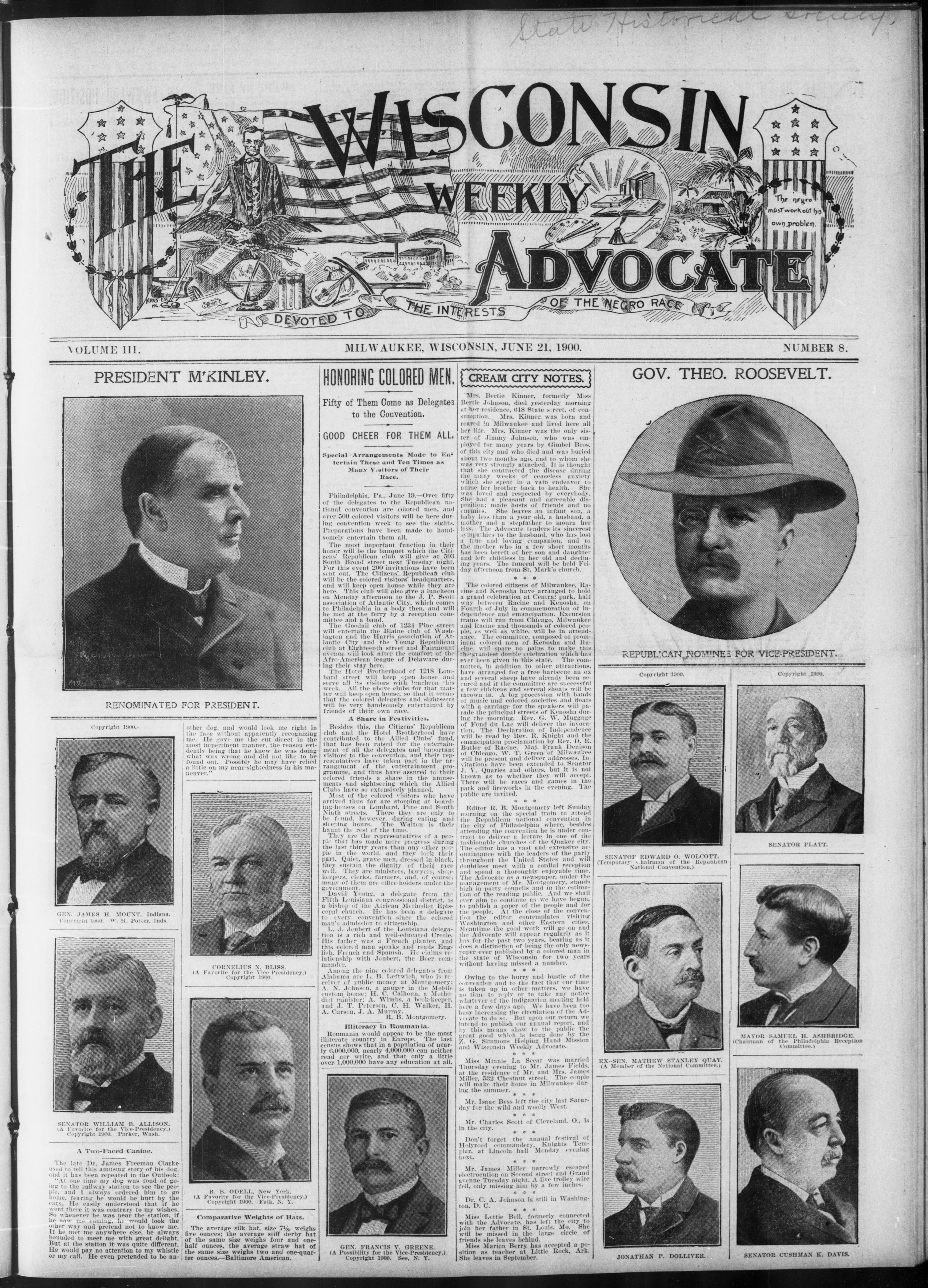
RENOMINATED FOR PRESIDENT.
J. B.
GEN. JAMES H. MOUNT, Indiana.
Copyright 1900. W. H. Potter, Inds.
I
SENATOR WILLIAM B. ALLISON.
(A Favorite for the Vice-Presidency.)
Copyright 1900. Parker, Wash.
A Two-Faced Canine.
The late Dr. James Freeman Clarke used to tell this amusing story of his dog, and it has been repeated in the Outlook: "At one time my dog was fond of going to the railway station to see the people, and I always ordered him to go home, fearing he would be hurt by the cars. He easily understood that if he went there it was contrary to my wishes. So whenever he was near the station, if he saw me coming, he would look the other way and pretend not to know me. If he met me anywhere else, he always bounded to meet me with great delight. But at the station it was quite different. He would pay no attention to my whistle or my call. He even pretended to be an-
other dog, and would look me right in the face without apparently recognizing me. He gave me the cut direct in the most impertinent manner, the reason evidently being that he knew he was doing what was wrong and did not like to be found out. Possibly he may have relied a little on my near-sightedness in his maneuver."
M. B.
CORNELIUS N. BLISS.
(A Favorite for the Vice-Presidency.)
Copyright 1900.
M.
B. B. ODELL, New York. (A Favorite for the Vice-Presidency.) Copyright 1900. Falk, N. Y.
Comparative Weights of Hats.
The average silk hat, size $7 \frac{1}{2}$, weighs five ounces; the average stiff derby hat of the same size weighs four and one-half ounces, the average straw hat of the same size weighs two and one-quarter ounces.—Baltimore American.
MILWAUKEE, WISCONSIN, JUNE 21, 1900.
HONORING COLORED MEN.
HONORING COLORED MEN.
GOOD CHEER FOR THEM ALL.
Special Arrangements Made to Entertain These and Ten Times as Many Visitors of Their
Philadelphia, Pa., June 19.—Over fifty of the delegates to the Republican national convention are colored men, and over 500 colored visitors will be here during convention week to see the sights. Preparations have been made to handsomely entertain them all.
The most important function in their honor will be the banquet which the Citizens' Republican club will give at 503 South Broad street next Tuesday night. For this event 200 invitations have been sent out. The Citizens' Republican club will be the colored visitors' headquarters, and will keep open house while they are here. This club will also give a luncheon on Monday afternoon to the J. P. Scott association of Atlantic City, which comes to Philadelphia in a body then, and will be met at the ferry by a reception committee and a band.
The Goodall club of 1234 Pine street will entertain the Blaine club of Washington and the Harris association of Atlantic City and the Young Republican club at Eighteenth street and Fairmount avenue will look after the comfort of the Afro-American league of Delaware during their stay here.
The Hotel Brotherhood of 1218 Lombard street will keep open house and serve all its visitors with lunchon this week. All the above clubs for that matter will keep open house, so that it seems that the colored delegates and sightseers will be very handsomely entertained by friends of their own race.
A Share in Festivities.
Besides this, the Citizens' Republican club and the Hotel Brotherhood have contributed to the Allied Clubs' fund, that has been raised for the entertainment of all the delegates and important visitors to the convention, and their representatives have taken part in the arrangement of the entertainment programme, and thus have assured to their colored friends a share in the amusements and sightseeing which the Allied Clubs have so extensively planned.
Most of the colored visitors who have arrived thus far are stopping at boarding-houses on Lombard, Pine and South Ninth streets. There they are only to be found, however, during eating and sleeping hours. The Walton is their haunt the rest of the time.
They are the representatives of a people that has made more progress during the last thirty years than any other people in the world, and they look their part, Quiet, grave men, dressed in black, they sustain the dignity of their race well. They are ministers, lawyers, shopkeepers, clerks, farmers, and, of course, many of them are office-holders under the government. David Young, a delegate from the Fifth Louisiana congressional district, is a bishop of the African Methodist Episcopal church. He has been a delegate to every convention since the colored man's admission to citizenship.
L. J. Joubert of the Louisiana delegation is a rich and well-educated Creole. His father was a French planter, and this colored man speaks and reads English, French and Spanish. He claims relationship with Joubert, the Boer commander.
Among the nine colored delegates from Alabama are L. B. Leftwich, who is receiver of public money at Montgomery; A. N. Johnson, a gauger in the Mobile custom house; H. C. Calhoun, a Methodist minister; A. Wimbs, a book-keeper, and J. T. Peterson, C. H. Walker, H. A. Carson, J. A. Murray.
Illiteracy in Roumania.
Roumania would appear to be the most illiterate country in Europe. The last census shows that in a population of nearly 6,000,000, nearly 4,000,000 can neither read nor write, and that only a little over 1,000,000 have any education at all.
[Picture of a man in a suit with a bow tie].
GEN. FRANCIS V. GREENE.
(A Possibility for the Vice-Presidency.)
Copyright 1900. See. N. Y.
CREAM CITY NOTES.
Mrs. Bertie Kinner, formerly Miss Bertie Johnson, died yesterday morning at her residence, 618 State street, of consumption. Mrs. Kinner was born and reared in Milwaukee and lived here all her life. Mrs. Kinner was the only sister of Jimmy Johnson, who was employed for many years by Gimbel Bros. of this city and who died and was buried about two months ago, and to whom she was very strongly attached. It is thought that she contracted the disease during the many weeks of ceaseless anxiety which she spent in a vain endeavor to nurse her brother back to health. She was loved and respected by everybody. She had a pleasant and agreeable disposition; made hosts of friends and no enemies. She leaves an infant son, a baby less than a year old, a husband, a mother and a stepfather to mourn her loss. The Advocate tenders its sincerest sympathies to the husband, who has lost a true and loving companion, and to the mother who in a few short months has been bereft of her son and daughter and left childless in her old and declining years. The funeral will be held Friday afternoon from St. Mark's church.
* * *
The colored citizens of Milwaukee, Racine and Kenosha have arranged to hold a grand celebration at Central park, half way between Racine and Kenosha, on Fourth of July in commemoration of independence and emancipation. Excursion trains will run from Chicago, Milwaukee and Racine and thousands of colored people, as well as white, will be in attendance. The committee, composed of prominent colored men of Kenosha and Racine, will spare no pains to make this the greatest double celebration which has ever been given in this state. The committee, in addition to other attractions, have arranged for a free barbecue an ox and several sheep have already been secured and if the committee are successful a few chickens and several shoats will be thrown in. A big procession with bands of music and colored societies and floats with a carriage for the speakers will parade the principal streets of Kenosha during the morning. Rev. G. W. Muggage of Fond du Lac will deliver the invocation. The Declaration of Independence will be read by Rev. R. Knight and the emancipation proclamation by Rev. D. E. Butler of Racine. Maj. Frank Denison of Chicago, W. T. Green of Milwaukee will be present and deliver addresses. Invitations have been extended to Senator J. V. Quarles and others, but it is not known as to whether they will accept. There will be races and games in the park and fireworks in the evening. The public are invited.
```markdown
```
Editor R. B. Montgomery left Sunday morning on the special train to attend the Republican national convention in the city of Philadelphia where, besides attending the convention he is under contract to deliver a lecture in one of the fashionable churches of the Quaker city. The editor has a vast and extensive acquaintance with the leaders of the party throughout the United States and will doubtless meet with a cordial reception and spend a thoroughly enjoyable time. The Advocate as a newspaper, under the management of Mr. Montgomery, stands high in party councils and in the estimation of the reading public. And we shall ever aim to continue as we have begun, to publish a paper of the people and for the people. At the close of the convention the editor contemplates visiting Washington and other Eastern cities. Meantime the good work will go on and the Advocate will appear regularly as it has for the past two years, bearing as it does a distinction of being the only newspaper ever published by a colored man in the state of Wisconsin for two years without having missed a number.
Owing to the hurry and bustle of the convention and to the fact that our time is taken up in other matters, we have no time to reply or to take any notice whatever of the indignation meeting held here a few days ago. We have been too busy increasing the circulation of the Advocate to do so. But upon our return we intend to publish our annual report, and by this means show to the public the great good which is being done by the Z. G. Simmons Helping Hand Mission and Wisconsin Weekly Advocate.
&&&&
Miss Minnie La Scear was married Thursday evening to Mr. James Fields, at the residence of Mr. and Mrs. James Miller, 532 Chestnut street. The couple will make their home in Milwaukee during the summer.
Mr. James Miller narrowly escaped electrocution on Second street and Grand avenue Tuesday night. A live trolley wire fell, only missing him by a few inches.
* * * *
Dr. C. A. Johnson is still in Washington, D. C.
* * * *
Miss Lottie Bell, formerly connected with the Advocate, has left the city to join her father in St. Louis, Mo. She will be missed in the large circle of friends she leaves behind.
Miss Marion Berry has accepted a position as teacher at Little Rock, Ark. She leaves in September.
SCOUTS
REPUBLICAN NOMINEE FOR VICE-PRESIDENT.
M. B.
SENATOP EDWARD O. WOLCOTT.
(Temporary Chairman of the Republican National Convention.)
SENATOP EDWARD O. WOLCOTT.
(Temporary Chairman of the Republican National Convention.)
M. B.
EX-SEN. MATHEW STANLEY QUAY.
(A Member of the National Committee.)
M. B.
NUMBER 8.
ROOSEVELT.
FOR VICE-PRESIDENT.
Copyright 1900.
M.
SENATOR PLATT.
M.
MAYOR SAMUEL H. ASHBRIDGE. (Chairman of the Philadelphia Reception Committee.)
PETER H. H.
SENATOR CUSHMAN K. DAVIS.
REPUBLICAN CONVENTION.
ROOSEVELT'S ATTITUDE
Wisconsin Delegation Elects Isaac Stephenson as Chairman-Payne is Committeeman.
Philadelphia, Pa., June 19.—At 12 o'clock today the Republican national convention of 1900 was called to order, and thus the racking excitement of conference and caucus, of crashing bands and confusion of hotel corridors gives way to the definiteness and form of actual convention proceedings.
Senator Hanna seemed in no nurry to call the convention to order. Attired in a sack suit with a white vest he sat chatting with those about him and his broad face beaming, his eye meantime roving over the convention. At 12:30 the band broke into the stirring strains of "The Star Spangled Banner." Gov. Roosevelt was first on his feet in response to the national anthem. His rough-rider hat came off and he stood with his head uncovered.
Callig to Order.
Instantly the whole convention rose en masse. Ten thousand people stood while the stirring air was played and applauded it with a cheer as they took their seats. Chairman Hanna remained standing. He lifted the ungainly gavel and brought it down with a resounding whack. Instantly all eyes were riveted upon him and a wave of applause swept the hall. Chairman Hanna faced the storm of applause with a resolute face. His stern features did not relax, but he nodded an acknowledgment as the applause broke here and there into a cheer. When it had subsided he brought down the gavel again.
"The convention will come to order," he shouted at exactly 12:35.
"The convention will be opened with prayer," he continued, "by Rev. J. Gray Bolton, Hope Presbyterian church, Philadelphia."
Chairman Hanna remained standing with bowed head while the divine came forward in the black robes of his office to deliver his invocation. But the delegates in the pit remained seated and only here and there did one of the spectators rise. All, however, bowed their heads reverently while Rev. Bolton read his prayer from small slips of paper which he held in the hollow of his hand.
As the prayer closed, Senator Hanna was again on his feet, and adjusting his eyeglasses, said in a resonant voice:
"The secretary of the national committee will now read the call for the convention."
As Colb, Dick stepped forward, call in hand, he was given a ripple of applause. He read the formal call, while the vast assemblage fretted for the more vital proceedings.
Senator Wolcott Speaks.
Senator Fairbanks from the first row of delegates arose and moved that the selection of Senator Wolcott as temporary chairman be approved and with unanimous voice the delegates so voted. Senator Wolcott, who was on the platform, arose and came forward. The appearance of the Colorado orator set the convention off like a rocket. With a pleasant nod of acknowledgment to Chairman Hanna, he turned and addressed the convention.
Mr. Wolcott spoke an hour and ten minutes, and as his brilliant peroration closed, there was another enthusiastic demonstration of approval.
The delegates stood on chairs and waved hats, fans, umbrellas and handkerchiefs, while at the same time the band added the enlivening strains of a patriotic air.
Mr. Wolcott received many hearty handshakes from those about him, and then turned to the business of the convention, announcing the long list of secretaries and officials previously agreed upon. "Mr. Payne of New York," announced the chairman, and again all eyes turned to the center of the hall, where, this time, the silver-topped form of the chairman of the ways and means committee was seen. He moved that the rules of the last convention prevail until other rules were adopted, and this prevailed without dissent. The call of the roll of states for the submission of members of the various committees, then began. It proved a tedious process.
Roosevelt Holds a Levec.
While the lists were being brought to the stage, Gov. Roosevelt was holding a regular levee in the pit. Delegates swarmed toward him from all directions. Ex-Senator Quay was one of those who greeted him warmly. The New Mexico delegates, with broad sombreros, climbed over seats in their eagerness to get to him and shake his hand. Chauncey Depew and the other big guns of the New York delegation were ignored. People leaning over the rails of the pit watched his every movement and many of the delegates climbed onto their chairs and watched the crowd eddy around him.
When order had been restored after the confusion incident to this scene, Mr. Wolcott announced that the secretary would read the lists of the various committees.
These committees, he announced, could meet immediately after the adjournment of today's session of the convention.
The convention adjourned at 3 p. m. until 12 o'clock noon tomorrow.
Chairman of Delegation-Isaac Stephenson of Marinette. Secretary-J. T. Barber of Eau Claire.
Vice-President of Convention—J. H. Stout of Menonole. Member Committee on Credentials—J. T. Murphy of Superlor.
Member of Committee on Permanent Organization—H. August Luedke, Milwaukee. Member Committee on Rules—Samuel T. Reese, Dodgeville. Member Committee on Resolutions—J. B. Treat, Mineral Point. Member National Committee—Henry C. Payne, Milwaukee.
On Committee to Notify Nominee for President—Walter Alexander of Wausau. Member to Notify Nominee for Vice-President—J. C. Reynolds of Lake Geneva.
The meeting was called to order by Isaac Stephenson of Marinette, who had been agreed upon during the trip as chairman of the delegation and J. T. Barber of Eau Claire was chosen secretary. The name of Henry C. Payne for national committeeman was proposed by J. B. Treat and was agreed to by acclamation. When the list of officials and committeemen was completed Delegate Theodore Bancroft of Richland Center arose and proposed the following resolutions:
Resolved, that this delegation support and endorse the candidacy of Theodore Roosevelt of New York for Vice-President.
The resolution was adopted unanimously.
Philadelphia, Pa., June 20.—At 12:26 Senator Wolcott rapped the convention to order. Immediately the band started up "The Star Spangled Banner," and the vast audience rose en masse, Gov. Roosevelt, as on yesterday, being first on his seat. Senator Wolcott again rapped for order, as the swelling strains floated away, wielding the heavy mallet with his left hand. When the confusion had sub-
sided, Rev. Charles M. Boswell opened the proceedings with prayer. Few of the delegates rose. While the invocation was ascending to the great white throne, a couple of enterprising photographers from the press embankment were taking snapshots of the convention.
The men who applaud prayers at large gatherings were present and signalized their approval of the divine's invocation with hand and voice.
A remarkable tribute to the flag and to the pioneers of the Republican party now occurred. Mr. Wolcott stepped forward and stated that fifteen survivors of the first Republican convention called at Pittsburg forty-four years ago were present with the same old flag used in that convention.
At that moment a file of white-haired patriarchs appeared from the rear, hearing at their head a faded American flag, tattered and barely held together by a cross staff. As the flag appeared the audience rose, delegates, spectators and guests, and a deafening salute went up for the faded standard and its venerable upholders. The fifteen white-haired men ranged themselves side by side, looking out on the sea of faces. Alongside the flag another standard bore the legend:
When the storm of applause had subsided, the delegation read a resolution, declaring their unwavering allegiance to the party they had helped to bring forth. Gen. Grosvenor of Ohio, chairman of the committee on permanent organization, then presented the committee's report. This report was also put through with a whirl.
"The chair announces as a committee to escort Senator Henry Cabot Lodge to the chair," announced Mr. Wolcott, "Gov. Shaw of Iowa and Gov. Theodore Roosevelt of New York."
A cheer went up, strong and long-continued as this group of names fell from the chairman's lips. Apparently, Gov. Roosevelt had not expected to be thus designated, and his face showed signs of annoyance. With Gov. Shaw, he stepped to Mr. Lodge's seat, and with the permanent chairman between them, they marched up the platform. The cheers echoed continuously until Mr. Lodge, after greeting Mr. Wolcott, turned to the audience, and began his address.
Gavel Presentations.
Senator Lodge concluded at 1:37. He had spoken fifty minutes. Then followed the usual gavel presentation. Col. Childs of Rhode Island, in a neat speech, presented an historic gavel, the mahogany from the capitol at Providence, the bronze from the yacht Columbia which defeated the Shamrock at the international yacht races last fall. A young delegate from Kentucky, John W. Langley, mounted the platform and in an eloquent little speech presented another gavel carved from a tree in the valley of the Big Sandy beneath which Gen. Garfield is said to have knelt at the battle of Middle Creek and asked the God of battles to give the Union forces victory.
L. E. Oison of Minnesota presented a table which had been used at the Republican national convention at Minneapolis and St. Louis. Senator Lodge received each of these presentations with a graceful speech.
The Platform.
At this point the convention threatened to get into a parliamentary tangle over the adoption of the rules, and proposed amendments. Mr. Quay's motion finally prevailed, that rules one and twelve, with his amendment, go over until tomorrow, after which the other rules were agreed to without dissent.
With this out of the way, Senator Fairbanks of Indiana, chairman of the committee on resolutions, was recognized to present the platform to the convention, which was adopted:
The Republicans of the United States, through chosen representatives met in national convention, looking back upon an unsurpassed record of achievement and looking forward into a great field of duty and opportunity, and appealing to the judgment of their countrymen, make these declarations:
The expectation in in which the American people, turning from the Democratic party, entrusted power four years ago to a Republican chief magistrate and a Republican Congress has been met and satisfied. When the people then assembled at the polls, after a term of Democratic legislation and administration, business was dead, industry paralyzed and the national credit disastrously impaired. The country's capital was hidden away and its labor distressed and unemployed. The Democrats had no other plan with which to improve the rulings conditions which they had themselves produced than to coin silver at the ratio of 16 to 1. The Republican party denouncing this plan as sure to produce conditions from which relief was sought, promised to restore prosperity by means of two legislative measures—a protective tariff and a law making gold the standard of value. The people by great majorities issued to the Republican party, a commission to enact these laws. This commission has been executed and the Republican promise is redeemed. Prosperity more general and more abundant than we have ever known has followed these enactments. There is no longer controversy as to the value of government obligations. Every American dollar is a gold dollar or its assured equivalent, and American credit stands higher than that of any nation. Capital is fully employed and everywhere labor is profitably occupied. No single fact can more strikingly tell the story of what government means to the country than this, that while during the whole period of 100 years from 1790 to 1973 there was an excess of exports over imports of only $983,989,497. There has been in the short three years of the present Republican administration an excess of exports over imports in the enormous sum of $1,483,537,954, and while the American people sustained by this Republican legislation have been achieving these splendid triumphs in their business and commerce, they have conducted and in victory concluded a war for liberty and human rights. No thought of national aggrandizement tarnished the high power with which American standards were unfurled. It was a war unsought and patently resisted, but when it came the American government was ready. Its fleets were cleared for action. Its armies were in the field and the quick and signal triumph of its forces on land and sea bore equal tribute to the courage of American sailors and soldiers and to the skill of the Republican statesmanship.
Administration Endorsed.
To ten millions of the human race there was given "A new birth of freedom," and to the American people a new and noble responsibility. We endorse the administration of William McKinley. Its acts have been established in wisdom and in patriotism, and at home and abroad it has distinctly elevated and extended the influence of the American nation. Walking antitrack paths and facing unforeseen responsibilities, President McKinley has been in every situation the true American patriot and upright statesman, clear in vision, strong in judgment, firm in action, always inspiring and deserving the confidence of his countrymen.
In asking the American people to indorse this Republican record and to renew their commission to the Republican party, we remind them of the fact that the menace to their prosperity has always resided in Democeratic principles and no less in the general incapacity of the Democeratic party to conduct public affairs. The prime essential of business prosperity is public confidence in the good sense of the government and in its ability to deal intelligently with the problems of administration and legislation. That confidence the Democeratic party has never earned. It is hopelessly inadequate, and the country's prosperity, when Democeratic success at the polls is announced, halts and ceases in mere anticipation of Democeratic blunders and failures.
We renew our allegiance to the principle of the gold standard and declare our confidence in the wisdom of the legislation of the Fifty-sixth Congress, by which the parity of all our money and the stability of our currency on a gold basis has been secured. We recognize that interest rates are a potent factor in production and business activity, and for the purpose of further equalizing and of further lowering the rates of interest we favor such monetary legislation as will enable the varying needs of the season and of all sections to be promptly met in order that trade may be
evenly sustained, labor steadily employed and commerce enlarged. The volume of money in circulation was never so great per capita as it is today. We declare our steadfast opposition to the free and unlimited coinage of silver. No measure to that end could be considered which was without the support of the leading commercial countries of the world. However firmly Republican legislation may seem to have secured the country again against the peril of base and discredited currency, the election of a Democratic President could not fail to impair the country's credit and to bring once more into question the intention of the American people to maintain on the gold standard the parity of their rio money circulation. The Democratic party must be convinced that the American people will never tolerate the Chicago platform.
Combinations Condemned.
We recognize the necessity and propriety of the honest co-operation of capital to meet new business conditions and especially to extend our rapidly-increasing foreign trade, but we condemn all conspiracies and combinations intended to restrict business to create monopolies, to limit production, to control prices and favor such legislation as will effectually restrain and prevent all such abuses, protect and promote competition and secure the rights of producers, laborers and all who are engaged in industry and commerce.
We renew our faith in the policy of protection to American labor. In that policy our industries have been established, diversified and maintained. By protecting the home market the competition has been stimulated and production cheapened. Opportunity to the inventive genius of our people has been secured and wages in every department of labor maintained at high rates, higher now than ever before, always distinguishing our working people in their better conditions of life than of those of any competing country. Enjoying the blessings of American common school, secure in the right of self-government and protected in the occupancy of their own markets, their constantly-increasing knowledge and skill have enabled them finally to enter the markets of the world. We favor the associated policy of reciprocity, so directed as to open our markets on favorable terms for what we do not ourselves produce in return for free foreign markets.
In the further interest of American workmen we favor a more effective restriction of the immigration of cheap labor from foreign lands, the extension of opportunities of education for workingmen's children, the raising of the age limit for child labor, the protection of free labor as against contract contract labor and an effective system of labor insurance.
Our present dependence upon foreign shipping for nine-tenths of our foreign carrying is a great loss to the industry of this country. It is also a serious danger to our trade, for its sudden withdrawal in the event of European war would seriously cripple our expanding foreign commerce. The national defense and naval efficiency of this country, moreover, supply a compelling reason for legislation which will enable us to recover our former place among the trade carrying fleets of the world.
Grateful to the Soldiers.
The nation owes a debt of profound gratitude to the soldiers and sailors who have fought its battles, and it is the government's duty to provide for the survivors and for the widows and orphans of those who have fallen in the country's wars. The pension laws, founded in this just sentiment, should be liberal, and should be liberally administered and preference should be given wherever practicable with respect to employment in the public service to soldiers and sailors and to their widows and orphans.
We commend the policy of the Republican party in maintaining the efficiency of the civil service. The administration has acted wisely in its effort to secure for public service in Cuba, Porto Rico and Hawaii and the Phillipine islands only those whose fitness has been determined by training and experience. We believe that employment in the public service in these territories should be confined as far as practicable to their inhabitants.
It was the plain purpose of the fifteenth amendment to the constitution to prevent discrimination on account of race or color in regulating the elective franchise. Devices of state governments, whether by statutory or constitutional enactment, to avoid the purpose of this amendment are revolutionary and should be condemned.
For Good Roads.
Public movements looking to a permanent improvement of the roads and highways of the country meet with our cordial approval, and we recommend this subject to the earnest consideration of the people and of the legislature of the several states.
We favor the extension of the rural free delivery service wherever its extension may be justified.
In further pursuance of the constant policy of the Republican party to provide free homes on the public domain, we recommend adequate national legislation to reclaim the arid lands of the United States, reserving control of the distribution of water for irrigation to the respective states and territories.
We favor home rule for and the early admission to statehood of the territories of New Mexico, Arizona and Oklahoma.
The Dingley act, amended to provide sufficient revenue for the conduct of the war, has so well performed its work that it has been possible to reduce the war debt in the sum of $40,000,000. So ample are the government's revenues, and so great is the public confidence in the integrity of its obligations, that its newly-funded 2 percent, bonds sell at a premium. The country is now justified in expecting, and it will be the policy of the Republican party, to bring about a reduction of the war taxes.
We favor the construction, ownership, control and protection of an Isthmian canal by the government of the United States. New markets are necessary for the increasing surplus of our farm products. Every effort should be made to open and obtain new markets, especially in the Orient, and the administration is warmly to be commended for its successful effort to commit all trading and colonizing nations to the policy of the open door in China. In the interest of our expanding commerce we recommend that Congress create a department of commerce and industries. In the charge of a secretary with a seat in the cabinet. The United States consular system should be reorganized under the supervision of this new department upon such a basis and tenure as will render it still more serviceable to the nation's increasing trade.
The American government must protect the person and property of every citizen, wherever they are wrongfully violated or placed in peril.
Congratulate the Women.
We congratulate the women of America upon their splendid record of public service in the volunteer aid association and as nurses in camp and hospital during the recent campaigns of our aranes in the Eastern and Western Indies, and we appreciate the faithful co-operation in all works of education and industry.
President McKinley has conducted the foreign affairs of the United States with distinguished credit to the American people. In releasing us from the vexatious conditions of a European alliance for the government of Samoa his course is especially to be commended. By securing to our undivided control the most important island of the Samoa group and the best harbor in the Southern Pacific, every American interest has been safeguarded.
We approve the annexation of the Hawaiian island to the United States.
We commend the part taken by our government in the peace conference at The Hague. We assert our steadfast adherence to the policy announced in the Monroe doctrine. The provisions of The Hague convention were wisely regarded when President McKinley tendered his friendly offices in the interest of peace between Great Britain and the South African Republic. While the American government must continue the policy prescribed by Washington, affirmed by every succeeding President and imposed upon us by The Hague treaty of non-intervention in European controversies, the American people earnestly hope that a way may soon be found, honorable alike to both contending parties, to terminate sarrife between them.
Accepting by the treaty of Paris the just responsibility of our victories in the Spanish war, the President and the Senate won the undoubted approval of the American people. No other course was possible than to destroy Spain's sovereignty throughout the Western Indies and in the Philippine islands. That course created our responsibility before the world and with the unorganized population whom our intervention had freed from Spain, to provide for the maintenance of law and order, and for the establishment of good government and for the performance of later, a final obligations. Our authority could not be less than our responsibility, and wherever sovereign rights were extended it became the high duty of the government to maintain its authority, to put down armed insurrection and to confer the blessings of liberty and civilization upon all the rescued peoples. The
largest measure of self-government consistent with their welfare and our duties shall be secured to them by law. To Cuba independence and self-government were assured in the same voice by which war was declared and to the letter this pledge shall be performed. The Republican party upon its history and upon this declaration of its principles and policies confidently invokes the considerate and approving judgment of the American people.
Received with Cheers.
The announcement of the adoption of the platform was received with enthusiastic cheers. Chairman Lodge then called for announcements from the various delegations of national committeemen and vice-presidents. Senator Foraker of Ohio was in the center of the main aisle with his hand raised for recognition. "I was about to move to adjourn, Mr. Chairman," said he, "but I withhold that motion until the role of states can be called. The call was begun then, each of the well-known and prominent men, as their names were mentioned, being greeted with applause.
When Former Senator Quay was announced as the choice of the Pennsylvania delegation for member of the national committee, half of the delegates and hundreds of spectators were on their feet in an instant, cheering as if mad. For the first time in the history of American politics Hawaii was called on the roll of a national convention. When the newly-acquired territory was called by Assistant Secretary Malloy, Col. Samuel Parker rose and made his announcement in full, resonant voice. He was received with tremendous applause. After the applause had subsided Senator Foraker was recognized to make his motion to adjourn until 10 o'clock morning. The motion prevailed without dissent, and at 3:13 p. m. the convention adjourned.
A NARROW ESCAPE.
Gen. Dewet Attacks a Repair Train in Which Kitchener was Sleeping.
London, June 20.—Lord Roberts this afternoon reported that Gen. Hunter had occupied Kruegersdorp (west of Johannesburg) with opposition and that Gen. Methuen June 19 routed a Boer force which was opposing his entry into Heilbron, in the Orange river colony.
The silence of Lord Roberts since June 16 had disposed some quarters to believe that his line of communications had been recut, especially as according to the latest news from the Orange river colony, the Boers were known to be still hovering about the railroad north of Kroonstad.
According to a Cape Town dispatch of this date, Gen. Kitchener had a narrow escape from capture in the engagement at Lecuw Spruit June 14. He was sleeping in the repair train, when it was attacked and many of the engineers were captured.
The Boers alleged to be hemmed in by Gen. Rundle began shelling Ficksburg yesterday (June 19). It is said they apprehend that a force is marching from the north upon them, and hence they will endeavor to break through southward. Gen. Kitchener's sleeping car was at Kopjes station, when the Boers, under Gen. Dewet, suddenly opened a rifle fire at 3 a. m. Kitchener managed to reach his horse and galloped to Rhenoster, two miles distant. The Boers numbered 900 men, with three guns. They burned the culvert, which had just been rebuilt, and derailed the train.
Hunter Occupies Krugersdorp.
London, June 20.—The war office has received the following dispatch from Lord Roberts:
Pretoria, June 20.—Hunter's advance column occupied Krugersdorp without opposition June 18. Methuen, who was escoring a large convoy to Hellbron yesterday, routed a force under Christian Dewet, who endeavored to prevent him from entering the little town. Methuen had only three casualties.
Baden-Powell left this city today on his return to Rustenburg. The country is quieting down in that direction. This state of affairs will be materially assisted by the capture between here and Rustenburg June 19 of two guns by Hutton's mounted infantry from a body of the enemy under Command Duplessis.
Railway and telegraph communication with Cape Town is now completely restored.
All is quiet here and at Johannesburg. The shops are open and the market is daily becoming more crowded and business-like.
DISPATCH FROM KEMPFF
Statement Relative to Part Taken by the American Fleet at Taku.
Washington, D. C., June 20.—The navy department has just given out the following statement regarding the contents of a dispatch from Admiral Kempff, brought from Taku to Chefoo and forwarded by Commander Taussig of the Yorktown:
"The department has received a cablegram from Admiral Kempff dated June 20. He says the Taku forts were captured by the other foreign forces; that heavy firing was heard at Tien Tsin on the evening of the 17th inst. He is making common cause with the foreign powers for general protection. There are 300 Americans ashore. On May 31 the number of foreign troops at Pekin was 430. There are 6000 men ashore now at Chefoo, and about 3000 troops, Russian, German and English have just arrived."
BRIDE OF THE CONVENTION.
Bit of Romance Creeps Into the Dry Proceedings of Politicians.
Philadelphia, Pa., June 20.—The women here are all very much interested in Walter B. Hopkinson of Newburyport, Mass. Mr. Hopkinson is here with his bride, who was Miss Eleanor Robinson of Newburyport. According to the story, Mr. Hopkinson couldn't get a day set for the wedding and finally he declared that he was going to be a candidate for election as a delegate to the national Republican convention.
"Now," said he, "if I am chosen, will you consent to our being married in time to make the Philadelphia trip a part of our wedding journey?"
The young lady agreed and the couple had their wedding breakfast in Philadelphia on Monday morning. After that they had a little reception, which was attended by most of the Massachusetts delegates, including Senator Lodge, and by National Committeeman Sam Fessenden of Connecticut. Mrs. Hopkinson has been christened the convention bride.
DELEGATES' LEGS BROKEN.
Elevator at Hotel Walton, Philadelphia, Drops Seven Stories.
Philadelphia, Pa., June 20.—The elevator in the Hotel Walton fell seven stories at midnight last night and injured five of the passengers and the elevator boy. The two passengers most seriously hurt were J. G. Pringey, a delegate from Oklahoma territory, and Brenton F. Hall, a delegate from Belding, Miel. Dr. Burton and Walter Hunter of Delaware, Marcellus West of Washington and Dr. Camden of Texas were also among the injured.
Pringey and Hall have broken legs. Dr. Camden of Texas had an arm and leg broken, having been thrown out of the elevator as the elevator fell. All of the injured are being cared for, two having been taken to hospitals. The accident has caused intense excitement.
SWEPT BY FIRE.
Business Section of Bloomington, Ill., Destroyed, Entailing a Loss of $2,000,000.
Bloomington, Ill., June 19.—Fire that was discovered at 12:30 this morning swept the business section of the city and entailed a loss that is estimated at about $2,000,000. Word was sent to Peoria and Springfield to send engines. As every effort to check the progress of the flames proved futile, the blowing up of buildings with dynamite was resorted to after the fire had been raging three hours and a half. A strong east wind prevailed which made the work of the firemen extremely difficult. The burned district included some of the handsomest buildings in the city.
Among the buildings destroyed and some of the losses are the following:
Griesham, building and stock of clothing, $100,000; Cole Bros., dry goods, $75,000; Parrett, jewelry, $30,000; Stephen Smith & Sons, ury goods, $75,000; Klemm, dry goods, $100,000; New York store, dry goods, $30,000; Coblenz, drugs, $20,000; Garver, drugs, $20,000; Kitchell, candy, $10,000; Minerva block and stocks, $100,000; the Phoenix hotel, $30,000; Windsor hotel, $75,000; Model laundry, George Brown & Co., furniture; R. Thompson & Co., furniture; Myers & Miller, hardware; the courthouse.
Forty to fifty business houses were burned out. The courthouse, which was entirely destroyed, cost $400,000. The records were saved.
An engine and hose cart, with full complement of men, from Peoria, and also a like outfit from Springfield, arrived about 6 a.m. They were greeted with cheers by the great multitudes on the streets. The pumps at the waterworks failed seriously two hours after the fire broke out and the supply of water was inadequate. The wind has died down and there is now some hope of checking the conflagration. The entire loss is estimated at nearly $2,000,000. Two firemen are missing and are probably in the ruins. The burned district covers an area of five blocks. Robert Louis Schmitt, aged 19, died at 4:30 o'clock a.m. from shock occasioned by the explosion of dynamite used in blowing up the buildings to arrest progress of the fire.
DEATH CAME QUICKLY.
H. Walter Webb, the New York Railway Director, a Victim of Consumption.
New York, June 19.—Henry Walter Webb died yesterday at his residence at Scarborough-on-the-Hudson, aged 47 years. He was a son of the late Gen. James Watson Webb and brother of Dr. W. Seward Webb, and was a director in the Wagner Palace Car company, the Buffalo Erie Basin Railroad company, the National City bank and the Oswego & Rome Railroad company, and trustee of the Mutual Life Insurance company. He was ill less than half an hour. His death was wholly unexpected, although he had been previously ill many times during the last few months. As assistant to President Depew of the New York Central in 1891, Mr. Webb defeated the great strike of the Knights of Labor. He planned and built the Adirondack & St. Lawrence road, giving the Central a route of its own to Montreal, and managed the deal for the acquisition of the Rome, Watertown & Ogdensburg road. Owing to ill-health he was compelled to retire from business in 1897. Since then he had been an invalid.
WHEELER IN CHICAGO.
"Fighting Joe" will Take Command of the Department of the Lakes.
Chicago, Ill., June 19.—Brig.-Gen. Joseph Wheeler, "Fighting Joe" of the South, is to come to Chicago and the North to take command of the Department of the Lakes of the United States army. He will succeed Brig.-Gen. Wade, who has been in temporary command, and the latter will now devote his whole time to the Department of Dakota, with headquarters at St. Paul. Gen. Wheeler will, of necessity, retire, according to army regulations, September 10 next, when he reaches the age of 64.
SURVIVES A BROKEN NECK.
Walter B. Duryea Leaves Roosevelt Hospital, New York City.
New York, June 19.—Walter B. Duryea, son of the Glen Cove starch manufacturer, who broke his neck while diving in Oyster bay last summer and whose life was saved almost miraculously by skillful surgical treatment, was taken yesterday from Roosevelt hospital, where he had been treated, to a sanitarium at Dansville, N. Y., 337 miles away. Duryea's father has spared no expense to save his son's life and promote his recovery. He paid $130 a week for room and nurse care in the hospital. He is said to have paid Dr. Abbe several thousand dollars for the surgical operation that saved the young man's life, and has incurred many other expenses. He had a special ambulance constructed to convey his son from the hospital to the railroad and also a car fitted up for him. His condition has been gradually but steadily improving. His limbs are beginning to have sensation.
PLACE FOR ANSON P. STOKES JR.
Secretary of Yale Corporation Accepts Assistant Pastorate of New Haven. New Haven, Conn., June 19.—An unlocked-for announcement was made yesterday by Rev. Dr. Edwin S. Linis, rector of St. Paul's Episcopal church of this city, who stated that Anson Pheips Stokes, Jr., of New York city had accepted an offer of the place of assistant pastor of the church. Rev. Mr. Stokes will commence his duties in September. He was graduated from Yale in 1896, and has since studied at Cambridge (Mass.) Theological school. He was chosen a trustee of Wellesley college last fall and is secretary of the Yale corporation. He was ordained a deacon by Bishop Henry C. Potter a week ago in New York city.
Novel Electric Fountain.
A novel electric fountain has been authorized by the park board of Detroit. The basin will be 40 feet in diameter, and the fountain proper will consist of five cobblestone columns; from the apex of each will burst a stream of water, each lighted by hidden electric lamps. The fountain will cost about $3000 and will be ready for use July 4.
The Khaki Craze
The khaki craze has now gone so far that statues in many West End London villas have been painted that color, and in one small area the St. James Gazette says one now sees two Mercurys, a Laocoon group, an Achilles, an aphrodite and a Hercules all respiient in the popular hue.
—An undertaking establishment in Chicago offers to conduct funerals on the installment plan. It issues policies which amount to $50 when paid up, and which entitle the holders or members of their families to a decent burial.
The Attitude of France in Chinese Matters a Delicate One.
ENGLAND AND RUSSIA.
By Co-operating with the British to Suppress the Boxers, France Offends the Czar.
London, June 20.—10:42 a. m.—Shanghai reports originating from Chinese sources and credited by the local foreign officials state that the legations at Pekin were safe Sunday, June 17. Admiral Seymour with a relieving column is also reported to have reached Pekin.
St. Petersburg, June 20.—Vice-Admiral Alexejeff from Port Arthur reporting the capture of the Taku forts says the bombarding fleet was commanded by the Russian captain Dubrowolski as senior officer present. The Russian losses were two lieutenants killed, one severely and one slightly wounded, and sixteen men killed and sixty-seven wounded. The gunboat Giljak was seriously damaged by a shell below the water line and must be docked for repairs. The gunboat Korejez was leaking in six places, and had her cabin destroyed. The gunboat Bobr was damaged. Besides the above Admiral Alexejeff says the French warship Lion, the British Algerine and the German gunboat Iltris participated in the engagement.
New York, June 20.—A dispatch to the Times from Paris says: Several deputies in interviews admitted that France's position in China is a delicate one. There is a general shrewd suspicion that France's ally, Russia, desires to profit from the political condition of disorder and also desires such state to continue as long as possible. If France helps to end it she will be playing Great Britain's and opposing Russia's game.
An attache of the Chinese legation here named Owed-Chin has stated that the resistance to the foreign troops will collapse and that affairs will be arranged by the guardian to the heir presumptive taking the Empress Dowager's place.
San Chow Mission Looted.
Washington, June 20.—A cablegram was received at the state department this morning from United States Consul Fowler, at Chefoo. The consul says that no communication has been had with Pekin for six days past; that the mission at San Chow has been looted but that the Chinese general carried the missionaries off safely to an unknown place. The Chinese ships in the harbor have left for the south. The Russians continue to land troops at Taku.
Massacre of Christians at Pao Ting.
San Francisco, Cal., June 20.—Mrs. A. P. Lowrie, a Presbyterian missionary, who has been stationed at Pao Ting Fu for the last six years, arrived here on the Dorie. She reports that on the night of May 16 many native Christians, principally women and children, were murdered by the Boxers while fleeing from Pao Ting toward Tien Tsin. This was about ten miles from Mrs. Lowrie's station, which was not disturbed.
The native Christians had been attacked on May 15, but successfully repulsed the horde of murderers, but in trying to reach Tien Tsin the following night were overtaken and murdered and the Boxers then returned to Pao Ting, and burned all the houses of their victims.
French Consul a Prisoner.
Paris, June 20.—Up to noon today the foreign office had received no dispatches from China and were quite in the dark respecting the condition of affairs at Yun-Nan, where the French consul is evidently still a prisoner. The officials declare that no negotiations are pending between the powers regarding the measures to be ultimately taken against the Chinese government and they profess to know nothing in connection with the story from Rome that the United States proposes the reinstatement of the young Emperor.
The United States, it is asserted here was at first disposed to act independently in behalf of her citizens and their interests, but it now avers the Americans will join the other powers in police measures. The alleged change of attitude on the part of the United States is nowise displeasing to the French government which felt that the development in China could only tend to draw closer the relations between France and the United States whose aims and interests there, it is claimed, are identical.
Without Foundation.
Washington, D. C., June 20.—The dispatch from Shanghai last night to the effect that the United States transport Manila was diverted at Nagasaki and had arrived at Taku with 1200 men, is said by war department officials to be without foundation. The records of the department show that the Thomas sailed from San Francisco June 16 with seven officers and 392 men aboard, bound direct for Manila. It is of course impossible that she could have arrived at Nagasaki The Sherman sailed from San Francisco June 12 and is due in Manila about July 1. She had aboard twelve men of the hospital corps in addition to her crew The third troop transport now in use is the Logan, which is at Manila waiting for fair weather to convey the Ninth infantry to Taku. She arrived at Manila June 14.
KILLED AT GRADE CROSSING.
Miss Nina Wilcox and Otis Fox Mect Death Near Galesburg, Ill.
Galesburg, Ill., June 20.—Miss Nina Willcox, daughter of Fred Willcox of this city, and Otis Fox, son of J. V. Fox, a resident of Hailey, Idaho, were killed instantly by a Chicago, Burlington & Quincy fast train northeast of the city, as they were attempting to drive across the track. The enginemen were not aware of the accident until the buggy wreckage was found on the engine when the train pulled into the station here.
A searching party was sent back, and the bodies of the young people were found in the ditch near the track. The two had been out driving during the evening and the supposition is were on their way home when the accident occurred.
WOMAN FORESEES HER DEATH
Mrs. Marguerite Larsen of Chicago Passes Away in Minneapolis.
Minneapolis, Minn., June 20.—Mrs. Marguerite Larsen of Hotel Granada Chicago, arrived here on Monday and predicted that she might have fainting spells and not recover for two hours. True to her prediction, she became unconscious Monday night and could not be revived. Mrs. Marguerite Larsen had been a resident of Chicago for over twenty-five years. As far as is known by her relatives Mrs. Larsen never predicted her death or had been aware that her death was approaching. She left Chicago on last Sunday to visit her brother who is a resident of this city. She was 70 years of age. Her husband was a professor in the old Chicago university. He died twenty-six years ago.
—Expensive as ice has become in New York, it is cheap compared with the prices charged in the Latin American countries.
NATION'S FINANCES.
UNITED STATES TREASURER ON THE GOLD STANDARD.
Our Bonds Paying a Lower Rate of Interest—More Money in Circulation—Increase in the Number of National Banks—Labor and Wealth.
Washington.—Ellis H. Roberts, Treasurer of the United States, speaking on the new era in our finances and currency, as established by the act of March 14, 1900, said:
"This law makes a unique rate of interest on government bonds, and so affects the earnings of capital in all uses. It fixes, except for a small per cent., the denominations of silver certificates at $10 and below, and of United States notes at $10 and above, while it does away gradually with Treasury notes and puts silver certificates in their place. It opens the door wide for increase in the notes of national banks. It gives parity to all our currency. On the face of all our money, paper and coin, white and yellow, on all our bonds, all wages, all trade, all banking, all business, it brands deep and sure, to be read of all men for all time, the pledge of gold interest abroad and at home.
"The lowest rate of interest borne by the bonds of any foreign nation is two and three-quarters per cent., on British Consols. This is to run until 1903, and then to be two and a half per cent. On only a part of the debt of Germany, France and Russia is the rate as low as three per cent. Denmark borrows at the same rate. Austria pays no less than four per cent., and Italy no less than five.
"The average bank rate for money in European' centers, in the year ending with June last, was 2.6 per cent. in Amsterdam, 2.7 in Paris, 3.17 in London, 4.59 in Hamburg and Berlin. From July 1, 1899, to March 2, 1900, the average in Paris was 3.24, in London 4.40, in Berlin and Hamburg 5.57. In the year ending with June last, the average for call money in New York was 2.36 to 3.65, and for prime paper 3.34 to 4.20. For the months from July 1st last to March 2d the average in New York was for call money 3.52 to 6.51, and for prime paper 4.75 to 5.87. "The changes every day in New York are greater than elsewhere; but the records show that the rate for money is less in our country than in any point in Europe, except Paris, and often lower than on that bourse.
"At the market price, during March last, our four per cent. bonds of 1925 earned to the investor an average of 2.149 per cent. a year; the fours of 1907 earned 1.543 per cent.; the threes earned 1.593, and the fives only .0072.
"For April on the same basis, the average earnings were: For the fours of 1925, 2.244 per cent.; fours of 1907, 1.851; three, 1.738; fives, 1.452.
"The contrast with foreign loans is most marked. The German three and a half per cents, sell at $96\frac{1}{2}$ to 97, and the threes at 86 to $86\frac{1}{2}$, so that their earnings to the buyer are more than the interest stated. The premium on British Consols is about one per cent., and on the French rentes one per cent., or a slight fraction more, and their earnings vary a little above the face interest. The latest allotment of British Treasury bills was at 98.19d for three months, and 96.9d for twelve months. Thus money is cheaper with us than anywhere else among men.
"The labor and wealth of the American people underlie the law of March 14, 1900. To them are due the results of which we are thinking. More potent for riches than even the yellow metal, is our agriculture, with its corn and cotton, hay and tobacco, its farm animals. The maize which the red men gave us, which saved John Smith's colony from starving, turned out last year a crop $629,210,110 in value, and that exceeds the capital of all the national banks. The worth of farm animals by latest figures is $1,997,010,467, very nearly equal to all the money in circulation in the country.
"And yet no less than our agriculture, our manufactures create an El Dorado richer than the early navigators sought, and their growth expands with each new year. It is not enough that the American people have long led all nations in this broad field—the rate of increase exceeds that of all the rest of the world. If the earth is already giving us its maximum crops, imagination fails to limit the products of forge and mill, of factory and laboratory. Take pig iron as the index of manufactures: The increase from 1897 to 1899 was forty-one per cent. The product is now at the rate of 15,280,000 tons a year, more than fifty per cent. greater than that of Britain. Our exports of manufactured articles for the ten months ending with April were $348,000,000, indicating for the year over $450,000,000, and that is more than our total exports as late as 1870. The product of our manufactures this year will hardly be less than three times the total assets of all the national banks. $15,000,000,000.
"Our products flow outward into all the world, in a gulf stream ever rising. Our total exports for nine months ending with March were $1,172,736,685, being $135,948,857 more than for the same period last year, and indicating for this year $1,400,000,000, and a balance of trade of $550,000,000. Comparison with Great Britain cannot fairly be made, for she is a trader more than a producer, and is a way port for the world's commerce. We sell what we raise and make; our foreign trade springs from our home industries. Our net balance of trade belongs to our own people."
Right in the Ring.
Kinley Mack was the winner of the Brooklyn handicap. There is a winning sound to the name.
Lack of Direct Steamship Lines to
Baltic, South American Ports
The export trade of the United States is as yet only in its infancy. Not until our people supply South America and Asia with the larger part of their imports will the United States have reached the position in the world's foreign trade to which it is entitled both in the quality and in the prices of its productions. One of the greatest obstacles to our trade expansion is the lack of direct lines of American steamships to the leading ports of South America. This is a matter which cannot be explained too often, nor can too great emphasis be laid upon the consequences of our neglect. Scores of lines of fine steamships regularly ply between Europe and South America. These ships carry to the Republics of the South infinitely more, in value, than they take from them. The United States, on the other hand, buys infinitely more from South America than it sends there.
For a dozen years the Republic of Argentina offered a subsidy of a hundred thousand dollars a year for a direct line of American steamships with Buenos Ayres, if the United States would pay an equal amount. Congress paid no heed to this long standing offer, and it was finally withdrawn. Even the resolutions adopted at the conclusion of the Pan-American Congress, held in 1889, pledged the Republics of South America to pay subsidies to American-built steamships if established in lines trading directly with them. Nothing has been done by Congress to secure the gifts thus lavishly proffered us by our good friends to the South.
It is not surprising to find the new Minister to the United States from the Argentine Republic pointing out the lack of direct steamship communication between the United States and his country as the real reason for the smallness of our trade, and the largeness of European trade directly traceable to the many lines of steamships plying between Buenos Ayres and Europe.
Argentine's Minister to the United States, Dr. Wilde, in a recent interview said that at a conference between the Presidents of Brazil and Paraguay, held while he was on his way to the United States, "they agreed with me in acknowledging the necessity of a closer intimacy between the two continents, which can be accomplished in one way, the establishment of direct lines of commerce." Here we have the chronic obstacle to our trade expansion brought clearly to our attention.
Minister Wilde makes it infinitely clear in the following statement, well deserving the attention of our people who are so interested in the securance of new foreign markets for our surplus products:
"My government will gladly join with the United States in extending a subsidy to one or more regular lines of steamers between the Rio de la Plata and some important port of the United States. At present we must ship the greater part of our commerce with this country to Liverpool for reshipment to the United States. Under such unnatural circumstances there must of necessity be a lack and difficulty of imports not favorable to the parties interested."
The conclusion, based upon the fact stated, is undeniable. It is a notorious fact that American manufactures shipped to the Argentine by the way of Europe have been placed in warehouses and kept there for months, in the meantime foreign merchants sending to the Argentine the very things which the Argentine merchants had ordered from the United States. Annoyed at the delay they have taken the European goods, and when the belated American manufactures arrived they were not accepted. Our consuls have pointed out that our manufactured articles pay twice, and sometimes three times, as much freight to South America as the identical things pay when shipped from Europe. If American goods were laid down in South American ports at the same freight rates that European goods are, in a short time our manufacturers would supplant the Europeans in supplying South Americans. These conditions loudly call for the early passage of the Shipping Bill at the next session of Congress.
Great Foreign Trade.
An exportation of forty million dollars' worth of manufactures in thirty days is a record unparalleled for American manufactures. That is the record for the month of April, 1900. The details of the April exportations—just completed by the Treasury Bureau of Statistics—show that the exportation of manufactures during that month were by far the greatest of any month in our history, and within a fraction of forty million dollars. This gives assurance that the exports of the fiscal year, which ends with June, will considerably exceed 400 million dollars and be nearly three times as much as a decade ago. This phenomenal increase in exportation of manufactures is especially striking when compared with the progress made by European nations, our rivals, in the attempt to supply the world's market with manufactured goods. Great Britain's exports of manufactures show but slight increase since 1890, and an examination of the export record of the principal European countries fails to disclose an instance in which the increase has been as much as 25 per cent., while that of the United States, meanwhile, has been more than 150 per cent.
Can See Him Everywhere.
One of the favorite tricks of the Democratic campaign orator in 1890 was to inquire of his auditors if they had seen anything of Genera. Prosperity. That feature of the performance will be dropped this year.
A WESTERN EDITOR.
GIVES REASONS M'KINLEY WILL BE RE-ELECTED.
People Want No Cessation in Their Daily Labor—Present Administration Through War and Trouble Has Been Sincere—Masses Want Money to Spend.
The re-election of President McKinley means that there will be no cessation to the daily labor of the toiling masses. It means that there will be good cheer for the little ones in the humble homes of the laborer and comforts for the family of the artisan. It means that the steady tramp of the great and universal dinner-pail brigade will not be stilled, nor the marchers be commanded to halt while a new experiment in finance or other legislation is being tested.
It is true that the renomination of William J. Bryan is being sought, and will doubtless be brought about by the class of Democrats who care more for present notoriety than they do for the ultimate success of their party. Mr. Bryan is the recognized leader of that sentiment that felt itself submerged four years ago, and which at the present time is by no means united in his favor. However, there are so many differences in the party of woe this year that Democracy will lose nothing by retaining the same leader. It has nothing to gain in any event. No man can lead it to victory, and no issues that could be compiled could help it in this extremity.
There is no excuse for a change in the administration of the government of the United States at this time. We have been permitted to see for ourselves the workings of the Republican administration, and a million busy workshops testify to its fruitfulness. There is no reason why this state of affairs should not continue as long as the people of the country wish it, and there is every reason to believe that the people—the people who are the heart of the machine—desire to return to the disturbances and poverty that marked recent Democratic administrations of national affairs.
The demand for financial legislation was great. That the Republican party faithfully kept its promises in this respect has bound to it, with ties of perfect harmony and accord, the business men who had experienced one panic, because of the prospects of an unstable currency. The blessed workings of the protective tariff have given its reward to the toiling masses, who earn their bread by the sweat of their brow. They are too well pleased to return any more to a nervous dread of starvation that they once knew. By this same tariff the manufacturer has been protected in his investments, and has been permitted to provide work for willing labor.
The wise administration of President McKinley in the troublous days through which the nation passed while a Eureanean country learned our strength and sincerity has not been lost upon the people. They may claim adherence to the Democratic party, but thousands and tens of thousands of them rejoice at the backbone of this Republican administration in its grasp of the unforeseen issues growing out of the Spanish war. They admire the manner in which we have dealt with the Philippines, with Cuba and with Porto Rico. The islands in the Orient, it is admitted by all the thoughtful, have been the means of opening to us the great markets of the East. The South, especially, is sensible of this, for her exports will go there more largely than to any other point on the globe. Our dealing with the island of Cuba has won the praise of the entire world, while little Porto Rico is blooming like a tropical rose,
With the history of four years to turn to, the expectant and approving gaze of the voters of the country, what shall we say of Mr. McKinley? Is there any doubt that he will be returned to the office of chief executive of the nation? He stands upon a platform of fulfilled promises—of promises faithfully kept and of which the people of the country have been the direct beneficiaries. There is no longer a cry of hard times.
Arrayed against existing conditions against prosperity, visible and undeniable—stands the Democratic party. Like Poe's raven, it looks gloomily on the scene, hopeless of any good—a mere omen of morbid melancholy. Democracy merely says loudly. "We protest." The only policy of the Democratic party is to deny that the people are happy, to deny that they are well fed, to deny that we are contented, to deny that it is right to be prosperous. If they succeed in making a case on these issues, Bryan will go into the office of President with a whoop, and ranting recklessness shall have taken prudence by the head and strangled it.
Out here in the West—the West that once was silver, but now repudiates a doctrine that it knows means retrogression, loss and poverty—the soft summer winds are again sweeping over a growing harvest in its rich promise of abundance. The sun rises at morn and pierces the vail of smoke that lifts from thousands of glowing factory stacks and hangs athwart the sky, and it lights a region teeming with plenty and a people blythsome with the happiness that abundance brings. Its setting rays guide the steps of the moving army of liberators—the workingmen, who desire no change and who will be heard again in favor of Mr. McKinley in November. FRANK B. MOORE
Managing Editor of the Daily Herald. St. Joseph, Mo.
Anti-Mob Rule.
The Democratic Governors of Idaho and Missouri have undergone unpleasant experiences with the mob promoters in their own party. The enforcement of law is an obnoxious proceeding to the scheming Democratic politician.
MR. BRYANT WILL REMAIN
Will be at the Head of the Law School for Another Year.
STUDENTS ARE PLEASED
Messrs. Olin, Bashford and Jones will be Retained-The Dean's Resignation
Madison, Wis., June 18.—[Special.]—Dean E. E. Bryant will remain at the head of the law school for another year, and the three Madison attorneys, Messrs. John M. Olin, R. M. Bashford and Burr W. Jones, who are connected with the school, will retain their full professorships. This will be welcomed by the law students, who have manifested a marked regret at the announcement of the dean's intended withdrawal.
PHYSICIAN HONORED.
Fond du Lac Doctor Appointed Secretary of World's Congress of Medicine Men.
Fond du Lac, Wis., June 18.—[Special.]—Fred. J. Lang of Hermansville, Mich., formerly secretary and treasurer of the United States Manufacturing company of this city, was in the city today. Mr. Lang received a letter from Dr. G. N. Brazeau last week conveying information of an honor conferred upon the Fond du Lac physician in Paris. He has been appointed secretary of the world's congress of physicians and surgeons in session in the exposition city. The doctor left Fond du Lac in January to take a tour in continental Europe and do postgraduate work in German and French universities. He expected to return in August, but the appointment he has received will delay his departure from Paris several months.
WAUKESHA WOMAN DIES.
Death of Mrs. George Vanderpool at Her Spring City Home.
Waukesha, Wis., June 18.—[Special.]
—Early yesterday afternoon occurred the death of Mrs. George Vanderpool, who has been suffering for a number of years from heart trouble, but had only been confined to her bed by this late illness since Monday last. Mrs. Vanderpool was born in Albany county, N. Y., February 27, 1834. As Katheryn Van Buren she came to Wisconsin in 1853 and was married to George Vanderpool on November 25, 1855. There were six children by
C. M.
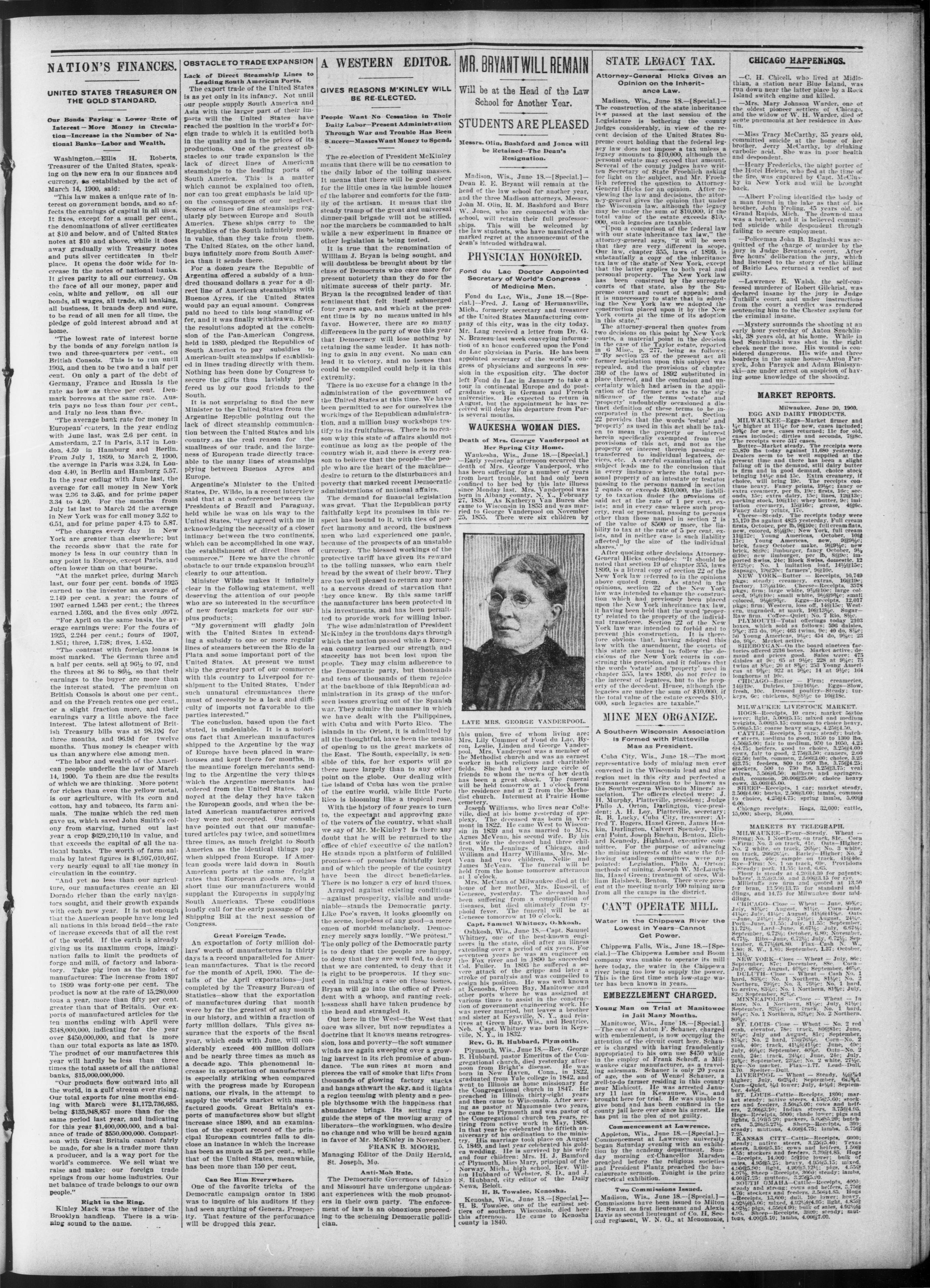
LATE MRS. GEORGE VANDERPOOL.
this union, five of whom living are: Mrs. Lily Cummer of Fond du Lac, Byron, Leslie, Linden and George Vanderpool. Mrs. Vanderpool was a member of the Methodist church and was an earnest worker in both religious and charitable fields. She had a very large circle of friends to whom the news of her death has been a great shock. The funeral will be held tomorrow at 1 o'clock from the residence and at 2 from the Methodist church. Interment at Prairie Home cemetery.
Joseph Williams, who lives near Colisville, died at his home yesterday of apoplexy. The deceased was born in Vermont in 1822. He came West to Wisconsin in 1839 and was married to Mrs. Agnes McVean, his second wife. By his first wife the deceased had three children, Mrs. Jennings of Chicago, and William and Harry Williams, Mrs. McVean had two children, Nellie and James McVean. The funeral will be held from the house tomorrow afternoon at 1 o'clock. Mrs. McCann of Milwaukee died at the home of her mother, Mrs. Russell, of Genesee, yesterday. The deceased had been suffering from a complication of diseases, but died ultimately from typhoid fever. The funeral will be at Genesee tomorrow at 10 o'clock.
Capt. Samuel Whitney, Oshkosh.
Oshkosh, Wis., June 18.—Capt. Samuel Whitney, one of the best-known engineers in the state, died after an illness extending over a period of six years. For seventeen years he was an engineer on the Fox river and in 1890 he succeeded Col. Fuller. In 1893 he suffered a severe attack of the gripe and later a stroke of paralysis and was compelled to resign his position. He was well known at Kenosha, Green Bay, Manitowoc and other ports where he was assigned at various times to assist in the construction of government engineering work. He was never married, but leaves a brother and sister at Keysville, N. Y., and relatives at Green Bay, Wis., and Beatrice, Neb. Capt. Whitney was born in Keysville, N. Y., in 1832.
Rey, G. B. Hubbard, Plymouth.
Plymouth, Wis., June 18.—Rev. George B. Hubbard, pastor Emeritus of the Congregational church, died yesterday afternoon from Bright's disease. He was born in New Haven, Conn., in 1822, graduated from Yale college in 1842, and went to Illinois as home missionary for the Congregational church in 1847. He preached in Illinois thirty-eight years and then came to Wisconsin. After serving as pastor at Mazomanie two years, he came to Plymouth and was pastor of the Congregational church ten years, retiring from active work in May, 1898. In that year he celebrated the fiftieth anniversary of his ordination to the ministry. His marriage took place on August 5, 1849, and last year celebrated his golden wedding. He is survived by his wife and four children: Mrs. H. J. Bamford of Plymouth, Miss Mary, principal of the Norway, Mich., high school. Rev. William Hubbard of Webster, S. D., and J. S. Hubbard, city editor of the Daily News. Beloit.
H. B. Towalec, Kenosha.
Kenosha, Wis., June 18.—[Special]—H. B. Towslee, one of the earliest settlers of southern Wisconsin, died here this afternoon. He came to Kenosha county in 1840.
STATE LEGACY TAX.
Attorney-General Hicks Gives an Opinion on the Inheritance Law.
Madison, Wis., June 18.—[Special.]—The construction of the state inheritance law passed at the last session of the Legislature is bothering the county judges considerably, in view of the recent decision of the United States Supreme court holding that the federal legacy law does not impose a tax unless a legacy amounts to $10,000, although the personal estate may exceed that amount. Several of the county judges have written Secretary of State Froehlich asking for light on the subject, and Mr. Froehlich referred the question to Attorney-General Hicks for an opinion. After reviewing the law and decisions, the attorney-general gives the opinion that under the Wisconsin law, although the legacy may be under the sum of $10,000, if the total value of the estate exceeds $10,000, such legacies are taxable.
"Upon a comparison of the federal law with our state inheritance tax law," the attorney-general says, "it will be seen that they are very different in scope. Our law, chapter 355, laws of 1899, is substantially a copy of the inheritance tax law of the state of New York, except that the latter applies to both real and personal property. The New York law has been construed by the surrogate courts of that state, also by the Supreme court and court of appeals; and it is unnecessary to state that in adopting the New York law we adopted the construction placed upon it by the New York courts at the time of its adoption in this state."
The attorney-general then quotes from two decisions on this point by New York courts, a material point in the decision in the case of the Taylor estate, reported in 6 Misc., p. 277, being as follows: "By section 23 of the present act all former legislation upon this subject was repealed, and the provisions of chapter 390 of the laws of 1892 substituted in place thereof, and the confusion and uncertainty which had arisen in the application of the former acts as to the significance of the terms 'estate' and 'property' undoubtedly occasioned a distinct definition of these terms to be incorporated in the present act. Section 22 provides that the words 'estate' and 'property' as used in this act shall be taken to mean the property or interest herein specifically exempted from the provisions of this act, and not as the property or interest therein passing or transferred to individual legatees, devices, etc. A careful examination of this subject leads me to the conclusion that in every instance where the total personal property of an intestate or testator passing to the persons named in section 2 equals or exceeds $10,000, the liability to taxation under the provisions of said act at the rate of 1 per cent. exists; and in every case where such property, real or personal, passing to persons other than those named in section 2 is of the value of $500 or more, the liability to tax at the rate of 5 per cent. exists, and in neither case is such liability affected by the size of the individual shares."
After quoting other decisions Attorney-General Hicks concludes: "It should be noted that section 19 of chapter 355, laws 1899, is a literal copy of section 22 of the New York law referred to in the opinions above quoted from. As stated in the opinions, section 22 of the New York law was intended to change the construction which had previously been placed upon the New York inheritance tax law, it having been held that the word 'property' related to the property of the individual transferee. Section 22 of the New York law was intended to forbid and to prevent this construction. It is therefore obvious that, having adopted this law with the amendment, the courts of this state are bound to follow the decisions of the New York courts in construing this provision, and it follows that the words 'estate' and 'property' used in chapter 355, laws 1899, do not refer to the interest of legatees, but to the property of the decedent. Hence, although the legacies are under the sum of $10,000, if the total value of the estate exceeds $10,000, such legacies are taxable."
MINE MEN ORGANIZE.
A Southern Wisconsin Association is Formed with Platteville Man as President.
Cuba City, Wis., June 18.—The most representative body of mining men ever convened in the Wisconsin lead and zinc region met in this city and perfected a permanent organization to be known as the Southwestern Wisconsin Miners' association. The officers elected were: J. H. Murphy, Platteville, president; Judge Philo A. Orton, Darlington, vice-president; A. H. Loy, Platteville, secretary; R. B. Lucky, Cuba City, treasurer; Alfred T. Rogers, Hazel Green, James Hoskin, Darlington, Calvert Spensley, Mineral Point, Joseph Buchau, Benton, Richard Kennedy, Highland, executive committee. For the purpose of advancing the mining interests of the state the following standing committees were appointed: Legislation, Philo A. Orton; methods of mining, Joseph W. McLaughlin, Hazel Green; treatment of ores, William Raisbeck, Benton. There were present at the meeting nearly 100 mining men from all the camps in the district.
CAN'T OPERATE MILL.
Water in the Chippewa River the Lowest in Years-Cannot Get Power.
Chippewa Falls, Wis., June 18.—[Special.]—The Chippewa Lumber and Boom company was unable to operate its mill here today, the water in the Chippewa river being too low to supply the power. This is the first time such low-stage water has been known in years.
EMBEZZLEMENT CHARGED.
Young Man on Trial at Manitowoc in Jail Many Months.
Manitowoc, Wis., June 18.—[Special.]
The case of Anton F. Schauer, charged with embezzlement, is now occupying the attention of the circuit court here. Schauer is charged with having fraudulently appropriated to his own use $450 while in the employ of Frank Schroff, a Milwaukee cigar manufacturer, as a traveling salesman. Schauer is only 20 years of age, the son of Wenzel Schauer, a well-to-do farmer residing in this county near Mishicott. He was arrested January 11 last in Kewaunee, Wis., and brought here for trial. He was unable to give bond and has been confined in the county jail here ever since his arrest. He has put in the plea of not guilty.
Commencement at Lawrence.
Appleton, Wis., June 18.—[Special.]—Commencement at Lawrence university began Saturday evening with an exhibition by the academy department. Sunday morning ex-Chancellor Marsden preached before the religious societies and President Plantz preached the baccalaureate sermon. Tonight is the prize rhetorical exhibition.
Two Commissions Issued.
Madison, Wis., June 18.—[Special.]—Commissions have been issued to Milton H. Swant as first lieutenant and Alexis Davis as second lieutenant of Co. H, Second regiment, W. N. G., at Menomonie,
CHICAGO HAPPENINGS.
—C. H. Chicell, who lived at Midlothian, a station near Blue Island, was run down near the latter place by a Rock Island switch engine and killed.
—Mrs. Mary Johnson Warder, one of the oldest pioneer settlers of Chicago, and the widow of W. H. Warder, died of acute pneumonia at her residence in Austin.
—Miss Tracy McCarthy, 35 years old, committed suicide at the home of her brother, Jerry McCarthy, by drinking carbolic acid. She was in poor health and despondent.
—Henry Fredericks, the night porter of the Hotel Helene, who fled at the time of the fire, was captured by Capt. McClusky in New York and will be brought back.
Albert Froling identified the body of a man found in the lake as that of his brother, John Froling, 45 years old, of Grand Rapids, Mich. The drowned man was a barber, and it is believed committed suicide while despondent through failing to secure employment.
Policeman John B. Baginski was acquitted of the charge of murder by the jury in Judge Brentano's court. After five hours' deliberation the jury, which had listened to the story of the killing of Bairio Leo, returned a verdict of not guilty.
Lawrence E. Walsh, the self-confessed murderer of Robert Gilchrist, was declared insane by the jury in Judge Tuthill's court, and under instructions from the court a verdict was rendered sentencing him to the Chester asylum for the criminal insane.
Mystery surrounds the shooting at an early hour yesterday of Anton Szuchlinski, 38 years old, at his home. While in bed Szuchlinski was shot in the right cheek near the nose. His wound is considered dangerous. His wife and three boarders in the same house—Anton Parzyck, John Parzyck and Adam Biniszynski—are under arrest on suspicion of having some knowledge of the shooting.
MARKET REPORTS
MILWAUKEE—Eggs—Market firmer and $1\frac{1}{4}$ higher at $11\frac{1}{4}$ for new, cases included; $10\frac{1}{4}$ for new, cases returned; $11\frac{1}{4}$ for old, cases included; dirties and seconds, $7@8\c$.
The receipts were 517 cases.
Butter—Market steady. The receipts were 35,870 lbs today against 11,680 yesterday.
Dealers seem to be well supplied at the present time and there has been a slight falling off in the demand, still dairy butter is firm and in good demand, choice stock bringing $14\frac{1}{4}$ c and 15c. Extra creamery, if choice, will bring 19c. The receipts continue heavy. Fancy prints, $19\frac{1}{4}$; fancy or extra creamery, per lb, 19c; firsts, 16c; seconds, 15c; extra dairy, 15c; lines, $12@13c; packing stock, $10@11c; whey butter, 9c; imitation creamery, $15@16c; grease, $4@6c.
Fancy dairy prints, 17c.
Cheese—Steady. The receipts today were 15,170 lbs against 4825 yesterday. Full cream firsts, October, per lb, 9@10c; full cream flats, new, colored, 8½@9c; New York, full cream 11@12c; Young Americas, October, 10@11c; Young Americas, new, 9@9c; brick, fancy October make, 9@9c; new brick, 8@9c; limburger, fancy October, 9½@10c; new limburger, per lb, 8@9c; imported Swiss, 24c; Block Swiss, domestic, 12@12½c; No. 1 imitation loaf, 14½@15c; Sapsago, 19@20c; farmers', 9@10c.
NEW YORK—BUTter — Receipts, 10,749 pkgs; steady; creamery, extras, 10@19c; factory, 13½@16c. Cheese—Receipts, 3578 pkgs; firm; large white, 9½@10c; large colored, 9½@10c; small white, 9½@9c; small colored, 9½@9½c. Eggs—Receipts, 12,017 pkgs; firm; Western, loss off, 14@15c; Western, ungraded, at mark, 10@13½c. Sugar—Raw firm. Coffee—Quiet. No, 7 Rio, 8½c.
PLYMOUTH—Total offerings today 2103 boxes, which sold as follows: 596 daisies, 9½c; 373 do, 9½c; 463 twins, 9c; 40 do, 8½c; 50 Young Americas, 9½c; 454 do, 9½c; 23 do, 9½c. Market active.
SHEBOYGAN-On the board nineteen factories offered 2216 boxes. Market active; demand and prices good. Sales were: 475 dalies at 9c; 65 at 9½c; 228 at 9½c; 75 twins at 8½c; 20 at 8½c; 253 Young Americas at 9½c; 922 at 9½c; 14 at 9½c; 164 longhorns at 10c.
CHICAGO—Butter — Firm; creameries, 14@19c. Dairies, 13@16½c. Eggs—Slow, fresh, 10c. Dressed poultry—Steady; turkeys, 6c; chickens, 8@8½c to 16@18c.
MILWAUKEE LIVESTOCK MARKET.
HOGS—Receipts, 10 cars; market 5@10c lower; light, 5.00@5.15; mixed and medium weights, 5.00@5.15; common to choice heavy, 5.00@5.15; coarse heavy stags, 4.25@4.50.
CATTLE—Receipts, 5 cars; steady; butcher steers, medium to good, 1050 to 1300 lbs, 4.50@5.00; fair to medium, 950 to 1050, 4.25@4.75; heifers, good to choice, 3.25@4.00; cows, fair to good, 2.75@3.50; canners, 2.00@2.50; bulls, common, 2.50@3.00; choice, 3.25@3.75; feeders, 800 to 950 lbs, 3.75@4.25; stockers, 500 to 750 lbs, 3.25@3.75; veal calves, 5.50@6.50; milkers and springers, dull, common, 20.00@25.00; choice heavy cows, 35.00@45.00.
SHEEP—Receipts, 1 car; market steady, 3.50@4.00; bucks, 2.50@3.00; lambs, common to choice, 4.25@4.75; spring lambs, 5.00@6.00.
Chicago receipts: Hogs, 32,000; cattle, 15,000; sheep, 16,000.
MARKETS BY TELEGRAPH.
MILWAUKEE—Flour—Steady — Wheat —
Strong; No. 1 Northern, on track, 81c, Corn
— Firm; No. 3 on track, 41c, Oats—Higher;
No. 2 white, on track, 26%c, No. 3 white,
on track, 26%c, Barley—Higher; No. 2
on track, 46c, sample on track, 41%c, Rye—Firm; No. 1 on track, 60c, Provisions
— Steady; pork, 11.55; bard, 6.65.
Flour is steady at 4.20%@4.30 for patents;
bakers', 3.25%@3.30, and 3.00%@3.15 for rye.
Milstuffs are firm and quoted at 13.50
for bran, 13.50%@13.75 for standard
middlings, and 14.75 for Milwaukee flour
middlings.
CHICAGO—Close — Wheat — June, 80%c;
July, 81%c; August, 81%c; Corn—June,
41%c; July, 41%c; August, 41%c@41%c; Oats
— June, 24%c; July, 24%c; August, 24%c;
Pork—June, 11.55; July, 11.55; September,
11.72%; Lard—June, 6.67%; July, 6.67%;
September, 6.72%; October, 6.80; November,
6.77%; Ribs—June, 6.72%; July, 6.72%; Sept-
ber, 6.77%@6.80. Flax—Cash N. W.,
1.80; S. W., 1.80; September, 1.37; October,
1.31%
NEW YORK—Close — Wheat — July, 86c;
September, 87c; December, 88c; Corn—
July, 46%c; August, 46%c; September, 46%c.
DULUTH—Close — Wheat — Cash No. 1
hard, 83%c; No. 1 Northern, 81%c; No. 2
Northern, 79%c; No. 3, 79%c; No. 1 hard,
to arrive, 83%c; No. 1 Northern, 81%c; July,
82c; September, 82%c.
MINNEAPOLIS—Close — Wheat — In
store, No. 1 Northern, 81%c; July, 81%c;
September, 82%c; on track, No. 1 hard,
84%c; No. 1 Northern, 82%c; No. 2 Northern,
80%c.
ST. LOUIS—Close — Wheat — No. 2 red
cash, elevator, 78c; track, 80@81c; June,
80%c; July and August, 81c; September,
81%c; No. 2 hard, 75@76%c. Corn—No. 2
cash, 40c; track, 41%@41%c; June, 40c;
July, 40%c; September, 40%c; Oats—No. 2
cash, 24c; track, 24%c; June, 24c; July,
24%c; September, 23%c; No. 2 white, 27%c.
Rye—No market. Flax—1.77. Lead—Dull,
3.70. Speeter—Dull.
LIVERPOOL — Wheat — Steady, 1½%@ higher; July, 6½%@; September, 6½%@; Corn—Quiet, ½% lower; July, 4½%@; September, 4½%@.
ST. LOUIS—Cattle—Receipts, 1800; market steady; native steers, 4.15%@5.60; stockers and feeders, 3.50%@5.00; cows and heifers, 2.00%@5.10; Indian steers, 3.75%@4.05; Hogs—Receipts, 5000; shade lower; pigs and lights, 5.15%@5.20; packers, 5.05%@5.20; butchers, 5.20%@5.27%; Sheep—Receipts, 309; steady; muttons, 4.00%@4.75; lambs, 5.75%@7.25.
KANSAS CITY—Cattle—Receipts, 6000; steady; native steers, 3.25%@5.40; Texas steers, 3.60%@5.15; cows and heifers, 1.50%@4.53; stockers and feeders, 3.30%@4.85; Hogs—Receipts, 14,000; 5½%@100 lower; bulk of sales, 4.95%@5.25; heavy, 4.95%@5.15; mixed, 4.90%@5.90; light, 4.90%@5.12%; pigs, 4.55%@4.97%; Sheep—Receipts, 2000; steady; lambs, 4.00%@7.25; muttons, 3.25%@5.40.
SOUTH GMAHA—Cattle-Receipts, 4090;
steady and strong; cows and heifers, 3.75@
4.70; stockers and feeders, 2.50@4.85; Hogs
-Receipts, 13,600; low 10. eore lower; heavy,
4.92@5.00; mixed, 4.92@4.95; light, 4.85@
4.92@; plugs, 4.55@4.90; bulk of sales, 4.92@
4.95. Sheep-Receipts, 3890; steady; mutt-
tons, 4.00@5.10; lambs, 4.00@7.00.
Printed in the Interests of the Negro Race,
MILWAUKEE, WIS.
Richard B. Montgomery.....
.....Editor and Proprietor
Office 200 Fifth Street.
Telephone Black No. 244.
SUBSCRIPTION RATES.
Any part of the United States and Canada, you are paid
postage paid.
One Year ..... $2.00
Six Months ..... 1.25
Three Months ..... .75
Send money by Express Money Order, P. O.
Money Order or Registered Letter to the
Wisconsin Weekly Advocate.
ADVERTISING RATES.
One inch, single insertion..... 25c
One inch, per year..... $9.00
Business locals 5c per line each insertion.
Please see the Advocate
All communications must be sent with the name and address of the sender as an evidence of good faith, but not necessarily for publication. No manuscript returned if not accepted, unless accompanied by stamps.
All subscribers of the Advocate that fail to get their paper promptly will please notify us at once. The Advocate, at 200 Fifth street.
The Wisconsin Weekly Advocate company wishes to notify the public that all contracts and business transactions with this company must have the company stamp, otherwise they will be void. Neither will this company be responsible for paid subscriptions unless given to duly-accredited agents, who, on request, will give the company's receipt for same. Subscribers failing to receive their papers regularly will kindly notify the general office. Address all business communications to the general manager, 200 Fifth street.
Entered at the Milwaukee P. O. as second class matter.
Happy fishermen are now returning from the northern lakes with big fish and bigger stories.
The adulteration of whisky is growing worse every year. The sea serpent which was killed at Atlantic City a few days ago is reported to be only 11½ feet in length.
The irritation between Japan and Corea and the growing trouble in China threaten to give the map-makers a job in the reconstruction of boundaries in Asia, and the definition of "spheres of influence."
When the farmer begins to use the automobile while his plow horses are resting perhaps the good roads movement will be received with less suspicion "out of town." The bicycle riders will be glad to be relieved of a share of the suspicion which rests upon them.
The campaign against the "Boxers" is giving the world a new lesson in geography that will take people's minds from kopjes, spruits, neks, veldts, and the many strange nouns which have bothered humanity for a year past.
Germany announces the invention of a flying machine which on trial shot into the air about sixty feet, and dropped down again after it had gone less than fifty feet. This may be flying, but it is more like the antics of a kernel of corn in a popper.
In securing a postponement until October of the hearing before the New York Court of Appeals, counsel for Roland S. Molineux has prolonged the "breathing spell" for his client, and incidentally lengthened his own time for registering items of compensation. The law's delays are expensive to clients as well as to the state.
The board of county commissioners of Wichita county, Kas., has just abolished the poorhouse, there being no more paupers in the county. One old soldier is the only dependent person in the county, and he is being cared for by popular subscription, so the county can have the name of being pauperless. Ten years ago there were 500 paupers in Wichita county, but the crops have been so large since then that everybody has made plenty of money. No tramps allowed in the county. They must work or leave.
The motor car which is being manufactured by a Coventry firm for the Prince of Wales will rank as the smartest vehicle of its kind yet seen in England. The body is of the phaeton type, with a hood, and the finish of the car is to be in keeping with the rest of the prince's carriages. It is stated that his royal highness has already received lessons in the art of autocar driving, and is looking forward with much interest to some pleasant journeys in the new vehicle.
The brook-trout growers of Pennsylvania are all doing a large business this year. One establishment in Carbon county has been averaging shipments of 200 pounds of trout per day, and has made a shipment of 800 pounds in a day, but even this does not represent the full capacity of the ponds, and not less than a ton of fish could be supplied in a single day. Such results as this indicate that at some early day brook trout will not be the expensive luxury that it has been. In fact, the cost for a trout breakfast is much below what it was a few years ago.
A recent rearrangement of relics in the Agricultural museum of the University of Illinois brought to light the old ex yoke made by Abraham Lincoln and presented to the university in the early '70s. By order of President Draper the yoke was inclosed in a glass-topped case, made of boards from the old Lincoln home at Springfield. The yoke was made by Lincoln when he was on a farm near Decatur. For several years it was in service about the Lincoln homestead. The yoke is of black walnut, and shows evidence of hard usage. The workmanship is rough. the iron parts being especially erude, indicating that they were made at a country blacksmith shop.
Great Britain is have a new Great Seal, the fourth that has been made during Victoria's reign. The first, engraved almost immediately after the Queen's accession, was in use from 1838 to 1860; the second lasted from 1860 to 1878, and the third from the latter year till the present time, when it will be superseded by the new one, which, however, must, in accordance with established precedent, first be placed upon the table at a meeting of the privy council and formally ap-
proved by the sovereign's touch before being delivered to the lord chancellor. At the same time the old seal is slightly defaced and handed back to the same high officer, as one of his perquisites. The seal is kept in a highly-ornate purse, which is renewed every year.
The new entrance to the Charlestown navy-yard, Boston, for which Congress last year appropriated $30,000, will take the form of a "navy" arch, and will commemorate the deeds of naval heroes. It will be built of either limestone or granite, and will be three stories in height, forming an entrance on either side, extending up to the full height of the second story, while the third story will extend directly across. This will give the effect of a mammoth arch, while every inch of the interior space will be utilized for the necessary purposes. The architectural design is simple. In the panels of the stones forming the outer surface and also the side of the arch will be the names of the heroes of our various wars. The interior will be used for the guard, with sleeping rooms, messrooms and other facilities, and it will form a useful as well as ornamental structure.
In a communication made to the Societe d'Ethnographie by M. Verrier, the question of the origin of the Boers has been considered. It appears that in 1652 Van Biebeck was sent by the Dutch East India company to found a supply station at the Cape, which then changed its name from the Cape of Tempests to that of Good Hope. In 1680, there were at the Cape 600 whites of Dutch origin. When, in 1685, Louis XIV. revoked the edict of Nantes, 300 French families demanded the hospitality of the East India company; they were sent to the Cape, where they were well received by the colonists and supplied with land and stock. They became incorporated into the colony and the Dutch language was employed exclusively. The present Boers are descendants of this colony, spreading over the territory of the Cape, Natal, Orange Free State and Transvaal.
Representatives of thirty-five counties assembled at Topeka, Kas., last week, and organized for the purpose of holding a semi-centennial celebration in 1904 of the admission of the territory of Kansas into the Union. Gov. Stanley presided. It was decided to form a state association, composed of twenty-four members, three from each congressional district and three at large, the association to be chartered and to have the entire management of the proposed celebration, which will probably be held at Topeka. The resolutions conclude as follows: "We believe that an exhibition, such as this convention contemplates, will be of lasting benefit to Kansas. It will put us in closer touch with other states; it will bring us many visitors from abroad; it will add to our citizenship, because it will provide a truthful exhibit of our advantages. It will arouse state pride and secure a proper appreciation on the part of our own citizens of the great possibilities of our commonwealth."
The annual feast of roses was celebrated on Sunday, June 10, in the quaint old town of Manheim, Pa. It commemorates an act in the life of Baron William Henry Stiegel, that the people of Manheim, and especially the members of the Zion Lutheran church, have cause to hold in grateful remembrance. It was in 1772 that Stiegel executed a deed, the original of which is still in the possession of the officers. The time-stained parchment, signed with the names of Henry William Stiegel and Elizabeth, his wife, conveys to the trustees of the congregation a tract of land covering several acres, as a site for a church building. The consideration exacted was an annual rental of one red rose in the month of June, when the same shall be lawfully demanded. Only twice was this modest rental demanded, the generous baron's financial misfortunes following soon after his valuable gift. The stipulations in the deed lapsed until 1891, when this annual feast was revived by Dr. J. H. Sieling, a local historian, who happened to discover the clause of the deed, and since then it has been annually paid to some descendant of the baron, the exercises annually increasing in interest until now, when it is widespread.
The statement of fire losses in the United States and Canada for the month of May, 1900, is swelled to the extent of $300,000 by the inclusion of the damage done by forest fires in the vicinity of Rat Portage, Ont. This recalls the remark of a shrewd and independent thinker, who said: "Statistics are like veal pies, and I don't care a darn for either till I have learned the name of the old woman who made them." Certain it is that the insurance companies can view with perfect equanimity the destruction caused by forest fires—especially if it is footed into the total of the fire-loss, to create an impression favorable to the idea that we are burning up faster than ever, and that there is no escape from the necessity of once more raising the rates. The fire loss for May was $15,759,400, which is six and a half millions in excess of the May loss of last year. Following is the aggregate for the first five months of 1900, compared with the corresponding period of each of the two preceding years. It would be startling, even were forest fire estimates omitted:
1900 ..... $82,017,900
1899 ..... 58,984,900
1898 ..... 49,030,200
FOUNTAIN OF SAND.
Well on a Michigan Farm Discharges Sand Instead of Water.
The flowing well at Frank Fowler's farm near Bear lake is, a little different from anything of the sort ever seen around Manistee, Mich. It is spitting out sand and gravel which indicates a tremendous pressure near the bottom. The strange part of it is that no water has appeared yet. For several days it has been spouting a stream of fine dry sand, which rises like a fountain and is scattered about by the wind.
The boring is now about 110 feet deep. For the first eighty feet the drill went through sandy drift and, then pierced a stratum of clay. The fine dry sand was struck beneath the clay. It is expected that a vein of water will eventually find escape through the tube. At present the drill men are waiting for this result.
The Richmond locomotive works has shipped a second consignment of nine tenwheel passenger locomotives with six-wheel tenders by the Wilson line to Helsingfors, Eng.
But they ain't a-doin' anything at jes' the present time."
-Roy Farrell Greene in Detroit Free Press.
MRS. M'CLURE'S STOVE
MRS. M'CLURE'S STOVE
Tim McClure was foreman of the Paso del Norte roundhouse. He was also the breadwinner of a family in which there were several mouths to fill. The family had remained in the East when Tim started for Mexico in search of employment, but now that his ability and faithfulness had been rewarded by rapid promotion from fireman to engineer and thence to foreman of the roundhouse he was receiving a monthly stipend that would enable him to establish his household in Paso del Norte.
He had never taken kindly to sleeping on the hard earth floor of a bare adobe house; nor could he eat with a relish the food served by the immobile faced Wah Kee, who conducted the fashionable restaurant of the place, and he longed with the longing of a homesick schoolboy for the coming of the time when a well-cooked supper and comfortable bed would await him at the end of a day's work. And so when he converted his first month's pay as foreman into a money order, wherewith his wife should defray the expenses of the family's transportation to Paso del Norte, a thrill of anticipatory pleasure ran from the roots of his hair to the tips of his toes.
The family arrived in due course of time, and Tim proudly headed the procession that wended its way from the depot to the adobe house he had prepared for its domiciliation. He had furnished the house as luxuriously and artistically as his purse and taste would permit, but he had been able to accomplish but little, if viewed from the standpoint of the average American woman, and Mrs. McClure was one of these.
Her disappointment was keen; nevertheless she made a brave effort to stifle her feelings, and succeeded fairly well in doing so until, in her inspection of the premises, she arrived in the kitchen. There the tiny sheet-iron camp-stove and the meager array of culinary vessels that met her view caused her utter collapse.
"O. Tim, Tim!" she gasped, "how ever will I get enough cooked for the children on that—that toy?"
"It isn't much of a stove," Tim admitted, stroking his chin ruefully, "but it is the best that money would buy in Paso del Norte. You know, my dear, cooking stoves are little used in Mexico." "Well, why on earth did you not order one sent from St. Louis?" rejoined Mrs. McClure. "Such a stove as you are accustomed to would cost $100 to put it in the house." "A hundred dollars!" snapped Mrs. McClure, contemptuously. "Why, Tim, you can get an elegant stove and all its furniture for only $30." "In St. Louis, but not here," replied Tim. "But say the stove, laid down in El Paso, Texas, just across the river, would cost not more than $40, it would cost $60 more to get it brought over here."
"What!" gasped Mrs. McClure. "Sixty dollars to move a stove one mile! Tim McClure, have you lost your senses?"
"No, my dear, not quite, I hope," Tim replied humbly. "But you do not seem to know that an import duty must be paid on everything brought into Mexico, and on stoves the rate is about 150 per cent. of their value."
It required a lengthy explanation of the tariff question and his most solemn assurances to persuade her that he was not jesting.
"Why, Tim!" she exclaimed, when he had finished, "it's an outrage, and no better than highway robbery. Can't we have the stove hauled across the river some night, and the customs officers know nothing about it? It seems to me that we could, and we don't care whether the government of Mexico has any money or not."
It was not a sense of the moral wrong of smuggling that caused Tim to hesitate, for he was no novice in the art of clandestinely introducing articles of merchandise into the cactus republic, but he knew that the entire frontier was patrolled night and day by a numerous and vigilant customs guard, past whom it would be all but impossible to smuggle so cumbersome a thing as a stove.
He finally hit upon the plan of taking the stove apart and lowering it, piece by piece, into the tank of "El Buey," the sturdy switch engine, on some occasion when it would be on the Texas side of the river. But upon obtaining the dimensions of the stove Mrs. MeClure wanted he found that the larger parts would not pass in at the manhole.
He would have given up in despair had not his better half kept the subject fresh in his mind, not only with words, but with the poor quality of the meals she set before him as well.
As a last resort he decided to confer with some of his friends—those most adept at eluding the vigilance of the customs guard. At his request the men he selected gathered in his office one morning, a conference that lasted an hour or more followed, every face was smilingly confident when it was concluded.
"The scheme'll win, Tim, never fear," cried one of the party. "The guards think they're getting mighty smart, and so they are; they've caught on to nearly al the old tricks, but they'll never suspect this one. Just make a bold play and bring over the stove in broad daylight, right under their noses, and they'll never see it."
The stove was at once ordered, and when it arrived in El Paso the car in which it came was switched, at Tim's request, to the connecting track, there to await the unloading of the stove. Along in the afternoon of that day the switch engine, with Tim standing on the forward footboard, went scurrying across the river. It was gone but a short time, and when it returned it was observed by those of the railroaders who were idling
DOWAGER EMPRESS OF GERMANY WILL MAKE HER HOME IN ENGLAND.
THE LADY OF THE MUSIC
The Empress Frederick is about to take possession of White Lodge, the royal residence in Richmond Park which so long was occupied by the Duke and Duchess of Teck and their family. Now the Queen has lent the property to her eldest daughter, the mother of the German Emperor, and it is supposed that the Empress Frederick hereafter will make her permanent home there, forsaking her German castle except for short visits. The Duke of Teck's daughter, the Duchess of York, has not yet recovered from her deep annoyance at the fate of White Lodge. She twice went to Windsor to ask the Queen for the use of the favorite home of her parents. But the Queen did not like the high tone in which her granddaughter-in-law, asked for a residence they both valued too highly perhaps. It was accordingly the more annoying to the duchess to find the house given to the Dowager Empress of Germany, because she was the only one of the daughters of the Queen who opposed the marriage of the Duke of York. The duchess has never forgiven her aunt. Before the Empress Frederick enters
about the yard that there was something queer in its appearance. Standing on the truck platform of the engine, just in front of the boiler, was a dark object that seemed to be a part of the engine; within it a fire was burning fiercely, and from its slender pipe which passed up along the engine's smokestack a roll of black smoke was pouring out and mingling with that of the engine, to all appearances emanating from a single chimney.
When the engine had reached the customhouse track it came to a standstill, and the guards, who were always swarming at that point, gravely and somewhat perfunctorily examined it for articles of durable character. They discovered nothing, in spite of the united snicker of the Americans who witnessed the scene, and the engine was allowed to proceed to the roundhouse, where it was received with a wild hurrah by the railroaders, who had gathered there to welcome it.
It of course became known within a short time after the episode that some splendid flapjacks were turned out every Sunday morning at McClure's, but the customs officials simply scratched their shaggy heads and said nothing.—San Francisco Traveler.
PROTECTING SONGBIRDS.
Switzerland is Exerting Itself to Prevent Their Extermination.
Switzerland has not many feathered songsters, but those that do exist are carefully protected, not only by law, but by the fostering care of the people, particularly the German-speaking people of Switzerland.
As the seasons come and go the Swiss birds make their pilgrimage south, and in going and returning across the land of northern Italy and the Swiss canton of Tessin they are mercilessly pursued by hunters of all ages and all classes. On the Lake of Maggiore it is estimated that at least 60,000 of the feathered songsters are trapped or killed every year, and in the region round about Bergamo, Verona, Chiavena and Brescia many millions are indiscriminately slaughtered to satisfy the demand of the tables and of the millinery establishments of the world.
During the past year the border police of Tessin captured and destroyed 13,000 bird traps set to imprison these weary little flyers. Authorities are being urged to take the most rigorous measures to suppress the evil. The criminal courts are having many more bird-law-violation cases than formerly, and bird-catching and killing crimes which in former years were either overlooked or punished only slightly are now dealt with seriously.—Consul-General J. T. Du Bois.
GENEROUS FOEMEN.
How Brave Men Are Often Honored by Their Adversaries. Soult, the Historian Napier tells us, with a noble feeling of regard for Sir John More's valor, raised a monument to his memory. It has been stated that Romana, and not the French marshal, did the graceful act; but the story is too pretty to spoil.
Lord Methuen has repaid the act in a graceful manner, which our gallant but fractious neighbors across the channel will appreciate keenly. On the stone which has been erected at the expense of the commander of the Kimberley force it is recorded that Count de Villebois-Mareuil, colonoel of the Foreign legion and general of the Transvaal, died on the field of honor. The count left as a charge in his will that if he was killed his body should be buried where he fell, and not removed to France. Knowing well and honoring Englishmen as he did, though he died fighting against us, he felt he could trust what was left of him in the hands of our soldiers, and his trust has not been in vain.—London Telegraph. Cow in a Chemist's Shop.
At Jarrow, England, the other day a sensible kind of cow entered a chemist's shop. It examined itself in a large mirror and gave a satisfied whisk of its tail. That whisk was the only misfortune, for it swept into the floor several samples of the bottles of stuff which usually decorate a chemist's counter. Then it walked out very peaceably.
American Competition.
The bulk of our exports, or over 76 per cent., go to Europe, and we are increasing of late years our exports to all parts of the world. So keenly is competition from this country being felt that we are beginning to hear propositions for the formation of a Continental European Zollverein to guard against American competition.—International Monthly.
into possession of the White Lodge in Richmond park the whole of the house will have been redecorated and thoroughly repaired inside and out. Certain alterations will also be made, and the stabling accommodation enlarged. The peculiar shape of the building, with its long corridors, makes it a somewhat straggling place of residence, and when the Duke and Duchess of Teck occupied the lodge with their family this architectural feature was in keeping with the English country life of Princess Mary, her husband and her children. But when the Empress Frederick goes into the residence it will be found that her majesty's personal suite of apartments has been confined to the right wing. It is not generally known that the Empress Frederick has a suite of rooms of her own at Buckingham palace, which is always in readiness for her occupation. Many of her favorite pictures and pieces of bric-a-brac will be moved from London to Richmond. There is no finer judge of old china than the Empress, and, as a well-known dealer said the other day, "Her majesty has often taught me something new about my own trade."
PHYSICAL TRAINING.
Proper Development of School Children by Methodical Exercises.
In the training of the child he is not to be regarded as a little man, but as an epitome of the race. His mental attributes are. life expressed in consciousness, affection, will and intellect; and as these attributes have developed in the order of their evolution through the dim ages of the childhood of the race, so they develop in the child, says Bertha Louise Colburn in Werner's Magazine. There is first life, shown in activity; then the instincts or emotions are developed; then the power of choice, of decision, and finally the reasoning powers. The history of the arts shows the same order of evolution. The first period was that of life, the whole; the next step was attraction, the striving after effect through the parts of the whole; then the will exercised the power of selection, and showed the use of the parts to the whole; and, finally, the intellect perceived the relation of the parts to one another, and the suggestive period was reached.
Physical culture must be based upon these natural laws of evolution. Hence the exercises of each lesson are divided into four parts, which expresses the four attributes of the mind, and correspond to the four periods of development in art. The first part, which corresponds to the colossal period in art is exercise of whole body; it includes position and posing. The second, which corresponds to the effective period, is exercise of the parts: it includes movements for the feet and legs, hands and arms, trunk and neck. The third, which corresponds to the realistic or useful period, is exercise of the parts with special reference to their effect upon the whole; it includes reaching, respiratory and arm-swerving movements. The fourth, which corresponds to the suggestive period, is the exercise of the parts with reference to their effect upon one another; it includes floating movements.
This arrangement follows also the well-known law that all exercise must proceed from gentle to strong, and from strong back to less vigorous movement.
WATER FROM SUN'S RAYS.
A Heat-Producing Device Used to Reclaim Desert Lands.
Several machines have been invented for making the heat of the sun produce steam or electric power, but a Washington man is the first to turn such a device to practical use.
William Calver is now about to set up one of his sun-power machines in Arizona, near Phoenix, and dig wells in the desert. His plan is to make the intense heat of that hottest part of the United States develop the power to pump up water enough to irrigate all the barren land.
Mr. Calver's machine consists of a set of big mirrors and lenses, by which he focuses the sun's rays as a boy does with a burning-glass. The heat which can be generated by Mr. Calver's machine is said to be equal to a furnace for a 500 horse-power boiler.
With such a power as this available wherever one sees fit to set up his plant, it is easy to see how well drilling and water pumping can be done on a large scale. Geologists have found in recent years that our southwestern deserts have almost numberless subterranean streams flowing at depths varying from 25 to 250 feet below the dry, parched surface of the earth. So there need be no lack of water if the borings are intelligently directed.
Don't You Know
The best material for the coak of friendship?
The size of the shoe that would fit the foot of a mountain?
The kind of a collar that ought to be worn on the neck of land?
The musician who can put new strings in the harp of memory?
The dressmaker who would be willing to trim the skirts of chance?
The dentist who would undertake to put teeth in the mouth of a river?
The manicure who is capable of treating the finger of fate?
The photographer who could take a picture of the face of Providence?—Philadelphia Bulletin.
—Miners employed at New Pass, Lander county, Nev., light fires nightly on the mountain peaks to notify their families that all is well at the mines.
FOR RENT—Furnished rooms 31' Vict Street. 1st flat. Morning before 10; evening after 7.
FOR SALE—REAL ESTATE.
$2 DOWN.
$2 PER WEEK.
NO INTEREST.
BUYS A CHOICE LOT IN TIPPECANOE ADDITION.
A FINE level piece of property, located on Howell avenue car line a short distance south of Tipppecanoe lake and town hall, only 12 minutes' ride from business center of Bay View, and 25 minutes' ride from center of Milwaukee. Howell avenue is 100 feet wide at this point. Remember that one 5-cent fare will carry you to the property from any part of the city. Complete abstracts of title furnished. Don't forget the terms; $2 cash as first payment; balance $2 per week without interest until the whole of the purchase price is paid. For plats and prices call on or address
CHARLES R. DAVIS.
ROOM 23. SENTINEL BUILDING.
TELEPHONE MAIN 1298. 2851
ST. MARK'S A. M. E. CHURCH
REV. N. KNIGHT, PASTOR.
Local Preacher, Gilbert Hamilton.
Residence, 256 Seventh Street,
MILWAUKEE, WIS.
SERVICES SUNDAY 10:45 and 7:45
SUNDAY SCHOOL 3 P. M.
CHRISTIAN ENDEAVOR 7 P. M.
ALL ARE WELCOME.
W. T. GREEN,
Lawyer,
Notary Public.
Offices 17-18 Birchard Block.
105 Grand Avenue.
Telephone 193 Black.
WHEN IN KENOSHA
CALL ON
MATT GREENWALD
E. KLINKERT'S RACINE KEG and BOTTLED BEER. Depot: No. 15 North Main Street. Telephone 163. KENOSHA - WISCONSIN
MR.1.W. BARTO.
of 511 Wells Street. has opened up a new Bakery and Lunch. Has stocked his store with Choice Goods, Fresh Bread, Rolls, Pies, Cakes and Candies and Choice Family Groceries, Milk and Tobacco and Cigars.
511 WELLS ST.
Don't forget to give him a call.
Phone 405 Black.
Before Starting on Your Travels
CALL ON
Geo. Burroughs & Sons
MANUFACTURERS OF
PREMIUM TRUNKS
VALISES, SAMPLE CASES, Etc.
424 & 426 East Water St., Milwaukee.
Pabst MaltExtract
The Best Tonic
Builds up both the body and nerves; brings refreshing sleep, insures a healthy
appetite, aids digestion and feeds blood, brain and bone It cannot fail to benefit in every case where more strength is required Once tried, you will never take a substitute. AT YOUR DRUGGIST
ABST/MALT EXTRA
The Best Tonk
MALT
HDP
MILWAUKEE, WI
MILWAUKEE BREWING CO.
S. F. PEACOCK & SON
Funeral Directors
AND
EMBALMERS
431 Broadway. MILWAUKEE, WIS.
BEFORE PLACING
FIRE AND BURGLAR ALARMS
in your residence you would do well
to call on
CHAS. D. MILNE Electrical Contractor
And General Repairwork. The best in the city.
Tel. Main 527.
110 MASON ST.
TALMAGES
DR. TALMAGE, who has finished this tour in England and Scotland, where thousands thronged to hear him wheresoever he preached, is now on his way to Norway and Russia, in which countries he is already well known through the publication of translations of his sermons. In the following discourse, which he has sent for publication this week, he gives a prescription for all anxiety and wormiment and illustrates the divine sympathy for all who are in any kind of struggle. The text is Matthew xiv., 12, "And his disciples went and told Jesus."
An outrageous assassination had just taken place. To appease a revengeful woman King Herod ordered the death of that noble, self-sacrificing prophet, John the Baptist. The group of the disciples were thrown into grief and dismay. They felt themselves utterly defenseless. There was no authority to which they could appeal, and yet grief must always find expression. If there be no human ear to hear it, then the agonized soul will cry it aloud to the winds and the woods and the waters. But there was an ear that was willing to listen. There is a tender pathos and at the same time a most admirable picture in the words of my text, "They went and told Jesus." He could understand all their grief, and he immediately soothed it. Our burdens are not more than half so heavy to carry if another shoulder is put under the other end of them. Here we find Christ, his brow shadowed with grief, standing amid the group of disciples, who, with tears and violent gesticulations and wringing of hands and outcry of bereavement, are expressing their woe. Raphael, with his skillful brush putting upon the wall of a palace some scene of sacred story, gave not so skillful a stroke as when the plain hand of the evangelist writes, "They went and told Jesus."
I feel that I bring to you a most appropriate message. I mean to bind up all your griefs into a bundle and set them on fire with a spark from God's altar. The prescription that cured the sorrow of the disciples will cure all your heartaches. I have read that when Godfrey and his army marched out to capture Jerusalem, as they came over the hills, at the first flash of the pinnacles of that beautiful city, the army that had marched in silence lifted a shout that made the earth tremble. Oh, you soldiers of Jesus Christ, marching on toward heaven, I would that to-day, by some gleam from the palace of God's mercy and God's strength, you might be lifted into great rejoicing, and that as the prospect of its peace breaks on your enraptured gaze you might raise one glad hosanna to the Lord!
Disciples' Conduct Commended.
In the first place, I commend the behavior of these disciples to all burdened souls who are unpardoned. There comes a time in almost every man's history when he feels from some source that he has an erring nature. The thought may not have such heft as to fell him. It may be only like the flash in an evening cloud just after a very hot summer day. One man to get rid of that impression will go to prayer, another will stimulate himself by ardent spirits, and another man will dive deeper in secularities. But sometimes a man cannot get rid of these impressions. The fact is, when a man finds out that his eternity is poised upon a perfect uncertainty and that the next moment his foot may slip, he must do something violent to make himself forget where he stands or else fly for refuge.
Some of you crouch under a yoke, and you bite the dust, when this moment you might rise up a crowned conqueror. Driven and perplexed as you have been by sin, go and tell Jesus. To relax the grip of death from your soul and plant your unshackled feet upon the golden throne, Christ let the tortures of the bloody mount transfix him. With the beam of his own cross he will break down the door of your dungeon. From the thorns of his own crown he will pick enough gems to make your brow blaze with eternal victory. In every tear on his wet cheek, in every gash of his side, in every long, blackening mark of laceration from shoulder to shoulder, in the grave shattering, heaven storming death groan, I hear him say, "Him that cometh unto me I will in nowise cast out."
"Oh," but you say, "instead of curing my wound you want to make another wound—namely, that of conviction!" Have you never known a surgeon to come and find a chronic disease and then with sharp caustic burn it all out? So the grave of God comes to the old sore of sin. It has long been rankling there, but by divine grace it is burned out through these fires of conviction, "the flesh coming again as the flesh of a little child," "where sin abounded, grace much more aboundeth." With the 10,000 unpardoned sins of your life, go and tell Jesus.
The Broad Invitation.
You will never get rid of your sins in any other way. And remember that the broad invitation which I extend to you will not always be extended. King Alfred, before modern timepieces were invented, used to divide the day into three parts, eight hours each, and then had three wax candles. By the time the first candle had burned to the socket eight hours had gone, and when the second candle had burned to the socket another eight hours had gone, and when all the three candles were gone out then the day had passed. Oh, that some of us, instead of calculating our days and nights and years by any earthly timepiece, might calculate them by the numbers of opportunities and mercies which are burning down and burning out, never to be re-lighted, lest at last we be amid the foolish virgins who cried, "Our lamps have gone out!"
Again, I commend the behavior of the disciples to all who are tempted. I have heard men in midlife say they had never been led into temptation. If you have
not felt temptation, it is because you have not tried to do right. A man hoppled and handcuffed, as long as he lies quietly, does not test the power of the chain, but when he rises up and with determination resolves to snap the handcuff or break the hopple, then he finds the power of the iron. And there are men who have been for ten and twenty and thirty years bound hand and foot by evil habits who have never felt the power of the chain because they have never tried to break it. It is very easy to go on down with the stream and with the wind lying on your oars, but just turn around and try to go against the wind and the tide, and you will find it is a different matter. As long as we go down the current of our evil habit we seem to get along quite smoothly, but if after awhile we turn around and head the other way, toward Christ and pardon and heaven, oh, then how we have to lay to the oars! You will have your temptation. You have one kind, you another, you another, not one person escaping.
It is all folly for you to say to some one, "I could not be tempted as you are." The lion thinks it is so strange that the fish should be caught with a hook. The fish thinks it is so strange that the lion should be caught with a trap. You see some man with a cold, phlegmatic temperament, and you say, "I suppose that man has not any temptation." Yes, as much as you have. In his phlegmatic nature he has a temptation to indolence and consciousness and overeating and drinking, a temptation to ignore the great work of life, a temptation to lay down an obstacle in the way of all good enterprises. The temperament decides the styles of temptation, but sanguine or lymphatic, you will have temptation. Satan has a grappling hook just fitted for your soul. A man never lives beyond the reach of temptation. You say when a man gets to be 70 or 80 years of age he is safe from satanic assault. You are very much mistaken. A man at 85 years of age has as many temptations as a man at 25. They are only different styles of temptation. Ask the aged Christian whether he is never assaulted of the powers of darkness. If you think you have conquered the power of temptation, you are very much mistaken.
Power of Temptation.
A man who wanted a throne pretended he was very weak and sickly, and if he was elected he would soon be gone. He crawled upon his crutches to the throne, and having attained it he was strong again. He said, "It was well for me while I was looking for the scepter of another that I should stoop, but now that I have found it, why should I stoop any longer?" and he threw away his crutches and was well again. How illustrative of the power of temptation! You think it is a weak and crippled influence, but give it a chance and it will be a tyrant in your soul; it will grind you to atoms. No man has finally and forever overcome temptation until he has left the world. But what are you to do with these temptations? Tell everybody about them? Ah, what a silly man you would be! As well might a commander in a fort send word to the enemy which gate of the castle is least barred as for you to go and tell what all your frailties are and what your temptations are. The world will only caricature you, will only scoff at you. What, then, must a man do? When the wave strikes him with terrific dash, shall he have nothing to hold on to? In this contest with "the world, the flesh and the devil," shall a man have no help, no counsel? Our text intimates something different. In those eyes that wept with the Bethany sisters I see shining hope. In that voice which spake until the grave broke and the widow of Nain had back her lost son and the sea slept and sorrow stupendous woke up in the arms of rapture—in that voice I hear the command and the promise, "Cast thy burden on the Lord, and he will sustain thee." Why should you carry your burdens any longer? Oh, you weary soul, Christ has been in this conflict. He says: "My grace shall be sufficient for you. You shall not be tempted above that you are able to bear." Therefore with all your temptations, go, as these disciples did, and tell Jesus.
Again, I commend the behavior of the disciples to all those who are abused and to the slandered and persecuted. When Herod put John to death, the disciples knew that their own heads were not safe. And do you know that every John has a Herod? There are persons in life who do not wish you very well. Your misfortunes are honeycombs to them. Through their teeth they hiss at you, misinterpret your motives and would be glad to see you upset.
Suffering Persecution.
No man gets through life without having a pommeling. Some slander comes after you, horned and husked and hoofed, to gore and trample you. And what are you to do? I tell you plainly that all who serve Christ must suffer persecution. It is the worst sign in the world for you to be able to say, "I have not an enemy in the world." A woe is pronounced in the Bible against the one of whom everybody speaks well. If you are at peace with all the world and everybody likes you and approves your work, it is because you are an idler in the Lord's vineyard and are not doing your duty. All those who have served Christ, however eminent, all have been maltreated at some stage of their experience. You know it was so in the time of George Whitefield, when he stood and invited men into the kingdom of God. What did the learned Dr. Johnson say of him? He pronounced him a miserable mountebank. How was it when Robert Hall stood and spoke as scarcely any uninspired man ever did speak of the glories of heaven? And as he stood Sabbath after Sabbath preaching on these themes his face kindled with the glory. John Foster, a Christian man, said of this man, "Robert Hall is only acting, and the smile on his face is a reflection of his own vanity." John Wesley turned all England upside down with Christian reform, and yet the punsters were after him, and the meanest jokes in England were perpetrated about John Wesley. What is true of the pulpit is true of the pew; it is true of the street; it is true of the shop and the store. All who will live godly in Christ Jesus must suffer persecution. And I set it down as the very worst sign in all your Christian experience if you are, any of you, at peace with all the world. The religion of Christ is war. It is a challenge to "the
world, the flesh and the devil," and if you will buckle on the whole armor of God you will find a great host disputing your path between this and heaven.
But what are you to do when you are assaulted and slandered and abused, as I suppose nearly all of you have been in your life? Go out and hunt up the slanderer? Oh, no, silly man! While you are explaining away a falsehood in one place fifty people will just have heard of it in other places. I counsel you to another course. While you are not to omit any opportunity of setting yourselves right I want to tell you of one who had the hardest things said about him, whose sobriety was disputed, whose mission was scouted, whose companionship was denounced, who was pursued as a babe and spit upon as a man, who was howled at after he was dead. I will have you go unto him with your bruised soul in some humble, child prayer, saying: "I see thy wounds—wounds of head, wounds of feet, wounds of heart. Now, look at my wounds and see what I have suffered and through what battles I am going, and I entreat thee by those wounds of thine sympathize with me." And he will sympathize, and he will help. Go and tell Jesus.
Comfort for the Bereaved.
Again, I commend the behavior of the disciples to all the bereaved. How many in garb of mourning? How many emblems of sorrow you behold everywhere? God has his own way of taking apart a family. We must get out of the way for coming generations. We must get off the stage that others may come on, and for this reason there is a long procession reaching down all the time into the valley of shadows. This emigration from time into eternity is so vast an enterprise that we cannot understand it. Every hour we hear the clang of the sepulchral gate. The sod must be broken. The ground must be plowed for resurrection harvest. Eternity must be peopled. The dust must press our eyelids. "It is appointed unto all men once to die." This emigration from time into eternity keeps three-fourths of the families of the earth in desolation. The air is rent with farewells, and the black tasseled vehicles of death rumble through every street. The body of the child that was folded so closely to the mother's heart is put away in the cold and the darkness. The laughter freezes to the girl's lip, and the rose scatters. The boy in the harvest field of Shunem says: "My head! My head!" And they carry him home to die on the lap of his mother. Widowhood stands with tragedies of woe struck into the pallor of the cheek. Orphanage cries in vain for father and mother. Oh, the grave is cruel! With teeth of stone it clutches for its prey. Between the closing gates of the sepulchral our hearts are mangled and crushed.
Is there any earthly solace? None. We come to the obsequies, we sit with the grief stricken, we talk pathetically to their soul; but soon the obsequies have passed, the carriages have left us at the door, the friends who staid for a few days are gone, and the heart sits in desolation listening for the little feet that will never again patter through the hall, or looking for the entrance of those who will never come again—sighing into the darkness—ever and anon coming across some book or garment or little shoe or picture that arouses former association, almost killing the heart. Long days and nights of suffering that wear out he spirit and expunge the bright lines of life and give haggardness to the face and draw the flesh tight down over the cheek bone and draw dark lines under the sunken eye, and the hand is tremulous, and the voice is husky and uncertain and the grief is wearing, grinding, accumulating, exhausting.
Now, what are such to do? Are they merely to look up into a brazen and unpitying sky? Are they to walk a blasted heath unfed of stream, unsheltered by overarching trees? Has God turned us out on the barren common to die? Oh, no! no! no! He has not. He comes with sympathy and kindness and love. He understands all our grief. He sees the height and the depth and the length and the breadth of it. He is the only one that can fully sympathize. Go and tell Jesus. Sometimes when we have trouble we go to our friends and we explain it, and they try to sympathize; but they do not understand it. They cannot understand it. But Christ sees all over it and all through it. He not only counts the tears and records the groans, but before the tears started, before the groans began Christ saw the inmost hiding place of your sorrow, and he takes it, and he weighs it, and he measures it, and he pities it with an all-absorbing pity. Bone of our bone. Flesh of our flesh. Heart of our heart. Sorrow of our sorrow. As long as he remembers Lazarus' grave he will stand by you in the cemetery. As long as he remembers his own heartbreak he will stand by you in the laceration of your affections.
An Ever Present Friend.
Often when we were in trouble we sent for our friends, but they were far away; they could not get to us. We wrote to them, "Come right away," or telegraphed, "Take the next train." They came at last, yet were a great while in coming or perhaps were too late. But Christ is always near—before you, behind you, within you. No mother ever threw her arms around her child with such warmth and ecstasy of affection as Christ has shown toward you. Close at hand—nearer than the staff upon which you lean, nearer than the cup you put to your lip, nearer than the handkerchief with which you wipe away your tears—I preach him an ever present, all sympathizing, compassionate Jesus. How can you stay away one moment from him with your griefs? Go now. Go and tell Jesus.
It is often that our friends have no power to relieve us. They would very much like to do it, but they cannot disentangle our finances, they cannot cure our sickness and raise our dead, but glory be to God that he to whom the disciples went has all power in heaven and on earth, and at our call he will balk our calamities and at just the right time in the presence of an applauding earth and a resounding heaven will raise our dead. He is mightier than Herod. He is swifter than the storm. He is grander than the sea. He is vaster than eternity. And every sword of God's omnipotence will leap from its scabbard and all the resources of infinity be exhausted rather than that God's child shall not be delivered when he cries to him to rescue.
The first lady student to be received into the Chicago Theological Seminary is Miss Florence Fensham, professor of Old Testament literature in the American college for girls in Constantinople.
TEMPERANCE TOPICS
HOMES ARE RUINED BY STRONG DRINK.
Thousands of Lives, Characters and Fortunes Are Annually Wrecked Along the Gilded Pathway Having Its Beginning in the Wine Room.
A report recently rendered to the British Parliament contains matter which ought to lead to a searching of hearts by the people of many nations. The report deals with the production and consumption of alcoholic beverages in Europe, the United States and the British colonies. In such a publication stupendous figures, although melancholy, are to be expected; but some of the facts here disclosed are astounding. Take, for instance, the consumption of wine. In Great Britain each person consumes, on an average, less than half a gallon a year; in Germany, a little more than three-fourths of a gallon; in the United States, less than a quarter of a gallon; in France, more than twenty-four gallons'. The total amount consumed in France, which has a population of thirty-eight millions, is more than nine hundred and forty million gallons a year-eight times as much as is used by the one hundred and sixty million people of Great Britain, Germany and the United States taken together.
It is often said the French drink wine, while other nations drink beer or spirituous liquors. Of beer alone the statement is, indeed, partially true. The annual consumption per capita in Great Britain is about thirty-one gallons, in the United States thirten gallons, and in France five and one-half gallons. But the French people consume more spirits per inhabitant than any of the other countries. The figures are: For Great Britain one gallon, the United States less than one gallon, Germany a gallon and three-quarters, and France more than two gallons for each person.
avrages in Canada is smaller than in other country from which statistics are obtainable. Our own showing is not a bad one, but every earnest lover of his country will wish that it were beter.
"I'll Be a Man."
"I remember," said John B. Gough, "riding once in Scotland to a place—I can not pronounce it; I pronounced it once and they laughed at me. I can spell it—A-u-c-h-t-e-r-m-u-c-h-t-y. A man came to me at Ladyband Junction, and took me six miles in a fly—a onehorse cab. As we sat together I noticed the man was leaning forward very strangely; I saw him take a handkerchief—that was the beginning of it—and tie it around his face. Then he would sit a little, and shake it out, and then tie it another way, still leaning his head forward.
"Said I. 'Have you the toothache?'"
"No."
"Then you will be good enough to tell me why you lean forward with the handkerchief?"
"'Well,' he said, 'the window of the cab is broken, and the wind is pretty cold this morning, and I am trying to keep it from you.'
"Why," I said, "you don't mean to tell me you are sticking your head in that hole to kep the wind off me?''
"'Yes, I am.'
"I said, 'Well, thank you, my dear fellow. I never saw you before.'
"No, but I saw you. I was a ballad singer, and used to go round with a half-starved wife and baby in her arms. my wife oftentimes with a black eye. Somehow or other I got to hear you in Edinburgh in 1853, and you told me I was a man; and I went out of the place and said, by the help of God, whatever it costs, I'll be a man! And now I have a happy home, and wife and children gathered round. God bless you, sir! I would stick my head in any hole under heaven if I could do you any good. God bless you, sir!"
Our Island Liquor Traffic
Men very gravely give us advice about being careful not to send too many missionaries to our new island possessions, but there is little said by the same against what we are doing in sending intoxicating liquors. The testimony is that these islanders are a sober people. Mr. Kennan's testimony as to the Cubans is very positive on this point. Others tell us the same about the Porto Ricans and the Filipinos. But look at our drink bill. An official statement of the bureau of statistics of the Treasury Department shows that the total export of liquors from the United States to these islands for eleven months of last year was in value almost $750,000, while for the whole year of 897 it was but $31,040! Now it is true this was not all sold to the islanders, but it was sold to them and our soldiers. We are planting the saloon; we are sowing death, and the harvest will ripen quickly.
For this we must hold the Government responsible. All this has been under military rule. Some literature was seized because it was supposed it was to give encouragement to Aguinaldo and his followers, but this trade has been allowed with fearful results. When we say we hold the Government responsible, we are not careful to fix the guilt on any one party. The administration could have given its order that not a keg or case should be landed. Congress was in session, and could easily have prohibited the trade. The members were watching their partisan interests, but they have not looked at the trade of death which is growing with horrible rapidity--United Presbyterian.
THE BAKERY
...UNION.... Laundry and News Co. 328 Wells Street GEO. W. SAYLES. ...ALL WORK CAREFULLY DONE... Lowest Prices and Satisfaction Guaranteed.
The Emerson Shoe Co. CORNER GRAND AVENUE AND THIRD STREET, MILWAUKEE, WIS.
MR. GEORGE A. SCHECK, the manager of R. B. Grover & Co., manufacturers of the Celebrated Comfortable Custom Made Shoes, begs leave to announce to the many citizens of Milwaukee and vicinity that they have opened a new store in this city in the new building on the northeast corner of Third St. and Grand Ave. and carry a full line of goods. This makes 31 stores run by the firm at the present time.
A Goodyear Welt costs $3.50 and a Handsewed $5.00. The goods are honest all through and inspection is solicited.
AND SPECIALTIES
Instantaneous Cleanable Star Burners,
Adjustable Needle Valve,
For Natural, Artificial or Gasoline Gis.
139 Burrell St.; Milwaukee, Wis.
WHEN IN MADISON
Call at the
Avenue
Hotel...
M. J. REGAN, Prop.
$2.00 Rate .....
Free 'Bus.
For the Safest and Quickest Road between Milwaukee and Chicago Take the Chicago Milwaukee & St. Paul Railway.
---
WONDERFUL
DISCOVERY
Curly Hair Made Straight By
TAKEN FROM LIFE:
BEFORE AND AFTER TREATMENT.
OZONIZED OX MARROW
THE ORIGINAL—COPYRIGHTED.
This wonderful hair pomade is the only safe preparation in the world that makes kinky hair straight as shown above. It nourishes the scalp prevents the hair from falling out and makes it grow. Sold over 40 years and used by thousands. Warranted harmless. Testimonials free on request. It was the first preparation ever sold for straightening kinky hair. Beware of imitations. Get the Original Ozonized Ox Marrow, at the greatest price to keep it the plainest and beautiful. A toilet necessity for ladies and gentlemen. Elegantly perfumed. The great advantage of this wonderful pomade is that by its use you can straighten your own hair at home. Owing to its superior and lasting quality it is the most economical. It is not possible for anybody to produce a preparation equal to it. Fun directions, vintage bottles. Only 50 cents. Sold by dealers or send us $1.40 Postal or Express Money Order for 3 bottles, express paid. Write your name and address plainly to
OZONIZED OX MARROW CO.,
76 Wabash Ave., Chicago, Ill.
MASTER PAINTER
You know Good Painters make from $5.00 to
$10.00 a day easy.
OUR BOOK
is so explicit that even Boys can become Masters
of the trade.
PAINTING POINTERS
on Sign, House and Carriage Painting. Decorating, Graining, Gliding, Silvering and Calsiming. This Book will also teach you how to
CONTRACT FOR BUSINESS
on profitable basis. It will teach you all we know after having spent a life time in the business, and will generally
SAVE YOU MONEY.
Mailed postpaid for only 50c.
VAL. SCHREIER SIGN WORKS, Milwaukee, Wis.
REV. G. W. MUGGAGE,
Pastor A. M. E. Zion Church.
Residence:
218 Morris St., Fond du Lac, Wis.
REGULAR SERVICES—SUNDAYS:
Preaching.....10:45 a. m. and 7:30 p. m.
Sunday School.....3 p. m.
Prayer Meeting.....9:30 a. m.
Class Meeting.....12 m.
Y. P. C. E.....6:30 p. m.
WEEK DAYS:
Thursday Night Prayer Meeting, 7:30 p. m.
Sacraments Quarterly Meeting, 2d Sunday every 3d month.
Baptism of Infants, Special Day.
Baptism of Adults, Easter Day.
SPECIAL SERVICES—EASTER DAY.
Missionary Collections.
CHILDREN'S DAY.
Endowment Collection. 50 cents Money—Now.
BOARD MEETINGS.
Official—First and third Monday in each month.
Trustees—Monday after second and fourth Sunday.
S. S. Board—Call of Pastor.
Quarterly Conference—Call of P. B.
---
BADGERS ARE IN DANGER.
Dr. W. F. Seymour of Wisconsin Tells of Affairs in China.
Thinks Emperor Should be Reinstated and China Made a Protectorate of United Powers.
Baraboo, Wis., June 20.—[Special.] Dr. W. F. Seymour, who has spent several years as a medical missionary in China, has arrived at his former home at Reedsburg for a visit and tells of the conditions and of the Wisconsin people in danger there.
In speaking of the causes which have led up to the present trouble he says the defeat by Japan was a hard blow to the Chinese and the aggressions of Russia, Germany, France and Great Britain since then have greatly irritated them. These nations have forced their demands on China in such a way that she has been compelled to cede or rent to them, considerable portions of her territory. The Chinese have felt that the forcible occupation of Tsingtan or Kiaochou by the Germans was quite unjustifiable and contrary to the laws of nations, which it certainly was. The occupation of Port Arthur by the Russians, of Wei Hai Wei by the English and of a section of country in southern China by the French, that each power might be in a position to watch all of the others, has made them hate foreigners more than ever, for they were not slow to realize the true situation. As a result of all this a secret society known where Dr. Seymour was located as the "Great Sword" society was organized and has caused much disturbance in Shantung province for two or three years. Thavowed purpose is to drive out all foreigners and the organization is known as "The Boxers." It has been known for some time that the Empress Dowager approved of their purpose so it is not sur-
prising that she does not suppress them. Wisconsin people will be anxious to hear from Dr. Porter, Miss Porter and the Misses Wychoff, who are stationed at Pangchuang, about 100 miles south of Pekin. They are from Beloit and are Congregationalists. Rev. P. D. Bergen and wife of the Presbyterian board are at Tsingtao where they are under the protection of the Germans. Mr. Bergen has a brother living in Racine or Kenosha. Dr. Seymour says that it would probably be best for all concerned if the powers would place the Emperor on the throne with European advisers, banish the Empress Dowager and make China a protectorate of the united Christian powers of the world.
Dr. Seymour received his education at Reedsburg and at the state university at Madison. His brother, Prof. Arthur Seymour, is an instructor of French at the last-named institution. Dr. Seymour and family expect to return to China in August if the present troubles are over.
BASEBALL BENEFIT FOR CHURCH FUND.
Protestants and Catholics Alike Are Helping to Build a La Crosse Church.
La Crosse, Wis., June 20.—[Special.]—St. James' Catholic church, struck by lightning and destroyed by fire some weeks ago, is to be rebuilt this season handsomer than ever. The work of adding to the building fund which Bishop Schwebach started off with a cash donation of $500, seems to have struck a popular chord. Though no systematic work has yet been done toward securing subscriptions, the list is growing continually and some very handsome sums have been donated. This afternoon, the baseball teams of the La Crosse lodge of the Benevolent and Protective Order of Elks and the Winneshiek club met and played a game for the benefit of St. James' building fund. The game was attended by the biggest crowd that ever assembled in the city for the purpose. The game was to have been umpired by Rev. Father A. B. C. Dunne of Eau Claire, himself an old-time baseball player, but he was unavoidably detained by previously made engagements. Other societies, Protestant and Catholic alike, have entered into the work of pushing the St. James building fund along.
ROUNDY HALL.
Beautiful Addition to Wayland Academy at Beavey Dam is Dedicated.
Beaver Dam, Wis., June 20.—[Special.]—This afternoon Roundy hall at Wayland was dedicated. Great regret was felt because both Mr. and Mrs. Roundy of Milwaukee were prevented from being present through sickness. The building is beautiful and attractive and is a most valuable addition to the equipment of the school. Immediately following the dedication of the hall came the class day exercises on the campus. These were marked by the usual variety and wit that make such occasions one of the brightest features of commencement.
Tonight the Newton prize declamatory contest will be held and tomorrow morning the graduating exercises of the senior class takes place. The members of the class are as follows: Ernest J. Fisher, Beaver Dam; Gad Jones, Springwater; J. A. Hanson, Chicago; E. L. McIntyre, Waldo; Ruth Sylvester, Issaquat, Wash.; Ethel M. Smart, Wild Rose; Mabel Watson, Wauwatosa; Earl H. Wells, Manawa; C. F. Savage, Baraboo; Eva Harvey, Beaver Dam.
DID NOT MEAN BLEEKMAN.
Convict Benjamin Comes Out in Dee
fense of His La Crosse Attorney. La Crosse, Wis., June 20.—[Special.]—G. M. Benjamin, the self-confessed wife deserter, who was sentenced to one year at hard labor at Waupun by Judge Briadley, on the 15th inst., denies the statement telegraphed out from La Crosse that he attacked Attorney A. E. Bleckman's conduct of the case, in open court, previous to his sentence. He says he mentioned no name in his address and that his attack was aimed at his lawyers in Minneapolis and not at La Crosse.
MANAGED BY FRENCH.
To Take Charge of General Paper Company's Warehouse in Chicago.
Appleton, Wis., June 20.—[Special.]—Murray French, formerly of the Graham Paper company of St. Louis, has been secured as manager of the Chicago salesrooms and warehouse of the recently-organized General Paper company of Wisconsin, which is a combination of twenty of the print, manila and fiber papermills of Wisconsin, which will market their product through the one selling agency to be established in Chicago about August 1.
Brothers Charged with Murder:
La Crosse, Wis., June 20.—[Special.]—Del and John Poole, two brothers formerly of this city, later of West Superior, have been arrested here charged with murder.
ENTERTAIN EDITORS.
Committee is Making Plans for Wisconsin Press Association's Outing.
Wausau, Wis., June 20.—[Special.]—The members of the executive committee of the Wisconsin Press association were met at the depot and taken to the Bellis house, where they informally met representative men of the city and were later taken to an entertainment at the Opera house. Wausau, the home of Secretary Rose, who has done so much to promote the interests of the valley, will entertain the editors royally when they visit here July 18. It is the intention to raise over $1000 for that purpose. The special excursion train will leave Stevens Point on the Wisconsin Central and be transferred to the Milwaukee tracks at Junction City, the party getting here for dinner.
The committee failed to leave the city as scheduled this morning. While awaiting the arrival of the train it was discovered that Secretary Rose was missing and a telephone message stated that he had overslept and could not get down in time. It is needless to say that Mr. Rose will carry out his original plans for the day and the editors appreciate that he played a neat trick to hold them a day longer in the city of his pride. The outing promises to be the most largely attended of any in years and already many of the old-timers have signified their intention of being present, a visit to the famous Chain O' Lakes, at Waupaca, and a week's camp on the lakes being especially alluring.
Stevens Point, Wis., June 20.—[Special.]—The leading business men are taking an active interest in the coming of the Wisconsin Press association and the Ladies' club is planning all sorts of novel treats. A suggestion has been made that a huge dancing platform be erected on the big public square with electric-light decorations and refreshment so ths. This proposition seems to meet with favor and may be adopted. President Rindlaub and the executive committee took up the suggestion that Mollie Bahner, the 11-year-old Plover girl, who runs a daily paper in a village of 250 population, be invited to be a guest of the association on their trip. It was unanimously indorsed.
VILLAGE DESTROYED.
Middleton is Swept by a Disastrous
Fire—The Loss Reaches
$150,000.
Madison, Wis., June 20.—The entire business section of Middleton, a village of 1000 inhabitants eight miles west of Madison on the Chicago, Milwaukee & St. Paul road, burned last evening. The loss is estimated at $150,000 with insurance of about one-half that amount. An appeal for aid reached this city shortly after 7 o'clock and twenty firemen with a fire engine and several thousand feet of hose were hurried to the village on a special train.
Twenty-three buildings are reported burned, among them being two hotels, the postoffice and the opera house. The theater belonged to Fritz L. Hoffman and was insured for $8000. The flouring mill, in which the fire started, was insured in the National Miller Mutual company for $8000. It belonged to William Hoffmann. Other buildings burned were: Brumm & Brumm's general store, loss on building and contents, $15,000; Odd Fellows' block, containing shoe stores occupied by William Beltze and Christ Lammert; Frank Durkop's furniture store; William Shulenberg's grocery store; Priens' saloon and dwelling, and Schroeder's meat market.
WOMAN DISAPPEARS.
It is Feared that Mrs. Charles Rodberg of Homestead Has Committed Suicide.
Iron Mountain, Mich., June 20.—[Special.]—The wife of Charles Rodberg of Homestead, Wis., is lost and searching parties are now dragging the lake and searching the woods for her. The woman has been going to the city for medical treatment. She left yesterday morning at 9 o'clock alone to visit the doctor, since which time she has not been seen. She was very despondent and had threatened suicide.
LA CROSSE THE SECOND CITY
A Conservative Estimate of the Population is 32,000.
La Crosse, Wis., June 20.—[Special.]—While Supervisor of Census Van Auken is prohibited by law from giving out any information concerning the work of himself or his employees, the information is gathered from other sources that La Crosse will beyond a question of doubt retain her position as second city in Wisconsin. A conservative estimate of the population today is 32,000, while there are those equally conservative who claim for the city a population of 35,000. Summing up and averaging all reasonable conservative estimates La Crosse undoubtedly has today a population in the neighborhood of 33,000. Those are the figures furnished by the directory management and the people who have taken the school census for a number of years past.
FAMILY IS QUARANTINED.
No New Cases of Smallpox Are Reported at Appleton.
Appleton. Wis., June 20.—[Special.]—No new cases of smallpox have developed from the contagion communicated from the Balza family, where there are now five cases, and where the disease had existed two weeks before a physician was called or the presence of the disease known. During that time many persons were exposed, and it is feared other cases will develop. Neighbors and others known to have been exposed are under surveillance, and the quarantine arrangements are perfect.
LIGHTNING-ROD GAME.
Agent Tries to Swindle Rich Caledonia Farmer.
Portage, Wis., June 20.—Lightning-rod agents have been again operating in this locality Edward Staudemeyer, a wealthy Caledonia farmer, signed a contract for what he supposed was for $27, but later discovered, he says, that it read $270. He refused to give up the contract and followed the agent to town, but the fellow escaped before he could be arrested. The man represented himself to be a member of the Modern Woodmen camp of Pardeeville.
Well-Known Law Firm Dissolv
Well-Known Law Firm Dissolves.
La Crosse, Wis., June 20.—[Special.]—The well-known law firm of Bleekman, Bloomingdale & Bergh of this town has been dissolved, former City Attorney Martin Bergh retiring to practice separately. Mr. Bleekman's eldest son, A. E. Bleekman, Jr., who graduates from the Wisconsin law school this year, will succeed Mr. Bergh in the firm.
Hay Crop Ruined by Drouth.
Grand Rapids, Wis., June 20.—The protracted drouth in this locality has greatly injured the hay crop and in some sections where the soil is sandy it will be almost a total failure. In the clay regions the prospects are not quite so bad and the promise is that there will be a fairly-good yield.
REV. CHENEY IS SUED.
Corbett Alleges False Imprisonment and Says His Health is
Racine, Wis., June 19.—[Special.]
—Suit was this afternoon commenced by Henry F. Corbett of Milwaukee against Chief of Police Edward Schumacher, Rev. David B. Cheney and Mrs. Hattie Cheney for $25,000 damages. The complaint alleges that Corbett was falsely, and maliciously imprisoned in the jail at itacine, and that his health was impaired, his business ruined and he was put to great expense to establish his innocence.
Corbett was arrested last December by Chief of Police Edward Schumacher, charged with having attempted to murder Mr. and Mrs. David B. Cheney. He was kept in jail several months. In March last he was acquitted after a long and hotly-contested trial.
During Corbett's imprisonment he was taken very ill and was confined in a hospital. During the trial he was so ill that it was with difficulty that he could sit up and was so weak that he could hardly speak. Both Mr. and Mrs. Cheney alleged that Corbett was their assailant.
Corbett alleges in his complaint that he was falsely imprisoned. He says that he was arrested charged with vagrancy at a time when he was working in this city and that after he was held in jail for some time he was taken to court and discharged and then rearrested on a charge of attempting to murder Mr. and Mrs. Cheney. He says that his health is impaired and that since his acquittal he has been unable to do much work. The summons is returnable in twenty days in the circuit court of Racine. Corbett is represented by Attorney E. J. Egan of Milwaukee.
BUILD THEATER AT MANITOWOC.
Question: of Erecting an Opera House to be Discussed by Mass Meeting.
Manitowoc, Wis., June 19.—[Special.]
—A mass meeting of all the citizens of the town has been called to take place at the courthouse tomorrow night. The question of erecting a new, up-to-date theater will be discussed and considered. The outlook for the erection of the theater is at present very hopeful. Carl Hansen, who has charge of the movement will address the meeting at length upon the matter.
MILWAUKEEAN HURT.
George Beach Has a Bad Fall While Working at Fond du Lac.
Fond dr Lac, Wis., June 19.—[Special.]—George Beach of Milwaukee, a steamfitter in the employ of the E. P. Allis company, was badly injured here yesterday afternoon. It was feared that he would not recover, but he is much better today and the physicians who are attending him say that he will be able to be out in a few days.
The Allis company is installing some machinery here and Beach was at work when he fell from a scaffolding, head foremost, to the floor, a distance of twelve feet. He was unconscious when he was picked up and he remained so for several hours. His head is badly cut and bruised and his right wrist is sprained.
FRANCHISE IS GRANTED.
Sheboygan will Make Milwaukee Railroad Toe the Mark.
Sheboygan, Wis., June 19.—[Special.]
—At the meeting of the common council last evening the ordinance granting to the Chicago, Milwaukee & St. Paul railroad a franchise in the city of Sheboygan passed on its second reading. The vote was 15 to 1, the opposing vote being that of Ald. Mohr, who announced that the Socialistic Democrat party, which elected him to the council, had held a meeting and declared not in favor of the road, in the belief that it would not help the laboring men of the city, and he could not act contrary to the wishes of his party. Mayor Born announced to the council that he would not sign the ordinance until all of the releases from damage had been obtained from the property owners on the route traversed by the railroad. These releases must still be obtained from the Tarton Toy company, Gutsch Brewing company, F. Zurheide Brick company, J. Schwartz and Valentine Detling. Mayor Born advised that the railroad company also be compelled to build the line from Random Lake to the city limits before granting the company any privileges.
WHEELMEN HELD UP
Bold Attempt is Made to Rob a Manitowoc Man.
Manitowoc, Wis., June 19.—[Special.]
—Charles Pitz, son of John Pitz, and a prominent business man of this city, was held up Sunday night at about 10 o'clock while on his way home from Silver lake. He was riding a wheel and just as he was approaching the railroad crossing on the Calumet road someone jumped from his hiding place and attacked young Pitz. Pitz had a hand to hand tussle with the fellow and finally escaped, though not without having his clothes torn considerably.
MORGAN-DREW WEDDING
Marriage Takes Place at Morgan Residence in Oshkosh.
Oshkosh, Wis., June 19.—[Special.]—The marriage of Miss Catharine Morgan and Gilbert Pomeroy Drew of Los Angeles, Cal., took place at 1 o'clock this afternoon at the residence of Mr. and Mrs. R. T. Morgan, the bride's parents.
OSITUARY MENTION.
Death of Mrs. T. D. Fisher:
Waukesha, Wis., June 19.—[Special.]
—This morning at about 9:30 occurred the death of Mrs. Margaret Jenkins Fisher. The deceased is one of the oldest residents of this city, having lived here for the past forty-two years. She was born in Wales in 1825. She was married to Thomas D. Fisher, who died some twenty-two years ago. One son survives, John Fisher of Milwaukee. Mrs. J. J. Hadfield, who is a great-niece of the deceased, was with her at the time of her death. No funeral arrangements have yet been made.
Other Deaths in the State.
Mauston, Wis., June 19.—W. A. Van Wle, aged 28 years.
aged 20 years.
Janesville, Wis., June 19.—Mrs. John
Ryan, 54 years of age. The body will be
taken to Lodl for interment.
Plymouth, Wis., June 19.—John B. Pfeiffer
died of heart disease.
TO PURCHASE BOOKS.
Kenosha, Wis., June 19.—[Special.]— The board of directors of the Gilbert M. Simmons Memorial library have begun the monumental work of selecting the books that are to be placed in the library by Z. G. Simmons. The directors of the library will have entire charge of the purchase of the books. Mr. Simmons has placed $20,000 at their disposal to be used for this purpose and some of the books will be purchased at once. The first purchases will be in the way of reference works and the committee state that the books purchased will compose one of the finest reference libraries in Wisconsin. The reference books will in themselves be a large library and the list, which is almost complete, contains the names of over 1500 volumes. These books have been selected according to the list of reference books selected by the Wisconsin state library commission and the Kenosha library is the first institution of the kind in the state that has been able to follow this list.
Of course, many other works will be purchased besides the books of reference. Many historical works are now on the shelves of the Kenosha library, but many others will be bought in order to keep the library strictly up to date in history. Large orders will also be placed in the near future with leading publishing houses to secure the recent works of fiction as they may be issued. It is not probable that all the money given by Mr. Simmons for the purchase of books will be expended at this time, but some of it will be kept for the purchase of books in the future, and in this manner it will be held as an endowment for the library.
The opening of the library has been delayed considerably on account of the fact that the stackroom is not yet ready for the use of the librarian. However, all the books have been called in and the move will be made as soon as the library is ready to be turned over to the directors. The stackroom is now complete with the exception of the placing of the electric lights.
STOCKHOLDERS PAY UP.
A Check for $54,000 Given In Final Settlement of Edgerton Bank Case.
Janesville, Wis., June 19.—M. G. Jeffris of the law firm of Fethers, Jeffris & Moat went to Edgerton to pay over to L. H. Towne, receiver of the defunct bank of Edgerton the sum of $54,000, the amount fixed by the court to cover the liabilities of the directors and stockholders of the bank to the depositors. Dividends amounting to 30 per cent. have already been paid and when the depositors receive this additional amount, which is to be paid to them tomorrow, they will have received 50 per cent. on their claims.
SMALLPOX AT APPLETON.
Appleton, Wis., June 19.—[Special.]—Five cases of smallpox were discovered yesterday in the family of Jerry Balza, an employee of the rag room of one of the papermills. There had been sickness in the family for two weeks, but no physician was called until yesterday. The doctor discovered that the father and one child were recovering from a mild attack, two other children are down with well-developed cases, and another just coming down. The disease is believed to have been communicated to the father from infected rags in the mill.
CHARITABLE ASSOCIATION.
La Crosse Women Form a Society to Investigate Case of the Poor
La Crosse, Wis., June 19.—[Special.]—Some forty society ladies of this city have organized the Woman's auxiliary to the Hospital association, which is erecting a magnificent Protestant hospital here at an expense of something over $40,000. The officers are: President Mrs. Angus Cameron; vice-presidents, Mesdames John Paul, F. P. Hixon, H. L. Coleman, A. Platz, J. S. Medary; secretary, Miss Mary Crosby; treasurer, Mrs. Albert Hirshheimer; advisory board, Mesdames L. W. Foster, H. Goddard, A. Hyslop, G. Van Steenwyk, E. E. Bentley, S. Y. Hyde, W. W. Withee, Henry A. Salzer, R. E. Osborne, N. Haskoli Withee, Henry Gund, G. W. Burton, James McCord, J. A. Rowles, L. C. Colman, D. Law, A. W. Pettibone, J. L. Callahan, F. C. Suiter, C. C. Looney, W. E. Kittredge, R. M. I. Kinnear, Dr. Mary Piper Houck. This board, in conjunction with the honorary board, composed of all the wives of pastors in the city, will have for its special duty the investigation and care of charity cases.
LONG TRIP AWHEEL.
Cyclists Crossing the Continent Pass Through Eau Claire.
Eau Claire, Wis., June 19.—[Special.] M. E. Backenstoss and J. M. Charles, who recently passed through Milwaukee on their bicycle trip from New York City to Seattle, have arrived in Eau Claire. Since May 16 they have covered 1522 miles. They expect to reach their destination in the early part of August, after making over 4000 miles.
MARRIED SIXTY YEARS.
Aged Couple of Omro will Celebrate Wedding Anniversary.
Omro, Wis., June 19.—[Special.]—Mr. and Mrs. S. Smith of this village will celebrate their sixtieth wedding anniversary June 24. They have lived in Wisconsin fifty-four years and in Omro thirty-six years. Mr. Smith is a tinner by trade and still works at his trade with C. B. Root & Co.
Will Remain at West Point.
Abbotsford, Wis., June 19.—John W. McKie, who was appointed a cadet to West Point from this district in June, 1899, and who was reported to have failed to pass the examinations, has written to his parents at Ashland, Wis., that he passed and will remain at West Point.
Damage from Drouth.
Plainfield, Wis., June 19.—The long-continued drouth in this county is becoming serious. The winter rye crop will not be half a crop. Oats are almost ruined now and will be very short in height, also in number of bushels harvested. The tame hay crop is ruined. Marsh grass is also very poor.
Charged with Postoffice Robbery
Durand, Wis., June 19.-S. E. Emmons, postal inspector, arrested Henry Anderson and Will Collins, each aged about 20 years, both of the town of Durand, for alleged postoffice roberry at Red Cedar Junction about two years ago.
Tour of Yellowstone Park.
La Crosse, Wis., June 19.—[Special.]— A large party of society people from this town will leave July 11 on a special over the Milwaukee road for a tour of the Yellowstone park.
THE BOSTON STORE GRAND AVENUE and FOURTH ST. Milwaukee, Wis.
900 DROPS
CASTORIA
A Vegetable Preparation for Assimilating the Food and Regulating the Stomachs and Bowels of
INFANTS CHILDREN
Promotes Digestion, Cheerfulness and Rest. Contains neither Opium, Morphine nor Mineral. NOT NARCOTIC.
Recipe of Old Dr. SAMUEL PITCHER
Pumpkin Seed
Alx. Senna
Rochelle Salts
Anin Seed
Peppermint
Bil Carbonae Salve
Worm Seed
Cloridine Sugar
Watery Flavor
A perfect Remedy for Constipation, Sour Stomach, Diarrhoea, Worms, Convulsions, Feverishness and Loss of Sleep.
Fac Simile Signature of
Charles H. Flitcher
NEW YORK.
At 6 months old
35 Doses - 35 Cents
EXACT COPY OF WRAPPER.
CASTORIA
For Infants and Children.
The Kind You Have Always Bought
Bears the Signature of
Charles H. Flitcher
In Use For Over Thirty Years
CASTORIA
THE CENTAUR COMPANY, NEW YORK CITY.
CHEMICAL INDUSTRY
FOUND AT LAST.
The Axe with Which Charles I. was Beheaded.
The vexed question, so much in evidence in the papers recently, "Where is the present location of the axe with which King Charles I was beheaded?" has finally been answered. The famous relic now reposes in the Museo Borbonico, at Naples, Italy. One who has rummaged much among the archives of the British museum furnishes these particulars regarding it: The executioner of Charles (Giles Dekker) survived the monarch thirty-six years, dying in 1685. His claim to the axe, which he appears to have regarded as his perquisite, was, after considerable discussion, granted by Parliament, and it remained his until his death. He always refused to make an exhibition of the instrument, but his son, however, devoid of such scruples, placed it on show at his tavern in Lambeth, and this coming to the new King's ears, a raid was made, the axe was confiscated and James II. became its custodian. When compelled to fly from the kingdom in 1688 he took it with him to France, and at St. Germain it remained until his death, in 1701. Louis XIV. became its next possessor, and later on the Regent Duke of Orleans, who parted with it for a "consideration" to Ferdinand, King of Naples. Treasured by that family for upward of sixty years, it was finally deposited in the Naples museum.
Matrimony and Literature.
Someone asked quite seriously the other day if I thought that the announced engagement of Paul Leicester Ford would interfere with the sale of his novels. I smiled the smile of incredulity.
"You need not smile," said the lady.
"I know that Richard Harding Davis' marriage has greatly interfered with the sale of his novels. His readers, who are largely young girls, like to think of him as an unmarried man. They find his books more interesting when they so regard him."
"What about Kipling?" I gasped. "Has his stock depreciated because of the wife and babies?"
"Oh, no!" was the reply. "It is different with Kipling. He writes more for men, and then his stories are not love-stories."
If it be true that bachelor authors lose their hold upon the reading public when they marry, publishers will have to revise their contracts and insert a matrimony clause: "The above agreement holds good only for so long as the party of the first part remains a bachelor," or something of that sort. Are there not enough obstacles to matrimony already without this last straw?—Jeannette L. Gilder in Harper's Bazar.
Spahish Surnames.
In addition to three of four Christian names the Spanish child bears the combined family names of his father and mother. When the surnames are doubled, or connected by the particle y, meaning "and," the first is the more important one, and the only one that may be taken alone, for it is the father's name, while the last is the name of the mother. In Spain they know no "senior" and "junior." Father and son may bear the same Christian name, but each takes his own mother's name as a distinction, the father being, for instance, Pedro Diaz y Castello, and the son Pedro Diaz y Blanco.—New York Herald.
Could Not Stand the Climate
The first pianos known in America were imported from London in 1784 by John Jacob Astor, but as they could not stand the rigors of this climate they soon became ruined. The fact led to the attempt to build pianos in this country, and in the early part of the present century uprights made their appearance. New York Tribune.
This mammoth new daylight store, containing about five acres of floor space, is one of the great sights of Milwaukee. It is one Great Exposition of the best products of the world's markets, displayed in an attractive manner. The appreciation shown by the public since the opening of the new "Big Store" on April 23, 1900, has been marvelous and goes to show that the Boston Store is the cheapest store for highest to the medium grades of all kinds of merchandise, and they have everything the heart could desire. These are a few of the most important departments: Dry Goods, Notions, Laces, Jewelry, Leather Goods, Books, Drugs and Toilet Articles, Sheet Music, Men's and Boys' Hats and Caps, Shoes, Ladies' Cloaks and Suits, Millinery, Men's and Boys' Clothing, Carpets, Rugs, Draperies, Lace Curtains, Trunks, Beds, Crockery and Glassware, Hardware and Housefurnishing Goods. There is in the store, also, a Photograph Gallery, a Lunch Parlor and Soda Fountain.
When in Milwaukee do not fail to see the "Big Store." Visitors are always welcome.
"Personally Conducted" Pupils
In the kindergarten a child is taught much through a system which is used to make him think that he is playing rather than working, but those imaginary devices take away the manliness of a boy who knows that work is work. We must not teach the boy that his teacher exists simply for his amusement. There is a great tendency to bring up children "along the lines of least resistance." What we really want is men of character, not those who from childhood up have been "personally conducted." The new education deserves all gratitude for taking the place of "wooden" teaching and "wooden" learning, but I am afraid that the question of where the new should stop and the old begin is often lost sight of.—Address of Dean Briggs of Harvard in Cambridge.
Sugar Beet Improvement.
It is a well-established fact that plants can be improved by crossing and judicious selection quite as surely and effectively as the breeding of animals. The sugar beet may be quoted as an example of what cultivation may do. The sugar beet of today actually contains about three times as large a proportion of saccharine matter as it did a century ago. Philadelphia Record.
What He Prayed For
A little Chicago chap who has a good deal of human nature in his make-up was saying his prayers before retiring one evening, and, after asking a blessing for the various members of the household, he concluded as follows: "And don't forget to bless Brother Jim and make him as good a boy as I am."
Crosby Transportation Co. and
Grand Trunk Ry. system, Grand Haven Route. Shortest, cheapest and most popular line to all points in Michigan, Canada and the East. Steamers leave Milwaukee every night at 9:15 p. m. Write or call at ticket office, 400 East Water St.
A Novel Electric Car
A novel trolley car is in use in Berlin. Outside the city it runs on tracks with an overhead trolley contact, just as the ordinary car. When the city limits are reached extra sets of trucks are lowered and the car becomes an electromobile omnibus propelled by storage batteries carried under the side seats of the car.
A Promising Bonaparte.
The Czar has just nominated Col. Prince Louis Napoleon a general of brigade. For several years the prince has been in command of the Russian regiment of the Imperial guard especially known as the Empress Alexandra Feodorovna's. He is not yet 36. A Bonaparte, a prince, a general—and 35. It is a commission full of possibilities.—London Leader
Special Sale.
During Carnival week we will offer special inducements in our artistic photographs to visitors from the country. No one should fail to call at our new and elaborate studio, No. 79 Wisconsin st., corner East Water. The only centrally located studio in Milwaukee.
—The franchises of nearly 1000 corporations in Texas have been revoked recently because of their failure to pay the state taxes.
—No picture is hung on the walls of the Louvre, in Paris, until ten years after the artist has died.
LACE
CURTAINS
Laines and Gent's Clothes, and alkinds of Familiy Dyeing, at real somatic prices. Mail order promptly attended to. Wr i e. HACK & ALTEN, 534 Clinton Street, Milwaukee. Wis.
GRAY
STREAKS
older than you are? Yet it's impossible to look young with the color of 70 years in the hair. It's sad to see young persons look prematurely old in this way. Sad because it's all unnecessary; for gray hair may always be re-
stored to its n a t u r a l color by us ing —
AYER'S HAIR VIGOR
For over half a century this has been the standard hair preparation. It is an elegant dressing; stops falling of the hair; makes the hair grow; and cleanses the scalp from dandruff.
$1.00 a bottle. All druggists.
"I have been using Ayer's Hair Vigor for over 20 years and I can heartily recommend it to the public as the best hair tonic in existence."
Mrs. G. L. ALDERSON,
April 24, 1890.
Ector, Tex.
HONOR DUE THE PEN.
But in the Matter of Hero Worship the Sword Gets it.
Julian Ralph is so widely known as a newspaper correspondent, and is so popular as a man both in and out of his chosen profession, that the news from London that he has returned from the scene of the Transvaal war almost a physical wreck, with such injuries to one of his legs that amputation may be necessary, causes distress to all his friends in this city, where he lived so long and did such splendid work. The humorous way in which Mr. Ralph describes his injuries and sufferings is characteristic of the man. Surely he is the stuff of which heroes are made.
If he had been a soldier he would return home to have laurel wreaths put on his brow and his breast loaded with medals and ribbons, but he is only a newspaper man, and the sacrifice he has made to the stern duties of his hard and exacting profession does not gain the popular applause which is the reward of the soldier. The pen may be mightier than the sword, but when it comes to hero worship the sword gets it every time.—Philadelphia Public Ledger.
Seedless Fruit
Apples, pears, grapes and other fruits produce individuals at times that are coreless or seedless. As a general rule in these cases the resultant fruit is smaller than in normal condition. The value of these abnormal forms depends on the uses to which they may be put. No special value has resulted from the seedless apples or pears. In the grape the seedless raisins and currants fill a useful place in culinary art.—Meehan's Monthly.
The Press Never Surrenders
There is scarcely any record of any siege of importance in which the press has capitulated so long as there was a square yard of brown paper or canvas to feed it with. During the famous siege of Vicksburg in the Civil war the Daily Citizen came up smiling to the very last day, when it was reduced to a diet of wall paper.
Libby McNeill & Libby
Housekeepers frequently feel the need of luncheon meats which are either ready to serve or can be prepared for the table at a moment's notice. Such a need is abundantly supplied in the superior meats put up by the old reliable house of Libby, McNeill & Libby, Chicago, one of whose specialties is advertised in another column of this paper, and their booklet, "How to Make Good Things to Eat," is offered free on application.
The Sculptured Gods in Khaki
In a northern suburb I noticed that several statues which adorn certain villa gardens have been painted khaki. This morning, within a comparatively small area, I perceived two Mercuryys, a Laocoon group, an Achilles, an Aphrodite, a Hercules, all resplendent in the popular hue.—St. James' Gazette
What Do the Children Drink?
Don't give them tea or coffee. Have you tried the new food drink called GRAIN-O? It is delicious and nourishing, and takes the place of coffee. The more Grain-O you give the children the more health you distribute through their systems. Grain-O is made of pure grains, and when properly prepared tastes like the choice grades of coffee, but costs about 1/4 as much. All grocers sell it. 15c and 25c.
—An electric road will in a short time be in operation between New York and Boston, and another from the eastern to the western boundary of Ohio.
M. N. U. No 25, 1900.
WHEN WRITING TO ADVERTISERS please say you saw the Advertisement in this paper.
DROPSY NEW DISCOVERY; gives quick relief & cures worst cases. Book of testimonials and 10 DAYS' treatment FREE. Dr. H. H. Green's Sense, Box 8, Atlanta, Ga.
If afflicted with sore eyes, use Thompson's Eye Water
PISO'S CURE FOR CURES WHERE ALL ELSE FAILS. Best Cough Syrup. Testes Good. Use in time. Sold by druggists.
CONSUMPTION
Mary
This portrait is from a recent photograph of Princess Marie Louise of Cumberland, eldest daughter of the Duke and Duchess of Cumberland, and niece of the Princess of Wales, whose engagement to Prince Max of Baden has just been announced.
Scenes and Incidents of Everyday Life in the Paris of America.
Her attitude was soldier-like—
She had a khaki pose,
A khaki hat, some khaki boots,
And also khaki clothes:
But what made my young, tender heart
Feel love's most violent throes,
Was that I saw she had khaki
Freckles upon her nose! —Fun.
LAY OF THE WILD WAVES.
What are the wild waves saying.
As they break on the sandy beach?
"Beware the baron landlord—
He grabs everything in reach!"
—Philadelphia North American.
FREE LUNCH.
The long-balred poet has a scheme;
Hunger he no longer feels;
His room is above a restaurant
And he now inhales his meals.
—Chicago News.
Bettina Girard has appeared in the Lion Palace Roof garden for the first time in public since her severe illness. She seemed like her old self.
The craze for jeweled effects has reached even slipperdom, and all slippers are decorated with buckles as ornate as in the halycon days of "paste" ornament. They may be small, they may be large, they may be brilliants or turquoise, but buckles there must be of some sort.
When Mayor Van Wyck of New York met Col. John F. Gaynor the other day he said: "Ah, colonel, how do you do? I see you and I are getting our names in the paper a good deal of late," to which the quick colonel replied. "Yes, so I-C-E." Mr. Van Wyck did not think this as funny as others who heard it.
The electric light as adapted to candlesticks is an old story. A rather new idea is, however, introduced in a cut-glass fruit dish that has some tiny electric lamps, deftly fixed in such a way as to bring out all the brilliancy of the cut-glass and the coloring of the fruit without betraying the method of their introduction.
"Seeley dinners" will not do in Newark, any more than in New York, it seems. Henry Negbauer of that city, on coming of age, gave a dinner to some New York friends lately, at which some questionable features were provided, and today he was fined $200 and told that he had narrowly escaped a term in prison without the option of a fine.
Mrs. Russell Sage met with a peculiar accident. After having been out shopping she returned to her home, 506 Fifth avenue. She carried her own bundles and rang the doorbell to be admitted. The wire to the bell broke and Mrs. Sage fell backward down the stone steps. She fell upon one of the bundles she carried and, therefore, escaped serious injury. It is feared, however, that her left arm is sprained.
One of the events of the season in Paris was the ball given by the Countess de Ganay. The countess, who is very wealthy, is the daughter of a South American banker. She married the Count de Ganay, well known in America, which he visited some years ago. The Count de Ganay is half an American, his mother being a Miss Ridgeway of Philadelphia. Mrs. John Jacob Astor, who is a cousin, was one of the guests at the ball.
Fanny Ward, the American actress, who served as a barmaid at the opening of the National bazar in London, succeeded in selling a Manhattan cocktail at what is undoubtedly the record price. It was a matter of thirst and a great crush of patrons, and when Miss Ward found so many waiting to be served she said she would wait on the highest bidder first. When the price was run up to $425 the gentleman offering that sum got his cocktail first.
When you buy your steamer rug this summer you should insist on its being of Scotch plaid pattern, if you wish to be strictly in fashion. A rug is indispensable for comfort on an ocean voyage, and it is just as easy to have one of the prevailing style as not, provided one has to buy a new one. There are rugs of other patterns in the New York stores, one of striking design being in black and white diamonds, but the Scotch plaid is the favorite, judging by the number of them placed on exhibition.
The modern skyscrapers in New York are responsible for a new disease. Physicians call it "elevator heart." It is confined to elevator conductors. Several men who follow this occupation have died recently of heart failure, and medical men declare that it was sudden ascent and descent all day long which affected the heart. The faster the elevator goes the greater the danger. The air in the bottom of the shaft in a high building is more dense than at the top and the rapid change from one to the other has a weakening tendency.
Two of the coolest spots in downtown New York in summer time are the church yards of Trinity and old St. Paul's. Inside the thick brown walls a dense and quiet coolness prevails, and many a passerby snatches a few moments from the noonday lunch hour to step inside the hallowed walls and forget the noise and heat of the busy street outside. The stone walks in the shadow of the churches and the steps of the various entrances are well peopled during the mid-
day hours by men and girls, who find a pleasant shelter under the protecting walls of these two old-time churches.
The Mexican Herald reports an accident to Prince Poniatowski of Poland and Mexico, well-known in the most exclusive society circles of Newport and New York. The Prince received from friends in America a new revolver of the latest complicated resign. "He didn't know it was loaded," and carelessly snapped the hammer. The bullet discharged carried away the fleshy part of the Prince's nose. He is not dangerously injured, but his good looks are spoiled. Prince Poniatowski was two seasons ago one of the stars of Newport society. He comes of an ancient Polish family and is highly connected among the Imperialists of Mexico.
A suggestion of summer is found in the new toys the sidewalk fakirs of Union square and Fourteenth street exhibit these days. The favorite is a mechanical bug, which moves its eight straggling legs deliberately over the flagstones and shakes its antennae at the same time, in a painfully-natural manner. The creature looks like a potato bug, but it might be something else. At all events, it reminds the city dweller that such things are abroad in the country, and hence that summer really is here at last. The sidewalk peddlers procure most of these clockwork toys and other queer things they sell from an individual known far and wide as the King of the Fakirs, who has a little war-room downtown, and has made a fortune by being shrewd enough to sell the right thing at just the right time.
The last society recruit to the stage is a friend and protege of McKinley. Her name is Anne Whiting Huntingdon. Miss Huntingdon has joined the "Mam" selle 'Awkins" company. It is not a big part that she plays, but she throws herself into it with much enthusiasm. No family in Ohio enjoys more consideration than hers. The Huntingdons rank with the Whitings as the bluest blooded of people in the Buckeye state. A Daughter of the Revolution and member of several other socially important organizations, Miss Huntingdon commands an entree into the best homes of the land. Her family and that of President McKinley are on a footing of the closest friendship. In Canton they are thrown together constantly. The President takes a warm, fatherly interest in his young townswoman, and his invalid wife esteems none of her friends more highly.
Mrs. Constance Blood has obtained a divorce from her husband, Neptune Blood, at London, England. Blood, who is a brother of Lady Colin-Campbell, gained considerable notoriety in this country and England through his connection with the abduction of Gladys Perot in July, 1899, by her mother, Mrs. Letitia Perot, the divorced wife of William Yates Perot of Baltimore. Prior to the abduction Mrs. Perot, who had been living in England since her divorce, suddenly appeared in Baltimore and managed to gain the permission of the father-in-law, William H. Perot, to see her children, Yates and Gladys, who had been intrusted to his care under the provisions of the decree. The same night Mrs. Perot, who had persuaded Mr. Perot to allow Gladys to spend the night with her, took the child to New York, where she met Blood at the Waldorf-Astoria, and through his assistance managed to escape to England. On her arrival in England she was arrested on the charge of abduction. The matter was finally satisfactorily compromised.
The women's hotel which has been discussed for many years in New York seems now a certainty. The necessary funds have been raised with the exception of $50,000, and it is practically settled that this amount will be forthcoming in time to make the enterprise entirely successful. One institution of this kind exists in New York today on a very moderate scale. It is found impossible to admit all the women who seek quarters there, and in order that its usefulness may not be too much limited, guests are allowed to stay only a certain time. At the expiration of the period they are permitted to remain, unless the room they occupy has already been engaged by a newcomer. As that is almost invariably the case, the length of time that a woman may remain in the building is very positively limited in effect by the by-laws. There is no season of the year in which the house is not full, and the applications for rooms are at all times much in excess of the possible accommodations. In spite of its low prices and its purely philanthropic purpose, the house is self-supporting, and for that reason projectors of the new women's hotel feel that it will be a financial as well as a social success.
The Sultan's Barbarous Capital.
European ladies constantly run away with the idea that Constantinople is a civilized town, and act accordingly. That they are astonished when something disagreeable happens, and continually one hears of ladies being bustled, pinched or kissed by Turkish soldiers. Just lately ther have been several cases. It must be remembered that the soldiers are recruited from the wildest tribes in Asia Minor, where woman is considered an inferior creature, who must give way to man, besides being trained to avoid him on all possible occasions. One can easily imagine that such a soldier is astonished to see a European lady unveiled, boldly expecting him to give way to her, or, at any rate, not avoiding him, and he naturally takes it to be an advance on her part. Ladies have often told me they have been pushed by soldiers into the gutter, and I have nearly always found that it is simply as I have explained, that neither makes way for the other, with the result that the lady, being the weaker, comes to grief.—London Telegraph.
A Kensington dentist, who is likewise a pillar of the church, consulted the Scriptures some time ago in search of a suitable passage to advertise his business, says the Philadelphia Record, and came across the following from the Song of Solomon vi.. 6: "Thy teeth are as a flock of sheep that go up from the washing, whereof every one beareth twins, and there is not one barren among them." This quotation he emblazoned on his sign, and when his pastor remonstrated with him the dentist explained that the lines were applicable, as the teeth he referred to were "sheep teeth," or the first teeth that grow in a child's mouth, every one of which is succeeded by two other teeth of the second growth. The dentist is authority for the statement that there are only two other references of teeth in the Bible.
Ask your grocer today to show you a package of GRAIN-O. the new food drink that takes the place of coffee. The children may drink it without injury as well as the adult. All who try it like it. GRAIN-O has that rich seal brown of Mocha or Java, but it is made from pure grains, and the most delicate stomach receives it without distress. One-fourth the price of coffee. 15c and 25c per package. Sold by all grocers.
Small Greek Coin.
In Europe the smallest coin now current and the one having the least value is the Greek lepton. The lepton is the one-hundredth part of a drachma. The Greek drachma is about equal to 20 cents of our money.
If you want a special inside price on binder twine, either Sisal, Standard or Manila, cut this notice out and mail to Sears, Koebuck & Co. (Binder Twine Department), Chicago, stating about how much twine you will require and how soon you will want it, and they will save you money by quoting you a price that will either secure your order or compel the party who supplies you to sell to you at a lower price than he otherwise would.
India Rubber Nails.
India rubber nails for use in places where ordinary nails are liable to corrosion, are a German novelty.
Do Your Feet Ache and Burn?
Shake into your shoes Allen's Foot-Ease, a powder for the feet. It makes tight or new shoes feel easy. Cures Corns, Bunions, Swollen, Hot and Sweating Feet. At all druggists and shoe stores, 25c. Sample sent FREE. Address Allen S. Olmsted, LeRoy, N. Y.
-W. F. Crafts, Ph. D., of Washington, D. C., has been added to the list of lecturers at the Camp Cleghorn assembly and he will speak on August 9 on the subject, "Crossing the Centuries."
Lane's Family Medicine
Moves the bowels each day. In order to be healthy this is necessary. Acts gently on the liver and kidneys. Cures sick headache. Price 25 and 50c.
—It is estimated that about 2,000,000, 000 bicycles have been made in Europe and America.
I do not believe Piso's Cure for Consumption has an equal for coughs and colds.—John F. Boyer, Trinity Springs, Ind., Feb. 15, 1900.
—The British war office anticipates spending £50,000 on bicycles for the volunteer force.
Is a constitutional cure. Price 75 cents.
—Child labor in North Carolina mills has decreased 50 per cent, in the past three years.
VITALITY low, debilitated or exhausted cured by Dr. Kline's Invigorating Tonic. FREE $1. Trial Bottle containing 2 weeks' treatment. Dr. Kline's Institute, 631 Arch Street, Philadelphia. Founded 1871.
—The Russian people are only beginning to realize the advantages of life insurance.
Fisher's Flavoring Extracts are endorsed by pure food laws and the U. S. government for their PURITY and STRENGTH. A. J. Hilbert Co., Milw.
—London newsboys are now prohibited from yelling forth the contents of their wares.
Mrs. Winslow's Soothing Syrup for children teething, softens the gums, reduces indigestion, allays pain, cures wind colic. 25c a bottle.
—In South Africa the Canadians are called "the Royal Dare Devils."
A DEAD LIVER
A.
ready for the summer's trials with clean, clear blood, body, brain free from bile. Force is dangerous and destructive unless used in a gentle persuasive way, and the right plan is to give new strength to the muscular walls of the bowels, and stir up the liver to new life and work with CASCARETS, the great spring cleaner, disinfectant and bowel tonic. Get a box to-day and see how quickly you will be
BROUGHT BACK TO NEW LIFE BY
CASCARETS
CANDY CATHARTIC
BEST FOR THE BOWELS
10c.
25c. 50c.
ALL
DRUGGISTS
To any needy mortal suffering from bowel troubles and too poor to buy CASCARETS we will send a box free. Address
Sterling Remedy Company, Chicago or New York, mentioning advertisement and paper.
GIRLHOOD, WOMANHOOD AND MOTHERHOOD
Arc Renovated, Regulated and Restored by the Pelvic Catarrh Remedy, Peruna. Mrs. E. C. Everly, 505 Diamond street, Philadelphia, Pa., says: "I feel well, never felt better, thanks to your attention and Peruna. I will be glad to do all I can in the way of advancing the sale of your valuable medicine. I do think Peruna the best medicine I have tried at any time. Since I began taking Peruna we have never been without it."
Read what an elderly woman says—a woman who has passed through all the phases, crises and experiences of girlhood, womanhood and motherhood: "I really believe that every woman in the world ought to have Peruna on hand all the time; for, if she gets tired, Peruna refreshes her; if she gets nervous, it soothes her; if despondent, it cheers and invigorates. It is a panacen for all irregularities of her monthly periods.
"It is a constant friend to the expectant mother; a never-failing stand-by to the nursing mother, both for herself and for her child, and finally when the change of life comes on, no medicine on earth is of equal efficacy to the woman in this critical period. Surely Peruna is the woman's friend. This is no maudlin flattery, but is the simple, plain truth of the matter."
Miss Bertha E. Sargent writes: "I can scarcely find words to express my gratitude to you for all your kindness to me. We have used Peruna in our family for the past year and find it a wonderful medicine. It has robbed the grave of one victim, for I was in a critical condition when I wrote you before. Thanks to you, however, my health is fully restored and am better than I have been for five years. I cannot say too much in favor of your medicines.
"If you can use any words of mine to assist you in your work I will only be too glad. I wish every young lady in our town could read your book. There would be a great deal less sickness and puny women."
Send for a free copy of Dr. Hartman's book on catarrhal diseases peculiar to women. Address The Peruna Medicine Co., Columbus, Ohio.
Origin of the Word "Deadhead."
The origin of the word "deadhead" is suggested by Frederick Stanley in a discovery he made recently in a museum in Naples. Among the relics were several tickets to the different parts of the Pompeian theater, made in little images, a pigeon admitting to the last tier and a skull serving as our passes. As the top gallery of an Italian theater is today called the "pigeon loft," Mr. Stanley thinks that the skull for free admission might be the origin of the expression "deadhead."—Baltimore News.
Market for Wild Animals.
Hamburg is a great market for wild animals, largely from Africa, that city having an important trade with the Dark Continent. To London comes much material of the same sort from Australia and New Zealand, and many rare creatures are obtained from sailors who bring them from various parts of the world.
The Gold Medal Prize Treatise, Only 25 Cents
The Science of Life; or, Self-Preservation. 365 pages, with engravings, 25 cents, in paper covers; cloth, full gilt, $1.00; by mail, sealed. A book for every man, young, middle-aged or old. A million copies sold. Address the Peabody Medical Institute, No. 4 Bulfinch street. Boston, Mass., the oldest and best Institute in America. Prospectus Vade Mecum free. Six cents for postage. Write to-day for these books. They are the keys to health, vigor, success and happiness.
A Novel Suggestion.
It is suggested that it will be profitable to try the experiment of using gas engines for driving ships, the gas being generated in the vessel itself. Coal will be roasted in retorts aboard the ship in order to drive off the gas from the engines. The coke thus produced would furnish the fuel needed to roast the coal.
Cheese Factories in the States.
There are about 4900 cheese factories in the United States in addition to several hundred creameries making cheese in small quantities. The total output of cheese last year was 265,000,000 pounds. Of this amount about 76,000,000 pounds were produced in New York state. Germany is putting a tax on imported beer to help in covering the cost of the new warships.
He thinks he lives, but he's a dead one. No person is really alive whose liver is dead. During the winter most people spend nearly all their time in warm, stuffy houses or offices or workshops. Many don't get as much exercise as they ought, and everybody knows that people gain weight in winter. As a rule it is not sound weight, but means a lot of flabby fat and useless, rotting matter staying in the body when it ought to have been driven out. But the liver was overburdened, deadened—stopped work. There you are, with a dead liver, and spring is the time for resurrection. Wake up the dead! Get all the filth out of your system, and get
The Teeth in the Bible.
Try Grain-O! Try Grain-O!
Small Greek Coin.
Binder Twine at Low Prices
India Rubber Nalls.
Lane's Family Medicine
Hall's Catarrh Cure
The Turn of Life
This is a critical period in the life of every woman and no mistakes should be made.
The one recognized and reliable help for women who are approaching and passing through this wonderful change is
Lydia E. Pinkham's Vegetable Compound
That the utmost reliance can be placed upon this great medicine is testified to by an army of grateful women who have been helped by it. Mrs. Pinkham, who has the greatest and most successful experience in the world to qualify her, will advise you free of charge. Her address is Lynn, Mass. Write to her.
Lilby's Summer Food Suggestions
Libby's Lunchchees are indispensable helps for everyone who plans the meals or does the cooking during the Summer months. They are fire-savers and time-savers. The wholesomeness and purity of these products appeal to every lover of good things to eat.
Some of Libby's Convenient Foods; Veal Loaf, Deviled Chicken, Potted Ham, Pork and Beans, Ham Loaf, Boneless Chicken, Corned Beef Hash, Breakfast Bacon, and our little book, "How to Make Good Things to Eat." tells about sixty more delicious foods prepared by us, sent free.
$250.00 in cash prizes for Amateur Photographers. Two prizes, $50.00 each, and fifty-eight others in cash. Write for particulars.
LIBBY, McNEILL & LIBBY, CHICAGO.
LOOK OUT!
For your family's comfort
and your own.
HIRES Rootbeer
will contribute more to it than
tons of ice and a gross of fans.
5 gallons for 25 cents.
Write for list of premiums offered
free for labels.
CHARLES E. HIRES CO.
Malvern, Pa.
Deep Water from Lakes to Gulf
WHEN the first water of the great Chicago drainage canal topped over the big bear-trap dam at Lockport, to most residents of the vicinity it signalized the end of a titanic undertaking—the sanitary waterway had been completed, and there ended the job. When that water first plunged, hissing and writhing, down the valley of the Desplaies to its junction with the Illinois River on its way to the "Father of Waters," men who watched the work felt that a great lesson was ended.
An offertory of some $33,000,000 had been poured out by Chicago, ostensibly to purify the water supply, vitiated by a thousand sewer conduits. But the real service had not commenced, for the sanitary feature of the mighty canal was and is but a subsidiary element. The real object sought to be attained when the work was undertaken was and is the beginning of a ship canal to unite the chain of inland seas with the salt tide-water of the delta of the Mississippi River, some 1,200 miles away.
The opening of the mammoth channel, over 200 feet wide and deep enough in all its thirty miles to float the heaviest warship, was really the opening wedge of a project which has been
HOW A PLANT FEEDS.
Van Helmont's Interesting Experi-
It is more than 2,000 years since philosophers began to speculate about the food of plants and what we may term their "digestive" processes, but it is only during the latter half of this century that really clear and definite notions concerning the food supplies of the vegetable world have been generally accepted by scientific men. As far as is known, says a writer in Knowledge, the first botanical experiment ever performed was conducted by Van Helmont. He placed in a pot 200 pounds of dried earth, and in it he planted a willow branch which weighed five pounds. He kept the whole covered up and daily watered the earth with rain water. After five years' growth the willow was taken up and again weighed, and was found to have gained 164 pounds. The earth in the pot dried and weighed, and had lost only two ounces.
Knowlege was not yet sufficiently advanced to enable Van Helmont to interpret these striking results correctly, and he came to the erroneous conclusion that the increased weight of the plant was due to the water which had been supplied to the roots. He therefore looked upon this experiment as supporting the theory which he had advanced, viz., that plants required no food but water. Stephen Hales advanced the subject a great step by indicating that much of the increase in weight of plants was derived from carbon dioxide in the air.
Vegetable cells contain a liquid known as "cell sap," which is water holding in solution various materials which have been taken up from without by the roots and leaves. These materials are thus brought in contact with the protoplasm, which causes them to undergo changes in composition which prepare them to be added to the substance of the plant. Thus it is in the protoplasm of the living cells of the plant that those "digestive" processes are carried on which Aristotle believed to occur in the soil. We see, then, that the living cells are microscopic laboratories in which the digestion of the food of the plant is carried on.
Against the Current.
It is well known that salmon can swim against a strong current, and leap up falls, but it is not so well known
OCEAN GOING FREIGHTERS LOADING IN CHICAGO.
CHINESE INDIAN AFRICAN ENGLISH RUSSIAN GERMAN FRENCH SPANISH JAPANESE ITALIAN 802 Million. 286 Million. 210 Million. 116 Million. 85 Million. 80 Million. 52 Mill'n. 44 Mill'n. 40 Million. 34 Million. The relative proportion of persons speaking the chief languages of the world is represented by this series of national types. The total population of the world is 1,452,000,000. The languages not represented in the above illustrations include Javanese, Turkish, Brazilian, etc.—all with less than 35,000,000
dreamed of, legislated upon and striven after for half a century. It means that the expressed fears of Federal engineers, of communities dreading water contagion, of shippers anticipating a loss of commercial prestige, the depletion of our lakes, have all been set at rest. It means that the Hennepin canal idea—the father of the sanitary canal—is in a fair way of accomplishment, and by the use of a grand natural waterway the largest chain of fresh water on the globe unites with one of the largest rivers in the world, piercing a mighty nation down its middle.
Never since the first hasty $50,000 survey was made in the shallow Illinois has the general government been able to rid itself of the idea that the fruition of the plan would encompass the triumph of the grandest scheme of internal improvement ever undertaken in this land. The first great step to consummate all this is the proposed turning over of the Chicago River to the drainage canal trustees, to enlarge, to improve, to change, on the same principle that can make of the veriest creek in the land that would not float a skiff a channel wide enough and deep enough to float a warship of the first class with a draft of twenty-eight feet. Without a particle of improvement the Chicago River can to-day carry vessels which haul 100,000 bushels of grain—
that trout are also famous jumpers. On the Beaverkill is a three-foot dam, with four inches of water on the breast, and a gentleman sat near and watched the trout go up. In many instances a first attempt failed, owing, however, more to an apparent want of judgment than lack of physical ability in the fish to accomplish the feat; the smaller fish, as a rule, failing to get over in the first attempt. The larger fish made a clean jump into the smooth water above the apron of the dam. These fish were enabled to swim straight up this downpour of water by the great muscular power they possessed; there was no trick about it, but pure strength which is evidently centered in the tail and tail fin. The query naturally arises: If a ten-inch trout can swim up such a fall, what is the capacity of a forty-inch salmon under similar conditions?
When Crowds Are Useful.
Quite a brisk business exists in the crowd line, said a well-dressed man to the writer, and I make a fairly good living by supplying them. All sorts of people find a crowd useful at times. For instance, a young man who is about to make his debut as a lecturer or musician can, by coming to me, make sure of having not only a—numerically speaking—respectable, but highly appreciative, audience. Again, a big crowd outside the pit and gallery doors of a theater creates in the minds of passers-by the idea that the piece
that means something more than 4,000 ton of cargo. Brief work in the line done on the canal and an ocean highway is opened up for Chicago and the West, in meats, in grain, in all those commodities that now go to Liverpool by other and more expensive routes for water carriage is much cheaper than rail carriage, and farmers who grow grain in Kansas, Nebraska and Iowa are to-day in a measure at the mercy of the rail lines. Ocean rates from Galveston and New Orleans would enable them to beat the seacoast rates from New York by from 10 to 20 cents on a bushel.
It is said that nothing but money and the authority to go ahead is needed in the work south of Lockport. Half or $25,000,000 would make the lower channel adequate. There is a great deal of boring and dredging to do; docking, and the straightening out of crooked courses; but competent engineers have been looking over the field, and the plan is simple when understood.
The lower Mississippi problem is one of the worst to the canal project. Many millions of dollars have been dumped into that river by succeeding Congresses and engineering boards without substantial improvement. The river has depth sufficient for present commerce, and no decided effort has been made to deepen it at certain "cross-
must be worth seeing to attract so many patient waiters. A few shopkeepers, too, have found out that half a dozen well-dressed people, gazing intently into a shop window, leads others to do the same thing, and constitutes a far better "draw" than anything put in the window itself. I have even supplied spectators for a wedding, in a case where the bridegroom was a wealthy parvenu who had a great desire for popularity. An artist once hired from me about a dozen well-attired people to stand in front of his picture at an exhibition, the consequence being that his painting attracted considerable attention. Where do I get the people? Oh, there is no difficulty about that. Some of them are sandwich men in the daytime, and work for me at night; others work for me in the day, and appear on the stage as "supers" in the evening. I pay them so much per hour, and find the clothes. I have a most elaborate stock of garments, and can turn out quite an aristocratic looking crowd.
Character in Red Hair.
Red-haired women are ardent and vivacious, especially if they have with it hazel eyes, in which case they have a bright and quick intelligence. They have a great deal of natural felicity for study and good memories. Red hair with blue eyes shows the same warmth of character, but not so much intelli-
ings" where sand has piled up and the lightest vessels run danger of striking the bottom. Engineers of national reputation are a unit that the Government should begin the work of improvement, substituting docks of masonry for wooden wharfs.
The pace has been set by the drainage canal. It has been demonstrated to the world that ship highways can be constructed inland wide enough and deep enough to float any warship on the high seas. The West now offers the finished product of its efforts to that higher authority which alone can execute one of the grandest projects of internal improvement ever presented to a nation.
In this project every farmer in the West is vitally interested. The agriculturists of this section ship through Chicago nearly 40,000,000 bushels of grain a year. Upon this, should the transportation be made by the proposed route, the saving would be something enormous. Aside from the strict commercial interpretation, there is the problem of making the great lakes a useful body of water for defense. No outlet to the sea now exists, but Canada and Great Britain have an inlet which is controlled by them. The Mississippi project would be purely of the country and for the country, involving a new grand highway.
gence; bright golden hair, of a rich, deep color and of a crisp and waving texture, growing thickly on the head and somewhat low on the brow, shows an ardent, poetic and somewhat artistic temperament. It is the signature of Apollo, the sun. People with redbrown hair which is very thick, and redder over the ears and at temples than on the head, are courageous and energetic. This sort of hair gives sense of color in painters, force of language, and eloquence in poets, and power in musical composition.
Offside Play.
Boney—Unable to increase Hawley's salary, and not desiring to lose his services, the Sharpes have taken him into the firm.
Skinnie—That's great!
Boney—But then the firm is losing money daily.—Philadelphia North American.
More Ornamental than Useful.
Dorothy—Papa, we girls have a new name for those men who call on us, but never take us out anywhere.
Papa—What is it, daughter?
"We call them 'fireside companions.'"—Life.
Nearly every man, when he goes to a strange town, has a better understanding of why a king travels incognito.
FROM KIPLING'S "RECESSIONAL."
Before Examination.
Spirit of mem'ry—during exam.,
Mem'ry of elusive dates
Beneath whose weight we cram and cram—
(Uphold us all ye gracious Fates!)
Elusive mem'ry! bide with us yet—
Lest we forget—lest we forget.
During Examination.
The tumult and shouting dies—
(The tumult of recess, I mean)—
Still in our brains those ringing cries
Sound loud as ever on the green.
Composure staid! be with us yet—
Lest we forget—lest we forget.
And now the questions are on the board,
Dread searchers of our knowledge's store;
Ah! By that fourth one are we "floored,"
The fatal fourth—no need for more—
Swift 'scaping mem'ry, linger yet!
For we forget—for we forget.
After Examination.
Far called, our men'ries swept away,
Deep sunk is Hope in misery's mire;
Gone all our pomp of yesterday—
'Tis one with Nineveh and Tyre,
Ye kindly Fates, share our hard lot,
For we forgot—for we forgot.
—Chrys in Cleveland Leader.
AFTERNOON TEAS IN PARIS.
Custom from Across the Channel that is Upsetting French Dinner Hour.
The French have another grudge against England. Parisians complain that dinner has been spoiled for them, and that the insidious English tea habit has made the trouble. The practice of serving afternoon tea has been gaining favor steadily among Parisians until, in recent seasons, it has been practically universal in the smart set of Paris. Unluckily, however, the simplicity of the English function did not suit French ideas. In England one serves tea and biscuit, small sandwiches, toast, plum cake or muffins. In ninety-nine cases out of 100 nothing more elaborate is attempted. The English woman or man drinks tea for its own sake, but in Paris the fashion is valued for its ornamental possibilities and has been adorned with frills until its English ancestors would not recognize it. Tea is served. So is everything else that a 5 o'clock appetite can struggle with. Drinks of infinite variety are on tap. Probably the Frenchman, unlike the Englishman, refused to be lured to drawing rooms by tea, and as he was a necessity, at any price, the drinks were conceded to him.
The refreshments are not all liquid. Sandwiches, pates, salads, cold meats, all the army of French timbales and aspies and galantines, a host of hot dishes, cakes, creams, ices, any or all of these are in evidence, and the afternoon bracer of England assumes the proportions of a square meal in France. The natural result was a postponement of the dinner hour. With the best will in the world one cannot eat a solid meal at 5 or 6 o'clock and be ready for an elaborate dinner at 7. The ancient and honorable order of Parisian chefs protested vigorously. What was the use of being a Napoleon of the cuisine if diners had no appetite for the achievements of genius, and hurried through dinner in order to go on to the theater, opera and social functions?
The afternoon tea was too convenient a social custom to be abandoned, and no hostess dared make it the simple thing it should be, but during the last season there has been a tentative effort to solve the problem by a return to the early French custom of a midday dinner. There is little probability that the experiment will meet with general favor, but in several of the best-known houses of the Faubourg St. Germain last winter, dinner was relegated to 2 o'clock, afternoon tea was made even more elaborate than usual and an exceedingly substantial supper was served late in the evening. The arrangement made possible a leisurely dinner and an early appearance at evening functions; but a midday dinner is a lamentable institution and, if England has saddled it upon France, there is a casus belli worth considering.
—The war department has notified Racine that two Spanish cannon will be sent to that city.
STRANGERS IN THE CITY
and those desiring a first-class place to room should not fail to call upon
Mrs. B. Nicolas
who has the nicest and best equipped rooms in the city. Give her a call.
Northwestern House
APPLETON, WIS.
JOHN A. BRILL, - Proprietor.
Terms $1.00 Per Day.
Accommodations the best in the State. When in Appleton stop at the NORTHWESTERN
The Chicago Tribune
is a newspaper for bright and intelligent people. It is made up to attract people who think. Is not neutral or colorless, constantly trimming in an endeavor to please both sides, but it is independent in the best sense of the word. It has pronounced opinions and is fearless in expressing them, but it is always fair to its opponents. Matters of national or vital public interest get more space in THE TRIBUNE than in any other paper in the West. For these reasons it is the newspaper you should read during the forthcoming political campaign. THE TRIBUNE'S financial columns never mislead the public. Its facilities for gathering news, both local and foreign, are far superior to those of any other newspaper in the West.
It presents the news in as far a way as possible, and lets its readers form their opinions. While it publishes the most comprehensive articles on all news features, if you are busy the "Summary of THE DAILY TRIBUNE" published daily on the first page gives you briefly all the news of the day within one column. Its sporting news is always the best, and its Sunday Pink Sporting Section is better than any sporting paper in the country. It is the "clearest" daily printed in the West
It is the "cleanest" daily printed in the West.
TONEY THE ARTIST FINE ART Shining Parlor
2161 GRAND AVENUE
Opposite Flanner's Music Store
MILWAUKEE, WIS.
GEO. W. DEWEY,
Furniture, Stoves, Carpets,
General House Furnisher,
230-232 West Water St.,
MILWAUKEE. - - WIS.
Cash or Easy Payments.
Established in 1881. Furniture Exchanged.
BRANDS
STOVES
AND
RANGES
ARE STRICTLY FIRST-CLASS.
Sold by all reliable dealers.
If your dealer does not keep them, write
or call on
BRAND STOVE GO.
Corner Sixth and Prairie Sts.
MILWAUKEE, WIS.
Sustaining Life
on the choice juicy meats served by us is just what our athletic, bicycle riding, tennis playing and golfing twentieth century men and women need. Pie days have gone with the spin ning wheel. Good bone, muscle and tissue is what is needed now. You can get them by patronizing the Chicago Market. Our meats are fresh, tempting and choice, and are sold at prices that will let you feast in comfort.
WILLIAM RASCH GENEVA LAKE, WIS.
RAPIDLY DEVELOPING NORTHERN WISCONSIN.
The settler and manufacturer who have located in the northern portion of the Badger State are developing and improving that immense tract of rich country very rapidly. Tillers of the soil are coming in and new factories are going up. There is reason for this. The quality and quantity of iron ore, clay, kaolin, marl and timber lands tell the secret. Nature yields its riches to those who toil. Opportunities are still plentiful, for much of the rich undeveloped land is awaiting the settler and manufacturer. It can be obtained on easy terms and at low figures.
The Wisconsin Central Ry.
The pioneer road of the northern section of Wisconsin, affords cheap and excellent transportation facilities, thus opening the markets of the entire country to the products of that section. Those interested can obtain free illustrated pamphlets and maps upon application to W. H. KILLEN. Land and Industrial Commissioner. Burton Johnson, G. F. A.
Burton Johnson, G. T. A.
Jas. C. Pond, Gen. Pass. Agent.
Colby & Abbot Building, Milwaukee,
Wis.
Marquette
Houghton
AND
Calumet
RED JACKET
CALUMET
O LAKE LINDEN
HANCOCK
HOUGHTON
L'ANSE
NESTORIA
ISHPEMING
MARQUETTE
THE
NORTHWESTERN
LINE
C & N W R Y
GREEN BAY
APPLETON
NEENAH-
MENASHA
OSHKOSH
FOND DU LAC
5.15 a.m. Daily Except Sunday.
Same Excellent Service South Bound.
TICKET OFFICES,
Chicago & North-Western Ry.
102 Wisconsin Street and Depot on Lake Front.
MILWAUKEE
RACINE
KENOSHA
CHICAGO