Wisconsin Weekly Advocate
Thursday, July 5, 1900
Milwaukee, Wisconsin
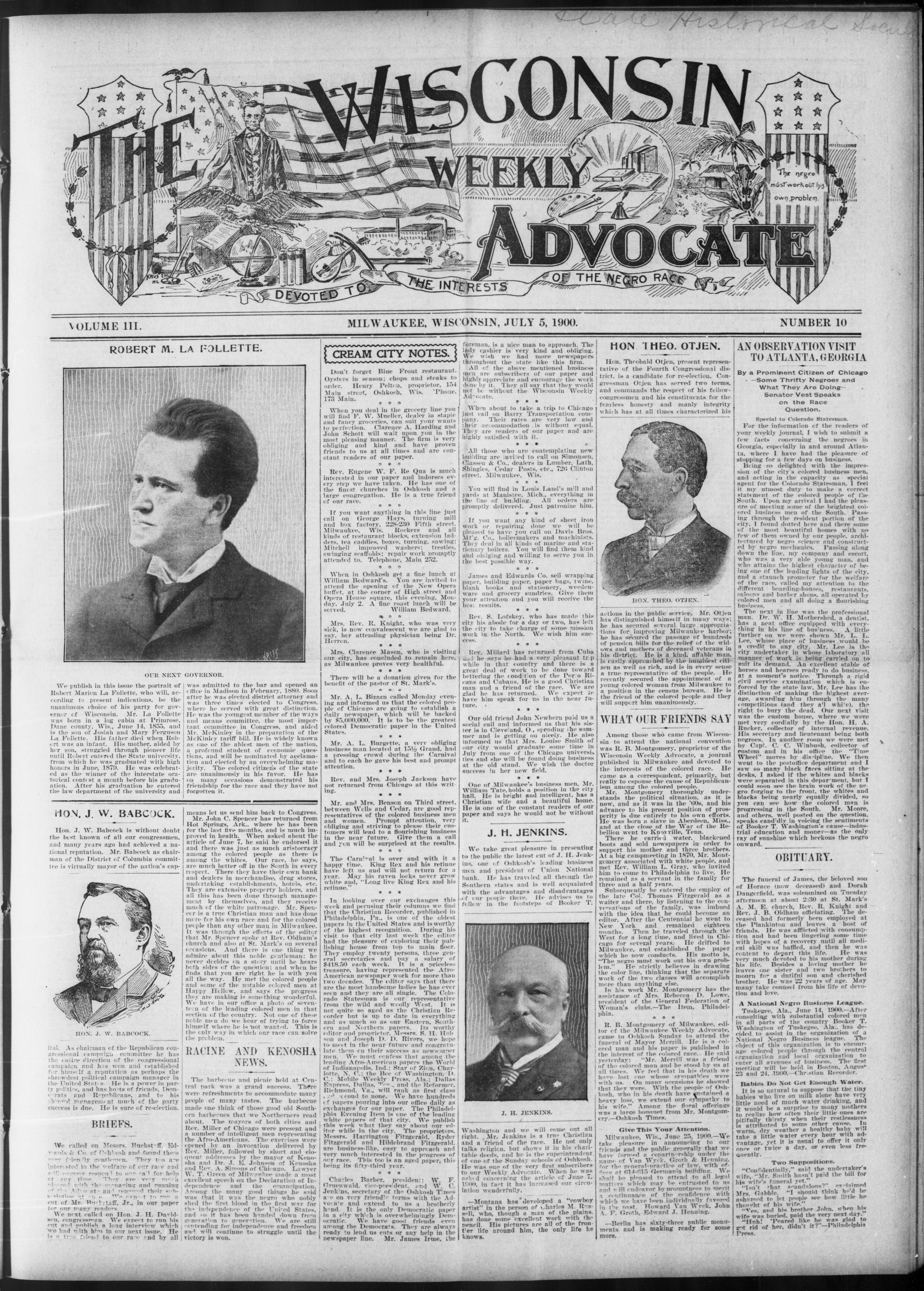
Page text (machine-generated)
WISCONSIN
WEEKLY
ADVOCATE
DEVOTED TO THE INTERESTS OF THE NEGRO RACE
ROBERT M.
OUR NEXT
1915
OUR NEXT GOVERNOR
We publish in this issue the portrait of Robert Marion La Follette, who will, according to present indications, be the unanimous choice of his party for governor of Wisconsin. Mr. La Follette was born in a log cabin at Primrose, Dane county, Wis., June 14, 1855, and is the son of Josiah and Mary Ferguson La Follette. His father died when Robert was an infant. His mother, aided by her son, struggled through pioneer life until Robert entered the State university, from which he was graduated with high honors in June, 1879. He was celebrated as the winner of the interstate oratorical contest a month before his graduation. After his graduation he entered the law department of the university and
HON. J. W. BABCOCK.
Hon. J. W. Babcock is without doubt the best known of all our congressmen, and many years ago had achieved a national reputation. Mr. Babcock as chairman of the District of Columbia committee is virtually mayor of the nation's cap
M. J. B. 1890
ital. As chairman of the Republican congressional campaign committee he has the entire direction of the congressional campaign and has won and established for himself a reputation as perhaps the shrewdest political campaign manager in the United States. He is a power in party politics, and has hosts of friends, Democrats and Republicans, and to his shrewd management much of the party success is due. He is sure of re-election.
BRIEFS.
We called on Messrs. Buckstaff, Edwards & Co. of Oshkosh and found them very friendly gentlemen. They too are interested in the welfare of our race and will express respond to our call for help at any time. They are very much pleased with the managing and running of the Adro ats and renewed their subscription at once. We expect to run a cut of Mr. Buckstaff, Jr., in our paper for our many readers.
We next called on Hon. J. H. Davidson, congressman. We expect to run his cut and publish a long interview which we had with him in our next issue. He is a true friend to our race and by all
---
VOLUME III.
HON, J. W. BABCOCK.
BRIEFS.
was admitted to the bar and opened an office in Madison in February, 1880. Soon after he was elected district attorney and was three times elected to Congress, where he served with great distinction. He was the youngest member of the ways and means committee, the most important committee in Congress, and aided Mr. McKinley in the preparation of the McKinley tariff bill. He is widely known as one of the ablest men of the nation, a profound student of economic questions, and will be nominated by acclamation and elected by an overwhelming majority. The colored citizens of the state are unanimously in his favor. He has on many occasions demonstrated his friendship for the race and they have not forgotten it.
means let us send him back to Congress. Mr. John C. Spencer has returned from Hot Springs, Ark., where he has been for the last five months, and is much improved in health. When asked about the article of June 7, he said he endorsed it and there was just as much aristocracy among the colored people as there is among the whites. Our race, he says, are much better off in the South in every respect. There they have their own bank and dealers in merchandise, drug stores, undertaking establishments, hotels, etc. They are extensive property holders, and all this has been done through management by themselves, and they receive much of the white patronage. Mr. Spencer is a true Christian man and has done more for his own race and for the colored people than any other man in Milwaukee. It was through the efforts of the editor that Mr. Spencer spoke at Rev. Oldham's church and also at St. Mark's on several occasions. And there is one thing we admire about this noble gentleman; he never decides on a story until he hears both sides of the question; and when he finds that you are right he is with you all the way. He met the colored people and some of the notable colored men at Happy Hollow, and says the progress they are making is something wonderful. We have in our office a photo of seventeen of the leading colored men in that section of the country. Not one of these noble men do we hear of trying to force himself where he is not wanted. This is the only way in which our race can solve the problem.
RACINE AND KENOSHA NEWS.
The barbecue and picnic held at Central park was a grand success. There were refreshments to accommodate many people of many tastes. The barbecue made one think of those good old Southern barbecues that we Northerners read about. The mayors of both cities and Rev. Miller of Chicago were present and a number of intelligent men representing the Afro-Americans. The exercises were opened by an invocation delivered by Rev. Miller, followed by short and eloquent addresses by the mayor of Kenosha and Dr. J. E. Johnson of Kenosha and Rev. A. Simons of Chicago. Lawyer W. T. Green of Milwaukee made a most excellent speech on the Declaration of Independence and the emancipation. Among the many good things he said was that it was the negro who nobly shed the first blood in the first war for the independence of the United States, and so it has been handed down from generation to generation. We are still contending for independence and freedom and will continue to struggle until the victory is won.
MILWAUKEE, WISCONSIN, JULY 5, 1900.
CREAM CITY NOTES.
Don't forget Blue Front restaurant. Oysters in season; chops and steaks to order. Henry Pelton, proprietor, 154 Main street, Oshkosh, Wis. 'Phone, 173 Main.
When you deal in the grocery line you will find F. W. Mueller, dealer in staple and fancy groceries, can suit your wants to perfection. Clarence A. Harding and John Schott will wait upon you in the most pleasing manner. The firm is very obliging and kind and have proven friends to us at all times and are constant readers of our paper.
Rev. Eugene W. F. Re Qua is much interested in our paper and indorses every step we have taken. He has one of the finest churches in Oshkosh and a large congregation. He is a true friend of our race.
* * * *
If you want anything in this line just call on George Hays, turning mill and box factory, 228-230 Fifth street, Milwaukee, Wis. Rockers and all kinds of restaurant blocks, extension ladders, tea caddies, boxes, turning, sawing; Mitchell improved washers; trestles, swinging scaffolds; repair work promptly attended to. Telephone, Main 252.
热 热 热
When in Oshkosh get a fine lunch at William Bedward's. You are invited to attend the opening of the New Opera buffet, at the corner of High street and Opera House square, this evening, Monday, July 2. A fine roast lunch will be served. William Bedward.
Mrs. Rev. R. Knight, who was very sick, is now convalescent we are glad to say, her attending physician being Dr. Herren.
Mrs. Clarence Mason, who is visiting our city, has concluded to remain here, as Milwaukee proves very healthful.
There will be a donation given for the benefit of the pastor of St. Mark's.
Mr. A. L. Bizzan called Monday evening and informed us that the colored people of Chicago are going to establish a daily newspaper, which will be backed by $5,000,000. It is to be the greatest colored Democratic paper in the United States.
```markdown
```
Mr. A. L. Burgette, a very obliging business man located at 15½ Grand, had a pressing crowd during the Carnival and to each he gave his best and prompt attention.
Rev. and Mrs. Joseph Jackson have not returned from Chicago at this writing.
Mr. and Mrs. Benson on Third street, between Wells and Cedar, are good representatives of the colored business men and women. Prompt attention, very obliging and striving to please their customers will lead to a flourishing business in the near future. Give them a call and you will be surprised at the results.
☆ ☆ ☆
The Carnival is over and with it a happy time. King Rex and his retinue have left us and will not return for a year. May his raven locks never grow white and, "Long live King Rex and his retinue."
* * *
In looking over our exchanges this week and perusing their columns we find that the Christian Recorder, published in Philadelphia, Pa., is one of the oldest papers in the United States and is worthy of the highest recognition. During his visit to that city last week the editor had the pleasure of exploring their publishing house from top to main floor. They employ twenty persons, three general secretaries and pay a salary of $418.50 each week. It is a priceless treasure, having represented the Afro-American newspaper work for more than two decades. The editor says that there are the most handsome ladies he has ever seen and they are all single. The Colorado Statesman is our representative from the wild and woolly West. It is not quite so aged as the Christian Recorder but is up to date in everything and as much so as our Eastern, Southern and Northern papers. Its worthy editor and proprietor, Messrs. S. H. Hobson and Joseph D. D. Rivers, we hope to meet in the near future and congratulate them on their success as newspaper men. We must confess that among the leading Afro-American papers the World of Indianapolis, Ind.; Star of Zion, Charlotte, N. C.; the Bee of Washington, D. C.; Mobile Weekly Press, Ala.; Dallas Express, Dallas, Tex., and the Reformer, Richmond, Va., will rank as first class and second to none. We have hundreds of papers pouring into our office daily as exchanges for our paper. The Philadelphia Evening Item is one of the leading white papers of that city. We publish this week what they say about our editor while in the city. The proprietors, Messrs. Harrington Fitzgerald, Ryder Fitzgerald and Hildebrand Fitzgerald, are business-like, easy to approach and very much interested in the progress of our race. This too is an aged paper, this being its fifty-third year.
```markdown
```
Charles Barber, president; W. F. Grunewald, vice-president, and W. C. Jenkins, secretary of the Oshkosh Times are on very friendly terms with the Advocate and extend to us a brotherly hand. It is the only Democratic paper in a city which is overwhelmingly Democratic. We have good friends even among the Democrats. They are always ready to lend us cuts or any help in the newspaper line. Mr. James Irme, the
foreman, is a nice man to approach. The lady cashier is very kind and obliging. We wish we had more newspapers throughout the state like this firm. All of the above mentioned business men are subscribers of our paper and highly appreciate and encourage the work done by it. They all say that they would not be without the Wisconsin Weekly Advocate.
京 京 京
When about to take a trip to Chicago just call on Barry Transportation company. Their rates are very low and their accommodation is without equal. They are readers of our paper and are highly satisfied with it.
* * *
All those who are contemplating new building are invited to call on Simonsen, Classen & Co., dealers in Lumber, Lath, Shingles, Cedar Posts, etc., 726 Clinton street, Milwaukee, Wis.
```markdown
```
You will find in Louis Land's mill and yards at Manistee, Mich., everything in the line of building. All orders are promptly delivered. Just patronize him.
* * *
If you want any kind of sheet iron work or repairing done we will be pleased to have you call on Davis Bros. Mf.g. Co., boilermakers and machinists. They deal in all kinds of marine and stationary boilers. You will find them kind and obliging and willing to serve you in the best possible way.
☆ ☆ ☆
James and Edwards Co. sell wrapping paper, building paper, paper bags, twine, blank books and stationery, weedenware and grocery sundries. Give them your attention and you will receive the best results.
* * *
Rev. S. Lofskey, who has made this city his abode for a day or two, has left the city to take charge of some mission work in the North. We wish him success.
***
Rev. Millard has returned from Cuba and he says he had a very pleasant trip while in that country and there is a great deal of work to be done toward bettering the condition of the Porto Ricans and Cubans. He is a good Christian man and a friend of the race. We are glad he has returned. We expect to have him speak for us in the near future.
***
Our old friend John Newbern paid us a social call and informed us that his sister is in Cleveland, O., spending the summer and is getting on nicely. He also informed us that Mrs. Louise Smith of our city would graduate some time in July from one of the Chicago universities and she will be found doing business at the old stand. We wish the doctor success in her new field.
\* \* \*
One of Milwaukee's business men, Mr. William Tate, holds a position in the city hall. He is bright and intelligent, has a Christian wife and a beautiful home. He is one of the constant readers of our paper and says he would not be without
J. H. JENKINS.
We take great pleasure in presenting to the public the latest cut of J. H. Jenkins, one of Oshkosh's leading business men and president of Union National bank. He has traveled all through the Southern states and is well acquainted with the advantages and disadvantages of our people there. He advises us to follow in the footsteps of Booker T.
Washington and we will come out all right. Mr. Jenkins is a true Christian and a friend of the race. He not only talks religion, but shows it in his charitable deeds, and he is the superintendent of one of the Sunday schools of Oshkosh. He was one of the very first subscribers to our Weekly Advocate. When he was asked concerning the article of June 7, 1900, in fact it has increased our circulation wonderfully.
Montana has developed a "cowboy artist" in the person of Charles M. Russell, who, though a man of the plains, has done some excellent work with the pencil. His pictures are all of the frontier life around him, the only life he knows.
HON. THEO. OTJEN.
Hon. Thecobald Otjen, present representative of the Fourth Congressional district, is a candidate for re-election. Congressman Otjen has served two terms, and commands the respect of his fellow-congressmen and his constituents for the fearless honesty and manly integrity which has at all times characterized his
[Image of a man with a mustache and a suit, facing left. The background is plain white.]]
actions in the public service. Mr. Otjen has distinguished himself in many ways; he has secured several large appropriations for improving Milwaukee harbor; he has secured the passage of hundreds of pension bills for the relief of the widows and mothers of deceased veterans in his district. He is a kind, affable man, is easily approached by the humblest citizen as well as rich, and is in every sense a true representative of the people. He recently secured the appointment of a young colored woman from Milwaukee to a position in the census bureau. He is the friend of the colored people and they will support him unanimously.
WHAT OUR FRIENDS SAY
Among those who came from Wisconsin to attend the national convention was R. B. Montgomery, proprietor of the Wisconsin Weekly Advocate, a journal published in Milwaukee and devoted to the interests of the colored race. He came as a correspondent, primarily, but really to espouse the cause of Republicanism among the colored people. Mr. Montgomery thoroughly understands the political situation, as it is now, and as it was in the '60s, and his advance to his present position of prosperity is due entirely to his own efforts. He was born a slave in Aberdeen, Miss., and at the close of the War of the Rebellion went to Knoxville, Tenn.
There he carried water, blackened boots and sold newspapers in order to support his mother and three brothers. At a big campmeeting in 1870, Mr. Montgomery associated with white people, and met Rev. William L. Gray, who invited him to come to Philadelphia to live. He remained as a servant in the family for three and a half years.
Subsequently he entered the employ of the late Col. Thomas Fitzgerald as a waiter and there, by listening to the conversations of the family, was imbued with the idea that he could become an editor. After the Centennial he went to New York and remained eighteen months. Then he traveled through the West for a long time, and lived in Chicago for several years. He drifted to Milwaukee, and established the paper which he now conducts. His motto is, "The negro must work out his own problem." He strictly believes in drawing the color line, thinking that the separate work of the two classes will accomplish more than anything else. In his work Mr. Montgomery has the assistance of Mrs. Rebecca D. Lowe, president of the General Federation of Woman's clubs.-The Item, Philadelphia.
R. B. Montgomery of Milwaukee, editor of the Milwaukee Weekly Advocate, came to Oshkosh Sunday to attend the funeral of Mayor Merrill. He is a colored man and his paper is published in the interest of the colored race. He said yesterday: "Mr. Merrill was a friend of the colored man and he stood by us at all times. We feel that in his death we have lost one whose sympathies were with us. On many occasions he showed that they were. With the people of Oshkosh, who in his death have sustained a heavy loss, we extend our sympathy to his wife." Among the floral offerings was a large bouquet from Mr. Montgomery.—Oshkosh Times.
Give This Your Attention.
Milwaukee, Wis., June 25, 1900.—We take pleasure in announcing to our friends and the public generally that we have formed a copartnership under the name of Van Wyck, Groth & Henning, for the general-practice of law, with offices at 614-615 Germania building. We shall be pleased to attend to all legal matters which may be entrusted to us and will endeavor by promptness to merit a continuance of the confidence with which we have been individually favored in the past. Howard Van Wyck, John A. F. Groth, Edward J. Henning.
—Berlin has sixty-three public monuments and is making ready for some more
By a Prominent Citizen of Chicago
Some Thrifty Negroes and
What They Are Doing
Senator Vest Speaks
on the Race
Question.
Special to Colorado Statesman.
For the information of the readers of
your weekly journal. I wish to submit a
few facts concerning the negroes in
Georgia, especially in and around Atlanta, where I have had the pleasure of
stopping for a few days on business.
Being so delighted with the impression of the city's colored business men, and acting in the capacity as special agent for the Colorado Statesman, I feel it my utmost duty to make a correct statement of the colored people of the South. Upon my arrival I had the pleasure of meeting some of the brightest colored business men of the South. Passing through the resident portion of the city, I found dotted here and there some of the most beautiful homes with no few of them owned by our people, architectured by negro science and constructed by negro mechanics. Passing along down the line, my company and escort, who was a very able young man, and who attains the highest character of being one of the leading lights of the city, and a staunch promoter for the welfare of the race, called my attention to the different boarding-houses, restaurants, saloons and barber shops, all operated by colored men and all doing a flourishing business.
The next in line was the professional man. Dr. W. H. Mothershed, a dentist, has a neat office equipped with everything in his line of business. A little further on we were shown Mr. L. L. Lee, whose place of business would be a credit to any city. Mr. Lee is the city undertaker in whose laboratory all manner of work is being carried on to suit its demand. An excellent stable of horses and hearses ready to do business, at a moment's notice. Through a rigid civil service examination which is enforced by the state law, Mr. Lee has the distinction of making the highest average, awarding him through the many competitions (and they a'l white), the right to bury the dead. Our next visit was the custom house, where we were met very cordially by the Hon. H. A. Rucker, collector of internal revenue. His secretary and lieutenant being both negroes. In another room we were met by Capt. C. C. Winbush, collector of custom and in his office the "Time Wheel" moves by discipline. We then went to the postoffice department and I saw so many black faces sitting at the desks, I asked if the whites and blacks were separated in this department, but I could soon see the brain work of the negro forging to the front, the whites and blacks being nearly equally divided, so you can see how the colored man is progressing in the South. Mr. Moore, and others, well posted on the question, speaks candidly in voicing the sentiments of Booker T. Washington's cause—industrial education and money—as the only ray of sunshine which beckons the negro onward.
OBITUARY.
The funeral of James, the beloved son of Horace (now deceased) and Dorah Dangerfield, was solemnized on Tuesday afternoon at about 2:30 at St. Mark's A. M. E. church, Rev. R. Knight and Rev. J. B. Oldham officiating. The deceased had formerly been employed at the Plankinton and leaves a host of friends. He was afflicted with consumption and had been lingering some time with hopes of a recovery until all medical skill was baffled, and then he was content to depart this life. He was very much devoted to his mother during his life. Besides a loving mother he leaves one sister and two brothers to mourn for a dutiful son and cherished brother. He was 22 years of age. May many take counsel from his life of devotion and love.
A National Negro Business League.
A National Negro Business League. Tuskegee, Ala., June 14, 1900.—After consulting with substantial colored men in all parts of the country Booker T. Washington of Tuskegee, Ala., has decided to assist in the organization of a National Negro Business league. The object of this organization is to encourage colored people through the central organization and local organization to enter all avenues of business. The first meeting will be held in Boston, August 23 and 24, 1900.—Christian Recorder.
Babies Do Not Get Enough Water. It is so natural to suppose that the tiny babies who live on milk alone have very little need of much water drinking, and it would be a surprise to many mothers to realize how often their little ones are pitifully thirsty when their restlessness is attributed to some other cause. In warm, dry weather a healthy baby will take a little water every hour with advantage, yet it is usual to offer it only once or twice a day, or even less frequently.
Two Suppositions.
"Confidentially," said the undertaker's wife, "Mr. Smith hasn't paid the bill for his wife's funeral yet."
his wife's funeral yet.
"Isn't that scandalous?" exclaimed Mrs. Gabble. "I should think he'd he ashamed to let people see how little he thought of his wife."
"Yes, and his brother John. when his wife was buried, paid the very next day."
"Huh! 'Peared like he was glad to get rid of her, didn't it?'—Philadelphia Press.
OCEAN STEAMERS BURN.
Three Fine Vessels and Millions of Property.
MANY LIVES ARE LOST.
All the Piers of the North-Germna Lloyds Company at Hoboken in Ashes.
Loss of life (approximately)..... 250
Persons missing..... 100
Property loss (estimated)..... $10,000,000
Heaviest losses in detail:
Steamship Main..... $1,600,000
Bremen..... 1,000,000
Saale..... 1,100,000
Kaiser Wilhelm der Grosse..... 25,000
North German Lloyd docks and
..... 650,000
contents ..... 650,000
Thingvalla pier ..... 50,000
Palmer-Campbell warehouses..... 1,300,000
New York, July 2.—With a loss of no fewer than 250 lives and the destruction of property valued at nearly $10,000,000, the entire pier system of the North-German Lloyd Steamship company at Hoboken was burned Saturday. The magnificent ocean liners Main, Saale and Bremen were destroyed by the flames and the peerless Kaiser Wilhelm der Grosse was scorched and only was snatched from the blazing piers and shifted into midstream by the liveliest kind of work.
Capt. Mirow Among the Lost.
Capt. J. Mirow of the Saale is believed to have been burned to death in his ship. The Saale was a mass of flames from stem to stern when she was towed out into the river, where the fireboats from New York and a score of tugs poured water into her and tried in vain to rescue the helpless sailors and longshoremen who could be seen at the waterline portholes begging pleasously for the aid that it was impossible to give. The portholes are too small to admit of the passage of an ordinary-sized man's body. The Bremen drifted across the river when her hawssers were cut and was within 150 feet of the American line pier, blazing fore and aft, before tugs got a line on her and towed her down to the flats off Liberty island.
The Main, a new boat, could not be moved from her position in the slip along-side of pier 3, so rapid was the spread of the flames, and she was the center of a great mass of fire which burned around her and cut off the escape of those below decks who had not jumped at the first alarm. The dead are burned to ashes or drowned and floating in the river or bay.
Property Loss About $10,000,000.
The property loss can simply be approximated at this time. None of the officials around the docks could give anything like a precise estimate of their losses and none was prepared to make a statement on this point. A conservative estimate, made by a prominent fire underwriter, places the entire damage at less than $10,000,000.
The three docks of the North German Lloyd line are total losses, with all their contents, and they are still smoldering, with many streams from the hose playing continually on the debris. The pier of the Thingvalla line is totally wiped away, and an extension which had just been built on the Hamburg-American line's expanse of piers was burned down to the spike tops.
The warehouses of Palmer Campbell, which are across the street from the North German Lloyd line docks, suffered greatly and a number of houses along the street were scorched badly. The loss on the steamship properties and other companies is estimated tonight approximately as follows:
Details of the Damage.
The steamship Main of the North German Lloyd line cost $1,500,000 outside of the cargo, fitting and stores. The loss is placed at $1,300,000 for the vessel and about $400,000 for the fitting and stores and cargo that was aboard of her. The steamship Bremen of the North German Lloyd line cost $1,250,000 and her fitting and cargo were valued at $300,000. The cargo and stores were entirely consumed and the loss to the vessel proper will amount to at least $700,000. It was beached off Weechawken last night and, still smoldering, apparently destroyed save her machinery.
The Saale, the steamship which will have the most horrible story of death to unfold when the divers go down in her, cost the North German Lloyd company $1,250,000 and the fittings and cargo were valued at $300,000. The Saale is beached at Ellis island and still burning. The damage to the vessel proper is placed at about $800,000
Wilhelm der Grosse Scorched.
The damage done to the Kaiser Wilhelm der Grosse is estimated at $25,000. The three docks of the North German Lloyd line, which were burned to the water's edge, are estimated to have cost $300,000. The docks were well filled with merchandise just received from abroad and valued at $350,000. The Thingvalla pier, which was entirely consumed, was valued at $50,000, counting the stores which were on it. The Hamburg-American line dock, which had just been completed as an extension to their great pier and which was destroyed in order to prevent the spread of the flames, was damaged to the extent of $15,000. This was the only loss they sustained, as the steamer Phoenicia, contrary to reports, was not even scorched.
Barges and Canalboats Go.
Eight barges and eleven canalboats were either burned or sunk with their cargoes. Total valuation $125,000. The Hoboken Shore railroad had a number of cars burned and other property damaged. Loss $7000. Minor losses on floating property burned at the fire proper or set fire by burning driftwood, will amount to about $20,000. The personal losses sustained by those aboard the steamships can simply be surmised, as there is no way of ascertaining this at the present time.
Many Bodies on the Saale.
When the burned and scuttled Snale is pumped out it is believed that the bodies of many people who perished below her main deck will be discovered. Some of those penned in by the flames were alive when the steamship was towed to the Jersey flats just north of Ellis island.
Through the open headlights of portholes the poor creatures appealed for help several times before the vessel was scuttled in the hope of putting out the fire which was raging in her upper works. The portholes being less than a foot in diameter, it was impossible to save them, and one after another the people inside succumbed to the smoke and flames. Keeper Healey of Ellis island spoke to several of the unfortunates, as did also the captain of the tugboat Union and Capt. I. F. Chapman. The latter said, describing a conversation which he had with one of the fire victims through an open deadlight on the Saale:
"The imprisoned men was a stevedore who was known to me by sight. He told me there were thirty-eight men besides himself and one woman, a stewardess, penned in by the flames. The poor fellow had an agonizing look on his face and seemingly realized that he and his companions were doomed to a horrible end. Giving up hope of rescue, the stevedore told me that there were others caught between decks and asked me to
try to save them. A moment after he sank back into the roaring flames which soon shot out of the open portholes. We went back and forced a companionway. A man who sought to gain the ladder with a blanket wrapped about him was unable to do so and was roasted to death."
FOUR CARS IN A DITCH.
Disastrous Wreck on a Passenger Train of the Montana Central Railroad.
Butte, Mont., July 3.—A very disastrous wreck occurred late last night on the Montana Central railroad, a branch of the Great Northern, at Trask Siding, twelve miles from Butte, by which two persons were killed and thirty-three injured. The dead are:
JOHN L. KELLY, 8 years old, Salt Lake.
JOHN LUCESKEI, Great Falls, Mont.
The injured:
W. H. Lucas, Anaconda, contusion on head and hip, badly wrenched.
George Smith, Minneapolis, badly cut on head and back injured.
Mrs. Lillie Deming, Great Falls, Mont., injured back.
Mollie Drew, Butte, hand lacerated.
Rev. G. G. Rector, Bozeman, brised about shoulder and leg.
head and back bruised.
Frank D. Smith, Great Falls, head and back hurt.
William Duffy, Butte, slightly injured.
Mrs. Elmer Woodman, Helena, slightly injured.
Charles Phillips, Chicago, head lacerated.
Mrs. I. M. Farrell, Butte, slightly hurt.
M. Roth, Helena, hip injured and generally bruised.
A porter, Butte, hand, leg and head cut. Robert E. Stone, Butte, head and chest hurt, seriously. C. M. Atkins, Butte, injured slightly. T. H. Klemschmit, Helena, leg injured. Mrs. George Geddes, Butte, badly injured on back
D. Dewey, Jr., Boston, ankle and knee hurt
W. E. McCormick, Spokane, leg bruised,
H. R. Hoffman, Buffalo, lacerated hand.
S. W. Scott. Chicago. head cut.
Mrs. Luceskei, Great Falls, badly hurt. Laura Luceskei, Great Falls, leg broken. William Stack, aged 7, Butte, head cut. Mrs. John Cameron, arm broken. A. L. Zick, conductor, shoulder and hip dislocated. The train left Butte at 8:50 last night and was on its way to Helena. It had made the climb up the Continental Divide in safety and was rushing along at top speed on comparatively level ground, when the rails spread, ditching the baggage car, smoker, day coach and sleeper. The engine and one baggage car remained on the track. The cars were thrown over on their sides and the passengers who were not injured, or slightly so, climbed out through the windows. All the lights were extinguished and from different portions of the wreck came calls for help and groans and cries of the injured.
Conductor Zick, who was injured, made his way back to Woodville, five miles, and telegraphed to Butte for help. A special train with doctors and nurses was dispatched from this city and brought in the injured, who were taken to the different hospitals.
ROUGH RIDERS MEET
An Immense Crowd at Oklahoma City Gives Gov. Roosevelt a Warm Welcome.
Oklahoma City, Ok., July 3.—Gov. Theodore Roosevelt arose early today and ate breakfast with Gen. Metcalf, Paul Morton and a few other guests in Mr. Morton's private car; the governor began to put in his time exchanging greetings with his old comrades. Everybody in town, and it is estimated that besides the population of 15,000 there are 10,000 strangers within the city's gates, seemed anxious to meet Oklahoma City's distinguished guest and grasp his hand. Indians, cowboys, regular army men and rough riders were his constant attendants throughout the day. The weather was extremely hot, but a breeze from the west served in some measure to take the curse off.
The reunion was fairly inaugurated by the civic and military parade in which Gov. Roosevelt was given the place of honor. During its passing through the streets, the Rough Riders and their famous commander were greeted with extraordinary demonstrations of enthusiasm from the throngs which lined the streets. The parade proceeded to the Compress grounds, where the formal exercises of the day took place. The welcoming address in behalf of Oklahoma territory was given by Gov. Cassius M. Barnes, and in behalf of the city by Mayor Le Van Winkle; the address of the day was by Gov. Roosevelt. Five thousand people packed the grand stand. The proceedings were greatly delayed on account of the reported dangerous condition of the temporary wooden stand from which the governor spoke, and much confusion resulted. Finally, the governor himself took a hand in the direction of affairs and order speedily resulted.
Col. Roosevelt's voice was clearly heard by the throng. His address was punctuated throughout by applause and by answers to his rhetorical questions. The speech was along the line of those delivered during the trip to Kansas yesterday, except that he did not touch upon the silver question. After devoting himself to a graceful tribute to the Rough Riders and veterans of the Spanish war, and also to the members of the Grand Army of the Republic and the Confederate veterans present, he launched into the subject of the nation's duty in her newly-acquired territory.
"I appeal to the great people of the West," he said. "I appeal to men who fought in the Civil war and to their sons who came forward when the nation again called, whatever the party, to see to it that the nation does not shrink from its work; that the flag which has so far been borne to honor shall be upheld for evermore as the flag of the greatest, mightiest nation of mankind; the nation that shrinks from no duty where duty calls. Wherever the flag is as long as there is an armed foe against it there the flag shall stay." (Applause.)
During the afternoon Col. Roosevelt witnessed a roping and riding tournament, a mule race, an exhibition of roping and tying thirty wild steers, and many other sports incident to life on the Western plains.
A deplorable incident of today's festivities was a fatal accident to Clifton George, secretary of the local commercial club and of the reunion committee. He was thrown from his horse and sustained a fracture of the skull.
EMINENT MASON'S SUICIDE.
Former Judge Thomas B. Long Shoots Himself at Terre Haute.
Terre Haute, Ind., June 3.—Former Judge Thomas B. Long committed suicide last evening by shooting. The act is unaccountable from present information. Judge Long was born October 25, 1834. He was recognized by Masons as the best authority on Masonry in the state. He had taken all the York degrees up to and including the thirty-third. He was unmarried, and there is no known kin. He was judge of the criminal court in the latter '80s.
EIGHT LIVES LOST IN TENEMENT FIRE.
EIGHT LIVES LOST IN TENEMENT FIRE.
Burning of a Crowded Tenement in Hoboken, N. J.- Flames Spread Rapidly.
New York, July 3.—Fire early today in a crowded tenement, 127 to 131 Adams street, Hoboken, caused the loss of eight lives. The names of the dead follow:
Out of nine members of the Winkler family but four were saved, Mr. and Mrs. Winkler and their two children, John aged 12, and Martha, 14 years.
Mrs. Winkler was badly burned while clinging to her infant. Her husband had to drag her and the infant through a window to save their lives. The building was a frame structure, three stories high and several families lived on each floor. When the flames started they burned rapidly and the firemen could do little either to extinguish the fire or to save life.
BOERS FED BY BRITISH.
Lord Roberts Distributing Food and
London, July 3.—The following dispatch has been received at the war office from Lord Roberts, dated Pretoria, July 2: "Gen. Hunter's division has crossed the Vaal and should be at Frankfort today, where he will be joined by Col. MacDonald's brigade from Heilbron. Gen. Buller's leading brigade has left Standerton for Grayiing.
"Both here and at Johannesburg several families of the men who have been fighting against us are being fed. Some are in a state of destitution. At Heilbron, where the food supplies ran out, groceries, meat and other supplies of food are being distributed among the inhabitants under the supervision of the relief committee. Arrangements are being made for the distribution of oats for seed purposes to farmers actually in need of it, those who are unable to procure seed oats in any other manner."
War Far from Euded.
The Times, in its editorial leader this morning, says:
"It may be inferred from the arrival of the foreign military attaches at Cape Town that in their view the war is so far over that the military movements are not interesting enough to call for their study.
"At the same time a good deal of fight seems still to be left in the Boer commandos, which, though encircled by an immensely-superior British force, continue to enjoy freedom of action over a considerable area."
"While that state of things endures it is perhaps too much to expect President Kruger to sue for peace. Indeed, it would seem from the cessation of reports concerning pourparlers pointing in that direction, which were somewhat rife a short time ago, that the heart has recently been rather hardened than otherwise." The following dispatch was received this afternoon at the war office from Lord Roberts, dated Pretoria, July 3: "Gen. Hunter reached Frankfort July 1, without opposition, and McDonald joined him there yesterday. He found two men of the Seaforths and eighteen of the Derby militia in the hospital. They have been well treated by the Boers.
"Methuen reports from Paardekraal on the Heilbron-Kroonstad road that he has captured the commander of Dewet's scouts, two other prisoners and Andreas Wessels, the head of the Afrikander bund.
Gen. Snyman Captured.
New York, July 3.—A dispatch from London reports the capture near Lichtenberg of Gen. Snyman, who besieged Mafeking and an important Boer commander.
New York Hotel Man Fails.
New York, July 3.—George D. Smith, manager of the Clarendon hotel, Fourth avenue and East Eighteenth street, this city, filed a petition in bankruptcy in the United States district court today, showing liabilities of $304,847 and no assets.
SAILED ON THE KAISER.
Former Senator Mitchell and Wife Passengers on the Big Steamer Which Escaped the Fire.
New York, July 3.—The blue and white house flag of the North German Lloyd line was flying over the Cunard pier today, when the big Kaiser Wilhelm Der Grosse, the only vessel of the fleet in port to escape the flames of Saturday last, sailed for Bremen. On the vessel, and on all the piers and shipping along the river, the flags were flying at half-mast. The piers were crowded with people, who came to see the ship depart.
The steamship sailed at 10 a. m., with cabin and steerage full. In the first cabin there were 429, in the second 320 and in the steerage 290. About 340 survivors of the fire sailed on the Kaiser. The officers of the wrecked vessels were accommodated in the cabin and the members of the crews sailed in the steerage
bers of the ewes sailed in the steerage.
On the pier near the entrance were 274 steerage passengers, who were left behind. They could not sail, as the steerage was full. They will be taken care of by the line and will sail on other ships as soon as possible.
Levi P. Morton was a passenger on the Kaiser Wilhelm der Grosse, which sailed today. With him sailed Mrs. Morton and the Misses Morton. Others who sailed on the vessel were Thomas E. Heenan, United States consul at Odessa, Russia, H. A. Ickelheimer, Herman Joseph, Col. and Mrs. E. M. Knox, Prof. Keager, James MacVeagh, Mrs. Franklin MacVeagh, Former Senator and Mrs. John L. Mitchell, Mrs. Elliot F. Shepard, Prof. S. F. Shaw, Rev. I. F. Slattery and Garrett P. Serviss.
Eclipse Affected Bicycle Tires
The solar eclipse proved a rather disastrous for the wheelmen of Atlanta. As in every other city within a visible distance, hundreds of persons viewed the eclipse through bits of smoked glass, and when they had seen enough, having no more use for the glass, threw it into the street. The result was that the repair shops were overrun with orders to repair burst tires.—Baltimore News.
The Most Expensive War:
The highest war expenditure of modern times was undoubtedly that of the American Civil war, when the enormous sum of $3,700,000,000 was expended. The Franco-German war cost France $1,580,000,000.
—St. Joseph county, Indiana, which for many years was far behind the demand of borrowers upon its school fund, has now on hand over $20,000 with no demand. This means a loss to the school fund, and it is suggested that a law ought to be framed permitting school funds to be loaned at less than 6 per cent, rather than have the money bearing no interest.
GERMANY IS VERY ANGRY.
KETTELER A MARTYR.
Demand Made that the Chinese Legations at Berlin be Held as Hostages.
London, July 3.—Repeating the story of renewed severe fighting at Tien Tsin, a special dispatch from Shanghai adds that reports are current that Vice-Admiral Seymour has been wounded.
London, July 3.—A dispatch from Shanghai says Chinese reports are current that two other foreign ministers were murdered the same day as Baron von Ketteler.
From the same sources it is declared that the mission hospital at Moukden has been destroyed by fire and that the native Christians have been massacred. It is further asserted that the foreigners fled to New Chwang.
Washington, D. C., July 3.—Secretary Hay has received a cablegram from Consul-General Goodnow at Shanghai, dated July 2, which is practically a condensation of the report brought to Shanghai by a courier from Sir Robert Hart, inspector-general of customs. The dispatch says:
"The diplomats and missionaries are in the British legation under rifle fire. Cannon command the legation but they are not being used. The British, German and Italian legations are still standing."
Shanghai, July 3.—According to the latest Pekin news, from Chinese sources, the legations are at such extremities from lack of provisions that the women who escaped the bullets are perishing of starvation.
London, July 3.—A special dispatch from Hong Kong says Li Hung Chang has requested a United States gunboat to take him to Tien Tsin.
Berlin, July 3.—All Germany stands dumfounded by the news from China. The murder of Baron von Ketteler is now almost a certainty. Secretary von Buelow has given up his summer vacation and it is more than probable that the Emperor will not make his tour to the North Cape, as he does each summer.
Some doubters still say that the announcement of Ketteler's death is only a rumor, but the neariy-universal opinion is that the news is true. The people demand a reparation for the blood of the German minister, and the newspapers compare the murder of the German minister at Pekin with the murder of the French ministers at Rastatt by Austrian cavalry in 1799, with all its dire consequences.
The Chinese minister at Berlin is more than surprised by the terrible news, but he declares, of course, that the story has been concocted by the enemies of China.
Made Hero and Martyr.
The German papers, almost unanimously, are demanding a reparation, and declare Baron von Ketteler the newest German hero and martyr.
The Vossische Zeitung says: "Whereever the words 'German fidelity' and 'German dutifulness' are mentioned, the name of Baron von Ketteler will be mentioned, too."
The Nord Deutsche Allgemeine says: "If there is something that is able to console the family, friends and fellow citizens of the murdered minister, it is the feeling that he fell like a hero on the field of battle."
The Deutsche Tages Zeitung demands strictest reparation for the murder, but nothing more. Germany should not enter into a policy of expansion to avenge the murder.
Would Hold Hostages.
The Berlin Tageblatt declares the murder as a casus belli, and demands the arrest of the members of the Chinese legation in Berlin as hostages. The Tageblatt also mentions the fact that the first interpreter of the German legation at Pekin is at present in Germany for a vacation and that the interpreter mentioned as wounded by the Chinese mob must be Second Interpreter H. Cordes.
The Kreuz Zeitung says that the murder ought to be avenged, but the Germans should leave the particulars to the Emperor and his chancelors.
The officials of the foreign office are nearly all of the opinion that this newest announcement of Ketteler's death is true, but say that the secretary of the German consulate at Chefoo may be in error. The foreign office is straining every nerve to bring help to the survivors of the Pekin massacre, especially the Germans
Urges Penalty for Slaying.
The press unanimously deplores Baron von Ketteler's death. The Kreuz Zeitung says Germany cannot allow the murder to go unpunished, especially if the proof is furnished that the Chinese government has made common cause with the "Boxers," and adds that the Emperor and his advisers will find the correct way out of the present difficulties.
The confidence is general throughout the fatherland. The paper argues strongly for the sending of large German forces, since they are assured of bases of operation at Taku and Tien Tsin.
Will be Avenged.
Addressing the detachment of German marines which sailed from Wilhemshaven for China yesterday the Emperor made a remarkable speech, during which he notified the world of Germany's intention to avenge the murder of Baron von Ketteler, the late minister of Germany, at Pekin, and the missionaries, and to dictate terms to the Chinese from the palace at Pekin. According to the Lokal Anzeiger his majesty spoke as follows:
"The German flag has been insulted and the German empire treated with contempt. This demands exemplary punishment and vengeance. Events have moved with frightful rapidity and have become profoundly grave and still graver. Since I called you to arms what I hoped to effect with the help of the marine infantry has now become a difficult task which can only be fulfilled with the help of the carried ranks of all civilized states.
German Flag Planted in Pekin.
"I will not rest until the German flag, joined to those of the other powers, floats triumphantly over China's flag, and until it has been planted on the walls of Pekin to dictate peace to the Chinese. You will have to maintain good comradeship with all the other troops whom you will come in contact with over yonder. Russians, British and French, all alike, are fighting for one common cause—for civilization. We must bear in mind, too, something higher—namely, our religion and the defense and protection of our brothers out there, some of whom stake their lives for the Savior. The flags which here float above you go under fire for the first time. See that you bring them back to me clean and stainless and without a spot. My thanks, my prayers and my solicitude go with you."
London, July 3.—Mr. Broderick, undersecretary of state for foreign affairs, states that the allies are not advancing to the relief of Pekin—this despite the message the imprisoned legationers got
through, dated nine days ago and saying: "The situation is desperate. Hasten relief." No reason for the delay was given. The British public is preparing for news of a frightful tragedy—no less than the slaughter of all the foreigners in Pekin. It is stated officially that the Kaiser and Count von Bulow have determined to send five battleships and at least 20,000 soldiers to China to make reprisals for the murder of the German minister, Baron von Ketteler.
War Without Delay.
If Germany formally declares war on China, a contingency the dispatches from Berlin this morning indicate as probable, once the Pekin government's criminality is established, it is regarded here as reasonably certain that Russia, Japan and France will follow suit without delay. England, it is believed, is likely to hold off, for the present at least, while the United States is not expected to move unless literally dragged into the struggle. In any event, China's future was never darker. Even if the powers agree not to use any more force than is absolutely necessary to protect their own subjects, it begins to look as if the Chinese themselves would bring about the disintegration of their empire through internecine war.
Southern Provinces Secede.
All the provinces south of the Yellow river, whose viceroys and governors maintain friendly relations with the powers through the consuis, have been informally constituted into a confederacy, with Nankin as the capital. According to an Express cable from Shanghai, dated July 2, the Southern viceroys wholly disavow Prince Tuan's government. They have practically constituted an independent state, extending from the Hoang-Ho to British and French frontiers.
Worst Fears Entertained.
New York, July 3.—A dispatch to the Tribune from London says: "The tidings of the murder of the German minister have reached every foreign office in Europe, and the gravest views are entertained in diplomatic circles respecting the fate of the embassies. Many of the best-informed men admitted frankly that the fate of the embassies was sealed, and that the violent and unreasoning antiforeign policy had temporarily triumphed. The murder of the German minister was regarded as an unerring sign that the Emperor would insist upon receiving a province as compensation, since he had rated the injuries of two missionaries at so high a price. If all the embassies had been wiped out there would be similar demands for damages and satisfaction, and unless Prince Taun were driven from the stronghold of power there would be no practical method of assessing the costs and liabilities except annexation. All conclusions on so confused a situation are premature and indiscreet, but apparently China has ceased to be anything more than a gregorgical expression or title on the map, and the vast hives of excitable population have passed momentarily under the sway of Prince Tuan, the worst enemy of foreigners and European and American civilization.
All Hope About Destroyed.
London, July 3.—2:30 p. m.—The fact that a relief column has been unable to leave Tien Tsin in response to the pathetic prayer of the beleagured legations at Pekin is generally regarded in London as destroying almost the last vestige of hope for the unfortunate foreigners penned up in the Chinese capital. The worse is feared and the massacre of Cawnpore is in every man's mind. It is beginning to be felt here that the plausible fiction that no state of war exists is no longer tenable, and a fully-equipped, modern army, belonging to a single nationality, is necessary to deal with the situation, instead of asserted expedition of a dozen nationalities. Hence arises the demand that Japan shall be given a mandate to complete the work left undone in 1894, with proper security that she shall not be again squeezed out when the costly task is over.
OREGON IS FLOATED.
There is Now Some Hope that the American Battleship May be Saved.
Shanghai, Monday, July 2.—The United States battleship Oregon, which ran ashore off the island of Hoo Kie, in the Miao Tao group, thirty-five miles northeast of Chefoo, June 28, has been floated and is expected to reach Port Arthur.
Washington, D. C., July 3.—Secretary Long this morning received the following cable from Lieut. A. L. Key, naval attache at the United States legation at Tokio, Japan, in regard to the docking of the Oregon:
Tokio, July 3.—Secretary of the Navy, Washington, D. C.: Port Arthur tomorrow. If Oregon cannot dock at Nagasaki, Japanese navy department tenders the use of either Kure or Yokokusuka docks. Offers any assistance desired. Has ordered Akitisushina from Chefoo to the Oregon. Have cabled Wilde offer of docks.
(Slemed)
The naval officers are disappointed at the statement that the Oregon cannot be docked at Port Arthur as that place is only about sixty miles distant from where she struck. Nagasaki is 600 miles distant, but can be reached by the Oregon without venturing outside of the tolerably smooth waters of the gulf of Pecheli. If the docks there are too small, then she must push on to the Yokoksuka docks, located just below Yokohama in the harbor. The Kure docks referred to are supposed to be the Kobe docks. The difficulty in the case of the Oregon is that she is fitted with bilges and docking keels, making her very broad in cross section at the bottom, and consequently unsuited to even large drydocks of the ordinary construction.
The Japanese vessel, Akitisushima, which Lieut. Key reported as going to the help of the Oregon, is the famous cruiser which covered herself with renown at the battle of Yalu.
Oregon Cannot Enter.
Washington, D. C., July 3.—A cablegram received at the navy department from Lieut. Key, dafed Tokio, last night, says: "Russian dock at Port Arthur is too small for Oregon to enter." The dispatch conveys the first news that Key is not at Pekin, where he was naval attache. If the Oregon is floated she will be docked at Nagasaki.
GLASS FACTORIES CLOSE.
Ten Thousand Employes Lay Aside Work for Two Months.
Marion, Ind., July 3.—At midnight July 1 every glass worker in the gas belt laid down his blowpipe and walked out of the furnace-like buildings that have housed them since last autumn. The 1st of July is the time for the annual closing of the glass factories and the workmen take a rest of two months during the warm weather of July and August. On September 1 they will again start for a run of ten months. Seven window glass factories, four fruit-jar factories, three prescription-bottle factories, the big Evans-McBeth lamp chimney factory and the Canton tableware factory closed, letting 10,000 men out. All the iron, steel and tinplate mills under the jurisdiction of the Amalgamated association also closed.
The Tentonic Disabled.
Liverpool, July 3.—The White Star line steamer Teutonic has canceled the sailing schedule for July from this port to New York, a flaw having been discovered in her stern frame.
—John Conroy, 16 years old, was run down by an automobile and severely injured while riding a bicycle.
—Mrs. Elizabeth Ryan, who was burned by an explosion of a gasoline stove, died at St. Elizabeth's hospital.
—Harley McPherson, a non-union laborer, attacked by three men, fatally shot James Welch, one of his assailants.
—The body of an unknown man was found on the Wabash railway tracks at Orland. Ill., mutilated almost beyond recognition.
—Frank L. Novotny, secretary of the Lawndale Building and Loan association, is charged with embezzling $5000.
—William Wharton, a driver for Hayes Bros., pop manufacturers, was instantly killed by falling under his wagon, the wheels of which passed over his head.
—David Hoffmann died at the Michael Reese hospital from lockjaw. June 19 he was experimenting with a toy cannon, when it blew to pieces. A piece of iron stuck in his body.
—The liabilities of the Louis Vehon company, the Jackson boulevard mail order house now in the hands of a receiver, are figured to be $125,000. The assets are estimated at $60,000.
—Police say Louis M. Stein, the South Bend merchant who claimed to have been robbed of $4000 on the Twelth street viaduct, concocted the story to draw sympathy from Chicago creditors.
—A supposed suicide was found in Humbolot park beside a box half filled with rat poison. Nothing was found which would give a clue to his identity. His linen was marked E. J. F., and a silk handkerchief was marked R.
—Despondency over the loss of his position in a tailor shop led Joseph Heimers to commit suicide at his home. His body was found by his daughters hanging from a door. He was 58 years old and lived with his wife and four children.
—While the will of the late T. B. Blackstone has not been filed for probate, five bequests under the will have been made public. Out of an estate said to be valued at $2,700,000, bequests of $25,000 each have been made to the Passavant hospital, St. Luke's hospital, the Relief and Aid society, the Chicago Orphan asylum, and the Art institute.
—Patrick O'Donnell, a foundryman, committed suicide by drinking carbolic acid. He had been employed in John Featherstone Son's foundry. He had been drinking to excess. He left a widow and five children.
MARKET REPORTS.
Milwaukee, July 3, 1900.
EGG AND DAIRY PRODUCTS.
MILWAUKEE—Eggs — Market steady at 11c for new, cases included; 10%c for new, cases returned; 10%c for old, cases included; dirties and seconds, 7@8c. The receipts were 290 cases.
Butter—Market steady. The receipts were 13,525 lbs today against 14,340 yesterday. The market is fairly active and steady. Elgin went 19c yesterday, as expected. There were no offerings on the board today. Fancy prints, 19%c; fancy or extra cremery, per lb, 18%19c; firsts, 17c; seconds, 16c; extra dairy, 15c; lines, 12@14c; packing stock, 11@12c; whey butter, 9c; imitation cremery, 15@16c; grease, 4@6c. Fancy dairy prints, 17c.
Cheese—Steady. The receipts today were 9815 lbs against 4720 yesterday. Full cream firsts, October, per lb, 10@11c; full cream flats, new, colored, 9½@10c; New York, full cream flats, new colored, 9½@10½c; Young Americas, October, 10½@11c; Young Americas, new, 9½@12c; brick, 8½@19c; limburger, per lb, 9@9½c; imported Swiss, 24c; Block Swiss, domestic, 12@12c; No. 1 imitation loaf, 14½@15c; Sapsago, 19@20c; farmers', 9@10c.
NEW YORK — Butter — Receipts, 19,790 pkgs; market steady; creamery, 17@19½c; factory, 14@16½c. Cheese—Receipts, 12,841 pkgs; market firm; large white, small white, large colored and small colored, 9½c. Eggs—Receipts, 11,901 pkgs; market steady; Western at mark, 11@12c for average lots; Western, loss off, 13½@14½c. Sugar—Strong; fair refining, 4½c; centrifugal, 96 test, 4½c; molasses sugar, 4c; refined higher; crushed, 6.30; powdered, 6.00; granulated, 5.90; Coffee—Firm and active; No. 7 Ro, 9½c.
CHICAGO—Butter — Firm; creameries,
15@19½; dalries, 14@17c. Eggs—Firm;
fresh, 10½c. Dressed poultry—Steady, tur-
keys, 6@7c. chickens. 8@8½c to 10@16c.
FOND DU LAC—Sales: Forty cheddars
and 526 twins at 9½c and 220 daisies at
9½c.
MUSCODA—Offerings were: 1121 boxes
twins; sales of 1066 boxes at 9c; 37 boxes
8 15-16c; 18 boxes withdrawn.
MILWAUKEE LIVESTOCK MARKET.
HOGS- Receipts, 37 cars; market 10c
higher; light, 5.10@5.25; mixed and medium
weights, 5.15@5.25; common to choice heavy,
5.10@5.25; coarse heavy stags, 4.25@4.50.
CATTLE--Receipts, 14 cars; steady; butcher steers, medium to good, 1050 to 1300 lbs, 4.25@5.00; fair to medium, 950 to 1050, 3.75@4.25; hefters, good to choice, 3.25@4.00; cows, fair to good, 2.75@3.25; canners, 2.00@2.50; bulls, common, 2.50@3.00; choice, 3.25@3.75; feeders, 800 to 950 lbs, 3.25@3.55; stockers, 500 to 750 lbs, 3.00@3.50; veal calves, 5.50@6.25; milkers and springers, common to choice, 18.00@40.00.
SHEEP--Receipts, 2 cars; market steady, 3.00@4.00; bucks, 2.50@3.00; spring lambs, 4.00@5.00.
Chicago receipts: Hogs, 12,000; cattle, 350; sheep, 10,000.
MARKETS BY TELEGRAPH.
MILWAUKEE—Flour—Steady. Wheat — Lower and dull; No. 2 spring, on track, 75%c; No. 1 Northern, on track, 81c. Corn —Firm; No. 3 on track, 42%c. Oats —Firm; No. 2 white, on track, 27%c; No. 3 white, on track, 27%@28%c. Barley —Dull; No. 2 on track, 48%c; sample on track, 43@48%c. Rye —Steady; No. 1 on track, 62c. Provisions —Higher; pork, 12.75; lard, 6.82.
Flour is steady at 4.50@4.60 for patents; bakers', 3.50@3.60, and 3.10@3.25 for rye.
Millstuffs are firm and quoted at 14.50@14.75 for bran, 14.50@14.75 for standard middlings, and 15.25@15.50 for Milwaukee flour middlings.
CHICAGO—Cash, wheat—No. 2 red, 79%@80c; No. 3 red, 77@78%c; No. 2 hard winter, 76@77c; No. 3 hard winter, 75@76c; No. 1 Northern spring, 78%@79c; No. 2 Northern spring, 77%@78c; No. 3 spring, 73@75c. Corn—No. 2, 42%@42%c; No. 3, 42%c. Oats—No. 2, 23%c; No. 3, 23c.
MINNEAPOLIS — Close — Wheat — In store, No. 1 Northern, July, 79%c; September, 80c; on track, No. 1 hard, 83c; No. 1 Northern, 80c; No. 2 Northern, 78%c.
ST. LOUIS—Close—Wheat—No. 2 red cash, elevator, 78%c; track, 79@30c; July, 78%c; August, 78c; September, 78%c; No. 2 hard, 74@70c. Corn—No. 2 cash, 42c; track, 421%c; July, 421%c; September, 43%c. Oats—No. 2 cash, 25c; track, 26%c; July, 23c; September, 22%c; No. 2 white, 28%c. 1tye-60@60%c. Flaxseed—No market. Lead-4.07%c. Spelter-4.10@4.15.
DULUTH — Close — Wheat — No. 1 hard, 82%c; No. 1 Northern, 80%c; No. 2 Northern, 79c; No. 3, 75%c; No. 1 hard to arrive, 82%c; No. 1 Northern to arrive, 80%c; July, 80%c; September, 81c; December, 81%c.
NEW YORK—Close—Wheat—July, 85%c;
September, 84%c; December, 85%c. Corn—
July, 48%c; September, 48%c.
LIVERPOOL—Wheat—Steady, %d lower;
July, 6s2d; September, 6s2d. Corn—Quiet,
%@1d higher; July, 4s%d; September, 4s
1%d.
KANSAS CITY—Cattle—Recelpts, 2500;
market strong; native steers, 4.25@4.45.
Texas steers, 3.00@4.90; cows and helfers,
1.65@4.90; stockers and feeders, 3.00@4.75.
Hogs—Recelpts, 8000; strong to 10c higher;
bulk of sales, 5.10@5.15; heavy, 5.10@5.20;
mixed, 5.00@5.15; light, 4.95@5.15; plgs,
4.95@5.05. Sheep—Recelpts, 2000; strong;
lambs, 4.50@5.75; muttons, 3.00@5.25.
ST. LOUISE—Cattle—Recelpts, 2500; steady
to strong; native steers, 3.80@5.65; stockers
and feeders, 3.45@4.80; cows and helfers,
2.00@4.75; Texas and Indian steers, 3.50@
4.55. Hogs—Recelpts, 4000; 10c higher; plgs
and lights, 5.15@5.25; packers, 5.10@5.25;
butchers, 5.25@5.30. Sheep—Recelpts, 1400;
steady; muttons, 4.00@4.50; lambs, 4.50@
5.75.
SOUTH OMAHA—Cattle—Receipts, 2000:
5@10c higher; native beef steers, 4.50@5.50;
cows and heifers, 3.75@4.75; stockers and
feeders, 3.50@4.50. Hogs—Receipts, 7100;
5@10c higher; heavy, 5.02½@5.01½; mixed.
5.00@5.02½; light, 4.95@5.02½; pigs, 4.50@
5.00; bulk of sales, 5.00@5.02½. Sheep—Receipts, 3700; sheep, 3.00@3.75; lambs, 4.50@
6.50.
SOUTH AND SHIPPING.
SITUATION VIEWED THROUGH SOUTHERN EYES.
Aute and Post-Bellum Sentiment in Favor of National Aid for Restoration of Our Mercantile Marine to the Seas.
The rapid growth of manufacturing in the South, and its beneficial effect upon other industries, are arousing in the minds of the people new thoughts and hopes for the future of their great section of the Union. One of the most reliable authorities on Southern progress and development is R. H. Edmonds, the well-known Baltimore publisher, who keeps in constant personal touch with the up-to-date sentiment of the leading manufacturers, bankers and influential men of the South. It is his repeated declaration, and as a result of his own observations, that the Southern business men are almost a unit in favor of national aid in the reestablishment of our ships upon the seas. He finds the sentiment among men representative of Southern industrial and commercial progress quite at variance with that disclosed by their Representatives and Senators in Congress. The latter seem to represent a theoretical opposition to the utilization of modern methods for the advancement of industrial prosperity that has kept back Southern development for fully a generation.
In the foreign trade of the United States, as conducted between Southern and foreign ports, one of the rarest sights is the American flag floating from the sterns of the ships conducting that trade. That the demand has grown in the South for national legislation for the upbuilding of our merchant marine seems to Mr. Edmonds to be logical. He sees in the realization of the growing hopes of his people in this respect much of permanent benefit to the section he represents. He has made an especial study of ante-bellum sentiment on the subject of American maritime development, and was surprised to find that, as far back as sixty years ago, the sentiment in favor of safeguarding and promoting our merchant marine commanded the thoughtful attention of the most advanced of Southern statesmen and business men.
In an address before the Cotton Spinners' Association at Charlotte, N. C., recently, Mr. Edmonds stated that in 1845 John C. Calhoun presided at a convention in Memphis, at which the subject was discussed. In 1851 a report was made at a Virginia convention in favor of facilitating the mails through the establishment of steamship lines running between Hampton Roads and European ports. Another convention in Memphis, held in 1853, favored Government encouragement and protection in the establishment of steamship lines between Southern and European ports. The Charleston convention of 1854 urged Congress to encourage the establishment of mail steamships, even to the extent of granting State bounties in the form of rebates to shippers employing American vessels. In 1856 Louisiana's Legislature passed an act paying $5 per ton bounty on all ships exceeding 100 tons burden built in the State. A report made to the Legislature of Alabama as far back as 1838 showed that her citizens contributed $1,800,000 a year to get their cotton to Europe, and contained the query, "If this amount must be paid, why should it not be paid to our own citizens?" No wonder a score of years later Alabama's Legislature passed an act granting a bounty of $4 per ton on all steamers built within that State.
At Charleston, in 1839, Robert Y. Hayne discussed the subject before a commercial convention held in that city, in which he said that Southern and Southwestern States were producing nearly three-quarters of the domestic exports of the Union, although importing not to exceed one-tenth of the foreign merchandise entering the United States, and that foreign commerce was "causing cities of other States to flourish while Southern cities were falling into decay." Lieut. M. F. Maury, famous for his invaluable aids to mariners upon the oceans, was impressed with the immense benefits Southern States would derive from the establishment of steamship lines between Southern and European ports. For many years he urged the investment of Southern capital in such lines, showing the great and growing power her rich foreign commerce was giving to New York, and deploring the fact that the South was missing its opportunities to share therein. He saw for Norfolk, Virginia, possibilities of development which have never been realized, but which it seems possible are likely of fulfillment through the growing scarcity of European coal and the inevitable dependence of the world in the future for the greater part of its coal supplies upon the United States.
In our trade with other American republics Maury saw advantages even greater than those possible through our commercial intercourse with Europe, and he was never done urging upon the people of the South the wisdom of generously encouraging American maritime development through the establishment of steamship lines to the West Indies, Central and South America. He advocated a ship canal across the American Isthmus and predicted enormously beneficial results to our trade and shipping to follow.
Away back in 1858 the Assembly of Virginia incorporated a $50,000,000 steamship line under the name of the Atlantic Steam Ferry Company, but which failed to carry out its designs because of the sectional differences between the North and South. The scheme involved the immediate construction of four ships of the Great Eastern class, to regularly run between Southern and European ports. Their great value as auxiliaries to our milli-
tary resources were then clearly pointed out, as well as their usefulness as nurseries for American seamen who would be ready to respond to their country's call if needed.
No wonder, in these circumstances, Mr. Edmonds in his speech made it very clear that the revival of our foreign-going shipping is not a sectional or partisan question, but is a purely industrial, commercial and auxiliary navy question. He said; "Originating, as the South is already doing, about $400,000,000 worth of foreign exports a year, shipped almost exclusively in vessels that fly the British, German and other foreign flags, the South may well be deeply concerned in the upbuilding of a merchant marine because of the magnitude of its present export trade." This trade he expected would rapidly multiply, and he predicted a cotton crop in the not distant future of 100,000,000 bales.
It is not surprising to find that both of the great political parties are now vying with each other in their espousal of an American Merchant Marine. That the representative men in both parties have formally and finally rejected the suggestion of "free ships"—which means the purchase of British instead of American built ships for our maritime needs—may be taken as an indication of both the conservatism and progressiveness which augurs well for early effective and permanent legislation in behalf of our too long neglected shipping upon the seas. It is this unanimity of sentiment that is converging upon a demand for such legislation that will have become so insistent and imperative as to compel such legislation at the next session of Congress.
FISH AND FISHERIES.
Progress of the Commission's Work Under Republican Administration. Nearly forty kinds of food and game fishes now are propagated and distributed by the commission. These include such well-known and economically important species as the cod, mackerel, flatfish and lobster among salt-water species; the shad, striped bass, Atlantic salmon, quinnat salmon, blue back salmon and steel head trout among the fishes of the coast rivers; and the white fish, lake herring, lake trout, brook trout, rainbow trout, landlocked salmon, grayling, black bass and pike perch among the fishes of the lakes and interior waters generally.
The fish output during the three fiscal years ending with June, 1900, reached the enormous total of over 3.000,000,000, an amount equal to the combined results of the previous seven years' operations. The work in 1890 was double that of 1896, and in 1900 was still larger. Some idea of the extent of the artificial propagation may be obtained from the following table: Number of fish planted in public and private
Species. Fiscal year Fiscal year
1898. 1900.*
Shad .288,062,000 221,078,000
Pacific salmon .78,378,758 33,480,000
Other salmon .2,992,140 1,042,562
Lake trout .13,606,219 18,798,000
Other trouts .4,452,059 8,938,140
Whitefish .88,488,000 296,643,000
Pike perch .81,153,750 82,000,000
Cod .202,570,000 259,488,000
Flatfish .39,337,000 87,205,000
Lobster .95,234,000 90,000,000
All others .25,035,650 3,343,563
Total .857,309,546 1,102,017,068
*Approximately in case of some species
In continuation of its endeavors to enrich the food resources of all parts of the country by planting desirable non-indigenous species, the commission has recently introduced from the Atlantic to the Pacific coast the diamondback terrapin, and has made additional shipments of lobsters and oysters to the Western seaboard. In reciprocation there have been planted in the Great Lakes and the rivers of the east coast large numbers of quinnat salmon and steelhead trout, which are among the choicest food fishes of the West. The steelhead has already been very successfully acclimatized in Lake Superior.
Our leading fishery product, the oyster, has received much attention, and some valuable experimental researches, of far-reaching consequence to oyster-planters, have been in progress. The commission recently has achieved unprecedented results in the artificial fattening of oysters for market.
The Movement of Gold.
The following statement of the movement of gold to and from the United States is interesting:
Calendar year. Exports. Imports. Excess of exports.
1894... $101,978,680 $21,350,607 $80,628,082
1895... 104,967,402 34,396,392 70,571,010
Cleveland excess of exports, two years..... $151,199,002
1897... $34,276,401 $34,022,812 $253,589
1898... 16,194,954 158,151,852 141,956,898
McKinley excess of imports, two years..... $141,703,309
Difference between the two administrations..... $292,902,401
The per capita coinage of gold and silver in the United States during the administrations of President Cleveland and President McKinley compares as follows:
| | -Gold. | -Silver. |
| :--- | :--- | :--- |
| President. | 1895. 1896. | 1895. 1896. |
| Cleveland ..... $0.85 $0.05 | $0.08 $0.33 | |
| | 1898. 1890. | 1898. 1890. |
| McKinley ..... $1.05 $1.41 | $0.31 $0.36 | |
It will be noticed that much more silver has been coined in this country during the last two years than in 1895 and 1896.
The Transport of Troops
According to a statement by the War Department the Government has spent upwards of $15,000,000 for the transportation by sea of men, animals and supplies to the Phillipine Islands. There has been a saving to the Government of more than $9,000,000 through owning its own transports.
Hanna Hits Hard.
Mr. Hanna makes no pretentions as an orator, but he possesses the happy faculty of presenting facts and logic which puncture every time they come in contact with a Tillmanism or a Pettigrewism.
$100,000,000 SAVED TO THE UNITED STATES.
No Longer at the Mercy of the Welsh Trust Which Was Independent of Our Laws and Contributed Nothing to Our Revenue.
"The manufacture of tin plate in the United States was created by the McKinley tariff of 1890, the particular section relating to tin and tin plate going into effect on July 1, 1891," said Gen. Dick, secretary of the Republican national committee.
"From that date until the end of 1899 we have produced in this country 1,404,552 tons of an article for which there is a great demand here and which both our late president, Mr. Cleveland; and the Democratic prospective President, Mr. Bryan, declared could never be made in the United States.
"Under the McKinley tariff of 2.2 cents per pound, our tin plate industry thrived. It was permitted to exist under the Wilson bill, with a duty of 1.2 cents per pound, but it would not have lived under the Wilson bill had not manufacturers been enabled to run their plants at a lower cost, partly due to the cheapness of wages, and partly due to the cheapness of raw material, both conditions of cheapness being products of the Democratic free-trade tariff.
"Stimulated again by the Dingley protective tariff, the tin plate industry now gives employment to thousands of workers at wages much higher even than those paid under the McKinley tariff of 1890. Consumers, moreover, are buying their tin plate at much lower prices than before the enactment of the McKinley law.
"Imediately preceding the establishment of this industry in 1891, we paid to the Welsh manufacturers almost $26,000,000 for their tin plate. Our average imports had been at the rate of $20,000,000 a year. Last year we imported less than $4,000,000 worth, so that there has been saved to this country upward of $100,000,000 at least through the establishment of the tin plate industry.
"Objection is made by our Democratic friends to the tin plate industry because there has been an advance in its price in the last two years. But this advance has been less than the average advance of iron and steel articles, and it is fully in harmony with advances in the cost of raw materials, and with the advance in the price of tin plate in Wales.
"Another objection made by the Democrats to the tin plate industry is that it is now controlled by a trust, but they never made any objection to the control of our market by the British tin plate trust before the establishment of our own industry.
"The tin plate trade in Wales is regulated by the manufacturers, and every pound of their product is sold through one selling agent, no matter to what part of the world it may be shipped. There was no getting away from the prices that the tin plate trust wanted to charge. They extorted from us whatever products they saw fit, and the Democratic party fought tooth and nail when the Republicans attempted to divert the profits of this business into our own channels.
"Admitting that there is a tin plate trust, is it still not better that our requirements should be filled by a trust in this country, rather than by a trust in Wales? The American trust is subject to American laws. It pays American taxes. The British trust is not subject to our laws, and contributes not 1 cent to our system of taxation or revenue.
"Another reason why, it seems to me, an American tin plate trust is better than a Welsh tin plate trust is because the American institution has built factories here, has created a demand for building material and for machinery. The Welsh tin plate trust buys its building material and machinery in England. Still another, and the most important reason why the American tin plate trust is more advantageous to us than the Welsh tin plate trust is because the American concern employs thousands and thousands of men here, paying them among the highest rates of wages that are received by any wage earners in this country. The Welsh tin plate trust, on the other hand, employs English labor, paying low wages, which are spent in Wales, whereas the earnings of our workmen are spent right here at home, creating a demand for the products of our farms and other factories.
"Naturally the Democrats do not like anything that even suggests prosperity for their country. Mr. Bryan, their leader, is for free trade, and should he be nominated for and elected to the office of President this year, then the American tin plate manufacturers, and the workers in those mills, can rest assured that every effort will be made by the Democratic party to strike a blow at the American tin plate industry, which will divert an annual business of at least $25,000,000 into the pockets of their friends, the English manufacturers and English wage-earners."
The Per Capita of Money.
On July 1, 1896, under the last Democratic administration, the per capita of money in circulation in the United States was $21.10. This year, on June 1, it was $26.71 per capita, an increase of $5.61 for every inhabitant in the country.
Quite Likely.
It will be just like the Democratic leaders and editors to charge that the Oregon voters have a secret alliance with England.
First Day of the National Gathering at Kansas City.
OVATION TO MR. HILL.
The New York Ex-Senator Seemingly as Popular as Bryan with the Delegates.
Kansas City, Mo., July 4.—The Democratic National convention was called to order at exactly 12:02 by Chairman Jones.
The first business of the convention was the reading of the formal call by Secretary Walsh.
Rev. Dr. S. M. Neel, pastor of the Central Presbyterian church, offered prayer.
James A. Reed, Democratic mayor of Kansas City, then welcomed the convention, after which Chairman Jones introduced Gov. Thomas of Colorado, temporary chairman of the convention, who delivered a speech in which he arraigned the administration of President McKinley, denounced imperialism and favored free silver.
Charles A. Walsh of Iowa then rose and read a resolution offered by Daniel J. Campau of Michigan that the Declaration of Independence, drafted by that Democrat of Democrats, Thomas Jefferson, be read to the convention on this the anniversary of the nation's natal day. With cheers and applause the resolution was adopted, while the band in the south gallery played patriotic airs in lead of the enthusiasm. When the applause had subsided Charles S. Hampton of Petoskey, Mich., read, in magnificent voice, the immortal declaration of independence. As the full and rounded sentences of the great state paper rolled through the hall the cheering and enthusiasm increased, and when Mr. Hampton had concluded the tremendous applause fairly shook the building.
When the orator had finished the declaration of independence and the applause had ceased Miss Fulton of New York was introduced and sang the "Star-Spangled Banner," the audience standing and cheering and applauding after each verse. Then, as she finished the last strain, the band took up "America." The call of states then began for naming the members of the various committees. The convention then adjourned until 4 o'clock.
Second Session.
Chairman Thomas' gavel fell calling the convention to order at 4:43, the delay being caused by the nonarrival of the delegates and the desire on the part of the convention leaders to afford the committees time to prepare their reports.
matters time to repaint.
Charles S. Hampton of Petoskey, Mich., read a telegram from the Democrats assembled in Tammany hall celebrating the 124th anniversary of the declaration of independence. The reading of the telegram was received with tremendous applause.
Chairman Thomas announced that the committee on credentials was not ready yet to report. Instead of following the programme that previously had been arranged, and proceeding at once to the other business of the convention, Josephus Daniels of North Carolina was recognized by the chairman for a motion to adjourn until 8:30 o'clock tonight.
Amid considerable confusion Chairman Thomas at 4:51 declared the motion carried.
During the afternoon an ovation was given former Senator D. B. Hill of New York by thousands of shouting delegates and spectators which held the convention for half an hour, the chairman being powerless to stay them.
Evening Session.
At 8:30 Chairman Thomas rapped the convention to order, although considerably less than two-thirds of the delegates had arrived. There was considerable expectancy over the arrival of Senator Hill, but he failed to put in an appearance. Pending the reports of the committees the convention was addressed by ex-Gov. Altgeld of Illinois. Chairman Thomas then called for the report of the committee on permanent organization. When it was announced that J. D. Richardson of Tennessee had been selected as permanent chairman cheers swept over the great audience.
Mr. Richardson then assumed the permanent chairmanship in a well-delivered speech.
Precisely twenty minutes after Chairman Richardson had mentioned the name of Bryan, which, like the waving of a magic wand, had conjured up a scene of such wonderful enthusiasm as has seldom been witnessed in a political convention, he began to rap for order, but the delegates were not yet ready to yield the floor even to the chairman of the convention. The band in the gallery started a patriotic air, and, despite the continuous efforts of Chairman Richardson to restore order, the demonstration continued for nine and a half minutes longer, its total length being twenty-nine and a half minutes.
Order then was sufficiently restored to enable the chairman to recognize Delegate J. G. Johnson of Kansas, who made a motion that the convention adjourn until 10:30 a.m. tomorrow. At 10:34 the chairman declared the convention adjourned.
FROM ANCIENT BABYLON.
Many Important Relics on Exhibition at the British Museum.
It is now three-quarters of a century since Mr. Rich, traveling in the East, visited Kurdestan, Mosul and Bagdad, and succeeded in collecting a few fragments of antiquities from the mounds so bountifully scattered over the valley of the Euphrates.
These he placed in the British museum, and thus formed a nucleus of what is now one of its most important and most interesting departments.
The rearrangement of the antiquities in the Babylonian room at the British museum, and the exhibition of many new and important records bearing on the history and civilization of ancient Babylon, is a welcome evidence that the museum has not been unmindful of its duty in the endeavor to obtain a fair share of these important reliics.
A new and somewhat significant collection of large documentary clay tablets, inscribed with official (or temple) records of legal and business matters transacted 3000 years before Christ, is an interesting addition to the clay literature on view; but even more unique are the series of round cakes of baked clay with clear, incisive inscriptions giving lists of estates or a sort of Babylonian 'Domesday Bock' of a period 1000 years before Abraham. The letters and correspondence of Hammurabi, King of Babylonia B. C. 2200, are interesting as showing the political condition of the country at that time.—London Daily Mail.
Cherry Mousse.
Put one quart of cherry juice, sweetened to suit, into a freezer, add one cup sweet cream and freeze to a soft mush. Then pack in a mold; cover tightly, tying buttered paper about edge; bury in salt and ice for four hours; garnish with pitted cherries when serving.
SIXTY HURLED TO DEATH.
Tacoma Street Car Goes Down Steep Embankment.
Whole Families Among Those Killed Hospitals Filled with Fully Three Score Injured. Tacoma, Wash., July 5.—A street car on the Edison line, heavily loaded with passengers from surrounding towns, and running at a high rate of speed, left the tracks while rounding a sharp curve at Twenty-sixth and C streets yesterday morning, rolled 100 feet down an embankment, killing sixty people and injuring as many more:
Following are among the dead:
DRAKE, MISS LOIS.
GLASS, ANNIE.
SUITER, LETTIE.
DINGER, DORLEY.
DINGER, LOIS.
BRAY, EDWARD.
MOSER, CARL.
MOSER, ALBERT.
LEE, RICHARD.
GROSSMAN, MRS.
BERTOLI, G.
LARSON, OTIS.
RANSEEN, OLE.
BENSTON, JAMES.
DAVIS, CHARLES.
WILLIAMS, WILLIAM.
PAULUS, JOHN.
NEISEN, WILLIAM.
STEELE, ROBERT.
SEIDENBERG, —.
GREGORY, REV. HERBERT.
VANDERSHELDEN, GRIFFITH.
HEAL, A. L.
M'MULLEN, G.
SHAUGHER, JOHN J.
UNKNOWN MAN.
DAVIS, W. H.
M'CANN, JOSEPH.
LONGERMAN, ROY.
NEWTON, GORDON.
SANBORN, RICHARD.
HARDINGS, WILLIE.
ELLIOTT, GEORGE.
SHAUGHER, MRS. K. J.
CALHOUN, J. D., conductor.
UNKNOWN WOMAN.
Besides these there are about sixty-five more or less seriously injured. The list of dead and maimed includes residents, and in come cases nearly whole families of Edison. Lakeview, Lake Park, Ballard, South Tacoma and other suburban towns, who were coming here to attend the Fourth of July celebration. The Fanny Paddock and St. Joseph hospitals are crowded with those who are in the hands of physicians and surgeons, while the morgues and undertaking establishments are unable to care for the scores of dead bodies.
SPORTING ITEMS.
---
"Buck" Weaver, who has been playing ball in the National and American leagues for the past twelve years, has decided to give up the diamond and devote his time to other business. Last year he was with Milwaukee, but was released this spring by Manager Connie Mack and immediately signed with Cleveland. "Buck" was not quite in form and was again let out, getting an engagement with the Syracuse team in the Eastern league. Last week "Buck" was let out by the Syracuse club and he came on to Milwaukee to join his wife, who was stopping here. "Buck" announced that he had accepted a position with a Providence firm and would take hold immediately and work in the Western district, taking care of his farm in the winter.
Baseball may be on the decline this season, but from present indications there are lively times ahead for the National league magnates next season. Danny Mills of the Philadelphia Times has the following article on future events: "The proposed American Association Baseball league, which caused a great deal of talk and sundry agitation among players and managers at the beginning of the present season, and which had apparently died out of all thought for a time at least, has come to life again and at present is agitating the minds of professional baseball players all over the country. New life seems to have been infused into the association since the organization of the new Amalgamated Association of Baseball Players, which was organized in New York, and whose purpose has just been developed.
"It was announced that the new body was only organized to protect the men from unjust actions by club owners, but its purpose was much deeper, inasnuch as it means another brotherhood revolt. The projectors have been working secretly, and will not make public their plans until they are ready to do actual business. Last spring's fiasco has taught them a lesson, and every move up to date has been made with the utmost secrecy.
"It is claimed that the circuit is assured and that in six out of the eight cities the grounds have been secured and in the other two are so far advanced as to be practically assured. Although the circuit is not positively known, it is certain to include Boston, Philadelphia, Baltimore and possibly New York or Brooklyn in the East; Chicago, St. Louis, Louisville and Detroit or Milwaukee in the West. Until every detail has been arranged no publicity will be given the movement."
* * *
This matter of coming to a determination at once in regard to a play is an important one, and is one of the secrets of the success of the Brooklyns. Many games have been lost through mistakes made by players at critical times, and a man's value to a team is partly measured by his knack of thinking quickly as well as by his natural ability.
* * *
Over 5000 people attended the Columbian Knights of Chicago athletic games and picnic, held at Burlington park, Chicago. E. M. Tourtelot of the Central Y. M. C. A. won the 100-yard dash from the 5-yard mark. W. C. Offendale, who recently quit the First regiment of Chicago, won the mile run from scratch, defeating Charles D. Smith of the First regiment with 50-yard handicap and A. A. Lyman with 90 yards.
本 本
The entries of Owen Kimball, the crack spinner of the National Cycling association, and S. A. McFarland, the big California racer, were received this morning. McFarland will enter in some of the middle-distance races while Kimball will take part in the sprints. According to reports received here Maj. Taylor is riding better than ever.
Al Herford, manager of Joe Gans, says: "Gans stands ready to meet Erne at 133 pounds. I have had a forfeit of $1000 up for several weeks, but not one of the men in Joe's class, especially Erne, has seen fit to cover the money. Gans was matched to box George McFadden at the Broadway A. C. on July 29, but for some reason, not as yet explained. McFadden has cancelled the engagement and has taken on Jack O'Brien. If Gans is unsuccessful in inducing the 133-pounders to fight him he will take on anyone at 135 pounds, Matty Matthews or Eddie Connolly preferred, if they can get to that weight."
Look in your mirror today. Take a last look at your gray hair. It surely may be the last if you want it so; you needn'tkeep your gray longer than There's no about this; my time
YEARS
To restore color to gray hair use—
To restore color to gray hair use
After using it for two or three weeks notice how much younger you appear, ten years younger at least.
Ayer's Hair Vigor also cures dandruff, prevents falling of the hair, makes hair grow, and is a splendid hair dressing.
It cannot help but do these things, for it's a hair-food. When the hair is well fed, it cannot help but grow.
It makes the scalp healthy and this cures the disease that causes dandruff.
"My hair was coming out badly, but, Ayer's Hair Vigor stopped the falling and has made my hair very thick and much darker than before. I think there is nothing like it for the hair." CORA M. LEA. April 25, 1899. Yarrow, I. T.
Write the Doctor.
If you do not obtain all the benefits you desire from the use of the Vigor, write the doctor about it. Address. DR. J. C. AYER, Lowell, Mass.
An Australian Railway Pass.
It is nice to have a little gold ornament attached to your watch chain which every railway official recognizes at a glance, and which franks you over the railways for life. That is one of the prerequisites of public life in Australia. Every member of a ministry gets one of the golden pendants on appointment, and thereafter he, his wife, and his daughters have no worries about tickets. The latter have no legal right to travel on parental pass, but officials prudently refrain from inconvenient inquiries. The question whether this privilege should not be withdrawn or modified is being warmly discussed in Victoria. Dr. McCay, who was rejected by his constituents for opposing the dispatch of Australian troops to South Africa, was minister of education for only ten days, and yet he has the free use of the state railways for the rest of his life.—London Chronicle.
Supreme Court Sustains the Foot-Ease Trade Mark.
Justice Laughlin, in Supreme Court, Buffalo, has ordered a permanent injunction, with costs, and a full accounting of sales, to issue against Paul B. Hudson, the manufacturer of the foot powder called "Dr. Clark's Foot Powder," and also against a retail dealer of Brooklyn, restraining them from making or selling the Dr. Clark's Foot Powder, which is declared, in the decision of the Court, an imitation and infringement of "Foot-Ease," the powder to shake into your shoes for tired, aching feet, now so largely advertised and sold all over the country. Allen S. Olmstead, of Le Roy, N. Y., is the owner of the trademark "Foot-Ease," and he is the first individual who ever advertised a foot powder extensively over the country. He will send a sample Free to any one who writes him for it. The decision in this case upholds his trade-mark and renders all parties liable who fraudulently attempt to profit by the extensive "Foot-Ease" advertising, in placing upon the market a spurious and similar appearing preparation, labeled and put up in envelopes and boxes like Foot-Ease. Similar suits will be brought against others who are now infringing on the Foot-Ease trademark and common law rights.
A. Tardy Recognition
Spain is trying to make up her present disasters by looking back to her past glories. The bodies of four distinguished Spaniards who died in exile were recently brought back to Madrid from France, where they were buried, and, after a state funeral, were laid away in the San Isidro cemetery. They were Goya, the painter; Moratin, the dramatist, and the poets, Melendez Valdes and Donoso Cortes.—Indianapolis Press.
Libby, McNeill & Libby.
Housekeepers frequently feel the need of luncheon meats which are either ready to serve or can be prepared for the table at a moment's notice. Such a need is abundantly supplied in the superior meats put up by the old reliable house of Libby, McNeill & Libby, Chicago, one of whose specialties is advertised in another column of this paper, and their booklet, "How to Make Good Things to Eat," is offered free on application.
Mourning Bands.
The fashion of wearing a mourning band on the sleeve, that had its origin in England, has recently grown so rapidly in popularity here that one now sees brightly-dressed women using this mode in mourning dress, and only a few years ago the man who wore a mourning band on his sleeve was the most conspicuous person in view. But nowadays it creates little attention.
Try Grain-O! Try Grain-O!
Ask your grocer today to show you a package of GRAIN-O, the new food drink that takes the place of coffee. The children may drink it without injury as well as the adult. All who try it like it. GRAIN-O has that rich seal brown of Mocha or Java, but it is made from pure grains, and the most delicate stomach receives it without distress. One-fourth the price of coffee. 15c and 25c per package. Sold by all grocers.
Minnesota's Wheat Production.
Minnesota alone produces approximately about 80,000,000 bushels of wheat, or about one-thirty-seventh of the total production of the world. Of this she is able to export two-thirds.
PISO'S CURE FOR
CURES WHERE ALL ELSE FAILS.
Best Cough Syrup. Tastes Good. Use
in time. Sold by druggists.
CONSUMPTION
The Wisconsin Weekly Advocate
Richard B. Montgomery
Editor and Proprietor
Office 200 Fifth Street.
Telephone Black No. 244.
SUBSCRIPTION RATES.
Any part of the United States and Canada,
postage paid.
One Year ..... $2.00
Six Months ..... 1.25
Three Months ..... 7.75
Send money by Express Money Order, P. O.
Money Order or Registered Letter to the
Wisconsin Weekly Advocate.
ADVERTISING RATES.
One inch, single insertion ..... 25c
One inch, per year ..... $9.00
Business locals 5c per line each insertion.
Apply for rates to the Advocate.
TO CONTRIBUTORS:
All communications must be sent with the name and address of the sender as an evidence of good faith, but not necessarily for publication. No manuscript returned if not accepted, unless accompanied by stamps.
All subscribers of the Advocate that fail to get their paper promptly will please notify us at once. The Advocate, at 209 Fifth street.
The Wisconsin Weekly Advocate company wishes to notify the public that contracts and business transactions with this company must have the company stamp, otherwise they will be void. Neither will this company be responsible for paid subscriptions unless given to duly-accredited agents, who, on request, will give the company's receipt for same. Subscribers failing to receive their papers regularly will kindly notify the general office. Address all business communications to the general manager.
Entered at the Milwaukee P. O. as second class matter.
The South African war is out of sight, behind the Chinese war cloud.
The manufacturers of badges will, of course, do the first button-holing of the campaign.
Forest fire reports are not surprising. The country has been dry enough in some sections to burn out to the roots.
The increase in freight rates on beer shipped to Cuba is as bad for the thirsty Cubans as it is for the brewers.
Two hundred miles an hour between Chicago and New York is a railroad idea that is more than a trifle electric.
If Li Hung Chang succeeds in quieting the Boxers he will be forgiven for imagining that he is "the whole thing."
It is evident that if a rush for slices of China ever occurs, Russia can get there first with her "cheese-knives" and guns.
Greater New York is taking her place among the great powers of the world by converting her police boat into a steel-clad turret-ship.
The New Jersey game wardens beat hotel prices when they made a single quail on toast, out of season, cost a farmer $24.76.
The can-that-goes-to-the-saloon is not the only "growler" in Chicago, since the brewers added a dollar to the cost of each barrel of beer.
The American boy finds comfort in the expectation that the trooper in China broke out too late to interfere with his supply of firecrackers.
In mulcting Brigham H. Roberts only $150 for having too many wives, the court probably took into account that he had been punished to some extent at Washington.
The man who dodges is given a new problem by the McClean rapid-fire gun, which operates so fast that five one-pound shells are in the air at the same time, chasing each other.
The renunciation of the right to the Austrian throne by the heart-smitten Archduke Francis Ferdinand indicates either that thrones are getting cheaper or "best girls" dearer among royal lovers.
It is the Chinese tael, not the pig-tail, that is in view as a result of the murderous propensities of the Boxers. The customs tael is equal to 71.8 cents, and will figure prominently in calculations as to indemnity.
It is evident that both Corbett and Jeffries are afraid to have another "try" in the ring. They are using their jaws in a preliminary dispute that will furnish the necessary excuse for a permanent disagreement.
Inventive genius has before it an opportunity in the discovery of an elevator cab with a door that must be closed before the cab can start. A contrivance of this kind would reduce the number of elevator accidents.
The Western Society of Engineers "jollied" its Chicago hosts by discussing a waterway from Chicago to the Gulf, and thus assisting in Chicago's efforts to have the general government enlarge its river as a part of the canal project.
The refusal of the French jury on wines to judge any American wines at the Paris Exposition which bear French labels is probably a protest against any interference with the right of French dealers to sell American wines as French wines.
Since the numerous seizures of Wisconsin fish bound Chicagooward in packages weighing more than the law allows, all that a Chicago fisherman has to do to vouch for a "catch" is to go home swearing about the offensive watchfulness of the game wardens.
Taking whisky "on the side" is more easy than making it in that way. A New Yorker thought he could run a "moonshine" establishment in the great city while the officers were searching the Southern mountains, but he soon fell a victim to a still hunt.
Theodore Tilton, formerly of Brooklyn, but late of Paris, who was once a power in the newspaper world, but who for the last ten or fifteen years has completely dropped out of public notice except in a lierary way, has come to the front again and is contemplating a lecturing tour through this country. He is as tall and
straight as ever and now crowned with long white hair. He can never recover his former influence or notoriety, and if he comes to this country again he will only attract a transient interest.
The man who rides on a pass must be handled as tenderly as the man who pays, according to the decision of the United States court of appeals, which holds that the stipulation on the backs of passes absolving the railroads from liability for damages is against public poli
New York is contemplating the construction of an island in her bay, to furnish warehouse and dock room for canal and other freight bound across the sea. This idea is similar to Milwaukee's outer harbor scheme, and it illustrates the trend of thought in regard to transportation problems.
A resident of Winsted, Conn., brought in the remains of a black snake ten feet long as proof that the reptile had chased him hotly for a mile before he turned in desperation, and killed it. If he had brought in the bottle he would not have had to carry in the remains of the snake to bolster his veracity.
A Hackensack minister who was moved to proceed against some boys who were playing ball on Sunday changed his mind when he came upon a fashionable game of golf at Hackensack Heights. The difference between Sunday baseball and Sunday golf is in the size of the ball and the shape of the bats—that is all
Republican simplicity is evidently not particularly conspicuous in the bearing of the President of France; else Mr. Loubet might have been promptly shown through the American building, the other day, when only a few attendants who had unfortunately not been "officially presented" were present in the building when he arrived.
Dr. Koch's latest discovery in regard to malaria is of great importance to the American people, who are called upon to perform new duties in tropical lands. According to a report from Berlin, the doctor writes from German New Guinea as follows: "We have already established the fact beyond doubt that by prophylactic and subsequent treatment with quinine even the worst infected districts can be cleared of malarial infection."
"Memphis Billy," a pugilist, is dying of atrophy of the muscles in a New York hospital, and thus illustrating the fact that abnormal methods or conduct is responsible for the undoing of most prizefighters. "Memphis Billy" was temperate so far as the use of liquor and tobacco is concerned, but he was intemperate in his training.
Secretary Root has promised Indianapolis twelve brass cannon that were captured by Gen. Lawton and the Twenty-fifth infantry, to be placed in the park near the monument that is to be erected to the memory of the General. Lawton was one of the best soldiers of his day, and it is fitting that his worth should be so recognized by the War Department.
An autopsy on the body of a New York boy resulted in the official finding that he was killed by an excessive use of ciragettes, although the fact was educated that the boy had used camphorated oil as a beverage and had thus destroyed the lining of his stomach. There is room for belief that it was the camphor and oil that killed the boy, and not the cigarettes. Tobacco is tobacco, in cigarette, cigar or pipe, and the harmfulness of its use depends upon how much is smoked, and how much smoke is inhaled.
The new rule for waltzing promulgated by the Dancing Masters' Association specifies that the gentleman shall offer his left hand to the lady, who, if she feels inclined to dance, places her right hand in the extended masculine hand. The lady's right arm is slightly curved, the gentleman's arm being bent or extended as required by the lady's reach. The fingers of the gentleman's right hand are clustered and touch the lady at the waist line. The lady's left hand rests on the gentleman's arm alittle above the elbow. Presumably, when the caller says "break away," the gentleman seats his partner.
A MINIATURE KREMLIN
A Feature of the Russian Exhibit at Paris.
One of the most interesting shows at the Paris exposition, according to a French correspondent, is that of the Russian village industries, gotten up by a committee of ladies, under the patronage of the Grand Duchess Sergius, and the active management of Mme. Jacunchicof. The high steeple of the imitation Kremlin, which although, it is stated, are only on a scale of a fifth of the original, tower above the confusion of all sorts and styles of buildings covering the Trocadero gardens. At the foot of the stucco copy of the famous Moscow church and convent lies the Russian village. The visitor comes upon a straggling construction built of heavy rafters, sculptured and painted in designs artistically adapted from the Russian village churches. One of these is represented in the village. Like the isbos, it is built throughout of wood, and might be some peasant's hut on which its pious owner had raised a steepe. The altar is exactly copied from the Russian village churches, save that the "Doors of the Czar," which enclose the sacred precincts and are only opened during divine service, have been dispensed with. The holy images on the walls are all the modern work of peasant artists.—New York Commercial Advertiser.
MANUFACTURED PEARLS.
Frenchman's Plans for Making Them in This Country. John C. Covert, consul at Lyons, France, sends the following to the state department:
"I have had an interview with M. Leuret, the manufacturer of artificial pearls from fish scales. He will go to the United States and erect works there as soon as he hears of a locality where the right kind of scales can be had in large quantities. I suggest that a suitable place might be found on the St. Lawrence river, among the Thousand Islands. The scales should be small and have a silvery sheen. The brighter they are the higher price they will command. The scales should be removed while the fish are alive, if possible. Twenty-five thousand pounds of these scales can be used per year. It is anticipated that twice that quantity may be used in a few years. The price will be 80 cents to $1.25 per pound."—Jewelers' Circular Weekly.
James T. Durrell
The funeral of the late Mayor Merrill was held at the city hall Sunday, July 1, 1900. The remains laid in state from 9 o'clock until 3 p. m., so that the public could view what remained of this honored man. This was the largest funeral, with the exception of ex-Senator Sawyer's, that has occurred in Oshkosh. The contribution of floral decorations by the city and state was wonderful to see. Oshkosh will mourn the loss of a good man who was a friend to everybody and
MR. MUSKRAT AT DINNER.
He Eats His Succulent Rush Exactly as a Boy Eats His Banana.
If you know where there is a colony of muskrats—and if you don't know you can easily find out; any farmer or hunter will show you their village of grass houses by the river—you can have no end of enjoyment by going there at twilight and calling them out. Squeak like a mouse, only louder, and if there is a pointed nose in sight making a great letter V in the water, it turns instantly toward you. And if the place is all still you have only to hide and squeak a few times, when two or three muskrats will come out to see what the matter is, or what young muskrat has got into trouble
If you go often and watch you may see a good many curious things: See "musquash" (that's his Indian name) digging a canal or building his house, or cutting wood, or catching a trout, or cracking a fresh-water clam, or rolling a duck's egg along on the water's edge so as not to break it, to his little ores in the den far below. And if you like bananas you may sometimes smack your lips at seeing him eat his banana in his own way. This is how he does it:
First, he goes to the rushes, and, diving down, bites off the biggest one close to the bottom, so as to have the soft, white part that grows under water. Then he tows it to his favorite eating place. This is some times the top of a bog, sometimes a flat rock on the shore, sometimes a stranded log; but, wherever it is, he likes to eat in that one place, and always goes there when he is not too far away or too hungry to wait.
Crawling out to his table, he cuts off a piece of the stump of his rush, and sits up straight, holding it in his forepaws. Then he peels it carefully, pulling off strip after strip of the outer husk with his teeth, till only the soft, white, luscious pith remains. This he devours greedily, holding it in his paws and biting the end off and biting it off again, until there isn't any end left—exactly as a schoolboy often eats a banana. Then he cuts off a second piece, if the rush is a big one, or swims and gets another, which he treats in the same way.
And if you are a boy watching him your mouth begins to "water" and you go and cut a rush for yourself, and eat it as a musquash did. If you are hungry it is not very bad.—St. Nicholas.
Rhubarb.
Rhubarb is one of the most useful of vegetables. Its medicinal properties are of the highest value. Many tire of it quickly, because it usually is served in the stereotyped stew. This may be varied agreeably in several ways.
RHUBARB WITH WHIPPED CREAM.
Wash and cut in three-fourth inch pieces one pound of fresh rhubarb. Put into a baking dish with one cup of granulated sugar, one cup of water, one and one-half inch piece of Canton ginger and three shavings of lemon peel. Cover. bake in oven until tender. Remove from oven, cool, and pick out the lemon peel and ginger. To this add two level tablespoons of granulated gelatine and the package of coloring found in each box, previously soaked in one-half cup of cold water and dissolved over hot water. Lastly, add one tablespoon of lemon juice. Turn the mixture into a fancy mould which has been chilled and wet with cold water. Place on ice; when thoroughly chilled turn on a fancy platter, heap whipped cream in center and drop large spoonfuls around mould of jelly. Garnish each with a cherry.
ORANGE AND RHUBARB MARMALADE. Remove the peel in quarters from eight sour, smooth-skin oranges. Cook the skin in water enough to cover until tender. Drain off the water and with a spoon scrape off the white part. Cut the yellow in strips, using scissors. Divide the oranges in sections, remove the seeds and tough skin. Put the sections in a preserving kettle; add five pounds of rhubard, skinned and cut in inch pieces. Heat to the boiling point and boil for half an hour. Then add four pounds of cut sugar and the cut rind. Cook slowly for two hours and turn into glasses.
Stew slowly a quart of cut-up rhubarb until it is tender. Soak the contents of one-half box of gelatine in a little cold water, then add it to the cooked rhubarb with sugar to taste. Rub the mixture through a sieve and pour it into a mould, then set away to harden. Serve this jelly with whipped cream.
STEWED RHUBARB.
When it is to be stewed the rhubarb should be cut into small pieces with a silver knife, then measured, allowing to each quart of the rhubarb a cupful each of sugar and water. Cover the kettle and stew closely until the stalks are tender, but not falling to pieces; then turn out to cool. The best cooks never peel
loved by all who knew him. It was only a few weeks ago that he made his last public speech in this city, which impressed his hearers very deeply. All the city officials turned out in a body; among them the G. A. R., the city council, judges of different courts and several lodges of which he was a member. The editor says our people have lost one of the best friends in the city of Oshkosh. The Wisconsin Weekly Advocate sympathizes with the family and friends of the deceased in this their hour of bereavement.
young rhubarb, claiming that much of the flavor is thus lost.
RHUBARB JELLY.
Later on in the summer the housewife will "put up" her rhubarb jelly. The middle or last of August is the most suitable time for this particular work, as the early spring rhubarb refuses "to jell." Wash the rhubarb well, but do not peel it, as the skin gives the pretty pink color to the prepared plant. Cut it in inch pieces, never minding if it be stringy. Allow half a cupful of water to each pound of rhubarb, and let it stew gently in a granite or porcelain kettle until all in shreds. Strain through a cheese cloth or flannel bag; allow a pound of sugar to each pint of juice. Let the juice boil gently for twenty minutes, add the sugar, stir until all the lumps are dissolved and withdraw the spoon. Turn into glasses which have been rolled in hot water and cover closely when cold and firm. Not only will it be found a "tasty" jelly, but an exquisitely-colored one as well, that will add a rosy touch of color to the "pink tea."
QUAIL HUNTING IN EGYPT.
More than Half a Million a Year Are Ensnared by the Natives.
Much has been said lately of the capture of quail in Egypt, touching the protest made by Frenchmen against carrying the birds across French territory for English use. Until this matter rose nobody seemed to know that quail existed in Egypt, but they do—by the millions.
The passage of bands of quail over the coast of the delta of the Nile, from Port Said to Alexandria, begins in September and lasts a month and a half, the birds arriving in little groups and alighting on the dunes.
Generally the chase is made by means of nets of five meters high, which the natives extend in cords fastened to poles, in the fashion of curtains gliding on their rods.
In reality the net is double. The first near the side of the sea is of meshes very large and loose, but on the back is another net where the bird will really come and perch itself in the folds formed by this second net of small meshes. There is another method of capture which is more picturesque. Rows of dried branches are placed on the shore. At the foot of each branch is disposed a tuft of fresh herbs, in the middle of which is arranged an opening which ends in a snare. The quail, tired by its journey, takes refuge in the branch, without figuring to itself that it is going to put itself into a trap where a native will surprise it and kill it. With these perfected means of destruction it is not astonishing that each year more than half a million of these poor little birds are taken.—St. Louis Post-Dispatch.
Prince Called the Beauty Down.
The Prince of Wales can be cutting as well as courteous, and when he isn't in the mood for feminine pleasantries he will not take them even from society beauties, relates the New York Press. Recently at a large bazaar the prince, being tired, entered the refreshment room and asked a certain well-known society beauty, who was performing the role of waitress, for a cup of tea. This was soon brought to his royal highness, who, smiling, asked her how much he owed her for it.
"The price of the cup of tea, your royal highness, is half a crown ordinarily, but (taking a sip from the tea cup) when I drink from it the price is 1 guinea."
"I see," replied the prince, quietly placing a guinea on the table. Then placing half a crown beside it he said:
"The guinea liquidates my first debt, and now might I trouble you to bring me an ordinary cup of tea, as I am thirsty?" The society beauty was too crushed to bring his royal highness the second cup.
Draughts as an Education.
There is no game extant which so admirably combines educational and recreative features, or which is in every way so well adapted for a popular and profitable amusement among refined and appreciative classes, as draughts. Its influences are of an elevating character. It not only teaches but practically enforces the necessity of patience and perseverance, courage and courtesy, self-reliance and self-control. The game is also peculiarly and self-evidently worthy of paternal encouragement, as a knowledge of its incomparable beauties will destroy the taste for demoralizing games of chance.—Scottish American.
Dogs Must Not be Teased.
According to a decision of the Kentucky court of appeals, if one annoys a dog while the animal is eating, and gets bitten as a consequence, the victim is guilty of contributory negligence and cannot recover damages.
ETIENNETTE.
"Are you sure you understand thoroughly?" asked Mme. Durand.
"Perfectly sure; mother."
"Tell me what you will do?"
Bernard laughed. "First, I shall eat my dinner. Then I'll change my clothes and about 10 o'clock I will take a cab and drive to the Boulevard Malesherbes, No. 99, the home of M. and Mme. Delport, who are giving a ball. Is it right so far?"
"Yes. go cn."
"Arrived there, I will name myself to the host and hostess, talk to them a few moments and then request an introduction to their daughter, Mlle. Etiennette. I shall then ask her to dance with me, while I study her from the point of view of asking her to marry me. Am I still right?"
"Perfectly."
"Well, then, I'll tell you, mother, that I think the whole plan revolting. I do not like it. I came home yesterday and am sent off the first thing to see a young girl whom you have selected to become my wife and whom I have never even seen."
"Wait until you do see her, my dear. You will have nothing but gratitude for me then," replied Mme. Durand.
"You think I will fall in love at first sight? But she may not, you know, smile upon me."
"She is a good girl. She will do as her parents wish her to. Besides, no girl of sense would refuse you."
"Don't you think you may be a little prejudiced?" suggested Bernard, good naturedly. "If I were a girl, even in France, I would not marry a man I was not in love with," he added seriously.
"Fortunately our girls have no such ridiculous notions," Mme. Durand answered. "Mme. Delport and I often discussed you last summer when we were together at Dieppe. She is as anxious as I that this marriage should come off, though she has never seen you. I described you in glowing terms, you may be sure."
"Does mademoiselle know anything of this plan for tonight?" asked Bernard.
"Not unless her mother has told her since then," answered his mother. "And she is lovely, Bernard. You know I think only of your happiness. If you do not care for her that will end it. Only see her, and try to like her, for my sake."
"Well, I will do my best. But I don't want to marry any one yet."
"Wait until you seee her," said his
"Wait until you seee her," said his mother strain.
"What is she like? Haven't you a picture of her? Is she light or dark?"
"No, to all your questions—I shall tell you nothing. I want you to be surprised. Tomorrow morning at breakfast you shall tell me all your impressions."
With this Bernard Durand was obliged to be content. He departed later in the evening for No. 99, and his cab took its place in the long line of carriages drawing slowly up to the brilliantly-lighted porte-cochere.
Bernard followed the many other guests up the stairs, after giving his hat and coat to an attendant. On a landing stood an elderly lady and gentleman, who shook hands with the arriving guests.
"My host and hostess," thought Bernard—then, as he had reached them—"I am Bernard Durand, the son of Mme. Durand," said he, sure that he was expected, and feeling a little foolish at his position.
He was greeted with the most perfect politeness, and had he not been told of the plan for his future, nothing would have betrayed it to him in the manner of his hostess.
"My daughter," said the mistress of the house, turning to a young girl who stood beside her, and Bernard offered her his arm and led her off.
They danced together once, twice, three times. She danced divinely. Bernard looked at her, and mentally pronounced her the prettiest girl he had ever seen and the most entertaining. Later they ate supper together, then danced again several times.
When it was time to go Bernard acknowledged himself completely bewitched. She had a charm, a grace, a gayety! And she seemed to enjoy him, too, or why had she been willing to give up so much of her time to him?
"Au revoir," she said, holding out her hand. "I hope you will come to see us, monsieur."
"Thank you, mademoiselle," he replied, pressing her little hand. "I will, indeed, and very soon."
"I wonder if she knows anything about the plan of our marriage," reflected Durand on the way home. "I am inclined to think not. She bore herself with such perfect composure and without affectation. And her mother did not once allude to my position in the house, which strikes me as very delicate."
The next morning at breakfast he delighted his mother by his admission of Etiennette. He commended her choice, expressed himself anxious to carry out her wishes, and hoped that they, too, had been pleased with him.
"I like even her name," he said. "Etiennette. It just suits her."
A servant entered with a letter for madam.
"It is from Mme. Delport," his mother said. "I know her writing. She has hurried to let me know that she is pleased with you. How kind of her!"
"Read it aloud," suggested Bernard.
"Madam," his mother read, "permit me to express my surprise at what happened last night.
"In order that your son might meet my daughter. I gave a ball, as you know, last evening, the date having been arranged with you beforehand. Imagine my surprise when, without an excuse of any sort, the young man failed to appear.
"Under the circumstances, madam. I feel justified in withdrawing my consent to a marriage between my daughter and your son. I have the honor of announcing to you the engagement of Mlle. Etiennette to the Marquis de la Veille."
Mother and son sat speechless, staring at each other. Bernard broke the silence.
"Then where on earth did I go last night?"
"She must be mad," cried his mother.
"You say you met Etiennette. Was she tall and blond?"
"Decidedly not. She was small and dark!"
"Oh, my gracious!" gasped madam.
"You got into the wrong house."
"I evidently," replied Bernard. "No wonder my hostess did not betray herself. And what do you suppose they thought of me? I must find them out and apologize and explain. Even if her name wasn't Etiennette, she is the only one for me. And you will think so, too, when you have seen her."
Her name turned out to be Noemie, and she is today the wife of Bernard. Her mother-in-law adores her, and is never tired of saying:
"If it hadn't been for a mistake I might have had that frivolous Etiennette for a daughter!"—From the French.
OLD SILVER IN STYLE.
Second-Hand and Marked, it nevertheless is the Proper Thing.
"Here I am," said the June bride, as she was unpacking her presents after the wedding trip, "with seven different coats of arms on my silver, and yet none of them belongs to me or my husband. So much for the fashion of making presents of old silver at weddings. It will at least be a pleasure to look up the the girl who receives old English silver crests in some work on heraldry and speculate as to the probable owners of my silver at some future time. A mustard pot, four salt cellars, a large pepper cruet and a cream jug are the seven pieces marked with crests that are all different and plainly belonging to no branch of the family.
"Times have indeed changed when a girl would accept so gratefully somebody else's old silver, however valuable it might be. But there is nothing smarter today for a wedding present than this old English plate, and even if it's battered a little bit and rather out of shape, may know that she is getting something that was not only costly but is regarded as the finest thing that she can have. It is always a little interesting to speculate how they happen to get out of the possession of the family that owned them before. Whether they were stolen by the servants or sold by Impoverished younger sons, it is never possible to tell. It is certain, though, that they are to be gotten in this country only by paying large prices for them."
The most popular designs in table silver today are the reproductions of the Georgian or other patterns. Some effort has been made to put the Gothic patterns, also popular, upon the market, but they have to struggle against the general objection to all articles of Gothic design for domestic use. It is a surprise to most persons seeking small silver, that the makers do not reproduce more generally than they do the Georgian patterns in certain forms that are always in demand. The open-work silver mustard pot, for instance, enclosing a colored glass bowl, salt cellars of the same general design, and other similar small articles are always very much in demand, yet it is difficult to find them in the stores not devoted to the sale of old silver.
One Fifth avenue silversmith explained it the other day by saying that imitations of these old pieces made it impossible for makers to invent their own distinctive patterns, which they were always anxious to do, as it kept their own designers employed and enabled them to keep their prices up to the standard by having something to sell which could not be bought anywhere else.—New York Sun.
SAVING OLD HORSESHOES.
Philadelphian Who Always Brings His Away from the Blacksmith Shop. Up in Kensington there is a teamster who has a large number of trucks, and who does much hauling in the mill district. He is a man of frugal habits, and is said to have amassed quite a snug little fortune. It is characteristic of him that he never contributes his old horseshoes to the pile which may be seen in every blacksmith shop.
"Why should I?" he said the other day. "These shoes have a value, and they should be my gain; not the gain of the horseshoer. The old custom of the blacksmith receiving the benefit in this matter is entirely unjust and unreasonable. The shoes were bought and paid for, and, consequently, they are the property of the purchaser, and not of the blacksmith. The average weight of a set of four old shoes would be about four pounds. These, at the present price of scrap wrought iron, would be worth from 12 to 16 cents per set. This is an item worth looking after. Few people have any idea of the profit in horseshoeing. It will be sufficient to say that the average horseshoer makes at least $1 clear profit on each new set of shoes, and proportionately on all other work. Thus you will see that the pay of the average boss horseshoer is considerable, which makes the injustice of taking possession of the old shoes, without consideration or consent, still more pronounced."—Philadelphia Record.
INDIVIDUAL REFORM.
On Its Success Depends the Welfare of the Public.
The act of selecting honorable and competent men to fill places of authority is not the only duty of the faithful citizen. If it be certainly true that national life and welfare depend upon national character, and that national character is only the combined character of its individual units, it follows that he who would be proud of his country's honor must keep his own unsoiled. Of what avail is it to rail at public injustice when we are ourselves unjust in our private dealings, or to accuse our rulers of cruelty and oppression when we oppress our own weaker brethren, or to point out the evils of party spirit when we wrap ourselves up in some social clique, or to expose and arraign scandal in our legislative halls when we are retailing sweet morsels of it at our own firesides?
If we would see the success of public reforms let us reform ourselves; if we loudly advocate the brotherhood of men, let us cultivate the spirit of brotherhood in our daily intercourse; if we value our national independence and freedom let us see to it that we never interfere with the personal liberty and rights of any individual.—Philadelphia Public Ledger.
Save Time and Trouble.
Tom Higgins used to have a place up at the head of Lisbon street, where the tiger lashed his tail. The sounds therein were the mellow rustle of the cards, the voice of the dealer saying: "How many will you have, gentiemen?" and the forcible ejaculation of the party who failed to "fill."
One night all the tables were occupied. There was a rap at the door. Higgins, with his quiet indifference to things that did not interest him, paid no attention to the rapping. But the man outside was impatient. He kept knocking.
At last Higgins went to the door and, without unlocking it, he cried:
"Who are you and what do you want?"
"I am So-and-So and I want to get in and play."
The man was a notorious loser. Tom looked around at the group in his room. Then he turned to the door and said to the man outside: "Shove your money under the door and go away. That will save you time and us trouble."—Lewiston Journal. Systematic deep-sea dredging has demonstrated that organic life is to be found in the lowest depths of the ocean.
THE BRIDGE.
"What is his bridge to heaven?" they cried.
And the warriors held their breath,
As the grizzled king of a hundred fights
Went down to the river of death.
And girdled strong with the iron blades Of the battles of bygone years?
"And what are the voices he hears in his dreams?
"Nay, nay," and they stand by in wonder and awe,
And the only voice he hears in his dreams,
As the world dies out in his ears,
Are an old love-ballad, a baby's laugh,
And the sob of a dead wife's tears.
--Pearson's Magazine.
A School Girl Heroine.
MISS Jean Nelson had a very queenly bearing. Not that she really thought herself made of any better clay than the other members of the human family, but she was sometimes given that credit. Often had she been censured on that account by those who did not understand her. Oh! the agonies of being misunderstood! But to those who knew her, she was cordiality itself, and every girl in the dormitory worshiped at her shrine.
Jean was exceedingly pretty. In fact, she was very beautiful. Her nose was as straight as Venus' own. A Cupid's bow for a mouth, about whose corners a smile so often played. Her chin wore a mischievous dimple in it, and her eyes—words fail! The wondrous wealth of hair that crowned her high forehead might have rivaled that of Apollo. She was hardly fair enough to be called fair, nor yet dark enough to be called dark. After all, the charm
A
"WHY ATTEMPT TO TELL WHAT HE SAID ?"
of that face lay not so much in its simple beauty as in the sympathy for mankind that shone out of its eyes.
* * * * * * * *
"Here at last," Jean gasped, as she fairly ran up the walk leading to the girl's dormitory at Harper's University. Inside the door she dropped grip and wraps, and started up the stairs with a bound. "Everything looks just as natural. Why, they have a new stair carpet! I wonder if any of the other girls are here yet?"
Suddenly her attention was attracted by the sight of a carriage at the entrance. Scarcely had it stopped before a head appeared, which proved to be that of a very flighty young woman. Catching sight of the group at the window, she ran up the walk, waving her umbrella, about her head in windmill motions (very uncouth in a young lady), leaving her purse and box of candy behind her in the carriage, which necessitated her going back after them. Jean ran down to meet her, grasping the chubby form in her widespread arms. Oh! the thousands of kisses that are wasted in that second week of September, not to mention the extravagance of affection displayed at the leave-takings in June.
"You dear old girl! I was so afraid you would not come until to-morrow. When is Anna coming? This afternoon? We'll just go over to the train and surprise her. There are two poor little girls up in room 43, who are frightfully homesick. We must do all we can to keep them amused until they get used to things here. Julia, stand off. Let me look at you. Why, you're just the same dear girl you always were," which was flatly contradicted. "No, I'm not. I've lost three pounds. I only weigh 162 now. Here, have some of my candy. It's the good kind," just as if to her every kind were not good. Slowly up the stairs the two girls went, chatting like magpies. They were so different, yet who can account for friendship?
One day in January, the girls were assembled in one of the rooms greatly excited over two important reports—namely, the rumor of smallpox in the town, and the certainty of a German test which was to come off next day. The president had that morning in chapel insisted that all students be vaccinated immediately, and the German professor had said, "We vill haf von test ober die endire pook, and enybody
who can not make forty percent with haf to tudor. Did you understood? They were indulging in a very heated discussion, a good deal being said on both sides, when some one said, "Girls, wouldn't it be just perfectly awful if smallpox should break out in this dormitory? When my aunt was in college—" she was interrupted by a girl tossing her book in the air, contemptuously crying, "Smallpox, nonsense I say, have you forgotten all about that German? The very idea of giving a test over the whole book! I positively never heard of such presumption. No, not in Israel. Haben, hatte, gehat, kommen, kam, ge-ge-gefiddle-sticks!! who cares, anyhow? Say, do any of you happen to have any candy about your person?" Either they had become so unused to hearing this question from her, or they did not wish to commit themselves, for she received no answer. Nothing daunted, she proceeded. "When I get rich, I'm going to live in a college town and run a candy store, and give candy to the students, especially the girls. People who live in college towns don't half appreciate what a comfort they might be to students in just such little ways as that."
They were all laughing heartily, when Alice Thompson came into the room with a dejected look on her face, and a German book in her hand (the two usually go in pairs), inquiring for Jean, saying: "I've got a German story here about a cow, and I can't get head or tail to it. Is Jean here?" One of the girls spoke up, saying: "No, she's not. She's up on the third floor helping Julia Mitchell make up the work she missed when she sprained her ankle. I'm sorry I can't help you. Alas! Ich spreche nicht Deutsch mesilf already gehaben sein, but you better guess Jean can. She took the gold medal in Dutch last year, you know. I don't blame George Lockwood for adoring her. My, but that pearl she wears is a beauty! And she's got clothes to match it. I don't see what would become of Kate Lennox if it were not for Jean. Jean can treat her nicely without being afraid of losing caste, and that is more than some of the rest of us can do. By the way, Kate is out of school to-day."
The next day the excitement ran still higher when it was rumored that Kate had a fever. The girls were sure that it was smallpox, and all kept their distance, leaving poor, unpopular Kate to lie hours alone in her little bare room. They all protested and threw up their hands in horror when Jean declared her intention of going right up to Kate's room with a glass of lemonade. As Jean entered the room, Kate rose up and gratefully said, "I just knew you would come, I am so thirsty."
Later a physician was called. And sure enough it was smallpox. The physician advised that Kate be moved from the dormitory as quickly and with as little confusion as possible. She was taken to a forlorn little cabin a mile down the river, and Jean, poor girl, went with her. This was the only thing she could do, now that she had been exposed to the dread disease.
Two months, and Jean was in school again. Changed, oh, so changed. Her once beautiful face was pitted and scarred, but she still had the same queenly bearing. As she was sitting in her artistic room after her first day at school, her elbow resting on the table and her head leaning against her hand on which the pearl still shone like a crystallized tear, a feeling of utter dejection and sadness came over her as she realized that she would never be beautiful again and perhaps George Lockwood might not care for her now, although he had been as attentive as he possibly could be during her illness. The unbidden tears were creeping slowly down her face, when a tap was heard upon the door. Sam, the colored boy, handed her a card, which bore the name, "George Lockwood."
She went down to the reception room with a feeling of dread, mingled with gloomy forebodings. As she entered the room and George came forward to meet her, she instinctively drew back, in a way entirely unlike her former frank self. And she said, slowly, hesitatingly, with downcast eyes: "George I have changed since you gave me this ring. Now I think it only just and right that I return it." George Lockwood was a born orator, but there never was more eloquence or more earnestness in his voice than when—but why attempt to tell what he said? Suffice to say that the ring was replaced and Jean never again had occasion to remove it.
Shirt Waists in Africa
Helen Caddick, one of the few white women who have ventured into the heart of Africa, has recently written about her trip from Zambesi to the great lakes—a trip for pleasure.
The cotton blouses or waists which she wore were washed and "ironed" by her native "boy," and the process was extraordinary.
The laundryman first spread a mat on the ground. Next the clothes to be "ironed" were placed on it and smoothed out as well as possible. Then, placing a towel or some large cloth over the garment, he rubbed his feet back and forth over it until he thought it was smooth enough.
Cromwell's Pocket Bible
There is a good collection of Bibles in the National Museum at Washington, and among others one of Cromwell's pocket Bibles, which he gave to every soldier in his army, with instructions to carry it in a pocket made especially for that purpose in the waistcoat over the heart.
Every bride imagines that her photograph on her husband's office desk inspires him to keep onward and upward, like the boy in "Excelsior."
COLLEGE YELLS
Caused Martin to Change Will and Rutgers Lost Big Estate. Friends of Rutgers College learned recently the cause which led Mahion C. Martin, New Brunswick's richest citizen, who died a short time ago, to cut off the institution without a penny of the thousands which were confidently expected. The maintenance of the college athletic field in close proximity to his large park-like estate, "Shady Cliff," so close that the yells of the students destroyed the quiet of Mr. Martin's home cost Rutgers the magnificent estate, with other property valued at many thousands.
Mahlon C. Martin was a millionaire rubber manufacturer. The filing of his will for probate was anxiously awaited by Rutgers professors and alumni. There was much chagrin when it was found that the entire fortune of several millions had been left to Mr. Martin's three sisters and his brother. Not a mention was made of the college in the will.
The reason for this transpired through a sketch of Mr. Martin's life written by a member of his family. It is stated directly that it had been the cherished hope of the multi-millionaire to leave to Rutgers the magnificent New Brunswick estate with its extensive grounds and splendid residence, filled with curios and priceless antiques. But this plan had been changed because of a "cruel wrong" done him by the college. This "cruel wrong" was the college athletic grounds. It is stated that their establishment in such close proximity to his home shortened Mr. Martin's life. He fought against the plan from the first. He demonstrated in a friendly way, then made indignant protests. He was considered eccentric and the college authorities tried to placate him. He offered to supply Rutgers with another field in another part of the city. The offer was rejected.
Mr. Martin accepted the rejection as evidence of malice. The report says: "It is fortunate that he had opportunity, after having been made to suffer this cruel wrong and many insults, to prevent so unworthy a fate befalling 'Shady Cliff' as to be given over to an institution capable of such malice."
It was only after he had secured the passage by the City Council of an ordinance prohibiting the location of any athletic field in the city unless owners of the adjoining property consented, which the Mayor promptly vetoed, that Mr. Martin drew the blue pencil through the clause in his will wherein Rutgers was named as a beneficiary.—New York World.
The Supercilious Camel.
There are few things more interesting in North China than the great Mongolian camel trains. The two-humped Bacterian camel of Central Asia is a magnificent beast, quite throwing his African brothers into the shade. When clothed in his new winter coat of rich dark-brown fur, which even covered his knees, he is doubly imposing. A string of fifteen to twenty camels is fastened together by a cord, attached to the nose of the first and the tail of the second, and so on to the last one, which wears a large bell around his neck, so that the Mongol who is perched on the leading camel can easily discover when the connecting cord breaks.
A mandarin and a camel are the most supercilious creatures upon earth. The former, wrapped in rich silks and furs, as he is carried along in his sedan chair, glances at the European with pitying disdain. But the camel ignores you altogether, and with a sneer on his mouth plods slowly along, not deigning to look at anything that is not on a level with his eyes. It is, therefore, necessary to give a camel train a wide berth, for the great beasts would calmly walk over one, and, finding some obstacle in the road, would probably give a kick which would silence one forever.
An Old Man Not Living in the Past.
At the Unitarian festival in Boston, Senator Hoar spoke of the fine example set by men of advanced age who still live in the future rather than in the past. "Think of old Josiah Quincy at 90," he said. "Why, Dr. Ellis told me that he called on 'Old Quin,' as the boys at Cambridge used to call him, when he was 92 years old, in 1862, the darkest year of the civil war. The old gentleman had fallen on the ice and broken his hip, and he lay on his bed, under the barbarous surgery of that time, with a weight hanging on his foot to keep the limb from shrinking. Dr. Ellis had said to Miss Quincy, when he went in, 'You go and take a walk, and I will take care of your father for an hour.' And the old fellow talked so cheerfully and hopefully of the success of the Union armies that, when the daughter got back, Dr. Ellis got halfway downstairs before he remembered that he had not once asked the old gentleman how his leg was. So he went back, and said, 'I have forgotten to ask how your leg is getting along.' And the old man brought his hand down on it, and said, 'D—n the leg! I want to see this business settled.' Was that living in the past?"
In Norway and Sweden, before any couple can be legally married, certificates must be procured showing that both bride and bridegroom have been duly vaccinated.
Minnesota Wheat.
Minnesota alone produces, approximately, about 80,000,000 bushels of wheat, or about one-thirty-seventh of the total production of the world. Of this she is able to export two-thirds.
The average policeman may not be a society favorite, but he usually has taking ways.
"BLOW OFF"BY ARTIST BROWN
How Well-Known Painter of Urchins Disposed of a Mob of Newsboys. J. G. Brown, famous in both hemisphere as the artistic Homer of the American street urchin, does not always find it an easy matter to procure the right kind of models for his newsboy and bootblack groups. As an example of the artist's difficulties in securing appropriate subjects for his brush, a fellow painter relates the following story:
Mr. Brown had engaged a wide-awake youth to scour the streets for a boy model, "not too ragged, and not too good." The youthful agent, himself an interesting type of the street arab, had more enthusiasm than judgment, the artist soon discovered. Arriving at his studio at an early hour one morning, the venerable artist found the narrow hallway leading to his atelier literally choked with excited boys and every age and complexion, and of almost every nationality. In one thing were the boys similar; every one had a well-scrubbed countenance, clean hands, and wore his very best bib and tucker. In other words, each mother's son of them was hopelessly spruce, and, for the artist's purpose, useless.
"Bless my soul, what's all this row about?" chirruped the good-natured old painter.
"I tought I'd bring youse de hull gang ter choose from," spoke up the artist's agent. "Dey's none o' dem too ragged, is dey? an' none o' dem too good, eider, as youse said, see?"
Mr. Brown saw, but was too dazzled by the proposition before him to speak. "Ain't dey all right, mister?" queried the master of ceremonies, noticing the artist's perplexity.
"Why, of course, certainly." replied Mr. Brown. "But I don't want a Sunday school class, my lad. I want only one boy, and I want him in his working clothes, with his face unwashed and his hair all mussed up."
"Oh, I can git all o' dem kind yer wants," exclaimed the enthusiastic agent, as he started for the stairs.
"Here, come back!" shouted Mr. Brown, fearing the arrival of another delegation of small boys. "I'll tell you what I'll do. You take this half-dollar and treat all these boys to pie. Then you find me a lad who has just finished shining a man's boots and bring him here, and I'll give you a quarter for your trouble."
"Dat's a go!" shouted the agent. Then, turning to the gaping mob, he explained: "He's give me half a dollar ter blow youse all off ter pie. He's a peach, fellers, dat's what de ole 'un is. What's de matter wid de ole gent? Now, all ter-gedder, fellers!"
"He's all right!" promptly responded the throng of would-be models in a chorus that made the mahogany balustrate rattle, and brought the janitor clattering up the stairs. The boys, it may be supposed, were duly "blown off." At all events, Mr. Brown secured a desirable model—the central figure of a composition that made more comment at a recent exhibition in the National Academy of Design than anything else the artist has exhibited in years.—Success.
FOREIGNERS IN PARIS.
American Visitors of a Different Class from Most Other Races.
The opening of the exposition brings to Paris a great number of foreigners of all nationalities and the special bureau of registration at the prefecture of police is completely overflowed. Since the beginning of the year the number of foreigners has more than doubled. Each day registrations increase. By the laws of 1888 and of 1898, foreigners living in Paris are obliged to make a declaration of residence. Since this law went into effect 381,763 foreigners have been registered, of whom 171,570 were men, 118,794 women and 88,399 children.
The number of inscriptions since the beginning of the year was as follows: January 1701; February, 1499, and until March 28, 1794. This total of 5003 is divided as to nationalities in the following order: Italians, 658; Germans, 546; Belgians, 406; Americans, 114; English, 158; Russians, 191; Austrians, 213, and Spanish, 77.
A great majority of each separate nationality has its own distinctive occupation. Thus the Swiss are nearly all servants, the Germans are engaged in mercantile pursuits, the Italians are usually diggers or laborers, while the bulk of the Englishmen are coachmen.
From the figures quoted it will be evident that only a small proportion of the constantly increasing American colony takes the trouble to register. Unlike other races, the people from the United States belong almost entirely to the leisure classes. They select Paris as a residence for a variety of reasons—such an infinite variety in fact, that it would be impossible to give a resume of them beyond the simple statement that the gayety of the French capital and the supremacy of French feminine fashions have always exercised a peculiar fascination for Americans.
Foreigners coming to Paris simply to visit the exposition will not be obliged to register, unless they should stay here during all the continuance of the great international fair.—Paris Nouvelles.
The Queen Regent of Spain has signed a decree ordering the sale of a large number of obsolete men-of-war and providing for the reorganization and modernization of the other vessels.
S. F. PEACOCK & SON Funeral Directors AND
431 Broadway. MILWAUKEE. WIS Pabst MaltExtract The Best Tonic Builds up both the body and nerves; brings refreshing sleep, insures a healthy
appetite, aids digestion and feeds blood. brain and bone It cannot fail to benefit in every case where more strength is required Once tried, you will never take a substitute. AT YOUR DRUGGIST
ABSY MALT EXTRE
The Best Tork
WEST WALK
WEST WALK
WEST WALK
MALT
HOPS
PRIST BREWING CO.
MILWAUKEE, WI.
FOR RENT - F finished rooms 81 Victor Street
1st flat. - Morning before 10; evening after 7.
FOR SALE-REAL ESTATE.
IN TIPPECANOE ADDITION.
A FINE level piece of property, located on Howell avenue car line a short distance south of Tippecanoe lake and town hall, only 12 minutes' ride from business center of Bay View, and 25 minutes' ride from center of Milwaukee. Howell avenue is 100 feet wide at this point. Remember that one 5-cent fare will carry you to the property from any part of the city. Complete abstracts of title furnished. Don't forget the terms; $2 cash as first payment; balance $2 per week without interest until the whole of the purchase price is paid. For plats and prices call on or address CHARLES R. DAVIS.
ROOM 23. SENTINEL BUILDING.
TELEPHONE MAIN 1298. 2851
ST. MARK'S A. M. E. CHURCH
REV. N. KNIGHT, PASTOR.
Local Preacher, Gilbert Hamilton.
Residence, 256 Seventh Street,
MILWAUKEE, WIS.
SERVICES SUNDAY 10:45 and 7:45
SUNDAY SCHOOL 3 P. M.
CHRISTIAN ENDEAVOR 7 P. M.
ALL ARE WELCOME.
W. T. GREEN,
Lawyer,
Notary Public.
Offices 17-18 Birchard Block. 105 Grand Avenue. Telephone 193 Black.
WHEN IN KENOSHA
CALL ON
MATT GREENWALD
Who is Up-to-Date in His Business.
AGENT FOR
E. KLINKERT'S RACINE KEG and
BOTTLED BEER.
Depot: No. 15 North Main Street.
Telephone 163.
KENOSHA - WISCONSIN
MR.T.W. BARTO,
of 511 Wells Street. has opened up a new Bakery and Lunch. Has stocked his store with Choice Goods, Fresh Bread, Rolls, Pies, Cakes and Candies and Choice Family Groceries, Milk and Tobacco and Cigars.
511 WELLS ST.
Don't forget to give him a call.
Phone 405 Black.
Northwestern House
APPLETON, WIS.
JOHN A. BRILL, - Proprietor.
Terms $1.00 Por Day.
Accommodations the best in the State. When in Appleton stop at the
NORTHWESTERN STRANGERS IN THE CITY and those desiring a first-class place to room should not fail to call upon
Mrs. B. Nicolas
who has the nicest and best equipped rooms in the city. Give her a call.
The Chicago Tribune
is a newspaper for bright and intelligent people. It is made up to attract people who think. Is not neutral or colorless, constantly trimming in an endeavor to please both sides, but it is independent in the best sense of the word. It has pronounced opinions and is fearless in expressing them, but it is always fair to its opponents. Matters of national or vital public interest get more space in THE TRIBUNE than in any other paper in the West. For these reasons it is the newspaper you should read during the forthcoming political campaign. THE TRIBUNE'S financial columns never mislead the public. Its facilities for gathering news, both local and foreign, are far superior to those of any other newspaper in the West.
It presents the news in as fair a way as possible, and lets its readers form their opinions. While it publishes the most comprehensive articles on all news features, if you are busy the "Summary of THE DAILY TRIBUNE" published daily on the first page gives you briefly all the news of the day within one column.
Its sporting news is always the best, and its Sunday Pink Sporting Section is better than any sporting paper in the country. It is the "cleanest" daily printed in the West.
2161 GRAND AVENUE
Opposite Flanner's Music Store
MILWAUKEE, WIS.
GEO. W. DEWEY,
Furniture, Stoves, Carpets,
General House Furnisher,
230-232 West Water St.,
MILWAUKEE, - - WIS.
Cash or Easy Payments. Established in 1881. Furniture Exchanged.
THIS IS THE PLACE
If you want a Suit or Overcoat made to order at the lowest price
Cleaning and Repairing Done Promptly
NEW YORK TAILORING CO.
322 Wells Street
Sustaining Life
on the choice juicy meats served by us is just what our athletic, bicycle riding, tennis playing and golfing twentieth century men and women need. P days have gone with the spin ning wheel. Good bone, muscle and tissue is what is needed now. You can get them by patronizing the Chicago Market. Our meats are fresh, tempting and choice, and are sold at prices that will let you feast in comfort.
GENEVA LAKE, WIS.
RAPIDLY DEVELOPING NORTHERN WISCONSIN.
The settler and manufacturer who have located in the northern portion of the Badger State are developing and improving that immense tract of rich country very rapidly. Tillers of the soil are coming in and new factories are going up. There is reason for this. The quality and quantity of iron ore, clay, kaolin, marl and timber lands tell the secret. Nature yields its riches to those who toil. Opportunities are still plentiful, for much of the rich undeveloped land is awaiting the settler and manufacturer. It can be obtained on easy terms and at low figures.
The Wisconsin Central Ry.
The pioneer road of the northern section of Wisconsin, affords cheap and excellent transportation facilities, thus opening the markets of the entire country to the products of that section. Those interested can obtain free illustrated pamphlets and maps upon application to W. H. KILLEN, Land and Industrial Commissioner. Burton Johnson, G. F. A.
Jas. C. Pond, Gen. Pass. Agent.
Colby & Abbot Building, Milwaukee,
Wis.
Marquette
Houghton
AND
Calumet
RED JACKET
CALUMET
LAKE LINDEN
HANCOCK
HOUGHTON
L'ANSE
NESTORIA
ISHPEMING
MARQUETTE
VIA
THE
NORTHWESTERN
LINE
CANWRY
Through Sleepers
TO THE
COPPER
COUNTRY
Leave Milwaukee
12.35 a.m.
Daily, and
5.15 a.m.
Daily Except Sunday.
Same Excellent Service
South Bound.
TICKET OFFICES,
Chicago & North-Western Ry.
102 Wisconsin Street and
Depot on Lake Front.
OCONTO
GREEN BAY
APPLETON
NEENAH-
MENASHA
OSHKOSH
FOND DU LAO
MILWAUKEE
RACINE
KENOSHA
CHICAGO
Assassination of the German Minister to China Confirmed.
WAS HACKED TO PIECES
Belief in London that War is Now Inevitable-Situation is Most Desperate.
Washington, D.C. July 2.—The navy department has received the following cablegram from Admiral Kempff without date:
Chefoo—Secretary of Navy,
Washington: Runner from Pekin reports legations are besieged; provisions nearly exhausted; situation desperate.
German minister going to tsung li yamen murdered by Chinese soldiers. American, Italian, Dutch legations burned.
Twenty thousand Chinese soldiers inside; 30,000 outside Pekin; 3000 reported bound Tien Tsin; still fighting at Tien Tsin. Communication with Tien Tsin by rail and river insecure.
(Signed) Kempff.
Berlin, July 2.—A telegram from Dr. Lenz, the German consul at Chefoo, says: "Our minister at Pekin was murdered June 18."
Privy Councilor Hamann was asked whether the course of Germany or that of the other powers toward China will be altered by the assassination of Baron von Ketteler. He replied that he was unable to answer the question because Count von Buelow (the minister of foreign affairs) left here yesterday evening to meet Emperor William at Wilhelmshaven, before the alarming news was received here. He supposed Count von Buelow will forego his vacation and remain in Berlin. Herr Hamann was also asked if the Chinese minister here would be given his passports, but the privy councilor did not reply.
Other Ministers in Peril.
Paris, July 2.—In the Chamber of Deputies today, M. Delcasse, the minister of foreign affairs, announced that he had received a dispatch today from the French consul at Shanghai saying that the director of Chinese railroads had received the news that the minister of a great power had been assassinated at Pekin and that the other ministers were in peril.
M. Delcasse added that he hoped the latter news would prove untrue. France, thus far, he continued, had been weakly represented among the international forces, but troops from Tonquin were arriving on the scene and the French admiral would soon have 3000 men, while, with the arrival of the other troops on their way, France, within a month, will have a force proportionate to her position in China.
Prince Tuan a Usurper.
London, July 2.—A special dispatch from Shanghai containing another version of Yung Lu's message is that it was an appeal to the taotai shong to send help. Yung Lu is further said to have declared that he and the Dowager Empress had been seeking to protect the Europeans and legations, but that Prince Tuan usurped the imperial power June 20, since when the soldiers had refused to obey Yung Lu. The latter is also said to have stated that Tuan personally ordered the attack on the foreigners at Pekin.
French Consulate Shelled.
Paris, July 2.—3 p. m.—The French consul at Tien Tsin telegraphs under date of June 26 as follows: "Several shells were fired into the town yesterday evening, one falling on the French consulate and seriously damaging the building without injuring the residents. The secretary of the consulate, who was acting as road surveyor for the town, and two French sailors were killed at the town hall."
Italian Sailors Killed
Rome, July 2.—The commander of the Italian warship Elba cables from Taku that the Italian detachment at Tien Tsin had a lieutenant and six sailors killed during the recent fighting there.
Trying to Save the Dragon
Washington, D. C., July 2.—The following cablegram has been received at the navy department from Admiral Kempff, dated Chefoo, July 1:
"The Oregon is not in a dangerous position; about 38 degrees north latitude, 20 degrees 40 minutes east longitude. Have sent to her assistance three naval vessels. It is reported that there is water in one compartment. The commander of the Oregon did not request assistance, a Japanese man-of-war having boarded vessel."
Vast Army Required.
New York, July 2.—A dispatch to the Herald from Chefoo says:
"All the thoughts and energies of the naval and military commanders at Taku are now concentrated on the relief of the foreigners in Pekin, who have been shut off from the outside world since June 9. The allied forces now at Taku and Tien Tsin are awaiting reinforcements before moving on Pekin, as it is estimated that 50,000 troops are required.
The tsung li yamen on June 19 ordered the ministers to leave Pekin next day. They refused to go and throw the responsibility for their safety on the tsung li yamen. It is believed that the powers will threaten to destroy the imperial tombs if injury befalls the legations
The foreign force in Pekin for the protection of the legations numbers 428 men, of whom 56 are Americans with a Colt's gun under Capt. Meyers. Other officers are Capt. Hill and Dr. T. M. Lippitt. Baron von Ketteler's interpreter was also wounded, but saved himself by running into a legation.
Great Distress in Pekin.
A runner from Pekin says that all were in great distress there and eagerly looking for relief. Those killed of Admiral Seymour's force were fearfully mutilated. The British dispatch vessel Alacrity arrived at Chefoo this morning. She brings' seventeen wounded from Wei-Hai-Wei. There was an incipient riot here on Saturday evening over coolie troubles. All is quiet today. All the men of the naval brigade at Taku have been recalled to their ships and replaced by troops. Unrest is spreading and the missionaries are making their way to the coast from all the northern provinces.
A steamer sent out by the American and other consuls at Chefoo arrived here Saturday with seventy-three missionaries, comprising thirty-three Americans, twenty-nine English, ten Canadians and one Chinese.
The names of the Americans follow: Dr. Crawford and wife, Rev. Mr. Bostock, wife and family; Rev. Mr. Dawes, wife and infant; Rev. Mr. Patrich, wife and two children; Miss Burnham, M. D.; Rev. Mr. Blalock and wife, Rev. Mr. Hudson, wife and infant; Rev. Mr. Fitch, wife and children; Dr. Faries and three children, Miss Edna Parks, M. D.; Margaret Chalfant. All these are from Shan Tung and Honan. Others are
coming to the coast, for whom another steamer has been sent.
Advised to Free for Safety.
The American consul at Chefoo and the commander of the American gunboat Nashville urge all American citizens to seize the present opportunity to leave Chefoo on merchant steamers.
The Japanese have offered Japanese transports to convey Americans to Japan. At Wei Hein in the American Presbyterian and other mission premises were entirely destroyed on June 25, but the missionaries escaped.
British refugees arriving at Chefoo are being conveyed to Wei Hai Wei by the British first-class cruiser Terrible. There is trouble at Moukden. The Manchuria railway has been damaged and the buildings burned and the Russians are sending troops.
CRUEL MURDER.
German Minister Shot and His Body Hacked to Pieces.
London, July 2.—The worst fears as to what has been happening in Pekin since the capital was cut off from communication a fortnight ago have been realized. The dispatches agree that the German minister, Baron von Ketteler, was murdered in the streets of Pekin on June 16 and that all the legations were burned but three—those of England, France and Germany. There was a general massacre of the servants employed by the foreigners, and all the members of the diplomatic body sought refuge in the British legation. Though they were reported safe up to last Tuesday morning their situation was most desperate.
Cruel Murder of Von Ketteler.
It is apparent Von Ketteler's murder was cruel in the extreme. He was first shot by Chinese soldiers while going to the tsung li yamen and then dragged from his horse by soldiers and Boxers and hacked to pieces. Immediately afterwards the American, Italian, Russian, Japanese and two other legations were attacked and burned, followed by a general massacre of servants.
Believe War is Sure to Come.
A majority of the London papers can draw but the one deduction that these facts mean war with China. It is officially admitted and recognized by all the powers that whether the partition of China follows largely depends on how nearly the powers can come to an agreement when peace is restored.
Jealonsies May Arise.
Up to the present the powers appear to have acted as harmoniously as could be expected, and perhaps more so, but Admiral Bruce's summary of the European forces now on the scene is pretty sure to arouse jealousies, mad, in fact, has done so already in some quarters, for attention is called to the fact that the Russian contingent outnumbers the combined contingents of all other powers, including the United States. Also that the Japanese contingent is equal to the combined contributions to the force made by England, Germany, France and America.
German Engineers in a Fight.
Tsin-Tchoo, July 2.—The German engineers on the Shantung railroad have been forced to abandon their work owing to disturbances between Kia-Ho and Wei-Hsin. The engineers, who were plundered by rebel soldiery, managed to reach a place of safety after a running fight, in which many Chinese were killed.
AQUINO SURRENDERED.
A Prominent Insurgent Leader, with Rifles and Ammunition, Gives Himself Up.
Washington, D. C., July 2.—Three cable messages were received by the adjutant-general from Gen. MacArthur at Manila. The first and most important was received at the war department this morning, as follows:
"Gen. Aquino, prominent leader of insurgent forces, surrendered unconditionally to Lieut. John J. O'Connell, with Maceabee scouts, on June 29, together with sixty-four rifles and ammunition."
Gen. MacArthur also cables that Gen. Ricarte, leader of the threatened uprising in Manila during this year, recently very active, was captured July 1 by native police between Paco and Stana.
In another message Gen. MacArthur said that the remains of Lieut. Paul Draper, Twenty-second infantry, were recovered June 30, and were buried at San Isidro, Luzon. Draper was killed several days ago during an engagement at the Nagapan river in northern Luzon, when he and his men were ambushed by the insurgents.
The third message stated that the transport Warren sailed from Manila yesterday with a battalion of the Twenty-third United States infantry bound for San Francisco. The men in this battalion have nearly completed their terms of enlistment or are incapacitated for further active service. The departure of the transport Warren for Manila at this juncture is somewhat significant. She is one of the largest troopships in the service and was relied upon to carry a full regiment with arms and equipment to China in case of necessity. The only other large transport remaining at Manila available for that service is the Sherman, recently arrived from San Francisco. There are two other smaller transports, the Pennsylvania and Indiana, and three freight ships in the Philippines. The total carrying capacity of the entire available transport fleet now at Manila is about 4500 men whereas, including the Warren, it was over 6000.
SHOT FOUR PERSONS.
Drunken Italian Makes Trouble at Iron Mountain, Mich.—One of Wounded will Die.
Iron Mountain, Mich., July 2.—[Special.]—While in a drunken spree early this morning, Giacomo Visconti, an Italian, shot four people, one of whom, Telesfor Jacques, cannot live. He escaped, but was captured near Commonwealth, Wis., and is now in jail.
DISPUTE OVER WAGES.
Ten Thousand Union Miners in Alabama Quit Work.
Birmingham, Ala., July 2.—All the union miners in Alabama, about 10,000 in number, suspended work today pending the settlement of the wage dispute between them and the operators. The old wage contract expired yesterday and the miners demand a 40 per cent, raise and other concessions. The operators refused this and offered to renew the old contract, which is an advance of 40 to 70 per cent. over the old one in effect prior to July 1, 1899. This the miners rejected and a referendum is being held at the various mining camps for the purpose of further instructing the delegates to the state miners' convention.
Train Robber Captured.
Tucson, Ariz., July 2.—William Stiles, train robber and fugitive, has been arrested at Casa Grande, near the home of his mother. He was taken by surprise and was powerless to resist. He has been taken to Tombstone. Stiles is the man who released Alvord and Bravo Huan and he has been in the mountains with them since.
IN FAVOR OF THE WIDOW.
Mother and Wife of Dead Man Fight for Life Insurance.
COURT FINDS FOR WIFE.
William Evans of Chippewa Falls was Careless About Having Policy Transferred.
Chippewa Falls, Wis., July 3.—[Special.]—After waiting for the full limit of time allotted for the disposition of the case of Mary Evans vs. Kathrine Evans, Judge Vinje of the circuit court has decided against the plaintiff. The case is a peculiar one and has been watched with interest.
In 1898 William Evans became a member of the Brotherhood of Locomotive Firemen, and had a policy for $2000 issued in favor of his mother, Mrs. Mary Evans. About a year later Evans was married to Kathrine Bloomhart, and it was his intention to have the insurance policy transferred to his wife. He applied to the secretary of the Brotherhood and a new policy, properly filed out, was submitted to him for his signature. Evans seems to have been negligent in signing the new policy and at the termination of three months he was killed, and the question of law developed upon the right of the mother of the widow to inherit the policy was raised. The Brotherhood transferred the policy, with order for payment on the decision of the court, to the court. Yesterday the limit for appeal was reached and the money was duly transferred to the widow.
AFFILIATION NOT AN ENDORSEMENT.
Labor Organizer Weber Explains the Relationship Between Social Democrats and Federation.
Sheboygan, Wis., July 3.—[Special.]—General Labor Organizer Frank J. Weber explains that the action taken by the State Federation of Labor, in this city, at its recent convention, relative to the adoption of International Socialism, was not an affiliation with the Social Democratic party. A report from Oshkosh is to the effect that the labor unions of that city are withdrawing from the State Federation because the State Federation has affiliated with the Social Democratic party. It was known here when the resolution was adopted that there was both a majority and minority report from the committee having it in hand. Mr. Weber explains that the action was not an endorsement of Social Democracy, but intended for the affiliation of the members with the International Socialistic party.
EDUCATIONAL ALLIANCE.
Organization is Perfected at a Meeting Held in the Capitol at Madison.
Madison, Wis., July 3.—[Special.]—The meeting, of which Senator Stout and others are the promoters, to perfect the organization of the Wisconsin Alliance, was held this afternoon at 2 o'clock, in the office of the state superintendent at the capitol. Prominent educators from all over the state are here. The object of the alliance as stated in the call is "To arouse a public sentiment in favor of manual training, domestic science and the elements of agriculture as an integral part of the course of study, and, if need be, to secure the necessary legislation for the accomplishment of this object."
Among the educators present were Senator J. H. Stout, Menomonie; Dr. Ellis, Ashland; Supt. D. D. Mayne, Janesville; Supt. R. B. Dudgeon, Madison; Principal F. W. Hoyt, Menomonie; ex-Attorney-General C. E. Estabrook, Milwaukee, and most of the presidents of state normal schools, who are here in attendance also at the session of the normal school regents. One of the questions to be settled this afternoon is whether the alliance shall incorporate. It will not in any sense, its promoters say, be a rival of any other educational association, but will aim to be helpful to them.
Supt. L. D. Harvey 1 Miss Schreiber of the state educational department left this afternoon for Charleston, S. C. to attend the national educational convention.
LIGHTNING KILLS.
Three Person Are Struck at Thiensville-Man is Killed at Viroqua.
Thiensville, Wis., July 3.—Henry Otto, a well-known farmer of this vicinity, was struck and killed by lightning while standing under a tree. His hired man and Edgar Albers, a 7-year-old son of Dr. H. A. Albers, were with Mr. Otto and were also struck and burned seriously, but may recover. Mr. Otto leaves a young wife and one son. He was about 38 years of age. Viroqua, Wis., July 3.—Herman Paumland, a young man 25 years of age, was killed by lightning at Springfield during a heavy electrical storm. Electricity entered the building from the roof, going to the ground where Paumland was standing by a table.
NORMAL REGENTS' OFFICERS.
Frank M. Ross of Superior is Elected President.
Madison, Wis., July 3.—[Special.]—The state board of normal school regents today elected officers as follows:
President—Frank M. Ross, Superior.
Vice-President—J. J. Fruit, La Crosse.
Secretary—S. S. Rockwood, Portage.
All except the president are re-elections. A few minor changes were made in the teaching forces at some of the schools and a few salaries increased. A rule was passed requiring the president of the schools to expel any pupil who is unable, for any reason, to meet the requirements of the school or to teach after graduation. A proposition was made to require a physical test for admission to a school, but was laid over.
ATTEMPTS TO KILL HERSELE.
Cleveland Woman Cuts Her Throat with a Razor. Sheboygan, Wis., July 3.—[Special.]—Mrs. Charles Mills of Cleveland, located north of Sheboygan, attempted suicide by cutting her throat with a razor. She was found lying in a pool of blood very much weakened by the loss of blood, but will recover. The cause of the woman's action is thought to have been due to grief over the death of a daughter which recently occurred. She is the wife of a proprietor of a hotel at Cleveland.
School Treasurer for Fifty Years. Fort Atkinson, Wis., July 3.—At the annual school meeting ex-Congressman L. B. Caswell was re-elected treasurer. This time will complete fifty years of service of school board. Ten thousand dollars was voted for a six-room school building.
WAS WORSE THAN FIRST REPORTED.
Wind Storm in Jackson County Caused a Loss of Thousands of Dollars.
Black River Falls, Wis., July 3.—[Special.]—The reports which came from parts of Jackson county that were visited by the recent windstorm show heavy losses were sustained on many of the richest farms in this part of the country. Large fields of grain were laid waste, more buildings were destroyed than had been reported and detailed information gives it out that the losses run up into the tens of thousands of dollars. The storm passed through the very best section and demolished everything in its path. Three men, who were boating on Black river, had a close call for their lives and a number of other persons were injured.
FIRST RAILROAD IN ADAMS COUNTY.
The Princeton & Wisconsin River Company Files Articles of Incorporation.
Madison, Wis., July 3.—[Special.]—The first railroad company to enter Adams county filed articles of organization with the secretary of state today. It is the Princeton & Wisconsin River company, to run from Princeton to Necedah, fifty miles through Juneau, Adams, Marquette and Green Lake counties. The capital stock is $750,000 and the incorporators R. A. Crandall, Robert Jones, W. H. Hopkins, W. S. Syrett and John C. Hopkins of Chicago.
NARROWLY ESCAPES A HORRIBLE DEATH.
Young Woman Falls on the Verge of a High Precipice.
Baraboo, Wis., July 3.—[Special.]—Miss Eunice Holt of this city came very near meeting a horrible death at Devil's Lake. She was climbing the bluff just below the Devil's Doorway when she was suddenly knocked insensible by a large bowler. In her fall the other side of her head was severely bruised and when picked up she was lying on the verge of a precipice over 100 feet high. After much difficulty she was carried over the almost perpendicular slope to a place of safety and then was brought to this city for medical aid. It is supposed the bowler was accidentally detached from a ledge above.
PARENTS BRING SUIT.
Ask fc: $5000 Damages to Settle for Son's Death—Sue Owner of the Evelyn.
Oshkosh, Wis., July 3.—[Special.]—Suit has been commenced by the parents of Bert Fredericks of Fond du Lac, who was drowned in Lake Winnebago, against W. W. Knapp of this city, owner of the steamer Evelyn for $500 damages. It is alleged that the Evelyn was not provided with a railing to keep people from falling in and that the engineer did not stop promptly enough when the alarm that the boy was overboard was given. The lad was asleep on the lower deck. He awoke suddenly and walked into the water and was drowned. Fond du Lac, Wis., July 3.—[Special.]—The coroner's jury in the inquest over the remains of Bertie Fredericks rendered the following verdict:
"We, the jury, find that Bertie O. Fredericks came to his death by drowning in Lake Winnebago on the 28th day of June, 1900, by walking overboard from the steamer Evalyn, on account of the boat not being properly guarded by ropes or chains.
OPERATOR HELD UP.
Two Masked Highwaymen Rob the Station at West
West Bend, Wis., July 3.—[Special.]—Adolph Homrig, the night operator, was held up at the depot about midnight by two masked men and at the point of revolvers made to give up the key to the cash drawer, which contained about $20, and then was relieved of his watch, valued at about $30. The safe of the West Bend Lumber company was also tampered with. It, however, contained no money. A search is being made by the authorities, but no clue to the robbers has thus far been found. Campbellsport, Wis., July 3.—[Special.]—Two men were arrested near Eden charged with having robbed the station at West Bend.
MISS ANNE M. HAWLEY DEAD.
The Librarian at Kenosha Public Library Passes Away.
Kenosha, Wis., July 3.—[Special.]—Miss Anne M. Hawley, assistant librarian of the Gilbert M. Simmons memorial library, died at an early hour this morning at the Presbyterian hospital in Chicago, as the result of weakness caused by an operation for tumor. She was about 30 years of age and one of the most universally-beloved young women in Kenosha. She has taken a great interest in the Kenosha Public library and had been connected with it since its organization in 1896. The remains were brought to Kenosha today and the funeral will be held on Thursday from St. Matthew's church.
MARIA JO'JRNEYS ON.
La Crosse Sends the "Window Smasher" to South Dakota.
La Crosse, Wis., July 3.—[Special.]—Maria Ricks, whose name at present is Mrs. Richard Hanley, is now journeying toward her home in Frederick, S. D., on transportation furnished by Superintendent of Poor Scharpf, who desiited to rid the town of her. She still maintains that she will sue the authorities of Frederick for sending her out of town.
Manitowoc School Row Settled.
Manitowoc, Wis., July 3.—[Special.]—The north side school meeting was a rather quiet affair, no mention whatever was made of the controversy over the principalship, it having been practically settled and understood between the citizens' committee and the school board that Prof. Evans is to be re-engaged for another year.
Man Killed at Racine.
Racine, Wis., July 3.—Herman Miller was fatally injured at W. Pugh's coalfield while engaged in transferring coal from a boat to the dock. He was taken to the St. Mary's hospital, where he survived his wounds but an hour. He was 41 years of age and unmarried.
Ask for a Receiver.
Eau Claire, Wis., July 3.Stockholders of the Eau Claire Waterworks company have applied for the appointment of a receiver, alleging pending litigation is damaging the business.
WORKED A BIG SWINDLE
Forged Time Checks Passed in Northern Wisconsin.
MANY ARE VICTIMIZED.
Perpetrators of Gigantic Fraud Have Not Been Caught-They Have Probably Escaped.
Marinette, Wis., July 2.—[Special.] Officers have just discovered that between $1000 and $1500 worth of fraudulent Holmes & Son's time checks have been passed in the vicinity of Pembine, the headquarters of the firm, and in the surrounding country. This amount has already turned up, and later developments may increase the amount to several thousand dollars.
The checks were passed in Pembine, Iron Mountain, Crystal Falls, Marinette, Menominee and other places.
There is little prospects of capturing the culprits. They have probably fled from this part of the country, as their work was done some time ago.
The perpetrators of the crime had duplicate time checks printed. They were an exact copy of the original. They then forged the names, time, etc. Holmes & Son's time checks have in the past been as good as government currency and people to whom they were presented usually gave them only a casual inspection. For that reason the fraud was easily perpetrated. The worthless checks are turning up every day and the swindle will be a big one.
SAVED MANY LIVES.
Engineer on a Chicago Passenger Train, Shows Great Presence of Mind.
La Crosse, Wis., July 2.—[Special.]— The fast train from Chicago on the Burlington road, near Victory, bumped into boulders which had rolled down from the bluffs. The engineer saw the boulders as he was coming around a sharp curve and instantly put on all his air, reversing engine and turned on steam again full force. This brought the train to a sudden halt just as the engine crashed into a huge rock.
The passengers were badly shaken up, but the sudden action and presence of mind of the engineer saved many lives.
SMASHED HIS FACE.
A Chippewa Falls Farmer is Fatally Injured by a Vicious Bronco
Chippewa Falls, Wis., July 2.—[Special.]—Donald Cameron, a farmer residing near the city, was badly injured by being kicked by a horse. He attempted to put a bridle on a newly-trained bronco, when the animal kicked Cameron and he fell. Before help arrived the man's face was kicked almost beyond identification. He is suffering from concussion of the brain from which it is thought he cannot recover.
CRACKS HIS OWN HEAD.
A Sheboygan County Man Fractures His Skull with a Hammer.
Sheboygan, Wis., July 2.—Abraham Zweekbaur of the town of Holland, this county, committed suicide by battering himself on the head with a hammer, fracturing his skull. He attempted to take his life a few days ago by cutting his head from his body with a sharp instrument but was prevented from doing so.
ROUTES OUT OF BARABOO.
Will be Established Soon and 2000 Persons will be Served.
Baraboo, Wis., July 2.—[Special.]—Postmaster A. P. Cheek and Postoffice Inspector W. F. Conger went over a free rural mail delivery route today, which is to be established near this city. Another route from Baraboo will also be laid out this week and the two routes will cover the towns of Greenfield and Fairchild. Each will be about twenty-five miles in length and a population of about 2000 will be served. The inspector says the routes will be in operation some time in August.
Washington, D. C., July 2.—A rural free delivery route has been established at Brodhead, Green county, Wis., covering an area of thirty-three square miles, and supplying a population of 600. W. H. Clark has been appointed carrier.
Washington, D. C., July 2.—[Special.] Rural free delivery service has been ordered established at Beloit, Rock county. Wisconsin, July 16 on two routes. Length of route, 54 miles; area covered. 73 square miles; population served. 1350; carriers, A. P. Cornelius, and M. E. Adams.
EATS HEADS OF MATCHES.
Antigo, Wis., July 2.—Mary Karban, wife of Wenzel Karban, a farmer of the town of Neva, this county, committed suicide by eating the heads off four boxes of matches. She was only 16 years of age and had been married since last fall. She was a daughter of Joseph Novak, a prosperous farmer of that town. The husband administered antidotes but with no effect. Medical aid was also summoned, but the woman was dead before assistance reached her.
FINE PEARL FOUND.
La Crosse Boys Find One Valued at Over $250.
La Crosse, Wis., July 2,—[Special.]—The largest fresh-water pearl found in the Mississippi in the immediate vicinity of La Crosse was found quite accidentally yesterday afternoon by the two little sons of Policeman Cornelius N. Ashley. It is well formed and almost perfect in color, weighing 22 grains. He was promptly offered $250 for the gem by a local jeweler, but the offer was declined.
BLEW OPEN SAFE.
Robbers at Washburn Got Nothing for Their Trouble.
Washburn, Wis., July 2.—[Special.]—Burglars blew open the safe at the Omaha depot this morning, but obtained nothing for their trouble. The explosion damaged considerable furniture. This is the second safe-blowing within a week.
Spanish War Veteran's Reunion.
La Crosse, Wis., July 2.—[Special.]—In a special order just issued, Col. M. T. Moore of this city, as department commander of the Spanish-American war veterans in Wisconsin, endorses the project of holding a national reunion of the soldiers of 1898 which is to be held at Camp Chickamauga, near Chattanooga, Tenn., the week of October 9-15.
BLAMES TRAINMEN.
Coroner's Jury Renders Verdict in the North-Western Accident at Depere.
Depere, Wis., July 2.—[Special.]—The coroner's jury at the inquest over the victims in the North-Western wreck here last week brought in a verdict finding that the chief train dispatcher, J. P. Waldo of Oshkosh, and his assistant, Mr. Luther, exercised poor management in handling the trains and that Engineer Cottrell of the excursion train was negligent in his duty in not applying his air brakes quickly and effectively enough after answering the danger signal of the flagman; also that Engineer Rockefeller and Hazelbauer and Conductor Cottrell of the freight train violated the company's block signal rules in taking their trains out on the main track south of the south switch at Depere, but from the testimony it was found that they used precaution to protect their train by sending out a flagman. The road is censured for sending out inexperienced men in charge of the excursion train.
ONLY A LITTLE RAIN.
Fond du Lac County People Are Disappointed by the Small Downpour.
Fond du Lac, Wis., July 2.—[Special.]
What was hoped to be the commencement of a couple of days of steady rain started this morning, but after a gentle fall of a couple of hours the skies began clearing and the faces of Fond du Lac people again took on their no-rain expression, one compared to which the bicycle face is a beauty. In spite of the lack of rain, however, grain fields in the county are looking well, a short straw being the only drawback. Pastures are dried up and the question of tiding over the stock is a serious one. A great number of farmers have already been obliged to dispose of their stock at a fearful sacrifice. Pastures are burnt to a crisp and a scarcity of hay gives rise to conditions that will make it difficult for many more to hold their stock much longer unless relief is afforded by heavy rains. Hungarian grass is being generally sown on fields from which peas or other garden stuffs have been harvested.
HE EXPECTED DEATH.
Lorenzo Hathaway of Grand Rapids Made All Arrangements for His Funeral.
Grand Rapids, Wis., July 2.—[Special.]—The funeral of Lorenzo Hathaway, who died suddenly in a barber chair here Saturday, was held today. Mr. Hathaway was told by the doctors about a year ago that he could not live longer than a year, or two years at the most. He said if that was the case he was going to buy himself a monument, and fix up a lot in the cemetery. He did as he said he would and his lot was fixed up in good order and has on it a large granite monument with the name "Hathaway" across the face of it.
As landlord of the Witter hotel there was not a better-known or better-liked hotel man in the state of Wisconsin. He was very popular among the traveling fraternity.
Before Mr. Hathaway went into the hotel business he was a first-class river pilot and followed that occupation for years. He was a well-known character in river circles from Merrill to Prairie du Chien, and no one knew the "rocks and rills" between these points better than he did.
Mr. Hathaway died just as he wished and said he would like to die. He always said he wanted to die "quicker than you could say Jack Robinson." He was joking and talking merrilly with Judge C. M. Webb, who was in the barber shop, when suddenly, without warning, he dropped dead. He is survived by his wife, one son, Oscar, and a daughter, Mrs. John Arpin, wife of the well-known lumberman of this city and Bruce, Wis.
KILLED AT OSHKOSH.
Electric Train Passes Over Man Lying Unconscious on the Track.
Oshkosh, Wis., July 2.—[Special.]—Alexander Baasen was killed last night by the electric cars. He was driving in a buggy when his horse shied and threw him on the track. He lay there unconscious when a train of three cars passed over him, killing him instantly. He had lived here six months and was formerly employed by the Wisconsin Telephone company. His nearest relative was an uncle named Michael A. J. Baasen of Milwaukee. He was 23 years of age.
ALL WILL RECOVER.
Condition of the Victims of the Depere Wreck.
Fond du Lac, Wis., July 2.—[Special.]
—The condition of the patients injured in the railroad wreck at Depere continues favorable in each instance. The convalescent men at St. Agnes hospital are allowed the freedom of the large verandas and a number took walks about the hospital grounds yesterday. Reports from Green Bay state that all the injured there are getting along splendidly and it is expected that a number will be moved to their homes in Fond du Lac this week. A. G. Bechaud spent Sunday at the bay with his son August, one of the most seriously injured, and is hopeful of moving him in a few days. Bert Ives, whose life was despaired of the first part of last week, was in a cheerful mood yesterday and said he would be one of the first to get back home. A delegation of about thirty Fond du Lac people visited the patients at Green Bay during the day. During the afternoon Emil Severin was moved from the General hospital to St. Vincent's.
ALL HIS SAVINGS STOLEN.
A Fond du Lac County Farmhand is Robbed.
Fond du Lac, Wis., July 2.—[Special.]
—Christian Halfman, a farmhand, had $60 stolen from a suit of clothes hanging in a downstair room in the house on the farm on which he was employed while he was at work in the field Saturday. Halfman works on the farm of Mrs. Mary Krebsbach, about a mile from St. Peters. It is supposed that the thief entered the house while Mrs. Krebsbach was in the barn during the morning. Halfman attended a dance at St. Peters Friday night and on the way home his purse and money was on his person and he is positive that the purse was in the suit when he placed it away Saturday morning. The money represented his savings of the past year. There is no clue whatever to the thief.
La Crose is Making Money.
La Crosse is in the town of La Crosse, Wis., July 2.—[Special.] The waterworks of the city of La Crosse have, during the past twelve months, according to the records of the board of public works, made a remarkable record. Besides paying all running expenses and costs of repairs and extensions, have paid 3 per cent. interest on all outstanding water bonds and still cleared a net profit of a trifle over $12,000, which was today turned into the general fund in the hands of the city treasurer by the board.
SINGH
Here are some of the native staff of the Seventh Bengal infantry, en route from Bombay to Hong Kong. All are of high caste, and they regard low-caste natives of all nationalities as less than the dirt under their feet. Their men follow them to the cannon's mouth with unfailing alacrity, and they regard death on the battlefield as the most desirable end possible.
HOSPITAL SCANDALS.
London, June 30.—The "yellow peril," as the Chinese crisis is now called here, is, for the moment, relegated to second place. Public interest in the hospital scandals in South Africa so absorbs attention that no amount of official quibbling can suppress it. The treatment of thousands of wounded and fever-stricken British soldiers in the field threatens to become as serious a matter for public agitation as the military camps were after the Spanish-American war.
If Lord Roberts was not so frankly willing to shoulder the major part of the responsibility the outcry which Burdett-Coutts' letters raised would well-nigh have swamped the government. However, few people care to seriously criticise the successful general whose consideration for his men, especially the wounded, is a byword in the army and elsewhere.
The action of Lord Lansdowne, the secretary of state for war, in submitting the criticism of Lord Roberts himself was a masterstroke of politics which temporarily saved the government's head. However, if the proposed parliamentary committee finds the war office failed to adopt necessary medical precautions it will take the Conservatives a long time to re-establish their prestige with thousands in Great Britain who have suffered bitterly through the loss and illness of relatives in South Africa. It has been hard enough for those bereaved to "grin and bear" the long casualty lists, but, with the suspicion that lives were needlessly wasted there is no longer any restraint to their sorrow or limit to their indignation.
Lessons of the Boer War.
A significant sign of the times is the announcement in the July issue of the Nineteenth Century that some of the most distinguished men, regardless of party, have agreed to join an association with the object of fixing steadily public attention on the lessons of the war, foremost among which is the necessity for examining the defenses of the empire and the need of conducting the various departments of state on ordinary business principles. Among those who have promised to become members are Lord Rosebery, the Earl of Leven and Melville, the Earl of Rosse, the Earl of Clanwilliam, Viscount Peel, the bishop of London (the Right Rev. Mandell Creaghton, D. D.), Cardinal Vaughan, Sir Wemyss Reid, Sir Howard Vincent and a large number of members of the House of Commons and army officers.
Viscount Deerhurst, colonel of a volunteer battalion of the Worcester regiment, who married an American, Miss Virginia Bonynge (daughter of Charles W. Bonynge, formerly of San Francisco), in testifying before the parliamentary committee this week, brought home with starling force the rottenness of the material supplied to the army. He declared that after paying an extra price for shoes for the battalion, after one march they were "like paper bags, with shreds of leather inside" and "you could easily put your finger through the majority of the soles."
Boer House Perfumed.
An amusing story is current regarding Harry Beaumont, one of the best-dressed London clubmen, who married Miss Jessie Feilowes of New York, and went to South Africa as an officer of the Cheshire yeomanry. It is said that he requisitioned a Boer house for his own use but, before occupying it, he "showered the building with insect powder" and "drenched it with eau de cologne." How tired the people of England are becoming of such kid-glove methods of warfare could be judged the other night, when Sir Evelyn Wood, the adjutant-general to the forces, who is notoriously influenced by feminine advice received a hostile reception at the hands of such a broad-minded body as the Institution of Mechanical Engineers.
Somewhat on these lines Sir Claude MacDonald, the British minister to China, is coming in for criticism. It is frequently said that he is a better hand at afternoon teas than in preserving the empire's interests in China. A local paper at Tien Tsin once said it was evident Sir Charles' motto was: "I do not care what her flag is so long as she is fair."
It is not generally known that last September Sir Claude MacDonald was suffering so much from heart disease and other complications that he could scarcely walk a hundred yards.
Society Again Active.
Real social gaiety reigned this week for the first time this season. Heretofore the festivities have been few and far between and of a rather forced order. But during the last few days, what with the arrival of the Khedive of Egypt, bazaars, entertainments, the state concert and countless dinners, London has taken on its old-time aspect for this time of the year. The Americans here have taken a conspicuous share in the festivities. Mrs. Mackay's house, which had so long been closed on account of mourning in the family, was reopened Thursday with a concert. Mrs. Mackay received her guests at the top of the historic staircase, which once was in an Italian palace. She was dressed simply in black, her ornaments consisting of a few costly black pearls. With her was her daughter, the Princess Colonna, and her daughter-in-law, Mrs. Clarence Mackay, who was much admired, in white and silver with mauve orchids and a diamond tiara with turquoise points. Most of the notable persons in English and American society were present, including Mr. and Mrs. Bradley Martin. Eugene Kelly, Ladies Craven and Herketh, the Dowager Lady
Strafford, Mrs. Padelford, and Mrs. Mooreton Frewton. William Waldorf Astor, who also lives in Carlton house terrace, gave a musicale the same night, at which his numerous guests heard Mme. Calve and Paderewski.
Dinner that Cost $15,000.
The mostl avish entertainment of the week, however, was Mrs. Rischoffsheim's dinner party for the Prince of Wales, Wednesday. The papers announce that it cost over $15,000. It began with a dinner which was not over until 11 and ended with a supper. While royalty feasted a Japanese troupe, which came here from New York on its way to the Paris exposition, but which seemed in no hurry to go there, performed three plays in a large tent erected in the garden. The prince, the Duke of York, and Prince Christian, with their hostess and her daughter, occupied the center seats in the front row. Among the invited guests were the Duke and Duchess of Devonshire, Lady Randolph Churchill, Mrs. George Keppel, Lady Granby, Mrs. William James and Mr. and Mrs. William Greenfel
The afternoon reception of Mrs. Joseph B. Choate, wife of the American embassador, was as crowded as ever. Many Americans were present, including Mrs. J. J. Van Alen, who has just returned from a trip to South Africa, and Mrs. Renalds. Lady Randolph Churchill is seen almost everywhere and has been constantly congratulated, with varying degrees of sincerity, on her approaching marriage to Lieut. Cornwallis-West, and the announcement that the young lieutenant had been ordered back to South Africa came as a surprise. Society believes it is one more sign that the high and mighty influences are still working against the match, foremost among them being, it is said, the Prince of Wales.
According to Truth, the Czar has issued a ukase positively prohibiting baccarat playing within his domains, even in private houses, under pain of a heavy fine, and, on a second conviction, a prolonged term of imprisonment. Consternation reigns at St. Petersberg but the British aristocerats contemplating visiting Russia are not much concerned, for baccarat has been quite supplanted in England by the game of "Bridge" which is now almost as essential in society for men and women as evening clothes.
GREAT PEAT BOGS OF CANADA.
Fuel Supply of the Dominion is Practical Inexhaustible.
The best authorities say there are 100,000 acres of undeveloped peat bog in Ontario, principally in the counties of Perth, Welland and Essex. The largest area lies in the county of Perth, eight miles north of the city of Stratford, on the Grand Trunk railway. Here is a swamp of 40,000 acres, with a depth of good peat bog that varies from a foot to 20 feet. About a year ago the Canadian Peat Fuel company was organized, and early in the summer active operations to put the fuel on the market began.
The process of manufacture is as follows: The peat is cut and air dried, after which it is pulverized by being passed through a picker, and automatically deposited in a hopper which feeds a steel tube about 2 inches in diameter and 15 inches long. The pulverized peat is forced through this tube by pressure and formed into cylindrical blocks 3 inches in length and almost equal in density to anthracite coal. The fuel is nonfriable and weatherproof by reason of its solidity and the extreme glaze imparted to it by frictional contact with forming dies. The inherent moisture of the peat is reduced to 12 per cent. of the mass. In weight it compares with coal as follows: Eighty-three pounds per cubic foot of peat equal 73 pounds of bituminous or 93 pounds of anthracite coal.
It is claimed for peat that it is superior to coal in its absolute freedom from sulphur and absence of smoke soot, dust and clinkers during consumption. In a great measure this solves the problem of furnishing a cheap, clean, uniform and reliable fuel for all domestic purposes, as it is equally serviceable for grates, stoves, cooking ranges and furnaces, giving a long, bright flame and intense heat almost from the moment of ignition. It has been tested in locomotives with excellent results, showing that the thermal value of 100 pounds of peat is equal to 95.15 pounds of coal. It was also tried at the power house of the Metropolitan Street railway, Toronto, and gave great satisfaction. The heat produced was much greater than that of the coal, but it was 8 per cent, deficient in lasting power. It requires but little draught and burns best in a shallow fire box.
The machinery used in manufacturing peat fuel is not expensive and requires but little attention when in operation. The company claims that when these works are fairly started it can produce compressed peat fuel for 60 cents a ton. —Buffalo Express.
Generations of Statesmen.
Sir Herbert Maxwell seems to occupy a unique place in Parliament. Probably he is the only member of the House of Commons who can claim to be descended from an ancestor of precisely the same name as himself who sat in Parliament over 600 years ago. His forbear, Sir Herbert Maxwell of Carlaverock, sat in the Parliament of Scone, 1283-84, and agreed to accept Margaret of Norway as his sovereign in the event of the death of Alexander III., and he was also a member of the Parliament of 1289-90.—New York Commercial Advertiser.
They Don't Read.
For every million inhabitants in Russia there is only an average of ten newspapers.
197 CENTS DOWN. Cut this ad. out and send to us with 97 cents, state or city' or cents' bicycle is wanted, size of frame, and we will send you this High Grade 1900 Model $50.00 World Winner BICYCLE by reign. If your subject is a bicycle, if you find it in the 1900 model high grade $50.00 World Winner, the greatest bargain you ever saw or heard of and you are convinced it is worth $10.00 to $15.00 more than any wheel advertised by other houses up to $20.00, pay your freight agent or banker the balance, $14.80, The World Winner is covered by a BINDING CUARANTEE. Frame, Winner is from best seamless tubing, one-piece, finest full ball bearing. Made from black, highly nickel finished, Delhi padded, adjustable handle bars, best Doyle pedals, high grade guaranteed tangle, tubing, pneumatic tires, fine leather bag, complete with tools and repair catalogue free. T. M. Roberts' Supply House, Minneapolis, Minn.
HALF A TRAIN LOAD OF COFFEES. This looks like a big lot of coffee to buy at one time, but only represents the purchase we made one day last week, when we placed orders for four solid cars of coffee of over 40,000 Lbs. EACH. SPECIAL BAROAIS IN COFFEES. Fine Old Crop Rio, 10 lb. 97c; 50 lb. 48.5; 100 lb. 89.70. Better grade, 10 lb. $1.07; 50 lb. $5.35; 100 lb. $10.70. Fine old crop Santos, 10 lb. 97c; 50 lb. 48.5; 100 lb. $7.70. Superior old crop Santos, 10 lb. $1.17; 50 lb. $5.85; 100 lb. $11.70. Mocha Peaberry, fine, 10 lb. $1.47; 50 lb. $7.25; 100 lb. $14.00. To those who do not want to roast their own coffee, we offer some unsurpassed bargains in roasted coffees, as follows: Splendid old Rio roasted, 10 lb. $1.15; 50 lb. $5.75; 100 lb. $11.25. Rio, extra tos, fancy, 10 lb. $1.47; 50 lb. $7.25; 100 lb. $14.50. Santos, Peaberry, 10 lb. $1.47; 50 lb. $7.88; 100 lb. $14.50. African Java, 10 lb. $1.87; 50 lb. $9.35; 100 lb. $18.70. Special blends and Mocha, 10 lb. $1.77; 50 lb. $8.85; 100 lb. $17.70. In ordering from any of the above, say from SPECIAL BAROAIS in COFFEES. Order immediately, but transportation charges, Balance, COFFEES if desired.
FORTUNE IN A WHEAT FIELD.
In Four Years an Oklahoma Family Have Made $100,000.
Four years ago without a dollar and in debt, today worth $100,000 in cash. That is the record made by one family in wheat-raising in Oklahoma. A fortune of $100,000 in four years. Half of that money they have in cash in the bank here. They will net the other half in cash within two weeks for the 150,000 bushels of wheat they are now harvesting. The Miller family operates the "101" ranch, nine miles southwest of here. The ranch has 40,000 acres of land that is divided in two by the Salt Fork river. Of this land 6000 acres is in wheat, 1100 in corn, 200 in oats, 600 in sorghum, 1200 in hay and 1100 in watermelons and muskmelons. There is one wheat field of 2250 acres, three miles long and two and a half miles broad, without a fence or road through it. The harvest on this ranch began recently. Twenty-five reaping machines began at once, working in a row. The first swath cut was five miles long around one wheat field. The reapers cut and bind 600 acres a day. A harvest of 150,000 bushels of wheat will be gathered. It will be sold from the thresher in the field for cash, all except 5000 bushels, which has been sold for seed at 30 cents a bushel more than the regular market price of ordinary wheat. Mr. Miller contracted Saturday to sell the first 10,000 bushels threshed at 52 cents a bushel, regardless of quality.
CIL CROP DECLINING.
Beet Sugar is Being Raised in New York Instead.
The beet-sugar industry is attaining wonderful proportions in various sections of this country. A few years ago in some sections of central New York the peppermint-oil crop was the leading feature, and brought more money into the hands of the farmers than did the apple crop. But now the peppermint crop is mostly a thing of the past in that section, and the mint stills are kept in operation by the crop of a few acres near them.
The beet-sugar crop has driven the mint crop westward, for the farmers find it more profitable to raise sugar beets. Ten years ago every community in central New York had a resident who was getting rich by stilling mint, but these mills are now falling into disuse. Lyons, N. Y., was the center of the mint market of the world, but that honor is now among the claims of distant Western cities. The fame of the Wayne county oils was known near and far and took the world's prize at the Columbian exposition in 1893. The Pan-American exposition will bring a new locality into similar prominence in all probability. Thus, the peppermint crop, like the march of civilization, has gone westward.—Philadelphia Record.
Napoleon Had Dog Teeth.
"In the world's history," said Charles Roberts of Buffalo, at the Hotel Manhattan, "there are three characters who in the popular mind stand pre-eminent—Alexander the Great, Caesar and Napoleon. Napoleon lived so near our own time as to be almost within the memory of living men, and there are plenty of men today in France who heard of Napoleon from their fathers, who lived in the stirring times connected with his name. There is a curious fact in connection with Napoleon's personal appearance that I have never been able to find mention of in any of the biographies, and that is that two upper front teeth were very long and lapped over the lower ones to an unusual extent, giving him a most peculiar appearance when smiling. These teeth—the two upper incisors, on either side of the mesial plane—ordinarily form a line that meets with the corresponding teeth in the lower jaw, but in Napoleon's case they over-lapped. This information came to my father directly from the son of Napoleon's dentist, who made a memorandum of the fact."—New York Tribune.
As Trim as a Yacht.
The battleship Kearsarge, which recently made her first trial trip in charge of her regular officers and crew, is considered the finest type of warship which has yet been added to the American navy. Marine experts are of the opinion that she is the equal of any vessel afloat in armament, power and destructive possibilities. Although literally a floating fortress, the Kearsarge has really a beautiful model and sets in the water like a yacht.—Collier's Weekly.
And Both Snickered.
"Don't get hot under the collar," she was saying, with delicate irony, "or you'll explode that celluloid shirt-front!"
you'll explode that celiacoid shirt-front!"
"What?" he cried. "The shirt-front that has had laid trustingly upon it a head of hair as red as yours? Not in a thousand years!"
He laughed last; but they both laughed equally far from well.—Detroit Journal.
Look to the Step.
A person in robust health walks with his toes pointed to the front while one with his health on the wane gradually turns his toes to the side, and a bend is perceptible in his knees.
Hereafter income tax will be levied in Bremen, Germany, on all whose income exceeds $225. Heretofore the limit was as low as $150.
Four or five ounces of sugar is all that an adult in good health should eat with impunity in the course of a day.
$15.77 ONLY 97 CENTS DOW whether ladies' or gents' bice Grade 1900 Modi O. D., subject to exa dhd it a genuine 100% bargain you ever sa $15.00 more than any freight agent or ba covered by a BIN from best seamless
What Ocean Travelers Eat.
Some idea of what a big hotel a trans-Atlantic liner is may be gained from the following from Ainslee's Magazine: "Everything about the kitchen of a great steamship is on a most elaborate scale. The range weighs many tons. The various soup caldrons are constructed to hold twenty gallons. Loaves are baked by the hundred, joints roasted by the dozen, each in a separate and specially-constructed compartment. To serve the meals thousands of plates, pieces of silver, cups and saucers and napkins are required and the average breakage in the galley of a big ship amounts to a barrel of china every day.
"The amount of stores required for a single voyage by a great liner is comparable only to the commissariat of an army. Here are a few figures furnished by the chief steward of one of the big German ships from the order sheet for a recent trip: Sixteen tons of fresh beef, five tons of lamb and veal, 3500 head of chickens, ducks, geese and game, four tons of salted meats, 1000 dozen eggs, three tons of sugar, 100 barrels of flour, 700 bushels of potatoes, two and a half tons of butter, 2000 quarts of
TO WOMEN WHO DOUBT.
TO WOMEN WHO DOUBT.
Every Suffering Woman Should Read this Letter and be Convinced that Lydia E. Pinkham's Vegetable Compound Does Cure Female Weakness.
"I have been troubled with female weakness in its worst form for about ten years. I had leucorrhoea and was so weak that I could not do my housework. I also had falling of the womb and inflammation of
aries
ual
er-
y
e
the womb and ovari and at menstrual periods I suffered terribly. At times my back would ache very hard. I could not lift anything or do any heavy work; was not able to stand on my feet. My husband spent hundreds of dollars for doctors but they did me no good. After a time I concluded to try yo I can truly say it d
I concluded to try your medicine and
I can truly say it does all that you
claim for it to do.
Ten bottles of Lydia E. Pinkham's Vegetable Compound and seven packages of Sanative Wash have made a new woman of me. I have had no womb trouble since taking the fifth bottle. I weigh more than I have in years; can do all my own housework, sleep well, have a good appetite and now feel that life is worth living. I owe all to Lydia E. Pinkham's Vegetable Compound. I feel that it has saved my life and would not be without it for anything. I am always glad to recommend your medicine to all my sex, for I know if they follow your directions, they will be cured."—MRS. ANNIE THOMPSON, South Hot Springs, Ark.
Eggs a la President Kruger
Eggs a la President Kruger.
Take hard-boiled eggs and slice off the white at one end so that the yolk can be taken out. Season this with pepper and salt, and stir in chopped truffles and put back into the whites. Cover the eggs with aspic jelly, tinted different colors—violet, yellow, pink, blue, red and so on. There are harmless preparations for coloring purposes. The eggs will stand up on a plate, placed on the end which has been cut. Cover with whipped cream, in which are a few chopped truffles. Or, instead of using aspic jelly, roll the eggs in a bowl in which are an egg or two well beaten up with a little cold milk; then roll in fresh bread crumbs and fry for a few minutes in very hot fat. Take them up with a skimmer and serve hot. —Philadelphia Times.
Americans who contemplate going to Porto Rico or Cuba, or coming to Mexico, would do well to learn Spanish. English will "do" around hotels and barber shops, and among the better educated people, but not for every-day, all-around intercourse with the people. Linguistic changes are effected slowly always. Americans will never gain that intimate commercial hold on Latin America that the Germans have till they learn Spanish, and, for Brazil, Portuguese.—Mexican Herald.
BEST FOR THE BOWELS.
No matter what ails you, headache to a cancer, you will never get well until your bowels are put right. CASCARETS help nature, cure you without a gripe or pain, produce easy natural movements, cost you just 10 cents to start getting your health back. CASCARETS Candy Cathartic, the genuine, put up in metal boxes, every tablet has C. C. C. stamped on it. Beware of imitations.
The Original Kearsarge.
Apropos of the old sloop-of-war Kearsarge and her building at Portsmouth, N. H., an eye witness tells of the curious way in which she was "launched." "She was built," he says, "on the marine railway at the head of the drydock at Portsmouth navy-yard, pushed into the dock by hydraulic rams and floated out into the river." The Kearsarge was not a "ninety-day gunboat" or an emergency cruiser. She was authorized by Congress before the Civil war began.—Boston Journal.
Crosby Transportation Co. and
Grand Trunk Ry. system, Grand Haven Route. Shortest, cheapest and most popular line to all points in Michigan, Canada and the East. Steamers leave Milwaukee every night at 9:15 p. m. Write or call at ticket office, 400 East Water St.
—The exports of Palestine for last year amounted to a value of £316,000, the imports being £390,000. The whole trade of Palestine in 1899 exceeded the trade of 1898 by a little over £77,000 and exceeded the trade of 1897 by almost £160,000.
—The biggest fish catch of the season is reported from Hampton, L. I., where a net set for sturgeon entangled and held a finback whale 30 feet long.
milk and 500 gallons of icecream. Or course, this is not an exhaustive list, but it will serve to give an idea of the enormous appetite which the storerooms of the ocean liner must satisfy."
East-End Innocence.
An East End clergyman tells a moving tale of innocence. A frail little girl came into a public house with a jug to fetch her parents half a pint. When the jug was filled she nervously put down two half-pennies on the counter and made for the door. The barman, though he hardly liked to frighten the poor little thing, called after her in a gentle voice, "You're a half-penny short." "No, you're a half-penny short," she answered and disappeared.—London Globe.
American Money for France.
Were each American visitor to spend only $100 in Paris—and very few come off so cheaply—still the good hotelkeepers, merchants and dealers of all sorts would come in for $100,000,000 of American money. Even if their profits be only 10 or 15 per cent, they will have cause for sound rejoicing.—Saturday Evening Post.
7. We ask no money until you have examined the machine and convinced yourself it is such a machine as was never before offered at anything like the price. OUR OFFER. Mention No. 92 if you have any use for a sewing machine. Don't send one cent of money, and we will send this drop head 5-drawer CabinetBlueRibbon Sewing Machine to your railroad station, PREPAYING ALL FREIGHT CHARGES ourselves; go there and examine it, call in any expert to examine it, compare it with machines that others sell at $40 to $60, and if every one pronounces it in every way the equal of such machines, the most wonderful bargain you ever heard of, pay freight agent our special introductory price, $16.27. If it is not perfectly satisfactory in every way, you will be under no obligations to take it. Mention No. 92 machine in our new Grand Five Drawer Drop Head Cabinet Blue Ribbon; it collises all previous attempts at Sewing Machine values. Guaranteed 20 Years. T. M. ROBERTS' SUPPLY HOUSE, Minneapolis, Minn.
DOLLARS SAVED By buying your Doors, Windows, Nails and all kinds of Building Material from us. 8-light glazed windows at 570 each, 4-panel doors at 900 each. Other goods in proportion. Send for prices or send us your estimate and we will quote you our prices. STEEL ROOFING and SIDING. We have several cars bought at a low price and while they last will sell at the following prices: Plain Pressed Brick Siding, per square, $2.75. Corrugated Roofing, per square, $2.75. Beaded Ceiling, per square, $2.75. Standing Seam Roofing, complete, $3.00. Roll and Cap Roofing, complete $3.05. In lots of five squares or more, 50 per square less. These prices include one pound of paint and one pound of nails with each square. WANTED. The names and postoffice addresses of all who wish to buy goods at retail at wholesale prices. We will mail our $2-page Grocery Catalogue FREE every two weeks person who sends us the names and addresses of 17 or more reliable farmers and other customers. CATCH FISH. We have everything in fishing outfits and sporting goods. Send two cents for our SPECIAL CATALOGUE of Guns and Tents containing 95 pages, size 9½ x 11½ inches; it will be sent postage paid. FREE.
ICELAND DINNERS.
They Usually Consist of Little Else than Dried Fish and Butter.
In Iceland the native's dinner usually consists of dried fish and butter. The fish is ling or cod, which, when caught, is split open and then hung up on lines by the seashore to dry in the cold winds and hot sun. When thus preserved they will keep for years, being as hard as the nether millstone. When wanted for dinner the fish is well hammered by a stone mallet and then cut up into strips. In this state they are eaten, but it is said that it needs an Icelander's teeth to get through the meat. The butter is not spread on the fish, but the two are taken alternately, first a mouthful of fish, then a mouthful of butter. It may easily be supposed that the Icelander is thankful to have his jaws well greased after every mouthful of the tough morsel.
What Do the Children Drink?
Don't give them tea or coffee. Have you tried the new food drink called GRAIN-O? It is delicious and nourishing, and takes the place of coffee. The more Grain-O you give the children the more health you distribute through their systems. Grain-O is made of pure grains, and when properly prepared tastes like the choice grades of coffee, but costs about $ \frac{1}{4} $ as much. All grocers sell it. 15c and 25c.
To Protect Wild Birds.
It is proposed by the American Society of Bird Restorers, Boston, to form a branch of its society in every town and city in the Union. Some of its distinctive features are: The organization of adults and youths into patrols to observe and protect birds, especially during the nesting season; concerted action without cruelty against the English sparrow and the appointment of bird wardens.-Baltimore News.
Medical Book Free.
"Know Thyself," a Book for Men Only, sent Free, postpaid, sealed, to any male reader mentioning this paper. 6c for postage. The Science of Life, or Self-Preservation, the Gold Medal Prize Treatise, the best Medical Book of this or any age. 370 pp., with engravings and prescriptions. Only 25c., paper covers. Library Edition, full gilt, $1.00. Address The Peabody Medical Institute, No. 4 Bulfinch St., Boston, Mass., the oldest and best in this country. Write to-day for these books; keys to health and vigor.
Sends Christian Ambassadors
Until a few years ago mostly Christians were accredited as ambassadors from the Sultan of Turkey to Western states, and in London alone there served a Christian who remained there as representative of the Sultan for forty-four years. The present ambassador in London is a Greek and a Christian. So are the ministers in Brussels and The Hague.
Hot Drinks Relieve Thirst.
It is a mistake to suppose that cold drinks are necessary to relieve thirst. Very cold drinks as a rule increase the feverish condition of the mouth and stomach, and so create thirst. Experience shows it to be a fact that hot drinks relieve thirst and "cool off the body when it is in an abnormally-heated condition better than ice-cold drinks."
Do Your Feet Ache and Burn?
Shake into your shoes Allen's FootEase, a powder for the feet. It makes tight or new shoes feel easy. Cures Corns, Bunions, Swollen, Hot and Sweating Feet. At all druggists and shoe stores, 25c. Sample sent FREE. Address Allen S. Olmsted, LeRoy, N. Y.
Spain's Sunshine.
Spain has more sunshine than any country in Europe. The yearly average is 3000 hours; in England it is 1400.
Lane's Family Medicine
Moves the bowels each day. In order to be healthy this is necessary. Acts gently on the liver and kidneys. Cures sick headache. Price 25 and 50c.
New Name for New York.
Dollaropolis continues to expand with great rapidity.—London Engineering.
Piso's Cure for Consumption is an infallible medicine for coughs and colds.—N. W. Samuel, Ocean Grove, N. J., Feb. 17, 1900.
—The French government has liberated in Madagascar during the last four years above 1,000,000 slaves.
Hall's Catarrh Cure
Is a constitutional cure. Price 75 cents.
No fewer than thirty-three British generals are serving in South Africa.
Fisher's Flavoring Extracts are endorsed by pure food laws and the U. S. government for their PURITY and STRENGTH. A. J. Hilbert Co., Milw.
It cost £300,000 per mile to build the underground railways of London.
Mrs. Winslow's Soothing SYRUP for children teething, softens the gums, reduces inflammation, allays pain, cures wind colic. 25c a bottle.
Pekin is known in the East as the "Forbidden City."
CASTORIA
For Infants and Children.
The Kind You Have Always Bought
Bears the
Signature of
Charles H. Klitchie
$16.27
The Hay Fever Union of Heligoland. The hay fever season is now beginning in Germany. In North Germany it lasts from May 27 to June 3, in South Germany from May 20 to May 25. To counteract the mistakes of those physicians who usually send their patients to the mountains or out into the country, an association has been formed after the pattern of the American Hay Fever association, which has, after careful consideration, selected the island of Heligoland as the most suitable resort for hay fever patients. The society styles itself "The Hay Fever Union of Heligoland," and has its headquarters in Hanover. All possible information concerning the ailment is gathered and advice and other assistance to applicants is given free of charge. The union is rapidly spreading over all parts of the empire, particularly in the Northern and Eastern sections, where grass and grain grow in abundance.—Bremen Letter in the Chicago Record.
England's New Patriotic Color.
Red, white and blue, though the colors of the Union Jack, were not used generally in England as marks of patriotism
Lilby's
$250.00
Cash Prize Offer
To Amateur
Photographers
Two prizes, $50.00 each, for the most original and best taken photographs, and fifty-eight other cash prizes for amateurs. Professionals will be excluded from this competition. Write for booklet giving particulars. New edition of "How to Make Good Things to Eat" will give you many Summer Food Suggestions. Sent free. LIBBY, McNEILL & LIBBY, Chlcago.
LACE
CURTAINS
Lakes and Gents' Clothes and aikinds of Family Dyeing at real
sonable prices. Mail orders promptly attended to. Write, HACK
& ALTEN, 534 Clinton Street, Milwaukee, Wis.
M. N. U..... No 27, 1900.
WHEN WRITING TO ADVERTISERS
please say you saw the Advertisement
in this paper.
DROPSY NEW DISCOVERY; gives
quick relief & cures worst
cases. Book of testimonials and 10 DAYS' treatment
FREE. Dr. R. H. Green's Song, Box S, Atlantic, Gn.
Australian Fruit Exports.
The agricultural department of western Australia has during the present season made experimental shipments of colonial products to London. Three consignments of fruit, composed of grapes, apples and pears, arrived. Unfortunately the grapes and pears in each case suffered too much from the voyage to be of any value; the apples, however, both for appearance and flavor were of excellent quality. A further trial has been made in the shipment of cereals. Samples of wheat, barley and oats have been submitted to experts, who report on the excellent quality of the wheat in particular. Scottish American.
Better Postal Facilities Needed.
The absence of a parcels-post system is a great drawback to United States trade in Venezuela. French and German trade by parcels-post has developed greatly of late, and it is surprising to see the amount of merchandise introduced in this manner. A customer can thus receive an article for his personal use and give it a trial; if satisfactory, the result may be a heavy order for the goods. Consul Goldschmidt.
The Chicago authorities think that the decrease of typhoid fever in the Windy City is due to the drainage canal, which keeps refuse out of the lake, from which the water supply is drawn.
have examined the machine and convinced yourself it is more offered at anything like the price. OUR OFFER-see for a sewing machine. Don't send one cent of money, in full, name of postoffice and nearest railroad station, cabinetsBlueRibbon Sewing Machine to your rail-ight Charges ourselves; go there and examine it, call spare it with machines that others sell at $40 to $60, and way the equal of such machines, the most wonderful right agent our special introductory price, $16.25. If every way, you will be under no obligations to take it. Anges paid by us to any town east of Rocky Mountains for Grand Five Drawer Drop Head Cabinet Blue Ribbon; sewing Machine values. Guaranteed 20 Years. ITS' SUPPLY HOUSE, Minneapolis, Minn.
before the Queen's diamond jubilee three years ago. The old colors were red and white and the innovation is said to be due to some dealer's importing a large stock of French decorations left over from the French national fetes. Englishmen are cheering three colors now, however, as vigorously as though they were Americans or Frenchmen.—New York Sun.
Curved Pages Injure Eyes.
A writer in the New York Medical Journal says that the curved pages of the ordinary book are injurious to the eye of the reader. The curvature necessitates a constant change of the focus of the eye as it reads from one side to another, and the ciliary muscles are under a constant strain. Moreover, the light falls unequally upon both sides of the page, further interfering with a continued clear field of vision.
The Cause of Old Age.
Agnes had been sitting for two or three minutes in deep thought, apparently. At last she looked up and said: "Mamma, I know why people grow old, it's because they live so long."
FORORS, Windows, Nails and all kinds of Building Materialized windows at 57¢ each, 4-panel doors at 90¢ each. Estimate and we will quote you our prices. STEEL light at a low price and while they last will sell at the $2.75. Corrugated Roofing, per square, $2.75. Complete, $3.00. Roll and Cap Roofing, complete. These prices include one pound of paint and names and postoffice addresses of all who wish to buy Grocery Catalogue FREE every two weeks to any reliable farmers and other consumers. CATCH goods. Send two cents for our SPECIAL CATA-11½ inches; it will be sent postage paid. FREE. ALLY HOUSE, Minneapolis, Minn.
Against These Superstitious Africans England Has Been Waging War for Twenty-six Years.
K.
THE ROYAL COURT OF THE KING OF ASHANTEE.
BRITISH FORT IN THE CITY OF COOMASSIE.
---
WHILE interest has been centered in England's war in South Africa and page after page of war history has been made and published only occasional scraps have come to us of the trouble England is engaged in with Ashantee land, where for twenty-six years Great Britain has been engaged in war.
The King of Ashantee, who is Great Britain's implacable foe, is the most extraordinary monarch in the world. He is picturesque, powerful and a merciless despot. Twenty-six years ago England sent out an expedition at a cost of $4,000,000 to bring the King of Ashantee to terms, and since then it has cost $34,000,000 more.
THE ROYAL COURT OF T
This King lives in the interior of Africa, several hundred miles from the Gold Coast, on the western shore. He wears a girdle of dried grass around his loins, and a "plug" hat. Where he got this hat nobody knows, but it is his only crown. He has no throne, but instead he has a stool of solid gold, which four slaves carry around for him wherever he goes. Upon this he sits and gives his orders. They are all verbal, but often they mean either life or death.
The King's name is Prempeh, and he is the absolute monarch of more than 3,000,000 savages. His emblem of authority is a giant umbrella. The spokes are of embossed gold, and on the end of each spoke is a human skull. This
BRITISH FORT IN THE
emblem has descended to him through a long line of ancestry.
King Prempeh has exactly 3,333 wives. Why this number should have been decided upon he does not know. Like several other things they came to him by inheritance. He takes them for granted.
The kingdom of Ashantee is rich in gold, and Prempeh is many times a millionaire. He wears earrings of solid gold. All of his personal adornments are of gold. He owns the only house in his kingdom. It is a rude structure of stone. His Royal Highness sleeps on the floor.
King Prempeh is a bloodthirsty ruler, and is in the habit of making human sacrifices. This is one of the practices which England desires him to stop, for whenever his gods are displeased he seeks to propitiate them by having a
I
few hundred of his subjects beheaded. It was to put a stop to this that England made war on the King of Ashantee in the seventies. There was fighting again in 1895, and again in 1896. Now there are indications of more trouble. Still the King of Ashantee goes on with his barbarous practices, killing whenever he pleases and ruling with absolute power. His subjects love him because he is of their royal blood, and fear him because of his cruelty. But they will allow no other country to interfere with their affairs, if they can help it.
When, in 1874, England sent an expedition against King Koffee, the predecessor of King Prempeh, Sir Garnet
THE KING OF ASHANTEE.
Wolseley was at the head of it. He burned the King's capital, Coomasie, and forced him to agree to certain conditions, among others that he would abolish the practice of human sacrifices, but these arguments neither Koffee nor Prempeh has carried out. The consequence has been frequent trouble ever since Great Britain has undertaken the task of civilizing these black-skinned and untutored savages.
The fact that the country of Ashantee is exceedingly rich in gold, and that France controls the neighboring country of Dahomey, may have something to do with England's solicitude for the people of Ashantee and their comic opera King. There is probably no other savage
HE CITY OF COOMASSIE.
race who are capable of putting up such a stiff fight as are the people of Ashantee, for they are born warriors and love their country with a savage kind of patriotism. Besides, they would not dare refuse to fight. Refusal would mean not only disgrace, but instant death. The power of this picturesque monarch is unquestioned. Should the Czar of all the Russias even think of doing what King Prempeh does and thinks nothing of doing, there would be a vacancy at the Winter Palace. The Sultan of Turkey is a novice in tyranny as compared with the black King of Ashantee. If his breakfast does not happen to agree with him, the cook is liable to lose her head, literally. If one of his subjects should even happen to look at one of his wives, the said subject would be conducted by a subordinate to some shady grove or to
EVOLUTION OF JOHN CHINAMAN.
---
the rear or the woodshed—and he would never return. Should any of his warriors refuse to fight—well, there is no telling where the gore-shedding proclivities of the monarch with the plug hat would stop!
Whenever a King of Ashantee dies a guard of 2,000 of his subjects are slaughtered to conduct him to the other world. It is said that as many as 10,000 people have been slain on such occasions.
Every time there is a national festival there are human sacrifices. In fact, blood letting seems to be one of the principal occupations of royalty in Ashantee.
Back of the town of Coomasie there is a place called by travelers the Grove of Skulls, where the bones of victims are thrown. Here is what Henry Stanley said of it when, in 1874, as a war correspondent, he accompanied the expedition of Sir Garnet Wolseley: "As we drew near the foul smells * * * became suffocating. It was almost impossible to stop longer than to take a general view of this great Golgotha. We saw thirty or forty decapitated bodies and countless skulls, which lay piled in heaps and scattered over a wide extent. The stoutest heart and most stoical mind might have been appalled."
Several officers of the exedition, although it remained in Coomasie only two days, visited this Grove of Skulls, and subsequently described it as surpassing in horror anything to be seen in the world.
The King of Ashantee is opposed to progress. He does not want any roads in his domain. When the English cut their way inland from the gold coast they left a fine road behind them. With several pistols pointed at his head, the King agreed to keep this road in repair and not allow it to be overgrown, but he knew that the rainy season was at hand and that the English would have to hurry back to the coast. The road was never touched.
The system of human sacrifices practiced in Ashantee is founded on a wild idea of filial duty, for it is believed that the rank of dead relatives in the next world will be measured by the number of descendants sent after them from this. There are two periods, called "The Great Adai" and "The Little Adai," succeeding each other at intervals of eighteen and twenty-four days after the death of some member of the royal house, at which human victims are immolated to a monstrous extent.
On the Great Adai the King visits the graves of the royal dead at Bantama, where their skeletons, held together by links of gold, sit in grim mockery of state.
Secured Her Hired Man.
"We ministers have many strange experiences in performing the marriage ceremony," said the Rev. W. F. Sheridan, of Pontiac, Mich., in the Pittsburg Dispatch. "One of the most curious in my experience occurred not long ago. A large and heavy woman, accompanied by a comparatively small and meek-looking man, had come in and asked to be married. Everything was regular and the ceremony was performed. After it was over the bride explained her position.
"You see, Mr. Sheridan,' she said, 'farm hands are mighty hard to get in this part of the country and they are even harder to keep. You get a good hired man and get him well broke in to work around the farm and the first thing you know he quits the job and goes off to town or somewhere else. Last spring I had a first-class hand, about as good as I ever expect to get, but just when the season got right busy he up and quit me.
"I just made up my mind that I wasn't going to be left in the same fix this summer, so here we are."
"The bridegroom in the case simply stood and smiled meekly. He had nothing at all to say."
His Beginning.
Years ago there was a cold night in the latter part of December at Brattleboro, Vt. There had been many freezing nights there before, but on this one something happened. A young man, Larkin G. Mead, attracted by the beauty of the great white stillness, went out-of-doors, and slowly, yet with much delight, modeled a figure which, in his mind, stood for the Recording Angel writing down the events of the year just dead. All night the statue grew, and the sculptor threw on water at intervals, to freeze it into hardness. He was alone and happy.
The next morning the neighbors awoke to find the snow angel, pen in hand, recording their history upon a snowy scroll.
Local history says that this bit of work decided the future of the young man who did it. He resolved to become a sculptor, and went abroad to study. Well known as his work afterward became, perhaps he took no such pleasure in it as in that little bit of modeling under the cold Vermont sky.
The Japs' Hot Bath
Among Japanese a daily hot bath is the rule. When people are too poor to have a bath in their own houses they patronize the public baths.
TRAVELS OF THE JIGGER. his Industrious Little Flea Is Circumnavigating the World.
navigating the World. The very small species of the flea, commonly known as the jigger, whose native home is tropical and subtropical America, set out in 1872 to circumnavigate the world and has now half completed his journey, says a writer in the New York Sun. His arrival in India and Madagascar is almost simultaneously reported. On his conquering way he has badly frightened many barbarous tribes by his propensity to bore through the skin and ind lodgment under it, and many villages and sometimes whole districts were abandoned by the natives during his journey across Africa.
In September, 1872, a sailing vessel from Brazil dumped a quantity of sand ballast on the beach at Ambriz, a little south of the Congo. This event has historic importance from the fact that the jigger crossed the ocean in this sand, and it is believed to have been his first introduction to foreign territory. His rate of advance across Africa depended upon the means of transportation at hand, for the jigger will not hop when he may ride. It was thirteen years before he struck the caravan route to Stanley Pool, and then he journeyed quickly and comfortably with the porters in the freight service to that starting point of the upper Congo steamers, which carried him halfway across Africa. Twenty years after his arrival in Africa the jigger appeared on the shores of Victoria Nyanza, and six years later he was hopping along the sands of Zanzibar Island.
The jigger was thus established in 1898 at the busy mart whence many vessels sail for the East Indies and Oceanica. It was predicted that he would soon invade India, and sure enough his arrival at Bombay, whither he had been brought by coolies returning from Africa, is now reported. Le Tour du Monde says he may be expected in French Indio-China at any time, and that he will evidently invade the whole of Southern Asia, and letters from Nossi Be, in Northwest Madagascar, report his advent there and on the adjoining islands, where he is flourishing and multiplying in the sandy soil.
We may next expect to hear of this persevering and successful traveler among the Pacific islands, and all regions in or near the tropics seem destined to make his acquaintance.
HOW EXPRESSES DROP MEN.
Custom that Is a Drain on the Railroad Crawl.
"While coming from Chicago last week," said a prominent business man of this city, "I noticed a peculiar railroad custom which interested me considerably. I happened to be in the last car of the limited when the train stopped in a desolate spot between stations. The rear brakeman, of course, dropped off and went down the track with a flag to warn any train that might be following us. In a moment or two we started up again, but minus the brakeman. I wondered at this, but was still more surprised later on to see the same thing repeated when we were obliged to stop on account of a threatened hot box. Upon inquiry I found that this was the custom on fast trains. 'Sometimes, if we have lots of time,' said the conductor, 'we whistle for the men to come in, but in most cases we leave them to be picked up by the next train, or to walk to the nearest station.'
"But isn't that rather hard on the men?' I asked. 'Oh, it's part of the business,' he replied. 'I have known of cases where men dropped off in this way were frozen to death or waylaid by tramps, but the railroads have to make the time, and that's why it's done. I have seen trains running with only a conductor aboard them, at times, because the rest of the crew had been left behind in just this way.' "--New York Mail and Express.
Stole the Bride2room.
A young man in a convivial party at a Broad street hotel told the following story: "I had a good time at a wedding last week. It was the wedding of a friend of mine, and I and some of the boys played a good joke on him, and he didn't get mad either. The joke was to steal him. Yes, right after the ceremony we grabbed him up, banged him into a cab, and then drove him out sixteen miles into the country, where we locked him up in a barn and kept him there three days. The bride waited for him in a royal suite of rooms in an Asbury Park hotel. We had persuaded her to travel down alone, promising her the groom would arrive at any minute. Every evening, after our day's work was done, we trotted out into the country to see the groom, with baskets of food and liquid. Pretty good-natured about it the duffer was, too, I tell you, though, those three days were different slightly from what he and the girl had been counting on."—Philadelphia Record.
Water at Hamburg.
One of the tasks of the Hamburg Hygienic institute is to make frequent examinations of the water of the river Elbe to see if it contains the germs of cholera, diphtheria, or other infectious diseases. Another is to examine the water of the wells, of which there still are 2,000 in the city.
Mild Climates the Best.
More people over 100 years old are found in mild climates than in the higher latitudes.
A husband waiting for his wife at a bargain sale is about the cheapest thing in sight.
The wise man carries his knowledge and his watch for his own use, and not for display.
THE BAKERY
...UNION.... Laundry and News Co. 328 Wells Street GEO. W. SAYLES. ...ALL WORK CAREFULLY DONE... Lowest Prices and Satisfaction Guaranteed.
CORNER GRAND AVENUE AND THIRD STREET MILWAUKEE, WIS.
MR. GEORGE A. SCHECK, the manager of R. B. Grover & Co., manufacturers of the Celebrated Comfortable Custom Made Shoes, begs leave to announce to the many citizens of Milwaukee and vicinity that they have opened a new store in this city in the new building on the northeast corner of Third St. and Grand Ave. and carry a full line of goods. This makes 31 stores run by the firm at the present time.
A Goodyear Welt costs $3.50 and a Handsewed $5.00. The goods are honest all through and inspection is solicited.
Do You Wish to be a
MASTER PAINTER
You know Good Painters make from $5.00 to
$10.00 a day easy.
OUR BOOK
is so explicit that even Boys can become Masters
of the trade.
PAINTING POINTERS
on Sign, House and Carriage Painting. Decorating, Graining, Gilding, Silvering and Calsomining. This Book will also teach you how to
CONTRACT FOR BUSINESS
on profitable basis. It will teach you all we know after having spent a life time in the business, and will generally
SAVE YOU MONEY.
Mailed postpaid for only 50c.
VAL. SCHREIER SIGN WORKS, Milwaukee, Wis.
REV. G. W. MUGGAGE Pastor A. M. E. Zion Church.
Residence:
218 Morris St., Fond du Lac, Wis.
REGULAR SERVICES—SUNDAYS:
Preaching...10:45 a. m. and 7:30 p. m.
Sunday School...3 p. m.
Prayer Meeting...9:30 a. m.
Class Meeting...12 m.
X. P. C. E...6:30 p. m.
WEEK DAYS:
Thursday Night Prayer Meeting, 7:30 p. m.
Sacraments Quarterly Meeting, 2d Sunday
every 3d month.
Baptism of Infants, Special Day.
Baptism of Adults, Easter Day.
SPECIAL SERVICES—EASTER DAY.
Missionary Collections.
CHILDREN'S DAY.
Official—First and third Monday in each month.
Trustees—Monday after second and fourth Sunday.
S. S. Board—Call of Pastor.
Quarterly Conference—Call of P. R.
WONDERFUL
DISCOVERY
Curly Hair Made Straight By
TAKEN FROM LINE
This wonderful hair pomade is the only safe preparation in the world that makes kinky hair straight as shown above. It is the only product prevents the hair from falling out and makes it grow. Sold over 40 years and used by thousands. Warranted harmless. Testimonials free on request. It was the first preparation ever sold for straightening kinky hair. Beware of imitations. Get the Original Ozonized Ox Marrow, as the genuine never fails to keep the hair pliable and beautiful. A toilet necessity for ladies and gentlemen. Elegantly perfumed. The great advantage of this wonderful pomade is that by its gentle and moist texture it allows Owing to its superior and lasting quality it is the most economical. It is not possible for anybody to produce a preparation equal to it. Full directions with every bottle. Only 50 cents. Sold by deniers or send us $1.40 Postal or Express Money Order for 3 bottles, express paid. Write your name and address plainly to
OZONIZED OX MARROW CO.,
76 Wabash Ave., Chicago, Ill.
---
PERFECTION
INSTRUMENT CO.
AND SPECIALTIES
Instantaneous Cleanable Star Burners,
Adjustable Needle Valve,
For Natural, Artificial or Gasoline Gas.
139 Burrell St., Milwaukee, Wis.
Before Starting on Your Travels
CALL ON
Geo. Burroughs & Sons
MANUFACTURERS OF
PREMIUM TRUNKS
VALISES, SAMPLE CASES, Etc.
424 & 426 East Water St., Milwaukee.
WHEN IN MADISON
Call at the
Avenue
Hotel...
M. J. REGAN, Prop.
$2.00 Rate .....
Free 'Bus.
For the Safest and Quickest Road be tween Milwaukee and Chicago Take the Chicago. Milwaukee & S. Paul Railway.
FIRE AND BURGLAR ALARMS
in your residence you would do well
to call in
CHAS. D. MILNE Electrical Contractor
And General Repairwork. The best in the city.
Tel. Main 527. 110 MASON ST.