Wisconsin Weekly Advocate
Thursday, July 19, 1900
Milwaukee, Wisconsin
Page text (machine-generated)
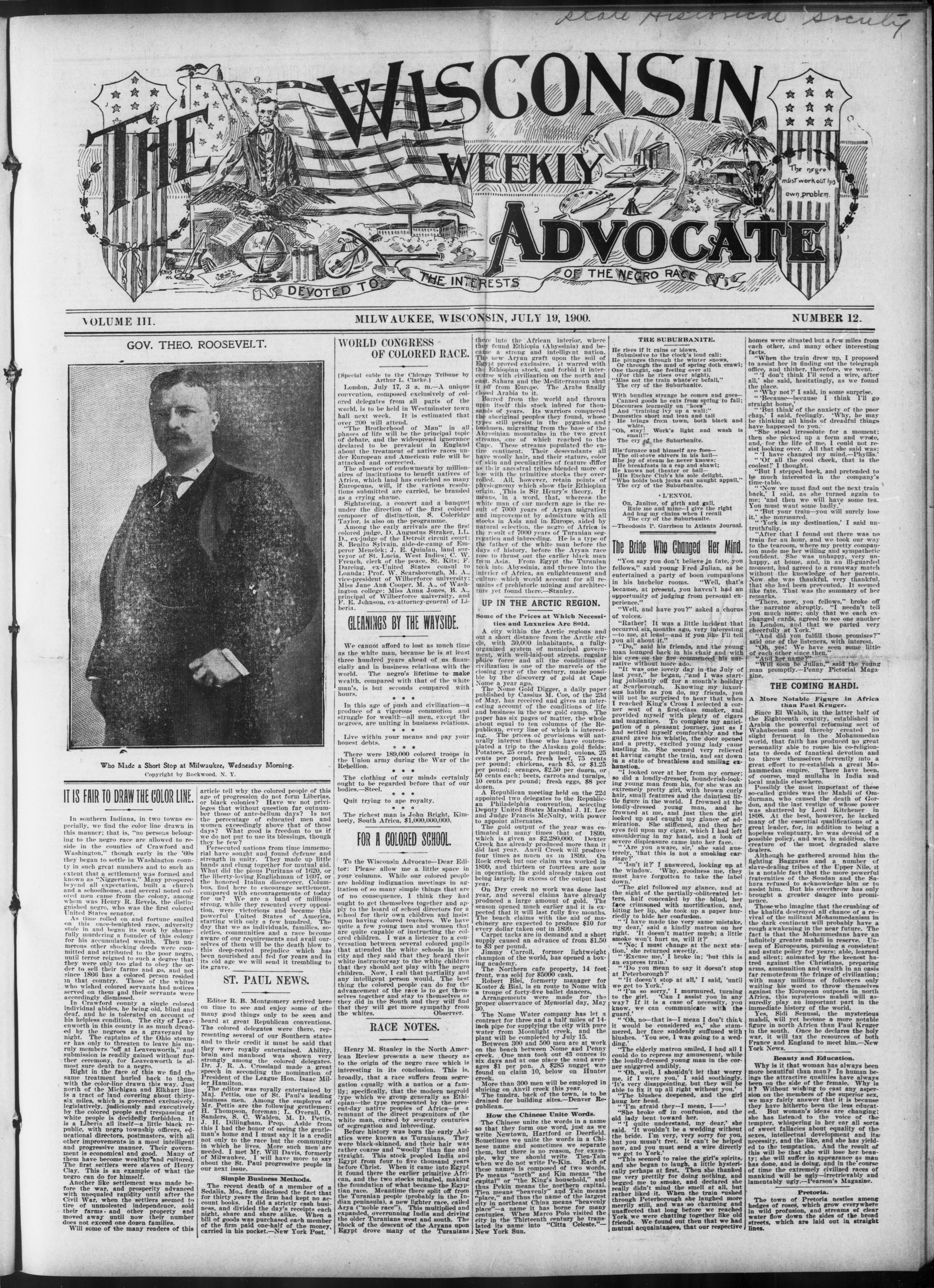
WISCONSIN
WEEKLY
Advocate
DEVOTED TO THE INTERESTS OF THE NEGRO RACE
VOLUME III.
GOV. THEO. ROOSEVELT.
Who Made a Short Stop at M
Copyright by Ro
T. E.
Who Made a Short Stop at Milwaukee, Wednesday Morning. Copyright by Rockwood, N. Y.
IT IS FAIR TO DRAW THE COLOR LINE.
In southern Indiana, in two towns especially, we find the color line drawn in this manner; that is, "no persons belonging to the negro race are allowed to reside in the counties of Crawford and Washington," though early in the '60s they began to settle in Washington county in such great numbers and to such an extent that a settlement was formed and known as "Niggertown." Many prospered beyond all expectation, built a church and a schoolhouse, and several noted colored men came from the colony, among whom was Henry R. Revels, the distinguished negro, who was the first colored United States senator.
As time rolled on and fortune smiled on this once-benighted race, adversity stole in and began its work by shamefully murdering a founder of this colony for his accumulated wealth. Then numerous other shocking deeds were committed and attributed to the poor negro, until terror reigned to such a degree that they were only too glad to obey the order to sell their farms and go, and not since 1866 has a colored person resided in that country. Those of the whites who wished colored servants had notices served on them and their servants were accordingly dismissed.
In Crawford county a single colored individual abides, he being old, blind and deaf, and he is tolerated on account of his helpless condition. The city of Leavenworth in this county is as much dreaded by the negroes as a graveyard by night. The captains of the Ohio steamer has only to threaten to leave his unruly members "off at Leavenworth," and submission is readily gained without further ceremony, for Leavenworth is almost sure death to a negro.
Right in the face of this we find the same treatment hurled back to them, with the color-line drawn this way. Just north of the Michigan and Elkhart line is a tract of land covering about thirty-six miles, which is governed exclusively, legislatively, judiciously and executively by the colored people and trespassing of white people is decidedly forbidden. It is a Liberia all itself—a little black republic, with negro township officers, educational directors, postmasters, with all other improvements in a most intelligent and progressive manner. Their government is economical and good. Many of them have become wealthy and cultured. The first settlers were slaves of Henry Clay. This is an example of what the negro can do for himself.
Another like settlement was made before the war, and prosperity advanced with unequaled rapidity until after the Civil War, when the settlers seemed to tire of unmolested independence, sold their farms and other property and moved away until now their number does not exceed one dozen families.
Will some of the many readers of this
Iwaukee, Wednesday Morning.
kwood. N. Y.
article tell why the colored people of this age of progression do not form Liberias, or black colonies? Have we not privileges that without question far outnumber those of ante-bellum days? Is not the percentage of educated men and women exceedingly above that of those days? What good is freedom to us if we do not put to use its blessings, though they be few?
Persecuted nations from time immemorial have sought and found defense and strength in unity. They made up little bands and clung together for mutual aid. What did the pious Puritans of 1620, or the liberty-loving Englishman of 1607, or the honored Italian discoverer, Columbus, find here to encourage settlement, compared with encouragements of today for us? We are a band of millions strong, while they resented every opposition, were victorious and became this powerful United States of America, starting with only a few hundred. The day that we as individuals, families, societies, communities and a race become aware of our requirements and avail ourselves of them will be the death blow to this deep-rooted prejudice which has been nourished and fed for years and in its old age we will send it trembling to its grave.
ST. PAUL NEWS.
Editor R. B. Montgomery arrived here on time to see and enjoy some of the many good things only to be seen and heard at great Republican conventions. The colored delegates were there, representing several of our Southern states and to their credit it must be said that they were royally entertained. Ability, brain and manhood was shown very strongly among the colored delegates. Dr. J. R. A. Crossland made a great speech in seconding the nomination of President of the League Hon. Isaac Miller Hamilton.
The editor was royally entertained by Maj. Pettis, one of St. Paul's leading business men. Among the employees of Mr. Pettis are the following gentlemen: H. Thompson, foreman; L. Overall, O. Sanders, S. C. Walden, M. D. Pettis, J. H. Dillingham, Prop. Aside from this I had the honor of seeing the gentleman's home and I must say it is a credit not only to the race but the community in which he lives. More such men are needed. I met Mr. Will Davis, formerly of Milwaukee. I will have more to say about the St. Paul progressive people in our next issue.
Simple Business Methods
The recent death of a member of a Sedalia, Mo., firm disclosed the fact that for thirty years the firm had kept no account books. It did a strictly cash business, and divided the day's receipts each night, share and share alike. When a bill of goods was purchased each member of the firm paid one-half of the money, carried in his pocket.—New York Post.
WORLD CONGRESS OF COLORED RACE.
[Special cable to the Chicago Tribune by Arthur L. Clarke.]
London, July 17, 3 a. m.-A unique convention, composed exclusively of colored delegates from all parts of the world, is to be held in Westminster town hall next week. It is estimated that over 200 will attend.
"The Brotherhood of Man" in all phases of life will be the principal topic of debate, and the widespread ignorance declared to be prevalent in England about the treatment of native races under European and American rule will be attacked and corrected.
The absence of endowments by millionaires of institutions to benefit natives of Africa, which land has enriched so many Europeans, will, if the various resolutions submitted are carried, be branded as a crying shame.
Sightseeing, a concert and a banquet under the direction of the first colored composer of distinction, S. Coleridge Taylor, is also on the programme.
Among the early arrivals are the first colored judge, D. Augustus Straker, LL D., ex-judge of the Detroit circuit court; S. Benito Sylvain, aide-de-camp of Emperor Menclek; J. E. Quinlan, land surveyor of St. Lucia, West Indies; C. W. French, clerk of the peace, St. Kits; F. Dareing, ex-United States consul to Loanda; Prof. W. Scarsborough, M. A., vice-president of Wilberforce university; Miss Jane Ann Cooper, M. A., of Washington college; Miss Anna Jones, B. A., principal of Wilberforce university, and F. E. Johnson, ex-attorney-general of Liberia.
GLEANINGS BY THE WAYSIDE.
We cannot afford to lost as much time as the white man, because he is at least three hundred years ahead of us financially and in business relations with the world. The negro's lifetime to make wealth, compared with that of the white man's, is but seconds compared with hours.
In this age of push and civilization—a produce of a vigorous commotion and struggle for wealth—all men, except the negroes, are uniting in business relations.
Live within your means and pay your honest debts.
There were 189,000 colored troops in the Union army during the War of the Rebellion.
* * *
The clothing of our minds certainly ought to be regarded before that of our bodies.—Steel.
* * *
Quit trying to ape royalty.
* * *
The richest man is John Bright, Kimberly, South Africa, $1,000,000,000.
FOR A COLORED SCHOOL
To the Wisconsin Advocate—Dear Editor: Please allow me a little space in your columns. While our colored people are holding indignation meetings in agitation of so many simple things that are of no consequence, I think they had ought to get themselves together and apply to the board of school directors for a school for their own children and insist upon having colored teachers. We have quite a few young men and women that are quite capable of instructing the colored children. I was a listener to a conversation between several colored pupils that attended the white schools in this city and they said that they heard their white instructor say to the white children that they should not play with the negro children. Now, I call that partiality and any intelligent person would. The best thing the colored people can do for the advancement of the race is to get themselves together and stay to themselves as they did in the South and they will find that they will get more sympathy from the whites. Observer.
RACE NOTES.
Henry M. Stanley in the North American Review presents a new theory as to the origin of the negro race which is interesting in its conclusion. This is, broadly, that a race suffers from segregation equally with a nation or a family; specifically, that the modern negroid type which we group generally as Ethiopian—the type represented by the present-day native peoples of Africa—is a remnant of the direct progenitors of the white man, cursed by seventy centuries of segregation and inbreeding.
Before history was born the early Asiatics were known as Turanians. They were black-skinned, and their hair was rather coarse and "woolly" than fine and straight. This stock peopled India and Egypt from four to five thousand years before Christ. When it came into Egypt it found there the earlier primitive African, and the two stocks mingled, making the foundation of what became the Egyptian race. Meantime there split off from the Turanian people (probably in the Indian peninsula), a new lighter race, called Arya ("noble race"). This multiplied and expanded, overrunning India and driving the older Turanians west and south. The shock of the descent of the Aryans upon Egypt drove many of the Turanians
there into the African interior, where they found Ethiopia (Abyssinia) and became a strong and intelligent nation. The new Aryan graft upon the soil of Egypt proved exclusive. it warred with the Ethiopian stock, and forbid it intercourse with civilization on the north and east. Sahara and the Mediterranean shut it off from Europe. The Arabs finally closed Arabia to it.
Barred from the world and thrown upon itself this stock inbred for thousands of years. Its warriors conquered the aboriginal peoples they found, whose types still persist in the pygmies and bushmen, migrating from the base of the Abyssinian mountains in the two great streams, one of which reached to the Cape. These streams populated the entire continent. Their descendants all have woolly hair, and their stature, color of skin and peculiarities of feature differ as their ancestral tribes blended more or less with the primitive stocks they overrolled. All, however, retain points of physiognomy which show their Ethiopian origin. This is Sir Henry's theory. It means, in a word, that, whereas the white man of our modern age is the result of 7000 years of Aryan migration and improvement by admixture with all stocks in Asia and in Europe, aided by natural selection, the negro of Africa is the result of 7000 years of Turanian segregation and inbreeding. He is a type of the father of the white man before the days of history, before the Aryan race rose to thrust out the earlier black man from Asia. From Egypt the Turanian took into Abyssinia, and thence into the interior of Africa, an enlightenment and culture which would account for all remains of prehistoric mining and architecture yet found there.—Stanley.
UP IN THE ARCTIC REGION.
A city within the Arctic regions and out a short distance from the Arctic circle, with 30,000 inhabitants, a fully-organized system of municipal government, with well-laid-out streets, regular police force and all the conditions of civilization is one of the marvels of the closing year of the century, made possible by the discovery of gold at Cape Nome a year ago.
The Nome Gold Digger, a daily paper published by Cassius M. Coe, of the 23d of May, has received and gives an interesting account of the conditions of life and business in the new gold camp. The paper has six pages of matter, the whole about equal to ten columns of the Republican, every line of which is interesting. The prices of provisions will naturally interest those who have contemplated a trip to the Alaskan gold fields: Potatoes, 25 cents per pound; onions, 25 cents per pound, fresh beef, 75 cents per pound; chickens, each $5, or $1.25 per pound; oranges, $2.50 per dozen, or 50 cents each; beets, carrots and turnips, 10 cents per pound; fresh eggs, $8 per dozen.
A Republican meeting held on the 22d appointed two delegates to the Republican Philadelphia convention, selecting Deputy United States Marshal J. H. Lee and Judge Francis McNulty, with power to appoint alternates. The gold output of the year was estimated at many times that of 1899, which is given as $2,280,000. Dexter Creek has already produced more than it did last year. Anvil Creek will produce four times as much as in 1899. On Rock creek but one claim was worked in 1899, and thirteen or fourteen are now in operation, the gold already taken out being largely in excess of the output last year.
On Dry creek no work was done last year, and several claims have already produced a large amount of gold. The season opened much earlier and it is expected that it will last fully five months. The beach claims with the aid of machinery are expected to produce $10 for every dollar taken out in 1899. Carpet tacks are in demand and a short supply caused an advance of from $1.50 to $3 per pound. Jimmy Carroll, former lightweight champion of the world, has opened a boxing academy. The Northern cafe property, 14 feet front, was sold for $5000 cash.
Robert Blei, formerly manager for Koster & Bial, is en route to Nome with a troupe of forty-five ballet dancers.
Arrangements were made for the proper observance of Memorial day, May 30.
The Nome Water company has let a contract for three and a half miles of 14-inch pipe for supplying the city with pure water from Moonlight creek, and the plant will be completed by July 15.
Between 300 and 500 men are at work on the beach between Nome and Penny creek. One man took out 43 ounces in six days and at one place the sand averages $1 per pan. A $285 nugget was found on claim 10, below on Hunter creek.
More than 300 men will be employed in sluicing on Anvil creek this year.
The tundra, back of the town, is to be drained for building sites.—Denver Republican.
How the Chinese Unite Words
The Chinese unite the words in a name so that they form one word, just as we write Newtown, Hartford or Deerfield. Sometimes we unite the words in a Chinese name and sometimes we separate them, but there is no reason, for example, why we should write Tien-Tsin when we do not write Pe-Kin. Each of these names is composed of two words. Pe means "north" and Kin means "the capital" or "the King's household," and thus Pekin means the northern capital. Tien means "heavenly" and Tsin means "place," and thus the name of the largest city in northeast China means "heavenly place"—a name it has borne for many centuries. When Marco Polo visited the city in the Thirteenth century he translated its name into "Citta Celeste."—New York Sun.
THE SUBURBANITE.
He rises if it rains or blows,
Submissive to the clock's loud call;
He plunges through the winter snows,
Or through the mud of spring doth crawl;
One thought, one feeling over all
(For this he rises over night).
"Miss not the train whate'er befall,"
The cry of the Suburbanite.
With bundles strange he comes and goes—
Canned goods he eats from spring to fall;
Discourses learnedly on "hoes"
And "training ivy up a wall";
Domestics short and lean and tall
He brings from town, both black and
white.
"Oh, stay! Work's light and wash is
small!"
The cry of the Suburbanite.
His furnace and himself are foes—
The oil-stove shivers in his hall—
Hhe joy of steam he never knows;
He breakfasts in a cap and shawl;
He knows not theater or ball—
This Enchre Club's his sole delight. "What a delight it might appall." The cry of the Suburbanite.
· L'ENVOL
On, Janitor, of girth and gall,
Rule me and mine—I give the right
And hug my chains when I recall
The cry of the Suburbanite.
—Theodosia P. Garrison in Atlanta Journal.
The Bride Who Changed Her Mind.
"You say you don't believe in fate, you fellows," said young Fred Julian, as he entertained a party of boon companions in his bachelor rooms. "Well, that's because, at present, you haven't had an opportunity of judging from personal experience."
"Well, and have you?" asked a chorus of voices.
"Rather! It was a little incident that occurred six months ago, very interesting—to me, at least—and if you like I'll tell you all about it."
"Do," said his friends, and the young man lounged back in his chair and with his eyes on the fire commenced his narrative without more ado.
"It was one lovely day in the July of last year," he began, "and I was starting jubilantly off for a month's holiday at Scarborough. Knowing my luxurious habits as you do, my friends, you will not be surprised to hear that when I reached King's Cross I selected a corner seat of a first-class smoker, and provided myself with plenty of cigars and magazines. To complete my anticipation of a pleasant journey, just as I had settled myself comfortably and the guard gave his whistle, the door opened and a pretty, excited young lady came bustling in. She seemed very relieved at having caught the train, and sat down in a state of breathless and smiling exhaustion.
"I looked over at her from my corner; so did a loudly-dressed, bounderish-looking young man from his, for she was an extremely pretty girl, with brown curly hair, small features and the daintiest little figure in the world. I frowned at the loudly-dressed young man, and he frowned at me, and just then the girl looked up and caught my glance of admiration. She stiffened, and then her eyes fell upon my cigar, which I had left smouldering in my hand, and a look of severe displeasure came into her face.
"Are you aware, sir," she said austerely, 'that this is not a smoking carriage?'
"Isn't it? I answered, looking up at the window. 'Why, goodness me, they must have forgotten to take the label down.'
"The girl followed my glance, and at the sight of the partially-obliterated letters, half concealed by the blind, her face crimsoned with mortification, and, biting her lip, she took up a paper hurriedly to hide her confusion.
"'I have made the very same mistake, my dear,' said a kindly matron on her right. 'It doesn't matter much; a little smoke won't hurt us, will it?'
"'No; I must change at the next station,' she returned sweetly.
"Excuse me,' I broke in; 'but this is an express train.'
"Do you mean to say it doesn't stop at Peterborough?"
"It doesn't stop at all," I said, 'until we get to York.'
"I'm so sorry," I murmured, turning to the girl. 'Can I assist you in any way? If it is a case of necessity, you know, we can communicate with the guard.'
"Oh, no—that is—I mean I don't think it would be considered so," she stammered, her face suddenly suffused with blushes. 'You see, I was going to a wedding.'
"The elderly matron smiled, I had all I could do to repress my amusement, while the loudly-dressed young man in the corner sniggered audibly.
"Oh, well, I shouldn't let that worry me, if I were you," I said soothingly. 'It's very disappointing, but they will be able to fix it up all right without you.' "The blushes deepened, and the girl hung her head. "I'm afraid they—I mean, I—" "She broke off in confusion, and the old lady bent toward her. "I quite understand, my dear,' she said. 'It wouldn't be a wedding without the bride. I'm very, very sorry for you, but you musn't fret. It can't be helped now, and you must send a wire directly we get to York.'
"This seemed to raise the girl's spirits, and she began to laugh, a little hysterically perhaps at first. Then she thanked me very prettily for doing nothing, and begged me to smoke, and declared she really didn't mind the smell at all, but rather liked it. When the train rushed through Peterborough she laughed more merrily still, and was so charming and unaffected that long before we reached York we were chatting together like old friends. We found out then that we had mutual acquaintances, that our respective
homes were situated but a few miles from each other, and many other interesting facts.
"When the train drew up, I proposed to assist her in finding out the telegraph office, and thither, therefore, we went.
"I don't think I'll send a wire, after all," she said, hesitatingly, as we found the place.
"Why not?' I said, in some surprise.
"Because—because I think I'll go straight home."
"But think of the anxiety of the poor chap,' I said, feelingly. 'Why, he may be thinking all kinds of dreadful things have happened to you."
"She stood irresolute for a moment; then she picked up a form and wrote, and, for the life of me, I could not resist looking over. All that she said was:
"I have changed my mind.—Phyllis."
"Of all the cool cheek, that is the coolest!" I thought.
"But I stepped back, and pretended to be much interested in the company's time-table.
"'Now we must find out the next train back,' I said, as she turned again to me; 'and then we will have some tea. You must want some badly.'
"'But your train—you will surely lose it.' she murmured.
"York is my destination,' I said untruthfully.
"After that I found out there was no train for an hour, and we took our way to the tearoom, where my pretty companion made me her willing and sympathetic confident. She was unhappy, very unhappy, at home, and, in an ill-guarded moment, had agreed to a runaway match without the knowledge of her parents. Now she was thankful, very thankful, that she had been prevented. It seemed like fate. That was the summary of her remarks.
"There, now, you fellows," broke off the narrator abruptly. "I needn't tell you much more; only that we each exchanged cards, agreed to see one another in London, and that we parted very cheerfully at York."
"And did you fulfill those promises?" said one of the listeners, with interest. "Oh, yes! We have seen some little of each other since then." "And her name?" "Will soon be Julian," said the young man promptly.—Penny Pictorial Magazine.
THE COMING MAHDI.
A More Notable Figure in Africa than Paul Kruger.
Since El Wahib, in the latter half of the Eighteenth century, established in Arabia the powerful reforming sect of Wahabeeism and thereby created no slight ferment in the Mohammedan world, that faith has produced no great personality able to rouse his co-religionists to deeds of fanatical devotion and to throw themselves fervently into a great effort to re-establish a great Mohammedan empire. There have been, of course, mad mullahs in India and local mahdis elsewhere.
Possibly the most important of these so-called guides was the Mahdi of Omdurman, who caused the death of Gordon, and the last vestige of whose power was shattered by Lord Kitchener in 1898. At the best, however, he lacked many of the essential qualifications of a great leader, for, in addition to being a hopeless voluptuary, he was devoid of a possible policy, and was, in addition, the creature of the most degraded slave dealers.
Although he gathered around him the fighting Baggaras and a number of slave-dealing tribes of the Upper Nile, it is a notable fact that the more powerful fraternities of the Soudan and the Sahara refused to acknowledge him or to assist him. But his overthrow has only brought a greater danger into prominence.
Those who imagine that the crushing of the khalifa destroyed all chance of a revival of the militant Mohammedanism in the dark continent will probably have a rough awakening in the near future. The fact is that the Mohammedans have an infinitely greater mahdi in reserve. Unseen of Europeans, pursuing a consistent and astute policy for years; able, learned and silent; animated by the keenest hatred against the Christians, preparing arms, ammunition and wealth in an oasis far remote from the fringe of civilization; with many millions of followers only waiting his word to throw themselves against the European outposts in north Africa, this mysterious mahdi will assuredly play an important part in the immediate history of the world.
Yes, Sidi Senussi, the mysterious mahdi, will yet become a more notable figure in north Africa than Paul Kruger in the south. Once he declares the holy war, it will tax the resources of both France and England to meet him.—New York News.
Beauty and Education
Why is it that woman has always been more beautiful than man? In human beings the attractive qualities have always been on the side of the female. Why is it? Without wishing to cast any asperion on the members of the superior sex, we may fairly answer that it is because they have hitherto been the less educated. But woman's ideas are changing; she has listened to the voice of the tempter, whispering in her ear all sorts of sweet fallacies about equality of the sexes, intellectual development and its necessity, and the like, and she has yielded to the temptation. And the result of this will be that she will lose her beauty; she will suffer in appearance as man has done, and is doing, and in the course of time the extremely civilized races of mankind will be ugly—irretrievably and lamentably ugly—Pearson's Magazine.
Pretoria.
The town of Pretoria nestles among hedges of roses, which grow everywhere in wild profusion, and streams of clear water flow down the sides of the broad streets, which are laid out in straight lines.
Attack Upon Walled City on July 14 is Successful.
Notwithstanding the Disaster on Friday Assault is Renewed and Victory is Won.
London, July 17.—12:45 p. m.—The Daily Mail today gives the Associated press the following dispatch from its Shanghai correspondent under date of July 17: "The allied troops resumed the attack upon the Chinese walled city of Tien Tsin on the morning of July 14, and succeeded in breaching the walls and capturing all the forts.
"The Chinese were completely routed and the allies took possession of the native city and its defenses.
"The total losses of the allies in the engagement of Thursday, Friday and Saturday were about 800 killed or wounded. The casualties were greatest among the Russians and Japanese."
The guns of the allies did immense damage to the native city, causing many large conflagrations and finally silenced the majority of the enemy's guns simultaneously. Then 1500 Russians, assisted by small parties of Germans and French, assaulted and captured eight guns that were in position on the railway embankment and the forts, the magazine of which the French subsequently blew up. A body of Americans, British, Japanese and Austrian troops then made a sortie and attacked the west arsenal, which the Chinese had reoccupied. After three hours of the hardest fighting yet experienced the Chinese fled.
When the arsenal had been evacuated by the Chinese, the Americans, French, Japanese and Welsh fusileers advanced toward the native city and joined with the other attacking forces. The Japanese infantry and a mounted battery advanced to the foot of the walls, supported by the Americans and French. Despite valiant attacks, the allies were only able to hold the positions gained outside the walls preparatory to renewing the assault in the morning.
The casualties sustained by the allies were exceedingly heavy, especially those of the Americans, French and Japanese. Several explosions in the native city were caused by the bombardment.
The Chinese appear to have exhausted their supply of smokeless powder, as they are now using black powder.
Confirmed by Admiral Remey.
Washington, D. C., July 17.—Admiral Remey this morning cabled the navy department that the city and ports of Tien Tsin are in the hands of the allies. His list of killed and wounded is somewhat fuller than yesterday's report, but still not entirely complete. His dispatch follows:
"Chefoo, July 17.—Today hope to get wounded from Tien Tsin either in hospitals at Taku or aboard Solace. Communication very uncertain; following casualties apparently confirmed:
"Marines—Capt Davis, killed; Capt, Lemly, Lieuts, Butler and Leonard, wounded. Army—Col. Liscum, killed; Majs, Reagan and Lee, Capts. Noyes, Brewster and Bookmiller, Lieuts. Naylor, Lawton, Hammond and Waldron, wounded. Total killed and wounded reported, 775. Russians and Japanese lost heavily; our total loss reported 215; about forty were marines, but number believed to be exaggerated. Have officer on shore especially to get authentic number of names, which will be promptly telegraphed. City and forts now in the hands of allies. Admiral Seymour returned to fleet; officer ashore is Admiral Alexieff at Tien Tsin."
Eight Guns Captured.
Tien Tsin, Friday, July 13.—In today's combined attack upon the native city over forty guns bombarded the Chinese positions. The fighting was most determined, and the allies' losses were heavy. Eight Chinese guns were captured and the Chinese were driven out of the west arsenal after a fierce cannonade. A strong mixed force is now close to the walls, and it is expected that an assault will be made tomorrow.
CONVICTED OF STEALING
Strange Conduct of an American Girl in a London Hotel.
London, July 17.—Caroline E. Keyes pleaded guilty in the Marylebone police court yesterday to the charge of stealing a gold watch, bracelet, hairbrush and articles of clothing of the aggregate value of £22 from rooms in Norfolk Mansions hotel, where she had been staying. When the robberies were reported the police interrogated Miss Keyes, who after a series of denials to the questions with which she was pled for two hours, finally opened her trunk and displayed the missing articles. Her explanation was that she had been drinking brandy and while under the influence of the liquor took the property. The next morning she tried to replace the stolen property, but was unable to gain access to the rooms she had robbed. In the course of the hearing Miss Keyes said she was an American, and had come to London to attend the World's Christian Endeavor convention as a delegate from a church in Minnesota. She had come to disseminate the gospel, she said, and while it was true she took the things, she was not guilty in her heart of stealing, for she meant to restore the property if she had the chance. Ultimately Miss Keyes, who said she was without money, was remanded to allow her to call her witnesses as to her character.
Mining Syndicate Settles.
Duluth, Minn., July 17.—Wellington B. Burt has forced the Lake Superior Consolidated Iron mines, the Rockefeller syndicate, to make a settlement. He charged that the company was not making an honest effort to develop the property. Mr. Burt is to get a minimum of $50,000 a year from his properties.
The Same Old Saying
"Now, boys," said the teacher to the juvenile class in history, "who can tell me what Gen. Washington said to his lieutenant while crossing the Delaware amid the floating ice?" "I can," replied a youngster at the foot of the class. "Well, Tommy, what did he say?" queried the teacher. "He said: 'How'd you like to be the ice man?'" replied the incorrigible Tommy.—Trained Motherhood.
—It costs $100 to keep the Boston public library open on a holiday, as the attendants have a legal right to the day, and if they are asked to stay they must be paid. On one holiday the experiment was made of keeping the library open, and scarcely fifty persons took advantage of the privilege. That settled the question in favor of closing thereafter.
—Recent studies of the ocean bottom near the coast line of continents have shown that rivers of considerable size sometimes enter the sea beneath the surface.
—A beach at Nome 600 feet long has yielded $475,000 this season.
AT WAR WITH RUSSIA.
A Dispatch from St. Petersburg Says that a Declaration Has been Made
Washington, D. C., July 18.—The state department has received a dispatch from Consul-General Fowler at Chefoo, saying that the governor of Shantung wires that his courier left Pekin on July 9. The legations were still holding out.
Washington, D. C., July 18.—United States Minister Allen at Seoul, Corea, telegraphs the state department that Boxers and Chinese are in force within a few miles of the Corean frontier. The natives of Pingyan (the most northern province of Corea) are much alarmed and are fleeing. The foreigners remain in safety. The government is very anxious.
London, July 18.—The Express prints the following from its correspondent at Shanghai:
"Prince Tuan has issued an edict to fix a date for a general rising. What the date is I cannot ascertain, but it is doubtless an early one, for Prince Tuan is stated to have ordered all dispatch in view of the arrival of more foreign troops. A large body of Chinese tonight is reported to be moving from Hupei in the direction of Shanghai. The situation here grows more threatening every day. The city is still without any means of defense, and all the forts are being held by Chinese."
The entire region of the Yang-tse is in a state of unrest. Shanghai is menaced with a native uprising, and the northern provinces are in open revolt.
Time to Keep Cool.
While the improvement in the situation at Tien Tsin is considerable the Chinese rebels are swarming outside the city and there are strong reasons for believing that the bulk of the regular army is saturated with the Boxers' spirit of hatred against foreigners. This feeling of antagonism will be promoted if indiscreet appeals for vengeance and menaces, that one stone shall not be left upon another in Pekin, are reproduced in China from the English press. It is a good time for everybody to keep cool and to avoid intemperate language, by which the work of the allied forces in China will be immeasurably increased. Civilized nations cannot make war with Oriental savagery and barbarism. They cannot wage war on a mission of vengeance, but may enter China as reformatory agents and do good work in the interest of civilization and humanity.
Stop Making Threats.
Men of sound judgment here affirm that as America could not make war on Cuba in revenge for the destruction of the Maine, but only as a moral agent, pledged to redeem the island from misrule, so also the civilized world must cease breathing out threats of fire and slaughter and recognize the obligation to create a new order in China, or else to stay out altogether. They also add that the new order cannot be brought about without a partition of territories.
The Shanghai correspondent of the Mail learns that Prince Ching concocted a scheme to enable Sir Robert Hart to escape disguised from the British legation on July 4. Sir Robert, however, refused to desert the other inmates of the legation, and he twice wrote to Prince Tuan, asking him to spare the lives of all the foreigners. Prince Tuan, however, did not make any reply and Sir Robert is believed to have perished on the night of July 6, during the massacre.
Refugees Flocking to Japan.
Refugees Flocking to Japan.
Victoria, B. C., July 18.—News via the steamship Empress of India says that from all parts of China the refugees are flocking to the treaty ports and every ship is bearing them to Japan. Nagasaki, the port at which they first arrive, is already uncomfortably crowded and Kohe is beginning to fill up. Many of them are in a destitute condition and appeals for aid are filling the papers.
In his report of the fighting at Tien Tsin, the Japanese commander, under date of June 25, says: "There is no food except rice, and unless communication with Taku is opened in two weeks there will be great destitution."
An edict published in the Japanese papers from the Empress Dowager tells of the burning of the imperial palace by Boxers on June 13.
A Boxer Placard.
Native papers state that a Boxer placard, posted throughout Pekin, reads as follows:
"I, the commander-in-chief of heaven's troops, will march from Pekin to Nakin shortly. Our principal object is to burn and destroy churches and chapels, and then the telegraph and postoffice, telegraph stations, colleges and schools. The people need not be frightened when they see our arrival here. We are going to drive away the foreigners so as to keep the empire in peace and comfort. Purchasing provisions for providing us we will give the market price, but sellers must also charge moderately. We will not destroy the yamens and customs; they can levy duty as usual. If any people disobey this order they will be beheaded at once."
Gallant Charge of the Japs.
New York, July 18.—A dispatch to the World from Tien Tsin July 11 says: The Chinese made a determined attack upon the railway station early this morning. The French troops were forced to give ground and the Japanese gallantly charged in, support of the French. The French casualties reach fifty; Japanese sixty, including five officers killed; English and Indians, twenty; Russians, twenty. The Americans were not engaged at this point. It is estimated that 300 Chinese were killed.
Reports Discredited.
London, July 18. As to the latest Chinese assurances of the safety of the European legations at Pekin, they are not credited here.
On the contrary, it is believed these assurances have been dictated by a desire to save the native city of Tien Tsin. The Associated press correspondent at Shanghai wires, under date of July 16, that there is hardly a doubt that Sheng, the Chinese administrator of telegraphs, is withholding information in his possession. The news of the massacre as already cabled to the United States may be taken as correct. The dispatch adds that there is evidence that the Woo Sung forts (at the mouth of the Woo Sung river, and ten miles north of Shanghai) are being strengthened and supplied with large quantities of ammunition. It is hoped in London that the landing of 22,000 Japanese troops, which it is expected will be effected today and the arrival of Indian troops will enable the allies to reinforce Shanghai.
DISMAY IN CANTON.
Li Hung Chang Disregards All Pro-
tests and Leaxes for Pekin.
tests and Leaves for Pekin.
Hong Kong, July 18.—Li Hung Chang, disregarding all attempts of Europeans and Chinese to persuade him to remain,
left Canton this morning for Pekin. Prior to his departure, Chinese merchants and gentry of Canton strongly appealed to the viceroy not to leave and presented a petition setting forth that Canton, so long the prey to the depredations of robbers and pirates, had become peaceful during Li Hung Chang's vice royalty, that disturbances had been repressed with a strong hand and the people enabled to live without being panic-stricken when dogs barked. The petitioners, this paper continued, learned with trembling, that their protector was proceeding north and they wept as at the loss of a parent. The absence of rebellion and piracy being solely due to the presence of Li Hung Chang, the merchants were ready to cast themselves before the wheels of his chariot to prevent his departure.
CHINESE FLEET READY.
Missionaries Maltreated and Houses of Foreigners Burned.
St. Petersburg, July 18.—The Chinese fleet is concentrating in the China sea, and hostilities are expected.
A dispatch from Nankin announces that Prince Tuan has ordered a great military movement, owing to the appearance of the Japanese in China. The viceroy of Nankin has informed the foreign consuls there that he cannot be answerable for events in Chao-Sin, Ning-Po and Chu-Chun. The foreigners are fleeing to Shanghai. The position is alarming. Sixteen foreigners have arrived at Nankin from Ning-Po, where the houses of foreigners have been burned and missionaries horribly maltreated.
The rebellion has taken hold of Southern China. The foreigners at Chu-Chau and in Chau have been attacked and are fleeing panic-stricken.
Authentic News Expected.
Washington, D. C., July 18.—There was no change today in the President's intention to return to Canton tomorrow night. He will be in constant communication with the members of the cabinet from there by telephone and telegraph, and unless something unforeseen occurs, he does not consider it necessary to remain in Washington. Authentic and reliable news of the situation in Pekin is expected soon. Until it arrives nothing remains to be done but to mobilize and push forward the troops and marines selected to make up our quota of the 80,000 soldiers which the commanders at Taku have decided are necessary to hold Tien Tsin and insure the success of the forward movement on Pekin.
Skirmish on July 14.
London, July 18,—Admiral Alexieff reports a skirmish July 14 on the Pei-Ho river, twenty-five versts from Taku, between a reconnoitering body of Russians and Chinese, in which several Russians were killed.
A dispatch from Shanghai received here today reports that five cruisers of the allied fleet, including the British cruiser Terrible, reconnoitered at Shan-Hai-Kuan July 17, and found the harbor lights and forts intact and but few Chifese visible.
Warships at Shanghai.
The dispatch adds that it was intended to bombard the forts, but the fleet refrained, and stood by ready for action in case the forts showed signs of activity. The same dispatch adds that eight warships are lying off the native city of Shanghai and that nine others are between Shanghai and Woo-Sung.
Japanese Troops Disembark.
London, July 18.—A special dispatch from Shanghai dated today says the disembarkation of 15,000 Japanese troops is proceeding at Taku.
Nearly a Million Men.
St. Petersburg, July 18.--A dispatch from Chefoo says: Prince Tuan has mobilized 950,000 men, divided into different corps. The northern corps have been ordered to expel foreigners from Amur. The Pekin army, which is divided into corps, is the first to begin operations.
WAR WITH RUSSIA.
Formal Declaration by China Said to Have Been Made.
London, July 18.—The Daily News publishes the following dispatch from its special correspondent: "St. Petersburg, July 17 (censored by the Russian government).—There is no doubt now that China has declared war against Russia. Hostilities are beginning, the end of which is impossible to see. Probably the truth will take a long time to filter through to Europe, but the situation in eastern Siberia is extremely grave, as critical indeed as it well can be. The Boxers, or rather the regular Chinese troops (for these are doing the real fighting), have seized a Russian transport boat, laden with munitions, near Aigun, on the river Amur, and fired on and killed almost the entire Russian escort. They next made a sudden attack upon Blagoveschenk, bombarding the town. The garrison held out bravely, but were overwhelmed and nearly all perished. The town was burned.
Progress Barred by Chinese.
"It was on July 5 news reached the general staff that this declaration of war had been made by China at the town of Aigun, on the Amur. In consequence of this Gen. Gribowski attempted to push his way to Aigun on the steamer Galenga, but found at a point twelve miles from Aigun further progress barred by Chinese, who had thrown up fortifications in which had been placed forty guns. Consequently he had to relinquish the attempt to reach Aigun. The situation in Manchuria has become very critical since the bombardment of Blagoveschenk and the holding up of the Russian transport with munitions. On the eastern Siberian railway almost all the stations have been burned to, the ground, bridges have been destroyed and the tracks have been torn up. The Russian consul at Kuldscha has telegraphed urgently for reinforcements."
If the news of a Chinese invasion of Siberia proves true it will, of course, immensely complicate the situation from the international point of view. As stated in the Associated press St. Petersburg dispatch of July 13, the Chinese had already peremptorily ordered all Russians to quit Manchuria, but no one imagined they would be audacious enough to break out of their own country and attack Russian territory. Such an attack, if it has been made, of course constitutes in itself a declaration of war, rendering formal notification needless.
A separate attack by the Chinese on Russia means giving Russia, according to the views expressed in Europe, additional claim to assert greater influence than the other powers and obtain greater compensation when the day of settlement arrives. Hence, extreme uneasiness has been created in the chancellories by this latest development.
LI HUNG CHANG'S MISSION
To Save Lives of Foreigners and Arrange Terms for Peace.
London, July 18.—The Daily Telegraph publishes this dispatch from its special correspondent: "Canton, July 16, via Hong Kong, July 17.—In reply to the British, French, American, German and Portuguese consuls, who officially visited him in a body this morning, Viceroy Li Hung Chang insisted that his departure for the north, which is fixed for Tuesday, has a two-fold object—namely, to save the lives of the foreign ministers in Pekin and to arrange the best terms for peace possible with the allied powers. He assured the consuls that he had taken all precautions against any uprising.
"He added that he had received important cable messages from Lord Salisbury and the French foreign minister, M. Delcasse, identical in tone and demanding full protection from injury and insult of the foreign ministers in Pekin and threatening to take life for life of the high officials responsible if the ministers were murdered. Li Hung Chang informed the consuls that he was the only viceroy or high dignitary in all China who dared to transmit such messages to the Empress, and that he had sent them verbatim. She received them, and he had no doubt whatever that they have exerted a powerful influence in saving the ministers' lives.
Auxious to Secure Peace.
"To the American minister, who had inquired about accurate intelligence concerning the foreign ministers, the viceroy said he had had no news from Pekin within the last week. His previous advices had assured him then of their safety. If they were alive he was almost certain that matters could be satisfactorily arranged with the allied powers. If they were dead—here he shrugged his shoulders significantly and added with lowered voice: 'It is hard to tell what may happen. I am going to Pekin practically unarmed, except for my bodyguard of 200 men. That ought to be evidence to the whole world that I do not favor any fighting and of my pacific intentions.'
"He was evidently exceedingly anxious about the ministers, for, returning to the subject, he said: 'My heart is sore about them. I know them all personally, and am on the best terms with them.'"
Wu is Encouraged.
Washington, D. C., July 18. The Chinese minister called on Secretary Hay this morning and had a ten-minutes' talk with him. Mr. Wu said he had received no additional information, but thought the situation looked much brighter as a result of dispatches received yesterday. There is a possibility that Secretary Hay requested Minister Wu to call, owing to the urgent desire of the administration to secure news from Pekin.
THE FIRST BULLETIN.
Col. Liscum and Seventeen Enlisted Men Killed at Tien Tsin.
Washington, D. C., July 18.—The war department today bulletined its first official report of the results of the battle at Tien Tsin as follows:
Killed—Col. E. H. Liscum and seventeen enlisted men.
Wounded—Capt. C. R. Noyes, not serious; Maj. J. R. Eagan, serious but not dangerous; Capt. E. V. Bookmiller, serious but not dangerous; Lieut. L. B. Lawton, not serlout; Lieut. F. R. Lang, slight, and seventy-two enlisted men.
Missing—Two enlisted men.
Coolidge, who signed the dispatch, is lieutenant-colonel of the Ninth infantry.
MORE HOPEFUL FEELING.
Disposition to Give Credit to Consul Fowler's Dispatch.
Washington, D. C., July 18.—The bouyant and hopeful feeling of yesterday as to the Chinese situation was strengthened today by the addition of a confirmatory dispatch from Consul Fowler, at Chefoo, touching the safety of the legationers at Pekin on July 9. Of course, it can be understood that Mr. Fowler's information came from the same fountainhead as did Minister Wu's of yesterday, namely, the famous Yuen Shih-Kai, the military governor of Shan Tung province. Because of the very intimate relations that have existed up to a very recent date between this official and the imperial court at Pekin, he having been commander of the imperial bodyguard, there is a disposition here to attach more credence to his dispatch than would be accorded to those of other Chinese officials. This is based on the presumption that he has no inducement to falsify the facts.
Consul-General Goodnow at Shanghai has cabled for a warship. His suggestion was merely precautionary and after considering it the navy department has withheld action in view of the fact that the Castine already is at that port and foreign ships are on the way.
REBELLION IN HO NAN.
American Engineers and Missionaries Attacked.
Paris, July 18.—The French consul at Hankow telegraphs, under date of July 13, that the viceroy admits that he is doubtful of his ability to arrest the rebellion in Ho Nan. The dispatch adds that a caravan of English and American engineers and missionaries from Chen Si was attacked near Siang-Yiang. A number were wounded, but it was hoped the caravan would shortly reach Hankow. The consul at Shanghai telegraphs, under date of July 9, that the governor of Tche-Kiang, on the vigorous demand of the consul, had taken energetic measures to repress disorders. A second telegram, dated July 13, announces trouble in the province of Ho Nan. Missionaries had been attacked in the provinces of Tche Kiang and Manchuria, and numbers of missionaries were imperilled.
Japs Blew Down the Gates.
London, July 18.—In the House of Commons today the parliamentary secretary for the foreign office, William St. John Broderick, read a dispatch from Admiral Seymour, dated at Taku, July 15, giving an account of the capture of the native city of Tien Tsin by the allied forces. According to this dispatch, on the morning of July 14 the Japanese blew up the gate and entered the city, the others following.
On the right the Russians captured a battery on the bank of the Liu-Tai canal, consisting of twelve small guns. The other troops all engaged on the left. About 8000 in all were engaged and over 700 were killed or wounded, the Japanese being the heaviest losers. The British had twenty killed and ninety-three wounded. The Chinese troops fled, in what direction is not known.
Col. Liscum Buried.
Washington, D. C., July 18.—The war department today received a cablegram from Gen. MacArthur, dated Manila, July 18, saying that Col. Liscum's body was buried at Tong Ku on the 17th inst.
Praised His Wife Too Much.
"Pooh." said a man in an omnibus, as he and other business men were on their way to the city, "my wife is the most methodical, careful, neat woman you ever saw. It is all nonsense for a woman to let a house run into disorderly ways. You ought to see how my wife does things."
"Well, of course, that is all very well in theory," responded another; "but the best housekeeper gets behind, or something, sometimes."
"My wife never does. She is always the same. She keeps everything in first-class order."
"She must be a remarkable person," said another man. "How long have you been married?"
"Ten years. And she has never disappointed me. Why, gentlemen, she always puts everything in the same place, and you know just where to find what you want. For instance, I went to my handkerchief drawer this morning before daylight, and took out a handkerchief and put it in my pocket before starting out, and I know just as well as I know my own name that that handkerchief is just such a size, and has my initials worked in silk in one corner." And the boastful man put his hand in his pocket and pulled out—and unfolded—a white nightcap, with long strings dangling from it!—Tit-Bits.
THE CHECK IS WORTHLESS
Clever Swindler Gets $475 Out of a Madison Lawyer.
Gets Attorney to Endorse a Check Which is Found to be a Forgery.
Madison, Wis., July 18.—[Special.]— The smoothest of the many varieties of "check games," and one which is entirely new to this section at least, has just been worked successfully on one of Madison's shrewd attorneys, F. E. Parkinson, who is out just $475 as the price of his experience.
It was done this way: A little more than a week ago a young man of good appearance called on Mr. Parkinson at his office and said he wanted to engage his services as an attorney. He gave his name as C. E. Scott, and said he came West from Pennsylvania about a year ago with $5000, with which he purchased an interest in the stock farm of his uncle, Thomas Scott, near Janesville. A few weeks ago, he said, he had taken three carloads of stock to Chicago and sold them, receiving a little more than $3600. When he returned home his uncle was dissatisfied with the proceeds of the sale. They had a row over it, and his uncle told him they would consider the partnership at an end. He had kept the money he received for the cattie, about $3500, after deducting expenses, and would be willing to settle for $1500 more, being satisfied to get his money back. It was to secure this $1500 that he wanted Mr. Parkinson's services.
The attorney naturally agreed to take the case in hand, and wrote a letter to Thomas Scott, requesting a settlement at $1500. Next day his client came to the office to see if there was a reply, but none had been received. He came again next day, and on being told no answer had come from Thomas Scott, stated that he had just had a conversation over the telephone with his cousin, a daughter of Thomas Scott, and that she told him her father had decided to settle on the terms offered, and would send the amount, $500 in cash and the remaining $1000 in a note, through Janesville attorneys.
Next came a letter to Mr. Parkinson, signed Thomas Scott, saying he had sent the cash and note through Whitehead & Matheson of Janesville, to the legal firm of Buell & Hanks of this city. The same morning Buell & Hanks received a letter, typewritten on the stationery of Whitehead & Matheson, enclosing a certified check for $500 and a note for $1000, both signed Thomas Scott. Suspecting nothing wrong, Hanks went to Parkinson's office, where the sharper was waiting, turned over the check and note, taking C. E. Scott's receipt in full, and the matter was considered closed.
The check was made payable to Mr. Parkinson as Scott's attorney, and he took it to the State bank to have it cached. The teller suggested that he send it in for collection, and save the 50 cents exchange due on a certified check, but Mr. Parkinson was sure it was all right, and that he would charge the 50 cents up to his client, who was in a hurry for his money. Then he endorsed the check, received the $500, and returning to his office gave all of it to his client except $25 which he retained for his services.
Then Scott disappeared. Next day was Sunday, and he probably spent it in traveling. Monday the check came back from the Janesville bank on which it was drawn, branded as a forgery. The same day a letter came to Buell & Hanks from Whitehead. Matheson asking what their letter regarding a settlement in the Scott case meant. They had never heard of it. Inquiry at the postoffice where a letter had been sent Thomas Scott developed the further fact that there was no such man. The whole tale had been cleverly-concocted by the sharper as a means of working off a bogus check, and he did it most successfully.
DR. FOX DIDN'T KNOW.
Must Pay for Missing Cattle Held by Him as Executor.
Omaha, Neb., July 18.—Judge Vinson Haler decided the Tussler will case and rendered judgment against Dr. Philip Fox of Madison, Wis., executor of the estate in the sum of $40,000. The executor has failed to account for a lot of livestock, including 550 head of horses that belonged on the estate in the western part of the state. In his deposition the executor admitted that he was not up in that line of business and insisted that he had left the matter in the hands of his lawyer. He said he did not have the slightest idea what had become of the property and his attorney did not go into that phase of the case. The court held that the executor should have known, and said he would have to pay for his failure to have knowledge of the affairs intrusted to him. The estate is that of Mrs. Catherine Tussler, widow of a prominent cattleman and mother of Mrs. H. P. Stoddard of Omaha.
BLUEBERRY CROP VERY POOR.
Indians Feeling Blue and Outlook is Discouraging.
West Superior, Wis., July 18.—[Special.]—The blueberry crop in this county is now being harvested, and there are a great many Indians that are feeling exceedingly blue over the outlook. The condition of the crop is likely to cause very hard times among these people this summer. The yield this year is only a small percentage of the average yield, on account of the great drouth which prevailed early in the season. The Indians are now getting as high as $3 a bushel for them, whereas they got but about $1.50 per bushel a year ago. Even at this figure, however, the income from that source will be comparatively very small.
LAWRENCE GETS $4000.
Chair Established in Honor of Dr. Steele by Unknown Contributor
Appleton, Wis., July 18.—Fiscal agent J. S. Davis of Lawrence university has reported a gift of $4000 to the endowment fund of a chair in honor of Dr. George M. Steele, a former president of the college, and now residing in Chicago. The name of the contributor was withheld.
TANNERY DESTROYED BY FIRE
Shaw Company Suffers Loss of $25,000 at Perkinstown.
Medford, Wis., July 18.—Fire at Perkinstown, destroyed the rollhouse and one of the buildings of the T. M. and F. D. Shaw Tannery company. The estimated loss on leather is $20,000 and on the building and machinery $5000, which is partially insured.
Lay by Track All Night.
Janesville, Wis., July 18.—Robert Graham of Evansville fell from the midnight passenger on the Chicago & North-Western road near Clinton and lost a leg. No one on the train knew of the accident and Graham lay bleeding on the track until he was found unconscious from the loss of blood and brought to this city.
Two Thousand People Waiting at a Railway Station—Several Were Injured.
Johnstown, Pa., July 18.—While 2500 persons were waiting at the Pennsylvania station here to go with the A. O. U. W. excursion to Lake Mont park near Altoona, today, a freight train running at a high rate of speed dashed into the crowd. Six were injured, as follows: J. C. Begley, Mrs. Begley, their 1-year-old child, fatally; Frank Urbaugh, Sr., Frank Urbaugh, Jr., fatally.
ATTACKED BY BOERS.
Federals Make a Determined Assault Upon Lord Roberts' Left Flank.
London, July 18.—The war office has received the following dispatch from Lord Roberts, dated Pretoria, July 17:
"Yesterday the enemy made a determined attack on the left of Pole-Carew's position and along our left flank, commanded by Hutton, the posts held by the Irish fusiliers and Canadian mounted infantry, under Lieut.-Col. Alderson, was most gallantly defended. The enemy made repeated attempts to assault the positions, coming in close range and calling to the fusiliers to surrender. The enemy suffered severely. They had fifteen killed and fifty wounded, and four were taken prisoners. The British casualties were seven killed (including the Canadian Lients, Borden and Birch), thirty wounded and twenty-one missing.
"Ian Hamilton's column advanced to Waterval yesterday unopposed, and today proceeded to Haman's kraal."
"Fifteen hundred Boers, with five guns, managed to break through the cordon formed by Hunter's and Rundle's divisions, between Bethlehem and Ficksburg. They were making towards Lindley, being closely followed by Paget's and Broadwood's brigades."
In a dispatch dated today Lord Roberts pays a tribute to Lieuts. Borden and Birch, who are reported killed. Lord Roberts says: "They were killed while gallantly leading their men in a counterattack on the enemy's flank at a critical juncture of their assault on one position. Borden was twice before brought to my notice in dispatches for gallant and inrepid conduct."
A STORMY TRIP.
Nautical School Ship St. Marys Blown 200 Miles Out of Her Course.
Lisbon, July 18.—The New York Nautical schoolship St. Marys is undergoing repairs here on account of the terrible weather experienced on the passage hitherto. The St. Marys left New London, Conn., July 15, with 100 cadets. When three days out she encountered a cyclone, which soon prevented headway, and the vessel was stripped of her canvas except such as enabled her to keep steerageway. Sunday night, June 17, it was necessary to heave to and she thus remained three days.
Commander William H. Reeder remained on deck throughout the storm, though he was thrown down and his head cut and back badly strained. The fourth day the storm abated, when sail was set for the Azores. A reckoning taken showed that the ship had been blown 200 miles out of her course and that she was then off the coast of Virginia. The wind badly strained all the rigging and the topmast and bowsprit were damaged. The intention was to make the Azores for repairs. There was good weather until just off Fayal when another storm set in and for three days the vessel labored in a heavy sea, attempting to make shore. Finding this was inadvisable, a course was laid for Lisbon. Off the coast of Spain another storm was encountered, and again the St. Marys hove to for a day and a half. The St. Marys finally reached Lisbon, ten days overdue. After making repairs she will start for the Mediterranean.
JOKE ON CHOATE.
Prince of Wales Mistakes a Walter for the Ambassador and Greets Him Effusively.
London, July 18.—Joseph H. Choate, ambassador from the United States to the court of St. James, has a double in the person of a waiter at the Marlborough club. London society has just found out that a few days ago the Prince of Wales greeted the waiter most effusively and conversed with him for several minutes before he discoverd his mistake. The waiter had just placed a veal and ham pie on a sideboard and turned to go away when he was astonished to find his hand grasped by the Prince of Wales, who told him how glad he was to see him and hoped he was quite well. The waiter, not knowing that he was mistaken for Mr. Choate, was shocked for an instant, but finally managed to stammer out his thanks to his royal highness for the kindly and royal inquiries that were being made.
The ambassador was told of the incident soon after it occurred, and is said to be very much pleased over it, although the prince, as might be expected, thinks that it was a clever joke.
CHRISTIAN ENDEAVORERS.
Delivery of Messages the Features of the Day's Meetings.
London, July 18.—Fully 50,000 persons attended today's meetings of the world's convention of the Young People's Society of Christian Endeavor, the special feature of the programme being the delivery of messages from the churches. Rev. Hugh Price Hughes, president of the Wesleyan conference, said he conveyed from 30,000,000 Methodists of Great Britain the desire to form an alliance with every true soldier of Christ. Right Rev. Mandell Creighton of London extended to the Christian Endeavor society the heartiest welcome of his diocese and assurance of the sympathy with this work of the large body of Christians he represented. Dr. Parker of the City temple urged American Christian Endeavorers to nominate Rev. Francis E. Clark and Rev. Charles M. Sheldon for the highest offices in the United States, as Christian men should be at the head of things.
United States Ambassador Choate and the Archdeacon of London sent sympathetic messages.
CHOLERA ON BOARD.
Five Deaths Among Passengers on a British Steamer.
Malta, July 18.—The British steamer Borneo, Capt. Gregor, from Calcutta, for London, has arrived here, and has been quarantined at the island of Comino (between Malta and Gozo) in consequence of five deaths from cholera having occurred on board during the voyage.
Arrow Poison.
Arrow poison of the Wagogo is derived from the juice of the bark of two euphorbiaceous trees by continued boiling. Brieger has isolated therefrom a crystalline body which corresponds chemically and physiologically with Wakamba arrow poison. The euphorbia juice appears to act as a progressive poison.
PARTY ON SHIPPING.
DEMOCRACY HAS NO PLAN BY WHICH TO BUILD UP.
Expends All Its Efforts in Attempts to Tear Down-Always Opposes Republican Policy, but Has No Policy of Its Own.
The platform utterance of the Democratic party regarding American shipping is a clear index of the inherent inability of that party to construct. It seems only to be able to oppose and denounce the constructive policies of its progressive political opponents.
The foreign commerce of the United States is regarded the world over as the most important of all. To this country come the finest foreign ships. The greatest and most powerful steamship lines vie with each other for our trade. The largest, the swiftest, the safest and the most luxurious ships that are built are for the carrying of the trade in merchandise, passengers, specie and mails from and to the United States.
But 8 per cent. of our foreign trade is carried in American ships. Foreign ships carry 92 per cent. This carrying is worth fully $200,000,000 each year. All but 8 per cent. of it goes out of the pockets of American producers and consumers for paying foreigners for doing our foreign carrying. Not only does it go out of our people's pockets, but it goes out of the country. It goes abroad and is there used to pay for the building and running of foreign ships. It gives the employment to foreigners that the carrying of our foreign commerce creates.
People ask, Why is this? The answer is simple. Foreign ships are built more cheaply than American ships. This, however, is a disadvantage that could in time be overcome if the shipbuilding industry were put on a basis of permanency. If a steady and large demand were created for our ships very soon the cost of their construction would be reduced to the level of foreign prices. It is the unsteadiness, the irregularity, and the uncertainty of employment in American shipyards that keeps the cost of American ships from 20 to 25 per cent. higher than the cost of foreign built ships. Better food and more of it is given on American than on foreign ships. This also creates a disadvantage which the American ship cannot easily overcome. Then again wages on shipboard are much higher under the American than under foreign flags. In the cases of officers the wages on American ships are on the average twice as high as they are on foreign ships.
Worse than all this, however, foreign governments pay their merchant ships great subsidies and bounties. Great Britain spends about $6,000,000 a year in this way; France spends over $7,000,000 a year. Germany, Italy, Spain, Russia, Austria and Japan all give large subsidies to their ships. In all the subsidies and bounties paid by foreign governments to their ships amount to more than $26,000,000 each year.
Unaided American ships, it must be clear, cannot profitably compete with foreign ships under the conditions above described. That is why it is that foreign ships have driven American ships from off the seas. The Republican party, recognizing the unequal conditions which confront American ships in the foreign trade, is committed to a policy of subsidizing American ships in that trade. The amount of the subsidy proposed is barely enough to enable American ships to compete on terms of equality with foreign ships.
This bill Democrats have singled out for denunciation in their national platform. They "oppose the accumulation of a surplus to be squandered in such bare-faced frauds upon the taxpayers as the Shipping Subsidy bill, which under the false pretense of prospering American shipbuilding would put unearned millions into the pockets of favorite contributors to the Republican campaign fund." The alternative of the shipping subsidy bill is to keep on paying nearly $200,000,000 a year to foreign shipowners whose governments, in paying them subsidies, enable them to prevent American ships from competing. Rather than have our government pay a subsidy to American ships, the Democrats would prefer to have our people send nearly $200,000,000 out of the country each year to build and sustain foreign ships.
In their platform the Democrats "especially condemn the ill-concealed Republican alliance with England." When we remember that Democracy's platform denunciation of the Shipping Subsidy bill will nowhere be received with such favor and gratitude as in Great Britain, whose command of the sea and especially of American foreign carrying the Democrats would perpetuate, and which present British monopoly the passage of that bill would do much to destroy, the insincerity and the secret pro-British leanings of the Democrats are clearly discerned.
Not a word have the Democrats to utter in behalf of a policy that would cause the building of the ships our foreign commerce employs out of American material and with American labor, instead of, as now, their construction out of foreign materials by foreign labor in other countries. No policy is suggested by them—they merely denounce the Republican policy that would substitute American for British and other foreign ships in our foreign trade. Having no plan of their own to suggest for building up our shipping in the foreign trade, expressing no regret at seeing nearly $200,000,000 annually paid by Americans to foreign shipowners (chiefly British) for carrying our commerce, the Democrats, on the shipping question at least, proclaim themselves the allies of England.
SENATOR HANNA
Gives His Opinion of President McKinley. Administration.
The country is to be congratulated that we are to have no change at the head of the Republican ticket in the coming political contest. A favorite saying of McKinley's is that "you can always trust the people." And this is their opportunity to show their appreciation of his confidence in their judgment by trusting the management of their affairs for four more years in his hands. Mutual confidence means success. And the success of the Republican party means a continuation of our material development and prosperity. For a candidate this time the people want a man who has been tried and not found wanting—a man equal to any emergency, one who is broad and liberal enough in ideas to keep abreast of the rapid evolution of nations, while keeping to the policy which contributes most to the best interests of our own country.
A study of the present administration during the past three years decides the question that President McKinley fills the ideal as Chief Executive. His personality stamps him as a true gentleman and a loyal patriot, the highest type of an American-able, conscientious and devoted to the work which comes to him in the discharge of his public duty. His is a nature in which the elements are so happily blended that, while his able and dignified public course commands respect, his private life wins sincere affection.
Connected as he is with the present happy condition of our country, as the result of an entire Republican administration of Republican principles, there is a feeling of satisfaction and confidence in the future which will call for his renomination and re-election.
HOW WILL BRYAN VOTE?
His Increased Prosperity Should Cause Him to Vote for McKinley.
The Republican party is on the defensive. It will talk prosperity, of course, but we'll be willing to take the votes of all the people who have not had their share of prosperity, and leave them the votes of the people who have been prosperous.—W. J. Bryan at Chicago, June 13, 1900.
The following figures are taken from the books of the assessor for the Fifth Ward of the city of Lincoln, Neb., which is the ward in which Mr. Bryan makes his home, and they show the assessed valuation of his personal property for the years indicated:
Year. Valuation.
1893 $280.00
1894 200.00
1895 340.00
1896 (last year of Democracy).. 270.00
1897 1,485.00
1898 2,980.00
1899 2,980.00
1900 4,550.00
The above figures are official and prove conclusively that Mr. Bryan should vote for William McKinley in this year of our Lord, 1900.
The Nation's Money.
For the fiscal year that has just ended the colnage executed at the United States mints amounted to $184,323,793 pieces, valued at $141,301,960, as follows: Gold, 7,662,786 pieces, valued at $107,937,110; silver, 75,359,254 pieces, valued at $31,121,833; minor coins, 101,301,753 pieces, valued at $2,243,017.
In 1890 the total number of pieces coloned was 122,270,945, and the value, $136,855,675. in value the increase over 1896 is inconsiderable, but there is an increase of 62,000,000 pieces, representing a great deal of hard work for the mints and showing the activity in trade circles.
The total circulation of national bank notes at the close of business, June 30, 1900, was $309,559,719, an increase for the year of $68,291,023, and an increase for the month of $9,070,830. The circulation based on United States bonds was $274,115,552, an increase for the year of $68,851,458, and an increase for the month of $11,026,435.
What the Republicans Did.
The Republicans are doers rather than boasters, and the party promise is as good as a bond. They promised protection and prosperity, and gave it without burning any red lights or brass bands. They promised sound money, and the currency bill was passed even to the quiet satisfaction of those who opposed it. In the quiet field of diplomacy they persuaded Europe to consent to an open trade door in China, so that after the present Chinese trouble is over, without having to play for position or ask for a sphere of influence, American wheat, American cotton, raw and manufactured, American lumber, American iron and steel, American machinery and a thousand other American products will be granted equal rights with the products of other countries.
Two Courses Open.
It is safe to predict that the Democrats on the stump during the present campaign will criticise the course of the administration with reference to the Philippines, but will offer no positive line of conduct regarding the same. There are but two courses open: either to pacify, hold, govern, educate and develop; or to abandon, withdraw and allow anarchy to run riot until, in the interests of humanity, some other power steps in and takes up the task we are advised to abandon. The first course is Republican, the other must be called Democratic.
A Democratic Task.
The Democracy has a big task before it to persuade the American voter that 16 to 1 is worth more to the country than protection, sound money, prosperity, trade expansion, the honor of the flag and the inevitable growth of the great republic, saved by Republicans and made prosperous by Republican administrations.
LABOR AND TRUSTS.
LABOR AND TRUSTS.
LARGE COMBINES DON'T TRY TO LOWER WAGES.
Wage-Earners and Capitalists Getting Closer Together Every Day—Steady Employment, More Pay and Shorter Hours the Rule—Labor Movement.
"Down with the trusts" is one of the slogans of the Democratic party this year, and its agents will endeavor to capture the laboring man's vote because they say that trusts lower the wages of the workers.
But what is the truth? Not one single instance can be cited where a large industrial institution, employing hundreds or thousands of people, has attempted to reduce their wages. Neither can it be shown that a single one of the hundred national and international trade and labor unions of this country is fighting the large combinations. Instead of fighting them, they are getting closer together every day. The growing tendency between labor and capital has been toward annual conferences to determine wage scales, hours of work and conditions of employment. The tendency is to employ arbitration and conciliation in the settlement of differences. This method has long been in vogue between the railways and their employes, with the steel-rail makers, with the wire-nail makers, with tinplate manufacturers, with the steelbeam producers, with the Amaigamated Association of Iron, Steel and Tin Workers, with the newspaper publishers, with the employing book and job printers, and with the International Typographical Union. The more that labor and capital concentrate their interests individually, so much the more are they endeavoring to concentrate their interests collectively. Large and small labor unions, instead of fighting industrial combination, find it to their interest to join hand in hand with them. There is no better combination in the United States to-day than the American Federation of Labor.
Speaking for the vast army of wageearners employed in the iron, steel and tin industry, Theodore Schaffer, President of the Amalgamated Association of Iron, Steel and Tin Workers, before the Federal Industrial Commission, has declared that the effect of trusts has been beneficial to them. "As a general rule," he said, he believed that the members of his organization "would prefer to deal with combinations and large corporations rather than with smaller independent mills." His experience was that they always received fair treatment in negotiating with these combinations, and he was certain "they did not prevent competition."
Democratic politicians "point with pride" to the fact that there have been more labor disturbances and strikes in the past year or so than in the four years of Democratic administration. Why all these strikes, then? The average wage-worker never thinks of going on strike on a falling market, and certainly not on a falling market under Democratic rule. When business is stagnant and factories are silent, and the land is full of unemployed labor, the voice of the agitator is lost in the general murmur of distress and there are no strikes, because there is little employment.
Every labor organization in the country, be it large or small, for the past two years reports steady employment for its full membership, increased pay, shorter working hours and a general improvement in all its conditions. At the eve of President McKinley's reelection the whole world is engaged in paying tribute to the wonderful productivity of our farms and factories, telling a marvelous tale of American prosperity, proving conclusively the general distribution of the flood of wealth being poured into this favored land.
It is scarcely four years since labor in the United States was crying out for work at any price. Its pockets were empty and its children went hungry to bed.
These events are significant because, by their unprecedented intensity, they have called public attention as never before to what is known as "the labor movement." The problem of the relations between employer and employed is not of easy or quick solution. The promises for this country, inaugurated by the protective policy of the Republican party when it came into power in 1896, were for a restoration of prosperity. This we have had, and now it is to be hoped that good sense and prudence will, through the votes of the people, direct its continuance.
Political Small Shot
A little cracked ice put an end to Tammany's anti-trust fever.
During the war of the rebellion Pettigrewism was known as Vallandighamism.
Mr. Bryan's return to the tax assessor has answered one of his pet arguments. Mr. Bryan is not growing poorer.
The corn and wheat crops in Kansas and Nebraska are Democratic argument destroyers of great magnitude.
Mr. Lentz has acquired considerable prominence as a debater who carries a large assortment of interchangeable premises.
There was a combination in the iron trade of Syracuse more than 2,000 years ago. There was no protective tariff in those days.
There were but two issues considered by the voters in the Oregon campaign—the gold standard and expansion. The side shows set up by the fusionists had no effect whatever.
Those who are disposed to be charitable in the case of Mr. Pettigrew are inclined to believe that the poor man is suffering from a disarrangement of the mechanism of his head.
WORST IN MANY YEARS.
Heavy Rainstorm Does Great Damage in the State.
Hail Hurts the Crops in Wisconsin, Minnesota and the
La Crosse, Wis., July 16.—What the weather bureau reports to be the heaviest rainstorm in La Crosse and vicinity for three years has been raging here for the past three days. The storm was general in Wisconsin, Minnesota and the Dakotas. Much damage has been done locally and no less than twelve basements were overflooded with water causing heavy damage. All railroads have suffered small washouts. All trains more or less delayed on this account. The Milwaukee road ran its trains from Dubuque to Prairie du Chien over the Burlington tracks and on the Viroqua branch the Milwaukee road is out of commission entirely. The hail did a great deal of damage to crops in Wisconsin, Minnesota and the Dakotas.
Appleton, Wis., July 16.—[Special.] Three inches of rain fell here yesterday and last night with violent thunder shower in the afternoon. Lightning burned out armature in generator at Interurban railway powerhouse laying up the Appleton-Neenah cars three hours. The local fire alarm system was crruppled and small damage was done to several dwellings.
Fond du Lac, Wis., July 16.—[Special.]
—Fond du Lac county is being favored with plenty of rain. Intermittent showers fell all day yesterday and last night and continued today. The rains are general throughout the county. They interfered with plans for the numerous out-of-door events arranged for yesterday. The Sons of Herman picnic at Ingram's grove was adjourned sine die during the afternoon. The baseball game between Fox Lake and Fond du Lac was not played, Athletic park presenting the appearance of an "amateur" lake. Other picnics and outings were also abandoned. On account of the threatening weather Capt. Plonsky issued orders calling off the proposed encampment at Athletic park over Sunday of Co. E.
La Crosse, Wis., July 16.—During the heavy rain and wind storm the center pole of the tents of Cooper & Co.'s circus gave way while the performance was in progress. A panic was narrowly averted. The tent was lowered and people were let out without disorder. Charlie Brettie, a clown, was seriously injured by a flying missile.
Portage, Wis., July 16.—The worst wind and rain storm of the season struck this city yesterday afternoon about 5 o'clock. Sheds were blown down and shade trees uprooted. The crops in this vicinity will be considerably damaged. Galesville, Wis., July 16.—[Special.]—The storm Saturday night was one of the worst this section of the country has ever known. For three hours there was a perfect flood, which has made country roads inaccessible in many places and carried away numerous bridges. Many reports of stock being killed by lightning are coming in, one farmer having lost six head of sheep by a single bolt. Several days will be required to put local telephone lines in working order.
Toman, Wis., July 16.—Lightning struck the Chicago, Milwaukee & St. Paul railway depot in this city during a heavy storm Saturday afternoon. Charles Chamberlain, a traveling salesman for the M. Kratchwill Candy house of La Crosse, was in the act of purchasing a ticket when the crash came and was overcome by the shock. The switchboard was one mass of flame and the building took fire. The flames were soon extinguished.
STRUGGLE FOR LIVES.
Boating Party Wrecked on Lake Chetek and Six Barely Escape Drowning.
Eau Claire, Wis., July 16.—[Special.]—Percy Atkinson and wife, Mrs. Ida Kidder and Mrs. W. K. Atkinson of Eau Claire, Mrs. Matt Johnson of Superior and a Superior gentleman were wrecked yesterday on Lake Chetek. Their boat struck a stump and split in two. The water was over their heads, and they clung to a log and pieces of the boat until rescued. They were nearly exhausted, being in the water over two hours.
BOLT FROM CLEAR SKY.
William Olp of Springfield, Walworth County, is Struck and Killed by Lightning.
Burlington, Wis., July 16.—[Special.]
—William Olp of Springfield, Walworth county, was struck by lightning Saturday afternoon and instantly killed. He was 22 years of age and was to have been married tomorrow. His bride-to-be is prostrated with grief.
Olp was working on the Harlow farm at Spring Prairie. He was driving a mower. The sky was clear and the sun was shining. Suddenly there was an awful flash of lightning and roar of thunder and Olp fell dead. Both horses were also killed.
Olp was a son of John Olp of Springfield, Wis.
USEFUL CAREER CLOSED.
The Death of Dr. F. A. Blackmer of Albert Lea.
Minneapolis, Minn., July 16.—[Special.]—Dr. F. A. Blackmer of Albert Lea, who died in Minneapolis last week from an operation, was for many years a leading surgeon of southern Minnesota. He was a native of Ohio and his father before him was a physician of wide reputation and acknowledged standing. He was educated in the public schools of Albert Lea, Oberlin college and the Cleveland Medical college, from which he graduated in 1868. The same year he began the practice of medicine at Albert Lea and followed his profession continuously with the exception of a year when he was suffering from the effects of a wound received in the Civil war. He was a member of Co. C. Fifth Minnesota infantry, and in the battle of Fort Ridgley received a gunshot wound in the face, jaw and tongue. His wife was Miss Franc E. Wedge of Fond du Lac, Wis., and she and one son, Ray C. Blackmer, editor of the Freeborn County Times, survive him.
ADOPTED CHILD MISSING.
Money and Jewelry Disappear at the Same Time.
Baraboo, Wis., July 16.—[Special.]—The adopted son of Mrs. R. S. Brain left home and, it is alleged, carried away with him a gold watch, $5 in money, a revolver and a box containing jewelry. Before adoption his name was Fred Bucknell and he came from the state school at Sparta six years ago. He is 13 years old, and his father, Harry Bucknell, resides at Edgerton, Wis.
YOUNG LOVERS DROWN.
Life Savers at Kenosha Find the Bodies in Harbor Waters.
Kenosha, Wis., July 17.—[Special.]—The crew from the Kenosha lifesaving station shortly after 7 o'clock last evening took from the waters of the Kenosha harbor the lifeless bodies of Helma Beinerman and William Burwell, two well-known young people of this city. The story of their death is shrouded in mystery. Yesterday morning the lifesavers found a woman's hat and a man's cap drifting in the waters of the harbor near the station, and in the afternoon they went in search of the bodies, which were found later in the evening. The finding of the bodies created a great sensation, and when they had been laid side by side in one of the rooms of the station a great crowd gathered and thronged the little room. The young people had been missing since Sunday evening and the finding of the bodies was the first elue to their whereabouts. No one seems to be able to offer any solution of the mystery of the sad death of the young people.
For some time Burwell has been keeping company with Miss Beinnerman, and he was seen with her last night. From the appearance of the bodies when found it was evident that the young man had made an effort to rescue the woman, as when the body of Burwell was pulled out of the lake he still held the girl by the hand. The relatives of the young man and woman are prostrated with grief on account of their tragic death, but they can offer no solution for the mystery.
Both the young people had been employed at the same factory and a strong friendship had grown up between them. On Sunday evening they had started for a walk and they were seen walking along the dock near the schooner yacht Argo, which was in the harbor. There was a board lying near the spot where the bodies were found and it is supposed that the woman attempted to get on the yacht and slipped and fell into the water and the boy jumped in to rescue her.
The girl was 16 years of age and the sister of Henry Beinnermann, the county assessor. Burwell was 19 years old and a general favorite. At the inquest held a verdict of accidental death by drowning was rendered by the coroner's jury.
Both Miss Beinnermann's parents are dead, but Burwell's mother is almost distracted by the event, and fears are entertained that she will lose her reason as a result.
CITY UNDER WATER.
Entire Country About Marinette is Submerged and it is Raining Hard.
Marinette, Wis., July 17.—[Special.]— It has been raining steadily here for forty-eight hours and this entire country is under water. The roads are perfect streams. A number of the mills and manufacturing institutions are flooded and operations are hampered. Up on the Eagle river yesterday there was a big cloudburst, which caused considerable damage. A camp crew of the Peshtigo company had a narrow escape from being enveloped in it. The heavy rainfall is doing great damage to farming interests. It is still raining and there is no immediate prospect of a cessation. All the streams hereabouts are raging torrents.
MONONA ASSEMBLY.
Madison, Wis., July 17.—[Special.] The opening session of the Monona Lake assembly will occur this evening at 7:30, when President Willet S. Main will deliver his annual address. Other features of this session will be the formal dedication of the new auditorium and an historical address by Samuel D. Hastings of Green Bay, one of the oldest directors of the association.
ANTHRAX IS SPREADING.
Cattle Belonging to Outagamie County Farmer Die of the Dread Disease.
Appleton, Wis., July 17.—[Special.]—Anthrax has broken out in a herd of cattle belonging to Anton Bloom, near Five Corners, Outagamie county, and three deaths have resulted. Veterinarian Mack today inoculated thirty other cattle in the herd to prevent the spread of the disease.
OF CHINESE ORIGIN.
Arch Constructed in China Long Before it Appeared in Greece or Rome,
The Chinese structures that impress the engineering observer most strongly are the bridges, the pagodas, the city walls and certain details of building construction. The arch, that beautiful structure from the scientific as well as the aesthetic point of view, is generally believed to be of Roman origin. It was not known to, or at least never used by, the Greeks, and although the shape appears in certain specimens of Hindoo architecture, it is of false variety—that is a succession of protruding corbels. In China, on the other hand, we find it of most widespread and general application, and examination shows that the principles involved are thoroughly understood. The universal use of the design in all parts of the country and the undoubted antiquity of so many of the existing examples clearly demonstrate that it long antedates any possible foreign suggestions, and go a long way to establish it as of Chinese origin—a department, however, which like printing and gunpowder, never passed beyond the national borders—Engineering Magazine.
WAS NOT MURDERED.
Fight at Cottage Grove Dance Did Not Terminate Fatally.
Deerfield, Wis., July 17.—The report from Madison, Sunday, conveying the news that a Norwegian farmhand was killed in a brawl at a dance at Cottage Grove Friday night, proves to be erroneous. The victim of the fight, Lars Buskager, is still alive. He is at his home near Cottage Grove, under the care of a doctor, and will probably recover. Sheriff Kanouse visited Cottage Grove and gave out that he would make a number of arrests. Four persons are said to be directly implicated. It is alleged that Buskager precipitated the fight.
FIRE IN MENASHA STORE.
The Building and Contents is Entirely Destroyed.
Menasha, Wis., July 17.—[Special.]
Fire this morning destroyed the furniture store of William Laemmrith. The loss will be $2500 on the building and stock,
and is covered by insurance.
The Latest Diversion.
The latest diversion in rural society comes from Copake, N. Y., where the citizens organized a tombstone bee and went out into the graveyard and straightened up all the toppling monuments and headstones.
—Martin Mullin, employed by Maxwell Bros., box manufacturers, was dragged several blocks by a team of runaway horses and severely injured.
—Frank D. Bartlett, son of A. C. Bartlett of Hibbard, Spencer, Bartlett & Co., died in Munich, Bavaria, after an operation for appendicitis. Mr. Bartlett was 20 years old.
—William A. Paulsen, president of the Central Trust and Savings bank, which failed March 3, 1896, was found guilty of embezzlement and receiving a deposit in his bank after it had become insolvent.
—Ex-Ald. Nathan M. Plotke, author of the high-hat ordinance, died at his home of congestion of the heart. Mr. Plotke was 58 years old.
Frank Stewart, a colored waiter, 35 years old, tried to board a cable car and fell under the wheels. His right foot was crushed and the right side of his head was badly bruised.
Lightning, discharged as a herald of a thunderstorm, struck the broomcorn warehouse occupied by Henry F. Vehmeyer & Co. Within an hour nearly $200,000 worth of property had been destroyed, firemen and several spectators had been injured.
William S. Schaefer, a 12-year-old boy, died at his home in great agony as the result of lockjaw induced by a wound on his hand. The lad was injured on the Fourth of July by the explosion of a blank cartridge, which tore his fingers and burned him badly.
Michael Ward, a highwayman, was killed during an exchange of shots by John Leslie, a watchman in the employ of the Anglo-American Packing company, in the midst of the stockyards while the vicinity in which the shooting took place was thronged with persons out for their luncheon.
As the result of a quarrel over money matters David Kelly, a retired cabman, was shot and almost instantly killed by Charles Foster, his brother-in-law. The affray took place at their home, and Foster claims he shot in self-defense. Kelly's daughter, Grace, 8 years old, witnessed the deed.
—Samuel H. Wright, member of the well-known law firm of Paddock, Wright & Billings, and for several years one of the most successful attorneys at the Illinois bar, died at his home, of typhoid fever, after a brief illness. Mr. Wright was born in Chicago forty-two years ago. He leaves a widow and a 9-year-old son. —Thomas Ely Patterson, a well-known real estate dealer, died at his home, of paralysis. He had been ill nine years. —The plant of John Featherstone's Sons, proprietors of the Columbia Iron works, was sold by order of the United States district court to James H. Eckels, trustee. The highest bid was $80.202, offered by Attorney Arthur Humphrey, who kept silent about the name of the actual purchaser and gave only that of the trustee.
MARKET REPORTS.
EGG AND DAIRY PRODUCTS.
MILWAUKEE—Eggs—Market firm at 11c for new, cases included; 10%c for new, cases returned; 10%c for old, cases included; dirties and seconds, 7@8c. The receipts were 210 cases.
Butter—Market steady. The receipts were 25,005 lbs today against 3415 yesterday. There is a good demand for choice creamery. Dairy scarce and wanted here, there being practically none in the market. Fancy prints, 19%c; fancy or extra creamery, per lb, 18%c; firsts, 17c; seconds, 15c; extra dairy, 15c; lines, 12@14c; packing stock, 11@12; whey butter, 9c; imitation creamery, 15@16c; grease, 4@6c. Fancy dairy prints, 17c.
Cheese—Steady. The receipts today were 23,700 lbs against 8905 yesterday. Full cream flats, October, per lb, 11@11%c; full cream flats, new, colored, 9@10%c; New York, full cream flats, new colored, 9@10%c; Young Americas, October, 10@11%c; Young Americas, new, 9@10%c; brick, 9@1%c; limburger, per lb, 9@10%c; Imported Swiss, 24c; Block Swiss, domestic, 12@12%c; No. 1 imitation loaf, 14@15%c; Sapsago, 19@20; farmers'. 9@10c.
SHEBOYGAN—Sales were 1777 boxes, as follows: 513 daisies at 10%c; 454 Young Americas at 9%c; 678 at 9%c; 115 longhorns 10%c; 17 twins at 9%c.
PLYMOUTH—On the call 510 daisies sold at 10%c; 338 twins at 9%c; 98 at 9%c; 439 Young Americas at 10c; 42 longhorns at 10%c.
NEW YORK - Butter - Receipts, 5057
pkgs; firm; creamy, 16%@19%c; current
packed factory, 14%@16c. Cheese-Receipts,
3538 pkgs; firm; large white, 9%@9%c;
large colored, 9%@9%c; small white, 8%@9%c;
small colored, 9%@9%c. Eggs-Receipts,
8993 pkgs; market steady; Western
at mark, 11@13e for average lots; Western,
loss off, 15c. Sugar-Raw strong;alf
fairing, 4 5-16c bld; centrifugal, 96 test,
4 13-16c bld; molasses sugar, 4 1-16c bld;
refined coffee. Firm-Firm; No. 7 8%, 9%c.
MILWAUKEE LIVESTOCK MARKET.
HOGS- Receipts, 7 cars; market 5c lower; light, 5.10@5.20; mixed and medium weights, 5.10@5.20; common to choice heavy, 4.95@5.20; coarse heavy stags, 4.25@4.50.
CATTLE- Receipts, 4 cars; steady; butcher steers, medium to good, 1050 to 1300 Ibs, 4.25@5.00; fair to medium, 950 to 1050, 3.75@4.25; helfers, good to choice, 3.25@4.00; cows, fair to good, 2.75@3.25; canners, 2.00@2.50; bulls, common, 2.50@3.00; choice, 3.25@3.75; feeders, 800 to 950 Ibs, 3.50@4.00; stockers, 500 to 750 Ibs, 3.00@3.50; veal calves, 5.00@6.25; milkers and springers, common to choice, 20.00@45.00.
SHEEP- Receipts, 1 car; market steady, 2.75@3.75; bucks, 2.00@3.00; spring lambs, 4.50@5.50.
Chicago receipts: Hogs, 28,000; cattle,
13,000; sheep, 12,000.
MARKETS BY TELEGRAPH.
MILWAUKEE—Flour—Steady. Wheat — Stronger and active; No. 1 Northern, on track, 77½%; Corn—Steady; No. 3 on track, 40½¢; Oats—Steady; No. 2 white, on track, 27¢; No. 3 white, on track, 26@27¢; Barley — Dull; No. 2 on track, 47¢; sample on track, 43@47¢; Rye—Weak; No. 1 on track, 57½¢; Provisions—Higher; pork, 11.57½¢; lard, 6.60. Flour is steady at 4.50@4.60 for patens, bakers', 3.50@3.60, and 3.10@3.25 for rye. Millstuffs are steady and quoted at 14.00 @14.25 for bran, 14.50@14.75 for stand- ard middlings, and 15.50@16.00 for Milwaukee flour middlings.
CHICAGO—Close — Wheat—July, 74½c;
August, 75½c; September, 76½c@76½c. Corn-
July, 38½c; August, 38½c; September,
38½c@38½c. Oats—July, 23½c; August, 23c;
September, 23¾c. Pork—July, 11.55; Sept-
ember, 11.70. Lard—July, 6.55; September,
6.70@6.72½; October, 6.72½@6.75; Nov-
ember, 6.70. Ribs—July, 6.70; September,
6.77½; October, 6.72½. Flax—Cash, 1.80;
September, 1.41½; October, 1.34. Rye-
July, 53c; September, 54½c. Barley—39@
46c. Timothy—September, 3.20@3.25; Oct-
ober, 3.17½@3.20. Clover—October, 9.00@
9.50.
LIVERPOOL—Wheat—Steady, %d higher:
September, 61%d; December, 62%d; Corn
- Steady, 1/2d lower; September, 3s11/2d.
MINNEAPOLIS - Close - Wheat - In store, No. 1 Northern, July, 75c; September, 75/14c; December, 76/14c; on track, No. 1 hard, 78/14c; No. 1 Northern, 76/14c; No. 2 Northern, 75/14c.
DULUTH-Close - Wheat - Cash No. 1 hard, 79/14c; No. 1 Northern, 77/14c; No. 2 Northern, 76c; No. 3, 72/14c; No. 1 hard, to arrive, 79/14c; No. 1 Northern, 77/14c; July, 77/14c; September, 77/14c; December, 77/14c.
NEW YORK-Close - Wheat - July, 81/14c; September, 80/14c; December, 81/14c; Corn-July, 44/14c; September, 44/14c; December, 41/14c.
KANSAS CITY-Cattle-Receipts, 9000; steady; native steers, 3.60@5.40; Texas steers, 2.75@5.20; cows and heifers, 1.50@4.90; stockers and feeders, 3.00@4.50. Hogs-Receipts, 20,000; steady; bulk of sales, 4.90@5.00; heavy, 4.95@5.05; mixed, 4.85@4.97/1; light, 4.70@4.95; pigs, 4.00@4.95.Sheep-Receipts, 2000; strong; lambs, 4.00@6.25; muttons, 3.25@4.60.
ST. LOUIS—Cattle—Recelpts, 2500; steady to slow; native steers, 3.65@5.65; stockers and feeders, 3.00@4.70; cows and heifers, 2.25@4.75; Texas and Indian steers, 3.50@4.70. Hogs—Recelpts, 5000; 5@10c lower; pigs and lights, 5.10@5.20; packers, 5.05@5.15; butchers, 5.15@5.25. Sheep—Recelpts, 1500; steady; muttons, 4.00@4.25; lambs, 4.50@6.10.
Printed in the Interests of the Negro Race,
MILWAUKEE, WIS.
Richard B. Montgomery.....
.....Editor and Proprietor
Office 209 Fifth Street.
Telephone Black No. 244.
Postage paid.
One Year ..... $2.00
Six Months ..... 1.25
Three Months ..... .75
Send money by Express Money Order, P.O. Money Order or Registered Letter to the Wisconsin Weekly Advocate.
ADVERTISING RATES.
One inch, single insertion..... $25c
One inch, per year..... $9.00
Business locals 5c per line each insertion.
Apply for rates to the Advocate.
TO CONTRIBUTORS:
All communications must be sent with the name and address of the sender as an evidence of good faith, but not necessarily for publication. No manuscript returned if not accepted, unless accompanied by stamps.
All subscribers of the Advocate that fail to get their paper promptly will please notify us at once. The Advocate, at 200 Fifth street.
The Wisconsin Weekly Advocate company wishes to notify the public that all contracts and business transactions with this company must have the company stamp, otherwise they will be void. Neither will this company be responsible for paid subscriptions unless given to duly-accredited agents, who, on request, will give the company's receipt for same. Subscribers failing to receive their papers regularly will kindly notify the general office. Address all business communications to the general manager, 200 Fifth street.
Entered at the Milwaukee P. O. as second-class matter.
The storm-center of the yellow terror has shifted from New York to Pekin.
The Oregon has been floated, and if China could be submerged, all would be well.
Amputation seems to be the only way to cure some people of the bad habit of celebrating with the cannon cracker.
Not all who sigh for wealth deserve it, and it is no sign, when a man yearns for an automobile, that he ought to have it.
"Are we a Gothic or a Mixed Race?" inquires Moulton Emery, in one of the July magazines. The correct answer is probably "Micksed."
The search for Andre is a hunt for relics of the ill-fated expedition. Few Arctic experts entertain the belief that the aerial explorer is still alive.
Diving into shallow water is keeping the Eastern doctors in practice, in the resetting of broken necks. The "sea puss" is discounted by the bottom which lurks near the surface.
The Chicagoan whose boat, the Foolkiller, belied her name by taking him through the Niagara whirlpool rapids uninjured, is satisfied, nevertheless, that he made no mistake in the choice of a name for his craft.
Perhaps it was the season that prevented a cooling down between the street railway employees and the company at St. Louis. The Missouri metropolis wont be improved as a summer resort by the resumption of the strike.
In St. Joseph, Mich., the Fourth of July was rife with "the spirit of '76." Seventy-six loving couples, bent on matrimony, took the boat from Chicago and were married at St. Joseph. Milwaukee had this business once.
Buttermilk is not classed as a "soft drink," because the saloon men buy it for two cents a quart and sell it at five cents a glass; although the trade at that margin of profit is "soft" enough for any velvety classification.
New York chronicles a case of lock-jaw from the toy pistol, but happily this will probably not be the forerunner of many similar items from other points. Parents know more about the toy pistol and the paper cap than they used to, and as a result children generally use them less.
The Russian edict abolishing exile to Siberia as a punishment for political and other offenses is the logical sequel of the opening up to commerce of that vast stretch of the Czar's empire. The Siberia pictured by George Kennan will go the way of the great American desert myth.
Spain's abandonment of a permanent legation at Pekin is a clever move to cloak the weakness of the royal military establishment. The dons are in no condition to undertake another war; and, moreover, conditions at home are turbulent enough to warrant a conservation of military strength.
Ainslee's Magazine says that woman's greatest drudgery is near its end, and then describes a dish-washing machine that has a trolley dish-carrier and all that sort of thing. When women generally can afford an automobile servant of this kind they will certainly have money enough to escape all drudgery of the household.
A statistician tries to reassure people who are afraid of lightning by showing that only about 300 are killed out of a population of approximately 80,000,000 during a year. But the philosophy of figures is powerless to help those who are frightened after the flash and the roar of thunder have proved to them that they still live.
The outlook for apples and peaches is said to be very bright, and enormous crops are expected, despite reports concerning the appearance of the ypsolopus pometellus in the apple orchards of New York. This insect has a name long enough to suit the purpose of those who want to bolster prices when the apple crop begins to move.
The formal denial by the tugboatmen of New York of the shocking charge that they permitted men and women to drown and burn during the Hoboken dock fire, while they endeavored to secure salvage, is gratifying to the instincts of humanity. In the excitement of the critical moment many of the struggling victims may have been overlooked; but it is
hard to believe that the tugmen would deliberately turn from men and women in peril of their lives, or push drowning men away with pike-poles, as was charged in one instance.
The danger of carrying a sidewalk stock of fireworks was illustrated in Philadelphia, where a careless shot with a blank cartridge set off an entire outfit, killing a number of children who were making purchases. Fireworks displayed on sidewalks on the Fourth of July are as inexcusable as the open keg of powder where careless smokers abound.
The death of five firemen who were at work on a Pittsburg fire was caused by the collapse of a floor under a weight of water. A description of the fire states that the unfortunate men were in water knee deep on the second floor when the fatal crash came. Architects should either make floors stronger or provide runways for water in case of fire.
Yachting has come to a pretty pass since the advent of the racing machine. The champion of the 70-foot class at New York, was withdrawn from a race the other day, because a portending rainstorm might spoil her canvas. Yachtsmen of old, who raced while they cruised, and cruised while they raced, must revile the effeminacy of the later day sport.
The death of a Marinette boy who inflicted a mere scratch on his hand with a toy pistol will convince a few people, in a shocking way, of the dangerous character of the little paper cap that is sold to children so cheaply that every child can afford, to endanger his life. The toy pistol is far more dangerous in its way than the blank cartridge or the toy cannon, and its sale ought to be prohibited.
A large number of hands that would now go up in a vote to taboo the cannon cracker will never again go up in a vote of any kind. It is surprising that municipalities permit the sale of the dangerous toys. If bombshells of no greater destructive power were offered to celebrating youth their sale would be prohibited. But shape has nothing to do with the dangerous character of the bombs.
An aeronaut dropped into Lake Erie, near Toledo, recently, and was drowned, and another balloonist dropped to death from a height of 500 feet at Santa Ana, California. The balloon is now so common that the only attraction of an ascension is the morbid desire to see the aeronaut risk his life. It is the same with aerial trapeze performances. The antics of the actors would represent just as much skill if they were performed near the ground, but the crowd demands the element of danger.
The Peary relief steamer Windward is on her way north to ascertain what the intrepid explorer accomplished during the winter of 1899-1900. Geographers the world over are waiting with interest for news from the American explorer, as it is generally acknowledged that his plans and his equipment are such as to warrant the hope that he has been able to achieve the pole by a dashing sledge journey across the ice. Peary's judgment as to a route for future effort is endorsed by Nansen and other experienced explorers.
The shocking yachting disaster on Lake Erie was probably the result of gross carelessness on the part of the sailing master of the wrecked schooner. The Idler was one of the best yachts of her class, and was built before the advent of the racing machine, which has made yachting a dangerous pastime. She raced and cruised on the Atlantic ocean for many years before she was brought to the lakes, and was a seaworthy craft. Had the sailing master prepared for the oncoming squall by reducing sail to the storm limit the yacht would undoubtedly have weathered the brief storm.
Alfred Austin may reconcile himself to the assaults of criticism if he recalls the treatment which has been accorded to his predecessors in the office of laureate. When Colley Cibber wore the royal bays, more than a century ago, an epgrammatist made him the subject of the following sally under the caption of "British Oeconomy"—it was in the days before British lexicographers were sufficiently sparing to spell economy without a superfluous "o:"
In merry old England it once was a rule, The King had his poet and also his fool; But now we're so frugal, I'd have you to know it.
Poor Cibber must serve both for fool and for poet.
The fact that many vessels are turning from an unprofitable lumber trade to the ore-carrying business is cited as ground for the prediction that there will be cases of foundering during summer gales and the first gales of autumn. The manner in which iron ore is shot into the holds of carriers is enough to test the strongest vessels. More care is exercised in this regard than formerly, although cargoes are still shot into holds quite rapidly. Wooden vessels have been known to buckle a foot by the dumping of ore into the middle hatches while the ends were still empty. An old vessel cannot stand treatment of that kind without being seriously strained. Moreover, the old style vessel is not a fit craft for the ore carrying trade. She lacks the freeboard necessary for safe navigation.
Where Silk Weaving is Taught.
Lyons is a school for teaching the manufacture of silk, as well as a great center of the silk trade. Young men come from all countries to learn to make silk, acquiring the language while learning an important branch of commerce. In the silk department of the commercial school there are generally from 250 to 300 pupils. The price of tuition is $154 per year for Frenchmen and $231 for foreigners. All kinds of silks, velvets, plain and figured goods are made by the learners under the superintendence of skilled workmen, with the most improved machinery.—Consul J. C. Covert.
Porto Rico Salad.
Cut the stem ends from perfect tomatoes, scoop out the pulp with a small spoon, chop fine some crisp cabbage, a sweet green pepper, first removing the seeds, some olives, season well with salt, mix this with the tomato pulp, fill the tomatoes with this mixture and place on the top a generous quantity of mayonnaise. Serve on crisp leaves of lettuce.—Philadelphia Sun.
SOLDIERS AT HOME.
THEY TELL SOME INTERESTING ANECDOTES OF THE WAR.
How the Boys of Both Armies Whiled Away Life in Camp-Foraging Experiences, Tiresome Marches-Thrilling Scenes on the Battlefield.
From his earliest boyhood Gen. Grant was an expert rider, and like Washington, he possessed a mysterious power over horses. He ridiculed the idea that he could be thrown, so long as the horse kept on his feet. He asked but one thing of a steed, and that was that he should go. No Mexican vaquero, Bedouin sheik or American cowboy had a firmer seat, or more resembled a centaur. Early in the Mexican war Grant purchased a superb stallion that had just been captured from a herd of wild Texas horses. He was blindfolded and then saddled for the first time. The young lieutenant, springing lightly into the saddle, ordered the blindfold removed, when the untamed steed bounded like a bull, reared, leaped, threw his head almost to the ground, sprang first to the right and then to the left in his efforts to unseat his rider; but finding all his efforts futile, he dashed away at a terrific rate of speed, soon disappearing in the distant chaparral. Gen. Longstreet, who after more than half a century recalls the incident, in a letter to the present writer, states that no anxiety was felt concerning Grant's safety, who was then, as well as previously while a cadet at the Military Academy, universally recognized as an accomplished and fearless horseman. Of Cortez, as Lieut. Grant named his wild charger, he wrote in his Personal Memoirs:
"I had, however, but little difficulty in breaking him, although the first day there were frequent disagreements between us as to which way we should go, and sometimes as to whether we should go at all. At no time during the day could I choose exactly the part of the column I would march with, but after that I had as tractable a horse as any in the army."
During the occupation of the capital by Gen. Scott's forces, a Mexican gentleman, with whom Grant was on terms of intimacy, requested the loan of Cortez for an afternoon. His owner said afterward: "I was afraid he could not ride the horse, and yet I knew if I said a word to that effect the suspicious Spanish nature would think I was unwilling to lend him." The result was the Mexican mounted the spirited stallion, was thrown before he had gone three blocks and instantly killed.
A few days before the American army evacuated the city of Mexico, Grant mounted Cortez and rode out to make a morning call on the colonel in command of the Castle of Chapultepec. The officers' quarters were inside of the fortress, which was surrounded with a high, broad earthwork. Riding up the outside slope and around the castle without observing any hitching post, Grant spurred his steed down the broad but long, steep, stone stairs that led into the fort. When the colonel appeared and saw Cortez tied at the door, where no horse had ever been seen before, he exclaimed in astonishment:
"Lieutenant, how in heaven's name did you get your horse down here?"
"Rode him down, sir," calmly answered Grant.
"And how do you expect to get him out?"
"Ride him up, instead of down," replied the Lieutenant, which he accordingly did on his departure, the intelligent Cortez climbing like a cat to the top, when Grant, waving his chapeau in adieu to the Colonel far below, disappeared over the breastworks. With the single exception of Capt. Charles May's Black Tom, a magnificent and powerful coal-black gelding, such a steed as Theodore Winthrop introduces in his best story under the name of Don Fulano, or the Forest King in Ouida's novel of "Under Two Flags," Cortez was the grandest war horse in Gen. Scott's army with which he conquered Mexico.
Five years later, when Capt. Grant was stationed with the Fourth Infantry at Columbia Barracks, now Fort Vancouver, on the Columbia River in what was then Washington Territory, he purchased the most valuable horse in that part of the country, calling him Garland, in honor of his brigade commander during the Mexican war. In April, 1853, Lieut. George B. McClellan, of the Engineer Corps, reached Columbia Barracks, and for three months, while on duty there, was Grant's guest. The day of his arrival, while seated with several comrades in front of the officers' quarters, they saw the captain returning from a ride on his superb charger and approaching a six-gun battery which was parked some 300 yards distant. As he drew near the guns and they were observing the graceful movements of Garland and his perfect rider, the group of officers saw Grant pull down his hat more firmly and seat himself squarely and securely in the saddle. "He is going to leap the battery!" they exclaimed, when McClellan and the others—including Gen. Rufus Ingalls, Grant's West Point classmate, who told the story—all stood up to see the interesting performance. Running his horse at good speed toward the pieces, Grant put Garland over the six guns, one after another, as easily and gracefully as Charles Lever's world-famous Charlie O'Malley could have executed the clever act of horsemanship.
Early in June, 1861, Gov. Richard Yates appointed Grant colonel of an Illinois regiment, and borrowing $400 from his father's Galena partner, with which to equip himself for the position.
he paid about one-half of the amount for his famous Claybank, or Old Jack. This showy war horse Grant used for several years, and he was well known to the Army of the Tennessee as "Old Yellow." At the battle of Belmont, a horse having been killed under him, Grant mounted his cream-colored steed. When at the close of the fighting our forces retreated to the boats on the Mississippi, the General, on reaching the landing place, found that he was the only representative of his army between the Confederates and the Union transports and war vessels. From one of the former a plank was run out and from a high bank the intelligent horse took in the situation, sliding down the difficult slope on his haunches to the gang-plank, and with his rider was soon safely aboard the steamer. Grant's groom was captured at Belmont, and a colored cook belonging to a Confederate colonel escaped with the Northern troops. An exchange was proposed by Bishop Polk, the Confederate commander at Columbus, Grant replying that he had no authority to exchange a black man, but the cook could return to the colonel if he so desired. The slave did not, but Grant's groom was nevertheless courteously sent back by the Confederate prelate-general.
How Grant Impressed Robbins. My service in the army was under General Sherman and General Schofield, therefore I never came in contact with General Grant, although, in common with all the officers and men of the various armies, I felt that admiration for his military genius and energy that instinctively grew up as his campaign developed those qualities, writes Irvin Robbins, Senior Vice Commander-in-chief G. A. R., to the Chicago Tribune.
I do not believe that he possessed all the wonderful qualities that many assign to him; but it is not necessary to claim everything for, him in order to grant him the meed of being the greatest general of the age. It is sufficient that his plans and his sticktoitiveness enabled him to achieve many wonderful victories, and finally to terminate the greatest war of the century in a manner most gratifying to the victors and their foes. We see nowhere else in history a war followed by the wonderful reunion of the contending peoples and the almost total abolition of the hatred elsewhere engendered by war.
This result was obtained in no small degree by his action at the close of the war, and by his future life as President and historian of the war. In these three ways he earned and received the love and respect of his former foes, without in the least losing that of his own troops and their friends.
After the surrender at Appomattox in May, 1865, General Grant visited Raleigh, N. C., where I happened to be with my regiment. I remember that he and Sherman sat on their horses alongside the broad avenue that stretches from the capitol to the governor's palace, backed up by more than 100 general and staff officers, as the Seventeenth Corps, commanded by General John A. Logan, swept by in review column by company. This was during the preliminary consultation, which ended in the surrender of General Johnston and the rest of the Confederate army.
On this occasion I had the good fortune to stand within a rod of Grant and Sherman as these troops passed in review. It was the first time I had seen Grant. I was impressed with his stern dignity, his immobile features, his ability to conceal his feelings, while Sherman could frequently call his attention to some particularly fine regiment or noted officer.
On Grant's return from his tour around the world the city of Indianapolis gave him a grand reception. On this occasion it was my fortune, with only one other comrade, to stand on the platform in front of him and direct the people who crowded by to shake his hand. For more than two hours he took each citizen by the hand pleasantly as his name was announced, and closed the tiresome performance as pleasant and seeming as fresh as he had been at the beginning. He had noted many things that took place and was interested in watching everything.
On these two occasions, many years apart, I was much impressed with his greatness, shown in small things as well as in matters of great moment in other fields. I believe that as we recede from his period of life his actions will grow in the estimation of the American people, even as Lincoln's have grown. And when a century has passed the lives of these two men will be embalmed as is that of Washington.
Good Humor Toward a Journalist. A gentleman visited President Lincoln in high dudgeon one night. He was a newspaper proprietor, and one of his editors had been arrested. "Mr. Lincoln," he said, "I have been off electioneering for your re-election, and in my absence you have had my editor arrested. I won't stand it, sir. I have fought better administrations than yours." "Why, John," said the President, "I don't know much about it. I suppose your boys have been too enterprising. The fact is, I don't interfere with the press much, but I suppose I am responsible." "I want you to order the man's release to-night," said the applicant; "I shan't leave here till I get it. In fact, I am the man who should be arrested. Why don't you send me to Capitol Hill?" This idea pleased the President exceedingly. He laughed the other into good humor. "In fact," he said, "I am under restraint here, and glad of any pretext to release a journalist." So he wrote the order, and the editor got his liberty.
B. J. Sugar is a Louisiana sugar planter.
5
MR. GEORGE A. SCHECK, the manager of R. B. Grover & Co., manufacturers of the Celebrated Comfortable Custom Made Shoes, begs leave to announce to the many citizens of Milwaukee and vicinity that they have opened a new store in this city in the new building on the northeast corner of Third St. and Grand Ave. and carry a full line of goods. This makes 31 stores run by the firm at the present time.
A Goodyear Welt costs $3.50 and a Handsewed $5.00. The goods are honest all through and inspection is solicited.
For the Safest and Quickest Road be tween Milwaukee and Chicago Take the Chicago Milwaukee & St. Paul Railway.
BEFORE PLACING
FIRE AND BURGLAR ALARMS
in your residence you would do well
to call on
CHAS. D. MILNE Electrical Contractor
And General Repairwork. The best in the city.
Tel. Main 527
110 MASON ST.
Do You Wish to be a
MASTER PAINTER
You know Good Painters make from $5.00 to
$10.00 a day easy.
OUR BOOK
is so explicit that even Boys can become Masters
of the trade.
PAINTING POINTERS
on Sign, House and Carriage Painting, Decorat-
ing, Graining, Gilding, Silvering and Calsomin-
ing. This Book will also teach you how to
CONTRACT FOR BUSINESS
on profitable basis. It will teach you all we
know after having spent a life time in the busi-
ness, and will generally
SAVE YOU MONEY.
Mailed postpaid for only 50c.
VAL. SCHR&RIER SIGN WORKS, Milwaukee, Wis.
REV. G. W. MUGGAGE,
Pastor A. M. E. Zion Church.
Residence:
218 Morris St., Fond du Lac, Wis.
REGULAR SERVICES—SUNDAYS:
Preaching.....10:45 a. m. and 7:30 p. m.
Sunday School.....3 p. m.
Prayer Meeting.....9:30 a. m.
Class Meeting.....12 m.
Y. P. C. E.....6:30 p. m.
WEEK DAYS:
Thursday Night Prayer Meeting, 7:30 p. m.
Sacraments Quarterly Meeting, 2d Sunday every 3d month.
Baptism of Infants, Special Day.
Baptism of Adults, Easter Day.
SPECIAL SERVICES—EASTER DAY.
Missionary Collections.
CHILDREN'S DAY.
Endowment Collection. 50cents Money—Now.
BOARD MEETINGS.
Official—First and third Monday in each month.
Trustees—Monday after second and fourth Sunday.
S. S. Board—Call of Pastor.
Quarterly Conference—Call of P. E.
WONDERFUL DISCOVERY
Curly Hair Made Straight By
TAKEN FROM LIFE:
This wonderful hair pomade is the only safe preparation in the world that makes kinky hair straight as shown above. It nourishes the scalp, prevents the hair from falling out and makes it grow. Sold over 40 years and used by thousands. Warranted harmless. Testimonials free on request. It was the first preparation ever so straightening kinky hair. Instructions: Get the Oxycontin Ozonized Ox Marrow, as the genuine never fails to keep the hair pliable and beautiful. A toilet necessity for ladies and gentlemen. Elegantly perfumed. The great advantage of this wonderful pomade is that you use you can straighten it at home. Use it when lasting quality it is the most economical. It is not possible for anybody to produce a preparation equal to it. Full directions with every bottle. Only 50 cents. Sold by dealers or send us $1.40 Postal or Express Money Order for 3 bottles, express paid. Write your name and address plainly to
AZONIZED OX MARROW CO.
76 Wabash Ave., Chicago, Ill.
---
TALMAGES
(R copyright, Louis Klopsch, 1900.) R. TALMAGE, who is still traveling in northern Europe, has forwarded the following report of a sermon in which he utters helpful words to all who are engaged in alleviating human distresses and shows how such work will be crowned at the last; text, Acts iv., 39, "And all the widows stood by him weeping and showing him the coats and garments which Dorcas made while she was with them."
Joppa is a most absorbing city of the orient. Into her harbor once floated the rafts of Lebanon cedar from which the temples of Jerusalem were built. Solomon's oxen drawing the logs through the town. Here Napoleon had 500 prisoners massacred. One of the most magnificent charities of the centuries was started in this seaport by Dorcas, a woman with her needle embroidering her name in effaceably into the beneficence of the world. I see her sitting in yonder home. In the doorway and around about the building and in the room where she sits are the pale faces of the poor. She listens to their plaint, she pities their woe, she makes garments for them, she adjusts the manufactured articles to suit the bent form of this invalid woman and to the cripple that comes crawling on his hands and knees. She gives a coat to this one, she gives sandals to that one. With the gifts she mingles prayers and tears and Christian encouragement. Then she goes out to be greeted on the street corners by those whom she has blessed, and all through the street the cry is heard, "Dorcas is coming!" The slick look up gratefully into her face as she puts her hand on the burning brow, and the lost and the abandoned start up with hope as they hear her gentle voice, as though an angel had addressed them, and as she goes out the lane eyes half put out with sin think they see a halo of light about her brow and a trail of glory in her pathway. That night a half paid shipwright climbs the hill and reaches home and sees his little boy well clad and says, "Where did these clothes come from?" And they tell him, "Dorcas has been here.' In another place a woman is trimming a lamp. Dorcas bought the oil. In another place a family that had not been at table for many weeks are gathered now, for Dorcas has brought bread.
But there is a sudden pause in that woman's ministry. They say: "Where is Dorcas? Why, we haven't seen her for many a day. Where is Dorcas?" And one of these poor people goes up and knocks at the door and finds the mystery solved. All through the haunts of wretchedness the news comes, "Dorcas is sick!" No bulletin flashing from the palace gate telling the stages of a king's disease is more anxiously waited for than the news from this benefactress. Alas, for Joppa there is wailing, wailing! That voice which has uttered so many cheerful words is hushed; that hand which has made so many garments for the poor is cold and still; the star which had poured light into the midnight of wretchedness is dimmed by the blinding mists that go up from the river of death. In every forsaken place in that town, wherever there is a sick child and no baim, wherever there is hunger and no bread, wherever there is guilt and no commiseration, wherever there is a broken heart and no comfort, there are despairing looks and streaming eyes and frantic gesticulations as they cry, "Dorcas is dead!"
The Miracle of Peter.
They send for the apostle Peter, who happens to be in the suburbs of the place, stopping with a tanner of the name of Simon. Peter urges his way through the crowd around the door and stands in the presence of the dead. What demonstration of grief all about him! Here stand some of the poor people, who show the garments which this poor woman had made for them. Their grief cannot be appeased. The apostle Peter wants to perform a miracle. He will not do it amid the excited crowd, so he orders that the whole room be cleared. The door is shut against the populace. The apostle stands now with the dead. Oh, it is a serious moment, you know, when you are alone with a lifeless body! The apostle gets down on his knees and prays, and then he comes to the lifeless form of this one all ready for the sepulcher, and in the strength of him who is the resurrection he cries, "Tabitha, arise!" There is a stir in the fountains of life; the heart flutters; the nerves thrill; the cheek flushes; the eye opens; she sits up!
We see in this subject Dorecas the disciple, Dorecas the benefactress, Dorecas the lamented, Dorecas the resurrected.
If I had not seen that word disciple in my text, I would have known this woman was a Christian. Such music as that never came from a heart which is not chorded and sirung by divine grace. Before I show you the needlework of this woman I want to show you her regenerated heart, the source of a pure life and of all Christian charities. I wish that the wives and mothers and daughters and sisters of all the earth would imitate Doreas in her discipleship. Before you cross the threshold of the hospital, before you enter upon the temptations and trials of to-morrow, I charge you in the name of God and by the turmoil and tumult of the judgment day, O women, that you attend to the first, last and greatest duty of your life—the seeking for God and being at peace with him. When the trumpet shall sound, there will be an uproar and a wreck of mountain and continent, and no human arm can help you. Amid the rising of the dead and amid the boiling of yonder sea and amid the live, leaping thunders of the flying heavens calm and placid will be every woman's heart who hath put her trust in Christ—calm notwithstanding all the tumult, as though the fire in the heavens were only the gildings of an autumnal sunset, as though the peal of the trumpet were only the harmony of
an orchestra, as though the awful voices of the sky were but a group of friends bursting through a gateway at eventime with laughter and shouting. "Dorcas the disciple!" Would God that every Mary and every Martha would this day sit down at the feet of Jesus!
Praise of the Needle.
Further, we see Dorcas the benefactress. History has told the story of the crown; epic poet has sung of the sword; the pastoral poet, with his verses full of the redolence of clover tops and a-rustic with the silk of the corn, has sung the praises of the plow. I tell you the praises of the needle. From the fig leaf robe prepared in the garden of Eden to the last stitch taken on the garment for the poor the needle has wrought wonders of kindness, generosity and benefaction. It adorned the girdle of the high priest, it fashioned the curtains in the ancient tabernacle, it cushioned the chariots of King Solomon, it provided the robes of Queen Elizabeth, and in high places and in low places, by the fire of the pioneer's backlog and under the flash of the chandelier, everywhere, it has clothed nakedness, it has preached the gospel, it has overcome hosts of penury and want with the warcry of "Stitch, stitch, stitch!" The operatives have found a livelihood by it, and through it the mansions of the employer are constructed.
Amid the greatest triumphs in all ages and lands, I set down the conquests of the needle. I admit its crimes; I admit its cruelties. It has had more martyrs than the fire; it has punctured the eye; it has pierced the side; it has struck weakness into the lungs; it has sent madness into the brain; it has filled the potter's field; it has pitched whole armies of the suffering into crime and wretchedness and woe. But now that I am talking of Dorcas and her ministries to the poor, I shall speak only of the charities of the needle. This woman was a representative of all those who make garments for the destitute, who knit socks for the bare-footed, who prepare bandages for the lacerated, who fix up boxes of clothing for missionaries, who go into the asylums of the suffering and destitute, bearing that gospel which is sight for the blind and hearing for the deaf, and which makes the lame man leap like a hart and brings the dead to life, immortal health bounding in their pulses. What a contrast between the practical benevolence of this woman and a great deal of the charity of this day! This woman did not spend her time idly planning how the poor of the city of Joppa were to be relieved; she took her needle and relieved them. She was not like those persons who sympathize with imaginary sorrows, and go out in the street and laugh at the boy who has upset his basket of cold victuals, or like that charity which makes a rousing speech on the benevolent platform and goes out to kick the beggar from the step, crying, "Hush your miserable howling!" Sufferers of the world want not so much theory as practice; not so much tears as dollars; not so much kind wishes as loaves of bread; not so much smiles as shoes; not so much "God bless you!" as jackets and frocks. I will put one earnest Christian man, hard working, against five thousand mere theorists on the subject of charity. There are a great many who have fine ideas about church architecture who never in their life helped to build a church. There are men who can give you the history of Buddhism and Mohammedanism who never sent a farthing for evangelization. There are women who talk beautifully about the suffering of the world, who never had the courage, like Dorcas, to take the needle and assault it.
Woman's Benevolence.
I am glad that there is not a page of the world's history which is not a record of female benevolence. God says to all lands and people, Come now and hear the widow's mite rattle down into the poor box. The Princess of Conti sold all her jewels that she might help the famine stricken. Queen Blanche, the wife of Louis VIII, of France, hearing that there were some persons unjustly incarcerated in the prisons, went out amid the rabble and took a stick and struck the door as a signal that they might all strike it, and down went the prison door, and out came the prisoners. Queen Maud, the wife of Henry L., went down amid the poor and washed their sores and administered to them cordials. Mrs. Retson, at Matagorda, appeared on the battlefield while the missiles of death were flying around and cared for the wounded. Is there a man or woman who has ever heard of the civil war in America who has not heard of the women of the sanitary and Christian commissions or the fact that before the smoke had gone up from Gettysburg and South Mountain the women of the north met the women of the south on the battlefield, forgetting all their animosities while they bound up the wounded and closed the eyes of the slain? Dorcas, the benefactress.
I come now to speak of Dorcas, the lamented. When death struck down that good woman, oh, how much sorrow there was in the town of Joppa! I suppose there were women there with larger fortunes, women, perhaps, with handsomer faces, but there was no grief at their departure like this at the death of Dorcas. There was not more turmoil and upturning in the Mediterranean sea, dashing against the wharfs at that seaport, than there were surgings to and fro of grief because Dorcas was dead. There are a great many who go out of life and are unmissed. There may be a very large funeral, there may be a great many carriages and a plumed hearse, there may be high sounding eulogiums, the bell may toll at the cemetery gate, there may be a very fine marble shaft reared over the resting place, but the whole thing may be a falsehood and a sham. The church of God has lost nothing, the world has lost nothing. It is only a nuisance abated. It is only a grumbler ceasing to find fault. It is only an idler stopped yawning. It is only a dissipated fashionable parted from his wine cellar, while on the other hand no useful Christian leaves this world without being missed.
The church of God cries out like the prophet, "Howl, fir tree, for the cedar has fallen!" Widowhood comes and shows the garments which the departed had made. Orphans are lifted up to look into the calm face of the sleeping benefactress. Reclaimed vagrancy comes and kisses the cold brow of her who charmed it away from sin, and all through the streets of Joppa there is
mourning—mourning because Dorcas is dead. When Josephine of France was carried out to her grave, there were a great many men and women of pomp and pride and position that went out after her, but I am most affected by the story of history that on that day there were ten thousand of the poor of France who followed her coffin, weeping and wailing until the air rang again, because when they lost Josephine they lost their last earthly friend. Oh, who would not rather have such obsequies than all the tears that were ever poured in the lachrymals that have been exhumed from ancient cities? There may be no mass for the dead; there may be no costly sarcophagus; there may be no elaborate mausoleum, but in the damp cellars of the city and through the lonely huts of the mountain glen there will be mourning, mourning, because Dorcas is dead. "Blessed are the dead who die in the Lord; they rest from their labors, and their works do follow them."
Resurrection of Dorcas.
I speak to you of Dorcas the resurrected. The apostle came to where she was and said, "Arise, and she sat up!" In what a short compass the great writer put that "She sat up!" Oh, what a time there must have been around that town when the apostle brought her out among her old friends! How the tears of joy must have started! What a clapping of hands there must have been! What singing! What laughter! Sound it all through that lane! Shout it down that dark alley! Let all Joppa hear it! Dorcas is resurrected!
You and I have seen the same thing many a time; not a dead body resuscitated, but the deceased coming up again after death in the good accomplished. If a man labors up to 50 years of age, serving God, and then dies we are apt to think that his earthly work is done. No. His influence on earth will continue till the world ceases. Services rendered for Christ never stop. A Christian woman toils for the uplifting of a church through many anxieties, through many self-denials, with prayers and tears, and then she dies. It is fifteen years since she went away. Now the spirit of God descends upon that church, hundreds of souls stand up and confess the faith of Christ. Has that Christian woman, who went away fifteen years ago, nothing to do with these things? I see the flowering out of her noble heart. I hear the echo of her footsteps in all the songs over sins forgiven, in all the prosperity of the church. The good that seemed to be buried has come up again. Dorcas is resurrected!
After awhile all these womanly friends of Christ will put down their needle forever. After making garments for others, some one will make a garment for them; the last robe we ever wear—the robe for the grave. You will have heard the last cry of pain. You will have witnessed the last orphanage. You will have come in worn out from your last round of mercy. I do not know where you will sleep, nor what your epitaph will be, but there will be a lamp burning at that tomb, and an angel of God guarding it, and through all the long night no rude foot will disturb the dust. Sleep on, sleep on! Soft bed, pleasant shadows, undisturbed repose! Sleep on!
Asleep in Jesus! Blessed sleep
The Victory Won.
Then one day there will be a sky rending and a whir of wheels and the flash of a pageant, armies marching, chains clanking, banners waving, thunders booming, and that Christian woman will rise from the dust, and she will be suddenly surrounded—surrounded by the wanderers of the street whom she reclaimed, surrounded by the wounded souls to whom she had administered. Daughter of God, so strangely surrounded, what means this? It means that reward has come, that the victory is won, that the crown is ready, that the banquet is spread. Shout it through all the crumbling earth. Sing it through all the flying heavens. Dorcas is resurrected!
In 1855, when some of the soldiers came back from the Crimean war to London, the Queen of England distributed among them beautiful medals called Crimean medals. Galleries were erected for the two houses of parliament and the royal family to sit in. There was a great audience to witness the distribution of the medals. A colonel who had lost both feet in the battle of Inkermann was pulled in on a wheel chair; others came in limping on their crutches. Then the Queen of England arose before them in the name of her government and uttered words of commendation to the officers and men and distributed those medals, inscribed with the four great battlefields
—Alma, Balaklava, Inkermann and Sevastopol. As the queen gave these to the wounded men and the wounded officers the bands of music struck up the national air, and the people, with streaming eyes, joined in the song—
God save our gracious queen!
God save the queen!
And then they shouted, "Huzza, huzza!" Oh, it was a proud day for those returned warriors! But a brighter, better and gladder day will come when Christ shall gather those who have toiled in his service, good soldiers of Jesus Christ. He shall rise before them, and in the presence of all the glorified of heaven he will say, "Well done, good and faithful servant," and then he will distribute the medals of eternal victory, not inscribed with works of righteousness which we have done, but with these four great battlefields dear to earth and dear to heaven—Bethlehem, Nazareth, Gethsemane, Calvary!
The Blunderer.
"You will pardon the upside-down appearance of things, I am sure." said Mrs. Ferguson, pleasantly, to the stranger whom her husband had brought home to dinner, "when you remember it is so soon after the 1st of May."
"Why, bless me, Laura," said Mr. Ferguson, "you know we didn't move this year."
Then Mrs. Ferguson smilingly excused herself and retired to the diningroom, leaving her bungling husband to face the situation.—Chicago Tribune.
Korea has had a domestic postal service in operation for the last two years under the supervision of a French postal expert. Stamps printed in the United States are used. The first foreign mail was sent out about Jan. 3 of this year.
HOUSEHOLD DEPARTMENT
As we all can't have oil stoves, try this: Place stove near wall if flue will permit, with fire and bread door facing the room. Take matched boards and build a small room around the stove (cutting off one corner of your room), planks running from floor to ceiling. Put a door with glass in it in front of stove doors. Cut a hole in ceiling, put pipe from it through attic out through roof for heat and steam to escape. Next put a small sliding sash at bottom next to floor in front of stove for draft. Build your fire; shut your door and your kitchen will keep cool. Look through your glass door at what is cooking. No need of heating your room while cooking a meal. Have tried this.—Mrs. Jos. W. Hickman.
Hot Water for Indigestion.
The soothing effects of hot water are not fully appreciated, said a physician the other day. I recommend it to a large number of my patients who suffer from sleeplessness produced by nervous irritation of the stomach, and also for certain forms of indigestion. Many of them object to it at first, but soon come to like it, and are generally much benefited by it. A glass of hot water now and then will work no appreciable good, but a steady habit of hot water drinking once formed, and sustained regularly for a few months, works wonders with certain constitutions. I generally recommend its use just before going to bed. It is a great soother.
Worry Leads to Failure.
Worry is the twin sister of nervousness. Neither should ever enter into the daily life of any one. God, in His all-wise providence, put the head of a human being on top, that all might be subservient to it. There is something wrong above the eyes in the region of the will power, when one becomes nervous in the sense of excitability. "Know thyself," is good; control thyself, is better. Worry and excitement never aided anyone. Any fool can get along when everything is all right, but it takes a wise man, a level-headed man, to get along and not worry nor become nervous when everything is all wrong.—Ladies' Home Journal.
Vanilla Jee Cream.
Scald one pint of cream and one pint of rich milk Add one cupful of sugar. When cold, add one teaspoonful of vanilla. Pour the cream into a freezer and turn until the cream is hard, remove the beater, pack the cream in a mold. Wrap a strip of buttered cloth about the edge of the cover and place the mold in a pail filled with mashed ice and coarse salt. Cover closely with old carpet. This ice cream costs about half as much as that ordered from a caterer and is about as good. It can be varied by using other extracts for flavoring, or a cupful of fruit juice—peach, strawberry or raspberry.
Food that Absorbs Odors.
Flour should not be kept in a store room or pantry where there is cooked foods, as its absorbs odors. Ignorance of this fact accounts for poor bread oftener than an inferior quality of flour. Articles of food that are made of gelatine or of milk should always be kept covered, as both milk and gelatine are literal scavengers of the air and absorb not only odors, but germs. Neither cheese, cabbage, fish, nor baked beans should ever be put into the refrigerator. They all leave an odor of which it is difficult to rid the refrigerator, and they also flavor the food.
Cleaning Fine Lace.
Occasionally a piece of fancy work on the lace order does not show soil enough to justify sacrificing its lacy newness to the process of washing. If such work is laid away for a week in a heavy book between blue tissue paper, having had rubbed into the soil places calcined magnesia or pipe-clay, it will come out cleaned and brightened by the process. This is a good way to treat Battenberg and point lace work which has become dingy or yellow.—May Woman's Home Companion.
Cherry Short-Cake.
Have ready a rich, short dough. Stone, mash and sugar your cherries, roll the dough out an inch thick and bake in the oven. Split in half and spread with butter. Put the lower half on a plate; heap high with cherries; cover with the top half. Spread with cherries again; sprinkle with sugar; pile on whipped cream and serve it separately or use plain cream if preferred.
Roman Pudding
Line a buttered pan with boiled macaroni; mix together some finely cut veal, ham, tongue, or chicken with one ounce of Parmesan cheese, a cup of cream, two eggs, and a little pepper, salt, cayenne, lemon rind and nutmeg; pour the mixture into the dish, boil for half an hour, glaze it, and serve with a good brown gravy.
Grilled Beef.
Mix together three teaspoonfuls or made mustard; one of pepper, a tablespoonful of Worcestershire sauce, one small onion sliced and fried, and spread the mixture on one side of eight slices of cold roast beef. Grill for five minutes and serve very hot.
Egg Sauce.
Add six hard-bolled eggs, chopped fine, to a pint of cream sauce, throwing in a few capers just before serving.
AFTER RAIN.
The country road at lonely close of day
Has rest awhile from the long stress of
rain:
Dripping and bowed, the green walls of
the lane
Reflect no glistening light; no colors gay Has dying summer left; the sky is gray. As though the weeping had not eased the pain.
The autumn is not yet, and all in vain
Seems summer's life-a blossom cast away!
The air is hushed, save in the emerald
shade
The rain still drops, and stirs each fretting leaf
To soft insistence of its little grief:
The hopeless calm all thought of life
denies:—
But hark! and now through silence, unafraid.
A robin ripples to the chilly skies.
—Helen Hay in Harper's Magazine.
A CLEVER MATCHMAKER.
How an Old Woman Drought Two Loving Hearts Together.
A baker of Nuremberg, in Germany, recently proposed marriage to a girl in a singular manner. Minna and Henry are their names, but as to their family names there is no clue, since the German papers which tell the story considerably refrain from publishing them. Minna had been keeping house for Henry for the last few years, and gradually the two had fallen very much in love with each other. Minna, however, would have died sooner than let Henry know how she felt toward him, and Henry was equally bashful. Finally he went for advice to an old woman in the neighborhood, who makes a living by telling fortunes, and she counseled him to go during the next full moon into the large kitchen where his bread was baked, and, when the clock struck midnight, to open the oven and look into it. She assured him that he would then see the face of his future wife.
Henry went home well satisfied, not knowing that Minna had consulted the same old woman on the previous evening, and had been told by her that she would surely obtain her heart's desire if she would only get into the oven in the kitchen a few hours before midnight during the next full moon and keep her face turned toward the door. Minna did so, and, though the oven was comfortably warm, she lay as still as a mouse until the door opened and before her appeared the well-known face of her beloved Henry. Even then she hardly stirred, but stared at Henry, who, utterly amazed at sight of her, speedily retreated, evidently under the impression that what he had seen was some ghostly vision. The old woman's ruse, however, succeeded admirably, and in a fortnight from that memorable night Henry and Minna were made man and wife.
The Deadly Tornado.
Cyclones or general storms may be 1000 miles in diameter. Hurricanes operate on a path averaging 600 to 800 miles wide. Tornados are very much smaller. They may be only a mile wide at the top and but a few feet at the bottom, but they are much more dangerous than either a cyclone or a hurricane. They form in all parts of the temperate zone—at sea they are waterspouts, and on the desert they are sandstorms. Sometimes a whole family of tornadoes will be born at once from the same cloud. As many as fifteen tubes have been observed at one time. In winter months they occur only in our Gulf states, but in summer they occur in the North, in Nebraska, South Dakota, Iowa and Minnesota. The average is twenty-five a year. Ainslee's Magazine.
THE BALL-BEARING
DENSMORE
Best for Both Correspondence and Manifolding.
SEND FOR CATALOGUE.
UNITED TYPEWRITER and SUPPLIES CO.,
Agents for Wisconsin and Northern Michigan.
414 BROADWAY, Milwaukee, Wis.
Telephone 883.
E. D. Haven, Manager.
431 Broadway. MILWAUKEE, WIS.
Pabst
MaltExtract
The Best Tonic
Builds up both the body
and nerves; brings refresh-
ing sleep, insures a healthy
appetite, aids
digestion and
feeds blood,
brain and bone
It cannot fail
to benefit in
every case
where more
strength is re-
quired Once
tried, you will
never take a
substitute.
AT YOUR DRUGGIST
2164 GRAAD AVENUE Opposite Flanner's Music Store
GEO. W. DEWEY, Furniture, Stoves, Carpets, General House Furnisher, 230-232 West Water St., MILWAUKEE WIS.
Cash or Easy Payments.
Established in 1881. Furniture Exchanged.
THIS IS THE PLACE
If you want a Suit or
Overcoat made to order
at the lowest price
Cleaning and Repairing Done Promptly
NEW YORK TAILORING CO.
322 Wells Street
Sustaining Life
on the choice juicy meats served by us is just what our athletic, bicycle riding, tennis playing and golfing twentieth century men and women need. P days have gone with the spin ning wheel. Good bone, muscle and tissue is what is needed now. You can get them by patronizing the Chicago Market. Our meats are fresh, tempting and choice, and are sold at prices that will let you feast in comfort.
WILLIAM RASCH GENEVA LAKE, WIS.
RAPIDLY DEVELOPING NORTHERN WISCONSIN.
The settler and manufacturer who have located in the northern portion of the Badger State are developing and improving that immense tract of rich country very rapidly. Tillers of the soil are coming in and new factories are going up. There is reason for this. The quality and quantity of iron ore, clay, kaolin, marl and timber lands tell the secret. Nature yields its riches to those who toil. Opportunities are still plentiful, for much of the rich undeveloped land is awaiting the settler and manufacturer. It can be obtained on easy terms and at low figures.
The Wisconsin Central Ry.
The pioneer road of the northern section of Wisconsin, affords cheap and excellent transportation facilities, thus opening the markets of the entire country to the products of that section. Those interested can obtain free illustrated pamphlets and maps upon application to W. H. KILLEN, Land and Industrial Commissioner. Burton Johnson, G. F. A.
Jas. C. Pond, Gen. Pass. Agent. Colby & Abbot Building, Milwaukee, Wis.
Marquette
Houghton
AND
Calumet
VIA
THE
NORTH-WESTERN
LINE
Through Sleepers
TO THE
COPPER
COUNTRY
Leave Milwaukee
12.35 a.m.
Daily, and
5.15 a.m.
Daily Except Sunday.
Same Excellent Service
South Bound.
TICKET OFFICES,
Chicago & North-Western Ry.
102 Wisconsin Street and
Depot on Lake Front.
RED JACKET
CALUMET
LAKE LINDEN
HANCOCK
HOUGHTON
L'ANSE
NESTORIA
ISHPEMING
MARQUETTE
NEGAUNEE
WEST
GLADSTONE
ESCANABA
MENOMINEE
MARINETTE
OCONTO
GREEN BAY
APPLETON
NEENAH-MENASHA
OSHKOSH
FOND DU LAO
MILWAUKEE
RACINE
KENOSHA
CHICAGO
---
THE RAILWAY IS BLAMED
North-Western Road Responsible for Death of Jacob Kolf.
GUILTY OF NEGLIGENCE.
Daughter Tells Coroner's Jury the Story of Her Father's Terrible Death.
Oshkosh, Wis., July 17.—[Special.]—The Chicago & North-Western Railroad company was found guilty of negligence yesterday afternoon by a coroner's jury impaneled to inquire into the manner and cause of death in the case of Jacob Kolf, who was killed by the cars last week at the Wisconsin avenue crossing of the North-Western tracks in this city. The jury found that the railroad company was guilty of negligence because it did not maintain a flagman at this crossing, especially since the testimony tended to prove that the cars, which killed Mr. Kolf, were "kicked" across the street in what is termed a flying switch.
Miss Barbara Kolf, a daughter of the deceased, was a witness at the inquest. She told in broken accents the story of her father's terrible death, of which she was a witness. She said her father seemed to be pushed along the track for a short distance at a rate faster than the old man could keep up and in a moment he was thrown to the ground and crushed to death under the wheels. His head was taken off in the horrified daughter's presence. Miss Kolf broke down completely and for a few minutes could not proceed. Presently she calmed herself and said that when she realized that her father was killed she looked at the top of the car and saw a brakeman at the brake. She screamed and exclaimed in anguish: "Oh, my God, you have killed my father." Miss Kolf was not subjected to a rigid examination owing to her nervous condition. It is probable, however, that the matter will not be dropped by the relatives of the deceased.
MAKE OVERALLS.
Average of 1000 Pairs a Day Turned Out at Green Bay Reformatory.
Green Bay, Wis., July 17.—[Special.]
—An average of 1000 pairs of overalls are being manufactured daily at the reformatory in this city. The contractors for whom the garments are made have an agent in South Africa selling the goods. Supt. J. E. Heg of the reformatory says that he has received orders for 14,000 dozen overalls more than he can fill, and the work will have to be turned out from institutions in Milwaukee and other cities. The reformatory overalls factory, which was formerly conducted in connection with the prison at Waupun, has been in operation in Green Bay about ninety days, and the boys are becoming proficient in the work in a marked degree. Mr. Heg says that twenty-seven pairs of overalls is the average daily task of each boy. One lad, in his ambition, one day turned out sixty-two pairs. There are forty-four boys employed in this factory and there are ninety-eight inmates at present in the entire institution.
Many boys, since the reformatory was erected, have been paroled. Some of them have become skilled in trades and other vocations. There are carpenters among them who are earning $1.25 to $2 a day, and some are employed as cooks in lumber camps at $50 to $60 a month. "We have a forty-acre garden connected with the institution," said Mr. Heg, "the finest in Brown county, and those young boys who work in it are becoming proficient farmers."
WANTS TO BE A POLITICIAN.
Ambition of a Young Jap Studying at University of Wisconsin.
Oshkosh, Wis., July 17.—[Special.]—A very interesting young Japanese named Y. Sakagami is spending his vacation in this city. This young gentleman is taking a course in the University of Wisconsin, and is making his way through college by selling Japanese furniture in bamboo. In spite of almost insurmountable obstacles such as the necessity of learning an entirely different tongue from his own he has acquired a college education that is hardly equaled by American youths. Mr. Sakagami's ambition is to become a politician when he returns to his native country two years hence. He states his friends are preparing to welcome him home by electing him a member of Parliament to represent his province in the southern part of Japan.
MAY LOSE AN EYE.
New York Traveling Man Poisoned at Oshkosh.
Fend du Lac, Wis., July 17.—[Special.] H. F. Smith of New York is at the Palmer house in this city with a bad eye, the indication being that, the optic is poisoned. While in Oshkosh yesterday Mr. Smith says he became interested in a bundle of advertising matter near the depot. On the bundle was a soiled cloth which he took up and threw to one side. A little later, something getting into his right eye, he rubbed it with the hand that had taken up the cloth. The eye commenced to itch and became inflamed. This morning it was completely closed and the right side of his face was discolored and badly swollen. A physician was called in to attend him.
LIVELY TIME AT A DANCE.
Guests Use Axes, Clubs and Stones in a Free-for-All Fight.
Green Bay, Wis.. July 17.—[Special.]
—A dance given at the home of John Klettchka's in the town of Suamico, on the Stiles road, resulted in a free-for-all fight between about twenty Poles and six young men of other nationalities. Axes, clubs and stones were used and the young fellows were finally driven away more or less bruised.
Two Men Near Death.
Marinette, Wis., July 17.—[Special.]—Rasmus Pierson and John Anderson, two Menominee men, had a narrow escape from death. A horse which they were driving was struck by a North-Western passenger train. The horse was cut to pieces and the carriage, with the two men in it, was tossed about twenty feet on to the depot platform. Neither man was hurt.
Leave for Alaska.
Fond du Lac, Wis., July 17.—[Special.]
—A party of Fond du Lac people, composed of Mr. and Mrs. M. D. Moore, Mr. and Mrs. Alexander McDonald, Capt. W. A. Knapp and Miss Minnie Knapple, accompanied by Mrs. Burt L. Shepard of Chicago, left for Alaska last night. They will make a tour of the gold fields and return early in the fall.
Won't Give Up Club and Star.
Racine, Wis., July 17.-The Fire and Police commission held a meeting and sustained the action of Chief of Police Schumacher in suspending John Goetz, a member of the police force. Goetz now refuses to hand over his club and star.
INJURED IN RUNAWAY.
Fond du Lac, Wis., July 18.—[Special.]—The team of M. S. Batchellor of the town of Byron ran away this morning and as a result two persons are seriously injured, a horse nearly killed and his wagon and a rig owned by Henry Klentworth all smashed to pieces.
The team was hitched in front of the postoffice this morning. The horse became frightened and breaking the hitching strap ran away down the street. At that moment Henry Klentworth drove in the street and the runaway team dashed into his rig. His 11-year-old daughter Louise was in the buggy and was thrown to the ground and terribly hurt. Four inches of her scalp were torn from the skull and the outer table of the skull was fractured.
Mr. Klentworth, who is 60 years old, sustained several wounds.
The little girl was taken to St. Agnes' hospital and may not recover.
hospital and may not recover. Mr. Klentworth's horse was thrown to the ground and badly injured. The runaway team dashed on for two blocks and were finally caught in the malthouse yards.
STRIKES A SNAG.
Contractors at Two Rivers Can't Find Place for Big
Two Rivers, Wis., July 18.—[Special.]
—The Chicago parties who were awarded the contract for installing an electric light and waterworks plant have been experiencing considerable difficulty in locating a suitable well where sufficient water of good quality can be obtained. According to the contract the water supply was to be over 1,000,000 gallons per day, but no place suitable for a well has been found. It has therefore been necessary for the city council to grant the contractors an extension of time and the contract will either have to be altered so as to call for a less amount of water or authorize an intake tunnel built out into the lake at a great increase in cost.
GIRL WAS HOMESICK.
Why Anna Mylnek of Burnside Set Fire to Her Employer s
Whitehall, Wis., July 18.—[Special.]— Because she was lonesome and homesick Anna Mylnek, a 15-year-old Polish girl of the town of Burnside, set fire to her employer's barn, burning it with forty-eight loads of hay. She also set fire to the house. The next morning she burned two loads of hay and set fire to the house twice. The loss was $2000. The girl was arrested and brought before Judge O'Dell, who sent her to the Milwaukee industrial school for girls. She told the judge that she could not live without lots of excitement.
PEOPLE IN PERIL.
Pier Collapses and 100 Excursionists Are Precipitated into the Lake.
Beloit, Wis., July 18.—[Special.]—A steamboat pier at Read's park, Lake Geneva, collapsed, precipitating over 100 persons into the lake. The water was not deep and the people were rescued. No one suffered serious injuries. All were terribly frightened. The mishap was due to overcrowding the pier and a lack of police authority in regulating the crowds. The excursion numbered 800 and was the largest yet to go over the trolley line from Harvard to Lake Geneva.
BECOMES MISSIONARY.
Rev. C. T. Everett of Dodgeville Surprises His Congregation by Resigning.
Dodgeville, Wis., July 18.—[Special.]
—Rev. C. T. Everett surprised his congregation by presenting his resignation as pastor of the First Baptist church of this city. Rev. Everett has accepted the position of assistant missionary for the Wisconsin Baptist State convention and will enter upon his labors as soon as his successor has been chosen.
FOUR BURAL ROUTES.
Established at Barneveld, Belleville, Middletown and Watertown.
Washington, D. C., July 18.—[Special.]
Rural free delivery will be established August 1 at the following places:
Barneveld, Iowa county. Length of route, 23 miles; area covered, 34 square miles; population served, 450; carrier, Ed Reese; number of houses on route, 105.
Belleville, Dane county. Length of route, 27 miles; area covered, 41 square miles; population served, 600; carrier, Frank Burrows.
Middleton, Dane county. Length of route, 23 miles; area covered, 32 square miles; population served, 580; carrier, E. V. Williams; number of houses on route, 128.
Watertown, Dodge county. Length of route, 27 miles; area covered, 40 square miles; population served, 800; carrier, William W. Spear.
AGED WOMAN INJURED.
Mrs. George W. Lawe of Kaukauna Breaks Her Arm.
Kaukauna, Wis., July 18.—[Special.]—Mrs. Catherine Lawe, the aged widow of George W. Lawe, the "Father of Kaukauna," fell on a walk today and broke one of her arms near the shoulder.
Mrs. Lawe, despite her age, is bearing up well. Her health is unusually good and it is thought on this account that her chances of recovery are of the best.
ALL IN ONE LIBRARY.
Kenosha Association Turns Over Books to Simmons Memorial Library
Kenosha, Wis., July 18.—[Special.]—The Kenosha Library association, which founded and owned the free library in Kenosha, met last evening and turned over all the books and equipment of the library to the Gilbert M. Simmons Memorial library. Seven thousand volumes were transferred to the new library by the association. The old association then disbanded.
Bishop Grafton Going East.
Fond du Lac, Wis., July 18.—[Special.]
—Bishop Grafton will go east the early part of next week, but will return in time to take charge of the retreat of the clergy of his diocese to be held here August 28 and 29, and to preside at a special council of the diocese on August 30. On that occasion the question of electing a bishop coadjutor of the diocese will be settled.
Robbers Get Five Years Each.
West Bend, Wis., July 18.—Oscar Sherry and Charles Hammer, who held up the night operator here on July 2, pleaded guilty to the charge before Judge Dick and were sentenced to serve five years at hard labor at the state's prison at Waupun.
NEW CITY HALL FOR MANITOWOC.
Common Council Considers Plans to Erect a $25,000 Building in Near Future.
Manitowoc, Wis., July 17.—[Special.]
At the meeting of the city council last night the proposition of building a modern city hall here came up for discussion upon the suggestion of Mayor Rahr and was favorably commented upon by all the aldermen present. The plan is to purchase a suitable site on the south side and erect a $25,000 building thereon. The need of better quarters for the city officials has been sadly felt for some time past. Competitive plans are to be drawn by various architects for the building. A committee of three consisting of Ald. Blesch, Biegel and Pohl, was appointed by the mayor to report upon the matter of a site next Tuesday evening. A number of important matters are to come up for consideration at the next meeting of the council on Tuesday night.
TO ELECT A MAYOR.
Successor to the Late J. H. Merrill to be Selected by Oshkosh Council.
Oshkosh, Wis., July 17.—[Special.]—Tonight will occur a meeting of the council, when the matter of electing a successor to the late Mayor J. H. Merrill will be taken up. It was originally intended to wait until thirty days had elapsed out of respect for the memory of the late mayor, but a question of legality of some of the proceedings that must take place at once renders it desirable to have a properly-elected mayor. Ald. John Mulva, who is president of the council, is now acting mayor. While his official acts may hold good, there are bonds to be signed and a duly-elected mayor is wanted to dispel any doubt. There are several candidates in the field, but Mr. Mulva has the advantage in the race from the fact that he is president of the council. He is a Democrat and is said to have the solid support of the Democratic majority in the council. However, there is some opposition to him because of his strenuous opposition to the waterworks company in the long-drawn-out controversy which has come to be the only steady issue if not the paramount one in city politics. Mr. Mulva has been a leader on the side of the anti-waterworks people, and has shown himself to be very radical. For this reason there is a desire on the part of some of the more conservative members of the council to elect a mayor who would be more fitted to exercise a quasi judicial responsibility that devolves upon the mayor as presiding officer when questions are under discussion in the council.
COVERED WITH BLOOD.
Prisoner in Marinette Jail Cuts Artery but Fails to Die
Marinette, Wis., July 17.—[Special.]—Anders Olson, an old man confined in the county jail, attempted suicide early this morning. He first attempted to hang himself, but the rope, which he made from blanket ravelings, proved too weak. He then cut the arteries of his wrist with a pocketknife and when found this morning his cell floor was covered with blood. Surgical attendance saved his life. He is awaiting trial for shooting at a man whom he claimed owed him 50 cents.
TO BE GIVEN A HEARING.
State Commission will Consider Taxation of Telegraph and Telephone Companies.
Madison, Wis., July 17.—[Special.] The state tax commission will hold a hearing on taxation of telegraph and telephone companies in August. The date is not fixed yet, but President Gilson says it will probably be from the 10th to 15th. Only one of the railway companies which were given a hearing two months ago has yet filed its briefs, the time for which expires tomorrow.
RACINE MILL SOLD.
Chicago Man Becomes Owner of the Property.
Racine, Wis., July 17.—[Special.]—The Racine Milling company's property was sold here today to W. H. Hopkins of Chicago. The consideration was not given out, but it is understood that the property was sold for $65,000. The mill is one of the best-equipped in the state and was owned by H. W. Miller and D. G. James. The new owner states that he will run the mill night and day and that he will make it one of the largest milling concerns in the state.
CANDY GIRLS STRIKE.
Forty Chocolate Dippers Quit Work at Factory of Sweets.
La Crosse, Wis., July 17.—[Special.]— Twenty-six girls, chocolate dippers at Funk's candy factory, went out on a strike this morning. The trouble was not over wages, but on the manner of keeping their time.
FELL UNDER A TRAIN.
Death of a Minnesota Man at Cameron Junction.
Chippewa Falls, Wis., July 17.—[Special.]—While attempting to board an Omaha train at Cameron Junction Thomas Elliott of Fergus Falls, Minn., fell beneath the wheels and was instantly killed.
Withdraws the Offer.
Madison, Wis., July 17.—Gov. Scofield has withdrawn his offer on behalf of the state to pay one-half the expense of asphalting the eight blocks of streets surrounding the Capitol park. The total cost of the work would be about $4500. The governor became tired over the bickering and strife that arose over the proposed improvement and hence his action.
Attempt to Rob a House.
Fond du Lac, Wis., July 17.—[Special.]
—An attempt was made last night to break into the home of Mr. and Mrs. Ingall Isaacs, 70 Third street. Miss Anna Isaacs, the window of whose room was open, heard the noises and her screams awakened the household. The would-be burglars cleared out.
Marry at Wankegan.
Waukegan, Ill., July 17.—The following Wisconsin people have just been wedded here: Edward McGinnis and Miss Sadie Parry, both of Milwaukee; L. L. Binear, Antioch, Ill., and Blanch T. Pride of Fond du Lac.
Injured in a Runaway.
Genesee, Wis., July 17.—[Special.]—Oscar Trentee suffered a broken limb and other injuries while driving. His horse became frightened and overturned the carriage.
Three Injured by Lightning.
Mauston, Wis., July 17.—Two brothers named Lang, who took shelter in a farm shed, were severely injured by lightning, as was Mr. Fox, the farmer.
STATE FAIR.
Opens in Milwaukee September 10 --Programme for the Week.
From Milwaukee Evening Wisconsin.
The character and extent of the Wisconsin state fair of 1900, to open September 10, has now been practically determined.
The citizens of Milwaukee have raised a bonus of $15.000, with which to aid the state board of agriculture in arranging for and carrying on a great state fair.
As never before, the board now has sufficient funds for its work, and is warranted in offering to the public a week's entertainment, unequaled in the past, in our own state, and equal to that of any fair in the country the coming season.
Our offers of premiums guarantee us the largest exhibits in competitive classes ever made in the state, and these will be awarded and handled in a manner to give the greatest satisfaction to the visitor. A very strong and varied line of special features has been secured, and every minute will present some instructive or entertaining event to the public. Among these will be briefly enumerated:
A working dairy under direction of the dairy department of state university.
A cooking school and ladies' rest room under direction of Mrs. Armstrong of Chicago. Headquarters of university agricultural students.
Exhibition herd of buffalo.
Exhibition herd of buffalo. Gymnastic and trapeze performances in front of grand stand during races.
Excellent music in variety and abundance.
Wednesday will be military day, when the different departments of our state militia will be in attendance and give the public an illustration of practical military life and work.
Thursday the matched race between the world's renowned pacers, "Patchen" and "Gentry," will be given.
A contest for supremacy between these rival "flyers" will be the great track event of the season.
Friday will be "athletic day," when to the ordinary programme will be added a strong line of athletic events. Fine prizes will be offered, and competition arranged in a way to admit all classes of athletics—clubs, universities and colleges, high schools, professionals and amateurs.
It is expected to make this one of the leading athletic meets of the season in the country. Our race programme is a very strong one, and the superintendent of speed already has assurances that an unusually large number of fine horses will be with us. The track is being put in the finest condition. Now please keep in mind that the great metropolitan event of the season will this be the Wisconsin state fair, September 10, 11, 12, 13 and 14. The railroads will give the lowest of rates. Transportation between city and grounds will be ample and rapid, and the conduct of the fair will be generous, clean and courteous. We will give you a great state fair, worthy of the state, our agricultural resources and of the patronage of the great public.
Look for additional notices of state fair in the papers. For premium lists or information of any kind relating to fair address the secretary at Madison.
SUDDEN WEALTH.
A Marinette House Painter Finds Himself a Rich Man-Offered $50,000 for Property.
Marinette, Wis., July 16.—Alex Malmstadt, a house painter living here, has suddenly become rich. Several years ago he purchased two forties of land near Crystal Falls, Mich., and sold the timber on them. He kept the land because he was unable to dispose of it, as it was deemed worthless. A mining company has now offered him a lump sum of $50,000 for the property and agreed to pay him $200 a month royalty as long as iron was taken out of it. It is said to be of a very fine grade of Bessemer ore. Malmstadt is now at Crystal Falls. He wants $400 a month royalty.
LITTLE CHILD LOST.
Searching Parties Are Scouring the Country Around Grand Rapids.
Grand Rapids, Wis., July 16.—[Special.]—A searching party of fifty left here last night on a Marshfield & Southeastern train to look for a 3-year-old child which has been lost three days. The party returned this morning, having been unsuccessful!. Another trainload left this morning.
The child is the daughter of a Polish family. The man and wife left the child and another, a little older, in the house alone while they went off about a mile to make hay.
The little child got lonesome for her mother and started off alone to find her, and has not to this hour been found.
There is little prospect of her being found alive, as the last three days there has been a continuous rain.
LEAVES FOR CHINA.
Ensign Hanrahan of Appleton will Fight the Boxers.
Appleton, Wis., July 16.—[Special.]--Ensign David C. Hanrahan, an Appleton young man who is an officer in the United States navy, has been ordered to China at his own request, and sailed from San Francisco last Tuesday. In his senior year at the Naval academy Hanrahan won the amateur championship of the United States in swordsmanship, beating representatives of several of the big college and athletic clubs of the East. He is a graduate of Ryan high school of Appleton.
WANTS COADJUTOR BISHOP.
Archdeacon Jenner of Ashland in
Fond du Lac, Wis., July 16.—[Special.]
—Rev. A. George E. Jenner, archdeacon of Ashland of the Episcopal diocese of Fond du Lac, was in the city today, in conference with Bishop Grafton. He stated that he was in entire sympathy with the movement in the diocese for the election of a bishop coadjutor, stating that while the bishop was now able to carry on the work, his duties were constantly increasing, and with his advancing years it would be well for the diocese to give him an assistant. Father Jenner also believes that the coadjutor, if elected, will relieve the several archdeacons of the diocese of considerable of their work, although as a temporary expedient he thought their appointment was wise and that they have accomplished good results in the supervision of their respective districts.
AGED MANUFACTURER DEAD.
W. B. Gaston of Beloit Passes Away Age 85 Years. Beloit. Wis.. July 16.—[Special.]—N. B. Gaston of N. B. Gaston & Sons' scale works, a pioneer manufacturer, died today at the age of 85 years. He established a scale shop in this city in 1837.
900 DROPS
CASTORIA
A Vegetable Preparation for Assimilating the Food and Regulating the Stomachs and Bowels of
INFANTS CHILDREN
Promotes Digestion, Cheerfulness and Rest. Contains neither Opium, Morphine nor Mineral. NOT NARCOTIC.
Recipe of Old Dr. SIMULZ PITCHER
Pumpkin Seed -
Aix Senna +
Rochelle Salts -
Anise Seed +
Peppermint -
Bit Carbonate Soda +
Worm Seed -
Clarified Sugar -
Wintergreen Flavor
A perfect Remedy for Constipation, Sour Stomach, Diarrhoea, Worms, Convulsions, Feverishness and LOSS OF SLEEP.
Fecal Simile Signature of
Charles H. Flitcher
NEW YORK.
At 6 months old
35 Doses - 35 CENTS
EXACT COPY OF WRAPPEB.
CASTORIA
For Infants and Children.
The Kind You Have Always Bought
Bears the Signature of
Charles H. Flitcher
In Use For Over Thirty Years
CASTORIA
THE CENTAUR COMPANY, NEW YORK CITY.
SUGAR AS A STIMULANT.
Swiss Guides and Canadian Lumbermen Aware of Its Value.
The Swiss guides fully appreciate the value of sugar as a stimulant, and always carry it in their kits, preferring lump sugar or highly-sweetened chocolate. The muscular lumbermen of Canada consume an extraordinarily large amount of sugar during the season in the woods, taking it in the form of molasses. They sweeten their milkless tea with it. make cakes with it and even add it to their fried salt pork, which is the only meat they get during the time they are in the woods cutting lumber, and this is practically half the year. In the "black belt" of Alabama the staple articles of diet are also molasses, salt pork, and cornmeal. These simple articles form the diet day in and day out, year about, and yet the negroes seem to thrive on them. But it is on the sugar-cane plantations, perhaps, where the value of sugar as an article of diet is most apparent. A pamphlet entitled "Sugar as Food," recently issued by the department of agriculture, referring to this fact, says: "For months the chief food of the negro laborers on the plantations is said to be sugar cane, and they are seen to grow strong and fat as the season advances. They go through the hard labor of harvesting the crop and come out in fine condition, although they began it weak and half starved."
It should be added, however, that the entire juice of ripened cane is more complete food than sugar, containing, as it does, other food constituents besides carbohydrates. Children have a natural craving for sweet things, and the sugar of milk, which makes up from 4 to 6 per cent. of it, forms an important part of baby's first nutriment, taking the place of starch until the child's stomach is able to assimilate it, so that a 2-year-old child drinking two quarts of milk a day consumes in this way about three ounces of sugar.
A lump of sugar contains as much nutrient as an ounce of potato and is far more easily assimilated. In times of great exertion, as are likely to occur in army life, this feature is particularly valuable. In warm countries sugar takes the place of fat and either sugar or sweet fruits, as dates, figs, etc., are eaten in large quantities in tropical climates. As a source of muscular energy, sugar is rapidly becoming recognized, so that training diets are sometimes made to include large quantities of it, as, for instance, in the rowing clubs of Holland. Philadelphia Record.
OLD HOUSE: OLDER TRAIL.
Two Peaceful Things of Which Kentucky Feels Proud.
Within a half mile of Gethsemane is an old brick house, which is without doubt the oldest brick house in Kentucky. It was erected in 1788 by Capt. Samuel Pottinger. Capt. Pottinger came from Maryland, and built the above-mentioned house where it now stands, near what was known then as Pottinger's Fork. The lumber for the interior is made of native walnut, worked up by hand. The doors and frames are made of solid walnut, and are very heavy. The locks, nails and hinges came from Virginia, and were made by hand and brought on horseback over the old Wilderness road. The plastering was mixed with buffalo hair. This old house is still in the possession of the Pottinger family, and it stands just as it did over 100 years ago, without any change whatever.
But few persons are aware of the fact that near Bultown is a path which was the old buffalo track leading from Louisville to Nashville, and was the old trail followed by the first pioneers into the unbroken wilds of Kentucky. This old trail was used as a road to Louisville until the building of the turnpike. The old trail is now a rough, unused path.—Boston Transcript.
Try Grain-O! Try Grain-O!
Ask your grocer today to show you a package of GRAIN-O, the new food drink that takes the place of coffee. The children may drink it without injury as well as the adult. All who try it like it. GRAIN-O has that rich seal brown of Mocha or Java, but it is made from pure grains, and the most delicate stomach receives it without distress. One-fourth the price of coffee. 15c and 25c per package. Sold by all grocers.
Many Species of Molluscas.
The mollusca collected by the Jackson-Harmsworth exhibition are found to include thirty-six species from Kolguey and sixty-six from Franz Josef Land, these being the most northerly points from which mollusca have been obtained. The total number of species known from the coast of Norway is 460.—Syracuse Herald.
Strawberries for Rheumatism.
Many years ago, Linnaeus declared that gout might be prevented by a free use of strawberries night and morning; while later times have proved strawberries to be especially beneficial to persons of anemic or rheumatic tendencies.
Does your hair split at the end? Can you pull out a handful by running your fingers through it? Does it seem dry and lifeless?
Give your hair a chance. Feed it. The roots are not dead; they are weak because they are starved—that's all. The best hair food is-
AYER'S HAIR VIGOR
If you don't want your hair to die use Ayer's Hair Vigor once a day. It makes the hair grow, stops falling, and cures dandruff.
It always restores color to gray or faded hair; it never fails.
$1.00 a bottle. All druggists.
"One bottle of Ayer's Hair Vigor stopped my hair from falling out, and started it to grow again nicely." JULIUS WITT.
March 28, 1899. Canova, S. Dak.
"Ayer's Hair Vigor completely cured me from dandruff, with which I was greatly afflicted. The growth of my hair since its use has been something wonderful."
We take our choice corned beef, cook it and season it—all done by experts, better than is possible at home. When it is just right we can it to keep it right until you want it. That is
LIBBY'S COTTAGE CORNED BEEF
Simply turn a key and the can is open. An appetizing lunch is ready in an instant.
Keep it in the house for emergencies, for suppers, for sandwiches—for any time when you want something good and want it quick. Ask your grocer. Libby, McNeil & Libby, Chicago Write for free booklet, "How to Make Good Things to Eat."
```markdown
```
Doomed Giants.
Whalers have begun to turn their attention to walrus and porpoises, large game having become too scarce to encourage exclusive pursuit. Elephants and cameleopards, too, are melting away before the advance of agricultural enterprise, and the ostrich, with its congeners, the rhea and emu, will soon share the fate of the splay-footed moa that once haunted the marshes of New Zealand. Indianapolis Press.
--A train had to stop in Coffee county, Tenn., to allow a bear to get off the track.
THE WORKING FOR THE NEW YORK CITY BRIDGE
American and English seamen work side by side—even as they fight—to defend their countrymen at the above city and other Boxer-besieged forts. They are unloading naval cannon as rapidly as possible in anticipation of the expected attack upon Tien Tsin by the fiendish yellowskins.
SHROUDED WITH GLOOM.
London, July 14.—The most brilliant garden party of Queen Victoria's reign has proven quite ineffectual to dispel the anxiety and gloom hanging over Great Britain. The escape from Kummassi of Sir Frederic Mitchell Hodgson, the governor of the God Coast colony, and his wife and party and the safety of the majority of those who so long were in danger of massacre at the hands of the Ashantis, created a momentary feeling of thankfulness and jubilation. But this was quickly dissipated by the news of the disaster at Nitral's Nek and the gravity of the news from China. A week that opened with high hopes from all quarters of the globe where Great Britain's interests are imperiled ends with none of these hopes realized, except as regards Ashanti, and even there an English garrison still awaits relief. In South Africa the nation was prepared for, though it did not really anticipate, guerrilla warfare. But repeated disasters of such magnitude as that of Nitral's Nek create dismay. It is no exaggeration to say the country is unanimous in desiring the end of the long-drawn-out struggle. The signs, however, do not point to a speedy realization of that desire. Therefore, it is small wonder that the government has practically decided to put off the election until 1901.
Queen's Garden Party.
While the royal garden party failed in its purpose, it was a wonderful affair. Peers and peercesses, generals and Indian rajahs, princes and princesses, leading statesmen, heads of professions and church dignitaries intermingled gaily, forming a dazzling mass of color against the green background of the Buckingham palace lawns. After chatting with a few guests the Queen drove out through double lines of visitors probably as distinguished as were ever formed in England. Cabinet ministers, ambassadors, actors, princes, doctors and lawyers stood bareheaded till the sovereign was out of the grounds.
Apart from the garden party, the talk of the week in society has been the Astor-Milne affair. Mr. Astor's departure for Marienbad created no end of quips and comments, but there seems no reason to believe it was in any way due to this circumstance.
"Mr. William Waldorf Astor," says Vanity Fair, "is at Marienbad and Marienbad is quieter than London," adding that "most people support the sailor man." Mr. Astor's last dinner party in London was attended by forty people, but the host was unable to appear, owing to an attack of sciatica.
Scathing Denunciation of Astor.
The Saturday Review, of which Lord Hardwicke is editor and with which several other prominent people are connected, scatchingly denounces Mr. Astor's treatment of Capt. Milne, and refers to it is "a gross violation or etquette," adding: "Milne is a naval officer of high rank and distinguished service, the latchet of whose shoe Astor, with all his millions, is not worthy to untie. We only regret that the gallant servant of her majesty so far forgot his dignity as to accept a second-hand invitation to the house of the purse-proud American, whose dollars could not save him from the contempt of his countrymen. Mr. Astor wishes his entertainments to be exclusive. His desire is likely to be gratified in future beyond his expectations."
Energy of American Ladies
The departure of the American hospital ship Maine for China meets with warm approval both from official and unofficial England. The way this decision was arrived at is a happy illustration of the energy of the American ladies on the committee. The matter was only proposed Saturday last and between that and Wednesday everything was settled and the ship was refitted and sailed. The Maine will take care of Americans and British only, as Germany and the other nations are also sending hospital ships. The Queen was especially pleased at the promptitude with which the committee acted in this matter and at the garden party the royal thanks were conveyed to Bernard Baker and several ladies of the committee for all the Americans had done and are doing in the matter.
The difficulties which stood in the way of Lady Randolph Churchill's wedding now seem to have been overcome and the event is fixed for July 28. It will be attended by the Cornwallis West family and Winston Churchill, who has started from South Africa for England. The affair will be quiet. The wedding breakfast will be served at Moreton Frewen's residence. With the announcement of the wedding, the departure of the Maine for China, the appearance of volume five of her Anglo-Saxon review, and her garden party at the Normal College for the Blind, Thursday, Lady Randolph Churchill was very much to the fore this week.
Convention Repudiated.
The London Trades council has adopted a resolution formally repudiating the convention of English-speaking democracies called by the council of Ruskin hall in the interests of which labor delegates are now in the United States. The council refers to the so-called Anglo-Saxon alliance as "that jingo question." When the delegates return they will have a good many questions to answer.
The coming of hot weather is not welcomed by the Londoners and a general exodus is beginning. It is feared that another spell like that of last year is impending. Until the beginning of this week London's death rate, thanks to the cool weather, was the lowest in seven years—only 13.5 in 1000. The annual mobilization of the British navy preparatory to the maneuvers passed off without incident. Judging from the maneuver plans issued by the admiralty little more has been learned of this year's opera-
tions than was learned from the fiasco of last year. One of the main objects is to decide on the suitable distance to establish a temporary base for a squadron blockading hostile ports and the time to thresh out the old question of the ability of cruisers to sweep off and drive into harbors the enemy's torpedo craft. The meeting of the National Rifle association at Bisley is attracting small attention.
Rifle Shooting.
Among the visitors at Bisley is Col. Cary Senger, U. S. A., (engaged in making a special investigation of the military systems of Europe for the United States war department), who inspected all the details. He is quoted as saying the United States had nothing to compare with that organization (the National Rifle association) for the encouragement of rifle shooting.
The feature of the week among theaters was the production of "The Casino Girl" at the Shaftesbury theater.
The musical event of the week was the first production in England of Puccini's "La Tosea" at Covent Garden, Thursday, in the presence of the Prince and Princess of Wales, the Duke and Duchess of York and most of fashionable London.
FACTS AND FANCIES.
Dobley—"Our thermometer dropper 90 degrees this morning."
Bobley—"Have it on ice?"
Dobley—"No; Johnny broke the bulb."—Baltimore American. Early ambition. "Oh! mah goodness." exclaimed little Abe Lincoln Snow. "I wish I wuz laik de little boy in dis hyan storybook." "Whuf fer?" asked his mother. "Kase hit sez he went to bed wif de chickens."—Philadelphia Press. The two men had talked for a time in the train. "Are you going to hear Barkins lecture tonight?" said one. "Yes," replied the other. "Take my advice and don't. I hear that he is an awful bore." "I must go," said the other. "I'm Barkins."—Tit-Bits. A Rural Philosopher—"Sir," yelled the neighbor from the road. "your wife has jist run off with Bill Johnson." "She hez, hez she?" answered the farmer in the field. "Wall, Bill allays wuz a-borrerin' trouble. Git ap, there!"—Indianapolis Press.
Fond Mother (showing baby)—"They say it's like me, but I think it has its father's nose."
Its Father's Old Chum—"It is a bit red, isn't it?"
After that they did not speak for a long time.—Pick-Me-Up.
"Intemperance is a dreadful thing," said the earnest citizen."
"Indeed it is," answered Mr. Van Diggie, who is an enthusiastic wheelman.
"Why, sir, it is intemperance that causes people to strew the street with all these broken bottles!"—Washington Star.
Little Clarence—"Pa, is there a reason for all things?"
Mr. Callipers—"Yes, I suppose so."
Little Clarence—"Well, then, pa, why do hens lay eggs?"
Mr. Callipers—"Because they can't stand them on end, my son."—Judge.
A Sad Fate.—Dora (at the seaside)—“Aren't you engaged yet?” Clara (disconsolately)—“Indeed. I'm not, and I won't ever be if I stay in this foggy place.”
Dora—"Why not?"
Clara—"I can't keep my bangs in curl long enough for a man to propose."—New York Weekly.
"On Sunday next," said the sky pilot carnestly to his congregation, "this pulpit will be occupied by Rev. Dr. Pouter." And then the good man, to the confusion of the people and the indignation of Mrs. Pouter, who happened to be sitting in the minister's pew, announced the well-known hymn beginning "That awful day will surely come."
An English clergyman's son vouches for the following: "My father was baptizing a boy 6 years old. The names given were Benjamin Joseph. After the ceremony he said to the boy: 'You have two very good names, and you ought to be a good boy. How did you come by them?' 'Please, sir,' said the boy, 'we was twins, and the other died.'"
"If you refuse me I shall go mad!" he hissed.
"Mad!" faltered Maude St. Gervais, and her look of bewilderment served instantly to remind him that this was a story of the tenements.
"Bug-house!" he said, falling into the correct vernacular.
Now the beautiful girl understood and trembled violently.—Detroit Journal.
"Mamma," said little Ethel, "Mrs. Gayley's husband isn't dead, is he?"
"No, dear."
"Then what's she going to be married again for?"
"Never mind. dear. You can't understand such things."
"Oh, I know," exclaimed the little girl; "it's just like getting vaccinated. I didn't take the first time, did it?"—Philadelphia Press.
"Tommy," asked the teacher, "do you ever read the newspapers?"
"Yessum."
"Can you tell me the name of the cape where such surprising gold discoveries have been made of late?"
Tommy racked his memory in vain, and gave it up.
"Nome," he said.
"That's right," approvingly rejoined the teacher.—Ex.
It Has a Commercial Value
The China berry tree is being discussed for its possible commercial value, which seems to be of the first order. W. D. Woods of Darlington, S. C., an authority on trees, presents some of its extraordinary qualities. "As a soil renovator," he says, "it has no equal in this country, the berries which it bears being very rich in fertilizing elements." In addition to this these berries are "a most excellent tonic for horses." The tree develops very quickly, surpassing all other trees in this country in the rapidity of its growth.—New York Commercial.
per lb. WE DO NOT SELL Iron Beds by the lb., but this is what our $2.50 Iron Bed would cost so that way. We offer big values in all kinds of furniture. Send for our mammoth new Furniture Catalogue containing Wholesale Prices on all Kinds of Furniture. Three piece Hardwood Chamber Suits, $12.50. Oak Suits for $14.25. Iron Beds from $2.50. Full size Furniture upholstered in Velour or Corduroy, $5.00. Thousands of these Couches have been built by every one satisfactory. We have a COMPLETE LINE of Extension Tables, Book Tables, Library Tables, Chiffoniers, Cupboards, Sideboards, Wardrobes. Dining Room Furniture, in fact AN ARTICLE need to furnish your home. Send for free Furniture Catalogue, size 6%x12%, containing 10 pages. We can save you at least 25 per cent on your purchases. MINNEAPOLIS MINN.
HEALTHY WOMEN.
Mary J. Kennedy, manager of Armour & Co.'s Exhibit at the Trans-Mississippi Exposition at Omaha, Neb., writes the following of Peruna, as a cure for that common phase of summer catarrh, known as indigestion. Miss Kennedy says:
D.
"I found the continual change of diet incidental to eight years' traveling completely upset my digestive system. In consulting several physicians they decided I suffered with catarrh of the stomach.
"Their prescriptions did not seem to help me any, so, reading of the remarkable cures effected by the use of Peruna, I decided to try it, and soon found myself well repaid.
"I have now used Peruna for about
three months and feel completely rejuvenated. I believe I am permanently cured, and do not hesitate to give unstinted praise to your great remedy, Peruna."
The causes of summer catarrh are first, chronic catarrh; second, derangements of the stomach and liver; third, impure blood.
Such being the case anyone who knows anything whatever about the operations of Peruna can understand why this remedy is a permanent cure for summer catarrh. It eradicates chronic catarrh from the system, invigorates the stomach and liver, cleanses the blood of all impurities, and therefore permanently cures by removing the cause—a host of maladies peculiar to hot weather. The cause being removed the symptoms disappear of themselves.
"Summer Catarrh" sent free to any address by The Peruna Medicine Co., Columbus, Ohio.
HE HAS CAUGHT THE CAR.
Why Sousa No Longer Talks of His Life.
And did you notice this, that as soon as Mr. Sousa reached the "Washington Post March" period of his life he had no more autobiographical reminiscences? Life should be interesting to him now; he lives very comfortable, indeed; he performs at the Metropolitan Opera house, which stands tolerably high among the theaters of the country; his band is to play at the Paris exposition. Why should he not talk about his later life? Because he is an Arcadian, and so knows what is dramatic and what is not.
See that man running for a car. He yells, he whistles on his fingers, he waves his umbrella. Perhaps some of the sympathetic pedestrians help him. They halloo: "Hay! hay, there! Conductor!" The women lean out of the windows; the children stop their games. The car goes bumping along, the silly conductor dreams as he leans against the dashboard. But by and by even his car detects a noise; even his eye observes a commotion. He turns, sees the man, gives the motorman the bell to stop, and pulls the passenger aboard. All interest in the man that ran after the car ceases. The women take in their heads; the children resume their quarrel where they left off; the pedestrians mind their own affairs. They are glad if they helped to call the conductor's attention, but they don't care to know that now the man is sitting down, now he is wiping his forehead, now he says to the conductor: "Why didn't you stop when I hollered at you?" Now he gives the conductor a dime, and the conductor gives him back a nickel and rings up the fare. They are satisfied to know that it must be all right with him now that he has caught the car.
Mr. Sousa may be said to have caught the car.—From Ainslee's Magazine.
How Noise Travels.
The whistle of a locomotive is heard 3300 yards through the air, the noise of the railway train 2800, the report of a rifle and the bark of a dog 1800 yards, an orchestra or the roll of a drum 1600 yards, the human voice reaches to a distance of 1000 yards, the croaking of frogs 900 yards, the chirping of crickets 800 yards. Distinct speaking is heard in the air above to a distance of 600 yards; from above it has a range of only 100 yards downward.
Hawaiian Pronunciations
Hawaiians call their chief islands Hahvwy-ee; we say Hah-wy-ee. Other proper ways of giving well-known Hawaiian names are: O-ah-hu, Ho-no-lulu, Mow-ee (Maui), Kow-aye (Kauai), Ne-e-how (Niihau), Hee-lo (Hilo), La-hy-na (Lahaina), Ko-hah-la (Kohala). Vowels are as in Italian, and deserve much care; Hawaiians pay little attention to consonants.—Baltimore News.
Crosby Transportation Co. and
Grand Trunk Ry. system, Grand Haven Route. Shortest, cheapest and most popular line to all points in Michigan. Canada and the East. Steamers leave Milwaukee every night at 9:15 p. m. Write or call at ticket office, 400 East Water St.
Arrests Avalanches.
Thickly-planted trees are the best protection against avalanches. The snow which has fallen in the woods cannot well shift its place, and when the masses of snow from the slopes above dash against the timber they are unable to break through so strong a barrier, and after overturning some of the first trees their progress is arrested.—Forest Leaves.
—Tennessee cotton-planters keep turkeys to destroy the grasshoppers, which would otherwise ruin the cotton.
—The advocates of cremation in Germany have their own periodical, called Flamme (flame).
—It is estimated that the armor for the new battleships for the German navy will cost $65,000,000.
SUNSTROKE
A man falls from a building.
PREVENTED BY
CASCARETS
CANDY CATHARTIC
BEST FOR THE BOWELS
THIS IS
CCC
THE TABLET.
10c. 25c.
50c.
ALL DRUGGISTS
CASCARETS are absolutely harmless, a purely vegetable compound. No mercurial or other mineral pHI-poison in CASCARETS. CASCARETS promptly, effectively and permanently cure every disorder of the Stomach, Liver and Intestines. They not only cure constipation, but correct any and every form of irregularity of the bowels, including diarrhoea and dysentery. Pleasant, palatable, potent. Taste good, do good. Never sicken, weaken or gripe. Write for booklet and free sample. Address STERLING REMEDY CO., CHICAGO or NEW YORK.
Windows Made of Shells.
A shell, the so-called Chinese window oyster, which is double, about nine inches in diameter, and completely transparent, is used in the Philippine islands as a substitute for window glass. This shell may be used without any further preparation. It is glossy inside, and the hot, tropical sunlight is pleasantly subdued by transmission through it. Print, pictures, etc., are clearly discernible under the shell. The only way by which this shell may be distinguished from glass is by the yearly rings which appear on the outside of it.—Philadelphia Record.
What Do the Children Drink?
Don't give them tea or coffee. Have you tried the new food drink called GRAIN-O? It is delicious and nourishing, and takes the place of coffee. The more Grain-O you give the children the more health you distribute through their systems. Grain-O is made of pure grains, and when properly prepared tastes like the choice grades of coffee, but costs about $ \frac{1}{4} $ as much. All grocers sell it. 15c and 25c.
The Khedive's Extensive Retinue.
Abbas Hilma II., the young Khedive of Egypt, has recently had a new spacious summer palace erected on the shores of the Mediterranean near Alexandria. The palace built by his father has become too small to accommodate the Khedive's numerous retinue, as he never travels without the escort of a small army of officers, officials and attendants, numbering more than 200.—Indianapolis Press.
Do Your Foot Ache and Burn?
Shake into your shoes Allen's Foot-Ease, a powder for the feet. It makes tight or new shoes feel easy. Cures Corns, Bunions, Swollen, Hot and Sweating Feet. At all druggists and shoe stores, 25c. Sample sent FREE. Address Allen S. Olmsted, LeRoy, N. Y.
The Giraffe a Mimic.
The giraffe has such powers of mimicry that, although its size might be supposed to make it a conspicuous object to its enemies, the most practiced eye has been deceived by the animal's resemblance to one of the dead and blasted tree trunks which abound in its haunts.
Lane's Family Medicine
Moves the bowels each day. In order to be healthy this is necessary. Acts gently on the liver and kidneys. Cures sick headache. Price 25 and 50c.
—The Supreme court of Michigan recently held that a conductor is not bound to give women and children assistance in alighting from cars.
Hall's Catarrh Cure
Is a constitutional cure. Price 75 cents.
—The ashes shipped from Canada for fertilizers are collected from house to house from householders, who use hardwood for fuel.
Piso's Cure cannot be too highly spoken of as a cough cure. J. W. O'Brien, 322 Third Ave., N. Minneapolis, Minn., Jan. 6, 1900.
—For an army of 30,000 men and 10,000 horses for three months it is estimated that 11,000 tons of food and forage are necessary.
Fisher's Flavoring Extracts are endorsed by pure food laws and the U. S. government for their PURITY and STRENGTH. A. J. Hilbert Co., Milw.
—It is said that irregular eyebrows are an indication of insanity.
Mrs. Winslow's Soothing SYRUP for children
teething, softens the gums, reduces inflammation,
allays pain, cures wind colic. 25c a bottle.
—Chicago's latest count shows that it
has 4118 attorneys.
If afflicted with
sore eyes, use
Thompson's Eye Water
M. N. U.....No 29, 1900.
ROKE
summer's awful heat will kill those
who resist it—those whose bodies are full
because they have neglected their
victims of sunstroke, or of any of the
visible dangers of summer—diarrhoea,
cholera morbus—are always those
who been careless about keeping clean in
as a result have their blood full of
breeding disease germs and their
body with weakness to succumb to the
Dizziness, heat headaches, sick
sticky oozing ill-smelling sweats,
nights, terrible pains, gripes and cramps
bowels, sudden death on the street, all
from this neglect.
to yourself clean, pure and healthy in-
fected as it were, with CASCARETS
CATHARTIC, the greatest antiseptic
mic ever discovered and you will find
very form of summer disease will be
ED BY
ARTIC
BOWELS
10c. 25c.
50c.
ALL DRUGGISTS
special or other mineral pill-poison in CASCARETS. CAS-
driver and Intestines. They not only cure constipation,
dyssentry. Pleasant, palatable, potent. Taste good, do
not STERLING REMEDY CO., CHICAGO or NEW YORK.
D RIO, 10 lbs. 97 CENTS.
Coffee, 10 lbs. 97c. We can save you big money
on several carloads of it, and are giving our customers the benefit
PRICE LIST giving prices on groceries and thousands of other
ALL GOODS at Wholesale Prices to Consumers.
It contains over 100 pages. A postal card will bring it. All Drugs
All kinds of Patent Medicines at wholesale prices to con-
for the asking, and it will save you MORE MONEY than any
old as the profit that drugs are. 50-PENNY WIRE NAILS.
CAIN CONSIDERING PRESENT MARKET NAILS.
We have an overstock of above sizes. Margains in Barbed Wire.
BERTS' SUPPLY HOUSE, MINNEAPOLIS, MINN.
The summer's awful heat will kill those not fit to resist it—those whose bodies are full of poison because they have neglected their bowels.
The victims of sunstroke, or of any of the other terrible dangers of summer-diarrhoea, dysentery, cholera morbus—are always those who have been careless about keeping clean inside, and as a result have their blood full of rotten filth breeding disease germs and their bodies ready with weakness to succumb to the hot spell. Dizziness, heat headaches, sick stomachs, sticky oozing ill-smelling sweats, restless nights, terrible pains, gripes and cramps in the bowels, sudden death on the street, all result from this neglect.
Keep yourself clean, pure and healthy inside, disinfected as it were, with CASCARETS CANDY CATHARTIC, the greatest antiseptic bowel tonic ever discovered and you will find that every form of summer disease will be effectively
We Can Suit You Both in Price and Quality of Work.
BOSTON'S ANCIENT LANDMARK
Tree that was the Pride of the Revolutionists Falls.
During a severe gale on June 5 the ancient and greatly-revered Boston elm on the common was blown down. No one was in the immediate vicinity at the time and no injury to anyone resulted, but the loud noise when the elm yielded to the elements attracted a crowd of men and boys, who immediately attacked the ruin and secured mementos.
Soon three police officers were stationed about the remnants of the tree to prevent spoilation for any purpose. But the mischief had been done, and thus ended Boston's most ancient landmark, the old elm.
For years the elm had been the chief object of interest in the historic common. It was without doubt the oldest known tree in New England, and had seen the rise and progress of the town and city of Boston, the existence of which it probably antedates several years. Symmetrical in shape and of unusual size, the great elm was a thing of beauty. Tradition says that in early days it was a hanging tree, and it is related that in the time of witchcraft delusions Ann Hibbins met an ignominious death upon it. That was in 1656.
A map of Boston, printed in 1722, found room to locate the tree, and soon after the Revolution it was cherished with pride by the citizens of Boston. It continued to flourish for half a century after independence was secured, but a great gale in 1832, did it much damage. In 1854 a substantial iron fence was placed around the tree by the city authorities to prevent acs of vandalism. In the great gale of 1860 the tree's largest limb was torn off, and though it was restored as far as possible and the cavity filled up, the life of the old elm had received a shock from which it never recovered. In September, 1869, the hurricane that swept away the roof of the first Coliseum building and leveled several of the Boston church spires carried off another great branch. Since then the tree has been slowly dying.—Providence Journal.
Vampires Not Bloodsuckers.
James Rhen, who is engaged in a special study of bats, says that it is a fallacy that the vampire is a bloodsucker. Travelers and story-writers are responsible for the story of the terrible blood-sucking vampire bats of South America. Nearly all general writers in that section agree with them as to its criminal record, and they all concur in laying the blame on a large, grotesque-looking bat, with an enormous leaf nose—the vampyrus spectrum. This bat is common in South and Central America, and from his great size, being about two feet across the outspread wings, is a suggestive and repulsive enough subject to impute the blood-loving habits to. As a matter of fact, this is a somewhat useful animal, and is totally innocent of these charges, the blocksuckers being two much smaller and rarer bats. The front teeth of these two latter are enormous lancets, occupying over half the tooth row of the animals and possessing very sharp edges, which can easily penetrate the human skin. The teeth of the big vampire, on the other hand, are simply adapted for a diet of insects and fruit. The true bloodsucking bats are much rarer than the vampire.—San Francisco Chronicle.
Had Eyes Like a Cat.
Alonzo Baum, 50 years of age, who died recently at Huntington, W. Va., could see clearly in the darkest night. During the day, however, the light oppressed him and he could see scarcely anything. The pupils of Baum's eyes were elliptical and had all the other physical characteristics of the eyes of the cat. Philadelphia North American.
Official Curls.
The Queen's footmen wear wigs which have eight rows of curls, whereas those of the Prince of Wales are allowed seven rows, and those of the lord mayor of London are given only six.
The Pinkham Record
Is a proud and peerless record. It is a record of cure, of constant conquest over obstinate ills of women; ills that deal out despair; suffering that many women think is woman's natural heritage; disorders and displacements that drive out hope. Lydia E. Pinkham's Vegetable Compound
cures these troubles of women, and robs menstruation of its terrors. No woman need be without the safest and surest advice, for Mrs. Pinkham counsels women free of charge. Her address is Lynn, Mass. Can any woman afford to ignore the medicine and the advice that has cured a million women?
LAGE
CURTAINS
25 to 40c pair.
Laies and Gents' Clothes and al-
kinda of Family Dyeing at real
sustainable prices. Mail orders promp-
ly attended to. Wr e. HAGC
& ALTEN, 534 Clinton Street, Mi-
waukee, Wis.
DROP
me postals and I'll tell you all about
the excellent farm lanas in beautiful
Southern Virginia that you can buy for $12 per acre,
on easy terms of $1, or more, weekly. HANCE,
13 Chambers Street, New York.
DROPSY
NEW DISCOVERY; gives
quick relief & curses worst
careers. Book of testimonials and 10 DAYS' treatment
FREE. Dr. H. H. Green's bons, Box S, Atlanta, Gn
WHEN WRITING TO ADVERTISERS please say you saw the Advertisement in this paper.
PISO'S CURE FOR
GURES WHERE ALL ELSE FAILS.
Best Cough Syrup. Tastes Good. Use in time. Sold by druggists.
CONSUMPTION
ARE HUMAN FIENDS.
CHINESE PRACTICE DEVILISH FORMS OF TORTURE.
Of All Peoples on Earth They Are the Most Cruel and Delight in Long-Drawn Out Punishment - some of Their Systems.
Of all races on the face of the earth the Chinese are the most cruel, the most devoted to fearful torture of those in their power and the most adept in devising ever new forms of martyrdom for the objects of their hatred. In their almost simple cruelty they are lower than the animals. If they merely delighted in torturing, one might say it was a perversion. But they do not merely delight in it. They torture living creatures, from rats to man, as a simple matter of course, and the native victims accept it equally as a matter of course. There is something supremely terrible in the matter-of-fact, solid way in which they subject a prisoner to demoniac pain with as much readiness as a magistrate would sentence a man to spend ten days in jail.
To begin with, there is the whipping and scourging with bamboo rods. This is so common a method of "preparing" a victim for trial that it is hardly considered punishment, much less torture. Yet the bamboo is laid on hard enough to bring blood at each stroke, and, especially when it is applied to the soles of the feet, the victim often faints from pain and loss of blood combined. One hardly can enter a Chinese court
A man in a wooden cage.
of "justice" without witnessing a flogging. The mildest punishment that is known to the simple and kindly official Chinese soul is the cage or cangue. Its principle is that of all Chinese punishments—slow torture. A Chinaman would take no artistic pleasure in anything that killed quickly or that reach-
TRIAL OF A CHINESE BOXER.
ed its culmination of pain quickly. His victim must suffer a little more, and a little more, and then a little more, each hour. In that way he makes his delight last long and can keep a whole string of wretches to charm him by their slow dying for months. If he
HUNG HEAD DOWNWARD.
killed them at once his fun would be over too soon.
The cangue, then, is formed to keep the agony of the penitent up for months, till madness or death end his sufferings. It is a delightfully simple thing—so simple that there is nothing at all terrifying about it at first sight.
IN THE CAGE.
HOW THE CHINESE TORTURE AND KILL.
Victim bound to a cross, while the executioner with a sharp sword slices off parts of his body. The torture sometimes lasts for a day before death ensues.
It merely is a large frame of wood, with a collar in the middle. It weighs about fifty pounds, and is so made that it can be locked around a man's neck. When it is so locked it rests directly on the muscles of the neck and on the bones of the shoulder, and it is so constructed that it cannot be shifted even a tenth of an inch, nor can the weight be relieved with the hands. In addition, the collar has a sharp rim underneath. At first the victim does not suffer much, except from inconvenience. He is turned loose as soon as the cangue is locked on him, and for an hour or two he waddles around in fair comfort. But gradually, as the sharp edge of the collar cuts deeply into the flesh of his neck, and all his muscles are drawn more and more tense, pain begins to conquer him, and in a week the torturers have the felicity of seeing a maddened wretch stumble and fall around blindly, weeping and yelling with anguish.
The bamboo furnishes favorite implements for Chinese legal torturers. Sharpened slivers of bamboo are used for countless purposes in countless ways. Indeed, if the reader will imagine just what he would hate most to have done to him with a bamboo sliver, he will hit something that the Chinese are sure to do. The most simple and merciful deeds are to stick tiny slivers all over their victims and to leave them there to fester. Worse still is the cheerful practice of driving wedge-shaped pieces of bamboo under the finger or toe nails of accused persons. This is done slowly with a mallet.
Crucifixion is a common form of punishment, but usually it is only a mere accompaniment of other horrors. Of all punishments involving crucifixion, the one that delights the official Chinese heart the most is Ling-Chee. Ling-Chee is such a brilliant result of ingenious thought that the executioners rarely nail the man who is to suffer this form of punishment to the cross. They fear that the pain from that might interfere with his enjoyment of
the real performance, which is nothing less than slicing him to death with diabolical skill. Therefore the man who is to suffer ling-chee generally is bound to the cross. Then there arrives the executioner. An executioner skillful at ling-chee is viewed with high respect in the empire, much as a successful bull-fighter is viewed in Spain. To bungle in ling-chee and to slice so much from the victim early in the game that he faints, or, worse still, dies before he has suffered all the slicing that has been decreed, would blacken the executioner's name forever, and might even make him the next subject for ling-chee.
The executioner is received with a little murmur of approbation, for his record is as well kept in mind as is the record of an athlete in America or England. He bows to the high dignitaries and then takes one of his swords from the sword-carrier who has followed him. They are wonderful swords that are used by the King-chee executioners. Sometimes they are hundreds of years old and have records so long and bloody that a person with nerves might well shudder to touch them. The executioner does not shudder. He knows what depends on his delicacy of touch. Swiftly he swings the great weapon around his head till it whistles. Satisfied that it is ready for business, he ap-
---
How They Crucify.
proaches the victim slowly. First he feints at him and withdraws. Then he makes believe again. Suddenly the sword shoots in wickedly, and one of the victim's eyebrows is sliced off so neatly that it scarcely draws blood. Now begins wonderful work—wonderful and devilish. It may be that the condemned man has been the subject of great imperial mercy. In that case he may have been blessed beyond compare by having his sentence commuted
WEARING THE COLLAR
so that he is to be killed in only twenty slicings, whereas hardened offenders might have been sentenced to die only after seventy-five cuts or even more. If the victim is very lucky, the sword will beat him so swiftly that the eye scarcely can follow it. At each stroke some part of the poor bound body will fall to the ground. Now it may be a shoulder, now a piece of the breast, now an arm. Suddenly the last cut is made. It is straight at the heart, and the weapon cuts it out and ends the sufferings of the wretched man. But the spectacle is not ended. The executioner now has to dismember the corpse, and this he does with passes of the sword, each carefully studied and done accordingly to regularly laid-out rules, till there is absolutely nothing left on the cross and only a pile of terrible fragments lies at its base.
Slow Torture.
When ling-chee is to be a long operation, and the victim is to die only after long torture, the slicing sometimes is done so slowly that half a day elapses before the condemned man dies. The executioner knows just what to cut without killing, and he goes to work as carefully as would a surgeon. Muscles and tendons and flesh are stripped from the body with the razor blade of the sword, until only a dreadful framework remains that still has awful life in it. And at this terrible spectacle the Chinese gaze stolidly, without an expression either of pleasure or loathing.
Another ingenious torture that is much used is to suspend the condemned man with his head down in a pit. At the bottom are snakes, toads and all kinds of loathsome reptiles, which writhe within a few inches of the victim's face. Here he is left until the torture of the position. hunger, thirst and reptile bites kill him.
The Tone of Bells.
Many persons suppose that the varying tones of the bells in a cathedral chime depend chiefly upon the size and thickness of the different bells. But a writer in the Scientific American says that the tone is governed by the protuberant ring of metal on the flange of the bell a little back from the edge. The bell-founder who desires to impart a particular tone to a bell is very careful about the thickness which he gives to this ring, and its dimensions are calculated in advance.
Models of Inventions
R. C. Gill, superintendent of models in the patent office at Washington, has charge of about 400,000 models of United States inventions granted during a period of something over a hundred years.
The man who always speaks the truth is sure to have other virtues.
All is not gold that glitters. Sometimes it is a diamond.
SHEAR
NONSENSE
"Come, Bobby, tell us which you love best—your ma or me." "No, you don't, pa; I'm a middle-of-the-roader."
"Dicky, if you were polite you would get up and offer that lady your seat." "But, pa, she's too big for my seat; you bettter offer her yours."
A 5-year-old boy in writing to his absent father said: "You just ought to see my puppy, papa! He is getting bigger every day—and sometimes twice a day."
A little four-year-old occupied an upper berth in the sleeping car. Awakening once in the middle of the night his mother asked him if he knew where he was. "Tourse I do," he replied; "I'm in the top drawer."
It was late. Suddenly a voice from the head of the stairs broke the stilness. "Grace?" "What is it, papa?" "Tell that young fellow not to knock over the milk pitcher on his way out." —Syracuse Herald.
Old Lady (reading newspaper)—"I declare! The poor fellow arrested yesterday is deaf." Listener—"How do you know?" Old Lady—"Why, it says here that he is expected to have his hearin' next week."
"Tommy," said his mother, "can't you amuse your baby brother for awhile?" "Yes'm," answered Tommy; "if you'll hold him up at the window, I'll get the boys to come and play in front of the house."
Mrs. Neighbors—"I advertised for a plain cook last week, but I didn't receive a single reply." Mrs. Nextdoor—"Take my advice and advertise for a good-looking kitchen lady, and you'll be overrun with applications."
Old Gentleman—I guess you don't like to go to school, my little man, do you?" Small Boy—"I don't mind de goin' and I don't mind de comin'. It's de staying dere in between dat jars me."—Philadelphia Record.
"So long as mother is willing that I should marry you," said the sweet thing, "papa can be easily won over."
"Er—an—do the women folk always rule in your family?" asked the young man.—Philadelphia North American.
Farmer Meddlers—"What's your son Hiram goin' to do when he gets through college?" Farmer Corntossel—"He's goin' ter stay right here on the farm till he sorter begins to realize that there's one or two things he don't know."
Visitor—"Is your father at home?" Little Daughter—"What is your name, please?" Visitor—"Just tell him it is his old friend, Bill." Little Daughter—"Then he isn't in. I heard him tell mamma if any bills came he wasn't at home."
Teacher—"You cannot tell me the year the battle of Waterloo was fought? Why, you must have heard me tell the class yesterday." Pupil—"Yes, but mother told me I mustn't repeat everything I heard."—Boston Transcript.
The Collector—"Here it is Tuesday and you haven't paid a cent on that watch. You promised to have the money for me Saturday." The Young Man—"Well, it is only Friday by the watch. It is that much slow."—Indianapolis News.
Featherstone—"What keeps your sister so long, Willie?" Her awful little brother—"She's putting on the finest clothes she has." Featherstone—"What's that for?" Her awful little brother—"She said she was going to land you to-night if it could be done."—Tid-Bits.
Sunday School Teacher—"Oh, you bad boy. Doesn't your papa punish you for telling stories?" Willie—"No, ma'am, not often." Sunday School Teacher—"He doesn't?" Willie—"No, ma'am. I'm too foxy to let him ketch me more'n about onct a week."—Philadelphia Press.
"Johnny, if you substruct one from one, how many remains?" asked the teacher of a small pupil. "One," answered Johnny. "No," replied the teacher, "one from one leaves nothing." "Well," replied the youthful philosopher, "if you substruct one apple from one plate isn't there one plate left?" "Don't you want to hire a porter?" "Yes." "What's de job payin'?" "Six dollars a week." "I'll take it." "You? Why, boy, you're not half large enough." "I know it, but I've got a big brother what's strong and hain't got no head fur business. You pays me de sal an' I gits him to do de work. See?"
School Examiner—"Some of our greatest discoveries, my young friends, have been made by simp'; means. You have all heard the story of how Benjamin Franklin went out in the storm and caught the lightning?" Prodigy—"Yes, an' I heard you tell pa this morning that you caught thunder when you came home from the lodge last night."—Richmond Dispatch.
Mamma (was serving jam pudding)
—"Johnny, will you take a little pudding?" Johnny—"Yes; will you give me the ends, please?" Mamma—"But why do you wish to have the ends, Johnny?" Johnny—"Why, when I was in the kitchen I heard Ellen say to cook, "Put a good lot of jam in the ends, cook, because you know the ends are always left for us.'"—Tid-Bits.
"Pa, what had a feller orter do when he gills water on the brain?" "Oh, dry up."—Indianapolis Sun.
TEMPERANCE TOPICS
HOMES ARE RUINED BY STRONG DRINK.
Thousands of Lives, Characters and Fortunes Are Annually Wrecked Along the Gilded Pathway Having Its Beginning in the Wine Room.
It may be our duty to civilize lower races. It may well be part of our mission to carry light to those who sit in darkness. If we can reach out our long arms and uplift and make free indeed, then let such expansion come. The spelling book and the Gospel would doubtless in time make happy people of those whom a bigoted and selfish government has for centuries made ignorant slaves. But shall we "expand" to get new territory for rum shops, as once we "expanded" to get new slave States! So far the supreme characteristic of American civilization, as the natives of the island of Luzon see it, is rum. They have seen 400 saloons opened in their chief city, and they know as yet little of the spelling book and Gospel, which go much slower than the liquid spirits. It is a disgrace, a blot, an outrage, which spreads a black stain over our whole profession of duty in this movement for expansion. The same dark trail of the serpent goes to every new island on which our flag has been raised, and under the Stars and Stripes are these great black blotches of greed and selfishness.
Do rum and civilization go together? Can we make men free from tyranny, only to make them slaves of a power incomparably worse? Has the poor, dark-skinned native, with his unformed will, his unresisting nature, no defender against this ominous advance guard of our civilization? The President of the United States has the authority and the power to regulate or to prohibit this nefarious business. Its effect already upon our soldiers has been unspeakably bad, but our plea is in behalf of a race which, from the nature of the case, is helpless to resist this new enemy, which biteth like a serpent and stingeth like an adder, and which we are fastening upon them.—American Friend.
Professor of Temperance.
In the will of the Rev. George F. Clark, of West Acton, filed for probate at East Cambridge the other day, there is a bequest looking toward the founding of a professorship for teaching young men and women the dangers of the alcoholic and tobacco habits. The first two clauses of the will provide for private bequests, giving all of the property to the wife of the testator.
The third article is as follows: "Third—Having for many years been a witness of the terribly demoralizing effects and almost endless amount of suffering and wrechedness caused by the use of alcoholic drinks, and having seen the baneful and stupefying effects of tobacco upon the human system; and also because I feel the need of having in every college a professor whose duty it should be to warn young men and young women therewith connected, of the great injury they do their own bodies and to humanity by the use of these poisons, I have for some years been saving what little money I could from my small salary with the hope that I might some time be instrumental in the providence of God of preventing the moral and intellectual wreck of some able and gifted young man or woman." The bequest providing for such a chair in Berea College, Berea, Ky., follows.—Boston Transcript.
May Yet Be Rescued.
"How do you account for this anomaly?" inquired a friend, recently. "I am acquainted with a man who has the well-deserved reputation in his community of a common drunkard. Every day of his life he saturates his system with liquor and reaches his room at night in a maudlin condition. This has gone on for a long time. Yet he never lies down for his night's rest without kneeling at his bedside and repeating the simple little prayer he learned at his mother's knee many years ago." This man, it may be said, is a representative of a class. They have formed the habit of "saying" prayers that are of very little value, since their significance was long ago lost. Yet the fact that they remember the form of prayer taught them by mother is a good sign. Of such it may be fairly inferred that the divine spark is not wholly quenched in their breasts, and the mercy of God and the prayers of a faithful mother may yet win them away from their appetites and to Christ.—Central Christian Advocate.
She Refused the Honor.
Mrs. Ida Husted Harper tells this story in the Woman's Journal, organ of the Suffrage Association: "At our hotel, where some of us were stopping a little while ago, was a beautiful young girl, educated, clever, thoroughly up-to-date. A handsome fellow was paying her the most devoted attention, whenever he was sober enough to do so, and all of us felt very anxious lest his attractive manners and lavish display of wealth should win the girl. One evening late she came into my room, and, settling herself among the pillows of the couch, said, 'John proposed to-night; went down on his knees, said I was the only power on earth that could save him, and if I didn't consent to be his wife he should fill a drunkard's grave.' 'What did you say?' I asked breathlessly. 'Well,' she replied, 'I told him I was not running a Keeley cure, but if he really wanted to be saved I would give him the addresses of several which I had heard highly recommended.'"
FOR RENT—Furnished rooms 81 Vict Street. 1st flat. Morning before 10; evening after 7.
FOR SALE—REAL ESTATE.
$2 DOWN.
$2 PER WEEK.
NO INTEREST.
BUYS A CHOICE LOT IN TIPPECANOE ADDITION.
A FINE level piece of property, located on Howell avenue car line a short distance south of Tipppecanoe lake and town hall, only 12 minutes' ride from business center of Bay View, and 25 minutes' ride from center of Milwaukee. Howell avenue is 100 feet wide at this point. Remember that one 5-cent fare will carry you to the property from any part of the city. Complete abstracts of title furnished. Don't forget the terms; $2 cash as first payment; balance $2 per week without interest until the whole of the purchase price is paid. For plats and prices call on or address CHARLES R. DAVIS.
ROOM 23. SENTINEL BUILDING.
TELEPHONE MAIN 1298. 2851
ST. MARK'S A. M. E. CHURCH
REV. N. KNIGHT, PASTOR.
Local Preacher, Gilbert Hamilton.
Residence, 256 Seventh Street,
MILWAUKEE, WIS.
SERVICES SUNDAY 10:45 and 7:45
SUNDAY SCHOOL 3 P. M.
CHRISTIAN ENDEAVOR 7 P. M.
ALL ARE WELCOME.
W. T. GREEN,
Lawyer,
Notary Public.
Offices 17-18 Birchard Block.
105 Grand Avenue.
Telephone 193 Black.
WHEN IN KENOSHA
MATT GREENWALD
Who is Up-to-Date in His Business.
AGENT FOR
E. KLINKERT'S RACINE KEG and
BOTTLED BEER.
Depot: No. 15 North Main Street.
Telephone 163.
KENOSHA - WISCONSIN
MR.T.W. BARTO.
of 511 Wells Street. has opened up a new Bakery and Lunch. Has stocked his store with Choice Goods, Fresh Bread, Rolls, Pies, Cakes and Candies and Choice Family Groceries, Milk and Tobacco and Cigars.
511 WELLS ST.
Don't forget to give him a call. Phone 405 Black. Northwestern House APPLETON, WIS.
JOHN A. BRILL, - Proprietor.
Terms $1.00 Per Day.
Accommodations the best in the State. When in Appleton stop at the
NORTHWESTERN STRANGERS IN THE CITY
and those desiring a first-class place to room should not fail to call upon
who has the nicest and best equipped rooms in the city. Give her a call.
The Chicago Tribune
is a newspaper for bright and intelligent people. It is made up to attract people who think. Is not neutral or colorless, constantly trimming in an endeavor to please both sides, but it is independent in the best sense of the word. It has pronounced opinions and is fearless in expressing them, but it is always fair to its opponents. Matters of national or vital public interest get more space in THE TRIBUNE than in any other paper in the West. For these reasons it is the newspaper you should read during the forthcoming political campaign. THE TRIBUNE'S financial columns never mislead the public. Its facilities for gathering news, both local and foreign, are far superior to those of any other newspaper in the West.
It presents the news in as fair a way as possible, and lets its readers form their opinions. While it publishes the most comprehensive articles on all news features, if you are busy the "Summary of THE DAILY TRIBUNE" published daily on the first page gives you briefly all the news of the day within one column.
Its sporting news is always the best, and its Sunday Pink Sporting Section is better than any sporting paper in the country. It is the title we'll be printed in the West.
It is the "cleanest" daily printed in the West.