Wisconsin Weekly Advocate
Thursday, August 16, 1900
Milwaukee, Wisconsin
Page text (machine-generated)
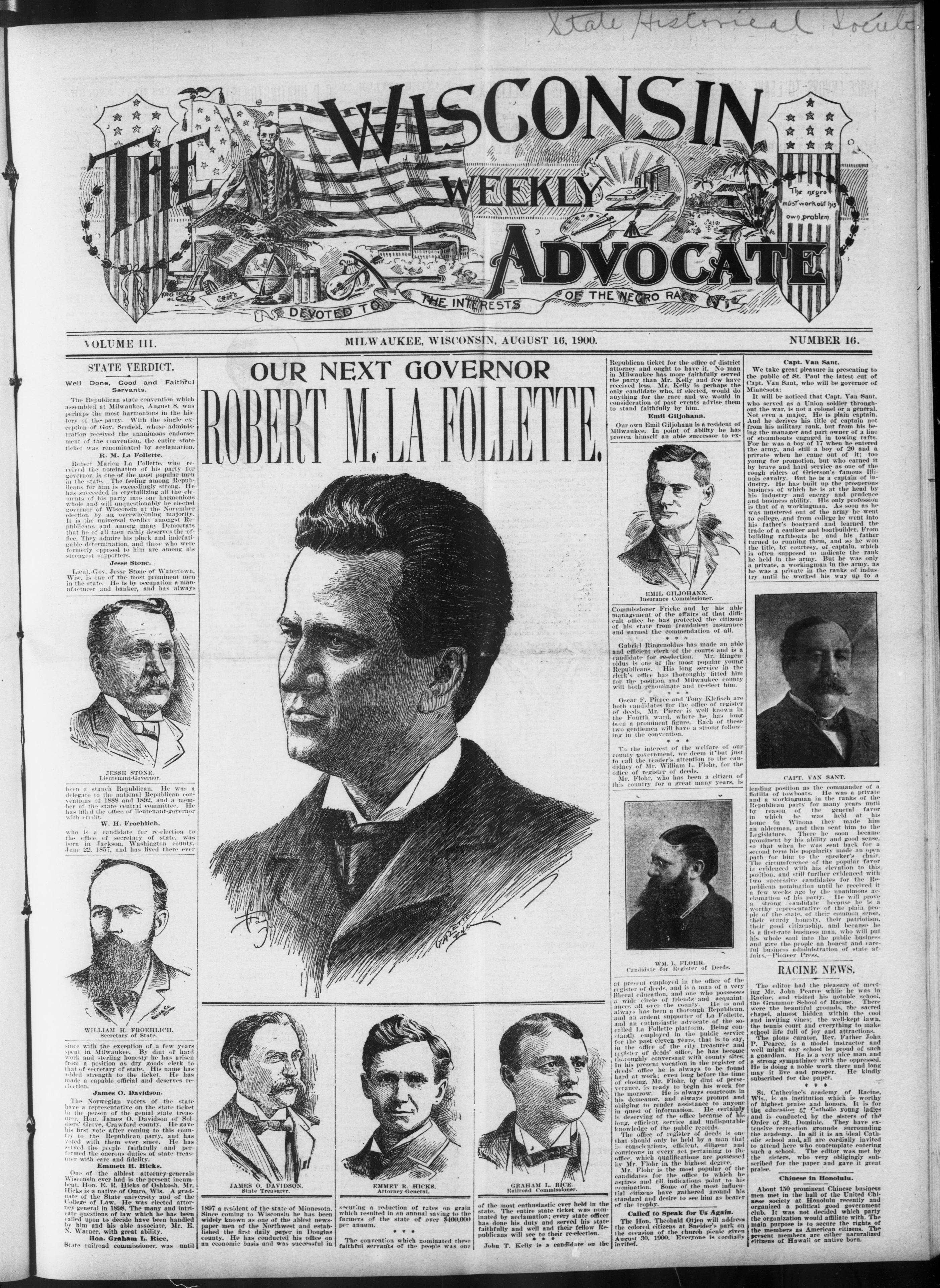
WISCONSIN
WEEKLY
ADVOCATE
DEVOTED TO THE INTERESTS OF THE NEGRO RACE
STATE VERDICT.
Well Done, Good and Faithful Servants.
The Republican state convention which assembled at Milwaukee, August 8. was perhaps the most harmonious in the history of the party. With the single exception of Gov. Scofield, whose administration received the unanimous endorsement of the convention, the entire state ticket was renominated by acclamation.
R. M. La Follette.
Robert Marion La Follette, who received the nomination of his party for governor, is one of the most popular men in the state. The feeling among Republicans for him is exceedingly strong. He has succeeded in crystallizing all the elements of his party into one harmonious whole and will unquestionably be elected governor of Wisconsin at the November election by an overwhelming majority. It is the universal verdict amongst Republicans and among many Democrats that he of all men richly deserves the office. They admire his pluck and indefatigable determination, and those who were formerly opposed to him are among his strongest supporters.
Jesse Stone.
Lieut.-Gov. Jesse Stone of Watertown, Wis., is one of the most prominent men in the state. He is by occupation a manufacturer and banker, and has always
JESSE STONE.
Lieutenant-Governor.
been a stanch Republican. He was a delegate to the national Republican conventions of 1888 and 1892, and a member of the state central committee. He has filled the office of lieutenant-governor with credit.
W. H. Frochlich,
who is a candidate for re-election to the office of secretary of state, was born in Jackson, Washington county, June 22, 1857, and has lived there ever
WILLIAM H. FROEHLICH.
Secretary of State
WILLIAM H. FROEHLICH.
Secretary of State.
since with the exception of a few years spent in Milwaukee. By dint of hard work and sterling honesty he has arisen from a position as dry goods clerk to that of secretary of state. His name has added strength to the ticket. He has made a capable official and deserves re-election.
James O. Davidson.
The Norwegian voters of the state have a representative on the state ticket in the person of the genial state treasurer, Hon. James O. Davidson of Soldiers' Grove, Crawford county. He gave his first vote after coming to this country to the Republican party, and has voted with them ever since. He has served the people faithfully and performed the onerous duties of state treasurer with care and fidelity.
Emmett R. Hicks.
One of the alblest attorney-generals Wisconsin ever had is the present incumbent. Hon. E. R. Hicks of Oshkosh. Mr. Hicks is a native of Omro, Wis. A graduate of the State university and of the College of Law. He was elected attorney-general in 1898. The many and intricate questions of law which he has been called upon to decide have been handled by him and his able associate, Mr. E. N. Warner, with great ability.
Hon. Graham L. Rice,
State railroad commissioner, was until
OUR NEXT GOVERNOR ROBERT M. LA FOLLETTE.
GALLETTE
EVELY
JAMES O. DAVIDSON.
State Treasurer.
1897 a resident of the state of Minnesota. Since coming to Wisconsin he has been widely known as one of the ablest newspaper men of the Northwest and established the first daily paper in Douglas county. He has conducted his office on an economic basis and was successful in
MILWAUKEE, WISCONSIN, AUGUST 16, 1900.
EMMET R. HICKS.
Attorney-General.
securing a reduction of rates on grain which resulted in an annual saving to the farmers of the state of over $400,000 per annum.
The convention which nominated these faithful servants of the people was one
GRAHAM L. RICE.
Railroad Commissioner.
GRAHAM L. RICE.
Railroad Commissioner.
of the most enthusiastic ever held in the state. The entire state ticket was nominated by acclamation; every state officer has done his duty and served his state faithfully and well and their fellow Republicans will see to their re-election.
John T. Kelly is a candidate on the
Republican ticket for the office of district attorney and ought to have it. No man in Milwaukee has more faithfully served the party than Mr. Kelly and few have received less. Mr. Kelly is perhaps the only candidate who, if elected, would do anything for the race and we would in consideration of past events advise them to stand faithfully by him.
Emil Giljohann.
Our own Emil Giljohann is a resident of Milwaukee. In point of ability he has proven himself an able successor to ex-
EMIL GILJOHANN.
Insurance Commissioner.
Commissioner Fricke and by his able management of the affairs of that difficult office he has protected the citizens of his state from fraudulent insurance and earned the commendation of all.
* * *
Gabriel Ringenoldus has made an able and efficient clerk of the courts and is a candidate for re-election. Mr. Ringenoldus is one of the most popular young Republicans. His long service in the clerk's office has thoroughly fitted him for the position and Milwaukee county will both renominate and re-elect him.
* * *
Oscar F. Pierce and Tony Klefisch are both candidates for the office of register of deeds. Mr. Pierce is well known in the Fourth ward, where he has long been a prominent figure. Each of these two gentlemen will have a strong following in the convention.
To the interest of the welfare of our county government, we deem it but just to call the reader's attention to the candidacy of Mr. William L. Flohr, for the office of register of deeds.
Mr. Flohr, who has been a citizen of this country for a great many years, is
[Name not visible in the image]
WM. L. FLOHR.
Candidate for Register of Deeds.
at present employed in the office of the register of deeds, and is a man of a very liberal education, and one who possesses a wide circle of friends and acquaintances all over the county. He is and always has been a thorough Republican, and an ardent supporter of La Follette, and an enthusiastic advocate of the so-called La Follette platform. Being constantly employed in the public service for the past eleven years, that is to say, in the office of the city treasurer and register of deeds' office, he has become thoroughly conversant with county sites. In his present vocation in the register of deeds' office he is always to be found hard at work; even long before the time of closing, Mr. Flohr, by dint of perseverance, is ready to begin his work for the morrow. He is always courteous in his demeanor, and always prompt and obliging to render assistance to anyone in quest of information. He certainly is deserving of the office because of his long, efficient service and undisputable knowledge of the public records.
The office of register of deeds is one that should only be held by a man that is conscientious, efficient, diligent and courteous in every act pertaining to the office, which qualifications are possessed by Mr. Flohr in the highest degree.
Mr. Flohr is the most popular of the candidates for the office to which he aspires and all indications point to his nomination. Some of the most influential citizens have gathered around his standard and desire to see him as bearer of the trophy.
Called to Speak for Us Again.
The Hon. Theobald Otjen will address the colored citizens at Sneider's park on the occasion of the church picnic given August 30, 1900. Everyone is cordially invited.
NUMBER 16.
Capt. Van Sant.
We take great pleasure in presenting to the public of St. Paul the latest cut of Capt. Van Sant, who will be governor of Minnesota:
It will be noticed that Capt. Van Sant, who served as a Union soldier throughout the war, is not a colonel or a general. Not even a major. He is plain captain. And he derives his title of captain not from his military rank, but from his being the manager and part owner of a line of steamboats engaged in towing rafts. For he was a boy of 17 when he entered the army, and still a boy of 20 and a private when he came out of it; too young for promotion, but who earned it by brave and hard service as one of the rough riders of Grierson's famous Illinois cavalry. But he is a captain of industry. He has built up the prosperous business of which he is at the head by his industry and energy and prudence and business ability. His only profession is that of a workingman. As soon as he was mustered out of the army he went to college, and from college he went into his father's boatyard and learned the trade of a caulker and boatbuilder. From building raftboats he and his father turned to running them, and so he won the title, by courtesy, of captain, which is often supposed to indicate the rank he held in the army. But he was only a private, a workingman in the army, as he was a private in the ranks of industry until he worked his way up to a
M.
CAPT. VAN SANT.
leading position as the commander of a flotilla of towboats. He was a private and a workingman in the ranks of the Republican party for many years until by reason of the general favor in which he was held at his home in Winona they made him an alderman, and then sent him to the Legislature. There he soon became prominent by his ability and good sense, so that when he was sent back for a second term his popularity made an open path for him to the speaker's chair. The circumference of the popular favor is evidenced with his elevation to this position, and still further evidenced with two successive candidates for the Republican nomination until he received it a few weeks ago by the unanimous acclamation of his party. He will prove a strong candidate because he is a worthy representative of the plain people of the state, of their common sense, their sturdy honesty, their patriotism, their good citizenship, and because he is a first-rate business man, who will put his whole soul into the public business and give the people an honest and careful business administration of state affairs.—Pioneer Press.
RACINE NEWS.
The editor had the pleasure of meeting Mr. John Pearce while he was in Racine, and visited his notable school, the Grammar School of Racine. There were the beautiful grounds, the sacred chapel, almost hidden within the cool and inviting vines; the well-kept lawn, the tennis court and everything to make school life full of joy and attractions. The plous curator, Rev. Father John P. Pearce, is a model instructor and well might any school be proud of such a guardian. He is a very nice man and a strong sympathizer with the oppressed. He is doing a noble work there and long may it live and prosper. He kindly subscribed for the paper.
```markdown
```
St. Catherine's academy of Racine, Wis., is an institution which is worthy of highest praise and honors. It is for the education of Catholic young ladies and is conducted by the sisters of the Order of St. Dominic. They have extensive recreation grounds surrounding the academy. In all it is an ideal Catholic school and all are cordially invited to attend here who contemplate entering such a school. The editor was met by the sisters, who very obligingly subscribed for the paper and gave it great praise.
Chinese in Honolulu.
About 150 prominent Chinese business men met in the hall of the United Chinese society at Honolulu recently and organized a political good government club. It was not decided which party the organization would affiliate with. The main purpose is to secure the rights of the members as American citizens. The present members are either naturalized citizens of Hawaii or native born.
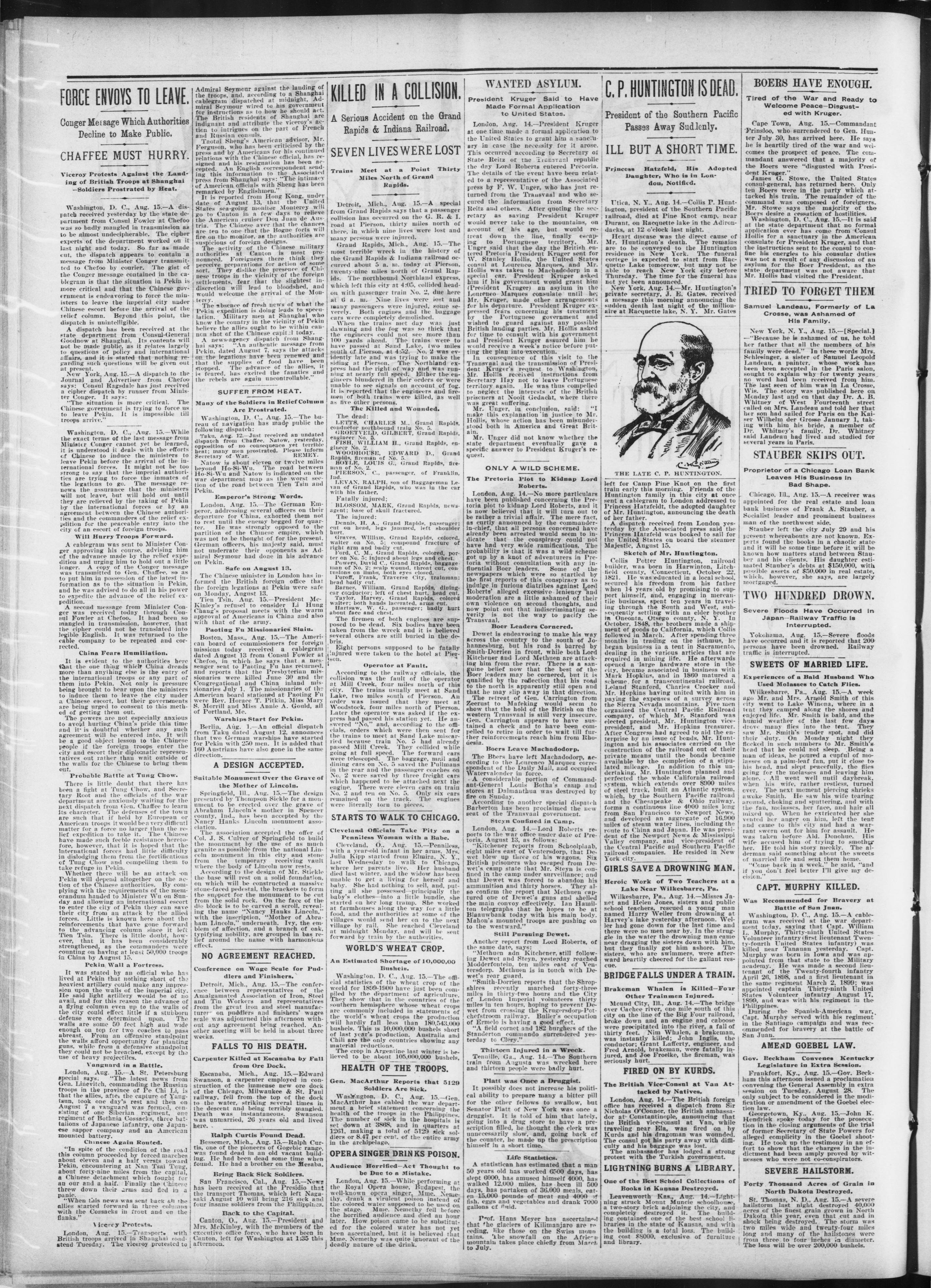
FORCE ENVOYS TO LEAVE.
Conger Message Which Authorities Decline to Make Public.
Viceroy Protests Against the Landing of British Troops at Shanghai Soldiers Prostrated by Heat.
Washington, D. C., Aug. 15.—A dispatch received yesterday by the state department from Consul Fowler at Chefoo was so badly mangled in transmission as to be almost undecipherable. The cipher experts of the department worked on it last night and today. So far as made out, the dispatch appears to contain a message from Minister Conger transmitted to Chefoo by courier. The gist of the Conger message contained in the cablegram is that the situation in Pekin is more critical and that the Chinese government is endeavoring to force the ministers to leave the imperial city under Chinese escort before the arrival of the relief column. Beyond this point, the dispatch is unintelligible.
A dispatch has been received at the state department from Consul-General Goodnow at Shanghai. Its contents will not be made public, as it relates largely to questions of policy and international affairs, and it is stated that nothing regarding such questions will be given out at present. New York, Aug. 15.—A dispatch to the Journal and Advertiser from Chefoo says: Consul Ragsdale has just received a cipher dispatch by runner from Minister Conger. It says: "The situation is more critical. The Chinese government is trying to force us to leave Pekin. It is impossible till troops arrive."
Washington, D. C., Aug. 15. While the exact terms of the last message from Minister Conger cannot yet be learned, it is understood it deals with the efforts of Chinese to induce the ministers to leave Pekin before the arrival of the international forces. It might not be too strong to say that the imperial authorities are trying to force the inmates of the legations to go. The message renews the assurance that the ministers will not leave, but will hold out until they are relieved by the taking of Pekin by the international forces or by an agreement between the Chinese authorities and the commanders of the relief expedition for the peaceable entry into the city of an escort of foreign troops.
Will Hurry Troops Forward.
A cablegram was sent to Minister Conger approving his course, advising him of the advance made by the relief expedition and urging him to hold out a little longer. A copy of the Conger message was transmitted to Gen. Chaffee, so as to put him in possession of the latest information as to the situation in Pekin, and he was advised to do all in his power to expedite the advance of the relief expedition.
A second message from Minister Conger was received today through Consul Fowler at Chefoo. It had been so mangled in transmission, however, that the cipher could not be translated into legible English. It was returned to the cable company to be repeated and corrected.
China Fears Humiliation.
It is evident to the authorities here that the one thing which China dreads more than anything else is the entry of the international troops or any part of them into Pekin. Not only is pressure being brought to bear upon the ministers to induce them to leave the city under a Chinese escort, but their governments are being urged to consent to this method of getting them out.
The powers are not especially anxious to avoid hurting China's pride this time and it is doubtful whether any such agreement will be entered into. It will be a good object lesson to the Chinese people if the foreign troops enter the city and escort their diplomatic representatives out rather than wait outside of the walls for the Chinese to bring them out.
Probable Battle at Tung Chow.
There is little doubt that there has been a fight at Tung Chow, and Secretary Root and the officials of the war department are anxiously waiting for the next dispatch from Gen. Chaffee to learn its character. The defenses of the town are such that if held by European or American troops it would be a very difficult matter for a force no larger than the relief expedition to take it. The Chinese have made such feeble resistance heretofore, however, that it is hoped that the international forces had little difficulty in dislodging them from the fortifications of Tung Chow and compelling them to take refuge in Pekin.
Whether there will be an attack on Pekin will depend altogether on the action of the Chinese authorities. By complying with the requirements of the memorandum handed to Minister Wu on Sunday and allowing an international escort to enter the city of Pekin they can save their city from an attack by the allied forces. Little is known here about the reinforcements that have gone forward to the advancing column since it left Tien Tsin. There is little doubt, however, that it has been considerably strengthened, as the commanders were counting on having at least 50,000 troops in China by August 15.
Pekin Wall a Fortress.
It was stated by an official who has lived at Pekin that nothing short of the heaviest artillery could make any impression upon the walls of the imperial city. He said light artillery would be of no avail, and for this reason the advance of a flying column even up to the walls of the city could effect little if a stubborn defense were determined upon. The walls are some 50 feet high and wide enough on top for two coaches to pass abreast. From an offensive standpoint the walls afford opportunity for planting guns, while from a defensive standpoint they could not be breached, except by the use of heavy projectiles.
Vanguard in a Battle.
London, Aug. 15.—A St. Petersburg special says: "The latest news from Gen. Linevitch, commanding the Russian troops in the province of Pe Chi Li, is that the allies, after the capture of Yangtsun, took one day's rest and then on August 7 a vanguard was formed, consisting of one Siberian regiment, one regiment of Bothnia Cossacks, three battalions of Japanese infantry, one Japanese sapper company and an American mounted battery.
Chinese Again Routed.
"In spite of the condition of the road this column proceeded by forced marches about eleven and a half verssts toward Pekin, encountering at Nan Tsai Tung, about forty-nine miles from the capital, a Chinese detachment which fought for an our and a half. Finally the Chinese threw down their arms and fled in a panic.
"When this news was sent back all the allies started forward in three columns with the Cossacks in front and on the flanks."
Viceroy Protests.
London, Aug. 15.—Transport with British troops arrived in Shanghai roadstead Tuesday. The viceroy protested to
Admiral Seymour against the landing of the troops, and, according to a Shanghai cablegram dispatched at midnight, Admiral Seymour wired to his government for instructions as to how he should act. The British residents of Shanghai are indignant and attribute the viceroy's action to intrigues on the part of French and Russian consuls.
Taotai Sheng's American advisor, Mr. Ferguson, who has been criticised by the press and by Americans for his continued relations with the Chinese official, has resigned and his resignation has been accepted. An English correspondent sending this information to the Associated press from Shanghai says: "The intimacy of American officials with Sheng has been remarked by Englishmen." It is reported from Hong Kong, under date of August 13, that the United States sea-going monitor Monterey will go to Canton in a few days to relieve the American cruiser Don Juan de Austria. The Chinese aver that the chances are ten to one that the Bogue forts will fire on the monitor, as the authorities are suspicious of foreign designs.
The activity of the Chinese military authorities at Canton is most pronounced. Foreigners there think they perceive preparations for action of some sort. They dislike the presence of Chinese troops in the vicinity of the foreign settlements, fear that the slightest indiscretion will lead to bloodshed, and would welcome the arrival of the Monterey.
The absence of fresh news of what the Pekin expedition is doing leads to speculation. Military men at Shanghai who know the country in the vicinity of Pekin believe the allies ought to be within cannon shot of the Chinese capitol today.
A news-agency dispatch from Shanghai says: "An authentic message from Pekin, dated August 7, says the attacks on the legations have been renewed and that the supplies of food have been stopped. The advance of the allies, it is feared, has excited the fanatics and the rebels are again uncontrollable."
SUFFER FROM HEAT.
Many of the Soldiers in Relief Column Are Prostrated.
Washington, D. C., Aug. 15.—The bureau of navigation has made public the following dispatch:
Taku, Aug. 12.—Just received an undated dispatch from Chaffee. Natow, yesterday, opposition of no consequence yet terrible heat; many men prostrated. Please inform Secretary of War.
REMEY.
Natow is about eleven or twelve miles beyond Ho-Si-Wu. The road between Ho-Si-Wu and Natow is indicated on the war department map as the worst section of the road between Tien Tsin and Pokin
Emperor's Strong Words.
London, Aug. 15.—The German Emperor, addressing several officers on their departure for China, exhorted them not to rest until the enemy begged for quarter. He was strongly opposed to the partition of the Chinese empire, which was not to be thought of for the present. German officers, his majesty said, must not underrate their opponents as Admiral Seymour had done in his advance on Pekin.
Safe on August 13.
The Chinese minister in London has informed the British foreign office that the foreign legations at Pekin were safe on Monday, August 13. Tien Tsin, Aug. 15.—President McKinley's refusal to consider Li Hung Chang's proposal meets with the warm approval of Americans in China and also with that of the army.
Paoting Fu Missionaries Slain.
Boston, Mass., Aug. 15.—The American board of commissioners for foreign missions today received a cablegram dated August 13 from Consul Fowler at Chefoo, in which he says that a messenger sent to Paoting Fu has returned, and reports that the Presbyterian missionaries were killed June 30 and the Congregational and China inland missionaries July 1. The missionaries of the American board stationed at Paoting Fu were Rev. Horace T. Pitkin, Miss Mary S. Morrill and Miss Annie A. Gould, all of Portland, Me.
Warships Start for Pekin.
Berlin, Aug. 1.—An official dispatch from Taku dated August 12, announces that two German warships have started for Pekin with 250 men. It is added that 160 Austrians have also gone in the same direction
A DESIGN ACCEPTED.
Suitable Monument Over the Grave of the Mother of Lincoln. Springfield, Ill., Aug. 15.—The design presented by Thompson Sickle for a monument to be erected over the grave of Abraham Lincoln's mother in Spencer county, Ind., has been accepted by the Nancy Hanks Lincoln monument association. The association accepted the offer of Col. J. S. Culver of Springfield to build the monument by the use of as much granite as possible from the national Lincoln monument in this city and stone from the temporary receiving vault where the body of Lincoln now rests.
According to the design of Mr. Stickle the base will rest on a solid foundation, on which will be constructed a massive stone-faced pedestal, the brackets to form the support for the monument to be cut from the solid rock. On the face of the die block is to be carved a scroll, revealing the name "Nancy Hanks Lincoln," with the inscription, "Mother of Abraham Lincoln," underneath. Ivy, the emblem of affection, and a branch of oak, typifying nobility, are grouped in bas relief around the name with harmonious effect.
NO AGREEMENT REACHED.
Conference on Wage Scale for Puddlers and Finishers.
Detroit, Mich., Aug. 15.—The conference between representatives of the Amalgamated Association of Iron, Steel and Tin Workers and representatives from the great iron and steel manufacturers on puddlers and finishers' wagesscale was adjourned this afternoon without any agreement being reached. Another meeting will be held in about three weeks.
FALLS TO HIS DEATH.
Carpenter Killed at Escanaba by Fall from Ore Dock.
Escanaba, Mich., Aug. 15.—Edward Swanson, a carpenter employed in construction of the immense new ore dock of the Chicago, Milwaukee & St. Paul railway, fell from the top of the dock to the water, striking several times in the descent and being terribly mangled. Death was instantaneous. Swanson was unmarried, 26 years old and lived here.
Ralph Curtis Found Dead.
Bessemer, Mich., Aug. 15.-Ralph Curtis, one of the pioneers of Gogebic range, was found dead in an old vacant building. He had been dead some time when found. He had a brother on the Mesaba.
Bring Back Sick Soldiers.
San Francisco, Cal., Aug. 15.—News has been received at the Presidio that the transport Thomas, which left Nagasaki August 10 will bring 216 sick and four insane soldiers from the Philippines.
Back to the Capital.
Canton, O., Aug. 15.—President and Mrs. McKinley, with the members of the executive office force, who have been in Canton, left for Washington at 1:35 this afternoon.
KILLED IN A COLLISION
Detroit, Mich., Aug. 15.—A special from Grand Rapids says that a passenger collision has occurred on the G. R. & I. road at Pierson, thirty miles north of there, in which nine lives were lost and many persons were injured.
Grand Rapids, Mich., Aug. 15.—The most terrible wreck in the history of the Grand Rapids & Indiana railroad occurred about 5 a. m. today at Pierson, twenty-nine miles north of Grand Rapids. The northbound Northland express, which left this city at 4:05, collided head-on with passenger train No. 2, due here at 6 a. m. Nine lives were lost and many passengers were injured, some severely. Both engines and the baggage cars were completely demolished.
When the trains met day was just dawning and the fog was so thick that the engineers could not see more than 100 yards ahead. The trains were to have passed at Sand Lake, two miles south of Pierson, at 4:52. No. 2 was evidently late and was trying to make the siding at Pierson. The Northland express had the right of way and was running at nearly full speed. Either the engineers blundered in their orders or were unable to see signals on account of fog. It is reported that the engineers and firemen of both trains were killed, as well as five other persons.
LETTS, CHARLES M. Grand Rapids,
conductor northbound train No. 5.
GROETVELD, GILBERT, Grand Rapids,
engineer No. 5.
FISH, WILLIAM H., Grand Rapids, engineer No. 2.
WOODHOUSE, EDWARD D., Grand Rapids, fireman of No. 5.
BOYLE, LOUIS G., Grand Rapids, fireman of No. 2.
PIERSON, C., passenger, of Franklin, Ind.
LEVAN, RALPH, son of Baggageman Levan of Grand Rapids, who was in the car with his father.
Fatally injured;
BLOSSOM, MARK, Grand Rapids, newsagent; base of skull fractured.
The injured:
Dennis, H. A., Grand Rapids, passenger; cut on head, legs jammed, left shoulder hurt.
Graves, William, Grand Rapids, colored, waiter on No. 5; compound fracture of right arm and badly cut.
Ford, C. M., Grand Rapids, colored, porter on No. 5; injured about legs and chest.
Powers, David C., Grand Rapids, baggageman of No. 2; scalp wound, throat cut, contusions on limbs, both eyes closed.
Poroff, Frank, Traverse City, trainman; head badly cut.
Barnes, William, Grand Rapids, dining-car conductor; left of chest hurt, head cut.
Taylor, Harvey, Grand Rapids, colored waiter; both hands lacerated, arms cut.
Hartsaw, W. G., passenger; badly hurt about face and chest.
The firemen of both engines are supposed to be dead. Six bodies have been taken from the wreck and it is believed several others are still buried in the debris. Eight persons supposed to be fatally injured were taken to the hotel at Pierson.
Operator at Fault.
According to the railway officials, the collision was the fault of the operator at Mill Creek, four miles north of this city. The trains usually meet at Sand Lake, two miles south of Pierson. An order was issued that they meet at Woodstock, four miles north of Pierson. Later the operator was asked if the express had passed his station yet. He answered "No," and, according to the officials, orders which were then sent for the trains to meet at Sand Lake miscarried because train No. 5 had already passed Mill Creek. They collided while going at full speed. The forward cars were telescoped. The baggage, mail and dining cars on No. 5 saved the Pullmans in the rear and the passenger coaches on No. 2 were saved by three freight cars which happened to be attached next the engine. There were eleven cars on train No. 2 and ten on No. 5. Only six cars remained on the track. The engines were literally torn to pieces.
STARTS TO WALK TO CHICAGO.
Cleveland Officials Take Pity on a Penniless Woman with a Babe.
Cleveland, O.. Aug. 15.—Penniless, with a year-old infant in her arms, Mrs. Julia Kipp started from Elmira, N. Y., last Wednesday to walk to Chicago, where her parents live. Her husband died last winter, and the widow has been unable to get a living for herself and baby. She had nothing to sell, and, putting all she possessed—principally the baby's clothes—into a little bundle, she started on her long tramp. She worked at farmhouses along the way for a little food, and the authorities at some of the villages would send her on to the next village by rail. She reached Cleveland at midnight Monday, and will be sent forward by train by the authorities.
WORLD'S WHEAT CROP.
An Estimated Shortage of 10,000,00 Bushels.
Washington, D. C., Aug. 15.—The official statistics of the wheat crop of the world for 1899-1900 have just been compiled by the department of agriculture. They show that in the countries of the southern hemisphere whose wheat crops are commonly included in statements of the world's wheat crops the production will hardly fall less than 180,543,000 bushels. This is 10,000,000 bushels short of last year's production. Australia and Chili are the only countries showing any material reductions. The crop in Argentine last winter is believed to be about 105,000,000 bushels
HEALTH OF THE TROOPS
Gen. MacArthur Reports that 5129 Soldiers Are Sick.
Washington, D. C., Aug. 15.—Gen. MacArthur has cabled the war department a brief statement concerning the health of the troops in the Philippines. The number of sick in the hospitals is set down at 3868, and in quarters at 1261, making a total of 5129 sick soldiers or 8.47 per cent. of the entire army in the archipelago.
OPERASINGER DRINKS POISON
Audience Horrified-Act Thought to be Due to a Mistake.
London, Aug. 15. While performing at the Royal Opera house, Budapest, the well-known opera singer, Mme. Nemethy, drank a virulent poison instead of the colored water supposed to be used on the stage. Mme. Nemethy fell before the horrified audience and died an hour later. How poison came to be substituted for the colored water has not yet been ascertained, but it is believed that Mme. Nemethy was quite ignorant of the deadly nature of the drink.
WANTED ASYLUM.
President Kruger Said to Have Made Formal Application to United States.
London, Aug. 14.—President Kruger at one time made a formal application to the United States to grant him a sanctuary in case the necessity for it arose. This occurred according to Secretary of State Reitz or the Transvaal republic the day Lord Roberts entered Pretoria. The details of the event have been related to a representative of the Associated press by F. W. Unger, who has just returned from the Transvaal and who secured the information from Secretary Reitz and others. After quoting the secretary as saving President Kruger would never take to the mountains, on account of his age, but would retreat down the line, finally escaping to Portuguese territory. Mr. Unger said that the day the British entered Pretoria President Kruger sent for W. Stanley Hollis, the United States consul at Lourenco Marques, and Mr. Hollis was taken to Machadodorp in a special car. President Kruger asked him if his government would grant him (President Kruger) an asylum in the Lourenco Marques consulate until he; Mr. Kruger, made other arrangements for his departure. President Kruger expressed fears concerning his treatment by the Portuguese government and wished to guard against any possible British landing parties. Mr. Hollis asked for time to consult with his government and President Kruger assured him he would receive a week's notice before putting the plan into execution.
In consequence of this visit to the Transvaal and the transmission of President Kruger's request to Washington, Mr. Hollis received instructions from Secretary Hay not to leave Portuguese territory again. He was thus compelled to neglect the interests of the British prisoners at Nooit Gedacht, where there was great suffering.
Mr. Unger, in conclusion, said: "I make this explanation in justice to Mr. Hollis, whose action has been misunderstood both in America and Great Britain.
Mr. Unger did not know whether the state department eventually gave a specific answer to President Kruger's request.
ONLY A WILD SCHEME.
The Pretoria Plot to Kidnap Lord Roberts.
London, Aug. 14.—No more particulars have been published concerning the Pretoria plot to kidnap Lord Roberts, and it is now believed that it will turn out to be rather a trivial affair. The mere fact, as curtly announced by the commander-in-chief, that all persons concerned have already been arrested would seem to indicate that the conspiracy could not have had very wide ramifications. The probability is that it was a wild scheme got up by a knot of adventurers in Pretoria without consultation with any influential Boer leaders. Some of the newspapers which were so startled by the first reports of this conspiracy as to indulge in furious diatribes against Lord Roberts' alleged excessive leniency and moderation are a little ashamed of their own violence on second thoughts, and now point out that indiscriminating severity is not the way to pacify the Transvaal.
Boer Leaders Cornered.
Dewet is endeavoring to make his way across the country to the south of Johannesburg, but his road is barred by Smith-Dorrien in front, while both Lord Kitchener and Lord Methuen are attacking him from the rear. There is a sanguine belief now that the best of the Boer leaders may be cornered, but it is qualified by the reflection that his road to the north is apparently still open and that he may slip away in that direction. The retreat of Gen. Carrington from Zeerust to Mafeking would seem to show that the hold of the British on the western Transvaal is still very insecure. Gen. Carrington appears to have sustained a check and to have been compelled to retire in order to wait till further reinforcements reach him from Rhodesia.
Boers Leave Machadodorp.
The Bbers have left Machadodorp, according to the Lourenco Marquez correspondent of the Daily Mail, and occupied Watervalonder in force. A considerable portion of Commandant-General Louis Botha's camp and stores at Dalmanthua was destroyed by fire on Sunday.
According to another special dispatch Barberton has been proclaimed the new seat of the Transvaal government.
Steyn Confined in Camp.
London. Aug. 14.—Lord Roberts reports to the war office under date of Pretoria. August 13, as follows:
"Kitchener reports from Schoolplaab, eight miles east of Ventersdorp, that Dewet blew up three of his wagons. Six British prisoners who escaped from Dewet's camp state that Mr. Steyn is confined in the camp under surveillance; and that Dewet was forced to abandon his ammunition and thirty horses. They also confirm the report that Methuen captured one of Dewet's guns and shelled the main convoy effectively. Ian Hamilton telegraphs that he hopes to be at Blauauwbank today with his main body. Mahon's mounted troops are pushing on to the westward."
Still Pursuing Dewet.
Another report from Lord Roberts, of the same date, says:
"Methuen adn Kitchener, still following Dewet and Steyn, yesterday reached Modderfontein, ten miles east of Ventersdorp. Methuen is in touch with Dewet's rear guard.
"Smith-Dorrien reports that the Shropshires recently marched forty-three miles in thirty-two hours and the City of London Imperial volunteers thirty miles in ten hours, hoping to prevent Dewet from crossing the Krugersdorp-Potchefstroom railway. Buller's occupation of Ermelo is having a good effect.
"A field cornet and 182 burghers of the Standerton commando surrendered yesterday to Clery."
Thirteen Injured in a Wreck.
Tennille, Ga., Aug. 14.—The Southern train from Augusta was wrecked here and thirteen people were badly hurt.
Platt was Once a Druggist.
It possibly does not increase his political ability to prepare many a bitter pill for the other fellows to swallow, but Senator Platt of New York was once a druggist. It is told of him that lately, going into a drug store to have a prescription filled, he thought the clerk was unnecessarily slow, and, going back of the counter, he made up the prescription himself in a short time.
Life Statistics.
A statistician has estimated that a man 50 years old has worked 6500 days, has slept 6000, has amused himself 4000, has walked 12,000 miles, has been ill 500 days, has partaken of 36,000 meals, eaten 15,000 pounds of meat and 4000 of fish, eggs and vegetables and drank 7000 gallons of fluid.
Prof. Hans Meyer has ascertained that the glaciers of Kilimanjaro are receding, like those on the Swiss mountains. The snowfall on the African mountain takes place chiefly from March to July.
C. P. HUNTINGTON IS DEAD.
President of the Southern Pacific Passes Away Suddenly.
ILL BUT A SHORT TIME.
Princess Hatzfeld, His Adopted Daughter, Who is in London. Notified.
Utica, N. Y., Aug. 14.—Collis P. Huntington, president of the Southern Pacific railroad, died at Pine Knot camp, near Durant, on Racquette lake in the Adirondacks, at 12 o'clock last night.
Heart disease was the direct cause of Mr. Huntington's death. The remains are to be conveyed to the Huntington residence in New York. The funeral cortege is expected to start from Racquette Lake tomorrow, but may not be able to reach New York city before Thursday. The time for the funeral has not yet been announced.
New York, Aug. 14.—Mr. Huntington's private secretary, J. E. Gates, received a message this morning announcing the sudden death last night of the millionaire at Racquette lake, N. Y. Mr. Gates
C. M. G.
THE LATE C. P. HUNTINGTON.
left for Camp Pine Knot on the first train early this morning. Friends of the Huntington family in this city at once sent a cablegram to London addressed to Princess Hatzfeldt, the adopted daughter of Mr. Huntington, announcing the death of her father.
A dispatch received from London yesterday by the Associated press said the Princess Hatzfeldt was booked to sail for the United States on board the steamer Majestic August 15.
Sketch of Mr. Huntington.
Collis Potter Huntington, railroad builder, was born in Harwinton, Litchfield county, Connecticut, October 22, 1821. He was educated in a local school, secured his freedom from his father when 14 years old by promising to support himself, and, engaging in mercantile business, spent ten years in traveling through the South and West, subsequently settling with an elder brother in Oneonta, Otsego county, N. Y. In October, 1848, the brothers made a shipment of goods to California, which Collis followed in March. After spending three months in trading on the isthmus, he began business in a tent in Sacramento, dealing in the various articles that are required in mining life. He afterwards opened a large hardware store in the city, became associated in business with Mark Hopkins, and in 1860 matured a scheme, for a transcontinental railroad, Leland Stanford, Charles Crocker and Mr. Hopkins having united with him in paying the expenses of a survey across the Sierra Nevada mountains. Five men organized the Central Pacific Railroad company, of which Mr. Stanford was elected president, Mr. Huntington vicepresident, and Mr. Hopkins treasurer. After Congress had agreed to aid the enterprise by an issue of bonds, Mr. Huntington and his associates carried on the construction of the railroad out of their private means until the bonds became available by the completion of a stipulated mileage. In addition to this undertaking, Mr. Huntington planned and perfected the whole California railroad system, which extends over 8900 miles of steel track, built an Atlantic system, which, by the Southern Pacific railroad and the Chesapeake & Ohio railway, forms a continuous line 4000 miles long from San Francisco to Newport News, and developed an aggregate of 16,900 miles of steam water lines, including the route to China and Japan. He was president of the Newport News & Mississippi Valley company, and vice-president of the Central Pacific and Southern Pacific railroad companies. He resided in New York city.
GIRLS SAVE A DROWNING MAN.
Heroic Work of Two Teachers at a Lake Near Wilkesbarre, Pa.
Wilkesbarre, Pa., Aug. 14.—Misses Janet and Helen Jones, sisters and public school teachers, rescued a young man named Harry Weller from drowning at Harvey's lake yesterday afternoon. Weller had gone down for the last time and there were no men near by. In the struggle in the water the drowning man came near dragging the sisters down with him, but they finally got him ashore. The sisters, who are swimmers, were afterward heartily cheered for the gallant rescue.
BRIDGE FALLS UNDER A TRAIN.
Brakeman Whalen is Killed—Four Other Trainmen Injured. Mound City, Ill., Aug. 14.—The bridge over Cachee river, one mile south of this city on the line of the Big Four railroad, broke down and an engine and caboose were precipitated into the river, a fall of thirty feet. Nim Whalen, a brakeman, was instantly killed; John Inglis, the conductor; Grant Lafferty, engineer, and Fred Arnold, brakeman, were fatally injured, and Joe Froelke, the fireman, was seriously hurt.
FIRED ON BY KURDS.
The British Vice-Consul at Van Attacked by Natives.
London, Aug. 14.—The British foreign office has received a dispatch from Sir Nicholas O'Connor, the British ambassador at Constantinople, announcing that the British vice-consul at Van, while traveling near Ela, was fired on by Kurds and his dragoman was wounded. The consul got his party away with difficulty and his baggage was lost. The ambassador has lodged a strong protest with the Turkish government.
LIGHTNING BURNS A LIBRARY.
One of the Best School Collections of Books in Kansas Destroyed. Leavenworth Kas., Aug. 14.—Lightning struck Mount Muncie schoolhouse, a two-story brick adjoining the city, and completely destroyed it. The building contained one of the best school libraries in the state of Kansas, and with the building is a total loss. The building cost $8000, exclusive of furniture and library.
Tired of the War and Ready to Welcome Peace-Disgusted with Kruger.
Cape Town, Aug. 15.—Commandant Prinsloo, who surrendered to Gen. Hunter July 30, has arrived here. He says he is heartily tired of the war and welcomes the prospect of peace. The commandant answered that a majority of the Boers were "disgusted with President Kruger."
James G. Stowe, the United States consul-general, has returned here. Only ten Boers were in the party which attacked his train. The remainder of the command was composed of foreigners. Mr. Stowe says the majority of the Boers desire a cessation of hostilities.
Washington, D. C., Aug. 15.—It is said at the state department that no formal application ever has come from Consul Hollis for a sanctuary in the American consulate for President Kruger, and that the instructions sent to the consul to confine his energies to his consular duties was not a result of any discussion of an asylum for the Boer President, as the state department was not aware that Mr. Hollis had visited the President.
TRIED TO FORGET THEM
Samuel Landeau, Formerly of La Crosse, was Ashamed of His Family.
New York, N. Y., Aug. 15.—[Special.]
"Because he is ashamed of us, he told her father that all the members of his family were dead." In these words Mrs. Schlesinger, a sister of Samuel Leopold Landeau, a painter, whose work has been been accepted in the Paris salon, sought to explain why for twenty years no word had been received from him. The last seen of him was in La Crosse, Wis. The story was published here on Monday last and on that day Dr. A. B. Whitney of West Fourteenth street called on Mrs. Landeau and told her that her son had sailed for Paris on the Kaiser Wilhelm der Grosse January 1, taking with him his bride, a member of Dr. Whitney's family. Dr. Whitney said Landeau had lived and studied for several years in Paris.
STAUBER SKIPS OUT.
Proprietor of a Chicago Loan Bank Leaves His Business in Bad Shape.
Chicago, Ill., Aug. 15.—A receiver was appointed for the real estate and loan bank business of Frank A. Stauber, a Socialist leader and prominent business man of the northwest side.
Stauber left the city July 29 and his present whereabouts are not known. Experts found the books in a chaotic state and it will be some time before it will be known how matters stand between Stauber and his clients. His daughter estimated Stauber's debts at $150,000, with possible assets of $50,000 in real estate, which, however, she says, are largely mortgaged.
TWO HUNDRED DROWN.
Severe Floods Have Occurred in Japan-Railway Traffic Is Interrupted. Yokohama, Aug. 15.—Severe floods have occurred and it is reported that 200 persons have been drowned. Railway traffic is interrupted.
SWEETS OF MARRIED LIFE.
Experiences of a Bald Husband Who Used Motasses to Catch Flies.
Wilkesbarre, Pa., Aug. 15.—A week ago Mr. and Mrs. Arnold Smith of this city went to Lake Winona, where in a tent they camped along the shores and enjoyed life. Mr. Smith is bald, and the humid weather of the last few days drove many flies into the tent. They saw Mr. Smith's tender spot, and did their duty. On Monday night they flocked in such numbers to Mr. Smith's head that he could not sleep. Being a man of ideas, he poured a cupful of molasses on a palm-leaf fan, put it close to his head, and slept peacefully, the flies going for the molasses and leaving him alone. All went well until daybreak, when his wife, rather restless, turned ever. The next moment piercing shrieks awoke Smith. He saw his wife tearing around, choking and sputtering, and with the fan, molasses, her face, and hair all mixed up. When he extricated her she vented her anger on him, left the tent and came to this city and had a warrant sworn out for him for assault. He was taken before Ald. Donohue. His wife accused him of trying to smother her. He told his story meekly. The alderman said something about the sweets of married life and sent them home.
"Come back in a week." he said, "and if you don't feel better I'll give my decision."
CAPT. MURPHY KILLED.
Was Recommended for Bravery at Battle of San Juan.
Washington, D. C., Aug. 15.—A cablegram was received at the war department today, saying that Capt. William L. Murphy, Thirty-ninth United States Volunteer infantry (first lieutenant Twenty-fourth United States infantry) was killed near Tanaanau yesterday. Capt. Murphy was born in Iowa and was appointed from that state to the Military academy. He was made a second lieutenant of the Twenty-fourth infantry April 26, 1898, and a first lieutenant in the same regiment March 2, 1899; was appointed captain Thirty-ninth United States Volunteer infantry August 17, 1899, and was with his regiment in the Philippines.
During the Spanish-American war, Capt. Murphy served with his regiment in the Santiago campaign and was recommended for bravery at the battle of San Juan.
AMEND GOEBEL LAW.
Gov. Beckham Convenes Kentucky Legislature in Extra Session.
Frankfort, Ky., Aug. 15.—Gov. Beckham this afternoon issued a proclamation convening the General Assembly in extra session on Tuesday, August 28. The only subject to be considered is the modification or amendment of the Goebel election law.
Georgetown, Ky., Aug. 15.—John K. Hendrick spoke today for the prosecution in the closing arguments of the trial of former Secretary of State Powers for alleged complicity in the Goebel shooting. He took up the testimony in an effort to show that the charges in the indictment had been amply proved by witnesses who were not co-conspirators.
SEVERE HAILSTORM.
Forty Thousand Acres of Grain in North Dakota Destroyed.
St. Thomas, N. D., Aug. 15.—A severe hailstorm last night destroyed 40,000 acres of the finest grain grown in North Dakota this year, even that cut and in shock being destroyed. The storm was two miles wide and twenty-four miles long and many of the hailstones were from three to four inches in diameter. The loss will be over 200,000 bushels.
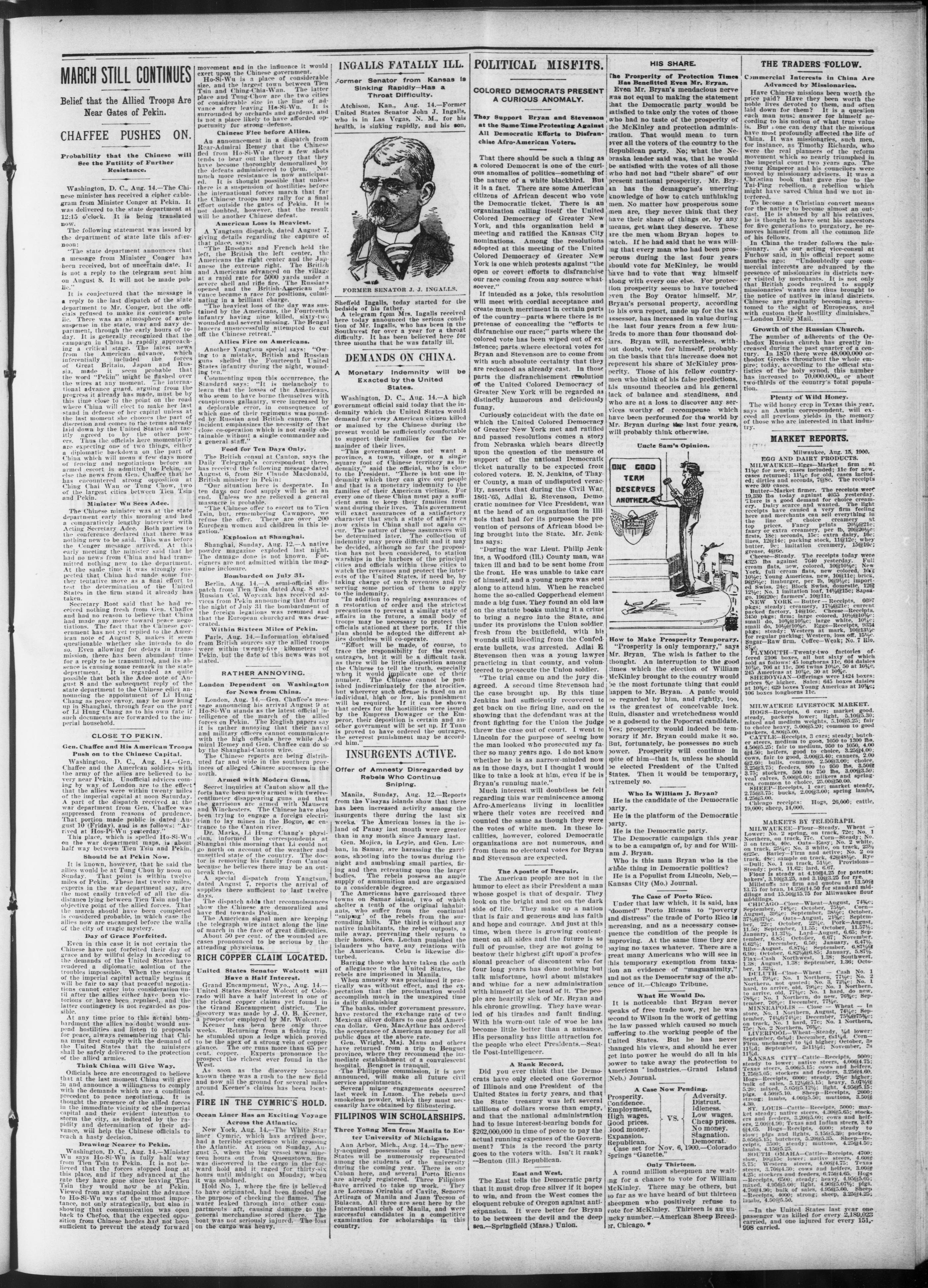
MARCH STILL CONTINUES
Belief that the Allied Troops Are Near Gates of Pekin.
Probability that the Chinese will See the Futility of Further Resistance.
Washington, D. C., Aug. 14.—The Chinese minister has received a cipher cablegram from Minister Conger at Pekin. It was delivered to the state department at 12:15 o'clock. It is being translated now.
The following statement was issued by the department of state late this afternoon:
"The state department announces that a message from Minister Conger has been received, but of uncertain date. It is not a reply to the telegram sent him on August 8. It will not be made public."
It is conjectured that the message is a reply to the last dispatch of the state department to Mr. Conger, but the officials refused to make its contents public. There was an atmosphere of acute suspense in the state, war and navy department, through the early hours of today. It is generally recognized that the campaign in China is rapidly approaching a critical stage. The latest news from the American advance, which inferentially included the forces of Great Britain, Japan and Russia, made it seem probable that the word "Pekin" might be flashed over the wires at any moment. The international advance guard, arguing from the progress it already has made, must be by this time close to the point on the road where China will elect to make her last stand in defense of her capital unless at the last moment she chooses the part of discretion and comes to the terms already laid down by the United States and tacitly agreed to by the other powers. Thus the officials here momentarily are expecting one of two things, either a diplomatic backdown on the part of China which will mean a few days more of fencing and negotiations before an armed escort is admitted to Pekin, or else the news from Gen. Chaffee that he has encountered strong opposition at Ching Chai Wan or Tung Chow, two of the largest cities between Tien Tsin and Pekin.
Minister Wu Sees Adee.
The Chinese minister was at the state department early this morning and had a comparatively lengthy interview with Acting Secretary Adee. Both parties to the conference declared that there was nothing new to be said. This was before the Conger message arrived. At this early meeting the minister said that he had no news from China and had transmitted nothing new to the department. At the same time it was strongly suspected that China had made some further tentative move as a final effort to test the determination of the United States in the firm stand it already has taken.
Secretary Root said that he had received nothing fresh from Gen. Chaffee and had no reason to believe that China had made any move toward peace negotiations. The fact that the Chinese government has not yet replied to the American note of August 8, makes it seem questionable whether she intends to do so. Even allowing for delays in transmission, there has been abundant time for a reply to be transmitted, and its absence is causing some remark in the state department. It is regarded as quite possible that both the Adee note of August 8 and the subsequent reply of the state department to the Chinese edict announcing the appointment of Li Hung Chang as peace envoy, may be now hung up in Shanghai, through fear on the part of Li Hung Chang as to his own fate if such documents are forwarded to the imperial household.
CLOSE TO PEKIN
Gen. Chaffee and His American Troops Push on to the Chinese Capital.
Washington, D. C., Aug. 14.—Gen. Chaffee and the American soldiers with the army of the allies are believed to be very near Pekin. Unofficial advices coming by way of London are to the effect that the allies were within twenty miles of the imperial capital at noon Saturday. A part of the dispatch received at the war department from Gen. Chaffee was suppressed from reasons of prudence. That portion made public is dated August 10 (Friday), and is as follows: "Arrived at Hos-Pi-Wu yesterday." This place, which is spelled Ho-Si-Wu on the war department maps, is about half way between Tien Tsin and Pekin.
Should be at Pekin Now.
It is known, however, that he said the allies would be at Tung Chou by noon on Sunday. That point is within twelve miles of Pekin. These last twelve miles, experts in the war department say, are the most easily traveled of all the distance lying between Tien Tsin and the objective point of the allied forces. That the march should have been completed is considered probable, in which case the allies now are encamped before the walls of the city of tragic mystery.
Day of Grace Forfeited.
Even in this case it is not certain the Chinese have not forfeited their day of grace and by willful delay in acceding to the demands of the United States have rendered a diplomatic solution of the troubles impossible. When the storming of the imperial capital actually begins it will be fair to say that peaceful negotiations cannot enter into consideration until after the allies either have been victorious or have been repulsed, and the latter contingency is not regarded as possible.
At any time prior to this actual bombardment the allies no doubt would suspend hostilities and listen to proposals for peace, always remembering that China must first comply with the demand of the United States that the ministers shall be safely delivered to the protection of the allied armies.
Think China will Give Wax.
Officials here are encouraged to believe that at the last moment China will give in and announce a willingness to comply with the demands which are a condition precedent to peace negotiations. It is thought the presence of the allied forces in the immediate vicinity of the imperial capital and their evident intention to storm the city, as indicated by the rapidity and determination of their advance, will help the Chinese officials to reach a hasty decision.
Drawing Nearer to Pekin.
Washington, D. C., Aug. 14.—Minister Wu says Ho-Si-Wu is fully half way from Tien Tsin to Pekin. It is not believed that the forces stopped long at this place, and if they advanced at the rate they have gone since leaving Tien Tsin they would now be at Pekin. Viewed from any standpoint the advance to Ho-Si-Wu was of the utmost importance, not only strategically, but also in showing that communication was open back to Chefoo, that the expected opposition from Chinese hordes had not been sufficient to prevent the steady forward
movement and in the influence it would exert upon the Chinese government. Ho-Si-Wu is a place of considerable size, and the largest town between Tien Tsin and Ching-Chia-Wan. The latter place and Tung-Chow are the two cities of considerable size in the line of advance after leaving Ho-Si-Wu. It is surrounded by orchards and gardens, and is not a place likely to have afforded opportunity for strong defense.
Chinese Flee before Allies.
An announcement in a dispatch from Rear-Admiral Remey that the Chinese fled from Ho-Si-Wu after a few shots tends to bear out the theory that they have become thoroughly demoralized by the defeats administered to them. Not much more resistance is now anticipated. It is thought possible that unless there is a suspension of hostilities before the international forces march that far the Chinese troops may rally for a final effort outside the gates of Pekin. It is not doubted, however, that the result will be another Chinese defeat.
American Loss is Heaviest.
A Yangtsun dispatch, dated August 7, giving details regarding the capture of that place, says:
"The Russians and French held the left, the British the left center, the Americans the right center and the Japanese the extreme right. The British and Americans advanced on the village at a rapid rate for 5000 yards under a severe shell and rifle fire. The Russians opened and the British-American advance became a race for positions, culminating in a brilliant charge.
"The heaviest loss of the day was sustained by the Americans, the Fourteenth infantry having nine killed, sixty-two wounded and several missing. The Bengal lancers unsuccessfully attempted to cut off the Chinese retreat."
Allies Fire on Americans.
Another Yangtsun special says: "Owing to a mistake, British and Russian guns shelled the Fourteenth United States infantry during the night, wounding ten." Commenting upon this occurrence, the Standard says: "It is malancholy to learn that the losses of the Americans, who seem to have borne themselves with conspicuous gallantry, were increased by a deplorable error, in consequence of which one of their regiments was pounded by Russian and British cannon. The incident emphasizes the necessity of that close co-operation which is not easily obtainable without a single commander and a general staff."
Food for Ten Days Only.
The British consul at Canton, says the Daily Telegraph's correspondent there, has received the following message dated August 6, from Sir Claude Macdonald, British minister in Pekin: "Our situation here is desperate. In ten days our food supply will be at an end. Unless we are relieved a general massacre is probable. "The Chinese offer to escort us to Tien Tsin, but, remembering Cawnpore, we refuse the offer. There are over 200 European women and children in this leagation."
Explosion at Shanghai.
Shanghai, Sunday, Aug. 12.—A native powder magazine exploded last night. The damage done is not known. Foreigners are not admitted within the magazine inclusion.
Bombarded on July 31.
Berlin, Aug. 14.—A semi-official dispatch from Tien Tsin dated Aug. 8 says Russian Col. Woyczak has received advice from Pekin announcing that during the night of July 31 the bombardment of the foreign legations was resumed and that the European churchyard was deserated.
Within Sixteen Miles of Pekin.
Paris, Aug. 14.—Information obtained from British sources say the allied troops were within twenty-five kilometers of Pekin, but the date of this news was not stated.
RATHER ANNOYING.
London Dependent on Washington for News from China.
London, Aug. 14.—Gen. Chaffee's message announcing his arrival August 9 at Ho-Si-Wu stands as the latest official intelligence of the march of the allied forces on Pekin. The English papers say it is rather annoying that their naval and military officers cannot communicate with the high officials here while Admiral Remey and Gen. Chaffee can do so by the Shanghai-Canton wire. The Chinese reports are being distributed far and wide in the southern provinces of alleged Chinese successes in the north.
Armed with Modern Guns.
Secret inquiries at Canton show all the forts have been newly armed with twelve-centimeter disappearing guns and that the garrisons are armed with Mausers and Winchesters. The Chinese have also been trying to engage a foreign electrician to lay mines in the Bogue, or entrance to the Canton river.
Dr. Marks, Li Hung Chang's physician, informed the correspondents at Shanghai this morning that Li could not go north on account of the weather and unsettled state of the country. The doctor is removing his family from Canton because he believes there may be an outbreak there.
A special dispatch from Yangtsun, dated August 7, reports the arrival of supplies there sufficient to last twelve days.
The dispatch adds that reconnoissances show the Chinese are demoralized and have fled towards Pekin.
The American signal men are keeping the telegraph wire intact along the line of march in the face of great difficulties. About 50 per cent. of the wounded are cases pronounced to be serious by the attending physicians.
RICH COPPER CLAIM LOCATED.
United States Senator Wolcott will Have a Half Interest.
Grand Encampment, Wyo., Aug. 14. United States Senator Wolcott of Colorado will have a half interest in one of the richest copper claims yet found in the Grand Encampment district. The discovery was made by J. O. B. Keener, a prospector employed by Mr. Wolcott. Keener has been here only three weeks. Returning from a fishing trip, he stumbled upon a ledge which proved to be the apex of a strong vein of copper glance. The ore runs more than 65 per cent. copper. Experts pronounce the prospect the richest ever found in the West. As soon as the discovery became known there was a rush to the new field and now all the ground for several miles around Keener's claims has been located
FIRE IN THE CYMRIC'S HOLD.
Ocean Liner Has an Exciting Voyage Across the Atlantic.
New York, Aug. 14.—The White Star liner Cymric, which has arrived here, had a terrible experience while crossing the Atlantic. At noon on Sunday, August 5, when the big vessel was nineteen hours out from Queenstown, fire was discovered in the cargo in the forward hold and it raged for thirty-six hours until midnight on Monday; when it was subdued.
Hold No. 1, where the fire is believed to have originated, had been flooded for the purpose of checking the flames. The water leaked through into other compartments aft, causing damage to the general merchandise stored there. The boat was not seriously injured. The loss on the cargo was heavy.
INGALLS FATALLY ILL.
Former Senator from Kansas Is Sinking Rapidly-Has a Throat Difficulty.
Atchison, Kan., Aug. 14.—Former United States Senator John J. Ingalls, who is in Las Vegas, N. M., for his health, is sinking rapidly, and his son,
J. H.
FORMER SENATOR J. J. INGALLS.
Sheffield Ingalls, today started for the bedside of his father.
A telegram from Mrs. Ingalls received here today announced the serious condition of Mr. Ingalls, who has been in the Southwest for over a year for a throat difficulty. It has been believed here for three months that he was fatally ill.
DEMANDS ON CHINA.
A Monetary Indemnity will be Exacted by the United States
Washington, D. C., Aug. 14.—A high government official said today that the indemnity which the United States would demand for every American citizen killed or maimed by the Chinese during the present would be sufficiently comfortable to support their families for the remainder of their lives.
"This government does not want a province, a town, village, or a single square foot of Chinese territory as indemnity," said the official, who is close to the President. "There is but one indemnity which they can give our people and that is a monetary indemnity to the families of their American victims. For every one of these China must pay a sufficient sum to keep their families from want during their lives. This government will exact assurances of a satisfactory character that such a state of affairs as now exists in China shall not again occur. The nature of these assurances will be determined later. The collection of indemnity may prove difficult and it may be decided, although so far the proposition has not been considered, to station warships in the harbors of the principal cities and officials within these cities to watch the revenues and protect the interests of the United States, if need be, by taking charge of such revenues and reserving some portion of them to apply to the indemnity.
"In addition to requiring assurances of a restoration of order and the strictest precautions to prevent a similar state of affairs in the future, a small body of troops may be necessary to protect the officials stationed at these ports. If this plan should be adopted the different allies doubtless will co-operate.
"Effort will be made, of course, to trace the responsibility for the recent outrages, but it will be a difficult task, as there will be little disposition among the Chinese to tell the truth, especially when it would implicate one of their number. The Chinese cannot be punished indiscriminately for the atrocities, but wherever such offense is fixed on an individual, high or low, his punishment will be required. If it can be shown that orders for the hostilities were issued by the Empress Dowager or the Emperor, their deposition is certain and another government will be set up. If Tuan is proved to have ordered the outrages, the severest punishment may be accorded him."
INSURGENTS ACTIVE.
Sniping.
Manila, Sunday, Aug. 12.—Reports from the Visayas islands show that there has been increased activity among the insurgents there during the last six weeks. The American losses in the island of Panay last month were greater than in any month since January last.
Gen. Mojica, in Leyie, and Gen. Lucban, in Samar, are harassing the garrisons, shooting into the towns during the night and ambushing small parties, firing and then retreating upon the larger bodies. The rebels possess an ample supply of ammunition and are organized to a considerable degree.
The Americans have garrisoned three towns on Samar island, two of which shelter a tenth of the original inhabitants, who suffer from the continual "sniping" of the rebels from the surrounding hills. The third is without any native inhabitants, the rebel outposts, a mile away, preventing their return to their homes. Gen. Lucchan punished the islanders who have any relations with the Americans. Cebu is likewise disturbed.
Barring those who have taken the oath of allegiance to the United States, the rebels are imprisoned in Manila.
When amnesty was proclaimed it practically was without effect, and the expectation that the proclamation would accomplish much in the unexpired time is daily diminishing.
The banks, under government pressure, have restored the exchange rate of two Mexican silver dollars to one gold American dollar. Gen. MacArthur has ordered the acceptance of American money for all public dues at the above rate. Gen. Wright, Maj. Maus and others have returned from a trip to Benguet province, where they recommend the immediate establishment of a convalescent hospital. Benguet is tranquil. The Philippine commission, it is now announced, will make all future civil service appointments. Several minor engagements occurred last week in Luzon. The rebels used smokeless powder, which they must necessarily have obtained by filibustering.
FILIPINOS WIN SCHOLARSHIPS.
Three Young Men from Manila to Enter University of Michigan.
Ann Arbor, Mich., Aug. 14.—The newly-acquired possessions of the United States will be numerously represented among the students of the university during the coming year. There is one Cuban here, and several Porto Ricans are already registered. Three Filipinos have arrived to take up work. They are Lorenzo Orirabia of Cavile, Senores Artiraga of Manila and Juan Tecson of Bulacan. All three are sent here by the International club of Manila, and were successful candidates in a competitive examination for scholarships in this country.
POLITICAL MISFITS.
COLORED DEMOCRATS PRESENT A CURIOUS ANOMALY.
They Support Bryan and Stevenson at the Same Time Protesting Against All Democratic Efforts to Disfranchise Afro-American Voters.
That there should be such a thing as a colored Democrat is one of the curious anomalies of politics—something of the nature of a white blackbird. But it is a fact. There are some American citizens of African descent who vote the Democratic ticket. There is an organization calling itself the United Colored Democracy of Greater New York, and this organization held a meeting and ratified the Kansas City nominations. Among the resolutions adopted at this meeting of the United Colored Democracy of Greater New York is one which protests against "the open or covert efforts to disfranchise our race coming from any source whatsoever."
If intended as a joke, this resolution will meet with cordial acceptance and create much merriment in certain parts of the country—parts where there is no pretense of concealing the "efforts to disfranchise our race;" parts where the colored vote has been wiped out of existence; parts where electoral votes for Bryan and Stevenson are to come from with such absolute certainty that they are reckoned as already cast. In those parts the disfranchisement resolution of the United Colored Democracy of Greater New York will be regarded as distinctly humorous and deliciously funny.
Curiously coincident with the date on which the United Colored Democracy of Greater New York met and ratified and passed resolutions comes a story from Nebraska which bears directly upon the question of the measure of support of the national Democratic ticket naturally to be expected from colored voters. E. N. Jenkins, of Thayer County, a man of undisputed veracity, asserts that during the Civil War, 1861-'65, Adlai E. Stevenson, Democratic nominee for Vice President, was at the head of an organization in Illinois that had for its purpose the prevention of persons of African blood being brought into the State. Mr. Jenkins says:
"During the war Lieut. Philip Jenkins, a Woodford (Ill.) County man, was taken ill and had to be sent home from the front. He was unable to take care of himself, and a young negro was sent along to attend him. When he reached home the so-called Copperhead element made a big fuss. They found an old law on the statute books making it a crime to bring a negro into the State, and under its provisions the Union soldier, fresh from the battlefield, with his wounds still bleeding from the Confederate bullets, was arrested. Adlai E. Stevenson then was a young lawyer practicing in that county, and volunteered to prosecute the Union soldier.
"The trial came on and the jury disagreed. A second time Stevenson had the case brought up. By this time Jenkins had sufficiently recovered to get back on the firing line, and on the showing that the defendant was at the front fighting for the Union the judge threw the case out of court. I went to Lincoln for the purpose of seeing how the man looked who prosecuted my father so many years ago. I do not know whether he is as narrow-minded now as in those days, but I thought I would like to take a look at him, even if he is Bryan's running mate."
Much interest will doubtless be felt regarding this war reminiscence among Afro-Americans living in localities where their votes are received and counted the same as though they were the votes of white men. In these localities, however, colored Democratic organizations are not numerous, and from them no electoral votes for Bryan and Stevenson are expected.
The Apostle of Despair.
The American people are not in the humor to elect as their President a man whose gospel is that of despair. They look on the bright and not on the dark side of life. They make up a nation that is fair and generous and has faith and hope and courage. And just at this time, when there is growing contentment on all sides and the future is so full of promise, they are not going to bestow their highest gift upon a professional preacher of discontent who for four long years has done nothing but talk misfortune, howl about mistakes and whine for a new administration with himself at the head of it. The people are heartily sick of Mr. Bryan and his chronic growling. They have wearied of his tirades and fault finding. With his worn-out tale of woe he has become little better than a nuisance. His personality has little attraction for the people who elect Presidents.—Seattle Post-Intelligencer.
A Rank Record.
Did you ever think that the Democrats have only elected one Governor of Illinois and one President of the United States in forty years, and that the State treasury was left several millions of dollars worse than empty, and that the national administration had to issue interest-bearing bonds for $262,000,000 in time of peace to pay the actual running expenses of the Government? This is the record the party goes to the voters with. Isn't it rank? Benton (Ill.) Republican.
East and West.
The East tells the Democratic party that it must drop free silver if it hopes to win, and from the West comes the eloquent rebuke of Oregon against ant-expansion. It were better for Bryan to be between the devil and the deep sea.—Springfield (Mass.) Union.
HIS SHARE.
The Prosperity of Protection Times Has Benefitted Even Mr. Eryan.
Even Mr. Bryan's mendacious nerve was not equal to making the statement that the Democratic party would be satisfied to take only the votes of those who had no taste of the prosperity of the McKinley and protection administration. That would mean to turn over all the voters of the country to the Republican party. No; what the Nebraska leader said was, that he would be satisfied with the votes of all those who had not had "their share" of our present national prosperity. Mr. Bryan has the demagogue's unerring knowledge of how to catch unthinking men. No matter how prosperous some men are, they never think that they have their share of things or, by any means, get what they deserve. These are the men whom Bryan hopes to catch. If he had said that he was willing that every man who had been prosperous during the last four years should vote for McKinley, he would have had to vote that way himself along with every one else. For protection prosperity seems to have touched even the Boy Orator himself. Mr. Bryan's personal property, according to his own report, made up for the tax assessor, has increased in value during the last four years from a few hundreds to more than four thousand dollars. Bryan will, nevertheless, without doubt, vote for himself, probably on the basis that this increase does not represent his share of McKinley prosperity. Those of his fellow countrymen who think of his false predictions, his unsound theories and his general lack of balance and steadiness, and who are at a loss to discover any services worthy of recompense which have been performed for the world by Mr. Bryan during the last four years, will probably think otherwise.
Uncle Sam's Opinion.
ONE GOOD
TERM
DESERVES
ANOTHER
How to Make Prosperity Temporary. "Prosperity is only temporary," says Mr. Bryan. The wish is father to the thought. An interruption to the good times which the election of William McKinley brought to the country would be the most fortunate thing that could happen to Mr. Bryan. A panle would be regarded by him, and rightly, too, as the greatest of conceivable luck. Ruin, disaster and wretchedness would be a godsend to the Popocrat candidate. Yes; prosperity would indeed be temporary if Mr. Bryan could make it so. But, fortunately, he possesses no such power. Prosperity will continue in spite of him—that is, unless he should be elected President of the United States. Then it would be temporary, extremely so.
Who Is William J. Bryan?
He is the candidate of the Democratic party.
He is the platform of the Democratic party.
He is the Democratic party.
The Democratic campaign this year is to be a campaign of, by and for William J. Bryan.
Who is this man Bryan who is the whole thing in Democratic politics?
He is a Populist from Lincoln, Neb.—Kansas City (Mo.) Journal.
The Case of Porto Rico.
Under that law which, it is said, has "doomed" Porto Ricans to "poverty and distress" the trade of Porto Rico is increasing, and as a necessary consequence the condition of the people is improving. At the same time they are paying no taxes whatever. There are a great many Americans who will see in this temporary exemption from taxation an evidence of "magnanimity," and not as the Democrats say of the absence of it—Chicago Tribune.
What He Would Do.
It is noticeable that Bryan never speaks of free trade now, yet he was second to Wilson in the work of getting the law passed which caused so much suffering to the working people of the United States. But he has never changed his views, and should he ever get into power he would do all in his power to take away the protection to American industries.—Grand Island (Neb.) Journal.
Prosperity. Confidence. Employment. High wages. Good prices. Good money. Expansion. Republican. VS. Adversity. Distrust. Idleness. Low wages. Cheap prices. No money. Stagnation. Democrat.
Case set for Nov. 6, 1900.—Colorado Springs "Gazette."
Only Thirteen.
A round million sheepmen are waiting for a chance to vote for William McKinley. There may be others, but so far as we have heard of but thirteen sheepmen who positively refuse to vote for McKinley. Thirteen is an unlucky number.—American Sheep Breeder. Chicago.
THE TRADERS FOLLOW.
Commercial Interests in China Are Advanced by Missionaries.
Have Chinese missions been worth the price paid? Have they been worth the noble lives devoted to them, and often laid down for them? It is a question each man must answer for himself according to his notion of what true value is. But one can deny that the missions have most profoundly affected the life of China. It was missionaries, such men, for instance, as Timothy Richards, who were the real planners of the reform movement which so nearly triumphed in the imperial court two years ago. The young Emperor and his councilors were moved by missionary advisers. It was a Christian book that gave rise to the Tai-Ping rebellion, a rebellion which might have saved China had we not interfered.
To become a Christian convert means for the native to become almost an outcast. He is abused by all his relatives, he is thought to have sent his ancestors for five generations to purgatory, he removes himself from all the common life of his fellows.
In China the trader follows the missionary. As our acting vice-consul at Fuchow said, in his official report some months ago: "Undoubtedly our commercial interests are advanced by the presence of missionaries in districts never visited by merchants. It is not only that British goods required to supply missionaries' wants are thus brought to the notice of natives in inland districts. Chinese are gradually becoming accustomed to the sight of Europeans, and with custom their hostility diminishes."
—London Daily Mail.
Growth of the Russian Church.
The number of adherents of the Orthodox Russian church has greatly increased during the past quarter of a century. In 1870 there were 48,000,000 orthodox Greeks throughout the whole empire; today, according to the official statistics of the holy synod, this number has increased to 70,000,000., or about two-thirds of the country's total population.
Plenty of Wild Honey.
The wild honey crop in Texas this year, says an Austin correspondent, will exceed all previous yields in the memory of those who are interested in that industry
MARKET REPORTS.
Milwaukee, Aug. 15, 1900.
ECC. AND DAIRY PRODUCTS.
EGG AND DAIRY PRODUCTS.
MILWAUKEE-Eggs-Market firm at
11½c for new, cases included; 11c for new,
cases returned; 11¼c for old, cases included;
dirties and seconds, 7@8c. The receipts
were 309 cases.
Butter-Market firmer. The receipts were
19,330 lbs today against 4035 yesterday.
There is a good demand for choice creamery.
Dairy scarce and wanted. The light
receipts have caused a very firm feeling
here and merchants can sell everything in
the line of choice creamery at
top prices. Fancy prints 20½c@21c;
fancy or extra creamery, per lb, 20½c@21c;
firsts, 18c; seconds, 15c; extra dairy, 16c;
lines, 12@14c; packing stock, 11@12c; whey
butter, 9c; imitation creamery, 15@16c;
grease, 4@6c.
Cheese—Steady. The receipts today were 4325 lbs against 7640 yesterday. Full cream flats, new, colored, 10@10%c; New York, full cream flats, new colored, 10@10%c; Young Americas, new, 10@11c; brick, 9@9%c; limburger, per lb, 9@9%c; imported Swiss, 24c; Block Swiss, domestic, 12@12%c. No. 1 imitation loaf, 141%@15c; Sapsa-go, 19@20c; farmers', 10@11c.
NEW YORK—Butter—Receipts, 6697 pkgs; steady; creamery, 17%@21c; current packed factory, 14@16c. Cheese-Receipts, 3450 pkgs; firm; large colored, 10%@10%c; small do, 10%@10%c; large white, 10%c; small do, 10%@10%c. Eggs—Receipts, 9334 pkgs; steady; Western at mark, 10@13%c for regular packing; Western, loss off, 15%c. Sugar-Raw firm, Coffee—Weak; No. 7 Rio, 8%c.
PLYMOUTH—Twenty-two factorles offered 2106 boxes, all but sixty of which sold as follows: 45 longhorns 11c, 664 dalsies 10%c, 706 at 11c, 306 twins 10%c, 50 at 10%c, 245. Americas at 10%c, 30 at 10%c.
SHEBOYGAN- Offering were 1424 boxes;
prices %c higher. Sales: 645 boxes dales
at 10%c; 629 boxes Young Americas at 10%c;
106 boxes longhorns 11c.
MILWAUKEE LIVESTOCK MARKET.
HOGS—Receipts, 6 cars; market good, steady, packers lower; light, 5.10@5.30; mixed and medium weights, 5.10@5.25; fair to choice heavy, 5.00@5.20; common to good packers, 4.80@5.00.
CATTLE—Receipts, 3 cars; steady; butcher steers, medium to good, 1050 to 1300 lbs, 4.50@5.25; fair to medium, 950 to 1050, 4.00@4.50; heifers, good to choice, 3.25@4.00; cows, fair to good, 3.00@3.40; canners, 2.00@2.60; bulls, common, 2.50@3.00; choice, 3.25@3.75; feeders, 800 to 950 lbs, 3.50@3.75; stockers, 500 to 750 lbs, 3.00@3.50; veal calves, 5.00@6.00; milkers and springers, common to choice, 25.00@50.00.
SHEEP—Receipts, 1 car; market steady, 2.75@3.75; bucks, 2.00@3.00; spring lambs, 4.25@5.00.
Chicago receipts: Hogs, 26,000; cattle, 19,000; sheep, 14,000.
MARKETS BY TELEGRAPH.
MILWAUKEE—Flour—Steady. Wheat—
Lower; No. 2 spring, on track, 72c; No. 1
Northern, on track, 77c. Corn—Steady; No.
3 on track, 40c. Oats—Easy; No. 2 white,
on track, 25½c; No. 3 white, on track, 23½
@25c. Barley—Firm and active; No. 2 on
track, 48c; sample on track, 42@48½c. Rye—
Dull; No. 1 on track, 51½c. Provisions—
Steady; pork, 11.62; lard, 6.67.
Flour is steady at 4.10@4.25 for patents;
bakers', 3.10@3.25, and 3.10@3.25 for rye.
Millstuffs are firm and quotee at 13.50@
13.75 for bran, 14.25@14.50 for standard middlings and 15.50@15.75 for Milwaukee flour
middlings.
CHICAGO—Close—Wheat-August, 74%c
September, 74%c; October, 75%c; Corn-
August, 39%c; September, 38%c; October,
37%c@37%c; Oats-August, 21%c; September,
22c; October, 22%c; Pork-August,
11.50; September, 11.55; October, 11.57%
September, 11.37%; Lard-August, 6.65; September,
6.85; October, 6.67; November,
6.62%; December, 6.50; January, 6.47%
Ribs-August, 6.87%; September, 6.87%
6.90; October, 6.82%@6.85; January, 5.87%
Flax-Cash Northwest, 1.38; Southwest,
1.38; August, 1.38; September, 1.36; October,
1.32%
ber, 1.52¾¾
DULUTH—Close—Wheat — Cash No. 1
hard, 79¾¾c; No. 1 Northern, 77¾¾c; No. 2
Northern, not quoted; No. 3, 72¾¾c; No. 1
hard, to arrive, old, 79¾¾c; No. 1 Northern,
to arrive, old, 77¾¾c; No. 1 hard, do new,
78¾¾c; No. 1 Northern, do new, 76¾¾c; Sept-
ber, 76¾¾c; December, 77¾¾c
tember, 16½c; tember, 17½c; MINNEAPOLIS — Close — Wheat — In
store, No. 1 Northern, August, 74½c; September,
74½c@74½c; December, 75½c@75½c;
on track, No. 1 hard, 77c; No. 1 Northern,
75c; No. 2 Northern, 76½c.
LIVERPOOL—Wheat—Steady, ½d lower;
September, 6½d; December, 6s1½d. Corn—
Firm, unchanged to ½d higher; October, 3s
11½d; September, 3s11½d; November, 3s
11½d.
KANSAS CITY—Cattle-Receipts, 3009; steady to lower; native steers, 4.00@4.75; Texas steers, 5.00@5.15; cows and helfers, 1.75@5.05; stockers and feeders, 3.25@4.60; Hogs-Receipts, 6000; steady, 2½c higher; bulk of sales, 5.12½@5.15; heavy, 5.07½@5.20; mixed, 5.05@5.12½; light, 4.95@5.15; pligs, 4.50@5.10. Sheep-Receipts, 2000; strong; lambs, 4.00@5.50; muttons, 3.50@4.30.
ST. LOUIS—Cattle-Receipts, 5000; market steady; native steers, 4.30@5.65; stockers and feeders, 3.20@5.00; cows and helfers, 2.00@4.90; Texas and Indian steers, 3.40@4.05. Hogs-Receipts, 4000; steady to slow; pligs and lights, 5.15@5.30; packers, 5.05@5.15; butchers, 5.20@5.35. Sheep-Receipts, 3500; steady; muttons, 4.25@4.50; lambs, 4.15@5.25.
SOUTH OMAHA—Cattle-Receipts, 4700;
slow, 10@15c lower; native steers, 4.00@
5.75; Western steers, 4.00@4.75; Texas
steers, 3.70@4.30; cows and heifers, 3.00@
4.25; stockers and feeders, 6.75@4.65; Hogs
—Receipts, 6500; steady; heavy, 4.95@5.05;
mixed, 4.95@5.00; light, 4.90@5.07½; plgs,
4.70@4.90; bulk of sales, 4.95@5.00. Sheep
—Receipts, 4000; strong; sheep, 3.25@4.25;
lambs, 4.50@5.50.
—In the United States last year one
passenger was killed for every 2,189,022
carried, and one injured for every 151,
998 carried.
The Wisconsin Weekly Advocate
Printed in the Interests of the Negro Race
MILWAUKEE, WIS.
Richard B. Montgomery.....
.....Editor and Proprietor
Office 209 Fifth Street.
Telephone Black No. 244.
SUBSCRIPTION RATES.
SUBSCRIPTION RATES.
Any part of the United States and Canada,
postage paid.
One Year . . . $2.00
Six Months . . . 1.25
Three Months . . . .75
Send money by Express Money Order, P. O.
Money Order or Registered Letter to the
Wisconsin Weekly Advocate.
ADVERTISING RATES.
One inch, single insertion..... 25c
One inch, per year..... $9.00
Business locals 5c per line each insertion.
Apply for rates to the Advocate.
TO CONTRIBUTORS:
All communications must be sent with the name and address of the sender as an evidence of good faith, but not necessarily for publication. No manuscript returned if not accepted, unless accompanied by stamps.
All subscribers of the Advocate that fail to get their paper promptly will please notify us at once. The Advocate, at 200 Fifth street.
The Wisconsin Weekly Advocate company wishes to notify the public that all contracts and business transactions with this company must have the company stamp, otherwise they will be void. Neither will this company be responsible for paid subscriptions unless given to duly-accredited agents, who, on request, will give the company's receipt for same. Subscribers failing to receive their papers regularly will kindly notify the general office. Address all business communications to the general manager, 200 Fifth street.
Entered at the Milwaukee P. O. as second-class matter.
Emperor William seems to be angry enough over China's behavior to screech, preach or fight.
Turkey must pay now; but in a little while Uncle Sam will have to pay for turkey-on Thanksgiving.
When China hears about the celluloid collar, a new punishment may be added to the list of demoniac cruelties practiced in the name of Chinese justice.
The attempt on the life of the Shah of Persia, in Paris, illustrates the tendency of cranks and Anarchists to keep up the work of slaughter when a beginning has been made.
Japan's denunciation of the Kaiser's speech is further proof that warriors who are not near the front are likely to be more bloodthirsty than those who are doing the fighting.
Perhaps it is nothing but a coincidence that the reports of a decrease in the rubber supply come at the same time with the adoption of quiet colors and designs in bathing costumes.
Owing to the dryness of her climate, California has an all-the-year-around task of fighting forest fires. The great fire now raging in the Sierra Madre range warns the Californians to enact a stringent fire warden law.
The Anarchists at Paterson live too far from Chicago to be influenced by the memory of the Haymarket incident and the executions which followed. The red flag has not excited much enthusiasm in Chicago since the execution of Parsons, Spies, Fisher and Engel.
With a perpetual franchise in its possession, the Eyre-Cragin syndicate is in position for a profitable dicker with the United States for the right to build the proposed Nicaragua canal. The Nicaraguan government assisted in putting things in shape for a trade, and it may be a silent partner.
The poisonous mushroom has been claiming so many victims of late that amateur interest in edible fungi will receive a sharp set-back. The sad occurrences illustrate the necessity of care in the gathering of mushrooms, unless one or two unmistakable varieties are adhered to, and all others rejected on suspicion.
The highest of the Tennessee mountains is the Unaka range, and its highest peak is Rattlesnake, the giant that stands above the Cherokee Indian reservation over 7000 feet. Twenty-two peaks measure about 6000 feet. A remarkable fact is that some of these peaks, standing directly opposite each other, measure exactly the same height, while others come within a few feet of a common height.
There are thirty-nine shipyards in Germany, employing altogether nearly 50,000 men, and together they constructed last year (1899) 528 vessels of all kinds for the navy, the merchant, marine and for river traffic of the larger description. Of these yards five are used for the construction of naval vessels, having an aggregate capacity for the simultaneous construction of over forty of the largest ships, twenty-eight torpedo destroyers and thirty torpedo-boats.
It will require five or six weeks' time and about $20,000 to repair the damage to the engines of the new Russian cruiser Variag, caused by the giving way of a defective piece of metal during her trial trip. The engine crew of the cruiser were fortunate in escaping without injury. The incident illustrates a possibility during a spurt such as the Oregon took at the battle of Santiago, and makes the man in the engine room a hero whose danger is ever present.
The latest reports from the Cape Nome gold beach are to the effect that the dredging of sand from the sea has proved a failure. This is a repetition of the experience in dredging the rivers in the Klondike. The gold is probably in the beds of the tributaries, and in the sands of the seashore over which the water from the land once flowed. The principle of panning out gold illustrates the precipitation of the heavy metal during a flow of water, while the earth and sand washes to the sea.
A rule has been adopted at the Columbia, Pa., silk mill that contributes to charity. Whenever any of the employees are late a certain number of minutes in coming to work they are each fined 5-10 cents Herefore the rules are
tained by the company, but commencing August 1 the total revenue of such penalties is to be donated to the Columbia hospital. The employees will not feel the punishment for tardiness as much as they did, since the deductions from their wages go to a good cause.
Very little is now heard in the West of the once-dreaded Russian thistle. A few years ago some of the farmers in the Northwest were fearful that it would overrun their farms and render them valueless, and all sorts of devices were invented to exterminate the supposed pest; but now it turns out that the weed is a good fodder for stock. It is said that farmers in Kansas and Colorado regularly cut the thistle when young and turn it to good account as fodder. Buttermakers find it good feed for cows and sheep take to it readily. A crop of thistles coming after grain makes excellent winter fodder for cattle.
The chamber of commerce of San Diego, Cal., is making an effort to establish the production of raw silk in the agricultural districts about that city. Steps have been taken to secure a large number of silkworms, and 5000 mulberry trees will shortly be planted. The climate of southern California is deemed even preferable for this industry to that of France, the home of silk culture. The consumption of raw silk in this country is enormous, and the entire supply comes from foreign countries, principally from Japan, China and Italy. In 1899 the total imports of this raw material were valued at $43,546,872.
"There are between 250,000 and 300,000 pounds of garlic annually consumed by Italian, French and other foreign residents of the United States," said a wholesale dealer in the vegetable to a Washington Star writer recently. "About three-quarters of the garlic eaten in the country is imported from Italy and the rest is raised on farms in Connecticut, in Louisiana, in Texas and in New Mexico. All garlic, both imported and American, is put up in strings or bunches. The vegetable is put up in that form because it keeps better and can be easier handled. The work is entirely done by hand, and an expert buncher can put up from 400 to 500 buches a day."
A group of model tenement houses is to be built in New York, according to the plans of R. Thomas Short, who won the first prize at the tenement house committee's recent competition. His was the favored plan out of 300 submitted. The new tenements will be built on 70 per cent. of the ground space, leaving 30 per cent. for light and air. There will be no light or air shafts. The building will be fireproof throughout. Each room will have a window opening into the outer air. Each apartment will have a private hall and baths, play grounds, clothes drying chambers and baby carriage and bicycle storage rooms provided. The cost will be such that the rentals will average $1 a week for each room, and still yield a profit.
The British foreign office has issued a report on the Trans-Siberian railway, by Mr. Cooke, commercial agent in Russia. Siberia is no longer a mere Russian penal settlement. The railway has already diffused hundreds of thousands of free settlers over its vast domain. Mr. Cooke says that the completion of this gigantic thoroughfare, which will bring Paris into direct overland communication with Vladivostock, will commercially and otherwise, be one of the greatest events of the dawn of the new century. Siberia is rich in gold deposits, but hitherto they could not be profitably worked owing to the cost of labor and general inaccessibility. But the railway will now bring heads, hands and modern machinery to bear on the industry.
Consul James Davidson, in a report to the state department, tells of extensive improvements that are being made in Formosa. In addition to the new railway lines in the interior, Taihoku, the capital, and its suburb, Daitoetei, are to be connected with the port of Tamsui by up-to-date lines. The three places mentioned are all on the Tamsui river, the distance between the capital and the port being some eleven miles and the only communication by water. Owing to the wretchedness of the accommodation provided, this short trip is very disagreeable. All classes of passengers and all kinds of freight, including all varieties of live stock, receive equal treatment on board. American engines are to be used on the new road, and the rails and most of the bridge work are to come from the United States.
Peach Pudding
Sift a pint of flour, a quarter of a pint of cornmeal, a teaspoonful of salt and three teaspoonfuls of baking powder into a large bowl. In another bowl whip to a cream three eggs, half a pint of sugar and two heaping tablespoonfuls of butter, then grate in half of a small nutmeg. Stir in a pint of milk, add the flour, stirring it in a little at a time. If this does not make a batter the consistency of pancake batter add a little more flour.
Butter a large pudding mold thoroughly; peal and cut in quarters a dozen large or eighteen medium-sized peaches, sweeten them, put a layer of the batter in the mold, then a layer of the peaches, and repeat this process till all the material is used and the mold is full to within two inches of the top; then cover it tightly and stand it over the fire in a kettle half full of water. Cover the kettle and let the pudding cook three hours; let it stand for a few minutes with the cover off after lifting it from the kettle, if it is to be eaten hot; then turn it on a platter. If it is to be eaten cold let it stand in the mold uncovered till it gets cold. Serve this pudding with rich cream.—Philadelphia Press.
Work of the Pigeon Hawk.
It has frequently been asked what becomes of many of the carrier pigeons that do not reach their destinations nor are ever heard of. An answer to this question has recently been found by a farmer of Rhoendorf, opposite Bonn-on-the-Rhine, who had gone out birding and, allowing himself to be lowered by a rope from a projecting rock at the riverside, discovered a pigeon hawk's nest with three callow birds in it and between seventy and eighty carrier pigeon feet with foot rings, beside a number of pigeon wings bearing the stamp of some homing society.
The Longest Ride in Europe.
The longest continuous ride on a railway train in Europe is that from Paris to Constantinople, 1921 miles, in sixty-four and a fourth hours.
CREAM CITY NOTES.
A nice little stranger arrived at the home of Mr. and Mrs. F. Mueller, grocers, last week. As the little stranger has been made quite welcome, he has decided to remain indefinitely.
Great credit is due Mr. A. G. Burgette for his assistance at the funeral of the daughter of Mr. Luker. Whenever the colored people need a friend, Mr. Burgette is always ready and willing to respond.
***
We received some very encouraging remarks from Mrs. J. J. Miles in the way of managing the paper. Mrs. Miles was opposed to the action taken by the colored citizens against this paper. We wish we had more friends like Mrs. Miles.
* * *
Miss Della Morgan, after spending a few days in our city, will take her departure for Louisville, Ky., soon. Miss Della says that her visit has been one continued round of pleasure and that she will return soon; but she says that it don't seem like the same old smile.
***
We are very sorry to announce to our many readers the sad, sad loss of Mr. Burt Luker in the death of his dear little daughter. Esther, who died August 13 at 412 Wells street. He has the sympathy of his many friends.
* * *
Mr. Milton Genn, after a short stay in Chicago, has taken a position with Mr. Tony Burgette at 216½ Grand avenue.
* * * *
Mr. and Mrs. A. G. Burgette are the happy recipients of an 8-pound baby on August 3. They have received the congratulations and flowers from a great many of their friends. Mr. Burgette goes up and down the streets wearing a broad smile. May success attend the family.
* * *
The Wisconsin Weekly Advocate wishes to extend their thanks to Rev. F. S. Snowden for his highly-appreciated services rendered in securing for us a very competent young lady whom we have sent to a good position. It gives us pleasure to say that of all who have offered their services in this line, Rev. Snowden has proven the most successful. We have more situations for colored girls, paying as high as $7 per week, than we can fill.
Messrs. Green and Fountain of the Kenosha Searchlight paid Chicago-a visit last week in the interest of their paper. On their return they gave Milwaukee a short call. We wish them success in their undertaking.
Our city editress and Miss Juliet Alexander contemplate visiting Chicago during the Grand Army encampment there next week.
***
Mr. Walter Hutton of Peoria, Ill., has accepted the position of head waiter at the Davidson. He is an aspiring young man of great influence. It is very creditable to him to have one visit his dining room and see how neat, tidy and orderly everything is kept under his supervision. We wish him much success in his important work.
Mr. Charles Clemens, employed by Mr. George Zeigler at 235 East Water street, was called on by the editor. He is held in high estimation by his employer, who says he is the most talented young man in his employ. Mr. Clemens has been there for four years and during his stay has learned to speak German very fluently. We hope that he will still gain favor with his employer and set a good example for other young men.
安 安 安
Mr. Zeigler not only renewed his subscription, but presented the Wisconsin Weekly Advocate with a donation. May all his good deeds be bountifully rewarded.
Mr. J. B. Buford left to attend the sessions of the Grand lodge. The captain looked very gallant.
The officials of St. Mark's will give a barbecue and picnic at Sneider's park on August 30 and cordially invite all who wish to have a very pleasant time to come and participate. The principal features of the picnic will be the barbecue and a sumptuous dinner, after which eloquent speeches will be rendered by Congressman Theobald Otjen and Lawyer W. T. Green. Admission at the gate will be 10 cents; dinner 25. Come one and all and have a delightful time.
* * *
The editor called on our old friend, A. C. Brazce, who is confined at the Passavant hospital and critically ill. His friends are doing everything that they possibly can to make him comfortable. Mr. Brazce has been a life-long friend of the editor and has shown it in every way. He and his family have our heartfelt sympathies in this trying hour. The hospital is a beautiful place and surrounded with everything to make it cheerful for the sick. The president is Dr. William Mackie, and Dr. G. J. Kaumheimer is secretary. All of the members of this institution are firm friends to our race and know no discrimination. It is situated on Twenty-third, Cedar and State streets. Take Cedar on State street cars to Twenty-second street.
A Botanical Mystery.
A yellow water lily, unlike any other in the world, grows in the cold waters of a small, clear lake on the summit of Cumbres pass, over 10,000 feet above the level of the sea. T. J. Holland, state superintendent of fish hatcheries, who recently returned from a trip of inspection around the state, brought back from the celebrated pass several of the strange lilies. Rich yellow in color are the large, heavy petals, while the inside of the blossom is dark brown and black. The contrast at once attracts attention. The blossom is of sufficient size to cover the top of a teacup. An air of luxury and exclusiveness clings to the flower. Its perfume is peculiar and pleasing. Somehow the unusual plant thriving only in the chill waters of a lonely little mountain lake fed by a spring conveys an idea of foreign lands and olden times.
Why does it live in no other water?
There are other lakes and streams as cold as the spring which bubbles on Cumbres pass. The great Rocky mountain region is full of springs, but on Cumbres pass alone blooms this yellow floral mystery.
A search of botanies reveals none other like it in existence. It has the thick, long green stem of a typical lily, but its blossom is unique as well as beautiful. Few people have ever heard of it, but the handful of persons who dwell in the vicinity know it well and admire it greatly. Quietly the long stems shoot through the icy crystal water to the surface and then burst forth in a blaze of yellow beauty.
Supt. Holland is anxious to have the wondrous flower classified and has given it to a botanist for that purpose.
There are no fish in the lake, so he is going to stock it with rainbow trout in a few days and it will become one of the highest trout lakes in the world if the speckled beauties thrive there.
Cumbres pass is on the boundary line which divides Colorado from New Mexico and is between Archuleta and Conejos counties. This strangest of lilies is as yet unnamed.—Denver (Col.) Post.
—The wool clip of the Black Hills for the past season has been enormous.
Congressman Theo. Otien.
Hen. Thecbald Otjen, who for the past four years has represented the Fourth district in Congress, is a candidate for re-election. Congressman Otjen has fulfilled the duties of the office with credit to himself and his constituents, and ought by all means to be returned. As between him and ex-Gov. Peck as to ability, there is absolutely no comparison whatever. Mr. Otjen has secured
M. W. H.
more and better improvements for Milwaukee harbor than ever were obtained before. Hundreds of widows and orphans have reason to remember him with tears of gratitude. He has moreover not forgotten the colored people, as William Tate, Luella Bradley, William Brown and others holding positions under the state and national governments can testify. When the colored people compare his record with that of the ex-editor and propietor of that defunct, negro-hating, race-burlesquing newspaper formerly known as Peek's Sun? their duty will be plain, and Hon. Theebald Otjen will receive their united support.
ST. PAUL NEWS.
The bell-men at the Ryan hotel are coming cut in new uniforms on the 1st of September. This will be the first time they have had a full uniform at the above named hotel. Col. Welz, the proprietor of the Ryan hotel, has been in Europe since April. He sails for home on the 9th of this month. We will all be glad to see him back. The camp meeting will end Monday with an old-fashioned Southern barbecue. Harry and his mother will be there all day with lots of nice things to tell you. Come one; come all, and spend a day with the Lord's people and try to make the day one long to be remembered. H. H. Demoss resigned his position at the Merchants' hotel and has gone on the Northern Pacific.
Fred Wilson resigned his position as doorman at the Ryan hotel to go on the Great Northern. We all miss Fred and we are sorry to lose him.
James Alston goes to Merriam park quite often of late.
Henry Southall, formerly of the Ryan hotel bell department, is now with the Pullman Palace Car company. He is missed here by all of the boys. He was captain of our watch for over two years. He was well liked by all of the department.
Harry Tompson was out to camp meeting.
Curtis Cook is working for George Charlston. Curtis was formerly in our bell department at the Ryan hotel. George Charlston is running an express line known as the Elk express. He was at the Ryan until a short time ago.
Gordon Granger of the Nicolett hotel at Minneapolis is in St. Paul quite frequently. One of our young ladies is the cause. Well, we cannot blame him. The St. Paul boys are too slow.
George Washington had his best girl out for a drive Sunday.
There was a large attendance at the Midway camp meeting Sunday and all had a glorious time.
The Episcopal church of this city held their annual picnic at Spring park, August 9.
Everyone reported a nice time at the 1st of August picnic. The day was clear and there was nothing to prevent them having a good time, and they had it.
There was quite a number from Duluth and Superior. Miss Christian of Eau Claire was there. She was the guest of Miss Vinnie Granger.
Mr. Fred Green is on the sick list. We hope to see him out soon. Lightfoot West is elevator operator at McGee's restaurant. The 1st day of August was grandly celebrated by a union picnic and excursion given by Mars lodge No. 2202 and St. Anthony lodge No. 739. G. A. O. of O. F., at Spring park, Lake Minnetonka, and was attended by eight hundred of the people of the Twin cities. The Odd Fellows did themselves and the race proud by the manner the affair was conducted, every detail being so complete that nothing occurred during the day and evening to mar the pleasure of the occasion, and it was voted the most successful of the many series that have been given. In the afternoon a boatride was indulged in, after which everybody entered into the idea of making the sports attractive and enjoyable. The events were:
50-yards race, young ladies; prize, silk
parasel—Wen by Viola Riley, Minneapolis.
50-yards race, boys; prize, suit of
clothes—Wen by Master Freddie Parker,
St. Paul.
100 yards, young men; prize, silk shirt
—Wen by Charles Merrick, Minneapolis.
75 yards, teams of St. Anthony vs.
Mars lodge; prize, silk tics—Won by Burrell,
Turner and F. D. Parker.
50 yards, fat men; prize, sack of flour—Wen, Samuel St. Paul
Dancing was enjoyed by many during the entire day and at 9 o'clock the train started for home with 800 happy and contented souls. The committee having the affair in hand were: W. R. Morris, A. B. Merrick, J. Summerville, G. Parrish, Minneapolis, and T. R. Hickman, Samuel Hatcher, J. B. Johnson, H. Fletcher, St. Paul, ably assisted by F. D. Parker. Dr. Anker, who is in charge of the city and county hospital, objected to having separate rooms for colored and white. He said all they want is plenty of water and soap. The old buildings, situated on the bank of the Mississippi river, as gloomy as an abandoned tower, are all made new and they are the admiration of visitors and the pride of its citizens. The boy preacher, aged 9 years, at the campmeeting in midway by the A. M. E. church, is drawing hundreds of people to hear him expound the word of God.
The funeral of Joseph Black, Jr., under the auspices of the G. W. O. O., Odd Fellows, was conducted by Rev. J. C. Anderson of the St. James' A. M. E.
church. The sermon was a fitting tribute to the life and character of the young man and a most able and pathetic appeal to the brotherhood to prepare for death.
Rev. W. D. Carter of Richmond, Mo., preached his introductory sermon last Sunday evening at Pilgrim Baptist church—Sixth Matthew, 38th verse; Laborers. It was one of the ablest sermons ever preached in Pilgrim Baptist church. He has a soft, deep, mellow voice which holds the attention of his hearers from beginning to the end.
Timothy Howard is very sick at the home of his brother, William Howard, 640 Rond street.
Miss Nellie Bank and Miss Ruth DeLoch of Kansas City, Mo., are visiting Mrs. D. E. Beasley at 325 Martin street. Every effort has been made by the people of St. Paul and Minneaoplis to make their visit a pleasant one. The Democratic party has removed from the courthouse J. H. Dillingham and J. I. Adams, who were given very responsible positions under the Republican rule. It is to be regretted by the colored voters in the state of Minnesota that we have no colored men to represent the race by holding a position in the county or state. They do not draw a cent of money from any of these offices. They were warned of this fact over a year ago.
Mr. Montgomery, the editor of the Advocate, made a short but pleasant stay with friends in St. Paul last week. He has the best colored paper in the Northwest. It is destined to be the paper. The beautiful home of Robert Miner on Farrington avenue was burned August 8. Mrs. Miner is visiting friends in Chicago and Mr. Miner is out West.
Our Honey Production.
The United States produces more honey than any other nation. As long as 30 years ago the product was 15,000,000 pounds annually. Twenty years ago it had risen to 25,000,000 pounds, and 10 years ago it was 65,000,000 pounds. At the present time Iowa produces 9,000,000 pounds of honey annually, and many states, including California, produce from 4,000,000 to 5,000,000 pounds a year.
Manners in England.
Mr. Fernie, the master, is known not to love publicity, but his quiet wedding at 10 and the fact that at 11:15 he was hunting with his hounds made quite a little flutter of excitement and interest in the hunt. The master and his bride had a good day.-Baily's Magazine.
LORENZO D. HARVEY.
State Superintendent.
DENHART
Best for Both Correspondence and
Manifolding.
SEND FOR CATALOGUE.
UNITED TYPEWRITER and
SUPPLIES CO.,
Agents for Wisconsin and
Northern Michigan.
414 BROADWAY,
Milwaukee, Wis.
Telephone 683.
F. D. Haven, Manager.
S. F. PEACOCK & SON Funeral Directors AND EMBALMERS
431 Broadway. MILWAUKEE, WIS.
Pabst MaltExtract The Best Tonic Builds up both the body and nerves; brings refreshing sleep, insures a healthy
appetite, aids digestion and feeds blood, brain and bone It cannot fail to benefit in every case where more strength is required Once tried, you will never take a substitute. AT YOUR DRUGGIST
FIRST MALT EXTRA
The Best Taste
MADE IN HOP
FIRST BREWING
MR. HAVRIZ, WI
FOR RENT—Furnished rooms 31 Vict Street,
1st flat. Morning before 10; evening after 7.
FOR SALE—REAL ESTATE.
$2 DOWN.
$2 PER WEEK.
NO INTEREST.
BUYS A CHOICE LOT
IN TIPPECANOE ADDITION.
A FINE level piece of property, located on
Howell avenue car line a short distance
south of Tipppecanoe lake and town hall,
only 12 minutes' ride from business center
of Bay View, and 25 minutes' ride from
center of Milwaukee. Howell avenue is
100 feet wide at this point. Remember
that one 5-cent fare will carry you to the
property from any part of the city. Complete abstracts of title furnished. Don't
forget the terms; $2 cash as first payment;
balance $2 per week without interest until
the whole of the purchase price is paid.
For plats and prices call on or address
CHARLES: R. DAVIS.
ROOM 23. SENTINEL BUILDING.
TELEPHONE MAIN 1298. 2851
ST. MARK'S A. M. E. CHURCH
Corner Fourth and Cedar Sts.
REV. N. KNIGHT, PASTOR.
Local Preacher, Gilbert Hamilton.
Residence, 256 Seventh Street,
MILWAUKEE, WIS.
SERVICES SUNDAY 10:45 and 7:45
SUNDAY SCHOOL 3 P. M.
CHRISTIAN ENDEAVOR 7 P. M.
ALL ARE WELCOME.
W. T. GREEN, Lawyer, Notary Public.
Offices 17-18 Birchard Block.
105 Grand Avenue.
Telephone 193 Black.
WHEN IN KENOSHA
CALL ON
MATT GREENWALD
Who is Up-to-Date in His Business. AGENT FOR E. KLINKERT'S RACINE KEG and BOTTLED BEER. Depot: No. 15 North Main Street. Telephone 163. KENOSHA - WISCONSIN
MR.T.W. BARTO.
of 511 Wells Street. has opened up a new Bakery and Lunch. Has stocked his store with Choice Goods, Fresh Bread, Rolls, Pies, Cakes and Candies and Choice Family Groceries, Milk and Tobacco and Cigars.
511 WELLS ST.
Don't forget to give him a call. Phone 405 Black.
Northwestern House
APPLETON, WIS.
JOHN A. BRILL, - Proprietor.
Terms $1.00 Per Day.
accommodations the best in the State. When in Appleton stop at the
NORTHWESTERN STRANGERS IN THE CITY and those desiring a first-class place to room should not fail to call upon
Mrs. B. Nicolas
who has the nicest and best equipped rooms in the city. Give her a call.
The Chicago Tribune
is a newspaper for bright and intelligent people. It is made up to attract people who think. Is not neutral or colorless, constantly trimming in an endeavor to please both sides, but it is independent in the best sense of the word. It has pronounced opinions and is fearless in expressing them, but it is always fair to its opponents. Matters of national or vital public interest get more space in THE TRIBUNE than in any other paper in the West. For these reasons it is the newspaper you should read during the forthcoming political campaign.
THE TRIBUNE'S financial columns never mislead the public. Its facilities for gathering news, both local and foreign, are far superior to those of any other newspaper in the West.
It presents the news in as fair a way as possible, and lets its readers form their opinions.
While it publishes the most comprehensive articles on all news features, if you are busy the "Summary of THE DAILY TRIBUNE" published daily on the first page gives you briefly all the news of the day within one column. Its sporting news is always the best, and its Sunday Pink Sporting Section is better than any sporting paper in the country. It is the "teleport" dolls printed in the West
It is the "cleanest" daily printed in the Weng.
TALMAGES
(Copyright, Louis Klopsch, 1900.) FROM St. Petersburg, the Russian capital, where he was cordially received by the Emperor and Empress and the Empress Dowager, Dr. Talmage sends this discourse, in which he shows the mighty good that may be done by the cities, and also the vast evil they may do by their allurements to the unsuspecting and the unguarded. The text is Zechariah 1, 17, "My cities through prosperity shall yet be spread abroad."
The city is no worse than the country. The vices of the metropolis are more evident than the vices of the rural districts because there are more to be bad if they wish to be. The merchant is as good as the farmer. There is no more cheating in town than out of town—no worse cheating; it is only on a larger scale. The countryman sometimes prevaricates about the age of the horse that he sells, about the size of the bushel with which he measures the grain, about the peaches at the bottom of the basket as being as large as those at the top, about the quarter of beef as being tender when it is tough, and to as bad an extent as the citizen, the merchant, prevaricates about calicoes or silks or hardware.
And as to villages, I think that in some respects they are worse than the cities because they copy the vices of the cities in the meanest shape, and as to gossip its heaven is a country village. Everybody knows everybody's business better than he knows it himself. The grocery store or the blacksmith shop by day and night is the grand depot for masculine tittle tattle, and there are always in the village a half dozen women who have their sunbonnets hanging near, so that at the first item of derogatory news they can fly out and cackle it all over the town. Countrymen must not be too hard in their criticism of the citizen, nor must the plow run too sharply against the yardstick.
Cain was the founder of the first city, and I suppose it took after him in morals. It takes a city a long while to escape from the character of a founder. Where the founders of a city are criminal exiles, the filth, the vice, the prisons, are the shadow of those founders. It will take centuries for New York to get over the good influence of the pious founders of that city—the founders whose prayers went up in the streets where now banks discount and brokers bargain and companies declare dividends and smugglers swear custom house lies, and above the roar of the wheels and the crack of the auctioneer's mallet ascends the ascription, "We worship thee, O thou almighty dollar!" The old church that used to stand on Wall street is to this day throwing its blessing on the scene of traffic and on all the ships folding their white wings in the harbor. In other days people gathered in cities for defense—none but the poor, who had nothing to be stolen, lived in the country, but in these times, when through civilization and Christianity it is safe to live anywhere, people gather in the cities for purposes of rapid gain.
Highway of Prosperity.
Cities are not evil necessarily, as some have argued. They have been the birthplace of civilization. In them popular liberty has lifted its voice. Witness Genoa and Pisa and Venice. After the death of Alexander the Great among his papers were found extensive plans of cities, some to be built in Europe, some to be built in Asia. The cities in Europe were to be occupied by Asiatics; the cities in Asia were to be occupied, according to his plans, by Europeans, and so there should be a commingling and a fraternity and a kindness and a good will between the continents and between the cities. So there always ought to be. The strangest thing in my comprehension is that there should be bickerings and rivalries among our American cities. New York must stop caricaturing Philadelphia, and Philadelphia must stop picking at New York, and certainly the continent is large enough for St. Paul and Minneapolis. What is good for one city is good for all the cities. Here is the great highway of our national prosperity. On that highway of national prosperity walk the cities.
A city with large forehead and great brain—that is Boston; a city with deliberate step and calm manner—that is Philadelphia; a city with its pocket full of change—that is New York; two cities going with a rush that astounds the continent—they are St. Louis and Chicago; a city that takes its wife and children along with it—that is Brooklyn. Cincinnati, Louisville, Pittsburg, all the cities of the North and all the cities of the South, some distinguished for one thing, some for another, one for professional ability, another for affluence, another for fashion, but not one to be spared. What advantages one advantages all. What damages Boston Common damages Washington square. Laurel Hill, Mount Auburn, Greenwood, weep over the same grief. The statue of Benjamin Franklin in New York greeting the bronze statue of Edward Everett in Boston. All the cities a confraternity. I cannot understand how there should go on bickerings and rivalries. I plead for a higher style of brotherhood or sisterhood among the cities.
Important Lessons.
But while there are great differences in some respects I have to tell you that all cities impress upon me and ought to impress upon you three or four very important lessons, all of them agreeing in the same thing. It does not make any difference in what part of the country we walk the streets of a great city there is one lesson I think which ought to strike every intelligent Christian man, and that is that the world is a scene of toil and struggle. Here and there you find a man in the street who has his arms folded and who seems to have no particular errand, but if you will stand at the corner of the street and watch the countenances of those who go by you
will see in most instances there is an intimation that they are on an errand which must be executed at the earliest moment possible, so you are jostled hither and thither by business men, up this ladder with a hod of bricks, out of this bank with a roll of bills, digging a cellar, shingling a roof, binding a book, mending a watch. York, with its thousand eyes and thousand feet and thousand arms, goes on singing its song, "Work work, work!" while the drums of the mill beat it and the steam whistles fife it. In the carpeted aisles of the forest, in the woods from which the eternal shadow is never lifted, on the shore of the sea over whose iron coast tosses the angled foam, sprinkling the cracked cliffs with a baptism of whirlwind and tempest, is the best place to study God, but in the rushing, swarming, raving street is the best place to study man.
Going down to your place of business and coming home again I charge you look about; see these signs of poverty, of wretchedness, of hunger, of sin, of bereavement, and as you go through the streets and come back through the streets gather up in the arms of your prayer all the sorrow, all the losses, all the sufferings, all the bereavements of those whom you pass and present them in prayer before an all sympathetic God. In the great day of eternity there will be thousands of persons with whom you in this world never exchanged one word will rise up and call you blessed; and there will be a thousand fingers pointed at you in heaven, saying: "That is the man, that is the woman who helped me when I was hungry and sick and wandering and lost and heartbroken. That is the man, that is the woman;" and the blessing will come down upon you as Christ shall say: "I was hungry and ye fed me, I was naked and ye clothed me, I was sick and in prison and ye visited me; inasmuch as ye did it to these poor waifs of the streets ye did it unto me."
Wicked Exclusiveness.
Again, in all cities I am impressed with the fact that all classes and conditions of society must commingle. We sometimes cultivate a wicked exclusiveness. Intellect despises ignorance. Refinement will have nothing to do with boorishness. Gloves hate the sunburned hand, and the high forehead despises the flat head, and the trim hedgerow will have nothing to do with the wild copsewood, and Athens hates Nazareth. This ought not so to be. I like this democratic principle of the gospel of Jesus Christ which recognizes the fact that we stand before God on one and the same platform. Do not take on any airs. Whatever position you have gained in society, you are nothing but a man, born of the same parent, regenerated by the same spirit, cleansed in the same blood, to lie down in the same dust, to get up in the same resurrection. It is high time that we all acknowledge not only the fatherhood of God, but the brotherhood of man.
Again, in all cities I am impressed with the fact that it is a very hard thing for a man to keep his heart right and to get to heaven. Infinite temptations spring upon us from places of public concourse. Amid so much affluence, how much temptation to covetousness and to be discontented with our humble lot! Amid so many opportunities for overreaching, what temptation to extortion! Amid so much display, what temptation to vanity! Amid so many saloons of strong drink, what allurement to dissipation! In the maelstroms and hell gates of the street, how many make quick and eternal shipwreck! If a man-of-war comes back from a battle and is towed into the navy yard, we go down to look at the splintered spars and count the bullet holes and look with patriotic admiration on the flag that floated in victory from the masthead. But that man is more of a curiosity who has gone through thirty years of the sharp-shooting of business life and yet sails on, victor over the temptations of the street. Oh, how many have gone down under the pressure, leaving not so much as a patch of canvas to tell where they perished! They never had any peace. Their dishonesties kept tolling in their ears. If I had an ax and could split open the beams of that fine house perhaps I would find in the very heart of it a skeleton. In his very best wine there is a smack of poor man's sweat. Oh, is it strange that when a man has devoured widows' houses he is disturbed with indigestion! All the forces of nature are against him. The floods are ready to drown him, and the earthquake to swallow him, and the fires to consume him, and the lightning to smite him. Aye, the angels of God are on the street, and in the day when the crowns of heaven are distributed some of the brightest of them will be given to those men who were faithful to God and faithful to the souls of others amid the marts of business, proving themselves the heroes of the street. Mighty were their temptations, mighty was their deliverance, and mighty shall be their triumph.
Hollowness of Society.
Again, in all these cities I am impressed with the fact that life is full of pretension and sham. What subterfuge, what double dealing, what two-facedness! Do all people who wish you good morning really hope for you a happy day? Do all the people who shake hands love each other? Are all those anxious about your health who inquire concerning it? Do all want to see you who ask you to call? Does all the world know half as much as it pretends to know? Is there not many a wretched stock of goods with a brilliant store window? Passing up and down the streets to your business and your work, are you not impressed with the fact that society is hollow and that there are subterfuges and pretensions? Oh, how many there are who swagger and strut and how few people who are natural and walk! While fops simper and fools snicker and simpletons giggle, how few people are natural and laugh! I say these things not to create in you incredulity or misanthropy, nor do I forget there are thousands of people a great deal better than they seem, but I do not think any man is prepared for the conflict of this life until he knows this particular peril. Ehud comes pretending to pay his tax to King Eglon and, while he stands in front of the king, stabs him through with a dagger until the haft went in after the blade. Judas Iscariot kissed Christ.
Again, in all cities I am impressed with the fact that there is a great field for Christian charity. There are hunger and suffering and want and wretchedness in
the country, and these evils chiefly congregate in our great cities. On every street crime prowls and drunkenness staggers and shame winks and pauperism thrusts out its hand asking for alms. Here want is most squalid and hunger is most lean. A Christian man going along a street in New York saw a poor lad, and he stopped and said, "My boy, do you know how to read and write?" The boy made no answer. The man asked the question twice and thrice, "Can you read and write?" and then the boy answered, with a tear plashing on the back of his hand. He said in defiance: "No, sir: I can't read nor write neither. God, sir, don't want me to read and write. Didn't he take away my father so long ago I never remember to have seen him? And haven't I had to go along the streets to get something to fetch home to eat for the folks? And didn't I as soon as I could carry a basket have to go out and pick up cinders and never have no schooling, sir? God don't want me to read, sir. I can't read nor write, neither."
Oh, these poor wanderers! They have no chance. Born in degradation, as they get up from their hands and knees to walk they take their first step on the road to despair. Let us go forth in the name of the Lord Jesus Christ to rescue them. Let us ministers not be afraid of soiling our black clothes while we go down on that mission. While we are tying an elaborate knot in our cravat or while we are in the study rounding off some period rhetorically we might be saving a soul from death and hiding a multitude of sins. Oh, Christian layman, go out on this work. If you are not willing to go forth yourself, then give of your means, and if you are too lazy to go and if you are too stingy to help, then get out of the way.
Ruinous Rivalry.
In all cities, east, west, north, south, I notice great temptations to commercial fraud. Here is a man who starts in business. He says, "I'm going to be honest," but on the same street, on the same block, in the same business are Shylocks. Those men to get the patronage of any one will break all understandings with other merchants and will sell at ruinous cost, putting their neighbors at great disadvantage, expecting to make up the deficit in something else. If an honest principle could creep into that man's soul it would die of sheer loneliness. The man twists about, trying to escape the penalty of the law and despises God, while he is just a little anxious about the sheriff. The honest man looks about him and says: "Well, this rivalry is awful. Perhaps I am more scrupulous than I need be. This little bargain I am about to enter is a little doubtful, but then I shall only do as the rest." And so I had a friend who started in commercial life and as a book merchant with a high resolve. He said, "In my store there shall be no books that I would not have my family read." Time passed on, and one day I went into his store and found some iniquitous books on the shelf, and I said to him, "How is it possible that you can consent to sell such books as these?" "Oh," he replied, "I have got over those puritanical notions. A man cannot do business in this day unless he does it in the way other people do it." To make a long story short, he lost his hope of heaven, and in a little while he lost his morality, and then he went into a madhouse. In other words, when a man casts off God God casts him off.
One of the mightiest temptations in commercial life in all cities to-day is in the fact that many professed Christian men are not square in their bargains. Such men are in Baptist and Methodist and Congregational churches, and our own denomination is as largely represented as any of them. Our good merchants are foremost in Christian enterprises; they are patronizers of art, philanthropic and patriotic. God will attend to them in the day of his coronation. I am not speaking of them, but of those in commercial life who are setting a ruinous example to our young merchants. Go through all the stores and offices in our cities and tell me in how many of those stores and offices are the principles of Christ's religion dominant? In three-fourths of them? No. In half of them? No. In one-tenth of them? No. Decide for yourself. The impression is abroad somehow that charity can consecrate iniquitous gains and that if a man give to God a portion of an unrighteous bargain then the Lord will forgive him the rest. The secretary of a benevolent society came to me and said, "Mr. So-and-so has given a large amount of money to the missionary cause," mentioning the sum. I said, "I can't believe it." He said, "It is so." Well, I went home, staggered and confounded. I never knew the man to give anything. But after awhile I found out that he had been engaged in the most infamous kind of a swindle, and then he promised to compromise the matter with the Lord, saying: "Now, here is so much for thee, Lord. Please to let me off!"
Dishonesty Never Prospers.
I want to tell you that the church of God is not a shop for receiving stolen goods and that if you have taken anything from your fellows you had better return it to the men to whom it belongs. In a drug store in Philadelphia a young man was told that he must sell blacking on the Lord's day. He said to the head man of the firm: "I can't possibly do that. I am willing to sell medicines on the Lord's day, for I think that is right and necessary, but I can't sell this patient blacking.' He was discharged from the place. A Christian man hearing of it took him into his employ, and he went on from one success to another until he was known all over the land for his faith in God and his good works as for his worldly success. When a man has sacrificed any temporal, financial good for the sake of his spiritual interests the Lord is on his side, and one with God is a majority.
APHORISMS.
Silence in times of suffering is the best.—Dryden.
Be charitable and indulgent to everyone but thyself.—Joubert.
Censure is the tax a man pays to the public for being eminent.—Swift.
It is well to learn caution by the misfortunes of others.—Publius Syrus.
To dispense with ceremony is the most delicate mode of conferring a compliment.—Bulwer.
The way to avoid the imputation of impudence is not to be ashamed of what we do, but never to do what we ought to be ashamed of.—Cicero.
HOUSEHOLD
DEPARTMENT
Mrs. Richards writes, not for the poor—those with an income of $600 or less—but for the great mass of clerks, teachers, business and professional people of all sorts, who are living on $1,000 to $3,000 a year. An ideal division of that income would appropriate 20 per cent. for rent, 15 per cent. for operating expenses, i. e., wages, fuel and lights; 15 per cent. for clothes and 25 per cent. for food, thus retaining 25 per cent. for whatever belongs to other than the merely animal life—provision for the future, as life insurance and bank fund, and aids to the intellectual and religious life. This division rests upon careful estimates and comparison with the average of many family budgets. In applying it to her own account-book the family treasurer should bear in mind two well-established laws: (1) The larger the income, the less the percentage of cost of subsistence; (2) whatever the income, the cost of clothing, also of rent, heat and light bears to it a constant proportion.
Hints on Washing.
Sort over the clothes, taking the finest and least soiled first. Spread each piece out flat on a table, sprinkle a little good washing powder (gold dust) over the soiled parts; then fold up and roll in compact roll. As soon as you have this lot all rolled up put them into a boiler half full of cold water, place over the fire and let come to a boil, punching and stirring several times. Take out into tub of cold water, looking over each piece carefully and rubbing any places that are not thoroughly cleansed; wring out into another tub of cold water and rinse well, wring and hang out. After laking out the first lot from boiler, put in more cold water and put in more clothes treated as the first lot were. Of course, the colored clothes must be rubbed as usual, but I find the washing much easier and quicker done and the clothes are as well cleansed as when every piece is rubbed before boiling.—Mrs. K. C. Call.
Chocolate Cakes
Cream half a cupful of butter; add a quarter of a cupful of cocoa, the beaten rolls of three eggs, one cupful of sugar, one teaspoonful of cinnamon and half cupful of water, then the beaten
whites of three eggs and a cup and a quarter of flour, with three teaspoonfuls of baking powder. Decorate with boiled frosting, to which dissolved marshmallows are added.
How to Cure Hams.
When the meat is taken up to be dried wash it in clean water as hot as you can bear it, and while damp sprinkle borax over the fleshy side of every piece, and you need not have any fear of insects, although the hams and shoulders hang in the smoke-house until cured without even a sack on them. If the summer is very dry, rewash and put more borax on in July and August. The taste of the meat is not injured. It is inexpensive and preserves meat from taint. Each ham may be tied up in a canvas or paper bag, or they may be left hanging in a cool, dry place and will be found in excellent condition when wanted for use.
Shoulders should be cured in the same way. In smoking meat hang your hams in the smoke-house and build your fire of any wood which burns slowly with but little blaze.
Horseradish Sauce.
Horseradish sauce is not nearly enough used, and yet it is one of the most delicious sauces we have. Serve it with either hot or cold roast beef or with boiled cod, and it will always be welcome. Take two tablespoons of freshly and finely-grated horseradish, add to it one-half a teaspoon each of powdered sugar and salt, a saltspoon of made mustard, a tablespoon of vinegar, a teaspoon of taragon and one gill of cream. If cream is not obtainable, Swiss milk may be used instead.
The Potato.
A recent statement has been made by the department of agriculture to the effect that "there is no reason to suppose that the potato is not as a rule a useful and wholesome article of diet." The same authority says: "Eaten alone, it would furnish a very one-sided, badly-balanced diet, which would frequently prove unwholesome to most people. When eaten with meat, eggs, fish, etc., which are essentially nitrogenous, an evenly-balanced diet which is most conducive to health and vigor is secured."
Breakfast Salad.
A delicious breakfast salad combines tomatoes and cucumbers. Peel the tomatoes, two large ones should be sufficient, first pouring boiling water over them. Put them in ice water to become cold. Peel and slice a cucumber. Rub the salad with a slice of onion, then add crisp leaves of lettuce. Cut the tomatoes in quarters and add them with the sliced cucumber. Chop up one green pepper and add it to the salad with a well-mixed French dressing.
THE BANK
...UNION.... Laundry and News Co. 328 Wells Street GEO. W. SAYLES. ...ALL WORK CAREFULLY DONE... Lowest Prices and Satisfaction Guaranteed.
The Emerson Shoe Co. CORNER GRAND AVENUE AND THIRD STREET, MILWAUKEE, WIS.
MR. GEORGE A. SCHECK, the manager of R. B. Grover & Co., manufacturers of the Celebrated Comfortable Custom Made Shoes, begs leave to announce to the many citizens of Milwaukee and vicinity that they have opened a new store in this city in the new building on the northeast corner of Third St. and Grand Ave. and carry a full line of goods. This makes 31 stores run by the firm at the present time.
A Goodyear Welt costs $3.50 and a Handsewed $5.00. The goods are honest all through and inspection is solicited.
For the Safest and Quickest Road between Milwaukee and Chicago Take the Chicago, Milwaukee & St. Paul Railway.
BEFORE PLACING
FIRE AND BURGLAR ALARMS
in your residence you would do well
to call on
CHAS. D. MILNE Electrical Contractor
And General Repairwork. The best in the city.
Tel. Main 527. HIO MASON ST.
Do You Wish to be a
MASTER PAINTER
You know Good Painters make from $5.00 to
$10.00 a day easy.
OUR BOOK
is so explicit that even Boys can become Masters
of the trade.
PAINTING POINTERS
on Sign, House and Carriage Painting. Decorating, Graining, Gilding, Silvering and Calsomining. This Book will also teach you how to
CONTRACT FOR BUSINESS
on profitable basis. It will teach you all we know after having spent a life time in the business, and will generally
SAVE YOU MONEY.
Mailed postpaid for only 50c.
VAL. SCHRIZER SIGN WORKS, Milwaukee, Wis.
REV. G. W. MUGGAGE,
Pastor A. M. E. Zion Church.
Residence:
218 Morris St., Fond du Lac, Wis.
REGULAR SERVICES—SUNDAYS:
Preaching...10:45 a.m. and 7:30 p.m.
Sunday School...3 p.m.
Prayer Meeting...9:30 a.m.
Class Meeting...12 m.
Y. P. C. E...6:30 p.m.
WEEK DAYS:
Thursday Night Prayer Meeting, 7:30 p.m.
Sacraments Quarterly Meeting, 2d Sunday every 3d month.
Baptism of Infants, Special Day.
Baptism of Adults, Easter Day.
SPECIAL SERVICES—EASTER DAY.
Missionary Collections.
CHILDREN'S DAY.
Endowment Collection. 50 cents Money—Now.
BOARD MEETINGS.
Official—First and third Monday in each month.
Trustees—Monday after second and fourth Sunday.
S. S. Board—Call of Pastor.
Quarterly Conference—Call of P. M.
WONDERFUL DISCOVERY
Curly Hair Made Straight By
TAKEN FROM LIFE:
This wonderful hair pomade is the only safe preparation in the world that makes kinky hair straight as shown above. It nourishes the scalp, prevents the hair from falling out and makes it grow. Sold over 40 years and used by thousands. Warranted harmlessness. Testimonials free on request. Your own sold for brightening kinky hair. Beware of imitations. Get the Original Ozonized Ox Marrow, as the genuine never fails to keep the hair pinnable and beautiful. A toilet necessity for ladies and gentlemen. Elegantly perfumed. The great advantage of this wonderful pomade is that it can be worn on hair at home. Owing to its superior and lasting quality it is the most economical. It is not possible for anybody to produce a preparation equal to it. Full directions with every bottle. Only 50 cents. Sold by dealers or send us $1.40 Postal or Express Money Order for 3 bottles, express paid. Write your name and address plainly to
OZONIZED OX MARROW CO., 76 Wabash Ave., Chicago, Ill.
---
Makes Two Unsuccessful Attempts to Take Her Life.
SAVED BY HER HUSBAND
Because He Stayed Out an Hour Longer than Anticipated She Wanted to Die.
La Crosse, Wis., Aug. 15.—[Special.]—Because her husband stayed downtown an hour longer than he had anticipated, Mrs. Barney Kolbo made two attempts to take her own life, both ineffectual. Her husband went downtown last evening, stating that he would be back at 8:30, but the rain and some shopping kept him until 9:30. When he returned his wife was nowhere to be found, and it was only after a protracted search that he located her in the barn on the premises. She was dangling in the air on the end of a stout piece of rope, the other end of which was attached to a rafter above. He took her down and had no difficulty in reviving her, as she had just succeeded in getting the noose around her neck and was still conscious. She was taken in the house and put to bed, and the first time her husband's back was turned secured another bit of hemp and tied it to the bed and made another attempt. She was again caught, and after a desperate struggle overpowered, but as the husband and neighbors could do nothing with her Sheriff Nelson was called in and took her to jail. She was examined by two physicians and pronounced perfectly sane. She is extremely jealous of her husband, but it appears to be without cause.
TO SETTLE COUNTRY.
The Homestead Land Company of Wisconsin is Organized in Appleton.
Appleton, Wis., Aug. 15.—[Special.]—The Homestead Land company of Wisconsin was organized here today and has already received the support of a number of the leading business men and citizens. The object of forming the new company is to induce desirable settlers from Sweden and Norway to emigrate to this country and settle on farm lands in northern Wisconsin from which the timber has been cut and which has remained unused since the loggers have stripped it of all the pine. The plan which will be put in practice is to secure options on large tracts of these lands and sell them through agencies established in the more important cities of Scandinavia. A small commission per acre will be charged, from which the promoters of the deal expect to realize a handsome profit, as the number of emigrants who will go into the deal is said to be large
G. C. Sherman of this city is at the head of the project and has circulated a subscription paper among the business men who have quite generally subscribed for stock in the new company. It is expected also to interest a number of men in the northern towns, and the capitalization of the company will not be decided on until all the applications for stock have been received. Mr. Sherman has already made several trips to Norway and Sweden on business connected with his plan, and says that a conservative estimate of the settlers who will locate in northern Wisconsin during the coming year, through the agency of the new company, will be in the neighborhood of 200
BEFUSED A LOAN.
Banks will Not Lend City of West Superior Any More Money.
West Superior, Wis., Aug. 15.—[Special.]—The city has given up hope of getting financial relief from the banks and is now looking in other quarters for the $14,000 which it wants to borrow to pay outstanding bills and payrolls. There has not been any definite plan outlined as yet, however, and the city's creditors will have to wait for at least a week or two more before getting their pay. This is the first time the banks have refused to loan the city 20 per cent. of the levy as permitted by the charter.
LIBRARIANS' CONFERENCE
Three Days' Meeting at Madison Beginning August 29.
Madison, Wis., Aug. 15.—The tenth conference of the Wisconsin State Library association will be held here August 29 to 31. The last day will be spent at Lakeside. The programme for August 30 is as follows:
President's address, Mrs. Charles S. Morris, Periln.
Reports of secretary and treasurer.
"Library Bulletins and Holiday Observances; Do They Pay?" Miss Ella A. Hamilton, public library, Whitewater.
"The Child and the Library," Miss Bertha M. Brown, Eau Claire.
Building Up a Reference Library—The Wisconsin Free Library Commission as a Magazine Clearing House," Miss Katherine I. McDonald, Wisconsin free library commission, Madison.
"Library Interests at the Recent Meeting of the General Federation of Women's Clubs," Miss L. E. Stearns, library organizer, Wisconsin free library commission, Madison.
"The American Library Association," Reuben G. Thwaites, state historical library, Madison.
"Readings from Stevenson and Kipling," Dr. James F. A. Pyre, University of Wisconsin, Madison.
Election of officers
BLAME THE YARDMASTER.
Coroner's Jury Investigates the Janes-
vile Railroad Accident.
Janesville, Wis. Aug. 15.—Testimony regarding the railroad wreck on the Chicago, Milwaukee & St. Paul road at this city last Friday, in which Engineer E. P. Schlater and Fireman August Abendroth of this city lost their lives, was heard by the coroner's jury. The jury found that the death of the men was caused by railroad collision caused by the negligent acts of Yardmaster John Kelly, on whose orders the switch engine, with which the passenger engine collided, was sent out ahead of the passenger, his helpers, Switchmen Fenton Winans and George Hiller, Engineer A. C. Rogers and Fireman Dennis Sullivan, all of whom were on the switch engine.
MANY DEER NEAR BARABOO.
Hunters Are Preparing to Go Gunning—Scarcity of Chickens.
Baraboo, Wis., Aug. 15.—[Special.]—Deer are reported very numerous on the bluffs about Baraboo, but chickens along the Wisconsin river and other places are not in such great numbers as in former years. Game or no game, there is already great preparation among the Nimrods for the coming sport. County Clerk Huebing has already issued a number of licenses and it is predicted that the applications this year will be greater than one year ago, when the number reached 665.
CLOSE UP OLD CASE.
Assignee of T. C. Shove Banking Company Calls Meeting of Creditors.
Manitowoc, Wis., Aug. 15.—[Special.]
—The matter of the assignment of the T. C. Shove Banking company, which has been in the courts for over eight years, is about to come to a close. This morning Assignee Adolph Piening sent out to all the creditors of the defunct bank notices that he has filed his final account with the clerk of the circuit court here, and that he shall apply to the court on Tuesday. September 4, at 10 o'clock in the forenoon, for an allowance and settlement of the account and for his final discharge as assignee. The assignee's final account was filed with Clerk McMahon last night. On the night of April 11, 1892, the entire plant of the Manitowoc Manufacturing company burned to the ground, and, being heavily indebted to the T. C. Shove Banking company, the latter was forced to close its doors on the morning of April 12. The Manufacturing company owed the bank $215,000 and made an assignment for the benefit of its creditors on April 12, 1892. Following this and on the same day came the assignment of Jacob Flieger, engaged in large milling interests here. He was indebted to the bank for $100,000. These two assignments greatly complicated matters and explain the long time it took to finally wind up the affairs of the bank. The report of the assignee shows his total receipts to be $170,723.30. Three dividends, amounting to 29½ per cent., have been paid the creditors of the bank as follows: September, 1892, 10 per cent., $48,564.38; April, 1893, 15 per cent., $72,827.18, and December, 1897, 4½ per cent., $21,840.11—amounting in all to $143,231.67. Assignee Piening has now on hand a cash balance of $7500. The charges for his services are $8300, all of which, over the amount on hand, he will claim.
FOUR FAST PACERS.
Noted Horses to Appear on the Track at the State Fair This Fall.
Milwaukee, Wis., Aug. 15.—[Special.] The board of managers of the state fair was to have held a conference with the local advisory board yesterday afternoon, but the local men did not show up. Finally the state fair managers sent for Secretary Wilkins of the Merchants and Manufacturers' association and talked over the plans for the big show with him.
The question was asked whether there was any feeling on the part of the Milwaukee men against the state men, but no reasons could be found for such a state of affairs, and it was decided that the Milwaukeeans were too busy along other lines to attend the meeting. Some of the members of the local board are Wilmer Sieg, president of the Citizens' Business league, A. C. Clas and Alvin Kletzsch.
One of the features of the fair will be the presence on the track of the four fastest pacers in the world-Joe Patchen, Coney, Anaconda and Prince Alert. Frank W. Harland of Waukesha, superintendent of the speed department, was authorized to go to Joliet and secure this attraction. They will race for a special purse two days of the fair.
Tuesday will be military day and the first regiment of the Wisconsin National guard will camp on the grounds together with the battery and Troop A. The awards of prizes for the livestock exhibits will also be made that day.
Thursday will be Milwaukee day and the society derby will be the feature. There are seventeen clubs which are eligible to enter this race, and it may be necessary to run several heats before the prize is awarded.
Friday will be athletic day. There have been numerous entries already from Wisconsin, Michigan and Illinois and each event will be hotly contested. The prizes will be loving cups for firsts and medals for seconds and thirds.
There has been a good crop of hay harvested from the state fair grounds and a second crop is well under way. Altogether there is enough to feed all the cattle on the grounds in fair week.
PAY FOR THE SECOND.
Madison, Wis., Aug. 15.—[Special.]—Maj. M. R. Doyon, paymaster of the state militia, left this afternoon for Camp Douglas with between $12,000 and $13,000 with which to pay off the Second regiment and cavalry Troop A. Col. Dan B. Starkey, the governor's private secretary, also military secretary, accompanied Maj. Doyon as a bodyguard. Gov. Scofield is now in Superior. He will be at Camp Douglas tomorrow and return to Madison Friday.
AFTER MANY YEARS.
Sisters Meet at Baraboo for the First Time in Forty-two Years.
Baraboo, Wis., Aug. 15.—[Special.]—Mrs. K. Fessler has arrived from Williamsport, Pa., to visit her sister, Mrs. C. W. Harman. They had not seen each other for forty-two years, and in that time each had raised a family, and their children in turn were parents, thus both having grandchildren in the span of years measured by seven times six.
JUMPS FROM WINDMILL.
Insane Man Leaps Off High Tower at Camp Douglas.
Camp Douglas, Wis., Aug. 15.—[Special.]—August Schroeder, a farmer residing near here, jumped off the forty-foot tower of a windmill, injuring himself severely. Schroeder has been out of his head for several days and two men were necessary to hold him. He escaped from his guard and ran straight for the windmill. He was closely pursued to the point where he flung himself down nearly forty feet from the ground. In falling he struck the steel crossbars of the frame several times, which while it bruised him badly doubtless saved his life by breaking his fall. His injuries are mostly internal.
BUYS FOUR FINE FARMS.
A Wisconsin Man will Set Up His Sons.
Waukegan, Ill., Aug. 15.—[Special.]—Orlando Brown of Modeno, Wis., has made a noteworthy purchase of Lake county farms located near this city to the northwest. He has bought four fine farms, comprising 375 acres, at a total cost of $25,825. The properties are the Woodhouse farm, 82 acres, for $4800; Dunning farm, 63 acres, $4725; Hope farm, 100 acres, $8500; Cole farm, 130 acres, $7800. It is reported they are bought for his four sons to run.
Beloit Abolishes Saloon Screens.
Beloit, Wis., Aug. 15.—The common council when it granted saloon licenses ordered all stalls and booths taken out and also all screens taken from in front of the saloons.
JEFFERSON TO BUY LIGHTING PLANT
Will Take Possession on September I and Municipal Ownership will be Tried.
Jefferson, Wis., Aug. 15.—[Special.] A special election was held in this city to determine whether the city of Jefferson should buy the electric light plant owned by a private company, at a valuation of $25,000, resulted in a vote of 161 to 80 favorable to the proposition. Possession will be given probably by the first of the month. This plant has proved to be a success from the start, largely due to the able management of Judge George Grinn.
BOY CONFESSES TO HORRIBLE CRIME.
Admits He Put Obstructions on the Railway Track at Vernon.
Waukesha, Wis., Aug. 15.—[Special.]
—Walter Preis, a young boy, confessed in the municipal court here this morning that he had maliciously placed spikes on the railway tracks at Vernon. He was bound over for trial at the regular term of court in September. Bennie Welch, a small boy who was arrested at the same time on the charge of being an accomplice, was dismissed this morning.
PLANT FOR APPLETON.
Large Match Factory will Probably Locate There and will Employ 500 Men.
Appleton, Wis., Aug. 15.—[Special.]—In response to a call issued by the Appleton Advancement association, a mass meeting of citizens was held in the city hall last night for the purpose of discussing plans for the removal of a watch manufacturing plant to this city. The plan by which a sufficient inducement is to be raised to offer the company as a bonus, is novel and consists of the purchase money which is received for the lots upon which the homes for the employees of the new concern will be built, the lots being subscribed for by the citizens who are guaranteed a profit from the investment as well as contributing to the future welfare of the city.
Committees were appointed at the meeting and a thorough canvass of the town will be instituted. About 120 lots have already been subscribed for, and it is expected that the work of the committee will result in the receipt of about 400 more subscriptions tomorrow. The lots are selling for $200 each and it is hoped that enough will be sold to make up a sum of $100,000.
A personal letter from the president of the watch company states that the plant will come here on a large scale and that 300 men will be employed from the start, and the number will be increased to 500 as soon as the contemplated improvements to the plant are made. In speaking of the product, he says that orders have been received ahead for several years' work and that other firms are negotiating for contracts for a five-years' run of the plant, exclusive of the foreign trade. It is probable that a representative of the concern will be in the city some time next week to talk over plans and make arrangements for the removal of the plant.
HORRIBLY INJURED.
Henry Hanko of Richland Center is Crushed and Scalded by
Richland Center, Wis., Aug. 15.—[Special.]—Henry Hanko, living a short distance from this city, was terribly mangled and scalded while acting as engineer of a threshing outfit. The engine was used to pull the threshing machine from place to place, and while making a descent of a hill the coupling broke, allowing the threshing machine to collide with the engine. Hanko was caught between the engine and the machine and terribly crushed. A steam pipe was broken, allowing the steam to come upon the man, which scalded him severely.
ONEIDA COUNTY FAIR.
Good Purses Hung Up for Races at Rhinelander.
Rhinelander, Wis., Aug. 15.—Extensive preparations are being made for the fifth annual fair of the Oneida County Agricultural society, which is to be held here September 10, 11, 12 and 13. The agricultural exhibit promises to excel that of any previous year and farmers are already preparing displays. The speed programme has been made up and the racing events scheduled are as follows:
September 11—2:40 pace: 2:35 trot, purse, $175; 2:20 pace, 2:18 trot, purse, $225; running race, best two in three, half-mile heats, purse $50.
September 12—Farmers' race, half-mile heats, purse $25; gentlemen's road race, purse $50.
Horse to be owned in Oneida county and owners to drive. Running race, half-mile heats, best two in three, purse $30.
September 13—2:28 pace, 2:24 trot, $225; free-for-all, $75; running race, $50.
SUES INSURANCE COMPANY.
Dr. Kitto of Racine Wants Money for
Losing an Exe
Racine, Wis., Aug. 15.—Dr. Robert Kitto has commenced a suit to recover $4000 from the Frankfort Insurance company of Germany, alleged to be due for an accident. Some months ago Dr. Kitto was riding on a Milwaukee Electric Railway car. He fell through a window, A piece of glass penetrated his eye and the member was so badly hurt that it had to be removed. Dr. Kitto was obliged to go to Italy to get a glass eye. He carried an accident insurance of $50,000. On account of the accident he was entitled to $17,000 of this amount. All of the companies settled except the Frankfort.
DEATH OF J. H. SNYDER
Well-known Hotel Man of Janesville Passes Away.
Janesville, Wis., Aug. 15.—Jacob H. Snyder, one of the best known hotel proprietors in this section of the country, died at his home in this city, aged 65 years. His death was the result of apoplexy with which he was taken Saturday night, falling unconscious on the street. Mr. Snyder has conducted hotels for the past thirty years at Clinton, Beloit, Fort Atkinson, Delavan lake, Sharon, Belvidere, Ill., and this city. He leaves a wife, one son and two daughters, one of whom, Mrs. Alice Carruthers, resides in Milwaukee.
CRACK SAFE BUT GET LITTLE
Burglars Rob a Creamery and Store at Layalle.
Baraboo. Wis.. Aug. 15.--[Special.]-- The safe in the creamery at Lavalle as well as the one in F. S. Barrett's stor were broken open by burglars and the contents scattered about or carried away. Only a small sum of money was secure. The burglars used several tools taken from Hake's blacksmith shop.
A FATAL GAS EXPLOSION
One Killed, Five Injured and Two Buildings Wrecked.
Men Seeking a Gas Leak in the Cellar Light a Match and the Disaster Follows.
Kenosha, Wis., Aug. 13.—[Special.]
—Henry B. Beck, a local saloonkeeper, was fatally injured by an explosion of gas in his cellar. He lighted a match in his cellar to locate a leak in a gaspipe, and an explosion was the result, wrecking two buildings and seriously injuring several persons.
Beck died of his injuries a few hours after the accident. The following were badly hurt:
Andre, Henry, cigarmaker, badly about head and face by flying glass and jured by shock; will recover.
Christensen, Robert, burned about the head, face and breast in a terrible manner; little hope for his recovery.
Peterson. Amos, cut by flying glass; not seriously.
seriously.
Towers, Louls, burned about the head and face; seriously injured, but will recover.
Wandrekyka, T. A., of La Crosse, Wla., terribly cut about the head and face and eyes tiled with flying glass.
Lighted Match Ignites Gas.
The explosion happened shortly after 7 o'clock. Beck, who was in the saloon, had noticed an odor of escaping gas and went to the basement of the building, accompanied by Robert Christensen, to seek the cause of the trouble. When the men reached the bottom of the stairs it was so dark they could not see, and Beck lighted a match. As the tiny blaze flashed up the explosion followed, and the basement was filled with flames. The two men were blown through the floor, with their clothing afire. The front part of the saloon and the next store, owned by Henry Andre, were demolished, the glass from the windows being blown several blocks. The men in the saloon were imprisoned, and made desperate efforts to reach the street, but could not escape until the crowd which gathered assisted them from the burning building. The fire department prevented a spread of the flames, confining the loss to the two buildings wrecked, but the damage will be several thousand dollars.
Henry Byer, the bartender in the saloon, had a remarkable escape. He was standing behind the bar when the explosion occurred and it threw him through an open door into the street, practically unhurt. There is some doubt as to the cause of the explosion. The gas company officials say there was no leak in the gas mains and claim the explosion was caused by an old gasoline tank which had been buried under the cellar of the saloon several years ago.
TWO BANKS COMBINE.
The Union National and First National of Racine Are Consolidated.
Racine, Wis., Aug. 13.—[Special.] Two Racine banks were consolidated today. At 3 o'clock this afternoon took place the transfer of the business and assets of the Union National to the First National bank, a step that was decided on Saturday night.
The deposits of the Union National amounted to about $500,000 and sufficient assets have been transferred to the First National not only to insure the payment of depositors in full, but to make it reasonably certain that the stockholders will also get their money all out. The Union National was organized in 1881 with a capital of $100,-000 and developed quite a business, but in 1893, during the panic, was forced to close its doors. However, all depositors were paid in full and a few months later the bank was reorganized and the capital stock increased to $150,000. As there are three other banking concerns in the city, however, the Union National has not had very smooth sailing and on account of the existing state of affairs it was determined to make the transfer to the First National and allow that bank to realize on the assets and settle with the depositors.
In the circuit court Judge Fish denied a motion for a new trial in the suit of Adam Deshoy against the Milwaukee Electric Railway and Light company.
HEAVY CLOUDBURST.
Twelve Miles of Road of the Chippewa River and Menomonie Railway Washed Away.
Appollonia, Wis., Aug. 13.—[Special.]
—Over twelve miles of track, bridges and grading of the Chippewa River & Menomonie railway's road was washed out by a cloudburst Saturday night.
The rain fell in torrents all afternoon and late in the evening a cloudburst did great damage to the road and to the surrounding country. The bridges were washed away and miles of track destroyed.
Fortunately the road, which is owned by the Weyerhauser syndicate and operated by them to bring logs to the mills, was clear at the time. If a train had been on the road at the time of the cloudburst it would have been wrecked and loss of life could hardly have been averted.
Gangs of men were put to work this morning to repair and rebuild the road. It will be six weeks before the line will be in operation again.
HANSON IS HELD.
A Lutheran Minister Arrested for Abandoning His Family.
La Crosse, Wis., Aug. 13.—[Special.]
—Rev. Martin O. Hanson, brought from Adrian, Minn., was today bound over to the circuit court to stand trial for deserting his family. In default of bail he was taken back to jail. Hanson was minister of the Lutheran church here, and is well-known throughout the Northwest. He is one of the church's brainsiest men, and has written several religious works which have excited much comment. Two years ago he was fined $100 for extortion. Hanson came here from St. Paul several years ago and had not been here long before unsavory stories of his actions in that city were circulated. For this he sued and won, but before it was appealed he disappeared. His wife and three children were penniless and had to depend on charity to keep from starving. She charges that he tried to drown her and that she is afraid of him now.
Deaths in the State.
Beloit, Wis., Aug. 13.—[Special.]— William Chant of Turtleville, aged 30, died this morning of appendicitis. He leaves a wife, whom he married last June.
Lake Mills, Wis., Aug. 13.—[Special.]— Mrs. Charles Vogt died of heart failure the effects of the heat. She leaves a husband and two children. Mrs. Vogt was 28 years of age.
La Crosse, Wis., Aug. 14.—[Special.]—The arrival of August Schrader, the divine healer, to this city has set the religiously inclined of the town agog, Schrader is the man who startled the world seven years ago while in Denver by his alleged cures. He wears a burden of luxuriant hair which falls about his neck and over his shoulders. His beard is sandy and also profuse. He wears a flowing Oriental robe of the type worn in biblical times and altogether is quite a strange sight. His brother Frank handles the business end of the combination. They will stay several days and if business is good will stay here longer. The divine healer is 34 years old and was born at Ellisville, Wis., near Green Bay. Fifteen years ago he went into the business of curing human ailments by the laying on of hands and has prospered. "I do not pretend to cure broken limbs," said he. "A crushed bone requires the work of a surgeon. I cannot remedy such misfortunes."
WORD FROM MRS. VERITY
Several Wisconsin People Either Shut Up in Pekin or with Party of Refugees.
Appleton, Wis., Aug. 14.—The latest advices from the Veritys have just come to Mrs. Edna Hubbard of this city, a sister of Rev. George Verity, who is shut up in Pekin. The letter to Mrs. Hubbard is from Mr. Verity's wife, now stationed in Japan. The letter reads as follows:
Nagasaki, Japan, July 21.—Dear Sister Emma: Lulu and Jesse (Mr. and Mrs. Jesse Newman) have just come over to Nagasaki—a little over a day's journey from Shanghai—to stay a little while with the children as they were feeling the terrible heat so much. I wanted to be with them so came too, and we are here waiting for news from Pekin. Oh, how long it seems since we have heard anything direct!
We are camping out in one of the mission houses left vacant by a missionary just gone home for his health. The James (Mr. and Mrs. Ed. James) are in the same house, also two other families, one from Nanking and the other from Tien Tsin. Thirteen of us eat at one table, and one of the families cats by itself.
There are several United States warships, or rather transports, in harbor, carrying troops to China. Yesterday I was taking care of Lulu's baby out by the gate and a soldier came along on his way up the hill. As soon as he caught sight of Wheeler he stopped and gazed at him with admiration and long. Said he had a little son in the States just about his age. Then he held him a few moments while he told me about going out with the Fifth artillery to Cuba and afterward to the Phillippines—and now he is bound for Tien Tsin. There is also a fine hospital ship in harbor fitted out by Helen Gould. It has done good service at Manila and is now going to be taken to Tien Tsin for the wounded and sick there.
I was so bitterly disappointed the day our steamer arrived. A lady was introduced to me by the stewardess and she asked if I was not the wife of Dr. Verity, whom she had met just a few days before here in Nagasaki. I asked if the Dr. Verity to whom she referred was a physician and she said "yes" and that "he was lame." Of course then it was clear enough he was not the one I sought. You can imagine how my hopes rose and fell.
It is warm here but not nearly so oppressive as at Shanghai. There it was simply almost unbearable! While in Shanghai that young Mr. McCoy, son of a missionary, who called one evening at Appleton, came to see me. He has a sister in Pekin and is so anxious about her. He had been up to see her in May before there was any trouble and expected to visit her again later. He is in Japan awaiting news. His insurance business brought him out here.
Please give this to Father Verity and Aunt Lucy after you have read it for they will be anxious to hear. I do so wish that I could hear something more about our dear George. Am expecting every day and every hour to hear something. Some of the Tien Tsin refugees are here and have told much about the Tien Tsin bombardment that I did not know before. I believe the lord will hear our prayers in behalf of his servant in Pekin as he has for those in Tien Tsin, not one of whom has been lost. With much love to you all, your sister, FRANKIE.
FINDS GOLD IN CHICKEN.
Hen Evidently Did Some Successful Prospecting on a Farm Near La Crosse.
La Crosse, Wis., Aug. 14.—[Special.]—A La Crosse man has not exactly killed a goose that laid a golden egg but he has done the next best thing. Otto Oehler killed a hen yesterday and in the crop was found a good-sized grain of gold. He runs a meat market and the supposition is that some farmer has gold on his farm and this enterprising chick picked up a bit of it. The precious grain has not the appearance of having ever been worked and is like virgin metal. Every effort is being made to find out who he bought the hen from so that some prospecting may be done. As several important gold finds have been made in this vicinity it is likely that the discovery may lead to more finds. The little piece taken from the chicken is a little larger than the head of a large pin and looks as though it was picked from a gravel heap.
WILL PAY IN FULL.
All of Robert McMillan's Debts to be Cleared.
Appleton, Wis., Aug. 14.--[Special.]—The trustees of Lawrence university have been among the first to sign a petition, as creditors of the estate of the late Robert McMillan of Oshkosh, asking that the present administrators of the estate be secured in their office for another year. At the time of Mr. McMillan's death the estate was valued at nearly $1,000,000, but it was so involved that it was thought by the creditors that not more than 50 cents on the dollar could be realized from the assets. During the past year, under the successful businesss management of the administrators, three dividends have been declared which in all amount to 83 per cent. of the liabilities, and it is thought that if they be continued in the work of settling the estate, all debts will be paid in full before the end of another year.
STATE SURVEY PARTY.
It is Touring the Country North of Rhinelander.
Appleton, Wis., Aug. 14.—[Special.]—Profs. D. P. Nicholson and O. A. Greeson of the Lawrence university faculty left today for the northern part of the state, where they will join the state geological surveying party on a trip through the lake region north and west of Rhineland. A new feature of the survey this year will be a large number of photographs of the scenery through which the party will pass and which will be on file later at the state department.
He May Have Been Murdered.
Green Bay, Wis., Aug. 14.—Investigation is being made by the authorities of Door county to ascertain just how William Ashenbremer, a Green Bay boy presumably drowned near Sturgeon Bay, came to fall into the water. Examination of the body reveals a deep cut on the side of the head which looks as though it might have been made by some blunt instrument.
Kenosha is a Temperance Town for Three Hours in the Afternoon.
Kenosha, Wis., Aug. 14.—[Special.]—For three hours this afternoon Kenosha was a temperance town as every saloon in the city was closed on account of the funeral of the late Henry Beck, who was killed in the explosion last Saturday evening. Beck was a general favorite among the liquor men of the city and on this account the men got together and decided to turn out in a body to pay a last tribute to the memory of the deceased. In the funeral cortege which gathered at the home of Beck at 2 o'clock there were over 100 saloonkeepers and bartenders and all of them wore a symbol of mourning in their coats. The funeral was one of the largest ever held in Kenosha. The services were held at the Danish Lutheran church, the sermon being preached by the pastor of the church. The remains were interred in the city cemetery.
Kaukauna Child Run Down and Thrown from Track but Sustains Only One Bruise. Kaukauna, Wis., Aug. 14.—The 20months-old child of Mr. and Mrs. Joseph Hiting at Dundas was struck by a North-Western passenger train at that place, but escaped without a broken bone. The little one, when struck, was thrown by the cowcatcher clean off the track, and showed only one bruise on its body—near the hip.
FOR THOSE HE LOVED.
Peculiar will of "Old John Mooney' of Kenosha is Filed for Probate.
Kenosha, Wis., Aug. 14.—[Special.]—The will of John Mooney, one of the best known of the early pioneers of Kenosha, who died a short time ago, has been filed for probate in the county court, and it is one of the best examples ever seen of what a man will do for those he loves.
Mooney had been a resident of the county for half a century and during that time he had made a fortune estimated at over $50,000. But when he was writing his will the first clause contained a request that has caused a great deal of comment. In this clause the testator stated as his last request that his relatives should see that he was properly buried, but in no case should more than $25 be expended in purchasing a casket in which his remains were to be borne to the grave, and that after his death no member of the family should wear any mourning for him. The will also requests that no flowers be placed on the bier at the time of the funeral or on the grave after the interment of the remains.
His Love for Children.
The will is simply characteristic of its maker. "Old John Mooney," as he was familiarly known by his friends in Kenosha, had but one object in life, and that was to love children and to make them happy. In life he came to this country from Ireland, bringing with him his wife and family, but long years ago all the members of the family, save one daughter, had been laid to rest in the little cemetery of St. James' Roman Catholic church. During the last years of his life Mr. Mooney spent all his time in simply making children happy. He could be seen on the streets almost any day bowed with his three-score years pushing some child in a baby-cart or else acting as horse for one of his little boy or girl friends. All the children in the part of the city in which Mr. Mooney lived were his friends. All of them expected to meet him during the day and to take home some little token of the meeting. He led a frugal life, caring little wrete he stayed or how he lived so long as his army of little friends had a good time.
The fortune made in the earlier years of his life remained intact and only the little of it was ever used to make glad the declining years of "Old John Mooney." He had been living for some time at one of the cheaper hotels in the city, and one day last spring it was reported that he had been taken down with disease. Children called to see him while he was sick and this helped to revive him in heart and spirits. At last he was able to go out again and he started downtown, but on the way he fell by the wayside and was carried into a house on the street. It was an attack of heart disease and he remained unconscious for several hours. On the return of consciousness he asked that one of his children friends be brought to him, and clasping the little one to his breast he fell asleep in a sleep that knows no awakening.
A Strange Will.
This love for children was the cause for the strange will which has been filed for probate. Mooney had two grandchildren whom he idolized. They were the children of his only daughter, Mrs. Thomas Riley of Pleasant Prairie. In order that these two little ones might be assured a place in the world the old man was willing to have his remains interred in a plain pine box, that the little money to be spent in this manner would not be taken from the fortune which he so carefully hoarded for their benefit. In the other passages of the will the testator makes provision that all the fortune shall be held in trust by his daughter for the benefit of the children. He orders that they shall have every opportunity for education and when they shall attain the age of 25 the money shall be paid to them. The fortune left with the interest that will accrue on it will make each of the children independently wealthy.
But the friends of the deceased did not carry out all the requests of the will as planned by old Mr. Mooney, for when his funeral was held from the St. James church the remains were placed in a magnificent casket costing many hundreds of dollars and the casket was surrounded by friends veiled in deepest mourning and many a dimpled hand of a little child was raised above the bier to place a last token of regret on the casket of the friend who had loved them so well. When the casket was carried to the cemetery it was simply covered with flowers—not expensive floral emblems, but with flowers from the gardens at the back of the little homes in the west side of the city, where the children had lived. The will had perhaps not been read, but had it been read before the funeral even the last request of the old man would not have prevented the children from paying this last loving tribute to his memory.
Since the filing of the will it has been learned that a number of the early pioneer settlers of the city have made similar wills. Some time ago there was a prominent attorney in Kenosha who was greatly opposed to any formality at funerals and he compiled many wills which were similar in construction to that of "Old John Mooney."
The Man with the Axe.
Kewaunee, Wis., Aug. 14.—[Special.]
—August Kleiman, a mason, was arrested last night charged with threatening people in his neighborhood with an axe.
He is in jail pending an examination as to his sanity.
Coated
---
Look at your tongue. Is it coated? Then you have a bad taste in your mouth every morning. Your appetite is poor, and food distresses you. You have frequent headaches and are often dizzy. Your stomach is weak and your bowels are always constipated. There's an old and reliable cure:
Ayer's Pills
Don't take a cathartic dose and then stop. Better take a laxative dose each night, just enough to cause one good free movement the day following. You feel better the very next day. Your appetite returns, your dyspepsia is cured, your headaches pass away, your tongue clears up, your liver acts well, and your bowels no longer give you trouble.
Price. 25 cents. All druggists.
"I have taken Ayer's Pills for 35 years, and I consider them the best made. One pill does me more good than half a box of any other kind I have ever tried."
Mrs N. E. TALBOT,
March 30, 1899. Arrington, Kans.
The Automobile
A vehicle that goes twenty miles an hour on the highway is of course a pretty serious proposition to everything else that uses the road. The greater centers of wealth, and particularly the summer centers of wealth, like Newport, are pretty sure to be embarrassed by the automobile craze, so long as it is a craze. We are told that the machines have pretty much driven out of Paris all other kinds of pleasure locomotion. Still, the automobile as a means of sport is a craze and will pass, and the horse is not a craze and is pretty sure to last.—Harper's Weekly.
Crosby Transportation Co. and
Grand Trunk Ry. system, Grand Haven Route. Shortest, cheapest and most popular line to all points in Michigan, Canada and the East. Steamers leave Milwaukee every night at 9:15 p. m. Write or call at ticket office, 400 East Water St.
Expenses of an Ocean Steamer
Food and supplies for the new ocean liner Deutschland are estimated to cost $750,000 a year and the salary list for each round trip is about $10,000. Although a first-class passage at this season costs $160, with a slight reduction for slack times, the owners do not expect more than 4 per cent interest on their investment.
Ocean's Bottom.
Recent studies of the ocean bottom near the coast line of continents have shown that rivers of considerable size sometimes enter the sea beneath the surface.
—The swallow is said to be one of the fastest of the avine tribe. It is known to have covered 120 miles an hour.
—The distance from the farthest point of polar discovery to the pole itself is 460 miles.
"MY OWN SELF AGAIN."
Mrs. Gates Writes to Mrs. Pinkham, Follows Her Advice and is Made Well.
"DEAR MRS. PINKHAM:—For nearly two and one-half years I have been in feeble health. After my little child came
it s
a
ju
b
so
tha
my
wri
thi
M J A
get my strength again. I have chills and the severest pains in my limbs and top of head and am almost insensible at times. I also have a pain just to the right of breast bone. It is so severe at times that I cannot lie on my right side. Please write me what you think of my case."—MRS. CLARAGATES, Johns P. O., Miss., April 25, 1898.
I have taken Lydia E. Pinkham's Vegetable Compound as advised and now send you a letter for publication. For several years I was in such wretched health that life was almost a burden. I could hardly walk across the floor, was so feeble. Several of our best physicians attended me, but failed to help. I concluded to write to you for advice. In a few days I received such a kind, motherly letter. I followed your instructions and am my 'old self' again. Was greatly benefited before I had used one bottle. May God bless you for what you are doing for suffering women."—Mrs. CLARA GATES, Johns P. O., Miss., Oct. 6, 1899.
PISO'S CURE FOR CURES WHERE ALL ELSE FAILS. Best Cough Syrup. Tastes Good. Use in time. Sold by druggists. CONSUMPTION
TENNIS
Dwight F. Davis and Holcombe Ward won the United States championship in doubles at New York last season, where they played a game in the class above all their competitors. Davis is the donor of the international trophy, to play for which a team of Englishmen will shortly come to this country, and he has been chosen as one of the defenders of the cup. They are both college graduates and play equally well singly as when paired.
HUMOROUS ITEMS.
Teacher—"Johnny, tell me the name of the tropical belt north of the equator?" Johnny—"Can't, sir." Teacher—"Correct. That will do."—Yale Record.
"Now then, children," said a parish schoolmistress, showing her pupils off on examination day, "Who loves all men?" "You, missus," was the unexpected answer.
The Philadelphia—"Isn't the mud on this street a trifle deep?" Chicagoan (proudly)—"Deep? It is the deepest mud on any paved street in the world!"—Indianapolis Press.
Huskinby—"I tell ye, I don't believe Hiram Graball wuz ever in New York in his hull life."
Hayrake—"But he wuz—he showed me the brick!"—Puck.
A four-year-old girl, whose dog had died, said to her Sunday school teacher: "I guess the angels were afraid when they saw him coming up the walk. He's cross to strangers."
Mrs. Van Swamp—"William, dear, as you have another chill coming on, will you kindly hold the baby's rattle in your hand? It amuses the sweet precious so much!"—Harper's Bazar.
"Bridget," said the lady, "you sleep too much." "Faith, ma'am," retorted Bridget, "ye're misthaken." Tis not that Oi slape too much, but Oi slape very slow, ma'am."—Philadelphia Press.
She—"I do hope I'll have a fine day for my wedding. Goodness knows I deserve it!"
He—"You do, indeed. You'll have plenty of stormy ones after it."—Tit-Bits.
A MIDSUMMER REFLECTION.
I would I were a polar bear,
The ice-there's bliss in clinking it!
He bathes in zero water there,
Instead of merely drinking it.
—Washington Star.
Ethel—"That detestable Mrs. Bloom said that I looked thirty." Maud—"How perfectly absurd." "Ethel (elated)—"Frankly, now, how old do you really think I look?" Maud—"About forty."—Tit-Bits.
His redeeming quality: Judge—"You were beggging on the public streets, and yet you had $20 in your pocket." Prisoner—"Yes, Jedge, I may not be as industrious as some y'r honor, but I'm no spendthrift."—New York Weekly.
Sunday School Teacher—"Why, Willie Wilson! Fighting again? Didn't last Sunday's lesson teach that when you are struck on one cheek, you ought to turn the other to the striker?"
Willie—"Yes'm; but he hit me on the nose, an' I've only got one."—Ex.
NEW LITERARY DRINK.
One tumbler of Byron's rhetorical splash,
One dram of Macaulay's heroical dash,
A smack of old Campbell (for flavoring this is);
Mix all up together, and drink while it fizzes.
Can you doubt what the beverage is that you're tippling?
It's capital, first-rate, in fact R-d-y-d K-pling.
As they started out for a stroll he could not help but admire her in her dainty summer gown. "You look sweet enough to eat," he whispered rapturously. "So glad you mentioned it," she replied promptly. "I'm just dying for a plate of bisque and orange ice."—Philadelphia Press.
Great Metropolitan Editor—"Mr. Notely, your services as a reporter on the Daily Whoop are no longer required."
Reporter—What have I done, sir?
G. M. E.—"You wrote 500 words about an accident to a child and never used 'little tot' once in the whole of it."—Boston Transcript.
"Hello, Adlai; I was in your old town the other day, and lots of people were asking after you."
"Is that so? Did you tell them I was running for the vice-presidency?"
"Yes."
"What did they say?"
What did they say?
"They laughed."—World.
Something New.—Merchant—"What's
the matter with your writing this morning—new pen?"
Bookkeeper—"No, sir."
"New ink?"
"No, sir."
"What, then?"
"Neuralgia."—New York Weekly.
"Bixby went into a French restaurant
and called for 'caffy oh lay.'"
"That's all right. 'Coffee with milk.' What then?"
"Why, he got mad."
"What for?"
"Because they didn't bring him coffee and an egg."—Cleveland Plain Dealer.
"Why, Patrick, you seem to be in great pain—you have taken something that disagrees with you."
"Yes, doctor, I swallowed a potato bug by accident, and although I took some Paris green a minute after, it don't quiet the disgraceful little baste. He's racing up and down and all around inside of me."
"Well, little chap," said the stranger in the family, picking up one of the children, "what are you going to be when you're a man?"
"Nuffin'," said the child.
"Nothing? Why so?" asked the stranger.
"Because," said the child. "I'm a little girl."—Tit-Bits.
A witness, being cross-examined as to his distance from a particular place, answered very promptly. "I was just 4 yards 2 feet and 6 inches off." "And how came you to be so exact in the matter?" asked the counsel, with a signifi-
cant look upon his inquiring countenance. "Because," came the unexpected reply. "I expected some fool or other would ask me, and so I measured it."
THE HOME OF THE PLAGUE.
Why the Dread Pestilence is Bred in Chinese Cities.
One who has seen any of the towns and cities in China wonders little why disease and plague are prevalent. A correspondent lately in China writes that he recently went to Foo Chow, a town near the east coast, which is approached by way of the river Myn, one oft he most picturesque waterways in the whole of the celestial empire. Ships have to anchor at the customs pagoda, from which persons are conveyed to Foo Chow by sampan or steam launch, the distance being about ten miles.
Foo Chow is considered one of the most filthy and overcrowded towns in China, and a person landing there cannot fail to notice the fact immediately he sets foot on shore. Everywhere there are teeming masses of dirty, ragged and half-starved-looking celestials. The streets (alleyways would be a better term) are only about eight feet wide, and all metaled or paved with irregular lumps of stone and rock. On each side there are stagnant gutterways, which emit most obnoxious perfumes, causing one to hold a handkerchief to his nostrils the whole time he has to traverse the roads. In the terribly hot weather the Chinaman places a plank of wood from his doorway onto the street, across the gutter, and takes his night's sleep, perhaps without a covering, perhaps in the clothes he has not had off for weeks.
Nearly every building is a shop, and outside every three or four are placed buckets of garbage—in some places holes full of it—which add to the sickening stench of the gutters. Every now and again one hears loud shouting in front or behind him, which is an indication that all on foot must clear the way for some chair carriers, who are carrying upon their shoulders some important personage.
The sight on the main bridge spanning the river cannot be accurately described. Each side was crowded with stalls with goods of every description—dirty-looking, tumble-down affairs. Cripples and begars were numerous, and there were also lepers. There were men with terrible sores, and two Chinamen lay half naked on the roadway, dying. There is a law in vogue in Foo Chow that the first person who shall touch a man who has died in such a manner shall bury him. Very few, however, receive burial if they die on the bridge. The person who is unfortunate enough to touch the dead one waits until dark and then, as the American says, "dumps" the departed into the river. Bodies are found nearly every day floating among the shipping or half-buried in the mud when the water is low.—London Leader.
Literary Women.
Miss Sybil Partridge is this year's recipient of the Felicia Heman prize for lyrical poetry at the University college, Liverpool.
Miss Helene Gingold, who wrote "The Chellingfield Chronicles," has had the officers' order for distinguished services to art and literature presented to her by King Alexander of Servia.
Queen Victoria is about to publish another selection from her diaries. The profits will go to one of the war funds.
Yet another lady dramatist has come to the fore. This time it is Mrs. W. K. Clifford, who is to have the good fortune of seeing her work interpreted by no less an artist than Mrs. Kendal.
Paola Lombroso, who has just published a book on the "Problem of Happiness," is a daughter of Prof. Lombroso, the criminal anthropologist. Miss Lombroso disagrees entirely with the views of her father.
At a recent literary function in London Sarah Grand, the author of "The Heavenly Twins," responded very gracefully to the toast which had for its theme the importance of the sterner sex. She admitted that she had found the best friends among men, which we may take as evidence that Mme. Grand's theories are not always the fruit of actual experience.
M. Rostand, who is today the idol of the Parisian theatrical world, fell in love with a poetess and married her. Mme Rostand shares nearly all the glory of her husband. She is regarded by everyone as the good genius who rescued him not only from the usual storms and perils of Parisian youth, but from the subtler dangers of false sentiment and false ideals.
No more fitting memorial of the late Mary Kingsley could have been suggested than that which a few of her many admirers in Liverpool have decided upon to keep her work in perpetual remembrance. The idea of a Mary Kingsley hospital for the treatment of tropical diseases must commend itself to all those who knew anything of the intrepid African traveler and noble-hearted woman who sacrificed her life in the service of humanity. The new hospital is to be erected in close proximity to the Royal Southern hospital, and will, it is be lieved, supply a long-felt want in the medical institutions of the city.
ANNUAL SPELLING MATCH.
Interesting Contest of Many Spellers at Chautauqua.
One of the time-honored institutions of Chautauqua is the annual spelling match, which never fails to interest the visitors and students at this great summer school and resort. Seats for about 200 are arranged, volunteers are called for, and shortly the seats are filled on both sides. The interest in the great audience is keen, and every contestant as he takes his place receives a round of applause. Those who "spell down" are not only from nearly every state in the Union, but are of all ages, from the man or woman who fifty years ago considered himself or herself a spelling school champion, to the product of the modern school system still in early teens.
At last the words are given out, beginning with easier ones of two syllables. They are mostly spelled correctly, though some go down under the first fire. At the match last year the simple word "halo" was given out first and misspelled. This year the fifth word, "pean," found a victim.
The next person in line does not have a chance at the word misspelled, as it would be in the nature of a second trial. The following were some of the words this year:
Stencil, mussulman, morsel, bereave, fesse, lees, glebe, skein, sieve, ruse, rouge, myrrh, niche, sluice, trope, wreathe, balk, conch, phlegm, gyves, shote, sloth, anoint, dace, writhe, jamb, flambeau, gamut, purview, talon, vestige, anneal, succinct, besom, impinge, baize, bight, boil, calk, caul, corps, floe, guise, lief, neal, gneiss, cell, sere, cere, sluc, sloe, steppe, reprieve, porridge, sortie, stucco, umbrage, vellum, vendue adjure, bewray, contemn, disburse, vitiate, reseind, sojourn, surfeit, satiate, condign, fulsome, nauseous, gyral, subtile, viscous, chrome, blote, brake, breech, bruise, bruit, frays, friege, glaine and glaze.
Finally but two persons were left standing, and when one spelled the other gave judgment on the spelling. The last word given was littoral. A. E. Lee, of Fort Smith, Ark., misspelled it, and Mrs. Ada Donahue Franklin of Richfield Springs, corrected him, gaining the first prize of $10, and the second money, $5, falling to Mr. Lee.—Philadelphia North American.
How He Introduced Himself
One day when calling upon Gambetta, I found him vastly amused over a visit which he had received a few minutes previously from the late Gen. Meredith Read, who for a number of years was United States envoy at Athens. The general, who until that time had been a perfect stranger to the great French statesman, had entered the latter's presence, carrying in his hand a volume entitled "Men of the Time," or some work of the kind. This he opened without saying a word, and laid on Gambetta's desk before attempting to greet him or explain the purpose of his call. Then, pointing to a column which contained a very eulogistic biographical notice of himself, he exclaimed, "Kindly read that," and when Gambetta, who read English with the utmost facility, had, in compliance with the request, cast his eye over the page in question, Gen. Read rose from his chair, and with a bow to Gambetta pointed to himself, exclaimed in tones of pardonable pride, "C'est moi." Then, and not until then, did he extend his hand to the great tribune, who, having meanwhile expressed his pleasure at making the acquaintance of so distinguished an officer, who had rendered such valuable services to the United States. Gambetta informed me that in the whole of his long experience of public life he had never known a man to introduce himself in so delightfully original a manner, and he vouchsafed the opinion that it was bien Americain—people of the United States enjoying in the old world a widespread fame for originality.—The Critic.
A Blind Man's Whip.
The New Orleans Times-Democrat tells of a blind man in a Southern city who goes to the postoffice every day, carrying a small light riding whip, which he holds slightly inclined to the front, with the tip just touching the pavement. His sense of touch has become so delicate that the whip is almost an artificial eye. When the point encounters anything he makes a few swift passes over the surface and generally determines the exact character of the obstacle. It is done so quickly and deftly as to attract no attention, and few passers have the least suspicion of the old man's infirmity. When he reaches the postoffice he turns unhesitatingly, mounts the middle stairs, walks over to the lock boxes, and, without any feeling around, thrusts a key into the right aperture.
The French Silk Industry
The Romans established works in Lyons, France, in the Third century, A. D., for the manufacture of cloth of gold and silver, but every vestige of these was swept away by Northern invasions. The present silk industry was brought from Italy and Spain and the Levant about the year 1466, under the fostering care of Louis XI. It is recorded that five aunes of silk at that time cost from 300 to 400 francs, or from 48 to 60 francs ($9.26 to $11.58) per yard, money then being worth about four times its present value. Consul J. C. Covert.
What Do the Children Drink?
Don't give them tea or coffee. Have you tried the new food drink called GRAIN-O? It is delicious and nourishing, and takes the place of coffee. The more Grain-O you give the children the more health you distribute through their systems. Grain-O is made of pure grains, and when properly prepared tastes like the choice grades of coffee, but costs about $ \frac{1}{4} $ as much. All grocers sell it. 15c and 25c.
Revolutionary Relic Destroyed.
Lightning on the Fourth destroyed a barn in Frederick township, near Pottsville, Pa., that was built in 1740, and has been famous in local history since the Revolution. The farm on which it was then located was owned by Col. Frederick Antes, and Gen. Washington, with his bodyguard, had his headquarters there during the encampment at Pottsgrove.
Fifty-Four Fighters in One Family.
A Birmingham lady has at the front two brothers, eight first cousins, forty-three second cousins and an uncle, making fifty-four altogether, and if cousins by marriage were counted the total would exceed sixty. The whole of these volunteered for service. Some have been through the siege of Ladysmith, others in Kimberley, Mafeking and Wepener. Her sister is a nurse in Maritzburg hospital—London Daily Mail.
Why Fish Are Slippery.
Why fish are slippery is accounted for in this way: The slimy coating protects them from the attacks of fungus, a form of plant life found in all waters. If a fish is uncovered by slime the fungus lodges there and grows until in time it kills the fish. The slime helps also to increase the speed of the fish through the water.
London of the Romans
The London of the Romans lies buried about eighteen feet below the level of Cheapside, and still deeper than that is buried the earlier London of the Britons. In nearly all parts of the city there have been discovered tesselated pavements, Roman baths, tombs, lamps, vases, sandals, keys, ornaments, weapons, coins and statues of the ancient Roman gods.
900 DROPS
CASTORIA
A Vegetable Preparation for Assimilating the Food and Regulating the Stomachs and Bowels of
INFANTS - CHILDREN
Promotes Digestion, Cheerfulness and Rest. Contains neither Opium, Morphine nor Mineral. NOT NARCOTIC.
Recipe of Old Dr. SAMUEL PITCHER
Pumpkin Seed -
Aloe Synea +
Rochelle Salts -
Anise Seed +
Peppermint -
HCl Carbonate Soda +
Worm Seed -
Clarified Sugar -
Wintergreen Flavor.
Aperfect Remedy for Constipation, Sour Stomach, Diarrhoea, Worms, Convulsions, Feverishness and LOSS OF SLEEP.
Fac Simile Signature of
Charles H. Flitcher.
NEW YORK.
At 6 months old
35 Doses - 35 CENES.
EXACT COPY OF WRAPPER.
CASTORIA
For Infants and Children.
The Kind You Have Always Bought
Bears the Signature of
Charles H. Flitcher.
In Use
For Over Thirty Years
CASTORIA
THE CENTAUR COMPANY, NEW YORK CITY.
A Relic of Barbarism.
Shooting, hunting and fishing are obvious survivals of our wild days. At one time this was the only way people could procure food for themselves and their families. Of course, the most skillful man in the tribe, who came home with the greatest number of fish or birds or beasts, was the most respected. And so now, when sporting fishermen never eat their catch, and when the sporting shot does not even sometimes pick up his game, the man who makes the best bag or fills the biggest basket gets most honor. The love of sport is merely a savage trait which civilization has not yet blotted out.—New York Telegram.
Try Grain-O! Try Grain-O!
Ask your grocer today to show you a package of GRAIN-O, the new food drink that takes the place of coffee. The children may drink it without injury as well as the adult. All who try it like it. GRAIN-O has that rich seal brown of Mocha or Java, but it is made from pure grains, and the most delicate stomach receives it without distress. One-fourth the price of coffee. 15c and 25c per package. Sold by all grocers.
Cotton for Caterpillars.
The caterpillar pest, which a few years ago wrought great havoc among shade trees in various cities, has been almost wholly done away with in Philadelphia. The preventives which were applied, in the shape of cotton wound around the trunks of the trees, have tended to lessen the breeding of the pests, so that now the worms are doing very little damage to the trees.
Best for the Bowels.
No matter what ails you, headache to a cancer, you will never get well until your bowels are put right. CASCARETS help nature, cure you without a gripe or pain, produce easy natural movements, cost you just 10 cents to start getting your health back. CASCARETS Candy Cathartic, the genuine, put up in metal boxes, every tablet has C. C. C. stamped on it. Beware of imitations.
Makeup of the Chinese Army.
No one is too young or too old to serve as soldiers in China when soldiers are needed. Children are taken from their toys, and old men, who, for years, have been awaiting the messenger of death, are lined up in battle array with equal indifference. Everybody must fight when the dragon shows its teeth.
Do Your Feet Ache and Burn?
Shake into your shoes Allen's Foot-Ease, a powder for the feet. It makes tight or new shoes feel easy. Cures Corns, Bunions, Swollen, Hot and Sweating Feet. At all druggists and shoe stores, 25c. Sample sent FREE. Address Allen S. Olmsted, LeRoy, N. Y.
Use for Yellow Journals.
A most remarkable exhibition of the power of the press is shown in the case of one Luke Green, a traveler in Rhodesia, who asserts that he drove off a troop of five lions and many hyenas, which had attacked him and were not frightened by his gun, by firing English periodicals at them.
Lane's Family Medicine
Moves the bowels each day. In order to be healthy this is necessary. Acts gently on the liver and kidneys. Cures sick headache. Price 25 and 50c.
—A Cherokee Indian, after having been in the penitentiary five years, returned to his tribe, but he had forgotten their language.
Hall's Catarrh Cure
Is a constitutional cure. Price 75 cents.
The longest continuous run on a railway train in Europe is that from Paris to Constantinople, 1921 miles, in 6414 hours.
Piso's Cure is the best medicine we ever used for all affections of the throat and lungs.—Wm. O. Endsley, Vanburen, Ind., Feb. 10, 1900.
—Sheep thrive best in a pasture where moles are numerous. The mole holes serve to drain the land.
Wisconsin Hair Grower and Dandruff Cure. A guaranteed dandruff cure and hair promoter. Send for booklet, Wisconsin Pharmacal Co., Milwaukee, Wis.
—One year's sweepings of the British mint yield over $5000 in gold and silver.
Fisher's Flavoring Extracts are Endorsed by pure foe laws and the U. S. government for their PURITY and STRENGTH, A. J. Hilbert Co., Milw.
The scabbards worn by Russian officers are made of papier mache.
LeRoy's Harmless Headache Lebutts cure all headaches—by mail anywhere, 25c—Sezall's Drug Store, 4th and Chestnut Sts., Milwaukee, Wis.
Australian bushmen are being offered farms free of cost in Rhodesia.
Mrs. Winslow's Soothing Syrup for children teething, softens the gums, reduces inflammation, allays pain, cures wind colic. 25c a bottle.
July dividends of Utah mines amount to $237,500.
Mother with Children
The tripping feet—the sparkling eye—the graceful movement—belong not alone to the budding maiden. These graces are the right—aye duty of every woman until the hair whitens—and regal dignity replaces them. The mother who guards her strength has so much more to devote to the care and education of her dear ones. She should be a comfort—a cheer—always.
Yet how many feel that they have the strength to properly balance the home? The world is listless, weary and morbid. Its blood moves sluggishly and is full of impurities. It needs a kindling, invigorating tonic to set it afire—it needs Pe-ru-na.
THE ONE MEDICINE
in the world which women may rely upon positively. Pe-ru-na is good for everyone, but particularly for women. The various weaknesses which afflict their delicate organism spring from inflammation or catarrh of the mucous lining,and Pe-ru-na is a specific for catarrh in any organ of the body. Any congestion of a mucous membrane simply means catarrh of the organ affected. This is why Pe-ru-na cures all sorts of troubles where other remedies fail. If there is a catarrhal affection the matter with you anywhere Pe-ru-na will cure you.
LIBBY'S LUNCHEONS
We are meat cookers and canners. Our business is the largest of its kind in America. We have tried to learn everything that anybody knows about making cooked meat good. That is our business. We seal the product in key-opening cans. Turn a key and you find the meat exactly as it left us. We put up in this way.
Potted Ham, Beef and Tongue,
Ox Tongue (whole),
Veal Loaf,
Deviled Ham,
Brisket Beef,
Sliced Smoked Beef,
and two dozen other specialties. It is impossible for anybody to make lunch- con meats any better.
Your grocer should have them.
Libby, McNeill & Libby, Chicago.
"How to Make Good Things to Eat" will be sent free if you ask us.
---
Laies and Gents' Clothes and ailnds of Family Dyeing at real sonable prices. Mail orders promptly attended to. Write. HACK & ALTEN. 534 Clinton Street, Milwaukee. Wis.
WHEN WRITING TO ADVERTISERS please say you saw the Advertisement in this paper.
DROPSY NEW DISCOVERY; gives quick relief and cures worst cases. Book of testimonials and 10 DAY'T treatment FREE. Dr. H. H. Green's Sons, Box 8, Atlanta, Ga.
If afflicted with sore eyes, use Thompson's Eye Water
CASTORIA For Infants and Children. The Kind You Have Always Bought
GREEN BUSHES.
The green bushes when first I loved you,
When we met and my heart approved
you,
Tossed the gold and the scarlet high,
Gold and scarlet went drifting by.
Ochone, the wind and the weather!
Days when you and I were together;
Much we heeded the leaf on the tree;
'Twas hearts' springtime to you and me.
The green bushes when we were married
White rose and red rose carried,
When you drew me your threshold o'er,
Rose and white for our wedding floor.
Little we cared what the world might say,
You and I on our wedding day.
The green bushes grow thin and shiver,
You and I we are lovers ever;
Cheek to cheek and heart to heart,
Still true lovers that none can part.
Ochone, winter goes sighing,
Love in a world of care and dying;
Ah, forget that I made you sad,
Yet remember I made you glad.
The green bushes grow gay and vernal,
Spring comes back and Love is eternal;
In your arms come kiss, forgive me;
Had you ever the heart to grieve me,
Ochone?
HE morning sun brightened the gilt letters on the sign above the
entrance to the stanch old warehouse, but its radiance was lost on the young man with keen, gray eyes who stood at the office door and hesitated before he turned the knob. In that brief moment he tried to recall the directions that Emily Quarles had given him.
"Father is peculiar," she had said. "You must know him before you can appreciate him." And Spencer Grant wondered how long it would be before this appreciative stage could be reached. He hadn't met this peculiar father, and here he was standing on the doormat of his office mustering up courage to go in and ask him for his daughter.
What else had Emily said? "Do not contradict father. Do just what he tells you to do. Let him have his own way. If he blusters and fumes, walt quietly. He will soon cool down. Father's gruff manner is largely assumed. If you have tact you will discover the way to handle him. Tell him truthfully, if you have a chance, how we met at Aunt Stanhope's, and that as soon as we were quite assured that we were all in all to each other, which, you must add, came to both of us as a complete surprise, I sent you directly to him. I will prepare him as far as I think judicious for your coming. Keep up a stout heart and guard your temper."
Spencer turned the knob and went in. There were several clerks writing in the outer office, but they did not look up as he passed along the narrow space before the high railing to the door marked "private." He knocked at this door, and a gruff voice bade him come in. Spencer summed up all his resolution and entered. A sharp-featured old man with heavy eyebrows was seated at a desk, with his bushy gray head bent above a handful of papers. "Sit down," he said, without looking up.
Spencer obeyed, and after a little the old man raised his head, glanced at the clock, and then gave the young man a long, searching glance. As he did so he drew a letter toward him and glanced at a page of it. Again he stared at Spencer. "Well," he said abruptly, "you are exactly on time. You were to be here precisely at 10. This argues well for your early training. You have made a good impression on me to start with." Spencer murmured his pleasure at this favorable comment, but the old man interrupted him.
"Your father says here that you resemble him. He writes that the resemblance is so strong that I couldn't help but know who you were if I chanced to meet you elsewhere. I don't agree with him, though there is a family resemblance. You are much better looking than he ever dreamed of being."
"Did my father say that?' inquired Spencer hastily. He knew the thing was quite impossible. Emily's father was laboring under some queer delusion. But he didn't mean to contradict him.
"Yes, he did," chuckled the old man, with a grim smile. "Fathers with but one child are apt to be asses." Then his tone changed. "What can you do? Can you write shorthand? Do you understand typewriting? Can you compose a good letter? Can you spell?" "I think," said Spencer, quietly, "that I can best answer that by saying that I have a pretty thorough business training that was picked up in four years of practical work. I've been hard at it, in fact, ever since I left college."
"Your father doesn't make any such claim," said the old man, referring again to the letter. "All he says is 'Try him.' I will. I've made a place for you. I am going to indulge in the luxury of a private secretary. Ha, ha, ha! Here, take these letters. See what answers they need. Answer 'em. That's your little side room there. Leave the door open--I may want to call you."
Spencer smilingly took up the letters and without a trace of hesitation went into the little room assigned him. He found the conveniences he needed, and with his amused smile deepening he went at his task.
Presently he heard the outer door of the office open and shut, and a moment later the following dialogue came
CHINA
Travel in China is principally by canal, the greatest of which is the Imperial or Grand canal, connecting Canton and Pekin. Innumerable branches passing through countless cities, towns and villages connect the utmost limits of the empire with this main artery of waterways. To overcome the difference of level between two canals, a peculiar and ingeniously constructed glacis, sloping at an angle of 45 degrees, is used, and by means of a capstan or two the boat is drawn over until, having passed the point of equilibrium, it is launched into the lower canal. To prevent the boat shipping too much water, a screen of wickerwork is fixed at the bow. The rivers and canals are the real highways of China, and by these the hordes of Boxers from the inland provinces flock to the coast towns and foreign settlements. The illustration shows a band of Boxers on the way to fight the "foreign devils."
to him through the half-closed door:
"So you have come," growled the old man.
"Yes, sir," said a mild voice with a little quaver in it.
"Well, papa?" she cried, as she stepped forward.
The old man's lips tightened. "I sent him packing," he said rapidly. "A most reprehensible young fellow. You
"Well," said the old man, with a dangerous rising inflection. "I want to tell you that it can never be!"
"Do you mean that I won't do?" inquired the mild voice.
"That's just what I mean," snarled the old man. "Your comprehension does you credit."
"But how can you tell till you've tried me?" protested the mild voice.
"Tried you!" roared the old man.
"What do you mean by that?"
"I mean, sir," said the mild voice hurriedly, "that I hardly think it's fair to condemn me unheard and untried. I was led to think you would show me more consideration."
"Oh, you were, were you?" snapped the old man. "Well, sir, you have been falsely led. I know my daughter much better than you do, sir!"
"Your daughter, sir?"
"Yes, my daughter. And don't you dare to mention her name."
"I—I had no intention of doing so, sir."
"Eh? Coming to your senses, are you? That's right. She's only a folish, headstrong girl. In a month she'll forget your existence."
"But I don't see what your daughter has to do with it. She is nothing to me, sir."
"Spoken like a sensible youth. I thought I'd convince you. There, there, let the whole thing drop."
"And you positively refuse to give me a trial?"
"Confound you, there you go again! Do you take me for an idiot?"
"I—I wouldn't go as far as that, sir. You don't seem to understand that I was led to believe you would give me an opportunity to show my worth. I am greatly disappointed, sir."
"Heavens, man, are we going over all that again?"
"Try me for a month, sir."
"Not for a minute!"
"For a week."
"Leave the room, sir! Go, sir! Go to the idiot asylum and marry somebody in your own mental class."
"I'm going, sir. My father will be greatly surprised at your unreasonable treatment."
"Your father! Who cares for your father? Why doesn't he keep his weak-minded children at home?"
"Good day, sir."
The door closed with a sharp bang, and there was a brief silence.
"I wonder what the deuce he meant by saying he'd tell his father?" Spencer heard the old man mutter. "Who's his father? Well, whoever he is, his son shall never marry my daughter. What in the world could she have seen in such an unbalanced fellow?"
His heavy step sounded on the floor, and when Spencer looked up the old man was gazing down at him from the doorway. His face was very red and his white nair still bristled with indignation.
"Well. Mr. Secretary," he said, "how are we coming on?"
"Very well, sir," replied Spencer. "I'll lay these replies upon your desk in a few moments."
"Good," said the old man. "By the way," said Spencer, "what do you want me to say to Van Annam & Co.? They make an offer for your stock of cochineal, you know."
"Accept it and tell them we'll ship the stuff to-morrow."
"I wouldn't do that," said the secretary.
"Eh!" cried the astonished old man.
"You don't seem to know that there is a corner forming in dyestuffs," said Spencer, with a slight smile. "Wait a minute, and I will telephone for the latest quotations."
He arose as he spoke and stepped into the outer office and entered the telephone box.
"It is just as I supposed," he said as he rejoined the old man. "Cochineal jumped 34 per cent at the opening of the market this morning."
The old man turned and went back to his desk without a word. A moment later he looked in again.
"That means $2,735 to the good," he said. "Guess you'll earn your salary all right." Then he slowly added: "And I guess I'm getting old."
The sound of an opening door drew his attention. A radiant vision appeared in the doorway. It was Emily.
"Well, papa?" she cried, as she stepped forward.
The old man's lips tightened. "I sent him packing," he said rapidly. "A most reprehensible young fellow. You didn't know him, my dear."
Before she could indignantly reply an astonishing apparition appeared in the doorway of the inner room. It was Spencer—it was Spencer, bare-headed, with a pen in one hand and a bundle of letters in the other. As he caught her eye he put his finger to his lips, shook his head at her over the old man's shoulder, and drew back."
"Oh, father," was all Emily could say.
"Don't feet bad, my child," said the old man, with a little tenderness in his tone. "You will soon forget him." He lowered his voice. "I've got a young fellow inside here"—he jerked his thumb toward the inner door—"who is just the man for you. Smart, splendid family, good-looking, bright as a new dollar. Saved me $2,735 this very morning! Hadn't been at work twenty minutes. Wait a little, and I'll introduce him."
"Let me have a look at him!" cried Emily, and she darted to the door.
"Good morning," she said to Spencer.
"Good morning," answered that smiling youth, with an eloquent grimace. Emily turned to her astonished parent.
"He'll do," she said. "Come out here, sir,' and they came forward hand in hand.
"Bless my soul!" cried the paralyzed father.
"You are quite riglit, papa," said Emily. "He is just the man for me. In fact, I've thought so for some time, and yet I don't believe you really know who he is. You are getting reckless, daddy. Tell him who you are, Spencer?"
The young man gravely straightened his face.
"I am Spencer Grant, of Spencer Grant & Co.. importers of dyestuffs and druggists' supplies, and entirely at Mr. Richard Quarles' service."
"Spencer Grant & Co.!" gasped the old man, as a look of horror came over his face. "Then who was the other fellow?"
"I'm afraid," said Spencer gently, "that it was the highly-recommended son of your old friend."
"Awful!" groaned the old man. "I was right when I said fathers with one child are asses. How can I explain?"
"Suppose you leave the explanation to your new secretary," said Emily.
"Let me suggest," said Spencer, with a happy smile, "that you leave it to the junior member of the new firm of Quarles & Grant." And then the grim old man chuckled. —Cleveland, Plain Dealer.
Home Feeling.
As Swiss love their mountains, so the Eskimos of Alaska love their bleak, desolate country. The supply of food is limited, and the natives are at times in danger of starving. As they number about five thousand, and could be stowed in half a dozen emigrant ships, it has been proposed to send them to a land in which it is fit for human beings to live.
The proposal overlooks the fact that the Eskimos think they are living in the most beautiful country in the world, and therefore would not go to another. Dr. Field, in his narrative of travel through "Our Western Archipelago," tells a pathetic story illustrative of their love of their native land.
Now and then one or two Eskimos are brought to the United States, but how downcast and miserable they look! Our climate is intolerable to them. They pant in the heat like polar bears, and long to get back to their more "temperate" zone. One who came here some years since was stricken with consumption and set out to return, and every morning his first question was, "Have you seen ice?" If he could only get a glimpse of an iceberg, he could die in peace. A people who have such a home feeling are entitled to respect.
Inconceivable speed of light.
Between the ticks of a watch a ray of light could move eight times around the globe.
A womak is not a real sincere admirer of her preacher unless she knows of three other towns that want him.
EXCURSIONS!! Every Saturday Night TO Grand Haven Muskegon Grand Rapids
ROUND TRIP GRAND HAVEN $1.00
MUSKEGON $1.00
GRAND RAPIDS $1.50
GOING Steamer leaves Crosby Line Dock, foot of West Water Street
Saturda: 10 P. M.
Visit the Fine Summer Resorts on the East Shore. A Ride of 170 Miles for $1.00. Don't Forget these Cheap Excursions Every Saturday During the Summer.
Don't Forget Our Excursion Next Sunday to
SHEBOYGAN and Return.
ROUND TRIP 50c. CHILDREN HALF PRICE. Fine Military Concert by Daily News Band. Refreshments Served Aboard the Steamers. Steamer Leaves Crosby Line Dock, Foot of West Water Street, at 9 A. M. Sharp. A GOOD TIME AND A PLEASANT TRIP. BRING YOUR FRIENDS
CHINESE ETIQUEITE.
Social Rules that Are Observed Rigidly in the Celestial Empire.
Turning to their social characteristics, we find that the one thing after the possession of the thirteen classics on which the Chinese specially pride themselves is politeness. And truly, if national refinement is to be measured by the mien and carriage of its people, the Chinese are entitled to a high place among the children of men. A Chinese official in full costume is a most imposing figure and carries himself with great dignity and self-possession, albeit he is usually some four or five inches shorter than the average American. In this respect he owes much to his long dress, but more to the patient study of an art now almost monopolized among Americans by aspirants to the triumphs of the stage. There is not a single awkward movement as the Chinese gentleman bows his visitor into his house or supplies him from his own hand with a cup of tea which is indispensable to an interview. Not until his guest is seated will the Chinese host venture to take up his position on the right hand of the former; and if, in the course of an excited conversation, either should raise himself, however slightly, from a sitting posture, it is the bounden duty for the other to do so too. No Chinese gentleman will sit while his equal stands. Occasionally, where it is not intended to be over-respectful to a visitor, a servant will bring in the tea—one cup in each hand. Then, standing before his master and the guest, he will cross his arms, serving the guest, who is to his right, with the left hand, his master with the right. The object of this is to expose the palr—in Chinese the heart—of either hand to each recipient of tea. It is a token of fidelity and respect.
The tea itself is called "guest tea" and is not intended for drinking. It has a more useful mission than that of allaying thirst. Alas for the "barbarian" who drinks off his cupful before ten words have been exchanged and confirms the unfavorable opinion his Chinese host already entertains of the manners and customs of the West! And yet a little trouble spent in learning the quaint ceremonies of the Chinese would have gained him much esteem as an enlightened and tolerant man. For, while despising Western men outwardly, the Chinese grandees know well enough that inwardly Western men feel themselves superior, and thus it comes to pass that a voluntary concession on the part of Americans or Englishmen or Frenchmen on any of these points of etiquette is always most amiably acknowledged.
To return to our mutton, "guest tea" is provided in a Chinese interview to be used as a signal by either party that the interview is at an end. A guest no sooner raises his cup to his lips than a dozen voices shout to his coolies to bring his chair; so, too, when the master of the house is prevented by other engagements from playing any longer the part of host, he makes a motion as if to drink his tea, and forthwith the guest's chair is called for. Without previous warning—unusual except among intimate acquaintances—this guest tea is never to be touched except as a signal of departure. Strangers meeting in China may freely ask each other their names, their provinces and their business prospects. It is always considered a compliment to an old Chinaman, who is justly proud of his years, to inquire his age, and it takes the curious form of "Your venerable teeth," but middle-aged Celestials do not as a rule, care about the question and their answers can rarely be depended upon. It is also good form in China to ask the number and sex of a man's children; also if his father and mother are still "in the hall"—i. e., alive. His wife, however, must never be alluded to, even in the most indirect manner. Friends meeting, either or both in sedan chairs, stop their bearers at once and get out with all possible expedition; the same rule applies to acquaintances meeting on horseback.
Chinese etiquette is a wide field for the student, and when the "open door" we hear so much about has become a condition instead of a theory it will have to be studied more closely by all the Western nations. Just at present, however, it is something of a paradox to find that in the capital city of "the politest nation
BRING YOUR FRIENDS
of the earth" the lives of the ministers of foreign states are not safe. This stamps the Chinese as essentially the "barbarians" which they consider all other people, because one of the first principles established among nations fully emerged from primeval savagery is that the persons of ambassadors and their suites are at all times even on the outbreak of war, exempt from assault and outrage.—Baltimore Sun.
THE EMPRESS DOWAGER.
One Who was Present Tells of Historic Event in the Chinese Court.
Frank G. Carpenter, who is now in the East, sends to the Saturday Evening Post a long article about the Empress Dowager and China, his facts having been gathered only a few days before the present troubles broke out. Two years ago the Empress Dowager set aside all precedents and received the ladies of the foreign legations at Pekin. One who was present told Mr. Carpenter about it. Among other things she said:
"Her majesty was dressed in a pale yellow silk gown, beautifully embroidered with flowers and dragons of the same color. She wore the head-dress commonly worn by elderly Chinese women, her hair being fastened in a knot at the back just below the crown, the front of the head and a part of the forehead being concealed by a silk band heavily embroidered with pearls of large size.
"I was struck with her majesty's youthful appearance. She was 64, but she looked ten years younger. Her face was plump and free from wrinkles. She had a high forehead, elongated perhaps by the custom of the Chinese ladies of pulling out the hairs at the edge of the forehead with tweezers. She had a strong face and in youth must have been very pretty. During the audience she frequently smiled, and I could see no signs of that cruelty with which she has been charged.
"Her majesty made us welcome to the palace and to China. She said she was glad indeed to receive us as foreigners, and that we should be friendly with one another, for were we not all of one family?
"The banquet was fine, being made up of many courses and consisting of both Chinese and foreign dishes."
"After the banquet the Empress Dowager again met informally with the ladies, drinking tea with each of them in turn, and in some cases throwing her arm about one and embracing her.
"At this time she gave each lady a present of a beautiful gold ring set with a pearl as big as a marrowfat pea, three silk dresses from the royal looms and a set of two dozen combs. Throughout the whole audience she was exceptionally gracious, and her manners were as polite and affable and at the same time as dignified and ladylike as could be those of any Empress of Europe."
The Earth's Changes.
Until December 18, 1811, the eastern part of Craighead county, Ark., was one of the most beautiful and fertile stretches of prairie imaginable, interspersed with tracts of lovely woodland. Pretty rivers ran between high clay banks, and the country was rapidly settling. On the morning of December 19, in place of rivers and rolling prairies, a great lake rippled in the sunlight. In the night the whole region, 120 miles long and 60 wide, had sunk 20 to 40 feet. Today the wierd lakes of the Arkansas sunk lands offer the most beautiful scenery and some of the best sport in all the Southern states.—Boston Globe.
All Depends Upon the Foreman.
The Irish track foreman actually accounts for a greater proportion of the railroads expenditures than any other employee, because the greatest cost of railroading is in the roadbed, and its equipment and the expense of maintaining it. The track foreman is in fact an important employee, but about the only time a passenger ever sees his sunburned face is while he is being whisked by between station at sixty miles an hour.—New York Sun.
CHAS. D. MILNE,
Electrical Contractor
110 Mason St. Tel. Main 527.
General Repairwork. Estimates Furnished.
TONEY THE ARTIST
FINE ART
Shining Parlor
2161 GRAND AVENUE
Opposite Flanner's Music Store
MILWAUKEE, WIS.
GEO. W. DEWEY,
Furniture, Stoves, Carpets,
General House Furnisher,
230-232 West Water St.,
MILWAUKEE, WIS.
Cash or Easy Payments.
Established in 1881. Furniture Exchanged.
THIS IS THE PLACE
If you want a Suit or
Overcoat made to order
at the lowest price
Cleaning and Repairing Done Promptly
NEW YORK TAILORING CO.
322 Wells Street
Sustaining Life
on the choice juicy meats served by us is just what our athletic, bicycle riding, tennis playing and golfing twentieth century men and women need. Pi days have gone with the spin ning wheel. Good bone, muscle and tissue is what is needed now. You can get them by patronizing the Chicago Market. Our meats are fresh, tempting and choice, and are sold at prices that will let you feast in comfort.
WILLIAM RASCH
GENEVA LAKE, WIS.
RAPIDLY DEVELOPING NORTHERN WISCONSIN.
The settler and manufacturer who have located in the northern portion of the Badger State are developing and improving that immense tract of rich country very rapidly. Tillers of the soil are coming in and new factories are going up. There is reason for this. The quality and quantity of iron ore, clay, kaolin, marl and timber lands tell the secret. Nature yields its riches to those who toil. Opportunities are still plentiful, for much of the rich undeveloped land is awaiting the settler and manufacturer. It can be obtained on easy terms and at low figures.
The Wisconsin Central Ry.
The pioneer road of the northern section of Wisconsin, affords cheap and excellent transportation facilities, thus opening the markets of the entire country to the products of that section. Those interested can obtain free illustrated pamphlets and maps upon application to W. H. KILLEN. Land and Industrial Commissioner. Burton Johnson, G. F. A.
Jas. C. Pond, Gen. Pass. Agent. Colby & Abbot Building, Milwaukee,
Marquette
Houghton
AND
Calumet
VIA
THE
NORTH-WESTERN
LINE
C&N WRY
Through Sleepers
TO THE
COPPER
COUNTRY
Leave Milwaukee
12.35 a.m.
Daily, and
5.15 a.m.
Daily Except Sunday.
Same Excellent Service
South Bound.
TICKET OFFICES,
Chicago & North-Western Ry.
102 Wisconsin Street and
Depot on Lake Front.
RED JACKET
CALUMET
LAKE LINDEN
HANCOCK
HOUGHTON
L'ANSE
NESTORIA
ISHPEMING
MARQUETTE
NEGAUNEE
WEST
GLADSTONE
ESCANABA
MENOMINEE
MARINETTE
OCONTO
GREEN BAY
APPLETON
NEENAH-MENASHA
OSHKOSH
FOND DU LAO
MILWAUKEE
RACINE
KENOSHA
CHICAGO
---