Wisconsin Weekly Advocate
Thursday, August 23, 1900
Milwaukee, Wisconsin
Page text (machine-generated)
WISCONSIN
WEEKLY
Advocate
DEVOTED TO THE INTERESTS OF THE NEGRO RACE
VOLUME III.
CREAM CITY NOTES.
Miss Ruby Anderson, at 517 Cedar street, has a nicely-furnished flat. She is considered among Milwaukee's best talent. Young men, here is a chance for some of you to secure a valuable prize.
Mr. John Peoples has a nice run from Chicago to St. Paul on a dining car. The Wisconsin Weekly Advocate wish him success. Mr. Peoples is a very energetic, persevering man, and success is certain to crown his efforts.
求求求
Mrs. Hattie Hargrove at 194 Fourth street will attend the G. A. R. encampment with several other ladies of Milwaukee.
***
The editor passed through the Cream City hotel and found it a place where accommodations of the latest improvement are at your service. Mr. Charles Winsauser, a very nice man, is the proprietor.
枣枣枣
Mr. Oliver Davis, who is working at the Madison club in Madison, Wis., spent a few days visiting in the Cream City. He is the perfect picture of health. The members of the club say that he is the best steward they have had. So pleased are they with him and his work that they are going to take him with them on their Western hunting trip out in Dakota and Montana.
庶宗举
Mr. James Dorsey, who is visiting Mrs. Louise Smith at 628 Cedar street, is representing the Novelty company of Chicago. He is a very nice young man and it would be well if we could boast of more like him. We hope he will have a very pleasant visit while here.
宋 宋 宋
Mrs. Young and Mrs. Berry have placed their names on our list as subscribers. They are very nice ladies to meet. They reside at 288 Fifth street.
章 字 字
Mrs. Rev. Knight is a good friend to our paper and says she would not be without it. She is a very nice lady and an excellent entertainer. Words cannot express our gratitude at seeing her able to take her place again. She says if we could receive the help of more young people St. Mark's church might easily be crowded at every meeting. We need the young and strong as well as the older and wiser heads in order to make and keep a church. Her little daughter Fannie and her son Artie are bright and intelligent children, and under their Christian mother and father's guidance some day will blossom into the kind of young men and women the world is now calling for.
OSHKOSH.
The editor, while in Oshkosh, called on Rev. Father Wibbert of St. Vincent de Paul's church and found him to be a very sympathizing man. He says the Americans are making a great mistake in sending so much money and aid to foreigners while we have heathens and unlearned among us who need that aid far more. He is interested with the paper and became a subscriber. (His work has been among the lowly and helpless and therefore he knows what he says regarding America's condition is true.) Rev. John Morrissey kindly consented to subscribe for the paper about which he feels a deep interest. He is a very nice man and is curator of a fine Catholic church. The Catholic people as a rule put their religion in good deeds.
NEENAH AND APPLETON NEWS
Mr. and Mrs. Elmore will attend the conference at Fond du Lac this week. Many others from these cities will attend. Among them will be Mrs. Montgomery and Mr. Charles Thomas. The Winnebago Paper company are doing a thriving business. Papers and books can be printed there at the most reasonable prices.
A Successful Man.
Mr. William H. Blankenbecker is an exceptionally industrious young man of rare business calculations. Only a very few years ago he worked for Mr. Tony Burgette for about $7 per week, and now he owns six flats and a fine five-room cottage in the neighborhood of Sixth street and Garfield avenue. What a good example for our young colored man to follow. This is the type of men we need as leaders of our race here. He represents a man of progress, be began at the bottom of the ladder and does not content himself with only one step higher, but keeps climbing.
The Irish Peasant and Cornmeal
As a rule the food of the peasantry is now more substantial and more varied than it was in times past, though in some respects it may not be, perhaps, so wholesome. The potato is still what it has been for a century and a half—the peasants' staple article of food, but there are more appetizing adjuncts to it than formerly, such as butter, eggs, and American bacon. Tea, as I have said, is drunk universally in every cabin, no matter how humble, and in most cases is partaken of three or four times a day. Bakers' bread has been largely substituted for the home-made "griddle cake," except in districts remote from bakeries. Indian meal porridge, or "stir-about" (as the people usually call it) is now only eaten in the poorest cabins. It was, indeed, never popular with the peasantry. They resort to it only under the compulsion of poverty, as it is cheap. It bears the stigma of pauperism. It was first
introduced into Ireland during the famine of 1847, by the government, as an expensive and wholesome food for the starving people, and it has been widely distributed as a form of relief during the many periods of distress through which Ireland has passed since then. The "yellow male," as it is called, therefore came to be associated in the minds of the people with times of poverty and misfortune, and I know that even the poorest families feel a sort of shame in eating it, as if it meant unutterable social degradation. This feeling is, of course, to be deeply deplored. Stewed tea and inferior baker's bread—the latter-day luxuries of the cabins of Ireland—are not so strengthening and sustaining as the old homely stir-about and milk, and must in time have a sadly deteriorating effect on the physical and mental capacities of the people.—Nineteenth Century.
A COTION TRADE CRISIS.
Chinese Troubles Seriously Threaten the Industry in England.
The interests of the cotton world are closely involved in the question—How long will the China troubles last? A prolongation of the present struggle might produce enormous injury to one of our greatest industries, and throw out of employment in Lancashire alone hundreds of thousands of mill operatives.
Since March, when signs of unrest began to manifest themselves in China, hundreds of the little cotton mills which sprang up all over Japan after the Chino-Japanese war, have been shut down, and in India hundreds of the cotton mills are working short time.
And now comes the news that several Lancashire cotton mills have been obliged to close their doors, and that cotton manufacturers, cotton brokers and cotton shippers are full of anxiety as to what the end will be.
Shanghai occupies a central position in the Chinese cotton trade, the bulk of the manufactured cotton goods exported from England being shipped there for distribution inland. There, too, every year, in the early autumn, are stored thousands of tons of cotton goods with which to feed the northern ports of China before they become icebound.
The gravity of the situation may, therefore, be gathered from the fact that, owing to the difficulties native traders at present find in trading with the inland provinces, more cotton goods have already accumulated at Shanghai than can be properly warehoused. Several large shipments of cotton goods have been held at Hongkong till such time as the renewal of trade with the interior relieves the congestion at Shanghai.—London Daily Mail.
A SILHOUETTE IN DRAB.
To What the Realistic School of Writers May Bring Us.
The russet sparrow sat on the roof and blinked at the setting sun. Afar down the alley a lone ragman drove his chariot slowly along and chanted his plainive lay. The wind moaned through the chinneypots, the red sun looked dimly down through the smoke and the russet sparrow sat on the roof and blinked at the setting sun.
The russet sparrow sat on the roof and blinked at the setting sun. Sadly the stray policeman in the gray distance swiped an orange from the barrow of a passing coster and peeled it with a grimy hand. He was thinking, thinking. And the dead leaves still choked the tin spout above the rainwater barrel in the backyard.
The russet sparrow sat on the roof and blinked at the setting sun. Adown the gutters in the lonely street ran murky puddles on their long, long journey toward the distant sea. Borne on the wings of the sluggish breeze came a faroff murmur of vagrant dogs in fierce contention, and life was hollow mockery to the homeless cat.
And the russet sparrow sat on the roof and blinked at the setting sun.—Answers.
TREATED AS SEMI-GODS.
Inmates of Chinese Monasteries Are Held in Great Reverence. Of monasteries and lamaseries in Pekin the number is endless. The lamas and bonzes who dwell therein can be counted by the thousands. They are mostly Thibetans and Mongolians, supposed to be studying Buddhism under the direction of an authenticated lineal descendant of Buddha himself. Indeed, in one particular monastery three lineal descendants are to be seen for a consideration. They are regarded as semi-gods, and treated as such. Of the three so favored, fed and flattered one is a youngster of some 12 years, a bright, lively Mongolian boy, fully alive to his own importance, high dignity and destiny, yet not averse to the filling of his baggy little pockets with the dollars of such "foreign devils" as afford him the opportunity of so doing.
The lamas and bonzes are a greasy, grimy, dirt-incrusted lot. The denser the dirt the greater the reputation for sanctity and close spiritual affinity with Buddha. Their whole time seems to be passed in eating, extracting dollars from strangers and sleeping.—Pall Mall Gazette
About Carrier Pigeons
The carrier pigeon when traveling never feeds. If the distance be long it flies on without stopping to take nutriment and at last arrives thin, exhausted and almost dying. If corn be presented to it it refuses to eat, contenting itself with drinking a little water and then sleeping. Two or three hours later it begins to eat with great moderation and sleeps again immediately afterward. If its flight has been very prolonged the pigeon will proceed in this manner for forty-eight hours before recovering its normal mode of feeding.
THE MAN WITH THE PADDED SHOULDERS AND SHORT COAT.
We've sung about the women and their frills and furbelows.
Their waspish waists and trailing skirts, their tightly compressed toes;
We've laughed at all their foolishness—their follies we've expressed.
As things that we must put up with, if they would be well dressed.
But, while we wax sarcastic, let us make a
But, while we wax sarcastic, let us make a little note
Of the man with padded shoulders and the muchly-shortened coat.
We rave of woman's "silliness" in rainy-day attire.
Which she'll not wear except on days when sunshine beams like fire.
We hoot and howl at her big hats, we jibc and sneer and scoff.
and sheer and scorn.
Because she'll use complexion tints that
sometimes peel right off.
But overlook her for a while, and help us
But, overlook her for a while, and help us to assail
The masculine attire—the coat that hasn't any tail.
It strikes him at the waistband, and looks like a widened belt.
The queerest-looking garment that you ever saw or felt—
The shoulders lump and hang around in broad and swagger style.
And miss the shoulders of the man by something like a mile.
Let's sing no more of woman's whims, but
Let's sling no more of woman's whims, but take a carping crack. At Willie with the cart, tail ending, half
At Willie with the coat tail ending half way up his back.
-Baltimore American.
SPOKEN IN JEST.
SPOKEN IN JEST.
"Dick," she said suddenly from the depths of the great wicker chair, "do you want me to tell you something?"
"Certainly," replied the man addressed. He was sitting on the top step of the veranda, leaning against a post and blowing little clouds of smoke out upon the night wind, which bore them softly away. In the flare of light which fell across the piazza from the open door his profile stood out as clear-cut and definite as a cameo. It was a strong and handsome face, and it showed to advantage in that light. Perhaps it was this that made Flavia suddenly remember that though they had known each other from childhood he had never even fancied himself in love with her. Now that she had thought of it she felt aggrieved. One might as well admit, in passing, however, that such behavior on the part of any man constituted what Flavia considered unpleasant manners.
"You're in love," she said impressively. "Not much," replied Dick, indifferently. "Never have been. I rather wish I would fall in love, though," he continued thoughtfully.
"But you can't," she argued wisely. "A man can't fall off from a precipice a second time until he has picked himself up from his first fall and gone to the top again. I don't want to shock you, but you have been in love, since you were about 9 years old—with ME!"
"Don't suggest such a thing to me," he laughed, "or you may rue it."
The waves rolled in lazily and broke into foam upon the sand and the breeze fluttered back and forth through the scalloped edges of the porch awning. It certainly was irritating to sit there in the bluish-white moonlight with a man who was so thoughtless as not even to pretend. Flavia was gooded.
"Since we're on the subject, it's rather queer, though, that I haven't," he remarked at last.
"Haven't what?" she asked.
"Fallen in love," he replied briefly. "A man at thirty-five ought to have several volumes of romances tucked away on the shelves of his heart, but—"
"You don't need to drag your age in upon every occasion, Dick," interrupted Flavia warmly (she was but four years his junior), "and I've never heard that romance is confined to any particular age."
"When did you discover that state of my heart toward you, and how do you feel about it?" questioned Dick nonchalantly.
"Why, I've known it always. And now I wish to make a prediction."
"Go ahead, on wondrous sibyl, I'm braced for anything."
"Within three months you will acknowledge it."
Dick burst, out laughing, and Flavia joined him, although she assured him that she was perfectly serious. Then she rose and walked down toward the sea wall.
There was something about Flavia's height and bearing that suggested Olympia and the goddesses. Dick had often idly noted it, but tonight it came to him with a new vividness.
"You needn't come," she flung back at him over her shoulder.
"I don't intend to," he replied, with the cheerful frankness of long acquaintance.
He watched her with an amused smile, and then suddenly found himself wondering why he never had fallen in love with her. They were the best friends in the world. The more he thought about it the more puzzled he became.
"I suppose I shouldn't have said that to dear old Dick," she soliloquized, as she watched the moon-path shimmering across the water; "but it's perfectly absurd that he never has," she added to herself, with fine appreciation.
"Goodnight," he called, "I'm off," and he strolled down the beach toward his hotel. Flavia answered without turning her head.
She was taking her early dip the next morning when he sauntered along the beach toward her. She raised a dripping hand to wave at him, and a moment later joined him on the sand. In the bright light of a July morning her jest of the night before was forgotten, and she greeted him with her usual frank camaraderie. But Dick had been thinking about her, and, without knowing it, was looking at her in a way that suggested
that he saw her for the first time. At first she did not understand. Then her nonsense of the night before came back to her, and she giggled delightedly at him.
"You actually look shy, Dick," she remarked blandly. "You mustn't take what I said seriously, you know. Of course I didn't mean it."
"You have said many charming things," he replied; "to which one of them do you refer?"
"I said, you know, that you are in love with me," she prompted, teasingly. "I thought you ought to know it. And I should think you'd rather like it. There's no use of being stiff about it, you know. Besides, it's very improving for a man to love a woman like me," she finished, instructively.
"You might enlighten me as to the state of your own feelings, since you're so frank about mine," hinted Dick.
"That," said Flavia, pensively, "is another story, as Mr. Kipling would say." "How should a fellow go about finding it out?" "He should have an intuition," said Flavia, profoundly. "He should be able (striking an attitude) to discover in every glance my tenderness for him, to feel in the pressure of my hand that I was fond of him. Now, have you?" she inquired, maliciously, "had any such experience?" "Never," he responded promptly. "But on the other hand reason tells me that it's scarcely possible that you could have known me so long without loving me." Flavia looked at him approvingly. He
Flavia looked at him approvingly. He was rising to the occasion.
"Really, Dick," she said, with a change of tone, "I believe you could do it if you practised." "And had you to lead me on," he ventured.
During the following weeks they saw each other constantly. From time to time Flavia had a disturbing sense that the situation was getting beyond her control. She had felt several times laterly that Dick, and not she, was holding the reins. She remembered resentfully how dictatorial he had grown of late and that once he had actually forbidden her to do something. That was bad enough, but what struck her as being even stranger was the fact that she had meekly obeyed him.
She was sitting on the east veranda trying to keep awake long enough to think what it meant, anyway, when Dick appeared at her side.
"Came to tell you my latest symptoms," he volunteered, giving her a keen look and then dropping into the hammock and fanning himself vigorously.
"You have eight weeks' grace," said Flavia, urbanely. "I gave you three months, you know."
In spite of herself her eyes fell before him, and, to her horror, she felt the blood rising to her cheeks and an intolerable sense of embarrassment creeping over her. She knew that he was still watching her, with that little gleam of amusement and mastery in his eyes, and she could have cried in vexation at her confusion.
"I feared so," he said, suavely. "Perhaps you would better give me yours first."
"The sun hurts my eyes, and I'm so warm," she said, incoherently. "Excuse me a moment, won't you?" and she fled to her room and dabbed her face in cologne and water and fanned herself furiously./
"Iidiot, idiot, idiot!" she repeated to herself, fiercely. "And I began it, and now—now I believe I am—oh, I believe he knows it, too!" Then she straightened up and looked at herself in the glass, steadily. "It is not so," she said, emphatically, and went slowly down the stairs.
He watched her as she came toward him, watched her with a look of quiet determination and knowledge which thrilled her with the conviction that she had found her master. Moreover, she knew that he knew it, and at the thought her face flushed hotly once more. She felt that he had her in leash, and in spite of her efforts she could not free herself.
"Entertain me," he commanded, smilingly.
Her reply was strangely irrelevant.
"It's not true," she said passionately.
"What?" he inquired.
"What your eyes say," she answered proudly.
"We have known each other just four weeks," he said musingly. "But let me tell you about my symptoms. That's what I came for."
"Dick, do let's drop that silly joke," she said irritably. Her cheeks were aflame again.
"I am sorry, Flavia," he said, with mock humility, "but up to the present time I am unable to adduce any evidence which would corroborate your theory about me. But I'm trying," he added hopefully.
"Possibly that's because you are too inexperienced to diagnose your case," she suggested sarcastically.
"Possibly," he admitted imperturbably. "There are, however, things in your behavior which puzzle me. You blush when I talk to you, you do not meet my eye and, I hate to say it, but you are uncommonly snippy in your ways," he added in an injured tone. "Now, what does it all mean?"
"It means that you are growing ridiculously conjectured," she replied promptly.
"Oh, if you take that view of it. I wonder why it is," he continued. "that that absurd quatrain keeps running through my head?"
"What?" she asked in relief, jumping at any topic which should take them away from personalities.
He digged a pit.
He digged it deep.
He digged it for his brother;
Then fate took a hand
And he fell in—
To the pit that he digged for the other, he repeated innocently.
Flavia tried to look unconscious. Then she tried to meet his eyes defiantly. But instead she only looked appealing.
instead she only looked appearing. "My darling," he said, springing up.
from the hammock and standing before her. "Don't fight against it any longer. You need a master and I—need you! Besides," bending over her, "your prediction has come true. I acknowledge that I do, and why didn't you find it out for me sooner!"—New York Commercial Advertiser.
NO LONGER ISOLATED.
The Telephone Brings Farmers' Families in Touch with Each Other
When our cities have been entangled in a mesh of municipal misrule and the problems of comfort and wholesomeness have become imperative of solution the country has made a wonderful stride toward the acquisition of town advantages. Heretofore the village, or at least the hamlet, or the crossroads tavern, store and church, constituted the nucleus of a rural section. Very rapidly this is being done away with. The grouping of homes throughout the country is made by rural telephone circuits. In some of the states these circuits have already multiplied into the tens of thousands. It is a social revolution which we have not yet begun to take a full estimate of in our social economies.
Farm isolation is a thing of the past. Neighbors scattered about, miles from each other, now chat pleasantly and exchange news by telephone. These circuits, connected with a long-distance service, enable the farmer to live in constant communication with remote markets. He is learning to keep as nearly as good a tally of prices as is posted by the board of trade, by which tally he sells his crop intelligently.—St. Louis Globe-Democrat.
KITTY WITCHES ROW.
One of the Narrowest Streets in the World.
The seaport town of Great Yarmouth, on the eastern coast of England, contains a street that is perhaps the narrowest built-up street in the world. It is known as "Kitty Witches Row," and measurement gives its greatest width as fifty-six inches.
Its entrance is considerably narrower, and would seriously inconvenience a stout person trying to pass through it. Twenty-nine inches from wall to wall is all the room that can be spared in this part.
Yarmouth is a quaint old town containing many streets like Kitty Witches Row. They are all called rows, and are more convenient to look at than for traffic. A hundred and forty-five of these narrow passages, making a length of over seven miles in all, are to be found within the town—Youth's Companion.
Disease Shown by the Blood.
Prof. Celli has lately laid it down that the examination of the blood of a person suffering from malaria enables the physician not only to verify the diagnosis, but to determine the clinical variety of the disease and the stage of the febrile period, i. e., to say whether the paroxysm is about to begin or is at an end. A case which occurred not long ago in Dr. Manson's practice at the Albert Docks hospital, and has been reported by Dr. Rees, serves well to illustrate the advantage which is gained by microscopic examination in such cases.
The patient, a ship's master, aged 60, said to be suffering from malaria, was brought in in a state of partial unconsciousness, and only a very imperfect account could be obtained of the course of his illness. It was gathered, however, that two months before he had been for a period of five days at Dakar, in West Africa. It seemed that he had always enjoyed good health, and had left Dakar well, but that some days after leaving this port, while on his voyage from there to Hull, he became ill. On reaching Hull he was suffering from fever, and he came home to London, where he became worse, and was treated for malaria. While at home, however, he had no rigors or vomiting or haemoglobinuria, but he had a severe headache, was feverish, and on one occasion delirious. His mental condition was not satisfactory, and he hardly ever spoke.
On admission examination of the blood showed an extreme degree of malarial infection, the parasites being very numerous, and of a malignant type. Multi-infected corpuscles were the rule, many corpuscles containing four parasites and a few five. The patient died the day after his admission to the hospital.—The Hospital.
Incandescent Lamp Filaments.
When incandescent lamps were made with carbonized bamboo filaments it was impossible to get them of uniform resistance throughout. The result was that, when a current was sent through the lamp, the filament glowed more brightly in some spots than in others, and in order to make the resistance uniform the filaments had to be "treated." This treatment consisted in introducing a hydrocarbon gas into the bulb and then sending current through the filament. The parts that glowed brightest, i. e., those that were of too high resistance, had carbon deposited on them more rapidly than on the cooler portions, which brought the filament to a uniform resistance throughout.
Filaments are now manufactured from cellulose by means of the souirting process, and there is no difficulty in making them of uniform resistance, but the treatment is still continued, not because it is necessary to secure uniform resistance, but because it has been found that the hard coating of graphite carbon given to the filament by this process greatly improves its light-giving properties. The untreated carbon radiates its heat much more readily than the treated, hence a given amount of power expended in the lamp will cause the treated carbon to attain a higher temperature than the untreated, and the efficiency of the lamp is thereby improved.—Science and Industry.
NUMBER 17.
GREAT FARO GAME.
How Jim Wakely Lost $12,000 at Saratoga, but Quit $100
James Wakely, sporting man, arrived in Saratoga on Monday evening, writes Frank W. Thorp in the New York Evening World. He had no sooner alighted from the luxurious Saratoga limited than a friend spied him and made a "hurry touch," as it is known in sporting circles, for $100. Mr. Wakely walked down from the station in the direction of Broadway, musing on the fate that caused him to start $100 loser before he had been in town a minute. A square lantern hung in front of a solid-looking two-story brick building caught his eye.
"Chicago Club" were the words Mr. Wakely read on the lantern. He knew what the words meant. The average passerby would think that some social organization met there nightly in joint debate. But Mr. Wakely knew that the only joint debate that ever took place there was between the grave, silent men who impassively slide cards from a metal box and a half dozen feverish men placing chips on a lay-out. It was a faro bank. "I'll just go in here for a minute," mused Mr. Wakely, "and get that hundred back."
Every faro-bank dealer knows Jimmy Wakely, and there were a half dozen salaams as he walked into the room.
"Gimme two stacks," said Wakely, passing over two $100 gold certificates. "I just want to win a hundred."
The chips were passed over and they melted away like snowflakes in a summer sun. More chips went over the board and more gold certificates went into the cash drawer.
In a very short while Mr. Wakely was $2000 loser. Then luck turned. The cases won or lost for him, according to his play, and soon he pushed back his chair with losses recovered and $100 winner.
"That was a narrow squeak," he commented.
He left the club, hailed a carriage and instructed the driver to take him to the Grand Union hotel. On the way he had another musing fit.
"Why did I quit when things were just beginning to roll my way?" he thought. The carriage stopped in front of the hotel. Mr. Wakely did not get out. A happy idea came to him. He would go around to Mr. Canfield's Saratoga clubhouse, the Monte Carlo of America, and win a hundred for hotel expenses.
The carriage went on to the clubhouse. "Wait for me," said Wakely to the driver. "I'll only be a minute."
Mr. Wakely was just twenty-four hours in front of Mr. Canfield's tables. Trying to get that $100 came very near costing him a small fortune. He lost steadily until $12,006 had been marked on the tab. Then the fickle goddess began to smile and the chips rushed toward the sporting man in a steady stream. At 7:30 on Tuesday night he was out on the street again even and that $100 for hotel expenses in his pocket.
Jimmy Wakely is known as being one of the boldest and most daring farobank players in the country. He has had many a famous sitting. He will not play faro again for three years. His friends pointed out the folly of trying to beat the game and he made a solemn promise to abstain for the time mentioned.
The play made by Wakely was the biggest of the season in the Saratoga club. Two weeks ago Wakely lost $20,000 in a game of poker in New York with "Jimmy" Powers and another friend. The game was a sitting of thirty-six hours, interrupted for a few moments only at half-day intervals for refreshments. After the game Powers and his friend visited Wakely's saloon, bought a round of Apollinaris and threw down two $1000 bills in payment, refusing to take any change.
It made a record price for one round of dividends.
Chinese vs. American Dress.
In matters of dress, of course, the women of the Western world differ conspicuously from those of the East. Here styles are changing constantly with the years and seasons, almost with the days. In the East it is not so. The cut and style remain the same; novelty is not sought in fabrics—silks are most used. These are richly embroidered, both the under-garments and the over-garments. The women of China are skillful needle-women, and most of the work on their clothes is done at home. Among the poorer classes woolen and cotton are used for the coarser working garments. The shape of the garments is designed to cover the person, not to fit it tightly, and beauty is secured in the texture and embroidery, instead of from odd shapes and frills and furbelows. There is no such thing as low neck and short sleeves in China, and it is a long-established custom that the folds of the garments must be quite ample. The trousers worn by us, a Chinese woman deems indispensable to modest attire. When American, French, English—your civilized women—visit our country, I cannot say which feature of their dress shocks Chinese women most, whether the decollete cut of the evening bodice, or the fact that they wear no trousers. I have read of your dress refoggers who advocate bloomers, and how immodest this is thought to be here. If the bloomers covered the leg to the ankle, Chinese women would regard them as a vast improvement on your present style of apparel. Mine. Wu in Harper's Bazar.
Cowley county, Kas., has a girl coroner.
OUR ANSWER TO EARL LI.
Correspondence Between Viceroy and Adee Made Public.
Time Enough to Talk About Peace When Chinese Army Ceases Hostilities.
Washington, D. C., Aug. 23.—When some power appears in China competent to put a stop to the fighting this government will be ready to negotiate for peace. Until the Chinese army ceases hostilities and the attacks of the Boxers on the allied forces are brought to an end the troops of this government will remain on Chinese soil and do all in their power to restore order.
This is the first condition upon which peaceful negotiations can be based, and Li Hung Chang was notified to this effect yesterday. No new demands were made, and when some power which can restore peace to China makes its appearance the United States stands ready to negotiate. President McKinley will then suggest to the powers the appointment of an international commission to visit China, settle the question of indemnity and other important matters incident to a settlement of the difficulties.
Government Follows the Emperor.
The United States still recognizes the Emperor as the head of the Chinese government, and wherever he is, the officials of this government contend, there also is the government
Because the unsettled conditions in China have made it necessary for the Emperor to move from one city to another is not sufficient reason in the minds of the officials for the deposition of the Emperor, and the recognition of someone else as the head of the government.
The Chinese government will have to be found, however, and comply with the demands of President McKinley before peace negotiations can begin.
The army of the United States, however, will not pursue the Emperor, nor make any effort to find him, but he must appear of his own volition and show by his actions that he desires a settlement of the difficulties now threatening to overturn his government.
Not an Ultimatum.
The memorandum handed to the Chinese minister is not in the nature of an ultimatum, but is based on President McKinley's note to the Emperor. Diplomatic relations with China have not ceased, as has been reported, and Minister Wu is still performing the duties for which he was appointed. Stories have been circulated to the effect that Minister Conger is mentally unbalanced because of the trouble and suffering he has undergone during the last few months.
There is apparently no foundation for stories of this character, as Minister Conger has been in constant communication with his government, and, while he may be nervous, there are no indications that his mind is unbalanced. His dispatches are remarkably clear and to the point, and, while they may be extremely severe upon the Chinese government, this is but natural, as he has undergone considerable mental and physical suffering.
Americans Captured Four Courts.
London, Aug. 23.—The official reports to the Washington government of the important part played by the American troops in the capture of the sacred city of Pekin are supplemented by the Morning Post's Pekin correspondent, who, wiring under date of August 15, says:
"Today 1500 Americans attacked the imperial palace and captured four courts. The American flag is flying over the imperial granary.
"On August 12 the tsung li yamen requested a conference with a view to peace. No armistice was granted, however, and that night we endured the longest fusillade of the whole siege. It lasted twelve hours.
"On August 13 the tsung li yamen begged to be excused from any conference, saying that the members were too busy. Later they wrote that they had forbidden firing on us and would court-martial any who disobeyed. During the evening many shells fell in the legation compound."
Religious War Feared.
Vienna, Aug. 23.—The Freie Presse publishes the report that 4000 Chinese Christians assisted the allied troops in taking the sacred inner city of Pekin, and, commenting editorially on the matter, says:
"It were in the highest degree lamentable if the foreign commanders, without being forced by necessity to do so, accepted the assistance of the Christian Chinese, for an element would thus be introduced into the battle whose participation could but result in an outbreak of religious war. The outcome of such a war, wherein 400,000,000 Buddhist and Mohammedan Chinese opposed a million Christians, is beyond doubt. Furthermore, the military and diplomatic position of the powers would be rendered more difficult if the rebels against the government fought beside their troops."
CONDITIONS NOT FULFILLED.
President Declines to Entertain Proposition for Peace.
Washington, D. C., Aug. 23.—The latest exchange of notes between China and the United States for the cessation of hostilities was given out by the state department this morning. Interest centered in the American reply, which was found to bear out the forecasts made yesterday and to lay down firmly and briefly the condition upon which the United States would take up overtures for a truce. It seems to be accepted as bringing all negotiations to a halt for the present, and it is difficult to foresee what the next move will be. The reply is remarkable for its extreme brevity and the number of vital points it contains. China's declaration that the soie purpose of the international expedition was the rescue of the ministers from Pekin is met by the statement that this rescue had been accomplished only by force of arms, unaided by the Chinese government. It next makes plain that the United States is ready to welcome overtures for a truce. In this connection the first official statement is made of the readiness of the United States to "invite the other powers" to join in negotiations. As a means of judging when the time for negotiations will arrive, the American note states that it will be when security is established in Pekin, and the Chinese government shows, first, its ability, and second, its willingness, to make on its part "an effective" suspension of hostilities both at Pekin and throughout China.
EARL LI'S APPEAL.
Correspondence Between China and United States Made Public.
Washington, D. C., Aug. 23.—The state department this morning made public the following correspondence: Cablegram dated August 19 from Viceroy Li Hung Chang, was transmitted by the Chinese minister in London and received by Minister Wu on night of same day:
It was the declaration of all the ministers for foreign affairs of the great powers that the expedition of the allied troops was so-e
ly for the rescue of the ministers in Pekin. Now, the allied troops having entered Pekin and found the ministers safe, it seems proper that hostilities should at once cease and that negotiations should commence. I therefore request the United States government to appoint an envoy with full power, or appoint the minister now in Pekin for the purpose, as he is necessarily acquainted with the affairs between Chinese and foreigners, and to inform me if the conference will take place in Pekin. After receipt of a definite reply I will at once proceed to the north. Please, request the secretary of state to lay the matter before his excellency the President. I await reply.
Cablegram from Viceroy Li Hung Chang dated August 21, 1900, and received by Minister Wu on the same day:
The Boxer rebels in Pekin having been dispersed there will be positively no more fighting. Further military operations on the part of the powers are greatly to be deplored. Besides urging cessation of hostilities, please confer with secretary of state upon subject of withdrawal of troops and appointment of plenipotentiary to negotiate settlement of all other questions, so as to preserve amicable relations. I await early reply.
Memorandum in response to the Chinese minister's communication of cablegrams from Vieeroy Earl Li Hung Chang dated August 19 and 21, proposing the immediate cessation of hostilities and the appointment of an envoy to conduct negotiations, received at the department of state August 20 and 21, 1900:
While the conditions set forth in the memorandum delivered to the Chinese minister August 12 have not been fulfilled, and the powers have been compelled to rescue their ministers by force of arms unaided by the Chinese government, still this government is ready to welcome any overtures for a truce and invite the other powers to join, when security is established in the Chinese capital and the Chinese government shows its ability and willingness to make on its part an effective suspension of hostilities there and elsewhere in China. When this is done—and we hope it will be done promptly—the United States will be prepared to appoint a representative to join with the representatives of the other similarly-interested powers and of the authoritative and responsible government of the Chinese empire to attain the ends declared in our circular to the powers of July 3. 1900. (Signed) ALVEY A. ADEE. Acting Secretary. Department of State, Washington, D. C., August 22, 1900.
GERMANY IN LINE.
Chinn's Peace Proposal Rejected by Imperial Government.
Washington, D. C., Aug. 23.—Official cable dispatches were received here this morning stating that the German government today had taken action substantially similar to that of the United States in rejecting China's peace proposal. The German foreign office delivered the answer to the Chinese minister at Berlin this morning. Germany insists that no negotiations can be conducted with Li Hung Chang until his credentials make plain that he has absolute authority from the responsible heads of the Chinese government.
Twenty-seven Warships at Shanghai. London, Aug. 23.—The attempted uprising at Halkow is causing uneasiness. In all, twenty-seven warships have assembled at Shanghai and Woo Sung, their crews numbering about 7000 men. Paris, Aug. 23.—The French consul at Hankow wires that an attempt at an uprising occurred during the night of August 21. A band of Chinese tried to set fire to a house adjoining the customs bank, which is adjacent to the British concession, with the object of pillaging the bank and burning the European quarter. The viceroy, however, took immediate steps and arrested the ringleaders, seizing at the same time arms and documents demonstrating the existence of a secret society and an organized plot. Two of the leading culprits were decapitated, their heads being subsequently exhibited in the center of the Chinese town. Twenty others were imprisoned.
Attack by Smugglers Threatened.
London, Aug. 23.—A news agency dispatch from Shanghai dated Wednesday, August 22, says a consular report from Foo Chow says the governor fears the city will be attacked by a large force of salt smugglers.
AFTER ST. LOUIS.
American League Magnates Talk Expansion-Owner Comiskey Visits Tebeau.
Chicago, Ill., Aug. 23.—[Special.]—There is a strong probability that the American league circuit next season will include St. Louis and that Patsy Tebeau, former manager of the St. Louis Browns, will have charge of the club.
Charles Comiskey, owner of the White Stockings in the American league, left for St. Louis late last night, with the evident intention of seeing Tebeau and getting him in line for next season. Comiskey and Tebeau are old friends and the retirement of the St. Louis manager a few days ago seems to be in a measure explained now.
This is the first move toward expanding and the American league will no doubt become a rival of the National league in earnest. It is said that the remnants of the Minneapolis team will be used as a nucleus to form a team for St. Louis next season. There are several magnates of the American league here today and it is evident that they are doing more than talk "shop." While they refuse to say anything for publication, still there is more than ordinary business being considered.
REFUSE TO PAY TAXES.
Michigan Railroads and State Commissioner Cannot Agree and Lawsuits Are Likely.
Lansing, Mich., Aug. 23.—Several railroad companies operating in Michigan are delinquent for a portion of the taxes levied against them in 1897, 1898 and 1899, owing to a dispute over the assessment made by Commissioner Wesselius. These companies paid the bulk of their taxes for the years named, but have held out on certain items in dispute, which covered switching and transfer charges. The Ann Arbor is delinquent in the largest sum, the other delinquents being the Grand Rapids & Indiana, Wisconsin & Michigan, Manistee & Northeastern, Milwaukee, Benton Harbor & Columbus, Muskegon, Grand Rapids & Indiana. Auditor-Gen. Dix today made a formal demand on the companies for the payment of the amounts due. If payment is not made within ten days interest at the rate of 2 per cent. per month from the date of delinquency will be charged.
FIND TWO SKELETONS.
Workmen Near Dodgeville Dig Up Old Indian Grave. Dodgeville, Wis., Aug. 23.—[Special.] While workmen were digging postholes on Tower hill, near the old shot tower, at the Wisconsin river, they unearthed two skeletons supposed to be those of Indians, who were buried years ago. They were in a perfect state of preservation. As was the custom of the Indians they had been buried together, their heads in opposite directions.
Sneak Thieves at Portage.
Portage, Wis., Aug. 23.—[Special.]—During the parade of Buffalo Bill's Wild West show here yesterday sneak thieves entered the grocery store of J. A. Bryan and took therefrom $6 in cash; they also entered Mr. Bryan's meat market next door, where they secured $14.
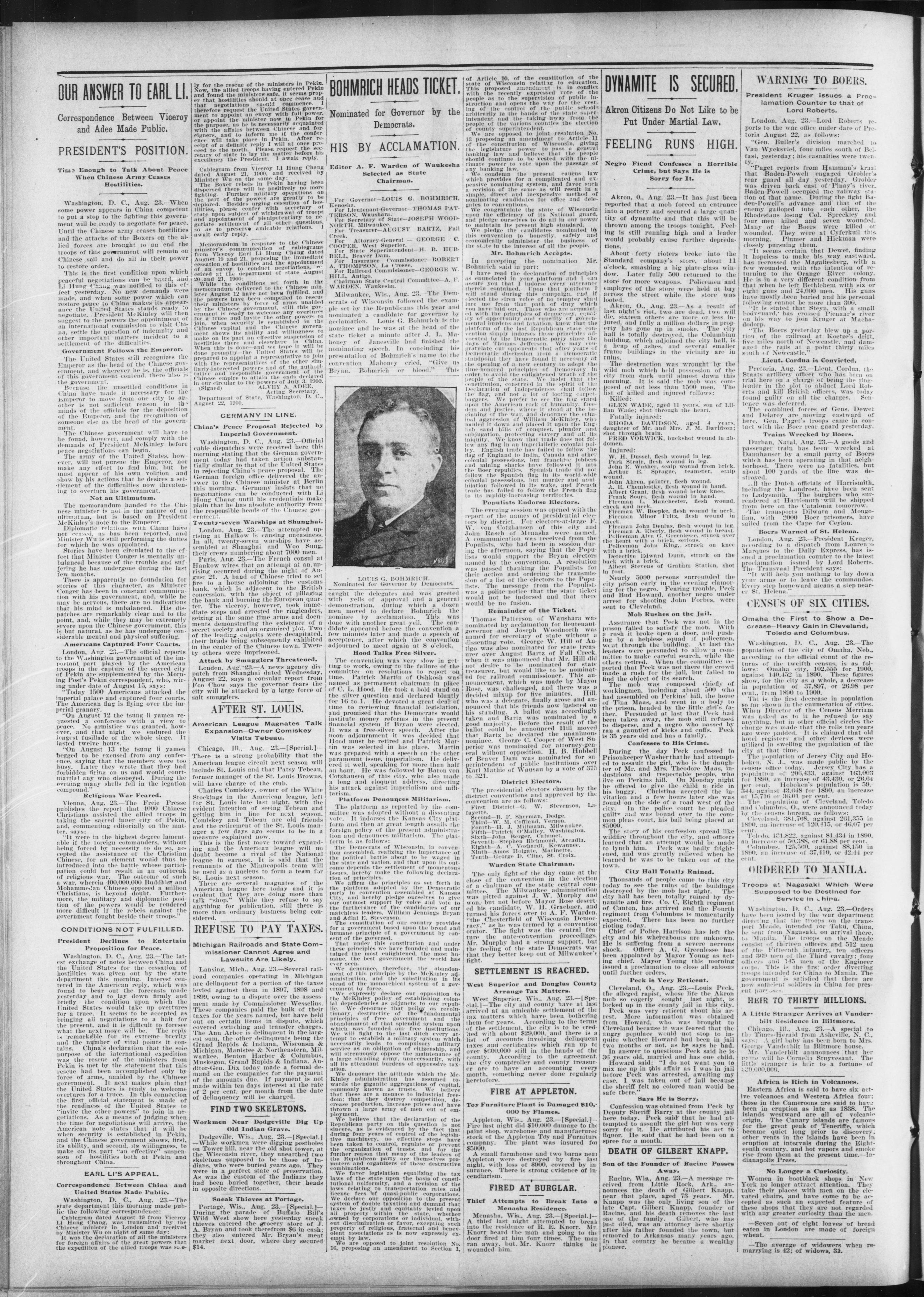
BOHMRICH HEADS TICKET.
HIS BY ACCLAMATION
Editor A. F. Warden of Waukesha Selected as State
For Governor—LOUIS G. BOHMRICH,
Kenosha.
For Lieutenant-Governor—THOMAS PAT-
TERSON, Waushara.
For Secretary of State—JOSEPH WOOD-
NORTH, Milwaukee.
For Treasurer—AUGUST BARTZ, Fall
Creek.
For Attorney-General — GEORGE C.
COOPER, West Superior.
For State Superintendent—H. B. HUB-
BELL, Beaver Dam.
For Insurance Commissioner—ROBERT
A. THOMPSON, La Crosse.
For Railroad Commissioner—GEORGE W.
HILL, Antigo.
Chairman State Central Committee—A. F.
WARDEN, Waukesha.
Milwaukee, Wis., Aug. 23.—The Democrats of Wisconsin followed the example set by the Republicans this year and nominated a candidate for governor by acclamation. Louis G. Bohmrich is the nominee and he was at the head of the state ticket a minute after J. L. Mahoney of Janesville had finished the nominating speech. In concluding his presentation of Bohmrich's name to the convention Mahoney cried, "Give us Bryan. Bohmrich or blood." This
KRUS
caught the delegates and was greeted with yells of approval and a general demonstration, during which a dozen men moved to declare Bohnrich the nominee by acclamation. This was done with another great yell. The candidate appeared before the convention a few minutes later and made a speech of acceptance, after which the convention adjourned to meet again at 8 o'clock.
Hood Talks Free Silver.
The convention was very slow in getting to work, owing to the failure of the committee on resolutions to report on time. Patrick Martin of Oshkosh was named as permanent chairman in place of C. L. Hood. He took a bold stand on the silver question and declared bluntly for 16 to 1. He devoted a great deal of time to reviewing financial legislation, and promised that the Democrats would institute money reforms in the present financial system if Bryan were elected. It was a free-silver speech. After the noon adjournment it was decided that Hood must be retired and Patrick Martin was selected in his place. Martin was prepared with a speech on the other paramount issue, imperialism. He delivered it well, speaking for more than half an hour. He was followed by Baron von Cotzhausen of this city, who also made a long and eloquent address, directing his attack against imperialism and militarism.
Platform Denounces Militarism.
The platform as reported by the committee was adopted without a dissenting vote. It indorses the Kansas City platform and then at great length assails the foreign policy of the present administration and denounces militarism. The platform is as follows:
The Democrats of Wisconsin, in convention assembled, realizing the importance of the political battle about to be waged in the state and nation, and that upon its outcome depends the settlement of momentous issues, hereby make the following declaration of principles.
We affirm the principles as set forth in the platform adopted by the Democratic party in convention assembled at Kansas City, and hereby pledge ourselves to give our outmost support by voice and vote to the furtherance of the candidacies of our matchless leaders, William Jennings Bryan and Adlai E. Stevenson.
The constitution of our country provides for a government based upon the broad and humane principle of a government by consent of the governed. That under this constitution and under these principles we have founded and maintained the most enlightened, the most human, the best government the world has ever seen. We denounce, therefore, the abandonment of this principle by the McKinley administration, and the substitution in its stead of the monarchical system of a government by force.
We expressly declare our opposition to the McKinley policy of establishing colonial dependencies as adjuncts to our republic. We denounce that policy as revolutionary, destructive of the fundamental principles of free government and the abandonment of that splendid system upon which was founded our free institutions. We will fight to the last ditch every attempt to establish a military system which necessarily leads to compulsory military service as an obligation of citizenship, and will strenuously oppose the maintenance of a large standing army, unnecessarily, with all its attendant burdens of oppressive taxation. We denounce the attitude which the McKinley administration has assumed towards the gigantic aggregations of capital, commonly known as trusts. We believe that these are a menace to industrial freedom; that they destroy competition, decrease production, increase prices and have thrown a large army of men out of employment.
We believe that the declaration of the Republican party on this question is not sincere, as is evidenced by the fact that during four years of control of the legislative machinery, no effective steps have been taken to control, regulate or prevent the organization of trusts, and for the further reason that many of the leaders of the Republican party are themselves promoters and organizers of these destructive combinations.
We favor legislation equalizing the tax laws of the state upon the basis of constitutional uniformity, and a revision of the laws relating to transportation rates and license fees of quasi-public corporations.
We declare our opposition to the present system of double taxation and demand that taxes be justly and equitably levied upon all property within the state, whether owned by corporations or individual, without discrimination or favor, excepting such property of religious, fraternal and benevolent associations as is now expressly exempt by law.
We are opposed to joint resolution No. 16, proposing an amendment to Section 1.
of Article 10. of the constitution of the state of Wisconsin relating to education. This proposed amendment is in conflict with the recently expressed vote of the people as to the supervision of public instruction and opens the way for the vesting of the control of the public schools arbitrarily in the hands of the state superintendent and the taking away from the people of the various counties the election of county superintendent. We are opposed to joint resolution No. 13 proposing an amendment to Article 11 of the constitution of Wisconsin, giving the legislature power to pass a general banking law and believe that the people should continue to be vested with the ultimate power to vote upon the passage of any banking law.
We condemn the present caucus law which provides for a complicated and expensive nominating system, and favor such a revision of the same as will result in a simple, direct and inexpensive method of nominating candidates for office and delegates to conventions.
We congratulate the state of Wisconsin upon the efficiency of its National guard, and pledge ourselves to do all in our power to maintain its present high standard. We pledge the candidates nominated by this convention to honestly, safely and economically administer the business of the state in the interest of all the people.
Mr. Bohmrich Accepts.
In accepting the nomination Mr. Bohnrich said in part:
I have read the declaration of principles as enunciated in your platform and I can assure you that I indorse every utterance therein contained. Upon that platform I will stand during this campaign, and if elected the siren voice of no taperp shall lure me from that path of duty which you have laid out. Those who are acquainted with the principles of democracy, equality of opportunity and equality of governmental burdens and taxation, know that the platform of the last Republican state convention simply indorses those principles advocated by the Democratic party since the days of Thomas Jefferson. We may congratulate our opponents that after years of Democratic discussion from a Democratic standpoint they have found it necessary at the opening of a new century to adopt the time-honored principles of Democracy in order to avoid the enlightened wrath of the people of the state. We insist that the constitution, construed in the spirit of the Declaration of Independence, shall follow the flag, and not a lot of looting carpet-baggers. We prefer to see the flag stand upon the American rock of humanity, freedom and justice, where it stood at the beginning of the war, and denounce the criminal aggression of William McKinley, who hauled it down and placed it upon the English sand hills of conquest, plunder and subjugation, protecting slavery and all its iniquity. We know that trade does not follow any flag in an imperialistic colonial policy. English trade has failed to follow the flag of England to India, Canada and other colonial possessions, but franchise jobbers and mining sharks have followed it into the Boer republics. Spanish trade did not follow the Spanish flag in its world-wide colonial possessions, but murder and annihilation followed in its wake, and French trade has failed to follow the French flag to its rapidly-increasing territories.
Populists Endorse Electors.
The evening session was opened with the report of the names of presidential electors by district. For electors-at-large F.W. von Cotzhausen of this city and John Rasch of Menasha were named. A communication was received from the Populists, who had been in session during the afternoon, saying that the Populists would support the Bryan electors named by the convention. A resolution was passed thanking the Populists for their action and ordering the transmission of a list of the electors to the Populists. The message from the Populists was a polite notice that the state ticket would not be indorsed and that there would be no fusion.
Remainder of the Ticket.
Thomas Patterson of Waushara was nominated by acclamation for lieutenant-governor and Joseph Woodnorth was named for secretary of state without a dissenting vote. George W. Hill of Antigo was also nominated for state treasurer over August Bartz of Fall Creek, when it was announced that Mr. Hill did not desire to be nominated for state treasurer, but would like to be nominated for railroad commissioner. This announcement, which was made by Mayor Rose, was challenged, and there was a decided mixup for five minutes. Hill, who was a delegate, finally arose and announced that his friends now insisted on his standing. A ballot was accordingly taken and Bartz was nominated by a good majority. Before the result of the ballot could be announced Hill moved that Bartz be declared the unanimous nominee. George C. Cooper of West Superior was nominated for attorney-general without opposition. H. B. Hubbell of Beaver Dam was nominated for superintendent of public institutions over Karl Mathie of Wausau by a vote of 375 to 321.
District Electors.
The presidential electors chosen by the district conventions and approved by the convention are as follows:
First, District—G. W. Stevenson, La fayette.
Second—B. F. Sherman, Dodge
Sidney W. M. O'Floyd, Vernon
Second—B. F. Sherman, Douge.
Third—W. M. Coffland, Vernon.
Fourth—H. J. Milhmann, Milwaukee.
Fifth—Patrick O'Malley, Washington.
Sixth—John Berger, Calumet.
Seventh—Stephen Richmond, Arcadia.
Eighth—A. C. Voshardt, Kewaunee.
Ninth—Amos Holgate, Marinette.
Tenth—George D. Cline, St. Croix.
Warden State Chairman.
The only fight of the day came at the close of the convention in the election of a chairman of the state central committee. The Milwaukee administration was pitted against J. W. Murphy and won, but not before Mayor Rose deserted his candidate, W. H. Gracbner, and turned his forces over to A. F. Warden. "the Chesterfield of Wisconsin Democracy," as he was termed by a convention orator. The fight was the central feature the ante-convention proceedings. Mr. Murphy had a strong support, but the feeling of the state Democrats was that they better keep out of Milwaukee's fight.
SETTLEMENT IS REACHED.
West Superior and Douglas County Arrange Tax Matters.
West Superior, Wis., Aug. 23.—[Special.]—The city and county have at last arrived at an amicable settlement of the tax matters which have been bothering them for years. According to the terms of the settlement, the city is to be credited with about $29,000, and there is a list of accounts involving delinquent taxes and certificates which run up to over $600,000 still in the hands of the county. According to the agreement, the city comptroller and county treasurer are to have an accounting every month, something never done regularly heretofore.
FIRE AT APPLETON.
Toy Furniture Plant is Damaged $10,000 by Flames.
Appleton, Wis., Aug. 23.—[Special.] Fire last night did $10,000 damage to the paint shop, warehouse and manufactured stock of the Appleton Toy and Furniture company. The plant was insured for $5000. A small farmhouse and two barns near Appleton were destroyed by fire last night, with loss of $900, covered by insurance. There is strong evidence of incendiarism.
FIRED AT BURGLAR.
Thief Attempts to Break Into a Menasha Residence.
Menasha, Wis., Aug. 23.—[Special.]—A thief last night attempted to break into the residence of R. E. Knorr. Mr. Knorr heard the man and going to the door fired at him four times. The man ran away, but Mr. Knorr thinks he wounded him.
DYNAMITE IS SECURED.
Akron, 0., Aug. 23.—It has just been reported that a mob forced an entrance into a pottery and secured a large quantity of dynamite and that this will be thrown among the troops tonight. Feeling is still running high and a leader would probably cause further depredations. About forty rioters broke into the Standard company's store, about 11 o'clock, smashing a big plate-glass window. Later fully 500 returned to the store for more weapons. Policemen and employes of the store were held at bay across the street while the store was looted.
Akron, O., Aug. 23.—As a result of last night's riot, two are dead, two will die, sixteen others are more or less injured, and fully a million dollars in property has gone up in smoke. The city hall is totally destroyed, the Columbian building, which adjoined the city hall, is a heap of ashes, and several smaller frame buildings in the vicinity are in ruins.
The destruction was wrought by the wild mob which held possession of the city from dark until almost dawn this morning. It is said the mob was composed of not less than 1500 men. The list of killed and injured follows:
Killed:
GLEN WADE, aged 11 years, son of Lillian Wade; shot through the heart.
Fatally injured:
RHODA DAVIDSON, aged 4 years,
daughter of Mr. and Mrs. J. M. Davidson;
shot through brain.
FRED VORWICK, buckshot wound in abdomen.
Injured:
W. H. Dussel, flesh wound in leg.
Park Strair, flesh wound in leg.
John E. Washer, scalp wound from brick.
Arthur E. Sprague, teamster, scalp wound.
John Ahren, painter, flesh wound.
Frank Sours, flesh wound in hand.
Fireman L. Manchester, flesh wound,
cheek and neck.
Fireman W. Boepke, flesh wound in neck.
Fireman Minor Fritz, flesh wound in
cheek.
Fireman John Denius, flesh wound in leg.
Fireman A. Eberly, flesh wound in breast.
Policeman Alva G. Greenlesse, struck over
the heart with a brick, serious.
Policeman John Kling, struck on knee with a brick.
Detective Edward Dunn, struck on the back with a brick.
back with a brick. Albert Stevens of Graham Station, shot in foot. Nearly 5000 persons surrounded the city prison early in the evening clamoring for the negro. Fearing trouble, Peek and Bud Howard, another negro under arrest for shooting John Forbes, were sent to Cleveland.
Mob Rushes on the Jail.
Assurance that Peck was not in the prison failed to satisfy the mob. With a rush it broke open a door, and pushing by a helpless squad of policemen, went through the building. At last the leaders were persuaded to allow a committee to make careful search, while the others retired. When the committee reported that Peck was not there the crowd made a rush for the jail, but failed to find the object of its search.
The mob was composed chiefly of workingmen, including about 500 who had assembled on Perkins' hill, the house of Tina Maas, and went in a body to the prison, headed by the little girl's father. Persuaded at last that Peck had been taken away, the mob still refused to disperse, and a negro who passed by ran a gauntlet of kicks and cuffs. Peck is 35 years old and has a family.
Confesses to His Crime.
During the day Peck confessed to Prisonkeeper Washer that he had attempted to assault the girl, who is the daughter of Mr. and Mrs. Theodore Maas, industrious and respectable people, who live on Perkins hill. On Monday night he offered to give the child a ride in his buggy. Christina accepted the invitation and a few hours later she was found on the side of a road west of the city. In the police court he pleaded guilty and was bound over to the common pleas court, his bail being placed at $5000. The story of his confession spread like wildfire throughout the city, and officers learned that an attempt would be made to lynch him. Peck was badly frightened, and was greatly relieved when he learned he was to be taken out of the town
City Hall Totally Rnined.
Thousands of people came to this city today to see the ruins of the buildings destroyed by the mob last night. The city hall has been totally ruined by dynamite and fire. Co. C, Eighth regiment of Canton, has arrived and the Fourth regiment from Columbus is momentarily expected. There has been no further rioting today. Chief of Police Harrison has left the city and his whereabouts are unknown. He is suffering from a severe nervous shock. Officer A. G. Greenlesse has been appointed by Mayor Young as acting chief. Mayor Young this morning issued a proclamation to close all saloons until further orders.
Peck is Very Reticent.
Cleveland, O., Aug. 23.—Louis Peck, the alleged rapist, whose life the Akron mob so eagerly sought last night, is locked up in the county jail in this city. Peck was very reticent about his arrest. More information was obtained from Howard, who was brought to Cleveland because it was feared that the angry populace would not stop to inquire whether Howard had been in jail two months or not, as he says he had. In answer to questions Peck said he is 36 years old, married and has one child. Howard said: "I do not want you to mix me up in this affair as I was in jail before Peck was arrested, awaiting my case. I was taken out of jail because the sheriff felt no colored man would be safe there."
Says He is Sorry.
Confession was obtained from Peck by Deputy Sheriff Barry at the county jail here today. Peck said that he had attempted to assault the girl but was very sorry for it. He attributed his act to liquor. He said that he had been on a spree for a month.
DEATH OF GILBERT KNAPP.
Son of the Founder of Racine Passes
Racine, Wis., Aug. 23.—A message received from Little Rock, Ark., announces the death of Gilbert Knapp, near that place, aged 73 years. Mr. Knapp was the only living son of the late Capt. Gilbert Knapp, founder of Racine, and his death removes the last one of the family. Gilbert, who has just died, was an attorney here shortly after his father founded the town, but removed to Arkansas many years ago. In that country he became a wealthy pioneer.
WARNING TO BOERS.
President Kruger Issues a Proclamation Counter to that of Lord Roberts.
London, Aug. 23.—Lord Roberts reports to the war office under date of Pretoria August 22, as follows:
"Gen. Buller's division marched to Van Wycksvlei, four miles south of Belfast, yesterday; his casualties were twenty.
"Paget reports from Hammans kraal that Baden-Powell engaged Grobler's rear guard all day yesterday. Grobler was driven back east of Pinay's river. Baden-Powell occupied the railway station of that name. During the fight Baden-Powell's advance and that of the enemy galloped into each other, the Rhodesians losing Col. Spreckley and four men killed and seven wounded. Many of the Boers were killed or wounded. They were at Cyferkuil this morning. Plumer and Hickman were closely pursuing them.
"It seems certain that Dewet, finding it hopeless to make his way eastward, has recrossed the Magaliesberg, with a few wounded, with the intention of returning to the Orange River colony. He is in a very different condition from that when he left Bethlehem with six or eight guns and 24,000 men. His guns have mostly been buried and his personal following cannot be more than 300.
"It is stated that Steyn, with a small bodyguard, has crossed Pienaar's river on his way to join Kruger at Machadodorp.
"The Boers yesterday blew up a portion of the railroad at Koetze's drift, five miles north of Newcastle, and damaged the rails at a point thirty miles south of Newcastle."
Lieut. Cordua is Convicted.
Pretoria, Aug. 23.—Lient. Cordua, the Staats artillery officer who has been on trial here on a charge of being the ringleader in the plot to abduct Lord Roberts and kill British officers, was today found guilty on all the charges. Sentence was deferred.
The combined forces of Gens. Dewet and Delarey are moving eastward of here. Gen. Paget's troops came in contact with the Boer rear guard yesterday.
Trains Wrecked by Boers.
Durban, Natal, Aug. 23.—A goods and passenger train has been wrecked at Damnhauser by a small party of Boers which has been operating in that neighborhood. There were no fatalities, but about 100 yards of the line was destroyed. All the Dutch officials of Harrismith, including the Landrost, have been sent to Ladysmith. The burghers who surrendered at Harrismith will be shipped from here on the Catalonia tomorrow. The transports Dilwara and Mongo-
The transports Dilwara and Mongolian, with 2000 Boer prisoners, have sailed from the Cape for Ceylon.
Boers Warned of St. Helena.
London, Aug. 23.—President Kruger, according to a dispatch from Louren o Marques to the Daily Express, has issued a proclamation counter to the latest proclamation issued by Lord Roberts. The Transvaal President says: "It will help you nothing to lay down your arms or to leave the commandos. Every step homeward means a step nearer St. Helena."
CENSUS OF SIX CITIES.
Omaha the First to Show a Decrease—Heavy Gain in Cleveland, Toledo and Columbus. Washington, D. C., Aug. 23.—The population of the city of Omaha, Neb., according to the official count of the returns of the twelfth census, is as follows: Omaha city, 102,555 for 1900, against 140,452 in 1890. These figures show, for the city as a whole, a decrease in population of 37,897, or 26.98 per cent. from 1890 to 1900.
Thi is the first decrease in population so far shown in the enumeration of cities. When Director of the Census Merriam was asked as to it he refused to say anything, but in other official circles the charge was made that the rolls ten years ago were padded. It is claimed that old hotel registers and other devices were utilized in swelling the population of the city at that time. The population of Jersey City and Hoboken, N. J., was made public by the census office today. Jersey City has a population of 206,433, against 163,003 for 1890, an increase of 43,430, or 26,644 per cent. Hoboken's population is 59,-344, against 43,648 for 1890, an increase of 15,716 or 36,01 per cent. The population of Cleveland, Toledo and Columbus, O., were announced today by the census bureau as follows:
Cleveland, 381,768, against 261,355 in 1890, an increase of 120,415, or 46.07 per cent.
Toledo, 121,822, against 81,434 in 1890, an increase of 50,388, or 61,88 per cent. Columbus, 125,560, against 88,150 in 1890, an increase of 37,410, or 42.44 per cent.
ORDERED TO MANILA.
Troops at Nagasaki Which Were Supposed to be Destined for Service in China.
Washington, D. C., Aug. 23.—Orders have been issued by the war department directing that the troops on the transport Meade, intended for Taku, China, be sent from Nagasaki, on arrival there, to Manila. The troops on the Meade consist of thirteen officers and 512 men of the Fifteenth infantry, ten officers and 369 men of the Third cavalry; four officers and 145 men of the Engineer corps. This is the first order diverting troops intended for China to Manila. The government is satisfied that there are now sufficient soldiers in China for present purposes.
HEIR TO THIRTY MILLIONS.
A Little Stranger Arrives at Vanderbilt Residence in Biltmore. Chicago. Ill.. Aug. 23.—A special to the Times-Herald from Asheville, N. C., says: A girl baby has been born to Mrs. George Vanderbilt in Biltmore house. Mr. Vanderbilt announces that her name will be Cornelia Stuyvesant. The little stranger is heir to a fortune of 130,000,000.
Africa is Rich in Volcanoes
Eastern Africa is said to have six active volcanoes and Western Africa four; those in the Cameroons are said to have been in eruption as late as 1838. The islands westward are all of volcanic origin. The Canary islands are famous for the great peak of Teneriffe, which became quiet long prior to discovery; other vents in the islands have been in eruption at intervals during the Eighteenth century, and hot vapors and smoke rise from them at the present time.—Indianapolis Press.
No Longer a Curiosity.
Women in bootblack shops in New York no longer attract attention. They take their places with men on the elevated chairs, and have come to be accepted as such an expected feature of these shops that they are not regarded with any greater curiosity than the men.
—Seven out of eight loaves of bread eaten in London are made of foreign wheat.
—The average of widowers when remarrying is 42; of widows, 31.
RECKLESS IN DARING.
BRILLIANT PERFORMANCES IN BATTLE BY MOSBY.
Ex-Confederate Leader Numbers His Fights by Wounds-Bitterest Enemies Acknowledge His Bravery and Honesty.
Says a writer in the Washington Post: When the world counts its soldiers it will call the name of John Singleton Mosby. No history of the late war can be written and omit the name of Mosby. Beyond most men Mosby was brave and honest, and he was a borr soldier.
Gen. Lee said that the only fault he ever had with Mosby was that he was forever getting wounded. Of his honesty and the integrity of his nature you may read in a Supreme Court report, where Justice Blatchford delivered the opinion less than twelve years ago. The courage and absolute honesty of Mosby's nature were never doubted. That tells a great deal by itself. When nature has made a man brave and made him honest the man is about finished; there's not much more to do. And so it is with Mosby—a man who in his way and day may be called an American Bayard.
Mosby was great on a day when it was not easy to be great; he was great on the day of battle. War is a storm, a human storm. Weak men are blown out; only the strongest shine. It is such natures as Mosby's which burn and glow like beacons then. After Virginia seceded Mosby was one of the first to enlist. He was in for twelve months as one of Gen. Joe Johnston's cavalry. He was at Bull Run, and subsequently gave service in the Shenandoah and along the southern part of the Potomac.
At the end of twelve months he was offered a furlough. He didn't want it; he was thirsty for war, and re-enlisted "until the close of hostilities." Whoever else failed it may be set forth at this point that Mosby carried out the terms of his enlistment. He was there, still fighting, when hostilities closed.
Indeed, when some gray old men were talking at Chamberlin's, one of their number declared that Mosby made a fight after Lee surrendered—that it was Mosby who made the last gray line of battle for a cause already lost, and fought round the lost standard of a Confederacy already dead. This may well be true. Mosby was very busy about the time that Lee surrendered; the saddles hadn't been off his horses for three months, except to feed and curry them, and it may be that the Mosby bugle was ringing "boots and saddles" for some days after Lee had quit, purely through Mosby's ignorance of the news.
After his re-enlistment Gen. J. E. B. Stuart got possession of Mosby. Stuart could pick out a cavalryman as if by instinct. It didn't take him long to pick out Mosby. He had the young man up to headquarters and made him master of his scouts. This exactly matched the taste of Mosby and in June, not five months later, history found Mosby at the head of a whole cavalry brigade, cutting and slashing at the rear of McClellan's army in a way which much disconcerted that eminent commander. This was on the Chickahominy.
It was in 1862 that Mosby returned to northern Virginia and raised a force of his own. As a result of this independent round-up Mosby found something like 100 cavalrymen following his guidon. With this slim force he cut off more wagon trains, tore up more railroad, cut more telegraph wire, destroyed more stores, cleaned out more scouting parties, chased more pickets into camp, and generally kept more Federal generals in a stew and ferment than any other man in the Southern army. There was never a day in the independent career of Mosby when more than 400 men rove at his back, and yet there has been as many as 30,000 Federal troops looking for Mosby all at once. There is a hundred-mile stretch in the Shenandoah valley and Mosby has fought Sheridan's cavalry going and coming, over every foot of it.
It is worth a record that Mosby's command was never captured until he voluntarily surrendered at the close of the war. The reason was as much as anything else that it was rigged like a disappearing gun. Press it or corner it and the command disbanded like a flock of blackbirds; every man for himself.
One day Mosby's command would fight as an organization; as inveterate, as steady a body of cavalry as ever marched upon a battlefield. The next it would have disappeared, scattered; it was nowhere, and literally didn't exist. One might as well try to capture air.
But a week later, when pursuit had spent itself, Mosby might ride back into the valley with his bugler. Within forty-eight hours of a rallying call his 400 men would be at his back again, ready for any service, no matter how desperate the work to which he might choose to lead them.
When Sheridan sent Early whirling up the valley like a ball, it was Mosby who fastened to the rear of his army with his handful of rangers, and made him stop and turn. Mosby's was the only Confederate flag in northern Virginia. Had it not been for Mosby Sheridan would have been forewarned as Grant told him to—and scattered Lee's communications like chaff. The war would have ended; there would have been nothing of all that bloody fighting in the Wilderness had it not been for the guerilla Mosby and that hard-riding handful he led. Mosby cut off Sheridan's supplies, and the later wrote Grant, after chasing Early out of sight, that he himself
"would have to retreat to subsist his men" and protect his supplies. Mosby was making ducks and drakes of them. As a method to bring forward his needed stores Sheridan urged Grant in his dispatches to cause the Manassas Gap Railroad, aforetime torn up and desolated by Stonewall Jackson, to be reconstructed to Fort Royal, Sheridan retreating to Fort Royal to await the supplies which would roll in over the rebuilt road.
A large force went out from Washington to remake the railroad so needed by Sheridan, but Mosby never let them drive a spike or lay a rail. He hovered about those railroad makers like a hawk. Every time they laid down a musket and took up a pick he swooped. He kept every man jack of an outfit twenty times as large as his busy night and day defending himself, and the supplies Sheridan awaited at Fort Royal never came. This forced Sheridan to change his whole plan, protected Lee's lines from his assaults at that time, gave Early a chance to form a junction with his chief, and the war, instead of ending, staggered on to Appomattox. It was Mosby who did that.
When Lee surrendered Grant extended the same terms to the irregular Mosby, and, by the way, Grant and Mosby became great friends.
It is one of the remarkable matters about Grant that many of the men who were his most tireless and intrepid foemen during the war were his best friends after. There were Mosby, Longstreet, old Simon Buckner and scores of others. Grant captured Buckner twice, once at Donelson and again at Appomattox, after battles which in no sense resembled the play of children; and yet no sadder heart attended to bear the pall of the great soldier of the North, no tears fell faster above him as he went to his long rest than General Buckner's.
Probably the most sincere American incident of the war occurred at Lee's surrender, or within a few minutes next following it. No sooner were the formalities of Lee's capitulation over than Grant, in his ingenuous, single-hearted way—they had known each other since an olden day at West Point took Buckner one side and inquired into his finances and money needs. Grant wanted to lend him whatever his exigencies called for.
That was a spectacle essentially American, and Grant was never greater than when, utterly forgetting what might be called "the set of the stage," he was trying to lend an old comrade—in arms against him the day before, surrendered to him only a previous ten minutes—money enough to put him out of care and take him home. And the best part of it was that Buckner borrowed like a true American, and repaid every stiver like an honest man.
It is one of the best things about Americans that they can sternly fight four years; pull off battle after battle, to which by a comparison of per cents killed and wounded such old world collisions as Austerlitz, Marengo and Waterloo weren't even football, and then to forgive and trust each other, and go on with their government as if nothing had happened. After the war the fighters did like Grant and Buckner at Appomattox. They shook hands, divided up their money, lighted their pipes and went home.
It was after the war that Mosby did something which offended Southern sentiment broadly. As between Horace Greeley and Grant, Mosby voted for Grant; and to look back at the transaction after twenty-five years it wouldn't seem such a bad shoot to take. Grant offered Mosby an office after he was elected, and Mosby wouldn't touch it with a ten-foot pole, which would lead a fair man to conclude that Mosby's vote for Grant—which so like a javelin pierced the breast of Southern sensibility—at least had no personal motive at its back.
Mosby under Hayes took an office the consulate at Hong Kong. He remained there until Cleveland removed him. When he settled up Mosby found that in the excess of his integrity he had overpaid the Government, and he had to sue to get his money. Well, he got it; won his case; and it was when Blatchford was reading the decision of the Supreme Court in the affair that he spread on the records an extended compliment to Mosby for the fidelity, honesty and intelligence with which he had discharged his duty at Hong Kong to a government which tried to cheat and rob him the moment he returned.
His Wife Not a Socialist
In his early youth Count Tolstoi determined never to marry, and on the strength of this resolution sold the family mansion, which was torn down and removed, except one wing, which he reserved for his bachelor quarters. At the age of 32 Tolstoi changed his mind, and married. His wife, once a celebrated beauty, belongs to a noble family of German origin. She was only 16 when married, and has borne the Count sixteen children, nine of whom are living. Left almost to her own resources in domestic and practical affairs, she has risen to the occasion, and manages the estates and the Count's private business matters with a firm hand. Mme. Tolstoi does not share the socialistic beliefs of her talented husband, and but for her shrewd and firm management the estate would long ago have been impoverished. Their house for many years has been full of nurses, governesses and preceptors, as well as children.
A census of the Klondike district gives a total population of 8,306, of whom 5,539 are citizens of the United States.
Salt used in sweeping carpets keeps out moths.
CURRENCY REFORM
BENEFICIAL RESULTS UNDER THE GOLD STANDARD LAW.
Establishes Money Values, Increases Reserve Fund, Makes More National Banks, Refunds National Debt—Financial Strength of the United States.
The reform in the currency laws is the second great achievement in the administration of public finances under President McKinley, the first being the Dingley tariff. The act approved by the President March 4, 1900, firmly establishes the United States on a gold basis. Confidence in respect to the money standard is now at the highest, and the integrity of all our various forms of money has been declared by law.
The task has been a difficult one. It was a problem which required patience and courage in its solution. The fact that three years elapsed before the measure became law reveals the difficult road over which the workers for the reform movement passed. At the beginning of the first regular session of Congress, under the administration of President McKinley, the Secretary of the Treasury submitted a plan the essential features of which are to be found in the act of March 14, 1900.
From December, 1897, until the bill became a law, no opportunity was lost to advance the cause of currency reform. Notwithstanding an adverse majority in the Senate, the Committee on Banking and Currency in the House considered several measures. In anticipation of a Republican Senate and House in the Fifty-sixth Congress caucus committees were organized for the purpose of preparing, during the summer months of 1899, such a bill as would receive the support of the soundmoney majority in both Houses. When the first session of the Fifty-sixth Con-
BRYAN'S EXPANSION
BRYAN'S EXPANSION.
gress was convened the first bill introduced was that agreed upon by the House caucus committee. It took its place upon the calender as House bill No.1. With all reasonable expedition the measure was then considered by both branches of the national Legislature, and so became a law March 14, 1900.
This currency law does something more than remove all doubt concerning the standard of value. It directs that all forms of money issued or coined by the United States shall be maintained at a parity of value with this standard, and it is made the duty of the Secretary of the Treasury to maintain such parity. A reserve fund of $150,000,000 in gold coin and bullion is set apart in the treasury for the redemption of United States notes and treasury notes of 1890, instead of $100,000,000 formerly recognized as the gold reserve. Such fund is required to be used for redemption purposes only. Ample provision is made for restoring the reserve fund in case it should fall below the $150,000,000 required to be maintained.
The act also contains provisions which give greater liberty to the organization of national banks. Under the old law no national bank could be organized with a capital less than $50,000. Under the new law the minimum capital required for organization is $25,000 in places the population of which does not exceed 3,000 inhabitants. The object of this provision is to extend better banking facilities to those smaller communities heretofore denied the privilege of organizing national banks. At the same time the law contains a provision authorizing the banks to issue their circulating notes to the par of the United States bonds deposited as security, instead of only 90 per cent, as formerly.
Perhaps the most notable feature of the new currency law is that which relates to the refunding of the national debt. The 5 per cents of 1904, the 4 per cents of 1907 and the 3 per cents of 1908, the principal of which aggregates $839,146,400, are authorized to be refunded into 2 per cent bonds, payable at the pleasure of the United States after thirty years from the date of their issue, and payable, principal and interest, in gold coin of the present standard value. The act contains a provision that the new 2 per cent bonds
---
to be issued in exchange for the old threes, fours and fives, shall not be issued at less than par. The Secretary of the Treasury was authorized to conduct the refunding operations so that the old threes, fours and fives should be received in exchange for the 2 per cents on a basis of $2 \frac{1}{4}$ per cent. May 1, 1900, almost one-third of the out-standing threes, fours and fives had been converted into 2 per cents of the new issue, thus practically securing the success of the refunding plan.
No other nation of the earth can boast of such an achievement as is the exchange of these old, high-rate interest bonds for bonds issued upon so low a basis as 2 per cent. Hitherto Great Britain has been regarded as the financial Gibraltar of the world, but while British consols bearing interest at the rate of $2 \frac{1}{4}$ per cent per annum were selling two points below par, the United States was able to float a 2 per cent bond at par with ease. Such facts speak volumes for the present financial strength of the United States. To float a 2 per cent bond at par of this kind means the integrity of the dollar has been recognized in the law of the land, and that there is faith in the honesty of our intentions and purposes for the future.
The people of the nation and world know that the prosperity of the citizens of the United States was greater and more general in 1892 than in any previous year in their history. It is also known that they voted away their own labor and business in the November election of that year, and all the official statistics of the next four years prove that free trade and free silver agitation caused greater financial losses in the United States than all the other calamities the people of this country have been compelled to endure during all their history.
The balance of trade in favor of the United States in 1892 was $202,875,686.
and the balance of trade was against the United States in 1893 to the extent of $18,737,728. It is true that the balance was more favorable in 1894, but it is also true that that was largely because of the withholding of imports until after the enactment of the lower duties of the Wilson tariff. There was a decrease in the value of both exports and imports every year the free trade and free silver agitation was in power, and the balance of trade in favor of the United States has been nearly as large every McKinley fiscal year as the total of the four free trade and free silver agitation years.—Des Moines Register.
Total revenue receipts for the year 1900, $568,988,948.21.
Paid out for pensions, $138,462,172.54, or 24 per cent, as per statement of Treasury Department of July 2.
Total expenditures War and Navy Departments for 1900, $190,743,980.61, or 33 1-3 per cent. of receipts.
War and Navy Department expenditures include all expenses incident to the war—the equipment of the army and navy, purchase and equipment of vessels, transportation of troops—everything chargeable to army, navy and marine corps.
The advantages of the "free and unlimited coinage of silver at the ratio of 16 to 1" told us in 1896 that its adoption "would put up prices." Well, we did not adopt it. But in 1899 and 1900 the average increase in prices has enabled the farmers to pay off their mortgages, paint their barns, repair their fences and buy new farm implements as well as pianos.
A Lesson from the Jails.
When times are prosperous and labor is fully employed, crime everywhere decreases. Take the single State of Illinois. For the year ending Sept. 30, 1895, during the hard times, 927 convicts were sent to the penitentiary. In 1899 the number was only 506, hardly more than half. When men are employed at good wages they do not become thieves.
Wants His Money's Worth.
"Have you read Mr. Bryan's book on 'The First Battle?' "
"No. I am waiting for his volume on 'The Second Battle.' He will then have a much harder fall to describe."
The Cost of Bryanism.
United States.
Not a Result of 16 to 1.
THE HOUSEHOLD
Woman's Labor-Saving Apparatus. The clothes boiler pictured here is the invention of Ella E. Hunter, of Rockport, Mo., and her intention is the production of a durable boiler provided with an openwork clothes receptacle, which can be raised and lowered by a simple mechanism carried from the exterior of the boiler, and calculated to facilitate the draining and removal of the clothes. When the clothes have
A woman operating a large pot with a lid, steaming hot.
boiled sufficiently the crank is revolved to wind up the cable, which passes underneath the basket, elevating the latter and draining out the water, when the garments cool rapidly and can be lifted out with the hands. The crank is fitted with a pawl which locks the basket in its elevated position until it is emptied, when the pawl is released, to allow the basket to fall back into the boiler again.
Currant Jelly.
To make currant jelly, wash the fruit and drain it in a colander. Then put the fruit in a dish and mash it thoroughly, after which squeeze the juice from it through a double piece of new cheese cloth. Measure the juice and an equal quantity of sugar. Put the juice into a preserving kettle and boil it for twenty minutes, skimming it frequently. Put the sugar on plates in the oven and heat it through, but do not brown it. At the end of the twenty minutes add the sugar to the juice and boil for five minutes. Try a spoonful on a plate, and if it jellies it should be removed from the fire. Fill into glasses and seal them tightly.
To Test Purity of Water.
So much sickness is attributed to the use of impure water that it would sometimes save suffering—and doctors' bills—if tests were occasionally made of the drinking water. A simple and safe test, well known by chemists, is as follows: Draw a tumblerful from the tap at night, put a piece of white lump sugar in it and place it where the temperature will not be under 60 degrees. In the morning the water, if pure, will be perfectly clear; if contaminated by sewage or other impurities, the water will be milky.
Cucumber and Tomato Salad.
Cucumber and Tomato Salad.
Peel the cucumbers and cut in thin slices, let stand in salted water five minutes. Take the same amount of ripe tomatoes, peel and slice thin. In a glass dish place a layer of the cucumbers and then a layer of the tomatoes, alternating until the dish is full. Make a dressing of vinegar, olive oil or melted butter, one teaspoon to one cup vinegar, season with salt and pepper, and turn over the cucumber and tomato, enough to nearly cover. Let stand five minutes and serve.—A. R. Annable.
Furniture Polish.
Raw linseed oil and spirits of turpentine, in the proportions of two-thirds oil and one of turpentine, make the model furniture reviver. The woodwork should be first carefully wiped off with a dry, soft cloth and the dust thoroughly removed from corners and carvings. The best article to accomplish this is a large paint brush, usually called a painter's duster. The oil may then be applied with a smaller brush, wiping off with a soft cloth and rubbing thoroughly dry.
Useful to Know.
A sprinkling of coarse salt on the sidewalks and driveways will destroy grass and weeds.
The best remedy against ants is cayenne pepper. Spread it on the shelves of the store closet under the paper that covers them.
If brass or copper, after cleaning, is rubbed with old soft newspapers it will look much brighter and keep clean much longer.
Add a little turpentine to the water with which the floor is scrubbed. It will take away the close smell and make the room delightfully fresh.
Marks that have been made on paint with matches can be removed by rubbing first with a slice of lemon, then with whiting, and washing with soap and water.
Lemons may be kept for a long time, even months, under glass. If you are not going to use them immediately, lay them on a flat surface and invert a goblet over each one.
If any substance has remained attached to a utensil, do not attempt to scour it off, but pour some water into the vessel, and place it over the fire, when it will soon be possible to remove all the adhesive matter without scratching or injuring the pan.
PROFITABLE DAIRYING.
Paper Read Before Farmers' National Congress at Colorado Springs.
Colorado Springs, Col., Aug. 22. George M. Whittaker, dairy commissioner of Massachusetts, delivered an address on dairying before the Farmers' National congress this morning. He said in part:
Too much idle or unprofitable capital is frequently found in dairying. The cost of making butter at different creameries varies 100 per cent, according to the amount of business done. If the millions of dollars invested in farms and dairying machinery could be made to turn out a little more work without extra expense the cost of production would be thereby decreased. Cost of production is greatly enhanced in many cases because cows are kept which produce much less than they should do. When some cows produce 455 pounds of butter per year and the average is only 150 to 175, there must be a wide range in the cost per pound.
The annual value of the dairy products of the nation is in round figures $500,000,000. In the forty years previous to the census of 1890 population had increased 174 per cent., but the number of milch cows had increased but 166 per cent. In the East, the old dairy center, the increase in milch cows was but 50 per cent., while in the north central division the increase was 700 per cent.
One-half of the butter production is in seven states. The largest butter state is Iowa, making 10.4 per cent. of the country's production; next comes New York, with 9.3 per cent., and Pennsylvania third, with 8 per cent. This large increase of production shows the importance of a foreign outlet to prevent the surplus from unduly depressing the home market. Exports during the last ten years have fluctuated between 6,000,000 and 31,000,000 pounds.
The production of milk for consumption is the second largest branch of the industry, using the product of 5,500,000 cows. When we consider the large number of cities and towns dependent upon the daily milkman, we can partially realize the importance of this business. Condensed milk is a feature of dairying which has been increased rapidly during the last twenty years. Exports are increasing rapidly and in 1899 were $1,000,000. The exports go largely to England, Hawali, Cuba, Japan, China and Bermuda.
Cheese is relatively of the least account in American dairying, calling for the production of 1,000,000 cows, the production having declined one-third, from 27,000,000 to 18,000,000 pounds. Two states produced nearly three-quarters of the whole quantity of cheese manufactured in the country. New York leads with 40.3 per cent., while Wisconsin is second with 21.3 per cent. The manufacture of cheese in factories has practically killed out farm dairy cheese. The exports of cheese have declined from 127,000,000 pounds in 1880 to 38,000,000 pounds in 1890. Of this latter amount England, direct or through Canada, took 36,500,000 pounds.
There are two kinds of oleomargarine. The first is the ideal, which is the article of the laboratory, the study or the office, talked about by men who have no knowledge of the actual business. The second is the common imitation butter found in stores, peddlers' wagons and boarding houses. The ideal oleomargarine is a mixture of tallow, lard and cottonseed oil, all wholesome food-products against which little can be said from the standpoint of health. The yellow oleomargarine of commerce has the above constituents, but is prepared to counterfeit butter and is sold fraudulently in a majority of cases. It may be questionable legislation to restrict the sale of the first kind of oleomargarine, but that is a creature of the imagination. On the other hand, there is every reason for regulating or suppressing the fraud, which is rarely sold on its merits, but which owes its commercial value to the skill of the counterfeiter. The most logical way to restrict the sale of this counterfeit is to strike at the root of the evil, to forbid the introduction of the element which constitutes the fraud, namely, the color. There is as much food value in white oleomargarine as in yellow. It is essential that we should push section 1 of the Grout bill, so called, which makes oleomargarine brought into any state subject to the laws of that state.
PECK'S ACT ILLEGAL.
President Could Remove Him from Office for Accepting Decoration from France.
Washington, D. C., Aug. 22.—In accepting the decoration of the Legion of Honor from the French government Commissioner-General Ferdinand W. Peck has violated the constitution of the United States. He must return the decoration, or, if complaint is made against him, it will be the duty of the President to remove him from office. This is the view of officials of the administration who have considered the constitution in connection with Mr. Peck's acceptance of the award of the French government. Assistant Commissioner-General Woodward, who was also decorated by the French government, will have to return the decoration or suffer the same penalty. Clause 8 of section 9, article 1, of the constitution prescribes:
constitution, prescribes.
No title of nobility shall be granted by the United States, and no person holding any office of profit or trust under them shall, without consent of Congress, accept of any present, emolument, office or title of any kind whatever from any king, or prince of a foreign state.
The offices filled by Mr. Peck and Mr. Woodward are offices of profit and trust, and, according to officials of the state department, the condition of the constitution quoted applies in their case. Before they can properly accept the French decorations Mr. Peck and Mr. Woodward must obtain the passage of a resolution from Congress authorizing them to receive the honor. Another way out of the dilemma is for them to wait patiently until their offices cease to exist, when, as private citizens, they may accept the decorations.
BARS OPEN-WORK SHIRT WAIST
Priest will Refuse Communion to Women Who Wear Them.
St. Louis, Mo., Aug. 22.—Rev. Father G. A. Reis of St. Liberious Catholic church has taken a radical stand against the open-work shirt waist. He refuses to serve communion to his parishioners who wear them to church. In an address to the sodality of young women he said:
"The young women of this sodality will have to quit wearing these 'jiggermerrig' waists, with the funny business around the arms and shoulders or I will refuse to serve them communion. The fashions are becoming entirely too vulgar. No self-respecting woman would appear in public in such immodest costumes. I intend to set an example to the young women of this parish, and if it is necessary to refuse you the sacraments I will do it to stop this vulgar fashion."
FARMER PREVENTS A WRECK.
Cuts Away Heavy Part of Obstruction to the Track.
Findlay, O., Aug. 22.—P. L. Lyrich, a farmer living near here, saved 100 lives yesterday. A tree blew over the Lake Erie & Western tracks, which Lyrich discovered but could not move. He set to work to cut a passage through for the train, and had just cleared the heaviest branches when the fast express hove in sight. He tried to flag it, but his lantern went out. The train crashed through the remaining branches in safety, and came to a stop. The only damage resulting was the derailment of the front trucks of the engine.
Minnesota Jurist Dead.
St. Paul, Minn., Aug. 22.—Former Assistant Justice William Mitchell of the Minnesota Supreme court died suddenly at Alexandria, Minn., at an early hour yesterday of apoplexy.
MILWAUKEE, WIS.
Richard B. Montgomery.....Editor and Proprietor
Office 200 Fifth Street.
Telephone Black No. 244.
SUBSCRIPTION RATES
postage paid.
One Year ..... $2.00
Six Months ..... 1.25
Three Months ..... .75
Send money by Express Money Order, P. O.
Money Order or Registered Letter to the
Wisconsin Weekly Advocate.
ADVERTISING RATES
One inch, single insertion ..... 25c
One inch, per year ..... $9.00
Business locals 5c per line each insertion.
Apply for rates to the Advocate.
TO CONTRIBUTORS:
All communications must be sent with the name and address of the sender as an evidence of good faith, but not necessarily for publication. No manuscript returned if not accepted, unless accompanied by stamps.
All subscribers of the Advocate that fail to get their paper promptly will please notify us at once. The Advocate, at 200 Fifth street.
The Wisconsin Weekly Advocate company wishes to notify the public that all contracts and business transactions with this company must have the company stamp, otherwise they will be void. Neither will this company be responsible for paid subscriptions unless given to duly-accredited agents, who, on request, will give the company's receipt for same. Subscribers failing to receive their papers regularly will kindly notify the general office. Address all business communications to the general manager, 209 Fifth street.
Entered at the Milwaukee P. O. as second class matter.
Dakota's crop destruction by hail is literally a visitation of hard luck.
Having stirred up more or less danger, Herr Most will now crawl under the bed and await developments.
The Toledo old maid who went crazy over century cycling is a veritable spinster.
The lock step, which has been abolished in Sing Sing prison, New York, is something that safe burglars don't care to pick.
It is notable that the man who built up a weak stomach by living on milk and taffy is an actor. Taffy always goes a long way in that profession.
A New Orleans man has employed the dragon fly to make the mosquitoes fly. The dragon fly is a nuisance, but a milder nuisance than the mosquito.
There is great promise for Cuba in the report from Vera Cruz that Bellinzaghi's serum is having a wonderful curative effect on even the worst cases of yellow fever.
Persia's monarch has been a liberal purchaser at the Paris Exposition, but the disappointed concessionaires would have said "O Shah" just the same had he never visited them.
The launching of a six-masted schooner at Camden, Me., suggests that perhaps the marine view of the future may include something like a Texas fence, in the offing.
When Fitzsimmons "landed" on Ruhlin's jaw he brought down $19,000 as well as his antagonist. This fruitfulness of "lucky strikes" is what prompts aspiring pugilists to take the risks of the knock-out blow.
The handwriting experts who testified at the Molineux trial are now charged with having displayed their chirography in the making of big figures on bills of expense; but further expert testimony may be necessary to prove even that.
Sir Thomas Lipton is said to have declared, recently, that he would capture the America cup if it took millions to do it. There is no "if" about the job. Modern yachting has made it necessary to have millions to either seek or defend the cup.
The cowardly Anarchists who all over the world are impliedly crying "We did it!" are as brave as the man who came down from the attic after his wife had killed the bear, and claimed a share in the joy of victory. The average Anarchist is a boss blowhard.
The recent shake-up of the seventy-foot racing yachts of the New York fleet has developed a wholesome disgust as to craft of the paper-shell order. American yachtsmen are used to having stanch keels under their feet, and it is safe to say that there will be no further building of costly and dangerous toys.
Paris is so pleased over the fact that it can talk with Berlin by telephone that it is talking humorous messages to the Berlin capital. Were the telephone in existence at the time of the Franco-Prussian war, this particular line would have been made red-hot by a flow of something stronger than French humor.
It has been recently estimated that there is still outstanding more than $15,000,000 of the old "shinplasters," or fractional paper currency. No doubt much of this has been destroyed, but private collectors are believed to hold great quantities of the bills. They are still redeemable at face value, though they are no longer legal tender.
The pastor of Christ's Episcopal Church at Hackensack scored the women of his congregation who carried the idea of taking off their hats from the theater to the church. His text was, "Every woman that prayeth or prophesieth with her head uncovered dishonoreth her head!" Wait until Hackensack is invaded by the short-waist man!
The applications for rural free delivery service are being received by the post-office department at Washington at the rate of forty or fifty a day from all sections of the country. The middle West seems to be the most active in making application for this service, but within the last sixty days there has been a sudden demand for the service in the New England and Eastern states. In the South, Georgia and Tennessee now lead in number of applications filed, while
South Carolina has the greatest amount of established service. That state was one of the first in the field for rural free delivery. All these applications are being taken up and considered in the order of filing. No distinction is made on account of location or political party. The department is making the service thoroughly nonpartisan.
Hobson, who is in the naval hospital at Yokohama having his eyes doctored, has asked for a detail as commander of a detachment in China, but his superior officers are of the opinion that his forte is construction and not destruction, and he will have to go back to his shipyard work when his eyes are cured. The kissing bug seems to have ended Hobson's career as a fighter.
It has been rumored that Prof. George T. Ladd, head of the department of philosophy and metaphysics at Yale, who is now traveling in Japan, had resigned, to take a position in one of the universities of that country. The Emperor of Japan recently conferred on Prof. Ladd the Order of the Rising Sun. Notwithstanding his popularity in Japan, it is stated positively at New Haven that he has not resigned his professorship.
The sinking of the French torpedo-boat destroyer Framee during fleet manoeuvers off Cape St. Vincent, recalls the sinking of the battleship Victoria by the battleship Camperdown, during similar manoeuvers on the Mediterranean. There is very little hope for those on board when warships collide at sea. The Framee was a pigmy in comparison with the Brennus, and the larger ship probably ran over her.
Latest advices from St. Petersburg are to the effect that the Russian government has just appropriated an amount of 500,000 rubles for the establishment of a mountain observatory in the Caucasus, on the top of a mountain in the neighborhood of Tiplis, capital of the Caucasus. The observatory will be provided with the latest and most improved scientific instruments, and it is reported that the requisite buildings will be erected in the course of the present year. Well-known Russian scientific men will be in charge of the new observatory.
Father A. B. Langlois of the Roman Catholic church, who died recently at St. Martinsville, La.. at the age of 69 years, was known throughout the scientific world as a botanist of rare attainments. His minute studies of the flora of Louisiana covered that field as thoroughly as has been done for any other part of the world. For half a century he was engaged in collecting specimens of Louisiana plants and beside retaining a large number for his own use, he supplied museums in many places with the characteristic growths of the region. In recognition of this work several plants have received his name. He has published a number of volumes on the subject to which he had devoted his life, and all his scientific work was done in the French language. A native of France, he was better known in this country than in the land of his adoption.
"At the Coburg agricultural fair, held recently," says United States Consul Oliver Hughes, at that place, "there was the largest and best exhibit of American agricultural implements ever seen in this part of Germany." Two German makers, however, he says, exhibited poor imitations of well-known American machines, and the consul deplores this use and abuse of our patented rights. Consul Hughes notes, as an instance of how, with attention once attracted to them, American tools are immediately in great demand, an incident of the Frankfort fair of last year. Here, he says, an American exhibitor had a very simple tool sharpened in his exhibit. It lay unnoticed for a long time, but when once its practicability and usage was demonstrated, the German dealers enthused over it, and hundreds of orders followed from all parts of the country.
How custom tends to develop into the status of vested right is shown in the history of what are called "drift" fences on the government grazing grounds in New Mexico. The first of these fences were built years ago because it was found the cattle would "drift" for many miles before the blizzards which went across the plains in winter, thereby causing inconvenience and expense in restoring them to their ranges in the spring. These fences were built from east to west. Their number increased and eventually cross fences running north and south were put up. Thus the country became cut up into a large number of inclosures, to which individuals laid a sort of claim because their cattle were accustomed to make use of them. This practice has assumed such proportions that the commissioner of the general land office has issued an order that the fences must be pulled down. The cattlemen are protesting, but the commissioner has both law and reason on his side.
Turkish Time Causes Confusion.
A recent visitor to Constantinople reports one custom of the Turks which causes a vast deal of trouble and confusion. This is the Turkish system of reckoning time. A Turk holds that the day begins exactly at sunset; at that time he sets his clocks and watches at the hour of 12. As the sun has the same habit in presiding over Turkey that he exercises with regard to other localities it may easily be seen that this system of reckoning time necessitates setting the clocks every day. It appears that a watch which could run for weeks without gaining or losing a minute would be of no special value to a Turk.—Brooklyn Times.
Created a New Industry.
About the middle of this century it was the universal custom to face the white keys of pianos and organs with ivory, and to make the black ones of ebony. Long ago ivory became too expensive for any but the finest keyboards, celluloid taking its place. Now ebony also has advanced in price, so that a substitute for it is in demand. Dogwood has been found to serve the purpose excellently, and it can be stained a fine black and oiled and polished until it equals ebony both in durability and appearance. The industry of cutting and marketing dogwood, once a valueless tree, for this purpose is already giving employment to a considerable number of people.-New York Sun.
—The Chinese possess Mauser rifles and Nordenfeldt, Hotchkiss and Maxim guns.
—An oil identical with that of bitter almonds is extracted from coal tar.
WESTERN MINING NOTES.
A strike, the most important in the history of the camp, has been made in Ex mine, Uintah county, Utah. The ore is immensely rich in copper.
The dividends paid by Cripple Creek mines during July, including dividends to private companies not publishing their business, amounted to nearly $1,000,000.
Van Moore, the half-breed desperado who murdered Tin Cup, an old Indian woman, near Pierre, S. D., about a month ago, entered a plea of guilty and was given a life sentence.
Four strikes are reported on the southeast slope of Bull hill, Cripple Creek. They are in the Trachyte, Little Pearl, Hull City and Deadwood No. 2 mines.
Two Indians recently reached Rapid City, S. D., with gold ore which assayed $1000 per ton. They refused to divulge the location, but it is thought to be in the Bad lands.
A new vein has been encountered in the ninth level of the Vindicator, a Cripple Creek property, that is assaying all the way from five to 300 ounces of gold to the ton.
Ore has been encountered in the Tesora company's properties at Tintic, Utah, which assays 48.8 per cent. copper, 41.5 ounces silver, with fractional values in gold per ton.
—According to passengers on a steamer from Cook inlet and Copper river a copper strike has been made on Virgin bay, thirty miles from Valdes, the ore giving $40 to the ton.
—In Central Camp in Boundary Creek district, B. C., the City of Paris has made an important strike on the 250-level, the ore going over $1100 in gold, silver and lead.
—The properties of the Last Chance Mining company at Bingham, Utah, have been sold to an Eastern syndicate, of which L. H. Hogle of Chicago is the head, for $75,000.
—The find in the Pharmacist, a Cripple Creek property, is larger than at first given out. The vein is 12 inches wide, and samples taken across it gave returns up to $6000 a ton.
—Gold ore running $350 per ton has been encountered in the Piegan mine, Marysville, Mont. The vein is a foot in width and in addition there is six feet of low grade ore running about $16 per ton.
—According to the Colorado Springs Gazette the Argentum-Juniata has made two sixty-ton shipments of ore recently. The first shipment returned 114 ounces and the second 690 ounces in silver per ton.
—In the Palmer mountain tunnel, Wash., an inch-wide strike has widened to 2 feet. Assays from across the face are running from $37.15 to $97.65 in gold, and every shot seems to show more and better ore.
—Robert F. Harrison has an option on all the property of the Ratcliff Consolidated gold mines, limited, situated near Ballarat, Inyo county, Cal. It is rumored that the purchase price is $300.000, and that 150,000 tons of ore is in sight.
—A good strike is reported in the Ramona claim, on Bull hill, Cripple Creek. The discovery was encountered in a drift from the second level and is a 2 to 3-inch vein which runs from $20 to $150 a ton.
—A rich strike in the Little Giant is reported from Wagner, Ida. In speaking of the strike, General Manager Hill says that he has had a thorough milling test made on the ore, and finds that it is so rich that it will have to be shipped crude to a smelter. It assays $1245 per ton in gold and silver.
—The recent strike in the Bobtail mine or Red mountain district, Ouray county, Col., has proved to be of the greatest importance. The mass of the ore body is of low grade, but there is a streak of bismuth silver ore about 8 inches wide running through the vein which yields from 2000 to 3000 ounces of silver to the ton.
—The Temescal ranch of over 14,000 acres, situated partly in Ventura and partly in Los Angeles counties, Cal., and which has been for a long while the property of David C. Cook, the Chicago publisher, has been purchased by a syndicate of Los Angeles oil men. The price was in the neighborhood of $1,500,000.
A phenomenally rich gold strike is reported at the Bald Eatte mine, west of Helena, Mont. One assay showed a value of $7100 per ton, while another, which is believed to be an average sample of the pay streak, ran $2700 per ton. The vein is about 2 feet in width and from actual development 200 feet in length.
Dix W. Smith, a prominent attorney of Elmira, N. Y., who has with expert talent just completed an exhaustive examination of the Chainman group of mines at Ely, Nev., reports the purchase of the property by himself, associated with New York and Pennsylvania investors. The price paid is said to be about $200,000.
The Britannia copper mines at Howe sound, thirty miles from Vancouver, B.C., are again coming to the front as the most sought-after mines in the province. Many engineers claim these properties have the biggest copper surface showing in the world. Chicago capitalists have offered $1,500,000 for the mines. Montana parties originally paid $25,000 for the property.
A correspondent writes from Duluth that in one of the mines operated by the Chandler Iron company a large and high-grade Bessemer deposit has been opened into, estimated at about 15,000,000 tons, all being well within the Bessemer limit. The original option holders are to receive $150,000 as a bonus from the Chandler Iron company, and the deal will be closed in a short time.
The only obstacle in the way of developing one of the richest copper properties in the West is the title, as the mines are on the Navajoe reservation, Arizona. It is said a belt of ore is in sight from a quarter to a mile in length, and is literally covered with copper ore, hundreds of thousands of tons being in sight, and experts affirm will run 10 per cent, copper, and will cost about $1 a ton to mill it.
H. T. Vaughn and Henry Greenwell of Libby. Mont., are rated as millionaires as the result of an accidental delving into a supposedly worthless gravel bar in Libby creek, but which shows unusually rich gold deposits. While running a tunnel through the gravel to develop a quartz ledge on the hillside, they discovered the rich bed. The ground assayed about $1 to the cubic yard, and it is estimated they have about 2,000,000 cubic yards.
The famous old Bruce mines on the east shore of Georgian bay, thirty-five miles from Sault Ste. Marie, have been reopened. An English company has put up a large sum and will pump out the workings, retimber the shafts and mine the rich gray and yellow ores of copper from which, fifty years ago, $7,000,000 worth of mineral were extracted. The Bruce mines were for a generation the most famous mines in Canada. They were opened in 1848.
—Favorable reports continue to come from the new placer field discovered some time ago in the vicinity of the Bera copper camp. A miner came to Salt Lake City recently with a beautiful $6 nugget, which he took out of a dry washer a few days ago. The district seems to be about 12 miles by 6 in extent, though it is not to be understood this is all good ground. There are now twelve dry washers at work, and some of the men are said to be making as much as $18 a day each.
EXCURSIONS!! Every Saturday Night
Grand Haven Muskegon Grand Rapids
ROUND TRIP
GRAND HAVEN $1.00
MUSKEGON $1.00
GRAND RAPIDS $1.50
GOING Steamer leaves Cro by Line Dock, foot of West Water Street,
Saturday 10 P. M.
Visit the Fine Summer Resorts on the East Shore. A Ride of 173 Miles for $1.00. Don't Forget these Cheap Excursions Every Saturday During the Summer.
Don't Forget Our Excursion Next Sunday to
SHEBOYGAN and Return.
ROUND TRIP 50c. CHILDREN HALF PRICE. Fine Military Concert by Daily News Band. Refreshments Served Aboard the Steamers. Steamer Leaves Crosby Line Dock, Foot of West Water Street, at 9 A. M. Sharp.
A GOOD TIME AND
A PLEASANT TRIP. BRING YOUR FRIENDS
TO WARD OFF EVIL.
Propitiating Influences by Spirits of the Ouaint Chinese Pagodas.
From the point of view of artistic and essentially Oriental design the pagoda possesses the most interest. These singular constructions, at least one of which nearly every city possesses, fairly dot the surface of the country. Their purpose appears to be twofold—either as monuments commemorating the virtues or the munificence of some departed benefactor, or as agents of "feng shui," literally "wind and water," the spirit genius of good and evil, which, if properly propitiated, will ward off pestilence and famine and permit only prosperity and happiness to visit the neighborhood.
These very curious towers are of great antiquity. Chinese records authenticating their origin at least as far back as the early part of the Christian era. In size they vary from the little ones, which are nothing more than roadside shrines, to what was once the most beautiful and largest—the celebrated porcelain pagoda of Nanking, destroyed in the Taiping rebellion. This extraordinary structure had a height of 261 feet, was built of masonry and covered with glazed tiles of many colors, and was a monument to native skill in erection as well as to artistic sense in design. Unfortunately, most of the large pagodas are being allowed to crumble to decay, although some are tended and give hope of standing for other generations to admire. The prominent ones vary in height from 100 to 200 feet, are usually octagonal in plan, with straight but tapering sides, and always are composed of an odd number of stories.—The Engineering Magazine.
The Boxers and Their Superstition.
The vast majority of the Chinese are entirely ignorant of the simplest facts of natural science. To them the earth is still flat, and the sun is said to pass around behind a mountain in moving from west to east. The more superstitious worship the spirits, which are supposed to abide in or have charge of their spinning wheels, handmills, stables, wells, manure heaps, street gates, and many other things. I know one man who is said to have worshiped thus over thirty spirits, believed to reside in various parts of his three-roomed hovel. Occultism and spiritism are rife.
The organizers of the Boxers have used this superstitious disposition for the furtherance of their ends. They have confidently asserted that those properly initiated into the mysteries of this cult, and whose "Kung Fu" or exercise of its rules was perfect, would by virtue of this practice become invulnerable, and thus be protected against all bulllets or knives. This was not left to future test entirely. Several intelligent Chinese have told me that they had themselves seen advanced members of the society strike different parts of their bodies with sharp knives and swords with no more effect upon the skin than is produced by the wind. The members of the society believe implicitly in this invulnerability, and the people at large are convinced that the claim is well founded. No difficulty is found in explaining the death of society members in battle. In one instance, occurring early last fall, thirty or forty miles from Tsian-Foo, ten or twelve Boxers were killed by Catholics whom they had attacked. It was then discovered that on the evening before or on the morning of the battle these men had broken the rules of the society by eating certain proscribed articles of food. In this way their death but strengthened the faith of those remaining.
It was proposed at first to use no firearms in the extermination of foreigners, but to trust to the sword alone. Great reliance was placed on certain calisthenic exercises and posturings which were expected to hypnotize or terrify the enemy. National Geographic Magazine.
One Penny Rent.
A remarkable "rent audit" is held at Breitenberg Castle, near Itzehoe, on the occasion of the tribute being paid to Count Rantzau for a piece of land owned by a peasant working on his estate. Every year on a certain day, punctually at noon, the peasant presents himself and tenders an old silver Danish penny as
BRING YOUR FRIENDS
rent for his holding. The origin of this tenure is as follows: Some years ago a Count Rantzau, while hunting a stag, rode upon a boggy piece of land, and found himself sinking into the morass. A peasant, hearing the count's cries, wsa just in time to save his life, but declined to receive any reward. On being pressed, however, the peasant agreed finally to accept the piece of land whereon the rescue took place. The count agreed, but added that in sign of dependency he must pay every year a Danish silver penny as tribute to the castle, and be his guest on that occasion. The land is arable now, and goes by the name of the "Pfennigwiese" (or Penny Meadow). The former scheme of tenure is still in force. But the old Danish silver pennies are becoming scarce, and the probability is that some day the land will revert to its former owner.—London Chronicle.
BE TRUE TO TO ITS NAME.
Improvements Being Made Constantly at Conex Island.
At Coney Island the past week has seen the new baseball grounds completed and on Sunday afternoon the Skidmore and Razaii baseball teams will play a match game of ball, the game beginning promptly at 3:30 o'clock. In addition to this divertissement there will be a change in the vaudeville programme in the theater and the band concert will be a medley of the latest popular airs. The Mexican sextette in the main pavilion has come to stay, so popular has its advent proven. The vast acreage of shade trees and greensward, the river winding about the west border of the park and the many picturesque nooks about the grounds make Coney Island one of the real attractive resorts of Milwaukee. The management has outlined a series of lagoons to intersect the big grounds and provide routes for the steamers and launches that come up the river so that they can run directly to the center of the park with their passengers. This will also give fine facilities for rowing. A swimming school will be laid out near the center of the park also. A bicycle track of the most approved pattern will be built shortly, work to commence upon it in a few days. As the season progresses Coney Island will show evidences of its approaching that completion as an amusement resort which was contemplated in the original plans. Every day notes changes and improvements in the park and before the season closes the big resort will have amply demonstrated, its management says, its right to assume the name of Coney Island.
Many Mistakes Are Made.
Visitors to museums of science are al ways interested in the mounted skeletons of gigantic extinct animals, but they seldom appreciate the amount of study and skill required to properly match the fossil bones together. Even at the best it seems probable that many mistakes are made, and extinct monsters may sometimes be caused to assume forms and attitudes unknown to them in life. This is indicated, not only by the differences between the restorations made by various naturalists, but by a recent remark of Prof. H. C. Osborn, an expert in the mounting of fossil skeletons, that if we had had nothing but the skeleton of the elephant to work upon we should probably have obtained a very faulty conception of the animal.—Youth's Companion.
Pineapples Poison Fingernails.
The juice of the green and growing pineapple is accredited in Java, the Philippines and throughout the far East generally with being a blood poison of a most deadly nature. It is said to be the substance with which the Malays poison their kreees and daggers, and also the "fingernail" poison formerly in use among aborigine Javanese women almost universally. These women cultivated a nail on each hand to a long, sharp point, and the least scratch from one of these was certain death.
—A canal connecting the Mediterranean with the Red sea existed as early as 600 years before the Christian era. Its length was 92 miles.
CHAS. D. MILNE,
Electrical Contractor
110 Mason St. Tel. Main 527.
General Repairwork. Estimates Furnished.
TONEY THE ARTIST
FINE ART
Shining Parlor
2161 GRAND AVENUE
Opposite Flanner's Music Store
GEO. W. DEWEY,
Furniture, Stoves, Carpets,
General House Furnisher,
230-232 West Water St.,
MILWAUKEE, WIS.
Cash or Easy Payments.
Established in 1881. Furniture Exchanged.
THIS IS THE PLACE
If you want a Suit or
Overcoat made to order
at the lowest price
Cleaning and Repairing Done Promptly
NEW YORK TAILORING CO.
322 Wells Street
Sustaining Life
on the choice juicy meats served by us is just what our athletic, bicycle riding, tennis playing and golfing twentieth century men and women need. Pie days have gone with the spin ning wheel. Good bone, muscle and tissue is what is needed now. You can get them by patronizing the Chicago Market. Our meats are fresh, tempting and choice, and are sold at prices that will let you feast in comfort.
WILLIAM RASCH GENEVA LAKE, WIS.
RAPIDLY DEVELOPING NORTHERN WISCONSIN.
The settler and manufacturer who have located in the northern portion of the Badger State are developing and improving that immense tract of rich country very rapidly. Tillers of the soil are coming in and new factories are going up. There is reason for this. The quality and quantity of iron ore, clay, kaolin, marl and timber lands tell the secret. Nature yields its riches to those who toil. Opportunities are still plentiful, for much of the rich undeveloped land is awaiting the settler and manufacturer. It can be obtained on easy terms and at low figures.
The Wisconsin Central Ry.
The pioneer road of the northern section of Wisconsin, affords cheap and excellent transportation facilities, thus opening the markets of the entire country to the products of that section. Those interested can obtain free illustrated pamphlets and maps upon application to W. H. KILLEN, Land and Industrial Commissioner. Burton Johnson, G. F. A.
Jas. C. Pond. Gen. Pass. Agent. Colby & Abbot Building, Milwaukee, Wis.
Marquette
Houghton
AND
Calumet
VIA
THE
NORTH WESTERN
LINE
CANWRY
Through Sleepers
TO THE
COPPER
COUNTRY
Leave Milwaukee
12.35 a.m.
Daily, and
5.15 a.m.
Daily Except Sunday.
Same Excellent Service
South Bound.
TICKET OFFICES,
Chicago & North-Western Ry.
102 Wisconsin Street and
Depot on Lake Front.
RED JACKET
CALUMET
LAKE LINDEN
HANCOCK
HOUGHTON
L'ANSE
NESTORIA
ISHPEMING
MARQUETTE
NEGAUNEE
WEST
GLADSTONE
ESCANABA
MENOMINEE
MARINETTE
OCONTO
GREEN BAY
APPLETON
NEENAH-MENASHA
OSHKOSH
FOND DU LAO
MILWAUKEE
RACINE
KENOSHA
CHICAGO
```markdown
```
TALMAGES
(Copyright, Louis Klopsch, 1900.) ROM Berlin, where he preached in the American church to a great congregation, comprising many of his countrymen who are traveling through Europe, Dr. Talmage sends this discourse, in which, by original methods, he calculates spiritual values and urges higher appreciation of things religious. The text is Mark viii., 36, "What shall it profit a man if he shall gain the whole world and lose his own soul?"
Men of all occupations are to be found in the assemblies of the house of God, but in these days of extensive business operations a large proportion are engaged from Monday morning to Saturday night in bargain making. In many of the families across the breakfast table and the tea table are discussed questions of loss and gain. You are every day asking yourself: "What is the value of this? What is the value of that?" You would not think of giving something of greater value for that which is of lesser value. You would not think of selling that which cost you $10 for $5. If you had a property that was worth $15,000, you would not sell it for $4,000. You are intelligent in all matters of bargain making. Are you as wise in the things that pertain to the matters of the soul? Christ adapted his instructions to the circumstances of those to whom he spoke. When he talked to fishermen, he spoke of the gospel net. When he talked to the farmers, he said, "A sower went forth to sow." When he talked to the shepherds, he told the parable of the lost sheep. And am I not right, when speaking to an audience made up of bargain makers, that I address them in the words of my text, asking, "What shall it profit a man if he shall gain the whole world and lose his own soul?"
I propose, as far as possible, to estimate and compare the value of the two properties.
First, I have to say that the world is a very grand property. Its flowers are God's thought in bloom; its rocks are God's thoughts in stone; its dewrops are God's thoughts in pearl. This world is God's child—a wayward child, indeed. It has wandered off through the heavens. But about 1,900 years ago, one Christmas night, God sent out a sister world to call that wanderer back, and it hung over Bethlehem only long enough to get the promise of the wanderer's return, and now that lost world, with soft feet of light, comes treading back through the heavens. The hills—how beautiful they billow up the edge of the wave white with the foam of crocuses! How beautiful the rainbow, the arched bridge on which heaven and earth come and talk to each other in tears after the storm is over! How nimble the feet of the lamplighters that in a few minutes set all the dome of the night ablaze with brackets of fire! How bright the oar of the saffron cloud that rows across the deep sea of heaven! How beautiful the spring, with bridal blossoms in her hair! I wonder who it is that beats time on a June morning for the bird orchestra? How gently the harebell tolls its fragrance on the air! There may be grander worlds, swarthier worlds, larger worlds, than this, but I think that this is a most exquisite world, a mignonette on the bosom of immensity. "Oh," you say, "take my soul! Give me that world! I am willing to take it in exchange. I am ready now for the bargain. It is so beautiful a world, so sweet a world, so grand a world!"
The Value of the World.
But let us look more minutely into the value of this world. You will not buy property unless you can get a good title to it. After you have looked at the property and found out that it suits you, you send an attorney to the public office, and he examines the book of deeds and the book of mortgages and the book of judgments and the book of liens, and he decides whether the title is good before you will have anything to do with it. There might be a splendid property, and in every way exactly suited to your want, but if you cannot get a good title you will not take it. Now, I am here to say that it is impossible to get a good title to this world. If I settle down upon it, in the very year I so settle down upon it as a permanent possession, I may be driven away from it. Aye, in five minutes after I give up my soul for the world, I may have to part with the world, and what kind of a title do you call that? There is only one way in which I can hold an earthly possession, and that is through the senses. All beautiful sights through the eye, but the eye may be blotted out; all captivating sounds through the ear, but my ear may be deafened; all lusciousness of fruits and viands through my taste, but my taste may be destroyed; all appreciation of culture and of art through my mind, but I may lose my mind. What a frail hold, then, I have upon any earthly possession!
In courts of law, if you want to get a man off a property, you must serve upon him a writ of ejectment, giving him a certain time to vacate the premises, but when death comes to us and serves a writ of ejectment, he does not give us one second of forewarning. He says: "Off of this place! You have no right any longer to the possession." We might cry out, "I gave you a hundred thousand dollars for that property;" the plea would be of no avail. We might say, "We have a warrantee deed for that property;" the plea would be of no avail. We might say, "We have a lien on that storehouse;" that would do us no good. Death is blind, and he cannot see a seal and cannot read an indenture. So that, first and last, I want to tell you that when you propose that I give up my soul for the world you cannot give me the first item of title.
Question of Insurance.
Having examined the title of a property, your next question is about insurance. You would not be silly enough to buy a large warehouse that could not
possibly be insured. You would not have anything to do with such a property. Now, I ask you what assurance can you give me that this world is not going to be burned up? Absolutely none. Geologists tell us that it is already on fire; that the heart of the world is one great living coal; that it is just like a ship on fire at sea, the flames not bursting out because the hatches are kept down. And yet you propose to palm off on me, in return for my soul, a world for which, in the first place, you give no title, and, in the second place, for which you can give no insurance. "Oh," you say, "the water of the oceans will wash over all the land and put out the fire." Oh, no. There are inflammable elements in the water, hydrogen and oxygen. Call off the hydrogen, and then the Atlantic and Pacific oceans would blaze like heaps of shavings. You want me to take this world, for which you can give no possible insurance.
Astronomers have swept their telescopes through the sky and have found out that there have been fifteen worlds in the last two centuries that have disappeared. At first they looked just like other worlds. Then they got deeply red—they were on fire. Then they got ashen, showing they were burned down. Then they disappeared, showing that even the ashes were scattered. And, if the geologist be right in his prophecy, then our world is to go in the same way. And yet you want me to exchange my soul for it. Ah, no, it is a world that is burning now. Suppose you brought an insurance agent to look at your property for the purpose of giving you a policy upon it and while he stood in front of the house he should say, "That house is on fire now in the basement," you could not get any insurance upon it. Yet you talk about this world as though it were a safe investment, as though you could get some insurance upon it, when down in the basement it is on fire.
I remark, also, that this world is a property with which everybody who has taken it as a possession has had trouble. Now, between my house and my church in Brooklyn there was a reach of land which was not built on. I asked what was the matter, and they replied that everybody who had anything to do with that property got into trouble about it. It is just so with this world—everybody that has had anything to do with it as a possession has been in perplexity. How was it with Lord Byron? Did he not sell his immortal soul for the purpose of getting the world? Was he satisfied with the possession? Alas, alas, the poem graphically describes his case when it says: Drank every cup of joy,
Drank drafts which common millions might have quenched.
Then died of thirst, because there was no more to drink.
Gaining the World.
Oh, yes, he had trouble with it, and so did Napoleon. After conquering nations by force of the sword the victor lies down to die, his entire possession the military boots that he insisted on having upon his feet while he was dying. So it has been with men who had better ambition. Thackeray, one of the most genial and lovable souls, after he had won the applause of all intelligent lands through his wonderful genius sits down in a restaurant in Paris, looks to the other end of the room and wonders whose is that forlorn and wretched face. Rising up after awhile, he finds that it is Thackeray in the mirror. Oh, yes, this world is a cheat. Talk about a man gaining the world! Who ever gained half of the world? Who ever owned a hemisphere? Who ever gained a continent? Who ever owned Asia? Who ever gained a city? Talk about gaining the world! No man ever gained it, or the thousandth part of it. You are demanding that I sell my soul, not for the world, but for a fragment of it.
Here is a man who has had a large estate for forty or fifty years. He lies down to die. You say, "That man is worth millions and millions of dollars." Is he? You call up a surveyor, with his compass and chains, and you say, "There is a property extending three miles in one direction and three miles in another direction." Is that the way to measure that man's property? No! You do not want any surveyor, with compass and chains. That is not the way to measure that man's property now. It is an undertaker you need, who will come and put his finger in his vest pocket and take out a tapeline, and he will measure 5 feet 9 inches one way and $2\frac{1}{2}$ feet the other way. That is the man's property. Oh, no; I forgot; not so much as that, for he does not own even the place in which he lies in the cemetery. The deed to that belongs to the executors and heirs. Oh, what a property you propose to give for my soul! If you sell a bill of goods, you go into the counting room and say to your partner: "Do you think that man is good for this bill? Can he give proper security? Will he meet this payment?" Now, when you are offered this world as a possession I want you to test the matter. I do not want you to go into this bargain blindly. I want you to ask about the title, about the insurance, about whether men have ever had any trouble with it, about whether you can keep it, about whether you can get all or the tenthousandth or one hundred thousandth part of it.
There is the world now. I shall say no more about it. Make up your mind for yourself, as I shall before God have to make up my mind for myself about the value of this world. I cannot afford to make a mistake for my soul, and you cannot afford to make a mistake for your soul.
The Soul Beyond Value.
Now let us look at the other property—the soul. We cannot make a bargain without seeing the comparative value. The soul! How shall I estimate the value of it? Well, by its exquisite organization. It is the most wonderful piece of mechanism ever put together. Machinery is of value in proportion as it is mighty and silent at the same time. You look at the engine and the machinery in the Philadelphia mint, and as you see it performing its wonderful work you will be surprised to find how silently it goes. Machinery that roars and tears soon destroys itself; but silent machinery is often most effective. Now, so it is with the soul of man, with all its tremendous fac-
ulties; it moves in silence. Judgment, without any racket, lifting its scales; memory, without any noise, bringing down all its treasures; conscience taking its judgment seat without any excitement; the understanding and the will all doing their work-velocity, majesty, might, but silence, silence. You listen at the door of your heart. You can hear no sound. The soul is quiet. It is so delicate an instrument that no human hand can touch it. You break a bone, and with splinters and bandages the surgeon sets it; the eye becomes inflamed, the apothecary's wash cools it; but a soul off the track, unbalanced, no human power can readjust it. With one sweep of its wing it circles the universe and overvaults the throne of God. Why, in the hour of death the soul is so mighty it throws aside the body as though it were a toy. It drives back medical skill as impotent. It breaks through the circle of loved ones who stand around the dying couch. With one leap it springs beyond star and moon and sun and chasms of immensity. It is superior to all material things! No fire can consume it; no floods can drown it; no rocks can crush it; no walls can impede it; no time can exhaust it. It wants no bridge on which to cross a chasm. It wants no plummet with which to sound depth. A soul so mighty, so swift, so silent, must be a priceless soul.
I calculate the value of the soul also by its capacity for happiness. How much joy it can get in this world out of friendships, out of books, out of clouds, out of the sea, out of flowers, out of ten thousand things, and yet all the joy it has here does not test its capacity. You are in a concert before the curtain hoists, and you hear the instruments preparing—the sharp snap of the broken string, the scraping of the bow across the viol. "There is no music in that," you say. It is only getting ready for the music. And all the enjoyment of the soul in this world, the enjoyment we think is real enjoyment, is only preparative; it is only anticipative; it is only the first stages of the thing; it is only the entrance, the beginning of that which shall be the orchestral harmonies and splendors of the redeemed.
Power of the Soul.
You cannot test the full power of the soul for happiness in this world. How much power the soul has here to find enjoyment in friendships; but, oh, the grander friendships for the soul in the skies! How sweet the flowers here, but how much sweeter they will be there! I do not think that when flowers die on earth they die forever. In the sunny valleys of heaven shall not the marigold creep? On the hills of heaven will not the amaranth bloom? On the amethystine walls of heaven will not the jasmine climb? "My beloved is come down into his garden to gather lilies." No flowers in heaven? Where, then, do they get their garlands for the brows of the righteous?
Christ is glorious to our souls now, but how much grander our appreciation after awhile! A conqueror comes back after the battle. He has been fighting for us. He comes upon the platform. He has one arm in a sling, and the other arm holds a crutch. As he mounts the platform, oh, the enthusiasm of the audience! They say, "That man fought for us and imperiled his life for us," and how wild the huzza that follows huzza! When the Lord Jesus Christ shall at last stand out before the multitudes of the redeemed of heaven and we meet him face to face and feel that he was wounded in the head and wounded in the hands and wounded in the feet and wounded in the side for us, methinks we will be overwhelmed. We will sit some time gazing in silence until some leader amid the white-robed choir shall lift the baton of light and give the signal that it is time to wake the song of jubilee, and all heaven then will break forth into "Hosanna, hosanna! Worthy is the Lamb that was slain."
I calculate further the value of the soul by the price that has been paid for it. In St. Petersburg there is a diamond that the Government paid $200,000 for. "Well," you say, "it must have been very valuable or the Government would not have paid $200,000 for it." I want to see what my soul is worth and what your soul is worth by seeing what has been paid for it. For that immortal soul the richest blood that was ever shed, the deepest groan that was ever uttered, all the griefs of earth compressed into one tear, all the sufferings of earth gathered into one rapier of pain and struck through his holy heart. Does it not imply tremendous value?
The Home of the Soul.
I argue also the value of the soul from the home that has been fitted up for it in the future. One would have thought that a street of adamant would have done. No; it is a street of gold. One would have thought that a wall of granite would have done. No; it is the flame of sardonyx mingling with the green of emerald. One would have thought that an occasional doxology would have done. No; it is a perpetual song. If the ages of heaven marched in a straight line, some day the last regiment, perhaps, might pass out of sight; but, no, the ages of heaven do not march in a straight line, but in a circle around about the throne of God. Forever, forever, tramp, tramp! A soul so bought, so equipped, so provided for, must be a priceless soul, a majestic soul, a tremendous soul.
Now, you have seen the two properties—the world, the soul—one perishable, the other immortal; one unsatisfying, the other capable of ever increasing felicity. Will you trade? Will you trade even? Remember, it is the only investment you can make. If a man sell a bill of goods worth $5,000 and he is cheated out of it, he may get $5,000 somewhere else, but a man who invests his soul invests all. Losing that, he loses all. Saving that, he saves all. In the light of my text it seems to me as if you were offering your soul to the highest bidder, and I hear you say: "What is bid for it, my deathless spirit? What is bid for it?" Satan says, "I will bid the world." You say: "Begone! That is no equivalent. Sell my soul for the world? No! Begone!" But there is some one else in the audience not so wise as that. He says, "What is bid for my immortal soul?" Satan says, "I will bid the world." "The world? Going at that, going at that, going! Gone!" Gone forever.
There is hardly any malignity so intolerable that it may not be overcome by repeated favors.—Dion.
A man finds no sweeter voice in the world than that which chants his praises.—Fontenelle.
SHORT, IMPRESSIVE TEMPERANCE SERMONS.
Dangers that Lurk in the Flowing Bowl-How Bright and Influential Men Have Been Dragged Down by the Demon Drink-Suppress the Traffic.
Found dead in the doorway on Chestnut street.
Just when the night and the morning meet,
An elderly man with white, scant hair;
And all that told what had brought him there
Was a bottle of brandy, or gin or rum.
To show that the murder by drink was done.
Drifted the cruel snow over his form,
Pelted adown all the merciless storm;
Icicles formed in his tangled hair,
Froze to his temples, and crusted there.
Stiff were the fingers so wrinkled and thin!
Through rags, ropes and tatters the ice
Through rags, rents and tatters the ice-breath grant in
Blue, cold and frozen the poor tired feet,
Covered alone by the bitter night's sleet.
Down in his eyes one gaslight glared—
And nobody knew him, and nobody cared
How either the soul or the body fared!
Only the bottle the story told—
Homeless and helpless, friendless and old.
Stupefied, starving, suffering, sick,
Begging a bed and getting a kick,
Shoved to the side by a selfish world,
Careless how soon to eternity hurled.
Oh, the ushering out of that lonely soul!
No bell in tall, grand steeple to toll!
No mourners to gather and weep around!
Only the wind with its wailing sound.
Long, long age on a fond mother's breast,
He may have been pillowed to innocent rest.
Mother's love bent over him, over him
went.
Somebody's darling, somebody's pet—
Sure mother-love then was a mother's
love yet!
After him long years the foe may have
crept.
Watched him while waking, still watched
as he slept;
Robbing him, torturing, stealing his youth:
Sowing the seed for this last hour's ruth. Taunting him, sneering, crushing him down.
Sending him staggering "out on the town."
Out of a happy home, out of its light,
Into despair, darkness, gloomiest night.
Weep for the living, aye, shudder for them.
Weep for the fallen and tempted of men;
Moan, moan for the widows and orphans rum makes!
Moan, moan for the hearts that the rum-seller breaks!
Think you of the lives he has wasted and spoiled!
Look you at his garments, with blood stains how soiled!
Well do the knife and the rope and the ball
Owe him a tithe, for he feedeth them all!
I look on the bubbles that dance on the edge,
And see, shudd'ringly, the dark precipice ledge!
I look at the color, so ruddy and bright,
And see just below it despair's darkest night!
In that cup's honeyed depth there is direst of woe!
Do you doubt? do you doubt? That the dead man found it so!
National Advocate
Either a Fool or a Knave.
Referring to Adj. Gen. Corbin's statement in his report to Congress that "professional temperance reformers are (in opposing the liquor-selling canteen) allied with the aggressive saloon interests in their efforts to secure legislation to destroy it," the editor of Free Baptist says: If Gen. Corbin does not know this statement false, he is a fool; if he does he is a knave, and in either case he is unfit for his office. The suppression of the facts opposed to his own wishes in the matter, is the act of a political trickster and occurring, as it does, in an official report to Congress, on which report Congress is expected to base its actions, it furnishes another link in the chain of evidence that will sooner or later convict the administration, in the court of the people of intentional complicity with the liquor men in the debauchery resulting from the canteen.
Admonition and Testimony.
Drinking water neither makes a man sick, nor in debt, nor his wife a widow. John Neal.
Above all, let the poor hang up the amulet of temperance in their homes. Horace Mann.
I dare not drink for my own sake, I ought not to drink for my neighbor's sake. T. L. Cuyler.
Temperance is corporal piety; it is the preservation of divine order in the body. Theodore Parker.
Temperance is reason's girdle, and passion's pride, the strength of the soul and the foundation of virtue. Jeremy Taylor.
Fools not to know health and temperance bless the rustic swain, while luxury destroys her pampered train.—Hesiod.
Though I look old, yet I am strong and lusty, for in my youth I never did apply hot and rebellious liquors in my blood.—Shakspeare.
Temperance and labor are the two best physicians; the one sharpens the appetite—the other prevents indulgence to excess.—Rousseau.
Temperance is a bridle of gold, and he that can use it aright is liker a God than a man; for as it will transform a beast to a man again, so it will make a man a God.—Burton.
Tis to thy rules, O temperance, that we owe all pleasures that from health and strength can flow, vigor of body, purity of mind, unclouded reason, sentiment refined.—Chandler.
THE BAKERY
...UNION.... Laundry and News Co. 328 Wells Street GEO. W. SAYLES. ...ALL WORK CAREFULLY DONE... Lowest Prices and Satisfaction Guaranteed.
MR. GEORGE A. SCHECK, the manager of R. B. Grover & Co., manufacturers of the Celebrated Comfortable Custom Made Shoes, begs leave to announce to the many citizens of Milwaukee and vicinity that they have opened a new store in this city in the new building on the northeast corner of Third St. and Grand Ave. and carry a full line of goods. This makes 31 stores run by the firm at the present time.
A Goodyear Welt costs $3.50 and a Handsewed $5.00. The goods are honest all through and inspection is solicited.
MANUFACTURERS OF
PERFECTION
AND SPECIALTIES
Instantaneous Cleanable Star Burners,
Adjustable Needle Valve,
For Natural, Artificial or Gasoline Gas.
139 Burrell St., Milwaukee, Wis.
Before Starting on Your Travels
CALL ON
Geo. Burroughs & Sons
MANUFACTURERS OF
PREMIUM TRUNKS
VALISES, SAMPLE CASES, Etc.
424 & 426 East Water St., Milwaukee.
WHEN IN MADISON
Call at the
Avenue
Hotel...
M. J. REGAN, Prop.
$2.00 Rate......
Free 'Bus.
For the Safest and Quickest Road between Milwaukee and Chicago Take the Chicago Milwaukee & Paul Railway.
FIRE AND BURGLAR ALARMS
in your residence you would do well
to call on
CHAS. D. MILNE Electrical Contractor
And General Repairwork. The best in the city.
Tel. Main 527
NO MASON ST.
Do You Wish to be a
MASTER PAINTER
You know Good Painters make from $5.00 to
$10.00 a day easy.
OUR BOOK
is so explicit that even Boys can become Masters
of the trade.
PAINTING POINTERS
on Sign, House and Carriage Painting. Decorat-
ing, Graining, Gilding, Silvering and Calsomin-
ing. This Book will also teach you how to
CONTRACT FOR BUSINESS
on profitable basis. It will teach you all we
know after having spent a life time in the busi-
ness, and will generally
SAVE YOU MONEY.
Mailed postpaid for only 50c.
VAL. SCHREIER SIGN WORKS, Milwaukee, Wis.
REV. G. W. MUGGAGE,
Pastor A. M. E. Zion Church.
Residence:
218 Morris St., Fond du Lac, Wis.
REGULAR SERVICES—SUNDAYS:
Preaching.....10:45 a. m. and 7:30 p. m.
Sunday School.....3 p. m.
Prayer Meeting.....9:30 a. m.
Class Meeting.....12 m.
Y. P. C. E.....6:30 p. m.
WEEK DAYS:
Thursday Night Prayer Meeting, 7:30 p. m.
Sacraments Quarterly Meeting, 2d Sunday every 3d month.
Baptism of Infants, Special Day.
Baptism of Adults, Easter Day.
SPECIAL SERVICES—EASTER DAY.
Missionary Collections.
CHILDREN'S DAY.
Endowment Collection. 50 cents Money—Now.
BOARD MEETINGS.
Official—First and third Monday in each month.
Trustees—Monday after second and fourth Sunday.
S. S. Board—Call of Pastor.
Quarterly Conference—Call of P. R.
WONDERFUL
DISCOVERY
Curly Hair Made Straight By
Curly Hair Made Straight By
TAKEN FROM LIFE:
This wonderful hair permade is the only safe preparation in the work that makes coily hair straight as shown above. It can be used the scalp, prevents the hair from failing out and makes it grow. Sold over 40 years and used by thousands, warranted harmless. Testimonial is free on request. It was the first preparation ever sold for straightening kinky hair. Beware of imitations. Get the Original Ozonized OX Marrow, as the genuine never fails to keep the hair pliable and beautiful. A toilet necessity for ladies and gentlemen. This permade is the greatest advantage of this wonderful permade is that by its use you can straighten your own hair at home. Owing to its superior and lasting quality it is the most economical. It is not possible for anybody to produce a preparation equal to it. Full directions with every bottle. Only 50 cents. Sold by dealers or send us $1.40 Postal or Express Money Order for 3 bottles, express paid. Write your name and address pliably to
OZONIZED OX MARROW CO.,
76 Wabash Ave., Chicago, Ill.
---
IN PATH OF A TORNADO
The News of the Sheboygan Disaster
Tells of Much Property
Destroyed
Two Rivers, Wis., Aug. 21.—[Special.]—A tornado swept through this section yesterday afternoon, inflicting incalculable damage. The path of the cyclone was about four miles north of this city, where the storm vented its force on the buildings of Mrs. Henry Mcnecke, unroofing the granary and barn and scattering the debris over ten acres of ground. A daughter of Mrs. Mcnecke was struck by a piece of flying timber and severely injured. The barn of Mrs. John Dreier was struck by lightning and badly damaged. The storm uprooted many orchard trees and did great damage to the crops. It was accompanied by terrific lightning and hail.
TORNADO AT SHEBOYGAN.
Damage is Very Heavy and Several Were Injured.
Sheboygan, Wis., Aug. 21.—[Special.]
The full extent of damage wrought by the tornado on the south side of this city yesterday afternoon is not yet fully realized. The loss will be upward of $100,000. A careful survey of the field indicates that many houses have been damaged, the outer appearance of which does not show indications of having been affected. Last night the city was in complete darkness and it is probable that there will be no light for several nights, the wires at the powerhouse having been damaged to such an extent that the currents from the generators were cut off. The street cars are also at a standstill, there being no power to run them.
Many peculiar stories are told of the storm. Large pieces of lumber were carried through the air and driven into the sides of houses. Pieces of slate roofing from the Fourth Ward schoolhouse were carried three blocks and driven into fences and sides of buildings. Bricks were carried through the sides of houses. Chairs from the Crocker Chair company's plant were carried over to the lake and the vicinity of the street car barns, a half mile away. The work of the storm is now the object of much interest and study by Sheboygan people.
Real estate men and others conversant with the valuation of property say that the damage has reached a greater extent than was at first expected and that time will reveal the great extent of disaster to the owners of property in the storm-swept district. Some say the loss will reach more than $100,000 when all is taken into consideration. The weather has not yet cleared away and last night there were continual flashes of lightning.
List of the Injured.
The marvelous part of the storm was that no one was killed and no one was so seriously injured that they will die. The injured were:
B. Schraeder, cut on head by flying pieces or iron and two fingers mashed.
Two children of Atkins bruised by being
Two children of Atkins bruised by being carried to the street.
Later reports of damaged buildings add following to list: Arthur Mantz-Store front blown in and interior damaged.
J. W. Rollus—House roof carried across
thr. street.
F. Zimmermann—House siding torn off and windows broken.
Chicago & North-Western Railway Company-Crossing gates torn away and four box cars on end.
Peter Verhulst—House wrecked.
Carl Markwordt—Bakery roof torn off,
glass front blown in and stock damaged.
Fred Heider—House chimneys gone, plastering off walls and windows smashed.
Excelsior Steam Laundry—Stack down.
Nick Leider—Twenty-seven windows out of two houses.
Haack Shoe House—Front blown in.
John Behrens—Slightly damaged and windows blown in.
John Henz—House roof and chimneys gone.
Mrs. Rover—House twisted round.
Row of buildings on Kentucky avenue more or less damaged.
Mr. Lamien—Front blown off.
Fred Oelking—Front of saloon torn off.
Fred Hahns—Residence roof off.
Fred Bahler—Barber shop lifted off foundation.
Mrs. Charles Kohb—House roof off.
Mrs. Bertna Voight—Barn torn down.
Nie Frank—Barn torn down.
Herman Dahnt—House mowed off founda
neighbor's house.
Zimball & Sons—Barn blown away for four blocks; brick kilns ruined.
Thomas Franey—House front stove in.
Charles Kotz—House torn off foundation.
Gustav Roehborn—Front of house torn away.
Thomas Atkins — House completely wrecked.
Fred Miller—Barn wrecked.
E. J. Stanton—Barn wrecked.
William Gros—Front of house damaged.
E. Clarenbach—House lifted off foundation.
Smaller structures such as barns and woodsheds were destroyed in large numbers, and the air was filled with flying boards and debris. The tornado was the first to visit this section of the state, and the disaster it has wrought in Sheboygan is a severe blow to the city. The path of the tornado can be followed across the south side of the city. The whirling mass of cloud seems to have bounded to the earth occasionally and that may be the reason that the scene of the New Richmond catastrophe with all its horrors of death and complete wreck and ruin was not repeated in Sheboygan yesterday. As it is the extent of the cyclone is appalling.
Paul Bergner was on his way to his work in the Frost factory when the storm struck here yesterday. He was near the coal docks at the time, and was lifted off his feet and carried out into the water. He was stunned for a moment, but came to and swam ashore.
The derrick on the C. Reiss coal dock fell this morning doing considerable damage. It had been loosened by the storm.
The roof of the Crocker Chair factory's warehouse was carried 400 feet. Part of the roof was blown nearly half a mile.
Frank Pierce was lying sick in bed at his home when the storm broke. A piece of brick from the chimney fell on him inflicting very serious injuries.
FREAKS OF LIGHTNING.
The Storm Sweeps Over Fond du Lac County.
Fond du Lac, Wis., Aug. 21.—[Special.]
—Lightning played a peculiar freak out in Taycheedah, three miles northeast of the city, during the storm yesterday afternoon. Men in front of the Gibson grocery store saw balls of fire on a willow tree in the yard of August Miller, the village blacksmith, across the street. Suddenly there was a flash from the tree to the chimney of the house and a woman's screams following the flash; the men rushed over to the house. Mrs. Miller
fell unconscious in the doorway just as the men reached her. Dr. F. S. Wiley was summoned from the city and resuscitated the woman, whose entire recovery from the shock will take some time. A bundle of papers in the kitchen, near the stove over which Mrs. Miller had been working, caught fire, but were extinguished before any damage was done. The lightning completely flattened out the stove pipe as if the work had been done with a hammer. A large barn on the John Stenz farm south of the city was struck by lightning and the barn and contents entirely destroyed. The loss is nearly covered by insurance.
A heavy wind and rain storm swept over Fond du Lac early in the afternoon yesterday and did more or less damage. The smokestack of the Gurney Refrigerator company plant, 68 feet in height, was blown over onto the factory and did about $200 damage. A large elm tree in front of the S. B. Amory property on East Division street, an old landmark, was a victim of the storm, and, falling across the street, blockaded traffic for several hours.
INOTHER PARTS OF THE STATE
Heavy Electrical Storm Strikes Kenosha - And in Manitowoc County.
Kenosha, Wis., Aug. 21.—[Special.]— One of the heaviest storms of the year struck Kenosha yesterday afternoon, and within less than an hour three inches of rain fell. In the evening another storm, accompanied by a great discharge of electricity, struck the town, and during this storm the buildings of the Chicago and Rockford Hosiery works were struck by lightning. The damage from the storm will be very small. The sewers of the city were unable to carry off the surface water, and on this account many cellars were filled with water. Baraboo, Wis., Aug. 21.—[Special.]— Lightning burned Matt. Wickern's barn last night, consuming twenty tons of hay and a threshing machine. The property was partly insured.
Manitowoc, Wis., Aug. 21.—[Special.]
The barn, stable and granary of Joseph Bazl, in the town of Franklin, this county, were struck by lightning last evening and were burned to the ground. The loss is $1500.
During the windstorm yesterday afternoon the log barn of Charles Dittert leased by Frank Bruns near here was demolished by the wind. The roof was blown off and the barn was scattered all over the farm.
Lightning struck the home of J. Berchwart in the town of Newton and it was damaged slightly.
Kiel, Aug. 21.—[Special.]—A terrible storm from the north swept through this section of country and did heavy damage to forests, uprooting whole orchards, unroofing barns and houses and prostrating telephone lines.
FIVE PERSONS ARE POISONED.
Drink Milk Which Contains Ptomaline Poison and Narrowly Escape Death.
Wausaukee, Wis.. Aug. 21.—[Special.] Mrs. Paul Peterson and four children, living at Amberg, ten miles north of here, were poisoned by drinking milk. They were taken with vomiting and were in terrible agony when a physician arrived. All will recover. An analysis of the milk showed a development of ptomaine poisoning.
MOTHER KILLED.
BABES ESCAPE.
Mrs. George Piesnor of Rice Lake Struck by Lightning While Holding Children.
Rice Lake, Wis., Aug. 21.—Mrs. George Fiesnor was killed instantly by lightning at her home near this city. At the time she had a babe in her arms and a child by her side, neither of whom were injured.
A BOLD HOLD-UP.
West Superior Saloon Keeper Robbed by Two Well-Dressed Young Men.
West Superior, Wis., Aug. 21.—[Special.]—Frank Anez, a south end saloon keeper, has reported to the police that he was held up in his saloon late at night while one of two well-dressed young men took $30 from his till. He told them that that was all the money he had and thus saved $200 in bills in his pocket. It is supposed that the men took a train toward the Twin cities.
WOMAN BADLY HURT.
Gasoline Ignites Clothes and She Escapes Death with Difficulty.
Racine, Wis., Aug. 21.—Mrs. George McCormick was badly burned by gasoline. She was preparing dinner with a gasoline stove. It leaked and the gasoline caught fire. The flames set fire to her clothing and she ran from the house. Mrs. A. Keth, a neighbor, saw the woman, ran to and threw her to the grass and rolled her over, thus smothering the flames. The house caught fire but was extinguished before much damage resulted. Mrs. McCormick will recover.
CALLED TO BRILLION CHURCH.
Rev. M. Sauer of Waukegan will Accept the Offered Position.
Waukegan, Ill., Aug. 21.—[Special.]—Rev. M. Sauer, has resigned the pastorate of the local German Evangelical society, which he has held for the past five years and will accept a call to the church at Brillion. Wis., where he expects to begin his duties in October.
STORM AT ANGELICA.
Several Barns and Houses Are Blown Down
Seymour, Wis., Aug. 21.—[Special.]— It was reported here yesterday afternoon that a severe windstorm passed through Angelica, a small town twelve miles north of here. Several barns and houses were blown down. The standing grain and corn was also severely damaged.
Funeral of Clark Jones.
Eagle River, Wis., Aug. 21. The funeral of Clark Jones, who died at Gray's Lake, Ill., was held yesterday. He was 82 years old and had lived here many years. E. W. Viall of Oshkosh is a nephew, and Thomas Herringshaw, the Chicago writer, and George P. Dickinson of Eagle River, are sons-in-law. Mr. Jones was well known throughout northern Wisconsin.
Next Meeting at Racine.
Racine, Wis., Aug. 21.—[Special.]—The next convention of the Sons of St. George will be held in Racine. The convention embraces Illinois, Minnesota, Wisconsin and Missouri. Three hundred delegates will be here.
Oconto County Fair.
Oconto, Wis., Aug. 21.—[Special.]— The Oconto County Fair association, recently organized, will hold its first annual fair September 26, 27 and 28 instead of October 3, 4 and 5, as previously reported.
DEPOTS ARE WRECKED.
They Do Not Attempt to Crack the Safes-Two Tramps Arrested on Suspicion.
Platteville, Wis., Aug. 22.—[Special.]
—The city was thrown into much excitement this morning by the discovery that both the Chicago, Milwaukee & St. Paul and Chicago & North-Western railroad stations here had been broken into and robbed some time during the night. The interiors of both depots were complete wrecks, the thieves having destroyed all the furniture, broken the lamps and desks and smashed everything in sight.
About $12 in cash was secured at each place. Neither safe was touched, so the robbers secured but little booty. The ticket cases were opened and the tickets scattered all over the floor.
The stations are about sixty feet apart. About half way between them a crew of men was working all night loading freight cars. They heard nothing from the stations and saw no lights. This morning two tramps were found asleep in a box car. They were arrested and are now in jail, being held on suspicion. The railway stations of several surrounding villages have been broken into and robbed lately.
INTER-URBAN ROAD COMES UP AGAIN.
Effort to Secure Right of Way Between Fond du Lac and Kaukauna.
Appleton, Wis., Aug. 22.—[Special.]—The oft-talked of electric railway from Ford du Lac to Kaukauna by way of the east shore of Lake Winnebago, has come to life again through efforts which have been made the past few days to purchase rights-of-way from property owners along the lake shore east of Waverly Beach. The man soliciting these concessions refuses to state whom he represents, but it is believed he is working in the interest of the company incorporated at Fond du Lac last fall. The plan, as he explains it, is to run the road clear around the end of the lake and up the north shore as far as Waverly Beach, thence paralleling the Appleton-Neenah line to Appleton, and thence down the south side of Fox river to Kaukauna. The project is not yet fully developed and the agent in search of rights-of-way is very reticent.
WORK OF REBUILDING.
Sheboygan is Rapidly Recovering from the Damage Done by the Tornado.
Sheboygan, Wis., Aug. 22.—[Special.]
The work of rebuilding wrecked buildings caused by the cyclone commenced immediately and the carpenters and masons of the city will soon have more than they can attend to. The citizens are pleased at the enterprise shown by the street car company in placing horse cars on their line while the work of repairing the electric system is in progress of operation. The scene of the tornado's path is strewn with all manner of debris. There were no cyclone insurance policies in the city as it was not thought necessary and agents are now soliciting for that line of business. If the street car line had not been damaged there would have been hundreds of more persons in the city to view the wreck. H. Giddings of Sheboygan Falls says that 2000 from that place, which would have been the whole populace, would have come over. As it was visitors flocked to the city from all directions and spent the time in the wrecked district. Two street cars are in the line between here and Sheboygan Falls, where they stood when the storm struck. William Turner, a farmer, came to this city yesterday, on a rumor that 300 persons had been killed in the tornado. His object was to help care for the dead and injured and he met with a pleasant surprise on reaching here. Repairs on the Fourth ward school have commenced and an effort will be made to have it ready when school reopens.
One circuit of incandescent lights was on last evening on North Eighth street, the first since the tornado.
INJURIES MAY BE FATAL.
Officer Hurt by Cowboys at Prairie du Chien May Die.
Prairie du Chien. Wis., Aug. 22.—Excitement is still high over the Wild West riot. Marshal Landner's injuries may prove fatal. His nose is broken and he was injured internally by the mob trampling on him. Many innocent citizens were injured and knocked insensible by clubs and stones during the wild onslaught of the mob. Among those injured are: John Zeman, Emil Wurster, William Knowles, Chris Kiefer, Paul Steffen and Peter Burns. Policeman Valera's narrow escape was aided by disguising himself in women's clothes at a friend's house. The destruction of property amounts to hundreds of dollars, which will be a total loss unless steps are taken to recover damage.
NEW LESSEE OF HOTEL.
National of Menasha to be in Charge of George F. Reed, of Crandon.
Menasha, Wis., Aug. 22.—[Special.]— It is learned on reliable authority that the National hotel of this city is about to have a new lessee, George F. Reed of North Crandon. The terms have been agreed upon and all that remains to be done is the signing of the papers. The hotel is owned by Mrs. Reuben Scott and has been conducted since 1878 by her brother-in-law, T. D. Scott, who desires to retire from the active management. The hotel, a three-story brick containing forty-two rooms, was built in 1871. The first landlord was John Roberts, deceased.
STREET CAR SERVICE CRIPPLED
Madison People will Have to Walk for a Few Days.
Madison, Wis., Aug. 22.—[Special.]—The street car service was crippled this morning by the breaking of the rocker valve on the engine which runs the generators, supplying power at the Madison gas and electric plant, which will require three or four days to repair. Enough power is secured to keep some of the cars running.
A CAMPING ACCIDENT.
Kewaunee Boy Shot in Arm at Alaska Lake.
Kewaunee, Wis., Aug. 22.—[Special.]—Louis Schilbauer was shot in the right arm this noon by the accidental discharge of a shotgun, while camping at Alaska lake. The bones were badly shattered and amputation may be necessary.
CYCLIST RIDES INTO OPEN DRAW.
George Willner of Branch is Drowned in the Manitowoc River.
Manitowoc, Wis., Aug. 22.—[Special.]
—George Willner of Branch, this county, was accidentally drowned last night in the Manitowoc river. He was riding on his wheel northward on South Main street. The Main street bridge had just swung open to allow a vessel to pass. Though all the lamps were lighted at the time the young man did not seem to notice the open draw and rode off the street into the river. Three cries for help were distinctly heard, but before assistance could be rendered he had disappeared. The body was recovered two hours later. Willner's upper lip was considerably bruised, and it is thought that in falling he must have struck the abutment of the bridge, which together with the sudden shock, rendered him helpless. Considerable difficulty was experienced in identifying the body, because of disfiguration of the face. Willner was 23 years of age, unmarried and had been employed at the Manitowoc county insane asylum. John Johnson was standing near the bridge and says he called to Willner to stop, but the young man seemed not to hear him. He tried to get the life line, but it was nailed to the railing and he could not get it loose in time to save the drowning man.
EAGLE TRIES TO CARRY OFF DOG.
The Bird Failed and is Now an Inmate of the Appleton "Zoo."
Appleton, Wis., Aug. 22.—[Special.]—A young eagle fastened its talons in the back of a dog on the outskirts of the city yesterday morning, and though unable to lift him, retained his hold and fought the dog's master, being captured only after a fierce struggle. The bird measures 4 feet from tip to tip of his outstretched wings, and will be added to the "zoo" at the city park.
CATTLE AT THE FAIR.
Superintendent Linse Expects This Exhibit to be Larger and Better than Formerly.
Milwaukee, Wis., Aug. 22.—Special.] In the exhibits of cattle at the State fair, Charles Linse of La Crosse, who has supervision of that department, expects to eclipse all previous lists of entries. In order to secure additional exhibits this year the state board of agriculture has augmented the premium list in this department, both in the number of premiums and the amounts in each class. Entries of exhibitors' herds of four animals or more in each of the twelve classes will be about double what it has been heretofore, and the same is true of the shorthorn herds. Mr. Linse also expects that the number of bulls and cows of two years or over in the champion class and in the junior champion class will be filled long before the opening of the fair from present indications.
Entries in the Hereford and also the Aberdeen-Angus exhibits, with the Red-Pole, Devon and Galloway classes, will make a very complete show of cattle in the beef breeds.
In the dairy breeds Mr. Linse promises to have a most complete showing of Holstein, Guernsey, Jersey, Brown Swiss and Ayrshires. During the past few years Wisconsin farmers have added to their herds of prize cattle a number of winners in the above classes, nearly all of which will be sent to the fair grounds for the first time this year. There will also be special prizes for the best dairy cow, bred and owned by the exhibitor, and as in former years, there will be prizes for fat steers and heifers, and the best dairy heifer under 3 years, bred and owned by the exhibitor. The latter classes will be confined to Wisconsin farmers, and all other animals shown in other classes by professional exhibitors will be barred.
DRIVE OUT OTHER FISH.
German Carp Multiply Rapidly in Waters Near Two Rivers and Cause Alarm.
Two Rivers, Wis., Aug. 22.—[Special.]—The German carp, which was accidentally introduced into the rivers here about ten years ago by the flooding of a private fish pond, is causing considerable anxiety to local nimrods. Already the fish have multiplied rapidly, and as it is well known that they make the water uninhabitable for many other species of fish, notably black bass and muskellunge, with which these waters abound, it is feared that they will eventually drive out all other fish. No available means have been advanced for their extermination.
BOY ELECTROCUTED.
Arthur Engsburg of Lake Mills Grasps a Live Electric Light Wire.
Lake Mills, Wis., Aug. 22.—[Special.]
—Arthur Engsburg was killed by coming in contact with a live electric light wire in the basement of his father's drug store. He had gone down into the cellar to get some ammonia and was found dead a short time afterwards. He apparently fell over and grasped the wire as he fell. He was a recent graduate of the local high school.
TO COMPETE AT ST. LOUIS.
Co. E. of Fond du Lac will Send a Drill Team.
Fond du Lac, Wis., Aug. 22.—[Special.]
—Co. E will go to St. Louis to compete for the $1000 purse which is to be awarded to the company making the best drill in a contest to be conducted during the National Guards' convention the latter part of September. The company will send four fours, thirty-two men, and officers, making in all a command of forty men. The company will meet again Monday night to decide upon plans for raising funds to defray expenses of the trip.
WORK ON THE MORGAN FARM.
Many Workmen Employed Near Beloit on the New Buildings.
Beloit, Wis., Aug. 22.—[Special.]— These are busy days at the Morgan stock farm. Fifty men are employed on two new buildings and roads. The foundations of the $30,000 residence are nearly completed.
Celebrate Golden Wedding.
Marinette, Wis., Aug. 22.—Mr. and Mrs. Jacob Miller celebrated their golden wedding yesterday. There was a gathering of the relatives of the aged couple and they were presented with a purse of $100 in gold. This they immediately contributed to the foreign mission fund of the Norwegian Lutheran church. Mrs. Miller is 74 years of age and Mr. Miller 70. They have eleven children, sixty-six grandchildren and eighty-three great-grandchildren.
THE COUNTRY IS FLOODED.
The Water Carried Away Haystacks Bad Storm at Janesville.
Kenosha, Wis., Aug. 23.—[Special.] The Des Plaines river, in the western part of the county, on account of the recent rains, has overflowed its banks and the water is flooding the surrounding country, carrying ruin and desolation in its wake. As far as can be learned the farmers will lose large amounts on account of the complete destruction of their crops of hay and corn. One of the farmers this morning stated that the loss from the flood will exceed $100,000. In many places the farmers had cut their hay and had left it stacked in the fields and the torrent of water carried away the stacks as well as the loose hay. The crop left standing is completely ruined. The corn crop is also badly damaged, as in many places the influx of the water has torn roots of standing corn from the ground.
Janesville, Wis., Aug. 23.—[Special.]
A terrific hail, rain and windstorm visited this section at 3 o'clock this morning, doing extensive damage. Reports from the surrounding country tell of great damage done to standing leaf tobacco, which was damaged by hail to the extent of many thousands of dollars. In many instances whole fields were literally cut to pieces. Leaf tobacco dealers estimate the damage at fully $100,000.
The lightning also played havoc, setting fire to buildings on the Thomas Edden farm four miles west of this city, totally destroying them. Three valuable horses belonging to Chris Hanson of this city were instantly killed in their stalls by one bolt of lightning.
KENOSHA POSTAL CLERK ARRESTED.
John Burg, a Well-Known Young Man, Charged with Interfering with the Mails.
Kenosha, Wis., Aug. 23.—[Special.]—A sensation was caused here at noon when John Burg, mailing clerk of the Kenosha postoffice was arrested on a charge of interfering with the United States mails. Very little information is given out in regard to the charge against Burg, but it is stated that a large sum of money has been stolen from the mails in this city. For the past week the government postal inspectors have been in charge of the local office and the result of their investigations is the arrest of Burg. Postmaster Charles Frantz refuses to talk on the subject and states that the facts will be brought out when Burg comes up for trial. The arrested man is one of the known young men of the city. He is a son of ex-Postmaster T. J. Burg and has been connected with the local office for five years. He was taken to Milwaukee for examination this afternoon.
THROWN OUT OF WORK.
Many Sheboygan Plants Have to Close Down on Account of the Tornado.
Sheboygan, Wis., Aug. 23.—[Special.]
—Last night the are lights were on for the first time since the tornado of Monday. The district through which the storm swept is the busiest part of the city, carpenters and masons in large numbers engaged in the work of reconstruction. The common council has voted to give aid to storm sufferers wherever it is found necessary. The plant of the Crocker B. Chair company has been closed down and the hundreds of employees are thrown out of work with a heavy loss in wages. The employes of the American Folding Bed company are also out of work until repairs are made. The street car company is out hundreds of dollars by being unable to operate its system of cars and electric system the past few days. It expects to be able to have the whole system in operation by tomorrow.
BORROWS TO PAY BILLS.
West Superior is at Last Able to Raise Much Needed
West Superior, Wis., Aug. 23.—[Special.]—The city has at last got the money wherewith to meet its running expenses for a month or so at least. Today the general payrolls are being cashed and a special council meeting will be called soon for the purpose of passing bills which have been held up. The money was obtained from the American Exchange bank, after two of the others had refused to make the loan. The council passed a new resolution pledging the $17,500 of uncollected taxes as security for the $14,000 borrowed. The rate of interest is 6 per cent.
ALFRED WELLS DROWNS
Son of Wealthy Menominee Lumberman Seized with Cramps at North Escanaba.
Escanaba, Mich., Aug. 23.—Alfred Wells, a son of J. W. Wells of Menominee, one of the most wealthy and prominent lumbermen of the northern country, drowned at North Escanaba last night. The young man, who was 21 years old and somewhat of an athlete, swam out into the bay to recover his yawl, which had broken from its moorings. He was seized with cramps and drowned before help could reach him. He was a popular student of Cornell and was enjoying a cruise with a party of friends before returning to school.
NEW RURAL ROUTES.
Two will be Established Out of Bloomer Scon.
Bloomer, Wis., Aug. 23.—[Special.]—"Jud" Walker of the postoffice department at Washington came here and in company with Postmaster Marshall, L. E. Swan and F. E. Andrews examined a rural delivery route out to Tillinghast and back by way of the Norwegian prairie. They also examined another route through Cook's valley. Mr. Walker says they are both fine routes and that they will doubtless be established at once. L. D. Shipman has been appointed carrier for the Cook's valley route and H. L. Dibble for the Tillinghast route.
New Telephone Company at Racine.
Racine, Wis., Aug. 23.—Articles of incorporation for the Citizens' Telephone company were filed at the register of deeds office. The incorporators are Frank L. Bliss, Charles R. Carpenter, John W. Knight, B. Hinrichs and John B. Simmons. The capital stock is $125,000. The system will be operated under the franchise granted to Allen Shewmen in October, 1899.
Pearls Grown in Japan.
Consul Marshal Halstead sends from Birmingham on July 16, 1900, a clipping from the London Daily Mail embodying a dispatch from a correspondent at Tokio, Japan, as follows:
"Artificial pearl growing is a new industry lately started by Kokichi Mikimoto, in Miye prefecture. The extent of his success in this enterprise may be calculated by the following incident: Taking advantage of the presence of the crown prince and princess at Ise on June 25, Mr. Mikimoto submitted, through Mr. Ogura, prefectural governor, twenty-seven pearls of various sizes, the products of his pearl bed, for the inspection of their highnesses. The crown prince was, it is said, so highly pleased with the beautiful gems that he bought up the whole twenty-seven, which were priced from 5 to 100 yen ($2.49 to $49.80) each."
MARKET REPORTS.
Milwaukee, August 23, 1900.
EGG AND DAIRY PRODUCTS.
MILWAUKEE—Eggs—Market firm at 12c for new, cases included; 11½c, cases returned; 11¾c for old, cases included; dirties and seconds, 7@8c. The receipts were 472 cases.
Butter—Market firm. The receipts were 29,520 lbs today against 12,345 yesterday. There is a good demand for choice creamery and shippers are advised to send their stock forward. Dairy is scarce and wanted here. Fancy dairy will bring 18c on arrival. Low grades or dairy will bring quotation prices, but there is a good demand at that. The light receipts have caused a very firm feeling here and merchants can sell everything in the line of choice creamery at top prices. Fancy prints, 21½@22c; fancy or extra creamery, per lb, 20½@21c; firsts, 19c; seconds, 15c; dairy prints, 18@19c; extra dairy, 17c; lines, 12@14c; packing stock, 11@12c; whey butter, 9c; imitation creamery, 15@16c; grease, 4@6c.
Cheese — Steady. The receipts today were 12,425 lbs against 7,550 yesterday. Full cream flats, new, colored, 10@10½c; New York, full cream flats, new colored, 10@10½c; Young Americas, new, 10@11c; brick, 9½@40c; limburger, per lb, 8½@9c; imported Swiss, 24c; Block Swiss, domestic, 12@12½c; No. 1 imitation loaf, 14½@15c; Sapsago, 19@20c; farmers', 10@11c.
NEW YORK — Butter — Receipts, 6497 pkgs; firm; current packed factory, 14@16c. Cheese—Receipts, 7143 pkgs; steady; large colored, 10½c; small colored, 10½c; large white, 10½@10½c; small white, 10½@10½c. Eggs—Receipts, 6093 pkgs; firm; Western regular packing at mark, 10@15c; Western loss off, 16@17c. Sugar—Raw steady; fair refining, 4½c. Coffee—Quiet. No. 7 Rio, 8½c.
CHICAGO—Butter — Firm; creameries, 16@20½c; dairies, 14@18c. Eggs—Strong; fresh, 13½@14c. Iced Poultry—Slow; turkeys, 7½@8c; chickens, 9@11c.
LITTLE FALLS—Sales of cheese were 96 lots of 4745 boxes at 9½@10c; rulling price, 10c. No butter sold.
SHEBOYGAN FALLS—1572 boxes of cheese offered. All except 212 sold at 10%c
10%c for twins, 11%c for Americas, 10%c
10%c for daisies, and 11%c for longhorns.
SHEROYGAN—Sales were: 410 dalsies at 11½¢; 228 dalsies at 11½¢; 154 Young Americas at 11¢; 105 at 11½¢; 332 at 11½¢; 128 longhorns at 11¾@11½¢; 12 twins at 10¾¢.
UTICA—The cheese market today was very tame in comparison with what it has been for several weeks past. Sales are as follows: Large colored, 4468 boxes at 10c; 270 at 10%c. Large white, 1025 at 10c. Small white, 840 at 10c. Small colored, 640 at 10c; 1110 at 10%c; 60 at 10%c; 245 at 10%c. Total, 8658 boxes, against 14,193 one year ago. Sales on curb, 1000 boxes large at 10%c; 500 small at 10%c. Sales of cremery butter, 34 packages at 20%c; 120 at 21c. ELGIN—Butter—Market firm at 20%c; no sales.
MILWAUKEE LIVESTOCK MARKET.
HOGS—Receipts, 7 cars; market weak; light, 5.20@5.40; mixed and medium weights, 5.20@5.35; fair to choice heavy, 5.15@5.30; common to good packers, 4.90@5.10
CATTLE—Receipts, 3 cars; steady; butcher steers, medium to good, 1050 to 1300 lbs, 4.50@5.25; fair to medium, 950 to 1050, 3.75@4.25; heifers, good to choice, 3.25@4.00; cows, fair to good, 2.65@3.25; canners, 2.00@2.60; bulls, common, 2.50@2.85; choice, 3.00@3.50; feeders, 800 to 950 lbs, 3.50@3.75; stockers, 500 to 750 lbs, 3.00@3.50; calves, 5.50@6.50; milkers and springers, common to choice, 25.00@50.00.
SHEEP—Receipts, 1 car; market lower, 3.00@3.50; bucks, 2.25@2.75; spring lambs, 3.75@4.75.
Chicago receipts: Hogs, 22,000; cattle, 9500; sheep, 15,000.
MARKETS BY TELEGRAPH
MILWAUKEE—Flour—Steady. Wheat — Stronger; No. 1 Northern, on track, 76c. Corn—Steady; No. 3 on track, 41½c. Oats — Steady; No. 2 white, on track, 25½c; No. 3 white, on track, 24@24½c. Barley — Steady; No. 2 on track, 50c; sample on track, 38@50c. Rye—Steady; No. 1 on track, 51½. Provisions—Firmer; pork, 11.00; lard, 6.72.
Flour is steady ar 4.05@4.15 for patents; bakers', 3.05@3.15, and 2.95@3.10 for rye. Millstuffs are firm and quoted at 13.75@14.00 for bran, 14.25@14.50 for standard middlings and 15.75@16.00 for Milwaukee flour middlings.
CHICAGO — Close — Wheat — August,
74%c; September, 74%c@74%c; October,
75%c@75%c; Corn—August, 39%c; September,
39%c@39%c; October, 38%c@38%c; Oats—August, 21%c; September, 21%c@21%c; October, 22%c; Pork—August, 10.97%c; September, 10.97%c; October, 11.05%c@11.07%c; January, 11.10; Lard—August, 6.72%c; September, 6.72%c; October, 6.77%c; November, 6.70; December, 6.52%c; January, 6.50@6.52%c; Ribs—August, 7.05; September, 7.05; October, 7.00; January, 5.87%c@5.90; Flax-Cash N. W., 1.40; S. W., 1.33; August, 1.40; September, 1.37; October, 1.33%.
MINNEAPOLIS—Close—Wheat — August,
74%c; September, 74%c; December, 75%c; on track, No. 1 hard, 76%c; No. 1 Northern, 75%c; No. 2 Northern, 74%c.
DULUTH—Close—Wheat — No. 1 hard, 79%c; No. 1 Northern, 77%c; No. 2 Northern, 74%c; No. 3 spring, 71%c; to arrive, No. 1 hard, 79%c; No. 1 Northern, 77c; Oats—22%c@22%c
KANSAS CITY—Close—Wheat — September,
64%c; December, 67%c; cash No. 2 hard,
64@65c; No. 2 red, 69@70%c. Corn—September,
34%43%c; December, 32%c; cash No. 2
mixed, 36%46%c; No. 2 white, 37%c. Oats
—No. 2 white, 24c.
ST. LOUISE—Close—Wheat—Higher: No. 2
red cash, elevator, 70c; August, 70%c; Sept
ember, 71c; December, 73%c; No. 2 hard,
67c. Corn—Firm; No. 2 cash, 38%c; Aug
ust, 38%c; September, 37%c; December,
33%c. Oats—Lower; No. 2 cash, 21%c; Aug
ust, 21%c; September, 21%c; December,
22%c; No. 2 white, 25%26c. Lead—Higher:
4.20. Spetter—Dull: 4.00.
NEW YORK—Close — Wheat—September,
79%c; December, 81%c. Corn—September,
44c; December, 40%c.
LIVERPOOL—Wheat—Steady, 1/4 higher;
September, 511/4 inch; December, 681/4 inch; Corn
—Quilt, unchanged to 1/4 lower; September,
481/4 inch; October, 481/4 inch; November, 481/4 inch
September, 5s11¼d; December, 6s1¼d. Corn—Quiet, unchanged to ¼d lower; September, 4s1¼d; October, 4s1¼d; November, 4s1¼d.
ST. LOUIIS — Cattle — Receipts, 3300; steady; native steers, 4.20@6.00; stockers and feeders, 3.15@4.60; cows and heifers, 2.00@4.80; Texas and Indian steers, 3.30@4.90; cows and heifers, 2.25@3.70. Hogs—Receipts, 1000; weak to 5c lower; pigs and lights, 5.30@5.40; packers, 5.15@5.30; butchers, 5.25@5.50. Sheep—Receipts, 1000; steady; native muttons, 3.50@4.00; lambs, 3.50@5.00.
KANSAS CITY—Cattle—Receipts, 12,000; best natives steady, others weak to 10c lower; native steers, 4.00@5.50; cows and heifers, 1.75@5.15; Texas steers, 2.85@5.15; calves, 3.00@5.25. Hogs—Receipts, 8000; light steady; others weak to 5c lower; bulk of sales, 5.12½@5.20; heavy, 4.95½@5.15; packers, 5.12½@5.27½; mixed, 4.95@5.15; light, 4.92½@5.30; Yorkers, 5.25@5.30; pigs, 4.85@5.15. Sheep—Receipts, 3000; steady; lambs, 3.50@5.25; muttons, 3.00@4.00.
CHICAGO—Rye-August, 50%c; September, 50%c; October, 51c. Barley-Cash, 37@49c. Timothy-September and October, 4.02% Clover-October, 9.75.
SOUTH OMAHA-Cattle-Receipts, 3300; market slow; steady; native beef steers, 4.90@5.75; Western steers, 4.10@4.80; Texas steers, 2.50@4.30; calves, 3.00@5.50; bulls, stags, etc., 2.75@4.25. Hogs-Receipts, 8500; market shade to 5c lower; heavy, 4.90@5.05; mixed, 4.90@5.00; slight, 4.90@5.10; pigs, 4.50@4.90; bulk of sales, 4.90@5.05. Sheep-Steady; stock sheep, 3.25@3.60; lambs, 4.25@4.90.
—The eruption in 1883 of Krakatua, a volcano on the island of that name, in the Strait of Sunda, which connects the Java sea with the Indian ocean, between Java and Sumatra, East Indies, was the worst and most destructive eruption ever known, including that of Vesuvius, in 79 A. D.
THE USE OF PUBLIC GARDENS.
They Would Tend to Decrease the Inmates of the Reformatories. Children often become criminals because they have no outlet for doing what they like and what is proper for them to do. All children love to work in gardens; and if there were public gardens where children could voluntarily work if they wanted to there would be no occasion to fill the reformatories to half their present extent.
None know better than those who have interested themselves in reformatories what are their weak points. However well treated, the inmates feel as prisoners, and there is the difficulty of placing them for a start in the world when the reformatory term expires—a difficulty growing more serious every day. Aside from this is the enormous tax on the community in the way of private benevolence or public charges. None would welcome an improved method of lessening these pressures more than reformatory managers. Public gardens, as suggested, would help to some extent—but they have not been found practicable in large cities, from whence most of the population of the reformatories come. — Meehan's Monthly.
Try Grain-O! Try Grain-O!
Ask your grocer today to show you a package of GRAIN-O, the new food drink that takes the place of coffee. The children may drink it without injury as well as the adult. All who try it like it. GRAIN-O has that rich seal brown of Mocha or Java, but it is made from pure grains, and the most delicate stomach receives it without distress. One-fourth the price of coffee. 15c and 25c per package. Sold by all grocers.
The Mississippi Jetties.
The Mississippi jetties are among the most gigantic engineering feats of the world, costing in the neighborhood of $5,000,000, and making a 26-foot channel out of a stream where there was formerly but eight feet of water. This has made of New Orleans a port for the largest among ocean-going vessels.
Crosby Transportation Co. and
Grand Trunk Ry. system, Grand Haven Route. Shortest, cheapest and most popular line to all points in Michigan, Canada and the East. Steamers leave Milwaukee every night at 9:15 p. m. Write or call at ticket office, 400 East Water St.
A Considerate Woman.
At Grant City, Mo., recently, a man beat his wife and was arrested on a warrant sworn out by her. He was sentenced to the rock pile, and the next morning the people were astonished to see the wife patiently holding an umbrella over her spouse as he hammered away at the rock.
Dragon Flies Eat Mosquitoes
Recent observation has revealed the dragon fly, known as the "snake doctor," feeds on mosquitoes, and experiments are under way for breeding dragon flies in great numbers and turning them loose in localities where mosquitoes abound.
ABSOLUTE SECURITY.
Genuine Carter's Little Liver Pills.
Must Bear Signature of
Brettwood
Very small and as easy
to take as sugar.
CARTER'S
LITTLE
LIVER
PILLS.
FOR HEADACHE.
FOR DIZZINESS.
FOR BILIOUSNESS.
FOR TORPID LIVER.
FOR CONSTIPATION.
FOR SALLOW SKIN.
FOR THE COMPLEXION
Price
25 Cents
GENUINE MUST HAVE SIGNATURE.
Purely Vegetable.
W. L. DOUGLAS SHOE CO.
BROCKTON, (Esth. 1876) MASS.
WE ARE THE
LARGEST MAKERS
of Men's $3 and
$3.50 shoes in the
world. We sell
more $3.00 and
$3.50 shoes than
any other two
manufacturers in
the U.S.
The reason more
W.L. Douglas $3.00
and $3.50 shoes are
sold than any other
make is because they are
the best in the world.
A $4.00 Shoe for $3.00.
A $5 Shoe for $3.50.
Over 1,000,000 Wearers.
W.L. DOUGLAS
UNION $300 AND $350 SHOES
MADE FOR MEN.
The Real Worth of Our $3 and $3.50 Shoes
compared with other makes is $4 to $5.
Having the largest $8 and $3.50 shoe business in the world, creates perfect system of manufacturing, enables in to produce higher grade $4.00 and $4.50 shoes than can be had elsewhere. Your dealer should keep them; we give one dealer exclusive sale in each town.
Take no substitute! Insist on having W.L. Douglas shoes with name and price at most. If your dealer will not get them for you, send direct to factory, enclosing price and $25c, extra for carriage. State kind of leather, size, and width, plain or cap toe. Our shoes will reach you anywhere.
Catalogue free.
PISO'S CURE FOR
CURES WHERE ALL ELSE FAILS.
Best Cough Syrup. Tastes Good. Use in time. Sold by druggists.
25 CTS
25 CTS
---
篤縣慈訓
三家堂住一舟碣
-A humpback whale 45 feet long has drifted ashore a few miles above Bandon, Or.
-A fish company at Bellingham Bay, Or., canned 72,000 salmon in two days recently.
-A fruit drier is to be erected in the Mosier neighborhood, Wasco county, Or., to handle this year's crop of prunes, estimated at 225 tons.
-Bears are reported to be plentiful in the mountains near Delta, Ida., "and anyone having a good bear dog will find excellent sport in his line."
-In future all brick used at Agnew's Insane asylum in San Jose, Cal., will be made at the Napa asylum, thus saving the state thousands of dollars.
—Eighty-five head of horses were sold in Prineville, Or., at prices ranging from $40 to $60 a head. They were said to be intended for cavalry service.
—A cougar was killed in Alsea, Or., the other day by Richard Zahn and his dog. The cougar is the seventeenth that Mr. Zahn has killed with the aid of the same dog in the past eight years.
—The mountains in Washington are literally full of berries of all kinds, particularly in the burned districts. Black and dewberries, blackcaps and huckleberries, especially, are very plentiful.
—Some years ago it was the "Cherokee strip," with not a white settler in all its bounds. Now the Territory of Oklahoma, with 300,000 inhabitants and a harvest worth $100,000,000, seeks admission as a state.
—Bears have been killing yearling cattle out near Chesnimnus, Wallowa county, Or., this summer. In a radius of ten miles seventeen carcasses were found by the cattlemen while making a tour of that section.
—A farmer near Hitchcock, S. D., has demonstrated that sugar cane can be successfully grown in that climate. He experimented with twelve acres of what is commonly called "sorghum cane," and is more than gratified with the result.
—Vancouver, B. C., reports that the fishermen's strike is over. The men agreed to work for the remainder of the season at 19 cents straight, without reference to size of the catch, and the question of recognition of the union was left undetermined.
—Squire Parker of Parker's Station, Or., and Mr. Dunbar, a cruiser for the Bray-Choate Land company of Oshkosh, Wis., closed a deal with J. W. Hamaker for the purchase of 1040 acres of his timber land for $6900, says the Klamath Falls Express.
—The total assessed valuation of property in North Dakota after the board of equalization adjusts the values of various classes of property will be between $118,000,000 and $120,000,000. This will be an increase of several million dollars over the valuation last year.
—Chemist Ackerly of the Oregon Sugar company states that he has already made several tests of this season's sugar beets and finds them exceedingly rich, says the La Grande Observer, and the indications are that the tonnage will be greater this year than heretofore.
—The Rod and Gun club of Marion county, Or., has decided to stock the county with gray English partridges. The club will purchase fourteen pairs of these game birds, which they expect to receive late in the fall, when they will be turned loose in different parts of the county.
—A dispatch from Huron, S. D., says the prairies are covered with a thick growth of grass and are in better grazing condition than for ten years. There is an abundance of hay of excellent quality and the 35,000 or more cattle in Beadle county will not lack for feed the coming winter.
Two very pretty children, a boy of 8 years and a girl of 6, reached Portland, Or., the other day. They were from British Honduras, Central America, and were tagged to an uncle in Portland. Passengers on the train treated them with marked kindness, and made them voluntarily contributions of money.
July 22, a little spark, said to have dropped from the smokestack of "Lucky" Baldwin's waterworks engine, started a fire in Big Santa Anita canyon. Today the fire is still burning; a million dollars' worth of damage has been done, and to follow the margin of the burned district a man would have to travel 250 miles.
Over 17,000 carloads of citrus fruits have already been shipped from southern California and it is estimated that the total for the year closing the last of October, 1900, will reach pretty close to 19,000 carloads. The value of this year's crop of southern California citrus fruits will probably be something over $8,000,-000.
Councilman Frank Busch of Oregon City, Or., complains that the cutworms took possession of a beehive filled with honey standing in his yard, drove the bees out, and after devouring the honey, finished up on the empty comb. It was apparent that the sting of the bees had no effect on the hairy bodies of the insects.
Sixteen hundred dollars was paid for a crop of eighteen acres of Mission
grapes in the Mowry place, one mile north of Lodi, Cal., a local winery being the buyer. The prices average $25.50 per ton, the highest offered in years. The vintage in this section will be good and growers are jubilant over the prospect of high prices. The bones of an animal of a species heretofore unknown to the scientific world were recently discovered in the John Day region, Or., by Prof. J. C. Merriman and party from the University of California. The discovery will be hailed with delight by scientists, for its importance in the study of prehistoric life may be very great.
FACTS AND FANCIES.
Tommy—"Pop, what's the difference between a tragedy and a comedy?" Tommy's Pop—"The way it's acted, my son."—Philadelphia Record.
"I don't know his politics. He merely said he was 'anti-Dem.'" "Well, what can that be but anti-Democratic?" "It might mean 'anti-Demijohn.'"—Philadelphia Press.
"Have you ever seen the door of Congress?" inquired the ambitious youth.
"Oh, yes," said the traveler; "why?"
"I merely want to know whether it's mark 'Push' or 'Pull.'"—Philadelphia Press.
A Western paper prints the following singular card of thanks:
"Mr. and Mrs. Heays hereby wish to express their thanks to the friends and neighbors who so kindly assisted at the burning of their house last Monday evening."
Mrs. Soothing—"I am afraid you're going to buy a drink with that dime I gave you."
Bill Bumpers—"Ye didn't size me gauge, leddy. Ten cents don't buy me no drink. It jist gits me a taste."—Denver News.
An orderly who happened not to know the commander-in-chief, for whom he was bearing a dispatch, asked another orderly in a loud voice. "Where's 'Bobs'?" In reply the cheery voice of Lord Roberts answered: "Here I am, my lad. What can I do for you?"
The Topeka Plain Dealer, a colored man's paper, says it once heard a preacher say: "De fo' part of de house will please sit down, fo' de hind part cannot see de fo' part if de fo' part persist in standing befo' de hind part, to de uttah obsclusion ob de hind part by de fo' part."
He—"Two weeks ago would you have believed it possible that we could be sitting here by the sea so close together and so much in love?"
She—"Oh, yes."
"But you didn't even know me then."
"No. But I knew myself."—Smart Set.
"We knew one boy who has had a good time this summer," says the Goodland News. "We met him on the street the other evening. He had his arm in splints from breaking it. His big toe on his right foot was tied up. He walked on the toe of his left foot in order to avoid a stone bruise."
Glidden—"Your lawn always looks in fine shape. How do you manage it?"
Wartner—"Easy enough. I have two growing boys, and I tell them every day that they mustn't meddle with the lawn-mower or the garden hose. The result is that my lawn is well shorn and well watered all the time."—Boston Transcript.
"What, you've taken up the illustrated postal-card fad?"
"Yes, but only since I took to riding the wheel. You see, when I'm riding I haven't the time to study the beauties of the scenery, so I just buy the picture cards, send them home and enjoy the view at home at my leisure."—Fliegende Blaetter.
Down in Southern Georgia two widows were condoling with each other over their troubles. In telling of the last sickness and death of their husbands, one said: "My man, poor feller, jes' suffered and suffered and suffered, and then jes' died for the want of breath!" The other replied: "Wall, mine didn't; he drawn his breath to the very last."
She was radiantly happy as she passed into the ballroom after paying her respects to the hostess.
"How do you do, my dear?" the latter had said to her. "I hope you do not feel as weary as you look."
"Ah!" exclaimed the fair woman afterward, communing with herself, "how charming I must look tonight."—Philadelphia Press.
At the Literary Reception.—Old Hand—"There go two authors, Snooks, the author of 'The Harp of the Passions,' and Saddler, who wrote 'The Carriage Painter's Manual.'" Enthusiastie Young Woman—"Which is the one with the flashing eye and the dark locks clustering about a marble brow?" Old Hand—"That's Saddler."—Boston Transcript.
A Living in Pencil-Sharpening
A bright boy in the district of New York has a long list of customers whose pencils he keeps sharpened, and who also patronize him for new pencils. He has a patent sharpener, and goes from store to store and office to office, and he makes between $5 and $7 a week working four or five hours a day.
THE WILD TURKEY'S EYE.
Although One of the Keenest of Birds He Walks Deliberately to Death.
After trudging all day along the top of the mountain with no success at all, inasmuch as I had shot several times, but failed to bring down my game, I ran across an old hunter, J. W. Hyde. After the usual greeting we seated ourselves on an old log to exchange notes. I put the question:
"Why are the turkeys always on the run when I see them?"
The old man spit through his teeth, changed his position, laid his long, muzzle-loading rifle on the ground, put the fourth portion of a plug of tobacco in his mouth, and proceeded to tell me why the turkeys were always on the run when I saw them:
"Of all the game I have ever hunted, turkeys display the most wonderful power of vision. I cannot tell just why this is. I have made a microscopical examination of the eyes of the hawk, eagle, fox, weasel and owl, but find no material difference in the lens and retina; the ciliary muscles and the iris are exactly the same; yet none of these keen-visioned creatures can compare with the turkey in point of seeing. I remember the acuteness of sight displayed by an old gobbler in the spring of 1892. I had carefully concealed myself, and no part of my body was visible but the upper portion of my head. A puff of wind slightly disturbed the brim of my hat, he saw it and immediately took to flight.
"On another occasion I was hunting in the mountains in Georgia. I was lying behind a log and was carefully hidden, all but the upper part of my face. A turkey was slowly coming in response to my call, and was carefully noticing for signs of danger. A mosquito was stinging me fearfully on the forehead; I raised my finger slowly to crush it, and as soon as the finger came within the range of vision, cluck went the turkey and he was gone.
"Now, the most inexplicable thing in regard to hunting turkeys is that, with all his acuteness of sight, the surest way to get a shot is to sit down in an open place with your back against a tree, in full view, and, strange to say, he will walk up within ten steps without seeing you."
Just then we noticed that the sun was down; the old hunter invited me to spend the night at his camp, which I did, and had a most pleasant time.—Forest and Stream
THE BODY AS A MACHINE.
Accomplishes a Vast Amount of Work Every Twenty-four Hours.
The human body is the most economical machine in the world. It takes in about eight and one-third pounds of food a day in the shape of water, oxygen and solids, says the New York World. This food gives man his power of doing work. It gives the strength for bodily, muscular and mental work. The heart does 120 foot tons of work in twenty-four hours. If the full work of the heart for that period could be gathered into one big lift it would raise 120 tons weight one foot high. The muscles of breathing do twenty-one tons work per day. The work of the whole body in all its actions for twenty-four hours amounts to about 3400 foot tons. This enormous working power is developed from food in twenty-four hours. Over 3000 foot tons go to produce heat, which is a mode of motion and is necessary for every vital process. The remainder represents a man's actual muscular and mental work. It must be remembered that 3000 foot tons about represent the force which would raise a man of average weight eight and one-half miles high. Man has never succeeded in making any engine that could compare with the engineer's own body in developing a relatively larger amount of energy of fuel or food.
The Shah's Peacock Throne.
Among the boundless treasures of the Shah, who will visit our shores at the end of the present month, perhaps the peacock throne ought to be accorded premier place. It is probably the most costly ornament that the mind of man has even conceived. The frame is entirely of silver, and above it the gleams of silver melt into molten gold. It is incrusted from end to end and from top to bottom with diarunds. At the back is a star of brilliants that almost makes the observer blink. The rug on which the Shah reposes is edged with amethysts, and the pillows on which he reclines his imperial head is fringed with pearls. Some travelers, Burton among them, have estimated the value of the peacock throne at £5,000,000. This is probably an exaggerated estimate, but experts say that half that sum would be near the mark.—London Chronicle.
Not Supreme in Church Dogma
The Russian Church is today, essentially a national church. The Czar is the head of the ecclesiastical hierarchy; it is he who appoints the various church dignitaries. In questions of dogmas, however, the Czar has no more power than the most humble of his subjects. The ecumenical councils alone have authority in such matters, and it is, therefore, a mistake to look upon the Czar as a Russian Pone—New York Times.
SINGING SANDS OF ARABIA.
Singular Natural Phenomena that Are the Wonder of Travelers.
The singing sands of Arabia are stretches of sand, sometimes on a hillside of the interior, which, when moved, produce a distinct musical note. Walking through them, stirring them with a stick, or in any way agitating their particles will cause the sound, which continues some seconds. Scientific men have been quite at a loss to account for so singular a phenomenon and have suggested many wild explanations. The problem is complicated by several curious circumstances in connection with the sand. It has been ascertained, for instance, that if carried away in bags the sand loses its musical power, but retains it if transported in glass vessels. Wetting the sand while in an artificial receptacle destroys its power of producing tone, but rain has no such effect, since as soon as the sand is dry it is as sonorous as before. The singing sand is found in no less than twenty-six places on the eastern coast of the United States and in at least two on the Pacific.
Best for the Bowels.
No matter what ails you, headache to a cancer, you will never get well until your bowels are put right. CASCARETS help nature, cure you without a gripe or pain, produce easy natural movements, cost you just 10 cents to start getting your health back. CASCARETS Candy Cathartic, the genuine, put up in metal boxes, every tablet has C. C. C. stamped on it. Beware of imitations.
His Dog Convicted Him
A thief in Paris, being chased by the police, threw away, during his flight, the purse he had stolen, and was in a fair way, after being taken to the police station, of being allowed to go free for lack of sufficient evidence to hold him, when his faithful dog, which he had trained to fetch and carry, trotted into the station, wagging his tail, with the missing purse in its mouth.
What Do the Children Drink?
Don't give them tea or coffee. Have you tried the new food drink called GRAIN-O? It is delicious and nourishing, and takes the place of coffee. The more Grain-O you give the children the more health you distribute through their systems. Grain-O is made of pure grains, and when properly prepared tastes like the choice grades of coffee, but costs about $ \frac{1}{4} $ as much. All grocers sell it. 15c and 25c.
Where the Japanese Go.
Japanese emigrants abroad at present are distributed as follows: In Hawaii, 40,000; in Australia, 4000; in Canada, 4000, and in Peru, 1000. Besides these there are, of course, a large number of Japanese emigrants in China and Korea. There are twelve emigration establishments in Japan and two more in course of formation.—Consul-General Gowcy.
Iron's Relation to Commerce.
Madame de Stael once observed that "Providence fights on the side of the biggest battalions." In the war of commerce and industry, it is conceivable that Providence may in the future seem to interpose on behalf of the nation that has the largest available supplies of cheap iron ores.—Engineering Magazine.
Do Your Feet Ache and Burn?
Shake into your shoes Allen's FootEase, a powder for the feet. It makes tight or new shoes feel easy. Cures Corns, Bunions, Swollen, Hot and Sweating Feet. At all druggists and shoe stores, 25c. Sample sent FREE. Address Allen S. Olmsted, LeRoy, N. Y.
Leprosy Not Contagious.
In the time of Louis VIII, there were 2000 hospitals for lepers in France, and about 19,000 in Europe. Prof. Virchow declared at a recent conference in Berlin that he does not believe in the contagiousness of leprosy.
Lane's Family Medicine
Moves the bowels each day. In order to be healthy this is necessary. Acts gently on the liver and kidneys. Cures sick headache. Price 25 and 50c.
Births in the World.
The world's births amount to 36,792. 000 every year, 100,800 every day, 4300 every hour, 70 every minute, or one and a fraction every second.
Every Boy and Girl
should learn to write with Carter's Ink, because it is the best in the world. "Inklings in Ink," free. Carter's Ink Co., Boston.
—A Philadelphia man has established a unique laundry at New York. He washes and iron shirts "while you wait."
—Missionaries in China have canceled orders for 100,000 books since the trouble began.
Hall's Catarrh Cure
Is taken internally. Price 75 cents.
—From 1702 to 1807 more that 3,500,000 Africans were taken from their country as slaves.
Cockroach Exitor is a sure exterminator for cockroaches, bedbugs, red ants, etc. Sent by mail for $1. M. FRYE & Co., 218 Sycamore St., Milwaukee, WI.
—An oil identical with that of bitter almonds is extracted from coal tar.
Fight You
if you want to. But I the start of you. If it d pepsia, indigestion, bilio poor blood, constipation
Perhaps you have take one of Ayer's Pi pills gently and surely are an easy and safe family; they give pro permanent cure. Alwa in the house.
Fight Your Liver
if you want to. But look out, or it will get the start of you. If it does, you will have dyspepsia, indigestion, biliousness, sick headache, poor blood, constipation. Perhaps you have these already. Then take one of Ayer's Pills at bedtime. These pills gently and surely master the liver; they are an easy and safe laxative for the whole family; they give prompt relief and make a permanent cure. Always keep a box of them in the house.
25 cents a box. All druggists.
"I have raised a family of o
present time, and I would not t
Ayer's Pills. I have used them
family laxative their equal."—
May 22, 1900.
FREE
Our 160 page
illustrated catalogue.
FREE
WINCHESTER
SHOTO
and
FACTORY LOADED
the winning combination
the trap. All dealers s
WINCHESTER REPE
180 WINCHESTER AVE.,
"I have raised a family of eleven children, all living at the present time, and I would not think I could keep house without Ayer's Pills. I have used them for twenty years, and there is no family laxative their equal."—S. C. DARDEN, Myrtle, Miss., May 22, 1900.
FREE
Our 160 page illustrated catalogue.
FREE
WINCHESTER SHOTGUNS
and
FACTORY LOADED SHOTGUN SHELLS
the winning combination in the field or at the trap. All dealers sell them.
WINCHESTER REPEATING ARMS CO.
180 Winchester Ave., New Haven, Conn.
Winchester
Factory loaded shotgun shells,
"NEWRIVAL,"
"LEADER," and
"REPEATER."
A trial will prove their superiority.
Printed Paper is Revered.
It is considered a sacrilegious act to tread on a piece of printed paper in China. Receptacles for waste paper are on every street corner. It is a meritorious act to gather the sacred characters and save them from desecration. The love of learning is so great that many learn to read from the flowery Oriental signs over the shop fronts. It is said that if all the classics were destroyed the knowledge of these scriptures is so diffused that there are 1,000,000 men in China who could reproduce them from memory.—New York World.
Piso's Cure cannot be too highly spoken of as a cough cure.—J. W. O'Brien, 322 Third Ave., N. Minneapolis, Minn., Jan. 6, 1900.
—The worn-out uniforms of the British army, when sold, bring back into the war office treasury close to $150,000 a year.
Wisconsin Hair Grower and Dandruff Cure. A guaranteed dandruff cure and hair promoter. Send for booklet, Wisconsin Pharmacal Co., Milwaukee, Wis.
—A Philadelphia undertaker has had an automobile hearse constructed.
Fisher's Flavoring Extracts are Endorsed by pure food laws and the U. S. government for their PURITY and STRENGTH, A. J. Hilbert Co., Milw.
—Usually with long-lived folk the body is long and the legs short.
Mrs. Winslow's Soothing Syrup for children teething, softens the gums, reduces inflammation, allays pain, cures wind colic. 25c a bottle.
—There are 200,000 sheep in Wallowa county, Or.
Pale and Weak Women
Beauty and strength in women vanish early in life because of monthly pain or some menstrual irregularity. Many suffer silently and see their best gifts fade away. Lydia E. Pinkham's Vegetable Compound
helps women preserve roundness of form and freshness of face because it makes their entire female organism healthy. It carries women safely through the various natural crises and is the safeguard of woman's health.
The truth about this great medicine is told in the letters from women being published in this paper constantly.
WANTED
SOLDIERS'
HOMESTEADS
TO PURCHASE,
Homestead Rights of Union Soldiers, their widows or heirs, who made a Homestead Filling on less than 160 acres before June 22, 1874, no matter whether final proof was made or not.
Will pay $1.25 A. cash.
Send stamp for particulars, W. A. SALYER,
Hardesty, Okla.
ARTIFICIAL LIMBS.
Latest Patented Improved Legs
Eraces for All Deformities—Catalogus Fras
The Doerflinger Artificial Limb Co.
Milwaukee
Wisconsin.
M. N. U. No. 34, 1900
WHEN WRITING TO ADVERTISERS please say you saw the Advertisement in this paper.
PENSION JOHN W. MORRIS, Washington, D.C. Successfully Prosecutes Claims. Late Principal Examiner U.S. Pension Bureau. 3yrs in civil war, 15 adjudicating claims, atty since.
DROPSY NEW DISCOVERY: gives quick relief & curses cases. Book of testimonials and 10 DAYS' treatment FREE. Dr. R. H. Green's Son, Box S, Atlanta, Ga.
our Liver look out, or it will get does, you will have dys-ousness, sick headache, n. these already. Then calls at bedtime. These master the liver; they relaxative for the whole apt relief and make a ys keep a box of them
eleven children, all living at the think I could keep house without for twenty years, and there is no S. C. DAKDEN, Myrtle, Miss.,
WESTER GUNS
and SHOTGUN SHELLS
on in the field or at tell them.
BEATING ARMS CO.
NEW HAVEN, CONN.
Winchester
Factory loaded shotgun shells,
"NEWRIVAL," "LEADER," and "REPEATER."
A trial will prove their superiority.
Lakes and Gent's Clothes and alkinds of Family Dyeing at real reasonable prices. Mail orders promptly attended to. Write. HACK & ALTEN. 534 Clinton Street, Milwaukee. Wis.
SOME BIG WESTERN "AUTOMOBILES."
The "automobile" of the California wheat fields is a wonderful engine, used to harvest the crops upon the immense farms, which in some instances cover thousands of acres. The traction engines used for plowing, cultivating, seeding and harvesting these enormous crops are the largest ever built. They are of fifty-horse power, with driving
MAMMOTH HARVESTER-CUTTER, 26 FEET WIDE; CAPACITY, 75 ACRES PER DAY. THE WHEAT IS HEADED, THRASHED, CLEANED AND SACKED BY THIS MACHINE IN ONE CONTINUOUS OPERATION.
T
wheels sixty inches in diameter and flanges sixty inches in width. They draw over the fields sixteen ten inch plows, four six-foot harrows, and a press drill to match, plowing, hing and seeding from forty-fiveenty-five acres at one operation day. Their use explains why th
NOTED RAILWAY MAN
CAREER OF THE LATE COLLIS P. HUNTINGTON.
Great Financier Started in Life Peniless and Rose to Be a Multi-Millionaire-Chiefly Instrumental in Building the Central Pacific Road.
The death of Collis P. Huntington, president of the Southern Pacific Railroad, which occurred at his camp, Pine Knot Lodge, in the Adirondack mountains, removed one of the most powerful figures in railway and financial circles in this country. Collis P. Huntington sprang from the ranks of the common people. He was born in the little town of Harwinton, Litchfield County, Conn., 78 years ago. He passed the first fourteen years of his life on his father's farm and then his school days ended and he was given his freedom. He was at this time nearly six feet in height and of tremendous muscular development. In his first year of self-support he earned $84, his board and clothes being included in the contract, and he saved every cent of it. The business years of Mr. Huntington's minority were spent in the South, where he added to his store of knowledge in the school of experience and gained a deep insight into human character. At 21 he formed a partnership with his brother in a general merchandise store at Oneouta, N. Y., and remained there until 1848, when the gold fever broke out and he started for the Pacific coast. He left the East with $1,200, but had increased this amount to $5,000 before reaching California. He was detained for three months on the isthmus and devoted this time to buying and selling merchandise. He opened a general
COLLIS R. HUNTINGTON
COLLIS P. HUNTINGTON. store in San Francisco, and there branched into the hardware business. He took into partnership with him Mark Hopkins and it was not long before they became rich.
The importance of a railroad to connect the East with California was a theme of discussion in and out of Congress in the early '60s. Mr. Huntington had long before seen the need of such a road and he succeeded in interesting three other men of means who were not afraid to invest their money in the gigantic undertaking. His associates were Leland Stanford, Charles Crocker and Mark Hopkins. In spite of the physical obstacles, apparently insurmountable, that confronted them and the timidity of capital these bold men, who were laughed at for their
a press drill to match, plowing, harrowing and seeding from forty-five to seventy-five acres at one operation each day. Their use explains why the vast
hair-brained scheme, pushed ahead, sank their money, time, energy and faith into the undertaking. On May 10, 1869, a historic gathering of sturdy men on the plains of Utah witnessed the last spike which completed the Central Pacific Railway, joined the East with the west, and heralded the dawn of a vast empire. Mr. Huntington's fame as a railroad builder became world-wide. Next he and his associates constructed the Southern Pacific Railroad from San Francisco eastward through Los Angeles, Arizona, New Mexico and Texas
THE MUSEUM OF THE ARTS
and did not stop until they had a continuous line from Portland, Ore., to New Orleans, a distance of 3,200 miles. Innumerable branches were built from time to time and other lines in Texas, in old Mexico and in Guatemala were constructed until at the end of 1896 a total of over 9,000 miles of track had been built and twenty-six corporations had been merged in one great parent organization known as the Southern Pacific Company.
While these huge enterprises were being carried through in the West, Mr. Huntington was evolving a vast scheme in the East, independently of his associates. The State of Virginia had been trying to finish the Chesapeake and Ohio Road and several sets of contractors had been ruined in the attempt. Mr. Huntington completed it and then went on building westward through West Virginia, Kentucky, Tennessee and Mississippi, until at last he had the unique satisfaction of riding in his private car over his own tracks from the gateway of the old Dominion on the Atlantic to the Golden Gate on the Pacific coast. He was also the founder of the city of Newport News, Va., and the owner and builder of a huge shipyard there which employs nearly 4,000 men, likewise the Huntington Industrial Works at Hampton, Va.
Mr. Huntington was a man of wide philanthropy and did much to benefit the condition of his workingmen. He impressed upon them the importance of owning their own homes and erected school houses for the instruction of their children. His tastes were quiet and simple and he cared little for society, although his daughter married a prince. He had crossed the country more times than any other man and none were better acquainted with its topography. His wealth is estimated at $25,000,000. He built a magnificent mansion on Fifth avenue, New York City, a few years ago, but it is said he never cared to live in it.
Treaty Rights of Missionaries.
Apropos of current events in China, it may not be inopportune to recall the various steps by which the position of English missionaries in the Yellow Em-
crop of California, covering millions of acres, can be planted and cultivated in a country where the supply of labor is not great enough to plant a crop one tenth part as large. In the harvest time, by the aid of one of those enormous harvesters, whose cutters are twenty-six feet wide, the wheat is at once headed, thrashed, cleaned and sacked, ready for market, the machine in one day gathering the crop of seventy-five acres.
To observe one of these enoromus machines traveling over the uneven surface of these fields, crossing wide ditches, or crawling along the side hills, surmounting every obstacle with the most perfect ease, and automatically gathering in the ripened grain, sacked ready for market, is a sight of the rarest description. These mechanical prodigies are adapted only for countries like California, with seasons of wet and dry, well defined, where cereals ripened by hot suns easily fall from the husks. For the moist lands of the great North these harvesters have not proved an entire success.
pire was secured. First came clauses—in the English treaty of Tien-tsin, in 1858, guaranteeing the personal safety of missionaries, and declaring that if they acquired land at the treaty ports and certain other places the agreement should be made "without exactions on either side." The French treaty of 1858 protected French missionaries traveling peaceably and with duly authenticated passports in the interior, and also by a clause—said to have been surreptitiously interpolated—permitted them to purchase land and erect buildings "in the provinces." Of this clause English missionaries came in time to get the conventional benefit, and the imperial seal to their status and that of the missionaries of other countries was given by an edict in 1891, which, after declaring "the right of foreign missionaries to promulgate their religion in China," directed the authorities under the strongest sanctions to protect them and their converts.—Law Journal.
He Mixed His Terms.
A daily observation of that part of the community that from either poverty or weakness gives employment to the criminal courts, furnishes opportunities for the study of humanity that few can enjoy, says the Louisville Commercial. These people usually have very limited education, many of them have none; yet the natural shrewdness of the race, sharpened by experience and by suffering, develops some extremely keen minds. What they learn, they learn "by ear," as it were; wherefrom some very amusing occurrences arise.
A lawyer friend of mine, who is a close observer, said: "Some time ago I talked with a French negro from New Orleans, who was a prisoner in the county jail. This was when the police were charging persons who were arrested on suspicion, as 'suspected felons.' He was to be presented in the Circuit Court for indictment. I said: 'What are you in jail for?' He answered: 'They say I am a "respected fellow!"' 'Well, when do you get a trial?' 'I don't know,' he said, 'I go to the Circus Court to-morrow!'" Wonder what the grave judges would think of that?
The Eclipse in India
When the Hindoos along the Ganges began to notice the recent eclipse of the sun they watched with terror what they supposed to be the overpowering of their beloved dignity by the demon of darkness. Besides fasting and praying the native population along the shores bathed in the sacred river in thousands. The people at the top of the bank knelt down and prayed, shouting: "Hori boh!" (God, I cry!) Some covered themselves with dust and others washed themselves in the river. They were all mixed together—men, women and children—and all were in a frantic, excited state lest the sun should be altogether swallowed by the demon and never shine any more.
Dundreary's Thin Horse.
When Edward A. Sothern (of Lord Dundreary fame) was in New York he hired an attenuated livery horse for a drive. Having stopped at a wayside tavern, his servant was covering the animal with a rug, when a friend came up inquiring: "Say, Ned, what do you put that blanket over your horse for?" "Oh," was the actor's reply, "that is to keep the wind from blowing the hay out of him."
TRIADS ARE TERRORS.
TRIADS ARE TERRORS.
Lofty in Principles, but Utterly Lawless in Prac-
The Triad Secret society, which, according to the dispatches, is in league with the Boxers, is the oldest and most infamous of the many Chinese organizations of a similar character. Its origin is so remote that the society's book of rites contains the statement that it has existed "since the foundation of the earth." The real name of the league is Tien-Ti Hwey, or Hung league; the name "Triad" comes from "Sam-Hop Hwey," the popular title given to the organization. The society's teachings are exalted to such a degree that many of them seem to come bodily out of the Sermon on the Mount. Unfortunately, however, their practice is different from their teaching. A more disreputable organization was never created to become a thorn in the flesh of all workers in the cause of law and order.
About 250 years ago the Ming dynasty was overthrown by the Tartars. Shortly after this event the Triads reorganized to oppose the Manchu conquerors. Since that time the league has enjoyed a reputation for lawlessness unparalleled even in the history of China. Its members spread over the whole of the Far East. Manila knew them, to her sorrow. The Dutch colonies suffered from their depredations. At length, when the residents of Manila had endured long enough the outrages of the society (which had made necessary many times the calling out of the garrison), members of the Triad league were by law forbidden to come into the colony. The Dutch followed the example of the Spanish without loss of time. Thus driven out from their former happy hunting grounds, the Triads looked for fresh fields, and found them, as they supposed, in Sarawak. They descended, 4000 strong, on the Malays, burned their houses, seized their ships, and were about to embark on what promised to be a career of bloody piracy, when Rajah Brooke appeared with a force of Dyaks and defeated them. Singapore has suffered as severely as any colony from the outrages of this society, and more than once the Triads have taken possession of the city. They were officially suppressed in 1878, but practically existed until a much later time. In Hong Kong they were from the foundation of the colony forbidden to enter, but they have from time to time crept in, and have required the full force of the law before they could be restrained.
There is practically no doubt that the Tai-Ping rebellion was due to the Triads. About the time of the instigation of the rebellion the Triads had so openly opposed the government that armed resistance was the only course open to them. They were then as lawless a band as at any period of their history, but the leader of the revolt, Hung Sautsun, obtained some knowledge of Christianity, and endeavored to purify the society and to urge the establishment of a dynasty which should rule according to the high principles of Jesus and Confucius. "King of the Heavenly Kingdom of Universal Peace" was the title he gave himself. To his standard flocked enthusiasts and malcontents of all classes; to prevent desertion these were branded on the cheeks with the words "Tai Ping." But the good resolutions of the leader came to naught, as history tells. The morals of his followers and the ill success of his armies disheartened him. He became crazed, and the coming of Gen. Gordon to command the Chinese army completed the overthrow of the rebellion.
The society is governed by five grand masters, equal to one another in power. The lodges are ruled by subordinate masters, whose power is absolute. Members are required to take an oath of implicit obedience; they also promise to support one another, even against the law. Members are known to fellow-members by an elaborate system of signs. These are so many and express such different meanings that communication between the members of the society is easily carried on and impossible of detection by an outsider. During the worst riots houses were mysteriously protected by signs that the ordinary mortal could not discover, and information of the society's doings simply flies from one end of China to the other. In fact, it is impossible to exaggerate the extent and mystery of the Triads' power.
It is said on good authority that a part of the initiation ceremony consists in the cutting off of the queue. It must be borne in mind that the queue is the badge of submission to the Manchu conqueror; hence the daring of the act and its deep significance. The deed is, in fact, so rash that it is often omitted, and when the ceremony is carried out the new member wears a false queue, or in other ways disguises the fact that the outward and visible sign of his loyalty is no more. The perfect organization of the society, its well-known hostility to law and order and its past career of crime make the announcement that it has joined forces with the Boxers one of the most serious items of information that comes from troubled China.
Experiments in Temperature of Explosives.
In a communication recently made to the Royal society, Messrs. Macnab and Ristori, continuing their researches upon modern explosives, give an account of a series of experiments to determine more exactly the temperature reached by explosives in a closed chamber. Previous experiments have shown that a thin platinum wire is melted by the heat developed during the explosion, while a thick wire is unaffected; this proves that the temperature exceeds the fusing point of platinum, but the duration of the maximum is very short. The experimenters use for the purpose a thermo-electro couple of rhodium and platinum wires, having different diameters, and thick enough not to be melted by the explosion. The deflection of the galvanometer would then vary in inverse ratio to the thickness of the wire forming the couple, and it would then be easy to calculate the deviation which would be caused by a couple infinitely small, which would absorb all the heat in a time infinitely short; this deviation, expressed in degrees, would represent the temperature reached. In the experiments a series of thermo-electric couples formed of wire of platinum, and an alloy of platinum, with 10 per cent. of rhodium were used, whose diameter varied from 0.25 to 1.1 millimeter. Each couple was successively fixed in the interior of a shell and the deviation of the galvanometer was registered by the photographic method. It was thus found that gun cotton is the explosive giving the lowest temperature; then follow in order cordite ballistite (70 per cent. fulmi-cotton, with 30 per cent. nitro-glycerine), then another form of ballistite, with equal parts of cotton and nitro-glycerine. The experiments are now being made to determine the elements necessary to convert the deviation of the galvanometer, expressed in degrees, into degrees of temperature.—Scientific American.
A Chicken-Killing Log
The boss chicken thief and slaughterer of the world is a Hartford dog, who broke into the poultry yard in the suburbs of that city a few nights ago and killed 160 chickens. With almost human deviltry he picked out for his victims a lot of fancy poultry, the owner of which had reserved them as fancy specimens of his different breeds for exhibition purposes during the coming fall.
FAT MEN OF OLD.
What They Did to Reduce Their Weight About 200 A. D.
We know from ancient history that some of the greatest men of the Old World were fat, but it is news to hear that they were troubled in their minds on that account. Bauting is generally supposed to be an invention of the present century, but that this is not the case is shown by the treatise by Galen on the foods best adapted for preventing, or reducing, obesity, which has now been edited for the first time in the original Greek by a German scholar.
From an interesting account supplied by a writer in the Lancet we learn that the treatise in question, which was written somewhere in the Second century, A. D., was discovered in 1840 and purchased by the Bibliotheque Nationale. The MS. was frequently referred to by ancient authors and there seems to be no reason to doubt that it is really the work of the famous physician. Be that as it may, it is noteworthy that the treatise is a scientific anticipation of the Banting system which became popular about the middle of this century. Galen deprecates the use of drugs and says that the proper way to reduce fat is by dieting. He recommends eating leeks, onions, mustard and nasturtiums among green herbs, and fishes which haunt rocks and birds frequenting mountains, saying that aquatic birds are fat producers. One of his most curious hints is that vegetables which have been preserved in vinegar or brine are food for the fat, and herein he anticipates the mixed pickles, which are considered on the continent to be a purely English invention. Some of his recommendations read very comically nowadays, but all of them are full of common sense and it seems extraordinary that so much knowledge should be lost to the world for so many years. There is nothing new under the sun, not even the present craze for a slim figure, and Galen's treatise shows us that after all people of 1700 years ago were men of like passions with ourselves.—London Globe.
Will Inherit a "Great Seal."
The present lord chancellor of England has come in for a rare piece of good luck. According to historic usage, a new great seal is minted when a new sovereign comes to the throne, the old one becoming the property of the lord chancellor of the day. It has, however, come to pass among other results of the Queen's long reign that the great seal is so worn as to necessitate a new one. The order for it was given some time ago, and the work is now completed. Thus, for the first time in more than three score years, a great seal, with all the historical associations connected with it, reverts to the ownership of a private individual.—Indianapolis News.
Novel Use of Rats.
A Waterloo, Ia., man of infinite resources and sagacity has utilized rats to lay the telephone cables through the conduits. Several rats were turned loose in the conduit with a ferret after them, to which was attached a cord. Through 700 feet of the conduit the merry chase was carried and the rats emerged into daylight at the other end just a few feet ahead of the ferret, which was probably impeded somewhat by the cord.
—Bruebaker & Ferington have just made another notable strike in their mine, the World, on the top of Gold Hill, in Blue River district, Oregon. The rock is honeycombed with gold in many places. The average quartz assays $1200 to the ton. The ledge at a depth of 18 feet from the surface is 6 feet wide.
THE BALL-BEARING
DENSMORE
Best for Both Correspondence and Manifolding.
SEND FOR CATALOGUE.
UNITED TYPEWRITER and SUPPLIES CO.,
Agents for Wisconsin and Northern Michigan.
414 BROADWAY,
Milwaukee, Wis.
Telephone 883.
E. D. Haven, Manager.
S. F. PEACOCK & SON Funeral Directors AND EMBALMERS
431 Broadway. MILWAUKEE WIS
Builds up both the body and nerves; brings refreshing sleep, insures a healthy
appetite, aids digestion and feeds blood, brain and bone It cannot fail to benefit in every case where more strength is required Once tried, you will never take a substitute. AT YOUR DRUGGIST
PABST MALT EXTRA
The Best Tick
MALT EXTRA
HOPS
PABST BREWING CO.
MILWAUKEE, WIS
FOR RENT—Furnished rooms 315 Vilet Street
1st flat. Morning before 10; evening after 7.
FOR SALE—REAL ESTATE.
$2 DOWN.
$2 PER WEEK.
NO INTEREST.
BUYS A CHOICE LOT
IN TIPPECANOE ADDITION.
A FINE level piece of property, located on
Howell avenue car line a short distance
south of Tippecanoe lake and town hall,
only 12 minutes' ride from business center
of Bay View, and 25 minutes' ride from
center of Milwaukee. Howell avenue is
100 feet wide at this point. Remember
that one 5-cent fare will carry you to the
property from any part of the city. Complete abstracts of title furnished. Don't
forget the terms; $2 cash as first payment;
balance $2 per week without interest until
the whole of the purchase price is paid.
For plats and prices call on or address
CHARLES R. DAVIS
ROOM 23. SENTINEL BUILDING.
TELEPHONE MAJN 1298. 2857
ST. MARK'S A. M. E. CHURCH
REV. N. KNIGHT, PASTOR.
Local Preacher, Gilbert Hamilton.
Residence, 256 Seventh Street,
MILWAUKEE, WIS.
SERVICES SUNDAY 10:45 and 7:45
SUNDAY SCHOOL 3 P. M.
CHRISTIAN ENDEAVOR 7 P. M.
ALL ARE WELCOME.
W. T. GREEN,
Lawyer,
Notary Public.
Offices 17-18 Birchard Block.
105 Grand Avenue.
Telephone 193 Black.
WHEN IN KENOSHA
CALL ON
MATT GREENWALD
Who is Up-to-Date in His Business.
AGENT FOR
E. KLINKERT'S RACINE KEG and BOTTLED BEER. Depot: No.15 North Main Street. Telephone 163. KENOSHA - WISCONSIN
MR.T.W. BARTO.
of 511 Wells Street. has opened up a new Bakery and Lunch. Has stocked his store with Choice Goods, Fresh Bread, Rolls, Pies, Cakes and Candies and Choice Family Groceries, Milk and Tobacco and Cigars.
511 WELLS ST.
Don't forget to give him a call. Phone 405 Black.
Northwestern House
APPLETON, WIS.
JOHN A. BRILL, - Proprietor.
Terms $1.00 Per Day.
Accommodations the best in the State. When in Appleton stop at the
NORTHWESTERN
Strangers in the City and those desiring a first-class place to room should not fail to call upon
MRS. B. NICOLAS
325 WELLS STREET
who has the nicest and best equipped
rooms in the city. GIVE HER A CALL.
The
Chicago Tribune
is a newspaper for bright and intelligent people. It is made up to attract people who think. Is not neutral or colorless, constantly trimming in an endeavor to please both sides, but it is independent in the best sense of the word. It has pronounced opinions and is fearless in expressing them, but it is always fair to its opponents. Matters of national or vital public interest get more space in THE TRIBUNE than in any other paper in the West.
For these reasons it is the newspaper you should read during the forthcoming political campaign.
THE TRIBUNE'S financial columns never mislead the public.
Its facilities for gathering news, both local and foreign, are far superior to those of any other newspaper in the West.
It presents the news in as fair a way as possible, and lets its readers form their opinions.
While it publishes the most comprehensive articles on all news features, if you are busy the "Summary of THE DAILY TRIBUNE" published daily on the first page gives you briefly all the news of the day within one column.
Its sporting news is always the best, and its Sunday Pink Sporting Section is better than any sporting paper in the country.
It is the "cleanest" daily printed in the West.