Wisconsin Weekly Advocate
Thursday, August 30, 1900
Milwaukee, Wisconsin
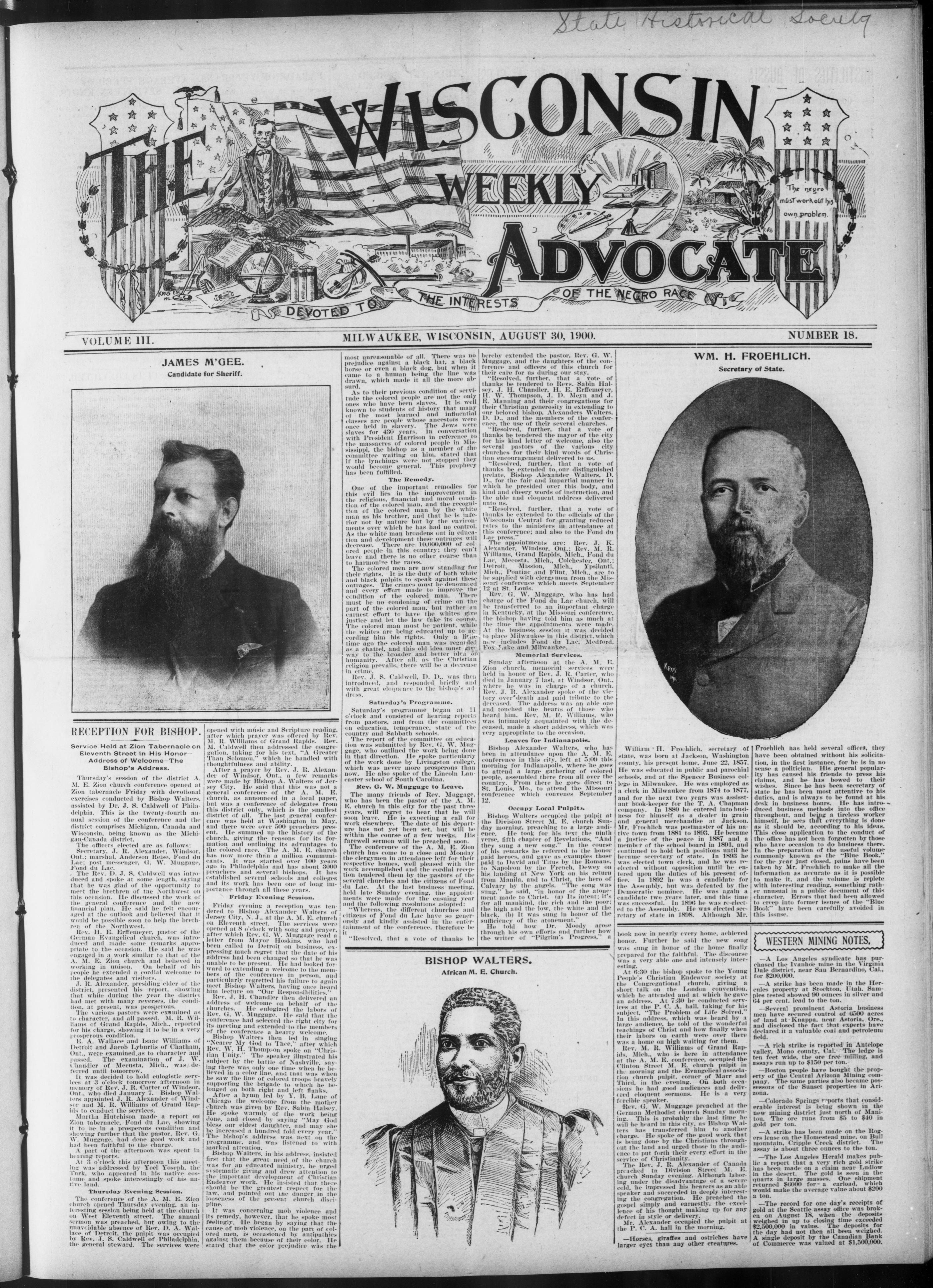
Page text (machine-generated)
WISCONSIN
WEEKLY
ADVOCATE
DEVOTED TO THE INTERESTS OF THE NEGRO RACE
VOLUME III.
JAMES
Candidate
RECEPTION FOR BISHOP.
Service Held at Zion Tabernacle on Eleventh Street in His Honor- Address of Welcome-The Bishop's Address.
Thursday's session of the district A. M. E. Zion church conference opened at Zion tabernacle Friday with devotional exercises conducted by Bishop Walters, assisted by Dr. J. S. Caldwell of Philadelphia. This is the twenty-fourth annual session of the conference and the district comprises Michigan, Canada and Wisconsin, being known as the Michigan-Canada district.
The officers elected are as follows:
Secretary, J. R. Alexander, Windsor,
Ont.; marshal, Anderson Reise, Fond du Lac; post messenger, G. W. Muggage,
Fond du Lac.
The Rev. D. J. S. Caldwell was introduced and spoke at some length, saying that he was glad of the opportunity to meet the brethren of the Northwest on this occasion. He discussed the work of the general conference and the new financial plan. He said he felt encouraged at the outlook and believed that it would be possible soon to help the brethren of the Northwest.
Rev. H. E. Erffemeyer, pastor of the German Evangelical church, was introduced and made some remarks appropriate to the occasion. He said he was engaged in a work similar to that of the A. M. E. Zion church and believed in working in unison. On behalf of his people he extended a cordial welcome to the delegates and visitors.
J. R. Alexander, presiding elder of the district, presented his report, showing that while during the year the district had met with many reverses, the condition, at present, was prosperous.
The various pastors were examined as to character, and all passed. M. R. Williams of Grand Rapids, Mich., reported for his charge, showing it to be in a very prosperous condition.
E. A. Wallace and Isaac Williams of Detroit and Jacob Lyburtis of Chatham, Ont., were examined as to character and passed. The examination of J. W. Chandler of Mecusta, Mich., was deferred until tomorrow.
It was decided to hold eulogistic services at 3 o'clock tomorrow afternoon in memory of Rev. J. R. Carter of Windsor, Ont., who died January 7. Bishop Walters appointed J. R. Alexander of Windsor and M. R. Williams of Grand Rapids to conduct the services.
Martha Hutchison made a report on Zion tabernacle, Fond du Lac, showing it to be in a prosperous condition and showing further that the pastor, Rev. G. W. Muggage, had done good work and had been faithful to the charge.
A part of the afternoon was spent in hearing reports.
At 3 o'clock this afternoon this meeting was addressed by Yoel Yoseph, the Turk, who appeared in his native costume and spoke interestingly of his native land.
Thursday Evening Session.
The conference of the A. M. E. Zion church opened Thursday evening, an interesting session being held at the church on West Eleventh street. The annual sermon was preached, but owing to the unavoidable absence of Rev. D. A. Wallace of Detroit, the pulpit was occupied by Rev. J. S. Caldwell of Philadelphia, the general steward. The services were
opened with music and Scripture reading, after which prayer was offered by Rev. M. R. Williams of Grand Rapids. Rev. M. Caldwell then addressed the congregation, taking for his text, "A Greater Than Solomon," which he handled with thoughtfulness and ability.
After a prayer by Rev. J. R. Alexander of Windsor, Ont., a few remarks were made by Bishop A. Walters of Jersey City. He said that this was not a general conference of the A. M. E. church, as announced in a local paper, but was a conference of delegates from this district only, which is the smallest district of all. The last general conference was held at Washington in May, and there were over 500 preachers present. He summed up the history of the church, giving the reasons for its formation and outlining its advantages to the colored race. The A. M. E. church has new more than a million communicants. It was started over 100 years ago in Philadelphia and has about 3000 preachers and several bishops. It has established several schools and colleges and its work has been one of long importance through all these years.
Friday Evening Session.
Friday evening a reception was tendered to Bishop Alexander Walters of Jersey City, N. J., at the A. M. E. church on Eleventh street. The services were opened at 8 o'clock with song and prayer, after which Rev. G. W. Muggage read a letter from Mayor Hoskins, who had been called to Detroit on business, expressing much regret that the date of his address had been changed so that he was unable to be present. He had looked forward to extending a welcome to the members of the conference in person, and particularly regretted his failure to again meet Bishop Walters, having once heard him lecture on "Our Responsibilities."
Rev, J. H. Chandler then delivered an address of welcome on behalf of the churches. He eulogized the labors of Rev, G. W. Muggage. He said that the conference had selected the right city for its meeting and extended to the members of the conference a hearty welcome.
Bishop Walters then led in singing "Nearer My God to Thee," after which Rev. W. H. Thompson spoke on "Christian Unity." The speaker illustrated his subject by the battle of Nashville, saying there was only one time when he believed in a color line, and that was when he saw the line of colored troops bravely supporting the brigade to which he belonged on both right and left flanks. After a hymn led by Y. B. Lane of Chicago the welcome from the mother church was given by Rev. Sabin Halsey. He spoke warmly of the work being done, and closed by saying "May God bless our eldest daughter, and may she he increased a hundred fold every year." The bishop's address was next on the programme, and was listened to with marked attention.
Bishop Walters, in his address, insisted first that the great need of the church was for an educated ministry, he urged systematic giving and drew attention to the important development of Christian Endeavor work. He insisted that there should be the greatest respect for the law, and pointed out the danger in the looseness of the present church discipline.
It was concerning mob violence and its remedy, however, that he spoke most feelingly. He began by saying that the cause of mob violence, on the part of colored men, is occasioned by antipathies against them because of their color. He stated that the color prejudice was the
MILWAUKEE, WISCONSIN, AUGUST 30, 1900.
BISHOP WALTERS.
African M. E. Church.
most unreasonable of all. There was no prejudice against a black hat, a black horse or even a black dog, but when it came to a human being the line was drawn, which made it all the more absurd.
As to their previous condition of servitude the colored people are not the only ones who have been slaves. It is well known to students of history that many of the most learned and influential classes are people whose ancestors were once held in slavery. The Jews were slaves for 430 years. In conversation with President Harrison in reference to the massacres of colored people in Mississippi, the bishop as a member of the committee waiting on him, stated that if the lynchings were not stopped they would become general. This prophecy has been fulfilled.
The Remedy.
One of the important remedies for this evil lies in the improvement in the religious, financial and moral condition of the colored man, and the recognition of the colored man by the white man as his brother, and that he is inferior not by nature but by the environments over which he has had no control. As the white man broadens out in education and development these outrages will decrease. There are 10,000,000 of colored people in this country; they can't leave and there is no other course than to harmonize the races.
The colored men are now standing for their rights. It is the duty of both white and black pulpits to speak against these outrages. The crimes must be denounced and every effort made to improve the condition of the colored man. There must be no condoning of crime on the part of the colored man, but rather an earnest effort to have the whites give justice and let the law take its course. The colored man must be patient, while the whites are being educated up to according him his rights. Only a little time ago the colored man was regarded as a chattel, and this old idea must give way to the broader and better idea of humanity. After all, as the Christian religion prevails, there will be a decrease in crime. Rev. J. S. Caldwell, D. D., was then introduced, and responded briefly and with great eloquence to the bishop's address.
Saturday's Programme.
Saturday's programme began at 11 o'clock and consisted of hearing reports from pastors, and from the committees on education, temperance, state of the country and Sabbath schools.
The report of the committee on education was submitted by Rev. G. W. Muggage, who outlined the work being done in that direction. He spoke particularly of the work done by Livingston college, which was never more prosperous than now. He also spoke of the Lincoln Lancaster school of South Carolina.
Rev. G. W. Muggage to Leave.
The many friends of Rev. Muggage, who has been the pastor of the A. M. E. church in this city for the past three years, will regret to hear that he will soon leave. He is expecting a call for work elsewhere. The date of his departure has not yet been set, but will be within the course of a few weeks. His farewell sermon will be preached soon. The conference of the A. M. E. Zion church has come to a close and Monday the clergymen in attendance left for their respective homes, well pleased with the work accomplished and the cordial reception tendered them by the pastors of the several churches and the citizens of Fond du Lac. At the last business meeting, held late Sunday evening, the appointments were made for the ensuing year and the following resolutions adopted:
"Whereas, the different churches and citizens of Fond du Lac have so generously and kindly assisted in the entertainment of the conference, therefore be it
"Resolved, that a vote of thanks be
hereby extended the pastor, Rev. G. W. Muggage, and the daughters of the conference and officers of this church for their care for us during our stay.
"Resolved, further, that a vote of thanks be tendered to Revs. Sabin Halsey, J. H. Chandler, H. E. Erffemeyer, H. W. Thompson, J. D. Meyn and J. E. Manning and their congregations for their Christian generosity in extending to our beloved bishop, Alexanders Walters, D. D., and the members of the conference, the use of their several churches.
"Resolved, further, that a vote of thanks be tendered the mayor of the city for his kind letter of welcome, also the several pastors of the various city churches for their kind words of Christian encouragement delivered to us.
"Resolved, further, that a vote of thanks be extended to our distinguished prelate, Bishop Alexander Walters, D. D., for the fair and impartial manner in which he presided over this body, and kind and cheery words of instruction, and the able and eloquent address delivered unto us.
"Resolved, further, that a vote of thanks be extended to the officials of the Wisconsin Central for granting reduced rates to the ministers in attendance at this conference; and also to the Fond du Lac press."
The appointments are; Rev. J. K. Alexander, Windsor, Ont.; Rev. M. R. Williams, Grand Rapids, Mich., Fond du Lac, Mecosta, Mich., Colchester, Ont.; Detroit, Mission, Mich., Ypsilanti, Mich., Pontiac and Flint, Mich., are to be supplied with clergymen from the Missouri conference which meets September 12 at St. Louis.
Rev. G. W. Muggage, who has had charge of the Fond du Lac church, will be transferred to an important charge in Kentucky, at the Missouri conference, the bishop having told him as much at the time the appointments were made. At the business session it was decided to place Milwaukee in this district, which now includes Fond du Lac, Medford, Fox Lake and Milwaukee.
Memorial Services.
Sunday afternoon at the A. M. E. Zion church, memorial services were held in honor of Rev. J. R. Carter, who died in January 7 last, at Windsor, Out., where he was in charge of a church. Rev. J. R. Alexander spoke of the victory over death and paid tribute to the deceased. The address was an able one and touched the hearts of those who heard him. Rev. M. R. Williams, who was intimately acquainted with the deceased, made a short address, which was very appropriate to the occasion.
Leaves for Indianapolis.
Bishop Alexander Walters, who has been in attendance upon the A. M. E. conference in this city, left at 5:00 this morning for Indianapolis, where he goes to attend a large gathering of colored people, assembled there from all over the country. From there he goes direct to St. Louis, Mo., to attend the Missouri conference which convenes September 12
Occupy Local Pulpits.
Bishop Walters occupied the pulpit at the Division Street M. E. church Sunday morning, preaching to a large audience. He took for his text the ninth verse, fifth chapter of Revelations, "And they sung a new song." In the course of his remarks he referred to the honor paid heroes, and gave as examples those paid to David and Titus by the Romans, to Napoleon by the French, Dewey on his landing at New York on his return from Manila, and to Christ, the hero of Calvary by the angels. "The song was sung," he said, "in honor of the atonement made to Christ. (a) Its intent; it's for all mankind, the rich and the poor; the high and the low, the white and the black. (b) It was sung in honor of the sufficiency of the atonement."
He told how Dr. Moody arose through his own efforts and further how the writer of "Pilgrim's Progress," a
WM. H. FROEHLICH.
Secretary of State.
William H. Frochlich, secretary of state, was born at Jackson, Washington county, his present home, June 22, 1857. He was educated in public and parochial schools, and at the Spencer Business college in Milwaukee. He was employed as a clerk in Milwaukee from 1874 to 1877, and for the next two years was assistant book-keeper for the T. A. Chapman company. In 1880 he entered into business for himself as a dealer in grain and general merchandise at Jackson. Mr. Frochlich was postmaster of his native town from 1881 to 1893. He became a justice of the peace in 1887 and a member of the school board in 1891, and continued to hold both positions until he became secretary of state. In 1893 he was elected town clerk, and he was re-elected without opposition until he entered upon the duties of his present office. In 1892 he was a candidate for the Assembly, but was defeated by the Democratic nominee. He was again a candidate two years later, and this time was successful. In 1896 he was re-elected to the Assembly. He was elected secretary of state in 1898. Although Mr.
book now in nearly every home, achieved honor. Further he said the new song was sung in honor of the home finally prepared for the faithful. The discourse was a very able one and intensely interesting. At 6:30 the bishop spoke to the Young People's Christian Endeavor society at the Congregational church, giving a short talk on the London convention, which he attended and at which he gave an address. At 7:30 he conducted services at the P. C. A. hall, taking for his subject, "The Problem of Life Solved." In this address, which was heard by a large audience, he told of the wonderful teachings of Christ and how finally when their labors on earth were over there was a home on high waiting for them.
Rev. M. R. Williams of Grand Rapids, Mich., who is here in attendance at the A. M. E. conference, occupied the Clinton Street M. E. church pulpit in the morning and the Evangelical association church pulpit, corner of Marr and Third, in the evening. On both occasions he had good audiences and delivered eloquent sermons. He is a very fortable speaker.
Rev. G. W. Muggage preached at the German Methodist church Sunday morning. This is probably the last time he will be heard in this city, as Bishop Walters has transferred him to another charge. He spoke of the good work that is being done by the Christians throughout the land and urged those in the audience to put forth their every effort in the service of Christianity.
The Rev. J. R. Alexander of Canada preached ta Division Street M. E. church Sunday evening. Although laboring under the disadvantage of a severe cold, he impressed his hearers as an able speaker and succeeded in deeply interesting the congregation. He preached the gospel simply and earnestly, the excellence of his thought making up for any defect in style or delivery.
Mr. Alexander occupied the pulpit at the P. C. A. hall in the morning.
—Horses, giraffes and ostriches have larger eyes than any other creatures.
NUMBER 18.
ROEHLICH.
y of State.
Froehlich has held several offices, they have been obtained without his solicitation, in the first instance, for he is in no sense a politician. His general popularity has caused his friends to press his claims, and he has bowed to their wishes. Since he has been secretary of state he has been most attentive to his duties, and is always to be found at his desk in business hours. He has introduced business methods into the office throughout, and being a tireless worker himself, he sees that everything is done as it should be, according to his ideas. This close application to the conduct of the office has not been forgotten by those who have occasion to do business there. In the preparation of the useful volume commonly known as the "Blue Book," for the year just closed, pains have been taken by Mr. Froehlich to make all the information as accurate as it is possible to make it, and the volume is replete with interesting reading, something rather unusual in a public document of this character. Errors that had been allowed to creep into former issues of the "Blue Book" have been carefully avoided in this issue.
WESTERN MINING NOTES.
—A Los Angeles syndicate has purchased the Ivanhoe mine in the Virginia Dale district, near San Bernardino, Cal., for $200,000.
—A strike has been made in the Hercules property at Stockton, Utah. Samples tested showed 90 ounces in silver and 64 per cent. lead to the ton.
—Several prominent Astoria business men have secured control of 6500 acres of land at Knappa, near Astoria, Ore., and disclosed the fact that experts have declared it a valuable coal and petroleum field.
—A rich strike is reported in Antelope valley, Mono county, Cal. The ledge is ten feet wide, the ore free milling, and assays run up to $150 per ton.
—Boston people have bought the property of the Central Arizona Mining company. The same parties also became possessors of the Sunset properties in Arizona.
—Colorado Springs reports that considerable interest is being shown in the new mining district just north of Manitou. The ore runs from $5 to $40 in gold per ton.
—A strike has been made on the Rogers lease on the Homestead mine, on Bull mountain, Cripple Creek district. The assay is about three ounces to the ton.
The Los Angeles Herald makes public a report that a very rich gold strike has been made on a claim near Ludlow in the desert. The gold is seen in the quartz in large masses. One shipment returned $6000 for a carload, which would make the average value about $200 a ton.
The record for one day's receipts of gold at the Seattle assay office was broken on August 18, when the deposits weighed in up to closing time exceeded $2,500,000 in value. The deposits for the day had not then all been weighed. A single deposit by the Canadian Bank of Commerce was valued at $1,500,000.
HOSTILITIES OF RUSSIA.
Czar Opposing Arrangements for Peaceful Solution.
Scenes of Desolation in Pekin Due to Conflicts with Boxers and Attacks Upon Legations.
Washington, D. C, Aug. 29.—The cabinet meeting today was devoted entirely to a discussion of the diplomatic phases of the situation in China. No definite conclusion was reached on any point. No statement as to any of the questions discussed was made public. There will be another cabinet meeting this afternoon.
After being in session over three hours the members separated to meet again at 2:30. After the meeting the members of the cabinet were extremely reticent and noncommittal. It is learned, however, that the subject under consideration related almost exclusively to the policy of the government in the negotiations now going on with the powers concerning China. It was positively asserted that no information of an alarming character had been received. The policy of this government is being formulated and at the meeting this afternoon the text of a memorandum embodying the views of the United States, which is being prepared for transmission to the foreign governments, will be formally considered.
Washington, D. C., Aug. 29. Germany is on the eve of declaring war against China. This has been made manifest to the Washington authorities by the hostile stand of the Berlin government against accepting Li Hung Chang as the emissary of Chian in future negotiations to re-establish peace. State department officials are now convinced that the territorial integrity of China is seriously menaced by the secret plans of some of the powers whose armies are operating in the Yellow empire.
The note addressed to the powers last week, asking for an outline of their purposes with reference to China, was occasioned by Admiral Remey's report that some of the admirals at Taku, in conference, had agreed to hold Li Hung Chang a prisoner on board ship, denying to him the privilege of communicating with the Emperor. Following the report of the French admiral to this effect, the state department let out the fact that Admiral Remey had refused to become a signatory to the agreement of the admirals.
Russian Held Aloof.
The Russian admiral also, it is stated on good authority, declined to become a party to the resolution, which was drawn and signed by the French, German, British and Italian commanders, indicating that the nations whose representatives signed it do not mean to make terms with China on the lines laid down by the United States, but are resolved to make settlements to their own satisfaction and on lines of their own.
PEKIN DESOLATED.
Appalling Destruction of Property in China's Capital.
London, Aug. 29.—On account of the conditions prevailing in Pekin, dated August 15 and mailed thence to Shanghai, whence it was cabled yesterday, says that the capital now presents an aspect of absolute desolation. The destruction has been simply appalling.
What used to be Legation street is now unrecognizable. All the houses of foreigners have been either burned, riddled with shells, or blown up. The French legation, which used to have one of the finest compounds in the city, now only shows a few portions of its walls standing. Hundreds of acres covered by natives' houses have been burned over.
There has been the most wanton destruction of property. Buildings which were not burned were pulled down for the mere pleasure of destroying something.
The top of the city hall is a marvelous sight. There are brick and sandbag barricades every twenty yards, while the underground shelters are littered with discarded uniforms, hundreds of cartridge boxes, and pouches, and even rifles and spears, left behind by the Chinese when they fled.
Attempt on American Legation.
At one place close to the American legation a determined attempt had been made to undermine it. A shaft was sunk from the top of a wall fifteen feet deep, and then continued as a tunnel, with a sharp slope for some distance in the direction of the legation. Whether the Chinese tired of their work or only abandoned it because of the approach of the allies, is not known, but the existence of the shaft was only discovered after relief had arrived.
The day the allies arrived they burned several of the city gates. Fires are blazing everywhere. Several buildings within the imperial city were set on fire by the shells of the allies. The French, American and Japanese artillery intermittently shelled the imperial city on August 15.
OPPOSED BY RUSSIA.
Unwilling to Enter Into Negotiations with Li Hung Chang.
Berlin, Aug. 29.—It is learned from an excellent source that the generals and admirals of the allied forces have declared their unwillingness to enter into negotiations with Li Hung Chang.
It is also stated that Russia offered as much opposition to this declaration as it dared.
Would Raze the Winter Palace.
Pekin, Aug. 21 (via Taku, Aug. 27).—Three Russians, two Japanese, one British and one American battalion searched the imperial park, south of the city and about five miles out, for Boxers. No armed force was found, but only a single Chinese scout, who was killed.
The Japanese are in possession of the imperial summer palace. The winter palace here is still closely guarded. The Russians wish to destroy it.
Berlin, Aug. 29.—According to a dispatch received here from Tien-Tsin, Japanese forces are understood to be now on their way from Taku to Pao Ting Fu (capital of the province of Chi-Li) with the direct object of occupying the latter place.
The German vice-admiral at Taku reports the arrival at Pekin August 22 of a German convoy with provisions.
The railroad from Tein Tsin to Yang-Tsun is working, but from the latter place to Pekin the road is in bad shape.
WU MUCH DISTURBED.
Attempts to Restrain Earl Li will Have a Bad Effect.
Washington, Aug. 29.—Baron Speek von Sternburg, the German charge, saw Acting Secretary Adee this morning and it is understood his purpose was to talk over the question of Li Hung Chang's credentials. One effect of Germany's refusal to accept Li as plenipotentiary will!
be to delay peace negotiations at least until Field Marshal Waldersee's arrival in China, several weeks hence. Beyond a short message relative to the situation at Amoy, which is still regarded as threatening, the state department had nothing to make public this morning.
nothing to make public this morning. The diplomatic, rather than the military situation is still regarded as of supreme importance. Again Mr. Wu, the Chinese minister, was an early caller at the state department. He was much disturbed in mind over the reiterated report that the foreign admirals are going to restrain Earl Li's liberty of communication with his own government. The minister was indignant at the report and was much comforted by the assurance he had from Acting Secretary Adee that the report probably was an old one referring to the conditions that existed at Taku before the beginning of the march on Pekin. The minister was very strongly of the opinion that any renewed attempt to interfere with Li Hung Chang, either in his movements or in his communications with the imperial government would prove most disastrous in its effect upon the earnest efforts now being made to terminate the present hostilities in China.
It is stated at the war department that preparations are being made for wintering 5000 United States troops in China. The arrangements are made in order to guard against a failure of peace negotiations. The plan of an international conference on the Chinese situation is again being discussed among officials here. In the last note of the United States, replying to Li Hung Chang's application for peace negotiations, it was stated that this government, when the time was opportune, not only would welcome overtures for a truce, but would stand ready to invite the other powers to join in such a movement.
RUSSIA GIVES NOTICE
Allies Having Accomplished Their Work Should Withdraw.
London, Aug. 29.—A special dispatch from St. Petersburg contains the assertion that Russia, almost immediately, will notify the powers she considers the relief of the Pekin legations as the final accomplishment of the military task of the allied forces. The afternoon papers applaud Gen. Chaffee's prudence in preparing for a winter campaign, as they regard the activity of the allies at Pekin and the difficulty of discovering a responsible Chinaman with whom to treat, unless Li Hung Chang is able to place himself in communication with the fugitive court and secure credentials satisfactory to all the powers, indications that the solution of the problem will be more prolonged and more difficult than previously hoped.
Americans Reach Tien Tsin.
Tien Tsin, Aug. 25, via Taku, Aug. 27. —Fifty Americans, including the Misses Condit Smith, Woodward, and Payen, have arrived here from Pekin, which city they left five days ago by boat.
Lieut. Waldron of the Ninth United States infantry received a serious sniping wound while patrolling at Ho Si Wu.
The Russians, Germans and Japanese are constantly pushing troops on to Pekin.
The Miss Woodward referred to in the dispatch from Tien Tsin is the daughter of Mr. and Mrs. M. S. Woodward of Evanston, Ill. They were guests of Minister Conger at Pekin. Mrs. and Miss Woodward left Evanston in January to make a tour of Japan and China. They were accompanied by Mrs. Conger, wife of the minister.
Miss Mary Condit Smith has also been a guest of Minister Conger at Pekin. One of Miss Smith's sisters is the wife of Gen. Leonard S. Wood, the governor of Cuba.
Miss Payen is a Milwaukeean. Her mother lives on Farwell avenue.
PLAGUE AT GLASGOW.
In Case the Disease Spreads All Shipping will be Quarantined.
London, Aug. 29.—Great Britain is becoming alarmed at the prospect of an epidemic of bubonic plague within her own boundaries. The medical authorities at Glasgow have already had several cases under their observation. On Monday a child sickened and died within forty-eight hours from an illness which was at first thought to be pneumonia, but after a minute examination by the proper authorities was pronounced plague. Another death has occurred and ten families were removed to a reception house for patients suffering from this disease, which the municipality hastily established.
Glasgow, Scotland. Aug. 29.—Two girls and a boy, members of isolated families, have become victims of bubonic plague, though the medical authorities assert that the attacks are less virulent than in the cases which have already proved fatal. In the event of a further spread of the disease Glasgow shipping will probably be quarantined.
GILMAN MOB VICTIM DIES.
Mrs. Wright Said Before Death She was Afraid to Surrender.
Watseka, Ill., Aug. 29.—Charlotte E. M. Wright, the chief actor in the Gilman tragedy, and who was brought here last night by Sheriff Martin and placed in the county jail to escape the vengeance of a mob, died yesterday afternoon. She retained consciousness until the last, but was so weakened by the loss of blood and the frightful experience of Sunday night and Monday that she never rose from the stretcher on which she was laid at the scene of the tragedy yesterday morning.
An examination of the body disclosed a wound in the back, as well as a shattered arm and shoulder, and internal hemorrhages were severe.
CLAIM THE X-RAYS KILLED.
Friends of a Man Hurt by a Street Car Make a Serious Charge.
St. Paul, Minn., Aug. 29.—According to the physician who issued the death certificate and the statements of his family, the death of August Kittmann was due to burns received during an X-rays treatment. Kittmann met with a streetcar accident last winter and had since been under the care of different physicians, and it is said desired to have X-ray photographs taken of his injuries for use as evidence in a suit for damages. The doctor who took the photographs denies that Kittmann was burned seriously.
ADJUDGED A BANKRUPT.
Duke of Manchester Obliged to Resign from His Clubs.
London, Aug. 29.—The Duke of Manchester today was adjudicated a bankrupt, entailing his resignation from all his clubs. The petitions to the bankruptcy court included one from the young nobleman himself, whose acceptances are so widely distributed in unknown hands that his friends, for some time, strongly urged this radical course.
Cambridge Professor Dead
London, Aug. 29.—Prof. Henry Sedgwick, professor of moral philosophy at Cambridge university since 1883, is dead. He was born in 1838.
DRAWING TO A CLOSE.
Burghers Have Great Natural Defenses and Are Making a Determined Resistance.
Lourenco Marques, Aug. 28.—Heavy fighting is reported to have occurred at Machadodorp. The Boers are said to have been defeated with great loss leaving their guns and ammunition in the hands of the British.
London, Aug. 28.—A special dispatch from Pretoria dated August 27 says: "It is stated that fighting with Botha's commandoes was resumed this morning. The Boers' lines were broken and the enemy is falling back. The British casualties are reported to be considerable.
London, Aug. 28.—Lord Roberts dispatches announce what many people here take to be the beginning of the final stage in the South African campaign. The commander-in-chief held a council of war with his lieutenants, Buller, French and Pole-Carew, on Saturday and on Sunday began a general attack on Gen. Botha's intrenched position, on which not much impression had been made. In the preliminary operations of the previous few days the Boers had chosen a line of defense of great natural strength, stronger, in fact, than any they have held since they fell back from the Tugela. Their forces were disposed along a formidable chain of hill country, extending over a front nearly thirty miles, their flanks resting on spurs of broken ground protected by morasses.
The British advance began on the west to the north of Belfast, from which place the Boers fell back toward the Lydenburg range. Lord Roberts reports that the Boers are making a most determined resistance in a locality well adapted for their defensive tactics and badly suited for cavalry movements.
Boers' Last Stand.
Some experts think it is really Gen. Botha's last stand and if defeated here he will be completely crushed. Lord Roberts' superiority in numbers is so great that he may probably attempt to work right around the Boers and drive them from their position by menacing their line of retreat. To judge from previous experience, it is unlikely that the Boers would stay long enough to permit the maneuver to be accomplished.
Meanwhile the Boers are themselves busy in endeavoring to raid Lord Robert's lines of communications both in the Orange River colony and in Natal. At Weinburg, in the neighborhood of the scene of some of Gen. Dewet's most remarkable exploits, a body of imperial yeomanry, was in difficulties under an attack of a considerable force of Boers on last Friday. They were relieved by reinforcements hastily sent up from Kroonstad and Heilbron. One Sunday the Boers again renewed their attack on Winburg, but were beaten off, having among the prisoners captured by the British, Commandant Olivier, whose famous march from Cape Colony through Lord Roberts' lines to the northeast of the Orange River colony was one of the notable episodes of the spring.
Buller Captures Bergendal.
Lord Roberts reports, under date of Belfast, August 27, as follows;
"Our movements are slow on account of the extent and nature of the country. Today we made a satisfactory advance and met with decided success. The work fell entirely to Buller's troops and resulted in the capture of Bergendal, a very strong position two miles northwest of Dalmanutha. I met Buller at Bergendal shortly after it was reached by our troops. I am glad to find the occupation cost less than was feared, on account of the approach being across an open glacis for 2000 yards and the determined stand of the enemy. The Innniskillings and Second Rifle brigade formed the attacking party. The latter suffered most. I hope the casualties do not exceed fifty or sixty. One officer was killed and two were wounded. A good many Boers were killed and a pompom (quick-firing gun) was captured.
"French advanced on the left of Swartz Kopjes on the Leydenburg road and prepared the way for the movement of Pole-Carew's division tomorrow. Baden-Powell reports that he occupied Nylstroom without opposition. As the country where he and Paget are operating is dense bush and veldt, it is not desirable at the present to proceed further north and their troops are returning to Pretoria.
Leyds Sees the Czar.
Berlin, Aug. 28.—Considerable surprise has been caused here by the news that Dr. Leyds, European agent of the South African republic, was accorded an interview of the Czar, and the explanation offered is that Nicholas III. means to try to bring about peace between South Africa and England.
In view of well-known peace proclivities of the Czar and Russia's present cooperation with the allies in China, it is not thought that the Russian ruler desires to cause any embarrassment to Great Britain, and therefore his possible mediation is not looked upon as other than unselfish and sincere.
Charge England with Cruelties.
A German deputation from the Transvaal has arrived in Berlin to complain to the foreign office of cruelties enacted against Germans in South Africa. The deputation says that 400 German citizens were hunted "like wild beasts" and finally arrested in Pretoria, Johannesburg and other cities, and were then, though innocent, dragged to the coast and sent out of the country along with a lot of other foreigners. They lost everything they owned.
The Volkes Zeitung, commenting on the matter, says that the campaign made against China to revenge injustices committed on German subjects has been accompanied by triumphal official dispatches, but "What is the foreign office going to do to prevent a recurrence of English brutality in the Transvaal?"
UNIVERSAL ABBITRATION
Harrison and Cleveland Members of International Board.
Washington, D. C., Aug. 28.—The United States is one of the first of the great powers to demonstrate its good faith in carrying out the provisions of the treaty of The Hague, looking to the universal arbitration of international differences. Under this treaty each of the nations to it was authorized to appoint four members of an international board of arbitration. Under this authority President McKinley has requested former Presidents Harrison and Cleveland to accept appointments on this board. Responses are expected very soon, when the remaining members may be selected.
Diverted to Manila.
Washington, D. C., Aug. 28.—The First United States cavalry, which arrived at Kobe, Japan, today, en route to China, has been diverted to Manila.
GIRLS ARE ROBBED OF THEIR WAGES.
GIRLS ARE ROBBED OF THEIR WAGES.
Ridiculous System of Fines In Shops
New York, Aug. 28.—Shirtwaist girl—those who make the waists—are on a strike here. In an appeal to Central Labor union for aid the strikers declared that an arbitrary system of fines prevails in the trade to such an extent that wages are cut unbearably.
Rose Bogin was the spokesman. "I have heard of shops," she said, "where, if a girl laughs, she is fined 15 cents, and smiling costs 10 cents; consulting a looking-glass, 15 cents, and talking, 25 cents.
"If a girl takes half a day off, besides losing her pay for that time, she is fined 25 cents, and the result is that at the end of the week the girl who has earned $10 is lucky if she gets $7."
The average price paid for making a shirtwaist is 10 cents. Six can be made in a day. Work lasts about five months a year.
SOLDIER GOES INSANE.
Eau Claire Veteran Wandering About Chicago Streets Looking for His Family.
Chicago, Ill., Aug. 28.—William H. White, an old soldier of Eau Claire, Wis., went insane in the Central police station last night over the disappearance of his family. At the station he told Chief of Detectives Colleran that he became separated from his family at the depot. He had wandered all over the city looking for them without success. In the night, from continued worry, he began to show signs of insanity. The Wisconsin delegation was visited and a cousin of the afflicted man was found who took him in charge. Meantime, an order was issued to all policemen to look out for the missing ones. Charles Beckwith, marching with Sheridan post, N. 4, of the Department of Michigan, dropped dead in the parade from heart disease at Michigan avenue and Madison street.
F. W. Hyatt, 60 years old, a member of F. A. Jones post of Lincoln, Mo., was struck by a Lincoln avenue cable train today and seriously injured. O. J. Martin of Shylock, Mich., a member of Williams post No. 40, was overcome by heat at Michigan avenue and Randolph street and removed to a hospital. His condition was reported serious.
TWINS DIE TOGETHER.
Remarkable Case of Subconscious Sympathy Shown in Death of Two Children.
Bowling Green, O., Aug. 28.—Claude and Clyde Wilson, twin children of Archie Wilson of Dukay, this county, died at the same time under the same circumstances, ending two lives that were identical in every respect. These children were so similar in appearance that no one save their mother could tell one from the other. Besides their physical similarity their mental actions were always simultaneous, seemingly each having the same thoughts. The parents declared that they were just like one child, except that they lived in two bodies. Claude fell on the floor about two weeks ago and bruised her forehead. Last Friday she was taken sick with an affliction of the brain. Clyde became afflicted exactly the same way, and followed Claude in death by but a few hours. Both will be buried in the cemetery at Rudolph.
ESTATE OF $1,000,000.
Will of the Late Archbishop Henn
nessy Adduitted to Probate.
St. Paul, Minn., Aug. 28.—The will of the late Archbishop Hennessy of Dubuque, Ia., has been admitted to probate here. It gives to a half dozen of the prelate's relatives $400,000 worth of real estate in Ramsey, Washington, Mower and Freeborn counties. Other relatives and various church societies receive $600,000 worth of real and personal property in Iowa. The will named as executors Archbishop P. J. Ryan of Philadelphia, Archbishop P. A. Tehan of Chicago, Mgr. Roger Ryan, Rev. Clement Johannis and Michael V. Hennessy of Dubuque. Archbishops Ryan and Tehan and Michael V. Hennessy declined to act as executors and the big estate will be administered by Mgr. Ryan and Father Johannis.
BENNETT'S NEW YACHT.
Has a Straight Stem and will Steam 18 Knots an Hour.
London, Aug. 28.—The steamyacht Lysistrala, built for James Gordon Bennett, proprietor of the New York Herald, by W. Denny & Bros. on designs furnished by George L. Watson, was launched this morning at Dumbarton, Scotland. She is the largest yacht built on the Clyde, is designed to steam eighteen knots an hour, and has the novel feature of a straight stem. The Lysistrala is built of steel, has twin screws, and is schooner-rigged. She is over 248 feet over all, has 39 feet 9 inches beam, and her depth is 21 feet 5 inches.
CAMILLE D'ARVILLE A BRIDE.
Opera Singer Weds E. W. Crellin, a Social Lion at Oakland, Cal.
Oakland, Cal., Aug. 28.—Camille d'Arville, the opera singer, and E. W. Crellin, one of the best-known of Oakland's social set, were married at the home of Mr. and Mrs. Thomas Arthur Crellin, 972 Jackson street. Only immediate relatives witnessed the ceremony. Mr. and Mrs. Crellin left on their wedding tour. They will reside in Oakland. Mrs. Crellin says the wedding means farewell to the stage.
Suicide of Stock Broker.
New York. Aug. 28.-Alfred Bingen, a stock broker of this city committed suicide in Long Branch, N. J. No cause is known for the act. Bingen was prominent in Genoa, Italy, whence his family came.
Colorado's Impressive Scenery.
One class of Switzerland's finest scenery is along the Via Mala, the Schyn Pass and Urnerloch. In Colorado, the canyon of the Arkansas with the Royal George, the Black Canyon of the Gunnison, the Canyon of the Rio de las Animas, the canyon of the Grand river, and others, are all much longer, quite as grand as and more varied in character than the best passes in Switzerland. The walls of the canyons of the Grand river, the Gunnison and the Arkansas rise to a sheer height of more than 2000 feet.—Hartford Times.
Chinese Vegetables.
An Americanized Chinaman living near Bristol, Conn.. is making an excellent living by raising vegetables for the use of his countrymen in the nearby cities. His name is Willie Sing, and his farm consists of one and one-half acres. Lettuce of a peculiar brand, beans, squashes, citrons and ginger root are some of the products, all being of distinctive Chinese types.
PARADE OF VETERANS.
Survivors of the Civil War Have Their Annual March on Chicago Streets.
Chicago, Ill., Aug. 28.—To the strains of "The Star Spangled Banner," "Yankee Doodle" and "Marching Through Georgia," mingled with "Auld Lang Syne" and "My Old Kentucky Home," 35,000 Grand Army veterans marched in the heat of an August sun and received the plaudits of the tens of thousands of men, women and children who lined the streets and filled the windows along the entire route of the great pa-
GEN. D. E. SICKLES
GEN. D. E. SICKLES. trade. Some of the veterans fell by the wayside, but the vast majority stood the fatigue in a manner that punctured the predictions of the wiseacres that this is to be the last march of the great host. The great majority of them marched with precision, even if they were not as quick at obeying commands as in the old days.
Old soldiers from every state in the Union were in the march with their comrades of former years, and throughout the length of the parade 7000 posts of the Grand Army had representation. The line of march was short, and from the start to the south end of the Court of Honor, where it usbanded after passing in review before Commander-in-Chief Shaw, it comprised twenty-seven of the city squares. The column came on twelve abreast, well closed, solid and compact. The formations were almost invariably well kept, for the men who had gone through years of desperate war without being guilty of straggling were too old to be laggards now.
Right of the Parade.
The marching column was headed by a detachment of the city police under the command of Lieut. Flynn, which in battalion formation swept the street from curb to curb. Behind them came a band of seventy pieces, and then Chief Marshal J. H. Wood with his immediate staff, consisting of Col. H. S. Dietrich, Col. J. E. Stuart and Col. C. E. Young, a regiment of assistant marshals and aides came clattering on, and then behind the great band of the Second infantry of the Illinois National guard came Commander-in-Chief Shaw and the members of his staff.
Ahead of the carriages containing Acting Gov. Warder, Mayor Harrison and Executive Director Harper, who, with Commander-in-Chief Shaw, occupied the reviewing stand during the parade, marched Lafayette post No. 140 of New York city, commanded by Allan C. Bakewell. Cheer after cheer went up as Gen. Daniel E. Sickles, accompanied by his aides, rode past the reviewing stand. All about the line of march the men had been given a most flattering greeting, but the warmth of the reception that met Sickles as he approached the stand where Commander Shaw was awaiting to receive his salute caused him to flush with pleasure, and to bow his acknowledgments again and again.
Approach of the Pageant.
Twelve heralds in costume, each bearing a long trumpet, came down the avenue announcing the approach of the pageant of patriotism which followed close behind them. Fifty members of Columbia post of Chicago, wearing handsome uniforms of dark green, formed a hollow square, in the center of which were borne fifty battleflags carried by New York regiments during the war. The spectacle of the worn and tattered flags was greeted, at times with cheers and at times with a deep silence more expressive than applause. Whether the crowd cheered or kept silence, it showed deep feeling and from end to end of the parade all hats were off as the flags went by.
A long line of carriages followed the battle flags, each containing ladies who are officials of the various organizations which are affiliated with the Grand Army. Among these were Mrs. Harriet J. Dodge, president of the Woman's Relief corps; Mrs. Julia P. Schade, president of the Ladies of the Grand Army of the Republic; Mrs. Ada Johnson, president of the Army Nurses' association, and Mrs. Elizabeth Kimball, president of the Daughters of Veterans.
The Rear Guard.
Close behind the carriages came three platoons of the members of Columbia post, acting as a rear guard while a score of veterans as a special escort marched beside the vehicles. Bidwell Wilkeson post of Buffalo, which had the largest number of men in ranks of any organization that came from outside Chicago and Cook county, made a fine appearance as they came marching past the stand headed by the Buffalo military band of fifty pieces. The old continental drum and bugle corps of New York city led Chapin post, also from New York, and both were heartily cheered for their excellent appearance and marching. Then came the Arion Military band of Oshkosh, forming the vanguard for the various departments which marched under the leadership of their department commanders.
Wild with Enthusiasm.
Wisconsin was given the right of the line and as her column came turning around the corner of Jackson boulevard into the broad sweep of Michigan avenue and with bands playing and colors flying the army of the republic came marching down, the people seemed to realize that here at last came the true pageant of patriotism. The old, worn-out fluttering flags that had gone before were nothing in themselves but as representatives of the power that gave them the glory that they wore they were everything. The crowd went wild with enthusiasm. They cheered, waved their hats and cheered again until they could cheer no more.
CRAVING FOR MUSTARD.
Girl Dies in Agony After Eating Pint of the Spice.
Flora, Ind., Aug. 28.—Miss Etta Horner, the 14-year-old daughter of George Horner of Radner, died from the effects of eating a pint of prepared mustard. The girl's craving for the spicy condiment was so great that she could not control it. She spread the mixture on bread and ate the whole pint without stopping. She died in great agony. The attending physician stated that the lining of her stomach had been almost eaten away.
AVERAGE SPEED OF SEVENTEEN KNOTS.
Trial Trip of the New Battleship Alabama Shows Very Satisfactory Results.
Boston, Mass., Ang. 29.—There is a new queen of the American navy, the United States battleship Alabama, winning the title in one of the most magnificent speed trials yet held in the history of the navy. Her average speed for four hours' continuous steaming was seventeen knots, a figure not quite as high as that made by the Iowa, but notable from the fact that it gave an idea of the yet undeveloped power in this latest product of American shipbuilders. The Alabama was built by the Cramps at Philadelphia, and, while of the first-class, she is unlike any of the earlier creations both architecturally and as a fighting machine. Built under a contract that required at least an average speed of sixteen knots, she has been turned out to do seventeen knots or better.
To quote a member of the engineering force, the trial was a perfect one. For nearly three legs of the outward run the boilers made steam so fast that the surplus was allowed to blow off. The maximum revolutions of the engines were 118, and this figure was only for a half-hour, the mean being much below this. The highest steam pressure was 180 pounds, or nine under the limit. The horsepower developed was supposed to be 11,500, although the figure, like those for the speed, will be officially given at Washington.
The trial today was under the direction of the board of inspection and survey, headed by Rear-Admiral Frederick Rogers.
BRESCI IS CONVICTED.
Assassin of King Humbert is Found Guilty at the Trial at Milan
Milan, Aug. 29.—Bresci, at the close of the trial, was pronounced guilty and was sentenced to imprisonment for life.
Milan, Aug. 29.—The trial of Bresci, the Anarchist who on July 29 shot and killed King Humbert of Italy, at Monza, while his majesty was returning from a gymnastic exhibition, opened here today. An immense crowd of people gathered about the court from early morning, seeking admission to the courtroom where only a few places were reserved for the ticket-holding public. The hearing began at 9 o'clock. Bresci sat in the dock, calm and almost indifferent. His counsel, Signor Martelli, head of the Milan bar and the Anarchist writer, Signor Morlino, made requests on various grounds for an adjournment, which were refused
While the indictment, which was very long, was being read, Bresci was apparently unmoved, and scanned the faces of the audience without any sign of fear or effrontery. The indictment showed the assassin indulged in incessant target practice and that he prepared bullets so as to render them more dangerous. The witnesses were then introduced. There were eleven for the prosecution and five for the defense. The examination of Bresci followed. He declared he decided to kill King Humbert after the events in Milan and Sicily, "to avenge the misery of the people and my own." He added, "I acted without advice or accomplices."
The prisoner admitted the target practice and the preparation of bullets. He spoke in a low, firm voice and said he fired three shots at three yards with his revolver. Two wooden targets were here placed on the table before the judges.
Two hours suspension of the court ensued and then the witnesses were heard.
A brigade of gendarmes, Salvatori, recapitulated the story of the assassination of the King. He said he saved Bresci from the crowd, who nearly lynched the assassin. Bresci, when rescued, was covered with blood.
The royal groom. Lupi, deposed that he seized Bresci by the throat. A witness named Ramella, who lodged with Bresci and a friend three days prior to the crime, said the prisoner was always perfectly calm.
MADE A POOR STAND.
Gen. Buller's Troops Drive the Boers Back and Then Occupy Machadodoro.
London, Aug. 29.—Lord Roberts reports, under date of Belfast, August 28, as follows:
"Buller's advance occupied Machadodorp this afternoon. The enemy made a poor stand, and retired northward, followed by Dundonald's mounted troops, who could not proceed beyond Helvetia on account of the difficult nature of the country and the enemy taking up a position too strong to be dislodged by the mounted troops. It appears that Buller's casualties were very few.
"French continued the movement today as far as Elandsfontein, from which he turned the enemy out with no difficulty. The latter retired very rapidly, leaving cooked food behind.
Gen. Buller's casualties August 27 were:
Killed, one officer and 13 men; wounded, seven officers and 57 men. Cape Town, Aug. 29.—Sir John Gordon Sprigg, premier of Cape Colony, said in Parliament that he felt unable to predict a cessation of hostilities between England and the Transvaal for some time to come. He feared that the guerilla warfare would drag along for a considerable period, since the conditions in South Africa are wholly unlike those of Europe. Berlin, Aug. 29.—The foreign office confirms the news that a German deputation from the Transvaal will be received and listened to. It was stated that the complaints of the deputation will receive careful attention and investigation.
VERY BAD STORM.
Larger Part of Whitewood, N. W. T. Demolished by Tornado Meagre Details.
St. Paul, Minn., Aug. 29.—A Winnipeg, Man., special to the Dispatch says: "The worst storm ever witnessed in the Souris district passed over the town last night. An immense rink was lifted bodily off the ground and another large building was torn to pieces.
The largest part of the town of Whitewood, N. W. T., was demolished by a tornado. Whitewood is a small frontier settlement of about 400 population. It is not easily accessible and news of the disaster is hard to secure, the bare mention of it having just come through.
Express Safe Robbed.
Larimore, N. D., Aug. 29.—Two masked men entered the Great Northern Express office early this morning and at the point of a gun compelled Agent Harry Nelson to open the safe. They took $95 and disappeared.
Strike Practically Settled.
Winnipeg, Aug. 29.—The Canadian Pacific strike is practically settled. The mechanics and boilermakers' schedules have been fully agreed upon.
And she said, "That artist's mop of silky hair will never do.
As the noble game of football does not fill you with delight;
As you do not play piano at a concert every night;
As you never painted pictures and for acting do not care— with that
Why, you really have no business with that
"silly, shock of hair."
Now the lion, though a fighter, did not like domestic strife.
So he answered very sweetly. "What you say is always right.
I will part with my adornment, if you wish, this very night;
You're my only little wifey; I obey at your behest;
I will even shave my whiskers if you think it's for the best.
She took him to the barber's, and the barber shouted, "Next!" And the lion was be-aproned, though he felt extremely vexed. Then his wife said to the barber, "Cut it close or even shorter:
clo
Why, in fact take all the hair off that you
care to for a quarter."
So the barber plied his scissors, and he cut
with main and might.
All too soon the job was finished, and the
lion was a fright—
And the barber and his scissors—they were never heard of more.
never bettell Loomis in Harper's Magazine
Charles Bettell Loomis in Harper's Magazine
WHY REGGIE LAUGHED.
"You dear old stupid! I know that look in your face. I've seen it before. And it has never come to anything. If we only had now all you've spent in trying your luck, I wonder how much it would be. And now you want to do it again. I doubt short cuts are not meant for us, and that you will only be sending good money after bad. This Hamburg lottery business is all very well for those who have a margin to gamble with, but we haven't, dear. And, by the way, I am afraid I shall have to ask you for a check. There are several bills I really must pay.
"All right, dear, I will. Hallo! here's the second post. Only two letters, and both for you. One looks like another bill, and this one must be from your Australian uncle. Well. I must be off. Why, Jennie, what is the matter? There is nothing wrong with the uncle, is there?" "Oh, Reggie, it's dreadful! Read it for yourself."
Mr. Bateman took the letter from his wife and read it. Her uncle, Mr. Teape, wrote to say that he was ruined. Out of the wreck he had contrived to save a small annuity for himself. He was too old to begin again, and he was thankful that he had never married. But it was lonely out there now, without occupation, and without friends, for the rats had already forsaken the sinking ship. If either Jennie or her sister Matilda would receive him at $5 a week, which was all he could afford to pay, he would much like to come back to England, and end his days there. He had written also to her sister, and he would await their reply.
Mr. and Mrs. Bateman looked at one another in silence, and then she ex-claimed:
"Poor uncle! It is hard on him, after being so well off. And how generous he was! I don't know what we should have done without him. It must have been some wretched speculation. Take care, Reggie!"
"Yes, yes, little woman, I'll take care. But about your uncle. What do you say? I should like him to come to us. And though, it is true, we have not much of a margin, we will try and make him comfortable, and we won't take his money, eh?""
"You are an angel, Reggie! A great, big —"
"But wait a bit," he interrupted. "You had better consult Matilda before you write. She is the eldest, you know, and she might want him to go to them."
They both burst out laughing, without explaining why they laughed. They understood one another perfectly, and they understood Matilda.
Then Mr. Bateman went off to his chambers. He was a struggling barrister and he did occasional literary work, but it did not amount to much. He was devoted to his wife, as she was to him. They paid their way, and hoped for better times.
Matilda had married Mr. Yeoman, a rich solicitor. That he was not quite a gentleman made her all the more anxious to maintain appearances. She was always smartly dressed and she dearly loved a lord. She, too, owed much to her uncle; but an uncle prosperous and an uncle ruined are two different beings to an ambitious nature that is straining hand and foot to climb a little higher up the social ladder. Poor relations are a nuisance.
So she called on her sister that same afternoon, and explained that, unfortunately, it was quite impossible that Mr. Teape should make his home with them. She personally would have wished him to do so, and it was a great disappointment to her, but—and then followed the reasons it had taxed all her ingenuity the whole morning to invent. Mrs. Bateman readily sympathized with her, and when she was alone again she sat down and wrote a cordial invitation to her uncle, telling him that both she and her husband were looking forward with great eagerness to his arrival.
It was not long before he came—a broken, feeble, spiritless man, who was evidently crushed by his misfortunes beyond recovery. They did their utmost to cheer and comfort him, and he was touchingly grateful; but he seldom smiled. He insisted upon paying them his $5 a week, notwithstanding their protests, saying that it was little enough for all the trouble he gave them. After a time he fitted into his place, and if his life was monotonous he preferred it so; and after the excitements both of success and failure he had grown too weary for anything but rest.
But presently odd things began to happen. Mrs. Bateman played well, but she had no piano, as they could not afford a good instrument, and she could not bear an inferior one. To her infinite surprise, a magnificent grand piano arrived addressed to her, with no sort of indication as to who had sent it. Mr. Bateman inquired at the makers', and brought back the information that they were not at liberty to give the name, but that she need have no scruples with regard to keeping it, for it was a present from a relative.
She was still pondering over this later in the week, when a van came, loaded with things she wanted, besides six unmistakably fine pictures. This time every separate parcel had a label, on which was printed "Mrs. Bateman. With best wishes of a relative." It had become most perplexing, and she insisted on Reggie telling her what it meant; but he only shrugged his shoulders in that provoking way of his, and remarked: "I'm no good at mysteries. What do you say, Mr. Teape?"
A fortnight later the ferment in the house rose to fever-heat. A near brug-
COUNT VON WALDERSEE.
(
4
Count von Waldersee, who has been appointed commander-in-chief of the allied forces in China, was born in 1832. He entered the German army in 1850 and served with distinction through the war with Austria in 1866 and the FrancoPrussian war in 1870. Later he succeeded Field Marshal Count von Moltke as chief of the general staff. It is generally understood that the appointment of the count was made after a conference in Berlin between Count von Buelow, minister of foreign affairs, and the English and Russian ambassadors.
Although the count is a man of brilliant attainments it is said that he owes more to his wife's influence than to his own force of character. The Countess von Waldersee is an American (nee Mary Esther Lea), the daughter of a New York grocer. When young she was a wonderfully beautiful woman. Her first ham was at the door, with two fine bays, and a groom handed in a letter addressed to Mrs. Bateman. She was paralyzed with amazement, and, in her husband's absence, she was trying to collect her scattered senses, when he came hurrying in, with irrespressible excitement, and almost shouted, as he pushed a paper into her hands: "Look here, my darling, this is what I found at my chambers!" And she read: "You are credited $100,000."
"Oh!" she gasped, "can it be true?" "Of course, I dashed off to the bank to find out, and it is true enough. But I could get nothing more out of them, so I came on at once to tell you." Then she had to tell him about the carriage and horses, and he had to give instructions, and they both talked at once, and the day passed somehow; while Mr. Teape looked pleased on their account, and before going to bed he laid his five dollars upon the table, as usual, for that week's board and lodging.
The first use Mrs. Bateman made of her new brougham was to call on her sister, to whom she detailed all the fairyland wonders of the past few weeks. The expression of that lady's face as she listened changed so sharply that there was an almost audible click. She had an idea. But she kept it to herself, even when expressing her delight and astonishment, and when she gave her dear, fortunate little Jennie a gushing kiss of farewell. Then she waited for her husband, and when he came she told him. What she told him made him lose his temper.
"A dirty, mean trick I call it!" he blurted out. "You are right, Matilda. He is no more ruined than I am; and a nice mess we've made of it. But you must go tomorrow, my dear, and see him. I'd come with you, but I think I should be best away; so that you may throw all the blame on me. Say what you like, and do what you like: but, for heaven's sake, secure him somehow!"
Next morning Mr. Bateman complained of a headache, and stayed at home.
It was barely 11, when Mrs. Yeoman was announced, and he had to pull hard at his mustache to check a suspicious twitching of his lips. Mr. Teape had been reading the paper, and he laid this down as he rose to greet her courteously. She shook hands with him warmly, and then with the others; but she chose a chair close to his, and addressed him so pointedly that there was no awkwardness in Mr. Bateman begging her to excuse them for a few minutes as he led his wife out of the room.
Once outside, he behaved in a most extraordinary way. He rushed to an ottoman that stood at the head of the staircase, and flung himself upon it; then, with his handkerchief stuffed halfway down his throat, he rolled about in silent laughter.
"What is it, Reggie? I don't understand!"
"Don't you, darling? Then go and listen at the door. I darn't. I shall choke or explode."
But at that moment the door slipped open an inch or two, and they distinctly heard Mrs. Yeoman saying:
"Well, dearest uncle, you will promise to come to us, won't you, and stay. I mean, altogether? Life is so short, and we have been parted so long."
It was too much for Reggie, who flew downstairs and into the dining room, where he laughed himself into comparative composure.
When his wife came in to say that Matilda had gone, there were threatening symptoms of a fresh outbreak; but he observed something like distress in her puzzled look, so he pulled himself together, and said:
"Don't be troubled, darling. I think I am madder than usual. But it has been so amusing. And I planned it all to get for the dear old fellow some consideration from Matilda. Why do you suppose that she came this morning?"
"I don't know; but she seemed to devote herself to uncle."
"Yes; and she pressed him to go to Richmond. And she shall go on to the end devoting herself to him, and pressing him to go to Richmond. Can't you guess why?"
"But poor uncle has nothing but his annuity."
"She does not think so. She has put
husband was the Count von Noer, but after his death the title of princess was bestowed on the widow by the Austrian Emperor, the count having renounced the title of Prince of Schleswig-Holstein in order to contract a morgantic marriage with her. That marriage took place when the count was 64 and his bride 24. The old count took his bride to the Holy Land, where he died within a year, leaving her an enormous fortune. She returned to Vienna, where she met and married Count von Waldersee, who was a great favorite of the old Emperor William and Bismarck.
The countess' great influence in German court circles is explained by the fact that she did much to bring about the marriage of the present Emperor when his mother was violently opposed to his union with the Princess Augusta Victoria. The bride was the countess' grandniece through her first marriage.
two and two together, and discovered in him the 'relative,' masquerading as a poor man to test the affection of his nieces."
"Oh! I never dreamed of this! We must go and thank him for his splendid gifts to us. But what is there to laugh at, Reggie, in uncle being rich, after all?"
"That's just it. Matilda thinks he is, and she must go on thinking it. But he isn't."
"He is not the 'relative,' then?"
"No."
"Who is?"
"Oh! just a dear old stupid who has the bad taste to be very fond of you."
"Reggie—you? But—"
"Yes, it's a lot of money, isn't it? And there's more to come; for I backed my luck when I had it, and I invested a good deal in what is turning up trumps. Where did I get it to invest? Why, from the Hamburg lottery business. You said you knew I meant trying it, and I did. But there never was such luck. Everything went right, and I swept the deck."
COOKING FOR POPE LEO.
The Dish He Likes Best is One Made of Eggs and Flour.
In the hot months Pope Leo XIII. always goes (weather permitting) to his little villa in the vatican gardens for the day, returning to the apostolic palace in the evening. His meals are taken at the villa, his dinner being prepared by his faithful cook in the vatican kitchen. When ready it is put into a species of small stove, which is enclosed in a wicker case, confined by a padlock, the keys of which are kept only by the cook and his holiness. When the dinner arrives at the villa the key is handed to Pio Centra, the pointiff's valet, and the papal table is at once prepared.
The dish best liked by Leo XIII. is a kind of "pasta," made of eggs and flour, a writer in the Chicago Chronicle informs us. This is specially prepared for his holiness by the nuns of Santa Maria from new-laid eggs and flour of the finest quality. Another dish that appears day by day at the papal table is chicken croquettes, fried in butter, as only the Romans know how. Fruit also there is daily, for preference ripe, luscious pears. During the day the aged pontiff takes coffee several times, with little sugar, finding it an agreeable stimulant. His wine, of which he drinks sparingly, is of the purest, usually a present from abroad, and is kept in a special wine cellar, the key of which is held by the Pope himself.
All the meals of the papal household are conducted with strict attention to routine, there being a time for everything, and as certain hours come round so surely are certain things done. For instance, the dinner hour at the vatican has not been deviated from for twenty years, except in cases of illness.
About Lost Hats.
The London Globe has been collecting a series of lost hat stories, of which the following are specimens:
"A father and son were standing at the end of the Old Chain pier at Brighton, when the dear little boy tumbled into the dancing waves. A bystander, accoutered as he was, plunged into the sea, and buffeting the waves with his lusty sinews, succeeded at last in getting the dripping child at his father's feet. 'And what hae ye done wi' his hat?' said papa."
A correspondent sent the following narrative: "A festive bluejacket was seen from a ship in Malta harbor dancing on the top of a parapet wall at Fort Ricasoll. First his hat blew over, and then, leaning over to look for it, he lost his balance and fell after it—a sheer drop of thirty feet or more. The surgeon on duty was landed with a party to bring off the remains for identification. They found them crawling about on hand and knees and inquired if he was seriously hurt. 'Hurt be blowed!' was his reply; 'where's my hat?'"
—A landslip occurred some time ago in Sattel, Switzerland. An inn and its garden and outbuildings slid down the hillside a distance of twenty-five feet without being in the least injured. Two stately elms in the garden were also moved without injury.
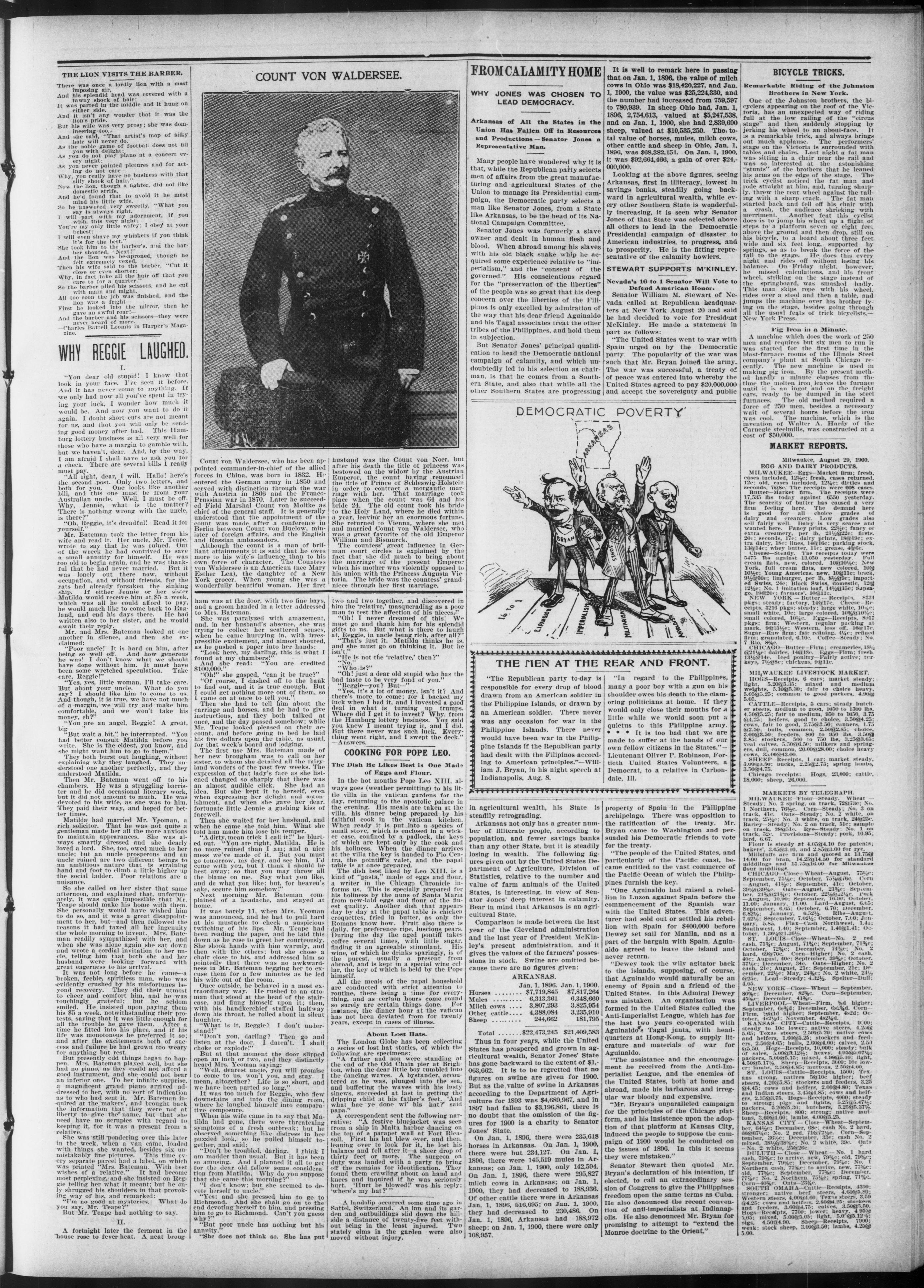
DEMOCRATIC POVERTY
ARKANSAS
BRYAN
JONES
16 TO 1
EXPANSION
IMPERIALISM
MILITARISM
ANKOLISH
---
```markdown
```
FROMCALAMITYHOME
FROMCALAMITYHOME
WHY JONES WAS CHOSEN TO LEAD DEMOCRACY.
Arkansas of All the States in the Union Has Fallen Off in Resources and Productions - Senator Jones a Representative Man.
Many people have wondered why it is that, while the Republican party selects men of affairs from the great manufacturing and agricultural States of the Union to manage its Presidential campaign, the Democratic party selects a man like Senator Jones, from a State like Arkansas, to be the head of its National Campaign Committee.
Senator Jones was formerly a slave owner and dealt in human flesh and blood. When abroad among his slaves with his old black snake whip he acquired some experience relative to "imperialism," and the "consent of the governed." His conscientious regard for the "preservation of the liberties" of the people was so great that his deep concern over the liberties of the Filipinos is only excelled by admiration of the way that his dear friend Aguinaldo and his Tagal associates treat the other tribes of the Philippines, and hold them in subjection.
But Senator Jones' principal qualification to head the Democratic national campaign of calamity, and which undoubtedly led to his selection as chairman, is that he comes from a Southern State, and also that while all the other Southern States are progressing
DEMOCRATIC
BRYAN
16 TO 1
EXPANSION
IMPERIALISM
THE MEN AT THE
"The Republican party to-day is responsible for every drop of blood drawn from an American soldier in the Philippine Islands, or drawn by an American soldier. There never was any occasion for war in the Philippine Islands. There never would have been war in the Philippine Islands if the Republican party had dealt with the Filipinos according to American principles."—William J. Bryan, in his night speech at Indianapolis, Aug. 8.
in agricultural wealth, his State is steadily retrograding. Arkansas not only has a greater number of illiterate people, according to population, and fewer savings banks than any other State, but it is steadily losing in wealth. The following figures given out by the United States Department of Agriculture, Division of Statistics, relative to the number and value of farm animals of the United States, is interesting, in view of Senator Jones' deep interest in calamity. Bear in mind that Arkansas is an agricultural State.
Comparison is made between the last year of the Cleveland administration and the last year of President McKinley's present administration, and it gives the values of the farmers' possessions in stock. Swine are omitted because there are no figures given:
ARKANSAS.
Jan. 1, 1896. Jan. 1, 1900.
Horses ..... $7,719,845 $7,817,264
Mules ..... 6,313,361 6,348,660
Milch cows ..... 3,807,293 3,825,954
Other cattle ..... 4,388,084 3,235,910
Sheep ..... 244,662 181,795
Total $22,473,245 $21,409,583 Thus in four years, while the United States has prospered and grown in agricultural wealth, Senator Jones' State has gone backward to the extent of $1,063,662. It is to be regretted that no figures on swine are given for 1900. But as the value of swine in Arkansas according to the Department of Agriculture for 1893 was $4,689,967, and in 1897 had fallen to $3,196,861, there is no doubt that the omission of the figures for 1900 is a charity to Senator Jones' State.
On Jan. 1, 1896, there were 235,618 horses in Arkansas. On Jan. 1, 1900, there were but 234,127. On Jan. 1, 1896, there were 145,519 mules in Arkansas; on Jan. 1, 1900, only 142,594. On Jan. 1, 1896, there were 295,827 milch cows in Arkansas; on Jan. 1, 1900, they had decreased to 188,936. Of other cattle there were in Arkansas Jan. 1, 1896, 516,695; on Jan. 1, 1900, they had decreased to 230,486. On Jan. 1, 1896, Arkansas had 188,972 sheep; on Jan. 1, 1900, there were only 108,957.
---
It is well to remark here in passing that on Jan. 1, 1896, the value of milch cows in Ohio was $18,420,227, and Jan. 1, 1900, the value was $25,224,330, and the number had increased from 759,597 to 780,939. In sheep Ohio had, Jan. 1, 1896, 2,754,613, valued at $5,247,538, and on Jan. 1, 1900, she had 2,839,690 sheep, valued at $10,535,250. The total value of horses, mules, milch cows, other cattle and sheep in Ohio, Jan. 1, 1896, was $68,382,151. On Jan. 1, 1900, it was $92,664,466, a gain of over $24,-000,000.
Looking at the above figures, seeing Arkansas, first in illiteracy, lowest in savings banks, steadily going backward in agricultural wealth, while every other Southern State is wonderfully increasing, it is seen why Senator Jones of that State was selected above all others to lead in the Democratic Presidential campaign of disaster to American industries, to progress, and to prosperity. He is the fitting representative of the calamity howlers.
STEWART SUPPORTS M'KINLEY
Nevada's 16 to 1 Senator Will Vote to
Defend American Honor.
Senator William M. Stewart of Nevada called at Republican headquarters at New York August 20 and said he had decided to vote for President McKinley. He made a statement in part as follows:
"The United States went to war with Spain urged on by the Democratic party. The popularity of the war was such that Mr. Bryan joined the army. The war was successful, a treaty of peace was entered into whereby the United States agreed to pay $20,000,000 and accept the sovereignty and public
C. POVERTY
JONES
MILITARISM
MARDIISH
REAR AND FRONT.
"In regard to the Philippines, many a poor boy with a gun on his shoulder owes his death to the clamoring politicians at home. If they would only close their mouths for a little while we would soon put a quietus to this Philippine army. * * * It is too bad that we are made to suffer at the hands of our own fellow citizens in the States."—Lieutenant Oliver P. Robinson, Fortieth United States Volunteers, a Democrat, to a relative in Carbondale, Ill.
property of Spain in the Philippine archipelago. There was opposition to the ratification of the treaty. Mr. Bryan came to Washington and persuaded his Democratic friends to vote for the treaty.
"The people of the United States, and particularly of the Pacific coast, became entitled to the vast commerce of the Pacific Ocean of which the Philippines furnish the key.
"One Aguinaldo had raised a rebellion in Luzon against Spain before the commencement of the Spanish war with the United States. This adventurer had sold out or settled his rebellion with Spain for $400,000 before Dewey set sail for Manila, and as a part of the bargain with Spain, Aguinaldo agreed to leave the island and never return.
"Dewey took the wily agitator back to the islands, supposing, of course, that Aguinaldo would naturally be an enemy of Spain and a friend of the United States. In this Admiral Dewey was mistaken. An organization was formed in the United States called the Anti-Imperialist League, which has for the last two years co-operated with Aguinaldo's Tagal junta, with headquarters at Hong-Kong, to supply literature and materials of war for Aguinaldo.
"The assistance and the encouragement he received from the Anti-Imperialist League, and the enemies of the United States, both at home and abroad, made his barbarous and irregular war bloody and expensive.
"Mr. Bryan's unparalleled campaign for the principles of the Chicago platform, and his insistence upon the adoption of that platform at Kansas City, induced the people to suppose the campaign of 1900 would be conducted on the issues of 1896. In this it seems they were mistaken."
Senator Stewart then quoted Mr. Bryan's declaration of his intention, if elected, to call an extraordinary session of Congress to give the Philippines freedom upon the same terms as Cuba. He also denounced the recent convention of anti-imperialists at Indianapolis. He also denounced Mr. Bryan for promising to attempt to "extend the Monroe doctrine to the Orient."
BICYCLE TRICKS.
Remarkable Riding of the Johnston Brothers in New York.
One of the Johnston brothers, the bicyclers appearing on the roof of the Victoria, has an unexpected way of riding full at the low railing of the "circus stage" and then suddenly stopping by jerking his wheel to an about-face. It is a remarkable trick, and always brings out much applause. The performers' stage on the Victoria is surrounded with tables and chairs. Last night a fat man was sitting in a chair near the rail and was so interested at the astonishing "stunts" of the brothers that he leaned his arms on the edge of the stage. The trick cyclist noticed the fat man and rode straight at him, and, turning sharply, threw the rear wheel against the railing with a sharp crack. The fat man started back and fell off his chair with a crash, the audience shrieking with merriment. Another feat this cyclist does is to jump his wheel up a flight of steps to a platform seven or eight feet above the ground and then drop, still on his bicycle, to a board about three feet wide and six feet long, supported by springs, so as to break the force of the fall to the stage. He does this every night and rides off without losing his balance. On Friday night, however, he missed calculations, and his front wheel, striking on the stage instead of the springboard, was smashed badly. This man skips rope with his wheel, rides over a stool and then a table, and jumps the machine over his brother lying on the stage, besides going through all the usual feats of trick bicyclists.—New York Press.
Pig Iron in a Minute.
A machine which does the work of 250 men and requires but six men to run it was started for the first time in the blast-furnace rooms of the Illinois Steel company's plant at South Chicago recently. The new machine is used in making pig iron. By the present method hardly a minute elapses from the time the molten iron leaves the furnace until it is an ingot and on the freight cars, ready to be dumped in the steel furnaces. The old method required a force of 250 men, besides a necessary wait of several hours before the iron was cool. The machine, which is the invention of Walter A. Hardy of the Carnegie steelmills, was constructed at a cost of $50,000.
MARKET REPORTS.
Milwaukee, August 29, 1900.
EGG AND DAIRY PRODUCTS.
MILWAUKEE—Eggs—Market firm; fresh, cases included, 12½c; fresh, cases returned, 12c; old, cases included, 12½c; dirtles and seconds, 7@8c. The receipts were 608 cases. Butter—Market firm. The receipts were 17,535 lbs today against 6550 yesterday. The scarcity of butter has caused a very firm feeling here. The demand is good for all choice grades of dairy and creamery. Low grades also sell fairly well. Dairy is very scarc and wanted here. Fancy prints, 22½c; fancy or extra creamery, per lb, 21½@22c; firsts, 20c; seconds, 17c; dairy prints, 18@19c; extra dairy, 18c; lines, 14@16c; packing stock, 13@14c; whey butter, 11c; grease, 4@6c. Cheese—Steady. The receipts today were 5475 lbs against 13,050 yesterday. Full cream flats, new, colored, 10@10½c; New York, full cream flats, new colored, 10@10½c; Young Americas, new, 10@11c; bries, 9@10½c; limburger, per lb, 8½@9c; imported Swiss, 24c; Block Swiss, domestic, 12@12½c; No. 1 limitation loaf, 14½@15c; Sapsa- 19@20c; farmers, 10611c.
NEW YORK — Butter — Receipts, 8334
pkgs; steady; factory, 14@17c. Cheese-Receipts, 3216 pkgs; steady; large white, 10@4c; small white, 10c; large colored, 10@10c; small colored, 10@4c. Eggs—Receipts, 8017
pkgs; firm; Western, regular packing at mark, 9@15@12c; Western, loss off, 16@17c. Sugar—Raw firm; fair refining, 4@4c; refined firm; granulated, 6.10c. Coffee—Steady: No. 7 Rio, 8@6c.
CHICAGO—Butter—Firm; creameries, 18@21@12c; dalries, 14@18c. Eggs—Firm; fresh, 13@14c. Iced poultry—Fairly active; terekeys, 7@18c; chickens, 9@11c.
MILWAUKEE LIVESTOCK MARKET.
HOGS—Receipts, 6 cars; market steady; light, 5.20@5.35; mixed and medium weights, 5.10@5.30; fair to choice heavy, 5.05@5.25; common to good packers, 4.90@5.05.
CATTLE—Receipts, 5 cars; steady butcher steers, medium to good, 1050 to 1300 lbs, 4.50@5.25; fair to medium, 950 to 1050, 3.75 @4.25; heifers, good to choice, 3.50@4.25; cows, fair to good, 2.75@3.50; canners, 1.75 @2.50; bulls, common, 2.50@2.85; choice, 3.00@3.50; feeders, 800 to 950 lbs, 3.50@3.85; stockers, 500 to 750 lbs, 3.25@3.65; veal calves, 5.50@6.50; milkers and springers, dull, common, 20.00@28.00; choice heavy cows, 35.00@43.00.
SHEEP—Receipts, 1 car; market steady, 3.00@3.50; bucks, 2.25@2.75; spring lambs, 3.50@4.75.
Chicago receipts: Hogs, 23,000; cattle, 18,000; sheep, 26,000.
MARKETS BY TELEGRAPH.
MILWAUKEE—Flour—Steady. Wheat—Steady; No 2 spring, on track, 72@73e; No 1 Northern, 76@2c. Corn—Steady; No 3 on track, 41c. Oats—Steady; No 2 white, on track, 25@2c; No 3 white, on track, 24@25c. Barley—Steady; No 2 on track, 51c; sample on track, 38@51c. Rye—Steady; No 1 on track, 52c. Provisions—Steady; pork, 10.95; lard, 6.67.
Flour is steady at 4.05@4.10 for patients;
bakers' 3.05@3.10 and 3.05@3.30 for rye.
Millstuffs are arm and quoted at 13.75@
14.00 for bran, 14.25@14.50 for standard
middlings and 15.75@16.00 for Milwaukee
flour middlings.
CHICAGO—Close—Wheat—August, 75½c;
September, 75½c; October, 75½@76c. Corn—
August, 41½c; September, 41c; October, 39½@39¾c. Oats—August, 21½c; September, 21½@21¾c; October, 22½@22¾c. Pork—
August, 10.90; September, 10.90; October, 11.00; January, 11.00. Lard—August, 6.65; September, 6.65; October, 6.70; December, 6.82½; January, 6.52½. Ribs—August, 7.02½; September, 7.02½; October, 7.00; January, 5.85. Flax-Cash Northwest, 1.41; Southwest, 1.40; September, 1.40@1.41; October, 1.36½@1.36¾c.
ST. LOUIIS-Close-Wheat-No. 2 red
cash, 71%c; August, 71%c; September, 71%c;
October, 72%c; December, 74%c; No. 2
hard, 69%@70e
Corn-Higher; No. 2 cash,
40; August, 40c; September, 39%c; October,
37%c; December, 34c. Oats-Higher; No. 2
cash, 21c; August, 21c; September, 21c; De
cember, 22%c; May, 24%c; No. 2 white, 24%
@25c. Lead-Steady; 4.32%c. Spelter-Dull;
4.05.
NEW YORK-Close-Wheat - September,
80%c; December, 82%c. Corn-September,
45%c; December, 41%c.
LIVERPOOL-Wheat-Firm, 5%d higher;
September, 68%d; December, 68%z; Corn-
Firm, 7%@1d higher; September, 4s2d; Oct
er, 4s2d; November, 4s2d%
KANSAS CITY—Cattle—Receipts, 9,000; steady to 10c lower; native steers, 4.25@5.65; Texas steers, 2.50@5.20; native cows and heifers, 1.60@5.25; stockers and feeders, 2.50@4.65; bulls, 2.00@4.00; calves, 2.50@5.50. Hogs—Receipts, 10,000; steady; bulk of sales, 5.00@5.12%; heavy, 4.95@0.71%; packers, 5.00@5.15; mixed, 4.90@5.10; light, 4.50@5.17%. Sheep—Receipts, 3000; 10c lower; lambs, 3.50@4.85; muttons, 2.50@4.00.
ST. LOUISE—Cattle—Receipts, 1500; Texans strong, natives 5a10c higher; beef steers, 4.20@5.85; stockers and feeders, 3.25@4.45; cows and heifers, 2.00@4.80; Texas and Indian steers, 3.45@4.85; cows and heifers, 2.35@3.75. Hogs—Receipts, 4000; steady to strong; pigs and lights, 5.25@5.47%; packers, 5.20@5.30; butchers, 5.25@5.37%. Sheep—Receipts, 800; strong; native mutons, 3.60@4.00; lambs, 4.00@5.25.
KANSAS CITY—Close—Wheat—September, 64%c; December, 68c; cash No. 2 hard, 66@67%c; No. 2 red, 71@72%c. Corn—September, 36%c; December, 33c; cash No. 2 mixed, 38%c38%c; No. 2 white, 39c. Oats No. 2 white, 25%c26.
DULUTH — Close — Wheat — No. 1 hard cash, 79%c; to arrive, new, 79%c; old, 79%c; September, 79%c; December, 79%c; No. 1 Northern cash, 77%c; to arrive, new, 77%c; old, 77%c; September, 77%c; December, 77%c; No. 2 Northern, 75%c; spring, 71%c; Corn—40%c; Oats—23%c.
SOUTH OMAHA—Cattle—Receipts, 4300; stronger; native beef steers, 4.60@5.80; Western steers, 4.00@4.60; Texas steers, 3.50@4.25; cows and helfers, 2.80@4.25; stockers and feeders, 3.60@4.75; calves, 3.50@5.50; Hogs—Receipts, 7700; lower, heavy, 4.95@5.05; mixed, 5.00@5.05; light, 5.0*@5.12*; oigs, 4.50@4.90; Sheep—Receipts, 7900; weak; stock sheep, 3.00@3.50; lambs, 4.25@5.00.
The Wisconsin Weekly Advocate
Printed in the Interests of the Negro Race,
MILWAUKEE, WIS.
Richard B. Montgomery.....
.....Editor and Proprietor
Office 209 Fifth Street.
Telephone Black No. 244.
SUBSCRIPTION RATES.
postage paid.
One Year ..... $2.00
Six Months ..... 1.25
Three Months ..... .75
Send money by Express Money Order, P. O.
Money Order or Registered Letter to the
Wisconsin Weekly Advocate.
ADVERTISING RATES
One inch, single insertion..... 25c
One inch, per year..... $9.00
Business locals 5c per line each insertion.
Apply for rates to the Advocate.
TO CONTRIBUTORS:
All communications must be sent with the name and address of the sender as an evidence of good faith, but not necessarily for publication. No manuscript returned if not accepted, unless accompanied by stamps.
All subscribers of the Advocate that fail to get their paper promptly will please notify us at once. The Advocate, at 200 Fifth street.
The Wisconsin Weekly Advocate company wishes to notify the public that all contracts and business transactions with this company must have the company stamp, otherwise they will be void. Neither will this company be responsible for paid subscriptions unless given to duly-accredited agents, who, on request, will give the company's receipt for same. Subscribers failing to receive their papers regularly will kindly notify the general office. Address all business communications to the general manager, 200 Fifth street.
Entered at the Milwaukee P. O. as second-class matter.
Three convicted lynchers in Texas have been sent to prison on life sentences—to remain until they are quietly pardoned.
The international game laws are in more danger of infraction, now that the allies are gunning for the Empress.
Women who hang themselves because they are jealous of their husbands are pursuing the Chinese course of spiting a neighbor by committing suicide in his back yard.
Tesla's discovery that a coating of ice insures absolute insulation will be of little economic value, owing to the difficulty attendant upon the freezing of the wires over long distances.
The use of batteries of cannon to ward off hailstorms from the vineyards in France is carrying war into the clouds, where "heaven's artillery" has occupied the aerial range from the beginning of time.
The vaudeville performers who recently organized a union in New York chose the name "White Rats of America," because their main purpose is to keep out of traps set by combined managers who aim to depress salaries.
The Russian explorers at Spitzbergen, who sent back a report that "the cold was not very great during the winter, being a little over 100 degrees below zero," are probably relatives of the cruel and cold-hearted ice man.
The Kansas City firemen who captured first honors in Paris evidently succeeded in showing the Europeans how to hitch and jump, as did the American athletes who were among the competitors at the Exposition. American firemen lead the world.
The ice man will soon be one of the moguls of London. The demands of American patronage have gradually brought the English landlords to recognize the value of iced drinks, and now a real Yankee ice cream soda saloon is said to be coining money.
The Ameer of Afghanistan has chosen to make a warlike demonstration at an inopportune time for Russia. When the Chinese disturbance is over, the Czar would probably like nothing better than a tussle with the Ameer, as it would result in Russia's making another step in the direction of India.
The 3000 Americans who are said to be stranded in Europe either spent all their money at the Paris exposition, or went abroad without money enough to spend anywhere. The evidence of the concessionaires does not support the belief that anybody indulged in "getting broke" within the gates of the exposition.
Mariners who have feared that a multiplication of masts might compel the use of numbers in designating them, after the manner of numbering mileposts, are informed that the masts of the new six-master launched at Camden, Me., are styled,—beginning at the bow,—foremast, mainmast, mizzenmast, spanker, jigger, and driver.
Ferrell, the express messenger murderer, is trying to escape the gallows by showing that he is descended from a line in which the marriage law in regard to consanguinity was violated. But his chances are poor, as the jury will probably conclude that a hemp noose can put a stop to any evil that may have grown from such disregard of law.
Typhoid fever is epidemic in some parts of Paris, and visitors to the Exposition may bring home the seeds of the disease in their systems, as do many resorters patronizing sections where the drinking water is contaminated. The tourist who avoids water in Paris is wise; even though he has to violate total abstinence principles in order to slake his thirst.
The automobile battery which left Chicago for Washington with so much eclat, is back from the Indiana sand hills in which it became stalled-battered evidence that the "auto" is an uncertain thing for war. The machine gun has failed at critical moments often enough to make soldiers rather doubtful as to the efficacy of anything but the trigger finger, although the automatic rifle has no tires to burst.
Marshal Halstead, the United States consul at Birmingham, reports that the ice habit is making rapid progress in Great Britain, due largely to the incessant clamor for ice in hotels and public
places by the thousands of traveling Americans. Not very long ago, the attendants of public places in England, where nearly everything except ice was provided, would be insulted if one complained because ice could not be had. Today, all first-class places have a few small lumps swimming in a glass dish, and you pick out these with sugar tongs; and in country inns and even in second-class public houses, they apologize for not having it. Though very few saloons and restaurants have refrigerators, many private residences now own them; and there would be far more general use of ice if companies were organized to distribute it from house to house. As it is, one must secure it almost by favor from the fish-monger.
Hundreds of fields of growing, sugar beets in northern Indiana, and the contented condition of those engaged in the culture, are convincing proof that the experimental stage of sugar-beet raising has been passed, says the Indianapolis News. Farmers are ready to double their acreage next year, and those who were doubtful of the outcome are now supporting the industry. The fact that growers will probably realize a profit of from $10 to $40 an acre from the present beet crop explains the zeal for the new culture among the farmers, whose lands are not nearly so profitable in the production of any other crop. Statistics show that beet sugar can be produced for 3 cents a pound. In the New York market the price is now 6.9 cents. Official tests from beets grown in northern Indiana show from 15 to 22 per cent. of sugar. What is needed is more factories to handle the beets. With the thousands of acres of good beet land in northern Indiana there is an admirable field for investors who wish to engage in the manufacture of sugar.
Reports from the ordnance officers of the navy have practically decided the question of the powder to be used in the future, and the decision is in favor of adhering to nitro-cellulose powder. For the last two years the new smokeless powder has been under the closest scrutiny, and notwithstanding frequent employment, no wear has been discovered in the bores of the heavy-calibred guns. It is a well-known fact that the naval guns of the United States are subjected to more full-service charges firing in time of peace than the guns of any other country. It has been noted frequently that the British navy has not been so liberal in the matter of target practice as our own service. The reason is found in the effect of the smokeless powder used by the English. Cordite is more injurious to the guns than any other powder in use. It will stand different temperatures very well and will give high velocities on comparatively low-chamber pressures, but its corrosive action on the guns is marked. Taking all considerations into account, it is believed by the ordnance officers in our navy that the United States is better off in the matter of powder for its heavy guns than any European country, and that Germany is a close second.
Porto Rico is sending its coin here to be exchanged for United States money at a great rate. Last week alone 1,722,000 pesos, or Porto Rican dollars, arrived at the Philadelphia mint. It is evident that the native coins will be quite done away with in a short time. The peso in size, weight and quality of silver almost corresponds with our dollar. It has milled edges, stars on the rim, and, on the face, the profile of Alfonso XIII. The Porto Ricans receive in exchange for the peso 60 cents. Pesetos, or 20-centaro piece, 5, ten and 40 centaro pieces are also pouring into the mint. These are silver coins, each centaro being one-hundredth of a peso, and having a value in our money of three-fifths of one cent. All centaro piece are silver save the 1 and 2, which are made of bronze. A room on the third floor of the mint is devoted to the counting of the Porto Rican money, and six women and six men, working busily, counted daily from 70,000 to 80,000 pesos each. The total amount so far received and counted is 4,862,798 pesos and 30 centaros.
Visitors to the Paris exposition are kicking about the extortionate prices, and, apparently there is ample provocation for the kicks. One writer says that if you want to be real reckless and extravagant, pay for a bock or an ice or coffee at one of the cafes commanding a view of the crowd. Thus you will secure an elevated seat, something to assuage the inevitable "exposition thirst," and a table for your elbows, all for from 6 to 20 cents. Thus you are yet green you will doubtless order lemonade. It won't take you long to find out that it is the most expensive consommation you can hit upon. In Paris lemonade costs more than champagne does. In spite of this discouragement of temperance we took a table—says one of the correspondents—and some lemonade on the terrace of the Woman's building the other afternoon. The lemonade was like the sex to which the building is devoted. It was weak, but expensive. If anyone would like the recipe, here it is: First catch your lemon. This you can do anywhere at any time for 2 cents. Put the juice of one lemon in two glasses, add a large spoonful of cracked ice and a small spoonful of sugar. Fill the glasses with water. Wipe off the straws which the last customers left in their glasses and add them to the new order. Serve and collect 40 cents, plus a tip of four. Forty cents for a glass of lemonade is certainly liberal. Let us hope that it will not cost as much to assuage thirst, in Buffalo next summer.
Sure Winner.
Editor, allow me a space in your paper. The Hon. Theobald Otjen, candidate for Congress from the Fourth district, will have a walkaway and is practically sure of election, and is next to Mr. La Follette, the most popular candidate on the ticket. As between the two men, ex-Gov. Peck and Congressman Otjen, there is no comparison, neither as to ability or otherwise. The magnificent work of Mr. Otjen during his incumbency of the office speaks for itself. He stands head and shoulders above his opponent. At the convention just closed he was one of the most popular figures and received many calls. We predict his election by a safe majority. W. H. Brown,
Washington, D. C.
—It is a noteworthy fact that in Utah there is not one Irish Mormon.
PURSE FOR FATHER KEOGH.
St. John's Parish to Present Him with $1,500 Tonight at His Inublee Reception.
All St. John's cathedral parish will turn out tonight to extend congratulations to Rev. Father J. J. Keogh, who has been its pastor for twenty-five years, and to take part also in the presentation of a purse of $1500 to the popular priest. The money has been given by the people of the parish in sums ranging from 50 cents to $100, and if it were not that it is so large an amount it would be given in silver coin as befitting the occasion. Instead it will be put into the form of a check and Principal Patrick Donnelly of
P.
REV. J. J. KEOGH.
the Third ward school will make the presentation speech.
The whole clergyhouse will be thrown open and the reception will be one big family party as no one outside the parish, excepting those who have once formed a part of it but who have moved elsewhere, have been invited. Father Naughtin of Madison, Morrissey of Oshkosh, Eugene Reilly of Lake Geneva and Frank Reilly of Whitewater, who have at various times been connected with the cathedral clergyhouse, are to be special guests of honor. The arrangements for the reception are devolving upon Father Huston and a committee of women from the parish headed by Mrs. Frank Peacock. The guests will be received in the front parlor by Father Keogh and Masters John Dumphy and William Murphy will be the ushers. The parlors and dining room, where Conroy will serve refreshments, will be decorated with palms and cut flowers, but everything will be marked by the greatest simplicity, that being Father Keogh's wish. During the evening the cathedral choir, under the direction of Prof. Baez, will sing several selections and the cathedral high school orchestra will play.
CREAM CITY NOTES.
Mrs. Garland is very sick.
* * *
Mr. Hutton has left the city.
* * *
Mrs. Lizzie Brown's son, Harry, had
a violent attack of cholera morbus Tuesday
morning. Is much better at this
writing.
We had some very honorable visitors last week, who were Bishop A. Walter of New Jersey; Rev. Caldwell of Philadelphia; Rev. J. R. Alexander of Windsor, Can.; Rev. M. R. Williams of Grand Rapids, Mich. They were served a lunch and shown over a large part of the city, which they greatly appreciated, and then boarded the train for Fond du Lac.
* * *
At this writing there are quite a number of our people sick. They are Mrs. Garland, Mrs. Lutch of Salem Baptist church, Mrs. Rilford and quite a number of others whom we are unable to locate.
* * *
We congratulate Mr. Peter King of 250 Fifth street, on renewing his old marital vow. We hope they will live happy ever after.
Charles Maxey has gone to his home at Point Bluff, Wis.
※ ※ ※
We take pleasure in introducing Mr. James McGee's latest cut. He is of Milwaukee and candidate for sheriff. Several remarks have been passed concerning his business ability. He is a business man of about twenty-five years. At the barbecue of St. Mark's he is to deliver a lecture. He is a true friend to cur race. We wish him a successful campaign year.
William C. Peterson, treasury agent, appointed August 24 to succeed W. T. Ellsworth, resigned.
Mr. W. S. Clements is guest of Mr. Richard B. Montgomery and friends while on his ten days' furlough from Chicago, Hi.
Mr. Walter Hutton left here to take charge of the largest hotel in Anaconda, Mont.
Mr. Montgomery had the pleasure of meeting Mrs. Houghton, 16 Woodland court of this city. He was cordially received by her and she heartily indoles all of his work in the Helping Hand mission.
The Royal Myrtle at Osborne.
Queen Victoria's knowledge of every detail not only of the various houses, but also of the parks and gardens connected with the many royal palaces, is said to be wonderful. Within a very few hours of the court arriving at Osborne the Queen makes a tour of those gardens which are close to the house, her first visit generally being paid to the lovely myrtle planted by the prince consort in 1858 from a sprig taken from the Empress Frederick's wedding nosegay. The sprig flourished, and is now a fine bush, and during the last forty years it has supplied innumerable pieces of myrtle for the embellishment of royal bridal bouquets.
Attention—Altogether!
There will be a meeting of the Fourth Ward Republican club Friday evening. August 31, at room 501. Germania building. All members and their friends are requested to be present. O. H. Pierce, president; R. G. Harper, secretary.
Rest at Noon.
In Egypt, owing to the great heat, caravans travel only in the early mornings and in the evening. At noon the camels, donkeys and drivers take their comfort as best they can.
SAYS BAR POLITICS.
CONGRESSMAN WHITE'S STAND Asserts that the Afro-American Convention is Only to Secure Legislation for the Common Good
Special Dispatch to the Chicago Record from a Staff Correspondent. Indianapolis, Ind., Aug. 28.—At the Afro-American convention Congressman George H. White effectually stopped, temporarily at least, the inclination to give political color to the trend of the body's deliberations. "This is a non-partisan organization," he thundered, "and we must lift our aim high beyond the reach of petty politics. The thing that should be uppermost in our minds is that we have come here to legislate for the common good of the race."
Maj. Taggart delivered a characteristic address and speeches of welcome were made on behalf of the colored citizens by George L. Knox and A. T. Manning, prominent colored men of this city. The responses were made by Congressman George H. White, F. L. McGhee of Minnesota, Col. "Bill" Pledges of Georgia and Dr. M. C. B. Mason.
Address by the President.
The president's address opened the afternoon session, at the conclusion of which the committee on credentials made its reports and shortly after the committee on "the address to the country" was appointed, with T. Thomas Fortune as chairman, and associated with him Judson W. Lyons, William A. Pledges, Congressman G. H. White, the Rev. Ernst Lyon, Prof. H. T. Kealing, F. L. McGhee, Col. James H. Lewis, James H. Howard, Lillian Thomas Fox, George H. Jackson and others.
Suppression of Negro Vote.
The committee is said to indicate that the McKinley administration will receive a tacit indorsement of its foreign and domestic policy. If such should be the case it is reasonably certain that a bitter fight will be precipitated. President Walters said:
"Great wisdom is needed on our part in order to advance our cause with the least friction possible. While there is nothing else for us to do but stand up for principle and struggle for our every right, yet it must not be done in the spirit of strife. We should not be afraid to let the world know that our plea is for the complete manhood rights of the negro. It is because of our equality by nature that we appeal to the conscience of the nation to recognize our manhood and treat us as they treat other men, be they ever so white. The right of suffrage, which is the basis of the individual sovereignty of the American citizen, which in turn is the basis of the aggregate sovereignty of the whole body politic, is not indeed a national or an inherited, but a conferred right, the outcome of authoritative law, but when it has been once conferred by the federal government, it became what is or should be the inviolable right of every citizen, of whatever color, race or rank in social life, and therefore is not a privilege to be conferred or withheld by the states. We look with suspicion on the man or woman who says by word or action that the negro shall be given such training as will only fit him to be a hewer of wood and a drawer of water."
Afro-Americans Protest.
Indianapolis, Ind., Aug. 29.—It is said to-night that all politics will be eliminated from the formal action of the Afro-American convention. The resolutions make no reference to politics. The address to the country, which was reported by the committee to-night, denounces disfranchisement in several Southern states.
Heigho for Peach Shortcake.
Sift a quart of flour, a teaspoonful of salt and three generous teaspoonfuls of baking powder into a large bowl; work a half cupful of butter through the flour with a knife, or with the tips of the fingers; then stir in enough cream to make a very light paste, not stiff enough to roll out, but just the right thickness to put in the pans with a spoon and to be smoothed over the bottom of the pan with a knife. This makes it fit into the pan very nicely and saves all trimming of the edges. This amount of dough will make two cakes in ordinary-sized round pie pans. Fill the pans quite to the top, and bake in a quick oven till a golden brown. When the cakes are slightly cool split them in halves; this will make four layers. Butter the inside of each layer well, then prepare the peaches. Peel enough perfectly ripe peaches; cut three-fourths of them into small pieces, put them in a bowl and sweeten them with fine sugar; put a layer of the cake on a large plate, buttered side up; cover it deep with peaches, then put on another layer and cover it with the peaches. Repeat this till the last layer but one is in, then put that on, buttered side down; on top of it put some fine peaches, peeled and cut in halves or quarters, ranged round artistically; sprinkle them with fine sugar, ornament the dish with a wreath of green leaves, and serve the shortcake with a pitcher of rich cream.—Philadelphia Press.
Sample of the Celebrated Irish Wit.
"An Irishman of the full blood cannot resist an opportunity for repartee, no matter how solemn the occasion or what his surroundings," said an English clergyman, a visitor in Washington, the other day, to a Post reporter, when the conversation turned on the funny experiences of clergymen and the humor that creeps into matters connected with the church.
"I was assisting an old friend of mine, the rector of a church in Ireland, one Sunday, and before the service we were in the vestry-room putting on our robes, with the old sexton, a shrivelled-up Irishman of the perfect type, assisting. My friend, who was somewhat old, was a little testy that morning, and somehow the sleeve of his surplice got mixed up. Notwithstanding the assiduous efforts of the old sexton to direct his arm to the right hole, the two would not connect. Finally losing patience, my friend said sharply: 'Ach, the divil's in the thing.' "The old sexton brightened up, and, looking over at me with a twinkle in his eye, said, as quick as lightning: 'Not yit, your riverine.' "It rested the good humor of the situation, and the vestment was properly adjusted."
A Tribute to Lord Byron.
On each recurring anniversary of the death of Lord Byron an "In Memoriam" notice commemorative of the poet's demise is printed in the London Times. It appears that a feminine admirer of Lord Byron bequeathed a sum of money to have a wreath of Marechal Niel roses placed at the foot of his statue in Hamilton gardens each year and to pay for the annual insertion of the advertisement referred to until such time as the authorities of Westminster Abbey shall allow the word "Byron" to be inscribed in the poets' corner.—Philadelphia Record.
—A good strike is reported on the Ouray and the Nada at Gold hill, Cripple Creek. The vein is three feet wide and shows five ounces to the ton.
SHEBOYGAN NEWS.
The editor called on the proprietor of the Buckner woolen mills and he willingly became a subscriber for the Wisconsin Weekly Advocate and expressed a great interest in our paper, being well pleased with it. Anyone wishing goods in his line will receive prompt attention. We gave Charles S. Weisse & Co. a call and found them with a fine stock of Harness, Skirting, Collar and Strap leather. The members of the firm are C. H. Weisse, L. A. Weisse, Otto B. Weisse and Emil Weisse, with W. P. Henle book-keeper. It will pay you to give them a call.
Mr. John E. Thomas, president of Dairyman's bank, added his name to our list of subscribers. He is a very nice man and in him we have found another friend. He knows as much about the condition of the colored people in the South as any man in the North. Our next issue will give a short account of our interview with him. All the people whom we met in Sheboygan are sympathizers of our race and are eager and willing to help us in our work. The editor called on the proprietor of the Brickner woolen mills and he kindly subscribed for the Wisconsin Weekly Advocate and expressed his opinion in saying it was a very good and interesting paper. Those wishing goods in their line will receive prompt attention.
THE PACIFIC OCEAN.
Uniform Shallows at Irregular Intervals-Great Submarine Plateau.
"In the eastern half of the Pacific ocean, that is, that part which washes America, there is a tableland. It varies from 60 to 215 miles wide, and the greatest depth is about 1000 fathoms. In some localities it is over 300 fathoms below the surface of the water, some thirty miles from shore line. Outside of this submarine tableland or shelf is another tableland of not quite so uniform a width, wherein the depth reaches 2000 fathoms. The uniform character of the sea's depth is quite marked along the California shore, but even here there are ups and downs, shallows and depths. The coastline has a strip of water at its immediate border, in which the depth keeps at about 12 fathoms along a ledge or plateau for a few miles out, and then drops sheer down for 500, 600 and 1000 fathoms. This shore ledge is quite well defined and generally unbroken, but in it there sometimes occurs a crevasse or valley, whose exploration is a matter of much curious interest. Directly off Point Hueneme, at the entrance to the Santa Barbara channel, there is found a remarkable example of one of these marine valleys. Commencing with a depth of 10 fathoms 400 yards from the beach, it increases to 50 fathoms in five-eighths of a mile, and then drops suddenly to 113 fathoms, or 678 feet, in less than two miles. Its general direction is south, and it is bounded all around by depths of from 12 to 15 fathoms.
"In 1889 an uncommon submarine valley was found some sixty miles off the coast of Mexico from Mazatlan. It was traced for eighty miles and has all the characteristics of a valley among mountains. The shape of the valley was distinctly traced from a narrow head to a wide mouth. Its general depth is 7000 fathoms, or 4200 feet. It has crevasses and pits 160 and 200 feet in diameter, that reach down over 1800 feet deeper. Close beside them are peculiar shafts of rock that tower sharply, like great mountains, some 500 feet high."—Prof. White in New York Sun.
Japan May Absorb China.
It is not beyond the bound of possibility that Japan should absorb China. This would be the realization of her great ambition; it so would make her supreme in the far East and permanently a power among nations. That such a thing may come to pass and the little nation take in the huge is not as absurd as it may seem at first thought. Japan is able to attend to such a matter. The meal would be more than a mouthful, but she could digest it. This is why.—New York Press.
In the British fisheries a great feature has been the enormous increase in the number of steam trawlers at the expense of sailing vessels. They have increased in the last ten years from 250 to 1000, and each steam vessel is twice the actual tonnage of the sailing trawlers. It can also use the otter trawl, which frightens the fish less than the beam trawl.
For the Safest and Quickest Road between
Milwaukee and Chicago
Take the Chicago: Milwaukee & St. Paul Railway.
Pabst MaltExtract The Best Tonic Builds up both the body and nerves; brings refreshing sleep, insures a healthy
appetite, aids digestion and feeds blood, brain and bone It cannot fail to benefit in every case where more strength is required Once tried, you will never take a substitute. AT YOUR DRUGGIST
FABST/MALT TEXT
The Best Tonic
MALT
HGP
MALT BREWING CO.
FABST BREWING CO.
MILWAUKEE, WIS.
S. F. PEACOCK & SON Funeral Directors AND EMBALMERS
431 Broadway. MILW4UKEE. WIS
THE BALL-BEARING
DENSMORE
Best for Both Correspondence and Manifolding.
SEND FOR CATALOGUE.
UNITED TYPEWRITER and SUPPLIES CO.,
Agents for Wisconsin and Northern Michigan.
414 BROADWAY, Milwaukee, Wis.
Telephone 883.
E. D. Haven, Manager.
REV. G. W. MUGGAGE,
Pastor A. M. E. Zion Church.
Residence:
218 Morris St., Fond du Lac, Wis.
REGULAR SERVICES - SUNDAYS:
Preaching.....10:45 a. m. and 7:30 p. m.
Sunday School.....3 p. m.
Prayer Meeting.....9:30 a. m.
Class Meeting.....12 m.
Y. P. C. E.....6:30 p. m.
Sacraments Quarterly Meeting, 2d Sunday
every 3d month.
Baptism of Infants, Special Day.
Baptism of Adults, Easter Day.
SPECIAL SERVICES—EASTER DAY.
Missionary Collections.
CHILDREN'S DAY.
Endowment Collection. 50cents Money—Now.
BOARD MEETINGS.
Official—First and third Monday in each
month.
Trustees—Monday after second and fourth
Sunday.
S. S. Board—Call of Pastor.
Quarterly Conference—Call of P. E.
WONDERFUL DISCOVERY Curly Hair Made Straight By
TAKEN FROM LIFE:
BEFORE AND AFTER TREATMENT.
OZONIZED OX MARROW
THE ORIGINAL—COPYRIGHTED.
This wonderful hair pomade is the only safe preparation in the world that makes kinky hair straight as shown above. It nourishes the scalp, prevents the hair from falling out and makes it grow. Sold over 40 years and used by thousands. Warranted harmless. Testimonials free on request. It was the first preparation ever sold for children. It is a safe and gentle application. Get the Original Ozonized Ox Marrow, as the genuine never fails to keep the hair pliable and beautiful. A toilet necessity for ladies and gentlemen. Elegantly perfumed. The great advantage of this wonderful pomade is that by its use you can store it in a superior and lasting quality it is the most economical. It is not possible for anybody to produce a preparation equal to it. Full directions with every bottle. Only 50 cents. Sold by dealers or send us $1.40 Postal or Express Money Order for 3 bottles, express paid. Write your name and address plainly to
OZONIZED OX MARROW CO.,
76 Wabash Ave., Chicago, Ill.
MILWAUKEE...
GAS STOVE CO.,
MANUFACTURERS OF
PERFECTION
AND SPECIALTIES
Instantaneous Cleanable Star Burners,
Adjustable Needle Valve,
For Natural, Artificial or Gasoline Gas.
139 Burrell St., Milwaukee, Wis.
Do You Wish to be a
MASTER PAINTER
You know Good Painters make from $5.00 to
$10.00 a day easy.
PAINTING POINTERS
on Sign, House and Carriage Painting, Decorating, Graining, Gilding, Silvering and Calsomin-
ing. This Book will also teach you how to
CONTRACT FOR BUSINESS
on profitable basis. It will teach you all we
know after having spent a life time in the busi-
ness, and will generally
SAVE YOU MONEY.
Mailed postpaid for only 50c.
VAL. SCHREIER SIGN WORKS, Milwaukee, Wis.
FIRE AND BURGLAR ALARMS
in your residence you would do well
to call on
CHAS. D. MILNE Electrical Contractor
And General Repairwork. The best in the city.
Fel. Main 527.
IO MASON ST.
TALMAGES
[Copyright, Louis Klopsch, 1900.]
IN this discourse Dr. Talmage, who during his journey homeward has seen much of royal and imperial splendors in passing through the capitals of Europe, shows that there is no higher dignity nor more illustrious station than those which the Christian has as a child of God; text, Judges viii., 18, "Each one resembled the children of a king."
resembled the children of Zebah and Zalmunna had been off to battle, and when they came back they were asked what kind of people they had seen. They answered that the people had a royal appearance. "Each one resembled the children of a king." That description of people is not extinct. There are still many who have this appearance. Indeed, they are the sons and daughters of Lord Almighty. Though now in exile, they shall yet come to their thrones. There are family names that stand for wealth or patriotism or intelligence. The name of Washington among us will always represent patriotism. The family of the Medici stood as the representative of letters. The family of the Rothschilds is significant of wealth, the loss of $40,000,000 in 1848 putting them to no inconvenience, and within a few years they have loaned Russia $12,000,000, Naples $25,000,000, Austria $40,000,000 and England $200,000,000, and the stroke of their pen on the counting room desk shakes everything from the Irish sea to the Danube. They open their hand and there is war, they shut it and there is peace. The Romanoffs of Russia, the Hohenzollerns of Germany, the Bourbons of France, the Stuarts and Guelphs of Great Britain, are houses whose names are intertwined with the history of their respective nations symbolic of imperial authority.
But I preach of a family more potential, more rich and more extensive—the royal house of Jesus, of whom the whole family in heaven and on earth is named. We are blood relations by the relationship of the cross; all of us are the children of the King.
First, I speak of our family name. When we see a descendant of some one greatly celebrated in the last century, we look at him with profound interest. To have had conquerors, kings or princes in the ancestral line gives luster to the family name. In our line was a King and a Conqueror. The Star in the East with baton of light woke up the eternal orchestra that made music at his birth. From thence he started forth to conquer all nations, not by tramping them down, but by lifting them up. St. John saw him on a white horse. When he returns, he will not bring the nations chained to his wheel or in iron cages, but I hear the strike of the hoofs of the snow white cavalcade that brings them to the gates in triumph.
Luster from Star and Spear.
Our family name takes luster from the star that heralded him and the spear that pierced him and the crown that was given him. It gathers fragrance from the frankincense brought to his cradle and the lilies that flung their sweetness into his sermons and the box of alabaster that broke at his feet. The Comforter at Bethany. The Resurrector at Nain. The supernatural Oculist at Bethsaida. The Saviour of one world and the chief joy of another. The storm his frown. The sunlight his smile. The spring morning his breath. The earthquake the stamp of his foot. The thunder the whisper of his voice. The ocean a drop on the tip of his finger. Heaven a sparkle on the bosom of his love. Eternity the twinkling of his eye. The universe the flying dust of his chariot wheels. Able to heal a heartbreak or hush a tempest or drown a world or flood immensity with his glory. What other family name could ever boast of such an illustrious personage?
Henceforth swing out the coat of arms! Great families wear their coat of arms on the dress, or on the door of the coach, or on the helmet when they go out to battle, or on flags and ensigns. The heraldic sign is sometimes a lion or a dragon or an eagle. Our coat of arms, worn right over the heart, hereafter shall be a cross, a lamb standing against it and a dove flying over it. Grandest of all escutcheons! In every battle I must have it blazing on my flag—the dove, the cross, the lamb, and when I fall wrap me in that good old Christian flag, so that the family coat of arms shall be right over my breast, that all the world may see that I looked to the Dove of the Spirit and clung to the Cross and depended upon the Lamb of God, which taketh away the sin of the world.
The Family Sorrows.
Ashamed of Jesus, that dear friend,
On whom my hopes of life depend;
No! When I blush, be this my shame
That I no more revere his name.
Next, I speak of the family sorrows. If trouble come to one member of the family all feel it. It is the custom, after the body is lowered into the grave, for all the relatives to come to the verge of the grave and look down into it. First those nearest the departed come, then those next of kin, until they have all looked into the grave. So, when trouble and grief go down through the heart of one member of the family, they go down through them all. The sadness of one is the sadness of all. A company of persons join hands around an electric battery; the two persons at the ends of the line touch the battery and all the circle feels the shock. Thus, by reason of the fillal, maternal and paternal relations of life, we stand so close together that when trouble sets its battery all feel the thrill of distress. In the great Christian family the sorrow of one ought to be the sorrow of all. Is one persecuted? All are persecuted. Does one suffer loss? We all suffer loss. Is one bereaved? We are all bereaved.
Their streaming eyes together flow For human guilt and mortal woe. If you rejoice at another's misfortune you are not one of the sheep, but one of
the goats, and the vulture of sin hath alighted on your soul and not the Dove of the Spirit.
Next, I notice the family property. After a man of large estate dies, the relatives assemble to hear the will read. So much of the property is willed to his sons and so much to his daughters and so much to benevolent societies. Our Lord Jesus hath died, and we are assembled to-day to hear the will read. He says, "My peace I give unto you." Through his apostles he says, "All things are yours." What, everything? Yes, everything! This world and the next. In distinguished families there are old pictures hanging on the wall. They are called the "heirlooms" of the estate. They are very old and have come down from generation to generation. So I look upon all the beauties of the natural world as the heirlooms of our royal family. The morning breaks from the east. The mists travel up, hill above hill, mountain above mountain, until sky lost. The forests are full of chirp and buzz and song. Tree's leaf and bird's wing flutter with gladness. Honey makers in the log and beak against the bark and squirrels chattering on the rail, and the call of the hawk out of a clear sky, make you feel glad. The sun, which kindles conflagrations among the castles of cloud and sets minaret and dome aflame, stoops to paint the lily white and the buttercup yellow and the forget-me-not blue. What can resist the sun? Light for the voyager over the deep! Light for the shepherd guarding the flock afield! Light for the poor who have no lamps to burn! Light for the downcast and the lowly! Light for aching eyes and burning brain and wasted captive! Light for the smooth brow of childhood and for the dim vision of the octogenarian! Light for queen's coronet and for sewing girl's needle! Let there be light! Whose morning is this? My morning. Your morning. Our Father gave us the picture and hung it on the sky in loops of fire. It is the heirloom of our family. And so the night. It is the full moon. The mists from shore to shore gleam like shattered mirrors, and the ocean, under her glance, comes up with great tides, panting upon the beach, mingling, as it were, foam and fire. The poor man blesses God for throwing such a cheap light through the broken window pane into his cabin, and to the sick it seems a light from the other shore which bounds this great deep of human pain and woe. If the sun seem like a song full and poured from brazen instruments that fill heaven and earth with great harmonies, the moon is plaintive and mild, standing beneath the throne of God, sending up her soft, sweet voice of praise, while the stars listen and the sea. No mother ever more sweetly guarded the sick cradle than all night long this pale watcher of the sky bends over the weary, heart sick, slumbering earth. Whose is this black framed, black tasseled picture of the night? It is the heirloom of our family. Ours the grandeur of the spring, the crystals of the snow, the coral of the beach, the odors of the garden, the hard monies of the air.
The Royal House of Jesus.
You cannot see a large estate in one morning. You must take several walks around it. The family property of this royal house of Jesus is so great that we must take several walks to get any idea of its extent. Let the first walk be around this earth. All these valleys, the harvests that wave in them and the cattle that pasture them—all these mountains and the precious things hidden beneath them and the crown of glacier they cast at the feet of the Alpine hurricane—all these lakes, these islands, these continents, are ours. In the second walk go among the street lamps of heaven and see stretching off on every side a wilderness of worlds. For us they shine. For us they sang at a Saviour's nativity. For us they will wheel into line and with their flaming torches add to the splendor of our triumph on the day for which all other days were made. In the third walk go around the eternal city. As we come near it, hark to the rush of its chariots and the wedding peal of its great towers. The bell of heaven has struck 12. It is high noon. We look off upon the chaplets which never fade, the eyes that never weep, the temples that never close, the loved ones that never part, the procession that never halts, the trees that never wither, the walls that never can be captured, the sun that never sets, until we can no longer gaze, and we hide our eyes and exclaim, "Eye hath not seen nor ear heard, neither have entered into the heart of man the things which God hath prepared for them that love him!" As these tides of glory rise we have to retreat and hold fast lest we be swept off and drowned in the emotions of gladness and thanksgiving and triumph.
What think you of the family property? It is considered an honor to marry into a family where there is great wealth. The Lord, the bridegroom of earth and heaven, offers you his heart and his hand, saying in the words of the Canticles, "Rise up, my love, my fair one, and come away." And once having put on thy hand the signet ring of his love, you will be endowed with all the wealth of earth and all the honors of heaven.
The Family Homestead.
Almost every family looks back to a homestead—some country place where you grew up. You sat on the doorsill. You heard the footsteps of the rain on the garret roof. You swung on the gate. You ransacked the barn. You waded into the brook. You thrashed the orchard for apples and the neighboring woods for nuts, and everything around the old homestead is of interest to you. I tell you of the old homestead of eternity. "In my father's house are many mansions." When we talk of mansions, we think of Chatsworth and its park nine miles in circumference and its conservatory that astonishes the world, its galleries of art that contain the triumphs of Chantrey, Canova and Thorwaldsen, of the kings and queens who have walked its stately halls, or, flying over the heather, have hunted the grouse. But all the dwelling places of dukes and princes and queens are as nothing to the family mansion that is already awaiting our arrival. The hand of the Lord Jesus lifted the pillars and swung the doors and planted the parks. Angels walk there and the good of all ages. The poorest man in that house is a millionaire and the lowest a king, and the tamest word he speaks is an anthem and the shortest life an eternity.
It took a Paxton to build for Chatsworth a covering for the wonderful flower, Victoria Regia, five feet in diameter. But our Lily of the Valley shall need no shelter from the blast and in the open gardens of God shall put forth its full bloom, and all heaven shall come to look at it, and its aroma shall be as though the cherubim had swung before the throne a thousand censers. I have not seen it yet. I am in a foreign land. But my Father is waiting for me to come home. I have brothers and sisters there. In the Bible I have letters from there, telling me what a fine place it is. It matters not much to me whether I am rich or poor, or whether the world hates me or loves me, or whether I go by land or by sea, if only I may lift my eyes at last on the family mansion. It is not a frail house, built in a month, soon to crumble, but an old mansion, which is as firm as the day it was built. Its walls are covered with the ivy of many ages, and the urns at the gateway are abloom with the century plants of eternity. The queen of Sheba hath walked its halls, and Esther and Marie Antoinette and Lady Huntingdon and Cecil and Jeremy Taylor and Samuel Rutherford and John Milton and the widow who gave two mites and the poor men from the hospital—these last two perhaps outshining all the kings and queens of eternity.
The Family Reunion.
A family mansion means reunion. Some of your families are very much scattered. The children married and went off to St. Louis or Chicago or Charleston. But perhaps once a year you come together at the old place. How you wake up the old piano that has been silent for years. Father and mother do not play on it. How you bring out the old relics and rummage the garret and open old scrapbooks and shout and laugh and cry and talk over old times and, though you may be 45 years of age, act as though you were 16. Yet soon it is good-by at the car window and good-by at the steamboat wharf. But how will we act at the reunion in the old family mansion of heaven? It is a good while since you parted at the door of the grave. There will be Grace and Mary and Martha and Charlie and Lizzie and all the darlings of your household, not pale and sick and gasping for breath, as when you saw them last, but their eye bright with the luster of heaven and their cheek roseate with the flush of celestial summer.
What clasping of hands! What embracings! What coming together of lip to lip! What tears of joy! You say, "I thought there were no tears in heaven." There must be, for the Bible says that "God shall wipe them away," and if there were no tears there how could he wipe them away? They cannot be tears of grief or tears of disappointment. They must be tears of gladness. Christ will come and say: "What, child of heaven, is it too much for thee? Dost thou break down under the gladness of this reunion? Then I will help thee." And with his one arm around us and the other arm around our loved ones he shall hold us up in the eternal jubilee.
While I speak some of you with broken hearts can hardly hold your peace. You feel as if you would speak out and say: "Oh, blessed day, speed on! Toward thee I press with blistered feet over the desert way. My eyes fail for their weeping. I faint from listening for feet that will not come and the sound of voices that will not speak. Speed on, oh, day of reunion! And then, Lord Jesus, be not angry with me if after I have kissed thy blessed feet I turn around to gather up the long lost treasures of my heart. Oh, be not angry with me. One look at thee were heaven. But all these reunions are heaven encircling heaven, heaven overtopping heaven, heaven commingling with heaven!"
I was at Mount Vernon and went into the dining room in which our first President entertained the prominent men of this and other lands. It was a very interesting spot. But oh, the banqueting hall of the family mansion of which I speak! Spread the table, spread it wide, for a great multitude are to sit at it. From the Tree by the river gather the twelve manner of fruits for that table. Take the clusters from the heavenly vineyards and press them into the golden tankards for that table. On baskets carry in the bread of which if a man eat he shall never hunger. Take all the shot torn flags of earthly conquest and intwine them among the arches. Let David come with his harp and Gabriel with his trumpet and Miriam with the timbrel, for the prodigals are at home, and the captives are free, and the Father hath invited the mighty of heaven and the redeemed of earth to come and dine!
To Save Souls.—If we desire to save souls we must do as Jesus did—place ourselves in touch with the social life of the outcast and the sinner and win them back to pure social life. We must place souls in a higher and purer life.—Rev. Dr. Brown, Methodist, New Orleans, La.
Indebted to the Jew.—The greatest gift of all for which the world is indebted to the Jew is the decalogue, the ten great commandments which were given into the keeping of Moses on Mount Sinai in those past dim ages long gone by. Upon them rest the laws of to-day that govern the relationship of man to man and of man to God.—Rabbi Isadore Philo, Hebrew, Akron, Ohio.
Hereditary Taint.—The hereditary taint is being proved to us by science, as theology has never succeeded in proving it. No one doubts that the sin of the drunkard is passed to his children. Now we see the taint of the sin of not only the great progenitor of the race, but of every father descending to his children. Therefore, we should be careful not to discard the fact, if we do discard the theory. What is the world's condition and the world's need? Everywhere there is the sin of corruption in the world about us. It is a principle of moral perversity working in human society. Covetousness, hatred, oppression, injustice—these, after all, are sadder things than physical diseases.—Rev. Dr. Leighton Williams, Baptist, New York City.
Don't take the trouble to make it warm for the man who turns you a cold shoulder.
THE RUM TRAFFIC SHOULD BE SUPPRESSED.
Dangers that Always Lurk in the Flowing Bowl - How Bright and Influential Men Have Been Dragged Down by the Demon Drink.
Rev. Francis E. Clark, writing of his trip abroad, said of an interview with a number of Brahmans:
"The conversation turned on the temperance question, and I was obliged to blush in good earnest for the branch of the Aryan race which I represented before my brothers of another branch. In the most perfect English—pronunciation, inflection, modulation, the best Bostonese—they complained pathetically and bitterly of the evils of intemperance which the government had forced upon them.
"We Brahmans are teetotalers by religion, custom, birth and tradition," said one; "but the government under which we live is forcing the liquor curse upon us against our will. Even when we struggle to free ourselves, it is no use. Our rulers think more of revenue than they do of our souls and bodies, and would send us all to perdition for the sake of raising the taxes more easily. We are trying to get a law passed to prohibit the sale of liquor in any district where three-fourths of the people of the district or city ward petition against it. But even that the officials will not allow; and our country will be cursed by liquor, we fear, in spite of all."
"But what happens,' said I, 'when a Brahman drinks intoxicating liquor?' "He is excommunicated at once,' was the prompt reply, 'if it is known. No Brahman drinks intoxicants except in secret and underhanded way.' "But do you mean to say that no liquors or wine are sold or drunk in your club?' I inquired again.
"That is just what we mean,' they replied. 'No drop of liquor ever has been sold, or ever shall be sold, so long as we are in control. In fact, the question that is agitating the club now is whether bottled lemonade and soda water shall be sold, and after a warm discussion it has been decided by a large majority in the negative. We do not wish to introduce foreign drinks of any kind. Soda is associated with whisky and brandy, and we will not have the taint of a saloon about our club. Coffee and tea are good enough for us.'
"When I said good-by to my hospitable temperance hosts, they asked me to write a sentiment in their club book. My sentiment was, 'I rejoice that there is one club on the face of the earth where liquor is not sold, one club house that does not reek with the fumes of wine and tobacco.'"
Wrecked Through Whisky.
One of the best marine underwriters of this country in discussing the question of how many vessels are lost annually through carelessness that is due to intoxication said recently to the New York Mail and Express:
"It is impossible to say how many ships are lost because of drunken officers. If we could but know, it would be to learn that hundreds of the fine vessels that have been posted as missing in the last ten years turned into Davy Jones' harbor as a result of drink."
The same writer, mentioning the names of several vessels wrecked by whisky, says:
"There are dozens of cases which I have not mentioned, but in which it is absolutely known that drunken captains and mates caused the loss of their ships through their follies. I am pleased, both from a financial and Christianlike standpoint, that one of the largest of the Liverpool steamship companies has issued a circular letter to its employes, calling attention to the increase in drinking among sailors and warning them that they must not, either on or off duty, imbibe, under the penalty of immediate dismissal. A few more letters like this and we will have a big reduction in the annual tribute to Neptune."
Disgraceful Progress.
After quoting figure showing the stupendous increase in the export of American liquors into the new possessions since the American flag floated over them, the Christian Endeavor World says:
"Trade follows the flag," but if it is to be such trade, it is better that the flag had not gone before. If "expansion" is to mean expansion of the whisky ring and a widening of drunkard's graveyards, the sooner we lop off such expansion, the better. All the good that can be accomplished by our missionaries, our school teachers, and our sanitary agents can easily be more than neutralized by our alcohol.
That such enormities should occur, and occur, too, with so little opposition from Christian people, is one of the saddest features of our civilization, and one of the most depressing tokens of the state of the church.
A Partner in the Whisky Business. Fifty years ago Uncle Sam gave his consent and approval to selling men and women like cattle and driving them to work with hired overseers armed with whips, for no other crime than being a darker skinned race than ourselves. If one made a break for liberty he was haunted with bloodhounds and the law made it a crime to give him aid or shelter. Yet the slave system of that day, which we rejoice to know is a thing of the past, was not productive of so much evil and suffering as the license system of to-day by which the national government is a partner in the whisky business.—California Voice.
EXCURSIONS!! Every Saturday Night TO Grand Haven Muskegon Grand Rapids
ROUND TRIP GRAND HAVEN $1.00
MUSKEGON $1.00
GRAND RAPIDS $1.50
Visit the Fine Summer Resorts on the East Shore. A Ride of 170 Miles for $1.00. Don't Forget these Cheap Excursions Every Saturday During the Summer.
ZWAR
ROUND TRIP 50c. CHILDREN HALF PRICE. Fine Military Concert by Daily News Band. Refreshments Served Aboard the Steamers. Steamer Leaves Crosby Line Dock, Foot of West Water Street, at 9 A. M. Sharp. A GOOD TIME AND A PLEASANT TRIP. BRING YOUR FRIENDS
THE BAKERY
CORNER GRAND AVENUE AND THIRD STREET MILWAUKEE, WIS.
MR. GEORGE A. SCHECK, the manager of R. B. Grover & Co., manufacturers of the Celebrated Comfortable Custom Made Shoes, begs leave to announce to the many citizens of Milwaukee and vicinity that they have opened a new store in this city in the new building on the northeast corner of Third St. and Grand Ave. and carry a full line of goods. This makes 31 stores run by the firm at the present time.
A Goodyear Welt costs $3.50 and a Handsewed $5.00. The goods are honest all through and inspection is solicited.
Strangers in the City
and those desiring a first-class place to room should not fail to call upon
MRS. B. NICOLAS
325 WELLS STREET
who has the nicest and best equipped rooms in the city. GIVE HER A CALL.
Before Starting on Your Travels
CALL ON
Geo. Burroughs & Sons
MANUFACTURERS OF
PREMIUM TRUNKS
VALISES, SAMPLE CASES, Etc.
424 & 426 East Water St., Milwaukee.
Fire Sweeps a Little Town Near Chippewa Falls.
LUMBERYARDS SAVED.
Warehouse, Three Mills and a Number of Stores and Dwellings Burned.
Chippewa Falls, Wis., Aug. 29.—[Special.]—Fire destroyed the business portion of Cartwright, a village of 400 inhabitants, twenty-four miles northwest of this city in Chippewa county. Neighboring towns were called upon for assistance to fight the fire and fire engines, and men were immediately sent there from this city and towns lying on the Omaha division of the Milwaukee road. Among the buildings that were burned are C. E. Bitney & Son's feedmill and warehouse, a planingmill and flourmill and a number of stores and dwelling-houses. The fire was headed-off so that the lumberyards were saved from destruction.
The fire started in the warehouse of H. W. Lebell, and, spreading, burned the sawmill, planingmill and lumber shed of C. E. Bitney, Thomas Mellen's gristmill, the Le Belle general merchandise store and two barns. A telephone message to this city says that the fire was gotten under control at midnight. The town has no fire protection, but citizens formed a bucket brigade and saved it from total destruction.
Mr. Bitney's loss is placed at $3000, insurance $1000; Lebell's loss is about $2000, insurance $1200; Mellen's loss is $1500, insurance $1000. Other losses are placed at about $1000. The fire started at 3 o'clock yesterday afternoon. First report was greatly exaggerated.
SUSPECT IN TOILS.
Man at Dubuque, Ia., Thought to be Implicated in Double Murder.
Platteville, Wis., Aug. 29.—[Special.]
—Fred Earl, the Platteville boy, who was with Guy Shelliam and Henry Speth of this city shortly before the murder of the latter two came to light, was arrested last night at Dubuque, Ia.Marshal Sam Shelliam of this city will leave for Dubuque tomorrow to be present at the preliminary hearing of the suspected man.
Earl is about 24 years old, and his parents reside here. He served during the Spanish-American war as a private. His whereabouts since the murder have been a conundrum to the police both of this city and of Iowa.
Dubuque, Ia., Aug. 29.—[Special.]—Fred Earl of Dubuque, suspected of the murder of Guy Shelliam and Henry Specht of Platteville at Savannah. Mo., July 22, was arrested here last night by the local police. The bodies of the victims were found near railroad tracks with bullet holes in the back of their heads.
The evidence against Earl is that he was seen with the murdered men a short time before the murder. The Missouri authorities learning this, sent photographs and descriptions of him broadcast, but he escaped arrest until a Platteville resident pointed him out to a policeman in a saloon. Marshall Shelliam of Platteville, father of one of the victims, has been summoned and he may be able to supply additional evidence against the prisoner.
Before the young men left for Missouri they were in Dubuque and left here with a sum of money in their pockets.
LEAPED FOR LIFE.
Kaukauna Trainman Jumps from Car Falling from a High Trestle
Kaukauna, Wis., Aug. 29.—Warren Crane, a switchman for the Chicago & North-Western Railroad company, took a leap of twenty-five feet yesterday and escaped with only a slight sprain in one of his feet. Mr. Crane was on the top of a freight car, which was being pushed on the high trestle at the company's coal sheds. The car was partly run off the back end of the trestle by being crowded too far, and was just on the point of balancing over when he made his leap to escape the greater danger of falling with the car. The car did not leave the track, however, being held from falling by the coupling and the weight of the train. The wrecking crew had to be employed to pull it back and one set of trucks had to be removed in order to right the car.
MENASHA BOY DROWNS.
Sixteen-Year-Old Lad Ventures Too Far from Shore.
Menasha, Wis., Aug. 29.—[Special.]—John Wrzesinski, the 16-year-old son of Mr. and Mrs. Walenti Wrzesinski, Milwaukee street, was drowned yesterday afternoon at about 3:30 o'clock near the railroad bridge of the Wisconsin Central railroad. Young Wrzesinski was employed at the factory of the Menasha Woodenware company. At the close of his day's work he, with four other boys, went to the canal for a swim. The unfortunate lad was not a good swimmer and he had not gone more than ten feet from shore when his strength gave out. He called out once as he went down. He came up only once and then sank to the bottom. His companions at once gave the alarm to the bridgetender and in a short time a search was being made for the body. Several men dived repeatedly and several boats with grappling hooks were used. After searching about two hours Officer Flint, who was dragging, found the body.
FOUND A BIG SKELETON.
Excavators at Kaukauna Make Another Find of Indian Relics. Kaukauna, Wis., Aug. 29.—[Special.] Foreman Erskine Bailey at the United States government drydock basin, which is being excavated here, yesterday unearthed more Indian skeletons and relics. Amongst them was one of the largest skeletons Mr. Bailey has ever found, also several copper arrow tips and a small copper plate. The relics he has added to his already-large collection, and the Indian bones were immediately reinterred in another spot.
APPEAL THE CASE.
City of Marinette Wants the Tax Levy Equalized.
Marinette, Wis., Aug. 29.—[Special.]
The city today filed notice of appeal from the county tax as fixed by the county board in 1899. The city will ask Judge Hastings for the appointment of a commission to equalize the valuation for 1899. The city has won on the valuations of 1899 and 1898, having its tax reduced about $10,000 for these two years.
The town of Peshtigo has appealed to the Supreme court in each case.
NOT TOO OLD TO BE MARRIED.
NOT TOO OLD TO BE MARRIED.
Groom of 75 Years Takes a Bride at Prairie du Sac.
Baraboo, Wis., Aug. 29.—[Special.]—Charles Payne and Mrs. Julia Durkee were married last evening at the residence of Miles Keyser at Prairie du Sac. The groom is 75 and the bride is ten years his junior and both have resided at Prairie du Sac for almost half a century. Over one year ago the groom celebrated his golden wedding by his former wife, who died shortly after.
STATE FAIR A WINNER.
Letters Received by the Officers Indicate Fine Exhibits and Large Attendance.
Milwaukee, Wis., Aug. 29.—[Special.]
—That the forthcoming State fair will be a big success is not only predicted, but it is assured. What should it not be? The farmers have had bountiful harvests, they are securing remunerative prices for their stock, the factories and mills are running, giving employment to skilled and unskilled labor, and the iron industry is prosperous. As a consequence the people can afford to visit the fair, which in point of attractions will surpass any previous fair given in Wisconsin.
Military day will bring 5000 or 6000 persons alone to see the infantry, artillery and cavalry in camp and going through evolutions, dress parade, prize drills, guard mount and battalion and company drill. Letters received from the country promise that these companies will have full complements of officers and men, and the city companies are not behind in enthusiasm nor will they be in attendance with officers and men.
State Press Interested.
The grand athletic carnival, to which almost a whole day will be devoted, will be the most successful in point of number of events and high class of competitors that has ever occurred in the Northwest.
Bart J. Ruddie, State fair press agent, is securing letters from the press all over the state, and the writers are almost unanimous in their work for the fair, and they all report great enthusiasm among the people, and predict a greater attendance than has ever been known at a fair in Wisconsin.
John M. True, secretary, of the state board, reports that the entries are more than satisfactory, both in numbers and character surpassing any previous fair exhibits.
The president of the board, George McKerrow, is securing letters by the bushel illustrating the support of the people throughout this and adjoining states. Mr. McKerrow has paid a visit to the Iowa state fair in the interest of that of Wisconsin, and the result will be the removal of exhibits and attractions from there to Milwaukee.
Southwestern Attendance.
Charles Basford, a well-known merchant of Lancaster, Wis., called at the press headquarters of the State fair last week and stated that great interest was being shown by the farming community of the southwestern section of the state in the coming fair. "Notwithstanding that we are nearly 200 miles from Milwaukee," said Mr. Bastford, "there will be a great lot of people who will take advantage of the low rate to the fair to come to Milwaukee this fall. There will be a large number from our town, and the majority of the farmers adjacent to Lancaster have signified to me their intentions of visiting the fair this year, as they are thoroughly convinced that it will be a grand success. Quite a few exhibits have been sent from the southwestern section of the state. There will be large crowds from Darlington and Platteville also."
FOR A BIG RESORT.
Company with $100,000 to Build Summer Hotel Near Merrill. Merrill, Wis., Aug. 29.—[Special.]—During the next few months a large summer resort will be built on the banks of the Prairie river, near Trout City. A Milwaukee promoter is in the city this week endeavoring to interest Merrill capital in the project, which bids fair to materialize soon. A stock company will be organized with a capital of $100,000 and a large hotel will be erected on the site, which includes 183 acres recently purchased for that purpose.
UNCLE SAM ROBBED.
Burglars Enter St. Joseph, Mich.
Postoffice, and Secure
$5000.
St. Joseph, Mich., Aug. 29.—[Special.]
The postoffice of this city was entered by burglars last night and from $3000 to $5000 in money and stamps taken. The burglars entered from a room above, coming down through an iron ceiling and breaking into the vault, which was supposed to be burglar proof. The work shows it to be that of experts. There is no trace of the burglars.
SURVIVED THE SHOCK.
Racine County Young Man Struck by Ball from Clouds.
Racine, Wis., Aug. 29.—John Meisner of the town of Raymond, while engaged in placing eavesboards on a house, was struck by a bolt of lightning on the right shoulder. It passed down his arm, side and leg, tearing his clothing to shreds and the boot off his foot. He was rendered unconscious and remained in that condition for over an hour, but has now entirely recovered.
SCARLET FEVER SCARE.
Spread of the Disease in the City of La Crosse.
La Crosse, Wis., Aug. 29.—[Special.]—The city is looking with apprehension at the spread of scarlet fever in the east portion of the town. There are already several cases, all very mild; but in another locality it is more severe. The latest case is in the family of A. H. Mitchell.
New Depot for Grand Rapids.
Grand Rapids, Wis., Aug. 29.—[Special.]—The officials of the Chicago & North-Western railway arrived here today in a special coach to make arrangements for the building of a new depot and the purchase of grounds. They decided to build a denot on the east side of the river, provided they were given the right-of-way and grounds.
Reversed the Verdict.
Marinette, Wis.. Aug. 29.—[Special.]— A year ago George Stadke obtained a judgment for $5000 against the Marinette Lumber company for the loss of a leg in the mill. The Supreme court has reversed the verdict on the grounds that the plaintiff assumed the risk when he took the employment.
Railway Gang on a Strike.
Browntown, Wis., Aug. 29.—[Special.]
—A gang of eight bridge carpenters employed by the Chicago, Milwaukee & St.
Paul Railway company, receiving $2 per day, struck for $2.25 per day. Another gang of men will take their place at once.
ROWBOAT CAPSIZES.
Four Members of Quade Family at Kaukauna Drown.
Father and His Little Daughter Cling to the Overturned Boat and Are Saved.
Kaukauna, Wis., Aug. 27.—[Special.]
—A terrific disaster overtook the family of Henry Quade here yesterday afternoon, when his wife and three of his sons were drowned in the river by the overturning of a boat. Quite a number of German families were holding a picnic and "fish fry" just below town on the bank of Fox river, where the accident occurred. Mr. Quade was taking part of his family out for a boatride, having in the boat his wife, a daughter and three sons, when in trying to change seats the boat turned over and threw them all into the water. All sank to the bottom. The little daughter, Elsie, clung to her father and when they came to the surface Mr. Quade caught hold of the overturned boat and thus saved himself and daughter. Those drowned were:
MRS. MATILDA QUADE, aged 33 years.
Men who witnessed the accident hastened to the assistance of Mr. Quade and the little girl. Mrs. Quade's body was soon found, but those of the children were probably carried some distance by the current, which is strong at that point.
The oldest daughter of the unfortunate family is Annie, a girl of 14 years of age, who remained on the shore to care for the baby boy, aged 3 months, and her youngest sister, aged 3 years.
Two Rivers, Wis., Aug. 27.—[Special.]
—Joseph Kratcha, 16 years of age, drowned in the river Saturday evening.
He was taken with cramps while swimming.
Eau Claire, Wis., Aug. 27.—[Special.]
—The body of Arthur Bean, aged 15,
was found in the Dells reservoir Sunday
morning. The lad had gone in swimming,
leaving his clothes on the boom
nearby.
CARRIED OFF SILKS
Madison Store is Robbed of
$1000 Worth of
Merchandise.
Madison, Wis., Aug. 27.—[Special.]—Silk thieves entered the New York store last night and got away with $1000 worth of black silks. The thieves are supposed to be Chicago crooks. There is no clue to them, except that three strangers were seen on the street after midnight, a block from the store.
John Hummel, an aged and well-to-do farmer from Spencer, Ia., who came to Madison with an excursion Sunday, was robbed of $100 cash and a draft for $200 by pickpockets who came on the train. He is an uncle of John Hummel of Milwaukee, and the latter came to his relief, the old gentleman being left stranded here.
La Crosse, Wis., Aug. 27.—[Special.]—An organized gang of professional silk thieves looted Corn's dry goods store of $1000 worth of silk last night.
The same gang visited St. Paul, Dubuque, Cedar Rapids, Des Moines and other river towns. Some time between Saturday night and this morning they entered L. Coren's store. Lights burned in the store both nights and the steal was made in spite of the fact that the city police regularly pass the store during the night, and Hunt's detectives regularly try the doors and examine the windows. They got in through the basement window. They left no trace behind
KENOSHA PIONEER GONE.
J. P. L. Brown, a Veteran of Three Wars, Passes Away- Had Quite a History.
Kenosha, Wis., Aug. 27.—[Special.]—J. P. L. Brown, aged 99 years, died this afternoon at his home on Park street in this city. The death of Brown marks the passing of one of the most interesting characters that ever lived in Wisconsin.
For the past few years Mr. Brown had been a resident of this city, but before that time he had lived in France. Mr. Brown was born September 20, 1801, on an ocean liner between this country and France. His father was engaged with the colonial troops in the War of the Revolution, and later in the war of 1812 and in the Seminole war.
By marriage Mr. Brown was connected with the best families of France, the surviving widow being a second cousin of the Marquis De Lafayette. For many years Mr. Brown lived in Paris in affluence, but after he came to this country he met with financial reverses and was worried to sell popcorn on the streets to make a living. One daughter and the widow survive. Baraboo, Wis., Aug. 27.—[Special.]—Peter Wilkinson, aged 64, a resident of Baraboo for fifty years, died of cancer of the stomach.
Prairie du Chien, Wis., Aug. 27.—James Horsfall, aged 56.
THROWN FORTY FEET.
Section Man, Struck by a Train at Janesville and Killed.
Janesville. Wis., Aug. 27.—[Special.]—William Schuernike, a section man, was standing on the North-Western track this morning and did not notice the approach of the fast northbound train. He was struck and thrown forty feet. Both of his legs were broken and his ribs were crushed in. He died before he could be taken home. Three Lakes. Wis., Aug. 27.—[Special.]—John Doll, a laborer at the Rib Lake Lumber company's mill, two miles south of this place, was run over and instantly killed by passenger train No. 27, early Sunday morning. He had evidently been drinking and fell asleep on the railway track on his way home.
BATTERY VETERANS' OFFICERS
Rev. Jenkin Lloyd Jones Elected President at Baraboo.
Baraboo, Wis., Aug. 27.—[Special.]—At the Lone Rock meeting of the veterans of the Sixth Wisconsin battery Rev. Jenkin Lloyd Jones of Chicago was elected president; W. B. Jacobs, vice-president; A. D. Goodwin, orderly; O. J. Burnham, corresponding secretary; M. V. Hungerford, treasurer; W. T. Hayes, secretary. The next reunion will be held at Spring Green.
Chicago Minister Accepts Call.
Baraboo, Wis., Aug. 27.—[Special.]—H. H. Van Vranken of the Central Park church of Chicago has accepted a call to the First Presbyterian church of this city.
New Postmaster at Colton.
Washington, D. C., Aug. 27.—[Special.]—Charles Richard has been appointed postmaster at Colton, Chippewa county, vice Victor Roleau, resigned.
MAKE DEMAND FOR DAMAGES.
City of Kenosha will Have a Number of Heavy Suits on Hand
Kenosha, Wis., Aug. 27.—[Special.]—Thomas Wandreyka of La Crosse, Wis., this morning, through his attorney, filed with the city clerk a notice that he would demand damages from the city of Kenosha on accounts of injuries received on the evening of August 11 by the explosion of a gasoline tank in the saloon of Henry Back. The complaint alleges that the gasoline tank which was the cause of the explosion was placed in the alley back of the saloon with the consent of the city council and that a pipe connected it with the building. The La Crosse man makes no specific demand, but it is stated by attorneys that he will demand $10,000 for the injuries received. The suit is of great importance, as it is only the forerunner of a large number of other suits that will be filed against the city within the next few days. Six men were injured by the explosion and all will demand damages from the city. Property to the extent of $5000 was destroyed and the owners will bring suits to recover. Henry Back died as the result of injuries received.
The city officials are making elaborate arrangements to fight the suits and the best legal talent of the state will be employed.
Mrs. Mary M. Dickens of Wausau Named for Marathon
Madison, Wis., Aug. 27.—[Special.]—Gov. Scofield has made a new departure in the appointment of a woman as county humane agent, Mrs. Mary M. Dickens having received the appointment at Wausau. L. Blake Hurley is appointed agent for Brown county. Both appointments were made on the recommendation of R. D. Whitehead of Milwaukee, superintendent of the Wisconsin Humane society.
CLERGY IN RETREAT.
Twenty-five Episcopal Ministers of Fond du Lac Diocese to Participate.
Fond du Lac, Wis., Aug. 27.—[Special.]—Twenty-five of the clergymen of the Episcopal diocese of Fond du Lac will attend the retreat which will commence this evening at 7:30 o'clock and continue till Thursday. The first meditation will be held at 7:30 o'clock and will be followed by private prayer. Compline service will be held at 9 o'clock. The clergymen will sleep at Grafton hall and meals will be served at Parish house during the retreat. The daily service will be as follows: After early masses at the cathedral, breakfast, then a free time; 10 o'clock first meditation, a private meditation; 12 o'clock, short instruction by the bishop, followed by an examine of conscience; 1 o'clock, luncheon, free time; 3 o'clock, service of song; 4 o'clock, meditation; 5 o'clock, vespers; 7:30 o'clock, third meditation, private prayer; 9 o'clock, compline.
Thursday morning the special council of the diocese will be called to order at 10 o'clock and opened with a Missa Cantata mass, which will be of a quiet order. A business session will follow. New parishes will be admitted to union with the diocese and Bishop Grafton will then give his address, an announcement of the purpose of the council which will be the election of a bishop coadjutor.
There will be three stages to that election. The clergy and laity will vote as separate orders. After the election of the coadjutor by these two bodies a testimonial of the fitness and character of the clergyman chosen will needs be furnished and signed by a cannonical majority of the two orders. Notification of the action of the council must then be sent to all the dioceses of the United States, eighty in number, and a majority of these through their standing committees must confirm the election. After that comes the third stage. Notification is then sent to the primus of the church in America, the Bishop of Rhode Island, and voting papers sent to all the bishops of the country. A majority of these must also confirm the election. Then the primus, through the presiding officer of the House of Bishops, Bishop Doane of Albany, issues orders for the consecration to Bishop Grafton. The church requires at the consecration under the old Nicean rule, the presence of three bishops to act as consecrators, two bishops to present the candidate, and another who will act as preacher, bringing in all six bishops for the ceremony. It will take between two and three months to complete the election and consecration of the bishop coadjutor of the diocese, who will be Bishop Grafton's assistant during his lifetime, and if he survives him will become Bishop of the diocese.
SAT ON THE TRACK.
Fred Hassamer of Marinette Struck by a Soo Train.
Marinette, Wis., Aug. 27.—[Special.]—Fred Hassamer, an employee of Holmes & Son, was seriously and probably fatally injured yesterday. On his way back to camp from Pembine he sat down on the Soo track and was struck by a Soo train and hurled into the ditch. His skull was crushed and he was otherwise mangled and hurt. He is at the hospital here, but will probably die. His escape from instantaneous death was miraculous.
BONITA BREAKS RECORD.
Isaac Stephenson's Little Yacht Makes a Fast Run.
Marinette, Wis., Aug. 27.—[Special.]
The yacht Bonita, owned by Isaac Stephenson, broke the record between Marinette and North Escanaba yesterday. She left North Escanaba after 1 o'clock and passed the piers here before 5 o'clock. The distance is sixty-four miles, and her speed was an average of seventeen miles an hour. The Escanaba fishing party was brought home.
WILL STOP FREE RIDES.
Milwaukee Road Detectives Out After Blind Baggage Passengers.
La Crosse, Wis., Aug. 27.—[Special.] The detectives of the Milwaukee road are determined to put a stop to the favorite method of cheating in vogue between towns in this vicinity—stealing rides on the "blind" baggage. Several of them have been caught and forced to pay fare. Detective Romane of Chicago is engineering the crusade.
Given a Year in the Pen.
La Crosse, Wis., Aug. 27.—[Special.]
—George Mulloy, captured at Pepin,
Wis., and brought back to this city with
Frank McClusky for burglarizing Reik's
grocery store, pleaded guilty and was
given one year in state's prison. Mc
Clusky says that he had nothing to do
with the case and will stand trial.
Mother and Daughter Die.
Escanaba, Mich., Aug. 27.-At Fond river Mrs. Maria Saudvik, aged 55 years, and her daughter, aged 15 years, both died of consumption.
Spotless Town and Its People.
```markdown
```
This is the Mayor of Spotless Town, The brightest man for miles around. The shining light of wisdom can Reflect from such a polished man, And so he says to high and low: "The brightest use SAPOL10."
THE BUTCHER
& SPOTLESS
TOWN
This is the Butcher of Spotless Town, His tools are bright as his renown. To leave them stained were indiscreet, For folks would then abstain from meat, And so he brightens his trade, you know, By polishing with SAPOLIO.
THE
MAID OF
SPOT-
LESS
TOWN
This is the Maid of fair renown Who scrubs the floors of Spotless Town. To find a speck when she is through Would take a pair of specs or two. And her employment isn't slow, For she employs SAPOLIO.
John Anderson was seriously injured while alighting from a Wentworth avenue car. Henry Grieshammer fell from the north pier and was drowned. He was 44 years old. Dominick Orlando, 35 years old, a section hand employed by the Illinois Central railroad, was struck and instantly killed by a passenger train at Burnside. Joseph Wiedenhoefer, 38 years old, fell into a tank that he was varnishing in the American brewery. Before assistance arrived Wiedenhoefer was suffocated.
After a weary search of two nights and nearly two days the body of Johnnie Woods, 10 years old, who it was supposed had been kidnapped, was dragged from the lake near the pavilion in Jackson park.
Mrs. Mary Deltman, 35 years old, was seized with hemorrhages while riding on an Illinois Central suburban train. The trainmen removed the woman to a farmhouse, but she died before a physician could be summoned.
The body of the man killed by an Illinois Central train, and which was supposed to have been that of J. J. Sullivan of Hyde Park, has been identified by Sullivan himself as that of William O'Neil, a locomotive fireman from Louisville, Ky.
—Amos Tagg, 35 years old, South Chicago, was buried under a load of slag and instantly killed at the Illinois Steel company's works. He was unloading slag, when one of the large boxes filled with the material upset.
—James S. Love of Chicago was found in a dying condition in a box car in St. Louis. By his side lay a paper labeled "morphine." At the city hospital, where he was taken, Dr. Nietert asserted that the man could hardly recover.
—Hugh Falvey, 100 years and 7 months of age and a resident of Chicago since 1844, died at his home after a brief illness, and his death adds one more to the list of centenarians resident in Chicago who have seen the end of their days in this city.
Jesse Roach, a clerk in the office of the city collector, shot himself at the Stafford house and died a few hours later at the Samaritan hospital. Roach served in one of the New York regiments during the Spanish-American war, but came to Chicago two years ago.
Dr. Ernst Schmidt died at his residence. He was for more than forty years one of the foremost physicians of Chicago, having been at the head of the consulting staff of the Alexian Brothers' hospital for nearly thirty years, and having acted in the same capacity for the Michael Reese hospital. He was born
THE COOK
of SPOT
LESS
TOWN
The Cook of Spotless Town you see Who takes the cake, as you'll agree. She holds it in her fingers now. It isn't light—but anyhow 'Twill lighten her domestic woe— A cake of plain SAPOLIO.
THE POLICEMAN
OF SPOT-
LESS
TOWN
This brilliant man walks up and down Upon the streets of Spotless Town. The glitter of his shining star Arrests attention from afar. It lights the beat and goes to show That naught can beat SAPOLIO.
THE DOCTOR
of
SPOTLESS
TOWN.
This lean M. D. is Doctor Brown, Who fares but ill in Spotless Town. The town is so confounded clean It is no wonder he is lean. He's lost all patients now, you know, Because they use SAPOLIO.
March 2, 1830, in the village of Ebern, Bavaria.
—In a petition filed in the probate court for letters testamentary in the estate of the late John Mason Loomis, who died several weeks ago at his Lake Shore drive residence, a valuation of $1,290,-000 is placed on the property. The executors named in the will declare that Mr. Loomis left $340,000 in personal property and $950,000 worth of real estate.
—South Chicago is concerned over a number of deaths that have occurred recently in that section of the city from the effects of blood-letting or phlebotomy, as it is known in the medical world. The deaths have been among the Poles who inhabit that locality and who are stanch believers in the oldfashioned method of withdrawing blood from a patient to relieve disease.
—Bank notes amounting to $400 concealed in the band of a straw hat worn by Mrs. John Phillips were scattered promiscuously about State street because a vagrant breeze snatched the hat from the head of its owner while she was aboard a State street car. The bills varied in denominations from $10 to $50. A lively scramble ensued for the scattered money. One $50 bill was picked up out of a pool of water in the street by Lon Rice, through whose efforts most of the missing money was restored to its owner.
Gold Medal Awarded Walter Baker & Co.
Paris, Aug. 20.—The judges at the Paris Exposition have just awarded a gold medal to Walter Baker & Co., Ltd., Dorchester, Mass., U. S. A., for their preparations of cocoa and chocolate. This famous company, now the largest manufacturers of cocoa and chocolate in the world, have received the highest awards from the great international and other expositions in Europe and America. This is the third award from a Paris exposition.
Polished Floors in Manila
There are millions of feet of flooring in the Philippine islands which have been hewed out with the adz. Some of the floors of the best houses of Manila are of this nature. You can see the rough places where the chips have been cut out, but the grain of the wood is so fine that, from daily sweeping and scrubbing, it has taken a polish like that of a plateglass mirror.—Saturday Evening Post.
Currant Bush in an Elm.
There is an elm tree in front of a shop at Spencer, Mass. About ten feet from the ground is a bush loaded with ripe currants. How it came there is a mystery. The bush is growing out from the side of the elm tree and must have started from a seed brought there by a sparrow.
—The Yangtse plain supports a population of 175,000,000.
Without help, a bald spot never grows smaller. It keeps spreading, until
Without help, a bald spot never grows smaller. It keeps spreading, until at last your friends say, "How bald he is getting."
Not easy to cure an old baldness, but easy to stop the first thinning, easy to check the first falling out. Used in time, baldness is made impossible with—
AYER'S HAIR VIGOR
It stops falling, promotes growth, and takes out all dandruff. It always restores color to faded or gray hair, all the dark, rich color of early life. You may depend upon it every time. It brings health to the hair.
$1.00 a bottle. All Druggists.
"I have used your Hair Vigor and am greatly pleased with it. I have only used one bottle of it, and yet my hair has stopped falling out and has started to grow again nicely." JULIUS WITT,
March 28, 1899. Capova, S. Dak.
Write the Doctor.
If you do not obtain all the benefits you expected from the use of the Vigor, write the Doctor about it.
Address, DR. J. C. AYER. Mass.
Boiled or Distilled Water.
Boiled water or distilled water should not be used either by grown people or children unless there is danger from contamination from the water in ordinary use. Pure cold water is preferable. A child may be given a glass of cool, never ice, water the first thing in the morning —say half an hour before breakfast; and may also take a glass on retiring.
—A few years ago a bullfight took place in Mexico, the toreador being mounted on a bicycle. The rider, Manuel Garcia by name, was so badly injured that he died soon afterward.
W.L.DOUGLAS
SHOES $3.50
UNION MADE
JOHN H. BURTON
The modern, easy-fitting, economical shoes for progressive men are the W. L. Douglas $3 and $3.50 shoes. Perfect shoes that hold their shape and fit until worn out. Over 1,000,000 satisfied wearers.
Established in 1876.
A TRIAL WILL CONVINCE YOU
Why do you pay $4 to $5 for shoes when you can buy W.L. Douglas shoes for $3 and $3.50 which are just as good.
The real worth of our $3 and $3.50 shoes compared with other makes is $4 to $5.50 shoes with any other make of men's $3 and $3.50 shoes in the world. We make and sell more $3 and $3.50 shoes than any other two manufacturers in the United States. Having the largest $3 and $3.50 shoe business in the world, and a perfect system of manufacturing, enables us to produce higher grade $3 and $3.50 shoes than can be bead elsewhere.
THE REASON more W.L. Douglas and $3.50 shoes than any other make because THEY ARE THE BEST. Your dealer should keep them; we give one dealer exclusive sale in each town.
Take no substitute! Insist on having W.L. Douglas shoes with name and price stamped on bottom. If your dealer will not get them for you, send direct to factory, enclosing price and 25c. extra for carriage. State kind of leather, size, and width, plain or cap toe. Our shoes will reach you anywhere. Catalogue Free.
W. L. DOUGLAS SHOE CO. Brockton, Mass.
We take the finest dried beef and slice it as none can do by hand. Then we seal the wafer slices in key - opening cans. They come to you with all their tempting freshness marked LIBBY'S
That's but one of Libby's thirty varieties of canned luncheons that your grocer should have for you. He will get them if you ask. There are no others like them.
Libby, McNeill & Libby, Chicago.
Write for our free booklet, "How to Make Good Things to Eat."
DROPSY NEW DISCOVERY; gives quick relief & cure worst cases. Book of testimonials and 10 DAYS' treatment FREE. Dr. H. H. Green's Sons, Box S, Atlanta, Ga.
M. N. U. No. 35, 1900
WHEN WRITING TO ADVERTISERS please say you saw the Advertisement in this paper.
SUNSHINE
MacFarland and Stevens, the members of the well-known "I and Stevie" team, last year won more cash prizes than any other cyclists. MacFarland this season has shown that he is also a crack follower of pace by defeating Jimmy Michael in a twenty-five-mile race behind motors. Stevens again is following the circuit and bids fair to be one of the greatest point winners of the season.
IN GAY NEW YORK.
My loved one, I come to thee
On an auto shod with air,
And if you'd have a whirl with me
Get out your wraps to dare
A whistling wind from a swarthy lea
And a road that is cold and bare,
For we're off to begin
A ten-mile spin,
And it may be late before we get in
And it may be late before we get in.
—Denver News.
The season of luncheons and dinners at Newport is at its height.
The tide of transatlantic travel is setting strongly toward this country. From now until the first of October incoming steamers will bring many society people from England and the continent.
Mrs. Belmont has introduced a new and very pretty fashion in bathing. She always has a parasol when she goes in the water at Bailey beach. The parasol takes off the glare of the sun and preserves the complexion, and Mrs. Belmont's complexion is wonderful. She is one of the best dressed bathers at the beach. Daisy Post, has a wonderfully black bathing suit, and so has Edith Clapp. They are in mourning and wear black bathing suits. Their little caps are black and tied with a piquant bow.
The will of Edgar E. Duryea of Glencove has been filed for probate. Walter E. Duryea, a son of the testator, whose stubborn fight for life with a broken neck for more than a year has astonished medical men throughout the country, is well provided for. The estate is estimated to be worth about $600,000 in personal property and $60,000 in real estate. The personal property is largely in stock of the National Starch Manufacturing company of Glencove, which the testator founded. Walter E. Duryea gets the use of $200,000 for two years, at the end of which time, if he should still survive, the bequest becomes his absolutely.
After an absence of eighteen months, during which she has been visiting her sister, Lady Curzon, wife of the viceroy of India, Miss Nancy, or "Nannie" Leiter of Chicago returned today on the Majestic. She brought with her eleven trunks stored with finery from the far East. At the pier Miss Leiter was met by her brother Joe and drove with him to the Waldorf-Astoria, where a handsome suit of rooms had been engaged for her. Miss Leiter is tall and slender, with the carriage of a Gibson girl. As she walked down the gangplank, wearing a dress of white material and a picture hat, she looked the embodiment of health and comeliness, and was generally admired. Miss Leiter will remain in New York for four or five days and will then go to Chicago.
The fast "escalator," or endless-chain elevator, for carrying passengers up to the elevated road stations is finished, and has begun to carry its loads of patrons. The new "scaler" is at Fiftyninth and Third avenue. There is no return "scaler," as the descent requires little expenditure of energy, and the stairs left on the other side will serve for the timid ones who do not like locomotion, going up or coming down.
Old St. Paul's church, in lower Broadway, has its cumbersome weathervane in position again. The work was done the other day by "Steepe Bob" Merrill and his assistant, Walter Wells. The vane has been regilded and it had to be lifted clear from the ground to the height of 250 feet above Broadway, which marks the top of the steepe. It looked to the thousands of persons who watched the job from the street like an impossible undertaking, but "Steepe Bob" said that it was "easy;" but, of course, he spoke comparatively.
The Atlantic City correspondent of the Philadelphia Press has struck a new word which would be slang if it were not so swell: "I don't like that—it's 'tacky,'" she said. She referred to a young woman who was throwing sand at a very young man. "What in the world is 'tacky?'" she was asked. "Sh- she said—"for heaven's sake, don't talk so loud, or people will think that you're not up-to-date, or refined—or anything at all. 'Tacky' is the very latest bit of swagger phrasing—it means—well, when you find anything that isn't just nice it's 'tacky.' It wasn't nice for that girl to throw sand—so it was 'tacky.'" "Is the word only used when you talk of things in a social sense?" "My, no," she answered. "If the soup isn't good, then it's 'tacky'—or if the water is too cold, then the water's tacky.' It just means 'not nice'—and whenever you want one word to suggest not nice and want to talk in a swagger
way, why, you say that the thing is 'tacky.'" So, there you are—tacky means "not nice" in the very latest phrasing of the socially elect. And yet there may be people who think the term tacky is really tacky—which might be awfully bad taste, of course, and would show just how badly bred such people would be.
The crowning event of the season of 1900 at Newport took place Wednesday night—a "harvest festival dance"—and it fell to the lot of Mrs. Stuyvesant Fish to give this function. Previous to the dance Mrs. Herman Oelrichs, who was associated with Mrs. Fish in the arrangements for the dance, gave a dinner to 112 guests at Rose Cliff. As soon as the dinner was over the guests entered the carriages and automobiles and the journey to Crossways was begun. At the gateway of Crossways, surmounting the two massive stone posts, were two huge mock pumpkins made into "jack-o'lanterns," each one twelve feet in circumference and inside were brilliant calcium lights. All the trees and shrubbery about the grounds were brilliantly illuminated by twinkling lights. The peasants' dance took place in the drawing room. All of the dancers were dressed in the Dutch, French and Hungarian peasant costumes. Fun was added to the affair by the harvest offerings presented to Mrs. Fish by the guests as they entered the villa. Mrs. Oelrichs had a duck under her arm, Harry Lehr a suckling pig, Mrs. Belmont a Shanghai rooster, Mr. Dolan a gander, Mrs. Ladenburg a chicken, and other guests had vegetables of all descriptions. At the end of the procession, and to cap the climax, appeared Herman Oelrichs struggling with a calf.
DROMEDARIES FOR SPEED.
Rudyard Kipling's "Oont" the Fastest Thing on Four Legs.
"The horse is a noble animal," as all the world knows, and perhaps we never feel him nobler than when he is associated with the pomp and circumstance of glorious war. But when it comes to speed and staying power he is not in it with the camel—or, rather, to speak quite correctly, the dromedary, since it is the dromedary which is bred for swiftness, the true camel being the beast of burden. In most uncivilized and open countries the bearer of important communications who is denied the aid of the railway might with advantage to himself exchange his horse for a dromedary. The thoroughbred dromedary in the pink of condition can do his twenty miles an hour for a surprising number of hours; a £400 blood horse would be rard put to it to exceed, on a long-distance gallop, some fourteen miles an hour, and the fifth hour would almost infallibly find him played out to the point of exhaustion.
With half a dozen hours' rest per day, not necessarily including food and water, the "crack" dromedary can be pressed to its utmost speed for a week on end. Famous as the Tartars are for their small, swift horses, they yet reserve their greatest enthusiasm for their camel races, in which there compete some of the purest-blooded animals in all Asia. Bad though the character of the average "oont" is, there are among its aristocratic representatives beasts as loyal and gentle as any that ever wore hoof. Every school boy has by heart the dromedary's wonderful capacity for storing both nutriment in its hump and water in its species of cellular stomach.
Add to this the fact, not too well known, of its almost incredible speed when highly bred and trained, and we are left wondering that Europeans, and especially European war officials, have not paid more attention to its marvelous qualities as a means of rapid communication.
It is useless, of course, for civilized countries with paved roads, its feet being too soft to stand the hard, monotonous level of modern highways. But on suitable ground there is nothing that can compare with it for speed and "bottom" except perhaps the dog, which, however, cannot carry a rider.
The elephant, though, can outstay the horse, and at its lumbering trot of eight miles an hour can hold on for half a day at a stretch, and keep this, its greatest degree of speed, going for many days. A horse, pressed to its limit of swiftness, must rest on alternate days, or it will collapse.—The London Express.
Could Paint Painting
One of the two delegations from Montana to the national Democratic convention at Kansas City was horror-striken to discover that the man who had painted the banner pointing out their headquarters spelled it "Montanna." Martin Maginnis was reminded of a story when he learned of the mistake. "A Missourian once came to Montana," said he, "and, finding himself in difficulties, consulted one of our prominent lawyers. As a preface he asked of the lawyer: 'Can you read writin'? 'No,' the lawyer answered: 'I can't even read readin.' I don't think your artist out here," said Mr. Maginnis, "can paint paintin'." The Montana men got a new banner at once.
THE MISSISSIPPI JETTIES.
Cost $50,000,000 and Now Are to be Turned Over to the Government.
"The Eads jetties, in the south pass of the Mississippi delta, are now ready to be taken over by the government," said Estell McHenry of St. Louis, one of the administrators of the Eads estate, at the Raleigh last night. "The twenty years that the contractor was required to keep twenty-six feet of water flowing through the south pass have now expired, and every condition of the contract has been complied with. By the terms of the recent act of Congress the government may assume control of the works by paying over to the Eads estate the $500,000 yet remaining of the contract price. This will be done as soon as a purchase price for the plant has been agreed upon and other details cleared up. It is not likely that any obstacles will come in the way of a final settlement, as it is provided that the price to be paid for the plant, which is outside the contract price for building the jetties, is to be fixed by arbitration in case of a failure to agree.
"The Mississippi jetties are among the most gigantic engineering feats of the world, costing in the neighborhood of $50,000,000, and making a 26-foot channel out of a stream where there was formerly but eight feet of water. This has made of New Orleans a port for the largest among ocean-going vessels, where otherwise only the smallest of craft could have crossed the bars.
"The Eads jetties, however, while they are up to the specifications of the contract, will not meet the needs of the future. They are already building vessels that draw thirty feet of water. It is now proposed that the government shall build jetties in the Southwest pass that will make of it a channel with water for even larger than 30-foot draught vessels. The Southwest pass has now only about eight feet of water, the silt the Mississippi brings down having filled up eight feet of it since the Eads jetties were built twenty years ago."—Washington Post.
A VERY RARE FIND.
Fine Specimen of Rutile from the Moiaya Desert.
The Los Angeles Herald states that Henry R. Adams, a mining man who has been in the Mojave desert many years, has presented to the collection of the Southwest Miners' association some beautiful specimens of copper oxides and carbonates from the Phalon mountain district, as well as samples of alabaster and rutile. The latter is very rare, and comes almost entirely from Japan. Mr. Adams found a single boulder of this beautiful crystal, weighing about forty pounds, and broke it into a number of pieces. It is something like a moss agate, but the dark lines are perfectly straight and cross each other at all sorts of angles, like the hair lines on the face of a national bank currency note. It has no value except as a rare and beautiful crystal.
AGRICULTURAL CURIOSITIES.
Two Strange Freaks Exhibited by Michigan Farmers.
Portland, Mich., has an agricultural curiosity. It looks like a bunch of ears of corn, and grew from the top of a stalk, but is covered with silk. From the top of the bunch, standing up like a feather, is a long prong upon the end of which is oats while the butt of it is corn. There are perhaps twenty separate "ears" of corn. The freak is the product of J. C. Turner's farm in Danby. Ira Weeks, a farmer near Hanover, Mich., is exhibiting a potato raised on his farm, which has an iron ring embedded around the center.
THE DOUGLAS SHOE.
The best-advertised and consequently the best-known shoe in the world today is undoubtedly made by the W. L. Douglas Shoe Co. of Brockton, Mass. The one idea of this company has always been to sell a shoe for $3.50 which equals in every way the $5 shoes of any other concern. They are able to do this on account of there being no middle man's profit, as the goods are sold direct from the factory to the wearer. In 60 of the principal cities of the country they have their own retail stores. The goods are made in all sizes and widths, and few shoes equal them for style and durability.
The factory at Brockton employs over 1100 hands, and all labor troubles are settled by the state board of arbitration. Nothing but union labor is employed, and pay about the best average wages of any showworkers in the United States. The factory pay roll amounts to $17,435 per week. This company makes shoes for men only, and it is their proud boast that over one million men wear them.—Denver (Colo.) Post.
Everything Upside Down in China.
China is the land where everything is upside down. Thus in Canton the women act as sailors and boatmen, while the men are employed as chambermaids, laundresses and seamstresses. In salutation the Chinaman shakes his own hand instead of that of his visitor. As a mark of respect he puts his hat on instead of taking it off. Their signboards are perpendicular instead of horizontal. In reading Chinest print it is necessary to begin at the right-hand side at the bottom and read to the left and up.—St. Louis Republic.
What Do the Children Drink?
Don't give them tea or coffee. Have you tried the new food drink called GRAIN-O? It is delicious and nourishing, and takes the place of coffee. The more Grain-O you give the children the more health you distribute through their systems. Grain-O is made of pure grains, and when properly prepared tastes like the choice grades of coffee, but costs about $ \frac{1}{4} $ as much. All grocers sell it. 15c and 25c.
Diet of Animals.
Sea lions, seals, walruses and pelicans are fed on fish when in captivity; monkeys, young lions and hippopotami drink milk—a full-grown hippopotamus will absorb fifteen quarts of milk in a day. Polar bears live on bread; monkeys like fruit as well as milk; snakes require rabbits, chickens and ducks. A kangaroo eats nearly 200 pounds of bread a week.
Crosby Transportation Co. and
Grand Trunk Ry. system, Grand Haven Route. Shortest, cheapest and most popular line to all points in Michigan, Canada and the East. Steamers leave Milwaukee every night at 9:15 p. m. Write or call at ticket office, 400 East Water St.
The estimate is made that the aggregate of expenditures by American tourists to Europe this year, including the prices charged for ocean travel, is not far from $100,000,000.
A cycle factory in Philadelphia was turning out machines last year at the rate of one a minute.
THE DEWEY HOMESTEAD.
A. H.
The above picture shows the house where George Dewey was born December 26th, 1837. It was occupied by the Dewey family until after the death of the Admiral's father. It then came into the possession of Captain Edward Dewey, who sold it to its present owner and occupant, T. R. Gordon, Esq., in the summer of 1889. Mr. Gordon moved it to its present site in the following February, 1890, and has occupied it until the present time. Mr. and Mrs. Gordon are unfailing in their courtesy to the thousands who visit this shrine, the birthplace of Admiral Dewey.
A recent letter from T. R. Gordon to the Peruna Drug M'f g Co., Columbus, O., reads as follows:
"It is with great satisfaction that I find myself able, after an extended trial to write you in this emphatic manner of the good your Peruna has done my wife.
"She has been troubled with catarrh from childhood, and whenever she has a cold, or any unusual condition of the weather it was worse than usual, and seemed more than she could bear. The dropping in her throat at night prevented refreshing sleep, in fact, we had come to look upon it as incurable, and from the many remedies used in vain, we had reason to.
"We are thankful and happy to say that your "Peruna" has been of great benefit to her, and I confidently look for a complete and entire cure. High praise is not too much to bestow upon your remedy."
T. R. Gordon.
The Wool Industry. Montana, Nebraska and Texas report very prosperous wool crops. Nebraska has never raised so large a crop of lambs as this year. Texas has its largest crop for eight years. The quality of Texas wool is said to be constantly improving.
Moves the bowels each day. In order to be healthy this is necessary. Acts gently on the liver and kidneys. Cures sick headache. Price 25 and 50c.
—The jellyfish has no teeth, but uses himself as if he were a piece of paper when he is hungry, getting his food and then wrapping himself about it.
Is a constitutional cure. Price 75 cents.
—Fritz Nitze, a miner, brought his 7-weeks-old daughter in a clothesbasket all the way from Dawson City to New York, 7000 miles in all.
I do not believe Piso's Cure for Consumption has an equal for coughs and colds.—John F. Boyer, Trinity Springs, Ind., Feb. 15, 1900.
—Frank Coffe shot and killed a Mexican vaquero at San Emidio, forty miles southwest of Bakersfield, Or., for an attempted assault on a little girl.
PUTNAM FADELESS DYE produces the fastest and brightest colors of any known dye stuff.
—Garlic, bread and steak are put into the cradle of a new-born baby in Holland.
LeRoy's Harmless Headache Tablets cure all headaches—by mail anywhere, 25c—Seaall's Drug Store, 4th and chestnut Sts., Milwankee, Wls.
The bells of Pekin, seven in number, weigh 120,000 pounds.
Fisher's Flavoring Extracts are Endorsed by pure food laws and the U. S. government for their PURITY and STRENGTH, A. J. Hilbert Co., Milw.
Over 600,000 pounds of tea is consumed in England daily.
Mrs. Winslow's Soothing SYRUP for children teething, softens the gums, reduces inflammation, allays pain, cures wind colic. 25c a bottle.
Turkey and Greece are without telephones.
Ten Years Pain "I am a school teacher, have suffered agony monthly for ten years.
"My nervous system was a wreck. I suffered with pain in my side and had almost every ill known. I had taken treatment from a number of physicians who gave me no relief.
"One specialist said no medicine could help me, I must submit to an operation.
"I wrote to Mrs. Pinkham, stating my case, and received a prompt reply. I took Lydia E. Pinkham's Vegetable Compound and followed the advice given me and now I suffer no more. If any one cares to know more about my case, I will cheerfully answer all letters." MISS EDNA ELLIS, Higginsport, Ohio.
WANTED AGENTS
LACE CURTAINS 25 to 40c pair. Ladies, and Gents' Clothes and kinds of Family Dyeing at real sonable prices. Mail orders promptly attended to. Write, HACK & ALTEN, 534 Clinton Street, Milwaukee. Wis.
If afflicted with sore eyes, use Thompson's Eye Water
LOMBARD STREET RULES.
Black Broadcloth and Tall Hats in Hot Weather-Mustache Barred. A heat wave must be at its height before the heads of certain old-established banking houses reluctantly allow their clerks to discard black broadcloth and the tall hat for a more comfortable form of attire. In normal weather, of course, Lombard street tolerates no departure from the traditional black coat and "topper;" and when occasionally some daring clerk ventures to break through that tradition, he is instantly "carpeted" by his indignant chief and told that it mustn't occur again.
Even in these sweltering days, when the embargo has been temporarily removed, some venerable bank officials have continued to wear with much ostentation buttoned-up frock coats and heavy silk hats. They endure this martyrdom grimly, and glare with scandalized eyes at their light-suited, strawhatted juniors. The wearing of such undignified attire during business hours constitutes, to the minds of these conservative old gentlemen, a species of desecration.
A very curious rule is the one to which the members of Messrs. Coutts' staff have to conform. No clerk in the employ of that famous banking establishment is permitted to raise a mustache or beard. The merest suggestion of side whiskers is the fullest extent to which the cultivation of hirsute adornment may go—so far and no further. The origin of this unwritten law is "wrap in mystery."—London Express.
Public Health
And Public Morals are always enhanced and improved, and Disease, Sickness, Poverty and Misery ameliorated or annihilated, and doctors' bills avoided by educating the public; especially the young men on subjects of vital importance concerning their physical well-being. The Peabody Medical Institute, No. 4 Bulfinch street, Boston, Mass., has done noble work for mankind through their great medical publications, which have been read and indorsed by many, very many, thousands of people. Their last unique 94-page pamphlet, for men only, entitled "Know Thyself," should be read by all the men throughout the land. Sent free, sealed, on receipt of 6 cents for postage. Send for it today.
British Boxers.
The "Chartists" were typical "Boxers." Their intentions at the outset were good, and their demands by no means unreasonable. Yet whenever they managed to get the upper hand frightful scenes were invariably enacted. At Bristol they broke open the prisons, fire to the mansion house, the bishop's palace and more than an hundred private dwellings, and murdered and pillaged to their hearts' content. Similar scenes were repeated elsewhere. At Birmingham, in one short summer night (July 15, 1839) well-nigh incalculable damage was done.—London Correspondent.
Best for the Bowels.
No matter what ails you, headache to a cancer, you will never get well until your bowels are put right. CASCARETS help nature, cure you without a gripe or pain, produce easy natural movements, cost you just 10 cents to start getting your health back. CASCARETS Candy Cathartic, the genuine, put up in metal boxes, every tablet has C. C. C. stamped on it. Beware of imitations.
Children's Books.
The late A. W. Tuer's collection of children's books printed in the Seventeenth and Eighteenth centuries was sold in London recently for $3010. Among the most valuable of the books were Charles Lamb's "Beauty and the Beast," first edition, which sold for $215; Charles and Mary Lamb's "Mrs. Leicester's School," $210, and their "Poetry for Children," first edition, $405.
Try Grain-O! Try Grain-O!
Ask your grocer today to show you a package of GRAIN-O, the new food drink that takes the place of coffee. The children may drink it without injury as well as the adult. All who try it like it. GRAIN-O has that rich seal brown of Mocha or Java, but it is made from pure grains, and the most delicate stomach receives it without distress. One-fourth the price of coffee. 15c and 25c per package. Sold by all grocers.
All Were Farmers Then.
In the first directory of the city of New York, published over 100 years ago, the only Vanderbilts whose names appeared were not members of the old Commodore's family ancestors. They were Dutch, to be sure, and spelled their name "Van der Bilt." The most prominent among them was a truckman. At that time the ancestors of the present millionaire family were prosperous farmers on Staten Island and their names did not belong in a New York directory.—New York Commercial.
—All the flowers of the Arctic region are either white or yellow, and there are 762 varieties.
Wisconsin Hair Grower and Dandruff Cure. A guaranteed dandruff cure and hair promoter. Send for booklet, Wisconsin Pharmacal Co., Milwaukee, Wis.
—Married couples in Norway are privileged to travel on railways at a fare and a half.
—The census of White Plains, N. Y., shows more dogs than people.
The Wool Industry.
Lane's Family Medicine
Hall's Catarrh Cure
We want agents everywhere to sell our Patent Collapsable Wash Stand. Every househehold needs one. Agents are making big money. Write for particulars, address, R. H. ZANDER & CO., Two Rivers, Wis.
ICE
BRAINTS
Ladies, and Gents' Clothes and a kind of Family Dyeing at real sonable prices. Mail orders promptly attended to. Write, HACK & ALTEN, 534 Clinton Street, Milwaukee, Wis.
2164 GRAND AVENUE
Opposite Flanner's Music Store
MILWAUKEE, WIS
GEO. W. DEWEY,
Furniture, Stoves, Carpets,
General House Furnisher,
230-232 West Water St.,
MILWAUKEE, - - WIS.
Cash or Easy Payments.
Established in 1881. Furniture Exchanged.
THIS IS THE PLACE
If you want a Suit or Overcoat made to order at the lowest price
Cleaning and Repairing
Done Promptly
NEW YORK TAILORING CO.
322 Wells Street
Sustaining Life
on the choice juicy meats served by us is just what our athletic, bicycle riding, tennis playing and golfing twentieth century men and women need. Pi days have gone with the spin ning wheel. Good bone, muscle and tissue is what is needed now. You can get them by patronizing the Chicago Market. Our meats are fresh, tempting and choice, and are sold at prices that will let you feast in comfort.
WILLIAM RASCH GENEVA LAKE, WIS.
RAPIDLY DEVELOPING NORTHERN WISCONSIN.
RAPIDLY DEVELOPING NORTHERN WISCONSIN.
The settler and manufacturer who have located in the northern portion of the Badger State are developing and improving that immense tract of rich country very rapidly. Tillers of the soil are coming in and new factories are going up. There is reason for this. The quality and quantity of iron ore, clay, kaolin, marl and timber lands tell the secret. Nature yields its riches to those who toil. Opportunities are still plentiful, for much of the rich undeveloped land is awaiting the settler and manufacturer. It can be obtained on easy terms and at low figures.
The Wisconsin Central Ry.
The pioneer road of the northern section of Wisconsin, affords cheap and excellent transportation facilities, thus opening the markets of the entire country to the products of that section. Those interested can obtain free illustrated pamphlets and maps upon application to W. H. KILLEN. Land and Industrial Commissioner: Burton Johnson, G. F. A.
Jas. C. Pond. Gen. Pass. Agent. Colby & Abbot Building, Milwaukee, Wis.
Marquette
Houghton
AND
Calumet
VIA
THE
NORTH-WESTERN
LINE
C&NWRY
Through Sleepers
TO THE
COPPER
COUNTRY
Leave Milwaukee
12.35 a.m.
Daily, and
5.15 a.m.
Daily Except Sunday.
Same Excellent Service
South Bound.
TICKET OFFICES,
Chicago & North-Western Ry.
102 Wisconsin Street and
Depot on Lake Front.
RED JACKET
CALUMET
LAKE LINDEN
HANCOCK
HOUGHTON
L'ANSE
NESTORIA
ISHPEMING
MARQUETTE
NEGAUNEE
WEST
GLADSTONE
ESCANABA
MENOMINEE
MARINETTE
OCONTO
GREEN BAY
APPLETON
NEENAH-MENASHA
OSHKOSH
FOND DU LAO
MILWAUKEE
RACINE
KENOSHA
CHICAGO
---
---
The thought of founding an association that would preserve the friendships and memories of their common trials and dangers among the men who fought for the Union during the Civil War was conceived by the Rev. William J. Rutledge, of Petersburg, Ill., who, during the war, was chaplain of the Fourteenth Illinois Infantry. Chaplain Rutledge was the tentmate and intimate friend of Dr. B. F. Stephenson after the latter joined the Fourteenth Regiment in 1862. To him he suggested his idea, and they agreed to work together for the purpose of organizing such an association after the close of the war.
After peace had been restored both were mustered out and returned to their homes. They kept up a lively correspondence, however, and in March, 1866, met, by appointment, in Springfield, Ill., to consider the draft of a ritual for the organization which they intended to found. Dr. Stephenson had prepared such a draft and consulted many former officers of the Union army in reference to it, among them Col. John M. Snyder, Governor Oglesby's secretary; Dr. James Hamilton, Maj. Robert M. Woods, Maj. Robert Allen, Col. Martin Flood, Col. Daniel Grass, Col. Edward Prince, and many others.
The ritual was finally adopted and printed in the office of the Decatur, Ill., Tribune, which was owned by I. W. Coltrin and Joseph Pryor. Both men, as well as nearly all their employees, had been in the military service during the war. They were all pledged to the utmost secrecy. Capt. John S. Phelps superintended the printing of the ritual.
Maj. B. F. Stephenson was the moving spirit of the movement, and devoted himself to his task with great energy and enthusiasm. His friends succeeded in interesting many other officers and men of the Union army on behalf of the proposed organization, and it was finally formed in Springfield in March, 1866. The first post was founded in Decatur, Ill., through the efforts of Dr.
WOMEN WHO SELL PAPERS.
Comparatively Few of the Sex in the Business in Chicago.
There are not many women in Chicago who follow the business of selling newspapers on the street, but those who do are not lacking in persistency, says the Chronicle. They have several advantages over boys, one being their sex and age, which appeal to buyers of papers; another is a commotion on the street does not divert them from their calling. Their memory of faces is remarkable. When a man buys a paper twice of a woman he is looked upon as a regular customer, and if he does not keep it up from day to day she puts on the look of one who is injured. This little trick works well. Not a few men will make it a point to defer purchasing until they reach her street corner. Not a few men regard the patronizing of such persons as a sort of charity and that makes them like to put themselves out a little to do it. All these characteristics of men the woman vender of newspapers understands, and with every sale there goes with the paper a look and a smile which make the buyer feel in his soul that he is ameliorating the condition of the poor and he comes again.
Nearly all women street vendors of newspapers in Chicago are considerably past middle age, and their makeup is one of genteel poverty—of "I have seen better days." Some who sew during the day spend an hour or two in the later afternoon and early evening selling papers, because they need the recreation and air, besides they make a little money out of it, which is a great help to them in meeting expenses.
There are a few newspaper sellers who fetch a child with them to the street, which serves as a manufacturer of sympathy. The child may belong to the woman who has it, and it may be borrowed for the occasion. The latter becomes a pretty self-evident fact when the child does not always put in its appearance, and especially so when the child bears no likeness of the woman and they act one toward the other as if there was no bond of relationship existing between them. The child's part in the play for sympathy and trade is a conspicuous one. If it is not too large it is carried in the woman's arms while she stands and on her lap while she sits, but in any event it is kept well to the foreground as a childish appeal for patronage. It is a good card, and even men and women who believe it is all a play cannot always resist the promptings of their sympathy. Such women move from place to place. They are on one street corner to-day, another to-morrow, and somewhere else the next day. They do not work for regular customers—that is, those who borrow babies for the occasion.
There are a few women who are in the trade as a business. They are out early and late, always on hand for the first issue of the "Extra," and they
BIRTH-PLACE GAR
J. W. Routh and Capt, M. F. Kanan, of that city. It was organized by Major Stephenson and Captain Phelps on April 6, 1866. The officers were mustered in by Major Stephenson, who then declared the post duly organized and ready for the transaction of any and all business that might come before it. At the regular meeting on April 10, 1866, N. G. Burns, Henry Gorman, N. E. Winholtz, W. H. Andrews and W. H. B. Rowe were mustered in as new members of the post.
In the meantime Major Stephenson and his comrades worked hard to perfect the constitution, which was finally accepted at a meeting in Springfield, May 9, 1866. It was printed in Springfield, and copies were sent to the Decatur Post No.1 on May 15, followed shortly after by copies of the revised ritual. According to the constitution the name of the national organization was to be "The Grand Army of the Republic," and precinct, county and State organizations were provided for. Prior to the formal institution of Post No.2 at Springfield a departmental staff had been agreed upon to prosecute the work of organizing posts.
The first State convention or encampment to form the Department of Illinois was held at Springfield, Ill., on July 12, 1866. At that time there were already thirty-nine Grand Army posts in the State of Illinois that had received their charters. The call for the convention was signed by many of the most prominent former army officers in the State. The convention was called
push themselves forward quite as actively as the newsboys hustle. Such women do not resort to subterfuge. They do not play for sympathy, nor do they claim any favors because of their sex. They rely upon their push, energy and perhaps love of the excitement. Anyway, they go about it like a merchant who knows his goods have merit and that it is his business to proclaim that fact far and near.
There are a few quite old women in the business of selling newspapers on the street, and their age and feebleness oblige them to have a regular place to sit down. They have regular customers who buy of them out of honest sympathy because it is their chief if not their only means of support, and rarely ever is change asked when a nickel is given. This class, as a rule, are neat and clean in appearance and express their gratitude with their eyes rather
THE NEW YORK TIMES
than in words. It may be said that there are no young women in the business of selling newspapers on the streets in Chicago, but there are a number of girls ranging in age from 8 to 12 years, and nearly all of them are bold, persistent and always chewing gum. They look untidy and seem to have no ambition to better their condition.
BIRDS THAT DO NOT SING.
They Far Outnumber the Musicians of the Feathered Family. Singing is applied to birds in the same sense that it is to human beings—the utterance of musical notes. Every person makes vocal sounds of some kind, but many persons never attempt to sing. So it is with birds. The eagle screams, the owl hoots, the wild goose honks, the crow caws, but none of these discordant sounds can be called singing.
With the poet, the singing of birds means merry, light-hearted joyousness, and most of us are poetic enough to view it in the same way. Birds sing most in the spring and the early summer, those happiest seasons of the year, while employed in nest-building and in rearing their young. Many of our most musical singers are silent all the rest
```markdown
```
to order by Major Stephenson and Col. Walter B. Scates, of Chicago, was elected president. The Department of Illinois was formally organized. The first national encampment, in which the national organization of the Grand Army of the Republic was perfected, was held at Indianapolis, Ind., on Nov. 20, 1866. It was called to order by Commander-in-Chief B. F. Stephenson, and Gen. John M. Palmer was elected permanent president of the convention. The war Governor of Indiana, Oliver P. Morton, attended the encampment and was received with great enthusiasm.
The second national encampment of the Grand Army did not take place until Jan. 15-17, 1868, and was held at Philadelphia. John A. Logan, of Illinois, was elected commander-in-chief. He was re-elected at the following two national encampments at Cincinnati and Washington, D. C. The fifth national encampment was held at Boston and elected A. E. Burnside commander-in-chief.
During the first years of its existence the growth of the Grand Army of the Republic was comparatively slow, and not until the latter part of the 70s did its marvelous growth really begin. In 1878 the Grand Army comprised but 31,016 members, while at the present time it comprises 7,184 posts, with 286,-453 members. The greatest number of members was reached in 1890, when the national organization comprised 409,489 members in good standing. After this it is expected that the number will steadily decrease, owing to the mortality among the veterans.
Following is a list showing the number of members of the Grand Army during the years from 1878 to the present time:
1878 ..... 31,016 1890 ..... 409,486
1879 ..... 44,752 1891 ..... 407,781
1880 ..... 60,634 1892 ..... 399,880
1881 ..... 85,856 1893 ..... 307,223
1882 ..... 134,701 1894 ..... 369,083
1883 ..... 215,446 1895 ..... 357,639
1884 ..... 273,168 1896 ..... 340,610
1885 ..... 294,787 1897 ..... 319,456
1886 ..... 323,571 1898 ..... 305,603
1887 ..... 355,916 1899 ..... 287,368
1888 ..... 372,960 1900 ..... 286,453
1889 ..... 397,974
of the year; at least they utter only low chirpings. It is natural, therefore, that lovers of birds should regard their singing as purely an expression of joy in the returning spring, and in their happy occupations.
Outside of what are properly classed as song birds there are many species that never pretend to sing; in fact, these far outnumber the musicians. They include the waterbirds of every kind, both swimmers and waders, all the birds of prey, eagles, hawks, owls and vultures; and all the gallinaceous tribes, comprising pheasants, partridges, turkeys and chickens. The gobble of the turkey cock, the defiant crow of the "bobwhite," are none of them true singing; yet it is quite probable that all of these sounds are uttered with precisely similar motives to those that inspire the sweet warbling of the song-sparrow, the clear whistle of the robins or the thrilling music of the wood-thrush.
But naturalists have set apart a very large group as song birds, and even among these there are many species that never sing at all. Birds are grouped according to their anatomical characteristics, the structure of their bones, bills, feet and wings. And thus we have the songless song birds, looking at the matter from the standpoint of the classifying naturalist. - Philadelphia Times.
Grant Allen's Sense of Justice.
The Post of Philadelphia is responsible for the following story of "Grant Allen's Sense of Justice." He had, it appears, written a paper upon insects and bugs and sent it to his publisher. In it he minutely described both the bad and good sides of his subjects. Several days after he had dispatched the manuscript he wrote to the publisher: "Return at once proofs of chapter on bugs. I have found out that I have done one of them an injustice. I dreamt about him all one night, after I mailed the matter to you, and he looked at me with reproachful eyes and said I had made him out worse than he was. In looking up his history from a later source I have found out that he was right."
Special Delivery is Popular. The popularity of the special delivery branch of the United States mail service is evidenced by the fact that in 1899 more than 52,000,000 of these special stamps were sold. The distance traveled by the messengers who delivered these letters is estimated at nearly 3,000,000 miles.
Female Doctors in Asia. Within the last twenty years the number of American and English female physicians in Asiatic countries has increased from twenty to 220.
A girl who takes two hat pins to fasten her hat on her hair, which then will not stay on, ought to be lost in admiration of the bald-headed men.
SHEAR
NONSENSE
There would be a greater demand for "free" things if they didn't cost so much.
The great wall of China is said to be the largest piece of porcelain in the world.
Johnny—"Paw, what is black-mail?" Paw—"Mourning envelopes." — Baltimore American.
It was an Irishman who told his sweetheart that he couldn't sleep for dreaming of her.
Crolius—"What is there between you and that heiress?" Burgess (sadly)—"Her father."—Town Topics.
A chronic loafer fills a place in society corresponding to that occupied by a weed in the vegetable kingdom.
If you do a man a favor and then refuse to do him another it will make him twice as angry as if you refused the first.
Larry—"Be hivins, Dinnis, that ould hen's atin' tacks." Dinnis—"Maybe she's goin' to lay a carpet."—St. Andrew's Gazette.
Tramp—"Excuse me, have you seen a policeman?" Cyclist—"No." Tramp—"Then I'll have to call on you to give up your watch and money."—Tit-Bits.
"What do you think of the census?" asked Mr. Breechwood. "It is a questionable proceeding," replied Mr. Homewood.—Pittsburg Chronicle-Telegraph. Degrees: General (haughtily)—"I went to the war and defended my country." Statesman (wearily)—"That's nothing. I stayed at home and defended the war."—Life.
"I'd give five years of my life to get out of this scrape," said the prisoner at the bar. "I'll let you out with three," said the judge as he passed sentence.—Green Bag.
"What is bread chiefly used for, Tommy?" asked the teacher of a small pupil in the juvenile class. "To spread butter on," was the logical but unexpected reply.
"The cuckoo in that clock reminds me of a poor ball-player and an arrogant labor union." "How so?" "It goes out on so many strikes."—Chicago Times-Herald.
On a bargain basis: Lawyer—"Well, madam, let us understand each other. What do you want a divorce for?" Fair client—"Can I ged one vor aboud four dollars?"—Chicago Tribune.
"I want you to understand that I don't waste my time talking; I act." "Don't you know that it is always more dangerous to act the fool than to talk like one?"—Chicago Times-Herald. Tom—"Did you ask old Gilfoyle's consent to your marriage with his daughter?" Dick—"Yes." Tom—"How did you come out?" Dick—"I really don't know; it all happened so sudden."—Town Topics. Porter (at the Irish country railway station, in voluble but dreary monotone)—"The half-past nine o'clock thrain won't shtart to-night till ten o'clock, and there'll be no lasht thrain."—Ex.
Niblick—"Brassie is the most enthusiastic man over golf I have yet seen." Lofter—"Why, I didn't know that he played the game at all." Niblick—"He doesn't; but he sells golf goods."—Boston Transcript.
Mother—"Didn't I tell you not to touch the preserves without my permission?" Son—"Yes, mother." Mother—"Then why didn't you come to me and ask me?" Son—"Because I wanted some."—Life.
Diplomacy: Census-taker—"What is your age, madam?" Mrs. Neighbor—"Did the woman next door give her age?" Census-taker—"Certainly." Mrs. Neighbors—"Well, I'm two years younger than she is."—Chicago News.
A truthful man: Miss Plainface (earnestly)—"But if I had not all this money, do you think you could still be happy with me?" Mr. Seekrox (startled, but equal to the emergency)—"A—a—a-Happy is not the word for it."—Brooklyn Life.
"Yes, I caught a beautiful string," said the sun-blistered banker; "many of 'em weighed four pounds." There was a brief silence. The voice of the insurance agent broke it. "About how many did it take to weigh it?" he mildly asked. "Not over ten," replied the unabashed banker.—Cleveland Plain Dealer.
Mrs. Brown—"I must be going back to the city at once. I've had three letters from my husband in two days." Mrs. Gray—"Why, you poor dear! I know just how you feel. Two would be suspiciously attentive—but three! I really am afraid he has been doing something very reprehensible."--Brooklyn Life.
"Papa," said little Percy, "why doesn't mamma travel with the circus?" "Why," Mr. Henpeck laughed; "what could she do in a circus?" "She might be the strong woman. I heard her telling grandma, the other day, that she could wind you around her little finger just as easy as nothing."—Chicago Times-Herald.
"I wish you would get me a new baby brother, mamma," said 4-year-old Margie. "Why, dear, what do you want with one?" asked her mother. "I want him to wheel around in my doll carriage," answered Margie. "But you have several dolls for that purpose," said the mother. "Yes," replied the little miss, "but they are always getting broken when the carriage tips over."
FOR RENT—Furnished rooms 315 Vict Street.
1st flat. Morning before 10; evening after 7.
FOR SALE—REAL ESTATE.
$2 DOWN.
$2 PER WEEK.
NO INTEREST.
BUYS A CHOICE LOT
IN TIPPECANOE ADDITION.
A FINE level piece of property, located on
Howell avenue car line a short distance
south of Tippecanoe lake and town hall,
only 12 minutes' ride from business center
of Bay View, and 25 minutes' ride from
center of Milwaukee. Howell avenue is
100 feet wide at this point. Remember
that one 5-cent fare will carry you to the
property from any part of the city. Complete abstracts of title furnished. Don't
forget the terms; $2 cash as first payment;
balance $2 per week without interest until
the whole of the purchase price is paid.
For plats and prices call on or address
CHARLES R. DANIS
CHARLES R. DAVIS.
ROOM 23. SENTINEL BUILDING.
TELEPHONE MAIN 1298. 2851
ST. MARK'S A. M. E. CHURCH
Corner Fourth and Cedar Sts.
REV. N. KNIGHT, PASTOR.
Local Preacher, Gilbert Hamilton.
Residence, 25G Seventh Street,
MILWAUKEE, WIS.
SERVICES SUNDAY 10:45 and 7:45
SUNDAY SCHOOL 3 P. M.
CHRISTIAN ENDEAVOR 7 P. M.
ALL ARE WELCOME.
W. T. GREEN,
Lawyer,
Notary Public.
Offices 17-18 Birchard Block.
105 Grand Avenue.
Telephone 193 Black.
WHEN IN KENOSHA
CALL ON
MATT GREENWALD
Who is Up-to-Date in His Business.
AGENT FOR
E. KLINKERT'S RACINE KEG and BOTTLED BEER. Depot: No. 15 North Main Street. Telephone 163. KENOSHA - WISCONSIN
MR.T.W. BARTO.
of 511 Wells Street, has opened up a new Bakery and Lunch. Has stocked his store with Choice Goods, Fresh Bread, Rolls, Pies, Cakes and Candies and Choice Family Groceries, Milk and Tobacco and Cigars.
511 WELLS ST.
Don't forget to give him a call. Phone 405 Black. Northwestern House
JOHN A. BRILL, - Proprietor.
Terms $1.00 Per Day.
Aecommodations the best in the State. When in Appleton stop at the
NORTHWESTERN
WHEN IN MADISON
Call at the
Avenue
Hotel...
M. J. REGAN, Prop.
$2.00 Rate .....
Free 'Bus.
The Chicago Tribune
is a newspaper for bright and intelligent people. It is made up to attract people who think. Is not neutral or colorless, constantly trimming in an endeavor to please both sides, but it is independent in the best sense of the word. It has pronounced opinions and is fearless in expressing them, but it is always fair to its opponents. Matters of national or vital public interest get more space in THE TRIBUNE than in any other paper in the West. For these reasons it is the newspaper you should read during the forthcoming political campaign. THE TRIBUNE'S financial columns never mislead the public. Its facilities for gathering news, both local and foreign, are far superior to those of any other newspaper in the West.
It presents the news in as fair a way as possible, and lets its readers form their opinions.
While it publishes the most comprehensive articles on all news features, if you are busy the "Summary of THE DAILY TRIBUNE" published daily on the first page gives you briefly all the news of the day within one column.
Its sporting news is always the best, and its Sunday Pink Sporting Section is better than any sporting paper in the country.
It is the "cleanest" daily printed in the West.