Wisconsin Weekly Advocate
Thursday, September 6, 1900
Milwaukee, Wisconsin
Page text (machine-generated)
WISCONSIN
WEEKLY
ADVOCATE
DEVOTED TO THE INTERESTS OF THE NEGRO RACE
VOLUME III.
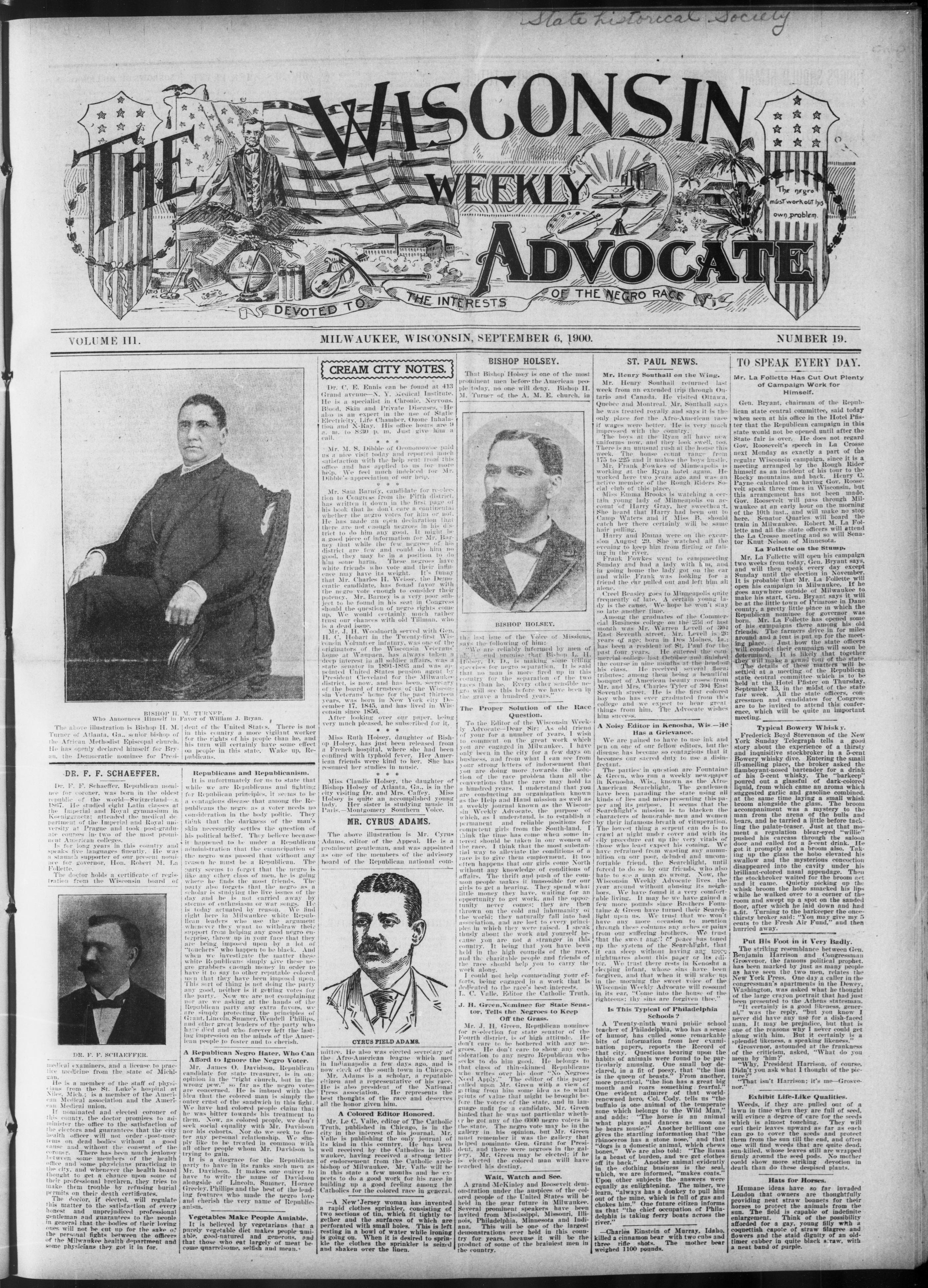
BISHOP H.
Who Announces Himself in
The above illustration is Bishop H. M. Turner of Atlanta, Ga., senior bishop of the African Methodist Episcopal church. He has openly declared himself for Bryan, the Democratic nominee for Presi-
DR. F. F. SCHAEFFER.
Dr. F. F. Schaeffer, Republican nominee for coroner, was born in the oldest republic of the world—Switzerland—in 1867. He studied eight Latin classes at the Imperial and Royal gymnasium in Koeniggraetz; attended the medical department of the Imperial and Royal university at Prague and took post-graduate courses in two of the most prominent American colleges. Is for long years in this country and speaks five languages fluently. He was a staunch supporter of our present nominee for governor, Hon. Robert M. La Follette. The doctor holds a certificate of registration from the Wisconsin board of
M. B.
DR. F. F. SCHAEFFER.
medical examiners, and a license to practice medicine from the state of Michigan.
He is a member of the staff of physicians from the St. Luke's hospital at Niles, Mich.; is a member of the American Medical association and the American Medical union.
If nominated and elected coroner of this county, the doctor promises to administer the office to the satisfaction of the electors and guarantees that the city health officer will not order post-mortems on dead bodies without a good cause and without the consent of the coroner. There has been much jealousy between some members of the health office and some physicians practicing in the city, and whenever the health board thought to get a chance upon some of their professional brethren, they tries to make them trouble by refusing burial permits on their death certificates.
The doctor, if elected, will regulate this matter to the satisfaction of every honest and unprejudiced professional gentleman and guarantees to the people in general that the bodies of their loving ones will not be cut up for the sake of the personal fights between the officers of the Milwaukee health department and some physicians they got it in for.
dent of the United States. There is not in this country a more vigilant worker for the rights of his people than he, and his turn will certainly have some effect on people in this state. Wake up, Republicans.
Republicans and Republicanism
It is unfortunately for us to state that while we are Republicans and fighting for Republican principles, it seems to be a contagious disease that among the Republicans the negro as a voter needs no consideration in the body politic. They think that the darkness of the man's skin necessarily settles the question of his political belief. They believe because it happened to be under a Republican administration that the emancipation of the negro was passed that without any reason he must be a Republican. The party seems to forget that the negro is like any other class of men, he is going where he finds the most friends. The party also forgets that the negro as a scholar is studying the live issues of the day and he is not carried away by storms of enthusiasm or war songs. He is today actuated by reason. We find right here in Milwaukee white Republican leaders who use the argument whenever they want to withdraw their support from helping any good negro enterprise, throw up in your face that they are being imposed upon by a lot of "touchers" who happen to be black. And when we investigate the matter these white Republicans simply give these negro grabbers enough money in order to have it to say to other reputable colored men that they have been imposed upon. This sort of thing is not doing the party any good, neither is it getting votes for the party. Now we are not complaining nor are we asking at the hands of the Republican party any extra favors, we are simply protecting the principles of Grant, Lincoln, Sumner, Wendell Phillips, and other great leaders of the party who have died and who forever left the lasting impression on the minds of the American people to foster and to cherish.
A Republican Negro Hater, Who Can
Afford to Amuse the Negro Voter
Mr. James O. Davidson. Republican candidate for state treasurer, is in our opinion in the "right church, but in the wrong pew." so far as the negro votes are concerned. He is imbued with the idea that the colored man is simply the outer crust of the sandwich in this fight. We have had colored people claim that he was bitter towards his treatment to them. Now, as colored people, we don't seek social equality with Mr. Davidson nor his cohorts. Nor do we seek to foster any personal relationship. We simply like to be treated in common with all other people whom Mr. Davidson is trying to gain.
It is a disgrace for the Republican party to have in its ranks such men as Mr. Davidson. It makes one ouiver to have to write the name of Davidson alongside of Lincoln, Sunner, Horace Greeley, Phillips and the best of the leading features who made the negro love and cherish the very name of Republicanism.
Vegetables Make People Amiable
It is believed by vegetarians that a purely vegetable diet makes people amiable, good-natured and generous, and that those who eat largely of meat become quarrelsome, selfish and mean.
CREAM CITY NOTES.
Dr. C. E. Ennis can be found at 413 Grand avenue—N. Y. Medical Institute. He is a specialist in Chronic, Nervous, Blood, Skin and Private Diseases. He also is an expert in the use of Static Electricity, Life Chamber, Ozone Inhalation and X-Ray. His office hours are 9 a. m. to 8:30 p. m. Just give him a call.
Mr. M. S. Dibble of Oecononowoe paid us a nice visit today and reported much satisfaction with the help sent ironi this office and has applied to us for more help. We feel much indebted for Mr. Dibble's appreciation of our help.
Mr. Sam Barney, candidate for re-election to Congress from the Fifth district, has written it down in the first page of his book that he don't care a continental whether the negro votes for him or not. He has made an open declaration that there are not enough negroes in his district to do him any good. It might be a good piece of information for Mr. Barney that while the few negroes of his district are few and could do him no good, they may be in a position to do him some harm. These negroes have white friends who vote and their influence may have its weight. It's funny that Mr. Charles H. Weisse, the Democratic candidate, has found favor with the negro vote enough to consider their potency. Mr. Barney is a very poor subject to be found in his seat in Congress should the question of negro rights come up. We would certainly much rather trust our chances with old Tillman, who is a dead issue.
Mr. J. H. Woodnorth served with Gen H. C. Hobart in the Twenty-first Wisconsin Volunteer infantry, was one of the originators of the Wisconsin Veterans' home at Waupaca, has always taken a deep interest in all soldier affairs, was a state senator in 1891-1893 and was appointed United States pension agent by President Cleveland for the Milwaukee district, is now, and has been, secretary of the board of trustees of the Wisconsin Veterans' home for the past thirteen years, was born in New York city December 17, 1845, and has lived in Wisconsin since 1856.
After looking over our paper, being very much pleased, he subscribed for it.
Miss Ruth Holsey, daughter of Bishop Holsey, has just been released from a French hospital, where she had been confined with typhoid fever. Her American friends were kind to her. She has resumed her studies in music.
* * *
Miss Claudie Holsey, the daughter of Bishop Holsey of Atlanta, Ga., is in the city visiting Dr. and Mrs. Caffey. Miss Holsey is quite an accomplished young lady. Her sister is studying music in Paris — Montgomery, Southern Voice.
MR. CYRUS ADAMS.
The above illustration is Mr. Cyrus Adams, editor of the Appeal. He is a prominent gentleman, and was appointed as one of the members of the advisory board of the Republican national com-
J.
CYRUS FIELD ADAMS.
mittee. He also was elected secretary of the Afro-American league which met in Indianapolis a few days ago, and is now clerk of the south town in Chicago. Mr. Adams is a scholar, a reputable citizen and a representative of his race. He is also president of the National Press association. He represents the best thoughts of the race and deserves all the honor given him.
A Colored Editor Honored
Mr. Le C. Valle, editor of The Catholic Truth, published in Chicago, is in the city in the interest of his journal. Mr. Valle is publishing the only journal of its kind in this country. He has been well received by the Catholics in Milwaukee, having received a strong letter of endorsement from the Catholic archbishop of Milwaukee. Mr. Valle will be in this state a few months and he expects to do a good work for his race in building up a good feeling among the Catholics for the colored race in general.
A New'Jersey woman has invented a rapid clothes sprinkler, consisting of two sections of tin, which fit tightly together and the surfaces of which are perforated with small holes. This is left resting in a bowl of water while ironing is going on. When it is desired to sprinkle the clothes the sprinkler is seized and shaken over the linen.
BISHOP HOLSEY.
That Bishop Holsey is one of the most prominent men before the American people today, no one will deny. Bishop H. M. Turner of the A. M. E. church, in
M. B.
the last issue of the Voice of Missions, says the following of him:
"We are reliably informed by men of alma and promise that Bishop L. H. Holsey, D. D., is making some telling speeches for negro separation. It is said that no man is more fired up in this country for the separation of the two races than he. Every other sensible negro will see this before we have been in the grave a hundred years."
The Proper Solution of the Race Question.
To the Editor of the Wisconsin Weekly Advocate—Dear Sir: As old friend of your for a number of years, I wish to comment on the great work which you are engaged in Milwaukee. I have only been in the city for a few days on business, and from what I can see from your strong letters of indorsement that you are doing more towards the solution of the race problem than all the conventions that the race may hold in a hundred years. I understand that you are conducting an organization known as the Help and Hand mission as well as a weekly journal known as the Wisconsin Weekly Advocate, the purpose of which, as I understand, is to establish a permanent and reliable positions for competent girls from the South-hand. I think the time has come when some interest should be taken in our women of the race. I think that the most substantial way to alleviate the conditions of a race is to give them employment. It too often happens that our girls come North without any knowledge of conditions of affairs. The thrift and push of the common people makes it impossible for our girls to get a hearing. They spend what little money they have, waiting for an opportunity to get work, and the opportunity never comes; they are then thrown on the cold and inhumanity of the world: they naturally fall into bad association, and are lost to every principles in which they were raised. I speak thusly about the work and yourself because you are not a stranger in this country. It being that you have been held in the high councils of the race, and the charitable people and friends of the race should help you to carry the work along.
I could not help commending your efforts, being engaged in a work that is dedicated to the race's best interests. L. C. Valle, Editor the Catholic Truth.
J. H. Green,Nominee for State Senator, Tells the Negroes to Keep Off the Grass.
Mr. J. H. Green, Republican nominee for re-election for state senator of the Fourth district, is of high attitude. He don't care to be bothered with any negroes. He don't care to show any consideration to any negro Republican who seeks to do him good. He belongs to that class of thin-skinned Republicans who writes over his door "No Negroes Need Apply." The editor of this paper called upon Mr. Green with a view of getting from him some idea as to what prints of value that might be brought before the voters of the state, and in language unfit for a candidate, Mr. Green hinted that he was not particular whether he got any of the 6000 negro voters in the state. The negro vote may be in the gallery in his opinion, but Mr. Green must remember it was the gallery that helped nominate Gen. Grant for President, and there were negroes in the gallery. Mr. Green may be elected; if he is elected the colored man will have reached his destiny.
Wait. Watch and See.
A grand McKinley and Roosevelt demonstration under the auspices of the colored people of the United States will be held in the near future in Milwaukee. Several prominent speakers have been invited from Mississippi, Missouri, Illinois, Philadelphia, Minnesota and Indiana. This will be one of the largest demonstrations ever held in this country for years, because it will be the product of some of the brainiest men in the country.
ST. PAUL NEWS.
Mr. Henry Southall on the Wing.
Mr. Henry Southall returned last week from an extended trip through Ontario and Canada. He visited Ottawa, Quebec and Montreal. Mr. Southall says he was treated royally and says it is the only place for the Afro-American race if wages were better. He is very much impressed with the country.
The boys at the Ryan all have new uniforms now, and they look swell, too. There is an unusual rush at the house this week. The house count range from 175 to 225 and it makes the boys hustle.
Mr. Frank Fowkes of Minneapolis is working at the Ryan hotel again. He worked here two years ago and was an active member of the Rough Riders Social club of this place.
Miss Emma Brooks is watching a certain young lady of Minneapolis on account of Harry Gray, her sweetheart. She heard that Harry had been out to Camp Waters and if Miss B. should catch her there certainly will be same hair pulling.
Harry and Emma were on the excursion August 29. She watched all the evening to keep him from flirting or falling in the river.
Frank Fowkes went to campmeeting Sunday and had a lady with him, and in going home the lady got on the car and while Frank was looking for a friend the car pulled out and left him all alone.
Creel Beasley goes to Minneapolis quite frequently of late. A certain young lady is the cause. We hope he won't stay so late another time.
Among the graduates of the Commercial Business college on the 23d of last month was Mr. Warren Levell of 304 East Seventh street. Mr. Levell is 26 years of age; born in Des Moines, Ia., has been a resident of St. Paul for the past four years. He entered the commercial college last October and finished the course in nine months at the head of his class. He received several floral tributes; among them being a beautiful bouquet of American beauty roses from Mr. and Mrs. Charles Tyler of 304 East Seventh street. He is the first colored boy who has ever graduated from this college and we expect to hear great things from him. The Advocate wishes him success.
A Noisy Editor in Kenosha, Wis.—He Has a Grievance.
We are pained to have to use ink and pen on one of our fellow editors, but the disease has become so contagious that it becomes our sacred duty to use a disinfectant.
The parties in question are Fountaine & Green, who run a weekly newspaper in Kenosha, Wis., known as the Afro-American Searchlight. The gentlemen have been parading the state using all kinds of lies and misrepresenting this paper and its purpose. It seems that the Searchlight's mission is to blacken the characters of honorable men and women by their infamous breath of vituperation. The lowest thing a serpent can do is to crawl at night under cover and with its oily procedure eat up the very vitals of those who least expect his coming. We have refrained from wasting any ammunition on our poor, deluded and uncomfortable friend, the Searchlight, until forced to do so by our friends, who also hate to see a man go wrong. Now, the Wisconsin Weekly Advocate lives the year around without abusing its neighbors. We have found it a very comfortable living. It may be we have gained a few more pounds since Brothers Fountaine & Green have turned their Searchlight upon us. We trust that we won't have any more occasion to mention through these columns any aches or pains from our suffering brothers. We trust that the sweet angel of peace has toned up the system of the Searchlight, that it can sleep without having any more nightmares about this paper or its editor. We trust there rests in Kenosha a sleeping infant, whose sins have been forgiven, and that when it will wake up in the morning the sweet voice of the Wisconsin Weekly Advocate will resound in its ear; "Come into the house of the righteous; thy sins are forgiven thee."
Is This Typical of Philadelphia Schools?
A Twenty-ninth ward public school teacher of Philadelphia, who has a sense of humor, has culled some remarkable bits of information from her examination papers, reports the Record of that city. Questions bearing upon the habits of animals were found to be particularly amusing. One small boy declared, in a fit of poesy, that "the lion is the queen of beasts." From another, more practical, "the lion has a great big mouth and roars something fearful." One evident admirer of that world-renowned hero, Col. Cody, tells us "the buffalo is one animal of the temperate zone which belongs to the Wild Man," and adds: "The horse is an animal what plays and dances as soon as he hears music." Another brilliant one gives the startling information that "the rhinoceros has a stone nose," and that "dogs is a domestic animal, which chews bones." We are also told: "The llama is a beast of burden, and we get clothes off its back." Another animal evidently in the clothing business is the seal, which, we are informed, "makes coats." Upon other subjects the answers were equally as enlightening. The miner, we learn, "always has a donkey to pull him out of the mine, which is full of gas and chokes him." One future citizen informs us that "the chief occupation of Philadelphia is taking ferry boats across the river."
—Charles Einstein of Murray, Idaho, killed a cinnamon bear with two cubs and three rifle shots. The mother bear weighed 1100 pounds.
TO SPEAK EYERY DAY.
Mr. La Follette Has Cut Out Plenty of Campaign Work for Himself.
Gen. Bryant, chairman of the Republican state central committee, said today when seen at his office in the Hotel Pfister that the Republican campaign in this state would not be opened until after the State fair is over. He does not regard Gov. Roosevelt's speech in La Crosse next Monday as exactly a part of the regular Wisconsin campaign, since it is a meeting arranged by the Rough Rider himself as an incident of his tour to the Rocky mountains and back. Henry C. Payne calculated on having Gov. Roosevelt speak three times in Wisconsin, but this arrangement has not been made, Gov. Roosevelt will pass through Milwaukee at an early hour on the morning of the 10th inst., and will make no stop here. Senator Quarles will board the train in Milwaukee. Robert M. La Follette and all the state officers will attend the La Crosse meeting and so will Senator Knut Nelson of Minnesota.
La Follette on the Stump.
Mr. La Follette will open his campaign two weeks from today, Gen. Bryant says, and will then speak every day except Sunday until the election in November. It is probable that Mr. La Follette will open his campaign in Milwaukee. If he goes anywhere outside of Milwaukee to make his start, Gen. Bryant says it will be at the little town of Primrose in Dane county, a pretty little place in which the Republican nominee for governor was born. Mr. La Follette has opened some of his campaigns there among his old friends. The farmers drive in for miles around and a tent is put up for the meeting place. Just how the state officers will conduct their campaign will soon be determined. It is likely that together they will make a grand tour of the state
The details of these matters will be settled at a meeting of the Republican state central committee which is to be held at the Hotel Pfister on Thursday, September 13, in the midst of the state fair week. All the state officers, congressmen and candidates for Congress are to be invited to attend this conference, which will be quite an important meeting.
Typical Bowery Whisky.
Frederick Boyd Stevenson of the New York Sunday Telegraph tells a good story about the experience of a thirsty and inquisitive stockbroker in a 5-cent Bowery whisky dive. Entering the small ill-smelling place, the broker asked the flamboyant-nosed bartender for a drink of his 5-cent whisky. The "barkeep" poured out a glassful of dark-colored liquid, from which came an aroma which suggested garlic and gasoline combined, at the same time laying a small whisk broom alongside the glass. The broom accompaniment was a mystery to the man from the arena of the bulls and bears, and he tarried a little before tackling the palate-teaser. Just at that moment a regulation blear-eyed "willie" pushed his carcass through the saloon door and called for a 5-cent drink. He got it promptly and a broom also. Taking up the glass the hobo elevated his swallow and the mysterious concoction disappeared into the cavity under his brilliant-colored nasal appendage. Then the stockbroker waited for the broom act and it came. Quietly picking up the whisk broom the hobo smacked his lips while he walked over to a corner of the room and swept up a spot on the sanded floor, after which he laid down and had a-fit. Turning to the barkeeper the once-thirsty broker said: "You may give my 5 cents to the Fresh Air Fund," and then hurried away.
Put His Foot in it Very Badly
The striking resemblance between Gen. Benjamin Harrison and Congressman Grosvenor, the famous political prophet, has been marked by just as many people as have seen the two men, relates the New York Press. One day a caller in the congressman's apartments in the Dewey, Washington, was asked what he thought of the large crayon portrait that had just been presented to the Athens statesman. "It certainly is a good likeness, general," was the reply, "but you know I never did have any use for a dish-faced man. It may be prejudice, but that is one of the reasons why I never could get along with him. But it certainly is a splendid likeness, a speaking likeness."
Grosvenor, astounded at the frankness of the criticism, asked, "What do you mean by 'him'?
"Why, President Harrison, of course. Didn't you ask what I thought of the picture?"
"That isn't Harrison; it's me—Grosvenor."
Exhibit Life-Like Qualities
Weeds, if they are pulled out of a lawn in time when they are full of seed, will evince a degree of care for the seeds which is almost touching. They will curl their leaves upward as far as each can go to cover the seeds and protect them from the sun till the end, and often one will find weeds that are quite dead, sun-killed, whose leaves still are wrapped firmly around the seed pods. No mother could show more striking devotion in death than do these despised plants.
Hats for Horses.
Humane ideas have so far invaded London that owners are thoughtfully providing neat straw bonnets for their horses to protect the animals from the sun. The field is capable of indefinite enlargement. Think of the possibility afforded for a gay, young filly with a coquettish capote of straw filagree and flowers and the staid dignity of an old-timer cabber in quite black straw, with a neat band of purple.
TROOPS SHOULD REMAIN
Chinese Would Interpret Evacuation as Defeat.
Europeans Continue to Demand Destruction of Pekin and Those Responsible for Outrages.
Shanghai, Sept. 4.—Dispatches announcing that the American government refuses to agree to the withdrawal of the troops from Pekin before satisfaction for the outrages upon and the losses of its subjects is given, have been received here and are applauded by the entire foreign colony in Shanghai. Any other policy, according to the business men and missionaries with whom the Associated press representative has talked, would be a vital blow to the prestige of the foreigners and would weaken their status in China. The local English papers fiercely denounce the proposals to evacuate Pekin and say that the Chinese would interpret evacuation as defeat. The masses of Chinamen now believe that the Chinese arms are victorious.
The Chinese papers printed in Shanghai contain long, circumstantial accounts of alleged Chinese victories at Pekin, Tien Tsin and Tung Chao, and the shops in the native quarter display for sale lurid photographs of the celestial army driving the European soldiers into the sea at Taku and cutting them to pieces at Tien Tsin. They also show pictures of the foreign admirals being tortured in the presence of the viceroys. Vice-Admiral Seymour is represented, with his arms pinioned, kowtowing before the throne. The Chinese accept these reports and pictures as correctly representing the situation and consider the reports of the English press as "merely foreign lies.
Punishment Demanded.
The European community continues to demand the destruction of Pekin and the exemplary punishment of the officials deeming indemnity and paper promises of new treaties inadequate. Undoubtedly the information in detail of massacres of foreigners daily received inflames this sentiment.
The Dowager Empress is living in the yamen at Tei Yuan Fu in Shan Si province. Fifty missionaries have been slaughtered in that yamen under orders, practically in the presence of the viceroy. Three were beheaded in the inner court, and others were killed barbarously in the outer courtyard. Their bodies were thrown to the dogs.
The Empress has ordered a commission to investigate the conduct of the Southern viceroyos who made a compact with the foreign consuls and their degradation is expected. No investigation of the officials opposed to foreigners has been ordered. The Associated press representative learns from official sources the facts of the killing of several American women missionaries.
Names of Victims Withheld.
At the request of the mission board the details were withheld out of regard for the feelings of the relatives of the murdered women. But other prominent Americans who have long antagonized the policy of sending women to isolated inland posts think it important that the facts should be made known. The names of the victims are withheld by request. Two of these women were captured while attempting to leave the stations where they were located, were led about the country naked, repeatedly outraged and finally killed by a method too revolting to be described. Two other American women were coming to the coast with a party, which a number of Chinamen followed and stoned. The women fell exhausted and were taken by the Chinamen into the presence of the local officials.
They were prostrated upon the execution block and a feint was made of beheading them. One of them became hysterical and laughed, and, thinking her insane, the Chinese escorted her to the coast because of their superstition regarding the insane. On the journey, however, the woman was repeatedly criminally assaulted by her escort. The other woman, after being exhibited naked for some days and suffering assault by several men, was tortured to death by the same shameful methods as were practiced in other cases. Two Swedish missionary women arrived at Shanghai after similar experiences except that their lives were spared. The foregoing are matters of official record.
Killed with Hay Forks.
The fourteen English missionaries, including six women and four children who were murdered at Chu Chua in the province of Che Kiang, according to the story of the Spanish priest who escaped, were killed with hay forks and ancient spears by the magistrate's bodyguards, and their naked bodies were hanged from trees. The incidents make a lenient policy unpopular in Shanghai, where all the victims had friends. Placards appeared today in all public places exhorting foreigners to oppose a compromise with the government and attacking Li Hung Chang, quoting the remark of Consul Goodnow, credited to Earl Li, that "the foreigners in Pekin, except the ministers, were of no account."
MESSAGE FROM CHAFFEE.
Wants to Know if Troops Are to Remain Until Peace is Restored.
Washington, D. C., Sept. 4. The following dispatch was received today by the war department from Gen. Chaffee: Written report of operations up to relief of legations will be forwarded as soon as possible. Present conditions are that hostilities have practically ceased; only occasional shots fired from cover; small party repairing telegraph line and foraging. No considerable body of Chinese troops (Boxers) discovered here or along line of communication.
We hear Li Hung Chang has full power, but he is not here. Will United States keep military force here until terms of peace are arranged? Now in China about 5000 effectives, consisting of Sixth cavalry, Light Battery F, Fifth arretillery, Battalions Third, Ninth infantry, Fourteenth infantry, and 1000 marines. I think force is ample for United States unless some political reason, not apparent to me, demands a large force. Shall take 5000 as basis of my requirement for supplies. If troops remain must winter in tents, and conical wall tents will be required, one tent for ten men. Escort wagons will be required immediately. Have mules for same shipped. No more pack trains required; wagon transportation best. Water falling in river rapidly; must soon haul supplies forty miles. Satisfied railroad will not be repaired before river freezes. All the transportation and tentage asked for by Gen. Chaffee has been anticipated by the department and has been shipped. Much of it is at Taku and the balance is due there very soon.
CHUNG LI ARRESTED.
Charged with Complicity in the Attacks on the Legations.
Pekin, Aug. 22.—Chung Li, a member of the tsung li yamen and prefect of police, visited the Austrian representative yesterday, who arrested him because of the Chinese official's complicity in the attacks on the legations. Sir Robert Hart, the director of the Chinese imperial maritime customs, has
resumed charge of the customs and has reopened the imperial posts. An Austrian official dispatch says Chung Li, who was arrested by the Austrian representative at Pekin, was military governor of Pekin, and adds that the Austro-Hungarian contingent is quartered in Chung Li's palace. After his arrest he was turned over to the Japanese.
Seek to Save the Palace.
Pekin, Aug. 26, via Shanghai, Sunday.—Ching Shin, Na Tung and Chung Li, members of the tsung li yamen, are trying to negotiate with the generals of the allied forces through Sir Robert Hart, director of imperial customs, in order to prevent the destruction of the innermost palace of the Forbidden City. With the same object in view, the Russians have occupied the palace. Resident Americans hope that the negotiations will not succeed. They think the city ought to be destroyed, that Na Tung and Chung Li should be beheaded, since they formed part of the cabal which caused the murder of Baron von Ketteler, and attempted to massacre all foreigners and that no leniency should be shown, or the next generation of Chinamen will repeat the crime.
THE RUSSIAN PROPOSAL.
Less than a Majority of the Powers Have Sent Replies.
Washington, D. C., Sept. 4. Minister Conger has been heard from again, his last advice being dated at Pekin on August 30. This message was received last evening. Preceding dispatches have occupied a week in their transmission from Pekin, according to the estimate of the state department, so that Mr. Conger's message marks a distinct betterment of the means of communication. Besides it includes the date of dispatch, something the department has been trying to have done for many weeks. The state department decided to make no statement as to the contents of the message, beyond the simple one that Mr. Conger's communication did not mark any material change in the situation in Pekin.
It is stated that up to the present less than a majority of the powers interested in the Chinese question have responded to the Russian proposal. Everything now depends on the action of Russia, the attitude of the other nations being negative, and if she does not hasten to carry out her announced purpose to withdraw the troops, the other governments probably will be content, cherishing the hope that in the meantime some kind of a Chinese government can be re-established in Pekin, with which the powers may negotiate for a final settlement.
Peace Negotiations.
Li Hung Chang's attempt to secure imperial warrant for the institution of peace negotiations, through himself and the Chinese notables referred to in the European dispatches, is regarded here as a step in the right direction, while on the other hand some disquiet has been caused by the report that the internationals in Pekin have been arresting some of the members of the tsung li yamen, who were seeking to open negotiations and reestablish the government. There is no disposition here to condone the offenses of any of these Chinese officials which may have participated in the outrages in Pekin, but it is questioned whether the present is an opportune time to administer punishment.
PEACE COMMISSIONERS
An Imperial Edict Appointing Li Hung Chang and Others.
London, Sept. 4.—Shanghai reports that an imperial edict issued at Tai-Yuan-Fu appoints Li Hung Chang, Yung Lu, Hsu Tung (tutor of the heir apparent), and Prince Ching commissioners to negotiate peace.
Four German warships arrived at Woo Sung September 3.
The unmistakable condemnation of the proposal to immediately withdraw from Pekin, which is voiced from all the foreign colonies in the far East, is taken in some quarters as a forecast of the opinion which may be expected from the ministers when their views are obtainable. As already suggested, the Russian proposals are capable of modification, and it is thought in well-informed circles that Lord Salisbury is striving to conform them more closely to the terms first formulated by the government at Washington.
According to a special dispatch from St. Petersburg, dealing with the question of Manchuria, the Russian officials repudiate any intention to permanently occupy or annex Manchuria. The dispatch adds that Russia will claim no territorial concessions provided the other powers refrain from so doing, and express the hope that the question of indemnities can be settled by the co-operation of the allied powers.
ENGLAND ASTONISHED
Counted on American Aid in Settling the Chinese Question.
London. Sept. 4.—Explanations of the American circular note, which have been cabled here from Washington have caused general astonishment. Whatever the state department may have meant to convey, Downing street understood the United States government to be supporting Russia's proposal for immediate retirement from Pekin. The British foreign office has received two disagreeable surprises in the last week. It was justly annoyed at finding that Russia after all her declarations of affection for the international concert had calmly given orders for the retirement of the Russian troops and legation without even waiting to hear what the other powers thought of the move.
Counted on American Aid.
English statesmen thought that they had a right to count on American aid in pursuing an unselfish policy which is for the common benefit of the civilized world, and they will be deeply disappointed to find that they are mistaken and that American regard for the "open door" and Chinese integrity is limited to words. The moment the United States is asked to accept some amount of responsibility it hastily effaces itself and executes a precipitate retreat.
Protest Against Evacuation.
New York, Sept. 4.—Rev. Dr. Dodd, one of the secretaries of the Methodist Episcopal Missionary society, received the following cablegram from Shanghai today, signed "Central China":
"Protest government against evacuation of Pekin and recognition of Li Hung Chang. Bch disastrous to missions."
Robert E. Speer of the Presbyterian board of foreign missions received a number of letters from Presbyterian missionaries to China today. One, from Samuel Cochrane, D. D., dated Arima, Japan, August 8, gives an account of the decapitation of nine missionaries near Hang Chow. Rev. Henry V. Noyes, writing from Canton, confirms previous reports that the authorities there were making extensive preparations to resist foreign attack. Germans Take Possession.
Berlin, Sept. 4.—An official dispatch from Taku announces the receipt of a telegram there from Pekin, dated August 25, saying the German troops have taken possession of a hill within the Imperial City. The dispatch adds that 2000 additional Italian troops have reached Taku.
Run Down and Killed.
Chicago, Ill., Sept. 4.—Frank Colligan, 8 years old, and Fred Williams, 9, were run down by a Chicago & North-Western passenger train near Rogers park today. Colligan was killed instantly and his companion sustained fatal injuries.
PEACE EFFORTS FUTILE.
London, Sept. 5.—The Chinese minister here has communicated to the foreign office an imperial edict dated Tai Yuan Fu, appointing commissioners to negotiate terms of peace in association with Li Hung Chang. Grave dissatisfaction is felt at the names of the commissioners. Earl Li had asked that Viceroys Liu Kun Yi and Chang Chih Tung and Prince Ching should be nominated. The court has ignored his suggestion for the nomination of the reforming Yang Tse viceroys and appointed instead Prince Ching. Yung Lu and Hau Tung. The two last named are violent and reactionary Manchus.
Little hope can be entertained of successful negotiations with a board thus constituted, and it is hoped that the powers will decline to treat with the two Manchu nobles. It is clear that the southern viceroys are to be proscribed and persecuted for declining to join in the recent anti-foreign movement and unless pressure can be brought to bear in their favor by the powers their lives and liberty may be in danger. This revelation of the persistent anti-foreign policy of the Chinese government makes the Russian proposal seem more than ever impolitic. So far from being frightened into repentence the Empress Dowager and her faction are steadily engaged in carrying on the crusade against alien influence. Some more striking measures may be required to produce the requisite impression, whereas if the troops should withdraw from Pekin, Chinese insolence and audacity will receive a fresh impetus and reform will be indefinitely postponed.
It is possible that the replies of Germany, Austria and Italy to the Russian proposal may take the form of a statement of the conditions under which those powers will be prepared to conclude peace with China, with reasons against withdrawing from Pekin until the terms are arranged.
FLIGHT OF THE EMPEROR.
Ran Away Because He Thought Powers Were Angry with Him.
London, Sept. 5.—A dispatch from Shanghai tells of the first official communication from the fugitive Emperor to Li Hung Chang, which pretends to explain the reasons for his flight. It is the first news from him, and was written while he was moving to a safer place with the Empress Dowager.
A dispatch to the Times from Shanghai, September 4, says: "An edict in the name of the Emperor to Li Hung Chang, dated August 19, en route to Taiyuenfu, explains that although the foreign powers had given assurances that their only object in bringing troops to the capital was the suppression of disorder, and that no harm was intended the imperial house, the Emperor felt it his duty, in view of the dangers apprehended from the assault on Pekin, and the approach of the allies to the forbidden city, to comply with the wishes of the Empress and accompany her westward, after giving instruction to Yung Lu, Hsu Tung and Thungchi to remain in the capital and continue to carry on the government.
Fears Powers Are Angry.
"Now fearing the foreign powers were incensed and unwilling to propose a peaceful settlement, the Emperor orders the viceroy to use every endeavor through the foreign offices abroad or the consulates at Shanghai to open negotiations.
"The Emperor praises his faithful services for the dynasty and assures him the gratitude of the throne.
"Li Hung Chang proposes to leave shortly for Tien Tsin, and meanwhile awaits a reply from the Emperor to a recent memorial praying him to appoint Prince Ching and the Yang-tse viceroys to assist him in the negotiations.
Pacific Edict is Published.
"An imperial edict from Shanghai, dated August 20, maintains the conciliatory tone, and transfers the principal metropolitan officials to Taiyuenfu, urges the provincial viceroys and governors to safeguard their territories, and bids the Yangtse viceroys to continue the policy of securing protection for missionaries and merchants, and maintaining a general sense of security.
"It is believed the court intends to remain at Taiyuenfu pending the negotiations.
"The native press today publishes an unconfirmed statement that Yung Lu is appointed to assist Li Hung Chang."
NOBODY WENT HUNGRY
Accounts of Suffering by the Legationers Were Exaggerated.
London, Sept. 5.—The Standard's correspondent in Tien Tsin sends an account of the arrival of the first party of refugees from Pekin. Most of them were American missionaries. The journey to Tien Tsin by boat occupied four days. No hostile Chinese were encountered on the way, but it was impossible for the refugees to take a rest and all the party seemed completely worn out. From the stories told by these refugees it would seem that the reports which had been circulated regarding the sufferings of the inmates of the legations during the siege were exaggerated. Nobody actually went hungry and the chief strain on the besieged was the constant fear lest the enemy should rush the defenses.
FLAME OF REBELLION.
Southern Provinces of China Ready for a Revolution.
Hong Kong, Sept. 5.—Influential natives state that the flame of rebellion has been fanned in the southern provinces, and predict a tremendous conflagration within a month. Placards and pamphlets are being circulated in Canton and the provinces intimating that the allies are thoroughly routed. The feeling against foreigners is bursting the bounds of official control.
The majority of the mission stations in Kwang Tung have been either destroyed or looted. Native Christians are terribly abused. Natives in foreign employ in Canton have been threatened, and a systematic looting has taken place of the houses of the English-speaking Chinamen.
Desire a Reform Government.
Several reform parties, with their headquarters in Hong Kong, who have been supported by funds from rich Chinese in the interior and in America, have hitherto refrained from aggressive action, believing that the powers would effect the regeneration of the government. One powerful organization is distributing thousands of copies of a reform appeal in the British colonies. The memorandum has been signed by 200 names for presentation to the British minister, imploring the assistance of a reform government. It recommends establishing Nankin as the capital and the selection of enlightened Chinese officials to admin-
ister the government, with foreign advisers
The people are disheartened at the reported intention of the powers to withdraw from China. Different societies are combining to raise the standard of revolt and overthrow the corrupt government. The practical cessation of trade with the north has thrown thousands of Chinese in each port out of employment, and they are ready to join the rebels. French aggression at Swatow and Japanese at Amoy intensifies the hatred of the foreigners.
Report that Special Commissioner Rockhill is to be Recalled.
Washington, D. C., Sept. 5.—W. W. Rockhill, who was recently sent to China as special commissioner of the United States to ascertain the extent of the responsibility of the Chinese government for the unsuccessful attempts to destroy the foreign legations in Pekin, may be recalled. At the cabinet meeting it was the consensus of opinion that Mr. Rockhill had committed an unpardonable offense at the very outset of his mission by submitting to a newspaper interview regarding the matters which he was to pass upon in an official capacity.
The only thing that will save Rockhill from humiliation will be a complete disavowal on the part of the correspondent who wrote the interview that the special commissioner talked to him. Rockhill's personal denial will not be sufficient. His chief recommendation was a positive statement that he was prudent and discreet, that he knew when to hold his tongue.
DISTRUST THE DOWAGER.
But Little Reliance Place on the Overtures for Peace.
London, Sept. 5.—No official pronouncement is yet forthcoming here in regard to the decision of the powers concerning China but the concensus of opinion continues suggestive of a compromise on the proposals now under consideration. In the meanwhile there is little authoritative indication that the Dowager Empress is ready to treat for peace even if the allied powers reach an agreement in regard to the best means of open negotiations. On the contrary, many rumors, gathered at Shanghai, suggest that she is carrying on her anti-foreign policy with increased zeal. The latest reported imperial decree from Tai Yuan Fu is said to be defiant and unrepentant and to contain the statement that the court fled lest the Emperor might be killed during the fighting between the Boxers and Christians and thus leave no one to continue the "ancestral worship." The decree is also said to exhort a union of the viceroys to "avenge the injuries inflicted on China" by the powers.
The Chinese minister here, Sir Chih Chen Lo Feng Luh, admits the correctness, in a general sense, of the cable message sent to him, according to Shanghai advices, by Li Hung Chang, in which the latter is quoted as saying: "Our St. Petersburg minister has persuaded Russia to leave Pekin. You are useless if you cannot persuade England."
The Chinese minister here also says he has sent a powerful memorial to Lord Salisbury urging him to adhere to the Russian proposal to withdraw the allied forces from Pekin, as he, Sir Chih Chen Lo Feng Luh, believes it will pave the way to a speedy settlement. The minister also said the Chinese people were sick of the war, that the genuineness of Li Hung Chang's plenipotentiary powers was undoubted, and that Li Hung Chang was working in full sympathy with the Emperor, Dowager Empress and privy council, all of whom favored peace. The minister added that he himself was still in communication with the Chinese government, whose authority remained entire and who were merely temporarily residing in the province of Shan Si.
A FIGHT WITH SHARKS.
Three Fishermen Attacked by the Man-Eaters and Bare-
San Rafael, Cal., Sept. 5.—With boathooks and oars William Miller, Manuel Ferruggio and John Fernandez, San Quentin fishermen, desperately fought their way through a school of sharks this morning. With their skiff in a sinking condition they made the shore just in time to escape death in the snapping jaws of the man-eaters.
The three fishermen put off from their camp to make their morning haul. When within a few yards of their buoys they found themselves surrounded by a swarm of the hungry monsters, who had wrecked the nets and were battling for the snails.
As one of the glistening creatures shot past the boat Ferruggio stabbed at it with a heavy boathook, while Miller hit it heavily with an oar. In an instant the little craft was attacked by a number of the fish, who battered its sides with their huge bodies, starting the planks and causing the boat to make water rapidly. After a brief resistance the fishermen abandoned the fight, but the sharks did not. As the men pulled their sinking boat to the shore they were pursued by the snapping creatures. It was not until the shallow water was reached that the chase was given up.
BURIES HUSBAND ALIVE.
A Novel Cure for Rheumatism Is Devised by a Menominee, Mich.. Woman.
Menominee, Mich., Sept. 5.—[Special.]
—Mrs. Chris Omlette tried to bury her aged husband alive this morning, believing he could thus be cured of rheumatism. A hole was dug and the man, divested of clothing, was placed in a standing posture and covered with earth up to the chin. The woman stood guard threatening anybody who dared to interfere. She was finally overpowered by the officers, who took the old man from his untimely grave.
POISONED MELONS KILL BOYS.
Joseph Dakus, a Missouri Farmer, Arrested on a Serious Charge. Poplar Bluff, Mo., Sept. 5.—Joseph Dakus, a leading Howell county farmer, is charged with poisoning melons in his patch and causing the death of nine boys. The deaths occurred three weeks ago in different families. All were taken sick suddenly and the doctors who were called upon to attend them stated that their deaths were caused by poison. Several other boys who were taken ill recovered, and they admitted having visited Dakus' melon patch and helping themselves.
LEOPOLO TO ABDICATE.
King of the Belgians to Quit When Prince Albert is Married.
Brussels, Sept. 5. According to official announcement just issued, the marriage of Prince Albert and of the Duchess Elizabeth of Bavaria will take place here in the ancient church of St. Gudule on October 1. It is persistently reported that immediately after the wedding, which will be celebrated with a good deal of pomp, Leopold will abdicate in favor of Prince Albert.
BIG BESSEMER PLANT.
Chicago, Ill., Sept. 4.—The American Steel and Wire company of New Jersey has under consideration plans for the construction of an immense Bessener plant at Waukegan, Ill., with a capacity of 1000 tons a day and to cost $3,000,000. If the plans are carried out, as is probable, the company will become a factor in the structural steel business. This special line is now principally in the hands of the Carnegie interests, but if the American Steel and Wire enters the field on an extensive scale the Pittsburg company will have a vigorous competitor in the Middle and Northwestern states. John W. Gates is back from Europe to attend a meeting this morning in New York city of the directors, which, according to report, will take up this proposition of entering the merchant and structural steel field.
Reports have been current from time to time of late that the company intended to branch out from its enormous production of plain, galvanized and barbed wire, field and fence netting, nails and staples, rods and bale ties. Last year the company turned out 6500 tons of merchant and structural iron at its mills in the Cleveland district. Even this small output called forth a protest from Pittsburg.
A visit to the Steel and Wire company's property at Waukegan shows that it is fully able to accommodate an immense plant there. There are forty acres of land on the lake front just north of the general works that are ideally situated for the purpose, and will allow of the use of the most approved appliances for the economical handling of the iron ore as it comes from the mines until it is turned out a finished product. Dock facilities may be had by the construction of a wharf at which iron ore vessels can unload directly into ore bins at the smelters and blast furnaces. A vessel of ordinary size can be unloaded in one day with the services of twelve men.
A RUMORED PURCHASE.
North-Western and Milwaukee Roads After South Dakota Business
Hot Springs, Ark., Sept. 4.—It is rumored that the North-Western Railroad company has purchased the Black Hills & Fort Pierre narrow-gauge road, which connects with the Elkhorn at Piedmont and runs to Lead City. The rumor has not been confirmed, though the two systems have for some time been very closely associated. It is stated that a through service will be placed on the line to Lead City.
Chamberlain, S. D., Sept. 4.—There is again considerable talk in railroad circles that the Milwaukee and North-Western are ready to move on across the Missouri river from Chamberlain and Pierre, respectively, and that each will make a start on a short line. The rapid development of the stock country between the Missouri and the Black Hills and the renewed activity in the mining industry in the latter, makes an amount of business worth going after, and these two great railway systems will be likely to run a race for it. The impression is quite general among contractors and railroad men that the work is likely to begin at any time now. The Milwaukee sent out plans of the bridge to be built here to contractors last spring with the understanding that they would ask for bids later on.
WRECK ON NORTH-WESTERN.
Train Goes Over an Embankment
Near Freeport-One Killed.
Freeport, Ill., Sept. 4.—Patrick Ryan
of Freeport, an engineer on the Chicago
& North-Western road, was instantly
killed in a wreck that occurred last night
three miles east of Ridott station and
fourteen miles from this city. The train
was six minutes late out of Pecatonica.
Lrounding a curve the engine went
over an embankment, the engineer being
killed by being pinioned by the reverse
lever. He was buried underneath the
wreck. The coaches all left the track.
The injured are:
J. D. GRANT, Rockford; right side
injured.
J. W. HUDSON, porter, Chicago; left
thigh injured and internal injuries.
MRS. JENNIE WOHLFORD, Freeport;
F. KEISAL, Freeport; left knee badly
hurt.
ALBERT GRATTELO, Freeport; side in-
ALBERT GRATTELO, Freeport; side infured.
jured.
ADAM WIRTH, Freeport; leg crushed and side injured.
DR. CARVER, Freeport; neck and shoulder injured.
W. A. WALKER, Chicago; back and leg injured.
ALBERT JEWELL, fireman, who lives in Chicago, was badly shaken up, but escaped injury otherwise.
STOLE TO COVER BARE FEET.
Night Watchman Made Shoes for His Babes from His Friend's Leather.
St. Louis, Mo., Sept. 4.—"I stole leather from the factory where I worked to make shoes for my children to wear to school. I am a cripple, and I had a hard time keeping my family on $10 a week. I worked from 6 o'clock at night to 6 the next morning, but I had a little time to do my own cobbling, and this is all I took the leather for."
Such is the statement of Robert Wagner, night watchman of the Brown Shoe company, who was arrested on the charge of stealing leather. Wagner became crippled while working as a machinist, and was made night watchman by the manager, his friend.
GAMBLING HOUSE IN MANILA
Denver Man Plans to Fleece the American Soldiers.
Denver, Col., Sept. 4.—George L'Abbe is organizing a stock company to establish an American gambling house and vaudeville theater in Manila for the amusement of the American soldiers.
"There is plenty of room for a first-class American house there," he said.
"Gambling ventures have not proved successful in Nome, where the people went broke early in the game, but in Manila the outlook is more encouraging."
Indians in Politics.
The Indians are not an important political factor in this country, but there is a county in Nebraska—Thurston county—where they hold the balance of power between the parties, and are cultivated accordingly by the politicians. They number about 1500 and comprise Omahas and Winnebagoes.
Electric Propulsion on Canals.
Electricity for the propulsion of boats will probably be used on all the leading canals of this and other countries before very long. On some of these waterways the system has already been inaugurated.
Beat England and Germany
The steel production of the United States during 1899 was nearly 10,750,000 tons. That is about 4,500,000 tons in excess of Germany's total and about 6,000,000 tons in excess of Great Britain.
The horse trade is good all the world over. One hundred and fifty thousand horses and mules have been landed in South Africa since the beginning of the war.
SORROWS OF MILLIONAIRES
He Travels so Much that He Gets no Rest During the Year-
Look at the ways of the millionaire. Given his million, he gives up his house and builds himself a small, first-class hotel in some big city, which for the greater part of the year is occupied by servants. He next erects a country palace at Lenox or at Newport. This he calls a cottage, though it usually looks more like a public library or a hospital or a clubhouse. Then he builds himself a camp, with stained-glass windows, in the Adirondacks, and has to float a small railroad in order to get himself and his wife's trunks into camp. Shortly after these follows a bungalow modeled after a French chateau, somewhere in the South, and then a yacht warranted to cross the ocean in ten days and to produce seasickness twelve hours sooner than the regular ocean steamer becomes one of the necessities of life.
Result, he never lives anywhere. To occupy all his residences, camps and bungalows he has to keep eternally on the move, and when he thinks he needs a trip to Europe he has his yacht got ready and sends it over, going himself on a fast steamer. Oh, it's a terrible thing to be a millionaire and have nowhere to lay one's head, with every poorer man envying him, many hating him and hands raised against him everywhere!—Woman's Home Companion.
Bridles Used Ages Ago.
Bridles were in use in very distant ages. Ancient Thessalian coins often represent a horse with a long rein touching the ground. The young Romans were trained to ride and mount unassisted, but the use of the bridle was known from the first. According to Livy, Aulus Cornelius, in a battle with the Fidenae, ordered the Roman cavalry to unbridle before charging, probably to give them more weight.
An Old Danish Bible.
An old Danish lady residing in Texas has a Bible printed in the Danish language. It is a big volume over a foot long and five inches in thickness. The book is bound in leather with a covering of thick board sides. It contains Martin Luther's commentaries, under the direction of King Christian IV., King of Denmark and Sweden, in the year 1633.
Aluminum Theater Curtains.
Aluminum has just been employed for the construction of a new fireproof curtain to be used in theaters. The curtain is 60 feet wide and 54 feet high, is composed of aluminum sheets one-twelfth of an inch thick, and weighs 4000 pounds.
MARKET REPORTS.
Milwaukee, Sept. 5, 1900.
EGG AND DIESEL PRODUCTION.
MILWAUKEE—Eggs—Market firm; fresh,
cases included, 13c; fresh, cases returned,
12%c; old, cases included, 12%c; dirties and
seconds, 76%c. The receipts were 629 cases.
Butter—Market firm. The receipts were
21,715 lbs today against 41,900 yesterday.
The scarcity of butter has caused a very
firm feeling here. The demand here
is good for all choice grades of
dairy and creamery. Low grades also
sell fairly well. Dairy is very scarce and
wanted here. No change is looked for at
Elgin, as the market is firm and prices
about right. Fancy prints, 22%c; 22c; fancy
or extra creamery, per lb. 21%c; 22c; firsts,
20c; seconds, 17c; dairy prints, 18%c; extra
dairy, 18c; lines, 14%c; packing stock,
13%c; whey butter, 11c; grease, 4%c.
Cheese—Steady. The receipts today were 13,150 lbs against 30,360 yesterday. Full cream flats, new, colored, 10@10%c; New York, full cream flats, new, colored, 10@10%c; Young An ericas, new, 10@11%c; brick, 9@10%c; limburger, per lb, 8@19%c; imported Swiss, 24c; Block Swiss, domestic, 12@12%c; No. 1 imitation loaf, 14@15%c; Sapsa go, 10@20%c; farmers, 10@11%c.
NEW YORK—Butter — Receipts, 192 pkgs; steady; creamery, 17@22%c; factory, 14@17%c. Cheese—Firm; receipts, 10,412 pkgs; firm; large white, 10%c; small white, 10@10%c; large colored, 10%c; small colored, 10%c. Eggs—Receipts, 11,769 pkgs; firm; Western regular package, at mark, 10@16%c; Western, loss off, 17@18%c. Sugar—Strong; fair refining, 4%c; refined firm; granulated, 6.15%c. Coffee—Easy; No. 7 Rio, 8%c.
CHICAGO—Butter — Firm; creameries, 18@21%c; dairyies, 14@18%c. Eggs—Firm; fresh, 15c.
SHEBOYGAN FALLS, Wls.—On the board offerings were 1437 boxes. Sales were 282 daisies at 11½c; 133 at 11½c; 538 Young Americas at 11c; 338 at 11½c; 133 longhorns at 11½@11½c; and a few twins at 10c.
PLYMOUTH, Wls.—Nineteen factories offered 2226 boxes cheese and all sold as follows: 30 longhorns, 11½c; 419 daisies, 11½c; 996 do, 11½c; 50 twins, 10c: 211 do, 10½c; 60 do, 10½c; 125 Young Americas, 10½c; 326 do, 11c.
SEYMOUR, Wls.—Sales of cheese were 398 boxes twins at 9½c; 249 daisies at 10½c.
WILWAUKEE LIVESTOCK MARKET.
HOGS—Receipts, 5 cars; market steady; light, 5.15@5.45; mixed and medium weights, 5.15@5.35; fair to choice heavy, 5.15@5.30; common to good packers, 4.90@5.15
CATTLE—Receipts, 4 cars; steady; butcher
steers, medium to good, 1050 to 1300 lbs,
4.50@5.25; fair to medium, 950 to 1050, 4.00
@4.50; heifers, good to choice, 3.50@4.50;
cows, fair to good, 2.75@3.50; canners, 1.75
@2.50; bulls, common, 2.50@2.85; choice,
3.00@3.50; feeders, 800 to 950 lbs, 3.50@
3.85; stockers, 500 to 750 lbs, 3.25@3.65;
veal calves, 5.50@7.00; milkers and spring-
ers, common, 20,00@28.00; choice heavy
cows, 35,00@45.00.
SHEEP—Receipts, 1 car; market steady,
3.00@3.50; bucks, 2.25@2.75; spring lambs,
4.00@4.85.
Chicago receipts: Hogs, 26,000; cattle,
20,000; sheep, 16,000.
MARKETS BY TELEGRAPH
MILWAUKEE—Flour—Steady. Wheat—Steady; No. 2 spring, on track, 72@73c. Corn—Steady; No. 3 on track, 41%c. Oats—Steady; No. 2 white, on track, 25c; No. 3 white, on track, 24@24%c. Barley—Steady. No. 2 on track, 51%c; sample on track, 41@51%c. Rye—Steady; No. 1 on track, 53c. Provisions—Higher; pork, 10.90; lard, 6.72. Flour is steady at 4.05@4.10 for patients; bakers', 3.65@3.10, and 2.85@3.00 for rye. Milstuffs are firm and quoted at 13.75@14.00 for bran, 14.25@14.50 for standard middlings and 15.75@16.00 for Milwaukee flour middlings.
CHICAGO—Close — Wheat — September,
73%@73%; October, 73%c; November, 74%c.
Corn—September, 39c; October, 38c; November,
35%c; Oats—September, 21@21%c; October,
21%c; November, 21%@21%c. Pork—September,
10.90; October, 11.00; January,
11.20. Lard—September, 6.72%c; October,
6.75. November, 6.72%@6.75; December,
6.52%@6.55; January, 6.50@6.52%c. Ribs—September,
7.30; October, 7.10; January,
5.87%@5.90. Flax—Cash N. W., 1.52%@1.54;
S. W., 1.52@1.53%c; September, 1.50; October,
1.45%c. Rye—September, 50%c; October,
50%c. Barley—Cash, 38%c. Timothy—September, 3.97%c; October, 3.92%c. Clover—October, 9.50@9.75.
KANSAS CITY, Mo.—Wheat—December,
60%c; cash No. 2 hard, 64%@65c; No. 2 red,
68%@70c. Corn—September, 35%c; December,
32%@32%c; May, 34%c; cash No. 2 mixed,
37%@37%c; No. 2 white, 37%c; Oats-No. 2 white, 26c.
NEW YORK—Close—Wheat—September,
78%c; December, 80%c; Corn—September,
44%c; December, 40%c.
LIVERPOOL—Wheat steady, 1/4 lower; September, 511/12d; December, 6s11/12d. Corn quiet, 1/4%d lower; October, 4s11/12d. November, 4s11/12d; December, 4s11/12d. Duluth, Minn.—Close—Wheat—No. 1 hard cash, 77%c; to arrive, old, 77%c; new, 77%c; September, 77%c; December, 78%c; No. 1 Northern cash, 75%c; to arrive, old, 75%c; new, 75%c; September, 75%c; December, 76%c; No. 2 Northern, 71%c; No. 3 spring, 68%c; Oats—22%@22%c. Minneapolis, Minn.—Close—Wheat—September, 72%c; December, 74%c. On track—No. 1 hard, 75%c; No. 1 Northern, 73%c; No. 2 Northern, 72%c. ST. LOUIS—Catlinie—Receipts, 3000; Texans steady; natives slow to lower; native steers, 4.20@5.85; stockers and feeders, 3.15@4.30; cows and heifers, 2.00@4.60; Texas and Indian steers, 3.30@4.70. Hogs—Receipts, 4000; strong; pigs and lights, 5.20@5.50; packers, 5.20@5.50; butchers', 5.35@5.40. Sheep—Receipts, 1300; steady; native muttons, 3.50@4.00; lambs, 4.00@5.10.
LOVE AND NATURE.
And from her languid lids the bandage takes To look with wondering eyes upon the world. The trees unfold their robes of silvery green.
And I, dear Love, have you.
Dear Love, in Summer-time, each lengthened day
To harvest-fields a tribute rich must pay
Of sunshine packed in grains of yellow corn.
The earth is weighted with the season's store—
No creature, tree, nor vine can ask for more.
Nature has satisfied each bird and bee—
Has given you to me.
As Winter clasps them to her icy breast. Nature must wake and work and rest
And Nature, life, and love are one I know,
Because I love you so.
—Anne C. Steele in Harper's Bazar.
"THE LONG ARM."
"THE LONG ARM."
It was 6 o'clock in the evening, and the editor of the Monthly Rocket sat alone in his room at a large desk, strewn with papers and cuttings, gazing thoughtfully at the sheets of manuscript which he had taken from a pile before him.
"I can't understand it at all," he was thinking. "Except for the change of scene, and the matter of turning a collision into a fire—the two stories are practically identical. At any rate, they're rather too similar for me to pass the matter over. The extra chapter is original enough, though, and really well written, I'll admit. But what on earth possessed the fellow to send it here, out of all the offices in town where it might have gone instead? The whole thing is quite beyond me."
"I don't know quite what to say at this early stage in the proceedings," he said slowly; "but, let me see, first of all, what's the sender's name and address? Ah! 'Claude Hellingham, 14 Cadogan street, W.'"
He paused irresolutely for a second, and then wrote on the sheet in front of him:
"Dear Sir—If the author of the short story, 'The Solitary Soul,' will call at this office at 3 o'clock on Thursday afternoon, I or my representative will be glad to see him."
"There, that ought to fetch him," said the man, with a peculiar smile, as he signed the letter, "Douglas Baird, Editor." Then directing the envelope to the address given on the manuscript, he posted it at the corner of the street on his way home.
On the afternoon of the following Thursday, Douglas Baird sat in his office again. He was obviously not quite at his ease, and from time to time he would open one of the drawers of his desk and examine the papers it contained, as if to assure himself that none of them were missing. Presently he looked at his watch. "H'm! a quarter past 3 already," he mused. "I wonder if my correspondent is going to fight shy, after all?"
is going to right sn.
A tap at the door interrupted his soliloquy. In answer to his somewhat surly "Come in!" the visitor entered.
The editor of the Monthly Rocket sightly raised his eyebrows. Accustomed as he was to all sorts and conditions of visitors, it was not often that such a pretty girl as this invaded his office. His surliness vanished instantly. He could be charming to ladies when he chose. This was one of these occasions. Accordingly, he set a chair for the visitor and returned her timid greeting with a geniality calculated to dispel her very obvious nervousness.
It was a young but sad and troubled face that looked at him across the desk. The soft, fair hair might have adorned the sunny head of a child, but the girlish mouth had assumed a curve of unnatural determination, and the blue eyes were full of that awful fear which is to be seen only in the eyes of the refined noor.
"I have a letter from Mr. Baird, the editor—I don't know if you are he—asking me to call at 3 today," said the girl.
"I am the editor, certainly; but I can't recollect writing to Miss—Chester. In fact, I expect someone else at this hour."
"Mr. Claude Hellingham, perhaps?"
"Yes! Do you know him, then?" asked the man eagerly.
"Oh, yes, I think I may say I do, a little," she replied, smiling again. "In fact, I—I am the individual himself."
"I don't quite understand," returned Baird, wonderingly. "Is there such a person at all, then?" "Oh, yes, very much so—I'm he—or, rather, he's my nom de guerre," she answered quietly, seeming to enjoy his evident mystification. "You?" he replied. "You? What on earth made you take such a pseudonym?" he demanded wonderingly. "Oh! because I thought a man's name would give my story a better chance of acceptance. But why did you write to me?" she continued anxiously. "I was so glad to get your letter! I thought you had accepted the tale. You are going to publish it, aren't you?" she added, all her smiles vanishing. "No," said Baird, looking at her steadily: "I don't think I shall."
The girl's eyes filled at the answer, and, as he saw the bitter disappointment in her face, the editor began to feel quite remorseful. It was a deuced awkward business, he told himself.
"I am sorry. Miss Chester," he said, pulling himself together with an effort, "that you should have thought my letter meant acceptance of your contribution. Before we go any further, however, let me ask you one question. Did you send in that story. 'The Solitary Soul' as original matter?"
A pause ensued. The ticking of a clock on the mantelpiece alone broke the silence of the room. The editor watched the woman keenly—a sudden spasm passed over her face and a hunted look came into her eyes. Then for the first time the man noticed her pallor and the poverty of her attire; she had clasped her hands together, as if to make an appeal, and he saw that even her gloves were carefully mended.
"If you would rather not answer," he said gently, and in a very different tone to that which he had intended to adopt towards "Mr. Hellingham," "you need not do so. Only. I think you must acknowledge that it is impossible for me to publish the story in my magazine."
"Will you tell me w—why?" she asked, trying to control her voice. "I will own that I shouldn't have offered it to you without an explanation, perhaps. But I
For answer he took from a drawer a newspaper and a pile of manuscript. "This is your manuscript." he remarked, watching her keenly as she put out her hand for it; "and this." he added gravely, taking up the paper, "is the journal in which a certain story entitled 'The Liar' appeared. Now, perhaps, you will understand."
The girl's hand trembled so that she could hardly hold the printed sheet. After a momentary glance, she laid it down again, and then, turning her blanched face to him, she said tremuously, "I—ask your pardon."
"Will you tell me, Miss Chester," he
asked slowly, "why you sent this to me? Was it for the sake of getting into print—a natural enough vanity, I'll allow; or," he continued in a softer tone, "was the payment that you would have received, had the manuscript been accepted, an important consideration?"
"Oh, Mr. Baird!" she exclaimed, trying to regain her composure; "I know it was a dreadfully dishonorable thing to do, but—but you don't know how hard it has been for me in London. A woman has no chance at all, and, for a girl like me, without interest or friends, it seems impossible to get work. I've lost heart utterly, now, and I'm so tired of it all!" "Have you met with any success at all?" he asked sympathetically.
"Yes—a little, but not very much, and nothing regular. I got some fair regular work on the Morning Comet, but the paper failed last summer—and left some money owing to me, too," she added, sadly.
"That was hard lines! Did you write much for it?"
"Yes, a good deal. I did all those articles on 'The Provincialism of London,' and also the serial, 'The Heart of a Woman,' with some short tales as well."
"By jove! was it you who wrote 'The Heart of a Woman,' then?" he exclaimed with interest. "How silly of me! I ought to have remembered the name. It was a capital story—you should get it published in volume form. I'm sure it would succeed."
"I've tried to, but it was no good. The first firm I offered it to kept it for seven months, and then wrote to say they would bring the story out if I would bear the expense. The next people who considered it were not so bad; they asked me to pay only half the cost. I knew they were a good firm, and would treat me well, and so I tried to get the money before the book would be too much out-of-date." "That is why you sent this manuscript to me then?"
"Yes. I saw that you were offering 25 guineas for the best 10,000-word story. The money meant such a lot to me, and I was so awfully hard-up! I began a story and got half-way through with it; but it wasn't alive, and I, somehow, couldn't get on with it. Then, one day, I came across an old file of the Capetown Mercury in the reading room at the museum. I saw a story called 'The Liar' in it, and liked the central idea very much. I worked it up and changed the construction a little, and added another chapter; and then—well, then I sent it here. I never imagined anyone would recognize it. The paper was over ten years old, and had lasted only a dozen numbers.
"And now, I think I've nothing more to say," she went on, "except that I'm ever so sorry about it all! I hope you won't think too badly of me—it was such a temptation! Will you tell me, though"—her voice faltered—"how it was you found out? I didn't think anyone in London could have read the Capetown Mercury, or, even if they had read 'The Liar,' that they could remember it now. It is a curious coincidence, of course?" "Yes," answered the man slowly, "an extraordinary coincidence. The fact is, though—er—I myself happen to be the original author of 'The Liar.'—The Sketch
SINGING INSECTS OF JAPAN.
They Are Caged and Are Highly Prized for Their Musical Notes.
Singing birds are esteemed in all countries, but it is only in Japan that the musical sounds emitted by certain insects are appreciated.
Listening to these minute singers is, and has been for many centuries, a favorite pastime of the Japanese, and has given birth to an original commerce.
At Tokio, toward the end of May and the beginning of June, one sees suspended under the verandas of homes beautiful little cages of bamboo from which break upon the silence of the fresh twilight strange little whistlings of metallic modulations of light trills, which fill the air with a delicate music. It is habitually in the evening, after the hour of the bath, that the people of Tokio seat themselves and listen with delight to the shrill concert.
The most prized of these singing insects is the suzuuushi. Its name means "insect bell," and the sound which it emits resembles that of a tiny silver bell. It is a tiny black bettle, of a flat body and very vulgar appearance. The kutsuwa-mushi is so named because its cry resembles the sound made by a horse in champing his bit. There are two species of it, the one a light yellow and the other a pale green. Really this insect is none other than a kind of winged grasshopper of fat body and common in many countries.
Another singing insect much esteemed is the kirigirisu, which is but a very large grasshopper, producing variety, strident sounds. Then there is the enamkorogi, which is a kind of cricket; the kusahibari, a minute grasshopper, which has a sound of remarkable clearness; the kantan, originally from China, and which sings only at midnight; the kanetataki, whose song resembles the faraway sound of a clock. In Tokio alone there are over forty merchants dealing in singing insects. Formerly they would go in parties to places where the little musicians abounded, pass the night there extended upon mats, drinking tea or saki and listening to the harmony of the suzumushi and kutsuwa-nushi.
It is only about 100 years ago that an amateur named Choso had the idea of capturing one of these insects for his own particular diversion. Then, the singing season over, he forgot a certain number in a closed vase. Great was his surprise on opening it the following year, to find it filled with newly-hatched young. After that he gave himself up to the raising of various species of singing insects, and so founded a trade which has become flourishing. Actually the greatest number of singing insects are artificially raised by certain proceedings, so that their hatching corresponds to the seasons when their admirers love to listen to them and to combine their sounds. St. Louis Globe-Democrat.
Moss an Antidote for Snake and Spider Bites.
Kent has convinced himself that one of the club-mosses—Salaginella apus—is a perfect antidote for the poison of snakes and spiders. This plant is familiarly called "Snake-Moss," and its virtues were known to the Indians of Virginia. About one-half dram of the moss is macerated thoroughly with one ounce of sweet milk. The milk containing small fragments of the moss is then drank by the patient, while the balance is bound upon the wound. The writer cites a number of cases of successful use of this remedy, of which the following is a good example:
James T., aged 11 years, was bitten over his right instep by a large copperhead moccasin. One hour after the bite he was suffering much pain, and the foot was swollen to twice its natural size. Moss was at once given with milk, with almost immediate relief of pain. Next morning the swelling was all gone, and the boy was at play, with only a scratch of the bite to remind him of his encounter with the snake.—Charleston Medical Journal.
Talked Too Long.
It happened at a hotel not far from the famous, busy Strand, says Tit-Bits. He was a man of serious intentions and numerous attentions, and she was rich and weddable. On Monday night he was there, and they sat in the hall under the stairway. It was a nook for lovers. There wasn't a soul in sight, and he thought his golden opportunity had arrived. Down he flopped upon his knees and clasped her hand. "Dear one," he whispered, not very
loud, but loud enough, "I have loved you with the whole strength and ardor of a man's nature, when it is roused by all that is pure and good and lovely in woman, and I can no longer restrain my pent-up feelings. I must let you know what is in my heart, and tell you that never yet has woman heard from my lips the secrets that are throbbing and—" Just then a rustle was heard on the stairs above them, and a card fastened to a thread swung down and dangled not two inches from the lover's nose. On it were these portentous words: "I am something of a liar myself." Then the awful truth flashed upon him, and he fled. As he went out of the door sixteen girls at the head of the stairs sent sixteen laughs out into the damp night air after him. He makes no love in hotels now.
THE PAPER POWDER BOOK.
Dainty Device that is a Boon to
Worries Halls from Paris.
Feminine visitors to the exposition have been revelling in that clever device of a Frenchman known as the Papier Poudre. It is a many-leaved little book, which is taking the place of the powder puff. Every woman knows the dreadful state to which her complexion descends when heat and hurry combine for its undoing. Many ladies, especially French women, carry a little powder puff with them always, and when the nose gets shiny or the skin otherwise presents an appearance incompatible with good looks, they give their faces a dab with it and harmony is restored. But the powder puff is inconvenient, and so French ingenuity went to work to devise a substitute. This it cleverly did in the little book of powder leaves. These leaves are prepared with a dainty perfumed powder and have the same admirable effect on the skin as the use of the old-time puff. One simply tears a leaf out of the book, wipes her face with it, and throws it away. The book can be slipped into an ordinary cardcase or pocketbook, or a number of leaves can be torn out of it and taken on one's shopping or calling expeditions. Its cost is but a dime, so that every woman who desires can own one. One lady so appreciated their usefulness while abroad that, fearing she could not get them here, she brought home a goodly supply. Imagine her feelings when she found that what had cost her a shilling each in London were here priced at 10 cents.
A Corridor Omnibus.
Anything that may be done to increase the comforts or to decrease the discomforts of those who travel by omnibus must be of great importance to the public, when the enormous number of passengers carried annually by the two great omnibus companies is remembered, not to mention those conveyed by the vehicles of private proprietors and small companies.
It would seem that the next step in this direction is to be initiated by one of the latter—the City and Suburban Omnibus company—which yesterday had on view at the back of the Great Central hotel, Marylebone, a type of the new omnibus which they hope shortly to place on the Putney to Liverpool street route. The chief novelty of the new omnibus, which is built from the designs of W. Berg, from the point of view of the public, is that the seats are placed crossways, with a $17\frac{1}{2}$-inch gangway, thus enabling conductors to collect fares and passengers to enter and leave without interfering with other passengers' comfort. In addition, which is more important in hot weather, the side windows are made to drop, means having been taken by rubber linings to do away with their rattling. It is further hoped that as the seats, by their new disposition, are much subdivided, passengers will be more comfortable, and that each will secure the proper appropriation of seating space. There are further advantages claimed for the omnibus from the passengers' point of view, and one also from the point of view of the horses, which is that the new vehicle weighs only 34 hundredweight, against the 40 hundredweight of the old style omnibus.—London Telegraph.
Hitt was Not a Religious Man
"One of the most lovable men I ever knew is R. R. Hitt of Illinois, chairman of the committee on foreign relations," said a well-known politician the other day. He excels in the delicate art of story telling.
"Not long ago in the cloakroom I was talking with him about Thomas Hart Benton, whereupon he told me an anecdote of Benton's most masterful antagonist, Senator James Stephen Green of Missouri.
"Senator Green,' said Mr. Hitt, 'was not only a man of splendid genius, but also of charming manner. He boarded at the National hotel, where he was popular with men and women. The latter found out that the senator was not much of a churchgoer and insisted that he should mend his ways in that regard. One Sunday he was late for dinner. The women asked him why.
"I have been attending divine worship, replied the senator, gravely.
"To what church do you go, senator?" asked a woman.
"I don't know, answered the courtly Missourian.
"Who preached?" they asked.
"I don't know,' he said. 'I walked up the avenue, turned up Fourth street and entered a church on the left-hand side. This was an Episcopal church.'
"'How did you like the service?' asked another woman.
"'It appeared to me,' answered the senator, "that there was too much reading of the journal and too little debate,'"
Was Mansfield's Match.
"Richard Mansfield is a nimble-witted fellow," said a minor member of his company the other day, "but he met a scene manager out West early this season who was quite his match. The fellow's name is Jack Quinn. He had been familiar in olden days with Booth and McCullough, and was a prince at his work. Jack always sought to avoid cause for complaint, and especially did he so act in the case of Mansfield. But a kick was inevitable. A couple of scene-shifters, after some laborious work in the flies, came down to the rear of the stage breathing rather heavily as a result of their exertions. Mansfield chanced to walk near them. He nearly froze them with a look. Then he summoned Quinn.
"The breathing of these men annoys me," says Richard.
"I'd answer to the law if I stopped it," replied Jack with ready wit.
"A stagehand slipped and danced about a little in the effort to regain his balance.
"Hereafter they'll walk on their hands,' was the response.
"Mansfield had no more use for Quinn and during the remainder of the engagement they spoke to each other only when it was absolutely necessary."—New England Magazine.
Didn't Care for His Job.
Some convicts were pulverizing stone at the time of the official visit, and the governor of the prison was inspecting the work, says an exchange.
After contemplating the proceedings a few minutes the governor remarked: "Here, my man, you are not pulverizing that stone fine enough; that sort of thing will never do."
The convict calmly rested his arms and said: "Guv-nor, I'm willing to be turned off and discharged if my work doesn't suit. I never applied for this job or the situation; and if my work ain't satisfactory I'm willing to go."
DEMOCRATIC BOODLE.
100,000
FOR
BRYAN'S
CAMPAIGN
FUND
TRADE
MARK
Adapted from the
N.Y. HERALD.
TALK FROM CANNON.
CAUSTIO COMMENT ON THE BRYAN CAMPAIGN.
After Advising the Adoption of the Spanish Treaty, Candidate Bryan Criticizes the Policy of Retaining the Philippine Islands.
"Uncle Joe Cannon of Danville, chairman of the House committee on appropriations, has made a hot impromptu speech in Chicago on the issues of the campaign. He didn't start out to make a speech, but was drawn into it before he knew it. Congressman Cannon was at Republican congressional headquarters to see Chairman Babcock, when a newspaper man came in and asked him for an interview on the political situation.
Mr. Cannon seldom talks politics for publication. He is willing enough to be interviewed on congressional matters, but as a rule is loath to discuss campaign affairs. A few gruff remarks about a "party victory" usually is the extent of his replies. At first he warded off the interview in his customary manner, while Congressman Babcock of Wisconsin, Hull of Iowa and Sherman of New York stood by and smiled. Then somebody remarked that the Democrats charged the Republicans with being afraid to discuss anti-imperialism, and "Uncle Joe" shook off his cloak of reticence and gave his small but select audience an old school political speech. The Congressmen listened with interest.
"I have made two speeches and I intend to make some more," said Congressman Cannon; "and from this on I intend to discuss this so-called imperialism business. Why, it was Bryan who made the ratification of the treaty possible. That treaty became the law of the land as soon as Bryan got the Democratic Senators to vote for it, and now he is abusing the Republican administration for carrying out its provisions. Bryan's friends claim he is patriotic and sincere. I deny that the facts—the plain, cold facts—show him to be sincere and patriotic. On the contrary, they prove him to be a demagogue, insincere and guilty of rank treason."
The Republican Congressmen looked the applause they dared not express audibly as Mr. Cannon warmed to his subject. "So Bryan calls the doctrine of imperialism the doctrine of bullies and cowards, does he? Well, as every sensible thinking man knows, imperialism is a myth—a straw man which Bryan knocks down with great display. But the so-called imperialism cry was made possible only by Bryan's action in supporting the adoption of the treaty. The Senate
DEMOCRAT
100,000
FOR
BRYAN'S
CAMPAIGN
FUND
which ratified that treaty was not Republican then. It required two-thirds to make the treaty law. Now he is going up and down the country claiming to be the greatest patriot of the lot."
Concerning the campaign in general Congressman Cannon said: "There is no apathy among Republicans. They are interested enough in the campaign, but simply have not the time to stand on the corner and talk politics. They are confident, their minds are made up what to do, and they will be on hand election day, but they are too busy to 'spout' politics so early in the campaign. Everybody is working at a conservative increase of wages. There are some labor troubles, it is true, but what are they about? Four years ago the trouble was that people were desperately looking for employment. Now they are employed, and the trouble is over the division of the profits—the old, old dispute which always has and always will be on between labor and capital. There was no dispute over the division of the profits four years ago under Cleveland—there were no profits—and perchance if Bryan should win this year there will be none four years hence. Elect Bryan and there will be the same desperate search for work there was four years ago. But the Republicans are going to win, without a doubt."
DEAR BOY LETTER—NO. 3.
My Dear Boy—Senator Wm. M. Stewart has said about the so-called imperialism issue just what I meant to say in this letter. So I send you his statement and defer any remarks of my own till some future time. Meanwhile, I take this opportunity to answer your last epistle. You say that you told Mr. Skinner that labor had never been more adequately rewarded than during McKinley's administration, and that he replied, "That is not true so far as farmers are concerned. Before the demonetization of silver I sold my wool for fifty cents a pound and my wheat for a dollar and a half a bushel."
Yes, my son, your father remembers those days. I taught school in the Skinner district the winter of 1872-73. just before the act which Democras
call the "crime of '73." I boarded with old man Skinner all winter. He did sell his wheat for a dollar and a half and his wool for forty-five cents in 1872. But I will mention some facts which he forgot to tell you, and you may jog his memory a little. I studied algebra that winter by the light of a home-made tallow dip because Skinner could not afford to buy oil. Oil was forty cents a gallon. Now, in these days when the Standard Oil Co. is crushing the life out of Skinner he takes his oil can to the grocery and buys a gallon for twelve cents.
We used roasted wheat and burnt molasses in place of coffee that winter because coffee was forty-five and fifty cents a pound. Now, the insatiable coffee trust makes Skinner pay thirteen cents a pound for good roasted Lion. We used home-made sorghum instead of sugar. Skinner bought just six pounds of dirty-looking brown sugar that winter and he paid a dollar for the six pounds. Now, in these awful times, when the sugar trust is grinding the farmers under its iron heel, Skinner gets sixteen pounds of nice granulated sugar for a dollar.
Mrs. Skinner had one callco dress which she saved for Sundays. On week days she wore a linsey dress woven by her own hands. Calico was twenty-two cents a yard and people spoke of its being cheap at that. Now, you can get good callco at five to six cents.
The Skinners rode to town in a big farm-wagon in those days. I remember hearing Skinner ask the price of a buggy and, when he was told that it was a hundred and forty dollars, he sighed and said that he could not afford to buy. Two years ago he bought two new buggies, one for himself and Mrs. Skinner and one for the girls, Melinda and Maria. He got the two for a hundred and ten dollars, fifty-five dollars aplece.
When I got through teaching that school I bought me a new suit of clothes. It was a ready-made suit of rather ordinary goods and cost me twenty-eight dollars. This summer I bought a better suit from Dowd & Beckley for twelve dollars and fifty cents. In those days Skinner sold a pound of wool for forty-five cents. With the money he could buy less than three pounds of sugar, or a little more than a gallon of oil, or one pound of coffee, or two yards of calico. This year he sold his wool for twenty-seven cents a pound. With the money he can buy
IC BOODLE.
TRADE $ MARK
Adapted from the
N.Y. HERALD.
four and a half pounds of sugar, or two and a fourth gallons of oil, or two and a fourth pounds of coffee, or five yards of calico. Now it seems to me as plain as daylight that the best measure of remuneration for labor or farming products is the amount of food or clothing that you can get for them. I am best paid for the labors of a day when I can buy the most with the wages for the day.
Judged by this standard, never were the workingmen, and especially the farmers, of America so prosperous as during McKinley's administration. There has been plenty of work for everybody who wants to work. Our folks have just been getting their church painted. They put me on the committee to attend to the matter, and the hardest thing I had to do was to find a painter. Every painter to whom I went had work engaged ahead for the season. At last I found a boy who knew a little about painting and gave him the job, and he did very well. Not only has there been plenty of work, but wages have been good and would buy far more of the necessities and comforts of life than the wages of the laborer in the days of depreciated currency after the civil war.
Meanwhile, everybody knows that this prosperity has come about under the Dingley tariff, under a gold standard, and under a Republican administration. They also know that the Democratic platform dictated by Mr. Bryan denounces the Dingley tariff and the gold standard.
My boy, it is simply astounding to me that any workingman, or farmer, or business man should think seriously of voting the Democratic ticket this year. Leaving out the requirements of patriotism, self-interest ought to make every man a Republican this year. A supposition that the nation will vote to tear down our protective system and precipitate a financial revolution is an insult to the intelligence of the American people. YOUR FATHER.
---
TREATED AS REBELS.
Present Status of the Boers from the British Point of View
London, Sept. 4.—Lord Roberts' proclamation annexing the Transvaal is construed here to mean that the Boer resistance is supposed by the military authorities to be virtually at an end. Henceforth republicans in arms in the Transvaal will be treated as rebels. It must, however, be remembered that a single proclamation in the Orange River Colony did not put an end to the activity of the Boer commandoes in that state. Raiding parties of Boers are still in evidence in the Transvaal, and Lord Roberts telegraphs that a body of them managed to derail a train at Klip river, a few miles south of Johannesburg, on Saturday. Gen. Buller is rapidly approaching Lydenburg, the Boer rear guard retreating before him without offering opposition.
Maseru, Basutoland, Sept. 4.—Commandoes under Fouril, Grobelaar, Bemmer and Hassebrock, together with 200 of Theron's scouts, are investing the British garrison at Ladybrand. It is reported that the troops have already burned their stores, and it is feared that they will be compelled to surrender. Gen. Hunter is hastening to their relief. Pretoria, Sept. 4.—Gen. Baden-Powell started for Cape Town Saturday.
started for Cape Town Saturday. Crocodile River Valley, Transvaal, Sunday, Sept. 2.—Gen. Buller today reconnoitered the Boer position in the mountains overlooking Lydenburg. Gen. Botha and 2000 burghers had previously joined the forces holding the pass. The Boers opened with three long Toms and fired continuously all day long. The British had few casualties.
THE BUBONIC PLAGUE.
Two Cases Discovered Near London Docks-Thirteen Cases at Glasgow.
London Sept. 4.—A report was current today that two cases of the plague had been discovered in the vicinity of the London docks, but the medical officer, when questioned on the subject, said he knew nothing about the matter. Glasgow, Scotland, Sept. 4.—A bulletin issued by the medical officers of Glasgow this morning, shows that an additional plague case has been reported. The total is now 13; doubtful cases, 3; under observation, 103. Buenos Ayres, Sept. 4.—A case of bubonic plague has been officially reported here.
New York, Sept. 4.—The steamer State of Nebraska arrived today from Glasgow and reported all well on board. However, as she came from a plague port, she was held at quarantine for examination. It is expected that her passengers will be released some time this afternoon. President Murphy of the New York city health department said today that he has no fear of infection from the bubonic plague. Every precaution known to science has been taken. Ships from infected ports are subjected to the most rigid quarantine. No passenger within a half degree of the normal temperature will be allowed to land without going to the detention hospitals.
FACTORIES AT WORK.
Pennsylvania Plants Resume Operations-Miners' Demands Granted.
Pittsburg, Pa., Sept. 4.—Efforts are being made by the American Window Glass company to start its factories regardless of the trouble with the flatteners and cutters over the wage scale. Officials of the combine report that work was resumed today at the factories at Dunkirk, Ind.; Greenfield, Ind.; Newcastle, Pa.; Hazlehurst, Pa., and Coudersport, Pa. The Phillips plant in this city will start up tonight and the large plants at Arnold and Jeannette, Pa., have been ordered to resume operations tomorrow.
Telegrams from Dunkirk, Greenfield, Hazlehurst, Newcastle and Coudersport report the factories working in full.
Knoxville, Teun., Sept. 4.—A special to the Sentinel from Middlesboro says: "Thomas M. McCracken, secretary and treasurer of the United Mine Workers' union, today gave out a statement in which he claimed he had received notice that six mining companies in the Jellico district have agreed to grant the demands of the miners relative to the new wage scale and the miners who are now out will immediately return to work.
WHOLE ROAD CAME TO A HALT
Unusual Tribute Paid by the Memphis to Its Late President.
Kansas City, Mo., Sept. 4.—Every man and machine on the Memphis railway, from Kansas City to Birmingham, Ala., came to a standstill for five minutes yesterday. From 11:15 to 11:20 not a locomotive turned a wheel, and work was suspended in shops and offices. For the five minutes specified every train was held at a stop, wherever it happened to be. At the end of the five minutes traffic was resumed.
This unusual procedure was arranged as a tribute to the memory of the late E. S. Washburn, president of the company, who died at Rye Beach, Me., of paralysis. The funeral of Mr. Washburn took place at Rye Beach about noon, and the idea was to give the employees of the road a chance to share in the sentiment of the occasion by permitting them to lay down their work at the hour when the last words were being said over the remains of their late friend and chief.
M'CLERNAND SERIOUSLY ILL.
Aged Soldier and Statesman Suffering from Fever and Dysentery. Springfield, Ill., Spet. 4.-The friends of Gen. John A. McClernand are again greatly alarmed over his illness. The veteran warrior and statesman is suffering with malarial fever and dysentery. He is in a feeble state and fears are entertained for his recovery. Dr. C. M. Bowcock, the attending physician, says Gen. McClernand cannot digest his food, and for that reason is unable to take the proper nourishment. The patient's temperature has reached 102 and he is exceedingly restless.
KILLED BY A RATTLESNAKE.
Indiana Woman Dies in Agony Five Hours After Being Bitten.
Valparaiso, Ind., Sept. 4.—Mrs. Nancy Wesse of Demotte was bitten yesterday by a rattlesnake, dying in terrible agony in five hours.
Gov. Lewelling Dead.
Wichita, Kas., Sept. 4.—Lorenzo D. Lewelling, who was governor of Kansas from 1893 to 1895, died suddenly last night at Arkansas City, Kas. Heart failure was the cause of his death. Mr. Lewelling, who was the eleventh governor of the state, was born in Salem, Ia., on December 21, 1846.
--The accounts of penmanship and chemical experts who gave evidence in a recent murder trial in New York aggregates $50,476.84.
Richard B. Montgomery.....Editor and Proprietor
Office 209 Fifth Street.
Telephone Black No. 244.
SUBSCRIPTION RATES.
postage paid.
One Year ..... $2.00
Six Months ..... 1.25
Three Months ..... .75
Send money by Express Money Order, P. O.
Money Order or Registered Letter to the
Wisconsin Weekly Advocate.
ADVERTISING RATES.
One inch, single Insertion ..... 25c
One inch, per year ..... $9.00
Business locals 5c per line each insertion.
Apply for rates to the Advocate.
TO CONTRIBUTORS:
All communications must be sent with the name and address of the sender as an evidence of good faith, but not necessarily for publication. No manuscript returned if not accepted, unless accompanied by stamps.
All subscribers of the Advocate that fall get their paper promptly will please notify us at once. The Advocate, at 200 Fifth street.
The Wisconsin Weekly Advocate company wishes to notify the public that all contracts and business transactions with this company must have the company stamp, otherwise they will be void. Neither will this company be responsible for paid subscriptions unless given to duly-accredited agents, who, on request, will give the company's receipt for same. Subscribers failing to receive their papers regularly will kin y notify the general office. Address all business communications to the general manager, 200 Fifth street.
Entered at the Milwaukee P. O. as second-class matter.
If the broom corn crop is ruined, as reported, the speculators in brooms will make a clean sweep.
Gen. Buller seems to have lost none of his original ability for getting into Boer traps.
Fighting near the Temple of Heaven brings extremes together, if war is what Gen. Sherman declared it.
Helena's theft of $5000 worth of red-hot amalgam destroys the feeling of safety with which householders have viewed their red-hot stoves.
The Gathman gun, throwing a shot weighing a ton a distance of fifteen miles, is the latest evidence that the American coast is dangerous, especially in times of war.
The highwaymen of Colorado seem to bother with "small change." Two residents of Denver riding in the suburbs were robbed of $7000 in cash and diamonds.
From the character of the stories in regard to the Klondike mosquitos, it might be inferred that the insects could be used to supplant the well borer in the oil and gas regions.
The Rome correspondent who reports that 2400 duels have been fought in Italy during the past year probably magnified every cutting fray into a passage at arms with all the forms of the code.
The burglars at New Glaurus who operated on the bank vault with so much effect that it could not be opened for several hours after they got away succeeded in accomplishing the paradoxical task of opening the gate shut.
The "left hook" which is spoken of in accounts of prize fighting is a thing on which pugilists hang out their advertising. When they get into the ring, if the Hon. Robert Fitzsimmons is to be believed, they forget all about "hooks" and try to get in what he calls "punch."
Paidology is the new name for child study. It has been an over-paid ology in many cases, for a large number of its lecturing professors have been but slenderly equipped with anything but pretensions, and their returns in money and reputation have been based on these.
Confirmation of the death of Capt. Reilly of the Fifth artillery tempers the joy over the victory at Pekin. The Captain was one of the veterans of the regular army who preferred fighting to retirement, although in age he was beyond the limit of active field service.
The "meeting of citizens" at Sherman, Texas, which protested against the violation of law by the Akron mob which tried to hang the negro Peck, succeeded in making its desired display of Texas humor. The Associated Press reporter who sent out the account of the meeting is probably an easy game for wags.
Some time ago samples were received in Lille, France, of a textile plant growing wild in Asia Minor, Indo China, and Japan. Tests have been made both in the dry state and after three months' submersion in water, to establish the power of resistance of this new plant compared with that of flax. It is said that the strength of this plant is 50 per cent. greater than that of flax. These tests have been carried on with great secrecy, and more information has not been given out so far. The plant is sold in French Indo China at the rate of $1.35 per 100 kilograms.
George Hosmer, who was at one time the leading oarsman of the world, has succumbed to consumption in a Boston hospital. His professional training may have not been directly responsible for the manner of his taking off, but he is one of a long list of athletes who, after posing as marvels of muscular development, have wasted away slowly from tuberculosis. The strain of physical training is severe in most cases, and professional athletes must be careful as to their habits if they would ward off collapse.
The electric railroad from Reusselaar to Hudson, in the state of New York, a distance of thirty-eight miles, is inclosed between woven wire fences to keep the public from the "live" third rail with which the line is operated. At crossings the current is carried under the roadways. If all railways could be thus inclosed, or if they could be carried over or depressed at crossings, railroad accidents would be less frequent. The grade crossing is as dangerous as the
third rail, and wire fencing cannot remove the danger.
New Jersey finds it difficult to maintain her reputation as the domain as the biggest mosquitoes on earth, because of the viciousness of the average "skeeter" during the humid weather of the present summer. But the report from Elizabeth of the rescue of an unconscious man whose blood was undergoing a draining process through the bills of a swarm of the real Jersey mosquitoes puts the story-tellers of the hyena countries on their mettle, and leaves New Jersey supreme as the premier mosquito state of the great American Union.
A committee of experts which has recently examined the stone work of Westminster abbey has found that it is badly disintegrated in many places and that in some instances only a touch of the finger is needed to make the stone crumble away in dust. The cause of this rotting, which has been going on for many years, is found to be acid fumes from the famous Lambeth potteries. The action is due to hydrochloric acid and measures are to be taken to have either less acid used at the potteries or some kind of a device adopted to prevent the escape of the fumes.
The small salmon catch in the Columbia this year has awakened the canners to a realization that something must be done if the industry is to be saved, the Portland Oregonian reports. As long as enough salmon to make an average pack could be caught by multiplying the appliances, the idea that the fish might some day be exterminated was scouted. But the end has apparently come sooner than even the alarmists expected, and the question of how to save an industry worth $3,000,000 annually to Oregon is now on top. Stocking the river, limiting the catch for a time, and giving the fish more chance to get to the upper waters of the river to spawn, are the remedies suggested.
The march of improvement at New Rochelle is about to sweep the monument to Thomas Paine before it, and his admirers are deeply troubled. The monument in question, which stands upon ground that must give way to street widening, does not really cover Paine's bones, as they are lost somewhere in England. The remains were originally buried at New Rochelle on Paine's old farm, and, when this was sold some years later, they were transferred to a churchyard in New York and interred in a spot given over to the burial of strangers and the friendless. At this time William Corbett, who had been one of Paine's neighbors, had the bones dug up and took them to England, where he expected to give them a fitting burial and have a suitable monument erected over them. Corbett's project was not favorably received and Paine's bones were eventually lost.
According to a report from Consul Kenneday a movement was set on foot in July, principally by French capitalists, to erect a gigantic flourmill at Para. A site has been selected and the work of building will begin about March 31, 1901. The erection of such a mill in Para will be felt by American millers, who are marketing their surplus in the Amazon valley. The consul also reports the rumored formation of a syndicate composed chiefly of Europeans, for the purpose of erecting a flourmill, a sawmill and a sugarmill combined, the enterprise to be known as the Para and Amazon Valley Milling company. The entire outfit for these enterprises will be purchased in the United States and an experienced American will be employed to superintend the building of the mills.
The missionaries ought to be well posted upon the intricacies of Chinese pronunciation; and they say that under the rules one should say tah-koo for Taku, not take-you, as one may frequently hear the word pronounced; lehoong-chang for Li Hung Chang, not liehung-chang; peh-king for Pekin; not peek-in; shahng-hah-ee for Shanghai, not shang-high; tsoong-lee-yah-men for tsung lie yamen, not tsung lie yaymen, and so on. Under the second rule, Tien Tsin is pronounced teeyentsinn. General Nieh's name is Nee-yeh. The Chinese coin tael is not tale, but tah-ale, pronounced quickly. Yun-nan-fu is yon-nahn-foo, not yunan-fyu. In like manner all words are pronounced with syllabic distinctness and with uniform vowel sound. Under the third rule the province named Szechuan is sounded, not zekuan, but nearly as zehchooahn, touching the choo very lightly; Nganhwei is inggahgoo-wayee, dropping the initial I sound; Liautong peninsula is leea-hoo-tong, and the German possession Kiau Chau is Keahoo Chahoo.
It is stated in the trade papers that the United States does not do a large rice-importing trade when there is anything like a crop in the Southern states. The rice which comes from China is imported by the Chinese for their own consumption, and the trade is chiefly confined to San Francisco and other Pacific coast ports which have large Chinese settlements. Chinese rice comes in 100-pound mats, and the grains are so small that an American grocer would not handle it. The Chinese who live in the East have learned to use Carolina rice, and very little of the Chinese article is seen in the markets of New York city. Japan and Java fill in the gap when the American rice crop is short. Last year nearly 100,000 bags were imported from Japan. The Louisiana crop is chiefly handled through New Orleans, and nearly all of the jobbers of this city have connections there. They say that this year's crop promises to be larger than ever, and that prices will be better. If the crop can be safely harvested, its value will be nearly $6,000,000.
Has a Large Scotch Patrimony.
The Prince of Wales draws considerable revenue in the shape of "fen duties" from lands in Scotland, consisting partly of what was at one time the patrimony of the celebrated Bruce family, and partly of the forfeited estates of Lords Boyd and the Lords of the Isles. These lands were in 1469 created into a permanent principality for the benefit of the eldest son of the Scottish monarch; and this tenure gives the prince his Scottish titles of Prince of Scotland, Duke of Rothesay, Earl of Carrick, Baron of Renfrew and Lord of the Isles, and entitles him to vote at elections of representative peers—Scottish American.
ADDRESSES WORKERS.
Teddy Says Work is Not a Hardship and that Combinations Are Necessary.
Chicago, ill., Sept. 3.—Organized labor of Chicago today passed in review before Col. William J. Eryan and Col. Theodore Roosevelt. Hour after hour the labor unions marched down Michigan avenue past the Auditorium hotel on the loggia of which stood the Democratic nominee for President, the Republican vice-presidential candidate, together with Charles A. Towne, Senator W. E. Mason and a dozen other political leaders. Both Bryan and Roosevelt were heartily greeted by the men as they marched past the hotel.
When the last man of the long line of marchers had swung round Michigan avenue into Jackson boulevard Col. Bryan and Col. Roosevelt went inside the hotel where soon after they sat down to a luncheon given by labor representatives. It was a "flag of truce" lunch for the trades union men had declared that in the celebration of labor day there was to be no politics.
T. E. H.
COL. THEO. ROOSEVELT. While the parade was moving a host of people, mostly the families of working men, gathered in Electric park where the speeches of the day were delivered. Of Stupendous Importance. Gov. Roosevelt said in part:
By far the greatest problem, the most far-reaching in its stupendous importance is that problem, or rather that group of problems, which we have grown to speak of as the labor question.
The foundation of our whole social structure rests upon the material and moral well-being, the intelligence, the foresight, the sanity, the sense of duty and the wholesale patriotism of the wareworker. This is doubly the case now for, in addition to each man's individual action, you have learned the great lesson of acting in combination. It would be impossible to overestimate the far-reaching influence of, and on the whole the amount of good done through your associations. In addressing you the one thing that I wish to avoid is any mere glittering generality, any mere high-sounding phraseology, and, above all, any appeal whatsoever made in a demagogic spirit, on in a spirit of more emotionalism. When we come to dealing with our social and industrial needs, remedies, rights or wrongs, a ton of oratory is not worth an ounce of hard-headed, kindly common sense.
The fundamental law of healthy political life in this great republic is that each man shall in deed and not merely in word be treated strictly on his worth as a man; nor each shall do full justice to his fellow and in return shall expect full justice from him.
Mutual Misunderstanding.
The more a healthy American sees of ones fellow Americans, the greater grows his conviction that our chief troubles come from mutual misunderstanding, from failure to appreciate one another's point of view. In other words, the great need is fellow feeling, sympathy, brotherhood; and all this naturally comes by association. It is, therefore, of vital importance that there should be such association. The most serious disadvantage in city life is the tendency of each man to keep isolated in his own little set, and to look upon the vast majority of his fellow citizens indifferently so that he soon comes to forget that they have the same red blood, the same love and hate, the same likes and dislikes, the same desire for good, and the same perpetual tendency, ever needing to be checked and corrected, to lapse from good into evil. If only our people can be thrown together where they act on a common ground with the same motives and have the same objects, we need not have much fear of their failing to acquire a genuine respect for one another; and with such respect there must finally come fair play for a!..
Combinations Necessary.
In the country districts the surroundings are such that a man can usually work out his own fate by himself to the best advantage. In our cities, or where men congregate in masses, it is often necessary to work in combination; that is through associations by trade unions. Of course, if managed unwisely, the very power of such a union or organization makes it capable of doing much harm; but on the whole, it would be hard to overestimate the good these organizations have done in the past and still harder to estimate the good they can do in the future if handled with resolution, forethought, honesty and sanity.
It is not possible to lay down a hard and fast rule, logically perfect, as to where the slate shall, and where the individual shall be left unhammered and unhelped.
We have exactly the same right to regulate the conditions of life and work in factories and tenement houses, that we have to regulate fire escapes and the like in other houses. In certain communities the existence of a thoroughly efficient department of factory inspection is just as essential as the establishment of a fire department. How far we shall go in regulating the hours of labor, or the liabilities of employers, is a matter of expediency, and each case must be determined on its own merits, exactly as it is in a matter of expediency to determine what so-called "public utilities," the community shall itself own and what ones it shall leave to private or corporate ownership, securing to itself merely the right to regulate; sometimes one course is expedient, sometimes the other.
Work Not a Hardship.
In addressing an audience like this I do not have to say that the law of life is work and work in itself so far from being any hardship is a blessing, providing always it is carried on under conditions which preserve a man's self-respect and which allow him to develop his own character and rear his children so that he and they, as well as the whole community of which he and they are a part, may steadily march onward and upward. The idler, rich or poor, is at best useless and is generally a noxious member of the community. To whom much has been given, from him much is rightfully expected; and a heavy burden of responsibility rests upon the man of means to justify by his actions the social conditions which have rendered it possible for him or his forefathers to accumulate and to keep the property he enjoys. He is not to be excused if he does not render full measure of service to the state and the community at large. To do our duty; that is the summing up of the whole matter. We must do our duty, and we must do our duty by ourselves and our neighbors.
Vast Industrial Problems.
Before us loom industrial problems vast in their importance and their complexity. The last half century has been one of extraordinary social and industrial development. The changes have been far-reaching, some of them for good and some of them for evil. It is not given to the wisest of us to see into the future with absolute clearness. No man can be certain that he has found the entire solution of this infinitely great and intricate problem, and yet each man of us, if he would do his duty must strive manfully so far as in him lies, to help bring about that solution. It is not as yet possible to say what shall be the exact limit of influence allowed the state or what limit shall be set to that right of individual initiative
so dear to the hearts of the American people. All we can say is that the need has been shown on the one hand for action by the people in their collective capacity through the state in many matters; that in other matters much can be done by associations of different groups of individuals, as in trades unions and similar organizations; and that in other matters it remains now as true as ever that final success will be for the man who trusts in the struggle only to his cool head, his brave heart and his strong right arm. There are spheres in which the state can properly act and spheres in which a comparatively free field must be given to individual initiative.
Keep All Promises.
The one fact which all of us need to keep steadily before our eyes is the need that performance should square with promise of good work is to be done, whether in the industrial or the political world. Nothing does more to prompt mental dishonesty and moral insincerity than the habit of either promising the impossible, or of demanding the performance of the impossible, or finally of failing to keep a promise that has been made; and it makes not the slightest difference whether it is a promise made on the stump or off the stump. Remember that there are two sides to the wrong thus committed. There is first the wrong of failing to keep a promise made, and in the next place there is the wrong of demanding the impossible, and therefore forcing or permitting weak or unscrupulous men to make a promise which they either know, or should know cannot be kept. No small part of our troubles in dealing with many of the gravest social questions, such as the so-called labor question, the trust question and others like them arise from these two attitudes.
The success of the law for the taxation of franchises recently enacted in New York state offers a striking contrast to the complete breakdown of the species of crude and violent anti-trust legislation which has been so often attempted and which has always failed because of its very crudeness and violence to make any impression upon the real and dangerous evils which have excited such, just popular sentiment.
Stand or Fall Together.
We shall all go up or down together. Some may go up, or go down further than others, but disregarding special exceptions, the rule is that we must all share in common something of whatever adversity or whatever prosperity is in store for the nation as a whole. In the long run each section of the community will rise or fall as the community rises or falls. If hard times come to the nation whether as the result of natural causes, or because they are invited by our own folly, all of us will suffer. Certain of us will suffer more and others less, but all will suffer somewhat. If on the other hand, providence and our energy and good sense bring prosperity to us all will share in that prosperity. We will not all share alike, but something each one of us will get. Let us strive to make the conditions of life such that as nearly as possible each man shall receive the share to which he is honestly entitled and no more; and let us remember at the same time that our efforts must be to build up rather than to strike down, and that we can best help ourselves, not at the expense of others but by heartily working with them for the common good of each and all.
CALIFORNIA PLANTS.
The Cultivation of Flower Seeds in Many Assorted Varieties.
Flower seeds are extensively grown in California, where there is cultivated a great assortment of varieties, and while nearly all kinds flourish, there is so much hard work and close application necessary that we have not been able to successfully compete with Europe on most things. Sweet peas, nasturtiums, cosmos, verbenas, petunias and asters are quite successfully grown, and the seed trade now looks to California for most of the sweet peas and a great many nasturtiums.
Southern California has several very prominent growers of fine double petunias and other plants. The rapid advance of the California sweet pea seed in popularity is most marvelous. A beginning was made in this line in a moderate way about 1885, when there was not over a dozen varieties listed. At first about a quarter of an acre was grown; now one grower alone has grown from 150 to 200 acres of them each year for the past five years, and there are no less than 125 varieties in his complete list. This grower has introduced more than twenty varieties of great merit in the last three years, among them the famous race of "Cupids." So important a factor have the California sweet pea growers become to the seed trade that some dealers go there annually from the east to inspect the growing crops and to hunt for novelties in the sweet pea line. Flower seeds are grown in a number of places throughout the United States, but only a portion of the trade is supplied with home-grown seed. Outside of California limited amounts of flower seeds are grown, the principal kinds being asters, phlox, petunia, verbena, portulaca, zinnia, balsam, hollyhock, pansies, sweet peas, begonias, coleus, and some greenhouse plants.—Washington Star.
The "Limit" Snake Story.
"I was running on a road in southwestern Pennsylvania," said an old engineer to a Philadelphia reporter, "when I killed two miles of snakes in three minutes. It had been a wet and cold spring, and the same weather conditions had extended to about the middle of May, and it seems that all the snakes in that part of the country had started to emigrate, and as the rails had become warm under the heat of the sun the reptiles naturally enough found the glittering steel a smooth and comfortable highway, and they just coupled up, on taking hold of the other's tail, and started down the track. I happened to be coming along with the 'jerk-water,' and we were making twenty-five miles an hour when we met the procession. 'Jack' McDevitt, my fireman, saw the varniments first, and he completely collapsed, but when I perceived what we were up against I pulled the throttle of the old 54 wide open, let the sand drop and smashed two miles of snakes in less than three minutes."
Millionaire was the "Boss."
John R. McDonald, the contractor for the proposed New York tunnel for the rapid transit railroad, is about, 56 years old and has made his fortune by hard work. It is said that he can get more work out of his men without urging them than any other man in New York, unless it is John D. Crinnimins, the millionaire railroad builder. One day last spring, at Jerome Park, where Mr. McDonald is doing the greatest work of his life except the tunnel contract, a visitor noticed a square man, covered with mud and built like a pegtop, with wide-spreading shoulders, talking to the foreman.
"Say," he asked of a laborer, "is that Mr. McDonald, the famous contractor who is going to build the rapid transit tunnel?"
"Naw!" answered the workman. "He ain't no famous contractor. That's Jack McDonald, our boss."
Rudyard Wasn't in It.
In his earlier Indian days Kipling was once most amusingly sold, writes the London correspondent of the New York Commercial. At that time he was devoid of companionship, but delighted mostly when in company that the chief part of the conversation should be his. While living at rather a solitary station, he had invited two Indian civilians, both old Winchester boys, to spend the weekend with him, and promised himself a fine spell of "man-talk." The two, coming from far distant parts of the country, arrived at Kipling's door at the same minute. The recognition was mutual. Said one Wykehamist to the other:
"Hullo! Weren't you in —'s house?"
"Yes, and you were in —'s"
"Yes, and you were in —s." Then, after hurriedly greeting their host, the two settled down and talked school shop without intermission for the three days. Kipling hadn't even a "look in."
EXCURSIONS!! Every Saturday Night TO Grand Haven Muskegon Grand Rapids
GRAND HAVEN.....$1.00
MUSKEGON.....$1.00
GRAND RAPIDS.....$1.50
GOING { Steamer leaves Crosby Line Dock, foot of West Water Street,
Saturday 10 P. M.
RETURNING { Leave Muskegon.....Sunday, 6:30 P. M.
Leave Grand Rapids.....Sunday, 10 P. M.
Leave Grand Haven.....Sunday, 11:10 P. M.
ARRIVE—Milwaukee.....Monday, 6 A. M.
Visit the Fine Summer Resorts on the East Shore. A Ride of
170 Miles for $1.00.
LONDON
ROUND TRIP 50c. CHILDREN HALF PRICE. Fine Military Concert by Daily News Band. Refreshments Served Aboard the Steamers. Steamer Leaves Crosby Line Dock, Foot of West Water Street, at 9 A. M. Sharp. A GOOD TIME AND A PLEASANT TRIP. BRING YOUR FRIENDS
THE BAKERY
The Emerson Shoe Co. CORNER GRAND AVENUE AND THIRD STREET, MILWAUKEE, WIS.
MR. GEORGE A. SCHECK, the manager of R. B. Grover & Co., manufacturers of the Celebrated Comfortable Custom Made Shoes, begs leave to announce to the many citizens of Milwaukee and vicinity that they have opened a new store in this city in the new building on the northeast corner of Third St. and Grand Ave. and carry a full line of goods. This makes 31 stores run by the firm at the present time.
A Goodyear Welt costs $3.50 and a Handsewed $5.00. The goods are honest all through and inspection is solicited.
Before Starting on Your Travels
CALL ON
Geo. Burroughs & Sons
MANUFACTURERS OF
PREMIUM TRUNKS
VALISES, SAMPLE CASES, Etc.
424 & 426 East Water St., Milwaukee.
Strangers
in the City
and those desiring a first-class place to room should not fail to call upon
MRS. B. NICOLAS
325 WELLS STREET
who has the nicest and best equipped rooms in the city. GIVE HER A CALL.
TALMAGES SERMON
TALMAGES
THIS sermon Dr. Talmage sends from a halting place in his journey through the valleys of Switzerland. It seems to have been prepared amid the bloom and aroma of a garden midsummer. The text is Song of Solomon v. 1: "I am come into my garden."
The Bible is a great poem. We have in it faultless rhythm and bold imagery and startling antithesis and rapturous lyric and sweet pastoral and instructive narrative and devotional psalm; thoughts expressed in style more solemn than that of Montgomery, more bold than that of Milton, more terrible than that of Dante, more natural than that of Wordsworth, more impassioned than that of Pollok, more tender than that of Cowper, more weird than that of Spenser. This great poem brings all the gems of the earth into its coronet, and it weaves the flames of judgment into its garlands and pours eternal harmonies in its rhythm. Everything this book touches it makes beautiful, from the plain stones of the summer thrashing floor to the daughters of Nahor filling the troughs for the camels, from the fish pools of Heshbon up to the Psalmist praising God with diapason of storm and whirlwind and Job's imagery of Orion, Arcturus and the Pleiades.
My text leads us into a scene of summer redolence. The world has had a great many beautiful gardens. Charlemagne added to the glory of his reign by decreeing that they be established all through the realm, deciding even the names of the flowers to be planted there. Henry IV. at Montpelier established gardens of bewitching beauty and luxuriance, gathering into them Alpine, Pyrenean and French plants. One of the sweetest spots on earth was the garden of Shenstone, the poet. His writings have made but little impression on the world, but his garden, the "Leasowes," will be immortal. To the natural advantages of that place was brought the perfection of art. Arbor and terrace and slope and rustic temple and reservoir and urn and fountain here had their crowning. Oak and yew and hazel put forth their richest foliage. There was no life more diligent, no soul more ingenious than that of Shenstone, and all that diligence and genius he brought to the adornment of that one treasured spot. He gave £300 for it. He sold it for several thousand. And yet I am to tell you to-day of a richer garden than any I have mentioned. It is the garden spoken of in my text—the garden of the church, which belongs to Christ, for my text says so. He bought it, he planted it, he owns it, and he shall have it. Walter Scott, in his outlay at Abbotsford, ruined his fortune, and now, in the crimson flowers of those gardens, you can almost think or imagine that you see the blood of that old man's broken heart. The payment of the last £100,000 sacrificed him. But I have to tell you that Christ's life and Christ's death were the outlay of this beautiful garden of the church, of which my text speaks. Oh, how many sighs and tears and pangs and agonies! Tell me, ye women who saw him hang! Tell me, ye executioners who lifted him and let him down! Tell me, thou sun that didst hide, ye rocks that fell! "Christ loved the church and gave himself for it." If the garden of the church belongs to Christ, certainly he has a right to walk in it. Come, then, O blessed Jesus, to-day. Walk up and down these aisles and pluck what thou wilt of sweetness for thyself!
The Church Is a Garden.
The church in my text is appropriately compared to a garden, because it is a place of choice flowers, of select fruits, and of thorough irrigation.
That would be a strange garden in which there were no flowers. If nowhere else, they would be along the borders or at the gateway. The homeliest taste will dictate something, if it be only the old-fashioned hollyhock or dahlia or daffodil. But if there be larger means then you will find the Mexican cactus and blazing azalea and clustering oleander. Well, now, Christ comes to his garden, and he plants there some of the brightest spirits that ever flowered upon the world. Some of them are violets, inconspicuous, but sweet as heaven. You have to search and find them. You do not see them very often perhaps, but you find where they have been by the brightened face of the invalid and the sprig of geranium on the stand and the new window curtains keeping out the glow of the sunlight. They are perhaps more like the ranunculus, creeping sweetly along amid the thorns and briers of life, giving kiss for sting. And many a man who has had in his way some great black rock of trouble has found that they have covered it all over with flowery jasmine running in and out amid the crevices. These flowers in Christ's garden are not, like the sunflower, gaudy in the light, but wherever darkness hovers over a soul that needs to be comforted there they stand, night blooming cereuses. But in Christ's garden there are plants that may be better compared to the Mexican cactus—thorns without, loveliness within—men with sharp points of character. They wound almost every one that touches them. They are hard to handle. Men pronounce them nothing but thorns, but Christ loves them, notwithstanding all their sharpnesses. Many a man has had a very hard ground to cultivate, and it has only been through severe trial that he has raised even the smallest scrap of grace. A very harsh minister was talking to a very placid elder, and the placid elder said to the harsh minister, "Doctor, I do wish you would control your temper." "Ah," said the minister to the elder. "I control more temper in five minutes than you do in five years."
It is harder for some men to do right than for other men to do right. The grace that would elevate you to the seventh heaven might not keep your brother from knocking a man down. I had a
friend who came to me and said. "I dare not join the church." I said, "Why?" "Oh," he said, "I have such a violent temper. Yesterday morning I was crossing very early at the Jersey City ferry, and I saw a milkman pour a large quantity of water into the milk can, and I said to him, 'I think that will do.' And he insulted me, and I knocked him down. Do you think I ought to join the church?" Nevertheless that very same man who was so harsh in his behavior loved Christ and could not speak of sacred things without tears of emotion and affection. Thorns without, sweetness within, the best specimen of Mexican cactus I ever saw.
There are others planted in Christ's garden who are always radiant, always impressive, more like the rose of deep hue that we occasionally find called "giants of battle;" the Martin Luthers, St. Pauls, Chrysostoms, Wycliffes, Latimers and Samuel Rutherfords. What in other men is a spark in them is a conflagration. When they sweat, they sweat great drops of blood. When they pray, their prayer takes fire. When they preach, it is a Pentecost. When they fight, it is a Thermopylae. When they die, it is a martyrdom. You find a great many roses in the gardens, but only a few "giants of battle." Men say, "Why don't you have more of them in the church?" I say, "Why don't you have in the world more Humboldt and Wellingtons?" God gives to some ten talents, to others one.
In this garden of the church which Christ has planted also find the snowdrops, beautiful but cold looking, seemingly another phase of winter. I mean those Christians who are precise in their tastes, unimpassioned, pure as snowdrops and as cold. They never shed any tears, they never get excited, they never say anything rashly, they never do anything precipitately. Their pulses never flutter, their nerves never twitch, their indignation never boils over. They live longer than most people, but their life is in a minor key. They never run up to "C" above the staff. In their music of life they have no staccato passages. Christ planted them in the church, and they must be of some service or they would not be there; snowdrops—always snowdrops.
Most Beautiful Flower.
But I have not told you of the most beautiful flower in all this garden spoken of in the text. If you see a century plant, your emotions are started. You say, "Why, this flower has been a hundred years gathering up for one bloom, and it will be a hundred years more before other petals will come out." But I have to tell you of a plant that was gathering up from all eternity and that 1,900 years ago put forth its bloom never to wither. It is the passion plant of the cross. Prophets foretold it, Bethlehem shepherds looked upon it in the bud, the rocks shook at its bursting and the dead got up in their winding sheets to see its full bloom. It is a crimson flower—blood at the roots, blood on the branches, blood on the leaves. Its perfume is to fill all the nations. Its breath is heaven. Come, oh, winds from the north and winds from the south and winds from the east and winds from the west and bear to all the earth the sweet smelling savor of Christ, my Lord!
His worth if all the nations knew,
Sure the whole earth would love him too
Again, the church may be appropriately compared to the garden, because it is a place of fruits. That would be a strange garden which had in it no berries, no plums or peaches or apricots. The coarser fruits are planted in the orchard or they are set out on the sunny hillside. But the choicest fruits are kept in the garden. So in the world outside the church Christ has planted a great many beautiful things—patience, charity, generosity, integrity. But he intends the choicest fruits to be in the garden, and if they are not there then shame on the church. Religion is not a mere flowering sentimentality. It is a practical, lifegiving, healthful fruit, not posies, but apples.
"Oh," says somebody, "I don't see what your garden of the church has yielded!" Where did your asylums come from? And your hospitals? And your institutions of mercy? Christ planted every one of them; he planted them in his garden. When Christ gave sight to Bartimeus, he laid the corner stone of every blind asylum that has ever been built. When Christ soothed the demoniac of Galilee, he laid the corner stone of every lunatic asylum that has ever been established. When Christ said to the sick man, "Take up thy bed and walk," he laid the corner stone of every hospital the world has ever seen. When Christ said, "I was in prison and ye visited me," he laid the corner stone of every prison reform association that has ever been organized. The Church of Christ is a glorious garden, and it is full of fruit. I know there is some poor fruit in it. I know there are some weeds that ought to be thrown over the fence. I know there are some crab apple trees that ought to be cut down. I know there are some wild grapes that ought to be uprooted, but are you going to destroy the whole garden because of a little gnarled fruit? You will find worm eaten leaves in Fontainebleau and insects that sting in the fairy groves of the Champs Elysees. You do not tear down and destroy the whole garden because there are a few specimens of guarled fruit.
I admit there are men and women in the church who ought not to be there, but let us be just as frank and admit the fact that there are hundreds and thousands and tens of thousands of glorious Christian men and women—holy, blessed, useful, consecrated and triumphant. There is no grander collection in all the earth than the collection of Christians. There are Christian men in every church whose religion is not a matter of psalm singing and church going. To-morrow morning that religion will keep them just as consistent and consecrated in their worldly occupation as it ever kept them at the communion table. There are women with us to-day of a higher type of character than Mary of Bethany. They not only sit at the feet of Christ, but they go out into the kitchen to help Martha in her work, that she may sit there too. There is a woman who has a drunken husband who has exhibited more faith and patience and courage than Ridley in the fire. He was consumed in twenty minutes. Hers has been a twenty years' martyrdom.
Yonder is a man who has been fifteen years on his back, unable to feed himself, yet calm and peaceful as though he lay on one of the green banks of heaven, watching the oarsmen dip their paddles in the crystal river! Why, it seems to me this moment as if St. Paul threw to us a pomologist's catalogue of the fruits growing in this great garden of Christ—love, joy, peace, patience, character, brotherly kindness, gentleness, mercy; glorious fruit, enough to fill all the baskets of earth and heaven.
Better Tree and Better Fruit.
I have not told you of the better tree in this garden and of the better fruit. It was planted just outside Jerusalem a good while ago. When that tree was planted, it was so split and bruised and barked men sald nothing would ever grow upon it, but no sooner had that tree been planted than it budded and blossomed and fruited, and the soldiers' spears were only the clubs that struck down that fruit, and it fell into the lap of the nations, and men began to pick it up and eat it, and they found in it an antidote to all thirst, to all poison, to all sin, to all death; the smallest cluster larger than the famous one of Eshcol, which two men carried on a staff between them. If the one people in Eden killed the race, this one cluster of mercy shall restore.
Again, the church in my text is appropriately called a garden because it is thoroughly irrigated. No garden could prosper long without plenty of water. I have seen a garden in the midst of a desert, yet blooming and luxuriant. All around was dearth and barrenness, but there were pipes, aqueducts, reaching from this garden up to the mountains, and through those aqueducts the water came streaming down and tossing up into beautiful fountains until every root and leaf and flower was saturated. That is like the church. The church is a garden in the midst of a great desert of sin and suffering, but it is well irrigated, for "our eyes are unto the hills from whence cometh our help." From the mountains of God's strength there flow down rivers of gladness. "There is a river the stream whereof shall make glad the city of our God." Preaching the gospel is one of the aqueducts. The Bible is another. Baptism and the Lord's Supper are aqueducts. Water to slake the thirst, water to wash the unclean, water tossed high up in the light of the Sun of Righteousness, showing us the rainbow around the throne. Oh, was there ever a garden so thoroughly irrigated? You know that the beauty of Versailles and Chatsworth depends very much upon the great supply of water. I came to the latter place, Chatsworth, one day when strangers are not to be admitted, but by an inducement which always seemed as potent with an Englishman as an American I got in, and then the gardener went far up above the stairs of stone and turned on the water. I saw it gleaming on the dry pavement, coming down from step to step until it came so near I could hear the musical rush, and all over the high, broad stairs it came, foaming, flashing, roaring down until sunlight and wave in gleesome wrestle tumbled at my feet. So it is with the Church of God. Everything comes from above—pardon from above, joy from above, adoption from above, sanctification from above.
Would that now God would turn on the waters of salvation that they might flow down through his heritage and that this day we might each find our places to be "Elims" with twelve wells of water and threescore and ten palm trees.
Hark! I hear the latch of the garden gate, and I look to see who is coming. I hear the voice of Christ. "I am come into my garden." "I say: "Come in, O Jesus! We have been waiting for thee. Walk all through the paths. Look at the flowers; look at the fruit; pluck that which thou wilt for thyself." Jesus comes into the garden and up to that old man and touches him and says: "Almost home, father; not many more aches for thee. I will never leave thee. Take courage a little longer, and I will steady thy tottering steps, and I will soothe thy troubles and give thee rest. Courage, old man." Then Christ goes up another garden path, and he comes to a soul in trouble and says: "Peace! All is well. I have seen thy tears. I have heard thy prayer. The sun shall not smite thee by day nor the moon by night. The Lord shall preserve thee from all evil. He will preserve thy soul. Courage, O troubled spirit!"
Then I see Jesus going up another garden path, and I see great excitement among the leaves, and I hasten up to that garden path to see what Jesus is doing there, and, lo! he is breaking off flowers, sharp and clean, from the stem, and I say: "Stop, Jesus. Do not kill those beautiful flowers." He turns to me and says, "I have come into my garden to gather lilies, and I mean to take these up to a higher terrace for the garden around my palace, and there I will plant them, and in better soil and in better air they shall put forth brighter leaves and sweeter redolence, and no frost shall touch them forever." And I looked up into his face and said: "Well, it is thy garden, and thou hast a right to do what thou wilt with it. Thy will be done!"—the hardest prayer a man ever made.
Christ Takes the Best Flowers.
It has seemed as if Jesus Christ took the best. From many of your households the best one is gone. You know that she was too good for this world. She was the gentlest in her ways, the deepest in her affection, and when at last the sickness came you had no faith in medicines. You knew that the hour of parting had come, and when, through the rich grace of the Lord Jesus Christ, you surrendered that treasure you said: "Lord Jesus, take it. It is the best we have. Take it. Thou art worthy." The others in the household may have been of grosser mold. She was of the finest.
O ye weary souls, come into Christ's garden to-day and pluck a little heartsease. Christ is the only rest and the only pardon for a perturbed spirit.
Generosity during life is a very different thing from generosity in the hour of death; one proceeds from genuine liberality and benevolence; the other from pride or fear.—Horace Mann.
It is wonderful what strength of purpose and boldness and energy of will are roused by the assurance that we are doing our duty.—Scott.
A chill air surrounds those who are down in the world.—George Eliot.
THE
HOUSEHOLD
Rapid Clothes Sprinkler.
Frank W. Merritt, of New Brunswick, N. J., has patented the clothes sprinkler shown in the illustration, the object being to provide an exceedingly cheap and simple device which can be rapidly filled with water and easily operated to sprinkle the water over the clothes to be ironed. With this object in view the invention consists of two
1
CLOTHES-SPRINKLING DEVICE.
sections of tin, which fit tightly together, a handle being attached to one of the sections. The top portion of the sprinkler has a central perforation, while the under part has a series of smaller perforations through which the water drops. When in use the implement is placed in a bowl of water and fills itself almost immediately. After each garment is dampened the sprinkler is returned to the bowl while the garment is folded and the next one spread out, being thus always ready for use. With this device the clothes can be sprinkled much more evenly than by the old method, and the hands can be kept entirely dry.
The Woman with the Broom.
"The Man with the Hoe" let others sing,
And to him ready tribute bring;
Tell of his labor and unrest.
The sense of wrong that rives his breast;
How on his Atlas back he bears
The world, with all its toils and cares,
His broken spirit wrapped in gloom—
I sing "The Woman with the Broom."
Smiling, within the door she stands,
Her busy broom in willing hands;
She makes the household wheels go
'round
Without a jar, with scarce a sound;
To her the skies are always clear,
And, moving with a breath of cheer,
She sweeps away the dust of gloom—
This happy Woman with the Broom.
And while she works she sings a song,
While all life's joys together throng,
That rings a call from roof to dome
Throughout her realm of "Home, Sweet
Home";
Love's garden nestles 'round the door,
Where flowers of fond affection bloom
And bow their rainbow heads before
The radiant Woman with the Broom.
Queen o'er the home her scepter sways;
Her subjects walk in pleasant ways;
They love her rule, protect her right;
Enjoy her sweetness, strength and light.
And when, at last, she's called to rest,
"Her children rise and call her blessed";
By cradle, altar and the tomb,
The faithful Woman with the Broom.
—George Birdseye, in Leslie's Weekly.
The House in the Heated Term.
The House in the Heated Term. The heated term is a trying season for the stay-at-home housekeeper. Household duties, always burdensome, become more so during the summer time, and yet few women understand the art of lessening their responsibilities. Wise housekeepers discard the heavy draperies, carpets and cumbersome furniture, and choose instead a furnishing that is more suitable for the heated season. What a boon to the housekeeper to be able to dispense even temporarily with the dust-collecting material! One can hardly realize how refreshing a barely furnished room is on a hot, dusty day.
For the Housekeepers.
If you heat your knife slightly you can cut hot bread or cake as smoothly as if it were cold.
Soda is an excellent article for cleaning tinware. Apply with a damp cloth and rub dry.
Neuralgia may very often be speedly relieved by applying a cloth saturated with essence of peppermint.
Pails and tubs may be kept from warping by painting them with glycerine.
To clean linoleum without washing, remove all the dust, then take a bit of flannel sprinkled with paraffin and rub the linoleum. It will not make it appear like new, but will preserve it.
A too rapid boiling ruins the flavor of any sauce. It must boil up once, but should never do more than simmer afterward. Don't fail to add a drop or two of vanilla flavoring to a pot of chocolate. It is a great improvement.
It is a great impire Don't think water should be added to spinach to cook it. It is a mistake. Don't close the oven door with a bang when cake is baking; the jar has spoiled many a fine loaf.
Don't wonder that corned beef is tough if put into hot water first, nor that it is too salt if the water is not changed at least three times while boiling.
Don't boil any meat or vegetable rapidly; simmer is the word for good boiling, else the outside is overcooked, the inside raw.
FOR RENT—Furnished rooms 31^ Vict Street
1st flat. Morning before 10; evening after 7.
FOR SALE—REAL ESTATE.
$2 DOWN.
$2 PER WEEK.
NO INTEREST.
BUYS A CHOICE LOT
IN TIPPECANOE ADDITION.
A FINE level piece of property, located on
Howell avenue car line a short distance
south of Tipppecanoe lake and town hall,
only 12 minutes' ride from business center
of Bay View, and 25 minutes' ride from
center of Milwaukee. Howell avenue is
100 feet wide at this point. Remember
that one 5-cent fare will carry you to the
property from any part of the city. Complete abstracts of title furnished. Don't
forget the terms; $2 cash as first payment;
balance $2 per week without interest until
the whole of the purchase price is paid.
For plats and prices call on or address
CHARLES R. DAVIS.
ROOM 23, SENTINEL BUILDING
TELEPHONE MAIN 1298. 2851
ST. MARK'S A. M. E. CHURCH
REV. N. KNIGHT, PASTOR.
Local Preacher, Gilbert Hamilton.
Residence, 256 Seventh Street,
MILWAUKEE, WIS.
SERVICES SUNDAY 10:45 and 7:45
SUNDAY SCHOOL 3 P. M.
CHRISTIAN ENDEAVOR 7 P. M.
ALL ARE WELCOME.
W. T. GREEN,
Lawyer,
Notary Public.
Offices 17-18 Birchard Block.
105 Grand Avenue.
Telephone 193 Black.
WHEN IN KENOSHA
CALL ON
MATT GREENWALD
Who is Up-to-Date in His Business.
AGENT FOR
E. KLINKERT'S RACINE KEG and
BOTTLED BEER.
Depot: No. 15 North Main Street.
Telephone 163.
KENOSHA = WISCONSIN
MR.T.W. BARTO.
of 511 Wells Street. has opened up a new Bakery and Lunch. Has stocked his store with Choice Goods, Fresh Bread, Rolls, Pies, Cakes and Candies and Choice Family Groceries, Milk and Tobacco and Cigars.
511 WELLS ST.
Don't forget to give him a call.
Phone 405 Black.
Northwestern House
APPLETON, WIS.
JOHN A. BRILL, - Proprietor.
Terms $1.00 Per Day.
Accommodations the best in the State. When in Appleton stop at the
NORTHWESTERN
WHEN IN MADISON
Call at the
Avenue
Hotel...
M. J. REGAN, Prop.
$2.00 Rate .....
Free 'Bus.
Free 'Bus
The Chicago Tribune
is a newspaper for bright and intelligent people. It is made up to attract people who think. Is not neutral or colorless, constantly trimming in an endeavor to please both sides, but it is independent in the best sense of the word. It has pronounced opinions and is fearless in expressing them, but it is always fair to its opponents. Matters of national or vital public interest get more space in THE TRIBUNE than in any other paper in the West.
For these reasons it is the newspaper you should read during the forthcoming political campaign. THE TRIBUNE'S financial columns never mislead the public.
missed the public. Its facilities for gathering news, both local and foreign, are far superior to those of any other newspaper in the West.
It presents the news in as fair a way as possible, and lets its readers form their opinions.
While it publishes the most comprehensive articles on all news features, if you are busy the "Summary of THE DAILY TRIBUNE" published daily on the first page gives you briefly all the news of the day within one column.
Its sporting news is always the best, and its Sunday Pink Sporting Section is better than any sporting paper in the country.
It is the "cleanest" daily printed in the West.
TONEY THE ARTIST FINE ART Shining Parlor
216½ GRAND AVENUE
Opposite Flanner's Music Store
MILWAUKEE, WIS.
GEO. W. DEWEY,
Furniture, Stoves, Carpets,
General House Furnisher,
230-232 West Water St.,
MILWAUKEE, WIS.
Cash or Easy Payments.
Established in 1881. Furniture Exchanged.
If you want a Suit or Overcoat made to order at the lowest price
Cleaning and Repairing Done Promptly
Sustaining Life
on the choice juicy meats served by us is just what our athletic, bicycle riding, tennis playing and golfing twentieth century men and women need. Pie days have gone with the spin ning wheel. Good bone, muscle and tissue is what is needed now. You can get them by patronizing the Chicago Market. Our meats are fresh, tempting and choice, and are sold at prices that will let you feast in comfort.
WILLIAM RASCH GENEVA LAKE, WIS.
RAPIDLY DEVELOPING NORTHERN WISCONSIN.
The settler and manufacturer who have located in the northern portion of the Badger State are developing and improving that immense tract of rich country very rapidly. Tillers of the soil are coming in and new factories are going up. There is reason for this. The quality and quantity of iron ore, clay, kaolin, marl and timber lands tell the secret. Nature yields its riches to those who toil. Opportunities are still plentiful, for much of the rich undeveloped land is awaiting the settler and manufacturer. It can be obtained on easy terms and at low figures.
The Wisconsin Central Ry.
The pioneer road of the northern section of Wisconsin, affords cheap and excellent transportation facilities, thus opening the markets of the entire country to the products of that section. Those interested can obtain free illustrated pamphlets and maps upon application to W. H. KILLEN, Land and Industrial Commissioner. Burton Johnson, G. F. A.
Jas. C. Pond, Gen. Pass. Agent. Colby & Abbot Building, Milwaukee, Wis.
RED JACKET
CALUMET
LAKE LINDEN
HANCOCK
HOUGHTON
L'ANSE
NESTORIA
ISHPEMING
MARQUETTE
NEGAUNEE
WEST
GLADSTONE
ESCANABA
MENOMINEE
MARINETTE
OCONTO
GREEN BAY
APPLETON
NEENAH-
MENASHA
OSHKOSH
FOND DU LAO
MILWAUKEE
RACINE
KENOSHA
CHICAGO
THE
NORTH WESTERN
LINE
O & N WRY
Woman Killed by a Man Who Then Shoots Himself.
Paul Kroening of Milwaukee Says He Took Mrs. Miller's Life Out of Revenge.
Waukesha, Wis., Sept. 5.—[Special.]—Paul Kroening shot and killed Mrs. E. Miller, a widow, late last night and then turned the revolver upon himself and inflicted a wound from which he died at 12:30 o'clock this afternoon.
Last evening Kroening went to the residence of Mrs. Miller and cailing her to the door fired at her twice as she stood on the veranda. She fell forward dead. The murderer then shot himself, the ball entering his body just above the heart.
Mrs. Miller had lived in this city about a year and is survived by two children, a girl of 18 and a boy of 16. She came to this city from Milwaukee and resided in Keuilworth park.
She Had Him Arrested.
When she came to this city she was accompanied by Kroening and she was known as his wife. They lived together until some two months ago when she had him arrested for chasing her with a butcher knife. He was found guilty and was fined. From that time on she took the name of Miller, which name she has lived under at different times during her life. Just before coming to Waukesha she conducted a restaurant near the Soldiers' home at Milwaukee and was then known as Mrs. M. D. Findorf. Her two children, Clara and Harry, have retained their own name of Miller.
Kroening saw Mrs. Miller at the Labor-day picnic at Spence's grove and made overtures to her on that day which she repulsed. He went to the house that evening and knocked at the door, but was refused admittance. He attempted to break it in and was only frightened away by the discharge of a revolver inside the house. Last evening he again visited the house and called Mrs. Miller to the door; as she came out he fired twice and she fell across the steps dead. Kroening then shot himself.
Kroening said, "I did it for revenge," when questioned by the sheriff. He repeated the sentence over and over again.
Miss Miller says her father died when she was only 8 days old. In 1893 Mrs. Miller married B. M. Findorff, who met death by drowning two years later. She formerly resided at 312 Thirty-third avenue, Milwaukee. She met Kroening for the first time on April 5 last. Since that time the couple had kept company more or less but had frequent quarrels. Kroening wanted Mrs. Findorff to keep house for him. Miss Miller says that Kroening had often told them that he had committed a murder in Germany. He said he had shot a man and wounded him and served five years for the offense. Upon being released from prison he met the man and claimed to have killed him, subsequently escaping to this country. He claimed to have a wife and child living in Germany. He was married to a woman at Oshkosh some years ago, but she is dead.
Shot Down in Cold Blood.
Miss Miller, the daughter of the murdered woman, said that she and her mother retired at shortly before 11 o'clock. She had almost gotten to sleep when she heard a noise at the back door. She awoke her mother and they arose and looked out of the window. They saw Kroening, who asked to be allowed to come into the house. He was refused admittance. He then opened the outside cellar door and started to go up the cellar stairs into the house. Miss Miller called to him to go to the front door and that she would admit him. This he did, but before opening the door she asked him what he wanted. He replied that he wished to see her mother. He pulled out a revolver and demanded that he be allowed to see Mrs. Miller. Mrs. Miller called to him that she was afraid he would shoot her. He replied, "No, baby, I won't hurt you."
"My mother told me to run out of the back way to the neighbors and telephone for the sheriff," said the girl to a reporter, "and I did so. Just as I was about to telephone I heard shooting at our house. I heard only one shot. I ran back over to the house and my mother was lying on the front porch bleeding from wounds in her chest, and Kroening was lying in the sitting room. Mother opened her eyes, but did not speak, only groaned and motioned for me to take her rings off. Then the sheriff came and I was sent over to the neighbor."
A jury consisting of Dr. J. W. Wigginton, John McGovern, George L. Dwinnell, Clarence Keller, John Pluckhahn and Ald. Thomas Roach, viewed the remains of Mrs. Findorff and adjourned until 9:30 o'clock Saturday morning. The body was taken to the undertaking establishment of J. K. Randle on Main street, where Drs. Davis and Hodgson held a post-mortem this morning. Drs. Hodgson and Davies made an examination of the body of Mrs. Miller this morning. The two bullets entered her breast killing her atmost immediately.
He was Going Insane.
Sheboygan, Wis., Sept. 5.—[Special.]—Paul Kroening, who shot and killed Mrs. Miller at Waukesha last evening and then committed suicide, had been chef in the Grand hotel in this city for some weeks. He telephoned frequently to Mrs. Miller at Waukesha and wrote several letters to her. On Sunday he asked for a few days' vacation, saying that he wished to spend Labor day in Milwaukee. Nothing was heard from him since then until the news of the murder and his death was received in this city today.
Mrs. Louis Ballschmider, wife of the proprietor of the hotel, says that Kroening told her that he was going crazy through the trouble that he was having.
It is said here that Kroening has a daughter, 8 years of age, who is an inmate of the Milwaukee Orphan asylum.
GIVES INDEMNITY BOND.
Lightning Rod Agent Forced to Square with Alleged Victim.
La Crosse, Wis., Sept. 5.—[Special.]—Ed. Miller, the lightning rod agent, who was arrested at Chippewa Falls on the charge of swindling Farmer Herbert, immediately after being released at Eau Claire returned to the city. He squared the case by paying the costs, $50, and giving an indemnity bond to Herbert, against loss from the notes which it is alleged that Herbert was forced to give up. The bonds were signed by six men from La Crosse whose property aggregates $100,000.
PICKPOCKETS ABRESTED.
Gang Caught at Sheboygan County Fair at Plymouth.
Sheboygan, Wis., Sept. 5.—[Special.]—A gang of pickpockets operated at the county fair at Plymouth yesterday and were arrested after they had taken $40 from one woman and $6 from another.
ARMOUR CANCELS DEBT ON CHURCH.
He Presents the Episcopal Parish at Oconomowoc with Check for $2300.
Oconomowoc, Wis., Sept. 5.—[Special.]—The debt on Zion Episcopal church has been raised and Rev. Mr. Garrett, the rector, and the members of the parish are jubilant. Philip D. Armour by a stroke of the pen lifted the dark cloud which had hung as a menacing spectacle before the eyes of the people of Zion parish for some years. The little piece of paper which Mr. Armour presented was for $2300.
FALLS 139 FEET BUT IS NOT KILLED
Wilbert Bartel of Marinette Has a Miraculous Escape from Death.
Marinette, Wis., Sept. 5.—[Special.]—Wilbert Bartel, a Marinette boy and son of the late Judge Bartel, had a miraculous escape from death on the Northern Pacific railroad last week. He is working with a party of surveyors. He fell through a trestle 139 feet high to a ravine below and escaped with his life. He had both legs broken in two places, a six-inch scalp wound and other injuries. Physicians say he will recover. He is spoken of out there as the railroad wonder on account of his narrow escape.
MASONS GO TO LAW.
They will Not Bear Burdens of the Northwestern Life Assurance Association.
Racine, Wis., Sept. 5.—[Special.]—At a meeting of prominent Masons of this city who were formerly insured in the Northwestern Masonic Aid association, it was decided to fight any attempt made by Stewart Goodnell or his attorney to collect certain assessments. The Racine Masons who allowed their insurance policies to lapse claim that the assessments had been fixed not to exceed a certain rate, and when the Masonic Aid was absorbed by the Northwestern Life and the assessment increased the policies were dropped and the company was notified that the insurance was no longer desired. There are over 200 Masons in this city who were insured in the Masonic Aid company and they will unite with Masons throughout the state to fight any claims that may be brought against them.
BUY OREGON TIMBER.
Marinette and Menominee Capitalists Are Interested in $1,000,-000 Lumber Deal.
Marinette, Wis., Sept. 5.—[Special.]—Marinette and Menominee capitalists expect to close soon the deal for several hundred thousand acres of timber land in Oregon. They are now owned by the Military Wagon Road company and are located on the west slope of the Cascade mountains. Cruisers from this city have been looking over the lands for several months and from all indications it is likely that a deal, with a consideration of $1,000,000, will soon take place. The timber will be sawed at Portland. Or., near there. Isaac Stephenson, S. M. Stephenson and others are interested.
EPIDEMIC IS FEARED.
Diphtheria Breaks Qut at Menasha and Many Persons Are Exposed.
Menasha, Wis., Sept. 5.—[Special.]—Residents of Menasha are becoming somewhat exercised over what promises to become an epidemic of diphtheria. Four or five cases have developed within the past two weeks, and although the board of health has used all due precautions, it is feared that a number of persons have been exposed. Members of the families affected have, despite the order of the health officers, gone about the streets. The disease at present is confined entirely to a Polish neighborhood.
VALUATION OF SUPERIOR.
Figures of Assessors Place it at Over
$13,000,000.
West Superior, Wis., Sept. 5.—[Special.]—The valuation of the city of Superior goes up to over $13,000,000, if the figures of the board of assessors stand before the board of review. The assessors today turned over their books to the board of review and the recapitulation shows that the total valuation is $13,030,305.19. Last year the assessors' figures placed the total valuation at $10,700,000, but the board of review cut it down about $125,000.
ADOPTS BADGER'S INVENTION.
Adolph F. Kuhlman of La Crosse a Successful Competitor.
La Crosse, Wis., Sept. 5.—[Special.] — Adolph F. Kuhlman of this city left for Germany last night, where he goes to see about introducing a car-coupler of his own invention. He received a telegram from his attorney in New York stating that Germany was considering adopting it throughout the country. It is understood that the selection was made after a competitive examination in which the best inventors of the continent partook.
LOG-BOLLING CONTESTS.
All Previous Records Are Broken at Ashland.
Ashland, Wis., Sept. 5.—[Special.]— In the three-days' log-rolling contest for the championship of the Northwest, which began on Chequemagon bay, all records were broken by Allie Stewart of Minneapolis and Joe Oliver of Eau Claire. Wis., who remained on the log for eight hours, without poles.
Will Complete Hospital.
La Crosse, Wis., Sept. 5.—[Special.]—The hospital which the Lutheran synod started to erect here some time ago will be completed, the bids for the superstructure being asked for. There is in process of construction a new hospital, being erected by the La Crosse Hospital association, and it was feared that this would change the plans of the Lutherans. They state, however, that they will not depend on the local patronage entirely, but will draw from all over the synod and from Minnesota, the Dakotas, Iowa and Wisconsin. Their building, when completed, will cost in the neighborhood of $60,000.
New Resort at Mirabel Caves.
Kaukauna, Wis., Sept. 5.—[Special.]—Coppes Brothers, contracting masons, and William Ditter, carpenter, of this city, have just finished and delivered to Mrs. Charles Steinbrecher at Cooperstown a seventy-five room hotel, situated one mile from Cooperstown on the Nashota river. The new building has been constructed of solid stone, three stories high, with a porch twelve feet deep. It will be called the Mirabel Caves hotel.
KENOSHA LAD IS KILLED.
John Pears Ambushed by Insurgents and is Captured and
Kenosha, Wis., Sept. 5.—[Special.]—Another Kenosha soldier has fallen while fighting for the flag in the Philippines. Yesterday a letter was received in this city from Joseph Makowski, a Kenosha man who is serving in the Forty-seventh regiment, which gives the details of the death of John Pears on Independence day. Pears went with the company from this city last October and had spent six months fighting. On July 3 the commanding officer of Co. F of the Forty-seventh desired a detail of six men to do some special skirmish duty, and as Pears had a splendid record he was chosen to lead the party.
The party had been away from the camp only a short time when they were ambushed by a party of insurgents and Pears fell bleeding from half a dozen wounds. His comrades escaped, but a terrible fate remained for the leader. Wounded to death, he was taken up by the rebels and carried to the camp, where his gun and belt were taken from him and his ears cut off. He was then left to die without aid or attention.
When the five men who had been with Pears returned to the lines and told the story of the death of the leader of the party the men went out in all directions and managed to capture one of the insurgents who had been connected with the killing of Pears. All wanted to avenge the death of their comrade, but the officers interfered and the insurgent was turned over to the guards and two days later he succeeded in making his escape. After several days the body of the Kenosha soldier was found and buried with all the honors he had won by loyal service to his flag and to his country.
Pears was not well known in Kenosha, as he had come in from the country. He was generally liked among his companions and was very popular with the officers of the regiment. He enlisted here as a member of Co. F of the Forty-seventh, and went to the Philippines from Meade, Pa., in November, 1899.
The remains of Young Pears will be sent to Kenosha county for burial if his friends so desire, but they will not be sent home until late in the fall. This is the second Kenosha soldier that has fallen on the field while fighting in the Philippines, and many others of the Kenosha boys are right on the firing line. In his letter Makowsky states that since the company, of which the Kenosha boys are, reached the Philippines they have been constantly in the fight. Several of them have been wounded, and a number of them have spent much of the time in the hospital.
DEATH BY HANGING.
An Aged Resident of Manitowoc, While Despondent, Takes His Own Life.
Manitowoc, Wis., Sept. 5.—[Special.]
—George Stueber committed suicide this morning by hanging. He was found dead in the barn of John Peterik. He was 71 years of age and had been in bad health for some time. He had been very despondent of late. He was confined at St. Agnes' hospital for several weeks. A wife, a son and a daughter survive him. They resid ein Antigo.
Baraboo, Wis., Sept. 5.—[Special.]
Mrs. Delia Fort is in a critical condition from drinking carbolic acid this morning. She resides at King's Corners and is 50 years old. She was despondent from being alone in the world.
INSTANTLY KILLED.
Miss Susie Dickson of Platteville Meets Death in a Runaway.
Platteville, Wis., Sept. 5.—[Special.]
—Miss Susie Dickson of this city, a daughter of Col. Dickson, who took a prominent part in the Black Hawk war, was killed in a runaway. A team belonging to Fred Doelz ran away and erashed into the buggy being driven by Miss Dickson. The pole of the Doelz lumber wagon struck her in the head and she lived but a few minutes.
THE WORLD'S CHAMPION
Allie Stewart of Minneapolis Wins the Great Log-Rolling Contest at Ashland.
Ashland, Wis., Sept. 5.—[Special.]—The record-breaking log-rolling contest, which was a feature of the Labor day celebration, which, through the skill of the participants, lasted over until today, came to an end this forenoon. The winner was Allie Stewart of Minneapolis. He defeated John Murray of Eau Claire in an hour's trial this morning. Stewart now claims the world's championship.
LABOR LEADER DIES
Samuel Bell of Marinette Found Dead in His Chair.
Marinette, Wis., Sept. 5.—[Special.]—The funeral of the late Samuel Bell occurred here yesterday. The members of all the labor unions of Marinette and Menominee marched in the cortege. The deceased was a prominent labor leader. He died suddenly in a chair while reading Sunday. Death was due to heart failure. His little daughter discovered that he was dead when she tried to arouse him.
AT PLATTEVILLE NORMAL.
Four New Teachers Join Faculty— Over Thirty Freshmen Enter
Platteville, Wis., Sept. 5.—[Special.]—The state normal school opened yesterday with a large attendance. Over thirty young people tried the entrance examination. Four new members of the faculty are as follows: Prof. W. W. Martins of Superior, Wis., psychology; Prof. F. F. Churchill, Kalamazoo, Mich., music; Miss Clara Schuester, German, and Miss Myrta Whitney, Latin.
A Fortune Awaits Her:
Racine, Wis., Sept. 5.—[Special.]—A letter has been received in this city from Napa, Cal., that a fortune awaits Mary Koles, or any relative of Charles Koles, who died and left quite a large fortune. Mr. Koles was formerly a resident of Racine and had a sister here by the name of Mary Koles.
Baraboo Murder Mystery.
Baraboo, Wis. Sept. 5.—[Special.]—The coroner's jury decided that Adam Rote, who was found dead in the Baraboo river on Friday, came to his death by some unknown hand.
BULLER FIGHTING.
British Commander Has an All-day Battle with Botha Near Lydenberg.
London, Sept. 5.—Lord Roberts' annexation of the Transvaal is generally regarded as proof that in the opinion of the military authorities, both at home and in South Africa, the war is practically over. The stock exchange takes this view and most Kaffir shares show a slight rise on the prospect of the speedy renewal of mining operations. Nevertheless, there has been a good deal of miscellaneous fighting in various parts of the annexed republics.
The war office received a dispatch from Lord Roberts giving an account of a slight engagement north of Pretoria in which the Boers were driven off, losing 100 rifles and a large supply of ammunition and a few prisoners. About the same time a party of Boers made an unsuccessful attack on the Johannesburg waterworks. More serious fighting took place on Monday in the mountain passes near Lydenberg, where Gen. Buller was fighting Botha all day. The burghers were about 2000 strong, with several guns, and they seem to have held the British in check since the position was not carried by nightfall, and a column was sent by Gen. Roberts to assist Buller. It is thought, however, that Botha is merely fighting to cover the removal of his transport and supplies from Lydenberg, and that he will retire to the mountains further north, where the next stand will be made.
Forfeit Belligerent Rights.
The effects of the proclamation will be to cause Transvaal burghers now in arms to be treated as rebels and forfeit belligerent rights. It is hoped by this means the hopelessness of further resistance will be speedily brought home to the Boers. But the experience of the Orange River Colony is not altogether encouraging. After six months annexation the burghers are still in arms in the Eastern Free State and in sufficient force to put a British garrison in danger of surrendering. Telegrams from the Basutoland frontier show that the Boer commandos have surrounded Ladybrand and reduced the defenders to such straits that they have burned all their stores in the market place to prevent their falling into the enemy's hands. Gen. Hunter is hastening to the relief of the garrison and it is hoped that he may be in time to save it.
Dewet is Watching.
Dewet is said to be north of Middleburg watching for an opportunity to intercept British communications. Mr. Chamberlain, who has been at his country house near Birmingham for the last few weeks, came to London yesterday. His visit is understood to be in connection with the South African situation and the approaching conclusion of the war. Much activity is also exhibited at headquarters of the party organization, where it is confidently expected that a general election will begin about six weeks from the present time.
British Garrison Saved.
Cape Town, Sept. 5.—The siege of Ladybrand has been raised after several desperate attempts to capture the town and its little garrison of 150 British troops. The Boers who attacked Ladybrand are estimated to have numbered over 2000 men. The British were summoned to surrender September (Sunday), but refused, and from that time on were subjected to continual cannon and rifle fire. The burghers twice tried to rush the British position. Probably the approach of a relief force saved the little garrison.
ARTHUR SEWALL DEAD.
Democratic Candidate for Vice President in 1896 and Successful Business Man.
Arthur Sewall was born at Bath, Me., November 25, 1835. He comes from a family illustrious on both sides of the water. The first Sewall to arrive in the United States settled in New York in 1734. Dummes Sewall, the great-grandfather of Arthur Sewall, removed to Bath in 1762. He purchased the large tract of land which forms the Sewall estate and on which stands the big shipyard of Arthur Sewall & Co. The firm was established in 1823 by William D. Sewall, and the first vessel owned by it was the Diana, a small trader. From this beginning the house has developed to its present proportions—the owner of a huge fleet of the largest sailing merchantmen affloat
Mr. Sewall was president of the Maine Central railroad from 1884 to 1893, is president of the Bath National bank, and is an officer or director in nearly every corporation in Bath. He became active in politics in 1888, when he was elected Democratic national committeeman. The nomination for vice-president in Chicago in 1896 came to him as a surprise. Mr. Sewall was married in 1859 to Miss Emma D. Croaker of Bath. He has two sons, Harold M. and William. Arthur Sewall's fortune is estimated at $5,000,000. Mr. Sewall's death was due to apoplexy, the stroke having been sustained last Sunday. He was 64 years of age.
Mr. Sewall had not been in good health for some time, although he was not considered to be seriously ill. He had been advised by his physician to rest as early as last June, and he attended the Democratic national convention in July against the advice of his doctor. He appeared to have suffered no ill effects from the journey, however, and was passing the summer quietly at Small Point when the fatal stroke seized him. The unconsciousness which followed the attack continued until death came.
PAVILION FALLS ON TOURISTS.
Wind Wrecks a Building and Several Ohioans Are Badly Hurt.
Bellaire, Mich., Sept. 5.—A party of tourists from North Lewisburg, O., stopping on the island in the lake above Bellaire, met with a serious accident when the large dance pavilion from which they were about to retire was struck by a violent gust of wind and blown down. E. S. Sherrett received a compound fracture of his right leg and three broken ribs. He was taken to Charlevoix. Frank Christopher was caught by falling timbers and pinned to the floor. He was imprisoned thirty minutes, during which time he cried for a revolver that he might shoot himself. The others received lesser injuries.
BOTH WERE KILLED.
Two Men Sit Down to Rest on Railroad Track and Fall Asleep.
St. Paul, Minn., Sept. 5.—A Winnipeg, Man, special says: Samuel Adamson, who was killed on the railway track near Minnedosa, owns some valuable property in the heart of Toronto and is reported to be very wealthy. His brother, Thomas, who was killed on the track, comes from Muskoka and was on a visit to his brother. Both men had apparently fallen asleep while sitting down to rest.
Falls Into Vessel's Hold.
Escanaba, Mich., Sept. 5.—[Special.]— Charles J. Olson, employed on ore dock No. 5, slipped and fell down a chute into the hold of a vessel. His right leg was broken.
HE TOOK FRENCH LEAVE.
Michael Reiter Suddenly Disappears from State Prison.
Was in the "Bull Pen" When He Shipped Out with a Freight Train.
Waupun, Wis., Sept. 4.—[Special.]—Michael Reiter, one of the convicts of the state prison, escaped at 10 o'clock this morning. Reiter had been kept in what is called in prison circles the "bullpen." This is where the freight cars run into the prison yards and unload cars. Either while the train was running in this morning, or on its way out, Reiter managed to make his escape unbeknown to any of the guards who keep pretty close watch there. It is believed that Reiter concealed himself under one of the outgoing cars by getting on the car trucks.
Reiter was sentenced March 29, 1896, for seven years for obstructing a railroad track in Racine county. He was 5 feet $ 2 \frac{1}{4} $ inches tall, 35 years old, erect and muscular, chestnut hair, hazel eyes, weighed 141 pounds. was of German nationality and had been employed as a farmhand in the prison yards.
HORRIBLE DEATH OF ASHLAND MAN.
Remains Found in Ashes of Saloon Building Destroyed by Fire.
Ashland, Wis., Sept. 4.—[Special.]—Fire caught in a vacant saloon building last night and the structure was destroyed. This morning it was discovered that a man had been cremated in the burning structure. He had gone there when drunk and had evidently been the cause of the fire starting. It is presumed that the flames started from a cigar and that the man was burned while in a drunken stupor.
GETS A FEDERAL JOB.
E. G. Robbins of La Crosse will be Appraiser of Public Lands in Indian Territory.
La Crosse, Wis., Sept. 4.—[Special.]—E. G. Robbins, who has been day clerk at the Hotel La Crosse, has been appointed appraiser of public lands in Indian territory and the appointment has been forwarded to the secretary of the interior for ratification. The news comes from Senator Spooner and Mr. Robbins is preparing to leave for his new field of labor as soon as possible. He has been a hard worker in the Republican camp and was a candidate for the office of revenue collector here, a position given to R. R. Kempter of Alma.
BLOCK IS IN ASHES.
Fire Visits City of Abbotsford and Destroys Stores and Dwellings
Abbotsford, Wis., Sept. 4.—[Special.]
—Fire broke out at midnight in one of the barber shops caused from the tipping over of a burning gasoline lamp, and destroyed a block on one of the business streets. The blaze started in A. Dowden's barber shop and spread to J. S. Reynolds' drug store, both buildings owned by O. H. Blanchard, and containing the dwelling rooms of J. F. Penney and the restaurant of Mrs. F. Kinney. The flames spread to the buildings owned by J. Margraf and containing a saloon and dwelling run by J. C. Daniels. The Hotel Tennant, of which R. C. Tennant is the proprietor, was also burned.
The losses and insurance are divided as follows:
Hotel Tennant, loss, $4000: Insurance,
$2000.
O. H. Blanchard, loss, $1500; insurance,
$1000.
F. Wilms, loss, $200; fully insured.
J. Margraf estate, loss, $3000; insurance,
$2000.
A. Dowdin, loss, $100; fully insured.
J. S. Reynolds, druggist, loss, $1500; insurance,
$500.
surance. $500.
J. F. Penny, loss, $300; no insurance.
Mrs. F. Kinney, loss, $300; no insurance.
J. C. Daniels, loss, $500; insurance light.
FOUGHT IN AFRICA.
Racine Man Returns After Having Served with Gen. Buller.
Racine, Wis., Sept. 4.—[Special.]—T. A. Williams, a resident of this city for twelve years, has just returned from London, England, where he went several months ago. Mr. Williams claims that he was ordered to join the Gloucester regiment as major, which he did, and went to the South African war under Gen. Buller. He was wounded at the battle of the Modder river and was taken prisoner to Pretoria, where he remained four months. He claims to be an intimate acquaintance of Joseph Chamberlain, the English statesman. He says, too, that the English have no right to fight the Boers and that if he had not been ordered to fight he would not have gone to South Africa.
FALLS FROM ENGINE.
Martin Dempsey, a North-Western Brakeman, Killed at Iron Mountain. Iron Mountain, Mich., Sept. 4.—[Special.]—Martin Dempsey, a brakeman, was instantly killed in the Chicago & North-Western yards this morning. Deceased was riding on the tailboard of a switch engine, when a stone was struck, which partially derailed the engine and Dempsey jumped to save himself, but fell backward under the train. Four orc cars passed over him, mutilating him horribly. He was unmarried, about 32 years of age and had been in the employ of the company about ten years.
RICE LAKE TO RIDGELAND.
New Railway Extension is Completed
—Trains will Run September 10.
Barron, Wis., Sept. 4.—[Special.]
Track laying on the R. L. D. & M. railway has been completed to Ridgeland, the present terminus of the extension of the line. Trains will be run from Rice Lake to Ridgeland beginning September 10, using the Soo track from this city to Cameron Junction.
Young Girl Victim of Drink.
La Crosse, Wis., Sept. 4.—[Special.]—Lucy Burnett, a pretty girl from Winona, was sent to the insane asylum as the direct result, it is alleged, of dissipation and drink. She came from that city and took up an abode here, and, it is said, lived a very fast life. She was arrested last week, but did not get any better and was sent home, but returned to the city a raving maniac and had to be put in a padded cell. She was adjudged insane and sent to the asylum.
—Lorenz R. Cummings, a switchman whose legs were cut off by a train which he tried to board in the yards of the Illinois Central railway, died at St. Luke's hospital.
—George R. Ringer, a book-keeper employed by the People's Gaslight and Coke company, was drowned in the lake while swimming. Ringer was 20 years old.
—While the threshers were leaving his father's barn on a farm a mile east of Sag bridge, Michael Cummings, 7 years old, tried to take a ride on the traction engine. He fell beneath the wheels and was crushed so severely that he died in a short time.
—Fred Leute of Evanston committed suicide at his home after shooting his wife twice. Physicians of the Evanston hospital say she probably will recover. Leute was employed as a gateman by the Chicago, Milwaukee & St. Paul Railway company.
—J. A. Castle, theatrical promoter and for years associated in the museum business in Chicago and the West with C. E. Kohl, died suddenly while riding in a cab. Mr. Castle was on his way to his home. Heart disease is supposed to have been the cause of his death.
—Michael C. Hickey, for many years a prominent figure on the police force of Chicago, is dead. He was one of the first general superintendents Chicago's police department ever had, and served in various capacities in that branch of the municipal service for a long period.
—Jacob Kobler, 60 years of age, drowned himself in the lake last week. He first drove a stake in the ground, attached twenty-five yards of wire thereto, and wound the other end about his body. Then he pinned a note on the stake saying that if the wire was pulled in a man would be found at the end of it.
—During a heavy windstorm a flagpole nearly fifty feet long, from the top of which waved the stars and stripes, was blown from the roof of the Tribune building and fell directly across Madison street. John Casey was struck by the falling pole and both of his legs were severely injured. He was taken to the county hospital.
—Lieut. John Cranby of engine company 81, was shot in the left cheek by his wife at their home. The story told by neighbors is that Cranby made a grave accusation against his wife; that she resented, and in the struggle which ensued over possession of a revolver the weapon was discharged, the ball entering Cranby's left cheek. The woman was arrested and is held pending the result of the injury to her husband.
—John Franz, a cowboy, was thrown from his horse during a performance at the Wild West show and may die from his injuries.
—T. G. Dye, foreman of a Baltimore & Ohio roundhouse, was found dead at a crossing of the Baltimore & Ohio tracks. He had been struck by an engine during the night.
After several weeks of unsuccessful efforts to carry on the construction of the new federal building with non-union ironworkers, Contractor Oscar Daniels signed the agreement of the Bridge and Structural Ironworkers' union, and all the nonunion men in his employment will be discharged and work resumed with union men.
Olaf Swanson, a watchman in the employ of the Charles Carlson Lumber company, thought he heard someone trying to break into an adjoining building. He was on the third floor and in his haste to get to the other building he tried to jump from one window to another. He fell between the two buildings, a distance of twenty feet, and received injuries that may cause his death.
$18.00 PER WEEK
and expenses to man with rig to introduce our Poultry Compound and Lice Killer among farmers. Address with tamp Acme Mfg. Co., Kansas City, Mo.
A Noise-Proof House.
A Chicago physician has invented for himself a house which he claims to be absolutely noise proof, that is protected thoroughly against the intrusion of street dins, which persist in spite of the existence of an anti-noise ordinance. He has stuffed all the cracks about the doors and windows with strips of rubber, and in order to admit the air has perforated these with zigzag holes. The sound waves are said to die out by repeated reflections in the crooked passages.
Crosby Transportation Co. and
Grand Trunk Ry. system, Grand Haven Route. Shortest, cheapest and most popular line to all points in Michigan, Canada and the East. Steamers leave Milwaukee every night at 9:15 p. m. Write or call at ticket office, 400 East Water St.
—Such well-known English garden plants as the phlox and the verbena have run wild over hundreds of acres of sandy
ABSOLUTE
SECURITY.
Genuine
Carter's
Little Liver Pills.
Must Bear Signature of
See Pac-Simile Wrapper Below.
Very small and as easy
to take as sugar.
CARTER'S
LITTLE
LIVER
PILLS.
FOR HEADACHE.
FOR DIZZINESS.
FOR BILIOUSNESS.
FOR TORPID LIVER.
FOR CONSTIPATION.
FOR SALLOW SKIN.
FOR THE COMPLEXION
Price
25 Cents
GENUINE
MUST HAVE SIGNATURE.
Purely Vegetable.
CURE SICK HEADACHE.
PISO'S CURE FOR
CURES WHERE ALL ELSE FAILS.
Best Cough Syrup. Tastes Good. Use
in time. Sold by druggists.
CONSUMPTION.
M.
This simple little gown of white organdie is trimmed with black ribbon velvet, white satin ribbon and lace. The skirt has a flounce edged with the velvet and beaded by a ruche also velvet edged.
ELECTION IN ENGLAND.
Dissolution of Parliament is Expected at an Early
Date.
London, Sept. 1.—Pending the discovery of the diplomatists as to how to best wash their hands of the Chinese embarrassment, public interest is momentarily diverted to the nation's private affairs; and the wearisome war in South Africa, the outbreak of the bubonic plague in Glasgow, the widespread disturbances and disaffection in railway circles and the dissolution of Parliament, are all receiving much attention. It is considered evident from the speech of William St. John Broderick, under-secretary of state for foreign affairs, made on Wednesday, that the government considers the end of the war close enough to the horizon to justify taking beyond it and preparing for a general election. Therefore, an authoritative pronouncement on the subject of the dissolution of Parliament is expected at an early date. Whether Mr. Broderick's anticipation that Lord Roberts' present movement will have a decisive bearing upon the length of the war is justified or not, remains for the present a matter of conjecture; but there is no mistaking the intention of the government to utilize any appreciable military success and ride into office again on the back of "Bobs," who, it is expected, if all goes well, will be able to return in October and take up the duties of commander-in-chief, and, incidentally, to aid in the election.
Young Hay's Good Work.
Lord Roberts' emphatic commendation of Gen. Buller's strategy at Machadodorp looks suspiciously like a desire to restore public confidence preparatory to the devolution of the future conduct of the campaign upon the shoulders upon which it originally rested. In connection with the ultimate settlement of Transvaal matters, recent arrivals from South Africa think it possible that the services of United States Consul Adelbert Hay might be advantageously utilized.
"Young Hay has managed to please both the Boers and the English," said Louis DeVilliers, a kinsman of the Cape Colony chief justice, who has lately arrived, to a representative of the Associated press. "When Hay arrived at Pretoria public opinion had been made difficult for him by stories of his English sympathies. The Boer feeling was so intense that statements that Hay was no better than an English spy were readily believed; but he behaved with such quiet and good sense that he speedily got the respect of the Boer official class while he did not part with his original opinion that the Britons in the main were right in the war. An American lady of the keenest Boer sympathies, added to Mr. Hay's first perplexities by making a regular campaign to win him to the Boer side. Training in this, she gossiped freely of his alleged pro-British purposes; but he outlived all this, was helpful to the British prisoners and lately, under Boer supremacy, has interposed more than once in the interest of the Boers."
Unfairly Condemned.
A tangible result of the recent visit to Mrs. Florence Maybrick at Aylesbury prison of Dr. Clark Bell, the prisoner's counsel, was the discovery of a hithertounknown letter from the late Baron Russell of Killowen, lord chief justice of England, to Mrs. Maybrick, reaffirming his belief in his client's innocence and vigorously declaring his conviction that she had been unfairly condemned. This letter has since been made the basis for a new memorial praying for Mrs. Maybrick's release, and so strong is Mr. Bell's belief in the force of this document that a copy of it has been sent personally to Sir Matthew White Ridley, the secretary of state for the home department, at his summer home in Northumberland, accompanied by the request that he give it his earliest consideration. Dr. Bell started for the continent today, more than satisfied with the effects of his visit to England. He has not only succeeded in seeing his client for the first time since her incarceration, but has since secured for Mrs. Maybrick an interview with her mother (Baroness de Roques). The discovery of the Russell letter is regarded as important, not because many people doubted his sincerity, but because it is couched in such terms as to preclude any question of his belief that she was unfairly tried. Mrs. Maybrick's friends say Dr. Clark Bell fells the mysterious influence of opposition somewhere which hinders a successful result. The late Mr. Bayard evidently felt this when he declared the case had reached the end of diplomacy, and subsequent ambassadors also met it. But many recent evidences of leniency toward the prisoner incline her friends to believe that her incarceration will not be prolonged.
Americans Coming Home.
The outflow of homebound Americans this week is limited by the capacity of the St. Louis and Etruria. The former takes an interesting list of passengers, including Mr. and Mrs. Edwin Gould, Mr. and Mrs. Wayne MacVeagh, Justice Gray, Dr. Schrady, Mr. and Mrs. W. S.
Elkins of Philadelphia and Sousa's band, which has just completed a continental tour. "The band," said Sousa, "seemed quite as popular at Frankfort, Cologne and Berlin as at Paris. American music is always most welcome. Though my interpretations of Wagner were enthusiastically received in Germany, a brass band that can accompany a violin solo is an unknown thing in Europe where attempts to use military bands to play concert music are not always pleasing. Such an instrument as the saxaphone is unknown in Germany and the vast number of reeds which secure the violin effects of the band are an innovation which surprised many."
Nearly every continental city has presented Sousa with a civic flag, and Frankfort sent a delegation to London Thursday to personally present him with a magnificent banner from that municipality.
Theatrical Gossip.
The autumn theatrical season has already opened under more hopeful auspices. The rival Nell Gwynnes are attracting big houses and the critics are already wondering how soon "Nell" will appear in the vaudevilles and music halls.
"The Casino Girl" continues to go merrily at the Shaftsbury, in spite of Mabel Gilman's hasty withdrawal from her part which is cleverly filled by Marie George. But, having disposed of the orchestral leader and star during the brief period of Mr. Lederer's absence the future actions of Mr. Lowenfeld are waited with some interest by the members of the company.
The rehearsals of J. M. Barrie's new play, "The Wedding Guest," which Arthur Bourchier will soon produce at the Garrick, are already under way. As this is the first serious drama Mr. Barrie has attempted the production is awaited with much interest. Edna May having decided against going to Berlin, leaves today for Paris, where she is engaged to appear at the Folies Bergere next week. Martin Harvey, who is searching for a Juliet, says he has decided on Mrs. Brown Potter for his reopening in the autumn.
TEA-TABLE SALAD.
"Well, I'll be blowed!" said the match when it was struck on a windy corner.
"I've got the best of the ould railway company for once in me loife." "How is that, Pat?" "I've got a return ticket to London, and" (in a whisper) "I ain't coming back."—Tit-Bits.
"So poor old Mr. Clubite is dead."
"Yes. But he died happy." "Is that so?" "Yes. Almost his last words were that at last he was going to a place where golf wouldn't be the only burning question."
—Harper's Monthly.
"You'd naturally think, wouldn't you, that so much singing would tire my daughter's voice?"
"Oh, I don't know. It seems to me that a little singing would be a restful change."—Cleveland Plain Dealer.
Night Watchman—"Did you recognize the burglar, professor?"
The Professor—"No, but you might identify him by this: He had an extraordinary resemblance to the portraits of Amenhotep III. of the eighteenth dynasty."—Fliegende Blaetter.
House Agent—"Rush around to 126 Bank street quick and get last month's rent."
Book-keeper—"What's up?"
Agent—"As I passed there this morning I heard a baby. There won't be any spare cash around that house for six weeks at least. I've had 'em myself."—New York Weekly.
"Now, Tommy, here's your toy watch."
"Thank you, gran'ma; and I like th' looks o' that little hatchet awful much."
"Well, you can have that hatchet, too."
"And, gran'ma, once you said you'd git me a toy sword some day."
"Yes, we'll take the toy sword."
"Oh, say, gran'ma, you never did buy me that drum you promised me."—Indianapolis Journal.
Roosevelt and a Little Coon.
A tiny colored boy, who stood in line with the crowd that passed in front of Col. Roosevelt when in St. Paul recently, provoked much amusement, says the Globe. He was such a mite that it was a maryel how he had ever been able to hold his own in the immense crowd that surged about the entrance to the reception room. But he did hold his own, and his little black face was one great wrinkle of gratified triumph as he marched sturdily along with the line. As he approached nearer to the governor, however, a deep sense of his own unworthiness, or awe at his nearness to the great man, chased the grin from his face, his eyes began to look piteous. Finally, he was opposite the governor, the latter's hand was cordially outstretched, but the small son of Ham hadn't the necessary courage, and most ungracefully ducked that strong right hand. The governor would not have it so, however. "Aren't you going to shake hands, my son?" he called as the black head bobbed past and the line waited until the small man turned and placed his black paw in the governor's, dropped a funny little courtesy and disappeared, all smiles.
We ask no money until you have examined the machine and convinced yourself such a machine as was never before offered at anything like the price. OUR FERER, Mention No. 52 if you have any use for a sewing machine. Don't send me money, but write your name plainly and in full, name of position, the fastest railroad station, and we will send this drop head to you. FRIENDLY RIBBON Sewing Machine to your railroad station, PREPAYING. FRIENDLY CHARGES ourselves; go there and examine it, call in any way, compare it with machines that others sell at $40 to $40, and if every one pronounces it in every way the equal of such machines, the most bargain you ever heard of, pay freight agent our special introductions, see 16.27. It is not perfectly satisfactory in every way, you may have obligations to take it. $16.27, freight and delivery to any town east of Rocky Mountains for a new Grand Five Drawer Drop Head Cabinet Blue Ribbon; all eclipses all previous attempts at Sewing Machine values. Guaranteed 20 Years. T. M. ROBERTS' SUPPLY HOUSE, Minneapolis, Minn.
Do You Need Printing?
BIG CHURNINGS.
Work of the Highest-Salaried Butter-
Maker in the United States.
There is a Dane in Kansas City, says the Journal of that city, who churns the milk from 20,000 cows daily. It takes him only forty minutes to churn 1250 pounds of butter, and he makes ten of these churnings a day. In one day's churning he turns out more butter than all the housewives of Missouri and Kansas combined. This wonderful Dane is A. M. Larson, buttermaker for the Brady-Meridan Creamery company. He learned the business in Denmark, and is said to be the highest-salaried buttermaker in the United States. The walls of his workroom are covered with butter diplomas, one having been awarded him at the World's Fair in Chicago. He knows precisely when the cream is "ripe" for churning, knows just what the flavor and color should be, knows to a grain how much salt to put in it—in fact, knows it all.
It is an interesting sight to watch the transformation of cream into butter in the place where Mr. Larson works. The cream arrives in large ten and twenty gallon milk cans. It is poured from these cans into five immense tanks holding 300 gallons each. In each tank is a metallic coil of pipe, through which is forced water from an artesian well 600 feet deep. While the water is running through these pipes, machinery moves the pipes back and forth in the vat, keeping the cream in constant motion. This work is all done at night, and after four hours of the cooling process the cream is reduced to a temperature of 52 degrees. In the six or eight hours remaining before daylight the cream ripens, and in the morning the smooth, satin-like fluid is ready for the great churn. This is an immense barrel, 20 feet long and 10 feet through, which is revolved by machinery, churning and working the butter at the same time. After forty minutes of revolving, the churn is opened and there are 1250 pounds of butter ready to be packed into cans, wooden boxes and tubs, and to be molded into countless one-pound prints or bricks. Piled against the wall of the churning room were more than 100 barrels. "That's salt," said the butter-maker. "We use salt here by the carload. It takes 75 pounds for one churning."
There are forty-three skimming stations within a radius of sixty miles of Kansas City, which supply this great churn with cream. At each of these stations is a separator run by machinery which separates the cream from the milk, the farmer or dairyman taking the skimmed milk back with him. The separator is a wonderful machine. It performs the office of skimming the milk, only it doesn't have to wait for the cream to rise. It will take the milk within thirty minutes after it comes from the cow, while it is still warm and fresh and covered with foam, and separate every particle of cream from it. The milk is revolved with tremendous rapidity, the cream coming from one spout in the separator and the milk from another, by centrifugal force.
Something New.
It has always been conceded that no ordinary paint equalled an enamel for all interior decorative purposes, as the former does not give the beautiful, smooth, mirror-like surface that the latter does.
The economical housewife of to-day has the walls, bath room and bedrooms enameled, as once done it lasts for years. Rubbed with a soft cloth once in a while, such rooms are kept clean and healthy with practically no labor.
Old articles of furniture are made to look like new with a coat of enamel and give good service for years when otherwise it would have been necessary to discard them.
In the past the price of enamel has been almost double that of paint, but Florentine Enamel Colors are sold at the same price as ordinary mixed paint and come ready for use. This brand of enamel is put up in twenty-three colors and comes in all size packages from pint to gallon cans, and we understand that nearly all dealers of paint carry it in stock on account of the great demand that exists for it. By writing to the manufacturers, Bradley & Vrooman Co., 2629-31-33-35 Dearborn street, Chicago, and stating what color is desired, anyone can get a sample package free of charge.
A Curious Hawaiian Cave.
A curious cave has been discovered two miles from Hilo, Hawaii. The cave runs toward the mountain in the form of a tunnel. Down the middle of the cave is a ditch that looks like the bed of an ancient stream. This channel is about three feet deep and four feet wide, with evenly-worn sides, forming two benches. On one of these benches was found the skeleton of a woman, in sitting posture.
Try Grain-O! Try Grain-O!
Ask your grocer today to show you a package of GRAIN-O, the new food drink that takes the place of coffee. The children may drink it without injury as well as the adult. All who try it like it. GRAIN-O has that rich seal brown of Mocha or Java, but it is made from pure grains, and the most delicate stomach receives it without distress. One-fourth the price of coffee. 15c and 25c per package. Sold by all grocers.
Trees Protect River Banks.
The planting of trees along the banks of streams to prevent erosion has been undertaken in a number of instances. Thus, in Arkansas one man has planted red birch, native willows and soft maple for two miles along a stream to prevent the washing of the banks. The plants were taken from the woods. Similar work has been done near Mahwak, N. J., on the estate of Theodore Havemeyer.—Washington Star.
New German Invention.
A new invention that is already on the market in Germany is that of artificial stone steps. A design imitating staircase carpets of any desired color is pressed into the steps when still soft, and as the design or figures penetrate to a considerable depth they last as long as the steps. Beautiful designs can be used and have been found suitable for fine residences.
Floating Theaters.
A floating variety theater, to be towed from one watering place to another along the coast, is in process of construction in England.
Forty-two inventions relating to cycles were taken out last year by women.
$16.27
HAS THIRTY THOUSAND TEETH | TRAMPING IN FINE RAIMEMT.
The Snail is Well Equipped with Its Band-Saw Tongue.
"It is a fortunate thing for man and the rest of the animal kingdom," said the naturalist, "that no large wild animal has a mouth constructed with the devouring apparatus built on the plan of the insignificant looking snail's mouth, for that animal could out-devour anything that lives. The snail itself is such an entirely unpleasant not to say loathsome creature to handle, that few amateur naturalists care to bother with it, but by neglecting the snail they miss studying one of the most interesting objects that come under their observation.
"Anyone who has noticed a snail feeding on a leaf must have wondered how such a soft, flabby, slimy animal can make such a sharp and clean-cut incision in the leaf, leaving an edge as smooth and straight as if it had been cut with a knife. This is due to the peculiar and formidable mouth it has. The snail eats with his tongue and the roof of his mouth. The tongue is a ribbon which the snail keeps in a coil in his mouth. This tongue is in reality a band saw, with the teeth on the surface instead of on the edge. The teeth are so small that as many as 30,000 of them have been found on one snail's tongue. They are exceedingly sharp and only a few of them are used at a time—not exactly only a few of them, but a few of them comparatively, for the snail will probably have 4000 or 5000 of them in use at once. He does this by means of his coiled tongue. He can uncoil as much of this as he chooses, and the uncoiled part he brings into service. The roof of his mouth is as hard as a bone. He grasps the leaf between his tongue and that hard substance, and, rasping away with his tongue, saws through the toughest leaf with ease, always leaving the edge smooth and straight.
"By use the teeth wear off or become dull. When the snail finds that this tool is becoming blunted he uncoils another section and works that out until he has come to the end of his coil. Then he coils the tongue up again and is ready to start in new, for while he has been using the latter portions of the ribbon the teeth have grown on again in the idle portion—the saw has been filed and reset, so to speak—and while he is using them the teeth in the back part of the coil are renewed."
Such Cruel Parents.
"Papa, I beg of you, do not refuse!"
Cordelia Pasdetout clung wildly about her fond but obdurate mother's neck and rained kisses upon her cheeks, while Anastasia, her sister, did likewise to her father.
But their pleading seemed of no avail; the elder Pasdetouts shook their gray heads firmly in negation, though it was evident that the necessity of refusing their daughters' request pained them beyond measure.
Gently, but with decision, as one shakes a hard-shelled crab from out a scalp net, the parents disentangled their daughters' arms from their shoulders. Then, mastering his emotions, the father said:
"No, Anastasia and Cordelia, what you ask of us is too much! Never before have we refused a request of yours. We have moved from city to city, from state to state, to the injury of my business and the destruction of your mother's health in order to deceive people as to your ages. For the past ten years it has been nothing but move on for us, for every time the people of one place would begin to suspect your true ages you have insisted on us packing up and going elsewhere that you might start anew at 22 and 23, respectively. We have submitted to this nomadic life for our love of you, but your most recent demand is too much. We absolutely refuse."
The daughters sobbed like anything. In fact, they sobbed like everything. But their firm parents remained firm. "No," continued Mr. Pasdetout, "we will not, absolutely will not, celebrate our silver wedding again in order to prove to people that you two cannot be over 24 at the outside. The idea!"—Harper's Bazar.
Old Lady was a Romancer
Tit-Bits tells of a droll mistake made by an imaginative old dame who, having permitted a telegraph pole to be placed just by the side of her house, waited upon the telegraph officials to complain that she could get no sleep of a night, being kept awake by the noise made by the messages passing over her head.
"I don't think, sir," said she, "you can be aware of all that's said along them wires. There's a deal that hadn't ought to be. I can assure you, sir, that very much that's said there, that I have to lie and listen to, is such as no decent woman ought to hear; and I hope you will put a stop to it."
The amused gentleman was hardly able to meet the accusation with due gravity; but he did contrive to keep his countenance while he informed the old lady that the young men who had hitherto worked the wires were under notice of dismissal, and that in future only young women of great respectability would be employed, so there would be no danger of her propriety being shocked again.
Improvement Is Needed.
Although we lead the world in aggregate wheat production, in yield per acre we are far behind the most enlightened countries of Europe, and stand next in order, and but little above, the average attained by the miserable ryot of India or the but lately-emancipated serf of Russia. Although we make millions of pounds of the best butter and cheese in the world, we still expend time and energy in producing tons of stuff hardly worthy the name of butter. We still have to build up our reputation in many markets where it has suffered by the unscrupulousness of some of our farmers and shipners.—International Monthly.
French Tea Culture.
The year 1894 was the first in which tea from one of her colonies was offered in France. In that year 7500 pounds were received from Anam. In 1896 the receipts jumped to 10,296 pounds; in 1897, to 13,000 pounds. In 1898 the imports of tea from Anam into France were 42,262 pounds. The figures for 1899 are not accessible, but it is estimated that the exports will be not less than 140,000 pounds.
Average Annual Rainfall.
The average annual total of water which falls as rain or snow in the United States is 1407 cubic miles. This amount of rain would more than twice fill Lake Ontario. To raise this water to the clouds from which it fell would require the work of 500,000,000 horses working ten hours a day throughout the year.
WINCHESTER R
FACTORY LOADED SHOTGUN SHELLS
"NewRival,""Leader,"and"Repeater"
Insist upon having them, take no others and you will get the best shells that money can buy.
ALL DEALERS KEEP THEM.
Roberts' Best Patent Flour. Fully guaranteed; none better at any price. O 2115 T.M. flour made; 98-lb. sacks, $1.85; 98-lb. sack, 24 Patent, same as good many sell for best, $1.75. Try a sack with your next order and you will always use Roberts' Flour. CARPETS—Over fifteen carloads of carpets at half the price your dealer pays for them. Carpets for 10 cents that others ask 25 or 30 cents for. Carpets for 50 cts. other others ask from 50 cts. for. Carpets for 100 cts. Includes in your next order, for Drug Catalogue and save money. We are offering FINE TOP BUGGIES, PHAETONS, FINE SURREYS, ROAD CARTS, ROAD WAGONS, etc., at 40 per cent less than they retail for. Our Special Vehicle and Harness Catalogue contains the latest and best goods for 1000. Send your name at once and we will send it free. Note Our Prices on Flour. We are selling best Minnesota flour at $1.85 per sack. Order now all you will need for several months.
T. M. ROBERTS SUPPLY HOUSE, Minneapolis, MN
Lenning on His Gold-Headed Cane, He Told of His Hard-Up Condition. A tramp, attired in silk tile and Prince Albert coat, set East Twenty-seventh street agog with conjecture recently. Spotless linen, a clean-shaven face and a glib tongue added to the make-up of the beggar. Many thought him to be an estray from the ranks of the Cook County Marching club of Chicago, which cut such a dash here during the Bryan notification meeting last week. Early in the morning he appeared at the kitchen door of the home of Fred O. Ball, Ash and Twenty-seventh streets. He trembled as he spoke of the hardship that ill luck had forced upon him. He leaned on a gold-headed cane as he told Mr. Ball of his hunger.
"This is my first visit to any man's back door, my friend," he said in a tone of pathos. "This is the first time I ever begged in my life, and I'll give you this, my last nickel, for a bite of breakfast." He held out a nickel to the man whom he sought to be his good Samaritan, but Mr. Ball refused it.
Mr. Ball led him into the kitchen, and soon the handsome beggar was making away with a bowl of oatmeal and offering profuse thanks between spoonfuls. He had the tone of a polished man, and when he had finished a good meal he arose to go. Turning to Mr. Ball, he said: "My young friend, you will yet hear from this act of kindness. I am a music teacher by profession and have taught in some of the best conservatories in the country. Misfortune overtook me and I confess that right now I am holding the short end. But I'll pull out yet and will remember you."
Tears trickled down the fellow's face as he left his benefactor and wended his way toward the railroad yards.—Indianapolis Press.
Von Buelow was Equal to the Occasion.
On one occasion, when Von Buelow had to conduct an orchestral concert at which a piece written by an aristocratic amateur was to be performed, the composer requested permission to direct a rehearsal, and, on obtaining it, opened a parcel containing seventy pencils, which he handed to the members of the band, asking them to mark his intentions in their parts, as he would give them by word of mouth. Hans von Buelow noted this matter of detail, and left the hall. Presently he returned, also with a parcel, and, on resuming his place at the desk, gravely handed out seventy pieces of india rubber, with which the players were to erase the directions which the composer had given them.
What Do the Children Drink?
Don't give them tea or coffee. Have you tried the new food drink called GRAIN-O? It is delicious and nourishing, and takes the place of coffee. The more Grain-O you give the children the more health you distribute through their systems. Grain-O is made of pure grains, and when properly prepared tastes like the choice grades of coffee, but costs about $ \frac{1}{4} $ as much. All grocers sell it. 15c and 25c.
A Mexican Invention.
Among the exhibits sent to the Paris exposition from Mexico is an air compressor by a poor Mexican mechanic of Toluca. It is said to be of great economic value, as it can be used for the transmission of all kinds of motor force. The inventor has been appointed honorary member of the National Academy of Agriculture, Commerce and Manufactures of Paris.
Best for the Bowels.
No matter what ails you, headache to a cancer, you will never get well until your bowels are put right. CASCARETS help nature, cure you without a gripe or pain, produce easy natural movements, cost you just 10 cents to start getting your health back. CASCARETS Candy Cathartic, the genuine, put up in metal boxes, every tablet has C. C. C. stamped on it. Beware of imitations.
Bed Clover Drives Flies.
People in the country who are annoyed by flies should remember that clusters of the red clover, if hung in the room and left to dry and shed its faint, fragrant perfume through the air, will drive away more flies than sticky saucers of molasses and other flytraps and fly-papers can ever collect.
TO CURE A COLD IN ONE DAY
Take Laxative Bromo Quinine Tablets. All druggists refund the money if it fails to cure.
E. W. Grove's signature is on each box. 25c.
Sarah Bernhardt on Diamonds.
Lane's Family Medicine
Moves the bowels each day. In order to be healthy this is necessary. Acts gently on the liver and kidneys. Cures sick headache. Price 25 and 50c.
Marriages by Mistake.
In the British isles, during the Nineteenth centyr, seven instances have been recorded in which the bride has married the best man by mistake.
Carter's Ink is Scientifically
compounded of the best materials. If your dealer does not keep it he can get it for you.
—In China the coinage is pierced with a square hole in the center, and in place of a purse John Chinaman carries a piece of string on which the coins are slung.
—China has had her "Joan of Arc." Tradition tells of a maiden, Mon-Len, who, in the garb of a man, led the armies of the empire to victory.
More doctors, it is claimed, are kept busy in Australia than in any other country.
There are very few Chinese in England—only 767 all told, according to the latest enumeration. Yet only three countips are wholly without Chinamen—Hereford, Rutland and Westmoreland.
We refund 10c for every package of PUTNAM FADELESS DYE that fails to give satisfaction. Monroe Drug Co., Unionville, Mo. Sold by druggists.
A curious criminal law exists in Greece. A man who is there sentenced to death awaits two years before the execution of the sentence.
I am sure Piso's Cure for Consumption saved my life three years ago.—Mrs. Thos. Robbins, Maple Street, Norwich, N. Y., Feb. 17, 1900.
There is only one sudden death among women to eight among men.
Wisconsin Hair Grower and Dandruff Cure. A guaranteed dandruff cure and hair promoter. Send for booklet, Wisconsin Pharmacal Co., Milwaukee, Wis.
India has a greater variety of plants than any other country in the world.
Cockroach Exitor is a sure exterminator for cockroaches, bedbugs, red ants, etc. Sent by mail for $1. M. FREX & Co., 218 Sycamore St., Milwaukee, Wis.
Irish-bred horses win three-fourths of the steeplechase races in England.
Fisher's Flavoring Extracts are Endorsed by pure fool laws and the U. S. government for their PULITY and STRENGTH. A. J. Hilbert Co., Milw.
One hundred thousand tons of apples are raised on British soil yearly.
Mrs. Winslow's Soothing SYRUP for children teething, softens the gums, reduces inflammation, allays pain, cures wind colic. 25c a bottle.
Flying fish will cover as much as 150 yards at a single flight.
KIDNEY TROUBLES OF WOMEN
Miss Frederick's Letters Show How She Relied on Mrs. Pinkham and Was Cured.
"DEAR MRS. PINKHAM:—I have a yellow, muddy complexion, feel tired and have bearing down pains. Menses have not appeared for three months; sometimes am troubled with a white discharge. Also have kidney and bladder trouble.
I have been this way for a long time, and feel so miserable I thought I would write to you and see if you could do me any good."—MISS EDNA FREDERICK, Trov, Ohio, Aug. 6, 1899.
"DEAR MRS. PINKHAM:—I have used Lydia E. Pinkham's Vegetable Compound according to directions, and can say I have not felt so well for years as I do at present. Before taking your medicine a more miserable person you never saw. I could not eat or sleep, and did not care to talk with any one. Now I feel so well I cannot be grateful enough to you for what you have done for me."—MISS EDNA FREDERICK, Troy, Ohio, Sept. 10, 1899.
Backache Cured
"DEAR MRS. PINKHAM:—I write to thank you for the good Lydia E. Pinkham's Vegetable Compound has done me. It is the only medicine I have found that helped me. I doctored with one of the best physicians in the city of New York, but received no benefit. I had been ailing for about sixteen years, was so weak and nervous that I could hardly walk; had continued pain in my back and was troubled with leucorrhoea. Menses were irregular and painful. Words cannot express the benefit I have derived from the use of your medicine. I heartily recommend it to all suffering women."—MRS. MARY BARSHINGER, Windsor, Pa.
AGENTS WANTED
in every city, town or village. No special experience is required. The Cosmopolitan, in starting out for the fall subscription season of 1900, is prepared to pay handsomely for work. Arrangements are being made to give every possible aid to agents, and any person with a little perseverance can largely increase his income by this work, even if spare moments only are utilized. Write today for Special Fall Offer. Address
THE COSMOPOLITAN MAGAZINE
Agents Department, Irvington-on-Hudson, N. Y.
WANTED TO PURCHASE,
Homestead Rights of Union
Soldiers, their widows or
heirs, who made a Homestead Filling on less than
160 acres before June 22,
1874, no matter whether
final proof was made or not.
Will pay $1.25 A. cash.
Send stamp for particu-
lars, W.A. SALTEK,
Hardesty, Okla.
ARTIFICIAL LIMBS.
Latest Patented Improved Legs
Eraces for All Deformities—Catalogus Frea
The Doerflinger Artificial Limb Co. Milwaukee Wisconsin.
LACE
CURTAINS
Lattes and Gents' Clothes and all kinds of Family Dyeing at real
sonable prices. Mail orders promptly
attended to. Write, HACK &
ALTEN, 534 Clinton Street, Milwaukee, Wis.
M. N. U.... No. 36, 1900
WHEN WRITING TO ADVERTISERS
please say you saw the Advertisement
in this paper.
DROPSY NEW DISCOVERY; gives
cases. Book of testimonials and 10 DAYS' treatment
FREE. Dr. H. H. Green's Bons, Box 8, Atlanta, Ga.
CHESTER R
LOADED SHOTGUN SHELLS
"Leader," and "Repeater"
others and you will get the best shells that money can buy.
REALERS KEEP THEM.
Flour. Fully guaranteed; none better at any price. O 2415 TM.
85; 96 lb. sack, 2d Patent, same as good many sell for best, $1.75.
order and you will always use Roberts' Flour. CARPETS—Over
half the price your dealer pays for them. Darpets for 10 cents
for. Carpets for 25 cts. per yd. that others ask from 50 to 60 cts. for.
EE. 10 lb. 97 cents. Include some in your next order. Send
money. We are offering FINE TOP BUGGIES, PHAETONS, FINE
ROAD WAGONS, etc. at 40 per cent less than they retail. Our
Catalogue contains the latest and best goods for 1900. Send your
send it free. Note Our Prices on Flour. We are selling best Minnesota
order now all you will need for several months.
SUPPLY HOUSE, Minneapolis, Minn.
We Can Suit You Both in Price and Quality of Work.
THE LIQUOR TRAFFIC
SHORT, IMPRESSIVE TEMPERANCE SERMONS.
Dangers that Lurk in the Flowing Bowl-How Bright and Influential Men Have Been Dragged Down by the Demon Drink-Suppress the Traffic.
Prof. Ferri's study of criminality in France shows the fallacy of those who argue that crime is due largely to spirit drinking and advocate the diffusion of wine in countries prone to crime. According to Ferri's statistics, the statement of the amount of spirits consumed and the number of assaults and homicides do not agree nearly so well as these do with the amount of wine consumed. Another proof of this fact is that the day on which most of the crimes are committed is that day on which wine is most used. In Germany 58 per cent. of 2,718 crimes were committed on Saturday evening. In Italy a similar proportion of crimes are committed on holy days, when much wine is consumed.
Ferri found that although crimes against the person decreased greatly from 1827 to 1869 in the months between August and December, in the month of November, when the new crop of wine is ready, the crimes of assault and murder increased tremendously. In Belgium it is estimated that spirits are responsible for from 25 per cent to 27 per cent of all crimes. In New York, of 49,423 accused of crime, 30,509 were habitual drunkards. In Holland the cause of four-fifths of the crimes was alcoholic liquors.
In England 10,000 out of 29,752 condemned at the assizes, and 50,000 of the 90,903 summarily condemned, were trained in crime in liquor shops. In France, Guillemin estimates that 50 per cent of the crime is due to the abuse of alcoholic drinks; and Baer attributes 41 per cent of crime committed in Germany to the same cause. One of the strangest features in connection with drunkenness is that there is only 10 per cent difference between the number of young and old drunkards. Of 100 criminals under 20 years of age, 64 per cent were already given to drinking—striking evidence of the precocity of this vice.
Prof. Lombroso, an eminent Italian student of crime, observes that it is a truth that with increase in wages drunkenness and its accompanying crimes also increase. In Lancashire, for instance, with the increase of the wages of the miners from 8 to 11 shillings the mortality caused by drunkenness grew from 495 to 1,304, and the crimes from 1,335 to 3,878.—National Temperance Almanac.
Lawlessness of the Liquor Traffic.
One of the strong indictments we have to bring against the liquor traffic is its unblushing defiance of all laws enacted for its regulation. There is not an enactment of this kind on the statute books but what it has broken and still breaks so constantly that its invariable argument against any further legislation of the kind is, "You can't enforce such a law if you pass it." This argument it backs up by pointing to the laws which it now ignores and defies, thus practically saying, "We have defeated the enforcement of all laws hitherto made for restraining or regulating our business, and we purpose to defy and trample on all such laws hereafter to be enacted, and the public cannot help itself."
As an illustration of the law-defying character of the liquor oligarchy, the Free Methodist states that recently a hundred saloon-keepers, together with the mayor and chief of police in the city of Lexington, Ky., were indicted for the violation of the law requiring the saloons to be closed on Sunday. The next Sunday, by mutual agreement, the saloon-keepers closed their doors, and it was heralded over the land by the daily press as the first dry Sunday in the history of Lexington. These gentlemen are the only business men in the city who are required to give bonds that they will keep the law, yet when the terms of their bonds are complied with one day, it is trumpeted over the world as a very remarkable item of news!
Again: No law on the statute books of Kentucky is more explicit than the one requiring the school boards to provide for a course of instruction concerning the effects of alcohol and narcotics on the human system. Yet, the school board of this city have to this day failed to comply with this law. Last year four distillers were on the board, one of them being chairman. A resolution to provide for such a course was passed by the board, but was strangled by a subservient committee who were instructed to carry out the terms of resolution. The bar rooms of the city are wide open on Sunday as on other days. The traffic is lawless, breeds lawbreakers, and fills the land with lawlessness. We will have no peace until the death of the traffic is secured. Free Methodist.
Opinions of Great Men.
Habitual intoxication is the epitome of every crime.—Jerrold.
Strong drink is not only the devil's way into a man, but man's way to the devil.—Adam Clarke.
All the armies on earth do not destroy so many of the human race, nor alienate so much property, as drunkenness.—Bacon.
Some of the domestic evils of drunkenness are houses without windows, gardens without fences, fields without tillage, barns without roofs, children without clothing, principles, morals or manners.—Franklin.
1
"IT MUST NOT BE."
The night was throbbing with rapture, Its noteless, rain full, with fire
The pulse in your hand was stronger
Than the pulse of the yearning sea—
But the heart of my heart kept beating,
"It must not be."
The roses trembled with perfume
That thrilled us with sweet unrest,
And a storm of passionate longing
Ached in my breast;
A dove for some dear lost passion
Mourned tenderly on the hill—
But the heart of my heart kept beating,
"Hush! hush! Be still!"
Each heard in the speech of the other
The throb of a troubled heart,
For we knew that the hour was coming
When we must part;
The soul in your eyes was drawing
My soul, as the moon draws the sea—
But the heart of my heart kept beating,
"It must not be."
O Love, the years have been lonely,
And empty of all delight,
Since we two parted forever
That moonlit night!
But still when my soul is aching
For the eyes and the lips of thee—
The heart of my heart keeps beating,
"It must not be."
—Woman's Home Companion.
A Thorough Villain.
66 S O you have come to make me rack my brain for another
reminiscence, have you? Well, old man, I am prepared for you, and I will give you an account of the mysterious wharf murder which paralyzed the city with horror some fifteen years ago."
Thus old Clew addressed me as I entered his private office one afternoon, notebook in hand.
"One morning a messenger came to headquarters from one of the substations with the information that the mutilated body of a handsomely dressed man had been found thumping with the tide against one of the East River bulkheads.
"I happened to be on duty at the time, and at once made my way to the wharf where the body was secured.
"When the body was drawn from the water and stretched out, all dripping, upon the dock a smothered cry of horror burst from the lips of the bystanders as their eyes fell upon a terrible gash in the man's forehead, plainly indicating that he was the victim of a foul murder.
"Upon receiving permission from the coroner I proceeded to search the victim's clothes; but some one, his murderers, as I correctly concluded, had anticipated me. I found nothing but a few grains of burnt coffee in his vest pocket.
"The body was ordered to be taken to the morgue for identification, and I returned to the office, taking the coffee grains with me. I had already formed a theory, and had some slight hopes of working out the mystery.
"For three days the body remained at the morgue before it was identified. A Boston firm had seen the keeper's advertisement, giving a description of the man's dress and general appearance, and when one of the firm came on he at once recognized the remains as those of their confidential clerk, who had left Boston for New York about a week previously on business for the firm.
"I called on this gentleman and learned from him that Mr. Freeman, the murdered man, had been the owner of a beautiful watch, diamond studs and sleeve buttons, and that he most likely had several hundred dollars in money about him at the time he was killed.
"Having ascertained this much, I went to work. To me the coffee grains spoke volumes, and I read my way out of the mystery quite clearly.
"My first dodge was the adoption of a suitable disguise. I assumed that of a 'canaller.' The latter term, you know, is applied by thieves to all greenies from the country. When properly rigged for my purpose I sallied forth, and, commencing at a point some ten blocks below where the body was found, I took in every drinking place from thence on the river front up to ten blocks above. I was looking for a barroom where coffee grains, allspice and cloves were kept on the bar as taste killers. But they were all low places that I entered, and I did not find those condiments set out in any of them, so I took one street back and traversed the same as I had the river
front, and, finding none there, I took the next, and here I found my gin mill with the coffee grains on the bar. It was situated on the corner of the street which terminated on the pier near which the body had been found.
"So far so good. I was satisfied in my own mind that I was now in the house which the murdered man had last visited previous to being brutally murdered.
"The first glance I fastened upon the barkeeper satisfied me that he was a bad one—a thorough villain—but a coward, one of those chaps who try to intimidate by loud talk and slang phrases.
"When I walked up to the bar and asked for something to drink he eyed me disdainfully and came seemingly reluctantly forward to wait on me.
"But when I disclosed a well-filled wallet and laid down a $20 bill his whole manner changed instantly, and he was quite agreeable.
"At length he excused himself, went to the door and beckoned to a youth to come over. I understood that movement—I was pleased, and you will learn why shortly.
"The youth came over, when the bartender said:
"'Johnny, 'tend bar for me a little while. I want to go to the barber's,' then turning to me he added: 'Don't leave, old man; there will be some of the lads in by and by, and I'll be back in a few minutes.'
"You may just bet, Herbert, that I had no intention of leaving; things were working nicely. It was fully twenty minutes before the bartender returned, and when he did so I noticed that he had not been shaved, but as I meant to shave him a trifle close I did not bother myself about this.
"Five minutes after his return the bartender was followed by two of the worst-looking villains I had ever seen—two sweet 'buds' of the first water.
"I was soon introduced to these plugs and invited to drink. I drank, of course. Drink followed drink. Cards were proposed. I played and won, and so the hours glided by until night fell. It was a foggy, disagreeable night—excellent weather for murder.
"My two friends proposed that we should go on board of a ship out on the pier, and they would get me a genuine bottle of brandy from the captain, who was a friend of theirs. I will not bother your readers with my expressions of reluctance to going out there, nor the subtle arguments they used to persuade me, but at last I consented, of course. We had proceeded half way up the pier when I concluded it was two against one, and things had gone far enough. I wanted them both. Turning suddenly I dealt one a tap on the head with a club which I had kept concealed, and he reeled and fell. I quickly clapped 'wristlets' on the other before he fairly realized what was going on.
"What is this for?" exclaimed the ruffian with an oath.
"Murder,' I replied, quietly, as I adjusted the cuffs on him and pinned him to the other one.
"Such volleys of oaths and curses as I listened to while taking these two pirates—for that's what they were, river pirates—to the office was a caution; but I was used to that.
"At the office we found the murdered man's studs upon them and other small articles, which were afterward identified as having belonged to their victim.
"My judgment about that bartender was correct. He turned out to be an arrant coward.
"He turned State's evidence and gave his confederates away. When he left the saloon on pretense of going to the barber's he went to bring in the two pirates and I was the intended victim, but they missed a fly-catch just once. One of them died in prison, the other was hanged, and two years later I had the pleasure of seeing the barkeeper, who escaped in the above case by turning State's evidence, sent to Sing Sing for twenty years in another case; he got the full swing for his previous connection with the famous dock murder."
BUSINESS WOMEN.
They Know the Many Trials of the Busy Man.
It has frequently been said that women in business employments do not make as desirable wives as their sisters who have lived only domestic lives, but a recent observer takes a wholly different view of the case. He holds that the effect of the woman in business is not so much to the advantage of the woman as to the business man. Such a woman has more respect for him, more regard, more sympathy. She is altogether less likely voluntarily to impose upon him or involuntarily to harass and worry him. She has been
there, she knows how it is herself, and this personal experience and knowledge make her more lenient and considerate. Every woman wage-earner worthy of the name learns first, last and all the time that success is attained by close attention and single-mindedness. The woman who realizes this must also realize that the same rule holds good of the business man. In a present capacity of daughter and sister, or in a future capacity as wife, she is certain to show such a keen consideration for the business members of the household as is undreamed of in the philosophy of the other kind of woman.
There is no danger of her husband being besought to just stop on his way down town and attend some specially seductive "special sale," or to leave his office an hour or so earlier in order that he may bring her home a lot of "samples." She has had practical and personal proof that it is through this sort of thing that business interests are made to suffer, and she does not propose to let this knowledge play her false. A woman's appreciation of business and business ways and means thus insures domestic comfort; if conditions warrant it, it benefits the business man even more than it benefits the business woman herself.—Anaconda Standard.
Narrow Gage.
The Lewiston Journal reports a collision down in the State of Maine, in which no one was injured.
A certain old man who does handsome work with the fiddle at country dances is "great on time," but unless he is argued with he will play "The Girl I Left Behind Me" from eight o'clock till twelve, for every dance except the Virginia reel.
Some of the old dancers were on the floor not long ago, and between dances one of them went up to the fiddler, who sat rubbing the rosin on his bow.
"Uncle," said the dancer, "all the folks on the floor want you to play old 'Speed the Plow' for the next dance. Can't you give it to us?" The old man tucked his rosin into his vest pocket. "I sh'd like to 'commodate ye fustrate,' he said, "but the's suthin' sing'lar 'bout that tune of 'Speed the Plow.' Jest as soon as I 'Speed the Plow' long a little ways I run right into 'The Girl I Left Behind Me.'"
Treasures of a Spanish Palace. The royal palace at Madrid is one of the most beautiful structures in the world, says the International Magazine, being built by an Italian architect in the early part of the last century, at a cost of $5,000,000, and was intended to be a rival of the French palace at Versailles. The material is white marble. It is 470 feet each way, with a court 240 feet square, roofed with glass. Few places are more tiresome to visit than palaces, with their long rows of gorgeously decorated chambers, gilt furniture and everlasting mirrors, but the Casa Real at Madrid is very interesting, and contains a remarkable library of 100,000 volumes, also priceless papers, pictures, bronzes and marble.
Dr. Johnson's Regard for Truth.
It was said of Dr. Johnson that he always talked as though he were taking an oath. He detested the habit of lying or prevaricating in the slightest degree and would not allow his servants to say he was not at home if he was. "A servant's strict regard for the truth," said he, "must be weakened by such a practice. If I accustomed my servant to tell a lie for me, have I not reason to apprehend that he will tell them for himself?" A strict adherence to truth the doctor considered as a sacred obligation; and in relating the smallest anecdote he would not allow himself the minutest addition to embellish his story.
Home Folks Preferred.
Small Margaret had said her prayers, and her mamma was tucking her in to leave her to her slumbers, when the child begged that mamma would not leave her alone.
"Why, Margaret," said mamma, soothingly, but surprised at this unexpected demand, "you know you are never alone, for God is always with you."
"Yes," rejoined the small maiden doubtfully, "I know. But, mamma, I'd rather have some of my own relations."—Woman's Home Companion.
When the neighbors hear a woman screaming more than usual to her children, they know she has just scrubbed the kitchen floor, and they are "tracking it."
A lady who has been a widow three times says a good place to get a husband is by the ear.
FACTS AND FANCIES.
A SUMMER SENTIMENT.
I cbvet not the monarch's sway,
I envy not the millionaire.
This is my sole regret today—
I wasn't born a polar bear.
—Washington Star.
Father—"My son, did you eat the
whole of that doughnut?"
Son—"No, sir, I ate what was around
the hole."—Somerville Journal.
Milliner—"This hat will last you sevel
seasons. Miss Flyhigh."
eral seasons, Miss Flyhigh."
Miss Flyhigh—"Oh, I don't want that kind of a hat; show me one that won't be fit to be seen in about four weeks."—Tit-Bits.
"Of course, I expect pay for them," said the funny man; "you don't suppose I write these things for fun, do you?
"Well," replied the editor, handing back the batch of paragraphs, "if you did you failed most dismally."—Philadelphia Press.
"How do you feel now?" asked his rescuers.
"Like a Jersey trust," gasped the half-drowned man, faintly.
Then they rolled him on the barrel some more, for they, too, were financiers.—Harper's Bazar.
Fair Widow—"Yes, I've made up my mind that when I die I shall be cremated, as my husband was."
Gallant Captain—"Dear lady, please don't talk about such dreadful things. Consider how much better it would be, in your case, to—er—cross out the c.—Punch.
Mammy Blackey—"What meks you fink Mistah Moke am gwine to propose at last?"
Daughter—"Kase I kin tell from his hungry looks an' de seediness ob his clothes dat he ain't gwine to be able to suppo't hisse'f much longer."—Harper's Bazar.
"Bredderin," remarked Deacon Darkleigh, "some ob de youngeh members ob de congregashan hab been makin' fun ob de size ob ouah belubbed pastoah's feet. I wants ter tell dem dat ouah pastoah is strictly in accohd wif Solomon, who said: 'Wif all dy gittin', git oundahstandin.'"—Baltimore American.
"Of course," his wife said with poorly concealed sarcasm, "if you wear shirt-waists you'd have to wear corsets."
"Oh, well," he drawled, "I suppose I could get Jane to lace mine up."
And poor Jane is now looking for an
could get Jane to face mine up.
And poor Jane is now looking for another situation.
He never liked Jane.—Cleveland Plain Dealer.
Mrs. Foleigh—"Oh, John, the paper is offering a prize for a description of a model husband."
Mr. Foleigh—"You want to take a try at it?"
Mrs. Foleigh—"Yes, please."
Mrs. Foleigh—Yes, please.
Mrs. Foleigh—All right. Just get the pen, ink and paper, and I'll dictate to you."—Tit-Bits.
Trotter—"It's a favorite amusement among the Eastern fakirs to twist themselves into some muscle-straining, nerve-racking, bone-cracking posture, and ——"
Miss Rivalton—"Isn't it funny how those old Oriental ideas find disciples here?"
Trotter—"What do you mean?"
Miss Rivalton—"Really, haven't you ever seen Maud Wayuppe play golf?"—Harper's Bazar.
Start it Lower.
At a camp meeting there were elderly women sitting at the front in oak-split rocking chairs. We found oat later that they comprised the choir, for when the parson gave out the hymn "Oh, for a thousand tongues to praise" one of these elderly females tried to "raise" the tune. "Oh—for a—" She had struck the high C, and her voice cracked; she cleared her throat and began again; "Oh—for a—thou—" and she was an octave low, while her voice sounded as if it was lost in her boots. Just then a defunct stock broker in the crowd of listeners jumped to his feet and cried out: "Start her at five hundred, old lady, and see if you can't shove her off."—Harper's Magazine.
Evaporation of Trees
Some curious facts concerning trees have been discovered. A single oak of good size is said to lift 123 tons of water during the months it is in leaf. This moisture is evaporated and rises to form rain clouds. From this estimate of the labor of a single oak we can gain some idea of the immense force which the forests exert in equalizing the evaporation and precipitation and preventing periods of inundation and drouth.
For the Safest and Quickest Road between
Milwaukee and Chicago
Take the Chicago; Milwaukee & St. Paul Railway.
Pabst MaltExtract The Best Tonic
Builds up both the body and nerves; brings refreshing sleep, insures a healthy
appetite, aids digestion and feeds blood, brain and bone It cannot fail to benefit in every case where more strength is required Once tried, you will never take a substitute. AT YOUR DRUGGIST
ABST MALT EXTRA
The Best Tonic
MALT
HOPS
FABST BREWING CO.
MILWAUKEE, WI.
THE BALL-BEARING
DENSMORE
Best for Both Correspondece and Manifolding.
SEND FOR CATALOGUE.
UNITED TYPEWRITER and SUPPLIES CO.,
Agents for Wisconsin and Northern Michigan.
414 BROADWAY, Milwaukee, Wis.
Telephone 883.
E. D. Haven, Manager.
REV. G. W. MUGGAGE,
Pastor A. M. E. Zion Church.
Residence:
218 Morris St., Fond du Lac, Wis.
Freaching. 10:45 a. m. and 7:30 p. m.
Sunday School. 3 p. m.
Prayer Meeting. 9:30 a. m.
Class Meeting. 12 m.
Y. P. C. E. 6:30 p. m.
WEEK DAYS:
Thursday Night Prayer Meeting, 7:30 p. m.
Sacraments Quarterly Meeting, 2d Sunday every 3d month.
Baptism of Infants, Special Day.
Baptism of Adults, Easter Day.
SPECIAL SERVICES—EASTER DAY.
Missionary Collections.
CHILDREN'S DAY.
Endowment Collection. 50cents Money—Now.
BOARD MEETINGS.
Official—First and third Monday in each month.
Trustees—Monday after second and fourth Sunday.
S. S. Board—Call of Pastor.
Quarterly Conference—Call of P. E.
WONDERFUL
DISCOVERY
Curly Hair Made Straight By
A
This wonderful hair pomade is the only safe preparation in the world that makes kinky hair straight as shown above. It nourishes the scalp, prevents the hair from falling out and makes it grow. Sold over 40 years and used by thousands. Warranted harmless. Testimonials free on request. It was the first preparation ever sold for business. It has been used in high institutions. Get the Original Ozonized OX Marrow, as the genuine never fails to keep the hair pliable and beautiful. A toilet necessity for ladies and gentlemen. Elegantly perfumed. The great advantage of this wonderful pomade is that by its use you can straighten your own oval hair. Ozonized OX Marrow is of the highest quality it is the most economical. It is not possible for anybody to produce a preparation equal to it. Full directions with every bottle. Only 50 cents. Sold by dealers or send us $1.40 Postal or Express Money Order for 3 bottles, express paid. Write your name and address plainly to
OZONIZED OX MARROW CO.,
27 Wabash Ave., Chicago, Ill.
MILWAUKEE...
GAS STOVE CO.,
MANUFACTURERS OF
PERFECTION
CAST IRON
MASTER OF THE WORK
AND SPECIALTIES
Instantaneous Cleanable Star Burners,
Adjustable Needle Valve,
For Natural, Artificial or Gasoline Gas.
139 Burrell St., Milwaukee, Wis.
Do You Wish to be a
MASTER PAINTER
You know Good Painters make from $5.00 to $10.00 a day easy.
OUR BOOK
is so explicit that even Boys can become Masters of the trade.
PAINTING POINTERS
on Sign, House and Carriage Painting, Decorating, Graining, Gilding, Silvering and Calsomin-ing. This Book will also teach you how to
CONTRACT FOR BUSINESS
on profitable basis. It will teach you all we know after having spent a life time in the business, and will generally
SAVE YOU MONEY.
Mailed postpaid for only 50c.
VAL. SCHRIER SIGN WORKS, Milwaukee, Wis.
BEFORE PLACING
FIRE AND BURGLAR ALARMS
in your residence you would do well
to call on
CHAS. D. MILNE Electrical Contractor
And General Repairwork. The best in the city.
Tel. Main 527.
110 MASON ST.