Wisconsin Weekly Advocate
Thursday, September 13, 1900
Milwaukee, Wisconsin
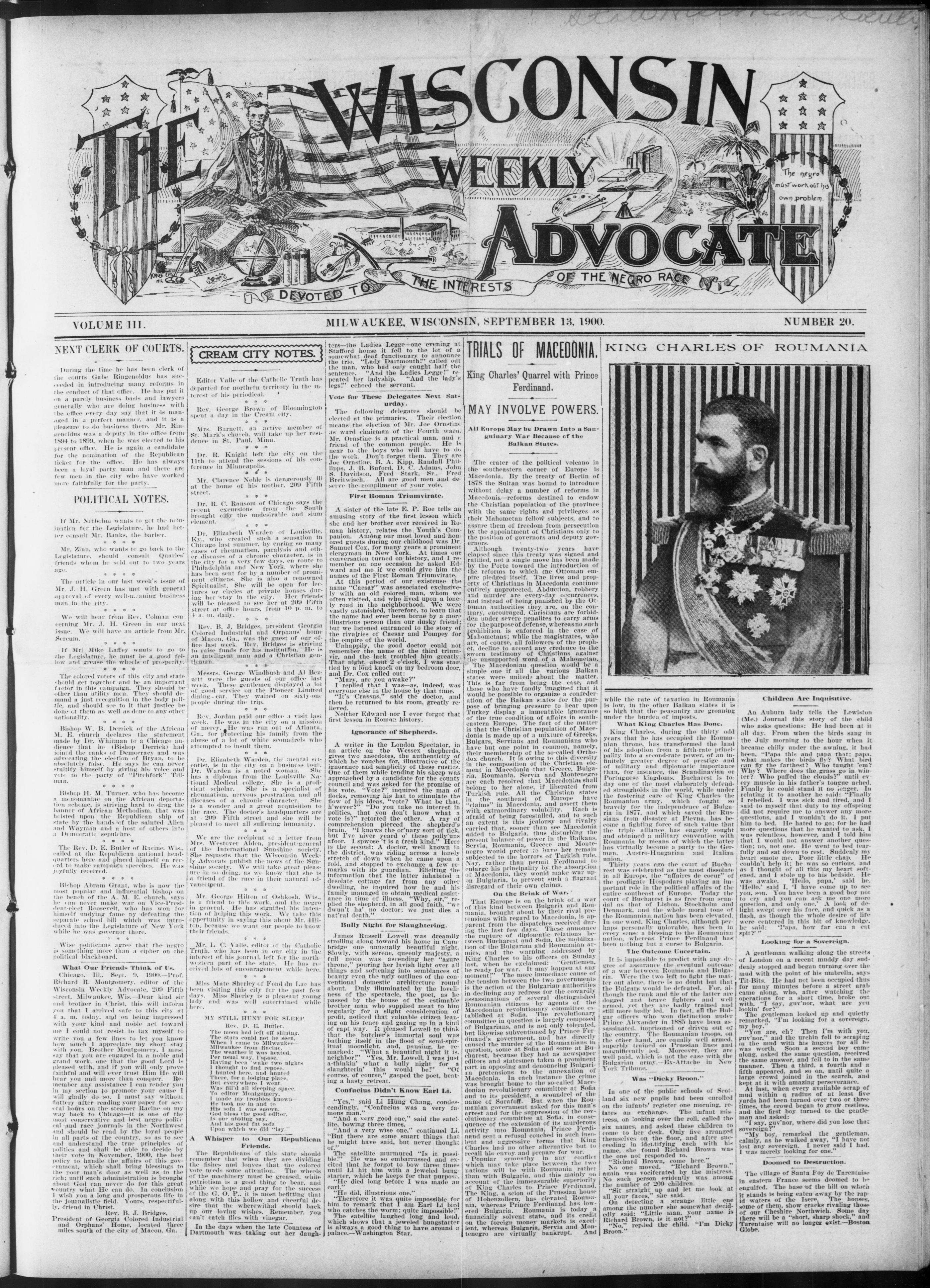
Page text (machine-generated)
WISCONSIN
WEEKLY
ADVOCATE
DEVOTED TO THE INTERESTS OF THE NEGRO RACE
VOLUME III.
NEXT CLERK OF COURTS.
During the time he has been clerk of the courts Gabe Ringenoldus has succeeded in introducing many reforms in the conduct of that office. He has put it on a purely business basis and lawyers generally who are doing business with the office every day say that it is managed in a perfect manner, and it is a pleasure to do business there. Mr. Ringenoldus was a deputy in the office from 1894 to 1899, when he was elected to his present office. He is again a candidate for the nomination of the Republican ticket for the office. He has always been a loyal party man and there are few men in the city who have worked more faithfully for the party.
POLITICAL NOTES.
If Mr. Netbchm wants to get the nomination for the Legislature, he had better consult Mr. Banks, the barber.
* * *
Mr. Zinn, who wants to go back to the Legislature, should consult Quarles' friends whom he sold out to two years ago.
* * *
The article in our last week's issue of Mr. J. H. Green has met with general approval of every well-meaning business man in the city.
---
We will hear from Rev. Colman concerning Mr. J. H. Green in our next issue. We will have an article from Mr. Sercum.
If Mr. Mike Laffey wants to go to the Legislature, he must be a good fellow and grease the wheels of prosperity.
The colored voters of this city and state should get together and be an important factor in this campaign. They should be other than utility men. They should demand a just recognition in the body politic, and should see to it that justice be done of them as well as done to any other nationality.
---
Bishop W. B. Derrick of the African M. E. church declares the statement made by Dr. Whitman to a Chicago audience that he (Bishop Derrick) had joined the ranks of Democracy and was advocating the election of Bryan, to be absolutely false. He says he can never stultify himself by giving his voice and vote to the party of "Pitchfork" Tillman.
* * *
Bishop H. M. Turner, who has become a menomaniac on the African deportation scheme, is striving hard to drag the banner of African Methodism, that was hoisted upon the Republican ship of state by the hands of the sainted Allen and Wayman and a host of others into a Democratic sepulchre.
---
The Rev. D. E. Butler of Racine, Wis., called at the Republican national headquarters here and placed himself on record to make campaign speeches. He was joyfully received.
☆ ☆ ☆
Bishop Abram Grant, who is now the most popular and influential bishop on the bench of the A. M. E. church, says he can never make war on Vice-President-elect Roosevelt, who has won for himself undying fame by defeating the separate school bill which was introduced into the Legislature of New York while he was governor there.
```markdown
```
Wise politicians agree that the negro is something more than a cipher on the political blackboard.
What Our Friends Think of Us
What Our Friends Think of Us. Chicago. Ill., Sept. 9, 1900.—Prof. Richard R. Montgomery, editor of the Wisconsin Weckly Advocate, 209 Fifth street, Milwaukee, Wis.—Dear kind sir and brother in Christ, this will inform you that I arrived safe to this city at 4 a. m. today, and on being impressed with your kind and noble act toward me I could not resist to tax myself to write you a few lines to let you know how much I appreciate my short stay with you. Brother Montgomery, I must say that you are engaged in a noble and grand work, one that the good Lord is pleased with, and if you will only prove faithful and will ever trust Him He will hear you and more than conquer. Remember any assistance I can render you in my section to promote your cause I will gladly do so. I must say without flattery after reading your paper for several hours on the steamer Racine on my way back to Chicago—it is one of the most conservative and best negro political and race journals in the Northwest and should be read by the loyal people in all parts of the country, so as to see and understand the true principles of politics and shall be able to decide by their vote in November, 1900, the best policy to handle the affairs of this government, which shall bring blessings to the poor man's door as well as to the rich; until such administration is brought about God can never do for this great country what He can do. In conclusion I wish you a long and prosperous life in the journalistic field. Yours, respectfully, friend in Christ.
Rey, B. J. Bridges.
President of Georgia Colored Industrial and Orphans' Home, located three miles south of the city of Macon, Ga.
CREAM CITY NOTES.
Editor Valle of the Catholic Truth has departed for northern territory in the interest of his periodical.
Rev. George Brown of Bloomington spent a day in the Cream city.
Mrs. Barnett, an active member of St. Mark's church, will take up her residence in St. Paul, Minn.
Dr. R. Knight left the city on the 11th to attend the sessions of his conference in Minneapolis.
Mr. Clarence Noble is dangerously ill at the home of his mother, 209 Fifth street.
宗宗宗
Dr. R. C. Ransom of Chicago says the recent excursions from the South brought only the undesirable and slum element.
* * *
Dr. Elizabeth Warden of Louisville, Ky., who created such a sensation in Chicago last summer, by curing so many cases of rheumatism, paralysis and other diseases of a chronic character, is in the city for a very few days, en route to Philadelphia and New York, where she has been sent for by a number of prominent citizens. She is also a renowned Spiritualist. She will be open for lectures or circles at private houses during her stay in the city. Her friends will be pleased to see her at 209 Fifth street at office hours, from 10 p. m. to 4 a. m. daily.
Rev. B. J. Bridges, president Georgia Colored Industrial and Orphans' home of Macon, Ga., was the guest of our office last week. Rev. Bridges is striving to raise funds for his institution. He is an intelligent man and a Christian gentleman.
Messrs. George Windbush and Al Bezzett were the guests of our office last week. These gentlemen displayed a lot of good service on the Pioneer Limited dining-car. They waited on sixty-one people during the trip.
* * *
Rev. Jordan paid our office a visit last week. He was in the city on a mission of mercy. He was run out of Atlanta, Ga., for protecting his family from the abuse of a lot of white scoundrels who attempted to insult them.
* * *
Dr. Elizabeth Warden, the mental scientist, is in the city on a business tour. Dr. Warden is a noted woman. She has a diploma from the Louisville National Medical college. She is a proficient scholar. She is a specialist of rheumatism, nervous prostration and all diseases of a chronic character. She is a wonder and a great acquisition to the race. The doctor's headquarters are at 209 Fifth street and she will be pleased to meet all suffering humanity.
* * *
We are the recipient of a letter from Mrs. Westover Alden, president-general of the International Sunshine society. She requests that the Wisconsin Weekly Advocate publish the news of the Sunshine society. We will take great pleasure in so doing, as we know that she is a friend of the race in their natural advancement.
---
Mr. George Hilton of Oshkosh, Wis., is a friend to this work, and the negro in general. He has signified his intention of helping this work. We take this opportunity in saying this about Mr. Hilton, because we want our people to know their friends.
***
Mr. L. C. Valle, editor of the Catholic Truth, who has been in our city in the interest of his journal, left for the northwestern part of the state. He has received lots of encouragement while here.
* * *
Miss Mate Sherley of Fond du Lac has been visiting this city for the past few days. Miss Sherley is a pleasant young lady and was well entertained while here.
Rev. D. E. Butler.
The moon had left off shining.
The stars could not be seen.
When I came to Milwaukee—
Milwaukee from Racine.
The weather it was heated.
Per usual way, I spose.
Having been wake two nights
I thought to find repose.
I hunted here, and hunted
There, for a lodging place,
But everywhere I went.
Was fill'd all sleeping space.
To editor Montgomery,
I made my troubles known—
He took me in and to
His sofa I was snow.
God bless the good editor.
Is our abiding say,
And his good fat sofa
Upon which we did "lay."
A Whisper to Our Republican Friends.
The Republicans of this state should remember that when they are dividing the fishes and loaves that the colored vote needs some attention. The wheels of the machinery must be greased, while patriotism is a good thing to bear, and while we hope and pray for the success of the G. O. P., it is most befitting that along with this hollow and cheerful desire that the wherewithal should back up our loving wishes. Remember, you can't catch flies with vinegar.
In the days when the late Countess of Dartmouth was taking out her daugh-
ters—the Ladies Legge—one evening at Stafford house it fell to the lot of a somewhat deaf functionary to announce the trio. "Lady Dartmouth!" called out the man, who had only caught half the sentence. "And the Ladies Legge!" repeated her ladyship. "And the lady's legs!" echoed the servant.
Vote for These Delegates Next Saturday.
The following delegates should be elected at the primaries. Their election means the election of Mr. Joe Ornstine as ward chairman of the Fourth ward. Mr. Ornstine is a practical man, and a friend of the common people. He is near to the boys who will have to do the work. Don't forget them. They are Joe Ornstine, B. A. Kipp, Randall Phillips, J. B. Buford, D. C. Adams, John S. Davidson, Fred Stark, Sr.. Fred Breitwisch. All are good men and deserve the compliment of your vote.
First Roman Triumvirate.
A sister of the late E. P. Roe tells an amusing story of the first lesson which she and her brother ever received in Roman history, relates the Youth's Companion. Among our most loved and honored guests during our childhood was Dr. Samuel Cox, for many years a prominent clergyman in New York. At times our conversation turned on history, and I remember on one occasion he asked Edward and me if we could give him the names of the First Roman Triumvirate.
At this period of our existense the name "Caesar" was associated exclusively with an old colored man, whom we often visited, and who lived upon a lonely road in the neighborhood. We were vastly astonished, therefore, to learn that the name had ever been borne by a more illustrious person than our dusky friend; but we listened entranced to the story of the rivalries of Caesar and Pompey for the empire of the world.
Unhappily, the good doctor could not remember the name of the third triumvir, and the lack troubled him greatly. That night, about 2 o'clock, I was startled by a loud knock on my bedroom door, and Dr. Cox called out:
"Mary, are you awake?"
I replied that I was—as, indeed, was everyone else in the house by that time.
"It's Crassus," said the doctor, and then he returned to his room, greatly relieved. Neither Edward nor I ever forgot that first lesson in Roman history.
Ignorance of Shepherds.
A writer in the London Spectator, in an article on the Wessex shepherd, gives two anecdotes, the authenticity of which he vouches for, illustrative of the ignorance and simplicity of these rustics. One of them while tending his sheep was approached by a candidate for the county council and was asked for the promise of his vote. "Vote?" inquired the man of flocks, removing his hat to stimulate the flow of his ideas, "vote? What be that, h'wever?" "Do you take no interest in politics, that you don't know what a vote is?" retorted the other. A ray of comprehension pierced the shepherd's brain. "I knaws the or'nary sort of tick, but I've niver yeard o' these polly'uns afoor. I spwose 't is a fresh kind." Here is the second: A doctor, well known in the district, was riding across a lonely stretch of down when he came upon a fold, and stopped to exchange a few remarks with its guardian. Eliciting the information that the latter inhabited a desolate cottage far from any other dwelling, he inquired how he and his family managed to obtain medical assistance in time of illness. "Why, sir," replied the shepherd, in all good faith, "we dwun't ha' no doctor; we just dies a nat'ral death."
Bully Night for Slaughtering
James Russell Lowell was dreamily strolling along toward his home in Cambridge one unusually beautiful night. Slowly, with serene, queenly majesty, a full moon was ascending her "azure throne," pouring her lavish light over all things and softening into semblances of beauty even the ugly outlines of the conventional domestic architecture round about. Duly illuminated by the loveliness of the spectacle, the poet, as he passed by the house of the estimable brother man who supplied meat to him regularly for a slight consideration of profit, noticed that valuable citizen leaning on his fence and gazing up in a kind of rapt way. It pleased Lowell to think that the butcher's immortal soul was bathing itself in the flood of semi-spiritual moonlight, and, pausing, he remarked: "What a beautiful night it is, neighbor!" "Yes, Mr. Lowell, I was just a-thinkin' what a bully night for a slaughterin' this would be!" "Of course, of course," gasped the poet, beating a hasty retreat.
Confucius Didn't Know Earl Li.
"Yes," said Li Hung Chang, condescendingly, "Confucius was a very famous man." "And a very good one," said the satellite, bowing three times.
"And a very wise one," continued Li. "But there are some smart things that he might have said, but never thought of."
The satellite murmured "Is it possible!" He was so embarrassed and excited that he forgot to bow three times until Li hit him with a jeweled bung-starter, which he keeps for that purpose.
"He died long before I was made an earl."
"He did, illustrious one."
"Therefore it was quite impossible for him to remark that I am Earl Li bird who catches the worm; quite impossible."
The satellite laughed long and loud, which shows that a jeweled bungstarter is always a good thing to have around a palace.—Washington Star.
TRIALS OF MACEDONIA.
TRIALS OF MACEDONIA.
King Charles' Quarrel with Prince Ferdinand.
MAY INVOLVE POWERS.
All Europe May be Drawn Into a Sanguinary War Because of the Balkan States.
The crater of the political volcano in the southeastern corner of Europe is Macedonia. By the treaty of Berlin of 1878 the Sultan was bound to introduce without delay a number of reforms in Macedonia—reforms destined to endow the Christian population of the province with the same rights and privileges as their Mahometan fellow subjects, and to assure them of freedom from persecution by the appointment of Christians only to the position of governors and deputy governors.
Although twenty-two years have elapsed since this treaty was signed and ratified, not a single move has been made by the Porte toward the introduction of the reforms to which the Ottoman empire pledged itself. The lives and property of Christians in Macedonia continue entirely unprotected. Abduction, robbery and murder are every-day occurrences, and instead of being punished by the Ottoman authorities they are, on the contrary, encouraged. Christians are forbidden under severe penalites to carry arms for the purpose of defense, whereas no such prohibition is enforced in the case of Mahometans; while the magistrates, who are, of course, all followers of the prophet, decline to accord any credence to the sworn testimony of Christians against the unsupported word of a Mahometan,
The Macedonian question would be a simple one if all the various Balkan states were united about the matter. This is far from being the case, and those who have fondly imagined that it would be possible to organize a confederation of the Balkan states for the purpose of bringing pressure to bear upon Turkey display a lamentable ignorance of the true condition of affairs in southeastern Europe. The fact of the matter is that the Christian population of Macedonia is made up of a mixture of Greeks, Bulgars, Servians and Roumanians who have but one point in common, namely, their membership of the so-called Orthodox church. It is owing to this diversity in the composition of the Christian element in Macedonia that Greece, Bulgaria, Roumania, Servia and Montenegro are each resolved that Macedonia shall belong to her alone, if liberated from Turkish rule. All the Christian states in the southeast of Europe have "claims" in Macedonia, and assert them with extraordinary volubility. Each is afraid of being forestalled, and to such an extent is this jealousy and rivalry carried that, sooner than see Macedonia added to Bulgaria, thus disturbing the present balance of power in the Balkans, Servia, Roumania, Greece and Montenegro would prefer to have her remain subjected to the horrors of Turkish rule. Nay, rather than permit Ferdinand to enlarge his principality by the absorption of Macedonia, they would make war upon Bulgaria, to prevent such a flagrant disregard of their own claims.
On the Brink of War.
That Europe is on the brink of a war of this kind between Bulgaria and Roumania, brought about by their rival pretensions with regard to Macedonia, is apparent from the dispatches received during the last few days. These announce the rupture of diplomatic relations between Bucharest and Sofia, the mobilization of the Bulgarian and Roumanian armies, and the warning addressed by King Charles to his officers on Sunday last, when he exclaimed: "Gentlemen, be ready for war. It may happen at any moment!" The more immediate cause of the tension between the two governments is the action of the Bulgarian authorities in declining any redress for the cowardly assassinations of several distinguished Roumanian citizens by agents of the Macedonian revolutionary committee established at Sofia. The revolutionary committee in question is largely composed of Bulgarians, and is not only tolerated, but likewise subvenuted by Prince Ferdinand's government, and has directly caused the murder of the Roumanians in question, some at Sofia and some at Bucharest, because they had as newspaper editors and statesmen taken a prominent part in opposing and denouncing Bulgarian pretensions to the annexation of Macedonia. In each instance the crime was brought home to the so-called Macedonian revolutionary committee at Sofia and to its president, a scoundrel of the name of Sarafoff. But when the Roumanian government asked for this man's arrest and for the suppression of the revolutionary committee at Sofia, in consequence of the extension of its murderous activity into Roumania, Prince Ferdinand sent a refusal couched in such insolent and aggressive terms that King Charles had no other alternative but to recall his envoy and prepare for war.
Popular sympathy in any conflict which may take place between the two nations will be with Roumania rather than with Bulgaria, and this mainly on account of the immeasurable superiority of King Charles to Prince Ferdinand. The King, a scion of the Prussian house of Hohenzollern, has elevated Roumania, whereas Prince Ferdinand has lowered Bulgaria. Roumania is today a financially solvent state, and its credit on the foreign money markets is excellent, whereas Bulgaria, Servia and Montenegro are virtually bankrupt. And
KING CHARLES OF ROUMANIA
while the rate of taxation in Roumania is low, in the other Balkan states it is so high that the peasantry are groaning under the burda of imposts.
What King Charles Has Done.
King Charles, during the thirty odd years that he has occupied the Roumanian throne, has transformed the land of his adoption from a fifth-rate principality into a second-rate power, of an infinitely greater degree of prestige and of military and diplomatic importance than, for instance, the Scandinavian or Portuguese kingdoms. Bucharest is today one of the most elaborately defended strongholds in the world, while under the fostering care of King Charles the Roumanian army, which fought so bravely for the independence of Bulgaria in 1877, and which saved the Russians from disaster at Plevna, has become a fighting force of such value that the triple alliance has eagerly sought and obtained a military convention with Roumania by means of which the latter has virtually become a party to the German, Austro-Hungarian and Italian union.
Thirty years ago the court of Bucharest was celebrated as the most dissolute in all Europe, the "affaires de coeur" of the profligate Hospodars playing an important role in the political affairs of the entire southeast of Europe. Today the court of Bucharest is as free from scandal as that of Lisbon, Stockholm and Denmark, and the whole moral tone of the Roumanian nation has been elevated. In one word, King Charles, although perhaps personally unlovable, has been in every sense a blessing to the Roumanian nation, whereas Prince Ferdinand has been nothing but a curse to Bulgaria.
The Outcome Uncertain.
It is impossible to predict with any degree of assurance the eventual outcome of a war between Roumania and Bulgaria. Were the two left to fight the matter out alone, there is no doubt but that the Bulgars would be defeated. For, although the rank and file of the latter are dogged and brave fighters and well armed, yet they are badly trained and still more badly led. In fact, all the Bulgar officers who won distinction under Prince Alexander in 1885 have been assassinated, imprisoned or driven out or the country. The Roumanian troops, on the other hand, are equally well armed, superbly trained on Prussian lines and magnificently led. Moreover, they are well paid, which is not the case with the Bulgarian army.—Ex-Attache in New York Tribune.
Was "Dicky Broon."
In one of the public schools of Scotland six new pupils had been enrolled on the infants' register one morning, relates an exchange. The infant mistress, on looking over the roll, called the six names, and asked these children to come to her desk. Only five arranged themselves on the floor, and after succeeding in identifying each with his name, she found Richard Brown was the one not responded to. "Richard Brown, come here."
No one moved. "Richard Brown." again was vociferated by the mistress. No such person evidently was among the number of 200 children.
"Sit straight up and let me look at all your faces," she said.
all your faces," she said.
On detecting a strange little one among the number she somewhat decidedly said: "Little man, your name is Richard Brown, is it not?"
"No," repied the child. "I'm Dicky Broon."
NUMBER 20.
OF ROUMANIA
Children Are Inquisitive.
An Auburn lady tells the Lewiston (Me.) Journal this story of the child who asks questions: He had been at it all day. From when the birds sang in the July morning to the hour when it became chilly under the awning, it had been, "Papa this and papa that; papa what makes the birds fly? What bird can fly the farthest? Who taught 'em? Why? Where does the grass go in winter? Who puffed the clouds?" until every muscle in his father's tongue ached. Finally he could stand it no longer. In relating it to another he said: "Finally I rebelled. I was sick and tired, and I said to myself that duty to my offspring did not require me to answer any more questions, and I wouldn't do it. I put him to bed. He hated to go; for he had more questions that he wanted to ask. I was relentless, however, and I told him that I would not answer another question; no, not one. He went to bed tearfully and sat down to rest. Suddenly my heart smote me. Poor little chap. He couldn't help it; he was so curious, and as I thought of all this my heart softened, and I stole up to his bedside. He was awake. 'Hello, papa,' said he. 'Hello,' said I, 'I have come up to see you, son. You have been a good boy not to cry and you can ask me one more question, and only one.' A look of delight swept over his face, and quick as a flash, as though the whole desire of life were centered in this bit of knowledge. he said: "Papa, how far can a cat spit?"
Looking for a Sovereign.
A gentleman walking along the streets of London on a recent muddy day suddenly stopped and began turning over the mud with the point of his umbrella, says Tit-Bits. He had not been occupied thus for many minutes before a street arab came along, who, after watching the operations for a short time, broke out with, "I say, guv'nor, what are you lookin' for?" The gentleman looked up and quietly remarked, "I'm looking for a sovereign, my boy."
"You are, eh? Then I'm with you, guv'nor," and the urchin fell to scraping in the mud with his hngers for all he was worth. Soon a second boy came along, asked the same question, received the same answer, and fell to in the same manner. Then a third, a fourth and a fifth appeared, and so on, until quite a large crowd joined in the search, and kept at it with amazing perseverance.
At last, when every available scrap of mud within a radius of at least five yards had been turned over two or three times, the crowd began to grow restless, and the first boy turned to the gentleman and asked:
"I say, guv'nor, where did you lose that sovereign?"
"My boy, remarked the gentleman, calmly, as he walked away, "I have not lost any sovereign. I never said I had. I was merely looking for one."
Doomed to Destruction.
The village of Santa Foy de Tarentaise in eastern France seems doomed to be engulfed. The base of the hill on which it stands is being eaten away by the rapid waters of the Isere. The houses, some of them, show cracks rivaling those of our Cheshire Northwich. Some day there will be a "short, sharp shock," and Tarentaise will no longer exist.—Boston Globe.
American Cavalry Fell Upon the Imperialists.
RUSSIANS WIN VICTORY
Assassin of Baron von Ketteler Says He Acted Under Orders of the Government.
Pekin, Sept. 5, via Taku, Sept. 10.—A troop of American cavalry sent to act as a convoy for cattle surprised 300 imperialists quartered at the Temple Shaho. They killed thirty and captured 120 rifles. The enemy fled northward. Some Boxers recently attacked two companies of Russians who were guarding a railway-working party at the South Maapo station. Reinforcements succeeded in dispersing the attacking party. Two of the Russians were wounded. As this was not the first occasion when attacks of this nature have occurred a punitive force under Col. Pretiekoff was sent with orders to burn the surrounding towns.
Assassin Confesses His Guilt.
The Japanese have arrested the assassin of Baron von Ketteler, the late German minister to China. The assassin, who has been handed over to the Germans by the Japanese, has confessed his guilt. He was arrested for trying to sell to a Japanese officer a watch with initials which he admitted taking from the body of Baron von Ketteler. He afterward admitted the crime, saying that the imperial government ordered the commission of the act.
Col. Pettiekoff's party yesterday engaged 500 Boxers seven miles from Machipo. The Boxers were armed only with swords and spears. The Russian cavalry charged on them, killing many of them with sabers. The charge was made through the cornfield and the Russians succeeded in killing the commander of the enemy's forces. The casualties among the Boxers are estimated at 200. A Russian officer was wounded and two Cossacks were killed. Prince Ching, during the course of interviews with the ministers yesterday, informed them that while he has power to negotiate he cannot act without Li Hung Chang. An urgent request has been telegraphed Li Hung Chang asking that official to come to Pekin. Marquis Tsiang states that nothing can be done until the arrival of the Emperor.
Earl Li Gratified.
Washington, D. C., Sept. 13.—Minister Wu has received a cablegram from Li Hung Chang answering the hope expressed in the American note of a few days ago that his powers are sufficient to protect American lives and interests in China. Earl Li says he has that power and will see that the protection is given.
Minister Conger cables the state department, under date of September 6, as follows: "Hodges killed Pao Ting Fu." Hodges was a Presbyterian missionary.
Pekin, Sept. 9.—Brig.-Gen. James H. Wilson, U. S. V., has arrived here under instructions to report to Maj.-Gen. Chaffee, commanding the American forces here.
Converts Murdered.
Yokohama, Sept. 12.—A Japanese officer at Chsong, Corea, reports that two Japanese and several hundred Chinese and Corean converts have been murdered on the frontier by the Chinese.
GREAT BRITAIN'S REPLY.
Declines the Proposition to Withdraw Troops from Pckin.
London, Sept. 13.—Great Britain's reply to the Russian proposition for the evacuation of Pekin was sent two days ago. Great Britain declines to evacuate Pekin prior to receiving satisfactory guarantees from the Chinese government for the fulfilment of certain conditions. There is a general disposition here to accept as mainly correct the statement that all the powers have now replied to the Russian proposal, that Great Britain and Germany have declined to evacuate Pekin, that Austria and Italy have decided to be guided by Germany's decision, and that the others have agreed to a more or less modified withdrawal, as defining the attitude of the powers. It is deduced therefrom that the Czar will agree to allow his troops to remain at the Chinese capital until he sees the results of the present negotiations.
St. Petersburg, Sept. 13.—The Novoe Vremya says quarters have already been secured at Tien Tsin for the Russian troops leaving Pekin. The paper adds that some detachments will march to Taku and remain there, but that the majority will return to Port Arthur or Ta Lien Wan for the winter.
Emperor Assumes Responsibility.
Emperor Assumes Responsibility.
London, Sept. 13.—According to a dispatch from Shanghai received today another important edict, dated Tchow, September 8, has been issued reurging Li Hung Chang to forthwith take the viceroyal seat of the province of Chi Li to Pekin, there to co-operate with Prince Ching and Gen. Lung-Lu in the re-establishment of peace. In his decree the Emperor assumes the responsibility for the events which have occurred in Pekin and does not blame Prince Tuan (the father of the heir apparent) or Kang-Yi (the president of the board of war).
MRS. WU IN AUTO ACCIDENT.
Servant Loses Control of Vehicle, Which Tries Tree Climbing.
Washington, D. C., Sept. 13.—Mme. Wu, wife of the Chinese minister, had a narrow escape from being killed while riding in an automobile with her young son. There is at the legation a young Chinese, who is familiarly known as Charlie. He undertook to operate the road machine, and while bowling through New Hampshire avenue cut it loose at full speed. The result was startling and unexpected. The auto took a sudden turn to the left and according to spectators, began to climb a tree near the curb. Mme. Wu scrambled out and Charlie was pitched head first upon the grass, leaving the auto to continue its climbing feat. The machine was badly damaged. Mme. Wu was unhurt, exce
GATHERING OF SIOUX CHIEFS.
Claim Made that the Black Hills Treaty is Invalid.
Fort Yates, N. D., Sept. 13.—A large gathering of all the chiefs of the great Sioux nation from Rosebud, Pine Ridge, Cheyenne and Lower Brule is being held at Standing Rock. They are discussing the Black Hills treaty. They claim that the treaty is invalid as three-fourths of the Indians did not sign. The Indians are not desirious of reclaiming the hills, but are willing to negotiate a new treaty upon an equitable basis. A delegation will go to Washington to discuss the matter with the commissioner.
Heavy Rains in Upper Michigan
Houghton, Mich., Sept. 13.—The copper district and Lake Superior generally escaped the effects of the storm, but have experienced local rains of unusual severity which have caused minor losses through broken dams and washouts. The big dam at Calumet was severely taxed, but with the aid of a large force of laborers, a break was averted.
A MILLION LOST. AT NARRAGANSETT.
Admiral Dewey Takes a Hand in Directing the Village Fire Department.
Narragansett Pier, R. I., Sept. 13.—Yesterday's fire did nearly $1,000,000 worth of damage. The Rockingham hotel, a $200,000 structure, is gone. It was there the fire started. Louis Sherry's Casino, of equal value, is wiped out, also Hazard's block opposite, and many other buildings along the beach of the Rockingham.
The private cottages alongside the Casino were saved. The second from that structure is the McLean cottage, where Admiral Dewey is stopping.
A number of young men aided in saving the house between the McLean cottage and the fire. Admiral Dewey asked the men if they could hold out for a little while longer and if they could they would save the house. They said they could and they did.
Admiral Dewey said this evening: "These four young men saved me. I stood there encouraging them for that dreadful ten minutes. I told my mother-in-law, Mrs. McLean, to pack up. We were all ready. I said to them, if that cottage goes we are doomed. Had our house caught the big Matthewson hotel next door would have gone; that would have been the end of Narragansett." Admiral Dewey would not admit it, but it was his coolness that saved the rest of Narragansett Pier. He directed the work of the wealthy fire fighters, and he himself stopped the fire at the first possible point. The Rockingham closed a few days ago, so it was simply a question of saving property, not life. The fierce wind made a toy of the great hotel, though the cottagers saved most of the furniture.
Next they tried to save the beautiful Casino, center of Narragansett gayety. It went up in flames and smoke in half an hour. Next the Hazard block went. At 6 p. m. the fire was fairly well under control, but the loss may reach $1,000,000.
A BROKEN CAR WHEEL.
It Caused a Railroad Accident and the Death of Nine Female Minstrels.
Cairo, Ill., Sept. 13.—The breaking of a carwheel resulted in almost obliterating Duncan Clarke's troupe of female minstrels yesterday afternoon. Their special car was wrecked, nine of the company were killed, and six were injured, four so seriously that their recovery is a matter of doubt. Their car was attached to the Illinois Central fast mail train No. 25, and was wrecked just after they entered the yarcs at Mounds, three miles from their destination. Those killed outright were:
PATLAMN, TX.
WILLIAMS, ALICE.
These were so seriously injured that
they died within a short time after the
wreck:
BELL, ANNA.
COMPELLA, MARGUERITA.
All the injured were brought to the hospital in the city.
Two others were slightly injured, but declined to come to the hospital. "Kid" Barry was the only one in the company who escaped unhurt.
As the carwheel broke the car veered around to the right and the rear end struck switch engine No. 128 on a parallel track. This demolished the end of the car and the wreckage was strewn along the track for 100 feet. Duncan Clarke, the manager, will probably recover, as his injuries are slight. A man named Klido, the contortionist of the troupe, stopped off at Carbondale and escaped injury. It is claimed the accident was the result of a flaw in the wheel, which was broken in two. A large crowd went to the scene of the wreck and rendered what little aid was possible. The dead were taken in charge by the coroner of Pulaski.
MONEY GOING ABROAD.
German Government Negotiating for a Big Loan to be Paid for by Gold Shipments.
New York, Sept. 13.—No authoritative information can be had in Wall street of negotiations for placing a German government loan in New York, but the report finds general credence on account of tacit admission that the German government is seeking and will likely succeed in borrowing $25,000,000 from New York, Chicago and Milwaukee lenders, for which certainly a part is to be paid for by gold shipments.
It is evident that a desire to replenish the German stock of gold is the motive of a direct negotiation with American bankers by the German authorities, as it was of the British authorities in the allotment of over half of the latest issue of British exchequer bonds with New York bankers. The operations are closely analogous to that of the United States government several years ago when the placing of a bond issue was made conditional for imports of gold.
Bankers and brokers in Wall street assert that there is a large demand at present in this country for foreign securities. One firm states that it has placed $5,000,000 of foreign government securities among domestic investors in the last twelve months.
FRENCH IS FIGHTING.
Engaged with Boers in Hills West of Barberton.
London, Sept. 13.—Lord Roberts reports from Machadodorp, under date of Wednesday, September 12. that Gen. French was heavily engaged that day with the Boers in the hills west of Barberton and that Gen. Hutton had gone to Gen. French's support.
Crosby Transportation Co. and
Grand Trunk Ry. system, Grand Haven Route. Shortest, cheapest and most popular line to all points in Michigan, Canada and the East. Steamers leave Milwaukee every night at 9:15 p. m. Write or call at ticket office, 400 East Water St.
Butterflies as Pets.
"Butterflies as pets? Yes, it sounds strange, does it not?" said a lover of insects recently. "but I know of several persons who have kept them for weeks. One woman of my acquaintance fed her delicate winged pet on sugar and water and the effect was disastrous; the poor little butterfly became intoxicated."—New York Tribune.
A FUNNY LEG-END.
Who was pained at the size of his calf.
So he purchased golf hose—
And put cotton in those—
But the animals gave him the laugh.
—Philadelphia Inoulrer.
STRIKE NOW ON.
Several of the Pennsylvania Collieries Have Already Shut Down.
Scranton, Pa., Sept. 13.—The strike of the anthracite miners of the Lackawanna valley is now practically on, for every mine which is working today is running shorthanded. The Dodge and the Bellevue collieries of the Lackawanna company were entirely shut down. The Manville colliery worked only a portion of the day and all through the upper valley there was almost complete stoppage excepting that the men obeyed the order of National Committeeman Dilcher and President Nichols of this district to clean up their places and remove their tools. Tonight every local union in the region is directed to meet in special session and they will without doubt decide to quit work tomorrow.
It is expected that not a mine will operate tomorrow anywhere between Forest City and Shickshinny in this district and it is said at headquarters here that the same is expected from other districts. The United Mineworkers' offices here deprecate all stoppages in advance. They want the order properly carried out, but will not restrain the men from immediate action. They are assured that on Monday next there will be a complete response to the strike order. At the offices of the Lackawanna company it was stated today that the decision to stand the ground in refusing the miners' demands by the operators will hold unbroken. The refusal is based almost wholly upon the claim that the bituminous interests are behind this movement. No dealings will be had with the men who represent such interests, it was declared by General-Supt. Loomis.
At Shamokin.
Shamokin, Pa., Sept. 13.—A careful canvas since last night indicates that despite the claim of the operators that enough men will report for work to keep the collieries in operation after next Monday, President Mitchell's strike order will almost unanimously be observed, and all or nearly all of the miners between Traverton and Mount Carmel, employing over 14,000 men and boys in a district embracing fourteen mines with Shamokin in the center, will likely be idle before seven days have elapsed. John Fahey, president of the Ninth United Mineworkers' district, said today that instead of the executive board holding a meeting on Friday to act on President Mitchell's order the board will assemble tonight and adopt an important proclamation to be issued for the guidance of strikers during the impending struggle.
At Hazleton.
Hazleton, Pac, Sept. 13.—Some of the collieries here were short-handed today, but all were in operation. A few members of the union had remained at home today, believing that the strike order was to take effect at once. No one is in position to say just how many will quit when the time comes. The members of the United Mineworkers' organization will strike to a man, but there are many miners who have refrained from joining the union and their action on the strike question is problematical. Undoubtedly many of them will strike. Organizers are working among them day and night, with more or less success.
The strike will seriously affect business and merchants are preparing to protect themselves. Many families have ordered flour to last for several months, but merchants refuse to deliver more than a few dollars' worth of goods on credit to people whose sole dependence is the mines.
L. P. Pardee, president of the Hazleton National bank, and executor of the A. S. Van Wyckle estate operating the Coleraine, Milnesville and Evans collieries, employing altogether about 2000 men, has given notice that if there is a strike the Coleraine and Milnesville properties will be abandoned. Negotiations, he says, are on for a sale of our mules and machinery at the Milnesville colliery.
Benjamin James, at strike headquarters today said: "Everything looks encouraging. We have received numerous reports from all parts of the region and the indications are that there will be a complete tie-up of operations, not only in the Hazleton district, but in the entire anthracite field."
At Wilkesbarre.
Wilkesbarre, Pa., Sept. 13.—All the collieries of this region are in operation today with practically fullces of men. Nearly all of the heads of the big companies today say they believe but a small portion of the men will strike on Monday. Officials of the Susquehanna company, which employs 5000 workers, express the opinion that the men will strike, as they are thoroughly organized. Many of the companies are today polling their men on the question of striking and officials of the Bliss colliery of the Delaware, Lackawanna & Western Coal company are of the opinion that the entire force of 1000 will stop work.
In Dauphin County.
Harrisburg, Pa., Sept. 13.—The strike will be generally observed by both union and nonunion miners in the anthracite region of Dauphin county. The mines are located in the vicinity of Lykeens and Williamstown and employ about 2300 men and boys. The mines in this locality have been in operation almost constantly the past year. Many of the men own their own homes and the authorities do not anticipate serious trouble.
Proclamation of the President.
Indianapolis, Ind., Sept. 13.—President John Mitchell is busy arranging to leave for Hazleton Saturday evening, where he will personally conduct the strike. The secretary-treasurer expects to remain here in charge of the headquarters. The Miners' Journal today publishes the official call for the strike. Late this evening Mitchell and Wilson will issue a lengthy proclamation to the public asking that the strike be weighed carefully and that the demands of the miners be considered carefully before judgment is passed.
MADE INSANE BY HYPNOTIST.
Subject of Mesmerism Breaks Up a Party and Routes Sixteen Men.
Richmond, Va., Sept. 13.—John Sweeny, a well-known young man here, was temporarily transformed into a maniac by the effect of hypnotism. A party was given by Mrs. W. J. Gilman and among the guests were Sweeny and Calvin Cooke, the latter an amateur hypnotist. He proposed to give an exhibition of his skill and Sweeny consented to be the subject. No sooner was the latter under control than he imagined himself a pugilist and at once began to make a general attack upon all present without regard to sex. He soon cleared the house and then began to demolish the front entrance, using for the purpose an ornamental urn weighing several hundred pounds, which he handled as though it were a toy.
Sixteen men attempted to hold the boy, but he threw them right and left and began tearing off his clothes. A police call brought five stalwart officers, who began the struggle anew, and finally handcuffed Sweeny and tied his feet together. His captors held him on the ground while a physician administered a hypodermic injection of morphine.
Sweeny was then hurried to a hospital and unbound, whereupon he fell upon an iron bedstead and broke it in pieces. More drugs were administered and finally he was quieted.
Sweeny has never been regarded as remarkable for physical strength.
Oshkosh Police Think They Have Caught Two Burglars.
Charged with Breaking Into Summer & Morris' Store-Alleged Connection with Many Crimes.
Oshkosh, Wis., Sept. 13.—[Special.]—Shortly after midnight the police arrested two young men whom they think have been robbing stores in many parts of the state. The police have been watching the accused for some time and are confident that they have made important arrests. The men placed under arrest are W. C. Post, who gives Fond du Lac as his residence, and C. M. Hill, who says that he has relatives living in this city. Yesterday the young men tried to dispose of some cutlery which the police claim was stolen from the hardware store of Summer & Morris of Madison, which was entered August 13 and from which 250 knives and 15 revolvers were taken. In the possession of the men were found two pawn tickets for watches held at Fond du Lac. The Madison police have been notified and officers will arrive here this evening to take the men back to Madison.
SYNOD AT WAUKESHA.
Presbyterians will Hold Their State Meeting October 10 and 11.
Waukesha, Wis., Sept. 13.—[Special.]
The Presbyterian synod will be held at this city Wednesday and Thursday, October 10 and 11. At the same time the Ladies' Synodical Missionary society will meet at the Congregational church. The Synod of Wisconsin embraces about 110 churches, each of which is expected to send a pastor and one elder. About 150 guests are expected, all of whom will be entertained by the members of the church in this city during their visit. The synod will be preceded on Thursday evening by a stereoicon lecture by Dr. Weaver, colored, of Baltimore. Mr. Weaver is said to be a very good speaker and gives an excellent entertainment.
The synod will bring a number of very noted and influential men to Waukesha, among the number are: Rev. Arthur Brown of New York, secretary of the Board of Foreign Missions; Rev. Wilson Phraner of New York, who is also prominent in mission circles. The meeting of the State Missionary society, of which Mrs. Hainah R. Vedder of Milwaukee is president, is of much interest. Each society is entitled to send two delegates and many visitors besides attend. There will be a large delegation from Milwaukee in attendance and arrangements are being made to secure a private car service for all attending the convention here. Miss Ells is chairman of the ladies and Fred Phelps of the men's local committees for arrangements. A feature of the synod and the state missionary meeting will be a luncheon served on Thursday noon for all, by the ladies of Waukesha.
The two societies will visit the Carroll college in the afternoon, when a reception will be tendered them there. The synod will visit the school with an idea of investigation. The establishment of a state Presbyterian college is a matter to be considered at this synod and if the school in this city is desirable to all delegates from every point of view, it will probably be decided upon as the academy. Wausau is making every effort to obtain the location of the college there. Among the number of well-known ladies who will attend the Missionary society meeting are Mrs. Darwin James of New York, president of the board of home missions; Mrs. N. H. Forsyth of Chicago, president of the foreign board of the Northwest; Miss Josephine W. Petrie of New York; Mrs. Earl C. Greenman of Chicago and Mrs. Palmer of Pittsburg.
MADE DARING RESCUE.
Two Lives Are Saved at Marinette by Bravery of a Veteran
Marinette, Wis., Sept. 13.—[Special.]
Jack Atkinson, a local veteran, made a very daring stop of a runaway horse this morning and practically saved the lives of two human beings. The nurse girl employed by Charles Goodman, a wealthy lumberman, was out driving with Mr. Goodman's little child. She lost the lines and the horse broke into a wild gallop. Atkinson, at the risk of his life, made a leap for the bridle, and, though dragged some distance, brought the maddened animal to a stop. The runaway occurred on a torn-up street, making the situation more critical.
CAN'T GIVE FULL PRESSURE.
Experts Report on Racine Water Company's System.
Racine, Wis., Sept. 13.—[Special.]—At a meeting of the special committee appointed by Mayor Higgins to consider propositions from the Racine Water company relative to the city buying the plant received a report last evening from George H. Benzenberg of Milwaukee and Thomas Johnson and E. Ericson of Chicago, experts called in to examine the system. The experts decided that the company could not furnish direct pressure of 125 pounds without damage to the system. They held that the city should not ask more than 100 pounds and from all new hydrants no more than 80 pounds. When the franchise was granted the company agreed to furnish 125 pounds at any time, but at the annual test when this pressure was reached many mains were broken. The committee did not agree when accepting any proposition from the company, but it will probably recommend that the Water company give the city 20 per cent. of the annual hydrant rental for the remaining eleven years of the franchise and for the twenty-five years additional which the company is after.
IDENTITY OF WILD MAN.
New Londoners Frightened by William Kehle, a Demented Man. New London, Wis., Sept. 13.—[Special.]—It is reported that the so-called wild man, who has been frightening people on the outskirts of this city, is William Kehle, formerly of the town of Liberty. He is 25 years old and disappeared two years ago. He was demented at that time.
DEDICATE PAROCHIAL SCHCOL
New Building at New London to be Opened October 7.
New London, Wis., Sept. 13.—[Special.]—The new $4000 Lutheran parochial school building will be dedicated Sunday, October 7. The speaker of the day will be Prof. A. F. Ernst of the Northwestern university, Watertown, Wis.
Chalk Men Put Prices Up-May Result in a Milk War
La Crosse, Wis., Sept. 13.—[Special.]
—There are good prospects for a milk trust in this city. The action of dealers of other cities in putting up the price of milk has set the local chalk men to thinking and nineteen of them publish in a local paper a notice to the effect that after September 15 they will charge 6 cents a quart or seventeen quarts for $1. There are about twice as many more milkmen in the city and what the result will be is still a question. It may lead to a milk war and it may be that the other milkmen will follow the example of the nineteen. Poor pasturage on account of dry weather and the consequent short milk crop is given as the cause.
HIGHWAYMEN STEAL HORSE.
Bold Hold-Up Robbery in La Crosse —Rayman the Victim.
La Crosse, Wis., Sept. 13.—[Special]—Two hold-up artists tackled a ragman in the south end of the town late yesterday afternoon and after assaulting him ran away with his horse and wagon. They headed for the east with a squad of police in hot pursuit. The horse has not yet been recovered. The ragman says they are men from this city, for he has seen them here before. Singularly, they did not touch his money. All they seemed to want was his horse.
W. J. ABRAMS IS DEAD.
he Well-Known Green Bay Railroad Man Passes Away After Short Illness.
Green Bay, Wis., Sept. 13.—[Special.]
—W. J. Abrams, a resident of Green Bay for forty years and one of the best-known men in Wisconsin, particularly in railroad circles, died yesterday afternoon of heart disease, a stroke of paralysis suffered Monday being the immediate cause of death. He was reputed to be one of Green Bay's wealthiest citizens. The funeral arrangements have not been completed as yet. In accordance with the wishes of Mr. Abrams the obsequies will be as simple as possible.
Mr. Abrams was born March 19, 1829, in Cambridge, Washington county, New York. His great-grandfather on the mother's side, Capt. Alexander Thomas, was commissioned in December, 1778, by the general assembly of Rhode Island a captain in Col. Topham's regiment, and it is recorded that he "drew regular pay." Mr. Abrams was a blood relation, on his mother's side, of Lyman Hall, one of the signers of the Declaration of Independence. On his father's side Mr. Abrams claimed lineal descent from Lord Townley of the English House of Peers. After receiving an academic education at Cambridge and Troy, N. Y., Mr. Abrams entered the theological school at Williamstown, Mass., but was compelled to abandon the course on account of impaired health. He ventured into the literary field and under various nommes de plume was the author of various essays, but his health would not permit him to continue in the literary profession.
In 1856 he came to northern Wisconsin and was engaged for a considerable time in railroad surveys from Lake Michigan to Ontonagon, making his permanent home in Green Bay in 1861. He became identified with the Collingwood, Sarnia and Buffalo line of steamers. In 1870 he directed his attention more especially to railroad enterprise. He was one of the promoters of the Green Bay & Lake Pepin railroad, for which he made the survey and obtained the charter and was officially connected with the road for many years. This road was subsequently merged into the Green Bay & Minnesota and still later into the Green Bay, Winona & St. Paul, Mr. Abrams retiring when the change came that made the road the Green Bay & Western. He was also the leading promoter of the Kewaunee, Green Bay & Western railroad and was the first president of the company.
During the rebellion Mr. Abrams was an uncompromising war Democrat. He was a member of the Wisconsin Assembly from 1864 to 1867 and of the state Senate two years, 1868-69. He served as vice-president of the Soldiers' Orphans' home at Madison. He was a member of the I. O. O. F. and of the Royal Arcanum and served as supreme representative and grand regent of the state for the latter order. He frequently appeared as a public speaker, especially during political campaigns.
Mrs. Abrams, who survives, was formerly Miss Henrietta T. Alton, a native of New York state, daughter of James Alton. Her mother, at the time of her marriage to Mr. Alton, was the widow of Commodore Germain, commander of the old Ironsides. The children of Mr. Abrams are Mrs. Kate Townsend of Milwaukee; Ruth, wife of Dr. C. McVeigh Tobey of St. Paul, and Winford, who is an engineer on the Kewaunee & Western road.
IN GREAT STORM.
Green Bay Woman Fears Her Parents Were Killed at Galveston.
Green Bay, Wis., Sept. 13.—[Special.]
—Mrs. Brown, wife of C. H. Brown,
traveling freight and passenger agent for
the Green Bay & Western road, entertains grave doubts as to the safety of her father, mother and a married sister, who are residents of Galveston, Tex.
She has been unable to get any tidings by telegraph of their condition or whereabouts. Miss Folsom, a teacher in the Green Bay Business college, who recently came from Galveston, says the home of Mrs. Brown's family was in the heart of the district ravaged by the storm.
This information has caused Mrs. Brown to despair of the safety of her relatives.
SPAN OF HORSES STOLEN.
Valuable Animals Taken from Stable at Columbus.
Columbus, Wis., Sept. 13.—[Special.]
—A valuable span of horses, with harness, was stolen from the barn of Albert Lackey last night, a bay and a black, 9 years old, weighing about 1500 each. They were taken about midnight and were driven south, but could be followed only a mile or so.
HOT WATER CAUSES DEATH.
Palmyra Child Terribly Burned Dies Two Weeks Later.
Palmyra, Wis., Sept. 13.—[Special.] Alvin Strike, the 11-year-old son of Richard Strike, a prominent saloonkeeper of this place, died last night. The little yellow upset a teaketle of boiling water on himself two weeks ago and received injuries from which he never recovered.
Celebrate Golden Wedding.
Manitowoc, Wis., Sept. 13.--[Special.]
—Mr. and Mrs. Carl Wilsonan of Mishicott, this county, are arranging to celebrate their golden wedding December 18. They came here fifty years ago from Germany. The husband is 72 years old and the wife 70.
Constant Worry Causes Mrs. Minnie Keisers of Depere to Lose Her Mind.
Green Bay, Wis., Sept. 13.—[Special.]
—Constant worrying over a mortgage on her husband's farm drove Mrs. Minnie Keisers of the town of Depere, aged 73, violently insane. She was committed to the Brown county asylum for chronic insane this morning.
LESTER A. ROSE DEAD.
Prominent Wisconsin Valley Man Dies of Heart Disease in a Restaurant.
Milwaukee, Wis., Sept. 13.—[Special.]
—Lester A. Rose of Wausau, one of the best-known men in the Wisconsin river valley, fled suddenly at Weber & McLaughlin's restaurant yesterday afternoon of heart failure. He was sitting in the restaurant when the fit of illness came over him, and he told the head waiter that he was not well. He was escorted to a private dining-room and left to rest. He became worse and a physician was sent for. Before he arrived Mr. Rose was dying, and the end came within a few moments after he was taken ill.
There happened to be nobody in the place at the time who knew Mr. Rose, although his appearance was familiar to the proprietors of the place, and the body was taken to Peacock's undertaking establishment to await identification. The health department was notified and sent Dr. C. J. Coffey to investigate the cause of death, and it was found that it was due to heart failure.
Mr. Rose was stopping at the St. Charles hotel with F. E. Morgan of Wausau, an exhibitor at the State fair, who was at the fair grounds all day and returned to find his room-mate dead. Messages were sent to his wife at Wausau as soon as it was discovered who the dead man was.
Mr. Rose was until recently the secretary of the Wisconsin Valley Advancement association and was instrumental in advertising the advantages of that section of the state extensively. He was a New Yorker by birth and came to Wisconsin two years ago and became interested in the Wausau Daily Record, being an old newspaper man. He was an enthusiast in the work of advertising the Wisconsin valley and it was his idea which resulted in the sending of many bouquets of arbutus from the valley cities to Milwaukee on Arbutus day to call attention to the beauties of the valley. Besides being a man of great energy and pertinacity Mr. Rose was a forceful writer, his style being terse and expressive.
OPENING OF LAWRENCE.
Three Hundred Applicants the First Day-New Teacher of Flocution.
Appleton, Wis., Sept. 13.—[Special.]—The fall term at Lawrence university opened today and the number of students who have registered is reported to be larger than in former years. During the day about 300 applications for tuition were received and many more will be entered before the regular class work begins next week. No one has as yet been secured to fill the position left vacant by the resignation of Miss Sprackling, who last year was the instructress in elocation and physical culture, but the choice will lie between Miss Lorine Wright of Oshkosh and Miss Schmidt of Manitowoc in the event that Mr. Hubbard of Rockford, Ill., does not accept the position, which has been tendered him upon the recommendation of Prof. Cummock.
TRY TO SHOOT DRIVER.
Three Men Attempt to Hold Up Sewing Machine Agent Near Sparta.
Sparta, Wis., Sept. 13.—[Special.]— Last night as the collector for the Singer Sewing Machine company was driving between Oil City and Ontario three men jumped from the roadside and tried to catch his horse. The horse shied and got away. They shot at the driver, putting a bullet through his hat and three through the buggy top.
PLANT AT COMBINED LOCKS.
Construction on New Mill Has Been Commenced.
Appleton, Wis., Sept. 13.—[Special.]—The actual work of construction of the new ground wood pulp mill for the Combined Locks Paper company was commenced yesterday and the plant will be finished and in operation within ninety days. The plans were furnished by O'Keefe & Orbison, who will superintend the building, although the contracts for excavations and masonry have been let to the Hackworthy Construction company. The new digester which has been ordered for the Combined Locks sulphite mill will be in operation within sixty days and by January 1, 1901, the entire plant will be running smoothly and will be placed beyond the reach of any possible pulp shortage such as has troubled paper manufacturers this season.
SPREADS CONSTERNATION.
West Superior Teachers Have to Take Examinations.
West Superior, Wis., Sept. 13.—[Special.]—Only twelve teachers of the force of 160 in the public schools here appeared to take the examination ordered by Superintendent Jackson today. About 120 of them will probably have to take it eventually, but as the announcement caused so much consternation, the superintendent agreed to give examinations later in the term to those preferring. Several teachers have already resigned since being informed that they must stand the test, and some have gone back to school themselves.
LOOKING FOR LOST BROTHER.
Wealthy Kansas City Woman Searching in Oshkosh.
Oshkosh, Wis., Sept. 13.—[Special.]—Mrs. W. L. Leazery of Kansas City, a woman of considerable wealth, is in the city looking for her brother, J. C. Patterson, aged 20 years. She says that he has been missing for some time. A month ago he sent to her from this city a letter asking for money. She sent the money, but it was returned to her from the postoffice here, he having failed to call for it.
Calls a Madison Pastor.
Ann Arbor, Mich., Sept. 13.—The official board of the First Methodist Episcopal church of this city has extended a call to Rev. A. B. Storms of Madison, Wis., to succeed Rev. Dr. McElroy. Dr. Storms was graduated from the University of Michigan in 1884, and was for several years pastor of the Cass Avenue church, Detroit.
Starch Plants to Resume.
Waupaca, Wis., Sept. 13.—[Special.]—The Waupaca S arch and Potato company's starch factories in this city, Wautoma and Iola, will start up about October 2.
FARMERS CORNER
Drying of Cows
There is a well-founded belief that the cow who is a persistent milker does not produce the best calves. While this is so, the methods generally employed to overcome this trouble are far from the best. The usual plan is to cut off the feed, oftentimes to the point of starvation; surely a most unwise move and in nine cases out of ten results in injury to the cow. The period of lactation depends more largely on the system of feeding than farmers are willing to admit, though ancestry must be back of it all, for the most intelligent feeding in the world will not make a long milker of a cow whose ancestors were in the habit of going dry for three or four months. Naturally, if the breed is a good one, the desire is to keep up the period of lactation as long as possible, and yet have good calves. Particularly is this desirable if the calves are to be raised. The best plan for accomplishing this is to feed the cow the necessary food to keep up a fair flow of milk, and with this food that will benefit the unborn calf. While doing this keep milking the cow until she naturally falls off in supply. With a heifer having the first calf, milking should be kept up as long as possible before the next calf is born, in order to establish the long period of lactation, for if the heifer cow goes dry early after the first calf it will be extremely difficult to carry her beyond that period afterward.
Barn, Window Screen.
A writer in Farm and Fireside gives suggestions for screening the barn windows. Most farm windows, he says, are made to slide, so that in this case the screen is also made to slide, but in the opposite direction from the window.
SCHEENED WINDOW
It is thus very easy to slide either the screen or the glass sash whichever way may be needed over the opening. It will be noticed that the artist has covered the window of glass with wire netting such as is used in poultry yard building. This is a good idea, especially if the window is in front of the horse where he can readily reach it, for oftentimes he will throw his head against the glass with sufficient force to break it and usually cuts his face more or less.
Fatal Effects of Green Sorghum.
There has been much discussion in some of the Western papers as to the cause of cattle dying suddenly after eating green sorghum. All were aware of the facts, yet chemists have been unable to detect any poison in the sorghum plant or in the organs of the animals that died from eating it. A writer in the Louisiana Planter, who says he lost in this way last year cattle that cost him $1,050, thinks he can account for it. He says: "The blamed stuff won't be swallowed. It simply gets warmed and limbered a little, coats itself over with the tough, sticky saliva, or slobber, repairs to the glottis, pastes itself smoothly over that organ, closing the trachea, or windpipe, and the poor brute in the greatest distress and misery smothers to death—dies for the want of air. My remedy would be to swab out the throat immediately so as to remove the bits of blades that have pasted themselves over the glottis, or opening to the windpipe. They will sometimes stick there like a wet paper to the roof of the mouth. The saliva of the cow is more sticky than that of a human, and the smooth blades of sorghum stick worse than a fuzzy leaf." His explanation seems plausible at least, and those who lose cattle in this way should examine the entrance to the windpipe to see if it is closed.
Abandon 4 Farms.
We have seldom seen a better excuse for the abandoned farms in New England than we find in the Farming World of Toronto, in an article from a Canadian correspondent, who tells why many of the early settlers in Canada had not met with the success which they deserved by their courage, their vigor and their hard work. He says: "Many of us settled on land which never should have been settled on, that should have been kept in woods, in which condition it would have been worth a hundred times more than it has been in a cleared condition." He also says "in many cases those looking for locations were not qualified to judge for themselves as to the fitness of the land they were looking at, particularly when covered with unbroken wood, and their eagerness to locate on land of their own prevented them giving the time and care to the subject that such an important subject deserved." We can give no better reason why many farms in New England, which are abandoned or should be, ever became settled and we rejoice whenever we hear of their being returned to the growing of forests, from which they never should have been di-
---
verted. Farms which were settled in this way should have been abandoned years ago, and left to the renovating process of a wood growth to bring them to a fertile condition again. American Cultivator.
Hog Cholera Experiments.
Hog Cholera Experiments. The division of animal pathology of the experiment station at the University of Nebraska is perfecting its plans for the coming year's campaign against hog cholera. As is well known, this division has been very active in inaugurating experiments with this disease. One of the experiments under contemplation is the taking up of certain counties in which hog cholera exists and having experts there to note the mortality in the entire county and to aid the officials of the country in eradicating the disease, both by sanitary and popular methods, and by the use of serum. It is hoped that if certain counties will take up this idea of assisting this division a great deal of good can be done, both in ascertaining how virulent the disease has been in the county and by reducing the per cent of mortality in the county. In other words, it is a kind of quarantine system, or stamping-out process, and it is hoped by this method that farmers can guard against this disease to a large extent. The plans are not as yet fully matured, but will be perfected before the work is begun.
We are sorry to see it stated in a Maine paper that a girl 13 years old and weighing 115 pounds has done the full work of a man during the haying season in one of the towns of that State. We have no special objection to having young ladies or older ones work out of doors on a farm if they wish to and have the strength, and we think many of them would be in better health for such a chance to take exercise in the open air, but we want all good things in moderation, and we would not like to see either girl or boy of that age and slight physical build allowed to do a full day's work for a man in the haying field. Even if much of it was on the mowing machine, hay rake or tedder, we know from experience that they are not easy riding vehicles, and while there is much work that a girl or a boy can do in the haying field, we do not believe it right to work them beyond their strength at such an age. Many a boy and girl too has received a lasting dislike to farm life because of overwork.—American Cultivator.
Saving Straw.
A Kansas correspondent of the Farmer's Tribune calls attention to the great waste of many farms by the careless way in which the straw is put up, not in stacks, but in piles, usually by a gang of boys who think they are doing all that is expected of them if they can keep it out of the way of the carrier or the elevator. We think there are farmers nearer than Kansas who have the same fault, and lose money by it. Straw is too valuable as a rough fodder in sections where hay is high priced to be wasted as it often is. And even where hay is cheap there are uses for straw as mulch, as thatching and bedding, for which it is worth more than hay. Put a good man at the straw stack, or build a good stack of the straw after the threshing is over, and then try to learn how to save money by making a profitable use of that which is now going to waste.
Cucumbers.
I raise five crops instead of one on the same ground, and on the same vines with hardly any extra work. Plant in the usual way. When a cucumber is taken from the vine let it be cut with a knife, leaving about an eighth of a inch of the cucumber on the stem. Then slit the stem with a knife from its end to the vine twice, leaving a small portion of the cucumber on each division. On each separate slit there will be a cucumber as large as the first. By this method you will only need one-fifth the ground that you would need if growing cucumbers in the old way.—Walter Strosnider, in Epitomist.
Nest for Sitting Hens.
If hens are allowed to sit during the cold weather, the nests must not only be composed of warm material, but the boxes must be in a warm location, or injury will result to the eggs and embryo chicks when the hens come off to eat. Sometimes the hens will have to stand quite a severe temperature, but when a hen is compelled to warm a dozen ice-cold eggs with her body she suffers an infliction which nothing but a bird will endure. The warmer the nests the slower the eggs will give off heat when exposed, and the less difficulty is encountered by the hen in warming them.
A Valuable Cow.
A Valuable Cow.
Three-year-old Jersey cow Golden Sultanne, sold for $1,600 at the Cooper sale.
Traveling Instructors.
The Wisconsin Dairymen's Association, in view of the great success which has attended its system of traveling cheese inspectors, has arranged to put a creamery butter inspector in the field the current season. To this end it has employed Mr. De Witt Goodrich, who was the expert butter-maker at the World's Fair in Chicago, and has since had full experience in creamery management and as instructor in buttermaking at the Wisconsin Dairy School
HOUSEHOLD
DEPARTMENT
Tender Beetsteak Assured. The machine here illustrated is the latest meat tenderer, and has the capacity to render a large amount of meat tender in a very short time, and that without destroying any of the juices. The apparatus is provided with a toothed roller, which lies parallel with a wooden roller, the latter forcing the meat against the teeth as the cutting
```markdown
```
roller is turned by the crank at one end. When in operation the slice of steak is placed on the slanting feedboard and the roller revolved, which draws the meat into the teeth, the operation being repeated until the sinews are cut to the desired fineness. The inventors of this machine are Thomas Don and Charles M. Fowler, of Lowell, Mass.
Boil Milk and Water.
Milk is an admirable food, containing all the elements of nutrition in a form capable of ready assimilation. Contrary to the universal opinion, however, milk is not always well adapted to the use of the sick.
A very active condition of the digestive organs is required for the proper conversion of milk, and the digestive fluids of the sick do not come up to this standard. Moreover, the facility with which milk absorbs gases and develops poisonous ptomaines must be borne in mind. It is in this way a ready source of infection, even when drawn from a healthy cow, and there is little doubt that much of the milk in use is not always obtained from healthy animals.
Heat is the most satisfactory of all sterilizers, and when milk is boiled it is probably safe. The boiling also renders it more digestible. The first action of gastric juice upon raw milk is similar to that produced by heat, but it requires a very active solvent. Water is also a familiar source of disease, and all that is used for potable purposes should be previously boiled.
Canning Fruit.
So many people just set their fruit jars away in the cellar or some dark room, and leave them there until they want to refill them, then get them and wash-and fill them. If the jars are put in a kettle and covered with water, with about one pint of ashes added, and brought slowly to a boil, and boiled slowly for a little while, it purifies them greatly. If they are put out in the sun, they get the benefit of the pure air, which also is of great importance to them. Fruit for canning should
or be over ripe; it is too soft and not keep as well. Fruit should not be cooked too long. For berries of any kind, fifteen minutes is plenty long to cook. If they are to be sweetened when canned, make a syrup as desired, let boil and drop in berries and boil fifteen minutes and can. Cook larger fruits longer, according to size.
Sour Milk Gingerbread.
Mix together a half cup each of brown sugar and New Orleans molasses, and stir in a tablespoonful of melted butter, a teaspoonful of ground ginger and a teaspoonful of cinnamon. Set the bowl containing these ingredients at the side of the range until the contents are blood-warm; then remove from the range and beat with an egg beater until the batter is light-brown in color. Now stir in a cup of sour milk and three cups of sifted flour. Beat very hard, adding, last of all, a teaspoonful of baking soda dissolved in hot water. Beat very hard, adding, last of all, a teaspoonful of baking soda dissolved in hot water. Beat for two minutes longer, and bake in deep muffin tins or in a shallow baking pan.
Baked Tomatoes.
To bake tomatoes, wash and dry large round ones, and remove a thin slice from the top of each. Scoop out the inside of each, leaving a good wall. Chop this pulp fine, add to it a tablespoonful of melted butter, a teaspoonful of onion juice, a teaspoonful of chopped parsley and a tablespoonful of finely rolled bread crumbs to every six tomatoes. Salt nd pepper to taste. Return to the tomato shells, and put on the slices that were removed from the top, place a tiny piece of butter on each, and bake about twenty minutes.
Breakfast Hints.
If you must omit either fruit or meat from your breakfast menu, omit meat. Unless you are courting dyspepsia, avoid hot pancakes, however delicious. Remember the crust of bread is more digestible than the soft part, and that coarse-grain breads are better than smooth-flour ones. Do not invariably serve oatmeal. It is the least wholesome and the least appetizing of the breakfast cereals. It evidently thickens the complexion.
THE STATE FAIR A SUCCESS
The Exhibition of 1900 was a Record-Breaker.
A Snug Sum Left to Invest in Improvements for Next Year's Show.
Milwaukee, Sept. 13.—The Wisconsin State fair for 1900 was a complete success. Today was the big day and the grounds and grandstand were packed with people until nightfall. The management expects to have a handsome profit left with which to run next year's fair. Secretary John M. True and the members of the board are in high spirits over the success of the day. "The Milwaukee public this year has done nobly," said he. "Not only did the merchants come up with $15,000 which put us on our feet and gave up something to work with, but the attendance and support at the fair has been such this year as to make the venture a success.
"The attendance at the fair today breaks all previous records for any one day. We had 30,000 people on the grounds, the largest number that ever attended the fair on any single day as far back as I can remember. Of this number about 25,000-paid admission. The other 5000 were helpers and exhibitors and those holding passes. The exhibitors all paid for the season tickets they hold, but that amount is not included in the $11,500 that we took in at the gates. The receipts for the first two days—Tuesday and Wednesday—were $5000. I do not care to make a guess at the amount of money we will have on hand, but I should say from $3000 to $5000 will be a conservative estimate. The amount may be more.
"We are now in shape to go before the Legislature this fall and ask for funds to improve the grounds and get up a still better fair for next year. The board has for a year past considered plans if the fair should prove a success. We intend to ask for $100,000 from the state Legislature. This money is to be used to put in an electric lighting system so that the grounds can be lighted. We will also build a new dairy and office building. Then there are streets and sidewalks to lay out. We should also have a number of amphitheaters so that visitors can sit and rest while the cattle are being judged. There are many other improvements to make at the grounds, but it all depends how much we can get to carry on the work."
The Chicken Convention.
B. B. Hopkins' chicken convention demands a large share of the attention of visitors. The large paddock near the grandstand is completely filled with coops and crowing roosters, and cackling hens make a conglomeration of sounds that fascinate chicken fanciers and attract others. Nearly 2000 birds of more or less celebrity, beauty or special points, are in attendance, among the noted breeders making exhibits being Yegge, Decatur, Ia., Roberts, Fort Atkinson, Rich, Horicon Poultry yards, the Chilton Poultry yards, George Cook, Tabor, Wis., P. E. Kimple, Racine, and all the representative members of the Milwaukee Feathered Stock association, which has made twenty-eight entries. Every known variety of bird is on hand for points, and the judges of this feature will be kept busy all week.
Horticultural Hall Display.
To the admirer of juicy fruit, handsome, large and rare, Horticultural hall is the attraction this week. A number of counties are on hand with notable exhibits both in grains and fruit, among them being Walworth county with 21 varieties of oats, 16 of corn, 20 of potatoes, 3 of rye, 6 of barley and 18 kinds of grasses; Langlade county with several varieties of oats, 3 of potatoes, 12 varieties of corn, etc; Marathon county with cornstalks 15 feet tall and numerous kinds of grasses, oats, rye, etc.; Douglas county with a great show of all kinds of vegetables, grains and fruit, and other counties that are making special exhibits.
Military Day.
Military day at the fair—a new and appreciated feature—proved all that was expected or could be desired, and the state soldier boys were it. Between 1000 and 1200 guardsmen were on the grounds during the day and made a magnificent appearance at 4:30, when Gov. Scofield and staff reviewed them from the grand stand. As fast as the companies arrived they were marched to their quarters on the grounds, where they will remain in camp over night. The boys will be supplied by their own commissary sergeant, Sergt. Todd, and the following is their bill of fare: Each company 75 pounds of beef, 30 loaves of bread, 100 pounds of potatoes, 15 cans of tomatoes, 10 pounds of sugar, 10 pounds butter, 2 gallons milk and 15 pounds of hardtack. Each of the visiting companies will receive 20 pounds of beefsteak.
At 10:30 Gov. and Mrs. Scofield arrived on the grounds. They came on the North-Western train from Madison and were met at North Greenfield station, with a carriage, by President McKerrow. They were escorted to the administration building where they were enthusiastically received. Gov. Scofield spoke to the crowd, his speech being printed elsewhere. The governor and wife then became the special guests of the management and made a tour of the grounds and buildings under escort of President McKerrow. They witnessed the races during the afternoon and expressed themselves as delighted with the show.
Review of Troops.
The review of the state troops by Gov. Scofield and staff took place at 5 o'clock and was a most inspiring sight. More than 1000 soldiers in gaily-caparisoned uniforms and accountrements suddenly wheeled into line and action, headed by Clauder's Military band, and proceeded to the infield in front of the grandstand, where were stationed Gov. Scofield and his staff. The maneuvers of the troops were excellent and the greatest enthusiasm prevailed during the exhibition, the crowds going wild over the display. The First regiment companies, with their commanders, were as follows:
Co. A, Lieut. G, M. McCartney; Co. B, Capt.
Clarence Aspinwall; Co. C, Capt. F, B. Goodue;
Co. D, Capt. Emil Wilde; Co. E, Capt. O, E.
Lewis; Co. F, Lieut. R, J. Parks; Co. G, Lieut.
James O'Connell; Co. H, Capt. M, C. Dust; Co.
I, Capt. Charles Asterberg; Co. K, Lieut. Plaski;
Co. L, Capt. W. H. Taylor; Co. M, Lieut. Charles
Tuttle. The battery was commanded by Capt.
C. F, Ludington, and the troop by Lieut. W. L.
O'Neil.
Fine Display of Stock.
In the stables were to be seen some of the finest specimens of the leading kinds of horses, cattle, sheep and swine, and in every instance the exhibits were full and complete. In the horse stables were to be seen the following well-known and leading exhibits: Pabst stock farm, ten handsome percherons, with a number of colts raised on the Pabst farm; H. A. Briggs, Elkhorn, ten head fine percherons; Grossland stock farm, Menominee, ten head trotting and driving stock; McLay Bros., Janesville, ten fine Clydesdales; N. P. Clark, St. Cloud, Minn., imported draft horses; Uiblein stock farm, ten head fine
draft horses, roadsters, etc.; W. J. Breese, Waukesha, ten representative drivers and roadsters; Thomas Edwards, Waukesha, eight head of the same kind.
In the cattle sheds were the following representative herds: S. A. Converse, Cresco, Ia., red polled, twelve head; E. M. Barton, Hinsdale, Ill., ten head Brown Swiss; F. W. Tratt, Whitewater, ten fine Guernseys; the famous Dale herd of Herefords from Bunker Hill, Ind., sixteen in all; A. C. Brunnie, Alta, Ia., nine head Aberdeen Angus; Forest Hill Short Horn farm, Danvers, Ill., T. J. Wormale, Mosley, Mo., ten head shorthorns; Hardin & Son, Waukesha, eleven fine specimens of shorthorns; J. M. Chamberlain, Beloit, eleven shorthorns; James Waters, Minerat Point, ten head fine shorthorns; J. L. Sanderson & Son, Centerville, Wis., twelve head red pooled; T. H. Inman, Hanover, and William Ewins, Palmyra, each, ten Brown Swiss; the Maiden Lane herd from North Greenfield, owned by Rust Bress.; the Crown Hill herd of Holsteins of A. Two & Son, Winnebago, Ill.; the Valley Meadow herd of Holsteins of Karlen & Co., Monticello, Wis.; H. N. Higginbotham, Joliet, Ill., fifteen头 of fine Jerseys; Arthur N. McGeoch, city, eleven specimens of Holstein; W. B. Barney, Hampton, Ia., ten Holsteins.
Among the sheep shown were the magnificent flock of imported German and French Rambouillets by George Harding & Son, Waukesha; a flock of Hampshires, by I. C. Seelcy, Minneapolis; Shropshire, by W. O. Fritcheman, Stoufferville, Out.; A. J. Kline, St. Kilian, Wis., nineteen head Shropshires; elegant flocks of Oxford Downs and South Downs, by George McKerrow & Son, Sussex; C. H. Williams, Church, Mich., flock of National Delaine Merlinos; J. M. Flannigan, Niles, O., Spanish and Delaine Merinos, a flock of Rambouillets from New California, O.; O. E. Lincoln, Mulford, Chester, O., twenty-three Rambouillets.
The swine includes pens from Baltimore, N. C.; Bellmore, Ind.; Crawfordsville, Ind.; Spring Prairie, Wis.; Bowers, Wis.; Mequon, Wis.; Somers, Wis.; Whitewater, Mineral Point, and other places, and embraces all the known varieties of big porkers and show hogs.
Experimental Fruit Raising.
In Horticultural hall the experiment station at Madison had a magnificent collection of fruit, including sixty-six varieties of apples, nearly all new kinds to this state, and the results of experiments are most satisfactory. The station also had over 100 varieties of plums on exhibition. In apples, there were more than 200 varieties shown, all Wisconsin-grown. One exhibitor, Henry Tarrant of Janesville, had over 100 varieties. The number of exhibitors of grapes were limited this year, but the quality and kinds made up for lack of number of entries. William Fox, the well-known grape grower from Baraboo, was again on deck, and notwithstanding the fact that he lost 2000 vines last winter by frost he had sixty varieties of grapes on exhibition. A. G. Tuttle is there from the same place with 125 varieties of apples.
The Wisconsin Central land department had a most interesting exhibit in the Manufacturers' hall, consisting of vegetables, fruit, grains and grasses from Price and Taylor counties, grown on what is known as the burned lands. Among the counties making complete and especially interesting exhibits were Waukesha, Walworth, Kenosha, Langlade, Marathon, Douglas, Taylor, Price and Milwaukee.
The Races.
One of the best features of the fair was the horse races, which are pronounced by experts to have been the best ever held at any state fair in Wisconsin. The Milwaukee derby was a new feature which attracted great attention. The Carlton club horse was the winner.
FUEL FROM GARBAGE.
Brignettes Made of Chemically Treated Waste Material.
One of the modern methods of disposing of garbage is to burn it. In England experiments have been made, in the interest of economy, with the immediate utilization of the heat thus produced. Steam engines and dynamos for electric lighting have been associated with garbage "destructors." Lord Kelvin evinced great enthusiasm over and confidence in this proposition three or four years ago. The latest development of the idea has possibly been suggested by the present high price of coal in Europe. At any rate, a new form of fuel has just made its appearance in London, and it is composed chiefly of street sweepings and Thames mud. This material is subjected to chemical treatment the precise nature of which is not explained. But, as in the manufacturer of brignettes from coal dust—an extensive industry in Europe—some substance like pitch is employed to bind the solid and semi-solid particles together. The compound is subjected to high pressure and a temperature of 300 or 400 degrees Fahrenheit. When burned the fuel yields a small amount of powdery residue.
The blocks produced by this process are called "fuellettes" and are sold for 3 farthings each. One is said to be sufficient to cook a light breakfast. It is asserted that fuellettes can be made at 7s, 6d. a ton. This is about a quarter the retail price of high grade coal. The company which is engaged in the business is turning out 10,000 fuellettes a day and has provided for doubling its output—New York Tribune.
CURED BY HYPNOTISM.
Strange Case of a California Insane Asylum Inmate.
George Conrad, committed to the Stockton state hospital from Fresne, Cal., eleven months ago, suffering from melancholia, so far recovered after being twice hypnotized that he was allowed to accompany his mother home recently, where the hypnotic treatment will be continued. Conrad's insanity was due to the fact that playmates had made him believe that he was accused of setting fire to a barn at Fresno, the fire causing the death of forty horses. Conrad cut his throat with suicidal intent shortly afterward, but his life was saved by prompt medical aid. He was then committed to the Stockton State hospital, and during his stay at the institution he hardly uttered a word. After being hypnotized twice he laughed and chatted with his mother, and the improvement was so marked that Medical Superintendent Clark permitted him to go home.
As it Should Be.
The editor of the Lost Greek Lyre thus describes a little incident of everyday editorial life in that lively camp:
When he lift inside our sanctum
We most courteously thanked him
For the honor he had paid us by the call.
And his hand shot like a rocket
To uninterfered shine
On his mortuary fence to hang our hide.
But our nerve was working steady
And our Gatling gun was ready.
And he prematurely crossed the great divide!
—Denver Post.
In New York state 910 persons were killed and about 40,000 wounded in the factories last year. In the war with Spain 208 Americans were killed and 1557 wounded. Based on these figures industrial pursuits in the United States the total killed and wounded annually in would be 20,000 killed and 900,000 wounded.
—The product of gold in the Nome district for the second year is estimated at $3,000,000.
PERIL ON LAKE MICHIGAN
Pere Marquette Steamer No 4 Has a Terrible Trip.
Three Hundred and Fifty People Who Never Expected to See Land Again.
Milwaukee, Wis., Sept. 12.—[Special.]
—The Pere Marquette steamer No. 4,
eighteen hours out from Holland, Mich..
reached her dock near the foot of West
Water street a few minutes before 8
o'clock this morning, ten hours late and
after experiencing one of the worst
storms that she has been out in. This,
too, with 350 passengers, mostly excursionists, on board.
Fair at the Start.
The boat left Holland, Mich., at 2 o'clock yesterday afternoon with the prospects of an excellent voyage. Everything went well until toward the close of the afternoon, when the falling barometer told of the approach of the Texas storm and then it began to blow great guns.
But a visit to and an inspection of the boat itself tells a story all of its own. The steward said it was the worst storm the boat had ever been out in, while the stewardess frankly admitted that she never expected to see land again. Then there were scores of mute, sickening evidences which betrayed a most miserable night on the part of many, if not most, of the passengers.
While the wind at Milwaukee traveled at the rate of forty miles an hour, its velocity out in midlake must have been terrific. Holland lies a bit south of Milwaukee, and when the F. & P. M. No. 4 left that port she was steaming directly into the teeth of the storm, which came up from the southwest quarter. It required little time for the wind to lash the waters into boiling turbulence, and when darkness came on it seemed to many of the passengers that the waves were running mountain high. Many of the passengers became seasick, the women in particular, and in a short time a veritable panic reigned on board.
Flying Furniture.
To make matters worse the boat began to pitch and tumble about in a lively way that sent all of the furniture, that was not fastened to the decks spinning from one end of the cabin to the other and this with the confusion of noises of the storm, the straining of beams and groaning of timbers beneath the terrific blasts with the tumbling of articles about generally did not tend to allay the fears of the frightened passengers.
Capt. Russell observed this morning that of course those of the passengers that were not used to the sea were sick. Probably if all of the passengers had followed the sea, as the captain said he had, all of their lives, and been out in countless storms, the night would have been looked upon as no more than a very bad blow, but as with most of them it was probably the first heavy storm they experienced there were many who considered that their time had come.
Of course there is no one to tell what took place in the staterooms and the exact feeling of all of the passengers, but a single glance into many of the rooms this morning was more than enough to tell of an indescribable night and a worse experience. It was a sickening sight in the forward cabin this morning before the deckhands began to scrub the floors and clean the walls. All about the deck were large stains of blood and there was blood on the walls. It looked something akin to a slaughter house, but the steward nonchalantly observed that one of the passengers had fallen and cut his head, the blood flowing freely from the wound. As one of the deckhands said, some of the passengers were struck by flying chairs and bruised. Out on the deck were piled together a number of chairs that were badly smashed, while in other parts of the boat men were busy sweeping up bits of broken glass.
Lost Her Trunk.
Out in the office of the company sat a woman, who said she had lost all she had, or at least she thought she had. She said her trunk had been lost overboard, but this Capt. Russell said was impossible. Some of the passengers showed the effects of the night's experience when they left the boat this morning. The dresses of some of the women were badly torn. Owing to the large number of people on board it was impossible to accommodate all with staterooms and many were obliged to sit up in the cabin. At times it was an impossibility, almost, for them to keep their seats, owing to the pitching and tossing of the boat, and it was those in the cabin who fared worse, if possible, than the occupants of the staterooms. In many of the staterooms life preservers were lying around in a way that suggested that many of the passengers were prepared for the worst.
Notwithstanding the fury of the storm the boat continued on its journey through the night, although following a course directly in the face of the storm. This headed her almost directly toward Kenosha, the boat holding that course until the storm subsided somewhat, when she turned and headed for Milwaukee. She was scheduled to leave this morning on the return trip at 8 o'clock, but several hours were necessary to enable the crew to clear away the wreckage of the storm.
Capt. Russell's Story.
Capt. Joseph Russell, when asked concerning the storm, said: "I have been in all of the heavy storms that have occurred during the past twenty-five or thirty years, notably the storm in which the Alpena was lost, the one in which the Chicora was lost, the storm that caused the loss of the F. W. Gilcher and the one in which the L. R. Doty went down, and I can safely say that the storm of last night eclipsed them all in fury while it lasted. My long experience has put me past the point of exaggerating, and I therefore do not hesitate to give it as my candid belief that the wind velocity reached 100 miles per hour while it lasted. The storm broke upon us in its fullest fury from the northwest at half-past 11 o'clock last night, and excepting occasional lulls of two or three minutes' duration, the wind force averaged close to that point until half-past 3 o'clock this morning. Then it gradually died away. The seas were crossed when those from the northwest and south met, and we had a really trying time." When asked concerning the condition of the cabin on account of seasickness, Capt. Russell said: "Oh, it was not as bad as one would have reason to expect. The seasickness was worst during the first few hours; after that fright dispelled the sick feeling of the passengers." In regard to his having kept his steamer headed for the west shore, the captain said he would never undertake to make an east shore harbor in a storm of such violence. "To go back to Holland was out of the question entirely. I might have made Grand Haven, perhaps, but that was not the port the No. 4 departed for."
Two wagons loaded with clothes belonging to passengers on the No.4 were taken to a cleaning establishment this forenoon. It was at eloquent lot of clothing.
Richard B. Montgomery.
Editor and Proprietor
Office 200 Fifth Street.
Telephone Black No. 244.
SUBSCRIPTION RATES.
Any payment the United States
postage paid.
One Year ..... $2.00
Six Months ..... 1.25
Three Months ..... .75
Send money by Express Money Order, P. O.
Money Order or Registered Letter to the
Wisconsin Weekly Advocate.
ADVERTISING RATES
One inch, single insertion..... 25c
One inch, per year..... $9.00
Business locals 5c per line each insertion.
Apply for rates to the Advocate.
TO CONTRIBUTORS:
All communications must be sent with the name and address of the sender as an evidence of good faith, but not necessarily for publication. No manuscript returned if not accepted, unless accompanied by stamps.
All subscribers of the Advocate that fall to get their paper promptly will please notify us at once. The Advocate, at 209 Fifth street.
The Wisconsin Weekly Advocate company wishes to notify the public that all contracts and business transactions with this company must have the company stamp, otherwise they will be void. Neither will this company be responsible for paid subscriptions unless given to duly-accredited agents, who, on request, will give the company's receipt for same. Subscribers failing to receive their papers regularly will kindly notify the general office. Address all business communications to the general manager, 209 Fifth street.
Entered at the Milwaukee P. O. as second-class matter.
Until the shirtwaist excitement is allayed by the first fall frost, the market for suspenders will be spiritless.
The Oregon didn't accomplish anything in China, but she got there in her characteristic manner, after trying to climb over rocks in her haste.
The reported discovery of gold near Marinette will not disturb the lumbermen who have for many years been making gold out of sawlogs in that section.
Glasgow's experience with the plague is a warning against placing too much reliance in modern sanitary conditions. The disease is hard to combat whenever it gains a foothold.
The girls of a Sunday School at Trenton, New Jersey, who have agreed to saw wood for the poor will probably find it difficult to "say nothin'" while they are thus engaged.
The Americans did not loot, and they will therefore return with bigger bundles of good character than their allies who went into the clothing and knick-knack business on the field of battle.
When Edison perfects his scheme for evolving electricity from burning coal, and Tesla succeeds in reducing the loss in transmitting electric power from Niagara to New York to one-half of one per cent., the mechanical world will take a fresh jog.
Electric wiring in cities will eventually have to be placed under close district supervision, to prevent such accidents as that which caused the death of two St. Louis policemen and severely shocked eleven others. Dangers will increase as the wires for lighting and power multiply.
The fact that a death from the plague has occurred at Glasgow should not throw the people of Great Britain into a state of panic; but it will be well if there is sufficient alarm to prompt everybody to assist in the quarantine against the disease.
In placing the proceeds of the great sparring benefit for John L. Sullivan in the hands of the trustees, the contributing pugilists virtually put the ex-champion under guardianship that will prevent him from getting in a knock-out on the solar plexus of his means of future support.
A display heading in the Cleveland Plaindealer says: "Cleveland's Cities of the Dead Contain Over 150,000 Souls." Has the Plaindealer made a slip of the pen, or are the Cleveland undertakers greater sticklers for thoroughness than the members of their profession elsewhere?
At first blush. Chicago's idea of perpetuating the G. A. R. memorial arch in marble seems like tempting disappointment, in view of New York's experience with the Dewey arch, but the Chicago memorial will cost only $60,000, which ought to be within easy reach in the "second city."
The Americans who have to come back from the Paris Exposition in the steerage, because of a lack of cabin room, can console themselves with the thought that many an American who is now prominent through having "made his pile" had occasion during his travels to "count the ties."
Experiments are now in progress looking to the introduction of ball-bearing axles on street railways. Ball-bearings have been the making of the bicycle, and it ought to be possible to use them on vehicles generally. Perhaps this innovation is one of the predicted improvements tending to cheaper haulage and consequently to lower fares.
Both the state of California and the national government will be disgraced in the eyes of lovers of nature if the lumbermen are permitted to destroy the giant redwood trees concerning which the Department of Agriculture has been making special investigation. California ought to acquire the groves and make them public parks, in the interest of tourist travel.
The losses of the British on the field in the South African campaign to the present time are summed up as follows: Killed and wounded, 17,500; missing and prisoners, 6500; total, 24,000. The London Express estimates that the killed numbered 4000 and the wounded 13,500, and states that most of the prisoners have been rescued or have escaped. It also states that disease has killed more
men in the campaign than the bullet, as is always the case in war. When the loss of life among civilians and the Boer casualties are added to the list it will be evident that the South African campaign has not been a "little war."
The International Board of Arbitration will not meet until the existing fights in South Africa and China have been fought to a finish. Then the board will discuss universal peace while makers of arms and ammunition receive orders to replace the war material that was destroyed in the fighting, so that arbitration may proceed in the old way when the time comes.
The American schooner yacht Endymion recently lowered the record from Sandy Hook to the Needles, and also showed that old-fashioned American yachting is still indulged in by those who value comfort as well as speed. A modern racing machine would make a record between the surface and the bottom if she were to try to skim across from the "Hook" to the Needles in a "breeze of wind."
In July this year, while apparently in perfect health, Mrs. Elizabeth Horstman, of Mishawaka, Ind., made the prediction that she would die on August 15, and on August 15 she died, according to the prediction. The question is now raised, "Did she think herself to death?" There are a great many people in Indiana who would never be suspected of accomplishing a quantity of thinking sufficient to prove fatal.
The calculation of the death-rates of cities on the basis of the census returns exposes the hollowness of the superior sanitary pretensions of the places which claimed a larger population than they possessed. A comparison demonstrates that Milwaukee's death-rate per 1000 is the lowest in the world for a city of 250,000 inhabitants or over. The next most healthful large city is Buffalo. Then comes Chicago.
Touching bottom is a serious matter for steel vessels. This is shown by the fact that the repairs to the bottom of the steel schooner barge which recently grounded near Sailors' Encampment and blockaded traffic through the Sault canal will cost $20,000. A wooden bottom would have been scratched and broomed, but it is doubtful whether the damage would have amounted to half of $20,000. Insurance men are strong advocates of deeper channels.
Three wheelmen who nearly died of thirst on a Texas desert seventy miles wide, because their wheels broke down while they were crossing the arid waste, have made themselves conspicuous for trustfulness in the bicycle; or they have convicted themselves of an utter lack of the resourcefulness that has carried many a victim of break-downs through an interrupted journey. The incident proves that it is unsafe for wheelmen to go far from their base of supplies unless they know all the methods of coaxing locomotion out of a lame bicycle.
Special Commissioner Rockhill's declaration that the Boxer uprising was deliberately encouraged by the imperial government to bring about the forcible expulsion of all Europeans should warn the allies against quarreling at this stage of the conflict. The Chinese government should be given time to humbly make reparation, and to enter into a treaty with the combined powers which will guarantee the freedom of the empire to all comers, and keep the doors of commerce wide open.
Kipling's verses on "Loot," in his barrack-room ballads, come to mind on reading the report that in the sacking of Tien Tsin, "English officers rode with their horses concealed under dry goods, and soldiers slung bundles on their bayonets." This behavior is in strong contrast with that of the American troops, who captured an arsenal full of cannon and fine small arms, and stacks of clothing and other articles of great value, all of which is to be sold or shipped to Washington as spoils of war.
Cupid seems to have sorely offended the "city fathers" at Peru, Ill., who have enacted an ordinance providing that: "Whoever shall in said city congregate on or upon any of the streets in the city of Peru for the purpose of courting, making love or spooning or carrying on courtship shall be guilty of a misdemeanor and shall be fined not less than $3 or more than $100 for each offense." Some enterprising Peruvian could profit by opening a "lover's lane," on private grounds.
The cow is to have a competitor in Philadelphia, in the shape of a company that manufactures and delivers artificial milk, and a new crusade against imitators of dairy products is in order. The promoters of the enterprise claim that artificial milk is absolutely clean, which is more than can be said of cows' milk, unless it is run through a separator. The consumer will probably benefit by the extra care that competition will compel, on the part of dairymen, and he will therefore leave all the kicking to the cow.
The Osage and Kaw Indians in Oklahoma have increased in population since the last census, and a Pawhuska dispatch asserts that most of the Indian tribes in the territory have done as well. This disproves the assertion that civilized ways are destructive to Indian vitality, and that the redskins are dying off in consequence. The new generations are inured to the new conditions, and have to their advantage the fact that there no periodical wars with the whites to make drafts upon their young braves.
Sir Thomas Lipton is the most sensible aspirant for the America cup that has appeared since Sir Richard Sutton and Lieut. Henn had a "try" for the international trophy, respectively with the Genesta and the Galatea. He is waiting for the designers of Great Britain to show that they have made some progress since the Shamrock was built. The Watson design for this year has not been a success, and as Sir Thomas has been contemplating a Watson model, he is naturally not anxious to challenge immediately. Contrary to report, he has not altered the Shamrock, because when the time comes for her use as a "trial horse," he wants her to be just as she was when the Columbia beat her.
INVEST THEIR GAINS.
PROSPEROUS AMERICANS LOOK FOR GOOD SECURITIES.
Every Indication that the Western Farmers Will Continue to Enjoy the Good Times of the Last Few Years Democrats Tricking Up Price Lists.
The month of September promises to see a struggle of Europe against some of the automatic forces of commerce. Bills are already beginning to pile up in the New York exchange market for the autumn exports from this country. A fall in exchange to the import point should be a normal incident in a few weeks. But Europe cannot spare gold for export, while the United States has more gold now than it needs. Only by further borrowing in New York and drawing on the resultant balances can Europe, it seems, be able to control exchange, and avoid loss of gold to the United States. To America the pressing financial questions of the hour are becoming—"What shall be done with the large and still increasing national credit balance?" The only answer seems to be—"Wholesale investment in foreign securities."
On this score another foreign nation last week offered to help us out. The placing of $10,000,000 of Swedish bonds in this country, following the floating here of $28,000,000 of the British war loan issue, only to a very small extent has solved the problem of how the vast credits accruing to this country in Europe shall find investment. The credit balance of this country will probably be increased in 190 by $700,000,000. To Mexico, Montreal (Canada), Russia, England and Sweden about $76,000,000 during the past eighteen months has been loaned out, which only about one-tenth covers what will be this year our probable increased credit from the balance of trade. It is evident that foreign securities will have to be listed in New York very soon. And then American bankers, business men and investors will have to confront, as practical men, the condition that this country is now the creditor nation of the world-not a mere theory that it is destined to be.
The price of corn has lately been hovering close around the 40-cent mark. In Kansas, Southern Illinois, Missouri and Tennessee there has been a considerable falling off in the condition of the crop. Relating to the probable shortage in Kansas, Mr. Corbin, the Secretary of Agriculture for that State, says in his report of last week:
"In perhaps two-thirds of the State the drouth is severe. It is to be remembered, however, that Kansas is not the Kansas of six years ago. Then the loss of the corn crop left thousands of farmers with nothing. This year the wheat crop is biggest where the corn failure is worst. Kansas has a million more cattle than there were in the State in 1894 and feeders are going to be able to get cheap corn from Nebraska. The corn damage is serious, but it is not going to be destructive."
In connection with the subject of how the cheapening of money since 1896 has been of such great help to feeding operations in the West, and a direct means thereby of raising the price for corn, it is interesting to compare the corn market at the beginning of September this year with conditions in the September of 1896. Corn is now close around 40 cents a bushel, whereas almost exactly four years ago it touched the low point for that year of $19\frac{1}{2}$ cents a bushel, or about one-half the present value. The extreme depression in the market in September, 1896, was due to the money stringency then prevailing, and for which the aggressiveness of the campaign for free silver was responsible. Neither the farmer nor the "bull" speculator could get money then to carry corn, so as soon as it was harvested it had to be thrown on the market, to the utter demoralization of its price. After the defeat administered to the cause of free silver, two months later, there was an immediate rally of about 6 cents a bushel in the price of corn.
It is noticeable that the railroad "granger" stocks are experiencing no declines of importance—notwithstanding the crop damage reports from certain sections of the corn belt. It is probable that the leading officials have figured out that in the aggregate there will be as much grain to haul in connection with this year's crops as with last year's, which overtaxed their capacity; while the value of the 1900 crops in the aggregate will probably be even greater than the aggregate value of the 1899 crops. If this proves true it will of course mean still further increased purchasing power for the people of the corn belt as a whole. They will buy more Eastern goods, and that will increase the tonnage of first-class West-bound railroad freight.
Bottom Dropping from Bryan "Issue." So suddenly has the wind been taken from the Democratic sails of "imperialism" and "militarism" by the logic of events in China that it is not surprising that the Democratic navigators should feel nonplussed and puzzled as to how these sails can now be set so as to catch even some faint breeze of misguided public sentiment. Some of the chief "anti-imperialistic" organs that might be expected to have some aid and sympathy for the unfortunate Democratic predicament, are giving only such cold comfort as is contained in enthusiastic indorsements of McKinley's course.
For instance, the New York Evening Post, the chief organ of anti-imperialism and a strong supporter of the third party movement, has given forth editorial expressions as follows: "It cannot fail to be seen that the part played by the United States has been one of distinction."
"That the United States, notwith-
standing the prominent part it has taken in the relief of Pekin, not only has not met disaster but has still a free hand in the further treatment of the Chinese situation, is due most of all to the wise and far-seeing policy of Secretary Hay."
"The success which has crowned American diplomacy in this matter is so far a matter of national achievement that no personal or party feeling ought to color the recognition of it. Out of a tangled and dangerous situation, full of pit-falls and snares, into which the United States was plunged with scarcely a word of warning, this country emerges with dignity and great honor. For the time being, no doubt, the treatment of the Chinese difficulty has appreciably enhanced the prestige of the administration."
TRICKING UP PRICE LISTS
Democratic Committees Resort to an Old Ruse Which Fools Nobody.
Many Democratic Congressional Committees are putting forth a list of comparative prices in 1896 and 1900 on a few selected products, such as rope, wire, copper kettles, tools, and certain kinds of farm machinery. Taking the lowest level amid the depression and uncertainty of 1896, and comparing it with the highest point reached early in the present year, it is of course easy to show an advance, if one will pick out, say a dozen articles from several thousand. Undoubtedly the list of the Democratic committees could be made larger than it is, but hardly more deceptive.
In the hard times of 1896, with free silver and so-called "tariff reform" menacing them, our manufacturers, jobbers and merchants had quantities of unsalable goods and wares on hand. Prices were in many instances abnormally low. Consumers had been economizing throughout four long, hard years of Democratic administration. When McKinley was elected and sound money and protection rendered certain for the next four years, the wheels began to move again. People began to buy freely instead of making shift to get along with old wares and goods. Stocks on hand were exhausted, and in some quarters the reviving demand quickly outran the supply, and of course led to higher prices. An increase of prices above the abnormally low level of the hard times was a necessity in many industries if wages were to be put back and employment opened up as before. Prof. Jenks in his report to the Industrial Commission, as an expert on prices, said over a year ago that the better returns in the manufacturing industries in recent years were "divided between employers and workmen." That was just what the Republican party promised—that the workmen should have better wages and be able to buy a full dinner pail from the farmer.
After the long depression, the demand on some industries resulted in prices that were increased temporarily beyond what was necessary to open the factories and render good wages possible. Where that has happened a reaction has already set in, and a natural and proper lowering of prices is now in progress, and bound to continue. It will not be of a character to cut wages or impair the ability of the workmen to buy of the farmer, but will result from that cheapening of production which is now the order of the day in all but the most exceptional industries. Let the Democratic committee explain that their low prices meant factories closed, or running on half time, poor wages and the slaughtering of bankrupt stocks, while the other side of the list speaks of establishments running full time, wages restored or advanced, and the farmers selling stuff for the full dinner bucket to the city workmen. Prices advanced to insure such results are a blessing to all, not an injury.
Bryan Aiding the Enemy.
What Mr. Bryan should do in justice to our soldiers in the field, over whom he expects to be elected commander-in-chief, is to issue an appeal to the Filipinos urging them to refrain from ambushing and shooting our soldiers until after the November election. If he is elected President the Filipinos will know that he is going to give them their independence in some way or other, and they will only have to wait a few months for that desired result to come around. For Bryan is not only going to thrust independence on the Filipinos, but he is going to act as guardian over them and prevent all other nations from interfering with them. Then they can have their own Kilkenny time of it among themselves. This ought to be a large inducement to the Filipinos to stop them from shooting our soldiers from behind rocks and trees.
If it should happen that the American people refuse to indorse the Bryan program and prefer to retain that statesman in the privacy of his Lincoln, Neb. home, the Filipinos will lose very little. They can recommence shooting the Americans Nov. 4. Mr. Bryan should certainly issue a Filipino proclamation.
The Dreams of Women
According to the latest studies of Professor De Sanctis, of Turin, children began to dream before their fourth year, but are unable to recall dreams before the age of 5. This age, he concludes, is that at which a child first becomes instinctively conscious of self. Aged people dream less frequently and less vividly than the young. Women's dreams are more frequent, more vivid and better remembered than those of men.
Not the Place for Them.
Hoax-You never hear of prize fights taking place south of the equator.
Joax-No; they're not allowed to hit below the belt.
FOR RENT-Furnished rooms 315 Vict Street 1st flat. Morning before 10; evening after 7.
FOR SALE—REAL ESTATE.
$2 DOWN.
$2 PER WEEK.
NO INTEREST.
BUYS A CHOICE LOT
IN TIPPECANOE ADDITION.
A FINE level piece of property, located on
Howell avenue car line a short distance
south of Tippecanoe lake and town hall,
only 12 minutes' ride from business center
of Bay View, and 25 minutes' ride from
center of Milwaukee. Howell avenue is
100 feet wide at this point. Remember
that one 5-cent fare will carry you to the
property from any part of the city. Complete abstracts of title furnished. Don't
forget the terms; $2 cash as first payment;
balance $2 per week without interest until
the whole of the purchase price is paid.
For plats and prices call on or address
CHARLES R. DAVIS.
ROOM 23. SENTINEL BUILDING.
ST. MARK'S A. M. E. CHURCH
Corner Fourth and Cedar Sts.
REV. N. KNIGHT, PASTOR.
Local Preacher, Gilbert Hamilton.
Residence, 256 Seventh Street,
MILWAUKEE, WIS.
SERVICES SUNDAY 10:45 and 7:45
SUNDAY SCHOOL 3 P. M.
CHRISTIAN ENDEAVOR 7 P. M.
ALL ARE WELCOME.
W. T. GREEN,
Lawyer,
Notary Public.
Offices 17-18 Birchard Block.
105 Grand Avenue.
Telephone 193 Black.
WHEN IN KENOSHA
CALL ON
MATT GREENWALD
Who is Up-to-Date in His Business.
AGENT FOR
E. KLINKERT'S RACINE KEG and
BOTTLED BEER.
Depot: No. 15 North Main Street.
Telephone 163.
KENOSHA - WISCONSIN
MR.T.W. BARTO,
of 511 Wells Street. has opened up a new Bakery and Lunch. Has stocked his store with Choice Goods. Fresh Bread, Rolls, Pies, Cakes and Candies and Choice Family Groceries, Milk and Tobacco and Cigars.
511 WELLS ST.
Don't forget to give him a call.
Phone 405 Black.
Northwestern House
APPLETON, WIS.
JOHN A. BRILL, - Proprietor.
Terms $1.00 Per Day.
Accommodations the best in the State. Whe
in Appleton stop at the
NORTHWESTERN
WHEN IN MADISON
Call at the
Avenue
Hotel...
M. J. REGAN, Prop.
$2.00 Rate.....
Free 'Bus.
The Chicago Tribune
is a newspaper for bright and intelligent people. It is made up to attract people who think. Is not neutral or colorless, constantly trimming in an endeavor to please both sides, but it is independent in the best sense of the word.
It has pronounced opinions and is fearless in expressing them, but it is always fair to its opponents.
Matters of national or vital public interest get more space in THE TRIBUNE than in any other paper in the West.
For these reasons it is the newspaper you should read during the forthcoming political campaign.
THE TRIBUNE'S financial columns never mislead the public.
Its facilities for gathering news, both local and foreign, are far superior to those of any other newspaper in the West.
It presents the news in as fair a way as possible, and lets its readers form their opinions.
While it publishes the most comprehensive articles on all news features, if you are busy the "Summary of THE DAILY TRIBUNE" published daily on the first page gives you briefly all the news of the day within one column.
Its sporting news is always the best, and its Sunday Pink Sporting Section is better than any sporting paper in the country.
It is the "cleanest" daily printed in the West.
2161 GRAND AVENUE
Opposite Flanner's Music Store
MILWAUKEE, WIS.
GEO. W. DEWEY,
Furniture, Stoves, Carpets,
General House Furnisher,
230-232 West Water St.,
MILWAUKEE, WIS.
Cash or Easy Payments.
Established in 1881. Furniture Exchanged.
THIS IS THE PLACE
If you want a Suit or
Overcoat made to order
at the lowest price
Cleaning and Repairing Done Promptly
NEW YORK TAILORING CO.
322 Wells Street
Sustaining Life
on the choice juicy meats served by us is just what our athletic bicycle riding, tennis playing and golfing twentieth century men and women need. Pig days have gone with the spin ning wheel. Good bone, muscle and tissue is what is needed now. You can get them by patronizing the Chicago Market. Our meats are fresh, tempting and choice, and are sold at prices that will let you feast in comfort.
WILLIAM RASCH GENEVA LAKE, WIS.
RAPIDLY DEVELOPING NORTHERN WISCONSIN.
The settler and manufacturer who have located in the northern portion of the Badger State are developing and improving that immense tract of rich country very rapidly. Tillers of the soil are coming in and new factories are going up. There is reason for this. The quality and quantity of iron ore, clay, kaolin, marl and timber lands tell the secret. Nature yields its riches to those who toil. Opportunities are still plentiful, for much of the rich undeveloped land is awaiting the settler and manufacturer. It can be obtained on easy terms and at low figures.
The Wisconsin Central Ry.
the pioneer road of the northern section of Wisconsin, affords cheap and excellent transportation facilities, thus opening the markets of the entire country to the products of that section. Those interested can obtain free illustrated pamphlets and maps upon application to
Burtion Johnson, G. T. Jas. C. Pond, Gen. Pass. Agent. Colby & Abbot Building, Milwaukee, Wis.
RED JACKET
CALUMET
LAKE LINDEN
HANCOCK
HOUGHTON
L'ANSE
NESTORIA
ISHPEMING
MARQUETTE
NEGAUNEE
WEST
GLADSTONE
ESCANABA
MENOMINEE
MARINETTE
OCONTO
GREEN BAY
APPLETON
NEENAH-
MENASHA
OSHKOSH
FOND DU LAO
MILWAUKEE
RACINE
KENOSHA
CHICAGO
THE
NORTH WESTERN
LINE
C & N WAY
---
1890
THE famous paintings in the picture galleries of Munich seem to have suggested the topic of this discourse, which Dr. Talmage sends from the quaint Bavarian town, but the theme which inspired the painters awakens in the great preacher thoughts of the redemption of the human race, which was the supreme design of that scene of suffering and death. The text is Luke xxiii., 33. "There they crucified him and the malefactors, one on the right hand and the other on the left."
Just outside of Jerusalem is a swell of ground, toward which a crowd are ascending, for it is the day of execution. What a mighty assemblage! Some for curiosity to hear what the malefactors will say and to see how they will act. The three persons to be executed are already there. Some of the spectators are vile of lip and bloated of cheek. Some look up with revenge, hardly able to keep their hands off the sufferers. Some tear their own hair in a frenzy of grief. Some stand in silent horror. Some break out into uncontrollable weeping. Some clap their hands in delight that the offenders are to be punished at last. The soldiers, with drawn swords, drive back the mob which presses on so hard. There is fear that the proceedings may be interrupted. Let the legion, now stationed at Jerusalem, on horseback dash along the line and force back the surging multitude. "Back with you!" is the cry. "Have you never before seen a man die?"
Three crosses in a row—an upright piece and two transverse pieces, one on the top, on which the hands are nailed, and one at the middle, on which the victim sat. Three trees just planted, yet bearing fruit—the one at the right bearing poison and the one at the left bitter aloes, the one in the middle apples of love. Norway pine and tropical orange and Lebanon cedar would not make so strange a grove as this orchard of Calvary. Stand and give a look at the three crosses.
Just look at the cross on the right. Its victim dies scoffling. More awful than his physical anguish is his scorn and hatred of him on the middle cross. This wretched man turns half around on the spikes to hiss at the One in the middle. If the scoffer could get one hand loose and he were within reach, he would smite the middle sufferer in the face. He hates him with a perfect hatred. I think he wishes he were down on the ground that he might spear him. He envies the mechanics who with their nails have nailed him fast. Amid the settling darkness and louder than the crash of the rocks hear him jeer out these words: "Ah, you poor wretch! I knew you were an impostor! You pretended to be a God, and yet you let these legions master you!" It was in some such hate that Voltaire in his death hour, because he thought he saw Christ in his bedroom, got up on his elbow and cried out, "Crush that wretch!" What had the middle cross done to arouse up this right hand cross? Nothing. Oh, the enmity of the natural heart against Christ! The world likes a sentimental Christ or a philanthropic Christ, but a Christ who comes to snatch men away from their sins—away with him! On his right hand cross to-day I see typified the unbelief of the world. Men say: "Back with him from the heart! I will not let him take my sins. If he will die, let him die for himself, not for me." There has always been a war between this right hand cross and the middle cross, and wherever there is an unbelieving heart there the fight goes on. Oh, if when that dying malefactor perished the faithlessness of men had perished, then that tree which yields poison would have budded and blossomed with life for all the world!
A Plunge Into Darkness.
Look up into that disturbed countenance of the sufferer and see what a ghastly thing it is to reject Christ. Behold in that awful face, in that pitiful look, in that unblessed death hour, the stings of the sinner's departure. What a plunge into darkness! Standing high upon the cross on the top of the hill, so that all the world may look at him, he says, "Here I go out of a miserable life into a wretched eternity!" One! Two! Three! Listen to the crash of the fall, all ye ages! So Hobbes, dying after he had seventy years in which to prepare for eternity, said, "Were I master of all the world, I would give it all to live one day longer." Sir Francis Newport, hovering over the brink, cried out: "Wretch that I am, whither shall I fly from this breast? What will become of me? Oh, that I were to lie upon the fire that never is quenched a thousand years to purchase the favor of God and to be reconciled to him again! Oh, eternity! Oh, eternity! Who can discover the abyss of eternity? Who can paraphrase these words, 'Forever and forever?'"
That right hand cross—thousands have perished on it in worse agonies. For what is physical pain compared to remorse at the last that life has been wasted and only a fleeting moment stands between the soul and its everlasting overthrow? O God, let me die anywhere rather than at the foot of that right hand cross! Let not one drop of that blood fall upon my cheek. Rend not my ear with that cry. I see it now as never before—the loathsomeness and horror of my unbelief. That dying male-factor was not so much to blame as I. Christianity was not established, and perhaps not until that day had that man heard the Christ. But after Christ has stood almost nineteen centuries, working the wonders of his grace, you reject him.
That right hand cross, with its long beam, overshadows all the earth. It is planted in the heart of the race. When will the time come when the spirit of God shall, with its ax, hew down that right hand cross until it shall fall at the foot of that middle cross, and unbelief, the trailing malefactor of the world, shall
perish from all our hearts? Away from me, thou spirit of unbelief! I hate thee! With this sword of God I thrust thee back and thrust thee through. Down to hell; down, most acursed monster of the earth, and talk to those thou hast already damned! Talk no longer to these sons of God, these heirs of heaven.
"If thou be the Son of God." Was there any "if" about it? Tell me, thou star, that in robe of light did run to point out his birthplace. Tell me, thou sea, that didst put thy hand over thy lip when he bade thee be still. Tell me, ye dead who got up to see him die. Tell me, thou sun in midheaven, who for him didst pull down over thy face thy veil of darkness. Tell me, ye lepers who were cleansed, ye dead who were raised, is he the Son of God? Aye, aye, responds the universe. The flowers breathe it; the stars chime it; the redeemed celebrate it; the angels rise on their thrones to announce it. And yet on that miserable malefactor's "if" how many shall be wrecked for all eternity! That little "if" has enough venom in its sting to cause the death of the soul. No "if" about it. I know it. Ecce Deus! I feel it thoroughly—through every muscle of the body, and through every faculty of my mind, and through every energy of my soul. Living, I will preach it; dying, I will pillow my head upon its consolations—jesus the God.
Away, then, from this right hand cross. The red berries of the forest are apt to be poisonous, and around this tree of carnage grow the red, poisonous berries of which many have tasted and died. I can see no use for this right hand cross, except it be used as a lever with which to upturn the unbelief of the world.
The Penitent Malefactor.
Here from the right hand cross I go to the left hand cross. Pass clear to the other side. That victim also twists himself upon the nails to look at the center cross, yet not to scoff. It is to worship. He, too, would like to get his hand loose, not to smite, but to deliver the sufferer of the middle cross. He cries to the railler cursing on the other side: "Silence! Between us is innocence in agony. We suffer for our crimes. Silence!" Gather round this left hand cross, O ye people! Be not afraid. Bitter herbs are sometimes a tonic for the body, and the bitter aloes that grow on this tree shall give strength and life to thy soul. This left hand cross is a repenting cross. As men who have been nearly drowned tell us that in one moment, while they were under the water, their whole life passed before them, so I suppose in one moment the dying malefactor thought over all his past life—of that night when he went into an unguarded door and took all the silver, the gold, the jewels, and as the sleeper stirred he put a knife through his heart; of that day when, in the lonely pass, he met the wayfarer, and, regardless of the cries and prayers and tears and struggles of his victim, he flung the mangled corpse into the dust of the highway or heaped upon it the stones.
He says: "I am a guilty wretch. I deserve this. There is no need of my cursing. That will not stop the pain. There is no need of blaspheming Christ, for he has done me no wrong. And yet I cannot die so. The tortures of my body are undone by the tortures of my soul. The past is a scene of misdoing, the present a crucifixion, the future an everlasting undoing. Come back, thou hiding midday sun! Kiss my cheek with one bright ray of comfort. What, no help from above—no help from beneath? Then I must turn to my companion in sorrow, the One in the middle cross. I have heard that he knows how to help a man when he is in trouble. I have heard that he can cure the wounded. I have heard that he can pardon the sinner. Surely in all his wanderings up and down the earth he never saw one more in need of his forgiveness. Blessed One, I turn to thee. Wilt thou turn for the moment away from thy own pangs to pity me? Lord, it is not to have my hands relieved or my feet taken from the torture—I can stand all this—but, oh, my sins, my sins, my sins! They pierce me through and through. They tell me I must die forever. They will push me out into the darkness unless thou wilt help me. I confess it all. Hear the cry of the dying thief, 'Lord, remember me when thou comest into thy kingdom.' I ask no great things. I seek for no throne in heaven, no chariot to take me to the skies, but just think of me when this day's horrors have passed. Think of me a little—of me, the one now hanging at thy side, when the shout of heavenly welcome takes thee back into thy glory. Thou wilt not forget me, wilt thou? 'Lord, remember me when thou comest into thy kingdom.' Only just remember me."
Likewise must we repent. You say, "I have stolen nothing." I reply, "We have all been guilty of the mightiest felony of the universe, for we have robbed God—robbed him of our time, robbed him of our talent, robbed him of our services." Suppose you send a man out as an agent of your firm, and every month you pay him his salary, and at the end of ten years you find out that he has been serving another firm, but taking your salary, would you not at once condemn him as dishonest? God sent us into this world to serve him. He has given us wages all the time. Yet how many of us have been serving another master! When a man is convicted of treason, he is brought out; a regiment surrounds him, and the command is given: "Attention, company! Take aim! Fire!" And the man falls with a hundred bullets through his heart. There comes a time in a man's history when the Lord calls up the troop of his iniquities, and at God's command they pour into him a concentrated volley of torture.
True Condition of the Unpardoned
True Condition of the Unpardoned.
You say, "I don't feel myself to be a sinner." That may be. Walk along by the cliffs, and you see sunlight and flowers at the mouth of the cave, but take a torch and go in, and before you have gone far you see the flashing eye of a wild beast or hear the hiss of a serpent. So the heart seems in the sunlight of worldliness. But as I wave the torch of God's truth and go down into the deep cavern of the heart, alas, for the bristling horrors and the rattling fangs! Have you ever noticed the climax of this passage of Scripture: "The heart is deceitful." That seems enough. But the passage goes on and says, "The heart is deceitful above all things." Will you not say that is enough? But the passage
goes on further and says, "The heart is deceitful above all things and desperately wicked." If we could see the true condition of the unpardoned before God, wha wringing of hands there would be What a thousand voiced shriek of supplication and despair! But you are a sinner, a sinner. I speak not to the person who sits next you, but to you. You are a sinner. All the transgressions of a lifetime have been gathered up into an avalanche. At any moment it may slip from the cliffs and crush you forever. May the Lord Almighty, by his grace, help us to repent of our sins while repentance is possible.
This left hand cross was a believing cross. There was no guesswork in that prayer, no "if" in that supplication. The left hand cross flung itself at the foot of the middle cross, expecting mercy. Faith is only just opening the hand to take what Christ offers us. The work is all done; the bridge is built strong enough for us all to walk over. Tap not at the door of God's mercy with the tip of your fingers, but as a warrior with gauntleted fists beats at the castle gate. So with all the aroused energies of our souls let us pound at the gate of heaven. That gate is locked. You go to it with a bunch of keys. You try philosophy. That will not open it. A large door generally has a ponderous key. I take the cross and place the foot of it in the lock, and by the two arms of the cross I turn the lock, and the door opens.
This left hand cross was a pardoned cross. The crosses were only two or three yards apart. It did not take long for Christ to hear. Christ might have turned away and said: "How darest thou speak to me? I am the Lord of heaven and earth. I have seen your violence. When you struck down that man in the darkness, I saw you. You are getting a just reward. Die in darkness—die forever." But Jesus said not so, but rather, "This day thou shalt be with me in paradise," as much as to say: "I see you there. Do not worry. I will not only bear my cross, but help you with yours."
Forthwith the left hand cross becomes the abode of contentment. The pillow of the malefactor, soaked in blood, becomes like the crimson upholstery of a king's couch. When the body became still and the surgeons feeling the pulse said one to another, "He is dead," the last mark of pain had gone from his face. Peace had smoothed his forehead. Peace closed his eyes. Peace closed his lips. Now you see why there were two transverse pieces on the cross, for it has become a ladder into the skies. That dying head is easy which has under it the promise, "This day thou shalt be with me in paradise." Ye whose lips have been filled with blasphemy, ye whose hands for many years have wrought unrighteousness, ye who have companioned with the unclean, ye who have scaled every height of transgression and fathomed every depth and passed every extreme of iniquity—mercy, mercy!
The dying thief rejoiced to see
That fountain in his day.
That mountain in his day,
And there may I, though vile as he,
Wash all my sins away.
The Face of the Savior.
I have shown you the right hand cross and the left hand cross; now come to the middle cross. We stood at the one and found it yielded poison; we stood at the other and found it yielded bitter aloes. Come now to the middle cross and shake down apples of love. Uncover your head. You never saw so tender a scene as this. You may have seen father or mother or companion or child die, but never so affecting a scene as this. The railing thief looked from one way and saw only the right side of Christ's face; the penitent thief looked from the other way and saw the left side of Christ's face. But to-day, in the full blaze of gospel light, you see Christ's full face. It was a suffering cross. If the weapons of torture had gone only through the fatty portions of the body, the torture would not have been so great, but they went through the hands and feet and temples, the most sensitive portions. It was not only the spear that went into his side, but the sins of all the race—a thousand spears—plunge after plunge, deeper and deeper, until the silence and composure that before characterized him gave way to a groan, through which rumbled the sorrows of time and the woes of eternity. Human hate had done its worst, and hell had buried its sharpest javelin, and devils had vented their hottest rage when, with every nerve of his body in torture and every fiber of his heart in excruciation, he cried out, "My God, my God, why hast thou forsaken me?" It was a vicarious cross. The right hand cross suffered for itself, the left hand cross for itself, but the middle cross for you. When a king was dying, a young man cried, "Pour my blood into his veins, that he die not." The veins of the young man were tapped and the blood transferred, so that the king lived, but the young man died. Christ saw the race perishing. He cried, "Pour my blood into their veins, that they die not." My hand is free now because Christ's was crushed; my brow is painless now because Christ's was torn; my soul escapes because Christ's was bound; I gain heaven because Christ for me endured the horrors of hell.
When the Swiss were many years ago contending against their enemies, they saw these enemies arrayed in solid phalanx and knew not how to break their ranks, but one of their heroes, Arnold von Winkelried, rushed out in front of his regiment and shouted, "Make way for liberty!" The weapons of the enemy were plunged into his heart, but while they were slaying him of course their ranks were broken, and through that gap in the ranks the Swiss dashed to victory. Christ saw all the powers of darkness assailing men. He cried out, "Make way for the redemption of the world!" All the weapons of infernal wrath struck him, but as they struck him our race marched out free.
To this middle cross look, that your souls may live. I showed you the right hand cross in order that you might see what an awful thing it is to be unbelieving. I showed you the left hand cross that you might see what it is to repent. Now I show you the middle cross that you may see what Christ has done to save your soul. Poets have sung its praise, sculptors have attempted to commemorate it in marble, martyrs have clung to it in the fire, and Christians dying quietly in their beds have leaned their heads against it. This hour may all our souls embrace it with an ecstasy of affection. Lay hold of that cross! Everything else will fail you. Without a strong grip on that you perish. Put your hand on that and you are safe, though a world swing from beneath your feet.
HOMES ARE RUINED BY STRONG DRINK.
Thousands of Lives, Characters and Fortunes Are Annually Wrecked Along the Gilded Pathway Having Its Beginning in the Wine Room.
A woman stood at the bar of justice, and by her side two stalwart policemen. Her name was called and she answered. Then the Judge asked the clerk to read the charge against her.
"Disorderly conduct on the street and disturbing the peace," read the clerk.
"Who are witnesses against the woman?" asked the Judge. And the two policemen stepped forward to be sworn.
"Now tell the story," said the Judge, and one of them began:
"I arrested the woman in front of a saloon on Broadway on Saturday night. She had raised a great disturbance, was fighting and brawling with the men in the saloon, and the saloon-keeper put her out. She used the foulest language, and with an awful threat struck at the keeper with all her force. I then arrested her and took her to the detention house and locked her up."
"The next witness will take the stand," said the Judge, and the other policeman stepped up.
"I saw the arrest, and I know it to be just as stated. I saw the woman fighting as the saloon-keeper put her out on the street. I heard the vile language she used in the presence of the crowd that gathered in the street."
"Call the saloon-keeper. What do you know of this case?"
"I know dis vomans vas makin' disturbance by my saloon. She comes there und she makes trobles und she fight mit me, und I puts her the door oud. I know her all along. She vas pad vomans."
Turning to the trembling woman, the Judge said, "This is a pretty clear case, madam. Have you anything to say in your own defense?" "Yes, Judge," she answered in a strangely calm, though trembling voice. "I am not guilty of the charge, and those men standing before you have perjured their souls to prevent me from telling the truth. It was they and not I who violated the law. I was in the saloon last Saturday night, but I'll tell you how it happened.
"My husband did not come home from work that evening, and I feared he had gone to the saloon. I knew he must have drawn his week's wages, and we needed it so badly. I put the little ones to bed, and then waited all alone through the weary hours until after the city clock struck twelve. Then I thought the saloon will be closed, and he will be put out on the street. Probably he will not be able to get home, and the police will arrest him and lock him up. I must go and find him and bring him home. I wrapped a shawl around me and started me out, leaving the little ones asleep in bed; and. Judge, I have not seen them since."
Here the tears came to the woman's eyes, and she almost broke down, but restraining herself she went on:
"I went to the saloon where I thought most likely he would be. It was about twenty minutes after twelve, but the saloon, that man's saloon"—pointing to the saloon-keeper, who seemed to want to crouch out of her sight—"it was still open, and my husband and these two policemen," pointing to those who had so lately sworn against her, "were standing at the bar with their lips still wet with drink, and the flecks of foam not yet settled in the empty glasses before them.
"I stepped up to my husband and asked him to go home with me, but the men laughed at him, and the saloon-keeper ordered me out. I said, 'No, I want my husband to go with me.' Then I tried to tell him how badly we needed the money he was spending, and again the keeper cursed me and ordered me to leave. Then I confess I could stand no more, and I said, 'You ought to be prosecuted for violating the midnight closing law.'
"At this the saloon-keeper and policeman rushed upon me and put me out into the street, and one of the policemen, grasping my arm like a vice, hissed in my ear, 'I'll get you a thirty days' sentence in the workhouse, and then see what you think about suing people.' He called a patrol wagon, pushed me in, and drove to the house of detention, and, Judge, you know the rest. All day yesterday I was locked up, my children at home alone, with no fire, no food, no mother."
It was well that the story was finished, for a great sob choked her utterance and she could say no more.
"Dismissed," said the Judge in a husky voice, and the guilty woman'who had so disturbed the peace passed out of the court room.
But what of the saloon-keeper who had violated the law by keeping open after 12 o'clock at night? And what of the policemen who violated their obligation by drinking while on duty, and who threatened an honest woman with a sentence in the workhouse if she dared to tell the truth? Oh, nothing at all. They were too guilty to be prosecuted.—Cincinnati Living Issue.
The Source of Strength.
O madness, to think use of strongest wines
And strongest drinks our chief support of health,
When God, with these forbidden, made choice to rear
His mighty champion strong above compare.
Whose only drink was from the liquid brook.
—Milton.
Deaths Caused by Drink.
During the last twenty years the deaths from alcoholism in Great Britain have increased 82 per cent among men, and 145 per cent among women.
EXCURSIONS!! Every Saturday Night TO Grand Haven Muskegon Grand Rapids
GRAND HAVEN .....$1.00
MUSKEGON .....$1.00
GRAND RAPIDS.....$1.50
GOING Steamer leaves Croby Line Dock, foot of West Water Street,
Saturday 10 P. M.
RETURNING Leave Muskegon .....Sunday, 6:30 P. M.
Leave Grand Rapids.....Sunday, 10 P. M.
Leave Grand Haven.....Sunday, 11:10 P. M.
ARRIVE—Milwaukee.....Monday, 6 A. M.
Visit the Fine Summer Resorts on the East Shore. A Ride of
170 Miles for $1.00.
Don't Forget these Cheap Excursions Every Saturday During the Summer.
CORVETTE
ROUND TRIP 50c. CHILDREN HALF PRICE. Fine Military Concert by Daily News Band. Ref.eshments Served Aboard the Steamers. Steamer Leaves Crosby Line Dock, Foot of West Water Street, at 9 A. M. Sharp. A GOOD TIME AND A PLEASANT TRIP. BRING YOUR FRIENDS
THE BAKERY
328 Wells Street GEO. W. SAYLES. ...ALL WORK CAREFULLY DONE... Lowest Prices and Satisfaction Guaranteed.
MR. GEORGE A. SCHECK, the manager of R. B. Grover & Co., manufacturers of the Celebrated Comfortable Custom Made Shoes, begs leave to announce to the many citizens of Milwaukee and vicinity that they have opened a new store in this city in the new building on the northeast corner of Third St. and Grand Ave. and carry a full line of goods. This makes 31 stores run by the firm at the present time.
A Goodyear Welt costs $3.50 and a Handsewed $5.00. The goods are honest all through and inspection is solicited.
HORROR OFTEXAS STORM.
Galveston Waterworks Destroyed and Famine Threatened.
GHOULS BEGIN WORK.
Estimates of the Property Loss Run from $40,000,000 to $50,000,000.
Houston, Tex., Sept. 11.—Galveston, with probably 2000 of its residents killed by the hurricane and the flood, is suffering from the added terrors of impending starvation and disease.
The stricken city is in imminent danger of a water famine. The waterworks system has been destroyed and with their cisterns choked up, the inhabitants of Galveston who are still alive must be in great suffering. The electric lighting system is wiped out, a great part of the supplies of groceries is ruined, the hospitals are all wrecked beyond use, and private houses and hotels are the only resting places for the sick and injured.
The city is practically without fire protection, for the alarm wires are down and most of the engines are damaged, but even if this was not the case the firemen could not make their way through the streets.
The Uncounted Dead.
It is still difficult to make accurate estimates of the loss of life or place a valuation on the property destroyed. The thousand dead already known in Galveston may perhaps have to be increased by many more of persons whose corpses were washed out to sea and will never recovered. Not until the list of missing can be prepared can the number of these unfortunates be computed.
To them must be added the other hundreds whose bodies were washed across the bay and carried up by the waves onto the shore of the mainland.
The Property Loss.
It is even harder to make any computation of the amount of damage caused by the hurricane in Galveston, but the rough estimates vary all the way from $10,000,000 to $35,000,000. In the entire state it is put at from $40,000,000 to $50,000,000. It is said that 75 per cent. of the buildings in the city are damaged. Most of the hospitals and churches and some of the public buildings have been destroyed.
The four bridges to the mainland are now known to be at the bottom of the bay, and the wharves and docks have been wrecked completely or badly injured, while almost all the vessels in the harbor at the time of the storm are either sunk or stranded.
Government Seuds Relief.
Washington, D. C., Sept. 11. Orders have been issued by the war department for the immediate shipment to Galveston of 855 tents and 50,000 rations. These stores and supplies are divided between St. Louis and San Antonio and probably will be delivered tonight or tomorrow. This represents about all such supplies as the government has on hand at the places named, but it is stated at the department that the order could be duplicated in a day.
GHOULS BEGIN WORK.
Bodies of the Dead Are Being Stripped of Their Valuables
Houston, Tex., Sept. 11.—Details from the storm-swept district of Texas hourly disclose more heartrending features. Ghouls have begun their work and bodies are being stripped of their valuables. The wind forced in the windows of the deserted stores and left the goods prey for the marauders. Capt. Rafferty, commanding United States troops here, was applied to for help and he sent in seventy men, the remnant of the battery of artillery, to do police duty. They are patrolling the streets under direction of the chief of police. The newspaper plants are crippled and no papers have been issued since Saturday morning.
Additions to Death List.
Smaller towns are beginning to send in reports, and many additions to the list of dead and property losses are received. In most of these places many houses have been totally destroyed and thousands of head of livestock killed. The railroads will suffer millions of dollars in actual damage, to say nothing of the loss from stoppage of business. The horrors of Sunday were as nothing compared with Monday. An attempt was made to bury the dead, but the ground was full of water and it was impossible to dig trenches. Authority was secured to have the bodies taken to sea for burial and a barge was brought up to Twelfth street wharf for that purpose. The firemen rendered heroic service in bringing the bodies to the wharf, but it was impossible to get men to handle them. During the storm and afterwards a great deal of booting was done.
Galveston Under Martial Law.
Dallas, Tex.. Sept. 11.—A bulletin received at noon states that Gov. Sayer has placed Galveston city and island under martial law. Adjt.Gen. Surrey is ordered to have state troops take charge.
THE TRAGEDY IN GALVESTON.
Houston, Tex., Sept. 11.—The tempest and floods which swept over Galveston and the coast country of Texas on Saturday and Saturday night probably caused the greatest tragedy of the century. The dead of Galveston will number 1500, the number of dead in the coast country will not be known for several days or may be a week, but as each small town is heard from the story is of three dead, five dead, ten dead, fifteen dead, and so on. The settlements off from the more easily reached towns are as yet inaccessible. The property loss is incalculable. Galveston is practically in ruins. It is estimated that between 4000 and 5000 buildings in Galveston have been destroyed. The whole south side of the city from end to end was stripped of every vestige of habitation from the shore line to a point 1000 feet north. Few, if any, buildings escaped injury.
Dead Washed from Graves.
The dead from the graves were washed up and cast out upon the waters, and the shore of the bay is littered with corpses, while eight ocean steamers and many small craft were torn from their moorings and left stranded miles away from the city, some to bleach and rot. It will be a month perhaps before a train can reach Galveston and all communication will have to be by boat.
By 3 o'clock the waters of the bay and gulf met, and by dark the entire city was submerged. The flooding of the electric light plant and the gas works left the city in darkness. To go upon the streets was to court death. The wind was then at cyclonic height, roofs, portions of buildings, telegraph poles and walls were falling, and the noise of the wind and the crashing of breaking buildings was terrifying.
Few Buildings Escape.
Few, if any, buildings escaped injury. There is hardly a habitable, dry house in the city. When the people who had escaped death went out at daylight to view
the work of the tempest and the floods they saw the most horrible sights imaginable. In the three blocks from Avenue N to Avenue P in Tremont street there were eight bodies. Four corpses were in one yard. The whole of the business front for three blocks in from the gulf was stripped of every vestige of habitation, the dwellings, the great bathing establishments, the Olympia, and every structure having been either carried out to sea or its ruins piled in a pyramid far into the town, according to the vagaries of the tempest.
IN THE INTERIOR.
Relief Train Finds Many People
Homeless and Destitute.
Houston, Tex., Sept. 11.—The Santa Fe railroad ran its first relief train to Hitchcock this morning. In many places homeless inhabitants of the section traversed were found housed in empty boxcars while others were sitting on the wreck of their household effects piled together in promiscuous heaps. Many sufferers are utterly destitute. Every building in Pearl was either damaged or destroyed, but no lives were lost there. At Alvin two additional deaths are reported. Mrs. J. W. Collins, killed by falling timbers, and W. P. Hawley, W. C. Mebam and wife were seriously injured by flying timber.
Angleton and the surrounding country suffered severely from the storm, and assistance is much needed. Algoa, Arcadia and Altoloma shows signs of the severe visitation and many are in need of help. The 12-year-old son of James Rodcher was killed at Arcadia. Two children lost their lives at Altoloma. The prairie is covered with drift of all kinds, dead cattle, water-craft of all sizes, buggies and wagons. Searching parties have found a dozen bodies in Hall's bayon and buried them, and then work is not half completed. The railroad track from Hitchcock to Virginia Point has been entirely washed away.
Railroads Suffer Heavily.
The railroads will suffer the loss of millions of dollars on actual damage, to say nothing of the loss from stoppage of business. At Galveston their wharves, warehouses, depots and tracks are ruined. The costly bridges which connect the island are in ruins and must be entirely rebuilt.
The International & Great Northern and Santa Fe have considerable track washed out, while the Galveston, Houston & Northern will suffer heavily. Supt. Mulvey yesterday received notice that all the track between Seabrooke and Virginia Point, with all of the bridges, had been washed away and Section Foreman Scanlan and all his crew at Nadeau had lost.
Mr. Mellheny says the water came up so rapidly that he and his family sought safety upon the roof. He had Haven in his arms and the other children were strapped together. It was not long before a heavy piece of timber struck Haven, killing him. He then took up young Rice and while he had him in his arms he was twice washed off the roof and in this way young Rice was drowned.
Washed Off the Roof.
Mrs. Lucy's oldest child was next killed by a piece of timber and the younger one was drowned, and next Mrs. Lucy was washed off and drowned, thus leaving Mr. and Mrs. McIlheny the only occupants on the roof. Finally the roof blew off the house and as it fell into the water it was broken in twain. Mrs. McInheny remaining on one-half and Mr. McIlheny on the other. The portion of the roof to which Mrs. McIlheny clung turned over and this was the last seen of her. Thus in a very brief space of time Mr. McIlheny witnessed the loss of his family one by one. He held to his side of the roof so distracted in mind as to care little where or how it drifted. He finally landed on terra firma about 2 n. m. Sunday.
News from the coast along the Gulf & Interstate railroad between Sabine and Bolivar indicates that no one has been killed. There are no houses left standing at Patton or Bolivar. The party has not reached Bolivar, opposite Galveston. It is reported that the village was swept off the earth and has few inhabitants left. The railroad tracks are under water and the relief party is on foot.
Not a House Left.
At Belleville every house in the place was damaged and several of them were demolished, including two churches. One girl was killed near there. Not a house is left at Patterson in a habitable condition. One person was killed there.
On Steele's plantation near Hempstead all the convict buildings, tenant houses and shops were destroyed. The convicts were released on parole, and all but four have returned. Two of those were recaptured and the others may be dead. The Stone & Buchanan plantations were swept clear of buildings, but every one escaped, though a number were injured. On the Anix plantation everyone is gone. Other plantations have suffered nearly as much but no loss of life is reported.
At Waller the destruction is complete, but no one was killed.
At Wharton an immense amount of damage was done. In the country about the town all crops were laid waste. Thirteen negroes are reported killed on various plantations in Wharton and Matagorda counties. In Matagorda county only two houses were left standing.
Missouri City Wiped Out.
The little town of Missouri City was practically wiped out. While no one was killed outright, there is a large list of injured and it is said that some of these are fatally hurt.
Five houses are left standing on the Gordon plantation at Harlem. The cotton fields are stripped clean.
Richmond is reported to have been nearly wrecked. Eighteen persons are reported killed, most of them negroes, in the country immediately about the town and for twenty-five miles from the town there is not a house standing on the prairie. Most of the dead so far located are in two small villages* of Heedville and Beasly. One man was killed on the Booth plantation and the plantation was wrecked.
At El Campo every house has been damaged.
At Ariola two were killed and several injured seriously. At the Howze plantation sugar mills, cane sheds, stock sheds, convict barracks, plantation quarters and everything else in the way of improvements were either totally destroyed or rendered useless and uninhabitable. Two boarding cars were blown out on the main line and whirled along by the wind sixteen miles to Sandy Point, where they collided with a number of other boarding cars, killing and injuring thirteen occupants. A dead child, the destruction of all houses except one, and the destitution of some fifty families is the record of the work of the hurricane at Arcadia. From fifty other towns come reports that buildings were wrecked or demolished. Most of them have injured people in them, but no dead are reported.
WARNING WAS GIVEN.
Texas Tempest was Predicted by the Weather Bureau.
Galveston, Tex., by Western Union Dispatch Boat to Houston, Tex., Sept. 10.—The terrific cyclone that produced such a distressing disaster was predicted by the United States Weather bureau to strike Galveston Friday night and created much apprehension, but the night passed without the prediction being verified. The conditions, however, were ominous, the danger signal was displayed on the flagstaff of the Weather bureau.
shipping was warned, etc. The south-eastern sky was somber, the gulf beat high on the beach with that dismal thunderous roar that presaged trouble while the air had the stillness that betokens a storm. From out the north, in the middle watches of the night the wind began to come in spiteful puffs, increasing in volume as the day dawned.
By 10 o'clock Saturday morning it was almost a gale, at noon it had increased in velocity and was driving the rain, whipping the pools and tearing things up in a lively manner, yet no serious apprehension was felt by residents remote from the encroachments of the gulf. Residents near the beach were aroused to the damage that threatened their homes. Stupendous waves began to send their waters far inland and the people began a hasty exit to secure places in the city. Two gigantic forces were at work. The Gulf force drove the waves with irresistible force high upon the beach and the gale from the northeast pitched the water against and over the wharves, choking the sewers and flooding the city from that quarter. The streets rapidly began to fill with water communication became difficult and the helpless people were caught between two powerful elements while the winds howled and rapidly increased in velocity.
Swept Up Clean.
Houston, Tex., Sept. 11.—Additional details by tug from Galveston show that west of Thirty-third street the storm swept the ground perfectly clear of the residences that once stood upon it and piled them up in a conglomerated mass five blocks back of the beach, strewing the piling with the debris and the bodies of its many victims. Many of these were lying out in the afternoon sun and were frightful to book upon. The fearful work of the storm has not been confined to the district along the beach, but took in all the district in the city and the Denver resurvey, but it was near to the beach that most destruction to human life occurred.
The waves washed away the Home for the Homeless and it is thought that the inmates, consisting of thirteen orphans and three lady matrons, were drowned. Out in the Denver resurvey the destruction was terrible and victims of the storm were many. The government works were greatly damaged and the buildings on the beach were washed out into the gulf and their occupants are thought to have perished. In the north part of the west end the damage was great also, nearly every building being damaged to some extent and many are completely wrecked. The cotton and lumber yards in that section of the city were completely razed. Much valuable machinery is ruined. However, the loss of life was not nearly so great in that district as it was out towards the beach.
SMALLPOX IN THE UPPER PENINSULA.
Cases Are Reported at Lake Linden and in the Copper District.
Houghton, Mich., Sept. 11.—[Special.]
—Additional cases of smallpox are reported from Lake Linden and several new cases are found in the Copper district. The health officers in the various cities and townships are making every effort to stamp out the disease before the end of the warm weather.
CONVICTS IN PANIC.
General Alarm Turned in for Fire in the Four Courts at
St. Louis.
St. Louis, Mo., Sept. 11.—A general alarm has been turned in for a fire in the roof of the Four Courts. A high wind is blowing and the fire may destroy the famous building and the jail adjoining in which there are confined 300 prisoners. All business was suspended in the courts and the entire police force, whose headquarters are in the building, poured into the streets. There was a great uprоar in the jail when it became known to the prisoners that the building was on fire.
Incendiary Fire in Chicago.
Chicago, Ill., Sept. 11.—Two persons were killed and a number injured in a fire which today destroyed the two-story tenement house at 205-0512 Desplaines street. The dead:
JAMES PULLING, horribly burned; died at hospital.
EDWARD PULLING. 3 years old, child of James; burned to crisp.
The injured:
Mrs. Annie Pulling, serious.
Mrs. Maud Wedlock, condition critical.
Josie Pulling.
Harry Wedlock.
Thomas Mooney.
All of the victims lived on the second floor. The fire is believed to have been of incendiary origin.
FOUGHT AT A CHIMNEY'S TOP
Thrilling Struggle Between Policemen and a Bricklayer.
Akron, O., Sept. 11.—On a narrow scaffold 70 feet from the ground, at the top of a new chinmey at the new plant of the Buckeye Rubber company, Policemen William Caldwell and Henry Oleson fought a desperate battle with Curtis Jackson. The man is a bricklayer, and while at work on the 3x5-foot scaffold, became intoxicated, and so frightened two men who were working with him that they fled and called the officers.
Meanwhile Jackson had lain down to sleep, in imminent danger of falling to the ground. He sprung up like a tiger as the policemen reached the scaffold and fiercely resisted them. Twice he nearly succeeded in throwing Caldwell to the ground. He was finally seized from behind and thrown on his back by Oleson. His hands and feet were bound, but he refused to assist himself in getting down. A rope was tied around him, and with a block and tackle he was lowered, screaming and struggling like a maniac. Even on the ground he fought fiercely until he was landed in jail charged with intoxication and resisting
INSANE LOVER SHOOTS THREE.
Frank Forrest of Montana Kills Willis Howard and Himself.
Livingston, Mont., Sept. 11.—Two men dead and a woman seriously injured are the results of a tragedy Sunday at Rock Creek church, about twenty miles north of this city. The men, Willis Howard and Frank Forrest, had been rivals for the hand of Flora Zinn. Willis Howard, the more favored of the two suitors, had started with the young woman to church, when they were met by Forrest, who shot and instantly killed Howard.
He nexa turned on the fleeing girl and fired two shots at her, one passing through her body. The murderer then ran several yards into the brush and shot himself, dying almost instantly. Forrest had once before been arrested for threatening to kill Howard, and was alleged to be insane over the girl.
BURGLAR'S BIG HAUL
Obtains $490 Worth of Booty from Calumet Residence.
Calumet, Mich., Sept. 11.—[Special.]—The dwelling of Thomas Gaffney was entered and about $400 worth of booty secured. C. S. Webb, who grappled with the burglar, received a slight wound in the arm from a revolver shot and was then knocked down with the butt of the weapon.
SORELY STRICKEN.
Appeals from Texas for Food and Clothing for the Des-
Washington, D. C., Sept. 10.—Gov. Sayers of Texas has applied to the war department for 10,000 tents and 50,000 rations for immediate use. for the sufferers from Saturday's storm. Acting Secretary Meikeljohn issued an order granting the request. The tents will be sent from Antonio and Jefferson barracks, Mo. It is expected that a large portion of the rations can be procured at San Antonio. If not they will be sent from Kansas City.
RELIEF WORK COMMENCED.
Undertaking Supplies to be Furnished by Houston
Houston, Tex., Sept. 10.—An informal meeting was held at police headquarters late last night, presided over by Mayor Brashear. It was decided to dispatch a train over the International & Great Northern to Virginia Point at as early an hour as supplies and volunteers could be provided and secured. It was to be composed as follows: One company of firemen; one company of policemen and volunteers; one yawl from the city park, and a lot of smaller craft belonging to the citizens of Houston will also be sent. Groceries will be sent from a number of wholesale and retail houses of the city. The matter of surgeons and medicines was left to the selection of Dr. J. B. Massie, city health officer, who also accompanies the party as chief surgeon. Undertaking supplies are also to be furnished. In connection with the above, the mayor has sent out the following circular:
"The damage from the storm along the coast is reported as almost beyond description. Hundreds of lives are said to have been lost and many are destitute. A relief train is now being made up. I am impelled by these conditions to ask the merchants of the city to contribute supplies for temporary relief until organization can be effected. I will furnish transportation from stores to depot." Frankfort, Ky., Sept. 10.—The Senate today adopted a resolution expressing sympathy with the Galveston and other sufferers from the hurricane. The house will pass similar resolutions. Relief funds will be raised in the state and forwarded to Galveston. New York, Sept. 10.—The Merchants' association today sent a telegram to the mayor of Galveston extending sympathy and offering to form a relief committee to solicit aid for the stricken city.
Columbus, O., Sept. 10.—Gov. Nash today sent the following telegram to the governor of Texas. "The people of Ohio deplore the great distress which has come on your people and our fellow citizens in Texas. What can we do to relieve the distress?"
Washington, D. C., Sept. 10.—Miss Clara Barton, president of the American Red Cross, has telegraphed Gov. Sayers at Austin, Tex., as follows: "Do you need the Red Cross in Texas? We are ready."
APPEAL FOR HELP.
Thousands of People in Need of Clothing and Provisions.
Houston, Tex., Sept. 10.—The following official appeal has been issued by the mayor to the people of the United States:
"Our sister city of Galveston has been visited by a frightful hurricane and is still cut off from all mail and wire communication with the outside world. Refugees bring alarming reports of great loss of life and property. The newspapers will give extended accounts of this awful calamity which places it among the most disastrous of modern times. The people of many towns and villages are now in sore distress and as further reports come in the death list grows and the damage to property increases. The stock are killed and the crops are ruined. We urgently ask your liberal and immediate assistance. Houston was in the track of the storm, but will take care of her injured and help those more seriously affected."
Chicago, Ill., Sept. 10.—Mayor Harrison said today he would probably soon issue a proclamation calling upon the people of Chicago to contribute to the aid of the Texas sufferers. "If I find that the press dispatches are true, that a condition of widespread suffering exists," said the mayor, "I will not await the usual official notification, but will go to work in advance of word from Gov. Sayers." Dallas, Tex., Sept. 10.—The Morning News today prints the following appeal for the distressed:
"There are thousands in South Texas today who are destitute that but a few hours ago were prosperous. There are scores of homes that have been darkened by death that were places of happiness. The News takes this method of announcing that it will receive contributions for the needy and suffering at Galveston and other places visited by the terrible hurricane of last Saturday afternoon and night. The contributions may be either of cash, clothing or provisions, or of all, for all are needed. In sending them in state whether they are to be applied to the relief of Galveston or of other places. Cash contributions can be sent to the Dallas News. Clothing and provisions should be held subject to order, so that suitable directions may be given."
Washington, D. C., Sept. 10.—By direction of the President Adjt.-Gen. Corbin this morning telegraphed Gen. McKibben, the commanding officer of the department of Texas, asking him to report immediately upon the situation as affected by Saturday's storm, especially as to government property. The war department has one post, Fort San Jacinto, on Galveston island, manned by Co. O of the First artillery.
Washington, D. C., Sept. 10.—The President this morning received a telegram from Mr. Stillane of Houston, Tex., in behalf of the mayor and citizens' committee of Galveston, which says that money, food and clothing are needed immediately; also that they must be furnished by the state and nation. He calls upon the President for aid. The President has sent a telegram in response to the mayor of Galveston, stating he had instructed the secretary of war to immediately furnish tents and provisions for the destitute people in Galveston, and expressing his sympathy with the sufferers.
President McKinley also sent a telegram of sympathy to Gov. Sayers, in which he says he will instruct the secretary of war to supply tents and provisions to the flood sufferers upon his request.
OCEAN CROSSING TOO COSTLY.
Steamship Lines will Make Fewer Voyages Till Coal is Cheaper.
Paris, Sept. 10.—La Libre Parole publishes a dispatch from Marseilles, asserting that five of the great steamship lines are negotiating with a view to diminishing the number of voyages by about one-half.
It is stated that they are taking this step because of the advance in the price of coal. If an agreement is reached, part of the joint fleet will be placed out of commission and many employees will have to be dismissed.
Those companies having mail contracts with the United States government, the dispatch adds, have entered into negotiations in accordance with the contemplated change.
STANDS FOR HIS PARTY.
Gold Standard and the Philippine Policy of the Present Administration Uphold.
Washington, D. C., Sept. 10.—In his letter formally accepting the nomination by the Republican national convention, President William McKinley pledges his full support to the Philadelphia platform and accepts the issues therein set forth as well as meeting the issues placed forward by the Democratic party.
The letter, which is a lengthy document, reviews in detail all the foremost questions before the country in the present campaign. Especial attention is given to free silver and to the "imperialism" issue raised by the Democracy. That the monetary problem is as dangerous and as menacing as in 1896 is insisted by the President, who asks united aid of friends of a sound financial system to crush for all time the 16 to 1 fallacy. As to the charge of "imperialism" the President says his opponents fail to bring evidence to support their allegation. He declares the history of the Republican party shows such a policy impossible and foreign to American principles.
Financial Issue Grave as Ever.
The financial problem is given first place in President McKinley's letter, he quoting from the platform of each of the Bryan parties to prove the united opposition as insistent as ever in the proposition to overthrow the gold standard and wreck the finances of the government. This issue, he says, was supposed to have been settled in 1896, but now that it again is brought to the fore the Republican party is ready to fight the battle once more, confident this time the triumph will be permanent. The reaffirmation of the Chicago platform by the Democratic national convention is held to mean that all the vagaries and revolutionary theories then advocated are still cardinal principles of the party and must be met again, as four year: ago.
Reviews Administration's Work.
President McKinley tells of the work of the present administration in giving to Alaska and Hawaii good government. He reiterates the Republican policy regarding the tariff, advocating the continuance of duties protecting producers and encouraging industries. The trust problem is given attention, the President declaring himself opposed to all unlawful and oppressive combinations. As a solution he suggests the giving of publicity to details of the business of great corporations and the adoption of uniform laws in the various states to keep the aggregation of capital within bounds and compel them to observe the laws.
Answer to Prophecy of 1896.
An increase in the circulating medium per capita from $21.10 in 1896 to $26.85 on September 1, 1900, he holds a sufficient answer to the predictions that the Republican party would make money scarce. The surplus in the national revenue and the remarkable increase in the stock of gold in the country are deemed signs of prosperity, and the President suggests the possibility that the next Congress will reduce taxation materially. Attention is given to the progress made in Porto Rico, and the success of the efforts to establish a stable government, and to relieve the distress of the people. The administration policy is held most generous, the entire income from the island revenues being expended in necessary improvements, and it is predicted that within two years the island will enjoy all the privileges of a part of the union
Cuba Now Near to Liberty.
To explain the administration's attitude toward the Philippines the President reviews at length the history of the islands from the day Dewey entered Manila bay to the present time. He denies that any course except to assume sovereignty over the archipelago was possible after the destruction of the Spanish fleet. That the natives ever were treated as allies during the war with Spain or were promised independence, he declares false, and quotes reports from Admiral Dewey, the army officers sent to the islands, and the various commissioners to show Aguinaldo's claims without foundation.
President McKinley declares the giving of independence under a protectorate to the islands impossible, as it would require an immense army and navy and increase many times the responsibilities and perils of the situation.
It is denied that there is any imperialistic idea in the Republican party, and the President asserts that his party was founded upon the rock of liberty, and in the clash of battle showed its adherence to the principles of the declaration of independence. He suggests that if the Democrats would only practice as well as preach the doctrines of Abraham Lincoln there would be no fear for the safety of the nation's institutions.
SWIFT RACE WITH DEATH.
Leavenworth Man's Effort to Reach Home Before He Died.
Leavenworth, Kas., Sept. 10. In a race against death, J. W. Spratley, president of the Union Savings bank, reached Leavenworth at 6 o'clock yesterday morning, having made the run from Aurora, Ill., to this city with a special train in twelve and one-half hours, the distance being 459 miles. Mr. Spratley is suffering with cirrhosis of the liver, and five weeks ago left for Asbury Park, N. J., for the benefit of his health. Continuing to grow worse and realizing that the end was drawing near, a longing came over him to reach his home before death claimed him, so, in company with his wife and physician, he started westward. Before reaching Chicago he had a premonition that unless he reached home before 6 o'clock he would not reach it alive. A special train was secured and a clear track was given. Mr. Spratley reached him home before 6:30. It is said he cannot live three days.
ACCUSED OF STEALING $11,000
Assistant Cashier of a Kentucky Bank Arrested at Owensboro.
Owensboro, Ky., Sept. 10.—Herman J. Nauhrm was arrested on a charge of embezzling $11,000. He was formerly assistant cashier of the Owensboro National bank and held the same position with the National Deposit bank, which absorbed the former last January.
The shortage was discovered by Bank Examiner Frazer, who found that when a depositor would make a deposit, as one did for $3800. Nauhrm in his account would scratch out the entry for figure 3 leaving $800. He did this continuously. Nauhrm says other officials will suffer if he is prosecuted.
Dayton, O., Sept. 10.—Samuel Clark, cashier of the American Express company at Springfield, was arrested here upon an order from the company. Officers from Springfield will come for Clark at once.
DO ANIMALS SEE PICTURES?
Dogs and a Monkey that Appreciated Good Paintings. The question whether dumb animals have any appreciation of pictures has occupied the attention of a great many naturalist. Careful observations have shown the animals of many species do at least recognize pictures of themselves and other animals. Alexander von Humboldt showed his little tame Orinoco monkey some colored pictures of wasps and grasshoppers. The monkey made a grab for the insects with both hands, with the evident intention of catching and cating them.
Birds certainly recognize their reflections in mirrors. A tame starling which was allowed to fly at will about the house always perched on the table of a pier glass and sang his song to his counterfeit presentment. Cats and chamois also recognize their reflected images. The behavior of dogs when brought before a mirror varies greatly with the individual. Some dogs show violent antipathy for the image, while others rub their noses against them. The behavior of dogs toward pictures is sometimes amusing. A rat terrier that found its way into an art gallery in Schwerin was scared out of its wits by a life-size painting of a large dog. The terrier howled with fright, and ran incontinently out of the room.
A hound that wandered into the studio of Eggena, in Munich, ran yelping around a large picture of a medieval hunting scene and made frantic but fruitless efforts to join the pack of hounds on the canvas.—Philadelphia Press
MARKET REPORTS.
Milwaukee, Sept. 13, 1900.
BG AND DAIRY PRODUCTS
MILWAUKEE—Eggs—Market firm; fresh,
cases included, 14½¢; fresh, cases returned,
14¢; old, cases included, 14½¢; dirties and
seconds, 7@8¢. The receipts were 264 cases.
Butter—Market steady. The receipts were
38,000 lbs today against 22,130 yesterday.
The market has been very firm the past two
weeks, but there seems to be a little easier
feeling now and the market is steady.
Fancy prints, 22½¢; fancy or
extra creamery, per lb, 20½¢@21½¢; firsts,
20¢; second, 17¢; dairy prints, 18¾¢@19¢; extra
dairy, 18¢; lines, 14½¢@16¢; packing stock,
13¼¢@14¢; whey butter, 11¢; grease, 4@6¢.
Cheese—Steady. The receipts today were
16,375 lbs against 44,500 yesterday. Full
cream flats, new, colored, 10½¢@11½¢; New
York, full cream flats, new colored, 10½¢@
11½¢; Young Americas, new, 11½¢@12¢; brick,
10@10½¢; limburger, per lb, 9½¢@10¢; imported
Swiss, 24¢; Block Swits, domestic, 12½¢@
13¢; No. 1 imitation loaf, 13½¢@14¢; Sapsa-
go, 19½¢@20¢; farmers', 10@11¢.
NEW YORK—Butter—Receipts, 3900 pkgs steady; 'state creamery, 16%@21c; June creamery, 18%@21c; factory, 14%@16c. Cheeses—Receipts, 4812 pkgs; steady; large white and colored, 10%c; small white, 10%@10%c; small colored, 10%@10%c. Eggs—Receipts, 8361 pkgs; steady; Western regular packing at mark, 11%17c; western, loss-off, 18%19c. Sugar—Raw strong; fair refining, 4%c; centrifugal 96 test, 5c; molasses sugar, 4c; refined firm; crushed, 6.55c; powdered, 6.25c; granulated, 6.15c. Coffee—Quiet; No. 7 Rlo, 8%c, nominal.
CHICAGO—Butter—Quiet; creameries, 16%@20c; dairies, 14@18c. Eggs—Firm; fresh, 15%c. Iced Poultry—Steady; turkeys, 7%@8c; chickens, 9%10c.
SHEBOYGAN FALLS—Twenty-one factories offered 1900 boxes, cheese, and all except forty cases Young Americas as follows: 86 twins 10%c, 40 at 10%c, 170 cases Young Americas 11%c, 74 at 11%c, 283 at 11%c, 207 at 11c, 422 daisies at 11%c, 60 at 11%c, 496 cases longhorns at 11%c and 22 at 11%c.
MANITOWOC—Offers of cheese were: 900 boxes daisies, 250 boxes twins and 900 boxes Young Americas. All sold—daisies at 10%c, twins at 10%c and Young Americas at 10%c.
UTICA—Transactions are as follows: Large colored, 4211 boxes at 10%c; large white, 890 at 10%c; small white, 160 at 10c, 1190 at 10%c; small colored, 1617 at 10%c; total, 8068 boxes, against 9525 last year and 5578 two years ago. Sales on curb are about 1000 boxes large and 500 boxes small at 10%c. Sales of creamery butter, 31 pkgs at 22c and 135 at 22%c.
LITTLE FALLS—Cheese, 82 lots, 4916 boxes. Sales of both large and small at 10%@10%c; rolling and nearly all at 10%c. No butter reported.
MILWAUKEE LIVESTOCK MARKET
HOGS-Receipts, 5 cars; market 5c lower; light, 5.25@5.50; mixed and medium weights, 5.20@5.40; fair to choice heavy, 5.25@5.35; common to good packers, 5.00@5.20.
CATTLE-Receipts, 2 cars; steady; butcher steers, medium to good, 1050 to 1300 lbs, 4.50@5.25; fair to medium, 950 to 1050, 4.00@4.50; heifers, good to choice, 3.50@4.50; cows, fair to good, 2.75@3.50; canners, 1.75@2.50; bulls, common, 2.50@2.85; choice, 3.00@3.50; feeders, 800 to 950 lbs, 3.50@3.85; stockers, 500 to 750 lbs, 3.25@3.65; veal calves, heavy, 3.50@4.50; choice, 5.00@6.25; milkers and springers, common, 20.00@30.00; choice heavy cows, 35.00@50.00.
SHEEP-Receipts, 1 car; market steady, 3.00@3.50; bucks, 2.25@2.75; spring lambs, 4.00@5.00.
Chicago receipts: Hogs, 27.00; cattle, 11.00; sheep, 10.00.
MARKETS BY TELEGRAPH.
MILWAUKEE—Flour—Steady. Wheat — Firm; No. 2 spring, on track, 72@73c; No. 1 Northern, on track, 77c. Corn—Steady; No. 3 on track, 41c. Oats—Steady; No. 2 white, on track, 25c; No. 3 white, on track, 241c. Barley—Steady; No. 2 on track, 51c; sample on track, 41@51c. Rye—Steady; No. 1 on track, 53c. Provisions—Firm; pork, 11.30; lard, 6.821g. Flour is steady at 4.05@4.10 for patients; bakers', 3.65@3.10, and 2.85@3.00 for rye. Milstuffs are firm and quoted at 13.75% 14.00 for bran, 14.75@15.00 for standard middlings and 16.00@16.25 for Milwaukee flour middlings.
CHICAGO—Close — Wheat — September,
75%c; October, 75%c; November, 76%c;
76%c; Corn—September, 40%c; October,
39%c; November, 36%c; Oats—September,
21%c; October, 21%c@22c; November, 22%c;
Pork—September, 11.37%c; October, 11.47%c;
November, 11.15; January, 11.25%c|11.27%c;
Lard—September, 6.77%c; October, 6.80%c
6.82%c; November, 6.80; October, 6.62%c;
January, 6.60%c|6.62%c; Ribs—September,
7.47%c; October, 7.37%c; January, 6.02%c; Flax
—Cash N. W., 1.50; S. W., 1.49; September,
1.50; October, 1.46%c;
DULUTH—Wheat — No. 1 hard, cash,
79%c; to arrive, 79%c; No. 1 Northern cash,
77%c; to arrive, 77%c; September, 77%c;
December, 77%c; May, 81c; No. 2 Northern,
72%c; No. 3 spring, 69%c; Oats—23%@24c;
Corn—40%c;
KANSAS CITY—Wheat — December, 67%@68c; May, 72c; cash No. 2 hard, 66@67c;
No. 2 red, 71c; Corn—December, 33c; May,
34@34%c; cash, No. 2 mixed, 38c; No. 2 white, 39%c; Oats—No. 2 white, 25c.
NEW YORK—Close — Wheat — September, 80%c; December, 82%c; Corn—September, 46c; December, 41%c.
ST. LOUIS—Wheat—No. 2 red cash, 73%c; September, 73%c; October, 74%c; December, 75%c; No. 2 hard, 69%c/70c; Corn—No. 2 cash, 69%c; September, 39%c; October, 37c; December, 33%c/34c; Oats—No. 2 cash, 22c; September, 21%c; December, 22%c; No. 2 white, 25%c/25%c; Pork—Steady; jobbing, 12.50; Lard—Steady; choice, 6.70; Lead—Quiet, 4.32%; Speter—Dull, 3.90.
LIVERPOOL—Wheat—Quiet, %d higher; September, 6s1d; December, 6s3%d; Corn—Quiet, %d higher; October, 48s1d; November, 48s3d; December, 48s2d.
LIVERPOOL—The excitement in the cotton market continues.
OMAHA — Cattle — Receipts. 14,400;
steady; native beef steers, 3.00@3.75; Texas
steers, 3.40@4.25; cows and heifers, 3.00@
4.25; stockers and feeders, 3.40@4.70;
calves, 2.50@5.50.
Hogs—Receipts. 10,300; 10@15e lower;
heavy, 5.00@1.52½; mixed, 5.071@5.12½;
light, 5.10@5.20; pigs, 4.00@5.00. Sheep-
Receipts. 8800; 10@15e higher; Western mut-
tons, 3.40@4.00; stock sheep, 3.00@3.60;
lambs, 4.00@5.35.
KANSAS CITY—Cattle—Receipts. 10,000;
steady; lower; native steers, 4.50@5.65;
Texas steers, 3.00@5.00; native cows and
heifers, 2.00@4.90; stockers and feeders, 2.50
@4.45; bulls, 2.55@4.00; calves, 4.25@5.65.
Hogs—Receipts. 12,000; weak, 5e lower;
heavy, 5.15@5.27½; packers, 3.20@5.32½;
mixed, 5.10@5.25; light, 5.15@5.32½; york-
ers, 5.30@5.32½; pigs, 3.50@5.35. Sheep-
Receipts. 3000; strong; lambs, 4.00@5.25;
muttons, 3.00@3.80.
PRESIDENT TYLER'S DAUGHTER, A Venerable Lady of Noble Lineage Speaks a Timely Word.
YARRY
"One of the most aristocratic faces seen in Washington is that of Mrs. Semple, daughter of President Tyler. She has passed her 80th year and yet retains an exceedingly youthful complexion. Personally she is charming, and impresses one as stepping out of the European courts," so says The National Magazine, under the heading "Social Sidelights at the Capital."
The following is a letter from this interesting lady, written from the Louise Home, Washington, D.C., to The Peruna Medicine Co., of Columbus, Ohio, concerning their great catarrh tonic, Peruna. Mrs. Semple writes: The Peruna Medicine Company, Columbus, Ohio:
Gentlemen---"Your Peruna is a most valuable remedy. Many of my friends have used it with the most flattering results and I can commend it to all who need a strengthening tonic. It is indeed a remarkable medicine." Sincerely, Letitia Tyler Semple.
Peruna is a specific to counteract the depressing effects of hot weather. A free book entitled "Summer Catarrh," sent by The Peruna Medicine Co., Columbus, O.
THE GENIUS OF COUNT ITO.
Modern Japan is Indebted to Him for Its Transformation.
The third great constructive mind living today is an Asiatic—Count Ito Hirodumi, the creator of modern Japan. He, too, has been a dreamer all his life, and a transmitter of dreams into substance, an alchemist of statecraft who has converted obsolete systems into modern institutions. Everybody knows, of course, that modern Japan is the work of the last forty years. Today one of the best, if not the best, quarantine services in the world, one of the best modern armies of any nation, a system of schools that will almost compare with our own, a tariff scheme nicely adjusted to the needs of the empire, thousands of miles of railroad and many thousands of miles of telegraph lines, the beginning of a great navy, as well-equipped steamship lines as traverse the Eastern seas, a foreign policy conducted with a skill and comprehension not surpassed even by Russia or England, manufacturers in all cities and many villages, bookstores every few feet along the principal streets of great cities, her young men distinguishing themselves in all the great universities of the world; Japanese hotelkeepers, even in the interior, able to speak to you in English. French or German; free speech, security of property, equality before the courts—thus Japan today.
Yet forty years ago the same systems, customs, laws that had been handed down for centuries?—no, but for thousands of years. To make this transformation was the dream of Ito. For its achievement Japan is indebted to him more than to all other men combined.—Saturday Evening Post.
Few Words Went a Long Way.
While "Uncle Dick" Oglesby was governor of Illinois the second time a state senator opposed to him charged that the money in the "governor's fund" had been illegally used. The "governor's fund" contains usually about $10,000 dollars, to meet the incidental expenses of the office for the purchase of stationery and such things. Soon after this charge was given currency the governor was in the next county to the senator, making a speech, and he referred to the charges thus: "There's a little sap-sucker senator over in the military tract who says I have misused the money of the 'governor's fund.' It's a lie." That was all the explanation or refutation he ever made, but it was enough.
Try Grain-O! Try Grain-O!
Ask your grocer today to show you a package of GRAIN-O, the new food drink that takes the place of coffee. The children may drink it without injury as well as the adult. All who try it like it. GRAIN-O has that rich seal brown of Mocha or Java, but it is made from pure grains, and the most delicate stomach receives it without distress. One-fourth the price of coffee. 15c and 25c per package. Sold by all grocers.
Aids to Siberian Emigrants.
The Russian Government is distributing large numbers of pamphlets in which the advantages of Siberia for colonists are described in tempting language. Since 1893 nearly a million peasants have emigrated to the regions opened by the new railway. They receive reduced rates get land at low rates, and even advances of money, while 73 schools and more than 100 churches have been built for them.—New York Post.
—A 9-foot vein of coal carrying a large percentage of carbon has been found at Chestnut, Mont., and as a good coal producer is as profitable as an ordinary gold or copper mine, the owners are preparing to develop the find to its full extent.
Tender chicken—just exactly right—cooked and pressed; then put up in key-opening cans. You get it at your grocer's—just as it leaves us—dainty, delicious and ready to serve.
LIBBY'S BONELESS CHICKEN
That's but one of the 70 foods that we prepare. And nobody knows how to prepare food any better. You will never keep house without Libby's foods when you try them.
LIBBY, McNEIL & LIBBY Chicago
Ask for our booklet, "How to Make Good Things to Eat."
DROPSY NEW DISCOVERY; gives quick relief & curses worse cases. Book of testimonials and 10 DAYS' treatment FREE. Dr. H. H. Green's Son, Box 8, Atlanta, Ga.
PISO'S CURE FOR CURES WHERE ALL ELSE FAILS. Best Cough Syrup. Tastes Good. Use in time. Sold by druggists.
CONSUMPTION
Rewarded with a Haircut:
Nearly every man of eminence has his double—someone who looks so much like him as to be frequently mistaken for "the original Jacobs." Sir Henry Irving has not escaped. A short time since he received a letter from a man in Paris who told of his marked likeness to the great actor. At first, the stranger wrote, it was a pleasure to be taken for so distinguished a man, but in time the novelty wore off and he had been both annoyed and embarrassed by the continual necessity of explaining that he was he, and not Sir Henry. The letter concluded by mentioning that $25 or $50 would be of considerable service to him. Would Sir Henry remit by return of post and thus in a measure atone for the annoyance to which the likeness had subjected him?
Irving happened to read the letter to Bram Stoker, and then said that he thought he must send the man something, not $50, perhaps, but— "If ye'll let me, I'll answer the letter for you," said Mr. Stoker, who has an Irish accent to match his Irish wit. A few days later Irving said:
"You answered that letter, Mr. Stoker?
"I did, then, and wrote him advice of a friendly nature, besides the money I sent to him."
"You sent him money, ha! I hope it was enough."
was enough
"Twas, then," murmured Stoker, beaming, "and the letter to boot. Shall I tell you what was in it? Well, then, it was half a crown I sent to him" (half a crown is about 60 cents), "and I just wrote him that since it was his likeness to you was vexin' him, well, then, to take the half crown and go and have his hair cut."
Something New.
It has always been conceded that no ordinary paint equalled an enamel for all interior decorative purposes, as the former does not give the beautiful, smooth, mirror-like surface that the latter does.
The economical housewife of to-day has the walls, bath room and bedrooms enameled, as once done it lasts for years. Rubbed with a soft cloth once in a while, such rooms are kept clean and healthy with practically no labor.
Old articles of furniture are made to look like new with a coat of enamel and give good service for years when otherwise it would have been necessary to discard them.
In the past the price of enamel has been almost double that of paint, but Florentine Enamel Colors are sold at the same price as ordinary mixed paint and come ready for use. This brand of enamel is put up in twenty-three colors and comes in all size packages from pint to gallon cans, and we understand that nearly all dealers of paint carry it in stock on account of the great demand that exists for it. By writing to the manufacturers, Bradley & Vrooman Co., 2629-31-33-35 Dearborn street, Chicago, and stating what color is desired, anyone can get a sample package free of charge.
Needed Soap and Water.
At one of their joint discussions, which took place in Kentucky some years ago, Tom Stuart, then editor of the Winchester Democrat, gave his opponent. I. N. Boone, a descendant of the great Daniel, a blow that fairly knocked him out of the race for the legislature. Boone was making his regular speech, and at the proper place in it he referred to the matter of his relation to the toiling masses. "My friends," said he, holding up a pair of hands that looked as if they had not been washed in a week, "to let you see for yourself that I am a horny-handed son of toil. I ask to look at these hands, and," turning to Stuart, "I would ask my pale-faced young friend from the city what he thinks of them?" Stuart was on his feet in a minute. "I do not desire to embarrass my distinguished appent, ladies and gentlemen," he said with a bow, "but I would say that I think that they need soap and water." It was such an apparent case that the crowd took hold at once with a shout, and Boone was completely floored, and later Stuart was elected.
A Sharp Colored Teacher
Out in Kansas City the negro principal of a school for colored children has proved himself to be slick enough for election to the City Council. He has been buying poorer grade houses in select white neighborhoods, where owners of adjacent property bought him out at an exorbitant advance in order to keep out colored neighbors. He admits having done all this, but claims to be within his rights. The Board of Education is considering removal from the principalship.
Motor Fire Engine.
The new motor fire engine of the Paris municipality is doing excellent work. It carries six men, and travels at the rate of thirteen miles an hour.
A large body of ore running $40 in gold per ton has been opened up in the Dillon mine, on Battle Mountain, Cripple Creek district.
A native priest says of the Chinese articles of religion: "The men believe them, the women don't. There is no religion in China."
THE LADY OF THE WEST
Brown is to be worn extensively this autumn and winter. This pretty little model dress is built of light brown cloth tucked both waist and skirt in groups of three. Revers of tucked red silk and a chemisette of the same give the touch of warm color needed.
FACTS AND FANCIES.
Casey—"Phat do yez prefer as a chaser afther dhrinking whishkey?"
Cassidy—"Annything but me woife."—Judge.
Mother (at the door)—"If you children are not quiet in five minutes you will have to go to bed." Small voice (after a pause)—"What time is it now?"—Judge.
Young Hayrick—"Father. I am going and good prospects of long and prosperous careers, these men passed away years before what would have been looked for as the appointed time. Was it because of their bachelorhood? Is marriage worth twenty or twenty-five years to a man? There is plenty or opinion but no knowledge. Or was it because they were too healthy? Some men are proud of their health. They recklessly expose themselves to all sorts of weather—sometimes once too often. On the other hand, men who cannot
Young Hayrick—"Father, I am going to make a name for myself."
to make a name for myself.
Old Hayrick—"Make a name for y'-self? Land sakes, ain't th' one I give y' good enough?"—Syracuse Herald.
"Is Georgiana a sympathizing friend?"
"Well, when she praises anything I wear she does it in a way which makes me feel that everything I usually wear is simply hideous."—Indianapolis Journal.
"That old fellow coming was carried from the railroad accident all smashed up, and he wouldn't even acknowledge he was hurt; must be a Christian Scientist?" "No; president of the road."—Life.
Boy (who has lost his way)—"I say, mister, how far is it to Camptown Creek?" Man (surlily)—"Find out. I ain't no city directory." Boy (with acute emphasis)—"No, you ain't; you're a volume on good manners, you are."—Harlem Life.
"No one," gravely announced Socrates, "can arrest the flight of time."
"No?" queryingly interrupted a bystander. "I thought anybody could stop a minute." And even the disciples of the great philosopher were forced to smile behind their togas.—Philadelphia Record.
"I began the career of crime," said the famous criminal, "when I married the second time."
"Did your second wife lead you astray?" asked the sympathetic visitor.
"Not so much as the first one. It was she who preferred the bigamy charge."—London Tit-Bits.
"We are just holding a love feast," said young Mr. Linger, audaciously, to Mr. Frisbie, when that father of an engaged daughter put his head in the parlor doorway at 11:35 p. m.
"I thought it must be a protracted meeting," said the old gentleman, as he withdrew.—Harper's Bazar.
Mr. Hauskeep—"It seems to me we're getting an awful lot of milk these days."
Mrs. Hauskeep—"Yes; we get a gallon."
Mr. Hauskeep—"Gracious! We can't use that much every day."
Mrs. Hauskeep—"I know, but it's 2 cents cheaper buying it by the gallon."—Philadelphia Press.
Mr. Henpeckke—"The trouble is, you allow me no recreation."
Mrs. Henpeckke—"Didn't I let you go fishing one day last June?"
Mr. Henpeckke—"Ah, blessed memory."
Mrs. Henpeckke—"And haven't I allowed you to water the lawn every evening all summer and cut the grass every Saturday?"
Mr. Henpeckke faints.—Philadelphia Record.
"What is an anecdote, Johnny?" asked his teacher.
"A short, funny tale," answered the little fellow.
"That's right," said the teacher.
"Now, Johnny, you may write a sentence on the blackboard containing the word."
Johnny hesitated a moment and then wrote this: "A rabbit has four legs and one anecdote."—San Francisco News Letter.
Change with Each Other:
The Outlook tells this story illustrative of the fussy, amateur generalship that has cost the British so dearly in South Africa: "Notice was received in the various camps that on such and such a morning every man in Gen. —'s army must change his shirt. The Imperial Light Horse, who formed part of the command, had only one shirt apiece, and that was on their backs. So that a messenger was dispatched to headquarters to explain, But Gen. —rose at once to the occasion. 'My orders,' he remarked grandly, 'are imperative. If the men of the Imperior Light Horse have not got a second shirt let them change shirts with each other.'"
Danger in Too Good Health
Within a year St. Louis has lost by death six bachelors, every one of whom would have been considered a good risk by insurance companies. All these gentlemen were clubmen and active men of business. They were good livers, but not given to dissipation of any kind. They were all scholarly, book-loving and devoted to healthy social pleasures They excelled in athletic exercises, but never carried sports to an excess. Pneumonia carried off five of these bachelors, the others succumbed to a throat disease after an illness of a few days The record is remarkable. Leading wholesome lives, beyond the reach of want or worry, having troops of friends
and good prospects of long and prosperous careers, these men passed away years before what would have been looked for as the appointed time. Was it because of their bachelorhood? Is marriage worth twenty or twenty-five years to a man? There is plenty of opinion but no knowledge. Or was it because they were too healthy? Some men are proud of their health. They recklessly expose themselves to all sorts of weather—sometimes once too often. On the other hand, men who cannot boast robust constitutions guard their frames, husband their strength, study feeling and often live long. The suggestion is paradoxical perhaps, but is it unreasonable?—From the St. Louis Post-Dispatch.
WESTERN MINING NOTES.
Well-defined veins filled with lead matter run through the heart of the business center of Butte, Mont.
It is said that the celebrated Silver King mine in Utah has $15,000,000 worth of ore in sight and that the owners have been offered $8,000,000 for the mine.
The latest story from the Coolgardie placeer fields is that a telegrapher took out with a dry-washer, during a six-weeks' vacation, $900 in coarse gold.
W. F. Snyder and associates have an option on the Sevier mine at Gold mountain, Utah. The option holds good for a period of thirteen months and calls for the payment of $175,000.
—It is reported that the Lathrop mine at Spruce, Nev., which has been idle for many years, will shortly be started up full blast. The ore is rich in lead and assays as high as 35 per cent. copper.
—A new ledge of free-milling ore has just been struck about 60 feet north of the old one at the Lucky Boy, in Oregon. The Eugene Register says "the ledge is literally honey-combed with the precious metal."
—The management of the Silver King at Park City, Utah, is now engaged in opening up a body which shows, per ton, as much as 35.2 per cent. copper. $38 in gold and 610 ounces silver, with the lead values running to dizziest heights.
—Utah mine production keeps up at an unprecedented rate. The bullion settlements for the first eight months of the present year were $13,729,620. At this rate the ore and bullion settlements this year in Salt Lake City will reach well above $20,000,000.
—Carl Johnson has closed a deal with W. S. Stratton, by which he conveys to the millionaire miner the Ouray and Nada, two fractional claims, containing three and one-half acres on Gold hill, Cripple Creek. The consideration was $75,000 cash. A year ago Johnson paid $7000 for the property.
A dispatch from Wilcox, Ariz., says: "The strike reported several days ago in the Dos Cabezas Consolidated company's mine at Dos Cabezas turns out to be phenomenal. A large body of ore 60 feet wide has been encountered, with ore running 25 per cent in copper, $350 to the ton in silver and $25 per ton in gold." According to a report that has reached Cripple Creek the lease on the Gold King claim of the Progress company is to be the scene of one of the most important strikes made on Gold hill for some time. The seam is 10 inches wide and the rock averages about $800, while picked samples would be worth thousands of dollars a ton.
Quite a stir has been created at Ashland, Or., by the discovery of a very large body of fine asphalt about six miles southeast of the city limits. Samples tested by an assayer and chemist are brittle, black and brown, highly lustrous, and will burn well when heated. The prospectors at first believed they had come across a good body of lignite, but the assay shows the mineral to be true asphalt.
The August output from Cripple Creek shows a bullion value of $1,783.160, against $1,730,200 for July and $1,300,000 for August. 1899. The total output for eight months in 1900 is $15,464,430. For a like period last year it was $10,754,980, or a little more than one-half of the year's product. This ratio would insure a yield for 1900 of at least $30,000,000. August dividends reached $806,000, against $281,420 for August. 1899. The dividend total for 1900 so far is $4,345,654, against $1,985,218 for the same period last year.
The Only Drawback
"The sample of medicinal spring water you submitted to me," said the eminence chemist, "is the best I ever examined. Its curative properties are wonderful." "Indeed!" exclaimed the proprietor of the spring, delightedly. "Now, if you could only tell me how to doctor up the taste of it." "The taste? Why, my dear sir, the taste is very pleasant."
"Exactly, and that's why it will never sell. The public will never have faith in a medicinal water that tastes good." Catholic Standard and Times.
900 DROPS
CASTORIA
A Vegetable Preparation for Assimilating the Food and Regulating the Stomachs and Bowels of
INFANTS CHILDREN
Promotes Digestion, Cheerfulness and Rest. Contains neither Opium, Morphine nor Mineral. NOT NARCOTIC.
Recipe of Old Dr. SAMUEL PITCHER
Pumpkin Seed -
Alx. Stonna -
Rochelle Salts -
Anise Seed -
Peppermint -
Bi Carbonate Soda -
Worm Seed -
Cinnated Sugar -
Watergreen Flavor.
Aperfect Remedy for Constipation, Sour Stomach, Diarrhoea, Worms, Convulsions, Feverishness and LOSS OF SLEEP.
Fac Simile Signature of
Char. H. Flitcher
NEW YORK.
Atb months old
35 Doses - 35 CENTS
EXACT COPY OF WRAPPER.
CASTORIA
For Infants and Children.
The Kind You Have Always Bought
Bears the Signature of
Char. H. Flitcher
In Use For Over Thirty Years
CASTORIA
THE CENTAUR COMPANY, NEW YORK CITY.
Hypocrisy—French and Anglo-Saxon.
The Frenchman's hypocrisy is of a far more subtle sort than ours. What is worse he cannot admit it as we can ours; he did all the vaunted logic of his life's formula would vanish at once into thin air, and he would have no ground (ethical or otherwise) left to stand on. His formula sins at the base. And, he being logically unable to admit this, his only available resource is to carry the war into the enemy's country, rail at our hypocrisy, and, should we retort, face us down with an effrontery so completely and inalienably his own that it takes a French word adequately to designate it, with ungarnished cynisme. Between this cynisme of his and our hypocrisy anyone is free to choose.—Scribner's Magazine.
Best for the Bowels.
No matter what ails you, headache to a cancer, you will never get well until your bowels are put right. CASCARETS help nature, cure you without a gripe or pain, produce easy natural movements, cost you just 10 cents to start getting your health back. CASCARETS Candy Cathartic, the genuine, put up in metal boxes, every tablet has C. C. C. stamped on it. Beware of imitations.
Fortifications Going to Burin
Since 1871, when troops were withdrawn from the garrison at Quebec, the fortifications there have been going steadily to ruin, in spite of feeble efforts of the Canadian authorities. The sudden collapse recently of a large section of one of the walls has aroused general attention, and it is now expected that the entire race of the famous old bastion will be taken down and rebuilt.
What Do the Children Drink?
Don't give them tea or coffee. Have you tried the new food drink called GRAIN-O? It is delicious and nourishing, and takes the place of coffee. The more Grain-O you give the children the more health you distribute through their systems. Grain-O is made of pure grains, and when properly prepared tastes like the choice grades of coffee, but costs about $ \frac{1}{4} $ as much. All grocers sell it. 15c and 25c.
Powerful Electric Locomotives.
The new electric locomotives for the steepest portions of the Jungfrau Mountain railway will be the most powerful electric rack-wheel locomotive ever constructed. The two motors will each have 125 horse power and will make 800 revolutions per minute driving the toothed wheels.
Lane's Family Medicine
Moves the bowels each day. In order to be healthy this is necessary. Acts gently on the liver and kidneys. Cures sick headache. Price 25 and 50c.
Girls Preferred.
In Germany and Holland girls are chosen in preference to young men in all employments in which they can be advantageously employed.
TO CURE A COLD IN ONE DAY
Take Laxative Bromo Quinine Tablets. All druggists refund the money if it fails to cure.
E. W. Grove's signature is on each box. 25c.
Another storage battery road has gone under, namely, that at Turin, Italy, which is now to be converted into an overhead system.
Hall's Catarrh Cure
Is a constitutional cure. Price 75 cents.
—The old Russian city of Riga will celebrate next year the 700th anniversary of its foundation.
Piso's Cure for Consumption is an infallible medicine for coughs and colds.—N. W. Samuel, Ocean Grove, N. J., Feb. 17, 1900.
—Cromwell's medals for naval and military services were the first given to officers and men.
PUTNAM FADELESS DYES do not stain the hands or spot the kettle.
—The crowd of Scottish excursionists to Ireland this season is unprecedentedly large.
Wisconsin Hair Grower and Dandruff Cure. A guaranteed dandruff cure and hair promoter. Send for booklet, Wisconsin Pharmacal Co., Milwaukee, Wis.
When they strike some streets bicycles seem to be on the road to ruin.
Fisher's Flavoring Extracts are Endorsed by pure food laws and the U. S. government for their PURITY and STRENGTH, A. J. Hilbert Co., Milw.
No novelist of the present day works like the Dickens.
LeRoy's Harmless Headache Tablets cure all headaches—by mail anywhere, 25c—Sezall's Drug Store, 4th and Chestnut Sts., Milwaukee, Ws.
The champion baker is what we call a breadwinner.
Mrs. Winslow's Soothing SYRUP for children teething, softens the gums, reduces inflammation, allays pain, cures wind colic. 25c a bottle.
Is the personal column a newspaper's spine?
Women Think About This
In addressing Mrs. Pinkham you are communicating with
A Woman
A woman whose experience in treating female ills is greater than that of any living person, male or female. She has fifty thousand such testimonial letters as we are constantly publishing showing that Lydia E. Pinkham's Vegetable Compound is daily relieving hundreds of suffering women.
Every woman knows some woman Mrs. Pinkham has restored to health.
Mrs. Pinkham makes no statements she cannot prove. Her advice is free.
Lydia E. Pinkham
Med. Co., Lynn, Mass.
W. L. DOUGLAS SHOE CO.
BROCKTON, (Estab. 1676) MASS.
WE ARE THE
LARGEST MAKERS
of Men's $3 and
$3.50 shoes in the
world. We sell
more $3.00 and
$3.50 shoes than
any other two
manufacturers in
the U.S.
The reason more
W.L. Douglas $3.00
and $3.50 shoes are
sold than any other
make is because they are
the best in the world.
A $4.00 Shoe for $3.00.
A $5 Shoe for $3.50.
Over 1,000,000 Wearers.
W.L. DOUGLAS
UNION $300 AND $3.50 SHOES
MADE FOR MEN.
The Real Worth of Our $3 and $3.50 Shoes
compared with other makes is $4 to $5.
Having the largest $3 and $3.50 shoe business in the world, and a perfect system of manufacturing will produce higher grade $3.00 and $3.50 shoes than can be had elsewhere. Your dealer should keep them; we give one dealer exclusive sale in each town.
Take no substitute! Insist on having W.L. Douglas shoes with manmade price and bottom. If your dealer will not get them for you, send direct to factory, enclosing price and 25c. extra for carriage. State kind of leather, size, and width, plain or cap toe. Our shoes will reach you anywhere.
Catalogue free.
LACE
CURTAINS
25 to 40c pair.
Lattes and Gents' Clothes and atkinds of Family Dyeing at real sonable prices. Mail orders promptly attended to. Write, HACK & ALTEN, 534 Clinton Street, Milwaukee, Wls.
M. N. U..... No. 37, 1900
WHEN WRITING TO ADVERTISERS please say you saw the Advertisement in this paper.
If afflicted with
sore eyes, use
Thompson's Eye Water
MARRIAGE AT ST. JOE.
MICHIGAN'S GRETNA GREEN IS GROWING IN FAME.
Hundreds Go There from Chicago to Have the Nuptial Knot Tightly Tied Business Plan of Conducting the Weddings.
St. Joseph, Mich., good old St. Joe, is earning fame of which it is not too proud. Marriage seems a great ordeal to many people, but, like everything else, it's easy when you know how, according to the Chicago Tribune. County Clerk John W. Needham, of Berrien County, Mich., has made it so. Before County Clerk Needham opened his matrimonial department store in St. Joe, Mich., people that wished to get married had to look forward to a great many things. There had to be a church and a popular organist who could play "O, Promise Me" on the lower bank
XIX
FREX
RUSHING FOR THE SOUIRE'S OFFICE.
of keys, with the tremolo stop clear out and hidden under the carpet. There had to be a maid of honor in pink tulle and six bridemaids also in pink tulle, and small sisters of the bride to scatter flowers in the aisle, and white ribbons to put around the seats and divide the sheep and goats, and carriages, and a reception and things to eat. County Clerk Needham of St. Joe has changed all this. He says so on the cards which he distributes to those contemplating matrimony. On the cards he says: "I attend to all the details. All you need furnish is the bride." County Clerk Needham says he prefers to have bride-grooms bring their own brides. Still, if worst came to the worst, and if a young man who wanted to get married real bad should go straying around St. Joe without a bride, County Clerk Needham would do the best he could for him and would probably find him one, although the County Clerk says frankly that he will not guarantee the temper or disposition of the brides he is called upon to furnish, and that positively no brides will be taken back or exchanged. County Clerk Needham has made of St. Joe, Mich., a Gretna Green that makes the old original one look a sort of faded yellow. At the home of County Clerk Needham a couple may go at almost any hour of the day or night, receive a license to be married, speak the fateful words, receive their certificates, and go out into the world man and wife, "for better—for worse," and the whole thing won't take fifteen minutes.
On Sundays and holidays, when couples are expected, the fateful steps can all be taken in less than three minutes, for on these days the County Clerk is sitting at his desk with a stack of marriage license blanks a foot high piled in front of him, and his pen already dripping with ink is poised over the paper ready for the fatal dab. A
A
THE MASTER'S GUEST
minister of the gospel is standing guard on one side of the clerk's desk ready to unite those who wish the approval of the church, and a justice of the peace is on the bridge on the larboard side of the clerk ready to steer those who wish a civil marriage into the matrimonial sea. true story has a of these improvingingham. Her two princesses tance from ho cart, and as lu glad to put up inn. The land
When a couple go to County Clerk Needham's house to be married they are wafted in at the front door without a moment's pause. The Justice of the Peace on the bridge has a view down the street from where he sits and he "sees 'em coming." The bride sits down, the groom goes out to the Clerk's desk, the blank spaces in the license are filled in, he chooses between the preacher and the Justice of the Peace, a hard matter, as they both look so wistful: hurries back to the parlor, fol-
---
lowed by the County Clerk, who also serves as witness. The fateful words are spoken by the preacher or the J. P., whichever is chosen. The bride says "I do," the groom says "I do," the preacher or the J. P. says "I pronounce you man and wife," and the County Clerk turns around and says, "They're off." The couple are married, the groom pays $4 for everything, and the County Clerk bows them out and tells them to call again. That's the way they do it in St. Joe.
It is not hard to pick out the people on the boat who have marriage in their hearts. They sit close together all the way across and usually have little to say. They get on the boat early and secure seats removed from the mob. The mob pours on to the boat and hems the devoted couple in so they look disgusted and get up and hunt a new secluded place. This place is also ultimately carried by the enemy, and the young couples stand around the smoke stack or lurk in remote corners and wonder how many people on the boat would ever guess that they were going
FREI
to St. Joe to get married. Sometimes the couples are very mysterious even at the County Clerk's home and do not really want to give up their names even to put on the marriage license. The fame of the town is spreading so rapidly that it is believed next season there will be a great increase in the number of pilgrimages to this shrine of Cupid.
A Queer Old Geography
Among the interesting old books and papers belonging to the late Edw. W. Wells of this city was a geography that lets in some light on the state of general information in the world a century and a half ago.
America is "the last quarter of the world" and the "north part of the continent is very little known." The map of North America gives all the region northwest of California as "parts unknown." The great lakes are down as Superior, Illinois, Huron, Erie and Frontenac. "N. England" is all one little patch reaching up to the St. Lawrence. Louisiana occupies most of the middle country. The "Oyo" river is the name of the Ohio. The chief town of New Jersey is said to be Elizabeth Town. The climate is thus explained: "In the north are vast unknown Mountains, perpetually covered with snow, from whence the Winds blowing the greatest part of the year these Countries become much colder than those in Europe in the same latitudes."
It is interesting to note that this work that is more than a century and a half old should advocate quite vigorously the construction of canals across the Panama and Suez isthmuses.—Hartford Courant.
When in the country the Princess of Wales delights in making little expeditions incognito. An amusing and
2013
true story has just leaked out about one of these impromptu excursions at Sandringham. Her royal highness, with the two princesses, had driven a long distance from home in her favorite pony cart, and as lunch drew near they were glad to put up at a picturesque village inn. The landlord had his suspicions as to who his guests were, and after lunch had been served brought the visitors' book. Whereupon the princess, not to be outdone, made the following entry: "Mrs. Wales and two daughters."
One reason women enjoy company is that when there is company at dinner the husbands don't grumble if the meal doesn't suit them.
Good nature is a glowworm that sheds light in the darkest places.
POOR PLACE FOR THESPIANS.
Thespian—Methinks we had better omit our performance at Hayville to-night. This paper says eggs are selling there at 5 cents a dozen and tomatoes are rotting on the vines.—Chicago Inter Ocean.
Thespian—Methinks we had better omit our performance at Hayville to-night. This paper says eggs are selling there at 5 cents a dozen and tomatoes are rotting on the vines.—Chicago Inter Ocean.
THE GUNS
SPANISH GUN IN LINCOLN PARK, CHICAGO.
Public Interest Shown in Spanish Gun
Laws in the Rock, California
at Lincoln Park, Chicago. The Spanish trophy gun, the Maria Teresa, in Lincoln Park, Chicago, continues to be an attraction to citizens and strangers. The gun itself is merely an ordinary modern engine of war, such as are employed in warship armament, but the association of the Maria Teresa with the naval battle off Santiago in July, 1898, and its mute story of the prowess and skill of the American navy gives the gun a sort of prestige which it otherwise would not have. And not only that, but it tells for itself and for Spain that Spanish ordnance is far from being mediaeval in pattern, strength or projectile-throwing power. In fact, this particular gun and its mounting and equipment compares favorably with the latest improved heavy artillery of the nations.
But it is not so much the gun itself as the crowds that gather about it that interests the observer of men and things, says the Chicago Chronicle. It is the variety of facial expressions which the monster cannon causes that makes the study. It seems to be man's nature to enjoy whatever stirs his martial spirit, and Maria Teresa exerts a powerful influence in that direction and also in refreshing the memory of events of war that transpired long ago.
It is quite common to see two or three gray-haired men get into a conversation about the big gun, when one will recite an incident of the civil war in which heavy ordnance played a conspicuous part. Then another remembers incidents of his soldier days, and
SPANISH GUN IN LI
then almost unconsciously they move together slowly to a seat under a nearby tree and there fight their wars over again, each recounting his experiences, hair-breadth escapes and final return to the pursuits of peace. It was this big gun that revived their memories and started the veterans to the shade of a tree. That they were unacquainted before this was no matter, for they were bound by ties of comradeship, and the first connection of the great cannon with events of a third of a century ago was enough. No formal introduction was needed, nor did it matter in the least if one had worn the blue and the other the gray. It was the comradeship which battlefields create and it needed only this lone trophy gun to start its fires aglow.
Perhaps the most interesting visitors of the big gun are children. It is noticed that they feel as though they were in the presence of something dreadful, and the four mortars hard by, each weighing more than 17,000 pounds and capable of throwing a shell of more than 1,000 pounds' weight, only increases the awe of the youngsters. Children nearly always talk in a low voice while there and move about in pairs or in groups. They seem to catch the meaning of the gun and mortars and what they were made for. "This cannon is about as awe-inspiring to children as a graveyard," said a bystander as a little group walked around the gun, their eyes wide open.
There is a class of people who visit the mortars and the big gun and find just the kind of inspiration they want. They are young men who are ambitious to be soldiers and "face the cannon's mouth." Their imagination is whetted until they can see themselves sweeping across fields and charging over hills, and the war machinery there arouses all the martial spirit in them. They amuse veterans of the battlefield, but for all that "the big gun and the monster mortars teach them a lesson that is altogether wholesome," as an old soldier of many campaigns put it. Then there are the peace-at-any-price visitor. The gun and the mortars to
---
him are fiends, fiends from the under world incarnated in life-destroying agencies—agencies that destroy in anger. "That gun is a devil in steel, and its only business in the world is to deal death and destruction," said he to the group he was with, and he worked himself into a frenzy of anger over the awfulness of sentiments other than those of peace and good-will toward men.
A One-Man Road.
A Washington man who put in ten years of soldiering in the regular army of the United States was recently appointed a captain and assistant adjutant-general in the volunteer service, and he is now attached to the staff of Gen. Miles. He is a man of ability and great unpretentiousness. A few days before he duned his uniform he went over to Fort McHenry, Baltimore, on official business. A War Department clerk went along with him. When the two men arrived at Fort McHenry, the new captain pointed to a long shell road that runs through the post.
"Do you see that road?" asked the captain. "Yes."
"Well, I made that whole road myself. It was as tough a job as I ever performed, and as bitter a period, but it did me a heap of good. I was serving with an artillery regiment, part of which was stationed here, and one night when I was on guard the officer of the day crept up on me unawares and found me sitting down on a pile of gunny sacks, neglecting my post. I got a general court-martial for neglect of duty of post, and was sentenced to six
NCOLN PARK, CHICAGO.
months in the guardhouse. My sentence tickled the old provost sergeant mightily, for he was in need of a steady prisoner to build that road. I built it, and cranched many a million oyster shells building it. I never find myself feeling chesty and high-and-mighty, and all that sort of thing, that I don't shut my eyes and think of this shell road over in Fort McHenry."—Washington Star.
Great Canals
Probably the largest canal in the world—a distinction of some note in these days of wonderful engineering feats—is the Chenab Irrigation Canal in the Northwest provinces of India. Its breadth is 200 feet, with a main channel some 450 miles long, while the principal branches have an aggregate length of 2,000 miles, and the village branches will extend, when completed, some 4,000 miles additional. But, apart from irrigation, the longest canal in the world is that which extends from the frontier of China to St. Petersburg, and is 4,472 miles in length. The Bengal Canal, connecting with the River Ganges, is 900 miles long, and in all India there are 14,000 miles of canals, irrigating 8,000,000 of acres.
Moving Stairways.
Two types of moving stairways for the Manhattan Elevated stations in New York City are to be put on trial shortly. One is a ramp consisting of an endless rubber band running over drums. In the other type regular steps will take the place of the nearly smooth incline, so that a passenger always stands on a level surface.
The longest stretch of railway without a curve is 211 miles, from Buenos Ayres to the foot of the Andes, on the new Argentine Pacific Railway.
If a woman wants to work the tremulo stops on her husband, she should put on her prettiest dress when she does it. Nothing spoils the effect of tears quicker than a soiled wrapper.
HUMOROUS ITEMS.
Principal—"Well, what did Blackie say when you presented the bill?" Clerk—"If you'll send the lady typewriter out of the office I'll tell you."—Pick-Me-Up. Edith—"Uncle George, is it a painful operation when a man has his leg pulled? And do they take anything?" Uncle George—"Gas is usually administered, I believe."—Boston Transcript.
"I suppose he considers himself the star of the organization."
"Star!" echoed the manager, wearily.
"That doesn't begin to express it. He thinks he's the sun."—Washington Star.
INTOXICATING.
Phyllis in her bathing suit
Intoxicates the eye.
Before she takes a dip, you know,
That is, while extra dry.
—Detroit Journal.
Daughter, I don't like to have you play golf in such enormous shoes."
"Oh, pa, what's the difference? It may make a lot of other girls happy to see my feet look so big."—Indianapolis Journal.
Good suggestion: "I wonder why they don't name one of the new ships the Mayflower?" "What for?" "Why, so that future generations can say their ancestors came over on it."—Philadelphia Bulletin.
SEPTEMBER GASTRONOMY.
Comes now the oyster in proud state.
Soon may the heat subside.
For if it doesn't sure as fate
He'll always come on fried.
—Chicago Record.
"Papa," said little Willie Askitt.
"Well, my son?"
"In the days of kings and knights, and nobles, did they have to put postage stamps on their shirts of mail?"—Baltimore American.
An old Scotch woman giving her minister a cup of tea and having some difficulty with an obstructed spout explained to him that her teapot so far resembled him that it was troubled with "an unco' puir delevery."
Brushe—"Who is that solemn-looking individual?" Penn—"That's Graves. He writes patent medicine ads. A clever chap he is, too. He can describe a disease so that the healthiest man alive will think he has got it."—Tit-Bits.
Mr. Sappeigh—Er—er—Miss Frostem, I came this evening to—er—er—press my suit."
Miss Frostem—"Well, you had better come some time on Tuesday. That is our ironing day."—Baltimore American.
"Perhaps you can direct me," she said, with pompous condescension, to the floor-walker. "I've a crying need for——"
"Yes'm," interrupted the floor-walker, in his quick, nervous way, "hank'chief d'partment, fif' counter, nex' aisle."—Philadelphia Press.
"I sent you a number of contributions some time ago," said the struggling author, "but I've never heard from you." "I'm glad you called," replied the editor, "some of the things you sent you can readily use elsewhere." "Really? What are they?" "The stamps."—Philadelphia Record.
"You have blawsted queer names for things over here," remarked the British visitor to the elevator man in a department store. "For instance, why don't you call this a 'lift' instead of an elevator?" "That'd make us fellers 'shoplifters,'" replied the elevator man.—Philadelphia Press.
IN ARKANSAS.
The typical girl of Arkansaw
Can chaw more tobacco than her pa can chaw,
She can take a little drink,
And saw more wood than her ma can saw—
This typical girl from Arkansaw.
—Exchange.
"I was getting measured for a suit of
clothes this morning," said young Mr.
Sissy to his pretty cousin, "and just for
a joke, you know, I asked Snippen if it
really took nine tailors to make a man.
He said it would take more than nine
tailors to make a man of some people. I
thought it was quite clevah."—Pick-Me-Up.
McJiggler—"Young Simpkins graduated
from the veterinary college last
month and his father presented him with
a case of instruments."
Thingumbob—"Surgical instruments,
eh?"
McJigger—"Oh, no. Machinists' tools, for repairing automobiles."—Philadelphia Press.
For the Safest and Quickest Road between
Milwaukee and Chicago
Take the Chicago; Milwaukee & St. Paul Railway.
Pabst MaltExtract The Best Tonic
Builds up both the body and nerves; brings refreshing sleep, insures a healthy
appetite, aids digestion and feeds blood, brain and bone It cannot fail to benefit in every case where more strength is required Once tried, you will never take a substitute. AT YOUR DRUGGIST
PABST MALT EXTREME
The Best Tonic
CONCENTRATED
MALT
HOPS
PABST BREWING CO.
MILWAUKEE, WIS.
S. F. PEACOCK & SON
431 Broadway, MILWAUKEE, WIS
THE BALL-BEARING
DENSMORE
Best for Both Correspondence and Manifolding.
SEND FOR CATALOGUE.
UNITED TYPEWRITER and SUPPLIES CO..
Agents for Wisconsin and Northern Michigan.
414 BROADWAY, Milwaukee, Wis.
Telephone 883.
E. D. Haven, Manager.
REV. G. W. MUGGAGE Pastor A. M. E. Zion Church.
Residence:
218 Morris St., Fond du Lac, Wis.
Preaching.....10:45 a. m. and 7:30 p. m.
Sunday School.....3 p. m.
Prayer Meeting.....9:30 a. m.
Class Meeting.....12 m.
Y. P. C. E.....6:30 p. m.
Sacraments Quarterly Meeting, 2d Sunday every 3d month.
Baptism of Infants, Special Day.
Baptism of Adults, Easter Day.
SPECIAL SERVICES—EASTER DAY.
Missionary Collections.
CHILDREN'S DAY.
Endowment Collection. 50cents Money—Now.
BOARD MEETINGS.
Official—First and third Monday in each month.
Trustees—Monday after second and fourth Sunday.
S. S. Board—Call of Pastor.
Quarterly Conference—Call of P. B.
WONDERFUL DISCOVERY Curly Hair Made Straight By
TAKEN FROM LIFE:
THE ORIGINAL—COPRIGHTED.
This wonderful hair pomade is the only safe preparation in the world that makes kinky hair stratagem possible. It prevents the hair from falling out and makes it grow. Sold over 40 years and used by thousands. Warranted harmless. Testimonials free on request. It was the first preparation ever sold for straightening kinky hair. Beware of imitations. Get the Original Ozonized Ox Marrow, stratagem pomade. It is its ponsant and beautiful. A toilet necessity for ladies and gentlemen. Elegantly perfumed. The great advantage of this wonderful pomade is that by its use you can straighten your own hair at home. Owing to its superior and lasting quality it is the only hair preparation for anybody to produce a preparation equal to it. Full directions with every bottle. Only 50 cents. Sold by dealers or send us $1.40 Postal or Express Money Order for 3 bottles, express paid. Write your name and address plainly to
OZONIZED OX MARROW CO., 76 Wabash Ave., Chicago, Ill.
MILWAUKEE...
GAS STOVE CO.,
MANUFACTURERS OF
PERFECTION
MACHINERY CO. BOSTON
MADE IN THE USA
PERFECTION GAS RANGES
AND SPECIALTIES
Instantaneous Cleanable Star Burners,
Adjustable Needle Valve,
For Natural, Artificial or Gasoline Gas.
139 Burrell St., Milwaukee, Wis.
Do You Wish to be a
MASTER PAINTER
You know Good Painters make from $5.00 to
$10.00 a day easy.
OUR BOOK
is so explicit that even Boys can become Masters
of the trade.
PAINTING POINTERS
on Sign, House and Carriage Painting. Decorating, Graining, Gilding, Silvering and Calsomining. This Book will also teach you how to
CONTRACT FOR BUSINESS on profitable basis. It will teach you all we know after having spent a life time in the business, and will generally
SAVE YOU MONEY.
Mailed postpaid for only 50c.
VAL. SCHREIER SIGN WORKS, Milwaukee, Wis.
FIRE AND BURGLAR ALARMS in your residence you would do well to call us
CHAS. D. MILNE Electrical Contractor
And General Repairwork. The best in the city.
Tel. Main 527. 110 MASON ST.