Wisconsin Weekly Advocate
Thursday, October 11, 1900
Milwaukee, Wisconsin
Page text (machine-generated)
WISCONSIN
WEEKLY
ADVOCATE
DEVOTED TO THE INTERESTS OF THE NEGRO RACE
VOLUME III
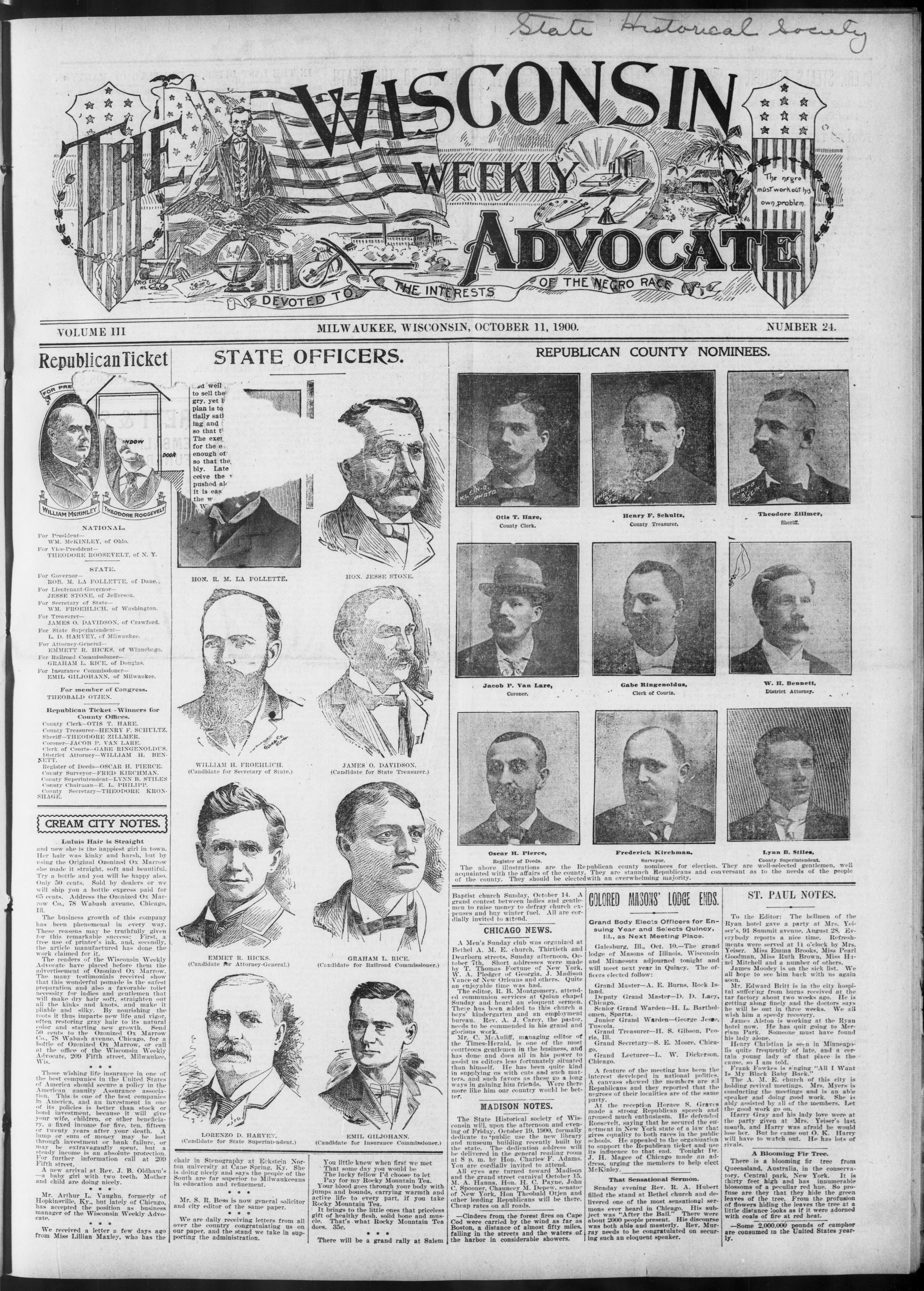
RepublicanTicket
FOR PRE
WILLIAM MCKINLEY
THEODORE ROOSEVELT
NATIONAL.
For President—
WM. McKINLEY, of Ohio.
For Vice-President—
THEODORE ROOSEVELT, of N. Y.
STATE.
For Governor—
ROB. M. LA FOLLETTE, of Dane.
For Lieutenant-Governor—
JESSE STONE, of Jefferson.
For Secretary of State—
WM. FROEHLICH, of Washington.
For Treasurer—
JAMES O. DAVIDSON, of Crawford.
For State Superintendent—
L. D. HARVEY, of Milwaukee.
For Attorney-General—
EMMETT R. HICKS, of Winnebago.
For Railroad Commissioner—
GRAHAM L. RICE, of Douglas.
For Insurance Commissioner—
EMIL GILJOHANN, of Milwaukee.
For member of Congress.
THEOBALD OTJEN.
Republican Ticket - Winners for
County Offices.
County Clerk—OTIS T. HARE.
County Treasurer—HENRY F. SCHULTZ.
Sheriff—THEODORE ZILLMER.
Coroner—JACOB P. VAN LARE.
Clerk of Courts—GABE RINGENOLDUS.
District Attorney—WILLIAM H. BEN-
NETT.
Register of Deeds—OSCAR H. PIERCE.
County Surveyor—FRED KIRCHMAN.
County Superintendent—LYNN B. STILES
County Chairman—E. L. PHILIPP.
County Secretary—THEODORE KRON-
SHAGE.
CREAM CITY NOTES.
and now she is the happiest girl in town. Her hair was kinky and harsh, but by using the Original Ozonized Ox Marrow she made it straight, soft and beautiful. Try a bottle and you will be happy also. Only 50 cents. Sold by dealers or we will ship you a bottle express paid for 65 cents. Address the Ozonized Ox Marrow Co., 78 Wabash avenue, Chicago, Ill.
The business growth of this company has been phenomenal in every way. These reasons may be truthfully given for this remarkable success: First, a free use of printer's ink, and, secondly, the article manufactured has done the work claimed for it.
The readers of the Wisconsin Weekly Advocate have placed before them the advertisement of Ozonized Ox Marrow. The many testimonials received show that this wonderful pomade is the safest preparation and also a favorable toilet necessity for ladies and gentlemen that will make dry hair soft, straighten out all the kinks and knots, and make it pliable and silky. By nourishing the roots it thus imparts new life and vigor, often restoring gray hair to its natural color and starting new growth. Send 50 cents to the Ozonized Ox Marrow Co., 78 Wabash avenue, Chicago, for a bottle of Ozonized Ox Marrow, or call at the office of the Wisconsin Weekly Advocate, 209 Fifth street, Milwaukee, Wis.
* * *
Those wishing life insurance in one of the best companies in the United States of America should secure a policy in the American annuity Assurance association. This is one of the best companies in America, and an investment in one of its policies is better than stock or bond investment, because it will give your wife, children, or other beneficiary, a fixed income for five, ten, fifteen or twenty years after your death. A lump or sum of money may be lost through investment or bank failure, or may be extravagantly spent, but a steady income is an absolute protection. For further information call at 209 Fifth street.
A new arrival at Rev. J. B. Oldham's—a baby girl with two teeth. Mother and child are doing nicely.
Mr. Arthur L. Vaughn, formerly of Hopkinsville, Ky., but lately of Chicago, has accepted the position as business manager of the Wisconsin Weekly Advocate.
☆ ☆ ☆
We received a letter a few days ago from Miss Lillian Maxley, who has the
STATE OFFICERS.
STATE OFFICERS.
to sell the
gry, yet b
plan is to
tially satl
ing and
so that t
The exe
for the e
enough of
so that the
bly. Late
ceive the w
pushed al
it is eas
the w
HON. R. M. LA FOLLETTE.
D. H. H. K.
WILLIAM H. FROEHLICH.
(Candidate for Secretary of State.)
A.
EMMET R. HICKS.
(Candidate for Attorney-General.)
M. J. C.
LORENZO D. HARVEY.
(Candidate for State Superintendent)
chair in Stenography at Eckstein Norton university at Cane Spring, Ky. She is doing nicely and says the people of the South are far superior to Milwaukeeans in education and refinement.
* * *
Mr. S. R. Bess is now general solicitor and city editor of the same paper.
We are daily receiving letters from all over the country congratulating us on our paper, and the stand we take in supporting the administration.
CUPRA
JAMES O. DAVIDSON.
(Candidate for State Treasurer.)
R. H. H.
GRAHAM L. RICE.
(Candidate for Railroad Commissioner.)
J.
You little knew when first we met
That some day you would be
The lucky fellow I'd choose to let
Pay for my Rocky Mountain Tea.
Your blood goes through your body with
jumps and bounds, carrying warmth and
active life to every part, if you take
Rocky Mountain Tea.
It brings to the little ones that priceless
gift of healthy flesh, solid bone and muscle.
That's what Rocky Mountain Tea
does. 35c.
There will be a grand rally at Salem
REPUBLICAN COUNTY NOMINEES.
The above illustrations are the Republican county nominees for election. They are well-selected gentlemen, well acquainted with the affairs of the county. They are staunch Republicans and conversant as to the needs of the people of the county. They should be elected with an overwhelming majority.
KLIN-O.
PHOTO
Otis T. Hare,
County Clerk.
M. B.
M. B.
Baptist church Sunday. October 14. A grand contest between ladies and gentlemen to raise money to defray church expenses and buy winter fuel. All are cordially invited to attend.
CHICAGO NEWS.
A Men's Sunday club was organized at Bethel A. M. E. church, Thirtieth and Dearborn streets, Sunday afternoon, October 7th. Short addresses were made by T. Thomas Fortune of New York, W. A. Pledger of Georgia, J. Madison Vance of New Orleans and others. Quite an enjoyable time was had. The editor, R. B. Montgomery, attended communion services at Quinn chapel Sunday and heard an eloquent sermon. There has been added to this church a boys' kindergarten and an employment bureau. Rev. A. J. Carey, the pastor, needs to be commended in his grand and glorious work.
Mr. C. McAuliff, managing editor of the Times-Herald, is one of the most courteous gentlemen in the business, and has done and does all in his power to assist us editors less fortunately situated than himself. He has been quite kind in supplying us with cuts and such matters, and such favors as these go a long ways in gaining him friends. Were there more like him our country would be better
MADISON NOTES.
The State Historical society of Wisconsin will, upon the afternoon and evening of Friday, October 19, 1900, formally dedicate to public use the new library and museum building recently built by the state. The dedication address will be delivered in the general reading room at 8 p. m. by Hon. Charles F. Adams. You are cordially invited to attend. All eyes are turned toward Madison and the grand street carnival October 15. M. A. Hanna, Hon. H. C. Payne, John C. Spooner, Chauncey M. Depew, senator of New York, Hon Theobald Otjen and other leading Republicans will be there. Cheap rates on all roads.
—Cinders from the forest fires on Cape Cod were carried by the wind as far as Boston, a distance of almost fifty miles, falling in the streets and the waters of the harbor in considerable showers.
AMOTH
STEIN
Henry F. Schultz,
County Treasurer.
M. B.
Gabe Ringenoldus,
Clerk of Courts.
M.
Frederick Kirchman.
Surveyor.
publican county nominees for election.
They are staunch Republicans and con
with an overwhelming majority.
GOLORED MASONS' LODGE ENDS
Grand Body Elects Officers for Ensuing Year and Selects Quincy, Ill., as Next Meeting Place. Galesburg, Ill., Oct. 10.—The grand lodge of Masons of Illinois, Wisconsin and Minnesota adjourned tonight and will meet next year in Quincy. The officers elected follow: Grand Master-A. E. Burns, Rock Island.
Deputy Grand Master-D. D. Lacy Chicago.
Senior Grand Warden-H. L. Bartholomen. Sparta.
Junior Grand Warden-George Jesse. Tuscola.
Tuscola.
Grand Treasurer—H. S. Gibson, Peoria, Ill.
Grand Secretary—S. E. Moore, Chicago.
Grand Lecturer—L. W. Dickerson, Chicago.
A feature of the meeting has been the interest developed in national politics. A canvass showed the members are all Republicans and they reported that the negroes of their localities are of the same party.
At the reception Horace S. Graves made a strong Republican speech and aroused much enthusiasm. He defended Roosevelt, saying that he secured the enactment in New York state of a law that gives equality to both races in the public schools. He appealed to the organization to support the Republican ticket and use its influence to that end. Tonight Dr. J. H. Magee of Chicago made an address, urging the members to help elect McKinley.
That Sensational Sermon.
Sunday evening Rev. R. A. Hubert filled the stand at Bethel church and delivered one of the most sensational sermons ever heard in Chicago. His subject was "After the Ball." There were about 2000 people present. His discourse was both able and masterly. Rev. Murray needs to be congratulated on securing such an eloquent speaker.
NUMBER 24. MINEES.
PHOTO
BY
STEIN
Theodore Zillmer,
Sheriff.
S
W. H. Bennett,
District Attorney.
M.
Lynn B. Stiles,
County Superintendent.
They are well-selected gentlemen, well versant as to the needs of the people
ST. PAUL NOTES.
To the Editor: The bellmen of the Ryan hotel gave a party at Mrs. Yeiser's, 91 Summit avenue, August 28. Everybody reports a nice time. Refreshments were served at 11 o'clock by Mrs. Yeiser. Miss Emma Brooks, Miss Pearl Goodman, Miss Ruth Brown, Miss Hazel Mitchell and a number of others. James Moodey is on the sick list. We all hope to see him back with us again soon.
Mr. Edward Britt is in the city hospital suffering from burns received at the tar factory about two weeks ago. He is getting along finely and the doctors says he will be out in three weeks. We all wish him a speedy recovery. James Alston is working at the Ryan hotel now. He has quit going to Merriam Park. Someone must have found his lady alone. Henry Christian is seen in Minneapolis quite frequently of late, and a certain young lady of that place is the cause, so I am told.
Frank Fowkes is singing "All I Want Is My Black Baby Back."
The A. M. E. church of this city is holding revival meetings. Mrs. Myers is conducting the meetings and is an able speaker and doing good work. She is ably assisted by all of the members. Let the good work go on.
Harry Gray and his lady love were at the party given at Mrs. Yeiser's last month, and Harry was afraid he would lose her. But he came out O. K. Harry will have to watch out. He has lots of rivals.
A Blooming Fir Tree.
There is a blooming fir tree from Queensland, Australia, in the conservatory. Central park, New York. It is thirty feet high and has innumerable blossoms of a peculiar red hue. So profuse are they that they hide the green leaves of the tree. From the profusion of flowers hiding the leaves the tree at a little distance looks as if it were adorned with coals of fire at red heat.
Some 2,000,000 pounds of camphor are consumed in the United States yearly.
Bought Fast Horses and Costly Jewels on a Salary of $800
New York, Oct. 10.—Charged with having stolen from the Elizabethport Banking company of Elizabethport, N. J., nearly $108,000, William Schreiber, utility clerk, 26 years old, has disappeared. Frederick Heidritter, president of the banking company, came to the city last night to make efforts to recover $20,000 worth of diamonds and other valuables which the clerk is said to have lavished upon a young woman living here.
Although the young man had been abstracting money from the bank for several years, his employers say that he accomplished his thefts so cleverly as to deceive even a state bank examiner who, last February, went over the books of the institution, pronounced them correct, and even complimented the bank officers on the prosperous condition of their institution.
Directors Make Up the Deficit.
Schreiber had been missing since August 11, when he went on a two-weeks' vacation. Sunday, a week ago, the bank's bookkeeper accidentally discovered that there was missing a sum greater than the capital and surplus of the bank combined. President Heidritter at once summoned the directors of the bank and acquainted them with the discovery. The directors immediately decided to pay into the bank every dollar that was lost. They called in a bank examiner and explained the circumstances to him. "Do you intend to close the bank?" asked President Heidritter. "Oh, no." replied the bank examiner, "I'll not shut a bank that has directors who are so prompt in replacing its missing funds."
Bought Horses and Jewels.
Young Schreiber's downfall is attributed to the fascination exercised over him by a brown-haired woman, 28 years old, whom he met in Eighty-third street several years ago. Detectives employed by the bank officials have learned that he bought her horses, carriages and costly jewelry. Schreiber, who is the son of a poor Elizabeth carpenter, and whose salary was only $800 a year, it is alleged, bought this woman a pearl necklace, with a clasp composed of two big diamonds and a ruby, valued at $6000. It is said the woman has also in her possession diamonds valued at $11,000, which she says the young man purchased for her. In a stable in West Fifty-seventh street Schreiber kept a carriage and a pair of handsome horses for the woman.
Theory of the Police.
The police believe that Schreiber is hiding in this city. Former Judge Gilhooly, counsel for the institution, and a clerk, Mr. Husted, called at the West Forty-seventh street police station this morning and asked for the service of two detectives. Mr. Gilhooly said he had several of his men watching the flat of Mrs. Anna Hart in West Forty-eighth street, on which Schreiber had lavished the bank's money. They suspected that she would go to her lover or he come to her, and in that way his whereabouts might be discovered.
The watchers were tired out, he said, and they asked the services of the two detectives to relieve them. Detectives were assigned to the case. Mrs. Hart is said to have diamonds worth $20,000 and $12,000 in cash, the remnants of Schreiber's peculations, that the bank officers want to get hold of. She admits that Schreiber lived with her under the name of William Hart, but claims she has seen nothing of him since August 18.
Civil proceedings will be instituted against Mrs. Anna Hart by the officers of the Elizabethport Banking company for the recovery of $20,000 worth of diamonds, $12,000 in cash and personal property valued at $5000, which they alleged were lavished upon her by Schreiber.
GOLD IS FOUND IN STONE FROM RACINE.
Excitement Caused by Discovery at Waukegan of Valuable Pav ing Material.
Waukegan, Ill., Oct. 10.—[Special.]—Some excitement has been caused by the discovery that crushed stone used in paving streets contains gold. The stone came from Racine, Wis., and is claimed to be quite rich in the precious metal.
FATAL FIRE IN SHANTY.
Father and Two Sons Are Burned to Death in Roxbury, Mass., This Morning.
Boston, Mass., Oct. 10.—Three persons, a father and two sons, were burned to death in a shanty in Roxbury at 2:30 o'clock this morning. The victims are: Edward Tousealin, 45; Edward Tousealin, Jr., 7; James Tousealin, 14. Tousealin had lived in the place ten years. He carried on the business of wood peddling and one side of his abode had another shed where he prepared the wood for market. The bodies of Tousealin and his sons were almost consumed. Several years ago Tousealin's wife was burned to death in this same place, her clothing having caught fire while she was cooking a meal.
BIG BONUS FOR YANKEE EARS
Filipino Millionaire Avenges Son's Death in Peculiar Fashion.
New York, Oct. 10.—Sergts. Barton and Zimmerman of the Forty-seventh New York volunteers, who have just returned from the Philippines, report that at an engagement at Albay, Sergt. Fowler, who enlisted from Whitestone, L. L., shot and killed a young, handsome Filipino lieutenant named Marcus and captured his sword.
Lieut. Marcus was a son of Marcellus Marcus, a Filipino of millions and station, well known all over the island, who had been friendly to the Americans, though his son was not.
The death of his son aroused Old Man Marcus to a pitch of fury and he swore that he would spend every dollar he owned to avenge him. He raised a troop 3000 strong and has offered to pay $100 for the left ear of any member of the Forty-seventh regiment.
This offer is said to have brought fruit, for every American killed was found to have his left ear missing.
Miner Crushed to Death.
Iron Mountain, Mich., Oct. 10.—[Special.]—A Slavish miner was killed in the Chapin mine today. He missed the cage and was caught between it and the wall and crushed to death.
BIG WAR IN STEEL.
Carnegie Said to be Formulating a Plan to Ruin His Strongest Rivals.
New York, Oct. 9.—A war among the great steel companies of the country is one of the possibilities of the coming winter. The Carnegie company, it is said, is about to cut the price of steel rails from $26 to $22, thereby breaking up the big pool, which was formed in this city several weeks ago by the Federal Steel company, the American Steel and Wire company, the National Steel company, the Carnegie company and minor concerns. The Carnegie company, it is claimed, can sell rails at $21 a ton and make a fair profit, while the other companies cannot sell at less than $25 a ton and earn a dividend on their common stock. It is said that Mr. Carnegie is determined to force the big companies to the wall if possible.
Railroads Refuse to Buy Rails.
The reason of the proposed cut is the refusal of railroad presidents to pay the price demanded by the steel companies, which is regarded as extortionate, in view of the prevailing price of steel billets. There have been several conferences at Waldorf-Astoria and the Holland house within the last four days among prominent railroad men and the decision has been reached to withhold orders for steel rails as late as possible with the view of taking advantage of whatever cut may be made between now and January 1.
Few, if any, orders have been placed with the steel companies at present prices.
The price of steel rails was recently cut from $36 to $26 a ton. In 1899, when steel billets were $32 a ton, Pittsburg delivery, the steel companies sold rails at $35 a ton and made a fair profit. Now the price of steel billets has dropped to $16.50 a ton, yet the steel manufacturers have been unwilling to cut prices below $26.
The big, overcapitalized concerns are the ones that are trying to force the high prices upon the railroads. However, the officers of these companies are declaring that they know of no dissatisfaction among the railroad presidents over the price charged.
Hill Said to Direct Fight.
The fight against the steel companies on the part of the railroads is being led, it is said, by James J. Hill, president of the Great Northern. Mr. Hill said, however: "The Great Northern is not in the market for steel rails. I think we shall need none the current year. Of course, I think the price is too high. I believe that $24 should have been the limit." The president of another large Western road said the same.
A statement was given out by a man high in the councils of the Carnegie company today that the Carnegie company had entered into no agreement to keep up prices. He continued:
"On the contrary, the purpose of the company is to sell the product as heretofore announced by Mr. Carnegie himself, at a fair manufacturer's profit, the company not being obliged, by reason of its capital, to take any question of dividends on watered stocks into account in fixing such price."
Denied by President Gary.
New York, Oct. 9.—President Elbert H. Gary of the Federal Steel company denied today that there was any friction between his company and the Carnegie Steel company regarding steel-rail rates, and also said that there is and has been no disagreement between manufacturers of rails concerning prices. "It is the unanimous opinion," said Mr. Gary, "that $26 per ton is fair and reasonable. "I am in almost daily consultation with President Schwab of the Carnegie Steel company. There has been no intimation of any dissatisfaction from that source over prices or anything else. In a word, we cannot make rails at less than the price named."
CHINESE SITUATION.
Emperor Says He will Return to Pekin at a More Favorable Time.
Pekin, Saturday, Oct. 6.—Prince Ching has received an edict from the Emperor dated October 1, in reply to a note sent at the request of legations, saying he will return to Pekin as soon as the negotiations take a favorable turn.
Paris, Oct. 9.—It is semi-officially announced today that the news received here from China is more reassuring than the English dispatches make out, that an agreement between the powers will be arrived at on the basis of M. Delcasse's note, that the reported arrival of Li Hung Chang at Pekin has been confirmed and that confirmation has also been received of the degradation of Prince Tuan. The officials of the French foreign office are elated over the reception which France's note has received in Europe and they are very hopeful and sanguine as to its results.
Washington, D. C., Oct. 9.—Today's cabinet meeting, which lasted two and a half hours, was devoted exclusively to the Chinese situation. The answer of this government to the French note practically was decided upon and will be put in form for transmission to the French government very soon. Its substance was not made public and will not be until it is delivered to the French minister for transmission to his government.
BIG ORANGE CROP.
Florida to Ship 1,000,000 Boxes, the Most Since 1894.
Jacksonville, Fla., Oct. 9.—Railroad men who are going through the state preparing for the winter's shipment of oranges report that the coming crop will be the largest marketed since 1894. Fruit men say the crop will be fully 1,000,000 boxes. Prices are likely to be $1.75 and $2 on the tree. The crops of some of the largest groves in south Florida have already been purchased at a rate of $1.85 per box on the tree. Next season's crop, if nothing intervenes, will be over 1,500,000 boxes.
Electricity for Cutting Girders.
Some wrought-iron girders in a building in Chicago had to be cut during repairs to make room for a steel column, and it was decided to use electricity instead of the old method of sawing. The girders to be cut were six in number and fourteen inches deep, with a one-inch web. To accomplish the work it was necessary to melt about 225 holes in the girders, and the actual time spent in cutting all was three and one-half hours.
Rostand's "Cyrano" Profits.
Edmond Rostand is the only dramatist who has done well in Paris during the exposition. "L'Aiglon" and "Cyrano de Bergerac" have kept Sarah Bernhardt's theater and the Porte Saint-Martin filled. His author's rights for the hot month of July were $6500 and for August $9000. It is estimated that he has made $400,000 since the first night of "Cyrano."
—Some 2,000,000 pounds of camphor are consumed in the United States yearly.
DRAMATIC SCENE IN THE YOUTSEY TRIAL.
Defendant Becomes Hysterical and Insists that William Goebel Is Not Dead.
Georgetown, Ky., Oct. 10.—Henry E. Youtsey was reported to be unconscious today from the effects of the thrilling scene in the courthouse last evening when he denounced Arthur Goebel. Further hearing of the charge against Youtsey of being a principal in the shooting of Gov. Goebel was postponed until tomorrow. The scene in court when Youtsey denounced witnesses as liars and declared that William Goebel was not dead was intensely dramatic. Dee Armstrong, a Louisville detective, had just told of his talks with Youtsey before and after his arrest. Then Arthur Goebel was put on the stand and said: "I talked with Youtsey the day he was arrested late in the afternoon in the jail in Frankfort in reference to the murder of my brother."
Just at this point Youtsey arose behind his attorneys and in a loud voice said: "It is untrue—it is a lie—I never spoke a word to that man in my life, nor he to me." Youtsey's wife sprang to his side, and while endeavoring to make him sit down could be heard saying: "Now you have killed my husband, I suppose you are satisfied." Then Youtsey hysterically shouted again: "I am innocent; there is no blood on my hands; these men are swearing my life away." Finally, after Youtsey was forced into a seat, he shouted again: "Goebel is not dead—all the demons in hell could not kill him."
Finally quiet was restored and Judge Williams asked Arthur Goebel another question, when Col. Crawford asked a postponement of the trial on account of the defendant's condition. Judge Cantrill said he could see no cause or reason for the defendant's outbreak, but in justice to his attorneys he would postpone the case.
TRADE QUOTATIONS A PROPERTY RIGHT.
Should Not be Rulined by Purlloiners Who Make Unauthorized Use of Them.
Chicago, Ill., Oct. 10.—Judge Kohlsaat, in the United States district court today, issued a temporary injunction restraining O. M. Stone and others from distributing quotations of the Chicago board of trade.
The complainant was the Cleveland Telegraph company, which has the right, under its contract with the board, to disseminate the quotations. Judge Kohlsaat held that there exists in the board of trade a right of property in the quotations until they are made over to the public; that there is no such dedication to public use as will serve to defeat or terminate the property right, and that it was within the power of the board to convey to the complainant the property right, and that the complainant acquired good title by its contract.
Granting that the right to the quotations is a property right, the court said that it cannot be denied that the complainant was greatly damaged by the broadcast scattering of the quotations by purloiners who, by reason of having to pay nothing for them, could obviously render the complainant's right of property valueless.
SHOT AN OFFICER.
Fatal Result of a Clash Between Strikers and Nonunion Men at Pottsville.
Pottsville, Pa., Oct. 10.—There was a clash between strikers and nonstrikers at the Coxe Bros. & Co. colliery at Oneida, Schuylkill county, this morning. The strikers gathered in large numbers near the colliery and endeavored to persuade men on their way to work to return to their homes. When they refused, a fight ensued. A coal and iron policeman was shot and instantly killed. Another policeman and a striker were dangerously wounded. In addition about a dozen of the employees of the colliery were badly injured by being stoned by the strikers. The dead man is Ralph Mills of Beaver Meadow. George Keller, Beaver Meadow, is in the miners' hospital here with a bullet in his head. The striker wounded is Joseph Lipko of Sheppton, who was shot through the groin. The shooting was the result of two separate riots. The first began at 2 o'clock this morning and reached a climax about 6 o'clock, when the marching strikers, mostly Hungarians, attacked the men on their way to work. The marchers numbered about 300 men, women and boys. Stones were thrown and the coal and iron policemen who endeavored to protect those on the way to work were forced to seek shelter. No shots were fired at this time and the marchers then dispersed.
The second clash was the result of an attempt on the part of the company to have a train of coal cars from the slopes moved to a breaker. The engine which was attached to the cars was surrounded by men and women, who stoned the engineer. Supt. Kudlick of Drifton demonstrated with the crowd, but to no purpose.
The policemen in this instance were employees who had been sworn in to protect the company's collieries. Rev. Carl Houser, a Lutheran clergyman, appealed to the mob to disperse, but his words were unheeded. Persistent attempts were made to run the train, and the men made a concerted rush upon the guard, who are said to have run in the direction of the engine house. The strikers gave chase and the firing followed. Probably a dozen shots were fired, but not in a volley. It is not known which side fired first.
Scranton, Pa., Oct. 10.—All interest in the strike of the mineworkers of the Lackawanna region today centers upon the great parade and mass meeting arranged for this afternoon. President John Mitchell and party reached here this morning at 10 o'clock from Shamokin and were received by a committee and escorted to their hotel. The parade this afternoon was made up of six divisions, and it was estimated that about 15,000 men and boys were in line, many of whom walked long distances to get here in time for it. The mass meeting was held late in the afternoon and many thousands were present. National Organizer Fred Dilcher was chairman, and Mayor Moir welcomed President Mitchell and his party.
Shamokin, Pa., Oct. 10.—Five delegates left here for Scranton this morning to participate in the miners' convention. They will be reinforced between now and Friday morning. There are thirteen locals between here and Excelsior, a distance of three miles, representing 11,000 men and boys. Two delegates are accredited to each local. The men have been instructed to vote for a reduction in the price of powder to $1.50 per keg, semi-monthly pay, and to accept the 10 per cent. increase, providing the operators guarantee to keep wages up to the standard for at least one year.
—Incurable insanity is not a ground for divorce in any state except North Dakota and Idaho.
RESIST TO THE DEATH.
Partition of China Would Precipitate a War in Which the World Would be Involved.
Tokio, Oct. 10.—The Marquis Ito, premier of Japan, and dictator of the Japanese policy in respect to China, says he cannot understand why the powers do not convene a conference of plenipotentiary representatives and speedily determine a concerted policy toward China. Though the armies are working harmoniously, a conflict is sure to arise if the government neglects longer to arrive at a definite understanding. In his humble opinion the present dynasty must be given a chance to return to power and the Emperor and court must return to Pekin before any effectual settlement can be accomplished. Negotiations with Hung Chang and Prince Ching will be fruitless, unless ratified and enforced by a re-established government, for they alone, no matter what they promise, cannot carry out anything.
"Tuan, Kang Yi and Tung Fuh Siang dominate the Empress," continued the premier, "and say they will resist the foreign powers to the death if they are ignored. It is impossible to separate them from the Empress. If the attempt were made by force the Emperor and Empress would undoubtedly disappear altogether. Pekin should be evacuated, the Empress and court permitted to return and negotiations should come afterward. The foreign powers should withdraw to the coast and hold their forces there pending the final settlement.
"Further aggressive measures will plunge the whole empire into war, and chaos will reign for years, trade will be ruined and life protected only at tremendous cost. War with China would be the greatest disaster of the century, for no new nation could conquer her single-handed and all the world would be plunged in strife.
"The Emperor is weak, dominated entirely by the Empress and Tuan. The viceroys would, I think, fight if partition of China were attempted.
"China must be given a chance to rehabilitate herself and punish the instigators of the insurrection."
TUAN'S HEAD SAVED.
To be Banished While Some Boxer Chiefs are to be Beheaded.
Pekin, Oct. 7 (via Tien Tsin, Oct. 8, and Shanghai, Oct. 10).—Trustworthy Chinese reports say that the Dowager Empress is seriously ill at Tai Yuen Fu, province of Shansi, and the free hand of the Emperor in affairs of state of late is regarded as confirmatory of these reports.
The response to the German demand has been transmitted to Li Hung Chang. This says that Ying Nien, president of the censorate, Kang Yi, assistant grand secretary and president of the civil board, and Chao Shu Chiao, president of the board of punishment, will be decapitated: that Prince Chwang, Duke Tsai Lan and Prince Yih, will be sentenced to life imprisonment, and that Prince Tuan will be banished to the imperial military post roads on the Siberian frontier, as a further punishment for aiding the Boxers.
MUST BE PUNISHED.
F. D. Gamewell Says an Indemnity Would Not be Sufficient.
San Francisco, Cal., Oct. 10.—Among the arrivals from the Orient on the steamer American Maru is F. D. Gamewell, who says that the United States should insist that the leaders of the uprising should be punished to the fullest extent. Whether that punishment shall take the form of execution is a matter to be determined later, but whatever is done should be made sufficiently severe to have a lasting effect upon the Chinese nation.
"It is no fault of the Boxers," said Mr. Gamewell, "that all our missionaries over there are not dead today. If we make light of this thing and pass it by, merely demanding indemnity, it is my opinion that the same terrible scenes will be repeated within a few years."
He was told that the Germans had demanded the head of Prince Tuan, and did not propose to leave China until they got it. "Good," said he and Mrs. Gamewell approved. "The Germans understand the situation, and I hope they will stick to their decision."
Mrs. Goodrich, a missionary, and her three children have also arrived here from Pekin. Rev. J. A. Miller and wife, Miss Kate Ogborn and Mr. and Mrs. O. Cady were the other missionaries on board the American Maru. Dr. Miller and wife were stationed at Pao Ting Fu. 100 miles distant from Pekin. On account of Mrs. Miller's illness they left for the coast about the last of May. The day after their departure the railroad track was torn up. There were three missions and fifteen missionaries at Pao Ting Fu. Mr. Miller is certain that none of them are now alive. Miss Ogborn comes from Central China and Mr. and Mrs. Cady from Western China.
FINE DRAMATIC EFFECT
Horses Dash Up to a Beleagured Bank with Money Brought by Special Train.
Grand Haven, Mich., Oct. 10.—Fearful that the reserve funds in hand would not be sufficient to meet the "run" that had been started the officials of the Grand Haven National bank telegraphed Grand Rapids for assistance. Cachier Wylie of the First National bank of Grand Rapids engaged a special train, piled in the express car $250,000 in currency and specie, and had the engineer force his locomotive all the way. He arrived within a few hours after the sudden drain on the local institution began, and with fine dramatic effect dashed up to the building in a carriage, the coachman urging his horses to their utmost. But the crisis had been safely passed, and there no longer existed a need for the money.
The run was started, it is charged, by persons afflicted with malice toward the bank officials. The depositors gathered, and clamored for their money. Although the bank had $100,000 of idle money in its vaults, it feared that the sum might be insufficient, and, in response to inquiries, received assurance of support from numerous establishments in nearby towns.
IDLER VICTIMS BURIED.
Capt. Corrigan Delays Funeral Until All Bodies Are Recovered. Cleveland, O., Oct. 10.—Inexpressibly sad was the funeral yesterday of six victims of the yacht Idler disaster. Those buried were the wife, three daughters and baby grandchild of Capt. James Corrigan, whose yacht Idler was capsized in a squall early last July. Capt. Corrigan delayed the funerals until the last of the bodies was found.
IN THE LAST DITCH.
Bloemfontein, Oct. 10.—The British forces have reoccupied Smithfield, Rouxville, Wepener and Dewetsdorp, Orange River colony. London. Oct. 9.—A dispatch from East London says that the Boers are looting Wepener and Rouxville on their retreat to the southward. The British are rapidly closing them in, and there seems to be no escape for them, except via the Basutoland border, which is strongly guarded. A dispatch from Maseru, dated yesterday, says that 100 Boers have entered Ficksburg, routing the police, who fled across the Basutoland border.
The British war office has issued orders that the bulk of the militia regiments called out for service during the South African war are to be disbanded. This will affect about 50,000 men.
A hat and a pipe, alleged to have belonged to ex-President Kruger of the Transvaal, and guaranteed to be such, were sold at Stevens' auction rooms yesterday. The hat brought £25 and the pipe £8 10s.
Cape Town, Oct. 10.—Parliament will adjourn next Monday. The treason tribunals will be convened October 29, with ex-Attorney-General Solomon as presiding judge. The imperial government is considering a plan for the assistance of prisoners of war when they return to the farms.
Island of St. Helena, Oct. 10.—The British transport Idaho landed about 200 Boer prisoners here Monday. Gen. Cronje and the other Boer prisoners are preparing a big celebration of Paul Kruger's birthday today.
A TRAGEDY RECALLED.
Philadelphia, Pa., Oct. 10.—recover insurance on the life of whom he killed on December 11 has been commenced in this city. Swithin C. Shortlidge, who is rising at Kennett square, in Chey. The suit, which is to resum of $7022 from the Provo and Trust company, is one remarkable in the history ofance.
The tragedy which ended Mrs. Shortlidge was enacted on a New Year's eve, and caused sensation. Several years before date Prof. Shortlidge had come to work with his wife and family and established what was known as the Media Academy for Young Men. For several years the venture was successful, the school having a high-class patronage. Then Mrs. Shortlidge died. In November, 1893, Prof. Shortlidge married Miss Marie Dixon Jones, and everybody pronounced it a happy match. Shortly after his second marriage the professor began to act strangely. On the night of the killing, six weeks after the marriage, Prof. Shortlidge invited his wife to go out with him for a walk
His wife to go out with him for a walk. It had been snowing heavily, and Mrs. Shortlidge had noticed that her husband was completely dressed. He commanded her to follow him and when they had gone a short distance from the house he drew a revolver and shot her through the heart. He then made an attempt to commit suicide, but was disarmed by a neighbor. In the trial which followed, Prof. Shortlidge was acquitted on the ground of insanity and was confined in an asylum until a year ago.
AGREEMENT REACHED.
Michigan Central will Surrender Charter Under Which It Has Been Operated Since 1846.
Detroit, Mich., Oct. 10.—At a meeting held yesterday afternoon at the Michigan Central offices in Detroit an agreement was reached to surrender the special charter under which the road has been operating since 1846. This is tantamount to the surrender of the special charters under which the Lake Shore and Grand Trunk systems are also operating, as officials of these roads practically agreed several months ago to acquiesce in whatever the Michigan Central people did
The question of damages is the most serious obstacle which all parties concerned will encounter. It is understood that the Michigan Central wants between $2,000,000 and $3,000,000, while the amount which the other roads would claim may be calculated on damages amounting annually in the case of the Lake Shore to about $50,000 and the Grand Trunk at $35,000. It is estimated that $3,500,000 is the maximum amount which the three roads would demand.
PREMIUMS FOR SEATS.
A Ten Thousand Dollar Audience for Julia Marlowe's First Night in Chicago.
Chicago, Ill., Oct. 10.—The auction sale of boxes and seats for the opening of the Illinois theater was held yesterday afternoon at Powers' theater. The premiums on the sale amounted to very nearly $7000, which, in addition to $2000, the regular price of tickets, and to the additional sale of seats unactioned, will make a $10,000 house for the first night of Julia Marlowe in "Barbara Freitchie" next Tuesday.
Every seat in the orchestra was sold at auction, besides nearly two-thirds of the dress circle. Back as far as row N in the orchestra the premiums averaged over $11. Thence to the rear the average went by stages from $9 to $6.50, to $4.50 and $2.50. The seats in the first row of the dress circle averaged $10 and the second row $8. Powers' theater was crowded to the doors by waiting bidders.
A SUDDEN ATTACK.
Mrs. Coudert, Miniature Artist, Becomes Seriously Ill.
Chicago, Ill., Oct. 10.—Mrs. Amelia Kussner Coudert, the miniature portrait painter, is lying seriously ill at the Auditorium hotel. She arrived in the city about ten days ago with her husband, Capt. Coudert, and within a day or so became ill. She has been unable to leave her room since, and, while not thought to be dangerously ill, her condition has been such as to alarm her husband and friends. Mrs. Coudert has achieved distinction in her field of work, having painted miniature portraits of the Czar of Russia, the Prince of Wales, Pope Leo, Mr. Gladstone and others of the royalty and nobility of Europe. She also painted a portrait of President Kruger.
MARQUIS OF BUTE DIES.
Original of Disraeli's "Lothair" Dead of Paralysis.
London, Oct. 10.—John Patrick Crichton-Stuart, third Marquis of Bute, and the original of Disraeli's character of "Lothair," died this morning at Dumfries house, his seat in Ayrshire, from paralysis.
THE ROLL OF MARTYRS.
List of Killed and Missing Missionaries in the Variions Provinces of China.
New York, Oct. 9.—A complete list of Protestant missionaries known to have been killed from the beginning of the Boxer movement to September 5 has been received by the American Bible society from Rev. John R. Hykes, D. D., its agent in Shanghai, as follows: In Shan Tung, December 31, 1899—Rev. S. M. Brooks of the Church of England mission.
In Chih Li, about June 1, 1900—Rev. H. V. Norman, Rev. C. Robinson or the Church of England mission.
At Paotting Fu, June 30—Rev. F. E. Simcox, Bullion, Pa.; Mrs. Simcox, London, Pa., and three children; Dr. G. Y. Taylor, all of American Presbyterian mission, Taylorsville, Pa. July 1—Rev. H. T. Pitkin, Philadelphia; Miss A. A. Gould, Bethel, Me.; Miss M. S. Morrill, of the American Board mission, Portland, Me.; Rev. B. Bagnall, Mrs. Bagnall, one child, Rev. William Cooper, all of the China Inland mission, England.
At Hsiae Yi, Shansl, June 30—Miss Whitchurch, Miss Searell, of the China Inland mission, England.
Near the Yellow river (while fleeing from Shansl), July 15 or 16—Rev. G. McConnell, Mrs. McConnell, one child, Miss King, Miss Burton, all of the China Inland mission, England; Miss F. E. Nathan, Miss M. R. Nathan and Miss Heaysman of the China Inland mission are supposed to have been with this party and to have shared their fate, but as this is not confirmed they are put in the list of missing.
At Klu Cheo, Chekiang, July 21 and 22—Rev. D. B. Thompson, Mrs. Thompson, two children, Miss Desmond, Miss Manchester, Rev. G. F. Ward, Miss Ward, one child, Miss Sherwood, Miss Thirgood, all of the China Inland mission, England.
En route to Hankow from Shansl—Miss Rice, July 13; Mr. Saunders and child Isabella, July 27; Mr. Saunders' child Jessie, August 3; Mrs. E. J. Cooper, August 6; Miss Huston, August 11; Rev. Whitehouse, Mrs. Whitehouse, all of the English Baptist mission, England; Mr. Bury, Buyout three children. For
the mission
includes those who
most affected by
viz.: Chih Li and
word from the follow-
stationed in northern
May 8:
Mrs. McKee, I. Anson, Mrs.
Aspden, Miss M. E. Smith.
Benson, Mrs. Persson, Miss C. A. Lar-
ness Lundell, Miss Engvall, E. Pet-
terson, G. E. Karlburg, A. Johannson, Mr.
Englund, all of the China Inland mission,
England.
The last word from the following was
June 20:
Mr. Ogren, Mrs. Ogren, Mr. Peat, Mrs. Peat, Miss Dobson, Miss Hurn, Miss F. Nathan, Miss M. R. Nathan, Miss Heaysman, Mr. Young, Mrs. Young, Mr. Barrett, Mr. Woodruff, Dr. Hewitt, all of the China Inland mission, England.
No word from the following since May 8:
Emil Olssen, Mrs. E. Olssen, E. J. Cooper's child; August 17, two of Mr. Lutley's children, all of the China Inland mission, England.
At Tai Yuen Fu, Shansl, June 27, Miss Coombs of Tschaoyng (India) Baptist English mission, England. The evidence of her death is a letter in German dated July 6 and seen by Mr. Stevenson of the Chinese Inland mission, in which it is stated that there was a riot June 27 in which Dr. Edwards' hospital was destroyed and Miss Coombs killed. (By being thrown into the burning building.) It is believed that all of the missionaries who were in Tai Yuen Fu at the time of Miss Coombs' death were massacred on the 9th day of July.
Doubtless Perished.
The following missionaries are known to have been in Tai Yuen Fu at the time of the reported massacre and have doubtless perished, including Miss Coombs. There are only thirty-one names, which is six short of the number said to have been massacred, according to Chinese official reports; but it is known that those living at places near to the capital were urged by local officials to take refuge in Tay Yuen because (as they afterward said) they were unwilling to kill the missionaries, and sent them to Yu Hsien, the governor, to butcher:
Supposed to have been killed at Tal Yuen Fu July 9—Rev. T. W. Pigott, Mrs. Pigott, Dr. Lovatt, Mrs. Lovatt, one child, Rev. W. G. Stokes, Mrs. Stokes, Rev. J. Simpson, Mrs. Simpson, Rev. A. Hoddle, Miss Duval, all of the Shao Yang mission; Rev. G. E. Farthing, Mrs. Farthing, two children, Miss Stewart, Rev. T. J. Underwood, Mrs. Underwood, C. Oberg, Mrs. Oberg, Mrs. Forsberg, C. Blomberg, Mrs. Blomberg, W. Noren, Mrs. Noren, A. Fagerholm, C. E. Jacobson, E. Anderson, Mrs. E. Anderson, M. Book, Mrs. Book, A. Sandberg, A. E. Palm, Miss E. Ericksen, O. Ringmark, Mrs. O. Ringmark, F. Nystrom, Mrs. F. Nystrom, M. Nystrom, Mrs. M. Nystrom, C. Soderbaum, Mrs. C. Soderbaum, A. Larson, Mrs. A. Larson, C. L. Lundberg, Mrs. C. L. Lundberg, seventeen children in the mission, all of them Christion and Missionary alliance (American).
Said to be in Hiding.
The following are said to be in hiding: Mr. Kay, Mrs. Kay, G. McKle, Miss Chapman, Miss Way, all of the China Inland mission, England.
In the province of Chih Li, the following are unaccounted for: Mr. Greene, Mrs. Greene, two children, Miss Gregg-all of the China Inland mission, England. These people are reported to be in the hands of the Boxers at that place, eighty miles from Tlen Tsin.
Mr. Griffith, Mrs. Griffith, Mr. Brown, of th China Inland mission, England; are supposed to be in jail at Shuen Teh. Rev. W. A. McKurrach, Mrs. McKurrach, Rev. H. Dixon, Mrs. Dixon, Rev. S. W. Ennals, Miss B. C. Renant, of the English Baptist mission; Rev. Atwater, Mrs. Atwater, Rev. Clapp, Mrs. Clapp, Miss R. Bird, Rev. Mark Williams, Rev. Davis Dehart (probably) Rev. Price of the American Board mission.
Recapitulation.
In the above list there are 178 people, very few, if any of whom will escape. Of these 66 are men, 73 women (41 married and 32 single); and 39 children. In the above total there are the following Americans: Twenty-five men, 24 women (16 married and 8 single), and 20 children; total, 69 Americans. Total killed, about whose death there cannot be any question, 11 men, 6 married women, 13 single women, 13 children; total, 43. Of those killed the following were Americans: Three men, 1 married woman, 6 single women, 3 children; total, 13.
Of those in Tai Yuen Fu who were unquestionably massacred July 9, 10 were men, 9 married women, 4 single women, 7 children; total, 30, all British. There are still some missionaries in the provinces of Kansuh and Kwei Chow, who have not been heard from for some time, but there is good reason to hope that they will get to places of safety.
IOWA'S ENORMOUS CROPS.
Official Estimate of All Cereals is 531,349,020 Bushels.
Des Moines, Ia., Oct. 8.—The official preliminary estimates of the crop yield of Iowa for the current year show: Corn, area, 8,618,660 acres; average, 41 bushels per acre; total product, 353,365,060 bushels, which is greater by 18,000,000 than was ever before harvested in the state. The total of all cereals will be 531,349,020 bushels, which is 10,000,000 in excess of any previous year and 131,000,000 above the average yearly output the past ten years.
—The most costly leather in the world is known to the trade as piano leather. The secret of tanning this leather is known only to a family of tanners in Germany.
FARMERS CORNER
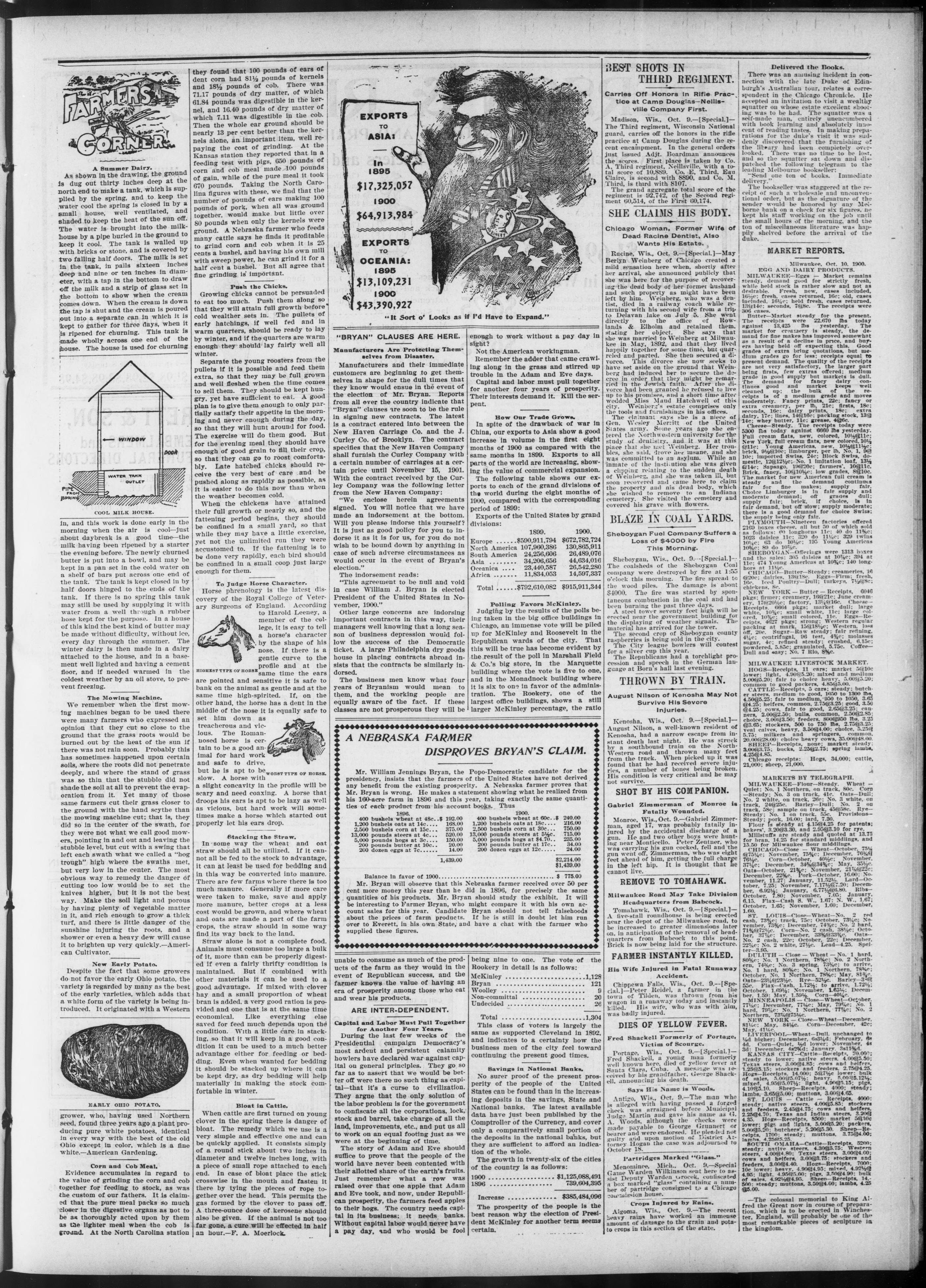
As shown in the drawing, the ground is dug out thirty inches deep at the north end to make a tank, which is supplied by the spring, and to keep the water cool the spring is closed in by a small house, well ventilated, and shaded to keep the heat of the sun off. The water is brought into the milkhouse by a pipe buried in the ground to keep it cool. The tank is walled up with bricks or stone, and is covered by two falling half doors. The milk is set in the tank, in pails sixteen inches deep and nine or ten inches in diameter, with a tap in the bottom to draw off the milk and a strip of glass set in the bottom to show when the cream comes down. When the cream is down the tap is shut and the cream is poured out into a separate can in which it is kept to gather for three days, when it is ripened for churning. This tank is made wholly across one end of the house. The house is used for churning
WINDOW
DOOR
WATER TANK
OUTLET
PIPE
FROM
SPRING
COOL MILK HOUSE.
in, and this work is done early in the morning when the air is cool—just about daybreak is a good time—the milk having been ripened by a starter the evening before. The newly churned butter is put into a bowl, and may be kept in a pan set in the cold water on a shelf of bars put across one end of the tank. The tank is kept closed in by half doors hinged to the ends of the tank. If there is no spring this tank may still be used by supplying it with water from a well through a rubber hose kept for the purpose. In a house of this kind the best kind of butter may be made without difficulty, without ice, every day through the summer. The winter dairy is then made in a dairy attached to the house, and in a basement well lighted and having a cement floor, and if needed warmed in the coldest weather by an oil stove, to prevent freezing.
The Mowing Machine.
We remember when the first mowing machines began to be used there were many farmers who expressed an opinion that they cut so close to the ground that the grass roots would be burned out by the heat of the sun if there was not rain soon. Probably this has sometimes happened upon certain soils, where the roots did not penetrate deeply, and where the stand of grass was so thin that the stubble did not shade the soil at all to prevent the evaporation from it. Yet many of those same farmers cut their grass closer to the ground with the hand scythe than the mowing machine cut; that is, they did so in the center of the swath, for they were not what we call good mowers, pointing in and out and leaving the stubble level, but cut with a swing that left each swath what we called a "hog trough" high where the swaths met, but very low in the center. The most obvious way to remedy the danger of cutting too low would be to set the knives higher, but it is not the best way. Make the soil light and porous by having plenty of vegetable matter in it, and rich enough to grow a thick turf, and there is little danger of the sunshine injuring the roots, and a shower or even a heavy dew will cause it to brighten up very quickly.—American Cultivator.
New Early Potato.
Despite the fact that some growers do not favor the early Ohio potato, the variety is regarded by many as the best of the early varieties, which adds that a white form of the variety is being introduced. It originated with a Western
EARLY OHIO POTATO. grower, who, having used Northern seed, found three years ago a plant producing pure white potatoes, identical in every way with the best of the old Ohio except in color, which is a fine white.—American Gardening.
Corn and Cob Meal.
Evidence accumulates in regard to the value of grinding the corn and cob together for feeding to stock, as was the custom of our fathers. It is claimed that the pure meal packs so much closer in the digestive organs as not to be as thoroughly acted upon by them as the lighter meal when the cob is ground. At the North Carolina station
they found that 100 pounds of ears of dent corn had 811/2 pounds of kernels and 181/2 pounds of cob. There was 71.17 pounds of dry matter, of which 61.84 pounds was digestible in the kernel, and 16.40 pounds of dry matter of which 7.11 was digestible in the cob. Then the whole ear ground should be nearly 13 per cent better than the kernels alone, an important item, well repaying the cost of grinding. At the Kansas station they reported that in a feeding test with pigs, 650 pounds of corn and cob meal made 100 pounds of gain, while of the pure meal it took 670 pounds. Taking the North Carolina figures with these, we find that the number of pounds of ears making 100 pounds of pork, when all was ground together, would make but little over 80 pounds when only the kernels were ground. A Nebraska farmer who feeds many cattle says he finds it profitable to grind corn and cob when it is 25 cents a bushel, and having his own mill with sweep power, he can grind it for a half cent a bushel. But all agree that fine grinding is important.
Push the Chicks.
Growing chicks cannot be persuaded to eat too much. Push them along so that they will attain full growth before cold weather sets in. The pullets of early hatchings, if well fed and in warm quarters, should be ready to lay by winter, and if the quarters are warm enough they should lay fairly well all winter.
Separate the young roosters from the pullets if it is possible and feed them extra, so that they may be full grown and well fleshed when the time comes to sell them. They should be kept hungry, yet have sufficient to eat. A good plan is to give them enough to only partially satisfy their appetite in the morning and never enough during the day, so that they will hunt around for food. The exercise will do them good. But for the evening meal they should have enough of good grain to fill their crop, so that they can go to roost comfortably. Late hatched chicks should receive the very best of care and be pushed along as rapidly as possible, as it is easier to do this now than when the weather becomes cold.
When the chickens have attained their full growth or nearly so, and the fattening period begins, they should be confined in a small yard, so that while they may have a little exercise, yet not the unlimited run they were accustomed to. If the fattening is to be done very rapidly, each bird should be confined in a small coop just large enough for them.
To Judge Horse Character.
Horse phrenology is the latest discovery of the Royal College of Veterary Surgeons of England. According
England. According to Harold Leeney, a member of the college, it is easy to tell a horse's character by the shape of his nose. If there is a gentle curve to the profile and at the
HIGHEST TYPE OF HORSE are pointed and sensitive it is safe to bank on the animal as gentle and at the same time high-spirited. If, on the other hand, the horse has a dent in the middle of the nose it is equally safe to
set him down as treacherous and vicious. The Roman-nosed horse is certain to be a good animal for hard work and safe to drive, but he is apt to be slow. A horse with
set him down as treacherous and vicious. The Roman-nosed horse is certain to be a good animal for hard work and safe to drive, but he is apt to be slow. A horse with a slight concavity in the profile will be scary and need coaxing. A horse that droops his ears is apt to be lazy as well as vicious, but hard work will sometimes make a horse which started out properly let his ears drop.
Stacking the Straw.
In some way the wheat and oat straw should all be utilized. If it cannot all be fed to the stock to advantage, it can at least be used for bedding and in this way be converted into manure. There are few farms where there is too much manure. Generally if more care were taken to make, save and apply more manure, better crops at a less cost would be grown, and where wheat and oats are made a part of the farm crops, the straw should in some way find its way back to the land.
Straw alone is not a complete food. Animals must consume too large a bulk of it, more than can be properly digested if even a fairly thrifty condition is maintained. But if combined with other materials it can be used to a good advantage. If mixed with clover hay and a small proportion of wheat bran is added, a very good ration is provided and one that is at the same time economical. Like everything else saved for feed much depends upon the condition. With a little care in stacking, so that it will keep in a good condition it can be used to a much better advantage either for feeding or bedding. Even when wanted for bedding it should be stacked up where it can be kept dry, as dry bedding will help materially in making the stock comfortable in winter.
Bloat in Cattle.
When cattle are first turned on young clover in the spring there is danger of bloat. The remedy which we use is a very simple and effective one and can be quickly applied. It consists simply of a round stick about two inches in diameter and twelve inches long, with a piece of small rope attached to each end. In case of bloat place the stick crosswise in the mouth and fasten it there by tying the pieces of rope together over the head. This permits the gas formed by the clover to pass off. A three-ounce dose of kerosene should also be given. If the animal is not too far gone, a cure will be effected in half an hour.—F. A. Moerlock
EXPORTS
TO
ASIA:
In
1895
$17,325,057
1900
$64,913,984
EXPORTS
TO
OCEANIA:
1895
$13,109,231
1900
$43,390,927
"It Sort o' Looks as if I'd Have to Expand."
"BRYAN" CLAUSES ARE HERE. Manufacturers Are Protecting Themselves from Disaster.
Manufacturers and their immediate customers are beginning to get themselves in shape for the dull times that they know would ensue in the event of the election of Mr. Bryan. Reports from all over the country indicate that "Bryan" clauses are soon to be the rule in signing new contracts. The latest is a contract entered into between the New Haven Carriage Co. and the J. Curley Co. of Brooklyn. The contract specifies that the New Haven Company shall furnish the Curley Company with a certain number of carriages at a certain price until November 15, 1901. With the contract received by the Curley Company was the following letter from the New Haven Company:
"We enclose herein agreements signed. You will notice that we have made an indorsement at the bottom. Will you please indorse this yourself? It is just as good policy for you to indorse it as it is for us, for you do not wish to be bound down by anything in case of such adverse circumstances as would occur in the event of Bryan's election."
The indorsement reads:
"This agreement to be null and void in case William J. Bryan is elected President of the United States in November, 1900."
Other large concerns are indorsing important contracts in this way, their managers well knowing that a long season of business depression would follow the success of the Democratic ticket. A large Philadelphia dry goods house in placing contracts abroad insists that the contracts be similarly indorsed. The business men know what four years of Bryanism would mean to them, and the working people are equally aware of the fact. If these classes are not prosperous they will be
A NEBRASKA FARMER
A NEBRASKA FARMER
DISPROVES BRYAN'S CLAIM.
Mr. William Jennings Bryan, the presidency, insists that the farmers any benefit from the existing prosperity. Mr. Bryan is wrong. He makes a statement his 160-acre farm in 1896 and this ties of each product from his account.
1896.
400 bushels wheat at 48c...$ 192.00
1,200 bushels oats at 14c... 168.00
2,500 bushels corn at 15c... 375.00
13,000 pounds steers at 4c... 520.00
5,000 pounds hogs at 3c... 150.00
200 pounds butter at 10c... 20.00
200 dozen eggs at 7c... 14.00
1,439.00
Balance in favor of 1900.....
Mr. Bryan will observe that this cent more money this year than he quantities of his products. Mr. Bryan be interesting to Farmer Bryan, who count sales for this year. Candidate about the prices of farm products. over to Everett, in his own State, and supplied these figures.
Mr. William Jennings Bryan, the Popo-Democratic candidate for the presidency, insists that the farmers of the United States have not derived any benefit from the existing prosperity. A Nebraska farmer proves that Mr. Bryan is wrong. He makes a statement showing what he realized from his 160-acre farm in 1896 and this year, taking exactly the same quantities of each product from his account books. Thus
Balance in favor of 1900..... $ 775.00
Mr. Bryan will observe that this Nebraska farmer received over 50 per cent more money this year than he did in 1896, for precisely the same quantities of his products. Mr. Bryan should study the exhibit. It will be interesting to Farmer Bryan, who might compare it with his own account sales for this year. Candidate Bryan should not tell falsehoods about the prices of farm products. If he is still in doubt let him run over to Everett, in his own State, and have a chat with the farmer who supplied these figures.
```markdown
```
unable to consume as much of the products of the farm as they would in the event of Republican success, and the farmer knows the value of having an era of prosperity among those who eat and wear his products.
ARE INTER-DEPENDENT.
Capital and Labor Must Pull Together for Another Four Years. During the last few weeks of the Presidential campaign Democracy's most ardent and persistent calamity howlers have declared war against capital on general principles. They go so far as to assert that we would be better off were there no such thing as capital—that it's a curse to civilization. They argue that the only solution of the labor problem is for the government to confiscate all the corporations, lock, stock and barrel, take charge of all the land, improvements, etc., and put us all to work on an equal footing just as we were at the beginning of time.
The story of Adam and Eve should suffice to prove that the people of the world have never been contented with their allotted share of the earth's fruits. Just remember what a row was raised over that one apple that Adam and Eve took, and now, under Republican prosperity, the farmers feed apples to their hogs. The country needs capital in its business; it needs banks. Without capital labor would never have a pay day, and who would be fool
---
The indorsement reads:
enough to work without a pay day in sight?
Not the American workingman.
Not the American workingman. Remember the adder that came crawling along in the grass and stirred up trouble in the Adam and Eve days. Capital and labor must pull together for another four years of prosperity. Their interests demand it. Kill the serpent.
How Our Trade Grows.
In spite of the drawback of war in China, our exports to Asia show a good increase in volume in the first eight months of 1900 as compared with the same months in 1899. Exports to all parts of the world are increasing, showing the value of commercial expansion. The following table shows our exports to each of the grand divisions of the world during the eight months of 1900, compared with the corresponding period of 1899: Exports of the United States by grand divisions:
1899. 1900.
Europe ..... $590,911,794 $672,782,724
North America 107,960,386 130,865,911
South America 24,256,606 26,489,076
Asia ..... 34,206,656 44,634,016
Oceanica ..... 23,440,587 26,542,280
Africa ..... 11,834,053 14,597,337
Polling. Favors McKinley.
Polling Favors McKinley. Judging by the results of the polls being taken in the big office buildings in Chicago, an immense vote will be piled up for McKinley and Roosevelt in the Republican wards of the city. That this will be true has become evident by the result of the poll in Marshall Field & Co.'s big store, in the Marquette building where the vote is five to one, and in the Monadnock building where it is six to one in favor of the administration. The Rookery, one of the largest office buildings, shows a still larger McKinley percentage, the ratio
$2,214.00
$1,439.00
being nine to one. The vote of the
Rookery in detail is as follows:
McKinley .....1,128
Bryan .....121
Woolley .....9
Non-committal .....20
Undecided .....26
Total .....1,304
This class of voters is largely the
same as supported Cleveland in 1892,
and indicates to a certainty how the
business men of the city feel toward
continuing the present good times.
Savings in National Banks.
No surer proof of the present prosperity of the people of the United States can be found than in the increasing deposits in the savings, State and National banks. The latest available data have just been published by the Comptroller of the Currency, and cover only a comparatively small portion of the deposits in the national banks, but they are sufficient to afford an indication of the whole.
The growth in twenty-six of the cities of the country is as follows:
1900 ..... $1,125,088,491
1896 ..... 739,604,395
Increase $385,484,090
The prosperity of the people is the best reason why the election of President McKinley for another term seems certain.
BEST SHOTS IN THIRD REGIMENT.
Carries Off Honors in Rifle Practice at Camp Douglas—Neillsville Company First.
Madison, Wis., Oct. 9.—[Special.]—The Third regiment, Wisconsin National guard, carries off the honors in the rifle practice at Camp Douglas during the recent encampment. In the general orders just issued Adjt. Boardman announces the scores. First place is taken by Co. A. Third regiment, Neillsville, with a total score of 10,889. Co. E, Third, Eau Claire, is second with 8890, and Co. M. Third, is third with 8107.
The grand aggregate total score of the regiment is 92,742, of the Second regiment 60,514, of the First 60,174.
SHE CLAIMS HIS BODY.
Chicago Woman, Former Wife of Dead Racine Dentist, Also Wants His Estate.
Racine, Wis., Oct. 9.—[Special.]—May Berlyn Weinberg of Chicago created a mild sensation here when, shortly after her arrival, she announced publicly that she was here for the purpose of recovering the dead body of her former husband and such property as might have been left by him. Weinberg, who was a dentist, died in a railway coach while returning with his second wife from a trip to Delavan lake on July 5. She went directly to the office of Rowlands & Elholm and retained them, stating her object. She says that she was married to Weinberg at Milwaukee in May, 1892, and that they lived happily together for some time, but quarreled and parted. She then secured a divorce. This divorce she now seeks to have set aside on the ground that Weinberg had induced her to secure the decree in order that they might be remarried in the Jewish faith. After the divorce had been granted he refused to live up to his promises, and a short time after wedded Miss Maud Hatchwell of this city. Weinberg's estate comprises only the tools and furnishings in his offices.
The claimant says she is a niece of Gen. Wesley Merritt of the United States army. Some years ago she entered the Northwestern university for the study of dentistry, and it was at this place that she met Weinberg. Her troubles, she said, drove her insane, and she was committed to an asylum. While an inmate of the institution she was given a clipping relating to the sudden death of Weinberg, and she was taken ill, but soon recovered and came here to claim the property and his dead body, which she wished to remove to an Indiana cemetery. She visited the cemetery and covered his grave with flowers.
BLAZE IN COAL YARDS.
Sheboygan Fuel Company Suffers a Loss of $4000 by Fire This Morning.
Sheboygan, Wis., Oct. 9.---[Special.]-- The coalsheds of the Sheboygan Coal company were destroyed by fire at 1:55 o'clock this morning. The fire spread to the wood piles. The damage is about $4000. The fire was started by spontaneous combustion in the coal and had been burning the past three days. A steel tower seventy feet high will be erected near the government building for the displaying of weather signals. The material has arrived for the tower. The second crop of Sheboygan county raspberries is being sold in the city. The City league bowlers will contest for a silver cup this year. The Republicans had a torchlight procession and speech in the German language at Born's hall last evening.
THROWN BY TRAIN.
August Nilson of Kenosha May Not Survive His Severe Injuries.
Kenosha, Wis., Oct. 9.—[Special.]—August Nilson, a well-known resident of Kenosha, had a narrow escape from instant death last night. He was struck by a southbound train on the North-Western road and thrown many feet from the track. When picked up it was found that he had received severe injuries, a number of bones being broken. His condition is very critical and he may not survive.
SHOT BY HIS COMPANION.
Gabriel Zimmerman of Monroe is Fatally Wounded.
Monroe, Wis., Oct. 9.—Gabriel Zimmerman, aged 17, was probably fatally injured by the accidental discharge of a gun. He and two other boys were hunting near Monticello. Peter Zentner, who was carrying his gun cocked, fell and the gun went off. Zimmerman, who was eight feet ahead of him, getting the full charge in the left hip. It is thought that he cannot live.
REMOVE TO TOMAHAWK.
Milwaukee Road May Take Division Headquarters from Babcock. Tomahawk, Wis., Oct. 9.—[Special.] A five-stall roundhouse is being erected near the depot of the Milwaukee road, to be increased to greater dimensions later on, in anticipation of the removal of headquarters from Babcock to this point. Brick is now being laid for the structure.
FARMER INSTANTLY KILLED.
His Wife Injured in Fatal Runaway Accident.
Chippewa Falls. Wis., Oct. 9.—[Special.]—Peter Reidel, a farmer in the town of Tilden, was thrown from his wagon in a runaway today and instantly killed. His wife, who was with him, was badly injured.
DIES OF YELLOW FEVER.
Fred Shackell Formerly of Portage, Victim of Scourge. Portage, Wis., Oct. 9.—[Special.]—Fred Shackell, a young man formerly well known here, died of yellow fever at Santa Clara, Cuba. A message was received by his grandfather, George Shackell, announcing his death.
Says His Name is Woods.
Antigo, Wis., Oct. 9.—The man who is alleged with having passed a forged check was arraigned before Municipal Judge Martin and gave his name as G. A. Woods, although the checks were made payable to George Grunnert or bearer and were endorsed. He pleaded not guilty and upon motion of District Attorney Hogan the case was adjourned to October 18.
Partridges Marked "Glass."
Menominee, Mich., Oct. 9.—Special Game Warden Wilkinson sent here to assist Deputy Warden Grocek, confiscated a box marked "glass" containing a number of partridge consigned to a Chicago commission house.
Crops Injured by Rains.
Algoma. Wis., Oct. 9.-The recent heavy rains have worked an immense amount of damage to the grain and potato crops in this section of the state.
Delivered the Books.
There was an amusing incident in connection with the late Duke of Edinburgh's Australian tour, relates a correspondent in the Chicago Chronicle. He accepted an invitation to visit a wealthy squatter on whose estate excellent shooting was to be had. The squatter was a self-made man, entirely unencumbered with book learning and absolutely innocent of reading tastes. In making preparations for the duke's visit it was suddenly discovered that the furnishing of the library had been completely overlooked. There was no time to be lost, and so the squatter sat down and dispatched the following telegram to the leading Melbourne bookseller: "Send one ton of books. Immediate delivery."
The bookseller was staggered at the receipt of such a wholesale and unconventional order, but as the signature of the sender would be honored by any Melborne bank on a check for six figures, he kept his staff working on the job until the small hours of the morning, and the ton of miscellaneous literature was happily shelved before the arrival of the duke.
MARKET REPORTS.
Milwaukee, Oct. 10, 1900.
D DAIRY PRODUCTS.
EGG AND DAIRY PRODUCTS.
MILWAUKEE—Eggs — Market remains steady, demand good for strictly fresh, while held stock is rather slow and not as desirable. Fresh, new, cases included, 16%c; fresh, cases returned, 16c; old, cases included, 16%c; held fresh, cases returned, 13%14c; seconds, 7@8c. The receipts were 306 cases.
Butter—Market steady for the present.
The receipts were 22,670 lbs today
against 13,425 lbs yesterday. The
market for creamery is steady, the demand
for fine makes has improved somewhat
as a result of a decline in price, and buy-
ers having held off expecting this. Good
grades of extra bring quotations, but mediu-
mium grades go for less; receipts equal to
present demand. The quality of the receipts
are not very satisfactory, the larger part
being firsts, few extras offered; medium
grade in good supply but markets is dull.
The demand for fancy dairy con-
tinues good and market keeps well
cleaned up; the bulk of the re-
ceipts is of a medium grade and moves
moderately. Fancy prints, 22c; fancy or
extra creamery, per lb, 21c; firsts, 18c;
seconds, 16c; dairy prints, 18c; extra
dalry, 17c; lines, 14@16c; packing stock, 13@
14c; whey butter, 11c; grease, 4@6c.
Cheese—Steady. The receipts today were 5300 lbs today against 6600 lbs yesterday. Full cream flats, new, colored, 10% @11c; New York, full cream flats, new colored, 10% @11c; Young Americas, new, 10% @11c; brick, 9½@10c; limburger, per lb, No. 1, 9@10c; imported Swiss, 24c; Block Swiss, domestic, 12@12½c; No. 1 imitation loaf, 13½@14c; Sapsago, 19@20c; farmers', 10@11c; Brick, fancy, 10@10½c; low grades, 8@10c. The market for new American full cream is steady and the demand continues fair for fine makes; supply fair. Choice Limburger is in fair supply and moderate demand; off grades dull; supply fair; brick, if choice, is in fair demand, but off slow; supply moderate; there is a good demand for choice Swiss; the supply being only fair.
PLYMOUTH-Nineteen factories offered
2160 boxes cheese, all but 50 of which sold
as follows; 60 longhorns 11c; 40 do 11½c;
1023 daisies 11c; 320 do 11½c; 329 twins
10½c; 63 do 10½c; 195 Young Americas
10½c; 89 do 10½c.
SHEBOYGAN- Offerings were 1313 boxes and the sales: 305 daisies at 10%¹³; 394 at 11¹³; 474 Young Americas at 10%¹³; 140 long-hors at 11%¹³.
CHICAGO- Butter- Steady: creameries, 16 @20¹³; dairies, 18%¹³; Eggs- Firm; fresh, 16¹³; Iced Poultry- Dull; turkeys, 7½¹³@8¹³; chickens, 8¹³.
NEW YORK- Butter- Receipts, 6046 pkgs; firmer; creamery, 16%²1³; June creamery, 17%²0¹³; factory, 13¼¹³@16¹³. Cheese- Receipts, 6664 pkgs; market dull; large white, 10%¹³; small white, 11¹³; large colored, 10%¹³; small colored, 11¹³. Eggs- Receipts, 4627 pkgs; strong; Western regular packing at mark, 15@18¹³¹³; Western, loss off, 20¹³. Sugar- Raw steady; fair refining, 4¼¹³; centrifugal, 96 test, 4¼¹³; molasses sugar, 4¹³; refined steady; crushed, 6.15¹³; powdered, 5.85¹³; granulated, 5.75¹³. Coffee- Dull and easy; No. 7 Rlo, 8%¹³.
MILWAUKEE LIVESTOCK MARKET.
MIHWACKEE LIVESTOCK CO. HOGS—Receipts, 11 cars; market 5@10c lower; light, 4.90@5.20; mixed and medium 5.00@5.20; fair to choice heavy, 5.00@5.20; common to good packers, 4.85@5.00.
CATTLE—Receipts, 5 cars; steady; butcher steers, medium to good, 1050 to 1300 lbs, 4.50@5.25; fair to medium, 950 to 1050, 3.65@4.25; heifers, common, 2.75@3.25; good, 3.50@4.25; cows, fair to good, 2.65@3.25; canners, 2.00@2.50; bulls, common, 2.50@2.85; choice, 3.00@3.50; feeders, 800@950 lbs, 3.25@3.65; stockers, 500 to 750 lbs, 2.75@3.25; veal calves, heavy, 3.50@4.00; choice, 5.25@5.75; milkers and springers, common, 20.00@28.00; choice heavy cows, 35.00@48.00.
SHEEP—Receipts, none; market steady; 3.00@3.75, bucks, 2.25@2.75; spring lambs, 4.25@4.85.
Chicago receipts: Hogs, 34,000; cattle, 21,000; sheep, 21,000.
MARKETS BY TELEGRAPH.
MILWAUKEE—Flour—Steady. Wheat —
Quiet. No 1 Northern, on track, 80c. Corn
—Steady. No 3 on track, 41c. Oats—Dull;
No 2 white, on track, 28c; No 3 white, on
track, 24@25c. Barley—Dull; No 2 on
track, 58c; sample on track, 45@58c. Rye—
Steady. No 1 on track, 55c. Provisions—
Steady; pork, 16.00; lard, 7.30.
Flour is steady at 4.15@4.25 for patents;
hakers', 3.20@3.30, and 2.95@3.10 for rye.
Milstuffs are steady and quoted at 13.75
for bran, 14.25 for standard middlings, and
15.50 for Milwaukee flour middlings.
CHICAGO—Close — Wheat—October, 75%
@75%; November, 75%; December, 76%
@76%; Corn—October, 40%; November,
37%; December, 34%@34%; May, 35%;
Oats—October, 21%; November, 217@22%;
December, 22%; Pork—October, 16.00;
November, 11.27; January, 11.52%; Lard—
October, 7.25; November, 7.17%@7.20; December,
6.92%; January, 6.77%@6.80. Ribs—
October, 7.80; November, 7.05; January,
6.15; Flax—Cash S. W., 1.67; N. W., 1.67;
October, 1.65; November, 1.60; December,
1.60
ST. LOUISE—Close—Wheat—No. 2 red cash, 73%c track, 75c; October, 73%c; November, 73%c; December, 74%c; No. 2 hard, 71%@72%c; Corn—No. 2 cash, 38%c; October, 37%c; December, 33%@33%c; Oats—No. 2 cash, 22c; October, 22c; December, 22%c; No. 2 white, 27%c; Lead—4.25. Speller—3.95.
DULUTH—Close—Wheat—No. 1 hard, 80%c; No. 1 Northern, 78%c; No. 2 Northern, 74%c; No. 3 spring, 73%c; to arrive, No. 1 hard, 80%c; No. 1 Northern, 78%c; October, No. 1 Northern, 78%c; May, 81%c; Oats—23%@23%c; Rye—52%c; Barley—3@55c; Flax—Cash, 1.72%2; to arrive, 1.72%2; October, 1.69%2; November, 1.65%2; December, 1.59; May, 1.59%2; Corn—40%c.
MINNEAPOLIS—Close—Wheat—October, 77%c; December, 77%c; May, 79%c; No. 1 hard, 79%c; No. 1 Northern, 77%c; No. 2 Northern, 73%@75%c.
NEW YORK—Close—Wheat—December, 81%c; May, 84%c; Corn—December, 42c; May, 41%c.
LIVERPOOL—Whent—Dull unchanged to
½d higher; December, 63½d; February, 6s
4d; Corn—Quiet, ½d lower; November, 4s
3d; December, 4½d; January, 38½d.
KANSAS CITY—Cattle—Recelpts, 20.000;
steady to lower; native steers, 4.00@5.50;
Texas steers, 3.00@4.85; cows and heifers,
1.25@5.15; stockers and feeders, 2.75@4.25;
Hogs—Recelpts, 14.000; 57½c lower; bulk
of sales, 5.00@5.07½; heavy, 5.00@5.12½;
mixed, 4.95@5.07½; light, 4.90@5.15; plugs,
4.10@5.10. Sheep—Recelpts, 4000; steady;
lambs, 3.68@5.00; muttons, 3.00@4.05.
ST. LOUIS—Cattle — Recelpts, 4000;
steady; native steers, 4.00@5.85; stockers
and feeders, 2.45@4.75; cows and heifers,
2.25@4.70; Texas and Indian steers, 3.20@
4.35. Hogs—Recelpts, 8500; market 5¹0c
lower; plugs and lights, 5.00@5.20; packers,
5.00@5.20; butchers, 5.20@5.30. Sheep—Recelpts, 1700; steady; muttons, 3.75@4.00;
lambs, 4.25@5.25.
SOUTH OMAHA—Cattle—Recelpts, 5200; steady; native steers, 4.30@5.75; Western steers, 4.00@4.80; Texas steers, 3.00@4.00; cows and heifers, 3.00@3.75; stockers and feeders, 3.00@4.40. Hogs—Recelpts, 7000; 10c lower; heavy, 4.90@4.95; mixed, 4.92% 4.95; light, 4.95@5.00; plugs, 3.50@4.90; bulk of sales, 4.92%@4.95. Sheen—Recelpts, 14.500; steady; muttons, 3.50@4.00; lambs, 4.25@5.00.
—The colossal memorial to King Alfred the Great now in course of preparation, which is to be erected in Winchester, England, will probably be one of the most remarkable pieces of sculpture in the kingdom.
PERSON & RIEGEL CO.
The Wisconsin Weekly Advocate
Printed in the Interests of the Negro Race,
MILWAUKEE, WIS.
Richard B. Montgomery.....Editor and Proprietor
Office 209 Fifth Street.
Telephone Black No. 244.
SUBSCRIPTION RATES.
Any part of the United States and Canada, postage paid.
One Year ..... $2.00
Six Months ..... 1.25
Three Months ..... 7.5
Send money by Express Money Order, P. O.
Money Order or Registered Letter to the
Wisconsin Weekly Advocate.
ADVERTISING RATES.
One inch, single insertion ..... 25c
One inch, per year ..... $9.00
Business locals 5c per line each insertion.
Apply for rates to the Advocate.
TO CONTRIBUTORS:
All communications must be sent with the name and address of the sender as an evidence of good faith, but not necessarily for publication. No manuscript returned if not accepted, unless accompanied by stamps.
All subscribers of the Advocate that fail to get their paper promptly will please notify us at once. The Advocate, at 209 Fifth street.
The Wisconsin Weekly Advocate company wishes to notify the public that all contracts and business transactions with this company must have the company stamp, otherwise they will be void. Neither will this company be responsible for paid subscriptions unless given to duly-accredited agents, who, on request, will give the company's receipt for same. Subscribers failing to receive their papers regularly will kindly notify the general office. Address all business communications to the general manager, 209 Fifth street.
Entered at the Milwaukee P. O. as second-class matter.
The straightening of the Kaiser's moustache may be due to his fierceness on the Chinese question.
The "best hunting of the season" seems to be creditable to those who are searching express packages.
With coal at $7 a ton, and liable to go higher, it should surely be deemed worth while this winter to exercise economy in its use.
The robberies at Richland Center, Wis., and Centerville, Mich.. are proof that thieves, like merchants, choose to do business at centers.
The formidable character of the Chinese navy, as against the combined fleet, would give the proposed blockade of Chinese ports the nature of a sham battle.
The little beetle which is said to be eating up cigarettes is sharing with the callow smoke-swallower the very danger of paresis which makes cigarette smoking so enticing to him.
The Wisconsin will do. It is reported that she bumped into a violent northwest gale on her maiden trip, with all the vim and success of a heavyweight center rush of a victorious football team.
Wisconsin's representation on the Chickamauga park visiting commission is as essential as Hamlet's part in the play. Wisconsin was well represented in the fighting which is commemorated by the memorial tablets in the military park.
The Wisconsin summer hotels have gone the way of buildings which are proof only against kitchen fires. There would be fewer accidents of this kind if the lingering occupants of summer hotels would refrain from trying to heat them.
Emperor Kwang Su's willingness to conduct a memorial service over the grave of Baron von Ketteler is not unlike the attitude of the Boxers, who would like to conduct funeral services over all the foreigners who enter the Celestial Empire.
A. Chicago newspaper has secured from a popular clergyman of that city an article on "The Reiigious Aspect of the Chinese question," but it's the Chinese aspect of the religious question that has made China so uncomfortable for Christian missionaries.
Gen. Miles suggests that automobiles could be made useful at army headquarters. But if the horseless vehicles are not serviceable in the field the soldiers should waste no time upon them that could be put to better account by keeping thoroughly acquainted with the likes and dislikes of the army mule.
An act for the prevention of cruelty to wild animals has just become effective in England. The new law extends the provisions of the act which has heretofore applied to domestic animals, to all birds, fishes and reptiles not included in that measure, and makes offenders liable to three months' imprisonment or a fine of $25.
The proposed farm telephone system, added to the advantages of the rapidlyincreasing rural mail service, will make farm life less lonesome, and thus more attractive to people who are inclined cityward, to increase the congestion of population. With good roads, swift-going automobiles, thorough mail delivery, and telephone service, the farmers will be "in clover" figuratively as well as literally.
Celebrations of events of the Revolutionary war grow more frequent as patriotic societies stimulate the interest in the history of the country. Recently the 123d anniversary of the Paoli massacre was commemorated by the citizens of Delaware and Chester counties, Pa., who erected a monument on the spot on the centenary of the sad event.
Lemon growing is becoming one of California's profitable industries after a dozen years of costly experiment. The cultivation of the fruit on a commercial basis dates only from 1880, when the first cartlead was marketed at San Francisco, and there were about 120 acres of lemon groves in the whole state. Now there are 315,000 bearing trees and 263,000 nonbearing. The estimates of shipments vary from 1,150,000 boxes to 1,300,000 boxes. The newly-planted trees, it is expected, will bring the total output to 2,000,000 boxes. Lemon trees bear more heavily and regularly than orange trees. In the Pomona valley one lemon grove of 1000 trees, or 10 acres, 15 years old, has yielded since November of
Saturday Special Sale of Children's Reefers and Misses' Jackets
Saturday Special Sale of Children's Reefers and Misses' Jackets
Children's stylish and serviceable Reefers in fine boucle; mixed gray, red and blue, made like cut; regular price $2.25, small sizes only, sale price, $1.69
A Grand Offer in Women's Coats
All-Wool Black Kersey Cloth Box Coats, stylish front, shirred sleeves, correct length, a garment worth $7.50, Saturday at..... $6.25
Another Great Bargain—Women's Black Capes, medium length, full sweep, lined with satin romain, storm collar, rows of stitching, worth $8.50,
Saturday at..... $6.95
And finer garments equally as interesting — ranging in price from $7.50 up to $47.50.
last year 9274 boxes of fruit, with at least 2000 more boxes to be picked before the end of the season this year. The gross returns from this grove will be over $14,000 and the net profit about $11,000.
Owing to the fact that one of the students narrowly escaped death from concussion of the brain received in a "cane rush," the students of Rutgers college have abolished the "rush" and adopted the "spree"—whatever that may mean. If the innovation introduces no new application of the term, concussion of the brain may be caused by contact with bottles. Life in modern universities has become strenuous.
A school of tropical diseases similar to those already in existence in London and Liverpool is about to be opened at Hamburg. Dr. Nocht, the port medical officer of Hamburg, has been visiting the English schools for the purpose of studying the work in each establishment, since the Hamburg school will work in co-operation with the two English schools. It is contended that once malaria is suppressed in West Africa the country will become a second India.
The largest part of the world's supply of platinum comes from the Ural mountains, perhaps as much as 95 per cent. of the platinum used in the arts being found in the Russian and Siberian mines or placer deposits of that range. The metal is found in grains and nuggets in the sands of river and creek deposits and in the moraines of glaciers, and is either quite pure or in the form of an alloy with iridium or some of the allied metals of the platinum group, such as rhodium or ruthenium.
The fifth annual report of the chief fire warden of Minnesota, relating to the year 1899, and just published, gives ample reasons for the existence of the fire-warden system of that state. During the year covered by the report only ten insignificant forest fires occurred in Minnesota, and seven of these fires were extinguished by the warden or his helpers, the aggregate property loss in all of them reaching only $1541. In neighboring states, having no fire-warden system, large areas of forest lands were burned over during the same time, resulting in the loss of hundreds of thousands of dollars.
Interest in the bubonic plague has so increased among physicians in New York that the board of health has decided to build a bacteriological laboratory in which to study germs. It will be the costliest small building in Greater New York, measuring but 26x50 feet, yet requiring an expenditure of over $25,000. Owing to the virulent nature of bubonic germs, this laboratory will resemble a "bombproof" more than anything else. It will be constructed of steel, with solid asphalt walls. Descriptions of the new structure are being prepared for distribution among large cities of the United States, it being the first official effort made this side of the Atlantic to study the plague scientifically.
Dr. Henry D. Chapin of New York, in a recent contribution to the Medical Record on "Summer Heat and Public Health," puts in a few good words for street trees. "As trees maintain an average mean temperature of 54 degrees Fahrenheit, in all seasons," says Dr. Chapin, "it is easy to see what a constant cooling influence they possess in an atmosphere of 90 degrees. Add to this the constant exhalation from the leaves of watery vapor that has been absorbed from the moisture in the soil and from the surrounding air, and the cooling effect is most enhanced. This takes place most actively during the heated portion of the day, when it is most needed. A general purification of the air is not the least benefit to be derived from vegetation, as carbonic acid is absorbed and oxygen given out, just the reverse of what takes place in the animal economy. The purifying and cooling influence of trees placed uniformly throughout the city would have a marked influence on the public health in summer."
It is pointed out that partial failure of the oyster crop in certain years, the diminution in size of oysters on the market and the extinction of many oyster beds that formerly were famous—the Saddle Rocks, for instance—have been due to want of material for the production of the oyster shell. The beds throughout the oyster belt have steadily deteriorated in late years, and in many cases become absolutely worthless, in spite of the fact
310
that food has been supplied artificially at great expense and trouble, and wire fences have been used to protect the oysters from the starfish. For this trouble the defilement of the water by sewage and waste of various manufacturing establishments have usually been blamed, sometimes justly, sometimes without cause. What the oyster must have, or it will perish, is a full supply of carbonate of lime with which to build its shell. Near the mouths of rivers, where carbonate of lime in mechanical solution, as it is expressed, comes down from the hills and plains of the interior in drainage, the oyster has all the material it needs for building its house, and, at the same time, the inflowing tide brings it ample food. Something should be done to enable the oyster to hold its own against the dredge, the rake, the garbage dump and other destructive devices of man.
A New Device to Prevent the Blight of Cold.
Orange growers in Florida still speaks with bated breath of the great freeze of 1895—the time when wealthy men woke up to read ruin in the frost-covered ground. So keen is the recollection of that terrible season that devices to protect the trees are constantly being put forth. One of the latest, and certainly the most curious, is that of a tent which is designed to cover and protect the trees. The tent will be waterproof, so that it can be used from year to year, and will admit the sunshine on one side while it keeps out frosty winds on the other. In each tent will be an oil lamp, for heating. When the orange growers are warned of an approaching cold wave these lamps will be lighted and the door of the tent closed, and there will be warmth within, however chill the winds may be.
One of the government's devices to give warning of an approaching cold wave is particularly ingenious. Mails travel slowly in some of the less-thickly populated districts, so the engineers of express trains are required to blow their whistles six times in every three miles, to give notice of the coming of bad weather. But, in spite of all these precautions, the prospects for a good crop of oranges and no frost are bright. There is also an opening field in the exportation of Florida cuttings to Cuba and Porto Rico. The oranges of these islands, while growing under great advantages of soil and climate, suffer from lack of cultivation, and would be much better for a little American science and enterprise.—New York Tribune.
A Vast Realm Whose People Are Des-
tined to Make Worldly History.
What is Russia? The unfettered, irresponsible, limitless, absolute rule of one man over a hundred millions of his fellows—is that it? The ikon in the corner of every room where the language is spoken, the blue-domed basilica in every street of great cities, the long-haired priests, chanting in deep bass: the pedestrian, ceaselessly crossing himself; the Holy synod, whose God-given task is to coerce or to cajole a heathen world to orthodoxy—is that Russia? Or is it the society of the capital speaking all languages, familiar with all literatures, practicing every art, lapped in every luxury, esteeming manners more highly than morals? Or is it the vast and nearly roadless country, where settlements are to distances like fly-specks to window-panes, where the conveniences, the comforts and the decencies of civilization may be sought in vain outside the towns and away from the lines of railway; where entire villages are the prey of unamable disease; where seven people out of every ten can neither read nor write?
Siberia is Russia-five million square miles, in which whole countries are a quivering carpet of wild flowers in spring, a rolling grainfield in autumn, an icebound waste in winter, stored full of every mineral, crossed by the longest railway in the world, and chiefly inhabited by a population of convicts and exiles.
Central Asia is Russia—a million and a half square miles of barren desert and irrigated oases, the most famous cities of Asia and the greatest river, a few years ago the hotbed of Mussulman fanaticism, probably the cradle of the human race, and possibly the scene of its most fateful conflict.—Henry Norman in Scribner's.
Yacht Racing the Sport of Kings.
The first yacht race ever recorded was that sailed in 1662, when Charles II. matched a yacht of twenty-five tons, called the Jamie, against a small Dutch yacht, under the Duke of York, from Greenwich to Gravesend, when the King in his capacity of amateur helmsman was successful in beating the boat steered by his brother, says a London newspaper. The first yacht known was the Mary, which was presented to Charles II. by the Dutch. Hitherto even the name had been unknown in England, and it is only during the last 100 years that yacht-racing has become at all general.
CORNER THIRD AND PRAIRIE STREETS.
Children's stylish Reeferers in fine Kersey, trimmed with fancy braids, in red, blue, brown and tan, all sizes; a $2.50 reefer, Saturday for
M
medium length $6.95
ORANGES UNDER TENTS.
WHAT RUSSIA REALLY IS.
Children's handsome little coats, loose back, like cut shown, fancy buttons, trim'd with black and gilt braid, many new colors; a $4.00 garment for..... $3.25
Misses' Coats—about 140 of them—in black and gray homespuns, extremely stylish, a regular $4.50 coat, at..... $3.45 Misses' Jackets in fine kerseys, in tan, brown, blue and garnet, handsomely braided, new cut sleeves, a regular $5.00 coat, at..... $4.25
LDERSEE. Concerning Corrected. JAMES T. BR
THE COUNTESS WALDERSEE.
Some Common Mistakes Concerning
Her Covenant Are Hostile Cognized
Her Career Are Herein Corrected.
Since Count Waldersee has been chosen to command the German troops in China his American wife has enjoyed afresh the attention of the American press. She is probably the ablest and most influential American woman in Europe, and as she is to a considerable extent in public life, there is nothing out of the way in the attention the newspapers pay to her. But most of the current newspaper notices that concern her are mistaken in one or two exasperating particulars. Most of them say she was the daughter of David Lea of New York, which is true, and that she became the morganatic wife of the Prince of Schleswig-Holstein, who gave up his title to marry her. It is true that she married the prince, and that he gave up his title to marry her, but princes do not give up their titles when they make a morganatic marriage, and this marriage of Miss Lea to the Count de Noir, who had been Prince of Schleswig-Holstein, was not morganatic, but was a lawful marriage without qualification or limit. The Count de Noer became Prince de Noer, and his wife at his death continued to oe the Princess de Noer. After her first husband's death she came back to America, and spent a year or more. Several years after that she was married to Count Waldersee. The prevalent story that she has never been back to this country since she first went abroad is untrue. Also the story that her second marriage followed somewhat speedily after the death of her first husband.—Harper's Weekly.
When Sir George Turner of Victoria, Australia, went to London for the jubilee celebration, two flunkeys were told off to attend upon him at the Hotel Cecil, says a London correspondent. Being a man of exceedingly simple tastes and accustomed to do everything for himself, he was greatly astounded when one of the servants came into his room and said:
DENSMORE
"Come to dress me, have you?" was Sir George's reply. "Get out! Do you think I can't dress myself?" At last he got so sick of the sight of these servants that he summoned his orderly and gave him instructions to make them both drunk.
Agents for Wisconsin and Northern Michigan.
414 BROADWAY,
Milwaukee, Wis.
"My orderly," Sir George told a friend afterward. "was an old soldier. He knew how to obey orders."
A citizen of Lewiston, Me., has a watch chain made of nine peach stones. Each of the stones is carved on each side in a different device, so that there are eighteen designs. The stones are joined with bars of gold, the whole making a rich and novel chain.
—Cairo is the greatest town of Africa; its inhabitants number 500,000, 25,000 belng Europeans.
S. F. PEACOCK & SON
Funeral Directors
AND
EMBALMERS
431 Broadway. MILWAUKEE. WIS.
WHEN IN MADISON
Call at the
Avenue
Hotel...
M. J. REGAN, Prop.
$2.00 Rate.....
Free 'Bus.
Northwestern House
APPLETON, WIS.
JOHN A. BRILL, - Proprietor.
Terms $1.00 Per Day.
Accommodations the best in the State. When in Appleton stop at the
NORTHWESTERN
SAVE YOU MONEY.
Mailed postraid for only 50c.
VAL. SCHREIER SIGN WORKS, Milwaukee, Wis.
WONDERFUL
DISCOVERY
Curly Hair Made Straight By
TAKEN FROM LIFE: BEFORE AND AFTER TREATMENT. OZONIZED OX MARROW
1.
```markdown
```
The Orderly Obeyed.
"I've come to dress you, sir."
A Novel Watch Chain.
JAMES T. BRETT & SON,
FASHION
M.
THE BALL-BEARING
Best for Both Correspondence and Manifolding.
SEND FOR CATALOGUE.
UNITED TYPEWRITER and
SUPPLIES CO..
Telephone 883.
E. D. Haven, Manager.
DO YOU WISH TO BE A
MASTER PAINTER
You know Good Painters make from $5.00 to $10.00 a day easy.
OUR BOOK
is so explicit that even Boys can become Masters of the trade.
PAINTING POINTERS
on Sign, House and Carriage Painting. Decorating, Graining, Gilding, Silvering and Calsomining. This Book will also teach you how to
CONTRACT FOR BUSINESS
on profitable basis. It will teach you all we know after having spent a life time in the business, and will generally
This wonderful hair pomade is the only safe preparation in the world that makes kinky hair grow. It is the only pomade that prevents the hair from falling out and makes it grow. Sold over 40 years and used by thousands. Warranted harmless. Testimonials free on request. It was the first preparation ever sold for straightening kinky hair. Beware of imitations. Original Ozonized OX Marrow, as the gentleman's IA ability to keep the body and beautiful. A toilet necessities for ladies and gentlemen. Elegantly perfumed. The great advantage of this wonderful pomade is that by its use you can straighten your own hair at home. Owing to its superior and lasting quality it is the perfect preparation for hair to produce a preparation equal to it. Full directions with every bottle. Only 50 cents. Sold by dealers or send us $1.40 Postal or Express Money Order for 3 bottles, express paid. Write your name and address plainly to OZONIZED OX MARROW CO., 76 Wabash Ave., Chicago, Ill.
Interesting Saturday
Millinery Bargains
Children's Sprite Hats in cardinal, navy and brown, worth 59c, Saturday at. 49c
Children's Mexican Hats in gray, black, royal and many other shades, trimmed with silk cord, worth $1.25, Saturday 98c
Children's Tam O'Shanters, pretty full crowns, plain rim, with quill, very nobby, worth $1.25, at. 75c
Trimmed Hats
A most excellent selection of Trimmed Hats for ladies—many hundreds to select from. The styles will suggest twice our asking prices
—4 special lots for Saturday:
$1.98,$2.98,$3.98,$4.98
BRETT & SON,
EMBALMERS and
FUNERAL DIRECTORS
307 REED STREET and
410 GRAND AVENUE. Always Open
MRS. JAMES T. BRETT,
Lady Undertaker.
Telephones:
South 122.
Grand 2467. Milwaukee, Wis.
Sustaining Life
on the choice juicy meats served by us is just what our athletic, bicycle riding, tennis playing and golfing twentieth century men and women need. Pi days have gone with the spin ning wheel. Good bone, muscle and tissue is what is needed now. You can get them by patronizing the Chicago Market. Our meats are fresh, tempting and choice, and are sold at prices that will let you feast in comfort.
WILLIAM RASCH
GENEVA LAKE, WIS.
WHEN IN KENOSHA
CALL ON
MATT GREENWALD
Who is Up-to-Date in His Business.
AGENT FOR
E. KLINKERT'S RACINE KEG and
BOTTLED BEER.
Depot: No. 15 North Main Street.
Telephone 163.
KENOSHA - WISCONSIN
Pabst
MaltExtract
The 'Best Tonic
Builds up both the body and nerves; brings refreshing sleep, insures a healthy
appetite, aids digestion and feeds blood, brain and bone It cannot fail to benefit in every case where more strength is required Once tried, you will never take a substitute. AT YOUR DRUGGIST
FARST MALT ENTER
The Best Pint
MALT
HOP
FARST BREWING CO.
MILWAUKEE, WI
ST. MARK'S A. M. E. CHURCH
Corner Fourth and Cedar Sts.
REV. T. W. LEWIS, PASTOR.
Local Proacher, Gilbert Hamilton.
Residence, 256 Seventh Street,
MILWAUKEE, WIS.
SERVICES SUNDAY 10:45 and 7:45
SUNDAY SCHOOL 3 P. M.
CHRISTIAN ENDEAVOR 7 P. M.
ALL ARE WELCOME.
```markdown
```
MILWAUKEE...
GAS STOVE CO.,
MANUFACTURERS OF
PERFECTION GAS RANGES
AND SPECIALTIES
Instantaneous Cleanable Star Burners,
Adjustable Needle Valve.
For Natural, Artificial or Gasoline Gas.
139 Burrell St., Milwaukee, Wis.
MR.I.W. BARTO,
of 511 Wells Street. has opened up a new Bakery and Lunch. Has stocked his store with Choice Goods. Fresh Bread, Rolls, Pies, Cakes and Candies and Choice Family Groceries, Milk and Tobacco and Cigars.
511 WELLS ST.
Don't forget to give him a call. Phone 405 Black.
NORTHERN WISCONSIN RAILROAD LANDS
Are increasing in value from year to year. Railroads are the great civilizers, for they give the settler as well as the manufacturer equal opportunity to work in undeveloped fields, thereby rapidly settling the country and bringing forth its undiscovered riches. Northern Wisconsin is rich in iron ore, clay, kaolin, marl, timber and fine farm lands. It has made many a settler independent and added to the wealth of manufacturers who have sought this territory. Opportunities have not passed, as there is still a generous supply of land which can be obtained at low figures and on easy terms.
THE WISCONSIN CENTRAL RY.
Was one of the first roads to penetrate the vast Northern Wisconsin Wilderness which stretches across the State from east to west. It, also, has developed from year to year and today offers the best of transportation facilities, enabling all to ship the products of that section to any market in the world. Illustrated pamphlets and maps which are interesting as well as instructive can be obtained by addressing W. H. KILLEN, Land & Industrial Commissioner; Geo. T. Jarvis, Gen. Mgr.; Burton Johnson, G. F. A., or Jas. C. Pond, G. P. A., Colby & Abbot Building, Milwaukee, Wis.
Marquette
Houghton
AND
Calumet
VIA
THE
NORTH WESTERN
LINE
CAN WRY
RED JACKET
CALUMET
LAKE LINDEN
HANCOCK
HOUGHTON
L'ANSE
NESTORIA
ISHPEMING
MARQUETTE
NEGAUNEE
WEST
GLADSTONE
ESCANABA
MENOMINEE
MARINETTE
Through Sleepers
TO THE
COPPER
COUNTRY
Leave Milwaukee
12.35 a.m.
Daily, and
5.15 a.m.
Daily Except Sunday.
Same Excellent Service
South Bound.
TICKET OFFICES,
Chicago & North-Western Ry.
102 Wisconsin Street and
Depot on Lake Front.
OCONTO
GREEN BAY
APPLETON
NEENAH-MENASHA
OSHKOSH
FOND DU LAO
MILWAUKEE
RACINE
KENOSHA
CHICAGO
For the Safest and Quickest Road between
Milwaukee and Chicago
Take the Chicago; Milwaukee & St. Paul Railway.
The Chicago Tribune
is a newspaper for bright and intelligent people. It is made up to attract people who think. Is not neutral or colorless, constantly trimming in an endeavor to please both sides, but it is independent in the best sense of the word. It has pronounced opinions and is fearless in expressing them, but it is always fair to its opponents. Matters of national or vital public interest get more space in THE TRIBUNE than in any other paper in the West. For these reasons it is the newspaper you should read during the forthcoming political campaign.
THE TRIBUNE'S financial columns never mislead the public.
Its facilities for gathering news, both local and foreign, are far superior to those of any other newspaper in the West.
It presents the news in as fair a way as possible, and lets its readers form their opinions.
While it publishes the most comprehensive articles on all news features, if you are busy the "Summary of THE DAILY TRIBUNE" published daily on the first page gives you briefly all the news of the day within one column.
Its sporting news is always the best, and its Sunday Pink Sporting Section is better than any sporting paper in the country.
It is the "cleanest" daily printed in the West.
It is the clearest, dainty printed in the West.
The democrats do not want honest election laws.
McKinley will continue to do business at the old stand.
Those who want freedom from work may obtain it by voting for Bryan.
A vote for Bryan is a vote for a stale crust of bread and a bowl of charity soup.
Bryan is the advance agent of misery, want and an outgrown financial creed.
Free silver majorities are always in an exact ratio to the illiteracy of the voters.
We must stand by law and order, we must stand by prosperity, we must stand by William McKinley.
Bryan, the perennial candidate, need seek no other employment so long as the gate receipts are satisfactory.
During the McKinley regime cotton mills employing Afro-American labor have been established in the south.
The Afro-American employes of the treasury department at Washington receive in salaries every year $195,000.
You cannot add value to anything by diminishing the measure of value with which the thing is sold or exchanged.
Bryan promises if elected to do everything in his power to destroy the gold standard. The people will not give him the chance.
The Bryan anarchistic wing of the democratic party is in favor of all the world as against the United States and the old flag.
There are now in practice in the United States, more than 2,000 lawyers and 1,500 physicians; thanks to the republican party.
The south would be poor to-day without the black toilers, yet it is in the south that the democrats have stolen black men's rights.
Bryan visited Mexico in state after the last election, but after this one he might go to the Philippines and condole with Aguinaldo.
Money is more valuable if it is good, not somewhere only, but everywhere. If Bryan is elected we'll have money that's no good anywhere.
The crowds that gather to see Bryan are no evidence of his popularity. Jumbo, the elephant, used to draw bigger crowds of sight seers.
The Goebel election law of Kentucky is one of the most odious laws ever placed upon the statute book. It was passed by the democrats.
An eastern paper calls Bryan's efforts in speechmaking ragtime oratory. Ragtime has been declared bad form by a long suffering public.
Some of the papers are putting forward the plea that Bryan as president would not do the country much harm. Such a proposition will not attract many voters. Already under McKinley's first administration Afro-Americans have drawn from the federal treasury in salaries the enormous sum of nearly $10,000,000.
Do not sit down and dream that McKinley is sure of election. The enemy is wide-awake and hustling. The only way you can defeat Bryan is by working for McKinley. "Rally around the flag, boys;" we'll defend it with our lives against the attacks of Bryan, Altgeld, Tillman and Co., and all the red-handed anarchists they can marshal.
The wage earner is as much entitled to honest money for his toil, as is the banker for his bonds, but free silvercrats led by Bryan want to pay the toiler with 50-cent dollars.
We notice that some of the demopopo journals take Tillman to task for expressing himself so freely. The South Carolina senator is simply talking in his usual blackguard style.
At a recent democratic meeting one speaker declared: "The negro has no more right to the ballot than a two-year-old child has with a pistol." That's straight democratic doctrine.
If Bryan succeeds in making as much by this nomination as he did by the last, it will pay him to keep on running at each election and winding up with his four-year post mortem lecture tour.
About 400,000 Afro-American young men will be eligible to cast their first presidential votes in November. If these young men are wise they'll begin life right by voting the republican ticket.
The contest against negro suffrage is not settled. It is still being fought with bitterness. The republican party gave the ballot to the negro; the democratic party is endeavoring to wrest it from him.
The democrats of the south are especially anxious for the election of Bryan because they believe it will then be easier than it is even now, to deprive the Afro-American of his rights as a citizen.
It cost 1,000,000 lives and $1,000,000,-000 to rid this country of the curse of slavery. The democratic party hopes to take away the manhood rights of the Afro-Americans and reduce them to a state of vassalage.
"Trust in God, but keep your powder dry," was the shrewd advice of a great commander. Good as the Divine Creator is, he leaves us to fight out our own battles. McKinley is sure to be elected if we get out the voters.
In Evansville, Ind., recently a man predicted the exact hour of his death and died according to schedule. The people of this country may be relied upon to kill Bryanism, Tillmanism and Altgeldism on schedule time November 6, 1900.
The old saying about consistency being a jewel is a proverb which does not appeal to Bryan and Tillman. They continue to yell about their love for liberty in the Philippines, but refuse to grant civil and political rights to the Afro-Americans of the south.
It is a little less than sacrilege for the anarchistic popocratic free silverites to try to create the impression that the blatherskite and monumental fraud Bryan, is cast in the same mold as was the patriotic able statesman, Lincoln.
Nine out of ten of the large manufacturing and business men are supporting McKinley. What stronger argument do the wage earners want than this that the best interests of the country demand the success of the republic ticket?
The destiny of every Afro-American in the north is identified with that of his southern brother. If the democrats of the south succeed in wresting the franchise from the people of the race in the south, the same thing will be done in the north.
In Cuba the Afro-American soldiersastonished the world by bravery and coolness under fire. They were fighting to free the beautiful isle from the Spanish yoke. It was President McKinley who commissioned 266 men of the race to lead their men to battle.
Pitchfork Tillman has the gall to charge that the republican party intends to repeal the thirteenth, fourteenth and fifteenth amendments to the constitution. The Afro-American voters are willing to take chances with the party which has always stood for human liberty.
Mr. Bryan admits that the great newspapers are against him. He might also admit that the really great men of his party are against him, that the great religious leaders are against him; that the great business men are against him. In fact the only great men in Mr. Bryan's train are those who are great in some unsavory reputation and folly: Altgeld, Tillman, Debs, Coxey, et al.
The southern states are sharing in the general prosperity produced by the economic and financial policies adopted and maintained since 1896. This means that the Afro-Americans get their share for they produce, according to well informed people at least 80 per cent. of the cotton crop, for which they are receiving nearly three times as much as under a democratic administration.
The two leading St. Louis dailies are having a monkey and parrot time over Mr. Butler, the democratic nominee for congress from the Twelfth district of Missouri. Hon. Mr. Butler runs a large theater which he calls "The Home of Folly," and advertises "two frolics daily." The scenes behind the footlights are what the "gods" call warm. The Republic admits that Mr. Butler is not an ideal candidate, but urges every member of the party to vote for him because he is a democrat.
In 1864 when Lincoln was running for his second term, the issues were the same as they are to-day. The paramount issue of that campaign was whether President Lincoln was to be sustained in his efforts to put down the rebellion, preserve the union and wipe out slavery, and as the democratic party is now advocating that American troops be withdrawn from the Philippines and the insurgent be given control of the country, so then they were demanding that the federal soldiers be withdrawn from the states in rebellion and peace be sought "by cessation of hostilities."
The minister of the Gospel is one of the leaders of his people. He should give them sound advice and direct them in the right way. In this campaign it is the duty of every Afro-American preacher who has the true interest of the race at heart to explain to his people the issues as they affect the Afro-American. He should show what the democratic party has done in the line of depriving the Afro-American people of their civil and political rights and appeal to them to continue to support, with all their strength, the party which gave freedom to the slave and enlarged opportunities to the freeman.
According to the Atlanta Constitution Afro-Americans of the south produce about 85 per cent. of all the cotton raised in that section and add nearly $400,000,000 to the wealth of the country every year, yet the democrats say they are lazy and nonproductive and would wrest from them their citizenship.
The New York state republican platform declares: "Neither in the Philippines nor elsewhere will the cause of human liberty look for its champion to a party whose only hope of obtaining power lies in the suppression of human rights and in an organized conspiracy to nullify the guarantees with which the constitution endeavors to surround the citizen."
Bishop Turner claims that in event of Bryan's election federal troops will be called out to prevent lynchings. The democratic national platform says: "We denounce arbitrary interference by federal authorities in local affairs as a violation of the constitution of the United States and a crime against free institutions." Lynching is a local institution which the democrats of certain sections take great delight in and it is not likely that Bryan would interfere with democratic amusements. Lynching is confined almost entirely to democratic states. The spectacle of Pitchfork Tillman, who will be Bryan's adviser in chief in case of election, advising him to stop a South Carolina lynching with federal troops would be inspiring,
The Afro-American cannot afford to break his serried forces consecrated to liberty and equality before the law, until every man everywhere in this broad land has every right that he is entitled to. The Afro-American's mission as a soldier of liberty will not be ended until every populist, prohibitionist and republican enjoys his civil and political rights as amply as a democrat. To-day no democrat can complain that he is denied perfect equality before the law in any section of this country. He is as free in Vermont or Iowa as in Mississippi or Georgia and wherever the opposite party rules he has naught to make him afraid. But this is not true as to populists, prohibitionists and republicans. In some sections of the country, in at least one-fourth of the states of the union, if they would live unmolested, they must smother their convictions and vote with the ruling side, although to do so may undermine their business and be against the interest of the government. This is an inequality of right; it must be corrected. The men of opposite faith to this favored son of America must be enabled to stand upon the same plain as he does in every section of this country.
The undersigned members of the National Afro-American Press association unreservedly indorse the foreign and domestic policy of the national republican administration, and believe that the best interests of the country at large, and the Afro-American people in particular, will be served by a consistent support of McKinley and Roosevelt in the coming election.
Cyrus Field Adams, Appeal, Chicago, Ill.
J. Q. Adams, Appeal, St. Paul, Minn.
W. V. Penn, Appeal, Louisville, Ky.
T. Thomas Fortune, Age, New York City.
H. R. Cayton, New Age, Portland, Ore.
L. D. Jones, Arkansas Appreciator, Fort Smith, Ark.
S. W. Starks, Advocate, Charleston, W. Va.
W. A. Pledger, Age, Atlanta, Ga.
C. H. Handy, Afro-American, St. Louis, Mo.
I. B. Scott, S. W. Christian Advocate, New Orleans, La.
C. W. Merriwether, Bee, Paducah, Ky.
W. H. Stewart, American Baptist, Louisville, Ky.
W. Calvin Chase, Bee, Washington, D. C.
H. T. Bowman, Advance Citizen, East St. Louis, Ill.
H. T. Kealing, A. M. E. Church Review, Philadelphia, Pa.
D. R. Wilkins, Conservator, Chicago, Ill.
A. R. Ward, Defender, New Castle, Ky.
T. P. Mahammett, Enterprise, Omaha, Neb.
W. E. King, Express, Dallas, Tex.
Avant & Rogers, Enterprise, Oxford, Miss.
George L. Knox, Freeman, Indianapolis, Ind.
T. T. Allen, Forum, Houston, Tex.
J. B. McCrary, Gazette, Metropolis, Ill.
D. G. Hill, American Guide, Little Rock, Ark.
J. C. Duke, Weekly Herald, Pine Bluff, Ark.
Herald, Largest City, Okla.
L. J. Brown, People's Herald, Little Rock, Ark.
H. C. Binford, Journal, Huntsville, Ala.
R. R. Wright, College Journal, Savannah, Ga.
Magnus L. Robinson, National Leader, Washington, D. C.
J. H. Murphy, Afro-American Ledger, Baltimore, Md.
R. D. Littlejohn, New Light, Columbus, Miss.
D. J. Jenkins, Messenger, Charleston, S. C.
L. C. Williams, Observer, Kansas City, Mo.
W. W. Taylor, Utah Plain Dealer, Salt Lake City, Utah.
E. J. Sawyer, Pee Dee Educator, Bennettville, S. C.
J. W. Wheeler, Palladium, St. Louis, Mo.
L. T. Fox, Preacher-Safeguard, Kosciusko, Miss.
J. Henry Oden, Pulpit and St. Louis, Mo.
F. L. Barnett, Progress, Omaha, Neb.
D. J. Sanders, Afro-American Presbyterian, Charlotte, N. C.
John C. Dancy, A. M. E. Z. Review, Charlotte, N. C.
James Lewis, Republican Courier, New Orleans, La.
George P. Stewart, Recorder, Indianapolis, Ind.
R. T. Berry, Kentucky Reporter, Owensboro, Ky.
George H. White, True Reformer, Littleton, N. C.
P. E. A. Vannoy, Industrial Searchlight, Chattanooga, Tenn.
R. C. O. Benjamin, Standard, Lexington, Ky.
J. H. Deveaux, Tribune, Savannah, Ga.
W. F. Patterson, Tribune, Richmond, Ind.
W. H. Noble, Jr., Weekly Times, Galveston, Tex.
Theo Baughman, Guide, Victoria, Tex.
W. Hartley Johnson, Bugle, Navasota, Tex.
James A. Burns, Gazette, Biloxi, Miss.
John H. Collett, Republican Guide, Baltimore, Md.
George P. T. Jones, Colored Citizen, Baltimore, Md.
H. D. Davidson, Bibb Sentinel, Centreville, Ala.
E. W. Brown, Reformer, Richmond, Va.
L. O. Summersett, Messenger, Red Bank, N. J.
A. R. Divison, Eagle, Kempsville, Ala.
EXCURSIONS!! Every Saturday Night TO Grand Haven Muskegon Grand Rapids
ROUND TRIP
GOING { Steamer leaves Cro
Satur.lav 10 P. M.
RETURNING { Leave Musk
Leave Grand
Leave Grand
ARRIVE—Milwaukee
Visit the Fine Summer R
174
Don't Forget these Cheap Ex
Summer leaves Cro by Line Dock, foot o. West W
our.lay 10 P. M.
{ Leave Muskegon ...Sunday
Leave Grand Rapids ...Sunday
Leave Grand Haven...Sun lay.
VE—Milwaukee...Monday, 6
The Summer Resorts on the East Shore.
170 Miles for $1.00.
These Cheap Excursions Every Saturday During
Visit the Fine Summer Resorts on the East Shore. A Ride of 170 Miles for $1.00. Don't Forget these Cheap Excursions Every Saturday During the Summer.
S.S.
Don't Forget Our SHEBO
Forget Our Excursion Next Sund BOYGAN and
SHEBOYGAN and Return.
ROUND TRIP 500. CHILDREN HALF PRICE. Fine Military Concert by Daily News Band. Refreshments Served Aboard the Steamers. Steamer Leaves Crosby Line Dock, Foot of West Water Street, at 9 A. M. Sharp. A GOOD TIME AND A PLEASANT TRIP. BRING YOUR FRIENDS
THE BAKERY
No. 432 State Street GEO. W. SAYLES ...ALL WORK CAREFULLY DONE... Lowest Prices and Satisfaction Guaranteed.
MR. GEORGE A. SCHECK, the manager of R. B. Grover & Co., manufacturers of the Celebrated Comfortable Custom Made Shoes, begs leave to announce to the many citizens of Milwaukee and vicinity that they have opened a new store in this city in the new building on the northeast corner of Third St. and Grand Ave. and carry a full line of goods. This makes 31 stores run by the firm at the present time.
A Goodyear Welt costs $3.50 and a Handsewed $5.00. The goods are honest all through and inspection is solicited.
9,00 DROPS
CASTORIA
A Vegetable Preparation for Assimilating the Food and Regulating the Stomachs and Bowels of
INFANTS CHILDREN
Promotes Digestion, Cheerfulness and Rest. Contains neither Opium, Morphine nor Mineral. NOT NARCOTIC.
Recipe of Old Dr. SAMUEL PITCHER
Pumpkin Seed -
Alc. Soya -
Rodelle Salts -
Anise Seed -
Peppermint -
St. Carbonate Soda -
Worm Seed -
Clarified Sugar -
Wintergreen Flavor.
Aperfect Remedy for Constipation, Sour Stomach, Diarrhoea, Worms, Convulsions, Feverishness and LOSS OF SLEEP.
Fac Simile Signature of
Char. H. Flitcher.
NEW YORK.
At 6 months old
35 Doses - 35 CENTS
EXACT COPY OF WRAPPER.
CASTORIA
For Infants and Children.
The Kind You Have Always Bought
Bears the Signature of
Char. H. Flitcher.
In Use For Over Thirty Years
CASTORIA
THE CENTAUR COMPANY, NEW YORK CITY.
A CONGRESSMAN
[Illustration of a man with a mustache and a suit. The background is decorated with a floral pattern.]]
Ex-Congressman A. T. Goodwyn.
Ex-Congressman A. T. Goodwyn, from Alabama, writes the following letter:
Galevbug, Ohio.
The Peruna Medicine Co., Columbus, Ohio: Gentlemen—"I have now used two bottles of Peruna, and am a well man to-day. I could feel the good effects of your medicine before I had used it a week, after suffering with catarrh for over a year." Respectfully, A. T. Goodwyn.
Catarrh in its various forms is rapidly becoming a national curse. An undoubted remedy has been discovered by Dr. Hartman. This remedy has been thoroughly tested during the past forty years. Prominent men have come to know of its virtues and are making public utterances on the subject. To save the country we must save the people. To save the people we must protect them from disease. The disease that is at once the most prevalent and stubborn of cure is catarrh. Public men of all parties recognize in Peruna a national catarrh remedy of unequaled merit. Send to Dr. Hartman, Columbus, Ohio, for a free book on catarrh.
LIBBY'S
8 Plates of Soup, 10c.
A 10-ct. can of Libby's Premier Soup makes eight plates of the best soup you ever tasted.
If there was a way to make soup better, we would learn it — but there isn't.
Oxtail Mullagatawney
Turtle Mock Turtle
Chicken Kidney or Giblet
Tomato Ready-made Soups.
One can will make you a convert.
Libby, McNeill & Libby, Chicago
Write a postal for our free book. "How to
Make Good Things to Eat."
ELY'S
CREAM BALM
COPIES COLD
IN
HEAD
HOT & COLD
HAY-FEVER
BUSINESS
MARKET
50 CFT.
MARKET
ELY BROAD.
JOHN
Druggists, 50 Cts.
Apply Balm into each nostril.
ELY BROS., 56 Warren St., N.Y.
WILL go further with the C. S. Co.
than with any other reliable firm
in buying useful articles, including
Furniture, Beds, Mattresses, Stoves,
Sewing Machines, Planos, Organs,
Watches, Bicycles, Safes, Blacksmith's
Tools, Mills, Lathes, Gasoline & Steam
Engines, Plows, Scrapers, Carriages,
Harness, Saddles, Wire Fencing
and SCALES of all varieties.
The Premium Wagon or Stock
Scale, Steel Frames, Lists free
Chicago Scale Co. CHICAGO, ILL.
M. N. U. No. 41, 1900
WHEN WRITING TO ADVERTISERS
please say you saw the Advertisement
in this paper.
LACE
CURTAINS
25 to 40c pair.
Lailes and Gents' Clothes and atkinds of Family Dyeing at real sonable prices. Mail orders promptly attended to. Write, HACK & ALTEN, 534 Clinton Street, Milwaukee, Wis.
Don't bet on the Election be ore having a lucky Horse-shoe with an artistic painting of your canadate, McKinley or Bran. Send 25c in stamps.
H. HAAS, 518 Paterson Avenue.
West Hooken, N. J.
If afflicted with
sore eyes, use
Thompson's Eye Water
9.00 DROPS
CASTORIA
CATS' EYES FOR CLOCKS.
Peculiar Method of Telling the Time Used by the Chinese.
In China, travelers say, in districts where clocks and watches are unknown, if you ask a Chinaman the time of day he will, if well disposed, at once proceed to ambuscade and capture the household cat, and after pushing up the lids and looking for a moment into its eyes he will tell the time with astonishing accuracy. The explanation is a simple physiological one. The pupils of the cat's eyes constantly contract until midday, when they become like a fine line, as thin as a hair, drawn perpendicularly across the eye; after 12 they begin again to dilate.
The Chinese have by no means a monopoly of the cat as a perambulating timepiece. The negroes of Jamaica are very well acquainted with the method of telling the time by looking at the effect of the sun on pussy's eyes, and those who twenty years ago were quite illiterate and could not tell the time by a watch used to resort to this method for discovering the time of day.
England is Impressed.
A few figures showing the immensity of the wheat crop in the United States and the cost of producing it may be of interest. The harvesting machines made and sold in one year would form a solid procession from Chicago to New York city, or would almost construct a fence around England and Scotland. The twine used in tying the bundles would reach around the earth 500 times, and the freight cars necessary to haul it would make a train fifty miles long. The saving by the use of machinery in each year on American farms would more than pay the national debt of Great Britain. Pearson's Magazine.
School Children—Their Endurance.
It has been shown by the egographic records that the young child's endurance is greater in proportion to its age than the endurance of the older child. It has been found also, that the endurance of girls does not increase in the same proportion with the age as the endurance of boys, from which it is suggested that, after a certain age, boys and girls should not be educated together, nor should girls bear the same school burden as boys after that age.—Pearson's Magazine.
Try Grain-O! Try Grain-O!
Ask your grocer today to show you a package of GRAIN-O, the new food drink that takes the place of coffee. The children may drink it without injury as well as the adult. All who try it like it. GRAIN-O has that rich seal brown of Mocha or Java, but it is made from pure grains, and the most delicate stomach receives it without distress. One-fourth the price of coffee. 15c and 25c per package. Sold by all grocers.
Lackawanna Got First Bale.
Every year there is considerable rivalry among the railroads for the honor of carrying the first bale of the new cotton crop. This year the honor falls to Lackawanna, whose fast freight line, Thursday, received the first bale of the new crop shipped from Memphis, Tenn., and consigned to B. B. Harvey & Co., of Boston.
Best for the Bowels.
No matter what ails you, headache to a cancer, you will never get well until your bowels are put right. CASCARETS help nature, cure you without a gripe or pain, produce easy natural movements, cost you just 10 cents to start getting your health back. CASCARETS Candy Cathartic, the genuine, put up in metal boxes, every tablet has C. C. C. stamped on it. Beware of imitations.
An Indian Vocabulary
The Bureau of American Ethnology is about to publish an extensive vocabulary of the Natick Indian language of Massachusetts, compiled by the late James Hammond Trumbull, the original manuscript of which has been for some time among the archives of the American Antiquarian society of Worcester.
Lane's Family Medicine
Moves the bowels each day. In order to be healthy this is necessary. Acts gently on the liver and kidneys. Cures sick headache. Price 25 and 50c.
The Boer's Praver.
The Boer soldier sends a prayer ahead of his bullet, but it is not a petition for the salvation of a British soul.—St. Louis Post-Dispatch.
London's Foreigners.
With a population of 5,500,000, London harbors every day 120,000 foreigners.
TO CURE A COLD IN ONE DAY
Take Laxative Bromo Quinine Tablets. All druggists refund the money if it fails to cure. E. W. Grove's signature is on each box. 25c.
About 7000 people in Paris are employed in the preparation of human hair for the market.
CHANGES IN CABINET.
Salisbury is Silent and Little Re-
London, Oct. 6.—As a Conservative majority daily becomes more and more assured speculation as to the personnel of the next cabinet grows rife and all sorts of guesses are published. None of these, however, seem inspired. All take it for granted that sweeping changes will be made, but this conclusion, the Associated Press learns, is unjustified. The facts are that Lord Salisbury, always uncommunicative, has not broken the habit of his life for the benefit of close friends or even fellow cabinet members, but from a peer, high in Conservative councils, the Associated Press learns that the makeup of the next cabinet will be so similar to that of its predecessor that it will come as a starling surprise. The Marquis of Lansdowne, who, next to Mr. Chamberlain, is the object of more attacks than any other minister, can have the war office portfolio again, if he desires, and he probably will accept it as he has implicit belief in Lord Roberts and is anxious to co-operate with nim in reforms, which he has been contemplating for some time, but would not commence with Lord Wolseley, late commander-in-chief, and Sir Evelyn Wood, the adjutant-general, with whom his relations are greatly strained. It is untrue that either Lord Lansdowne or the Duke of Marlborough has been offered the lord lieutenancy of Ireland and it is quite improbable that either will have such an offer, though Earl Cadogan does intend to retire, much to the relief of the leading Conservatives in Ireland who are but early opposed to Gerald Balfour and Earl Cadogan's attempt at nonpartisan government.
Continue as Premier.
Lord Salisbury will resume the premiership and the foreign office portfolio, at least everything he has said to his fellow members of the cabinet points to his doing so. Probably the only really important change will be in the admiralty, for which William Hanbury is being favorably considered, though Lord George Hamilton, who was formerly at the head of the admiralty, could have the portfolio again, but he prefers to remain at the head of the India office. The Earl of Selborne, at present Mr. Chamberlain's assistant, has been selected for preferment. He is regarded as one of the strongest members of the government and probably will have a seat in the cabinet in place of Walter Long, president of the board of trade. If he does he will add one more to the long list of Lord Salisbury's relatives controlling English destinies, as he married the premier's daughter. The vigorous personal attacks upon Mr. Chamberlain continue, and seem to gather bitterness as the reality of defeat dawns upon the Liberals.
Factions in Ireland.
While Mr. Chamberlain is practically the only interesting figure in the struggle in England, there are in Ireland several men and issues stirring up the country into such a chaotic condition of party lines as has never occurred before, and it would excite the greatest interest were it not for the fact that England is so occupied with her own local contests. It is claimed that Timothy M. Healy has split the Irish party to almost as great a degree as did the late Charles Stewart Parnell, and that the bitterness injected into the fight equals that of the historic division.
The Freeman's Journal declares that anyone voting for Mr. Healy's candidate is without an atom of self-respect and describes his campaign as one of secret calumny and deceit. The paper blames him for the loss of Galway, saying: "Galway has disgraced the national solidarity, broken once more by the treason of renegade home rulers, and the flag of the union has been planned beyond the Shannon." On the other hand, the Dublin Independent supports Mr. Healy and Cardinal Logue has also come out with a declaration in his favor. As a result of the split Londonderry and Galway have changed their colors and other constituencies are likely to follow suit.
Parnell's Degradation.
John Parnell, who was so curiously ousted from South Mead, only secured the nomination by recanting his action in presenting the keys of Dublin to Queen Victoria, on the occasion of her visit to that city, in the following words: "I would sacrifice my official position of sheriff if I ever again have to undergo such a humiliating degradation." Mr. Parnell was thereupon declared suitable as a member and would have been sent to the House of Commons, but for the ingenuity of friends of James Laurence Carew, who was defeated in the contest for the College Green division of Dublin, not only on account of his attending the Royal Garden party, but because of his support of Mr. Healy. Owing to a technicality Mr. Carew was elected for South Meath without opposition.
The Free Lance has published a remarkable interview with Former Queen Natalie of Servia, who has been summering at a villa near San Sebastian. The Queen does not mince her words in regard to her son and the present Queen of Servia. She says:
"The charge that I sent her insulting postcards is an infamous bit of malignity on her part, got up as a pretext for the dismissal of a few officers of my household still at Belgrade, and in order to pocket their allowances. Never was a man more infatuated than my dear, deluded son by this pretty, narrow-minded, narrow-hearted Servian."
No language is too strong, apparently, to express Queen Natalie's dislike for Queen Draga. She recounts her fruitless efforts to nip the affair before it approached a serious point.
Vinton Won His Bet.
An officer named Vinton was celebrated in his garrison for winning every bet. None of his comrades could boast of ever having been successful, and at last no one cared to bet with him. One day Vinton was transferred to another regiment, but the fame of his peculiar luck had already spread before him. After a supper tendered him by his new comrades on the evening of his arrival, and when champagne made its appearance, the colonel called out: "Is it really true, Vinton, that you win every bet?"
"Yes, colonel."
"But how on earth do you do it?"
"Oh, very simply. I am a physiognomist."
"Well, what, for instance, can you read in my face?"
"I can see," said Vinton promptly,
"that the old wound in your side has broken out again."
"Nonsense!" thundered the colonel.
"Perhaps you do not like to speak of it; perhaps—"
"Oh! You won't believe me! What will you bet?"
"Anything you please, colonel."
"A pony?"
"All right, a pony."
The colonel at once proceeded to divest himself of his coat and shirt, and a scrutiny by all the other officers present revealed the fact that there was no trace of a wound whatsover.
"You have lost your bet, Vinton," shouted the colonel, resuming his garments.
"I have lost; but men may err sometimes. Here is your £25."
When the colonel reached his headquarters that night he wrote to his old chum,
the colonel in command of Vinton's former regiment:
"Dear Friend—The story about Vinton's luck is all humbug. He had just made a bet of £25 that I had a wound in my side, and of course lost it."
The answer came back:
"Your greenness is truly charming! Your winning £25 has cost me £100. Vinton bet me that sum on the day of his leaving that he would make you, on the first evening of meeting, take off your shirt in the presence of your fellow officers."—London Tit-Bits.
MONTREAL'S NELSON.
The Monument Being Restored After Ninety Years' Exposure.
Workmen have been engaged for nearly two months in refurbishing the pillar on Notre Dame street, at the intersection of Jacques Cartier square, which was erected in the early part of the century in memory of Lord Nelson, the greatest hero in modern naval history. Before the task was begun the monument, surmounted by a figure of Nelson, was rapidly crumbling from the effects of over ninety years of exposure to the elements. The mortar was eaten away by winds and rains, leaving deep scars in the irregularly-joined stonework, and the inscriptions on the panels, as well as the bas reliefs, were almost obliterated. These have now been replaced with stone tablets, in which the original designs have been faithfully copied; the pile has been strengthened, and there is every outward indication that the monument will remain for many years to come as one of the city's chief attractions.
A brief history of the pillar and the incidents that led up to its erection will be of interest. Late in December, 1805, the news reached Montreal of the victory of the British fleet at Trafalgar. It came by packet post, arriving here on the evening of an assembly ball, held in the Exchange Coffee house, then situated at the corner of St. Paul and St. Peter streets. While the supper was being served, Samuel Gerard, one of the stewards who presided, received the papers brought from New York. One of these contained Admiral Collingwood's dispatch of the battle of Trafalgar. The destruction of the enemy's fleet by the gallant lads in the service of King George III. caused the greatest rejoicing imaginable, but this was clouded by the sad tidings of the death of Nelson.
Under the excitement, and on the spur of the moment, Mr. Gerard outlined the plan of erecting a monument in the city, the cost to be defrayed by popular subscription. The response was spontaneous, and the guests, including the ladies, pressed forward to set down their names, and within half an hour more than enough funds were subscribed. A committee was appointed, and in the following spring the work was begun and successfully carried out.—Montreal (Quebec) Gazette.
HINTS FOR HOME-LOVERS.
People who still talk with scorn of horse-hair furniture should do so with reservation. Even the ordinary, old-fashioned black horse hair some people like as a foundation on furniture for cushions and covers of bright colors. But this is quite a different material from the horse hair which is imported and which comes in colors and in figured goods. Horse hair in red and green is a covering that is most attractive and it wears well.
Many turn to the quaint mission furniture in winter as well as in summer. There is a great charm in its simplicity of line and general massiveness. It has staying qualities and gives an effect of permanency in a house that is eminently comfortable. For winter use it is upholstered, and many of the chairs are most comfortable. One of the coverings which is serviceable and has a style of its own is pigskin. But there is no effect of luxury when this covering is used. It is put on hard and tight and firm and does not suggest feathers. But it looks well.
Hand-painted tapestries are some of the new and handsome materials which are used for hangings, draperies of all kinds, and even for upholstery. The tapestry comes with large, conventionalized flowers in striking colors, and is effective.
Hand-woven wicker furniture comes in comfortable shapes and thoroughly upholstered for the cool weather. There are no cushions, the upholstery is put in to stay, and even extends down the front of the chairs to the floor to add to their comfort.
One of the prettiest lamps ever used in a house is all of crimson glass, with the exception of the gold setting, which shows but little. All sorts of monstrosities are to be found in lamps. There are all kinds of strange designs put into them, more, perhaps, tnan into any one other article made for real use. The crimson glass lamp is thoroughly adapted for use as a lamp. There is a broad, large bowl of this glass set on a low standard of gold, which barely shows. There is another touch of the metal around the burner, and a big spreading shade of the glass like that in the bowl. It is a most comfortable-looking lamp.
Some of the prettiest and most inexpensive little tabourets to be seen are in black Flemish oak. They are called Austrian tables, and are in simple lines. They are pretty for the bedroom or for use as tea tables or work tables. They range in price from $3 and $4 up.—New York Times.
Flying Power of the Humming Bird.
The humming bird flies as the Irishman played the fiddle—by main strength—the frigate bird relies on his skill in taking advantage of every varying current of air, and the skeleton of the one indicates great muscular power, while that of the other shows its absence. No other bird has such proportionately great muscles as the humming bird, the keel of the sternum or breastbone from which these muscles arise runs from one end of the body to the other, while at the same time it projects downward like the keel of a modern racing yacht. These muscles drive at the rate of several hundred strokes a minute a pair of small, rigid wings, the outermost bones of which are very long, while the innermost are very short, a feature calculated to give the greatest amount of motion at the tip of the wing with the least movement of the bones of the upper arm, to which the driving muscles are attached. Another peculiar feature is that the outermost feathers, the flight feathers or primaries, are long and strong, while the innermost, those attached to the forearm, are few and weak; so far as flight is concerned, the bird could dispense with these secondaries and not feel their loss. Finally, the heart, which we may look upon as the boiler that supplies steam for this machinery, is large and powerful, as is necessary for such a high-pressure engine as the little humming bird.—Popular Science Monthly.
A Dog Morphine-Eater
Dr. J. W. Snow of Atlantic City has an Irish setter dog which was recently run over and badly mangled. Feeling sure that the animal would die the doctor began to experiment on it with morphine. To his surprise the setter is slowly recovering, but meantime has apparently become a confirmed morphine fiend, showing the same symptoms when denied the drug for any length of time as are exhibited by the human victim.
A
Every mother possesses information of vital value to her young daughter. That daughter is a precious legacy, and the responsibility for her future is largely in the hands of the mother. The mysterious change that develops the thoughtless girl into the thoughtful woman should find the mother on the watch day and night. As she cares for the physical well-being of her daughter, so will the woman be, and her children also.
When the young girl's thoughts become sluggish, when she experiences headaches, dizziness, faintness, and exhibits an abnormal disposition to sleep, pains in the back and lower limbs, eyes dim, desire for solitude, and a dislike for the society of other girls. when she is a mystery to herself and friends, then the mother should go to her aid promptly. At such a time the greatest aid to nature is Lydia E. Pinkham's Vegetable Compound. It prepares the young system for the coming change, and is the surest reliance in this hour of trial. The following letters from Miss Good are practical proof of Mrs. Pinkham's efficient advice to young women.
Miss Good asks Mrs. Pinkham for Help.
"DEAR MRS. PINKHAM:—I have been very much bothered for some time with my monthly periods being irregular. I will tell you all about it, and put myself in your care, for I have heard so much of you. Each month menstruation would become less and less, until it entirely stopped for six months, and now it has stopped again. I have become very nervous and of a very bad color. I am a young girl and have always had to work very hard. I would be very much pleased if you would tell me what to do."—Miss PEARL Good, Cor. 20th Avenue and Yeslar Way, Seattle, Wash.
"DEAR MRS. PINKHAM:—I cannot praise Lydia E. Pinkham's Vegetable Compound enough. It is just simply wonderful the change your medicine has made in me. I feel like another person. My work is now a pleasure to me, while before using your medicine it was a burden. To-day I am a healthy and happy girl. I think if more women would use your Vegetable Compound there would be less suffering in the world. I cannot express the relief I have experienced by using Lydia E. Pinkham's Vegetable Compound."—MISS PEARL GOOD, Cor. 29th Avenue and Yeslar Way, Seattle, Wash.
Exports Shelled Eggs.
Vast quantities of shelled eggs are exported from Russia in hermetically sealed tins and are drawn off through a tap. One tin holds from 1000 to 1500 eggs. The eggs must be carefully selected, or a bad one would spoil all the others in the can.
Besides New Scales of all varieties, the Chicago Scale Co. have a number of Second-hand Wagon or Stock Scales in perfect order, which they will sell low for Cash. Send for their "Bargain List."
A new electric motor for automobiles has been devised which restores energy to the storage battery when the vehicle is running down hill.
Hall's Catarrh Cure
Is a constitutional cure. Price 75 cents.
At Kyak, Alaska, are great fishing grounds. Halibut are caught there weighing 350 pounds, cod 42 pounds and salmon 58 pounds.
It requires no experience to dye with PUTNAM FADELESS DYES. Simply boiling your goods in the dye is all that's necessary. Sold by druggists.
Sisal is obtained from the leaves of a plant belonging to the cactus family, which thrives chiefly along the gulf coast of Yucatan.
I am sure Piso's Cure for Consumption saved my life three years ago.—Mrs. Thos. Robbins, Maple Street, Norwich, N. Y., Feb. 17, 1900.
The population of India in 1891 amounted to 288,000,000; at a very moderate estimate now it may be put down to 300,000,000.
FITS Permanently Cured. Noits or nervousness after every day's use of Dr. Klime's Great Nerve Restorer. Send for FREE $2.00 trial bottle and treatise. DR. R. H. KLINE, Ltd., $31 Arch St., Philadelphia, Pa.
—There is a Consumers' league in the canton of Zurich which yields members 12 per cent.
Wisconsin Hair Grower and Dandruff Cure. A guaranteed dandruff cure and hair promoter. Send for booklet, Wisconsin Pharmacal Co., Milwaukee, Wis.
—This is the centenary year of the introduction of the rifle into the British army.
Fisher's Flavoring Extracts are Endorsed by pure food laws and the U.S. government for their PURITY and STRENGTH. A. J. Hilbert Co., Milwaukee.
—More people are engaged in agriculture than in any other British industry.
IF THERE IS anything in the Drug Line, you cannot get in your city, write to SEGALL'S DRUG STORE, Milwaukee, Wis.
- Modern machinery is fast finding its way to the small farms in Cuba.
Farms. Improved or Tin berlands in this state for sale or exchanging for city property. JOHN PETE.S. 1603 Vhet St. Milwaukee.
- Wealthy Russians, after death, seek repose in glass coffins
MISS PEARL GOOD
The Happy Result.
Owing to the fact that some skeptical people have from time to time questioned the genuineness of the testimonial letters we are constantly publishing, we have real City Bank, of Lynn, Mass., $5,000, y person who can show that the above, or was published before obtaining the —LVDIA E. PINKHAM MEDICINE Co.
$3.00 DOUGLAS W.L.DOUGLAS $3.50 SHOES UNION MADE
M. B.
The real worth of our $3.00 and $5.50 shoes compared with other makes is $4.00 to $5.00. We are the largest makers and retailers of men's $3.00 and $5.50 shoes in the world. We make and sell more $3.00 and $5.00 shoes than any other two manufacturers in the U. S.
Established in 1876.
Why do you pay $4 to $5 for shoes when you can buy W. L. Douglas shoes for $3 and $3.50 which are just as good.
A TRIAL WILL CONVINCE YOU
WE USE FASTENERS
Made of the best imported and American leather. The work-manship is unexcelled. The 'style is equal to $4 and $5 shoes of American leather. The tom made shoes. They will outwear two pairs of other makes at the same prices, that have no reputation. You can safely recom-
SHOE. blend them to your friends; they please everybody that wears them. SHOE.
Your dealer should keep them; we give one dealer exclusive sale in each town.
Take no substitute! Insist on having W. L. Douglas shoes with name and price stamped on bottom. If your dealer will not get them for you, send direct to factory, enclosing price and 25c. extra, or carriage. State kind of leather, size, and width, plain or can toe. Our shoes will reach you anywhere. Catalogue Free. W. L. DOUGLAS SHOE CO. Brooklyn, Mass.
pay freight agent Our Special Order
pay freight agent Our Special Order three months,
and if dissatisfied in any way we will return your money.
Comes complete with quilter, screwdrivers, bobbins,
needles, goll can and instruction book. Beautiful
solid oak 5-drawer, drop host, best workstation
machine ever offered. WORST WORST BARGAIN! VER
HEARD OF. Write for free winter Marlboro Catalogue. Addres
SEARS, ROEBUCK & CO., C-1CALCO
TEDDY IN INDIANA.
Roosevelt Says Republicans will Keep Up the Bars Against Foreign-made Goods.
Governor Says the Throwing of Stones was a Small Matter Ten Minute Speeches. BRYAN'S LACK OF SINCERITY.
Marion, Ind., Oct. 11.—Gov. Roosevelt's train was sidetracked four miles from this city, during the night, after its run from Fort Wayne, and the Republican vice-presidential candidate slept peacefully until 7 o'clock. After the train left Fort Wayne, the stone-throwing incident in the streets of that city was the chief topic of conversation. It was considered beyond doubt to have been the work of hoodlums. Curtis H. Guild, Jr., who was struck in the face by a stone thrown at Gov. Roosevelt, was not seriously hurt, the wound consisting only of a cut on the upper lip.
"I was not injured at all," said Gov. Roosevelt. "There is danger that this matter may be magnified. It amounted to nothing."
Senator Fairbanks, who made an address at the tent at Fort Wayne, declares that before the stone-throwing happened he was told by a prominent citizen of Fort Wayne that "there had been a carefully-laid plot on the part of the rough element of the Fort Wayne Democracy to break up the meeting, as they did in 1884, when Blaine came here to speak. They succeeded then, said the senator, "but this time they were discovered and warned to desist. On the way to the tent I was told that not in years had a Republican speaker been permitted to make an address in the vicinity of the tent, but when we got there we found the tent surrounded by policemen, and there was no interference. That there was a plan to interfere with Roosevelt I am assured."
Fort Wayne is strongly Democratic, and in the crowds shouts for Bryan were more numerous than for Roosevelt.
Ten-Minute Speeches.
Gov. Roosevelt began the second day of his campaign tour in Indiana by making ten-minute speeches at Marion, Fairmount and Alexandria, after which the duration of the stops was increased to twenty minutes. In all the towns large delegations from the country were present. At Marion there was a large parade. Speaking at Alexandria, the governor said:
"I am informed that, in a speech here, Mr. Bryan admitted that he stood on the plank of the Kansas City platform, which demands that all products made by large corporations shall be put upon the free list. To that doctrine the Republican party is unalterably opposed. Glass is made by large corporations such as Mr. Bryan describes. The Republican party will never permit Mr. Bryan to have his way and throw down the barrier of production that interposes between the American ironworker and his underpaid Russian rival. The only legislation put upon the national statute books for the proper regulation of these large corporations has been put there by Republican votes.
Democratic Insingerity.
"Mr. Bryan's party, which promises so much for the regulation of those large corporations, showed their utter insincerity when brought to the test. The proposed amendment to the constitution giving Congress power to regulate and control all trusts and monopolies was opposed by every Democrat but four in the National House of Representatives. It received the votes of every Republican but two. The only policy that Mr. Bryan can offer is a policy that would destroy the entire industry by which you in Alexandria earn your bread. The policy that we advocate and which we are prepared to support involves no destruction of any industry, but the protection of American labor against the competition of its foreign rivals."
Anderson, Ind., Oct. 11.—The crowd to which Gov. Roosevelt spoke here filled a ten-acre lot. In the throng were 800 steel and file factory employees in Rough Rider uniforms and as many more mounted. All the factories shut down during the morning to permit the employees to attend. The crowd followed the train as it pulled slowly from the depot for more than a mile cheering continuously. Gov. Roosevelt said in part:
"About all I need to do is to call attention to the mottoes on your transparencies. You understand all the questions. Mr. Bryan said the other day that he was going to help the wage-workers here by taking the tariff off all the goods you manufacture. He said he would get at the big corporations in that way. So he would; and he would get at everybody who works for them. You recall the sheep farmer who, after election in '92, said that he had voted for free wool and that he came within 5 cents of it. Gentlemen, the most dangerous man in America is the man who strives to persuade our people that the interest of one part comes in downing another part."
Muncie, Ind., Oct. 11.-At Muncie there was no speaking. The time was devoted to a parade through the principal streets, all of which were profusely decorated. All factories, employing 6000 union men, were closed during the early part of the day, the employees drawing full pay.
Attacked by Roughs.
Fort Wayne, Ind. Oct. 11.—Fort Wayne hoodlums last night made an attack upon Gov. Roosevelt while the Rough Rider's carriage was proceeding up Calhoun street. Shortly before the head of the procession reached the rink, where the governor was to speak, a party of roughs on the sidewalk threw a shower of stones at Col. Roosevelt's carriage. One'struck Gov. Roosevelt on the shoulder, and another, aimed at the governor, missed him and struck Col. Curtis Guild, Jr., of Boston, in the face. The governor was not hurt, and laughed the matter off in his carriage. The horses were whipped up and got away from the roughs, who offered no further violence and used no bad or insulting language.
HANNA ON THE STUMP.
Republican Chairman to Make Flying Trip Through the Northwest. Chicago, Ill., Oct. 11.—According to arrangements made by the national Republican committee. Senator Hanna will have little more than time to catch his breath between speeches on his Northwestern tour. During the four days of the trip he will make thirty-seven speeches, possibly more. The party will leave here at noon October 15, speaking at Waukesha and Madison, Wis., on that day. The party will leave Owatonna October 16. stop at Waseca, Manka-
to, Tracy and Marshall, arriving at Watortown, S. D., at 5 p. m.
tertown, S. D., at 6 p. m.
Short speeches will be made the next day at Redfield, Northville, Aberdeen, Groton, Andover, Bristol, Webster, Bradley, Elrod, Bryant, Preston, Desmet, Iroquois and Huron. At the last-named place an evening meeting will be held. The next day's itinerary includes Flandreau, Egan, Madison, Howard, Artesian, Woonsocket, Fletcher, Mitchell, Alexandria, Bridgewater, Parker, Lenox, Canton and Sioux Falls. At Sioux Falls an evening meeting will be addressed.
HOW AMERICA BEATS ENGLAND
Yankee Skill Enables Our Manufacturers to Undersell Their Kivals. How, it is sometimes asked, can American engineers underseil their British rivals when the wages paid in the United States are so greatly in excess of those obtaining in this country? Some remarks of the British commercial agent in Chicago, quoted in a London newspaper, suggest an answer. He writes:
"In order to be able to turn out goods at such a rapid rate and in such large quantities only machine tools of the very latest patterns are used. Every improvement and every invention by which labor may be saved, or time economized so that the resulting cost of manufacture may be reduced, is at once taken advantage of.
"In one large works which I had an opportunity of visiting I found one man in charge of ten automatic machines, all working at the same time. Some were lathes turning small pieces, others were putting the thread on nuts and bolts, and many others. In this one shop there were fifty machine toos working, and in charge of only five men. It is not an unusual thing to see one man in charge of three or four of the ordinary small lathes. They are placed in such a position as to make this possible. Consequently, though wages are high, the actual cost per piece is very low on account of one man being able, thanks to these labor-saving machines, to turn out so much work. In one works I visited I was assured that ordinary laborers were being employed in place of skilled mechanics to take charge of some of the lathes and drilling machines, so as to avoid paying the higher wages of the more skilled men. They found it to answer perfectly, because, owing to the perfection in the construction of the machines, the work was almost automatic.
"Machine tools of British manufacture do not seem to be in favor in this country. The designs of some of the American tools are certainly very ingenious, and the work they do is exceedingly accurate. They also appear to run at a greater speed than the English ones."
FRANCE HAS A MODEL PRISON.
Officials Taught Principles of Discipline and How to Prevent Crime. France's new prison at Fresnes, some eight miles from Paris, is the largest in the world. It takes the place of three prisons, is situated in a healthy district and covers, with its main buildings, flower gardens and villa residences of officials, over half a square mile.
The prison, unlike our penitentiaries, is not built on the star plan, but consists of five rectangular blocks, one of which is the infirmary. The plan is the cellular, and the number of cells reaches the huge total of 1824. As, however, accommodation is provided on the "association" system for 400 privileged prisoners, the total criminal capacity of the Fresnes prison is 2224. As a sanitarium for the criminal Fresnes is unique. As his or her present home it boasts the proud record of being only half full, for crime, or at least punishment by imprisonment for crime, is diminishing in France.
The system at Fresnes is interesting—possibly it is worthy of imitation. The authorities believe in fresh air and sunshine, those sworn foes of the microbe and friends of health. Hence, as already stated, the prison is a model sanitarium. Otherwise the criminal is gently educated. He works at some trade and can purchase from the proceeds of his work extra food and personal requirements—with the exception of tobacco. When the prisoners go to worship, which is not compulsory, or to "school," which is, they wear hoods so as to prevent mutual recognition on release. In some of the workshops this rule does not obtain. The reason for this apparent inconsistency is not clear.
Even the officials receive instruction on such subjects as the prevention of crime and prison discipline, and as a result of this the excellent idea of the whole prison is admirably carried out. A final feature of Fresnes is the severe simplicity of its architecture compared with the baronial style of many of our prisons.—London Express.
Mistook Axlegrease for Cheese.
"Recently I visited a small town in the southern part of Kentucky," says a correspondent of the Denver News, "and called on the only merchant of the place. I found him opening a case of axle-grease. He took off the lid of one of the small boxes of yellow grease and left it uncovered.
"Soon an old colored man came in, and noticing the axle grease, said:
"Good morning, Massa Johnson!
"Good morning, Massa Johnson:
What am dem little cheeses worf?"
What am dem little cheeses wort:
"'About 15 cents, I reckon, Sam,' said the merchant.
"'S'pose if I buys one you will frow in de crackers.'
"'Yes, Sam.'
"Sam put his hand into his pocket and fished out 15 cents, and Mr. Johnson took his scoop and dipped up some crackers.
"Sam picked up the uncovered box and the crackers and went to the back part of the store. Then he took out his knife and fell to eating.
"Another customer came in, and Mr. Johnson lost sight of his colored friend for a moment. Presently Mr. Johnson went to the back part of the store and said:
"Well, Sam, how goes it?"
"Say, Massa Johnson. dem crackers is all right, but dat am de ransomest cheese I ebber eat!"—Youth's Companion.
He Bought a Checkerboard.
A bachelor uncle asked a girl he knew what he should send his brother's baby for a birthday present. "I've never seen the chap," said the bachelor uncle, "because they live out West, but he's 3 years old. Not a rattle or a silver bowl, I suppose?" "Oh, my, no," said the girl. "He's much too old for such things. Buy him something to play with." And, being in a hurry, she dismissed the bewildered uncle and continued on her way. A few days later she met him. His distracted, weared look was gone. He beamed with the beaming air of a man who feels that he has done his duty well.
"I bought it," he announced. The girl looked puzzled, and then she remembered, "What did you buy?" "I paid $4 for it and it's a beauty. All leather and celluloid and fits in a box—" "Soldiers?"
"Blocks?"
"No, indeed. A checkerboard!" and the bachelor uncle drew himself up proudly.
Being a really nice girl, she smiled—but did not laugh.—New York Commercial Advertiser.
—Dallas, Tex., has floated a loan of $150,000 at 4 per cent. interest. the lowest rate ever obtained by any Southern city of the second class.
TALMAGES
(Copyright, Louis Klopse, 1800).
N this sermon Dr. Talmage discourses upon the invitation given to Christ to stay over night in the oriental village and makes some consolatory suggestions. The text is Luke xxiv. 29, "Abide with us, for it is toward evening."
Two villagers, having concluded their errand in Jerusalem, have started out at the city gate and are on their way to Emmae, the place of their residence. They go with a sad heart. Jesus, who had been their admiration and their joy, had been basely massacred and entombed. As with sad face and broken heart they pass on their way a stranger accosts them. They tell him their anxieties and bitterness of soul. He in turn talks to them, mightily expounding the Scriptures. He throws over them the fascination of intelligent conversation. They forget the time and notice not the objects they pass and before they are aware have come up in front of their house. They pause before the entrance and attempt to persuade the stranger to tarry with them. They press upon him their hospitalities. Night is coming on, and he may meet a prowling wild beast or be obliged to lie unsheltered from the dew. He cannot go much farther now. Why not stop there and continue their pleasant conversation? They take him by the arm, and they insist upon his coming in, addressing him in the words "Abide with us, for it is toward evening." The lamps are lighted, the table is spread, pleasant socialities are enkindled. They rejoice in the presence of the stranger guest. He asks a blessing upon the bread they eat, and he hands a piece of it to each. Suddenly and with overwhelming power the thought flashes upon the astounded people—it is the Lord! And as they sit in breathless wonder, looking upon the resurrected body of Jesus, he vanished. The interview ended. He was gone.
With many of us it is a bright, sunshiny day of prosperity. There is not a cloud in the sky, not a leaf rustling in the forest. No chill in the air. But we cannot expect all this to last. He is not an intelligent man who expects perpetual daylight of joy. The sun will after awhile near the horizon. The shadows will lengthen. While I speak many of us stand in the very hour described in the text, "For it is toward evening." The request of the text is appropriate for some in every community. For with them it is toward the evening of old age. They have passed the meridian of life. They are sometimes startled to think how old they are. They do not, however, like others to remark upon it. If others suggest their approximation toward venerable appearance, they say, "Why, I'm not so old after all." They do indeed notice that they cannot lift quite as much as once. They cannot walk quite so fast. They cannot read quite so well without spectacles. They cannot so easily recover from a cough or any occasional ailment. They have lost their taste for merriment. They are surprised at the quick passage of the year. They say that it only seems but a little while ago that they were boys. They are going a little down hill. There is something in their health, something in their vision, something in their walk, something in their changing associations, something above, something beneath, something within to remind them that it is toward evening.
Our Greatest Need.
The great want of all such is to have Jesus abide with them. It is a dismal thing to be getting old without the rejuvenating influence of religion. When we stop on the down grade of life and see that it dips to the verge of the cold river, we want to behold some one near who will help us across it. When the sight loses its power to glance and gather up, we need the faith that can illumine. When we feel the failure of the ear, we need the clear tones of that voice which in olden times broke up the silence of the deaf with cadences of mercy. When the axmen of death hew down whole forests of strength and beauty around us and we are left in solitude, we need the dove of divine mercy to sing in our branches. When the shadows begin to fall and we feel that the day is far spent, we need most of all to supplicate the beneficent Jesus in the prayer of the villagers, "Abide with us, for it is toward evening."
The request of the text is an appropriate exclamation for all those who are approaching the gloomy hour of temptation. There is nothing easier than to be good natured when everything pleases or to be humble when there is nothing to puff us up or forgiving when we have not been assailed or honest when we have no inducement to fraud. But you have felt the grapple of some temptation. Your nature at some time quaked and groaned under the infernal force. You felt that the devil was after you. You saw your Christian graces retreating. You feared that you would fail in the awful wrestle with sin and be thrown into the dust. The gloom thickened. The first indications of the night were seen. In all the trembling of your soul, in all the infernal suggestions of satan, in all the surging up of tumultuous passions and excitement, you felt with awful emphasis that it was toward evening. In the tempted hour you need to ask Jesus to abide with you. You can beat back the monster that would devour. You can unhorse the sin that would ride you down. You can sharpen the battleax with which you split the head of helmeted abomination. Who helped Paul shake the brazen gated heart of Felix? Who acted like a good sailor when all the crew howled in the Mediterranean shipwreck? Who helped the martyrs to be firm when one word of recantation would have unfastened the withes of the stake and put out the kindling fire?
The Source of Strength.
When the night of the soul came on and all the denizens of darkness came riding upon the winds of perdition, who
gave strength to the soul? Who gave calmness to the heart? Who broke the spell of infernal enchantment? He who heard the request of the villagers, "Abide with us, for it is toward evening." One of the forts of France was attacked and the outworks were taken before night. The besieging army lay down, thinking that there was but little to do in the morning and that the soldiery in the fort could be easily made to surrender. But during the night, through a back stairs, they escaped into the country. In the morning the besieging army sprang upon *the battlements, but found that their prey was gone. So when we are assaulted by temptation, there is always some secret stair by which we might get off. God will not allow us to be tempted above what we are able, but with every temptation will bring a way of escape that we may be able to bear it.
The prayer of the text is appropriate for all who are anticipating sorrow. The greatest folly that ever grew on this planet is the tendency to borrow trouble. But there are times when approaching sorrow is so evident that we need to be making especial preparations for its coming. One of your children has lately become a favorite. The cry of that child strikes deeper into the heart than the cry of all the others. You think more about it. You give it more attention not because it is any more of a treasure than the others, but because it is becoming frail. There is something in the cheek, in the eye and in the walk that makes you quite sure that the leaves of the flower are going to be scattered. The utmost nursing and medical attendance are ineffectual. The pulse becomes feeble, the complexion lighter, the step weaker, the laugh fainter. No more romping for that one through hall and parlor. The nursery is darkened by an approaching calamity. The heart feels with mournful anticipation that the sun is going down. Night speeds on. It is toward evening.
You have long rejoiced in the care of a mother. You have done everything to make her last days happy. You have run with quick feet to wait upon her every want. Her presence has been a perpetual blessing in the household. But the fruit gatherers are looking wistfully at that tree. Her soul is ripe for heaven. The gates are ready to flash open for her entrance. But your soul sinks at the thought of separation. You cannot bear to think that soon you will be called to take the last look at that face which from the first hour has looked upon you with affection unchangeable. But you see that life is ebbing and the grave will soon hide her from your sight. You sit quiet. You feel heavy hearted. The light is fading from the sky, the air is chill. It is toward evening.
Life's Balance Sheet.
You had a considerable estate and felt independent. In five minutes on one fair balance sheet you could see just how you stood with the world. But there came complications; something that you imagined impossible happened. The best friend you had proved traitor to your interests. A sudden crash of national misfortune prostrated your credit. You may feel anxious about where you are standing and fear that the next turn of the commercial wheel will bring you prostrate. You foresee what you consider certain defalcation. You think of the anguish of telling your friends that you are not worth a dollar. You know not how you will ever bring your children home from school. You wonder how you will stand the selling of your library or the moving into a plainer house. The misfortunes of life have accumulated. You wonder what makes the sky so dark. It is toward evening.
Trouble is an apothecary that mixes a great many drafts, bitter and sour and nauseous, and you must drink some one of them. Trouble puts up a great many packs, and you must carry some one of them. There is no sandal so thick and well adjusted but some thorn will strike through it. There is no sound so sweet but the undertaker's screwdriver grates through it. In this swift shuttle of the heart some of the threads must break. The journey from Jerusalem to Emmaus will soon be ended. Our Bible, our common sense, our observation, reiterate in tones that we cannot mistake and ought not to disregard, it is toward evening.
Oh, then, for Jesus to abide with us! He sweetens the cup. He extracts the thorn. He wipes the tear. He hushes the tempest. He soothes the soul that flies to him for shelter. Let the night swoop and the Euroclydon toss the sea. Let the thunders roll. Soon all will be well. Christ in the ship to soothe his friends. Christ on the sea to stop its tumult. Christ in the grave to scatter the darkness. Christ in the heavens to lead the way. Blessed all such. His arms will inclose them, his grace comfort them, his light cheer them, his sacrifice free them, his glory enchant' them. If earthly estate take wings, he will be an incorruptible treasure. If friends die, he will be their resurrection. Standing with us in the morning of our joy and in the noonday of our prosperity, he will not forsake us when the luster has faded and it is toward evening.
Fighting Against Misfortune.
Listen to Paul's battle shout with misfortune. Hark to mounting Latimer's fire song. Look at the glory that hath reft the dungeon and filled the earth and heavens with the crash of the falling manacles of despotism. And then look at those who have tried to cure themselves by human prescriptions, attempting to heal gangrene with patch of court plaster and to stop the plague of dying empires with the quackery of earthly wisdom. Nothing can speak peace to the soul, nothing can unstrap our crushing burdens, nothing can overcome our spiritual foes, nothing can open our eyes to see the surrounding horses and chariots of salvation that fill all the mountains, but the voice and command of him who stopped one night at Emmaus.
The words of the text are pertinent to us all from the fact that we are nearing the evening of death. I have heard it said that we ought to live as though each moment were to be our last. I do not believe that theory. As far as preparation is concerned, we ought always to be ready. But we cannot always be thinking of death, for we have duties in life that demand our attention. When a man is selling goods, it is his business to think of the bargain he is making. When a man is pleading in the courts, it is his duty to think of the interests of his clients. When a clerk is adding up
accounts, it is his duty to keep his mind upon the column of figures. He who fills up his life with thoughts of death is far from being the highest style of Christian. I knew a man who used often to say at night, "I wish I might die before morning!" He is now an infidel. But there are times when we can and ought to give ourselves to the contemplation of that solemn moment when to the soul time ends and eternity begins. We must go through that one pass. There is no roundabout way, no bypath, no circuitous route. Die we must, and it will be to us a shameful occurrence or a time of admirable behavior. Our friends may stretch out their hands to keep us back, but no imploration on their part can hinder us. They might offer large retainers, but death would not take the fee. The breath will fail, and the eyes will close, and the heart will stop. You may hang the couch with gorgeous tapestry, but what does death care for bed curtains? You may hang the room with the finest works of art, but what does death care for pictures? You may fill the house with the wailings of a widowhood and orphanage—does death mind weeping?
The Eternal Resting Place.
This ought not to be a depressing theme. Who wants to live here forever? The world has always treated me well, and every day I feel less and less like scolding and complaining, but yet I would not want to make this my eternal residence. I love to watch the clouds and to bathe my soul in the blue sea of heaven, but I expect when the firmament is rolled away as a scroll to see a new heaven, grander, higher and more glorious. You ought to be willing to exchange your body that has headaches and sideaches and weaknesses innumerable, that limps with the stone bruise or festers with the thorn or flames on the funeral pyre of fevers, for an incorruptible body and an eye that blinks not before the jasper gates and the great white throne. But between that and this there is an hour about which no man should be reckless or foolhardy. I doubt not your courage, but I tell you that you will want something better than a strong arm, a good aim and a trusty sword when you come to your last battle. You will need a better robe than any you have in your wardrobe to keep you warm in that place.
Circumstances do not make so much difference. It may be bright day when you push off from the planet or it may be dark night and while the owl is hooting from the forest. It may be spring, and your soul may go out among the blossoms, apple orchards swinging their censers in the way. It may be winter and the earth in a snow shroud. It may be autumn and the forests set on fire by the retreating year; dead nature laid out in state. It may be with your wife's hand in your hand or you may be in a strange hotel with a servant faithful to the last. It may be in the rail train, shot off the switch and tumbling in long reverberation down the embankment—crash! crash! I know not the time; I know not the mode, but the days of our life are being subtracted away, and we shall come down to the time when we have but ten days left, then nine days, then eight days, then seven days, six days, five days, four days, three days, two days, one day. Then hours, three hours, two hours, one hour. Then only minutes left, five minutes, four minutes, three minutes, two minutes, one minute. Then only seconds left, four seconds, three seconds, two seconds, one second. Gone! The chapter of life ended! The book closed! The pulses at rest! The feet through with the journey! The hands closed from all work. No word on the lips. No breath in the nostrils. Hair combed back to lie undisheveled by any human hands. The muscles still. The nerves still. The lungs still. The tongue still. All still. You might put the stethoscope to breast and hear no sound. You might put a speaking trumpet to the ear, but you could not wake the deafness. No motion. No throb. No life. Still! Still!
The Evening Shadows.
On earth with many of you the evening is the happiest part of the twenty-four hours. You gather about the stand. You talk and laugh and sing. You recount the day. You plan for the morrow. You have games and repartees. Amid all the toil of the day that is the goal for which you run, and as you take out your watch or look at the descending sun you thrill with the thought that it is toward evening. So death comes to the disciple! What if the sun of life is about to set? Jesus is the dayspring from on high; the perpetual morning of every ransomed spirit. What if the darkness comes? Jesus is the light of the world and of heaven. What though this earthly house does crumble? Jesus has prepared a house of many mansions. Jesus is the anchor that always holds. Jesus is the light that is never eclipsed. Jesus is the fountain that is never exhausted. Jesus is the evening star, hung up amid the gloom of the gathering night.
You are almost through with the abuse and backbiting of enemies. They will call you no more by evil names. Your good deeds will not longer be misinterpreted or your honor filched. The troubles of earth will end in the felicities of heaven! Toward evening! The bereavements of earth will soon be lifted! You will not much longer stand pouring your grief in the tomb like Rachel weeping for her children or David mourning for Absalom. Broken hearts bound up. Wounds healed, Tears wiped away. Sorrows terminated. No more sounding of the dead march! Toward evening. Death will come, sweet as slumber to the eyelids of the babe, as full rations to a starving soldier, as evening hour to the exhausted workman. The sky will take on its sunset glow, every cloud a fire psalm, every lake a glassy mirror; the forests transfigured; delicate mists climbing the air. Your friends will announce it; your pulses will beat it; your joys will ring it; your lips will whisper it: "Toward evening."
Chinese Fisheries.
Nowhere in the world is the art of fishing so highly developed as in China. Rivers, creeks, stagnant pools, the great ocean and the little tank, lakes and garden ponds, all furnish their quota to the sustenance of man. Even rice grounds are turned into fish ponds in winter. The inhabitants of the waters are killed with the spear, caught with the hook, scraped up by the dredge and captured by nets. They are even dived for by birds trained for the purpose. Eels are fed in tubs and jars until customers carry them off.
Hypocrisy is the necessary burden of villainy.—Johnson.
THE HOUSEHOLD
Select large apricots, quite ripe but not soft, pare them, cut them in half and remove the stones. Lay them on a dish with the hollow side of the fruit on top. The proportion of sugar is one pound to every pound of fruit weighed after paring and stoning, and it should be coarsely powdered and sprinkled over the aproicots in the dish. Break the stones of the apricots, take out the kernels, throw them into boiling water, when the skins may be easily removed. Add the kernels to the jam. When the apricots and sugar have stood twelve hours turn them together into the preserving pan, with the kernels also. Heat them slowly, then boil until the pieces of apricot are tender, which will take thirty minutes. Then take them out and put into small jars; boil the syrup alone for a few minutes until it is sufficiently thick. Then pour it over the apricots in the jars.
Green Apple Dessert.
Take half a dozen large green apples, preferably the first of the season; core and quarter them, and put into a saucepan with barely water enough to cover them. They should be cooked slowly, and when tender pressed while hot through a sieve, and sweetened to taste. The yolks of three eggs, well beaten, should be ready at this moment, and beaten into the hot puree, which is returned for an instant to the fire afterward. The mixture is then put into lemonade glasses, and is served when cold with whipped cream and a candied cherry heaped on the top of each. It may also be pressed into porcelain eggcups, and the cups set in the oven a moment to brown. It is then eaten hot or cold, and with or without plain cream.
Frozen Watermelon.
An excellent way to serve watermelon is to split a ripe melon in half, scoop out the center, rejecting the seeds. Put in a bowl, and with a silver fork pick or chop lightly into small pieces. Add the juice of one lemon and half a pound of powdered sugar. Turn the mixture into a freezer, pack in ice, and salt and turn very slowly for 15 minutes, when the mixture should be like snow. Serve in glasses, adding a teaspoonful of sherry to each glass.
To Exterminate Bedbugs.
To Exterminate Bedbugs.
I shut the windows tight, leave all the clothing in its place and open trunks and drawers. Put a thick layer of ashes in an old iron pot, over which place a shovel of live coals; throw a teacup of pulverized sulphur on the coals and run out, closing the doors in your exit. Stay out several hours. On returning open all doors and windows and the odor will soon be gone, also the bugs, insects and the germs of any disease that may be lodged in the clothing.
Anchovy Canapes.
From a square loaf baked the day before cut slices and remove the crust. Mix a half teaspoonful of good butter, a half teaspoonful of chopped watercress, a half teaspoonful of chopped gherkins, half a yolk of hard-bolled egg. Spread this over two of the prepared slices. Cut in small filets one nice anchovy, put the filets between the two slices. This quantity is for one canape. Arrange the canapes on a fancy napkin on a plate.
Cheese Salad.
Mash very fine the cold yolks of three hard-boiled eggs, and rub with them a coffee cupful of finely grated cheese, a teaspoonful of mustard, a saltspoonful of salt and one-half as much white pepper. When all are well mixed, add two tablespoonfuls each of oil and vinegar, alternately. Heap this upon fresh lettuce and garnish with the whites of eggs cut into rings, and a few tips of celery. Serve with hot buttered crackers.
Baked Puffa of Eggs.
One egg and two thin slices of toast to each person. Seasonings, lemon and parsley. Toast the bread lightly and butter well, place in a flat pan, beat the white of the egg until it stands alone, form in a square on the toast, hollow a little in the center, then carefully drop in the yolk. Sprinkle with salt, pepper and dots of butter, place in a hot oven and brown, garnish well and serve at once.
Canned Peaches
Pare the peaches, halve, stone and drop into cold water. For every four pounds of fruit make a sirup of a pint of sugar and a quart of water. Drain the peaches, put them in the boiling sirup, bring again to the boiling point; then keep them simmering very gently until tender, but not soft. Place the fruit in jars and fill to overflowing with the boiling sirup. Seal at once, says Ladies' World.
Baked Cabbage.
Boil a cabbage in two waters, drain, and, when cold, chop coarsely, and season with salt and pepper. Butter a pudding dish, put a layer of the cabbage in this; sprinkle with buttered crumbs and a teaspoonful of grated Parmesan cheese. Put in more cabbage, more crumbs and cheese and when the dish is nearly full pour a cup of seasoned beef stock over all. Bake for half an hour.
Browned Potatoes
Pare and cut in two lengthwise, lay in a baking pan containing a little meat fryings. Place in the oven, sprinkle with salt and pepper and bake a nice brown.