Wisconsin Weekly Advocate
Thursday, October 18, 1900
Milwaukee, Wisconsin
Page text (machine-generated)
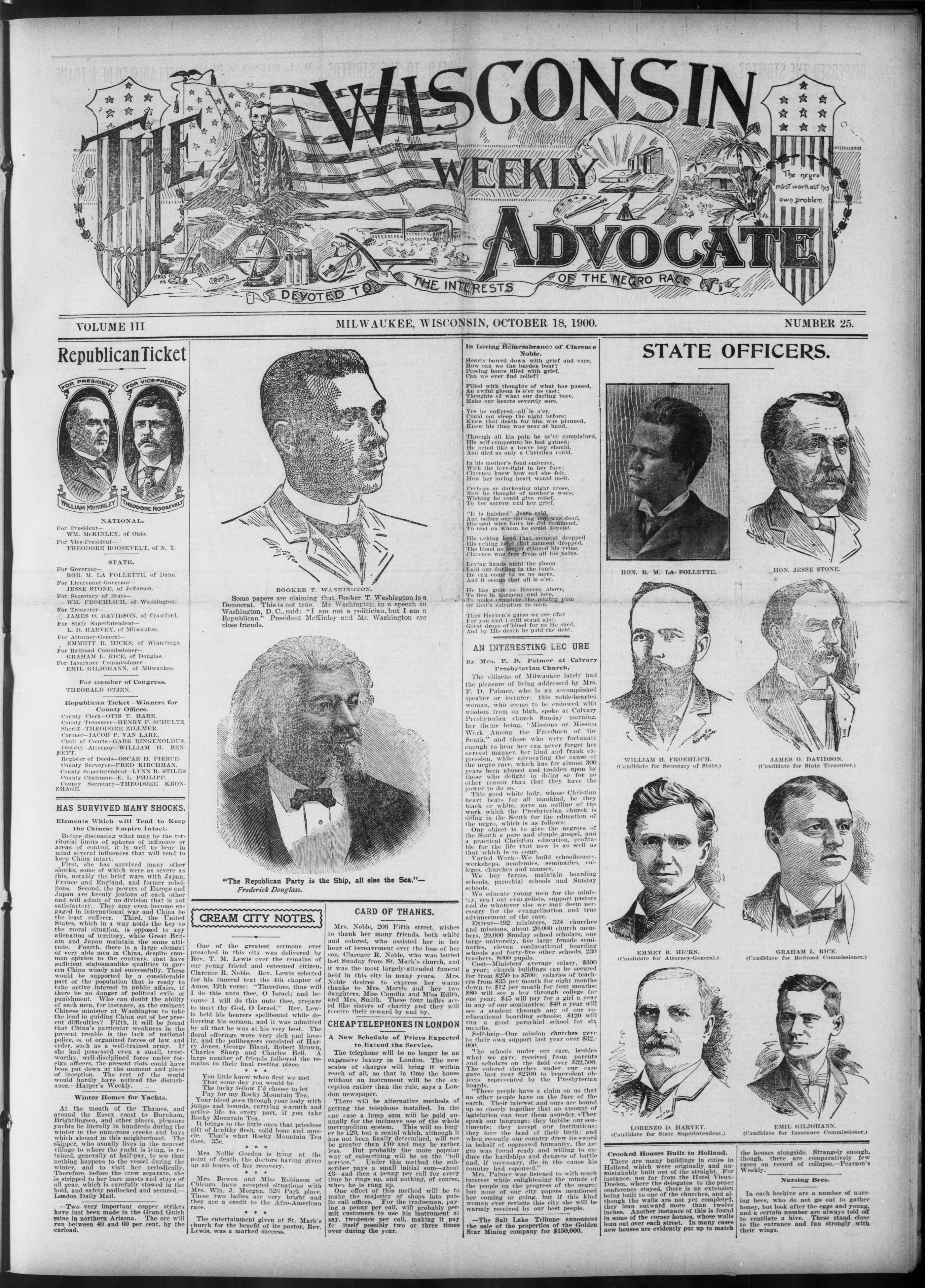
WISCONSIN
WEEKLY
ADVOCATE
DEVOTED TO THE INTERESTS OF THE NEGRO RACE
RepublicanTicket
RepublicanTicket
FOR PRESIDENT
FOR VICE-PRESIDENT
WILLIAM MCKINLEY
THEODORE ROOSEVELT
NATIONAL.
For President—
WM. McKINLEY, of Ohio.
For Vice-President—
THEODORE ROOSEVELT, of N. Y.
STATE.
For Governor—
ROB. M. LA FOLLETTE, of Dane.
For Lieutenant-Governor—
JESSE STONE, of Jefferson.
For Secretary of State—
WM. FROEHLICH, of Washington.
For Treasurer—
JAMES O. DAVIDSON, of Crawford.
For State Superintendent—
L. D. HARVEY, of Milwaukee.
For Attorney-General—
EMMETT R. HICKS, of Winnebago.
For Railroad Commissioner—
GRAHAM L. RICE, of Douglas.
For Insurance Commissioner—
EMIL GILJOHANN, of Milwaukee.
For member of Congress.
THEOBALD OTJEN.
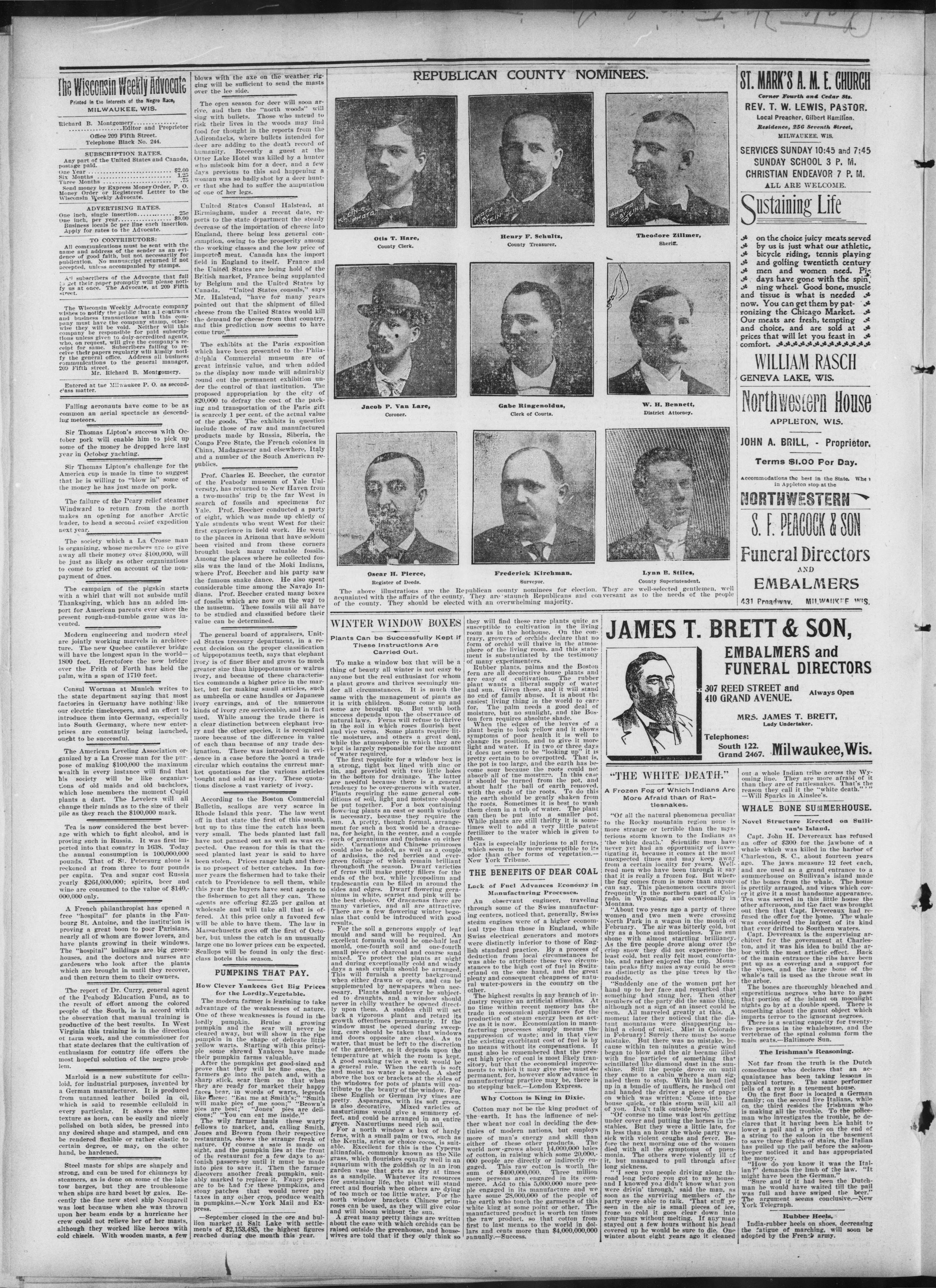
County Clerk—OTIS T. HARE.
County Treasurer—HENRY F. SCHULTZ.
Sheriff—THEODORE ZILLMER.
Coroner—JACOB P. VAN LARE.
Clerk of Courts—GABE RINGENOLDUS.
District Attorney—WILLIAM H. BEN-
KETT.
County Secretary-THEODORE KRONSHAGE.
HAS SURVIVED MANY SHOCKS.
Before discussing what may be the territorial limits of spheres of influence or areas of control, it is well to bear in mind several influences that will tend to keep China intact.
First, she has survived many other shocks, some of which were as severe as this, notably the brief wars with Japan, France and England, and former rebellions. Second, the powers of Europe and Japan are keenly jealous of each other and will admit of no division that is not satisfactory. They may even become engaged in international war and China be the least sufferer. Third, the United States, which in a way holds the key to the moral situation, is opposed to any alienation of territory, while Great Britain and Japan maintain the same attitude. Fourth, there is a large element of very able men in China, despite common opinion to the contrary, that have sufficient statesmanlike qualities to govern China wisely and successfully. These would be supported by a considerable part of the population that is ready to take active interest in public affairs, if there be no danger of political exile or punishment. Who can doubt the ability of such men, for instance, as the eminent Chinese minister at Washington to take the lead in guiding China out of her present difficulties? Fifth, it will be found that China's particular weakness in the present trouble is the lack of national police, or of organized forces of law and order, such as a well-trained army. If she had possessed even a small, trustworthy, well-disciplined force under foreign officers, the present riots could have been put down at the moment and place of inception. The rest of the world would hardly have noticed the disturbance.—Harper's Weekly.
Winter Homes for Yachts.
At the mouth of the Thames, and around the Essex coast to Burnham, Brightlingsea, and other places, pleasure yachts lie literally in hundreds during the winter in the numerous creeks and bays which abound in this neighborhood. The skipper, who usually lives in the nearest village to where the yacht is lying, is retained, generally at half-pay, to see that nothing happens to the vessel during the winter, and to visit her periodically. Therefore, before the crew separate, she is stripped to her bare masts and stays of all gear, which is carefully stowed in the hold, and safely padlocked and secured.—London Daily Mail.
—Two very important copper strikes have just been made in the Grand Gulch mine in northern Arizona. The ore will run between 40 and 60 per cent. by the carload.
BOOKER T. WASHINGTON.
BOOKER T. WASHINGTON.
Some papers are claiming Democrat. This is not true. Washington, D. C., said: "I a Republican." President McKinney close friends.
"The Republican Party is t
Frederick Douglass.
Some papers are claiming that Booker T. Washington is a Democrat. This is not true. Mr. Washington, in a speech in Washington, D.C., said: "I am not a politician, but I am a Republican." President McKinley and Mr. Washington are close friends.
JACKSON
"The Republican Party is the Ship, all else the Sea."— Frederick Douglass.
CREAM CITY NOTES.
One of the greatest sermons ever preached in this city was delivered by Rev. T. M. Lewis over the remains of our young friend and esteemed citizen, Clarence R. Noble. Rev. Lewis selected for his funeral text the 4th chapter of Amos, 12th verse: "Therefore, thus will I do this unto thee, O Israel; and because I will do this unto thee, prepare to meet thy God, O Israel." Rev. Lewis held his hearers spellbound while delivering his sermon, and it was admitted by all that he was at his very best. The floral offerings were very rich and lovely, and the pallbearers consisted of Harry Jones, George Bland, Robert Brown, Charles Sharp and Charles Bell. A large number of friends followed the remains to their final resting place.
You little knew when first we met
That some day you would be
The lucky fellow I'd choose to let
Pay for my Rocky Mountain Tea.
Your blood goes through your body with
jumps and bounds, carrying warmth and
active life to every part, if you take
Rocky Mountain Tea.
It brings to the little ones that priceless
gift of healthy flesh, solid bone and muscle.
That's what Rocky Mountain Tea
does. 35c.
* * *
Mrs. Nellie Gordon is lying at the
point of death, the doctors having given
up all hopes of her recovery.
Mrs. Bowen and Miss Robinson of Chicago have accepted situations with Mrs. Win. J. Morgan, 526 Park place. These two ladies are very bright and they are a credit to the Afro-American race.
* * *
The entertainment given at St. Mark's church for the benefit of its pastor, Rev. Lewis, was a marked success.
that Booker T. Washington is a Mr. Washington, in a speech in not a politician, but I am a lawyer and Mr. Washington are
the Ship, all else the Sea."—
Mrs. Noble, 206 Fifth street, wishes to thank her many friends, both white and colored, who assisted her in her hour of bereavement over the loss of her son, Clarence R. Noble, who was buried last Sunday from St. Mark's church, and it was the most largely-attended funeral held in this city in many years. Mrs. Noble desires to express her warm thanks to Mrs. Morris and her two daughters, Miss Camilia and Miss Edith, and Mrs. Smith. These four ladies acted like sisters of charity and they will receive their reward by and by.
CHEAP TELEPHONES IN LONDON
A New Schedule of Prices Expected to Extend the Service. The telephone will be no longer be an expensive luxury in London. The new scales of charges will bring it within reach of all, so that in time the house without an instrument will be the exception rather than the rule, says a London newspaper.
There will be alternative methods of getting the telephone installed. In the one case a lump sum will be paid annually for the inclusive use of the whole metropolitan system. This will no longer be £20, but a rental which, although it has not been finally determined, will not be greater than £10 and may be rather less. But probably the more popular way of subscribing will be on the "toll service." Under this method the subscriber pays a small initial sum—about £3—and then a penny per call for every time he rings up, and nothing, of course, when he is rung up.
One effect of this method will be to make the majority of shops into public call offices. For the tradesman, paying a penny per call, will probably permit customers to use his instrument at say, twopence per call, making it pay fc itself possibly two or three times over during the year.
CARD OF THANKS.
In Loving Remembrance of Clarence Noble.
Hearts bowed down with grief and care,
How can we the burden bear?
Passing hours filled with grief,
Can we ever find relief?
Filled with thoughts of what has passed,
An awful gloom is o'er us cast;
Thoughts of what our darling bore,
Make our hearts severely sore.
Yes he suffered—all is o'er,
Could not sleep the night before;
Knew that death for him was planned,
Knew his time was near at hand.
Through all his pain he ne'er complained,
His self-composure he had gained;
He acted like a brave boy should.
And died as only a Christian could.
In his mother's fond embrace,
With the love-light in her face;
Clarence knew how sad she felt.
How her loving heart would melt.
Perhaps as darkening night arose,
Now he thought of mother's woes;
Wishing he could give relief,
To her sorrow and her grief.
"It is finished" Jesus said,
And before our darling boy was dead,
His soul with faith he did commend,
To God on whom he could depend.
His aching head that moment dropped
His aching head that moment dropped,
The blood no longer coursed his veins,
Clarence was free from all his pains.
Loving hands amid the gloom
Laid our darling in the tomb,
He can come to us no more,
And it seems that all is o'er.
He has gone to Heaven above,
To live in harmony and love,
To make complete the mighty plan
Of God's salvation to man.
Thus Heaven's gates we see afar
For you and I still stand ajar.
Great drops of blood for us He shed,
And by His death he paid the debt.
AN INTERESTING LEC URE
By Mrs. F. D. Palmer at Calvary Presbyterian Church.
The citizens of Milwaukee lately had the pleasure of being addressed by Mrs. F. D. Palmer, who is an accomplished speaker or lecturer; this noble-hearted woman, who seems to be endowed with wisdom from on high, spoke at Calvary Presbyterian church Sunday morning, her theme being, "Missions or Mission Work Among the Freedmen of the South," and those who were fortunate enough to hear her can never forget her earrest manner, her kind and frank expression, while advocating the cause of the negro race, which has for almost 300 years been abused and trodden upon by those who delight in doing so for no other reason than that they have the power to do so.
This good white lady, whose Christian heart beats for all mankind, be they black or white, gave an outline of the work which the Presbyterian church is doing in the South for the education of the negro, which is as follows:
Our object is to give the negroes of the South a pure and simple gospel, and a practical Christian education, profitable for the life that now is as well as that which is to come.
Varied Work—We build schoolhouses, workshops, academies, seminaries, colleges, churches and manses.
We buy farms, maintain boarding schools, parochial schools and Sunday schools.
We educate young men for the ministry, send out evangelists, support pastors and do whatever else we may deem necessary for the evangelization and true advancement of the race.
Extent—192 ministers, 324 churches and missions, about 20,000 church members, 20,000 Sunday school scholars, one large university, five large female seminaries, eleven coeducational boarding schools and forty-five other schools, 230 teachers, 8000 pupils.
Cost—Ministers' average salary, $300 a year; church buildings can be secured for from $250 to $500; salaries of teachers from $35 per month for eight months down to $12 per month for four months; $80 will see a boy through college for one year; $45 will pay for a girl a year in any of our seminaries; $40 a year will see a student through any of our coeducational boarding schools; $120 will run a good parochial school for six months.
Self-help—Our mission churches gave to their own support last year over $32,000
The schools under our care, besides what we gave, received from parents and scholars on the field over $32,500. The colored churches under our care gave last year $2700 to benevolent objects represented by the Presbyterian boards.
"These people have a claim on us that no other people have on the face of the earth. Their interest and ours are bound up so closely together that no amount of legislation can tear them asunder. They speak our language; they imbibe our sentiments; they accept our institutions; they love the land of their birth; and when recently our country drew its sword in behalf of oppressed humanity, the negro was found ready and willing to endure the hardships and dangers of battle and, if necessary, die in the cause his country had espoused."
Mrs. Palmer was listened to with much interest while enlightening the minds of the people on the progress of the negro; but none of our city papers mentioned her coming or going, but if this kind woman ever revisits this city she will be warmly received by our best people.
—The Salt Lake Tribune announces the sale of the properties of the Golden Star Mining company for $150,000.
STATE OFFICERS.
O
HON. R. M. LA FOLLETTE.
O. H. C.
WILLIAM H. FROEHLICH.
(Candidate for Secretary of State.)
J.
EMMET R. HICKS.
(Candidate for Attorney-General.)
3
LORENZO D. HARVEY.
(Candidate for State Superintendent.)
Crooked Houses Built in Holland.
There are many buildings in cities in Holland which were originally and unmistakably built out of the straight. For instance, not far from the Hotel Vieux- Doelen, where the delegates to the peace conference stayed, there is an extension being built to one of the churches, and although the walls are not yet completed, they lean outward more than twelve inches. Another instance of this is found in some of the corner houses, whose walls lean out over each street. In many cases new houses are evidently put up to match
NUMBER 25.
HON. JESSE STONE
J. J. JOHNSON
JAMES O. DAVIDSON.
(Candidate for State Treasurer.)
W. H. H.
GRAHAM L. RICE.
(Candidate for Railroad Commissioner.)
J.
EMIL GILJOHANN. (Candidate for Insurance Commissioner.)
the houses alongside. Strangely enough, though, there are comparatively few cases on record of collapse.—Pearson's Weekly.
In each beehive are a number of nursing bees, who do not go out to gather honey, but look after the eggs and young, and a certain number are always told off to ventilate a hive. These stand close to the entrance and fan strongly with their wings.
DISPERSED THE STRIKERS
Fifteen Hundred Men Driven Back by Soldiers.
Strikers Had Marched Eighteen Miles for the Purpose of Closing Up Lehigh Collieries.
Lansford, Pa., Oct. 16. About 1500 men and sixty women and girls marched eighteen miles from the south side Hazelton region during the night, for the Panther Creek valley, where they expected to close all of the ten collieries of the Lehigh Coal & Navigation company, but just as the weary marchers were nearing their destination this morning they were met on a mountain road by three companies of infantry and at the point of the bayonet were driven back four miles to Tamaqua and dispersed. Another crowd of 800 strikers from the north side of Hazleton also marched here and succeeded in closing the company's No. 1 colliery at Nesquehoning, near Mauch Chunk, before it was scattered. The presence of the soldiers was entirely unexpected and the strikers were much crestfallen that they failed in accomplishing the object of their long march.
It was probably the most exciting morning that the Panther Creek and the Nesquehoning valleys have ever experienced. Strikers were scattered over the various roads, and companies of soldiers were scurrying in all directions heading off the marching men. The troops were patient with the mob of strikers, while the laboring men were very careful not to commit overt acts in the presence of the troops. For a moment just after the two forces met on the road in the darkness it looked as if a clash would come, but the good sense of those who had charge of the strikers prevented a possible conflict.
Resort to Strong Methods.
The march on Panther Creek valley was on the strikers' programme for several days. The United Mineworkers, ever since the strike started, have been attempting to close the collieries of the Lehigh Coal and Navigation company in this region. Organizers were constantly in the region, but as a rule they did not meet with much success, so it was decided to use stronger methods to get the men employed in the ten mines out on strike. Accordingly it was arranged that a big demonstration should be held in the valley. It was to have been held yesterday morning, but owing to the heavy rain and muddy roads it was called off until this morning. Those who took part were strikers from McAdoo, Yorktown, Bunker Hill and Silver Brook, from the south side of Hazleton, and the Freeland, Drifton, Jeddo and Beaver Meadow strikers from the north side. The women and girls all came from McAdoo, which borough is the only one in the Hazleton region which has organized female marchers.
The marchers came down like two armies, the south side men marching by way of Tamaqua, while the strikers from the north side went over the mountain at Beaver Meadow and entered the Panther creek valley by way of Nesquehoning. The south side army concentrated at McAdoo and the order to march was given at 10:30 o'clock last night. There were several fife and drum corps and a brass band in the line. The women and girls were conveyed in two large omnibuses. The whole town of McAdoo was out to see the marchers start. Until 12 o'clock the night was very dark, it being difficult to see any distance in the mountain passes, but after midnight the moon came out from behind a bank of clouds and for the rempinder of the journey the marchers had plenty of light. As the town of Tamaqua was entered at 2 a.m. the strikers began to make as much noise as they could in order to awaken the people who were unaware of the coming of the strikers. The marchers went through the town without stopping for rest, and headed for Coal-dale, four and a half miles away.
Commanded to Halt.
Five carriages containing newspaper correspondents, who had been trailing along at the rear of the procession, were requested to take the lead so that they would not interfere with the plans of the stiltsmen. Following the
strikes. Following the newspaper men came the two conveyances containing the McAdoo women and then followed a long line of Hungarians, Italians, Poles, Slavs and English-speaking mineworkers. At a point half a mile from Coaldale there is a sharp turn in the road, and as the newspaper men rounded it there came a command to "Halt," and about fifty feet in front of them stood solid rows of soldiers who were stretched across the road with bayonets fixed. Sheriff Toole of Schuylkill county was with them. The commander of the troops, speaking to the waiting crowd, said: "In the name of the people of the state of Pennsylvania, I command you to disperse and to return whence you came."
The strikers began to protest that they could not be stopped on a public highway and many of them showed a disposition to resist the soldiers. The officer in charge of the troops, however, kept his men in position and the strikers, seeing that the soldiers evidently meant business, slowly began returning towards Tannoua.
Mother Jones Protests.
"Mother" Jones, who was in the crowd, vehemently protested against the action of the troops in stopping the marchers, but she was shut off and ordered to move on. The McAdoo women had to be almost pushed along, so slowly did they walk. They continually jeered at the soldiers, calling them all kinds of names, and threatening them with punishment if they should dare to visit McAdoo. It took from 3 o'clock until after 6 to drive the crowd back to Tamaqua.
When the soldiers had driven the strikers over the mountain a company was sent back to Coaldale, where the soldiers boarded coal cars and were sent to Tamaqua to quell any disturbance the scattering strikers might stir up there. Further along the road a company was deployed to protect a colliery while the marchers were passing it, and later it was also sent to Tamaqua. The three companies combined in the latter town and soon had the marchers well scattered.
Compelled to Shut Down.
While all this had been going on, the north side marchers had everything their own way in the Nesquehoning valley. They reached there after 2 o'clock and succeeded in persuading enough men to remain away from the Lehigh Coal & Navigation company's No. 1 colliery to compel its shutdown. Gen. Gobin sent two companies of soliers over there and soon had order restored.
Supt. W. D. Zehner of the company stated to a reporter of the Associated press that if Sheriff Briston of Carbon county, in which the colliery is located, had performed his duty in a proper manner the Nesquehoning colliery would not have been shut down. Mr. Zehner said teh remaining mine collieries of the company are working, most of them full-handed.
Will Not Return to Work.
Shamokin, Pa., Oct. 10.—Despite an
active canvass made yesterday by a number of men to induce miners to go to work today at collieries between here and Hickory Ridge, no one reported for duty this morning and the persons who circulated petitions asking men to resume work pending a settlement of the terms of the Scranton convention have been disappointed.
Soldiers Got There First.
Coaldale, Pa., Oct. 16.—The local union of the United Mineworkers met at 4 o'clock this morning and prepared to welcome in a body the marchers from Hazleton and vicinity, but the soldiers got there before the strikers and dispersed the meeting, ordering the men to their homes.
Prepare to Resume Work.
Scranton, Pa., Oct. 16.—That there is a positive assurance of the end of the strike of the anthracite miners seems certain today in view of the preparations which are being made all through the Lackawanna valley for the resumption of work. When the resumption takes place the breakers will be run to the utmost capacity.
Call for Troops.
Hazleton, Pa., Oct. 16.—Frank Pardee of A. Pardee & Co. made a demand on the governor for troops this afternoon. The Lehigh & Wilkesbarre Coal company has also requested that soldiers be sent to McAdoo. These requests, if complied with, will have the effect of bringing troops into Luzerne county for the first time since the strike began.
A WASHINGTON TRAGEDY
Son-in-Law of Senator Blackburn Brooding Over Ill-Health, Shoots Himself.
Washington, D. C., Oct. 16.—Thomas F. Lane, son-in-law of Senator Blackburn, committed suicide at his home near here last night. Mr. Lane entered the house about 11 p. m. and shot himself in the presence of his little daughter while his wife was resting on a couch in an adjoining room. Death was almost instantaneous. Mr. Lane was the American representative of the London ordinance firm of Vickers Sons & Maxim. He was well-to-do, prominently connected and a familiar figure in Washington society. It is said that he was driven to the act by brooding over his ill-health. He was told some time ago that he had Bright's disease and he allowed the matter to prey on his mind.
His wife, who was Lucille Blackburn, had a narrow escape from death by a pistol wound about three years ago. The Lanes were then living at the Hotel Wellington. Mr. Lane was out of town much of the time and Mrs. Lane kept a loaded revolver in her bureau drawer. One night she was found in her room with a bullet wound in her breast, and it was explained by the family that in taking some laces from the drawer the pistol had been lifted up and falling on the hammer exploded. She lingered between life and death for some time, but ultimately recovered. The shock of last night's tragdy completely prostrated her and she is now under the constant care of a physician.
Senator Blackburn was in Hagerstown, Mo., last night when the news of the suicide reached him. He had been on a campaign tour of the state. He left as soon as possible for Washington and it is likely that the occurrence will force him to abandon any further active work in the campaign.
Thomas F. Lane was a native of New Hampshire, but his parents moved to Summit, N. J., when he was a boy, and he spent many years there. He was well known in Louisville, Ky., where he met Miss Blackburn. On moving to Washington some years ago he held a position as chief of one of the bureaus in the treasury department.
DUEL WITHOUT RESULT.
French Count Meets a Journalist Near Paris but Neither is Hit
Paris, Oct. 16.—M. Urbain Gohir, the anti-military journalist, author of the book "Army Against the Nation," which created a sensation in 1898, fought a duel with pistols today, his opponent being Count de Sabran Ponteves, without any result. The dispute which led to the meeting was an article published in the Aurore which the count considered offensive to him.
Count Boni de Castellane was one of the Count De Sabran Ponteves' seconds.
Count de Sabran Ponteves was one of the young Royalists arrested in August, 1889, on the charge of engaging in the demonstration against President Loubet at the Auteil race course.
M. Urbain Gohir was tried March, 1899, on the charge of insulting the French army by the publication of his book, "The Army Against the Nation." He was acquitted.
M. Gohir fought a duel October 18, 1899, with M. Mercier, a son of the former minister of war, who came into prominence during the Dreyfus trial. M. Mercier was slightly wounded in the chest. Swords were the weapons.
PASSENGERS INJURED.
Street Car and Freight Car Come Together with Great Force During a Fog.
Seattle, Wash., Oct. 16.—Fourteen persons were injured in a street-car collision today on the line between Seattle and Renton. A passenger car bound to the city met a freight car in a heavy fog. The cars came together with great force. The injured, who principally sustained cuts and bruises, are: Maj. W. V. Rhinehart, president of the city council. Leander Miller, ex-president of the city council.
Alfred Almquist, motorman.
R. J. Rhodes, conductor.
F. A. Dunlop, injured internally, serious.
Mrs. C. Wilson, internal injuries, serious.
E. S. Espy.
H. W. Scott, superintendent Cedar River water system.
Miss Mabel Wadd.
George Basket.
Merton Groat, conductor, seriously.
Thomas Chambers.
Milton Ray.
David Simpson.
SWARM OF BATS AND BIRDS.
Experience of the Steamer Curityha 200 Miles Off Florida Coast. New York. Oct. 16.—Two eagles, captured far out to sea from amid swarms of bats, owls and many kinds of land birds, all waifs, carried off presumably by storm winds, were brought to this port on the steamer Curityha of the Munson line from Cuba.
According to the story of Mate Breyman and the sailors, the ship was making good headway toward the United States when, about 200 miles off the coast of Florida, the air began to darken and there whirled about the vessel a cloud of bats. The bats welcomed the ship as a resting place, and in a little while every rail and rope was strung with them, all hanging head downward. When the bats were gone there came swarms of birds. These, like the bats, seemed to have been caught in a storm and swept away from land and were in search of a landing place.
Celebrated Composer Dead.
Prague, Oct. 16.—The death is announced of Zdenko Fabich, the celebrated Bohemian composer.
Missionary to the Indians is Ill and May Not Recover—Celebrates His Birthday.
Marquette, Mich., Oct. 16.—[Special.]
—Bishop Mrack is an nonogenarian today. He lies on a sickbed from which it is feared he will never arise. He was born in Austria in 1810, and was ordained a priest in 1837. In 1845 he came to this country, taking up missionary work with the Indians at Eagletown, Mich. In 1864 he was raised to the episcopacy by Archbishop Purcel at Cincinnati. In 1869 he succeeded Bishop Baraga in charge of the diocese of Marquette and Sault Ste. Marie, resigning his charge in 1878 to resume his work among the Indians. Since 1890 he has lived at St. Mary's hospital here.
SET UPON BY REBELS.
Twenty Men of Twenty-fourth Regiment. Overpowered—Only Seven Were Able to Escape.
Manila, Oct. 16.—Via Hong Kong.—A detachment of twenty men of the Twenty-fourth regiment while engaged in repairing telegraph wires October 10 at a point near San Jose, Nuevo Ecija province. Isle de Luzon, were set upon by 200 rebels and were overpowered and scattered. Seven of the Americans reached San Jose, but it is probable that the remainder were captured.
The enemy surprised a party of scouts of the Forty-third infantry at a point three miles from Takloban, Leyte island, killing three of the Americans at the first volley. Two escaped and gave the alarm, but the enemy succeeded in evading their pursuers. The native police of Takloban had conspired to surprise the Americans. The bodies of the dead soldiers were badly mutilated. Washington, D. C., Oct. 16.—Gov. Schroeder has issued an order opening all hospitals of Guam to the cilivian patients free, and all who are suffering from disease are invited and urged to go to the hospitals for treatment.
SCENE OF A TRAGEDY.
Some Charred Bones, a Pool of Dried Blood and Several Blood-Stained Colins.
Alamo Gordo, N. M., Oct. 16.—The charred bones of a man and a boy, supposed to be the remains of Col. A. J. Fountain and his son Henry, have been found in the Sacramento mountains.
Col. Fountain and his son left Lincoln for Las Cruces the latter part of January, 1896. After leaving La Luz they disappeared. About a week later their buckboard was found near the Chalk bluffs, nearby was a pool of dried blood and a few blood-stained coins, indicating the scene of the tragedy. Fountain was a prominent lawyer and in the valise he carried were indictments for the arrest of a number of persons charged with cattle stealing. Several men suspected of the murder were arrested after a fight with the officers, in which a deputy sheriff was killed, but all were acquitted for lack of evidence.
BOERS STILL ACTIVE.
Roberts has "Successful Engagement," in which the British Losses Were Severe.
London, Oct. 16.—Lord Roberts reports from Pretoria, under date of October 15, as follows:
"French started from Machadodorp towards Heidelberg to clear a part of the country not yet visited by our troops. Mahon, commanding the mounted troops, successfully engaged the enemy on October 13, but our losses were severe, three officers and eight men being killed and three officers and twenty-five men wounded. French occupied Carolina yesterday, capturing a convoy during his march."
Lord Roberts also reports a number of minor affairs, showing that the Boers are still active over a wide field.
Cape Town, Oct. 16.—The British reentered Bloemhof, near Kimberley, October 14, unopposed, and captured fifty Boers.
POISON REMOVES HIS RIVAL.
Oil Driller Accused of Killing His Friend to Marry His Widow. Columbus, O., Oct. 16.—The state dairy and food commissioner, in investigating the death of a Belmont county oil driller who had drunk a quantity of bad whisky, unearthed a tragedy in which it is claimed William Dement, also a driller, poisoned William Dixon, his best friend, that he might marry Dixon's wife. It is declared that in order to get rid of the husband Dement presented Dixon with a bottle of whisky which contained a quantity of strychnine. Dixon and his companion drained the bottle, and in a few hours Dixon was dead and his companion critically ill. It was discovered that Dement had purchased strychnine a few days before, and this, together with his open and persistent attentions to Dixon's wife, led to his arrest.
CHIEF JUSTICE OF ENGLAND.
Lord Alverston Appointed to Succeed the Late Baron Russell.
London, Oct. 16.—It is officially announced that Lord Alverston (better known as Sir Richard Webster) has been appointed lord chief justice of England, in succession to the late Baron Russell of Killowen.
Justice A. L. Smith succeeds Lord Alverston as master of the rolls.
KING OSCAR SERIOUSLY ILL.
Confined to His Bed with Catarrh and an Affected Lung.
Stockholm, Oct. 16.—King Oscar is confined to his bed with bronchial catarrh, complicated by an accretion of phlegm in the right lung.
Primitive Lighthouses
A thousand years before Architect Harcourt laid the foundation of Eddystone the Japanese had a lighthouse at Cape Matai, on the island of Yezzo, but operated it only stormy nights. The warning signals consisted of pitchwood fires blazing in a grate, with a handle that could now and then be uplifted, and waved toward all points of the compass. Indianapolis Press.
Automobile Accident Insurance
An automobile accident insurance association is about to be formed in New York city. Its objects will be to insure its policy-holders against accidents and to defend the innumerable lawsuits which have been brought against motorists all over the country, often on very slight provocation.
A number of Scottish grouse have been imported by the Canadian government from the highlands of Scotland for the purpose of stocking the provincial parks.
YIELD TO THE STRIKERS.
Operators Accede to All of the Miners' Demands.
FORMAL NOTICE ISSUED.
Result of a Conference Held at Philadelphia-Ten Per Cent. Increase Until the Year 1901.
Philadelphia, Pa., Oct. 17.—The conference between the individual coal operators and the representatives of the big coal-carrying companies with a view to bringing about the termination of the anthracite coal strike was resumed this morning in the private office of President Harris of the Reading Railway company. The first to arrive in the conference room were George F. Baer and John Lowber Welsh, directors of the Reading company, and the reputed representatives of the Morgan interests in that company. President Harris and General Manager Henderson of the Philadelphia Coal and Iron company were the next to arrive. In quick succession came John B. Garrett, vice-president of the Lehigh Valley Railroad company; Congressman William Connell of Scranton; Dr. Herbert M. Howe, representing A. Pardee & Co., and M. S. Kemmerer of Mauch Chunk, representing Kemmerer & Whitney. The conference began shortly after 9 o'clock and was in session about fifteen minutes, when Mr. Garrett was called to the long-distance telephone for a talk with someone in New York. He returned immediately to the conference room.
Abolition of Sliding Scale.
The question of abolition of the sliding scale, which is in operation in the Schuykill and Lehigh regions only, was also a subject for discussion. It was urged by the individual operators that the scale be abolished, but such a move was opposed by the two interests involved, their representatives claiming that it is the most equitable system of wage payments that can be evolved. The conference resulted in an agreement to accede to the demands made by the Mineworkers' convention. The Philadelphia & Reading Coal and Iron company at once issued the following statement:
Operators Give In.
"This company withdraws the notice posted October 3, 1900, and, to bring about practical uniformity in the advance of wages in the several coal regions, gives notice that it will suspend the operation of the sliding scale, will pay 10 per cent. advance on September wages till April 1, 1901, and thereafter until further notice; and will take up with its mine employees any grievances which they may have."
The Lehigh Valley company, in whose region the sliding scale is also in operation, will issue a similar notice, as will also the individual operators who were represented at the meeting. This meets all the demands of the strikers and means the immediate ending of the strike.
Late this afternoon the Lehigh Valley Railway company announced that it will adopt the same course as announced in the statement by the Reading company. This applies to the Schuylkill region operated by the Lehigh company. With regard to the Wyoming region, where the sliding scale is not in use, the officials state no advices had been received from the management of the company.
Eager to Return to Work.
Hazleton, Pa., Oct. 17.—President Mitchell when shown the statement issued by the Philadelphia & Reading Coal and Iron company said he would be glad indeed to know that the anthracite operators had decided to change the notices previously posted, so as to comply with the provisions of the resolution adopted at the Scranton convention.
The announcement of the action of the conferees at Philadelphia was received here with demonstrations of joy, as all believe it means a speedy return to work at better wages.
CHICAGO GAS WAR.
Settlement Effected by Withdrawal of Municipal Company—Gas at $1 Par 1000 Feet.
New York, Oct. 17.—A Wall street news bureau says: "The settlement of the Chicago gas war was effected at 3 o'clock this morning, at a conference at the Holland house. The People's Gas company will withdraw from the territory heretofore occupied by the Ogden Gas company and the Municipal Gas company, which has been the agent of the People's company and obtains its gas from the latter, has raised the price of gas to $1 per $1000 feet. This means the retirement of the Municipal Gas company from the scene of action, and leaves the field to the Ogden and the People's Gas companies alone.
A SHAKESPEARE DYING.
Offspring of Immortal Bard Reported Starving at Atlanta.
Atlanta, Ga., Oct. 17.—Rev. William Shakespeare, said to be a descendant of the immortal genius, is starving to death in Atlanta. This shocking fact was brought to the knowledge of the Baptist ministers of Atlanta at their conference at the First church by Rev. I. G. Broughton, who stated that he had found a man who gave his name as Shakespeare and who stated that he was a Baptist minister, which fact he proved to Mr. Broughton's satisfaction by producing credentials that establish his claim. His connection with the English Shakespeare is claimed to be unmistakable. The ministers are making provisions for his comfort and treatment for the disease from which he is suffering.
STUDENTS SUSPENDED.
Drastic Action of Wooster Faculty
Following "Nightshirt" Parade. Cleveland, O., Oct. 17.—A "nightshirt" parade at Wooster university has caused the suspension of forty-eight students by the faculty. One hundred students who feel those suspended have been treated unjustly have signed an agreement to leave the institution unless the forty-eight are reinstated. The "nightshirt" parade is an annual event at the university, and in spite of many warnings the students, 300 in number, carried out their custom of parading the town and shocked its good people.
BIG OREGON HOP CROP.
stimated that it will Reach 90,000 Bales This Year.
Aurora, Or., Oct. 17.—In the opinion of well-known hop buyers here, the hop crop of the state will reach at least 90.000 bales, an increase of about 10,000 bales over the yield of 1899. Exact figures are not yet obtainable, but the buyers say that reports so far received warrant the foregoing statement; also that the hops are of fine quality and sell readily at 14 and $14\frac{1}{2}$ cents a pound, with a few sales at $15\frac{1}{2}$ cents. Last year prices ranged from 4 to 6 cents per pound, or less than choice '99 hops bring today.
W. L. WILSON IS DEAD.
Author of Democratic Tariff Act of 1893 and Subsequently Postmaster-General.
Lexington, Va., Oct. 17.—Ex-Postmaster-General William L. Wilson died suddenly this morning at 10 o'clock.
William L. Wilson, author of the Democratic tariff measure which was passed by Congress in 1893, and subsequently postmaster-general in the cabinet of President Cleveland, was born in Jefferson county, Va., May 3, 1843. He was educated at Charlestown academy, and at Columbian college. District of Colum-
C. F. Smy
bia, where he graduated in 1860, and at the University of Virginia; served in the Confederate army; was a delegate in 1880 to the national Democratic convention at Cincinnati, and was chosen an elector for the state-at-large on the Hancock ticket; was elected president of the West Virginia university in 1882; nominated as the Democratic candidate for the Forty-eighth Congress and elected; received the degree of LL. D. from Columbian university in 1883 and from Hampden Sidney college, Virginia, in 1886; was elected to the Forty-ninth, Fiftieth, Fifty-first, Fifty-second and Fifty-third Congresses. On retiring from the Cabinet at the close of Mr. Clevela.d's administration Mr. Wilson was elected president of Washington and Lee university.
ESCAPE CUT OFF.
Eight People Burned to Death or Suffocated in Tenement House Fire.
New York, Oct. 17.—Eight people were either burned to death or suffocated in a fire which partially destroyed the threestory and attic frame double tenement house, 45 and $45 \frac{1}{2}$ Hester street, early today.
The dead:
SARAH SASS, 36 years old.
SAMUEL SASS, 13.
LENA SASS, 9.
MORRIS SASS, 2.
MRS. HOROWITZ, 46.
ROSA LEWIS, 52.
MENDEL STRAUSS, 60.
SAMUEL STRAUSS, 20.
Mary Murray, 40, was severely burned about the back and was taken to a hospital.
The fire was discovered shortly after 1:30 o'clock by the janitor of the building. He ran out into the hall to find it ablaze. His shouts aroused the others in the house, but the flames had already gained fierce headway and few of those in the building had time to save themselves by the stairs.
On the third floor of No. 45 lived Charles Sass, his wife and four children, his mother-in-law and Mrs. Horowitz. Sass took the child nearest at hand and rushed to the fire escape. He managed to get down to the balcony on the front of the building on the second floor and supposed that his wife and the others were following him. Mrs. Horowitz was the only one who followed him, however. She took the child from his arms when she saw their escape cut off and cried to a policeman below to catch it. The policeman held out his arms and as the child fell he caught it safely and shouted to her to drop. Sass had already hung down and dropped to the ground. Mrs. Horowitz was about to drop when flames suddenly burst through an awning on the first floor with such fury that she was driven back against the wall and her only escape cut off. So fierce were the flames that burst at the same time from the awning below, from the window behind her and from the floor of the balcony under her feet that it was impossible for the firemen to rescue her. On the balcony, only a few feet from the ground, but hedged in on all sides by flame, she was burned to death before the eyes of the terrified crowd gathered in the streets. Mrs. Sass with little Morris had been unable to get further than the window when they were both overcome by smoke and perished. Lena Sass ran into the hallway and was caught by the flames there and died. Samuel tried to rescue Mrs. Rosa Lewis from the flames but was unsuccessful and they perished together. Their bodies were found in the hallway, the lad's arms still clasped about the aged woman's waist as though he had died while trying to drag her out.
The front room in the attic was occupied by Mendel Strauss and his son Samuel. Both were suffocated before they could escape.
Mary Murray and Mary Martin, scrubwomen, who lived in an apartment back of the Strauss', were awakened by the smoke and cries and started down the rear stairway, reaching the ground in safety. On the stairs the Martin woman's dress caught fire, but the flames were beaten out by Mrs. Murray, who was slightly burned in the back.
The loss by fire is estimated at $6000.
SENN ROOM OPENED.
Physician Endows Apartment in St Joseph's Hospital with $10,000 Fund.
Chicago, Ill., Oct. 17.—Senn room, in St. Joseph's hospital, endowed for $10,000 by Dr. Nicholas Senn, has been opened formally. The room is completely furnished by its donor, and the endowment fund will remain intact for its perpetual maintenance. The room is located in the corner on the first floor of the hospital. It is large and spacious, being considered the best room in the institution. The furnishings include a library of 500 volumes. A life-sized portrait of Pope Leo is being painted, and when finished will be hung in the room. On each side will be placed pictures of Archbishop Feehan and Cardinal Gibbons. The sisters of the institution are having painted a large picture of Dr. Senn, which will also be given a place in the room.
During Dr. Senn's lifetime he will have the privilege of designating patients for the room, who will be cared for without expense. The interest from the endowment fund will more than maintain the room. Few outside of the hospital knew of the gift or that the room was being fitted up until it was completed.
DECLARED TO BE A FRAUD.
Edict Ordering the Punishment of Chinese Officials.
Concocted for Purpose of Preventing Advance of Allies on Pao Ting Fu.
Washington, D. C., Oct. 17.—M. Thiebaut, charge d'affaires of the French embassy, today presented a memorandum to the state department from the French government asking that peace negotiations with China begin immediately, in accordance with the favorable action of the powers on the recent French note.
Pekin, Monday, Oct. 15.—It is regarded as certain that the alleged imperial edict ordering the punishment of high officials was forged and was concocted with the object of preventing the advance of the allies on Pao Ting Fu. Both Prince Ching and Li Hung Chang deny its authenticity.
Count von Waldersee is expected to arrive here October 17. Small marauding bands have become troublesome in the vicinity of the summer palace, and a punitive expedition is being organized to proceed against them. There is renewed activity among the Boxers south of Pekin. The imperial troops claim that they can suppress the Boxers, but the allies may send an expedition against the rebels. United States Minister Conger and Gens. Chaffee and Wilson returned Li Hung Chang's visit this afternoon. Prince Ching and Li Hung Chang are conferring for the purpose of fixing a first date with the ministers.
Conger Returns Thanks.
Victor, B. C., Oct. 17.—The following letter was given by United States Minister Conger to the missionaries at Pekin:
"Besieged American missionaries, one and all of you, so providentially saved from certain massacres, I desire in this hour of deliverance to express what I know to be the universal sentiment of our diplomatic corps sincere appreciation cf. and profound gratitude for inestimable help which the native Christians under you have rendered towards our preservation. Without your intelligent and successful planning, I believe our salvation would have been impossible. By your courteous consideration of me and your continued patience under most trying occasions, I have been most deeply touched, and for it all I thank you most heartily. I hope and believe that in God's unerring plan your sacrifices and danger will bear rich fruits in a material and spiritual welfare of people to whom you have so nobly devoted your lives and work. Assuring you of my personal respect and gratitude. Very sincerely yours."
AN INDEPENDENT POLICY.
Russian Acts with Allies Simply to Subserve Russian Interests.
London, Oct. 17.—Russia, it appears from the dispatches, has abandoned the concert of powers in China and is only acting with the allies insofar as Russian interests can be subserved. There have been indications of Russia's disposition to ignore the concert for some time and now, beside permitting this fact to be published and to go undenied, the Czar has undertaken to control the revenues of the Chinese province of New Chwang.
A dispatch in the Times from Shanghai on October 16 says: "All the customs revenue of New Chwang is now being paid into a bank named by Russia. The money is to be eventually dealt with as arranged between Russia and China. If the Russian example is followed by other powers China must default over her loans, and then there will be a general scramble to secure what is possible of the customs revenue. The interests of bondholders seem to require that an embargo at once be put on the treaty port revenues and the payment of the same be made to a foreign receiver in trust for all concerned. Heavy failures of native banks are reported here."
No Surprise in Washington.
Washington, D. C., Oct. 17.—The cable dispatch from St. Petersburg, indicating that Russia's attitude in China will be independent of the concert of the powers, caused no surprise among officials here. It was noted when the aggressive military movement was begun by Germany and the expedition against Pao Ting Fu started, that Russia was among the powers which did not join in the movement. The report from St. Petersburg is looked upon as merely another step similar to that taken when Russia withheld support from the Pao Ting Fu expedition and other aggressive military moves. Moreover, it is regarded as quite in consonance with the pacific tendencies of this government, which have been directed all along to securing a settlement by diplomatic means rather than by the sword.
Emperor Thanks McKinley.
Washington, D. C., Oct. 17.—Minister Wu called on the President this morning. Upon leaving the white house the minister said he had conveyed to the President a message from the Emperor of China thanking President McKinley for the consideration shown by the United States during the Chinese trouble. The minister also brought a dispatch from Shanghai from the southern viceroys, stating that the imperial party had reached Tung Kuan, only a few miles from Sinan Fu, the new capital, on the 14th inst.
Referring to the report from Pekin that the edict for the punishment of certain Chinese officials had been forged, Minister Wu said such a story was preposterous and should receive no credence whatever. If anyone should issue a false decree of that character it would be very easy, he said, to ascertain his identity and he certainly would be beheaded.
JEALOUS OF A WOODEN FIGURE
Mrs. Huletts of Cleveland Tells Why She Asks for a Divorce.
Cleveland, O., Oct. 17.—A wooden image modeled after the pattern of the Venus of Milo was a feature of the hearing of the divorce petition of Mrs. Mary Huletts before Judge Dellabaugh. August Huletts married Mary, his present wife, in 1890. Mrs. Huletts says their home was a little paradise for many years. Her husband took to wood-carving. Mrs. Huletts said he unveiled his work one day and she saw the image of a woman. She testified:
"It was then that our trouble began. Until that time I loved my husband, and I thought that he did me. But after that image was completed he would spend all his time gazing at it. He even bought clothes and dressed it up. These clothes were better than the ones I could wear. I became jealous of that wooden figure."
Mr. Sherman Slightly Better.
Washington, D. C., Oct. 17.—Ex-Secretary of State John Sherman, whose health has not been very good of late, was quite ill last night at his home here. He was slightly better today.
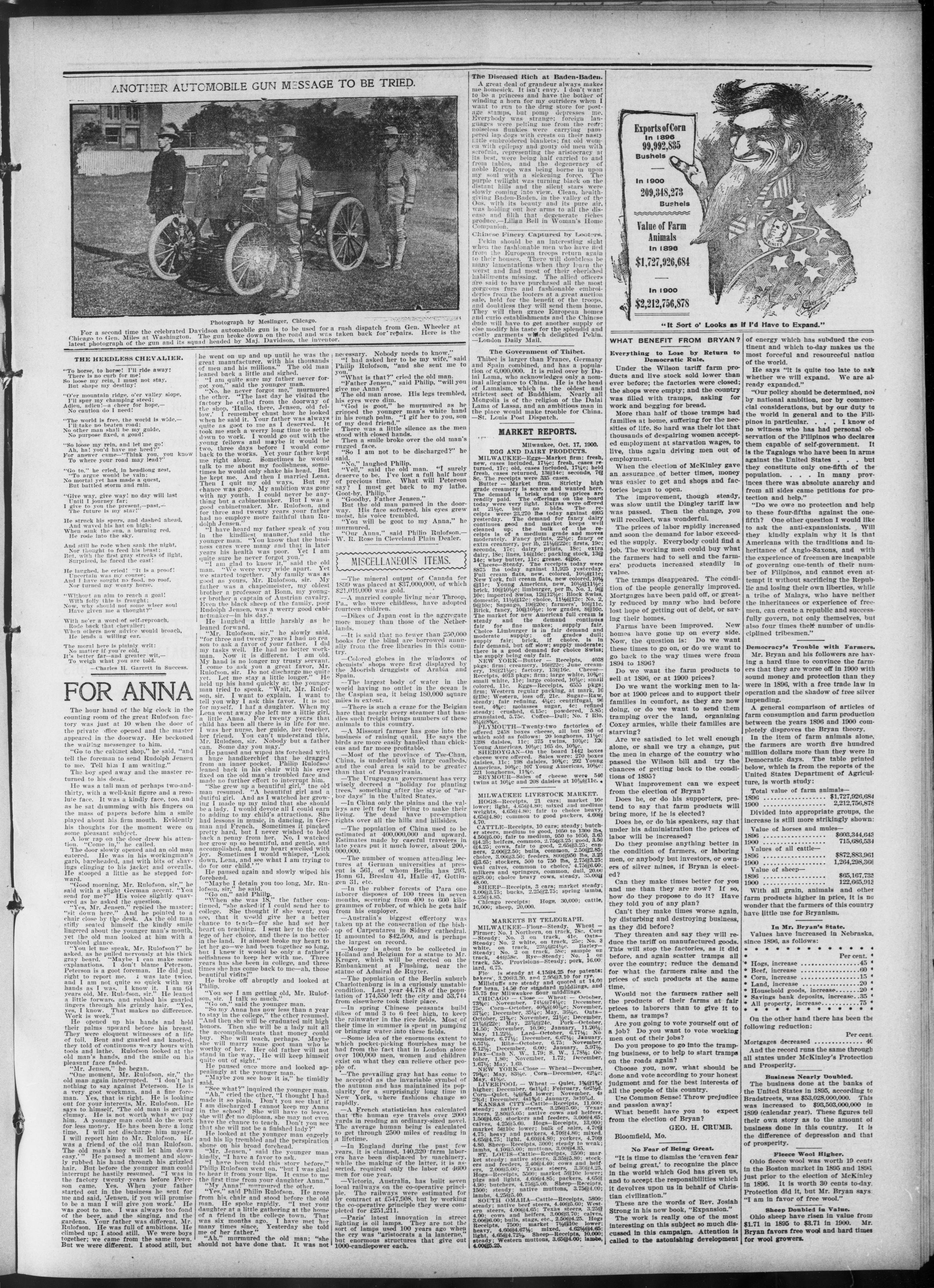
ANOTHER AUTOMOBILE GUN MESSAGE TO BE TRIED.
THE FIRE DEPT.
For a second time the celebrated Davidson automobile gun is to be used for a rush dispatch from Gen. Wheeler at Chicago to Gen. Miles at Washington. The gun broke down on the road and was taken back for repairs. Here is the latest photograph of the gun and its squad headed by Maj. Davidson, the inventor.
THE HEEDLESS CHEVALIER.
"To horse, to horse! I'll ride away;
There is no curb for me!
So loose my rein, I must not stay,
But shape my destiny!
"O'er mountain ridge, o'er valley slope,
I'll spur my champing steed;
Adieu, adieu!-a cheer for hope,-
No caution do I need!
"The world is free, the world is wide,-
I'll take no beaten road;
No other man shall be my guide,
No purpose fixed, a goad!
"So loose my rein, and let me go!
Ah, ha! you'd have me heed?"
For answer came—"Think you, you know
To where your road may lead?"
"Go to," he cried, in headlong zest,
"To argue would be vain;
No mortal yet has made a quest,
But battled storm and rain.
"Give way, give way! no day will last Until I journey far;
I give to you the present,—past,—The future is my star!"
He struck his spurs, and dashed ahead, And waved his hat on high;
When sank the sun, a burning red, He rode into the sky.
And still he rode when sank the night, Nor thought to feed his beast;
But, with the first gray streaks of light, Surprised, he faced the east!
He laughed, he cried! "It is a proof! Uncertain was my course;
And I have sought no food, no roof, Nor turned my weary horse.
"Without an aim to reach a goal! With folly this is fraught;
Now, why should not some wiser soul Have given me a thought?"
With ne'er a word of self-reproach,
Rode back that chevalier;
When others now advice would broach,
He lends a willing ear.
The moral here is plainly writ:
No matter if you're old.
It's better far—and greater wit,—
To weigh what you are told.
—Charles H. Garrett in Success.
FOR ANNA
The hour hand of the big clock in the counting room of the great Rulofson factory was just at 10 when the door of the private office opened and the master appeared in the doorway. He beckoned the waiting messenger to him.
"Go to the cabinet shop," he said, "and tell the foreman to send Rudolph Jensen to me. Tell him I am waiting."
The boy sped away and the master returned to his desk.
He was a tall man of perhaps two-and-thirty, with a well-knit figure and a resolute face. It was a kindly face, too, and as he sat drumming with his fingers on the mass of papers before him a smile played about his firm mouth. Evidently his thoughts for the moment were on some pleasant subject.
A low rap on the door drew his attention. "Come in," he called. The door slowly opened and an old man entered. He was in his workingman's garb, bareheaded, and with bits of shavings clinging to his jacket and overalls. He stooped a little as he stepped forward. "Good morning, Mr. Rulofson, sir," he said with a slight German accent. "You send for me?" His voice slightly quavered as he asked the question. "Yes, Mr. Jensen." replied the master; "sit down here." And he pointed to a chair close by the desk. As the old man stifly seated himself the kindly smile lingered about the younger man's mouth, yet the old man looked at him with a troubled glance.
"You let me speak, Mr. Rulofson?" he asked, as he pulled nervously at his thick gray beard. "Maybe I can make some explanations. I don't blame Peterson. Peterson is a goot foreman. He did just right to report me. i was late twice, and I am not quite so quick with my hands as I was. I know it. I am 64 years old, Mr. Rulofson, sir." He leaned a little forward and rubbed his gnarled fingers through his grizzly hair. "Yes, yes, I know. That makes no difference. Work is work."
He opened up his hands and held their palms upward before his breast. They were eloquent witnesses of a life of toil. Bent and gnarled and knotted, they told of continuous weary hours with tools and lathe. Rulofson looked at the old man's hands, and the smile on his pleasant face faded.
"Mr. Jensen." he began.
"One moment, Mr. Rulofson, sir," the old man again interrupted. "I don't hail nothing to say against Peterson. He is a very goot workman, and a fine foreman. Yes, that is right. He is looking out for your interests, Mr. Rulofson. He says to himself, 'The old man is getting clumsy. He is not worth what we pay him. A younger man could do the work for less money. He has been here a long time. I will not discharge him myself. I will report him to Mr. Rulofson. He was a friend of the old man Rulofson. The old man's boy will let him down easy.'" He paused a moment and slowly rubbed his hand through his grizzled hair. But before the younger man could interrupt he hastily resumed. "I was in the factory twenty years before Peterson came. Yes. When your father started out in the business he sent for me and said, 'Jensen, if you will promise to be a man I will give you work.' He was goot to me. I was always too fond of the beer, and the singing, and the gardens. Your father was different, Mr. Rulofson. He was full of ambitions. He climbed up; I stood still. We were boys together; we came from the same town. But we were different. I stood still, but
Photograph by Meslinger, Chicago
he went on up and up until he was the great manufacturer, with his thousands of men and his millions." The old man leaned back a little and sighed.
"I am quite sure my father never forgot you," said the younger man.
got you, said I said you, "No, he never forgot me," murmured the other. "The last day he visited the factory he called from the doorway of the shop, 'Hullo, there, Jensen, old fellow.' I remember chust how he looked when he said it. Your father was always quite as goot to me as I deserved. It took me such a werry long time to settle down to work. I would go out with the young fellows and maybe it would be two, three days before I would come back to the works. Yet your father kept me right along. Sometimes he would talk to me about my foolishness, sometimes he would only shake his head. But he kept me. And then I married Lena. Then I quit my old ways. But my chance was gone. My ambition was gone with my youth. I could never be anything but a cabinetmaker. But I was a good cabinetmaker. Mr. Rulofson, and for three and twenty years your father had no employee more faithful than Rudolph Jensen."
"I have heard my father speak of you in the kindliest manner," said the younger man. "You know that the business cares were many and that in later years his health was poor. Yet I am quite sure he never forgot you."
"I am glad to know it," said the old man. "We were very wide apart. Yet we started together. My family was as good as yours, Mr. Rulofson, sir. My father was a chapelimeister, my oldest brother a professor at Bonn, my younger brother a captain of Austrian cavalry. Even the black sheep of the family, poor Rudolph Jensen, was a werry good cabinetmaker—in his day."
He laughed a little harshly as he leaned forward.
"Mr. Rulofson, sir," he slowly said, "for three and twenty years I had no reason to ask a favor of your father. I did my tasks well. He had no better workman. Now it is different. I am old. My hand is no longer my trusty servant. I come to ask you a great favor, Mr. Rulofson, sir. Do not discharge me quite yet. Let me stay a little longer." He held up his hand quickly as the younger man tried to speak. "Wait, Mr. Rulofson, sir. I want to explain. I want to tell you why I ask this favor. It is not for myself. I haf a daughter. When my Lena went away she left me a little girl, a little Anna. For twenty years that child has been all there is in life for me. I was her nurse, her guide, her teacher, her friend. You can't understand this, Mr. Rulofson, sir. Nobody but a father can. Some day you may."
He paused and wiped his forehead with a huge handkerchief that he dragged from an inner pocket. Philip Rulofson leaned back in his chair with his eyes fixed on the old man's troubled face and made no further effort to interrupt him.
"She grew up a beautiful girl," the old man resumed. "A beautiful girl and a dutiful girl. And as I watched her growing I made up my mind that she should be a lady. I would devote all I could earn to adding to my child's attractions. She had lessons in music, in dancing, in German and French. Sometimes it pinched pretty hard, but I never wished to hold back a penny from her. No, I watched her grow up so beautiful, and gentle, and accomplished, and my heart swelled with joy. Sometimes I would whisper, 'Look down, Lena, and see what I am trying to do for our child.'"
He paused again and slowly wiped his forehead.
"Maybe I detain you too long, Mr. Rulofson, sir," he said.
"Go on," said Philip.
"When she was 18," the father continued, "she asked if I could send her to college. She thought if she went, you see, that it would give her a better chance to teach—for she had set her heart on teaching. I sent her to the college of her choice, and there is no better in the land. It almost broke my heart to let her go—we had been together so long, but I knew it would be only a father's selfishness to keep her with me. Three years has she been in college, and three times she has come back to me—ah, those beautiful visits!"
He broke off abruptly and looked at Philip.
"You see I am getting old, Mr. Rulofson, sir. I talk so much."
son, sir. I talk so much.
"Go on." said the younger man.
So on, said the younger man.
"So my Anna has now less than a year to stay in the college," the other resumed.
"And then she will be graduated mit high honors. Then she will be a lady mit all the accomplishments that money could buy. She will teach, perhaps. Maybe she will marry some goot man who is worthy of her. Her old father will not stand in the way. He will keep himself quite out of sight."
"See what?" inquired the younger man. "Ah." cried the other. "I thought I had made it so plain. Don't you see that if I am discharged I cannot keep my Anna in the school? She will have to leave, she will get no diploma, she may not even have the chance to teach. Don't you see that she will not be a finished lady?" He looked at the younger man eagerly and his lip trembled and the perspiration shone on his broad forehead.
"Mr. Jensen," said the younger man kindly, "I have a favor to ask.
"I have been told this story before," Philip Rulofson went on, "but I was glad to hear it from your lips. It came to me the first time from your daughter Anna."
"My Anna!" murmured the other.
"Yes," said Philip Rulofson. He arose from his chair and stood before the old man. He spoke rapidly. "I met your daughter at a little gathering at the home of a friend in the college town. That was six months ago. I have met her many times since. Yesterday she told me of her father."
"Ah," murmured the old man; "she should not have done that. It was not
necessary. Nobody needs to know."
"I had asked her to be my wife," said Philip Rulofson, "and she sent me to you."
"What is that?" cried the old man.
"Father Jensen," said Philip, "will you give me Anna?"
The old man arose. His legs trembled, his eyes were dim.
"God is goot," he murmured as he gripped the younger man's white hand in his rough palm. "I gif her to you, son of my dead friend."
There was a little silence as the men stood with closed hands.
Then a smile broke over the old man's rugged face. "So I am not to be discharged?" he said.
said. "No" laughed Philip.
No, laughed Philip.
"Vell," said the old man. "I surely deserve to be. I've lost a full half hour of precious time. What will Peterson say? I must get back to my lathe. Goot-by, Philip."
"Goodbye, Father Jensen."
Goodby, Father Jensen.
But the old man paused in the doorway. His face softened, his eyes grew moist, his voice trembled.
"You will be goot to my Anna," he murmured.
"Our Anna," said Philip Rulofson.—W. R. Rose in Cleveland Plain Dealer.
The mineral output of Canada for 1899 was placed at $37,000,000, of which $21,019,000 was gold.
A married couple living near Throop, Pa., who were childless, have adopted fourteen children.
Dikes of Japan cost in the aggregate more money than those of the Netherlands.
It is said that no fewer than 250,000 books for the blind are borrowed annually from the free libraries in this country.
Colored globes in the windows of chemists' shops were first displayed by the Moorish druggists of Arabia and Spain.
--The largest body of water in the world having no outlet in the ocean is the Caspian sea, it being 180,000 square miles in extent.
--There is such a craze for the Belgian hare that nearly every steamer that handles such freight brings numbers of these animals to this country.
--A Missouri farmer has gone into the business of raising quail. He says the birds are more easily handled than chickens and far more profitable.
--Most of the province of Tse-Chan, China, is underlaid with large coalbeds, and the coal area is said to be greater than that of Pennsylvania.
--The Uruguayan government has very wisely decreed a "holiday for planting trees," something after the style of "arbor days" in the United States.
- In China only the plains and the valleys are left for the living to make their living. The dead have pre-emption rights over all the hills and hillsides.
- The population of China used to be estimated at 400,000,000 and upward. Estimates made by careful travelers in late years put it much lower, about 200,000,000.
- The number of women attending lectures at German universities at present is 561, of whom Berlin has 293, Bonn 61, Breslau 41, Halle 47, Gottingen 31, etc.
- In the rubber forests of Para one laborer disposes of 100 trees in seven months, securing from 400 to 600 kilograms of rubber, of which he gets half from his employer.
Australia's biggest effertory was taken up at the consecration of the bishop of Carpentarea in Sidney cathedral. It amounted to $42,500, and is perhaps the largest on record.
Money is about to be collected in Holland and Belgium for a statue to Mr. Kruger, which will be erected on the Embankment at Flushing, near the statue of Admiral de Ruyter.
The population of the Berlin suburb Charlottenburg is in a curiously unstable condition. Last year 44,718 of the population of 174,550 left the city and 53,744 from elsewhere took their place.
In spring Chinese peasants build dikes of mud 3 to 6 feet high, to keep the rainwater in the rice fields. Most of their time in summer is spent in pumping or bringing water into these fields.
Some idea of the enormous extent to which pocket-picking flourishes may be had from the fact that in London alone over 100,000 men, women and children exist on what they can relieve other people of.
The prevailing gray hat has come to be accepted as the invariable symbol of the autumn and has maintained its popularity for a surprisingly long time in New York, where fashions change so rapidly.
A French statistician has calculated that the human eye travels over 2000 yards in reading an ordinary-sized novel. The average human being is calculated to get through 2500 miles of reading in a lifetime.
—In England during the past few years, it is claimed, 140,320 farm laborers have been displaced by machinery, while the making of the latter, it is asserted, required only the labor of 4600 men for one year.
—Victoria, Australia, has built seven local railways on the co-operative principle. The railways were estimated for by contract at £547,908, but by working the co-operative principle they were completed for £251,211.
—Paris' latest innovation in street lighting is oil lamps. They are not the sort of lamps used 100 years ago when the cry was "aristocrats a la lanterne," but enormous structures that give out 1000-candlepower each.
The Diseased Rich at Baden-Baden. A great deal of grandeur always makes me homesick. It isn't envy. I don't want to be a princess and have the bother of winding a horn for my outriders when I want to run to the drug store for postage stamps, but pomp depresses me. Everybody was strange; foreign languages were pelting me from the reef; noiseless flunkies were carrying pampered lap dogs with crests on their nasty little embroidered blankets; fat old women with epilepsy and gouty old men with serofula, representing the aristocracy at its best, were being half carried to and from tables, and the degeneracy of noble Europe was being borne in upon my soul with a sickening force. The purple twilight was turning black on the distant hills and the silent stars were slowly coming into view. Clean, healthgiving Baden-Baden, in the valley of the Oos, with its beauty and its pure air, was holding out her arms to all the disease and filth that degenerate riches produce.—Lilian Bell in Woman's Home Companion.
Chinese Finery Captured by Looters. Pekin should be an interesting sight when the fashionable men who have fled from the European troops return again to their houses. There will doubtless be many lamentations when they learn the worst and find most of their cherished habiliments missing. The allied officers are said to have purchased all the most gorgeous furs and fashionable embroideries from the looters at a great auction sale, held for the benefit of the troops, and doubtless they will send them home. They will then grace European homes and curio establishments and the Chinese dude will have to get another supply or else modify his taste for the splendid and costly garments which delighted Pekin. —London Daily Mail.
The Government of Thibet.
Thibet is larger than France, Germany and Spain combined, and has a population of 6,000,000. It is ruled over by Dalai Lama, who acknowledges only a nominal allegiance to China. He is the head of Lamaism, which is the oldest and strictest sect of Buddhism. Nearly all Mongolia is of the religion of the Dalai Lama of Lassa, and an ambitious man in the place would make trouble for China.—St. Louis Post Dispatch.
MARKET REPORTS.
Milwaukee, Oct 17, 1900.
EGG AND DAIRY PRODUCTS.
EGG AND DAILY PRODUCTS.
MILWAUKEE—Eggs—Market firm; fresh,
new, cases included, 17½c; fresh, cases
returned, 17c; old, cases included, 17½c; held
fresh, cases returned, 13@14c; seconds, 7@
8c. The receipts were 335 cases.
Butter — Market firm. Strictly high
grade creamery is scarce and wanted here.
The demand is brisk and top prices are
readily paid. The offerings on the board
today were very light. Extras were offered
at 21½c, but no bids. The
receipts were 23,270 lbs today against 4995
yesterday. The demand for fancy dairy
continues good and market keeps well
cleaned up; the bulk of the
receipts is of a medium grade and moves
moderately. Fancy prints, 22½c; fancy or
extra creamery, per lb, 21½@22c; firsts, 19c;
seconds, 17c; dairy prints, 18c; extra
dairy, 18c; lines, 14@16c; packing stock, 13@
14c; whey butter, 11c; grease. 4@6c.
Cheese-Steady. The receipts today were 8875 lbs today against 11,925 yesterday. Full cream flats, new, colored, 10% @11c; New York, full cream flats, new colored, 10% @11c; Young Americas, new, 10% @11c; brick, 10% @12c; limburger, per lb, No. 1, 9% @10c; imported Swiss, 12% @12c; Block Swiss, domestic, 11% @12c; choice, 11% @12c; No. 2, 9% @10c; Sapsago, 19% @20c; farmers', 10% @11c; Brick, fancy, 10% @12c; low grades, 8% @10c. The market for new American full cream is steady and the demand continues fair for fine makes; supply fair. Choice Limburger is in fair demand and moderate supply; off grades dull; supply fair; brick, if choice, is in fair demand, but off slow; supply moderate; there is a good demand for choice Swiss; the supply being only fair.
NEW YORK—Butter— Receipts, 4038
pkgs; firm; cremery, 16@22c; June cremery,
18@212%c; factory, 13@16c. Cheese—
Receipts, 4013 pkgs; firm; large white, 10%c;
small white, 11c; large colored, 10%c; small
colored, 11c. Eggs—Receipts, 6555 pkgs;
firm; Western regular packing, at mark, 10
@19c; Western, loss off, 21c. Sugar—Raw,
steady; fair refining, 4¼c; centrifugal, 96
test, 4¼c; molasses sugar, 4c; refined
steady; crushed, 6.15c; powdered, 5.85;
granulated, 5.75c. Coffee—Dull; No. 7 Rio,
8¼@8%c.
PLYMOUTH—Twenty-two factories of
offered 2458 boxes cheese, all but 380 of
which sold as follows: 20 longhorns, 11%c;
1398 daisies, 11c; 375 twins, 10%c; 120
Young Americas, 10%c; 165 do, 10%c.
SHEBYOGAN—On the board 1442 boxes
cheese were offered. Sales were: 270 boxes
daisies, 11c; 198 daisies, 10%c; 292 Young
Americas, 10%c; 107 Young Americas, 10%c;
221 longhorns, 11%c.
SEYMOUR—Sales of cheese were 540 twins at 10¼c and 208 daisies at 10%@11c.
MILWAUKEE LIVESTOCK MARKET.
HOGS—Receipts, 21 cars; market 10c lower; light, 4.65@4.80; mixed and medium weights, 4.65@4.80; fair to choice heavy, 4.65@4.80; common to good packers, 4.60@4.70.
CATTLE—Receipts, 10 cars; steady; butcher steers, medium to good, 1050 to 1300 lbs, 4.50@5.00; fair to medium, 950 to 1050, 3.65@4.25; helfers, common, 2.75@3.25; good, 3.50@4.25; cows, fair to good, 2.65@3.25; canners, 2.00@2.50; bulls, common, 2.50@2.85; choice, 3.00@3.50; feeders, 800@950 lbs, 3.25@3.65; stockers, 500 to 750 lbs, 2.75@3.25; veal calves, common to choice, 4.75@6.60; milkers and springers, common, dull, 20.00@28.00; choice heavy cows, steady, 35.00@48.00.
SHEEP—Receipts, 3 cars; market steady; 3.00@3.75; bucks, 2.25@2.75; spring lambs, 4.25@4.85
Chicago receipts: Hogs, 30,000; cattle, 16,000; sheep, 20,000.
MARKETS BY TELEGRAPH.
MILWAUKEE—Flour—Steady. Wheat—
Firmer; No. 1 Northern, on track, 78c. Corn—
Steady; No. 3 on track, 41c. Oats—
Steady; No. 2 white, on track, 25c; No. 3
white, on track, $23\frac{1}{4}@24\frac{1}{2}c$. Barley—
Steady; No. 2 on track, 58c; sample uni
track, 44@58c. Rye—Steady; No. 1 on
track, 53c. Provisions—Steady; pork, 16.00;
lard, 6.75.
Flo. is steady at 4.15@4.25 for patients; bakers', 3.20@3.30, and 2.95@3.10 for rye. Millstuff are steady and quoted at 14.00 for bran, 14.50 for standard middlings, and 15.75 for Milwaukee flour middlings.
CHICAGO - Close - Wheat - October, 73%c; November, 74%14%41c; December, 75c. Corn-October, 40%140%1c; November, 37%c; December, 35%c; May, 36%c. Oats-October, 21%c; November, 21%c; December, 21%122c; May, 23%124c. Pork-October, 14.50; November, 10.90; January, 11.20%c, May, 11.22%c, Lard-October, 6.77%c; November, 6.77%2; December, 6.67%2; January, 6.57%2, Ribs-October, 6.75; November, 6.12%2; December, 6.00; January, 5.97%2, Flax-Cash N. W., 1.79; S. W., 1.78%2; October, 1.80; November, 1.72; December, 1.67%2; May, 1.69.
NEW YORK-Close - Wheat-December, 79%c; May, 83%c. Corn-December, 42%c; May, 41%c.
LIVERPOOL - Wheat - Quiet, 1%1@1% higher; December, 61%d; February, 62%d. Corn-Quiet, 1%4@d lower; November, 4s 2%d; December, 41%d; January, 31%d.
KANSAS CITY—Cattle-Receipts, 11,000; steady; native steers, 3.25@5.60; Texas steers, 2.80@5.05; native cows and heifers, 1.50@4.65; stockers and feeders, 3.00@4.65; calves, 4.25@5.60. Hogs-Receipts, 13,000; market 5@10c lower; bulk of sales, 4.70@4.75; heavy and packers, 4.70@4.80; mixed, 4.65@4.75; light, 4.60@4.80; yorkers, 4.70@4.80. Sheep-Receipts, 3000; steady to weak; lambs, 4.10@5.00; muttons, 3.00@4.35.
ST. LOUIS—Cattle-Receipts, 3500; market steady; native steers, 3.35@5.80; stockers and feeders, 2.40@4.40; cows and heifers, 2.00@5.00; Texas steers, 3.30@4.25. Hogs-Receipts, 5500; market 5@10c lower; pigs and lights, 4.60@4.85; packers, 4.65@4.90; butchers, 4.75@5.00. Sheep-Receipts, 1500; steady; native muttons, 3.75@4.60; lambs, 4.25@5.40.
SOUTH OMAHA—Cattle-Receipts, 5800;
steady; native beef steers, 4.40@5.60; West-
ern steers, 4.00@4.65; Texas steers, 3.25@
4.00; cows and heifers, 3.00@3.70; calves,
3.00@6.00; bulls, stags, etc., 2.50@4.25; Hogs
Receipts, 7500; market 7½@10c lower;
heavy, 4.60@4.67½; mixed, 4.62½@4.65;
light, 4.65@4.72½; Sheep-Receipts, 10.00;
steady; Western muttons, 3.65@4.00; lambs,
4.00@5.25
Exports of Corn
In 1896
99,992,835
Bushels
In 1900
209,348,273
Bushels
Value of Farm
Animals
In 1896
$1,727,926,684
In 1900
$2,212,756,878
WHAT BENEFIT FROM BRYAN?
Everything to Lose by Return to Democratic Rule.
Under the Wilson tariff farm products and live stock sold lower than ever before; the factories were closed; the shops were empty; and the country was filled with tramps, asking for work and begging for bread.
of energy which has suf- tinent and which to-day most forceful and resou- of the world.
He says "it is quite to whether we will expand ready expanded."
"Our policy should be o by national ambition, n ial considerations, but
More than half of those tramps had families at home, suffering for the necessities of life. So hard was their lot that thousands of despairing women accepted employment at starvation wages, to live, thus again driving men out of employment.
When the election of McKinley gave an assurance of better times, money was easier to get and shops and factories began to open.
The improvement, though steady, was slow until the Dingley tariff law was passed. Then the change, you will recollect, was wonderful.
The prices of labor rapidly increased and soon the demand for labor exceeded the supply. Everybody could find a job. The working men could buy what the farmers had to sell and the farmers' products increased steadily in value. The tramps disappeared. The condition of the people generally improved. Mortgages have been paid off, or greatly reduced by many who had before lost hope of getting out of debt, or saving their homes.
Farms have been improved. New homes have gone up on every side. Now, the question is: Do we want these times to go on, or do we want to go back to the way times were from 1894 to 1896? Do we want the farm products to sell at 1896, or at 1900 prices? Do we want the working men to labor at 1900 prices and to support their families in comfort, as they are now doing, or do we want to send them tramping over the land, organizing Coxey armies, while their families are starving?
Are we satisfied to let well enough alone, or shall we try a change, put the men in charge of the country who passed the Wilson bill and try the chances of getting back to the conditions of 1895?
What improvement can we expect from the election of Bryan?
Does he, or do his supporters, pretend to say that farm products will bring more, if he is elected?
Does he, or do his speakers, say that under his administration the prices of labor will be increased?
Do they promise anything better in the condition of farmers, or laboring men, or anybody but investors, or owners of silver mines, if Bryan is elected?
Can they make times better for you and me than they are now? If so, how do they propose to do it? Have they told you of any plan?
Can't they make times worse again, by disturbing and destroying business, as they did before?
They threaten and say they will reduce the tariff on manufactured goods. This will stop the factories, as it did before, and again scatter tramps all over the country; reduce the demand for what the farmers raise and the prices of such products at the same time.
Would not the farmers rather sell the products of their farms at fair prices to laborers than to give it to them, as tramps?
Are you going to vote yourself out of a job? Do you want to vote working men out of their jobs?
Do you propose to go into the tramping business, or to help to start tramps on the roads again?
Choose you, now, what should be done and vote according to your honest judgment and for the best interests of all the people of this country.
Use Common Sense! Throw prejudice and passion away!
What benefit have you to expect from the election of Bryan?
GEO. H. CRUMB.
No Fear of Being Great.
"It is time to dismiss the 'craven fear of being great,' to recognize the place in the world which God has given us, and to accept the responsibilities which it devolves upon us in behalf of Christian civilization."
These are the words of Rev. Josiah Strong in his new book, "Expansion."
The work is really one of the most interesting on this subject so much discussed in this campaign. Attention is called to the astonishing development
of energy which has subdued the continent and which to-day makes us the most forceful and resourceful nation of the world. He says "it is quite too late to ask whether we will expand. We are already expanded."
"Our policy should be determined, now by national ambition, nor by commercial considerations, but by our duty to the world in general and to the Filipinos in particular. I know of no witness who has had personal observation of the Filipinos who declares them capable of self-government. It is the Tagalogs who have been in arms against the United States . . . but they constitute only one-fifth of the population. In many provinces there was absolute anarchy and from all sides came petitions for protection and help."
"Do we owe no protection and help to these four-fifths against the one-fifth? One other question I would like to ask the anti-expansionists. Will they kindly explain why it is that Americans with the traditions and inheritance of Anglo-Saxons, and with the experience of freemen are incapable of governing one-tenth of their number of Filipinos, and cannot even attempt it without sacrificing the Republic and losing their own liberties, while a tribe of Malays, who have neither the inheritances or experience of freemen, can create a republic and successfully govern, not only themselves, but also four times their number of undisciplined tribesmen."
Democracy's Trouble with Farmers. Mr. Bryan and his followers are having a hard time to convince the farmers that they are worse off in 1900 with sound money and protection than they were in 1896, with a free trade law in operation and the shadow of free silver impending. A general comparison of articles of farm consumption and farm production between the years 1896 and 1900 completely disproves the Bryan theory.
In the item of farm animals alone, the farmers are worth five hundred million dollars more than they were in Democratic days. The table printed below, which is from the reports of the United States Department of Agriculture, is worth study: Total value of farm animals-
Total value of farm animals—
1896 ..... $1,727,926,684
1900 ..... 2,212,756,878
Divided into appropriate groups, the increase is still more strikingly shown:
Value of horses and mules—
1896 ..... $603,344,643
1900 ..... 715,686,534
Values of all cattle—
1896 ..... $872,883,961
1900 ..... 1,264,298,366
Value of sheep—
1896 ..... $65,167,735
1900 ..... 122,665,913
With all grain, animals and other farm products higher in price, it is no wonder that the farmers of this country have little use for Bryanism.
In Mr. Bryan's State.
Values have increased in Nebraska since 1896, as follows:
* Hogs, increase ..... 45
* Beef, increase ..... 60
* Corn, increase ..... 15
* Land, increase ..... 20
* Household goods, increase..... 20
* Savings bank deposits, increase..... 35
* All property, increase..... 75
On the other hand there has been the following reduction:
Per cent.
Mortgages decreased ..... 40
And the record runs the same through all states under McKinley's Protection and Prosperity.
Business Nearly Doubled.
The business done at the banks of the United States in 1895, according to Bradstreets, was $53,028,000,000. This was increased to $93,503,000,000 in 1899 (calendar year). These figures tell their own story as to the amount of business done in this country. It is the difference of depression and that of prosperity.
Fleece Wool Higher.
Ohio fleece wool was worth 19 cents in the Boston market in 1895 and 1896 just prior to the election of McKinley in 1896. It is worth 30 cents to-day. Protection did it, but Mr. Bryan says: "I am in favor of free wool."
Sheep Doubled in Value.
Ohio sheep have risen in value from $1.71 in 1895 to $3.71 in 1900. Mr. Bryan favors free wool and hard times for wool growers.
Richard B. Montgomery......
.....Editor and Proprietor
Office 200 Fifth Street.
Telephone Black No. 244.
SUBSCRIPTION RATES.
Send money by Express Money Order. P. O. Money Order or Registered Letter to the Wisconsin Weekly Advocate.
ADVERTISING RATES.
One inch, single insertion..... 25c
One inch, per year..... $9.00
Business locals 5c per line each insertion.
Apply for rates to the Advocate.
TO CONTRIBUTORS:
All communications must be sent with the name and address of the sender as an evidence of good faith, but not necessarily for publication. No manuscript returned if not accepted, unless accompanied by stamps.
All subscribers of the Advocate that fail to get their paper promptly will please notify us at once. The Advocate, at 209 Fifth street.
The Wisconsin Weekly Advocate company wishes to notify the public that all contracts and business transactions with this company must have the company stamp, otherwise they will be void. Neither will this company be responsible for paid subscriptions unless given to duly-accredited agents, who, on request, will give the company's receipt for same. Subscribers failing to receive their papers regularly will kindly notify the general office. Address all business communications to the general manager, 209 Fifth street.
Entered at the Milwaukee P. O. as second-class matter.
Falling aeronauts have come to be as common an aerial spectacle as descending meteors.
Sir Thomas Lipton's success with October pork will enable him to pick up some of the money he dropped here last year in October yachting.
Sir Thomas Lipton's challenge for the America cup is made in time to suggest that he is willing to "blow in" some of the money he has just made on pork.
The failure of the Peary relief steamer Windward to return from the north makes an opening for another Arctic leader, to head a second relief expedition next year.
The society which a La Crosse man is organizing, whose members are to give away all their money over $100,000, will be just as likely as other organizations to come to grief on account of the nonpayment of dues.
The campaign of the pigskin starts with a whirl that will not subside until Thanksgiving, which has an added import for American parents ever since the present rough-and-tumble game was invented.
Modern engineering and modern steel are jointly working marvels in architecture. The new Quebec cantilever bridge will have the longest span in the world—1800 feet. Heretofore the new bridge over the Frith of Forth has held the palm, with a span of 1710 feet.
Consul Worman at Munich writes to the state department saying that most factories in Germany have nothing like our electric timekeepers, and an effort to introduce them into Germany, especially into South Germany, where new enterprises are constantly being launched, ought to be successful.
The American Leveling Association organized by a La Crosse man for the purpose of making $100,000 the maximum wealth in every instance will find that his society will be like organizations of old maids and old bachelors, which lose members the moment Cupid plants a dart. The Levelers will all change their minds as to the size of their pile as they reach the $100,000 mark.
Tea is now considered the best beverage with which to fight alcohol, and is proving such in Russia. It was first imported into that country in 1638. Today the annual consumption is 100,000,000 pounds. That of St. Petersburg alone is reckoned at from three to four pounds per capita. Tea and sugar cost Russia yearly $264,000,000; spirits, beer and wine are consumed to the value of $140,-000,000 only.
A French philanthropist has opened a free "hospital" for plants in the Faubourg St. Antoine, and the institution is proving a great boon to poor Parisians, nearly all of whom are flower lovers, and have plants growing in their windows. The "hospital" buildings are big greenhouses, and the doctors and nurses are gardeners who look after the plants which are brought in until they recover, and then return them to their owners.
The report of Dr. Curry, general agent of the Peabody Education Fund, as to the result of effort among the colored people of the South, is in accord with the observation that manual training is productive of the best results. In West Virginia this training is in the direction of farm work, and the commissioner for that state declares that the cultivation of enthusiasm for country life offers the most hopeful solution of the negro problem.
Marloid is a new substitute for celluloid, for industrial purposes, invented by a German manufacturer. It is produced from untanned leather boiled in oil, which is said to resemble celluloid in every particular. It shows the same texture as horn, can be easily and nicely polished on both sides, be pressed into any desired shape and stamped, and can be rendered flexible or rather elastic to certain degree, or may, on the other hand, be hardened.
Steel masts for ships are shapely and strong, and can be used for chimneys by steamers, as is done on some of the lake tow barges, but they are troublesome when ships are hard beset by gales. Recently the fine new steel ship Nonpareil was lost because when she was thrown upon her beam ends by a hurricane her crew could not relieve her of her masts, although they worked like heroes with cold chisels. With wooden masts, a few
blows with the axe on the weather rigging will be sufficient to send the masts over the lee side.
The open season for deer will soon arrive, and then the "north woods" will sing with bullets. Those who intend to risk their lives in the woods may find food for thought in the reports from the Adirondacks, where bullets intended for deer are adding to the death record of humanity. Recently a guest at the Otter Lake Hotel was killed by a hunter who mistook him for a deer, and a few days previous to this sad happening a woman was so badly shot by a deer hunter that she had to suffer the amputation of one of her legs.
United States Consul Halstead, at Birmingham, under a recent date, reports to the state department the steady decrease of the importation of cheese into England, there being less general consumption, owing to the prosperity among the working classes and the low price of imported meat. Canada has the import field in England to itself. France and the United States are losing hold of the British market, France being supplanted by Belgium and the United States by Canada. "United States consuls," says Mr. Halstead, "have for many years pointed out that the shipment of filled cheese from the United States would kill the demand for cheese from that country, and this prediction now seems to have come true."
The exhibits at the Paris exposition which have been presented to the Philadelphia Commercial museum are of great intrinsic value, and when added to the display now made will admirably round out the permanent exhibition under the control of that institution. The proposed appropriation by the city of $20,000 to defray the cost of the packing and transportation of the Paris gift is scarcely 1 per cent. of the actual value of the goods. The exhibits in question include those of raw and manufactured products made by Russia, Siberia, the Congo Free State, the French colonies in China, Madagascar and elsewhere, Italy and a number of the South American republics.
Prof. Charles E. Beecher, the curator of the Peabody museum of Yale University, has returned to New Haven from a two-months' trip to the far West in search of fossils and specimens for Yale. Prof. Beecher conducted a party of eight, which was made up chiefly of Yale students who went West for their first experience in field work. He went to the places in Arizona that have seldom been visited and from these corners brought back many valuable fossils. Among the places where he collected fossils was the land of the Moki Indians, where Prof. Beecher and his party saw the famous snake dance. He also spent considerable time among the Navajo Indians. Prof. Beecher crated many boxes of fossils which are now on the way to the museum. These fossils will all have to be studied and classified before their value can be determined.
The general board of appraisers, United States treasury department, in a recent decision on the proper classification of hippopotamus teeth, says that elephant ivory is of finer fiber and grows to much greater size than hippopotamus or walrus ivory, and because of these characteristics commands a higher price in the market, but for making small articles, such as umbrella or cane handles or Japanese ivory carvings, and of the numerous kinds of ivory are serviceable, and in fact used. While among the trade there is a clear distinction between elephant ivory and the other species, it is recognized more because of the difference in value of each than because of any trade designation. There was introduced in evidence in a case before the board a trade circular which contains the current market quotations for the various articles bought and sold as ivory. These quotations disclose a vast variety of ivory.
According to the Boston Commercial Bulletin, scallops are very scarce in Rhode Island this year. The law went off in that state the first of this month, but up to this time the catch has been very small. The beds planted last fall have not panned out as well as was expected. One reason for this is that the seed planted last year is said to have been stolen. Prices range high and there is no prospect of better catches. In former years the fishermen had to take their catch to Providence to sell them, while this year the buyers have sent agents to the fishermen to get all they can. These agents are offering $2.25 per gallon at wholesale and will take all that is offered. At this price only a favored few will be able to have them. The law in Massachusetts goes off the first of October, but unless the catch is an unusually large one no lower prices can be expected. Scallops will be found in only the first-class hotels this season.
PUMPKINS THAT PAY.
How Clever Yankees Get Big Prices for the Lordly-Vegetable.
The modern farmer is learning to take advantage of the weaknesses of nature. One of these weaknesses is found in the lordly pumpkin. Bruise a growing pumpkin and the scar will never be cleared away, but will show in the ripe pumpkin in the shape of delicate little yellow warts. Starting with this principle some shrewd Yankees have made their pumpkin farms valuable.
After the pumpkins get good-sized and prove that they will be fine ones, the farmers go into the patch and, with a sharp stick, scar them so that when they are ready for market their happy faces bear, in words of warts, legends like these: "Eat me at Smith's;" "Smith will make pies of me soon;" "Brown's pies are best;" "Jones' pies are delicious;" "You can eat me inside."
The wily farmer hauls these warty fellows to market, and, calling Smith, Jones and Brown from their respective restaurants, shows the strange freak of nature. Of course a sate is made on sight, and the pumpkin lies at the front of the restaurant for a few days to astonish passers-by until it must be made into pies to save it. Then the farmer discovers another freak pumpkin, suitably marked to replace it. Fancy prices are to be had for these pumpkins, and stony patches that would never pay taxes in any other crop, produce wealth in pumpkins.—New York Mail and Express.
—September closed in the ore and bullion market at Salt Lake with settlements of $2,153,485, the highest figures reached during one month this year.
The above illustrations are the Republican county nominees for election. They are well-selected gentlemen, well acquainted with the affairs of the county. They are staunch Republicans and conversant as to the needs of the people of the county. They should be elected with an overwhelming majority.
KLIN-O.
PHOTO
M.
Jacob P. Van Lare,
Coroner.
M.
WINTER WINDOW BOXES
Plants Can be Successfully Kept if These Instructlons Are Carried Out.
To make a window box that will be a thing of beauty all winter is not easy to anyone but the real enthusiast for whom a plant grows and thrives seemingly under all circumstances. It is much the same with the management of plants as it is with children. Some come up and some are brought up. But with both success depends upon the observance of natural laws. Ferns will refuse to thrive in the soil in which roses flourish best and vice versa. Some plants require little moisture, and others a great deal, while the atmosphere in which they are kept is largely responsible for the amount of water required.
The first requisite for a window box is a strong, tight box lined with zinc or tin, and provided with two little holes in the bottom for drainage. The latter are needful because there is a general tendency to be over-generous with water. Plants requiring the same general conditions of soil, light and moisture should be put together. For a box containing flowering plants an east or south window is necessary, because they require the sun. A pretty, though formal, arrangement for such a box would be a dracaena, for height, in the center, and a couple each of geraniums and fuchsias on either side. Carnations and Chinese primroses could also be added, as well as a couple of ardiasias, the red berries and evergreen foliage of which remain brilliant throughout the season. Dwarf varieties of ferns will make pretty fillers for the ends of the box, while lycopodium and tradescantia can be filled in around the sides and edges. Dwarf flowering geraniums in white, scarlet and pink will be the best choice. Of dracaenas there are many varieties, and all are attractive. There are a few flowering winter begonias that could be introduced with good results.
For the soil a generous supply of leaf mould and sand will be required. An excellent formula would be one-half leaf mould, one-fourth soil and one-fourth small pieces of charcoal and coarse sand mixed. To protect the plants at night and during exceptionally cold and windy days a sash curtain should be arranged. This will furnish a pretty background when either drawn or open, and can be supplemented by newspapers when necessary. Plants should never be subjected to draughts, and a window should never in chilly weather be opened directly upon them. A sudden chill will set back a vigorous plant and retard its growth oftentimes permanently. If the window must be opened during sweeping, care should be taken that windows and doors opposite are closed. As to water, that must be left to the discretion of the gardener, as it depends upon the temperature at which the room is kept. A good soaking twice a week would be a general rule. When the earth is soft and moist no water is needed. A shelf above the box or brackets at the sides of the windows for pots of plants will contribute to the beauty of the window. For these English or German ivy vines are pretty. Asparagus, with its soft green, is also decorative. Mixed varieties of nasturtiums would give a summery effect, and could be arranged in an entire green. Nasturtiums need rich soil.
For a north window a box of hardy ferns, with a small palm or two, such as the Kentia, arica or choice cocos, is suitable. Excellent for this is the Cyperus altinafolia, commonly known as the Nile grass, which flourishes equally well in an aquarium with the goldfish or in an iron garden vase that gets as dry at times as a sandpile. Whatever its resources for sustaining life, the plant will stand erect and flourish when others are dying of too much or too little water. For the north window brackets Chinese primroses can be used, as they will give color and will bloom without the sun.
A great many pretty things are written about the ease with which orchids can be raised outside the greenhouse, and housewives are told that if they only think so
PHOTO BY
STEIN
M. B.
Gabe Ringenoldus,
Clerk of Courts.
M.
they will find these rare plants quite as susceptible to cultivation in the living room as in the hothouse. On the contrary, growers of orchids declare that no form of orchid will thrive in the atmosphere of the living room, and this statement is substantiated by the testimony of many experimenters. Rubber plants, palms and the Boston fern are all decorative house plants and are easy of cultivation. The rubber plant wants a liberal supply of water and sun. Given these, and it will stand no end of familv abuse. It is about the easiest living thing in the world to care for. The palm needs a good deal of moisture, but no sunlight, and the Boston fern requires absolute shade.
When the edges of the leaves of a plant begin to look yellow and it shows symptoms of poor health it is well to change its position, and to give it more light and water. If in two or three days it does not seem to be "looking up" it is pretty certain to be overpotted. That is, the pot is too large, and the earth has become sour because the roots could not absorb all of the moisture. In this case it should be turned from the pot, and about half the ball of earth removed, with the ends of the roots. To do this the earth should be gently shaken from the roots. Sometimes it is best to wash them clean in a tub of water. The plant can then be put into a smaller pot. While plants are still thrifty it is sometimes well to add a very little patent fertilizer to the water which is given to them.
Gas is especially injurious to all ferns, which seem to be more susceptible to its odor than other forms of vegetation.—New York Tribune.
THE BENEFITS OF DEAR COAL
Lack of Fuel Advances Economy in Manufacturing Processes.
An observant engineer, traveling through some of the Swiss manufacturing centers, noticed that, generally, Swiss steam engines were of a higher economical type than those in England, while Swiss electrical generators and motors were distinctly inferior to those of English standard practice. By a process of deduction from local circumstances he was able to attribute these two circumstances to the high cost of fuel in Switzerland on the one hand, and the great plenty and consequent cheapness of natural water-powers in the country on the other.
The highest results in any branch of industry require an artificial stimulus. At no time within recent memory has the trade in economical appliances for the production of steam energy been as active as it is now. Economization in manufacturing processes simply means the suppression of waste; and in that view the existing exorbitant cost of fuel is by no means without its compensations. It must also be remembered that the present high price of coal is most likely transitory, but that the economical improvements to which it may give rise must be permanent, for, however slow advance in manufacturing practice may be, there is no stepping back.—London Express.
Why Cotton is King in Dixie.
Cotton may not be the king product of the earth. It has the influence of neither wheat nor coal in deciding the destinies of modern nations, but employs more of man's energy and skill than either of these other products. The world now.grows about 14,000,000 bales of cotton, in raising which some 20,000,-000 people are directly or indirectly engaged. This raw cotton is worth the sum of $400,000,000. Three million more persons are engaged in its commerce. Add to this 5,000,000 more people engaged in its manufacture and we have some 28,000,000 of the people of the earth who touch the garments of this white king at some point or other. The manufactured product is worth ten times the raw product, so that cotton from first to last means to the world in dollars and cents more than $4,000,000,000 annually.—Success.
Sustaining Life
WILLIAM RASCH
GENEVA LAKE, WIS.
Northwestern House
APPLETON, WIS.
JOHN A. BRILL, - Proprietor.
Terms $1.00 Per Day.
NORTHWESTERN
S. F. PEACOCK & SON
Funeral Directors
AND
EMBALMERS
431 Broadway. MILWAUKEE, WIS.
BRETT & SON,
EMBALMERS and
FUNERAL DIRECTORS
JAMES T. BRETT & SON,
307 REED STREET and Always Open 410 GRAND AVENUE.
Telephones: South 122. Grand 2467. Milwaukee, Wis.
---
PHOTO
AVIATION
Theodore Zillmer,
Sheriff.
M.
W. H. Bennett,
District Attorney.
1
M.
"THE WHITE DEATH."
A Frozen Fog of Which Indians Are More Afraid than of Rattlesnakes.
"Of all the natural phenomena peculiar to the Rocky mountain region none is more strange or terrible than the mysterious storm known to the Indians as 'the white death.' Scientific men have never yet had an opportunity of investigating it, because it comes at the most unexpected times and may keep away from a certain locality for years. Well-read men who have been through it say that it is really a frozen fog. But where the fog comes from is more than anyone can say. This phenomenon occurs most frequently in the northern part of Colorado, in Wyoming, and occasionally in Montana.
"About two years ago a party of three women and two men were crossing North Park in a wagon in the month or February. The air was bitterly cold, but dry as a bone and motionless. The sun shone with almost startling brilliancy. As the five people drove along over the crisp snow they did not experience the least cold, but really felt most comfortable, and rather enjoyed the trip. Mountain peaks fifty miles away could be seen as distinctly as the pine trees by the roadside.
"Suddenly one of the women put her hand up to her face and remarked that something had stung her. Then other members of the party did the same thing, although not a sign of an insect could be seen. All marveled greatly at this. A moment later they noticed that the distant mountains were disappearing behind a cloud of mist. Mist in Colorado in February! Surely there must be some mistake. But there was no mistake, because within ten minutes a gentle wind began to blow and the air became filled with fine particles of something that scintillated like diamond dust in the sunshine. Still the people drove on until they came to a cabin where a man signaled them to stop. With his head tied up in a bundle of mufflers, he rushed out and handed the driver a piece of paper on which was written: 'Come into the house quick, or this storm will kill all of you. Don't talk outside here.'
"Of course no time was lost in getting under cover and putting the horses in the stables. But they were a little late, for in less than an hour the whole party was sick with violent coughs and fever. Before the next morning one of the women died with all the symptoms of pneumonia. The others were violently ill of it, but managed to pull through after long sickness.
"I seen you people driving along the road long before you got to my house, and I knowed you didn't know what you were drivin' through,' said the man, as soon as the surviving members of the party were able to talk. 'That stuff ye seen in the air is small pieces of ice, froze so cold it goes clear down into your-lungs without melting. If any man stayed out a few hours without his head covered up he would be sure to die. One winter about eight years ago it cleaned
ST. MARK'S A. M. E. CHURCH
REV. T. W. LEWIS, PASTOR.
Local Preacher, Gilbert Hamilton.
Residence, 25G Seventh Street,
MILWAUKEE, WIS.
SERVICES SUNDAY 10:45 and 7:45
SUNDAY SCHOOL 3 P. M.
CHRISTIAN ENDEAVOR 7 P. M.
ALL ARE WELCOME.
on the choice juicy meats served by us is just what our athletic, bicycle riding, tennis playing and golfing twentieth century men and women need. Pj days have gone with the spin ning wheel. Good bone, muscle and tissue is what is needed now. You can get them by patronizing the Chicago Market. Our meats are fresh, tempting and choice, and are sold at prices that will let you feast in comfort.
Accommodations the best in the State. When in Appleton stop at the
MRS. JAMES T. BRETT,
Lady Undertaker.
out a whole Indian tribe across the Wyoming line. They are more afraid of it than they are of rattlesnakes. That's the reason they call it the "white death."""—Will Sparks in Ainslee's.
WHALE BONE SUMMERHOUSE.
Novel Structure Erected on Sullivan's Island.
Capt. John H. Devereaux has refused an offer of $300 for the jawbone of a whale which was killed in the harbor of Charleston, S. C., about fourteen years ago. The jaws measure 12 feet each, and are used as a grand entrance to a summerhouse on Sullivan's island made of the bones from the whale. The house is prettily arranged, and vines which cover it give it a most handsome appearance. Tea was served in this little house the other afternoon, and the fact was brought out then that Capt. Devereaux had refused the offer for the home. The whale was considered the largest of its kind that ever drifted to Southern waters.
Capt. Devereaux is the supervising architect for the government at Charleston, and it was his idea to build the arbor with the most artistic effect. Back of the main entrance the ribs have been put up as a covering and a support for the vines, and the large bone of the whale's tail is used as the throne seat in the arbor. The bones are thoroughly bleached and superstitious negroes who have to pass that portion of the island on moonlight nights go by at a double speed. There is something about the gaunt object which imparts terror to the ignorant negroes. There is a seating capacity for twenty-five persons in the whalehouse, and the vertebrae of the spinal column form the main seats.—Baltimore Sun.
The Irishman's Reasoning.
Not far from the truth is the Dutch comedienne who declares that an acquaintance has been taking lessons in physical torture. The same performer tells of a row in a tenement house.
On the first floor is located a German family; on the second live Italians, while on the third resides the Irishman who is making all the trouble. To the policeman who investigates the trouble, he declares that it having been his habit to lower a pail and a price on the end of a string to the saloon in the basement to save three flights of stairs, the Italian has pulled up the pail before the saloon-keeper noticed it and has appropriated the money.
"How do you know it was the Italian?" demands the limb of the law. "It might have been the German."
"Sure and if it had been the Dutchman he would have waited till the pail was full and have swiped the beer." The argument seems conclusive.—New York Telegraph.
Rubber Heels.
India-rubber heels on shoes, decreasing the fatigue of marching, will soon be adopted by the French army.
RESTRICTION OF SUFFRAGE
Senator Pritchard Discusses the Democratic Scheme of Disfranchisement in the South.
The Democrats Have Not Only Deprived the Afro-American of the Right to Have His Vote Counted as Cast, But Have Used His Vote to Nullify the Vote of the White Man Who Favors Free Institutions.
The adoption of the amendment to our state constitution which has for its object the restriction of the right of suffrage marks another step on the part of the democracy of the south in its efforts to nullify the fourteenth and fifteenth amendments to the constitution of the United States.
When the southern states were readmitted into the union after the late civil war it was expressly provided as a fundamental condition precedent to their right to representation in congress and in the electoral college, that neither of the said states should ever amend its constitution so as to abridge the right of any voter residing therein. The act in question was passed on the 28th day of July, 1868, and reads as follows:
"That each of the States of North Carolina, South Carolina, Louisiana, Georgia, Alabama and Florida, shall be entitled and admitted to representation in congress as a State of the union when the legislature of such State shall have duly ratified the amendment to the constitution of the United States proposed by the 39th congress, known as article 14, upon the following fundamental conditions: That the constitution of neither of said States shall be so amended or changed as to deprive any citizen or class of citizens of the United States of the right to vote in said State, who are entitled to vote by the constitution thereof, herein recognized, except as a punishment for such crimes as are now felonies at common law, whereof they shall have been convicted under laws equally applicable to the inhabitants of all the States."
The foregoing leaves no doubt as to the condition upon which the southern states were re-admitted to the union. While it is a contract that is not binding in a strictly legal sense, in so far as the states are concerned, at the same time it is an agreement on the part of the citizens of those states that they will observe in good faith the principles enunciated in the fifteenth amendment. It is an obligation which those of us who live south of Mason and Dixon's line cannot afford to ignore.
The democratic party of the nation, in 1872, after the amendment in question had been ratified, declared in their party platform that they would oppose all efforts to reopen the questions growing out of the adoption of the thirteenth, fourteenth and fifteenth amendments. They declared as follows:
"1. We recognize the equality of all men before the law, and hold that it is the duty of the government in its dealings with the people to mete out equal and exact justice to all, of whatever nativity, race, color, persuasion, religious or political.
"2. We pledge ourselves to maintain the union of these States, emancipation and enfranchisement, and to oppose any reopening of the questions settled by the thirteenth, fourteenth and fifteenth amendments to the constitution."
In addition to making the foregoing declaration, they named Mr. Greeley as their standard bearer, and, in his letter of acceptance, among other things, he said:
"All the political rights which have been acquired through our late bloody convulsion must and shall be guaranteed, maintained, enjoyed, respected forevermore."
Since 1876 there has been a growing tendency on the part of the democratic leaders of the south, with the acquiescence of their party in the north, to disregard the provisions of the fourteenth and fifteenth amendments. By one means or another, they have deprived thousands of white and colored republicans of the rights that are guaranteed them by the constitution of the United States. The process has been gradual, but at the same time it has been certain and effectual. At first their efforts were confined to states like South Carolina and Louisiana, but when they realized that they could with impunity deprive the people of their rights they became emboldened, and now the hydra-headed monster of violence and fraud is projecting itself into states wherein, heretofore, we have had reasonably fair election laws. The last election, in so far as eastern North Carolina is concerned, was a "roaring farce," and no democrat can be found who has the hardihood to say that it was a fair expression of the will of a majority of the voters of North Carolina.
Fifty counties, containing considerably less than half the white population of the state, and four-fifths of the negroes, gave a majority of 54,140 for the amendment; while 48 counties, containing more than half of the white population and only one-fifth of the negroes, gave 3,186 majority against the amendment.
Thus it will be seen that the democratic party of North Carolina has not only deprived the colored man of the right to have his vote counted as cast, but they have used the vote of the colored man to nullify the vote of the white man who is in favor of free institutions. These figures show that the cry of negro domination is a snare and a delusion, and that it is resorted to for the express purpose of enabling the democratic party in the south to prevent anything like a fair consideration of the great economic and financial questions that are now being discussed by the American people.
It is one of the many instances in which they have raised a false cry to
becloud the situation, and thereby obscure the real questions at issue.
obscure the real questions at issue.
As an evidence of their inconsistency, I call attention to the fact that the democratic party obtained exclusive control of affairs in North Carolina in 1876, and continued in power until 1895, during which time there was no effort made by them to deprive any of our citizens of the rights guaranteed them by the constitution of the United States, but after the campaign of 1896 it became evident to the leaders of the democratic party that thousands of business men, as well as farmers and laborers, were beginning to realize that the principles of republicanism were best calculated to promote the real welfare of the country, and then it was that the leaders of the democratic party raised the cry of negro domination. By use of force and fraudulent methods they succeeded in obtaining control of our affairs, and securing the adoption of an amendment to our constitution which is in flagrant violation of the fifteenth amendment to the constitution of the United States. The situation is one that demands the earnest attention of everyone who is in favor of a republican form of government.
The American people are confronted with the proposition as to whether or not it is our duty as a nation to enforce the fifteenth amendment to the constitution of the United States. If we are not to enforce the amendment in question it should be abrogated at once. It would be unwise and unjust to abrogate the fifteenth amendment, and while the democrats favor its repeal they are afraid to say so in their platform. The issue is raised, and cannot be repressed or evaded, but demands an immediate settlement at the hands of the American people. The welfare of the people of the south is involved in its consideration and there can be no settled condition of affairs in that section of the country until the question has been settled one way or the other.
The democratic party of the south wields a wonderful influence in the electoral college as well as in the house of representatives, by virtue of the fact that our numerical strength is augmented by counting the negro as a citizen in the federal enumeration. It is unfair to count the negro in the federal enumeration, and thereby increase our representation in congress and in the electoral college, and then refuse to count his ballot. The proposition is illogical, and is in conflict with the fourteenth and fifteenth amendments, and should not be tolerated for a moment.
It is amusing to hear our democratic friends talk about the "consent of the governed," in view of their conduct in North Carolina, South Carolina and other southern states, wherein, by resorting to unlawful methods, they have denied thousands of white and colored voters of the rights guaranteed them by the constitution.
In that section we are confronted with the rankest kind of imperialism, and the wonder is that Mr. Bryan does not take time to condemn those within our borders who deny the citizens of the United States the privileges and immunities to which they are entitled under the constitution which he has taken an oath time and again to maintain.
It is now in order for Mr. Bryan to inform the people of the United States as to whether he is in favor of the enforcement of the fourteenth and fifteenth amendments to the constitution of the United States.
When the republican party was organized its mission was to free the slave, uplift the down-trodden and preserve the union, and to-day it stands for the enforcement of the rights of every American citizen in accordance with the provisions of the organic law of our land.
In its treatment of those who have become our wards as a result of the war with Spain it has been actuated by the same spirit which inspired its conduct at the time when it struck from the limbs of four and a half million human beings the shackles of slavery. It stands for human liberty, and where'er the stars and stripes are unfurled I believe it has the courage to secure the enforcement of all the rights that are guaranteed to an American citizen. J. C. PRITCHARD. Marshall, N. C.
In the southern states about a month before election the democratic committee meets and decides what the majority is to be. In many of the states the republicans cast a majority of the votes, but they are not counted.
Former Senator Butler, of South Carolina, says there are no gentlemen in politics. That is probably true in the Tar Heel sense. Specimens like Tillman, who are sent up north to do democratic campaign work, are certainly not very gentlemanly in their manners.
The hard-fisted wage earners are shouting for McKinley; the business men are longing for the reelection of McKinley; the sensible farmers are pulling for McKinley; the poor deluded dupes who were induced to vote for Bryan in 1896 are howling for McKinley; and the ladies, God bless them, are naming their babies "William McKinley."
A cut of Frederick Douglass, intended for an Afro-American paper, fell into the hands of a white democrat of New Orleans, who wrote back to Chicago, upon a piece of dirty paper: "Thanks for your cut of Douglass. The children use it for sharpening their school pencils and find it the equal of sand paper in every respect." This is a good illustration of the bitter prejudices held by southern democrats against the greatest man the Afro-American race has ever produced.
THE BRAVE BLACK MEN.
Afro-American Soldiers and Their Valor Lauded by Governor Roosevelt.
BELIEVES HE SAVED THE UNION.
"The Afro-American Soldier Has the Faculty of Coming to the Front When He Is Needed Most-He Is
Gov. Theodore Roosevelt has explained to a reporter his reported antipathy to the Afro-American soldier. In Scribner's Magazine for April, 1899, there appeared an article by Mr. Roosevelt, which the democrats assert reflected upon the bravery of the Afro-American soldier. This article has been used as a campaign document, and has been widely circulated among the Afro-American people of the country. "The democrats have attempted to make a mountain out of a mole hill," said Gov. Roosevelt. "In the article referred to I made mention of an incident that happened at San Juan hill.
Case of a Captain's Order.
"I had orders to hold a certain position, and was supported by the Tenth cavalry (Afro-American). The position was uncertain, and we needed every man available to make the stand. Two or three of the Afro-American soldiers started to the rear in search of water, as ordered by their captain. I rebuked the captain for lessening our force, and commanded the men to remain. The statement I made after that, so near as I can remember, was 'I have orders to hold this hill, and I intend to do it. I will shoot any man that gives up this position.'
"This is the whole story in a nutshell, and the effort of the democrats to make political capital out of the simple incident shows what small campaign methods they are capable of using.
"My position with the Afro-American people is too well known for these political tricksters to undermine it. I would be the last man in the world to say anything against the Afro-American soldier, because I know of his bravery and his character. He saved my life at Santiago, and I have had occasion to say so in many articles and speeches. The rough riders were in a bad position when the Ninth and Tenth cavarly came rushing up the hill carrying everything before them.
"The Afro-American soldier has the faculty of coming to the front when he is needed most. In the civil war he came 400,000 strong; and I believe he saved the union. He has done excellent work in all of the Indian campaigns, and while I was in the west I had a number of opportunities of witnessing his wonderful work. He saved a massacre of the Seventh in 1890.
"At San Juan hill the Afro-American soldiers rendered an object lesson to all of the soldiers assembled there. They sung and fought and pushed the laggard troopers up the hill and the great victory at that point was theirs as much if not more than any of the soldiers there.
"The Afro-American man can vote for whom he pleases. He can follow the dictates of his own conscience. That is why he has the franchise, to exercise it, and use it for his best advantage and the advantage of the country, which he has served so honorably with his sword, but I take great pleasure in saying that he is a first-class fighting man."
Kansas and Mississippi each have seven congressional districts. The average vote for each congressman in Kansas is 21,053; in Mississippi 3,195. In Mississippi 27,187 persons hold in their hands, "without the consent of the governed," the destinies of 1,123,182 people. In Kansas the interests of 1,392,836 people is entrusted to 280,985 voters, for practically the same number of people. This is a crime against the political rights of Kansas and every other honest state in the union.
The special grand jury which was empaneled at Akron, O., to pass upon the cases of the persons arrested in connection with the recent riots in that city has made a report, finding 65 true bills and returning 45 indictments. The list of persons against whom indictments were returned includes a member of the city council of Akron and a prominent business man. Ohio is a republican state. Such a thing would be impossible in any southern democratic state.
In Arkansas, the home state of Chairman Jones, of the national democratic committee, the elections are conducted almost entirely by democratic officials. Nominally the republicans and populists have one judge at each precinct, but the judges are selected by the two democratic commissioners, and the republican commissioner has no voice in the matter. The republican commissioner recommends prominent merchants, planters and business men, but his two democratic associates reject these and choose in their stead men of no standing as republicans or otherwise, dead beats, dive-bums and loafers. Under these circumstances, thousands of republicans never go near the polls, knowing as they do that the elections are huge swindles. And they know that the law is such as to leave no remedy whatever. That was the intent of the law when enacted.
Wake up! Come, shout and hurrah for McKinley.
Elections in the southern democratic states are huge swindles.
Yes, we'll yell "All is well!" the night of the 6th of November.
If Bryan is elected the financial system of our country will be destroyed.
Bryan is a dreamer, theorist; McKinley a practical, sensible man.
Bryan reminds one of a boy chasing thistledown, the way he gallops around the country.
Lincoln would be sorry he said anything if he could hear Bryan quote him so often.
The great increase in the price of cotton in the south will make many votes for McKinley.
When the chilly days of November come, cover Billy Bryan out of sight by your votes for McKinley.
The Afro-American race has no truer friend than William McKinley, president of the United States.
Afro-Americans employed in Washington by the district government draw about $50,000 per year in salaries.
Bryan is already defeated, and he knows it, but he must keep up his continuous oratorical performance.
President McKinley has handled the reins of government in a masterly manner; the people are satisfied and he will be reelected.
In the general land office at Washington, there are 21 Afro-American clerks whose salaries amount to $26,264 annually.
You cannot help the farmer by more coinage of silver. He can only be helped by more consumers of his products.
As the election of McKinley becomes a greater certainty, the increase of confidence in security values continues steadily.
The more Bryan talks, the more he convinces the people that he is not constructed of the sort of timber presidents are made of.
The democratic platform declares against imperialism and militarism in the Philippines, but is silent on mob barbarism in America.
The Macon Telegraph says: "The white south is determined to govern its own without the consent or participation of the black south."
The rhetorical blunderer and financial theorist from the shallow Platte is as shallow a man as Shakespeare's famous character Shallow.
In the south the "paramount issue" is "white supremacy." Mr. Bryan knows that, and yet he continues to talk about "subject races."
Kentucky will fall into line this year. The republican national and state tickets will be elected by a majority which cannot be questioned.
The Afro-American has better representation in the diplomatic and consular service under the McKinley administration than under any other.
President McKinley has always listened to the representatives of the Afro-American race when they came to present the cause of the race.
In China, a free silver country, millions of people live in boats, principally upon rats, rice and fish diet. Bryan is trying to induce us to do the same.
The Afro-Americans will never turn from the republican party and go over to the democrats, who are daily murdering people of the race in the south.
Bryan may talk all right, but if elected his acts will be in accord with the men who made him a presidential possibility, and these men are all against the black man.
Many Afro-American speakers are being sent out by the national republican committee. The so-called doubtful states of the north are being flooded with them.
The honest American wage earner is the peer of the bluest blooded aristocrat in the world, and the dollar paid him for his toil must be kept an honest 100-cents dollar.
Four years ago the Afro-American had only five officers in the United States army; two years later there were 266. They were commissioned by President McKinley.
It is said that the northern democrat is opposed to the southern democratic injustice to the Afro-American. If so, why do they not object to it in the councils of the party?
There is a bitter factional fight on between the democratic machines of the city of Baltimore and the state of Maryland, and this will make the state sure for McKinley.
The Afro-American can never be charged with ingratitude. He realized what the republican party has done for the race, and will stand by the party in this campaign, as he has done in the past.
As soon as McKinley was elected in 1896 confidence was restored, and we have had prosperity ever since. Why change conditions to the hard times from 1892 to 1896?
The colleges for the education of Afro-American youth in the south are crowded with students. McKinley prosperity has enabled parents to send their children off to school.
In his inaugural address on the 4th of March, 1897, when he was entering upon his duties as president of the United States, William McKinley spoke out firmly against lynching.
The members of the city council of Richmond, Va., all white and all democrats, have decided to reject all bids for street paving in case the contractors employ Afro-American labor.
In the government printing office at Washington the Afro-American is well represented. There are 168 employes, and they draw from the government every year in salaries $117,000.
The American people have a substratum for good sense, and although many listen to Bryan's peculiar financial theories, they will not vote for him on November 6.
Bryan is being jerked along the railways of the country at the rate of 60 miles an hour. Pretty rapid traveling that, but McKinley is clipping along toward the white house at an hundred miles an hour.
The progress of the Afro-American race in 30 years of freedom has been more rapid than that of any other race recorded in history. A great deal of this progress should be credited to the republican party.
Many of the men who wore tin roosters upon their hats in 1892 and then wore Cleveland badges upon the seats of their breeches for four years, voted for McKinley in 1896, and then they'll do it again this year.
If Bryan, by some inscrutable act of Providence, should happen to be elected president, banks and business houses all over this happy land of freedom would tumble in ruins equal to Caracas during the historic earthquake.
Bryan does not intend to apply the beautiful theories about the "consent of the governed" as enunciated in the Kansas City platform, to the Afro-Americans of the south. They are intended for use in far-away countries.
The south has already disfranchised the Afro-American. Bourke Cockran and other prominent northern democrats favor the repeal of the fifteenth amendment. The democrats of both sections of the country have agreed to this proposition.
Bryan's swinging around the circle recalls the activity and zeal of poor, demented Horace Greeley when he was chasing the presidential bee. Greeley died disappointed and crazy. Bryan may not die, but if he lives after November he will be a sadly disappointed man.
The republican party cannot be justly charged with the injustice and wrongs suffered by the Afro-American people since the rebellion. The democratic party has almost invariably wronged the race, while the republican party has done much to right these wrongs.
"Mr. Bryan," says the Waterbury American, "taunts the Afro-American with bestowing presidents on the republican party, which bestows janitorships on him in return. The Afro-American seems to prefer this to the hemp neckties with which the democrats decorate him."
If the Filipinos think they would enjoy liberty under a democratic administration they are very much mistaken. Let some of the brown people come to America and travel through the south and they would be consigned to Jim Crow cars and be subjected to all sorts of unjust discriminations.
The Memphis Scimetar, one of the meanest democratic dailies in the south, is very much exercised over Bryan's St. Paul speech, but it is an unnecessary scare. Bryan would not, in the face of southern opinion, dare to appoint Afro-Americans to office or interfere to prevent the southern democrats from depriving the Afro-Americans of their constitutional rights.
Bryan overlooks the deplorable condition of the Afro-American people in this country, he forgets that thousands are slaughtered in cold blood every year because they dare exercise their rights as freemen, but looks across the deep blue sea at the Filipinos, 8,000 miles away and pretends that he wishes to secure for those brown people the liberties he denies black people in America.
The esteemed Chronicle (democratic) of Chicago rises to remark that Afro-American suffrage does not exist in the District of Columbia, which is controlled by the republicans. Neither does white suffrage exist. There is no discrimination whatever. The election laws of the south made by the democrats are so constructed that white men may vote, but Afro-Americans are debarred from their suffrage rights.
MILWAUKEE...
GAS STOVE CO.,
MANUFACTURERS OF
PERFECTION GAS RANGES
AND SPECIALTIES
Instantaneous Cleanable Star Burners,
Adjustable Needle Valve,
For Natural, Artificial or Gasoline Gas.
139 Burrell St., Milwaukee, Wis.
MR.T.W. BARTO.
of 511 Wells Street. has opened up a new Bakery and Lunch. Has stocked his store with Choice Goods, Fresh Bread, Rolls, Pies, Cakes and Candies and Choice Family Groceries, Milk and Tobacco and Cigars.
511 WELLS ST.
Don't forget to give him a call. Phone 405 Black.
Are increasing in value from year to year. Railroads are the great civilizers, for they give the settler as well as the manufacturer equal opportunity to work in undeveloped fields, thereby rapidly settling the country and bringing forth its undiscovered riches. Northern Wisconsin is rich in iron ore, clay, kaolin, marl, timber and fine farm lands. It has made many a settler independent and added to the wealth of manufacturers who have sought this territory. Opportunities have not passed, as there is still a generous supply of land which can be obtained at low figures and on easy terms.
THE WISCONSIN CENTRAL RY.
Was one of the first roads to penetrate the vast Northern Wisconsin Wilderness which stretches across the State from east to west. It, also, has developed from year to year and today offers the best of transportation facilities, enabling all to ship the products of that section to any market in the world. Illustrated pamphlets and maps which are interesting as well as instructive can be obtained by addressing W. H. KILLEN, Land & Industrial Commissioner; Geo. T. Jarvis, Gen. Mgr.; Burton Johnson, G. F. A., or Jas, C. Pond, G. P. A., Colby & Abbot Building, Milwaukee, Wis.
Marquette
Houghton
AND
Calumet
VIA
THE
NORTH WESTERN
LINE
ED JACKET
CALUMET
LAKE LINDEN
HANCOCK
HOUGHTON
L'ANSE
NESTORIA
ISHPEMING
MARQUETTE
NEGAUNEE
WEST
GLADSTONE
ESCANABA
MENOMINEE
MARINETTE
Through Sleepers
TO THE
COPPER
COUNTRY
Leave Milwaukee
12.35 a.m.
Daily, and
5.15 a.m.
Daily Except Sunday.
Same Excellent Service
South Bound.
TICKET OFFICES,
Chicago & North-Western Ry.
102 Wisconsin Street and
Denot on Lake Front.
OCONTO
GREEN BAY
APPLETON
NEENAH-MENASHA
OSHKOSH
FOND DU LAQ
MILWAUKEE
RACINE
KENOSHA
CHICAGO
For the Safest and Quickest Road between
Milwaukee and Chicago
Take the Chicago; Milwaukee & St. Paul Railway.
The Chicago Tribune
is a newspaper for bright and intelligent people. It is made up to attract people who think. Is not neutral or colorless, constantly trimming in an endeavor to please both sides, but it is independent in the best sense of the word. It has pronounced opinions and is fearless in expressing them, but it is always fair to its opponents. Matters of national or vital public interest get more space in THE TRIBUNE than in any other paper in the West. For these reasons it is the newspaper you should read during the forthcoming political campaign. THE TRIBUNE'S financial columns never mislead the public.
Its facilities for gathering news, both local and foreign, are far superior to those of any other newspaper in the West.
It presents the news in as fair a way as possible, and lets its readers form their opinions. While it publishes the most comprehensive articles on all news features, if you are busy the "Summary of THE DAILY TRIBUNE" published daily on the first page gives you briefly all the news of the day within one column.
Its sporting news is always the best, and its Sunday Pink Sporting Section is better than any sporting paper in the country. It is the "cleanest" daily printed in the West.
Burglars Escape from Posse of Citizens at Salem.
Men Caught in the Act of Robbing a Store Fight for Their
Kenosha, Wis., Oct. 17.—[Special.]—The little town of Salem is in a state of excitement today on account of a battle between burglars and citizens which occurred in the early hours of the morning.
Toward 3 o'clock robbers broke into the hardware store of H. B. Gardiner and shortly after they had entered the place the burglar alarm went off and the entire house was awakened. The burglars fled to the front of the house, but the spring lock on the door kept them from escaping. A moment later the owner of the store, who had been sleeping in the rear room, opened fire with a revolver. The burglars returned the fire and then made their way out of the store.
The people in the neighborhood were aroused and for some time the burglarls and a posse of citizens following them kept up a running fire. Twenty shots were fired before the robbers managed to escape in a vehicle. The people report that one of the robbers was badly wounded but he was carried away by his companions, and no trace of them has as yet been found. During the fusillade on the streets several windows in houses were broken and many narrow escapes were reported. The burglarls had secured about $300 worth of booty, but all of it, with the exception of two shotguns, was recovered.
RENEWS LITIGATION.
Decision in Kaukauna Water-Power Case Reopens the Whole Matter Again.
Appleton, Wis., Oct. 17.—[Special.] The decision in the Outagamie county circuit court yesterday by Judge Goodland to the effect that the Green Bay & Mississippi Canal company is not entitled to rentals for its water used from 1888 to 1895 by the Kaukauna Water-Power company and its renters, will have the effect of in a large measure reopening the litigation which was supposed to have been settled by the decision of the United States Supreme court nearly a year ago, affirming the canal company as the sole owner of all water flowing over the Kaukauna dam not necessary for navigation. This right of the canal company is declared by the Supreme court to have always existed. On this basis it existed in 1888, has existed ever since then and now exists. Hence all water drawn within those limits by the Kaukauna Water-Power company or its customers was water belonging to the Green Bay & Mississippi Canal company. As a matter of fact, most of the users of water during that time and under those circumstances have already settled with the canal company for the water thus drawn at such times. The cases against the others will be appealed to the state and if necessary the United States Supreme courts.
TO CLAIM FORTUNE.
A Poor Laborer of Little Chute Falls Heir to a Large Fortune.
Appleton, Wis., Oct. 17.—[Special.]—Phillip Lina, a laborer living at Little Chute, who, for the past few years, has been an invalid and in destitute circumstances, will sail Saturday on the Holland-American line steamer Statendem for Venlo, Holland, where he goes to collect an inheritance, which has recently been left him by his brother.
The news of his fortune reached him several days ago, but he was incredulous and cablegraphed the attorneys to send him passage money and he would go. The money was sent immediately and Lina was almost overcome at the tangible assurance of his fortune.
The amount of the fortune cannot be definitely stated, but it is thought to be large as rumors to that effect have often reached Lina although he has had no connections with his family for many years. He is the sole heir.
APPLETON BANKER DEAD.
Karl Fredrick Tesch Dies of Tuberculosis of the Brain.
Appleton, Wis., Oct. 17.—[Special.]—Karl Frederick Tesch, receiving teller at the Citizens' National bank, died last night of tuberculosis of the brain.
Frank McKune, Marinette.
Kenosha, Wis., Oct. 17.—[Special.]—Frank McKune, a well-known young business man of Kenosha, died at the home of his father, John McKune, last night. The deceased had been a sufferer from consumption for many years. He was 28 years of age.
Other Deaths in the State.
Marshfield, Wis., Oct. 17.—Gabriel C. Reid, aged 72.
Alvin Guilford, aged 23.
Edgerton, Wis., Oct. 17.—Mrs. Thomas North, aged 66 years.
Racine, Wis., Oct. 17.—Elizabeth Thielen, aged 84 years.
OFFICER TWENTY-ONE YEARS.
A. J. Smith is Secretary of Portage County Fair.
Amherst, Wis., Oct. 17.—[Special.]-- At the annual meeting of the Portage County Agricultural society G. W. Smith was elected president; S. N. Busnell, vice-president; A. J. Smith, secretary, and J. O. Foxen, treasurer. Mr. Smith has held the office of secretary for twenty-one years. The fair was a success, having the largest number of entries in its history. Eight hundred dollars was authorized to be offered for trials of speed.
INDIAN LAD'S DARING ESCAPE.
Cuts Way Out of Jail, Fires Barn and Steals Horse.
Hayward, Wis., Oct. 17.—Peter Nawicsh, an Indian lad about 16 years old, in jail on the charge of horse stealing, cut his way out. He then set fire to the jail barn, and taking Sheriff Clarke's team made his escape. In a few hours he was captured forty miles from here and brought back. The barn burned down and a cow was cremated.
FOOT CAUGHT IN FROG.
Switchman is Killed in Sheboygan Freight Yards. Sheboygan, Wis., Oct. 17.—[Special.] Otto Carl, aged 24, a switchman in the North-Western railway yards, was killed last night. While attempting to make a coupling his foot caught in a frog and the car backed down on him.
ROAD TO EXTEND
TO OCONTO TOWNS.
Milwaukee Railway Has Run Line Through Rich Farming Section.
Oconto Falls, Wis., Oct. 17.—[Special.]—It is now understood that the extension of the Milwaukee road from Oconto Junction to this place will be continued on through Hickory and other Oconto county towns to connect with the company's main line farther north. It would afford convenient railway communication to as fine a farming section as there is in the state. With increased railroad facilities and the prestige which naturally accompanies such enterprise, the question of removing the county seat from Oconto to Oconto Falls may be revived.
DO NOT BELIEVE IT WAS A JOKE.
Kenosha Police Still Confident that a Woman Committed Suicide in the Lake.
Kenosha, Wis., Oct. 17.—[Special.]—The Kenosha police have not as yet found any further clue to the identity of the woman who is supposed to have committed suicide in this city by leaping into the lake. The lake is still being patrolled and the officers refuse to believe that the note and the shoes were left on the shore of the lake by a practical joker.
FISHERMENOUTOF WORK
Closing of Game Season Forces 150 Men at Two Rivers Into Idleness.
Two Rivers, Wis., Oct. 17. [Special.]
The closed fishing season, which began here yesterday, throws about 150 hands into enforced idleness here. The time will not be entirely lost, however, but will be utilized by the fishermen in repairing their nets and overhauling their fishing apparatus, including their boats and tugs. At the present time there are five tugs and about thirty sailboats engaged in the business here.
Miss Ella Koeser and Henry Neinstedt and Annie Vanderblomen and August Spath, all well-known young people of this city, were married yesterday and will reside here in the future.
Word has been received here that Mattie Bartleme, who enlisted in the navy as an apprentice about two years ago, has become deaf and is confined at the naval hospital at Brooklyn. He will be brought home at once.
CLOSE OF NAVIGATION.
By End of Week There will be No Boats Plying on the
La Crosse, Wis., Oct. 17.—Navigation on the Mississippi river is rapidly nearing its close. Raft boats are being laid up daily along the entire river and by the end of the week there will be scarcely a boat plying the waters. The entire fleet of eight steamboats owned by the Mississippi River Towing company are laid up here, the last arriving from down river today. The West Newton Rafting works have been shut down since October 1, although the stage of water is excellent. The close of navigation came much earlier this year than it has for several years past.
ROOF CAVED IN.
Two Workmen Injured, One Probably will Die-La Crosse Icehouse Collapses.
La Crosse, Wis., Oct. 17.—[Special.]—The roof of the old Heileman icehouse caved in late yesterday afternoon and injured two workmen, one of them, Andrew Suquest, probably fatally. The icehouse was struck by lightning last spring and almost destroyed. Later a temporary structure was put up and now it is being torn down to make room for a new mammoth building.
FIRST SETTLER OF KENOSHA.
Mrs. Martha Hugunin Laid to Rest-
Came West in 1835.
Kenosha, Wis., Oct. 17.—[Special.]—The remains of Mrs. Martha Hugunin, widow of Edgar Hugunin, one of the pioneer settlers of southern Wisconsin, were brought to this city this morning from Booneville, Wis., and laid to rest in the Hugunin family plat in the city cemetery. Mrs. Hugunin had the honor of being one of the first two settlers in Kenosha county and most of her life was spent in this county. She was born in the East and with her husband, who was one of the founders of the Western Emigration company, which largely settled southern Wisconsin, came to South Port early in 1835. This was before any settlement had been made in the county, and Mr. and Mrs. Hugunin with their own hands built themselves a cabin on Washington island and laid the foundation for the settlement here.
WILL ABANDONSTEAMENGINES
Michigan Railway Seventy-five Miles Long to Use Electricity.
Marinette, Wis., Oct. 17.—Isaac Stephenson, former congressman, states that within two years the Escanaba & Lake Superior railway, of which he is president, will be operated by electrical power. Plans are now being made by which the vast water power along the Escanaba will be utilized to furnish the motive power for the operation of the road. The Escanaba river has a large number of water powers, and one twenty miles from Wells, Mich., has a forty-six foot head, and this power alone would furnish enough energy to operate all the trains on the road. It will be the only railroad in the United States operated by electric power. It is seventy-five miles long, and extends from Wells to Channing, Mich.
PRESSED INTO ARMY SERVICE.
La Crosse Man is Fighting the Boers in South Africa.
La Crosse, Wis., Oct. 17.—[Special.]—A letter from Charles Klein of this city, pressed into the English army in South Africa, states that in his opinion the Boer war is about over. He has seen much hard service and says the Boers are hard fighters. He adds: "The farmers in this part of the country (Verkurde, Vlei) are not to be trusted. They keep the Boers informed as to our whereabouts."
Never Able to Walk.
Kaukauna, Wis., Oct. 17.—[Special.]— At Holy Cross church this morning was held the funeral of Miss Mary McCormack, aged 42 years, who, during the whole of her life, has never been able to walk. When at the age of 1 year she was beginning to learn to walk she was stricken with a partial paralysis of her lower limbs and has never been able since to walk. In stature she was about the size of a 10-year-old child.
BIG FIRE AT OSHKOSH.
Flames Destroy $300,000 Worth of Property.
THE CITY THREATENED.
For a Time it Seemed that Oshkosh Would be Wiped Out of Existence.
Oshkosh, Wis., Oct. 16.—[Special.]—Fire broke out at 4:30 o'clock this morning in the lumber district and by 7 o'clock 13,000,000 feet of lumber had been destroyed and part of the Hollister-Amos company's mill and the plant of Challoner & Sons' company.
The fire burned rapidly and for a time it was feared that the flames would spread to the other parts of the city. The mayor wired Neenah, Menasha, Appleton and Fond du Lac for help. Fond du Lac responded immediately, but the department from that city was sent back before reaching the city, the danger having passed. The other cities were also notified not to send help. The following is an estimate of the loss:
Hollister-Amos Company -Sawmill, lumber, logs and shingles; loss, $50,000.
Challoners Sons' Company—Pattern shops and warehouse; loss $20,000.
Several small losses.
All losses are fully covered by insurance.
The Diamond Match company had between 5,000,000 and 6,000,000 feet of match splint lumber, valued at from $25 to $35 per thousand. This was nearly all destroyed. The Hollister-Amos company places its loss at $80,000, as follows:
2,000,000 feet factory plank, $54,000;
2,000,000 shingles, $3000; dressed lumber, $5000; flooring. $3000; 1,200,000 feet common lumber. $15,000.
Fire Spread Rapidly.
The block bounded by Osceola, Blackhawk and Pearl streets and the river was swept by flames. The fire burned fiercely from 4:30 o'clock, when it was first discovered, until shortly after 7 o'clock, when it was gotten under control.
At noon the fire was burning and the department was still pouring water onto the ruins.
A few moments before 4:30 o'clock an alarm of fire was turned in from the Holister plant. When the department arrived it was found that the lumber shed of the plant was in flames and that the fire was spreading rapidly into the lumber yards.
There was a stiff breeze from the west and, fanned by the wind, the flames made quick inroads into the lumber district. A second, third and general alarm were sent in in quick succession and all the fire engines in the city were placed around the burning district to keep the flames from spreading to other parts of the city.
City Threatened with Destruction.
At 5 o'clock the department feared that the fire was getting away from it and that help from the outside was needed to save the city from destruction. The mayor immediately sent word to surrounding cities for help.
At 6 o'clock the wind began to go down and then it shifted to the east. This alone saved several large plants which had seemed doomed to destruction.
It is thought that the fire was set by tramps who have been sleeping in the lumber shed for some time. The shed has been a favorite place with them and it is probable that one of them left a lighted pipe in some sawdust.
Rain Saves Mills.
It rained hard in the early evening last night and the timber was wet, which accounts for the fact that the fire did not burn faster than it did. The rain also prevented the sparks which flew in all directions from starting fires in the other parts of the city. Had everything been dry there is no telling where the fire would have ended. The probability was that the city would be a mass of ruins today.
It is estimated that nine acres of ground was burned over.
The other bad fires that have visited Oshkosh in former years have always been in the territory burned over this morning.
No one was injured in the fire. The firemen worked heroically and did not think of stopping to rest until long after noon when the fire was practically out.
The glow in the sky could be seen for miles and people from all parts of the county came to Oshkosh to see the conflagration.
STRUCK BY LIGHTNING.
House at Marinette is Wrecked and Three Persons Are
Marinette, Wis., Oct. 16.—[Special.]— Lightning struck the residence of George Clumb last night. Mrs. Clumb was knocked senseless and pieces of flesh were torn from her shoulder and calf of one leg. She was badly burned, but will recover. Two children were also slightly injured and the interior of the house wrecked.
OSITUARY MENTION.
Charles Haverland, Manitowoc
Manitowoc, Wis., Oct. 16.—Charles Haverland, for many years a resident of this city, died at his home several miles from this city. Mr. Haverland for many years conducted the Central house here. He was 77 years old and is survived by his wife.
Mrs. Soulak of Branch, who the doctors think was suffering from the glanders, died.
Mrs. Martin!, Grand Rapids.
Grand Rapids, Ws., Oct. 16.—[Special.]—Mrs. John Martni, aged 77, died today. She was one of the oldest settlers of this section of the state.
A. J. Karch. Portage.
Portage, Wis., Oct. 16.—[Special.]—A. J. Karch, ex-city treasurer of Portage, died, aged 34 years. Hudson, Wis., Oct. 16.—Mrs. Ross, wife of Judge Alex Ross, died of peritonitis. Monroe, Wis., Oct. 16.—John W. Norton, who located in Green county in 1846, died at Pennyan, N. Y. He was 74 years of age. Osceola, Wis., Oct. 16.—Edward Mattison, who left here a year ago, died at Wardner, Idaho.
WED AT FOND DU LAC.
Waupan Couple Get Special Permit and Are Married.
Fond du Lac, Wis., Oct. 16.—[Special.]—William Bercus and Miss Alna Wheaton, both of Waupun, arrived in the city yesterday afternoon. They went to the probate judge and got a special license to marry, and after being made one they left Fond du Lac.
Mr. and Mrs. Mark Crain of Eldorado are celebrating their silver wedding anniversary today.
ROW OVER POLITICS COSTS TWO LIVES.
ROW OVER POLITICS COSTS TWO LIVES.
One Man Is Dead and the Other Dying at Clam Falls.
Osceola, Wis., Oct. 17.—[Special.]—George Huyck is dead, one man's skull is crushed and he will die, while two men have severe pistol wounds as the result of a fight in Huyck's saloon at Clam Falls, Wis. Politics caused the trouble.
SMALLPOX IN CAMP NEAR IRON RIVER.
The Board of Health Fears that an Epidemic May Break Out.
Iron River, Wis., Oct. 17.—[Special.]
There are two cases of smallpox in one of the Wilkinson camps, a few miles out of town. The board of health is acting promptly in quarantining the infected camp and isolating the sick men. It looks as if Iron River might have a hard battle with the disease on account of the steady influx of strangers which has now set in and will continue until the several thousand needed in the pineries have been employed for the winter.
POSTOFFICE ROBBED.
Burglars Make a Haul of $200 In Stamps and Currency at Fond du Lac.
Fond du Lac, Wis., Oct. 17.—[Special.]—Robbers made another raid last night on the Fond du Lac postoffice, an old target for members of the safe-blowing craft, and breaking into the vault made a haul of about $200 in stamps and currency, and a number of registered lettters, the contents of which are not yet known.
Postmaster Givens this morning stated that the loss was not great, but that its exact extent could not be determined for a day or so.
The thieves effected an entrance through a rear window, blew open the vault door, but the two safes inside the vault which contained big treasures were not molested. The robbery was not discovered until 6:30 o'clock this morning, when Clerk Fred Breister opened the office. There is no one in the building from 8:30 in the evening until the next morning.
The postoffice is in a beat covered by a member of the local force and by a special policeman who is employed by the bankers and business men in this vicinity. Both officers were in entire ignorance of last night's operations in the office, although they went over the beat several times during the night.
The postoffice has been robbed twice before. On June 15, 1892, the safe was cracked and $180.52 was secured. Thieves broke in again August 16, 1895, and stole $187.23. The postmaster has of late kept the deposit of stamps in one of the local banks so that there was little, outside of the small safes in the vault, for the robbers to get. It is feared that the haul of registered letters may be very large as there were many in the office.
Aged Man Run Down by Car.
Fred Ellsworth, who celebrated his seventy-seventh birthday yesterday, was run into by a street car at 1:30 o'clock this morning and badly injured. The accident occurred at Scott and Mill streets. Mr. Ellsworth was waiting for the car. He stood too near the track and was struck. A bad scalp wound and several other injuries were inflicted. Mr. Ellsworth is married and lives at 181 West Scott street.
TO EXTEND FRANCHISE.
Property Owners of Racine Petition Council About Waterworks Proposition.
Racine, Wis., Oct. 17.—[Special.]—This morning a petition was put in circulation and was signed by most of the leading property owners and manufacturers in this city asking that the council accept the report of the special committee on waterworks and grant the Racine Water company an extended franchise. One of the principal points made in the petition is that the rates to consumers in this city is lower than in any other city of its size in the United States. The proposition submitted by the committee is also held to be very advantageous to the city. It is probable that the petition will have great weight with the aldermen.
APPOINTS S. J. WILLIAMS
Gov. Scofield Names Hayward Man For Bench in Sawyer County. Madison, Wis., Oct. 17.—[Special.]—Gov. Scofield has appointed S. J. Williams of Hayward county judge of Sawyer county, vice J. B. Alexander, resigned. The appointment is for a term ending the first Monday in June, 1901, the longest time possible under the law.
B. F. NOWLAN VERY ILL.
Janesville Editor May Not Recover
—Suffering with Nervous
Prostration.
Janesville, Wis., Oct. 17.—[Special.]—
Burton F. Nowlan, editor of the Gazette,
has been very ill with nervous prostration.
He is very low today and there is
fear that he will not recover.
FALLS OFF A BUILDING.
Jesse P. Fogle of Baraboo is Badly Broken Up.
Baraboo, Wis., Oct. 17.—[Special.]— Jesse P. Fogle fell from the top of a two-story building, breaking his leg, three ribs, his wrist and receiving internal injuries. His condition is serious.
OSITUARY MENTION.
Kenosha, Wis., Oct. 17.—[Special.]—Emil Diffring, one of the best-known young Germans of Kenosha, died Tuesday at Barea, O., where he was preparing for the ministry. The remains of the young man were brought to Kenosha today, attended by a company of students from the college.
T. D. Roberts, Randolph.
Randolph, Wis., Oct. 17.—[Special.]—T. D. Roberts, a prominent Welshman of this town, is dead at his home here, aged 57.
Handsome Church Windows.
Kaukauna, Wis., Oct. 17.—[Special.]—Evart Sounders, a prominent member of St. Mary's church in this city, has just had placed in the east transept a very beautiful example of stained glass in a window 12 feet in width and 28 feet long, representing the "Nativity of Christ." This window, as are all of this most remarkable group of church windows, twenty-one in all, was made at Innsbruck in the Tyrol mountains of Austria on order of the pastor, Rev. Father Steinbricker.
Letter and a Pair of Woman's Shoes Discovered on Beach Near
Kenosha, Wis., Oct. 15.—[Special.]—Old Lake Michigan has furnished another mystery for the solution of the Kenosha police for yesterday afternoon pedestrians, walking along the shore of the lake, south of the city, found evidence that some young woman, presumably from Evanston, Ill., had sought death by casting herself into the waters of the lake.
In one of the remote corners of the beach, just south of Kemper hall, a note, which is alleged to have been written by an intended suicide, was picked up. More is added to the evidence of suicide by the fact that a pair of tan shoes was found a few feet south of the point where the note was discovered.
The note is written on a small piece of cardboard and, while it had been in the water for some time, the message, which it would convey, is still able to be read. It was deciphered this morning and was as follows:
My Dear Mother: Owing to troubles at home I can stand, it no longer. Father is not kind to me and the boys are worse. When you hear of me again my body will lie in Lake Michigan. Wishing you happiness in this world, I remain your child,
When the letter was found the people on the beach thought little of the circumstance but when the shoes were discovered, a short distance further on, they began to put a serious light on the finds and the matter was referred to the police. The shoes evidently belonged to one of the better classes. They are tan in color and about a number four in size. The only mark, which would serve as an identification mark, is on the interior of the shoes where the name of the dealer who sold them appears. The name is C. E. Wiswall, a dealer at Evanston, Ill.
This morning officers were sent out along the beach to see if any body had been discovered floating in the lake, but nothing was found. No one bearing the name of Edna is reported as missing at the police office and it is thought that, if a suicide had found death in the lake off Kenosha she must have come to Kenosha from Evanston for this purpose. The police of Chicago and Evanston have been notified of the find.
DESERT AGED PARENT.
Samuel Peck of Baraboo, 83 Years Old, Had No One to Take Care of Him.
Baraboo, Wis., Oct. 15.—[Special.]—Samuel Peck, aged 83 years, died at the county infirmary yesterday as the result it as alleged, of his sons' ingratitude. For some time they have been residing near Kilbourn, but a few days ago, it is said, the younger members of the house hold suddenly departed and left the aged citizen alone. He was not able to care for himself and the poor commissioners removed him to the county infirmary but the condition of affairs so preyed upon him that he passed away a few hours after becoming the county's charge.
MAY SUE THE SHERIFF.
Four Wrightstown Farmers Charged with Robbery Are Discharged from Custody. Green Bay, Wis., Oct. 15.—[Special.]—Harry Burt, Albert Gustman, Chub Lough and Henry Vieau, four prominent young farmers of Wrightstown, Brown county, who were recently arrested on a charge of burglary, were dismissed today for lack of evidence against them. They threaten to institute a suit for lamages against Sheriff Brustan and deputies on the ground of false imprisonment.
WATER CASE SETTLED.
Baraboo Comes to an Agreement with the Company.
Baraboo, Wis., Oct. 15.—[Special.]—At a special meeting of the city council on Saturday evening an agreement was reached in the suit between the city and the Baraboo Waterworks company. Some time ago the service became so inadequate that the charter was being violated in several particulars and the city refused to pay the rental for that year, amounting to $4500, and suit was begun by the company to recover the amount. The case has been in the courts for some time and has cost the city about $1000 and the water company as much more. It is now agreed that the city pay $1500 to the company and drop the suit, which will be done.
KICKED IN THE FACE.
British Hollow Man Has Rough Time with Bronco.
Platteville, Wis., Oct. 15.—[Special.]—Jesse Corpian of British Hollow while coming to this city Saturday with a bronco was kicked in the face by the horse. Mr. Corpian was brought to Platteville in a critical condition, his face was frightfully bruised, nose completely flattened and skull badly fractured. Hopes are entertained for his recovery.
WANTS BIG APPROPRIATION.
Racine School Board Asks Common Council for $30,000.
Racine, Wis., Oct. 15.—[Special.]—At the common council meeting this evening the board of education will ask for an appropriation of not less than $30,000, in addition to the regular allowance, with which to conduct the schools during the ensuing year. The council will also elect a superintendent for the Mound cemetery.
TO BRING PEOPLE TO OSHKOSH.
Merchants will Organize Association and Run Excursions. Oshkosh, Wis., Oct. 15.—[Special.] The merchants of this city will form a permanent organization for the purpose of bringing people from surrounding places to this city. It is proposed to buy a steamboat and run a cheap excursion each week. The merchants ran excursions all summer and brought over 5000 persons to Oshkosh.
KILLED WHILE HUNTING.
Julius Klatt of Pewaukee Victim of His Own Gun. Waukesha, Wis., Oct. 15.—[Special.] Julius Klatt, a Pewaukee farmer, was found dead in his field, shot through the abdomen by a shotgun which was found on the opposite side of the fence. It is supposed that the gun was accidentally discharged. Klatt was 61 years old, and leaves a wife and eight children.
English Postal Savings Increasing. As long as England herself remains solvent it is impossible for the Postoffice Savings bank to be insolvent. As the interest paid to depositors is $2\frac{1}{2}$ per cent, the "profit" on the Postoffice Savings bank should again figure in the accounts of the chancellor of the exchequer as it did to the tune of one and a half millions sterling during the years 1875-95. But whether the bank makes a "profit" or not, people with small savings will be wise if they put every penny they can get into it. It is the greatest and most trustworthy bank in the world. It has 13,000 branches and its clients are increasing at the rate of 400,000 every year.—London Express.
Women as Curates.
One of the Liverpool clergy of the Established Church of England is trying to employ church women as regular supplementary curates, and he suggests that much organizing work of the parish might be better done by women than by clergymen. He declares that he can get three women to work for the price of one curate and do three times the work.
Smokeless Coal in England.
Experiments have for some time been made in England with smokeless coal. This peculiar fuel may be burned in the middle of the room without developing any perceptible odor or smoke at any time. The fire looks like the finest coal fire, and the flame is white and blue.
BLOOD DISORDERS
are simply kidney disorders. The kidneys filter the blood of all that shouldn't be there. The blood passes through the kidneys every three minutes. If the kidneys do their work no impurity or cause of disorder can remain in the circulation longer than that time. Therefore, if your blood is out of order your kidneys have failed in their work. They are in need of stimulation, strengthening or doctoring. One medicine will do all three, the finest and most imitated blood medicine there is—
Dodd's Kidney Pills.
"The mills of the gods girl and slowly, but they grind exceeding amity. They families crm祭 day! This families crmressed was, perhaps crmressed by the sluggish paeons windmill se, being breeds of their might very properly be attired the mills of the gods. The difference between co and the gods is that the orator not only grinds very small but it grinds exceedingly fast. Modern skill and improved machinery have a complete revolut ion in the windmill busil ness. The old Dutch mills.
which had to be adjusted by hand to suit the direct, of the wind, as well as the more modern American wood can windmill, have been raised to the past. They were too slow and too inefficient for this one over their range on their moons, and the evergoing, everlasting, galvanized steel aeronaut or, this revolution was precipitated some two years ago by the day of the Aermotor Power er Mill. With its glisely lining, grace steel, it was if by magic, wonderful energy from breezes, it is because it was by built or sul and in proper form. The passing sopbyseemed to take particular death in playing with the swift revolving whorice of the Aermotor, and in a few months it was known the world over as the "wheel that runs when all other"s stand still. "This characteristic aerotractory. But this is on my one of the many known and excellent cases of the Aermotor, it has started the world
by its marvelous gill and endure it be noted, no steel mill will look like Aer on years ago it grate twel ve or fifteen bushels of grain per hour with a twelve-foot grain mill. This is now done daily by thousands of aerometers, regulating only an air dryer breeze. Your source-foot or skreen-foot aerometers will grind from twenty to fifty bushels per hour. Not only will Aer motors run a corn or wood saw machinery to operate a pul time. The small, the run almost nothing, the whole out to pay for like it can be made.
If the first year. No farmer can boast that his place is equipped with all modern machinery. If it lacks a power. Amoor or plow. The mower, binder or plow is used a few days after the power Amoor will motor will useful even year. It is upon the planks with wagers. If it her fuel its supply unbounded Amoor and it will sawing a picnic and coated lying a picnic and food cutting a pleasure. When it comes to grinding the Amoor does it all. For particulars address Amoor motor Co., Chicago.
ABSOLUTE SECURITY.
Genuine Carter's Little Liver Pills.
Must Bear Signature of
Grant Wood
See Fac-Simile Wrapper Below.
Very small and as easy
to take as sugar.
CARTER'S
LITTLE
IVER
PILLS.
FOR HEADACHE.
FOR DIZZINESS.
FOR BILIOUSNESS.
FOR TORPID LIVER.
FOR CONSTIPATION.
FOR SALLOW SKIN.
FOR THE COMPLEXION
Price
25 Cents
GENUINE
MUST HAVE SIGNATURE.
Purely Vegetable. Grant Wood
CURE SICK HEADACHE.
TREASURES OF THE SEA.
British Fishermen Make Valuable Hauls from Wrecked Vessels.
There still exists on our coasts a class of men known as "hovellers," or swippers—a modernized survival of the old wrecker fraternity—that earns a livelihood by the recovery of wreckage. During the summer months of last year upward of 140 tons of anchors and chains were dragged from the bed of the sea in the Downs and Yarmouth roads alone. The hardy fishermen of the North sea frequently make valuable hauls in the shape of derelict or distressed vessels, or of sunken goods that become entangled in their fishing gear.
A few months ago a large vessel, carrying a general cargo, grounded and became waterlogged on a sandbank off the east coast. In a few hours a host of fishing boats of various nationalities gathered, vulturelike, from a previously-deserted sea. Feeling ran so high over the looting that followed that a gunboat had to be dispatched to preserve order. Tons of fish were returned to the sea and replaced by pianos, cases of candles, toys and ironware and the varied collection of goods that constitute a ship's cargo and outfit, until the Trinity house authorities, recognizing that the wreck was dangerous to navigation, exercised their prerogative by warning off the spoilers and themselves taking charge. London Express.
Drying preparations simply develop dry catarrh; they dry up the secretions which adhere to the membrane and decompose, causing a far more serious trouble than the ordinary form of catarrh. Avoid all drying inhalants, fumes, smokes and snuffs and use that which cleanses, soothes and heals. Ely's Cream Balm is such a remedy and will cure catarrh or cold in the head easily and pleasantly. A trial size will be mailed for 10 cents. All druggists sell the 50c. size. Ely Brothers. 50 Warren St., N. Y.
The Balm cures without pain, does not irritate or cause sneezing. It spreads itself over an irritated and angry surface, relieving immediately the painful inflammation. With Ely's Cream Balm you are armed against Nasal Catarrh and Hay Fever.
Water Cure in Germany.
In no other country has hydropathy reached such a state of perfection as in Germany. Almost everything is cured, or attempted to be cured, by water. Besides the numerous watering places, plain and fashionable, there are dozens of water-cure institutions throughout the empire, and suffering mankind is crowding all of them. The University of Berlin has recognized the importance of this branch of medicine and decided upon erecting from October next a special chair for hydrotherapy, which will be occupied by Dr. Brieger of Berlin. At the Charite, well known also in the United States, arrangements have been made for classes where the professor's theories will find practical application.—Bremen letter in the Chicago Record.
What Do the Children Drink?
Don't give them tea or coffee. Have you tried the new food drink called GRAIN-O? It is delicious and nourishing, and takes the place of coffee. The more Grain-O you give the children the more health you distribute through their systems. Grain-O is made of pure grains, and when properly prepared tastes like the choice grades of coffee, but costs about $ \frac{1}{4} $ as much. All grocers sell it. 15c and 25c.
Tobacco Growing in Florida.
Florida, according to local papers, is becoming one of the great tobacco-growing states, and the product has been pronounced in some respects equal to that of Cuba. Sumatra wrapper tobacco raised in Florida recently took the prize at the Paris exposition over the world.
Twelve Presidential Tickets
There are now twelve presidential tickets in the field—Socialist Labor, Social Democracy, United Christian, People's Party, Middle-of-the-Road, De Leon Socialist, Prohibition, Silver Republican, National Party, Union Reform, Republican, Democratic.
One hundred and fifty firms in this country manufacture school textbooks.
Sudden and Severe
attacks of
Neuralgia
come to
many of us,
but however
bad the case
St. Jacobs
Oil
penetrates
promptly
and deeply,
soothes and
strengthens
the nerves
and brings
a sure cure.
TRADE MARK
$3.00
W.L. DOUGLAS
SHOES $3.50
UNION MADE
If you have been pay-
ing $4 to $5 for shoes,
a trial of W. L. Doug-
las $3 or $3.50 shoes
will convince you that
they are just as good
in every way and cost
from $1 to $1.50 less.
Over 1,000,000 wearers.
WE USE
FAST COLOR
EYELETS
FACTORY. EROCKTON, MASS.
One pair of W. L. Douglas
$3 or $3.50 shoes will
will positively outwear
two pairs of ordinary
$3 or $3.50
shoes.
We are the largest makers of men's $3 and $3.50 shoes in the world. We make and sell more $3 and $3.50 shoes than any other two manufacturers in the U. S.
BEST
$3.50
SHOE.
The reputation of W. L. Douglas $3.00 and $3.50 shoes for the comfort of everyone throughout the world. They have to give better satisfaction than other makes because the standard has always been placed so high that the wearers expect more for their money than they can get elsewhere.
THE REASON more W. L. Douglas $3 and $3.50 shoes are sold than any other make is because THEY AKE THE BEST. Your dealer should keep them; we give one dealer exclusive sale in each town.
Take no substitute! Insist on having W. L. Douglas shoes with name and price stamped on bottom. Your dealer will not get them for you, send direct to factory, or sell them at a store. State kind of leather, size, and width, plain or cap toe. Our shoes will reach you anywhere. Catalogue Price W. L. Douglas Shoe Co. Breckton Mass.
---
THE FILM OF "THE WORLD'S FINEST" BY JOHN H. HARRIS, WITH A FILM BY JOHN H. HARRIS, AND A FILM BY JOHN H. HARRIS.
The hats of the new season are all large, and in many cases massive. This handsome model in several tones of tan is an example of the piled-up effect seen in the shops of the best modistes. The brim here is of a rich shade of brown velvet, the Tam O'Shanter crown of tan panne velvet and the plumes of shaded brown. A cream guipure application at the left side gives the finishing touch.
James Brown Potter and his daughter, Miss Fifi Potter, who went abroad early in the season, have returned to their cottake on Cliff avenue, Newport.
Mr. and Mrs. John R. Drexel have decided to spend the winter abroad. Mr. Drexel is now on his way here on the Deutschland, but after a short stay will return to rejoin his wife. Mr. and Mrs. Anthony J. Drexel are also on their way here for a short visit among relatives and friends in Philadelphia. They will also soon return to Europe and spend the winter abroad.
The marriage of Miss Jeanne Ross Edwards and Charles C. Delmonico, proprietor of the well-known restaurant bearing his name, was celebrated at the home of the bride's father, John F. Edwards, 119 St. Mark's avenue, Brooklyn. Mrs. Delmonico is 22 years old. extremely pretty and clever. Mr. Delmonico met Miss Edwards at Virginia Hot Springs last winter.
Lady Savile, who has been entertaining the Prince of Wales, with other potables, at a house party in England, was formerly Mrs. Hellyar, who fifteen years ago when she was the wife of an attache of the English embassy at Washington, was well known in New York and Newport society. She was then a tall and willowy bionde with a superb figure. She returned to England about twelve years ago, and two years after her husband's death, which occurred about that time, married Lord Savile.
Mrs. Potter Palmer closed her season at Paris with a dinner, followed by a musical. Among the guests were the German ambassador, Prince de Munster; Charlemagne Tower, the American minister to Russia, and Mrs. Tower: the Danish minister and Mme. De Hegermann, Mrs. William Burden and Miss Morton, daughter of ex-Gov. Morton. Mrs. Palmer was entertained at lunchon by Mrs. Peck, wife of the commissioner-general. The Palmers will leave for home on October 23 on the Kaiser Wilhelm der Grosse.
A. Harry Chamberlain, the theatrical manager, has begun an action in the Supreme court to recover $50,000 damages from May Yohe, the actress, for breach of contract. Chamberlain asserts that last summer he made an agreement with Miss Yohe by which she was to appear at several theaters in the United States and Canada during the present season. He alleges she deliberately broke her contract on September 8 last. Chamberlain sets forth that the defendant is the wife of Lord Francis Hope and is known by her husband's as well as her stage name. He asks that if any judgment be rendered against her it may be declared a lien on any property which she may now own or subsequently may become possessed of by inheritance.
Miss Maude Adams will follow Francis Wilson at the Knickerbocker theater on Monday, October 22. She will then present for the first time here Edmond Rostand's latest play, "L'Aiglon," which has been adapted into English for her by Louis N. Parker, one of the authors of "Rosemary." A departure in the manner of the opening sale of seats has been made for this attraction. Ordinarily, when a play is to be produced, orders for seats are received by mail at the box office. It has been decided, in order that no complaint can be made or dissatisfaction expressed, to present to the public an entirely clean box-office sheet, no advance orders for seats being received, by mail or otherwise. The only seats crossed off the sheet for the first night will be the usual ones reserved for the press.
It is reported that the famous statue of Balzac by Rodin, the French sculptor, has been bought by George Gould. The French Society of Men of Letters decided a few years ago to erect a memorial to the man who is considered to have been the keenest analyst of human nature. The commission was given to Auguste Rodin. Rodin took nearly a decade to conceive his idea. In last year's salon he exhibited the plaster model of the statue. What he displayed was something brutal, grotesque, almost shapeless, hideous, gross. It was a figure swathed in a heavy robe, which concealed all the outlines. The head, thrown back, was of savage aspect, cavernous eyes, a nose like a bird's beak, the mouth of a beast. Everyone was horrified, scandalized. There were protests from every side. The statue was declared to be a monstrosity. The sculptor was accused of having offered French literature a deliberate insult. The Society of Men of Letters rejected the work.
The great question of realistic expression versus ideal suggestion in plastic art v. as fiercely argued. One critic declared Rodin had sought to show "the soul of Balzac, the boundless self-assertion of the great workman, the flaming spirit of
one given to labor and triumph;" in other words, the statue was not a portrait but a symbol. It expressed everything that made Balzac what he was.
Rodin's own explanation was not elucidating. He said: "I feel that I have realized my conception absolutely. I wished to show the great worker haunted by night with an idea and rising to transcribe it at his writing desk. I thought of him as foreseeing the new attacks that he would be submitted to and disdaining them."
Rev. Braddin Hamilton, who preaches to fashionable audiences in Newport, has pronounced views on what he calls the errors of society, and he is not afraid to express them.
"It has become very common, in fact, almost a prevailing custom among the younger married people," he says in an article published by the Smart Set, "to be seen in public with persons other than their own life partners. In fact, there is many a married woman who thinks it not the smart thing to be seen on parade with her own husband. I have no sympathy with such a custom. "Another reprehensible custom that appears to exist to some little degree is that of married men sending flowers to other men's wives. "Another idea that has of late years crept into society is the idea of the male private secretary for women.
"The recent tragic death of a young woman of good family, alone in her boudoir, with no one within reach but one of those male private secretaries, was an incident that ought to move even hearts of stone to pity; was an incident that revealed to this community a condition of things in an apparently model home that was pitiable beyond any language to express.
"The chronic beaux and society's middle-aged bachelors are no good generally. All they seem to possess are a badly-battered physique, poor clothing and a strong thirst. The bright, worthy young men seem to be too deeply engrossed in business to give society much attention.
"In conclusion, the greatest need of society at the present time is better leadership—that of men and women who are capable of suggesting and planning society's amusements; men and women of education, culture and refinement who have brains enough to think out results before suggesting amusements and sufficient force of character to stand by their ideas."
Free thinkers want nothing to tax their minds.
Somehow or other we all have a soft feeling for hard cash.
The hungry snake wants no remedy for a frog in its throat.
The dentist who treats a negro is obliged to work in the dark.
Isn't the tall man who has a foot amputated a "little sawed off?"
Time will tell, for the clock, like the deaf-mute, talks with its hands.
Music for a shoe horn would have to be written entirely in foot notes.
A stylish dress is the one thing that makes a woman think she's in it.
Of course the barber expects to wait upon a good many rough customers.
A man may be fond of his calling without liking to get up in the morning.
All the laughing waters together are only a smile on the face of the earth.
Deaf and dumb people have unspeakable faith in many unheard-of things.
An automobile may not have horse sense, but we have seen one balk like a mule.
The Siamese twins were so attached to each other that they couldn't bear to be separated.
"Is my time up?" said the jailbird to the keeper, as he hung a clock on the wall of his cell.
There are certain stage spectacles which elderly men seem to consider good for near-sightedness.—Philadelphia Bulletin.
A Street-Railway Boycott.
Two months ago the city council of Montgomery, Ala., passed an ordinance requiring that the street car company provide separate seats for white and colored passengers. The company gave the white the forward seats, making no difference as to comfort or convenience. Now the colored people are boycotting the cars and the company's receipts have fallen off alarmingly.
—There are 4110 known and cultivated varieties of flowers in Europe, only 400 of which have any odor, nearly 50 of which may be classed as "disagreeable."
How Russia Corners Sugar.
Each year the minister of finance fixes the amount of sugar which shall be produced in the empire, and sets the price at which it shall be sold. The average domestic consumption is about 1,000,000,-000 pounds. This is announced as the legal limit of production which shall be put upon the market during the year. In addition to this it is allowed to manufacture 180,000,000 pounds more, which is placed in storage. The 1,000,000,000 pounds, as it is sold, pays an excise tax of $2 \frac{1}{2}$ cents a pound. If at any time, through increased demand, sugar becomes worth more than the price fixed by the government, the 180,000,000 pounds in reserve is allowed to reach the market free of excise duty. If this does not supply the market at the legal price the government itself will buy from foreign countries enough sugar to supply the need for a bear influence upon the price. This has been done by Russia twice during the past ten years. This system, of course, precludes any export business in sugar, but the Russian government does not believe that the exporting of sugar from Russia can be made profitable or advisable, so it does not encourage it.—Fortnightly Review.
Try Grain-O! Try Grain-O!
Ask your grocer today to show you a package of GRAIN-O, the new food drink that takes the place of coffee. The children may drink it without injury as well as the adult. All who try it like it. GRAIN-O has that rich seal brown of Mocha or Java, but it is made from pure grains, and the most delicate stomach receives it without distress. One-fourth the price of coffee. 15c and 25c per package. Sold by all grocers.
Children Like Colors.
Matrons of infant asylums say that a young infant will often be cross all day if dressed in a gray frock, but contented and happy if dressed in a bright red frock. Children from 2 to 4 years old are much less affected by the color of their dress. It is commonly observed in kindergartens that the younger children prefer the red playthings, while the older children prefer the blue.
Best for the Bowels.
No matter what ails you, headache to a cancer, you will never get well until your bowels are put right. CASCARETS help nature, cure you without a gripe or pain, produce easy natural movements, cost you just 10 cents to start getting your health back. CASCARETS Candy Cathartic, the genuine, put up in metal boxes, every tablet has C. C. C. stamped on it. Beware of imitations.
Wants to Know All About It.
A well-to-do New York lawyer has gone into training under a professional pugilist, and wishes that after a bit his instructor will hit him a "knockout" blow. The lawyer has been retained in several cases where the meaning of "knockout" has been in question, and wants to obtain personal knowledge of such a visitation.
Have You a Good Windmill?
No farm is complete without a wind power mill. It pumps water, saws wood, grinds feed, chops fodder and works gladly and freely every day in the year. In this connection we call attention to the advertisement in another column of The Aermotor Co., Chicago, Ill. We advise our readers to correspond with them for catalogue and full particulars.
Electric Roads in Porto Rico
Great expectations are entertained and many plans are being formed in Porto Rico for the installation of short inland electric railways from the central range to the coast. The power is to be developed through the agency of many streams to be met with in every part of the mountain range, which traverses the island from end to end.
Keeps Him Busy.
The German Emperor has been known to change his costume twelve times in eighteen hours. His wardrobe contains more than 1000 suits.
Lane's Family Medicine
Moves the bowels each day. In order to be healthy this is necessary. Acts gently on the liver and kidneys. Cures sick headache. Price 25 and 50c.
Chinese Discovered Powder.
The Chinese discovered gunpowder at least 800 years ago, and made stone mortars that threw heavy stone projectiles.
TO CURE A COLD IN ONE DAY
Take Laxative Bromo Quinine Tablets. All druggists refund the money if it fails to cure.
E. W. Grove's signature is on each box. 25c.
Cows as Baggage.
The little daughters of the Czar take their cows with them when they travel.
Great activity is reported at Copperopolis, the new camp in Meagher county, Mont., where Butte men are making large investments. At a depth of 300 feet in the Copperopolis mine ore assaying 40 per cent. copper has been found.
Besides New Scales of all varieties, the Chicago Scale Co. have a number of Second-hand Wagon or Stock Scales in perfect order, which they will sell low for Cash. Send for their "Bargain List."
In the parish Runweil, Essex, England, an apparatus has been lately invented by the rector for ringing the church bells by electricity.
Carter's Ink has the endorsement of the United States government and of all the leading railroads. Want any more evidence?
—England no longer furnishes the largest contingent of tourists in Switzerland. The Germans and French both surpass the English in numbers.
Piso's Cure for Consumption is an infallible medicine for coughs and colds. N. W. Samuel, Ocean Grove, N. J., Feb. 17, 1900.
—In consequence of the increasing cost of Holland oysters, American oysters are coming more and more into vogue in Germany.
Hall's Catarrh Cure
—It has been stated that 250,000,000 microbes can stand on a penny postage stamp without undue crowding.
All goods are alike to PUTNAM FADELESS DYES, as they color all fibers at one boiling. Sold by druggists.
—Last year Germany imported 214,139 metric tons of potatoes and 1,370,850 of wheat.
FITS Permanently Cured. No fits or nervousness after first day's use of Dr. Kline's Great Nerve Restorer. Send for FREE $2.00 trial bottle and treatise. DR. R. H. KLINE, Ltd., 631 Arch St., Philadelphia, Pa.
—A Frenchman is constructing an automobile of 100-horsepower.
Cockroach Exitor is a sure exterminator for cockroaches, bedbugs, red ants, etc. Sent by mail for $1. M. FRYE & Co., 218 Sycamore St., Milwaukee, WI.
—The cultivation of opium in China began but seventy years ago.
Fisher's Flavoring Extracts are Endorsed by pure food laws and the U. S. government for their PURITY and STRENGTH. A. J. Hilbert Co., Milwaukee.
—During 1892 Spain bought sixty-seven vessels in England.
Wisconsin Hair Grower and Dandruff Cure. A guaranteed dandruff cure and hair promoter. Send your booklet, Wisconsin Pharmacal Co., Milwaukee, WI.
—There are 19,602 working locomotives in Great Britain.
WOMAN'SKIDNEYTROUBLES
Lydia E. Pinkham's Vegetable Compound is Especially Successful in Curing this Fatal Woman's Disease.
EDNA FREDERICK.
Of all the diseases known with which the female organism is afflicted, kidney disease is the most fatal. In fact, unless early and correct treatment is applied, the weary patient seldom survives.
Being fully aware of this, Mrs. Pinkham, early in her career, gave exhaustive study to the subject, and in producing her great remedy for woman's ills — Lydia E. Pinkham's Vegetable Compound — was careful to see that it contained the correct combination of herbs which was sure to control that fatal disease, woman's kidney troubles. The Vegetable Compound acts in harmony with the laws that govern the entire female system, and while there are many so called remedies for kidney troubles, Lydia E. Pinkham's Vegetable Compound is the only one especially prepared for women.
The following letters will show how marvellously successful it is:
$5000 REWARD. — We have deposited with the National City Bank of Lynn, $5000, which will be paid to any person who can find that the above testimonial letters are not genuine, or were published before obtaining the writer's special permission. LYDIA E. PINKHAM MEDICINE CO.
FREE
Our 160 page illustrated catalogue.
FREE
WINCHESTER SHOTGUNS
and
FACTORY LOADED SHOTGUN SHELLS
the winning combination in the field or at the trap. All dealers sell them.
WINCHESTER REPEATING ARMS CO.
180 Winchester Ave., New Haven, Conn.
Winchester
Factory loaded shotgun shells,
"NEWRIVAL," "LEADER," and "REPEATER."
A trial will prove their superiority.
"DEAR MRS. PINKHAM: I am failing very fast, since January have lost thirty-five or forty pounds. I have a yellow, muddy complexion, feel tired, and have bearing down pains. Menses have not appeared for three months; sometimes I am troubled with a white discharge, and I also have kidney and bladder trouble. I have been this way for a long time, and feel so miserable I thought I would write to you, and see if you could do me any good."—MISS EDNA FREDERICK, TROV, Ohio.
Sept. 10, 1899.
"DEAR MRS. PINKHAM:—I have used Lydia E. Pinkham's Vegetable Compound according to directions, and can say I have not felt so well for years as I do at present. Before taking your medicine a more miserable person you never saw. I could not eat or sleep, and did not care to talk with any one. I did not enjoy life at all. Now, I feel so well I cannot be grateful enough for what you have done for me. You are surely a woman's friend. Thanking you a thousand times, I remain,
Ever yours
MISS EDNA FREDERICK,
Troy, Ohio.
"DEAR MRS. PINKHAM:—I have taken five bottles of Lydia E. Pinkham's Vegetable Compound and cannot praise it enough. I had headaches,
$5000
REWARD.—We have deposit
which will be paid to any pers
are not genuine, or were publ
mission.
FREE
Our 160 page
illustrated cata-
logue.
FREE
WINCH
SHOT
and
FACTORY LOADED
the winning combination
the trap. All dealers.
WINCHESTER REP.
180 WINCHESTER AVE.
German Postcards for Lazy Tourists.
A novel and time-saving device has originated in Germany in the way of a postal card, the possession of which will deprive even the laziest of sojourners in lotus land of any excuse for not communicating with their friends. One side of the card bears the postage stamp and the address. On the other side are printed words, followed by blank spaces for replies to the questions suggested. An example, with the replies made in one instance by the person who sent the card, is as follows: "Arrived: August 20. Society: Mixed. Health: Good. Scenery: Magnificent. Fun: Immense. Lodgings: Fair to middling. Weather: Showery. Money: Send me more by return. General remarks: Would like to live here." The pictorial postcard—the Ansicht-Karte—has risen from a fashion to a craze and a mania in Germany.—Newcastle (Eng.) Chronicle.
Language Makes Strife in Belgium
At the present rate of development, the prevailing race war in Belgium promises to be fully as bitter as that in Austria. A parallel between King Leopold's kingdom and the empire of the Hapsburgs may easily be drawn. The great and permanent source of trouble in Austria is the racial strife between Germans and Czechs. In Belgium this strife finds its counterpart in the relentless race war between Flemish and Walloons. The question at stake in both countries is the same—the question of language, which, netx to religion, has been the cause of the bloodiest conflicts in the history of nations.—New York Post.
SEND NO MONEY
Cut out & return this ad, and we will send you this high grade, high arm, 20-year guaranteed Sewing Machine by freight, C.O.D., subject to examination. If you find it perfectly satisfactory—equal to the highest grade sewing machines sold everywhere at $11.25 pay freight agent Our Special Offer Price $11.25 and freight charges. Has the machine three months, and if dissatisfied in any way we will return your money. Comes complete with quilter, screwdrivers, bobbing, oil can and instruction book. Beautiful solid oak 5-drawer, drop head cabinet. Has every improvement. Easiest running, best working sewing machine ever offered. MOST WONDERFUL BARGAIN VER HEARD OF. Write for free - sewing Machine Catalogue. SEARS, ROEBUCK & CO., CALIFA
---
leucorrhoea, falling of the womb, and kidney trouble. I also had a pain when standing or walking, and sometimes there seemed to be balls of fire in front of me, so that I could not see for about twenty minutes. Felt as tired in the morning when I got up as if I had had no sleep for two weeks. Had fainting spells, was down-hearted, and would cry."—MRS. BERTHA OFFER, Second and Clayton Sts., Chester Pa.
"DEAR MRS. PINKHAM:—I cannot find language to express the terrible suffering I have had to endure. I had
MARY A. HIPLE.
der trouble.
I tried several doctors, also quite a number of patent medicines, and had despaired of ever getting well. At last I concluded to try Lydia E. Pinkham's Vegetable Compound, and now, thanks to your medicine, I am a well woman. I can not praise your medicine too highly for I know it will do all, and even more, than it is recommended to do. I tell every suffering woman about your Vegetable Compound, and urge them to try it and see for themselves what it will do." — Mrs. Mary A. HIPLE, No. Manchester, Ind.
cled with the National City Bank of Lynn, $5000,
men who can find that the above testimonial letters
shaped before obtaining the writer's special per-
LYDIA F. PINKHAM MEDICINE CO.
WESTER
GUNS
SHOTGUN SHELLS
on in the field or at
all them.
HATING ARMS CO.
NEW HAVEN, CONN.
Winchester
Factory loaded
shotgun shells,
"NEWRIVAL,"
"LEADER,"and
"REPEATER."
A trial will prove
their superiority.
WANTED TO PURCHASE,
Homestead Rights of Union
Soldiers, their widows or
heirs, who made a Homestead Filing on less than
160 acres before June 22,
1874, no matter whether
final proof was made or not.
Will pay $1.25 A. cash.
Send stamp for particulars. W.A. SALTER,
Hardesty, Okla.
WILL go further with the C. S. Co.
than with any other reliable firm
in buying useful articles, including
Furniture, Beds, Mattresses, Stoves,
Sewing Machines, Planos, Organs,
Watches, Bicycles, Safes, Blacksmith's
Tools, Mills, Lathes, Gasoline & Steam
Engines, Plows, Scrapers, Carriages,
Harness, Saddles, Wire Fencing
and SCALES of all varieties.
The Premium Wagon or Stock
Scale, Steel Frames, Lists free.
Chicago Scale Co. CHICAGO, IL-
SEND FOR FREE GUN
Illustrated Catalogue and Bargain Sheet to the
JOHN MEUNIER GUN CO.,
272 West Water St., Milwaukee, WI.
LACE
CURTAINS
to 400 pair.
Ladies and Gent's Clothes and all kinds of Family Dyeing at real
sonable prices. Mail orders promptly
attended to. Write, HACK &
ALTEN, 534 Clinton Street, Milwaukee, WI.
PENSION JOHN W. MORRIS,
Washington, D.C.
Successfully Prosecutes Claims.
Late Principal Examiner U.S. Penston Bureau.
3 yrs in civil war, 15 adjudicating claims, atty since
O. P. SQUIER, Santa Barbara, California, breeder of standard breed, pedigree Belgian Hares—Lord Britain and King Leopold strains. send samp or booklet.
WHEN WRITING TO ADVERTISERS please say you saw the Advertisement in this paper.
PISO'S CURE FOR
GURES WHERE ALL ELSE FAILS.
Best Cough Syrup. Tastes Good. Use in time. Sold by druggists.
CONSUMPTION
MASTER PAINTER
You know Good Painters make from $5.00 to
$10.00 a day easy.
OUR BOOK
Is so explicit that even Boys can become Masters
of the trade.
PAINTING POINTERS
on Sign, House and Carriage Painting, Decorating, Graining, Gilding, Silvering and Calsomin-
ing. This Book will also teach you how to
CONTRACT FOR BUSINESS
on profitable basis. It will teach you all we
know after having spent a life time in the busi-
ness, and will generally
SAVE YOU MONEY.
Mailed postpaid for only 50c.
VAL. SCHRIER SIGN WORKS, Milwaukee, Wis.
WHEN IN MADISON
Call at the
Avenue
Hotel...
M. J. REGAN, Prop.
$2.00 Rate.....
Free 'Bus.
WHEN IN KENOSHA
CALL ON
MATT GREENWALD
Who is Up-to-Date in His Business.
AGENT FOR
E. KLINKERT'S RACINE KEG and BOTTLED BEER. Depot: No.15 North Main Street. Telephone 163. KENOSHA - WISCONSIN
Pabst Malt Extract
The Best Tonic
Builds up both the body and nerves; brings refreshing sleep, insures a healthy appetite, aids digestion and feeds blood, brain and bone it cannot fail to benefit in every case where more strength is required. Once tried, you will never take a substitute.
AT YOUR DRUGGIST
THE BALL-BEARING
DENSMORE
Best for Both Correspondence and Manifolding.
SEND FOR CATALOGUE.
UNITED TYPEWRITER and SUPPLIES CO.,
Agents for Wisconsin and Northern Michigan.
414 BROADWAY,
Milwaukee, Wis.
Telephone 883.
E. D. Haven, Manager.
WONDERFUL
DISCOVERY
Curly Hair Made Straight By
TAKEN FROM LIFE:
BEFORE AND AFTER TREATMENT.
OZONIZED OX MARROW
THE ORIGINAL—COPYRIGHTED.
This wonderful hair pomade is the only safe preparation in the world that makes kinky hair straight as shown above. It nourishes the scalp, prevents the hair from falling out and makes it grow. Sold over 40 years and used by thousands. Warranted harmless. Testimonials free on request. Straightening kinky hair. Because of imitations. Get the Original Ozonized Ox Marrow, as the genuine never fails to keep the hair pliable and beautiful. A toilet necessity for ladies and gentlemen. Elegantly perfumed. The great advantage of this wonderful pomade is that by its gentle touch it can be applied to its superior and lasting quality it is the most economical. It is not possible for anybody to produce a preparation equal to it. Full directions with every bottle. Only 50 cents. Sold by dealers or send us $1.40 Postal or Express Money Order for 3 bottles, express paid. Write your name and address plainly to OZONIZED OX MARROW CO., 76 Wabash Ave., Chicago, Ill.
---
[Illustration of a man with a serious expression, wearing a suit and tie, set against an ornate decorative background.]]
DR. TALMAGE staid in London to occupy the famous Wesley pulpit in the City Road chapel, where he has preached several times before, always receiving a hearty welcome. Thence he went to Ireland, preaching in Belfast and Dublin. The discourse he has sent this week describes the behavior of a young man away from home and suggests practical lessons for people of every age and class. The text is Daniel i. 5: "And the king appointed them a daily provision of the king's meat and of the wine which he drank; so nourishing them three years, that at the end thereof they might stand before the king."
My text opens the door of a college in Babylon and introduces you to a young student 17 years of age, Daniel by name. Be not surprised if in the college you find many hilarities. Put a hundred young men together and they are sure to have a good time. There is no harm in that. God does not write out the trees and the grass and the blossoms in dull prose. The old robin does not sit moping in the nest because of the chirpings and the lively adventures of the fledglings that have just begun to fly. Do not come into an orchard looking for winter apples on a May morning.
But Daniel of the text is far from being gay. What oppressive thoughts must have come over him as he remembered that he was a captive in a strange land! The music that came into his study window was not the song of Zion, but the sound of flute, sackbut and dulcimer in the worship of the heathen god. Moreover, he had no hope of ever getting back home again and meeting those who had missed him long and missed him bitterly, wondering if he were still alive and finding many a luxury tasteless because they did not know but Daniel might be lacking bread.
School and College Days.
When you and I were in school or college and the vacation approached, we were full of bright anticipation, and we could not study the last day, and we could not study the last night. The lexicon and the philosophical apparatus were transparent, so we could see right through them into the meadows and the orchards. Not so with poor Daniel. He did not know that he should ever escape from captivity, or escaping, he did not know but when he got home the loved ones would be dead, and he would go wandering and weeping among the sepulchers of his fathers. Besides that the king tried to make him forget his home and forget his country; for that purpose actually changed his name. The king wanted him to be a prodigy in personal appearance, and so he ordered meat and wine sent from his own table to Daniel, but Daniel refuses all this and puts himself upon the humblest diet, the poorest of all herbs, called pulse, and plain water. His attendants cry out against this and tell him he will perish under such a diet. "No," he says, "you try us for ten days, and if at the end of that time we are not full cheeked and robust as any, it will be surprising." Ten days pass along and the students come up for examination, and all declare that none are so ruddy and robust as Daniel and his fellow captives. The days of industrious pupilage and the years pass by, and the day of graduation has come, and Daniel gets his diploma, signed by the king and reading as follows: "In all matters of wisdom and understanding that the king inquired of them he found them ten times better than all the magicians and astrologers that were in all his realm." And so Daniel took the first honor, and here the story ends, for Daniel the student hereafter will be Daniel the prime minister.
The first thought suggested to me by this subject is that young men may be carried into captivity by their enemies. There is a captivity more galling than the one in which Daniel was transported; it is the captivity of evil habit. Men do not go into that wittingly. Slyly and imperceptibly are the chains forged upon them, and one day they wake up to find themselves away down in Babylon. Cyrus afterward consented that some of his captives should return, and 50,000 of them accepted the opportunity, but tell me what evil habit ever consented to let a man go. Ten plagues made Pharaoh consent to the departure of God's people, but tell me what Pharaoh of evil habit ever cheerfully consented to let any of its victims go. Men talk of evil habits as though they were light and trivial, but they are scorpion whips that tear the flesh; they are spikes more bloody than the path of a Brahman; they make the poisonous robe of Nessus; they are the sepulchers in which millions are buried alive.
Perils of Young Men.
The young are in more peril because they are unsuspecting. The lions are asleep in their soul, and their power is not suspected. The time when a ship's company makes mutiny is when the watchman is off his guard. When a spider meets a fly, it does not say, "Go down with me to the place where I murder insects." No; it says, "Come and take a bright morning walk with me on this suspension bridge of glittering gossamer." Oh, there is a difference between the sparkle of a serpent's eye and the crush of its slimy folds. There is a difference between the bear's paw toying with a kid and the crackling of the bones in the terrific hug. Pike's Peak looks beautiful in the distance, but ask the starved travelers by the roadside what they think of Pike's Peak. Are there those around whom suspicious companions are gathered? Do their jests and their entertainments make the hours go blithely by when you are with them? Have you taken a sip from their cup of sin or gone with them in one path of unrighteousness? Turn back. From Babylon they came and to Babylon they would carry you. If so many plague stricken men would like to enter your companionship, before any one is allowed to pass
into the intimacy of your heart put on them severest quarantine.
My subject also impresses me with the fact that early impressions are almost ineffaceable. Daniel had a religious bringing up. From the good meaning of his name I know he had pious parentage. But as soon as he comes into the possession of the king his name is changed, all his surroundings are changed, and now, you say, will begin the demoralization of his character. Before his name was Daniel, which means "God, my judge;" now, his name is to be Belteshazzar, which means "the treasurer of the god Bel." Now you expect to see him overthrown amid all these changed circumstances. Oh, no! Daniel started right, and he keeps on right. When I find what Daniel is in Jerusalem, I am not surprised to find what he is in Babylon. I wish I could write upon all parents' hearts the fact that early impressions are well nigh ineffaceable. When I see Joseph, a pious lad in the house of his father Jacob, I am not surprised to see him acting so nobly down in Egypt. When I find Samuel, a pious lad, in the house of his mother Hannah, I am not surprised that he gives a terrible smiting to idolatry as soon as he comes to manhood. David planned the temple at Jerusalem and gathered the materials for its building, but Solomon, the son, came and put up the structure, and that goes in all ages. The father plans the character of the child and its destiny for time and eternity, then the son completes the structure. You might as well put down a foundation ten feet by five and expect to rear on it a great cathedral as to put down a contracted character in a child's soul and yet rear upon it something extensively grand and extensively useful.
Encouragement for Parents.
Let me say to those Christian parents who are doing their best in the education of their children: Take good heart; your sons this morning may be far away from you and in a distant city, but God, to whom you dedicated them, will look after them. The God of Daniel will take care of them far away in Babylon. "Train up a child in the way he should go, and when he is old he will not depart from it." He may wander away for awhile and fall into sin and break your heart, but before he is done with this life, you having commended him to God, he will come back again, for I put the emphasis in the right place and on the word "old" when I repeat that passage and say, "Train up a child in the way he should go, and when he is old he will not depart from it." May you all have the glorious satisfaction of seeing your children walk in paths of righteousness and peace! One with them on earth, may you be one with them in heaven!
But I learn also from this subject the beauty of Christian sobriety. The meat and the wine that were to come to Daniel's table were to come from the king's table. Well, Daniel had no right to take that food. The king was a heathen and, like all the heathen, was accustomed to ask a blessing before he partook of food, and in that blessing they always dedicated the food to the gods. So that if Daniel had taken this food he would have broken the law which forbade the taking of food dedicated to idols. He chose pulse. It was a miracle that he did not dwindle away. There is nothing in pulse, such a poor herb, to make a man ruddy and healthful. Some people talk as though that were a kind of diet which would make a man swarthy and competent to do the duties of this life. That is not the lesson at all. But for a positive miracle Daniel would have dyindled away, and when God for his self-denial puts upon him this benediction he puts a benediction upon all Christian sobriety. I would not have you class your preacher among those who would put unnecessary restraints upon lawful appetites. There are those in this day who dispute the grant which God gave to man for animal food, and they make a religion of their hunger as the Pharisees expected heaven for their fasting. Daniel did not always live on pulse. He was not a Grahamite; he was not a vegetarian. He went through that self-denial because the food offered him was idolatrous food. When I see God filling the earth with all varieties of food, I have not much confidence in the teaching of those who would put us on severe regimen. There are parents who, with a wrong theory in this respect, deny their children all harmless luxuries and without sufficient inquiry send them out to boarding schools where their intellects are cultured to the disadvantage of their starved bodies, so that from many a boarding school a class of twenty will graduate, nineteen of them ghosts. Now, when I see the three angels eating the calf which Abraham slew and when I find Christ eating broiled fish even after his resurrection I come to the conclusion that the theories of the vegetarian are not from a religious standpoint well founded.
Temptation to Dissipation.
But, oh, how many temptations to dissipation! With so many things to tempt the appetite, how many temptations to gluttony! With so many sparkling beverages, how much temptation to drunkenness! Could I bring before you this morning the mothers and the wives and the sisters who have wept at the graves of the inebriate, your soul would be overpowered with the spectacle. Could I show you the manly forms robbed of their beauty, the eye flashings quenched in the wine cup, the ruddy cheek from which rum has wormed the rose, your souls would recoil with horror, and you would rise up and cry, "Begone, thou dream of hell!"
Charles Lamb, who made all the world laugh at his humor, and then afterward made all the world weep at his fate, who outwitted everybody and was at last outwitted of his own appetites, wrote thus: "The waters have gone over me; but out of the depths, could I be heard, I would cry out to all those who have set a foot in the perilous flood. Could the youth to whom the flavor of the first wine is delicious as the opening scenes of his life, or the entering upon some newly discovered paradise—could he look into my desolation and be made to understand what a dreary thing it is when a man shall feel himself going down a precipice with open eyes and a passive will; to see his destruction and have no power to stop it, yet feel it all the way emanating from himself; to see all godliness empty out of him, and yet not able to forget the time when it was otherwise; to hear about the piteous spectacle of his own ruin—could
he see my feverish eye, feverish with last night's drinking and feverishly looking for to-night's repetition of that folly—could he but feel the body of the death out of which I cry hourly with feeble outcry to be delivered, it were enough to make him dash the sparkling beverage to the earth in all the pride of its mantling temptation."
A Touching Reproof.
I was told at Des Moines of a train of cars going through a very stormy night over one of the western prairies. The young man who was present told us the story. In the night there was a little child in the sleeping car, fretful and worrying and crying hour after hour. A man on the opposite side of the car loses his patience and said, "Either make that child shut up or take it to its mother." Then another man on the opposite side of the sleeping car—a man with a broken heart—pushed back the curtain and looked out and said, "Young man, that child's mother is dead in the baggage car, and the little thing is wailing for her." Then the man who had committed the affront rose and offered his services for the night and took care of the child until the morning, and all the passengers in the car were broken down with emotion. Oh, if the cry of one child could arouse so many sympathies, what ought to be the effect of the ten thousand voiced shriek of orphanage and widowhood from the inebriate's grave? God save this country from the perils of strong drink.
My subject also impresses me with the beauty of youthful character remaining incorrupt away from home. If Daniel had plunged into every wickedness of the city of Babylon, the old folks at home would never have heard of it. If he had gone through all the rounds of iniquity it would have cast no shadow on his early home. There were no telegraphs; there were no railroads. But Daniel knew that God's eye was on him. That was enough. There are young men not so good away from home as at home. Frederick tending his father's sheep among the hills or thrashing rye in the barn is different perhaps from Frederick on the Stock Exchange. Instead of the retiring disposition there is bold efrontery; instead of an obliging spirit there is perhaps oppressive selfishness; instead of open handed charity there is tight fisted stinginess; instead of reasonable hours there is midnight revel. I speak to many young men on this matter—you who may have left your father's house and others who, though still under the parental roof, are looking forward to the time when you will go forth to conflict, alone in this world, with its temptations and its sorrows, and when you will build up your own character. Oh, that the God of Daniel might be with you in Babylon!
Leaving Home.
I think the most thrilling passage of a young man's life is when he leaves home to make his fortune. The novelty and the romance of the thing may keep him from any keen sorrow, but the old people who have seen the destruction of so many who started with high hope cannot help but be anxious. As long as he was in his father's house his waywardness was kindly chided, and although sometimes he thought the restraint rather bitter and rather severe in his calmer moments he acknowledged it was salutary and righteous. Through the influence of metropolitan friends the father has obtained a situation for his son in the city. The comrades of the young man come the night before his departure to bid farewell to the adventurer. The morning of his going away he walks around the place to take a last look at things—perhaps comes upon some object that starts a tear, some old familiar place, but no one sees the tear. The trunk is put upon the wagon, the young man is off for the city. He is set down amid excitement and amid associates who are not overcareful about their words and thoughts and actions. Morning came. No family altar. Sabbath comes. No rural quiet. The sanctuary comes, but all the faces are strange, and no one cares whether he comes to church or does not come. On his way home from the store he sees a placard announcing a rare and vivacious amusement. He has no greeting at the door of the boarding house. He has no appetite for the food. No one cares whether he eats or does not eat—rather he would not eat—it is cheaper! After the tea he goes into the parlor, takes up a book, finds it dull, no sister to look over it with him. Goes upstairs to his room in the third story, finds it cold and uninviting, and in despair he rushes out, caring for nothing but to get something to make him stop thinking. He is caught in the first whirl of sin. He has started out on the dark sea where the gleam of the joy is the flashing of the pit and the laughter is the creaking of the gate of the lost. Oh, how many graves there are in the country churchyard which, if they could speak, would tell of young men who went off with high hopes and came back blasted and crushed to disgrace the sepulcher of their fathers!
Keep Them Faithful.
And yet this exodus must go on. As from distant hills the rivers are poured down through tunnels to slake the thirst of our great cities, so from distant country places the streams of incorrupt population must pour down to purify our great cities. To-morrow morning on all the thoroughfares, in every rail car will be young men going forth to seek their fortunes in our great towns. O Lord God of Daniel, help them to be as faithful in Babylon as they were in Jerusalem! Forget not, O my young friend, in the great seaports the moral and religious principles inculcated by parental solicitude, and if to-day seated in the house of God you feel the advantage of early Christian culture forget not those to whom you are most indebted and pray God that as old age comes upon them and the shadow of death the hope of heaven may beam through the darkness. God forbid that any of us through our misconduct should bring disgrace upon a father's name or prove recruit to the love of a mother. The dramatist made no exaggeration when he exclaimed, "How sharper than a serpent's tooth it is to have a thankless child!" Oh, that God would help you as parents and as young people to take to heart the lessons of this important subject, and if we shall learn that there is danger of being carried into captivity, and that early impressions are almost ineffaceable, and that there is something beautiful in Christian sobriety, and that there is great attractiveness in piety away from home—then it will be to you and to me a matter of everlasting congratulation that we considered how Daniel behaved when he became a college student at Babylon.
EXCURSIONS!! Every Saturday Night TO Grand Haven Muskegon Grand Rapids
ROUND TRIP GRAND HAVEN $1.00
MUSKEGON $1.00
GRAND RAPIDS $1.50
Don't Forget these Cheap Excursions Every Saturday During the Summer.
ROUND TRIP 50c. CHILDREN HALF PRICE. Fine Military Concert by Daily News. Band. Refreshments Served Aboard the Steamers. Steamer Leaves Crosby Line Dock, Foot of West Water Street, at 9 A. M. Sharp.
THE BAKERY
...UNION....
Laundry and News Co.
No. 432 State Street
GEO. W. SAYLES
...ALL WORK CAREFULLY DONE...
Lowest Prices and Satisfaction Guaranteed.
MR. GEORGE A. SCHECK, the manager of R. B. Grover & Co., manufacturers of the Celebrated Comfortable Custom Made Shoes, begs leave to announce to the many citizens of Milwaukee and vicinity that they have opened a new store in this city in the new building on the northeast corner of Third St. and Grand Ave. and carry a full line of goods. This makes 31 stores run by the firm at the present time.
A Goodyear Welt costs $3.50 and a Handsewed $5.00. The goods are honest all through and inspection is solicited.