Wisconsin Weekly Advocate
Thursday, November 15, 1900
Milwaukee, Wisconsin
Page text (machine-generated)
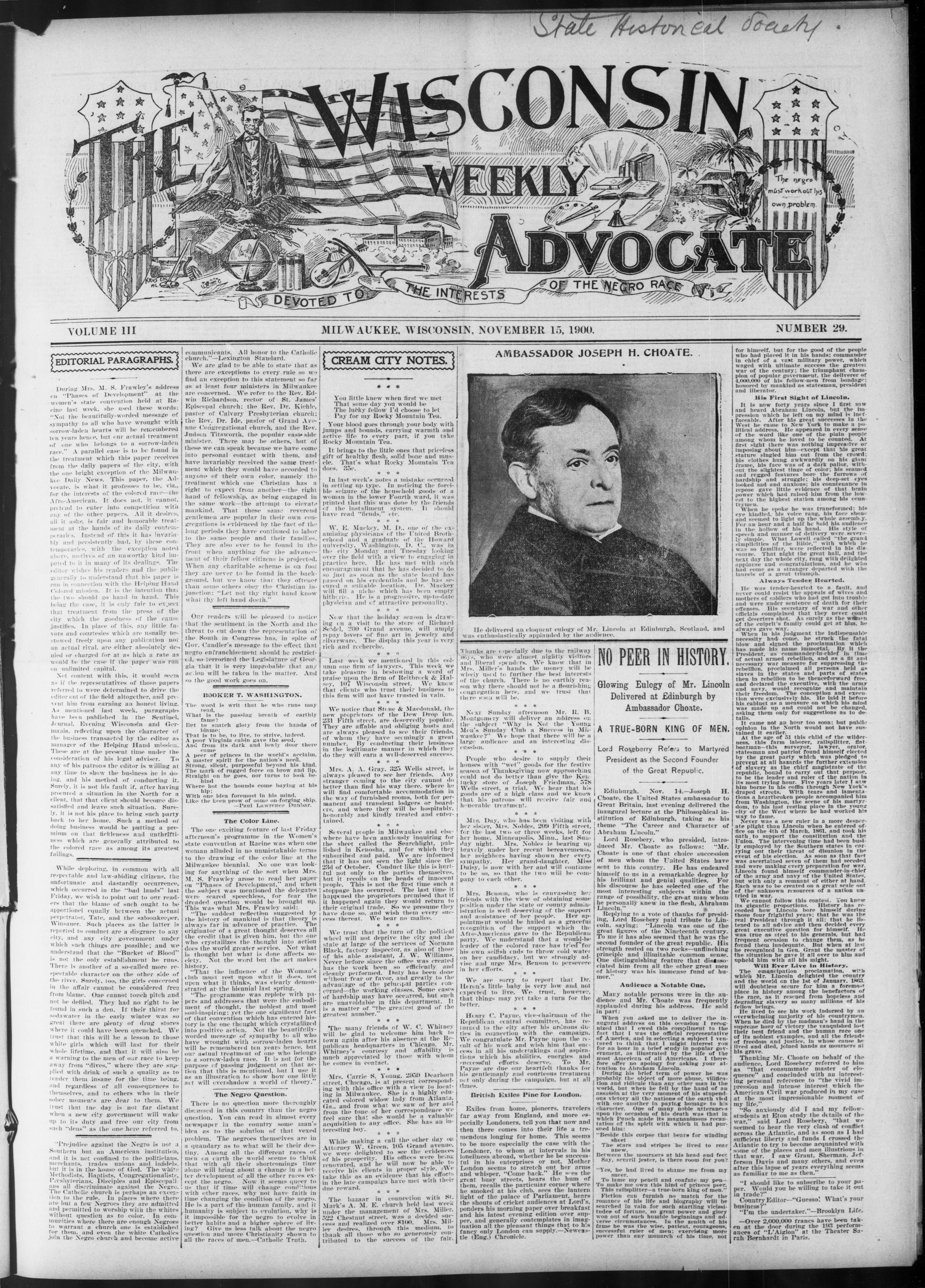
WISCONSIN
WEEKLY
ADVOCATE
DEVOTED TO THE INTERESTS OF THE NEGRO RACE
EDITORIAL PARAGRAPHS.
---
During Mrs. M. S. Frawley's address on "Phases of Development" at the women's state convention held at Racine last week, she used these words: "Not the beautifully-worded message of sympathy to all who have wrought with sorrow-laden hearts will be remembered ten years hence, but our actual treatment of one who belongs to a sorrow-laden race." A parallel case is to be found in the treatment which this paper receives from the daily papers of the city, with the one bright exception of the Milwaukee Daily News. This paper, the Advocate, is what it professes to be, viz., for the interests of the colored race—the Afro-American. It does not, it cannot, pretend to enter into competition with any of the other papers. All it desires, all it asks, is fair and honorable treatment at the hands of its daily contemporaries. Instead of this it has invariably and persistently had, by these contemporaries, with the exception noted above, motives of an unworthy kind imputed to it in many of its dealings. The editor wishes his readers and the public generally to understand that his paper is run in connection with the Helping Hand Colored mission. It is the intention that the two should go hand in hand. This being the case, it is only fair to expect that treatment from the press of the city which the goodness of the cause justifies. In place of this, any little favors and courtesies which are usually bestowed freely upon any publication not an actual rival, are either absolutely denied or charged for at as high a rate as would be the case if the paper was run on unlimited capital.
Not content with this, it would seem as if the representatives of those papers referred to were determined to drive the editor out of the field altogether, and prevent him from earning an honest living. As mentioned last week, paragraphs have been published in the Sentinel Journal. Evening Wisconsin and Germania, reflecting upon the character of the business transacted by the editor as manager of the Helping Hand mission. These are at the present time under the consideration of his legal adviser. To any of his patrons the editor is willing at any time to show the business he is doing, and his method of conducting it. Surely, it is not his fault if, after having procured a situation in the North for a client, that that client should become dissatisfied and leave such situation. Surely, it is not his place to bring such party back to her home. Such a method of doing business would be putting a premium on that fickleness and unthriftiness which are generally attributed to the colored race as among its greatest failings.
While deploring, in common with all respectable and law-abiding citizens, the unfortunate and dastardly occurrence, which occurred in the "bad lands" last Friday, we wish to point out to our readers that the blame of such ought to be apportioned equally between the actual perpetrator, Tate, and the saloonkeeper, Winsauer. Such places as the latter is reported to conduct are a disgrace to any city, and any city government under which such things are possible; and we understand that the "Bucket of Blood" is not the only establishment he runs. There is another of a so-called more respectable character on the other side of the river. Surely, too, the girls concerned in the affair cannot be considered free from blame. One cannot touch pitch and not be defiled. They had no right to be found in such a den. If their thirst for sodawater in the early winter was so great there are plenty of drug stores where it could have been quenched. We trust that this will be a lesson to those white girls which will last for their whole lifetime, and that it will also be a warning to the men of oar race to keep away from "dives," where they are supplied with drink of such a quality as to tender them insane for the time being, and regardless of all consequences to themselves, and to others who in their sober moments are dear to them. We trust that the day is not far distant when a new city government will wake up to its duty and free our city from such "dens" as the one here referred to.
"Prejudice against the Negro is not a Southern but an American institution, and it is not confined to the politicians, merchants, trades unions and infidels, but it is in the house of God. The white Methodists, Baptists, Congregationalists, Presbyterians, Disciples and Episcopalians all discriminate against the Negro. The Catholic church is perhaps an exception to the rule. In places where there are but a few Negroes they are admitted and permitted to worship with the whites without question as to color. In communities where there are enough Negroes to warrant a church one is established for them, and even the white Catholies join the Negro church and become active
communicants. All honor to the Catholic church."-Lexington Standard.
We are glad to be able to state that as there are exceptions to every rule so we find an exception to this statement so far as at least four ministers in Milwaukee are concerned. We refer to the Rev. Edwin Richardson, rector of St. James' Episcopal church; the Rev. Dr. Kiehle, pastor of Calvary Presbyterian church; the Rev. Dr. Ide, pastor of Grand Avenue Congregational church, and the Rev. Judson Titsworth, the popular east side minister. There may be others, but of these we can speak because we have come into personal contact with them, and have invariably received the same treatment which they would have accorded to anyone of their own color, namely the treatment which one Christian has a right to expect from another—the right hand of fellowship, as being engaged in the same work—the attempt to elevate mankind. That these same reverend gentlemen are popular in their own congregations is evidenced by the fact of the long periods they have continued to labor to the same people and their families. They are also ever to be found in the front when anything for the advancement of their fellow citizens is projected. When any charitable scheme is on foot they are never to be found in the background, but we know that they oftener than some others obey the Christian injunction: "Let not thy right hand know what thy left hand doeth."
Our readers will be pleased to notice that the sentiment in the North and the threat to cut down the representation of the South in Congress has, in spite of Gov. Candler's message to the effect that negro enfranchisement should be restricted, so terrorized the Legislature of Georgia that it is very improbable that any action will be taken in the matter. And so the good work goes on.
BOOKER T. WASHINGTON.
The word is writ that he who runs may read.
tell,
What the passing breath of earthly
fame?
But to snatch glory from the hands of
blame:
A peer of princes in the world's acclaim. A master spirit for the nation's need. Strong, silent, purposeful beyond his kind. The mark of rugged force on brow and lip. Straight on he goes, nor turns to look behind
Where hot the hounds come baying at his hip;
With one idea foremost in his mind.
Like the keen prow of some on-forging ship.
—Paul Lawrence Dunbar.
The Color Line.
The one exciting feature of last Friday afternoon's programme in the Women's state convention at Racine was when one woman alluded in no unmistakable terms to the drawing of the color line at the Milwaukee biennial. No one was looking for anything of the sort when Mrs. M. S. Frawley arose to read her paper on "Phases of Development," and when the subject was mentioned the delegates were scared speechless, for fear the dreaded question would be brought up. This was what Mrs. Frawley said:
"The saddest reflection suggested by the history of mankind is that theory is always far in advance of practice. The originator of a great thought deserves all the credit that is given him, but the one who crystallizes the thought into action does the world greater service. Not what is thought but what is done affects society. Not the word but the act makes history.
"That the influence of the Woman's club must rest upon what it does, not upon what it thinks, was clearly demonstrated at the biennial last spring.
"The programme was replete with papers and addresses that were the embodiment of thought, the noblest and most soul-inspiring; yet the one significant fact of that convention which has entered history is the one thought which crystallized into positive action. Not the beautifully-worded message of sympathy to all who have wrought with sorrow-laden hearts will be remembered ten years hence, but our actual treatment of one who belongs to a sorrow-laden race. It is not for the purpose of passing judgment on that action that this is mentioned, but I use it as an illustration to show how one little act will evershadow a world of theory."
The Negro Question.
There is no question more thoroughly discussed in this country than the negro question. You can read in almost every newspaper in the country some man's idea as to the solution of that vexed problem. The negroes themselves are in a quandary as to what will be their destiny. Among all the different races of men on earth the world seems to think that with all their shortcomings time alone will bring about a change in a better development of all the other races except the negro. Now it seems queer to us that if time will change conditions with other races, why not have faith in time changing the condition of the negro. He is a part of the human family, and it humanity is subject to evolution, why is it impossible for the negro to evolve in better habits and a higher sphere of living? Give us less talk about the negro question and more Christianity shown to all the races of men.—Catholic Truth.
CREAM CITY NOTES.
★ ★ ★
You little knew when first we met That some day you would be
Your blood goes through your body with jumps and bounds, carrying warmth and active life to every part, if you take Rocky Mountain Tea. It brings to the little ones that priceless gift of healthy flesh, solid bone and muscle. That's what Rocky Mountain Tea does. 35c.
***
In last week's notes a mistake occurred in setting up type. In noticing the forcible seizure of the household goods of a woman in the lower Fourth ward, it was printed that this was done by the friends of the installment system. It should have read "fiends," etc.
```markdown
```
W. E. Mackey, M. D., one of the examining physicians of the United Brotherhood and a graduate of the Howard university, Washington, D. C., was in the city Monday and Tuesday looking over the field with a view to engaging in practice here. He has met with such encouragement that he has decided to do so just as soon as the state board has passed on his credentials and he has secured a suitable location. Dr. Mackey will fill a niche which has been empty hitherto. He is a progressive, up-to-date physician and of attractive personality.
* * *
Now that the holiday season is drawing on a visit to the store of Richard Seidel, 200 Grand avenue, will amply repay lovers of fine art in jewelry and silverware. The display this year is very rich and rechere.
```markdown
```
Last week we mentioned in this column one firm of lawyers. This week we take pleasure in bestowing a word of praise upon the firm of Reitbrock & Halsey, 107 Wisconsin street. We know that clients who trust their business to this firm will not have trusted in vain.
* * *
We notice that Stone & Macdonald, the new proprietors of the Dew Drop inn, 231 Fifth street, are deservedly popular. They are affable and obliging hosts and are always pleased to see their friends, of whom they have seemingly a great number. By conducting their business in the legitimate manner in which they do they will earn a well-deserved success.
* * *
Mrs. A. A. Gray, 325 Wells street, is always pleased to see her friends. Any stranger coming to the city cannot do better than find his way there, where he will find comfortable accommodation in the way of furnished rooms, both for permanent and transient lodgers or boarders, and where they will be hospitably, honorably and kindly treated and entertained.
* * *
Several people in Milwaukee and elsewhere have been anxiously inquiring for the sheet called the Searchlight, published in Kenosha, and for which they subscribed and paid. We are informed that it has not seen the light since the 23d of October. Conduct like this is hurtful not only to the parties themselves, but it recoils on the heads of innocent people. This is not the first time such a stoppage has occurred. The last time it happened the proprietors promised that it happened again they would return to their original trade. So we presume they have done so, and wish them every success thereat. We bear no malice.
```markdown
```
We trust that the turn of the political wheel will not deprive the city and the state at large of the services of Norman Black, factory inspector, as also of those of his able assistant, J. W. Williams. Never before since the office was created has the work been so efficiently and cleanly performed. Duty has been done without fear or favor, and greatly to the advantage of the principal parties concerned—the working classes. Some cases of hardship may have occurred, but such are unavoidable in this department. It is a matter of "the greatest good of the greatest number."
☆ ☆ ☆
The many friends of W. C. Whitney will be glad to welcome him back to town again after his absence at the Republican headquarters in Chicago. Mr. Whitney's courtesy and affability is much appreciated by those with whom he comes in contact.
* * *
Mrs. Carrie S. Young, 2959 Dearborn street, Chicago, is at present corresponding with this office with a view to locating in Milwaukee. She is a highly educated colored widow lady from Atlanta, Ga., and from what we saw of her and from the tone of her correspondence we feel sure that she would be a valuable acquisition to any office. She has an interesting boy.
While making a call the other day on Attorney W. Green, 105 Grand avenue, we were delighted to see the evidences of his prosperity. His offices were being renovated, and he will now be able to receive his clients in proper style. We take this as an evidence that his efforts in the late campaign have met with their due reward.
☆ ☆ ☆
The bazaar in connection with St. Mark's A. M. E. church held last week under the management of Mrs. Miller. 522 Chestnut street, was a decided success and realized over $100. Mrs. Miller desires, through this medium, to thank all those who so generously contributed to the success of the fair.
AMBASSADOR JOSEPH H. CHOATE.
JOHN H. HARRIS
He delivered an eloquent eulogy of Mr. Lincoln at Edinburgh, Scotland, and was enthusiastically applauded by the audience.
Thanks are especially due to the railway boys, who were almost nightly visitors and liberal spenders. We know that in Mrs. Miller's hands the money will be wisely used to further the best interests of the church. There is no earthly reason why there should not be a flourishing congregation here, and we trust that there soon will be.
NO PEER IN HISTORY
Glowing Eulogy of Mr. Lincoln
Delivered at Edinburgh by
热 凉 寒
Next Sunday afternoon Mr. R. B. Montgomery will deliver an address on the subject "Why is Not the Young Men's Sunday Club a Success in Milwaukee?" We hope that there will be a large audience and an interesting discussion.
* * *
People who desire to supply their houses with "wet" goods for the festive season of Thanksgiving now approaching could not do better than give the Kentucky store of Joseph Friedman, 578 Wells street, a trial. We hear that his goods are of a high class and we know that his patrons will receive fair and honorable treatment.
```markdown
```
Mrs. Day, who has been visiting with her sister, Mrs. Nobles, 209 Fifth street, for the last two or three weeks, left for her home, Minneapolis, Minn., last Sunday night. Mrs. Nobles is bearing up bravely under her recent bereavements, her neighbors having shown her every sympathy. Her grand-daughter, Miss Daisy, is now with her and will continue to be so, so that the two will be company to each other.
* * *
Mrs. Benson, who is canvassing her friends with the view of obtaining some position under the state or county administration is well deserving of the support and assistance of her people. Her appointment would be hailed as a graceful recognition of the support which the Afro-Americans gave to the Republican party. We understand that a would-be leader of the colored race has tried for his own selfish ends to throw cold water on her candidacy, but we strongly advise and urge Mrs. Benson to persevere in her efforts.
谅 谅 赤
We are sorry to report that Dr Heron's little baby is very low and not expected to live. We trust, however, that things may yet take a turn for the better.
☆ ☆ ☆
Henry C. Payne, vice-chairman of the Republican central committee, has returned to the city after his arduous duties in connection with the campaign. We congratulate Mr. Payne upon the result of his work and wish him that success in all his undertakings and aspirations which his abilities, energies and successful efforts deserve. To Mr. Payne are due our heartfelt thanks for his gentlemanly and courteous treatment not only during the campaign, but at all times.
British Exiles Pine for London.
Exiles from home, pioneers, travelers far away from England, and more especially Londoners, tell you that now and then there comes into their life a tremendous longing for home. This seems to be more especially the case with the Londoner, to whom at intervals in his loneliness abroad, whether he be successful in his enterprises or not. Mother London seems to stretch out her arms and whisper, "Come back." He sees the great busy streets, hears the hum of them, recalls the particular corner where he smoked at his club, sees the lantern light of the palace of Parliament, hears the shouts of cricket audiences at Lord's, ponders his morning paper over breakfast and his latest evening edition over supper, and generally contemplates in imagination all the pleasant things that to his fancy only London can supply.—Newcastle (Eng.) Chronicle.
NO PEER IN HISTORY.
Glowing Eulogy of Mr. Lincoln
Delivered at Edinburgh by
Ambassador Choate.
A TRUE-BORN KING OF MEN.
Lord Roseberry Refers to Martyred
President as the Second Founder
of the Great Republic,
Edinburgh, Nov. 14.—Joseph H. Choate, the United States ambassador to Great Britain, last evening delivered the inaugural lecture at the Philosophical institution of Edinburgh, taking as his theme "The Career and Character of Abraham Lincoln."
Lord Rosebery, who presided, introduced Mr. Choate as follows: "Mr. Choate is one of that choice succession of men whom the United States have sent to this country. He has endeared himself to us in a remarkable degree by his brilliant and genial qualities. For his discourse he has selected one of the most interesting subjects within the range of possibility, the great man whom he personally knew in the flesh, Abraham Lincoln."
Replying to a vote of thanks for presiding, Lord Rosebery paid tribute to Lincoln, saying: "Lincoln was one of the great figures of the Nineteenth century. To me it has also seemed that he was the second founder of the great republic. His strength rested on two rocks—unflinching principle and illimitable common sense. One distinguishing feature that associated him from all the other great men of history was his immense fund of humor."
Audience a Notable One.
Mary notable persons were in the audience and Mr. Choate was frequently applauded during his address. He said in part:
When you asked me to deliver the inaugural address on this occasion I recognized that I owed this compliment to the fact that I was the official representative of America, and in selecting a subject I ventured to think that I might Interest you for an hour in a brief study in popular government, as illustrated by the life of the most American of all Americans. I therefore offer no apology for asking your attention to Abraham Lincoln.
During his brief term of power he was probably the object of more abuse, vilification and ridicule than any other man in the world, but when he fell by the hand of an assassin at the very moment of his stupendous victory all the nations of the earth vled with one another in paying homage to his character. One of many noble utterances upon the occasion of his death was that in which Punch made its magnanimous recantation of the spirit with which it had pursued him:
"Beside this corpse that bears for winding sheet
The stars and stripes he lived to rear anew.
anew.
Between the mourners at his head and feet
Say, scurril jester, is there room for you?
"Yes, he had lived to shame me from my
sneer.
To lame my pencil and confute my pen—
To make me own this hind of princes peer.
This railsplitter—a true-born king of men."
Fiction can furnish no match for the
romance of his life and biography will be
searched in vain for such startling vicissitudes of fortune, so great power and glory
won out of such humble beginnings and adverse circumstances. In the zenith of his
fame he was the wise, patient, courageous,
successful ruler of men; exercising more
power than any monarch of his time, not
---
NUMBER 29.
for himself, but for the good of the people who had placed it in his hands; commander in chief of a vast military power, which waged with ultimate success the greatest war of the century; the triumphant champion of popular government, the deliverer of 4,000,000 of his fellow-men from bondage; honored by mankind as statesman, president and liberator.
His First Sight of Lincoln.
It is now forty years since I first saw and heard Abraham Lincoln, but the impression which he left on my mind is inertfaceable. After his great successes in the West he came to New York to make a political address. He appeared in every sense of the word like one of the plain people among whom he loved to be counted. At first sight there was nothing impressive or imposing about him—except that his great stature singled him out from the crowd; his clothes hung awkwardly on his gland frame, his face was of a dark pallor, without the slightest tinge of color; his seamed and rugged features bore the furrows of hardship and struggle; his deep-set eyes looked sad and anxious; his countenance in repose gave little evidence of that brain power which had raised him from the lowest to the highest station among his countrymen.
When he spoke he was transformed; his eye kindled, his voice rang, his face shone and seemed to light up the whole assembly. For an hour and a half he held his audience in the hollow of his hand. His style of speech and manner of delivery were severely simple. What Lowell called "the grand simplicities of the Bible," with which he was so familiar, were reflected in his discourse. That night the great hall, and the next day the whole city, rang with delighted applause and congratulations, and he who had come as a stranger departed with the laurels of a great triumph.
Always Tender Hearted.
He was tender-hearted to a fault, and never could resist the appeals of wives and mothers of soldiers who had got into trouble and were under sentence of death for their offenses. His secretary of war and other officials complained that they never could get deserters shot. As surely as the women of the culprit's family could get at him, he always gave way.
When in his judgment the indispensable necessity had come, he struck the fatal blow and signed the proclamation which has made his name immortal. By it the President, as commander-in-chief in time of actual armed rebellion, and as a fit and necessary war measure for suppressing the rebellion, proclaimed all persons held as slaves in the states and parts of states then in rebellion to be thenceforward free, and declared the executive, with the army and navy, would recognize and maintain their freedom. The conception and execution were exclusively his. He laid it before his cabinet as a measure on which his mind was made up and could not be changed, asking them only for suggestions as to details.
It came not an hour too soon; but public opinion in the North would not have sustained it earlier.
At the age of 51 this child of the wilderness, this farm laborer, rallisplitter, flatboatman—this surveyor, lawyer, orator, statesman and patron found himself elected by the great party which was pledged to prevent at all hazards the further extension of slavery as the chief magistrate of the republic, bound to carry out that purpose, to be the leader and ruler of the nation in its most trying hour. Five years later I saw him borne in his coffin through New York's draped streets. With tears and lamentations a heartbroken people accompanied him from Washington, the scene of his martyrdom, to his last resting place in the young city of the West where he had worked his way to fame.
Never was a new ruler in a more desperate plight than Lincoln when he entered office on the 4th of March, 1861, and took his oath, to support the constitution and the Union. The intervening time had been busily employed by the Southern states in carrying out their threat of disunion in the event of his election. As soon as that fact was ascertained seven of them had seceded and were making every preparation for war. Lincoln found himself commander-in-chief of the army and navy of the United States, but with only a remnant of either at hand. Each was to be created on a great scale out of the unknown resources of a nation untried in war.
We cannot follow this contesi. You know its gigantic proportions. History has recorded how Lincoln bore himself during those four frightful years; that he was the real President through it all; that he listened to all advice and then decided every great executive question for himself. He was true as steel to his generals, but had frequent occasion to change them, as he found them inadequate. But when at last he recognized in Gen. Grant the master of the situation he gave it all over to him and upheld him with all his might.
Will Ever Live in History.
The emancipation proclamation, with which Mr. Lincoln delighted the country and the world on the 1st of January, 1863, will doubtless secure for him a foremost place in history among the benefactors of the race, as it rescued from hopeless and degrading slavery so many millions of his fellow beings.
He lived to see his work indorsed by an overwhelming majority of his countrymen. When he died by the madman's hand in the supreme hour of victory the vanquished lost their best friend and the human race one of its noblest examples, and all the friends of freedom and justice, in whose cause he lived and died, joined hands as mourners at his grave.
Thanking Mr. Choate on behalf of the audience, Lord Rosebery referred to him as "that consummate master of eloquence" and concluded with an interesting personal reference to "the vivid impression and intense interest which the American Civil war produced in my case at the most impressionable moment of my life."
"So anxiously did I and my fellow-students at Eton study the details of the war," said Lord Rosebery, "that we seemed to hear the very clash of conflict across the Atlantic, and as soon as I had sufficient liberty and funds I crossed the Atlantic to try to become acquainted with some of the places and men illustrious in that war. I saw Grant, Sherman, Jefferson Davis and many others, and even after this lapse of years everything seems as familiar to me as then."
"I should like to subscribe to your paper. Would you be willing to take it out in trade?"
Country Editor—"Guesso! What's your business?"
business:
"I'm the undertaker."—Brooklyn Life.
Over 2,000,000 francs have been taken at the door during the 193 performances of "L'Aiglon" at the Theater Sarah Bernhardt in Paris.
ASK TOO MUCH OF CHINA.
Conditions Imposed Said to be Impossible of Fulfillment.
PRINCES' PUNISHMENT.
The Foreign Ministers Are Making Good Progress in Arranging a Basis for Negotiations.
London, Nov. 14.—A dispatch to the Times from Dr. Morrison in Pekin, dated November 11, says:
"As far as it is possible to judge, China will willingly accede to all the terms of the conjoint note now ready to be presented subject to the approval of the home governments, except the demand for the death penalty against princes and officials, which it is impossible to fulfil while the court is in the hands of these accused officials."
"Regarding the Americans' alleged opposition to the execution of Chinese officials," says the Times' editorial leader, "none of the powers desire to inflict upon any one of them more than their just desserts. The American people, we are confident, cannot desire that they should receive less. If this be the case it is difficult to see how America could justify in other eyes the refusal upon her part to join the other powers in steps which may be needed to secure this result, a result as indispensable to the protection of her citizens and her interests in China as to the protection of those of the rest of the commercial powers."
A dispatch to the Times from Shanghai, November 12, says: "It is strongly held here that the terms of peace should include the removal of the Chinese soldiery from the neighborhood of Shanghai.
"The native press states that Li Kunyu urges Chang Chih Tung to co-operate in repelling any expedition against Singan Fu. via Hankau.
"Public opinion is much gratified by the apparently firm stand taken regarding the northern railways, which it is hoped indicates a more dignified policy and the asserting of British interests."
Making Good Progress.
Pekin, Nov. 12 (via Shanghai, Nov. 14).—A protracted conference of the foreign ministers was held today, at the conclusion of which there was a general expression of gratification at the progress made toward reaching a settlement. It was stated that most of the minor points had been disposed of and that an agreement had been reached upon several essential questions. The meeting disclosed fewer differences over important points than was expected, which is largely due to the fact that the ministers have received definite instructions from their home governments.
United States Minister Conger said he was encouraged to believe that propositions would be ready to be submitted to the Chinese plenipotentiaries at an earlier date than he had heretofore hoped.
Reliable information from Niu Chwang indicates a disturbed condition of affairs there. Robbers and pirates are harrowing the region and paralyzing commerce. The Russians are making an effort to suppress the troubles except along the railway. The weather is becoming colder, with nightly frosts, but the supply of fuel is good and the troops are not suffering.
English Press Agitated.
London, Nov. 14.—The London morning papers are again agitated concerning the stability of the concert of the powers in China. The attitude of Germany and the United States meet with disapproval, the former because Count von Waldersee has sent a column to destroy the Ming tombs, an act which is regarded as needlessly vindictive, and the latter because it threatens to break up the concert.
The Daily Chronicle comments strongly upon the American attitude as a "feeble compromise which it is impossible to accept."
The Morning Post says: "It would be unreasonable for the United States to break up the concert because they do not desire indemnity. The powers would probably be willing to consider America's objections. If, however, the United States have in view some new combination of powers, it would be necessary for Great Britain and Germany to agree upon a common policy to be pursued in the absence of a general agreement."
CHINA IN A DILEMMA.
Impossible to Inflict the Death Penalty on Princes and Generals.
Pekin, Nov. 12.—A high Chinese official said today that if the powers insist on the condemnation and punishment of all those named in the original act, eleven princes and generals, it will be impossible for China to agree to this, even if she were willing to do so. China will no doubt agree that the foreigners shall hold the Taku forts and military posts. She will also not object to the maintenance of legation guards, the payment of indemnities, and the prohibition of further importation of arms, but it will be impossible to carry out the death punishment, except in a few cases, even though China may agree to do so.
It is thought here that China will follow the same tactics which she pursued during the negotiations with Japan at the close of the war with that country. After the receipt of the Japanese proposals at that time China presented counter propositions which Japan declined to entertain and gave the Chinese a few days to agree to the original suggestions. China's position in this respect, however, is better at the present time, because of the diversity of interests represented, at least one of which is playing as her friend. There is every indication at present that Russia is inclined to make things as easy as possible for China in the settlement of the trouble.
AN ORIGINAL DISCOVERY.
Chinese Troubles Threaten to Ruin the Russian Empire.
St. Petersburg, Nov. 14.—The Rossiya has made the original discovery that the Chinese troubles "threaten to ruin the Russian empire." If the powers, it is added, continue their present policy, China will be unable to pay a money indemnity and consequently the powers will demand and secure mining, railroad and commercial concessions which will result in the division of China into spheres of influence and ultimately into the partition of China, in spite of the assurance of the powers to the contrary. The Chinese, it is further asserted, indignant, will emigrate to Siberia and the "yellow horde" will "again precipitate itself towards European Russia, which will sink to the position of a second-rank power. The other powers probably will be satisfied with this eventuality, their interests being solely commercial."
The Novoe Vremya finds this situation worse and says the powers must act independently. Henceforth, it asserts, each power must bear the responsibility of its own army. The paper adds: "While the ministers were in danger there was some excuse for a commander-in-chief; but after Russia freed Tien Tsin and planted the first flag on the walls of Pekin, she wisely withdrew a majority of her troops from Count von Waldersee's command. The other powers should closely define Von Waldersee's functions." Continuing the Japanese-Russian dis
cussion, the Novoe Vremya says: "The English journals in the Japanese ports are convinced the Japanese can easily vanquish the Russians. However, the English backdown in the case of Port Arthur has opened Japanese eyes. The present campaign gave the armies of the two powers an opportunity to learn and esteem each other." Several of the papers take their cue from the Novoe Vremya and follow up its arguments in the same strain. The Boerse Gazette observes that "all the nations are seeking a Japanese alliance, but Russia alone is valuable." The paper adds: "Russia and Japan will dictate the future of East Asia."
PROOF OF CHINESE GUILT.
Ante-Mortem Dispatches of the German Minister to Pekin.
Berlin, Nov. 14.—The foreign office publishes reports from the German legation at Pekin, dated from May 31 to August 24. The late Baron von Ketteler's dispatches described exhaustively the progress of the Boxer movement, demonstrating the guilt of the Chinese government.
Secretary of Legation Von Buelow, dealing with the disturbances at Pekin from June 12 to June 30, says that with the appointment of Prince Tuan to the presidency of the tsung li yamen notification of which was given June 10 to the foreign ministers, the Chinese government "let fall the mask." He adds that it was equivalent to a declaration of war.
A dragoman of the German legation in these reports narrates the murder of Baron von Ketteler. He says it was a carefully-planned act of vengeance upon the part of certain high representatives of the Chinese government, whom von Ketteler had repeatedly accused, even to their faces, of double-dealing.
Vienna, Nov. 14.—The commander of the Austrian squadron at Takau cables that an Austrian detachment of troops left Pekin November 12 with an expedition to the Northwest, which was expected to be gone three weeks.
A company of Austrian bluejackets, it is added, with sixteen German cavalrymen, recently engaged a force of Boxers six miles west of Pekin and defeated them. Three of the Boxer leaders were shot.
TORPEDO-BOAT RUNS AGROUND.
The Stockton was About to Have Her Trial Trip and Had the Inspectors Aboard.
Washington, D. C., Nov. 14. The navy department has received a dispatch from Annapolis saying that the torpedo boat Stockton has gone ashore on Horn Point shoals. She struck at 9 o'clock Tuesday night. There is small chance of getting her off until the wind changes. The Stockton is one of the new torpedo boats and was about to have her trial trip, the board of inspection being on her.
DISCOVERED AMERICA.
Chinese Missionaries Ahte-Dated Columbus by a Thousand Years.
Chicago, Ill., Nov. 14.—A Washington special to the Times-Herald says: "The archives of Pekin have given up a secret that may lead to the solution of a mystery that has balked every student of American archaeology since the Western hemisphere was first visited by Columbus. "There have been found in the ancient Eastern capital records that prove conclusively that a landing was made on this continent by the Mongolians in the year 499 A.D.—centuries before the Genese admiral was born and before the acceptance of the theory that the earth is a globe led the wise men of Europe to seek a new world in the West.
"Not long ago it was announced in a dispatch from Pekin that some of the officers of the army of the allies had dug up in the sacred city records of great historic value that had been hidden away for ages by the celestials. The direct interest these discoveries have for America is brought through communications just received at the state department. These come from Ma Twah Lin, a Chinese, and tell in such a way that the information cannot be doubted of the discovery of America by Chinese missionaries more than 1500 years ago.
"The story is that five adventurous missionaries sailed from the eastern coast of China, crossing the Pacific and skirting the Fox islands, and finally sighting the western coast of a new continent. They then turned southward and proceeded along within sight of the shore until a landing was made in Mexico opposite the peninsula of Yucatan. Here a number of temples were erected in the name of their own God.
"The supposition is that the Chinese who landed on our continent at that time instilled the natives with their wisdom in craft and the ruder arts to such an extent that there resulted a people of peculiarly-high development.
"Be that as it may, the records found in Pekin will not be contradicted and must remain as prima facie evidence of the courage and thrift of the Chinaman."
KRUGER AT SUEZ.
Late President of the Boers Remains Secluded In His Cabin Health is Good.
Suez. Nov. 14.—The Dutch cruiser Gelderland, with ex-President Kruger on board, has arrived here. Mr. Kruger remains secluded in his cabin. His health is good. A delegate of the Marseilles reception committee boarded the Gelderland here, but the eventual destination of the warship will be unknown until she arrives at Port Said, where she will coal. Mr. Kruger received an ovation at the
HANDSOMELY REWARDED.
Two Omaha Men Receive $20,000 for Befriending an Old Comrade.
Omaha, Neb., Nov. 14.—An example of rare human gratitude developed when Maj. T. S. Clarkson and Harry M. Turner received each $10,000 from an old army comrade whom they befriended a couple of years ago. Robert Majors of Huntsville, Ala., was the donor.
Clarkson, Majors and Turner were together in Sherman's march to the sea. Robert Majors drifted west and, broken in health and finances, entered the government service in the capacity of assistant custodian of the Federal building at Omaha ten years ago. Two years ago a small package of money was missed and Majors was accused of having taken it. Maj. Clarkson and Turner used their influence and Majors was saved the disgrace of a felon's cell, though he lost his position. Then he went to live with relations at Huntsville, Ala.
A month ago a brother died and left the veteran a fortune. He hastened to Omaha to remember his army comrades. The three had a jolly reunion in Omaha yesterday.
Soldiers Go to Asylum.
San Francisco, Cal., Nov. 14- Thirteen insane soldiers from the Philippines, who had been confined in the Presidio hospital, have been sent to the government asylum at Washington, D. C.
RECOVER LOST JEWEL.
Arrest in New York of Mexicrns with the Maximilian Diamond.
New York, Nov. 13.—The biggest diamond ever seized in the United States for non-payment of duty was locked up last night in the safe in the office of Collector of Port Bidwell. Two Mexicans, charged with smuggling, were in cells in Ludlow street jail. Special Treasury Agent Theobald, who made the arrests, regards it as the most important diamond seizure ever made, for besides the value of the gems themselves there is a romance in every one of them. The prisoners are Valino J. Preza and Alexandino A. Marcucci.
from Maximilian's Crown.
The great diamond was once the blazing center in the crown of Maximilian I., Mexico's first and only Emperor, whose execution set the world agog. When he was in the zenith of his power he had the splendid stone taken from his crown and made into a pendant for the Empress Carlotta. On her neck it nestled at many a court function, till she was driven into exile in 1867, after Napoleon III. had failed to make Mexico an empire and the Mexicans put their Austrian-bred Emperor to death. The royal diamond, roughly estimated at $40,000, has been missing until yesterday. In addition to it the arrested men had two magnificent diamond solitaire rings, six carats apiece, each worth $5000.
A private detective was the first to find, through a correspondent in the City of Mexico that the missing Maximilian stone was in this country. He gave the "tip" to Collector Bidwell, who detailed Theobald on the case. He learned that two Mexicans with the gems had crossed the border at Laredo, Tex., some three weeks ago. They spent a few days in St. Louis, and a fortnight ago arrived in New York.
Try to Sell to Jewelers.
Theobald sought out the big jewelry stores and got his first clue at Tiffany's where several days ago five swarthy n brought in a huge diamond, canary colored and of dazzling brightness. Eighteen superb white stones surrounded the center one and three more set off the pendant links. The whole was mounted in a simple gold necklace. Tiffany & Co. refused to buy it, though well aware of its value.
At noon yesterday Agent Theobald saw three men in a jewelry store in Sixteenth street trying to sell something. They failed and went away. Theobald hurried inside.
"They have a superb canary-colored diamond," said the jeweler, "weighing more than 33 karats. I offered them $20,000 for it and they wouldn't take it. It's worth $40,000."
Theobald hurried over to Broadway and spied the trio sauntering up the street. He called a policeman and with him walked up to the Mexicans at Seventeenth street.
"You are under arrest," said Theobald. At that Preza passed a big, brown wallet and a red leather jewel case over to a man, who proved to be Gen. Abelardo A. Moscoso, a member of the Haytian junta. Gen. Moscoso appeared nonplused at what was happening and refused to take them.
The Mexicans protested volubly at the "insult," but a carriage took them to the station. The wallet contained the diamond rings and some papers and the leather case the great canary diamond and a certificate telling its history.
Owned by Mexican Senorita.
"They're mine!" protested Preza.
"Here is the bill of sale."
He had a document purporting to convey the splendid gems to him for $20,000.
He said that a senorita in the City of Mexico really owned them and that he had come here to sell them.
"Well, even if you own them, how did these diamonds get into this country without paying 60 per cent. duty—$50,000?" asked Theobald.
Gen. Moscoso proved that he had simply been walking with the two men in the street and had not been with them when the gems were brought into this country.
He was allowed to go. Marcucci, it is said, confessed to the authorities. The men had a hearing and were held in bail, Preza in $5000 and Marcucci in $1500.
The certificate accompanying the jewels laid:
"The diamond necklace is from Maximilian's crown, the Emperor of Mexico, 1860. The center stone is thirty-three and seven-tenths carats and the eighteen surrounding it no less than one each. The diamond ring, the stone thereof, was in Maximilian's ring at the time he was shot."
RUINED HER BEAUTY
Connecticut Woman Claims a Physician Spoiled Her Complexion. Bristol, Conn., Nov. 13.—Miss Nellie M. Evans of this place has brought suit against Dr. W. W. Horton of New Haven for $10,000 damages. She charges that her complexion has changed from blonde to brunette because of excessive potions of calomel given her while she was under the care of Dr. Horton about two years ago. Her skin and hair have turned to a bronze shade. Miss Evans also alleges in her complaint that she has become a nervous wreck because of the drug.
Dr. Horton denies that he prescribed excessive doses of calomel. He says that Miss Evans, who is about 35 years old, was an expert typesetter in a printing office here. She became a victim of lead-poisoning, due to handling type, and her skin turned to a greenish shade, darker than the olive tint.
She never fully recovered, he says, and becoming despondent, she discontinued treatment. Nothing more was heard until suit was brought, after Dr. Horton had removed to New Haven.
TRACED BY A MARKED SHIRT.
Chicago Thieves Who Robbed a Momence Store Are Caught.
Kankakee, Ill., Nov. 13.—Three Chicago thieves robbed a Momence store of $400 worth of clothing Tuesday night. They changed their garments in the store, leaving a marked shirt which furnished the clue. All three were arrested at Englewood Saturday night and brought to Kankakee. The stolen property was not recovered.
The schooner J. M. Weatherwax, which arrived at Port Townsend from Honolulu recently, had an unusual experience a few days before reaching port. When 150 miles off Cape Flattery the schooner ran into an immense flock of birds, resembling the wild canary, thousands of which settled in the rigging and other parts of the vessel. The sailors furnished the feathered visitors with food and drink and hundreds, if not thousands, of the birds remained on board till the schooner reached port.
The plot of ground on which stands the historic monument erected at Tappan, N. Y., by the late Cyrus W. Field in memory of Andre, the Revolutionary spy, has been sold on account of the owner's non-payment of taxes. Since the death of Mr. Field the memorial has been neglected, and it has now passed into the hands of George Dickey of Nyack, who says that he will obliterate it.
The Argentine Republic exported only 205,105 bales of wool last year, as against 287,479 in 1898.
DANGER OF REPRISALS.
Harsh Demands on China will Meet with Opposition.
CAPTURE THE ARSENAL
Russians Kill 200 Chinese and Take Arms and Treasure-Monument in China for Von Ketteler.
London, Nov. 13.—A special dispatch from Tien Tsin, dated November 10, says a force of Russians has captured the arsenal northeast of Yang Tsun, with trifling loss, killing 200 Chinese and capturing a quantity of arms and treasure.
Washington, D. C., Nov. 13.—Considerable dissatisfaction is felt in official circles here over the attitude of the foreign ministers in Pekin in their arrangement of a programme of reprisals against the Chinese government. So far this government is the only one of the powers that has pointed out what it conceives to be the danger of demanding the execution of princes of the imperial family and other high dignitaries concerned in the Boxer outrages. The government is convinced that many of these men should be punished severely, but it believes that the ministers desire to carry out a policy that is so bloodthirsty that it will meet with strenuous opposition by the Chinese, and perhaps result in differences which may bring about more hostilities.
All the nations, with the exception of the United States, are believed to be in accord with the desire of the ministers to adopt a comprehensive programme of punishments, and for the sake of harmony this government may be obliged to acquiesce.
The advices received here from Pekin indicate that the indemnity which the powers will demand from China will be beyond the means of the Chinese treasury. The statement that the powers will ask for $600,000,000 is regarded in Washington with surprise. "They might as well ask for $6,000,000,000," said one official. "China is in debt almost up to the limit, and could not raise $600,000,000 even within a reasonable period of time. She is still making payments of the $400,000,000 indemnity to Japan on account of the war with that country. The idea here is that China should be made to pay as much as she is able, but not made a bankrupt nation by exorbitant demands."
Demands on China.
London, Nov. 13.—Dr. Morrison, the Pekin correspondent of the London Times, in a dispatch dated November 11, says:
"Pressed by a common desire to speedily terminate the present conditions, the foreign ministers have finally agreed upon the following terms, to be presented in a conjoint note, which, subject to the approval of the governments, is to be pressed upon China:
"As a basis to a preliminary treaty China shall erect a monument to Baron von Ketteler at the site of the murder and send an imperial prince to Germany to convey an apology from China.
"China shall inflict the death penalty on the eleven guilty high officials and princes whose names have already been sent to you."
"Where the outrages have occurred all provincial examinations shall be suspended for five years.
"In the future all officials who have not made due effort to prevent outrages upon foreigners from being committed within their jurisdiction shall be immediately removed from office and punished. This is a modification of Conger's proposal that indemnity be paid to states, corporations and individuals.
Form of Government Must Change.
"The Tsung Li Yamen, as at present constituted, is to be abolished, and the functions vested in a foreign minister, as in civilized countries, and rational intercourse must be permitted with the Emperor, as in civilized countries.
"The Taku forts and other forts on the coast of Chi Li are to be razed and the importation of arms and war material prohibited.
"Permanent legation guards are to be maintained and also guards are to be maintained along the communication between Pekin and the sea.
"Imperial proclamations must be posted for two years throughout the empire suppressing the Boxers.
"The indemnity includes compensation to Chinese who suffered through being employed by foreigners, but not compensation to native Christians, the words missionary and Christians not occurring in the note."
PEKIN AN OPEN PORT
Capital Punishment Without Trial to be Abolished.
Washington, D. C., Nov. 13.—In addition to the points said to be agreed upon at Pekin as a basis for settlement with China the city of Pekin is to be an "open port." While it is not on the seacoast, the purpose is to extend to it that freedom of commerce and intercourse with foreigners which now applies only to those open ports designated by treaties with China. The suggestion that this action be taken has been made in high Chinese quarters, and its advisability is urged because rekin, as the capital of the Chinese empire, is the center of influence throughout the country. Another point which may be proposed is that capital punishment, by beheading or otherwise, shall not occur in future by imperial edicts alone, but only after a trial such as is given in civilized countries, the accused having an opportunity to be heard. This does not apply to the executions made necessary by the Boxer movement.
PUNITIVE RAIDS CRITICISED.
China to be Required to Erect a Number of Expiatory Monuments.
Pekin, Nov. 11, Sunday, via Shanghai, Nov. 13.—Another small German expedition goes north tomorrow, in spite of the fact that these punitive raids are strongly criticised here, as serving no good purpose.
Reports of the death of the Dowager Empress are persistent, though there is no official confirmation of them, communication with the court being very irregular. There is a growing belief, however, that she will never return to Pekin.
Berlin, Nov. 13.—A semi-official dispatch from Pekin, dated November 12, gives the text of the joint note of the powers to China. Among the additional stipulations the note requires China to erect expiatory monuments in every foreign or international burial ground where graves have been profaned.
KILLS HIMSELF AT A DANCE.
Mexican Youth Dies Because Sweetheart Waltzed with Another.
El Paso, Tex., Nov. 13.—Jealousy prompted Ignacio Bustillos, a Mexican youth, to take his own life last night at a Mexican ball. His sweetheart was waltzing with another man. Bustillos shot himself in the presence of all of the assembled guests. For a time almost a panic reigned. The woman was seized with hysterics and had to be attended by a physician
A ROYAL WEDDING.
Prince George of Greece and Princess Victoria of Wales Said to be Betrothed.
London, Nov. 14.—A formal announcement of the engagement of Prince George of Greece and Princess Victoria of Wales is expected within a few days. Intimations that such an alliance was likely have been made several times in the last couple of years, and each time have either been denied outright or refused either confirmation or denial. Now, however, there seems little doubt that the royal romance is soon to have a happy ending. The fact that the couple are first cousins to the mind royal offers no drawbacks. For several weeks this summer the prince and princess have been guests at the castle of Fredensburg in Denmark, and when this visit ended and the Princess Victoria returned with her mother, the Princess of Wales, to Sandringham. Prince George followed.
The betrothal is said to have taken place, at Fredensburg, and to have been sanctioned by both parents of the princess after the arrival of the prince at Sandringham.
Today the Princess of Wales, Prince George, and possibly the Princess Victoria, go to Windsor to visit the Queen, supposedly for the purpose of obtaining her majesty's consent. That this will readily be forthcoming is regarded as certain.
Yesterday the Princess of Wales, Princess Victoria, the Duke of York and Prince George arrived in London from Sandringham. A large crowd was present at St. Pancras, and amid its salutations the royal travelers drove to Marlborough house, where they were joined by Prince and Princess Charles of Denmark, who had arrived on the previous evening. Prince George subsequently saw Lord Salisbury at the foreign office.
MAY YOHE RECOGNIZED.
Lady Francis Hope Finally Received by Newcastle Family at Chamberlain Castle
London, Nov. 14.—May Yohe, the American singer and actress, after six years of exclusion, has at last been received by the Newcastle family, with her husband, Lord Francis Hope. The two have just returned from Clumber, the Newcastle family seat, where they were included in a large shooting party. Since the marriage of Lord Francis and the actress the only member of the family who received Lady Francis was the Dowager Duchess, whose life has been devoted to works of charity and benevolence. Through her instrumentality the duke and duchess have now become friends with their possible successors to the title. Lord and Lady Francis will sail on Thursday next for New York on the Minneapolis, and will be followed a little later by the Duke of Newcastle.
The three will pass a good deal of the winter in America together and will make an extensive tour of California. Lady Francis is naturally much elated at this family reconciliation, as it makes things so much smoother for her socially, as well as pleasanter for her husband. Now that the Duke of Newcastle, a pillar of the high church party, has received her, society will quickly open its doors to her.
BROKE FROM A PRECIPICE.
Bowlder Crashes Into a Town at Night and Injures a Woman.
Ouray, Col., Nov. 14.—A bowlder weighing hundreds of tons broke from a precipice overhanging the town at midnight and came sweeping down, demolishing everything in its path. It fell first a sheer 300 feet and broke in three pieces, each of which continued on a course of destruction. Great trees were torn up and carried like chaff before a stiff breeze.
In the path of one was the cottage of James Goudley. Mrs. Goudley was alone and asleep in the cottage. The huge bowder plunged through the walls into her bedroom, cutting her bed completely in two. Mrs. Goudley was seriously bruised, but will recover. For weeks she had felt a presentiment that the slide was coming and lay awake for hours last night in fear of what soon happened. No one else was injured, but ten or a dozen buildings were destroyed. The storage building of the Anheuser-Busch Brewing company was wrecked and its contents are almost a total loss. Many of the smaller buildings were reduced to kindling wood.
WRECKED IN A SNOWSTORM.
Five Persons Hurt on the Lake Shore
Near Kalamazoo, Mich.
Kalamazoo, Mich., Nov. 14.—In a
blinding stormsnow and at the point of
a curve two miles south of this city
northbound passenger train No. 510 on
the Lake Shore & Michigan Southern
road ran into an extra southbound freight
which was about to take a siding at the
Kalamazoo Paper mills. The injured:
MRS. JAMES HARTER of Kalamazoo, a
passenger; injured about the breast and
face.
CHARLES ADAMS of Elkhart, a brakeman on the freight; thrown out of a car
door; severe cuts in leg muscles and collarbone broken.
M. J. CURTISS, baggageman on the passenger; severely cut about the neck and
face.
MRS. J. DUNN of Hillsdale; Injured about the face.
ROYDEN A. K. ROTHERMEL of Kala-mazoo, a passenger; cut about the face and arms.
The engine crews of both trains jumped in time to save themselves. The blame is laid on Engineer Wilson of the passenger for not ascertaining whether the freight was on the siding before he attempted to pass.
REPUTED HEIRS TO $30,000,000
Crowell Family of Massachusetts to Get Wealth Left in England. North Attleboro, Mass., Nov. 14.—The Crowell family and all their relatives in this place are in great glee over news from England to the effect that the whole lot are heirs to $30,000,000 left by a John Crowell 100 years ago. At his death Crowell left a will bequeathing his money to his relatives "when found." He had a brother who came to America when the two were quite young.
A few years ago Thomas Crowell was found in an infirmary in Halifax, N. S., totally blind and broken down physically. Prof. Frazier, a superintendent familiar with the will of John Crowell, discovered that Thomas was a relative in direct descent of John. The Crowell family got together, and E. H. Crowell of Somerville went to England as their representative. He reported that in all probability the find of $30,000,000 would be ready to distribute among the heirs in a few weeks.
TUNNEL TO MAN IN A WELL.
Imprisoned Thirty Feet Under Ground on Bed of Quicksand.
Sullivan, Ind., Nov. 14.—Thomas McPheters is entombed in a well nine miles southwest of here. The well is in quicksand and it caved in while McPheters was at work replacing the false wali. The man is thirty feet below the surface of the ground, and help is trying to reach aim with a tunnel. He still is living and food was passed to him yesterday.
Marcus Daly's Millions to be Held in Trust for the Four Children.
New York. Nov. 14.—Marcus Daly's great fortune, amassed in the mines of Montana., is to go to his widow, to be held by her in trust for the four children, Margaret, Mary C., Harriet and Marcus, Jr., the 17-year-old son. Just how much the dead millionaire left has not been figured, but it is estimated by those familiar with his affairs to be not less than $40,000,000. The estate has increased enormously during the past two years, and in addition Mr. Daly is known to have made large sums in speculation.
Mr. Daly had a bitter hatred for fortune-seekers through marriage and many a claimant for the hands of his daughters he has forbidden his home because of the suspicion he had against them. He has guarded against all of this class of men enjoying the fruits of his hard labors by placing his entire wealth in the hands of his widow.
The body of Mr. Daly rests in the grand reception room of his palatial home at 725 Fifth avenue, the home he dreamed of all his life and finally reared never to occupy except as a piece of clay. Friends came in large numbers to look upon the face of the dead.
The funeral arrangements have been completed. The body will be taken to St. Patrick's cathedral Thursday morning, where a requiem mass will be celebrated. Then the body will be taken to Calvary cemetery to be placed in a temporary receiving vault. It will finally rest in an imposing mausoleum.
JEFFRIES WILL FIGHT SHARKEY.
Battle Next May Before the Club that will Offer the Largest
New York, Nov. 14.—A match was made in this city today between James J. Jeffries, the champion pugilist, and Tom Sharkey. The terms in the agreement are that the winner shall take the entire purse. The battle will be decided next May before the club offering the largest purse. If the battle takes place in Nevada it will be to a finish. Bids for the fight will remain open until January 15. Marquis of Queensberry rules will govern the contest and five-ounce gloves will be used. Each principal deposited $2500 to insure his appearance in the ring. The articles also contained the provision that should Jeffries make a match with either Bob Fitzsimmons or Gus Ruhlin that battle will be decided before the present one. The same conditions prevail in regard to a match being made between Sharkey and Ruhlin.
WOMAN LEADS REBELS.
Beautiful Amazon, Thought to be of Royal Blood, at Head of Rioting in Spain.
London, Nov. 14.—Something more than a tinge of romance is given the Carlist uprising in Spain by the discovery that a beautiful Amazon led the rebellious hosts in Catalonia.
The Daily Mail's Madrid correspondent says: "She was elegantly dressed and a finished equestrienne, and her carriage revealed a beautiful and distinguished woman.
"Some suspect that she is Donna Blanca, the Duchess of Braganza, infanta of Portgual, and the wife of Don Alfonso, who is a brother of Don Carlos, and who took an active part in the last civil war in Spain, fighting in the foremost ranks of the Carlists.
"It is hardly likely, however, that Donna Blanca is taking a part in the present adventure, and probably the Amazon is one of the women of rank who abound in the Carlist party, and are among the most devoted adherents of the pretender."
REICHSTAG IN SESSION.
Strong Speech from Throne in Relation to Recent Events
Berlin, Nov. 14.—The Reichstag reassembled today. The speech from the throne dwelt at considerable length on the events in China which have excited such deep emotion among civilized people, saying: "Fanatical hate and dark superstition, incited by unscrupulous advisers of the court, have driven misguided masses of Chinese to acts of atrocity against the outposts of Western civilization and Christian worship dwelling peacefully in their midst.
"My minister died at the hand of an assassin, in a courageous attempt to overcome the rising peril. The foreigners at the capital saw themselves threatened, life and limb. These things of horror united the civilized community, where otherwise there was a divergence. All nations against which the unparalleled onslaught was directed drew closer. Their sons fought with one mind, shoulder to shoulder, even as yonder standards float side by side. So the governments show themselves in council, united with the sole wish to restore an orderly state of things as speedily as possible and, after the punishment of the chief culprits, avert a recurrence in the future of such a disturbance of the peace of the world."
In announcing that the relations of Germany with all the powers are good, the speech recalls his majesty's sorrow at the assassination of King Humbert of Italy, saying he was "my ally and dear friend, who fell a victim to a damnable outrage."
The speech then proceeds: "I would sooner have consulted the Reichstag on the measures in China but for the necessity for prompt action and the difficulty of furnishing reliable information. Whenever the Reichstag could form decisions or estimate the expenditure required the government felt confident that the representatives would not refuse their subsequent sanction to the necessary expenditure." Turning to domestic matters, his majesty said that in consequence of the natural growth of the revenue and the increased taxation voted last session more abundant funds were available in almost every branch of life in the empire, especially for measures for the benefit of workers and for the defense of the country. A customs tariff, he added, would probably be laid before the bundesrath during the present season.
The speech concluded by announcing various bills which would be introduced. The ceremony of opening the Reichstag occurred at noon in the Knights hall of the Schloss, in the presence of the Emperor. At the conclusion of the speech from the throne Emperor William was warmly cheered and Count von Buelow, the imperial chancellor, formally declared the session opened. Several of the evening papers announce that the German financial bill submitted to the federal council shows that to balance it the sum of 2,240,947,301 marks will be required. The bill empowers the imperial chancellor to raise a loan of 97,286,384 marks and to issue treasury bills to the amount of 175,000,000 marks to strengthen the ordinary working capital of the imperial treasury
A bill providing for a third supplementary credit on account of the China expedition will be submitted to the Reichstag.
MISS LUCINDA'S THANKSGIVING
But why do I keep Thanksgiving,
Did I hear you aright, my dear?
Why? When I'm all alone in life,
Not a chick nor a child to be near,
John's folks, all away in the West,
Lucy across the sea,
And not a soul in the dear old home
Save a little bound girl and me?
It does look lonesome, I grant it:
Yet strange as the thing may sound,
I'm seldom in want of company
The whole of the merry year round—
There's Spring when the lilac blossoms,
And the apple trees blush to bloom.
There's Summer when great moths flit and
glance.
Then comes the beautiful Autumn.
When every fragrant brier.
Flinging its garlands on fence and wall.
Is bright as a living fire:
And then the white, still Winter time.
When the snow lies warm on the wheat.
And I think of the days that have passed
I'm a very happy woman
Today, though my hair is white.
For some of my troubles I've overlived.
And some I keep out of sight.
I'm a busy old woman, you see, dear.
As I travel along life's road.
I'm always trying as best I can
To lighten my neighbor's load.
I like to see the dimples
Flash out on the little face.
That was wan enough, and still enough
When first she came to the place.
I think she'll do when she's older;
A kitten is not a cat.
And now that I look at the thing, my dear
I hope she'll never be that.
I'm thankful that life is peaceful;
I should just be sick of strife.
If, for instance, I had to live along
Like poor Job Sloeum's wife;
I'm thankful I didn't say "yes" my dear,—
What saved me I do not see—
When Job, with a sprig in his button-hole,
Once came a-courting me.
I'm thankful I'm neither poor nor rich,
Glad that I'm not in debt;
That I owe no money I cannot pay,
And so have no call to fret.
I'm thankful so many love me,
And that I've so many to love.
Though my dearest and nearest are all at
home.
I shall always keep Thankskiving
In the good old-fashioned way,
And think of the reasons for gratitude,
In December, and June, and May,
In August, November and April,
And the months that come between;
For God is good, and my heart is tight.
And I'd not change place with a queen.
Margaret E. Sangster in Demorest's
Monthly.
THETRANSPOSEDTELEGRAMS.
A Thanksgiving Story.
The library was empty and the lamp had not been lighted. The changeable glow of the grate fire lit first in one corner and then in another of the room, bringing from their shadow, as it did so, the outlines of bookcase, writing table and leather easy chair. On the mantel above the grate a clock revealed its presence by chiming the hour of 5 and then, having finished, took up anew its endless talk to the grim bronze warriors who stood on either side. From the street, the beams of a gas jet ascended to the window curtains and vied with the deep red coals in dispelling the late November darkness.
In the hall below there was a rattle of a key in the lock and Abner Crosby, old, gray haired and a bachelor, entered the home of his choice. In silence he climbed the stairs to the library and, pausing only long enough to remove his ulster, dropped wearily into a chair by the fire.
"What a day it has been," he muttered to himself, "what a day. The market was like a thermometer, first hot, then cold, first up, then down. And still no word from Kent. Had good news come from Kentucky I could have stood any loss—anything. It's hardly reasonable though, I suppose, to expect to hear from him so soon. He has barely had time to get there. But when he does—ah, will he clinch the deal? That's the question. We learn that two at any rate beside ourselves know what's on the farm and it's only a matter of who can dupe the old man first. If he once gets wind of the value of his meadow lot, let alone the rest of the land, our game and everybody else's will be up. Thank heaven there isn't a mine anywhere within twenty miles of his place, so he's not likely to. But if that Chicago gang should reach the ground before Kent. They might sign the farm deed before he got there. That would be the last straw. If Kent can only see him first. If I could only know, then I would feel safe. He promised to telegraph, but suppose he— O, pshaw, what's the matter with me? I'm nervous as a cat tonight. The owner wants to sell and $4000 ought to more than satisfy him. I wonder if he'd be so anxious to sell if he knew that the prettiest iron deposit I ever saw had outcroppings right in one of his acres. Well, Mrs. Briggs, what is it now?"
It was the housekeeper who stood in the doorway.
"I came to ask you, sir, about tomorrow," she said, quietly.
"Well, ask then, why don't you? What about tomorrow? It's Thursday, isn't it?"
"Yes, sir; Thanksgiving. I came to see whether you intend to dine at home and whether I shall order the usual dinner; turkey and all that, you know, sir."
Abner Crosby turned half way in his chair, and his profile, silhouetted in the glow, was hard and cynical.
"What do you think this house is, Mrs. Briggs?" he said, "a gormandizing establishment? Thanksgiving dinner here? Not a scrap, Mrs. Briggs; not a scrap. I'll dine at the club, that is, if I dine at all. As for Thanksgiving, what is it, anyhow? A day for a lot of young jack donkeys, with chrysanthemums bigger than the combined brains of any six, to go and watch a fight called football. A day for the matinee crowds and silly girls. A day of nonsense. Thanksgiving, bah! No; if I eat anything tomorrow, it'll be a club sandwich, made from something else beside turkey."
"Very well, Mr. Crosby," responded the housekeeper, showing by her composure that she was used to her employer's manner. "I presume I may lay in a little store of things for my own dinner."
"Oh. I suppose so. Only don't be wasteful."
With this parting admonition in her ears the housekeeper withdrew, leaving Abner Crosby alone with his fireside and his reflections. Then the sharp c-cering of an electric bell penetrated the silence of the bachelor's dwelling.
"Can it be a message from Kent?" thought the man, rising from his chair at the unsmoken idea and listening intently.
"Could he have wired this afternoon?"
He could hear Mrs. Briggs making her way through the hall. Then the door opened and unmistakably girlish tones blended with the voice of the housekeeper. Abner Crosby lost all interest in the conversation straightway, but he was almost immediately reminded of it by a faint cough. Looking aromal.
EVENING TOQUE AND BOA.
THE FILM MAKER
This smart little theater toque, in company with the black and white feather boa, represents the two essential articles for dress at the theater, concert or occasions of demi-toilette, where a hat is worn. The toque is of white satin, covered with gold embroideries and appliques, with two white feathers flaring back from the front and curling toward the back and side. Two choux of white satin ribbon, directly in front, give a smart and attractive finish. From O'Neill.
This smart little theater toque, in company with the black and white feather boa, represents the two essential articles for dress at the theater, concert or occasions of demi-toilette, where a hat is worn. The toque is of white satin, covered with gold embroideries and appliqués, with two white feathers flaring back from the front and curling toward the back and side. Two choux of white satin ribbon, directly in front, give a smart and attractive finish. From O'Neill.
he saw a simply-dressed girl of about 14 at the entrance to the library.
"Humph," said Abner Crosby, "who are you?"
"Why, don't you know me, Uncle Abner?" answered the child in surprise.
"No; can't say I do. What do you want? Money? Sorry, but——"
"No, indeed, sir. I'm Josie Crosby. Your brother Tom was my papa. It's so dark in here, p'r'aps it isn't strange after all that you didn't know me."
"Send her home. I told you I wouldn't see anyone."
"She has a telegram——"
"What!"
Abner Crosby clutched at the arm of his chair. The expression on his face underwent a sudden change.
"What can it be?" he muttered, hal aloud. "I—I've changed my mind," he said to the waiting woman. "I'll see the girl. Send her up. You stay down."
In a twinkling, Josie Crosby stood be
"Dark? So it is. I'd forgotten. Alice's girl, eh. Humph, haven't seen your mother in three months. Sit down. Now, once again, what is it?" "I brought a message from manima. She wants to know if you won't take Thanksgiving dinner with us tomorrow, for old times' sake, was what she said. We thought you'd be so lonely here alone in the big house that maybe you'd like to come. You haven't been over in so long. Perhaps our dinner won't be as good as yours, but then—" "No, child, no. Tell your mother that I thank her, but that I cannot accept her invitation. I have business engagements which will prevent me. Now, goodby, and run along; that's a good girl."
"What a nonsensical lot of rot this Thanksgiving business is," said the bachelor to his shadow, when the closing of a door downstairs announced the child's departure; "there isn't one person in a hundred, no, by gad, nor in a thousand, who ever thinks of giving thanks on that day or any other. I'm one of that kind myself. Thankful, bah. What have I got to be thankful for? That I'm growing old? That there isn't a man, chick nor child in the whole world who loves me? That my money is fast slipping away, so fast that if this latest venture doesn't pan out, I shall be floored? Aye, that is my Thanksgiving. A pretty one, indeed! If I should hear favorably from Kent that he has succeeded in diving his man, I might be able to offer a grain of thanks, but until then, no. As for that dinner invitation from Alice, I know well enough what that means. It means she needs money and a Thanksgiving dinner excuse will be a good way to get it out of her brother. But no, old Abner knows too much to be caught in such a trap. Brother Tom, when he died, left enough to keep her if she exercised any sort of sense and economy. And if she hasn't, it's not my fault. Ah, what have you there?"
"A message," said the housekeeper, entering, "a telegraph boy just left it at the basement door." "Give it to me, quick," ejaculated Abner Crosby, fairly trembling with ill-concealed excitement, "where is it from?"
"I've no idea, sir. It's in a sealed envelope, addressed to you."
"Light the lamp and make haste." ordered the man, as he fumbled in his pocket for a pair of glasses. "Come, hurry."
In a few seconds the darkness in the library vanished before a flood of mellow light. Abner Crosby seized the envelope with eager fingers and tore it open. Bending closer to the lamp he read its contents and then, crushing the telegram in his hands, he let it fall to the floor, a crumpled bit of yellow paper. This was the message which had met his gaze:
"Farm sold today to Western party for $3500. K."
"That is all—all. Mrs. Briggs," he said, in a strange, spiritless tone, "you may go."
For a space of several minutes Abner Crosby sat at his library table, resting his head upon his hand. Presently he arose and, returning to his easy-chair, gazed steadily at the fire and seemingly beyond it. What was passing through the gray-haired bachelor's brain? He was thinking rapidly, but the thoughts were hopeless.
"Another chance gone, perhaps the last," he murmured. "Perhaps the last. I'm growing old. I can't last much longer. This job might have made my fortune. At least, it would have put me beyond all fear of want. And now it's lost. Kent was too slow. They got there before him. Thanksgiving, indeed. Oh, the mockery of it."
It was not often that Abner Crosby had callers. Friends who cared enough about the crabbed old man to pay him a visit were invariably scarce. They had always been so. Abner Crosby could not recollect when they had been otherwise. Therefore, it was a surprise to him, after he had eaten his lonely evening meal in silence, to hear once again the sharp ring of the doorbell.
"I won't see a soul, Mrs. Briggs," he snarled, when he heard it. "Tell them anything, but leave me alone."
Then he closed his library portiere and opened a volume. But he held the book upside down. He was thinking of Kent. The housekeeper broke in upon his reverie.
"What, you," he exclaimed, pettishly, "can't I have a minute's peace? Who is it?"
"A girl-your niece, I believe, Mr. Crosby. She was here before this evening."
"Send her home. I told you I wouldn't see anyone."
"She has a telegram—"
"What!"
Abner Crosby clutched at the arm of his chair. The expression on his face underwent a sudden change.
"What can it be?" he muttered, half aloud. "I—I've changed my mind," he said to the waiting woman. "I'll see the girl. Send her up. You stay down."
In a twinkling, Josie Crosby stood before her uncle, her eyes sparkling and her cheeks ruddy from her run through the cold.
"Child, what brings you here again?" the old man spoke with a mixture of harshness and suspense.
"It's about a telegram, uncle," the girl replied. "Mamma got it while I was out. She didn't understand what it meant and thought maybe it was for you. You know your first names, yours and mamma's, are just the same; Abner for you and Alice for mamma. I've brought it with—"
"Hand it to me this instant." almost shouted her uncle. "Quick, let me read."
Rudely seizing the message from the girl's outstretched hand the old man unfolded it with trembling fingers.
"My glasses," he said, "I've left them somewhere. Here, child, read, read. Be quick."
"Have secured option on land," his niece repeated, 'await your terms. Other parties not in sight. Owner suspects nothing. Wants to leave state. Answer. J. J. Kent.'"
"And the place from where it was sent?"
"I can't make out the first, but the second is Kentucky."
"Thank—No, confound it, curse the stupidity of the telegraph office," cried Abner Crosby, "for mixing up their envelopes. Where's my hat? I must reply at once. Hold on, what can this other one mean?"
The old man searched the floor about his desk and brought up into the lamp-light, from the spot where he had thrown it, the crumpled ball of a message. He spread it out
"Flog me for my foolishness," he cried the next moment. "What an imbecile I was not to look at the late line. This telegram comes from Altoona."
"From Altoona, sir?" Josie asked, and her face contained all the eagerness that had marked her uncle's speech a few minutes before.
"Yes, of course. Why? Run along. I'm going out."
"Uncle, that's where mamma's farm is, which she has been trying to sell for so long. It belonged to papa and somehow nobody would buy it. What does the telegram say?"
"It's been sold," said Abner Crosby, briefly. "for $3500. I suppose your mother'll be glad. Here, take the telegram. It's brought me trouble enough."
"Oh, mamma will be so happy," prattled the girl in giee. "We thought at first your message was ours, but the Kentucky on it and that about the owner never suspecting—"
"Never mind that," said her uncle, hastily.
"They both showed that the message must be yours. See, they are both addressed to A. Crosby. Then that about terms. Mamma would have sold for anything she could get."
"Who is K?"
"That's the agent in Altoona. His name is Keats."
Josie was half way out in the hall by this time, but she paused on the stairs.
"Won't you take back what you told me, Uncle Abner?" she said, "and come and take Thanksgiving dinner with mamma and me tomorrow? I think when mamma sees this telegram she'll get a better dinner."
Something very much like a smile swept over Abner Crosby's grim features. "Very well. I'll come," he said, simply, "my telegram brought good news, too. Good night." "Good night," replied the child, and once more the bachelor stood alone.
"I'm forgetting myself," he murmured a minute later. "I must send a wire to Kent. What a day it has been—what a day. It's fortunate our Kentucky farmer suspects nothing. I have something to be thankful for, after all.—A. H. Fowler in Brooklyn Eagle.
The Salt Glow.
An excellent tonic for the debilitated may be found in the daily "salt glow." A plate of coarse salt moistened with just enough water to make it slightly cohesive is thoroughly heated in the oven until it is as hot as it can be borne in the hand. The patient is then stripped, and the entire surface of the body rubbed until all in a glow. At the large sanitariums this is followed by a shower bath, beginning with warm water and gradually decreasing the temperature to cold. Where this is not practicable, friction with a coarse towel answers very well.
SAVAGELY BEATEN BY A BURGLAR.
SAVAGELY BEATEN BY A BURGLAR.
Thief Attempts to Chloroform Mrs.
O. W. Potter-Rendered
Unconscious.
Chicago, Ill., Nov. 13.—A negro burglar forced his way to the apartments of Mrs. Orrin W. Potter, wife of the steel man and banker, in her home, 130 Lake Shore drive, shortly after 1 o'clock this morning, and when discovered in the act of applying a sponge saturated with chloroform, to the nostrils of his victim, struck her a fierce blow on the head with a slungshot. The shock of the blow rendered Mrs. Potter unconscious, and the doctors who were called fear that she may not recover.
Mrs. Potter was awakened by the sound of someone moving stealthily about her room, and aroused the household with a shrill cry for help. The intruder was bending over her bed, and his black hand was poised just above her face. In his fingers he clutched a small sponge, which emitted a sickening odor and out of which a drop of liquid fell on the woman's cheek.
When she cried out he snatched the slungshot from his coat pocket. With a brutal oath he brought the weapon down on Mrs. Potter's head and fled from the room as she sank back unconscious. In his flight he snatched a jewel box resting on a dressing table. Then he dashed on through the house to the rear door, through which he had gained entrance, and disappeared.
Had not Mrs. Potter been awakened by the robber it is thought that he would have succeeded in securing many thousands of dollars worth of jewelry. Her room is away from those of the other members of the family and it is thought he would have been able to work unmolested. The Potter residence was entered in mysterious fashion several months ago and diamonds and jewelry to the value of $18,000 were carried away. The work was done while the family was at dinner, and though the police of the entire city, aided by numerous private detectives, sought unceasingly to recover the jewels nothing ever came of it. At the time it was said the robbery was the work of porch climbers, but even this was never clearly established.
POSTAL SERVICE IN THE PHILIPPINES.
POSTAL SERVICE IN THE PHILIPPINES.
Financial Statement Shows a Surplus—Twenty-one Offices Have Been Established.
Washington, D. C., Nov. 13.—F. W. Vaille, director-general of posts of the Phillipine islands, in his annual report to the postmaster-general, shows a surplus of $19,628 to the credit of the Philippine postal service. The revenue to June 30 last was $117,848 and the expenditures $98,220, making both years of the department's existence show a surplus. Decided progress has been made in opening postoffices.
There are now twenty-one postoffices under the charge of Americans, of which eleven are money-order offices. Thirty-seven other offices are in charge of army officials for the sale of stamps and the handling of registered matter. The system of military postoffices has worked very satisfactorily, the revenues from such sources amounting to $1175 without offsetting expense. The franking privilege given to local court and municipal officials has been continued, but the Filipinos have made little progress in acquiring a knowledge of English. Railway postal service has been maintained on the only railway line in the Philippines.
TERRIFIC EXPLOSION.
Baltimore Shaken as if by an Earthquake-Fourteen Buildings Wrecked.
Baltimore, Md., Nov. 13.—Fourteen buildings were partly wrecked, a portion of North Gay street torn up and a panic caused in a thickly-populated section of the city by a terrific explosion of gas in the city's new subway under that street. The entire northeastern part of the city was shaken as if by an earthquake. Men and girls employed in the factories in the neighborhood became panic-stricken and in the rush from the buildings many of the girls fainted. No one was seriously hurt excepting Matthew McRea, an inspector of the Consolidated Gas company, who entered a manhole with a lighted candle, which caused the explosion. He was blown high in the air. There were six distinct explosions. People on the sidewalks and in the stores were thrown down. A young woman was hurled through an open doorway into a store, but only slightly injured. A list of the wrecked buildings follows:
Moses Kahn, clothing; loss, $2000.
Atlantic and Pacific Tea company; loss,
$1500.
Lewis Brager, dry goods; loss, $500.
1. Block, dry goods and millinery; loss,
$400.
James P. Frame, drug store; loss, $500.
E. F. Murray, building; loss, $800.
Milton Meyer, dry goods; loss, $150.
L. M. Miller, hat store; loss, $200.
Forbes' restaurant; loss, $500.
Dugan, millinery; front wrecked.
Rosett, millinery store; show windows
shattered.
S. Seldeman; loss $400.
Bernard Stolte, barber shop; front
wrecked.
When the first explosion shot Inspector McRae upward a sheet of flame followed. McRae was hurled to the sidewalk, the flames rising a hundred feet. This explosion was followed by six more shocks, the heaviest eruption occurring at Gay street, just below Rogers avenue, where the iron cover of the manhole was thrown twenty feet and the street bed torn up. The explosions tore open every manhole on Gay street between Rogers and Central avenues.
These explosions sounded like a heavy bombardment, followed by a rushing sound like a high wind. The shock broke windows and lifted people who were walking along the street and in the stores from their feet. In Lauer's department store, on North Gay street, a panic was caused among the saleswomen and customers by the crash of shattered glass as the heavy plate windows of the store were broken into a thousand pieces and fell on the pavement.
SELLS DIVORCE CASE OPENS.
Letters Introduced by Circus Owner Which Compromised His Wife. Columbus, O., Nov. 13.—The divorce case of Peter Sells, the showman, against Mary L. Sells began yesterday with a crowded courtroom. It was hoped that the decree could be secured without such an investigation as a trial will make, but the hardest kind of a fight is promised now, and several prominent Columbus men are involved as correspondents. Mrs. Sells was in court and listened to the reading of letters said to have been received by her from her admirers.
The plaintiff presented depositions by Mrs. Augusta Civalls, wife of an attache of the Sells circus, who, it is claimed, was made a confidante by Mrs. Sells regarding her amours and custodian of letters. In her depositions Mrs. Civalls tells the whole story and gives the letters. In one letter Burt Johnson tells Mrs. Sells he loves her and is jealous of her.
HENRY VILLARD DEAD.
Railroad Magnate and Financier Passes Away After a Short Illness.
New York, Nov. 12.—Henry Villard, the railroad magnate and financier, died at his summer residence at Dobbs Ferry early today. Mr. Villard had intended to return to New York about the middle of last month, but his condition was then so precarious that his physicians advised him to remain at his country home until he should have gained more strength. A week ago he caught a heavy cold and since then his condition had
M.
been gradually growing worse. Two physicians had been with him constantly for a week past. Mr. Villard, when he died, was surrounded by the members of his family, including Mrs. Villard and his two sons, Oswald and Harold Villard. He had been unconscious for two days. His death, it is said, was caused by cancer of the throat. The funeral will take place Wednesday.
Henry Villard, financier (by name Heinrich Hilgard), was born at Speyer in Rhenish Bavaria in 1835. He attended school at Zweibruecken, where his father was presiding judge of the district court, afterwards at Pfalzbourg in Lorraine and at Speyer, and visited the universities of Munich and Wurzburg. He came to the United States in 1853, and after trying his fortunes in New York city, went to live with relatives in Illinois. Some pretty letters which he wrote for the German press in New York having been accepted and paid for, he decided to become a journalist, and, having mastered literary English, gained admittance to Eastern papers published in that language. In 1858 he reported the joint debates between Lincoln and Douglass in Illinois, and in 1861 he accompanied Mr. Lincoln from Springfield to New York on his way to the capital. He presently established himself at Washington as a political correspondent of Eastern papers, and on the outbreak of the Civil war became a prominent correspondent in the field, serving for three years. He revisited Germany in 1864, and in 1866, just after the war between Austria and Prussia, and in 1870 during the Franco-German war. In 1870-71 he was secretary of the American Social Science association. In 1871 he again went to Europe, returning as the representative of the foreign bondholders of the Oregon & California Railroad company, with the result of his being made president of that corporation in 1875. With the aid of German capital he also gained control of the Northern Pacific, was elected its president, and by completing its Western extension, created a trunk line from the Great Lakes to the Pacific. By this enterprise he raised himself to a place in the front rank of the great railroad magnates of the time, but reverses overtook him in December, 1883, and he was compelled to relinquish the management of the several companies of which he was the head. He subsequently recovered his control of the Northern Pacific, and repaired his broken fortunes, and has been conspicuous also in connection with electric enterprises. He married a daughter of William Lloyd Garrison in 1866, and is the father of several children. His public and private benefactions have been numerous in both his native and his adopted countries, comprising gifts to the state university of Oregon, the University of Washington territory and Harvard university, the building of the hospital and training school at Speyer, and of an orphan asylum at Zweibruecken; endowments of an industrial institution at Kaiserslautern and of a new hospital of the Red Cross society of Munich; foundations for scholarships for students in gymnasia and universities, etc.
CHICAGO THEATER FIRE.
Interior of Hurtig & Seamon's Place Swept by Flames-Pugillist Corbett's Engagement.
Chicago, Ill., Nov. 12.—Hurtig & Seamon's burlesque theater, 126 Washington street, was partially destroyed by fire early this morning. The flames were confined to the inside of the theater, although at one time it looked as if the Chicago Opera house, next door east, was in danger. When the firemen reached the scene flames were attacking the lower floor of the playhouse. Before the firemen got a stream on the blaze it had traveled back to the stage and was making havoc of the scenery. The guests of the Brevoort hotel in Madison street were awakened by the firemen, and many of them came down to the office with their belongings. The damage to the theater is estimated at $10,000.
James J. Corbett, the pugilist, and a company of vaudeville performers opened a week's engagement at the house yesterday afternoon. Other occupants of the building who suffered loss from smoke and water are: Hart & Frank, loan brokers. 128 Washington street; Justice J. K. Prindiville; M. H. Bernstein, tailor; F. B. Malcolm, saloon; W. J. Weinsheimer, cigars and tobacco; the Scott Tailoring company; the Standard Detective agency.
THE SHERIFF EXONERATED.
Inmate of Iowa Jail Set Fire to the Building and was Cremated. Lansing, Ia., Nov. 12.—The coroner's jury inquiring into the death of Chris Rudd, who set fire to the city jail and was cremated therein, found that he came to his death by his own hands and exonerated the sheriff. He had been confined only twenty minutes. Loss $10,000
Copenhagen After a Loan.
Copenhagen, Nov. 12.—A syndicate of Danish and Swedish bankers has begun negotiations with American bankers for $15,000,000 loan for the Copenhagen municipality.
Siberia Has Department Stores. Blagovestchensk, in Siberia, is a city of about 40,000 inhabitants. It has many fine buildings, including four or five Greek churches, one of which is a cathedral, and one is in process of construction. Besides a large department store of a German firm, there is a Russian department store which would hold its own in Broadway or Sixth avenue in point of size and equipment. The building is of white stone and stands on one side of the huge market square, where daily the country people congregate with their fresh supplies of milk, eggs and butter. The prices may be a little heavier and the variety of stock not so large as in the haunts of our American shoppers, but one cannot help feeling surprised at what can be bought in this faraway part of the world, including a large selection of toys, cameras and photograph supplies.—New York Tribune.
Vienna Exhibits Dolls
The exhibition of dolls at Vienna continues to attract crowds of women and children. The latest addition to this interesting collection is the smallest doll in the world. It is less than the third of an inch in size, and in spite of its smallness every limb is movable. This tiny doll is 100 years old, is enclosed in a glass case and placed among the most interesting exhibits. On a long table stretching the length of an annex 3800 toy soldiers are placed. These small but perfect warriors represent detachments of all of the great armies of the world, and are clad in their appropriate uniforms. Cavalry, infantry and artillery, wearing the English, French, Spanish, German, Russian, Italian and even Chinese uniforms, are mobilized and placed in battle array to the delight of the boyish visitors.—London Telegraph.
MARKET REPORTS.
Milwaukee, Nov. 14, 1909.
EGG AND DAIRY PRODUCTS.
MILWAUKEE—Eggs—Market firm; fresh,
new cases included, 21½c; fresh, cases
returned, 21c; old, cases included, 21½c; held
fresh, cases returned, 16@18c; seconds, 7@
8c; storage, 17c. Receipts were 413 cases.
Butter—Market firm. Fancy prints, 25@
25½c; fancy or extra creamery, per lb, 24@
24½c; firsts, 21c; seconds, 19c; dairy prints,
21c; extra fancy dairy, 20c; lines, 16@18c;
packing stock, 14@15c; whey, 11c.
The receipts today were 19.190 lb
against 1025 yesterday. The market is in
better condition and a firm feeling prevails.
Fancy grades are in brisk demand and
choice dairy is wanted here. The market is
well cleaned up. Strictly fresh creamery
is very scarce and is wanted here. Storage
butter is beginning to appear, the sharp adv
ance of the past few days having brought
it about.
Cheese—Steady. Receipts were 6955 lbs today against 6235 yesterday. Full cream flats, new, colored, 10½%11c; New York, full cream flats, new colored, 10½%11c; Young Americas, new, 10½%11c; fancy brick, 10½%11c; low grades, 7@9c; limburger, per lb, No. 1. 10%10½c; low grades, 7@9c; imported Swiss, 12%12½c; Block Swiss, domestic, 11½%12c; choice, 11½%12c; No. 2, 9@10c; Sapsage, 19@20c; farmers'. 10@11c.
NEW YORK — Butter — Receipts, 6376
pkgs; firm; state dairy, 15#24; creamery,
17#26; June creamery, 17#23; factory,
14#15#24; imitation creamery, 14#18#24.
Cheese—Receipts, 6779 pkgs; market steady;
large September fancy, 10#3%; small September
fancy, 11%; large October fancy, 10#4%;
10#2%; small October fancy, 10#4%. Eggs—
Receipts, 8459 pkgs; firm; Western, regular
packing at mark, 20#24; Western, loss off,
26c. Sugar—Raw firm; refined quiet. Coffee—Easy; No. 7 Rio, 8c.
CHICAGO — Butter—Quiet; creameries, 15@24c; dairies, 12½@18c; Eggs-Active; fresh, 22c. Dressed Poultry—Active; turkeys, 10c; chickens, 7½@9c.
PLYMOUTH—On the board 23 factories offered 1902 boxes of cheese, all but 105 of which sold as follows—12 longhorns, 10½%; 963 daisies 10½%; 326 twins, 9½%; 138 do, 9½%; 16 do, 9½%; 314 Young Americas, 10c; 127 do, 9½%.
SHEBOYGAN—On the board the sales were 200 daisies, 10c; 97 at 10½%; 396 Young Americas, 10c; 45 do, 10½%; 298 longhorns, 10½%; 50 twins, 9½%.
HOGS—Receipts, 16 cars; market 5@10e lower; light, 4.60@4.80; mixed and medium weights, 4.65@4.80; common to good heavy, 4.50@4.80; fancy selected hogs, 4.80@4.85.
CATTLE—Receipts, 9 cars; lower; butcher steers, medium to good, 1050 to 1300 lbs, 4.50@5.25; fair to medium, 950 to 1050, 3.50@4.00; heifers, common, 2.75@3.15; good, 3.25@4.00; cows, fair to good, 2.75@3.40; canners, 1.75@2.40; bulls, common, 2.50@3.00; choice, 3.15@3.75; feeders, 800 to 950 lbs, 3.25@3.75; stockers, 500 to 750 lbs, 2.25@3.00; veal calves, common to choice, 4.00@5.25; milkers and springers, common, 20.00@30.00; choice heavy cows, steady, 35.00@50.00.
SHEEP—Receipts, none; market steady, 3.00@3.75; bucks, 2.25@2.75; spring lambs, 4.25@5.00.
Chicago receipts: Hogs, 52,000; cattle, 20,000; sheep, 20,000.
MARKETS BY TELEGRAPH.
MILWAUKEE—Flour — Slow. Wheat — Easy; No 2 spring, on track, 71c; No 1 Northern, on track, 75½c. Corn—Steady. No 3 on track, 39c. Oats—Firm; No 2 white, on track, 26c; No 3 white, on track, 24½@25½c. Barley—Firm and active; No 2 on track, 62c; sample on track, 44@62c. Rye—Steady; No 1 on track, 51c. Provisions—Lower; pork, 10.25; lard, 7.05. Flour is slow at 4.00@4.10 for patents; bakers’ 3.20@3.30, and 2.85@3.00 for rye. Millstuffs are steady and quoted at 13.75 for bran, 14.00 for standard middlings, and 15.50 for Milwaukee flour middlings.
NEW YORK—Close—Wheat—November, 77½c; December, 78½c; March, 81½c; May, 81½c; Corn—December, 43½c; May, 42½c.
KANSAS CITY—Close—Wheat—December, 63½c; May, 68½c; cash 0.2 hard, 65½c; No. 2 red, 69½@70½c. Corn—December, 33½@33½c; May, 34½c; cash No. 2 mixed, 33½c; No. 2 white, 34½c. Oats—No. 2 white, 26c.
ST. LOUISE—Close—Wheat—No. 2 red cash, 71½c; November, 71½c; December, 71½c; May, 75½%@75½c; No. 2 hard, 70c; Corn—No. 2 cash, 35c; November, 34½c; December, 34½c; May, 35½c; Oats—No. 2 cash, 23c; November, 23c; December, 22½c; May, 24½c; No. 2 white, 26@26½c; Lead—4.22½@4.25. Spelter—4.12½.
CHICAGO—Wheat—November, 72@72½c; December, 72½@72½c; January, 73½c; Corn—November, 39½c; December, 35½c; January, 35½%@35½c; May, 36½c; Oats—November, 21½c; December, 22c; May, 23½c; Pork—November, 10.37½; January, 11.50; May, 11.57½; Lard—November, 7.00; December, 6.90; January, 6.82½; May, 6.87½; Ribs—November, 6.92½; January, 6.15; May, 6.22½@6.25. Flax—Cash Northwest, 1.79; Southwest, 1.78; November, 1.76; December, 1.76; May, 1.75. Rye—December, 46½c; January, 47½c; Barley—Cash, 36@62c. Timothy—November, 4.30; March, 4.50. Clover
November, 10.00; December, 10.00
MINNEAPOLIS-Wheat-Cash, 74½c; December, 73½c; May, 76½c; on track, No. 1 hard, 76½c; No. 1 Northern, 74½c; No. 2 Northern, 71½@72½c.
DULUTH - Close - Wheat - Cash No. 1 hard, 77½c; No. 1 Northern, 75½c; No. 2 Northern, 71c; No. 3 spring, 65½c; to arrive, No. 1 hard, 77½c; No. 1 Northern, 75½c; December, 74½c; May, 78½c; Corn-37½c; Oats-23½@23c; Rye-47c; Barley-30@55c; Flax-To arrive, 1.79½; cash, 1.79½; November, 1.79½; December, 1.74½; Receipts of wheat, 101,577 bus; shipments, 160,542 bus.
LIVERPOOL-Wheat-Dull, 5½d lower; December, 5½l1½d; March, 6½d; Corn-Quiet, ¼½d lower; November, 4s; December, 4½d; January, 3½10½d.
KANSAS CITY—Cattle-Receipts, 16,000; steady to lower; native "steers, 4.80@5.40; Texas steers, 3.10@4.75; cows and heifers, 1.20@4.40; stockers and feeders, 2.20@4.25; Hogs-Receipts, 14.000; 5.40% lower; bulk of sales, 4.75@4.77%; heavy, 4.72%@4.80; mixed, 4.75@4.80; light, 4.65@4.82%; Sheep-Receipts, 5000; steady; lambs, 3.50@5.35; muttons, 5.00@4.25.
SOUTH OMAHA—Cattle-Receipts, 4200; slow, steady; native steers, 4.25@5.60; Western steers, 4.00@4.70; Texas steers, 3.25@4.00; cows and heifers, 3.25@4.40; stockers and feeders, 3.25@4.60. Hogs-Receipts, 8300; 5@10c lower; heavy, 4.62%@4.80; mixed, 4.65@4.70; light, 4.60@4.72%; bulk of sales, 4.65@4.76. Sheep-Receipts, 2300; steady; muttons, 3.75@4.10; lambs, 4.25@5.20.
Considerate.—"Is Miss Triller an obliging singer?" "Oh, yes; half the time she refuses to sing."—Philadelphia Evening Bulletin.
PROMINENT MEN WHO HAVE BEEN DISAPPOINTED IN PRESIDENTIAL ELECTIONS
IT is the very essence of a presidential election that some candidate must get left. Some one must be disappointed. And in the history of the republic many great men have sought and lost this coveted prize. Three great names stand out prominently in the list—Clay, Webster and Blaine—each the idol of his party, each the victim of political scheming.
Aaron Burr, just a hundred years ago, missed the presidency by the narrowest margin. He was an adept in political intrigue, with a magnetic personality and a brilliant mind that won him equal favor in the eyes of the voters with Jefferson. Each received seventy-three votes and this threw the election into the House of Representatives. Thirty-five ballots were taken without result.
The Federalists were anxious to defeat Jefferson and they gave their support to Burr until the thirty-sixth ballot. Then, Burr refused to give pledges required of him, their support was withdrawn and Jefferson was chosen. In accordance with the law of those days Burr became Vice-President. But he was a disap pointed man. Following his defeat for the presidency came the fatal duel with Hamilton, the Blennerhasset scandal, his traitorous attempt to divide the country, his temporary exile and social obscurity. De Witt Clinton was Mayor of New York City for several terms, as well as United States Senator and Governor of
JAMES
G. BLAINE
JAMES
G. BLAINE
DANIEL
WEBSTER
Horace
Greely
HENRY
CLAY
AARON
BURR
New York State. He was popular with the people, but his strong character made him many political enemies. When President Madison was renominated for a second term Clinton took the field against him and made a hard fight, but lost for lack of the vote of one State, of which he had felt sure. His fame is secure, however, as the "Father of the Erie Canal." Henry Clay, like Blaine, made repeated attempts to secure the presidency, only to fail each time. It is a coincidence that each would have succeeded were it not for the blinders of too zealous supporters. "Harry of the West" tried for the prize in 1824, when John Quincy Adams was elected, also in 1832, when he
BAVARIA'S HALL OF FAME.
Idea Crystallized in America Is Not an Original One.
America is not entitled to claim originality in her purpose to erect a hall of fame at the University of New York. Bavaria originated the idea long ago and a hall of fame exists in Munich today. It is known as "Die Ruhmeshalle," and overlooks the newer part of the city and the Theresienwiese. The hall was begun in 1843 under the supervision of the architect Klenz and was completed ten years later. It is in
7
THE MUSEUM OF THE ATHENSIAN TEMPLE.
MUNICH'S HALL OF FAME.
the form of a colonnade, seventy meters long and thirty-two meters wide, and has two projecting wings which partly inclose the statue of Bavaria. This is a gigantic iron figure, 110 feet high, weighing 64,177 kilograms, designed by Schwanthaler. Along the front colonnade of the Ruhmeshalle there are eighty busts of famous Bavarians. These are exposed to the air, but the Doric columns are so arranged that they protect the busts in a measure.
TRIFLES NOT LIGHT AS AIR:
Slight Causes that Have Resulted in Momentous Events.
Only a short time ago the ancient Swan Hotel at Ipswich, England, was destroyed by a fire, which originated through rats gnawing matches.
The sudden appearance of a hilarious mouse among the occupants of the gallery of the Victoria Theater, Westminster, on boxing night, 1858, started a panic, which resulted in the death of fifteen people.
A mongrel cur strayed on the St. Leger course some years ago, just as the field swept by. Seven horses came down in a heap, and of the jockeys who were riding them five were hurt—three seriously.
To win a bet of 2 pence a little pit lad, employed at the Ferndale colliery,
was overwhelmingly defeated by Andrew Jackson. In 1840 the adoption of the unit rule prevented Clay's nomination instead of William Henry Harrison. In 1844 the Whigs nominated him by acclamation and Clay's election seemed certain. But his Southern adherents blundered by inducing him to favor the annexation of Texas, and that lost him the votes of thousands of anti-slavery men. The Whigs won in 1848 and Clay would have been their choice if Gen. Taylor's newly made military reputation had not given the nomination to that hero. Daniel Webster is another great personality among the unsuccessful aspirants for the presidency. Had he consented in 1848 to accept the nomination
in the Rhondda Valley, picked the lock of his safety lamp with an ordinary hairpin. He himself, together with nearly 200 of his mates, perished in the explosion which followed. At Shoeburyness some fifteen years ago Col. Francis Lyon invented a new kind of sensitive fuse for big caliber shells, and invited a number of gunnery experts to be present at the trials. On the night prior to the day on which the experiments were to-be made he locked up a number of the fuses in a shed in which there were some fowls. The chickens started scratching, and
THE PARTHENON
the dust flew up and settled on the threads of the screws of the fuses. When, next morning, an unfortunate gunner started to fix one to a live shell, the missile went off, killing the operator, the inventor and five other persons. Burrowing rabbits so weakened the foundations of a tall chimney at Cleckheaton, Yorkshire, that it fell, crushing to death fifteen people. The gambols of a big retriever—some say the playful antics of two children—sufficed to wreck the west coach Scotch express last year. A luggage trolley was started, ran down the sloping platform and toppled over onto the line in front of the train.
The Esperanza was cast away on the coast of Chill through a toddler of 5 meddling with the compasses. She had on board ninety-seven souls, and all but eleven perished. Among the saved was the innocent cause of the terrible catastrophe.
A fire which was directly responsible for the loss of more lives than any other single conflagration, originated through the vagaries of a tarantula. The scene was Santiago and a grand religious festival was taking place in the principal cathedral. The building was a sea of drapery, flooded with every variety of illumination.
Twenty thousand silver lamps were in full blaze and the acolytes were busy
---
as Vice-President on the ticket with Zachary Taylor he would, upon the latter's death in 1850, have become President. In 1852 Webster's friends made a determined effort to secure him the nomination, but party jealousy made their efforts useless. This great man felt keenly the disappointment of his hopes, and his death occurred on Oct. 24 that same year. Lewis Cass, who was very prominent in national politics sixty years ago, had two narrow escapes from presidential lightning. In 1844 an unexpected adjournment of the Democratic convention just as Cass was about to be nominated gave time for a successful combination against him in favor of James K. Polk.
lighting the 2,000 tapers on the grand altar when the errant spider skipped into the central aisle and alarmed a lady, who screamed. The acolytes, or some of them, looked around to ascertain the cause of the commotion and one of the naked lights they carried came in contact with the drapery of a colossal figure of the virgin. A few minutes later the vast cathedral was a raging furnace, in which were being consumed more than 2,000 bodies. Stray Stories.
PASSION PLAY REALISTIC.
Lilian Bell Describes the Acting of the Peasants of Oberammergau. In the Woman's Home Companion Lilian Bell writes of her experiences at Oberammergau and of the impressions made upon her by the great Christ drama. She concludes with these vivid words:
"As to the play itself, I wish I need say nothing about it. My mind, my heart, my soul, have all been wrenched and twisted with such emotion as is not pleasant to feel nor expedient to speak about. It was too real, too heart-rending, too awful. I hate, I abhor myself for feeling things so acutely. I wish I were a skeptic, a scoffer, an atheist. I wish I could put my mind on the mechanism of the play. I wish I could believe that it all took place two thousand years ago. I wish I didn't know that this suffering on the stage was all actual. I wish I thought these people were really Tyrolese peasants, wood-carvers and potters, and that all this agony was only a play. I hate the women who are weeping around me. I hate the men who are letting the tears run down their cheeks and whose shoulders are heaving with their sobs. It is so awful to see a man cry!
"But no, it is all true. It is taking place now. I am one of the women at the foot of the cross. The anguish, the cries, the sobs, are all real. They pierce my heart. The cross, with its piteous burden, is outlined against the real sky. The green hill beyond is Calvary. Doves flutter in and out, and butterflies dart across the shafts of sunlight. The expression on Christ's face is one of anguish, forgiveness and pity unspeakable. Then his head drops forward on his breast, it grows dark, the weeping becomes lamentation, and as they approach to thrust the spear into his side, from which, I have been told, the blood and water really may be seen to pour forth. I turn faint and sick and close my eyes. It has gone too far. I am no longer myself, but a disorganized heap of racked nerves and hysterical weeping, and not even the descent from the cross, the rising from the dead nor the triumphant ascension can console me nor restore my balance. The Passion Play but once in a lifetime."
Japan in Search of Ideas.
Japan in search of ideas. Japan's efforts towards Western civilization and methods take a new de-
In 1848 Cass was United States Senator, but resigned when the Democrats nominated him for the presidency. Owing to the opposition of the Free Soilers, he did not receive the electoral vote of New York State, and the Whig candidate, Taylor, won the prize.
Horace Greeley's defeat in the presidential contest of 1872, with its direful aftermath, was a political tragedy. High in the councils of the Republican party, respected by the whole people, Greeley put aside the political principles of a lifetime to become the candidate of Democracy. Overwhelming defeat broke his generous heart and was quickly followed by death.
Samuel J. Tilden's failure to be inaugurated as President of the United States is the one weak link in the presidential chain that connects the present with the dawn of the republic.
The result of the contest in 1876 was in doubt from the close of the polls on election day until March 2, 1877, when the electoral commission appointed to settle the matter decided that Rutherford B. Hayes had received 185 votes as against 184 for Samuel J. Tilden.
It was a perilous period, and the nation owes much to the man who refrained from speaking the word that might have plunged the country into civil war.
James G. Blaine, the "Plumed Knight," is perhaps the saddest figure in the galaxy of American star statesmen
AARON BURR
who have sought the presidency, but sought in vain. For a score of years his name was always uppermost in the public mind whenever the Republican party met in convention. In 1876 the nomination was almost within his grasp. In 1880 he received a first ballot vote of 284, but he and General Grant, his strongest rival, had both to step aside for the compromise candidate, Garfield. In 1884 he was certain of victory, but failed through the loss of New York State by the narrow margin of 1,047 votes. Among other well-known men who tried to be President and failed were Gen. McClellan, Gen. Hancock, Benjamin F. Butler, William J. Bryan and Admiral Dewey.
parture every day. The latest venture of the enterprising authorities of the Flowery Land is in the direction of architecture, a matter in which up to the present Japan has been particularly conservative.
It will be remembered that the Crown Prince Yoshihito was married a short time ago and amid universal rejoicing. It has been found that there is no place sufficiently magnificent to accommodate the royal couple, and it has, therefore, been decided to build near Tokio a dwelling which shall rival in splendor anything existing in the East and possibly even surpass the royal palaces of Europe and the magnificent structures of America.
To achieve this object it was necessary that Japan's architects should see some of the buildings of the West, and accordingly Prof. Toro Iwamura and Mr. Sano, the former a member of the Tokio Academy of Fine Arts, and the later an architect in the employ of the Japanese Government, have started on a tour with this purpose in view. After visiting various cities in the United States and Canada they will extend their tour to Europe.—London Daily Mail.
Called Teddy a Lobster
As Governor Roosevelt and two other men were crossing 33d street, New York, from the Republican headquarters, they met Lieutenant Governor Woodruff and the party stood talking on the car tracks until they were almost run down by a street car. "Get off the track, you big lobster," shouted the motorman to Governor Roosevelt and Lieutenant Governor Woodruff, as they were shaking hands. "Are you trying to hold up this car?" "That's the Governor," remarked a man on the car.
"Take it all back, Governor: I'm the jobster," said the motorman, taking off his hat to the Governor, who waved his hand and laughed.
No Place Like Home
An Atchison man took sick Saturday and decided to stay home till he got rested. He was back at work Monday. His wife had asked him within a few hours to take care of the baby, to chop onions for pickles, to grind the coffee, to dress the chicken, and to milk the cow "while he was resting."—Atchison Globe.
Effect of a Lovely "Ad."
Fair Visitor—So you have really decided not to sell your house?
Fair Hostess—Yes. You see we placed the matter in the hands of a real estate agent. After reading his lovely advertisement neither John nor myself could think of parting with such a wonderful and perfect home.—London Tit-Bits.
Short One—"Go azy, Tim; ut's tree moiles that's before us;" Tall One—"Sure an' that's phy Oi'm hurryin; Or want to git there before I git all tired out!"—Brooklyn Life.
---
TO SEEK THE NORTH POLE.
Evelyn B. Baldwin, the Latest Aspirant to Argis Honors
Next year will see the beginning of an international race in search of the north pole. In Europe Dr. Nansen, the famous Norwegian explorer, and the adventurous Italian Prince Louis, of Savoy, more familiarly known as the Duke of Abruzzi, who recently returned from the Arctic after having reached the furthest point north yet reached by man, have united to form a joint expedition. In the United States Evelyn B. Baldwin, an explorer, who has gained considerable reputation, and William H. Ziegler, a New York millionaire, are fitting up an expedition, which in point of equipment and number of
A. B.
A. B.
W. H. ZIEGLER.
men and resources surpasses all of its predecessors and which it is claimed will reach the pole if it is within the range of human possibility. All of the expenses of this American expedition are to be borne by Mr. Ziegler and it matters not how great they may be, it has been the hope of Mr. Ziegler, ever since he was a young man of 17, to solve the secret of the frozen north and now he claims he has found the person capable of doing it. Mr. Ziegler is himself too old to accompany the expedition further than Greenland.
Mr. Baldwin, who will conduct the perilous quest, is a rugged, hardy and courageous traveler, inured to the prirations and alive to the dangers which attend all attempts at reaching the pole. Mr. Baldwin accompanied Lieut, Peary in his efforts to gain the pole in 1893 and in 1894, and was a conspicuous member of the expedition which was commanded by Wellman two years ago.
SIR WILFRID LAURIER.
He Has Been Returned to Power by the Liberals' Victory in Canada. Sir Wilfred Laurier, who has been returned to power by the victory of the liberals in Canada, has been the leader of his party since 1887. Four years ago he led the liberals to triumph at the polls, and was sworn into office as President of the Privy Council on July 9, 1896. His record since that time has been evidently pleasing to the people. He settled the vexed school question in Manitoba so as to take it out of politics
A. H.
altogether, and his administration in other respects has been satisfactory to the electorate. On his visit to England in 1897 he received almost regal honor. In the same year he was the recipient of unusual honors from the Pope and the President of France. Sir Wilfrid on his return was met with acclaim in numerous cities of Canada, which vied with one another in the warmth and enthusiasm of their receptions. In 1898 he acted as one of the joint commissioners for the settlement of matters in dispute between Canada and the United States.
On His Dignity.
I get queer answers sometimes, said an old advertiser, when I ask my customers, as I frequently do, what publication they saw my advertisement in. As a rule they reply courteously, but once in a while a man takes the question as an affront. One pompous old fellow told me it was none of my business. Another advised me to "hire a checking clerk." A languid young man referred me to his valet. But I was worst taken aback by a roughly dressed customer once to whom I put the usual question:
"What magazine, may I ask, did you see my 'ad' in?"
"In all of them, sir," he replied. indignantly. "Did you think, sir, from my appearance, that I read only one?"
Poor Sermon.
Amos Boggs had his own ideas as to what constituted a good sermon. When he was asked his opinion of the learned discourse given by a clergyman from the city, who was spending a few days in Shawville, he stroked his beard and replied: "If there was anybody there that calculated to find out the ro'd to heaven, they'd have been a mite disappointed, I reckon," he said, slowly; "but if they wanted to know how to get from Egypt to Jericho and back, they'd have found out. It jest depends."
Penitent.
Mrs. Good—It is drink that has brought you so low.
The Tramp—Yes'm. It has brought me so low that I can't get a drink.—Puck.
"Ring off," said the telephone girl when she canceled her engagement.
FLASHES OF FUN.
She—Is your knee tired, dear? He— Oh, no. I can't feel it at all now.— Life.
"Dat's a queer hoss-shoe over your door. Mr. Johnsing." "Hoss-shoes is out of style; dat's a automobeel tire."— Chicago News.
Mrs. Dugan—Shure, 'tis a gra-a-te lay fer us; me man Dinnis is wur-r-kin' igin. Mrs. Hogan—Who?—Colorado Springs Gazette.
But she got there: "So he has at last led her to the altar?" "I don't know whether he led her or she pushed him."—Indianapolis Press.
"I tell you what, there's a dark outlook for that young man." "Why?" 'He has a night job in a signal tower.'—Chicago Times-Herald.
Zenas—The wallpaper in my room has a design with streaks of lightning. How do you like it? Ephraim—It looks like thunder.—Harvard Lampoon.
A Red-letter Day: The Stranger—How long have you been civilized? The Native—Ever since my home was burned to the ground, and my wife and children shot.—Life.
Time for Consideration: Miss Lulu Finnigan—I will give yez me answer in a month, Pat. Pat—That's right, me darlint; tek plinty av time to think it over. But tell me wan thing now—will it be yes or no?—Judge.
"My son, before you study history, you must understand the philosophy of it." "How is that attained?' "By practice. You must learn to discriminate between lies of doubtful origin, and those which everybody has agreed to accept."—Life.
First Theatrical Manager—I thought you were going to put on "The Winter's Tale," and now you are billing "Midsummer Night's Dream." Second Manager—Yes; I didn't like the name of the other piece. It sounded too much like a frost.—Philadelphia Record.
The professor's granddaughter was looking at a half-tone portrait of Prince Albert of Flanders and the Duchess Marie Gabrielle of Bavaria. "Who are these people, grandfather?" she asked. "Those are the Belgian heirs," replied the professor.—Chicago Tribune.
A Sweeter Parting: "So you wish to take my daughter away from me," remarked her doting father. "Well—ah—that wasn't just exactly my thought," stammered the nervous young suitor; "my folks could perhaps spare me with fewer pangs."—Philadelphia Record.
House-owner—You didn't pay the rent last month. Tenant—No? Well, I suppose you'll hold me to your agreement. Owner—Agreement—what agreement? Tenant—Why, when I rented, you said I must pay in advance or not at all.—Columbus (Ohio) State Journal. "D'ye notice onny change since ye was here before, sor?" asked the native guide at the lakes of Killarney. "How do you know I was ever here before?" asked the American tourist. "Faith, sor, no man ever comes here that hasn't been here before."—Philadelphia Record.
Teacher—Jimmy, if you found eighteen pennies and another boy should take two-thirds of them away, what would each of you have? Jimmy—I'd have six pennies an' he'd have a good thumpin' less he handed back the rest of 'em mighty quick.—Glasgow Evening News.
A Literary Career: Friend—"What is your son doing now?" Lady—"He's writing for the papers." Friend—"Oh, he is doing literary work, is he?" Lady—"I suppose so; he solicits subscribers, and when they pay him the money he writes for the papers they want."—Detroit Free Press.
He Knew: Sabbath School Teacher (striving to inculcate a love of truth)— "Now, Willy, suppose you were to promise your mother that you would come right straight home from Sunday school, and then did not do so, what would you be doing?" Willy Waters— "Goin' a-swimmin', ma'am."—Puck.
"Well," exclaimed the persistent poet, upon opening his mail, "I call that encouraging." "Have they accepted something?" asked his wife. "No; but instead of the printed rejection slip, the editor returns my quatrain with a criticism in his own hand." "What does be say?" "He says: 'Herewith we return your quatrain; it is too long.'"—Ex.
A short time ago, at a school in the North of England, during a lesson on the animal kingdom, the teacher put the following question: "Can any boy name me an animal of the order edentata; that is, a toothless animal?" A boy, whose face beamed with pleasure at the prospect of a good mark, replied: "I can." "Well, what is the animal?" "My grandmother," replied the boy, in great glee.—Ex.
Mr. G. Ormandizer (struggling to carve the first turkey his wife has ever cooked)—"Say, Mary, the bones in this bird are thicker than a shad's—just hear the knife grit." Mrs. G. Ormandizer (almost crying with anxiety)—"You must be against the shells, John." Mr. G. Ormandizer—"Shells?" Mrs. G. Ormandizer—"Yes, John; don't you remember that you asked me to stuff the turkey with oysters?"—Brooklyn Life.
They were assured of a successful season of grand opera, at least from a financial standpoint. Accordingly, the manager deferred to the two society women who had made this thing possible. "I prefer Italian opera," said one, "the music is so soft and low." "Ah, but Wagner is my choice." "Yes, but the Italian interferes but little with the conversation in the boxes." "True, but Wagner will give us an excuse for talking all the louder." -Philadelphia Press.
ROBBED OF A FORTUNE.
Highwayman Holds Up a Stevens Point Man.
VICTIM BADLY BEATEN.
Bartholomew Poplinski is Assaulted and Robbed on the Streets of the City-Have a Clue.
Stevens Point, Wis., Nov. 14.—[Special.]—Bartholomew Poplinski, a resident of the north side, in this city, was knocked down, while on his way home last night, by a lone highwayman and robbed of a pocketbook containing about $2100 in bills and notes.
The fellow struck Poplinski three times on the head with a club about three feet long, and after knocking him down to his vest and escaped with the wealth.
Besides losing his fortune, Poplinski, who is about 55 years of age, has three severe cuts on the head.
A certain party is under suspicion and an arrest may follow.
KENOSHA MAN CUTS DOWN 'PHONE POLE.
Fight Between People and Company-Both Sides will Apply to the Courts.
Kenosha, Wis., Nov. 14.—[Special.]—The people of Kenosha are starting into a long fight with the Wisconsin Telephone company. A short time ago the telephone company began to rewire their lines in all parts of the city. When the company put great poles on the business streets of the city there was a big kick. The first outbreak between the citizens and the workmen came yesterday afternoon. The company placed a large pole directly in front of the residence of Charles H. Gonnerman, formerly alderman of the First ward. Mr. Gonnerman protested, but to no purpose, and the work continued. Stung to desperation, Gonnerman appeared on the street with an axe and cut the pole down and now threatens suit if the company makes any effort to erect the pole in front of his house. On the other hand the superintendent has stated that Gonnerman will be arrested on a charge of malicious mischief.
RICE IS INSPECTING RAILWAYS IN STATE.
Railroad Commissioner Takes an Expert with Him-Will Travel Over Entire Systems.
Madison, Wis., Nov. 14.—[Special.] Railroad Commissioner Graham Rice has started on the biennial inspection of the railroads in the state. He took with him R. R. Henney from the engineering department of the university, who is an expert on bridges and railroad construction. Mr. Rice has a special train consisting of a car and engine in which he will travel over every mile of railroad track in the state, it being probably the first inspection made by a commissioner in company with an expert.
This week Mr. Riee is on the North-Western and Omaha systems, which will include taking the measurements of 745 bridges and four tunnels on the two systems. It is expected that the trip will take about twenty-six days, covering 150 miles a day. Besides inspecting the bridges and roadbed, the commissioner will examine the condition of the depots and everything, in short, which has to do with the public safety and convenience.
INDIANS ARRESTED FOR KILLING DEER.
They Were Slaughtering the Animals and Fighting Hunters—Now in Jail at Glen Flora.
Glen Flora, Wis., Nov. 14.—[Special.]
The game wardens made a wholesale arrest of Indians from the Lac Flame bean reservation for violation of the game laws. The reds have been encamped in the woods near here and have been slaughtering the deer. Hunters found the Indians quarrelsome and fearing that they might become violent appealed to the game wardens. Deputy Wardens Stone and Bowman went to the Indians' camp and arrested ten of the braves, who were brought to this city and lodged in jail, charged with killing more than their allotted number.
TO IMPROVE HARBORS.
Congressman Davidson Says About $50,000 will be Expended in Fox River Valley.
Oshkosh, Wis., Nov. 14.—[Special.]— Congressman J. H. Davidson of this city, who is a member of the committee on rivers and harbors, and who made a tour of inspection in this vicinity recently, says that the committee will ask for $70,000,000 from the next Congress, and that the Fox River valley will receive about $50,000 of this amount.
Calumet harbor, on the east shore of Lake Winnebago, will be widened and deepened, several thousand dollars being thus expended, and the locks and various government property along the Fox and Wolf rivers put in repair.
VETERAN LOGGER DEAD.
Christian Danielson of Deronda, Polk County, Passes Away.
New Richmond, Wis., Nov. 14.—[Special.]—Christian Danielson, one of the veteran loggers of northern Wisconsin, and for many years connected with John E. Glover's logging operations, died at the camp near Pratt after a brief illness. He was 50 years of age. The remains were taken to Deronda, Polk county, his home, for interment.
Nelson P. Beard, Fond du Lac.
Fond du Lac, Wis., Nov. 14.—[Special.]—Nelson Palmer Beard, aged 42 years, died at the family home in Byron yesterday afternoon. He is survived by his wife and two children. The funeral will be held at 10:30 o'clock tomorrow morning, burial at Rienzi. Mr. Beard was a member of the Equitable Fraternal union and of the Independent Order of Good Templars.
George Waller, Racine.
Racine, Wis., Nov. 14.—George Waller, an old resident of Racine county, died at his home in the town of Rochester, aged 70 years. Mr. Waller fought in the Crimean war. He had seen service in the Chinese seas and was decorated by the Queen of England. In his possession he had several medals for bravery. A wife, one son and two daughters survive him.
William McGee, Janesville.
Monroe, Wis., Nov. 14.—[Special.]—William McGee of Janesville, carpenter in charge of the work on the new White block, dropped dead of apoplexy. He was 35 years of age and leaves a wife and several children.
SUPERSTITION IN MURDER TRIAL.
Testlified that Accused Refused to Touch Rooster Fearing It Would Crow and Proclaim Guilt.
La Crosse, Wis., Nov. 14.—[Special.]—The preliminary examination of Mr. and Mrs. Sac Mary and son Philip of Caledonia for the murder of their crippled son and brother Peter, who disappeared from home last May and was not found until a couple of weeks ago, has now dragged on since last Wednesday. The theory of the state is that the parents wished to rid themselves of the trouble of taking care of the boy. The defense points to the fact that empty bottles once containing strychnine were found near the body, but the reply is that a man dying of that poison would not have his face as composed or his body in such perfect shape, but on the other hand would be distorted with pain. The hat, too, was firmly on the head and the body covered with twigs when found. Mike Thindeck testified that he was wolf-hunting and over the ground where the body was found soon after Sac Mary's disappearance and saw nothing of it. He passed over the identical ground. Sheriff Blexud and Will Abbotts testified that in June they found tracks, while looking for the missing boy, and these wagon-wheel marks led from the Sac Mary house to within a short distance of the place where the body was found. A bit of superstition has entered into the evidence. Walter Georgon related that he was at the Sac Mary farm one Monday and every one of the people in the house were willing to touch a rooster but Mrs. Sac Mary. The proposition was that if a guilty person touched it the fowl would crow.
BIG ATTENDANCE AT DAIRY SCHOOL.
Many New Students in Agricultural College at the University of Wisconsin.
Madison, Wis., Nov. 14.—[Special.]— The registration of students for the dairy school yesterday was very large and indications point to a larger attendance this year than ever before, as the number will in all probability exceed 130. A new feature of the work this year is a department of farm engineering, which includes practical work in farm machinery, plumbing and other mechanical matters. The students will get down to work tomorrow, the classes meeting today for the first time. The men come from a great many different states, as far West as California and from Ohio, Indiana and Canada.
TO DRAIN THE LAKE.
William Nickels of Amboy, Ill., is Buying all Land About Beaver Dam Lake.
Beaver Dam, Wis., Nov. 14.—[Special.]—Shall Beaver Dam lake be drained? The citizens of Beaver Dam and vicinity have become more and more aroused since the question of draining Beaver Dam lake was simply suggested, a plan which never before has been thought of, much less attempted
William Nickels of Amboy, Ill., has been in Beaver Dam for several months, but not until within the last few days have his intentions become known. Rather secretly Mr. Nickels has purchased in every possible way, both from government or state and private owners, as much land, which borders on Beaver Dam lake, as he was able. There are about 12,000 acres of land around the lake which is either marshy or almost useless because of the lake. Of this amount Mr. Nickels has purchased 8440 acres near Beaver Dam and extending west to Lost lake
When Mr. Nickels first came to Beaver Dam, about a year ago, he represented himself as a trapper, then said he was going to try and buy the lake and dam, get the water to high-water mark and raise catfish; lately his plans became more definitely known, when he was obliged to see the directors of the mills in regard to purchasing their water-power rights. Mr. Nickels intends to buy all the land around the lake, and in order to have more, to tear down the dam and dredge seven or eight feet deep up the center of the lake. The directors of the mills have all been visited, and when Mr. Nickels returns, if they are not willing to come to friendly terms, he will take the case into court.
Beaver Dam lake varies in width from one-half mile to about 2 1-3 and is fourteen miles long. It is the only reservoir for all the water powers between here and Janesville, and in draining the lake Mr. Nickels expects to assess benefits and pay damages. He even suggested to some that perhaps the city of Beaver Dam would be willing to bear part of the expense, as he believes it would be a benefit to the city to have the lake converted into farmland.
"In case he should make such a request to our city," said a citizen of Beaver Dam, "he will find he will not get a kind thought or look from a single citizen, but on the contrary, should an attempt be made to drain Beaver Dam lake, which has become noted for its fish as well as useful for its power. Mr. Nickels will find himself at war with every citizen of Beaver Dam and all people in the vicinity."
The dam was built ten years ago. The power is used three times in Beaver Dam and at South Beaver Dam there are also three powers. There are hundreds of people employed in the three factories here and from these people as well as others Mr. Nickels has received anything but a cordial welcome.
MR. BROKAW'S PLACES FILLED
eople Who Assume Positions Held by Kaukauna Capitalist.
Kaukauna, Wis., Nov. 14.--[Special.]
The following positions held by the late Norman H. Brokaw were filled this week as follows: F. M. Charlesworth is made clerk of school district No. 2, which position makes him also a member of the city board of education; Mr. Brokaw's place as director of the Bank of Kaukauna has been filled by the election of Oscar Thilmany of the Thilmany Pulp and Paper company; Alex. McNaughton, president of the First National bank, fills Mr. Brokaw's position as superintendent of the First M. E. Sunday school. The various positions which were held by Mr. Brokaw among the great paper-manufacturing companies have not yet been filled.
FOR A NEW COURTHOUSE.
La Crosse Supervisors May Vote for a New Building.
La Crosse, Wis., Nov. 14.—[Special.]
—The county board of supervisors, now in session, is to take up the consideration of the proposition of a new courthouse here Thursday. The present structure is leaky and altogether too small for the accommodation of the county officers.
Bloomer Paper Changes Hauds.
Bloomer, Wis., Nov. 14.—[Special.]
—The Bloomer Advance, the leading newspaper of this place, has been sold by J. E. and F. E. Andrews to A. O. Le Bell, formerly of the Nicollet, Minn., Leader. The Messrs. Andrews have conducted the paper for the past five years.
Friends of Daniel Holcomb Fear He Has Met with Foul Play.
Baraboo, Wis., Nov. 14.—Daniel Holcomb, a well-known stock dealer of this place, is missing. Monday he drove to Newport, ten miles north of here, to meet a man of whom he had bought some cattle. He put up at the summer home of Mr. Kerfoot, and as his man had not arrived he borrowed a fishing rod and went to the Wisconsin river. As he did not return home his brother-in-law, Fred Crouch, drove to Newport, where he found the team still in Kerfoot's barn, but no trace of Holcomb could be found. His footprints were followed to the river and the place was found where he had fished. The river is very high and the current swift, and it is supposed Holcomb fell in and drowned. Others, however, believe there was foul play, as he carried considerable money with him.
AMATEURS NOT ALLOWED TO ACT.
Village Board of Pardeeville Thought Portage People Would Bring Diphtheria with Them.
Portage, Wis., Nov. 14.—[Special.]—M. G. Dillenback, who travels through the state arranging home-talent plays under the auspices of home benevolent or religious societies, with casts composed of home talent, has retained counsel and will bring suit against the village board of Pardeeville for its refusal to permit him to appear in the public hall at that place with a cast composed of Portage talent. The Pardeeville board claimed to have understood that there were more than fifty cases of diphtheria in Portage, and on that account refused to allow the people from Portage to appear in the village. Manager Dillenback claims to have assured the authorities that there was no truth in the report, but they could not be prevailed upon to allow the company to appear. The action will be brought for reimbursement of expenses incurred.
OSHKOSH GETS STATE INSTITUTE.
Meeting of Farmers will be Held in Winnebago County City in March.
Oshkosh, Wis., Nov. 14.—[Special.] It was announced today that the annual farmers' institute for the state will be held in Oshkosh in March. This institute follows the holding of institutes in various parts of the state and is a roundup of the season's work. The institute is held under auspices of the University of Wisconsin. It will last four days. It was held in Janesville last year. Speakers of national prominence will be here.
GFRLS ARE ABDUCTED.
Freshmen at Beloit Have a Hard Time Getting to Their Class Banquet.
Beloit, Wis., Nov. 14.—[Special.]—The long anticipated banquet of the college freshman class was held at the Goodwin house last evening. Class spirit runs high and the freshmen in order to get to the hotel went early in the evening. The thirty-five girls in the class marched down to the hotel in a body before dark. The sophomores were thrown off the scent by the early maneuver, and the freshmen feasted in peace, although crowds of sophomores raced the streets throughout the evening seeking for any belated members.
It appears that the girls had to be escorted to the hotel by the police. The sophomores succeeded in invigilating some of the girls into carriages which they had hired and drove them to the outskirts of the city where they were found and rescued some juniors who were assisting the freshmen
SUES FOR SON'S DEATH.
Kaukauna Man Found Dead in Papermill Supposed to Have Been Killed by Machinery.
Kaukauna, Wis., Nov. 14.—[Special.]
—At the fall term of the circuit court, which convened at Appleton yesterday, will be tried the following cases from Kaukauna: John Bey, administrator of the estate of John Bey, Jr., deceased, vs. the Outagamie Paper company. The plaintiff alleges that the deceased met his death while performing his duties for the company, and claims $5000 damages and costs. On the morning of November 28, 1899, John Bey, Jr., was found lying dead on the floor of the machine room near the cone pulley, where it was supposed he had been struck by some of the machinery and thrown violently to the floor. No person saw the accident.
A DARING HOLDUP.
La Crosse Store is Robbed in Broad Daylight-Suspect is Arrested
La Crosse, Wis., Nov. 14.—[Special.]
—A daring robbery took place on the north side in broad daylight here yesterday. A stranger entered the Swenson hardware store and while Mr. Swenson stepped back in the store he engaged Mrs. Swenson in conversation and suddenly commanding her to keep still rifled the showcases and escaped. A suspect was arrested and will be examined later.
CASE IS DISMISSED.
No Evidence on Which to Hold Alleged Safeblower at Oconto
Oconto, Wis., Nov. 14.—[Special.]— Murphy, the alleged safeblower, is again at liberty. He was brought before Judge Hastings and the case against him was dismised for lack of sufficient evidence to convict him.
PROHIBIT USE OF TABACCO.
Prisoners in Winnebago Jail Smoke and Chew Too Much. Oshkosh, Wis., Nov. 14.—[Special.]—County Physician M. E. Barnett made a request to the county court today to prohibit the use of tobacco in the jail for sanitary reasons. At present the prisoners are allowed to smoke and chew. The county board is divided over the question.
SAFELY LODGED IN JAIL
The Man with the Gun at Spooner is Onelled.
Spooner, Wis., Nov. 14.—[Special.]—Earl McDermott, the man who terrorized the village with a gun, threatening to shoot everybody he saw, was arrested at Superior Junction last night. He is in jail. No one was hurt.
DEATH OF A PROFESSOR
William R. Rosenstengel of the State University.
DUE TO HEART FAILURE
A Well-Known Instructor in German and a Prominent Writer and Editor.
Madison, Wis., Nov. 13.—[Special.]—Prof. William R. Rosenstengel of the faculty of the University of Wisconsin suddenly expired in a faculty meeting yesterday afternoon, the result of heart failure. Dean Johnson of the school of engineering had just spoken on the new engineering building, when Prof. Rosenstengel's head fell back. Only a moment before one of the professors had turned back to talk with Prof. Rosenstengel and he seemed in good humor and talked freely. He had for some time been suffering from Bright's disease.
Prof. Rosenstengel was one of the veteran professors of the university and a favorite among his associates and students, especially the large number of admirers which he always had among the Germans. His death will be mourned not only by a large number of students past and present, but also in local circles. Prof. Rosenstengel was born in Germany September 10, 1842. While still a youth he came to America. His first experience in teaching was in St. Louis, Mo., where he served on the faculty of the Central high school for twelve years. In 1879 he was added to the faculty of the University of Wisconsin as a teacher in German. During his work as teacher in the university he has become widely known as a lecturer and writer on German subjects. In his lectures he has spoken in many cities in Wisconsin, Iowa and Indiana and in Chicago and Louisville.
At one time Prof. Rosenstengel was assistant editor of the Amerikanische Schulzeitung and Lehrpost. He has written a number of German textbooks and biographies of the Grimm Brothers, Ludwik Uhland, Emanuel Giebel and Friedrich Ruckert and he has contributed a number of other extensive works of reference. In St. Louis he served as a member of the library board. In Madison he has been a member of the board of education, secretary and president of the National German Teachers' association and for eleven years he has been president of the National German-American Teachers' seminary. He was married to Lina Wirth in 1865 and has five children. The funeral of Prof. Rosenstengel will be held Thursday afternoon from his home.
SHOT GOES THROUGH DEER. WOUNDING MAN.
Fyde Shaddock of Iron Mountain, Mich., is Mortally Wounded by a Friend.
Marinette, Wis., Nov. 13.—[Speical.]—An accident of a peculiarly-distressing nature happened near Iron Mountain, Mich., yesterday. Fyde Shaddock, a well-known resident of that place, and Peter Weber went out to shoot deer. They traveled about eight miles, when Weber got a shot at a deer. The shot took effect and the deer dropped, but the bullet passed through the animal and entered Shaddock's side, inflicting a wound from which he cannot recover.
Case Against Deputy Game Warden Frank Roberts Is Dismissed at Madison.
Madison, Wis., Nov. 13.—[Special.]—The case of Deputy State Game Warden Frank Roberts, charged with shooting R. J. Roberts of Waukesha about three weeks ago in front of the Capital house, after an all-night session at cards, was dismissed in the municipal court today, owing to the absence of the man who was shot and the inability of the prosecution to secure his attendance, he being out of the state and beyond the reach of a subpoena. He evidently has no desire to prosecute.
A $100,000 MALTHOUSE AT CHILTON.
Company Has Been Organized and the Large Plant will be Built in the Near Future.
Chilton, Wis., Nov. 13.—[Special.]—The prospect for building a large malt-house here is almost certain. The plant will cost about $100,000, which will be furnished by Chilton and outside capitalists.
DROWNED ON STREET.
Dennis Kinney of Marinette Falls Face Downward Into a Little Pool of Water.
Marinette, Wis., Nov. 13.—[Special.]—Dennis Kinney, an old resident of Marinette, met death in a peculiar manner last night. He drowned on Elizabeth avenue, one of the streets of the city, in six inches of water.
He was going home at the time and slipped off a high walk and fell face downward into the water. The fall apparently stunned him and he was unable to extricate himself and was found this morning with his face frozen into the little pool into which he had fallen. He was 55 years old and came here from Fond du Lac.
RACINE COUNTY BOARD.
May Buy Property for Poor Farm-
Transport Import Business
Racine, Wis., Nov. 13.—[Special.]—The board of supervisors met this morning and William Shenkenberg of Waterford, who has been chairman of the finance committee for ten years, was elected acting chairman of the board. There is business of great importance to come before the board. The question of purchasing 100 acres of land near the insane asylum, which will be used as the county poor farm, was discussed. The board will also endeavor to have William Baumann, the sheriff-elect, make a contract with the county to do the work the same as the contract of the present sheriff, which is $6000 a year.
WON'T CONTEST INDIAN VOTE.
It is Not Probable that Any Question will be Raised.
Green Bay, Wis., Nov. 13.—[Special.]
—Henry Watermolen, the defeated Democratic candidate for clerk of the circuit court, has decided that he will not open a contest on account of the votes cast by Oneidas at the recent ejection. George Stenger, the defeated Democratic candidate for sheriff, stated today that he may conclude to make a contest.
MOTHER FAINTS FROM GREAT JOY.
Collapses After Seeing Her Daughter Released from Jail-Girl-Wife Charged with Stealing.
Chicago, Ill., Nov. 13.—[Special.]—Mrs. Adelle Stewart of Ranney, Wis., was so overcome with joy at seeing her daughter released from the county jail on bail today that she fainted. When the woman last saw her child the girl was 15 years old and came to Chicago to earn her living. The Stewarts lived in Escanaba, Mich., when Edna left home to come to Chicago two years ago. A year ago Mr. Stewart died and Mrs. Stewart sold her home in the Michigan lumber town and moved to Ranney, a small town near Kenosha. Edna, who is 17 years old, prospered in Chicago and a few months ago was married to Edward Young, a tea agent. They boarded for a time on Washington boulevard and then moved to another part of the city. In the hurry of packing a silk skirt, valued at about $25 and belonging to the owner of the house, went into Edna's trunk and she claims was not discovered by her until a week later, when a police officer armed with a search warrant found it. Friends hope to easily disprove the charge of larceny preferred against her.
MERCHANT ARRESTED.
Prominent Business Man of Medford Charged with Setting Fire to His Store.
Wausau, Wis., Nov. 13.—[Special.]—Ex-Attorney-Gen. W. H. Mylrea returned home this afternoon from Medford, where he had been called to assist the district attorney of Taylor county in the prosecution of Mandel Marcus, one of the leading merchants of Medford, who is charged with incendiarism. On the night of July 26, the large department store of Marcus was destroyed by fire, together with all the contents. Several adjoining stores were also destroyed. How the fire started was a mystery and although some were free to express opinions, the dozen insurance companies interested in the case, settled their claims and it was thought that the matter had been dropped.
The complaint in the present case was made by one of the merchants burned out at the time of the fire, and he charges Marcus with the crime.
The preliminary examination has been adjourned until December 11.
KILLED IN PAPERMILL.
Foreman of the Kimberly & Clark Plant at Niagara Caught
Niagara, Wis., Nov. 13.—Ernest Schepler, foreman of the grinder mill of the Kimberly & Clark company's mill, had his clothing caught by a shaft and he was wound around it and instantly killed. He leaves a wife and five children. He carried $1000 insurance in the Modern Woodmen.
DIES BEFORE WEDDING.
Mother of Groom is Stricken While Preparing for the Marriage Celebration.
Marinette, Wis. Nov. 13.—[Special.]— Mrs. August Erickson of Daggett, Mich. dropped dead yesterday while at work preparing for the wedding of her son and his bride. She was a well-known resident of that part of the country.
MANY VALUABLE BOOKS.
Gift of O. Chanute to the Wisconsin University.
Madison, Wis., Nov. 13.—[Special.]—O. Chanute, formerly president of the American Society of Civil Engineers, has made a gift to the University of Wisconsin of 100 volumes of books on technical subjects relating to engineering, a number of volumes on the Institution of Civil Engineers (London) and many unbound volumes and tracts. These books are very valuable and will form the nucleus to a technical library, for which a room has already been set apart in the new Engineering building. All of the leading engineering publications of the world will be kept here.
MISTAKEN FOR A DEER.
Ashland Railroad Man Shot Twice by Hunters.
Ashland, Wis., Nov. 13.-J. H. Kane, section foreman for the Northern Pacific railroad at Ino. was mistaken for a deer late last night while hunting in the woods and was shot twice, one of the bullets penetrating the thigh.
Sparta, Wis., Nov. 13.-A 9-year-old son of Thomas Jenkins was accidentally shot while hunting by his 4-year-old brother. The bullet entered just below the heart. It is not known how serious the wound may prove.
STUDENT SECRETLY WEDS.
West Superior Boy Marries Telegraph Operator and Leaves School.
West Superior, Wis., Nov. 13.—Robert J. Grace, captain of the normal school football team, and son of Harry H. Grace, a prominent attorney, made a sensation by leaving school yesterday, with the statement that he had married Lillian Buchanan, an operator in the local telephone exchange. The marriage took place quietly last week in Duluth. They leave this week for Everett, Wash., to live. Grace is 20 years old.
STRUCK DOWN DEAD.
Workman in Coalyards at La Crosse is Killed.
La Crosse, Wis., Nov. 13.—[Special.]—Oscar Olson, employed by the Colman Lumber company in its planing mill, was instantly killed last evening just before dark by the breaking of a belt. He was working around the machinery when, without warning, a pulley belt, going very swiftly, snapped and one end struck him in the abdomen with terrific force, instantly killing him. He was 21 years of age.
DEATH MID FLAMES.
Tent in Which Child was Playing Catches Fire.
Boscobel, Wis., Nov. 13.—A 4-year-old daughter of B. C. Palmer, a farmer residing near Boydtown, was fatally burned. A tent in which his children were camping caught fire, the blaze setting fire to the little girl's clothing, inflicting injuries that proved fatal almost immediately.
AFTER STATE JOBS
Two West Superior Men Are Mentioned for Positions.
West Superior, Wis., Nov. 13.—[Special.]—Superior has two men who are mentioned by their friends, at least, as possibilities for state appointments. They are Frank L. Wilcox, ex-sheriff, for state game warden, and Senator E. G. Mills for state oil inspector.
EXPRESS COMPANY PAYS ALL CLAIMS.
The United States Company Settles Losses Caused by Embezzlement of Its Agent.
Green Bay, Wis., Nov. 13.—[Special.]
-E. A. Beaumont, agent of the United States Express company in this city, today paid over $12,000 to Green Bay companies, which were losers as a result of the robbery of John A. Burr.
MAN AND WIFE EACH SUE FOR DIVORCE.
Cross Cases Are Pending in Judge Fish's Court at Racine-Husband Pays Costs. Racine, Wis., Nov. 13.—[Special.]—In the circuit court this morning the attorneys in the cases, Etta Harrington of Lake Geneva and J. J. Harrington of Chicago, appeared before the court and Mrs. Harrington's attorney wanted an order requiring the husband to show cause why he should not be ordered to pay the attorney's fees for Mrs. Harrington and increase her alimony. Also that she be given money to secure evidence in the divorce trial which is now on the calendar.
Judge Fish ruled that Mr. Harrington must pay $50 attorney's fees and $25 a week temporary alimony pending the outcome of the action and also the fee of $75 for preparing. He was also ordered to pay $75, which is arrears on the alimony. Unless the money is paid within ten days the case of Mr. Harrington against his wife will be thrown out of court. Both of the parties have brought suit against the other for divorce and the two cases will be tried at once.
BROWN COUNTY MUST IMPROVE ITS ASYLUM.
State Board of Control Theatens to Withdraw Patronage Unless Something is Done.
Green Bay, Wis., Nov. 13.—[Special.]
The matter of building an addition to the county insane asylum, at a cost of about $10,000, will be decided by the county board of supervisors this week. As the state board of control has threatened to withdraw state patronage from the asylum unless extensive improvements are made in the institution within a year it is almost certain that a building fund will be appropriated by the supervisors. The capacity of the present asylum is overtaxed by 125 inmates and the equipments are far from modern.
COUNTY BOARD HIT.
Tax Commission Overhauls the Apportionment Made by Oneida County Supervisors.
Rhinelander, Wis., Nov. 13.—[Special.]
The county board of Oneida county convened in annual session here today. The most important matter to come before the board is the report of the tax commission appointed by Judge Silverthorn to consider the apportionment of county taxes. The commission was appointed upon application of residents of the towns of Woodboro and Hazelhurst, who were averse to the opinion of the majority of the board relative to the values of our county lands. At the annual meeting of the county board last year, the assessed valuation of the county was placed at $3,000,000. The different towns and city of Rhinelander were apportioned according to the valuations fixed as follows: Hazelhurst, 28 per cent.; Woodboro, 18 per cent.; Pelican, 7 per cent.; Newbold, 3 per cent.; Sugar Camp, 6 per cent.; Schoopke, 3 per cent.; Gagen, 7 per cent.; City of Rhinelander, 28 per cent. Under the ruling of the tax commission there is a decided change in the condition of affairs. The reapportionment is as follows: Hazelhurst, 15.92 per cent.; Woodboro, 12.45 per cent.; Pelican, 9 per cent.; Newbold, 4.66 per cent.; Sugar Camp, 7.74 per cent.; Schoopke, 5.11 per cent.; Gagen, 7.91 per cent.; City of Rhinelander, 37.21 per cent. A comparison shows that nearly all towns, with exception of Hazelhurst and Woodboro, have been raised, while assessed valuation of city has been increased nearly 10 per cent. Decision of the commission is final and the county board must abide by the findings of the members.
CHARGED WITH CRIME.
Two Men Arrested in Milwaukee Charged with Robbing Fond du Lac Farmer.
Fond du Lac, Wis., Nov. 13.—[Special.]—Jesse Smith and Charles Custard, who were arrested in Milwaukee Sunday night, were brought to Fond du Lac yesterday and arraigned in Justice Watson's court on the charge of holding up John Haunprich, a Taycheedah farmer, in this city the latter part of October and robing him of $40 in cash and a number of papers, including a couple of notes and a certificate of deposit of $100. Their examination was adjourned to Saturday.
Martin Clark and C. L. Dowland are held on the same charge, having been arrested the day after the holdup. Smith and Custard are positively identified by Hauprich as being members of the party that robbed him. They were in the city the day of the robbery, but disappeared the next day. Descriptions of the men were sent broadcast through the state and Milwaukee officers rounded them up Sunday night.
DEATHS IN FOND DU LAC.
Mrs. H. M. Lewis, an Early Settler, Passes Away.
Fond du Lac, Wis., Nov.13.—[Special!]
—The body of Mrs. Helen W. Lewis, who died in Madison Saturday, was brought to Fond du Lac this afternoon for burial at Rienzi. Mrs. Lewis was 75 years of age and the widow of the late R. M. Lewis, one of the early settlers of Fond du Lac, and formerly proprietor of the Lewis house, which stood on the site now occupied by the Palmer house.
The funeral of John Roughen, a pioneer resident of Eden, who died Sunday at the age of 86 years, was held this morning at St. Mary's church in Eden, Rev. Father McFarland officiating.
John Green, aged 55 years, who has been an inmate of the county poorhouse for twenty-five years, died Sunday. He was totally blind for many years. The funeral was held today, burial taking place at Calvary.
Two Rivers, Wis., Nov. 13.—[Special.]
—Michael Wolf, one of the oldest and earliest settlers of this city, died at the home of his daughter at Clintonville where he had been visiting for some time. The deceased was 88 years of age and is survived by a large family of children and grandchildren. His remains will be brought here for burial in the family lot at Evergreen cemetery.
Burglars at Springfield.
Elkhorn, Wis., Nov. 12.—[Special.] Burglars entered the hardware store of Olt Brothers at Springfield, this county. Considerable hardware was stolen; also a valuable fur coat.
" —Jasper, Wickham gathered over 100
bores, of apples from 97 Ben Davis trees
be plant 1895 at Hood River, Or.
| To Mothers of Large Families,
‘oe
© In this workaday world few women
are so placed that physical exertion
is not eneenny: demanded of them
in their daily life.
Mrs. Pinkham makes a special appeal
to mothers of large families whose
work is never done, and many of
whom suffer, and suffer for lack of
intelligent aid.
To women, oe or old, rich or
poor, Mrs. Pinkham, of bP) Mass.,
extends her invitation of free adviee.
Oh, women! do not let your lives be
sacrificed when a word from Mrs.
Pinkham, at the first approach of
EES
a "See
G S
i ¥
‘
A
"@ =< )
Hf
NV
\\ x .
Mrs. CARRIE saevnne.
weakness, may fill your future years
with healthy joy.
“When I began to take Lydia E.
Pinkham’s Vegetable Compound I was
not able to do my housework. I suf-
fered terribly at time of menstruation.
Several doctors told me they could do
nothing for me. Thanks to Mrs. Pink-
ham’s advice and medicine I am now
well, and can do the work for eight in
the family.
“]T would recommend Lydia E.
Pinkham’s Vegetaole Compound to all
mothers with large families.” — Mrs.
Carriz BELLEVILLE, Ludington, Mich.
ABSOLUTE
SECURITY,
Carter’s
Little Liver Pills.
(lie TGort
Very small and as easy
to take as sugar.
oo |FOR HEADACHE.
CARTERS} ron oizziness.
DiTTLe {FoR BILIOUSKESS.
z iVER FOR TORPID LIVER.
= PILLS, FOR CONSTIPATION.
fay -|FOR SALLOW SKIN.
Hs FOR THE COMPLEXION
Price |, ORRIN musriave youarung.
2s ‘S0.| Purety Vegetable, Aen 2e ocr
CURE SICK HEADACHE.
53% GUGLAS
[- $250
4 D SHOES
UNION MADE
The real worth of W. f
L. Douglas $3.00 and f:
$3.50 shoes compared =
with other makes 1s PR =
84.00 to £5.00. ¥ )
Our$4GiltEdgeLine 2
cannot be equalled at acy
any price. Over 1,000,- saan
000 satisfied wearers, re
ee 4 OX A
er we Ww ER oe
Huse NA ,
| cya One pale of W. b. Doug!
HFAST COLORS WR, "Bir sb ot
H wil
RV EYELETS P vo pg ovary
BN Fata 9 $3 or $3.
EY BROS er ey ots.
Biisicissarmen TON MASS ay
RS et cca alae
Weare the largest makers of men’s @3
and 83.50 shoes Ia the world, Wo make
and sell more $3 and @3.50 shoes than “7
other two manufacturers in the U. 8
Th tation of W. L.
BEST | Bousiss e200 and 80 shows tor BEST
style, comfort, and wearis known,
tverywhere throughout the world.
$3, 50 They have to i better satisfac-| $3.00
pe tom than other makes because|
the standard has always been
SHOE, placed so high that the wearers SHOE.
Expect, “more for their ‘money
than they can get elsewhere.
THE RF. is an v.. Do ‘e3.and
shcer are sold then any other maike is beeaase TELE
ARE THE BEST. Your desler should keep
them we give one dealer exclusive sale in each tows.
‘Take no substitute! Insist on having W. L.
Douglas shoes with name and Price stamped on bottom.
Lf your dealer will not get them for you, send direct to
factory, enclosing price and 25c. extra for carriege.
Site kind of feather alse, "and width, Dia!t or ‘cap toe.
shoes ‘will reach you anywhere.” Catalogue: Free,
W. LL, Dougine Mine On. Bacckten ane
RAI N-
THE PURE
GRAIN COFFEE
Grain-O is not a stimulant, like
coffee. It is a tonic and its effects
are permanent.
A successful substitute for coffee,
because it has the coffee flavor that
everybody likes.
Lots of coffee substitutes in the
market, but only onc food drink—
Grain-O.
All grocers ; 15c. and 25¢.
“PISO'*S*CURE FOR ws
Best Cough Syrup. Good. Use
2 in time. Sold by drugs el
“CONSUMPTION _&
FIFTY ACRES OF TEA.
The Only Gardens in the United
States,
‘The only tea gardens in the United
States are at Pinehurst, 8. C. These
gardens are the property of Dr. Charles
U. Shepard, who for the last ten years
has been Sever enk: with tea culture
on a scale and with a thoroughness never
before attempted in this country. Tea
culture has been undertaken in a small
way in the South at various times during
the last 100 years, the department of ag-
rieulture having frequently furnished
seeds and plants for this purpose; but Dr.
Shepard is the first person who can be
said to have been successful in the busi-
ness, and even he told me when I visited
his place recently that although he had
been in the work so long it was not until
the crop of 1898 was being harvested
that he felt justified in saying that he
had been successful.
Dr. Shepard’s estate comprises about
700 acres, of which between 50 and 100
aeres are now planted to tea, This acre-
age is increased och er by the setting
out of new gardens. It might be thought
that so large an amount of land devoted
to one crop would be spoken of as a tea
farm or tea plantation: but I have the
authority of the department of agricul-
ture for saying that in all tea or
countries the plantations are called tea
gardens. “Whether the area under cul-
tivation is one acre or 1000 acres, it is
recognized as a garden, and in all fea-
tures of this industry this appellation is
universally employed.”
Dr. Shepard has evolved a scheme
which has worked excellently, and which
has seemed to me to be in itself a worthy
piece of philanthropy. He built a com-
fortable schoolhouse and equipped it with
all the requisites for successful teaching.
‘Then he hired 2 competent teacher and
invited all the Soe families to send
their children to school free of charge.
They would be taught all the branches
usually taught in a primary school, and
they would also be taught to pick tea
and given an opportunity to earn money
to help buy food and clothing. The of-
fer was favorably received, and the
school has a large number of scholars,
from whom such pickers as are required
are drawn. Many of the children when
they first come to the school are too small
to work, but they soon acquire the
strength and skill necessary. At first
they have to be very carefully taught.
While I was watching the children at
the teahouse one boy turned in-a basket
in which there were so many coarse
leaves that he was severely reprimanded
by the doctor. The other children hung
a heads, as if they were ashamed for
him.
There is a large class of people who
might profitably add the cultivation of
tea to that of fruit, flowers and vegeta-
bles, filling out the corners of their gar-
dens with tea bushes, as they do in Chi-
na, or substituting useful as well as or-
‘namental evergreen hedges of that plant
‘for the present unsightly and costly and
| freq nently unreliable fences. Cultivated
in this way the outlay of time, labor and
money could not be burdensome, and as
one result the household would be able
to supply its own tea, pure, strong and
wholesome, instead of the wishy-washy
stuff, often far from cheap, generally sold
throughout the country.
As these little tea gardens are extend-
ed and multiply faetories will be estab-
‘lished in each neighborhood for the larg-
er manufacture of commercial tea, whith-
er the products of the surrounding gar-
dens ean be brought and sold, precisely
as canning factories and dairies consume
aeceer fruit and milk.—Boston Beacon.
BEST TYPE OF A NEW WOMAN.
Ee, Fe eee ee
Work Begun at the World's Fair.
The year after the World’s fair Mr.
and Mrs. Potter Palmer made an extend-
ed tour in Europe and Egypt. She re-
ceived a distinguished and universal wel-
come, equeine that accorded a half a
century before to George William Curtis
and later to Gen. Grant. In every coun
try, at every court, Mrs. Palmer was en-
tertained with special honors. Every-
where she gave the same impression of
beauty and charm. The Queen of Bel-
gium was pariapleay attracted by this
representative af a young country and of
Western civilization. Mr. and = Mrs.
Palmer visited the Queen at her famous
chateau at Spa. Yet when Mrs. Palmer
returned to her native land after these
certainly unusual social triumphs, one
never learned of them from her.
Having accomplished her World's fair
mission, Mrs. Palmer returned to private
life, firmly declining any further public
honors such as our social institutions of-
fer to women. She seemed to be definite-
ly settled in the conventional position of
a society leader, for which both nature
und circumstances had well fitted her.
‘Then arose the question of appointing a
woman to the board of commissioners to
represent this country at the Paris Ex-
position. Mrs. Palmer was pre-eminently
the woman for the place. Sue knew this,
and also she knew that she had more
work to do to round off properly that
which she had sought te accomplish at
the Chicago Expositicn. But there was
an element at Washington that did not
realize this. Opposition, instead of dis-
heartening her, ouly strengthened her de-
termination. Bringing all her ability and
tact to bear, she again successfully
achieved her aim. She was appeinted as
the one woman commissioner on the
board. She is now acting in this capac-
ity in Paris. Her special purpose there,
and one which she has gained, was to
have women inclided on. the juries of
award.—Ainslee’s Magazine.
GERMANY WANTS MORE TRADE
Merchants and Manufacturers Make
Every Effort to Get New Markets.
The ruling passion in Germany is com-
petition. One cannot drive or dine with
a German merchant or manufacturer in
the course of holiday travel without
learning this secret, says @ le,
in the New York Tribune. The first
thing that he talks about is the triumph
of German shipbuilders in taking a
the transatlantic record from the Britis!
lines. “We did not think that it could be
done for many decades,” said_a manu-
facturer from Cologne in the Engadine,
“for the shipbuilders of Belfast, the
Clyde and the Tyne had held the su-
premacy so long. ‘It has been done, and
we are filled with pride and_exuitation.
The Deutschland and the Kaiser Wil-
helm poe that Germany can compete
with England in any modern indastry
and surpass her in trade. We are no
longer afraid of British competition any-
where, for we can adopt new _ processes
and keep up with it. The Americans
have become our most formidable rivals.
It is their sheer inventiveness that bat-
fles us.”
The manufacturer from Cologne went
on with a fine glow of enthusiasm to de-
scribe the tremendous strides of German
commerce in every quarter of the world
and to laud the wisdom of the Emperor
in strengthening the navy, promoting the
interests of the commercial marine and
opening new foreign markets. In the
same spirit one German after another
discussed the coming industrial triumphs
of the Fatherland, and anticipated the
establishment of a world-wide commer-
cial and colonial empire.
King’s Bastion—British Landmark.
The history of England has at times
erystallized round Portsmouth, as it is
apt to crystallize round a great naval
and military center. For centuries. this
town was the very center of all military
enterprise in England, and noteworthy
events seem to have crowded themselves
in this little spot, where the “King’s
Bastion” stands. For the military his-
torian no mace is so redolent of great
deeds, no place so glitters with clear and
definite memories. The very names of
the great men of action who have stood
on this spot would fill the page; the ac-
count of their efforts, their victories and
their failures wou'd fill a yolume. It is,
therefore, no meic local interest which
demands the reservation of these ancient
works, but a national interest. A stroke
of the pen may save them: a stroke of
the ‘an may sweep them away.—London
Mail.
(PIII,
a
§ sh PE pS Lt tg
He—“How I envy the man who just
sang the solo.” She—“*Why, I thought he
had an exceptionally poor voice.” —He—
“Ob, it isn’t his voice I envy; it's his
nerve.”"—Tit-Bits.
A. Proper Precaution.—Parke—*What
did you take out an accident policy for’
You never travel.” Lane—*But my next
door neighbor has just bought an auto-
mobile.”"—Detroit Free Press.
Sensitive Nature Wounded.—“I was
greatly mortified at Sylvia’s wedding din-
mer ovat spoutt nit was a pink
affair, and she had pic! beets at the
table.”—Chicago Record.
“Rather singular, isn’t it,” said the ob-
servant man, “that the author of that
popular song, “Because. 1 Love You,’
should be suing his wife for divorce? I
suppose he’s due to write a sequel to it
now.”"—New York Times.
_ Clergyman—“My child, beware of pick-
ing a toadstool instead of a mushroom.
‘They are easy to confuse.” Child—“That
be all roight, sur. Us bain’t a-goin’ to
eat ‘em ourselyes—they’re a-goin’ to mar-
ket to be sold.”"—Tit-Bits.
An Economical Man.—First Politician
—“Our treasurer is entirely too conserva-
tive. He cuts down expenses too much.”
Second Politician—‘“I should say so.
Why, the stingy fellow would not even
make extravagant claims.""—Baltimore
American,
“Joseph, we must have a new pair of
blankets.”
“Wait till after the election, Julia—
wait till after the election.”
“Gracious goodness! Joseph, you have-
n’t been betting blankets on Bryan, I
hope!"’"—Indianapolis Journal.
A Good Start.—“Evalina, if we are
going to elope, don’t you think we would
better be off before your father awakens
and follows us?” “Oh, no, Algernon,
there’s no great hurry. Pa said he'd be
sure to give us_a good two-hours’ start.”
—Philadelphia Evening Bulletin.
“You're a doctor of medicine, aren't
you?” “Well, I'm a doctor, but not of
medicine; I’m only a bachelor of med-
icine—M. B., you know.” “And are you
going to remain a bachelor of medicine?”
“Yes, of medicine—but—not—er—well,
what do you say?’’—Ally Sloper.
A witty and cynical Frenchman adver-
tises as follows in a Parisian paper: “A
young man of agreeable presence and de-
sirous of getting married would like te
make the acquaintance of an aged and
experienced gentleman who could dis-
suade him from taking the fatal step.”—
Ex. 1 ad RD
‘A Suburgan Clock. — Caller — ‘Land
sakes! How late it is.’ Mrs. Suburb--
“Oh, you mustn't go by that clock. It's
two hours fast.” Caller—Why don't
you set it right?” Mrs, Suburb—“Hor-
rors, no! Don’t touch it. That's the
clock my husband catches trains by.”—
New York Weekly.
A colored citizen gave a justice of the
peace a big, fat ‘possum as a wedding
fee.
“Well, Jim, how do you like married
lite?”
“Well, suh,” was the reply, “all I kin
say is—I wish I’d eat dat "possum.”—At-
lanta Constitution.
First Burglar (bursting into bedroom)—
“Where do you ker your ener Come
now, tell us, or I'll put a ball through
your head.”
Smith—“‘Oh—er—a—it’s in the pocket
of my—er——wife's dress.”
Second Burglar—‘Come on, Bill, we
ae no explorin’ expedition !”—Pick-Me-
D.
“Papa,” said Sammy Snaggs, “this sto-
ry says that the mutineers were put in
irons.”
“Yes, Sammy.”
“But, .papa?”
“Well, Sammy?”
“Why do they iron prisoners?”
“To take the starch out of them, Sam-
my.’—Pittsburg Chronicle-Telegraph.
An incident in real life as described
by Chiefly About People in the Boston
Journal: “The smallest peddler of ‘hot
frankfurts’ was standing at the corner
of School and Washington streets the
other night. ‘Running the business
yourself? I queried. ‘Naw,’ said the
youngster, ‘I’m just’ minding the ‘dogs’
till Dntche comes hack.”
GOWNS OF NEW YORK WOMEN.
| Another of Mrs. Mackay’s gowns is of
pure black broadcloth with a glossy fin-
ish. It is made up in the most delightful
fashion, having a smart little bolero very
abbreviated and hanging loose and full,
showing ‘beneath it a fitted body of bril-
liant, scarlet cloth braided in military
fashion in gold. ‘The sleeves are in the
1850 flowing style, and show beneath
them full undersleeves of scarlet cloth
richly embroidered in gold, and having
very close wristbands buttoned with tiny
gold. buttons. With this gown Mrs,
Mackay wears a flat “pancake” hat of
scarlet cloth corded in circles with feath-
erbone and having a mass of scarlet cloth
rosettes gist high at one side and held
by a big buckle of fretted gold.
That glorious Southern beauty, Mrs
Norman Whitehouse, wears always such
entrancing things that one always thinks
the thing she has on is the loveliest yet.
She revels in beautiful evening cloaks,
and one that she has just had made is
of gold colored lace, embroidered in fine
gold thread. It is in the form of a loose
cloak or mantle, and has wide flowing
sleeves and a straight back. There are
billowy frills of the lace down the front
and around the bottom, and a huge collar
stands up high about the throat, frilled
with the lace resting high against the
hair, The whole lacy, transparent gar-
ment is lined with rosy silk.
Mrs. Oliver Harriman has one ef those
new velvet hats. Hers has the high,
spread-top crown and full, folded brim.
It is of deep mauve velvet and has very
large cords of featherbone about the
crown. Where the folds of the brim
cross the front they pass through a very
Jong buckle of fine cut steel and bril-
jiants.
Mrs. Stuyvesant Fish has long been
‘famous for her unique and beautiful
‘gowns. She invariably has something
ee different from anyone else, and as
‘she has the figure and the dash to carry
off any sort of a gown with exceeding
‘grace, she is always a notable example
of fine gowning.
| One of the most fetching white cloth
‘gowns of this season is in the wardrobe
of Mrs. Hermann Oelrichs, who, like all
California women, delights in fine dress-
ing. The gown is of finest white with
heavy white braid. There is no touch
of color about it anywhere, and with it
Mrs. Oelrichs is to wear a large crushed
turban of intense peach velvet and 2
muff of prodigious size of black fox fur.
The effect with her rich beauty can be
easily imagined—New York World.
—The smallest coin now current in
Europe is the Greek lepton. It is worth
one-tenth of a peppy.
CAVES INHABITED BY BATS.
Pounce ta snem.
_ Certain portions’ of southern New Mex-
ico are literally infested with bats, which
until recent years have been considered
an unmixed evil, although it is well
known that they destroy large numbers
of insects. About two years ago, how-
eyer, several caves, one of them ‘some
six miles in length, were accidentally dis-
covered. Countless numbers of these
bats used these caves and evidently
had used them for years as a sort of
‘roost during the day. And as a result
on the floor of the caves was a thick
deposit of a sort of guano-like substance,
which proved to be very valuable as a
‘fertilizer.
_ The owner of the caves has already
sold over 1700 tons of this material at
$48 a ton, and the supply is not yet ex-
hausted. A fact of considerable inter-
est, as ae on the probable continu-
ance of the deposit, is that, so far, as
long as the small holes Sironee which
the bats ee entrance are not disturbed,
they continue to use the caves for roost-
ing places, as of old.
HELPED THE CHIEF.
Great Service,
Meadville, Pa., Nov. 12, 1900.--(Spe-
cial.)—The Loyalty of the Members of
the Brotherhood of Locomotive Engi-
neers is proverbial. A circumstance oc-
eurred in this city some days go,
which cimphasizes this feeling. -
Frank J. Zeller is chief of the Broth-
erhood of Locomotive Engineers No.
143. “ He is extremely popular among
his fellow railway men, and one of the
best known engineers running out of
Meadville. When the announcement
was made a short time ago that Frank
was pretty sick, it caused a great deal
of regret among the boys. Soon he
was missed from his engine, having
had to “lay off” on account of his back.
A brother of the Brotherhood of Loco-
motive Engineers, who had been ill
with similar symptoms some time be-
fore, and who had been pulled through,
called to see Mr, Zeller, and in a broth-
erly way took with him a box of
Dodd’s Kidney Pills, the remedy which
had cured him. He advised Mr. Zel-
ler to try them, with the result that
after seven boxes had been used, he
was entirely well, and able to work.
In an interview Mr. Zeller states:
“I had suffered for four years with
this ‘affliction, being often kept awake
at night with pains,-and at times un-
able to work. I tried several of the
advertised remedies, and found that
they did me no earthly good. Finally,
a. member-of our order, who had been
cured of. Kidney Disease by Dodd's
Kidney Pills brought me a box, and
asked me to try them. I had little faith
in them, but as a drowning man grasps
at a straw to help him, so I took the
pills. I used seven boxes, and am to-
day as well and strong a man as there
js in Pennsylvania.”
Naturally, Mr. Zeller feels very grate
ful, and his complete recovery has de-
lighted his many friends, and none
more than the good brother, who feels
that he was instrumental in saving the
Ife of the chief.
Dodd’s Kidney Pills never fail to
eure Kidney Trouble.
Sold for 50 cents a box, all dealers,
Navajos Sell Wool and Buy Yarn.
‘The. Navajo Indians of Arizona are a
material factor in the wool market. ‘The
tribe is wealthy through its flocks. The
tribesmen are believed to own little short
of 1,000,000 head, the care of the flocks
and the weaving of wool being almost the
sole occupation of the 22,000 Indians.
Singular to relate, only a small part of
the Navajo wool crop is worked up at
home into the wonderful blankets that
have made the tribal name famous. Only
the coarser and cheaper blankets are now
made of the native wool. The up-to-date
Navay weaver uses Germantown yarn
and Diamond dyes.—Ainslee’s Magazine.
Deafness Cannot be Cured
by local spptcations as they cannot reach
the diseased portion of the ear. Theré ts
only one way to cure Deafness, and that is
by constitutional remedies. Deafness is
caused by an inflamed condition of the mu-
cous ining of the Eustachian Tube. When
this tube gots inflamed you have a rumbling
sound or imperfect hearing, and when it is
entirely closed Deafness is the result, and
unless the inflammation can be taken out
and this tube restored to its normal condi-
tion, hearing will be destroyed forever;
nine cases out of ten are caused by ecatarrh,
which is nothing but an inflamed condition
of the mncous surfaces.
We will PY. One Hundred Dollars for
any case of Deafness (caused by catarrh)
Uhat cannot be cured by Hall's Catarrh
Cure. Send for circulars, free.
F. J. CHENEY & CO., Toledo, 0.
Sold by Druggists, 75c.
Cuban Progress Due to Yankees.
The men from the United States have
done several great things in Cuba. They
have organized the police admirably; they
have administered the finances more ably
than ever before in Cuba’s history; they
have taken a complete census; they have
banished actual suffering and worked he-
roically for the best interests of the is-
land. ‘In the courts improyements have
been made, and in the publie schools and
postal service Cuba has been cyanea as
if by magic. So, taken all in all, the
Cuba of today is in better condition and
in a better position than it ever has been
in the past.—Saturday Evening Post.
Chronic Nasal Catarrh poisons every
breath that is drawn into the lungs.
There is procurable from any druggist
the remedy for its cure. A small quan-
tity of Ely’s Cream Balm placed into
the nostrils spreads over an inflamed and
angry surface, relieves immediately the
painful inflammation, cleanses, heals and
cures, Drying inhalants, fumes, smokes
and snuffs simply develop dry catarrh;
they dry up the secretions which adhere
to the membrane and decompose, causing
a far more serious trouble than the ordi-
nary form of catarrh. Avoid all drying
inhalants, use Ely’s Cream Balm. It is
reliable and will cure catarrh, cold in the
head and hay fever a and pleasant!+.
All druggists sell it at 50 cents. cr ic will
be mailed by Ely Brothers, 56 Warren
St, Nod
Ought to Have Been at the Top.
The $15-a-week bank clerk in New
York who was able to loot $106,000 be-
fore the directors found him out evident-
ly had a business capacity entirely out of
proportion to that of the directors to di-
rect.—Boston Transcript.
Coughing Leads to Consumption.
Kemp’s Balsam will stop the cough at
once. Go to your drugist today and get
a sample bottle free. Sold in 25 and 50
cent bottles. Go at once; delays are dan- |
gerous. '
Garden Plants.
Such well-known English garden plants
as the phlox and the verbena have run
wild over hundreds of acres of sandy
Texan and’ Australian plains.
Jell-O, the New Dessert,
leases all the family. Four flavors:—
Lemon, Orange, Raspberry and Straw-
berry. At your grocers. 10 cts. Try
it today.
—Denver is to have a new reservoir
about fifty miles away. The dam is to
be 220 feet high and wil! cost $700,000.
,
Three great and complete cures effected by Dr. Greens’s
Nervura Blood and Nerve Remedy,
ty a CLE
(SE ae YY ie SQ
»-., CHR S26 ,
aoe :
a Vi SS \ $
= @ y 5 \\
3) Sey : \
se . RS Us \
NE] oo \
aS arr: . Ve ge” \\
See < Va see a \\
ries as Les
SS VR tae |
Ae \ as Pan ANG
, : — Oy EA
A fy Ss aS § Q\\
SR 2 wee : oes = Par ‘
bj () a : NS ea aon
AEA Ay al ar aed ZS y he)
Va A A J ERR E a
PA. CAZES >S
Gy MAS Y SS i bi 2
APPA | iA es SS ait yy SY, i 4
VE a SRA SAWN
. VAIS IN Was YZ NS
—=—"s GQ ase: YY, Via i Uys Y,
Le YYZ Wy) / {
CoRA LEARMon7;, os YY ij i) y {
Ge we tis az Ad ill Ne fy t
i; aie |: GON i OTT ih (
2S iI i) \
ob KX {
9°27 ee Fp
RACIE BAILEY " ;
Mrs. J. A. Ferre, who resides near 905 Main Street, Hartford,
Conn., says:
RS daught lu beca: wit . Vil ‘ bad
that he Ione Teecec oft her right ‘arm and sige ioe we thoeght atone time se would ee ber
Right she would get so nervous lhad to sit and hold ner, Titled several doctors: bet they. aid pet
do her any good. I did not find anything that would help her until I tried Dr. Greene's Nervure.
blood and nerve remedy. She is now, by the use of this medicine, entiiely cured.”
C. H. Bailey, Esq., of Waterbury, Vt., writes:
“TI am more than glad to write about my little daughter. Until a short time ago she had al
ways been a very delicat= child and subject to sick spells lasting weeks at atime. She was very
nervous, and our family doctor said we would never raise her, she was so delicate and feeble.
We tried many remedies without the least good. We felt much anxiet eae Ser ae. a8
ne doctors could benefit her, and hed great fear for her future Lenculon, of the being
done by Dr. Greene's Nervura blood and nerve remedy, I determined to give it toher. She soon
commenced to improve under its use. and rapidly gained in every respect. She eats and sleeps
well, and her nerves are strong. The medicine has done wonders for her and it is the best we
ever knew. I recommend Dr. Greene's Nervura blood and nerve remedy, to everybody.”
Mrs, J. Learmonth, of 776 Broadway, South Boston, Mass., says:
“ At ten years of age my daughter became affected with a nervous condition which soon de-
veloped into St. Vitus’ dance. It was pronounced by the attending physician to be a very severe
attack. The mouth would be drawn Spasmodically far to one side, the hands aud arms were rest-
bese and censiantiv tewttekiaes Wer Mente alan coece entel. har cnctetes hant andor her on that
INCHESTER
GUN CATALOGUE FREE
Tells all about Winchester Rifles, Shotguns, and Ammunition
| Send name and address on a postal now. Don't delay if you are interested.
| WINCHESTER REPEATING ARMS CO. |
sBoWINCHESTER AVENUE - - - - NEW HAVEN, CONN.
Best for the Bowels.
No matter what ails you, headache to
a ene cee will never get well until
= bowels are put Tight. oes
ETS help nature, cure you without a
gripe or pain, produce easy natural move-
ments, cost you a 10 cents to start get-
ting your health back. CASCARETS
Candy Cathartic, the pennies, put up in
metal boxes, every tablet has C. OC. C.
stamped on it. Beware of imitations.
Age and Fame.
Nelson was 39 when he won the. victory
of the Nile. Wellington was only 40 when
he opened the Peninsular war. Cromwell
was 46 when he won at Naseby.
Lane's Family Medicine
Moves the bowels each day. In order
to be healthy this is necessary. Acts
gently on the liver and kidneys. Cures
sick headache. Price 25 and 50c.
Rare Ribbon Fish.
The rarest fish is the ribbon fish. Only
16 specimens have beeh recorded in the
last century. It is an inhabitant of the
great depths of the ocean.
TO CURE A COLD IN ONE DAY
Take Laxative Bromo Quinine Tablets. All
ngs eee ee
E. W. Grove’s signature is on each box. 25c.
—The Russian naval estimates for
1901 amonnt to 97,097,666 roubles, of
which 60,000,000 roubles fall under the
head of ordinary expenditure.
I am sure Piso’s Cure for ca
saved my life three years ‘+ irs.
Thos. Robbins, Maple Street, Norwich,
(N.Y. Feb. 17, 1900,
—Exports of cotton piece goods from
Great Britain last month decreased 59,-
891,400 yards from September, 1899.
‘There is no other ink ‘just as good” as
Carter's Ink. There is only one ink that
ig best of all and that is Carter's Ink.
TOD Mr = Sec hee ee Ue eee
—It was only 100 years ago that we
began exporting cotton in "eons ig ade-
quate to the demands of England.
PUTNAM FADELESS DYES do not
spot, streak or give your goods an un-
evenly-dyed appearance.
—Germany received one-third (about
$4,000,000 worth of the exports of Ecua-
dor last vear.
Ce rt See een
OS etic osaa bees tenes
DER HURLING Tee. Sssi'arch See Phiiadetphia, Pa:
—California quail, introduced in Or-
egon three years ago, are becoming su-
merous.
Why doth the tuw man improve each shining
minute because he smok-s the White Flag 5-cent ¢ gar
that has Havavain it. Mfg. by M.S. Meyer, Milwaukee.
—Seventy years ago it took a day and
a half to go from New York to Phila-
delphia.
|| Fisher's Flavoring Extracts are Endorset
"by pure food laws and the U. 8. government for their
PURITY and STRENGTH, A. J. Hillbert Uo.. Milw.
—A Persian lilac bush in Kansas City,
Mo., is twenty feet in diameter.
‘What Shall We Have for Dessert ?
This = arises every day. uw
answer it today. Try Jell-O,
and healthful. Prepared in two
utes. No boiling! no baking! add water
and set to. cool. Flavors:—Lemon,
Orange, Raspberry, Strawberry. At
your grocers. 10 cts.
—The city of Berne, Switzerland, is
making the socialistic experiment of
building free—or nearly free—workshops
for tailors and shoemakers.
ee ate eo as
|
‘
:
} ‘
|
!
} ‘
: Beware of Them |
’
: There are two afflictions which
ee taneuitan So
7 4
7 . . {
Sciatica
: ‘oa
, ’
Lumbago :
:
Both disable and cripple,
, 4
| St. Jacobs Oil -
; St. Jacobs Oil —
b ‘
: is their best cure.
t ‘
b :
re ee a ee ee oe he ee ee ee ee
TO PURCHASE,
Homestead Rights of Union
Soldiers, their widows or
heirs, who made a Home-
160.acres before June 22,
$0 1874, no matter whether
final prost was made or not.
Fiillvey 81-36 A. cosk,
HOMESTEADS aa
Hardesty, Okla
Ladies’ and Gents’ Clothes and all
LACE Kinds of Family Dyeing at ree
souable prices’ Mailorders, prompt
CURTAINS iy stendea co. Write. HACK @
ALTEN, 534 Clinton Street, Mil
25 to 40c pair waukee, Wis.
BS 1 AB a seep ncn nein a OO
gee HEN. WRITING TO ADVERTISERS
please say you saw the Advertisement
im this paper.
4 OHN W.MOBRIS,
NSION Washington, D. 0,
Hi Prosecutes, Claims.
pa sneeel ater Seitatar chide abtpetaon
TALMAGESSERMON
[Illustration of a man in formal attire, with a decorative border].
N this discourse Dr. Talmage wars on narrowness of view and urges a life helpful to others; text, Job xlii., 10, "And the Lord turned the captivity of Job when he prayed for his friends."
Comparatively few people read this last chapter of the book of Job. The earlier chapters are so full of thrilling incident, of events so dramatically portrayed, of awful ailments and terrific disaster, of domestic infidelity, of staccato passage, of resounding address, of omnipotency proclaimed, of utterances showing Job to have been the greatest scientist of his day, an expert in mining and precious stones, astronomer and geographer and zoologist and electrician and poet, that most readers stop before they get to my text, which, strangely and mysteriously, announces that "the Lord turned the captivity of Job when he prayed for his friends."
Now, will you please explain to me how Job's prayer for his friends halted his catastrophe? Give me some good reason why Job, on his knees in behalf of the welfare of others, arrested the long procession of calamities. Mind you, it was not prayer for himself, for then the cessation of his troubles would have been only another instance of prayer answered. But the portfolio of his disaster was rolled up while he supplicated God in behalf of Eliphaz the Temanite, Bildad the Shuhite and Zophar the Naamathite. I must confess to you that I had to read the text over and over again before I got its full meaning—"And the Lord turned the captivity of Job when he prayed for his friends."
Well, if you will not explain it to me I will explain it to you. The healthiest, the most recuperative thing on earth to do is to stop thinking so much about ourselves and go to thinking about the welfare of others. Job had been studying his misfortunes, but the more he thought about his bankruptcy the poorer he seemed, the more he thought of his carbuncles the worse they hurt, the more he thought of his unfortunate marriage the more intolerable became the conjugal relation, the more he thought of his house blown down the more terrific seemed the cyclone. His misfortunes grew blacker and blacker. But there was to come a reversal of these sad conditions. One day he said to himself: "I have been dwelling too much upon my bodily ailments and my wife's temper and my bereavements. It is time I began to think about others and do something for others, and I will start now by praying for my three friends." Then Job dropped upon his knees, and as he did so the last shackle of his captivity of troubles snapped and fell off. Hear it, all ye ages of time and all ye ages of eternity, "the Lord turned the captivity of Job when he prayed for his friends."
Too Much of Self-Concentration.
Too Much of Self-Concentration. The fault with most of us is too much self-concentration—our health, our fortunes, our advancement, our social position, our achievements, our losses, our defeats, our sufferings, our persecution, our life, our death, our immortality. Of course there is a lawful and righteous selfishness. In a world and in a time of such activities and rivalries and temptations we must look after our own interests and our own destiny or we will go under. Do not wait for others to take care of you. Take care of yourself. But it will not hinder our preservation and prosperity if we enlarge the sphere of our wishes and prayers so as to take in others. The law in the natural world would do well for the moral and spiritual world. The centripetal force in nature would throw everything in toward the center and the centrifugal force in nature would throw everything out from the center. But the centripetal and the centrifugal work beautifully together. The one force that would throw everything toward the center is balanced by the force that would throw everything outward.
Our world, with its own interests, feels the pull of other worlds. No world, no nation, no community, no man, no woman, can afford to exist only for itself or himself or herself. The hour in which Job has that soliloquy about the enlargement of his prayers so as to take in his friends, and he put into execution his good resolution, was the hour when he felt a tonic, a sedative, a nervine, a cataplasm that helped to cure his body and revived his fortunes till they were a hundred per cent better than ever before, for the record is "the Lord gave Job twice as much as he had before," and tended to make him a wonder of longevity, for he lived 140 years after his troubles were gone. Oh, what a mighty medicament is the contemplation of and the effort for the welfare of others!
"But," says some one, "it is easy enough for Job to pray for his friends. Anybody can do that. There are those to whom we are obliged for years of kindness. They stand so close to us in sympathy and reminiscence and anticipation that it is easy for us to pray for their welfare." Well, I see you do not understand that these friends of Job were the most tantalizing and exasperating friends a man ever had. Look at their behavior. When they heard of his bereavements and the accidents by whirlwind and lightning stroke, they came in and sat down by him a whole week, seven days and seven nights, and the record is "none spake a word to him."
The Prayer of Job.
After these three friends had completed their infamous silence of a week they began to lecture Job. First, Eliphaz the Temanite opens with a long story about a dream which he had in the night and irritates the sufferer with words that make things worse instead of better and sets him in an attitude of defense against the lecturer. Then comes Bildad the Shuhite, who gives the invalid a round scolding and calls him garrulous and practically tells him that he deserved all that he got and that if he had behaved himself right he would not have lost his
house or his children or his estate. He practically says: "Job, I will tell you what is the matter with you. You are bad; you are a hypocrite; you are now getting paid for your wickedness." No wonder that there came from Job an outburst of indignation which calls out the other quondam friend, Zophar the Naamathite, who begins denouncing Job by calling him a liar and keeps on the discourse until Job responds to all three of them in the sarcastic words, "No doubt but ye are the people, and wisdom shall die with you."
Oh, what friends Job had! Heaven deliver us from having one such friend, to say nothing of having three of them. It was for such friends that Job prayed, and was it not a religious triumph for him to do? Would you, the very best of you, be in very devout mood and capable of making intercession for people who had come to you in a day of trouble and said: "Good for you. You ought to be chastised. You are being taken in hand by eternal justice. If you had behaved yourself aright, you would not have been sick or persecuted or impoverished or made childless." Oh, no, my friend, you would not have felt like Job when he prayed for his friends, but more like Job when he cursed the day of his nativity!
Let us all make similar attempt to pray for those who vex and misrepresent and tantalize us. You may be very popular in the city or neighborhood where you live, but I warrant if you are in active life there are those who wish you the opposite of wishing you well. Are you benevolent? They say it is on your part a matter of personal display. Are you eloquent or learned? They declare you are overrated and that what you say or write is of no importance. Do you try to make yourself effective in church or hospital or board of directors? They call you officious. Are you well dressed? They say you are proud. Does a false report start in the community against your character? They believe it all and add another story to the fabrication. Some of them pretend to be friends, but they have the cudgels all ready for you—Eliphaz the Temanite, Bildad the Shuhite, Zophar the Naamathite. Now, pray for them. "Oh," you say, "I cannot do that." I thought you could not. But you will grow in grace until you can do it as easily and as well as did Job pray for his exasperators.
Uselessness of Anger.
Nothing is so unhealthy as to get mad. It is a shock to the whole physical organization as well as to your mental and moral condition. It is no unusual thing for people to drop down dead in a fit of anger. You people who weigh over 200 pounds avoirdupois had better never lose your temper, for at such times apoplexy is not far off. Get the equipoise of Job in the text, and it will help you in business directions. Praying for all offenders you will have more nerve for large undertakings; you will have a better balanced judgment; you will waste no valuable time in trying to get even with your enemies. Try this height of prayer for your antagonist to-day, and if you fail try it to-morrow. Keep on until you accomplish it, and I should not wonder if, in addition to the moral and religious strength it gives you, it should add a hundred per cent to your worldly prosperity. Job xliii., 10, "The Lord gave Job twice as much as he had before."
What we all need is to get out of ourselves and go to helping others, whether friends or foes. As beautiful an instance of how this can be done I found last summer in London in the person of Florence Nightingale, the heroine of hospitals and of battlefields when there were no hospitals: The lounge on which she lies prostrate is a throne of power, and, though she has passed into the eighties, she trains nurses for sickbeds, and her influence is now felt among the wounded in South Africa, while her memory is full of the story of Balaklava, Sevasstopol and Inkerman, where England and France and Russia grappled. She told me that she had not been happy until she undertook to alleviate suffering and that since she began that work she had never seen an unhappy day. To that work she consecrated her life, her classic attainments, her social position, her brilliant personality. Her whole life for others, and her face shows it. I think so much of heaven is to be found in no other human countenance. Tennyson's "Charge of the Light Brigade" is not more thrilling to me than the womanly bravery and sacrifice that took care of those who were shot from the saddles of the "immortal six hundred."
The Efficacy of Prayer.
My text enthrones prayer and gives it a scepter to wave over our temporal and eternal life. Under God it cured Job and fixed up his finances and restored his home and made him so robust of health that he lived fourteen decades. "But," some one says, "I do not believe in prayer for friends and foes, because I do not think that God is going to change the laws of nature because we ask him so to do." Neither do I think that God will change the law of nature at our request, but I am sure that he answers prayer through natural law. Not a physician of any skill, allopathic or homeopathic or hydropathic or eclectic, but has some time been surprised that what was thought to be a fatal disease suddenly relaxes its grasp of the patient, and he recovers. Not one law of nature has been fractured. Prayer may have given the sudden turn to that illness. A business man may be in difficulty inextricable—mortgages against him foreclosing, goods to be sold for some reason become unsalable, new invention in machinery making the old machinery of his factory worthless, all kinds of commercial troubles, pouncing upon him at once. Most business men have at least once in their lives, been put in such agonizing crisis, but the harried merchant or manufacturer gets out of it. Creditors become more lenient, the wheels that were made useless for making one kind of fabric turn out to be good for making another style of fabric, the stock of goods that could not be sold comes into unexpected demand, and whereas all things were against him all things are now for him. No law of nature is broken and no law of trade. Prayer may have given that extrication. God, by making a law, does not tie his own hands with it. If you are free to do what you are asked to do, is not God just as free, or are you mightier than your Maker?
Prayer Answered.
I have in my own life had answers to
prayer so pointed, so direct, so startling, that I dare not recite them lest I be misunderstood. I could pick many startling instances right out of this audience. You dare not doubt the integrity of those who present such evidence. You would believe them as witnesses in any court of law standing before judge and jury, and certainly you ought to believe them when they give solemn testimony as to what they have seen and felt in answer to prayer—silent prayer, intercessory prayer, extemporaneous prayer, liturgical prayer, prayer in the morning to start the day right, prayer in the evening to correct the mistakes of the day, prayer at the beginning of the year as we launch out upon its uncertainties and prayer at the close of the year reviewing the vicissitudes of the twelve months; prayer for ourselves, prayer for others; not formal and heartless prayer, which is of no more use than the prayer of the heathen of Timbuktu, who writes his petition on a board and then washes it off and catches the water in a cup, giving it to the sick to drink for his recovery; or the prayer of the people of Tibet, who put their petition in a cylinder and turn the crank, and as many times as the cylinder turns is the prayer offered; or the prayer in India, which is made in behalf of the wealthy by the people hired to read the Koran day and night for the benefit of the employer.
Many of the prayers offered in Christian lands are as senseless as these artificial prayers of the pagans. What is needed is not only heartfelt prayer, but direct prayer, such as David mentions, drawing his figure from archery, with its bow and arrows. As the notch of the arrow is put against the string of the bow and then the archer takes aim and in a flash the arrow strikes the mark, so David resolves that his prayers shall not be aimless. He aims his prayer at the heavens, "To thee will I direct my prayer," "Have you said your prayers?" is a misleading question. You may say your prayers a thousand times without praying. The Bible speaks of Elias, "who prayed in his prayer," implying that one can seem to pray when no prayer is offered. Prayer is the soul on the wing. It is the private door into the King's palace. It is the barometer showing what the spiritual weather will be. It is stepping into the holy of holies. It is telegraphy with the heavens. It is the winding up of the clock of the immortal soul. It is intercommunication between the finite and the infinite.
Respiration of the Soul.
Respiration of the Soul.
Prayer is what some one has called "the slender nerve that moveth the muscles of omnipotence." Prayer is the healthful respiration of the soul. It is the whisper of helplessness into the ear of help. It is laying hold of almightiness, omniscience and omnipresence at one and the same time. Prayer enlists all divine and angelic re-enforcement. Prayer is laying hold of a pulley fastened to the heavenly throne. Prayer is the first breath of a newborn soul and it is heard in the last gasp of earthly Christian experiences. Prayer! In an instant it mounts the highest heavens. Neither seraph nor archangel ever flew swifter or higher than the infant's petition at her mother's knee. What an opportunity is prayer! Why not oftener use it praying for ourselves and, like Job, praying for others? What better work would we do, what better lives would we live, what better hopes would we entertain, if we multiplied and intensified our prayers!
My hearers, I will tell you the time when you can afford to cease praying. It will be when you have no sins to be pardoned, no sorrows to be comforted, no more friends or foes who need your intercessions.
Now, if God has during these remarks shown us the uses, the importance, the blessedness of prayer, suppose we try to do what Job did when he prayed for his exasperators. Many of us at the beginning of this subject felt that, while we could pray for ourselves and pray for those who were kind to us, we never could reach the high point of religious experience in which we could pray for those who annoy us and make us feel worse instead of feeling better. That was a Matterhorn, that was an Alp, to the top of which we feared we could never climb, but we thank God that by his omnipotent grace we have reached that height at last. Let us pray! O Christ, who didst pray for thine assassins, we now pray for those who despitefully use us and say all manner of evil against us. For their eternal salvation we supplicate. When time is no more, may they reign on thrones and wear coronets and sway scepters of heavenly dominion. Meanwhile take the bitterness from their soul and make them soon think as well of us as now they think evil. Spare their bodies from pain and their households from bereavement. After all the misunderstandings and controversies of this life are over, may we keep with them eternal jubilee in the mansions on the hill. And as thou didst turn the captivity of Job when he had prayed for those who badly used him and health came to his body and prosperity to his estate, now that we have by thy grace been able to make supplication for our antagonists, cure our diseases if we are ill, and restore our estate if it has scattered, and awaken gladness in our homesteads if they have been bereft, and turn the captivity of our physical pain or financial misfortune or mental distress. And thine shall be the kingdom and the power and the glory forever and ever, Amen.
Ill-Fated Friday
The ill-repute of Friday as an unlucky day is shown by some current statistics to be undeserved. A careful investigation, largely through official channels, has been made of the matter in Germany, and as a result it is found that of 9,948 weekly accidents and disasters, such as are commonly attributed to bad luck, 1,674 occurred on Monday, 1,551 on Tuesday, 1,631 on Wednesday, 1,547 on Thursday, 1,638 on Friday, 1,638 on Saturday, and 269 on Sunday.
Doctors in Australia.
More doctors, it is claimed, are kept busy in Australia than in any other country.
Jules Verne, the novelist, recently celebrated his seventy-third birthday, but he is in perfect health, mentally and physically, and is at work on a new novel.
Consider it a crime to injure a brother, even though he be unbrotherly.—Seneca.
—Shipments of iron ore from Minnesota mines, it is now thought, will not fall below 10,000,000 tons for the season.
—Philip Miller reports striking ore that assays on an average 100 ounces of silver per ton in a large quantity near Wickes, Mont.
—A new deposit of turquoise has been found in the Pinal mountains, about six miles west of Globe, Ariz. Some very fine stones have been dug up.
—A large find of iron ore has just been made at the old Mikado mine, Gogebic range. The Mikado had been abandoned for years until last spring.
—Considerable excitement exists at Mammoth, Mont., over a rich strike in the Boulder Mountain mine. The vein is 2 feet wide and assays $300 in gold.
Another abandoned mine has proved to be a bonanza, the Downey on Rocker Creek, Mont., which has been idle many years. Ore running $200 in gold, silver and copper has been found by the relocaters in large quantities.
A company composed of Chicago and Butte capitalists is to be incorporated under the laws of Montana for the purpose of developing a valuable onyx deposit near Salt Lake City. It is intended to ship the stone to Chicago.
The ore shoot in the Cracker lead, Blackfeet reservation. Mont., has been struck. There are between 7 and 8 feet of copper ore, or enough to keep the concentrator busy. The ore assays 15 per cent. copper, $12 in gold and fifteen ounces silver.
Assays on ore from the Ophir mine at Stateline, Utah, disclosed silver values of 954 ounces and $20.67 in gold per ton. The ore is a chloro-bromide of silver. Second-grade ore of similar character showed 734 ounces silver and $18.10 in gold per ton.
After spending $40,000 at Mesaba station, on the East Mesaba range, in explorations on a deal involving the payment of $480,000, the Minnesota Iron company has abandoned the work. Other parties drilling in the same vicinity have also stopped.
Samples of high-grade copper ore have reached Salt Lake City from the Ben Harrison group, located about eight miles north of Frisco, in Beaver Lake district, Utah. When assayed the ore showed the presence of 25 per cent. copper and $8.20 in gold per ton.
—The Cripple Creek output for October is estimated at $2,231,250, against $1,931,060 for September. For October, 1899, the output was $1,988,600. For ten months of 1900 the record is $20,-062,038, a gain of about $8,000,000 over the corresponding period for 1899.
—The late tital wave and storm, which caused a property loss of $750,000 at Nome, renewed the wealth of the world-famed Ruby sand sufficiently to make it profitable again to work over. A mammoth pay stream has been found in the beach on the right limit of Glazier creek.
—Con. Kingsbury, superintendent of the Mecca placer, half a mile east of Breckenridge, Col., sank a shaft 25 feet to bedrock, drifted on it with two shifts for thirty days, and cleaned up what is estimated at from $18,000 to $20,000. A streak of the bedrock goes $140 to the yard.
A rich specimen of quartz exhibited by Ben Benson, who refused to divulge whence it came, and which assawed 000 a ton in gold, was from the J. V. Beahn claim, just above the Broadwater hotel, Helena, Mont. This specimen came from a pocket, but the ore body as a whole is a very rich one, averaging about $2000 a ton in gold.
John C. Davis of El Paso, who has returned to Denver from White Oaks, N. M., brings a report of a rich strike of free gold which has recently been made in the Taliaferro mine of that place. The yield made by a number of tests is the largest ever made in the territory and altogether it is one of the most phenomenal strikes on record. One pan of dirt yielded $2 worth of gold and a sample test showed a value of $20,000 to the ton.
The Helping Hand Colored Mission
The Helping Hand Colored Mission
incorporated under the laws of the State of Wisconsin has for its object the supplying of qualified colored help to those requiring the same. In or ler to be able to get servants from the mission it is necessary, that in order to partly cover expenses incurred, those parties desiring help should become subscribers for this paper. No actual charge is made. Parties who secure situations through this agency are also expected to become subscribers. We have at present on our books: Cooks, General Servants, Waitresses, Laundresses, Nurses, Coachmen, Porters, Waiters. Office hours 9-12 and 1-4.
R. B. MONTGOMERY, Mgr.
209 Fifth St., Milwaukee.
Telephone Main 1178.
Established 1877.
RICHARD SEIDEL
Fine Jewelry and Silverware,
200 Grand Avenue
Corner of Second Street,
MILWAUKEE.
TONEY THE ARTIST
FINE ART
Shining Parlor
216½ GRAND AVENUE
Opposite Flanner's Music Store
MILWAUKEE, WIS.
S. F. PEACOCK & SON
Funeral Directors
AND
EMBALMERS
431 Broadway. MILWAUKEE, WIS.
---
ST. MARK'S A. M. E. CHURCH
REV. T. W. LEWIS, PASTOR.
Local Preacher, Gilbert Hamilton.
Residence, 25G Seventh Street,
MILWAUKEE, WIS.
SERVICES SUNDAY 10:45 and 7:45
SUNDAY SCHOOL 3 P. M.
CHRISTIAN ENDEAVOR 7 P. M.
ALL ARE WELCOME.
THE BALL-BEARING
DENSMORE
Best for Both Correspondence and
Manifolding.
SEND FOR CATALOGUE.
UNITED TYPEWRITER and
SUPPLIES CO.,
Agents for Wisconsin and
Northern Michigan.
414 BROADWAY,
Milwaukee, Wis.
Telephone 883.
E. D. Haven, Manager.
Pabst
MaltExtract
The Best Tonic
Builds up both the body
and nerves; brings refresh-
ing sleep, insures a healthy
appetite, aids
digestion and
feeds blood,
brain and bone
It cannot fail
to benefit in
every case
where more
strength is re-
quired Once
tried, you will
never take a
substitute.
AT YOUR DRUGGIST
WHEN IN MADISON
Call at the
Avenue
Hotel...
M. J. REGAN, Prop.
$2.00 Rate .....
WHEN IN KENOSHA
CALL ON
MATT GREENWALD
Who is Up-to-Date in His Business.
AGENT FOR
E. KLINKERT'S RACINE KEG and
BOTTLED BEER.
Depot: No. 15 North Main Street.
Telephone 163.
KENOSHA - WISCONSIN
Before Starting on Your Travels
CALL ON
Geo. Burroughs & Sons
MANUFACTURERS OF
PREMIUM TRUNKS
VALISES, SAMPLE CASES, Etc.
424 & 426 East Water St., Milwaukee.
Northwestern House
APPLETON, WIS.
JOHN A. BRILL, - Proprietor.
Terms $1.00 Per Day.
Accommodations the best in the State. When in Appleton stop at the
NORTHWESTERN
Curly Hair Made Straight By
TAKEN FROM LIFE:
This wonderful hair pomade is the only safe preparation in the world that makes kinky hair straighten shown above. It nourishes the scalp, prevents the hair from breaking, makes it grow. Sold over 40 years and used by the family. Warranted harmless. Testimonials free on request. It was the first preparation ever sold for straightening kinky hair. Beware of imitations. Get the Original Ozonized Ox Marrow, as the genuine never fails to keep the hair pliable and beautiful. A toilet necessity for ladies and gentlemen. Elegantly perfumed. The great advantage of this pomade is that by its use you can straighten your hair at home. Owing to its superior and lasting quality it is the most economical. It is not possible for anybody to produce a preparation equal to it. Full directions with every bottle. Only 50 cents. Sold by dealers or send us $1.40 Postal or Express Money Order for 3 bottles, express paid. Write your name and address plainly to
OZONIZED OX MARROW CO.,
76 Wabash Ave., Chicago, Ill.
Sustaining Life
on the choice juicy meats served by us is just what our athletic, bicycle riding, tennis playing and golfing twentieth century men and women need. Pie days have gone with the spinning wheel. Good bone, muscle and tissue is what is needed now. You can get them by patronizing the Chicago Market. Our meats are fresh, tempting and choice, and are sold at prices that will let you feast in comfort.
WILLIAM RASCH
GENEVA LAKE, WIS.
MILWAUKEE...
GAS STOVE CO.,
MANUFACTURERS OF
PERFECTION
PERFECTION GAS RANGES
Instantaneous Cleanable Star Burners,
Adjustable Needle Valve,
For Natural, Artificial or Gasoline Gas.
139 Burrell St., Milwaukee, Wis.
Do You Wish to be a
MASTER PAINTER
You know Good Painters make from $5.00 to
$10.00 a day easy.
OUR BOOK
is so explicit that even Boys can become Masters
of the trade.
PAINTING POINTERS
on Sign, House and Carriage Painting, Decorating, Graining, Gilding, Silvering and Calsomining. This Book will also teach you how to
CONTRACT FOR BUSINESS on profitable basis. It will teach you all we know after having spent a life time in the business, and will generally
SAVE YOU MONEY.
Mailed postpaid for only 50c.
VAL. SCHRIER SIGN WORKS, Milwaukee, Wie.
MR.T.W. BARTO.
of 511 Wells Street. has opened up a new Bakery and Lunch. Has stocked his store with Choice Goods, Fresh Bread, Rolls, Pies, Cakes and Candies and Choice Family Groceries, Milk and Tobacco and Cigars.
511 WELLS ST.
Don't forget to give him a call. Phone 405 Black. The Chicago Tribune
is a newspaper for bright and intelligent people. It is made up to attract people who think. Is not neutral or colorless, constantly trimming in an endeavor to please both sides, but it is independent in the best sense of the word. It has pronounced opinions and is fearless in expressing them, but it is always fair to its opponents. Matters of national or vital public interest get more space in THE TRIBUNE than in any other paper in the West. For these reasons it is the newspaper you should read during the forthcoming political campaign. THE TRIBUNE'S financial columns never mislead the public. Its facilities for gathering news, both local and foreign, are far superior to those of any other newspaper in the West.
It presents the news in as fair a way as possible, and lets its readers form their opinions. While it publishes the most comprehensive articles on all news features, if you are busy the "Summary of THE DAILY TRIBUNE" published daily on the first page gives you briefly all the news of the day within one column. Its sporting news is always the best, and as Sunday Pink Sporting Section is better than any sporting paper in the country.
It is the "cleanest" daily printed in the West.