Wisconsin Weekly Advocate
Thursday, November 29, 1900
Milwaukee, Wisconsin
Page text (machine-generated)
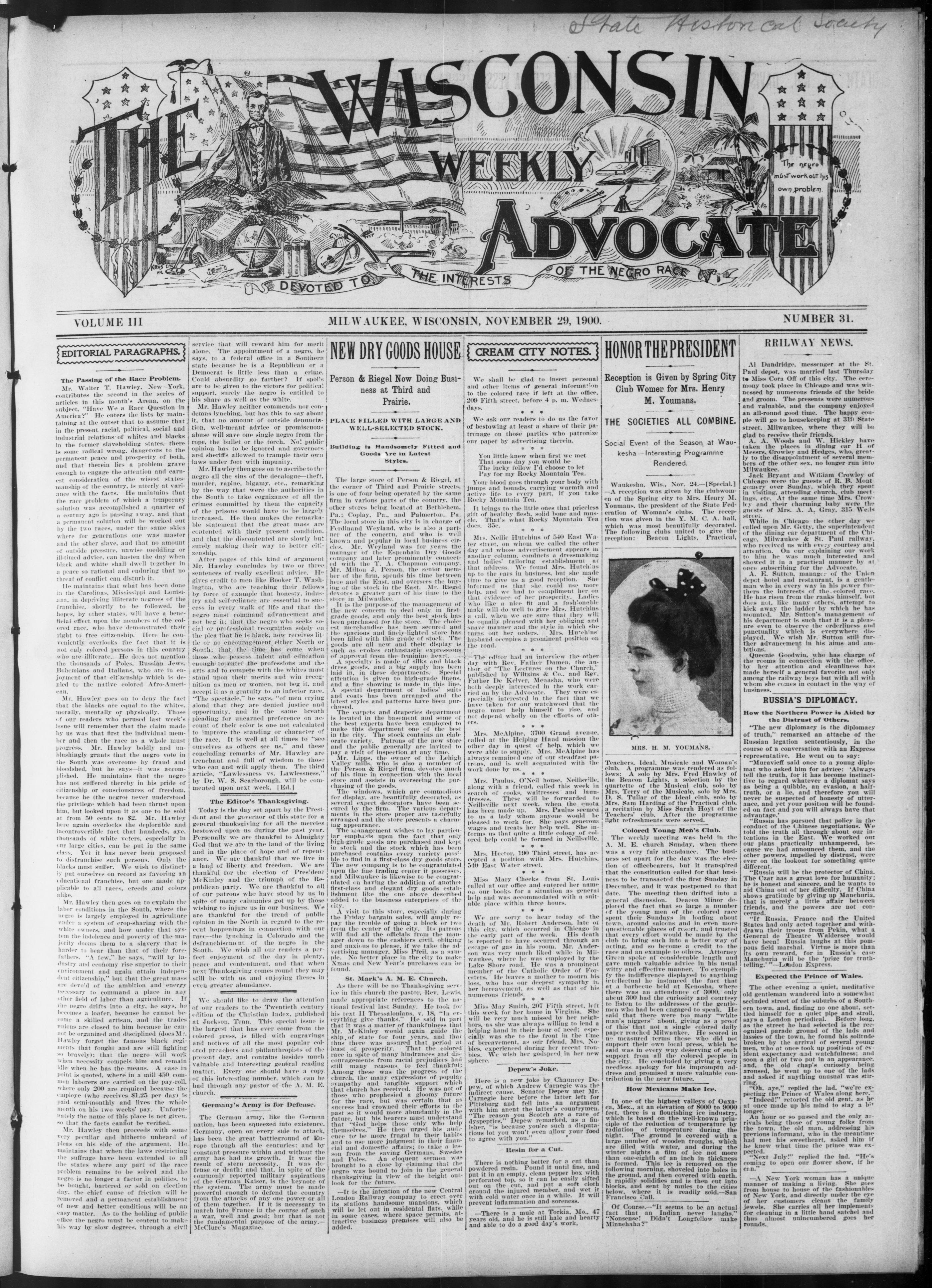
WISCONSIN
WEEKLY
ADVOCATE
DEVOTED TO THE INTERESTS OF THE NEGRO RACE
EDITORIAL PARAGRAPHS.
The Passing of the Race Problem. Mr. Walter T. Hawley, New York, contributes the second in the series of articles in this month's Arena, on the subject, "Have We a Race Question in America?" He enters the lists by maintaining at the outset that to assume that in the present racial, political, social and industrial relations of whites and blacks in the former slaveholding states, there is some radical wrong, dangerous to the permanent peace and prosperity of both, and that therein lies a problem grave enough to engage the attention and earnest consideration of the wisest statesmanship of the country, is utterly at variance with the facts. He maintains that the race problem of which a temporary solution was accomplished a quarter of a century ago is passing away, and that a permanent solution will be worked out by the two races, under the same skies where for generations one was master and the other slave, and that no amount of outside pressure, unwise meddling or ill-timed advice, can hasten the day when black and white shall dwell together in a peace so rational and enduring that no threat of conflict can disturb it.
He maintains that what has been done in the Carolinas, Mississippi and Louisiana, in depriving illiterate negroes of the franchise, shortly to be followed, he hopes, by other states, will have a beneficial effect upon the members of the colored race, who have demonstrated their right to free citizenship. Here he conveniently overlooks the fact that it is not only colored persons in this country who are illiterate. He does not mention the thousands of Poles, Russian Jews, Bohemians and Italians, who are in enjoyment of that citizenship which is denied to the native colored Afro-American.
Mr. Hawley goes on to deny the fact that the blacks are equal to the whites, morally, mentally or physically. Those of our readers who perused last week's issue will remember that the claim made by us was that first the individual member and then the race as a whole must progress. Mr. Hawley boldly and unblushingly grants that the negro vote in the South was overcome by fraud and bloodshed, but he says—it was accomplished. He maintains that the negro has not suffered thereby in his pride of citizenship or consciousness of freedom, because he (the negro) never understood the privilege which had been thrust upon him, but looked upon it as one to be sold at from 50 cents to $2. Mr. Hawley here again overlooks the deplorable and incontrovertible fact that hundreds, aye, thousands of white voters, especially in our large cities, can be put in the same class. Yet it has never been proposed to disfranchise such persons. Only the blacks must suffer. We wish to distinctly put ourselves on record as favoring an educational franchise, but one made applicable to all races, creeds and colors alike.
Mr. Hawley then goes on to explain the labor conditions in the South, where the negro is largely employed in agriculture under a system of crop-sharing with the white owners, and how under that system the indolence and poverty of the majority dooms them to a slavery that is harder to bear than that of their forefathers. "A few," he says, "will by industry and economy rise superior to their environment and again attain independent citizenship," but that the great mass are devoid of the ambition and energy necessary to command a place in any other field of labor than agriculture. If the negro drifts into a city, he says, he becomes a loafer, because he cannot become a skilled artisan, and the trades unions are closed to him because he cannot be organized and disciplined (does Mr. Hawley forget the famous black regiments that fought and are still fighting so bravely); that the negro will work when necessity compels him and remain idle when he has the means. A case in point is quoted, where in a mill 450 common laborers are carried on the pay-roll, where only 200 are required because the employee (who receives $1.25 per day) is paid semi-monthly and lives the whole month on his two weeks' pay. Unfortunately the name of this place is not given, so that the facts cannot be verified.
Mr. Hawley then proceeds with some very peculiar and hitherto unheard of pleas on his side of the argument. He maintains that when the laws restricting the suffrage have been extended to all the states where any part of the race problem remains to be solved and the negro is no longer a factor in politics, to be bought, bartered or sold on election day, the chief cause of friction will be removed and a permanent establishment of new and better conditions will be an easy matter. As to the holding of public office the negro must be content to make his way by slow degrees, through a civil
service that will reward him for merit alone. The appointment of a negro, he says, to a federal office in a Southern state because he is a Republican or a Democrat is little less than a crime. Could absurdity go farther? If spoils are to be given to the victors for political support, surely the negro is entitled to his share as well as the white.
Mr. Hawley neither commends nor condemns lynching, but has this to say about it, that no amount of outside denunciation, well-meant advice or promiscuous abuse will save one single negro from the rope, the bullet or the torch. No! public opinion has to be ignored and governors and sheriffs allowed to trample their own laws under foot with impunity.
Mr. Hawley then goes on to ascribe to the negro all the sins of the decalogue—theft, murder, rapine, bigamy, etc., remarking by the way that were the authorities in the South to take cognizance of all the crimes committed by them the capacity of the prisons would have to be largely increased. He then makes the remarkable statement that the great mass are contented with their present condition, and that the discontented are slowly but surely making their way to better citizenship.
After pages of this kind of argument Mr. Hawley concludes by two or three sentences of really excellent advice. He gives credit to men like Booker T. Washington, who are teaching their fellows by force of example that honesty, industry and self-reliance are essential to success in every walk of life and that the negro must command advancement and not beg it; that the negro who seeks social or professional recognition solely on the plea that he is black, now receives little or no encouragement either North or South; that the time has come when those who possess talent and education enough to enter the professions and the arts and to compete with the whites must stand upon their merits and win recognition as men or women, not beg it, and accept it as a gratuity to an inferior race. "The spectacle," he says, "of men crying aloud that they are denied justice and opportunity, and in the same breath pleading for unearned preference on account of their color is one not calculated to improve the standing or character of the race. It is well at all times to "see ourselves as others see us," and these concluding remarks of Mr. Hawley are trenchant and full of wisdom to those who can and will apply them. The third article, "Lawlessness vs. Lawlessness," by Dr. W. S. Scarborough, will be commented upon next week. [Ed.]
The Editor's Thanksgiving.
Today is the day set apart by the President and the governor of this state for a general thanksgiving for all the mercies bestowed upon us during the past year. Personally we are thankful to Almighty God that we are in the land of the living and in the place of hope and of repentance. We are thankful that we live in a land of liberty and freedom. We are thankful for the election of President McKinley and the triumph of the Republican party. We are thankful to all of our patrons who have stood by us in spite of many calumnies got up by those wishing to injure us in our business. We are thankful for the trend of public opinion in the North in regard to the recent happenings in connection with our race—the lynching in Colorado and the dsfranchisement of the negro in the South. We wish all our readers a perfect enjoyment of the day in plenty, peace and contentment, and that when next Thanksgiving comes round they may still be with us and enjoying these in even greater abundance.
We should like to draw the attention of our readers to the Twentieth century edition of the Christian Index, published at Jackson, Tenn. This special issue is the largest that has ever come from the colored press, is filled with engravings and notices of all the most popular colored preachers and philanthropists of the present day, and contains besides much valuable and interesting general reading matter. Every one should have a copy of this interesting number, which can be had through any pastor of the A. M. E. church.
Germany's Army is for Defense
The German army, like the German nation, has been squeezed into existence. Germany, open on every side to attack, has been the great battleground of Europe through all the centuries; and by constant pressure within and without the army has had its growth. It was the result of stern necessity. It was defense or death; and that, in spite of the commonly reported military aspirations of the German Kaiser, is the keynote of the system. The army must be made powerful enough to defend the country from the attacks of any one power or all of them together. If it is necessary to march into France in the course of such a war, well and good; but that is not the fundamental purpose of the army.—McClure's Magazine.
NEW DRY GOODS HOUSE
PLACE FILLED WITH LARGE AND WELL-SELECTED STOCK.
Building is Handsomely Fitted and Goods Are in Latest
The large store of Person & Riegel, at the corner of Third and Prairie streets, is one of four being operated by the same firm in various parts of the country, the other stores being located at Bethlehem, Pa.; Coplay, Pa., and Palmerton, Pa. The local store in this city is in charge of Ferdinand Weyland, who is also a partner of the concern, and who is well known and popular in local business circles. Mr. Weyland was for years the manager of the Espenhain Dry Goods company and later prominently connected with the T. A. Chapman company. Mr. Milton J. Person, the senior member of the firm, spends his time between here and the East, and oversees the buying of the stock in the East. Mr. Riegel devotes a greater part of his time to the store in Milwaukee.
It is the purpose of the management of the new concern to deal only in first-grade goods, and only the best stock has been purchased for the store. The choicest merchandise has been secured and the spacious and finely-lighted store has been filled with this grade of stock. The goods are all new and their display is such as evokes enthusiastic expressions of approval from the feminine heart. A specialty is made of silks and black dress goods, and a big supply has been laid in, in these departments. Special attention is given to high-grade linens, and a fine showing is made in this line. A special department of ladies' suits and coats has been arranged and the latest styles and patterns have been purchased.
The carpets and draperies department is located in the basement and some of the best experts have been employed to make this department one of the best in the city. The stock contains an elaborate variety. Patrons of the new store and the public generally are invited to pay a visit of inspection at any time. Mr. Lipps, the owner of the Lehigh Valley mills, who is also a member of the Person & Riegel firm, devotes much of his time in connection with the local store and assists in overseeing the purchasing of the goods. The windows, which are commodious for display, are beautifully decorated, as several expert decorators have been secured by the firm. The various departments in the store proper are tastefully arranged and the store presents a charming appearance.
The management wishes to lay particular emphasis upon the fact that only high-grade goods are purchased and kept in stock and the stock which has been purchased contains every variety possible to find in a first-class dry goods store. The new company is to be congratulated upon the fine trading center it possesses, and Milwaukee is likewise to be congratulated on having the addition of another first-class and elegant dry goods establishment like the one above described added to the business enterprises of the city.
A visit to this store, especially during the Friday bargain sales, will amply repay the trouble of going a block or two from the center of the city. Its patrons will find all the officials from the manager down to the cashiers civil, obliging and anxious to please, if we take the advertising manager, Miss Pfeil, as a sample. No better place in the city to make Xmas and New Year's purchases can be found.
St. Mark's A. M. E. Church
As there will be no Thanksgiving service in this church the pastor, Rev. Lewis, made appropriate references to the national festival last Sunday. He took for his text II Thessalonians, v. 18. "In everything give thanks." He said in part that it was a matter of thankfulness that Mr. McKinley would again guide the ship, of state for four years, and that thus there was assured that period at least of prosperity. That the colored race in spite of many hindrances and discouragements from racial prejudices had still many reasons to feel thankful: Among these was the progress of the church, the many expressions of popular sympathy and tangible support which that church has received. He was not of those who prophesied a gloomy future for the race, but was certain that as success had crowned their efforts in the past so it would more abundantly in the future, but his hearers must understand that "God helps those only who help themselves." He then urged his audience to be more frugal in their habits and to use more judgment in their financial and domestic affairs; to take a lesson from the saving Germans, Swedes and Poles. An eloquent sermon was brought to a close by claiming that the negro was bound to join in the general thanksgiving in view of the bright outlook for the future.
-It is the intention of the new Central London Railway company to erect over its stations handsome mansions, which will be let out in residential flats, while in some cases, where space permits, attractive business premises will also be added.
CREAM CITY NOTES.
We shall be glad to insert personal and other items of general information to the colored race if left at the office, 209 Fifth street, before 4 p. m. Wednesdays.
* * *
We ask our readers to do us the favor of bestowing at least a share of their patronage on those parties who patronize our paper by advertising therein.
* * *
You little knew when first we met
That some day you would be
The lucky fellow I'd choose to let
Pay for my Rocky Mountain Tea.
Your blood goes through your body with
jumps and bounds, carrying warmth and
active life to every part, if you take
Rocky Mountain Tea.
It brings to the little ones that priceless
gift of healthy flesh, solid bone and muscle.
That's what Rocky Mountain Tea
does. 35c.
Mrs. Nellic Hutchins of 540 East Water street, on whom we called the other day and whose advertisement appears in another column, conducts a dressmaking and ladies' tailoring establishment at that address. We found Mrs. Hutchins up to the ears in business, but she made time to give us a good reception. She informed us that she could use more help, and we had to compliment her on that evidence of her prosperity. Ladies who like a nice fit and a fashionable make will do well to give Mrs. Hutchins a call, when we are sure that they will be equally pleased with her obliging and suave manner and the style in which she turns out her orders. Mrs. Hutchins' husband occupies a prominent position on the road.
水 牵 牵
The editor had an interview the other day with Rev. Father Damen, the author of "The Lectures on the Church," published by Wiltzius & Co., and Rev. Father De Kelver, Menasha, who were both deeply interested in the work carried on by the Advocate. They were especially interested in the fact that we have taken for our watchword that the negro must help himself to rise, and not depend wholly on the efforts of others.
* * *
Mrs. McAlpine, 3700 Grand avenue, called at the Helping Hand mission the other day in quest of help, which we were able to supply. Mrs. McAlpine has always remained one of our steadfast patrons, and is well acquainted with the work done by us.
* * *
Mrs. Paulus, O'Neil house, Neillsville, along with a friend, called this week in search of cooks, waitresses and laundresses. These will be forwarded to Neillsville next week, when the cuota has been made up. Mrs. Paulus seemed to us a lady whom anyone would be pleased to work for. She pays generous wages and treats her help well. She informs us that quite a little colony of colored help could be formed in Neillsville.
★ ★ ★
Mrs. Hector, 190 Third street, has accepted a position with Mrs. Hutchins, 540 East Water street.
南冶森
Miss Mary Cheeks from St. Louis called at our office and entered her name on our books for a situation as general help and was accommodated with a suitable place within three hours.
* * *
We are sorry to hear today of the death of Mr. Robert Anderson, late of this city, which occurred in Chicago in the early part of the week. His death is reported to have occurred through an escape of gas in his room. Mr. Anderson was very much liked while in Milwaukee, where he was employed by the Lake Shore road. He was a prominent member of the Catholic Order of Foresters. He leaves a mother to mourn his loss, who has our deepest sympathy in her bereavement, as well as that of his numerous friends.
宗宗宗
Miss May Smith, 207 Fifth street, left this week for her home in Virginia. She will be very much missed by her neighbors, as she was always willing to lend a helping hand in their hour of need; especially was she to the front in the time of bereavement, as our friend, Mrs. Nobles, experienced during her recent troubles. We wish her godspeed in her new sphere.
Depew's Joke.
Here is a new joke by Chauncey Depew, of which Andrew Carnegie was the indirect cause. Senator Depew met Mr. Carnegie here before the latter left for Pittsburg and fell into an argument with him anent the latter's countrymen. "The reason you Scotch are a race of dyspeptics." Depew remarked, as a finisher, "is because you're such a disputations lot you won't even allow your food to agree with you."
Resin for a Cut.
There is nothing better for a cut than powdered resin. Pound it until fine, and put it in an empty, clean pepper box with perforated top, so it can be easily sifted out on the cut, and put a soft cloth around the injured member, and wet it with cold water once in a while. It will prevent inflammation and soreness.
—There is a mule at Torkia, Mo., 47 years old, and he is still hale and hearty and able to do a good day's work.
HONORTHEPRESIDENT
Reception is Given by Spring City Club Women for Mrs. Henry M. Youmans. THE SOCIETIES ALL COMBINE.
Social Event of the Season at Waukesha—Interesting Programme Rendered
Waukesha, Wis., Nov. 24.—[Special.]
—A reception was given by the clubwomen of the Spring city to Mrs. Henry M. Youmans, the president of the State Federation of Woman's clubs. The reception was given in the Y. M. C. A. hall, which was most beautifully decorated. The following clubs united to give the reception: Beacon Lights, Practical.
C.
MRS. H. M. YOUMANS.
Teachers, Ideal, Musicale and Woman's club. A programme was rendered as follows: A solo by Mrs. Fred Hawley of the Beacon Lights, a selection by the quartette of the Musical club, solo by Mrs. Terry of the Musicale, solo by Mrs. D. S. Tullar of the Ideal club, solo by Mrs. Sam Harding of the Practical club, a recitation by Miss Sarah Hoyt of the Teachers' club. After the programme light refreshments were served.
Colored Young Men's Club.
Colored Young Men's Club.
The weekly meeting was held in the A. M. E. church Sunday, when there was a very fair attendance. The business set apart for the day was the election of officebearers, but it transpired that the constitution called for that business to be transacted the first Sunday in December, and it was postponed to that date. The meeting then drifted into a general discussion. Deacon Minor deplored the fact that so large a number of the young men of the colored race spent their Sundays in loafing about town, around saloons and in even more questionable places of resort, and trusted that every effort would be made by the club to bring such into a better way of acting, and so become a credit to the race and an example to others. Attorney Green spoke at considerable length and gave much valuable advice in his usual witty and effective manner. To exemplify the indifference displayed to anything intellectual he instanced the fact that at a barbecue held at Kenosha, where there was an attendance of 3000, only about 300 had the curiosity and courtesy to listen to the addresses of the gentlemen who had been engaged to speak. He said that there were too many "white man's niggers" about, giving as a proof of this that not a single colored daily paper reached Milwaukee. He scored in no measured terms those who did not support their own local press, which he said was in every way deserving of such support from all the colored people in the city. He concluded by giving a very needless apology for his impromptu address and promised a more valuable contribution in the near future.
How Mexicans Make Ice.
In one of the highest valleys of Oaxaca, Mex., at an elevation of 8000 to 9000 feet, there is a flourishing ice industry, which is based on the well-known principle of the reduction of temperature by radiation of temperature during the night. The ground is covered with a large number of wooden troughs, which are filled with water, and during the winter nights a film of ice not more than one-eighth of an inch in thickness is formed. This ice is removed on the following morning, shoveled into holes in the ground, and then covered with earth. It rapidly solidifies and is then cut into blocks, and sent by mules to the cities below, where it is readily sold.—San Francisco Call.
Of Course.—"It seems to be an actual fact that an Indian never laughs." "Nonsense! Didn't Longfellow make Minnehaha?"
NUMBER 31.
BRILWAY NEWS.
Al Dandridge, messenger at the St. Paul depot, was married last Thursday to Miss Cora Off of this city. The ceremony took place in Chicago and was witnessed by numerous friends of the bride and groom. The presents were numerous and valuable, and the company enjoyed an all-round good time. The happy couple will go to housekeeping at 319 State street, Milwaukee, where they will be glad to receive their friends. A. A. Woods and W. Hickley have taken the places in dining car H of Messrs. Crowley and Hedges, who, greatly to the disappointment of several members of the other sex, no longer run into Milwaukee.
Jack Bryant and William Crowley of Chicago were the guests of R. B. Montgomery over Sunday, which they spent in visiting, attending church, club meetings, etc. At the same time Mrs. Crowley and their charming baby were the guests of Mrs. A. A. Gray, 315 Wells street.
While in Chicago the other day we called upon Mr. Getty, the superintendent of the dining car department of the Chicago, Milwaukee & St. Paul railway, who received us with every courtesy and attention. On our explaining our work to him he was much interested and showed it in a practical manner by at once subscribing for the Advocate.
A. E. Sutton, manager of the Union depot hotel and restaurant, is a gentleman who in every way in his power furthers the interests of the colored race. He has risen from the ranks himself, but does not, like many others, attempt to kick away the ladder by which he has mounted. Mr. Sutton's management of his department is such that it is a pleasure even to observe the orderliness and punctuality which is everywhere displayed. We wish Mr. Sutton still further advancement in his aims and ambitions. Queenie Goodwin, who has charge of the rooms in connection with the office, by her attention and cleanliness has made herself a general favorite not only among the railway boys but with all with whom she comes in contact in the way of business.
RUSSIA'S DIPLOMACY.
How the Northern Power is Aided by the Distrust of Others.
"The new diplomacy is the diplomacy of truth," remarked an attache of the Russian legation sententiously, in the course of a conversation with an Express representative. He went on to say:
"Muravieff said once to a young diplomat who asked him for advice: 'Always tell the truth, for it has become instinctive to regard whatever a diplomat says as being a quibble, an evasion, a half-truth, or a lie, and therefore you will never be suspected of honesty of utterance, and yet your position will be founded on fact and you will always have that advantage.'
"Russia has pursued that policy in the conduct of the Chinese negotiations. We told the truth all through about our intentions in the East. We worked out our plans practically unhampered, because we had announced them, and the other powers, impelled by distrust, were ever on the lookout for something quite different.
"Russia will be the protector of China. The Czar has a great love for humanity; he is honest and sincere, and he wants to aid China out of her difficulty. If China shows gratitude by giving up Manchuria, that is merely a little affair between friends, and the powers are not concerned.
"If Russia, France and the United States had only acted together and withdrawn their troops from Pekin, what a General de Theatre Waldersee would have been! Russia laughs at this pompous field marshal. Virtue is more than its own reward, for in Russia's case Manchuria will be the 'prize for truth-telling.'"—London Express.
Expected the Prince of Wales.
The other evening a quiet, meditative old gentleman wandered into a somewhat secluded street of the suburbs of a Southern town, and, finding no one about, settled himself for a quiet pipe and stroll, says a London periodical. Before long, as the street he had selected is the recognized parade ground of the lads and lassies of the town, he found his solitude broken by the arrival of several young men, who at once took up positions of evident expectancy and watchfulness; and soon a girl or two put in an appearance, and, the old chap's curiosity being aroused, he went up to one of the lads and asked if anything unusual was stirring.
"Oh, aye," replied the lad, "we're expecting the Prince of Wales along here."
"Indeed." retorted the old gent, as he at once made up his mind to stay a bit longer.
An hour or so passed and the only arrivals being those of young folks from the town, the old man, addressing his previous informant, who in the meantime had met his sweetheart, asked him if he knew what time the prince was expected.
"Next July!" replied the lad. "He's coming to open our flower show, if he can."
—A New York woman has a unique manner of making a living. She goes from house to house of the fashionables of New York, and directly under the eye of her customers cleans the family jewels. She carries all her implements for cleaning in a little hand satchel and thus almost unincumbered goes her rounds.
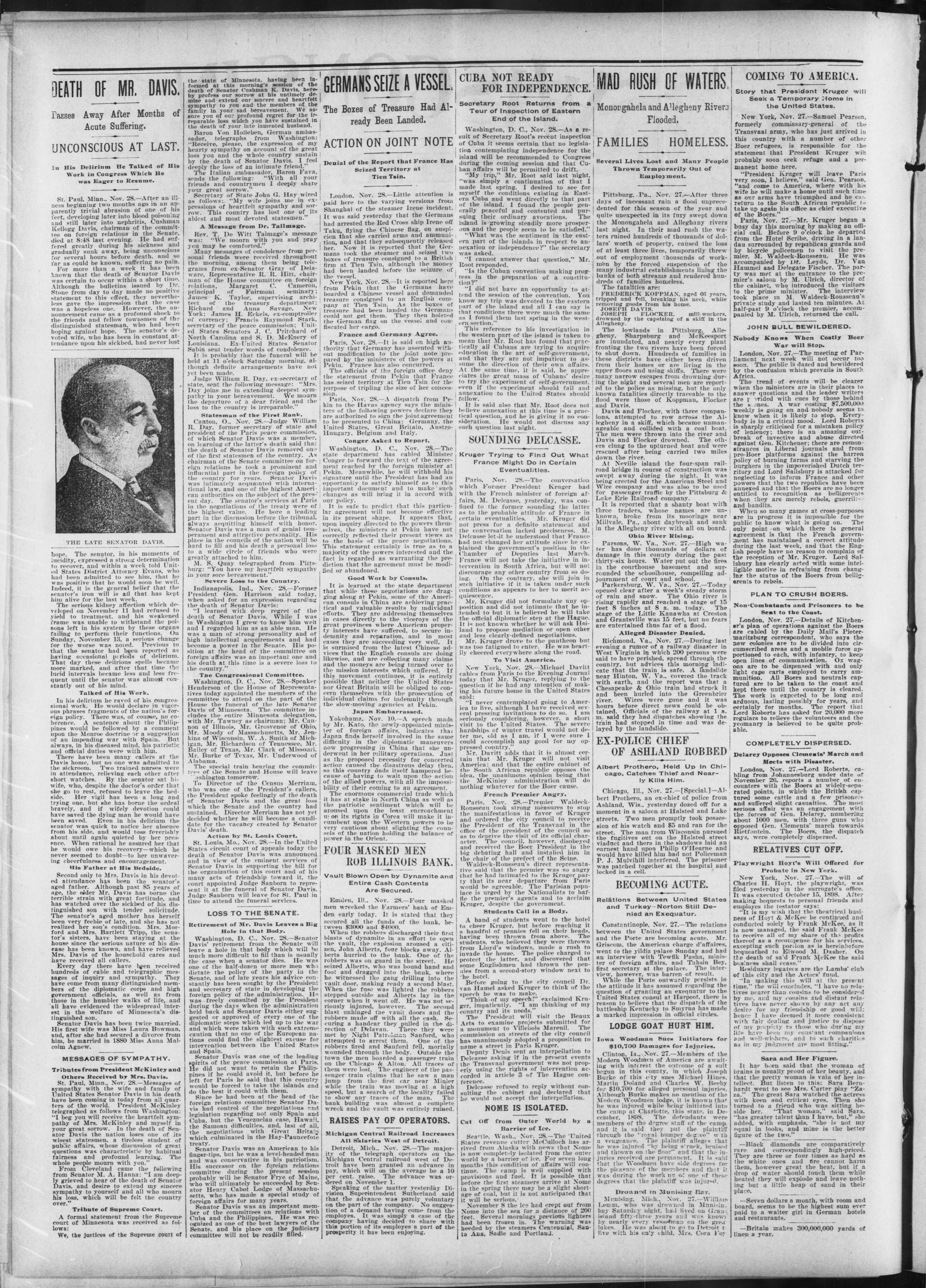
DEATH OF MR. DAVIS.
Passes Away After Months of Acute Suffering.
In His Delirium He Talked of His Work in Congress Which He was Eager to Resume.
St. Paul, Minn., Nov. 28.—After an illness beginning two months ago in an apparently trivial abrasion of one of his feet, developing later into blood poisoning and still later into nephritis, Cushman Kellogg Davis, chairman of the committee on foreign relations in the Senate, died at 8:48 last evening. He had suffered greatly during his sickness and gradually sunk away, being unconscious for several hours before death, and so for as could be known, suffering no pain.
For more than a week it has been known that the death of Senator Davis was certain to occur within a short time. Although the bulletins issued by Dr. Stone from day to day made no positive statement to this effect, they nevertheless gave the impression that the case was a hopeless one. However, the announcement came as a profound shock to the friends and fellow townsmen of the distinguished statesman, who had been hoping against hope. The senator's devoted wife, who has been in constant attendance upon his sickbed, had never lost
M.
THE LATE SENATOR DAVIS. hope. The senator, in his moments of lucidity, expressed a strong determination to recover, and within a week told United States District Attorney Evans, who had been admitted to see him, that he was positive that he would soon be well. Indeed, it is the general belief that the senator's iron will is all that has kept him alive for the last week.
The serious kidney affection which developed on November 11 had refused to yield to treatment, and his weakened frame was unable to withstand the poisons left in his system by these organs failing to perform their functions. On Sunday, November 13, a serious change for the worse was noted. Previous to that the senator had been reported as having occasional periods of delirium. That day these delirious spells became more marked, and after that time the lucid intervals became less and less frequent until the senator was almost constantly out of his mind.
Talked of His Work.
In his delirium he raved of his congressional work. He would declare in vigorous phrases fragments of the nation's foreign policy. There was, of course, no coherence. A sentence about the Philippines would be followed by a comment upon the Monroe doctrine or a suggestion of an impending war with Spain. But always, in his diseased mind, his patriotic and official duties were with him.
There have been many callers at the Davis home, but no one was admitted to the sickroom. Two trained nurses were in attendance, relieving each other after short watches. By the senator sat his wife, who, despite the doctor's order that she go to rest, refused to leave the bedside. Her vigil has been a long and trying one, but she has borne the ordeal bravely, and if wifely devotion could have saved the dying man he would have been saved. Even in his delirium the senator was quick to notice her absence from his side, and would toss feverishly about until again quieted by her presence. When rational he assured her that he would owe his recovery—which he never seemed to doubt—to her unwavering cheerfulness and encouragement.
His Father at His Bedside.
Second only to Mrs. Davis in his devoted attendance has been the senator's aged father. Although past 85 years of age, the older Mr. Davis has borne the terrible strain with great fortitude, and has watched over the sickbed of his distinguished son with tender solicitude. The senator's aged mother has herself been very feeble of late, and she has not realized her son's condition. Mrs. Morford and Mrs. Bartlett Tripp, the senator's sisters, have been staying at the house since the serious nature of his disease has been known, and have relieved Mrs. Davis of the household cares and have received all callers.
Every day there have been received hundreds of cable and telegraphic messages of inquiry and sympathy. They have come from many distinguished members of the diplomatic corps and high government officials, as well as from those in the humbler walks of life, and all have evidenced the widespread interest in the welfare of Minnesota's distinguished son. Senator Davis has been twice married. His first wife was Miss Laura Bowman, and, after she had secured a divorce from him, he married in 1880 Miss Anna Malcolm Agnew.
MESSAGES OF SYMPATHY.
Tributes from President McKinley and Others Received by Mrs. Davis.
St. Paul, Minn., Nov. 28.—Messages of sympathy with the wife and family of United States Senator Davis in his death have been coming in today from all quarters of the world. President McKinley telegraphed as follows from Washington: "I beg you will receive the heartfelt sympathy of Mrs. McKinley and myself in your great sorrow. In the death of Senator Davis the nation loses one of its wisest statesmen, a tireless student of public affairs, whose discussion of great questions was characteristic by habitual fairness and profound learning. The whole people mourn with you."
From Cleveland came the following from Senator M. A. Hanna: "I am deeply grieved to hear of the death of Senator Davis, and desire to extend my sincere sympathy to yourself and all who mourn his loss, which will be felt the country over."
Tribute of Supreme Court.
A formal statement from the Supreme court of Minnesota was received as follows: We the justices of the Supreme court of
the state of Minnesota, having been informed at this morning's session of the death of Senator Cushman K. Davis, hereby profess our sorrow at his untimely demise and extend our sincere and heartfelt sympathy to you and the members of the family in your sad bereavement. We assure you of our profound regret for the irreparable loss which you have sustained in the death of your late lamented husband.
Baron Von Hoileben, German ambassador, telegraphs from Washington: "Receive, please, the expression of my hearty sympathy on account of the great loss you and the whole country sustain by the death of Senator Davis. I feel deeply the loss of an intimate friend."
The Italian ambassador, Baron Fava, sends the following: "With all your friends and countrymen I deeply share your great sorrow."
Secretary of State John G. Hay wired as follows: "My wife joins me in expressions of heartfelt sympathy and sorrow. This country has lost one of its ablest and most devoted statesmen."
A Message from Dr. Tallmage.
Rev. T. De Witt Talmage's message was: "We mourn with you and pray you may be comforted." Many messages of condolence from personal friends were received throughout the morning, among them being telegrams from ex-Senator Gray of Delaware, Representative R. R. Hitt, chairman of the House committee on foreign relations, Margaret C. Cameron, principal of Fairmont seminary; James K. Taylor, supervising architect of the treasury department; Richard and Anna Savage, New York; James H. Eckels, ex-comptroller of currency; Francis Raymond Stark, secretary of the peace commission; United States Senators J. C. Pritchard of North Carolina and S. D. McEnery of Louisiana. Ex-United States Senator Sabin sent tender words of condolence.
It is probably that the funeral will be held at 11 o'clock Saturday morning, although definite arrangements have not yet been made.
Judge William R. Day, ex-secretary of state, sent the following message: "Mrs. Day joins me in extending deepest sympathy in your bereavement. We mourn the departure of a dear friend and the loss to the country is irreparable."
Statesman of the First Rank.
Canton, O., Nov. 28.—Judge William R. Day, former secretary of state and president of the Paris peace commission, of which Senator Davis was a member, on learning of the latter's death said that the death of Senator Davis removed one of the first statesmen of the country. As chairman of the Senate committee on foreign relations he took a prominent and influential part in the foreign policy of the country for years. Senator Davis was intimately acquainted with international law, and one of the highest American authorities on the subject of the present day. The senator's services at Paris in the negotiations of the treaty were of the highest value. He bore a leading part in the discussion before the tribunal, always acquitting himself with honor. Senator Davis was a man of genial temperament and attractive personality. His place in the councils of the nation will be hard to fill and his death a personal loss to a wide circle of friends who were greatly attached to him.
M. S. Quay telegraphed from Pittsburg: "You have my heartfelt sympathy in your sore bereavement."
Severe Loss to the Country.
Indianapolis, Ind., Nov. 28.—Former President Gen. Harrison said today, when asked for an expression regarding the death of Senator Davis: "I learned with deep regret of the death of Senator Davis. While I was in Washington I grew to know him well and I regarded him as an able man. He was a man of strong personality and of high intellectual acquirements and had become a power in the Senate. His position at the head of the committee on foreign affairs was an important one and his death at this time is a severe loss to the country."
The Congressional Committee.
Washington, D. C., Nov. 28.—Speaker Henderson of the House of Representatives today appointed the members of the committee to attend on the part of the House the funeral of the late Senator Davis of Minnesota. The committee includes the entire Minnesota delegation, with Mr. Tawney as chairman; Mr. Cannon of Illinois, Mr. Grosvenor of Ohio, Mr. Moody of Massachusetts, Mr. Jenkins of Wisconsin, W. A. Smith of Michigan, Mr. Richardson of Tennessee, Mr. Bailey of Texas, Mr. Clark of Missoari, Mr. Burke of Texas, Mr. Underwood of Alabama.
The special train bearing the committees of the Senate and House will leave Washington tomorrow.
To Director of the Census Merriam, who was one of the President's callers, the President spoke feelingly of the death of Senator Davis and the great loss which the Senate and the country had sustained. Director Merriam has not yet decided whether he will become a candidate for the vacancy created by Senator Davis' death.
Action by St. Louis Court.
St. Louis, Mo., Nov. 28.-In the United States circuit court of appeals today the death of Senator Davis was announced and in view of the eminent services of Senator Davis in supporting the bill for the organization of this court and of his many acts of friendship toward it, the court appointed Judge Sanborn to represent it at the funeral of Senator Davis. Judge Sanborn will leave for St. Paul in time to attend the funeral services.
LOSS TO THE SENATE
Retirement of Mr. Davis Leaves a Big Hole in that Body.
Washington, D. C., Nov. 28.—Senator Davis' retirement from the Senate will leave a hole in that body which will be much more difficult to fill than is usually the case when a senator dies. He was one of the half-dozen or more men who dictate the policy of the party in the Senate, and of late years his advice constantly has been sought by the President and secretary of state in developing the foreign policy of the administration. He was freely consulted by the President during the days when the administration held back and Senator Davis either suggested or approved of every one of the diplomatic steps which led up to the war and which were taken with such extreme caution that no one of the European nations could find the slightest excuse for intervention between the United States and Spain.
Senator Davis was one of the leading spirits of the peace commission at Paris. He did not want to retain the Philippines if he could avoid it, but before he left for Paris he said that this country would be forced to take the islands and do the best it could with them. Since he had been at the head of the foreign relations committee Senator Davis had control of the negotiations and legislation regarding not only Spain and Cuba, but the Venezuelan case, Hawaii, the Samoan difficulties, and, last of all, the negotiations with Great Britain which culminated in the Hay-Pauncefote treaty.
Senator Davis was an American to his finger-tips, but he was a level-headed man and was conservative in his patriotism. His successor on the foreign relations committee during the present session probably will be Senator Frye of Maine, who will ultimately be succeeded by Senator Henry Cabot Lodge of Massachusetts, who has made a special study of foreign affairs for many years. Senator Davis was an important member of the committees on relations with Cuba and the Philippines. He was recognized as one of the best lawyers of the Senate, and his place on the judiciary committee will not be readily filled.
GERMANS SEIZE A VESSEL
Denial of the Report that France Has Seized Territory at Tien Tsin.
London, Nov. 28.—Little attention is paid here to the varying versions from Shanghai of the steamer Irene incident. It was said yesterday that the Germans had arrested the Red Cross ship Irene off Taku, flying the Chinese flag, on suspicion that she carried arms and ammunition, and that they subsequently released her. Now it is reported that the Germans took the steamer and seized two boxes of treasure consigned to a British firm at Tien Tsin, although the money had been landed before the seizure of the vessel.
New York, Nov. 28.—It is reported here from Pekin that the Germans have boarded a Chinese vessel and demanded treasure consigned to an English company at Tien Tsin. As the boxes of treasure had been landed the Germans could not get them. They then hoisted the German flag on the vessel and confiscated her cargo.
France and Germany Agree.
Paris, Nov. 28.—It is said on high authority that Germany has assented without modification to the joint note prepared by the ministers of the powers at Pekin. France has also concurred.
The officials of the foreign office deny the statement from Pekin that France has seized territory at Tien Tsin for the purpose of tripling the size of her concession.
Paris, Nov. 28.—A dispatch from Pekin to the Havas agency says the ministers of the following powers declare they are authorized to sign the joint agreement to be presented to China; Germany, the United States, Great Britain, Austro-Hungary, Belgium and Italy.
Conger Asked to Report.
Washington, D. C., Nov. 28.—The state department has cabled Minister Conger to forward the text of the agreement reached by the foreign minister at Pekin. Meanwhile, he will withhold his signature until the President has had an opportunity to satisfy himself as to this important document and to make such changes as will bring it in accord with our policy. It is safe to predict that this particular agreement will not become effective in its present shape. It appears that, upon inquiry directed to the powers themselves, the ministers at Pekin have not correctly reflected their present views as to the basis of the peace negotiations. This statement certainly is true as to a majority of the powers interested and the fact is regarded as warranting the prediction that the agreement must be modified or abandoned.
Good Work by Consuls.
It is learned at the state department that while these negotiations are dragging along at Pekin, some of the American consuls in China are achieving practical and valuable results by individual efforts. They are addressing themselves in cases directly to the viceroys of the great provinces where American property interests have suffered, to secure indemnity and reparation, and in most cases they are succeeding very well. It is surmised from the latest Chinese advises that the English consuls are doing likewise, and are collecting many claims and the moneys are being turned over to the mission interests which suffered. If this movement continues, it is entirely possible that neither the United States nor Great Britain will be obliged to concern themselves with the prosecution of individual claims for indemnity through the slow-moving agencies at Pekin.
Japan Embarrassed.
Yokohama, Nov. 10.—A speech made by Mr. Kato, the newly-appointed minister of foreign affairs, indicates that Japan finds herself involved in the same difficulty in the diplomatic maneuvers now progressing in China that she underwent in her military operations. Just as the proposed necessity for concerted action caused the disastrous delay then, so this country finds itself hampered because of having to wait upon the action of the allied powers, with all the impossibility of their coming to an agreement.
The enormous commercial trade which it has at stake in North China as well as the patriotic sentiment which will be aroused upon the least encroachment upon its rights in Corea will make it incumbent upon the Western powers to be very cautious about slighting the counsels of the nation holding the balance of power in the Orient.
FOUR MASKED MEN ROB ILLINOIS BANK.
FOUR MASKED MEN ROB ILLINOIS BANK.
Vault Blown Open by Dynamite and Entire Cash Contents Are Secured.
Emden, Ill.. Nov. 28.—Four masked men wrecked the Farmers' bank of Emden early today. It is stated that they secured all the funds of the bank, between $3000 and $4000.
When the robbers discharged their first blasts of dynamite in an effort to open the vault, the explosion aroused a citizen, John Alberts, four blocks away. Alberts hurried to the bank. One of the robbers was on guard in the street. He seized Alberts, who was bound hand and foot and dragged into the bank, where he witnessed the gang drilling into the vault door, making ready a second blast. When the fuse was lighted the robbers stepped outside and Alberts lay in the corner when it went off. He was not seriously injured, however. The second blast unhinged the vault doors and the robbers made off with all the cash. Securing a handcar they pulled in the direction of Delavan. There they were met by Night Patrolman Sanford, who attempted to arrest them. One of the robbers fired and Sanford fell, mortally wounded through the body. Outside the town the men boarded a passenger train on the Chicago & Alton. All traces of them were lost. The engineer of the passenger train claims that he saw a man jump from the first car near Minier while the train was moving at a high speed, but a search of the locality failed to show any traces of the man. The bank building was almost a complete wreck and the vault was entirely ruined.
RAISES PAY OF OPERATORS.
Michigan Central Railroad Increases All Salaries West of Detroit.
Detroit, Mich., Nov. 28.—The majority of the telegraph operators on the Michigan Central railroad west of Detroit have been granted an advance in pay, which will on the average be a 10 per cent. raise. The advance was ordered on November 1.
Speaking of the matter yesterday Division Superintendent Sutherland said that the advance was purely voluntary on the part of the company. No suggestion of a demand having come from the employes. It was simply a case of the company having decided to share with this portion of its employes a part of the prosperity it has been enjoying.
CUBA NOT READY FOR INDEPENDENCE.
Secretary Root Returns from a Teur of Inspection of Eastern End of the Island.
Washington, D. C., Nov. 28.—As a result of Secretary Root's recent inspection of Cuba it seems certain that no legislation contemplating independence for the island will be recommended to Congress during the coming session and that Cuban affairs will be permitted to drift.
"My trip," Mr. Root said last night, "was simply a continuation of that I made last spring. I desired to see for myself the conditions existing in Eastern Cuba and went directly to that part of the island. I found the people generally peaceful and contented and pursuing their ordinary avocations. The island is growing steadily more prosperous and the people seem to be satisfied."
ours and the people seem to be satisfied.
"What was the sentiment in the eastern part of the islands in respect to annexation or independence?" the secretary was asked.
"I cannot answer that question," Mr. Root responded.
"Is the Cuban convention making progress in the preparation of a constitution?"
"I did not have an opportunity to attend the session of the convention. You know my trip was devoted to the eastern part of the island and all I can say is that conditions there were much the same as I found them last spring in the western section."
This reference to his investigation in the western part of the island is taken to mean that Mr. Root has found that practically all Cubans are trying to acquire education in the art of self-government, and that they are not impatient to assume the direction of their own affairs. At the same time, it is said, he appreciates the great mass of Cubans' desire to try the experiment of self-government, even if the experiment should fail and annexation to the United States should follow. It is said also that Mr. Root does not believe annexation at this time is a practical question, and he is giving it no consideration. He would not discuss any such question last night.
SOUNDING DELCASSE.
Kruger Trying to Find Out What France Might Do in Certain Eventualities.
Paris, Nov. 28.—The conversation which Former President Kruger had with the French minister of foreign affairs, M. Delcasse, yesterday, was confined to the former sounding the latter as to the probable attitude of France in certain eventualities. Mr. Kruger did not press for a definite statement and the conversation lacked preciseness, M. Delcasse let-it be understood that France had not changed her attitude since he explained the government's position in the Chamber of Deputies last March. France will not take the initiative in intervention in South Africa, but will not discourage any other country from so doing. On the contrary, she will join in such initiative if it is taken under such conditions as appears to her to merit acquiescence.
Mr. Kruger did not formulate any opposition and did not intimate that he intended to but it is believed he will take the official diplomatic step at the Hague. It is not known whether he will ask Holland to propose mediation or open other and less clearly-defined negotiations. Mr. Kruger drove to the pantheon but was too fatigued to enter. He was heartily cheered everywhere along the road.
To Visit America.
New York, Nov. 28.—Michael Davitt cables from Paris to the Evening Journal today that Mr. Kruger, replying to the question if he had any intention of making his future home in the United States said:
"I never contemplated going to America to live, although I have received several pressing invitations to do so. I am seriously considering, however, a short visit to the United States. The severe hardships of winter travel would not deter me, old as I am, if I were sure I could accomplish any good for my oppressed country."
Mr. Davitt adds that it is almost certain that Mr. Kruger will not visit America; and that the entire cabinet of the South African republic opposes the idea, the unanimous opinion being that the McKinley administration will do nothing whatever for the Boer cause.
French Premier Angry.
Paris, Nov. 28.—Premier Waldeck-Rousseau took strong measures to stop the manifestations in favor of Kruger and ordered the city council to receive the President of the Transvaal in the office of the president of the council so as to deprive the visit of its official character. The council, however, disobeyed and received the Boer President in the big debating hall and installed him in the chair of the prefect of the Seine. Waldeck-Rousseau's direct representative said that the premier was so angry that he had intimated to the Kruger party that its near departure from Paris would be agreeable. The Parisian populace is urged by the Nationalists to baffle the premier's agents and to acclaim Kruger, despite the government.
Students Call in a Body.
A band of students went to the hotel to cheer Kruger, but before reaching it a handful of pennies fell on their heads, having been thrown from above. The students, who believed they were thrown from Lloyd's windows, made a rush to invade the house. The police charged to protect the latter, and discovered that some Englishmen had thrown the pennies from a second-story window next to the hotel.
Before going to the city council Dr. van Hamel asked Kruger to think of the speech he was to make.
"Think of my speech!" exclaimed Kruger, impatiently. "I am thinking of my country and its needs."
The President will visit the Beaux Arts to examine projects submitted for a monument to Villebois Mareuil. The commission on streets of the city council has unanimously adopted a proposition to name a street in Paris Kruger. Deputy Denis sent an interpellation to Delcasse asking if in the present events the Transvaal government was not properly using the rights of intervention accorded in article 3 of The Hague conference. Delcasse refused to reply without consulting the cabinet and declared that he would not accept the interpellation.
NOME IS ISOLATED.
Cut Off from Outer World by a Barrier of Ice.
Seattle, Wash., Nov. 28.—The 'United States revenue cutter McCulloch has arrived from Alaska with news that Nome is now completely isolated from the outer world by a barrier of ice. For seven long months this condition of affairs will continue. The camp is well supplied with provisions and fuel. It is possible that before the first steamers arrive at Nome in the spring there may be a slight shortage of coal, but it is not anticipated that it will be serious.
November 8 the ice had crept out from Nome into the sea for a distance of 200 feet. Several mornings previous lighters had been frozen in. The warning was heeded by the steamers Centennial, Santa Ana, Sadie and Portland.
MAD RUSH OF WATERS
Monongahela and Allegheny Rivers Flooded.
Several Lives Lost and Many People Thrown Temporarily Out of Employment.
Pittsburg, Pa., Nov. 27. After three days of incessant rain a flood unprecedented for this season of the year and quite unexpected in its fury swept down the Monongahela and Alleghany rivers last night. In their mad rush the waters ruined hundreds of thousands of dollars' worth of property, caused the loss of at least three lives, temporarily threw out of employment thousands of workmen by the forced suspension of the many industrial establishments lining the banks of both streams and rendered hundreds of families homeless. The fatalities are: FREDERICK KOPPMAN, aged 66 years, tripped and fell, breaking his neck, while removing goods from his home. JOSEPH DAVIS
JOSEPH FLOCKER, mill-workers, drowned by the capsizing of a skiff in the Allegheny.
The lowlands in Pittsburg, Allegheny, Sharpsburg and McKeesport are inundated, and nearly every plant fronting the two rivers have been forced to shut down. Hundreds of families in these districts have either been driven from their homes or are living in the upper floors and using skiffs. There were many narrow escapes from drowning during the night and several men are reported to the police as missing, but the only known fatalities directly traceable to the flood were those of Koppman, Flocker and Davis.
Davis and Flocker, with three companions, attempted to row across the Allegheny in a skiff, which became unmanageable and collided with a coal boat. The men were thrown into the river and Davis and Flocker drowned. The others clung to the upturned boat and were rescued after being carried two miles down the river.
At Neville island the four-span railroad bridge in course of construction was swept away during the night. It was being erected for the American Steel and Wire company and was also to be used for passenger traffic by the Pittsburg & Lake Erie Railroad company.
It is reported that a shanty boat with three traders, whose names are unknown, broke from its moorings near Millvale, Pa., about daybreak and sank in the Allegheny river with all on board.
Ohio River Rising.
Parsons, W. Va., Nov. 27.—High water has done thousands of dollars of damage in this county during the past thirty-six hours. Water put out the fires in the courthouse basement and surrounded the schoolhouse, compelling adjournment of court and school. Parkersburg, W. Va., Nov. 27.—Today opened clear after a week's steady storm of rain and snow. The Ohio river is rising rapidly and reached a stage of 15 feet 8 inches at 8 a.m. today. The stage of the Little Kanawha at Creston and Grantsville was 15 feet, but no fears are entertained thus far of a flood.
Alleged Disaster Denied.
Richmond, Va., Nov. 27.—During last evening a rumor of a railway disaster in West Virginia in which 200 persons were said to have perished, spread through the country, but advices this morning indicate that the train is safe. A landslide near Hinton, W. Va., covered the track with earth, and the report was that a Chesapeake & Ohio train had struck it and been hurled into the Greenbrier river. Wires were gone and it was hours before direct news could be obtained. Officials of the railway at 1 a.m. said they had dispatches showing the train had stopped in time and was delayed by the landslide.
Albert Prothero, Held Up In Chicago, Catches Thief and Nearly Kills Him.
Chicago, Ill., Nov. 27.—[Special.]—Albert Prothero, an ex-chief of police from Ashland, Wis., yesterday dozed off for a moment in a saloon at Halsted and Lake streets. Two men promptly took possession of his watch and $5 and ran for the street. The man from Wisconsin pursued the fugitives out on the Halsted street viaduct and there in the shadows laid an earnest hand upon Philip O'Hearne and would have killed him not Policeman P. J. Mulvihill interfered. The prisoner was patched together at the hospital and locked in a cell.
BECOMING ACUTE.
Relations Between United States and Turkey-Norton Still Denied an Exequatur.
Constantinople, Nov. 27.—The relations between the United States government and the Porte are becoming acute. Mr. Griscom, the American charge d'affaires, went to the yildid palace Sunday and had an interview with Tewfik Pasha, minister of foreign affairs, and Tahsin Bey, first secretary at the palace. The interview, however, was barren of result.
While the Porte outwardly persists in the attitude it has assumed regarding the question of granting an exequatur to the United States consul at Harpoot, there is reason to believe that the dispatch of the battleship Kentucky to Smyrna has made a marked impression in official circles.
LODGE GOAT HURT HIM.
Iowa Woodman Sues Initiators for
$10,700 Damages for Injuries
Clinton, Ia., Nov. 27.—Members of the Modern Woodmen of America are awaiting with interest the outcome of a suit begun in this county, in which Joseph Burke of this city sues Michael Hines, Martin Doland and Charles W. Beeby for $10,700 for alleged personal injuries. Although Burke makes no mention of the Modern Woodmen lodge, it is known that he was injured while being initiated into the camp at Charlotte, this state, in December, 1898. The defendants were members of the degree staff of the camp, and it is said they put the plaintiff through the "royal bumper degree" with a vengeance. The plaintiff alleges that he was injured "by being struck, bruised and thrown on the floor" and that the injuries received are permanent. It is said that the Woodmen have side degrees for the pleasure of the members and that it was during the working of one of these degrees that the plaintiff was injured.
Drowned in Munising Bay.
Munising, Mich., Nov. 27.—William Lenam, who was drowned in Munising-bay Saturday night, had lived on Gran-island fifty-three years and was known by nearly every vesselman on the great lakes. He was about to go to Detroit to live with his only child, Mrs. Cora Foy
COMING TO AMERICA.
Story that President Kruger will Seek a Temporary Home in the United States.
New York, Nov. 27.—Samuel Pearson, formerly commissary-general of the Transvaal army, who has just arrived in this country with a number of other Boer refugees, is responsible for the statement that President Kruger will probably soon seek refuge and a permanent home here.
"President Kruger will leave Paris very soon, I believe," said Gen. Pearson, "and come to America, where with his wife he will make a home until such time as our arms have triumphed and he can return to the South African republic to take up again his office as chief executive of the Boers."
Paris, Nov. 27.—Mr. Kruger began a busy day this morning by making an official call. Before 9 o'clock he departed from the Hotel Scribe, driving in a landau surrounded by republican guards and by bicycle policemen to visit the premier, M. Waldeck-Rousseau. He was accompanied by Dr. Leyds, Dr. Van Hammel and Delegate Fischer. The party was met at the entrance to the premier's saloon by M. Ulrich, director of the cabinet, who introduced the visitors to the prime minister. The interview took place in M. Waldeck-Rousseau's private study and lasted ten minutes. At half-past 9 o'clock the premier, accompanied by M. Ulrich, returned the call.
JOHN BULL BEWILDERED.
Nobody Knows When Costly Boer War will Stop.
London, Nov. 27.—The meeting of Parliament next week will not occur too soon. The public is dazed and bewildered by the confusion which prevails in South Africa.
The trend of events will be clearer when the ministers are in their places to answer questions and the leader writers are provided with cues by those behind the scenes. A war costing $7,500,000 weekly is going on and nobody seems to know when it is likely to stop. Everybody is in a critical mood. Lord Roberts is sharply criticised for a mistaken policy of leniency; there is an amazing outbreak of invective and abuse directed against Gen. Kitchener; there are remonstrances in Liberal journals and from pro-Boer platforms against the barren policy of burning farms and starving the burghers in the impoverished Dutch territory and Lord Salisbury is attacked for neglecting to inform France and other powers that the two republics have been annexed and that the Boers are no longer entitled to recognition as belligerents when they are merely rebels, guerrilla and bandits.
When so many games at cross-purposes are in progress it is impossible for the public to know what is going on. The only point on which there is general agreement is that the French government has maintained a correct attitude during the last week, and that the English people have no reason to complain of the reception of Mr. Kruger. Lord Salisbury has clearly acted with some intelligible motive in refraining from changing the status of the Boers from belligerents to rebels.
PLAN TO CRUSH BOERS
Non-Combatants and Prisoners to be Sent to the Coast.
London, Nov. 27.—Details of Kitchener's plan of operations against the Boers are cabled by the Daily Mail's Pietermaritzburg correspondent, who says the new colonies are to be divided into circumscribed areas and a mobile force apportioned to each, with infantry, to keep open lines of communication. Ox wagons are to be dispensed with and only light cape carts employed to carry ammunition. All Boers and neutrals captured are to be taken to the coast and kept there until the country is cleared. The work is expected to be long and arduous, lasting possibly for years, and certainly for months. The report that Lord Roberts has asked for 20,000 more regulars to relieve the volunteers and the yeomanry is believed to be quite probable.
COMPLETELY DISPERSED.
Delarcy Opposes Clements' March and Merts with Disaster.
London, Nov. 27.—Lord Roberts, cabling from Johannesburg under date of November 26, reports a number of encounters with the Boers at widely-separated points, in which the British captured some cattle and a few prisoners and suffered slight casualties. The most serious affair was an engagement with the forces of Gen. Delarey, numbering about 1000 men, with three guns who opposed Gen. Clements' march towards Rietfontein. The Boers, the dispatch says, were completely dispersed.
RELATIVES CUT OFF.
Playwright Hoyt's Will Offered for Probate in New York.
New York, Nov. 27.—The will of Charles H. Hoyt, the playwright, was filed yesterday in the surrogate's office. It was executed October 15, 1898. After making bequests to personal friends and employees the testator says:
"It is my wish that the theatrical business of Hoyt & McKee be continued and conducted solely by Frank McKee, as it is now managed, the said Frank McKee to receive all of my share of the profits thereof as a recompense for his services, excepting such portion as is hereinbefore bequeathed to Elwood M. Dasher. On the death of sa'd Frank McKee the said business shall cease."
Residuary legatees are the Lambs' club of this city and the Actors' fund.
"In making this will at the present time," the will concludes, "I have no relatives nearer than cousins to be considered by me, and my cousins and distant relatives have never shown by any act any desire for my friendship or good will; hence I have deemed it more consistent with fair dealing and justice to dispose of my property to those who during my life have been my constant companions and well-wishers, and to such charities as in my judgment are most fitting."
Sara and Her Figure.
It has been said that the woman of brains is usually proud of her beauty, and that the pretty woman is vain of her intellect. But listen to this: Sara Bernhard went to see Mrs. Carter play "Zaza." The great Sara watched the actress with keen and critical eyes. Then she turned to a friend who was sitting beside her. "That woman," said Sara, "has greater talent than I have, but," she added, with emphasis, "she is not my equal in looks, and mine is the better figure of the two."
- Black diamonds are comparatively rare and correspondingly high-priced. They are three or four times as hard as the white ones and fire cannot harm them, however great the heat, but if a drop of water should touch them while heated they will explode and leave nothing but a little heap of sand in their place.
- Seven dollars a month, with room and board, seems to be the highest sum ever paid to a waiter girl in German hotels and restaurants.
- Britain makes 300,000,000 yards of linen a year.
A THANKSGIVING ANTICIPATION
Thou pie!
Proud, rich descendant of
The House of Mince,
In making which the housewife
Nothing stints.
The hour draws nigh
When thou
Toward our inmost midst shall
Glide,
There to repose and
Painfully abide
Bathed but unharmed by all the
Gastric flood
And
Sending
Restless fevers through
Our blood
Until our erstwhile
Peaceful couch
Is changed
Unto a den of animals that ranged
The prehistoric earth—in
Dreams we see
The red-winged hippopotamus;
The three
Heads of the yellow
Dragon;
Darting fangs of
Snakes;
While wild ourangoutangs
Play tag
Across the counterpane;
And birds
Of aspect strange beyond all
Human words
Shriek
Madly; till at last
The form appears
Of some
Great-great-great-grandmother,
Who cheers
Our sleep with words that make
Us cold as ice
And chide because we took
That second slice!
Thus do
The souls of all the
Unknown things
Whereof thou't made,
Come back
To haunt our couch in
Grim parade.
Until, awaking with an
Awful groan,
We swear to let thee
Evermore
Alone!
Thus firm our
Resolutions made—and yet
As months roll on we
Very soon
Forget,
And go through all
These hideous scenes next year,
When once again
Thanksgiving-time draws near!
—Colorado Springs Gazette.
PAST THANKSGIVINGS.
Proclamations Which Mark Events in the History of Our Nation.
Thanksgiving proclamations have come to be almost routine documents in these days, and yet some of them possess an interest which will never wholly fade away, because of the stirring events in American history which led to their promulgation. Others are of interest because of their oddity. Such a one is that issued last year by Gov. George W. Atkinson of West Virginia. It consists of six lines of proclamation proper, and is padded out to a portentous length by the addition of twenty-five texts of Scripture, all bearing upon the subject of giving thanks. West Virginians unfamiliar with the Bible might be led to believe, by looking upon this array, that their governor must have read the Scriptures with great zeal and diligence from his youth up to be able to call to mind so many appropriate texts just when he wanted them; but reference to the useful pages of a concordance will show all the texts which the governor has quoted, printed there in a neat column, with many others, convenient to his hand.
Here is one of the governor's chosen texts: Romans xiv, 6—"He that regardeth the day regardeth it unto the Lord, and he that regardeth not the day to the Lord he doth not regard it. He that eateth, eateth to the Lord, for he giveth God thanks."
First One of Them All.
Gov. Atkinson's idea is all right, however, when one considers that to the Bible he must go for the first thanksgiving proclamation of all. Americans cannot claim originality for this institution, because the Hebrew people under divine direction kept a feast of thanksgiving with great rejoicing and religious ceremonies. This was established by Jehovah under directions given to Moses, as recorded in Deuteronomy xvi., 13, 14 and 15:
Thou shalt observe the feast of the tabernacles seven days after that thou has gathered in thy corn; and thou shalt rejoice in thy feast, thou and thy son and thy daughter and thy man servant and thy maid servant and the Levite and the stranger and the fatherless and the widow that are within thy gates.
Among Anglo-Saxons in the early times a Thanksgiving day was often held for some special reason, and observance was obligatory. Queen Elizabeth issued proclamation for the observance of a day of thanksgiving which required special religious observances, saying:
On Thanksgiving day no servile labor may be performed, and thanks should be offered for the increase and abundance of His fruits upon the face of the earth.
A national thanksgiving was observed in England on the defeat of the Spanish Armada. Oliver Cromwell gave directions for thanksgiving during his protectorate. On the discovery of the "gunpowder plot," in 1605, a day of thanksgiving was observed. George III's recovery from temporary insanity was celebrated with thanksgiving services throughout the realm. A similar observance was held so recently as 1872, when the Prince of Wales had recovered from a severe illness. That of 1661 in Massachusetts was for "stopping the bottles of heaven" and restraining the "excessive rejoice."
First in North America.
The first thanksgiving service held in North America was observed by religious ceremonies conducted by a priest of the Church of England named Wolffall in 1578 on the shores of Newfoundland. He accompanied the expedition under Frobisher which brought the first English colony to settle on these shores. The record of the day's observances are thus preserved on the ship's log:
On Monday morning, May 27, 1578, on board the Ayde, we received all the communion by the minister of Gravesend and prepared as good Christians toward God and resolute men for all fortunes, and toward night we departed toward Tilberry Hope. Here we highly praysed God and altogether upon our knees gave him due humble and hearty thanks and Maister Wolffall, a learned man appointed by her majesty's council to be our minister, made unto us a godly sermon, exorting all especially to be thankful to God for His strange and miraculous deliverance in those dangerous places.
The earliest recorded observance of a similar service within the present territory of the United States was held by the Popham colony, who settled at Sagadahoe, on the coast of Maine, in August, 1607. The quaint record says:
Sundaye being the 9th of August in the morninge the most part of our hole company of both our ships landed on this island, the which we called St. Georges island, where the cross standeth and theaer we heard a sermon delyvred unto us by our preacher, giving God thanks for our happy meetinge and safe aryall into the country and so returned aboard again.
First by a Governor.
But these were mere Thanksgiving services. The real origin of Thanksgiving as a day specially set apart for prayer and rejoicing is attributed to Gov. Bradford, the first governor of Massachusetts colony, who, in gratitude for the bountiful harvest of 1621, gave direction for the observance of a day of
thanksgiving to be held on December 31 of that year.
Here are Gov. Bradford's own words to show what they had to be grateful for:
They begane now to gather in ye small harvest they had and to fitte up their houses and dwellings against winter, being all well recovered in health and strength, and had all things in good plenty; for as some were thus employed in affairs abroad, others were exercised in fishing about codd and bass and other fish, of which yey took good store, of which every family had their portion. All ye same, there was no waste. And now began to come in store of foile, as winter approached, of which this place did abound when they came first (but after wards decreased by degree), and beside water foule there was great store of wild Turkies, of which they took many, besides venson &c. Beside, they had about a peck of meal a weeke to a person, or now, since harvest. Indian corn to ye proportion.
First by a Court.
That colony consisted of fifty-five persons, survivors of the hundred souls or more who landed from the Mayflower. From this period until the Revolution a thanksgiving of some kind occurred almost every year. Under the date, however, of Thursday, December 19, 1689, the Massachusetts general court expressed itself as follows:
It having pleased the God of Heaven to mitigate His many Frowns upon us in the Summer past, with a mixture of some very signal Favors and in the midst of wrath so far to remember Mercy that our harvests have not wholly failed, that our Indian enemies have had a check put upon their Designs of blood and spoil, that others have not seen their designs accomplished upon us, and that we have such hopes of our just God's yet adding more perfection to our deliverance:—Inasimuch also as the Great God hath of late raised up such a defence to the Protestant Religion and interest abroad in the world, especially in the happy accession of their Majesties, Our sovereign King William and Queen Mary, to the throne. It is therefore ordered that Thursday, the nineteenth of December instant, be kept as a day of Thanksgiving throughout the Colony, and all servile labor on that day is hereby inhibited, and the several ministers and assemblies are exhorted to observe the same in celebrating the just praises of Almighty God, of whose tender mercies it is that we are not consumed.
This is the earliest official record of the "establishment" that was destined to follow.
George Washington's First.
During the Revolution Thanksgiving became national, Congress usually recommending a day to be set apart for this purpose, but after the general Thanksgiving for peace in 1754 the custom was omitted until the adoption of the federal constitution in 1789, when President Washington appointed Thursday. November 26, for a national observance. This was given at New York on October 3, and may be taken as the pioneer of presidential Thanksgiving proclamations. Here is an extract from it:
Whereas, It is the duty of all nations to acknowledge the providence of Almighty God, to obey His will, to be grateful for His benefits and humbly to implore His protection and favor. * * * Now, therefore, I do recommend and assign Thursday, the 26th day of November next, to be devoted by the people of these States to the service of that great and glorious Being, who is the Beneficent Author or all the good that was, that is, or that will be, that we may then all unite in rendering to Him our sincere and humble thanks for His kind care and protection of the people of this country previous to their becoming a nation, for the signal and manifold merces, and the favorable interpositions of His providence, in the course and conclusion of the late war, for the great degree of tranquility, union and plenty which we have since enjoyed, for the peaceable and rational manner in which we have been enabled to establish constitutions of government for our safety and happiness, and particularly the national one now lately instituted; for the civil and religious liberty with which we are blessed and the means we have of acquiring and diffusing useful knowledge; and in general for all the great and various favors, which He has been pleased to confer upon us.
First in the South.
By this time the festival had attained official recognition throughout New England, and the governors of the different states sent out their proclamations regularly. The West, being largely settled from the East, readily fell into line, but Thanksgiving day did not obtain official recognition in the South until 1858, when eight Southern governors sent forth proclamations, after the New England model, amid much criticism from opponents of "Yankee notions."
President Lincoln in 1862-63-64 recommended special days of thanksgiving, and since the Civil war the practice has been unbroken. Here is an extract from Mr. Lincoln's last proclamation of the kind, before he was assassinated. It is dated October 30, 1864, and refers emphatically to his proclamation of emancipation:
It has pleased Almighty God to prolong our National life another year, defending us with His guardian care against unfriendly designs from abroad and vouchsafing us in His mercy many and signal victories over the enemy who is of our own household. It has also pleased our Heavenly Father to favor as well our citizens in their homes as our soldiers in their camps and our sailors on the rivers and seas with unusual health. He has largely augmented our free population by emancipation and by immigration, while He has opened to us new sources of wealth and has crowned the labor of our workingmen in every department of industry with abundand awards. Moreover, He has been pleased to animate and inspire our minds and hearts with fortitude, courage and resolution sufficient for the great trial of civil war into which we have been brought by our adherence as a Nation to the cause of freedom and humanity and to afford to us reasonable hopes of an ultimate and happy deliverance from all our dangers and afflictions. Now, therefore,
First by a New York Governor.
At an early date the mayors of New York were accustomed to set the day, but Gov. John Jay in 1795 was the first chief executive to take up the duty, and issued a proclamation for November 11. In the preamble, after dwelling upon the propriety of public expressions of gratitude for public blessings, and enumerating many of the distinguished favors which Providence had conferred upon the people of the state, he observes:
Whether the governor of this state is vested with authority to appoint a day for this purpose and to require and enjoin the observance of it, is a question which, circumstanced as it is, I consider as being more proper for the Legislature than for me to decide. But as the people of this state have constituted me their chief magistrate, and being perfectly convinced that National prosperity depends and ought to depend on National gratitude and obedience to the Supreme Ruler of all nations, I think it proper to recommend, and I therefore do earnestly recommend to the clergy and others of my fellow citizens, throughout this state to set apart etc.
Not the Last to be Criticised.
This proclamation was bitterly assailed in the Democratic papers, chiefly because, among other subjects for-prayer suggested by the proclamation was the preservation "of the valuable life and usefulness of the President of the United States." This recommendation was represented by certain Democratic newspapers as insulting to those who differed from the governor as to the value of Washington's life and the extent of his usefulness. This reveals in a striking light with what rancor the Father of His Country was regarded by a party whose views he had thwarted by ratifying the British treaty.—New York Tribune.
—The Smith lease on the World's Fair claim of the Gold Bond company, Cripple Creek, has opened a streak of ore which extends along the drift now 60 feet long and is in places more than an inch wide. The streak is said to be worth several dollars a pound and assays have been had for more than $100,000 to the ton. Alongside this streak is an ore body averaging three ounces to the top.
OFFICIAL VOTE OF STATE.
Compiled from Returns to the Secretary of State.
Marked Increase in the Vote Over that Cast at the Election Four Years Ago.
Madison, Wis., Nov. 27.—The state board of canvassers, comprised of Secretary of State Froehlich, Treasurer Davidson and Attorney-General Hicks, met today for the first time to canvass the official returns of the vote for President. The figures, which will go to the state board for canvass, show McKinley's plurality in Wisconsin to be 106,632 and La Follette's plurality 103,746. McKinley's total vote in the state is 265,916, and Bryan's 159,284. La Follette's total vote is 1496 less than McKinley's, being 264,420, while Bohmrich's is 160,.674, or 1390 more than for Bryan. The largest Prohibition vote was for Woolley, 10,124. Smith for governor getting 9712. Debs, Socialist Democrat, for President, got 7095 votes in the state, and Maloney, Social Labor, only 524.
The total vote in the state for President this year is smaller by 4466 than in 1896. McKinley's vote is 2219 less this year than in 1896, while Bryan's is 6239 less. This year's vote for governor is 112,897 greater than the total vote in 1898. The vote for Bohmrich this year is 25,321 more than that for Sawyer in 1898, while the vote for La Follette this year is 91,283 larger than that for Scotfield two years ago.
PRESIDENT. GOVERNOR.
Bohmrich. Dem.....
La Follette. Rep.....
Bryan. Dem.....
McKinley. Rep.....
—Walter Schultz, 10 years old, was killed by a train while picking coal from the Belt line tracks.
—Alexander H. Cooke, for several years an employee of the city engineer's department, died at Havana, Cuba, of yellow fever.
—D. L. Frank tried to polish the stove in his place, using benzine. The fluid exploded, burning Frank severely about the neck and shoulders.
—George Geritz, a teamster, fell from a wagon on which he was riding and sustained two fractures of his right leg. Geritz is 42 years old.
—After an absence of five weeks George W. Sayre, a yardmaster for the Chicago Junction railway, returned home. He could give no account of his wanderings.
Louis Sims, a conductor employed by the Chicago, Milwaukee & St. Paul Railroad company, was dragged 200 feet by a train and severely hurt internally. He lives at De Coro, Ill.
George Scott of the dry goods firm of Carson, Pirie, Scott & Co. died suddenly at Linden hall, his residence at Lakeside, at the age of 71 years. Inflammation of the bowels was the cause of death.
Joseph Stemper was stabbed in the neck as the result of a discussion with a stranger. Stemper was taken to the county hospital. Later John Podraiza was arrested and locked up charged with the stabbing.
—P. H. Barry was found unconscious on Michigan avenue. Blood was streaming from the man's month and nostrils, and a neighboring physician said he was suffering from a severe hemorrhage of the lungs. He was removed to the Samaritan hospital, where he died a few minutes later.
—While attempting to board a Madison street car Richard Murphy slipped and fell to the ground, injuring himself internally.
—A man, supposed from the name on his clothing to have been J. Krieger, was killed by a Baltimore & Ohio freight train at a street crossing last night. The man was about 40 years old and apparently a laborer.
and apparently a one of the severest penalties ever imposed for violation of the revenue laws was given in the United States district court Saturday, when John R. Roney was fined $1000 and costs for selling oleomargarine without having paid a wholesale tax and without marking his goods
—John Wollschager committed suicide by hanging himself in a shed in the rear of his home. Wollschager was 72 years old and is survived by his widow, two sons and two daughters.
PEARY HEARD FROM.
Extracts from Letters Received by Mrs. Peary from Her Husband Are Made Public.
New York, Nov. 26.—Herbert L Bridgeman, secretary of the Peary Arctic club, last night gave out extracts from letters received by Mrs. Peary from her husband, Lieut. Peary, the Arctic explorer. Mr. Bridgeman says:
"The letters contain the first direct information from Peary since August 28, 1899. Mrs. Peary's family forwarded them to me. Mrs. Peary left Sydney, Cape Breton, on July 20, with her daughter, to join her husband at Etah, Greenland, on the Windward, Capt. Samuel Bartlett. The last was reported at Disco, Greenland, on August 20 last. These letters of Peary's were carried by natives to the camp of the Stein party at Cape Sabine, and thence conveyed to Cape York by Dr. Kahn, who boarded the steam whaler Eclipse on June 9 and was landed by her at Dundee, Scotland, on November 9.
"It is an interesting fact to note that the lieutenant has not the slightest knowledge that his wife and daughter are on their way to meet him. And on the other hand none of Mrs. Peary's friends can even hazard a guess as to her exact whereabouts in the ice regions. It cannot, in fact, be even predicted just how soon she herself is likely to be heard from. Neither Mrs. Peary nor her husband is aware of the death of the explorer's mother about three weeks ago." Following are the letter extracts furious with Mrs. Peary.
mished by Mr. Bridgeman:
Fort Congo, Lady Franklin Bay, March 31, 1900.—Just a line to go down to a whaler by returning natives. I arrived here at midnight, March 28, twenty-four days from Eatah. Six and one-half days of this time we were held in camp by heavy windstorms. The doctor and Henson each left Eatah with natives before we arrived here. The journey was a tedious one owing to the storms but not an uncomfortable one for me. A number of the dogs died on the way, but I had an ample lumber for the work ahead. Twenty-one musk oxen were killed in sight of the fort the day before I arrived; we have an abundant supply of fresh meat.
After resighting and feeding the dogs a few days longer I shall go on with best Eskimos up the northeast Greenland coast. Doctor and the other Eskimos will remain at the fort hunting. I am in good condition and the journey shows me that I am myself again. If I do my work this spring I shall come back and hasten down to meet the ships and turn back with her. I hope to write again by natives when I shall send back from some point up the Greenland coast. Dr. Didick wishes to be remembered:
The second extract follows:
Cape D'Currille, Grinnell Land, March 12, 1900. — I write this note on the chance of Stein and Dr. Kahn reaching Upsauk by way of Melyville bay. The fail and winter passed comfortably at Etah, without even a day's indisposition on my part. I have husbanded myself carefully. My feet have given me very little trouble and now I feel that I am myself again. I am now at the Windward's winter quarters with the Read division. Mott and the doctor are ahead with two other divisions, all on the way to Fort Conger. All but a few of the natives will return at once from there, leaving a few with pushback from Conger with sudden perhaps by way of the Greenland coast. I shall strain every nerve, and God is willing, shall do my work this spring that I may come back this summer. I send duplicate of this to Capt. York for a whaler.
FLAGLER'S THIRD TRIP.
Wealthy New Yorker to Marry Miss Keenan, a Famous Southern Beauty.
New York, Nov. 26.—H. M. Flagler, the multimillionaire, is again to become a benedict. This time he is to marry Miss Keenan of Wilmington, N. C. The wedding is set for the spring, and in the meantime Miss Keenan is resting at the Jackson sanitarium at Dansville, N. Y. Mr. Flagler, who has been married twice, says he is tired of being twitted about one wife under the sod and one over. His lately divorced wife, whose mind was for years affected, is now confined in an asylum. Mr. Flagler's life has been a sad one, and now he hopes to find in his new bride the happiness he seeks. Miss Keenan is not young, nor beautiful, but she possesses a bright and charming personality.
There is to be a grand wedding in Wilmington when Miss Keenan—a great favorite in the exclusive set—is united to Mr. Flagler, and extensive preparations are now in progress for the event. Miss Keenan's parents are wealthy and she has for years been prominent in Southern society. She is in the North recognized as a society leader, and a favorite wherever she may be. Mr. Flagler owns lands, railroads, and ocean steamship lines, besides being a Standard Oil magnate. Years ago his health failed and he went to Florida, where he regained it.
BICHEST MAN IN THE WORLD.
Belief that John D. Rockefeller Has Reached that Distinction.
New York, Nov. 26.—New proof of the probable truth of Andrew Carnegie's statement that John D. Rockefeller is the richest man in the world was given in the offer of $800 a share for $500 shares of Standard Oil stock, to be delivered Jan. 1 next. The offer was made in the Waldorf-Astoria Thursday evening by Congressman Jefferson M. Levy.
Assuming that Mr. Levy is not anxious to pay more than the actual value for Standard Oil stock, the holdings of Mr. Rockefeller in that company must be worth approximately $266,000,000. As is well-known, Mr. Rockefeller has large interests in many concerns besides Standard Oil. If he had increased his wealth in no other direction than through his Standard Oil stock during the last year he would still be worth about $95,000,000 more than he was a year ago. Mr. Rockefeller's annual income from his holdings of Standard Oil stock alone is estimated at about $16,000,000.
OUTLIVES GALES AND BREAKS
Liner La Lorraine in Port After a Terrifying Voyage to New York.
New York, Nov. 26.—For the second time since the French line placed La Lorraine in commission the superb new steamship arrived yesterday with repairs completed to an engine which had broken down at sea. Although it met tempestuous seas most of the voyage and the port engine was stopped twenty hours to replace a cracked stuffing box, the liner made excellent time and came into port less than a day behind its expected time of arrival. Its 700 passengers were enthusiastic over the achievement of the officers. On the trip of the Lorraine which ended at New York October 4 last, the port engine broke and was replaced by another.
STARVES IN BROADWAY.
Omaha Woman Found Wandering with Her Baby in New York. New York, Nov. 26.—A policeman found a starving woman with her 18-months-old starving girl baby in Broadway yesterday afternoon. The clothing both was saturated with rain and the man was wandering aimlessly about in a half-dazed condition. She is Claudia Staples of Omaha, in search of her husband, who, she says, deserted her. Her father is a ranch owner near Omaha. The woman, who is 35 years old, was taken to Bellevue hospital. She had been four days without food. The police said the authorities would probably pay the woman's fare back to Omaha.
United States Prisoner in Jail at Madison.
Liberty in Sight When Interrupted Thomas Dilton Wants to Go Free.
Madison, Wis., Nov. 26.—[Special.]—Thomas Dillon, a United States prisoner in the county jail, who with Thomas Riley and James Hass, is awaiting trial for the burglary of the postoffice at Footville, made a desperate attempt to escape about 4 o'clock this morning, but was frustrated by the watchfulness of Sheriff Kanouse. By means of a stick to the end of which was tied strips of cloth with a loop, Dillon manipulated the levers which opened the doors into the corridor from his cell. He then tore out a heavy piece of ventilator pipe in his cell with which he pried and pounded at the bars across the windows and had two of them bent aside when Sheriff Kanouse, who was sleeping in his office, was wakened by the noise and interrupted the proceedings.
AGED FARMER IS BURNED TO DEATH.
"Sandy" Dixon, Who Lived Alone Near Elroy, May Have Been Murdered.
Elroy, Wis., Nov. 26,—"Sandy" Dixon, an eccentric farmer, 75 years old, who lived alone seven miles west of here, was burned to death in his house. The old man disposed of some of his property the day before and foul play is suspected. Monroe county officials are investigating.
NEW Y. M. C. A. OFFICERS
The State Convention at Janesville Comesto a Close-Committees Are Appointed.
Janesville, Wis., Nov. 26.—[Special.]—The state Y. M. C. A. convention came to a close last evening with a great union service of all the Evangelical churches in the city.
The committee on nomination of officers, consisting of G. S. Phelps, Neil Campbell, Wausau; E. W. Teaker, Waukesha; J. W. Rawlings, Green Bay; T. F. Rau, Milwaukee, brought forward the following nominations:
President—Edward Ruger, Janesville.
Vice-President—A. E. Mielenz, Milwaukee.
Secretary—Charles Puehler, Kaukauna.
Assistanta Secretary—Dave Thomas, Carroll college.
The following committees were appointed by the convention of the State Young Men's Christian association:
On Recommendations—F. D. Hopkins, Ra-
On Recommendations—F. D. Hopkins, Racine; Charles F. Jacobson, Ashland; John W. Adams, Kenosha.
On Credentials—P. W. Gibson, Waukesha; Clifford Russell, Milwaukee; A. D. Mortenson, Racine.
On Business—Nell Campbell, Wausau; L. L. Olds, Clinton; George H. Timmings, La Crosse.
On Resolutions—G. S. Phelps, Madison: C. G. Goodsell, Marinette; Guy Goodsell, Appleton.
Oshkosh and Racine have both asked for the next convention.
FATHER RICHARD DEAD.
Well-Known Catholic Priest Passes Away at Appleton-Charges at Wausau and Merrill.
Appleton, Wis., Nov. 26.—Rev. Theodore J. Richard, formerly of Wausau and lately of Marinette, died Sunday morning at the home of his brother in this city of Bright's disease. He was 50 years of age and until his resignation last September had been pastor of Our Lady of Lourdes' church of Marinette for six years and at that place his silver jubilee as a result was celebrated on January 3. He was also rector of St. Mary's congregation at Wausau for over eighteen years.
Father Richard was born in Arlesheim, Switzerland, December 17, 1851, and after studying at Einseidlem and at the University of Frieberg, Germany, graduated at the age of 20 years. In 1872 he came to America with his parents, when he entered the St. Francis Theological seminary, near Milwaukee, and after the first year going to the University of Our Lady of the Angels in New York, where he completed the course and was ordained a priest by Rt. Rev. T. Foley, bishop of Chicago, on January 4, 1875. The same year accepted the pastorate at Wausau. The funeral will be held from St. Joseph's church, this city, Wednesday, November 28, at 10 a. m. Sermon by Rt. Rev. Bishop Messmer and solemn mass of requiem by Mgr. Fox.
Dr. W. H. C. Abell. Portage.
Portage, Wis., Nov. 26.—Dr. W. H. C. Abell, an old settler of this city, died Saturday night, aged 73 years. He was assistant engineer in the construction of the Erie canal in New York state, and was prominent in Masonic circles.
M. H. Rood, Sun Prairie.
Sun Prairie, Wis., Nov. 26.--[Special.] M. H. Rood, aged 85 years, a pioneer resident of this place, is dead. Mr. Rood was engaged in the mercantile business for years and the firm of Rood Bros. is one of the most prosperous in the village at the present time.
DIDN'T WANT TWO WIVES.
Racine Girl Receives a Letter from Truant Lover. Racine, Wis., Nov. 26.—[Special.]—Miss Mamie Coultas, the girl deserted by G. A. Fritz, received a letter from the truant lover, in which he says that he was forced to run away. He admits that he has a wife and two children at Omro, Wis., from whom he has never been divorced, and that he was afraid to keep his promise to marry for fear of prosecution.
FIRE IN HIS POCKET.
Marinette Football Player Finds Celluloid and Matches a Bad Mixture Marinette, Wis., Nov. 26.—Roy Bennyhoff, a 14-year-old boy, was painfully burned here while playing football. He had some matches and a piece of celluloid comb in his hip pocket. He was lowned and combustion resulted. His clothes and limbs were quite badly burned.
THREE SCORE AND TEN.
W. H. Chandler of Sun Prairie Celebrates His Birthday.
Sun Prairie, Wis., Nov. 26.—[Special.]
-W. H. Chandler celebrated his seventieth birthday by giving a reception at Hotel Greene to his many friends, many of whom he has known over forty years.
The gentleman has served in public office for years, the last being assistant state superintendent of schools.
FASHIONS IN ST. PETERSBURG.
Short Skirts, Black Shoes and Gloves Without Fingers.
From St. Petersburg a correspondent writes: Although Paris is enjoying a late summer and the garb of the moment consists of diaphanous robes of delicate colors, trimmed with lace, here the talk is all of winter overcoats and goloshes. The only novelty is the short skirt, "a la bicycliste," but even that was worn in Paris as long ago as last spring. It is, however, none the less welcome, since what could be more inconvenient and fatal to the elegance of a well-dressed woman than to be compelled to sustain the weight of long and heavy skirts during the muddy season which we are now experiencing? These skirts are worn plain, without any attempt at adornment. We have said goodbye to white and even brown boots, and now wear only black chaussures, cut high, and with buttons. The favorite mode of hairdressing is the coiffure "Rejane," the details of which are sufficiently well known. A considerable change has been made in the matter of gloves. These are now worn without fingers, but beautifully embroidered on the backs, adorned with precious stones, and fastened with elaborate buttons. They are, of course, very expensive, and it is also necessary to wear with them several handsome rings.—London Telegraph.
MARKET REPORTS.
Milwaukee, Nov. 28, 1900. EGC AND DAIRY PRODUCTS
EGG AND DAILY PRODUCTS.
MILWAUKEE — Eggs — Market steady; fresh, new, cases included, 22½c; fresh, cases returned, 22c; old, cases included, 22½c; held fresh, cases returned, 17@19c; storage, candled, 16@18c; seconds, 8@9c; storage, 16@18c. Receipts were 471 cases.
Butter—Market quiet. Fancy prints, 26c; fancy or extra creamery, per lb, 24c; firsts, 22@23c; seconds, 18@19c; dairy prints 21c; extra fancy dairy, 20c; lines, 16@18c; packing stock, 14@15c; whey, 11c; roll, 14@18c. The receipts today were 17,800 lbs against 6395 yesterday. The market is quiet at the decline. Merchants expect a steady market until after Thanksgiving. Fancy creamery will bring quotation figures but otherwise it will not bring over 24c.
Cheese—Steady. Receipts were 6925 lbs today against 25,675 yesterday. Full cream flats, new, colored, 10½¼¹¹c; New York, full cream flats, new colored, 10½¼¹¹c; Young Americas, new, 10½¼¹¹c; fancy brick, 10½¼¹¹c; low grades, 7½¹¹c; limburger, pet lb. No. 1, 10½¼¹¹c; low grades, 7½¹¹c; imported Swiss, 12½¼¹²c; Block Swiss, domestic, 11½¼¹²c; choice, 11½¼¹²c; No. 2, 9½¼¹¹c; Sapsago, 19½²0c; farmers, 10½¼¹¹c. NEW YORK—Butter—Receipts, 6252 pkgs; firm; creamy, 18½²5c; June creamy, 18½²3c; factory, 12½¹6c. Cheese—Receipts, 4583 pkgs; steady; large September, 10½¼¹¹c; small do, 11½¼¹²c; large late-made, 10½¼¹¹c; small do, 10½¹³c. Eggs—Receipts, 4461 pkgs; stronger; Western, regular packing at mark, 20½²³c; Western, loss off, 27c. Sugar—Raw dry; fair refining, 3½³c; centrifugal, 96 test, 4½³c; molasses sugar, 3½³c; refined steady, crushed, 6c; powdered, 5.70c; granulated, 5.60c. Coffee—Rarely dry. No. 7 Río, 7½³c.
CHICAGO-Butter - Dull: creameries, 15 @23c; dairles, 13@20c. Eggs-Firm; fresh, 22c. Dressed Poultry-Weaker; turkeys, 9c; chickens, 6@7c; ducks, 8@10c. PLYMOUTH-Thirteen factories were represented on the board and sales were made of 45 longhorns at 11%c; 20 do 11%c; 70 daisies 11%c; 230 do 11%c; 108 twins 10%c; 85 Young Americas 10%c; 32 do 10%c; market active.
SEYMOUR -Sales of cheese were 96 twins at 10%c; 311 daisies at 10%c.
MILWAUKEE LIVESTOCK MARKET.
HOGS- Receipts, 29 cars; market 5c lower; light, 4.60@4.80; mixed and medium weights, 4.70@4.85; common to good heavy, 4.55@4.80; foster selected burgers, 4.83@4.90.
4.55@4.80; fancy selected hogs, 4.85@4.90.
CATTLE—Receipts, 3 cars; steady; butcher
steers, medium to good, 1050 to 1300 lbs,
4.50@5.25; fair to medium, 950 to 1050, 3.50
@4.00; heifers, common, 2.50@3.00; good,
3.25@4.00; cows, fair to good, 2.75@3.40;
canners, 2.00@2.50; bulls, common, 2.50@
3.00; choice, 3.15@3.50; feeders, 800 to 950
lbs, 3.00@3.75; stockers, 500 to 750 lbs, 2.50@
3.00; veal calves, common to choice, 4.00@
5.00; milkers and springers, common, 25.00@
30.00; choice heavy cows, steady, 35.00@
48.00.
SHEEP—Receipts, none; market steady;
3.00@3.75; bucks, 2.50@3.00; lambs, 4.00@
4.85.
Chicago receipts: Hogs, 42,000; cattle,
22,000; sheep, 18,000.
MARKETS BY TELEGRAPH.
MILWAUKEE—Flour — Slow. Wheat —
Steady; No. 1 Northern, on track, 75½¢.
Corn—Steady; No. 3 on track, 37¢. Oats—
Steady; No. 2 white, on track, 26¢; No. 3
white, on track, 24½¢@25½¢. Barley—
Steady; No. 2 on track, 60¢; sample on
track, 43½@60¢. Rye—Steady; No. 1 on track,
49½¢. Provisions—Firm; pork, 11.25; lard,
6.90.
Flour is slow at 3.90@4.00 for patents;
bakers', 2.90@3.00, and 2.60@2.95 for rye.
Millstuffs are steady and quoted at 13.50
@13.75 for bran, 13.50@13.75 for standard
middlings, and 15.50 for Milwaukee flour
middlings.
CHICAGO—Wheat — November, 70%@
70%c; December, 70%c; January, 70%c;
Corn—November, 41c; December, 35%c;
January, 35c; May, 36%@36%c; Oats—November, 21%c; December, 21%c; May, 23%c;
Pork—November, 11.25; January, 12.07%;
May, 12.05; Lard—November, 6.95; December, 6.95; January, 6.80@6.82%; May, 6.90;
Ribs—November, 7.62%; January, 6.25; May, 6.30; Flax—Cash N. W., 1.64; No. 1, 1.63;
November, 1.62; December, 1.61%; May, 1.60; Rye—December, 45%c; January, 46%c;
Barley—Cash, 38%@38%c; Timothy—November, 4.50; March, 4.50; Clover—November and December 10.25.
LIVERPOOL—Close — Wheat—Quiet 1/4d lower; December, 510%d; March, 65%d;
Corn—Quiet 1/4@%d lower; December, 451d;
January, 3510%d.
KANSAS CITY—Close — Wheat — December, 62%c; May, 66%@66%c; cash No. 2 hard, 65%@66%c; No. 2 red, 65%@68c; Corn—December, 33%c; May, 34%@34%c; cash No. 2 mixed, 33%@34c; No. 2 white, 35c. Oats No. 3 white, 25%@25%c.
NEW YORK — Close — Wheat — November,
76%c; December, 76%c; March, 79%c; May,
79%c; Corn — December, 43%c; May, 42%c.
DULUTH — Close — Wheat — No. 1 hard
cash, 74%c; to arrive, 74%c; December,
73%c; May, 75%c; No. 1 Northern cash,
72%c; to arrive, 72%c; November, 72%c; De-
cember, 71%c; May, 75%c; No. 2 Northern,
65%c; No. 3 spring, 59%c; Corn — 37%c.
Oats — 23%@23c. Rye — 46c. Barley — 4065%c.
Flax — Cash, 1.61; to arrive, 1.61; November,
1.61; December, 1.61; May, 1.61.
Receipts of wheat, 126,744 bus; shipments,
61,441 bus.
MINNEAPOLIS — Close — Wheat — Cash,
73%c; December, 71%c; May, 74%@74%c; on
track, No. 1 hard, 75%c; No. 1 Northern,
76%c; No. 2 Northern, 69%@71c.
ST. LOUS—Close-Wheat-Easier. No. 2 red cash, 60%@69%; November, 69%; December, 65%; 69%; January, 70%; May, 73%; @73%; No. 2 hard, 68%; @70%; Corn-Cash, 35%; track, 36%; November, 35%; December, 34%; May, 35%; Oats-No. 2 cash, 23%; track, 23%; November, 23%; December, 23%; May, 24%; No. 2 white, 26%; Lead-4.25, Spelter-4.15.
SOUTH OMAHA—Cattle-Receipts, 2000; active, steady to strong; native steers, 4.25 @5.50; Western steers, 4.00@4.65; Texas steers, 3.25@3.85; cows and heifers, 3.00@4.25; stockers and feeders, 3.00@4.40; Hogs
—Receipts, 10,500; 5c lower, closed weak; heavy, 4.65@4.72%; mixed, 4.70@4.72%; light, 4.70@4.75; bulk of sales, 4.70@4.72%; Sheep—Receipts, 1600; steady; muttons, 3.75@4.10; lambs, 4.25@5.25.
ST. LOUI1—Cattle—Receipts, 2000; market steady; native steers, 3.80@5.63; stockers and feeders, 2.30@4.40; cows and heifers, 2.00@4.75; Texas steers, 3.25@4.50; Hogs—Receipts, 7000; 5lce lower; pigs and lights, 4.70@4.80; packers, 4.75@4.85; butchers, 4.85@4.95; Sheep—Receipts, none; market steady to strong, unchanged.
KANSAS CITY — Cattle—Receipts, 9000; steady to 10c lower; native steers, 4.15@5.55; Texas steers, 2.50@5.00; cows and heifers, 1.50@4.80; stockers and feeders, 2.00@4.25. Hogs—Receipts, 16,000; weak to 5c lower; bulk of sales, 4.72@4.77%; heavy, 4.70@4.80; mixed, 4.61@4.77%; light, 4.65@4.80. Sheep—Receipts, 4000; strong; lambs, 4.25@5.25; mutts, 3.50@4.15.
-It is the intention of the new Central London Railway company to erect over its stations handsome mansions, which will be let out in residential flats, while in some cases, where space permits, attractive business premises will also be added.
The Wisconsin Weekly Advocate
Printed in the Interests of the Negro Race,
MILWAUKEE, WIS.
Richard B. Montgomery.....
.....Editor and Proprietor
Office 209 Fifth Street.
Telephone Black No. 244.
postage paid.
One Year . . . $2.00
Six Months . . . 1.23
Three Months . . . .75
Send money by Express Money Order, P. O.
Money Order or Registered Letter to the
Wisconsin Weekly Advocate.
ADVERTISING RATES.
One inch, single insertion . . . 25c
One inch, per year . . . $9.00
Business locals 5c per line each insertion.
Apply for rates to the Advocate.
TO CONTRIBUTORS:
All communications must be sent with the
name and address of the sender as an evi-
dence of good faith, but not necessarily for
publication. No manuscript returned if not
accepted, unless accompanied by stamps.
All subscribers of the Advocate that fail to get their paper promptly will please notify us at once. The Advocate, at 209 Fifth street.
The Wisconsin Weekly Advocate company wishes to notify the public that all contracts and business transactions with this company must have the company stamp, otherwise they will be void. Neither will this company be responsible for paid subscriptions unless given to duly-accredited agents, who, on request, will give the company's receipt for same. Subscribers failing to receive their papers regularly will kindly notify the general office. Address all business communications to the general manager, 209 Fifth street.
Mr. Richard B. Montgomery.
Entered at the Milwaukee P. O. as second-class matter.
The Helping Hand Colored Mission
incorporated under the laws of the State of Wisconsin has for its object the supplying of qualified colored help to those requiring the same. In order to be able to get servants from the mission it is necessary, that in order to partly cover expenses incurred, those parties desiring help should become subscribers for this paper. No actual charge is made. Parties who secure situations through this agency are also expected to become subscribers. We have at present on our books: Cooks, General Servants, Waitresses, Laundresses, Nurses, Coachmen, Porters, Waiters. Office hours 9-12 and 1-4.
R. B. MONTGOMERY, Mgr. 209 Fifth St., Milwaukee.
The Louisville discoverer of a submarine telephone may be able to establish communication with McGinty.
The system of wireless telephoning will be all right if it does not put all private conversation "on tap" for everybody with an ear at a receiver.
Colorado is one of the states that have abolished the death penalty. The clergy of Denver contemplate petitioning for its restoration. This is a logical result of the Lincoln County lynching.
Gen. Weyler denies the story that he declared that he could have whipped the Americans out of Cuba. He knows that he is a success in bullying reconcentrados, but bullying Americans is an altogether different thing.
The, game warden hunts the Nimrod, the Nimrod hunts the deer, and the deer hunts shelter. That was the formula. But now, in the close season, the only legal hunting is that which is performed by the game wardens.
Glasgow's success in stamping out the plague is a triumph for modern sanitation and quarantine methods, and an encouragement to health officials at all ports where there is danger of infection by ships from the Orient.
When the Holland submarine boat crosses the Atlantic she will take a header whenever the water becomes rough, and seek shelter beneath the surface. The conventional transatlantic liner can't do this without inconvenience to her passengers
The case of the Iron Mountain girl who went to a minstrel show and fell into a sleep from which the efforts of physicians have so far failed to arouse her confirms the opinion of old-timers that minstrel shows are not what they used to be.
The young men who refuse to follow the Prince of Wales in wearing trousers without creases in the legs will in order to be consistent have to stop rolling up their pantaloons when the weather conditions in London excite a kindred fear of street mud.
The discovery in the archives at Pekin that Chinamen visited the American continent long before Columbus crossed the sea happily doesn't convict the Americans of engaging in a fratricidal war. But the Mexicans should have a care in their dealings with their Chinese brothers.
The six Cincinnati football players who were maimed in a game in Kentucky owe their disabilities not to the game itself, but to an after collision between Ohio and Kentucky enthusiasm. Considering the location, it is remarkable that the injuries were not caused by rifle balls.
The story from Santa Barbara that five persons were killed by the upsetting of a stage furnishes the exception which frightened occupants of mountain-climbing stages are assured never occurs. However, accidents are few on the stage lines, when the many perilous routes are considered.
The reports which come from New York regarding this season's styles in plays, recall what was said by the Portsmouth critic of the theatrical company conducted by Mr. Vincent Crummles, as reported by Charles Dickens: "As an exquisite embodiment of the poet's visions and a realization of human intellectuality, gilding with refugient light our dreamy moments, and laying open a new
and magic world before the mental eye, the drama is gone-perfectly gone."
The Duke of Manchester's marriage to Miss Zimmerman, American beauty, is said to be a love match. The Duke is penniless and the young lady's father is reputedly worth a million, but why give rein to cynicism? The young lord has certainly created a precedent by refraining from collecting a cash bonus in advance.
The agreement of thirty-two Western railroads to make a charge of 25 cents for the transportation of bicycles does not stir the world as a similar compact would have done several years ago. The "bicycle craze" has subsided, and if the railroads were to carry wheels free they would suffer comparatively little inconvenience now.
It is said that the bill taxing bachelors, about to be introduced in the French Chamber of Deputies, is sure of a large majority in both houses. The tax will range fro $10 to $100 per annum, according to age. The man who would pay $100 a year for the privilege of living in loneliness would be a confirmed curmudgeon indeed.
The public school authorities of Syracuse, New York, have come to the conclusion that anti-cigarette agitation in the schools does more harm than good, putting the idea of smoking into the minds of many young persons who under normal circumstances would never think of it. There is sound philosophy at the bottom of this idea.
Sir Thomas Lipton's relations with several British shipbuilders has given rise to a rumor that he is building two yachts. This will cause no alarm in the United States. He can use only one, and American yachtsmen want to race the best boat that can be brought across the sea. There would be no pleasere in beating any other.
An enterprising farmer in the Emmenthal, Switzerland, has broken away from all the old customs that have dominated Swiss farming. He has turned the force of a convenient stream into power, and generates an electric current strong enough to run a planing machine, a fruit crusher, a threshing machine and a pump. The peasants come from miles around to gaze in astonishment at a farmhouse and stable brilliantly illuminated with electric lamps.
The narrow escape of the steamer Lizzie Madden from destruction by fire during a gale on Lake Superior will make the officers of lake steamers watchful. A fire on shipboard is terrifying at all times, but when it occurs while a ship is being tossed about like a bottle, the prospect is almost hopeless. Some years ago one of the finest steel steamers on the lakes—the Gilcher—disappeared on Lake Michigan during a gale, and it is believed that fire drove her crew overboard into water in which no small boat could live.
Anton Petermandl, the curator of the famous collection of knives at Steyr, in Styria, died a few weeks ago, aged 82 years. He devoted the last forty years of his life to the collection of knives, which is the largest of its kind in the world, and also the most valuable one. It consists of over 14,000 knives, including Roman stone knives, Hungarian prehistoric bone and wooden knives and the most modern knives made in Styria, Sheffield, Solingen, Damascus, etc. Almost every country of the globe is represented by some pieces. Steyr is the center of the Austro-Hungarian cutlery industry, and world renowned for its famous Styrian steel.
A French maritime engineer, M. Dibos, has discovered two remedies which can be employed simultaneously to prevent or announce spontaneous combustion in the hold of a vessel. The first is to have vertical tubes which go from the deck deep into the hold, down which thermometers may be lowered from time to time, and the temperature in the hold ascertained. This method is only for the discovery of danger. The second method is really a completion of the first, and consists in placing in the hold a barrel full of common lime, into which, from the deck, runs a lead pipe. As soon as fire is discovered an acid (such as sulphuric) is poured down the tube into the lime. This causes a freeing of carbonic acid gas, which completely subdues the fire.
Word has been received at Washington that the equestrian statue of Gen. John A. Logan, which was made at Rome by Franklin Simmons, the American sculptor, was shipped at Rome on the 5th inst. for New York. Under the terms of his contract with the war department, Mr. Simmons is required to have the statue in position by December 10. The statue is to be erected in Iowa Circle, at the intersection of Vermont and Rhode Island avenues and Thirteenth and P streets. A massive pedestal has been erected in that circle under the direction of Col. Bingham, the engineer officer in charge of public buildings and grounds. As everything is in readiness for the mounting of the statue, it can easily be put in position within a few days after its arrival. The statue is expected to reach Washington about the 20th inst., in which case the contractors will have plenty of time to put it up before the expiration of their contract.
The specifications for the new British submarine cables in the Pacific have just been published. They call for the construction of more than 8000 miles of cable to connect the British colonies of Canada, Australia and New Zealand. Owing to the fact that there is no British territory between Canada and the equator in the eastern portions of the Pacific, an uninterrupted stretch of cable is to be laid between Vancouver and Fanning island, a distance of 3200 miles, which, allowing the customary 14 per cent. excess for expected inequalities, etc., will make an unbroken cable of about 3600 miles necessary. The new cables will consist of one central copper wire, surrounded by a spiral of smaller wires. The latter are wound spirally, as they are much less likely to rupture during special strains when applied in this way, and in case of the breaking of the central wire the electrical continuity of the line is preserved through the smaller spirally-wound circuits. The last addition will bring the world's total of submarine cables up to 183,000 miles.
PERSON & RIEGEL CO. THIRD AND PRAIRIE STREETS.
Tomorrow, December I is the Date of Our First Great Sale of
Remnants, short lengths and odd lots of everything desirable in the newest up-to-date merchandise, being the accumulation of the past ten weeks' selling, all priced for quick clearing at about one-half their regular value. Remnant days will be a semiannual feature at this store in the future, and will be a great opportunity to buy goods of every description at strikingly low money-saving prices. Such wonderful chances to economize should not pass unnoticed. Goods will be sold like this:
THE BAR
...UNION.... Laundry and News Co. No. 432 State Street GEO. W. SAYLES ...ALL WORK CAREFULLY DONE... Lowest Prices and Satisfaction Guaranteed.
A full stock of ready-made Garments, Wrappers, etc., always on hand.
200 Grand Avenue, Corner of Second St., Milwaukee.Wis.
Telephone Main 1178
Diamonds, Watches Fine Jewelry and Silverware.
PERSON & RIEGEL CO.
Established 1877.
MR. GEORGE A. SCHECK, the manager of R. B. Grover & Co., manufacturers of the Celebrated Comfortable Custom Made Shoes, begs leave to announce to the many citizens of Milwaukee and vicinity that they have opened a new store in this city in the new building on the northeast corner of Third St. and Grand Ave. and carry a full line of goods. This makes 31 stores run by the firm at the present time.
A Goodyear Welt costs $3.50 and a Handsewed $5.00. The goods are honest all through and inspection is solicited.
JAMES T. BRETT & SON,
M.
Telephones:
South 122.
Grand 2467. Milwaukee
ross Millinery Co
Dealers in Fine
ILLINER
Gross MIL
Gross Millinery Co. Dealers in Fine
All the Latest Styles at the Lowest Prices.
314 Third St.
ird St., Steinmeyer Building, Milwauk
314 Third St., Steinmeyer Building, Milwaukee, Wis.
307 REED STREET and Always Open
410 GRAND AVENUE.
MRS. JAMES T. BRETT,
Lady Undertaker.
Telephones: South 122. Grand 2467. Milwaukee, W
Millinery Co.
Dealers in Fine
LINERY
Steinmeyer Milwaukee, W Building,
ST. MARK'S A. M. E. CHURCH
REV. T. W. LEWIS, PASTOR.
Local Preacher, Gilbert Hamilton.
Residence, 256 Seventh Street,
MILWAUKEE, WIS.
SERVICES SUNDAY 10:45 and 7:45
SUNDAY SCHOOL 3 P. M.
CHRISTIAN ENDEAVOR 7 P. M.
ALL ARE WELCOME.
THE BALL-BEARING
DENSMORE
Best for Both Correspondence and Manifolding.
SEND FOR CATALOGUE.
UNITED TYPEWRITER and SUPPLIES CO.,
Agents for Wisconsin and Northern Michigan.
414 BROADWAY, Milwaukee, Wis.
Telephone 883.
E. D. Haven, Manager.
---
Pabst
MaltExtract
The Best Tonic
Builds up both the body
and nerves; brings refresh-
ing sleep, insures a healthy
appetite, aids
digestion and
feeds blood,
brain and bone
It cannot fail
to benefit in
every case
where more
strength is re-
quired Once
tried, you will
never take a
substitute.
AT YOUR DRUGGIST
WHEN IN MADISON
Call at the
Avenue
Hotel...
M. J. REGAN, Prop.
$2.00 Rate.....
Free 'Bus.
WHEN IN KENOSHA
CALL ON
MATT GREENWALD
Who is Up-to-Date in His Business.
E. KLINKERT'S RACINE KEG and BOTTLED BEER. Depot: No. 15 North Main Street. Telephone 163. KENOSHA - WISCONSIN
Before Starting on Your Travels
CALL ON
Geo. Burroughs & Sons
MANUFACTURERS OF
PREMIUM TRUNKS
VALISES, SAMPLE CASES, Etc.
424 & 426 East Water St., Milwaukee.
Northwestern House
APPLETON, WIS.
JOHN A. BRILL, - Proprietor.
Terms $1.00 Per Day.
Accommodations the best in the State. When in Appleton stop at the
NORTHWESTERN
TALMAGESSERMON
[Illustration of a man in formal attire, possibly a gentleman or a businessman, with a serious expression. The background is decorated with intricate patterns and motifs, suggesting a formal setting. The name "Barnard" is written below the portrait.]]
ROM an unusual text Dr. Talmage in this discourse rebukes the spirit of unrest which characterizes so many people and shows them the happiness and usefulness to be found in stability; text, Jeremiah ii., 36, "Why gaddest thou about so much to change thy way?"
Homely is the illustration by which this prophet of tears deplores the vacillation of the nation to whom he wrote. Now they wanted alliance with Egypt, and now with Assyria, and now with Babylon, and now they did not know what they wanted, and the behavior of the nation reminded the prophet of a man or woman who, not satisfied with home life, goes from place to place gadding about, as we say, never settled anywhere or in anything, and he cries out to them, "Why gaddest thou about so much to change thy way?"
Well, the world has now as many gadabouts as it had in Bible times, and I think that that race of people is more numerous now than it ever was. Gadabouts among occupations, among religious theories, among churches, among neighborhoods, and one of the greatest wants of the church and the world is more steadfastness and more fixedness of purpose.
It was no small question that Pharaoh put to Jacob and his sons when he asked, "What is your occupation?" Getting into the right occupation not only decides your temporal welfare, but may decide your eternal destiny. The reason so many men and women are dead failures is because instead of asking God what they ought to be or do they, through some vain ambition or whimsicality, decide what they ought to be. Let me say to all young men and young women in homes or in school or college do not go gadding about among occupations and professions to find what you are fitted for, but make humble and direct appeal to God for direction.
Examine Your Temperament.
While seeking divine guidance in your selection of a lifetime sphere examine your own temperament. The phrenologist will tell you your mental proclivities. The physiologist will tell you your physical temperament. Your enemies will tell you your weaknesses. If you are, as we say, nervous, do not become a surgeon. If you are cowardly, do not become an engineer. If you are hoping for a large and permanent income, do not seek a governmental position. If you are naturally quick tempered, do not become a minister of the gospel, for while anyone is disadvantaged by ungovernable disposition there is hardly any one who enacts such an incongruous part as a mad minister. Can you make a fine sketch of a ship or rock or house or face? Be an artist. Do you find yourself humming cadences, and do the treble clef and the musical bars drop from your pen easily, and can you make a tune that charms those who hear it? Be amusician. Are you born with a fondness for argument? Be an attorney. Are you naturally a good nurse and especially interested in the relief of pain? Be a physician. Are you interested in all questions of traffic and in bargain making? Are you apt to be successful on a small or large scale? Be a merchant. Do you prefer country life, and do you like the plow, and do you hear music in the rustle of a harvest field? Be a farmer. Are you fond of machinery, and are turning wheels to you a fascination, and can you follow with absorbing interest a new kind of thrashing machine hour after hour? Be a mechanic. If you enjoy analyzing the natural elements and a laboratory could entertain you all day and all night, be a chemist. If you are inquisitive about other worlds and interested in all instruments that would bring them nearer for inspection, be an astronomer. If the grass under your feet and the foliage over your head and the flowers which shake their incense on the summer air are to you the belles lettres of the field, be a botanist.
Following God's Call.
If you have no one faculty dominant and nothing in your make-up seems to point to this or that occupation, shut yourself up in your own room, get down on your knees and reverently ask God what he made you for and tell him that you are willing to do anything he wishes you to do. Before you leave that room you will find out. It may not be as elegant a style of work as you would prefer. It may callous and begrime your hands and put you in suffocating atmosphere and stand you shoulder to shoulder with the unrefined and may leave your overalls the opposite of aromatic, but remember that if God calls you to do one thing you will never be happy in doing something else.
All the great successes have been gained through opposition and struggle. Charles Goodyear, the inventor, whose name is now a synonym all the world over for fortune added to fortune, waded many years chin deep through the world's corn and was thrust in debtor's prison and came with his family to the verge of starvation, but continued his experiments with vulcanized rubber until he added more than can be estimated to the world's health and comfort, as well as to his own advantage. Columbus and John Fitch, and Stephenson and Robert Bruce, and Cyrus W. Field and 500 others were illustrations of what tenacity and pluck can do. "Hard pounding," said Wellington at Waterloo, "hard pounding, gentlemen, but we will see who can pound the longest." Yes, my friends, that is the secret, not flight from obstacles in the way, but "who can pound the longest." By the help of God choose your calling and stick to it. The gadabouts are failures for this life, to say nothing of the next.
There are many who exhibit this frailty in matters of religion. They are not sure about anything that pertains to their
soul or their eternal destiny. Now they are Unitarians, and now they are Universalists, and now they are Methodists, and now they are Presbyterians, and now they are nothing at all. They are not quite sure that the Bible was inspired or, if inspired, whether the words or the ideas were inspired or whether only part of the book was inspired. They think at one time that the story in Genesis about the garden of Eden is a history, and the month after they think it is an allegory. At one time they think the book of Job describes what really occurred, but the next time they speak of it they call it a drama. Now they believe all the miracles, but at your next interview they try to show how these scenes had nothing in them supernatural, but can be accounted for by natural causes. Gadding about among religious theories and never satisfied. All the evidence is put before them, and why do they not render a verdict? If they cannot make up their mind with all the data put before them, they never will. There are all the archaeological confirmations of the Bible brought to view by the "Palestine, Exploration Society;" there are the bricks of Babylon, the letter "N" impressed upon them—"N" for Nebuchadnezzar, showing that he was not a myth—and the farther the shovel of the antiquarian goes down the more is revealed of that most wonderful city of all time. Prof. Heilprecht of the University of Pennsylvania presents us tablets found in the far East ratifying and explaining Scriptural passages which were before in mystery. As the builders in Jerusalem to-day dig for the foundation of new houses they turn up with their pickaxes the ashes of the animals that were used for burnt offerings in the temple ages ago, demonstrating the truth of the Bible story about the sacrifices of lambs and heifers and pigeons. Why go gadding about among infidels, atheists and deists asking questions and surmising and guessing about the authority and value of a book which involves the infinities? It is either a good book or a bad book. If it be a bad book, you do not want it in your house nor have your children contaminated with its teachings. If it is a good book, your eternal happiness depends upon the adoption of its teachings. Once and forever make up your mind whether it is the book of God or the book of villainous pretenders.
So also many are unfixed in regard to their spiritual condition and day after day and year after year go gadding about among hopes and fears and anxieties. They sing with great emphasis that old hymn which we have all sung:
Why do you not find out whether you are his or not? There are all the broad invitations of the gospel. Accept them. There are all the assurances. Apply them. There are all the hopes of pardon and heaven. Adopt them. There is the King's highway. Start on it. Traveling any road, you are not satisfied until you have found out whether it is the right road or the wrong road, and you climb up in the darkness to read the words on the finger board at the roadside to see if it be the right road, and if it be the wrong road you cross over to the right road. If you are on the sea, you want to know into what port you will run or upon what rocks you are in danger of crashing. This moment you have all the information pointing to the road that terminates at the gate of the Golden City and the voyage that anchors in the haven of eternal rest. Why go on guessing when you have all the facts before you? You ought to know by examination of chart and compass and thermometer in what latitude and longitude you are sailing, whether in the arctic or the tropics. A man who does not know whether or not he is a Christian is like a man who does not know whether he is a millionaire or a pauper. Better go to the records and find out. The Scriptures are the records. If you cannot there read your title, it is because you have no title, and you ought to begin anew. Start a new prayer, sing a new song, open a new experience.
So, alas, there are those who gad about among particular churches. No pastor can depend on them for a single service. At some time when he has prepared a sermon, after all prayer and all research, putting nerve and muscle and brain and soul into its every paragraph, these intermittent attendants are not there to hear it. While an occasional absence is excusable for the gratification of some wish to hear that which is consecrated or religiously oratoric in some other pulpit, when the pastor of a church with his eye calls the roll of attendance, by your presence in the old place practically answer, saying: "I am here to get the benefit of all the useful thoughts you may utter and of all the hymns you may give out and of all the prayers you may offer. I, a soldier of Jesus Christ, am in my own place in the company, in the battalion, in the regiment, and when you command 'March.' I will march, and when you command 'Halt.' I will halt, and when you order 'Ground arms.' I will ground arms."
Gadding About in Religion.
But, oh, how the gadabouts injure the churches! Instead of staying in their own prayer meeting or Sunday school they afflict other prayer meetings and Sunday schools. I meet them on the street going the wrong way on Sunday morning or evening, and I accost them in the words of the text, "Why gaddest thou about so much to change thy way?"
My text also addresses those who in search of happiness are going hither and yonder looking for that which they find not. Their time is all taken up with "musicales," and "progressive euchres," and teas, and yellow luncheons, and "at homes," and dances, and operas, and theaters; and, instead of finding happiness, they get pale cheeks, and insomnia, and indigestion, and neuralgia, and exhaustion, and an abbreviated lifetime. There is more splendid womanhood sacrificed in that way in our cities than in any other way. The judgment day only can reveal the awful holocaust of jangled nerves and the suicidal habits of much of our social life. The obituary of such reads well, for the story is suppressed about how they got their death while standing in attire of gauze, waiting for the carriage on a raw night, on the front steps. While in their lifetime they possessed all the ability for the relief of pain and impoverishment, yet they have no time for
visitation of the poor, or to win the blessing of such as comes upon those who administer to those who are ready to perish. Enough flowers in their dining halls to bewitch a prince, but not one tuft heliotrope to perfume the room of t. rheumatic on the back street, to whom the breath of one flower would be like the opening of the front door of heaven. Find me one man or one woman who in all the rounds of pleasure and selfishness has found a piece of happiness as large as that half-dollar which the benevolent and Christlike soul puts into the palm of the hand of that mother whose children are crying for bread. Queen Victoria riding in triumph through London at her jubilee was not so sublime a figure as Queen Victoria in a hut near Balmoral castle reading the New Testament to a poor dying man. Let all the gadabouts for happiness know that in kindness and usefulness and self-abnegation are to be found a satisfaction which all the gayeties of the world aggregated cannot afford.
Neglecting One's Home.
Among the race of gadabouts are those who neglect their homes in order that they may attend to institutions that are really excellent and do not so much ask for help as demand it. I am acquainted, as you are, with women who are members of so many boards of direction of benevolent institutions, and have to stand at a booth in so many fairs, and must collect funds for so many orphanages, and preside at so many philanthropic meetings, and are expected to be in so many different places at the same time that their children are left to the care of irresponsible servants, and if the little ones waited to say their prayers at their mother's knee they would never say their evening prayers at all. Such a woman makes her own home so unattractive that the husband spends his evenings at the club house or the tavern. The children of that house are as thoroughly orphan as any of the fatherless and motherless little ones gathered in the orphanage for which that gadabout woman is toiling so industriously. By all means let Christian women foster charitable institutions and give them as much of their time as they can spare, but the first duty of that mother is the duty she owes to her home.
Hired help is a great advantage to the homestead that can afford it, and we have all had in our homes a fidelity on the part of such employees as will stir our gratitude as long as life shall last. How they watched in time of sickness and always gave the medicine at the right time, and but for their vigilance there are members of our families now living who would long ago have disappeared from the home circle. Blessed the ships that brought those employees to our shores! And who will ever do justice to those who were affectionately called and I believe are still called the "mammies" of the South? I have had Governors and Senators of the United States with tears in their eyes talk to me about those old colored women of the South who rocked them in their cradles and bound up their wounds when they got hurt, and wept with them at graves, and looked in from the hall door at the weddings, and greeted them home from college or from the wars with motherly endearment.
The Mistake of Mothers.
But no one can take a mother's place, and it is an awful mistake that that mother makes who sacrifices home duties for any church meeting, however important, or any hospital, however merciful, or any outside beneficence, however glorious and grand. Not understanding this, we mistake when we try to give statistics as to how many Christians there are in our churches and in the world. We understate the facts. We look over our church audiences on the Sabbath or our weekly service and conclude that they represent the amount of piety in that neighborhood. Oh, no! There are many most consecrated souls that are not found in churches. Look into those houses with large families of children and little or no hired help. For much of the year there is some one ill, and a special guardian care is requisite. How much time can that mother give to churches and prayer meetings when most of the family are down with scarlet fever or have colds that threaten now one kind of disease and now another? That mother watching at home as much pleases the Lord as the mother who at church takes the sacrament or in the mission school tells the waifs of the street how they may become sons and daughters of the Lord Almighty. That mother at home is deciding the destiny of the state by the way she leads that boy into right thinking and acting and is deciding the welfare of some future home by the example she is setting that girl, and though the world does not appreciate the unobserved work heaven watches and rewards. On the other hand, you have known women who are off at meetings humanitarian and philanthropic, planning for the destitute and the outcast, while their own children went unwashed and unkempt, their garments needing repairs, their manners impudent and themselves a general nuisance to the community in which they live.
Practical Suggestions.
Now, what is the practical use of the present discourse? This: Whereas, so many have ruined themselves and ruined others by becoming gadabouts among occupations, among religious theories, among churches, among neighborhoods; therefore, resolved, that we will concentrate upon what is right thought and right behavior and waste no time in vacillations and indecisions and uncertainties, running about in places where we have no business to be. Life is so short we have no time to play with it the spendthrift. Find out whether the Bible is true and whether your nature is immortal, and whether Christ is the divine and only Saviour, and whether you must have him or be discomfited, and whether there will probably ever be a more auspicious moment for your becoming his adherent, and then make this 12 o'clock at noon of Nov. 25, 1900, the most illustrious minute that you will ever have passed since the day of your birth until the ten millionth cycle of the coming eternity, because by complete surrender of thought and will and affection and life to God through Jesus Christ you became a new man, a new woman, a new soul, and God the Father, and God the Son, and God the Holy Ghost, and all angeldom, cherubim, and seraphim, and archangel became your allies.
Insult to Injury.
"And he stole the 'possum from you," said the judge.
"Yes, suh; en wuss dan dat, he not only cooked it en eat it, but pick his teeth right in front er my do'!"—Atlanta Constitution.
W.C.T.U.SHOWS GAIN
GREAT INCREASE IN MEMBERSHIP THE COUNTRY OVER.
Total Roll Now Is 156,344, the Growth Being Larger During Last Year than for Any Twelve Months Since the Early Days.
The census of the Woman's Christian Temperance Union was completed recently and the expectations of the national officers were more than realized. A gain in membership of 15,045 white ribboners has been made during the year, and the total number of women paying dues to the organization is 156,344.
The increase is the largest in any year since the early days of the organization. The large gain is attributed to the increased amount of money spent in the organizing work and also to the personal labors in the field of Mrs. L. M. N. Stevens, the national president.
Pennsylvania shows the largest membership and gain, but because of the non-payment of dues has yielded all claims of the banner awarded yearly for the largest increase. Ohio, with a gain of 2,108, or 380 less than that of Pennsylvania, will obtain the banner. Twelve States passed the 500 mark in the increase of membership. This is twice as many as have ever before been entitled to participation in States' Benefit night at the national convention. Eleven States report a decrease in membership from that of last year, but the total loss of these districts is only 973.
The following States report a gain:
State. Gain. Total
Alabama 173 350
Alaska 15 15
Arkansas 98 3.8
California 48 3,645
California, south 511 2,275
Colorado 290 1,540
Connecticut 732 4,521
District of Columbia 71 841
Georgia 39 229
Georgia, colored 50 50
Illinois 65 12,365
Indian Territory 100 231
Iowa 487 3,050
Kentucky 104 1,224
Louisiana 7 1,007
Malne 501 4,913
Massachusetts 330 9,205
Michigan 512 7,740
Minnesota 107 3,616
Missouri 5 3,649
Mississippi 150 632
Mississippi, colored 110 110
Montana 6 315
Nebraska 188 2,215
New Hampshire 1,875 3,875
New Jersey 49 7,463
New York 1,376 22,149
North Carolina 95 882
North Dakota 123 2,556
Ohio 2,198 10,461
Oklahoma Territory 100 394
Oregon 155 1,255
Pennsylvania 2,488 15,488
Rhode Island 99 1,545
South Carolina 23 163
Pennsylvania 250 511
Texas, colored 60 150
Vermont 500 1,805
Virginia 666 2,072
Washington, east 67 324
Washington, west 563 1,245
West Virginia 548 1,514
Wisconsin 221 3,529
Wyoming 54 182
Totals 16,018 140,769
The following neither gained nor lost:
Total.
Alabama, colored 100
Idaho 166
Kansas 2,936
Nevada 65
Total 3,267
The following States lost:
States. Less. Total.
Arizona 141 92
Delaware 20 1,070
Florida 7 490
Indiana 132 4,880
Louisiana, colored 17 96
Maryland 174 3,052
New Mexico 94 41
South Dakota 157 1,441
Tennessee, colored 50 50
Texas 155 865
Utah 26 251
Totals 973 12,308
Net gain 15,045
Total membership 156,344
Solomon's Advice.
"Look not upon the wine" when red,
Is what a wise man wisely said.
In language clear, distinct and plain,
Advising all men to abstain.
For it had smitten with its sting
The peasant, prophet, priest and king;
The holy men—the good and wise—
Were fallen as a sacrifice—
Deceived, deluded by the snare,
Of which he bids us all beware,
And points us to the blood-stained shrine,
Which tells of thousands mocked by
wine;
Then holds forth clearly to the light
The tempter as it sparkles bright—
Reveals it in its colors true.
And brings its treachery to view—
Beseeching all to shun the wine.
The foe of statesman and divine;
For it is fraught with grief and pain.
And thousands yearly it has slain.
The joyous youth, the blushing bride,
Have drank and cursed it ere they died
Oh, hearken unto Israel's king.
And shun the wine-cup's bitter sting!
—Temperance Banner.
Stray Arrows.
Beware of the wine-seller's grape-shot.
Where the devil can't slink he sends strong drink.
Standing armies and "standing drinks" are both evils.
Forty-Mile Ride for a Penny.
The Russian government has decided upon the introduction of specially cheap fares upon the Trans-Siberian railway in order to encourage emigration to the country. A ticket from Russia to Tobolsk only costs a little over $1, and from Tobolsk to any station whatever in Siberia the fare is only 9 shillings. Thus the tripper can cover about 6,000 miles for between $3 and $4.
TAKEN FROM LIFE:
BEFORE, AND AFTER TREATMENT.
OZONIZED OX MARROW
THE ORIGINAL-COPYRIGHTED.
This wonderful hair pomade is the only safe preparation in the world that makes kinky hair straight as shown above. It nourishes the scap, prevents the hair from falling out and makes it grow. Sold over 40 years and used by thousands. Warranted harmless. Testimonials free on request. It was the first preparation ever sold for straightening kinky hair. Beware of imitations. Get the Original Ozonized Ox Marrow, as the genuine never fails to keep the hair pliable and beautiful and needlessly for ladies and gentlemen. Elegantly. The most advantage of this wonderful pomade is that by its use you can straighten your own hair at home. Owing to its superior and lasting quality it is the most economical. It is not possible for anybody to produce a preparation equal to it. Full directions with every bottle. Only 50 cents. Sold by dealers or send us $1.40 Postal or Express Money Order for 3 bottles, express paid. Write your name and address plainly to
AZONIZED OX MARROW CO. 76 Wabash Ave., Chicago, Ill. Sustaining Life
on the choice juicy meats served by us is just what our athletic, bicycle riding, tennis playing and golfing twentieth century men and women need. Pi days have gone with the spin ning wheel. Good bone, muscle and tissue is what is needed now. You can get them by patronizing the Chicago Market. Our meats are fresh, tempting and choice, and are sold at prices that will let you feast in comfort.
WILLIAM RASCH
GENEVA LAKE, WIS.
MILWAUKEE...
GAS STOVE CO.,
MANUFACTURERS OF
PERFECTION
PERFECTION GAS RANGES
AND SPECIALTIES
Instantaneous Cleanable Star Burners,
Adjustable Needle Valve,
For Natural, Artificial or Gasoline Gas.
139 Burrell St., Milwaukee, Wis.
Do You Wish to be a
MASTER PAINTER
You know Good Painters make from $5.00 to
$10.00 a day easy.
OUR BOOK
PAINTING POINTERS
on Sign, House and Carriage Painting, Decorating, Graining, Gilding, Silvering and Calsomin-
ing. This Book will also teach you how to
CONTRACT FOR BUSINESS
on profitable basis. It will teach you all we
know after having spent a life time in the busi-
ness, and will generally
SAVE YOU MONEY.
Mailed postpaid for only 50c.
VAL, SCHRADER SIGN WORKS, Milwaukee, WI.
MR.T.W. BARTO.
of 511 Wells Street. has opened up a new Bakery and Lunch. Has stocked his store with Choice Goods, Fresh Bread, Rolls, Pies, Cakes and Candies and Choice Family Groceries, Milk and Tobacco and Cigars.
511 WELLS ST.
Don't forget to give him a call.
Phone 405 Black.
Chicago Tribune
is a newspaper for bright and intelligent people. It is made up to attract people who think. Is not neutral or colorless, constantly trimming in an endeavor to please both sides, but it is independent in the best sense of the ward. It has pronounced opinions and is fearless in expressing then. But it is always fair to its opponents. Matters of national or vital public interest get more space in THE TRIBUNE than in any other paper in the West. For these reasons it is the newspaper you should read during the forthcoming political campaign. THE TRIBUNE'S financial columns never midend the public. Its facilities for gathering news, both local and foreign, are far superior to those of any other newspaper in the West.
It presents the news in as fair a way as possible, and lets its readers form their opinions.
While it publishes the most comprehensive articles on all news features, if you are busy the "Summary of THE DAILY TRIBUNE" published daily on the first page gives you briefly all the news of the day within one column.
Its sporting news is always the best, and its Sunday Pink Sporting Section is better than any sporting paper in the country.
It is the "cleanest" daily printed in the West.
THE CAPITOL IS IMPROVED
Alterations the Most Extensive
Ever Made.
NEW COMMITTEE ROOMS
fore eee ee eee
the Fifth Floor.
Madison, Wis., Nov. 28.—{Special.]—
By far the most extensive improvements
im the state capitol building at Madison
made since the addition of the north
and south wings, are now nearing cont
pletion. ‘he latter, vacated by the re-
moval of the historical library and mu-
seum to their new building, is being
made into committee rooms. The leg-
islators, when they arrive next January,
will certainly have oceasion to feel grati-
fied at the results obtained.
The work will be completed by the
time the Legislature meets, and the
rooms will be ready for occupancy as
soon as they are assigned and furnished.
No attempt has yet been made to assign
the rooms, and they will probably be di-
vided equally between the Senate and
Assembly.
All of them are light and airy, of am-
ple size and are easy of access from the
elevators, and the legislative chambers,
yet have a degree of seclusion and qniet
through their location away from the
main corridors. The partitions are of
metal studs and lath, plastered with
adamant, thus being fireproof. The
floors of the committee rooms are of
maple ang the lobbies are tiled. | The
walls are tinted and all woodwork fin-
ished in white.
Rawson & Paunack, architects of
Madison, planned the work and have giv-
en it daily supervision. A large hali,
62x104 feet, has been made on the fifth
floor for the accommodations of conyen-
tions, public buildings, etc. Many minor
changes have also been made about the
capitol.
NO CARSHOPS
" oe ¥
FOR FOND DU LAC.
North-Western Road will Build a
Roundhouse for Locomotives on
Princeton Division.
Oshkosh, Wis. Noy. 28.—{Special.]—
Private information received here today
is to the effect that the claim made in
Wond du Lac yesterday that the North-
Western road would build carshops in
that city is exaggerated. It is learned
that the North-Western will build a
roundhouse to accommodate locomotives
to be used on the proposed Princeton
branch.
Fond du Lac, Wis. Nov. 28.—[Spe
cial.J—A report is again being cireulated
that the North-Western road wouid_ es-
tablish auxiliary anor in Fond du Lac.
but officials and local agents of the com-
pany will net give out any information
on the subject.
PRIEST IS AT REST.
Sees ces
The Funeral of Rev. Father Theo-
dore J. Richard Takes Place
at Appleton.
Appleton, Wis., Nov. 28.—[Special.]—
‘The funeral of the late Father Theodore
J. Richard, until a few months ago pas-
tor of Our Lady of Lourdes’ church at
Marinette, took place this morning at St.
Jeseph’s church, which was packed to
the doors by a congregation of mourners,
which included large delegations from
Wausau and Marinette, the former fields
ot his efficient clerical labors. A delegn
tion of 150 persons, representing ail_ the
Catholic societies of Marinette, arrived
this morning at 9 o'clock by special train,
and proceeded directly tothe church, where
the funeral services were held at 10, The
remains had lain in state in the church
since yesterday afternoon, and were vis-
‘ited by hundreds. The funeral sermon
was preached by Bishop Messmer of
Green Bay, it being an eloquent tribute
to tye pious life and effective Christian
work of the deceased in every field of la-
bor. Solemn requiem high mass was
celebrated by Mgr. Fox of Green Bay,
with the following assistants: Master
of ceremonies, Rev. Father Clifford;
deacon, Kev. Father M. Julie; subdea-
con, Rey. Father P. J. Lochman. Mass
was sung by a number of intimate priest
friends of the deceased, and fully forty
priests were in attendance at the funeral.
‘The pallbearers were chosen from the
Catholie societies of Marinette. The in-
terment was made in St. Joseph's ceme-
tery in this city.
IVATOR ROPR CTH
ELEVATOR ROPE CUT.
eats lg ees,
La Crosse Workman Falls from Top
) of Shaft—Dastardly Act of
Sume Unknown Person.
La Crosse, Wis.. Nov. 28.—[Special.]—
Albert Nowak fell thirty-five feet from
the top of an elevator shaft at a new
building being erected by the La Crosse
Plow company. It was used for hoisting
brick and some miscreant cut the rope.
Nowak was not badly injured.
TO IMPROVE THE GROUNDS.
Plans Made for the Deiavan Lake
Assembly.
Delavan, Wis... Nov. 28.—[Special. ]—
‘The directors of Delavan Lake assembly
held a meeting yesterday aud adopted
plnns for a system of waterworks and
sewage on the grounds, also plans for
cutting the weeds in the lake. A. P.
Wilkins will have supervision of the
work. It is estimated that the work
will cost about $1700, which will com-
mence at once.
The next season will be the assenibly’s
fourth season and as it became vety
popula this year they are planning on #
nig season and will have a better pro
gramme than ever.
SAYS HE IS INNOCENT.
La Crosse Man Claims to be Victim of
Circumstantial Evidence.
La Crosse, Wis., Nov. 28.—[Special.]
—Charles Press, released this week from
state’s prison, where he has served four-
teen years of a life sentence for murder
of Charles White in front of a resort in
this city, was in town last night. Press
is gaunt and pale from his hard prison
life.
He insists that he was the victim of
cireumstantial evidence and is innocent
of the crime. He wil! so (o Clinton, Ia.,
from here, where he will visit his wid-
owed mother.
TO GET RID OF PEST.
Fishermen Trying to Exterminate
German Carp in Green Lake,
Ripon, Wis., Nov. 28.—[Special.]—
Green lake fishermen are taking large
quantities of German carp from the lake,
A catch of from 600 to 800 pounds dur-
ing the night is a common occurrence.
‘The fishermen see the necessity of mak-
ing way with the carp, as they feed on
the spawn of other fish.
1p “IT
STATE ASYLUM i
FOR EPILEPTICS
Th2 Building at Chippewa Falls wil
Soon be Ready for
Patients.
Chippewa Falls, Wis., Nov.. 28.—[Spe-
cial.|—The epileptic building, the new
one erected this year at the siate home,
is completed and, with the exceptions of
p.acing the boiler for heating the apart-
ments, is ready for occupants. The boil-
er arrived last week and was placed in
position, but it was found that, after
havine been tested in the manufacturing
plant at Racine, water had been left in
it and while it was in transit the water
froze solid and the+coils inside the boiler
burst. This will necessitate a delay of a
month in opening the building to patients
ana Supt. Erwin has notified county
jadges of couaties where applications
have been issued for admission of in-
mates, to keep them until further notice.
‘There are about 100 to enter the epilep-
tie building, and the present accommoda-
tions are overcrowded.
KILLS HIMSELF
’ x r
ON DOG'S GRAVE.
Reuben Lockman of Dodgeville
Commits Suicide Near Resting
Place of Faithful Canine.
Dodgeville, Wis., Nov. 28.—[Special.]
—Reuben Lockman of the town of Wy-
oming committed suicide by qshooting
himself with a rifle, causing instant
death. He was subject to insanity. The
tragedy took place on the grave of his
favorite dog. He was 22 years of age
und unmarried.
NEWSPAPER MAN WEDS.
Fred Hartwell of La Crosse Deserts
the Ranks of His Bachelor
Friends.
La Crosse, Wis., Nov. 28.—|[Special.]
—Miss Eva Frey, daughter of Master
Mechanie Frey of the Northern division
of the Burlington road, and Fred H.
Hartwell, city editor of the Republican
and Leader, are to be married this even-
ing. Miss Frey has extraordinary tal-
ent in the lines of music and art, and is
a graduate of Wayland academy at
Beaver Dam. Mr. Hartwell is a gradu-
ate of the University of Wisconsin, "99,
a member of Phi Delta Phi fraternity
and was for two years the manager of
ihe Glee and Mandolin ¢lubs of that in-
stitution. At the last session of the Leg-
islature he had charge of the indexing
department of the lower house, He is
also well known as the composer of
many popular songs and instrumental
pieces. It is understood that the groom
will soon embark in the practice of law
in_this city.
Mr. Hartwell is the third member of
the Biaek Cat, a bachelors’ club, to de-
sert the ranks, and will pay heavily for
it ; The penalty is fixed by vote of the
club.
at ? 7 x
bLUE LAW ORDER HOLDS
Mayor Parker of West Superior
Refuses to Open the
Town.
West Superior, Wis., Nov. 28.—[Spe-
cial.|—The “business men” who peti-
tioned Mayor Parker and the council to
issue orders to the chief of police in-
structing him not to be so rigid in en-
forcing the mayor's order to him, evi-
dently reckoned without their host when
they passed the resolutions under the im-
pression that Mayor Parker would grant
the request. Tne mayor states that he
shali make no change in the order.
. r 7 :
ATTACKED A WOMAN.
Unknown Man Brandishes a Knife
and Threatens to Kill Miss Eva
Anderson of Racine.
Racine, Wis., Nov. 23.—[Special.]—An
unknown man attacked and threatened
to kill Miss Eva Anderson last evening.
Miss Anderson was on her way home
from church and as she turned from La-
fayette avenue into West Sixth street
a stranger rushed up to her, threw his
arm around her and threatened her with
an open knife, She screamed and after
striking two ineffectual blows at her the
man dashed away in the direction of
Mound cemetery.
SHOW GOES TO PIECES.
“Cowslip Farm” Company Wrecked
at West Saperior.
_West Superior, Wis., Nov. 28.—[Spe-
cial.|—After seyeral storms of late the
“Cowslip Farm” comedy company. met
a gale which wrecked their bark, and left
them stranded high and dry after the en-
gagement at the Grand in this city last
Saturday night. The quartette claimed
4 back Salary of nearly one week and to
ferce payment got out an attachment
which was placed upon the box receipts
at the end of the second act. xe
ter considerable parley the disaffected
ones were persuaded to finish the even-
ing’s engagement. When a_ settlement
was had after the play it was found
that all bills could be paid in full and
plenty of funds on hand to get to the
hext engagement, which was to be at
Eau Claire. But Manager W. A. La-
boutie did not like the treatment he had
received at the hands of some of the
company. and preferred to disband at
once, which was done. The different
members of the company left the city,
most of them going to Chicago.
LAND COMPANY FORMED.
Sell Farms to Settlers in Taylor and
Lincoln Counties.
Madison, Wis.. Nov. 28.—|Speciai.]—
The Rib River Land company organized
at Fort Atkinson by the election of its
officers. George McKerrow of | Sus-
sex was elected ‘president, C. P.
Goodrich of Fort Atkinson — viee-
president, and George CC. _ Cong-
don of Beaver Dam secretary and treas-
urer. Additional directors are Charles
Thorp of Burnett Junction and D. C.
Converse o2 Fort Atkinson. This com-
pany has 24,000 acres of very choice
hardwood lands in Taylor and Lincoln
counties, midway between Medford and
Merrill, on the railroad running north
from Abbottsford and Athens, which
they propose to partly clear of timber
and to improve to some extent before
selling to actual settlers. The capital
stock of the company is $120,000. of
which $75,000 is already subscribed by
some of the leading farmers and stock-
men of the state.
TO SUCCEED MR. BROKAW.
A. C. Merryman of Marinette Presi-
dent of Paper Compans.
Appleton, Wis, Nov. 28.--[Special.]—
It is announced that A. C. Merryman of
Marinette, president of the Hamilton-
Merryman Lumber company, and 2 capi-
talist with many and diversified interests
in northern Wiscovsin, is to succeed the
late N. H. Brokaw of Kaukauna as pres-
ident of the Fails Manufacturing com-
any, with paper mitls at Oconto Falls.
The formal election will be hed in a few
days.
T
HUNTER FOUND
‘a tg x
DEAD IN WOODS.
Sec ah cae ale
David Carr of Fisher, Mich., Shot
Through the Head~Probably
an Accident.
Marinette, Wis., Nov. 28.—[Special.]—
A young man by the name of David Carr
of Fisher, Mich., was found yesterday
dead in the woods near Packard, Wis.
He was shot through the head. It is
thought that he was mistaken for a deer
by some hunter. He was out hunting at
the time the accident occurred and_ his
death is supposed to have been instan-
taneous. He was about, 22 years old
and was employed by jobbers named
Schultz Bros.
JUDGE LARSON OF
OSCEOLA IS DEAD.
a
For Twenty-three Years He was
Probate Judge of Polk
County.
Osceola, Wis., Nov. 28.—[Special.]—
Ole Larson, for the past twenty-three
years probate judge of Polk county, died
of heart disease at his home here at 7
o'clock this morning. Mr, Larson was
born at Christiansand, Norway, in 1841,
and came to America when a young man.
Mr. Larson was elected county judge of
Polk county in 1877 and was re-elected
four times without practically any @ppo-
sition. He was justice of the peace for
twelve years. He was chairman of the
delegation at the state convention in
March, 1896. He was one of the elect-
ors at large on the Republican ticket in
1892. Goy. Upham, recognizing the sery-
ices which he had done for the party in
1895, appointed him a_ member of the
state board of immigration and his serv-
ices in this position have been almost in-
valuable in attracting to the state a large
number of desirable settlers.
TON 7 EN
FOUGRT FIFTY YEARS.
eee pe
Oshkosh Woman Aged 73 Sues
Her Husband, Who is 78,
for a Divorce.
Oshkosh, Wis., Nov. 28.—[Special.|--
Having endured matrimonial life that
was all turmoil for nearly a,half century
Mrs. Henriette Weber, aged 72, seeks a
diyorce from her husband Philip Weber,
who is 78. The husband is too feeble to
leave his home t oattend court. The wife
alleges that.in 1852, the year after they
were married, theih unhappiness began.
The story of her allened wrongs fills
many pages of typewritten manuscript.
She says her husband has made a_ will
giving all of the property to one of the
children. She alieges that this penperty
belonged to her originally and that ner
husband secured it fraudulently. Her at-
torneys say the object of the divorce is to
establish her right to this property before
the death of her husband.
Her husband is fighting the case vigor-
ously and has filed an answer in which
he alleges that his wife threw him on
the floor one time and kicked him so that
he has sustained permanent injuries. He
also says his wife had improper relations
with a man in 1852 and since then they
have lived unhappily.
The wife was married before to Carl
Schultz, who died in 1851. She has chil-
dren by both marriages.
a
ONT 1
DEDICATE NEW CHURCH.
Norwegian Lutheran at Valders
Manitowoc County, to be Open-
ed on December 2.
Manitowoc, Wis., Nov. 28.—[Special.]
—The elegant new Norwegian Lutheran
chureh of Our Saviour, which was lately
buiit and just completed at Valders, this
county, will be dedicated on Sunday. De-
cember 2. A special train has been char-
tered and over 300 people from this city
will attend the dedication exercises.
Rev. Mr. Hougen of Eau Claire will
pee dedicatory sermon. He will
be assisted by Rev. Mr. Rogne of the
St. Paul’s Norwegian church of this city.
The new church at Valders is an exact
reproduction of the St.-Paul’s Lutheran
church of this city. The church society
is in a very prosperous condition and en-
tirely out of debt.
r y op
ASK AID OF STATE.
Portage and Caledonia Need Money
with Which to Havethe Broken
Levees Repaired.
Portage, Wis., Nov. 28.—[Special.]—
A joint committee representing the city
of Portage and the town of Caledonia
will urge the Legislature at its approach-
ing session to grant aid for the recou-
struction of the levees on the south bank
of the Wisconsin river near this city,
they having been damaged or destroyed
by the recent floods. The ground upon
which an appropriation will be asked is
that the state has authorized the con
struction and maintenance of dams in
the river above Portage, the breaking of
which, suddenly releasing large volumes
of water, have at various times swelled
the river to an unusual stage in the vi-
cinity of Portage, causing the destruction
of the levees and entailing great damage
to private as well as public property by
the overflow.
Congressman Dahle has written Mayor
Jones of this city, stating that it is his
intention to do all he can to secure the
allowance by the general government of
the claim the city has filed for labor and
material used in repairing the govern-
ment levees during the recent flood and
also the one that occurred last spring.
STATE CHECKER TOURNEY.
An Exciting Tournament is Being
Held at Madison.
Madison, Wis., Nov. 28.—[Special.]—
The annual tournament of the Wiscon-
sin State Checker association opened
here today at the Elever hotel. Kive
players are taking part in the tourna-
ment, O. KX. Southworth of Eau Claire;
Alex Lees of Mondovi. Steve Hook of
Milwaukee, George A. Pierce of Spooner
and I. P. Ketchum of Madison. “Hach
player plays six games with each oppo-
nent. ¢ This forenoon Hook and Leen
played six games, of which Hook won
four and Lees two.
DENIES THE RUMORED SALE.
Menager of Green Bay Gazette Says
the Paper Has Not Been Sold.
Green Bay, Wis., Nov. 28.—[Special.]
—N. C. Pickard, manager and one of the
owners of the Green Bay Gazette, stated
this afternoon that there was no truth in
the report that the paper had been sold.
He said it was not for sale and, although
offers had been made for its purchase,
they had all been rejected.
BRIDE DIES OF CONSUMPTION.
Sad Death of a Former Society Belle
of Racine.
Racine, Wis., Noy. 28.—[Special.]—A
telegram received here announces the
death of Mrs. Charles Wesley Coffman
at Kansas City of consumption. Mrs.
Coffman formerly resided here. Her
maiden name was Mae Snsan Bolton.
She was married October 8.
PROTEST AGAINST
INCREASE 1N FEES.
Engineering Students at Madison
Ciaim They Have Been Dis-
criminated Against.
Madison, Wis., Nov. 27.—[Special.]—
Students of the school of engineering pro-
test against the raise in the incidental
feces and they have accordingly signed
a petition addressed to the bourd of re
gcuts, alleging discrimination in favor of
the college of letters and science. The
petition sets forth the difference com-
plained of, which in the aggregate
amounts to a considerable sum, and de-
mands that if the fees cannot be consist-
entl~ made lower the excess be added to
the income of the college of mechanics
aud engineering, so that their labora-
tories may receive the benefit of the
same, instead of helping to pay the ex4
penses of other departments.
SANE WHEN HE
SHOT HIS WIFE.
Constantine Woital of Stevers Point
will Now be Tried on Mur-
der Charge.
Stevens Point, Noy. 27.—[Special.]—
‘The jury in the murder case of Constan-
tine Woital, charged with shooting his
wife on Main street, this city, December
8 last, from the effects of which wound
she died a few days later, brought in a
verdict at noon finding that Woital was
sane at the time he shot his wife. He
will immediately be tried before the same
jury on a charge of murder. Woital
claims that his wife was unfaithful to
him,
SEND EXHIBIT TO
PAN-AMERICAN EXPO.
——_---——_
George E. Foster Lumber Company
of Merrill will Show Timber
of Lincoln County.
Merrill, Wis. Nov. 27.—[Special.J—
The George E. Foster Lumber company
of this city is now perfecting arrange-
ments for an exhibit at the Pan-Ameri-
ean exposition at Buffalo during the sum-
mer of 1901. This company owns a large
portion of the pine and aardwood timber
in Lincoln county and operates mills
throughout the northern part of the state.
Ben Heineman of Wausau, vice-president
of the company, will have charge of the
exhibit.
JUSTICE DODGE SUES.
a gee
Wants to Have Sale of Vilas County
Land Set Aside—Case of Long
Standing.
Oshkosh, Wis., Nov. 27.—[Special.]—
A suit of long standing came to trial
today in the cireuit court in which Jus-
tice J. E. Dodge of the Supreme court
of the state was one of the piaintiffs.
It is entitled J?E. Dodge and John Rog-
ers against W. H. Miller. It is the suit
to annul the sale of a large tract of land
in Vilas county and to recover the pur-
chase price of $4000 paid by the plain-
tiffs. The sale was made in 1885. Suit
was commenced in 1890 and has been
Beane until today, when it was brought
to trial. The plaintiffs set up that they
bought the land on the Tees
that it had 13,000,000 feet of timber and
that after the timber had been cut the
land would be good for farming purposes.
This, it is alleged, was not true.
WANT OPEN TOWN.
seeders
Many West Superior Business Men
Petition the Mayor to Abolish
“Blue Law’’ Orders.
West Superior, Wis., Nov. 27.—-[Spe-
cial.]—Superior business men, at least
that portion of them which attended the
mass meeting last night, want the town
“opened” again. About forty merchants,
representing almost every branch in the
city, met to give sanction to the resolu-
tions which had been drafted for the pur-
pose of getting the city put back on the
old basis. It is said that the mayor
has stated that he would be willing to
acquiesce in the demands made provid-
ing this backing be given. To just what
extent he will go, however, is not known
as there is on the other hand a senti-
ment spaiie the gambling and open-sa-
loon pony. Those favoring such a pol-
icy claim that it will be resumed once
more. The chief of police has stated that
he stands ready to carry out any orders
that the mayor may give, so that no
friction is expected on that score.
r
WRECK AT MADISON.
—_—+-——_—_
Oldest Engineer on Praire du Chien
Division of Milwaukee Road
Badly Hurt.
Madison, Wis., Nov. 27.—[Special.]—
A freight train pulling into the city from
Portage on the Milwaukee road collided
with a switch engine pulling a dozen
cars, on the track along the shore of
Lake Monona between the two depots.
‘The switch engine was demolished and
Engineer A. G. Orvis had a leg crushed
so that it will have to be amputated, and
Fireman Michael Kern had a foot
crushed. The men on the other engine
were not injured. :
Orvis is the oldest engineer on the
Prairie du Chien division of the Milwan-
kee road, having been forty-two years in
the service.
A QUEER DELUSION.
Insane Farmer Thinks He is Ill and
for Years Has Taken Every
Patent Medicine Advertised.
Green. Bay, Wis., Nov. 27.—[Speciai.]
—John Mayville, a Wrightstown farmer,
aged 45, was declared insane and com-
mitted to the northern asylum at Osh-
kosh. Although apparently healthy
Mayville believes he is ill and has for
years taken all nostrums and drugs he
xaw advertised or heard recommended by
friends.
RICH VEIN OF IRON ORE.
Big Strike Made iu the West Colby
Mine.
Ashland. Wis.. Nov. 27.—A rich, clean
vein of iron ore, ten feet in depth, was
struck on the West Colby mine at Besse-
mer, Mich. The West Colby adjoins the
celebrated Colby mine that has yieldea
such large quartities of ore and is owned
solely by two Ashland men, William
Werder, a wholesale liquor dealer, and
W. H. Hinke of the Ashland Iron and
Steel company.
Young Hunter Kills Himself.
Stevens Point, Wis., Nov. 27.—[Spe-
cial.]—William Gussel, aged 14 years,
was shot and killed by his own gun
while out hunting vear his home in the
town of Grant.
Suicide at Spring Green.
Baraboo, Wis., Nov. 27.—Reuben
Lockman, oldest son of W. F. Lockman
of Spring Green, committed suicide by
shooting..
GIRL IS SHOT
BY HER SISTER.
Geen eee
Daughter of Sonator-Elect George
W. Wolff of Rhine Is Badiy
Wounded.
Elkhart Lake, Wis., Nov. 27.—Sylvea
Wotff, daughter of Senator-elect George
W. Wolff of Rhine, was accidentally shot
by her sister Valeska, who in following’
her out of the room passed her finger over
the trigger of a rifle which was lying on
the-tabte, ote eeae the gun. ‘Lhe bail
entered the girl’s thigh and is not yet
lovated. ‘The girls are used to handling
rifle and are expert marksmen.
KILLED ON EVE
OF WEDDING DAY.
ae gta
Death of Albert Styers of Beloit—
Companion Who Accidentally
Shot Him, Aimost Crazed.
Beloit, Wis. Nov. 27.—[{Special.]—
The accidental killing of Albert Styers
by his companion, a yong man named
Shank while hunting rabbits Sunday, is
pee sad as young Styers was to
ave been married yesterday afterncon
to a young woman of this city. Shank
has acted queerly since the accident, talk-
ing incoherently and at times laughing
and crying. It is feared he will lose his
mind.
ONLY ONE MOURNER
AT THE FUNERAL.
aS args ae
Aged Man of Two Rivers and His
Adopted Daughter Lived
Aloo.
Two Rivers, Wis., Nov. 27.—Wiiliam
Roahrbach, a widower, aged 70 years, is
dead, He lived on a farm six miles west
6f here with an adopted daughter who
had noi been fo town for fifteen years up
to the occasion of her father’s death,
when she walked in alone in the darkness
of the night to notify the undertaker.
The funeral in a country cemetery was
singularly desolate. There was no cere
mony at the grave and no friends or
mourners but the adopted daughter.
They had lived strangely aloof from
neighbors, avoiding friendships.
ON THE DECREASE.
Se Se a ee
People of Wisconsin Are Not Drink-
ing as Much Beer as They
Used To.
Green Bay, Wis., Noy. 27.—{Special.]
—"Beer-drinking is on the decrease in
Wisconsin.” So said Henry Hagemeister
of this city, treasurer of the Wisconsin
Brewers’ association. Mr. Hagemeister
says the days of fortune-making in the
brewing business have passed, and that
large brewing establishments now fail to
return a fair percentage on the money in-
vested.
“For this condition the brewing firms
are largely responsible,” he said. “It is
because of their practice of cutting one
another. The decrease in beer sales is
due mainly to the increased private con-
sumption in homes and the more than
corresponding decrease in saloon patron-
age.”
Mr. Hagemeister explained that when
men drink beer at home they usually
drink merely what they want, and the
total consumption in this way Is com-
paratively small. In saloons, the social
phase leads men to drink beyond the
mere desires of their appetites, and the
result to the brewer is easily deducted.
“
PRIESTS TRANSFERRED.
seabed erent
Bishop Messmer of Green Bay An-
nounces His Appointments
In the Diocese.
Green Bay, Wis., Nov. 27.—[Special.]
—..snop Messmer today announced the
following appointments and transfers of
priests in the Catholic diocese of Green
Bay: Rey. Christoph Krieger will go
from Sherwood, Calumet county, to fill a
vacancy at Luxemberg, Kewaunee coun-
ty. His successor at Sherwood has not
been named. Rev. John Holtzknecht,
who is a son of Mathias Holzknecht of
Green Bay, will be transferred to
Buchanan, Outagamie county, from Jeri-
cho, Calumet county. Kev. George
Adamer, who has been assistant to Rev.
Cc. Lau at St. Francis Xavier cathedral
in this city, has been appointed chaplain
of St. Mary’s hospital at Tomahawk
and will assumed his duties at once.
Rev. Emil Seiter is to succeed Father
Adamer in this city. Father Seiter has
just arrived from Rome, where he re-
cently completed his studies for the
priesthood.
‘ =
AGUINALDO’S SASH.
eee
Maj. French of Sparta Captures
Box of Personal Effects of
Filipino General.
Sparta, Wis., Nov. 27.—[Special.J—
Mrs. Frank L. French of this city re-
ceived a box today from the Philippines
containing a crimson belt, decorated with
gold fringe, also some cigars which Maj.
Erench’s command secured from a trunk
belonging to Aguinaldo. The Americans
were pursuing the Filipino general so
closely through the mountains that he
found it was necessary to lenve a good
share of his personal elfects beuind.
FIVE YEARS IN PRISON.
Italian Who Assaulted Schleisinger-
ville Woman Receives Sentence.
West Bend, Wis., Nov. 27.—Pamiily
Colallo, an Italian, pleaded guiity to the
charge of criminal assault before Juige
Dick in the circuit court and was sen-
tenced to five years’ imprisonment at
Waupun. The crime was committed at
Schleisingerville about three montis ugo.
His victim, Mrs. Zieh!sdorf, has not yet
recovered from the injuries received’ in
the scuffle. ee
DID NOT SPREAD SMALLPOX.
Sick Man Who Walked Streets of La
Croese. Nearly Recovered.
La Crosse, Wis., Nov. 27.—[Special.]
—McCauley, the smallpox patient from
Duluth, in the La Crosse pesthouse, i-
about recovered. Sufficient time has
elapsed since he was about on the streets
so that it is certain that he did not
spread the disease.
Woodruff, Wis., Noy. 27.—No deaths
have been reported from smallpox. al-
though the disease exists at Arbor Vitae
and Star Lake. he disease is very mild
in all cases yet reported.
;
‘CHORAL SOCIETY OF MADISON.
| Prepsring for a Concert to Take Phace
After Christmas.
Madison, Wis., Nov. 27.—[{Special.j—
The Choral union, which has reached +
membership of 125 of Madison's’ bes.
singers, is engaged in studying the Juhi-
lee cantata by Weber and will soon take
up Gounod’s *Galilea.” The society is ex-
cep ionally strong in musical talent this
year and will enjoy one of its best con-
cert seasons. The first concert will take
place shortly after the Lo'idays.
y " 7
MINISTER URGES
hI > 2 TY,
EARLY CLOSING.
Says {f Jesus was a Customsr at
Stores He Would Not Suy
After 6 O'clock.
Green Bay, Wis., Nov. 27.—{Speeial.]
—“If Jesus were a customer of Green
Bay stores he would do His shopping
early and would not make purchases aft-
er G o'clock.” This statement was made
by Hey. William Forkel! in an address in
the People’s pulpit on “fhe Ethics of
Early Closing.” The address was a
strong appeal for the closing of local re-
teil stores at 6 o'clock and a midweek
half holiday for the clerks, whom he
characterized as “the livery horses of the
commercial world.” Mr. Forkeil is
deeply interested in the matter and will
make & personal canvass among the mer-
chants to secure the proposed benefits
for the clerks.
COUNTERFEITERS AT
WORK IN GREEN BAY
Ead Dollars Placed in Circulation
but the Workmanship
is Very Crude.
Green Bay, Wis., Nov. 27.—[Special.]
—Counterfeiters have operated success-
fully in Green Bay with spurious dollars.
It has not been learned, as yet, to what
extent they worked, but it is believed
they operated on a small scale. Saloon-
keepers were the victims in the several
eases reported. Lead is the ent
metal in the counterfeit and the imita-
tion of the standard dollar is very crude.
A local bank cashier who examined one
,of the coins said: “Apypan who would
accept one of these rade counterfeits de-
serves to be victimized.” The matter
will be reported by a. local. bank to the
United States treasury for investigation.
OB 7
ASKS FOR PARDON
Sees
M. M. Fenner of Portage in Prison
Eighteen Years for Crime Com-
mitted When a Boy,
Madison, Wis., Nov. 27.—[Special.]—
Judge W. S. Stroud of Portage made an
argument before the governor today for
the pardon of M. M. Fenner, who has
served eighteen years of a life sentence
for murder, committed when he was _a
boy. Fenner is a mechanical genius. He
has been a “trusty” in prison for years,
and during his imprisonment invented a
fountain pen. The governor took the
case under advisement.
3
SWINDLED A FARMER.
Fred .Kruthols,; Living Near Wau-
kesha, Is Fleeced Out of Con-
siderable Money.
Baraboo, Wis., Nov. 27.—[{Special.]—
Vred Kruthols, who resides on a farm
near Waukesha, Wis., was in Baraboo
yesterday with a tale of woe. Some days
ago a stranger appeared at his place and
induced him to become an agent for a
cheap make of watches. He was to pay
the stranger but a nominal price for the
watches when delivered and was made
to believe that he could sell them to his
friends in the neighborhood for a good
profit. After some persuasion he was in-
duced to sign a contract for some of the
goods and this eae places in an envelope
as if to be mail te the place from
which the goods were to be delivered.
‘The stranger went away and left the let-
ter, Mr. Kruthols supposing that the
stranger had forgotten it. He opened
the letter in a short time and what was
his surprise but to find that he had signed
an order for watches, chains and charms,
the total sum amounting to about $6000.
As stated in the order each chain was
put in at $27 each and the same price for
the watches and charms, He then real-
ized that he had not signed the order as
first shown to him but that another one
had been substituted when the deal was
being made. The next day two men _ap-
peared and these frightened Mr. Kru-
thols tee believing that it was a peniten-
tiary offense to open 2 letter as he had
done and that unless the matter was
made right that an arrest was sure te
follow, After considerable discussion it
was finally agreed that Mr. Kruthols
take four of the chains. watches and
charms at $5 each and that he give his
not for $243. This was done and the
men then disappeared.
After they had gone he read in the
Evening Wisconsin about the same game
being worked near Baraboo and came to
this city to see if he could locate the
swindlers.
He says the note is now at the express
office at Waukesha and he realizes that
it must_be paid and regretted that his
trip to Baraboo was a fool's errand, for
he desires very much to find the present
location of the swindlers.
JUDGE WYMAN WORSE.
ehhh pes
Viroqua Jurist Wires His Friends
from Buffalo that He is
Failing Fast.
La Crosse, Wis., Nov. 27.--[Special.]—
Dispatches to Viroqua friends from
Judge Wyman of this cireuit, now at
Euffalo in a sanitarium, state that there
has been a sudden change for the worse.
Some mouths ago several! competent phy-
sicians said he had cancer of the stom-
ach, but microscopic examination by ex-
perts afterward seemed to show that he
suffered from some other disease. He
has had judges from other cirenits hold
conrt here for some months. His condi-
tion of late seemed to be somewhat bet-
ter. The latest dispatch says he is faii-
Mag ifasteske ca %
ACCORDING TO CHICAGO CODE.
Two Brothers Commit Pariog Theft in
La Crosse and Come to Grief.
La Crosse, Wis.. Nov. 27.—[Special.]—
A. M. and J. L. Johuson, two brothers
have been sent to the county jaii for three
months for stealing a coat, Chieago fash-
ion, from a saloon. A. M. entered and
took the coat, then made a rush for the
door; his brother barred the way of his
pursuers until he was out of sight. Both
were caught by loeal detectives. They
‘ave posed as beggars for some tme
‘past, holding up people on the streets.
| DELAVAN FARMER KILLED.
Thrown Out of His Wagon Onto His
Head.
Delavan, Wis., Nov. 27.—[Special.]—
Charles Fern, a tensnt on the farm ot
William Blakely, Sr., four miles west of
town, was killed in a ranaway. He was
starting to town with milk when his
team became frightened and ran away.
Tis was thrown out, striking on his head.
He leavés a wife and three children.
Little Child Burned.
Sheboyzan, Wis., Nov. 27.—[Special.}
~—A 2-year-old daughter of Angust Han-
zea was severely burned about the neck,
breast and iunbs yesterday. It was
standing near a coal stove when the
flames sudderty shet out, enveloping the
little one in flames aud setting fire to its
clothes.
WOMEN MUST SLEEP.
Avoid Nervous Prostration.
If you are dangerously sick what is the first duty of your physician? He quiets the nervous system, he deadens the pain, and you sleep well.
Friends ask, "what is the cause?" and the answer comes in pitying tones, nervous prostration. It came upon you so quietly in the beginning, that you were not alarmed, and when sleep deserted you night after night until your eyes fairly burned in the darkness, then you tossed in nervous agony praying for sleep.
A. B.
MRS. A. HARTLEY.
You ought to have known that when you ceased to be regular in your courses, and you grew irritable without cause, that there was serious trouble somewhere.
You ought to know that indigestion, exhaustion, womb displacements, fainting, dizziness, headache, and backache send the nerves wild with a fright, and you cannot sleep.
Mrs. Hartley, of 221 W. Congress St., Chicago, Ill., whose portrait we publish, suffered all these agonies, and was entirely cured by Lydia E. Pinkham's Vegetable Compound; her case should be a warning to others, and her cure carry conviction to the minds of every suffering woman of the unfailing efficiency of Lydia E. Pinkham's Vegetable Compound.
ABSOLUTE SECURITY.
Genuine Carter's
Little Liver Pills.
Must Bear Signature of
Brent Good
See Fac-Simile Wrapper Below.
Very small and as easy
to take as sugar.
CARTER'S
LITTLE
LIVER
PILLS.
FOR HEADACHE.
FOR DIZZINESS.
FOR BILIOUSNESS.
FOR TORPID LIVER.
FOR CONSTIPATION.
FOR SALLOW SKIN.
FOR THE COMPLEXION
GENUINE MUST HAVE SIGNATURE.
25 Cents
Purely Vegetable.
CURE SICK HEADACHE.
$3.00
W. L. DOUGLAS
SHOES $3.50
UNION MADE
The real worth of W.
L. Douglas $3.00 and
$3.50 shoes compared
with other makes is
$4.00 to $4.00.
Our $4 Gilt EdgeLine
cannot be equalled at
any price. Over 1,000.,
000 satisfied wearers.
WE USE
FAST COLOR
EYELETS
FACTORY, BROCKTON, MASS.
One pair of W. L. Douglas
$3 or $8.50 shoes will
will positively outwear
two pairs of ordinary
$3 or $3.50
shoes.
We are the largest makers of men's $3
and $3.50 shoes in the world. We make
and sell more $3 and $3.50 shoes than any
other two manufacturers in the U. S.
The reputation of W. L. Douglas $3.00 and $3.50 shoes for
style, comfort, and wear is known
everywhere throughout the world. They have to give better satisfaction than other makes because the standard has always been placed so high that the wearers expect more for their money than they can get elsewhere.
BEST
$3.50
SHOE.
BEST
$3.00
SHOE.
THE REASON more W. L. Douglas $3 and $3.50 shoes are sold than any other make is because THEY ARE THE BEST. Your dealer should keep them we give one dealer exclusive sale in each town. Take me, substitute sales. Insist on having W. L. Douglas shoes with name and price stamped on bottom. If your dealer will not get them for you, send direct to factory, enclosing price and 25c. extra for carriage. State kind of leather, size, and width, plain or cap toe. Our shoes will reach you anywhere. Catalogue Free. W. L. Douglas Shoe Co. Brockton, Mass.
GRAIN-O
THE PURE
GRAIN COFFEE
Grain-O is not a stimulant, like coffee. It is a tonic and its effects are permanent.
A successful substitute for coffee, because it has the coffee flavor that everybody likes. Lots of coffee substitutes in the market, but only one food drink Grain-O.
WHEN WRITING TO ADVERTISERS please say you saw the Advertisement in this paper.
P. SO'S CURE FOR
CURES WHERE ALL ELSE FAILS.
Best Cough Syrup. Tastes Good. Use in time. Sold by druggists.
CONSUMPTION
M.
The rose hat is a dream of beauty, simulating as it does the colors of the royal flower. The brim is built of draped red velvet, covered by a fall of black lace. The crown is one huge velvet rose in varying shades of pink. A bow of gold ribbon adds the finishing touch.
Scenes and Incidents of Everyday Life in the Paris of America.
---
"Box trotting" is more of a fad than ever at this year's horseshow. A well-known actress who witnessed the opening last night coined it "box trotting," and in half a day the phrase has stuck hard and fast to Madison Square garden. It is the usual round of devotion paid by well-known society men, who go from one box to another and in time cover their acquaintanceship list thoroughly. Perhaps the most picturesque exhibit of the show is the throng which moves slowly along the "clothes walk," which is another bit of horseshow slang. The crowd is so great that its progress is necessarily slow, but to the majority this is a satisfactory condition, for it gives opportunity to observe each box and its occupants. One cynical observer compared it to a holiday at a museum. The crowd moved along, lists in hand, comparing numbers and gazing at certain society people as though they were rare curiosities. This procession is cosmopolitan and picturesque—a feature of the week well worth studying.
New York has never been so crowded before except on the occasion of some great public celebration. All the hotels are filled to their capacity and the leading ones have turned away hundreds. Primarily the horseshow is responsible, but outside of that everybody with a dollar to spend is heading for the metropolis—buyers from every city, accompanied by their wives, and business men who are taking pleasure with their business. After the horseshow is over there will be more room, but from the manner which the country is pouring into the city the hotelmen believe that vacant rooms will be a scarcity for some time.
A number of well-known four-in-hand drivers will hold a meeting at horseshow time, to talk over a proposition to make a quick trip from New York to Atlantic City, in order to establish a record for a one-day run on a coach. The distance to Atlantic City is 155 miles, and it is proposed to use eighteen teams, which will be placed at relays along the route. Each one of the men who go into the scheme will drive for one stage, and some remarkably quick time will be made. The old public coach Good Times, which formerly was operated from the Waldorf-Astoria to Fordham, will be used. The longest one-day trip ever made on a coach in this country was on the old New York-Philadelphia public coach, which was operated daily from the Waldorf to the Stratford in Philadelphia, some five years ago. A number of the coaching men interested in that project will take part in the Atlantic City trip. The old coaching route between New York and the Quaker City will be used for a portion of the way.
A paper writing purporting to be the last will of Mary Kiernan, known as "Apple Mary" and as "One-Shoe Mary," of South Water street was filed in the surrogate's office. The alleged will describes the testatrix as "Mrs. Levi P. Morton, otherwise known as Miss Mary Kiernan." It was signed "Mrs. Levi P. Morton." A petition made by Mrs. Celia Fosket, asking that the paper writing be admitted to probate as the last will of Mrs. Levi P. Morton, otherwise Mary Kiernan, gave the value of the personal estate left by the decedent as $12,000. The value of the real estate was said to be unknown.
One of the most beautiful debutantes in the ranks of the 400 recently eloped with a clubman some thirty years her elder. The romance began last summer at Newport, where the clubman goes each summer and where the girl's people have a magnificent villa. On her twenty-first birthday the young woman would be possessed of $250,000 in her own right. Last week the debutante had a family tiff with her mother. That evening the mother found a short note on her daughter's pin cushion. It read: "I have gone away with the man I love." Later came a telegram dated West Point. The girl was there. She had gone straight to the home of her elderly lover's aged mother. "I'm here to marry him," the dispatch said, but she didn't marry. The mother of the man stopped that in short order. "Go home, my dear," she said, tenderly. "My son has not the money to marry you, and think of the scandal." And the girl went back penitent.
Miss Blanche Kelleher, for three years a member of Daniel Frohman's stock company, is to be married to George Hickson, a lumber merchant at Chicago, at the Church of the Transfiguration on Thanksgiving morning. The ceremony will take place at 10 o'clock and Dr. Houghton will officiate. The Rialto did not know of this romance in theatrical life until today, although Miss Kelleher and Mr. Hickson have been engaged for some time. Only the members of
Daniel Frohman's company will be present at the ceremony.
A box at the horseshow that was the center of great interest was occupied by Mrs. Astor, hei granddaughter, Miss Helen Roosevelt, and James Roosevelt, the young lady's father. Miss Roosevelt is one of the notable debutantes this season. In certain particulars she has the advantage over her debutante cousin, Miss Sarah Van Alen. She is decidedly a prepossessing young lady, with dark hair and eyes, a fresh complexion and well-moulded features. She is, as well, tall and well formed. She was becomingly dressed in silver gray polka-dotted satin and wore a large black hat. Mrs. Astor is apparently enjoying excellent health. She enjoyed the show as well as the constant attention she received. Mrs. John Jacob Astor visited the show, also. To her should be awarded the palm of beauty. She was with the Misses Gerry and was becomingly attired in a gown of snuff-colored cloth and velvet and wore a small toque to match.
فاكس
From 9 o'clock in the morning until 6 at night on Thursday a line of ticket buyers for the Bernhardt engagement wound in and out of the lobby of the Garden theater. All of the seats for the first week are sold. Even the American managers of the great French actress were forced to buy from speculators seats for friends whose demands for tickets at box-office rates could not be well refused.
Mrs. John W. Mackay arrived from Paris on the steamship Oceanic for a sojourn of two months in the United States. She is still devoted to the memory of her son, and it was only slowly and reluctantly that she went out of mourning. When she did so she speedily opened her hospitable doors and gave two dinner parties in one week in her beautiful home in Carlton House Terrace, London. This has a famous marble staircase which is said to have cost $300,000. Not long ago a requiem mass was ordered by her to be celebrated at the Madeleine, in Paris, for her son, William. She brings to the repose of his soul all the resources of the church to which she belongs. Mrs. Mackay's return to society is greatly appreciated, for she has real popularity among a host of friends because of her charming manner and kindness.
L. Z. Leiter, accompanied by his elder daughter, is going abroad in January. They will proceed directly to Egypt, where several months will be spent. Mrs. Leiter will remain at her Dupont circle home with Miss Daisy Leiter, who will enjoy the winter season at the capital, from which she has been absent nearly two years. The Misses Leiter are spending the present week in New York.
一
Some interesting statistics are to be found in the season's programme of dances beginning this week and ending on Ash Wednesday, which comes early this season, on February 20. The meetings of the dancing classes, such subscription dances as the Southern or Wednesday cotillons, the two assembly balls and the annual charity ball make up a list of ninety-one dances for the three months of the winter season. Of these, forty go to Delmonico's. The Waldorf-Astoria gets twenty-eight, including the two assembly balls, which involve about as much expenditure as all the smaller dances put together. Sherry, who once had a large proportion of society's dances, gets seventeen of the ninety-one, and Dodsworth six.
The souvenirs for the fiftieth performance of Grace George, in "Her Majesty," at the Manhattan, this evening, are extremely-taking gold-plated frames in rococo design, with jeweled crown ornamentation, each containing an autographed photograph of Miss George.
Mrs. F. O. French and her daughter, Miss Elsie French, who is to become the bride of Alfred G. Vanderbilt on January 1, will return to their Newport villa, "Harbor View," tonight from this city, where they have been arranging for the wedding gown and trousseau. On Saturday Col. Eaton of the British army, who served in the Boer war, will sail for New York with his wife, the sister of the bride-elect, to be present at the wedding. The wedding, which is to be a quiet affair, will be solemnized in Trinity church, and Bishop Potter and Rev. Henry Morgan Stone of Trinity church will officiate. The bride will be given away by her only brother. Ames Tuck French, a New York banker.
The mania for combinations has struck even the fraternity which caters to New York's love for fancy dancing. Every professional cakewalker has cast his lot with the new organization, which has raised the price of "walking" and caused managers to wax meditative.
It's almost an old story to tell of stock records being broken, yet that is what happened Wednesday—over 1,800,000 shares having been dealt in. In forty-five minutes 525,000 shares changed hands. Fat pickings for the broker colony.
Uncle Sam's New Diplomacy.
How far our new diplomacy will act alone must depend upon circumstances and our own interests. Under the old diplomacy the dread of foreign alliances was such that even temporary co-operation with another power was studiously avoided. The new policy is bolder and has shown that it will not shrink from combining its strength when thereby we may gain what single-handed we might lose. This policy involves no alliances, nor need the most timid and credulous suspect what in the nature of things cannot take place. Our path was never a tortuous one even when it was most narrow, but the new American diplomacy must command admiration for its broad straightforwardness.—World's Work.
A LIFE SAVED.
A Druggist's Timely and Straightforward Advice Saves the Life of a Prominent Citizen
Chicago, Ill., Nov. 26.—(Special.) Among the Catholic Foresters in this city, none is better known or more universally esteemed than Mr. S. P. Rush, conductor (president) of Holy Name Court, No. 26. His many friends, inside the Order and outside of its ranks, were therefore much startled to learn that his life was in danger, he having Bright's disease, that most terrible and fatal disease.
Mr. Rush, however, made a grand struggle for his life, taking prescriptions and pills and powders, until his stomach refused food. At last, his local druggist, guided by the numerous inquiries being made at his store for Dodd's Kidney Pills, advised Mr. Rush to buy and try some. This he did, and to his delight he was restored to health and strength.
Mr. Rush says that after commencing the use of Dodd's Kidney Pills he felt much better, but it took two months to effect a cure.
"I took nothing else but Dodd's Kidney Pills during that time, so I know that I owe life and health to them."
What this wonderful remedy has done for Mr. Rush it will certainly do for anyone. It is the only remedy that has never failed to cure Bright's disease.
Mr. Rush is just now receiving the congratulations of his friends, but always finds time to say a good word for the medicine that saved his life.
Sold for 50 cents a box, all dealers.
To Quench Thirst.
A unique manner of quenching thirst is recommended by a physician. He states that thirst disappears and perspiration is diminished by keeping a small round pebble in the mouth. He has gone as long as eight and one-half hours in a broiling sun with nothing but dry biscuits and cheese for a lunch, and at the end of that time was not suffering from thirst.
$100 Reward, $100.
The readers of this paper will be pleased to learn that there is at least one dreaded disease that science has been able to cure in all its stages, and that is Catarrch. Hall's Catarrch Cure is the only positive cure known to the medical fraternity. Catarrch being a constitutional disease, requires a constitutional treatment. Hall's Catarrch Cure is taken internally, acting directly on the blood and mucous surfaces of the system, thereby destroying the foundation of the disease, and giving the patient strength by building up the constitution and assisting nature in doing its work. The proprietors have so much faith in its curative powers, that they offer One Hundred Dollars for any case that it falls to cure. Send for list of testimonials.
Address, F. J. CHENEY & CO., Toledo, O.
Sold by Druggists. 75c. Hall's Family Pills are the best.
Apples for the Nerves.
Apples are useful in nervous dyspepsia. They are nutritious, medicinal and vitalizing; they aid digestion, clear the voice, correct the acidity of the stomach, are invaluable in rheumatism, insomnia and liver trouble. An apple contains as much nutriment as a potato, in a pleasanter and more wholesome form.
What Shall We Have for Dessert?
This question arises every day. Let us answer it today. Try Jell-O, delicious and healthful. Prepared in two minutes. No boiling! no baking! add water and set to cool. Flavors:—Lemon, Orange, Raspberry, Strawberry. At your grocers. 10 cts.
France's Test.
The test of civilization with the French is the knowledge of their language. Russians and Germans, except of the lowest class, speak it fluently, and the conditions, social and domestic, being more nearly equal in those countries to those of France, they are better understood.—Kansas City Journal.
Cheap Excursions.
The price is from Chicago and includes rail-
road fare, berth, meals and hotels for entire time.
January 15, 1901, a 21-days' hunting trip to
Arkansas and Texas, $80.
The price is from Chicago and includes 35-day's trip to Old
February 15, 1901, a 35-day' trip to Old Mexico. $185. 1901, a 40-day' trip to Califor
February 15, 1901, a 40-day's trip to Californi
nia $195.
M. T. MURTHER Burlington, Wis.
An Alabama woman, resident in Brooklyn, prepares sweet potatoes in this manner. After boiling peel and slice them, spread with butter and sprinkle sugar over the slices and place in the oven to crisp them.
Lane's Family Medicine
Moves the bowels each day. In order to be healthy this is necessary. Acts gently on the liver and kidneys. Cures sick headache. Price 25 and 50c.
Kissing Unknown in Japan.
Kissing is almost unknown in Japan. A mother never kisses her child, a lover never kisses his sweetheart.
Carter's Ink
is used by millions, which is a sure proof of its quality. Send for free booklet,
"Inklings." Address Carter's Ink Co., Boston, Mass.
Mine of Rubber.
In South Australia a mine of natural india rubber has been lately discovered.
Jell-O, the New Dessert,
pleases all the family. Four flavors:—
Lemon, Orange, Raspberry and Strawberry. At your grocers. 10 cts. Try it today.
Automobile Hearse.
A Philadelphia undertaker has had an automobile hearse constructed.
TO CURE A COLD IN ONE DAY
Take Laxative Bromo Quinine Tablets. All druggists refund the money if it fails to cure.
E. W. Grove's signature is on each box. 25c.
Window plants in Germany are often watered with cold tea or coffee. The effects are said to be beneficial.
ARTIFICIAL LIMBS.
Latest Patented Improved Legs.
Braces for All Deformities—Catalogue Free
The Doerflinger Artificial Limb Co. Milwaukee, Wisconsin.
LACE
CURTAINS
Ladles' and Gents' Clothes and all kinds of Family Dyeing at reasonable prices. Mall orders promptly attended to. Write, HACK & ALTEN, 534 Clinton Street, Milwaukee, Wis.
No matter what ails you, headache to a cancer, you will never get well until your bowels are put right. CASCARETS help naturs, cure you without a gripe or pain, produce easy natural movements, cost you just 10 cents to start getting your health back. CASCARETS Candy Cathartic, the genuine, put up in metal boxes, every tablet has C. C. C. stamped on it. Beware of imitations.
Remedy for Dropsy.
From a Scottish source comes the following remedy for dropsy:
"Melt a tablespoonful of bramble jam in a small cup of boiling water, and take this dose as often as wished. A syrup made of the fresh fruit is still more efficacious, for this and other serious ailments."
Coughing Leads to Consumption.
Kemp's Balsam will stop the cough at once. Go to your drugist today and get a sample bottle free. Sold in 25 and 50 cent bottles. Go at once; delays are dangerous.
—The intemperate use of tea and coffee produces results as real as those of drunkenness. Total blindness is often the result of excessive coffee drinking.
We refund 10c for every package of PUTNAM FADELESS DYE that fails to give satisfaction. Monroe Drug Co., Unionville, Mo. Sold by druggists.
—the Silver Peak mines, near Hawthorne Nev., have been sold to a company of New York capitalists. The purchase price is $600,000.
Piso's Cure is the best medicine we ever used for all affections of the throat and lungs.—Wm. O. Endsley, Vanburen, Ind., Feb. 10, 1900.
—When shrapnel bursts the bullets go forward; in common shell the fragments fly in all directions.
FITS Permanently Cured. No fits or nervousness after first day's use of Dr. Klue's Great Nerve Restorer. Send for FREE $2.00 trial bottle and treatise. DR. R. H. KLINE, Ltd., 931 Arch St., Philadelphia, Pa.
—The growth of nails on the left hand requires eight or ten days longer than those on the right.
Why doth the busy man improve each shining minute because he smokes the White Flag 5-cent cigar that has Havana in it. Mfg. by M. S. Meyer, Milwaukee.
—The highest church steeple in the world is that of the cathedral of Antwern, 476 feet.
Fisher's Flavoring Extracts are Endorsed by pure food laws and the U. S. government for their PURITY and STRENGTH, A. J. Hilbert Co., Milw.
—Germany has an association of tobaccoists with a membership of 18,393.
Don't Trust Trusses! They torture but can't cue. Write for particulars of my new RUP-TURE CURE. D. T. Will ams, Milwaukee, Wis.
—The income of the Prince of Wales exceeds £140,000 a year.
E. W. EBEE, M. D., Eye, Ear, Nose and Throat, 173 Wisconsin St. (opp, P. O.) Milwaukee, Wis. Office hours from 10 to 12 and 3 to 5.
—There are 20,000 different kinds of butterflies.
OPENED HER SKULL
remarkable Story—Dr. Greene's Nervura
Cured Her.
PAIN OPENED
Mrs. Lasher's Remarkable
Cured
PAIN OPENED HER SKULL
Mrs. Lasher's Remarkable Story—Dr. Greene's Nervura
Cured Her.
MRS. FRED. C. LASHER. JR.
The case of Mrs. Fred. C. Lasher, J. N. Y., is one of the most interesting on aches caused her head to split.
"For thirteen years," she says, "I sit and day, until the bones of my skull open thumb right into the opening on to my claimed that I was on the verge of insane years, but got no relief. Then I tried remedy, and inside of a year the bones shape again."
That Mrs. Lasher's statements are the Westport, and by a Justice of the Pea and nerve remedy cured Mrs. Lasher who thousands of suffering women every year sleep and are weak and nervous, remem Greene's Nervura blood and nerve reme
d. C. Lasher, Jr., a well-known woman of Westport, interesting on record. It is an actual fact that head-split.
If she says, "I suffered from terrible headaches night of my skull opened so that the doctor could lay his head on to my brain. Two doctors attended me and a verge of insanity. I was under their care for nine. Then I tried Dr. Greene's Nervura blood and nerve year the bones of my head had taken their natural statements are true is vouched for by reliable men of face of the Peace there. Dr. Greene's Nervura blood Mrs. Lasher when all other remedies failed, and it cures men every year. If your head aches, if you cannot nervous, remember that this great curative agent, Dr. and nerve remedy, will make you well and strong.
The case of Mrs. Fred. C. Lasher, Jr., a well-known woman of Westport, N. Y., is one of the most interesting on record. It is an actual fact that headaches caused her head to split.
"For thirteen years," she says, "I suffered from terrible headaches night and day, until the bones of my skull opened so that the doctor could lay his thumb right into the opening on to my brain. Two doctors attended me and claimed that I was on the verge of insanity. I was under their care for nine years, but got no relief. Then I tried Dr. Greene's Nervura blood and nerve remedy, and inside of a year the bones of my head had taken their natural shape again."
That Mrs. Lasher's statements are true is vouched for by reliable men of Westport, and by a Justice of the Peace there. Dr. Greene's Nervura blood and nerve remedy cured Mrs. Lasher when all other remedies failed, and it cures thousands of suffering women every year. If your head aches, if you cannot sleep and are weak and nervous, remember that this great curative agent, Dr. Greene's Nervura blood and nerve remedy, will make you well and strong.
Dr. Greene's Nervura blood and nerve remedy is a physician's prescription, formulated from a discovery after years of investigation and experiment. Dr. Greene, 35 West 14th St., New York City, is the discoverer. He can be consulted free personally or by letter.
WINCHESTER
"NEW RIVAL"
FACTORY LOADED SHOTGUN SHELLS
No black powder shells on the market compare with the "NEW RIVAL" in uni-
formity and strong shooting qualities. Sure fire and waterproof. Get the genuine.
WINCHESTER REPEATING ARMS CO. New Haven, Conn.
Best for the Bowels.
Remedy for Dropsy.
!
COME AND GO
In many forms
Rheumatism
Neuralgia
Lumbago
Sciatica
make up a large part of human suffering. They come suddenly, but they go promptly by the use of
St. Jacobs Oil
which is a certain sure cure.
ELY'S
CREAM BALM
CURES COLD
IN
CATARRH
ROSE COLD
WEAD
HAY-FEVER
DEANESS
DEADACHE
50 CTS.
PAINT BALM
ELY BROS.
NEW YORK
Nasal CATARRH
In all its stages there should be cleanliness.
Ely's Cream Balm cleanses, soothes and heals the diseased membrane. It cures catarrh and drives away a cold in the head quickly.
Cream Balm is placed into the nostrils, spreads over the membrane and is absorbed. Relief is immediate and a cure follows. It is not drying—does not produce sneezing. Large Size, 50 cents at Drug-gists or by mail; Trial Size, 10 cents by mail.
WANTED TO PURCHASE,
Homestead Rights of Union
Soldiers, their widows or
heirs, who made a Homestead Filing on less than
160 acres before June 22,
1874, no matter whether
final proof was made or not.
HOMESTEADS
Will pay $1.25 A. cash.
Send stamp for par-
ticulars. W.A. SALTER.
Hardesty, Okla.
10 Self-Supporting Women
Without interfacing with your re. ular duties, you can
make money by means of our offer of $17,500 FOR
SUBS P I O N S. Send for full particular s.
T. E DELINEATOR
7 to 17 W. 13th St., New York.
ILLUSTRATIONS
of the SIGNS
OF THE AMERICAN INDIAN
INDIAN SUNS
MAKING THE
SIGN OF THE SUN
THE MOON
PEACE
BRAVE
THE SILENT
GUIDE OF
THE PLAINS
THE LIAR
STICKS SHOW
DIRECTION
DEAD
A HORSE
A TEPEE
NOTHING
BUFFALO FOUND
A BUG
DANGER
TALKING BY SIGNS.
UNIVERSAL LANGUAGE IS ONE OF MOTIONS.
Confucius, Rameses and Sitting Bull Might Carry on a Conversation Though Not Speaking Same Tongue, Indians Can Understand Each Other.
There is an old story of the man who was too bashful to talk in company and who received from a friend the rude advice, "If you can't talk, make signs." There was more to this remark than might at first appear. It points back to the infancy of human intelligence. The language of signs is as old as the hills, or at least as old as humanity; it is old as any form of animal life wherein thought or emotion has required expression.
The American Indians are the greatest sign talkers now left in the world; or, perhaps more properly, it might be said that they were such until the advance of white civilization changed many of the requirements of their lives and thus altered many of their customs, this among them. The average white man never learned the sign language of the Indians, perhaps having contempt for it, perhaps ignorant that such a thing existed. It was only the half savage trapper or hunter, the voyageur or plainsman whose life was spent among the tribes and who thus perforce must learn some manner of speech, who came to understand fully and practice habitually the sign language. Not all white men can learn
ILLUS
OF
MAK
SIGN O
STICKS
DIRE
the sign language, though some pick it up readily, just as certain persons learn foreign languages more readily than others. The sign talk was in all cases best used by whites who had been among the tribes from early youth. In some cases it was so habitual that it was employed, as it often is by the Indians, as a regular means of daily conversation instead of spoken speech.
To the "tenderfoot" who first went upon the plains in the old days there were some signs or marks which were early accepted as obvious or generally understood. Thus, he saw a slim pile of rocks upon the edge of some coulee or ravine. He did not know what that meant at first, and the older plainsmen told him it was the sign for water. Not even the plainsmen could tell who first invented that sign or who was the first to employ it. It was "always there."
The beginner on the plains learned other things, among these the fact that the plains were capable of vast distances, which could be traversed better by the eye than by the horse or by the weary human foot. A mile away he saw a horseman riding in a circle—a circle which would appear the same when seen from any direction. He did not know what this meant, but when he was told it said "Come ahead," he did not bother about riding over to the man he wanted to have come ahead. He simply rode his circle, just as had the Indians from whom the white men got this plains sign. If the man were on foot and wanted his friends to come ahead he signified it by squatting down and rising up a number of times in succession—a sign which looks pretty much the same from any direction. You can see such a sign a mile or more, and it is easier to talk that way than to try to shout over vacant miles of prairie.
The Indians used yet another sign to say "come ahead" when secrecy was necessary. This was made by taking hold of the lower part of the blanket or robe which one was wearing and holding it out from the body, then motioning with it in toward the legs—a sign as obvious as the beckoning hand, and visible at a greater distance. A blanket fastened to a long pole and thrust up into the air meant to a moving and scattered party: "Go into camp here." Yet other signals, as for "Attention," or "Be careful," were made by the rolled or folded blanket.
Smoke Signals.
The traveler upon the plains in the early days soon learned the significance of the spires of smoke which he sometimes saw rising from a distant ridge
or hill, and which in turn he might see answered from a different direction. It was the signal talk of the Indians, across miles of intervening ground, a signal used in rallying the warriors for an attack or warning them for a retreat when that seemed advisable. The Indian had a way of sending up the smoke in rings or puffs, knowing that such a smoke column would at once be noticed and understood as a signal and not taken for the smoke of some campfire. He hade the rings by covering his little fire with his blanket for a moment, then suddenly removing the blanket and allowing the smoke to ascend, when he instantly covered up the fire again. The columns of ascending smoke rings said to every Indian within a circle of perhaps twenty or thirty miles, "Look out. There is an enemy near." Three smokes built close together meant "Danger." One smoke merely said "Attention." Two smokes meant "Camp at this place." Travel the plains and the usefulness of this long distance telephone will quickly become apparent.
Sometimes at night the settler or traveler saw fiery lines crossing the sky, shooting up and falling, perhaps taking a direction diagonal to the line of vision. He might guess that these were the signals of the Indians, but unless he were an old-timer he might not be able to interpret the signals. The old-timer and the squaw man knew that one fire arrow (an arrow prepared by treating the head of the shaft with gunpowder and fine bark) meant the same as one column of smoke puffs—viz.: "An enemy is near." Two fire arrows meant "Danger." Three arrows said imperatively, "This danger is great." Several arrows said. "The ene-
STRATIONS
of the SIGN
THE AMERICA
INDIAN SUNS
ING THE
OF THE SUN.
THE MOON
THE SILENT
GUIDE OF
THE PLAINS
SHOW
CATION
DEAD
NOTHING
BUFFALO FOUND
A BUG
my are too many for us." Two arrows shot up into the air at once meant, "We shall attack." Three at once said, "We attack soon" Four arrows at once said "We attack now." An arrow shot off in a diagonal direction said as plainly as a pointing finger, "That way." Thus it seems that the untutored savage could telephone fairly well at night as well as in the daytime.
In the forests as well as upon the plains it was sometimes necessary for one man to communicate with another while the two were separated by days of time or miles of distance. What boy has not left a slanting stick to tell his companion which path he has taken in the woods? The boy does without instruction precisely what the savage does. When one party of Indians wishes to tell another party where it has gone the leader places a stick, stuck slantwise in the ground, pointing in the direction taken by the departing party. This is an index finger, saying plainly, "That way." But if the newly arriving party saw a cross stick stuck into the earth at right angles to the index it was known, in the language of the signs, that the first party intended to travel one day. Two cross sticks meant two days, and so on. These people could not write a letter to pin upon the stick, but their message was none the less plain to those who read it.
Such were some of the long distance signals of the tribes, simple and easily understood by all. This is something interesting to study, but it has properly no connection with the sign language used as a common vehicle of communication in conversation. The sign language proper was executed by the movements, gestures and positions of the hands and arms, sometimes of other members of the body. To learn the simple signals of the plains was easy to any one who cared to do so, but the mastery of the sign talk was a matter far more complex and difficult and for some white men the task was too much. Indeed, it seems that there were degrees of proficiency in the sign talk even among the Indians themselves.
Some of the Indian signs are simple and readily understood. When the sign talker straddled his left hand with the two split fingers of the right you caught the idea of "horse" almost at once. When he held the hands thus and advanced them with a series of short, choppy, forward movements, you saw that the horse was going, that it was galloping. When the talker hooked his two forefingers and held his hands up at the sides of his head you saw the
---
hooked horns of the buffalo, and you knew what he meant. If he thrust both arms above his head, spread out, and with the fingers spread out, you saw the branching antlers of the elk unmistakably. The wolf sign, the first two fingers of each hand held close together and upright at each side of the head, indicated the erect ears of that animal plainly. Not quite so plain, yet plain enough if you are a hunter, was the sign for the mountain bighorn sheep—the two hands, one at each side of the head, describing the outward and forward curve of the horns. The finger and thumb slightly approached and held at the side of the head indicated less obviously the pronghorn of the antelope. The sign for snake was simple, and any one would understand it—the extended forefinger thrust out before the body in a waving line, like the course of the snake in traveling. Not quite so obvious is the sign for "lie, liar, he lies." Here we get back to the ancient symbol of the serpent, which seems to be the synonym for duplicity among all peoples and for all times. The liar sign is made everywhere by the forked fingers thrust out in front of the mouth, or across the body—"He speaks with a forked tongue." This is ancient Indian rhetoric for you, but it is correct. The sign for "truth, it is true," would obviously be the single finger used in a similar manner—"He speaks with a single tongue."
Yet others of the simpler signs are easy of comprehension by the man who is capable of casting off his customary habits of thought and trying to be a child again. Thus, we say a man is in doubt, he wavers mentally, he is shaken in his mind, he hesitates. When the Indian sees something strange to
AN INDIAN
PEACE
BRAVE
THE LIAR
A HORSE
A TEPEE
DANGER
him, whose name he does not know, about which he is in doubt, he points to it, then shakes his loosely extended fingers in front of him. "What is that?" I don't know what that is," he says, plainly, when you come to think of it.
Now, stop to think what you do with your hand when you say "No!" and say it emphatically. What does the heroine do on the stage when she spurns the villain's suit? Hand palm out, swept sharply down and to the right. It is "No" as plain as can be. Upon the other hand, we all know the implication of the extended hand when it is held in front of the body, as when one shakes hands or is pleased, or says it is all right—the gesture of assent or of concurrence. When the Indian would say "Good; it is all right," he throws out his right hand in front of him, palm down, the edge of the hand away from him. When he says "Yes" he snaps his forefinger down upon the hand as he brings the hand quickly down in front of him. It is hard to explain, but when you see him do it you know he means "I've got you."
One will not see so much of the old sign talk among the tribes to-day if he travels among the reservations of the West, for the Indian is nothing if not practical, and he does anything in the easiest possible way. The changes in his life have rendered it unnecessary for him to rely much upon the sign language. There are halfbreeds and Carlisle graduates to interpret for him, and he likes to stand up before the Great Father and make a speech in that way, being always an orator, an actor, and an individual well aware of the full value of stage effect and dramatic action. He does not use the sign language because he does not have to use it. Hence it is now passing away. Scientists are beginning to study it, and are making minute records regarding the old speech of the plains. The United States government and the Smithsonian Institution are doing all they can to learn the old forms. The few trappers and hunters of the past who were once familiar with the sign talk, and who still live to tell us about it are sought out and interviewed carefully. Once a common fact, because it arose from a common necessity, it is now disappearing to join the ancient and soon to be forgotten story of one of the most interesting and most dramatic regions ever known in all the history of the world.
Some of the unhappiest people on earth have more money than they know what to do with.
DICK CROKER IN ENGLAND.
Glimpses of His Life There from the
Pier of a British Writer
One of the most discussed political figures in the last campaign was Richard Croker, boss of Tammany Hall, who sailed for Europe after it was all over to take the waters of Carlsbad for the benefit of his health. In England, where he spends a portion of each year, Mr. Croker is well known, and the following account of his life there, taken from Black and White, will be read with interest by Americans. It is now more than five years, says the writer, since Richard Croker came
A.
RICHARD CROKER
over here to try his fortunes on the English turf and chose for his residence the old Moat House at Letcombe, near Wantage, Berks. People who only know Mr. Croker as the leader of Tammany Hall would be amazed at the quietness and utter lack of ostentation which characterize his life at Letcombe. A man of medium stature, with iron-gray hair, beard and mustache, and a strong American accent, he is often to be seen during the summer months, riding or driving in the neighborhood of Wantage, and anyone who has had the fortune to drive with Mr. Croker is not likely to forget it, for he goes down some of the steep Berkshire hills at a furious pace in his buggy, slashing vigorously with his whip all the time. He will drive a good horse, and that means a very fast trotter, and if a horse he has bought does not please him, no matter what the cost of it, it is just sold for what it will fetch.
A most extraordinary love for animals is one of his characteristics and he had at the Moat House five bulldogs, several prize cats and five St. Bernard dogs. Two of the bulldogs, Rodney Stone—the champion of the world and for which he paid $5,000—and Bromley Crib he took back to America with him, taking first-class passage for both.
To the local charities, the writer continues, he is a liberal subscriber. On Sunday mornings he usually drives over to Hendred, a village six miles distant, to the Roman Catholic Church, and in the afternoons he generally goes to see over his stables and farm. He is a man of immense physical strength, and on one occasion when some men were trying to lift a seven-foot flywheel on to a dynamo, but seemed to have a difficulty in doing so, Mr. Croker got up and put his shoulder under one of the spokes and lifted it himself on to the crankshaft. The tiger's head, with open mouth and teeth showing, which is the badge or coat-of-arms of Tammany, is to be seen here and there in the Moat House. In the drawing room it appears on various menu cards which were used at the great Tammany banquets. The New York papers are a source of infailing interest to him, and he is often much amused at the cartoons of himself.
ONE OF BOOTH'S SOLDIERS.
American Noblewoman a Worker in the Salvation Army. The Countess of Tankerville, one of the most devoted members of Gen. William Booth's Salvation Army, is now in this country and is accompanied by her husband, who was also a member of the Salvation Army at Tacoma, Wash., where the two first became ac-
A.
COUNTESS OF TANKERVILLE.
quainted and were married. At that time the Earl of Tankerville was third in succession to the title. The Countess was Miss Lenora Van Marter, a resident of Tacoma, and it was while engaged in army work there that she attracted the Earl's notice. He was so smitten by her rare beauty that he abandoned the gay life he was leading in order to be near her. Together they worked for many months in the streets of Tacoma, doing good to all with whom they came in contact. Finally the young man, by the death of relatives, came into possession of his estates and title. He at once married the young army lass and together they set
out for England. Here they desplised the gayeties of the social set they were entitled to enter and continued their work in the Salvation Army, winning high praise from Gen. Booth for their zeal and efficiency. They return to the United States to continue their chosen work for a time. Whether or not they will remain permanently has not yet been determined. If the work here shall seem to require their services they will stay; if England offers a more promising field for their endeavors they will return there. In any event they are determined that they will not forsake the army in the days of their prosperity.
A REMARKABLE ORCHARD.
It Is Over 122 Years Old and Is Still Beating Fruit.
When Lord Howe landed in Cecil County on his way to capture Philadelphia a number of Friends, from their supposed sympathy with the invading army, were arrested by the Americans and sent to Winchester, Va., as political prisoners. Many of them being of the most respectable and wealthy citizens of the above-named city, they were not long in Winchester before the officers in charge of them, finding them to be men of honor and truth, paroled them on condition that the Friends of the neighborhood would board them free of expense to the then ruling power, says a writer in the Baltimore Sun. Among those who took them I mention Lewis Neale, Abram Hollingsworth and Isaac and David Brown, whose descendants are still living around Winchester.
Isaac Brown, great-grandfather of the writer, had three of the exiled Friends at his home, three miles north of Winchester. While they were with him in the spring of 1778 they planted an orchard with apple trees. Ever since then the orchard has been bearing fruit, and I send you a few of the apples from the orchard on the farm now owned and occupied by two granddaughters of Isaac Brown, Elisau and Catherine Brown, cousins of the writer, who annually send me a box of the apples as a reminder of the many happy days of youth spent with them over three-score and more years ago. The same house occupied by the Friends is still occupied by the present owners.
In the Historical library can be found the diary of the exiled Friends at Winchester, which contains the correspondence their wives had with Gen. Washington when they applied to him for their release. He declined upon the ground that they were state prisoners and were beyond his control. The Gilpins, Whartons, Pembertons, Fishers, Drinkers, Penningtons and other well-known citizens of Philadelphia are the descendants of the Quakers spoken of above.
Highland Venison.
Most of the red deer venison which finds its way to London is Scotch—wild venison, shot in the forests. There is great difference in quality in this highland venison. To be good, venison needs to be fat, and unlike most game the "artificially fed" deer, or, rather, the deer that enjoys the feed of a good English park, is better for the table than when picking up a hard living on a Scotch mountain, but there are varieties of Scotch deer. Those on forests with plenty of low ground attached grow fat and heavy, and the meat is as good as that of an English park-fed stag. At the end of October and beginning of November the flesh deteriorates rapidly and is rank and poor, evidence, if any were needed, that the shooting ought to have closed earlier, but a good deal of Russian venison, shipped ready and cut up into joints, is very poor stuff. The same rules as to season govern the supply of red deer venison from English parks, but the weight and quality of the latter are superior to the Scotch. Most large proprietors find a sale for their spare venison near home, and consequently it is less common in the market. Red deer hinds are again in season in winter, but the fallow venison is in every way better. Some is even stall fed, and the carcasses show almost as much fat as does small mutton.
Just in Time.
A circus paid a flying visit to a small northern town not long ago, and the price of admission was sixpence, children under 10 years of age half-price. It was Edith's tenth birthday, and her brother Tom, aged 13, took her in the afternoon to see the show.
"How old is the little girl?" asked the money-taker, doubtfully.
"Well," replied Master Tom, "this is her tenth birthday, but she was not born until rather late in the afternoon."
The money-taker accepted the statement, and handed him the tickets. But it was a close shave.—London Spare Moments.
When Eugenie Led the Fashion.
In her day Empress Eugenie was the leader of fashion and her pin money for dress was fabulous. Her feet and hands were so small that her maids who had her shoes and gloves as perquisites could find no market for them, so they were presented by the empress every year to the orphans of the Eugenie Napoleon asylum, where fifty fatherless and motherless girls were educated at her cost. All the white shoes and white gloves which those girls wore at their first communion were those which had been worn by the empress.
Population of the British Isles. The census will be taken on the last day of March, 1901. Ten years ago, when the last census took place, the population of the United Kingdom was 37,740,283. The registrar general estimates the present population at 40,931,471.
—An additional rural free delivery service will be established at Madison. Dane county, on December 1. It will cover an area of twenty-two square miles with a population of 639. Theo Peterson was appointed carrier.
Human Hair Goods!!!
Most of the hair sold by dealers for colored people is not human hair that really grew on heads, but a stuff made of a sort of grass or bark prepared and crimped to represent the genuine. With a few times wearing it becomes harsh and straight and is very injurious to the hair, causing it to wear off and grow thin. This is not the result, however, when human hair is worn, which can be attested by this fact. The females of the white race, as a rule, have a liberal growth of hair, yet from experience gained in several years' connection with a hair firm, I find that they are the most liberal patrons and make use of much more false hair than our women.
Many of our white sister use an abundance of false hair throughout a life-time without injury to the hair on their heads, it is due to the fact of their using a good quality of human hair, that is rarely ever offered for the colored trade. Hence our ladles, when they desire, are unable to get genuine hair.
I am glad to announce that I can supply the trade in this line. Our switches are made of a soft glossy quality of human hair twenty (20) inches to twenty-six (26) inches in length, without stem. Any shade of hair can be matched, from red, brown to jet black. Send 2c stamp for a sample of the hair used in these switches. Or send $1.25 with a sample of your hair, for a beautiful switch made of two ounces of hair twenty inches long, without stem. Several ladies in Milwaukee are using our goods and have expressed themselves well pleased with them.
2814 Armour Ave., CHICAGO, ILL.
S. F. PEACOCK & SON
Funeral Directors
AND
EMBALMERS
431 Broadway. MILWAUKEE, WIS.
TONEY THE ARTIST FINE ART Shining Parlor
2164 GRAND AVENUE
Opposite Flanner's Music Store
MILWAUKEE, WIS.
For the Safest and Quickest Road between
Milwaukee and Chicago
Take the Chicago; Milwaukee & St. Paul Railway.
NORTHERN WISCONSIN RAILROAD LANDS
Are increasing in value from year to year. Railroads are the great civilizers, for they give the settler as well as the manufacturer equal opportunity to work in undeveloped fields, thereby rapidly settling the country and bringing forth its undiscovered riches. Northern Wisconsin is rich in iron ore, clay, kaolin, marl, timber and fine farm lands. It has made many a settler independent and added to the wealth of manufacturers who have sought this territory. Opportunities have not passed, as there is still a generous supply of land which can be obtained at low figures and on easy terms.
THE WISCONSIN CENTRAL RY.
Was one of the first roads to penetrate the vast Northern Wisconsin Wilderness which stretches across the State from east to west. It, also, has developed from year to year and today offers the best of transportation facilities, enabling all to ship the products of that section to any market in the world. Illustrated pamphlets and maps which are interesting as well as instructive can be obtained by addressing W. H. KILLEN, Land & Industrial Commissioner; Geo. T. Jarvis, Gen. Mgr.; Burton Johnson, G. F. A., or Jas. C. Pond, G. P. A., Colby & Abbot Building, Milwaukee, Wis.
Marquette
Houghton
AND
Calumet
VIA
THE
NORTH-WESTERN
LINE
CANWRY
Through Sleepers
TO THE
COPPER
COUNTRY
Leave Milwaukee
12.35 a.m.
Daily, and
5.15 a.m.
Daily Except Sunday.
Same Excellent Service
South Bound.
TICKET OFFICES,
Chicago & North-Western Ry.
102 Wisconsin Street and
Depot on Lake Front.
RED JACKET
CALUMET
LAKE LINDEN
HANCOCK
HOUGHTON
L'ANSE
NESTORIA
ISHPEMING
MARQUETTE
NEGAUNEE
WEST
GLADSTONE
ESCANABA
MENOMINEE
MARINETTE
OCONTO
GREEN BAY
APPLETON
NEENAH-MENASHA
OSHKOSH
FOND DU LAO
MILWAUKEE
RACINE
KENOSHA
CHICAGO
---