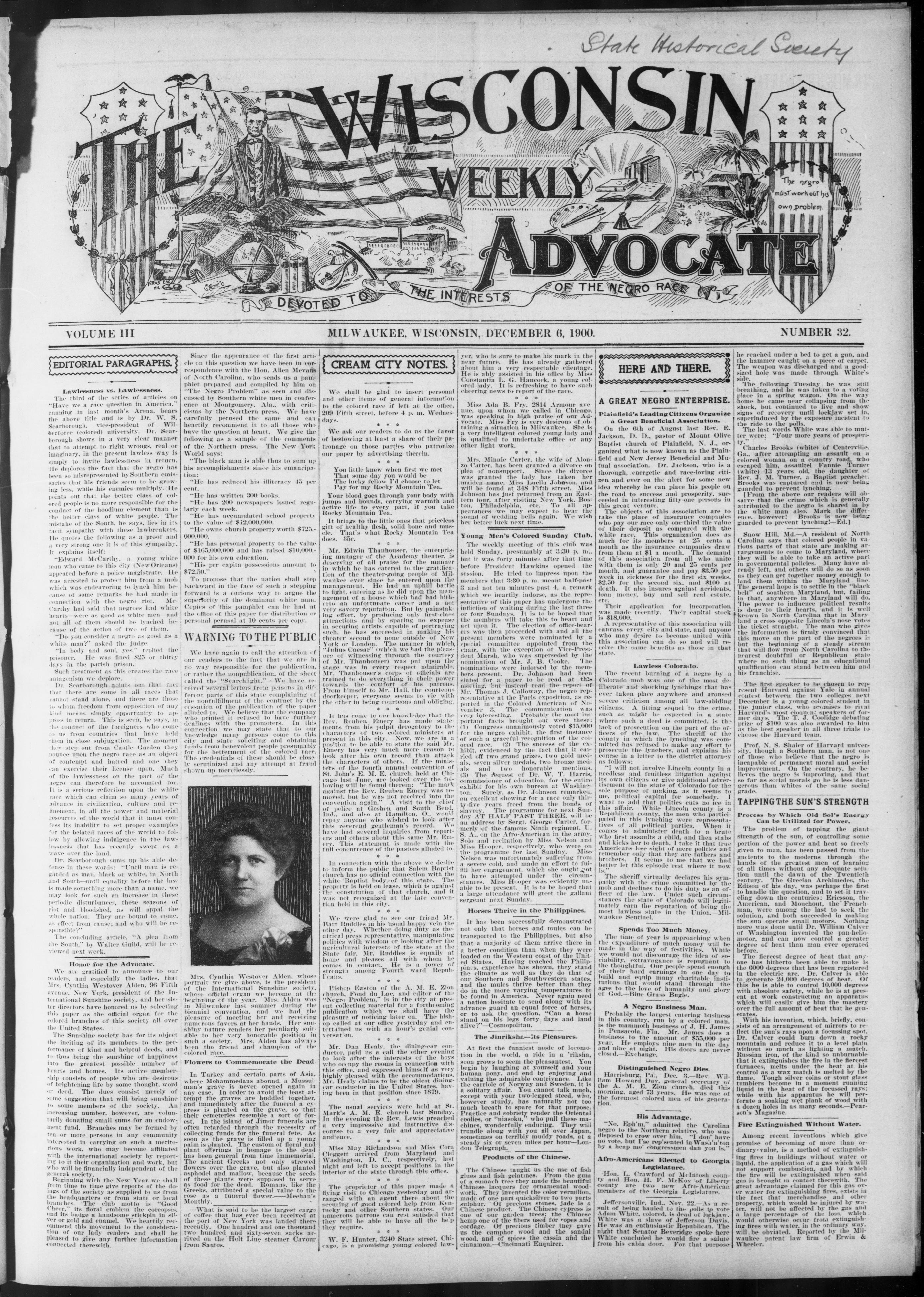
Wisconsin Weekly Advocate
Thursday, December 6, 1900
Milwaukee, Wisconsin
Page text (machine-generated)
State Historical Society
WISCONSIN
WEEKLY
ADVOCATE
DEVOTED TO THE INTERESTS OF THE NEGRO RACE
EDITORIAL PARAGRAPHS.
Lawlessness vs. Lawlessness.
Lawlessness vs. Lawlessness. The third of the series of articles on "Have we a race question in America," running in last month's Arena, bears the above title and is by Dr. W. S. Scarborough, vice-president of Wilberforce (colored) university. Dr. Scarborough shows in a very clear manner that to attempt to right wrongs, real or imaginary, in the present lawless way is simply to invite lawlessness in return. He deplores the fact that the negro has been so misrepresented by Southern emissaries that his friends seem to be growing less, while his enemies multiply. He points out that the better class of colored people is no more responsible for the conduct of the hoodlum element than is the better class of white people. The mistake of the South, he says, lies in its tacit sympathy with these lawbreakers. He quotes the following as a proof and a very strong one it is of this sympathy. It explains itself:
"Edward McCarthy, a young white man who came to this city (New Orleans) appeared before a police magistrate. He was arrested to protect him from a mob which was endeavoring to lynch him because of some remarks he had made in connection with the negro riot. McCarthy had said that negroes had white hearts—were as good as white men—and not all of them should be lynched because of the action of two of them.
"Do you consider a negro as good as a white man?" asked the judge.
"In body and soul, yes," replied the prisoner. He was fined $25 or thirty days in the parish prison.
Such treatment as this creates the race antagonism we deplore.
Dr. Scarborough points out that fact that there are some in all races that cannot stand alone, and there are those to whom freedom from opposition of any kind means simply opportunity to appress in return. This is seen, he says, in the conduct of the foreigners who come to us from countries that have held them in close subjugation. The moment they step out from Castle Garden they pounce upon the negro race as an object of contempt and hatred and one they can exercise their license upon. Much of the lawlessness on the part of the negro can therefore be accounted for. It is a serious reflection upon the white race which can claim so many years of advance in civilization, culture and refinement, in all the power and material resources of the world that it must confess its inability to set proper examples for the belated races of the world to follow by allowing indulgence in the lawlessness that has recently swept as a wave over the land.
Dr. Scarborough sums up his able defense in these words: "Until man is regarded as man, black or white, in North and South—until equality before the law is made something more than a name, we may look for such an increase in these periodic disturbances, these seasons of riot and bloodshed, as will appal the whole nation. They are bound to come, as effect from cause; and who will be responsible?"
The concluding article, "A plea from the South," by Walter Guild, will be reviewed next week.
Honor for the Advocate.
We are gratified to announce to our readers, and especially the ladies, that Mrs. Cynthia Westover Alden, 96 Fifth avenue, New York, president of the International Sunshine society, and her sister directors have honored us by selecting this paper as the official organ for the colored branches of this society all over the United States.
The Sunshine society has for its object the inciting of its members to the performance of kind and helpful deeds, and to thus bring the sunshine of happiness into the greatest possible number of hearts and homes. Its active membership consists of people who are desirous of brightening life by some thought, word or deed. The dues consist merely of some suggestion that will bring sunshine to some members of the society. An increasing number, however, are voluntarily donating small sums for an endowment fund. Branches may be formed by ten or more persons in any community interested in carrying on such a meritorious work, who may become affiliated with the international society by reporting to it their organization and work, but who will be financially independent of the general society.
Beginning with the New Year we shall from time to time give reports of the doings of the society as supplied to us from the headquarters or from state or local branches. The club motto is "Good Cheer," its floral emblem the coreopsis, and its badge a handsome stickpin in silver or gold and enamel. We heartily recommend this movement to the consideration of our lady readers and shall be pleased to give any further information connected therewith.
Since the appearance of the first article on this question we have been in correspondence with the Hon. Allen Mevans of North Carolina, who sends us a pamphlet prepared and compiled by him on "The Negro Problem" as seen and discussed by Southern white men in conference at Montgomery. Ala., with criticisms by the Northern press. We have carefully perused the same and can heartily recommend it to all those who have the question at heart. We give the following as a sample of the comments of the Northern press. The New York World says: "The black man is able thus to sum up his accomplishments since his emancipation:
"He has reduced his illiteracy 45 per cent.
"He has written 300 books.
"He has 200 newspapers issued regularly each week.
"He has accumulated school property to the value of $12,000,000.
"He owns church property worth $725,-000,000.
"He has personal property to the value of $165,000,000 and has raised $10,000,-000 for his own education.
"His per capita possessions amount to $72.50."
To propose that the nation shall step backward in the face of such a stepping forward is a curious way to argue the superiority of the dominant white man. Copies of this pamphlet can be had at the office of this paper for distribution or personal perusal at 10 cents per copy.
WARNING TO THE PUBLIC
We have again to call the attention of our readers to the fact that we are in no way responsible for the publication, or rather the nonpublication, of the sheet called the "Searchlight." We have received several letters from persons in different parts of this state complaining of the nonfulfillment of the contract by the cessation of the publication of the paper alluded to. We believe that the company who printed it refused to have further dealings with the promoters. In this connection we may state that to our knowledge many persons come to this city and state soliciting and obtaining funds from benevolent people presumably for the betterment of the colored race. The credentials of these should be closely scrutinized and any attempt at fraud shown up mercilessly.
Mary E.
Mrs. Cynthia Westover Alden, whose portrait we give above, is the president of the International Sunshine society, whose official organ we become at the beginning of the year. Mrs. Alden was in Milwaukee last summer during the biennial convention, and we had the pleasure of meeting her and receiving numerous favors at her hands. Her sunshiny nature renders her peculiarly suitable to her very honorable position in such a society. Mrs. Alden has always been the friend and champion of the colored race.
Flowers to Commemorate the Dead
In Turkey and certain parts of Asia, where Mohammedans abound, a Mussulman's grave is never opened again in any case. In order to avoid the least attempt the graves are huddled together, and immediately after the funeral a cypress is planted on the grave, so that their cemeteries resemble a sort of forest. In the island of Jimor funerals are often retarded through the necessity of collecting funds for the funeral fete. As soon as the grave is filled up a young palm is planted. The custom of floral and plant offerings in homage to the dead has been general from time immemorial. The ancient Greeks not only strewed flowers over the grave, but also planted asphodel and mallow, because the seeds of these plants were supposed to serve as food for the dead. Romans, like the Greeks, attributed a special value to the rose as a funeral flower.—Meehan's Monthly.
What is said to be the largest cargo of coffee that has ever been received at the port of New York was landed there recently. One hundred and one thousand two hundred and sixty-seven sacks arrived on the Holt Line steamer Cavour from Santos.
CREAM CITY NOTES.
We shall be glad to insert personal and other items of general information to the colored race if left at the office. 209 Fifth street, before 4 p. m. Wednesdays.
* * *
We ask our readers to do us the favor of bestowing at least a share of their patronage on those parties who patronize our paper by advertising therein.
* * *
You little knew when first we met That some day you would be The lucky fellow I'd choose to let Pay for my Rocky Mountain Tea. Your blood goes through your body with jumps and bounds, carrying warmth and active life to every part, if you take Rocky Mountain Tea. It brings to the little ones that priceless gift of healthy flesh, solid bone and muscle. That's what Rocky Mountain Tea does. 35c.
* * *
Mr. Edwin Thanhouser, the enterprising manager of the Academy theater, is deserving of all praise for the manner in which he has catered to the gratification of the theater-going people of Milwaukee ever since he entered upon the management. He had an uphill battle to fight, entering as he did upon the management of a house which had had hitherto an unfortunate career and a not very savory reputation. But by painstaking effort, by producing only first-class attractions and by sparing no expense in securing artists capable of portraying such, he has succeeded in making his theater second to none outside of New York or London. The manner in which "Julius Caesar" (which we had the pleasure of witnessing through the courtesy of Mr. Thanhouser) was put upon the stage was in every respect admirable. Mr. Thanhouser's corps of officials are trained to do everything in their power towards the comfort of his parrons. From himself to Mr. Hall, the courteous doorkeeper, everyone seems to vie with the other in being courteous and obliging.
串 芯 承
It has come to our knowledge that the Rev. Reuben Emery has made statements from his pulpit derogatory to the characters of two colored ministers at present in this city. Now, we are in a position to be able to state the said Mr. Emery has very much more reason to look after his own record than attack the characters of others. If the ministers of the fourth annual convention of St. John's E. M. E. church, held at Chicago last June, are looked over the following will be found therein: "The mark against the Rev. Reuben Emery was removed, but he was not received into the convention again." A visit to the chief of police at Goshen and South Bend, Ind., and also at Hamilton, O., would repay anyone who wished to look after this reverend gentleman's record. We have had several inquiries from reporters and others about this same Mr. Emery. This statement is made with the full concurrence of the pastors alluded to.
```markdown
```
In connection with the above we desire to inform the public that Salem Baptist church has no official connection with the white Baptist body of this state. The property is held on lease, which is against the constitution of that church, and it was not recognized at the late convention held in this city.
* * *
We were glad to see our friend Mr. Bart Ruddles in his usual happy vein the other day. Whether doing duty as the atrical press representative, manipulating politics with wisdom or looking after the agricultural interests of the state at the State fair, Mr. Ruddles is equally at home and pleases all with whom he comes in contact. He is a tower of strength among Fourth ward Repub- Ieans.
☆ ☆ ☆
Pishop Easton of the A. M. E. Zion church, Fond du Lac, and editor of the "Negro Problem," is in the city at present collecting material for a forthcoming publication which we shall have the pleasure of noticing later on. The bishop called at our office yesterday and entertained us with an hour's genial conversation.
* * *
Mr. Dan Healy, the dining-car conductor, paid us a call the other evening to look after the interests of the boys who occupy the rooms in connection with this office, and expressed himself as very highly pleased with the accommodations. Mr. Healy claims to be the oldest dining-car conductor in the United States, having been in that position since 1879.
---
The usual services were held at St. Mark's A. M. E. church last Sunday. In the evening the Rev. Lewis preached a very impressive and instructive discourse to a very fair and appreciative audience.
* * *
Miss May Richardson and Miss Cora Cleggett arrived from Maryland and Washington, D. C., respectively, last night and left to accept positions in the interior of the state through this office.
```markdown
```
The proprietor of this paper made a flying visit to Chicago yesterday and arranged with an agent there about the securing of good colored help from Kentucky and other Southern states. Our numerous patrons can rest satisfied that they will be able to have all the help they require.
W. F. Hunter, 3240 State street, Chicago, is a promising young colored law-
yer, who is sure to make his mark in the near future. He has already gathered about him a very respectable clientage. He is ably assisted in his office by Miss Constantin L. G. Hancock, a young colored lady. It is refreshing to have such cheering news to report of the race.
* * *
Miss Ada B. Fry, 2814 Armour avenue, upon whom we called in Chicago, was speaking in high praise of our Advocate. Miss Fry is very desirous of obtaining a situation in Milwaukee. She is a very intelligent colored young lady and is qualified to undertake office or any other light work.
---
Mrs. Minnie Carter, the wife of Alonzo Carter, has been granted a divorce on plea of nonsupport. Since the divorce was granted the lady has taken her maiden name. Miss Luella Johnson, and will be found at 348 Fifth street. Miss Johnson has just returned from an Eastern tour, after visiting New York, Boston, Philadelphia, etc. To all appearances we may expect to hear the sound of wedding bells again. We wish her better luck next time.
Young Men's Colored Sunday Club.
Young Men's Colored Sunday Club.
The weekly meeting of this club was held Sunday, presumably at 3:30 p. m., but it was forty minutes after that time before President Hawkins opened the session. He tried to impress upon the members that 3:30 p. m. meant half-past 3 and not ten minutes past 4, a remark which we heartily indorse, as the representative of this paper has undergone the infliction of waiting during the last three or four Sundays. It is to be hoped that the members will take this to heart and act upon it. The election of office-bearers was then proceeded with and all the present members were nominated by a special committee appointed from the chair, with the exception of Vice-President Marsh, who was superseded by the nomination of Mr. J. B. Cooke. The nominations were indorsed by the members present. Dr. Johnson had been slated for a paper to be read at this meeting, but instead read the report of Mr. Thomas J. Calloway, the negro representative at the Paris exposition, as reported in the Colored American of November 3. The communication was very interesting. Probably the most important facts brought out were these:
(1) Congress unanimously voted $15,000 for the negro exhibit, the first instance of such a graceful recognition of the colored race.
(2) The success of the exhibit, evidenced by the fact that it carried off two grand prizes, two gold medals, seven silver medals, two bronze medals and two honorable mentions.
(3) The request of Dr. W. T. Harris, commissioner of education, for the entire exhibit for his own bureau at Washington. Surely, as Dr. Johnson remarked, an excellent showing for a race only thirty-five years freed from the bonds of slavery. The programme for next Sunday AT HALF PAST THREE, will be an address by Sergt. George Carter, formerly of the famous Ninth regiment, U. S. A., on the Afro-American in the army. Solo and recitation by Miss Nelson and Miss Hooper, respectively, who were on the programme for last Sunday. Miss Nelsen was unfortunately suffering from a severe cold, and made an effort to fulfill her engagement, which she ought not to have attempted under the circumstances. Miss Hooper was evidently unable to be present. It is to be hoped that a large attendance will greet the gallant sergeant next Sunday.
Horses Thrive in the Philippines
It has been successfully demonstrated not only that horses and mules can be transported to the Philippines, but also that a majority of them arrive there in a better condition than when they were loaded on the Western coast of the United States. Having reached the Philippines, experience has shown, they stand the climate as well as they do that of our Southern and Southwestern states, and the mules thrive better than they do in the more varying temperatures to be found in America. Never again need a nation hesitate to send along with its advance guard an equal force of horses, or to ask the question, "Can a horse stand on his legs forty days and land alive?"—Cosmopolitan.
The Jinriksha-its Pleasures.
At first the funniest mode of locomotion in the world, a ride in a 'riksha, soon grows to seem the pleasantest. You begin by laughing at yourself and your human pony, and end by enjoying and valuing the admirable contrivance. Like the carriole of Norway and Sweden, it is a solitary affair. You cannot talk much, except with your two-legged steed, who, however sturdy, has naturally not too much breath to spare for that purpose. Practice and sobriety render the Oriental coolies, or "niasoku," who pull these machines, wonderfully enduring. They will trundle along with you all over Japan, sometimes on terrlbiy muddy roads, at a steady six or seven miles per hour—London Telegraph.
Products of the Chinese.
The Chinese taught us the use of fish glues and fish gelatines. From the gum of a sumach tree they made the beautiful Chinese lacquers for ornamental woodwork. They invented the color vermilion, made of one part quicksilver to two parts sulphur. Of precious stones, jade is a Chinese product. The Chinese cypress is one of our garden trees; the Chinese hemp one of the fibers used for ropes and cordage. Of precious timber they gave us the camphor wood and the sandal wood, and of spices the cassia and the cinnamon—Cincinnati Enquirer.
A GREAT NEGRO ENTERPRISE.
Plainfield's Leading Citizens Organize a Great Beneficial Association. On the 6th of August last Rev. E. Jackson, D. D., pastor of Mount Olive Baptist church of Plainfield, N. J., organized what is now known as the Plainfield and New Jersey Beneficial and Mutual association. Dr. Jackson, who is a thorough, energetic and race-loving citizen and ever on the alert for some new idea whereby he can place his people on the road to success and prosperity, succeeded in interesting fifty-one persons in this great venture.
The objects of this association are to take the place of insurance companies who pay our race only one-third the value of their deposit as compared with the white race. This organization does as much for its members at 25 cents a month as the insurance companies draw from them at $1 a month. The demand of this association from all who unite with them is only 20 and 25 cents per month, and guarantee and pay $3.50 per week in sickness for the first six weeks, $2.50 for the second six, and $100 at death. It also insures against accidents, loan money, buy and sell real estate, etc. Their application for incorporation was made recently. Their capital stock is $18,000.
A representative of this association will canvass every city and state, and anyone who may desire to become united with this association can do so and will receive the same benefits as those in that state.
Lawless Colorado.
The recent burning of a negro by a Colorado mob was one of the most deliberate and shocking lynchings that has ever taken place anywhere and aroused severe criticism among all law-abiding citizens. A fitting sequel to the crime, such as might be expected in a state where such a deed is committed, is the lack of prosecution on the part of the officers of the law. The sheriff of the county in which the lynching was committed has refused to make any effort to prosecute the lynchers, and explains his course in a letter to the district attorney as follows:
"I will not involve Lincoln county in a needless and fruitless litigation against its own citizens or give additional advertisement to the state of Colorado for the sole purpose of making, as it seems to me, political capital for somebody. I want to add that politics cuts no ice in this affair. While Lincoln county is a Republican county, the men who participated in this lynching were representatives of all political parties. When it comes to administer death to a brute who first assaults a child, and then stabs and kicks her to death, I take it that true Americans lose sight of mere politics and remember only that they are fathers and brothers. It seems to me that we had better let this episode rest where it now is."
The sheriff virtually declares his sympathy with the crime committed by the mob and declines to do his duty as an officer of the law. Under such circumstances the state of Colorado will legitimately earn the reputation of being the most lawless state in the Union.—Milwaukee Sentinel.
Spends Too Much Money
The time of year is approaching when the expenditure of much money will be made in the way of festivities. While we would not discourage the idea of sociability, extravagance is repugnant to the thoughtful. Our people spend enough of their hard earnings in one day to build and equip many charitable institutions that would stand through the ages to the love of humanity and glory of God.—Blue Grass Bugle.
A Negro Business Man
Probably the largest catering business in this country, run by a colored man, is the mammoth business of J. H. James in Pensacola, Fla. Mr. James does a business to the amount of $55,000 per year. He employs nine men in the day and nine at night. His doors are never closed.—Exchange.
Distinguished Negro Dies
Harrisburg, Pa., Dec. 3.—Rev. William Howard Day, general secretary of the A. M. E. Zion church, died this morning, aged 73 years. He was one of the foremost colored men of his generation.
His Advantage:
"No, Eph'm," admitted the Carolina negro to the Northern relative, who was disposed to crow over him. "I don' have no vote, but I se rep'sented in Wash'n'ton by a heap mo' congressmen dan you is."
Afro-Americans Elected to Georgia Legislature
Hon. L. Crawford of McIntosh county and Hon. H. F. McKoy of Liberty county are two new Afro-American members of the Georgia Legislature.
Jeffersonville, Ind., Nov. 22.—As a result of being hauled to the polls to vote Adam White, colored, is dead of lockjaw. White was a slave of Jefferson Davis. He was an enthusiastic Republican. The night that Senator Beveridge spoke here White concluded he would fire a salute from his cabin door. For that purpose
he reached under a bed to get a gun, and the hammer caught on a piece of carpet. The weapon was discharged and a good-sized hole was made through White's side.
The following Tuesday he was still breathing, and he was taken to a voting place in a spring wagon. On the way home he came near collapsing from the shock, but continued to live and show signs of recovery until lockjaw set in, superinduced by the exposure incident to the ride to the polls.
The last words White was able to mutter were: "Four more years of prosperity."
Charles Brooks (white) of Centerville, Ga., after attempting an assault on a colored woman on a country road, who escaped him, assaulted Fannie Turner (white) 13 years old, the daughter of Rev. J. M. Turner, a Baptist preacher. Brooks was captured and is now being guarded to prevent lynching. [From the above our readers will observe that the crime which is generally attributed to the negro is shared in by the white man also. Mark the difference, however! Brooks is now being guarded to prevent lynching!—Ed.]
Snow Hill, Md.—A resident of North Carolina says that colored people in various parts of that state are making arrangements to come to Maryland, where they will be able to take an active part in governmental policies. Many have already left, and others will do so as soon as they can get together money enough to land them within the Maryland line. The general hope is to settle in the "black belt" of southern Maryland, but, failing in that, anywhere in Maryland will do. The power to influence political results is dear to their hearts, and it is well known in North Carolina that in Maryland a cross opposite Lincoln's nose votes the ticket straight. The man who gives the information is firmly convinced that this move on the part of the negroes is but the beginning of a steady stream that will flow from North Carolina to the nearest doubtful or Republican state where no such thing as an educational qualification can stand between him and his franchise.
The first speaker to be chosen to represent Harvard against Yale in annual contest between the two colleges next December is a young colored student in the junior class, who promises to rival Harvard's most eloquent speakers of former days. The T. J. Coolidge debating prize of $100 was also awarded to him as the best speaker in all three trials to choose the Harvard team.
Prof. N. S. Shaler of Harvard university, though a Southern man, is not one of those who believe that the negro is incapable of permanent moral and social improvement. On the contrary, he believes the negro is improving, and that so far as social morals go he is less dangerous than whites of the same social grade.
TAPPING THE SUN'S STRENGTH
Process by Which Old Sol's Energy Can be Utilized for Power.
The problem of tapping the giant strength of the sun, of controlling some portion of the power and heat so freely given to man, has been passed from the ancients to the moderns through the hands of the greatest men of learning of all times without any adequate solution until the dawn of the Twentieth century. The Grecian Archimedes, the Edison of his day, was perhaps the first to handle the question, and to set it traveling down the centuries; Ericsson, the American, and Mouchout, the Frenchman, were among the last to seek the solution, and both succeeded in making the sun operate small motors. Nothing more was done until Dr. William Calver of Washington invented the pan-heliomotor, and can now control a greater degree of heat than man ever operated before.
The fiercest degree of heat that anyone has hitherto been able to make is the 6000 degrees that has been registered in the electric arc. Dr. Calver is able to generate 24,000 degrees of heat. Of this he is able to control 10,000 degrees with absolute safety, while he is at present at work constructing an apparatus which will easily give him the mastery over the full amount of heat that he generates.
With his invention, which, briefly, consists of an arrangement of mirrors to reflect the sun's rays upon a focussing spot. Dr. Calver could burn down a rocky mountain and reduce it to a level plain without so much as lighting a match. Russian iron, of the kind so unburnable that it extinguishes the fire in the fiercest furnaces, melts under the heat at his control as a wax match is melted by the flame. Tough silver coins or stout glass tumblers become in a moment running liquid in the heat of the focussed rays; while with his apparatus he will perforate a soaking wet plank of wood with a dozen holes in as many seconds.—Pearson's Magazine.
Fire Extinguished Without Water.
Among recent inventions which give promise of becoming of more than ordinary value, is a method of extinguishing fires in buildings without water or liquid, the application of a gas which will not support combustion, and by which the fire will be extinguished when said gas is brought in contact therewith. The great advantage claimed for this gas over water for extinguishing fires, exists in the fact that merchandise and other property, which would be injured by water, will not be affected by the gas and a large percentage of the loss, which would otherwise occur from extinguishing fires with water, in the ordinary way, will be obviated. Reported by the Milwaukee patent law firm of Erwin & Wheeler.
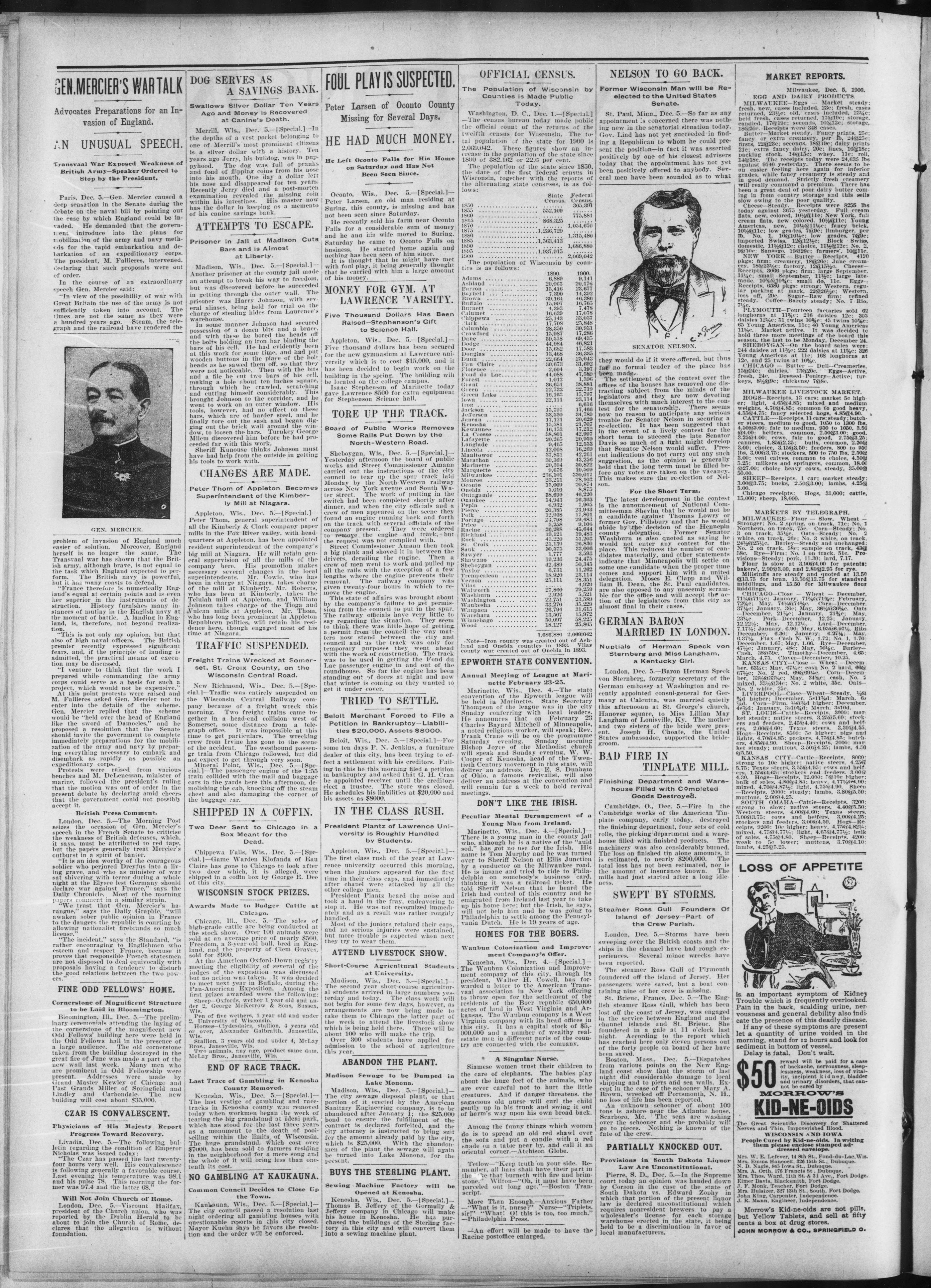
SEN.MERCIER'S WAR TALK
Advocates Preparations for an In-
vasion of England.
iN UNUSUAL SPEECH.
‘Transvaal War cca wee of
British Army—Speaker Ordered to
Stop by the President,
Paris, Dee. 5.—Gen. Mercier caused a
deep sensation in the Senate during the
cebate on the naval bill by pointing out
the ease by which England could be in-
vaded. He demanded that the govern-
tent introduce into the plans for
r:obilization of the army and navy meth-
«ds for the rapid embarkation and de-
Larkation of an expeditionary corps.
‘The president, M. Fallieres, intervened,
ceelaring that such proposals were out
ef order.
In the course of an extraordinary
speech Gen. Mercier said:
“In view of the possibility of war with
Great Britain the use of the army is not
sufficiently taken into account. The
limes are not the same as they were
# hundred years ago. Steam, the tele-
graph and the railroad have rendered the
Sak
cate. |
.
Pa o
GEN. MERCIER.
problem of invasion of England much
easier of solution. Moreover, England
herself is no longer the same. The
Transvaal war has shown that the Brit-
ish army, although brave, is not equal to
the task which England expected to per-
form. ‘The British navy is powerful,
but it has many coasts to defend.
“France therefore is numerically Eng-
jand's equal at certain points and is even
her superior in the instruments of de-
struction. History furnishes many in-
stances of mutiny in the English navy at
the moment of battle. A landing in Eng-
land, is, therefore, not beyond realiza-
tion.
“This is not only my opinion, but that
also of high naval officers. The British
premier recently expressed significant
fears, and, if the principle of landing is
admitted, the practical means of execu-
tion may be discussed.
“I venture to think that the work I
prepared while commanding the army
corps could serve as a basis for such a
project, which would not be expensive.”
At this point protests were raised and
M. Falilieres asked Gen. Mercier not to
enter into the details of the scheme.
Gen. Mercier replied that the scheme
would be “held over the head of England
like the sword of Damocles,” and he
proposed a resolution that the Senate
should invite the government to complete
immediately preparations for the mobili-
zation of the army and navy by prepar-
ing everything necessary to embark and
disembark as rapidly as possible an
expeditionary corps.
Protests were raised from _ yarious
benches and M. DeLenessan, minister of
marine, followed the president's ruling
that the motion was out of order in the
present debate by declaring amid cheers
that the government conld not possibly
aceept it.
British Press Comment.
London, Dec. 5.—The Morning Tost
seizes the occasion of Gen. Mervcier’s
speech in the French Senate to criticise
the weakness of British defenses, which,
it says, must be attributed to red tape,
but the papers generally treat Mercier’s
outburst in a spirit of banter.
“Tt is an idea worthy of the courageous
soldier who perjured Dreyfus into a liy-
ing grave, and who as minister of war
sat shivering with terror during a whole
night at the Elysee lest Germany should
declare war against France,” says the
Daily Chronicle. Most of the morning
papers comment in a similar strain,
“We trust that Gen. Mercier’s ha-
rangue,” says the Daily Graphic, “will
awaken sober public opinion in France
to the dangers the republic is caurting by
allowing nationalist firebrands so much
license.” € .
“The incident,” says the Standard, “is
rather encouraging to Englishmen who
esteem and respect France, because it
proves that responsible French statesmen
are not disposed to deal equivocally with
proposals having a tendency to disturb
the good relations between the two pow-
aie}
FINE ODD FELLOWS’ HOME.
Cornerstone of Magnificent Structure
to be Laid in Bloomington.
Bloomington, Hl., Dec. 5.—The prelim-
inary ceremonials attending the laying of
the cornerstone of the magnificent new
Odd Fellows’ building here were held in
the Odd Fellows hall in the presence of
a large audience. The old cornerstone
taken from the building destroyed in the
great fire of June was made a part of the
new wall last week. Many men who
are prominent in Odd Fellowship were
present. Addresses were made by
Grand _Master_Kewley of Chicago and
Tast Grands Miller of Springfield and
Lindley and Carbondale. The new
building will cast about £35,000.
CZAR IS CONVALESCENT.
Physicians of His Majesty Report
Progress Toward Recovery.
Livadia, Dec. 5.—The following bul-
letin regarding the condition of Emperor
Nicholas was issued today:
“The Czar has passed the last twenty-
four hours very well. His convalescence
is following generally a favorable course.
Last evening his temperature was 98.1
and his pulse 78. This morning the for-
mer was 97.4 and the latter 68."
Wil Not Join Church of Rome.
London, Dec. 5.—Viscount Haiifax,
president of the Church union, whe was
reported by the Dublin Herald tog be
about to join the Church of Rome. de-
clares that the allegation is without
foundation.
TING ca
A SAVINGS BANK.
Swallows Silver Dollar Ten Years
Ago and Money is Recovered
at Canine’s Death.
Merrill, Wis. Dec. 5.—{Special.]—In
the depths of a vest pocket belonging to
one of Merrill’s' most prominent citizens
is a silver dollar with a history. Ten
years ago Jerry, his bulldog, was in pap-
pyhood. The dog was full of pranks
and fond of flipping coins from his nose
into his mouth, One day a dollar lett
his nose and disappeared for ten years.
Recently Jerry died and a yost-morten
examination revealed the missing coin
within his intestines. His master now
has the dollar in keeping as a memento
of his canine savings bank.
ATTEMPTS TO ESCAPE.
—_+_—_
Prisoner in Jail at Madison Cuts
Bars and is Almost
at Liberty.
Madison, Wis., Dee. 5.—[Spectal.|—
Another prisoner at the county jail made
an attempt to break his way to freedom,
but was diseovered before he succeeded
in getting through the outer wall. The
prisoner was Harry Johnson, with sev-
eral aliases, being held for trial oa the
charge of stealing hides from Laurence’s
warehouse.
In some manner Johnson had secured
possession of 2 dozen bits and a brace,
and with these he bored the heads off
the bolts ho'ding an iron bar binding the
bars of his cell. He had evidently been
at this work for some time, and nad put
wooden buttons in the place of the bolt
heads as ke sawed them off, so that they
were not noticeable. Then with the bits
and a file he cnt two bars of his cell,
making a hole about ten inches square,
through which he crawled, scratching
and cutting himself considerably. This
brought Johnson to the corridor, and he
went to work on an outer window. [is
tools, however, had no effect on these
bars, which are of harder steel, and he
finally tore out the sash and began dig-
ging out the brick wall around the win-
dow, to loosen the bars. Turnkey George
Milem discovered him before he had pro-
ceeded far with this work.
Sheriff Kanouse thinks Johnson must
have had help from the outside in getting
his tools te work with.
CHANGES ARE MADE.
Peter Thom of Appleton Becomes
Superintendent of the Kimber-
ly Mill at Niagara.
Appleton, Wis., Dee. 5.—[Special.]—
Peter Thom, general superintendent of
all the Kimberly & Clark company paper
mills in the Fox River vailey, with head-
quarters at Appleton, has been appointed
resident superintendent of the company’s
big mill at Niagara. He will retain gen-
eral supervision of all the mills of the
company here. His promotion makes
necessary several changes in the local
superintendents. Mr. Cowie. who has
been in charge at Niagara, takes charge
of the mill at Kimberly, Mr. Roberts,
who bas been at Kimberly, takes the
Telulah mill at Appleton, and| William
Johnson takes charge of the ‘Tioga and
Vulean mills at Appleton. Mr. Thom,
who has long been prominent in Appleton
Republican politics, will retain his resi-
dence here, though engaged most of his
time at Niagara.
rT ath —
TRAFFIC SUSPENDED.
Freight Trains Wrecked at Somer-
set, St. Croix County, on the
Wisconsin Central Road.
New Richmond, Wis., Dee. 5.—[Spe-
cial.|—Traffic was entirely suspended on
the Wisconsin Central Railway com-
pany because of a_ freight wreck this
morning. ‘Two freight trains came to-
gether in a-head-end collision west of
Somerset, some distance from a_ tele-
graph office. It was impossible at this
time to get particulars. The wrecking
crew from Irvine has gone to the scene
of the accident. The westbound passen-
gr train from Chicago followed, but did
not expect to get through very soon.
Mineral Point, Wis., Dec. 5.—{Spe-
cial.]—The passenger engine of the 1:55
train collided with the mail and baggage
cars in the yards here this afternoon, de-
molishing the cab, knocking off the steam
chest and alsc damaging the corner of
the baggage car.
a
SHIPPED IN A COFFIN.
Beret ae ee
Two Deer Sent to Chicago in a
Box Meant for the
Dead.
Chippewa Falls, Wis... Dec. 5.—[Spe-
cial.]—Game Warden Klofanda of Eau
Claire has gone to Chicago to look after
two deer which, it is’ alleged, were
shipped in a coffin’ box by George BE, Dee
of this city.
WISCONSIN STOCK PRIZES.
Awards Made to Badger Cattle at
Chicago.
Chicago, Ill, Dec. 5.—The sales of
high-grade cattle are being conducted at
the stock show. Over 100 animals were
sold at an average free of nearly $500.
Freedom, a 83-year-old ball, bred in Eng-
land, and the property of Clem Graves,
sold ‘for $900.
At the American Oxford-Down regis*ry
meeting the eligibility of several of the
judges of the exposition was discussed
but no action was taken. It was decided
to meet next year in Buffalo, during the
Pan-American Exposition. Among the
first prizes awarded were the following:
Sheep—Oxfords. wether 1 year old and un-
der 2, George McKerrow & Sons, Sussex,
Wis.
Pen of five wethers, 1 year old and under
2. University of Wisconsin,
Horses—Clydesdaies, stallion, 4 years old
ox, over, Alexander Galbraith, Janesviile,
Wis.
Stallion, 3 years old and under 4, McLay
Bros., Janesville, Wis.
‘Tero anlinals. any age, product same dain,
MecLay Bros., Janesville, Wis.
END OF RACE TRACK.
Last Trace of Gambling in Kenosha
County Removed.
Kenesha, Wis. Dee. 5.—{Special.]—
‘The last vestige of gambling and race-
tracks in Kenosha county was removed
today when workmen began the werk of
tearing the big grandstand at Ideai park,
which has stood for the last three years
as a monument to the death of pooi-
selling within the limits, of Wisconsin.
The huge grandstatid. which cost over
$7000, has been sold to farmers residing
in the neighborhood for a mere song and
the whole of it will bring less than one~
tenth its cost.
NO GAMBLING AT KAUKAUNA.
Common Council Decides to Close Up
the Town.
Kaubauna. Wis., Dee. 5.—[Special.J—
The city council passed a resolution last
night ordering all gambling houses with
questionable crores in this city closed.
Mayor Kuehn says he favors the resolu-
tien and the order will be enforced.
FOUL PLAY IS SUSPECTED.
Peter Larsen of Oconto County
Missing for Several Days.
HE HAD MUCH MONEY.
Oconto, Wis., Dee. 5.—[Special.]—
Peter Larsen, an old man residing at
Suring, this county, is missing and has
not been seen since Saturday.
He recently sold his farm near Oconto
Falls for a considerable sum of money,
and he ana iis wife moved to Suring.
Saturday he came to Oconto Falls on
business. He started home again and
nothing has been seen of him since.
It is thought that he might have met
with foul play, it being generally thought
that he carried with him a large amount
of his money.
MONEY FOR GYM. AT
y 7 2 >
LAWRENCE ‘VARSITY.
eee
Five Thousand Dollars Has Been
Raised—Stephenson’s Gift
to Science Hall.
Appleton, Wis., Dee. 5.—[Special.]—
Five thousand dollars has been secured
for the new gymnasium at Lawrence uni-
yersity which is to cost $15,000, and it
has been decided to begin work on the
building in the spring. The building will
be located on the college campus.
Isaac Stephenson of Marinette today
gave Lawrence $500 for extra equipment
for Stephenson Science hall.
TORE UP THRE TRACK.
ee eae ee
Board of Public Works Removes
Some Rails Put Down by the
North-Western Road.
Sheboygan, Wis., Dec. 5.—[ Special.]—
Yesterday afternoon the board of public
works and Street Commissioner Amann
carried out the instructions of the city
council to tear up the spur track laid
Monday by the North-Western railway
across New York avenue and South Wa-
ter street. ‘The work of putting in the
switch had been completed shortly after
dinner, and when the city officials and a
crew of men appeared on the scene they
found an engine running back and forth
on the track with several officials of the
company present. They were ordered
to remoye. the engine and track,>but
the request was not complied with.
Street Commissioner Amann then took
a big plank and shoved it in between the
drivers, derailing the engine. Then a
erew of men went to work and pulled up
all the rails with the exception of a few
lengths where the engine prevents their
removal. The railway company was
given twenty-four hours in which to re-
move the engine.
‘This state of affairs was brought about
by the company’s failure to get perimis-
sion from the conneil to put in the spur.
The railway officials haye very little to
say regarding the situation. They seem
to think there was little hope of getting
a permit from the council the way mat-
ters now stand between the city and
council and as the track was only for
temporary purposes they went ahead
with the work of construction. The track
was to be used in getting the Fond du
Lae pees engine in and out ef the
roundhouse. So far the engine has been
standing out of doors at night and now
that winter is coming on they wanted to
get it under cover.
TRIED TO SETTLE.
————-—__—_
Beloit Merchant Forced to File a
Petition in Bankruptcy— Liabili-
ties $20,000, Assets $8000.
Beloit, Wis.. Dee. 5.—[Special.]—-For
some ten days P. N. Jenkins, a furniture
dealer of this city, has been trying to ef-
fect a settlement with his creditors. Fail-
ing in this he this morning filed a petition
in bankruptcy and asked that G. H. Cran
be appointed receiver until the creditors
elect a trustee, The store was closed,
He schedules his liabilities at $20,000 and
his assets as $8000,
IN THE CLASS RUSH.
te ae dase
President Plantz of Lawrence Uni-~
versity is Roughly Handled
by Students.
Appleton, Wis., Dee. 5.—[Special.]—-
The first class rush of the year at Law-
rence university occurred this morning,
when the juniors appeared for the first
time in their class caps, and immediately
after chapel were attacked by all the
other college men,
President Plantz heard the noise and
took a hand in the fray, endeavoring to
P it. He was not recognized immedi-
ately and as a result was rather: rougily
handled. are
Most of the juniors retained their caps,
and no serious injuries were sustained,
but more trouble is expected when next
they try to wear them.
ATTEND LIVESTOCK SHOW.
Short-Course Agricultural Students
at University.
Madison, Wis., Dee. 5.—[Special.J—
The second year short-course agricultur-
al students arrived in large numbers yes-
terday and today. The class work will
not begin for some few days, however, as
arrangements are now being made to
take them to Chicago the latter part of
the week to attend the livestock show
which is being held there. There will be
about 100 who will make the trip.
Over 300 students have applied for
admission to the school of agriculture
this year.
ABANDON THE PLANT.
Madison Sewage to be Dumped in
Lake Monona.
Madison, Wis., Dec. 5.—[Special.]—
The city sewage disposal plant, or that
portion of it erected by the American
Sanitary Engineering company, is to be
abandoned after January 1; the $25,000
bond to ensure the fulfillment of the
contract is declared forfeited, and the
city attorney is instructed to bring suit
fer the amount already paid by the city,
which is $25,000. With the abandon-
men of the plant the sewage will again
be turned into Lake Monona, for the
een
BUYS THE STERLING PLANT.
Sewing Machine Factory will be
Opened at Kenosha.
Kenosha, Wis., Dec. 5.—[Special.]—
Thomas B. Jeffery of the Gormully &
Jeffery company in creas. will make
his home in Kenosha. ie has pur-
chased the buildings of the Sterling fac-
tory in this city and will convert them
into a sewing machine plant.
a 7, r .
OFFICIAL CENSUS.
lige
The Population of Wisconsin by
5; Counties is Made Public
é Today.
Washington, D. C., Dee. 1.—[Special.]
—The census bureau today made pabiie
the official count of the returns of the
twelfth census for Wisconsin. The to-
tal population <f the state for 1900 is
2,069,042. These figures show an_in-
crease in the population of the state since
1890 of 382.162 or 22.6 pet cent.
‘The population of the state since 1850,
the date of the first federal census in
Wisconsin, together with the reports of
the alternating state censrses, is as fol-
lows:
State Federal
Census. ‘Census,
SOOO Gar aos curred Ste aia 775,881
VED Ts i soews span n ety o 0 SOOBOOs) ce breaes
ABIDE Sein cy ne escnnsese Sievers OPO
ABIRN osywntnirew sn +67 <2) ROS cece
SBD ccicsne'sssenecaecea, sosteus cds SiS 00
IBRD veces ce seseceees sD DOQAIS) sss nse
WB00 cee eeecesecneceeses. sarees, 1,686,880
WS were eee eee eee eee ee LOST OLS oe ee es
DOO 5 5 ER ro a vodin connie ces cscs em CORE
_ he population of Wiscansin by coun-
ties is as follows:
1890. 1900,
AORING Sis os owe aeons 6,859 9141
Ashland 22.00... 5.2... 20,003 20,176
Marton ciey. 5. oiceeee AA PBST
Bayh 5.3 ecko. c es ED pe eee
Brown oes... . eee e se. BOIL 48,386
BuMalo oes ois eeecess es 1SOOT 5 IONE
Burnett ~...6..sesecsesss 4,808 Tags
Calumet eee 16,639 17,078
Chippewa .....02 2.002.) 25.148 88,0387
WALK eee ceceeeceeeseees 17,708 25,848
Columbia... ec... sees es. 28,850 30,931
Crawford 0.66.02. 0cs25 66 35, 86T 17,286
Dane <.-.--0--5.eseneer+ , 50,578 | 6B,435
Dodge --2........0c200++ | 44,984 46,820
DOOK ses ceceeseseseeeveee 15,682 17.583
Dougas oe. eee 13,468 3H, BHS
Duns 5220.) - 540 s4b ds 0) SNOOA. 7 AOS
Feu Claire ..........2., 30.678 31,692
PlOvente <0. se. pe es Oe 3.197
Bond du Lac... .....2... 440088 47,580)
WOLGHE coi aio ecnesacueaes SEAR 1,206
GYAN cee cece eee eee. 86,051 38,881
Green soc. sceece seuss 22782") SED
Green Lake ........065. 16.163 15,797
LWA 0255 fececsstncese (Sead, | (RRS
YOR se seceiy sec eees eee sc eetes 6,616
dackson oi... ellis. 1ST «17,468
Jefferson 2.0022 2c2l 2222 88,580 84,780
dunean .....0....5..-25;- 17,121 20,629
Kenosha ....0. 0 ...eee. © 15,581 21,707
Kewaunee .......2..2... 16,153 17,212
La Crosse 0.2... 2..2.25.. 88,801 42.907
Lafayette .........-..+. 20.265 20,959
Langlade ............... 0463 12,558
Lincola ............2.006 12,008 16,200
Manitowoe ............. 87,881 42,261
Marathon ............... 30,389 43,256
Marinette “0206.022.22.2. 20,804 30,822
Marquette V.e....ee. sce. 9,676 10,509
Milwaukee 2200000.0.025. 286,101 330,017
Monroe .22..0-.-.5-s0-0+ 2211 28/103
Oconto .....ececeeeeeees 15,009 20,874
OCR tac 5565s cvs chains 5 8,875,
Outagamie 22.22.2222... 88,690 46,220
Ozaukee .....0..cccceeee 148 16.363
People 9200-5 ¢6-s0sbe 5-44, ORS 7,905
Pierce vee ceeeecceeee ees 20,885 23,948
Rolls Gaeta cen ceets ee cate! SACO Riga
Portage o0.0.5.00.5.552. 28788 > BBR
Bree viva vos oeugye soak Se 9.106
Racine ee iecseeeeess BB R6S 45,644
Richland. 0.2.00... 0.22. - 19,521 19,483
ROCK. dove corsesccsese cree 1 SRCes-, alae,
St. Croix ve... cl... .. 28189 26,830
Bank ...ccccecceeeeesee 80,575 33,006
BAW v-covecscccecesss ohaer. 3,503
Shawano .......eeeeeeee 19,286 24,475
Sheboygan ............6. 42,489 50,345
WPOPIOL | cs velseessccansves /AaRE RE Oe
Trempealenu ........2... 18920 28,114
Vernon .......ccceceeees 25,111 28,351
MYNGN ts aavateces assaeseee lakes 4,920
Walworth o.2 0.022. ... 27,860 29,250
Washburn oo. elise cee ee. 2926 5,521
Washington vs.s2 0s... 22 gL 23,580
Waukesha ............-. B&.270 35,220
Waupaca .200000 IIIT 26794 81,615
Waushara . 2 ..li....... 1807 15,972
Winnebago “222222222222. 50,097 58,225
WV OOE sec cann tons cnst gee: ae) eee
1,686,880 2,089,042
-Note—Iron county was created out of Ash-
land and Oneida ‘counties in 1893. Vilas
county war created out of Oneida in 1893.
EPWORTH STATE CONVENTION.
Annual Meeting of League at Mari-
nette February 23-25.
Marinette, Wis., Dee. 4.—The state
convention of the Epworth league will
be held iu Marinetie. State Secretary
‘Thompson of the league was in the city
Sunday conferring with local leaders.
He announces that on February 23
Charles Bayard Mitchell of Minneapolis,
a noted religious worker, will speak; Rev.
Frank Crane will be on the programme
Saturday evening. Sunday morning
Bishop Joyce of the Methodist church
will speak and Sunday evening, W. W.
Cooper of Kenosha, head of the Twen-
tieth Century movement in this state, will
deliver an address. Dr. EB, S. Dunham
of Ohio, a famous revivalist, will also
deliver an address at the convention and
will remain for a week to hold revival
meetings.
DON’T LIKE THE IRISH.
Peculiar Mental Derangement of a
Young Man from Ireland.
Marinette, Wis., Dec. 4.—[Special.]—
‘There is a young man in the county jail
who, although he is a native of the “auid
sed,” has got no use for the Irish. His
name is Tom Murphy and he was turned
over to Sheriff Nelson at Ellis Junction
by a conductor on the Milwaukee road.
He is insane and tried to ride to Phila-
delphia on somebody’s business card,
thinking it was a railroad ticket. He
told Sheriff Nelson that he heard the
Irish had control of this country and he
emigrated from Ireland last year to take
up his home ieve; but the Irish, he says,
will not help him and he was going to
Philadelphia to settle among the Pennsy!-
vania Dutch. He is 19 years of age.
HOMES FOR THE BOERS.
Wanbun Colonization and Improve-
ment Company’s Offer.
Kenosha, Wis., Dee, 4.—[Special.J—
The Waubun Colonization and Improve-
ment company of this city, through its
president, Walter H. Cowell, has for-
warded a letter to the American Trans-
vaal association in New York offering
to throw open for the settlement of the
residents of the Boer republic 650,000
acres of land in West Virginia and Ar-
kansas. The Waubun company is a West
Virginia company with its head offices in
this city. It has a capital stock of $5,-
000,000 and a number of wealthy real-
estate mee in different parts of the coun-
try are coanected with the company.
* A Singular Nurse.
Siamese women trust their children to
the care of elephants. The babies p!ay
about the huge feet of the animals, who
are ever careful not to hurt the little
creatures. And if danger threatens. the
sagacious old nurse will curl the child
gently up in his trunk and swing it ont
of harm's way upon his own broad back.
Among the funny things which women
do is to spread an old red shawl over
the sofa and put a eandle with a red
shade on a tabie near by, and call it an
oriental corner.—Atchison Glebe.
‘Tetlow— ‘Keep truth ‘on your side. Re-
member, all liars shall have their as in
the '-\e that burneth with fire and brim-
stone.” Wilton—"Oh, it must have been
parceled out long age.”—Boston ‘Tran-
script.
More Than Enongh.—Anxious Father
— ‘What is it, nurse?” Nurse—“Triplets,
sir!” “What! O! this is too, too much,”
—Philadelphia Press.
—An effort will be made to have the
Racine postoffice enlarged.
NELSON TO GO BACK.
ee
Former Wisconsin Man will be Re-
elected to the United States
Senate.
St. Paul, Minn., Dee. 5.—So far as any
appointment 2s concerned there was noth-
ing new in the senatorial situation today.
Gov. Lind has not yet succeeded in find-
ing a Republican to whom he could pre-
sent the position—in fact it was asserted
positively by one of his closest advisers
today that the appointment has not yet
been positively offered to anybody. Sev-
eral men have been sounded as to what
ZFS
ges
4 ‘ Ny
ea =
Gino
ty * af; y
4 Le a = Lp
r 1 q F 4 4
("ae
SENATOR NELSON.
they would do if it were offered, but thus
fa® no formal tender of the place has
been made.
The settlement of the contest over the
offices of the houses has removed one dis-
tracting subject from the minds of the
legislators and they are now devoting
themselves with much interest to the con-
test for the senatorshiz. There seems
now. no reason to anticipate any serious
trouble for Senator Nelson in securing a
re-election. It has been suggested that
in the event of a lively contest for the
short term to succeed the late Senator
Davis so much of a fight might develop
that Senator Nelson would suffer. Pres-
ent indications do not carry out any such
suggestion, as the opinion is generally
held that the long term must be filled be-
fore any votes are taken on the vacancy.
This makes sure the re-election of Nel-
son.
For the Short Term.
The latest development in the contest
is the announcement of National Com-
mitteeman Shevhn that he would not be
a candidate against Thomas Lowry or
former Goy. Pillsbury and that he would
abide by ee decision of the Hennepin
county delegation. Vormer Senator
Washburn is also quoted as saying he
would not enter avy contest for the
place. This reduces the number of can-
didates materially, and other statements
indicate that eee, will settle on
some one candidate when the proper time
comes and support him with a united
delegation. Moses E. Clapp and Wil-
liam B. Dean, the St. Paul candidates,
are also opposed to any unseemly scram-
ble for the office and will accept the ac-
tion ef the legislators from this city as
almost final in their cases.
GERMAN BARON
MARRIED IN LONDON.
Nuptials of Herman Speck von
Sternberg and Miss Langham,
a Kentucky Girl.
London, Dec. 5.—Baron Herman Speck
von Sternberg, formerly secretary of the
German embassy at Washington and re-
cently appointed consul-general for Ger-
many at Calcutta, was married quietiy
this afternoonu at St. George's church,
Hanover square, to Miss Lillian May
Langham of Louisville, Ky. The mother
and two sisters of the bride were pres-
ent. Joseph H. Choate, the United
States ambassador, supported the bride-
groom.
7
BAD FIRE IN
TINPLATE MILL.
Finishing Department and Ware-
house Filled with COmpleted
Goods Destroyed.
Cambridge. O., Dee. 5.—Fire in the
Cambridge works of the American "Tin-
plate company, early today, destroyed
the finishing department, four sets of cold
rolls, the picking department and a ware-
house filled with finished products. The
machinery was also considerably burned.
‘The loss on finished tin alone amounts, it
is estimated, to nearly $200,000. The
total loss has not been estimated, nor_is
the amount of insurance known. The
mills had just started after a long idle-
ness.
SWEPT BY STORMS.
Steamer Ross Gull Founders Of
Island of Jersey—Part of
the Crew Perish.
London, Dec. 5.—Storms have been
sweeping over the British coasts and the
ships in the channel have had rough ex-
periences, Several minor wrecks have
been reported.
The steamer Ross Gull of Plymouth
foundered off the island of Jersey. Her
passengers were saved, but a boat con-
taining nine of her crew is missing.
St. Brieuc, France, Dec. 5.—The Eng-
Jish steamer Ross Gull, which has been
lost off the coast of Jersey, was engaged
in the service between England and the
channel islands and St. Brieue. She
foundered in a gale at 11 o'clock last
night. According to the report which
has reached here only eleven persons out
of the forty people on board of her have
been saved.
Boston, Mass., Dee. 5.—Dispatches
from various points on the New Eng-
land coast show that the storm of last
night did considerable damage to local
shipping and to piers atid sea walls, Ex-
cept in the case of the schooner Mary A.
Brown, wrecked off Portsmouth, N. H.,
no loss of life has been reported.
An unknown schooner of about 100
tons is ashore near the Atlantic house,
Scarboro, Me. The seas are washing
over the schooner and she probably wil!
go to pieces. Nothing is known of the
fate of the crew.
PARTIALLY KNOCKED OUT.
Provisions in South Dakota Liquor
Law Are Unconstitutional.
Pierre, 8. D., Dec. 5.—In the Supreme
court today an opinion was handed down
by Corson in the case of the state of
South Dakota vs. Edward Zovhy in
which that portion of the present liquor
law is declared unconstitutional which
requires nonresident brewers to pay a
wholesaler’s license for each storage
warehouse erected in the state, it being
held to be a discrimination in favor of
local manufacturers.
MARKET REPORTS.
Milwaukee, Dee. 5, 1900.
°c AND DAIRY PRODUCTS.
MILWAUKEE—Eggs — Market steady:
fresh, new, cases included, 23c; fresh, cases
returned, 23%e: old, cxses included, 23\%c;
held fresh, cases returned, 17@19¢; storage,
candied, 17@19c; seconds, 10@12c; storage,
1sa2ic. Receipts were 348 cases,
Hutter—Market steady. “Fancy prints, 25¢;
fancy or_extra creamery, per Mb, 24@25-;
firsts, 22@23e; seconds. a dairy prints
Die; extra fancy dairy, 20c: lines, 16@18c;
packing stock. 34q@1oc: whey, Ile: roll,
14@18c. The receipts today were 24,635 Ibs
agalast 9740 yesterday. There seems to be
an easier feeling here again for inferior
rades, while fancy creamery is steady and
f good demand. — Strictly fresh creamery
will really command a premium. There has
been a great deal of poor dairy butter com-
ing in fren country storage and this sells
slow owing to the poor quality.
Cheese--Steady, Receipts were 8258 ths
today against 3675 yesterday. Full cream
fats, new, colored, 104%@1le; New York, fuli
cream flats, new colored. jom@iic: Young
Americas, “new, 10%4@1i%e; fancy brick,
lowaries low grades, Tqve: lmburger. per
1, No.” 1, hai ce: low grades, Tape:
imported Swiss, 12%4¢; Block — Swiss,
domestic, 1134@12c: choice, 11%4@i2c; No. 2,
9@100: Sansago, 19@20c: farmers’, 10@11¢.
NEW YORK — Butter -— Receipts, 4120
pkgs: firm: creamery, 18 : June cream
ery, 18@23%ec; factory, 12@15%c. Cheese—
Receipts, 3066_pkgs: firm; large September,
114c; small September, 11%c; large late-
made, LO‘ATONC: smaijl do, Ie. Egge--
Receipts, pkgs: strong; Western, regu-
jar packing at mark, 22@261%¢c; Western,
loss off, 20c. Sugar—Raw firm: refined
steady. Coffee—Barely steady; No. 7 Rio,
The.
PLYMOUTH—Fonrteen factories sold 62
longhorns at 11%c: 216 daisies 12c¢c: 305
daisies 12%c; 51 twins 10%e: 45 twins 10%:
65. noene Americas, llc; 40 Young Americas
11\e. Market active. It was decided te
hold three more meetings of the board this
season, the last to be Monday, December 24.
SHEBOYGAN--On the board sales were:
244 daisies at 11%%c; 222 daisies at 11%c: 326
Young Americas at llc; 168 longhorns at
i2e, and 25 twins at 10%c.
CHICAGO — Butter — Dull--Creamertes,
1n@2ie; dairies, 12@20c. ~~ Eggs—Active,
fresh, 24¢. Dressed - Poultry—Active; tur-
keys, SW@9e; chickens: 7@Sec.
MILWAUKEE LIVESTOCK MARKET.
HOGS—Receipts, 13 cars; market 5¢ high-
er; light, 4.65@4.85; mixed and medium
weights, 4.70@4.85; common to good heavy,
4.5504.75: fancy selected hogs, 4.85@4.90.
CATTLE—--Receipts, 11 cars: steady ; butch-
gr gigers, medium to good, 1U0 to 1300 The,
4.50@5.00; fair to medium, 950 to 1050, 3.56
@4.00; heifers, common, Sse endless:
3.25@4.00; cows, fair to’ good, 2.75@3.23;
canners, '1.85@2.35: bulls, common, 2.50@
3.00; choice, 3.15@3.50: feeders. 00 to 950
Ibs, 3.00@3.75: stockers, 500 to 750 Ths, 2.504
3.00; veal calves, common to cholce, 4.50@
5.25; milkers and springers, common, 18.00
S-00; choice heavy cows, steady, 35.00@
SHEEP—Receipts. 1 car; market steady:
3.00G3.75; bucks, 2.50@3.00; lambs, 4.25¢
Chicago reeeipta: Hogs, 31,000; cattle,
15,000; sheep, 18,000.
MARKETS RY TELEGRAPH.
MILWAUKEE—Flour — Slow. Wheat —
Stronger; No, 2 spring, on track, Tle; No. 1
Northern, on track, T5e. Corn—Steady; No.
B on track, 35i%e. Oats—Steady; No. 2
white, on track, 26c; No. 3 white, ‘on track,
284@254c. Barley—Steady and unchanged:
No. 2 on track, 58e; sample on track, 43@
58e, Rye—Firm; No. 1 on track, 5ie, Pro-
visions—Steady; pork, 11.20; lard, 7.17.
Flour fs slow at 3.90@4.00 for patents;
bakers’, 2.9023.00, and 2.80@2.95 for rye.
Milistuffs are stendy and quoted at 13.59
@13.75 for bran. 13.50@13.75 for standard
middlings, and 15.50 for Milwaukee flour
middiings.
CHICAGO—Close —_Wheat — December,
T1M4aTI4e: January, 715@71%c; February,
T2%e; May, T4ai4%e. Corn—December,
Bilge; January, 36c; May, 364@36%c. Onts
December, 21tgc; January, 21%c; May,
23%Ke Pork--December, 12.25; | January,
12.22%; May, 12.12%. Lard—December,
7.174; January. 6.00: May. 6.95@6.97%. Ribs
Trecember, 6.30; January. 6.27%; . May,
6.37%. Flax—Cash N. W., 1.72; No. 1, 1.70
December. 1.67; May, 1.66. Rye—December,
47sec; January, 48¢; May, 504%c. Barley—
Cash, 38590." ‘Timothy--December, 4.65;
Mareh, 4.75. Clover—December, 10.25.
KANSAS CITY—Close — Wheat —Decem:
ber, 63c; May. 67Me: cash No. 2 hard, 66@
6Tige; No. 2 red, 69@69Ie, Corn—Decem-
ber, S34@3%%c; May, 345e; cash, No. 2
mixed, 334@34c; No. 2 white, 35e. Oats—
No. 2 white, 25e.
LIVERPOOL—Close—Wheat—Steady. 19@
%d bigher; December. 5s11%d: March, 63
ed. Corn—Firm, 16@%d higher: December.
48a; Janvary, 3s10%d: March. 810d.
ST. LOUIS—Cattle—Receipts, 3000; mar.
ket steady; native steers. 3.25@5.60; stock-
ers and feeders, 2.45@4.40; cows and _helf-
ers, 2.00@4.60; Texas steers, 3.30@4.55,
Hogs—Receints, 8500: Se higher: pigs and
lights, 4.70@4.85: packers, 4.75@4.85: butch-
ers, 4854.90. Sheep—Receints, 2000; mar.
xe eee muttons, 3.50@4.25; lambs, 4.50
G55.
KANSAS CITY—Cattle—Receipts, 800°
strong to 10¢ higher: native steers. 4.25@
5.75; Texas steers, 3.55@4.95: cows and heif-
ers. LBHGA.65: stockers and feeders, 3.007
4.30. Hogs—Receipts, 12,000: T@1Ne higher:
bulk of sales, 4.8044.85: heavy. 4.773404.90:
mixed, 4.70@4.874: light. 4.75@4.90, Sheen
—Rereipts. 2000: ‘steady; lambs, 5.80@5.50;
muttons, 2.0044.25.
SOUTH OMAHA—Cattie—Receipts, 2200:
strong to slow; putive steers, 4.40@5.50;
Western steers, 4.00@4.00: Texas steers,
3.0003.75: cows and heifers, 3.00@4.25;
stockers and feeders. 3.000@4.50. Hogs—Re-
ceipts, 9200: 1c higher: heavy, 4.75@4.824:
mixed, 4.75@4.77%4; light, 4.65@4.77%4; bulk
of sales. 4.7544.80. Sheep—Receipts. 4200
weak to fe lower; muttons, 3.70@4.10:
lambs, 4.25@5.25.
LOSS OF APPETITE
=> %
> |i G3
9
a6 >= ’ sf
3 4 — = Fe
a . er
AM) 6k, —_ sak
Ce | ee BE /
/ ie phe ‘
a RC SD
- = Ni tN
as, Ni:
is an important symptom of Eee
Trouble which is frequently overlooked.
Pain in the back, scalding urine, ner-
vousness and general Cages also indi-
cate the presence of this deadly disease.
If any of these symptoms are present
let a quantity of urine voided in the
morning, stand for 12 hours and look for
sediment in bottom of vessel.
Delay is fatal. Don't wait.
reward will be paid for a case
of backache, nervousness, sleep-
Jessness, weakness, loss of vital-
A) ity, incipient kidney, bladder
and urinary disorders, that can-
not becured by
& MEONRNHROW,'S
—————————
The Great Scientific Discovery for Shattered
Nerves and Thin, Impoverished Blood.
WISCONSIN 4ND IOWA
People Cured by Kid-ne-oids. In writing
them please enclose stamped ad-
dressed envelope.
Mrs. W. E, Lefever, 14 8th St., Fond-du-Lac, Wis.
Mrs, Emma Hancock, 328 15th St, Dubuque.
N. D. Nagle, 815 Iowa St., Dubuque. -
Mrs. A. Orth. 176 Francis St. Dubuque.
Mrs. Thos. Ward, 11th St. & 3i Ave., Fort Dodge.
Elmer Davis, Blacksmith, Fort Dodge.
J. F. Monk, Teacher, Fort Dodge.
Mrs. Hulsizer, 327 13th St.. South, Fort Dodge.
John King, Carpenter, Independence.
J. R. Munn, Engineer, Independence.
Morrow’s Kid-ne-oids are not pills,
but Yellow Tabiets, and sell at fifty
cents a box at drug stores.
‘JOHN MORROW & CO., SPRINGFIELD O-
The Wisconsin Weekly Advocate
Richard B. Montgomery.
Editor and Proprietor
Office 200 Fifth Street.
Telephone Black No. 244.
SUBSCRIPTION RATES.
Any part of the United States and Canada,
postage paid.
postage paid:
One Year ..... $2.00
Six Months ..... 1.25
Three Months ..... 75
Three Months
Send money by Express Money Order, P. O. Money Order or Registered Letter to the Wisconsin Weekly Advocate.
ADVERTISING RATES.
One inch, single insertion.....25c
One inch, per year.....$0.00
Business locals 5c per line each insertion.
Apply for rates to the Advocate.
TO CONTRIBUTORS:
All communications must be sent with the name and address of the sender as an evidence of good faith, but not necessarily for publication. No manuscript returned if not accepted, unless accompanied by stamps.
A! subscribers of the Advocate that fail to get their paper promptly will please notify us at once. The Advocate, at 200 Fifth St.
The Wisconsin Weekly Advocate company wishes to notify the public that a1 contracts and business transactions with this company must have the company stamp, otherwise they will be void. Neither will this company be responsible for paid subscriptions unless given to duly-accredited agents, who, on request, will give the company's receipt for same. Subscribers failing to receive their papers regularly will kindly notify the general office. Address all business communications to the general manager, 209 Fifth street. Mr. Richard B. Montgomery.
Entered at the Milwaukee P. O. as second-class matter.
The Helping Hand Colored Mission
incorporated under the laws of the State of Wisconsin has for its object the supplying of qualified colored help to those requiring the same. In order to be able to get servants from the mission it is necessary, that in order to partly cover expenses incurred, those parties desiring help should become subscribers for this paper. No actual charge is made. Parties who secure situations through this agency are also expected to become subscribers
expected to become subscribers. We have at present on our books: Cooks, General Servants, Waitresses, Laundresses, Nurses, Coachmen, Porters, Waiters. Office hours 9-12 and 1-4.
R. B. MONTGOMERY, Mgr. 209 Fifth St., Milwaukee.
There is something sinister in the assertion that leather may rise.
The Duke of Manchester seems to have captured an American papa as well.
The insanity of Joel Mulhatton may be a temporary belief in some of his own fakes.
The Ohio man who goes to prison for one year on one of nine counts for bigamy probably imagines that the judge who sentenced him believes that he has suffered quite enough.
The attitude of the people of Colorado toward the lynchers who burned the negro boy at the stake illustrates the traism that the laws are no stronger than the people who make them.
The report of the Philippine forestry bureau that there are nearly 40,000,000 acres of timber in the Philippine archipelago will cause a great deal of thought among American lumbermen. The work of deforestation is fascinating to the man with the ax.
Count Castellane's brother is in America for the purpose of selling French wines. He says he isn't after an American wife, but he must admit that he is looking for what usually goes with a wife when a titled foreigner weds in this country—American cash.
Of course it is wrong for New York saloonkeepers to administer knockout drops to their patrons, but when they select authors as the victims, thus perhaps diminishing the output of mauscript, there might, in certain cases, be occasion for a humane judge to recognize this as a mitigating circumstance.
The promotion of the Los Angeles-Salt Lake railroad is due to the unyielding policy of the Southern Pacific railroad, which has had a monopoly of the Southern California traffic. With the proposed new line, and the new line of the Santa R'e system, California will be in position to receive fair play so far as freight rates to the East are concerned.
When the new steamer Kaiser Wilhelm der Grosse came out there was speculation as to how "the man around the docks" would get around her somewhat ponderous name. This has been settled by general agreement upon the name "Big Kaiser," which is hardly as dignified as the name on the ship's documents, but it will have to go.
Lieut. Peary's letters to the New York club named in his honor indicate that the recent stories that he had lost more of his toes and was slowly proceeding northward are not based upon fact. Peary was at Fort Conger in March last, and was preparing to go northward along the coast of Greenland, preparatory to making a dash across the ice toward the pole.
The wife of Mulhall, the statistician, writes to the New York Tribune from Ireland stating that in an article in the North American Review last July her husband predicted that the census of the United States would show a population of 76,200,000. As the exact figures of Mr. Merriam's bureau are 76,295,000, Mr. Mulhall may be credited with having made the champion guess, although there was a great deal of science behind his estimate.
The typhoid microbe does not discriminate. The well at Livadia has been found to be infected, and it will poison kings as well as peasants,—if peasants may be presumed to have an opportunity to drink from the royal well. But the
peasant is safeguarded to some extent by a digestion against which that of royalty is weak, and the microbe can't take hold as readily as in the case of a Czar.
Seven thousand years is a pretty respectable age, even for a mummy to attain. Hitherto Egyptologists have been content to regard with veneration mummified bodies whose origin dates back between 5000 and 5000. Now, however, the authorities of the British museum are declared to have improved upon all past records by unearthing a specimen of the splendid antiquity mentioned.
Lake Erie, as usual, responds to the first gales of the closing season with a list of marine disasters. It is the shallowest of the lakes, and has a number of shallow harbors; moreover, its shipping includes many of the relics of old times, either running as tow barges or eking out an existence under sail, and these old craft cannot stand severe tossing.
The third-rail electric line between Hudson and Rensselaer, New York, a distance of thirty-seven miles, is working successfully, with power derived from Stuyvesant falls. The road runs through a hilly country, but the cars mount the grades with ease, and cover the thirty-seven miles in an hour. The success of this line will recommend the use of electric power wherever railroads can utilize waterfalls.
The Moselle vineyards in Germany have increased enormously in value during the past few years, owing to the growing popularity of Moselle wines. The celebrated Doktor Vineyard, at Berncastel, has just been sold for 100 marks a square meter. It was purchased in 1898 at 60 marks a square meter. A few years ago the usual price in the Moselle district was 2 or 3 marks a square meter.
One of the admirable results of the most recent of Senator James S. Stout's munificent gifts to the city of Menomonie will be that the children attending the public schools of that city will learn how to swim The gymnasium and natatorium to be completed at his expense on the 1st of October next will be a fireproof structure, of spacious dimensions, and equal in equipment to the best in existence anywhere. Senator Stout is never weary in well-doing.
The New York Tribune correspondent at San Francisco reports that the yield of dry wine in California this year will be about the same as last year, but the quality will be as high as that of the famous vintage of 1893. There will be about 15,000,000 gallons of dry wine and 7,000,000 gallons of sweet wine. Of dry wines, Sonoma county produces from 8,500,000 to 9,000,000 gallons, and Santa Clara comes next with 2,500,000. From $13 to $15 a ton was paid to vineyards for grapes.
Helen Gould's circular shows that she is in receipt of more begging letters than Santa Claus. It classifies the requests of 1303 of her correspondents, personally unknown to her, who in one week petitioned for gifts of all sorts and sizes—from a set of false teeth to a sum of money for paying off a mortgage on a house. The aggregate amount that would be required to satisfy the requests is over a million dollars, and if Miss Gould were to bestow it she would encourage persecution from countless others who would sooner beg than work.
Preparations are being made by a concern in Monterey, Mexico, to erect a plant for the manufacture of rubber from a native waste shrub called guayula. It is claimed that the substitute turned out by the process of the originators of the idea, after being vulcanized, is in every way equal to the product of the rubber tree for many of the uses to which the latter is put in the industries and manufactures. A second company in another Mexican city is also engaged in a similar venture, but by another process. The shrub grows in unlimited quantity in many states and has been hitherto considered useless.
The bitter orange of Seville is seldom used for eating though the pulp is crushed and boiled down in sugar for marmalade. The flower is really the valuable part of this orange tree, for from it the orange water of the perfumers is largely obtained. Oil of bergamot, a product of the orange, is obtained from a certain pale yellow, pear-shaped fruit. Even the rind of this bergamot orange is very fragrant and retains its fragrance for a long time after it has dried. The mandarin orange is named from the fact that in China it is held in such esteem as to be used for presents to high officials. In Malta very curious little egg oranges grow. There are many other varieties of the familiar golden fruit, and one of these is the pear-shaped orange, a rare and curious sort with a smooth, thin rind.
The colonization of Siberia has been making rapid progress during the past few years, according to Consular Agent Harris at Eibenstock, in a recent report to the department of state. This, says Mr. Harris, may be attributed solely to the construction of the Siberian railway. The number of emigrants from Russia proper to Siberia has increased from 203,000 in 1896 to 225,000 last year. The construction of the road has greatly reduced the cost of emigration. Ten years ago the cost of a trip from central Russia to Tomsk, which is the destination of about one-half of the emigrants, was $35; today it is only $9. The Russian government grants subsidies for the purpose of helping new settlers, and this money is spent in encouraging farming and fruit raising. In the newly-settled districts, 400 churches and seventy-three schools have already been built, and sixty-five churches and thirty-two schools are in progress of construction.
Embossed Effects in Silk Webs.
A firm in Lyons, France, takes advantage of the shortening of cotton fibers under non-mercerized treatment by caustic potash to produce in silk webs certain peculiar and very rich embossed effects. The silken webs have cotton thread at fixed distances, which, when the chemical solution is applied, shrink, while the silk, keeping its original length, is gathered in tiny folds. In this way the most diversified patterns are produced.
PERSON & RIEGEL CO. THIRD AND PRAIRIE STREETS.
Tomorrow, Friday, Gigantic Bargains in Cloaks, Suits, Jackets for Women, Misses & Children
We are about to close out an immense stock from our Milwaukee and Eastern stores. Because of these weeks and weeks of continued warm weather when we expected cold we find ourselves overstocked and must unload now to make room for new goods. This will indeed be a great bargain event-new goods-all this season's choice productions-to be sold at a great sacrifice. It will be to your interest to inspect these offerings, on sale Friday only
$6.98 and Jackets for $4.98
Women's tan and black-silk lined garments. Qualities that have been our strongest leaders.
Black Kersey and Cheviot—well made and lined—a big lot—all marked to go quick before the day is spent.
CORNER GRAND AVENUE AND THIRD STREET MILWAUKEE, WIS.
MR. GEORGE A. SCHECK, the manager of R. B. Grover & Co., manufacturers of the Celebrated Comfortable Custom Made Shoes, begs leave to announce to the many citizens of Milwaukee and vicinity that they have opened a new store in this city in the new building on the northeast corner of Third St. and Grand Ave. and carry a full line of goods. This makes 31 stores run by the firm at the present time.
A Goodyear Welt costs $3.50 and a Handsewed $5.00. The goods are honest all through and inspection is solicited.
A full stock of ready-made Garments, Wrappers, etc., always on hand.
200 Grand Avenue, Corner of Second St., Milwaukee, Wis.
```markdown
```
A GREAT FRIDAY
sizes=great values
The Emerson
CORNER GRAND AVENUE
MILWAUKEE
MR. GEORGE A.
ager of R. B.
facturers of the Celebrat
Made Shoes, begs leave
many citizens of Milwaukee have opened a new
the new building on the
Third St. and Grand
line of goods. This m
the firm at the present
A Goodyear Welt costs
$5.00. The goods are honest
solicited.
Mrs. Nellie
Dressmaking
Ladies' Tail
A full stock of ready-men
etc., always
540 EAST WATER STREET
Telephone
Telephone Main 1178.
Richard
Diamond
Fine Jew
Silverwa
200 Grand Avenue,
"Doorstep Habit" in London.
The "entente cordiale" between Great Britain and the United States extends even to the English copying our customs. That the "doorstep habit" is obtaining a hold is proved by a London paper, that says:
"The unusual spectacle of the doorstep of one of the houses in a fashionable square converted into a 'sitting-out' room has been filling the local policemen with mild astonishment. The steps were filled with cushions, and cold drinks and cigarettes in the background made a most inviting picture, while a colored troupe per-
---
All silk-lined—Serge, Kersey and Oxford in tan, blue, navy, black and tan. Our great coat bargains will be the talk of the town.
All the clever new styles and shapes. Rich materials—strictly man-tailored—lined with Skinner's silk.
All this season's new colors in elegant kerseys and cheviots—latest style cut—bell sleeve—perfect in every detail.
Women's $9.75 and $10.50 Jackets go at. $7.98 All silk-lined—Serge, Kersey and Oxford in blue, navy, black and tan. Our great coat gains will be the talk of the town. Women's $13.50 and $14.50 Jackets go at. $9.98
All the clever new styles and shapes. Rich materials—strictly man-tailored—lined with mer's silk.
Women's $15.50 and $16.50 Jackets at... $11.98
All this season's new colors in elegant kersey cheviots—latest style cut—bell sleeve—per every detail.
DAY LEADER==Women's $5.00 values==one day only at...
Person Shoe Co.
AVENUE AND THIRD STREET,
WILWAUKEE, WIS.
E A. SCHECK, the man-
B. Grover & Co., manu-
cebrated Comfortable Custom
leave to announce to the Milwaukee and vicinity that a new store in this city in on the northeast corner of Grand Ave. and carry a full this makes 31 stores run by present time.
costs $3.50 and a Handsewed honest all through and inspection is
Allie Hutchins
Making and
Tailoring
Hand-made Garments, Wrappers,
always on hand.
ET MILWAUKEE
phone 9461 Black
Women's $15.50 and $16.50 Jackets at.....$11.98
Established 1877. ard Seidel, monds, Watches, Jewelry and erware, e, Corner of Second St., Milwaukee, Wis.
forming in the square saw their opportunity and came and discoursed the latest music hall ditties. England is evidently growing more unconventional, and is at last doing things people have done abroad for years, but which nobody dared to do in England." _____
A little east end girl who had hash for breakfast the other morning looked at the last mouthful of her share long and earnestly as she poised it on her fork. Then she passed it out of sight. But the mystery still engrossed her mind. "Daddy," she said. "what was hash when it was alive?"—Cleveland Plain Dealer.
.
Suits
Stylish New Suits at
1/4 Off regular prices
Explore the Store
—$10.50 Suits for $7.90
$16.50 Suits
for $12.38
$22.50 Suits
for $16.85
And so the news comes faster than it's prudent to print.
Fashionable
all at 25%
The same w
and Misse
or 1/4 Off.
oo Oxford Jacke
Laundry
No.
GEO.
...ALL WORK
Lowest Prices
JAMES T.
Fashionable Capes are treated all at 25% or 1/4 Off.
The same with our immense line of Cl and Misses' Jackets and Cloak or 1/4 Off.
ford Jackets in all $2
...UNION...
undry and News
No. 432 State Street
GEO. W. SAYLES
L WORK CAREFULLY D
Lowest Prices and Satisfaction Guarantee
Fashionable Capes are treated likewise all at 25% or 1/4 Off. The same with our immense line of Children's and Misses' Jackets and Cloaks-25% or 1/4 Off.
THE BAKERY
...UNION.... Laundry and News Co. No. 432 State Street GEO. W. SAYLES ...ALL WORK CAREFULLY DONE... Lowest Prices and Satisfaction Guaranteed.
JAMES T. BRETT & SON,
M.
Gross MIL
Gross Millinery Co
Gross Millinery Co.
MILLINER
All the Latest Styles at the Lowest Prices.
314 Third St., Steinmeyer Building, Milwauk
Third St., Steinmeyer Building, Milwauk
314 Third St., Steinmeyer Building, Milwaukee, Wis.
at
ces
7.90
2.38
Capes are treated likewise. Off. Our immense line of Children's Jackets and Cloaks—25% in all $2.38
NION....
and News Co.
2 State Street
V. SAYLES
CAREFULLY DONE...
Satisfaction Guaranteed.
BRETT & SON,
EMBALMERS and
FUNERAL DIRECTORS
REED STREET and
GRAND AVENUE. Always Open
MRS. JAMES T. BRETT,
Lady Undertaker.
elephones: South 122. Grand 2467. Milwaukee, Wis. Millinery Co. Dealers in Fine
LINERY styles at the Lowest Prices. inmeyer building, Milwaukee, Wis.
TRIALS OF THE "NOTES AND QUERIES" MAN.
YOU SHOW ME
CANNED THINKS
USE NO HOOKS
FLAT WILLE
NOTES QUERIES
DEAR SIR.
WHAT IS
THE MAN'S
NAME WHAT
SAID TWO
PEOPLE
CAN LIVE
AS CHEAPLY
AS ONE
WHAT TIME
DOE THE BOILING?
WHO DISCOVERED CHINA?
DOES THE EMPEROR OF GERMANY USE WAX ON HIS MUSTASCHE?
NOTES QUERIES
DEAR SIR. IF P.M.
DEER IS FOR POST
STANDS FOR WHAT
MASTER, WHAT MEANING
THE MEANING OF 1:05 PM?
REPEATMENT
NOTES QUERIES
DEAR SIR.
DOES APOUND
OF WET PRUMES
WEIGH MUCH
MORE THAN
A POUND
OF DRY ONES
NOTES & QUERIES
DEAR SIR: WHAT DECAME OF THE ASP?
THAT BIT CLEOPATRA
NOTES QUERIES
WAS EVE THE ORIGINATOR OF THE EXPRESSION - "THERE AINT GOING TO BE NO CORE!"
---
ELOPED IN A BALLOON.
TEXAN'S DARING WAY TO WIN A BRIDE.
Lovers Have Eloped on Horseback, Escaped Irate Fathers by Boat-They Have Also Used Railroad Trains, but in Mexico They Ballooned It.
Since the world began lovers have always ben equal to the task of uniting their destinies and fortunes in spite of opposing parents and guardians. They have eloped on horseback, escaped the vengeance of irate fathers by sailing across stormy waters, and they have used special railroad trains to put themselves beyond the reach of angry pursuing parties, but in Mexico for the first time a heroic young man and a brave girl used a balloon to elope. Randall Howard, a wealthy young man, whose home is in Marion County, Mo., went to Southern Texas about a year ago to get the benefit of the salubrious climate of the valley of the Rio Grande. He divided his time between Eagle Pass and Del Rio, frequently making excursions into old Mexico. He seemed to be well supplied with money, and being of a jolly, liberal disposition he soon became well known and popular with the best classes of people, both in Texas and Mexico. He was fond of hunting, and nothing pleased him better than to collect a crowd of young people and make a trip to the Santa Rosa Mountains, where game is abundant and the finest fish in the world are easily caught in the clear waters of the numerous beautiful streams. During one of these pleasure excursions young Howard made the acquaintance of Don Antonio Sanchez, a wealthy ranchman, and was invited to visit his hacienda. Howard accepted the invitation, and he was warmly welcomed by the old don's wife and beautiful daughter, who had just returned from a convent school in the City of Mexico.
Not many little walks had been taken through the orange groves of the old hacienda, where the frost never gleams and the flowers bloom forever, before the young Missourian became satisfied that the beautiful Spanish girl reciprocated his affection for her. He abandoned his Texas friends and moved his effects to the little village not far from Don Antonio's ranch. Howard had been warned by his sweetheart that her father's remarkable politeness and apparent warm friendship for his guest could not me relied upon to withstand the test of parting with his daughter. "He likes you very well, Senor Howard," the young girl would say, "but he is the son of one of the veterans that Santa Anna led into Texas, and it is hardly probable that he will ever permit me to marry an American." The ardent lover soon discovered that the young girl was well informed. One day when the old don was gradually falling into one of his most hospitable and affectionate moods over a bottle of wine the young man boldly approached the subject. The glass dropped from the old don's trembling hand and his eyes flashed with rage. The hilarious, amiable host of the previous moment was instantly transformed into a furious human tiger. "What!" he roared. "My daughter marry a Texas American? Never! Such audacity! I invite you to my hacienda and you take advantage of my hospitality to steal the affections of my innocent child." As Howard prudently began to rise to his feet, Don Antonio began to shout orders to his peons. To one he said: "Bring me my pistols;" to another, "Lock up my daughter," and to another, "Call the
dogs." It suddenly occurred to the young Missourian that Texas was a nice country, and it did not take him long to find a trail that led towards a crossing on the Rio Grande.
After sending his sweetheart a letter by a faithful peon he set out for St. Louis, where he developed a plan to accomplish his purpose, which has succeeded after one of the most desperate and perilous adventures that two eloping lovers ever experienced. Mr. Howard secured the services of an accomplished aeronaut, and after purchasing a good balloon he returned to Texas. Taking several faithful friends into his confidence, he sent a trusty Mexican to the little village of Santa Rosa, which is only a short distance from Don Antonio's ranch, to distribute circulars announcing that Prof. Le Roy, a famous aeronaut, would make a balloon ascension from the plaza of the little pueblo on a certain day. Senorita Alma
RANDALL HOWARD. SINORITA ALMA SANGHEZ.
HOW A TEXAN WON A BRIDE.
was well informed as to the part that she was expected to act in the plan that her daring lover had devised. Promptly at the appointed time Prof. Le Roy appeared on the plaza of Santa Rosa and began to inflate his monster balloon. The well-disguised lover mingled with the great crowd that had assembled to witness the ascension. The old don's curiosity had drawn him to the plaza, where he walked about, paying little attention to his daughter, for he thought that he had scared her audacious lover away. As the big balloon began to sway in the air, the lovers drew closer together, and at a signal from the aeronaut they approached the balloon. When the air ship was ready to start on its voyage Prof. Le Roy stepped into the basket and a secret signal was given. Before any one realized what was taking place, the daring lovers sprang over the side of the car and accomplices cut the ropes.
The airship shot towards the clouds, but not before Don Antonio had seen his daughter in the arms of the hated
American. With the agility of a youth, he seized one of the ropes and, drawing his revolver, he shouted: "My daughter," and instantly fired. Le Roy seized a knife to cut the rope, but the girl caught his arm. She realized that the balloon was already so high in the air that the fall would kill her father. Howard grasped the situation, and with heroic generosity he turned to Le Roy and commanded him to let the airship descend. "I will doubtless lose my life," he said, "but I cannot consent to be responsible for the death of Alma's father. Don Antonio was still clinging to the rope and rapidly sending pistol balls into the car. The balloon slowly descended until the feet of the enraged father were almost upon the earth. Howard bent over the side of the car, and after cutting the rope he waved his hat at the old don, and shouted: "I will be good to Alma, and when you wish it we will come to see you." The airship, relieved of the weight of the defeated and furious old man, shot upwards again. The lovers could only hear howls of rage mingled with oaths, and they were glad to be beyond the reach of the desperate man who was clenching his fists and shaking his pistol towards them. Some hours afterward the balloon descended near the little city of Del Rio, in Texas, and the lovers took the evening train for San Antonio, where they soon found a priest, who made them happy.
Wonderful Feat of Memory.
That memory can be trained to a remarkable degree has long been admitted, but a test to which Henry M. Pillsbury, the chess expert, recently submitted was one of the most remarkable illustrations of mental capacity ever witnessed. While at the Northampton Club at South Bethlehem, Pa., not long ago he had, while blindfolded, participated in a team of four whist and at the same time contested in ten games of chess—nine of which he won, the other having been drawn—he offered to memorize thirty words, no matter how hard they might be, the selections to be read to him only once. Prof. Merriman, of Lehigh University, and Dr. Trelkeld Edwards, of Bethlehem, picked out most of the following words: Antiphlogistian, pereosteum, takadiaste, plasmin, ambrosia, Trelkeld, streptococcus, staphelococcus, micrococcus, plasmodium, Mississippi, Freiheit, Philadelphia, Cincinnati, American, Russia, philosophy, Piet-Potgieters-Rost, Salamagundi, Oomsillecootsi, Bangmamvato, Schlochter's Nek, Manzinyama, theosophy, catechism, Madjesoomslopa. Pillsbury memorized these words and repeated them in the order given and in the reverse order, and he did not have any difficulty in repeating them the next day.
How to Test Bank Notes.
There are many simple tests for fictitious bank notes. The most difficult feature to imitate in our somewhat cumbersome paper money is the watermark, but this can only be imitated properly by placing the forged bank note under a heavy die. Forgeries of this kind are detected by damping the note with a sponge. If the note is a genuine one the watermark will then stand out plainly, if a "duffer" it will almost disappear.
Where the Bicycle Still Flourishes.
In the high school at Carthage, Mo. the boys and girls own bicycles worth in the aggregate $3,000. Two years ago there were only three bicycles "going to school."
A man gains strength every time he admits his own weakness.
HOUSEHOLD
DEPARTMENT
Put two gallons of sour (clabbered) milk into a granite or porcelain kettle, set over the fire, stirring constantly until about as warm as new milk, or until the whey separates from the curd. Have ready a colander over which you have laid a piece of strong cheesecloth. Pour in the warm milk, let it stand to drain, lifting the corners of the cloth occasionally to allow the whey to run out. Drain and press until perfectly dry. Add to the dry curd one pint of good cream (not necessarily perfectly sweet), a little salt and a dash of pepper if liked. Mix and rub through the colander, beat well, add more or less cream to taste. The milk must not become too warm, for if the curd is too hard it will not absorb the cream.
Hints for Housekeepers.
Dried orange peel allowed to smolder on a piece of red-hot iron will kill any bad odor and leave a fragrant one behind.
The best remedy against ants is cayenne pepper. Spread it on the shelves of the store closet under the paper that covers them.
Marks that have been made on paint with matches can be removed by rubbing first with a slice of lemon, then with whiting, and washing with soap and water.
If one can wear old, loose kid gloves while ironing they will save many calloused spots on the hands.
If brass or copper, after cleaning, is rubbed with old soft newspapers it will look much brighter and keep clean much longer.
Roiled Jelly Cake:
Rolled Jelly Cake.
Beat the yolks of three eggs till light and thick, add one cup of sugar and beat again, then beat the whites and mix them with the yolks and beat all together till very light. Stir in three tablespoons of cream or one of melted butter, and one cup of pastry flour, mixed with one teaspoon of baking powder. Spread it very thin on long shallow tins, well buttered, and bake it in a moderate oven. When done turn out and spread the bottom with jelly and roll it up while warm,trim off the edges and put it away so it will not unroll.
Egg Plant.
There are several ways of cooking this curious vegetable, but nothing more satisfactory than a good brown fry in the old way, with a small amount of "fryings" in the skillet, has been found. Egg plant should be cut in thin slices, the thin, brown skin removed, each slice salted a little and then all piled together covered with a plate and a weight put on them for an hour before turning them in egg and fine bread crumbs to fry. This gets rid of all the disagreeable brown juice.
Cleaning Fluid.
The English society of arts recently offered a prize of $100 for the best method of cleaning silk, woolen and cotton fabrics, and this is the receipt that won: Into a pint of clear, soft water grate two potatoes of goodly size, strain through a coarse sieve into a gallon of water and let the fluid settle. Pour the starchy fluid from the sediment, and in it rub the articles to be cleansed, rinse thoroughly in clear water, dry and press.
Caramel Ice Cream.
Melt quarter of a pound of sugar in a pan over the fire, taking care not to scorch or brown the liquid sugar. Stir continually. Heat one pint of milk with a pint of cream to the boiling point, pour in the caramel sugar, and stir a few minutes. When cool add a cup and a half of sugar and a teaspoonful of vanilla. Mix well and freeze as usual. When half frozen add one pint of cream well whipped and the nicely beaten whites of two eggs, and finish freezing.
Lyonnaise Rice.
Boil the rice as in former recipe, and not at the side of the range in a colander to get very dry. Melt in a fryingpan two tablespoonfuls of butter and fry a sliced onion in this. Remove the onion and turn the rice—a great spoonful at a time—into the butter. Toss and turn until all the grains are coated with the butter, transfer to a hot colander to drain free of grease, sprinkle with salt and serve.
Banana Blanc Mange.
Soak a tablespoonful of gelatin for an hour in a teacupful of water. Bring a cup and a half of milk to the boiling point, add a pinch of baking soda and stir in a half-cup of sugar and the soaked gelatin. Boil for five minutes, stirring steadily. Line a jelly mold with sliced bananas and pour the blanc mange carefully in upon these. Set in the ice to form. Turn out and eat with whipped cream.
Green Tomato Pickle.
Slice a gallon of unpeeled green tomatoes and six large onions and mix them together. Stir into these a quart of vinegar, two cups of brown sugar, a tablespoonful, each, of salt, pepper and mustard seed, and a half-tablespoonful, each, of ground allspice and cloves. Stew all until the tomatoes are very tender; put in glass jars and seal.
Pepper Mills for the Table.
ICECREAM WAS LOADED.
James Gordon Bennett's Chef Furnished Bomb for Prince. Although the Prince of Wales has not visited the Paris exposition, I understand that h's royal highness fully intends to make his usual holiday trip to Nice in the coming spring, unless, of course, unforeseen circumstances should arise to prevent him. At Nice the prince is thoroughly at home, though on one occasion he was the victim of a terrific bomb explosion. Let me hasten to explain.
On a certain day it happened that the heir-apparent had bidden the Grand Duchess of Mecklenburg-Strelitz to lunch, and the proprietor of the hotel had requisit oned James Gordon Bennett's chef to assist in preparing the feast to which his master was not bidden. Gordon Bennett thereupon invited the grand duchess to go for a morning sail on his yacht, and took the cordon-bleu with him.
The luncheon hour arrived, but her royal highness had not returned, and as the prince never waits for anyone he ordered the repast to be served. The landlord was in despair, for among the "surprises" of Mr. Bennett's chef was a bombe glacee, which, on the application of a match, would slowly unfold and display its treasures divided into colored quarters. However, at the last moment, thinking to make sure of the effect, the landlord crammed three cartridges into the tube and applied the light. Instantly there was a terrific explosion. The windows were shattered, and the prince and the other guests were drenched with ice-cream.
The confusion was allayed only by the hearty laughter into which his royal highness broke. As to the landlord, he fled and hid himself for three whole days. But the noise had attracted the notice of the authorities, and messengers were. when the explanation was given, sent off in hot haste to the telegraph offices to stop any dispatch which imaginative correspondents might head "Attempt on the Life of the Prince of Wales."
But only those in the room knew of the affair. My informant was one of them—London Sketch.
AN IMPERIAL TROPHY.
Chinese Emperor's "Black Eagle" sought for a Trifle from a Looter. Capt. Potts of the Maxim company of the Hong Kong Volunteer corps has just secured an extraordinary trophy of war—nothing less than the Order of the Black Eagle, set with precious stones, which the German Emperor sent out by Prince Henry to the Emperor of China. He has also the autograph letter from the Kaiser which accompanied the decoration.
The lucky captain obtained this remarkable relic of war in a quite haphazard fashion. Recently at Tien Tsin he came across some Russian soldiers who had been present at the looting of Pekin. One of the Russians had the rarely-bestowed order among his share of the loot, but he was too ignorant to recognize its great value. Capt. Potts had no difficulty in arriving at the correct conclusion when he set eyes on the insignia and the Emperor William's letter, and for a trifling sum he secured possession of the two. When the captain arrived at Shanghai and exhibited his prize the German consul said that he must take charge of it, but Capt. Potts declined to part. He said that he was not at all anxious to sell, and put a fabulous price on the trophy.
The consul immediately cabled to Berlin for instructions and Capt. Potts is now calmly awaiting the reply.—London Daily Mail.
Tennyson's Table Manners.
Once when Tennyson turned up in Oxford during the long vacation the Max Muellers asked him to dinner and breakfast. The dinner did not go off well because the fish sauce was not to the poet's liking, and the breakfast next morning was a domestic catastrophe for the hostess, who saw him whip off the cover of the hot dish only to exclaim, "Mutton chops—the staple of every bad inn in England." It was to the professor, too, that Tennyson declared that the only advantage of the Laureateship was that he generally received the liver-wing of chicken.—London Chronicle.
—Norwegian whalers caught 429 whales during the past season off the coast of Iceland.
WE TELL YOU ALL ABOUT IT IN
The BOOK OF THE New Century
The finest Catalogue ever issued is yours on request. If interested in typewriters, you ought to have it.
UNITED TYPEWRITER and SUPPLIES CO.
Agents for Wisconsin and Northern Michigan—414 Broadway, Milwaukee, Wis.
Human Hair Goods!!!
Most of the hair sold by dealers for colored people is not human hair that really grew on heads, but a stuff made of a sort of grass or bark prepared and crimped to represent the genuine. With a few times wearing it becomes harsh and straight and is very injurious to the hair, causing it to wear off and grow thin. This is not the result, however, when human hair is worn, which can be attested by this fact. The females of the white race, as a rule, have a liberal growth of hair, yet from experience gained in several years' connection with a hair firm, I find that they are the most liberal patrons and make use of much more false hair than our women.
Many of our white sister use an abundance of false hair throughout a life-time without injury to the hair on their heads, it is due to the fact of their using a good quality of human hair, that is rarely ever offered for the colored trade. Hence our ladies, when they desire, are unable to get genuine hair.
I am glad to announce that I can supply the trade in this line. Our switches are made of a soft glossy quality of human hair twenty (20) inches to twenty-six (26) inches in length, without stem. Any shade of hair can be matched, from red, brown to jet black. Send 2c stamp for a sample of the hair used in these switches. Or send $1.25 with a sample of your hair, for a beautiful switch made of two ounces of hair twenty inches long, without stem. Several ladies in Milwaukee, are using our goods and have expressed themselves well pleased with them.
MISS S. J. DAVIS.
2814 Armour Ave., CHICAGO, ILL.
Mon y Laned on Securities and Wages Collect:
Notary, Public and Real Estate Proctors,
Houses and Flats to Ren.
W.F. Hunter&Co. Attorneys at Law, Office, 3240 STATE STREET,
Office Hours 8 a. m. to 8:30 p. m. Telephone
1100 so. and 1013 so. Parties desiring to deal
in Real estate or having any business such as
men, office above, can not do better than in place
their business with this firm.
TONEY THE ARTIST FINE ART Shining Parlor
2161 GRAND AVENUE
Opposite Flanner's Music Store
MILWAUKEE, WIS.
For the Safest and Quickest Road between Milwaukee and Chicago
Take the Chicago; Milwaukee & St. Paul Railway.
NORTHERN WISCONSIN RAILROAD LANDS
Are increasing in value from year to year. Railroads are the great civilizers, for they give the settler as well as the manufacturer equal opportunity to work in undeveloped fields, thereby rapidly settling the country and bringing forth its undiscovered riches. Northern Wisconsin is rich in iron ore, clay, kaolin, marl, timber and fine farm lands. It has made many a settler independent and added to the wealth of manufacturers who have sought this territory. Opportunities have not passed, as there is still a generous supply of land which can be obtained at low figures and on easy terms.
THE WISCONSIN CENTRAL RY.
Was one of the first roads to penetrate the vast Northern Wisconsin Wilderness which stretches across the State from east to west. It, also, has developed from year to year and today offers the best of transportation facilities, enabling all to ship the products of that section to any market in the world. Illustrated pamphlets and maps which are interesting as well as instructive can be obtained by addressing W. H. KILLEN, Land & Industrial Commissioner: Geo. T. Jarvis, Gen. Mgr.; Burton Johnson, G. F. A., or Jas. C. Pond, G. P. A., Colby & Abbot Building, Milwaukee, Wis.
Marquette
Houghton
AND
Calumet
VIA
THE
NORTH-WESTERN
LINE
CAN.WR.
Through Sleeper
RED JACKET
CALUMET
PLAKE LINDEN
HANGOCK
HOUGHTON
L'ANSE
NESTORIA
ISHPEMING
MARQUETTE
NEGAUNEE
WEST
GLADSTONE
ESCANABA
MENOMINEE
MARINETTE
OCONTO
THE PRESIDENT'S MESSAGE
ON FOREIGN AFFAIRS.
Review of the Situation in the Philippines—Our Position Regarding China.
Washington, D. C., Dec. 3.—Following is a summary of the message of the President of the United States as delivered to Congress today:
To the Senate and House of Representatives:
At the outgoing of the old and the incoming of the new century you begin the last session of the Fifty-sixth congress with evidence on every hand of individual and national prosperity and with proof of the growing strength and increasing power for good republican institutions. Your countrymen will join with you in felicitation that American liberty is more firmly established than ever before, and that love for it and the determination to preserve it are more universal than at any former period of our history.
The republic was never so strong, because never so strongly intrenched in the hearts of the people as now. The constitution, with few amendments, exists as it left the hands of its authors. The additions which have been made to it proclaim larger freedom and more extended citizenship. Popular government has demonstrated in its 124 years of trial here its stability and security, and its efficiency as the best instrument of national development and the best safeguard to human rights.
When the sixth congress assembled in November, 1799, the population of the United States was 5,308,483. It is now 76,304,799. Then we had sixteen states. Now we have forty-five. Then our territory consisted of 905,050 square miles. It is now 3,846,595 square miles. Education, religion and morality have kept apace with our advancement in other directions and while extending its power the government has adhered to its foundation principles and abated none of them in dealing with our new peoples and possessions. A nation so preserved and blessed gives reverent thanks to God and invokes His guidance and the continuance of His care and favor.
The Chinese Trouble.
In our foreign intercourse the dominant question has been the treatment of the Chinese problems. Apart from this our relations with the powers have been happy. The recent troubles in China spring from the anti-foreign agitation which for the past three years has gained strength in the northern provinces. Their origin lies deep in the character of the Chinese races and in the traditions of their government. The Taiping rebellion and the opening of Chinese ports to foreign trade and settlement disturbed alike the homogeneity and the seclusion of China.
The siege and the relief of the legations has passed into undying history. In all the stirring chapter which records the heroism of the devoted band, clinging to hope in the face of despair, and the undaunted spirit that led their relievers through battle and suffering to the goal, it is a memory of which my countrymen may be justly proud that the honor of our flag was maintained alike in the siege and the rescue, and that stout American hearts have again set high, in fervent emulation with true, men of other race and language, the indomitable courage that ever strives for the cause of right and justice.
Proof Against Chinese Government.
Not only are the protestations of the Chinese government that it protected and succored the legations positively contradicted, but irresistible proof accumulates that the attacks upon them were made by imperial troops, regularly uniformed, armed and officered, belonging to the command of Jung Lu, the imperial commander in chief. Decrees encouraging the boxers, organizing them under prominent imperial officers, provisioning them, and even granting them large sums in the name of the empress dowager, are known to exist. Members of the Tsung-li-Yamen who counseled protection of the foreigners were beheaded. Even in the distant provinces men suspected of foreign sympathy were put to death, prominent among these being Chang Yen Hoon, formerly Chinese minister in Washington.
America's Attitude and Policy.
The policy of the United States through all this trying period was clearly announced and scrupulously carried out. A circular note to the powers dated July 3 proclaimed our attitude. Treating the condition in the north as one of virtual anarchy in which the great provinces of the south and southeast had no share, we regarded the local authorities in the latter quarters as representing the Chinese people with whom we sought to remain in peace and friendship. Our declared aims involved no war against the Chinese nation. We adhered to the legitimate office of rescuing the imperiled legation, obtaining redress for wrongs already suffered, securing wherever possible the safety of American life and property in China, and preventing a spread of the disorders of their recurrence.
As was then said, "the policy of the government of the United States is to seek a solution which may bring about permanent safety and peace to China, preserve Chinese territorial and administrative entity, protect all rights guaranteed to friendly powers by treaty and international law and safeguard for the world the principle of equal and impartial trade with all parts of the Chinese empire."
Faithful to those professions which, as it proved, reflected the views and purposes of the other cooperating governments all our efforts have been directed toward ending the anomalous situation in China by negotiations for a settlement at the earliest possible moment. As soon as the sacred duty of relieving our legation and its dependents was accomplished we withdrew from active hostilities, leaving our legation under an adequate guard in Pekin as a channel of negotiations and settlement—a course adopted by others of the interested powers. Overtures of the empowered representatives of the Chinese emperor have been considerately entertained.
In Concert with Other Powers.
Taking, as a point of departure, the imperial edict, appointing Earl Li Hung Chang and Prince Ching plenipotentiaries and the edict of Sept. 25, whereby certain high officials were designated for punishment, this government has moved, in concert with the other powers toward the opening of negotiations which Mr. Conger, assisted by Mr. Rockhill, has been authorized to conduct on behalf of the United States. General bases of negotiations formulated by the government of the French republic have been accepted with certain reservations as to details made necessary by our own circumstances, but like similar reservations by other powers, open to discussion in the progress of the negotiations. The disposition of the emperor's government to admit liability for wrongs done to foreign governments and their nationals and to act upon such additional designation of the guilty persons as the foreign ministers at Pekin may be in a position to make, gives hope of a complete settlement of all questions involved, assuring foreign rights
of residence and intercourse on terms of equality for all the world.
equality for all the world.
I regard as one of the essential factors of a durable adjustment the securement of adequate guarantees for liberalty of faith, security of those natives who may embrace alien creeds, is a scarcely less effectual assault upon the rights of foreign worship and teaching than would be the direct invasion thereof.
The Matter of Indemnity.
The matter of indemnity for our wronged citizens is a question of grave concern. Measured in money alone, a sufficient reparation may prove to be beyond the ability of China to meet. All the powers concur in emphatic disclaimers of any purpose of aggrandizement through the dismemberment of the empire. I am disposed to think that due compensation may be made in part by increased guarantees of security for foreign rights and immunities, and, most important of all, by the opening of China to the equal commerce of all the world. These views have been and will be earnestly advocated by our representatives.
The government of Russia has put forward a suggestion, that in the event of protracted divergence of views in regard to indemnities the matter may be relegated to the court of arbitration at The Hague. I favorably, incline to believe that the tribunal could not fail to reach a solution no less conducive to the stability and enlarged prosperity of China itself than immediately beneficial to the powers.
Relations with England-Boer War.
Our friendly relations with Great Britain continue. The war in Southern Africa introduced important questions. A condition unusual in international wars was presented in that while one belligerent had control of the seas, the other had no ports, shipping, or direct trade, but was only accessible through the territory of a neutral. Vexatious questions arose through Great Britain's action in respect to neutral cargoes, not contraband in their own nature, shipped to Portuguese South Africa, on the score of probable or suspected ultimate destination to the Boer states.
Such consignments in British ships, by which alone direct trade is kept up between our ports and Southern Africa, were seized in application of a municipal law prohibiting British vessels from trading with the enemy without regard to any contraband character of the goods, while cargoes shipped to Delagoa Bay in neutral bottoms were arrested on the ground of alleged destination to enemy's country. Appropriate representations on our part resulted in the British government agreeing to purchase outright all such goods shown to be the actual property of American citizens, thus closing the incident to the satisfaction of the immediately interested parties, although unfortunately, without a broad settlement of the question of a neutrals right to send goods not contraband per se to a neutral port adjacent to a belligerent area.
Relations with Italy.
The assassination of King Humbert called forth sincere expressions of sorrow from this government and people and the occasion was fitly taken to testify to the Italian nation the high regard here felt for the memory of the lamented ruler.
Laws Urged Against Lynchings.
In my inaugural address I referred to the general subject of lynching in these words: "Lynching must not be tolerated in a great and civilized country like the United States; courts not mobs, must execute the penalties of the law. The preservation of public order, the right of discussion, the integrity of courts and the orderly administration of justice must continue forever the rock of safety upon which our government securely rests." This I most urgently reiterate and again invite the attention of my countrymen to this reproach upon our civilization.
Inter-Oceanic Canal.
The all important matter of an interoceanic canal has assumed a new phase. Adhering to its refusal to reopen the question of forfeiture of the contract of the Maritime Canal company, which was terminated for alleged nonexecution in October, 1899, the government of Nicaragua has since supplemented that action by declaring the so-styled Eyre-Cragin option.yoid for nonpayment of the stipulated advance. Protests in relation to these acts have been filed in the State department and are under consideration. Deeming itself relieved from existing engagements, the Nicaraguan government shows a disposition to deal freely with the canal question either in the way of negotiations with the United States or by taking measures to promote the waterways.
Overtures for a convention to effect the building of a canal under the auspices of the United States are under consideration. In the meantime the views of the congress upon the general situation in the light of the report of the commission appointed to examine the comparative merits of the various trans-isthmian ship canal projects, may be awaited. I commend to the early attention of the senate the convention with Great Britain to facilitate the construction of such a canal, and to remove any objection that might arise out of the Clayton-Bulwer treaty.
Good Will of Russia.
Another illustration of the policy of this government to refer international disputes to impartial arbitration is seen in the agreement reached with Russia to submit the claims on behalf of American scaling vessels seized in Bering sea to determination by Mr. T. M. C. Asser, a distinguished statesman and jurist of The Netherlands. Thanks are due to the imperial Russian government for kindly aid rendered by its authorities in eastern Siberia to American missionaries fleeing from Manchuria.
Treaty with Spain.
Satisfactory progress has been made toward the conclusion of a general treaty of friendship and intercourse with Spain, in replacement of the old treaty, which passed into abeyance by reason of the late war. A new convention of extradition is approaching completion and I should be much pleased were a commercial arrangement to follow. I feel that we should not suffer to pass any opportunity to reaffirm the cordial ties that existed between United States and Spain from the time of our earliest independence and to enhance the mutual benefits of that commercial intercourse which is natural between the two countries.
By the terms of the treaty of peace the line bounding the ceded Philippine group in the southwest failed to include several small islands lying west of the Sulus, which have always been recognized as under Spanish control. The occupation of Sibutu and Cagayan Sulu by our naval forces elicited a claim on the part of Spain, the essential equity of which could not be gainsaid. In order to cure the defect of the treaty by removing all possible ground of future misunderstanding respecting the interpretation of its third article, I directed the negotiation of a supplementary treaty which will be forthwith laid before the senate, where by Spain quits all title and claim of title to the islands named as well as to any and all islands belonging to the Philippine archipelago lying outside the lines described in said third article and agrees that all such islands shall be comprehended in the cession of the archipelago, as fully as if they had been expressly included within those lines. In consideration of this cession the United States is to pay to Spain the sum of $100,000.
A bill is now pending to effect the recommendation made in my last annual message that appropriate legislation be had to carry into execution article VII of the treaty of peace with Spain, by which the United States assumed the payment of certain claims for indemnity of its
citizens against Spain. I ask that action be taken to fulfill this obligation.
Condition of the Treasury.
It is gratifying to be able to state that the surplus revenues for the fiscal year ended June 30, 1900, were $79,527,060.18. For the six preceding years we had only deficits, the aggregate of which from 1894 to 1899, inclusive, amounted to $283,022,991.14. The receipts for the year from all sources, exclusive of postal revenues, aggregated $537,240,851.89, and expenditures for all purposes, except for the administration of the Postal department, aggregated $487,713,791.71. The receipts from customs were $233,164,871.16, an increase over the preceding year of $27,036,389.41. The receipts from internal revenue were $295,327,926.76, an increase of $21,890,765.25 over 1899. The receipts from miscellaneous sources were $28,748,053.97, as against $36,934,976.92 for the previous year.
It is gratifying also to note that during the year a considerable reduction is shown in the expenditures of the government. The War department expenditures for the fiscal year 1900 were $134,774,767.78, a reduction of $95,066,486.69 over those of 1899. In the Navy department the expenditures $55,593,077.72 for the year 1900 as against $63,942,104.25 for the preceding year, a decrease of $7,989,026.53. In the expenditures on account of Indians there was a decrease in 1900 over 1899 of $2,630,604.38; and in the civil and miscellaneous expenses for 1900 there was a reduction of $13,418,065.74.
Strong Condition of the Treasury.
Because of the excess of revenues over expenditures the secretary of the treasury was enabled to apply bonds and other securities to the sinking fund to the amount of $56,544,556.06. The details of the sinking fund are set forth in the report of the secretary of the treasury to which I invite attention. The secretary of the treasury estimates that the receipts for the current fiscal year will aggregate $580,000,000 and the expenditures $500,000,-000, leaving an excess of revenues over expenditures of $80,000,000. The present condition of the treasury is one of undoubted strength. The available cash balance Nov. 30 was $139,303,794.50. Under the form of statement prior to the financial law of March 14 last this would have been included in the statement of available cash gold coin and bullion held for the redemption of United States notes.
If this form were pursued, the cash balance, including the present gold reserve of $150,000,000, would be $289,303,794.50. Such balance Nov. 30, 1899, was $296,495-301.55. In the general fund, which is wholly separate from the reserve and trust funds, there was on Nov. 30, $70,090,073.15 in gold coin and bullion, to which should be added $22,957,300 in gold certificates subject to issue, against which there is held in the division of redemption gold coin and bullion making a total holding of free gold amounting to $93,047,373.15.
Further Financial Legislation.
It will be the duty as I am sure it will be the disposition of the congress to provide whatever further legislation is needed to insure the continued parity under all conditions between our two forms of metallic money, silver and gold.
Our surplus revenues have permitted the secretary of the treasury since the close of the fiscal year to call in the funded loan of 1891 continued at 2 per cent. in the sum of $25,364,500. To and including Nov. 30, $23,458,100 of these bonds have been paid. This sum, together with the amount which may accrue from further redemptions under the call, will be applied to the sinking fund.
The law of March 14, 1900, provided for refunding into 2 per cent. 30 year bonds, payable, principal and interest in gold coin of the present standard value, that portion of the public debt represented by the 3 per cent. bonds of 1008, the 4 per cents. of 1007 and the 5 per cents. of 1004, of which there was outstanding at the date of said law $839,149,930. The holders of the old bonds presented them for exchange between March 14, and Nov 30 to the amount of $364,943,750. The net saving to the government of these transactions aggregates $9,106,166.
Another effect of the operation, as stated by the secretary, is to reduce the charge upon the treasury for the payment of interest from the dates of refunding to Feb. 1, 1904, by the sum of more than $6,000,000 annually. From Feb. 1, 1904, to July 1, 1907, the annual interest charge will be reduced by the sum of more than five millions, and for the thirteen months ending Aug. 1, 1908, by about one million. The full details of the refunding are given in the annual report of the secretary of the treasury.
Benefits of Financial Act of 1900.
The beneficial effects of the financial act of 1900 so far as it relates to the modification of the national banking act, is already apparent. The provision for the incorporation of national banks with a capital of not less than $25,000 is places not exceeding 3,000 inhabitants, has resulted in the extending of the banking facilities to small communities hitherto unable to provide themselves with banking institutions under the national system. There were organized from the enactment of the law until Nov. 30, 369 national banks, of which 266 were with capital less than $50,000, and 103 with capital of $50;-000 or more.
It is worthy of mention that the greater number of banks being organized under the new law are in sections where the need of banking facilities has been most pronounced. Iowa stands first, with 30 banks of the smaller class, while Texas, Oklahoma, Indian territory and the middle and western sections of the country have also availed themselves largely of the provisions under the new law.
A large increase in national bank circulation has resulted from the provision of the act which permits national banks to issue circulating notes to the par value of the United States bonds deposited as security instead of only 90 per cent. thereof, as heretofore. The increase in circulating notes from March 14 to Nov. 30 is $77,889,570.
Our Foreign Trade.
Our foreign trade shows a remarkable record of commercial and industrial progress. The total of imports and exports for the first time in the history of the country exceeds two billions of dollars. The exports are greater than they have ever been before, the total for the fiscal year 1900 being $1,394,483,082, an increase over 1899 of $167,459,780, an increase over 1898 of $163,000,752, over 1897 $343,489,-526, and greater than 1896 by $511,876,144.
The growth of manufactures in the United States is evidenced by the fact that exports of manufactured products largely exceed those of any previous year, their value for 1900, being $433,851,756, against $339,592,146 in 1899, an increase of 28 per cent.
Agricultural products were also exported during 1900 in greater volume than in 1899, the total for the year being $835,-858,123, against $784,776,142 in 1899.
The imports for the year amounted to $849,941,184, an increase over 1899 of $152,792,695. This increase is largely in materials for manufacture and is in response to the rapid development of manufacturing in the United States. While there was imported for use in manufactures in 1900, material to the value of $79,768,972 in excess of 1899, it is reassuring to observe that there is a tendency toward decrease in the imports of articles manufactured ready for consumption, which in 1900 formed 15.17 per cent of the total imports against 15.54 per cent. in 1899 and 21.09 per cent. in 1896.
Reduction of War Taxes.
I recommend that the congress at its present session reduce the internal taxes
nue taxes imposed to meet the expenses of the war with Spain in the sum of $30,000,000. This reduction should be secured by the remission of those taxes which experience has shown to be the most burdensome to the industries of the people. I specially urge that there be included in whatever reduction is made the legacy tax, bequests for public uses of a literary, educational or charitable character.
Legislation on Trusts.
In my last annual message to the congress I called attention to the necessity for early action to remedy such evils as might be found to exist in connection with combinations of capital organized into trusts, and again invite attention to my discussion of the subject at that time which concluded with these words: "It is apparent that uniformity of legislation upon this subject in the several states is much to be desired. It is to be hoped such uniformity, founded in a wise and just discrimination between what in injurious and what is useful and necessary in business operations may be obtained, and that means may be found for the congress, within the limitations of its constitutional power so to supplement an effective code of state legislation as to make a complete system of laws throughout the United States adequate to compel a general observance of the salutary rules to which I have referred."
The whole question is so important and far-reaching that I am sure no part of it will be lightly considered, but every phase of it will have the studied deliberation of the congress, resulting in wise and judicious action. Restraint upon such combinations as are injurious and which are within Federal jurisdiction should be promptly applied by the congress.
The Philippines.
In my last annual message I dwelt at some length upon the condition of affairs in the Philippines. While seeking to impress upon you that the grave responsibility of the future government of those islands rests with the congress of the United States. I abstained from recommending at that time a specific and final form of government for the territory actually held by the United States forces and in which as long as insurrection continues the military arm must necessarily be supreme. I stated my purpose, until the congress shall have made known the formal expression of its will, to use the authority vested in me by the constitution and the statutes to uphold the sovereignty of the United States in those distant islands as in all other places where our flag rightfully floats, placing to that end, at the disposal of the army and navy all the means which the liberality of the congress and the people have provided. No contrary expression of the will of the congress having been made. I have steadfastly pursued the purpose so declared, employing the civil arm as well toward the accomplishment of pacification and the institution of local government within the lines of authority and law.
Progress in the hoped for direction has been favorable. Our forces have successfully controlled the greater part of the islands, overcoming the organized forces of the insurgents and carrying order and administrative regularity to all quarters. What opposition remains is for the most part scattered, obeying no concerted plan of strategic action, operating only by the methods common to the traditions of guerrilla warfare, which, while ineffective to alter the general control now established, are still sufficient to beget insecurity among the populations that have felt the good results of our control and thus delay the conferment upon them of the fuller measures of local self-government, of education and of industrial and agricultural development which we stand ready to give to them.
By the spring of the year the effective opposition of the dissatisfied Tagals to the authority of the United States was virtually ended, thus opening the door for the extension of a stable administration over much of the territory of the archipelago. Desiring to bring this about, I appointed in March last a civil commission composed of the Hon. William H. Taft of Ohio, Prof. Dean C. Worcester of Michigan, the Hon. Luke E. Wright of Tennessee, the Hon. Henry C. Ide of Vermont and Prof. Bernard Moses of California. The aims of their mission and the scope of their authority are clearly set forth in my instructions of April 7, 1900, addressed to the secretary of war to be transmitted to them.
It will be the duty of the commission to make a thorough investigation into the titles to the large tracts of land held or claimed by individuals or by religious orders; into the justice of the claims and complaints made against such land holders by the people of the island or any part of the people and to seek by wise and peaceable measures a just settlement of the controversies and redress of wrongs which have caused strife and bloodshed in the past. In the performance of this duty the commission is enjoined to see that no injustice is done; to have regard for substantial rights and equity, disregarding technicalities so far as substantial right permits and to observe the following rules:
Welfare of the Islands.
"That the provision of the treaty of Paris pledging the United States to the protection of all rights of property in the islands and as well the principle of our own government which prohibits the of private property without due process of law, shall not be violated; that the welfare of the people of the islands which should be a paramount consideration shall be attained consistently with this rule of property right; that if it becomes necessary for the public interest of the people of the islands to dispose of claims to property which the commission finds to be not lawfully acquired and held disposition shall be made thereof by due legal procedure in which there shall be full opportunity for fair and impartial hearing and judgment; that if the same-public interests require the extinguishment of property rights lawfully acquired and held due compensation shall be made out of the public treasury therefore; that no form of religion and no minister of religion shall be forced upon any community or upon any citizen of the islands; that upon the other hand, no minister of religion shall be interfered with or molested in following his calling, and that the separation between state and church shall be real, entire and absolute.
"It will be the duty of the commission to promote and extend and as they find occasion, to improve, the system of education already inaugurated by the military authorities. In doing this they should regard as of first importance the extension of a system of primary education which shall be free to all and which shall tend to fit the people for the duties of citizenship and for the ordinary avocations of a civilized community. This instruction should be given in the first instance in every part of the islands in the language of the people. In view of the great number of languages spoken by the different tribes, it is especially important to the prosperity of the islands that a common medium of communication may be established and it is obviously desirable that this medium should be the English language. Especial attention should be at once given to affording full opportunity to all the people of the islands to acquire the use of the English language.
"It may be well that the main changes which should be made in the system of taxation and in the body of the laws under which the people are governed, except such changes as have already been made by the military government should be relegated to the civil government, which is to be established under the auspices of the commission. It will, however, be the duty of the commission to inquire diligently as to whether there are any further changes which ought not to
be delayed, and if so, they are authorized to make such changes, subject to your approval. In doing so they are to bear in mind that taxes which tend to penalize or repress industry and enterprise are to be avoided; that provisions for taxation should be simple so that they may be understood by the people; that they should affect the fewest practicable subjects of taxation which will serve for the general distribution of the burden.
Encouraging Reports.
Later reports from the commission show yet more encouraging advance toward insuring the benefits of liberty and good government to the Filipinos, in the interest of humanity and with the aim of building up an enduring, self supporting, and self administering community in those far Eastern seas. I would impress upon the congress that whatever legislation may be enacted in respect to the Philippine Islands should be along these generous lines. The fortune of war has thrown upon this nation an unsought trust which should be unselfishly discharged and devolved upon this government a moral as well as material responsibility toward these millions whom we have freed from an oppressive voke.
Obligations to the Filipinos.
I have upon another occasion called the Filipinos the "wards of the nation." Our obligation as guardian was not lightly assumed; it must not be otherwise than honestly fulfilled, aiming first of all to benefit those who have come under our fostering care. It is our duty so to treat them that our flag may be no less beloved in the mountains of Luzon and the fertile zones of Mindanao and Negros than it is at home; that there as here it shall be the revered symbol of liberty enlightenment and progress in every avenue of development.
The Filipinos are a race quick to learn and to profit by knowledge. He would be rash who with the teachings of contemporaneous history in view, would fix a limit to the degree of culture and advancement yet within the reach of those people if our duty toward them be faithfully performed.
Porto Rico.
The civil government of Porto Rico provided for by the act of congress approved April 12, 1900, is in successful operation. The courts have been established. The governor and his associates, working intelligently and harmoniously, are meeting with commendable success. On the 6th of November a general election was held in the island for members of the legislature and the body elected has been called to convene on the first Monday of December.
I recommend that legislation be enacted by the congress conferring upon the secretary of the interior supervision over the public lands in Porto Rico, and that he be directed to ascertain the location and quantity of lands the title to which remained in the crown of Spain at the date of cession of Porto Rico to the United States and that appropriations necessary for surveys be made, and that the methods of disposition of such lands be prescribed by law.
Affairs in Cuba.
On the 25th of July, 1900, I directed that a call be issued for an election in Cuba for members of a constitutional convention to frame a constitution as a basis for a stable and independent government in the island. In pursuance thereto the military governor issued the following instructions:
"Whereas. The congress of the United States by its joint resolution of April 20, 1898, declared
"That the people of the island of Cuba are and of right ought to be free and independent.
"That the United States hereby disclaims any disposition or intention to exercise sovereignty, jurisdiction or control over said island except for the pacification thereof, and asserts its determination when that is accomplished, to leave the government and control of the island to its people.
"And whereas, the people of Cuba have established municipal governments, deriving their authority from the suffrages of the people given under just and equal laws, and are now ready, in like manner, to proceed to the establishment of a general government which shall assume and exercise sovereignty, jurisdiction and control over the islands."
Therefore, it is ordered that a general election be held in the island of Cuba on the third Saturday of September in the year 1900 to elect delegates to a convention to meet in the city of Havana at 12 o'clock noon on the first Monday of November in the year 1900 to frame and adopt a constitution for the people of Cuba and as a part thereof to provide for and agree with the government of the United States upon the relations to exist between that government of Cuba and to provide for the election by the people of officers under such constitution and the transfer of government to the officers so elected.
"The election will be held in the several voting precincts of the island under and pursuant to the provisions of the electoral law of April 18, 1900, and the amendments thereof."
The election was held on the 15th of September and the convention assembled on the 5th of December, 1900, and is now in session.
Relations with United States.
In calling the convention to order the military governor of Cuba made the following statement: "As military governor of the island, representing the president of the United States, I call this convention to order. It will be your duty first to frame and adopt a constitution for Cuba, and when that has been done to formulate what in your opinion ought to be the relations between Cuba and the United States.
"The constitution must be adequate to secure a stable, orderly and free government. When you have formulated the relations which in your opinion ought to exist between Cuba and the United States, the government of the United States will doubtless take such action on its part as shall lead to a final and authoritative agreement between the people of the two countries to the promotion of their common interests.
"All friends of Cuba will follow your deliberations with the deepest interest, earnestly desiring that you shall reach just conclusions and that by the dignity, individual self restraint and wise conservatism which shall characterize your proceedings the capacity of the Cuban people for representative government may be signally illustrated.
"The fundamental distinction between true representative government and dictatorship is that in the former every representative of the people in whatever office confines himself strictly within the limits of his defined powers. Without such restraint there can be no free constitutional government."
"Under the order pursuant to which you have been elected and convened you have no duty and no authority to take part in the present government of the island. Your powers are strictly limited by the terms of that order.
"When the convention concludes its labor I will transmit to the congress the constitution as framed by the convention for its consideration and for such action as it may deem advisable."
Increase of the Army.
The present strength of the army is 100,000 men—65,000 regulars and 35,000 volunteers. Under the act of March 2, 1899, on the 30th of June next the present volunteer force will be discharged and the regular army will be reduced to 2,447 officers and 29,025 enlisted men.
In 1888 a board of officers convened by President Cleveland adopted a comprehensive scheme of defense fortifications
which involved the outlay of something over $100,000,000. This plan received the approval of the congress and since then regular appropriations have been made and the work of fortifying has steadily progressed.
More than $60,000,000 have been invested in a great number of forts and guns, with all the complicated and scientific machinery and electrical appliances necessary for their use. The proper care of this defensive machinery requires men trained in its use. The number of men necessary to perform this duty alone is ascertained by the War department at a minimum allowance to be 18,420.
There are fifty-eight or more military posts in the United States other than the coast defense fortifications.
Discretion of the President.
It must be apparent that we will require an army of about 60,000 and that during present conditions in Cuba and the Philippines the president should have authority to increase the present number to 100,000. Included in this number authority should be given to raise native troops in the Philippines up to 15,000, which the Taft commission believe will be more effective in detecting and suppressing guerrillas, assassins and ladrones than our own soldiers.
The full discussion of this subject by the secretary of war in his annual report is called to your earnest attention.
The Navy.
Very efficient service has been rendered by the navy in connection with the insurrection in the Philippines and the recent disturbance in China. A very satisfactory settlement has been made of the long pending question of the manufacture of armor plate. A reasonable price has been secured and the necessity for a government armor plant avoided.
Public Lands.
The total area of public lands as given by the secretary of the interior is approximately 1,071,881,662 acres, of which 917,-935,880 acres are undisposed of and 154,-745,782 acres have been reserved for various purposes. The public lands disposed of during the year amount to 13,453,887.96 acres, including 62,423.09 acres of Indian lands, an increase of 4,271,474.80 over the preceding year. The total receipts from the sale of public lands during the fiscal year were $4,379,758.10, an increase of $1,309,620.76 over the preceding year.
Pension Roll.
At the end of the fiscal year there were on the pension roll 993,225 names, a net increase of 2,010 over the fiscal year, 1899. The number added to the rolls during the year was 45,344. The amount disbursed for army pensions during the year was $134,700,597.24, and for navy pensions $3,-761,533.41, a total of $138,462,130.65, leaving an unexpended balance of $5,542,768 25 to be covered into the treasury, which shows an increase over the previous year's expenditure of $107,077.70. There were 684 names added to the rolls during the year by special acts passed at the first session of the Fifty-sixth congress.
The act of May, 1900, among other things provides for an extension of income to widows pensioned under said act to $250 per annum. The secretary of the interior believes that by the operations of this act the number of persons pensioned under it will increase and the increased annual payment for pensions will be between $3,000,000 and $4,000,000.
The government justly appreciates the services of its soldiers and sailors by making pension payments liberal beyond precedent to them, their widows and orphans.
There were 26,540 letters patent granted, including reissues and designs during the fiscal year ended June 30, 1900; 1,660 trademarks, 682 labels and 93 prints registered. The number of patents which expired was 19,988. The total receipts for patents were $1,358,228.35. The expenditures were $1,247,$27.58, showing a surplus of $110,400.77.
The attention of the congress is called to the report of the secretary of the interior touching the necessity for the further establishment of schools in the territory of Alaska and favorable action is invited thereon
Advancement of Agriculture.
The Department of Agriculture has been extending its work during the past year, reaching further for new varieties of seeds and plants; cooperating more fully with the states and territories in research along useful uines; making progress in meteorological work relating to the lines of wireless telegraphy and forecasts for oceangoing vessels, continuing inquiry as to animal disease; looking into the extent and character of food adulteration; outlining plans for the care, preservation and intelligent harvesting of our woodlands; studying soils that producers cultivate with better knowledge of conditions and helping to cloth desert places with grasses suitable to our arid regions. Our island possessions are being considered that their peoples may be helped to produce the tropical products now so extensively brought into the United States.
Labor Laws.
In my annual message of Dec. 5, 1898, I called attention to the necessity for some amendment of the Alien Contract Labor law. There still remain important features of the rightful application of the eight hour law for the benefit of labor and of the principle of arbitration and I again commend these subjects to the careful attention of the congress.
Civil Service.
That there may be secured the best service possible in the Philippine islands I have issued, under date of Nov. 10, 1900, the following order:
"The United States Civil Service commission is directed to render such assistance as may be practicable to the civil Service board created under the act of the United States Philippine commission for the establishment and maintenance of an honest and efficient civil service in the Philippine islands and for that purpose to conduct examinations for the civil service of the Philippine islands upon the request of the Civil Service board of said islands, under such regulations as may be agreed upon by the said board and the said United States Civil Service commission.
"The Civil Service commission is greatly embarrassed in its work for want of an adequate permanent force for clerical and other assistance. Its needs are fully set forth in its report. I invite attention to the report and especially urge upon the congress that this important bureau of the public service which passes upon the qualifications and character of so large a number of the officers and employees of the government should be supported by all needed appropriations to secure promptness and efficiency.
Economy Urged.
In our great prosperity we must guard against the danger it invites of extravagance in government expenditures and appropriations; and the chosen representatives of the people will, I doubt not, furnish an example in their legislation of that wise economy which in a season of plenty husband for the future. In this era of great business activity and opportunity caution is not untimely. It will not abate, but strengthen, confidence. It will not retard, but promote, legitimate industrial and commercial expansion. Our growing power brings with it temptations and perils requiring constant vigilance to avoid. It must not be used to invite conflicts nor for oppression, but for the more effective maintenance of those principles of equality and justice on which our institutions and happiness depend. Let us keep always in mind that the foundation of our government is liberty; its superstructure peace.
[Signed] WILLIAM M'KINLEY,
Executive Mansion Dec. 4, 1890
Light Without Heat or Waste.
Electricians confidently expect that their art will at a future day bring the cost of illumination down to a mere trifle compared with what it now is. As is well known, the most economical methods of lighting involve a waste of nearly all of the energy utilized. Prof. Langley says that the ideal light is that of the firefly, which is produced without heat or waste. If man could imitate it he would solve one of the most interesting and important problems.—Saturday Evening Post.
Try Grain-O! Try Grain-O!
Ask your Grover today to show you a package of GRAIN-O, the new food drink that takes the place of coffee. The children may drink it without injury as well as the adult. All who try it like it. GRAIN-O has that rich seal brown of Mocha or Java, but it is made from pure grains, and the most delicate stomach receives it without distress. 1/4 the price of coffee. 15c and 25c per package. Sold by all grocers.
Fashionable Dogs in Paris.
There are 45,000 fashionable lap dogs in the city of Paris. They have almost as much attention after they are dead as during their comfortable lives. The dog's owner pays 10 francs a year to the city during his life. If it become sick it is taken to a special clinic for the treatment and housing of dogs in poor health.
LIFUTENANT PETERSON
Says Peruna Is the Finest Tonic and Invigorator He
Ever Used.
Lleutenant Charles Peterson, Hook and Ladder Co. No. 21, writes the following letter to The Peruna Medicine Co., from 827 Belmont avenue, Chicago, Ill.:
"Last year I had a severe attack of la gripe which left me very weak, so that I was unable to perform my duties. Several of my friends advised me to build up on Peruna, and I found it by far the finest tonic and invigorator I had ever used. In two weeks I was strong and well, and if ever I am exposed to unusual hardship incident with my duties at fires, I take a dose or two of Peruna and find that it keeps me in good health.
Charles Peterson."
Lieut. Chas. Peterson.
The above is only one of fifty thousand letters we have on file attesting the merits of Peruna.
There are a great multitude of people in all parts of the land who have entirely lost their health as a result of la gripe; who have recovered from an attack, but find themselves with weakened nerves, deranged digestion, and with but very little of their former powers.
There is no disease known to man that leaves the system in such an outrageous and exasperating condition as la gripe.
For this class of sufferers, Peruna is a specific. Peruna should be taken according to directions and in a few weeks the sufferer will be entirely restored to his accustomed health.
Address The Peruna Medicine Co., Columbus, O., for a free copy of "Facts and Faces."
DO YOU
COUGH
DON'T DELAY
TAKE
KEMP'S
BALSAM
THE BEST COUGH CURE
It Cures Colds, Coughs. Sore Throat, Croup, Influenza. WhoopingCough, Bronchitis and Asthma. A certain cure for Consumption in first stages, and a sure relief in advanced stages. Use at once. You will see the excellent effect after taking the first dose. Sold by dealers everywhere. Large bottles 25 cents and 50 cents.
What Shall We Have for Dessert?
This question arises in the family every day. Let us answer it to-day. Try Jell-O, a delicious and healthful dessert. Prepared in two minutes. No boiling! no baking! add boiling water and set to cool. Flavors:—Lemon, Orange, Raspberry and Strawberry. Get a package at your grocers to-day. 10 cts.
Dr.Bull's COUCH SYRUP
Cures a Cough or Cold at once.
Conquers Croup, Whooping-Cough, Bronchitis,
Gripe and Consumption. Quick, sure results.
Dr. Bull's Pills Constipation. 50 pills 10c.
Tea-Tab'e Salad. "But what earthly use is it to discover the north pole? I can't see."
"It will save future expeditions."- Gaiety. Bill—"He's in favor of expansion, you say?"
jill-"Oh, yes; he's in the yeast business."—Yonkers Statesman.
Bobbs—"Nobbs says he runs his business just like clockwork." Dobbs—"Yes. I understand he runs on tick."—Baltimore American.
cutaway, I suppose."--Harper's Bazar.
Myra—"That Miss Beale puts on a good style when she goes to the opera."
Minnie—"Well, good gracious! The woman's got to put on something."—Illustrated Bits.
Little Willie—"Papa, who is the best man at a wedding?" Mr. Hennypeck—"The best man is the chap who sees the other fellow get the worst of it, my son."
-Smart Set.
Marie—"I'm afraid Jean is going to blow his brains out."
Clarisse—"Why so?"
Marie—"He has bought a cornet."—Chronique Amusant.
Casey—"I wonder whoi they call thet drink 'absint?'"
O'Rourke—"Take three or four. an' ye'll be gone to the wurrld. Tet's whoi."—Ohio State Journal.
"Is that a thrilling, sensational novel. Dolly?"
"Oh, Polly, I was reading it in the street car and got my pocket picked."—Indianapolis Journal.
May—"Do you think one should marry for love or for money?"
Chaperon—"My dear, love is an excuse for marriage, but money is a justification."—Modern Society.
Limp Larkins—"I can't find no work at me trade, lady. I'm an engraver." Housewife—"Well, just go out to the sawbuck yonder and do a few wood-cuts."—Chicago News.
The Snake Charmer—"The fat lady seems to be well preserved."
The Circassian Beauty—"Yes; she appears to have been put up pound for pound."—Philadelphia Bulletin.
Flora—"How could you ever fall in love with such a homely man? His figure is something awful."
Dora—"Yes; but he has a perfectly lovely one at the bank."—Tit-Bits.
He—Mrs. Talkley is very strict about scandal. Anything scandalous she hears goes in at one ear and —"
She—"And out of her mouth!"—Pick-Me-Up.
"I think the enemy has got our range, captain," said the officer of the day.
"How in the world are we to cook our dinner?" replied the captain, absentmindedly.—Yonkers Statesman.
Jaggs—"Waggs told me the other day that I was full of dry wit."
Naggs—"Waggs was evidently kidding you. I never saw you full of anything that wasn't wet."—Chicago News.
Jackson—"No, I never take the newspaper home. I've got a family of grown-up daughters, you know." Friend—"Papers too full of crime?" Jackson—"No; too full of bargain sales."—Tit-Bits.
Driver (turning around to newly-wedded couple)—"May I ask you to stop kissing for a while? My horses think I am constantly chirruping to them and will run away if it is kept up!"—Meggendorfer Blaetter.
Mrs. Goodsoul—"I think it's a perfect shame that the early settlers killed off the Indians the way they did." Miss De Pretty—"Indeed it is; just think what lovely furs they used to sell for a few glass beads."—New York Weekly.
Grocer—"Well, little girl, what can I do for you?"
Jennie—"Please, sir, mamma says will you change a sovereign for her, an' she'll give you the sovereign tomorrow?"—London Tit-Bits.
"Well, every time I go there she gets out the family albums and books of engravings."—Indianapolis Journal.
Value of Music.—Mrs. Maternal—"I am sorry you are going back to Germany. Had I not better get another music teacher for my daughter?" Prof. Von Note—"Id ees nod necessary. She knows enough museek to get married on."—New York Weekly.
Gretchen—"It's no use, Franz. In my present state of mind I would not accept the most attractive man in the world."
Franz—"No, I see you won't; but, at any rate, you have the satisfaction of knowing that he has offered himself."—Pschutt.
"What of that:
"Why, I've got so that living beyond my income is a positive pleasure."—Brooklyn Life.
Walking Lady (late at rehearsal)—"Oh, I'm so sorry to be late. I do hope you haven't all been waiting for me?"
Stage Manager (icily)—"My dear Miss Chalmers, incompetence is the gift of heaven; but attention to business may be cultivated."—London Punch.
Mr. Meddergrass—"Old man Hocorn lets his anti-furrin' sentiment get away with him on this here Chinese business."
Mrs. Meddergrass—"Do tell! Has he quit drinkin' tea?"
"Nope; but he has killed all his Shanghai roosters."—Baltimore American.
"I thought you said you never again would elect her president of your club," he suggested, after she had told him all about the result of the club election.
"Well, we didn't intend to," she replied, "but when she broke down and cried we just couldn't help it."—The Smart Set.
"I have been on this line ten years," said the guard on a southeastern train to a passenger who complained of the slow time, "an' I know what I'm talking about."
"Ten years, eh?" said the passenger. "What station did you get in at?"—1 the King.
"I notice that you refer to my illustrious ancestor merely as Wilhelm I.," remarked the Kaiser; "why not 'Wilhelm der Grosse?' " "But, your highness," stammered the obsequious court historian. "Oh! that's all right. You may speak of me as 'Wilhelm der Double Grosse.'"—Philadelphia Press.
Sam—"Hello, Pete; heard of the disaster that happened to Languid Larry?"
Pete—"No."
Sam—"Why, 'e wuz standin' outside a gemman's window watchin' 'em 'avin' dinner inside, and his mout watered so that it trickled down and washed 'is neck'"—Ally Sloper.
"Excuse me, sir." said the man in the next seat, "but your cigar is burning a hole in your paper."
"That is all right," responded the other: "I am just burning out the price of those electric seals at tomorrow's bargain sale. You see, I take this paper home."—Philadelphia Record.
Pat—"If wan of us gets there late, and the other isn't there, how will he know if the other wan has been there and gone or if he didn't come yet?"
Mike—"We'll aisly fix thot. If Oi get
there furrust, I'll make a chalkmark on the sidewalk; and if you get there furrust, you'll rub it out."
The Commercial Instinct.—Mamma—"Tommy, do stop that noise. If you'll only be good I'll give you a penny." Tommy—"No; I want a nickel." Mamma—"Why, you little rascal, you were quite satisfied to be good yesterday for a penny." Tommy—"I know; but that was a bargain day."—Philadelphia Press.
"Hanging in the window of a barber shop are the long and flowing whiskers worn for many years by Dr. T. A. Stevens of Independence," says the Kansas City Journal. "In life they hung down below the doctor's waist, and they were famous all over the county. The doctor bet 'em on the election of Bryan."
Bobbs—"Too bad about Nobbs. Lost all of his furniture because of a false alarm of fire at his house."
Dobbs—"But if there was no fire, how could his furniture be destroyed?"
Bobbs—"Well, you see, Nobbs lives in a suburban town where they have a volunteer fire department." — Baltimore American.
At the Press club reception to Mark Twain the other night everybody was laughing over an epigram of the distinguished guest.
"Oh, I wish I had said that," sighed a writer more noted for plagiarism than for originality.
"Never mind, old man," consoled Mark, "you will some day."
Too Strong a Temptation.—"Yes, George asked me how old I would be on my next birthday." "The impudent fellow! Of course you said 19?" "No, I said 26." "Mercy, girl, you aren't but 24." "No, but George is going to give me a cluster ring with a diamond in it for every year."—Cleveland Plain Dealer.
She—"You know that check for $100 you gave me? Well, they refused to cash it. The teller said that you only had $75 in the bank."
He—"By Jove, I'm awfully sorry, dear."
"Oh, it was all right. I deposited $25, and then they gave me the money."—Life.
Its Mamma—"Isn't he too sweet, the little tootsie wootsie?"
The Friend—"Oh, yes, the cunning thing! But I want to see him when he's wide awake."
Its Papa—"All right. Come around about 2 o'clock any morning and we'll accommodate you."—Philadelphia Bulletin.
John Bright, admonished by a daughter for lack of care of his personal appearance, said: "It does not matter; nobody knows me in London, so I can dress as I like." "But you dress just as badly in Rochdale," was the reply. "Yes, my dear; but in Rochdale everybody knows me, so it matters still less how I dress there."—Anglo-Saxon Review.
Proprietor—"How much does Wellington owe this store?"
Book-keeper—"Something like $200."
"Send him a letter to come in and settle."
"Are you suspicious?"
"No, but he is. When I owed him $14 in the game last night, he kept hinting that we ought to play for cash."—Denver News.
"Johnny, what have you been doing in the kitchen all this time—bothering Bridget?"
"No, mamma; I went out there to study my geography lesson."
"Why, what made you go into the kitchen to do that?"
"Oh, I wanted to look at Bridget. I heard papa say she had the map of Ireland on her face."—Philadelphia Bulletin.
They met face to face on the crowded thoroughfare.
"I have something to tell you," he said. "Be brave. Summon all your strength; you will need it. Nerve yourself—"
"What is it?" she gasped. "Tell me. I am ready for the worst."
"Listen, then," he continued. "Your hat is on crooked."—Philadelphia Bulletin.
It was at the close of our first day's inspection of the exposition. We were talking it over.
"The French." said I. "seem to have learned a great deal from the World's fair at Chicago."
Ferguson smote his knee.
"B'gee!" he exclaimed. "I was trying to think where they had got on to so many new fangled schemes for robbing a stranger!"—Harper's Bazar.
"My teacher doesn't know much!" cried the inevitable little brother, as he burst into the parlor where his grown-up sister was entertaining Mr. Blank on a recent evening.
"Why, Archie?" was the very natural question his sister asked, and now she wishes she hadn't.
"Coz I ast him wot made you an' Mr. Blank set so closet t'gether on hot nites; 'nen he ist laffed and c'udn't tell me."
"You have not gone to Europe, then, as you expected?" said Mrs. Fosdick to Mrs. Spriggs.
"No," was the reply. "It is so difficult for Mr. Spriggs to leave his business, and I really couldn't go without him. And, then, I read the other day about a ship that broke her record. Think how dreadful it would be to be on a ship in the middle of the ocean with her record broken."—Detroit Free Press.
"When does a man become a seamstress?"
"When he hems and haws."
"Never, if he can help it."-Boston Christian Register.
ORIGIN OF "SUB ROSA."
Tragedy of the Phrase So Lightly Used by Many.
The expression "sub rosa," which means literally, "under the rose," had its origin away back in the days of Xerxes, when Pausanias, in 447 B. C., the commander of the Athenian and Spartan forces, was engaged in a conspiracy with the Persian to betray Greece and to obtain the hand of the monarch's daughter. The negotiations were all held in a building attached to the Temple of Minerva, called the "Brazen House," the roof of which was covered with roses. The plans were made "under the rose," and the conspiracy was discovered in the same place, one of the emissaries betraying Pausanias.
Fleeing to the Temple of Minerva, the sanctity of which prevented his arrest, the people walled up the edifice, his own mother laying the first stone. The custom of wearing a rose when one had a confidential communication to make resulted from this incident. In Catholic churches a rose over the confessional has reference to the flower's signifying silence.—St. Louis Globe-Democrat.
Collecting Fads of British Royalty.
Queen Victoria is a keen collector of fans, of which she has many beautiful specimens, modern as well as antique. Collecting is one of the fads of the day, and everyone, from the sovereign downward, seems to suffer from the craze. The Prince of Wales has preserved the libretto, programme and playbill of every opera, concert and play he has attended since he was a boy, and these must form a truly stupendous collection. The Duke of York has a fine collection of posters, including some of Cheret's Paris posters. Prince Edward of York is true to the juvenile fancy of postage stamps.—London M. A. P.
How's This!
We offer One Hundred Dollars Reward for any case of Catarrh that cannot be cured by Hall's Catarrh Cure.
F. J. CHENEY. & CO., Props., Toledo, O.
We, the undersigned, have known F. J. Cheney for the last 15 years, and believe him perfectly honorable in all business transactions and financially able to carry out any obligation made by their firm.
West & Truax, Wholesale Druggists, Toledo, O.
Walding, Kinnan & Marvin, Wholesale Druggists, Toledo, Ohio.
Hall's Catarrh Cure is taken internally, acting directly upon the blood and mucous surfaces of the system. Price, 75c per bottle. Sold by all Druggists. Testimonials free.
To Assist the Blind.
For the purpose of assisting blind people in the construction of their baskets a basket modeler has been invented by Thomas Taylor, superintendent of the Liverpool School for Indigent Blind. The device consists of a wooden baseboard drilled with holes into which are fitted steel pins arranged to the required shape. The wicker is then worked over these pins with the utmost ease and rapidity.
Camphor from Formosa.
Formosa now controls the camphor product of the world. The Japanese annual production has dwindled to 300,000 pounds, the Chinese has never exceeded 220,000 pounds, while the Formosan supply averages 6,000,000 pounds a year.
Cheap Excursions.
The price is from Chicago and includes railroad fare, berth, meals and hotels for entire time. January 15, 1901, a 21-days' hunting trip to Arkansas and Texas. $80. February 15, 1901, a 35-days' trip to Old Mexico. $195. February 15, 1901, a 40-days' trip to California $195. Address J. M. TURNER Burlington Wis.
Address J. M. TURNER, Burlington, Wis.
Fish from Far South.
The tunny is a Mediterranean fish, which visits our coast sometimes in summer. It runs to ten feet long, weighs half a ton, and makes excellent eating.
Lane's Family Medicine
Moves the bowels each day. In order to be healthy this is necessary. Acts gently on the liver and kidneys. Cures sick headache. Price 25 and 50c.
Dangerous Work.
The dangerous work of coal-mining is almost a third as fatal as the battlefield, for of every 1000 miners 23.2 are killed every year in the performance of their work.
What They Eat.
A horse will eat in a year nine times his own weight, a cow nine times, an ox six times and a sheep six times.
TO CURE A COLD IN ONE DAY
Take Laxative Bromo Quinine Tablets. All druggists refund the money if it fails to cure. E. W. Grove's signature is on each box. 250.
—It is reported that an English syndicate has bonded the Lorne and Woodchuck group of mines in the bridge creek district, B. C., for $225,000.
Piso's Cure cannot be too highly spoken of as a cough cure.—J. W. O'Brien, 322 Third Ave., N. Minneapolis, Minn., Jan. 6, 1900.
—W. O. Zeigler of Eugene, Or., picked from seventy-two Baldwin trees 1100 bushels of apples, says the Guard.
PUTNAM FADELESS DYES do not stain the hands or spot the kettle.
—A St. Louis negro has devised an elevator in which a screw takes the place of weights and pulleys.
Why doth the busy man improve each staining minute because he smokes the White Flag 5-cent cigar that has Havana in it. Mfg. by M. S. Meyer, Milwaukee.
—A Savannah church for white people has established a Sunday school class of colored deaf-mutes.
Fisher's Flavoring Extracts are Endorsed by pure food laws and the U.S. government for their PURITY and STRENGTH, A. J. Hilbert Co., Milw.
—J. H. Hawley of Monmouth, Or., has received from Wisconsin forty registered Lincolnshire sheep.
The New Home Cure for immediate relief and speedy cure of WEAK MANHOOD sent FREE on application to THE CLINIC, Milwaukee, Wis.
—A good law in Boston permits residents to keep street musicians 300 feet from their houses.
E. W. BEEBE, M. D., Eye, Ear, Nose and Throat. 173 Wisconsin St. (opp. P. O.) Milwaukee, Wis. Office hours from 10 to 12 and 3 to 5.
—Portland, Or., enjoyed ripe strawberries on November 17. They were grown near that city.
Farms. Improved or Timberlands in this state for sale or exchange for city property. JOHN PETEKS, 1603 Vlet St., Milwaukee.
—Ireland's wooien fabrics are incomparable for traveling, cycling and hard-wear gowns.
"Oh! Dear
I'm so Tired."
The ordinary every-day life of most of our women is a ceaseless treadmill of work. How much harder the daily tasks become when some derangement of the female organs makes every movement painful and keeps the nervous system all unstrung! One day she is wretched and utterly miserable; in a day or two she is better and laughs at her fears, thinking there is nothing much the matter after all; but before night the deadly backache reappears, the limbs tremble, the lips twitch it seems as though all the imps of Satan were clutching her vitals; she goes to pieces and is flat on her back.
No woman ought to arrive at this terrible state of misery, because these symptoms are a sure forerunner of womb troubles. She must remember that Lydia E. Pinkham's Vegetable Compound is almost an infallible cure for all female ills, such as irregularity of periods, which cause weak stomach, sick headache, etc., displacements, and inflammation of the womb, or any of the multitudes of illnesses which beset the female organism.
Mrs. Gooden wrote to Mrs. Pinkham when she was in great trouble. Her letter tells the result.
"DEAR MRS. PINKHAM:I am very grateful to you for your kindness and the interest you have taken in me, and truly believe that your medicines
we taken in me, and truly believe that your medicines and advice are worth more to a woman than all the doctors in the world. My troubles began with inflammation and hemorrhages from the kidneys, then inflammation, congestion and falling of the womb, and inflammation of the ovaries. I underwent local treatment every day for some time; then, after nearly two months, the doctor gave me permission to go back to work. I went back, but in less than a week was compelled to give up and go to bed. On breaking down the second time, I decided to let doctors and medicines alone and try your remedies. Before the first bottle was gone I felt the effects of it. Three bottles of Lydia E. Pinkham's Vegetable Compound and a package of Sanative Wash did me more good than a the doctors' treatments and medicine. I have gained twelve pounds during the am better in every way. Thanking you for our
last two months and am better in kind advice and attention, I remain "M
$5000 REW
deposited with which will be testimonial is writer's special
REWARD Owing to the fact that some skeptical people have from time to time questioned the genuineness of the testimonial letters we are constantly publishing, we have deposited with the National City Bank, of Lynn, Mass., $5,000, which will be paid to any person who will show that the above testimonial is not genuine, or was published before obtaining the writer's special permis n.—LYDIA R. PINKHAM MEDICINE CO.
Three Walla Walla huntsmen bagged seventy-eight geese in the Horse Heaven country last week in a three-days' outing.
IF THERE IS anything in the Drug Line, you cannot get in your city, write to SEGALL'S DRUG STORE, Milwaukee, Wis.
Eleven Indian languages are still spoken in Mexico.
LACE CURTAINS Ladies' and Gents' Clothes and all kinds of Family Dyeing at reasonable prices. Mail orders promptly attended to. Write, HACK & ALTEN, 534 Clinton Street, Milwaukee, Wis.
If afflicted with sore eyes, use Thompson's Eye Water
```markdown
```
MRS.E. J. GOODEN.
CASTORIA
For Infants and Children.
The Kind You Have
Always Bought
Bears the
Signature
of
Chat. H. Flitcher
In
Use
For Over
Thirty Years
CASTORIA
THE CENTAUR COMPANY, NEW YORK CITY.
'MRS. E. J. GOODEN, Ackley, Iowa."
To Bed For Influenza.
Dr. A. E. Harris, medical officer of health for Islington, referring in his last annual report to the prevalence of influenza in the parish, says: "Influenza is an Italian name, first given to this particular affection in the Seventeenth century. It is also known by its French name, 'la gippe,' and also in France as 'Italian fever' and 'Spanish catarrh.' By Germans it has been called 'Russian influenza,' from the fact that it started from that country in its invasion of Europe, and by the Russians 'Chinese catarrh.'" The doctor recommends "going to bed at once" as the first, best and most imperative treatment for all attacked persons to adopt. If this rule were generally observed, there would be far less complications and far fewer deaths.—London Telegraph.
No Change in Fashions.
The garments of the Oriental women are not subject to change of fashion—the shape is always the same, from generation to generation, and for this reason their wardrobes are very extensive.
The total arms-bearing population of Europe is about 35,000,000 men.
ASTHMA
POPHAM'S ASTHMA SPECIFIC
Gives relief in FIVE minutes. Send for a FREE trial package. Sold by Druggists. One Box sent postpaid on receipt of $1.00. Six boxes $8.00. Address THOS, POPHAM, PHILA., PA.
$100 invested in Butte & Boston Copper
per Stock in 1896 is now worth $5600
KHAYYAM COPPER STOCK
bought NOW may do as well.
Full particulars are worth writing for
To W. C. T. U. Workers
with unselfish devotion pouring your modest gains
into the lap of a great, helpful many-sided enterprise of
noble women, send for deta ls of OUR$17.500 OFFER
THE DELINEATOR.
TALMAGES SERMON
A. H.
(Copyright, Louis Klepsch, 1900.) HIS discourse of Dr. Talmage is a full length portrait of a virtue which all admire, and the lessons taught are very helpful; text, Hebrews, x., 36. "Ye have need of patience."
Yes, we are in awful need of it. Some of us have a little of it, and some of us have none at all. There is less of this grace in the world than of almost any other. Faith, hope and charity are all abloom in hundreds of souls where you find one specimen of patience. Paul, the author of the text, on a conspicuous occasion lost his patience with a coworker, and from the way he urges this virtue upon the Hebrews, upon the Corinthians, upon the Thessalonians, upon the Romans, upon the Colossians, upon the young theological student Timothy, I conclude he was speaking out of his own need of more of this excellence. And I only wonder that Paul had any nerves left. Imprisonment, flagellation, Mediterranean cyclone, arrest for treason and conspiracy, the wear and tear of preaching to angry mobs, those at the door of a theater and those on the rocks of Mars hill, left him emaciated and invalid and with a broken voice and sore eyes and nerves a-jangle. He gives us a snap shot of himself when he describes his appearance and his sermonic delivery by saying, "In bodily presence weak and in speech contemptible," and refers to his inflamed eyelids when speaking of the ardent friendship of the Galatians he says, "If it had been possible, ye would have plucked out your own eyes and have given them to me."
We admire most that which we have least of. Those of us with unimpressive visage most admire beauty; those of us with discordant voice most extol musical cadence; those of us with stammering speech most wonder at eloquence; those of us who get provoked at trifles and are naturally irascible appreciate in others the equipoise and the calm endurance of patience. So Paul, with hands tremulous with the agitations of a lifetime, writes of the "God of patience," and of "ministers of God in much patience," and of "patience of hope," and tells them to "follow after patience," and wants them to "run with patience," and speaks of those "strengthened with all might to all patience," and looks us all full in the face as he makes the startling charge, "Ye have need of patience."
Patience Under Difficulties.
Patience Under Difficulties.
Some of the people ordinarily most excellent have a deficit in this respect. That man who is the impersonation of amiability, his mouth full of soft words and his face a spring morning, if a passing wheel splash the mud across his broadcloth, see how he colors up, and hear him denounce the passing jehu. The Christian woman, an angel of suavity, now that some social slight is put upon her or her family, hear how her utterance increases in intensity. One of the ablest and best ministers of the gospel in America, stopping at a hotel in a town where he had an evening engagement, was interrupted in his afternoon nap by a knock at the door by a minister who had come to welcome him, and after the second and third knock the sleeper opened the door and took the invader of his repose by the collar and twisted it with a force that, if continued, would have been strangulation. Oh, it is easy enough to be patient when there is nothing to be patient about. When the bank account is good and in no danger of being overdrawn, and the wardrobe is crowded with apparel appropriate for the cold, or the heat, or the wet, and all the family have attested their health by keen appetites at a loaded table, and the newspapers, if they mention us at all, put right construction upon what we do or say, and we can walk ten miles without getting tired, and we sleep eight solid hours without turning from side to side, the most useless grace I can think of is patience. It has no business anywhere in your house, you have no more need of it than of a life preserver while you are walking the pavement of a city, no more need of it than an umbrella under a cloudless sky, no more need of it than of Sir Humphrey Davy's safety lamp for miners while you are breathing the tonic air of an October morning.
Do not boast that you are placid and optimistic and free from the spirit of scold. If those who are unfortunate could change lots with you they would be just as sunshiny. It is not religion that makes you so happy, but capacity to digest your food in three hours and enough coupons cut off to meet all your expenses, and complimentary mention, and capacity to leave your horses in the stable because you need a brisk walk down the avenue. The recording angel making a pen out of some plume of a bird of paradise is not getting ready to write opposite your name anything applaudatory. All your sublime equilibrium of temperament is the result of worldly success. But suppose things mightily change with you, as they some times do change. You begin to go down hill, and it is amazing how many there are to help you down when you begin to go in that direction. A great investment fails. The Colorado silver mine ceases to yield. You get land poor. Your mills, that yielded marvels of wealth, are eclipsed by mills with newly invented machinery. You get under the feet of the bears of Wall street. For the first time in your life you need to borrow money, and no one is willing to lend. Under the harrowing wormiment you get a distressful feeling at the base of your brain. Insomnia and nervous dyspepsia lay hold of you. Your health goes down with your fortune. Your circle of acquaintances narrows, and where once you were oppressed by the fact that you had not time enough to return one-half of the social calls made upon you, now the card basket in your hallway is empty, and your chief callers are your creditors and the family physician, who comes to learn the effect of the last prescription.
Now you understand how people can
become pessimistic and cynical and despairful. You have reached that stage yourself. Now you need something that you have not. But I know of a re-enforcement that you can have if you will accept it. Yonder comes up the road or the sidewalk a messenger of God. Her attire is unpretending. She has no wings, for she is not an angel, but there is something in her countenance that implies rescue and deliverance. She comes up the steps that once were populous with the affluent and into the hallway where the tapestry is getting faded and frayed, the place now all empty of worldly admirers. I will tell you her name if you would like to know it. Paul baptized her and gave her the right name. She is not brilliant, but strong. There is a deep quiethood in her manner and a firmness in her tread, and in her hand is a scroll revealing her mission. She comes from heaven. She was born in the throneroom of the King. This is Patience. "Ye have need of patience."
First, patience with the faults of others. No one keeps the Ten Commandments equally well. One's temperament decides which commandments he shall come nearest to keeping. If we break some of the commandments ourselves, why be so hard on those who break others of the ten? If you and I run against one verse of the twentieth chapter of Exodus, why should we so severely excoriate those who run against another verse of the same chapter? Until we are perfect ourselves we ought to be lenient with our neighbor's imperfections. Yet it is often the case that the man most vulnerable is the most hypercritical. Perhaps he is profane, and yet has no tolerance for theft, when profanity is worse than theft, for while the latter is robbery of a man, the former is robbery of God. Perhaps he is given to defamation and detraction, and yet feels himself better than some one who is guilty of manslaughter, not realizing that the assassination of character is the worst kind of assassination. The laver for washing in the ancient tabernacle was at its side burnished like a looking glass, so that those that approached that laver might see their need of washing, and if by the gospel looking glass we discovered our own need of moral cleansing we would be more economic of denunciation.
Warm-Hearted Christians.
But here comes a warm hearted, sympathetic, Christian man. He says: "There is a man down in the ditch. I must get him out. God help me to get him out." And standing there on the edge of the ditch the good man soliloquizes and says to himself, "If I had had as bad a father and mother as he had and all the surroundings of my life had been as depraving as those that have cursed him I myself would probably have been down in the ditch, and if that man had been blessed with as good a father and mother as I have and he had been surrounded by the kindly influences which have encompassed all my days he would probably have been standing here looking down at me in the ditch." Then the good man puts his knee to the side of the ditch and bends over and says to the fallen one, "Brother, give me your hand," and with one stout grip lifts him up to God and heaven. There are wounds of the world that need the probe and the sharp knife and severe surgery, but the most of the wounds want an application of ointment or salve, and we ought to have three or four boxes of that gospel medicament in our pocket as we go out into the world. We all need to carry more of the "balm of Gilead" and less caustic, more benediction and less anathema.
We also have need of patience with slow results of Christian work. We want to see our attempts to do good immediately successful. The world is improving, but improving at so deliberate a rate. Why not more rapidity and momentum? Other wheels turn so swiftly, why not the gospel chariot take speed electric? I do not know. I only know that it is God's way. We whose cradle and grave are so near together have to hurry up, but God, who manages this world and the universe, is from everlasting to everlasting. He takes 500 years to do that which he could do in five minutes. His clock strikes once in a thousand years. While God took only a week to fit up the world for human residence, geology reveals that the foundations of the world were cons in being laid, and God watched the glaciers and the fire and the earthquakes and the volcanoes as through centuries and millenniums they were shaping this world, before that last week that put on the 'arborescence. A few days ago my friend was talking with a geologist. As they stood near a pile of rocks my friend said to the scientist, "I suppose these rocks were hundreds of thousands of years in construction?" And the geologist replied, "Yes, and you might say millions of years, for no one knows but the Lord, and he won't tell." If it took so long to make this world at the start, be not surprised if it takes a long while to make it over again now that it has been ruined. The Architect has promised to reconstruct it, and the plans are all made, and at just the right time it will be so complete that it will be fit for heaven to move in, if, according to the belief of some of my friends, this world is to be made the eternal abode of the righteous. The wall of the temple is going up, and my only anxiety is to have the one brick that I am trying to make for that wall turn out to be of the right shape and smooth on all sides, so that the Master Mason will not reject it, or have much work with the trowel to get it into place. I am responsible for only that one brick, though you may be responsible for a panel of the door or a carved pillar or a glittering dome.
Patience Under Injury.
Patience Under Injury.
Again, we have need of patience under wrong inflicted, and who escapes it in some form? It comes to all people in professional life in the shape of being misunderstood. Because of this how many people fly to newspapers for an explanation. You see their card signed by their own name declaring they did not say this or did not do that. They fluster and worry, not realizing that every man comes to be taken for what he is worth, and you cannot by any newspaper puff be taken for more than you are worth nor by any newspaper depreciation be put down. There is a spirit of fairness abroad in the world, and if you are a public man you are classified among the friends or foes of society. If you are a friend of society, you will find plenty of adherents, and if you are the foe of so-
ciety you cannot escape reprehension. Paul, you were right when you said, not more to the Hebrews than to us, "Ye have need of patience."
I adopted a rule years ago which has been of great service to me, and it may be of some service to you: Cheerfully consent to be misunderstood. God knows whether we are right or wrong, whether we are trying to serve him or damage his cause. When you can cheerfully consent to be misunderstood, many of the annoyances and vexations of life will quit your heart, and you will come into calmer seas than you have ever sailed on. The most misunderstood being that ever trod the earth was the glorious Christ. The world misunderstood his cradle and concluded that one so poorly born could never be of much importance. They charged him with inebriety and called him a winebibber. The sanhedrin misunderstood him, and when it was put to the vote whether he was guilty or not of treason he got but one vote, while all the others voted "Aye, aye." They misunderstood his cross and concluded that if he had divine power he would effect his own rescue. They misunderstood his grave and declared that his body had been stolen by infamous resurrectionists. He so fully consented to be misunderstood that, harried and slapped and submerged with scorn, he answered not a word. You cannot come up to that, but you can imitate in some small degree the patience of Christ.
Patience Under Physical Pain.
Again, this grace is needed to help in time of physical ailments. What vast multitudes are in perpetual pain while others are subject to occasional paroxysm! Almost every one has some disorder to which he is occasionally subjected. It is rheumatism or neuralgia or sick headache or indigestion. A draft from an open window or hasty mastication or overwork brings on that old spell, and you think you would rather have almost anything else, but that is because you have not tried the other. Almost every one has something which he wishes he had not. There are scores of diseases ever ready to attack the human frame. They have been in pursuit of our race ever since Adam and Eve resigned their innocence as well as the world's health. It is amazing how persistent and methodic those disorders are in their attack on the world and how regular is the harvest which with the sharp scythe of pain they mow down for the grave. No such disciplined and courageous army ever marched as the army of physical suffering. They do their work in the order I name, and you may depend upon their keeping on in that same order for a good while yet; first of all tuberculosis, next organic heart disease, next pneumonia, next in number of its victims is apoplexy, next Bright's disease, next cancer, next typhoid fever, next paralysis. Those eight diseases are the worst despoilers of human life. The doctors with solutions and lancets and anodynes and cataplasms are in a brave fight against these physiological devils that try to possess the human race. But after all the scientists can do there is a demand for patience. Nothing can take the place of that. It is needed this moment in every sick room and along the streets and in business places and shops where bread winners are compelled to toil when physically incompetent to move a pen or calculate a column of figures or control a shovel. But every pastor could show you instances of complete happiness under physical suffering. He could take you to that garret or to that hospital or to some room in his parish where sits in rocking chair or lies upon a pillow some one who has not seen a well day in ten years and yet has never been heard to utter a word of complaint. The grace of God has triumphed in her soul as it never triumphs in the soul of one who is vigorous and athletic.
Banishment of Care.
Now, let us this hour turn over a new leaf and banish wormiment and care out of all our lives. Just see how these perversities have multiplied wrinkles in your face and acidulated your disposition and torn your nerves. You are ten years older than you ought to be. Do two things, one for the betterment of your spiritual condition and the other for the safety of your worldly interests. First, get your heart right with God by being pardoned through the atonement of Jesus Christ. That will give security for your soul's welfare. Then get your life insured in some well established life insurance company. That will take from you all anxiety about the welfare of your household in case of your sudden demise. The sanitary influence of such insurance is not sufficiently understood.
Many a breadwinner long since deceased would now have been alive and well but for the reason that when he was prostrated he saw that in case of his decease his family would go to the poorhouse or have an awful struggle for daily bread. But for that anxiety he would have got well. That anxiety defied all that the best physicians could do. Supposing these two duties attended to, the one for the safety of your soul in this world and the next, and the other for the safety of your family if you pass out of this life, make a new start. If possbile have your family sitting room where you can let in the sunlight. Have a musical instrument if you can afford it, harp or piano or bass viol or parlor organ. Learn how to play on it yourself or have your children learn how to play on it. Let bright colors dominate in your room. If there are pictures on the wall, let them not be suggestive of battlefields which are always cruel, of deathbeds which are always sad, or partings which are always heartbreaking. There are enough present woes in the world without the perpetual commemoration of past miseries. If you sing in your home or your church do not always choose tunes in long meter. Far better to have your patience augmented by the consideration that the misfortunes of this life must soon terminate. Hardly any one lives to 100 years, but few live to 80, while the majority quit this life before 50. You ought to be able, God helping you, to stand it as long as that, for then by the grace of God you will move into an improved residence and be compassed by all benign and excellent surroundings, into an atmosphere every breath of which is balmy, and a region where every sound is music and every emotion rapture. A land without one tear, without one parting, without one grief. At what hour we shall enter we have no power to foretell, but once enlisted amid the blood washed host our entrance is certain.
Some of the baronets are descendants of millers. Perhaps this is the origin of that old favorite, "When Knighthood Was in Flour."
TEMPERANCE TALKS.
TEMPERANCE TALKS.
THE RUM TRAFFIC SHOULD BE SUPPRESSED.
Dangers that Always Lurk in the Flowing Bowl - How Bright and Influential Men Have Been Dragged Down by the Demon Drink.
They stood on the steps of the little cottage framed in the festoons made by the climbing rose over the veranda. The woman held the baby girl in her arms. The man had his lunch box in one hand and a saw and plane in the other.
"Say good-by to papa," said the young mother, and the child waved her little hand, one arm around the mother's neck, and said, "by, by, papa; by, by."
The slight morning breeze stirred the curls about the little, white neck. The man laid down his tools and took his baby in his strong arms. The child threw both arms round his neck and held him tightly clasped. "My papa, my papa," she said.
He kissed her red lips, her cheeks, her white neck, and silky hair. Then he unclasped the little arms and gave her back to her mother.
"Papa must go now," he said. "Goodby, darling."
"You'll remember, dear, won't you," said his wife in a low voice.
"Of course, Carrie; don't look so sober. I'm all right."
He laughed and kissed his hand to her as he went down the walk. She watched his tall, well-built frame till the shade trees hid him from sight.
Night came and she had his supper ready. He had not come. She went down the walk and looked up the street. He was not in sight. Then she went in and looked at the clock again.
"The clock is too fast," she said to herself; "it must be. He will be here in a minute."
She went back to the kitchen to see that everything was kept warm. Then she tried to busy herself with some sewing for the baby—a pretty, new dress. But she kept laying it aside to go to the door, and presently she gave it up altogether. She got up and paced the floor, back and forth, back and forth. Then she sat down, and taking the baby in her lap held her fast. The hot tears fell on the little face and the child put her hand up to her eyes and began to wail.
The sun went down; darkness fell. She undressed the baby and put her in her little bed; then she sat down by the open window to watch. The scent of the roses and heliotrope came into the room. A mocking bird sang in one of the eucalyptus trees. The moon rose. The street grew quiet. At last there were steps coming up the street. She trembled and shrank back. Then she rose and went shrinkingly to the door. The man stumbled at the steps and broke into a torrent of curses.
He came unsteadily across the veranda. His eyes were red and bloodshot; the face full of evil passion. She tried to smile a welcome with her poor, pale face and blanched lips.
"What, no supper?" he cried fiercely; "no supper? Take that!"
He dealt her a heavy blow on the head. She dropped to the floor and lay very still. He stumbled over her into the house. Then he turned to her with a lessening of his fury.
"Get up, Carrie," he said, less furiously, "get up."
"Get up," he said again, and lifted her to her feet. She slipped from his grasp and fell to the floor. The shock sobered him. He bent over her in a wild excitement and called, "Carrie! Carrie!" No answer. "Carrie!" She lay silent as before. "I've killed her! I've killed her!" he cried, and rushed into the little bedroom. In an instant he returned. There was the crack of a revolver and he fell to the floor. Baby waked with a cry. She sat up in bed and called, "Mamma! mamma!" Then she called loudly, "Papa! papa!" No one answering, she crept out of bed. She went to the prostrate form of the woman and stroked her hair with her little soft hands. Then she bent over and kissed the white cheek. But mamma did not answer.—National Advocate.
Jobs for Men Who Do Not Drink. The management of the Peru, Ind. Steel Casting Company has resolved to make total abstinence a condition of employment. The company proposes to pay sober men higher wages than were possible if they were intemperate. In order to avoid the saloons, of which thirty-eight are located in the city, the company established its plant two miles distant, and before total abstinence was obligatory the company compelled its employees to avoid one particular saloon, which persisted in locating in the immediate neighborhood.
The result was so gratifying that gradually the company began insisting on total abstinence, and now, to fully equip its plant with the class of workmen needed, the agents are going from place to place, selecting those who are sober in all things. The new steel plant will not be operated along union lines, as the company expects to pay more than union wages, but no objection will be made against an employee because he belongs to a union, unless that union attempts to dictate the management of affairs.
Much Money Involved:
The prohibition of the liquor traffic involves more money in one year than all the silver mined in all the mines of the United States in forty years.
There's more bitterness in beer than comes from hops.
ST. MARK'S A. M. E. CHURCH
Residence, 256 Seventh Street,
MILWAUKEE, WIS.
SERVICES SUNDAY 10:45 and 7:45
SUNDAY SCHOOL 3 P. M.
CHRISTIAN ENDEAVOR 7 P. M.
ALL ARE WELCOME.
BayView Mission
OF
ST. JOHN'S E. M. E. CHURCH
310 SUPERIOR STREET.
Rev. JOSEPH A. JACKSON, Pastor.
Services at 11 a.m. and
7:30 p.m. Sundays.
Wednesday and Friday Evenings,
at 8:30 p.m.
REGISTERED
IN
PATENT OFFICE
U.S.
BEFORE AFTER
A Wonderful Face Bleach.
AND HAIR STRAIGHTENED
AND HAIR STRAIGHTENER. both in a box for $1, or three boxes for $2. guaranteed to do what we say and to be the "best in the world." One box is all that is required if used as directed.
A WONDERFUL FACE BLEACH.
A PEACH-LIKE complexion obtained if used as directed. Will turn the skin of a black or brown person four or five shades lighter, and a mulatto person perfectly white. In forty-eight hours a shade or two lighter will be noticeable. It does not turn the skin in spots but bleaches out white, the skin remaining beautiful without continual use. Will remove wrinkles, freckles, dark spots, pimples or bumps or black heads, making the skin very soft and smooth. Small pox-pits, tan, liver spots removed without harm to the skin. When you get the color you wish, stop using the preparation.
THE HAIR STRAIGHTENER
that goes in every one dollar box is enough to make anyone's hair grow long and straight, and keeps it from falling out. Highly perfumed and makes the hair soft and easy to comb. Many of our customers say one of our dollar boxes is worth ten dollars, yet we sell it for one dollar a box.
Any person sending us one dollar in a letter or Post-Office money order, express money order or registered letter, we will send it through the mail postage prepaid; or if you want it sent C. O. D., it will come by express, 83c. extra.
In any case where it fails to do what we claim, we will return the money or send a box free of charge. Packed so that no one will know contents except receiver.
THOS. B. CRANE,
122 West Broad St.,
RICHMOND, VA.
Pabst
MaltExtract
The Best Tonic
Builds up both the body
and nerves; brings refresh-
ing sleep, insures a healthy
appetite, aids
digestion and
feeds blood,
brain and bone
It cannot fail
to benefit in
every case
where more
strength is re-
quired Once
tried, you will
never take a
substitute.
AT YOUR DRUGGIST
WHEN IN MADISON Call at the
Avenue Hotel...
M. J. REGAN, Prop.
$2.00 Rate . . . .
WHEN IN KENOSHA
CALL ON
MATT GREENWALD
Who is Up-to-Date in His Business.
AGENT FOR
E. KLINKERT'S RACINE KEG and
BOTTLED BEER.
Depot: No. 15 North Main Street.
Telephone 163.
KENOSHA - WISCONSIN
Before Starting on Your Travels
CALL ON
Geo. Burroughs & Sons
MANUFACTURERS OF
PREMIUM TRUNKS
VALISES, SAMPLE CASES, Etc.
424 & 426 East Water St., Milwaukee.
TAKEN FROM LIFE:
This wonderful hair pomade is the only safe preparation in the world that makes hair straight and smooth. It nourishes, the scalp prevents the hair from falling out and makes it grow. Sold over 40 years and used by thousands. Warranted harmless. Testimonials free on request. It was the first preparation ever sold for children. Get the Original Ozonel Ox Marrow, as the genuine never fails to keep the hair pliable and beautiful. A toilet necessity for ladies and gentlemen. Elegantly perfumed. The great advantage of this wonderful pomade is that by its Ozonel kinetic bonding it is owing to its superior and lasting quality it is the most economical. It is not possible for anybody to produce a preparation equal to it. Full directions with every bottle. Only 50 cents. Sold by dealers or send us $1.40 Postal or Express Money. For 3 express paid. Write your name and address plainly to OZONEL OX MARROW CO., 76 Wabash Ave., Chicago, Ill.
ustaining Life
on the choice juicy meats served by us is just what our athletic, bicycle riding, tennis playing and golfing twentieth century men and women need. P days have gone with the spin ning wheel. Good bone, muscle and tissue is what is needed now. You can get them by patronizing the Chicago Market. Our meats are fresh, tempting and choice, and are sold at prices that will let you feast in comfort.
WILLIAM RASCH
GENEVA LAKE, WIS.
MILWAUKEE...
GAS STOVE CO.,
MANUFACTURERS OF
PERFECTION
MADE IN THE USA
PERFECTION GAS RANGES
AND SPECIALTIES
Instantaneous Cleanable Star Burners,
Adjustable Needle Valve,
For Natural, Artificial or Gasoline Gas.
139 Burrell St., Milwaukee, Wis.
Do You Wish to be a
MASTER PAINTER
You know Good Painters make from $5.00 to
$10.00 a day easy.
OUR BOOK
is so explitit that even Boys can become Masters
of the trade.
PAINTING POINTERS
on Sign, House and Carriage Painting, Decorating, Graining, Gilding, Silvering and Calsomining. This Book will also teach you how to
CONTRACT FOR BUSINESS on profitable basis. It will teach you all we know after having spent a life time in the business, and will generally SAVE YOU MONEY. Mailed postpaid for only 50c. VAL. SCHRIER SIGN WORKS. Milwaukee, Wis.
MR.1.W. BARTO.
of 511 Wells Street. has opened up a new Bakery and Lunch. Has stocked his store with Choice Goods, Fresh Bread, Rolls, Pies, Cakes and Candies and Choice Family Groceries, Mills and Tobacco and Cigars.
511 WELLS ST.
Don't forget to give him a call.
Phone 405 Black.
Chicago Tribune
is a newspaper for bright and intelligent people. It is made up to attract people who think. Is not neutral or colorless, constantly trimming in an endeavor to please both sides, but it is independent in the best sense of the word. It has pronounced opinions and is fearless in expressing then, but it is always fair to its opponents. Matters of national or vital public interest get more space in THE TRIBUNE than in any other paper in the West. For these reasons it is the newspaper you should read during the forthcoming political campaign. THE TRIBUNE'S financial columns never mislead the public. Its facilities for gathering news, both local and foreign, are far superior to those of any other newspaper in the West.
It presents the news in as fair a way as possible, and lets its readers form their opinions.
sible, and lets its readers form their opinions.
While it publishes the most comprehensive articles on all news features, if you are busy the "Summary of THE DAILY TRIBUNE" published daily on the first page gives you briefly all the news of the day within one column.
Its sporting news is always the best, and its Sunday Pink Sporting Section is better than any sporting paper in the country.
It is the "cleanest" daily printed in the West.