Wisconsin Weekly Advocate
Thursday, December 13, 1900
Milwaukee, Wisconsin
Page text (machine-generated)
State Weistoneal Livery
WISCONSIN
WEEKLY
ADVOCATE
DEVOTED TO THE INTERESTS OF THE NEGRO RACE
We are glad to welcome into the field of newspaper work in Wisconsin the American Race Problem, published in Fond du Lac by M. F. A. Easton. We appreciate to the fullest extent his small paragraph about us. Although we cannot always be found, we are always there or thereabouts.
The President's message to Congress was a lengthy paper dealing with domestic and foreign affairs. But on the question of disfranchising the colored man in the South, the President has nothing to say. One of two things is sure, the President either regards silence to be golden, or else the South has him bluffed to a stand still.—Philadelphia Tribune.
A communication received this morning from a city in the interior of the state would "take the cake." The literary aspirant before having admission to the columns of this paper would do well to go back to school before trying to air her theories on the race problem which it would take hours of any man's time to put into shape for publication. If our readers before troubling us with manuscript of the kind mentioned would just please understand that the case of the negro may be safely left in our hands, it would be better for all parties. By the way, this correspondent must borrow our paper, as her name does not appear on our subscription list.
After reviewing the advance in manufacturing in South Carolina since 1880 the Philadelphia Tribune sums up as follows: How did the people of South Carolina vote at the last Presidential election. Did they show by their votes that they have an intelligent idea of the party and its public policy that made such growth possible? This is a test which all reasonable minds will accept. Surely a people who will refuse to sustain an administration that has brought so many blessings to their very door, prove they are not qualified to intelligently perform the duties of citizenship.
After all, it is the white man of the South who needs examine himself as to his fitness as a voter and not the colored man.
HERE AND THERE.
BRUCE IS A COLORED LAD.
Harvard's Successful Orator a Promising Young Negro.
The dispatches sent out from Cambridge, Mass., Friday night, announcing Harvard's victory over Yale in the annual intercollegiate debate, in which Roscoe Conkling Bruce was described as "the best speaker for Harvard," failed to state the fact that Mr. Bruce is a colored boy. His exceptionally fine work in the debate was but one of a series of victories the lad has won at college as an orator and debater. Mrs. Alice J. Kaine of this city, who has long been interested in the education of the negro, is well acquainted with young Bruce's mother, who is dean of the Woman's department in the institute at Tuskegee, Ala., and who is a cultivated and accomplished woman. The lad is a son of Senator Bruce of Mississippi, and is not more than 20 years old. "Mrs. Bruce is very proud of her son, as she has a right to be," said Mrs. Kaine last evening, "and has often told me about him. He is to be a lawyer and from what I hear of his talents promises to become a successful one. I think he should be given much credit for what he has accomplished."
We called attention to this fact last week and we heartily endorse every word that is said in the above extract from the Sentinel concerning Mrs. Kaine as being the friend of the Afro-American race. Some years ago when Mrs. Booker T. Washington visited this city she was the guest of that lady and along with the Rev. Odam and W. A. Brown of Racine we were invited to meet Mrs. Washington at the residence of Mrs. D. M. Benjamin. At the time no one else knew that Mrs. Washington was in the city. We had an interesting and instructive time and many schemes were ventilated for the advancement of the race. Amongst these Mrs. Kaine suggested the organization of a club of colored women of the better class of this city, an idea which we are now attempting to carry out by means of the Sunshine society. We only wish that there were more ladies of the same disposition as Mrs. Kaine, as she has at all times been to the front in the idea that the negro must first help himself in order to gain the
respect of others. Mrs. Kaine carries out this principle by employing colored help and we know that she has had no occasion to regret doing so.
A DISTINGUI HED NEGRO.
Dr. F. G. Snelson, an African Missionary. Lectures Here.
Rev. F. G. Snelson, general superintendent of the African Methodist Episcopal church, Sierra Leone, West Africa, lectured last night at the camp meeting of the St. Paul A. M. E. church before a large audience. About 600 white people heard the lecture. Dr. Snelson spent three years in Africa in his youth, and for the last four years has worked in that country as the general superintendent of the branch of the missionary work being done by his church.
His work extended from the Senegambia to the Congo, reaching almost 5000 miles along the west coast and 500 miles into the interior. His subject last night was "Native Africans' Mysteries, Ancient Royalties and Social Institutions." In addition to having the degrees of master of arts and doctor of philosophy, Dr. Snelson bears the rank of fellow of the Royal Geographical society of England. He was one of the anniversary orators last year in London, and was a delegate to the international geographical congress held in Berlin. He is the only Afro-American that has attained to that international distinction. Mrs. Snelson is in the city with her husband. She is promoting the national club work among her people.
The lecture dealt with the people of Africa, their customs and the outlook for the Dark Continent. The work of the Europeans was sketched and the progress of the missionaries enlarged upon. Dr. Snelson gloried in the fall of the Dutch republic because they treated the natives with no consideration. He extolled the British and French in their relations with the Africans. Dr. Snelson's American home is in Athens, Ga.—The Daily Press, Indianapolis, Indiana.
Pan-American Exposition Color Line
Buffalo, N. Y.—Thus far not a single representative of the race has been properly placed by the management of the Pan-American exposition—either as director, superintendent of a department, honorary vice-president or even clerk in any of the departments. Our people here are indignant at this discrimination and held a meeting November 12 in one of our churches under the auspices of the "Phyllis Wheatley" club, composed exclusively of women. Mrs. William H. Talbert, corresponding secretary, read a paper entitled, "Why the Afro-American Should be Represented in the Pan-American Exposition." She alluded to our race exhibit in the Paris exposition, which attracted widespread attention, and deplored the fact that up to date the Pan-American exposition had ignored the race completely.
Negroes Who Hold Sheep Skins.
Two thousand two hundred and fourteen negroes, including 235 women, have taken degrees from institutions of every sort. All have been self-supporting, and letters from half of them report an average assessed valuation of real estate of $2500.
Mr. Richard G. Montgomery, editor Wisconsin Weekly Advocate, gets about faster than any little black man in the state. You can't lose him, don't you know.—American Race Problem.
EGYPTIAN PRINCESS FOR SALE
Daughter of the Pharaohs Fetches Up in an English Auction Room. "Lot 207a," said an English auctioneer, "is a princess, an Egyptian princess in a mummied condition. There it is, a very perfect mummy." Of a truth it is an irreverent age, a dull, vandal, detestably democratic age, in which a daughter of Rameses II., together with two X-ray full-plate photographs showing the preservation of her bones, can be hawked in a Covent garden saleroom for £10 10s, says a London newspaper.
True, she was, as the auctioneer put it, in a mummied condition. But what of that! Was it, then, for this that she slept for twenty centuries amid the dust of the Kings of the earth? Was it for this that the cunning embalmer, when the world was young, lapped her tender limbs in spices, swathed her unsullied body in fine twined linen? For £10 10s? Had it, now, been the dead clay of Imperial Caesar, one would have minded less; in this case Shakespeare prepared us for some such thing. But an Egyptian royal princess—one of the 119 daughters and sons of Sotep-en-Ra Ramessu-meri-Amen, "who knew not Joseph"—to be lying here on a bench, her sarcophagus burst open, sniggered at by bargain hunters! Was it revenge?
"A royal mummy for £10 10s—that's absurd," groaned the auctioneer, "it's worth that to a paint manufacturer." This was the end.
Novel Automobile Exhibition.
The automobile is not a toy, but it means business and will use endeavors to roll itself into use as fast as possible. The manufacturers of the "autos" have a new scheme to interest the people of America in their machines, and they now propose to load up a special train with their vehicles and take an 8000-mile trip around the country, stopping at every principal city to give an exhibition of what the automobile of today can do.
CREAM CITY NOTES.
We shall be glad to insert personal and other items of general information to the colored race if left at the office, 209 Fifth street, before 4 p. m. Wednesdays.
We ask our readers to do us the favor of bestowing at least a share of their patronage on those parties who patronize our paper by advertising therein.
* * *
You little knew when first we met That some day you would be The lucky fellow I'd choose to let Pay for my Rocky Mountain Tea. Your blood goes through your body with jumps and bounds, carrying warmth and active life to every part, if you take Rocky Mountain Tea. It brings to the little ones that priceless gift of healthy flesh, solid bone and muscle. That's what Rocky Mountain Tea does. 35c.
Mrs. Robert Gant and Mrs. William Tate called on us Monday. We were glad to see these ladies, and only wish that more of the race would follow their example and see for themselves the work we are attempting to carry on, viz., everything for the advancement of the race, nothing towards its deterioration. We are sure that, after the correspondence we have had with Mrs. Alden of the Sunshine society, many ladies of our race will interest themselves in our work and be a real help to us. Mr. Gant is employed at the Press club and is a general favorite with the "knights of the pen," while Mr. Tate, as we stated in a late issue, is one of the few colored men appointed by Mayor Rose at the city hall.
* * *
Miss Daisy Scott, 209 Fifth street, will leave in a few days to reside with her aunt in Lima, O. This aunt is an elderly lady and well-to-do in the world, and we are sure that Miss Scott will do her duty to her, as she has showed herself of a kindly and friendly disposition to all those with whom she has come in contact while here. We wish her all happiness in her change.
* * *
Mrs. Gerty Harris, whom we shall all miss from the district for her bright and cheery disposition, has left for Minneapolis to join her husband. We wish her all success in her new surroundings.
奉奉奉
We are sorry that the restaurant known as the Belmont is no longer conducted by Mrs. Newton, who we believe has gone to Glencoe, Ill. Many people who knew Mrs. Newton will be sorry to miss her from the town.
* * *
Mr. W. H. Brown, Racine, paid us a visit the other day, and among other things informed us that the so-called proprietors of the Searchlight have returned to their proper sphere. As we mentioned last week, we will allow no frauds in the state if it is within our power to prevent such. Messrs. Fountain and Green, as we have said, have returned to their own sphere—"where the woodbine twineth not."
***
Mrs. Nobles, 209 Fifth street, will leave here before the holidays to spend a lengthened visit with her sister in Columbus, O. Mrs. Nobles' numerous friends hope that before she returns in the early summer she will be much refreshed and strengthened by her change. She will be welcomed back by all these friends with open hands and hearts.
* * *
In making mention in a recent issue of negro ladies holding positions as school teachers in Wisconsin, we were misinformed regarding the name of one of these. The lady who holds that position in West Superior is Miss Claudia A. Vaughn, Blaine school. Her father writes us a most encouraging letter on our work, and we shall be pleased to hear from him again.
* * *
Mrs. Charles C. Miller, 180 Thirteenth street, gave us a call Monday evening to look after help, which we were able to supply her with Thursday. Mrs. Miller expressed herself as being well disposed to our work and cheerfully became a subscriber to the Advocate.
***
Mrs. Carrie E. Young of Atlanta, Ga. visited the city last week on business connected with the Advocate. Mrs. Young is one of the most gifted and accomplished of our Southern ladies and was formerly private secretary to Bishop H. M. Turner and Attorney C. H. J. Taylor, register of deeds under Grover Cleveland. The editor regrets very much that this estimable lady fell into the hands of a certain over-officious would-be-leader of the race, through whose very bad advice and incompetent judgment she was put to considerable expense which she might otherwise have saved.
```markdown
```
Widow's Son lodge, A. F. & A. M., will give their annual entertainment at Kaiser's hall, 298 Fourth street, on Thursday evening, December 27, 1900. The committee consists of Messrs. A. V. Kairney, John Walls and J. B. Buford.
☆ ☆ ☆
The law offices of Attorney W. T. Green, at 105 Grand avenue, have at last been completed and are now the finest in the city and perfect models of neatness and elegance.
The Young Men's Sunday club is rapidly becoming popular and on Sunday afternoon last had an attendance of more than 125 persons. Dr. J. Robert De Witter, a colored man and a graduate of Cambridge university, England, delivered an address on "Reminiscences of Student Life in England." The lecture, which was more of an historical nature than a reminiscence, was nevertheless able and scholarly. Miss Naomi Hooper gave a rendition of "Hagar," which was one of the most charming expositions of dramatic ability to which we have ever listened. Miss Hooper is one of the best elocutionists and we predict for her a brilliant career.
Miss Carrie Young has been in the city for the last few days as the guest of Mrs. Ed Blackstone, 716 Wells street. Miss Young called here the other night and we were sorry we could not entertain her better. As we mentioned last week any effort of ours for the benefit of the race would be gladly given. We believe that A. E. Wilson is supposed to be one of the representatives of the race, but as we said last week we cannot afford frauds to come about us every week.
Meals at All Bours.
When you want board, don't forget Stevenson's boarding house, 424 Wells street (basement), 'phone 244 B. James Stevenson, proprietor. Be sure to give him a call.
CHARMS OF AN OLD BOOK SHOP
Unique Collection that Held Forth the Hope of Discovery.
The old book shop in Cripple street was walled to its dusky ceiling with books. Books were stacked on the floor, like split wood, with alleys between. The long table down the center was piled with old magazines and the wrecks of paper-covered novels. School arithmetics and dead theologies; annuals in faded gilt, called "Keepsake," or "Friendship's Offering;" little leathernubbins of books from the last century, that yet seemed less antique than the annuals, which counted no more than forty years—so southern and early passing was the youth of the annual; Bohn's translations, the useful and despised; gaudy, glittering prints of the poets and novelists; all were crowded together, without recognition of caste, in a common Bohemia.
Finding a book sought for in that mystical chaos seemed to establish a right to it of first discovery. The pretty girl who sat in one of the dim windows and kept the accounts looked Oriental, but not Hebraic, and wore a crimson ribbon in her black hair and at her throat. She read one of the annuals, or gazed through the window at Cripple street. A showcase in the other window contained stamp collections, Hindoo, Chinese and Levantine coinage.—Scribner's Magazine
CONVERTING A CHINAMAN.
In Many Cases it is Said to be Money Thrown Away. The conversion of one native Chinese costs, so it is estimated, about $450, and then it is very uncertain whether the convert will remain converted, says Edgar Mels in an article on "The Missionary in China." Fifty years of missionary work on the part of the Protestant churches has resulted in the conversion of about 60,000 Chinese, at an annual outlay of $2,000,-000, necessary to maintain the thousand missionaries so employed.
The Roman Catholics lay claim to nearly 200,000 converts, but this number seems a trifle large. This preponderance of Catholics is due to a treaty negotiated by the French government, by which Roman Catholic dignitaries rank equal with mandarins, governors of provinces and other Chinese officials. While this does not bestow temporal power upon the clergy, it lends great dignity to them in the eyes of the office-worshiping natives.—Pearson's Magazine.
JAPANESE WAY IN DEATH.
One Man Follows Another Up a Shot-
tridden Pathway.
When the allies lay under the fire from the wall of Tien Tsin, and to show an inch of head meant death, occurred a striking incident. The Japanese held a row of huts along a canal leading to the south gate of the city, about half a mile away. An interval of 250 yards between two rows of these houses was a zone of death, and the Japanese forces occupied both sides of it. No one knows how many thousand Chinese rifles covered this area. A Japanese officer galloped up to the shelter of the nearest house and started a soldier, with a verbal order across the open zone. Within thirty yards he fell dead. Another soldier, without an instant's hesitation, dashed out with the repeated message, and his body fell at his companion's feet. Instantly, like clockwork, as if the whole Japanese army were available to be slaughtered, the officer sent forward another white uniformed, brown-visaged messenger. To the relief of all on-lookers he got safely through.—Harper's Weekly.
Remedy for a Cold.
A well-known local confectioner says there is nothing so good for a cold as hot molasses. Take it before retiring, as hot as it can be swallowed. Molasses heats the throat, and the effect, taken before going to bed, is to throw the patient into a perspiration. If it is desired, lemon juice can be squeezed into the molasses.
THE LADY OF THE ROOM
CHRISTMAS & DRAMATIC ENTERTAINMENTS December 24 and 25, 1900,
ST. MARK'S A. M. E. CHURCH
FOURTH & CEDAR STREETS
Music, Recitations, etc.....
By Sunday School
Scenic Play:
"THE AFRO-AMERICAN QUEEN."
Characters.
Queen.... Annie Miles
Prayer.... Gertie Thornton
Peace.... May Coleman
Truth.... Nora Young
Justice.... Marie Burgett
Wisdom.... Nora Rivers
Industry.... Mamie Papke
Virtue.... Mabel Barker
Music and Art.... Minnie Bland
Prejudice.... Myrtle Taylor
Vice.... Irva Gant
Santa Claus, Christmas Tree, Distribution of Presents, etc., Will Follow in Lecture Room.—Admission, 10 Cents.
Programme, December 25.
DRAMA—"THE LAST LOAF."
Cast.
Mark Ashton—A Silversmith.....
Dr. C. A. Johnson
Caleb Hansen—A Baker
William M. Miller
Harry Hansen—His Son.....
Arthur Stevens
Dick Bustle—Journeyman Baker.....
William Lamb
Tom Chubbs—A Butcher.....
George T. Bland
Kate Ashton—Mark's Wife.....
Mrs. R. A. Gant
Lilly Ashton—Their Daughter.....
Miss Neoma Hooper
Patty Jones—A Yankee Girl....
Mark Ashton at Home—Harry and Lilly—Caleb Hansen makes a proposition—Hansen repulsed—Father and son are rivals—Hansen threatens vengeance—Dick and Tom after Patty—Mark Ashton tempted—"I put the glass to his lips"—Son renounces father—Harry is off for China—"Lilly Ashton shall be your wife."
Ashtons in poverty—Mark a wreck Mother and daughter—Patty's fidelity— Chubbs is generous(?)-Dick Bustle again Hansen hunts his victims-Mark Ashton aroused-"Tempter, your power is gone"-Gold, Gold!-Dick explains mystery-Harry's return-"Your old home awaits you." Programme Each Evening at 8 o'clock sharp. Admission 10 cents.
Kipling Relies on Her
Kipling has no more regard or knowledge of the value of money than a baby. His wife, who was Carrie Balestier, is the business head of the Kipling fiction foundry. It is she to whom he goes with publishers' offers and his half-formed plans, and her decision in all matters of business is carried out to the letter by her husband, who knows her judgment to be infallible and, therefore, has the greatest confidence in her.
Kipling keeps no track of himself at all, frequently having to turn to his wife for answers to the slightest personal questions. I remember distinctly one little incident which occurred while I was at the Balestiers' a few years ago. Kipling had been out tramping all morning. After dinner he used to eat noon dinners in Vermont—he went to his writing room. Coming back downstairs, where his wife sat, a few minutes later, he said to her in a pitiful little way: "Carrie, all my tobacco seems to be gone." Mr. Kipling felt for her pocket. Drawing out a little purse, she said: "How much do you want, Rudyard?" "I guess a quarter will be enough, Carrie." Kipling replied. She gave him the quarter and he went
---
TABLEAU.
Act I.
Act II.
away, radiantly happy, to buy another package of tobacco. I never knew him to have a penny about him. Carrie's his cashier.—Correspondence Lewiston (Me.) Journal.
INDIAN SERVANTS IN ENGLAND
For General Housework the Dusky Maids Are Not a Success. "Why not import ayahs to England, and so solve the domestic servant 'problem?'" writes a correspondent. She adds that they make very faithful, good servants; that there would be no chance of the policeman on the beat, the milkman, or the postman "walking out" with the swarthy girl, and consequently her head would not be turned and household affairs would run more smoothly.
The suggestion, of course, is very good, but only workable in theory, and there are a dozen reasons why the ayah in England would not be a practical success. The servants' quarters in the ordinary middle-class house or flat are not large enough to accommodate the number of ayahs who would be necessary for the household work. No ayah could be found who would work as a general or a house-parlor maid. A woman who would nurse children would absolutely refuse to brush the carpets or cook the dinner. Then comes the great question of health. Few colored women can stand the English climate. To save their lives and keep the healthy dark color in their skins they must constantly return to their native land.
Therefore the same cry, "I am changing servants!" would be heard in the land, and the housewife would be worried as ever. Add to all this the fact that many Anglo-Indians have tried the ayah in England and found her to fail.—London Express.
ENGLAND'S LARGE CABINET.
Official Work Done By Committees Assigned to Special Subjects.
Criticisms continue to be passed on the unwieldiness of a cabinet of twenty members, says a London correspondent of the Cardiff Western Mail. As a matter of practical politics the number does not matter now it has become an accepted practice that there should be a committee of the cabinet for dealing with specific subjects. Every important government department is now represented in the cabinet by its chief. The coming in of the Marquess of Londonderry has completed the representation. It was impossible that so able and distinguished a man as Lord Londonderry should be in the government and not in the cabinet, while at the same time it was an anomaly that an old-established department like the postoffice, which had oftener than not been represented in the cabinet, should be ignored, whereas comparatively new departments, such as the Scotch office and the board of agriculture, had their chiefs in the cabinet. Proposals many there are for reducing the number of cabinet ministers.
The most drastic are to leave out the respective ministers of the local government board, board of trade, board of agriculture and Scotch office and the lord chancellor of Ireland. This would reduce the number to 15, and if the premier were the first lord of the treasury the number might further be reduced to fourteen. On the other hand, instead of reducing the cabinet, there are arguments for leveling up.
The Prince of Wales' Income.
The truth is that from the moment of his birth the Prince of Wales has been splendidly rich. He was born, as the Irishman would say, with sixty-thousand a year in his pocket, and from that day to this the Duchy of Cornwall has yielded him that magnificent sum. At 22 the prince married, and Parliament gave him Marlborough house and a wedding present of £40,000 a year. That, too, has come to him regularly since 1863, year in and year out. In 1889, when the prince's family ran away with his money, Parliament once more came to his aid and nearly doubled the grant he had received since 1863. From 1889 the prince has been relieved of the anxieties of a father for the financial welfare of his children by a special grant of £36,000 a year, which comes to him in quarterly installments of £9000. So that the public income of the prince is £136,000 a year. That is what it is worth to be Prince of Wales—Temple Magazine.
The screw in the fourth jewel wheel of a watch is so small that a lady's thimble would hold 1,000,000 of them.
NUMBER 33.
Very Small.
FAS A>
CER PEM
awh - om
IN
sey’ are ey
3 yg itl —_
F Hh sy ea,
eae
= Migrgs- Safes
a oN OFA baie ;
a= | ==
ENS Yeni) i, kere mgh
a= Zi ll Sai €
7? white WTVTiaeeryee se. ~ -
le ‘to me bah seat
the tact of ry. —_—-*
‘ e colored 2s
e they desire, ere una!
fo announce that I eam
thts line. inc of homey
Meng to tw enty-six eu)
Rame Com” 3° wz
New ideas, sa gp for acspondent of
the New York Tgyits?fiave done away
with some of th’did-fashioned notions
about cattle /astening, and have
brought much¢elief to stock. But all
tairymen haymot yet reached the most
humane anf most convenient results.
A recent Ysit to the progressive owner
of a dair farm was productive in se-
curing sveral points that were new to
the wrter, and to many others doubt-
less hey are shown in various cuts
WY
Hay, fe
)
q
cD ‘
0
af!
eee eS
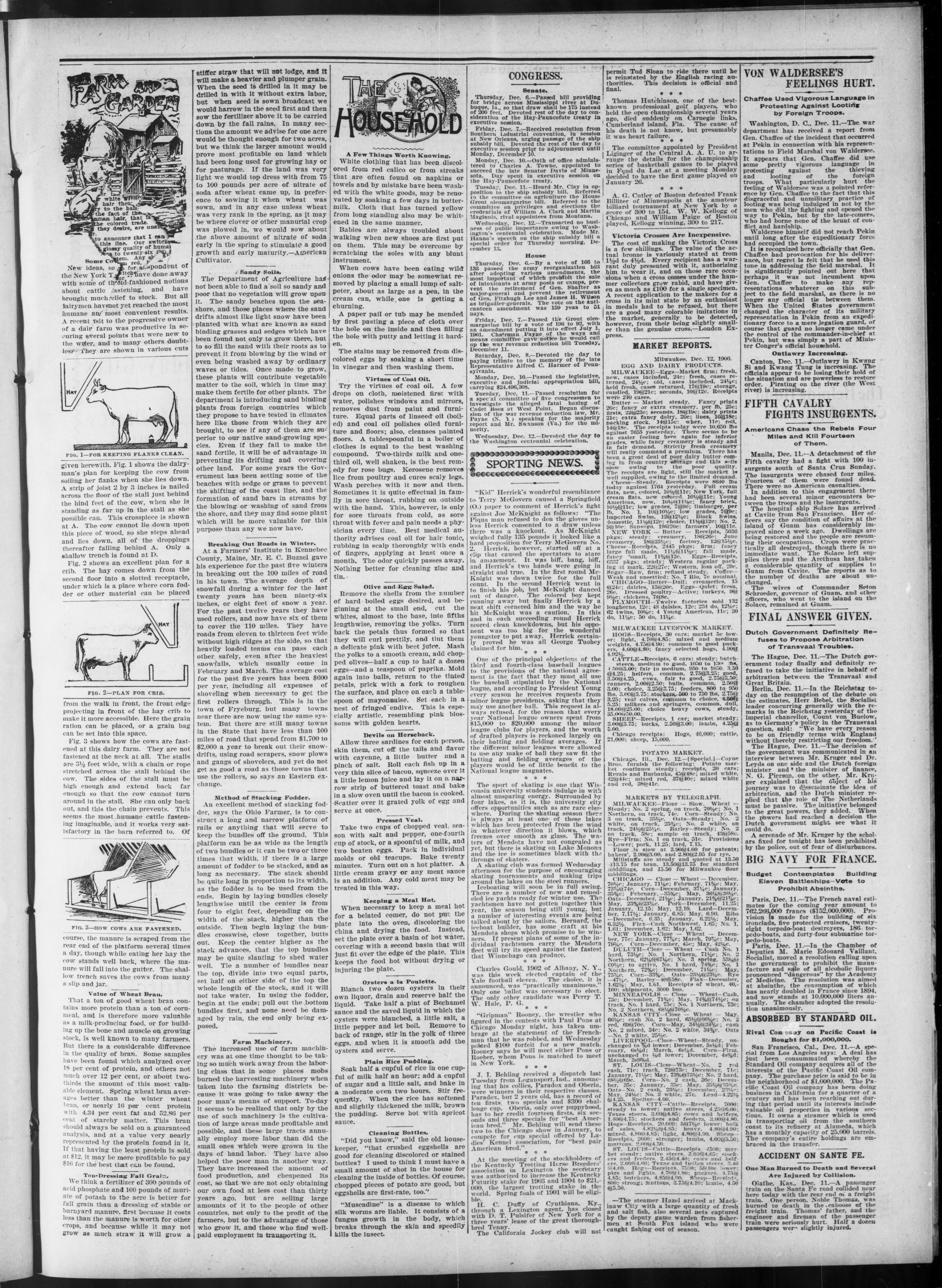
¥1G. 1L—FOR KEEPING FLANKS CLEAN.
given herewith. Fig. 1 shows the dairy-
man’s plan for keeping the cow from
soiling her flanks when she lies down.
A strip of joist 2 by 3 inches is nailed
across the floor of the stall just behind
the hind feet of the cow, when she is
standing as far up in the stall as she
possible can. This erosspiece is shown
at A. The cow cannot lie down upon
this piece of wood, so she steps ahead
and lies down, all of the droppings
thereafter falling behind A. Only a
shallow trench is found at D.
Fig, 2 shows an excellent plan for a
crib. The hay comes down from the
second floor into a slotted receptacle,
under which is a place where corn fod-
der or other material can be placed
d Ree
FIG. 2—PLAN FOR CRIB.
from the walk in front, the front edge
projecting in front of the hay crib to
make it more accessible. Here the grain
ration can be placed, or a grain bag
can be set into this space.
Fig. 3 shows how the cows are fast-
ened at this dairy farm. They are not
fastened at the neck at all. The stalls
are 314 feet wide, with a chain or rope
stretched across the stall behind the
cow. The sides of the stall must be
high enough and extend back far
enough so that the cow cannot turn
around in the stall. She can only back
out, and this the chain prevents. This
seems the most .humane cattle fasten-
ing imaginable, and it works very sat-
isfactory in the barn referred to. Of
> ES
VIN
4 £ fy
“= i
E! 4
<|
Fy ae :
FIG. 3—IlOW COWS ARE FASTENED.
course, the manure is scraped from the
rear end of the platform several times
a day, though while eating her hay the
cow stands well back, where the ma-
nure will fall into the gutter. The shal-
low trench saves the cows from many
a slip and jar.
Cethoel See
That a ton of good wheat bran con-
tains more protein than a ton of corn-
meal, and is therefore more valuable
as a milk-producing food, or for build-
ing up the bone and muscle on growing
stock, is well known to many farmers.
But there is a considerable difference
in the quality of bran. Some samples
have been found which analyzed over
1S per cent of protein, and ‘others not
much over 12 per cent, or about two-
thirds the amount of this most valu-
able element. Spring wheat bran ayer-
ges better than the winter wheat
bran, or nearly 16 per cent protein
With 4.34 per cent fat and 52.86 per
cent of starchy matter. This bran
should always be sold on a guaranteed
analysis, and at a value very nearly
represented by the protein found in it.
If that having the least protein is sold
at $12, it may be more profitable to pay
$16 for the best that can be found.
Top-Dressing Fall Grai-.
We think a fertilizer of 300 pounds of
acid phosphate and 100 pounds of muri-
ate of potash to the aere is better for
fall grain than a @ressing of stable or
barnyard manure, first because it costs
less than the manure is worth for other
crops, and because while it may not
gTow as much straw it will grow a
stiffer straw that will not lodge, and It
will make a heavier and plumper grain.
When the seed is drilled in it may be
drilled in with it without extra labor,
but when seed is sown broadcast we
would harrow in the seed first and then
sow the fertilizer above it to be carried
down by the fall rains, In many sec-
tions the amount we advise for one acre
would be thought enough for two acres,
but we think the larger amount would
prove most profitable on land which
had been long used for growing hay or
for pasturage. If the land was very
light we would top dress with from 75
to 100 pounds per acre of nitrate of
soda after wheat came up, in prefer-
ence to sowing it when wheat was
sown, and in any case unless wheat
was very rank in the spring, as jt may
be where clover or other manurial crop
was plowed in, we would sow about
the above amount of nitrate of soda
early in the spring to stimulate a good
growth and early maturity.—American
Cultivator.
A
The Department of Agriculture has
not been able to find a'soil so sandy and
poor that no vegetation will grow upoD
it. The sandy beaches upon the sea-
shore, and those places where the sand
drifts almost like light snow have been
planted with what are known as sand
binding grasses and sedges which have
been found not only to grow there, but
to so fill the sand with their roots as to
prevent it from blowing by the wind or
even being washed away by ordinary
waves or tides. Once made to grow,
these plants will contribute vegetable
matter to the soil, which in time may
make them fertile for other plants. The
department is introducing sand binding
plants from foreign countries which
they propose to have tested in climates
here like those from which they are
brought, to see if any of them are su-
perior to our native sand-growing spe-
cles. Even if they fail to make the
sand fertile, it will be of advantage in
preventing its drifting and covering
other land. For some years the Goy-
ernment has been setting some of the
beaches with sedge or grass to prevent
the shifting of the coast line, and the
formation of sand bars in streams by
the blowing or washing of sand from
the shore, and they may find some plant
which will be more valuable for this
purpose than any we now have.
Reantine GQut Rasta in Winter.
ee ne
At a Farmers’ Institute in Kennebec
County, Maine, Mr. E. C. Buzzel gave
his experience for the past five winters
in breaking out the 100 miles of road
in his town. The average depth of
snowfall during a winter for the last
twenty years has been ninety-six
inches, or eight feet of snow a year.
For the past twelve years they have
used rollers, and now have six of them
to cover the 110 miles. They have
roads from eleyen to thirteen feet wide
without high ridges at the side, so that
heavily loaded teams can pass each
other, safely, even after the heaviest
snowfalls, which usually come in
February and March. The average cost
for the past five years has been $600
per year, including all expenses of
shoveling when necessary to get the
first rollers through. This is in the
town of Fryeburg, but many towns
near there are now using the same sys-
tem. But there are still many towns
in the State that have less than 100
miles of road that spend from $1,700 to
$2,000 a year to break out their snow-
drifts, using road scrapers, snow plows
and gangs of shoyelers, and yet do not
get as good a road as those towns that
use the rollers, so says an Eastern ex-
change,
Method of Stacking Fodder.
An excellent method of stacking fod-
der, says the Ohio Farmer, is to: con-
struct a long and narrow platform of
rails or anything that will serve to
keep the bundles off the ground. This
platform can be as wide as the length
of two bundles or it can be two or three
times that width, if there is a large
amount of fodder to be stacked, and as
long as necessary. The stack should
be quite long in proportion to its width,
as the fodder is to be used from the
ends. Begin by laying bundles closely
lengthwise until the center is from
four to eight feet, depending on the
width of the stack, higher than the
outside. Then begin laying the bun-
dles crosswise, close together, butts
out. Keep the center higher as the
stack advances, that the top bundles
may be quite slanting to shed water
well. Tie a number of bundles near
the top, divide into two equal parts,
set half on either side of the top the
whole length of the stock, and it will
not take water. In using the fodder,
begin at the ends; pull out the bottom
bundles first, and none need be dam-
aged by rain, the end only being ex-
posed,
Karem Machinery.
The increased use of farm machin-
ery was at one time thought to be tak-
ing so much work away from the labor-
ing class that in some places mobs
burned the harvesting machinery when
taken into the farming districts be-
cause it was going to take away the
poor man’s means of support. To-day
it seems to be realized that only by the
use of such machinery is the cultiva-
tion of large areas made profitable and
possible, and these large tracts annu-
ally employ more labor than did the
small ones which were grown in the
days of hand labor. They have also
helped the poor man in another way.
They have increased the amount of
food preduction, and cheapened its
cost, so that we are not only obtaining
our own food at less cost than thirty
years ago, but are selling large
amounts of it to the people of other
countries, not only to the profit of the
farmers, but to the advantage of those
who grow it, and those who find well-
paid employment in transporting it.
r Soke,
CASES oT
SUSEAOLL
AFew etic ena ets
White clothing that has been discol-
ored from red calico or from streaks
that are often found on napkins or
towels and by mistake have been wash-
ed with the white goods, may be reno-
vated by soaking a few days in butter-
milk. Cloth that has turned yellow
from long standing also may be whit-
ened in the same manner.
Babies are always troubled about
walking when new shoes are first put
on them. This may be overcome by
scratching the soles with any blunt
instrument.
When cows have been eating wilé
onions the odor may be somewhat re-
moved by placing a small lump of salt-
peter, about as large as a pea, in the
cream can, while,one is getting a
churning.
A paper pail or tub may be mended
by first pasting a piece of cloth over
the hole on the inside and then filling
the hole with putty and letting it hard-
en.
The stains may be remoyed from dis-
colored eggs by soaking a short time
in vinegar and then washing them.
Virtues of Coal Oil.
Try the virtues of coal oil. A few
drops on cloth, moistened first with
water, polishes windows and mirrors,
removes dust from paint and furni-
ture. Equal parts of linseed oit (boil-
ed) and coal oil polishes oiled furni-
ture and floors; also, cleanses painted
floors. A tablespoonful in a boiler of
clothes is equal to the best washing
compound. Two-thirds milk and one-
third oil, well shaken, is the best rem-
edy for rose bugs. Kerosene removes
lice from poultry and cures scaly legs.
Wash perches with it now and then.
Sometimes it is quite effectual in fam-
ily in sore throat, rubbing on outside
with the hand. This, however, is only
for sore throats from cold, as sore
throat with fever and pain needs a phy-
sician every time, Best medical au-
thority advises coal oil for hair tonic,
rubbing in scalp thoroughly with ends
of fingers, applying at least once a
month. The odor quickly passes away.
Nothing better for cleaning zinc and
tin. -
Olive and Keg Satad.
Remove the shells from the number
of hard: boiled eggs desired, and be-
ginning at the small end, cut the
whites, almost to the base, into fifths
lengthwise, removing the yolks. Turn
back the petals thus formed so that
they will curl prettily, and tint them
a delicate pink with beet julee. Mash
the yolks to a smooth cream, add chop-
ped olives—half a cup to half a dozen
eggs—and a teaspoon of paprika, Mold
again into balls, return to the tinted
petals, prick with a fork to roughen
the surface, and place on each a table-
spoon of mayonnaise. Set each in a
nest of fringed endive. This is espe-
cially artistic, resembling pink blos-
soms with golden hearts.
Newile an Horseback.
Allow three sardines for each person,
skin them, cut off the tails and flavor
with cayenne, a little butter and a
pinch of salt. Roll each fish up in a
very thin slice of bacon, squeeze over it
a little lemon juice and lay it on 1 nar
row strip of buttered toast and bake
in a slow oven until the bacon is cooked.
‘Scatter over it grated yolk of egg and
serve at once,
Pressed Veal.
Take two cups of chopped veal, sea-
son with salt and pepper, one-fourth
cup of stock, or a spoonful of milk, and
two beaten eggs. Pack in individual
molds or old teacups. Bake twenty
minutes. Turn out on a hot platter. A
little cream gravy or any meat sauce
is an addition. Any cold meat may be
treated in this way.
Keenine a Meal Hot.
When necessary to keep a meal hot
for a belated comer, do not put the
plate into the oven, discoloring the
china and drying the food. Instead,
set the plate over a basin of hot water,
covering with a second basin that will
just fit over the edge of the plate, This
keeps the food hot without drying or
injuring the plate.
Oysters a la Poulette.
Blanch two dozen oysters in their
own liquor, drain and reserve half the
liquid. Take half a pint of Bechamel
sauce and the saved liquid in which the
oysters were blanched, a little salt, a
little pepper and let boil. Remove to
back of range, stir in the yolk of three
eggs, and when it is smooth add the
oysters and serve.
Dtcin Rice ate
Soak half a cupful of rice in one cup-
ful of milk half an hour; add a cupful
of sugar and a little salt, and bake in
a moderate oven two hours. Stir fre-
quently. When the rice has softened
and slightly thickened the milk, brown
the pudding. Serve hot with apricot
sauce.
Cleaning Bottles.
“Did you know,” said the old house-
keeper, “that crushed eggshells are
good for cleaning discolored or stained
bottles? I used to think I must have a
small amount of shot in the house for
cleaning the inside of bottles. Of course,
chopped pieces of potato are good, but
eggshells are first-rate, too.”
“Muscadine” is a disease to which
silk worms are liable. It consists of a
fungus growth in the body, which
breaks through the skin and speedily
kills the insect. 2
CONGRESS.
Senate.
‘Thursday, Dec. 6.—Pasged_ bill provid!
for bridge across ore river at De
bey Ia., so that draw shall be 175 instead
of feet. Devoted rest of the day to con-
sideration of the Hay-Pauncefote treaty in
executive session. e
Friday, Dec. 7.—Received resolution from
Southern iadustrial convention, in session
at New Orleans, urging passage of the ship
mapa te pee the ie of the oy, ig
e session prigr to adjournment unt!
Monday, December 16.
Monday, Dec. 10.—Oath of office adminis-
tered to Charles A. Towne, appointed to
succeed the late Senator Davis of Minne-
sota. Day spent in executive session on
the Hay-Pauncefote treaty.
Tuesday, Dee. 11.—Heard Mr. Clay in op-
position to the ship subsidy bill. Referred
to the committee on agriculture the House
Grout oleomargarine bill. Referred to the
committee on privileges and elections the
credentials of William A. Clark and Martin
Maginuis, rival appointees from Montana.
Wednesday, Dec. 12.—Transacted no_busi-
ness of public Importance owing to Wash-
ington’s centennial celebration. Made Mr.
Hanna’s speech on the ship subsidy bill a
special order for Thursday morning, De-
cember 13,
House
Thursday, Dec. 6.—By a vote of 166 to
138 passed the army reorganization bill
after adopting various amendments, the
most important’ of which probtbit the sale
of intoxicants at army posts or camps, pre-
vent the retirement of Gen. Shafter as
major-general and prevent the retirement
of Gen. Fitzhugh Lee and James H. Wilson
as brigadier-generals. The vote on the antl-
canteen amendment was 169 yeas to 51
nays.
Friday, Dec. 7.—Passed the Grout oleo-
margarine bill by a vote of 196 to 92, with
an amendment putting it into effect July 1,
1901. Chatrman Payne of the ways and
means committee gave notice he would call
up the war revenue reduction bill Tuesday,
December 11.
Saturday, Dec. 8.—Devoted the day to
paying tribute to the memory of the late
epresentative Alfred C. Harmer of Penn-
sylvania,
Monday, Dec. 10.—Passed the epee
executive’ and judicial appropriation bill,
carrying $24,496,308.
'Puesday, Dec. 11.—Passed resolution for
a spec'al committee of five congressmen to
Investigate the alleged fatal Sane of
Cadet Booz at West Point. Began discus-
sion of the war revenue reduction law, Mr.
Payne (N. 1) speaking for the majority
report and Mr. Swanson (Va.) for the ml-
nority.
Wednesday, Dec. 12.—Devoted the day to
the Washington centennial celebration,
SPORTING NEWS. |
ESCCEECEEEESS CEES EEEECESS
ee epee enn ge ee eT ree
to Terry McGovern caused a Springfield
(O.) paper to comment of Herrick’s fight
against Joe MeKnight as follows: “The
Piqua man refused to don the gloves un-
less Herrick consented to a draw unless
there was a knockout. As McKnight
weighed fully 135 pounds it looked like a
hard proposition for Terry MeGovern No.
2. Herrick, however, started off at a
clip that caused the spectators to stare
in amazement. It was biff, bang, biff,
and Herrick’s two hands were going in
straight and true. In the first round Mc-
Knight was down twice for the full
count. In the second Herrick went in
to finish his job, but McKnight danced
out of danger. The colored boy kept
running away but finally Herrick by a
neat shift cornered him and the way he
hit McKnight was a caution. In this
and in each sueceeding round Herrick
scored clean knockdowns, but his oppo-
nent was too big for the wonderful
youngster to put away. Herrick certain-
ly proved he was all George Tuohey
claimed for him.
eee
| One of the principal objections of the
‘third and fourth-class baseball leagues
‘to the provisions of the national agree-
‘ment is the fact that they must all use
‘the baseball stipulated by the National
league, and according to President Young
every season he receives requests from
‘minor league presidents, asking that they
‘may use another ball. ‘This request is al-
ways refused, for the reason that every
year National league owners are from
$15,000 to $20,000 among the minor
league clubs for players, and the worth
of drafted players is reckoned largely on
their batting and fielding averages. If
the different minor leagues were allowed
‘to use any make of ball they saw fit the
batting and fielding averages of the
players would be of little benefit to the
‘National league magnates.
**¢ &
‘The sport of skating is one that Wis-
consin university students indulge in with
almost unsparing coe: Surrounded hy
four lakes, as it is, the university city
offers copenaates such as are rare else-
| where. uring the skating season ther
is always at least one. of these lakes
which has been protected from the wind
in whatever direction it blows, which
freezes over smooth as glass. The wa-
ters of Mendota have not congealed as
yet. but there is skating on Lake Monona
and the ice is sometimes black with the
throngs of skaters.
A skating club was formed Wednesday
| afternoon for the purpose of encouraging
skating tournaments and making trips
around the lakes on the steel runners.
Iceboating will soon be in full swing.
There are a number of new and remod-
eled ice yachts ready for winter use. The
yachtsmen have not gotten together this
year, the season being still young, but
a number of interesting events are being
talked about by the sailors. Bernard, the
iceboat builder, has some craft at his
Mendota shops which promise to be win-
ners. If present plans of some of the in-
dividual yachtsmen carry the Mendota
fleet will try its speed against the fastest
that Winnebago ean produce.
sa 8
| Charles Gould, 1902 of Albany, N. Y.,
was this week elected captain of the
Yale football eleven. |The choice, it is
announced, was “practically unanimous.”
Only one ballot was necessary to elect.
The only other candidate was Perry T.
W. Hale, P. G.
se
“Gripman” Rooney, the wrestler who
figured in the contests with Paul Pons at
Chicago Monday night, has taken um-
brage at the statement of the French-
man that he was robbed, and Wednesday
posted $100 forfeit for a new match.
Rooney says he will meet either Pons or
Roeber, whom Pons is matched to meet
in New York.
see
J. I. Behling received a dispatch last
Tuesday from Logansport, Ind., announc-
ing that his collies, Paradox and Oberia,
were winners in their popes classes.
Paradox. but 2 years old, has a record of
ten firsts, two specials and $300 chal-
lenge cup. Oberia, only over puppyhood,
has to her eredit fourteen firsts, six sec-
onds and three specials for “best Amer-
iean bred.” Mr. Behling will send these
two to the Chicago show in January, to
compete for cup special offered by La-
dies’ Kennel association, for “best pair
American bred.”
ee
At the meeting of the stockholders of
the Kentucky Trotting Horse Breeders’
association in Lexington the seeretars
was authorized to increase the Kentucky
‘Futurity stake for 1903 and 1904 to $21,-
000, the largest trotting stake in the
world. Spring foals of 1901 will be eligi-
ble.
H. C. Duffy of Cynthiana, Ky..
through a Lexington agent, has closed
with D. T. Pulsifer of New York for a
three years’ lease of the great therough-
bred Tenny. =
The California Jockey club will not
‘permit Tod Sloan to ride there until he
is reinstated by the English racing au-
thorities. This decision is official and
final.
eee
Thomas Hutchinson, one of the best-
known professional golf players. who
held the open Se several years
ago, died suddenly on Carnegie links,
Cumberland island, Fla. The cause of
his death is not know, but presumably
it was heart failure. |
The committee appointed by President
Liginger of the Central A. A. U. to ar-
range the details for the championship
series of basketball games to be pares
in Fend du Lae at_a meeting Monday
decided to have the first game played on
January 26.
eee
A. G. Cutler of Boston defeated Frank
Billiter of Minneapolis at the amateur
billiard tournament at New York by a
score of 300 to 154. W., W. Kellogg of
Chicago and William Paige of Boston
played, Kellogg winning, 300 to 217.
Victoria Crosses Are Inexpensive.
The cost of making the Victoria Cross
is a few shillings. The value of the ac-
tual bronze is variously stated at from
144d to 4%d. Every recipient has a war-
rant duly presented with it, authorizing
him to wear it, and on those rare occa-
sions when a cross comes under the ham-
mer collectors gruw rabid, and have giv-
en as much as £100 for a single specimen.
A recent application to the makers for a
cross in its mint state by an enthusiast
in medals had to be refused, but there
are a good many colorable imitations in
the market, generally to be detected,
however, from their being slightly small-
er than the genuine cross.—London Ex-
press.
MARKET REPORTS.
Milwaukee, Dec. 12, 1900.
BUY AND Mass, 2 Sewer
MILWAUKER— Eggs, Market firm; fresh,
new, cases included, 24c: fresh, eases re-
turned, 24%4c; old, ‘cases included, 244;
held fresh, cases returned, 17@19¢; storage,
candled, 19@21c¢; seconds, 10@12c. Receipts
were 240 cases.
Butter — Market steady. Fancy prints
26e; fancy or eas St ee eee
lirsts, 22@23c; seconds. ive; dairy ints
2lec; ‘extra fancy dairy, 20c; lines, idaise:
packing stock, 34@isc: whey. Je: roll,
/1a@ ise. _ The receipts today were 10,650 Ibe
against 7655 yesterday. There seems to be
‘an easier feeling here again for inferior
grades, while fancy creamery is steady and
in fair demand. “Strictly fresh creamery
will really command a premium. There has
‘been a great deal of poor dairy butter com-
ing in from country stotage and this sells
slow owing to the poor quality.
‘The receipts are light, still the market is
well supplied, owing to the limited demand.
Cheese—Steady. Receipts were 8640 Tbs
today against 1764 yesterday. Full cream
flats, new, colored, 10%@1le; New York. full
cream flats, new cotored: 10i@l1e; Young
Americas, “new, Wtyallige; taney brick,
1OM@LIe; low grades, TEde: imburser. per
ih, No.’ 1, 10@10%e: low grades, T@9e:
Imported Swiss. 12ai2%e; | Block | Swiss,
domestic, 114@l2e: choice, 11%@ize; No. 2,
g@ive: Sansngo. 19a20e: farmers’. 10@11e.
NEW YORK — Butter — Reeeipts, 5036
pkgs: steady: creamery, 18@26c: ' June
creamery, 18@23%c;_ factory, 13@1b\e.
Cheese—Receipts, 2445 pkgs: firm; fancy
large fall made, 114@11%c; fall made,
fancy ‘small, 11%@12c. Ezgs—Receipts,
6227 pkgs; steady; Western regular pack-
ing at mark, 22@27e¢; Western, loss off, 29e.
Sugar—Raw, firm; refined steady. Coffee—
Weak and unsettled; No. 7 Rio, Te nominal,
CHICAGO—Butter—Dull; creameries, 15
@2Ac; dairies, 13@20c. Eggs—Quiet: fresn,
26c. “Dressed poultry—Active; turkeys, 9@
OYe: chickens, TqBe.
PLYMOUTH—Twelve factories sold 132
longhorns, 12c; 48 daisies, 12c; 224 do, 12Ke;
| 2 twins, 105%¢; 4 Young Americas, ice; 30
do, 11%¢; 50 do, 11\%e.
MILWAUKEBR LIVESTOCK MARKET.
HOGS—Receipts, 30 cars; market Se low-
er: light, 4.70@4:85: mixed and medium
welghts, 4.7544.90; common to good nk
$i, 4.006490; fancy selected hogs, 4.00
CATTLE~Receipts, 6 cars: steady; butch-
steers, medium to good, 1050 to 1» ha,
4.50@5.00; fair to medium, 950 to 1050. 3.50
G4.25; heifers, common, 2.75@3,25; 00d,
3.50@4.25, cows, fair to good, 2.75@3.50;
canners, 2.00@2.50; bulls, common, 2.50@
3.00; choice, 3.25@3.75; feeders, 800 to 950
Ths. 3.00@3.75:. stoekers.-500 to 750 Ibs, 2.75
3.25; veal calves, common to choice,
5.25: milkers and springers, common, dull,
18.00425.00; choice heavy cows, steady,
35.0050.00.
SHEEP—Recelpts, 1 car; market steady;
3.00@3.75; bucks, 2.50@3.00; lambs, 4.256
5.00.
Chicago receipts: Hogs, 46,000; cattle,
21,000; ‘Sheep, 15,000.
POTATO MARKET.
Chicago, UL, Dee. 12.—[Special.]—Coyne
Bros. furnish the following: Potato mar-
ket continues steady; receipts, 20 cars;
Rurals and Burbanks, 45@48c; mixed white,
42@44e; mixed red, 37@40c; mixed white
ee red, 38@41e.
/ MARKETS BY TELEGRAPH.
| MILWAUKEE—Flour — Slow. Wheat —
“Steady; No. 2 spring, on track, 70%e; No. 1
Northern, on track, 74. Corn—Steady: No.
3 ou track, 354%c,_ Oats—Steady; No. 2
white, on track, 25%e; No. 3 white. on
track, 24%4@254¢. ~ Barley—Steady; No. 2
on track, S8e; sample on track, 434@58¢.
Rye—Firm; No, 1 on track, Sle. Provisions
-—Lower; pork, 11.25; lard, 7.15.
Flour ‘is slow at '3.90@4.00 for patents;
bakers’, 2.90@3.00, and 2.80@2.95 for rye.
Millstuffs are steady and quoted at 13.50
713.75 for bran. ii oqis.z for standard
middlings, and 15.50 for Milwaukee flour
middlings.
CHICAGO — Close — Wheat — December,
Tove; January, Tie: February, 71%e: May.
ee niente. aaee ak Reg
35%c; February. —35%e: May, Hie
Oats—December, a January, Brayaztige:
May, 23%@23%]c. ork—December, 11.25;
fae°o'h 12.15; May, 12.10. Lard—Decem-
ber, 7.17%; January, 6.85; May. 6.90. Ribs
—December, 6.35; January, 6.2244; May,
6.32%. Flax—Cash Northwest. 1.65; No. 1,
1.61; December, 1.82; May, 1.62.
NEW YORK—Close — Wheat — Decem-
ber, Tie; January, 77%; March, 70%; May,
79Kc. Corn—December, 45¢; how, 42\e.
DULUTH—Close — Wheat — Cash No. 2
hard, 734ge: No. 1 Northern, ihe; No. 2
Northern, 624@67%e: No. 3 *p ing. Asean
COMKe; to arrive, No. 1 hard, 74%c; No. 1
) Norchern, mies December, BH May,
T%Ke, Corn—S3\e._ Oats—B34asayje. Rye
—4iijc. Barley—40@38e. Flax—December,
1.6244: May, 1.61. Keceipts of wheat, 40,-
160: shipments, 3000 bus.
MINNEAPOLIS — Close --_Wheat—Cash,
78e; December, 715c; May, T4%@7T44c; on
track, No. 1 hard, 75: No. 1 Northern, T3e;
No, 2 Northern, 684@70i%4e.
a coe eon — Wheat = ay
Bc; cash No. 2 rd, 3; No, 2
red, 69@70c. Corn—May, ahtastae: ‘cash
No. 2 mixed, 34c: No. 2 white, 34%c. Oats
—No, 2 white, 25%e.
LIVERPOOL—Clove—Wheat—Steady. un-
changed to %d lower; December, 58d; Feb-
ruary, 6s; March, @s4d. Corn—Firm,
unchanged to 44d lower; December, 4s%d;
Mareh, 3s9%d.
ST. _LOUIS—Close—Wheat—No. 2 red
cash, Tle: track, 72@73c: December, Tle;
January, 71\4c; May, T9K@T3%C; No. 2 hard,
es4aede. Corn—No. 2 eash, 36e: Decem:
ber, 35c: January, 35e: May, sare.
Oats—No, 2 cash, 23%gc: December, 230:
May, 24%c: No. 2 white, 27c. Lead—4.22%
GLB. Spelter—4.00.
KANSAS CITY—Cattle—Receipts, 7000:
steady to lower: native steers, 4.2506.00;
Texas steers, 3.00@4.85; cows and heifers,
1.40@4.75; stockers and feeders, 3.00014.80.
Hogs—Receipts, 20,000; SaTige lower: bulk
of sales, 4.8216@4.55: heavy. 4.8004.90;
oo eee light, —— Sheep—
Recelpts, : Stronger; lambs, 4.00@5.50;
mnttons. 2.00@4.50.
' ST. LOUIS—Cattle—Recelpts. 4500; mar-
ket steady: native steers. 3.09@4.65: stock-
ers and feeders, 2.45@4.40; cows and heif-
ers, 2.0004.60; Texae and Indian steers, 3.40
G4.60. | Heg<—Receipts, 1500; Sale lower:
pigs and Nabts, 4.7075.80; packers. 4.15%
4.85; butchers, 4.8544.90, ‘Sheep—Receint:,
Ss muttons, 3.75@4.10: lambs, 4.50
5.50.
—The steamer Hazel arrived at Mack-
inaw City with a large quantity of fresh
and salt fish, also several nets captured
by the Seeey game warden from fisher-
men at uth Fox island who were
caught fishing out of season.
VON WALDERSEE’S
FEELINGS HURT.
Chaffee Used Vigorous Language in
Protesting Against Lootirg
by Foreign Troops.
Washington, D. C., Dee. 11.—The. war
department has received a report from
Gen. Chaffee of the incident that occurred
at Pekin in connection with his represen-
tations to Field Marshal von Waldersee.
It appears that Gen. Chaffee did use
some pretty vigorous language in
protesting against the thieving
and looting of, the foreign
troops. What particularly hurt the
feeling of Waldersee was a pointed refer-
ence by Gen. Chaffee to the fact that this
disgraceful ‘and unmilitary practice of
looting was being indulged in not by the
men who did the fighting and opened the
way to Pekin, but by the late-comers,
who had borne none of the brunt of con-
flict and hardship.
Waldersee himself did not reach Pekin
until long after the expeditionary force
had occupied the town.
It is recognized here officially that Gen.
Chaffee had provocation for his deliver-
ance, but regret Is felt that he used this
tone in addressing the field marshal. It
is significantly pointed out here that
perhaps it was not incumbent upon
Gen. Chaffee to make any rep
resentations whatever on this sub-
ject to the field marshal, as there is no
longer any official tie between them.
When the United States government
changed the character of its military
representation in Pekin from an expedi-
tionary force to a mere Jegation guard, of
course that guard no longer came under
the control of the commander-in-chief at
Pekin, but was simply a part of Minis-
ter Conger’s official household.
Outlawry Increasing.
Canton, Dec. 11.—Outlawry in Kwang
Si_and Kwang Tung is increasing The
officials appear to be losing their old of
the situation and are ——— to restore
order. Pirating on the river (the West
river) is increasing.
FIFTH CAVALRY
FIGHTS INSURGENTS.
Americans Chase the Rebels Four
: Miles and Kill Fourteen
of Them.
Manila, Dec. 11.—A detachment of the
Fifth cavalry had a fight with 100 in-
surgents south of Santa Cruz Sunday.
The insurgents were chased four miles.
Fourteen of them were found dead.
‘There were no American casualties.
In addition to this engagement there
had been several minor encounters be-
tween the Scoops and the insurgents. _
The hospital ship Solace has arrived
at Cavite from San Francisco. Her of-
ficers say the condition of affairs at the
island of Guam has considerably im-
posea since a week ago. Dwellings are
heing restored and the people are resum-
ing their occupations. | Crops were prac:
tically all destroyed, though there is no
immediate want. The Solace left sup-
plies there and the Arcthusa has taken
a_ considerable avant St supplies to
Guam from Cavite. reports as to
the number of deaths are about un-
changed. *
The wives of Commander Seton
Schroeder, governor of Guam, and other
officers, who went to the island on the
Solace, remained at Guam.
NT
FINAL ANSWER GIVEN.
—_-—_—_
Dutch Government Definitely Re-
fuses to Propose Arbitration
of Transvaal Troubles.
The Hague, Dec. 11.—The Dutch gov-
ernment today finally and definitely re-
fused to take the initiative in behalf of
arbitration between the Transvaal and
Great Britain.
Berlin, Dec. 11.—In the Reichstag to-
day on the resumption of the debate on
the estimates, Herr Bebel, the Socialist
leader concurring generally with the re-
marks in the Reichstag esterday. of the
imperial chancellor, Count von Buelow,
as to Germany's policy in the Transvaal
question, said: “We have every reason
to be on friendly terms with England
without thereby atone, our freedom.”
The Hague, Dec. 11.—The decision of
the government was communicated in an
interview between Mr. Kruger and Dr.
Leyds on one side and the Dutch foreign
minister and*the minister of finance,
N. G. Pierson,.on the other. Mr. Kru-
ger explained that the Object of his
journey was to disseminate the idea of
arbitration, and the Dutch minister re-
plied that the role of The Netherlands
must be passive. The initiative belonged
to the great powers, they added. When
the powers had reached a decision the
Dutch government might see what it
could do.
A serenade of Mr. Kruger by the schol-
ars fixed for tonight has been prohibited
by the police, out of fear of disturbances.
BIG NAVY FOR FRANCE.
—
Budget Contempliates Building
Eleven Battleships—Vete to
Prohibit Absinthe.
Paris, Dec. 11.—The French naval esti-
mates for the coming oar amount to
ae franes ($152,000,000). Pro-
vision made for the building of six
ironclads, five piers cruisers, twenty-
eight torpedo-boat destroyers, 186. tor-
pedo-boats, and forty-four submarine tor-
pedo-boats.
Paris, Dec. 11.—In_ the Chamber of
Deputies M. Marie Edouard Vaillant,
Socialist, moved a resolution calling upon
the government to prohibit the manu-
facture and sale of all alcoholic liquors
pronounced “dangerous” by the ‘Academy
of Medicine. The resolution was aimed
at absinthe, the consumption of which
has nearly doubled in France since 1894,
and now stands at 10,000,000 liters an-
nually. The chamber adopted the resolu-
tion unanimously.
ABSORBED BY STANDARD OIL.
Rival Com psay on Pacific Coast is
Bought for $1,000,000.
San Francisco, Cal., Dec. 11.—A spe-
cial from Los Angeles says: A deal has
it been consummated whereby the
tandard Oil eer, aequees ail of the
interests of the Pacific Coast Oil com-
pany. The ee pry ie is said to be in
the neighborhood of $1,000,000. The Pa-
cific Coast Oil company has been doing
business in California for a quarter of a
century and has been reaching out dur-
ing that period until its interests include
valuable oil properties in various sec-
tions. It owns a steamer which is used
in transporting oil from the southern
coast to its refinery at Alameda, which
has a monthly capacity of 25,000 barrels.
The company’s entire holdings are em-
braced in the transfer.
ACCIDENT ON SANTE FE.
One Man Burned to Death and Several
Are Injured by Collision.
Olathe, Kas., Dec. 11.—A passenger
train on the Santa Fe road collided near
here today with the rear end ox a freight
train. One person, Noble Thomas, was
burned to death in the.caboose af the
freight train. ‘Thomas’ father, aud the
engineer and fireman of the passenger
train were seriously hurt. Half a dozeu
passengers wer slightly injured.
Printed in the Interests of the Negro Race,
MILWAUKEE, WIS.
a aa
Richard B. Montgomery......--.----+-
saseesesceeseeeee+Edltor and Proprietor
Office 209 Fifth Street.
Telephone Black No. 244.
SUBSCRIPTION RATES.
Any part of the United States and Canada,
postage paid.
One Year ....-.2eceeceeceeee recesses s $2.00
Six Months ......5...0-.s00eeeeeeeee LB
Three Months ......-..20eeeeeeceeees TD
Send money by Express ergs pote) P.O.
Money Order or Registered tter to the
Wisconsin Weekly Advocate.
ADVERTISING RATES.
One inch, single Insertion..........---. 25¢
One inch, — JOOP. cc ceeeesscessess+ $9.00
Business locals 5e per line each insertion.
Apply for rates to the Advocate.
TO CONTRIBUTORS:
All communications must be sent with the
name and address of the sender as an evi-
dence of good faith, but not necessarily for
publication. No manuscript returned if not
fecepted, unless accompanied by stamps.
All subseribers of the Advocate that fail
to get their paper promptly will please noti-
fy us at once. The Advocate, at 209 Fifth
street.
The Wisconsin Weekly Advocate company
wishes to notify the public that all comtracts
and business transactions with this com-
pany must have the company stamp, other-
wise they will be void. Neither will this
company be responsible for paid subscrip-
tions unless given to duly-accredited agents,
who, on request, will give the company’s re-
ceipt for same. Subscribers failing to re-
ceive their papers regularly wil) kindly noti-
fy the Sencrat office. Address all business
communications to the general manager,
209 Fifth street.
Mr. Richard B. Montgomery.
Entered at tue Milwaukee P. O. as secord-
class matter.
The Helping Hand
Colored Mission
incorporated under the laws of the
State of Wisconsin has for its object
the supplying of qualified colored
help to those requiring the same.
In order to be able to get servants
from the mission it is necessary,
that_in order to partly cover ex-
peeses incurred, those parties de-
siring help should become subscrib-
ers for this paper. No actual charge
is made. Parties who secure situa-
tions through this agency are also
expected to become subscribers.
We have at present on our books:
Cooks, General Servants, Wait-
resses, Laundresses, Nurses,
Coachmen, Porters, Waiters.
Office hours 9-12 and 1-4.
R. B. MONTGOMERY, Mgr.
209 Fifth St., Milwaukee.
Gen. Egan’s request for a suspension of
sentence may have been prompted by the
observation that the British army in
South Africa suffered from “embalmed
beet” without stirring up a scandai.
While naval authorities in Europe and
America are experimenting with wireless
telegraphy, little Japan has bought two
complete Marconi plants, with an effec-
tive radius of 125 miles, for immediate
installation on two first-class Japanese
cruisers,
About that proposed anti-killing-men-
by-deer-hunters law—perhaps it hdd bet-
ter take the form of a prescription that
no one shall enter the woods in the
open season without a red cap, and that
all applieants for hunting licenses shall
undergo examination for color-blindness.
Arizona is to furnish a novel feature
for the inaugural parade in Washington
next March. Two black bears captured
in the Santa Rita mountains by Mary
Lully, a local hunter, are to march as the
result of an election bet. W. M. Hoey,
collector of the port of Nogales, agreed to
take the bears East and lead them in the
parade if McKinley was elected. If
Bryan was successful William Taggart
was to lead the bears. After the parade
the wild animals, which are named “Mc-
Kinley” and “bryan,” will be given to
the Washington zoological gardens.
Property-owners of the Fox lake region
in Wisconsin have banded together to rid
the waters of Fox, Grass and other lakes
in the vicinity of the German carp, in
order to keep the game fish which make
those lakes famous from being driven
out. A representative of the state fish
commission is superintending the seining
of the waters, and so far 30,000 pounds
of carp and other coarse fish have been
taken out. Among them was a German
carp which weighed fifty-six pounds.
It transpires that Sir Thomas Lipton’s
Shamrock had a sheet of aluminum
along her waterline, and that this alumi-
num has been eaten away by the action
of sea water as was the aluminum used
in the construction of the Defender. The
recent races for the America cup have
not developed a creditable type of ship,
but they have demonstrated that alumi-
num cannot be used in marine construc-
tion, and thus dissipated a lot of schemes
for the building of a featherweight
“four-day steamer” for the transatlantic
oes:
The use of pontoon boats made of alumi-
num for the construction of flying
‘ridges for armies was suggested some
gears ago, but recently a practical test
of material of this kind was made by the
engineering section of one of the Aus-
trian dragoon regiments stationed at
Stockerau, near Vienna, with very satis-
factory results. The special pontoon
used had a carrying capacity of 11,000
pounds. These pontoon boats are trans-
ported on specially-constructed wagons,
and can be taken over the most difficult
country, and at any rate of march the
column may demand.
A number of New York and Philadel-
phia financiers and philanthropists are
interested in a project to establish a
model industrial town near the latter
city. It is proposed to buy an extensive
tract of land for the town near Phila-
delphia, because of that city’s vast in-
dustrial concerns, The backers of the
enterprise propose to sell lots in the new
town for manufactories and for working-
men’s homes, It is proposed to make the
houses and town in general beautiful and
healthful, and after receiving a nominal
per cent. on the investment it is suggest-
ed that the remainder of the income from
the rents of houses go to the improve-
ment of the inhabitants themselves. In
the words of one of the promoters, it is
proposed to give the workingman a sub-
stantial part of the proceeds of the work
he produces.
The penny-in-the-slot system of distrib-
uting gas through the poorer districts of
London has proved so successufl that at-
tempts are now being made to apply elec-
trie light in the same way. The vestry
of Battersea has erected a large genera-
tor station and laid the necessary cables.
The fixtures are installed in each house
free of cost to the customer, who simply
pays for the amount of electricity be con-
sumes, The profit derived from this
method of distribution is said to be suf-
ficient to enable the authorities to recoup
themselves for the initial cost of the in-
stallation of fittings in the houses.
Forty-three areas have been found on
the sea bottom lying deeper than three
miles. Eight of these are deeper than
four miles. These are: Nars deep, in
the North Atlantic; Ross deep, in the
Antarctic; Weber deep, in the Banda
sea; Challenger, Tuscarora and Sapan
deeps, in the North Pacific, and Aldrich
and Richards deeps, in the South Pa-
cific. Three of these deeps contain five-
mile holes. They are Aldrich, Tuscarora
and Weber deeps. But the Aldrich deep
hole is the deepest thus far measured.
Yet, deep as it is, in spite of the fact that
Mt. Everest, the highest mountain in the
world, if dropped into the hole would
sink out of sight in the ocean, that little
pinnacle called Sunday island, standing
squarely in this five-mile hole, is able to
rear its head 2000 feet above the surface
af the sea.
The Hamburg-American Steamship
company has bought a line of steamers
now plying between Germany and South
American ports, thus adding another in-
fluence to aid in the German control of
South American commerce. In addition
a new line is proposed to ply between
New York and South America, and the
service from New York to the Mediter-
ranean ports is to be connected with
Hamburg-American steamers reaching
China and Japan by way of the Red sea.
At the same time the North German
Lloyd company of Bremen is arranging
to establish a line of steamers between
San Francisco and Australia, as well as
ene from San Francisco to the Asiatic
coast, both lines thus neeting those of
the company plying from Europe. This
will be the first competition for Austra-
lian trade from the port of San Fran-
otenn,
A beautiful monument erected to the
memory of Maj.-Gen. Joseph B. Carr, in
Oakwood cemetery, Troy, has been com-
pleted by the addition of handsome
bronze panels and medallion. The monn-
ment has been ready for the panels for
some time, but owing to the first cast
being unsatisfactory, a delay was caused
while a new one was being designed. The
monument is simple in design, but rich in
ornamentation. The medallion is the
work of John Francis Brines, the New
York sculptor, and represents Gen. Carr
in the uniform of a major-general. The
two bronze tablets contain the list of bat-
tles in which Gen. Carr was engaged and
the record of engagements. The medal-
lion is a beautiful piece of work, and the
likeness of Gen. Carr is exceedingly life-
like. The family name Carr is surmount-
ed by the American eagle and around the
name is a wreath of laurel. Underneath
is a simple bronze plate bearing the in-
scription, “Major-General Joseph Brad-
ford Carr—1828-189).””
A movement is on foot, said to be
backed by Philadelphia coalmen, to build
at Summit Hill, near Mauch Chunk, Pa.,
a monument of coal to the memory of
Philip Ginter, who discovered coal within
a very short distance of Summit Hill. In
September it was 109 years since Ginter
made his great discovery. He lived in a
rough cabin in the forests on the Mauch
Chunk mountain. While in quest cf
game for his family, whom he had left at
home without food of any kind, his foot
struck a black rock. By the roadside,
not far from the town of Summit Hill,
he built a fire of wood and threw pieces
of the supposed stone about it, so that
the embers might last longer while he
was roasting a fowl. He was surprised
after a little while to see te stones aglow
and retain their heat for a long time.
He carried a lot of the coal home and
burned it there. The few neighbors soon
learned of the discovery, but there was
no mining to any extent in Carbon coun-
ty until after the war of 1812 had begun.
The expedition sent to Cuba by the
Smithsonian institution to collect strange
animals and plants has returned loaded
down with specimens and with tales of
adventure more strange than the freaks
they brought with them. Rats of an ed-
ible species—some 3 feet long, including
the tail, and weighing 18 pounds—were
captured, but none were brought back to
this country alive. All were eaten by
the hungry adventurers. These rats—
and the snakes on the island, none of
which are yvyenomous—have nearly all
been eaten by the famished Cubans, and
are very scarce. Ferocious giant lizards
(iguanas) were captured and were
brought back alive. These lizards are
also eaten by Cubans, but the scientists
“passed them up.” Cuba has more than
thirty species of bats, and many, includ-
ing white bats, were captured and will
be stuffed and added to the Smithsonian
collection. In capturing the white bats,
in a eave 100 feet auvecgr cad: where
thousands were hiding, several of the
party were bitten.
Capt. Edward T. Strong of the navy
will be placed on the retired list as a re-
sult of a recent examination by a naval
retiring board. Capt. Strong was re-
cently invalided home from the Asiatic
station while in command of the monitor
Monadnock. He is the third commander
of that vessel to be incapacitated since
she went from San Francisco to the
Philippines, about two years ago. Capt.
H. E. Nichols while commanding the
vessel was sunstruck and died at Manila
in June, 1899, and Capt. John J. Me-
Gowan, who succeeded him in command,
was sent home broken in health early
this year. These cases are attributed to
the hardships of life on board the low-
lying monitor, with its poor ventilation,
in the debilitating climate of the Philip-
pines. Capt. Strong entered the navy
from Massachusetts as a volunteer offi-
cer soon after the beginning of the Civil
war, in 1862, and has since served in all
parts of the world. Prior to-taking com-
mand of the Monadnock he was in com-
mand of the training ship Essex.
SOLDIERS AT HOME.
THEY TELL SOME INTERESTING
ANECDOTES OF THE WAR.
How the Boys of Both Armies Whiled
Away Life in Camp—Foraging Ex-
periences, Tiresome Marches—Thril-
ling Scenes on the Battlefield,
“It seems to me,” said a Michigan
yeteran at the national encampment
of 1900, in Chicago, that proper atten-
tion has not been paid to the National
Association of Army Nurses of the
Civil War during this encampment. I
am sure that every soldier realizes and
admits the debt which the men of the
Grand Army owe to the women who
followed the armies into the field and
did so much to lessen the horrors of
war. Often, too, the women did more
than simply wait on and nurse the
wounded men in the hospitals. I know
of one case in my own experience where
an army nurse actually rallied the men
of the regiment to which she was at-
tached and helped to win a battle.
“Annie Etheridge was born in Michi-
gan, but spent most of her childhood in
Wisconsin. When the war broke out
she was visiting in Detroit, and at once
volunteered to go to the front with the
Second Michigan as regimental nurse.
Soon she was transferred to the Thimxi
Michigan, and when its three years’
term of enlistment was over she, with
the re-enlisted veterans, joined the
Fifth Michigan. Between her and the
soldiers there sprang up a degree of af-
fection that was touching. It was her
custom to follow ‘her boys’ into battle
and on the field before the fighting was
over to administer to the more severely
wounded. At Chancellorsville in May,
1863, she went far out to the front with
a company of skirmishers. The rebels
in full force were close at hand, and
Mrs. Etheridge was ordered by her Col-
onel to go to the rear. She rode down
the line of the trenches in which the
soldiers were lying, and in the face of
the enemy exhorted them to do their
duty and ‘whip the rebels.’
“At Chancellorsville she was riding
Sy
SS rn
ase
| RSET TH
RS ey. ad
My Ze ES
\ (_ =
Bs dai
3 Aree
Se “Uh Wo aN p
<x k <
Gy; RQ RG ‘
“Hh B® Se
Yy s> AN
lg IWS
Ze Ss ee
eS = BS
ee Gy
SSS hh 7
MME. VELASQUEZ DISGUISED AS A CON-
FEDERATE LIEUTENANT.
over the field and found in one corner
of the field a regiment that was begin-
ning to retreat. She appealed to them
not to go back, and finally shamed them
into obedience by actually seizing the
flag and leading them into action.
“Certainly the most sensational part
played by a woman in the Civil War
was that of Mme. Velasquez, a pretty
young Southern woman of Spanish de-
scent, who disguised herself as a man
and for many years served as a Licu-
tenant in the Confederate army under
the name of Lieutenant Harry Bu-
ford. In this capacity she took part
in several battles, leading her men with
great fearlessness and skill and win-
ning the compliments of her superior
officers for gallantry on the field of bat-
tle. In the later part of the war she
was made an agent of the Confederate
secret service, and in various disguises
spent months in the North, traveling re-
peatedly from New York to Chicago,
Philadelphia, and other cities. At one
time she even succeeded in getting em-
ployment under the head of the United
States secret service in New York City,
| and in that position was able to secure
information of great value to the Con-
federacy.
“At the battle of Ball’s Bluff she was
in command of a regiment, and the men
under her charge captured more than a
hundred Federal prisoners. It was the
scene of bloodshed of which she was
forced to witness here that finally led
her to give up active service in tne
army and go into the secret service,
which, while quite as dangerous, did
not lead her constantly into the pres-
ence of wounded and dying men. Dur-
ing the whole of her service she was
‘never wounded, though it is said that
she often took greater chances than
| were necessary.
“I don’t suppose there is a member of
the Grand Army who hasn't at least
heard of ‘Mother’ Bickerdyke. How
many thoasands of the boys knew her
by sight during the war and were
nursed by her hands, I can only guess,
She devoted herself to the care of the
private soldiers, always declaring that
the officers had plenty of friends to
look after them. So among the rank
and file in all the hospitals she be-
came known as ‘Mother’ Bickerdyke,
and she was more than a mother io
hundreds.
“When the war broke out she was a
widow, 40 years old, but strong and
robust in health, as she needed to be
for the work before her. When Sum-
ter was fired on she was working as a
housekeeper in the family of a gentle-
man at Cleveland, Ohio. Almost im-
mediately she gave up her place and
began her work for the soldiers,
“There were two sides to her charac-
ter. On one side she was the sternest
and most implacable of women; on the
other she was as gentle and tender as
a child. Everything she did was for
the interest of her ‘boys.’ If the hospi-
tal surgeons did not do their work
properly or seemed to slight the private
soldiers in any way ‘Mother’ Bicker-
dyke would send in a report which of-
ten resulted in the dismissal of the of-
fender. It was the same way with
army contractors. If the supplies fur-
nished were not in good order or were
not promptly delivered it was certain
that ‘Mother’ Bickerdyke would never
rest until she had seen the delinquent
punished.
“In addition to everything else she
was a great organizer. After the battle
of Perryville the supplies for the sur-
geons were exhausted and there seeny-
ed to be no way to supply the demand,
But ‘Mother’ Bickerdyke was equal ti:
the emergency. She organized a com-
Our stock doesn’t fit the *
ur toc store right—it’s too big.
<contienentictniiaiin amntinastenmnmmmmncnntin: 4 Wetec tie scenes OF low
prices “‘cut it down’ to fit.
The real trouble is that the cold
8 a weather hasn’t come soon
a i cal aa enough. We find that we're over-
———- loaded with heavy clothing. ;
@ We're going to unload a bit this Fs
TS 1t week and it will pay you to help & ad-
us. Don’t look for these byitippines,
fis ie gains next week. ft Hancock.
ear ee
The OVERCOATS that we advertised last week for $5.00 to Sagpettct Marinduque,
i ke le for. the purpose of
eae ete reared Pete Tee Week Only wo days later they fell
These swell $13 RAGLANS we'll unload for $13.50 ThipWitn cities: view eee
f pat a re rite bolos.
SUITS to fit anybody’s body or tarte, last wi elds, telling of the engage-
id: “I’ was twice wounded and
Week $6.75 to $16.50. Gnscious, but soon recovered and
ive the order for the command to
TROUSERS—We give you a wider choice-~ad.@ way back to the station. I told
es? Me with a man from the
FASHIONABLE MISE IT CLOTHiikind a rice stack and tola
—_—_— white flag. ‘The in-
irr. a pobre, at us. The
213-215-217 WEST WATER STREET, Opposite Barret? ck a short dis-
Your Money Back If You Can Show\Cause, Orea EVENINGS #™d” had to
- me to me one
me when I
ane eee
AA
ee ee
Pleasing Holiday Gifts
Diamonds, 1 deed <eeoeieiencoampicnih
Watches, Clocks, |
Jewelry, Rings, 'C. J. Dewey
Silverware, || JEWELER
Lr Anta uy, Mes! Water Si
Low Prices |
MONOGRAM RINGS—LOW PRICES
“MOTHER” BICKERDYKE.
pany of colored women who had es-
caped from their masters and set them
to work picking up blankets and scraps
of clothing from the Battlefield. Then
she had all the material so gathered
carefully washed and dried, and finally
supplied not only plenty of dressings
but actually fitted out a large body of
men with practically new or at least
clean outfits of clothing.
“It is said that nobody in the army
had as much influence with either Gen-
eral Grant or General Sherman as
‘Mother’ Bickerdyke. They had come
to know of her courage and devotion to
the men and had found by investiga-
tion that her word could be depended
upon, Consequently she was feared
and hated by the incompetents and
rascals in all branches of the army.
“Almost every union soldier had one
or more pleasant experiences with the
loyal wonien of the South, many of
whom risked their lives time and again
in defense of their principles. Histor-
ians are now trying to prove that Bar-
bara Frietchie never existed, but I
know of one case almost exactly like
it which can be easily substantiated.
“It was in 1863, and the rebels were
marching through Middletown, Md.
There were a good many people in the
town who were at heart loyal, but they
made no boast of public exhibition of
their feelings. Mrs. Effie Titlow, how-
ever, was made of sterner stuff. When
she saw in the distance the approach-
ing rebels she took a large Union flag,
wrapped it about her shoulders, and
took her staud on the balcony of her
house, overhanging the street. There,
with the flag around her, she stood all
the time the rebel army was passing
and looked contemptuously down on
the soldiers in gray. If Barbara Friet-
chie is played out some poet might put
the story of Mrs. Titlow into ryhme.
“Every Wisconsin veteran will re-
membed Mrs. Henrietta L. Colt. Left
a widow shortly before the war, she
threw herself into the work of nursing
the wounded soldiers with entire devo-
tion. She went at one time, for” in-
stance to the Army of the Cumberland
and personally visited every sick Wis-
consin soldier in the hospitals. Some
of her trips up the Mississippi River in
hospital steamers were’ experiences
which would have killed an ordinary
woman,
“On her visit to the army about Vicks-
burg she organized, in connection with
| vo Se 2 esa Sg “ MORRET Sc:
| ee a ae eee y
GARD os j Sees ? Bee —_
| a) ee og
Sn ae 7 en 4 ba ee
ae cre 2. er
A es ee pe Ear ms! ep
oe ‘eq MEE ~
oe | if |
a” Sar eG 2 eh 2 i es m a,
fh =
nx. coon ; 4 |
an oan 1 i
| me: ae oF
- LINION....
Laundry and News Co.
No. 432 State Street
GEO. VW. SAYLES
ALL WORK CAREFULLY DONE...
Lowest Prices and Satisfaction Guaranteed.
JAMES T. BRETT & SON,
[mer <4 EMBALMERS and
& FUNERAL DIRECTORS
Bi) 8307 REED STREET and ane
ee lost 410 GRAND AVENUE.
ct ammmeet rans 2467. Milwaukee, Wis.
oo
a | Sem ~ Se ong
l= te =e
= a
= Mae:
= oe z we
BS | at
ry ATA A Pa Te
eT
oak cy A |
A 1)
ie DAO aS
Pa bee Sees es =
e e
Mrs. Nellie Hutchins
Dressmaking and
Ladies’ Tailoring En
A full stock of ready-made Garments, Wrappers,
etc., always on hand.
540 EAST WATER STREET - - = = MILWAUKEE
Telephone 9461 Black
MRS. EEFIE TITLOW DEFIES THE REBELS
Mrs. Hoge of Chicago, an improvised
hospital on the same steamboat which
had brought her South. The boat was
packed with wounded men, but they
stuck to their posts, ‘and how’ much
good they did nobody will ever know.
Up and down the great river Mrs. Colt
and her few colleagues traveled in the
midst of dyiag soldiers, helpless and
poverty-stricken refugees, and fright-
ened slaves. She also visited no less
than seventy-twohospitalsin the South-
west and was able not only to relieve
immediate suffering but to provide bet-
ter supplies for future use through her
influence with the organized societies
of the North.”—Chicago Tribune.
Telephone Main 1178. Established 1877.
e s
Richard Seidel,
Diamonds, Watches,
Fine Jewelry and
Silverware,
200 Grand Avenue, Seccna%:, Milwaukee, Wis.
Lieut. Gen. Miles is said to favor an
increase In the number of officers at
Western posts. At some of these there
is now but one officer, and that man’s
lot is naturally a rather solitary one.
Human Hair Goods!!!
Most of the hair sold by dealers for colored people is not human hair that really grew on heads, but a stuff made of a sort of grass or bark prepared and crimped to represent the genuine. With a few times wearing it becomes harsh and straight and is very injurious to the hair, causing it to tear off and grow thin. This is not the rehowever, when human hair is worn, can be attested by this fact. The of the white race, as a rule, have a birth of hair, yet from experience several years' connection with a and that they are the most and make use of much hair than our women. Our white sister use an abundance hair throughout a life-time injury to the hair on their heads, to the fact of their using a good human hair, that is rarely ever the colored trade. Hence our on they desire, are unable to get
d to announce that I can supply
in this line. Our switches are
it glossy quality of human hair
ties to twenty-six (26) inches
Some Cowstem. Any shade of hair
New ideas, so amm for a sample of the
the New York T. switches. Or send $1.25
with some of these ounces of hair twenty
about cattle out stem. Several ladies
brought much salves well pleased with
lairymen have
humane and
Address
A recent v. S. S. J. DAVIS,
of a dairy
curing semour Ave., CHICAGO, ILL.
the writ
BLACK SKIN REMOVER.
REGISTERED
IN
PATENT OFFICE
U.S.
BEFORE AFTER
A Wonderful Face Bleach,
AND HAIR STRAIGHTENER.
both in a box for $1, or three boxes for $2.
Guaranteed to do what we say and to be the
"best in the world." One box is all that is
required if used as directed.
A WONDERFUL FACE BLEACH.
A WONDERFUL FACE BLEACH.
A PEACH-LIKE complexion obtained if used as directed. Will turn the skin of a black or brown person four or five shades lighter, and a mulatto person perfectly white. In forty-eight hours a shade or two lighter will be noticeable. It does not turn the skin in spots but bleaches out white, the skin remaining beautiful without continual use. Will remove wrinkles, freckles, dark spots, pimples or bumps or black heads, making the skin very soft and smooth. Small pox pits, tan, liver spots removed without harm to the skin. When you get the color you wish, stop using the preparation.
THE HAIR STRAIGHTENER
that goes in every one dollar box is enough to make anyone's hair grow long and straight, and keeps it from falling out. Highly perfumed and makes the hair soft and easy to comb. Many of our customers say one of our dollar boxes is worth ten dollars, yet we sell it for one dollar a box. Any person sending us one dollar in a letter or Post-Office money order, express money order or registered letter, we will send it through the mail postage prepaid; or if you want it sent C. O. D., it will come by express, 35c. extra. In any case where it fails to do what we claim, we will return the money or send a box free of charge. Packed so that no one will know contents except receiver.
THOS. B. CRANE,
122 West Broad St.
RICHMOND, VA.
WONDERFUL DISCOVERY Curly Hair Made Straight By
TAKEN FROM LIFE:
This wonderful hair pomade is the only safe preparation in the world that makes kinky hair straight as shown above. It nourishes the scalp, prevents the hair from falling out and makes it grow. Sold over 40 years and used by thousands, it provides hardiness. Testimonials free on request. It was used in preparation ever sold for straightening kinky hair. Get the Original Ozonized Ox Marrow, as the genuine never fails to keep the hair pliable and beautiful. A toilet necessity for ladies and gentlemen. Elegantly perfumed. The great advantage is wonderful pomade is that by its use you can straighten hair. Owing to its superior and lasting quality it is the most economical. It is not possible for anybody to produce a preparation equal to it. Full directions with every bottle. Only 50 cents. Sold by dealers or send us $1.40 Postal or Express Money Order for 3 bottles, express paid. Write your name and address plainly to
OZONIZED OX MARROW CO., 76 Wabash Ave., Chicago, Ill.
Sustaining Life
on the choice juicy meats served by us is just what our athletic, bicycle riding, tennis playing and golfing twentieth century men and women need. Pic days have gone with the spin ning wheel. Good bone, muscle and tissue is what is needed now. You can get them by patronizing the Chicago Market. Our meats are fresh, tempting and choice, and are sold at prices that will let you feast in comfort.
WILLIAM RASCH
GENEVA LAKE, WIS.
S. F. PEACOCK & SON
Funeral Directors
AND
EMBALMERS
431 Broadway. MILWAUKEE, WIS.
TALMAGES SERMON
A. B.
ROM an unnoticed incident of olden time Dr. Talmage in this discourse draws some comforting and rapturous lessons. The text is II. Samuel xix., 18, "And there went over a ferryboat to carry over the king's household."
Which of the crowd is the king? That short man, sunburnt and in fatigue dress. It is David, the exiled king. He has defeated his enemies and is now going home to resume his palace. Good! I always like to see David come out ahead. But between him and his home there is the celebrated river Jordan which has to be passed. The king is accompanied to the bank of the river by an aristocratic old gentleman of 80 years, Barzillai by name, who owned a fine country seat at Rogelim. Besides that, David has his family with him. But how shall they get across the river? While they are standing there I see a ferryboat coming from the other side, and as it cuts through the water I see the faces of David and his household brighten up at the thought of so soon getting home. No sooner has the ferryboat struck the shore than David and his family and his old friend Barzillai from Rogelim get on board the boat. Either with splashing oars at the side or with one oar sculling at the stern of the boat they leave the eastern bank of the Jordan and start for the western bank.
That western bank is black with crowds of people, who are waving and shouting at the approach of the king and his family. The military are all out. Some of those who have been David's worst enemies now shout until they are hoarse at his return. No sooner has the boat struck the shore on the western side than the earth quakes and the heavens ring with cheers of welcome and congratulation. David and his family and Barzillai from Rogelim step ashore. King David asks his old friend to go with him and live at the palace, but Barzillai apologizes and intimates that he is infirm with age and too deaf to appreciate the music, and has a delicate appetite that would soon be cloyed with luxurious living, and so he begs that David would let him go back to his country seat.
Dislike of Excitement.
I once heard the father of a President of the United States say that he had just been to Washington to see his son in the White House, and he told me of the wonderful things that occurred there and of what Daniel Webster said to him, but he declared: "I was glad to get home. There was too much going on there for me." My father, an aged man, made his last visit at my house in Philadelphia, and after the church service was over, and we went home, some one in the house asked the aged man how he enjoyed the service. "Well," he replied, "I enjoyed the service, but there were too many people there for me. It troubled my head very much." The fact is that old people do not like excitement. If King David had asked Barzillai thirty years before to go to the palace, the probability is that Barzillai would have gone, but not now. They kiss each other good-by, a custom among men oriental, but in vogue yet where two brothers part or an aged father and a son go away from each other never to meet again. No wonder that their lips met as King David and old Barzillai, at the prow of the ferryboat, parted forever.
This river Jordan, in all ages and among all languages, has been the symbol of the boundary line between earth and heaven. Yet when, on a former occasion, I preached to you about the Jordanic passage I have no doubt that some of you despondingly said, "The Lord might have divided Jordan for Joshua, but not for poor me." Cheer up! I want to show you that there is a way over Jordan as well as through it. My text says, "And there went over a ferryboat to carry over the king's household."
All our cities are familiar with the ferryboat. It goes from San Francisco to Oakland and from Liverpool to Birkenhead, and twice every secular day of the week multitudes are on the ferryboats of our great cities, so that you will not need to hunt up a classical dictionary to find out what I mean while I am speaking to you about the passage of David and his family across the river Jordan.
An Unstable Craft.
Every day I find people trying to extemporize a way from earth to heaven. They gather up their good works and some sentimental theories, and they make a raft, shoving it from this shore, and poor, deluded souls get on board that raft, and they go down. The fact is that skepticism and infidelity never yet helped one man to die. I invite all the ship carpenters of worldly philosophy to come and build one boat that can safely cross this river. I invite them all to unite their skill, and Bolingbroke shall lift the stanchions, and Tyndall shall shape the bowsprit, and Spinoza shall make the maintopgallant braces, and Renan shall go to tacking and wearing and boxing the ship. All together in 10,000 years they will never be able to make a boat that can cross this Jordan. Why was it that Spinoza and Blount and Shaftsbury lost their souls? It was because they tried to cross the stream in a boat of their own construction. What miserable work they made of dying! Diodorus died of mortification because he could not guess a conundrum which had been proposed to him at a public dinner; Zeuxis, the philosopher, died of mirth, laughing at a caricature of an aged woman, a caricature made by his own hand, while another of their company and of their kind died saying, "Must I leave all these beautiful pictures?" and then asked that he might be bolstered up in the bed in his last moments and be shaved and painted and rouged. Of all the unbelievers of all ages not one died well.
Some of them sneaked out of life, some wept themselves away in darkness, some blasphemed and raved and tore their bed covers to tatters. This is the way worldly philosophy helps a man to die.
A guide at Niagara Falls said to me, "Do you see that rock down in the rapids?" I said, "Yes." "Well," he said, "some years ago a man got into the rapids and floated down until he came to that rock, and he clutched that and held on. We sent five lifeboats at different times out to him, and they were all broken to splinters. After awhile we got him some food, but he could not eat it. He seemed to have no appetite. He wanted to get ashore, and the poor fellow held on and held on, and with a shriek louder than the thunder of the cataract he went over." When a man puts out from the shore of this world on the river of Death in a boat of his own construction, he has worse disaster than that—shipwreck, eternal shipwreck.
Again, my subject suggests that when we cross over at the last the King will be on board the boat. Ship carpentry in Bible times was in its infancy. The boats were not skillfully made, and I can very easily imagine that the women and the children of the king's household might have been nervous about going on that boat, afraid that the oarsman or the helmsman might give out and that the boat might be dashed on the rocks, as sometimes, boats were dashed in the Jordan, and then I could have imagined the boat starting and rocking, and they crying out: "Oh, we are going to be lost. We are going down!" Not so. The king was on board the boat, and those women and children and all the household of the king knew that every care was taken to have the king—the head of the empire—pass in safety.
The Soul's Companions.
Now, I want to break up a delusion in your mind, and that is this: When our friends go out from this world, we feel sorry for them because they have to go alone; and parents hold on to the hands of their children who are dying and hold on to something of the impression that the moment they let go the little one will be in the darkness and in the boat all alone. "Oh!" the parent says, "if I could only go with my child, I would be willing to die half a dozen times. I am afraid she will be lost in the woods or in the darkness; I am afraid she will be very much frightened in the boat all alone." I break up the delusion. When a soul goes to heaven, it does not go alone; the King is on board the boat. Was Paul alone in the last extremity? Hear the shout of the sacred missionary as he cries out, "I am now ready to be offered, and the time of my departure is at hand." Was John Wesley alone in the last extremity? No. Hear him say, "Best of all, God is with us." Was Sir William Forbes alone in the last extremity? No. Hear him say to his friends, "Tell all the people who are coming down to the bed of death from my experience it has no terrors." "Oh," say a great many people, "that does very well for distinguished Christians, but for me, a common man, for me, a common woman, we can't expect that guidance and help." If I should give you a passage of Scripture that would promise to you positively when you are crossing the river to the next world the King would be in the boat, would you believe the promise? "Oh, yes," you say, "I would." Here is the promise, "When thou passest through the waters, I will be with thee, and through the rivers, they shall not overflow thee." Christ at the sick pillow to take the soul out of the body; Christ to help the soul down the bank into the boat; Christ midstream; Christ on the other side to help the soul up the beach. Be comforted about your departed friends. Be comforted about your own demise when the time shall come. Tell it to all the people under the sun that no Christian ever dies alone; the King is in the boat.
The Ferry to Heaven.
Again, my text suggests that leaving this world for heaven is only crossing a ferry. Dr. Shaw estimates the average width of the Jordan to be about thirty yards. What, so narrow? Yes. "There went over a ferryboat to carry the king's household." Yes, going to heaven is only a short trip—only a ferry. It may be eighty miles—that is, eighty years—before we get to the wet bank on the other side, but the crossing is short. I will tell you the whole secret. It is not five minutes across, nor three, nor two, nor one minute. It is an instantaneous transportation. People talk as though, leaving this life, the Christian went plunging and floundering and swimming, to crawl up exhausted on the other shore, and to be pulled out of the pelting surf as by a Ramsgate lifeboat. No such thing. It is only a ferry. It is so narrow that we can hail each other from bank to bank. It is only four arms' lengths across. The arm of earthly farewell put out from this side, the arm of heavenly welcome put out from the other side, while the dying Christian, standing midstream, stretches out his two arms, the one to take the farewell of earth, and the other to take the greeting of heaven. That
makes four arms' lengths across the river. Blessed be God, that when we leave this world we are not to have a great and perilous enterprise of getting into heaven. Not a dangerous Franklin expedition to find the northwest passage among icebergs. Only a ferry. That accounts for something you have never been able to understand. You never supposed that very nervous and timid Christian people could be so unexcited and placid in the last hour. The fact is, they were clear down on the bank, and they saw there was nothing to be frightened about. Such a short distance—only a ferry. With one ear they heard the funeral psalm in their memory, and with the other ear they heard the song of heavenly salutation. The willows on this side the Jordan and the Lebanon cedars on the other almost interlocked their branches. Only a ferry.
Welcome at the Landing.
Welcome at the Landing.
Again, my subject teaches that when we cross over at the last we shall be met at the landing. When David and his family went over in the ferryboat spoken of in the text, they landed amid a nation that had come out to greet them. As they stepped from the deck of the boat to the shore there were thousands of people who gathered around them to express a satisfaction that was beyond description. And so you and I will be met at the landing. Our arrival will not be like stepping ashore at Antwerp or Constantinople among a crowd of strangers. It will be among friends, good friends, those who are warm-hearted friends, and all their friends. We know people whom we have never seen by hearing somebody talk about them very much; we know them almost as well as if we had seen them. And do you not suppose that our parents and brothers and sisters and children in heaven have been talking about us all these years, and talking to their friends? So that, I suppose, when we cross the river at the last we shall not only be met by all those Christian friends whom we knew on earth, but by all their friends. They will come down to the landing to meet us. Your departed friends love you now more than they ever did. You will be surprised at the last to find how they know about all the affairs of your life. Why, they are only across the ferry, and the boat is coming this way, and the boat is going that way. I do not know but they have already asked the Lord the day, the hour, the moment when you are coming across and that they know now, but I do know that you will be met at the landing.
Meeting on the Other Shore.
Meeting on the Other Shore. There was romance as well as Christian beauty in the life of Dr. Adoniram Judson, the Baptist missionary, when he concluded to part from his wife, she to come to America to restore her health, he to go back to Burma to preach the gospel. They had started from Burma for the United States together; but, getting near St. Helena, Mrs. Judson was so much better she said: "Well, now I can get home very easily. You go back to Burma and preach the gospel to those poor people. I am almost well. I shall soon be well, and then I will return to you." After she had made that resolution, terrific in its grief, willing to give up her husband for Christ's sake, she sat down in her room and with trembling hand wrote some eight or ten verses, four of which I will now give you:
We part on this green islet, love—
Thou for the eastern main;
I for the setting sun, love;
Oh, when to meet again!
When we knelt to see our Henry die
And heard his last faint moan,
Each wiped away the other's tears;
Now each must weep alone.
And who can paint our mutual joy
When, all our wandering o'er,
We both shall clasp our infants three
At home on Burma's shore?
But higher shall our raptures glow
On yon celestial plain
When loved and parted here below
Meet ne'er to part again.
She folded that manuscript, a relapse of her disease came on, and she died. Dr. Judson says he put her away for the resurrection on the isle of St. Helena. They had thought to part for a year or two. Now they parted forever, so far as this world is concerned. And he says he hastened on board after the funeral with his little children to start for Burma, for the vessel had already lifted her sails. And he says, "I sat down for some time in my cabin, my little children around me crying, 'Mother, mother!' And I abandoned myself to heartbreaking grief. But one day the thought came across me as my faith stretched her wing that we should meet again in heaven, and I was comforted."
Was it, my friends, all a delusion? When he died, did she meet him at the landing? When she died, did the scores of souls whom she had brought to Christ and who had preceded her to heaven meet her at the landing? I believe it; I know it. Oh, glorious consolation, that when our poor work on earth is done and we cross the river we shall be met at the landing!
But there is a thought that comes over me like an electric shock. Do I belong to the King's household? Mark you, the text says, "And there went over a ferryboat to carry over the king's household," and none but the king's household. Then I ask, "Do I belong to the household? Do you?" If you do not, come to-day and be adopted into that household. "Oh," says some soul here, "I do not know whether the King wants me!" He does; he does. Hear the voice from the throne, "I will be a father to them, and they shall be my sons and daughters, saith the Lord Almighty." "Him that cometh unto me," Christ says, "I will in nowise cast out." Come into the King's household. Sit down at the King's table. Come in and take your apparel from the King's wardrobe, even the wedding garment of Christ's righteousness. Come in and inherit the King's wealth. Come in and cross in the King's ferryboat.
But Not Ornamental.
The nervous young man backed into the nearest chair. The fair girl glared at him. "You're a bird!" she cried, sarcastically.
"Why—er—what?" he gasped.
"You're on my hat!" she fairly screamed.—Philadelphia Press.
Berlin is one of the most cosmopolitan of European cities. Though it is the capital of Germany, only 37 per cent of its inhabitants are Germans by birth.
WE TELL YOU ALL ABOUT IT IN
The BOOK OF THE
New Century
The finest Catalogue ever issued is yours on request. If interested in typewriters, you ought to have it.
UNITED TYPEWRITER and SUPPLIES CO.
Agents for Wisconsin and Northern Michigan—414 Broadway, Milwaukee, Wis.
Northwestern House
APPLETON, WIS.
JOHN A. BRILL, - Proprietor.
Terms $1.00 Per Day.
Accommodations the best in the State. Who
in Appleton stop at the
NORTHWESTERN
TONEY THE ARTIST
FINE ART
Shining Parlor
2161 GRAND AVENUE
Opposite Flanner's Music Store
MILWAUKEE, WIS.
Money Loaned on Securities and Wages Collected
Notary Public and Real Estate Brokers.
Houses and Flats to Rent.
W.F. Hunter&Co.
Attorneys at Law,
Office, 3240 STATE STREET,
Chicago, Ill.
Office Hours 8 a. m. to 8:30 p. m. Telephone 1100 So. and 1003 So. Parties desiring to deal in Real Estate or having any business such as mentioned above, can not do better than place their business with this firm.
MILWAUKEE...
GAS STOVE CO.,
MANUFACTURERS OF
PERFECTION
MACHINE FOR MARKING
BY THE MACHINE
PERFECTION GAS RANGES
AND SPECIALTIES
Instantaneous Cleanable Star Burners,
Adjustable Needle Valve,
For Natural, Artificial or Gasoline Gas.
139 Burrell St., Milwaukee, Wis.
Do You Wish to be a
MASTER PAINTER
You know Good Painters make from $5.00 to $10.00 a day easy.
OUR BOOK
is so explicit that even Boys can become Masters of the trade.
PAINTING POINTERS
on Sign, House and Carriage Painting. Decorating, Graining, Gilding, Silvering and Calsomining. This Book will also teach you how to
CONTRACT FOR BUSINESS
on profitable basis. It will teach you all we know after having spent a life time in the business, and will generally
SAVE YOU MONEY.
Mailed postpaid for only 50c.
VAL. SCHREIER SIGN WORKS, Milwaukee, Wis.
MR.T.W. BARTO.
of 511 Wells Street. has opened up a new Bakery and Lunch. Has stocked his store with Choice Goods, Fresh Bread, Rolls, Pies, Cakes and Candies and Choice Family Groceries, Milk and Tobacco and Cigars.
511 WELLS ST.
Don't forget to give him a call.
Phone 405 Black.
Before Starting on Your Travels
CALL ON
Geo. Burroughs & Sons
MANUFACTURERS OF
PREMIUM TRUNKS
VALISES, SAMPLE CASES, Etc.
Fire-patrol reports in Chicago show that the fire losses in Chicago for the first nine months of the present year were nearly $2,000,000 lower than the previous nine months, while November was below the normal.
ST. MARK'S A. M. E. CHURCH
Corner Fourth and Cedar Sts.
REV. T. W. LEWIS, PASTOR.
Residence, 256 Seventh Street,
MILWAUKEE, WIS.
SERVICES SUNDAY 10:45 and 7:45
SUNDAY SCHOOL 3 P. M.
CHRISTIAN ENDEAVOR 7 P. M.
ALL ARE WELCOME.
BayView Mission
ST. JOHN'S E. M. E. CHURCH
310 SUPERIOR STREET.
Rev. JOSEPH A. JACKSON, Pastor.
Services at 11 a. m. and
7:30 p. m. Sundays.
Wednesday and Friday Evenings,
at 8:30 p. m.
WHEN IN MADISON
Call at the
Avenue
Hotel...
M. J. REGAN, Prop.
$2.00 Rate.
Free 'Bus.
WHEN IN KENOSHA
CALL ON
MATT GREENWALD
Who is Up-to-Date in His Business.
AGENT FOR
E. KLINKERT'S RACINE KEG and BOTTLED BEER. Depot: No.15 North Main Street. Telephone 163. KENOSHA - WISCONSIN
For the Safest and Quickest Road between
Milwaukee and Chicago
Milwaukee and Chicago
Take the Chicago; Milwaukee & St. Paul Railway.
NORTHERN WISCONSIN RAIL-ROAD LANDS
Are increasing in value from year to year. Railroads are the great civilizers, for they give the settler as well as the manufacturer equal opportunity to work in undeveloped fields, thereby rapidly settling the country and bringing forth its undiscovered riches. Northern Wisconsin is rich in iron ore, clay, kaolin, marl, timber and fine farm lands. It has made many a settler independent and added to the wealth of manufacturers who have sought this territory. Opportunities have not passed, as there is still a generous supply of land which can be obtained at low figures and on easy terms.
THE WISCONSIN CENTRAL RY.
Was one of the first roads to penetrate the vast Northern Wisconsin Wilderness which stretches across the State from east to west. It, also, has developed from year to year and today offers the best of transportation facilities, enabling all to ship the products of that section to any market in the world. Illustrated pamphlets and maps which are interesting as well as instructive can be obtained by addressing W. H. KILLEN, Land & Industrial Commissioner; Geo. T. Jarvis, Gen. Mgr.; Burton Johnson, G. F. A., or Jas. C. Pond, G. P. A., Colby & Abbot Building, Milwaukee, Wis.
Marquette
Houghton
AND
Calumet
VIA
THE
NORTH-WESTERN
LINE
C&NWRY
Through Sleepers
TO THE
COPPER
COUNTRY
Leave Milwaukee
12.35 a.m.
Daily, and
5.15 a.m.
Daily Except Sunday.
Same Excellent Service
South Bound.
TICKET OFFICES,
Chicago & North-Western Ry.
102 Wisconsin Street and
Depot on Lake Front.
RED JACKET
CALUMET
LAKE LINDEN
HANCOCK
HOUGHTON
L'ANSE
NESTORIA
ISHPEMING
MARQUETTE
NEGAUNEE
WEST
GLADSTONE
ESCANABA
MENOMINEE
MARINETTE
OCONTO
GREEN BAY
APPLETON
NEENAH-MENASHA
OSHKOSH
FOND DU LAQ
MILWAUKEE
RACINE
KENOSHA
CHICAGO
---
A NARROW ESCAPE. A GRATEFUL WOMAN.
MRS. F. J. LYNCH, GRAND RAPIDS, MICH.
Mrs. F. J. Lynch, 324 South Division street, Grand Rapids, M
The Peruna Medicine Company, Columbus, Ohio:
Gentlemen—"I earnestly recommend Peruna to any suffi
tures quickiy. I had a most persistent cough, which noth
cure. Two bottles of Peruna did more for me than all the doo
do. In a couple of weeks I found myself in excellent health,
enjoying it ever since. Hence I look on Peruna as a true friend.
MRS. F.
Mrs. F. J. Lynch, 324 South Division street, Grand Rapids, Mich., writes: The Peruna Medicine Company, Columbus, Ohio:
Gentlemen—"I earnestly recommend Peruna to any suffering women as it cures quickly. I had a most persistent cough, which nothing seemed to cure. Two bottles of Peruna did more for me than all the doctors seemed to do. In a couple of weeks I found myself in excellent health, and have been enjoying it ever since. Hence I look on Peruna as a true friend of women."
Chronic Coughs and Colds Are Catarrhal Diseases.
Catarrh Is the Continual Scourge of Christendom.
Catarch hovers ominously over every city, and nestles treacherously in every hamlet. It flies with vampire wings from country to country and casts a black shadow of despair over all lands. Its stealthy approach and its lingering stay makes it a dread to the physician and a pest to the patient.
It changes the merry laugh of childhood to the wheezy breathing of croup, and the song of the blushing maiden to the hollow cough of consumption. In its withering grasp the rounded form of the fond wife and mother becomes gaunt and spectral, and the healthy flush of manhood turns to the sallow, haggard visage of the invalid.
Cough takes the place of conversation, speech gives way to spitting, the repulsive odors of chronic catarrh poison the kiss of the fondest lovers, and thick-
Ostrich Farm in Arkansas.
An ostrich farm is to be established in the suburbs of Little Rock, Ark. Thomas A. Cockburn of San Antonio, Tex., has purchased a tract of land and will take his entire supply of birds there at once. His farm is a branch of one of the celebrated California farms. Mr. Cockburn will go to Hot Springs because the climate, he says, is better suited for his business.
$3.00
W·L·DOUGLAS
SHOES $3.50
UNION MADE
The real worth of W. L. Douglas $3.00 and $3.50 shoes compared with other makes is $4.00 to $5.00. Our $4 Gilt Edge Line cannot be equalled at any price. Over 1,000,~000 satisfied wearers.
WE USE FAST COLOR EYELETS
FACTORY, BROCKTON, MASS.
One pair of W. L. Douglas $3 or $3.50 shoes will positively outwear two pairs of ordinary $3 or $3.50 shoes.
We are the largest makers of men's $3 and $3.50 shoes in the world. We make and sell more $3 and $3.50 shoes than any other two manufacturers in the U. S.
BEST
$3.50
SHOE.
The reputation of W. L. Douglas $3.00 and $3.50 shoes for style, comfort, and wear is known everywhere throughout the world. The reputation than other makes because the standard has always been placed so high that the wearers expect more for their money than they can get elsewhere.
BEST
$3.00
SHOE.
THE REASON more W. L. Douglas $3 and $3.50 shoes are sold than any other make is because THEY are so good that we give them, we give one dealer exclusive sale in each town.
Take no substitute! Insist on having W. L. Douglas shoes with name and price stamped on bottom. If your dealer will not get them for you, send direct to factor, enclosure, extra for carriage, kind lines, size, and width or color. Our shoes will reach you anywhere, Catalogue Free, W. L. Douglas Shoe Co. Brockton, Mass.
WANTED TO PURCHASE,
Homestead Rights of Union
Soldiers, their widows on
heirs, who made a Homestead Filing on less than
160 acres before June 22,
1874, no matter whether
final proof was made or not.
Will pay $1.25 A. cash.
Send stamp for par-
ticulars. W.A. SALTER,
Hardesty, Okla.
$100 invested in Butte & Boston Cop-
per Stock in 1896 is now worth $5600
KHAYYAM COPPER STOCK
bought NOW may do as well.
Full particulars are worth writing for.
W. W. CATLIN, 150 Nassau St., New York.
LACE
CURTAINS
Ladies' and Gent's Clothes and all kinds of Family Dyeing at reasonable prices. Mail orders promptly attended to. Write, HACK & ALTEN, 534 Clinton Street, MIl 25 to 40c pair waukee, Wis.
PISO'S CURE FOR
CURES WHERE ALL ELSE FAILS.
Best Cough Syrup. Tastes Good. Use in time. Sold by druggists.
CONSUMPTION
ened membranes bedim sight, impair hearing and destroy taste. Like the plague-stricken Egyptians a cry of distress has gone out from every household, and the mildew of woe clings to every hearthstone. Catarrh in some form, catarrh in some stage lurks as an enemy in the slightest cough or cold and finishes its fiendish work in heart disease and consumption. No tissue, function, or organ of the body escapes its ravages; muscles wither, nerves shatter, and secretions dry up under its blighting presence. So stubborn and difficult of cure is this disease that to invent a remedy to cure chronic catarrh has been the ambition of the greatest minds in all ages.
Is it therefore any wonder that the vast multitude of people who have been cured of chronic catarrh by Peruna are so lavish in their praise of this remedy? That the discovery of Peruna has made the cure of catarrh a practical certainty is not only the testimony of the people, but many medical men declare it to be true. As a drug store in this age of the world is incomplete without Peruna, it can be obtained anywhere with directions for use. A complete guide for the prevention and cure of catarrh and all diseases of winter, sent free by The Peruna Medicine Co., Columbus, Ohio.
A Crowded Burial Ground.
In a little graveyard in Philadelphia which is about giving way to the march of improvements the bodies are being disinterred for reburial elsewhere. The cemetery, which was the burying ground of the Third Baptist church, does not measure more than 50 by 80 feet, but fully 1300 bodies have been interred there. Whole families were buried in there, and the men in charge of the work have encountered from five to seven skeletons in these tier boxes.
Best for the Bowels.
No matter what ails you, headache to a cancer, you will never get well until your bowels are put right. CASCARETS help nature, cure you without a gripe or pain, produce easy natural movements, cost you just 10 cents to start getting your health back. CASCARETS Candy Cathartic, the genuine, put up in metal boxes, every tablet has C. C. C. stamped on it. Beware of imitations.
A New Religion.
Koreshanity is a new religion. Dr. Cyrus Teed, its propounder, teaches that the inhabitants of this earth are living on the inside of an enormous shell, with the sun only 900 miles away. There are about 10,000 converts to this new belief.
Uncle Sam's Soldiers
Will eat Libby's Plum Pudding for Christmas dinner. The U. S. Government has just purchased a large consignment of Libby, McNeill & Libby's famous Plum Pudding, which will be supplied to American soldiers in the Philippine Islands and Cuba.
German Barbers.
The barbers in some towns in Germany are compelled by law to clean and disinfect their combs, brushes and razors immediately after use and before they are applied to the hair or head of another customer.
Coughing Leads to Consumption.
Kemp's Balsam will stop the cough at once. Go to your drugist today and get a sample bottle free. Sold in 25 and 50 cent bottles. Go at once; delays are dangerous.
No Rain in West Australia.
A West Australian exploring party that recently arrived at Oodnadata reported that there had not been a drop of rain for two years in the region traversed.
What Shall We Have for Dessert?
This question arises every day. Let us answer it today. Try Jell-O, delicious and healthful. Prepared in two minutes. No boiling! no baking! add water and set to cool. Flavors:—Lemon. Orange, Raspberry, Strawberry. At your grocers. 10 cts.
Fast Railway
A prize has been offered by a German society for the best design for an electric railway upon which trains can travel at the rate of 125 miles an hour.
Lane's Family Medicine
Moves the bowels each day. In order to be healthy this is necessary. Acts gently on the liver and kidneys. Cure-sick headache. Price 25 and 50c.
—Twenty-eight different kinds of food are needed to feed the animals in the Berlin zoo.
An Inquest is in Progress but No Particulars of the Crime Are Developed.
Spring Valley, Wis., Dec. 12.—[Special.]—Report comes here that a Mr. Miller, living five miles south of this place, was murdered in the woods Sunday and the body has just been found. An inquest is being held today. No particulars are known.
THE RACINE POLICE WERE WIDE-AWAKE.
Get Subpoenas for Official Who Sought to Avoid being Witnesses by Going Hunting. Racine, Wis., Dec. 12.—[Special.] The investigation of the charges against Officer Frank Basinger, who is accused of having solicited money from places of questionable character, will probably not proceed before the fire and police commission board tonight, as Charles Cape one of the commissioners, cannot be present.
The police feel that they are considerably "ahead of the game" thus far. Certain city officials who were instrumental in having the charges preferred are accused of having lost interest in the matter to such an extent that they felt free to plan to leave last evening for a hunting trip of indefinite duration in the northern part of the state. The police got wind of the contemplated absence of these persons, went to the municipal court and secured subpoenas which will compel the presence of the reluctant witnesses. These subpoenas were served shortly before train time and the hunting trip has been postponed.
The case of John Gootz against the members of the fire and police commission is on trial in the circuit court. Gootz, who was suspended from the department last July, sues for reinstatement, alleging that he was not given a fair and impartial trial by the board and further that no charges were preferred against him when the board took action.
WOULD DIVIDE CHIPPEWA COUNTY.
Harmonious Meeting at Tony at Which it is Decided to Petition the Legislature.
Tony, Wis., Dec. 12.—[Special.]—A meeting of politicians was held here yesterday to determine upon methods preparatory to the division of Chippewa county as recommended by the county board at its session two weeks ago. The towns represented were Apollonia, Bruce, Ladysmith, Tony and Glennflora. Unity and accord prevailed during the entire meeting. The organization was made permanent and A. Hein of Tony was elected its president. W. S. Manning of Ladysmith, secretary, and J. W. Fritz of Ladysmith, treasurer. The delegates were unanimous in favor of division and committees were appointed to circulate petitions from each town to present to the Legislature, praying for such division.
SKULL CRUSHED BY FALLING TREE.
Fate of a Man Who Had Been at Work in a Lumber Camp Only Seven Hours. Marinette, Wis., Dec. 12.—[Special.]— Henry Siegler of Maple Grove, Wis., was instantly killed in a lumber camp at Brooks, Menominee county, Mich., yesterday. He was struck by a falling tree and his skull crushed. He was 23 years old and had been working only seven hours when he met death.
OUTAGAMIE COUNTY PIONEER.
A. W. Hill, Once County Treasurer, Dies in the Town of Dale.
Kaukauna, Wis., Dec. 12.—[Special.]
—A. W. Hill, who had been a resident of Outagamie county for more than forty years, and who was at one time county treasurer, died at his home in the town of Dale, aged 65.
Menomonie, Wis., Dec. 12.—Dr. W. C. Pease, the first physician to settle in Menomonie, who was buried here Sunday, came to Menomonie in 1861, and resided here twenty years, when he moved to Cumberland, where he resided up to the time of his death. He was a conspicuous character in northwestern Wisconsin for over forty years.
Kilbourn, Wis., Dec. 12.—Stewart Corning died of cancer of the stomach. He was a recent graduate of the Kilbourn high school and a student at Lawrence university, Appleton. He was one of the especially bright young men of Kilbourn, and the son of one of the most prominent men in this part of the state. The funeral will be Thursday afternoon and will be conducted by the high school alumni. Dodgeville, Wis., Dec. 12.—[Special.]—Isaac Elwood, an aged resident of this place, who took a prominent part in its affairs until failing health prevented, is dead. He had been blind and feeble for the past eight years.
Merrill. Wis., Dec. 12.—[Special.]—Mrs. S. G. Bottum, wife of S. G. Bottum of the Anson-Hixon company, died here yesterday. The deceased was 25 years of age and was a graduate of the Merrill high school class of '94.
Delavan. Wis., Dec. 12.—[Special.]—Thomas Ede, for thirty years a resident of this place and a prominent citizen, died this morning.
Prairie du Sac, Wis., Dec. 12.—[Special.]—Florein Buehler, a prominent business man, died suddenly here today. He was one of the proprietors of the City Marble and Monument works.
TO HAVE A CANNING FACTORY
Janesville Business Men will Give a Bonus of $5000.
Janesville, Wis., Dec. 12.—[Special.]—A Chicago canning company has offered to locate at Janesville if a bonus of $5000 is given and a suitable site provided. At a meeting of the Twilight club last evening the matter was laid before the business men and arrangements were made to comply with the conditions. The factory will give employment to 250 men and will furnish a ready market to farmers in this vicinity.
MILITARY COMMISSIONS.
New Second Lieutenants at Oshkosh and Tomah.
Madison, Wis., Dec. 12.—[Special.]—Military commissions were issued today to Oscar M. Mick as second lieutenant of Co. K. Third regiment, W. N. G., Tomah, and to Gilbert A. Comstock as second lieutenant of Co. B, Third regiment, Oshkosh.
Alleged Violation of Alien-Labor Law in Connection with New London Hired Girl Case.
New London, Wis., Dec. 12.—[Special.]—The case of Charles Holz against John Hanson, on trial in this city for the recovery of judgment for $30 and one year's interest, may receive the attention of the government authorities. Holz sues Hanson for depriving him of the services of the former's hired girl by marrying her while she was under contract to work for plaintiff as domestic for a specified time. The contract was formed, it is claimed, by Holz sending transportation to the girl, who was at that time in the old country. This was done with the agreement that she come here and work for plaintiff until her wages should meet the expenses incurred for her transportation.
Hanson wanted to marry her and promised to pay $30 for her release from the contract before it expired, it is alleged. His wish was realized and they were married, but Hanson, it is alleged, forgot his promise and has become defendant in a suit to recover the $30. Indications are that proceedings will be instituted charging the plaintiff with a violation of the alien-labor contract law.
WISCONSIN COPPER.
Members of University Geological Department will Explore Douglas County.
Madison, Wis., Dec. 12.—[Special.] Dr. Buckley of the university geological department and Prof. U. S. Grant of Northwestern university left today for Superior, from which place they will start on a tour of investigation of the copper region of Douglas county. Careful tests are being made by geological experts on the wearing quality of Wisconsin stone for macadamizing roads. The experiments thus far have covered specimens taken from seventeen quarries in different parts of the state and the work will continue until the stone of the best quarries has been tried. In connection with this work data has been collected on the cost and durability of macadam roads. These experiments are of great practical value to the state and the result will be published in book form by the state geological survey.
STOLE A WATCH. TOO.
Evidence that Young Mosher, Who Assaulted Grover, is a Tough Character.
La Crosse, Wis., Dec. 12.—[Special.]—Earl Mosher, the 17-year-old boy who so brutally assaulted Carl Grover, aged 72, near Galesville, evidently worked at the robber business with a vengeance while fleeing to La Crosse. It has just been learned that at Onalaska he entered the home of J. T. Jefferson and stole a favorite watch, bringing it to La Crosse where he traded it for another watch and $2. Watch No. 2 he then disposed of to Thomas Livingston of Midway.
Grover is getting better and may live. Mosher is in jail at Whitehall yet in default of $2000 bail. He will plead guilty.
STUDENTS HAVE THE GRIPPE.
Disease Threatens to Become Epidemic at Madison.
Madison, Wis., Dec. 12.—[Special.]—A large number of cases of the gripe has been reported among the students. The epidemic has started in with so many victims that it is feared that the unpleasant conditions of two years ago will be repeated. At that time a very large percentage of the students were taken ill within a very short period of time. At present there are seven cases reported in the Psi U fraternity house alone; four at the Beta chapter house and a number in the other chapter houses, while there are several cases reported in the students' quarters.
FOUND MASTODON'S SKULL.
The Finder Did Not Appreciate Its Scientific Value.
Madison, Wis., Dec. 12.—[Special.]—The skull of a mastodon was found some time ago at Ferryville, Wis., and information concerning the discovery reached the university recently. Investigation was made thereupon, and it was found that a magnificent specimen of the skull of a mastodon had been unearthed, which would have been of great value had it not been broken. The finder had deliberately hammered the monstrous jawbones into pieces in order to get out the beautiful, large enameled teeth. These specimens are very rare and almost priceless to investigators.
MUST WEAR LONG BEARDS.
Epidemic of Barbers' Itch at Janesville, Wis.
Janesville, Wis., Dec. 12.—Men with long, flowing beards are very numerous in Janesville just now on account of an epidemic of the barber's itch that has been raging here. Leading business men and day laborers have been stricken alike and there is no telling where the trouble will end. Several of the cases have been pronounced serious. The majority of the local physicians have been appealed to. In the meantime the hardware dealers are reaping a golden harvest in the sale of razors.
PAYING THE INDIANS.
Winnebagoes at Black River Falls Get $19.22 Each.
Black River Falls, Wis., Dec. 12.—[Special.]—Special Disbursing Agent Jacobson of Wittenberg began paying the annual annuities to the Wisconsin Winnebago Indians today, the per capital amounting to $19.22, thus showing a decrease in the tribe since the enrollment of the previous year. The authorities are taking all possible precaution to prevent drunkenness during the payment, and though the town is full of Indians they have been very orderly for the first day.
STRUCK BY A TRAIN.
Plainfield Man Lands One Side of Track, His Horses on the Other. Plainfield, Wis., Dec. 12.—[Special.] While Arthur J. Aplin was driving a livery team across the Wisconsin Central track at this station, the buggy was struck by an incoming freight train from Portage. The buggy was smashed and Mr. Aplin was thrown on one side of the track and the horses on the other side. Mr. Aplin was injured somewhat, but not seriously.
CUT ALL THEIR HARDWOOD.
Oconto Company to Get 2,000,000 Feet Near Wausaukee.
Wausaukee, Wis., Dec. 12.—[Special.]
—The Oconto Lumber company sent out a large crew of men to cut all their hardwood timber four miles south of the town.
All the logs will be shipped to Oconto by rail over the Chicago, Milwaukee & St. Paul railway. They will ship about 2,000,000 feet.
BOY KILLS AN AGED MAN.
Earl Mosher Slays Carl Grover Near Galesville, Wis.
Was Riding in the Old Man's Wagon
—Beat His Head to Jelly
with a Stone.
La Crosse, Wis., Dec. 10.—Earl Mosher, a boy 17 years old, assaulted and robbed Carl Grover, aged 72, near Galesville, Wis., last night, leaving the old man for dead.
The boy rode with Grover in his wagon a short distance, when he hit the farmer several times with a stone, fracturing his skull, and threw him out and beat his head into a jelly and robbed him of about $25.
The boy was arrested here and has confessed.
Trempealeau, Wis., Dec. 10.—[Special.]—Earl Mosher, the boy who killed the aged farmer Glover, has been in numerous scrapes since last summer, including forgery and also the theft of a bicycle from a local dealer.
STUDENTS WARNED BY THE FACULTY.
Notice Is Given that the Class Troubles at Lawrence Universi- versity Must Cease.
Appleton, Wis., Dec. 10.—[Special.]—The threatened class troubles at Lawrence university did not materialize this morning. The juniors decided not to wear their new class caps, and the sophomores failed to appear in the threatened burlesque headgear, so the freshmen refrained from molesting either. At the chapel exercises notice was very firmly and clearly given that the class jangles must stop and that any student in any way precipitating or aiding in any such disturbances as those of last week would be summarily dealt with by the faculty, expulsion being the penalty. This will probably put an end to further demonstrations, and the juniors will be allowed to wear their caps.
PRISONERS DIG A LONG TUNNEL.
Removed to a New Jail at Oshkosh Before They Could Complete Plan to Escape.
Oshkosh, Wis., Dec. 10.—[Special.]—Traces of an attempt of prisoners to escape was found when a party of men were looking over the old jail this morning. The prisoners were removed to the new jail last week and it would appear that had they been given but a few hours' more time in the old one there would have been no tenants to remove to the new structure.
A flagstone had been removed and the men had dug a tunnel twelve feet long to the outer foundation wall. It is estimated that two hours' uninterrupted work would have enabled the prisoners to escape. There are several desperate characters in the jail, among them two charged with highway robbery and two with burglary.
REUNION, THEN DEATH.
Sad Story of Mrs. Wilson, Who Went to Mexico to Join Her Husband.
La Crosse, Wis., Dec. 10.—[Special.]—The happiness of Mrs. A. G. Wilson, who left this city some weeks ago to join her husband in Mexico after a separation of twenty-seven years, caused by his mysterious disappearance from home, was very shortlived. She went to her husband unannounced and a few days after her arrival he blew his head off with a shotgun, presumably because he was afraid of a bigamy case, as it was subsequently found that he had married another woman.
In 1856 the couple were married in this city and lived happily up to about twenty-seven years ago, when Wilson disappeared from Rushford, Minn., where he was engaged as a bridge carpenter and foreman for one of the new railroads. Mrs. Wilson was with him and he left without any explanation further than that he was to go away on business for a few days, but would return at the end of a week at the very latest. Mrs. Wilson waited a week, a month, and finally gave up hopes of his return and moved to Pine Creek, where she bought a strip of land for a small sum and began to cultivate it. Later she took a little boy for a companion, and the two have managed so well that the property is now valuable. She finally arrived at the conclusion that her husband was dead.
A few months ago Detective Coady of this city took up the case and after a short search located Wilson at Sabina, Mexico. He took much time to positively identify the man and then acquainted Mrs. Wilson with his discovery. They thought then that the man had never married again. Mrs. Wilson wished to go to him unannounced, and did so.
It was three days before Thanksgiving that she arrived, and the postmaster of the place arranged the meeting. It was agreed that she was to have one-half of his property, for he had become a wealthy cattleman, and the deed was to have been handed over on Thanksgiving day. Early on that day Wilson took a double-barreled shotgun and went to the woods, saying he would bring back some game for the Thanksgiving dinner. Shortly afterward a report was heard, but it was thought that he was shooting at birds. Hours went by and he did not return, and finally, toward nightfall, he was found with his head blown off.
It was afterwards found that after leaving the United States he fell in love with another woman and married her; about four years ago they had some misunderstanding and parted. Hence she was not there when wife No. 1 appeared. It is supposed that he feared prosecution and the consequent shame on account of the second marriage. He gave no reason for his strange disappearance from the first wife over a quarter of a century ago. Mrs. Wilson will return and spend the remainder of her life on her farm near La Crescent.
SODALITY'S SILVER JUBILEE.
Impressive Services at the Cathedral at Green Bay.
Green Bay, Wis., Dec. 10.—[Special.]
—Sunday was the twenty-fifth anniversary of the institution of the Young Ladies' sodality of St. Francis Xavier cathedral, and the silver jubilee was celebrated with impressive services at the cathedral during the day. Pontifical high mass was celebrated by Archbishop Katzer of Milwaukee, assisted by twenty-five priests. Bishop Messmer delivered the sermon in the evening. "Our Lady of Lourdes," a religious play, was presented in the Turner hall under the auspices of the sodality to an audience of nearly 1000 persons.
WOMAN FALLS FROM A TRAIN.
Mrs. Campbell of Chicago Meets Death While Returning Home from Ripon.
Ripon, Wis., Dec. 11.—Mrs. James A. Campbell of Chicago fell from a North-Western train between here and Dartford yesterday afternoon and sustained injuries from which she died soon after the train reached this city. Mrs. Campbell was on her way home to Chicago with her husband and in passing from one car to another was pitched from the train by the swinging of the cars. The body is at an undertaking establishment in this city.
LODGE'S FIRST DEATH IN TWENTY YEARS.
The A. O. U. W. at Ableman Loses the Record of Being the Banner Lodge.
Baraboo, Wis., Dec. 11.—[Special.]—By the death of Fred C. Schulte yesterday at Ableman, the A. O. U. W. lodge at that place has ceased to be the banner lodge because it had no death rate. The lodge was organized twenty years ago and up to the present time had never lost a member. Mr. Schulte was insured for $2000. He was about 60 years old and had resided in Sauk county for fifty-three years.
LIFE SENTENCE FOR AN INDIAN.
Henry Choska Sent to Prison for the Murder of a Fellow Indian -Goes to Stillwater.
Madison, Wis., Dec. 11.—[Special.]—Henry Choska, convicted in the United States court of the murder of Niganigijig on the Lac du Flambeau Indian reservation, was sentenced by Judge Bunn this morning to imprisonment for life in the state prison at Stillwater, Minn.
The court denied Attorney Aylward's motion to set aside the verdict on the ground of lack of jurisdiction and that Choska is not an Indian. Mr. Aylward says he will take an appeal to the United States Supreme court.
WOODSMEN'S WAGES.
No Dearth of Men This Year and the Scale will be Somewhat Lower.
West Superior, Wis., Dec. 11.—[Special.]—Woodsmen in this vicinity will have to accept from $17 to $27 per month this winter or hunt for jobs elsewhere. That is the attitude now being assumed by some of the large lumbermen here. The season started out with wages as high as last year, running from $26 per month up, that figure being the lowest. It was supposed that men would not be much more numerous than a year ago, when they gave the loggers a great deal of trouble on account of jobs being so plentiful that they felt very independent. The loggers have come to realize now that in this "neck of the woods," at least, there is no dearth of men just now. One reason for this probably is the fact that early cold got things moving and the men prepared to start out for the winter. Then came the soft snap which suspended operations and left the men looking for jobs.
There is still another reason. While the lumber market is still good, the cut will not be so large as last year. One lumberman estimates that in the head of the lakes district there will be 100,000,000 feet less logs felled than a year ago. Last year anything was good enough to cut up for timber when buyers were accepting anything for a board. Now they are getting more particular. They want lumber of a higher grade and the demand for culls will drop, and the price with it. In picking up and manufacturing such logs there is much waste, and that made considerable work for nothing.
MEDALS FOR BADGER EXHIBITS
State of Wisconsin Wins Honors at Paris Exposition.
Madison, Wis., Dec. 11.—The state of Wisconsin was honored at the Paris exposition with two gold medals. Halford Erickson, state commissioner of labor and industrial statistics, has received an official notice that he has been awarded a gold medal for the excellence of the exhibit sent to the exposition by his bureau. This exhibit consisted of samples of the reports of the bureau, a synopsis of the present work of the bureau, and the plans for the future. The other gold medal was awarded to the state board of control, for the excellence of the exhibit sent by the state institutions under the management of the board. The exhibits consisted of views of the various institutions and samples of the handiwork of the inmates.
Commissioner Erickson's medal is one of only two such awarded in the United States, except the gold medal awarded to the national bureau of labor. The state which shares the honor with Wisconsin is Massachusetts.
PESHTIGO NATIONAL BANK.
Has $25,000 Capital and will Open for Business January 15.
Marinette, Wis., Dec. 11.—[Special.]—The Peshtigo National bank has been organized here with a paid-up capital of $25,000. William Ellis, Jr., was elected president and A. G. Fowler of Lake City, Minn., cashier. The directors are William Ellis, Jr., John Burke, Harry J. Brown, Warren J. Davis and A. G. Fowler. A new bank building is now in course of erection and will be completed and ready for business by January 15.
CONSUL RETURNS TO POST.
J. N. McCunn Leaves Green Bay for Dunfermline, Scotland.
Green Bay, Wis., Dec. 11.—[Special.]
—J. N. McCunn of this city, United States consul at Dunfermline, Scotland, after spending six weeks in Green Bay, started last night on his return to his post. He will spend several days in Washington, D. C., before sailing. He is booked to sail from New York on December 19 and expects to spend Christmas on the ocean. His leave of absence expires January 1. Most of his vacation was spent in Green Bay in looking after his business interests.
FACTORY FOR CEDAR GROVE.
Milwaukee People will Make Steel Ranges There. Sheboygan, Wis., Dec. 11.—[Special.] Cedar Grove has secured the new manufacturing plant and foundry to be located by Milwaukee parties. It will be a stock company with a paid-up capital of $20,000. Patent steel ranges and windmills will be manufactured. The site will occupy two acres and a force of sixty men will be employed to start with. It is expected everything will be in running order by next spring.
Ingenious Advertising.
A German firm of publishers a little while ago hit upon a novel and ingenious method of advertising, which has been attended by the happiest results. They caused to be inserted in most of the newspapers a notice to the effect that a certain nobleman of wealth and high position, desiring a wife, wanted one who resembled the heroine in the novel named. Thereupon every marriageable woman who saw the notice bought the book to see what the heroine was like, and the work had an immense sale. But it is said that the publishers had to engage the services of several additional clerks to deal with the deluge of feminine correspondents from the numberless women who claimed to be the "image" of the heroine.—London Chronicle.
Tied Up
When the muscles feel drawn and tied up and the flesh tender, that tension is
Soreness and Stiffness
from cold or over exercise. It lasts but a short time after
St. Jacobs Oil
is applied. The cure is prompt and sure.
SWOLLEN FEET
and hands usually indicate an advanced stage of Kidney disorder. It is one of the last special pleadings of nature to seek a remedy. Look out also for backache, scalding urine, dizziness, headache and brick-dust or other sediment in urine which has been allowed to stand. Heed these warnings before it is too late. $50 reward will be paid for a case of backache, nervousness, sleeplessness, weakness, loss of vitality, incipient kidney, bladder and urinary disorders, that cannot be cured by
reward will be paid for a case of backache, nervousness, sleepiness, weakness, loss of vitality, incipient kidney, bladder and urinary disorders, that cannot be cured by
The Great Scientific Discovery for Shattered Nerves and Thin, Impoverished Blood.
WISCONSIN AND IOWA
People Cured by Kid-ne-oids. In writing them please enclose stamped addressed envelope.
Mrs. W. E. Lefever, 14 8th St., Fond-du-Lac, Wis.
Mrs. Emma Hancock, 326 15th St., Dubuque.
N. D. Nagle, 845 Iowa St., Dubuque.
Mrs. A. Orth, 176 Francis St., Dubuque.
Mrs. Thos. Ward, 11th St. & 3rd Ave., Fort Dodge, Elmer Davis, Blacksmith, Fort Dodge.
J. F. Monk, Teacher, Fort Dodge.
Mrs. Hulsizer, 327 13th St., South, Fort Dodge.
John King, Carpenter, Independence.
J. R. Mann, Engineer, Independence.
Morrow's Kid-ne-oids are not pills, but Yellow Tablets, and sell at fifty cents a box at drug stores.
JOHN MORROW & CO., SPRINGFIELD O.
ABSOLUTE SECURITY. Genuine Carter's Little Liver Pills.
Great Wood
Very small and as easy
to take as sugar.
CARTER'S
LITTLE
IVER
PILLS.
FOR HEADACHE.
FOR DIZZINESS.
FOR BILIOUSNESS.
FOR TORPID LIVER.
FOR CONSTIPATION.
FOR SALLOW SKIN.
FOR THE COMPLEXION
Price
25 Cents
GENUINE
MUST HAVE SIGNATURE.
Purely Vegetable
GRAIN-O
THE PURE
GRAIN COFFEE
Grain-O is not a stimulant, like coffee. It is a tonic and its effects are permanent.
A successful substitute for coffee, because it has the coffee flavor that everybody likes.
Lots of coffee substitutes in the market, but only one food drink—Grain-O.
All grocers: 15c. and 25c.
IDEAS FOR PRESENTS.
IDEAS FOR PRESENTS.
Pearls Are in Favor with Those Who Can Afford to Give Them Away.
In these days when the Christmas holidays, to say nothing of numerous weddings in "high life" are coming on apace, "what to give" is the burning question. If there be sufficient depth to the pocketbook, a visit to any of the first-class jewelers' shops ought to suggest an appropriate answer, for surely never before have the wares of the silversmith and the goldsmith been fashioned in more attractive form, for the delight of those who can afford to indulge in them.
Popularity of Pearls.
The head of one of the big jewelry stores says that there is nothing quite so popular for gifts as pearls, and Wisconsin pearls, first of all. "It has taken a long time to educate Western people up to a fine appreciation of pearls," he said the other day, fondly displaying some beautiful specimens. "It takes an educated, discriminating taste to appreciate the beauties of a pearl. Our largest sales heretofore have been in the East, but surely, though slowly, people in the West are learning, and this season we are selling more pearls than almost anything else."
He set forth a tray of scarf pins, set with the beautiful gems. There were the pure white ones, and then there were the colored pearls, the tints ranging through lavender and pink and phosphorus green. The price for these averaged about $30 apiece. Then he went to a safe and brought forth a box of purple velvet, wherein, on a pure white bed, reposed a pair of large pink pearls, perfectly round and perfectly matched in size and color.
"That pair of pearls has just been sold for $700," he said. "We had one of them in stock for over four years, before we succeeded in finding another to match it."
For those who do not want to buy pearls, however, there are hosts of other things.
In Silver.
First on the list is the new Martele silver, which comes in tea sets of five pieces, at the pretty price of $1200. A smaller set of less elaborate design may be had for $500, and an after-dinner coffee set is but $200. The designs in this work are most artistic, and are wrought exquisitely in bold relief upon the gracefully-shaped vessels. Single pieces in this beautiful ware may also be had, at varying prices, and it bids fair to become the favorite as a choice for this season's gifts.
So exquisite are the designs and colorings in the enamels prominently displayed that words fail in description. Some of the new brooches shown in the transparent enamel are sure to be hailed with delight by the girl so fortunate as to find one in her Christmas stocking. One shows a golden lily reposing on enamel perfectly representing clear blue water, with a tiny diamond dewdrop sparkling on the leaf. This pretty trifle may be had for $25 and is an exact counterpart of one shown at the Paris exposition.
In the lovely Norwegian enamel now high in favor there are all manner of pretty things. Some tiny spoons have handles entirely of enamel, looking like beautiful bits of jeweled work, so brilliant are the colors. A tea strainer in this ware is of dark blue enamel, set around the edge with tiny dots of white, having the appearance of seed pearls.
Novel Purses.
Bead purses are among the novelties, wrought in conventionalized designs and in fanciful arabesques, and they range in price from $30 to $64. There are chate laine bags as well, all leather-lined and mounted in gold or silver. Blue designs on a white ground, gold on black, sprays of rosebuds on white, silver on white, black and lavender—there are no end of pretty combinations to choose from, if one have a desire for this fancy of the hour.
Egyptian jewelry is the craze just now, with turquois matrix, in settings of dull gold, fashioned in exact imitation of the jewelry of Pharaoh's time. A necklace in dull gold, of Egyptian design, with a dozen pendant pear-shaped turquoises, is one of the novelties, and may be had for $100. Lorgnette chains in this same ancient style, set with diamonds, emeralds and garnets, are popular, and so are the lorgnettes of the same design. Brooches set with Egyptian scarabai cost from $25 to $100. The medallion jewelry, carved delicately in rose gold and green gold, is another new thing and comes in seal rings and fobs for men, as well as in many attractive shapes for women.
The new spring bracelets of rose gold, set with diamonds and rubies, are trinkets that will be hailed with delight by girls with pretty round arms, and so will a pearl necklace with heart-shaped pendant set with tiny pearls. In the fine glass of Austria and Bohemia there are many new and graceful designs, and these beautiful wares are always dear to the heart of the bride or the housewife who delights in fine table furnishings.
Gifts for Men.
What to buy for the man's Christmas stocking is puzzling many a woman these days. If he smokes, she might get him one of the new cigar lighters, little silver alcohol lamps in the form of a sphere set in a rim of silver in such a way that they tip this way and that, the tiny wick supplying a light for cigar or pipe. These cost from $7 to $15. Or if you are sure that he is not at all sensitive, you might buy for him one of the sad-looking little donkeys, with a back full of bristles, which serve as a pen wiper.
A silk hat held by a fat little demon serves for an ash receiver, and so does a bowl held by a merry-looking pig. An open valise, with a tiny darky inside, makes an acceptable paperweight. These novelties come in some kind of metal, and are not at all high-priced, costing from 75 cents to $1.50.
Among other moderate-priced notions are comb cleaners of long strands of white horsehair, fixed in a silver bar that is fastened to a silver ring. These are $1 and will doubtless fill a long-felt want, as will the toothbrush holders of celluloid with silver filagree bands and a silver plate for the monogram costing $1.75. For the devotee to homeopathic medicines there is a pretty little leather case, with six small, silver-topped bottles, all for $2.75, and quite the prettiest things are the little Japanese dollies which beneath their gay silken skirts conceal a wee "cat basket." softly lined and padded for milady's jewels.—Milwaukee Evening Wisconsin.
Mansfield's Orders Obeyed
Nearly 100 people figured in Richard Mansfield's production of "Cyrano de Bergerac" last season, and, in order to prevent any outsider from getting behind the scenes, he provided each member of the company with a ticket not unlike those used by suburbanite commuters, which served as a means of admittance to the rear stage-entrance and a tally for the salary-list. In order to see if his orders were strictly enforced, Mansfield one evening presented himself at the door, but as he had no ticket, the inflexible guardian of the stage not only refused him admittance, but proceeded to use force to make him move on. When the joke had gone far enough, Mansfield wrenched himself free from the grasp of the burly custodian, and asked impressively: "Don't you know who I am?" "No," replied the guard, eyeing the speaker with distrust; "do you belong to
this show?" "No," laughed Mansfield, as he started to go away; "but the show belongs to me." The next day the incorruptible guardian received a raise for carrying out his orders so unfinchingly.
Capt. Kiekitup—"I see the English defeated the Boers again yesterday."
Tackle M. Wright (absently)—"What was the score?"
"Why do you call that speckled hen Macduff and the pig Barkis?"
"Because Macduff lays on and Barkis is swillin'."—Life.
He—"You climed ze Matterhorn? Za was a great foot." She—"Great feat, you mean, count." "Ah! Zen you climed him more as once!"—Punch.
Mrs. Wildway (vivaciously)—"The late Mrs. Mellow was cremated, you know." Mrs. Stare (absent-mindedly)—"Oh! ah, yes; what did she wear?"—Boston Transcript.
"Turn sideways," cried the cab driver from his perch to the stout lady struggling to get inside. "It's no use," exclaimed the stout one, "there ain't no sideways."
She—"I hear you are to be congratulated."
He—"Not at all, I assure you."
She—"Then you are engaged to Miss Jones, after all"—Exchange.
Mistress—"Polish this furniture so as you can see your face in it, Bridget."
Bridget—"Shure, mum, there's no need to. Oh've got a lookin'-glass to see me face in, mum."—Pick-Me-Up.
Miss Black—"I'm sure I hit something that time, Gwen!"
Miss Gray—"Looks like it, dear. One of the beaters over there is having his leg bandaged up."—Pick-Me-Up.
She (at football game, as player is carried off field) "Isn't it perfectly awful?" He—"I should say it is! Why, that fellow is no more unconscious than I am—he's playing to the gallery."—Brooklyn Life.
"Haw-haw!" laughed the Chicago man, as he read the bill of fare. "You Easterners make some queer mistakes. You've got croquettes under the head of entrees. Out West croquette is a game."—Boston Courier.
Bunko Bill—"Do you know that there are 76,000 people in this country?"
Chimmie—"Dat's McCorker, de heavyweight. Me cousin used ter go ter school wid 'im."
Billie—"Dat ain't nuthin'. Me brudder had t'ree front teet' knocked out by 'm onct."—Brooklyn Life.
"Scribbler has had a story accepted at last."
"Is it possible?"
"Yes. He went home late last night with an awful yarn, and his wife believed it."—London Tit-Bits.
Unkind Insinuation.—"Mr. Homewood proposed to me last night," said Miss Northside to her dearest girl friend, Miss Manchester. "He lost an election bet, I suppose," was the latter's comment.—Pittsburg Chronicle-Telegraph.
"Do I make myself plain?" asked the angular lecturer on "Women's Rights," stopping in the middle of her discourse.
Enjoyment Worth the Punishment.—"Willie," said the elder sister at the juvenile party, "you'll be ill if you eat any more, and then you won't be able to go to school tomorrow." "Well," said Willie, with a sigh, "it's worth it."—Moonshine.
Little Edith had been to church for the first time, and on her return her grandma asked her how she liked it. "I don't like the organ very well," was the reply. "Why not?" asked the old lady. "'Cause," answered Edith, "there wasn't any monkey with it."
Wife—"I am sorry I bought one of those doormats with the word 'Welcome' on it."
Husband—"Why so?"
Wife—"Some stupid fellow mistook the meaning of the word and helped himself to it the first night."—Illustrated Bits.
"I thought you said you never again would elect her president of your club," he suggested, after she had told him all about the result of the club election.
"Well, we didn't intend to," she replied, "but when she broke down and cried we just couldn't help it."—The Smart Set.
Friend—"Your wife has occasional fits of bad temper, I believe."
Henpeck—"Oh, you've been misinformed."
Friend—"Indeed?"
Henpeck—"Yes; she has semi-occasional fits of good temper."—Philadelphia Press.
Little 4-year-old Harry was not feeling well, and his father suggested that he might be taking the chickenpox, then prevalent. Harry went to bed laughing at the idea, but early next morning he came downstairs looking very serious, and said: "You're right, papa; it is the chickenpox, I found a feather in the bed."
Boy—"Please, sir, may I have the afternoon off? My grandmother is to be buried." Employer—"This is the eighth grandmother you have buried since the football season opened." Boy—"I know it, sir. I come of a very old family, and my ancestors can't stand the excitement of the game. They're dying off very fast."—Tit-Bits.
Tess—"Goodness! Talk about decollate 'gowns.' Did you ever see any so extreme as Mrs. Galley's?" Jess—"No; they are rather extreme." Tess—"I should think she'd catch her death of cold." Jess—"Oh, there's no danger. She's so completely wrapped up in her own conceit."—Philadelphia Press. Angry Politician—"Look here, I've a good mind to have you arrested for libel! What do you mean by picturing me as you have?" Cartoonist—"But the picture looks like you."
Angry Politician—"I know it does! I know it does! But do I look like a man who likes to look like himself?"—Modern Society.
OUTNUMBERED.
The moon was full. So was the man.
He leaned against the fence.
The night policeman came along,
And told him to get hence.
The man frowned at the officer,
Then moved—reluctantly.
"All right!" says he, "There's (hic) two of
(hic) you.
Greene—"Suppose we ask this gentleman that is coming up the aisle."
man that is coming up the aisle.
Gray—"No; he's dressed too well, and he has too much the air of enterprise and activity. He is undoubtedly an underling on a small salary. We will tackle that slouchy-looking, woe-begone little man at the desk. He is sure to be the head of the establishment."—Boston Transcript.
Strange Cause for Damage Suit.
John Bunch, a pioneer citizen of Macon county, Missouri, is suing the town of La Plata for injuries alleged to have been received while in the calaboose at that place last August. He was arrested for some trivial cause, and found on being locked up that he had for cellmates an active and exceedingly indignant hive of bees. The insects regarded him as an intruder and stung him severely during his six hours of confinement.
ENGLISHWOMEN WANT TO VOTE
Movement on Foot Looking Toward General Female Suffrage.
Our women are as determined as ever, if not more so, to have their rightful votes. In war times domestic reforms must wait, and among them women's suffrage. But there is no reason why the interval should not be utilized for consolation and preparation for resolute action when war is behind us and the time cries aloud for the repression of old scandals. This is what the women's suffrage people have been doing.
Once upon a time the movement was single and solid. Then came the home-rule split, and the women, protesting their independence of parties, followed the men and split also. Two women's suffrage societies arose, both non-political, but one for Liberals, the other for Conservatives and Liberal Unionists.
Time went by, home-rule rancor softened, and the ladies, ever eager for the truth, resolved that there really was no object in having two women's suffrage societies, and that henceforth there should be but one, as of old. Women have been stung by the retrograde exclusion of women from the new municipal councils—thanks to the House of Lords and the singular acquiescence of the Commons, after the yeoman service done by women on the vestries; their spirit has been stirred and they are in earnest. Meantime practice in voting for local bodies is training women for greater things.—London Daily Mail.
HER HEART WAS TOUCHED.
A South Dakota Mother and Her Little Girl Expresses Their Gratitude in an Open Letter.
Folsom, Custer Co., South Dakota, Dec. 10.—(Special.)—Mrs. H. D. Hyde has given for publication a letter expressing her unbounded gratitude to Dodd's Kidney Pills for the double cure of herself and little daughter.
Mrs. Hyde has been troubled with pains in her heart for over three years, and for a long time her little girl suffered from weak kidneys. The grateful lady does not seem able to find words strong enough to express her gratitude. She has written the following:
I cannot say too much in praise of Dodd's Kidney Pills. They are the greatest kidney and heart medicine I ever used. I had been troubled for over three years with a severe pain in my heart, which entirely disappeared after I had taken a few doses of Dodd's Kidney Pills. I also gave them to my little girl, whose kidneys had been weak, and she commenced to improve from the very first dose. Dodd's Kidney Pills are certainly a wonderful medicine. I would be pleased to have this, my statement, published, as I feel it my duty to let others know just what the Pills will do for them.
MRS. H. D. HYDE.
Dodd's Kidney Pills always cure. 50c a box. All dealers.
Pigeon Service in the French Army. Special attention has recently been paid in France to the use of carrier pigeons by the cavalry. The pigeons are carried in a basket attached to the rider's shoulders in the same way as a knapsack, says a foreign correspondent. Each bird is placed in a tube made of wicker and lined with hair, the elasticity of which deadens the effect of the jolting.. One, two or three such tubes can be carried in the basket. The birds are in a numbed condition when first taken out of the tubes, but they speedily recover unless they are left several days in the tubes, when the numbness ends in death. To prevent this a light form of folding cage is carried, in which the birds can rest and recover themselves during a halt and partake of nourishment. Twelve men belonging to the cavalry are sent every year to attend a course of instruction in the handling and treatment of pigeons at the military pigeon station at Vau-girard.
Royal Badge of the Cheshires.
The Cheshires bear the unique honor of being the only regiment in the British army who have the names of "Meanee, Scinde and Hyderabad" on their colors. They received from Sir Charles Napier, who commanded in this campaign, the highest praise for their courage and endurance, and were on their return accorded the honor of the whole garrison of Kurrachee, where they embarked for England, turning out to salute them. They wear the oak leaf as their badge in remembrance of having saved the life of George II. at Dettingen. They rallied round him under an oak tree when hard pressed by the French cavalry, and he gave them a sprig of oak as a badge.—London Sphere.
Deafness Cannot be Cured
by local applications, as they cannot reach the diseased portion of the ear. There is only one way to cure deafness, and that is by constitutional remedies. Deafness is caused by an inflamed condition of the mucous lining of the Eustachian Tube. When this tube is inflamed you have a rumbling sound or imperfect hearing, and when it is entirely closed, Deafness is the result, and unless the inflammation can be taken out and this tube restored to its normal condition, hearing will be destroyed forever; nine cases out of ten are caused by catarrh, which is nothing but an inflamed condition of the mucous surfaces.
We will give One Hundred Dollars for any case of Deafness (caused by catarrh) that cannot be cured by Hall's Catarrh Cure. Send for circulars; free.
F. J. CHENEY & CO., Toledo, O.
Sold by Druggists, 75c
Democracy at West Point.
A recent examination of the records of nearly 400 cadets for the past ten years shows that outside the sons of army officers, of which there were 65,149 were sons of farmers,115 sons of merchants, 100 sons of lawyers,37 sons of manufacturers,32 sons of mechanics,20 sons of insurance agents,19 sons of real estate agents,14 sons of clergymen,13 sons of editors, bankers and bookkeepers,10 of druggists,9 of drummers,8 of school teachers and 6 of dentists. Among the others almost every calling is represented by the fathers of one or more.—Cram's Magazine.
Nasal Catarrh quickly yields to treatment by Ely's Cream Balm, which is agreeably aromatic. It is received through the nostrils, cleanses and heals the whole surface over which it diffuses itself. Druggists sell the 50c size; Trial size by mail, 10 cents. Test it and you are sure to continue the treatment.
Announcement.
To accommodate those who are partial to the use of atomizers in applying liquids into the nasal passages for catarrhal troubles, the proprietors prepare Cream Balm in liquid form, which will be known as Ely's Liquid Cream Balm. Price including the spraying tube is 75 cents. Druggists or by mail. The liquid form embodies the medicinal properties of the solid preparation.
—Houses that are damp because of proximity to undrained land may be rendered more habitable by planting the laurel and the sunflower near them.
—Cork and poplar are the lightest woods in the world and pomegranate one of the heaviest; it is more than one-third heavier than water.
—The number of emigrants from Russia proper to Siberia has increased from 203,000 in 1896 to 225,000 last year.
Your Storekeeper Can Sell You Carter's Ink or he can get it for you. Ask him. Try it. Carloads are sent annually to every state in the Union! Do you buy Carter's?
The Real "Flowery Kingdom."
Flowers bloom in the Sandwich Islands all the year round; therefore, it is believed that that country is more deserving than Japan of the title "Flowery Kingdom."
Jell-O. the New Des sert.
pleases all the family. Four flavors:—
Lemon, Orange, Raspberry and Strawberry. At your grocers. 10 cts. Try it today.
Chest Standard First.
Men who, though slight, yet reach the chest standard, are preferred as recruits to those that are stout, the former being considered to possess the better frame.
TO CURE A COLD IN ONE DAY
Take Laxative Bromo Quinine Tablets. All druggists refund the money if it fails to cure.
E. W. Grove's signature is on each box. 25c.
Creditors have caused the Cutting-Kaestner company's manufactory of leather novelties at Muskegon to close down.
FITS Permanently Cured. No fits or nervousness after first day's use of Dr. Kline's Great Nerve Restorer. Send for FREE $0.00 trial bottle and treatie.
DR. R. H. KLINE, Ltd., 381 Arch St., Philadelphia, Pa.
Two potatoes on exhibition at Scio Or., weigh 7½ pounds and measure 15 and 12½ inches in length, respectively.
Christmas Candies. To introduce our delicious Chocolates and Bon Bons we will sell all 40c and 60c Candies for 27c, or 5 lbs, for $1.00. The Philadelphia, 258 West Water St., Milwaukee, Wis.
Specimens of exceedingly rich ore have been brought to Los Angeles, Cal., from the La Florida mines in Arizona.
I do not believe Piso's Cure for Consumption has an equal for coughs and colds.—John F. Boyer, Trinity Springs, Ind., Feb. 15, 1900.
Of the 16,000 islands scattered between Madagascar and India, only about 600 are at present inhabited.
Each package of PUTNAM FADE-
LESS DYE colors either Silk, Wool or
Cotton perfectly at one boiling.
—The Omaha Packing company will
establish a $50,000 plant for the manufac-
ture of salt near Detroit.
Why doth the bus man improve each sting
minute because he so oks the White Flag 5-cent cigar
that has Havana in it. Mfg. by M. S. Meyer, Milwaukee.
—Inoculations for the plague are made
in Bombay at the rate of about 5000 a
week.
Fisher's Flavoring Extracts are Endorsed
by pure food laws and the U. S. government for their
PURITY and STRENGTH, A. J. Hilbert Co., Milwaukee.
—High angle fire is that fired from guns
at an elevation exceeding 15 degrees.
E. W. BEEBE. M. . . Eye, Ear, Nose and
Throat, 173 Wisconsin St. (opp. P. O.) Milwaukee,
Ws. Office hours from 10 to 12 and 3 to 5.
The explosive force of gun cotton is more than twice that of gunpowder.
MINISTER
Rev. Henry Langford entire
tration by Dr. Green
and Nerve
MINISTER SAVED
REV. HENRY LANGFORD.
Rev. Henry Langford, the eminent Baptist caped utter nervous and physical prostration, years," he said, "I have been nervous and groan four or five years I became so nervous I could I was so nervous that I could not read my own awhile.
"I was unable to hold my head steady in books and papers without embarrassment, on hands and arms. I was so nervous that I could system was wrecked.
"I tried many remedies recommended by "One day I was in the store of R. S. Og 'You take two bottles of Dr. Greene's Nervur don't help you, you need not pay for it."
"I took two bottles of this medicine and f bottles, and now I am wonderfully improved in vura blood and nerve remedy did it. I can be sick. Too much cannot be said in praise of the of other sufferers from nervous and prostratin For myself, I am thankful to God that I for remedy, and for what it has done for me."
DR. GREENE'S OFFE
Rev. Henry Langford, the eminent Baptist divine, of Weston, W. Va., has just escaped utter nervous and physical prostration. He is pastor of four churches. "For ten years," he said, "I have been nervous and growing worse all these years. During the last four or five years I became so nervous I could scarcely sign my name so it could be read. I was so nervous that I could not read my own sermon notes after they had been laid aside awhile.
"I was unable to hold my head steady in the pulpit, nor could I hold or handle my books and papers without embarrassment, owing to the trembling and weakness of my hands and arms. I was so nervous that I could scarcely feed myself. In fact, my nervous system was wrecked.
"I tried many remedies recommended by physicians, but found no permanent relief.
"One day I was in the store of R. S. Ogden, at Sardis, W. Va., and he said to me: 'You take two bottles of Dr. Greene's Nervura blood and nerve remedy, and if you say it don't help you, you need not pay for it.'"
"I took two bottles of this medicine and found so much relief that I bought two more bottles, and now I am wonderfully improved in health and in strength. Dr. Greene's Nervura blood and nerve remedy did it. I can heartily and truthfully recommend it to the sick. Too much cannot be said in praise of this splendid medicine. I say this for the good of other sufferers from nervous and prostrating diseases who can be cured by this remedy. For myself, I am thankful to God that I found Dr. Greene's Nervura blood and nerve remedy, and for what it has done for me."
DR. GREENE'S OFFER OF FREE ADVICE.
Dr. Greene, Nervura's discoverer, will give his counsel free to all who write or call upon him at his office, 35 West 14th Street, New York City. His advice is from his great skill and experience and will shorten the road to health. Thousands come to him and write to him constantly. Do not put off getting the right advice, if you are ill.
FREE
Our 160 page illustrated catalogue.
FREE
WINCHESTER SHOTGUNS
and
FACTORY LOADED SHOTGUN SHELLS
the winning combination in the field or at the trap. All dealers sell them.
WINCHESTER REPEATING ARMS CO.
180 WINCHESTER AVE., NEW HAVEN, CONN.
Winchester
Factory loaded shotgun shells,
"NEWRIVAL," "LEADER," and "REPEATER."
A trial will prove their superiority.
Chest Standard First.
YOU FEEL LIKE THIS?
Pen Picture for Women.
"I am so nervous, there is not a well inch in my whole body. I am so weak at my stomach and have indigestion horribly, and palpitation of the heart, and I am losing flesh. This headache and backache nearly kills me, and yesterday I nearly had hysterics; there is a weight in the lower part of my bowels bearing down all the time, and pains in my groins and thighs; I cannot sleep, walk, or sit, and I believe I am diseased all over; no one ever suffered as I do."
This is a description of thousands of cases which come to Mrs. Pinkham's attention daily. An inflamed and ulcerated condition of the neck of the womb can produce all of these symp-
J.
toms, and no woman should allow herself to reach such a perfection of misery when there is absolutely no need of it. The subject of our portrait in this sketch, Mrs. Williams of Englishtown, N.J., has been entirely cured of such illness and misery by Lydia E. Pinkham's Vegetable Compound, and the guiding advice of Mrs. Pinkham of Lynn, Mass. No other medicine has such a record for absolute cures, and no other medicine is "just as good." Women who want a cure should insist upon getting Lydia E. Pinkham's Vegetable Compound when they ask for it at a store. Anyway, write a letter to Mrs. Pinkham at Lynn, Mass., and tell her all your troubles. Her advice is free.
WHEN WRITING TO ADVERTISERS please say you saw the Advertisement in this paper.
DENSION Washington, D.C.
Successfully Prosecutes Claims.
Late Principal Examiner U.S. Pension Bureau
3 yrs in civil war, 15 adjudicating claims, atty since
DO
MRS. JOHN WILLIAMS.
2 sue :
aN fox
wapm
Bixby—It’s the litile things that wor-
ry us. Mrs, Bixby—is your conscience
troubling you again?—Town Topics.
Kitty—She isn’t pretty, but she
knows a great deal. Tom—Does she
know she isn’t pretty?—New York
World.
“Dobley has at last painted a picture
that will keep the wolf from the door.”
“That so? Painted it on the door, did
he?’—Town Topics.
“A thoroughbred gentleman puts on
his clothes and then forgets them.”
“That’s what I try to do: but my tailor
won't let me.”—Chicago Record.
Client—Has a man a legal right to
open his wife’s letters? Attorney—
Certainly you have the right—but will
she allows it?—Unsere Geselschaft.
“I’ve got to stop dictating letters for
awhile now.” “Why?’ “Our type-
writer girl has begun to crochet hersel?
a pink fascinator.”—Chicago Record.
Little Willie—Pa, what's a financier?
Pa—A financier. my son, is a man who
is capable of inducing other men to pile
up a fortune for him.—Chicago News.
“What profession does your friend
follow?’ “That of the light-fingered
gentry.” “You don’t mean it?” “Yes;
he's a detective.”—Catholie Standard
and Times,
Waiter—Haven’t you forgotten some-
thing, sir? Guest—By George! So !
have. I forgot to post that letter my
wife gave me this morning.—New York
Kyening Journal,
The Exception: “When a thing is
ended, it’s ended,” said I, “and that's
all there is to it!’ My friend smiled.
“You forget,” said he, “the revolution
in the Philippines!’—Bazar.
“Kuow anything about golf?’ “Not
much. Why?” “What's a bunker, do
you know?” “I suppose it’s one of
those cranks that simply live and sleep
on the links.”—-Philadelphia Press.
Jackson—No, I never take the news-
paper home. I’ve got a family of grown-
up daughters, you know, Friend—Pa-
pers too full of crime? Jackson—No;
too full of bargain sales.—Tit-Bits.
Mrs. Youngwife—I have at last dis-
covered how to receive guests properly.
Mr. Youngwife—? ? ? ? Mrs. Young-
wife—I have everything ready and
then look awfully surprised to see
them.—-Life.
He—Do you understand the language
of flowers, dear? She—Ohb, yes, a little.
“Do you know what those dozen roses
{ sent you last night mean, love?’
“Why, yes; about $2.75, dear.”—Yon-
kers Statesman.
“That newly rich Billson carves beau-
tifully.” “Yes, he learned how to do
that when they lived in a Harlem flat
and he had to make one chicken go
round with nine in the family.”—Cleve-
land Plain Dealer.
‘Too Late: Stuttering Employer (writ-
ing a letter)—B-b-b-boy, hand me a b-b-
b-bi-bl-bl Otlice Boy—A_ blotter,
sir, do you wish? Stuttering Employer
—Never mind n-n-n-now; the Ink hag
d-d-d-dried,—Bazar, |
Mrs. Goodsoul—I think it's a perfect
shame that the early settlers killed off |
the Indians the way they did. Miss De
Pretty—Indeed it is; just think what
tovcly furs they used to sell for a few
glass beads.—New York Weekly.
Myer—Who is the man across the
way with the gold medal on his coat?
Gyer—Oh. that’s Powning. He holds
the automobile record. Myer—Automo-
ile record? Gyer—Yes; ran over thir-
teen people In one afterncon.—Boston
Journal.
Encouraging: Mr. Prancer—I'm sorry
‘Um such an awkward dancer, Miss
Perkins. Miss Perkins—Oh, you're
‘doing fairly well, Mr. Prancer. I’ve
seen you jerk around lots worse than
this with other girls.—Indianapolis
Journal,
“Yes, it’s true,” boasted Colonel
Bragg, “i've been in innumerable en-
gagements, and yet I never lost my
head.” “And I've been in hundreds
of them,” replied the Summer Girl,
“and never lost my heart.”’—Philadel-
phia Press,
Family Pride: Miles—My grandfather
celebrated the one hundredth anniver-
sary of his birth one day last week.
Giles—That’s nothing. If my great-
grandfather were alive to-day he would
be one hundred and fifty-two years old.
—Chicago News.
Professor (to student of surgery)—
Please inform the class the names of
bones forming the skull. Student—Ah
—er—I do not at the present time re-
member, but I know that I have them
allin my head. (Uproar in class.)—In-
dianapolis Journal.
The Professor's Wife—The professor
is in the laboratory conducting some
chemical experiments. The professor
expects to go down to posterity——
(Feom the laboratory: Br-r-r-r, Bang!)
{he Visitor—I hope the professor
-\Wesbingluod Star.
Ee en eT ne Ral phe CMa Enemies
THIRD AND PRAIRIE STREETS.
F FUL STOCK DUCING SALE!
.
Great Leaders for Friday and Saturday # # #% #% #
Blankets Cloaks
Undervwvear, Shoes
Men’s
e
view UNderWear Srecewas x Jackets, Capes, Waists 200° News
fomen’s Se
Astonishing values in Underwear. cerns 9 p 7 Around —— a dollar has
Unloading our surplus stock. ge This is a chance cf a lifetime for those who wish to buy stylish garments PEO a TORE way: Here are
: PEGS F : : four reliable items
a cia) m Men’s Shirts and . Cee A) for Christmas presents or for their own use. where a dollar will
E Fit (i 3 GP? nee : 2 " J 2
} VT nee pt RES Ye C hi apa s Heavy Cheviot Jackets—full range of sizes, do double work. i
4 Bat Hi ite * hest reales Fey pF ox front, strapped seams, nicely lined, storm collar, 2 95 Come and let us iy 3
AM Ui ever offered for (Sie t an weet eg Friday and Saturday... sessesessseee e prove to you iy
COW ii 45e—Friday and ~ ‘omen’s $7. aver Jackets—silk lined, stitched that it pays Fy my
Ci, 4 ANN Seal Saturday 28 _— BEF revers, excellent workmanship, small sleeves—this isa to buy your pe
‘ey i i only.....sss- iC Sat SAIN hunimer at our Friday and Saturday price of only......... e Bioes pene is; Soe Seat y i
UF fl] fi Men's Shirtsand “74 <Q Women’s Capes—We want to close out a lot of $6.50 Boucle Capes | S eee
ud Vi Drawers— Fleece aK quick. They are well made and lined, storm collar, fur $1.39 will buy for Friday and Sat-
a AGA lined, in gray and aj trimmed, full sweep—choice Friday and Saturday urday your choice of 200 pairs of
id camel’s h’r; warm /\ @ w ERD TON ipa oP Ae TR bs Areas NE, Nd Mall | ROR RG ee e ene Dongola Lace and Button
i ; 2 7 ; <I 3
bls and were \-7 i, Women’s Flannel Waists—for Friday and Saturday we offer choice of thea ee a =
65c hereto:ore: Friday and ine . uf y an immense line of $1.25 Flannel Waists— than $2.25 .
are Herero Ser Shilo did 11 sizes, all colors, stock collars—f : Re gee Tee
Seetricera ALC | AGE Sse aledaal anteater" BC esonegiehweastie wie
[en’s Heavy Cotton Socks—aAll roe for $1,95—This lot is
sizes, blue, brown and gray mixed. A timely and remarkable offering of about 350 pairs of biankets—all to be uilt o! extra quality vici kid and ©
opr regular 8c kind, for Ac Blan kets sold at a sacrifice. Some of them are very slightly soiled. borne et the latest. lasts—
ony sea 10-4 White and Gray Blankets that q Extra Heavy Blankets, large size, wide back stay—all
fMen’s Merino Socks—Extra good ionally good qualities at SG Gl ray and white, worth’ $1.50 iy Bae 3
15 1 bout 50 dozen, erie es he y rite = “a gray > 08c¢ IDOE aaa foe sheet os sn eets e
oc graae, about o' zen, 5c (3 cases here for you)— > B PAIR. 0, ceccccciccncescesccccrecccsccee . <oky
while they last ..........0... oC go for eee on $3.00 Heavy Wool Blankets, gray. ee ee a oe ee
: * - ~ ig ‘oe noice a . 3
Men's Shaker Socks— Heavy all- Extra Large White and Gray Blan- > white or tan, with colored borders, and Pla ane Wonton bay
wool Socks in blue mixtures, 16 kets, with neat borders, worth every ¢ i> full size, not an over-large amount of Misses’, Boys’ and Youths’ Bhées |
worth 25c the pair.............. iC cent of $1.00—go for 62 Atl these—while they last— $1 908 such makes as Laird, Schobber & |
Women’s Jersey Ribbed Under- ODLY is:25.;daccukewaneese)stosceaséouresd Cc [ [BLAME 2 the pair ONLY ++ seseeeseseecscnes e Co., Mitchell & Co., Hannan & |
wear—FEcru and natural, fine, soft Heavy Double Fleece-lined Blankets, Heavy Gray Wool Blankets, our reg. Sons, and other equally noted makes
ileecing, all sizes in these 65c gar- gray and white borders, our regular 78: price $4.50 a pair, extra large size, 2 —$2, $3, $4 and $5 values.
pers Seay and Satur- 39c $1.25 kind—Friday and Saturday........... cS an excellent quality—Fri. and Sat...... 95 choice of the entire as-
ay for only. ooo. e cc .cascosese J - Sortmenes 5 o555.c5cdcese ek Cc
Women’s Heavy Fleeced Vests— A Grand Assortment of TOYS, GAMES, DOLLS and BOOKS for the Lit- ee Shoes—some of them
All sizes, double knitted cuffs, " the same makes as above,
neatly finished with ribbons and tle Ones Is Here for You—Also an Almost Endless Variety of Other others that were sold at
pearl buttons, an exceptional ; 1.50 and $2.00 a pair Oc
65c garment for ie USEFUL and DAINTY. ARTICLES Suitable for XMAS GIFTS. all in one pile—choice—
TRADE MARK
Bab tal REGISTERED 1892.
a Marea U.S.PATENT OFFICE jE =
a a ( WASHING’ | 0.C. =
=a ly ae Uw uN I EE We ah 2° oe
RUA SYR Or Dane ig ZA aS
SS. <My7 pre ay ST OF ALL
Seek. «M7 pee = THE GRANDE
2S ee NN XD (ia : P ‘ f. ‘
\ SS , Ne ae :
ote 82 eo A The Original and Only Hartona.
SS RK? ty SSS
Re co Mees 7 \ 2 oe cee *
re eee. CO Ae ¥77) Matchless and Positively Unequaled for Straight-
See: we WS SESS i inky, Kn
“thee CO SS ening all Kinky, Knotty, Stubborn,
BEFORE USING AFTER USING Harsh, Curly Hair.
HARTONA HARTONA
Hartona will make the hair grow long and soft, straight and beautiful. Makes the hair grow on bald and thin places. Restores GRAY
HAIR to its original color. Hartona cures Dandruff, Baldness, falling out of the hair, itching, and all scalp diseases. Hartona does not
have to be used all the time, as it straightens the hair and gives it fresh life and lustre, and the hair stays and grows naturally beautiful and
straight after the use of Hartona. No hot irons necessary. No pasting the hair down with grease. Hartoya is positively harmless—one
box can be used by every one in the family. Benefits and improves children’s hair just the same as adults. To meet the popular and
ever-increasing demand for Hartona Hair-Grower and Straightener, we have placed it on sale in 25c. and 50c. sizes, in our special rouné,
patent box. See that the word Hartona is on every box. : E
Money positively refunded if you are not absolutely delighted with the Hartona remedies. Remember, we handle no fake goods, and you
are positively protected by our $100.00 guarantee to any one preving otherwise. All our remedies are trade-marked, registered and copy-
righted at United States Patent Office at Washington, D. C., in the years 1892 and 1900. We refer you, as to our responsibility, to the
City Bank of Richmond, Va., Adams and Southern Express Companies, and to the editor of this paper. ‘
We want lady and gentlemen agents, white or colored, in every city and town in the United States. Write to us to-day, no matter
if you are employed or not, and we will show you how to make a splendid living, with easy and pleasant work, and no risk of losing pave
good money. Write to us and we will send you a book of over one hundred genuine testimomials in your own State of people who have
used and are using Hartona remedies. Is this not fair and honest enough ?
HARTONA FACE WASH.
Hartona Face Wash will gradually turn the skin of a black person five or six shades lighter, and will turn the skin of a mulatto per-
son perfectly white. The skin remains soft and bright without continual use of the face wash. One bottle does the work.
Hartona Face Wash will remove wrinkles, dark spots, pimples, blackheads, freckles, and all blemishes of the skin. You can regu-
late the shade of skin on neek, face and hands to any shade you wish. Full directions with each bottle.
Hartona Face Wash is perfectly harmless, and is sent to any part of the United States on receipt of priee, 50c. per bottle; seeurely
sealed from observation. It is your duty to look as beautiful as possible. Thousands of delighted patrons send us testimonials every year.
Please remember that your money is positively refunded if you are not perfectly satisfied and delighted with the Hartona remedies.
We want agents in every city in the United States. Write to us, no matter if you are employed or not, and we will show you how to
make money without risking any of your own money.
HARTONA NO-SMELL.
Hartona No-Smell will remove all smells and bad odors of the body; cures sore and aching feet, chafed limbs, ete.
Hartona No-Smell is a God-send to all persons suffering from disagreeable odors caused by perspiration of the feet, arm-pits, etc.
Sent anywhere on receipt of price, 10 cents and 25 cents a package. Address all orders to
HARTONA REMEDY CO., 909 E. Main St., Richmond, Va.
SPECIAL GRAND OFFER.
| Send us One Dollar, and mention this paper, ang we will send you three large boxes of Hartona Hair-Grower and Straightener, two
_ large bottles of Hartona Face Wash, and one large box of Hartona No-Smell: Goods will be sent securely sealed from observation.
Fes Write your name and post-office and express-office address very plainly. Money can be sent by post-office money order; or enclosed
| in a registered letter, or by express. Address all Orders to .
s s
HARTONA REMEDY CO., 909 E. Main St., Richmond, Va.
THRIFTY ART STUDENTS.
How They Spend Their Summers ana
Make Ends Meet.
|. There are thousands of art students liv-
ing in Paris, and for the most part they
do not stay in the city during the sum-
mer. They are a thrifty set, in spite of
the many gay things said about them,
and are very glad to get some money
from their studios while they are away.
They go to the south of France to sketch
and paint pictures, or over to Holland or
to Switzerland. The regular art stu-
dents of Paris are off to the country by
July, | Almost without exception their
furnished studios are to rent. Informa-
tion could be obtained at the American
club or the Woman's ciub.
It would be an exceedingly cozy way of
living for a party of students to make
their quarters in’ such ready-made sur-
roundings. The greater number of_stu-
dios of students are between the Lux-
embourg, the Pantheon, Mount Par-
nasse and the Hiffel Tower, only a short
walking distance from the exposition
grounds. The great body of tourists
have to go to crowded hotels simply be
cause they do not know how to find any
thing better. The student may find these
delightful rooms at little cost. When-
ever it is possibie, Nes the price at once
and in advance. It is the custom with
the French to rnn bills for a long time,
even with students, and they are not in
the least hasty about asking for money;
but when the bill does come in it may
contain unexpected items, which. on ac-
count of lapse of time, are difficult to
eontradict.—Art Amateur.
RUSSIA’S ADVANCE ON CHINA.
Methods Employed by the Muscovites
in Extending Their Boundary.
For nearly thirty years the boundary
between China and Russta remained as
agreed upon in the treaties of 1858 and
1860, But already ihe commercial and
political activity of the Russians was
overstepping it. They had established
themselves in large numbers in the cities
of Chinese Mancheuria—in Wiakhta,
Mukden, Kirin and Tsitsihar, the resi-
dence of the Mandarin governor. The
nayigation of the Ossuri and the Sungari
rivers fell wholly into their hands. The
steamships of the Amur company put
Russia in rapid communication with Ja-
pan_and San Francisco.
“Scientific Missions” traversed China
in all directions. At Pekin the Russian
colony acquired a continually greater im-
portance and the ambassador of the Czar
wielded more influence at court than the
representatives of any other European
power. His open-handed liberality won
him the favor of the courtiers, the man-
darins and the generals. In all the sea
and river ports the colonies of Russian
merchants multiplied, and these seemed
to live on better terms with the native
population than the traders of other for-
eign nations. _On the arrival of the
Czarovitch, in 1891, he was honored with
a series of royal entertainments.—Inter-
national Monthly.
The Western Field is Prolific.
Deep excavations in nearly all parts of
the Western section of this country have
almost always resulted in producing
some relic of antiquity in the form of
bones and tusks of mammoths and other
hnimals. _ Scientists, and antiquarians
take much interest in these discoveries
and believe that there remains in this
country as big a field for scientific inves-
tigation as can be found anywhere. The
bones of the animals when brought to
the air, however, in_ almost every case
crumble into dust. It is the tusks that
maintain their hardness.—Washington
imes.