Wisconsin Weekly Advocate
Thursday, December 20, 1900
Milwaukee, Wisconsin
Page text (machine-generated)
State Historical Society
WISCONSIN
WEEKLY
ADVOCATE
DEVOTED TO THE INTERESTS OF THE NEGRO RACE
EDITORIAL PARAGRAPHS.
The Latest Lawlessness
Regarding the tragedy at Booneville, Ind., what can be said that has not already been written upon this distressing question? As we have frequently said, we are on the side of law and order every time, but we claim the rights that all citizens of this free republic do—the protection of the law—and that it is seen to that those who have sworn to administer and execute such law perform their duty faithfully and without fear or prejudice against any man, black or white, yellow or red.
One of the rights of every citizen of this country, sacredly guarded by the constitution, that so much-lauded production of the best and ablest minds of the time in which it was framed, is that a man accused of a crime must be tried by a jury of his fellow men. But to what use is it to go on? Every sensible man condemns lynch law. Two wrongs can never make a right. The negroes are an emotional race, and if they are stirred up once too often by wrongs such as has just occurred in Indiana, they may be roused to take a terrible revenge. This is not said by way of threat or incitement to men of the colored race to place themselves on the wrong side of the question, but we feel that the most degraded amongst the race may be roused to deeds of violence by deeds of violence. And this is true of all races. To all such we would say: A day of retribution will come. Judgment and justice are in God's hands, and we believe He will avenge us for every wrong perpetrated upon us. "As ye sow, so shall ye reap." Sow injustice and you will eventually read perdition. The governor of Indiana and other officials deserve credit for their determination to bring the perpetrators of this last and most cruel outrage to justice and the punishment which they deserve.
Two Sides to a Story.
In our mail of today we had a communication from a certain lady, which we have conveyed to its proper destination—the wastebasket. As the lady, however, is going about among our friends and making false statements, we think it only right and just to ourselves to let those know something of the facts of the case. This lady claims to hold a contract given by me to employ her in my office as city editor, etc., and to have come to Milwaukee with that object in view. Correspondence has passed between us, but no agreement was ever definitely made or signed mutually between us. The situation in question was open at the beginning of the summer, and the lady in question kept putting off until finally the situation was filled. We know that she has come to Milwaukee influenced by parties desirious of injuring us in our business, and whose records if closely scrutinized will be found to be blacker than the gates of Erebus.
The facts of the case are these: Some time ago, while the daughter of Bishop Halsey of the M. E. Zion church was working in my office, a letter was received from the lady in question, saying she was informed that I could procure situations for colored help in the North, and asking to be employed in my office, or secure something. Miss Halsey advised me that she did not think this lady would suit, the principal reason being that she was a widow lady with a little boy; and matters dropped for the time being. The next stage of the proceedings was when Prof. A. E. Wilson of Columbus, Ga., was in Milwaukee soliciting for his school, in which he secured our cordial help, and while he was my guest he recommended this lady to me as being worth to my office $50 per week, and I thought that if that were so, I could surely afford $10 and Prof. Wilson wrote the lady a letter recommending me as his personal friend for ten years, and communication was commenced between us, but the lady wished to have her transportation advanced which I could not see my way to do. The next communication received was that she was coming to Chicago during the late campaign in company with Rt. Rev. Bishop H. M. Turner, the enthusiastic supporter of W. J. Bryan, and if I wished her services she could be found there. After telegraphing her arrival there, I went and had an interview with her, when she informed me that my friend, Prof. Wilson, had said certain things about me, and hoped that matters would not turn out so. Naturally, I was doubtful of engaging her, as if matters so turned out, I would be held responsible. Now, in conclusion, to our friends who are behind this lady we desire to state that we know all about their concocted plan to injure us; that we were aware all along of the movements both of themselves and the lady. Now, to the principal of those
friends, we have a very pertinent question to ask, and it is this: If he remembers writing a certain lady in Milwaukee a letter which should not have emanated from a man in such a position as he holds. Moreover, two ladies in Chicago can testify to the conduct towards them of this would-be leader of the race on their visits to this city. Furthermore, a white lady in this city can testify that this man approached her with the request to procure two or three girls to go up North to live in a house of ill-fame.
Is conduct such as this in a man of presumably good character such as to justify his interference in other people's business? Let him look to his own household. Let him "first cast out the beam from his own eyes that he may see clearly to take the mote from his brother's eyes." Now, to the other would-be leader of the race and would-be leader of singing without any pretense to a voice, we have only one question: What has become of little Clara Newcome?
From now on we intend to show up all little discrepancies and bickerings which tend to keep the colored race in Milwaukee so far behind those in other towns.
RACE NEWS.
There are 17,480 colored barbers in the United States. 5000 of whom own and run their own shops.
* * *
A colored man of McKee's Rock, Pa.. ate an eighteen-pound roasted pig at one meal, Monday, December 3, and washed it down with twenty-four gallons of beer, and won $20 on the wager.
* * *
The Negro Bank in Birmingham and a wholesale and retail dry goods establishment at Montgomery by a negro are proving to be the best argument possible against a constitutional amendment.
S. Coleridge Taylor of London, the semi-African musical prodigy, stands alone in his class as the foremost operatic writer of the age. The race can well afford to feel proud of Mr. Taylor and rejoice in his splendid achievements.
***
A farm of 600 acres, valued at $7000, has been donated to the Methodist church by William Stewart and wife of Urbana, Ill., the proceeds of which are to be devoted to the education of colored people in the black belt of the South.
* * *
Booker T. Washington, after a little recreation, has begun his efforts to complete the endowment fund for his institution. "A friend," who gave $20,000 through ex-President Cleveland, for Tuskegee, has given $10,000. By the end of this scholastic year, Mr. Washington hopes to have the fund completed.
* * *
John C. Martin, a millionaire of New York, is arranging to buy homes for colored people in the Southern states and that $100,000 is to be spent for that purpose in Texas, Mr. Martin has sent the general secretary of his educational fund, Rev. W. B. Rankin, to Texas to look into plans. Meetings along this line have been held and plans discussed pro and con as to the best method and the most effective system of providing homes, whether promiscuous or in small colonies. The homes are to be in the South, and he sends Dr. Rankin to Texas first of all, as he has spent twenty years in Bible work in that state and is acquainted with the relations of both races.
```markdown
```
The colored man in business is the slogan for the race. The boys and girls that are being turned out of school find nothing to turn their hands to. Good citizens cannot result from bad conditions. Aside from the few professional places there is absolutely no outlet for the increasing number of fairly-educated youths. They do manage to exist. They get enough money to look well. But they cannot purchase homes. They will not try, and under the circumstances cannot be blamed very much. Yet there are white men in this city who have started on far less per month than young colored men receive in hotels, and they now command thousands of dollars.
The Fashionable Misfit Clothing
These swell $18.00 bargains we'll unload for $13.50 this week only.
Suits to fit anybody's body or taste.
last week $8.50 to $25.00, this week $6.75 to $16.50.
Trousers—We give you a wider choice and a lower price than anybody.
This clothing house is well represented, having such men in the firm as Mr. E. Silber, who is ever courteous to all customers, and Mr. M. Rosenberg, the everpleasing gentleman. Then there are Mr. S. Perman and Mr. M. Brawen, both bright, genial men. Those wishing to purchase anything in the line of the said firm will do well to call upon the proprietors, Morris & Ike Michalowitz, 213, 215, 217 West Water street
Risc of Steam Navigation
The rise of steam navigation was slow. Like most things new, it had opposition. In the Sixteenth century an unsuccessful Italian genius tried to apply steam to navigation. In 1736 a British patent was taken out for a steamboat. It was 1807 that witnessed Fulton sailing up the Hudson in a boat driven by steam. In 1838 steamships crossed the Atlantic.
CREAM CITY NOTES.
We shall be glad to insert personal and other items of general information to the colored race if left at the office, 209 Fifth street, before 4 p. m. Wednesdays.
We ask our readers to do us the favor of bestowing at least a share of their patronage on those parties who patronize our paper by advertising therein.
* * *
You little knew when first we met
That some day you would be
The lucky fellow I'd choose to let
Pay for my Rocky Mountain Tea.
Your blood goes through your body with
jumps and bounds, carrying warmth and
active life to every part, if you take
Rocky Mountain Tea.
It brings to the little ones that priceless
gift of healthy flesh, solid bone and muscle. That's what Rocky Mountain Tea does. 35c.
The many friends of Jack Bryant, formerly of this city and employed on the Pioneer Limited and now on Mr. Goodell's private car, will be pleased to learn that he has by his devotion to duty and painstaking attention had his salary very considerably raised. We congratulate him on this and would advise all our friends in similar circumstances to taks a leaf out of his book and follow his example of keeping in the tight way.
```markdown
```
We also called on our friend Miss Amanda Robinson, whom we found in her charming home at 3214 Armour avenue, and were royally and hospitably entertained. Miss Robinson is making preparations to go East to spend the holidays. We wish her a good time and a safe and happy return.
The editor made a flying visit to Chicago yesterday to see his agent there about help for his numerous patrons in this city. While there he had the pleasure of seeing Mrs. Nellie Hutchins, who is residing at 3128 Dearborn street. Mrs. Hutchins is strongly advised by her friends to locate permanently in Chicago. We would be very sorry indeed if this were the case as her numerous friends here think very highly of her many good qualities and would be sorry to lose her from among them. We also called on one of our advertising patrons, Miss Sidney Davis, 2814 Armour avenue, whom we found pleasant and chatty as usual. Her friend Mrs. Frye, who is stopping with her, we were sorry to find in rather a poor state of health. She has our deepest sympathy.
Mrs. S. Montgomery of Oak street, Neenah, Wis., is one of the most hospitable ladies in the state. She is surrounded by all the luxuries that one could desire. Mrs. Montgomery owns her own home and is a model housekeeper.
***
We were sorry to hear of the accident to Mr. Dan Lincoln, who received severe injuries by being kicked by a horse. Mr. Lincoln resides at 108 Fourth street. This is all the more unfortunate as Mrs. Lincoln is also sick. They have our deepest sympathy.
☆ ☆ ☆
We are informed that Rev. Tom DeClellan left Springfield, Ill., to go to Kansas City for the benefit of his health which has been poorly. We are sorry to learn later that his recovery is very doubtful indeed. Mrs. E. E. Squires of Watertown called upon the editor last Sunday, accompanied by Mrs. Blackenbaker, who is one of the most refined and cultured ladies of that city.
* * *
Bay View Mission of St. John's A. M. E. church, 310 Superior street; Rev. Joseph A. Jackson, pastor—Services at 11 a. m. and 7:30 p. m. Sundays. Wednesday and Friday evenings at 8:30 sharp. Communion services were held last Sunday by the pastor at 3 o'clock. The elder selected for his discourse the Gospel St. John, part of the 23d chapter, which was very appropriate for the occasion. Rev. Jackson is doing good work in Bay View.
* * *
Mr. Walter Hackley, who is employed on car H, is an artist of no small ability. He is a master of crayon work. While Mr. Hackley has been running here only a short while he is quite a favorite among the ladies.
* * *
Miss Sadie Parker returned to her home last Monday, having been called to St. Joseph, Mich., to attend her sister's funeral. She has the sympathy of a large circle of friends. Mr. and Mrs. Parker are stopping at 325 Wells street.
* * *
Mr. and Mrs. Will Morris left the city last Thursday for Chicago.
**
We are sorry to hear of the illness of Mr. Eph. Williams and family. Their many friends hope for a speedy recovery.
* * *
We are glad to observe the improvement that has recently taken place in the tonsorial parlor of S. R. Banks, the popular colored barber on Wells street between Second and Third. Mr. Banks is always attentive and anxious to please his numerous customers.
Promotion Very Slow.
Promotion in the Russian army is exceedingly slow. It takes sixteen to seventeen years for a captain to become a lieutenant-colonel, and fourteen years for a lieutenant-colonel to become a colonel.
RAILROAD NEWS.
D. Ballard and his brother will spend Christmas with their mother at Hollow Springs, Miss. We wish them a good time and that they will find their friends well and return to us invigorated by the change.
Mr. Ben Shivers, head cook on the Pioneer Limited, will also spend Christmas with his mother at Macon, Ga. We wish him the same.
The ladies of Milwaukee wait nearly every night for the arrival of the Pioneer Limited to see the smiling faces of Messrs. Windbush and Barnes, who have made themselves very popular since running into the city.
The boys in the Old Folks' home ought to get a hustle on themselves and not get left so badly by their confreres of the Pioneer Limited.
章 宗 孝
Mr. Walker George, head cook on car H. made a call at our office the other day and expressed himself of the opinion that in all his experience of twenty years on the road, the boys had never been better accommodated. We found Mr. George a perfect pattern of a Southerner, quiet and sedate in his manners, while at the same time being genial. He is a general favorite with those who patronize his department on the road.
***
We had also a call from Edward Wise, employed on the same car, who being a married man does not room with the boys who are less fortunately fixed. Mr. Wise expressed himself in a similar manner and said the boys were to be congratulated on having such fine quarters.
☆ ☆ ☆
Mr. Tom Smith has taken the place of Mr. Woods, who has been promoted to a similar position on a private car.
\* \* \*
Mr. John Patterson, who used to run into Milwaukee seven years ago, has succeeded Alfred Thompson as second cook on the same car. * * *
We are glad to learn that Clyde Ellis has recovered from his recent illness, which was only a slight attack of cold. * * *
Rev. Lewis called recently with enquiries about the manner in which the boys spend their evenings, and we were glad to be able to inform him that since coming here they had been induced to take an interest in church matters, while not neglecting their innocent amusements, both in their religious and social aspect. Mr. Lewis expressed himself as gratified in the highest manner to hear such a good account of young men coming to the city over night.
Aristocratic Feminine Smugglers.
American women going home for the fall have one terrible bugbear to face, the customouse people at the other side. Time was when if they wore their new London and Paris clothes they could pass them on their return. Now, alas, all imported garments are taxed, except in cases where the wearer has been in Europe for years. Only $100 worth is allowed, and that would not cover the gloves of a dressy American.
A device has been thought out which may work all right, but cannot be recommended on the ground of honesty. A clever maid sent home for all the "tabs" bearing the American dressmakers' and tailors' names and addresses on her mistresses' old clothes and sewed them over those of the Londoners and Parisians who made the new garments. Suppose this little stratagem does succeed it is certain that the names of the London and Parisian artists will reappear on the clothes when they are displayed to their owner's circle of feminine friends and acquaintances.—London Telegraph.
A Musical Christmas Tree.
The musical Christmas tree is the latest. You wind it up, and it revolves slowly and plays a tune. It does it in a dignified manner. It is no ragtime, cakewalk affair, but a very cheery, tinkling little melody that is sure to please the youngsters and send them into estasies. The revolving of the tree, too, is a clever idea, for thus all sides are brought around for inspection.
New ornaments for the Christmas tree appear every season. Pretty little vases come this year in bright colors, all tinsel-decked, and in them one can arrange any manner of gay decoration desired. Then there are miniature Japanese lanterns, only they are not of paper, but of that peculiar rosy composition that looks like candy. They, too, have their tinsel. The Christmas tree of the closing year of the Ninetenth century is a very wonderful thing, indeed.—Philadelphia Bulletin
Motor Cars Threaten England's Peace
The prevalence of motor cars opens up a very awful vista in the future. Some people cannot bear the sound of railways, they dislike the din, rattle and dust. But what is to be done with motor cars causing the same annoyance along every rural road? No longer can children play in country lanes, or the quiet pedestrians gather wayside flowers; no longer can the nursemaid go for a stroll with the baby in the perambulator, or the lame man warm himself in the sunshine. The whole of England will be one vast railway track, the silence of the fields broken by shrill whistles and harsh rumbling scounds, while the dust flies around in clouds, blinding and confusing those who presume to attempt to admire the beauties of nature.—London Sphere.
Cornmeal is the cow feed bought by a great majority of farmers when they are short on the grain ration.
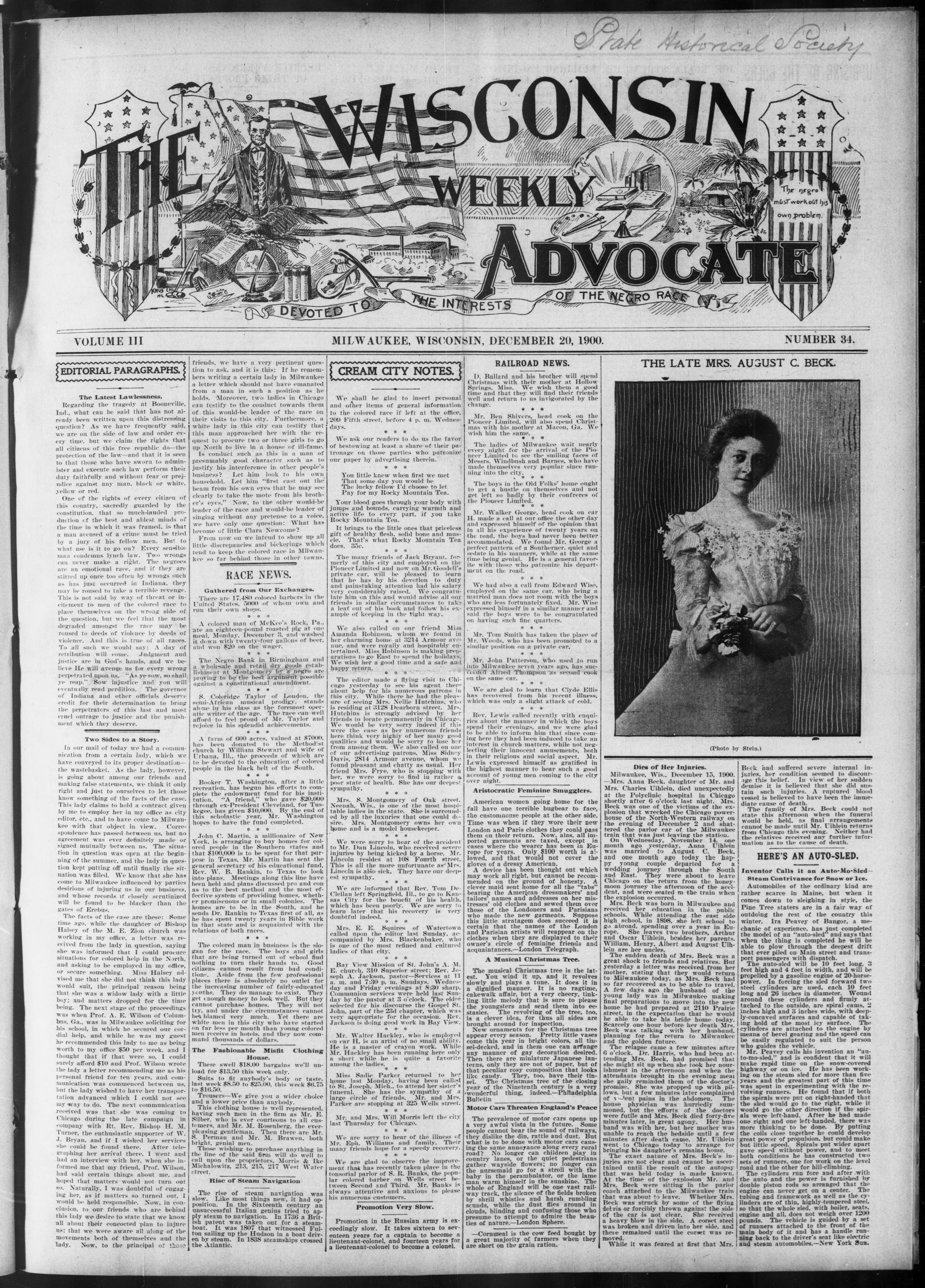
THE LATE MRS. AUGUST C. BECK.
THE FIRST WEDDING OF MARY C. BURTON
Dies of Her Injuries.
Milwaukee, Wis., December 15, 1900. Mrs. Anna Beck, daughter of Mr. and Mrs. Charles Uihlein, died unexpectedly at the Polyclinic hospital in Chicago shortly after 6 o'clock last night. Mrs. Beck was one of the victims of the explosion that wrecked the Chicago powerhouse of the North-Western railway on the evening of December 2 and shattered the parlor car of the Milwaukee train that was just leaving the station. On Wednesday, November 14, one month ago yesterday, Anna Uihlein was married to August C. Beck, and one month ago today the happy young couple departed for a wedding journey through the South and East. They were about to leave Chicago on the return from the honeymoon journey the afternoon of the accident, and were seated in the train when the explosion occurred.
Mrs. Beck was born in Milwaukee and received her education in the public schools. While attending the east side high school, in 1898, she left school to go abroad, spending over a year in Europe. She leaves two brothers, Arthur and Oscar Uihlein, besides her parents. William, Henry, Albert and August Uihlein are her uncles.
The sudden death of Mrs. Beck was a great shock to friends and relatives. But yesterday a letter was recived from her mother, stating that they would return to Milwaukee today, as Mrs. Beck had so far recovered as to be able to travel. A few days ago the husband of the young lady was in Milwaukee making final preparations to move into the new home he had prepared at 2110 Prairie street, in the expectation that he would be able to take his bride home today. Scarcely one hour before her death Mrs. Beck was talking with her husband, planning for the return to Milwaukee and the golden future.
The relapse came a few minutes after 6 o'clock. Dr. Harris, who had been attending Mrs. Beck, had promised that she might sit up when she took her nourishment in the afternoon and when the attendants brought in the evening mean she gaily reminded them of the doctor's promise. She was propped up with pillows, but a few minutes later complained of violent pains in the abdomen. The house physician was hurriedly summoned, but the efforts of the doctors were futile and Mrs. Beck died forty-five minutes later, in great agony. Her husband was with her, but her mother was unable to reach the bedside until a few minutes after death came. Mr. Uiblein went to Chicago today to arrange for bringing his daughter's remains home.
The exact nature of Mrs. Beck's injuries are not clear and cannot be ascertained until the result of the autopsy that was held today is made known. At the time of the explosion Mr. and Mrs. Beck were sitting in the parlor coach attached to the Milwaukee train that was about to leave. Whether Mrs. Beck was struck by some of the flying debris or forcibly thrown against the side of the car is not clear. She received a heavy blow in the side. A corset steel was broken and driven into her side, and there remained until the corset was removed. While it was feared at first that Mrs.
Bock had suffered severe internal injuries, her condition seemed to discourage this belief. In view of her sudden demise it is believed that she did sustain such injuries. A ruptured blood vessel is believed to have been the immediate cause of death. The family of Mrs. Beck could not state this afternoon when the funeral would be held, as final arrangements cannot be made until Mr. Uihlein returns from Chicago this evening. Neither had the relatives received any further information as to the cause of death.
HERE'S AN AUTO-SLED.
Inventor Calls it an Auto-Mo-Sled Steam Contrivance for Snow or Ice. Automobiles of the ordinary kind are rather scarce in Maine, but when it comes down to sleighing in style, the Pine Tree staters are in a fair way of outdoing the rest of the country this winter. Ira Peavey of Bangor, a mechanic of experience, has just completed the model of an "auto-sled" and says that when the thing is completed he will be able to plow through the deepest drift that ever piled on Main street and transport passengers with dispatch.
The auto-sled will be 10 feet long, 3 feet high and 4 feet in width, and will be propelled by a gasoline engine of 20-horsepower. In forcing the sled forward two steel cylinders are used, each 10 feet long and 26 inches in diameter. Wound around these cylinders and firmly attached to the outside, are spiral cams, 2 inches high and 3 inches wide, with deeply-concaved surfaces and capable of taking hold of the most icy surface. The cylinders are attached to the engine by means of bevel gearing and the speed can be easily regulated to suit the person who guides the vehicle.
Mr. Peavey calls his invention an "auto-mo-sled," and is confident that it will make rapid time on the snow-covered highway or on ice. He has been working on the steam sled for more than five years and the greatest part of this time was spent in experimenting with the revolving runners. He found that if both the spirals were put on right-handed that the sled would go to the right, while it would go the other direction if the spirals were left-hand. After he had made one right and one left-handed, there was more thinking to be done. By putting the coils close together he could develop great power of propulsion, but could make but little speed. Spirals put wider apart gave speed without power, and to meet both conditions he has constructed two sets of runners, one for work on the level road and the other for hill-climbing.
The cylinders run fore and after with the auto and the power is furnished by double piston rods so arranged that the engine can never get on a center. The tubing and framework as well as the cylinders are of thin, highly-tempered steel, so that the whole sled, with boiler, seats, engine and all, does not weigh over 1200 pounds. The vehicle is guided by a set of runners attached to the front of the main body of it and has a handle running back to the driver's seat like electric and steam automobiles—New York Sun.
UPRISING OF THE BOERS.
Three Thousand of Them Invade Cape Colony.
IN BRITISH TERRITORY.
Dewet is Near Ladybrand and an Attack on Winburg is Momentarily Threatened.
London, Dec. 19.—It is reported this afternoon that Gen. Knox has been forced to abandon the pursuit of Gen. Dewet owing to the situation created in Cape Colony by the Boers crossing the Orange river. It is said that 3000 Republicans have entered Cape Colony and a similar number have reached Philipstown. The report adds that Dewet with about 4500 men is northeast of Ladybrand and that an attack on Winburg is momentarily expected.
Kruger in Holland.
Amsterdam, Dec. 19.—Mr. Kruger arrived here today. He was met at the railroad station by the municipal and communal authorities. Speeches were exchanged in the royal waiting room. A bouquet was presented to Mr. Kruger, whose every appearance was a signal for rounds of applause. Very large crowds lined the route to the town hall, where the burgomaster made a speech in which he said he hoped Mr. Kruger would succeed in his efforts to secure honorable peace. Mr. Kruger, in the course of his reply, said:
"In 1884 we obtained our independence, but that honorable action has been obliterated. The invaders are ten against one, but we await the day when God will make known His will. We rely on His help more than on emperors and princes. I have not come as a fugitive, but by the order of my government, with the object of terminating a war in which the British employ women and children against us." Luncheon followed. Mr. Kruger subsequently visited the headquarters of the South African refugees.
Protest Against Expulsion.
Berlin, Dec. 19.—At a meeting today of Pan-Germans protests were entered against the expulsion of Germans from the Transvaal. Some of the speakers so expelled alleged they were brutally treated by the British and a government inquiry was demanded.
BEER TO BE SOLD IN ARMY CANTEENS.
Senate Military Committee Completes Substitute for Army Reorganization Bill.
Washington, D. C., Dec. 19.—The subcommittee of the Senate committee on military affairs has completed its work upon the army reorganization bill and will report the result of its labors to a special meeting of the full Senate committee which has been called for this afternoon. The subcommittee will report a complete substitute for the House bill and while much of the language is the same as that of the House measure there are numerous changes.
Probably the most important change is in the provision regarding the artillery arm of the service. The sub-committee recommends the retention of the present regimental organization of the artillery and does not give its assent to the corps organization proposed by Secretary Root and accepted by the House. In the matter of the appointment of staff officers the bill follows largely the lines of recommendations by Secretary Root.
The House canteen provision was amended so as to permit the sale of beer at the canteens. This exception was made by omitting the word "beer" from the prohibited articles.
The maximum strength of the army is to be 100,000 men.
GREAT BATTLE FOUGHT.
Government Forces In Columbia Win Decisive Victories Over the Rebels.
Washington, D. C., Dec. 19.—The state department has received a cablegram from United States Charge d'Affaires Deaupre at Bogota, stating that a great battle has been fought at Girardot point, Magdalene river, Colombia, which lasted two days and resulted in a decisive victory for the government. It is reported that 600 were killed and many hundreds wounded. Other victories by the government forces of the utmost importance have been announced. The government is celebrating the victories and considers itself greatly strengthened by the success of its arms.
WINS FROM FARO BANKS
San Francisco Man Breaks Gambling Houses at Dawson by Remarkable Run of Luck.
Seattle, Wash., Dec. 19.—One of the most remarkable faro bank plays on record was made three weeks ago in Dawson by David Allen of San Francisco, a Klondike passenger on the steamer Dolphin, which arrived yesterday.
From $2.50 Allen in four days won $35,000. Two of the houses in which he played turned over their boxes, and two others had enough of his game. Of this amount he devoted $8000 to "staking" his friends. Of the score or more "staked" but one—William Cullen—won. With the money furnished him he drew out $4000 for himself and a like amount for Allen. Then, having paid $1400 for debts, he proceeded to plunge on his own account and went broke.
HALF THE EGGS UNBROKEN.
Freight Car Containing Them Fell Forty Feet Into River.
Winsted, Conn., Dec. 19.—A singular accident occurred on the Central New England railway at "Satan's Kingdom," in New Hartford. As westbound freight train No. 23 was running along a steep embankment at that point an axle on a boxcar in the middle of the train broke. The car was derailed and precipitated into the Farmington river, forty feet below. The rails were not damaged. Trainhands opened the ditched car, which landed bottom up in the river. It was filled with merchandise, among which were castings weighing more than three tons, beef, flour and a case containing three dozen eggs. Only eighteen of the eggs were broken. The train proceeded on its journey after a delay of seventeen minutes.
"BABY" BLISS' FATHER DIES.
Pioneer Resident of Bloomington, Ill. Passes Away.
Bloomington, Ill., Dec. 19.—Elijah C. Bliss, aged 80 years, died yesterday. He was for years a resident of Bloomington. Leonard Bliss, one of the fattest men in the United States, widely known as "Baby" Bliss, is a son of the dead man.
JOE ROLLA STRUNG UP.
Third Man to Do the Tight-Rope Act for the Brutal Murder of Hallis Simons.
Booneville, Ind., Dec. 18.—Joe Rolla, colored, was hanged by a mob here at 9:30 o'clock last evening. He was the third negro to be lynched as a result of the brutal murder of Hallis Simons, a white barber, at Rockport, early Sunday morning. The other two suspects were put to death Monday night at the scene of the crime.
Gov. Mount was notified yesterday afternoon that the mob was on its way from Rockport and he immediately wired an Evansville military company to come here, but the lynching had occurred before its arrival.
Marched in Columns of Twos.
The members of the mob which hanged Rolla came to Booneville in wagons, buggies and on horseback. Their rigs were left in a grove a half mile out of the town and the men marched in columns of twos, under the command of three who had evidently been selected as leaders. Not a shot was fired, and everything was conducted as quietly as if the execution had been one under the sanction of the law.
Rolla was brought to this place Monday afternoon about 3 o'clock in charge of Sheriff Anderson of Rockport. Upon his arrival he was placed in a cell on the second floor of the jail, and his presence was known only to a few citizens.
A few minutes after 6 o'clock a body of 100 men marched through the principal street of the town to the jail and demanded that the prisoner be turned over to them.
Sheriff Benjamin Hudson was out of town and his deputy, Raymond Cherry, was in charge of the jail. He had heard that a mob was on its way here, and at once made an effort to get the prisoner out of town, to take him to Evansville, but before this could be accomplished the mob had arrived and the futility of the attempt became apparent.
Battered in the Wall.
He declined to give up the keys to the jail, and the members of the mob at once began to batter in the wall of the jail with a telegraph pole, which was handled by a dozen or more men. As soon as a hole large enough to admit the body of a man was battered through the wall six members of the mob crawled through, and, with sledge hammers, broke down the door of Rolla's cell. Inside the jail the negro could hear the sounds of the telegraph pole as it bored its way, inch by inch, through the wall, and he lay upon the floor in his cell in an agony of fear. When the men reached his cell he protested his innocence in loud tones, begging pitifully to be spared. The men working at the door of the cell might have been made of marble, judged by the attention they paid to the wailing of the negro.
Little time was used in breaking into the cell, and in the twinkling of an eye the thoroughly terrorized colored man was in the hands of the men, who proceeded to place a rope around his neck. All left, crawling again through the hole by which they had entered, dragging the negro after them.
Hanged to a Limb.
A few minutes' time was consumed in the march to the jail yard; the rope was thrown over the limb of a tree, and a hundred willing hands pulled at the rope and sent the negro's body flying into the air. The loose end of the rope was tied to a tree, and as soon as the members of the mob were sure that their work had been completed they left in as quiet a manner as they had entered the town.
None of the mob wore masks, and men to all appearance in every station in life took part in the lynching. Not a shot was fired before or after the lynching, and except for the excited groups of men standing on the street corners a stranger would have known nothing of the tragedy that had just been enacted.
Citizens of Booneville made no effort to assist in the protection of the negro, and a number quietly admitted that citizens generally were in sympathy with the work of the mob. Judge Swan of the Warrick county circuit court made every effort to suppress violence, but the members of the mob ignored him and proceeded with the work.
BUYS OLD DEFENDER.
A New York Man Rescues the Yacht from the Junk Yard.
New York, Dec. 18.—The purchaser of the noted yacht, Defender, was the junk and iron firm of Mendel Samuel & Sons of Newark. Mr. Samuel says that he paid $15,000 for the boat, which lies in Erie basin, and will remain there until spring. He also says that he bought the old champion to use or sell, and not to break up. She will be taken to Stapleton, Staten island, where the firm has another yacht, the Isis.
Mr. Samuel estimates that the Defender contains 125 tons of lead, $47\frac{1}{2}$ tons of bronze, and 6 tons of aluminum, but says that it will be a long while before the metal is in the market, as he will race the boat if he cannot sell.
WILSON BARRETT FREE.
Noted Actor, After Years of Struggle,
Pays Off Debts.
Baltimore, Md., Dec. 18.—Wilson Barrett, the well-known actor and dramatist, after eight years of hard work has succeeded in paying off debts amounting to $300,000 and will enter upon the new century absolutely free of all debt. This information was given out today at the Carrollton hotel by John S. Rogers, the theatrical manager, who recently received a letter from Glasgow, Scotland. Mr. Barrett inclosed a check to liquidate a small sum which he owed his former manager.
STRICKEN WITH PARALYSIS.
La Crosse Man Dies While at His Work in a Machine Shop.
La Crosse, Wis., Dec. 18.—[Special.]—Wallace Kingsley was stricken with paralysis while at work at a machine in the Fountain City Drill company's plant in this city. He died in thirty minutes. The father and daughter of the family have also died within the past year. The daughter died suddenly in California.
Briquettes in Germany
The company which has acquired the Mannheim patent for mixing coal oil with carbonaceous earths, with the object of making the substitute for coal known as "briquettes," in Germany, has begun operations. Shavings and sawdust are also being mixed with carbonaceous matters in briquettes. These briquettes are sold as fuel, and are said both to produce a great heat and to cause no smoke or disagreeable odor. They are, moreover, easy to handle, and are very cheap.
Electric Time Service:
Electric time service was first introduced more than forty years ago. In 1857, Brussels, Belgium, what was then known as the Nolet system of electric clocks was put in service, about 100 clocks being installed at various places in the city and electrically connected with a master clock at a central point.
The aggregate wholesale traffic in geese at Berlin amounts annually to nearly $2,000,000.
BUILDING ENGINES FOR EUROPEANS.
Americans Make Better Locomotives for Less Money and Pay Employes Higher Wages.
Philadelphia, Pa., Dec. 19.—John A. Converse, a member of the firm of Burnham, Williams & Co., which controls the Baldwin Locomotive works, appeared before the industrial commission today. He stated that the industry was established in 1831 and has constantly and steadily grown until today the works are the largest in the world. The capacity of the plant is 1200 locomotives a year, or practically four locomotives for each working day. The capital employed Mr. Converse estimated at not less than $10,000,000. About 8500 hands are engaged at the works. The foreign trade in locomotives, he said, has been a growth of the last forty years. At first it was confined to Cuba and South America, but during the past twenty-five years it has extended to the Eastern hemisphere.
Mr. Converse gave as reasons for the introduction of American locomotives abroad the possibility of earlier delivery, preference for American locomotives as to type, size and details, and the question of price. Engines have been constructed, witness said, at less cost per unit of strength than the ordinary foreign locomotives.
In answer to a question by Chairman Clarke Mr. Converse said the wages of the firm's employees are higher than those paid abroad.
"In that case," said Chairman Clarke, "how can you produce locomotives at less cost than the foreign products?"
Mr. Converse said he believed this fact to be due to the industry and intelligence of the American workman and the much larger use of improved machinery here than abroad.
As to the question of speed, Mr. Converse stated that the substitution of steel rails for those of iron permitted an increase of weight in engines which resulted in greater speed. The increase in speed and capacity has brought about a reduction in the cost of transportation and operation.
Regarding tariff conditions Mr. Converse said that owing to the government ownership system existing in most foreign countries, no difficulty was ever encountered in that respect.
Asked as to the change of the industry Mr. Converse said it was at present more prosperous than at any time from 1893 to 1897.
Mr. Kennedy asked the witness if any attempt had been made to combine all the American locomotive works. Mr. Converse answered in the affirmative, but said the effort was unsuccessful. His firm opposed the project and he did not believe locomotives could be built at a lower cost if such an idea was carried out.
COLLISION IN A FOG.
Street Car Motormen Were Unable to See Each Other and Both Are Fatally Hurt.
Indianapolis, Ind., Dec. 19.—In a head-end collision today between two electric cars on the Greenfield and Indianapolis Interurban line near Jim, Ind., Emory Scott and John Glasscock, motormen were fatally injured. Six passengers were badly hurt. The cars were running at high rate of speed and the heavy fog prevented the motormen from seeing each other. Ashland, Ky., Dec. 19.—In a head-end collision between two street cars today in this city, three persons were fatally hurt. Five were seriously injured, while half a dozen more sustained severe cuts and bruises. The fatally injured were: Mrs. Anna G. Kerr, Normal, Ky.; Motorman John Scisco; Motorman William Campbell.
Seriously injured: County Attorney Frank Brunning, body cut; Mrs. John G. Patton, Catlettsburg, Ky.; Editor Frank Freit of the Ashland Independent, bruised; Mrs. Lydia Moore, Catlettsburg, Ky.; Conductor Walter Hutchison. A dense fog caused the accident. The cars were nearing the center of the city and were filled with passengers en route to their places of business. In addition to those named half a dozen passengers sustained severe cuts and bruises.
DECORATION FOR SIMS.
American Officer to Have Cross of Legion of Honor-Charges Are Exploded.
Paris, Dec. 19.—The French government has given the most emphatic denial to those French papers which tried to involve the American embassy in the Paris disclosures in connection with the United States war department's knowledge of French gun secrets by offering the cross of the Legion of Honor to Lieut. W. S. Sims, former United States naval attache at Paris, whom La Presse described as the person guilty of disclosing the gun secrets. When the news was first published here the anti-governmental press attempted to use it as a weapon against the ministry and La Presse accused, anonymously, the ex-naval attache of the United States embassy, making the description so distinct that diplomatic circles knew Lieut. Sims was intended. It said, among other things, that "he acted almost openly as a spy for several powers."
The news became public today that M. Delcasse, the minister of foreign affairs, had offered the cross of the Legion of Honor to Lieut. Sims, who is now on the battleship Kentucky. As the lieutenant is a government official he is unable to accept the honor without the consent of Congress.
DETROIT MAY LOSE ITS GAS.
Row in Canada May Take Supply Away from Michigan City.
Detroit, Mich., Dec. 19.-Detroit's natural gas supply may be cut off soon unless a row in Canada, whence the gas comes, is settled. Two companies have the gas wells at Kingsville, in Essex county, the center of the gas supply. The Interior Construction and Improvement company of this city does the piping to Detroit, but it is claimed is under contract to furnish it to Canadians at a cheaper rate.
The United Gas and Oil company of Windsor has all along been furnishing the industries at Kingsville with gas for fuel, but has now shut down on this and will furnish gas only for domestic use, claiming the supply is being too rapidly exhausted by use for industrial purposes. This leaves the Kingsville industries in bad shape and it is said they will call on the Interior company to carry out its bargain and furnish them with fuel. If this comes about it may necessitate cutting off Detroit.
CHANGE SING SING'S NAME.
Citizens Want the Town Called Ossining.
New York, Dec. 19.—By a unanimous vote last night, the citizens of Sing Sing, N. Y., voted to petition the Legislature to change the name of the village from Sing Sing to Ossining.
Pingree's Pardon Upheld.
Lansing, Mich., Dec. 19.—The Supreme court today held that Gov. Pingree's pardon of Gen. Marsh is valid.
HENRY WALLACE DIES IN HIS OFFICE.
Old-Time Member of Chicago Board of Trade-Had Won and Lost Several Fortunes.
Chicago, Ill., Dec. 19.—Henry Wallace, for thirty years a member of the board of trade, who had won and lost several fortunes in the wheat pit, was found dead last night in a small office which he had occupied for some time near the board of trade. Death was due to heart failure. It was during the time of B. P. Hutchinson—"Old Hutch," as he was familiarly known—that Wallace was best known on the board of trade. He bought and sold extensively and was at one time wealthy.
At night and after business hours he would regularly lock himself in his office, where he was working to complete a new water filter which, it is said, it was his intention of having patented. He was apparently 65 years old and so far as is known had no relatives in the city. A cousin is said to live in Iowa and an effort will be made to find him.
GIFT OF ROCKEFELLER.
Christmas Present of $1,500,000 to Chicago University-A Million for Permanent Endowment.
Chicago. Ill., Dec. 19.—Gifts of $1, 525,000 to the University of Chicago were announced by President Harper at the convocation yesterday. Of this sum $1,500,000 is donated by John D. Rockefeller, the founder of the university, and $25,000 is added by Leon Mandel to the $50,000 previously given by him.
The money is to be used as follows: One million dollars is to be set aside forever as general endowment fund; $100, 000 is to be used in the erection of the University Press building; and $100,000 in the installation of a central heating and lighting plant, besides using part of the sum in paving Fifty-ninth street, beautifying the grounds, and laying cement sidewalks.
The following statement shows the various sums given the University of Chicago by the persons named:
cago by the persons named:
John D. Rockefeller.....$9,133,874
Miss Helen Culver.....1,000,000
Martin A. Ryerson.....500,000
Marshall Field.....400,000
William B. Ogden estate.....300,000
Charles T. Yerkes.....300,000
Sidney A. Kent.....235,000
Mrs Charles Hitchcock.....200,000
Mrs. Caroline E. Haskell.....150,000
Silas B. Cobb.....150,000
George C. Walker.....130,000
A. C. Bartiett.....125,000
Mrs. M. S. Foster.....80,000
Leon Mandel.....75,000
Henry A. Rust.....50,000
Mrs. Henrietta Snell.....50,000
Mrs. Mary Beecher.....50,000
Mrs. Elizabeth Kelly.....50,000
Mrs. Emmons Blaine.....27,000
Total in big gifts.....$13,005,874
Total by others than Mr. Rockefeller.....3,872,000
Mr. Rockefeller has outstripped in amount all donors to American universities, as the following table shows: John D. Rockefeller, University
Anthony J. Drexel, Drexel Institute 3,000,000
L. Stanford, Lejand Stanford Jr. University 2,500,000
Ezra Cornell, Cornell University. 1,500,000
The Vanderbilts, Vanderbilt University 1,100,000
Seth Larry, Columbia University. 1,000,000
SELLS DIVORCE CASE.
Agreement as to Alimony Secretly Reached After Long Litigation
Columbus, O.. Dec. 19.—The sensational divorce case in which Peter Sells, the wealthy circus owner, charged his wife with various intrigues covering a period of thirteen years, came to an abrupt end yesterday. It was due to the fact that at a conference between counsel which lasted until midnight, an agreement was reached regarding the alimony Mrs. Sells should receive, and they rested her case without offering further evidence against her husband. Sells' counsel took up the morning in disproving every syllable of the evidence of Chattanooga and Kansas City witnesses. After this had been done Mrs. Sells' counsel informed the court of the agreement on alimony. Then came a magnanimous request from Peter Sells' attorney, who said it was the desire of Mr. Sells that if consistent a decree of divorce be granted him on the ground of gross neglect of duty and that no finding be made on the charge of adultery.
The agreement is kept secret, but it is understood that the amount of the alimony Mrs. Sells shall receive is $20,000.
AIDED BY HYPNOTISM.
Man In Boston Hospital Subjected to Painful Operation Without Feeling the Slightest Pain.
Boston, Mass., Dec. 19.—John Kneeland's back was seared with a white-hot iron at one of the hospitals of the city while Kneeland was in a hypnotic state. Kneeland felt no pain during the operation of searing the nerves that were causing trouble, directly over the back bone.
A hypnotist was in the hospital and Kneeland, although doubtful, was willing to have the art tried on him, and the hypnotist took him in hand. In three minutes the patient was in a hypnotic state.
Various tests were made to see if the man could be safely operated upon. Dr. Buehler then carried out the originally-projected operation. Heating an iron to a white heat, he said to his patient: "Now, I'm going to rub my finger down your spinal column to locate your trouble."
He drew the white hot cautery down his back. "Do you feel that?" "No," answered the patient. The operation was over. The wound was dressed, and the patient was brought out of his hypnotic state.
A NEW AIBSHIP.
German Kaiser Aids Inventor to Complete the Model.
New York, Dec. 19.—A dispatch to the Journal and Advertiser from Vienna says: An Austrian engineer, William Kress, has invented an airship which is pronounced to be better than Seeplin's. The Emperor's attention being called to the model, he has become much interested and expressed the belief that it would be successful. Kress not having money to build a large ship, the Emperor said he would fix that and contributed $1000 out of his pocket. Numerous others followed suit, and Kress will build the ship.
Got Hold of a Live Wire.
Houghton, Mich., Dec. 19.—James Hill, aged 25 and single, who recently came here from Canada as a lineman for the Michigan Telephone company, accidentally touched a live electric wire while working on a pole in Hancock yesterday and was instantly killed, the body falling twenty-five feet to the earth.
DEPRIVE AMERICANS OF THEIR PROPERTY.
DEPRIVE AMERICANS OF THEIR PROPERTY.
Cable Message to New York Tells of a Revolutionary Outbreak in Venezuela.
New York, Dec. 19.—The Tribune prints the following: "A cable message received at the office of the National Asphalt company from its agent in Venezuela announced that a revolution had broken out in that country." The revolution is probably the outcome of an attempt on the part of the President and cabinet of Venezuela to deprive American corporations of their property and rights.
CAUGHT IN HURRICANE.
Passengers Save the Ship and Their Lives by Bailing Water Away from Cargo of Lime. San Francisco, Cal., Dec. 19.—The Centennial, formerly a transport carrying troops to Manila, which is now running as passenger vessel between Seattle, Honolulu and San Francisco, arrived yesterday in badly-battered condition. Only the coolness and readiness of passengers on board to help the crew saved the steamer from destruction. The eighty-six passengers set to work and bailed out the vessel for hours, prevented the water from reaching the cargo of lime, and saved the vessel.
The Centennial sailed December 11 for Seattle. When two days out a storm began and for four days the vessel was hammered by seas. On the 15th, waves swept over the steamer, smashing the two lifeboats. Two barrels of lime were set on fire, but were thrown overboard. On the night of December 16, from 6 to 10 o'clock, it seemed as if the vessel could not weather the hurricane. The saloon filled with water. The bridge started while Capt. Engles and his chief officer were on it. The eighty-six passengers volunteered to bail out the saloon to prevent the water from reaching the 4876 barrels of lime stowed in the hold. The crew was occupied in navigating the vessel and could not aid in the work. The firemen worked all night in water up to their waists.
AN AMNESTY MEASURE.
Legislation at Paris Which will Bring About the Rehabilitation of Dreyfus.
Paris, Dec. 19.—The debate on the amnesty bill in the chamber of deputies last night was probably the longest that has ever taken place in the history of that body. The interesting feature of the measure to foreign nations is that the passing of the bill will render easier the rehabilitation of Dreyfus. The Rights and the Nationalists resorted to obstruction and kept it up for hours, but to no purpose. M. Waldeck-Rousseau, the premier, supported by M. Millerand, minister of commerce, and the Republican majority, remained firm. At 1 a. m. the public galleries were almost empty. There was only a slight disorder on the floor. The deputies themselves were half asleep.
Attacks the Premier's Honor.
At 1:30 o'clock the chamber was the scene of a most exciting episode. M. Lasies, the leader of the Right, made a violent speech, in which he attacked the personal honor of Premier M. Waldeck-Rousseau.
The premier, for the first time since the beginning of the debate, showed signs of being moved. He expressed the greatest indignation at the attack made upon him. Amid great uproar and confusion the Senate by a large majority passed a vote of censure on M. Lasies.
The final vote was taken at 2:15 a. m. and the amnesty bill was passed, 156 voting in favor of it and 2 against it.
CRUELTY TO WOMEN.
Pitiabie Stories Describing the Workings of Kitchener's Reconcentrado System.
The Hague, Dec. 19.—Pitiable stories reach Holland concerning the fate of the reconcentrado women, who are in camps in the Transvaal. For instance: Mme. Hardus of Kimberley reports at the end of October: "Today arrived eight women and twenty-four children from Potchefstroom by train. They had a terrible tale to tell of how when they refused to leave home they were dragged away by Kaffirs, thrust into jail and after having been kept some time and then taken by soldiers to Kimberley. When they arrived here their clothes were torn, having been done by soldiers. Two had succumbed to the brutal treatment. Some of the women were widows of those killed in the war or their husbands were at St. Helena. Most of them were barefooted. I was able to get them some food."
Another correspondent reports the arrival of seven women in the same pitiable plight. Three women who had suffered from soldiers were taken to the hospital for treatment. A nursing sister who had arrived at Harlem from Africa gives harrowing accounts of the treatment the women were subjected to. Those brought into reconcentrado camps were not allowed to take infants 4 and 6 months old with them.
MADE HIS OWN GRANDFATHER
Decision of Court Strangely Affects James Hartwell of Albion, Ill.
Binghamton, N. Y., Dec. 19.—Through a peculiar holding of the courts James Hartwell of Albion, Ill., has been declared his own grandfather. The discussion that brought out this peculiar relation arose over the disposition of $175. In 1897 there lived at Albion, Ill., a widow named Swan and a young man named James Hartwell, the widow was 40 and the man 21, but they fell in love and were married. Last year he died, leaving a clause in his will bequeathing $175 to "my grandfather, James Hartwell, and in event of his death it shall revert to my wife." The wife succeeded after legal advice in cutting out the living grandfather on the following interpretation: James Hartwell, her husband, was dead, and James Hartwell, his grandfather, was living, but James Hartwell was his own grandfather, so the money reverted to her. James Hartwell, her husband, was his father's father-in-law because his father married her daughter. Her husband's father's father-in-law is her maternal grandfather, therefore her husband is his own father's father-in-law and is the same as his grandfather, and, being dead, entitled to the amount of the bequest.
PERISHES IN BURNING HOUSE.
Mysterious Death of an Iowa Woman will be Investigated.
Estherville, Ia., Dec. 19.—The house of John Freeman was destroyed by fire and Mrs. Freeman perished in the flames. There is suspicion of foul play, and Freeman has been arrested pending an investigation by the coroner's jury. Freeman and his wife had been married a year, and it is claimed their wedded life was not a happy one.
Senate.
Thursday, Dec. 13.—Listened to Mr. Hanna in support of the ship subsidy bill, and then devoted the rest of the day to executive session, during which the Davis amendment to the Nicaragua bill was adopted by a vote of 65 to 17.
Friday, Dec. 14.—In secret session throughout nearly the entire legislative day, discussing the Hay-Pauncefote treaty. No business of importance was transacted in open session, except adoption of House resolution providing for holiday recess to extend from Friday, December 21, to Thursday, January 3, 1901.
Saturday, Dec. 15.—Considered the Hay-Pauncefote treaty in executive session.
Monday, Dec. 17.—Mr. Chandler created a little flurry by endeavoring again to get up the resolution relating to the Montana senatorial case. The effort was futile. No legislative business aside from the purest routine was transacted, the day being spent in executive session on the Hay-Pauncefote treaty.
Washington, D. C., Dec. 18.—The friends of the Hay-Pauncefote treaty occupied nearly all of the time of the Senate in executive session today, Senators Foraker and Morgan being the speakers. Previous to the taking up of that treaty the Senate, for the purpose of clearing its calendar, disposed of several other treaties of comparatively little importance. Five conventions in all were ratified.
Wednesday, Dec. 19. — Passed House resolution authorizing President McKinley to appoint Congressman Boutelle (Maine) captain on retired list of navy, Passed urgent deficiency bill. Passed bills giving pensions of $50 monthly to widows of Gens. John M. Palmer and John A. McClernand.
House
Thursday, Dec. 13.—Devoted the day to Jebate upon the war revenue reduction bill. Those who spoke were Messrs. Grosvenor (Ohio). Bartholdt (Mo.), Hill (Conn.), Boutell (Ill.), McClellan (N. Y.), Newlands (Nev.), and Underwood (Ala.). Mr. Bartholdt gave notice that he would offer an amendment to reduce the tax on beer to $1.50 a barrel. It was agreed to close general debate on the bill Friday afternoon, December 14. Resolution was adopted for a holiday recess from Friday, December 21, to Thursday, January 3, 1901.
Friday, Dec. 14.—Devoted the day to discussion of the war tax reduction bill.
Saturday, Dec. 15.—Passed revenue bill and pension appropriation bill.
Monday. Dec. 17.—Suspension day. Passed 102 private pension bills. Passed bills to divide Kentucky and West Virginia into two judicial districts and to create another district judge in the northern district of Ohio. By a vote of 51 to 105 defeated a bill to give old soldiers and sailors preference in the matter of federal appointments. Passed a bill to place Congressman Charles A. Boutelle on the retired list as a captain in the navy. Passed an urgent deficiency bill carrying $182,500 for contingent expenses of the House of Representatives, Indian affairs, District of Columbia and the national home for disabled volunteer soldiers.
Washington, D. C., Dec. 18.—The House spent the entire session today, this being "District of Columbia day," on a bill requiring the Pennsylvania railroad to elevate its tracks in the city of Washington so as to eliminate grade crossings. Preceding the regular order of business a bill was passed to change the time for holding court in the Southern district of the Southern judicial division of Iowa, and the Senate bill to amend the act to authorize the construction of a bridge across the Mississippi river at Dubuque, Ia., was also passed. Wednesday, Dec. 19.—After spirited contest extending over two days passed bills to compel Pennsylvania and Baltimore and Ohio railroads to abolish grade crossings in Washington, to alter their routes into capital and to change their terminal facilities. Amendment requires Pennsylvania road to build new station to cost not less than $1,500,000. Bills were vigorously antagonized by portion of minority under leadership of Mr. Cowherd (Mo.) on ground that they were too liberal to the roads.
Chicago Matters.
Mrs. Allen Heffernan, 80 years old, died at Mercy hospital from the effects of a fall on Sunday at her home.
Levi Z. Leiter has started suit in the superior court against the Grand Pacific Hotel company for $30,000, claimed as due on a debt.
George Steegart, 22 years old, was run over and injured so severely by a Metropolitan elevated train that he died soon after at the Presbyterian hospital.
Two weeks ago Anthony Kartec was struck on the head by a silver dollar, thrown by Anthony Steaf. Yesterday he was taken to Mercy hospital suffering from blood poisoning and he is in a critical condition.
—Gustave Walters, a teamster, fell from his wagon while turning out of the street car tracks and was so severely injured that the physicians at the Alexian Brothers' hospital fear for his recovery. He is 54 years old.
—Charles Heisteninger, 41 years old, was crushed to death beneath several tons of coal in H. H. Teddepp's ccalyard. He was working in a coalbin when a partition gave way, permitting the coal from an adjoining bin to fall upon him.
—With his 4-year-old child in his arms, William Pisher, a farmer from Iowa, while crossing the street car tracks was run down by a wagon and severely injured. The child escaped uninjured. Pisher's injuries consist of a severe wound on the top of his head.
Abner J. Oswald, a former employee of Marshall Field & Co., and a favorite in Brighton Park social circles, died at St. Helena, Cal. He had journeyed thence in search of health. Lung complications hastened his end. His versatility won him hosts of friends in all sections of the city.
Mrs. Catherine Marou died as the result of burns received at her home. She was 80 years old. The fire started when a kettle of lard boiled over on the kitchen range.
George Wilson, 50 years old, formerly a well-known draughtsman of Chicago, was found dead in a room at the Anna house. Death is supposed to have been due directly to asthma. He is said to have relatives living in Evanston.
—A pile of rubbish in the basement of the elevator shaft at Booth & Co.'s oyster house saved Gustave Anderson, an engineer, from instant death. He fell from the third floor, a distance of 60 feet. He was uninjured.
—E. M. Bailey, chief of the Melrose Park fire department, died at his home. He had been ill 'of consumption for the last six months, and but recently returned from a trip to Denver for the benefit of his health. He was 26 years old.
—Market gardeners, policemen and firemen joined in a fight against a prairie fire that swept over half a dozen blocks in the town of Lake. There were fifty people beating it out in all directions and it was not under control until 10:30 o'clock.
There are over forty heirs and legacies named in the will of Frances E. Ogden, filed for probate. The will disposes of an estate scheduled at $784,000, of which $254,000 is personal property. Among the larger cash legacies are $50,000 to the testator's sister, Marie S. Scammon, and $19,900 to a grand-daughter, Frances Ogden West. Several institutions were remembered, as follows: Chicago Nursery and Half-Orphan asylum, $2500; Bishop Clarkson Memorial Child's hospital, Omaha, $5000; Chicago Historical society, $5000; Art institute, $5000; St. James' Episcopal church, for charity work, $5000. Graceland cemetery is given $2000 as a fund to provide for the care of the grave of the testator and family. The remainder of the estate was distributed among the members of the testator's family and relatives. A number of old servants were remembered.
CHRISTMAS GARLANDS.
The stream in the frozen flags are smooth! And white as a bar of pearl; The swinging balls of the cottonwood Were caught in a gusty swirl.
The lithe, long withes of the willow tree
Were bent by the ruthless gale;
The berries that clung to the dogwood sprigs
Were rattled about like hail.
And not a shimmer of russet-red,
Nor a fragment of umber-brown.
Remained on the oak tree's mighty boughs,
Nor the shuddering alder's crown.
But though the point of his lance was sharp,
And his mood was harsh and wild,
He turned aside from the evergreens
With the changeful mind of a child.
The shivering vines were shriveled black,
And the buckeye's fallen burrs
Were covered thick with a frozen rime,
By the Knight of the cyrstal spurs.
But the shaken plumes of the cedar boughs,
The frost-born fiery glow
Of clustered beads on the holly tree,
The pearls of the mistletoe.
He touched them not with his smiting hand,
Though his will was well to slay.
For cedar and holly and mistletoe
JOHN WARREN'S CHRISTMAS
John Warren dropped his newspaper on the floor of the car, and, lighting a fresh cigar, stared out of the window at the row of dingy tenement houses which lined the railroad into the great city. Strongly built and handsome, he was just now wearing on his face a look of utter weariness, resulting from a long trip in the West, where he had been looking after some interests of the firm of which he was a junior partner. Nine years before, in a fit of anger, he had left his home in the country, and, too proud to return, had by dint of dogged persistence, secured a humble place in the packing rooms of Brace & Brown's wholesale dry goods store. Fortune favored him, and this same quality of resolution, together with application, had raised him to the position he now occupied. Though he was gazing out of the window his attention was really drawn inside to the group of traveling men who were making ready to leave the train. It was a jocular set and they had enlivened their trip, and now, as they were getting into their overcoats, the jolly-faced hardware drummer said:
"Boys, where are you going to be Christmas day?"
"I'm going back to the fleshpots of Egypt and eat my turkey in the country," said one.
"Yes," said another, "I'm going to be in my old place at the old table with my white-heared little mother smiling at me from behind the coffee pot and my dear old dad piling enough on my plate to teed a regiment."
"Think of those home-made pies!" said another, "those fat moons of apple, pumpkin, mince and cranberry. Say, no restaurant-tin-bottom-crust about them."
"And," said the boot and shoe man, "to sit around the old fireplace and watch a row of juicy apples roasting in front of that roaring, great-hearted log fire, with two or three of the neighbors arguing about that wood lot on the north side of the farm. Boys, you couldn't fence me away from home that day." And so each one, with a home picture in his heart, hurried out of the car and up the long flight of station stairs away to his destination, while slowly behind them came John Warren with a surging tumult of feelings in his breast.
Shame, that he hadn't written to his parents in the nine years of his absence. "They don't even know where I am. Poor fool I was to be miffed at them. Worse fool to stay miffed until now they have dropped almost out of my recollection. Ah, that home picture that fellow drew." And as John mounted the last step a tear dropped on his brown beard and a sudden resolution filled his heart. He almost shouted: "I'm going home, too."
Dashing up to a cabman he said, "Tremont, quick," and flinging his baggage into one seat fairly hurled himself into the other. As the carriage rumbled along the sleeping emotions of years awoke and seemed to choke him. Then swiftly his practiced mind began to plan, and by the time the hotel was reached a definite line of action was laid out. Scarcely waiting to snatch a hasty cup of coffee, he leaped into a cab, and soon mounting the steps of Mr. Brace's palatial home, was ushered into his library, where he found that gentleman standing with feet wide apart, back to the fire, and contemplating a picture on the opposite wall.
"Mr. Brae," said he, after greetings were exchanged, "I must beg your pardon for talking business out of business hours, but I am going home tomorrow and can't wait for regularity. My home is just like that farmhouse in that picture there, and I am in a hurry to go in at that little gate."
His conference soon ended. John hurried to his hotel again and taking a very shabby suit from his wardrobe packed it with some things in a large satchel, and then hastening to the station climbed into the sleeper just as the long train pulled out for the East. Arriving at a point twenty miles west of his old home, he went to an obscure hotel and changed his clothing for the old suit in his satchel.
When the "leven forty" pulled into the town of M—two days before Christmas, the usual crowd of loungers observed a tall, brown-bearded man, whose clothes seemed the worse for wear, step off the rear platform, and without looking at anyone strike off toward the farm of Richard Warren.
Much curiosity was centered on this event, much discussion engaged in, until the seediest-looking loafer present said:
"That was John Warren, or I'll eat my hat! Yes, that was John Warren, and he's come home to live on the old folks. It wouldn't be for long, though, 'cause Squire Cobb has given notice that he's goin' to foreclose the mortgage he has on the old man's place."
If they had followed the stranger for half a mile they might have seen the strong young man shed heartfelt tears as he leaned against the old oak tree by the little gate and gaze earnestly on the brown house at the edge of the woods. Crushing the snow with hasty steps, he was soon at the woodpile at the side of the house. Flinging down his satchel and catching up the axe he split an armful of wood, and opening the kitchen door said in a voice tremulous with emotion, "Mother, is this enough wood to get dinner with?"
A cry of wonderful joy and the mother wept on her son's shoulder while his father paced the floor shouting, "Praise God! Praise God!" stopping often to clasp his son's hand and murmur, "My boy, my boy." Then he drew up to the fire and John said: "Father, mother, will you forgive me for my anger nine years ago and my cruel silence ever since?" And his mother said: "My boy, not a day has passed but that we haven't prayed for your return, and, now that you are with us, we can take a new lease of life, and"—she glanced at his shabby clothing—"we will share our little possessions with you, my dear, long-lost son."
His father reached out his hand, rough and knotted with hard work, and pressed John's hand in loving approval of his mother's words. Then his mother began to place some food on the table, stopping every now and then to cry softly, such happy tears, while his father told him the
I'll try to write the text from the image as accurately as possible.
neighborhood news. John easily parried questions concerning himself, and his parents, soon seeing that he did not care to talk of his own doings in the years that were past, concluded that he had not been fortunate, and introduced other subjects to make him forget his supposed troubles.
As the forenoon wore away John helped his father about the chores, and by skillfully-planned questions learned all about his father's financial troubles. He had taken his satchel up to his own room and was washing his hands before supper, when he heard a light step on the porch, and a bright-faced young woman walked into the kitchen and, seeing him, stood embarrassed until he, coming forward, said:
"This is Anna Scott, isn't it?" "Why, John Warren, where have you kept yourself all these years? Oh, how happy your mother must be!" And dropping his hand, which she had been shaking with the greatest enthusiasm, she flew down into the cellar and threw both arms around his mother's neck, and that good lady embraced her, weeping and patting her shoulder with the empty cream pitcher which she had taken there to fill. Mrs. Warren insisted that Anna should stay for supper and after a pleasant evening, talking over the old schoolmates and old times, Anna suddenly arose and said: "Well, I declare, it's 9 o'clock! I must go home. Besides, I am so anxious to tell the folks that you are home, and brother Harry will be just wild to see you."
It seemed very much like old times when John tucked her hand under his arm and they walked over the road they had traveled so often years before. Just as they entered her father's gateway John said:
"Anna, my parents think just as you do, that I have made a failure of life. Well, I haven't. I am junior member of a very prosperous firm in the West, but I want to keep the secret a little while longer, and I want you to help me give them a kind of surprise."
Then he unfolded his plan to her and her voice rang with delight, as she said:
"Oh, John, how lovely that will be."
The next morning, after the old family Bible was read and a heartfelt prayer offered, John asked the loan of his father's horse, and drove straight to Squire Cobb's office, and that worthy being in, John said:
"Squire, I came to see you about that mortgage you have on my father's farm."
"No use, young man, no use. I must foreclose the last of the year; he has already had notice."
"You are making a mistake," said John. "I want to pay it."
With that he drew from his pocket a large roll of bank notes and counted down the $500 which would release his father from worry and misery. The squire immediately became a man of smiles, and speedily made the mortgage over to John, who drove at once to the farm of Mr. Scott and called, "Whoa," just as Anna, her father, mother and brother came to the gate.
There were hearty greetings, and then Anna, all ready for a long drive, sprang in beside him. How bright the morning was! How happy were they as the bells jingled and the sleigh moved with purling noise over the wilderness of snow and through the deep woods. What mysterious bundles they bought out of the stores in the large town of F——, until when, at last they arrived at Anna's home, the sleigh was loaded with "enough to stock a store," as Harry Scott remarked.
Christmas day dawned bright and glorious with sun and snow, and early in the morning Anna appeared and she "wanted to help get dinner," soon John brought the horse and cutter around and asked his mother to take a ride with him, and finally, after much urging from Anna, Mrs. Warren put on her shabby cloak and hood, and with a warm soapstone at her feet was tucked into the sleigh beside John. He noticed the cloak and gave a little look of entreaty to Anna, who only smiled and said: "I wish you would call at mother's before you come back." Away they drove toward the mill and down by the river, and then stopped at Farmer Scott's. Soon Mrs. Scott was showing Mrs. Warren her "new quilt, just taken out of the frames," and the picture of "Cousin William, who is on the board of trade," and these two good old women talked over a hundred harmless things which constituted their everyday life. John finally suggested that it was time they were going if he could believe the clock of appetite. Anna met them at the door, her eyes dancing, as she said: "Uncle Warern is almost ready. You lay off your things and sit down at the table."
When Mr. Warren had finished the tenderly-thankful grace, fraught as it was with a new meaning, John's eyes as well as Anna's were filled with tears. Mr. Warren turned over his plate and there lay the cancelled mortgage. Slowly he lifted it. "What does this mean, John?" The kind voice of the old man trembled with emotion as he glanced first at the mortgage, then at the son. And John's mother, who had been peering through her glasses at something which wouldn't pour out the cream pitcher, turned the article upside down, and a bunch of bank-notes dropped upon the table. Then the old couple saw it all and soon the three were clasping hands, and no one could say a word until John managed to murmur: "Father, mother, it's part of my repentance."
During these scenes Anna had quietly withdrawn, and John called her, saying: "She helped me plan it."
Then the father carved the brown, fat turkey and John had his plate "heaped with enough for a regiment." After dinner, while Mrs. Warren and Anna were clearing up the dishes, Mr. Warren and his son sat in the kitchen and John told them his story. As they listened the women were very careful to set the dishes down gently, and often stood with plate suspended while he recounted the struggles of nine years.
The dishes cleaned and put away, his father, looking out of the window, said: "I wonder what Sam Bolus is driving his livery team up here for?"
"Oh," said his son, "we're going to take a ride. Anna do your duty."
So Anna took the mystified Mrs. Warren into the little "spare room" and John asked his father to walk up to his room, and there, spread out on the bed, was a splendid new, warm suit of clothing and shoes and a fur cap and a handsome great coat.
With the words "Put them on, father; haven't time for explanations," his son hurried into the next apartment.
The old man knelt, down by the bed and murmured, "I thank Thee, Lord, for my son." Then arising, clothed himself in the first well-fitting suit he had ever worn. John, too, arrayed himself in his best, and soon they walked down into the parlor, where John saw a sweet, matronly woman and a pretty young woman, both smiling and both having evidences of recent tears.
"Well, mother," said Mr. Warren a few moments later, as he clasped her hand under the buffalo robe, "I didn't know you were so purty."
"Well, father," said she, as she smoothed down the new cloak with the hand that was free, "I think you are almost as handsome as John."
And John and Anna on the front seat smiled and finally laughed outright in their happiness.
Driving around to the station, John elbowed his way through the crowd of loafers, who were more than ready to claim acquaintance, and entering the little waiting room, telegraphed Brace & Brown his intention to remain at his par-
ents' home a week longer. Leaping into the sleigh again and taking the reins from Anna, he drove to the town of F. There they heard a concert, which Mrs. Warren said was "just like heaven." Then home under the starlight, and when they said "goodnight" to Anna they added, "God bless you." Mr. Scott's man had attended to the evening chores and was waiting to take the team to the livery stable. The tired but happy old people soon retired, and John, after he had gazed into the fire until sleepy, climbed to his room, feeling it had been the happiest day of all his life.
During the week that followed John engaged a hired man to ease his father's work and a trusty girl to relieve his mother. He also hired a carpenter to do some needed repairing and set in motion many plans for the future comfort of his parents.
One day he and Harry Scott hunted through the woods, and when, tired and loaded with trophies of the day's hunt, they came to Mrs. Warren's, they found Jennie Nellis and Anna seated before the "great-hearted fire." What a merry supper that was, and how the old people laughed at the bright sallies of the young folk!
Then they roasted apples and told stories, and John felt that he had faithfully carried out the programme of the traveling men.
When he left for the West he carried in his memory not only the dear faces of his parents, but the gentle voice of Anna as she said:
"Yes, but not until June, John."—L. M. Hiatt in Chicago Post.
CHRISTMAS GIFTS FOR WOMEN.
An opera bag is a good present for the theater-going girl. The newest and handsomest are made of wide gold ribbon, spangled with gold or embroidered with beads. Others are of silk gailyflowered Dresden or rich Persian design.
** **
Hat pins are always acceptable to a woman. The dull gold beads set with small colored stones are pretty, and the large pearl beads are novel.
**
Buckles of gun metal set with emeralds or amethysts are very beautiful, and will bring delight to the heart of any woman who loves pretty things.
Lucky charms are shown in great variety. Four-leaf clovers inclosed in glass are favorites. Others are tiny gold and silver hearts. Egyptian coins, crystal and turquoise hearts, quaint little seals, medallions of enamel and gold fleur de lis. These may be hung on chain or bracelet, and are especially liked by young girls.
* * *
A pair of steel, gold or silver slipper buckles makes a pretty present. A band of satin in black, or the recipient's favorite color, should be attached.
* * *
Desk supplies are shown in many varieties. Very pretty are the inkstands of glass and silver, muciliage pots of the same, and pen trays; stamp boxes and paperweights of cloisonne are beautiful. The china desk sets are pretty to look at, but fragile for wear. Blotting pads, with silver corners; a seal, wax and candle; engagement and address books, leather-bound calendars are a few other things suitable for any lady's desk.—New York Mail and Express.
Fancy aprons of fine lawn or point d'esprit, daintily trimmed with satin ribbon and lace, will be appreciated by the woman who embroiders and likes to sew.
A pair of silver of glass candlesticks with rose-colored shades, will please the woman who takes pride in her pretty apartment. Equally suitable will be a square of silk or embroidered goods for a sofa cushion.
* * *
Fancy. waste-baskets decorated with bows of ribbon in two shades are gay and attractive.
* * *
French flannel in waist lengths, with silk-embroidered fronts and cuffs in individual design, is put up in fancy boxes for Christmas gifts.
* * *
Silver, or silver and glass, toilet articles are always acceptable to women. Some of them are brush, comb, powderbox, cold cream jar, button-hook, curling iron, glove stretcher, atomizer, perfume jar, vaseline holder and hairpin case.
If something to wear is wanted, there are dainty and novel scarfs, girdles, stockings, of silk with lace insertion, gloves, chenille ruffs, rosettes of chenille and gold, with long ends for bodice adornment; lace handkerchiefs and fans of lace and spangled net.
John Chinaman's New Masters
Martin B. Schroeder of Philadelphia, a soldier, now serving in China, writing of the occupation of Tien Tsin, says: "If a soldier wants any work done he lays hold of the first Chinaman he encounters and compels him to do his bidding. The Russian soldiers are the worst. They work the Chinks almost to death during the day and then kill them at night. Many of the soldiers are well supplied with money which they have taken from the Chinese. An American here is held in high respect by the people of all other nations. The Japanese make fine little soldiers, but they are being butchered without mercy. Here we see Tommy Atkins. He is all right, but a foul-mouthed lot of soldiers I never heard. The French soldier is a disappointment. He looks like a dry goods clerk with an ill-fitting uniform on. The Germans are all about the same size and never tire singing. The Russians are the poorest and dirtiest-looking soldiers here, and they have the least friends, because they are so merciless in their treatment of the Chinese."
Take Water for Medicine
There is no doubt that we do not drink enough water.
Our bodies consist largely of water, and the average man needs to drink from four to six pints of water daily in order to maintain health.
This is the amount of water eliminated from the body by means of the kidneys, the skin and the lungs.
It is evident that a fresh supply is constantly needed to supply this lost aid in the process of digestion and carry away waste matter.
If the amount of water imbibed is not sufficient for all this, the health must suffer. Air, water and food are the essentials of life in the order given.
A person can fast a long time—experiments have proved this. But that same person could not get along without water for that length of time.—Penny Pictorial.
The Leopard's Keen Ear:
If the leopard were not such an irresponsible beast he would make a wonderful scout, but you can't depend on his character, although you can depend on his senses every time. A friend of mine has a tame leopard which I watched with interest. He could hear a wagon approaching on the veldt long before even a dog could hear it—and a dog can hear it a mile and a half—and he could distinguish his master's step at a distance of 100 yards.—Maj. Burnham in London Daily News.
—Boot and shoe makers throughout New England are crowded with orders, and shipments from Boston have increased to 86,000 cases weekly.
RETIRED WITH LOSSES.
Story Current in London that Boen Forces at Orange River Have Been Badly Defeated.
Cape Town, Dec. 18.—The Boers who crossed the Orange river into Cape Colony, west of Aliwal North, on Saturday, encountered the Cape rifles and Brabant's force, who retired with loss.
Commandant Haasbroek, who last week tried to break through the British lines at Springkants Nek, reinforced by the commando of Gen. Detfil, has cut his way through at Enubirt Nek. He attacked the outposts at dawn, killed fifteen, including two officers, and captured two 30-pounders.
His success was due to the fact that the burghers were clad in khaki, and the British again mistook them for comrades.
The burghers in the neighborhood of Thaba N'Chu are leaving their farms and joining commandos. A new prophet of the Transvaal has arisen. He is known as "Liam," and he is riding over the country, prophesying the doctrine of insurrection. His crusade is having effect, and Gen. Kitchener has placed a price on his head.
Three Determined Assaults.
London, Dec. 18.—A dispatch from Maseru, Basutoland, of yesterday's date says Gen, Dewet attacked Lapberg and Warringham's Store. He made three determined assaults on the British positions and led the third attack in person. With a few of his men he charged through and the rest of his force followed.
A commando which has been endavoring to capture Thaba N'Chu Nek is said to have been repulsed.
Commandant Haasbroek, with a commando and two guns, tried to force Springkants Nek, near Thaba N'Chu, but was repulsed with a loss of forty men.
The report of another severe battle, resulting in a British victory, is current here. According to the story the fighting began at daybreak today and lasted several hours. The Boers, who numbered from 1500 to 2000 men, were surrounded at the Orange river and totally defeated, with heavy losses in killed and wounded. A number of Boers, it is added, were captured.
Kitchener Reports Brabant's Loss.
London, Dec. 18.—Gen. Kitchener, in a dispatch received by the war office, confirms dispatches from Aliwal North, Cape Colony, announcing the capture by the Boers of a detachment of Brabant's Horse on December 13, near Zastron, Orange River Colony, and says 107 men were made prisoners on that occasion. The colonial office, in announcing that Sir Alfred Milner succeeds Lord Roberts as administrator of the conquered territory in South Africa, says his taking up his residence at Johannesburg on account of his health must not be regarded as a settlement of the capital question.
Clements' Narrow Escape.
Johannesburg, Monday, Dec. 17. Details of the defeat of the British at Nooit Gedacht indicate that Gen. Clements' entire force had a narrow escape from capture. The Boer plans were splendidly laid. If the main British column had tarried a little longer there would have been a complete success for the Boers, who exposed themselves, undauntedly, yelling and waving their arms. Their rushes were only stemmed by artillery. After the British retreat the Boers held a prayer meeting. Their hymns could be heard by the retiring British. All accounts indicate a heavy Boer loss. Col. Legge exhibited splendid bravery. He shot five Boers with his revolver before he fell with three bullets in his body.
London, Dec. 18.—Lord Kitchener, in a dispatch from Pretoria, dated December 17, reports that all the British wounded in the engagement at Nooit Gedacht have arrived there and are doing well.
INVALID SOLDIERS ON THE WAY HOME.
Two Government Transports with 1150 Men Leave Manila for San Francisco.
San Francisco, Cal., Dec. 18.—Within a few days, more than 1000 sick soldiers will be on their way home from the Philippines. The Grant and Sherman are now en route with 650 men and the Sheridan is scheduled to leave on December 22 with 500 more. This rush will tax the general hospital at the Presidio to its utmost capacity. The convalescents will be mustered out as soon as possible after they arrive and if the 867 available beds at the hospital become overcrowded, a tented annex will be built to accommodate the overflow.
ALMOST FINISHED.
Ministers at Pekin will Meet Tomorrow to Take Final Action on the Chinese Note.
London, Dec. 18.—A Pekin dispatch to the Pall Mall Gazette says: "The situation has not improved by the reports of the powers having reached an agreement, as the scope of the negotiations is limited and the effect is neutralized. The allies have neglected to close the arsenals and factories at Hankow and Shanghai and have failed to check the transmission of supplies or ammunition of the Chinese. Tung Fuh Siang thus has every opportunity of rallying and equipping his army. He has secured the position of dictator, terrorizes the Empress and controls the whole movements of troops. It will be necessary to give the military operations of the allies a wider area."
Rome, Dec. 18.—A Pekin dispatch dated today says the ministers at Pekin will meet tomorrow, when probably a final agreement will be reached as to the text of the joint Chinese note.
Washington, D. C., Dec. 18.—Secretary Hay had a conference for a short time this morning with Lord Pauncefote, the British ambassador, devoted solely to the Chinese situation. The result was to clear up so far as that can be accomplished in Washington, some obscurity as to the Pekin agreement, and unless unexpected opposition comes from some other source, neither the state department nor the British embassy has any reason to apprehend further delay in the consumption of the agreement.
A misunderstanding appears to exist as to the British attitude, according to officials here. So far from holding out for more severe terms and harsher measures generally, it is stated that the British government is in thorough accord with our own policy as developed in the latest Pekin negotiations, and the exchanges that have taken place between Secretary Hay and Lord Pauncefote. The United States government itself has taken every precaution in making its contribution to the agreement, to insure its binding force, and at no time has the British government sought to go beyond the state department in the terminology proposed for the agreement.
NEW APPORTIONMENT.
Hopkins Bill is Adopted by House Committee by a Narrow Margin.
Washington, D. C., Dec. 18.—William E. Curtis, writing to the Chicago Record on the action of the House of Representatives in adopting the Hopkins bill, says that it leaves the total membership of the House at 357, as at present, and rearranging a number of state delegations. The bill will not be taken up until after the holidays.
It is the disposition of Congress to pass a reapportionment bill for members of the House of Representatives and presidential electors before the adjournment of the present session in order that the Legislatures of the several states may redistrict before the next congressional election. There is a good deal of feeling on the subject because all of the plans proposed increase the number of congressmen and the electors in some of the states and reduce them in others. Those that are cut down enter vigorous remonstrances; those that are increased are the objects of envy and jealousy. The Hopkins bill fixing the total membership of the House at 357 rearranges the state delegations in a way that gives dissatisfaction to several members.
Effect of the Bill.
The following table shows the present representation of each state and the representation proposed by the Hopkins bill:
It will be noticed from this table that under the proposed bill Illinois, Louisiana, Minnesota, New Jersey, New York and West Virginia will each gain one member of Congress and one elector, and Texas will gain two. Indiana, Kansas, Kentucky, Maine, Nebraska, Ohio, South Carolina and Virginia will each lose one member of Congress and one elector. The basis of representation in the Hopkins bill is one member and one elector to every 308,868 of the population. The present ratio is 173.903.
Apportionments in the Past.
Hitherto Congress has increased the numerical strength of the House of Representatives every decade in proportion to the growth of the country, but it is so large now that it is already difficult to do business and many think that the number of members could be reduced and the welfare of the country increased thereby, so far as legislation is concerned. When Congress was first organized the ratio was 1 to every 30,000 population, which made 65 representatives. The same ratio was maintained at the next census and the membership increased to 105. The following table will show how the House of Representatives has grown as the population of the country has increased:
No. No.
Year. Ratio. rep. Year. Ratio. rep.
1789.....30,000 651843.....70,680 222
1794.....30,000 1051853.....93,423 253
1803.....33,000 1411863.....127,381 243
1813.....35,000 1811873.....131,425 293
1823.....40,000 2131883.....141,911 325
1833.....47,700 2401893.....173,901 356
It would not do to increase the number of representatives without remodeling the capitol or removing the desks from the hall of representatives, for that room is already crowded to its full capacity. Nevertheless, the representatives from the states which are apt to lose under the Hopkins bill are willing to take the chances and pass a bill basing the membership of the next House upon the present ratio, or something like it, just so long as they can keep their present numerical strength in Congress and the electoral college.
Nebraska Must Lose.
No matter what bill is passed, Nebraska will have to lose a member, because her census was padded in 1890 and since then she has had one more than she is entitled to. There are several bills pending before the committee which permit the other states to keep their present representation and increase the numerical strength of those that have grown rapidly during the last ten years. One of these bills proposes a total of 377 representatives, which, if passed, would produce the following result: Lose One—Kansas, Maine, Nebraska and Virgina.
Gain One—Arkansas, Colorado, Connecticut, Florida, Louisiana, Massachusetts, Mississippi, Missouri, New Jersey, North Carolina, North Dakota, Washington and West Virginia.
Gain Two—Illinois, Minnesota, Pennsylvania and Texas.
Colin Those, New York.
Gain Three—New York.
Another bill, which adds thirty members to the House upon a ratio of one to every 197,676 population, would produce the following result:
Lose One—Nebraska.
Gain One—Arkansas, California, Colorado, Connecticut, Florida, Louisiana, Massachusetts, Mississippi, Missouri, North Carolina, North Dakota, Washington, West Virginia and Wisconsin.
Gain Two—Minnesota and New Jersey.
Gain Three—Illinois, Pennsylvania and Texas.
Gain Four-New York.
Mr. Hopkins expects to report a bill to the House before the holiday recess with an analytical statement from the census office, so that the members can study it during the vacation, and then he expects to call it up for action immediately after the new year. It is hardly probable that his plan will prove acceptable, because the delegations from Indiana, Ohio, Kentucky, Kansas, Nebraska, Virginia and the other states that will lose under it will offer an effective resistance to its adoption.
ANOTHER ELEVATOR.
Nye, Jenks & Co. to Build One in Chicago Costing $400,000.
Duluth, Minn., Dec. 18.—The firm of Nye, Jenks & Co., operating the 1,250,-000-bushel Itasca elevator here and smaller houses at Washburn and Milwaukee, is to build a 1,000,000-bushel house at Chicago. The Chicago company is called the Rialto Elevator company and the structure will be of steel and cement and fireproof. It will cost over $400,000.
MARKET REPORTS.
EGG AND DAIRY PRODUCTS.
MILWAUKEE—Eggs — Market steady; fresh new, cases included, 23c; fresh, cases returned, 231c; old, cases included, 231c; held fresh, cases returned, 17@19c; storage, candled, 19@20c; seconds, 10@12c. Receipts were 274 cases.
Butter—Market easy. Fancy prints, 25c; fancy or extra creamery, per lb, 24c; firsts, 20@22c; seconds, 18@19c; dairy prints, 19@20c; extra fancy dairy, 19c; lines, 15c; 17c; packing stock, 13@14c; whey, 11c; roll, 14@17c. The receipts today were 20,735 lbs against 7890 yesterday. The feeling is not encouraging at present, heavy receipts of dairy causing a decided weakness. Creamery is also easy and receipts heavy, although the market is being gradually cleaned up. The demands is good for choice dairy and 18@19c will be readily paid, but fancy dairy is scarce here.
Cheese—Steady. Receipts were 27,110 lbs today against 4470 yesterday. Full cream flats, new, colored, 10%@11c; New York, fuji cream flats, new colored, 10%@11c; Young Americas, new, 10%@111c; fancy brick, 10%@11c; low grades, 7@9c; limburger, per lb. No. 1, 10@10½c; low grades, 7@9c; imported Swiss, 12@12½c; Block Swiss, domestic, 11%@12c; choice, 11%@12c; No. 2, 9@10c; Sapsago, 16%@17½c; farmers', 10@11c. There were large offerings of cheese on the board, but few sales.
NEW YORK—Butter—Receipts, 5396 pkgs; weak but unchanged; creamy, 17%@25c; June creamy, 17@22c; factory, 11%@16c. Cheese—Receipts, 2401 pkgs; fancy large, fall-made, 11%@111c; fancy small, fall-made, 11%@12c. Eggs—Receipts, 6078 pkgs; quiet; Western, regular packing at mark, 20@24c; Western, loss off, 25c. Sugar—Raw steady; refined quiet. Coffee—Weak: No. 7 Rio, 6%c.
CHICAGO—Butter—Dull; creamerles, 15%@24c; dairies, 13@20c; Eggs—Dull; fresh, 22c. Dressed poultry—Dull; turkeys, choice, 9c; chickens, 76%7c.
PLYMOUTH— Fourteen factories made the following sales: 20 longhorns at 12½¢; 24 do at 12½¢; 620 daisies at 11¢¢; 18 twins at 10½¢; 81 Americas at 11¢¢. It was voted to call off the meetings for the season.
MILWAUKEE LIVESTOCK MARKET.
HOGS—Receipts, 18 cars; market 5¢ higher; light, 4.70@4.80; mixed and medium weights, 4.75@4.85; common to good packers, 4.60@4.75; fancy selected hogs, 4.85@4.87¢.
CATTLE—Receipts, 13 cars; firm; butcher steers, medium to good, 1050 to 1300 lbs, 4.50@5.00; fair to medium, 950 to 1050, 3.50@4.00; heifers, common, 2.75@3.25; good, 3.50@4.00; cows, fair to good, 2.05@3.23; canners, 1.85@2.35; bulls, common, 2.50@3.00; choice, 3.25@3.75; feeders, 800 to 950 lbs, 3.00@3.75; stockers, 500 to 750 lbs, 2.50@3.25; veal calves, common to choice, 4.50@5.00; milkers and springers, common, no demand; choice heavy cows, steady, 35.00@45.00.
SHEEP-Receivepts, 4 cars; market dull;
3.00@3.75; bucks, 2.50@3.00; lambs, 4.25@
4.75.
Chicago receipts: Hogs, 37,000; cattle,
12,500; sheep, 15,000.
MARKETS BY TELEGRAPH
MILWAUKEE — Flour—Slow. Wheat — Weaker. No. 1 Northern, 73@74c. Corn—Dull; No. 3 on track, 34%c. Oats—Steady; No. 2 white, on track, 26c; No. 3 white, on track, 241%@25c. Barley—Firm; No. 2 on track, 60c; sample on track, 42@60c. Rye—Firm; No. 1 on track, 51c. Provisions—Higher; pork, 11.25; lard, 7.17. Flour is slow at 3.50@4.00 for patents; bakers', 2.90@3.00, and 2.80@2.95 for rye. Millstuffs are firm and quoted at 13.75@14.00 for bran. 13.50@13.75 for standard middlings, and 15.00 for Milwaukee flour middlings.
CHICAGO — Close — Wheat — December,
69%; January, 70%; February, 70%; May,
72%@73c. Corn—December, 41%; January,
37; February, 35%; May, 36%; Oats—December,
21%; January, 21%@21%; May,
23%@23%; Pork—December, 11.25; January,
12.25@12.27%; May, 12.12%; Lard—December,
7.15@7.17%; January, 6.87%; May,
6.92%; Ribs—December, 6.37%; January,
6.30; May, 6.35@6.37%; Flax—Cash, 1.61;
No. 1, 1.60%; December, 1.60%; May, 1.60;
Rye—December, 46%; January, 46%; May,
49c. Barley—Cash, 38@60c. Timothy—December,
10.25.
KANSAS CITY—Close — Wheat — May,
65%; cash. No. 2 hard, 65@66c. No. 2 red,
69@70c. Corn—May, 34%; cash. No. 2 mixed, 33%; No. 2 white, 35c. Oats—No. 2 white, 25c.
MINNEAPOLIS—Close Wheat — Cash, 71%c; May, 73%c; July, 74%@74%c; out track, No. 1 hard, 74%c; No. 1 Northern, 72%c; No. 2 Northern, 67%c.
NEW YORK—Close Wheat — December, 77c; March, 79%c; May, 78%c; Corn— December, 46%c; January, 44%c; May, 42%c.
ST. LOUIS—Close Wheat—No. 2 red cash elevator, 71c; December, 70%c; January, 71%c; May, 72%@72%c; No. 2 hard, 67%@69c. Corn—No. 2 cash, 34%c; December, 34%c; January, 34%c; May, 35%c; Oats No. 2 cash, 23c; December, 23%c; May, 24%c; No. 2 white, 26%@27c. Lead—4.22% Spelter—4.00.
DULUTH—Close Wheat — Cash No. 1 hard, 72%c; No. 1 Northern, 70%c; No. 2 Northern, 61%@60%c; No. 3 spring, 52%@59%c; to arrive, No. 1 hard, 73%c; No. 1 Northern, 71%c; December, 70%c; May, 75%c. Corn—33%c. Oats—24%@24c. Rye—47c. Barley—40%@58c. Flax—To arrive, 1.68%c; cash, 1.68%c; December, 1.68%c; May, 1.63. Receipts of wheat, 50,855; shipments wheat none.
ST. LOUISE-Cattle-Receipts, 3000; market strong, steady; native steers, 3.20@5.50; stockers and feeders, 2.35@4.40; cows and heifers, 2.00@4.75; Texas and Indian steers, 3.25@4.45. Hogs-Receipts, 7000; shade higher; pigs and lights, 4.75@4.80; packers, 4.70@4.80; butchers, 4.80@4.90. Sheep-Receipts, 1000; steady; muttons, 3.50@4.25; lambs, 4.25@5.35.
LIVERPOOL-Close-Wheat-Steady, 1/4 lower; February, 5s11%d; March, 6s. Corn-Quiet, 1/4 lower to 1/4 higher; January, 3s10%d; March, 3s19%d.
KANSAS CITY-Cattle-Receipts, 6000; steady; native steers, 4.50@5.50; Texas steers, 4.45@4.60; cows and heifers, 1.75@4.65; stockers and feeders, 2.15@4.35. Hogs-Receipts, 15,000; steady to strong; bulk of sales, 4.77%@4.82%; heavy, 4.72%@4.85; mixed, 4.65@4.80; light, 4.70@4.85. Sheep-Receipts, 2000; steady; lambs, 3.50@5.59; muttons, 2.00@4.15.
Flight of a Buzzard.
Col. J. H. Estill, the editor of the Savannah News, says that a buzzard once flew from New York to Charleston, S. C., in four hours. "There had been a lot of talk about the time which would be required for one of these flyers to get home, and it was agreed one day to box up a fine looking specimen and ship it to New York. There was a great deal of interest in this test of speed, and the man who received the swift bird of the air was instructed to release it at a certain hour and to telegraph the moment the buzzard sniffed the free air. The message came here that the bird, all properly marked for identification, had been released from its box, and watchers were stationed in Market street to time the moment of arrival. Various time allowances had been suggested by the interested crowd of watchers, and the prevailing idea was that the buzzard could not get back home for a day, if at all. But this is where the people were wrong, for, as I remember it, the buzzard poked its nose toward Charleston as soon as it was set free, and the trip to Charleston was made in four hours. The old bird appeared to be very much the worse for wear when it got in, but a record had been made, and all the pools made on the flying time were upset."
Combination Safe Lock-Opener.
An attachment for combination safe locks has recently been brought out, by which anyone knowing the combination can quickly open an ordinary combination lock the first time, though in the dark, without the necessity of looking at the indicator dial. The device is adapted to be attached either to new or old safes now in use, at small cost, without changing any of the parts. With this device the necessity of lighting matches while adjusting the combination, as is frequently necessary when vaults are located in dark places, is avoided. Reported by the Milwaukee patent law firm of Erwin & Wheeler.
The Wisconsin Weekly Advocate
Richard B. Montgomery.....Editor and Proprietor
Office 209 Fifth Street.
Telephone Black No. 244.
Any part of the United States and Canada, postage paid.
One Year ..... $2.00
Six Months ..... 1.25
Three Months ..... 7.5
Send money by Express Money Order, P. O.
Money Order or Registered Letter to the
Wisconsin Weekly Advocate.
ADVERTISING RATES.
One inch, single insertion..... 25c
One inch, per year..... $0.00
Business locals 5c per line each insertion.
Apply for rates to the Advocate.
TO CONTRIBUTORS:
All communications must be sent with the
name and address of the sender as an evidence
of good faith, but not necessarily for
publication. No manuscript returned if not
accepted, unless accompanied by stamps.
All subscribers of the Advocate that fail
to get their paper promptly will please notify
us at once. The Advocate, at 209 Fifth
street.
The Wisconsin Weekly Advocate company wishes to notify the public that all contracts and business transactions with this company must have the company stamp, otherwise they will be void. Neither will this company be responsible for paid subscriptions unless given to duly-accredited agents, who, on request, will give the company's receipt for same. Subscribers failing to receive their papers regularly will kindly notify the general office. Address all business communications to the general manager, 209 Fifth street.
Mr. Richard B. Montgomery.
Entered at the Milwaukee P. O. as second-cass matter.
The Helping Hand Colored Mission
incorporated under the laws of the State of Wisconsin has for its object the supplying of qualified colored help to those requiring the same. In order to be able to get servants from the mission it is necessary, that in order to partly cover expenses incurred, those parties desiring help should become subscribers for this paper. No actual charge is made. Parties who secure situations through this agency are also expected to become subscribers. We have at present on our books: Cooks, General Servants, Waitresses, Laundresses, Nurses, Coachmen, Porters, Waiters. Office hours 9-12 and 1-4.
R. B. MONTGOMERY, Mgr. 209 Fifth St., Milwaukee.
Judging from the narrow escapes of United States transports in the Philippine service, the Pacific ocean received its name while the typhoon was lying low.
The fight between the sopnomores and the freshmen of the Minnesota university places higher education in the Gopher State a little closer to the gridiron.
The weather bureau station at Eagle, Alaska, has now been in operation for somewhat over a year. The lowest temperature observed during that period was 68 degrees below zero in January of the present year. The average temperature for that month was 25 degrees below zero. During every month of the year the temperature fell below the freezing point, and zero temperatures were recorded in seven months out of the twelve.
Lieut. Faramond, the French naval attache at Washington, has been advised that the training ship Duguay-Trouin, with a large number of French cadets on board, will visit American waters next spring, stopping at New Orleans for ten days, beginning March 16; at Annapolis and Baltimore ten days in April, and then going to New York for a like stay. The cadets will also be taken to Santiago to inspect the scene of the great naval battle in which Admiral Cervera's fleet was aruihilated.
Arthur Erwin Brown, superintendent of the Philadelphia Zoological garden, and one of the managers of the Academy of Natural Sciences, is completing the final stages of a ten-years' task, the result of which will be published in book form by the academy early next year. The publication will be an exhaustive treatise on North American snakes, of which there are more than 150 varieties. In the study of these varieties Mr. Brown has examined microscopically and by dissection about 12,000 specimens, and consulted 600 published works.
To create the Valley Forge National Military park the object of a bill introduced by Mr. Penrose in the Senate and by Mr. McAleer, in the House, the sum of $200,000 is appropriated for the acquisition by the United States of the ground on which Washington's army encamped at Valley Forge and for the improvement of the said land. The work of establishing the park, the bill provides, shall be in the hands of a commission of ten, whose office shall be in Philadelphia, and who shall be paid such compensation out of the appropriation as the secretary of war shall deem reasonable.
An experimental power garbage crematory is to be built in Chicago, the work having been already authorized. The idea in mind is to ascertain whether the heat developed by burning the city's garbage can be utilized in developing power to an extent to make an adequate return upon the capital invested. This plan is in operation in several European cities of smaller size, especially where the garbage refuse of local industries has a high calorific power. It is claimed if sufficient power can be generated to cover the mere cost of garbage collection, a trial will be made on a more extensive scale.
It is probable the next large public building erected at Washington will be a hall of public records. The erection of such a building is the subject of one of the minor recommendations in the President's message. It has become necessary to relieve the various department buildings of the accumulated files and records of more than 100 years. These accumulations have become so great as to be a serious impediment to public business and
a source of some danger from fire and wreckage. The work of removing, classifying and arranging them will be very great, but it cannot be much longer deferred.
Wu Ting Fang, the Chinese minister, has formally accepted an invitation on behalf of Grant post, to deliver the oration on Memorial day at the tomb of Gen. Grant at Riverside park, Manhattan. Many famous men have in past years been the orators on this occasion. President McKinley, when governor of Ohio, was one of them. In connection with the appearance of the Chinese minister on Memorial day, it is interesting to recall that every year since the burial of Gen. Grant an elaborate wreath of flowers has been sent by the Chinese legation in Washington and laid on the tomb on Memorial day.
Boston, probably, was the first American city to organize a system of medical inspection of the schools, in 1894. It includes also the parochial schools. There are fifty inspectors, and each receives $200 a year for his services. In New York, daily medical inspections of the schools are made by a corps of 207 physicians, who each receive $30 a month. In Chicago there are fifty medical inspectors, each receiving $50 a month, who visit the schools between the hours of 9 and 1 o'clock daily, and it is claimed that 60 per cent. of the decrease of contagious diseases among school children in that city since the establishment of the system is due to the work of the medical inspectors.
The exports of coal continue to grow monthly, and in ten months this year this country has shipped abroad coal and coke to the value of almost $20,000,000. In October the exports of coal were 577,811 tons, valued at $1,626,585. In ten months we have exported 6,572,381 tons of coal, valued at $17,842,749, and a largely-increased quantity of coke. The increase in the quantity of coal exported this year is more than 2,000,000 tons, and the value has increased nearly $6,000,000. For a beginning, as the Philadelphia Press remarks, our foreign coal trade is quite promising. We imported this year coal valued at $4,000,000 from Nova Scotia into New England and from British Columbia into the Pacific coast states.
Plans are on foot to do away with the danger of coasting vessels passing around Cape Hatteras. During the last session of Congress a bill was passed instructing the engineer corps of the army to make a preliminary survey for an inside passage from Chesapeake bay to Beaufort inlet. Two corps of engineers are now working along these lines, and it is expected that an appropriation will be asked for to carry on the work. After years of trying to build a lighthouse on the Diamond Shoals it had to be given up, and as yet no lightship can be anchored securely enough to stay in place during the heavy storms and high winds that come up so quickly at that place. The inside passage now proposed, if carried out, will save many lives and much property.
The question of employing swallows instead of pigeons to carry dispatches has been seriously considered in France, according to the Journal des Sciences Militaires. The aptitude of the swallow for the work is by many held to be even greater than that of the pigeon. They fly to a greater height, and are therefore less exposed to being shot, and they travel faster, making good nearly eighty miles an hour where a pigeon would get over fifty. It is also claimed for them that they are more faithful, intelligent and have not on long journeys to stop to feed, as the pigeon has. It is also asserted that the swallow can be more easily and quickly trained. The only doubtful point seems to be whether, on regaining their liberty, they would not yield to their migratory instincts and their desire to seek warmer climes.
Quaint old Fraunce's tavern, one of the oldest landmarks of New York city, was the scene the other afternoon of a gathering of patriotic men and women. They met to commemorate the one hundred and seventeenth anniversary of Gen. Washington's farewell to his officers, which was given in the tavern's "long room" on December 4, 1783, and to urge the city to take the necessary steps to acquire and preserve the historic inn. The affair was in charge of the Women's auxiliary to the Society for the Preservation of Scenic and Historic Places and Objects that is an outgrowth of the Martha Washington Colonial chapter, which has interested itself particularly in urging the preservation of the Poe cottage, the Morris mansion and Fraunce's tavern. It is their idea to have the city buy the site, surround the tavern by a small park, restore it as near as possible to its original semblance and turn the building into a museum for colonial and revolutionary relics.
R. Fulton Cutting, president of the New York Association for Improving the Condition of the Poor, in his annual report, just issued, says: "Of some 5600 cases investigated, cared for, passed upon and closed during the year, the cause of distress in 1941 instances is set down as lack of work; in 1198 instances as sickness. The other causes operating were shiftlessness in 245 cases, intemperance in 312, old age in 307, desertion in 221. Five hundred and seven-three applicants were not found at the addresses given, and 807 did not, in the judgment of our staff, require aid. The causes, as stated above, represent a fair judgment of the cause of distress at the time, but too often, when we assign sickness, intemperance and desertion as causes, we know that the tenement house itself is the real underlying evil; that herding large numbers of people in contracted spaces has resulted in abnormal minds and unhealthy bodies, the logical consequence of which is a burden upon the community."
Vatican Arms as Old Iron.
A dispatch to a London newspaper from Rome says that the Pope has ordered that about 150,000 old swords, halberds, spears and battleaxes in the Vatican armory be melted and the iron sold. A furnace for the purpose has been erected in the Vatican gardens. The weapons are useless except as curios and cost a great deal to keep them polished.
TRADE MARK
REGISTERED 1892.
U.S.PATENT OFFICE
WASHINGTON, D.C.
BEFORE USING
HARTONA
AFTER USING
HARTONA
Hartona will make the hair grow long and soft, straight and beautiful. Makes the hair grow on bald and thin places. Restores GRAY HAIR to its original color. Hartona cures Dandruff, Baldness, falling out of the hair, itching, and all scalp diseases. Hartona does not have to be used all the time, as it straightens the hair and gives it fresh life and lustre, and the hair stays and grows naturally beautiful and straight after the use of Hartona. No hot irons necessary. No pasting the hair down with grease. Hartona is positively harmless—one box can be used by everyone in the family. Benefits and improves children's hair just the same as adults. To meet the popular and ever-increasing demand for Hartona Hair-Grower and Straightener, we have placed it on sale in 25c. and 50c. sizes, in our special round, patent box. See that the word Hartona is on every box.
Money positively refunded if you are not absolutely delighted with the Hartona remedies. Remember, we handle no fake goods, and you are positively protected by our $100.00 guarantee to any one proving otherwise. All our remedies are trade-marked, registered and copyrighted at United States Patent Office at Washington, D. C., in the years 1892 and 1900. We refer you, as to our responsibility, to the City Bank of Richmond, Va., Adams and Southern Express Companies, and to the editor of this paper.
We want lady and gentlemen agents, white or colored, in every city and town in the United States. Write to us to-day, no matter if you are employed or not, and we will show you how to make a splendid living, with easy and pleasant work, and no risk of losing your good money. Write to us and we will send you a book of over one hundred genuine testimonials in your own State of people who have used and are using Hartona remedies. Is this not fair and honest enough?
HARTONA FACE WASH.
Hartona Face Wash will gradually turn the skin of a black person five or six shades lighter, and will turn the skin of a mulatto person perfectly white. The skin remains soft and bright without continual use of the face wash. One bottle does the work.
Hartona Face Wash will remove wrinkles, dark spots, pimples, blackheads, freckles, and all blemishes of the skin. You can regulate the shade of skin on neck, face and hands to any shade you wish. Full directions with each bottle.
Hartona Face Wash is perfectly harmless, and is sent to any part of the United States on receipt of price, 50c. per bottle; securely sealed from observation. It is your duty to look as beautiful as possible. Thousands of delighted patrons send us testimonials every year.
Please remember that your money is positively refunded if you are not perfectly satisfied and delighted with the Hartona remedies.
We want agents in every city in the United States. Write to us, no matter if you are employed or not, and we will show you how to make money without risking any of your own money.
HARTONA NO-SMELL.
Hartona No-Smell will remove all smells and bad odors of the body; cures sore and aching feet, chafed limbs, etc. Hartona No-Smell is a God-send to all persons suffering from disagreeable odors caused by perspiration of the feet, arm-pits, etc. Sent anywhere on receipt of price, 10 cents and 25 cents a package. Address all orders to
Send us One Dollar, and mention this paper, and we will send you three large boxes of Hartona Hair-Grower and Straightener, two large bottles of Hartona Face Wash, and one large box of Hartona No-Smell. Goods will be sent securely sealed from observation. Write your name and post-office and express-office address very plainly. Money can be sent by post-office money order, or enclosed in a registered letter, or by express. Address all Orders to
HARTONA REMEDY CO.,909 E.Main St.,Richmond, Va.
JAMES T. BRETT & SON,
307 REED STREET and
410 GRAND AVENUE. Always Open
MRS. JAMES T. BRETT,
Lady Undertaker.
Telephones:
South 122.
Grand 2467. Milwaukee, Wis.
Free 'Bus.
The
Chicago
Tribune
---
M.
ST. MARK'S A. M. E. CHURCH
REV. T. W. LEWIS, PASTOR.
Residence, 256 Seventh Street,
MILWAUKEE, WIS.
SERVICES SUNDAY 10:45 and 7:45
SUNDAY SCHOOL 3 P. M.
CHRISTIAN ENDEAVOR 7 P. M.
ALL ARE WELCOME.
BayView Mission
OF
ST. JOHN'S E. M. E. CHURCH
310 SUPERIOR STREET.
Rev. JOSEPH A. JACKSON, Pastor.
Services at 11 a. m. and
7:30 p. m. Sundays.
Wednesday and Friday Evenings,
at 8:30 p. m.
WHEN IN KENOSHA
CALL ON
MATT GREENWALD
Who is Up-to-Date in His Business.
AGENT FOR
E. KLINKERT'S RACINE KEG and
BOTTLED BEER.
Depot: No. 15 North Main Street.
Telephone 163.
KENOSHA - WISCONSIN
Mechanism of a Fish.
People marvel at the mechanism of the human body, with its 492 bones and 60 arteries. But man is simple in this respect compared with the carp. That remarkable fish moves no fewer than 4386 bones and muscles every time it breathes. It has 4320 veins, to say nothing of its 99 muscles.
WHEN IN MADISON Call at the.... Avenue Hotel... M. J. REGAN, Prop. $2.00 Rate.....
is a newspaper for bright and intelligent people. It is made up to attract people who think. Is not neutral or colorless, constantly trimming in an endeavor to please both sides, but it is independent in the best sense of the word. It has pronounced opinions and is fearless in expressing them, but it is always fair to its opponents. Matters of national or vital public interest get more space in THE TRIBUNE than in any other paper in the West.
For these reasons it is the newspaper you should read during the forthcoming political campaign.
THE TRIBUNE'S financial columns never mislead the public.
Its facilities for gathering news, both local and foreign, are far superior to those of any other newspaper in the West.
It presents the news in as fair a way as possible, and lets its readers form their opinions.
While it publishes the most comprehensive articles on all news features, if you are busy the "Summary of THE DAILY TRIBUNE" published daily on the first page gives you briefly all the news of the day within one column.
Its sporting news is always the best, and its Sunday Pink Sporting Section is better than any sporting paper in the country.
It is the "cleanest" daily printed in the West.
—Friends of copper mining in the Black hills are pleased over the discovery of the large vein of copper ore found by the Copper Butte Mining company, which is operating on Spring creek, in Custer county.
..HARTONA..
Preparations for the Hair!
The Original and Only Hartona.
and Positively Unequaled for
g all Kinky, Knotty, Stubby
Harsh, Curly Hair.
Does the hair grow on bald and thin places. Re-
sults hair, itching, and all scalp diseases. Hair
stre, and the hair stays and grows naturally
down with grease. Hartona is positively h
air just the same as adults. To meet the
need it on sale in 25c. and 50c. sizes, in our s
a remedies. Remember, we handle no fake g
All our remedies are trade-marked, register
and 1900. We refer you, as to our responsi
e editor of this paper.
own in the United States. Write to us to-da
with easy and pleasant work, and no risk o
one testimonials in your own State of peo
E WASH.
Shades lighter, and will turn the skin of a
face wash. One bottle does the work.
Freckles, and all blemishes of the skin. Y
tions with each bottle.
United States on receipt of price, 50c. per bot
tends of delighted patrons send us testimoni
ately satisfied and delighted with the Hartona
if you are employed or not, and we will show
SMELL.
Store and aching feet, chafed limbs, etc.
Odors caused by perspiration of the feet, a
orders to
DY CO., 909 E. Main St., Richmon
OFFER.
The boxes of Hartona Hair-Grower and Strain
eds will be sent securely sealed from observa
money can be sent by post-office money order
Main St., Richmon
...UNION...
Landry and News
No. 432 State Street
GEO. W. SAYLES
WORK CAREFULLY D
lowest Prices and Satisfaction Guarantee
Pasing Holiday G
Diamonds,
Riches, Clocks,
Jewelry, Rings,
Silverware,
Assortment,
Reliable Quality,
Low Prices
C. J. Dev
JEWELER
234 West Water
MONOGRAM RINGS—LOW PRICE
ain 1178.
Richard Seidel
Matchless and Positively Unequaled for Straightening all Kinky, Knotty, Stubborn, Harsh, Curly Hair.
HARTONA REMEDY CO., 909 E. Main St., Richmond, Va.
THE BAKERY
Pleasing Holiday Gifts
Diamonds,
Watches, Clocks,
Jewelry, Rings,
Silverware,
Large Assortment,
Reliable Quality,
Low Prices
C. J. Dewey
JEWELER
234 West Water Street.
MONOGRAM RINGS—LOW PRICES
nd Avenue, Corner of Second St., Milwaukee
200 Grand Avenue, Corner of Second St., Milwaukee, Wis.
Matchless and Preening all the Hair
beautiful. Makes the hair shine out of the hair, its fresh life and lustre, and putting the hair down with children's hair just the way we have placed it on with the Hartona remediation otherwise. All our reprints years 1892 and 1900. Prices, and to the editor of my city and town in the middid living, with easy hundred genuine testing through?
STACE
On five or six shades lately annual use of the face was blackheads, freckles, Full directions with part of the United Statesable. Thousands of deare not perfectly satisfi, no matter if you are
NO-SM
body; cures sore and a disagreeable odors can Address all orders to ONA REMEDY CO. AND OFFICE
You three large boxes of No-Smell. Goods will be plainly. Money can
9 E. Main
Laundry
GEOC
...ALL WORLD
Lowest Price
Pleasing
Diamond Watches, Jewelry, Silverware
Large Assortment
Relia
Low Price
MONOGR
Telephone Main 1178.
Ric
200 Grand Av
Diamonds, Watches, Fine Jewelry and Silverware,
Established 1877.
TALMAGESSERMON
TALMAGES
(Copyright, Louis Klopsch, 1900.) R. TALMAGE preaches a discourse of Christian patriotism and shows the resources of our country and predicts the time when all the world will have the same blessings. His two texts are Revelation xxi., 13, "On the south three gates;" Psalm cxlvii., "He hath not dealt so with any nation."
Among the greatest needs of our country is more gratitude to God for the unparalleled prosperity bestowed upon us. One of my texts calls us to international comparison. What nation on all the planet has of late had such enlargement of commercial opportunity as is now opening before this nation? Cuba and Porto Rico and the Philippine Islands brought into close contact with us, and through steamship subsidy and Nicaragua canal, which will surely be afforded by Congress, all the republics of South America will be brought into most active trade with the United States. "On the south three gates." While our next door neighbors, the Southern republics and neighboring colonies, imported from European countries 3,000 miles away $675,000,000 worth of goods in a year, only $126,000,000 worth went from the United States—$126,000,000 out of $675,000,000, only one-fifth of the trade ours, European nations taking the four fingers and leaving us the poor thumb. Now all this is to be changed. There is nothing but a comparative ferry between the islands which have recently come under our protection, and only a ferry between us and Bolivia, Peru, Paraguay, Uruguay, Venezuela, Salvador, Nicaragua, Colombia, Costa Rica, Equador, Brazil, while there are raging seas and long voyage between them and Europe. By the mandate of the United States all that will be changed through new facilities of transportation. The Hispano-Ametrican congress just closed at Madrid will fail in its attempt to divert all the trade of South America from us to Europe. What encouraging symptoms that our trade with Cuba and Porto Rico has been quadrupled! But that is only a prophecy. "On the south three gates"—yea, a hundred gates!
The Nation's Advertisements.
The Nation's Advertisements.
In anticipation of what is sure to come,
I nail on the front door of this nation an advertisement:
Wanted—One hundred thousand men to build railroads through South America and the islands of the sea under our protection.
Wanted—A thousand telegraph operators.
Wanted—One hundred million dollars' worth of dry goods from the great cities of the United States.
Wanted—All the clocks you can make at New Haven and all the brains you can spare from Boston and all the bells you can mold at Troy and all the McCormick reapers you can fashion at Chicago and all the hams you can turn out at Cincinnati and all the railroad iron you can send from Pittsburg and all the statesmen that you can spare from Washington.
Wanted—Right away, wanted by new and swifter steamers, wanted by rail train, lawyers to plead our causes.
Wanted—Doctors to cure our sick.
Wanted—Ministers to evangelize our population.
Wanted—Professors to establish our universities.
"On the south three gates," yea, a thousand gates. South America and all the islands of the sea approximate are rightfully our commercial domain, and the Congress of the United States will see to it that we get what belongs to us.
And then tides of travel will be somewhat diverted from Europe to our islands at the south and to the land of the Aztecs. Much of the $125,000,000 yearly expended by Americans in Europe will be expended in southern exploration, in looking at some of the ruins of the 47 cities which Stephens found only a little way apart and in walking through the great doorways and over the miracles of mosaic and along by the monumental glories of another civilization, and ancient America will with cold lips of stone kiss the warm lips of modern America, and to have seen the Andes and Popocatepeti will be deemed as important as to have seen the Alpine and Balkan ranges, and there will be fewer people spoiled by foreign travel, and in our midst less of the poor and nauseating imitation of the French shrug and the intentional hesitancy of a brainless foreign swell. The fact is that many are made vain by European travel, and, though sensible when they embarked, they return with a collar and a cravat and a shoe and a coat and a pronounceiation and a contempt for American institutions and a bend of the elbow that make one believe in evolution backward from man to ape. Of the many thousands who now cross the sea annually thousands will, on pleasure and business, visit southern lands, and so tourists and merchants and scientists and capitalists will all help in this national development. "On the south three gates." And what other nation has such openings for commercial enlargement as ours?
Our Happy Conditions.
Again, in this international comparison notice the happy condition of our country as compared with most countries: Russia under the shadow of the dreadful illness of her great and good emperor, who now, more than any man in all the world, represents "peace on earth, good will to men" and whose empress, near the most solemn hour that ever comes to a woman's soul, is anxious for him to whom she has given hand and heart, not for political reasons, but through old fashioned love such as blesses our humbler dwellings; India under the agonies of a famine which, though somewhat lifted, has filled hundreds of thousands of graves and thrown millions into orphanage; Austria only waiting for her genial Francis Joseph to die so as to let Hungary rise in rebellion and make the
palace of Vienna quake with insurrection; Spain in Carlist revolution and pauperized as seldom any nation has been pauperized; Italy under the horrors of her king's assassination; China shuddering with a fear of dismemberment, her capital in possession of foreign nations. After a review of the condition in other lands can you find a more appropriate utterance in regard to our country than the exclamation of the text, "He hath not dealt so with any nation?"
Compare the autumnal report of harvests in America this year and the harvests abroad. Last summer I crossed the continent of Europe twice, and I saw no such harvests as are spoken of in this statement. Hear it, all you men and women who want everybody to have enough to eat and wear. I have to tell you that the corn crop of our country this year is one of the four largest crops on record—2,105,000,000 bushels! The cotton crop, though smaller than at some times, will on that account bring bigger prices, and so cotton planters of the South are prosperous. The wheatfields have provided bread enough and to spare. The potato crop, one of the five largest crops on record—211,000,000 bushels! Twenty-two million two hundred thousand swine slain, and yet so many hogs left!
The Story of Prosperity.
The Story of Prosperity.
But now I give you the comparative exports and imports, which tell the story of national prosperity as nothing else can. Excess of exports over imports, $544,400,000. Now let all pessimists hide themselves in the dens and caves of the earth, while all grateful souls fill the churches with doxology. Notice also that while other countries are at their wits' ends as to their finances this nation has money to lend. Germany, we are glad to see you in Wall street. If you must borrow money, we have it all ready. How much will you have? Russia, we also welcome you into our money markets. Give us good collateral. Meanwhile, Denmark, will you please accept our offer of $3,000,000 for the island of St. Thomas? My hearers, there is no nation on earth with such healthy condition of finances. We wickedly waste an awful amount of money in this country, but some one has said it is easier to manage a surplus than a deficit.
Besides all this, not a disturbance from St. Lawrence river to Key West or from Highlands of New Jersey to Golden Horn of the Pacific. Sectional controversies ended. The North and the South brought into complete accord by the Spanish war, which put the Lees and the Grants on the same side, Vermonters and Georgians in the same brigade. And since our Civil War we are all mixed up. Southern men have married Northern wives, and Northern men have married Southern wives, and your children are half Mississippian and half New Englander, and to make another division between the North and the South possible you would have to do with your child as Soiomon proposed with the child brought before him for judgment—divide it with the sword, giving half to the North and half to the South. No, there is nothing so hard to split as a cradle. In other lands there is compulsory marriage of royal families, some bright princess compelled to marry some disagreeable foreign dignitary in order to keep the balance of political power in Europe, the ill-matched pair fighting out on a small scale that which would have been an international contest, sometimes the husband having the balance of power and sometimes the wife.
Besides this, we have in our country plenty of room, while the transatlantic nations are crowded—crowded cities, crowded governments, crowded learned institutions; the population crowded, packed in between the Pyrenees and the Alps, packed in between the English channel and the Adriatic. Yes, on our continent plenty of room. Eight million square miles in North America and all but one-seventh capable of rich cultivation, implying what fertility and commerce! Four basins pouring their waters into the Atlantic, Pacific, Arctic and gulf of Mexico! When I hear a man expressing the fear that this country is going to be crowded, I know right away he has not been in Texas. France has about 59,000,000 of people, but Texas is larger than France; Germany about 67,000,000 of people, but Texas is larger than Germany.
The Question of Wages.
Again, in this international comparison there is not a land whose wages and salaries are so large for the great mass of the people. In India 4 cents a day and find yourself is good wages; in Ireland, in some parts, 8 cents a day for wages; in England, $1 a day, good wages, vast populations not getting as much as that; in other lands, 50 cents a day and 25 cents a day, clear on down to starvation and squalor! Look at the great populations coming out of the factories of other lands and accompany them to their homes and see what privations the hard-working classes on the other side of the sea suffer. The laboring classes in America are 10 per cent better off than those in any other country under the sun, 20 per cent, 40 per cent, 50 per cent. The toilers of hand and foot have better homes and better furnished. "How much wages do you get?" is a question I have asked in Calcutta, in St. Petersburg, in Berlin, in Stockholm, in London, in Paris, in Auckland, New Zealand; in Sydney, Australia, in Samoa, in the Sandwich Islands, so I am not talking an abstraction. The stone masons and carpenters and plumbers and mechanics and artisans of all kinds in America have finer residences than the majority of the professional men in Europe. You enter the laborer's house on our side of the sea and you find upholstery and pictures and instruments of music. His children are educated at the best schools. His life is insured, so that in case of sudden demise his family shall not be homeless. Let all American workmen know that while their wages may not be as high as they would like to have them America is the paradise of industry.
Again, there is no land on earth where the political condition is so satisfactory as in ours. Every two years in the State and every four years in the nation we clean house. After a vehement expression of the people at the ballot box in the autumnal election they all seem satisfied, and if they are not satisfied at any rate they smile. An Englishman asked me in an English rail train this question: "How do you people stand it in America with a revolution every four
years? Would it not be better, like us, to have a queen for a lifetime and everything settled?" But England changes government just as certainly as we do. At some adverse vote in Parliament out goes one party and in comes another. Administrations change there, but not as advantageously as with us, for there they may change almost any day, while with us a party in power continues in power at least four years.
Question of Monopolies.
Again, the monopolistic oppression is less in America than anywhere else. The air is full of protest because great houses, great companies, great individuals, are building such overtowering fortunes. Stephen Girard and John Jacob Astor, starred at in their time for their august fortunes, would not now be pointed at in the streets of Washington or Philadelphia or New York as anything remarkable. These vast fortunes for some imply pinchedness, of want for others. A growing protuberance on a man's head implies illness of the whole body. These estates of disproportionate size weaken all the body politic. But the evil is nothing with us compared with the monopolistic oppression abroad. Just look at the ecclesiastical establishments on the other side the sea. Look at those great cathedrals, built at fabulous expense and supported by ecclesiastical machinery, and sometimes in an audience room that would hold a thousand people twenty or thirty people gather for worship. The Pope's income is $8,000,000 a year. Cathedrals of statuary and braided arch and walls covered with masterpieces of Rubens and Raphael and Michael Angelo. Against all the walls dash seas of poverty and crime and filth and abomination.
Ireland to-day one vast monopolistic visitation. About 45,000,000 people in Great Britain, and yet all the soil owned by about 32,000. Statistics enough to make the earth tremble. Duke of Devonshire owning 96,000 acres in Derbyshire, Duke of Richmond owning 300,000 acres around Gordon castle. Marcus of Bredalbane going on a journey of 100 miles in a straight line, all on his own property. Duke of Sutherland has an estate wide as Scotland, which dips into the sea on both sides. Unfortunate as we have it here, it is a great deal worse there.
The majority of the people of the United States are on their way to fortunes. They will either be rich themselves or their children will be rich. If I should put to some men the question, "Would you have a fortune and let your children struggle all through their lives in the same kind of struggle that you have had to make?" scores of men would say: "I am willing to fight this battle all the way through, but give my children a chance. I do not care so much about myself. It is only for ten or twelve years anyhow. Give my children a chance." If there is anything that stirs my admiration, it is a man, without any education himself, sending his sons to college and, without any opportunity for luxury himself, resolved that, though he shall have it hard all the days of his life, his children shall have a good start. And I tell you that, though some of our people may have great commercial struggles, there is going to be a great opening for their sons and daughters as they come on to take their places in the world.
Best Climate in the World.
Best Climate in the World. Continuing this international comparison, I have to say to you that we have a better climate than is to be found in any other nation. We do not suffer from anything like the Scotch mists or the English fogs or the Russian cie blasts or the typhus of southern Europe or the Asiatic cholera. Epidemics in America are exceptional, very exceptional. Plenty of wood and coal to make a roaring fire midwinter, easy access to sea beach or mountain top when the ardors of summer come down, Michigan wheat for the bread, Long Island corn for the meal, Carolina rice for the queen of puddings, Louisiana sugar to sweeten our beverages, Georgia cotton to keep us warm. In our land all products and all climates. Are your nerves weak? Go north. Is your throat delicate? Go south. Do you feel crowded and want more room? Go west. I declare it: This is the best country in all the world to live in. How do I know it? I have 650,000 new reasons for saying it. Six hundred and fifty thousand people in one year came from the other side of the Atlantic to live in America, and they came because it is the very best country to live in.
While making this international comparison let us look forward to the time which will surely come when all nations will have as great advantages as our own. As surely as the Bible is true the whole earth is to be gardenized and set free. Even the climates will change and the heats be cooled and the frigidity warmed.
The day speeds on when the grandest achievement of man will be consumed and the world will blaze. Down will go galleries of art and thrones of royalty, and the hurricane of God's power will scatter even the ashes of consumed greatness and glory. Not one tower left, not one city unconsumed, not one scene of grandeur to relieve the desolation. Forests dismasted, seas licked up, continents sunk, hemispheres annihilated. Oh, the roar and thundering crash of that last confagration! But from that ruin of a blazing earth we shall look up to see the temple of liberty and justice rising through the ages, white and pure and grand, unscarred and unshaken. Founded on the eternal rock and swelling into domes of infinitude and glory, in which the halleluiahs of heaven have their reverberation. No flame of human hate shall blacken its walls. No thunder of infernal wrath shall rock its foundations. By the upheld torches of burning worlds we shall read it on column and architrave and throne of eternal dominion, "Heaven and earth shall pass away, but truth and liberty and justice shall never pass away."
Broader Truth.—Nor does progress in theology consist in becoming "broad," "liberal," "advanced," as these words are sometimes used. Of course, there is a sense in which the more truth a man apprehends the broader he is. But what often passes for breadth is the effort to find some middle ground between truth and error, an indifferent, concrete, painstaking, playing fast and loose with the tremendous concerns of the soul.—Rev. George H. Trever. Methodist, Milwaukee, Wis.
The man who will laugh at a joke on himself will be set down as a hypocrite and can never secure the position of treasurer in any organization.
FARMS AND
It is a somewhat difficult task to hold a milk pail between the knees while filling it with the lacteal fluid, and it is not always a wise plan to set the pail on the floor beneath the animal's udder, both for sanitary reasons and because of the danger of an accidental upset. Nelson M. Jewett, of Riceville, Iowa, has recently patented the combined stool and pail holder illustrated below, with the idea of providing a secure place for the pail and yet permitting it to be instantly removed when desired. The front edge of the stool is cut out in
A man washing his feet.
a semi-circle, and at one side are secured metallic straps which fasten with a latch and form with the stool a circular well into which the pail is lowered. The milkman may now seat himself on the stool and draw the latter forward until the pail is catching the streams of milk. This invention should prove useful when the pail is nearly full, if at no other time, as the weight is then much increased and tilting the pail must also be avoided.
Unprofitable Stock.
It is one thing to keep an old animal that has been the pride and pet of the family for years, after it has ceased to be profitable, and another to keep one that is not and never was able to earn its keeping. Yet while not many farmers feel able to do the former for sentiment's sake, there are hundreds who are doing the latter from no other reason than an unpardonable ignorance as to the cost of keeping, and the actual results received from the animal. The Babcock test is doing much to weed out some of the unprofitable cows, when used in connection with the regular weighing of the milk, but other animals need to be looked after. Sheep need to be culled carefully every year, and those that do not produce and bring up good lambs and a good shearing of wool should be fitted for mutton. There is many a man who keeps a horse, when he could hire one to do the work he has for him at less than the cost of feeding, and others who keep two, though one could do the work excepting during a few days in the year. Weed out the unprofitable animals even if obliged to kill and bury them. They may do the world some good in that way.
Draining Low Land.
Stone will make an excellent drain for low, wet land if it is laid carefully. It has the advantage of being indestructible, and once made the drains will be permanent. The extra cost of digging the larger ditches will be more than repaid by the use of the stone. But the stone is to be laid carefully so
CROSS SECTION OF STONE DRAIN.
that it will not fall in, and that the water will not flow in behind it, and wash out the foundation. The accompanying cut shows how the stone should be laid to be safe. AA are two flat stones placed as shown, one upright and the other sloping; the rest of the drain, B, is filled in with small stones and on top is laid some brush. Drains have been put in according to this method and have been found to work well, better than the square stone drains.
Best Market Chickens.
A prominent Chicago commission merchant, in a paper on "Poultry Raising," before the Illinois farmers' institute, said: "The best kind of chicken for the market is a plump fowl with yellow skin, such as the Plymouth Rock, Wyandotte, Light Brahma, Leghorn or, in fact, almost any chicken with light feathers. Stock of this kind dresses out yellow and always will bring the top of the market. Dark feathered poultry when dressed out always sells at a lower price than light-colored stock."
Grain Fertilizers.
In the Southern States there are many who use cotton seed meal as a fertilizer to furnish nitrogen, in preference to using nitrate of soda, or any other of the fertilizing materials that
FARMERS
contain nitrogen, as tankage, dried blood or fish waste. But it is one of the peculiarities of this meal and of linseed meal, that when used as a food for milch cows, it increases the milk, improves its quality, and then returns to the manure heap almost as much nitrogen as it had before being digested. Much the same thing may be said of the phosphoric acid in wheat bran, and in this way they are cheap foods when properly used.
Changing Seed.
There is yet much to be learned about the matter of increasing crops by obtaining seed from other sections than that where it is to be planted. At the Iowa Experiment Station they obtained potatoes from Canada and planted them by the side of seed grown upon their own soil, from the seventh crop of that variety grown there. They obtained 754 bushels per acre from the Canada seed and 109 bushels from the home grown seed. Yet the results are not always that way even with potatoes. It may be said that generally home grown potatoes do not produce as much as seed grown farther north, but it is not an invariable rule, and some successful growers would not trust their crop to seed which they had not grown and saved themselves, and say that when they have tried it home grown seed has always produced the best crop. The result of one experiment do not prove a case, and we need more, with a thorough knowledge of how the crop was grown, and seed selected in each case. We need to know if forcing a crop to grow and mature in a shorter time, either by a richer soil or cooler climate, or both, will make the seed more prolific.
Hackney Stallion.
Bell Boy, a promising young Hackney stallion, with Courier for his sire and Belle Lyons for his dam, was bred by Dr. W. S. Webb, Shelburne Farms, Vermont. He is of rich, dark chestnut color, a model in conformation and action. This is his first year in Canada. At the Montreal spring show he received first prize; at the Toronto Industrial Fair, second prize. He won the sweepstakes at the London fair, and
BELL BOY.
the second prize at Ottawa. He was exhibited by his present owner, Dr. John Watson, Howick, Quebec.
Saving Fodder:
One of the items of greatest waste on the farm has been the reckless way in which corn fodder has been handled. The silo has solved the problem of making the most out of this valuable food, but not one farm in 100 or perhaps 500 has a silo. Left to ripen to a degree that would make it worthless and then possibly rot in the shock, the cornstalks on most farms have fallen into disrepute, and very few regard its feeding value as they should. With improved machinery for preparing it for feeding there should be more thought given to utilizing fodder, which can be made a good substitute for hay.—National Stockman.
Seed Corn.
So much damp and warm weather as we have been having may injure some of the seed corn if it is not well looked after. It may pay to bring it into the house and dry it well before freezing weather comes. If it is thoroughly dried freezing will not hurt it, but if it freezes while damp, it may injure the germinating power or at least reduce the vitality so that it will produce but a weak stalk.
About the Silo.
The circular silo made of good hard wood staves is cheapest and best.
The silo has come to be as necessary a part of a dairy farm plant as a corncrib or a haymow.
Thirty pounds a day is enough silage for an average sized Jersey cow. Larger cattle will eat more.
A cubic foot of silage from the middle of a medium sized silo will average about forty-five pounds.
For 182 days, or half a year, an average Jersey cow will require about six tons of silage, allowing for unavoidable waste.
Fifteen feet in diameter and thirty feet deep is a good size. Such a silo will hold about 200 tons of silage cut in half inch lengths. Silage comes nearer being a perfect substitute for the succulent food of the pasture than any other food that can be had in the winter. Corn just passing out of roasting ear stage is the best single material for silage. Corn and cowpeas are the best combined materials in cowpea regions. A larger amount of healthful cattle food can be preserved in the silo in better condition, at less expense of labor and land, than by any other method known.
WE TELL YOU ALL ABOUT IT IN
The BOOK OF THE New Century
The finest Catalogue ever issued is yours on request. If interested in typewriters, you ought to have it.
UNITED TYPEWRITER and SUPPLIES CO.
Agents for Wisconsin and Northern Michigan—414 Broadway, Milwaukee, Wis.
Northwestern House APPLETON, WIS.
JOHN A. BRILL, - Proprietor.
Accommodations the best in the State. When in Appleton stop at the
NORTHWESTERN
TONEY THE ARTIST
FINE ART
Shining Parlor
2161 GRAND AVENUE
Opposite Flanner's Music Store
MILWAUKEE, WIS.
Money Loaned on Securities and Wages Collected
Notary Public and Real Estate Brokers.
Houses and Flats to Rent,
W.F. Hunter&Co.
Attorneys at Law,
Office, 3240 STATE STREET,
Chicago, Ill.
Office Hours 8 a.m. to 8:30 p.m. Telephone 1100 So. and 1003 So. Parties desiring to deal in Real Estate or having any business such as mentioned above, can not do better than place their business with this firm.
MILWAUKEE...
GAS STOVE CO.,
MANUFACTURERS OF
PEDESTION
PERFECTION GAS RANGES
AND SPECIALTIES
Instantaneous Cleanable Star Burners,
Adjustable Needle Valve,
For Natural, Artificial or Gasoline Gas.
139 Burrell St., Milwaukee, Wis.
MASTER PAINTER You know Good Painters make from $5.00 to $10.00 a day easy. OUR BOOK
PAINTING POINTERS
on Sign, House and Carriage Painting. Decorating, Graining, Gilding, Silvering and Calsomining. This Book will also teach you how to
CONTRACT FOR BUSINESS
on profitable basis. It will teach you all we know after having spent a life time in the business, and will generally
SAVE YOU MONEY.
Mailed postpaid for only 50c.
VAL. SCHREIER SIGN WORKS, Milwaukee, Wis.
MR.T.W. BARTO.
of 511 Wells Street. has opened up a new Bakery and Lunch. Has stocked his store with Choice Goods, Fresh Bread, Rolls, Pies, Cakes and Candies and Choice Family Groceries, Milk and Tobacco and Cigars.
Don't forget to give him a call. Phone 405 Black.
Before Starting on Your Travels
CALL ON
Geo. Burroughs & Sons
MANUFACTURERS OF
PREMIUM TRUNKS
VALISES, SAMPLE CASES, Etc.
424 & 426 East Water St., Milwaukee.
THECENSUS OF WISCONSIN
Population of the State's Municipalities Made Public.
COMPARATIVE FIGURES
Table Shows How Towns of 2000 or Over Have Grown in Ten Years.
Washington, D. C., Dec. 15.—[Special.]—The census bureau today made public the population of incorporated places in Wisconsin having a population of more than 2000. The list is as follows, a comparison being made with the census of 1890. Where the figures for 1890 do not appear the omission is due to the fact that incorporation took place subsequent to the census of 1890:
Antigo 1890. 1900.
Appleton 11,860 15,085
Ashland 9,956 13,074
Baraboo 4,605 5,751
Beaver Dam 4,222 5,128
Beloit 6,315 10,436
Burlington 2,043 2,526
Chippewa Falls 8,670 8,094
Columbus 1,977 2,349
Delavan 2,038 2,244
Depere 3,625 4,038
Eau Claire 17,415 17,517
Edgerton 1,595 2,192
Pond du Lac 12,024 15,110
Port Arkinson 2,283 3,043
Grand Rapids 1,702 4,403
Green Bay 9,069 18,684
Hudson 2,885 3,250
Janesville 10,836 13,185
Jefferson 2,287 2,584
Kaukauna 4,637 5,115
Kenosha 6,532 11,606
Lake Geneva 2,297 2,585
Lancaster 1,543 2,403
La Crosse 25,090 28,885
Madison 13,426 19,164
Manitowoc 7,710 11,786
Marinette 11,523 16,195
Marshfield 3,450 5,240
Menasha 4,581 5,589
Menomonie 5,491 5,655
Merrill 6,800 8,537
Milwaukee 204,468 285,315
Mineral Point 2,694 2,991
Monroe 3,768 3,927
Neenah 5,083 5,945
Nellisville 1,936 2,104
New London 2,050 2,742
Oconomowoc 2,729 2,880
Oconto 5,219 5,646
Oshkosh 22,836 28,284
Platteville 2,740 3,340
Plymouth 1,503 2,257
Portage 5,143 5,459
Port Washington 1,659 3,010
Prairie du Chlen 3,131 3,232
Racine 21,014 29,102
Reedsburg 1,737 2,225
Rhinelander 2,658 4,998
Rice Lake 2,130 3,002
Richland Center 1,819 2,321
Ripon 3,358 3,818
River Falls 1,783 2,008
Sheboygan 16,359 22,962
Sparta 2,795 3,555
Stanley 2,387
Stevens Point 7,896 9,524
Stoughton 2,470 3,431
Sturgeon Bay 2,195 3,372
Superior 11,983 31,001
Tomah 2,199 2,840
Tomahawk 1,816 2,291
Two Rivers 2,870 3,784
Washburn 3,039 5,005
Watertown 8,755 8,437
Waupaca 2,127 2,912
Waupun 2,757 3,185
Waukesha 6,321 7,419
Wauwatosa 2,842
Wausau 9,253 12,354
West Bend 1,296 2,119
Whitewater 4,330 3,405
South Milwaukee 3,392
HAD A CRAZY WOMAN.
Two Waukesha Men Were Unable to Hold Her and She is Again at Large.
Waukesha, Wis., Dec. 18.—[Special.]—A crazy woman was abroad last Sunday night. When first seen she was standing in front of a window at the residence of J. Thompson, McCall street, looking in and waving her arms. Frank Thompson went out to learn what was the matter. As soon as he came out of doors she attacked him, and James T. Darbey, a neighbor, who heard the scuffle, came to Mr. Thompson's assistance. Even with their united strength they were not able to subdue her, and she hurled them aside and succeeded in breaking away and rushing down the street. It was first supposed that she was an escaped inmate of the sanitarium, whereupon Dr. Caples, the superintendent, was quickly summoned. He stated that none of the inmates of his institution had escaped. All efforts to again get trace of her have failed.
PLATS A NEW TOWN
Water Power at Boney Falls on Line of Escanaba & Lake Superior to be Developed.
Menominee, Mich., Dec. 18.—[Special.]
—In the spring the Escanaba & Lake Superior railroad will be extended from Kingsley, Mich., to Boney Falls, a distance of fifteen miles. At Boney Falls on the Escanaba river there is a 40-foot waterpower—one of the best in the Northwest. A survey has been made of the waterpower, a town is platted and paper and pulp mills are to be built at cost of $150,000. The company will also develop the waterpower. The same road will be extended to Escanaba, where a depot will be built.
This morning President Earling of the St. Paul road, in company with General Manager J. W. Wells of the Escanaba & Lake Superior road, inspected the new extension which connects the latter with the St. Paul at Channing, Mich. The new road has been completed.
MANAGER OF STATE JOURNAL.
Thomas S. Morris Buys Stock in that Paper at Madison.
Madison, Wis., Dec. 18.—Thomas S. Morris, formerly manager of the University Co-operative association, has become business manager of the Wisconsin State Journal. He will take the place of the late John Hawks. Mr. Morris has bought an interest in the State Journal company. He is a young man 30 years of age, and is well known among Madison business men.
H. A. Smyth was elected manager of the University Co-operative association at a meeting of the board of directors at Y. M. C. A. house. He succeeds T. S. Morris, resigned, and takes up his duties at once. Mr. Smyth has been first assistant to Mr. Morris for several years.
A GOLDEN WEDDING.
Mr. and Mrs. William Sherlock Celebrate the Event at Eland. Eland, Wis., Dec. 18.—[Special.]—Mr. and Mrs. William Sherlock celebrated the fifteenth anniversary of their wedding yesterday. Mr. and Mrs. Sherlock were married at Yarmouth, Canada, December 17, 1850. They lived in that country until about twenty years ago, when they emigrated to Wisconsin, locating in Waushara county and coming from there to Eland about two years ago. They have living three sons and two daughters, all but one of whom were present. Mr. and Mrs. Sherlock were the recipients of a number of useful and beautiful presents from their friends.
SGIENCE HALL
RIPON COLLEGE
HENRY K. HOLSMAN. ARCHITECT.
153 LA SALLE ST., CHICAGO.
The material used in the construction of Science hall, Ripon college, is vitrified, dark-red brick with trimmings of Bedford stone, and the style of architecture is classic. In size the building is 181 x73 feet, and, including the basement, four stories in height. On account of the slope of the hill the basement on the south side is entirely above the ground and as light and dry as the stories above. Here will be located the electrical room, the vivarium, the injection room, the assaying room, shop, clos-
A CHILD'S SAD DEATH.
Her Dress Becomes Ignited and She is Fatally Burned.
FANNING KITCHEN FIRE
Mother in Trying to Save Child, So Severely Burned She May Not Recover.
Appleton, Wis., Dec. 19.—[Special.]—A 4-year-old daughter of Fred Neurenberg of the town of Greenville, while fanning the kitchen fire with her apron, yesterday, during the absence of her mother at the barn, had her clothes set on fire and was so severely burned that she died last night. The girl ran to her mother at the barn, and in endeavoring to put out the fire the mother was perhaps fatally burned, and the destruction of the barn was narrowly averted.
SMOKED IN BED.
A Man Nearly Burns Up Himself and a Hotel at Sheboygan Falls.
Sheboygan. Wis., Dec. 19.—[Special.]
A fire which probably would have resulted in the loss of life as well as the building was narrowly averted last night at a hotel in Sheboygan Falls. A man went to bed smoking a cigar, and shortly afterwards smoke was discovered issuing from his room. An entrance was forced and the bedclothes were discovered on fire. It was with difficulty that the man was awakened.
BUYING RIGHT-OF-WAY.
North-Western Gets Options on $200,000 Worth of Property Needed at Merrill.
Merrill, Wis., Dec. 19.—[Special.]—E. B. Korns, land and legal representative of the North-Western railroad, is now in the city and has secured options on all property which will be necessary for the laying of main and side tracks and sites for freight and passenger depots. That official is now examining the records and preparing to purchase the lands necessary. It is estimated that the right of way will cost in the neighborhood of $200,000.
DEATH OF H. B. KROGMAN.
Head of the Public Schools at Negaunee Succumbs to Typhoid.
Negaunee, Mich., Dec. 19.—[Special.]
—H. B. Krogman, superintendent of public schools, died last night of typhoid fever after an illness of one week. He was 30 years of age and is survived by a widow, the latter being a daughter of Supt. Thomas Walters of the Lake Angeline mine, Ishpeming. Mr. Krogman as at the head of the schools nearly two years. He was the first to introduce athletics in the schools here seven years ago while he was principal of the high school.
Marshall, Wis., Dec. 19.—[Special.]
Mrs. Hannah Thompson is dead, aged 80 years. She was a pioneer resident of this place.
Lake Mills, Wis., Dec. 19.—[Special.]
—The remains of Mrs. W. P. Crump, who died at Neillsville, Wis., were brought to Lake Mills for interment.
Glenwood, Wis., Dec. 19.—While in the new store at Emerald, last evening, J. E. Barnes, a well-known merchant of this section, died suddenly of heart disease, being found dead on a couch by a customer.
Amherst, Wis., Dec. 19.—Albert Anderson, a buttermaker at Coloma, was buried here yesterday. He died suddenly with an abscess of the brain.
FELL OFF THE STAGING.
Roland Osborn, a Kaukauna Mason,
Has Both Wrista Dislocated.
Kaukauna, Wis., Dec. 19.—[Special.]
—A peculiar accident happened to Roland Osborn of this city, a mason at the new hospital which is being built at Appleton, Mr. Osborn, while looking above him, walked off the end of the staging upon which he was at work. In falling nearly his whole weight came on his hands, thus protecting him from perhaps fatal injury. Both wrists were dislocated and his face badly bruised.
CHARGE OF GERMAN BRANCH.
Promotion for Joseph Tuteur, a West Superior Insurance Agent.
West Superior, Wis., Dec. 19.—[Special.]—Joseph Tuteur, manager of the Lake Superior branch of the New York Life Insurance company, which office is in this city, has been offered the position of manager of the business of that company in Germany. It is understood that he will accept the offer and will leave here by the 1st of February to go Germany. Mr. Tuteur was sent here to take charge of the local office when it was established four years ago.
ets and so forth. The basement is entered on the south side through a fine doorway. The department of chemistry will occupy the third floor, where will be found a qualitative, a quantitative, a general and a private laboratory, besides a museum, a lecture room, a library office, and other rooms for the convenience of the department. It is hoped that all the fumes from experiments will be carried away through the numerous flues to be provided for the purpose, and not penetrate the building.
INAUGURATION PLANS.
Madison Citizens Meet to Prepare for the Ceremonies on January 7
Madison, Wis., Dec. 19.—[Special.]—The following committee of Madison citizens has been appointed to prepare for the inauguration of the newly-elected state-officers on January 7: President E. A. Birge of the university, R. M. Bashford, Burr W. Jones, E. W. Keyes, Mayer M. J. Hoven, W. R. Bagley, Dr. C. A. Harper, Dr. W. W. Gill, O. D. Brandenburg, Amos P. Wilder, John W. Groves, and Prof. J. E. Olson. This committee is to take entire charge of all the exercises. It will meet next Friday morning at 11 o'clock in the executive office to elect a chairman, effect organization and either appoint subcommittees or arrange a later meeting for the appointment.
In a general way the plan suggested for the inauguration is to have the local militia company called out to meet the special train from Milwaukee, which will bring Lieut.Gov. Stone and some other state officers to the city, arriving shortly before noon. Such of the state officers as are here will also go to the depot, and the party, escorted by the militia, will proceed to the capitol, where the formal inauguration exercises will be held at noon in the Assembly chamber. This will be followed by an informal reception in the governor's office.
In the evening a general reception will be held in the university gymnasium from 8 to 10 o'clock, followed by the inaugural ball.
BETTER PRICES FOR LUMBER.
Marinette Company Sells 15,000,000 Feet at Advance of 15 Per Cent Over Last Year.
Marinette, Wis.. Dec. 19.—[Special.]—The first lumber deal of importance for weeks was made a couple of days ago and is for next season's stock. The Kirby-Carpenter company of Menominee sold to the Paepke Light company of Chicago 10,000,000 feet of their next year's cut. It is box lumber and it is said that the price is 15 per cent, higher than last year. The deal involves a consideration of about $150,000. The Paepke Light company purchased the same stock last year.
RECOMMEND APPROPRIATION.
Board of Control and Legislators Inspect Home for Feeble-Minded.
Chippewa Falls, Wis., Dec. 19.—[Special.]—The state board of control and the visiting committee of the Legislature paid a visit to Chippewa Falls yesterday and inspected the home for the feeble-minded. The gentlemen composing the visiting committee were Senator McGillivray of Black River Falls, Judge Orton of Darlington and James Johnson of Waukesha. The board of control was represented by Messrs. Bishop, Treat, Petherick and Nelson.
The home needs a number of additional buildings. It is indirectly but reliably learned that the board of control will ask the Legislature for an appropriation with which to erect four or five cottages, a central dining hall and a school building. To carry out these plans about $200,000 will be needed, of which $100,000 has already been appropriated.
Waupum, Wis., Dec. 19.—[Special.]—The state board of control and the legislative visiting committee made a thorough inspection of the state prison here today. In the afternoon the party left for Green Bay, where they will inspect the reformatory.
ENTITLED TO WEAR BIG "B."
Beloit Football Players Who Won Distinction on Gridiron.
Beloit, Wis., Dec. 19.—[Special.] Thirteen Beloit college football players have been awarded the big "B," to wear on their sweaters, for points gained on the gridiron this season. They are: Capt. Ed Meyer, Norman W. Hollenbeck, Ralph A. Buell, Theodore L. Strotners, Ed Merrill, Ernest J. Burge, William H. Allen, Robert G. Crossette, Don Slater, John W. L. Kaufman, Will Little, Peter Cronk and Frederick W. Zabler. The latter was the only man that did not play on the 'varsity during the season, but his work at center for the scrubs did much in developing the 'varsity team in practice. Crossette played quarter in the Beloit-Wisconsin game in Milwaukee; the position played by Allen the greater part of the season.
KAUKAUNA FOOTBALL TEAM.
Elects John Nelson Captain and Plans for Next Season.
Kaukauna, Wis., Dec. 19.—[Special.]—The Kaukauna high school football team, which ranks as one of the best in the state, has elected John Nelson captain, and the team is making plans for next season's games. Elmer Fullerton, one on their best players, who is now attending the state university, was present at the meeting. Fullerton is on the bench with the Wisconsin team and last fall in playing Capt. Chamberlain's place at tackle broke all of the bones in his left hand. The injury is now nearly repaired.
On the second floor the department of physics is to find a home. Here also there are to be ample laboratories, a large museum, a lecture room, library, office and so forth. The college hopes that some friend may be raised up who will be moved to furnish apparatus more adequate than it now possesses for the department of physics. The building is heated by steam, and provided with gas and electricity. It is known as "Ingram Hall" in honor of O. H. Ingram, who gave $15,000 towards its erection.
SETS UP A PLEA OF SELF DEFENSE.
Lumberman Who Stabbed Joe Mad-
Menominee, Mich., Dec., 19.—[Special.]—Andrew Verlaich, the Polock who stabbed Joe Madigan, a well-known lumberman, in a camp melee near Talbot, Mieh. Saturday evening, has been captured. He confesses having stabbed Madigan eight times, but says it was done in self-defense. Madigan is in a critical condition.
CUPPS AND GUSTAD ARE HELD FOR TRIAL.
One of Alleged Slayers of Ollie Odell Claims His Companion Fired the Fatal Shot.
Thorpe, Wis., Dec. 19.—[Special.]—Arthur Cupps and Ole Gustad, whose preliminary hearing on the charge of murdering Ollie Odell took place here, were bound over to the April term of court for trial. The evidence against them is overwhelming. Gustad telling the story of the crime in detail, claiming Cupps fired the shot which killed the woman.
FIRE IN GROCERY AT STEVENS POINT.
The John Shannon Company's Store Damaged to the Extent of About $16,000.
Stevens Point, Wis., Dec. 19.—[Special.]—The John Shannon Greecy company's wholesale house in this city was partially burned this morning, the fire being discovered at about 10 $ \sigma $ clock and probably caught from the furnace. On account of the firemen being unable to locate the blaze, most of the goods were damaged by water. The loss is estimated at $16,000, with insurance of $9500.
NORTH-WESTERN'S EXTENSION
About 300 Men at Work in the Vicinity of Wautoma.
Wautoma, Wis., Dec. 19.—[Special.]—The work of grading on the proposed extension of the Chicago & North-Western railroad between this village and Almond is being pushed as rapidly as possible. Winston Bros. of Minneapolis, who have taken the contract to grade this piece of road between these two villages, have three large camps established, employing about 300 men in all. Their main camp is located at Wild Rose and there are smaller ones this side of that village. Several sleeping shanties, a blacksmith shop, store, office and eating shanties have been erected. The contract has also been let to grade eight miles of this road between Neshkoro and Wautoma and the contractor has established his camp and has his men, machinery, horses, etc., on the ground to commence operations.
The new bridge across the Fox river at Princeton is nearing completion and two miles of roadbed has been finished preparatory to laying the rails. The track from the depot at Princeton to the new bridge has also been laid. Everything points to completion of the North-Western road to Marshfield early the coming spring.
WENT EAST FOR A BRIDE.
Judge Stroud of Portage was Married at Rochester, N. Y.
Portage, Wis., Dec. 19.—[Special.]—Judge W. S. Stroud of this city, who went to Rochester, N. Y., last week, was married there today to Miss Clara Isabelle Reed. At Chicago Judge Stroud met his mother, who accompanied him to Rochester. Dr. B. C. Meacher, who had been in New York, went to Rochester and acted as best man. Judge Stroud is a graduate of Lawrence university, Appleton, and since his admission to the bar in 1878 has taken quite a prominent part in public affairs, having been district attorney, superintendent of city schools, city attorney and mayor of the city three times. At present he is judge of the probate court.
CANDY STORE MAN APPEALS.
Thinks He Can Knock Out Obnoxious "Blue Laws" in Supreme Court. West Superior, Wis., Dec. 19.—[Special.]—T. S. West, the candy man who lost the first Sunday violation which went against the defendant, has appealed his case to the Supreme court. Candy store men have decided that the precedent established when the jury rendered the verdict of guilty was a dangerous one to be allowed to stand. They believe that in the higher court it can be demonstrated that candy stores should be excepted.
A Friest Transferred.
Plymouth, Wis., Dec. 19.—Rev. Joseph Van Treeck has been appointed by Archbishop Katzer to take charge of the church at Silver Lake, near Manitowoc. He will preach his farewell sermon Sunday and will leave for his new charge December 26.
She Survived but a Few Hours—Husband Burned Trying to Extinguish Flames.
Green Bay, Wis., Dec. 18.—[Special.]
—Mrs. L. F. Widsteen of this city, who was burned by the explosion of a kerosene lamp yesterday morning, died at St. Vincent's hospital late yesterday afternoon from her injuries. The flesh of practically her entire body was charred to a depth of more than half an inch. She was so badly burned that her senses were deadened to pain, and after the first moments of excruciating agony she suffered but slightly.
Mrs. Widsteen left her bed at 7 o'clock to respond to a call from her 11-year-old son in an adjoining room. As she picked up the lamp she fell in a swoon, the lamp falling under her and exploding, setting fire instantly to the inflammable material of her robe and the carpet. Being unconscious, she was unable to move or to cry for help. Attracted by the screams of the son, Mr. Widsteen rushed to the room and succeeded, although too late, in smothering the flames with rugs and bedclothing. In this process the husband was severely burned.
Although her eyesight was not destroyed or impaired, Mrs. Widsteen was unable to open her eyelids. By the lifting of her eyelids by the attending physicians she was enabled for a few moments at a time to gaze upon her husband and son and friends, who remained constantly at her side until death came.
Mr. Widsteen is a commercial traveler in the employ of the Jorgensen-Blesch company of this city, a wholesale and retail dry goods concern.
DEDICATE ST. PETER'S.
An Edifice Which Compares Favorably with Any in Northern Wisconsin.
Beaver Dam, Wis., Dec. 18.—[Special.]—Not only scores of Catholics but many Protestants as well have been watching most eagerly the erection of St. Peter's cathedral at Beaver Dam, Wis. It is by far the finest church in this part of the state and compares most favorably with the edifices of the cities.
P.
REV. N. M. ZIMMER. (Pastor St. Peter's Church, Beaver Dam.)
Every person in the church has earnestly tried to do his share and now they may well be proud of their magnificent building, which was dedicated today.
The church was begun on March 7, 1900, on the site of the old building, which was moved to the rear, and by the excellent management of the contractors, Anton Dohmen and Paul Uppermann, both of Milwaukee, the building is about finished. The church itself, not including windows, lights, etc., will cost something over $23,000, yet no contractor could afford to put up again for that price.
At 10 o'clock this morning the dedication services were held. Rt. Rev. Archbishop F. X. Katzer of Milwaukee dedicated the edifice, after which he celebrated pontifical high mass, assisted by deacon and subdeacon and archpriest and also a deacon and subdeacon of honor, with two masters of ceremonies, one of whom was W. Hader of Mayville. Rev. Anthony Becker of St. Anthony's church, Milwaukee, delivered the sermon. About thirty priests were present, among whom were:
Rev. P. Abbeeler, spiritual director of Notre Dame; P. Scheller, Holy Trinity, Milwaukee; F. P. Grome, Milwaukee; F. X. Katzer, Milwaukee; J. Fischer, Deckerville, Wis.; Henry Dreise, Saukville, Wis.; M. M. Gerend, St. Charles Institute, St. Francis; B. D. July, Newcastle, Wis.; J. Salentine, Juneau, Wis.; R. N. Schaff, Fussville, Wis.; J. A. Bertren, Hartford, Wis.; H. Murphy, Columbus, Wis.; W. Hader, Mayville, Wis.; J. Hartmann, Fox Lake, Wis.
PARDONS MRS. CHERNEY.
Woman Who Killed Her Husband in Kewaunee County in 1892.
Madison, Wis., Dec. 18.—[Special.]—Gov. Scofield has decided to pardon Mrs. Josephine Cherney, serving a term of eighteen years in the state prison for murder in the second degree for the killing of her husband in Kewaunee county in 1892. She pleaded guilty without the case going to trial and her pardon was recommended by Judge Gilson, judge of the circuit in 1898; and this recommendation is now renewed by him. The governor has declined to commute the sentence of life imprisonment of M. M. Fenner, sent up from Wood county for murder in 1883.
COST OF STATE PRINTING.
Commissioners File Their Report with the Governor.
Madison, Wis., Dec. 18.—[Special.]—The state printing commissioners today completed their biennial report which they will make to Gov. Scofield, showing the amount expended for printing in each state department. The total for 1899 was $69,342.25 and for 1900 $48,769.52, the larger amount in 1899 being largely due to the session of the Legislature. These figures include the cost of paper used.
La Crosse Wagon Bridge Closed.
La Crosse, Wis., Dec. 18.—[Special.]—The Mississippi wagon bridge has been closed for the winter after a busy season. It has been opened 3029 times during the steamboat season, as against 3017 last year.
MIDLAND ELECTRIC TO HANDLE FREIGHT.
Plans of the Company Which is to Buidl a Trolley Line from Berlin to New London.
Appleton, Wis., Dec. 18.—[Special.]—The company which is to build an electric railway from Berlin to New London has been incorporated under the name of the Wisconsin Midland Electric Railway company, with officers as follows: President, W. C. Lawson, Chicago; vice-president, A. L. Hutchinson, Weyauwega; secretary, N. W. Lowe, Chicago; treasurer, W. H. Weed, Chicago. Vice-President Hutchinson states that negotiations are now pending with a New Jersey construction company for the building of the road, and it is proposed to begin operations in the spring. The franchises and right of way have practically all been secured, and the preliminary surveys completed. The main line of the proposed road will run from Berlin to New London, touching the towns of Royalton, Northport, Fremont, Tustin, Bushville, Auroraville and Pine River. The charter permits the hauling of freight, and an innovation in Western electric railroading will be introduced in the hauling of regular freight cars by electric motor, and for that purpose a connection will be made with one of the leading Wisconsin steam railways, though which one the company is not at this time ready to state.
THE PRISONERS ARE FASTIDIOUS.
Not Satisfied with Oshkosh Bill of Fare, but None Have Threatened to Leave.
Oshkosh, Wis., Dec. 18.—[Special.]—The prisoners in the county jail have made formal complaint about the table that is set at that institution. They do not make the specific threat, but no doubt they feel like leaving if their request for better food and more of it is not granted. They say that they are losing flesh and that they doubt whether they will survive for their trials if conditions are not improved. One inmate begged 15 cents from a visitor the other day and sent out for two loaves of bread and a nickel's worth of molasses, upon which he and his chums feasted. One of the prisoners, Thomas McDermott, sent up from a United States court, will try to get a transfer to Milwaukee.
The sheriff has not answered the complaints of the prisoners, but it is likely that his story will differ materially from the prisoners' tale of woe.
THREW HIMSELF INTO THE RIVER.
John Kubiszhazk, Aged 67, Tires of Life and Commits Suicide at Two Rivers.
Two Rivers, Wis., Dec. 18.—[Special.]
—John Kubiszhazk, about 67 years of age, committed suicide some time yesterday morning by throwing himself into the West Twin river near the Two Rivers flouring mills. Suspicions of the suicide were aroused by the finding of a hat and coat on the river bank, which were shortly identified as belonging to this person. A search was instituted, and the remains were brought to the surface at 4 o'clock yesterday afternoon by Capt. Dionne of the lifesaving station.
The deceased had been making his home at various places in this city and Manitowoc. Being in feeble health owing to advancing years, he was unable to make a living, and this fact no doubt made him despondent and led to taking his life. He formerly resided at Tisch Mills, Wis. He is not known to have left any family.
FOOTBALL PAYS.
Only Branch of Athletics at State University Which Met Expenses Financial Report.
Madison, Wis., Dec. 18.—[Special.]—The financial report of athletics at Wisconsin university, given out by Manager and Coach Phil King last evening, shows the only profit to be in football, which, notwithstanding a poor season, netted a little over $2600—enough to a little more than pay the expenses of other departments of athletics, though not enough to wipe out the indebtedness of the athletic association. The figures are:
Net receipts from football games...$8,552.47
Expenses, including salaries of
coach and bookkeeper.....5,871.66
Net gain.....$2,680.81
Other Disbursements.....
Salaries to crew department.....$550.00
Salaries to track department.....300.00
Bills incurred by baseball, track
and crew departments.....1,383.66
Total.....$2,233.66
Deducted from receipts leaves bal-
ance of.....447.15
Cash on hand July 1.....9.57
Total on hand.....$456.72
Liabilities of Athletic Association.....
Notes from banks.....$3,550.00
Spalding note.....324.00
Co-op. note.....96.70
The net receipts from the three big football games of the season (this not including the Illinois game, which netted about $10) were: Beloit game, $1218; Minnesota game, $3316; Chicago game, $2423
ALMOST TO TOMAHAWK.
Work on the Extension of the Mariette, Tomahawk & Western is Being Pushed.
Tomahawk, Wis., Dec. 18.—[Special.]
"The work on the new extension of the Marinette, Tomahawk & Western is to be pushed toward rapid completion," said W. H. Bradley today. "One hundred and fifty men are working almost night and day laying steel rails and grading and we have now reached a point six miles from this city. The line will only be extended as far as Bloomville this winter, which is as far as the work of grading has progressed." President W. H. Bradley oversees much of the work himself and has been with the construction crew during the greater part of the work.
INDEPENDENT TOLL LINE.
Fox River Valley Telephone Company Building from Kaukauna to Dale.
Appleton, Wis., Dec. 18.—[Special.]—The newly-organized Fox River Valley Telephone company, which was incorporated by Appleton capitalists to work in harmony with the system of the Little Wolf Telephone company, now has its toll-line which is to run from Kaukauna to Dale, where it will tap the main toll-trunk of the Little Wolf company, well under construction. Poles are set and wires strung from Dale, a distance of about ten miles to the city limits of Appleton, and it is hoped to have the wires into the Kaukauna terminus by January 1. The new company has secured membership in the Wisconsin Independent Telephone association, a combination of independent lines representing twenty-five Wisconsin cities.
STATE OF OHIO, CITY OF TOLEDO,
LUCAS COUNTY.
Frank J. Cheney makes oath that he is
the senior partner of the firm of F. J.
Cheney & Co., doing business in the city
of Toledo, county and state aforesaid, and
that said firm will pay the sum of ONE
HUNDRED DOLLARS for each and every
case of Catarrh that cannot be cured by
the use of Hall's Catarrh Cure.
FRANK J. CHENEY:
Sworn to before me and subscribed in my
presence, this 6th day of December, A. D.
1886.
Hall's Catarrch Cure is taken internally and acts directly on the blood and mucous surfaces of the system. Send for testimonial, free.
F. J. CHENEY & CO., Toledo, O.
Sold by Druggists, 75c.
Music in Boston.
Boston's annual "try-out" of hand-organs and street pianos took place last week under the auspices of the board of police commissioners, and the owners of thirty instruments took part in the recital. Licenses for the coming year are to be issued this month, but none will be granted to the proprietors of the hurdy-gurdys which failed to come up to the requirements of the police officials at the recent test. The recital took place in a hall hired for the purpose, where for over two hours a large audience was treated to a concert of ragtime music. Two professional tuners were in attendance, and upon their practiced ears the police tribunal depended for the detection and weeding out of discordant instruments.
Best for the Bowels.
No matter what ails you, headache to a cancer, you will never get well until your bowels are put right. CASCARETS help nature, cure you without a gripe or pain, produce easy natural movements, cost you just 10 cents to start getting your health back. CASCARETS Candy Cathartic, the genuine, put up in metal boxes, every tablet has C. C. C. stamped on it. Beware of imitations.
The Dispensary System.
Virginia is experimenting with the dispensary system of selling liquor on account of the state and town, Franklin having been selected for the experiment. The commonwealth gets one-fourth of the profits and the town the remainder. Under this system the liquor is sold in original packages and must not be consumed on the premises.
SWOLLEN FEET
and hands usually indicate an advanced stage of Kidney disorder. It is one of the last special pleadings of nature to seek a remedy. Look out also for backache, scalding urine, dizziness, headache and brick-dust or other sediment in urine which has been allowed to stand. Heed these warnings before it is too late.
$50 reward will be paid for a case of backache, nervousness, sleeplessness, weakness, loss of vitality, incipient kidney, bladder and urinary disorders, that cannot be cured by
$50
The Great Scientific Discovery for Shattered Nerves and Thin, Impoverished Blood.
WISCONSIN AND IOWA
People Cured by Kid-ne-oids. In writing them please enclose stamped addressed envelope.
Mrs. W. E. Lefever, 14 8th St., Fond-du-Lac, Wis.
Mrs. Emma Hancock, 326 15th St., Dubuque.
N. D. Nagle, 845 Iowa St., Dubuque.
Mrs. A. Orth, 176 Francis St., Dubuque.
Mrs. Thos. Ward, 11th St. & 3d Ave., Fort Dodge.
Elmer Davis, Blacksmith, Fort Dodge.
J. F. Monk, Teacher, Fort Dodge.
Mrs. Hulsizer, 327 13th St., South, Fort Dodge.
John King, Carpenter, Independence.
J. R. Mann, Engineer, Independence.
Morrow's Kid-ne-oids are not pills,
but Yellow Tablets, and sell at fifty
cents a box at drug stores.
JOHN MORROW & CO., SPRINGFIELD O.
DO YOU
COUGH
DON'T DELAY
TAKE
KEMP'S
BALSAM
THE BEST COUGH CURE
It Cures Colds. Coughs, Sore Throat. Croup, Influenza. WhoopingCough, BronchitisandAsthma. A certain cure for Consumption in first stages, and a sure relief in advanced stages. Use at once. You will see the excellent effect after taking the first dose. Sold by dealers everywhere. Large bottles 28 cents and 50 cents.
This question arises in the family every day. Let us answer it to-day. Try Jell-O, a delicious and healthful dessert. Prepared in two minutes. No boiling! no baking! add boiling water and set to cool. Flavors:—Lemon, Orange, Raspberry and Strawberry. Get a package at your grocers to-day. 10 cts.
Dr.Bull's
Cures all Throat and Lung Affections.
COUGH SYRUP
Get the genuine. Refuse substitutes.
IS SURE
Salvation Oil cures Rheumatism. 15 & 25 cts.
PISO'S CURE FOR
CURES WHERE ALL ELSE FAILS.
Best Cough Syrup. Tastes Good. Use
in time. Sold by druggists.
CONSUMPTION
BRILLIANT IN COLORS
BRILLIANT IN COLORS
PAN-AMERICAN EXPOSITION WILL GLOW WITH WONDERFUL RADIANCE.
Electrical Illuminations and Other Features In Which Buffalo's Fair Will Excel All Former Enterprises of This Description.
Even the Buffalonian cannot comprehend the exquisite character of the great Exposition he is building. Is it any wonder, then, that the distant native still asks what it is to be? Indeed it is to be everything that is graceful, harmonious and beautiful. Form and color will join their wonderful forces to please the eye and delight the sense.
ELECTRIC TOWER
THE ELECTRIC TOWER. "Magnificent" is not too strong a word to express the character of the completed work. He is a man of dull imagination who, now visiting the grounds, cannot picture in some degree the comeliness and stateliness of the finished enterprise.
The Pan-American Exposition is intended to be in every way an artistic triumph. From the very beginning it has been the purpose of those who have been intrusted with the making of this Exposition to present to the world the most artistic creation ever conceived for a like purpose. The arrangement of the buildings, the style of architecture, the decorative work, the embellishment of the grounds and the electrical illumination are some of the features that will stand out prominently in the Exposition picture. There are 33 acres in the courts around which stand the principal Exposition buildings. While the whole Exposition plot of 350 acres will be as beautiful as nature, with the artistic help of man, can make it, the several courts will be the particular center for formal decorative work. The courts are arranged in the form of a cross, the north and south courts bearing the names of Court of Fountains, Plaza, Fore Court and Approach and being nearly 3,000 feet in extreme length. The Transverse Court is known as the Esplanade and is 1,700 feet from east to west. Two subordinate courts open into the Esplanade, known as the Court of Lilies and Court of Cypresses. The combined area of these courts is approximately two and a half times the area of the courts at the World's Columbian Exposition and for this reason gives a far greater opportunity for artistic treatment.
It has been said of this Exposition that it would outrival all former enterprises in a number of important features. The first of these is in the court settings just described. The second is in the plastic ornamentation of buildings and the elaborate use of sculpture for decorative purposes. As a third may be mentioned the hydraulic and fountain effects. These are of a most elaborate character and are to be seen in all of the courts. A fourth feature is the horticultural decorative work. Sunken gardens and formal floral ornamentation will be employed at every point where the bright colors of foliage and flowers will add to the beauty of the scene. As a fifth feature may be noted the color decoration of the buildings. This is a very elaborate undertaking, the result of mature study upon the part of the best mural painters of the world. Considered a very difficult, if not embarrassing, problem at first, it has been worked out by patient study until results very pleasing and happy have been achieved. A sixth point of excellence will be the electrical illumination of all the courts. Then the brilliance of the gardens and the radiant beauty of the buildings will be heightened by the glow of 200,000 electric lamps arranged with artistic conception and illuminating with fantastic hues the numberless fountains and pools and turning the scene into one of unrivaled splendor.
The style of architecture is what is described as a free adaptation of the Spanish renaissance. It is particularly appropriate for the purposes of an Exposition since it gives opportunity for the employment of many architectural features of a festive character. Thus the visitor may see many lofty towers and lanterns, graceful domes and minarets, airy pavilions and other decorative work that will produce a sky line free from any suggestions of monotony or severity.
The Electric Tower, standing in a broad pool between the Court of Fountains and the Plaza, is to be the centerpiece for electrical illumination. This tower is 80 feet square and 375 feet high, with circular wings curving from the east and west sides to the southward and forming a semicircular space in which are to be many beautiful fountain features. From the southern face of the Tower a cascade will gush from a niche, 70 feet from the ground, and fall upon a terraced base. At night this cascade and the fountains and pools will be illuminated in fantastic colors. Floating lights upon all the pools will form an interesting feature of the general scheme of illumination.
Some 30 or more American sculptors of renown are at work upon the decorative groups which are to have a place at this Exposition. These are to be nearly all original productions under the master direction of Karl Bitter. It will be the most elaborate use of decorative sculpture ever undertaken at an Exposition, there being more than 125 groups. These will adorn the fountains, bridges, entrances to buildings and other salient points.
Besides the pools and fountains, within the several courts will be a grand and stately canal which will surround the entire group of buildings. In the southern reaches of this canal are artificial bodies of water known as the Mirror Lakes, from which lagoons extend in several directions, thickly set with aquatic plants of rare species.
In addition to the sunken gardens and other floral features of the courts will be the horticultural exhibits in the southern part of the grounds. These will consist of several acres of beds of the finest productions of the best nurseries and greenhouses of the western world. The competition for supremacy will be very keen and the lover of flowers will have a rare opportunity to make a comparison of the merits of the productions of competing growers.
BAY STATE AT BUFFALO.
Fine Historical Exhibit Will Be Made by Massachusetts. The historic commonwealth of Massachusetts will have a most interesting exhibit at the Pan-American Exposition at Buffalo.
It is being collected through the cooperation of various societies, such as the Sons of the Revolution, Daughters of the Revolution, Sons of the American Revolution, Daughters of the American Revolution, the Society of the War of 1812 and kindred organizations. The chairman of the Massachusetts Pan-American commission, Mr. Walter Gilman Page, is a leading spirit in these societies and is anxious that the wealth of historic material possessed by Massachusetts should be adequately represented at the Pan-American Exposition.
The matter of a building has not yet been definitely decided, but it is probable that the old Providence House, which was one of the historic buildings of Boston, will be reproduced as a home for Massachusetts exhibits at the Ex-
THE PROPYL LAZA
THE PROPYL LAZA.
position in Buffalo. This building was typical in its style of the old fashioned Boston architecture and, in addition, possessed a special interest from its historic associations. It formerly stood on the Washington street end of Providence court, partly on the site of what is now Clark's Tavern.
One of the members of the Massachusetts commission to the Paris Exposition, who recently returned from the French fair, secured there about 450 valuable exhibits, which will be transferred to the Pan-American at Buffalo. Ex-Mayor Frederick Fosdick of Fitchburg and City Treasurer E. T. Tifft of Springfield returned recently from a visit of a few days in Buffalo very enthusiastic over the prospects for the success of the Exposition and are anxious to have the good old Bay State well represented there.
Buildings Going Up.
The magnificent buildings which are to house the exhibits of the Pan-American Exposition at Buffalo next summer are fast progressing toward completion and will soon be ready for the collections which are on the way from all quarters of the American continent. The scene upon the grounds of the Exposition, in the northern part of the city, including part of the famous Delaware Park, is a busy one, and every day sees some definite progress made in the construction work. Conditions have been very favorable to rapid work, and the Pan-American Exposition bids fair to break the record in the matter of swift construction of Exposition buildings and their entire completion before the time arrives to open the gates to the general public.
Connecticut at Pan-American.
The state of Connecticut is getting together a large display that will represent her farm, fruit and dairy interests at the Pan-American Exposition next year. Benjamin H. Lee of Hartford is the commissioner in charge of the work, and he is assisted by a committee composed of N. S. Platt, chairman, New Haven; Professor C. S. Phelps, secretary, agricultural station, Storrs; J. A. Dubon, Poquonock; Professor A. G. Gulley, Agricultural college, Storrs; E. H. Jenkins, agricultural station, New Haven; J. B. Noble, dairy commissioner, Hartford; B. C. Patterson, master of state grange, Torrington.
The Government's Building.
The Government buildings at the Pan-American Exposition at Buffalo are being built by Rasmussen & Strehlow of Omaha. The contract calls for a group of three buildings connected by curved arcades. The main structure is to be 400 by 130 feet, with a dome 250 feet high, and the smaller buildings each 150 feet square. All departments of the government will make up to date exhibits, which the members of the Government board are now busy collecting and getting into shape.
Tea-Table Salad. A.—"Did your watch stop when you dropped it on the floor?"
B.—"Of course it did. Did you think it would go through."—Tit-Bits.
"I'm afraid you don't love me much, John, or you'd leave your club sooner."
"Why, my dearsh, I left the (hic) club over two hours ago."—Harlem Life.
Minister—"So you saw some boys fishing on the Sabbath, my young man. Did you do anything to discourage them?" Small boy—"Yes, sir. I stole their bait."—Ex.
Not so Inappropriate.—Tess—"Mrs. Sautfy and her husband call each other 'Birdie.' Isn't that ridiculous?" Jess—"Oh! I don't know. Sho's a goose and he's a jay."
Professor (returning home at night, hears noise)—"Is someone there?" Burglar (under the bed)—"No." Professor—"That's strange! I was positive someone was under my bed."—Tit-Bits.
Wholesale Trophy Capture—"Adelaide Skiggs has more lovely china and silver than any woman I know." "Of course; she belongs to seven euchre clubs, and sometimes plays twice a day."—Indianapolis Journal.
"Oh! my! shame upon you," cried the old gentleman; "do you know what becomes of little boys who swear?" "Yep." replied the little boy, "they grow up an git ter be drivers of fire ingynes, and dat's wat I wanter be."—Philadelphia Record.
Representative Sparkman of Florida was telling Representative Glynn of New York about the glories of Florida.
"Why," he said, enthusiastically, "you can grow anything on our land."
"Yes," asserted Mr. Glynn, "even fish on the greater portion of it."
He Was Sadly Overrated.—"That city man that was visiting me is an overrated cuss," remarked the farmer. "How so?" "Oh, the papers all said he was a great hand at watering stock, but I found he couldn't work the pump five minutes without laming his arm."—Chicago Evening Post.
Mrs. Meddergrass—"The postmistress doesn't seem to like the new professor of the school."
Mr. Meddergrass—"Nope. I reckon not. I heerd some of the fellers at the store say he had wrote all his postal cards in Latin, or some other furrin' language."—Baltimore American.
"My gracious, James, what are you here for?" exclaimed the kindly slumworker on a tour of the station houses.
"Burglary," replied Jimmy Dores, coolly
"Oh! you don't mean it? Well, I am surprised at that!"
"So wuz I, or I wouldn't be here."—Philadelphia, Press.
Punter—"I tell you, doctor, old Casburn is business clear through."
Rev. Howland Yale—"On the contrary, I know him to be a most charitable man."
Punter—"May be; but he would examine the balance sheet if all the directors were bishops and Providence in the chair."—Brooklyn Life.
Married Daughter—"Oh, dear! such a time as I do have with that husband of mine! I don't have a minute's peace when he is in the house. He is always calling me to help him do something or other."
Mother—"What does he want now?"
Daughter—"He wants me to go upstairs just to thread a needle for him, so that he can mend his clothes."
CHRISTMAS GIFTS FOR MEN.
If a man has a den in which he takes any pride there are many things from which to choose. A gayly-embroidered sofa cushion, or an Italian blanket in picturesque stripes, will be appropriate and welcome additions to his couch.
☆ ☆ ☆
A comfortable chair would make a fine present for the man who stays home evenings, and might induce one who goes out often to stay at home and try it.
* * *
Tobacco jars come in many materials. Those of pottery in a dull finish, with touches of silver, are especially handsome. A small tabouret on which to stand the jar is a good idea, too.
* * *
In silverware there are toilet articles such as talcum jars, cold cream jars, silver-mounted brushes, combs, clothesbrushes, whisk brooms, flasks and shaving brushes.
* * *
Ash trays come in glass, china, lacquer and several metals. The combination matchbox and ash tray for a man's desk or table is convenient.
* * *
If the man is in one's own family or his taste in dress is well known, a smoking jacket is likely to please him. Those of two-faced cloth are always in good style, and the more elaborate velvet coats, lined with silk and embroidered on cuffs and lapels, are very handsome.
In leather goods there are the ever useful wallets and memorandum books and all sorts of leather-covered conveniences for traveling. Desk sets of leather are both handsome and desirable. Then there are clocks, flasks, cigar cases and other mannish things in leather.
* * *
Gorgeous heavy silk mufflers, embroidered suspenders, neckties of white silk (which is safest), linen or silk handkerchiefs, and chest protectors, are some of the things men must expect, as they generally put off buying them until after Christmas.
* * *
Gun metal is usually much liked by a man. Pocketknives, cigar cutters, tie clasps, pencils, fobs, watches and flasks are some of the things that are made of it.
串串串
Other decorations for a man's den are the hideous but picturesque Japanese masks, swords and bayonets. Panel decorations in Oriental design will surely please if they are well selected. A wastebasket would not be amiss, and one of the new corkscrews with a horn top, silver trimmed, would be highly acceptable.
☆ ☆ ☆
If a man's taste in jewelry runs to the Oriental a fob of Egyptian coins may please him. Unique scarf pins are composed of rough bits of gold in which tiny jewels are set. Natural pearls in odd shapes are the newest fancy in scarf pins. They are usually mounted in antique style. A tie clasp of gold or silver will make an acceptable little gift.
* * *
Bath robes come in the most attractive guise, and the man who has none will surely bless the sister or mother who gives him one.
* * *
If hair brushes are bought of course they must be the ebony-backed military article. These make a fine present for a man with the right sort of hair, but beware of giving them to a man whose locks are thin.
* * *
The man who needs an umbrella will surely be grateful for a new one with initials engraved on the silver-trimmed handle.New York Mail and Express.
Orange Leaf.
A single leaf of the orange tree, carefully planted, will often take root and grow.
BUFFALO NOT IN FAVOR.
Cross Breeds Not Valuable as Cattle to Ranchmen.
The stockmen who own herds of halfblood buffaloes have come to the conclusion that the buffalo was only valuable as monarch of the virgin prairies and efforts at crossing them to perpetuate the characteristics of the lumbering animal are on a very rapid decline. There are herds of halfblood buffaloes, but their owners heartily wish that they owned beef cattle, head for head.
The trouble has been found to be, after years of experimenting, that the quarter-blood or half-blood buffaloes are still buffaloes so far as the flavor and texture of their meat are concerned, and the buffalo meat is strong and coarse, not to be compared with beef. The hides are not valuable, either, because the front is rough and shaggy like the buffaloes the Indians killed for food and the high part is rather smooth, like a steer's. This variation of texture of the hide makes it less valuable than beef hide and in less wide demand. There are no considerable advantages in favor of the mixed animal and it will in a few years be extinct, like the pure-blood buffalo, which is now only to be found in museums and some preserves. Much has been written about the lamentable fact that the buffalo is becoming rare, but ranchmen sniff at the idea and say they are not a necessity to civilization.—Chicago Record.
FROM BRYAN'S OWN CITY.
Comes a Startling Story. An Open Letter that Will Cause a Sensation. Lincoln, Neb., Dec. 17.—(Special.) At No. 2115 O street, this city, is the B. & M. Wall Paper House. "B. & M." are the initial letters of the proprietors, Mr. A. C. Bonsor and Mr. O. E. Meyers. The senior partner, Mr. Bonsor, is a well-known and highly respected citizen, and no one has ever doubted his truthfulness. It is, therefore, the pronounced opinion in Lincoln and the State generally that the significant and very strong statements made in Mr. Bonsor's letter will go unchallenged. After explaining his willingness that the matter be given the fullest possible publicity in the public interest, Mr. Bonsor proceeds:
I have suffered untold misery and pain for over ten years. My kidneys were diseased. I tried many so-called remedies, but they did me no good. I saw an advertisement of Dodd's Kidney Pills, and I bought some, and commenced to use them at once. I had not had one good night's sleep, and before the first box of the Dodd's Kidney Pills were all used, I could sleep all night without pains. I am now completely cured, and have not a pain or ache left. I cannot recommend Dodd's Kidney Pills too highly, for they are unexcelled as a kidney remedy.
Yours truly, A. C. BONSOR.
No. 2115 O street,
Lincoln, Neb
Dodd's Kidney Pills always cure. 50c a box. All dealers.
Countries Governed by Regents.
Six German states are now governed by regents, the kingdom of Bavaria and the principality of Lippe Detmold on account of the insanity of their rulers; the principality of Reuss of the younger line, where the prince has turned the government over to his son; the duchy of Brunswick, which is held by Prussia pending a settlement with the house of Hanover, and the duchies of Mecklenburg-Schwerin and Saxe-Coburg-Gotha, whose rulers are not yet of age.—New York Sun.
Try Grain-O! Try Grain-O!
Ask your Grover today to show you a package of GRAIN-O, the new food drink that takes the place of coffee. The children may drink it without injury as well as the adult. All who try it like it. GRAIN-O has that rich seal brown of Mocha or Java, but it is made from pure grains, and the most delicate stomach receives it without distress. $ \frac{1}{4} $ the price of coffee. 15c and 25c per package. Sold by all grocers.
Oil Burned in Bedrooms
It is imprudent to keep an oil or gas stove burning in a sleeping room. They consume the oxygen and thus vitiate the air.
TO CURE A COLD IN ONE DAY
Take Laxative Bromo Quinine Tablets. All druggists refund the money if it fails to cure.
E. W. Grove's signature is on each box. 25c.
Japan Telephones
There are 5645 subscribers to the telephone in Tokyo, Japan.
I am sure Piso's Cure for Consumption saved my life three years ago.—Mrs. Thos. Robbins, Maple Street, Norwich, N. Y., Feb. 17, 1900.
—The aggregate weight of the ten members of a family in Randolph county, West Virginia, is 2796 pounds.
Each package of PUTNAM FADELESS DYE colors more goods than any other dye and colors them better, too.
—In New York a Mr. Wickes is a dealer in lamps, while Mr. Lampe is a dealer in lampwicks.
Christmas Candles.—To introduce our delicious Chocolates and Bon Bons we will sell all 40c and 60c Candles for 25c, or 5 lbs. for $1.00. The Philadelphia, 259 West Water St., Milwaukee, Wis.
Five editors were chosen to sit in the Nebraska Legislature at the recent election.
CARDS FREE—Send ten addresses of young people interested in Business or Shorth and Education and receive one doz. cards written by America's finest penman. Cream City Business College, Milwaukee.
In Italy the Bologna-Sur railway is being equipped with electric motive power.
Why doth the busy man improve each shining minute because he smokes the White Flag 5-cent cigar that has Havana in it. Mfg. by M. S. Meyer, Milwaukee.
Out in New Mexico a woman is a trainmaster on the Southern Pacific.
Fisher's Flavoring Extracts are Endorsed by pure food laws and the U. S. government for their PUIRITY and STRENGTH, A. J. Hilbert Co., Milw.
The number of suicides in the German empire last year was 10,700.
The New Home Cure for immediate relief and speedy cure of WEAK MANHOOD sent FREE on application to THE CLINIC, Milwaukee, WIs.
—In a mile of railway there are more than 2000 sleepers.
Farms. Improved or Timberlands in this state for sale or exchange for city property. JOHN PETERS, 1603 Vliet St., Milwaukee.
—The vast majority of Hindoos do not drink intoxicants.
IF THERE IS anything in the Drug Line, you cannot get in your city, write to SEGALL'S DRUG STORE, Milwaukee, WIs.
—France has twenty-two organ manufactories.
CASTORIA
For Infants and Children.
The Kind You Have Always Bought
Bears the
Signature of
Charles H. Hitchens
The Frenchman's Aunt.
About $20,000,000 is the amount loaned in France and Algeria by pawnshops in the course of a year, and the number of articles taken in pawn 4,500,000—that is, an average of $4.40 per article. The most business in this line is done in Paris, Lyons, Bordeaux, Marseilles, Lille, Toulouse, Oran, Rouen, Havre and Algiers. During the past year 1,880,000 articles were pawned in Paris, and over $11,000,000 was loaned—that is to say, more than half of the entire amount loaned in France. This record is followed by Lyons, with $1,664,247 upon 503,873 articles.
Coughing Leads to Consumption.
Kemp's Balsam will stop the cough at once. Go to your drugist today and get a sample bottle free. Sold in 25 and 50 cent bottles. Go at once; delays are dangerous.
He was Manager.
"Little boy," said an old lady, "why are you not playing ball with the other little boys?" "Cos I's de manager of de club," was the haughty explanation.
Lane's Family Medicine
Moves the bowels each day. In order to be healthy this is necessary. Acts gently on the liver and kidneys. Cures sick headache. Price 25 and 50c.
—Mexico is now purchasing cavalry horses by the carload in this country.
OLDEST MAN IN AMERICA
Tells How He Escaped the Terrors of Many Winters by Using Peruna.
Mr. Isaac Brock, the Oldest Man in the United States.
Mc. Isaac Brock, of McLennan County, Texas, has attained the great age of 111 years, having been born in 1788. He is an ardent friend to Peruna and speaks of it in the following terms:
"During my long life I have known a great many remedies for coughs, colds, catarrh and diarrhoea. I had always supposed these affections to be different diseases, but I have learned from Dr. Hartman's books that these affections are the same and are properly called catarrh.
"As for Dr. Hartman's remedy, Peruna, I have found it to be the best, if not the only reliable remedy for these affections.
"Peruna has been my stand-by for many years, and I attribute my good health and my extreme age to this remedy. It exactly meets all my requirements.
"I have come to rely upon it almost entirely for the many little things for which I need medicine. I believe it to be especially valuable to old people.
"Isaac Brock."
Catarrh is the greatest enemy of old age. A person entirely free from catarrh is sure to live to a hale and hearty old age. A free book on catarrh sent by The Peruna Medicine Co., Columbus, O.
We make a specialty of mince meat—employ the best skill—use the best materials.
We stake our fame on it. We use it to advertise the many other good things that we make.
LIBBY'S
MINCE MEAT
A package makes two large pies. Your grocer will furnish it if you ask him. You will find it better than home-made—better than any mince meat you ever tasted. You'll eat Libby's foods thereafter.
Libby, McNeill & Libby, Chicago
Our book, "How to Make Good Things to Eat." sent free.
ELY'S
CREAM BALM
CATARPUS COLD
WORK COOL
HEAD
HAY-FEVER
BUSINESS
HEALTH
50 CTS
BUTTER
ELY BROS
NEW YORK
Druggists, 50 Cts.
Apply Balm into each nostril.
$LY BROS..56 Warren St.N.Y.
GILLEN'S DYE WORKS
OSHKOSH, WIS.
Wearing apparel and fabrics of all kinds dyed, dry-cleaned and steam-cleaned. Write for price list. Express paid one way on $3.00 Shipments. Agents wanted. Liberal terms.
Office and Works, 51-53 High St., Oshkosh
ASTHMA
POPHAM'S ASTHMA SPECIFIC
Gives relief in FIVE minutes. Send
for a FREE trial package. Sold by
Druggists. One Box sent postpaid
on receipt of $1.00. Six boxes $5.00.
Address TH03, POPHAM, PHILA., PA.
$100 invested in Butte & Boston Cop-
per Stock in 1895 is now worth
$5600
KHAYYAM COPPER STOCK
bought NOW may do as well.
Full particulars are worth writing for.
W. W. CATLIN, 150 Nassau St., New York.
PATENTS
WITHOUT FEE
unless successful.
Send description;
and get free opinion.
MILO B. STEVENS & CO.
WASHINGTON, D. C.
Div. 6, 817-14th Street, WASHINGTON, D. C.
Branch offices: Chicago, Cleveland and Detroit.
LACE
CURTAINS
Ladies' and Gent's Clothes and all
kinds of Family Dyeing at reasonable prices. Mail orders promptly
attended to. Write. HACK &
ALTEN. 534 Clinton Street, Milwaukee, Wis.
M. N. U. No. 51, 1900
WHEN WRITING TO ADVERTISERS
please say you saw the Advertisement
in this paper.
If afflicted with
sore eyes, use
Thompson's Eye Water
```markdown
```
LAST WINTER'S OVERCOAT.
When the stormy breezes bluster
Through the shade trees, lank and bare
And the tiny frost flakes sparkle
In the chilly morning air,
Then we take an inventory
And o'er useful things we gloat;
Naught can wake our tender interest
Like last winter's overcoat.
Tenderly we pick the mothballs
From the pockets where they've lain,
And with sponge and brush we labor
To remove each spot and stain;
Mourning o'er the frequent tokens
Of our hungry friend the moth,
Where he foraged at his leisure
On the sleek imported cloth.
But at length, with some misgivings,
We pronounce it fit to wear;
Yet we shun our dude companions
And resent their haughty stare.
And we're apt to lose some slumber
And some envy we devote
To the man who need not worry
O'er last winter's overcoat.
—Peter Grant.
The Little Lacemaker.
MDLLE. NOEMI VERDIER, a lacemaker of Valenciennes, was as good as she was pretty, and her modesty and simplicity commanded the respect of all.
Left an orphan at thirteen years of age she lived with her brother, three years her senior, who, having suddenly become the head of the house, labored for his little sister and himself at cabinet making.
The two lived happily together; but the years passed and the time of military service came. Louis was obliged to go. The separation was terrible to those two children, who loved each other so much.
Left alone in the little lodgings, thus suddenly become too large for her, Noemi with bleeding heart applied herself to her work and wrought marvels from the flax fields.
Each Saturday she carried back her work and when she returned home divided her earnings in two parts. Must she not send a small subsidy to her soldier, who was thinking of her there in his far-away garrison?
On his side Louis behaved in his regiment as he did in Valenciennes; that is to say, like an honest man, and so, at the end of the second year of his absence he was able to announce one beautiful morning that he had been promoted to be sergeant.
You can imagine how happy Noemi was! How her heart throbbed with joy! Oh, how proud she was of her dear brother! But her happiness was short. In a few weeks came a letter. The war-cloud had burst all at once; armed France rushed to the frontier of the East.
The dreadful war began.
From the letters of her beloved Louis she learned the successive defeats of the French army, Woerth, Rozenville, Saint-Private, Gravelotte, Sedan. Then silence followed—no more letters, no more news, nothing.
Noemi, who never read the papers, hastened now to the office of the Guetteur de Valenciennes and of the Echo de la Frontiere, seeking there some little ray of hope. She listened to the talk on the street, she mingled with the groups of people commenting on the news, she gave ear to the painful accounts of the war and she learned, with a sinking heart, that her brother's regiment had met with severe losses. Meanwhile the wounded soldiers were sent, through Hirsan and Avesnes, to the towns and cities on the northern frontier. Every day fresh convoys arrived in Valenciennes.
All the hospitals were full, and still they came. Then private ambulances were organized everywhere, churches and factories opened their doors to the unfortunate wounded soldiers.
One morning the report was circulated that a convoy of wounded from her brother's regiment had arrived during the night.
To the poor girl a glimmer of hope returned.
She ran from one to the other, asking of the nurses, bending over every cot; but the hope of the morning vanished.
but the hope of the morning vanished. All at once she remembered that the day before they had opened in Saint-Saulve a hospital intended especially for the officers. Was there any possibility that an unknown sergeant might have been brought there? Surely not. Yet, notwithstanding, she found strength to go thither. An army surgeon came toward her. "What do you wish, mademoiselle?" "Oh, monsieur! Pardon! I am looking for my brother, Sergeant Louis Verdier." "You mean Lieutenant Louis Verdier?" And pointing with his finger down the long row of mattresses on the floor. "there he is in the sixth bed."
To the poor girl it seemed as if the earth vanished from beneath her feet. She choked back an exclamation of joy, tottered forward a few steps and with an outburst of infinite happiness knelt before the bed of Lieutenant Verdier, who, with his head wrapped in linen, was lying in a heavy stupor. "Louis! Louis! It is I," she exclaimed, trembling, with clasped hands, ready to fall.
At this appeal the wounded man recovered his consciousness, opened his eyes and perceived his sister, but not being able to raise his head he stretched forth both his hands, which she seized in hers and covered with tears.
In the meantime the surgeon approached, and, half unwillingly, led her away.
"You must not cause him any emotion, or we cannot guarantee anything, sapristi! Your brother's wound is doing well; he will recover, that is certain, if you do not undo our work."
Those fond of studying character in handwriting will find much of interest in the signatures of First Lieut. William McKinley, Jr., of the Twenty-third Ohio volunteer infantry, and William McKinley, President of the United States. Unless one looks closely at the signatures it may seem hard to trace much similarity. Still, it is there, and can be found in a number of places.
When the older of the signatures was written the father of the boy lieutenant was alive, and the future President was William Jr. This signature was written across the face of a small photograph, and there was not room to spell the "William" out in full, even if the lieutenant had wished to do so. The photograph was taken and the signature written when President McKinley was 21 years old, and when he had not had occasion to sign the name more than a few times, comparatively. The other signature is thirty-five years older, being that of the President of the nation. For all the changes that time made in the signature and in the man who wrote it, there are interesting similarities in the two fac-similes.
"Oh, monsieur le docteur—" to a little child or even to an older per
"Never mind monsieur le docteur. This is enough for to-day. Come back to-morrow morning, but now go home." "Do you see, my dear Louis," said the happy Noemi to him a few days later, sitting by the bedside of her brother, "yesterday the merchant for whom I work ordered of me a piece of magnificent lace for a wealthy English house. I began to work on it last night and I hope to finish it in ten days. For this work they will pay me a very high price. Do you know what I am going to do with the money?" "Speak, my darling," answered the young officer.
"The surgeon says that you will soon be able to get up. I am going to take you home to our little nest and take care of you day and night. You shall see how happy we will be and how quickly you will be well."
"Dear, dear sister! Oh, what a good idea, and how I shall hasten to get strong, so as to be able to go with you."
One morning, when she came in, radiant with gladness, her brother bade her speak low and pointed with his eyes to a new wounded officer, whom they had brought in and placed on a mattress beside his own. The wounded man was M. de Lauterac d'Amboyse, lieutenant "aux chasseurs a pied" and had been struck in the shoulder by a bombshell.
"Poor young man!" said Noemi, compassionately. "He has no sister to take care of him." And she became interested in this man, whose death seemed certain.
In the meantime the days went by and Louis' convalescence progressed rapidly. Had he not promised to hurry? On the morning of the tenth day Noemi arrived, joy in her face, bringing a precious package wrapped in tissue paper. She, too, had kept her word; her marvelous work was finished and she brought it to show her brother before carrying it to the merchant who ordered it, and in her joy at being able to take her brother home she forgot about the poor, wounded man lying beside her.
"See how beautiful it is!" she said, displaying the delicate masterpiece upon the bed—proud of it, not because of its overwhelming difficulties, but because it enabled her to realize her most ardent wish, to bring her dear convalescent into their little nest in the little street, into the small lodgings where happiness would come back at the return of her beloved brother.
And they were both happy. With hands clasped, they contemplated the delicate lace.
All at once a piercing shriek drew them from their ecstasy.
In making an effort to rise M. de Lauterac d'Ambroyse had disarranged his bandages, the wound reopened, and the unfortunate man fell back on his bed covered with blood.
At the scream the surgeon was on the spot and in a twinkling had removed the bandage.
"Quick, quick! Some int!" he cried.
"Hurry, hurry!"
And while the nurses, beside themselves at the cries of the patient, searched everywhere for what was at hand, the stream of blood kept on flowing and the anxious surgeon multiplied his appeals.
The brother and sister, motionless, pale with fright, exchanged one glance. Noemi seized her precious lace, tore it in pieces, and gave it to the major, who applied it to the wound.
The hemorrhage was stopped.
Louis and Noemi, trembling with emotion, looked at each other.
"Dear sister, thanks—." That was all that Louls could say.
"It will make but a few days' delay," lisped the young girl, keeping back the tears just ready to flow. "I will begin my work again."
Lieutenant de Lauterac l'Ambroyse is to-day colonel; he is the father of three children; one a big, pretty girl, almost as beautiful and sweet as her mother, whose name she wears, Noemi; and two fine-looking boys, who are "terrors," as their uncle assures us, the brave commandant Louis Vernier.
LINIMENTS MADE AT HOME.
They Are Frequently of Great Value for the Cure of Disease.
It is difficult to find a liniment that will be of more general usefulness than simple camphorated oil or camphor liniment, as it is often called. It is valuable for rubbing on the outside of the throat or on the chest as a gentle stimulant, or it may be used in case of chronic rheumatism, where it must be applied with friction to give any relief. It may be purchased of the dunggist or it may be prepared at home by dissolving one ounce of gum camphor in four fluid ounces of olive oil. In case of a severe cold a piece of flannel dipped in camphor liniment and heated and laid over the chest under a layer of cotton batting will seldom fail to bring relief
William T. Kennedy
Signature of President of United States in 1900
to a little child or even to an older person.
A compound liniment which is recommended for rheumatism and "numbness" is made of two and a half ounces of gum camphor and one drachm of oil of lavender dissolved in seventeen fluid ounces of alcohol. After this add three fluid ounces of strong solution of ammonia and shake the ingredients thoroughly together in a bottle. Keep it closely corked when not in use. A good liniment for bruises and strains is made of two fluid ounces of alcohol, two fluid ounces of ammonia and two tablespoonfuls of salt. Put these ingredients in a quart bottle every time this liniment is used. Apply it with friction, using the palm of the hand, as the massage nurse does. The efficacy of almost any of the liniments depends considerably on the care and zeal with which it is applied. In all cases the skin should be covered with flannel and often with cotton batting after the liniment has been applied, as it is desirable to keep in the heat of the rubbing. A good healing liniment for chafed skins, burns or scalds is made of three ounces of spermaceti and one ounce of white wax melted into a pint of olive oil by setting them in a bottle uncorked in a pan of warm water and repeatedly shaking the bottle, returning it to the warm water until the ingredients are all melted together.—New York Tribune.
ANKLE BRACE FOR SKATERS.
Device for Giving Artificial Aid to Weak Ankles.
Many a person is prevented from learning to skate, both with roller and ice skates, by weakness of the ankles, and as skating is such a fascinating sport it is not to be wondered at that artificial aid is to be provided to brace the ankles for this sport. The latest device for this purpose has just been patented by Arthur J. and Robert T. Brauer of St. Louis, Mo., and is illustrated herewith. The brace is not in-
I
SIMPLE AND CONVENIENT SUPPORT.
tended to be attached to the ankle, but depends entirely upon the force exerted by the strap pulling the triangular plates over either ankle in a downward direction. The plates are of leather and carry semi-circular steel braces, which are connected by a strap passing underneath the hollow of the foot. When the ankle starts to turn, the plate on the side toward which it bends draws the bones back into place, and there is no upward play to the brace. The sole of the shoe is also prevented from tilting in either direction, and as this movement always takes place when the ankle turns a further aid is thus provided. As the brace depends upon no exterior support and is light and easily attached it will be an aid to football, baseball and golf players also.
To England in Two Days.
"Fast electric ships crossing the ocean at more than a mile a minute, will go from New York to Liverpool in two days," writes John Elfreth Watkins, Jr., of "What May Happen in the Next Hundred Years," in the Ladies' Home Journal. "The bodies of these ships will be built above the waves. They will be supported upon runners, somewhat like those of the sleigh. These runners will be very buoyant. Upon their under sides will be apertures expelling jets of air. In this way a film of air will be kept between them and the water's surface. This film, together with the small surface of the runners, will reduce friction against the waves to the smallest possible degree. Propellers turned by electricity will screw themselves through both the water beneath and the air above. Ships with cabins artificially cooled will be entirely fireproof. In storm they will dive below the water and there await fair weather."
More than 17 per cent of the waiters in Germany and 21 per cent of the waitresses receive no wages at all, being expected to subsist on fees.
A good many people didn't vote as they smoked at the late election.
The OVERCOATS that we advertised last week for $7.50 to $25.00, go now for $5.00 to $18.00 This Week Only.
These swell $18 RAGLANS we'll unload for $13.50 This Week Only.
SUITS to fit anybody's body or taste, last week $8.50 to $25.00 This Week $6.75 to $16.50.
TROUSERS—We give you a wider choice and a lower price than anybody.
FASHIONABLE MISFIT CLOTHING HOUSE
213-215-217 WEST WATER STREET, Opposite Barrett's Dep't Store. Your Money Back If You Can Show Cause. Open EVENINGS 'Till 10.
Our Stock Is a Misfit
The OVERCOATS that we advertised last for $5.00 to $18.00 This Week Only
These swell $18 RAGLANS we'll unload
SUITS to fit anybody's body or taste Week $6.75 to $16.50.
TROUSERS — We give you a wider choice
FASHIONABLE MISFIT
213-215-217 WEST WATER STREET
Your Money Back If You Can Show
A good look in our window will prove
CHRISTMAS & DRAMATIC ENTERTAINMENTS December 24 and 25, 1900, AT ST. MARK'S A. M. E. CHURCH
FOURTH & CEDAR STREETS
Music, Recitations, etc.....
..... By Sunday School
Scenic Play:
"THE AFRO-AMERICAN QUEEN."
Characters.
Queen..... Annie Miles
Prayer..... Gertie Thornton
Peace..... May Coleman
Truth..... Nora Young
Justice..... Marie Burgett
Wisdom..... Nora Rivers
Industry..... Mamie Papke
Virtue..... Mabel Barker
Music and Art..... Minnie Bland
Prejudice..... Myrtle Taylor
Vice..... Irva Gant
TABLEAU
Santa Claus, Christmas Tree, Distribution of Presents, etc. Will Follow in Lecture Room.—Admission, 10 Cents. w
Programme, December 25.
DRAMA—"THE LAST LOAF."
Cast.
Mark Ashton—A. Silversmith.....
Dr. C. A. Johnson
Caleb Hansen—A Baker.
William M. Miller
Harry Hansen—His Son.
Arthur Stevens
Dick Bustle—Journeyman Baker.
William Lamb
Tom Chubbs—A Butcher.
George T. Bland
Kate Ashton—Mark's Wife.
Miss Ida Nelson SYNOPSIS.
Act I.
Mark Ashton at Home—Harry and Lilly—Caleb Hansen makes a proposition Hansen repulsed—Father and son are rivals—Hansen threatens vengeance Dick and Tom after Patty—Mark Ashton tempted—"I put the glass to his lips"—Son renounces father—Harry is off for China—"Lilly Ashton shall be your wife."
Act II.
Ashtons in poverty—Mark a wreck Mother and daughter—Patty's fidelity Chubbs is generous(?)—Dick Bustle again Hansen hunts his victims—Mark Ashton aroused—"Tempter, your power is gone"—Gold, Gold!—Dick explains mystery—Harry's return—"Your old home awaits you." Programme Each Evening at 8 o'clock sharp. Admission 10 cents.
How Lincoln Backed the Schoolboy.
When Abraham Lincoln was in Springfield, Ill., he met a little boy who was introduced to him, and who was allowed the honor of shaking the great man's hand. On the President's departure the boy boasted of the incident among his schoolfellows, who refused to believe him and made his life miserable by their jeers. Young America was not daunted, however, by the skeptics' persecution, but sat down and wrote a letter to Lincoln telling him of his trouble. In a little while he received the following letter: Executive Mansion, March 19, 1861.—Whom it may concern: I did see and talk with Martin George Evans Patten, last May, at Springfield, Ill. Respectfully. A. LINCOLN.
This effectually silenced the unbelievers and from a derided and scorned object young George Evans Patten became the envy of the other boys. It is astonishing that Lincoln at this anxious time, with the multiplicity of things demanding his attention, should have found time to heed the request of a mere schoolboy on a matter which was of absolutely no importance except to the boy himself. It is characteristic of the man that could and would find time to remedy an injustice whenever brought to his notice, however humble the subject of it might be. Literary Collector.
Gall of the Earth.
The faculty of the Chattanooga Medical college is making experiments with the weed known as "gall of the earth," with whom the Mountaineer Vincent lately cured himself of a mad-dog bite, and by which he cured others of the effects of the venom of poisonous snakes. It seems that Vincent is not the only person that knew of the use to which the weed might be put. In some places it is known as the "rattlesnake's master." Quantities of the weed are being transplanted for cultivation and experiment. It is now in bloom and bears a small white flower. The horticultural department of Clemson college, at Charleston, S. C., is experimenting with it also.—Chattanooga Cor. New York Sun.
Maurice Hewlett's Newest Heroine.
There was an air of mingled surprise and defiance about her; she was a silent girl, sullen with most, but with one most sweetly apt she looked watchful, but was really timid, looked cold, but was secretly afire. I guessed how within those reti-
Our stock doesn't fit the store right—it's too big. Watch the scissors of low prices "cut it down" to fit. The real trouble is that the cold weather hasn't come soon enough. We find that we're overloaded with heavy clothing. We're going to unload a bit this week and it will pay you to help us. Don't look for these bargains next week.
cent members swift love ran like wine; but because of that proud brave mask of hers I was slow to understand her worth. God help me, I thought her a thing of snow. Her hair, which was long, was plaited in two plaits round her neck like a scarf and the two ends joined between her breasts, thus defining a great beauty of hers and making a gold collar to her gown. Round her smooth throat was a little chain with a red jewel; on her head another jewel, a carbuncle, set in a flower, with three heron's plumes falling back from it.—From "Tichard Yea- and-Nay."
Curiosities of Digestion.
An Augusta gentleman states that he once cured a gastric trouble by eating at supper a plentiful supply of cucumbers and cold blackberry dumpling, and yet, in his case, nothing would have seemed more pernicious. Proctor, the astronomer, suffered from excruciating headaches. He was satisfied that they came from some error of diet, and so he dropped from his bill of fare one thing after another, until he concluded that nothing was left for experimentation. He had forgotten one article, however. It was butter. He abandoned that and ate everything else and never suffered from headaches again to his dying day. Man is wonderfully made, and so is the stomach. Remedies for dyspepsia are numerous. You may pay your money and take your choice.
Coal Costs Less in America.
The average cost of coal per ton at the pit head in the United States is given on a computation based on the returns for 1896 as 489½d per ton, as compared with 510½d in the United Kingdom, 6s11d in Germany, 7s7d in Belgium, 8s8d in France, 5s9d in New South Wales, 10s in New Zealand and a fraction over 5s in Japan. If, therefore, American coal owners can scarcely yet hope to break, with any profit to themselves, the proverbial record of "sending coals to Newcastle" they have still other countries open to them. As competitors, British coal sellers are already beginning to feel more severely than may be pleasant the presence of American coal in markets in which English coal has hitherto been supreme.—Engineering Magazine.
—The aggregate wholesale traffic in geese at Berlin amounts annually to nearly $2,000,000.
Builds up both the body and nerves; brings refreshing sleep, insures a healthy
appetite, aids digestion and feeds blood, brain and bone It cannot fail to benefit in every case where more strength is required Once tried, you will never take a substitute. AT YOUR DRUGGIST
BEST MALT EXTREME
The Best Tonic
MALT EXTREME
HOPP
PARKST BREWING CO.
MILWAUKEE, WIS.
Sustaining Life
on the choice juicy meats served by us is just what our athletic, bicycle riding, tennis playing and golfing twentieth century men and women need. Pie days have gone with the spin ning wheel. Good bone, muscle and tissue is what is needed now. You can get them by patronizing the Chicago Market. Our meats are fresh, tempting and choice, and are sold at prices that will let you feast in comfort.
WILLIAM RASCH GENEVA LAKE, WIS.
BEACH SKIN REMOVER.
REGISTERED
IN
PATENT OFFICE
U.S.
BEFORE AFTER
A Wonderful Face Bleach.
AND HAIR STRAIGHTENER
AND HAIR STRAIGHTENER
both in a box for $1, or three boxes for $2.
Guaranteed to do what we say and to be the
"best in the world." One box is all that is
required if used as directed.
A WONDERFUL FACE BLEACH.
A PEACH-LIKE complexion obtained if used as directed. Will turn the skin of a black or brown person four or five shades lighter, and a mulatto person perfectly white. In forty-eight hours a shade or two lighter will be noticeable. It does not turn the skin in spots but bleaches out white, the skin remaining beautiful without continual use. Will remove wrinkles, freckles, dark spots, pimples or bumps or black heads, making the skin very soft and smooth. Small pox pits, tan, liver spots removed without harm to the skin. When you get the color you wish, stop using the preparation.
THE HAIR STRAIGHTENER
that goes in every one dollar box is enough to make anyone's hair grow long and straight, and keeps it from falling out. Highly perfumed and makes the hair soft and easy to comb. Many of our customers say one of our dollar boxes is worth ten dollars, yet we sell it for one dollar a box.
Any person sending us one dollar in a letter or Post-Office money order, express money order or registered letter, we will send it through the mail postage prepaid; or if you want it sent C. O. D., it will come by express, 35c. extra.
In any case where it fails to do what we claim, we will return the money or send a box free of charge. Packed so that no one will know contents except receiver.
A
This wonderful hair pomade is the only safe preparation in the world that makes kinky hair straight as shown above. It nourishes the scalp, prevents the hair from falling out and makes it grow. Sold over 40 years and used by thousands. Warranted harmless. Testimonials free on request. It was the first preparation ever sold for the original Ozonized Ox Marrow, as the genuine never fails to keep the hair pliable and beautiful. A toilet necessity for ladies and gentlemen. Elegantly perfumed. The great advantage of this wonderful pomade is that by its gentle and moist texture it Owing to its superior and lasting quality it is the most economical. It is not possible for anybody to produce a preparation equal to it. Full directions with every bottle. Only 50 cents. Sold by dealers or send us $1.40 Postal or Express Money Order for 3 bottles, express paid. Write your name and address plainly to
OZONIZED OX MARROW CO.,
76 Wabash Ave., Chicago, Ill.
For the Safest and Quickest Road between
Milwaukee and Chicago
Take the Chicago; Milwaukee & St. Paul Railway.
NORTHERN WISCONSIN RAILROAD LANDS
Are increasing in value from year to year. Railroads are the great civilizers, for they give the settler as well as the manufacturer equal opportunity to work in undeveloped fields, thereby rapidly settling the country and bringing forth its undiscovered riches. Northern Wisconsin is rich in iron ore, clay, kaolin, marl, timber and fine farm lands. It has made many a settler independent and added to the wealth of manufacturers who have sought this territory. Opportunities have not passed, as there is still a generous supply of land which can be obtained at low figures and on easy terms.
THE WISCONSIN CENTRAL RY.
Was one of the first roads to penetrate the vast Northern Wisconsin Wilderness which stretches across the State from east to west. It, also, has developed from year to year and today offers the best of transportation facilities, enabling all to ship the products of that section to any market in the world. Illustrated pamphlets and maps which are interesting as well as instructive can be obtained by addressing W. H. KILLEN, Land & Industrial Commissioner; Geo. T. Jarvis, Gen. Mgr.; Burton Johnson, G. F. A., or Jas. C. Pond, G. P. A., Colby & Abbot Building, Milwaukee,
Marquette
Houghton
AND
Calumet
VIA
THE
NORTH-WESTERN
LINE
C&NWRY
Through Sleepers
TO THE
COPPER
COUNTRY
Leave Milwaukee
12.35 a.m.
Daily, and
5.15 a.m.
Daily Except Sunday.
Same Excellent Service
South Bound.
TICKET OFFICES,
Chicago & North-Western Ry.
102 Wisconsin Street and
Depot on Lake Front.
RED JACKET
CALUMET
LAKE LINDEN
HANCOCK
HOUGHTON
L'ANSE
NESTORIA
ISHPEMING
MARQUETTG
NEGAUNEE
WEST
GLADSTONE
ESCANABA
MENOMINEE
MARINETTE
OCONTO
GREEN BAY
APPLETON
NEENAH-MENASHA
OSHKOSH
FOND DU LAO
MILWAUKEE
RACINE
KENOSHA
CHICAGO