Wisconsin Weekly Advocate
Thursday, December 27, 1900
Milwaukee, Wisconsin
Page text (machine-generated)
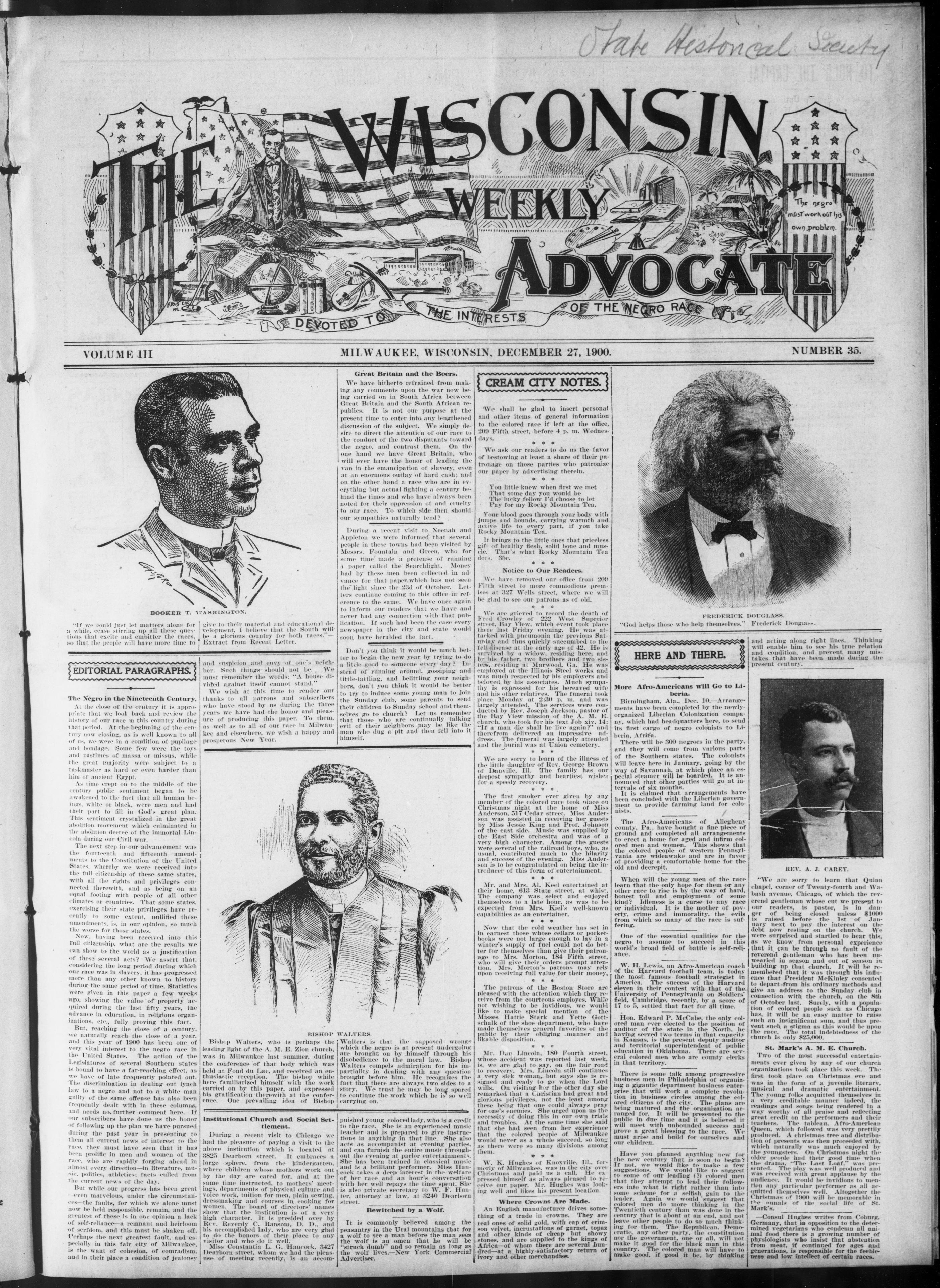
WISCONSIN
WEEKLY
ADVOCATE
DEVOTED TO THE INTERESTS OF THE NEGRO RACE
BOOKER T. WASHINGTON.
VOLUME III
BOOKER T.
"If we could just let matters alone for a while, cease stirring up all these questions that excite and embitter the races, so that the people will have more time to
EDITORIAL PARAGRAPHS.
The Negro in the Nineteenth Century. At the close of the century it is appropriate that we look back and review the history of our race in this country during that period. At the beginning of the century now closing, as is well known to all of us, we were in a condition of pupilage and bondage. Some few were the toys and pastimes of massa or missus, while the great majority were subject to a taskmaster as hard or even harder than him of ancient Egypt.
As time crept on to the middle of the century public sentiment began to be awakened to the fact that all human beings, white or black, were men and had their part to fill in God's great plan. This sentiment crystalized in the great abolition movement which culminated in the abolition decree of the immortal Lincoln during our Civil war.
The next step in our advancement was the fourteenth and fifteenth amendments to the Constitution of the United States, whereby we were received into the full citizenship of these same states, with all the rights and privileges connected therewith, and as being on an equal footing with people of all other climates or countries. That some states, exercising their state privileges have recently to some extent, nullified these amendments, is, in our opinion, so much the worse for those states.
Now, having been received into this full citizenship, what are the results we can show to the world as a justification of these several acts? We assert that, considering the long period during which our race was in slavery, it has progressed more than any other known to history during the same period of time. Statistics were given in this paper a few weeks ago, showing the value of property acquired during the last fifty years, the advance in education, in religious organizations, etc., fully proving this fact.
But, reaching the close of a century, we naturally reach the close of a year, and this year of 1900 has been one of very vital interest to the negro race in the United States. The action of the Legislatures of several Southern states is bound to have a far-reaching effect, as we have of late frequently pointed out. The discrimination in dealing out lynch law to a negro and not to a white man guilty of the same offense has also been frequently dealt with in these columns, and needs no further comment here. If our subscribers have done us the honor of following up the plan we have pursued during the past year in presenting to them all current news of interest to the race, they must have seen that it has been prolific in men and women of the race, who are rapidly forging ahead in almost every direction—in literature, music, politics, athletics; facts culled from the current news of the day.
But while our progress has been great—even marvelous, under the circumstances—the faults, for which we alone must now be held responsible, remain, and the greatest of these is in our opinion a lack of self-reliance—a remnant and heirloom of serfdom, and this must be shaken off. Perhaps the next greatest fault, and especially in this fair city of Milwaukee, is the want of cohesion, of comradism, and in their place a condition of jealousy
give to their material and educational development, I believe that the South will be a glorious country for both races." Extract from Recent Letter.
and suspicion and envy of one's neighbor. Such things should not be. We must remember the words: "A house divided against itself cannot stand." We wish at this time to render our thanks to all patrons and subscribers who have stood by us during the three years we have had the honor and pleasure of producing this paper. To them, as well as to all of our race in Milwaukee and elsewhere, we wish a happy and prosperous New Year.
BISHOP
P.
BISHOP WALTERS.
Bishop Walters, who is perhaps the leading light of the A. M. E. Zion church, was in Milwaukee last summer, during the conference of that body which was held at Fond du Lac, and received an enthusiastic reception. The bishop while here familiarized himself with the work carried on by this paper, and expressed his gratification therewith at the conference. One prevailing idea of Bishop
Institutional Church and Social Settlement.
During a recent visit to Chicago we had the pleasure of paying a visit to the above institution which is located at 3825 Dearborn street. It embraces a large sphere, from the kindergarten, where children whose mothers work out by the day are cared for, and at the same time instructed, to mothers' meetings, departments of physical culture and voice work, tuition for men, plain sewing, dressmaking and courses in cooking for women. The board of directors' names show that the institution is of a very high character. It is presided over by Rev. Reverdy C. Ransom, D. D., and his accomplished lady, who are very glad to do the honors of their place to any visitor and who do it well.
Miss Constantia L. G. Hancock, 3427 Dearborn street, whom we had the pleasure of meeting recently, is an accom
Great Britain and the Boers. We have hitherto refrained from making any comments upon the war now being carried on in South Africa between Great Britain and the South African republics. It is not our purpose at the present time to enter into any lengthened discussion of the subject. We simply desire to direct the attention of our race to the conduct of the two disputants toward the negro, and contrast them. On the one hand we have Great Britain, who will ever have the honor of leading the van in the emancipation of slavery, even at an enormous outlay of hard cash; and on the other hand a race who are in everything but actual fighting a century behind the times and who have always been noted for their oppression of and cruelty to our race. To which side then should our sympathies naturally tend?
During a recent visit to Neenah and Appleton we were informed that several people in these towns had been visited by Messrs. Fountain and Green, who for some time made a pretense of running a paper called the Searchlight. Money had by these men been collected in advance for that paper,which has not seen the light since the 23d of October. Letters continue coming to this office in reference to the same. We have once again to inform our readers that we have and never had any connection with that publication. If such had been the case every newspaper in the city and state would soon have heralded the fact.
Don't you think it would be much better to begin the new year by trying to do a little good to someone every day? Instead of running around, gossiping and tittle-tattling, and belittling your neighbors, don't you think it would be better to try to induce some young man to join the Sunday club, some parents to send their children to Sunday school and themselves go to church? Let us remember that those who are continually talking evil of their neighbors may be like the man who dug a pit and then fell into it himself.
WALTERS.
Walters is that the supposed wrongs which the negro is at present undergoing are brought on by himself through his disobedience to the moral law. Bishop Walters compels admiration for his impartiality in dealing with any question brought before him. He recognizes the fact that there are always two sides to a story. We trust he may be long spared to continue the work which he is so well carrying on.
puished young colored lady, who is a credit to the race. She is an experienced music teacher and is prepared to give instructions in anything in that line. She also acts as accompanist at evening parties, and can furnish the entire music throughout the evening at parlor entertainments. She has been trained in classical music and is a brilliant performer. Miss Hancock takes a deep interest in the welfare of her race and an hour's conversation with her well repays the time spent. She is also private secretary to W. F. Hunter, attorney at law, at 3240 Dearborn street.
It is commonly believed among the peasantry in the Ural mountains that for a wolf to see a man before the man sees the wolf is an omen that he will be "struck dumb" and so remain as long as the wolf lives.New York Commercial Advertiser.
Bewitched by a Wolf.
CREAM CITY NOTES.
We shall be glad to insert personal and other items of general information to the colored race if left at the office, 209 Fifth street, before 4 p. m. Wednesdays.
* * *
We ask our readers to do us the favor of bestowing at least a share of their patronage on those parties who patronize our paper by advertising therein.
* * *
You little knew when first we met
That some day you would be
The lucky fellow I'd choose to let
Pay for my Rocky Mountain Tea.
Your blood goes through your body with jumps and bounds, carrying warmth and active life to every part, if you take Rocky Mountain Tea.
It brings to the little ones that priceless gift of healthy flesh, solid bone and muscle. That's what Rocky Mountain Tea does. 35c.
Notice to Our Readers.
We have removed our office from 209 Fifth street to more commodious premises at 327 Wells street, where we will be glad to see our patrons as of old.
* * *
We are grieved to record the death of Fred Crowley of 222 West Superior street, Bay View, which event took place there last Friday evening. He was attacked with pneumonia the previous Saturday and thus quickly succumbed to the fell disease at the early age of 42. He is survived by a widow, residing here, and by his father, two brothers and two sisters, residing at Marwood, Ga. He was employed at the Illinois Steel works and was much respected by his employers and beloved by his associates. Much sympathy is expressed for his bereaved wife and his other relatives. The funeral took place Monday at 2:30 p. m. and was largely attended. The services were conducted by Rev. Joseph Jackson, pastor of the Bay View mission of the A. M. E. church, who took for his text Job xiv. 14: "If a man die shall he live again?" and therefrom delivered an impressive address. The funeral was largely attended and the burial was at Union cemetery.
We are sorry to learn of the illness of the little daughter of Rev. George Brown of Dunville, Ill. The family has our deepest sympathy and heartiest wishes for a speedy recovery.
* * * .
The first smoker ever given by any member of the colored race took place on Christmas night at the home of Miss Anderson, 517 Cedar street. Miss Anderson was assisted in receiving her guests by Miss Jessie King and Prof. Johnson of the east side. Music was supplied by the East Side orchestra and was of a very high character. Among the guests were several of the railroad boys, who, as usual, contributed much to the hilarity and success of the evening. Miss Anderson is to be congratulated on being the introducer of this form of entertainment.
* * *
Mr. and Mrs. Al. Keel entertained at their home, 613 State street, at whist. The company was select and enjoyed themselves to a late hour, as was to be expected from Mrs. Kiel's well-known capabilities as an entertainer.
宋 宋 宋
Now that the cold weather has set in in earnest those whose cellars or pocketbooks were not large enough to lay in a winter's supply of fuel could not do better for themselves than give their patronage to Mrs. Morton. 184 Fifth street, who will give their orders prompt attention. Mrs. Morton's patrons may rely upon receiving full value for their money,
* * *
The patrons of the Boston Store are pleased with the attention which they receive from the courteous employees. While not wishing to be invidious, we would like to make special mention of the Misses Hattie Stark and Yette Gottschalk of the shoe department, who have made themselves general favorites of the public by their obliging manner and likable disposition.
```markdown
```
Mr. Dan Lincoln, 180 Fourth street, whose accident was reported last week, is, we are glad to say, on the fair road to recovery. Mrs. Lincoln still continues a very sick woman, but says she is resigned and ready to go when the Lord wills. On visiting her the other day she remarked that a Christian had great and glorious privileges, not the least among these being that one could always pray for one's enemies. She urged upon us the necessity of doing this in our own trials and troubles. At the same time she said that she had seen from her experience that the colored people of Milwaukee would never as a whole succeed, so long as there were so many divisions among them.
W. K Hughes of Knoxville, Ill., formerly of Milwaukee, was in the city over Christmas and paid us a call. He expressed himself as always pleased to receive our paper. Mr. Hughes was looking well and likes his present location.
Where Crowns Are Made.
An English manufacturer drives something of a trade in crowns. They are real ones of solid gold, with cap of crimson velvet, incrustations of garnet, topaz and other kinds of cheap but showy stones, and are supplied to the kings of Africa—of whom there are several hundred—at a highly-satisfactory return of ivory and other merchandise.
FREDERICK DOUGLASS.
More Afro-Americans will Go to Liberia.
Birmingham, Ala., Dec. 10.—Arrangements have been completed by the newly-organized Liberian Colonization company, which had headquarters here, to send its first cargo of negro colonists to Liberia, Africa.
There will be 300 negroes in the party, and they will come from various parts of the Southern states. The colonists will leave here in January, going by the way of Savannah, at which place an especial steamer will be boarded. It is announced that other parties will go at intervals of six months.
It is claimed that arrangements have been concluded with the Liberian government to provide farming land for colonists.
The Afro-Americans of Allegheny county, Pa., have bought a fine piece of ground and completed all arrangements to erect a home for aged and infirm colored men and women. This shows that the colored people of western Pennsylvania are wideawake and are in favor of providing a comfortable home for the old and decrepit.
When will the young men of the race learn that the only hope for them or any other race to rise is by the way of hard, honest toil and employment of some kind? Idleness is a curse to any race or individual. It is the mother of poverty, crime and immorality, the evils from which so many of the race is suffering.
One of the essential qualities for the negro to assume to succeed in this world's broad field of battle is self-reliance.
W. H. Lewis, an Afro-American coach of the Harvard football team, is today the most famous football strategist in America. The success of the Harvard eleven in their contest with that of the University of Pennsylvania on Soldiers' field, Cambridge, recently, by a score of 17 to 5, settled that fact for all time.
Hon. Edward P. McCabe, the only colored man ever elected to the position of auditor of the state in the North, he having served two terms in that capacity in Kansas, is the present deputy auditor and territorial superintendent of public education in Oklahoma. There are several colored men who are county clerks in that territory.
There is some talk among progressive business men in Philadelphia of organizing a gigantic department business enterprise that will work a complete revolution in business circles among the colored citizens of the city. The plans are being matured and the organization arranged for. It will be presented to the public in due time and it is believed it will meet with unbounded success and prove a great blessing to the race. We must arise and build for ourselves and our children.
Have you planned anything new for the new century that is soon to begin? If not, we would like to make a few suggestions. We would like to suggest to some of our leading (?) colored men that they attempt to lead their followers into what is right rather than into some scheme for a selfish gain to the leader. Again we would suggest that colored men do more thinking in the Twentieth century than was done in the century that is about at an end, and not leave other people to do so much thinking for them. The Republican, Democratic, any other party, the constitution nor the government, one or all, will not make it good for the black man in this country. The colored man will have to make good, if good it be, by thinking
DOUGLASS.
Frederick Douglass.
and acting along right lines. Thinking will enable him to see his true relation and condition, and prevent many mistakes that have been made during the present century.
J. B.
"We are sorry to learn that Quinn chapel, corner of Twenty-fourth and Wabash avenue, Chicago, of which the reverend gentleman whose cut we present to our readers, is pastor, is in danger of being closed unless $1000 is raised before the 1st of January next to pay the interest on the debt now resting on the church. We were surprised and startled to hear this, as we know from personal experience that it can be through no fault of the reverend gentleman who has been unwearied in season and out of season in building up that church. It will be remembered that it was through his influence that President McKinley consented to depart from his ordinary methods and give an address to the Sunday club in connection with the church, on the 8th of October last. Surely, with a population of colored people such as Chicago has, it will be an easy matter to raise such an insignificant sum, and thus prevent such a stigma as this would be upon the race. The total indebtedness of the church is only $25,000.
St. Mark's A. M. E. Church.
Two of the most successful entertainments ever given by any of our church organizations took place this week. The first took place on Christmas eve and was in the form of a juvenile literary, musical and dramatic entertainment. The young folks acquitted themselves in a very creditable manner indeed, the readings and songs being rendered in a way worthy of all praise and reflecting great credit on the performers and their teachers. The tableau. Afro-American Queen, which followed was very prettily produced. A Christmas tree and distribution of presents was then proceeded with, which naturally was much enjoyed by the youngsters. On Christmas night the older people had their good time when the drama, "The Last Loaf," was presented. The play was well produced and was received with great applause by the audience. It would be invidious to mention any particular performer as all acquitted themselves well. Altogether the Christmas of 1900 will be memorable in the annals of the social life of St. Mark's.
—Consul Hughes writes from Coburg, Germany, that in opposition to the determined vegetarians who condemn all animal food there is a growing number of physiologists who insist that abstention from meat, if continued for ages and generations, is responsible for the feebleness and low intellect of certain races.
NUMBER 35.
REV. A. J. CAREY.
TO HOLD THE CAPITAL.
EXCEPT UNITED STATES.
Military Occupation by This Country Terminated-No Disposition to Renew It.
Washington. D. C., Dec. 26.—The officials of the state department are unwilling to venture a guess as to the length of time that will be consumed by the Chinese government in consideration of the note. The last article of the note notified the Chinese government that the occasion of Chi Li and Pekin may continue until the Chinese government has complied with the terms of the note. It may be stated, however, that the United States is not bound or affected by this condition. Our occupancy from a military point of view has terminated and there is no disposition to renew it. As for the other powers, it is expected that the main obstacle they will encounter in withdrawing under this condition will be found in the difficulty in obtaining satisfactory guarantees upon the Chinese promise to pay indemnities.
Paris, Dec. 26.—A dispatch to the Havas Agency from Pekin, dated Dec. 25, says the detachment of French troops, commanded by Gen. Bailloud were recently attacked by Chinese regulars and Boxers at Thi Tcheou, south of Pao Ting Fu. The punitive expedition took the village after a lively combat. On account of the hostile attitude of the population, Bailloud burned the village and also those villages in the neighborhood. The Chinese loss was 1000 (?) men. Gen. Bailloud's force sustained no loss. Christian Chinese families have been maitreated by the Chinese regulars.
ORDER BEING RESTORED.
American and Japanese Markets Now in Successful Operation.
London, Dec. 26.—In the course of an interview, published in the Morning Post today, of the conditions existing in Pekin, H. J. Whigham, the well-known newspaper correspondent, says there are now a quarter of a million inhabitants pursuing their ordinary vocations in the American quarter. The markets are in full blast. He adds that the American and Japanese quarters are in all respects the best managed, "showing ability on the part of the Americans to handle a subject people which they have not developed elsewhere to proper advantage."
Continuing, Mr. Whigham says: "This enormous portion of the city is policed by exactly one company of infantry and a few mounted men under a provost marshal. If only those hard-headed soldiers of the provost-marshal type had been given a free hand in the Philippines the task of subjugating the unfortunate islanders would have been much more simple. If the Japanese have come out of the muddle with flying colors, they at least have the Americans close behind. It was worth sending an expedition to China if only to get a few hints on transport from the Americans. Their scheme of municipal government could not be bettered by the British, who have learned the business experience in every quarter of the globe. For point of contrast it is only necessary to walk down the avenue of the Chinese city dividing the United States and Germany. The American side of the street is simply Pekin in the ordinary garb of peace, minus its variegated smells. The opposite side is almost deserted. The Germans have come to the American side for meat and vegetables, and it is whispered that the country people are sometimes robbed as they bring in the produce, except where the gates are British, American or Japanese. That is why the markets in the quarters controlled by these nations are the best."
A Story Promptly Denied.
A dispatch to the Pall Mall Gazette from Pekin, dated Monday, December 24, says: Much irritation has been caused by the activity of the German troops in the districts under British protection. So acute has been the feeling, the dispatch adds, that there has been a question of the British seceding from the ally command. The foreign office informed a representative of the Associated press today that there is no truth in the Pall Mall Gazette's Pekin dispatch which says there has been a question of the British seceding from the allied command owing to the activity of the Germans in the districts under British protection.
THE OUTRAGES CONTINUE.
Boxers Reported to Have Burned . Nineteen Catholic Christians.
Pekin, Dec. 26.—The French report encountering 25,000 Chinese and capturing five flags and a number of guns and inflicting a great loss upon the Chinese, thirty-five miles south of here.
The report is generally discredited. According to the rumor, the French did not suffer any losses themselves. It is believed, however, that the French probably met a roving band, which was dispersed, a number of the Chinese being butchered. Li Hung Chang says that he is satisfied that the story is false.
Rev. Mr. Kelly, a Presbyterian missionary, has reported to Minister Conger the burning by Boxers of nineteen Catholic Christians. He said, however, that his information has been derived entirely from Chinese sources. The Japanese who have jurisdiction over the territory thirty miles north of where the alleged outrage occurred will investigate the occurrence.
Chinese Fled.
Berlin, Dec. 26.—Field Marshal Count von Waldersee, in a dispatch from Pekin dated Monday, December 24, says: "The French troops encountered December 22, cast of Chochan, between Pekin and Pao Ting Fu, a Chinese force numbering 2500 men with artillery. The Chinese fled in the direction of Kuan Hsien. They suffered losses and left behind them five standards and four cannon. The Chinese probably consisted of the reunited remnants of a body already dispersed."
Note is Presented.
Pekin, Dec. 25.—The preliminary demand note of the powers was presented yesterday to Prince Ching, one of the representatives of the throne. Li Hung Chang, the other envoy, was sick and was not able to be present when the note was handed to his colleague by the ministers of the various great powers. Senior B. J. de Cologan, the Spanish minister and dean of the diplomatic corps, presented the note to Prince Ching, saying: "I have the honor to hand to you a note in which the foreign representatives set forth in the name of their respective governments the conditions necessary for the re-establishment of friendly relations with China. I beg you to transmit it to his majesty, the Emperor of China, and to give us as prompt a reply as possible."
Reply of Prince Ching.
In accepting the note Prince Ching said:
"Having now received from the ministers of the powers a peace proposal, I beg to state that I will at once send it to his majesty, the Emperor. On receipt of his majesty's decree I will then send a reply." The joint meeting then adjourned. It
is the unanimous opinion of the ministers that China will accept the conditions within a month. The note has already been forwarded to the Emperor and Dowager Empress, and it will probably reach them at Singan Fu next Thursday. The missionaries are again reporting trouble with Boxers. They say that on December 21 twelve Catholics were killed thirty-five miles east of Pekin, and that eight others have been burned in temples by Boxers. The military authorities are investigating these reports.
French Find Hidden Arms.
Paris, Dec. 26.—A dispatch from Tien Tsin states that the French troops have discovered a quantity of hidden arms at Hung Tsu, thirty kilometers southwest of Tien Tsin. In an engagement with Boxers on December 21 the French lost an officer killed and two wounded. The troops burned the town.
OUTRAGES CONTINUE.
Fifteen Hundred Members of Reform Forces Butchered Without Warni ng.
Vancouver, B. C., Dec. 26.—News of the massacre of 1500 members of the reform forces in China and the beheading of twenty-seven of their leaders was received here in a cable by W. A. Cumyow, secretary of the Chinese Reform association in America. The engagement took place in the province of Pechili. Besides the terrible massacre it resulted in the complete demoralization of the reform forces. The battle, into which the reformers were brought by treachery, occurred December 18, and the work of the Chinese government has as a consequence been discredited in all that part of the country. The Chinese here are loud in their expressions of disapproval of the conduct of the campaign by their leaders.
Invites Reform Leaders to Call.
It appears from the few details given in the cable received that Tong Mu, the reform leader, at the head of a badly-armed force of 12,000 men, paid a visit to Chung Hi Tung, the governor of the district, who, though an imperial officer, was believed to be in sympathy with the reform movement. Tong was invited to the governor's palace, and with his 12,000 men marched into the city. The reformers left all their arms outside the gates, taking the precaution only to carry their loaded revolvers. There were 5000 imperial troops in the town, but nothing was feared from them. A delay of a day took place in order that other reform leaders might be sent for.
Battle Follows a Dispute.
When the audience with the governor was finelly arranged there were twenty-seven of the leading followers of Kang Yu Wei admitted. Then a disagreement arose. The governor had the leaders seized and taken into the courtyard, where they were beheaded. In the meantime a secret order had been sent to the imperial troops to descend upon the poorly-armed rabble of reformers. The 5000 well-drilled soldiers took the country people completely by surprise, but, nevertheless, the main body of the latter pluckily fought a way through the gates and escaped. They carried away their own wounded, but left 1500 dead in the streets of the city.
The cable says that the scene of the butchery was frightful and that the reform leaders were not given a moment's warning before being killed. A large amount of gold was also lost by the reformers, who are now without a single leader and are completely disbanded so far as the district is concerned.
Indemnity a Difficult Problem.
New York, Dec. 26.—A dispatch to the Tribune from London says: The China question has virtually reached the money point. The amount of indemnity to be paid will probably require many weeks of diplomatic consultation. Sir Robert Hart knows better than anybody else what can be paid by the Chinese government without the complete surrender of her taxing and revenue resources to Europe, but bankers in all the capitals will prefer to have a great loan underwritten by the powers themselves, and full financial control established by an international commission for the payments of interest and sinking fund service.
LINER REACHES PORT EIGHT DAYS OVERDUE.
Machinery of the Nebraska Breaks Three Times-Decks Are Swept by a Gale.
New York, Dec. 26.—It was more than a merry Christmas for the 110 passengers on the belated Allan liner State of Nebraska. Nineteen days out from the Clyde, eight days overdue, the Nebraska crept into port here with smashed lifeboats, demolished lighthouses and broken, and twisted rails. It was the first clear day the voyagers had seen since December 7, when the Nebraska steamed out of Moville, Ireland, in the face of a gale that swept her decks. On board the Allan liner when she left Glasgow on December 6, were ten saloon, thirty second cabin and seventy steerage passengers. Officers and passengers declared the wreckage on deck gave but a faint idea of the horrors of the voyage. Three times the machinery broke down and the boat had to be hove-to.
The only one of the crew injured in the long voyage was William Thompson, a fireman, who was hurled against the deck rails and had two ribs fractured.
Capt. David Ingraham of Vancouver, who has circled the globe twice, was one of the passengers. He said that twice the voyagers felt all hope was gone. Not a meal could be served in the saloon during the voyage.
NEGROES TAKE A TOWN.
White Residents of Cementville, Ind., Terrorized—Sam Kendall's Saloon Raided.
Jeffersonville, Ind., Dec. 26.—A race war is on at Cementville, a small station on the Pan Handle road five miles north of this city, and serious trouble is expected. The negroes are all armed, and the white residents are keeping within doors to avoid them. The outbreak began when Lee Ranger and John Redmond, negroes, both very drunk, started in to intimidate the whites. When their insults were resented other negroes jumped in with the liquor-crazed men and captured Sam Kendall's saloon. Nearly twenty shots were fired, but no one was hurt.
Kendall, in addition to his saloon, conducts a dry goods store, which was being attended by his wife, and into this the negroes flocked after the firing at the saloon. Mrs. Kendall was badly frightened, and her husband ran into the place and began shooting into the mob. Ranger was shot, but how badly is not known, as he was carried away and secreted by his companions.
PANIC AT A CHRISTMAS TREE.
Candle Starts Blaze in a Pana Church and Children Are Hurt.
Pana, Ill., Dec. 26.—During the Christmas exercises at the Oconee Methodist Episcopal church the tree caught fire from a candle, causing a panic. Several children were severely hurt, and it took hard work to save the building. Dallas, Tex., Dec. 26.—The village of Leland, consisting of several business houses and 100 inhabitants, in Ellis county, about fifty miles south of Dallas, is reported to have been destroyed by fire started from Christmas explosives.
LAID LOW BY BULLET.
Frank Richardson, Wealthy Resident of Savannah, Mo., Shot at His Own Door.
St. Joseph, Mo., Dec. 26.—Frank Richardson, a millionaire resident of Savannah, fourteen miles northeast of this city, was murdered by an unknown man in the hallway of his home Monday night soon after 9 o'clock. He was shot in the back of the head, the bullet passing through the brain. Death followed a few minutes later and before the victim wittered a word.
Mr. Richardson left the mercantile house of Fife & Richardson, in which he was a partner, at 8 o'clock, telling Mr. Fife he was going home, as he had an engagement with Mrs. Richardson to go to a gathering of friends to celebrate Christmas eve. Shortly after 9 o'clock he arrived at the front door of his home, where Mrs. Richardson heard him talking to someone. She heard the person with her husband say, "Well, has it come to this?" Almost instantly there was a report of a revolver and she rushed to the door to find her husband in the hallway staggering from a fatal wound. He walked into the parlor and fell dead.
The person with wiom Mr. Richardson had been talking immediately disappeared. Suspicion points strongly to a prominent business man of Savannah as being the murderer, but detectives who are working on the case say they have insufficient evidence to warrant the making of an arrest. It is strongly hinted there is a woman in the case. That Mr. Richardson committed suicide, as was at first reported, is improbable from the fact that no weapon could be found in or near the house and there was no sign of powder burn about his head; also because of the fact that the bullet entered the back of his head. His domestic relations were happy, as he was fond of his wife and three children, two sons and a daughter, the oldest being his 12-year-old son.
Frank Richardson was 42 years of age and was a member of an old and respected family of Missouri. His father, the late Maj. John D. Richardson, who was for many years a resident of Savannah, died in St. Joseph three years ago, having removed to that city only a short time before his death.
J. D. Richardson, Jr., general manager of the American Biscuit company, and for many years manager of the Sommer-Richardson factory of the American Biscuit company in St. Jospeh, was his brother, and he had two sisters. He was popular and it is not known he had an enemy on earth. The dead man was a large holder of the biscuit trust stock.
CAPTURE SILK THIEF.
Chicago, Ill., Dec. 26.—John Murray, alias "Red" Kenny, alias "Bloomington Red," a paroled convict from Joliet penitentiary and leader of a gang of silk thieves that has stolen property in the last six months valued at more than $50,000, was arrested yesterday afternoon by detectives from the central station at 518 West Harrison street. Silks and satins valued at $7000 were found in the house. The goods are said by the police to be the proceeds of the burglary of a large silk store in Quincy, Ill., Monday night.
Murray, and the gang of crooks, of which he is the leader, are wanted for silk robberies by a score of towns and cities in Illinois and northern Indiana. Seven months ago Murray and a confederate, Tom Redmond, a noted criminal, robbed a silk store in Ottawa, Ill., and escaped with $7000 worth of plunder. Redmond was afterward captured and sentenced to twenty years in the Joliet penitentiary.
Several weeks later Murray gang began to show activity in northern Indiana. A store in Elkhart, Ind., was robbed of silk goods valued at $5000; a place in Indianapolis of goods valued at $6000, and a number of smaller towns also contributed to the robbers' plunder. The gang then transferred its operations to Wisconsin. Goods worth $2000 were taken from Janesville, an equal amount from Beloit, and $1000 worth from Stevens Point. One year ago the same gang is said to have stolen silks from the stores of Momence, Ill., valued at $1500. The Pinkerton detective agency has offered a reward of $300 for the capture of Murray, or for information leading to his capture. The Pinkerton men want Murray for a silk and sealskin robbery in which goods worth $10,000 were taken.
Quincy, Ill., Dec. 26.—The dry goods store of Kespohl & Mohrenstecher, situated in the heart of the city, was entered by burglar's Monday night and $7000 worth of fine silks carried off. The burglar's got into the building through a basement window and carried off every piece of high-grade silk. Three weeks ago $3000 worth of silks were stolen from a Hannibal store. Janesville, Wis., Dec. 26.—Much of the silk stolen from local stores and Beloit, it is believed by Murray, the man arrested in Chicago, has been recovered
STOCKYARDS FIRE.
Chicago, Ill., Dec. 26.—A stockyards fire early today caused alarm among the guests of the Transit house and resulted in the destruction of the noted O'Leary clubhouse, entailing losses aggregating $60,000. Aside from the clubhouse the building of four stories contained a white lead factory, gum factory and a handsome store, the stock in nearly all of which was almost totally destroyed. The Transit house, which was across the street from the burned building, was at no time in danger.
Calgary, N. W. T., Dec. 26.—The most destructive fire in the history of Calgary raged today, and wrought damage estimated at $100,000. Several of the finest business structures fell a prey to the flames, notably the Clarence, Eau Claire and new Norman blocks.
St. Joseph, Mo., Dec. 26.—Fire today caused by the explosion of an airtight stove, partially destroyed the Providence Methodist Episcopal church (colored). Rev. J. J. Leonard, the pastor, was fatally burned.
Rose-Garnet
It is reported by the bureau of American republics that an extensive deposit of rose-garnet, situated near Cuautlay, in Mexico, is to be worked on a large scale. It promises to bring in the market a price equal to that of the finest onyx, which it surpasses in beauty. This rosalite, as it is otherwise called, is a white sandstone filled with beautiful little crystals of garnet, which are too soft to be useful as gems.
Consul Hughes writes from Coburg, Germany, that in opposition to the determined vegetarians who condemn all animal food there is a growing number of physiologists who insist that abstention from meat, if continued for ages and generations, is responsible for the feebleness and low intellect of certain races.
—Grosvenor square probably contains more millionaires than any equal area in London.
—London bridge is to be improved at a cost of £100,000.
YEOMEN ARE TRAPPED.
Boers Kill or Capture Squadron of British Troops.
Natives Ready for an Uprising as Soon as a Competent Leader Appears
Cape Town, Dec. 26.—A squadron of yeomanry which had been following the Boers from Britstown is reported to have been entrapped. There were several casualties, it is said, and the remainder of the force was captured.
Gen. Kitchener has left Naauwpoort and gone northwards. The rapid concentration of troops in the disturbed districts through the personal energy of Gen. Kitchener has allayed the local uneasiness.
London, Dec. 26.—A cable from Cape Town says it is rumored there that the Boers won a signal victory in a battle in the vicinity of Deaar and that many British were killed. The report has not been confirmed and the war office pleads lack of information.
Maseru, Dec. 24.—The British are pressing Commandant Dewet in the Ladybrand district.
Funchal, Island of Madeira, Dec. 26.—The steamer Canada, with Lord Roberts on board arrived here last evening, receiving a salute of nineteen guns on entering the port.
This morning Lord Roberts was tendered an official reception by the authorities, and at noon, aboard the Canada, he will proceed to Gibraltar.
THE BOER INVASION.
Not Sufficient British Troops to Enforce Martial Law.
London, Dec. 26.—The position of Cape Colony is hanging in the balance. According to the Morning Post's Cape Town correspondent, everything depends upon the quantity of ammunition in possession of the disloyal Dutch residents, 100 of whom have joined the Boers in the Philiptown district alone. Energetic measures have been taken to stem the invasion, but there is unquestionably danger that parties of Boers will get through into parts of the colony, and gradually raise the whole cape in rebellion. Reinforcements can arrive none too soon.
The Standard's Cape Town correspondent says the loyalists demand that martial law shall be proclaimed throughout Cape Colony, but adds:
"Such a step is now impossible, owing to the lack of sufficient troops to enforce it."
The Daily Mail's Cape Town correspondent quotes local papers as saying that never in the dark days a year ago were the Boers so far south or the prospects graver. Reports from various parts of the western provinces foreshadow perilous possibilities unless the invasion is completely checked.
Awaiting a Leader.
A responsible colonist, who recently traveled from Upington to Humansdorp, is credited with declaring that 90 per cent. of the people in the country districts are simply awaiting the arrival of the Boers or the appearance of a resourceful leader as a signal to rebel. It does not escape notice, however, that the invaders, when they were driven out of Britstown, penetrated farther into the Cape Colony, seeking to reach Prieska and Carnarvon, where they obtained certain successes early in the war. An attempt is apparently impending to dispose of the Eastern invaders, who are intrenched in the Zuurnberg mountains.
It appears that one Boer column attacked Steynsburg, but was repulsed and fled, intrenching itself in the mountains, Another Boer commando captured a party of police at Venterstad. Mounted colonial troops surprised 300 Boers fifteen miles from Burghersdorp on December 23, and, after a brisk interchange of volleys, retired with a loss of two men.
FIRE AT HOUGHTON.
Business Block and Flat Building Burns-Many People Nearly Asphyxiated.
Houghton, Mich., Dec. 26.—[Special.]
—Fire broke out in the Western Express office, in the Young block, apparently from an explosion, at 1:30 o'clock this morning. The Houghton and Hancock fire departments fought the blaze for seven hours before extinguishing it. The building, which contained stores on the street floor and flats above, was gutted. Several persons were nearly asphyxiated and escaped with difficulty by rear windows. The loss is about $12,000 on the building and furniture, with small insurance. The express company had an unusually heavy consignment undelivered from Christmas day, the loss on which will be nearly total.
THREATENING FIRE.
Buildings on South Halsted Street, Chicago, Damaged $30,000 Four Calls for Engines. Chicago, Ill., Dec. 26.—A fire which for a time threatened more serious consequences caused a damage estimated at $30,000 at 4187-89 South Halsted street at midnight. Four calls for engines were sent in. The blaze was in the four-story brick building owned by John Schroeder. The building is occupied on the third and fourth floors by a restaurant, gymnasium and clubrooms of James O'Leary, the poolroom keeper, but his damage was not great, as the fire was confined principally to the top floor of the building, which was occupied by the Ayers Chemical company. The first floor of the building is occupied by the Stockyards Paint company and the drug store of John F. Cofelin.
A RECEIVER APPOINTED.
Only Factory in United States Which Makes Glass Marbles. Steubenville, O., Dec. 26.—A receiver has been appointed for the American Marble company, which has been in operation about two months. It is the only factory of the kind in the United States, the product being glass marbles. The petition for a receiver alleged that the firm is insolvent. No statement of assets and liabilities was made.
DROWNS IN A DITCH.
John Oxman of Iron Mountain, Mich. Stricken with Epileptic Fit. Iron Mountain, Mich., Dec. 26.—[Special.]—John Oxman was found dead late yesterday on Cedar avenue. He was subject to epileptic fits and had evidently fallen in one. He fell in a ditch of water and drowned. When found he was frozen stiff. He was unmarried.
Two Boy Skaters Drowned.
South Norwalk, Conn., Dec. 26.—John Kelly, aged 13, and Willie Hull, aged 10, were drowned last night while skating on the Union mills pond at Norwalk. Kelly broke through the ice and Hall in trying to save him also perished.
VAST SUMS TO BE PAID.
Chinese Indemnity Demands May Exceed Two Hundred Millions of Dollars.
Washington, D. C., Dec. 24.—Two hundred million dollars is the maximum sum the powers will demand of China as indemnity for the Boxer outrages, yet the claims to be made by natives and individuals are likely to be many times that amount. The United States army had a deficiency of $11,000,000 for the transportation and army supplies, and most of that is charged against China. Article 6 of the agreement, signed by the foreign ministers in Pekin, which requires the payment by China of equitable indemnities," is of a very sweeping character.
The indemnity to be paid to the government is in the nature of the expenditures incurred in dispatching and maintaining troops in China, and may be made to include sums paid to the heirs of those killed in action or to those who received wounds during engagements incident to the capture of Pekin. The total losses of the allied forces defending the legations were 67 killed and 210 wounded, and many Chinese in the employ of missionaries and the legations lost their lives.
Idea of Cost of Military Service.
An idea of the indemnity to be demanded for the expenses of the several military expeditions may be obtained from this table showing the strength of the allies:
Men.
Russia, brought from Siberia.....48,500
Japan (transported from Japan).....22,373
Germany (mostly brought from Germany) 44 guns and.....15,600
Great Britain, brought from Hong Kong and India.....8,746
United States, dispatched from the Philippines and the United States. 5,618
France, sent to the north from Cochin-China.....5,378
Italy, transported from Italy.....1,000
Austria, landed from its warships.....294
Societies May Claim Large Sums.
The societies named in the agreement are the religious bodies which maintained missionaries in China, many of whom were killed. They will want not only heavy sums to indemnify the heirs of those killed, but to solace those who were insulted, and also to cover damage done in the destruction of mission property. Many merchants suffered losses in consequence of the outrages. The American legation in Pekin was owned by Col. Charles Denby, Mr. Conger's predecessor, and the other legations were owned by foreigners or foreign governments.
The Hague Court May Divide It.
Administration officials believe the amount demanded should not be more than $200,000,000, and that in case of inability properly to distribute the indemnity the matter should be brought to the attention of The Hague court of arbitration. In case, however, it should develop that it is impossible to agree on a reasonable sum, then this government will urge the immediate reference of the whole indemnity question to a court of five jurists, to be selected from those members of The Hague tribunal nominated by countries whose interests were not largely affected by the Chinese trouble. There are sixteen nations signatory to The Hague treaty, ten only of whom were involved in the Chinese trouble. Remaining ones are Denmark, Sweden and Norway, the Netherlands, Roumania and Portugal.
CONGER SIGNS THE NOTE.
Washington, D. C., Dec. 24.—Secretary Hay has received a cablegram from Minister Conger, at Pekin, announcing that he had signed the agreement reached by the foreign ministers, but had done so with a written explanatory statement, setting forth the exact position of his government. The text of the statement is not forwarded by Mr. Conger, but it is understood to be based upon the last instruction he received from the dispatch which, while disapproving the inclusion in the agreement of some of the more severe language, accepted it as the best arrangement that could be made at this time. It is believed that the United States, while sanctioning the provisions of the agreement relative to the maintenance of permanent lines of communication, legation guards and prohibition of the importation of arms into China, indicates clearly that constitutional reasons prevent the executive from making any pledge to take part in the execution of these plans.
The signature of the agreement by the ministers closes what is regarded here as the first, the most important and the most difficult phase of the negotiations as to China for it is not doubted that the Chinese envoy will subscribe to the agreement without amendment. The conclusion has been marked by one of the most curious mistakes in the history of international exchange, for by a cipher error, the majority of the last signatories found to their amazement that they had contracted to do exactly what they did not intend, and moreover, the error was irretrievable.
SIXTH CAVALRY WHIPS INSURGENTS.
After a Battle Near Guinobatan Forty-five Dead Rebels Are Counted.
Manila, Dec. 24.—Advices brought by steamer from Southern Luzon say that a lieutenant and sixty men of the United States cavalry attacked a large body of insurgents Wednesday near Guinobatan province of Albany. After the battle forty-five dead insurgents were counted together with many wounded.
The only American casualty was the wounding of a sergeant who was cornered by several rebels and struck in the leg by a bolo. The rebel loss was the heaviest recorded among recent encounters.
MISPLACED SWITCH.
Passenger Train Turns on to Side Track and is Wrecked-Several Are Injured. Rome, Ga., Dec. 24.—A passenger train on the Chattanooga, Rome & Southern railway was wrecked at Miller's last night. The train was running at full speed when it suddenly took the side-track and crashed into a dozen box cars. It is believed that the switch was turned for the purpose of wrecking the train. The engineer and fireman saved their lives by jumping, although the fireman received severe internal injuries. Several passengers were slightly injured.
POPULATION OF BERLIN
Census of Germany's Capital Shows Increase of 400,000.
Berlin, Dec. 24.—The population of Berlin, including the suburbs, is 2,469,676, as compared with 2,076,946 in 1895. The electric trolley system is rapidly displacing the storage battery system on the busiest streets in Berlin.
Burglars Frightened Away
Sonora, Ky., Dec. 24.—An unsuccessful attempt was made early today to rob the Sonora deposit bank. The burglars were evidently frightened away before they succeeded in forcing an entrance.
The Loco Weed.
Advantages occurring from a recent heavy rainfall in western Texas have been largely offset by the fact that the unusual supply of moisture has greatly increased the growth of the loco weed Many horses and cattle have died from eating this insidiously-poisonous weed Exactly what the element of poison in this weed is has never been fully determined.
UPRIGHT
Straight and strong is the statue when the twists and curvatures of
Lumbago
are cured and straightened out by
St. Jacobs Oil
TRADE MARIS
$3.00
W.L.DOUGLAS
SHOES $3.50
UNION MADE
M. B.
The real worth of W.
L. Douglas $3.00 and
$3.50 shoes compared
with other makes is
$4.00 to $5.00.
WE USE FAST COLOR EYELETS
FACTORY, BROCKTON, MASS.
We are the largest makers of men's $3 and $3.50 shoes in the world. We make and sell more $3 and $3.50 shoes than any other two manufacturers in the U. S.
The reputation of W. L. Douglas $3.00 and $3.50 shoes for style, comfort, and wear is known everywhere throughout the world. They have to give better satisfaction than other makes because the standard has always been placed so high that the wearers expect more for their money than they can get elsewhere.
BEST $3.50 SHOE.
BEST $3.00 SHOE.
THE REASON more W. L. Douglas $3 and $3.50 shoes are sold than any other make is because THEY ARE THE BEST. Your dealer should keep them; we give one dealer exclusive sale in each town. Take no substitute! Insist on having W. L. Douglas shoes with name and price stamped on bottom. If you don't get them for you, send direct to factory, enclosing your name, state kind of leather, size, and width, plush or cane. Our shoes will reach you anywhere. Catalogue Free. W. L. Douglas Shoe Co. Brockton, Mass.
ABSOLUTE SECURITY.
Genuine Carter's
Little Liver Pills.
Must Bear Signature of
Brant Good
Very small and as easy to take as sugar.
CARTER'S
LITTLE
LIVER
PILLS.
FOR HEADACHE.
FOR DIZZINESS.
FOR BILIOUSNESS.
FOR TORPID LIVER.
FOR CONSTIPATION.
FOR SALLOW SKIN.
FOR THE COMPLEXION
GENUINE MUST HAVE SIGNATURE.
Price
25 Cents
Purely Vegetable.
CATARRH
ELY'S
CREAM BALM
CATARRH
ROSE-COLD
HAY-FEVER
CURES COLD
IN HEAD
DEHNESS
HEADACHE
ELY BROS.
NEW YORK
THE
CLEANSING
AND HEALING
CURE FOR
Ely's Cream Balm Easy and pleasant to use. Contains no injurious drug.
It is quickly absorbed.
Gives Relief at once.
It Opens and Cleans
Allergies and Hedges.
Allaya Indispensable.
Allays Inflammation.
Heals and Protects the Membrane. Restores the
Senses of Taste and Smell. Large Size, 50 cents at
Druggists or by mail; Trial Size, 10 cents by mail.
ELY BROTHERS, 56 Warren Street, New York.
GRAIN-O
THE PURE
GRAIN COFFEE
Grain-O is not a stimulant, like
coffee. It is a tonic and its effects
are permanent.
A successful substitute for coffee,
because it has the coffee flavor that
everybody likes.
Lots of coffee substitutes in the market, but only one food drink—Grain-O.
All grocers; 15c. and 25c.
PISO'S CURE FOR
CURES WHERE ALL ELSE FAILS.
Best Cough Syrup. Tastes Good. Use
in time. Sold by druggists.
CONSUMPTION
THE NEW YEAR.
A new year is dawning;
The old soon will be
Beyond the reach
Of you and me.
The old unkind feelings,
The old wicked strife,
The old selfishness
That spoils our life.
The old thoughts of evil,
The old deeds unkind,
The old falsehoods dark
That poison the mind—
These all will be buried
Deep down in the past,
And then in their places,
Forever to last,
Let us put the new feelings
Of kindness and love;
Let new thought of others
The selfish remove.
Let new deeds of goodness
The old ones replace;
Let truth pure and holy
All falseness efface.
And then we shall have
What all wish for here.
All the joy and blessing
Of a happy New Year!
A NEW YEAR'S GIFT.
"Only one day more," soliloquized the Baron de Croix-Martel, as he put the finishing stroke to his toilet, and contemplated his well-waxed iron-gray mustache with less satisfaction than he would probably have felt had not his mind been otherwise preoccupied.
"One short December day," he went en after a pause, "and every likely place already explored twice over except the quay. I wonder who the idiot was who first invented New Year's gifts! Not one of my ancestors, I'll engage. The Croix-Martels date from the Crusades, and I dare say have been guilty of follies enough since then, but I won't do them the injustice of supposing that they ever threw away more money than they could possibly help."
With this comforting reflection the baron took up his hat, gloves and cane and sallied forth from his little apartment in the Rue Godet on the errand for which he was bound.
The personage destined to play the part of hero in our sketch, of whose character some idea may have been formed from the above monologue, was a fair average specimen of a not uncommon class of individuals. In other words, he was one of those men whose main object in life is to procure for themselves the greatest amount of enjoyment at the lowest practicable cost. His family, as correctly stated by himself, was of unimpeachable antiquity and up to the revolution had been possessors, from father to son, of a tolerably extensive domain, in Normandy, the whole of which, including the chateau, had passed, since 1793 into other hands.
By way of recompense for past services—though in what they consisted, except in escaping the guillotine by a timely retreat to Switzerland, no one ever knew—the present baron's father had managed on the restoration of the Bourbons to obtain by dint of incessant solicitations a share of the indemnity accorded to the impoverished royalists. On the interest of this sum, amounting to about 10,000 francs a year, his son contrived to live, if not luxuriously, at least—his economical principles taken into account—comfortably enough.
Our hero was a bachelor, not so much from choice as from his inability hitherto to discover what he considered a suitable party. Tall, thin and just turned 50, he was sufficiently good tempered when nothing occurred to put him out of humor, and as notorious a miser as ever existed since the days of the Harpagon and John Elwes. Without going so far as some of his particular friends, who affirmed him to be the original of Gavarni's famous type, the gentleman "qui coupait les liards en quatre," it may safely be said that whenever he could indulge in his favorite weakness without compromising himself, he invariably did so, and adhered strictly to the time-honored maxim of taking care of the pence and letting the pounds take care of themselves.
But perhaps of all the disagreeable necessities to which he was periodically compelled to submit, the most obnoxious to his feelings was the obligation of complying with the (to him) utterly inexplicable custom of celebrating the advent of New Year's day by a distribution of etrennes; a drain on his purse which, although he took care to confine his liability within the narrowest limits, was, even in its modified form, inexpressibly painful to him.
The twenty-frame piece he felt bound to offer his concierge caused him an annual pang, and the guerdon of two frances to the waiter of the little restaurant where he was in the habit of dining when not invited elsewhere lay heavy on his conscience, even after appropriating to his own use—which no one but himself ever dreamed of doing—the cigar tied up with pink ribbon, presented to him as a "reminder" and intended by its owner to be offered in turn to every customer in the room.
These, however, were minor grievances compared with what he was suffering on the last day of the year of grace 1874, and only those who knew him could by any possibility understand or appreciate his mental perplexity on the morning of his introduction to the reader.
In the course of the preceding six months he had made the acquaintance of the Comtesse de Franchimont, a Belgian widow lady with two daughters, who had recently settled in Paris and was, according to report, in possession of a handsome fortune. Naturally partial to society when it cost him nothing, he had by degrees become an habitual frequenter of her pretty apartment in the Rue de Marignan and had established himself there, to a certain extent, as lami de la maison. Whether he entertained any ulterior views respecting either mother or daughters we are not in a position to state; if he did, he kept his own counsel, and all that can be hinted on the subject is that he might have done worse.
Mme. de Franchimont was barely 40, and did not look her age; as for Mille, Berthe, the brune, and Mille, Louise, the blonde, they were both charming and perfectly aware of the fact. In this pleasant circle the baron soon made himself entirely at home. When he did not dine there—and we may be sure that he never refused an invitation unless he had a better one in prospect—he generally dropped in of an evening, or occupied a spare seat in their box at the opera.
This continued intimacy, with its many contingent advantages, he had hitherto enjoyed without scruple, but the time was at hand, when, in accordance with Parisian usages, the hospitalities he had received must be adequately returned: New Year's day was approaching with rapid strides, and his offering on the occasion must, as he dolefully acknowledged, be proportionately liberal.
For days and weeks he had wandered from place to place, like a perturbed spirit, in quest of some object suitable for his purpose; he had dived into obscure passages and emerged at the other end with the disheartening conscientiousness of failure, and had pored over the stock of half the curiosity shops in the capital without unearthing a single pearl of price within the limits of his own. Bonbons, were, of course, out of the question, even if the tariff of Messrs. Boissier & Gouache permitted such ar
investment of his money and as for jewelry the bare idea made him shudder. In short, the worthy baron was at his wits' end, and, as a last resource, resolved to explore the refuge of the destitute the quay, from the Pont Royal to the Pont des Arts, whither we may as well follow him.
He had already exhausted the Quai Voltaire and the Quai Malaquais, and was on the point of retracing his steps, when the recollection of an old bric-a-brac establishment in the adjoining Rue de Siene struck him as a hitherto uninspected locality. Taking, therefore, the turn opposite the Mazarin library, he speedily discovered on his right hand the object of his search and entered the shop. A few minutes' examination and a question or two sufficed to convince him that his unlucky star was still in the ascendant, and he was about to resume his walk when some broken pieces of china lying in a corner caught his eye.
"What is that?" he asked the dealer, "Ah, monsieur, ne m'en parlez pas!" exclaimed the individual addressed, in a disconsolate tone which seemed to forbid further allusion to the painful subject.
"But what is it? persisted the baron.
"What it is now, you see, monsieur le baron, but what it was before my shopman let it fall and smashed it to bits you can have no idea. I never saw a finer vase; real old Dresden, worth a couple of thousand francs if it was worth a sou. They say it once belonged to Mme. Dubarry."
"Ah!" said the baron, looking attentively at the heap of fragments, and poking at them with his cane. "Cannot it be repaired?"
"Impossible, monsieur," replied the other. "The cleverest workman in France could make nothing of it now."
"Have you tried?" asked the baron.
"Of what use, monsieur? Who would buy a vase dissected like a map of France?"
"What are you going to do with the pieces?" inquired M. de Croix-Martel, in whose fertile brain a happy thought was gradually germinating.
"What can I do but throw them away?" growled the irate tradesman. "They are fit for nothing else. Even a chiffonier would hardly pick them up."
"Will you sell them to me for five francs?" The dealer's eye glistened.
"Certainly, monsieur, if you desire it. But what possible use——"
"Never mind," interrupted the baron; "that's my affair. Now listen: what I want you to do is this. You will pack up these pieces, just as they are, mind, put this card of mine with them, and send the parcel this evening from 9 to half-past to Mme. la Comtesse de Franchimont, 64 Rue de Marignan. It is not to be taken upstairs, but left with the concierge. Do you understand?"
"Perfectly, monsieur le baron," answered the owner of the bric-a-brac shop, glancing at the card as he spoke: "all shall be done exactly as you wish."
"I can quite depend upon you?"
"Quite, monsieur le baron. At 9:30 to the moment it shall be delivered."
"Enfn!" said Monsieur de Croix-Martel to himself, as he walked briskly homeward, "a most brilliant inspiration, ma parole! For 5 francs I shall have the credit of a present worthy of a millionaire. The fellow who brings it will naturally be supposed to have let it drop on the way—the Champs Elysses are always slippery in frosty weather—and to have bolted in order to avoid unpleasant inquiries. When the parcel arrives I shall be there, and as no one knows where I bought it, I can storm away at my ease without fear of discovery. Glorious piece of luck! I've a good mind to treat myself to half a bottle of Beaune at dinner on the strength of it. And so I will, parbleu!"
Punctually at five minutes before 9, fortified by the generous stimulant alluded to, and in the highest possible spirits, the baron rang the first-floor bell at 64 Rue de Marignan, and was immediately ushered into the drawing room, where the three ladies were assembled. Mme de Franchimont, seated by the fire, was occupied with some intricate marvel of embroidery, while her daughters were busily employed in arranging on a table in the center of the apartment a variety of bonbon boxes and other objects strongly indicative of New Year's day, which had evidently just arrived. "Look here, monsieur le baron," said Berthe, as he entered the room: "see what a number of presents we have already received; a lapis lazuli paper cutter and such a beautiful flower stand near the window."
"And a delicious filigree card case," chimed in Louise, holding up the object in question for the inspection of the visitor.
"Charming, indeed," responded M. de Croix-Martel, looking more admiringly at the speaker than at the card case.
"There, that will do, girls," interposed her mother, after shaking hands with her guest. "Come and sit by the fire, baron, and Berthe will give you some tea."
"L'un n'empeche pas l'autre," pertly retorted the young lady, while performing her office of Ganymede; "I am sure the baron likes pretty things as much as we do. N'est-ce pas, monsieur?"
"Certainly, mademoiselle, most certainly," he replied, "and I trust that when my humble offering arrives you will be—ahem!—equally indulgent."
"No follies, I hope, baron," said Mme. de Franchimont, shaking her head reprovingly.
"Oh, madame, a mere trifle, I assure you," answered our hero, in a deprecating tone, accompanied, however, by a significant twirl of his moustache. "But you will see—you will see."
At that moment the door opened and the maitre d'hôtel appeared, bearing a voluminous parcel which he solemnly placed on the table, and, with the explanatory anouncement "Pour madame la comtesse," withdrew as noiselessly as he had entered.
"I wonder what it is," cried Berthe. "Give me your scissors, Louise."
"Who can it be from?" said her sister. "What a strangely-shaped parcel!" remarked Mme. de Franchimont, rising from her chair, and approaching the table; while the baron, laying down his cup, was preparing himself for an outburst of indignation, or, in other words, was "getting the steam up."
"Ah, here is a card," exclaimed Mile. Berthe, as she hastily tore away the last obstacle, to the ratification of her curiosity. "Monsieur le Baron! I knew it could be no one else. Mon Dieu! What can this be?"
Monsieur de Croix-Martel, who had quietly drawn near the table, gave one look at the contents of the packet, stood for a moment horror-struck, and then, unperceived by the three ladies, slipped out of the room, and darted down the Rue de Marignan as fast as his legs could carry him. He had seen enough.
Alas for the vanity of human calculations. The dealer of the Rue de Seine had exceeded his instructions, and had carefully enveloped every fragment of the shattered vase in a separate piece of paper!—Argosy
The Christmas Goose.
In the English Christmas menu a roast goose is usually substituted for the more American turkey, but here the latter is still preferred. A goose, neatly trussed and done to a turn, looks tempting enough on the platter, but there is so little meat in proportion to the size of the bird that unless it is very skillfully carved only a small number can be served. In order to be sure that the bird is tender and not more than a year old, care must be taken in selection to see that the feet are smooth and yellow, that the wings are supple and tender at the pinions, the flesh thick and
hard on the breast, and the end of the breastbone is soft and pliable. Look out that the windpipe and breastbone have not already been broken to deceive the unwary market women. The outside of a goose is very uninviting. Some cooking authorities go so far as to recommend washing with warm soapsuds to soften the fat and draw out the oil. Even scrubbing may be necessary to clean the bird properly. The proper stuffing of a roast goose is made of mashed potatoes, highly seasoned with onions, salt, pepper, butter and sage. The bird should be served with apple sauce and garnished with watercresses.New York Mail and Express.
CHRISTMAS SHOPPING.
Dinkelspiel's Experience in the "Compartment" Stores.
Vun uf der most patetic moments in der Christmas season as id approaches der pocketbook.
Yesterday I made ub my mind dot I would vent down to vun uf dem compartment stores und buy somedings vich would look like a Christmas present for Katarina, und vich I could year afterwards as a smoking chaket.
Der compartment store is a vunderful place to visit. Eggspecially ad dis season uf der year ven efery man's bank account trembles in der balance, und efery merchant's fingers vas on der throttle uf der cash register.
Anyyay, I vent in to der store. At der door a nice young man mit a pink neck tie and a quick forehead bowed ad me.
"Vot did you wish?" he says.
"Vell," I set, "I would like to ged a Christmas present for my vife. I would like somedials vich would gif her a great deal uf pleasure ven I hand id to her, und vich I could afterwards use for a pen viper or a fishing rod."
"Second floor; to der right; took der elevator" set der man
Der Darkest Hour uf Peril.
I saw dot I vas dismissed from his presence, but I med der blow mit bravery, yust like any udder goot American cidizen vould do in der darkest hour uf his peril. Always I remember dot der Stars und Stripes floats offerhead in der admosphere uf liberty und der pursuit uf happiness, und I am content.
I vas standing py vun uf der counters ven I found myself in der presence uf a lady's voice: "Vas you a buyer or a handler?" she set.
"I vas looking for a Christmas present for my vife," I set. "I would like to ged somedings vich would look veh on der parlor table Christmas day, und vich I can use afterward for a tobacco char or a trouser stretcher."
"Fourth floor; to der left; took der elevator!" set der lady's voice.
Mit a bowed head I valked avay. I felt so sorry for my vife. No vun seemed to care dot she should haf a habby Christmas.
At anudder counter I stopped vare a lot uf sveet ladies vare pawing ofer some chinchilla ribbons und chiffon oferskirts. I enchoyed der eggscitement uf der game for abould two moments und den I heard somevun say: "In der basement, to der right, near der annex; took der elevator!"
I valked ofer to anudder table vare a young lady vas selling der "Life uf Napoleon" ad four dollars a month und fifty cents a veek, und in three years id is yours uf you doan'd lose der receipts.
She smiled sweetly, und I felt such a thrill in my encouragement.
"Oxcoos me," I set; "I vas looking for a present for my vife vich vill make all der neighbors chealous und vich I could use afterwards as an ash receiver or a pocket flask!
Der young lady sighed und pointed ofer to der North Vest. I vent ofer dare. To my surbrise I found annuder counter. A pale young voman vas behind id. Many people vas dare, und all uf dem vas vaiting to ask der young vuman some questions. I waited to see vot dey vanted to find ouid dit I vant anydings like id.
A young man in vun uf dem Ragtime coats rushed ub und set to der young lady behind der counter: "I vas looking for a present for a lady friend uf mine mit golden blond hair: could you blease suggestion somedings?" Der salesvoman answered him in a low, vispering voice und der man vent avay.
Der next vas a old lady und she set:
"I bought some organdie colored goods here for a shirt vaist a veek ago last Tuesday, und I vish to eggschange id for a music box for my daughter's little boy Freddie, uf you please!" Der saleslady responded in a low, thrilling tone, und der old lady vent avay.
After abound fifty peoples hat made deir inquisitions, I noticed dot der salesvoman vas gedding paler, so I vent ofer und spoke to her.
"I vas looking," I set, "for a Christmas present for my vife. I vish somedings dot vill gif her a great amount of comfort. und vich I can use after der holidays for a pair uf suspenders or a pipe miter!"
Der salesvoman fainted mitouid answering my question, so I valked avay.
Den I vent ofer und stood py anudder counter. "Haf you been vaited on?" set annuder young voman.
"No," I responded; "I haf been stepped on, sat on und valked on, bud I haf nod yet been vailed on."
"Vot dit you vish?" set der young voman.
"I vas looking for a Christmas present for my vife." I set. "I vish to buy some-dings dot vill bring a great choy into her heart ad dis habby Christmas season, und vich I could afterwards use for a pair of carnet slippers or a shaving mug."
Vy Dit She Giggle?
Der young voman looked ad me und den she giggled. Py Chimineddy. She gigled ad me. Der idea uf such a ding ad dis habby season uf peace on earth, good vill to men.
I vent right offer und bought a coal scuttle for my vife. My vife vas much pleasured py der gift. It brought much choy into our beedle household until ve both remembered dot der house vas heated py steam.
My vife says she vill took der coal scuttle back to der compartment store tomorrow und eggschange id for a small bunch of ruching for der neck.
Bud vy dit dot girl in der compartment store giggle ad me? I am sure I vent dare yust like thousands uf udders—knowing dot I wanted somedings, but nod able to make ub my mind, because I dit nod know yet I vanted.
Is dot a cause for gigglement?-D. Dinkelspiel (Per George V. Hobart) in New York Journal.
The Sovereigns of Europe
Physically many of the sovereigns of Europe would come under the general classification of "squatty." The new King of Italy is 5 feet 3 inches tall, but still he is not the shortest sovereign. The Czar of all the Russias is only 5 feet 2 inches. The Prince of Wales is 5 feet 4 inches. Pictures of him give the impression that he is a much taller man, but that is because his royal highness knows how to pose before a camera. In a group he selects a position in the rear line, where he can stand on a box, or else he steps to one end of the front line and a little in advance of the others. Perspective does the rest. He weighs 257 pounds in spite of all precautions and "cures" he can take. He wears an 18½ collar, has a chest measurement of 45 inches, a 34-inch length of arm, a waist of 43 or 44 inches and a trouser leg of 30 inches. The fat King's prize belongs to the King of Portugal, who is only 5 feet 6 inches tall and weighs 308 pounds.—Argument
-Oil and gas have been discovered on Five Mile Creek, ten miles from the coal camp of Gebo, Mont.
WHAT CHINA MUST DO.
Reparation for Outrages Committed and Guarantees for the Future.
Washington, D. C., Dec 22.—The state department today made public the text of the joint note of the powers to China. The official statement follows:
Department of State, Washington, D. C.—The following English version is understood to be in substantial equivalence with the French text of the note to be addressed to the government of China, as agreed upon by the representatives of the co-operating powers at Pekin, December 4, 1800, and subsequently amended before signature.
During the months of May, June, July and August of the current year, serious disturbances broke out in the northern provinces of China, in which associous crimes unparalleled in history and outrages against the laws of humanity and against civilization, were committed under particularly odious circumstances. The principal of these crimes were the following:
First—In the 20th of First—On the 20th day of June His Excellency Baron Von Ketteler, while on his way to the tsung li yamen, in the performance of his official functions, was murdered by soldiers of the regular army, acting under orders of their chiefs.
Second—On the same day the foreign legations were attacked and besieged. The attacks continued without intermission until the 14th of August, on which date the arrival of the foreign forces put an end to them. These attacks were made by the regular troops, who joined the Boxers, and who obeyed the orders of the court emanating from the imperial palace. At the same time the Chinese government officially declared, by its representatives abroad, that it guaranteed the security of the legations.
Third—On the 11th of June, Mr. Sujyama, chancellor of the legation of Japan, while in the discharge of an official mission, was killed by the regulars at the gates of the city. In Pekin and in several provinces foreigners were murdered, tortured, or attacked by the Boxers and the regular troops, and such as escaped death owed their salvation solely to their own determined resistance. Their establishments were looted and destroyed. Fourth—Foreign cemeteries, at Pekin especially, were desecrated, the graves opened and the remains scattered abroad. These occurrences necessarily led the foreign powers to dispatch their troops to China to the end of protecting the lives of their representatives and nationals and restoring order. During their march to Pekin of the allied forces met resistance from the Chinese army and had to overcome it by force.
Inasmuch as China has recognized her responsibility, expressed regret, and evinced a desire to see an end put to the situation created by the aforesaid disturbances, the powers have determined to accede to her request upon the irrevocable conditions enumerated below, which they deem indispensable to explate the crimes committed and to prevent their recurrence.
I.
A—The dispatch to Berlin of an extraordinary mission headed by an imperial prince, in order to express the regrets of his majesty the Emperor of China and of the Chinese government for the assassination of his excellency the late Baron von Ketteler, minister of Germany.
B—The erection on the spot of the assassination of a commemorative monument befitting the rank of the deceased, bearing an inscription in the Latin, German and Chinese languages expressing the regrets of the Emperor of China for the murder.
A-The severest punishment for the persons designated in the imperial decree of September 25, 1900, and for those whom the representatives of the powers shall subsequently designate.
B-The suspension for five years of all official executives In the cities where foreigners have been massacred or have been subjected to cruel treatment.
III.
Honorable reparation to be made by the Chinese government to the Japanese government for the murder of Mr. Sujyama.
IV.
An explatory monument to be erected by the imperial Chinese government in every foreign or international cemetery which has been desecrated or in which the graves have been destroyed.
The maintenance, under conditions to be determined by the powers, of the interdiction against the importation of arms as well as of materials employed exclusively for the manufacture of arms and ammunition.
VI.
Equitable indemnities to governments, societies, companies and individuals, as well as for Chinese who during the late occurrences have suffered in person or in property. In consequence of their being in the service of foreigners. China to adopt financial measures acceptable to the powers for the purpose of guaranteeing the payment of sald indemnities and the interest and amortization of the loans.
VII.
The right, for each power, to maintain a permanent guard for its legation and to put the diplomatic quarters in a defensible condition, the Chinese having no right to reside in that quarter.
The destruction of the forts which might obstruct free communication between Pekin and the sea.
IX.
The right to the military occupation of certain points, to be determined by an understanding among the powers, in order to maintain open communication between the capital and the sea.
The Chinese government to cause to be published during two years in all the subprefectures an imperial decree (a) embodying a perpetual prohibition under penalty of death of membership in any anti-forign society: (b) enumerating the punishments that shall have been inflicted on the guilty, together with the suspension of all official executions in the cities where foreigners have been murdered or have been subjected to cruel treatment, and (c) furthermore, an imperial decree to be issued and published throughout the empire ordering the governors general (vleeroyos) and all provincial or local officials shall be held responsible for the maintenance of order within their respective jurisdictions, and that in the event of renewed anti-foreign disturbances or any other infractions of treaty occurring, and which shall not forthwith be suppressed and the guilty persons punished, they, the said officials, shall be immediately removed and forever disqualified from holding any office or honors.
XI.
The Chinese government to undertake to negotiate amendments to the treaties of commerce and navigation considered useful by the foreign powers, and upon other matters pertaining to their commercial relations, with the object of facilitating them.
XII.
The Chinese government to determine in what manner to reform the department of foreign affairs and to modify the court ceremonials concerning the reception of foreign representatives, in the manner to be indicated by the powers.
Until the Chinese government has complied with the above conditions to the satisfaction of the powers, the undersigned can hold out no expectation that the occupation of Pekin and the provinces of Chi Li by the general forces can be brought to a conclusion.
THE CANAL TREATY.
Will be Forwarded to London by
London Next Tuesday
Steamer Leaving Next Tuesday:
Washington, D. C., Dec. 22.—The HayPauncefote canal treaty, with the Senate amendments, was received at the state department shortly after noon today. The state department will forward the amendments to the British government and they will be on their way to London by the steamer which leaves New York next Tuesday. This action is rather more rapid than is usual in treaty making.
Wisconsin Convict will Have to Stand Another Trial, If Released.
Grand Rapids, Mich., Dec. 24.—The announcement from Jackson of the presence there of another warrant for the immediate arrest of Charles Wright, the wealthy convict, in case of his pardon by Gov. Pingree, is confirmed by United States District Attorney Covell here. Mr. Covell was prosecuting attorney of Traverse county when Wright was convicted and has taken a lively interest in the efforts of Wright's friends to get a pardon for him, having twice appeared before the pardon board to oppose such action. When Wright was convicted he made open and emphatic threats that if he ever got his liberty he would return and get even with Covell and others who had assisted in the prosecution, and they now fear that he would attempt his revenge if given his liberty.
When Wright was convicted it was for the murder of Dr. Thurber. Another warrant for the killing of Henry Marshall was issued at the time, but never served. Two weeks ago, when it was announced that two suits of clothes were being made in the prison tailor shop for Wright, and that his pardon had been promised, Covell at once went to Traverse City and had the old warrant dug up. It was sent to the sheriff of Jackson, and arrangements made with the warden for notification in case of a pardon. In that event Wright will be taken back to Traverse City for trial upon the charge of the second killing. Mr. Covell says that although some of the witnesses have died and others have moved away, he does not think there would be much trouble in securing a second conviction. They fear, however, that if Wright should plead guilty immediately upon arraignment, another pardon from the governor would be filed. J. L. Kymer of this city, a prominent merchant, was a brother-in-law of Dr. Thurber, and declares that it is his belief Wright would do harm to a number of persons in case he is liberated.
SOLDIERS TO REMAIN.
Volunteers Under Gen. MacArthur Cannot Come Home Until Substitutes Are Provided.
Washington, D. C., Dec. 24.—As a result of a conference between the secretary of war and Quartermaster General Ludington it has been decided that no further action can be taken with regard to the return of the volunteers from the Philippines until Congress shall make provision for their replacement. The war department is considerably embarrassed by the failure of Congress to make provision before the recess for the relief of the military situation in the Philippines. Acting upon representations made by Gen. MacArthur, the department has concluded that it is absolutely necessary to maintain an army of 60,000 men in the Philippines until the current policy of establishing municipal governments throughout the archipelago has been executed. It is stated at the department that any reduction of the military strength below that figure existing conditions would doubtless prove most disastrous to the interests of the United States.
Waiting for Congress to Act.
There are now about 69,000 troops, regulars and volunteers, in the Philippines and arrangements have been made already for bringing home 9000 of that number. No further reduction will be made until the war department is advised fully of the purpose of Congress with regard to army legislation. When the necessary authority has been given it is the purpose of the department to bring home as rapidly as possible all the volunteers and regulars whose terms of enlistment expire on the 30th of June next, but not before it is possible to replace them man for man with new recruits enlisted under the terms of the new army bill. It, therefore, appears that after the 9000 volunteers have left the Philippines no more troops will be withdrawn from that country until they can be relieved by fresh troops recruited in the United States in accordance with legislation yet to be enacted.
It is expected that Congress will act promptly on the army bill soon after it reassembles in January, but even in that event, it is said at the war department, it will not be possible to get the fresh troops to the Philippines inside of two months' time. The general home-coming movement of the mass of volunteers therefore will have to be postponed until about the 1st of February. That will give the quartermasters department but five months' time to bring home the remainder of the volunteers and the regular troops whose terms will expire at the same time, aggregating about 40,000 men, before the 1st of July.
Bounty for Re-enlistments.
This undertaking is believed to be beyond the capacity of the transport service as at present organized and may necessitate the charter of additional steamships. All arrangements in that line, however, will be held in abeyance until definite information has been received of the intention of Congress with regard to the proposed increase of the regular army.
Recent cable advices from Gen. MacArthur indicate a strong desire on the part of the volunteers generally to return to the United States, and that comparatively few of them are likely to reenlist without the most liberal inducements are offered. It is understood that Gen. MacArthur has recommended that a bounty of $250 be allowed each soldier in the Philippines who re-enlists for another term and the plan is to meet with the favor of the officials of the war department.
PINGREE IN CONTEMPT.
Ordered to Appear in Court and Explain Published Attack on Judge Wiest.
Lansing, Mich., Dec. 24.—On petition of members of the Ingham county bar, Judge Wiest of the Ingham county court today ordered Gov. Pingree to appear in court next Saturday and show cause why he should not be punished for contempt. The action is based on an interview which was published in the Detroit Tribune Dec. 7, in which the governor bitterly attacked Judge Wiest and Prosecutor Tuttle of Ingham county. Attached to the petition for an order is an affidavit by the Tribune reporter who secured the interview, which affirms that it was given for publication and that the following day the governor informed him that the interview as printed was all right and commended its fairness.
MAIL CLERKS IN DISGRACE.
Inspectors at St. Joe Suspend Three for Destroying Mail Matter. St. Joseph, Mo., Dec. 24.—Postoffice inspectors who have been secretly at work for two weeks probing irregularities here suspended three of the oldest clerks in the service on a charge of destroying mail matter. Patrons of the postoffice have been complaining to the postmaster general that they could not regularly get publications that were being sent to them and asked for an investigation. The crime is punishable by imprisonment.
CONGRESS.
Thursday, Dec. 20.—Spirited debate was precipitated over resolution of Mr. Chandler to discharge committee on contingent expenses from further consideration of resolution authorizing investigation of Montana senatorial case. Exchanges between advocates and opponents of resolution took political turn and resulted in some lively colloquies. No action upon resolution was taken. In executive session Hay-Pauncefote treaty, with committee amendments, was adopted.
Friday, Dec. 21.—Transacted no business because of sudden death of wife of President pro tem. Frye. Adjourned for holidays until January 3, 1901.
House
Thursday, Dec. 20. — Passed Indian and military academy appropriation bills. Former carries $9,036,526 and latter $700,151. Neither provoked much discussion. Mr. Hopkins (Ill.), chairman of committee on census, gave notice that he would call up reapportionment bill immediately after holiday recess. Friday, Dec. 21.—Transacted no business because of sudden death of Congressman Wise of Virginia. Adjourned until January 3, 1901.
MARKET REPORTS.
Milwaukee, Dec. 26, 1900.
EGG AND DAIRY PRODUCTS.
MILWAUKEE — Eggs — Market quiet; fresh new, cases included, 20c; fresh, cases returned, 20½c; old, cases included, 20¼c; held fresh, cases returned, 16@18c; storage, candled, 16@18c; seconds, 10@12c. Receipts were 98 cases.
Butter-Market steadier. Fancy prints 25½c; fancy or extra creamery, per lb, 23½c; firsts, 20@22c; seconds, 18@19c; dairy prints, 19@20c; extra fancy dairy, 19c; lines, 15@17c; packing stock, 13@14c; whey, 11c; roil, 14@16c. The receipts today were 5365 lbs against 19.465 Monday. The feeling is not encouraging at present, heavy receipts of dairy causing a decided weakness. Creamery is also easy and receipts heavy, resulting in a large accumulation of butter. The demand is good for choice dairy and 18@19c will be readily paid, but fancy dairy is scarce here. Low grades of both creamery and dairy sell slow. The cold weather will no doubt have a tendency to create a firmer feeling in the near future.
Cheese—Steady. Receipts were 1650 lbs today against 5300 Monday. Full cream flats, new, colored, 11@11½c; New York, full cream flats, new colored, 11@11½c; Young Americas, new, 11½@12c; fancy brick, 11@11½c; low grades, 7@9c; limburger, per lb, No. 1, 10½@11c; low grades, 5@9c; imported Swiss, 12@12½c; Block Swiss, domestic, 11½@12c; choice loaf, 12@13c; No. 2, 9@10c; Sapsago, 16½@17½c; farmers', 10@11c
NEW YORK—Butter— Receipts, 12,782
pkgs; steady; creamy, 18@25c; June
creamy, 17@23c; factory, 11½@16c. Cheese
—Receipts, 6105 pkgs; market firm; fancy
large fall made, 11½@11½c; fancy small
fall made, 11½@12c. Eggs—Receipts, 7519
pkgs; firm; Western regular packing, at
mark, 19@25c; Western, loss off, 25c. Sugar—Raw, steady; fair refining, 3½c; centrifugal, 96 test, 4½c; molasses sugar, 3½c;
refined, quiet; crushed, 6.00c; powdered,
5.70c; granulated, 5.60c. Coffee—Weak;
No. 7 Rio, 6½c.
CHICAGO—Butter— Inactive; creamers,
15@23c; dalries, 12@20c. Eggs—Fairly
active; fresh, 20c. Dressed Poultry—Fairly
active; turkeys, 9c; chickens, 7½@8½c.
MILWAUKEE LIVESTOCK MARKET.
HOGS—Receipts, 2 cars; market 5e higher; light, 4.80@5.00; mixed and medium weights, 4.85@5.00; common to good packers, 4.70@4.95; fancy selected hogs, 5.00@5.05.
CATTLE—Receipts, 1 car; steady butcher steers, medium to good, 1050 to 1300 lbs, 4.50@5.00; fair to medium, 350 to 1050, 3.50@4.25; heifers, common, 2.85@3.35; good, 3.75@4.25; cows, fair to good, 2.75@3.50; canners, 2.00@2.50; bulls, common, 2.50@3.00; choice, 3.25@3.75; feeders, 800 to 950 lbs, 3.25@4.00; stockers, 500 to 750 lbs, 2.75@3.40; calve calves, common to choice, 4.50@5.50; milkers and springers, common, no demand; choice heavy cows, steady, 25.00@50.00.
SHEEP—Receipts, none; market higher; 3.00@3.75; bucks, 2.50@3.00; lambs, 4.25@5.00.
Chicago receipts: Hogs, 33,000; cattle, 25,000; sheep, 12,000.
MARKETS BY TELEGRAPH.
MILWAUKEE—Flour — Slow. Wheat — Steady; No. 2 spring, on track, 70c; No. 1 Northern, on track, 73½c. Corn—Steady; No. 3 on track, 34½c. Oats—Steady; No. 2 white, on track, 25½c; No. 3 white, on track, 24½½c25½c. Barley—Steady; No. 2 on track, 60c; sample on track, 42@00c. Rye—Firm; No. 1 on track, 31½c. Provisions—Steady; pork, 11.15; lard, 7.05.
Flour is slow at 3.90@4.00 for patents; bakers', 2.90@3.00, and 2.80@2.95 for rye.
Millstuffs are firm and quoted at 13.75 @14.00 for bran, 13.50@13.75 for standard middlings, and 15.00 for Millwaukee flour middlings.
CHICAGO—Close — Wheat — December, 69%c; January, 70%c; February, 70%c; May, 72%@72%c; Corn—December, 36%c; January, 35%@36; February, 35%c; May, 35%c; Oats—December, 21%@21%c; January, 21%c; May, 23%c; Pork—December, 11.15; January, 12.12%; May, 12.15; Lard—December, 6.87%; January, 6.77%; May, 6.90; Ribs—December, 6.25; January, 6.22%@6.25; May, 6.32%@6.35; Flax—Cash N. W., 1.61; No. 1, 1.57%; December, 1.57; May, 1.57.
ST. LOUIS—Cattle—Receplts, 2000; market steady; native steers, 3.50@5.65, with choice top steers worth up to 6.50; stockers and feeders, 2.40@4.60; cows and heifers, 2.00@4.75; Texas steers, 3.45@4.65. Hogs—Receplts, 6500; 5c higher; plgs and lights, 4.85@4.95; packers, 4.85@5.00; butchers, 5.00@5.35. Sheep—Receplts, 100; firm; native muttons, 3.50@4.25; lambs, 4.25@5.50. KANSAS CITY—Cattle—Receplts, 5000; market steady; native steers, 4.15@5.40. Texas steers, 3.00@4.95; Texas cows, 1.75@3.10; cows and heifers, 1.50@4.25; stockers and feeders, 2.50@4.25. Hogs—Receplts, 8000; 5c higher; bulk of sales, 4.92@4.97; heavy, 4.87@4.97; light, 4.80@4.85; yorkers, 4.95@5.00. Sheep—Receplts, 1000; 10e higher; lambs, 3.50@5.40; muttons, 2.00@4.
WORLD'S LARGEST HOP YARDS
Located in Sonoma, Sacramento and San Joaquin Counties California.
In Sonoma, Sacramento, Mendocino, Alameda, Yolo, Yuba and San Joaquin counties hops are extensively and successfully grown. The plantations of the state combined would form one enormous area of 7500 acres, a far-reaching expanse of valley land, nearly twelve miles square, and containing more than 9,000,000 hop vines, yielding in a favorable season almost $2,000,000 worth of dried hops.
It is not generally known, but the largest hop yards in the world are in California along the Sacramento, Russian and Feather rivers, and the biggest hop field on earth is at Pleasanton, in Alameda county, where there are 368 acres, with more than 445,000 vines under one wire.
As the picking must all be done by hand and within the short season when the blossoms are at their best, an army of people has to be suddenly mustered for the harvest. The mild climatic conditions that favor the development of the hop and the pleasant inland valleys where it is grown, combine to make hop-picking something of a summer-time delight, for the work is neither difficult nor arduous and the pay is fair.
There are but two drawbacks to hop-picking. One is so-called hop poisoning, which is simply a sort of prickly heat or rash, sometimes produced by contact of face and arms with the nettlelike fuzz on the stalks of the hop vine. It does not affect all pickers. The other is the dark staining of the hands resulting from the resin of the blossom. It may be removed by rubbing with the crushed green leaves of the hop.—San Francisco Chronicle.
Hard Lines.—“Well,” said he, anxious to patch up their quarrel of yesterday, “aren't you curious to know what's in this package?” “Not very,” his wife, still unrelenting, replied indifferently, “It's something for the one I love best in all the world.” “Ah! I suppose it's those suspenders you said you needed.”—Philadelphia Press.
The Wisconsin Weekly Advocate
Richard B. Montgomery.....Editor and Proprietor
Telephone Black No. 244.
SUBSCRIPTION RATES.
Any part of the United States and Canada, postage paid.
One Year ..... $2.00
Six Months ..... $1.25
Three Months ..... $0.75
Send money by Express Money Order. P. O.
Money Order or Registered Letter to the
Wisconsin Weekly Advocate.
ADVERTISING RATES.
One inch, single insertion..... $250
One inch, per year..... $9.00
Business locals 5¢ per line each insertion.
Apply for rates to the Advocate.
TO CONTRIBUTORS:
...all communications must be sent with the name and address of the sender as an evidence of good faith, but not necessarily for publication. No manuscript returned if not accepted, unless accompanied by stamps.
All subscribers of the Advocate that fail to get their paper promptly will please notify us at once. The Advocate, at 209-Fifth street.
The Wisconsin Weekly Advocate company wishes to notify the public that all contracts and business transactions with this company must have the company stamp, otherwise they will be void. Neither will this company be responsible for paid subscriptions unless given to duly-accredited agents, who, on request, will give the company's receipt for same. Subscribers failing to receive their papers regularly will kindly notify the general office. Address all business communications to the general manager, 209 Fifth street. Mr. Richard B. Montgomery. Entered at the Milwaukee P. O. as second-cass matter.
The Helping Hand Colored Mission
incorporated under the laws of the State of Wisconsin has for its object the supplying of qualified colored help to those requiring the same. In order to be able to get servants from the mission it is necessary, that in order to partly cover expenses incurred, those parties desiring help should become subscribers for this paper. No actual charge is made. Parties who secure situations through this agency are also
expected to become subscribers. We have at present on our books: Cooks, General Servants, Waitresses, Laundresses, Nurses, Coachmen, Porters, Waiters. Office hours 9-12 and 1-4.
R. B. MONTGOMERY, Mgr. 209 Fifth St., Milwaukee.
When the referee is in doubt, the fight is between those who were foolish enough to make bets.
Prince Tuan has shaved his head and become a fugitive, in order to escape having his head shaved at a point below the ears.
Desperate robberies in Illinois, Ohio, Louisiana, Iowa and Arkansas show that even the crooks make financial preparation for Christmas.
If the raiding of the Boers is as persistent as it is widespread and audacious, war will have a lively inning during the first year of the new century.
The double tragedy enacted by rival coal merchants at Hyde Park, a Chicago suburb, is a warning to dealers against the distractions incident to kiting prices into a rarer atmosphere.
Perhaps the defeat of the Spanish naval budget is due to a belief that no navy at all is better than one that can be knocked out in an hour or two by ships and navies incomparably stronger.
Charles Algernon Swinburne, noting the preparations for spanning the Bosphorus, will observe that while the Abdul bridge is to become a concrete fact, his celebrated Abdul d—n still remains doubtful poetry.
George A. Fuller, the inventor of the steel skeleton buildings, who died in Chicago, yesterday, needs no other monument than the steel towers that are ever stretching nearer and nearer to the planets.
Notwithstanding the renewal of interest in yachting by the plans of cup defense patriots in New York and Boston, the pleasure sailors in this longitude and latitude will stick to runners for several months to come.
The British troops which have started to hunt for treasure reported to be buried at a point twenty miles northeast of Pekin might find assistance in their search in Kipling's verses on "Loot," wherein he suggests the use of water; although looting soldiers prefer to handle something more satisfying.
Perhaps if the big Lake Superior passenger steamers Northland and Northwest are put on the Chicago-Buffalo route during the Pan-American Exposition, there may be a revival of lake travel that will cause the construction of similar ships for the traffic between Lake Michigan and Lake Erie ports.
The situation in which the Order of Chosen Friends has been placed by the throwing of its affairs into the hands of a receiver recalls the collapse of the Iron Hall a few years ago. Fraternal insurance organizations that conduct their operations in disregard of the mortality tables must sooner or later bring those who trust in them to grief.
Within a few weeks the tunnel under the royal palace of the Quirinal at Rome will be completed. It will place the older part of the Eternal city in direct and level communication with the new quarter of Rome erected since 1870 beyond the Quirinal. It is to be brilliantly lighted by electricity, and will be carefully watched by the police, who are in dread lest it might serve the purpose of some anarchist plot to blow up the palace above.
The sad fate of the light keepers at Squaw island, who will probably be crippled for life as the result of the exposure
incurred while clinging to their capsized boat, on which two women perished, is causing criticism of the government for not sending the lighthouse tender around to the islands each fall, to remove the keepers and their families. The criticism is just, and the Treasury Department should take the matter under consideration. The revenue cutters and the lighthouse tenders might divide the work, and do it promptly, thus avoiding disasters such as that which befell the Squaw island keepers.
The Pennsylvania Society for the Prevention of Tuberculosis carries on a work of which the public sees and hears little, but of which the city death rate from this disease steadily shows the effect. It distributes literature on this malady, it urges special provision for those subject to it and it is constantly introducing important reforms for the protection of particular classes and employments. These, says the Philadelphia Press, have been received without unnecessary agitation, but they have repeatedly had results more important than louder utterances and more noisy protests.
The fire marshal law, which Massachusetts has found to work so well, is now being strongly favored for adoption in several Western states. It has been recently recommended by the state auditor of Indiana in his yearly report; Insurance Commissioner Orear of Missouri has officially stated that he thinks as well of it, and in Minnesota the State Association of Fire Insurance Agents has taken the matter in hand. Those who support the law say that it has resulted in the reduction of fire losses in Massachusetts, because it has done so much toward checking incendiarism. In a word, the statute provides for inquests on fires similar to those held on certain deaths by coroners.
The German department of the interior has recently issued a set of instructions conveying compulsory precautions to be taken against the spread of tuberculosis in the empire, a copy of which has been sent to the department of state by United States Consul Monaghan at Chemnitz. The instructions consist of seven articles, providing that doctors must under all circumstances where their patients have lung or larynx tuberculosis give written notice to the police as soon as the case in question has been diagnosed; that immediately after the death of a person from this form of the disease the deceased's room and effects must be thoroughly disinfected; that professional women who lay out the dead must report at once in writing to the police authorities whether the disease was of the lungs or larynx; and that keepers of hotels, lodging-houses, asylums or other public institutions shall immediately report the appearance of the disease in the establishment under their control. Noncompliance with these regulations is subject to a fine of 150 marks ($35.70) or six weeks' imprisonment.
RAILROAD NEWS.
Since our hint of last week the boys on Car H have acted upon it evidently, as they show a vast improvement. Nothing like a timely suggestion, and we are glad to note that it was taken in such good part. The ladies, too, we are sure are delighted.
We are in receipt of a very nice communication from Mr. Eugene Crowley, formerly of this city and now stationed at Mason City, Iowa. He expects to be with us during the holidays, but he desires us to inform the ladies that he will leave his baby at home this time.
Mr. George Winbush, on his way home from church Sunday evening, escorting his lady, was admiring the displays in the store windows, and we are informed got "stuck" upon a certain cradle which he saw, and determined to order for his home in Chicago.
We are informed that Mrs. Barnes, who we understano is a handsome and fascinating lady, intends shortly to locate in Milwaukee to look after the interests of her husband Mr. James Barnes and afford him some protection. Several fascinating widows have cast their languishing eyes upon Mr. Al. Bizette, and have so worried him that he suffers from insomnia, and consequently is nearly reduced to a skeleton. During the recent football game between the teams of the Old Folks Home and the Pioneer Limited, the former carried everything before them, the score being 17 to 0. For the winning team the principal features were a splendid kick of about 100 yards to goal made by Patterson, a touchdown by Hackley, a magnificent run by Smith, while at one time Ed. Wise almost cleared the field.
Mr. Bob Henderson, better known as the Black Prince, who passes through Milwaukee on the Bluff or Battle Axe run, one night recently did not pass through, but got left. He had stepped off his car to visit a lady friend and be guiled by her charms stayed too long. Bob might wait for the train, but the train could not wait for Bob.
Mr. Chas. F. Pierce, who is on the Omaha run, is at present substituting for Del. Ballard, and at the same time visiting friends in the city. The company very kindly accommodates its employees in this manner.
The Chicago Tribune
is a newspaper for bright and intelligent people. It is made up to attract people who think. Is not neutral or colorless, constantly trimming in an endeavor to please both sides, but it is independent in the best sense of the word.
It has pronounced opinions and is fearless in expressing then, but it is always fair to its opponents. Matters of national or vital public interest get more space in THE TRIBUNE than in any other paper in the West. For these reasons it is the newspaper you should read during the forthcoming political campaign. THE TRIBUNE'S financial columns never mislead the public. Its facilities for gathering news, both local and foreign, are far superior to those of any other newspaper in the West.
It presents the news in as fair a way as possible, and lets its readers form their opinions.
While it publishes the most comprehensive articles on all news features, if you are busy the "Summary of THE DAILY TRIBUNE" published daily on the first page gives you briefly all the news of the day within one column.
Its sporting news is always the best, and its Sunday Pink Sporting Section is better than any sporting paper in the country.
It is the "cleanest" daily printed in the West.
Tremendously Delightful Instructive Amusement, 12 Hours of Innocent Pleasure and Enjoyment. Superb Program: of Famous Acts and Trainers.
CAPT. JOSE BARRIOS—An immediate favorite, presents his magnificent group of African Born Bred Lions and Great Siberian Bloodhounds.
WALLACE—"The Untamable," the talk of the city.
BOBBIE MACK exhibits at each peri- trian and high-diving Simarian. "Midge."
BOBBIE MACK exhibits at each per- trian and high-diving Simarian, "Midge," and Ring Running Dog "Tobe." Souvenir Photos of Lioness "Nellie" and Cubs, and "Barnum," the father for every lady visitor. Continuous Band Concerts, Lectures and Zoological Promenades. Free Camel, Pony and Mexican Burro Rides for everyone. Carnivora fed at 4:30 and 10:30 p. m. daily
BRETT & SON,
EMBALMERS and
FUNERAL DIRECTORS
FATIMA—The Dancing Bear that's Made Millions Laugh.
MADAME PAULINE DEVERE
Introducing Superbly Staged Wild Animals.
Tableaux with the most treacherous of all wild beasts.
Pumas, Panthers and Jaguars.
JAMES T. BRETT & SON,
307 REED STREET and Always Open 410 GRAND AVENUE.
Telephones:
South 122.
Grand 2467.
GAMBLING FOR OFFICES.
Beligious People Scandalized by a Recent London Occurrence. Some of the ultra religious people in London are expressing astonishment that a tie in the vote for member of the borough council was decided the other day by tossing a penny. They insist that the element of chance ought to have been eliminated from English politics long ago. As a matter of fact, there is still a corner left in the British constitution for King Chance to build his throne in, and it is not many years since the House of Commons deliberately sanctioned the appeal to chance in certain emergencies.
Free 'Bus.
When city councils were being established in Scotland the question arose in Parliament as to the choice of a chairman of the joint committee in case of an equality of votes, and it was proposed that the final decision in that case be taken by lot. Serious members objected to such a frivolous method of deciding an important matter, but the mover of the resolution reminded the house of the apostolic precedent and it was decided by a majority that what was good enough for the election of a successor to Judas Iscariot was good enough for the chairman of a joint committee. So that the Camberwell election is likely to stand in law.
—New Zealand has decided to try universal penny postage. After January 1, 1901, letters to foreign parts will be carried for a penny stamp. The colony anticipates a loss of $400,000 the first year of the venture
TRADE MARK
REGISTERED 1892.
U.S.PATENT OFFICE
WASHINGTON, D.C.
TRADE MARK
REGISTERED 1892.
U.S.PATENT OFFICE
WASHINGTON, D.C.
BEFORE USING
HARTONA
AFTER USING
HARTONA
Hartona will make the hair grow long and soft, straight and beautiful. Makes the hair grow on bald and thin places. Restores GRAY HAIR to its original color. Hartona cures Dandruff, Baldness, falling out of the hair, itching, and all scalp diseases. Hartona does not have to be used all the time, as it straightens the hair and gives it fresh life and lustre, and the hair stays and grows naturally beautiful and straight after the use of Hartona. No hot irons necessary. No pasting the hair down with grease. Hartona is positively harmless—one box can be used by everyone in the family. Benefits and improves children's hair just the same as adults. To meet the popular and ever-increasing demand for Hartona Hair-Grower and Straightener, we have placed it on sale in 25c. and 50c. sizes, in our special round, patent box. See that the word Hartona is on every box.
Money positively refunded if you are not absolutely delighted with the Hartona remedies. Remember, we handle no fake goods, and you are positively protected by our $100.00 guarantee to any one proving otherwise. All our remedies are trade-marked, registered and copyrighted at United States Patent Office at Washington, D. C., in the years 1892 and 1900. We refer you, as to our responsibility, to the City Bank of Richmond, Va., Adams and Southern Express Companies, and to the editor of this paper.
We want lady and gentlemen agents, white or colored, in every city and town in the United States. Write to us to-day, no matter if you are employed or not, and we will show you how to make a splendid living, with easy and pleasant work, and no risk of losing your good money. Write to us and we will send you a book of over one hundred genuine testimonials in your own State of people who have used and are using Hartona remedies. Is this not fair and honest enough?
HARTONA FACE WASH.
Hartona Face Wash will gradually turn the skin of a black person five or six shades lighter, and will turn the skin of a mulatto person perfectly white. The skin remains soft and bright without continual use of the face wash. One bottle does the work. Hartona Face Wash will remove wrinkles, dark spots, pimples, blackheads, freckles, and all blemishes of the skin. You can regulate the shade of skin on neck, face and hands to any shade you wish. Full directions with each bottle. Hartona Face Wash is perfectly harmless, and is sent to any part of the United States on receipt of price, 50c. per bottle; securely sealed from observation. It is your duty to look as beautiful as possible. Thousands of delighted patrons send us testimonials every year. Please remember that your money is positively refunded if you are not perfectly satisfied and delighted with the Hartona remedies. We want agents in every city in the United States. Write to us, no matter if you are employed or not, and we will show you how to make money without risking any of your own money.
Hartona No-Smell will remove all smells and bad odors of the body; cures sore and aching feet, chafed limbs, etc. Hartona No-Smell is a God-send to all persons suffering from disagreeable odors caused by perspiration of the feet, arm-pits, etc. Sent anywhere on receipt of price, 10 cents and 25 cents a package. Address all orders to
Send us One Dollar, and mention this paper, and we will send you three large boxes of Hartona Hair-Grower and Straightener, two large bottles of Hartona Face Wash, and one large box of Hartona No-Smell. Goods will be sent securely sealed from observation. Write your name and post-office and express-office address very plainly. Money can be sent by post-office money order, or enclosed in a registered letter, or by express Address all Orders to
M.
WALLACE—"The Untamable," the talk of the city.
MRS. JAMES T. BRETT, Lady Undertaker.
WHEN IN MADISON Call at the
M. J. REGAN, Prop.
$2.00 Rate . . . . .
ST. MARK'S A. M. E. CHURCH
Corner Fourth and Cedar Sts.
REV. T. W. LEWIS, PASTOR.
Residence, 256 Seventh Street,
MILWAUKEE, WIS.
SERVICES SUNDAY 10:45 and 7:45
SUNDAY SCHOOL 3 P. M.
CHRISTIAN ENDEAVOR 7 P. M.
ALL ARE WELCOME.
HARTONA REMEDY CO., 909 E. Main St., Richmond, Va.
SPECIAL GRAND OFFER.
Avenue Hotel...
THE BAKERY
Diamonds, Watches, Clocks, Jewelry, Rings, Silverware, Large Assortment, Reliable Quality, Low Prices
MONOGRAM RIN
MONOGRAM RINGS-LOW PRICE
BayView Mission
ST. JOHN'S E. M. E. CHURCH
310 SUPERIOR STREET.
Rev. JOSEPH A. JACKSON, Pastor.
Services at 11 a. m. and
7:30 p. m. Sundays.
Wednesday and Friday Evenings,
at 8:30 p. m.
.HART
ARTON
..HARTONA..
Preparations for the
arations for the
Preparations for the Hair!
The Original and Only Hartona. catchless and Positively Unequaled for ening all Kinky, Knotty, Stub
and Positively Unequaled for g all Kinky, Knotty, Stub
Matchless and Positively Unequaled for Straightening all Kinky, Knotty, Stubborn, Harsh, Curly Hair.
Beautiful. Makes the hair grow on bald and thin places. Restores GRAY falling out of the hair, itching, and all scalp diseases. Hartona does not fresh life and lustre, and the hair stays and grows naturally beautiful and casting the hair down with grease. Hartona is positively harmless—one of children's hair just the same as adults. To meet the popular and ever, we have placed it on sale in 25c. and 50c. sizes, in our special round,
uses the hair grow on bald and thin places. Re the hair, itching, and all scalp diseases. Hart stre, and the hair stays and grows naturally down with grease. Hartona is positively hair just the same as adults. To meet the need it on sale in 25c. and 50c. sizes, in our
WHEN IN KENOSHA
CALL ON
MATT GREENWALD
Who is Up-to-Date in His Business.
AGENT FOR
E. KLINKERT'S RACINE KEG and
BOTTLED BEER.
Depot: No. 15 North Main Street.
Telephone 163.
KENOSHA - WISCONSIN
ONA..
for the Hair!
Unequaled for Straight Knotty, Stubborn,
and thin places. Restores GRAY calp diseases. Hartona does not and grows naturally beautiful and Hartona is positively harmless-one
TALMAGESSERMON
TALMAGES
(Copyright, Louis Klopsch, 1900.) N this discourse Dr. Talmage describes in a new way the sacrifices made for the world's disenthrallment and deliverance. His text is I. John iv., 16. "God is love!"
Perilous undertaking would it be to attempt a comparison between the attributes of God. They are not like a mountain range, with here and there a higher peak, nor like the ocean, with here and there a profounder depth. We cannot measure infinities. We would not dare to say whether his omnipotence, or omniscience, or omnipresence, or immutability, or wisdom, or justice, or love is the greater attribute, but the one mentioned in my text makes deeper impression upon us than any other. It was evidently a very old man who wrote the chapter from which I take the text. John was not in his dotage, as Prof. Eichhorn asserted, but you can tell by the repetitions in the epistle and the rambling style and that he called grown people "little children" that the author was probably an octogenarian. Yet Paul, in midlife mastering an audience of Athenian critics, on Mars hill, said nothing stronger or more important than did the venerable John when he wrote the three words of my text. "God is love."
In deed the older one gets the more he appreciates this attribute. The harshness and the combativeness and the severity have gone out of the old man, and he is more lenient and, aware of his own faults, is more disposed to make excuses for the faults of others, and he frequently ejaculates, "Poor human nature!" The young minister preached three sermons on the justice of God and one on the love of God, but when he got old he preached three sermons on the love of God and one on the justice of God.
Far back in the eternities there came a time when God would express one emotion of his nature which was yet unexpressed. He had made more worlds than were seen by the ancients from the top of the Egyptian pyramid, which was used as an observatory, and more worlds than modern astronomy has catalogued or descried through telescopic lens. All that showed the Lord's almightiness, but it gave no demonstration of his love. He might make fifty Saturns and a hundred Jupiters and not demonstrate an instant of love. That was an unknown passion and the secret of the universe. It was a suppressed emotion of the great God. But there would come a time when this passion of infinite love would be declared and illustrated. God would veil it no longer. After the clock of many centuries had run down and worlds had been born and demolished, on a comparatively obscure star a race of human beings would be born and who, though so bountifully provided for that they ought to have behaved themselves well, went into insurrection and conspiracy and revolt and war—finite against infinite, weak arm against thunderbolt, man against God.
Christ's Descent on Earth.
If high intelligences looked down and saw what was going on, they must have prophesied extermination, complete extermination, of these offenders of Jehovah. But no! Who is that coming out of the throne room of heaven? Who is that coming out of the palaces of the eternal? It is the Son of the Emperor of the universe. Down the stairs of the high heavens he comes till he reaches the cold air of a December night in Palestine and amid the bleatings of sheep and the lowing of cattle and the moaning of camels and the banter of the herdsmen takes his first sleep on earth and for thirty-three years invites the wandering race to return to God and happiness and heaven. They were the longest thirty-three years ever known in heaven. Among many high intelligences, what impatience to get him back! The Infinite Father looked down and saw his Son slapped and spit on and supperless and homeless, and then, amid horrors that made the noonday heavens turn black in the face, his body and soul parted. And all for what? Why allow the Crown Prince to come on such an errand and endure such sorrow and die such a death? It was to invite the human race to put down its antipathies and resistance. It was because "God is love."
Now, there is nothing beautiful in a shipwreck. We go down to look at the battered and split hulk of an old ship on Long Island or New Jersey coast. It excites our interest. We wonder when and how it came ashore and whether it was the recklessness of a pilot or a storm before which nothing could bear up. Human nature wrecked may interest the inhabitants of other worlds as a curiosity, but there is nothing lovely in that which has foundered on the rocks of sin and sorrow. Yet it was in that condition of moral break up that heaven moved to the rescue. It was loveliness hovering over deformity. It was the lifeboat putting out into the surf that attempted its demolition. It was harmony pitying discord. It was a living God putting his arms around a recreant world.
The schoolmen deride the idea that God has emotion. They think it would be a divine weakness to be stirred by any earthly spectacle. The God of the learned Bruch and Schleiermacher is an infinite intelligence, without feeling, a cold and cheerless divinity. But the God we worship is one of sympathy and compassion and helpfulness and affection. "God is love."
In all the Bible there is no more consolatory statement. The very best people have in their lives occurrences inexplicable. They are bereft or persecuted or impoverished or invalided. They have only one child, and that dies, while the next door neighbor has seven children, and they are all spared. The unfortunates buy at a time when the market is rising and the day after the market falls. At a time when they need to feel the best for the discharge of some duty they are seized with physical collapse. Trying to do a
good and honest and useful thing, they are misrepresented and belied as if they had practiced a villainy. There are people who all their lives have suffered injustices. Others of less talent, with less consecration, go on and up, while they go on and down. There are in many lives riddles that have never been solved, mysteries that have never been explained, heartbreaks that have never been healed. Go to that man or that woman with philosophic explanation, and you will make matters worse instead of making them better. But let the oceanic tide of the text roll in that soul and all its wormiments and losses and disasters will be submerged with blessing, and the sufferer will say: "I cannot understand the reason for my troubles, but I will some day understand. And they do not come by accident. God allows them to come, and 'God is love.'"
The World's Wickedness.
But for this divine feeling I think our world would long ago have been demolished. Just think of the organized wickedness of the nations! See the abominations continental! Behold the false religions that hoist Mohammed and Buddha and Confucius! Look at the Koran and the Shastra and the Zend-Avesta that would crowd out of the world the Holy Scriptures! Look at war, digging its trenches for the dead across the hemispheres! See the great cities, with their holocaust of destroyed manhood and womanhood! What blasphemies assail the heavens! What butcheries sicken the centuries! What processions of crime and atrocity and woe encircle the globe! If justice had spoken, it would have said, "The world deserves annihilation, and let annihilation come." If immutability had spoken, it would have said: "I have always been opposed to wickedness and always will be opposed to it. The world is to me an affront infinite, and away with it." If omniscience had spoken, it would have said, "I have watched that planet with minute and all comprehensive inspection, and I cannot have the offense longer continued." If truth had spoken, it would have said, "I declare that they who offend the law must go down under the law." But divine love took a different view of the world's obduracy and pollution. It said: "I pity all those woes of the earth. I cannot stand here and see no assuagement of those sufferings. I will go down and reform the world. I will medicate its wounds. I will calm its frenzy. I will wash off its pollution. I will become incarnated. I will take on my shoulders and upon my brow and into my heart the consequences of that world's misbehavior. I start now, and between my arrival at Bethlehem and my ascent from Olivet I will weep their tears and suffer their griefs and die their death. Farewell, my throne, my crown, my scepter, my angelic environment, my heaven, till I have finished the work and come back!" God was never conquered but once, and that was when he was conquered by his own love. "God is love."
In this day, when the creeds of churches are being revised, let more emphasis be put upon the thought of my text. Let it appear at the beginning of every creed and at the close. The ancients used to tell of a great military chieftain who, about to go to battle, was clad in armor, helmet on head and sword at side, and who put out his arms to give farewell embrace to his child, and the child, affrighted at his appearance, ran, shrieking, away. Then the father put off the armor that caused the alarm, and the child saw who he was and ran into his arms and snuggled against his heart. Creeds must not have too much iron in their make up, terrorizing rather than attracting. They must not hide the smiling face and the warm heart of our Father, God. Let nothing imply that there is a sheriff at every door ready to make arrest, but over us all and around us all a mercy that wants to save, and save now.
Christ the Comforter.
If one paragraph of the creed seems to take you, like a child, out of the arms of a father, let the next paragraph put you in the arms of a mother. "As one whom his mother comforteth, so will I comfort you." Oh, what a mother we have in God!" And my text is the lullaby sung to us when we are ill, or when we are maltreated, or when we are weary, or when we are trying to do better, or when we are bereft, or when we ourselves lie down to the last sleep. We feel the warm cheek of the mother against our check, and there sounds in it the hush of many mothers: "God is love."
This was the reason the Bible was written. The world needs no inspired page to tell it that God will chastise sin, for that is proved in the life of many an offender. You can look through the wicket of any prison and see the fact which the world understood thousands of years before Solomon wrote it—"The way of the transgressor is hard." The world needed no Bible to tell it that God is omnipotent, for any one who has seen Mont Blanc or Niagara or the Atlantic ocean in a cyclone knows that. The world needed no Bible to tell it of God's wisdom, for everything, from a spider's web to the upholstery of a summer's sunset, from the globe of a dewdrop to the rounding of a world, declares that. But there was one secret about God that was wrapped up in a scroll of parchment, and it staid there until apostolic hands unrolled that scroll and let out upon the world the startling fact, which it could never have surmised, never guessed, never expected, that he loved our human race so ardently that he will pardon sin and subdue the offender with a divine kiss and turn foaming malefactors into worshipers before the throne. Oh, I am so glad that the secret is out and that it can never again be veiled! Tell it to all the sinning, suffering, dying race; tell it in song and sermon, on canvas and in marble, on arch and pillar; tell it all around the earth—"God is love."
The Domination of Fear.
Notice that the wisest men of the nations for thousands of years did not, amid their idolatries, make something to represent this feeling, this emotion. They had a Jove, representing might; Neptune, the god of the sea; Minerva, the goddess of wisdom; Venus, the goddess of base appetite; Ceres, the goddess of corn, and an Odin, and an Osiris, and a Titan, and a Juggernaut, and whole pantheons of gods and goddesses, but no shrine, no carved image, no sculptured form has suggested a god of pure love. That was beyond human brain. It took a God to
think that, a God to project that, a God
let down from heaven to achieve that.
let down from heaven to achieve that. Fear is the dominant thought in all false religions. For that the devotees cut themselves with lances and swing on iron hooks and fall under wheels and hold up the right arm so long that they cannot take it down. Fear, brutish fear! But love is the queen in our religion. For that we build temples. For that we kneel at our altars. For that we contribute our alms. For that martyrs suffered at Brussels market place and at Lucknow and Cawnpur and Pekin. That will yet bejewel the round earth and put it an emerald on the great, warm, throbbing heart of God.
The world has had many specimens of slandered men and women, their motives slandered, their habits slandered—slandered until they got out of the world, and then perhaps honored by elaborate eulogium and tall shaft of granite, all four sides chiseled with the story of how good and great they were. But no one under the heavens or over the heavens has ever been so much slandered as God. Bad men have fought against him and have thought they heard his voice in the crash of a thunderstorm, but have not seen him in the sunshine of the spring morning. They have blamed him for wrongs which they had done themselves. The sight of a church building excites their disgust. They like the madrigal of a saloon better than the doxology of a temple. They do not want to live with him in heaven, but would prefer on leaving this world to go into some realm where God has abdicated the throne and from which he is exiled forever. The reason is, they do not know him. They do not realize the fact that God is the best friend this world ever had or ever will have and that he would do more for their happiness than any one in the wide universe; that he would help them in the wear and tear and tussle of this life; that he would hush their sorrows; that he would help cure the evil habits with which they sometimes struggle; that he would at their request not only forgive but forget the wrong things in their life. Yes, forget! And that is the only thing that God ever does forget—pardoned transgression. The best memory in the universe is God's memory, and he remembers all that has transpired in all time and in all eternity save one kind of occurrence. That passes completely out of his memory. He declares, "Their sins and their iniquities will I remember no more."
Proof that God Is Love.
Do you want more proof that "God is love?" Yea, disinterested love. No compensation for its bestowal. No reward for its sacrifices. But I call that back. The world did pay him. It paid him on Calvary, paid him with brambles on the brow and four spikes, two for the hands and two for the feet, and one spear for the side near the heart; paid him in exercition; paid him with straw pillow in a barn and a cross on a hill; paid him with a third of a century of maltreatment and hardship save one year—yea, is paying him yet in rejection of his mission of mercy. Having dethroned other kings, the world would like to dethrone the King of kings. But he knew what he was coming to when he left the portals of pearl and the land where the sun never goes down. Yes, he knew the world, how cold it is, and knew pain, how sharp it is, and the night, how dark it is, and expiation, how excruciating it is. Out of vast eternity he looked forward and saw Pilate's criminal court room, and the rocky bluff with three crosses, and the lacerated body in mortuary surroundings, and heard the thunders toll at the funeral of heaven's favorite, and understood that the palaces of eternity would hear the sorrow of a bereft God.
What do the Bible and the church liturgies mean when they say, "He descended into hell?" They mean that his soul left his sacred body for awhile and went down into the prison of moral night, and swung back its great door, and lifted the chain of captivity, and felt the awful lash that would have come down on the world's back, and wept the tears of an eternal sacrifice, and took the bolt of divine indignation against sin into himself, and, having vanquished death and hell, came out and came up, having achieved an eternal rescue if we will accept it. Read it slowly, read it solemnly, read it with tears, "He descended into hell." He knew what kind of pay he would get for exchanging celestial splendor for Bethlehem caravansary, and he dared all and came, the most illustrious example in all the ages of disinterested love.
Echoing Back Divine Love.
Now, the only fair thing for human hearts to do is to echo back that sovereign love. You and I have stood in mountainous regions where, uttering one distinct word, the echoes would come back with a resonance startling and captivating, and from all our hearts there should sound unto the heavens responses glorious and long continued. Let the world change its style of payment for heavenly love. No more payment by lances, by hammers; no more payment by blows on the cheek and scourging on the back, and hooting of mobs, but payment in ardors of soul, in true surrender of heart and love to the God that made us and the Christ who ransomed us and the eternal spirit who by regenerating power makes us all over again.
Some have compared the love of God to the ocean, but the comparison fails, for the ocean has a shore, and God's love is boundless. But if you insist on comparing the love of God to the ocean put on that ocean four swift sailing craft, and let one sail to the north, and one to the south, and one to the east, and one to the west, and let them sail on a thousand years, and after that let them all return and some one hail the fleet and ask them if they have found the shore of God's love, and their four voices would respond: "No shore! No shore to the ocean of God's mercy!"
Matter of Fact
Mrs. Floodyer—Oh, Mr. Batts, how I enjoyed your lovely volume of poems! Batts—You're very kind, indeed. Do you like the Alcaic meter? Mrs. Floodyer—Alcaic meter? Oh, I see, you want to change the subject. Modesty's the crown of genius. But, really, I can't say. Does it save much gas—Brooklyn Life.
Partridge Shooting in New Hampshire
By the game laws of New Hampshire no individual is allowed to kill more than fifteen partridges in one day. Having killed his quota of partridges, the hunter may then turn his attention to come other game.
THE LIQUOR TRAFFIC
SHORT, IMPRESSIVE TEMPERANCE SERMONS.
Dangers that Lurk in the Flowing Bowl-How Bright and Influential Men Have Been Dragged Down by the Demon Drink-Suppress the Traffic.
I've been to meetin', Nancy,
Adown to the mission hall:
An' I wish you'd a been there, Nancy,
An' I wish the same of all.
They called it a Temp'rance meetin',
An' said they all had come
To try and lift up the fallen,
An' rid the land of drink.
They first asked Parson Peters
If he would please to pray—
An' such a prayer as that ar'
I hain't heard for many a day.
He prayed for the tried and tempted—
An' the tears were seen in his eyes;
An' that prayer didn't stop at the ceilin',
But went straight up to the skies.
Then, after the parson's prayin',
Jim Jones, the tinker's son,
He riz—for they called upon him—
An' he told what drink had done.
I needn't rehearse it, Nancy—
You know the facts full well—
How drink has been his ruin,
An' made his home a hell.
Well, the women, the youth, an' the children,
And even we stronger men,
We couldn't a-help a-sobbin'
As we seed him take the pen,
An' totter up to the table,
And there the paper sign
That says: "We're done forever
With beer, an' spirits, an' wine."
Squire Smith was the next they called on,
An' the old man riz and said:
"We're gwine to fight the sarpint
Till he's numbered with the dead!"
Oh, how he stamped on the carpet!
An' the way he shook his cane
Would a done considerable damage
Had it hit a person's brain.
Says he: "I'm for prohibition!"
An' his cane came nigh the lamp:
He cried, "We'll close the drink-shops."
An' his foot it gave a stamp.
"We'll fight with moral suasion,
An' we'll fight with legal, too;
We'll fight as fit those critters
Way back at Waterloo."
When he sot down, why Nancy,
You'd ought to heard 'em cheer;
To see them so excited,
You'd think the day was near—
The day when ale an' whisky,
From Beersheba clean to Dan
Shall not be found or purchased
By woman, child or man.
Well. Nancy, as I sot there,
A-thinkin' o'er the past,
An' how I'd swilled down cider,
I says, "I'm done at last."
An' when the pledge they passed me,
An' said, "Sir, will you sign?"
I took the pen—well, Nancy—
My name's there, on the line.
—National Advocate.
Very Rev. Dean Farrar. My reasons for taking the pledge were partly general and partly special. First-I became convinced that the use of alcohol in any form was not a necessity. I saw that whole nations have lived and flourished without it. I believed that the whole race of man had existed for centuries previous to its discovery.
Second-I was struck by the indisputable fact that in England 20,000 inhabitants of our prisons, accustomed to strong drink all their lives, and the majority of them brought into prison directly or indirectly by it, could be, and were, from the moment of their imprisonment, absolutely deprived of it, not only without loss, but with entire gain to their personal health.
Third-I derived from the recorded testimony of our most eminent physicians that the use of alcohol is a subtle and manifold source of disease even to thousands who use it in quantities conventionally deemed moderate; also, that all the young, and all the healthy, and all who eat well and sleep well, do not require it, and are better without it. Fourth-Then the carefully drawn statistics of many insurance societies convinced me that total abstinence, so far from shortening life, distinctly and undisputably conducted to longevity.
Fifth-Then I accumulated proof that drink is so far from being requisite to physical strength or intellectual force, that many of our greatest athletes, from the days of Samson onward, "whose drink was only of the crystal brook," have achieved without alcohol mightier feats than have ever been achieved with it.
Sixth-And besides all this, I knew that the life of man always gains by abolishing needless expenses and avoiding artificial wants. Benjamin Franklin said, a hundred years ago: "Temperance puts wood on the fire, meat in the barrel, flour in the tub, money in the purse, credit in the country, clothes on the bairns, intelligence in the brain, and spirit in the constitution."
Lastly-We saw that life is full of temptations, and that there was one fatal temptation, at any rate, from which we should be absolutely and under all circumstances exempt.
Intemperance Shortens Life. James Whyte, the secretary of the United Kingdom Alliance, read an instructive paper at the World's Temperance Congress. It is on the cost of drinking customs in England. One of the largest contributions to this cost is that arising from drink-caused curtailment of life among males during the working period, 15 to 65 years. How much that curtailment is is uncertain, but Dr. Tatham, medical assistant to the registrar general, says that at the least the average advantage in longevity which abstainers have over alcoholusers from 15 to 65 is something near ten years.
HOUSEHOLD DEPARTMENT Kills Bugs and Microbes. That the microbes of contagious diseases lurk in the carpets is admitted without argument, and it can be real-
ized that their extermination is an end worthy of attainment. It would also be of advantage to destroy the moths and other insects which find their way into the carpet. With these objects in view Os-
Broom
ANTISEPTIC BROOM car S. Kulman, of Savannah, Ga., has designed the antiseptic broom here shown. It consists of a bag to be attached to the end of the broom handle before the straws are wired in place, with a hole drilled in the handle to a point above the straws for the insertion of the chemicals, etc., which form the microbe destroyer. The anti-septic is preferably made in the form of hard balls, which readily roll into the bag through the channel, and to promote the dissemination of the compound through the straws a quantity of water, alcohol or other solvent may also be introduced through the agency of a can, or the balls and liquid may be replaced by a semi-fluid antiseptic, which will slowly filter through the fabric and dampen the broom.
Crullers.
One pint of sour milk, two eggs, four teaspoonfuls of melted lard, two teaspoonfuls of soda, one teaspoonful of cream of tartar, one and one-half cupfuls of sugar, one-half teaspoonful of salt, nutmeg or other flavoring to taste, and add flour to make as soft a batter as can be handled. If allowed to stand on the ice until thoroughly chilled and only a part of the mixture is put on to the board at a time, a softer paste can be used than if used while warm, and the crullers will be proportionally lighter and more delicate. Roll into sheets one-half inch thick and cut into rounds with a hole in the center. Fry in deep fat and keep them turning with a long toasting fork. Fry to a golden brown. If too many are added at one time the fat will be cooled, the cooking will be slower and the cakes will absorb the fat.
English Apple Pie.
Secure a dish two inches deep with a flange nearly an inch wide; fill two-thirds full of tart apples pared, quartered and cored; sprinkle sugar over the top, add a few bits of butter, a little cinnamon, and enough water to cook the fruit. Wet the flange with cold water; cover the fruit with a thin sheet of puff paste, and trim off even with the flange. Cut a strip of paste wide enough to cover the flange; wet the first layer with cold water; lay the strip on top, and pinch the two together to form a scallop finish. Sift two tablespoonfuls of powdered sugar over the top, and bake. In serving, lay a triangular piece of crust on the plate with a tablespoonful of apple beside it.
White Sauce
Two tablespoonfuls of butter, two heaping tablespoonfuls of flour, one pint of milk (or cream). one-half teaspoonful of salt, one-half saltspoonful of pepper. Place chafing dish directly over the flame and cook the butter until it bubbles; then add the flour, and cook thoroughly. Thus the flour sacs are burst open by the great heat, and made digestible. Now place the hot-water pan under the chafing dish, and add the milk in thirds, being careful to rub the sauce as it thickens into a smooth paste each time before adding more milk. The seasoning should be put in last.
Apples for Brain.
Among all fruits the apple stands first with the larger number of persons as being obtainable in good condition more days in a year than any other fruit. Apples placed ready for the children when they are awake in the morning, to eat as appetite demands, will be found a turning point where little ones are troubled with many petty ailments, remarked a doctor whose name is known all over the country. There are few children who would not eat an apple before breakfast if allowed the privilege.
Sunday Tea Dish.
A palatable dish for luncheon or Sunday night tea is made thus: Take two tablespoonfuls of apricot jam, or preserved peaches will answer, mix with a wine glass of sherry, rub through a wire sieve, then whisk with a gill of cream and a tablespoonful of sugar. Beat to a froth the whites of two eggs, mix lightly with the cream and pour the mixture into custard cups. Chopped pistachio nuts may be placed on top of the cream. Serve with lady fingers or small sponge cakes.
Creamed Spinach.
Cook the thoroughly washed spinach twenty minutes in salted water; drain well, and chop fine. Return to the fire, add one tablespoonful of butter, salt and pepper, and stir until the butter is melted; then add two tablespoonfuls of cream, the finely chopped yolks of two hard-boiled eggs, and beat well.
Creamed Chicken.
One pint of cream sauce, one pint of cold chicken, cut in fine pieces, and highly seasoned with salt, pepper and celery salt. For a variety add also one half pint of raw oysters (small), and cook until oysters are frilled at the edges.
WE TELL YOU ALL ABOUT IT IN
The BOOK OF THE New Century
The finest Catalogue ever issued is yours on request. If interested in typewriters, you ought to have it.
UNITED TYPEWRITER and SUPPLIES CO.
Agents for Wisconsin and Northern Michigan—414 Broadway, Milwaukee, Wis.
Northwestern House
JOHN A. BRILL, - Proprietor.
Accommodations the best in the State. When in Appleton stop at the
NORTHWESTERN
TONEY THE ARTIST
FINE ART
Shining Parlor
2161 GRAND AVENUE
Opposite Flanner's Music Store
MILWAUKEE, WIS.
Money Loaned on Securities and Wages Collected
Notary Public and Real Estate Brokers.
Houses and Flats to Rent.
W.F. Hunter&Co. Attorneys at Law, Office, 3240 STATE STREET, Chicago, Ill. Office Hours 8 a. m. to 8:30 p. m. Telephone 1100 So. and 1003 So. Parties desiring to deal in Real Estate or having any business such as mentioned above, can not do better than place their business with this firm.
MILWAUKEE...
GAS STOVE CO.,
MANUFACTURERS OF
PERFECTION GAS RANGES
AND SPECIALTIES
Instantaneous Cleanable Star Burners,
Adjustable Needle Valve,
For Natural, Artificial or Gasoline Gas.
139 Burrell St., Milwaukee, Wis.
Do You Wish to be a
MASTER PAINTER
You know Good Painters make from $5.00 to $10.00 a day easy.
OUR BOOK
is so explicit that even Boys can become Masters of the trade.
PAINTING POINTERS
on Sign, House and Carriage Painting, Decorating, Graining, Gilding, Silvering and Calsomining. This Book will also teach you how to
CONTRACT FOR BUSINESS
on profitable basis. It will teach you all we know after having spent a life time in the business, and will generally
SAVE YOU MONEY.
Mailed postpaid for only 50c.
VAL. SCHREIER SIGN WORKS, Milwaukee, WI.
MR.T.W. BARTO.
of 511 Wells Street. has opened up a new Bakery and Lunch. Has stocked his store with Choice Goods, Fresh Bread, Rolls, Pies, Cakes and Candies and Choice Family Groceries, Milk and Tobacco and Cigars.
511 WELLS ST.
Don't forget to give him a call.
Phone 405 Black.
Before Starting on Your Travels
CALL ON
Geo. Burroughs & Sons
MANUFACTURERS OF
PREMIUM TRUNKS
VALISES, SAMPLE CASES, Etc.
424 & 426 East Water St., Milwaukee.
Oskkosh Man Who Served Several Terms as State Treasurer.
Col. Harshaw was an Iron Brigade Soldier and Lost an Arm in Battle.
Milwaukee, Wis., Dec. 26.—[Special.]
—Col. H. B. Harshaw died in Milwaukee at noon on Christmas day. The funeral will be held at 2:30 o'clock Thursday afternoon. The body will be cremated at Forest Home cemetery and the ashes will be interred in the family burial lot in Oshkosh. Friends of Col. Harshaw are invited to the funeral services, but the interment will be private.
Col. Harshaw had been in Milwaukee for some time, residing at the residence of his daughter, Mrs. Thomas H. Hay,
1
THE LATE H. B. HARSHAW. 209 Nineteenth street. When he left Oshkosh for Milwaukee a few months ago it was not expected that he would live long, as he had cancer of the tongue, an affliction from which he suffered for over a year. His disease was similar to that which caused the death of Gen. Grant. Dr. and Mrs. Hay were with him at the time of his death. The deceased was state treasurer of Wisconsin from 1887 to 1891.
His Army Record.
Col. Harshaw was born in Argyle, N.Y., June 13, 1842. Since 1852 he resided in Wisconsin, first at Oconomowoc for two years and since that time in Oshkosh. He finished his education at Wayland academy in Beaver Dam. At the age of 19 he entered the army and at Laurel Hill, near Spottsylvania, lost his left arm. He was in Capt. Gabe Bouch's company in the Second Wisconsin, Co. E. Iron brigade. Between 1861 and 1864 he was private, sergeant major and lieutenant. Col. Harshaw was in the first and second battles of Bull Run, Gainesville, South Mountain, Antietam, Fredericksburg, Chancellorsville, Gettysburg, the Wilderness and Spottsylvania.
After the war he was clerk of the circuit court in Oshkosh from 1865 to 1886 and postmaster of Oshkosh from 1875 to 1886, after which he became state treasurer for four years. By profession the deceased was a lawyer and during the past few years he has been a member of the firm of Harshaw & Thompson in Oshkosh. He has been commander and senior vice-commander of the Wisconsin commandery of the Military Order of the Loyal Legion. In December, 1864, he was married to Miss Georgia M. Finney, who died a few years ago. Mrs. Hay is the only surviving child. Col. Harshaw was well known throughout the state.
Tributes of Friends.
"Col. 'Hank' Harshaw was one of the best men I ever knew, and my intimate acquaintance with him covered a great many years," said E. D. Coe, pension agent, this afternoon. "When I first met him we were attending school together at Beaver Dam, and he at once became popular as a boy and friend. Everybody liked him and he won friends by his sincerity, warm heart and uncompromising sense of honor. I met him again when we both happened to enlist in the Second Wisconsin regiment, under the call for three-months' men. When that regiment was mustered out, Harshaw re-enlisted, entering the service for three years, and during the war we were in different regiments. At the close of the war, we became again intimate, in politics, business etc., and I always admired him for his manly traits, unfinching integrity and his loyalty to his friends. He made friends easily, and one of his cardinal principles was to always stand by his friends and ignore his enemies. He was the soul of honor, whether in private, business or public matters, and the cruel persecution he was subjected to as a result of the treasury cases broke him down, physically and financially, and I dare say hastened his death. I will merely give one instance of his loyalty and honor, as I happen to know it, and which has probably never before been mentioned: After the treasury cases were over and Harshaw had paid out all he had in the world, except the homestead which belonged to his wife, to meet the demands against him growing out of the suits, a bill of several thousand dollars, which he had not counted on, came up. He showed it to his good wife, saying, 'What can I do; I have nothing left in the world, except the home, which is yours.' Without hesitation Mrs. Harshaw replied, 'Sell the house and pay the debt. And at her earnest solicitation he did so, squaring the last debt with the sacrifice of his home.'
Henry Fink, internal revenue collector, said: "Mr. Harshaw was a splendid soldier, an honorable, honest, upright man, and one of the best friends any man ever had. His geniality was spontaneous, and he made friends wherever he went. In his later years, he was rather persecuted as a result of demands made upon him, and this, I think, broke him down in spirit, and left him a poor man, who would rather pay a claim, right or wrong, than keep a cent which anyone else thought they owned. He was liberal to a fault, and everybody who knew him loved him as a man, a soldier and a friend."
Oshkosh, Wis., Dec. 26.—[Special.]—The Winnebago Bar association will meet this afternoon to make arrangements to go to Milwaukee to take charge of the remains of Col. Harshaw, who died in that city yesterday. The funeral will be public.
Rich Cattleman Dead.
Galveston, Tex., Dec. 26.-A. H. Pierce, the richest cattleman in Texas, died today at Pierce Station. He was many times a millionaire, with widespread interests in Texas.
MUST USE THE ENGLISH LANGUAGE.
Bishop Messmer of Green Bay Comes Out with a Very Strong Order.
Green Bay, Wis., Dec. 26.—[Special.]
—Bishop Messmer has come out with an official approval of the recent order of Bishop Eis of Marquette requiring that the English language be spoken in all the churches of his diocese some of the time.
The bishop orders all of the pastors of his diocese to give the children instruction in the English language as in their mother tongue when preparing them for the first communion.
VETERAN RAILROAD MAN IS RETIRED.
Henry Crane of Janesville will Receive a Pension from the North-Western Road.
Janesville, Wis., Dec. 26.—[Special.]
After fifty years of continuous service, Henry Crane of this city, superintendent of construction and buildings, the oldest employee on the Wisconsin division of the Chicago & North-Western railroad, has been retired. His retirement will take effect January 1, 1901. He will receive a pension for the balance of his life.
WATCH NEW PLANET.
Astronomers at Madison Are Observing the Movements of Eros. Madison, Wis., Dec. 26.—[Special.]—Prof. G. C. Comstock of the Washburn observatory is busy observing the planet Eros, which is today nearer the earth than any other heavenly body ever comes except the moon and Venus and perhaps an occasional comet.
Prof. Comstock has been engaged since September 30 in observing the movements of the little planet, which was discovered in 1894. It is hoped that from these observations it will be possible to get a more accurate idea of the distance from the sun to the earth and to in other ways improve the knowledge of the dimensions of the solar system. The same observations are being made from all the principal observatories in Europe and America, and it is thought a comparison of their discoveries will be of great value to the scientists.
The "opposition"—that is, the time when the planet is on the meridian at midnight—is on October 30, but owing to the eccentricity and inclination of its orbit, Eros continues to approach until today, when its distance from us will be about 30,000,000 miles.
FOREST FIRE REPORT.
State Warden Says There Were 145 Fires in Wisconsin in Two Years.
Madison, Wis., Dec. 26.—[Special.]—Col. C. E. Morley, state forest warden, today made his report to Gov. Scofield on forest fires in Wisconsin during the past two years.
In 1900 there were 99 of these fires, 12 of which were in Price county and 10 each in Bayfield and Vilas counties. The total property loss was $23,906 and 163 persons were affected. The cost of extinguishing these fires was $1426.03.
In 1899 there were only 46 fires, involving a property loss of $1705 and affecting 14 persons, while the cost of extinguishing them was $502.97.
IT MAY BE MURDER.
Peter Johnson of Racine Is As-saulted and Badly Injured in Saloon Row.
Racine, Wis., Dec. 26.—Peter Johnson, a single man about 27 years old, was brought to the city last night from Western Union Junction and taken to St. Luke's hospital unconscious. He was badly injured in a fight in Burns' saloon, and the physicians think he wil not recover. The back of his head was cut and crushed and he was otherwise injured. Johnson was struck by some unknown person with a club.
EISTEDDFOD PRIZE WINNERS
A Big Welsh Festival is Held at Racine.
Racine, Wis., Dec. 26. At the Eisteddfod at the Welsh Presbyterian church last evening about 1500 people were present, including many from Milwaukee, Chicago, Kenosha, Cambria and other places. Rev. R. T. Roberts presided. The awards in the competitions were as follows:
Greeting of the bards, Griff P. Jones; oatmeal bread, Mrs. John Owens; song for children 15 years old, Bessie Roberts; pencil sketch for oldest deacon of the church, D. R. Evans; drawn thread work, Mrs. L. Robers; writing first song in Welsh, Mrs. John Pryce; five-minute impromptu speech in Welsh, Lemuel Owens; tenor solo in Welsh, Hugh Whittington; recitation in Welsh, Ells Hughes; composition in Welsh, Rowland Williams, Hugh Whittington; composition on John the Baptist, Daniel Howell; rendition of song, Helen Frederichs; recitation, Mabel Rowlands; baritone solo, Prof. R. S. Williams, Chicago; rendition of songs at sight, Kate Ashley; sight reading, Lemuel Owens, Newton Jones; composition, "Observance of the Sabbath," John Jones; recitation in Welsh, Susan Jones; chorus of twenty-five voices, Griff P. Jones.
MISS CLARK TO WED.
Daughter of the Late C. B. Clark of Neenah.
Neenah, Wis., Dec. 26.—[Special.]—Announcement was made on Christmas day by Mrs. Charles B. Clark of the coming marriage of her daughter, Miss Theda, to Will C. Peters of Goshen, Ind. Miss Clark is a daughter of the late C. B. Clark of the Kimberly-Clark company. She is noted for her charitable work and last Monday, as in previous years, entertained half a hundred of the poor children at her home.
OLD SETTLER DEAD.
James Worm of Whitewater Passes Away.
Whitewater, Wis., Dec. 26.—[Special.]
—James Worm, the second oldest resident of this city, died yesterday at the age of 78. He was a native of Copenhagen, Denmark, and came here in 1841, living ever since in the house which he then built.
Joseph Beck, Plainfield.
Plainfield, Wis., Dec. 26,—[Special.]— The funeral of Joseph Beck, one of the pioneer residents of this section, was held here yesterday. He was 84 years old and for the past thirty-nine year. has been identified with the growth and welfare of this county.
James A. Newman Baraboo.
Baraboo, Wis., Dec. 26.—[Special.] James A. Newman, a resident here for forty years, died suddenly from a stroke of paralysis, aged 80.
TRAMP SAVES TWO LIVES.
Father and Daughter Rescued from Drowning.
HE WAS THINLY CLAD.
People Take Up a Subscription and Buy New Outfit for Brave
Jefferson, Wis., Dec. 26.—[Special.]—By the prompt action of a tramp two Jefferson people were saved from drowning in Rock river. Frank Williamson and his little daughter were crossing the river, when the ice suddenly gave way and they sunk into the river. A tramp who was walking on the railroad track a few hundred feet from where the accident occurred pulled off his coat and hat, jumped into the river and succeeded in reaching the struggling pair. The tramp was clad in overalls and thin shirt when he made the daring attempt. He succeeded in holding the man and girl above the water and boats were brought to the aid of the victinus. John Buchta, who was close to the scene at the time of the accident, also worked energetically and was drawn into the icy water. After hard work on the part of the men all were saved. A subscription was taken up for the tramp and a complete outfit of clothes was purchased for him.
SHOT FATHER-IN-LAW.
There was a Lack of Peace on Earth and Good will Toward Men.
Viroqua, Wis., Dec. 26.—[Special.]—Thomas McCoy, it is alleged, shot his father-in-law, William Dearman, in the town of Readstown, near here, last evening. The bullet entered beneath the shoulder and lodged in the lung and it is feared Dearman will not recover. It is reported that there has been much ill-feeling between the men for some time. Last night they quarreled and as a result Dearman is dying and McCoy is a fugitive. Dearman is an old soldier and well known in this vicinity.
THE SLAYER OF CARR.
Young Man of Commonwealth Confesses to the Killing in the Woods.
Florence, Wis., Dec. 26.—A young man living in the village of Commonwealth has confessed that he was the hunter who killed Garfield Carr November 2. He had started a deer and in the chase heard a crashing in the bushes and fired in that direction. Following up the line of his shot he found that he had killed Garfield Carr. The father of young Carr is so impressed with the remorse of his son's slayer that he will not prosecute nor make public the name of the young man.
WAS NOT MURDERED.
John F. Farley of Caledonia Went to Sleep on Track and was Killed by Car.
Racine, Wis., Dec. 26.—[Special.]—The coroner's jury has decided that John F. Farley, a wealthy farmer of Caledonia, was not murdered and his body placed on the Milwaukee, Kenosha & Racine railway tracks to be mangled by a car and the crime concealed, but that he fell on the track while intoxicated, went to sleep and was killed by a car. A wound was discovered in the man's neck that looked like it had been made by a bullet. An examination disclosed the fact that the wound was only a slight cut.
HOLD UP A FARMER.
Highwaymen Rob William Hagerty Near Green Bay.
Green Bay, Wis., Dec. 26.—[Special.]
While driving home from Green Bay William Hagerty, a farmer living in Casco, Kewaunee county, was held up by highwaymen and robbed of a small amount of cash. The holdup occurred on a road in the town of New Franken, near the crossing of the Kewaunee, Green Bay & Western railroad. Hagerty is unable to give anything more than a very meager description of the robbers.
The highwaymen in searching Hagerty secured $8 in cash from one pocket, but entirely overlooked $15 which was carried in another pocket.
After committing the robbery they compelled Hagerty to drive them to within a mile of Peter Van Veghel's saloon in Bay Settlement. At this point they left the wagon and started toward Green Bay, first forcing Hagerty to turn the horses around and drive toward Cas-
JURY FINDS FOR WIDOW.
Eau Claire Woman Wins Suit Against Insurance Company.
Eau Claire, Wis., Dec. 26.—[Special.]
The jury in the case of Mrs. Rosey McQuillan against the Mutual Reserve Life association brought in a verdict for Mrs. McQuillan. The plaintiff is the widow of Hugh McQuillan, who left a policy of $1000 in the defendant association. The company, claiming that the policy had lapsed because the last assessment was paid six days after due, refused to pay. It was also claimed that McQuillan had given a wrong age when the policy was made out. Under the decision of the jury the widow gets $1000 with interest.
GIVE THEIR NAMES.
Men Held at Lancaster Believed to be Notable Criminals.
Lancaster, Wis., Dec. 26.—The names given by the four men captured at Ridgeway Sunday morning after an unsuccessful attempt to rob the bank of P. T. Stevens at Montfort are as follows: Harry Devett, 24 years old; J. P. Montague, 27 years old; J. F. Berry, 35 years old; James Hopkins, 54 years old. Sheriff John Fawcett and Undersheriff James McGonigal believe that they are notable criminals, and they are expecting the Pinkerton agency to send a representative who will attempt to identify them as bank robbers wanted elsewhere.
NO MONEY FOR MASSES
Bequests Stricken Out of Waukesha Man's Will.
Wankesha, Wis., Dec. 26.—In the county court the matter of the last will and testament of Joseph Reith, deceased, was heard. By the provisions of the will a nephew was bequeathed $1000, with the provisions that he have twenty masses said annually for five years and ten masses said annually thereafter for the repose of the testator's soul. The judge held that as the provisions of this bequest ran in perpetuity they could not be considered and the bequest was granted without the condition.
Twenty-five Thousand Acres of Land Sold In Two Years-Average Price Now $22.50.
New Richmond, Wis., Dec. 22.—[Special.]—During the year 1899 10,412 acres of farm lands were sold in St. Croix county, and from January 1, 1900, to December 1, last, 14,215 acres were sold. This information was compiled by W. E. Webster of Hudson, for the state board of immigration. Accompanying his report is some interesting information. The average price paid for unimproved lands in St. Croix county in 1899 was $7.50 per acre and in 1900 $8.75. The average price paid for improved and partially improved lands was in 1900 $22.50. Among the new settlers, Germans predominate. Many of the new settlers came from southern Wisconsin, Minnesota, Illinois, Kansas and Nebraska.
Mr. Webster says: "The prospects for the settlement of the unoccupied lands of St. Croix county are very good and the indications are that we will have next year a larger influx of settlers than ever before. St. Croix county has never made an appropriation for immigration purposes and all that has been accomplished along this line has been done through personal efforts."
CHARGES OF CRUELTY.
Synopsis of Complaint in the Suit of Mac Belle Moore vs. Dr. Moore.
Fond du Lac, Wis., Dec. 22.—[Special.]—The divorce case of Mae Belle Moore against Dr. George M. Moore will be taken up again in circuit court after Christmas. Mrs. H. C. Moor, mother of Dr. Moore, who with her husband is made a party defendant in the case, will be the first witness to be called by Gen. Bragg, attorney for the fair plaintiff in the sensational proceedings.
The complaint in the case is filed with the clerk of the court, but the public has not been permitted access to it. It may be stated, however, that it starts out with a description of the young wife, stating that she was born in Ripon in 1874 and that she is of slight physique, her bodily weight being about 100 pounds; that her constitution was vigorous and her bodily health good "until the events hereinafter stated."
The Plaintiff's Station in Life.
Quoting farther from the complaint, it reads as follows: "That George M. Moore commenced paying his addresses to the plaintiff more than a year prior to their marriage and that during that time she resided at Ripon and he at Fond du Lac, so that she was unable to judge of his character and characteristics, except what she learned of him while making his visits at Ripon with a view to securing her in marriage. That in his association with her before marriage he was gentle and persuasive in speech and manner and dazzled her senses by glowing descriptions of his wealth and standing in society and what awaited her in a married future of happiness, enjoying all that wealth could procure and bring to her comfort and luxury as his wife, which he tendered and offered to her, being able to support and maintain her, as he professed, in such style and independence, upon his income alone; that by his continued and ardent professions of love and apparent deep devotion to her and his pictures of a golden future to her as his wife, he at last won her affections and consent to accept him as her fiance, and in January, 1897, they were married at Ripon, Wis., but no issue has resulted from such marriage. That after marriage the defendant, George M. Moore, threw off restraints that he seemed to have imposed upon himself during his courtship and disclosed his real character and habits."
The complaint then follows with a virulent attack on the doctor's character and habits and with its sensational specific charges.
BOY GETS BIG DAMAGES.
Allie Hardie, Ejected from a Train,
Fell Under the Wheels-
Awarded $20,400.
Jefferson, Wis., Dec. 22.—[Special.]—In the case of Hardie against the Chicago, Milwaukee & St. Paul Railway company, the motion of attorneys for the defense, that the case be taken from the jury, was denied. The jury retired and was out for just one hour, returning with a verdict of $20,400 damages for the plaintiff.
The action was brought to recover for injuries sustained by Mr. Hardie's son, Allie, the 5th day of April last, by being forcibly ejected from a freight train in the city of Watertown, damages being laid at $25,000. The boy, a bright little fellow of some 11 years, together with two other boys about his own age, was riding on a freight train between Watertown Junction and the depot at Watertown. The boys were ordered by the conductor of the train to get off, and in doing so Allie fell under the wheels and had both of his arms cut off, one up at the shoulder and the other at the elbow.
THE "Q" MAY BUILD.
Extension of Line from La Crosse to Black River Falls Would Not be Expensive.
La Crosse, Wis., Dec. 22.—[Special.]
A rumor has become well-rooted in this city that the Chicago, Burlington & Quincy railroad is contemplating taking up the proposition started here some time ago to build a road to Black River Falls. The shops of the Northern division of the road are located at La Crosse and the only additional expense would be the cost of the roadbeds and depots. There would have to be no increase in the number of engines or cars. The country through which the original La Crosse, Neillsville and Black River Falls road was to run, is extremely good territory and the line would prove a good feeder for the road. It could then compete with the North-Western in the freight business from the west central portion of the state. The story goes that the road has secured an option on the franchise of the proposed electric road now dormant and will build in their own good time. It is impossible at this time to get affirmation or denial of the story.
DEMANDS ARE GRANTED.
Seventeen Hundred Mine-Workers Return to Work.
Pittston, Pa., Dec. 22.-The strike of 1700 minworkers employed by the Pennsylvania Coal company, which began on Tuesday, today came to an end. Supt. Williams of the company granted the demands of the workers, employing extra help for the dump men.
Iron Ore in Grant County.
Lancaster, Wis., Dec. 22.—An assay of some rock taken from a quarry three miles south of this city shows that it contains 54.50 per cent. of iron and only .495 per cent. of phosphorus. There are large quantities apparently of this ore on the Spaith place. The chemist says the ground where the specimens came from should be developed.
Mrs. Maggie Tibbets of Prentice Dies from Gunshot Wound.
Coroner Unable to Find Any Witnesses Who Could Throw Light on the Mystery.
Prentice, Wis., Dec. 22.—[Special.]—Mrs. Maggie Tibbets met death yesterday from a gunshot wound in the head, presumably inflicted by herself accidentally. A coroner's jury was unable to get any light on the case, there being no witnesses, and returned a verdict to the effect that death was caused by a shot from a gun in the hands of a person unknown. The general belief is that death was accidental.
THE PEA LOUSE PEST.
Cannery Men Told There is Little for Them to Do Except to Patiently Walt.
Green Bay, Wis., Dec. 22.—[Special.]
—Wisconsin's pea industries have a very uncertain outlook for next season because of the pea-louse pest in this section. In an interview last evening William Larsen, president of the William Larsen Canning company of Green Bay, one of the largest pea-canning establishments in the country, said:
"Pea men in this section of the country are all at sea. Under the present conditions the business is a lottery. There is every reason to believe that the pea louse will return next summer. It has been the experience in Maryland and other states that have suffered from the pest that the insects returned for three successive years. It is a generally-accepted fact that we will have the trouble in this state for three years. The state entomologist of Maryland, after making a thorough official investigation, returned a report to the effect that there is no method known for successfully combating or exterminating the pest. If scientists cannot offer relief the pea-raisers can scarcely hope to devise means to protect their fields. The only thing that can be done is to allow the insects full sway until they disappear in a natural way.
"I can hardly tell at this time what our firm will do next year. Other firms in the state seem to be in the same doubt. We will plant peas, of course, for there is a probability that we may escape the pest. As the pea louse does not appear until the hot weather we intend to plant as early as practicable in the hope of harvesting the first crop before the myriads of insects arrive.
"It is not likely, though, that we will plant as large crops as in former years. Even if the insect pest does not return it is quite likely that the pea crop in the state next year will be much smaller than in other years. for all the canneries will probably plant on a much smaller scale than usual.
"I would say that it is not safe for any man to engage extensively in the pea-raising business next year unless he has sufficient capital or credit to warrant taking the risk of large financial loss."
ECONOMY AT CAPITOL.
Reforms In the Matter of Clerk and Janitor Hire Are Promised.
New Richmond, Wis., Dec. 22.—[Special.]—Many reforms are to be proposed in the next session of the Legislature. Senator O. W. Mosher of this place will go after what he claims is unnecessary extravagance in the administration of affairs in the state department in Madison. He has fortified his position with a formidable array of facts and figures compiled from the reports of the various state officials. He has done some figuring and developed the fact that the department of the superintendent of public property, who is the custodian of the capitol and the executive mansion and the Capitol park, cost in 1897, $66,788 for wages alone. The 1898 figure was a trifle less, for the reason that there was no session of the Legislature that year. The 1899 and 1900 reports are not yet out.
On the pay roll in 1897 there were regularly throughout the year sixty males and five female employees and a half of a stenographer, which Mr. Mosher claims is altogether too much. He calls attention to a number of items which he claims are unnecessary to a ridiculous degree. There were nineteen janitors, nine policemen and two night watchmen, three painters and three carpenters, two plumbers and gasfitters and a carpet man employed at the year round at fat salaries. And then in addition to all this, $7800 was expended that year for "extra labor." The department is under the immediate control of the governor, and Mr. Mosher takes the official to task for permitting such a waste of public funds.
Mr. Mosher will also attack the law which authorizes the employment of extra clerks, whereby special favorites are shifted around from one department to another in order that they may be kept on the pay roll at fat salaries. The senator has called the attention of Gov.elect La Follette to what he considers grave abuses, and the new governor has promised to give the matter attention.
TO SAVE FRANCHISE.
Telephone People Begin Construction Work at Kaukauna-Found Stakes Pulled Up.
Kaukauna, Wis., Dec. 22.—[Special.]
—The Little Wolf River Telephone company, which was refused an extension of franchise to date from December 31, 1900, has made a beginning on construction work so as to save the old franchise. Twenty-one men and two carloads of poles arrived this morning and the work of putting up the big sticks was begun at once, as was also the building of an exchange. It is expected that the exchange will be ready for use by the first of the new year.
The workmen were greatly annoyed to find that every one of the stakes used to mark their lines has been pulled up.
LOSES ARM IN CORNHUSKER.
Albert Hanneman of the Town o Winneconne the Victim.
Oshkosh, Wis., Dec. 22.—[Special.]—Albert Hanneman, aged 25, employed on George Martin's farm in the town of Winneconne, had one of his arms caught in a cornhusker. He was brought to this city and taken to St. Mary's hospital, where the arm was amputated at the elbow.
Graduates from Nashotah.
Nashotah, Wis., Dec. 22.—Yesterday being St. Thomas' day, the annual matriculation service was held at Nashotah house, Right Rev. I. L. Nicholson, D. D., preaching the sermon. Those who matriculated were Clyde B. Blakeslee, Francis Gehr, Francis G. Ilsley, Frank A. Joseph, Freeman P. O. Reed and John White.
GAMBLING FOR OFFICES.
Beligious People Scandalized by a Recent London Occurrence.
Some of the ultra religious people in London are expressing astonishment that a tie in the vote for member of the borough council was decided the other day by tossing a penny. They insist that the element of chance ought to have been eliminated from English politics long ago. As a matter of fact, there is still a corner left in the British constitution for King Chance to build his throne in, and it is not many years since the House of Commons deliberately sanctioned the appeal to chance in certain emergencies.
When city councils were being established in Scotland the question arose in Parliament as to the choice of a chairman of the joint committee in case of an equality of votes, and it was proposed that the final decision in that case be taken by lot. Serious members objected to such a frivolous method of deciding an important matter, but the mover of the resolution reminded the house of the apostolic precedent and it was decided by a majority that what was good enough for the election of a successor to Judas Iscariot was good enough for the chairman of a joint committee. So that the Camberwell election is likely to stand in law.
FOUR DOCTORS FAILED.
A Michigan Lady's Battle with Disease and How It Was Won.
Flushing, Mich., Dec. 24, 1900.—Special.)—One of the most active workers in the cause of Temperance and Social Reform in Michigan is Mrs. P. A. Passmore of this place. She is a prominent and very enthusiastic W. C. T. U. woman, and one who never loses an opportunity to strike a blow against the demon of Intemperance. Mrs. Passmore has suffered much bodily pain during the last three years through Kidney and Bladder Trouble. At times the pain was almost unbearable, and the good lady was very much distressed. She tried physician after physician, and each in turn failed to relieve her, let alone effect a cure. Home remedies suggested by anxious friends were applied, but all to no purpose. At last some one spoke of Dodd's Kidney Pills as a great remedy for all Kidney and Bladder Diseases, and Mrs. Passmore decided to try them. She did, and is now a well woman. She has given the following statement for publication:
At different times in the past three years, I have suffered severely with Kidney and Bladder Trouble, and after trying four of the best physicians I could hear of, two of them living in the State of New York, I found myself no better. I took any amount of home remedies suggested by kind friends, with little or no relief from anything. I decided to try Dodd's Kidney Pills. Less than one box has done me more good than all other treatments combined. I am still using them, and can say from experience that they are an excellent remedy for Kidney and Bladder Trouble. I would heartily recommend them to all those suffering from these ills in like manner.
When physicians and all other methods of treatment have failed, try Dodd's Kidney Pills. What they did for Mrs. Passmore they will do for any one similarly afflicted.
Bullet Encysted in Girl's Heart.
"The Family Doctor" reproduces a report by Dr. A. G. Podres on the case of a 16-year-old girl, who accidentally shot herself in the heart with a pistol. She was taken to the hospital, and on opening the pericardium a longitudinal wound was discovered in the right ventricle, but no bullet could be found. As the wound was already scarred over, no sutures were made. Eight weeks after the operation the wound had entirely closed. Three months later the patient was reported well. An X-ray taken three months after operation plainly showed the bullet in the lower half of the right ventricle.—London Globe.
Catarrh Cannot Be Cured
With LOCAL APPLICATIONS, as they cannot reach the seat of the disease. Catarrh is a blood or constitutional disease, and in order to cure it you must take internal remedies. Hall's Catarrh Cure is taken internally, and acts directly on the blood and mucous surfaces. Hall's Catarrh Cure is not a quack medicine. It was prescribed by one of the best physicians in this country for years, and is a regular prescription. It is composed of the best tonics known, combined with the best blood purifiers, acting directly on the mucous surfaces. The perfect combination of the two ingredients is what produces such wonderful results in curing Catarrh. Send for testimonials, free.
F. J. CHENEY & CO., Props., Toledo, O.
Sold, by Druggists, price 75c.
Hens Hatch Fish Eggs.
According to a writer in a German paper, the Chinese adapt their hens to the purpose of hatching fish eggs. The spawn is sealed up in egg shells from which the egg has been blown, and the hen sits on these sophisticated eggs as if they were their own. When the fry have come to life they are emptied into water of the proper temperature. The Chinese are great fish experts and the numerous rivers and canals of the empire are farmed as intelligently as the surfaces.
U. S. Soldiers
In the Philippine Islands and Cuba are not being overlooked by the U. S. Government, as the Commissary Department has secured a large consignment of Libby, McNeill & Libby's Peerless Plum Pudding, to be served to them at Christmas dinner. Our soldier boys will, therefore, have a taste of home life on Christmas even though they are far from home.
Catskin Coats
Cats are having a bad time in Germany just now. Ten thousand fur-lined greatcoats and as many each of fur gloves and gaiters have been ordered for the troops in China, and pussy has to shed her skin for it all. For every greatcoat fourteen catskins are used, two for each pair of gaiters and one for each pair of gloves. Cats are going up in the German market.
Best for the Bowels.
No matter what ails you, headache to a cancer, you will never get well until your bowels are put right. CASCARETS help nature, cure you without a gripe or pain, produce easy natural movements, cost you just 10 cents to start getting your health back. CASCARETS Candy Cathartic, the genuine, put up in metal boxes, every tablet has C. C. C. stamped on it. Beware of imitations.
Richest Tracts in the World.
The new Indian lands that are to be opened for settlement are said to compose one of the richest tracts in the world. The Apache, Comanche, Kiowa and Wichita reservations, which are to be opened, contain about three million five hundred thousand acres of land, of which two-thirds is available to white settlers.
Scotch Earthquake.
Comrie, in Perthshire, Scotland, has had more earthquakes in the last century than any other place north of the equator.
ATTRACTIVE EXHIBIT.
That of Foods and Their Accessories,
including Pan-American Spices.
A very dainty pamphlet has been issued by the Division of Foods and Their Accessories of the Pan-American Exposition at Buffalo. The food work at the Pan-American comes under the general department of Horticulture, Forestry and Food Products, of which Mr. Frederic W. Taylor is superintendent. Mr. G. Edward Fuller, as assistant superintendent, has entire charge of the Division of Foods and Their Accessories, and he has prepared himself for unusual work in this line by special travel and study such as no one else probably ever undertook with the same object. This pamphlet calls the attention of jobbers of teas, coffees and spices and all dealers in food products generally and their accessories to the interesting, useful and educational work in their lines of business which is going on for the Pan-American Exposition of 1901.
The assistant superintendent, Mr. Fuller, says: "In the far east there are foods and condiments of which we are almost utterly ignorant here, and one of the aims of the food exhibit will be to educate the people of the western hemisphere to the cultivation of the products which flourish in the east. It will be my aim to show how simple and profitable it would be, for instance, to grow in the West Indies what is grown in the East Indies. The climate and soil conditions are remarkably similar, and the conditions are favorable.
"The best proof obtainable or desirable that the soil and the climate of the West Indies is as favorable as that of the East Indies for the production of spices is already available. The products now received from the West Indies are not equaled by those from any other section of the world. At the present time they grow better allspice, ginger and red pepper there than anywhere else on the globe, and the vanilla bean, which is queen of spices, as the nutmeg is king, is found nowhere in the world in such perfection as in Mexico. The coffee grown in Mexico has a flavor obtainable in no other coffee, not even the Mocha or Java surpassing it. Emperor William of Germany appreciates that fact, and all of the coffee used in the royal household is sent from our nearby republic. Venezuelan cacao, from which chocolate is made, is superior to the East Indian product.
"With the view of massing together in one effective, instructive and useful exhibit the economic plants, vines and trees of tropical Pan-America which produce teas, coffees, spices and kindred things, it has been decided to appropriate considerable space at the
AMERICAN EXPOSITION 1891 BUFFALO N.Y.
U.S.A.
COPYRIGHT AND LANDS BY THE PANHAMERICAN EXPOSITION CO.
SEAL OF PAN-AMERICAN EXPOSITION. Pan-American Exposition for their display on a scale never before attempted. To show this interesting collection to the best advantage an attractive conservatory has been provided, while a museum, as an annex to this, will contain finished products as well as rare and curious articles to illustrate a variety of features under the head of 'Foods and Their Accessories.'
"It is a fact well known to experts in exhibition matters that a scattered display of special articles loses force, while a condensed exhibit of a line of things pertaining to a specific subject becomes educational. Now, as the object is to increase the production and promote the consumption of the things called for, much trouble and expense is justified in making this collection unique and unparalleled.
"It is intended to make the exhibit of red peppers the finest and most extensive collection ever made, with the object of demonstrating by special exhibit connected with the 'accessories of food' that Pan-America can produce all the red peppers consumed in Pan-America. It is perhaps only known to experts that vast quantities of red peppers are imported from Europe, Asia and Africa every year because Pan-Americans are not actively alive to their own interest in this important matter."
One of Many Enthusiasts.
Joe Mitchell Chapple, editor of The National Magazine, published at Boston, was in Buffalo recently and became much interested in the Exposition. On his return to Boston he wrote to an official of the Exposition as follows: "I was indeed sorry not to have seen you when in Buffalo, but I did see the Exposition and was astonished beyond measure. I wish that you would send on anything that you think might be of interest to our readers and make it as attractive as possible, and I shall keep on hammering away at the Exposition editorially until it opens, because I am thoroughly enthused over the subject."
Brazil to Be Represented
The Brazilian government early in the season sent out invitations to all agricultural and industrial societies to prepare articles for exhibition at the Pan-American Exposition at Buffalo in 1901. A large number of coffee producers have agreed to send a full line of samples of the best Brazilian grades of this commodity.
MRS. BREWER RECOMMENDS PERUNA FOR GRIP AND FEMALE CATARRH.
THE HOME OF THE MAYOR OF THE CITY OF BOSTON.
The Home of Mrs. Lizzie M. Brewer at Westerly, R. I.
Dr. Hartman concerning the Pe-ru-na, Mrs. Brewer writes, things:
Westerly, R. I.
Hartman—I find Pe-ru-na a all catarrhal affections so this part of the country. It at once. There is no cough can at all equal Pe-ru-na. As there is no other remedy that spare with Pe-ru-na.
The slick a great deal in our supplied many invalids with sex I am sure that no other remedy can approach in good results the action of Pe-ru-na. It meets all the bad symptoms to which females are subject. The irregularities and nervousness, the debility and miseries which afflict more or less the women from girlhood to change of life, are one and all met and overcome by this excellent remedy. I wish every young lady in our city could read your book.
"Mrs. Lizzie M. Brewer."
Pe-ru-na will cure the worst cases of catarrh. La gripe is acute epidemic catarrh, for which Pe-ru-na is a specific.
Mrs. J. W. Reynolds, New Lisbon, Ohio, suffered for many years with chronic catarrh of the lungs, head and throat; continuous cough; many physicians failed to cure. Permanently cured by Pe-ru-na. Thousands of testimonials could be produced. A valuable treatise on catarrh sent free by The Pe-ru-na Medicine Company, Columbus, O.
It is believed by the engineers who are repairing the Galveston-Mexico cable which was broken by the Galveston hurricane, that the storm was accompanied by a submarine eruption. The evidence of this eruption is found in the twisted condition of the cable. The sheathing is found to have been reversed, and the wires binding it to the core
pleases all the family. Four flavors:—
Lemon, Orange, Raspberry and Strawberry.
At your grocers. 10 cts. Try it today.
Over $1,000,000 worth of diamonds are stolen every year from the South African diamond mines.
TO CURE A COLD IN ONE DAY
Take Laxative Bromo Quinine Tablets. All druggists refund the money if it fails to cure.
E. W. Grove's signature is on each box. 250.
The Russian ministry of communications has decided to adopt petroleum for generating motive power on the locomotives of all the railways.
Piso's Cure for Consumption is an infallible medicine for coughs and colds.—N. W. Samuel, Ocean Grove, N. J., Feb. 17, 1900.
Illinois' beet-sugar output last year was valued at $250,000. About 5000 acres were cultivated.
Christmas Candies.—To introduce our delicious Chocolate and Bon Bons we will sell all 40c and 60c Candies for 25c, or 5 lbs, for $1.00. The Philadelphia, 258 West Water St., Milwaukee, Wis.
—Eight million gallons of rock oil are pumped each year from under the bed of the Pacific ocean.
Carter's Ink has a good deep color and it does not strain the eyes. Carter's doesn't fade.
—Powdered charcoal, if laid thickly on a burn; almost instantly allays the pain.
uses of the Kidney
will stand no trifling because no disease none more fatal. Statistics show that no Kidney Diseases than any other disease.
Is This What A
Does your back ache?
Do you have scanty flow of urine?
Do you have frequent severe headaches?
Do you urinate too frequently either day?
Have you sand, gravel, brick dust or wh
Have you dark or bloody looking urine w
Have you dark circles around the eyes,
or bloated appearance of the face
Your Kidneys
AND HERE IS WHERE YOU
Kidney Disease does not make it firm hold on your system.
Morrow?
are made for Kidney Diseases and that the witnesses," three o
Diseases of the Kidneys
U. S. SENATOR DAVIS DIES FROM KIDNEY DISEASE.
Senator Davis made a prolonged and gallant fight with disease.
The trouble, of which the kidney affection was the fatal outcome, first appeared about Sept. 20.
The trouble had, however, stealthily encroached upon a vital organ, and on Nov. 11 examination of the urine proved the presence of inflammation of the kidneys.
Both acute nephritis and diabetes made their appearance, and Dr. Murphy, of Chicago, was summoned. He agreed with Doctors Stone and Lankester as to the presence of these serious ailments in acute form, and, while not making any public statement, he made known privately to some of Senator Davis' business associates his opinion that the case was hopeless.
To those, however, who were familiar with the symptoms of acute kidney troubles the bulletins held ominous information, the rapid respiration, fluctuating pulse, delirium and approaching coma telling the story of death's nearness.
Mr. J. C. Schoch, of DuBois, Pa., convinced beyond the shadow of a doubt that Morrow's Kid-ne-olds cure kidney troubles promptly and to stay cured.
"For about a year I had a dull, heavy pain in the small of my back, which would be attended by a sharp, stining pain when lifting or stooping over. On account of the pain in my back I could not sleep and get proper rest, and would feel dull and tired when arising in the morning instead of fresh and vigorous. When Morrow's Kid-ne-olds were first advertised I did not have much faith in their curative qualities, but after seeing them recommended to relieve
Mr. J. C.Schoch. symptoms like my own. I procured some at Vosburg's drug store, and took them according to directions. In a few days the pain in my back stopped. The Kid-neolids have done away with that dull, tired feeling and I am enjoying better health than I have for years." Mr. Schoch, lives at 117 Olive Ave.,
S KID-NE-OIDS are prepared
Morrow's Kid-ne-oids are made on
DW & CO., CHEMISTS,
In a letter to Dr. Hartman concerning the merits of Pe-ru-na, Mrs. Brewer writes, among other things:
Westerly, R. I.
"Dear Dr. Hartman-I find Pe-ru-na a sure care for all catarrhal affections so common in this part of the country. It cures a cold at once. There is no cough medicine that can at all equal Pe-ru-na. As for la grippe, there is no other remedy that can at all compare with Pe-ru-na.
"I am among the sick a great deal in our city and have supplied many invalids with Pe-ru-na, simply because I am enthusiastic in my faith as to its results. I have never known it to fail to quickly and permanently remove that demoralized state of the human system which follows la grippe.
"In all cases of extreme weakness I use Pe-ru-na with perfect confidence of a good result. In cases of weakness peculiar to my
Swiss Village Yields Antiquities.
Excavations carried on in a phhehistoric cemetery discovered at Barhaw, in the canton of Argovie, Switzerland, have resulted in many interesting and valuable objects being brought to light. Many urns, vases, cups, coins, rings and bracelets, all in good condition and all belonging to the beginning of the iron period, have been dug up. The little village has quite a gay appearance at present on account of the number of "savants" visiting the excavations.—London Express.
What Shall We Have for Dessert?
This question arises every day. Let us answer it today. Try Jell-O, delicious and healthful. Prepared in two minutes. No boiling! no baking! add water and set to cool. Flavors:—Lemon, Orange, Raspberry, Strawberry. At your grocers. 10 cts.
What a Horse Can Do.
An ordinary horse can draw a barge of twenty-five tons at two and one-half miles an hour, or a wagon weighing half a ton, with a load of one ton, at the same rate on an ordinary road.
Coughing Leads to Consumption.
Kemp's Balsam will stop the cough at once. Go to your drugist today and get a sample bottle free. Sold in 25 and 50 cent bottles. Go at once; delays are dangerous.
No Rain in Two Years.
A West Australian exploring party that recently arrived at Oodnadata reported that there had not been a drop of rain for two years in the region traversed.
Lane's Family Medicine
Moves the bowels each day. In order to be healthy this is necessary. Acts gently on the liver and kidneys. Cures sick headache. Price 25 and 50c. The growth of the telephone system in Russia is now considerable, although it has been slow as compared with other countries.
Trouble Stealthily Encroached.
A. B.
In the Century are printed a correspondent's notes of the fighting in China, by Frederick Palmer. The writer is eloquent on the advantages of khaki as a uniform.
Kidneys
ne no disease is so deceptive and
how that more people die from
her disease.
What Ails You?
urine?
headaches?
either day or night.
dust or white mucous in your urine?
being urine which scalds when voiding?
the eyes, puffiness under the eyes,
of the face in the morning?
Kidneys are Sick
WHERE YOUR DANGER LIES:
not make itself felt until it has secured a
Now's Kid-ne-oids
and that they cure Kidney Diseases can be attested by a "cloud of living
e," three of which give voluntary testimony below:
will stand no trifling because no disease is so deceptive and none more fatal. Statistics show that more people die from Kidney Diseases than any other disease.
Does your back ache?
Do you have scanty flow of urine?
Do you have frequent severe headaches?
Do you urinate too frequently either day or night.
Have you sand, gravel, brick dust or white mucous in your urine?
Have you dark or bloody looking urine which scalds when voiding?
Have you dark circles around the eyes, puffiness under the eyes,
or bloated appearance of the face in the morning?
Kidney Disease does not make itself felt until it has secured a firm hold on your system.
are made for Kidney Diseases and that they cure Kidney Diseases can be attested by a "cloud of living witnesses," three of which give voluntary testimony below:
the debilita-
ches so com-
female sex.
Pa., Nov. 8,
Morrow &
mrs:—"I take
recommend-
edling to the
hope that
fight others as
Three years
arch I was at-
a severe fe-
left me in a
weak condi-
kidneys be-
so bad I
Mrs. D. S. Sterner.
the hospital for a time,
but it seemed that my
disease was incurable.
My suffering was ter-
rible, especially with
my back. I saw Morrow's Kid-ne-oids ad-
vertised and recom-
mended so highly by
other persons whose
symptoms were simi-
lar to my own that I
decided to try them.
I began to improve in
two or three days after
I commenced to take
them, and continued
proof positive of
the great merit of
Morrow's
Kid-ne-oids.
Each name
and address is
correctly
given; if you
write them
---
Submarine Eruption Indicated.
Jell-O, the New Dessert.
Stolen Diamonds.
TO CURE A COLD IN ONE DAY
DuBoise, Pa. and is always glad to say a good word for that peerless kidney remedy—Kid-ne-olds.
Mrs. Gold Campman 48 River St., Sharon, Pa., graphically describes her condition before and after she used Morrow's Kid-ne-olds, hoping by so doing she will help some other woman to get rid of the debilitating backaches so common to the female sex.
Sharon, Pa., Nov. 8, 1900. John Morrow & Co. Dear Sirs:—"I take pleasure in recommending your medicine to the public in the hope that it may benefit others as it has me. Three years ago in March I was attacked with a severe fever which left me in a
Sharon, Pa., Nov. 8, 1900. John Morrow & Co. Dear Sirs: "I take pleasure in recommending your medicine to the public in the hope that it may benefit others as it has me. Three years ago in March I was attacked with a severe fever which left me in a miserable, weak condition. About one year ago, after my kidneys became affected, the pain in my back was so bad I could not sit up or lie down. I saw Morrow's Kid-ne-olds highly recommended and procured a box and took them according to directions, which resulted in a cure. I have taken in all three boxes and consider the medicine so good
WINCHESTER R
FACTORY LOADED SHOTGUN SHELLS
"NewRival," "Leader," and "Repeater"
Insist upon having them, take no others and you will get the best shells that money can buy.
ALL DEALERS KEEP THEM.
KHAKI AS A LIFE PRESERVER.
Uniforms of that Color will Cut Down Casualties in Battle.
"The accuracy of the Chinese rifle fire is amazing. I noticed that the bullets were knocking up the dust in front of our men after they sprang over the mud wall (where the writer was) and charged across the thousand yards between the mud wall and their present position. That is always proof of good shooting. I suppose that the Welsh Fusileers must bridge the break in the line where I can seen no blue points. They are in full khaki. Our marines and the Ninth—the Ninth, so far as I can learn, is in a culde-sac on the other side of the road from the marines—are wearing their blue shirts. (Theoretically, all our regiments in the Philippines are in full khaki. Virtually, none is except those on police duty in the towns. For campaigning both men and officers prefer the blue woolen shirt, which absorbs perspiration in the daytime and keeps off the chill and the vapors at night.)
AVegetable Preparation for Assimilating the Food and Regulating the Stomachs and Bowels of
Promotes Digestion,Cheerfulness and Rest.Contains neither Opium,Morphine nor Mineral. NOT NARCOTIC.
"The British bluejackets are completely in blue, with white straw hats. The French marine infantry is in blue, with white helmets. The Russians in their white blouses, with the average field as a background, are as distinct as the week's washing on the line. As for the Japanese, the white crowns of their caps make so many bullseyes as the little fellows bend to the double in a charge; and the Japs are so cleanly that, unlike the Russians, they never allow their white to be soiled and become 'natural khaki.'
Aperfect Remedy for Constipation, Sour Stomach, Diarrhoea Worms, Convulsions, Feverishness and LOSS OF SLEEP.
"The advance this morning, when every man except the fusileer was a moving target, if viewed by the home staffs, would be sufficient to hasten the adoption of khaki by all the armies of the world. After South Africa one would expect at least an attempt to discolor white helmets; but every army gets its reforms out of its own experience."
—The most costly parliament in Europe is that of France. The Senate and Chamber of Deputies cost annually $1,-500,000.
FITS Permanently Cured. No fits or nervousness after first day's use of Dr. Kline's Great Nerve Restorer. Send for FREE $2.00 trial bottle and treatise. DR. R. H. KLINE, Ltd., $31 Arch St., Philadelphia, Pa.
EXACT COPY OF WRAPPEB.
—The army of the Pope consists of 100 Swiss guards, 120 policemen and 400 gentlemen guards.
CARDS FREE—Send ten addresses of young people interested in Business or Shorthand Education and receive one doz. cards written by America's finest penman. Cream City Business College, Milwaukee.
—In Holland no landlord has the power of raising the rent or of evicting a tenant.
PUTNAM FADELESS DYES are fast to sunlight, washing and rubbing.
—In Bavaria the crown owns 3,430,000 acres, one-fifth of the whole kingdom.
The various countries of South America can muster 80,000 drilled soldiers. Fisher's Flavoring Extracts are Endorsed by pure food laws and the U.S. government for their PURITY and STRENGTH, A. J. Hilbert Co., Milwaukee.
THE LORD
—There are 60,000 volumes of French poetry in the Paris National library.
Don't Trust Trusses! They torture but can't cure. Write for particulars of my new RUPTURE CURE. Dr. T. Williams, Milwaukee, Wis.
with most all other treatments. Cures all other electrical belts, appliances and remedies fail. QUICK CURE for more than 500 alliments. ONLY SURE CURE for all new diseases, weaknesses and disorders. Complete sealed confidential catalogue, cut this out and mail to us.
SEARS, ROEBUCK & CO., Chicago.
The number of suicides in the German empire last year was 10,700.
THE SPENCERIAN BUSINESS College, Milwaukee, is the oldest and best school of business and shorthand in Wisconsin. Circulars free.
WHEN WRITING TO ADVERTISERS please say you saw the Advertisement in this paper.
Finland loses $27,500 worth of cattle a year by wolves.
E. W. BEEBE. M. D., Eye, Ear, Nose and Throat, 173 Wisconsin St. (opp, P. O.) Milwaukee, Wis. Office hours from 10 to 12 and 3 to 5.
The German empire in 1899 had 1336 strikes.
The Doerflinger Artificial Limb Co. Milwaukee Wisconsin
for kidney troubles that I will take no other." Yours truly, Mrs. Gold Campman. Graphite interview given our reporter by Mrs. D. S. Sterner, of Altoona, Fa., who suffered for years with kidney troubles. "I suffered several years with kidney trouble and did considerable doctoring, even going to
coring, even going to the hospital for a time, but it seemed that my disease was incurable. My suffering was terrible, especially with my back. I saw Morrow's Kid-ne-oids advertised and recommended so highly by other persons whose symptoms were similar to my own that I decided to try them. I began to improve in two or three days after I commenced to take them, and continued
the hospital for a time, but it seemed that my disease was incurable. My suffering was terrible, especially with my back. I saw Morrow's Kid-ne-oids advertised and recommended so highly by other persons whose symptoms were similar to my own that I decided to try them. I began to improve in two or three days after I commenced to take them, and continued to improve until the pain in my back has all disappeared. I have felt like a new person since taking Kid-ne-oids and am only too glad to be able to recommend such a valuable medicine." Mrs. Sterner resides at 1615 7th Ave., Altoona, Pa.
are for sale by all druggists or prepaid on receipt of 50 cents.
SPRINGFIELD, OHIO.
For Infants and Children. The Kind You Have Always Bought
Bears the
Signature
of
Char. H. Flitchur
In Use
For Over
Thirty Years
CASTORIA
THE CENTAUR COMPANY, NEW YORK CITY.
HESTE
ED SHOTGUN SHELLS
Her," and "Repeater"
you will get: the best shells that money can buy.
S KEEP THEM.
WANTED TO PURCHASE,
Homestead Rights of Union
Soldiers, their widows or
heirs, who made a Homestead Filling on less than 160 acres before June 22,
1874, no matter whether final proof was made or not.
Will pay $1.25 a cash.
Send stamp for particulars. W.A. SALTER,
Hardesty, Okla.
$100 invested in Butte & Boston Cop.
$5600
Stock in 1899 is now worth
KHAYYAM COPPER STOCK
bought NOW may do as well.
Full particulars are worth writing for.
W. W. CATLIN, 150 Nassau St., New York.
Ladies' and Gents' Clothes and all kinds of Family Dyeing at reasonable prices. Mall orders promptly attended to. Write. HACK & ALTEN, 534 Clinton Street, Milwaukee, Wis.
ow's
E-OIDS
Cure Sick Kidneys.
```markdown
```
ANDREENOWGIVENUP
SWEDISH AERONAUT THOUGHT TO HAVE PERISHED.
Daring Explorer Yields Life in Search of Far-Away Arctic Pole-There Is No News of the Missing Man During the Past Four Years.
It is now nearly four years since S. A. Andree, the Swedish aeronaut, in his balloon rose in air on Amsterdam Island and confidently set out for the north pole. To him was, attracted at once the hopeful and the anxious notice of both the scientific and the unscientific in every country. It was the most wonderfully daring attempt ever conceived of in aeronautics and it absolutely eclipsed all previous enterprises conducted in ships and looking to the discovery of the north pole.
Mr. Andree had been known as anaeronaut for twenty years, but he was something more than that. He was a theoretical mechanic, whose theories were believed to be more sound than any other man's in Sweden. He was indeed more than a theorist—he had accurate knowledge of the practical arts and inventions of his time. So well were his knowledge and abilities known that the Swedish government appointed him chief engineer of the patent office. These facts, being generally in possession of the world public, strongly predisposed a large part of that public to believe that he would be successful in his surpassing aeronautic undertaking. Nor was the idea of crossing to the pole in a balloon a new one.
V
THE HOT AIR BALLOON.
DEPARTURE OF THE EAGLE
It was of French origin and first conceived by Sivel, who in 1873 laid his project before the French Society of Aerial Navigation. But Sivel lost his life soon afterward in the accident to the balloon Zenith. The project lay in abeyance until 1890, when it was taken up again by two Parisians—Hermite and Besancon—who submitted a plan that was carefully and scientifically thought out to the minutest detail, but the means could not be raised to carry the plan into even experimental effect. Mr. Andree, however, carefully examined it and compared his own with it
7
and studied the design for the balloon that was not built.
Proudly and majestically the balloon rose and Andree gazed with happy confidence on those who remained behind, and then he and his comrades, waving their caps, he cried out, "Greetings at home to Sweden."
To Communicate with the World.
Andree, when he started on his balloon voyage on July 11, 1897, took with him twelve dispatch buoys, each containing a sphere of cork twenty centimeters in diameter, coated with a thick coat of paint, partly blue and partly yellow. At the upper portion was a copper stopper inscribed with the words, "Andree's Polar Expedition, 1896," and a number. This stopper closed a cavity cut in the cork, to receive a tube in which documents or messages from the explorers were to be inclosed. The buoys were to be thrown out at different points of the voyage of the balloon. A thirteenth,
larger than the others, was to be left at that point of the route that should be nearest to the geographical pole that could be reached by the balloon.
The explorer also took with him thirty-two carrier pigeons. Some were expected to return to Dane's Island, where they had stayed for more than a month, but it was feared they would never return to Sweden, as from Spitzbergen alone they would have had to travel a distance of nearly 2,500 kilometers in order to find their dove cote. From the pole to Sweden would be 3,500 meters. Such a distance has, as far as is known, never been traversed by carrier pigeons. After these means of conveying messages had been exhausted Andree would naturally have recourse to the familiar method of inclosure in bottles.
Three days after starting a seal hunter to the west of Phipps Island, north of Spitzbergen, killed a carrier pigeon which had come from Andree's balloon. From the pigeon this message was taken: July 13. 12:30 o'clock noon, latitude 82 degrees 2 minutes, longitude 15 degrees 5 minutes east.—Good speed toward the east; ten degrees to south. All well on board. This is the third pigeon that we have sent out.
This dispatch indicated that the balloon had only traveled a fifth of the distance separating Spitzbergen from the pole, and that it was no longer going toward the north, but toward the east. About July 22 of that year it was learned from the captain of a vessel that one of the crew had shot a pigeon between North Cape and Seven Islands, on the north coast of Lapland, bearing
THE BALLOON
a message addressed to the Aftenbladet, Stockholm. It read:
Eighty-two degrees passed. Good journey. Northward. ANDREE.
From Kasnovarsk, whence a dispatch stated that on Sept. 14 at 11 o'clock at night, people in the village of Antzifrowskoje, in the district of Yeneseisk, saw the Andree balloon for five minutes.
It is certain that Mr. Andree did not take sufficiently into account all the meteorological conditions. But at least four learned professors did take them into view on their comments at the time on Mr. Andree's daring venture. Professor Bezold held that as the winds at the pole cross one another a direct passage could not be hoped for. He argued that the distance the aeronaut must travel would be extended from 3,400 kilometers (the distance in a direct line from Spitzbergen across the polar region) to from 12,000 to 20,000 kilometers, and that the balloon could not possibly keep afloat long enough for that. But should this not prove true, the professor continued, he thought it very possible that Andree might sail over the polar regions without knowing it, since it is precisely in that part where the usual methods of navigation are likely to be faulty and difficulty would be experienced in determining one's whereabouts. These difficulties, he pointed out, consist not in the absence of the means of help afforded by the stars, but also in the fact that the midnight sun, even if it be not veiled for hours and days in mist, alters its altitude so little that the exact moment of noon, so important for taking observations, cannot be determined. The rapid changes of longitude, moreover, which the balloon must make would render the operation of observation additionally difficult. Even should Andree succeed in crossing the pole, an extraordinary concatenation of favorable circumstances would, in Professor Berson's opinion, be necessary to render a safe landing possible.
Professor Neumayer, of the admiralty office, did not agree with those who regarded Andree's venture as a pure act of suicide, but he emphasized the impossibility of prognosticating in any degree the direction the balloon would follow. Though not denying that the voyage might be scientifically
useful, he failed to see how Andree could make the necessary meteorological observations at the time he should believe himself to be crossing the pole.
Tedious Waiting for News.
Dehnite news was expected to be received of Andree before he had been many days out, for, as has been stated, he was prepared with supposedly reliable means of communicating with the lower world, but days passed and no
A
PROBABLE FATE OF ANDREE.
news came. A month elapsed and still no news of him out of which anything much could be made. Then Andree's friends and the scientists and the public began to feel great anxiety. Six weeks elapsed and as nothing was heard of the aeronaut that could be credited, an expedition was sent out by the Swedish Geographical and Anthropological Society in search of Andree. This expedition reached the neighborhood of the Lena delta, where a most perilous portion of the journey lay before them. There they built a boat and in the necessarily frail craft crossed the open sea to the mouth of the Olenck and thence proceeded to the new Siberian Islands, where, it was believed, traces of the Andree expedition might be found. But no traces were found and the searchers made their way back to Sweden as best they could. Since then the search has in various ways been continued, but all without avail.
Imagined or faked reports of Andree's safety and exact whereabouts have from time to time been sent over the world, whose effect has been to keep alive in many people the hope that he may yet be found alive. But the opinion of the most is that he was lost but a few hours or possibly days after his floating away from the sight of his friends, and yet if such were the fact it would seem strange that some indisputable evidence was not long ago discovered. But it is not so strange that no evidence of the disaster has been discovered, as would be Andree's survival after all these years in the polar region. And now again men of science and meteorological observation are going over the known facts and so long after the almost certain catastrophe are able satisfactorily to themselves to establish that Andree was ignorant or disregardful of meteorological conditions and that he was more foolhardy than any of his predecessors had been. And this appears to be true enough.
ODD USES OF INDIAN CORN.
Many Foods Were Made Of It at the Paris Exposition.
At the Paris Exposition there was a little showcase wherein were displayed the more important Indian corn products of this country. They made an amazing display, including the following articles:
Cornmeal, hominy, hulled corn, cream of maize, granulated cornmeal, canned green corn, canned hulled corn, maizena, samp, degerminated samp, cream meal, self-rising pancake flour, quick malt, brewers' grits, husks for mattresses, celluose for packing the coffer dams of battle-ships, paper stock prepared from cornstalk, degerminated brewers' meal, bourbon whisky, alcohol, bolted cornmeal, hulled cornmeal, feed of ground blades, stalks and cobs, varnish, cob pipes, corn lager beer, table syrup, popcorn, table grits, British gum, salves, laundry starch, table starch, frumentum, flaked hominy, gum paste, corn oil, vulcanized corn oil, oil cake, grape sugar, gluten feed, glucose, confectioners' crystal, glucose and confectioners' paste. Corn oil vulcanized forms the basis of a substitute for rubber.
This substitute, compounded with 60 per cent commercial rubber, is used in rubber boots, linoleum, wheel tires, blankets and other articles. Crude corn oil has been used in the manufacture of toilet soap. Rectified it is as clear as alcohol and is the base of a substitute for olive oil. Cornstalk pith is of value in making paper, varnish, films, imitation silks and guncotton and other explosives.
China's Coal Fields.
China contains some of the richest coal deposits in the world. Last fall Prof. Drake, of Tien-tsin, visited the coal fields in the province of Shansi, which were examined by Baron von Richtofen in 1870, and found that they are of immense extent. The coal area is said to be greater than that of Pennsylvania, and the anthracite coal alone contained in these fields has been estimated at 630,000,000 tons. The Shansi coal beds are so thick and lie so uniformly in a horizontal position that the practicability has been suggested of running long lines of railway tunnels through the beds so that the cars can be loaded in the mines all ready for distant transportation.
Grace—"I thought you were never going walking with that Snaggs?" Nell—"I wasn't; but I've got a beautiful new cloak and I just had to go walking."—Syracuse Herald.
The OVERCOATS that we advertised last week for $7.50 to $25.00, go now for $5.00 to $18.00 This Week Only.
These swell $18 RAGLANS we'll unload for $13.50 This Week Only.
SUITS to fit anybody's body or taste, last week $8.50 to $25.00 This Week $6.75 to $16.50.
TROUSERS—We give you a wider choice and a lower price than anybody.
FASHIONABLE MISFIT CLOTHING HOUSE
213-215-217 WEST WATER STREET, Opposite Barrett's Dep't Store. Your Money Back If You Can Show Cause. Open EVENINGS 'Till 10.
HANG UP THE BABY'S STOCKING.
Hang up the baby's stocking;
Be sure you don't forget,
The dear little dimpled darling!
She ne'er saw Christmas yet;
But I've told her all about it,
And she opened her big, blue eyes,
And I'm sure she understands it,
She looked so funny and wise.
Dear! What a tiny stocking!
It doesn't take much to hold
Such little pink toes as baby's,
Away from the frost and cold.
But then for the baby's Christmas
It will never do at all;
Why, Santa wouldn't be looking
For anything half so small.
I know what we'll do for baby—
I've thought of the very best plan—
I'll borrow a stocking of grandma,
The longest that ever I can;
And you'll hang it by mine, dear mother,
Right here in the corner, so.
And write a letter to Santa,
And fasten it on to the toe.
Write: "This is the baby's stocking
That hangs in the corner here;
You have never seen her, Santa,
For she only came this year;
But she's just the blessedest baby,
And now before you."
And now, before you go.
Just cram her stocking with goodies.
From the top clean down to the toe."
—Little Corporal.
SWEETMEATS.
Glace Nuts.—Ther high-class candies, quite expensive when purchased, can easily be made at home. It is better to make only a few at a time and to keep them in a cool, dry place, as they soften quickly when exposed to the warmth of the air. Have ready about a pound of English walnuts or one-third of a pound of shelled almonds. Shell the walnuts and remove the kernels in perfect halves if possible. Into a granite saucepan put a heaping cupful of granulated sugar, an eighth of a teaspoonful of cream of tartar and half a cupful of boiling water. Stir only until the sugar is dissolved and boil without stirring until the caramel stage is reached, which is when the syrup begins to change color; then instantly place in a panful of cold water to stop boiling. After a second or two remove to a panful of very hot water to keep the syrup liquid during dipping. Take up each nut separately and drop on a well-buttered plate. A teaspoon answers best to lift out the nuts. Only clear, bright weather should be chosen for making candies of this kind.
Pralines.—While the other nuts may be used, genuine pralines are made with hickory nuts. They are very delicious and easily made, cracking and extracting the nut kernels requiring the most patience. For two cupfuls of hickory nut meats take two cupfuls of light brown sugar, an eighth of a teaspoonful of cream of tartar, half a cupful of water, a scant saltspoonful of ground cinnamon and vanilla to flavor. Put the sugar, cream of tartar and water together in a granite saucepan, stir only until the sugar is dissolved, then boil without stirring until it spins a thread. Take from the stove, add the nuts, cinnamon and vanilla and stir until creamy. Drop in small pats an inch or so apart on well-buttered plates.
Cream Cherries.—Have ready some French cream, flavored with a little Maraschino liqueur, if liked, some dried or glace cherries, and a small piece of citron or angelica. Form the cream into balls the size of a small cherry, cut some inch-long strips of citron or angelica the thickness of a cherry stalk; take a ball of the cream and stick it on the end of one of the little stalks; cut a dried cherry in two and place one-half on each side of the cream ball.
Stuffed Raisins.—These are among the season's novelties; their preparation is a matter of time. Take fine large table raisins, lay in a bowl, cover with boiling water, let stand until they are plump, seed; use a raisin-seeder or a silver fruit knife; fill with a paste made of chopped almonds, English walnuts and candied cherries.
Stuffed Prunes.—Take one pound of fine large prunes, wash carefully and soak over night. Make an opening on one side of each prune, remove the stone and press in a teaspoonful of finely-chopped English walnuts and almonds.
French Cream.—Break into a bowl the white of one egg; add to it an equal quantity of cold water; then stir in XXX confectioner's sugar until it is stiff enough to mold into shape with the fingers; flavor with vanilla or other extract to taste. After it is formed into balls, or cubes, place upon plates or waxed paper and put aside to dry.
Cream Dates.—For these select large, perfect dates and with a sharp knife make a slit, and remove the stones. Form some French cream into oval shapes, resembling the dates themselves, but not so large. Insert the piece of cream in the side of the date where the stone was removed, not of course concealing the cream altogether.
Christmas Traditions.
One of the old beliefs about mistletoe was that it lost its charm when denuded of berries. In ancient times a maiden caught beneath the glistening branch had to submit to the penalty of a kiss, just as she does now.
Each happy youth who gained a forfeit of this kind took one of the white waxen berries from the bough. When every berry was gone, the mistletoe was supposed to have no further charm, and maidens could pass under it with impunity.
The custom of giving Christmas presents is attributed by some to the offerings of gold, frankincense and myrrh to our Savior by the three wise men of the East, but historians say that it came from the pagans. The custom of decorating our houses with evergreens is also said to have been handed down from the "Druids of Eld."
The yule log came from the Saxon
feast of Jul (pronounced yule), a god
Our stock doesn't fit the store right—it's too big. Watch the scissors of low prices "cut it down" to fit. The real trouble is that the cold weather hasn't come soon enough. We find that we're overloaded with heavy clothing. We're going to unload a bit this week and it will pay you to help us. Don't look for these bargains next week.
last week for $7.50 to $25.00, go now only.
load for $13.50 This Week Only.
te, last week $8.50 to $25.00 This
choice and a lower price than anybody.
IT CLOTHING HOUSE
SET, Opposite Barrett's Dep't Store.
New Cause. Open EVENINGS 'Till 10.
love it to you.
worshipped by them. One of the traditions about it is that, after being lighted on Christmas eve, it was a sign of good luck if its burning continued after daylight on Christmas day, and a brand was always laid aside for the successful kindling of a yule log for the succeeding year. In these modern days of steam radiators and gas logs the glowing picture of an open fireplace, around which reunited families congregated at Christmas tide to exchange Quips and cranks and wanton wiles, Nods and becks and wreathed smiles, makes one almost wish for a return of "the beautiful long ago."—Ladies' World.
"Sandwich-Men."
The "sandwich-men" are among the "East London Types" described by Sir Walter Besant in the Century.
They walk between the boards all day long for a shilling. It is work which makes no demand upon them. They slowly and mechanically plod along, each following the man before him. If you watch the sandwich-man you may observe that he looks neither to the right nor to the left. His face expresses no emotion of any kind; he feels no interest in anything. He is like the hermit, or the recluse, or the anchoret—inclusus. He is dead to the world; a man without friends, without money, without hope, without resources, without the power of work, without strength of mind to resolve; without will to urge him and to sustain him or to lead him out, has no further concern with the world. It is a moving panorama, a series of pictures on which he looks without interest; his own figure, which ought to be there, is not there. Newboys shout their evening papers; the shops light up their wares till the whole street is a fairyland of treasures, the well-dressed people pass him in long procession; the carriages go up and down the road. To all the life around him, to all the sights around him, to the meaning of the show, and to the dance of life and death that fills the street, the sandwich-man is indifferent. He has no ambition; he has no future to hope for, no past that he cares to remember; he lives only for the day.
—A business man of Fort Worth, Tex., has brought suit for $5000 damages against the publishers of a city directory for having described him as colored.
Pabst
MaltExtract
The "Best" Tonic
Builds up both the body
and nerves; brings refreshing
sleep, insures a healthy
appetite, aids
digestion and
feeds blood,
brain and bone
It cannot fail
to benefit in
every case
where more
strength is re-
quired Once
tried, you will
never take a
substitute. ●
AT YOUR DRUGGIST
Sustaining Life
on the choice juicy meats served by us is just what our athletic, bicycle riding, tennis playing and golfing twentieth century men and women need. Pie days have gone with the spin ning wheel. Good bone, muscle and tissue is what is needed now. You can get them by patronizing the Chicago Market. Our meats are fresh, tempting and choice, and are sold at prices that will let you feast in comfort.
WILLIAM RASCH GENEVA LAKE, WIS.
S. F. PEACOCK & SON
Funeral Directors
AND
EMBALMERS
!31 Broadway, MILWAUKEE, WIS
BLACK SKIN REMOVER.
REGISTERED
IN
PATENT OFFICE
U.S.
BEFORE AFTER
A Wonderful Face Bleach
AND HAIR STRAIGHTENER.
both in a box for $1, or three boxes for $2
Guaranteed to do what we say and to be the
"best in the world." One box is all that is
required if used as directed.
A WONDERFUL FACE BLEACH.
A PEACH-LIKE complexion obtained if used as directed. Will turn the skin of a black or brown person four or five shades lighter, and a mulatto person perfectly white. In forty-eight hours a shade or two lighter will be noticeable. It does not turn the skin in spots but bleaches out white, the skin remaining beautiful without continual use. Will remove wrinkles, freckles, dark spots, pimples or bumps or black heads, making the skin very soft and smooth. Small pox pits, tan, liver spots removed without harm to the skin. When you get the color you wish, stop using the preparation.
THE HAIR STRAIGHTENER
that goes in every one dollar box is enough to make anyone's hair grow long and straight, and keeps it from falling out. Highly perfumed and makes the hair soft and easy to comb. Many of our customers say one of our dollar boxes is worth ten dollars, yet we sell it for one dollar a box.
Any person sending us one dollar in a letter or Post-Office money order, express money order or registered letter, we will send it through the mail postage prepaid; or if you want it sent C. O. D., it will come by express, $3c. extra.
In any case where it fails to do what we claim, we will return the money or send a box free of charge. Packed so that no one will know contents except receiver.
THOS. B. CRANE,
122 West Broad St.,
RICHMOND, VA.
TAKEN FROM LIFE:
This wonderful hair pomade is the only safe preparation in the world that makes kinky hair straight as shown above. It nourishes the scalp, prevents the hair from falling out and makes it grow. Sold over 40 years and used by thousands. Warranted harmless. Testimonials free on request. It was the first preparation ever sold for hair thinning. Get the Original Ozonized Ox Marrow, as the genuine never fails to keep the hair pliable and beautiful. A toilet necessity for ladies and gentlemen. Elegantly perfumed. The great advantage of this wonderful pomade is that by its gentleness it can help Owing to its superior and lasting quality it is the most economical. It is not possible for anybody to produce a preparation equal to it. Full directions with every bottle. Only 50 cents. Sold by dealers or send us $1.40 Postal or Express Money Order for 3 bottles, express paid. Write your name and address plainly to
OZONIZED OX MARROW CO., 76 Wabash Ave., Chicago, Ill.
For the Safest and Quickest Road between
Milwaukee and Chicago
NORTHERN WISCONSIN RAILROAD LANDS
Are increasing in value from year to year. Railroads are the great civilizers, for they give the settler as well as the manufacturer equal opportunity to work in undeveloped fields, thereby rapidly settling the country and bringing forth its undiscovered riches. Northern Wisconsin is rich in iron ore, clay, kaolin, marl, timber and fine farm lands. It has made many a settler independent and added to the wealth of manufacturers who have sought this territory. Opportunities have not passed, as there is still a generous supply of land which can be obtained at low figures and on easy terms.
THE WISCONSIN CENTRAL RY.
Was one of the first roads to penetrate the vast Northern Wisconsin Wilderness which stretches across the State from east to west. It, also, has developed from year to year and today offers the best of transportation facilities, enabling all to ship the products of that section to any market in the world. Illustrated pamphlets and maps which are interesting as well as instructive can be obtained by addressing W. H. KILLEN, Land & Industrial Commissioner; Geo. T. Jarvis, Gen. Mgr.; Burton Johnson, G. F. A., or Jas. C. Pond, G. P. A., Colby & Abbot Building, Milwaukee, Wis.
Marquette
Houghton
AND
Calumet
VIA
THE
NORTH-WESTERN
LINE
C&NWRY
Through Sleepers
TO THE
COPPER
COUNTRY
Leave Milwaukee
12.35 a.m.
Daily, and
5.15 a.m.
Daily Except Sunday.
Same Excellent Service
South Bound.
TICKET OFFICES,
Chicago & North-Western Ry.
102 Wisconsin Street and
Depot on Lake Front.
RED JACKET
CALUMET
LAKE LINDEN
HANCOCK
HOUGHTON.
L'ANSE
NESTORIA
ISHPEMING
MARQUETTE
NEGAUNEE
WEST
GLADSTONE
ESCANABA
MENOMINEE
MARINETTE.
OCONTO
GREEN BAY
APPLETON
NEENAH-MENASHA.
OSHKOSH
FOND DU LAO
MILWAUKEE
RACINE
KENOSHA
CHICAGO