Wisconsin Weekly Advocate
Thursday, January 3, 1901
Milwaukee, Wisconsin
Page text (machine-generated)
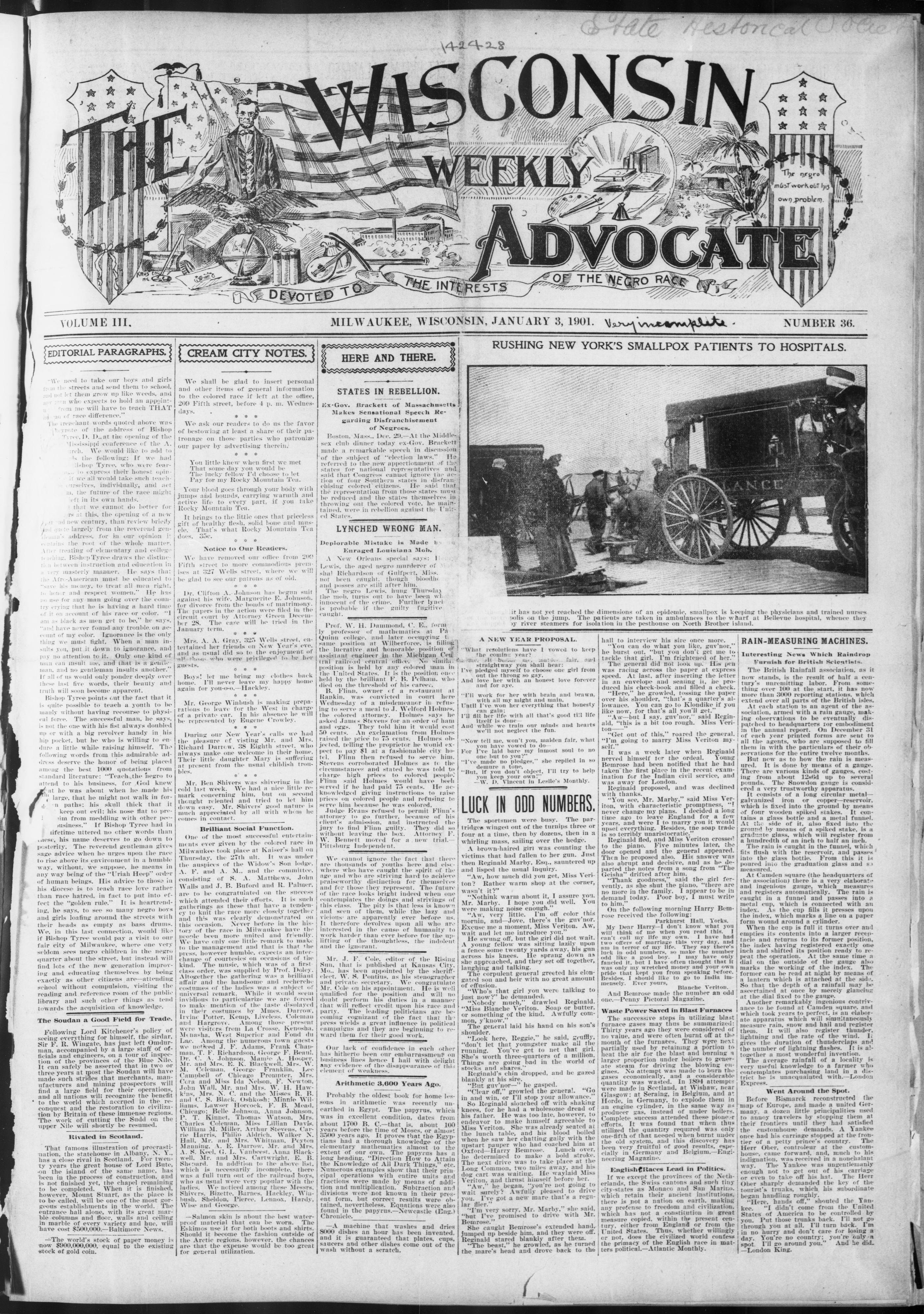
WISCONSIN
WEEKLY
ADVOCATE
DEVOTED TO THE INTERESTS OF THE NEGRO RACE
EDITORIAL PARAGRAPHS.
"We need to take our boys and girls from the streets and send them to school, and not let them grow up like weeds, and any man who expects to hold an appointment from me will have to teach THAT man of race difference."
The rechant words quoted above was keynote of the address of Bishop Tyree, D. D., at the opening of the Mississippi conference of the A. Church. We would like to add to the following: If we had Bishop Tyree, who were fearful to express their honest opinion, if we all would take such teach ourselves, individually, and act in the future of the race might left in its own hands.
that we cannot do better for
rs at this, the opening of a new year and new century, than review briefly and quote largely from the reverend gentleman's address, for in our opinion it contains the root of the whole matter. After treating of elementary and college teaching, Bishop Tyree draws the distinction between instruction and education in a very masterly manner. He says that the Afro-American must be educated to "save his money, to treat all men right, to honor and respect women." He has no use for any man going over the country crying that he is having a hard time of it on account of his race or color. "I am as black as men get to be," he says, "and have never found any trouble on account of my color. Ignorance is the only thing we must fight. When a man insults you, put it down to ignorance, and pay no attention to it. Only one kind of man can insult me, and that is a gentleman, and no gentleman insults another." If all of us would only ponder deeply over these last five words, their beauty and truth will soon become apparent.
Bishop Tyree points out the fact that it is quite possible to teach a youth to be manly without having recourse to physical force. The successful man, he says, is not the one with his fist always doubled up or with a big revolver handy in his hip pocket, but he who is willing to endure a little while raising himself. The following words from this admirable address deserve the honor of being placed among the best 1000 quotations from standard literature: "Teach the negro to attend to his business, for God knew that he was about when he made his large, that he might not walk in ford on paths; his skull thick that it keep out evil; his nose flat to prey from meddling with other peo
business." If Bishop Tyree had in lifetime uttered no other words than these, his name deserves to go down to posterity. The reverend gentleman gives sage advice when he urges upon the race to rise above its environment in a humble way, without, we suppose, he means in any way being of the "Uriah Heep" order of human beings. His advice to those in his diocese is to teach race love rather than race hatred, in fact to put into effect the "golden rule." It is heartrending, he says, to see so many negro boys and girls loafing around the streets with their heads as empty as bass drums. We, in this last connection, would like if Bishop Tyree would pay a visit to our fair city of Milwaukee, where one very seldom sees negro children in the negro quarter about the street, but instead will find lots of the new generation improving and educating themselves by being exactly as other citizens are—attending school without compulsion, visiting the reading and reference room of the public library and such other things as tend towards the acquisition of knowledge.
The Soudan a Good Field for Trade
Following Lord Kitchener's policy of seeing everything for himself, the sirdar, Sir F. R. Wingate, has just left Omdurman, accompanied by a large staff of officials and engineers, on a tour of inspection of the provinces of the Blue Nile. It can safely be asserted that in two or three years at most the Soudan will have made such strides that merchants, manufacturers and mining prospectors will find a large field for their operations, and all nations will recognize the benefit to the world which accrued in the reconquest and the restoration to civilization by Britain of these immense regions. The work of cutting the Sudd on the upper Nile will shortly be resumed.
Rivaled in Scotland.
That famous illustration of procrastination, the statehouse in Albany, N. Y., has a close rival in Scotland. For twenty years the great house of Lord Bute, on the island of the same name, has been in the process of construction, and is not finished yet, the chapel remaining to be completed. When it is finished, however, Mount Stuart, as the place is to be called, will be one of the most gorgeous establishments in the world. The entrance hall alone, with its great marble columns and floor, walls and ceiling in marble of every variety and hue, will have cost $500,000.—Baltimore News.
The world's stock of paper money is now $900,000,000, equal to the existing stock of gold coin.
CREAM CITY NOTES.
---
We shall be glad to insert personal and other items of general information to the colored race if left at the office, 209 Fifth street, before 4 p. m. Wednesdays.
* * *
We ask our readers to do us the favor of bestowing at least a share of their patronage on those parties who patronize our paper by advertising therein.
杂 杂 杂
You little knew when first we met That some day you would be The lucky fellow I'd choose to let Pay for my Rocky Mountain Tea. Your blood goes through your body with jumps and bounds, carrying warmth and active life to every part, if you take Rocky Mountain Tea. It brings to the little ones that priceless gift of healthy flesh, solid bone and muscle. That's what Rocky Mountain Tea does. 35c.
Notice to Our Readers.
We have removed our office from 209 Fifth street to more commodious premises at 327 Wells street, where we will be glad to see our patrons as of old.
* * *
Dr. Clifton A.-Johnson has begun suit against his wife, Marguerite E. Johnson, for divorce from the bonds of matrimony. The papers in the action were filed in the circuit court by Attorney Green December 28. The case will be tried in the January term.
宗 宗
Mrs. A. A. Gray, 325 Wells street, entertained her friends on New Year's eve, and as usual did so to the enjoyment of all those who were privileged to be her guests.
☆ ☆ ☆
Boys! let me bring my clothes back home. I'll never leave my happy home again for you-o-o.—Hackley.
* * *
Mr. George Winbush is making preparations to leave for the West in charge of a private car. In his absence he will be represented by Eugene Crowley.
* * *
During our New Year's calls we had the pleasure of visiting Mr. and Mrs. Richard Darrow, 38 Eighth street, who always make one welcome in their home. Their little daughter Mary is suffering at present from the usual childish troubles.
☆ ☆ ☆
Mr. Ben Shivers was shivering in the cold last week. We had a nice little remark concerning him, but on second thought relented and tried to let him down easy. Mr. Shivers' good nature is much appreciated by all with whom he comes in contact.
Brilliant Social Function.
One of the most successful entertainments ever given by the colored race in Milwaukee took place at Kaiser's hall on Thursday, the 27th ult. It was under the auspices of the Widow's Son lodge, A. F. and A. M., and the committee, consisting of S. A. Matthews, John Walls and J. B. Buford and R. Palmer, are to be congratulated on the success which attended their efforts. It is such gatherings as these that have a tendency to knit the race more closely together and this was clearly demonstrated on this occasion. Never before in the history of the race in Milwaukee have the people been more united and friendly. We have only one little remark to make to the management and that is that the press, however humble, expects an interchange of courtesies on occasions of the kind. The music, which was of a first-class order, was supplied by Prof. Doley. Altogether the gathering was a brilliant affair and the handsome and recherche costumes of the ladies was a subject of universal remark. While it would seem invidious to particularize we are forced to make mention of the taste displayed in their costumes by Mines. Darrow, Irvine Potter, Kemp, Liveless, Coleman and Hargrove. Among those present were visitors from La Crosse, Kenosha, Menasha, West Superior and Fond du Lac. Among the numerous town guests we noticed J. F. Adams, Frank Chamman, T. F. Richardson, George F. Beaul, Dr. C. A. Johnson, Manie A. Hooper, Mr. and Mrs. E. K. Blackwell, Mrs. W. M. Celeman, George Franklin, Lee Campbell of Chicago Prompter, Mrs. Cera and Miss Ida Nelson, F. Newton, John Wall, Mr. and Mrs. W. H. Hawkins, Mrs. N. C. and the Misses R. B. and C. S. Black, Oshkosh: Minnie Williams, Lawser Horcock, F. B. Mead, Chicago; Belle Johnson, Anna Johnson, P. T. Kinnet, Thomas Watson, Mrs. Charles Coleman, Miss Lillian Davis, William M. Miller, Arthur Stevens, Carrie Harris, Philio Aldrich, Walker N. Hall, Mr. and Mrs. Whitman, Peyton Manning, A. E. Darrow, Mr. and Mrs. A. S. Keel, G. L. Vanbeest, Anna Blackwell, Mr. and Mrs. Cartwright, E. B. Shepard. In addition to the above list, which is necessarily incomplete, there was a full turn out of the railroad boys, who as usual were very popular with the ladies. We noticed among these Messrs. Shivers, Bizette, Barnes, Hackley, Winbush, Sheldon, Pierce, Lennox, Hardy, Wise and George.
Salmon skin is about the best waterproof material that can be worn. The Eskimos use it for both boots and shirts. Should it become the fashion outside of the Arctic regions, however, the chances are that the expense would be too great for general utilization.
STATES IN REBELLION.
Ex-Gov. Brackett of Massachusetts Makes Sensational Speech Regarding Disfranchisement
of Negroes.
Boston, Mass., Dec. 29.—At the Middlesex club dinner today ex-Gov. Brackett made a remarkable speech in discussion of the subject of "election laws." He referred to the new apportionment of the states for national representatives and said that Congress cannot ignore the action of four Southern states in disfranchising colored citizens. He said that the representation from those states must be reduced and the states themselves in throwing out the colored vote, he maintained, were in rebellion against the United States.
LYNCHED WEONG MAN.
Deplorable Mistake is Made by Enraged Louisiana Mob.
A New Orleans special says: I Lewis, the aged negro murderer of shal Richardson of Gulfport, Miss. not been caught, though bloodhe and posses are still after him.
The negro Lewis, hung Thursday the mob, turns out to have been wh innocent of the crime. Further lynch is probable if the guilty fugitive caught.
Prof. W. H. Dammond, C. E., former professor of mathematics at Pa Quinn college, and later occupying the same position at Wilberforce, is filling the lucrative and honorable position of assistant engineer in the Michigan Central railroad central office. No similar position is held by any colored man in the United States. It is the position once held by the brilliant F. B. Pelham, who died on the threshold of his career.
B. Flinn, owner of a restaurant at Rankin, was convicted in court here Wednesday of a misdemeanor in refusing to serve a meal to J. Welford Holmes, the colored attorney. Holmes says he asked James Stevens for an order of ham and eggs. They told him it would cost 50 cents. An exclamation from Holmes raised the price to 75 cents. Holmes objected, telling the proprietor he would expect to pay $1 at a fashionable city hotel. Flinn then refused to serve him. Stevens corroborated Holmes as to the circumstances and stated he was told to charge high prices to colored people. Flinn said Holmes would have been served if he had paid 75 cents. He acknowledged giving instructions to raise prices on colored people and refusing to serve him because he was colored.
Judge Evans refused to permit Flinn's attorney to go further, because of his client's admission, and instructed the jury to find Flinn guilty. They did so without leaving the box. Attorney F. W. Bennett moved for a new trial.—Pittsburg Independent.
We cannot ignore the fact that there are thousands of youths here and elsewhere who have caught the spirit of the age and who are striving hard to achieve praiseworthy distinction for themselves and for those they represent. The future of the race looks bright indeed when one contemplates the doings and strivings of this class. The pity is that less is known and seen of them, while the lazy and vicious are apparently ever before us. It therefore devolves upon all who are interested in the cause of humanity to work harder than ever before for the uplifting of the thoughtless, the indolent and the ignorant.
Mr. J. F. Cole, editor of the Rising Sun, that is published at Kansas City, Mo., has been appointed by the sheriff-elect, W. S. Pontius, as his stenographer and private secretary. We congratulate Mr. Cole on his appointment. He is well qualified for the position and will no doubt perform his duties in a manner that will reflect credit upon his race and party. The leading politicians are becoming cognizant of the fact that the press wields a great influence in political campaigns and they are beginning to reward them for their good work.
Our lack of confidence in each other has hitherto been our embarrassment on business lines hence I hail with delight any evidence of the disappearance of this element of weakness.
Arithmetic 3,600 Years Ago.
Probably the oldest book for home lessons in arithmetic was recently unearthed in Egypt. The papyrus, which was in excellent condition, dates from about 1700 B. C.—that is, about 100 years before the time of Moses, or almost 3500 years ago. It proves that the Egyptians had a thorough knowledge of the elementary mathematics almost to the extent of our own. The papyrus has a long heading, "Direction How to Attain the Knowledge of All Dark Things," etc. Numerous examples show that their principal operations with entire units and fractions were made by means of addition and multiplication. Subtraction and divisions were not known in their present form, but correct results were obtained, nevertheless. Equations were also found in the papyrus.—Newcastle (Eng.) Chronicle.
-A machine that washes and dries 8000 dishes an hour has been invented. and it is guaranteed that plates, cups, saucers and other dishes come out of the wash without a scratch.
ANCE
it has not yet reached the dimensions of an epidemic, smallpox is keeping the physicians and trained nurses polis on the jump. The patients are taken in ambulances to the wharf at Bellevue hospital, whence they by river steamers for isolation in the pesthouse on North Brother island.
A NEW YEAR PROPOSAL.
"What resolutions have I vowed to keep the coming year?"
she, she beard, me, matte, fair, and straightway you shall hear:
I've pledged myself to choose one girl from out the throng so gay.
And love her with an honest love forever and for aye.
"I'll work for her with brain and brawn, with all my might and main.
Until I've won her everything that honesty can gain:
I'll fill her life with all that's good till life itself is done—
And while we train our minds and hearts we'll not neglect the fun.
"Now tell me, won't you, maiden fair, what you have vowed to do—
For I've laid bare my inmost soul to no one but to you?"
"I've made no pledges," she replied in so demure a tone.
"But, if you don't object, I'll try to help you keep your own!"
- W. D. Vincent in Leslie's Monthly.
LUCK IN ODD NUMBERS.
The sportsmen were busy. The partridges winged out of the turnips three or four at a time, then by dozens, then in a whirling mass, sailing over the hedge.
A brown-haired girl was counting the victims that had fallen to her gun. Just then Reginald Marby, Esq., sauntered up and lisped the usual inquiry.
"Aw, how much did you get, Miss Veriton? Rather warm shop at the corner, wasn't it?"
"Nothink warm about it, I assure you. Mr. Marby. I hope you did well. You were making noise enough."
"Aw, very little. I'm off color this mornin, and—Jove, there's the guv'nor. Excuse me a moment, Miss Veriton. Aw, wait and let me introduce you."
He swung off, but the girl did not wait. A young fellow was sitting lazily upon a fence some twenty yards away, his gun across his knees. He sprang down as she approached, and they set off together, laughing and talking. The corpulent general greeted his elongated son and heir with no great amount of effusion. "Who's that girl you were talking to just now?" he demanded.
"Nobody much," drawled Reginald. "Miss Blanche Veriton. Soap or butter, or something of the kind. Awfully common, y'know."
The general laid his hand on his son's shoulder.
"Look here, Reggie," he said, gruffly, "don't let that youngster make all the running. You've get to net that girl. She's worth three-quarters of a million. Things are going bad in the world of stocks and shares."
Reginald's chin dropped, and he gazed blankly at his sire.
"But guy'nor—" he gasped.
"Clear off," growled the general. "Go in and win, or I'll stop your allowance." So Reginald slouched off with shaking knees, for he had a wholesome dread of his father. He was too late, however, to endeavor to make himself agreeable to Miss Veriton. She was already seated at the lunch table, and his blood boiled when he saw her chatting gaily with the upstart pauper who had coached him at Oxford—Harry Bemrose. Lunch over, he determined to make a bold stroke. The next drive was to take place at the Long Common, two miles away, and his dog cart was waiting. He waylaid Miss Veriton, and thrust himself before her.
"Aw," he began, "you're not going to wait surely? Awfully pleased to drive you. I've got a new mare that's a regular flier."
"I'm very sorry, Mr. Marby," she said, "but I've promised to drive with Mr. Bemrose."
She caught Bemrose's extended hand, jumped up beside him, and they were off. Reginald stared blankly after them.
"The beast," he growled, as he turned the mare's head and drove back to the
hall to interview his sire once more.
"You can do what you like, guv'nor," he burst out, "but you don't get me to tackle that girl. I'm frightened of her."
The general did not look up. His pen was racing across the paper at express speed. At last, after inserting the letter in an envelope and sealing it, he produced his check-book and filled a check.
"Here," he growled, tossing the paper over his shoulder, "that's a quarter's allowance. You can go to Klondike if you like now, for that's all you'll get."
"Aw—but I say, guv'nor," said Reginald, "this is a bit too rough. Miss Veriton—"
"Get out of this," roared the general.
"I'm going to marry Miss Veriton myself."
It was a week later when Reginald nerved himself for the ordeal. Young Bemrose had been notified that he had taken the first place in the recent examination for the Indian civil service, and was away for London.
Reginald proposed, and was declined with thanks.
"You see, Mr. Marby," said Miss Veriton, with characteristic promptness, "I never change my plans. I decided a long time ago to leave England for a few years, and were I to marry you it would upset everything. Besides, the soap trade is so terribly unaristocratic."
Reginald fled, and Miss Veriton crossed to the piano. Five minutes later, the door opened and the general appeared. Then he proposed also. His answer was also abrupt and decisive, and as he departed the notes from a song from "The Goisha" drifted after him.
"Thank goodness," said the girl fervently, as she shut the piano, "there are no more in the family. I appear to be in demand today. Poor boy, I must write to him."
On the following morning Harry Bemrose received the following:
Parkhurst Hall, Yorks.
My Dear Harry-I don't know what you will think of me when you read this. I can't call my life my own. I have had two offers of marriage this very day, and am in terror of my life. They say there's luck in odd numbers, so make the number odd like a good boy. I may have only fancied it, but I have often thought that it was only my wretched money and your own pride that kept you from speaking before. Besides, I should like to go to India immensely. Ever yours,
Blanche Veriton.
And Bemrose made the number an odd one.—Penny Pictoral Magazine.
Waste Power Saved in Blast Furnaces
The successive steps in utilizing blast furnace gases may thus be summarized: Thirty years ago they were considered of no value, and were often burnt off at the mouth of the furnaces. They were next partially used by retaining a portion to heat the air for the blast and burning a larger proportion under boilers to generate steam for driving the blowing engines. No attempt was made to burn the gases economically, and a considerable quantity was wasted. In 1894 attempts were made in Scotland, at Wishaw, near Glasgow: at Seraing, in Belgium, and at Horde, in Germany, to explode them in an engine cylinder, in the same way as producer gas, instead of under boilers. Complete success attended these pioneer efforts. It was found that when thus utilized the quantity required was only one-fifth of that needed when burnt under the old system, and this discovery has been very fruitful of good results, especially in Germany and Belgium.—Engineering Magazine.
English Races Lead in Politics
If we except the provinces of the Netherlands, the Swiss cantons and such tiny city-states as Monaco and San Marino, which retain their ancient institutions, there is not a nation on earth, making any pretense to freedom and civilization, which has not a constitution in great measure copied, within the present century, either from England or from the United States. Thus, whether willingly or not, does the civilized world confess the primacy of the English race in matters political.—Atlantic Monthly.
RAIN-MEASURING MACHINES.
Interesting News Which Raindrop Furnish for British Scientists.
The British Rainfall association, as it now stands, is the result of half a century's unremitting labor. From something over 100 at the start, it has now more than 3000 reporting stations, which extend over all parts of the British isles.
At each station is an agent of the association, armed with a rain gauge, making observations to be eventually dispatched to headquarters for embodiment in the annual report. On December 31 of each year printed forms are sent to all the agents, who are supposed to fill them in with the particulars of their observations for the entire twelve months.
But new as to how the rain is measured. It is done by means of a gauge. There are various kinds of gauges, costing from about 12s6d up to several pounds. The Snowdon gauge is considered a very trustworthy apparatus. It consists of a long circular metal-galvanized iron or copper-reservoir, which is fixed into the ground by means of four wooden spiked stakes. It contains a glass bottle and a metal funnel. At the side of it, also fixed into the ground by means of a spiked stake, is a graduate glass, which will register from a hundredth of an inch to half an inch. The rain is caught in the funnel, which fits flush with the reservoir, and passes into the glass bottle. From this it is poured into the graduation glass and so measured.
At Camden square (the headquarters of the association) there is a very elaborate and ingenious gauge, which measures and registers automatically. The rain is caught in a funnel and passes into a metal cup, which is connected with an index. As the cup fills it presses upon the index, which marks a line on a paper form wound around a cylinder.
When the cup is full it turns over and empties its contents into a larger receptacle and returns to its former position, the index having registered exactly one inch and shifted its position ready to repeat the operation. At the same time a dial on the outside of the gauge also marks the working of the index. The former can be read at night by means of a lantern which is attached at the side. So that the depth of a rainfall may be ascertained at once by merely glancing at the dial fixed to the gauge.
Another remarkably ingenious contrivance to be found at Camden square, and which took years to perfect, is an elaborate apparatus which will simultaneously measure rain, snow and hail and register them. It will also register thunder, lightning and the rate of the wind. It gives the duration of thunderclaps and the number of lightning flashes. It is altogether a most wonderful invention. The average rainfall of a locality is very useful knowledge to a farmer who contemplates purchasing land in a district he is unacquainted with.—London Express.
Went Around the Spot.
Before Bismarck reconstructed the map of Europe, and made a united Germany, a dozen little principalities used to annoy travelers by stopping them at their frontiers until they had satisfied the customhouse demands. A Yankee once had his carriage stopped at the frontier of a petty prince's country. The Herr Ober, controleur at the customhouse, came forward, and, much to his indignation, was received in a nonchalant way. The Yankee was ungentlemanly enough not to get out of his carriage or even to take off his hat. The Herr Ober sharply demanded the key of the tourist's trunks, which his subordinate began handling roughly.
"Here, hands off," shouted the Yankee. "I didn't come from the United States of America to be controlled by you. Put those trunks back. I'll not go through you at all. I'll turn back. I'm in no hurry and don't care for losing a day. You're no country; you're only a spot. I'll go around you." And he did.—London King.
IGNATIUS DONNELLY DEAD
Author of Baconian Cipher Passes
Away at Minneapolis.
ILL: BUT A FEW HOURS.
Minneapolis, Minn., Jan. 2.—Ignatius
Dennelly, politician and author, aged 70,
died at 12:03 this morning. He was tak-
en suddenly ill last night while visiting
at the home of his father-in-law, Barton
Hanson, 3022 ‘Twenty-eighth avenue
south. From the first Mr. Doanelly sank
steadily and soon pecame unconscious.
Dr. Murphy was summoned and when
he arrived the sick man was still un-
conscious.
The doctor pronounced it heart fail-
ure and stated eariy in the evening that
there was little chance of the patient's
recovery.
Mr. Donnelly passed away surrounded
by a number of iis relatives. From the
first they had understood that he could
not live, as he was well advanced in
years.
He died without regaining conscious-
ness.
Ignatius Donnelly was born in_Phila-
delphia on November 3, 1831. He was
educated in the public schools and was
graduated in 1849 from the Central high
school of that city. He then studied law
for three years in the office of Benjamin
Harris Brewster, who was afterward at-
torney general of the United States, and
was admitted to the bar in 1852. He
was married in 1855. In the same year
he was nominated for the Legislature by
the Democrats, but declined the nomina-
tion, He emigrated in the spring of 1856
to Minnesota, then a new territory, where
he resumed the practice of law in the
town of Hastings in pee with
Archibald M. Hayes. In 1857 he was
ABS
PH,
ae
bp
hp FSP ss,
t itis. ford nhs
hg . BS N\\
i = Bo,
RO. essa et
A a iy
tH Nie: i Hy
‘ ait SY rr Nan
“ibs Ny
THR LATE IGNATIUS DONNELLY.
nominated for state senator by the-Re-
publicans of Dakota county, bet was de-
feated by a large majority, the county
and state being Democratic. In 1858 he
was nominated again for the same office
and was defeated by only twelve major-
ity.
Elected Licutenant-Govérnor.
In 1859 he was nominated by the Re-
publicans for lieutenant-governor and was
elected after a canvass in which he made
sixty speeches and traveled long distances
by private conveyance, there being at
that time no railroads in the state. In
1861 he was re-elected lieutenant-govern-
or and in 1862 was sent to Congress by
the Republicans of the Second congres-
sional district, embracing a territory
nearly as large as all New England. In
‘hat year there was a Sioux Indian out-
break and massacre in which seyeral hun-
dred settlers were murdered. Mr. Don-
nelly accompanied the troops sent to the
relief of Fort Ridgley, where thousands
of men, women and children were be-
sieged by the Indians, and wrote a report
to the governor of the state giving a his-
tory of the outbreak. his later was
published in the official report of the com-
missioner of Indian affairs.
Mr. Donnelly was_ re-elected to Con-
gress in 1864 and again in 1866. He was
an abolitionist and an earnest supporter
of Mr. Lincoln’s administration during
the war, doing effective work by his
speeches in Minnesota and elsewhere in
behalf of the Indians. He nevertheless
advocated the most lenient treatment of
the people of the South after the war
was over and made forcible speeches in
Congress in behalf of liberal. appropria-
tions to feed the starving inhabitauts
of the conquered region.
Wrote Notable Books.
In 1873 Mr. Donnelly was elected to
the state Senate and was re-elected con-
‘tinuously until 1878. In 1886 he was
elected a member of the House for two
years. In 1882 he published his first lit-
erary work, “Atlantis, the Antediluvian
World,” a book which passed through
twenty-one editions in America and sev-
eral in England, and was translated for
publication in France. In this work he
attempted to prove the truth of the the-
ory as to the existence of the ancient em-
pire of Atlantic upon a_ great island in
the Atlantic ocean opposite the Mount of
Mediterranean. Mr. Donnelly claims
that the destruction of Atlantis is the
fact that lies behind all the flood legends
of mankind.
In 1888 he put forth that one of his
works which has attracted most _atten-
tion, “The Great Cryptogram, or Francis
Bacon’s Cipher in the Shakespeare
Plays.” In this hook he claimed to have
discovered an arithmetical method cipher
in the great folio of 1623 depending upon
the paging of that work. Prof. Colbert
of Chicago and George Parker Bidden
of London affirmed the reality of the dis-
covery.
STOLE WIFE’S AFFECTIONS.
Actor Brings Suit for $50,000 Against
Michigan Man.
Spokane, Wash. Jan. 2.—Frank
Hodges, an actor, has begun suit against
Ed BE. Carpenter, a mining man of Re-
public, Mich., asking $50,000 for aliena-
tion of his wife’s affections. Hodges
claims that ‘the woman eloped with Car-
penter from a town in Michigan three
years ago, taking with him Hodges’ 11-
year-old child and that he has been try-
ing to trace them ever since.
IRONWORKERS STRIKE.
One Thousand Men in Pittsburg De-
mand an Increase of Pay.
Pittsburg, Pa., Jan. 2.—One thousand
structural ironworkers struck today for
an advance of 6 cents per hour in wages
and a nine-hour day. Not a single man
is working and a number of important
contracts are tied up. Work on the new
union station is entirely suspended. This
afternoon a committee of strikers left for
New York to confer with President Rob-
erts of the American Bridge company.
Abductor Feigns Insanity.
Houghton, Mich., Jan. 2.—It is said
that William Sullivan, with whom 6-
year-old Raymond Thiery was found
Sunday, is shamming insanity. It was
thought the oy had been pana but
Sullivan says he only picked the child
up by the roadside and was taking him
to a town. Sullivan is in jail and will be
tried on the charge of abduction.
BIG PLANT DESTROYED.
Burning of the Bellaire Stamping
Company’s Factory at
Harvey, Ill.
Chicago, Ill., Dec. 31.—Fire destroyed
the Bellaire Stamping company’s plant
at Harvey, IL, early today, causing a
loss of $400,000 and throwing 700 men,
bays and girls out of employment.
Insurance to the value of $375,000 was
carried on the plant.
A high wind carried great quantities of
burning embers about the village, threai-
ening its destruction. Frantic citizens,
half clad in many instances, althouzi:
the air was wintry, formed themselves
into bucket brigades. In this way, and
with the aid of garden hose, the fire was
confined to the factory.
The tive companies which comprise the
Harvey fire department responded to the
alarm sent in by the factory watchman.
Aid was asked of Blue Island and other
villages near by, but these requests were
countermanded when it was seen that
the factory was doomed, but that the
rest of the town was safe.
The factory building was four stories,
brick structure, 200 by 400 feet. The de-
pot and freight-houses of the Chicago &
Grand Trunk Railfoad company caught
fire several tinfes, but the flames were
quickly extinguished.
Mary barns and sheds caught fire, but
were saved. Household property. was
bundled into the streets and for, hows
women and children, shivering in the
snow, stood guard over it, while the male
popalaty mn worked to prevent the spread
oft Res. 4»
At fi a. m. the water supply gave
out. ‘To add to the excitement several
tanks, two of them filled with naphtha,
exploded. Fragments of iron flew ahnost
everywhere, but no one was seriously in-
jured. When the water ceased to come
the firemen left the factory, which, after
an hour's progress of the flames, was
still burning fiercely to its fate, and
turned their attention to surrounding
property. At 6 a. m. the plant was a
smouldering mass of ruins, but adjacent
buildings were unharmed.
Waterloo, Ia., Dee. 31.—Fire at 1
o'clock this morning destroyed nine
business buildings at Fairbanks. The
town had no apparatus and its entire de-
struction was prevented only by tearing
down several buildings. C, M. Eckelbert
of Waterloo and John MceCunnis of Fair-
banks were perhaps fatally injured. Loss,
$15,000.
Pittszurg, Pa. Dec. 31.—The Penn Pe-
troleum company’s plant at Coroapolis,
Pa., was almost completely destroyed by
fire today. Loss, $100,000.
Williamson, W. Va., Dec. 31.—Almost
the entire business portion of this town.
including two squares, was wiped out
by fire Sunday. ‘The fire burned five
hours and caused a loss estimated at
$75.0... All structures consumed were
of frame and uninsured,
Grand Rapids, Mich., Dee. 31.—The
entire plant of the Grand Rapids Book-
ease company was destroyed by fire to-
day, together with the greater part of
the season’s output. The loss is about
$50,000. The Fred Macey company lost
about $5000 worth of goods which were
stored in the factory. Several foremen
had narrow eseapes from death, being
surrounded by flames at one time.
St. Petersburg, Dec. 31.—A fire at Ba-
ku has destroyed twenty-five naphtha
springs and three warehouses.
’ “ 7!
ALL GOT SAFELY OUT.
———_>—__—__
Five Hundred Miners Were at Work
When a Heavy Explosion of
Gas Occurs.
Wilkesbarre, Pa., Dec. 31.—A_ heavy
explosion of gas occurred in the Hollen-
back mine of the Lehigh & Wilkesbarre
Coal company today. It set fire to the
woodwerk was quickly extinguished.
Five hundred men were at work at the
time.
All sueceeded in getting out safely with
the exception of two, who were badly
burned. They are Ignatz Crary, miner,
burned internally, and a laborer, name
not given, badly burned. Both probably
will die.
_ Pittsburg, Pa.. Dee. 31.—By the explo-
sion of a kerosene lamp at 1203 Lake
street, Allegheny, today, Lily Brown,
aged 22 years, was burned to death and
her mother fatally injured.
7 “= 7 AAP ON
DEEP SNOW IN WEST.
Fears Entertained for Safety of
Several Hundred Miners on
Mount Blanc.
Walsenburg, Col., Dec. 31.—It has
been storming at intervals in this section
for several days and the roads leading
to the summit of Mount Blane are in-
passable. Fears had been entertained
for the safety of the hundred or more
miners on the tep of the mountain who
had not yet laid in their winter's supply
of provisions. People living at the base
of the mountain say, however, that if
they are in danger of scant food supply,
some of them would have cut their way
ceeoee before this and called upou
neighboring camps for help.
Cheyenne, Wyo., Dec. 31.—A_ general
snowstorm has prevailed over the eastern
and central sections of Wyoming during
the past two days. On Powder River
and Salt Creek the snow is very deep.
Much difficulty in Seeding stock is expe-
rienced, although no serlous damage is
reported as yet.
WANTED IN CHICAGO.
. D’Essauer Says He will Not Go Back
; Without a Fight.
New Orleans, La., Dee. 31.—The_fol-
lowing dispatch was received from Chief
of Police Kinley of Chicago: “Hold
George D’Essauer, will send _ officer
and man to identify him. He is wanted
here badly.”
D'Essaiier was greatly surprised and
said he would net go back without a
fight. -
Suicide by Asphyxiation.
New York, Dee. 51.—A man and wom-
an who went to Courtney's hotel, Brook-
lyn, Saturday night, were found dead in
bed today. wo unlighted gas burners
were turned on full.
—Prof. C. W. Stiles of the agricultural
departmert says that only the mosquito
of the genus Anopheles carries the ma-
laria germs. This. species, the professor
continues, can readily be distinguished
from the common mosquito by its voice.
The dangerous mosquito gives forth a
deep, strong buzz, quite different from
the gentler hum of the harmless mosqui-
ea
The Sole Exception.—The New Lodger
—‘I must look for another room, Mrs.
Chamberhall. The noise in the neighbor-
hood last night was simply unbearable!
Three times was I awakened by_ the
shrieks of some person in agony.’ Mrs.
Chamberhall—“Oh, please do not be
hasty. It is but one night in the week
when the painless dentist keeps open.” —
Judge. SE,
ACHIEVEMENT.
Throngh weary years he chased Suceéss,
And never seemed to gain an inch,
Till, one day, his rich uncle died,
Then on Success he had a cinch.
—Brook!yn Life.
—There are eight submarine cables of
over 2000 miles in length.
MME. PATTI’S CASTLE
SAID TO BE SOLD.
a. 8s
London Publisher Pays $1,250,000
for Craig y Nos, Summer Home
of the Singer.
London, Jan. 2.—Craig y Nos, Mme.
Adeiina Patti’s beautiful castle in Wales,
is said to have been sold to Sir George
Newnes, the London publisher. The
price paid has not yet been made public,
but is said to be in the neighborhood of
£250,000,
Madame Adelina Patti (Baroness Rolf
Cederstrom) confirms the report. In re-
sponse to the request of the Associated
press for her reason in taking this ac-
tion, Mme. Patti has sent a telegram as
follows:
“Wishing to spend the summer months
in Sweden, Crag-y-Nos, my summer. re-
sort till now, weuld become of very little
use to me.
ASSASSIN BEHEADED.
Chinese Soidier Who Slew Von
Ketteler is Publicly Exe-
cuted in Pekin.
Pekin, Jan. 2.—The murderer of Baron
von Ketteler, the German minister, was
beheaded yesterday in Hataman street,
the principal thoroughfare of the eapital.
The execution, which was under Ger-
man supervision, took place at the busi-
cst hour of the day. A great crowd was
present. German troops kept order. The
murdeser was nade to kneel on his hands
and knees in the middle of the street,
and he was kept in this position for half
an hour awaiting the arrival of German
ofticers who wanted to see the execution.
In the meantime the executioner, sword
in hand, and his assistant, steod beside
the condemned man. They exch wore
bloody clothes. The pair had just. offi-
ciated at eight other killings aud did not
have time to wash.
The man who was so shortly to die
was cheerful durmg the period of wait-
ing. He laughed heartily several times,
He said that his name was an honored
one and that he was an honest: man,
Two Blows Required.
Upon the arrival of the German ofli-
cers the avsistant executioner made a
double warp of twine around the man’s
neck, crossing the string under his chin.
He then pulled on the twine and the
man’s cue, siretching his neck to the ut-
most. Meantime the executioner put a
knee Letween the man’s shoulder, blades
and his hands on his head. Then he
jumped hard, shoving the culprit’s face
into the dust, after which he stepped
back, took his sword and chopped his
head off. Two blows were required to
sever the head, which was subsequently
placed in a eage and hung over the
street.
The murderer was a soldier, At the
outbreak of the Boxer troubles he was
stationed at Hataman street with orders
to shoot any foreigner who tried to pass.
The killing of Baron von Ketteler was
done in obedience to these orders. Tt_is
admitted by foreigners. includiny @r.
Mumm yon Schwartzengtein, the sent
German iinister, that ‘the the aud
net have been executed in a E n
country.
A Satisfactory Settlement.
San Francisco, Cal. Jan. 2.—John
Goodnow. United States consul general
to China, with residence at Shanghai,
arrived in this eity on the City of Pekin.
After a brief visit to Washington he will
spend his sixty-day leave of absence at
his old home in Minnesota.
In speaking of the probable outcome
of the Chinese troubles the consul gen-
eral said: “I believe a_ satisfactory set-
tlement will be reached along the lines
laid down by the President. Those Chi-
nese who are working for the integrity
of their country are friendly toward the
United States and are ready to assist in
# prompt and amicable settlement. The
uprising was by no means a popular move
with the great mass of the peaceable
Chinese population, From the very first
they deplored the acts of their fellow
countrymen.”
In regard to the missionaries and their
position in China, Mr. Goodnow thinks
there is still a great field for successful
work and their presence in the Orient
should be encouraged. He, however, is
of the opinion that it would not be best
to send missionaries outside the treaty
ports uatil peace has been proclaimed.
Mr. Goodnow has a good word for the
American troops which were sent to
China, and he also praises the work of a
little hand of women sent by a philan-
thropic committee of New York peopie,
of which Mrs. Whitelaw Reid was chair-
man, to provide the sick and needy with
hospital supplies and comforts.
SECESSION IN CANADA.
Pe eS
Princidal Features of a Proposed
Constitution and Declaration
of Indepehdence.
Montreal, Jan. 2.—For some time past
there has been some discussion about the
deings of an alleged “Independence” club
in Montreal, but the managers of the
new movement did not appear to judge
the time opportune for appealing to the
public. A good deal of interest was
added to the movement by the fact that
during the Paris exposition a large num-
ber of young men appeared in’ Paris
wearing “Independence of Canada” but-
tons, and an atrempt was made to con-
nect J, I. Tarte and J. X. Perrault, the
Canadian commissioners, with the move-
ment because a number of independent
buttons were among the spoils reeovered
frem men who had burglarized Mr, Per-
rauit’s house.
Mr. Perraait explained, however, that
these buttons were about, fifteen years
old and be hed changed his views since.
Now the Canadian Independence league
has issued its platform and constitution,
but has declined to publish its list of offi-
cers and members. The constitution con-
sists of eighteen clauses, of which the
first eight are:
1. Dissolution of the colonial relation and
declaration of independence.
2. New federation to be known as Unit-
ed States of Canada.
8. Provinces to become states with sover-
elgn power.
4. Federal authority to have only such
pore oe shall be specialy delegated to it
by sovereign states.
5. No power shall be delegated to the
federal authority except with the assent of
the majority of delegates of each of the
sovereign states convened in a national as-
sembly.
6. Creation of a state militia under com-
mand of a federal officer.
7. Universal suffrage.
8. The great highways and services (rai!-
ways, canals, telegraphs, ete.,) to be public
property.
Others deal with changes In laws along
TWO FISHERMEN DROWNED.
Lose Their Lives in a Storm on Lake
Michigan.
Laporte, Ind., Jan. 2.—Charies Ely and
Fred Mecklenberg, Michigan City fisher-
men, started out on Lake Michigan to
lift their hooks. A storm came up and
their boat and fishing tackle were found
Cast upon the beach. Their bodies have
not ween recovered. Ely was 51 years
old ahd leaves a family. Mecklenberg
was 45 abd unmarried,
GREAT BRITAIN ALARMED.
Disturbed Ove Outbreak of Dutch
in Cape Colony.
HALF WAY TO CAPITAL.
Anu eae Are Called
SP ee
London, Jan. 2.—There is no question
jut, that the situation in Cape Colony
has become a very serious proposition for
the British government. Cape Town is
yeported as being in danger of falling
nto the hauds of the Boers, who are now
helf-way to the capital. Owing to the
growing Dntch disaifection the situation
from a British standpoint is about as
bad as it could be. Every able-bodied
loyalist in the colony has been called to
arms to repel the invaders. People here
who understand the great preponderance
of the Dutch in Cape Colony shake their
heads at this. They know that the Cape
government would) never have adopted
such a desperate measure were it not
the last and only chance. For, if the
English farmers obey the call, the Dutch
will be forced into rebellion. They will
not sit idly by while their kin are fighting
aw race war under their eyes.
It is estimaied that no fewer than 1500
Cape Dutch have joined the inyaders,
who have penetrated further south than
ever, The Bocrs who trekked westward
from Vryburg and were supposed to be
going to Damaraland, are jnaking for the
Prieska district of Cape Colony.
Boers Take More Prisoners,
A dispatch from Colesberg, Cape Col-
ony, stys the Boers captured fourteen
men of Nesbitt’s horse, fifty miles south-
cast of Colesberg, and that the enemy,
since increased to S00, has apppeared
near Weltevreden and is driving off
stock.
The Cape Town correspondent of the
Daily Mail, referring to the seriousness
of the situation in Cape Colony, says:
“The Boer invaders now number 5000.
The Western invasion gives the most
concern, It has split into two divisions,
which are- marching like the prongs. of
a fork, one by way of Sutherland toward
Malmesbury, and the other toward Beau-
fort west.
“The Boers are now ranging over im
mense tracts of territory, necessitating
the cmployment of an army corps to deal
with them. Lord Kitchener has poured
troops into the disturbed areas; but the
fugitive tactics of the enemy have. to 2
large exieni, neutralized his precautions.”
Importuning the Queen,
London, Jan. 2.—Mr. Kruger is again
importuning Queezx Wilhelmina, says the
correspondent of the Daily Mail at 'The
Hague. to write personal letters to Em-
peror Nicholas. President Loubet and
Emperor William with a view of stop-
ning the war. It is reported that the
‘Queen is not unwilling, but that ihe
Netherlands’ ministry is divided.
The Hague, Jan. 2—Mr. Kruger 's
suffering from a slight attack of bron-
chitis. While there is no anxiety as to
his condition, he is obliged to keep to
his bed.
Reinforcements to Middleburg.
Craddock, Cape Colony, Jan. 2—A de-
tachment of Boers entered Roodehooste,
southward of Middleburg, January 1. It
is believed this force is going to Graat
Reinit. The telegrapi lines are cut be-
tween Carnarvon and Somerset West and
Steynsburg and Maraisburg. Large re-
irforeements have reached Middleburg.
Witchener’s Proclamation.
Bloemfontein, Jan. 2.—In regard to
Tord Kitchener's proclamation about
burghers who surrendered heing allowed
to remain in laagers provided by the
British, it is explained that the surrender
must be voluntary and that the procia-
mation does not apply to Boers who sur-
rendér on the field of battle. Burghers
who have taken the oath of allegiance
and are again captured after they join
the commandoes will receive the same
treatment as other so-called enemies, pro-
vided it is proved that they have not in-
duced or incited others to break their
oaths.
WRIGHT IS NOW FREE.
Former Racine Man is Paroled «
Pingree-He Murdered Two Men
in Michiran.
Lansing, Mich., Jan. 2.—Gov. Pingree
wound up his official career as chief ex-
ecutive of Michigan with a most gener-
cus distribution of pardons and paroles
among the convicts of the state prisons.
During December Goy. Pingree released
over eighty prisoners, and the number
includes many of the inost noted crimi-
nals of the state. Four life convicts
were among the thirty or more pardened
or pareled.
Ore of these is Charles J. Wright, the
miilionaire lumberman of Benzie coumy,
formerly of Racine, Wis., who killed two
mea in i888. When the case of Wright
was under consideration a few months
ago public feeling in Benzie county was
aroused to such an extent that the par-
dor board thought best to drop the mat-
ter. Gov. Pingree commuted the innr-
derer’s sentence to seventeen years fron
18s) and granted him a parole,
The list of pardons and paroles foliows:
Pardons—Wiilis F. Tracey. thirty months.
burglary; Lemuel Swank, nine months, as:
sault with intent to do great bodily harm;
Fred Demars, three years, assanit; Adelbert
Swartz, life, murder; James B.' Daggett,
life, murder; George Carpenter, fifteen
years, assault: Prank Bird, fifteen years,
burglary; George Higgins,’ life, murder:
Larry Finn, life, murder: Bert Hubbell, fif.
teen’ years, mausliughter; Joseph — Bana-
chowskl, six years, assauit; Willlam Repke,
life, murder; Jane McEwen, three years,
larceny; Joseph Moran, twenty years, as:
sault; Clarence Brooks, fifteen years, as.
sault.
Paro'es—Clarence Beverly, — twenty-five
years. murder; Michael Byrnes, five years,
manslanghter;| Elner Bushey, — fourteen
years, burglary; Burt Rigdon, ‘two years,
burglary: W. H. Dyer, fifteen years, burg:
lary; Thomas Fitzgerald, life, murder;
Charles T. Wright, life, murder; ‘Thomas
Hofman, ten years, burglary; Frank Gard-
ner, five years, forgery.
Comuutations—Andrew Glenn, —_(wenty
years, to ten years, murder; Thomas
ee tee a eee. See eee ee
MRS. HAMMERS A SUICIDE
Coroner's Jury Finds that She Kill-
ed Herself and the Three Prison-
ers Are Released.
Chicago, I, January 2.—A verdict to
the effect that Mrs. Nora Hammers had
died from a bullet wound, self-inflicted,
was returned by the coroner's jurv at
the inquest held yesterday morning.
After the verdict M. D. Hoff, the min-
ing operator who was with Mrs. Ham-
mers at the time of the shooting; he:
sister, Mrs. Amos Griswill, and Charles
K. Gaussen, a book-keeper, all of whom
were in the flat at the time, and who
had been detained by the police, were
released. Mrs. Hammers was found dead
in her room at 2500 Wabash avenue at 3
o’clock on Sunday merning with a bullet
wound in her head.
AMERICAN TARS
VISIT THE POPE.
Jackies from shaGvainer Dixie Visit
Vatican and Give Three Cheers
for Holy Father.
Washington, D. C., Jan. 2.—The visit
to Pope Leo XIII. of Ensign Edward
McCauley, Jr., with 106 men of the
United States steamer Dixie, is the sub-
ject of a_report made to the navy depart-
ment. The men were taken from Naples
to Rome early in December, when the
Dixie was cruising down the Mediter-
ranean sea, The party was given. free
aecess to many famous sights and places
in Rome, to which entrance as a rule is
prehibited. As a fitting climax to their
stay in the city the men obtained an_an-
dience with the Pope, whieh Ensign Me-
Cauley describes as follows:
“The Pope was carried in in state, ac-
companied by the noble and papal guards
and a retinue of household chamberlains,
priests of the church and choristers. The
neclamation, greeting and applause was
tremendous, and several times during the
procession our men gave‘ three cheers and
a tiger fer the holy father.’ The Pope
in passing us rose in his chair as he gave
the benediction.
PATTERN PLANT
) FULLY DESTROYED.
Defective Electric Wire Connection
Causes Big Fire in Pittsburg—
Public Library Burned.
Pittsburg, Pa., Jan. 2.—The extensive
pattern plant of S. Jarvis, Adams & Co.,
corner of Thirteenth and Aetna streets,
in this city, was almost completely de-
-stroyed by fire today, together with a
large number of patterns and moulds.
The loss is estimated at $100,000 and is
covered by insurance. The fire was
caused by a defective electric wire con-
| nection.
Seattle, Wash., Jan. 2.—The public _li-
brary of Seattle burned last night. The
total stock of books, numbering 25,000
volumes and valued at least $30,000, are
a total loss.
The building was built about ten years
ago by Henry Yesler, Seattle’s most fa-
“mous pioneer, at a cost of $60,000.
| From opinions gleaned from city offi-
cials it is likely that a new building will
| be built at once.
BOBS IS AN EARL.
Queen Victoria Welcomes the Hero
of South Africa to
England.
| Cowes, Isle of Wight, Jan, 2.—The
steamer Canada, having Field Marshal
Lord Roberts on board, anchored off Os-
borne at 11:45 a, m. today.
The ships in the roads were gaily
dressed, the sea front was elaborately
decorated | with bunting and Venetian
‘masts with festoons adorned the route
to Osborne house, at the entrance of
which was erected a unique tribute of
‘the Queen in appreciation of the field
-marshal’s work, in the shape of an arch
of laurel. This was the first time such
an arch had ever appeared there in honor
of any subject of her majesty. a
After Lord Roberts’ audience with the
Queen he will join the Canada at South-
ampton and remain on board till morn-
ing.
A large concourse of people awaited
Lord Roberts’ arrival at Trinity pier and
landing. The field marshal landed from
the Royal launch at 3:30 p. m., which
was the signal for deafening shouts of
weleome. Princess Beatrice, in her ca-
pacity of governor of the Isle of Wight,
and the Duke of Connaught, representing
the Queen, awaited Lord Roberts, whose
arm was still in a sling as a result of
being thrown from his horse in South
Africa. He was warmly greeted and the
party started in royal carriages for Os-
borne house. The route was lined with
troops and thronged with cheering sight-
seers.
The Queen bestowed an earldom on
Lord Roberts, with a special remainder
for his daughters. He was also made a
knight of the Garter.
Cowes, Isle of Wight, Jan. 2.—Lord
Roberts stopped on his way at the town
hall of East Cowes, where eulogistic ad-
dresses of welcome were presented to
him. He then resumed his ae and en-
tered the grounds of Osborne house by
the Prince of Wales’ entrance and pro-
ceeded up the noble, troop lined avenue
to her majesty’s Isle of Wight residence.
After a heariy reception in the council
chamber by & number of princes and
princesses, Lord Roherts was ushered in-
to the presence of the Queen. His au-
dience with her majesty was quite pri-
vate.
Replying to the addresses at the town
hall, Lord Roberts said he regretted that
his return was not accompanied by im-
mediate peace, but he added, while he
feared hostilities would continue for
some time, he had implicit confidence in
Lord Kitchener and had no fear regard-
ing the outeome. He concluded with an
eulogy of the magnificent army of Great-
er Britain, all the components of which,
. pointed out, pulled together splendid-
iw
DEBUT OF MISS HANNA.
Brilliant Coming-Out Party of the
Ohio Senator’s Daughter—Some
Beautiful Gowns.
Cleveland, O., Jan, 2.—The coming:
ont party of Miss Ruth Hanna, _ the
youngest daughter of Senator Hanna,
last night, was a prosounced social suc-
cess. The guests included all the lead:
ing society people of Cleveland, 1500. in-
yitations having becn issued. The hall
was decorated in a most artistic way
with evergreens, holly, smilax and_ red
satin ribbons. ‘The debutante received
in a bower of palms at one side of the
hall. She was attended by her father,
her mother, her sister, Miss Mabel Han-
na, and her grandmother, Mrs. D. P.
Rhodes.
Miss Hanna wore a beautiful gown of
white spangled gauze, made over white
satin, and with a fold of pink liberty
satin draped over the left shoulder and
down the back of the waist, skirt and
train. In her hair she wore pink velvet
hows, a diamond crescent, and _tortoise-
shell combs. About her neck was a pear!
necklace given to her by her father.
Mrs. Hanna wore a magnificent court
train of silver brocaded white satin, over
a petticoat of pastel blue satin, with a
flounce of duchesse lace, ornamented with
chinestones,
HEAD-ON COLLISION.
Five Trainmen Killed on Yazoo &
Mississippi Railroad.
New Orleans, La., Jan. 2.—Five train-
men were killed and one was badly in-
jured in the head-on collision between
two freight trains, reported on the Ya-
zoo & Mississippi, Valley railroad at Mel-
ton, Miss., last night. Both engines and
several cars were demolished.
WILHELMINA TO WED FEB. 7.
Date for Her Marriage with Duke
Henry is Officially Fixed.
The Hague, Jan. 2.—The marriage of
Queen Wilhelmina to ‘Duke Henry of
Mecklenburg-Schwerin has been officially
fixed for February 7, 1901.
‘ Sion A High Mark,
The New York Almanac for 1901, is.
sued ws Chas. H. Fletcher of New York
City, has set a high mark for similar
publications during the new century, and
shows remarkable enterprise on the part
of the publisher when we consider that
it is intended solely for free distribution
The numerous publications of this charac.
ter are usually gotten up with the single
idea of cheapness, while the thought of
expense has certainly been set aside in
the case of the New York Almanac.
The artistic colorings of the cover, the
accuracy of its calendars and its fund
of information all go to make it well
worthy of perusal and Preservation. 1
has innumerable hints for mothers as to
the care of children. A unique Page is
the “Baby’s Record” page, which is in
blank, to be filled in with baby’s name,
date of birth, cut first tooth, ete.
The whole is a very creditable piece of
work and may be procured at any drug
store or direct on request, free.
Swedish in Jamestown Sch..).
ithe Jamestown board of education lias
introduced an optional course of instruc.
tion in the Swedish language in the hich
school of that city. As Jamestown has
a very large Swedish population, it js
very proper that that language should
be taught the student of its schools. |:
has a very practical as well as educa.
tional value. The board of education
selected A. J. Lannes, the editor of
the Vart Land, to teach the Swedish lan
guage.—Buffalo Times.
If Coffee Poisons You.
tuins your digestion, makes you neryous
and sallow complexioned, keeps you
awake nights and acts against your sys-
tem generally, try Grain-O, the new food
drink. It is made of pure selected grainy
and is healthful, nourishing and appe-
tising. It has none of the bad effects of
coffee, yet it is just as pleasant to the
taste, and when properly prepared can’t
be told from the finest coffees. Costs
about 4 as much. It is a healthful table
drink for the children and adults. Ack
your grocer for Grain-O. 15 and 2c.
—Oil for combustion is now supplied to
Los Angeles factories at $1 per barre!
About 100,000 barrels a month are used.
LOSS OF MEMORY
aN
"8 J
an ee
Ara Re eae Uae ga.
t |: Dw
INS 4 ey
lin VY
is often derived from an unlooked for
source—the Kidneys. Odorous urine
or that which scalds or stains is an in-
fallible proof that you are progressing
towards Bright’s Disease or one of the
other forms of Kidney Trouble all of
which are fatal if permitted to grow
worse,
BURROWS
ee a
will arrest the disease and under most
solemn guarantee effect a cure where
it is possible by human means.
WISCONSIN AND IOWA
People Cured by Kid-ne-olds. In writing
hem please enclose stamped ad-
dressed envelope.
Mrs. W. E. Lefever, 14 8th St., Fond-du-Lac, Wis
Mrs, Emma Hancock, 326 15th St, Dubuque, Is.
N. D, Nagle, 5 lows St., Dubuque, Ia.
Mrs. A. Orth, 176 Francis St., Dubuque, Ia,
Mrs. Thos. Ward, 11th St. & 3d Ave., ft Dodge, a
Elmer Davis, Blacksmith, Fort Dodge, Ja,
J. F. Monk, Teacher, Fort Dodge, Ia.
Mrs. Hulsizer, 327 13th St., South, Fort Dodge, In.
John King, Carpenter, Independence, la.
J. R. Mann, Engineer, Independence, Ia
Morrow's Kid-ne-oids are not pills,
but Yellow Tablets and sell at fifty
cents a box at drug stores.
JOHN MORROW 4CO.,, SPRINGFIELD, C.
COuG.
peNea aa
Gea
BALSAM
as
ee? diss ii. ”" weer a
—— we
ft Cures Colds. Coughs. Sore Throat, Croup, In-
fluenza.WhoopingCough,BrenchitisandAsthma.
Acertain cure for Consumption in first stages,
and a sure relief in advanced stages. Use at
once. You will see the excellent effect after
taking the first dose. Sold by dealers every-
where. Large bott'as 26 cents and 60 cents.
hy! 6 3
Ey’s Cream Baim seas.
WILL CURE ies, wo
GATARREY 7
woe.
Druggists, 50 Cts. ge
ebP'bkosse Werren Sc, 5-¥. —
Cures @ Cough or Cold at once.
Conquers Croup, Whooping-Cough, Bronchitis,
Grippe and Consumption. Quick, sure results.
oe ane Pills cure Constipation. 50 pilis 10¢.
lage ASTHMA
aes
ihaeae—~ POPHAN'S ASTHMA SPECIFIC
peti Clves relict in FIVE minutes. Send
2 ipa for a FREE trial package. Sold ty
x fic) Druxeists. Ono Lox cont postpaid
Ree eed 3 Feceit of 81,00. ix bones 63-00.
fA ES Address POPHAM, PUILA., PA.
WITHOUT FEE
e unless successful.
Send | description:
and get free oulnion.
MILO B. STEVENS & CO,, Estab. 1604.
Div. 6, 817—14th Street. WASHINGTON, D.C.
Branch offices: Chicago, Cleveland and Detroit.
E Ladies’ and Gents Clothes and ail
Kindsof Family Dyeing at rea-
tunable prices, Matl orders prompt-
CURTAINS ly. attended to. Write. HACK &
ALTEN, 534 Clinton Street, Milwau-
25 to-40cpair. kee, Wis.
en Se
u amicted wien THOMPSON'S hye Water
oN A PRAIRIE TELEGRAPH POLE
past mountain and foothill, plain and lake,
\where it links the East and West,
the tense wire tingles from sea to sea,
\ river that runs unrest.
As a two-stringed harp of haste it throbs
“\vith the rise and fall of states,
and sings through a land of sun and peace
Avy far-off wars and hates.
qhrongh a glimmering sea of waving grecn,
of silence, and golden suns,
as: thread of pain in the woof of peace
“yrom world to world it runs.
yet the tales it tells are idle tales,
\nd the songs it sings are strange
ps who follow the glad, gold trial
(yf the sun on the Open Range. -
\rthur Stringer in Ainslee’s Magazine.
—_—_—_———
qdded, to soften matters: “There’s so
uch competition nowadays. Everybody
nts to live’?
“l\vell. ve got to do it,” said George
diy.
ephings have been going on badly?’ I
yqtired.
yphey've gone. And there's the mater,
a know.
zs I puted my cigar in silence. ‘
s{rs come so suddenly,” continued
George. “L must do something, The
mater cau’t Manage on a little.”
“You must marry,” I said with de-
“sy hate that idea,” said George, petu-
lantly,
*SBut for the sake of the mater?”
“[hat's just it. I want to get work of
some kind, which would mean—well, just
robbing along. She wants me to marry
oid Hepburn’s daughter, whom I’ve nev-
ie secu. He's a neighbor of ours, with a
jt of money, made out of cheap boots
r something.”
“Where is the lady?” : ¥
“(, the continent, undergoing a social
<andpapering! She'll be home in a few
days now. The old man-is awfully keen
on it, L believe.”
“ir seems all right,” I observed’ cau-
tiously.
“It's beastly,” said George.
“Any prior attachment?” _
George blushed (He is quite young).
“Wel, a snap ean't——" he began.
‘Then he stopped, and left me uncertain
as to the limitations of a chap.
“And the other lady?” I inquired, tak-
tug certain facts for granted.
“How could I ask her now?”
“But you propose to ask Miss Tep-
urn f
“That's different. It would be an ar-
ranged thing, you see. Old Hepburn has
creat ideas for his daughter—and of
course we know a lot of people and go
everywhere,”
George sighed deeply, and taking a
pipe from, his pocket began to stuff
it with tobacco. ‘The pipe was aggres-
sively new and cheap. L watched him
sorrowfully. Then [ leaned forward and
touched the atrocity.
“Is it as bad as that?’ I inquired.
“1 can’t afford cigars.”
I took out my case. | é
“Ir an old friend might——"
“Thanks, no; you see [ can’t return the
compliment. Besides, I must get used to
this kind of thing.’””
For a little time we smoked in silence.
Then George said: i
“What do you advise, Hetherbridge?
To you think that I could get into a
Yank?”
“A hundred a year?” I exclaimed.
George shivered. :
“Or take a shop?” he said, with the air
of a man nerved to some desperate deed.
I pnt my hand on his arm.
“Much better take Miss Hepburn,” I
said.
“It would be awful.”
“Not a bit. You couldn’t get the other
one, anyhow—not into the shop,” I said,
following George’s wandering thoughts.
“Then what shall I do?” re
I attempted to put the case judicially.
“On the one hand is work and penury;
on the other hand wealth and——”
“Miss Hepburn. There’s a lot on my
hands just now,’ said George, wearily.
“What would your—your people say
about it? Your sister would despise and
hate me, IT know.”
Now, I had my doubts as to whether
ay sister would ever despise or hate Mas-
ter George. But I contented myself with
remarking airily:
a Yh, girls are so silly about these
things.”
(leorge rose and began to walk up and
down like a eaged lion.
“LT can't do it. I won't! She would
hate me!”
oe other one?” I inquired.
“Yes”
I left my seat and joined him, drawing
his arm through mine.
“That would surely be for the best,” I
said. “Now, you asked for my advice. I
sty, marry Miss Hepburn. You're a
drone in the hive; that’s the fault of your
early training. You'll make her a good
husband, [ know, and she'll be happy.
The mater will be comfortable, and you'll
settle down and enjoy life with plenty of
money to grease the wheels.”
George did not reply, but walked mood-
ily at my side.
“Think it over,” I continued. “I must
hurry away now, as I want to catch a
train home this afternoon. Come, don’t
ee mournful; surely I drew a para-
But George refused to be comforted.
“You left out Eve,” he said bitterly.
fhe world looked very beautiful that
afterncon as I walked from the little
country station, bright with flowers, to
the old house perched on the white chalk
cliffs, where my ancestors had dwelt for
many ceaturies. I have always supposed
that they came over with the Conqueror,
and being tired of the voyage, built a
house where they landed and stopped
there. It would be just like a Hether-
bridge—to be tired. I came over the vast
expanse of green by the path which cut it
with a thin, white line, through the old
stay gates and into the garden. There I
tound my sister Isabel. She was looking
veut over the sea, her book lying unnoticed
in her lap, and made a pretty picture in
« frame of green. I found myself won-
dering what Miss Hepburn was like, and
lny pity for George increased.
Rousing her from her reverie I pro-
eveded to tell my news.
“I saw George this morning,” I said.
Is it as bad as—as—you thought?”
asked Tsabel anxiously.
aoe they have lost almost every
Isabel said nothing.
There is only one course. open,” I con-
tinned. “George must marry.”
“Marry! Whom?”
here is a lady in the case already, a
certain, Miss Hepburn.”
“Oh!” said Isabel, coldly.
“There is also another lady,” I added.
‘Who's that?” asked Isabel, turning
‘iekly toward me.
1 mentioned no name.
_ “Then he is going to marry that girl
inst for her money.”
i ae is a useful thing to have in the
“TL call it shameful—disgraceful. Yl
Never speak to him again.”
7 Isabel left me. very angry, and T sat in
her chair, gazing out at the blue, sea
UNIOUE CYCLORAMA AT PAN-AMERICAN.
sae Grn . Ge Ce
PUES. cle TN less LSS. borg ee
Eka: a y+) PELL a cates SC} i |
NEUF pci, sp Remmmmmncrane ye oy
4 Eero eee FNS LOM CELA eee ae
t ee hee BA eee SU epee mig
a cles eee ee ty
Se ean iY cP aN Sho ee ee
; oe Pe ee ae
Ree COU ORIBE or. ha 7a i 2 A ae Se CO
Fl ged Me er re Weer Piceeicin See aa a
The most vivid scenes of the Johnstown
flood, the accounts of which at the time
of the appalling catastrophe electrified
the entire civilized world, will be pre-
sented in a startlingly realistic manner
by memgis of the scenograph at the Pan-
American exposition at Buffalo next sum-
mer. The descriptions of eye witnesses
have been followed faithfully by the
artist in the portrayal of the scenes. The
presentation, like the experiences of the
survivors of the flood, is never to be for-
gotten by those who witness it.
a
burn girl; only he thinks it is the right
thing to do,”
“You're an old dear,” said the voice.
And then I felt a kiss on my forehead,
and the voice came no more.
Now. I wonder why Isabel called me
“an old dear.”
A few days after came a letter from
George announcing his engagement to
Miss Hepburn and inclosing her photo-
graph. Isabel and I regarded the letter
together.
“He can't care for a girl like that,”
said Isabel, whom I strongly suspected
of having lately indulged in tears. Some-
Bor re photograph seemed to cheer her
a little.
“She is not handsome, certainly.” I
concluded, “She may be very nice, how-
ever.
“But speetacles—and that hideous hair.
And then look at her dress!”
“He will marry her now they. are en-
gaged. George is not the kind of man
to consider a promise can be broken
without very weighty reasons.”
“Jack—do something—anything to
break it off.”
“Why?”
Isabel rested her head on my shoulder
and sobbed out:
“Because I love him! And I am_ so
helpless! I didn’t think I cared, until—
until this came.”
Then suddenly she lifted her head.
“Jack, am I the “other one’ George
mentioned?”
“How should I know?”
“But you do?’
“Well—well—I_ shouldn't wonder?”
“Then why didn’t he ask me, instead
of that ugly, spectacled thing?”
“I think there were many reasons. In
one case he gives social position for
mcney. The whole affair is a blameless
transaction. With you it is different;
he does not know you care for him (you
are a little contrary at times, sister
mine), and if you did, he is too honora-
ble to drag you to poverty.”
“But my money ——”
“He does not know of its existence.
And he has to think of his mother.”
Isabel made a most unkind remark
about George’s mother and tore herself
away from me.
As the summer days slipped away I be-
came very anxious about my sister. Her
Ingh spirits vanished. and she spent most
of her time sitting idly on the cliff, gaz-
ing with sad eyes over the sea. She im-
plored me to have no visitors, and I
was at my wit’s end to know how to
rouse her and bring back the old merry
laugh and saucy speech.
Then came another letter from George,
giving an early date for the marriage.
I broke the news to Isabel.
“A nasty pill is best swallowed quick-
ly,” L remarked.
“And you must take honey afterward
to get rid of the taste,” she replied, bit-
terly, and went out of the house again
to her seat overlooking the sea.’ She sat
there nearly the whole day now, and the
roses faded_in her cheeks and her eyes
grew sad. I cursed George, for I loved
my sister dearly. About a week before
the wedding, at my mother’s invitation,
George and his fiancee came to visit us.
They ,were to stay one night and-return
to town early the following morning.
Isabel refused to meet them and fled to
a neighboring aunt.
The moon was shining brilliantly as
George and I walked along the cliff,
smoking a last cigar before going to bed.
It was the hour when men wax confiden-
tial, and George told me all his sorrows.
“Why are you marrying so soon?” I in-
quired.
“Oid Hepburn insists on it. It appears
that Mary got flirting with some foreign
chap abroad, a music master, and the ol!
man wants her married and safe from
him. It's_a queer case. The fellow is
hanging about London, and Mary ‘has
been kept almost a prisoner in the house.
She's out on bail now, and I'm surety for
—what’s that, Hetherbridge?”
George caught my arm and_ pointed
along the cliff. I looked, and the moon-
light showed me two figures, a man and
a woman, walking quickly away from us.
“They came from the house,” said
George excitedly.
“One of the servants and her lover,” I
said. “It’s rather late, but this moon gets
into their heads.”
“It’s—it’s Mary.” gasped George,
“Eloping with the music master?” I in-
quired.
“Most likely. Did you ever know such
luck?” exclaimed George.
Then he extended his arms dramatical-
ly, making a strange figure silhouetted
against the brilliant sky, dnd cried:
“Oh, my darting! my darling! Go away
from me! Go! Hulloa! they’ve gone.”
They had vanished as though the earth
had_ swallowed them.
“They've gone down the tunnel to the
beach,” I. explained.
George began to run.
“You won't stop them,” I cried.
“['m going to see where they go and
help,” he replied over his shoulder.
Together we scrambled down the steep
incline, in such complete darkness that J
could searcely see my companion, Only
oceasionally I heard his voice. The
ground was rough, and he was wearing
thin slippers. Once on the sands we saw
our fugitives again. The man was
launching a small boat. We saw Mary
assisted in, but before her companion
could follow George (who is slimmer than
1) was by his side. The man turned, and
the moonlight gleamed on a revolver. I
ran panting over the wet sand. There
was a French oath—a scream from the
boat—and then the quiet tones of
George's voice. 3 a s
“Put down that pistol. Get in, man,
I heard him say. .
The man stood irresolute. Pe
“You shall not take her back,” he
cried. - : vf
“Great Scott! Not for the ,, World!
sa aioe “I'm here to help.” —_—_
The artistic features of this exhibit
have been marked ont by Edward J.
Austen of Newark, N. J., who has hac
much experience and success with cyclo-
ramic and scenographie Reomuceone
Mr. Austen also painted “Niagara in
Winter,” which created a furore in Lou-
don several years ago.
The scenograph, or living picture, dif-
fers from anything of the kind ever used
for spectacular productions, and in this
respect the presentation of the scenes of
the Johnstown flood will be unique.
_—<$$ $$$ —————————————_
with a dexterous push, tumbled the man
backward into the boat, his legs hanging
feebly over the gunwale. Before he could
rise George himself with a mighty ef-
fort had sent his fiancee and her abdue-
tor out onto the sea. Willing hands
make light work. ; >
We stood on the beach in silence,
watching the man get out 2 pair of sculls
and pull toward a large yaw! that lay
motionless a little way from the shore.
They had almost reached it before
George spoke. ; ie
“She's gone of her own tree will—see!
he cried, pointing to the retreating boat.
“T would Vays kept my word, but—well,
this settles the matter. Hetherbridge,
old chap, I feel like a man who has just
escaped hanging.”
- And certainly on our way home George
“behaved like one. He seemed, to, forget
everything, eyen “the mater” inthe
‘thought of his release. We prescribed
. whisky for ourselves on arriving and
then went to bed and dreamed mad
dreams. At least I did. Assisting at
an _elopement, especially after supper,
Sond hen there is any running to be
done, does not suit my Constitution.
Next morning we were both up be-
times and walked to the scene of the ad-
venture.
“Well,” said I, as we stood at the
mouth of the tunnel, breathing the fresh
salt breeze, “what are you going to do?”
“Work,” said George.
“We come back to the point from
which we started, then?” 2
“Thank heaven, yes,” replied George,
fervently. “I am going up to London
this morning to find something to do.
I've got several good friends there who
will help me.”
I made no further effort to combat this
resolution, and at noon we set out for the
station. =
“It’s a goodby to all this kind of thing,”
said George, as we walked down the ave-
nue to the lodge gates, “old wine, old
houses, old trees, the grandeur of the im-
mortal elms—the grace of life—all gone.
Now for the stuffy little house, surround-
ed by squalling children, washing and the
smell of neighboring dinners. Poor old
mater!”
George sighed deeply, and we walked on
im silence.
Suddenly I felt George’s hand close on
my arm and he stopped. If there had
been a lion in the path he could not have
appeared more disconcerted. As it hap-
pened, however, it was only my sister
Isabel, who was standing by the great
gray gate, a dainty figure in her clinging
white dress.
“You'll excuse me, Hetherbridge, I
don’t want to be rude, but if we could get
out another way——”
“Rubbish!” I said firmly, and led him
down to the gate,
Presently Isabel saw us, and from her
movements I fancied she would have run
away, too, if there had been an oppor-
tunity, but it was fated otherwise.
“I was afraid I should miss you,” said
she, when we met. “I thought you were
leaving by the early train. But where is
Miss Hepburn?’ é
“I am going to the station now. Mary
has gone already,” said George.
“Gone!” exclaimed Isabel.
“I think I will take a little walk,”
said I.
“But my train!” said George.
“There will be plenty more. You can't
go today now,” I replied, and walked
away.
I did not consider my presence was de-
sired.
They stood together in silence, looking
after me,
Returning a couple of hours later, 1
met Isabel.
“George is not going until tomorrow,”
she said.
“Oh!” IT remarked.
“I have proposed to him, Jack,” said
she, looking on the ground.
I whistled.
“And he has accepted,” she continued.
“A most improper proceeding,” I re:
marked severely.
| “It was the only way.”’
Isabel looked up at me. Was it the
| roses coming back, or only a transitory
blush?
“So you_are about to contract a mes-
alliance,” T said.
“Yes, please,” replied Isabel, droppiagz
a courtesy.
Then she put her arms round my neck
and whispered in my ear, “I am so nap
py, Jack.”
“Does he know about the money ?*
“Not a word. That is a surprise for
our wedding day. He is going to worn,
and the mater will stop with ns, and be
is the very best and dearest fellow that
ever lived, Jack.”
| “I think you are right,” said I.--The
London King.
English the Greatest Tea-Drinkers.
And whither go the millions of pounds
of tea which are grown in the gardens
of the East? The answer is rather sur-
prising. Most people would say that
Russia is the greatest tea-drinking nation
of the world and regard the samovar as
the palladium. But it is Great Britain
which is supreme at the tea table.
Even sixteen years ago we consumed on
an average five pounds of tea apiece ey-
ery year. Now we dispose of nearly six
pounds. No other country approaches us
in this respect, for there is no European
country but Holland in which more than '
one pound per head is consumed. After
this it is not surprising to learn that the
colonies surpass their mother country,
and that Australasia drinks more than
seven and a half pounds per head of its
population. To put the case in a nutshell
the United Kingdom drinks more tea
than all the other European countries
and the United States put together—
London Chronicle.
—Automobiles have conquered the
Alps. A German has made his way with
a benzine motor from Frankfort to Italy
over the Benner pass, with no great
trouble.
DISASTER TO THE BRITISH,
Boers Capture Entire Garrison at
Helvetia.
BLOODY BATTLEFOUGHT
Lyttletou’s Command Loses 50 in
| London, Dec. 31.--Gen. Botha’s forces
have dealt the British another serious
blow in the eastern Transvaal. An en-
tire garrison has just been completely
| routed at Helvetia, with the loss ef fifty
killed and wounded and 250 taken pris-
oners. Helvetia is on the Machadodorn-
Lydenburg railway and stands in the
midst of a mountainous region, wherein
activity has momentarily been expected
on the part of Gen, Botha’s commandos,
‘who have been idiy intrenched on the
hills for several months.
— The Dutch raiders dashed off from Hel-
-Vetia as soon as they had laid the garri-
son low, while Col. Kitchener hurried in
pursuit to the town and promptly reoeen-
pied it. Re-enforcements hurried from
Belfast.
Kitchener's Report to War Office.
_ The war office has received the follow-
ing dispatch from Lord Kitchener:
Pretoria, Dec. $0, 7:50 a. m.—Gen. Lyt-
tleton reports that our post at Helvetia was
captured yesterday morning by the Boers.
About 350 were killed and wounded and 200
taken prisoners. Col. Kitchener _ reports
that he is following with x small force in
| the track of the enemy, Helvetia being re-
ocenpied by Reeves, who has been re-en-
forced from belfast.
Helvetia was u very strong position on
the Machadodorp-Lydenburg railway and
was held by a detachment of the Liverpool
Pee nents Am asking for further tnforma-
jon.
Evidence of a Bloody Battle.
The troops which have borne the brunt
of this latest disaster were a detachment
of a Liverpool regiment which has sev-
eral times figured in hard engagements
during the summer campaign in the
‘Transvaal. The size of the casualty list
indicates that the fighting was bloody
while it lasted.
The London papers, with the Liverpool
regiment's defeat as a test, bitterly at-
tack the inadequate precautionary ar-
rangements which permit the recurrence
of these disheartening assaults on iso-
lated troops. Reiterating the demand
that the war office hurl more troops into
South Africa, they decry the impropriety
of rejoicings too elaborate over the return
of Lerd Roberts next Thursday, in view
jor these newest and most bitter tidings.
Clements Facing More Trouble.
| Meantime Gen, Clements is confronted
| with more trouble in the western end of
the Transvaal; In making his way west-|
ward to Rustenberg, the scene of his re-
cent reverse at Nooitgedacht, he is stuh-
hornly opposed by Gen. Delarey’s com-
mandos,
The Transvaal burghers continue te
play havoc with the British lines of com
munication. The eastern railway has’
heen blown up near Para and a supply
train held up near Standerton. Gen. De-
wet is still dedging the British cordons
in the Orange River Colony, though Gen.
Knox has him “hemmed in” on the south.
Boers Entering Cape Colony.
Lord Kitchener reports that the Cape
Colony situation remains the same. The
invaders are said to be broken up inte
small parties closely pursued. ‘fo em
phasize Lord Kitchener's covert. admis-
sion that no progress is being made
against the invasion of Cape Colony, a
correspondent at Burghersdorp, wiring |
Saturday, says: “Two fresh commando:
are entering the colony. One has already
crossed near Knaapdaar, and the arrival
of another is momentarily expected in the
Steynsburg district. The Boers are said
to have two or three horsesseach, though
in bad condition. They have no guns or
transport, but are well supplied with Lee-
Metford rifles and ammunition. Cap-
tured Boers say that the intention of
these commandos is to roam about anc
wait until Gen. Dewet appears upon the
scene,
Prisoners Used as a Shield.
Gen, Kitchener, telegraphing from Pre-
toria Sunday, December 30, says: “The
post at Helvetia was surprised at 2:30
a, m., the enemy first rushing a 4.7 gun.
At dawn the officer commanding the post
at Swartzkcpjes sent out a patrol and
shelled the enem y out of Helvetia, mak-
ing them abandon the gun_ temporarily.
The Boers, however, formed our prison-
ers around the gun and got away even
tually. No ammunition belonging to the
gun was captured. The casualties were
four officers wounded and eleven men
killed and twenty-two wounded, A _col-
umn was sent out from Machadodorp,
but owing to bad roads it failed to ar
rive in time.”
The Losses at Graylingstad.
Details of the Graylingstad affair show
that, while Colville’s column was pursu
ing the Boers a second force of 400 ot
the enemy was seen moving toward the
camp where the British transport was in
spanned, The small British force made
a plucky stand until reinforcements ar
rived -with artillery, and, after a severc
fight, the Boers were defeated. | The
British losses altogether were nine killec
and sixty-three wounded and missing
The Boers are said to have thirty-one
killed.
Zeerest Practically Besieged.
According to telegrams Zeerest is prac:
tically besieged, but has provisions sufti
cient for five months. The garrison® at
Ottoshoop has been withdrawn to Lich:
tenburg.
A dispatch from Carnarvon, dated yes
terdya, reports that the Boers who have
ENLARGE RACINE HOSPITAL.
Gift of William Horlick in Memory
of His Daughter.
Racine, Wis., Dee. 31.—[Special.]—
This morning William Horlick, proprie-
tor of the Horlick Food company of this
city, notified the Danish Hospital asso-
ciation, which holds a fifty-year lease on
St. Luke's hospital, that he will build a
$10,000 addition to the hospital in mem-
ory of his danghter, Alice Horlick, who
died February 10, 1882.
%. G. Simmons of Kenosha has offered
to fit up the new addition.
GO TO CHICAGO TO WED.
Three Wisconsin Couples Take Ont
Marriage Licenses.
Chicago, IL, Dee. 31.—[Special.]—Li-
censes haye been issued here for the mar-
riage of De Forest C. Burdick of Lake
Geneva, Wis. and Mary E. Foley of
Chicago; John Johnson of Vernon, Wis..
and Carrie Hjelter, also of Vernon, and
for William H. Liegler and Emma Kray-
nik, both of Racine.
Hanged for Murder.
Butler, Mo., Dec. 31.—Noah McGinnis
was aanged here er for the murder
of Frederick M. Barcherling, He said
he only shot to scare Barcherling.
MISS STEPHENSON
TO BE MARRIED.
+
Young Woman who Christened
Battleship Wisconsin, Engaged
to J. E. Morgan of Oshkosh.
Marinette, Wis., Dec. 81.—[Special.]—
The formal announcement of the en-
@agement of Miss Ejizabeth Stephenson
to J. Earl Morgan of Oshkosh will be
made Wednesday at a dinner to be giv-
en in this city at the home of ex-Con-
gressman Stephenson, father of the
bride-to-be.
FARMERS WILLING
TO GROW BEETS.
Waukesha County “Agriculturists
Satisfied with Standing of Wis-
consin Sugar Company.
Menomonee Falls, Wis. Bec. 31.—
[Special.]—The prospects of the Wiscon-
sin Sugar company are excellent and
there is no doubt now of a successful
season next year. The farmers are sat-
isfied with the pope made by the
company and will grow enough beets for
a full season’s run. They have adequate
security and will have no fears that they
will be beaten out of their pay again.
An expert has_ been nee to take
charge of the rebuilding and operating of
the factory, and even the most captious
ee find no reason to grumble ait the out-
look.
‘The company proposes to pay from $4
to $5 a ton for beets according to their
quality, the lesser figure for those con-
taining 12 per cent, of saccharine mat-
ter and the higher one for 16 per cent.
or over,
20D Pp ? x
DECREASE IS GREAT.
eS ea eae
State Board of Control Asks for an
Appropriation of $831,000 for
State Institutions.
Madison, Wis., Dee. 31.—{Special.]—
Appropriations amounting to $831,000
will be asked from the Legislature at the
coming session by the state board of con-
trol for the nine charitable and penal in-
stitutions under the supervision of the
board, for their current expenses. This
is $64,000 less than the appropriations
made by the last Legislature for the
same purpose, and in view of the fact
that the number of inmates in the insti-
tutions had increased, in the _home fer
the feeble-minded by about 150 and in
the industrial school for boys 50, the
showing is a most favorable one for the
present management of the institutions,
and the new system sapped by the board
of purchasing all supplies on contracts
let to the lowest bidder.
The amount to be asked for does net
cover the total cost of the institutions,
as the recipts from various counties for
care of patients chargeable to them, with
some other smaller sources of income,
are estimated at $427,000. The board
has a surplus of $47,000, making the total
estimated resources for the next two
Years, including the $831,000 asked from
the legislature, $1,305,000. The current
expenses of the nine institutions fer the
two years ended Sepiember 30. 1900,
were $1,272,579.20, the cost at each inst!-
tution being:
State hospital for insane, Men
GOR s 5 os secsos gacansesnns SOIR eae On
Northeen hospital for “insane,
Oahkoeh -5 2620) c-oce+s--2--< 2 --, ROE
School for deaf, Delavan......... 82,960.50
Schoo! for blind, Janesville..... 71,541.30
Industrial school for boys, Wau-
Meahia ivcee snnceeshsascsenss<-n-00 SOG0reae
State prison, Waupun .......... 164,435.58
State public school, Sparia...... $4,393.64
Home for feeble-minded, Chip-
pewa Falls ...........c.20-++- IL 5i6.24
State reformatory, Green Bay... 01,981.08
Each of the institutions had a surplus
left from the allowance made in the es
timate of two years ago, though in the
cxse of the state prison and the home
fer feeble-minded it is small, The sur-
plus of each of the other institutions,
which is estimated by the board will be
left at the end of the appropriation year,
is: State hospital, $7000; Northern -hos-
pital, $18,000; school for deaf. $8000;
school for blind, $5000; industrial school,
$2000; state public school, $5000; re-
formatory, $2000,
Wisconsin methods of caring for the
insane, criminal and dependent classes
threngh the state board of control, are
heartily commended in an. article to ap-
pear in the January number of the An-
nals of the American Academy, written
by Prof. 8. E. Sparling of the University
of Wisconsin, who has made a careful
study of the Wisconsin administration of
charitable and penal institutions. Prof.
Sparling devotes much space to a review
of the history of the management of char-
itable and penal institutions. This_his-
tory, especially in recent years, Prof.
Sparling says. shows a strong tendency
toward centralization of the management
of all the charitable and penal institu-
tions in a state gnder one central board.
This system of centralized management,
he goes on to say, has found its best ex-
ample in Wisconsin and has here proved
an unqualified success.
COLD SNAP IN NORTH.
eee
Lumbermen Rejoicing Over the Se-
vere Weather Haul Logs
on Ice Roads.
New Richmond, Wis., Dee. 31.—[Spe-
cial.]—Various points in northern Wis-
consin report from 14 to 20 below. The
cold snap is welcomed by all lumbermen
as swamps and lake will freeze over and
permit the hauling of logs, for which
they have. been waiting some weeks.
There is little snow in the woods, but
loggers everywhere have prepared to
make use of ice reads as soon as the
weather will permit. Wages are high
and men and teams are going into the
woods in large numbers every day.
La Crosse, Wis. Dee, 31.—A_ cold
wave is prevalent at La Crosse and vi-
cinity and according to the local weath-
er bureau it is quite general in the
Northwest, while its southern extremity
is Oklahoma and Texas. In many places
east of here it is snowing. The mer-
cury here has dropped thirty degrees in
the past twenty-four hours.
BECAUSE THEY ARE MARRIED.
Stambaugh School Board Demands
Teachers’ Resignations.
Marinette, Wis., Dee, 31.—The school
board of Stambaugh, Mich., has demand-
ed the resignation of two lady teachers,
Mrs. Mae Dollar and Mrs. Josephine Me-
Donald, nee Miss Mae Harrington and
Miss Josephine Marscham. The ladies
have refused to comply with the request.
They were. married in November and
have kept the matter a secret for over a
month. Members of the board, being op-
posed to married women as teachers, have
declared their positions vacaot, while the
ladies will bring action for the full time
specified in their contracts.
FRACTURES HER HIP.
Mrs. J. T. Jacobson of La Crosse Has
a Bad Fall.
La Crosse, Wis., Dee. 31.—[Specia!.J—
Mrs. J. T. Jacobson of this city, after
glighting from a street car, fell and frac-
tured her hip and received other severe
injuries. She is the mother of the wife
of John F. Dougherty, a prominent Dom-
ocratic politician.
CHICAGO ITEMS.
| ~The clothing store of E. J. Kohn was
broken into and $300 worth of ~
mored, were
—Gustavius Ryquist, a _boilermaker,
was found dead in by the proprietor
of the hotel where he lived.
—Johanna_ Applequist, a_ widow, 65
years old, died from the effects of mu-
riatie acid which she drank accidentally.
She mistook the acid for medicine.
—Fred S. Scouton, night telegraph
operator at the Clybourn Junction sta-
tion of the Chicago & North-Western
railroad, was found dead at his home.
—Gottlieb Lawrich, 52 years old, was
locked in a cell as apparently drunk.
while he was dying of paralysis. Taree
hours after the police, learning his true
condition, had hurried him to the county
hospital he died.
—The body of a man whose identity is
not known to the authorities was found
in a_ Baltimore and Ohio freight car.
Death was caused by internal hemor-
rhages.
—Daniel E. Root, ex-county cominis-
sioner and former president of the Cook
county Democracy, died from apoplexy.
He was born in Westminster, Md., in
1836.
~—Fire destroyed the storage house of
C. L. Robinson, causing a loss of $2000,
The building was filled with paints and
oils and was owned by William Lee.
—The tooting of a tug whistle was the
direct cause of the death by drowaing of
a horse owned by S. T. Fish. The animal
became frightened and plunged ever a
dock.
--Harold Butler Wetmore, 25 years ol€,
a young lawyer in the offices of Fiower,
Vroman & Musgrave, died from pnen-
monia at his home in Detroit, where he
had gone to spend the holiday season.
—Domestic troubles caused two wom-
en to take their lives yesterday. Kittie
Frank, 30 years old, took morphine, and
Martha Zwaisler, 31 years old, carbolic
acid.
—Mrs. Abbie H. Howes, wife of Allen
Howes, for many years a member of the
Chicago board of trade, died of pneumo-
nia, at the age of 69 years. She leaves
three sons.
MARKET REPORTS.
Milwaukee, Jan. 2, 1901.
Tea AND DPDAIRY PRronnrecrse
MILWAUKEE—Eggs—Market firm: fresh
new, cases included, 2le; fresh, cases re-
turned, 21¢; old, cases’ included, 21%¢;
held fresh, cases returned, 16@18c; storage,
candied, 17@19¢; seconds, W@12e. "Receipts
were 99 cases.
Butter—Market slow. Fancy prints, 24%ge;
fancy or extra creamery, per. Ih,’ 230:
firsts, 20@22c; seconds, 18ai19%¢; dairy prints,
We; extra fancy dairy, Sc; lines, 144
ibe: packing stock, 10@i2c; whey, 10c; roll,
Walse. The receipts today were’ 11,8i7 ihs
against 20.948 Monday. “The feeling is
not encouraging at present, heavy receipts
of dairy causing a decided ‘weakness.
Creamery is also easy and receipts heavy,
resulting in a large accumulation of butter.
‘The demant is good for choice dairy and
4Sc will be readily paid, but fancy dairy
is scarce here. Low grades of both creani-
ery and dairy seli slow.
Cheese—Steady. Receipts were 2575 Ibs
today ngainst 600 Monday. Full cream
fiats, new, colored, H@111gc: New York, full
cream flats, new colored, M@11%e; Young
Americas, ‘new, 114@12c; fancy brick,
Va@litsc; low grades, 7a@%ec; limburger, per
™, No.’ 1, Wiyalle: low grades, Sade;
Imported Swiss. 12@12%c; “Block” Swiss,
domestic, 1LZal2e; choler loaf, aise; No.
2. Male; Sapsago, 1iyalTige; farmers’, 10
@ile.
NEW_ YORK — Butter — Receipts, 13,714
pkgs; firm; creamery, 17@25¢: June eream-
ery, ‘Wa2se: factory. 1igalée. Cheese
Receipts, 2443 pkgs; firm; faney large, fall-
made. Tyaitiges fancy’ small, fall-made,
IWHGI2c, Eggs—Receipts, S070" pkgs: dirm;
Western, average packed ‘at mark, 21@24¢:
Western, loss off, 26c, Sugar—Kaw barely
steady: ‘fair refining, 2%c: centrifugal, 06
test, 4Kc; molasses sugar, 3c: refined easy;
crushed, Ge: powdered, 5.60c; granulated,
5.50c. Coffee—Dull; No. 7 Rio, neminal.
Molasses—Firm. =
CHICAGO—Butter—Dull: ereameries, 15@
She; dairies, 12@20e. Eggs Quiet; fresh,
Be! Dressed poultry —Falrly active; tur-
keys, 94; chickens, Dec.
MITL.WAUKER LIVESTOCK MARKET.
HOGS—Receipts, 7 cars; market strong:
light, 4.8505.05: mixed and medium
weights, 4.90@5.0734; common to good pack-
ers, 4.704.905; fancy selected hogs, 0.05
5.10.
CATTLE—Receipts, 1 car: steady; buteh-
er steers. medium to good, 1050 to 1300 IDs.
4.5005.25; fair to medinm, 950 to 1050, 3.50
GA25; heifers, common,’ 3.00@3.50; good,
U.73@4.25: cows, fair to good, 2.75@3.502
canners, 2.00@2.60; bulls, common, 2.500
3.00; choice, 3.25@3.75; feeders. 800 to Xa
Ibs, 3.2544.00; stockers, 500 to 750 Ibs, 2.75@
3.40; veal calves, common to choice, 4.50@
625; milkers and springers, commen to
choice, 20.00@40.00,
SHEEP—Receipts, none; market firm;
RO0GS.75; bucks, 2.50@3.00; lambs, 4.25@
5
Chicago receipts: Hogs, 26,000; cattle,
13,000; sheep, 13,000.
MARKETS BY TELEGRAPH.
MILWAUREE—F tour—steady. wheat —
Strong and active; No. 1 Northern, on
track, 7Sigc. Corn—Steady; No. 3 on track,
ihe. Oats—Steady; No. 2 white, on track,
26e; No. 3 white, on track, B@25%e. Bar-
ley—Firm: No. 2’ on track, 61c; sample on
track, 47@61e. Rye—Firm; No. 1 on track,
53e. ‘Provisions—Higher; pork, 12.60; lard,
6.87.
Flour ix steady at 4.00@4.10 for patents;
bakers’, 3.00@3.10 and 2.95@3.05 for rye.
Millstuffs are firm and quoted at 13.75
14.00 for bran, 13.25@13.50 for standard
middlings, and 14.50 for Milwaukee flour
middlings.
CHICAGO—Close—Wheat—January, T4ge7
Febroary, 75e; May, 77%ec. Corn—January,
soigatie: February, Boise: May, 36%. Oats
~January, 224¢; May, 24%. Pork—Jann-
ary, 12.5714: May, 12.7236012.75.. Lard—Jan-
uary, 6.921); February. 6.9734; March, 7.00:
May, 7.0547.0734. Ribs —Jannary, 6.52%:
May, 6.6244.. Plax—Cash No. 1, 157; May,
1.63.
MINNEAPOLIS—Close — Wheat — Cash,
T64yc; May, THLATT KC; July, TSYMTSRE:
on track, No.1 hard, 78ige; No. 1 Northern,
76%4c; No. 2 Northern, Time.
ST. LOUIS—Close —- Wheat—Lower; No.
2 red cash, 73%c: January, T#%e; May.
Fo%e: No. 2 hard, 72a73e. | Corn—Weak:
No. 2 cash, 254e; January, 35e; May, 36a
Boe. “Onia—Higher: No." 2 cash, 25%e;
Januars, 35; May, 36@36%e. Oats—Higher:
No. 2 cash, 2344c; January, 234¢c; May,
S5tje; No. 2 white, 26@26%c. Lead—Nomi-
nal, 4.20. Spelter—Dull, 4.00 sellers.
KANSAS CITY Close—Wheat—May, 69%
@eo%e; cash No. 2 hard, 69@70c; No. 2 red.
Fiaiiie. Corn—May, 34}as5e: cash No.
2 mixed, 33'%c; No. 2 white, 34%e. Oats—
No. 2 white, 25e4
DULUTH — Close — Wheat — Cash No. 1
hard, 76%; No. 1 Northern, 74%c: No. 2
Northern, G5Y4@704%e; No. 3 spring, 564@
63%c: to arrive, No. 1 hard, 77%: No. 1
Northern, 75\c; May, rte: July, 78%Ke.
Corn—34 Ke. ee . Rye—48loc.
Barley—30a55c. Flax—To arrive. 1.58; cash,
1.58; May, 1.64: September, 1.00. Receipts
of wheat, 37.440 bus: shipments, 2583 bus.
See oe oe Sale heat,< January,
ge: arch, S2%c; May, S2%c. Corn—
January, 44%e: May, 42%e.
KANSAS CITY—Cattle—Receipts, 9000:
steady to strong: native steers, 4.4005.45;
Texas steers, 3.8004.95; cows and heifers,
B.@A4.75; stockers and feeders, 22014.75.
Hogs—Receipts, 13,000; stronger; bulk_ of
Sales, A OTHuaS.OS: heavy. A. VNGAS.OTS:
mixed, 4.9545.05; Night. 4.4545.00._ Sheep—
Receipts, 2000; ‘strong; lambs, 5.0003.50;
muttons, 2.50014.)
ST. LOUIS — Cattle — Receipts, 200;
strong, higher: aative steers, —3.7505.00:
choice, 5.246.453; cows ard_heifers, 2.00@
4.75; Texas steers, 3.50@4.70. Hogs—Ke-
ceipts, 6500; strong to Se higher; light, 4.90
og packers, 4.9545.05: butchers’, 5.0540
5.12%. 8 Receipes, 2000; steady; mut-
tons, 3.7 3; lambs, 4.505.060.
SOUTH AHA—Cattle—Receipts, 3000:
steady; ees steers, 4.0005.40; Texas
steers, 3. S85; cows and heifers, 3.00@
4.15; stockers and feeders, 2.00@4.40. Hi
—Receipts, 5500; shade higher; heavy. sone
5.00; — a. light. 4. 00@5.005
bulk of sales, 4. 4.97) Sheep—Receipts,
1900: steady; muttens, 3.70@4.20; lambs,
4a, =
iy 6
Printed in tie Interests of the Negro Race,
MILWAUKEE, WIS.
Sl
Richard B. Montgomery.......--..--+»
sesvsceceesese+.+-Rdltor and Proprietor
Office: 327 Wells Street.
Telephone Black No. 244.
SUBSCRIPTION RATES.
Any part of the United States and Canada,
postage paid.
One Year .......2.ccce reece ence cease $2.00
Six Months .......-..6ecseeeeeeeeeee LB
Three Months .......--eseeeeeseeees TD
Send money by Express Meets Ore P.O.
Money Order or Registered Letter to the
Wisconsin Weekly Advocate.
ADVERTISING RATES.
One inch, single insertion..........-++. 25¢
One inch, per year...........-.+---- $9.00
Business locals Se per line each insertion.
Apply for rates to the Advocate.
TO CONTRIBUTORS:
_.ll communications must be sent with the
name and address of the sender as an evi-
dence vf good faith, but not necessarily for
publication. No manuscript returned if not
gecepted, unless accompanied by stamps.
A!l subseribers of the Advocate that fail
to get their paper promptly will please. nori-
fy us at once, The Adyocate, at 327 Wells
street.
The Wisconsin Weekly Advocate company
wishes to notify the public (hat ail contracts
and business transactions with this com-
pany must have the company stamp, other-
wise they will be void. Neither will this
company be responsible for paid subserip-
tions unless given to duly-accredited agents,
who, on request, will give the company’s re-
eeipt for same. Subscribers ee to re-
ceive their papers regularly wil) kindly noti-
fy the general office. Address all business
communications to the general mauager,
S27 Wells street.
Mr. Richard B. Montgomery.
Entered at tue Milwaukee P. O. as second-
cass matter.
The Helping Hand
Colored Mission
incorporated under the laws of the
State of Wisconsin has for its object
the supplying of qualified colored
help to those requiring the same.
In order to be able to get servants
from the mission it is necessary,
that in order to partly cover ex-
peeses incurred, those parties de-
riring help should become subscrib-
ers for this paper. No actual charge
is made. Parties who secure situa-
tions through this agency are also
expected to become subscribers.
We have at present on our books:
Cooks, General Servants, Wait-
resses, Laundresses, Nurses,
Coachmen, Porters, Waiters.
Office hours 9-12 and 1-4,
R. B. MONTGOMERY, Mgr.
209 Fifth St., Milwaukee.
Some men put their money into stocks
and some put it into stockings.
aang tener aiaiece lees
By promptly passing its proposed law
making kidnaping a capital offense, Ili-
nois will make a strong bid for million-
aire immigration.
The Christmas gifts in the stolen Mon-
tana mail pouch have gone “up the
flue,” instead of making thé usual down-
ward trip in the sooty path of Santa
Claus.
West Superior’s shipping record sup-
ports the conviction that she is to con
tinue in her proud place as second city
of Wisconsin. The lake cities have the
lead in commercial development.
If all the bones that have been at dif-
ferent times asserted to be those of
Father Marquette were really his, the
first explorer of the upper Mississippi
would be famous as the earliest and
greatest “Ossified Man.”
With 1,000,000 tons of steel rails con-
tracted for, to be delivered during the
year 1901, the rolling mills ought to
have a busy year. The rail contracts of
course represent only a part of the work
laid out for the men who manufacture
steel.
The announcement from Glasgow that
Clyde shipbuilders recently placed orders
for 150,000 tons of ships’ plates in the
United States, at a saving of $250,000 as
against the Eaglish price, comes at an
inopportune time for the shipping sub-
sidy bill, as it will cause doubt as to the
greater cost of American ships.
—_—_—_—_—_—__
Prominent women of Trenton, N. J..
era interesting themselves in the pur-
chase of the old British barracks, cf
Revolutionary date, to be converted into
a museum for Colonial and Reyrolution-
ary relics. The barracks was the head-
quarters of British officers during the
Revolution, and at present is occupied by
the Old’ Ladies’ home.
The coalshipping interests of the At-
antic coast are looking toward the use
of barges for a reduction in the cost of
earrying coal. A number of barges with
a powerful tug to tow them are now un-
der construction. The barge business is
successful on the Great Lakes, and there
is no reason why barges cannot be towed
along the Atlantic coast.
The practice of swathing people in in-
flammable cotton for performances
among menacing lights continues despite
the numerous shocking fires which have
warned people to refrain from imperson-
ating Santa Claus. The festivities of this
year have caused the usual suffering
through the ignition of the clothing of
Christmas merry-makers.
The story from La Crosse to the ef-
fect that catfish caught in the Mississip-
pi are sent to Chicago and Kansas City,
where ingenious rascals flavor, color and
can them for sale under the name of
salmon, suggests a query as to what the
state dairy and food commissiouers are
doing. Isn't it as bad to color imitation
salmon as te color imitation butter?
The industrial spreading out in the
vicinity of Milwaukee is evidence of a
development which will eventually make
Milwaukee the leading manufacturing
center of the West, if no retarding infiu-
ences develop also, such as onerous taxes
and assessments. In other words, good
government is necessary to keep Milwau-
kee on the up grade—good government
and more railroad facilities.
At the coming session of the South Da-
kota Legislature a bill will be introduced
to set aside a sum for the collection of
documents, relics, ete.. bearing cn the
carly history of the territory now em-
‘raced by that state, and to furnish suit-
able quarters for the preservation of the
same. The first Legislature of Dakota
territory, which met in 1862, incorporated
a historical society, which included
among its members many prominent
pioneers.
The Mississippi Penitentiary Board of
Control has made its farming arrange
ments for another year, leasing the same
plantations that were worked this year.
These several big farms, all of which are
in the delta, comprise 9350 acres of
cleared land, on which 720 convicts wil!
be used. In addition to these the estate
owns and farms 3000 acres of its own
land, on which 80 convicts will be em-
ployed. Mississippi has found that farm-
ing with convict labor is profitable.
Wine-drimkers may be interested to
know that the German government is re-
vising the wine law so as to make it
prohibit the use of sugar and water to
increase the volume of grape juice, and
to prevent the manufacturing of “bo-
quet” with dried fruits, acids and> es-
senees. Foreign wines are not always
what their labels represent, and the man
who wishes to avoid swindlers may soon
have to stick to home-made wines and
hard cider.
The Due de Loubat is reported to have
presented to the Berlin Museum of Eth-
nology a valuable collection of Centra!
American antiquities. The Due de Lou-
bat is well known for his deep and active
interest in American archaeology. To
chim the American museum is indebted
‘for a magnificent collection of reproduc-
tions of Central American sculpture, and
he has also contributed liberally to the
prosecution of archaelogical researches
by American students in Mexico and
elsewhere.
The superintendent of the capitol build-
ing at Albany, N. Y., has received from
Auburn prison a consignment of 150
handsome new mahogany chairs uphol-
stered in leather for the use of the as-
semblymen in the incoming Legislature.
The chairs have strong springs and are
built for comfort. The chairs formerly
in use in the Assembly chamber were
purchased in 1881 and were of cherry,
and were invariably getting broken be-
cause of the lack of springs necessary
to enable the statesmen to tilt them.
Under the patronage of the United
States Philippine commission, an experi-
ment farm will be started some 200
miles from Manila, where the growth of
ce sorts of seeds and plants from this
country will be tested. Prof. Bernard
Moses of the commission has written to
the University of California regarding
the proposed work, and at his suggestion
‘the state institution will send from its
experiment stations the required seeds
and plants. The work of the experiment
farm will be conducted by Phelps Whit-
Spee
The announcement that a boat-build-
ing firmof Quincy, Mass., will construct a
large wooden centerboard yacht to com-
pete for the honor of defending the Amer-
ica cup against Valkyrie II. is an inter-
esting item of news to American yachts-
men. Advocates of the use of the cen-
‘terboard have often declared that the
yachtsmen of the United States made a
mistake when they abandoned the center-
beard type for the useless fin-keel with
lead-mine attachment, and a test of a
centerboarder against the big fin-keels
would be a profitable spectacle.
The Eiffel tower was erected merely
for the purposes of demonstrating the
possibility of constructing a building a
thousana feet high, and of providing a
unique attraction for the Paris Exposi-
tion of 1889. A time is likely to ar-
rive, however, when Eiffel towers will
be widely sprinkled over the surface of
the globe. The United States Weather
Bureau will soon equip fifty of its more
important display stations with steel tow-
ers which are now under contract. They
will not be a thousand feet high, but if
they were it would be an advantage. The
most serious need of the Weather Bu-
reau at the present time seems to be fa-
cilities for taking observations in the
higher atmosphere.
In Great Britain the Woman's Emigra-
tion society is a thriving organization, by
means of which women are helped to find
employment and incidentally husbands in
the colonies. During 1899 the society
sent out to Canada, Australia and Africa
240 single women as nurses, teachers,
‘governesses, helpers and domestic serv-
ants. Each one bore an excellent char-
acter, and was well trained, and many
were in addition well educated. They
‘are sent out free of charge, but money
is loaned for traveling and other expenses,
which has to be paid back by install-
‘ments. In connection with the society
pene is a training home in Shropshire
where, for a small weekly sum, would-
be emigrants may become expert cooks,
housewives, dressmakers and the like.
| A report made by ex-Fire Chief Bon-
ner and Lawrence Veiller of the New
‘York tenement house committee shows
that there has been a shameful violation
of the law requiring fire escapes on tene-
‘ment houses. There are 80,000 tene-
ment houses in that city, and the large
number that are without fire escapes
may be judged by the fact that out of
653 inspected in Manhattan 98 were
without these necessary means of escape
in case of fire. Out of 661 inspected in
Brooklyn 283 were without fire escapes.
“We believe,” says the report, “that ev-
ery tenement house which is not fireproof
throughout should have fire escapes, both
on the front and on the rear of the build-
ing, and, if fire escapes are to be omitted
anywhere, they had much better be omit-
ted on the rear than on the front, for
there they are absolutely essential.”
A movement has been started in New
York to turn over to the Naval branch
of the Young Men’s Christian associa-
tion the contributions made for a per-
manent Dewey arch, aggregating $65,-
000. The branch will soon have a mag-
nificent $400,000 building, the gift of
Miss Helen Gould, and it is believed
much good could be accomplished by the
addition of the Dewey arch fund. Ev-
eryone admits that the Dewey arch
scheme is dead. The committee dis-
solved by mutual consent and prepara-
tions were being made to return all sub-
TRADE MARK
Aa REGISTERED 1892.
€ 4 SUN U.S.PATENT OFFICE SS
cat : WASHINGTON, D.C. FN
Eee es A ZL ee ee
Se ay MATS
FR My Jey e THE CRANDEST OF ALL
> See YL i//] Of ap * ‘
RS eam ‘iy CMY EE. F-
oe eee ee = ~—«~Preparations for the Hair!
Me So aes US The Original and Only Hartona.
EE F<] 4 SSS
i a i’ “ es Wh ssi
dime 2 4 Baie P 4 (NSS 2 AR
Gite) Cetin Hy | ED AMIN 7.) VaR AIM sys *
i NS 727 K a. aS et Wi Matchless and Positively Unequaled for Straight-
Wet eV” Ce
See Sy" ing all Kink
SAE LZ SSS ening all y, Knotty, Stubborn,
BEFORE USING AFTER USING Harsh, Curly Hair
9 .
HARTONA HARTONA y
Hartona will make the hair grow long and soft, straight and beautiful. Makes the hair grow on bald and thin places. Restores GRAY
HAIR to its original color. Hartona cures Dandruff, Baldness, falling out of the hair, itching, and all scalp diseases. Hartona does not
have to be used all the time, as it straightens the hair and gives it fresh life and lustre, and the hair stays and grows naturally beautiful and
straight after the use of Hartona. No hot irons necessary. No pasting the hair down with grease. Hartona is positively harmless—or
box can be used by every one in the family. Benefits and improves children’s hair just the same as adults. To meet the popular and
ever-increasing demand for Hartona Hair-Grower and Straightener, we have placed it on sale in 25c. and 50c. sizes, in our special round,
patent box. See that the word Hartona is on every box.
Money positively refunded if you are not absolutely delighted with the Hartona remedies. Remember, we handle no fake goods, and you
are positively protected by our $100.00 guarantee to any one proving otherwise. All our remedies are trade-marked, registered and copy-
righted at United States Patent Office at Washington, D. C., in the years 1892 and 1900. We refer you, as to our responsibility, to the
City Bank of Richmond, Va., Adams and Southern Express Companies, and to the editor of this paper.
We want lady and gentlemen agents, white or colored, in every city and town in the United States. Write to us to-day, no matter
if’you are employed or not, and we will show. you how to make a splendid living, with easy and pleasant work, and no risk of losing yous
good money. Write to us and we will send you a book of over one hundred genuine testimonials in your own State of people who have
used and are using Hartona remedies. Is this not fair and honest enough ?
HARTONA FACE WASH.
Hartona Face Wash will gradually turn the skin of a black person five or six shades lighter, and will turn the skin of a mulatto per-
son perfectly white. The skin remains soft and bright without continual use of the face wash. One bottle does the work
Hartona Face Wash will remove wrinkles, dark spots, pimples, blackheads, freckles, and all blemishes of the skin. You can regu-
late the shade of skin on neck, face and hands to any shade you wish. Full directions with each bottle.
Hartona Face Wash is perfectly harmless, and is sent to any part of the United States on receipt of price, 50e. per bottle; securely
sealed from observation. It is your duty to look as beautiful as possible. Thousands of delighted patrons send us testimonials every year
Please remember that your money is positively refunded if you are not perfectly satisfied and delighted with the Hartona remedies
; We want agents in every city in the United States. Write to us, no matter if you are employed or not, and we will show you how to
make money without risking any of your own money.
HARTONA NO-SMELL.
Hartona No-Smell will remove all smells and bad odors of the body; cures sore and aching feet, chafed limbs, ete. , ‘
Hartona No-Smell is a God-send to all persons suffering from disagreeable odors caused by perspiration of. the feet, arm-pits, ¢t¢-
Sent anywhere on receipt of price, 10 cents and 25 cents a package. Address all orders to
HARTONA REMEDY CO., 909 E. Main St., Richmond, Va.
SPECIAL GRAND OFFER. :
Send us One Dollar, and mention this paper, and we will send you three large boxes of Hartona Hair-Grower and Straightener. tv’
large bottles of Hartona Face Wash, and one large box of Hartona No-Smell. Goods will be sent securely sealed from observation. ‘sed
; Write your name and post-office and express-office address very plainly. Money can be sent by post-office money order, or encios
in a registered letter, or by express. Address all Orders to ;
° ° d VY
HARTONA REMEDY CO., 909 E. Main St., Richmond, Va.
scriptions. Rear-Admiral..Barker of the
navy-yard has interested himself in the
plaw to devote this money to the associa-
tion. Upon completion of the new build-
ing a fund for its maintenance will be
necessary, and to this end a part of the
Admiral Philip memorial fund will be de-
voted. A member of the Dewey Arch
committee expressed his approval of this
transfer of subscriptions, and every con-
tributor will have a chance to let his
name stand for the new cause.
In a report recently submitted to the
Medical society of the District»of Colum-
bia by a special committee appointed to
investigate typhoid fever in the District
it is stated that the deaths from this
disease during the past ten years num-
bered 1987, or 993 more than the aver-
age for the entire country. During the
game period of time there have been de-
veloped in the District 9930 cases of ty-
phoid, which have cost the community,
aceording to the committee’s estimate,
not less than $5,000,000. The weak
spot in public sanitation there is in the
water supply. “Filtration of the Poto-
mac water on a large scale,” says the re-
port of the medical experts, “is impera-
tively called for in order to diminish the
excessive typhoid fever death rate.’ A
series of actual tests at Washington and
careful study of systems of filtration al-
ready in operation in this country and in
Europe led to the conclusion by the com-
‘mittee that natural sand filtration offered
by far the best possible means for puri-
‘fying the public water supply. The med-
ieal experts find no difficulty in agreeing
absolutely with the eminent civil en-
gineers and sanitarians who have al-
ready unqualifiedly indorsed the natural
sand filtration system.
Army Wives Follow the Flag.
Manila fell in August. The flag went
up on the Ayuntamiento and prices on
the Escolta. And aiong in the autumn,
to the consternation of the commanding
general, certain devoted army wives
made their way to the Orient, and no
sooner was it known that the venture-
some half dozen were actually there than
half a hundred others were inspired with
like ambition. Peace for a season bade
the world farewell as far as the com-
manding general and the quartermaster’s
department were concerned, for the num-
ber of women with missions to Manila
outnumbered the staterooms on the trans:
ports, and, to put an end to impertunity
out came the order that none would be
taken, This barred women who couldn't
afford the journey at their own expense,
—Saturday Evening Post.
British Coal Fields.
A French author, M. E. Loze, has re-
cently discussed again the question of
the probable duration of the British coal
fields. Assuming that the prosperity and
power of Great Britain depend upon her
supply of coal he thinks that “the end
of Britain” is due within the coming cen-
tury. He fixes the date 1950 for the
complete exhaustion of the attainable
supply of coal in the British isles. To
this statement the English scientifie jour-
nal Nature replies that M. Loze has
failed to take account of recent investi-
gation poowiee: that mining can be eco-
nomiecally carried on at much greater
depths than 2000 feet—the limit assumed
hy the French author—and consequently
that the British coal supply will last in-
definitely longer than his calculation
shows.—Youth’s Companion.
Ea a RSL Se
’ \THE 7
Send z They’ll
the : * be
Children Delighted
ne — . ’ a re
SPECIAL TOMORROW--Children’s Day at the Zoo
Free CUT THIS OUT Courteous
. —_— Attend
oo This coupon and 10 cents will Ladies el
admit any Public School
Donkey Scholar to the Zoo to Care for
Rides. Saturday. Jan, 5. Until 5 P.M, $ The Children.
The Arena Performance will start at 2 o’clock promptly. Lectures start at I
o’clock. The feeding of Wild Animals at 4:30 o’clock. An entire afternoon of
; aualloyed pleasure. » » *» » Admission—Adults, 25 Cents. |
THE CARTHAGE OF TODAY.
Interesting Collection 6f Exhibits in
the Bardo Museum.
A railway now runs to Carthage from
Tunis. The summer palace of the bey
may be visited, but superficially. A
waik through the courtyards is allowed,
surrounded by thickiy-iatticed windows,
but one Ry: not stand still within the
precincts, Not on the direct road to
Carthage, but easily reached during the
same drive. in the museum at Bardo,
opened in 1888 in the old harem scion
‘ing the bey’s public palace and full of
“most interesting results of recent north
cece excavating. Catalogues can
hardly keep pace with discovery and ad-
ditions, so that of many beautiful things
a verbal description by the intelligent at-
tendant comprises all available informa-
. tion. Especially rich in mosaics. the mu-
‘seum contaims room after room filled with
fine examples of wall and_ floor decora-
tion, those found in Suza (Hadrumetum)
being generally in a better state of pres-
-ervation than the Carthage remains. The
ancient inhabitants would seem to have
pleased themselves by reproducing with
their bits of colored stone many familiar
scenes, and so “fishing,” with men and
boats and nets, a seashore banquet, quite
paiahorstely worked out, the “chase,”
with dogs, hunters and flying game, ap-
pear. In 1897 a very large pavement
design was discovered near Zajhrun, rep-
resenting the signs of tne zodiac in a
circle, surrounded by the seven days of
the week. In addition to the earlier
mosaics, there are many exhibiting
Christian designs. But mosaics by no
means corpses the chief wealth of the
museum. Hundreds of Punic lamps of
earthenware are gathered, simple but
showing graceful forms and decoration,
weird masks with ingenious varieties of
contortion in the features, tear vials and
water jars and fine bits of sculpture.
Three statues have been recently exea-
vated together at Carthage, perhaps the
most beautiful at Bardo. ‘The central
figure in this exquisite group is thought
to be a Ceres, aiid is more perfect than
the others. A few fine relics of gold and
silver are shown, and altogether the Mu-
see Aloui would ’be an enthralling spot
for months of study.—Scientifie Ameri-
The Beer Mug in Germany.
A young German was looking in a
Chestnut street window at a display of
beer mugs yesterday. “They have no
significance in this country beyond being
decorative,” he said to a friend. “In
‘Germany they have many rights and
privileges. A man will sit and enjoy a
concert all evening while sipping a single
mug of beer, for so long as the cover is
closed down his mug is supposed to be
full. If he leaves the cover of the mug
open any student or other drinker near
him may place his own mug on top of
that of the heedless drinker, in which the
man with the open mug has to pay for all
the beer consumed by the man who has
topped his mug. Among students this is
so thoroughly understood that a new-
comer ofter. has to pay for all the beer
consumed by five or six men who have
managed to get their mugs on top of his
while it has the cover up.’—Philadel-
phia Record.
Opening an Andree Buoy.
At a meeting of the Academy of Sci-
ence yesterday, and tn the presence of
the Arctic explorers Nordenskiold, Na-
thurst and other savants and experts, the
Andree buoy which was found recently
near Iceland was opened. The buoy bore
the inscription ‘‘Andree’s Polar Expedi-
tion, No. 3, 1896,” and, apart from hay-
ing lost its original color, it was quite
cogeeae It was remarked that, ow-
ing to the defective construction of the
worm in the screw of the upper portion
of the buoy, the latter could become un-
screwed very easily, either by the action
of the waves or by pressure from the ice.
It was also noticed that the buoy could
not have fallen either on land or on ice,
as the under portion, which is of copper,
bears no indentations as the result of
such a fall. This is the first Andree
buoy which has been picked up with its
upper screw. and copper shell in their
proper condition, Hitherto they have
been missing.—Stockholm Dispatch to
the Londen Globe.
The American Duchess’ War.
At one of the big bazaars which have
been such a feature of the past season
an ill-bred young man was heard to ex-
press his admiration of a certain charm-
mg lady serving at_an adjoining stall.
“What do you bet I don’t go and ask
her name?” he demanded of his compan-
ions. Apparently the bet was taken up,
for the bounder went swaggering up and
said with a smirk, “What might your
name be, my pretty maid?’ The fair
unknown dropped a curtsey, and “The
Duchess of Marlborough, sir,” she said,
was the unexpected reply, to the extreme
discomfiture of the questioner, who
slunk off preeipitately. An Englishwom-
an would probably have accorded him
silence and a freezing stare, with not a
quarter of the crushing effect which at-
tended the American duchess’ smile.—
London Outlook.
RR he Rt na eS ie ok SS
—Welsh papers are agitating for the
formation of a regiment of Welsh Guards
similar to recently-formed Irish Guards.
SF PEACOCK & SON
Funeral Directors
EMBALMERS
# onthe choice juicy meats served
& by us is just what our athletic,
& bicycle riding, tennis playing
# and golfing twentieth century
# men and women need, P;-
# days have gone with the spin’
wv ning wheel. Good bone, muscle
and tissue is what is needed »
now. You can getthem by pat-
ronizing the Chica Oo Market. x»
Our meats are leaks tempting
and choice, and are sold at
prices that will let you feast in
comfort. He HHH HH Ht ott
GENEVA LAKE, WIS.
The
Chicago
Tribune
isa newspaper for bright and intelligent peo-
ple, Itis made up to attract people who think
Is not neutral or colorless, constantly trim
ming in an endeavor to please both sides, but
itis independent in the best sense of the word.
- Ithas pronounzed opinions and is fearless in
expressing ther, Dut it is always fair to its
opponents.
Matters of national or vital pubic interest
get more space in THE TRIBUNE thau in any
other payer in che West.
For. these reasons it is the newspxper yon
shonld read during the forthcoming politics
campaign.
THE TKIBUNE'S financial coltmns never
mislead the public.
Its facilities for gathering news, bath loca
and foreign, are far superior to those of auy
other newspaper in the West.
1t presents the news in as faira way as pos-
silic. and lets its veaders form theic opinions.
While it publishes the most comprehensive
articles on all news features, if you are busy
the “Summary of THE DAILY TRIBUNE”
published daily on the first page gives you
briefiy all the news of the day within one col-
umn,
Its sporting news is always the best, and :'s
Sunday Piuk Sporting Section is better than
any sporting paper in the country. °
Itis the “cleanest” daily printed in the West.
ARCTIC RESEARCH
A Young Prince of the House of Savoy Reaches
the Farthest Point North Yet Touched. ;
DUKE ABRUZZI’S ROUTE TO THE POLAR REGIONS.
. AN AX ye SG yy Wy a 3 Zz Zig Sr =
WAS as " Ne aa GY YE ZA Bs SSS
SUVA Wl AG. SLL —_
WS RN aD Up FZ, ae a a
SS Yas 7 un OL Ze et ere
SAQA ae GN re ea =
1 ae PN aoe Ooi) AL. O° GSC Gy ee R
Pe Mem YZ ot Tae St a ay
wy Pa cow Ogg SOR el a re Re mae
LOPE REARS = Sige
7 SS eS oa" lj SOs, oS oD eee, “Ae He AG)
BS Ge we en ie
: f= POOR ot, PB oe es a ne eae bien
FOO LLP ON LID SAE IELTS | Sa ieee Tn es
CGP OLLI a unerconep 7/7 ppieanaeaaa ha
MNT Po 2 fia eg cee €.CHrevusiin i aa aN
FG > = tiny 8 Bie
Oe ee a 2 oD [i RSS :
Hy Larre fi Seo sty oo ess “SS
Yo db S Cgigee. oo? 61S , Ry
i, hives oc GRE. a GEM ee u
ing Oe OM oes eS ee 5S ipo
me, ae ip am H OO Sara
Wy Le eee, if: ip Se 45 ge ee ee
ise & © Y yf ik, aay Bt SS eee
yy MG ff z ith (a = ge et PAR “fh
YW). /. yy pp ‘yy yf HII CPR ae =,
Ly li jf Vib Ie Lit Hite = Se
Wf oe Nag \Se i: 2
IY G00" Me SEN By io > - CSS
WY i J [igor 3 Hi SQ Geax eae Se \,
YY Hy Ml] Hf 81 || 7 ee eee SN SSK :
i MMe of ae Hee IN Daaeeiaa aera es SSNS
My, “i? Hed. RSS
f Hay) Vif}, , % \\Y | [ge CORES REAR REN ASS SSSA
aM, 12 NT SK
HIN) 2 eee a Be \\\
WB MY / esd) fy hOB RRR RQ
HA NG yi Nn ee oN SS\ \ \“\
HTH fl oO CA eae RRS NNSA ‘ \ \
" He i : oe PEERACA|’G \ \\
* §
€® BE O0OSOSSOOOHOOGHOHOHOHOOGHOOOGHHGHOGHHOSHHGHHGHOHGHGOHGHOHOHOOOHHHGHGHOHOHOHOHOHOHOHOHOHOHHOHOSHOHOHOHOOHOOOOK
H/ERE is a fascination about Arc-
T: « exploration which nullifies the
dangers and privations, and im-
pels adventurous men to brave the ter-
rors of ihe frozen solitudes and nations
in get rous rivalry to send expedition
afer expedition to wrest from the ice-
jcked bosom of the North the secret
which it has guarded successfully since
the creation of the world. Little by
ttle, one degree after another has
yielded io the determined heroism of
nan, but the goal is still 200 miles dis-
tant. It is doubtful if the contribution
ty wience and geographical knowledge
wsultivg from the discovery of the
North Pole would) be commensurate
yith ize awful loss of life and vast ex-
pense aitending the effort to reach it.
Hut love of adventure, honorable ambi-
ren to achieve what so many have fail-
«4 -to aecomplish, and man’s conquer-
ng sprit which cannot rest while any
obstacle remains to overcome, have in-
deed scores of attempts which hither-
tw bave failed of the main purpose, but
ave not Weakened the determination
ofethers to batile with the awful soli-
udes, terrible rigors, and enormous
diticnltics of the unknown North.
The latest expedition has been the
most successful of all. ‘The Duke of
Abruzzi, x young scion of Italian royal-
ly, bas recently returned frem a voyage
ef exploration ‘which penetrated fur-
‘her into the polar regions than man
has ever been before to the knowledge
of ihe world. Even Nansen, the in-
trepid, who, uutil Abruzzi’s voyage had
the honor ef going farthest north, did
hot get nearer than 260 miles of the
pole, a distance, to be sure, less than
from New York to Buffalo, but 19 min-
ltles of latitude, or twenty miles, short
of Abruzzi’s highest point. This does
lot seem to be a great advance, but it
s a distinct achievement and brings
tie pole twenty miles nearer than ever
before, and represents an achievement
which never before crowned the en-
deavors of man, ‘The nearer one ap-
proaches the pole, the greater the diffi-
culties. To advance a single mile is
often a physical impossibility on ac-
count of the ice barrier. Twenty miles
jay represent the labor of weeks un-
cer conditions which would appall any
hut the stoutest hearts and exhaust all
hut the most rebust physiques.
The North Pole Described.
What is the North Pole about which
so much is heard? An answer to this
question is found herewith: It is sim-
ply the mathematical point which
marks the northern termination of the
*xis of the earth. It is a place where
there are 90 degrees of latitude, or
Lone, and 360 degrees of longitude, or
Hone at all, just as one prefers to look
at it. A man standing at the North
Pole would have to go south whichever
Way he stepped. There 1s no north, no
“ast, Do west, Should he stand at the
Pole for a year he would have but one
‘ght and one day. The sun would rise
°s Mareh 21 and set on Sept. 21, not to
“ise until the following March. “After
ns\ng,” says a writer, “the sun would
“2cle through the heavens as if rolling
‘lous the horizon, ascending every
‘Weuty-four hours a little higher, until
on June 21 it would be 23% degrees
bove the horizon. Then it would grad-
vally sink until sunset, Sept. 21. Dur-
‘nk the night at the pole all the heaven-
ly Vodies would move in horizontal cir-
cles instead of oblique circles as here.”
There will be nothing to designate the
pole when it is reached, except the ob-
servations which fix the geographical
point. The explorer takes frequent ob-
servations of the sun along his route to
determine his latitude and longitude.
By computation he should know when
he has reached the earth’s apex.
The series of observations are after-
ward corrected whenever the exploring
party reaches the base of operations or
wherever the standard chronometer is
left. Peary, for example, who is now
in the north, and may have reached the
pole, has with him six chronometers
rated for different times, and showing
Greenwich mean time, Washington
mean time, and one rated at some con-
venient camp, and indicating the local
time of that place. By this chrono-
meter his more northern observations
would be computed, with corrections or
errors added or eliminated, this to indi-
cate precisely the places of observation.
Again, when civilization is reached the
observations would be again computed
with astronomical observations made
at Washington, and would then be add-
ed to the various nautical tables that
are supplied to maritime nations. That
an explorer had reached the pole could
be proved from his observations, and
would resolve itself to a matter of
mathematical calculation.
Other Expeditions.
Intense interest is felt in the result
of the investigations being made at the
| present time, in which so many nation-
alities are interested. Lieut. Peary will
probably be the first to be heard from
among those who during the past sum-
mer have been engaged in efforts to
reach the limit of latitude. His expe-
dition operates from his northermost
supply on Western Greenland, from
which he was scheduled to make a 400-
mile dash for the pole.
The Russian expedition, which has
been equipped for the discovery of the
pole, has winter quarters in Matthew
Strait and its main objective is Nova
Zembla, with possible advances farther
northward.
The Norwegian expedition now is
supposed to be locked in the vicinity of
the pole. It is under the command of
Capt. Otto Sverdrup, the indomitable
lieutenant of Explorer Nansen, and the
noted Fram is the vessel on which the
expedition sailed. r
A German expedition under the com-
mand of Capt. Bauedndahl of the Ger-
man Imperial navy, has started in a
small schooner with the determination
to reach the North Pole.
The last heard from the Danish expe-
dition of which Lieut. Andrup is in
command, was that it had reached 74%,
degrees north latitude on the east coast
of Greenland.
The Kolthoff expedition is in the
same vieinity and after exploring Sa-
bine Island, proposes making a dash
northward.
Robert Stein is exploring the un-
known territory of Elismere land on his
own account.
FRENCH METHOD.
Whereby Habitual Criminals Are
Forced to Eecome Good Citizens.
In France they manage the habitual
eriminal question better than in any
‘other country in the world. For in-
—————————
stance a pickpocket, 2 professional beg-
gar, or a habitual “drunk and disorder-
ly” is brought up for his or her fourth
or fifth conviction. It is proved beyond
doubt that he or she is izcapable of per-
forming the duties, and therefore of
exercising the rights, of a free citizen;
sentence is passed for the last time, a
term of imprisonment is imposed which
is really a preparation for the new life
which the hopeless case, the piece of
human refuse, is to lead:
“At the expiration of your sentence
you will be placed in relegation,” says
the judge.
That means banishment for life. The
criminal never sees his old haunts,
never mixes with his old companions
again save in exile. It will no longer
be possible for him to commit crime,
or to contaminate the society which has
now finished with him. Moreover, he
las got to work, and if he won't do
that, he will find his food cut down and
himself in a prison, which is made just
about as uncomfortable for him as it
can be.
France possesses two of these dump-
ing grounds for human refuse, as they
may be called. One is French Guiana,
which is about one of the best places
in the world to get out of and stay
away from. The other is the Isle of
Pines, whichis a coral-fringed paradise
far away in the South Pacific, one of
the most beautiful spots ever trodden
by human feet, or darkened by the
presence of human crime.
Their working day is about seven
hours and a half. They are well treat-
ed, well fed, and b# no means over-
worked. Of course, very few of them
know anything about a trade. Their
only idea in life has been to loaf from
the cradle to the grave. Those who can
never be made into workmen or work-
women are put on the fields, farms and
coffee plantations. Others are taught
trades, and gradually the aimless, shift-
less loafer of the slums becomes a more
or less skillful carpenter, blacksmith,
wheelwright or stonemason.
Compressed Air for Canal Locks.
On the Erie canal at Lockport, N. Y.,
a pneumatic balance lock is being sub-
stituted for a flight of old-fashiones
stone locks, says the Youth’s Compan
ion. The new lock consists of two steel
chambers one for ascending and the
other for descending boats. Each cham-
ber is divided into two parts, an upper
one containing water to receive the
boats and a lower one containing com-
pressed air on which the upper cham-
ber floats. When a boat has been run
into the upper chamber it is either low-
ered or raised, as may be desired, by
filling or exhausting the air chamber
beneath it.
Where Peter the Great Lodged.
In the quaint town of Zaarndam, in
Holland, Peter the Great came in 1697
to learn the trade of shipbuilding. He
worked like any ordinary workman,
under the name of Peter Michaelhoff.
He lived by himself, doing his own
washing and cooking his own meals in
his hut of two rooms. The cottage,
whieh now leans in all directions, still
contains the rude furniture which the
great Peter used—a bedstead, table and
two chairs. It is incased in a building
erected for the purpose and over the
mantel is a tablet erected by Alexander
of Russia in 1814.
Snake as a Rat-Catcher.
One of the men employed at the zoo-
logical gardens in New York bas a
black snake that has the run of his
house. It has the reputation of being
the best rat catcher in the entire bor-
ough of the Bronx. It is also a family
pet.
It is folly to draw a bill on a blind
man payable at sight.
a
TEMPERANCE TALKS.
THE RUM TRAFFIC SHOULD BE
SUPPRESSED.
Down by the Demon Drink.
It was a cheerless winter night. The
fierce wind from the north blew the
falling snow full into the face of the
bloated wretch who forced his way
with bowed head and bent frame
against the storm that cut to the mar-
row of his bones.
In the heart of the great city, with its
hundred thousand homes, he was ali
alone. No place to sleep, no home, ne
friend. God, how the cold clutched at |
his heart! He must be warmed with-
eut and within, or die. There is a sa-
loon across the street, a warm fire and
plenty to drink. Just one drink. How
it would warm and cheer him! Just
one. He will try. No money with which
to buy, he must beg, but he will try.
He crosses the street and enters. How
cheerful. He hugs the stove a moment
and its warmth cheers him on to the at-
tempt. He stands at the bar. Almost
within reach are the tempting bottles
full of the liquor for which his whole
being craves. Oh, how he would love
to clutch them one by one and drain
them to the last drop. He begins to
plead. 2
“Mister, just one drink. I have ne
money and no place to sleep: It’s a
bitter cold night. Just one drink, please,
sir!”
“Out, you sot!’ The words cut like a
knife to his heart. “Get out! You are
a disgrace to my house!”
He reeled from the counter as if he
had been struck. Again he hugs the
stove, trying to warm the wretched
rags that cover his shivering body
“Come, get away there,” cries the bar
keeper. “John, kick this loafer inte
the street.” |
John, a burly negro, seizes him by the
shoulders, drags him to the door, and
kicks him far out upon the pavement. |
‘The door is shut behind him and he is
out again in the storm. |
The eat purrs upon the window sil!
and rubs her hairy sides against the
panes. The dog warms his cold nose
by the fire within; but there is no com-
fort for him, The wind howls and
moans and tugs at his rags, as if it was
trying to tear them from him. He
draws them closer to his shivering
frame and wanders away into the
night.
The morning comes, clear, bright and
coll, Two blocks away from the sa-
loon door in a narrow, dark” street he
was found half buried by the white
drift in the gutter, frozen to death.
_ Dead! Buried in the potter’s field.
unhonored,, unwept—— Unwept, dié
Tsay?
Ah, no. A thousand miles away in
the old homestead the white-haired
mother weeps for her erring, wander.
ing boy, and prays that she may be
spared to see his dear face once more
Years ago he wandered away and she
has lost all trace of him. Every nigh
since he left she has prayed the gooc
(od to help him and bring him back
again to the home he used to love sc
well, But he will never come. Thank
God, she will never know that the las
night he spent on earth he was kickec
from the place of his ruin, a vagabond
into the street. She will never know
that with the cry of “Lost! Lost
Lost!” echoing through the chambers
of his soul, he sank into the gutter, anc
his life cusrents froze where he fell |
God be praised this cup of sorrow she
shall not drink!
Young man, take your choice—tem
perance or intemperance. Temperance |
is a virtue; intemperance a vice. Tem
perance brings prosperity; intemper
ance adversity. Temperance gives joy
peace and comfort; intemperance sor
row, trouble and want. Temperance
brings strength of body and mind, ¢
rugged life, a hale old age; intemper
ance a polluted body, a feeble mind, ¢
wretched life and a besotted old age
filled with a thousand tsp
woes. Temperance is a blooming flow
er; intemperance a piercing thorn. Tem
perance is an orange tree, rich with @
crown of golden fruit; intemperance &
barren tree withered in leaf anc
branch. Temperance is a beautiful vir
gin with an angel’s face; intemperance
a painted harlot. Temperance is hon
or; intemperance dishonor. Temper
ance is divine; intemperance brutal
‘Temperance is lovely; intemperance
hateful. The one makes the heart lear
for joy, the other creates a hell in the
human breast.
Look upon this sad picture of 6
wasted life and dreadful death, anc
then, young man, take your choice.—
National Advocate.
Ie It Fight? |
Is it right to preach salvation to mer
and women, and then vote to perpetu
Is it right to preach salvation to mer
and women, and then vote to perpetu
ate an institution that brings damna
tion to them?
Is it right to teach your boy to be
honest, and then vote to license a place
where he may be taught to gamble?
Is it right to teach your boy to re
strain his passions, and then vote to li
cense a place where his worst passions
will be inflamed?
Is it right to preach justice and char-
ity, and then vote to license a thing te
rob wives and children of their bread
and bring lasting disgrace and misery
upon them?
Hustlin’.
Farmer Greene—Glad t’ see ye home
Silas! How's things in N’ York?
Farmer Brown— Hustlin’, Joshua
Hustlin’! Why, th’ way folks rusk
aroun’ there ye’d think th’ caows wuz
loose in th’ cabbage patch th’ hull tar
nation time.—Puck.
Stee
cy RASHES
fae SN
sa——e Wea e
Fee See
eae or » os
OHSEANIT
Se L
Rapid Fruit Stem Clipper.
In sections of the country where
arge crops of fruit are harvested every
year it is a tiresome task to pull each
individual apple,
pear or peach from
the tree with the
eS .\ hands, and y this
be \y \ is necessary or-
eV) \ der to preserve the
». y fruit to the best ad-
SRY vantage. As an aid
* ¥ in accomplishing
_ this work Nicholas
a
B. McChee, of Orange, Cal., has de-
signed the fruit clipper which is illus-
trated herewith. It comprises a pair
of blades pivoted together at one end
and provided with rings to attach the
‘Hpper to the thumb and forefinger. A
slight pressure with the thumb and fin-
ser is sufficient to close the knive: and
sever the stem, It will be noticed that
the clipper allows the use of the hand
to catch the fruit the moment the stem
is severed, thus enabling it to be gath-
ered rapidly with one hand, while the
other is used for drawing in the boughs
of trees or for holding a receptacle. The
‘lipper could also probably be used to
advantage by florists in gathering their
flowers for market. By adjusting the
position of the two rings the leverage
* the clipper can be increased a’ will
sx severing large and small stemmed
fruits.
Petishine Wieara:
Floors may be easily varnished and
waxed by a delicate woman in this
way: Take a very low chair or stool, so
tow that a brash held in the hand can
easily reach the floor without stooping,
and, by moving the chair along, the
entire surface of the floor can be easily
covered first with the varnish and af-
terward, when dry, with the wax.
Where a heavy weighted floor brush is
available, the old French way may
be substituted—i. e., wrapping up the
feet in flannel and shuffling ever the
floor or skating ona brush, It is funny
to see a servant who has been trained
to wax floors in this way in Europe at
his work, performing a sort of shuffling
dance over the floor, with his feet look-
ing like pudding bags and his eyes fixed
on vaeancy, as he solemnly dances to
and fro, quite unconscious of the laugh-
able spectacle le presents.
3.26080 Comvenioneae
To misplace a kitchen fork or spoon
may burn to a cinder the most care-
fully prepared dish. The convenient
holder lost from its nail may burn the
cake or burn the pie, and incense the
cook. A cook table, full of drawers,
where flour, spices, roling pins and
cake cutters are kept, with bake pans
hanging over it, will save you miles of
travel and hours of time. A small
shelf near the stove, kept for extra salt
and pepper, will save you fifty miles
of travel In ten years. Only for one
day. count how many times you go
from cook table to stove, seasoning
various dishes, and you will see what
this means. In finding places for
kitchen utensils study every time to
place them where it will take the
fewest steps to reach them.
Puomnpkin Pie.
Stew the pumpkin in as little water
as possible until tender.
Press through a colander.
To every half-pint of pumpkin add
butter the size of a walnut and a quar-
ter teaspoonful of salt.
Let stand until cold.
Take one pint of pumpkin, one pint of
milk, half teaspoinful of ground mace,
the same of cinnamon and one tea-
spoonful ginger.
Sweeten to taste.
Add four eggs well beaten.
‘This will make four pies.
Bake in a quick oven about thirty
minutes,
Curry of Turkey.
| Put two tablespoonfuls of butter in
the chafing dish, with good-sized onion
chopped fine, eight or ten pepper corns,
a dish of mace and two or three bay
leaves. Stir until the onion is nicely
browned, then add two tablespoonfuls
of flour, one tablespoonful of curry
powder, juice of half a lemon, salt and
pepper and one pint of good stock. Let
simmer for ten minutes, strain, and
add one pint of cold boiled turkey cut
into dice. Any kind of cold meat may
be substituted for the turkey.
Cream Sauce for Onions,
Thicken one cup of hot milk with one
tablespoonful of butter and flour rub-
bed together, and season with salt and
white pepper.
Bieuncheatd Hints.
Do not put salt into soup until you
are done skimming it, as salt will stop
the rising of the scum.
When baking bread, have the over
quite hot when the loaves are first put
in, and let the heat diminish.
Don't fail to add a drop or two of
vanilla flavoring to a pot of chocolate,
as it Is a great improvement.
When grating a nutmeg, always start
from the blossom end. Why? Be
cause it will grate more rapidly.
Scald out and air bread and cake-
boxes twice a week. Bread molds
quickly, and extra care ts necessary.
To bave a custard pie of an even,
nice brown when baked, sprinkle a lit
tle sugar over the top just before put-
ting into the oven.
When stoning raisins, rub a little
butter on the fingers and knife. It will
relieve the task of raisin-seeding of its
stickiness and discomfort.
a.
WE TELL YOU ALL ABOUT
see ee IT IN eee
sane eee te
a
Pe re errs
The BOOK OF THE
|NewCentury
ee ee
nae
ceieniiieetrs
Pee aS
At aos
Weer
eS ~
Raeeeeal
epee
Rae
Sat taee
Pee
—SS_=_=_====
The finest Catalogue ever issued is
yours on request. If interested in
typewriters, you ought to have it,
UNITED TYPEWRITER
and SUPPLIES CO.
Agents for Wisconsin and Northern
Michigan —414 Broadway, Milwaukee, Wis.
[ SeNeen 40 eee en
APPLETON, WIS.
JOHN A. BRILL, - Proprietor.
Terms $1.00 Per Day.
accommodations iar the State. Whey
| in Appleton stop at the
NORTHWESTERN ~
TONEY irr
: ARTIST
e s ao
Suiing Parlor
| 216! GRAND AVENUE
| Opposite Flanner’s Music Store
| swe MILWAUKEE, WIS.
| Money Leones on Securitiesand Wages Collected
pee ry usa aad Pate Renee
W.F. Hunter&Co.
Attorneys at Law,
Office, 3240 STATE STREET,
Chicago, iil.
Office Hours 8 a. m. to 8:30 p.m. Telephone
1100 Bo. and 100380, Parties desiring to deal
in Keal Estate or having any business such as
mentioned above, can not do better than place
their business with this firm.
MILWAUKEE...
GAS STOVE CO.,
ea
reece es
Qa
eat
: fae e
PERFECTION GAS RANGES
AND SPECIALTIES
ae
139 Burrell St., Milwaukee, Wis.
| Do Yon Wish to bea
| MASTER PAINTER
“You know Good Painters make from $5.00 te
| $10.00 a dag easy.
is 80 explicit tbat even Boys can become Masters
of the trade.
- PAINTING POINTERS
on Sign, House and Carriage Painting. Decore-
ting, Graining, Gilding, Silvering and Calsomia-
ing. This Book will also teach you how to
_ CONTRACT FOR BUSINESS
on profitable basis. It will teach you af we
know after having spent a life time in the busi-
ness, and will geuerally
* SAVE YOU MONEY.
Mailed postpaid for oniy 50c.
VAL. SCHREIER SIGN WORKS, Milwaukee, Wis.
MR.1.W. BARTO,
of 553 Wells Street. has opened up a new
w Bakery and Lunch. st Has stocked
2 his store with Choice Goods, Fresh
2 Bread, Rolls, Pies, Cakes and Candies,
2 and Choice Family Groceries, Milk,
# and Tobacco and Cigars. & tt #
511 WELLS ST.
2% Don’t forget to give him a call #
# Phone 405 Black. & 2 te
Before Starting on Your Travels
Geo. Burroughs & Sons
PREMIUM TRUNKS
VALISES, SAMPLE CASES, Etc.
424 & 426 East Water St, Milwankes
MRS. PLEVA IS PARDONED
Gov. Scofield Sets Free Woman Who Killed Her Husband.
SERVED THREE YEARS.
William Friedrich and Jacob Beischer of Miiwaukee, Guilty of Burglary, Given Their Liberty.
Madison, Wis., Jan. 2.—[Special.]—Gov. Seofield today granted a pardon to Mrs. Maria Pleva of Kenosha, who has served a little more than three years of a fourteen-year term in state prison for killing her husband, having been convicted of murder in the second degree. She effected his death by putting poison in his coffee.
The district attorney, who prosecuted the case, petitioned for her pardon and appeared before the governor to argue in favor of it, and Judge Fish, who sentenced her, sent a strong letter to the governor recommending the pardon, stating that Mrs. Pleva was a very ignorant woman with a family of children, while her husband was a brute who abused his family and threatened to kill her on several occasions.
The night before the poisoning he had threatened to shoot her and all the children in order, he said, to get rid of them. Milwaukee Boys Pardoned. Pardons were also granted today to William Friedrich and Jacob Beischer, two lads of 18 and 19 years who on March 17 last pleaded guilty to a burglary in Milwaukee and were sentenced to three years in the house of correction. Judge Waller who sentenced them and Judge Brazee, then district attorney, who prosecuted both, recommended the pardon.
It was stated that if the young men had not pleaded guilty they could not have been convicted of burglary, their offense being really a petty larceny. Attorney Ed Loew appeared before the
Attorney Ed Loew appeared before the governor in behalf of the young men.
KILLED BY TRAINS.
Two Meet Death and One Terribly Injured-Fatal Crossing Accident on New Year's Day.
Marinette, Wis., Jan. 2.—Stephen Boozie, a well-known resident of Marianette, was almost instantly killed, and Charles Colleghon was fatally injured in Menominee yesterday. They were driving and their cutter was struck by a North-Western passenger train and demolished. Boozie was carried a quarter of a mile on the snow plow and died soon after. Colleghon had both legs taken off and will probably die. The horse escaped injury. Both men leave widows and large families.
Mauston, Wis., Jan. 2.—Charles Hauer's child, Leonard, aged 7, was struck yesterday afternoon by an engine of Train No. 5 of the Milwaukee road and so badly injured that he died in a few minutes.
QUARANTINE LIFTED.
Danger of Epidemic of Diphtheria at Green Bay Reformatory is Averted.
Green Bay, Wis., Jan. 2.—[Special.]— The threatened diphtheria epidemic at the state reformatory has been averted. The last one of the six inmates who were attacked by the disease was returned to his cell yesterday, after Dr. D. J. O'Connor had pronounced him entirely cured of the disease. The quarantine placed over the institution by Supt. James E. Heg after the outbreak of the malady closes today. Work will be resumed tomorrow in all departments.
As a preventive against the possible outbreak of smallpox in the institution every officer, attache and inmate has been vaccinated.
BLAZE AT FOND DU LAC.
Joseph Ligday Fur Store is Damaged by Fire.
Fond du Lac, Wis., Jan. 2.—[Special.]
—Fire which had a very mysterious origin broke out in the Joseph Ligday fun rooms in the second story of the W. W. Clark block at the corner of Main and Second streets Monday night at about 10:30 o'clock and caused a loss of about $2000 on the building and the loss to occupants of the block with Ligday's estimate up in the thousands greatly exceeds that amount. Much damage was done by water.
La Crosse, Wis., Jan. 2.—[Special.]
—The Recreation Gun club house burned to the ground today. The loss is $10,-000. It was built ten years ago and for a time was a favorite place for society folks to have an outing trip from the city. J. E. Wheeler was the owner. The fire originated from a defective chimney and, as it was outside the city limits, no help could be given.
Sheboygan, Wis., Jan. 2.—[Special.] Fire is still burning in the large coal piles at the Reiss dock and it will probably be three or four days yet before it is entirely out. The company has refused to give out any statements regarding loss and amount of insurance. Work will be commenced as soon as possible on the work of reconstruction, so that the docks can be used for a part of next season at least.
A UNIQUE ENTERTAINMENT.
"Trip Around the World" by Beloit Club Women.
Beloit, Wis., Jan. 2.—The enterprise of the Woman's federation of this city in a "Trip Around the World" was a delightful affair and a success financially. Five beautiful homes of the city were opened and represented as many nations, as follows: China, at T. L. Wright's; India, John Paley; Holland, M. Reitler; America, Mrs. Vale; England, W. M. Brittan. The costuming in all cases was elaborate and rich. The federation will apply the proceeds of the affair to advancing educational interests.
HOLDERNESS' GOOD WORK.
Excused from Taking Entrance Examinations at West Point. Kenosha, Wis., Jan. 2.—[Special.]—Roy Holderness of this city, recently appointed a cadet at West Point by Senator Quarles, has been excused from taking any of the final examinations for entrance. Holderness has done excellent work at the academy and is placed among the first fifteen in the entrance class.
ANOTHER DIVIDEND DECLARED
Creditors of Defunct Dane County Bank Get 10 Per Cent. More. Madison, Wis., Jan. 2.—[Special.]—An additional dividend of 10 per cent. was authorized by the circuit court to the creditors of the defunct Dane county bank of Stoughton. A dividend of 30 per cent. was declared some months ago, so that the creditors have thus far received 40 per cent. of their claims.
QUARANTINE VILLAGES.
Bragg, Radisson and Caledonia in Columbia County Are Under Strict Guard.
Portage, Wis., Jan. 2.—[Special.]—Postmaster C. F. Mohr of this city yesterday announced that all mail matter addressed to Bragg and Radisson post-offices in this county would be held in this office until the contagious diseases raging in these neighborhoods have abated; nor will any matter mailed at these offices be received. Diphtheria is alarmingly prevalent at Radisson, while the affliction at Bragg, which was pronounced smallpox by the attending physician, has so far developed no new cases. The nine cases of the disease in Caledonia are all in the Shaughnessy, Dunnigan and Corridon families—all relatives. Seven of these cases are already convalescent. The first case developed more than three weeks ago and no physician was called in any of the cases until Saturday, when Michael Corridon became ill. If the disease is smallpox it is of a remarkably mild character. A quarantine in the afflicted neighborhood has been established and will be rigidly maintained awaiting further development in the spread of the disease. A great many persons have been exposed, but it is a singular fact that the disease has been confined to the three families named, all relatives of young Dunnigan, who is supposed to have contracted the disease in Minneapolis, and with whom the young man had been stopping.
La Crosse, Wis., Jan. 2.—[Special.]—Glen Haven and Cassville, river towns on the Wisconsin side of the Mississippi, report smallpox cases in alarming numbers. In the latter place it is not so prevalent as in the former where the townpeople are quite alarmed. There are no deaths reported and it seems that the disease is in a mild form as it is in many other places in the Northwest.
WISCONSIN THANKED.
The First State to Respond to the Relief of the Galveston Sufferers.
Black River Falls, Wis., Jan. 2.—[Special.]—The department treasurer of the W. R. C. has received the following letter from the national treasurer, congratulating her on sending so much money raised by the Wisconsin department for the Galveston sufferers and being the first state to respond:
I must stop all work and take off my lat to Wisconsin. All honor and glory to her always. What a noble band of workers, and how proud you must be to be treasurer of such a department. I am sure I am proud of you all. As I write to the national president, I shall take unalloyed pleasure in informing her of the noble generosity of your W. R. C. women. Tell every one you meet that their national treasurer is so proud of them and is eager to take them by the hand, and look into their faces and congratulate them on their nobility of character. God bless them, every one. I have heard very much about your beautiful home at Waupaca, and I hope some day to visit it. Oh the Western people have a good deal more heart than the Eastern, and I think I shall have to emigrate to your grand country. We have much to be thankful for in this fair land of ours, and we ought to bow in reverence before that Great Power who is watching over and guiding us. We do in our hearts, but this life is so full of work and care that we sometimes forget that it is not all our efforts that are shaping our destinies. I am not going to preach a Thanksgiving sermon, but your letter has made me thankful for my blessings, and I hope the dear Lord will bless you abundantly.
ROAD WILL BE BUILT.
Promoters of the Proposed La Crosse, Black River Falls & Neilsville Railway Active.
La Crosse, Wis., Jan. 2.—[Special.]—Paul McHugh, who with his brother has spent about $20,000 and much time in making a survey for the proposed La Crosse, Black River Falls & Neillsville railroad, states that the present quiet in the operations of the promoters will not last much longer. Contrary to the general understanding, the motive power is to be steam instead of electricity, and the roadbed is to be of standard gauge, so that the cars of any of the connecting lines may be sent to any point on the line. Last summer an effort was made to have the towns to be touched upon vote aid to the road, but it failed in most instances. Some of the towns had lawsuits impending and others were short of cash on account of flood damage. This summer it is hoped that the circumstances and sentiment will be changed and another effort will be made to interest the people of the localities through which it will go. Mr. McHugh states that he already has a permanent survey and options on the right of way, and in some instances has deeds to the land. La Crosse has offered forty acres for terminals.
WOLVES BOTHER FARMERS.
Big Hunt in Pepin, Dunn and Eau Claire Counties.
Eau Claire, Wis., Jan. 2.—[Special.]—Farmers in the counties of Pepin, Dunn and Eau Claire, in the neighborhood of Rock Creek, have been terribly annoyed by the destructive raid of a pack of wolves which have infested that region of country and have destroyed great numbers of sheep. Eighteen farmers from the counties named, all mounted and armed and accompanied by a pack of good dogs, started in pursuit of the wolves. The wolves were tracked to their lair and routed out. There were ten of them in all, full-grown timber wolves. Men, horses and dogs got after them in full cry. But they all got away with one exception, and he would have got away too, but for a timely bullet from the rifle of Warren Young of Springbrook, in this county.
Black River Falls, Wis., Jan. 2.—[Special.]—Wolves are quite numerous in this vicinity this winter.
A. C. BOSSARD RESIGNS.
Well-Known Employe of North Western Road at Kaukauna.
Kaukauna, Wis., Jan. 2.—[Special.]—A. C. Bossard, who for twenty-seven years of his life has been identified with the business of railroading and who has been in Kaukauna sixteen years of that period as agent, first in South Kaukauna for the Milwaukee, Lake Shore & Western, and later, when this division was purchased by the Chicago & North-Western Railroad company, acted in that capacity at both stations, resigned his position, to take effect January 1, 1901. It is his purpose in resigning to become treasurer of the new paper manufacturing company organized here to build at Grand Rapids, Minn. He will also become resident manager for the new company.
RIPON MILITARY COMPANY.
Membership Limit of 68 Has Been Reached.
Ripon, Wis., Jan. 2.—[Special.]—The military company in this city now has a full membership, sixty-eight men being on the rolls. This is the largest number of men enrolled by the officers in five years—excepting at the time of the Spanish-American war.
BIG FIRE IN SHEBOYGAN.
BIG FIRE IN SHEBOYGAN.
Flames Raging in the Coal Dock of the C. Reiss Company.
RIVER FRONT BURNING
General Alarm is Sent in and Firemen Battling to Save Adjoining Property.
Sheboygan, Wis., Dec. 31.—[Special.]
—Fire broke out at 12:30 o'clock this afternoon in the Reiss Coal company's dock No. 1. In a moment the entire dock was wrapped in flames.
A general alarm was sent in and the department is working hard to save adjoining property from destruction.
There are thousands of tons of coal on the dock and the loss will reach $75,000.
There was a terrific gale blowing and the flames advanced rapidly. For a time it was feared that the other docks would be destroyed and the whole river front seemed in peril.
The fire burned fiercely and the Frost veneering plant was in danger and the firemen had to work hard to keep the flames from attacking the plant, but by banking engines between the docks and the plant the progress of the fire was arrested.
Shortly before 3 o'clock the fire was in control, and confined to dock No.1. The great mass of coal is on fire and will burn for several days.
The dock and four hoisting derricks were completely destroyed and several loaded coal cars on the North-Western road were burned.
Shortly after 1 o'clock the flames spread to the salt docks of the Reiss company, but were extinguished before much damage was done.
The cause of the fire was spontaneous combustion. Tons of soft coal were consumed. The company refuses to make any statement at this time as to loss, insurance or cause of the fire.
EAU CLAIRE HOTEL ON FIRE. Firemen Working Hard to Save Hart House from Destruction.
Eau Claire, Wis., Dec. 31.—[Special.]
—The Hart hotel caught fire in roof at 1 o'clock this afternoon. The fire spread rapidly.
The firemen are working hard to extinguish the flames.
Waukesha, Wis., Dec. 31.—[Special.] —Fire broke out at 2 o'clock this morning in the residence of R. J. Seltzer on Maple avenue. The building was damaged to the amount of $1200. The fire originated in a staircase in the second story of the house and is supposed to have been caused by a defective chimney flue. The fire department, at the signal, turned out in full force, but when the firemen arrived the fire had gained considerable headway. All the roof had been burned off and nearly the upper story was in flames. Very little household goods were saved from destruction. The loss is almost fully covered by insurance.
PRIEST AVERTS PANIC.
Altar at St. Patrick's Catholic Church at Green Bay Takes Fire.
Green Bay, Wis., Dec. 31.—[Special.]
One cool, present-minded man averted a threatened panic in St. Patrick's Catholic church in this city yesterday morning. It was during the celebration of high mass and there were about 800 worshipers in the church. The elaborate altar trimmings for Christmas had not been removed. In some way burning tapers set fire to the decorations on a side altar and the flames began to spread with almost lightning-like rapidity. Men, women and children became frightened and rose to their feet to rush pell-mell for the doors, but they were held in check by a cool command from the pastor. Rev. M. J. O'Brien, to remain in their seats. A score of men rushed to the altar, but stood still before the flames, apparently helpless. Another man in the congregation rushed to the altar, removed his overcoat and undercoat, and with these garments succeeded after a few minutes in suffocating the flames, but not until several hundred dollars damage had been done by breaking costly vases and other bric-a-brac and decorative pieces on the altar. When the fire was completely extinguished a subdued ripple of applause swept through the congregation, for the worshipers realized that the man had done a brave deed.
DANCED. THEN DIED.
Racine Society Woman Seized with Congestion of the Lungs Shortly After Close of a Ball.
Racine, Wis., Dec. 31.—Miss Lizzie K. Sneeberger, a popular society lady of the west side, attended dancing school at the Odd Fellows' hall Saturday evening. She seemed in the very best of health and was the happiest and liveliest in the party, and when she started for her home at 11:45 o'clock in company with her brother, she bade her friends a cheerful farewell and within an hour after reaching her home she was dead, having been taken suddenly ill and all efforts of physicians to save her proved unavailing. The cause of her death was attributed to acute conjestion of the lungs.
Miss Sneeberger was 31 years of age. She was a well-known member of the Woman's Relief corps. Ladies of the Maccabees and the Ladies of the Fraternal Alliance.
TWO BADLY INJURED.
Girls Thrown from Carriage During Runaway at Prairie du Sac One Loses an Eye.
Prairie du Sac, Wis., Dec. 31.—[Special.]—Two daughters of Henry Bliven, a farmer of Sauk Prairie, were seriously hurt in a runaway in this city. Their horses became unmanageable and threw the girls out of the buggy, cutting them severely and injuring the eye of one of them so that the sight is destroyed. The carriage was totally wrecked.
BELOIT'S NEW CHAPEL
W. B. Strong One of the Prime Movers in the Enterprise
Beloit, Wis., Dec. 31.—[Special.]—A new $1200 chapel in the northwestern part of the city was opened yesterday with appropriate exercises. W. B. Strong, who gave Gridley chapel to the people living in the northeastern portion of the city, was one of the prime movers in the enterprise, contributing the first $200. The chapel is an independent organization which will take up its work under the direction of the American Sunday School union.
Sheboygan Fire Loss Settled.
Sheboygan, Wis., Dec. 31.—The Zschetzsche Sons company settled with the insurance adjusters on their losses by the recent fire to their tannery, the amount allowed being $123,500. The company will begin rebuilding at once.
HARVEY REPORTS ON RURAL SCHOOLS.
He Makes Important Recommendations to the Legislature—Advocates Township System.
Madison, Wis., Dec. 31.—[Special.]—State superintendent of schools, L. D. Harvey, has made some important recommendations to the Legislature in his report.
He discusses the township system of school government which he has advocated for years, and gives considerable space to the question of better teachers for the country schools. The common schools, their present backward state, their needs, and the means of supplying the needs, and improving their conditions, indeed, might almost be called the keynote of the report. Among his recommendations some of the more important are:
County training schools for teachers.
Increased facilities and appropriations for teachers' institutes.
Higher qualifications for common school teachers. Better pay and a limit to the time a person may teach on a third-grade certificate. Among other valuable information in the report is the following statement of the enrollment of pupils in the state:
The superintendent says that there are too many small schools where the teachers are too poorly paid. The township system, by placing all the schools of each township under the control of a single school board, would make it possible to consolidate the smaller schools in proper localities and transport the children from considerable distances to the larger centrally-located schools. There is a law, however, Mr. Harvey points out, by which the same thing may be done. The wages paid teachers in the common schools of the state are classified in the report as follows: 174 teachers get less than $20 a month. 2764 teachers get between $20 and $26 a month.
258 teachers get more than $50 a month. Mr. Harvey comments on the large number of teachers who get less than $25 a month, and are employed only seven or eight months in the year. It is impossible, he says, for teachers who get this meager pay to make any extensive preparation for their work. Consolidation, Mr. Harvey thinks, would result in the employment of higher-paid, better-prepared teachers. If higher qualifications are to be demanded from the country school teachers part of their training should be in the art of teaching. The county training school system, such as is in operation in Marathon and Dunn counties at present, is suggested as a means of giving this professional training. The state appropriation for teachers' institutes should be increased from $12,000 a year to $20,000.
Mr. Harvey refers to the bill introduced in the last Legislature abolishing the county superintendents of schools and substituting a system of district superintendents to be appointed by the state superintendent. This bill was killed by the Legislature. Mr. Harvey takes the same position he did then in favor of the change, and says he had little hope for the passage of the bill, but desired to draw the attention of the public to the evils of the county superintendent system.
The report advocates that teachers' examination papers written under the supervision of the county superintendents shall be marked by some central authority removed from local and personal influences. Mr. Harvey recommends the establishment by the next Legislature of county schools of agriculture and domestic economy, under the same general plan as the already existing county training schools for teachers.
THINK HER INNOCENT.
Appleton Friends of Miss Amy Sesselberg Go to Her Assistance.
Appleton, Wis., Dec. 31.—[Special.]—Miss Amy Sesselberg, accused in Chicago of stealing a diamond ring, was located Saturday night as having lived for some time, about a year ago, in the family of E. M. Stannard, while studying kindergarten work. She left here a year ago.
Friends in this city are confident of her innocence, and Mr. Stannard promises a suit for false imprisonment on her behalf if she is proven innocent.
J. J. Watson of Kaukauna, assistant division engineer of North-Western railway, went to Chicago and furnished bond for the girl.
Her examination will take place Wednesday. The young woman was kept all night in a cell at the Chicago police station. She is said to be in a terribly nervous condition.
SCHOETZ GETS VERDICT.
Millionaire Davis of Neenah Must Pay for Hitting the Ex-Mayor of Menasha.
Oshkosh, Wis., Dec. 31.—[Special.]—After being out about five hours, the jury in the case of former Mayor M. M. Schoetz of Menasha, against J. R. Davis, the millionaire manufacturer of Neenah, brought in a verdict of $150 for plaintiff. On September 10 last, Davis and Schoetz became involved in a political discussion on an interurban car between here and Neenah. Davis struck Schoetz a blow over the eye, cutting it, and pinioned him down in the seat until taken off by the conductor. Davis' defense was that Schoetz was a quarrelsome man and that he thought that Schoetz was going to attack him.
WILL TRY SILK THIEVES.
Woman will be Taken to La Crosse to Answer Charges.
La Crosse, Wis., Dec. 31.—[Special.]—Mary Ann Sullivan, Mollie Morris and Annie Perry, the three Chicago women who are suspected of shoplifting in this city, some time ago, and who have been sentenced in St. Paul to ninety days for a minor offense, will be brought to the city immediately upon their release in the twin cities and will have to answer the charge of the theft of much silk and other goods.
PASTOR WILL SUE FOR HIS SALARY
Rev. Joseph Moran of Eau Claire to Take Legal Steps to Secure Money Due Him.
Eau Claire, Wis., Jan. 2.—[Special.]—Rev. Joseph Moran, until recently rector of Christ Episcopal church and rector of St. Edward's Mission chapel, will, it is said, sue the vestrymen of Christ church for back salary. It is stated that the reverend gentleman claims $400 back salary due him. It is also stated that the reason he resigned was on account of being unable to draw his pay.
C. W. PINKHAM DEAD.
A Pioneer of Fond du Lac County Dies After a Long
Fond du Lac, Wis., Jan. 2.—[Special.]
—Calvin Wilder Pinkham, a pioneer of the county, died yesterday morning at 10:30 o'clock. He had been ill for over a year and was confined to his bed most of the time. Mr. Pinkham was 74 years old, and was born in Canada. He came to this county forty-eight years ago. It was a founder of the local Presbyterian church. A daughter, Susie J. Pinkham of this city, and a son, James B. Pinkham of Chicago, survive him. The funeral will take place tomorrow morning at 10 o'clock from the family residence, 15 Eighth street. Rev. Louis Peeke, assisted by Rev. H. W. Thompson, will conduct the services.
George Tomlinson, Racine.
Racine, Wis., Jan. 2.—[Special.]—George Tomlinson died, aged 74. He was one of the most prominent and respected residents of Racine. He lived here for over half a century. In 1849 he came to this city. He was a carpenter and contractor. In the early days he went West as a miner and made considerable money. He returned in 1860 and was for several years tax assessor and city marshal. He was a Mason. No relatives survive except Mrs. James Tomlinson of Burlington, his sister-in-law. The funeral was held this afternoon under Masonic auspices.
Mrs. Sawyer, Waukesha.
Waukesha, Wis., Jan. 2.—[Special.]—Mrs. F. S. Sawyer died this morning at 3 o'clock of pneumonia at the home of her son in West Superior. She was ill only a short time. She was 88 years old and born in Chester, Vt. She came here in 1852. For the last ten years she has been living with her sons, George S. Sawyer of Chicago, W. P. Sawyer of this city and C. E. Sawyer of West Superior.
Black River Falls, Wis., Jan. 2.—[Special.]—Nathan Palmeter, aged 69 years, died at his home near Shamrock yesterday.
FREE FROM DEBT.
The Kenosha Y. M. C. A. Receives Many Contributions on New Year's Day.
Kenosha, Wis.. Jan. 2.—[Special.]— The Kenosha Young Men's Christian association starts into the new century free of debt. Yesterday there were debts hanging over the new building to the amount of $3200, but the last cent of this has been raised. A general call for help was sent out on New Year's day and the people responded in a befitting manner. There were hundreds of small gifts and many gifts of $50. Among the larger gifts were the following: W. W. Cooper, $500; unknown friends, $500; unknown friend, $200; Mrs. O. S. Newell, $100; George A. Yule, $100. A total of 264 new members were received into the association on New Year's day, making the association self-supporting.
SISTERS BURNED OUT.
Fire Destroys the Home of Teachers of Parochial School
Appleton, Wis., Jan. 2.—[Special.]—Fire broke out yesterday morning in the dwelling occupied by the sisters employed as teachers in St. Mary's parochial school.
The sisters, ten in number, were absent at church, and the fire gained great headway before it was discovered. It is supposed to have started from the furnace in the basement. Only a portion of the furniture was saved and the loss is considerable, partly covered by insurance.
While working at the fire, Chief Anderson had his leg severely injured by a ladder, though no bones were broken.
ALLEGED CATTLE THIEF.
Walter Bassett Held at Oshkosh on Charge of Stealing Cows.
Oshkosh, Wis., Jan. 2.—[Special.]— Walter Bassett was arrested yesterday morning on a charge of stealing a heifer from Wm. Robbins, a farmer, residing on the Omro road, six miles from here. Bassett was held for trial. The police claim he has confessed. It is alleged that Bassett has stolen several cows and sold them to local butchers.
NEW BRIDGES AT MERRILL.
Milwaukee Company is Awarded One of the Contracts.
Merrill, Wis., Jan. 2.—[Special.]—At the meeting of the board of public works the proposition to build a bridge over the Wisconsin river at the foot of Genesee street for the sum of $8425, submitted by the Milwaukee Bridge and Iron company, was accepted, while a second proposition from W. L. Hewett to bridge the Prairie river on Third street for $3300 was also accepted.
TOUR OF THE WORLD.
Stevens Point Man is Sent on a Long Journey.
Stevens Point, Wis., Jan. 2.—[Special.]—A. P. Williams, formerly foreman of the Central carshops here, has been sent on a trip of investigation around the world by his present employers, the American Car Foundry company of Jeffersonville, Ind. He will go by way Honolulu, New Zealand and Australia expecting to be gone about six months.
CHANGES ITS NAME.
Hotel at Ripon Now Known as the Englebright.
Ripon, Wis., Jan. 2.—[Special.]—Ripon's chief hostelry, formerly Wood's hotel and later Hotel Ripon, will enter the new year under a new name that of Hotel Englebright. The hotel has been completely remodeled and now has fine new office, parlor and bar furnishings. Edward Hughes of Oshkosh is the present manager of the house.
Fire in Eau Claire Hotel.
Eau Claire, Wis., Jan. 2.—[Special.] The fire in the Hart house, which for a time on Monday looked as though it would consume the hotel, was extinguished by the department. The loss was $150, covered by insurance.
EXPORT OF AMERICAN FRUITS
Apples from Oregon and California Flood the British Market.
The Evangeline, the new fruit boat belonging to the Furness line, has just brought thousands of barrels of Canadian apples to London, and they were all in splendid condition. The striped Graversteins and the crimson-cheeked Baldwins looked as fresh as when they were pulled from the trees in the Annapolis valley.
The successful importation of fruit from Canada is due, the manager explained to the Daily Mail representative, to rapid transit and to storage between decks ventilated by natural means, not by electric fans. With a carrying capacity of 30,000 barrels, or 90,000 bushels of apples alone, the Evangeline will largely increase the apple supplies of the United Kingdom. The fruit she brought made the highest prices that have been reached this season, and therefore fruit shippers on the other side will be encouraged to export as much fruit as they possibly can. Her next consignment was for the Christmas market.
Fruit from the vast orchards of Oregon and California have also flooded London and the large provincial towns. The imports for this season have so far been phenomenal alike in quality and quantity. Mr. Garcia of the firm of Garcia, Jacobs & Co., apple merchants, informed a Daily Mail representative that the immense crop of California and Oregon apples will be of great advantage to consumers, who will be able to purchase fine fruit at moderate prices. California Newtown pippins, he said, are coming in extraordinary abundance, and the public will be able to buy them at 3d or 4d per pound. In other kinds of fruit, such as plums and oranges, the California trade is growing with great rapidity.—London Daily Mail.
MR. AYERS NOT DEAD
Very Much Alive and Out with a Letter
Telling How He Was Saved.1
Minneapolis, Minn., Dec. 31, 1900. (Special.)—Few who knew how ill Mr. A. E. Ayers of this city had been with Bright's Disease and Diabetes ever expected he could live. Four doctors gave him but three or four days to live. He recovered through the prompt and continued use of a well-known remedy and has given the following letter for publication. It is dated at Bath, N. Y., where Mr. Ayers now resides:
Dodds Medleine Co.,
Buffalo, N. Y
Dear Sirs:—
I wish to tell you what Dodd's Kidney Pills have done for me. As far as I am concerned they are the best in the world, for they not only saved my life, but they have given me new life and hope. I lived in Minneapolis for forty-nine years, and am well known there by many people. I suffered severely with Bright's Disease and Diabetes. Four well-known physicians gave me up to die. In fact, they gave me only three or four days at the longest to live. I had spent nearly everything I had in the effort to save my life, but seeing an advertisement of Dodd's Kidney Pills, I scraped what was nearly my last half dollar, sent to the drug store and bought a box. I had very little hope of anything ever doing me any good, as from what the four doctors had told me, it was now a matter of hours with me. I commenced to take the Pills, and from the very first they helped me. I took in all about forty boxes. I doubtless did not need so many, but I wanted to make sure, and after all, $20.00 is a small amount of money to remove the sentence of death and save one's life.
I have since recommended Dodd's Kidney Pills to hundreds of people, and I have yet to hear of the first one that did not find them all that you claim for them. I can remember of two people to whom I had recommended Dodd's Kidney Pills, and who afterwards said to me that they received no benefit. I asked to see their Pill boxes, and behold, instead of Dodd's Kidney Pills, it was ____'s Kidney Pills, an imitation of the genuine Dodd's, and not the real thing at all that they had been using. I gave each of them an empty pill box that Dodd's Kidney Pills had been put up in, so that they could make no more mistakes, andl they afterwards came to me and told me that they had bought and used the genuine Dodd's Kidney Pills, and were cured.
I still continue to use the Pills off and on, and would not be without them if they were $50.00 a box. I think that every old gentleman in the world would be healthier and better if he would take one after each meal.
I wish I could think of words strong enough to express to you my gratitude for what your Medicine has done for me. It is not often, I suppose, that a man who is staring death right in the face, is permitted to live and tell of the means which saved him, and as that is my position, my heart is overwhelmed with thankfulness to God for His mercy to me in permitting me to see the advertisement of Dodd's Kidney Pills, when it seemed that I was beyond all earthly power to save, that I cannot express my real feelings.
If anyone doubts the statement I have made, they may write to me, and I will try and prove to them that all I have said in this letter is true, and more than true. There are hundreds of people in Minneapolis who know all about my case and the way Dodd's Kidney Pills pulled me through, when I had been given up by the four doctors, of Bright's Disease and Diabetes, and had practically lost all hope. You are at liberty to publish this testimonial which I give you from the bottom of my heart, and I sincerely wish that I could find the right words to express my feelings of gratitude to you and to Dodd's Kidney Pills, for my restoration to life and health.
Late of Minneapolis, now at Soldiers and Sailors' Home, Bath, N. Y. Mr. Ayers is only one of thousands of aged gentlemen who say that their lives have been prolonged and their declining years made worth living by the use of Dodd's Kidney Pills.
Big Police Station.
New Scotland Yard is the largest police station in the world. It is capable of accommodating 3000 police officers.
—The Sydney lighthouse has the most powerful light of any. It is electric and of 180,000 candle power. It can be seen for fifty miles.
—Of the year book of the United States department of agriculture for 1890 half a million copies were printed.
—A Chinaman places his surname first, then his titles, if he has any, and lastly his "Christian" name.
GOVERNOR
Uses Pe-ru-na
For Colds
OF OREGON
in His Family
and Grip.
CAPITOL BUILDING. SALEM. OREGON.
A Letter From the Executive Office of Oregon,
The Governor of Oregon is an ardent admirer of Pe-ru-na. He keeps it continually in the house. In a recent letter to Dr. Hartman he
STATE OF OREGON.
EXECUTIVE DEPARTMENT,
SALEM, MAY 9, 1898.
The Pe-ru-na Medicine Co., Columbus, O.:
Dear Sirs: I have had occasion to use your
Pe-ru-na medicine in my family for colds, and
it proved to be an excellent remedy. I have not
had occasion to use it for other ailments.
Yours very truly, W. M. Lord.
Any man who wishes perfect health must be
entirely free from catarrh. Catarrh is well-nigh
universal; almost unopinresent. Pe-ru-na is the
only absolute safeguard known. A cold is the
beginning of catarrh. To prevent colds, to cure
East Canadian Railway Time.
The fastest time ever made on a Canadian railroad was that of Lord Strathcona's special train on the Canadian Pacific from Montreal to Ottawa on November 10, when the distance of 112 miles was covered in 110 minutes, or deducting 10 minutes for stoppages and slow-downs, in 100 minutes. This was good speed for so long a run, especially in view of the fact that the run was made in a heavy snowstorm.
Best for the Bowels.
No matter what ails you, headache to a cancer, you will never get well until your bowels are put right. CASCARETS help nature, cure you without a gripe or pain, produce easy natural movements, cost you just 10 cents to start getting your health back. CASCARETS Candy Cathartic, the genuine, put up in metal boxes, every tablet has C. C. C. stamped on it. Beware of imitations.
Three Thousand Dresses.
The Empress of China is said to carry with her 3000 dresses when she travels. These fill 600 boxes, and are taken care of by 1200 coolies.
Lorea Family Medicine
Moves the bowels each day. In order to be healthy this is necessary. Acts gently on the liver and kidneys. Cures sick headache. Price 25 and 50c.
Death from Hunger.
In England 500 people a year die of hunger. 100 of whom are inhabitants of London.
TO CURE A COLD IN ONE DAY
Take Laxative Bromo Quinine Tablets. All druggists refund the money if it fails to cure.
E. W. Grove's signature is on each box. 25c.
The Russian government gives a golden medal to every couple that celebrates its golden or diamond wedding. Last year 614 couples received medals.
It requires no experience to dye with PUTNAM FADELESS DYES. Simply boiling your goods in the dye is all that's necessary. Sold by druggists.
Chamois leather is not, nor ever was, the hide of the chamois, but the flesh-side of sheepskins.
The New Home Cure for immediate relief and speedy cure of WEAK MANHOOD sent FREE on application to THE CLINIC, Milwaukee, Wis.
English people drink yearly on an average eight ounces of cocoa a head.
Stop
coughing. Stop it at
once, before it gets the
start of you and runs
into chronic bronchitis
or consumption.
There’s nothing
as coughing.
There’s nothing
as Ayer’s Cherry P
“I can now report 27 cases
Ayer’s Cherry Pectoral, and o
remedy acted like a charm in
like rather a strong statement,
can easily prove for himself si
J. K. HA
Stop
coughing. Stop it at
once, before it gets the
start of you and runs
into chronic bronchitis
or consumption.
Colds
Croup
Coughs
Asthma
Bronchitis
Hoarseness
Weak Lungs
Weak Throats
"I can now report 27 cases of whooping-cough treated with Ayer's Cherry Pectoral, and every one of them cured. The remedy acted like a charm in every instance. This may seem like rather a strong statement, but it is one that any physician can easily prove for himself simply by trying this remedy."
J. K. HAMILTON, M.D., Millwood, Ark.
Three sizes: 25c., 50c., $1.00.
All good druggists keep all three sizes.
J. C. AYER CO., Lowell, M
colds, is to cheat catarrh out of its victims. Pe-ru-na not only cures catarrh, but prevents. Every household should be supplied with this great remedy for coughs, colds and so forth.
It will be noticed that the Governor says he has not had occasion to use Pe-ru-na for other ailments. The reason for this is, most other ailments begin with a cold. Using Pe-ru-na to promptly cure colds, he protects his family against other ailments. This is exactly what every other family in the United States should do. Keep Pe-ru-na in the house. Use it for coughs, colds, la gripe, and other climatic affections of winter, and there will be no other ailments in the house. Such families should provide themselves with a copy of Dr. Hartman's free book, entitled "Winter Catarrh." Address Dr. Hartman, Columbus, Ohio.
Chimney Brigade of the Czar
The workmen who go in advance of the Czar whenever he travels form a squad of six mechanics. Two are locksmiths, two carpenters and two masons. All are married men, born in the Czar's service, and absolutely devoted to their sovereign. Their business is to examine the walls, flooring, chimneys, locks and furniture of the apartments which the Czar is to occupy. The chimneys, in particular, engage their attention, for every flue leading to a room in which the Czar is to sleep or eat has to be grated and barred at top or bottom.—St. Louis Globe-Democrat.
How's This?
We offer One Hundred Dollars Reward for any case of Catarrh that cannot be cured by Hall's Catarrh Cure.
F. J. CHENEY & CO., Props., Toledo, O. We, the undersigned, have known F. J. Cheney for the last 15 years, and believe him perfectly honorable in all business transactions and financially able to carry out any obligation made by their firm. West & Truax, Wholesale Druggists, Toledo, O. Walding, Klnnan & Marvin, Wholesale Druggists, Toledo, O.
Druggists, Toledo, O. Hall's Catarrh Cure is taken internally, acting directly upon the blood and mucous surfaces of the system. Price, 75c. per bottle. Sold by all Druggists. Testimonials free.
Christmas in China.
In China Christmas is a sun festival, and has connection with the winter solstice. It is called the festival of the Winter Sun, or sometimes the festival of the Tree Spirits, or in other localities the festival of the Forest Dragon. It is an occasion of much merriment and one of the accompanying formalities is the renewal of the "ghost papers."
What Do the Children Drink?
Don't give them tea or coffee. Have you tried the new food drink called GRAIN-O? It is delicious and nourishing and takes the place of coffee. The more Grain-O you give the children the more health you distribute through their systems. Grain-O is made of pure grains, and when properly prepared tastes like the choice grades of coffee, but costs about $ \frac{1}{4} $ as much. All grocers sell it. 15c and 25c.
A Corps of Elephants.
The King of Siam owns an army corps of 500 elephants, all well trained for military purposes and under command of a general.
IN GAY NEW YORK.
Scenes and Incidents of Everyday Life in the Paris of America.
Most women would be charmed with a gift of a half dozen hand-painted china buttons. Handsome buttons are a feature of the newest gowns.
The latest hobby in American society is, who can prove their claim to owning the best-looking cat. For some time past there has been quite a run on cats. Mrs. Vanderbilt is said to have set this fashion, and proudly declares that she is in possession of the most beautiful cat in the world. It cost something like $1000.
Some idea of the extent to which the amateurs go into theatricals may be gathered from the expenditures of The Strollers for their recent performances at the Waldorf-Astoria, which amounted to more than $8000 in all. And public support of their enterprise was sufficient to carry this costly venture through without loss.
Almost $17,000 has been contributed for the Admiral Philip memorial fund. It is hoped the fund may amount to at least $50,000. The income of the fund is to go to Mrs. Philip as long as she lives, and after her death it will be devoted to the maintenance of the naval arch of the Y. M. C. A. in Brooklyn, a work in which Admiral Philip was deeply interested.
One of the big speculators in the Street recently went to a banker and said that he wished to borrow $1,000,000. "All right," was the response. "What is your security?" "My check," was the airy and surprising reply. "Well," responded the banker, thoughtfully, "your security is good enough, but I shall have to decline the loan, as our vaults aren't large enough to hold it."
A movement has been started to turn over to the naval branch of the Young Men's Christian association the contributions made for a permanent Dewey arch, aggregating $65,000. The branch will soon have a magnificent $400,000 building, the gift of Miss Helen Gould, and it is belived much good could be accomplished by the addition of the Dewey arch fund. Everyone admits that the Dewey arch scheme is dead. The committee dissolved by mutual consent and preparations were being made to return all subscriptions. Rear-Admiral Barker of the navy-yard has interested himself in the plan to devote this money to the association.
Mrs. Astor, who occupied her box at the opera the other evening, was glittering with diamonds. Her gown of black velvet was trimmed with appliques of white lace. She wore a superb tiara of diamonds, and around her throat was a black velvet band, studded with diamond stars. Her neck was almost entirely concealed by diamond necklaces, and garlands of these gems fell onto her low bodice. She wore a diamond girdle made in Vandyke points, which fell over her skirt. Mrs. John Jacob Astor was with her and wore white net embroidered with silver. She wore a rope of diamonds around her neck, looped up with an immense sapphire, and diamonds in hair.
The New York Press tip-of-the-tongue man gives instances to prove that rigid economy is the mother of accumulation. One of the busier business men of that city, with offices in Broadway, never purchased a scratchbook in his life, and never wasted a fresh piece of paper on a memorandum or a column of figures. Every envelope that comes in his mail is sliced apart, back from the front, and the front or address side is preserved for use. The inside forms a clean, smooth sheet $3\frac{1}{2} \times 6\frac{1}{4}$ inches. One of the millionaires of Boston made his start by saving empty nail kegs and selling them back to the nailmakers for 10 cents each in trade. His clerks were accustomed to kicking in the staves and burning them in the stove.
When the big North German Lloyd liner Kaiser Wilhelm der Grosse came in the other day, all the floating cash was in the pockets of Herr H. Morgen Hill and of Herr L. Lorillard, two men who rarely, if ever, played poker before. Herr Lorillard, the smoking-room experts say, "cleaned up" $10,000 and Herr Hill about $4000. Neither would admit his winnings, but both were tipping stewards, porters and dockhands with a reckless profuseness that is shown only by him who has suddenly got a lot of money he didn't expect.
Herr Hill is a financier in San Francisco. Four men started poker in the smoking room, among them Herr Lorillard. The ship was pitching in a rough sea, the wind was from the west, and it was dark and cold. The players needed a fifth man, and someone aroused Herr Hill, who was sitting in a corner thinking of the Golden Gate. Hill didn't want to play—the man who wins everything is always he who has to be driven into the game by sheer force. But Hill sat in, more to be amiable than to make money. They played and the honors were easy. Then someone, by way of a bluff, made a large bet. It was seen and raised. In an incredibly short space of time there were hundreds of dollars in the pot.
Someone had four or five aces. This was the conclusion of the onlookers, who were sure also that besides the aces someone else had a hand worth holding. When the sum in the pot reached $1150, Herr Hill called. Herr Lorillard showed ace high and the others had nothing as good except Herr Hill, who took the $1150 with a pair of deuces. After that Herr Hill played some more. The ending of the voyage also ended his gains. His pockets bulged with money. The old poker players, who knew all about when to go in and when to stay out and could calculate to a nicety the value of a hand, gnashed their teeth as they saw Herr Hill and Herr Lorillard walking off the Hoboken pier with their money.
"I don't know anything about Hoyle," said Herr Hill. "and wouldn't recognize him if I collided with him in the street." "It was the first time I ever played poker for money," admitted Herr Lorillard.
Indian Silks.
From time to time reports reach this country as to the condition of the silk industry in India, but seldom is an official publication so interesting as "A Monograph on Silk Fabrics Produced in the Northwestern Provinces and Oudh," written by A. Yusaf Ali, and published at the government press, Allahabad. At the present time two striking efforts are being made in India to improve its prosperity by the culture of silk. Many experiments, indeed, have been tried since the early '60s; but Lord Masham, on behalf of the great firm of Listers, has been successful in inducing a number of the Dehra Dun district to take up the rearing of silkworms as an auxiliary employment. This work is, however, upon a very modest scale compared with that undertaken by the Maharajah of Cashmere, who sought the practical help of Sir Thomas Wardle in endeavoring to place the industry upon a sound commercial basis. Only four years have passed since the start was made; but last year Cashmere was able to send to this country over 300 bales, or 43,000 pounds, of
raw silk, which realized 16s9d a pound in the open market. This season a larger and better total still is expected, and meantime the Maharajah and his enlightened advisers are planting mulberry trees incessantly to provide the food required by the silkworms. Silk is in such wide demand nowadays that ladies cannot fail to be interested in all projects that may tend to lesson its cost, and in the opinion of experts the supplies to be expected from Cashmere will have a very marked influence upon the trade in exquisite finished satins, brocades and velvets.—London Telegraph.
DEMANDING VICTIMS.
London Public Wants Responsibility for South African Reverses Determined.
London, Dec. 29.—Miserable rain, fog and dirt made Christmas week of evil memory for England. Depressing gloom, in thorough harmony with the weather, settled over the country. The coasts were strewn with wrecks, commerce was out of joint and the public was bitterly digesting the criticism of the British army. The demand for Major.-Gen. Sir Henry E. Colville's resignation, thrown as a sop, only served to whet the ravenous appetites of those who are howling for the responsibility of the reverses in South Africa being brought home to individuals. More heads are demanded. Where so many must be blamable it is felt that the selection of Gen. Colville is woefully inadequate, if not unfair. Indeed, it is already said that had not the yeomanry force at Lindley, which Colville failed to relieve, included some of the nobility and other influential persons, Colville would never have been recalled. The bitterness felt by these yeomanry at being compelled to surrender because, as they allege, Colville refused to render the aid within his power, has never died out and it will probably result in one of the most interesting court martials in the annals of the British army, upon the result of which will depend the fate of several other high officers who have proved unequal to the occasion.
Will Infuriate the Dutch.
The Liberal papers comment severely on the acceptance by the war office of a contingent of Maoris from New Zealand. The Star says: "The effect of this stupid blunder on the Dutch will be terrible. After declining to employ Indian troops, we are taking a paltry hundred Maoris. This will not only infuriate the Dutch but it will insult the Indian troops who will regard it as a declaration of their inferiority to an inferior colored race. Go on, O government of muddlers; even the gods could not save you from your own invincible folly."
However, there are signs of the dawn of that common sense, the lack of which the English critics so deplore in the military system, for the cavalry now going out to South Africa is discarding the lance and carbine and substituting for these weapons rifles and sabers. After over a year's fighting the authorities have wakened to the utter uselessness of lances and carbines, considering that thousands of British soldiers have never seen a Boer during the many engagements.
While Great Britain is tied hand and foot to South Africa, the navy, which is not escaping the wave of criticism, is quietly increasing its strength and morals. For months both men and ships have been kept in an unusual state of readiness, and there are now building in British yards no fewer than eleven battleships, nineteen cruisers and fourteen smaller vessels, totaling nearly 400,000 tons. These exclude vessels which have been tried, but are unfinished.
Social Barriers Removed.
The gradual removal of the social barriers which formerly restricted English political and educational life, were never better instanced than by the appointment this week of Joseph Owen to a fellowship at Oxford. Six years ago Mr. Owen was a millhand at Oldham, helping to support his poor parents. He attended at night the university extension lectures, and so much ability did he show that the lecturers got up a fund and sent him to the great university, where, with his wife, he settled down in a humble cottage. He knew no Greek and little Latin. His first success came when he won the Brackenburg history scholarship, to the surprise of many learned, aristocratic competitors. Four years of determined uphill work passed and the final examinations drew near. On a position in these depended Mr. Owen's whole future. A few weeks before the ordeal, his young wife died suddenly. Mr. Owen's friends thought it impossible for him to accomplish anything; but the millhand's grit stood the strain and Mr. Owen gained the coveted first class, with the degree. His appointment as extension lecturer quickly followed and Mr. Owen lectured where, six years previous, he had learned. The climax in his career came this week, when Pembroke college elected Mr. Owen, out of all of the Oxonians, to the lucrative and honored post of fellowship.
A Picture of Washington.
There are few original pictures of Gen. Washington in England, hence the discovery of another miniature is interesting. It is by Sam Folwell and is dated 1791. Another by the same artist is now in the possession of the Historical society of Philadelphia, dated 1796. The new find is supposed to be an excellent likeness. It represents Washington wearing a pigtail.
Glasgow, which the Christmas and New Year season has made notorious for the drunkenness exhibited in its streets, has acquired possession of an old mansion house situated in a deserted part of Ayrshire, at a cost of £7000, where habitual drunkards will be sent for terms varying from three months to two years. The authorities hope to effect cures by making the inmates do farm work.
JACK STRAWS.
High and dry—champagne.
We have seen a well-read man and also an unwell Red man.
A lingering glance—when a man says: "Here's looking at you."
The stock exchange furnishes quotation marks for the up-to-date girl of the period.
It isn't expected that the middle man will be satisfied with doing middling well.
The school of acting is most useful when it convinces young people that they can't act.
It is safe to say there are no "bad pennies" known to be among the employes of the mint.
Though a vegetarian, the hen-pecked husband may have tongue served up to him three times a day.—Philadelphia Bulletin.
—As the result of an election bet two black bears will march in the inaugural parade in Washington next March. W. M. Hoey and William Taggart of Nogales, Ariz., made the bet. The former won and by the terms of the wager will lead the bears, which were captured in the Santa Rita mountains. After the parade they will be given to the Washington zoological gardens.
THE DISCOVERER OF Lydia E. Pinkham's Vegetable Compound The Great Woman's Remedy for Woman's Ills.
Yours for Health
Lydia E. Pinkham
No other medicine in the world has received such widespread and unqualified endorsement.
No other medicine has such a record of cures of female troubles or such hosts of grateful friends.
Do not be persuaded that any other medicine is just as good. Any dealer who asks you to buy something else when you go into his store purposely to buy Lydia E. Pinkham's Vegetable Compound, has no interest in your case. He is merely trying to sell you something on which he can make a larger profit. He does not care whether you get well or not, so long as he can make a little more money out of your sickness. If he wished you well he would without hesitation hand you the medicine you ask for, and which he knows is the best woman's medicine in the world.
Follow the record of this medicine, and remember that these thousands of cures of women whose letters are constantly printed in this paper were not brought about by "something else," but by Lydia E. Pinkham's Vegetable Compound.
The Great Woman's Remedy for Woman's Ills.
Those women who refuse to accept anything else are rewarded a hundred thousand times, for they get what they want—a cure. Moral—Stick to the medicine that you know is Best. When a medicine has been successful in restoring to health more than a million women, you cannot well say without trying it, "I do not believe it will help me." If you are ill, do not hesitate to get a bottle of Lydia E. Pinkham's Vegetable Compound at once, and write Mrs. Pinkham, Lynn, Mass., for special advice. It is free and helpful.
The First Mince Pies.
It is said that the first mince pies were made in the shape of a manger, and in the north of France at Christmas time cakes are made to represent the Child Jesus. Children who find these cookies under their pillows are told that the Christ Child put them there.
Coughing Leads to Consumption
Kemp's Balsam will stop the cough at once. Go to your drugist today and get a sample bottle free. Sold in 25 and 50 cent bottles. Go at once; delays are dangerous.
—Mme. Sanson, a granddaughter of the composer Boleidien, has bequeathed her country estate and 900,000 francs to establish a retreat for musicians and men of letters.
Piso's Cure is the best medicine we ever used for all affections of the throat and lungs.—Wm. O. Endsley, Vanburen, Ind., Feb. 10, 1900.
—The Polaris mine in the Elkhorn district, thirty miles south of Dillon. Mont., has been sold to an Eastern syndicate for $250,000.
Christmas Candies.—To introduce our delicious Chocolates and Bon Bons we will sell all 40c and 60c Candies for 25c, or 5 lbs. for $1.00. The Philadelphia, 258 West Water St., Milwaukee, Wis.
—The C. O. D. copper mine in Mohave county, Arizona, is reported bonded to Henry S. Mackey of Boston for $1,000,-000.
CARDS FREE—Send ten addresses of young people interested in Business or Shorthand Education and receive one doz. cards written by America's finest penman, Cream City Business College, Milwaukee.
—The game of billiards first came into fashion in England and France in the Sixteenth century.
Why doth the busy man improve each shining minute because he smokes the White Flag 5-cent cigar that has Havanain it. Mfg. by M. S. Meyer, Milwaukee.
—The human population of the globe consumes 160,000,000,000 cubic yards of oxygen in a year.
Fisher's Flavoring Extracts are Endorsed by pure food laws and the U.S. government for their PULITY and STRENGTH. A. J. Hilbert Co., Milwaukee.
Buffaloes are found at the height of 12,000 feet on the African mountain of Kilima Njaro.
THE SPENCERIAN BUSINESS College, Milwaukee, is the oldest and best school of business and shorthand in Wisconsin. Circulars free.
Potatoes, brought into Russia first in 1769, caused fearful riots, being called devil's apples.
Farms. Improved or Timberlands in this state for sale or exchange for city property. JOHN PETERS. 1603 Villet St. Milwaukee.
-Out of 40,000 vessels entering Chinese ports every year 20,000 are British.
IF THERE IS anything in the Drug Line, you cannot get in your city, write to SEGALL'S DRUG STORE, Milwaukee, Wis.
-The population of Arizona is now 122,000, a gain of 65,000 in ten years.
A 10-ct. can of Libby's Premier Soup makes six plates of the best soup you ever tasted.
If there was a way to make soup better, we would learn it —but there isn't.
Oxtail Mullagatawny
Turtle Mock Turtle
Chicken Chicken Gumbo
Tomato Vegetable
EXCURSION RATES to Western Canada and particulars as to how to secure 100 acres of the best Wheat growing land on the Continent, can be secured on application to the Superintendent, Immigration, Canada. Can be designated. Specially con-
160 ACRE IN FARMS IN WESTERN CANADA FREE
EXCURSION RATES to Western Canada and particulars as to how to secure 160 acres of the best Wheat growing land on the Continent, can be secured on application to the Superintendent of Immigration, Ottawa, Canada, or the undersigned. Specially conducted excursions will leave St. Paul, Minn., on the 1st and 2d Tuesday in each month, and specially low rates on all lines of railway are being quoted for excursions leaving St. Paul on March 8th and April 4th, for Mantoba, Assiniboia, Saskatchewan and Alberta.
Write to F. Pedley, Supt. Immigration, Ottawa, Canada, or the undersigned, who will mail you atlases, pamphlets, etc., free: T. O. Currie, Stevens Point, Wis., Agent for Government of Canada.
TRIAL in your own home, we
furish the genuine and
only HEIDELBERG ALTERSAT-
ING CURRENT ELECTRIC BELTS
to any reader of this paper.
No money in advance; very low
cost; positive guarantee. COSTS
ALMOST NOTHING compared
with most all other treatments. Cures when all other elec-
tric belts, appliances and remedies fail. QUICK CURE for
more than 50 alliments. ONLY SURE CURE for all nervous
diseases, weaknesses and disorders. For complete
sealed confidential catalogue, cut this out and mail to:
SEARS, ROEBUCK & CO., Chicago.
WHEN WRITING TO ADVERTISERS please say you saw the Advertisement in this paper.
PISO'S CURE FOR
CURES WHERE ALL ELSE FAILS.
Best Cough Syrup. Tastes Good. Use in time. Sold by druggists.
CONSUMPTION
TALMAGE SERMON
A. H.
N this discourse Dr. Talmage shows an open door for any one who desires to be useful and illustrates how a little thing may decide one's destiny. The text is Proverbs xxv., 11 (revised version), "A word fitly spoken is like apples of gold in baskets of silver."
A filigree basket loaded with fruit is put before us in the text. What is ordinarily translated "pictures" ought to be "baskets." Here is a silver network basket containing ripe and golden apples, pippins or rennets. You know how such apples glow through the openings of a basket of silver network. You have seen such a basket of fruit on many a table. It whets the appetite as well as regales the vision. Solomon was evidently fond of apples, because he so often speaks of them. While he writes in glowing terms of pomegranates and figs and grapes and mandrakes, he seems to find solace as well as lusciousness in apples, calling out for a supply of them when he says in another place, "Comfort me with apples." Now you see the meaning of my text. "A word fitly spoken is like apples of gold in baskets of silver."
You see the wise man eulogizes just one word. Plenty of recognition has there been for great orations. Cicero's arraignment of Catiline, the philippies of Demothenes, the five days' argument of Edmund Burke against Warren Hastings, Edward Irving's discourses on the Bible and libraries full of prolonged utterances, but my text extols the power of one word when it refers to "a word fitly spoken."
This may mean a single word or a small collection of words—something you can utter in one breath, something that you can compact into one sentence. "A word fitly spoken"—an encouraging word, a kind word, a timely word, a sympathetic word, an appropriate word. I can pass right down the aisle of any church and find between pulpit and front door men whose temporal and eternal destinies have been decided by a word.
Choosing an Occupation.
I tell you what is a great crisis in every man's history. It is the time when he is entering an occupation or profession. He is opposed by men in middle life, because they do not want any more rivals, and by some of the aged, because they fear being crowded off and their places being taken by younger men. Hear the often severe and unfair examinations of young lawyers by old lawyers, of young doctors by old doctors, of young ministers by old ministers. Hear some of the old merchants talk about the young merchants. Trowels and hammers and scales often are jealous of new trowels and new hammers and new scales. Then it is so difficult to get introduced. How long a time has many a physician had his sign out before he got a call for his services and the attorney before he got a case! Who wants to risk the life of his family to a young physician who got his diploma only last spring and who may not know measles from scarlatina, or to risk the obtaining of a verdict for $20,000 to an attorney who only three years ago read the first page of Blackstone?
How is the young merchant to compete with his next door bargain maker, who can afford to undersell some things because he can more than make it up by the profit on other things, or has failed three times and had more money after each failure? How is that mechanic to make a livelihood when there are twice as many men in that trade as can in hard times find occupation? There are this very moment thousands of men who are just starting life for themselves, and they need encouragement. Not long harangue, not quotation from profound book, not a page, not a paragraph, but a word, one word fitly spoken.
Why does not that old merchant, who has been forty years in business, go into that young merchant's store and say, "Courage!" He needs only that one word, although, of course, you will illustrate it by telling your own experience, and how long you waited for customers, and how the first two years you lost money, and how the next year, though you did better, illness in your household swamped the surplus with doctor's bills. Why does not that old lawyer go into that young lawyer's office just after he has broken down in making his first plea before a jury and say that word with only two syllables, "Courage!" He needs only that one word, although, of course, you will illustrate it by telling him how you broke down in one of your first cases and got laughed at by court and bar and jury, and how Disraeli broke down at the start, and how hundreds of the most successful lawyers at the start broke down. Why do not the successful men go right away and tell those who are starting what they went through, and how their notes got protested, and what unfortunate purchases they made, and how they were swindled, but kept right on until they reached the golden milestone? Even some who pretend to favor the new beginner and say they wish him well put obstacles in his way.
The Need of Courage.
There are so many men who have all the elements of usefulness and power except one—courage. If you can only under God give them that you give them everything. In illustrating that one word show them that every man that ever amounted to anything had terrific struggle. Show him what ships Decatur had to fight, and what a mountain Hannibal had to climb, and what a lame foot Walter Scott had to walk on, and that the greatest poet who ever lived—Milton—was blind, that one of the grandest musicians of all the ages—Beethoven—was deaf, and that Stewart, in some respects the greatest merchant that America ever saw, began in his small store, dining on bread and cheese behind the counter in a snatched interregnum between customers, he opening the store and closing it, sweeping it out with his own broom and being his own errand boy. Show them that within
ten minutes' walk there are stores, shops, and factories, and homes where as brave deeds have been done as those of Leonidas at Thermopylae, as that of Horatius at the bridge, as that of Colin Campbell at Balaklava. Tell them what Napoleon said to his staff officer when that officer declared a certain military attempt to be impossible. "Impossible!" said the great commander. "Impossible is the adjective of fools."
Show them also that what is true in worldly directions is more true in spiritual directions. Call the roll of prophets, apostles and martyrs and private Christians from the time the world began and ask them to mention one man or woman greatly good or useful who was not depreciated and flailed and made a laughing stock. Racks and prisons and whips and shipwrecks and axes of beheadment did their worst, yet the heroes were more than conquerors. With such things you will illustrate that word "courage," and they will go out from your presence to start anew and right, challenging all earth and hell to the combat.
"Good morning! How do you do today?" said a clergyman in New Haven many years ago to a stonemason who was covered with dust and mortar. The stonemason was sour with the world and cross and crabbed, but at that salutation of the clergyman looked up in surprise and stopped and asked some one who was passing who that man was who spoke to him so kindly and was told he was the pastor of a church on that street. The stonemason next Sunday went to that church to hear its pastor preach. The stonemason was converted under the sermon and prepared for the ministry and became one of the most useful and brilliant and foremost ministers in the Baptist denomination. I heard him in my boyhood say on the anniversary platform in Broadway tabernacle that that good morning on the street of New Haven many years before saved him for this world and the next.
Words of Comfort.
That word "courage" fitly spoken with compressed lips and stout grip of the hand and an intelligent flash of the eye—well, the finest apples that ever thumped on the ground in an autumnal orchard and were placed in the most beautiful basket of silver network before keen appetites could not be more attractive.
Furthermore, a comforting word fitly spoken is a beautiful thing. No one but God could give the inventory of sick beds and bereft homes and broken hearts. We ought not to let a day pass without a visit or a letter or a message or a prayer consolatory. You could call five minutes on your way to the factory, you could leave a half hour earlier in the afternoon and fill a mission of solace. You could brighten a sick room with one chrysanthemum. You could send your carriage and give an afternoon airing to an invalid on a neighboring street. You could loan a book with some chapters most adapted to some particular misfortune. Go home to-day and make out a list of things you can do that will show sympathetic thoughtfulness for the hardly bestead. How many dark places you might illumine! How many tears you could stop, or, if already started, you could wipe away! How much like Jesus Christ you might get to be! So sympathetic was he with beggary, so helpful was he for the fallen, and so stirred was he at the sight of dropsy, epilepsy, paralysis and ophthalmia that whether he saw it by the roadside, or at the sea beach, or at the mineral baths of Bethesda, he offered relief. Cultivate genuine sympathy, Christlike sympathy. You cannot successfully dramatize it. False sympathy Alexander Pope sketches in two lines:
Before her face her handkerchief she spread
To hide the flood of tears she did not shed
There are four or five words which, fitly spoken, might soothe and emancipate and rescue. Go to those from whose homes Christ has taken to himself a loved one and try the word "reunion"—not under wintry sky, but in everlasting springtide; not a land where they can be struck with disease, but where the inhabitant never says, "I am sick;" not a reunion that can be followed by separation, but in a place "from which they shall go no more out forever." For emaciation and sighing, immortal health. Reunion, or, if you like the word better, anticipation. There is nothing left for them in this world. Try them with heaven. With a chapter from the great book open one of the twelve gates. Give them one note of seraphic harp, one flash from the sea of glass, one clatter of the hoofs of the horses on which victors ride. That word reunion, or anticipation, fitly spoken—well, no fruit heaped up in silver baskets could equal it. Of the 2,000 kinds of apples that have blessed the world not one is so mellow or so rich or so aromatic, but we take the suggestion of the text and compare that word of comfort, fitly spoken, to apples of gold in baskets of silver.
A Word of Warning.
So also is a word of warning. A ship may sail out of harbor when the sea has not so much as a ripple, but what a fool-hardy ship company would they be that made no provision for high winds and wrathful seas. However smoothly the voyage of life may begin we will get rough weather before we harbor on the other side, and we need ever and anon to have some one uttering in most decided tones and words "beware." There are all the temptations to make this life everything and to forget that an inch of ground is larger as compared with the whole earth than this life as compared with our external existence. There are all the temptations of the wine cup and the demijohn, which have taken down as grand men as this or any other century has heard of. There are all the temptations of pride and avarice and base indulgence and ungovernable temper. There is no word we all need oftener to hear than the word "beware."
The trouble is that the warning word is apt to come too late. We allow our friends to be overcome in a fight with some evil habit before we sound an alarm. After a man is all on fire with evil habit your word of warning will have no more effect than would an address to a house on fire asking it to stop burning, no more use than a steam tug going out to help a ship after it has sunk to the bottom of the ocean. What use in word of warning to that inebriate whose
wife was dying from wounds inflicted by his own hand? As he held the hand of his dying wife he made this vow: "Mary, I will never take another glass of strong drink until I take it from this hand which I now hold." In an awful way he kept the vow, for when the wife was in her coffin he filled a glass with brandy, put the glass into the dead hand, then took the glass out of her hand and drank the liquid. Too late does any warning come to such an one. But many a man now high up in usefulness and honor was stopped on the wrong road by a kindly hand put upon the shoulder and a word fitly spoken. Ah, yes, fitly spoken—that is, at the right time, with the right accentuation, with the right emphasis. A dictatorial way, a condemnatory manner, a fault finding tone of voice, a manner which seems to say, "Look at me, and do as I do," will only make matters worse. From such a reproval the inebriate will go out to take a drink sooner than he would have taken it, and the dissolute man a worse plunge into sin. The word of warning must be charged and surcharged with sympathy. You will practically say to the man, "I suppose you got into your present habit through overwork, and you took stimulus to keep up and do the work you must do;" or, "I suppose it was through illness, and you took an intoxicant first as a medicine;" or, "You are a hail fellow well met, and you took the liquid in sociability;" or, "You were the representative of a commercial house that expected you to treat customers. I understand it all. If I had been in the same circumstances, I would probably be fast in the same thraldom." By some such alleviating introduction prepare the way for a "Beware!" that will halt your friend on the wrong road as suddenly as any platoon of soldiers was ever halted. Swing the red lantern across that track, and stop that train before it reaches the chasm!
Speak With Patience.
There must be no impatience in the warning we give others. We must realize that but for the kindness of God to us we would have been in the same rapids. That man going wrong may be struggling with a tide of evil inherited from father and grandfather and great-grandfather. The present temptation may be the accumulated force of generations and centuries. "No," you say, "his father was a good man. I knew him." But did you know his grandfather? Evil habit is apt to skip one generation, a fact recognized in the Ten Commandments, which speak of the third and fourth generations, but say nothing of the second generation.
Or the man astray may have an unhappy home, and that is enough to wreck any one. We often speak of men who destroy their homes, but do not say anything about the fact that there are thousands of wives in America who by petulance and fretting and inconsideration and lack of economy and all manner of disagreeableness drive their husbands into dissipation. The reason that thousands of men spend their evenings in club houses and taverns is because they cannot stand it at home. I know men who are thirty-year martyrs in the fact that they are awfully married. That marriage was not made in heaven. Without asking divine guidance they entered into an alliance which ought never to have been made. That is what is the matter with many men you and I know. They may be very brave and heroic and say nothing about it, but all the neighbors know. Now, if the man going wrong has such domestic misfortune, be very lenient and excusatory in your word of warning. The difference between you and him may be that you would have gone down faster than he is going down if you had the same kind of conjugal wretchedness.
The Gospel Bell.
In the Kremlin at Moscow, Russia, is what is called the "king of bells," but it is a ruined bell, and it has rung no sound for near 200 years. It is 67 feet in circumference, and in height it is more than ten times the height of the average man, and it took a score of men to swing its brazén tongue. It weighs 200 tons. On the 19th of June, 1706, in a great fire it fell and broke. It broke at the part which was weakened by the jewels, which the ladies of Moscow threw into the liquid metal at the casting. The voices of that bell are forever hushed. It will never ring again, either at wedding or obsequy or coronation. What majestic and overpowering silence! Enthroned and everlasting quietude! One walks around it full of wonder and historical reminiscence and solemnity. On it are figures in relief representing Czar and Empress and Christ and Mary and the evangelists. But as I stood before it last summer I bethought myself of a greater bell and one still ringing. It is the gospel bell, ages ago hung on the beam of the cross. It has vaster circumference and with mightier tongue sounds across seas and continents and awakens echoes amid Alpine and Himalayan and Sierra Nevadan ranges. The jewels of affection thrown into it at its casting by ransomed souls of earth and heaven have not weakened it, but made it stronger and more glorious.
But it requires now no great strength to ring the bell. With this weak hand, yesterday formed and to-morrow turned to dust, I lay hold that gospel bell in invitation to all so whom these words shall come, on whatever land or whatever sea, in high places or low. I ring out the word, "Come, come!" Come and have your sorrows solaced. Come and have your wounds healed. Come and have your blindness illumined. Come and have your fatigues rested. Come and have your soul saved. Do you not hear the very last proclamation from the heavens which the seer of Patmos was commissioned to make: "The Spirit and the bride say come, and let him that heareth say come, and let him that is athirst come. And whosoever will let him take the water of life freely?" Aye, hear you not the chime of many gospel bells in the invitation this moment sounding from the heavens, "Come out from among them and be ye separate," saith the Lord. "And touch not the unclean thing, and I will receive you and will be a Father unto you, and ye shall be my sons and daughters," saith the Lord Almighty. Come and sit down at the King's banquet. Was there ever such a brilliant feast or so many royal guests? Here are the chalices filled not from the breweries of earth, but with the "new wine of the kingdom." And here are the ripe, purple clusters of Eschol, and pass them around to all the banqueters—"apples of gold in baskets of silver."
The borrower's plan is to get and forget.
we advertised last week for $7.50 to $25.00, go now this Week Only.
NS we'll unload for $13.50 This Week Only.
body or taste, last week $8.50 to $25.00 This.
ou a wider choice and a lower price than anybody.
MISFIT CLOTHING HOUSE
ATER STREET, Opposite Barrett's Dep't Store.
u Can Show Cause. Open EVENINGS 'Till 10.
low will prove it to you.
UNION...
y and News Co.
432 State Street
W. SAYLES
CAREFULLY DONE...
and Satisfaction Guaranteed.
Holiday Gifts
The OVERCOATS that we advertised last week for $7.50 to $25.00, go now for $5.00 to $18.00 This Week Only.
These swell $18 RAGLANS we'll unload for $13.50 This Week Only.
SUITS to fit anybody's body or taste, last week $8.50 to $25.00 This Week $6.75 to $16.50.
TROUSERS — We give you a wider choice and a lower price than anybody.
213-215-217 WEST WATER STREET, Opposite Barrett's Dep't Store. Your Money Back If You Can Show Cause. Open EVENINGS 'Till 10. A good look in our window will prove it to you.
THE BAKERY
M RINGS-LOW PRICES
BRETT & SON,
EMBALMERS and
FUNERAL DIRECTORS
JAMES T. BRETT & SON,
307 REED STREET and
410 GRAND AVENUE. Always Open
MRS. JAMES T. BRETT,
Lady Undertaker.
Telephones:
South 122.
Grand 2467. Milwaukee, Wis.
KEG and Rev. JOSEPH A. JACKSON, Pastor.
---
Diamonds, Watches, Clocks, Jewelry, Rings, Silverware, Large Assortment, Reliable Quality, Low Prices
MONOGRAM RING JAMES T. BR
M.
WHEN IN MADISON
Call at the
Avenue
Hotel...
M. J. REGAN, Prop.
$2.00 Rate . . . .
Free 'Bus.
WHEN IN KENOSHA
Our stock doesn't fit the store right—it's too big. Watch the scissors of low prices "cut it down" to fit. The real trouble is that the cold weather hasn't come soon enough. We find that we're overloaded with heavy clothing. We're going to unload a bit this week and it will pay you to help us. Don't look for these bargains next week.
C. J. Dewey
JEWELER
234 West Water Street.
ST. MARK'S A. M. E. CHURCH
Corner Fourth and Cedar Sts.
REV. T. W. LEWIS, PASTOR.
Residence, 256 Seventh Street,
MILWAUKEE, WIS.
SERVICES SUNDAY 10:45 and 7:45
SUNDAY SCHOOL 3 P. M.
CHRISTIAN ENDEAVOR 7 P. M.
ALL ARE WELCOME.
BayView Mission
ST. JOHN'S E. M. E. CHURCH 310 SUPERIOR STREET.
Services at 11 a. m. and 7:30 p. m. Sundays. Wednesday and Friday Evenings, at 8:30 p. m.
BLACK SKIN REMOVER.
REGISTERED
IN
PATENT OFFICE
U.S.
BEFORE AFTER
A Wonderful Face Bleach,
AND HAIR STRAIGHTENER
Both in a box for $1, or three boxes for $1.
Guaranteed to do what we say and to be the
"best in the world." One box is all that is
required if used as directed.
A WONDERFUL FACE BLEACH
A PEACH-LIKE complexion obtained if used as directed. Will turn the skin of a black or brown person four or five shades lighter, and a mulatto person perfectly white. In forty-eight hours a shade or two lighter will be noticeable. It does not turn the skin in spots but bleaches out white, the skin remaining beautiful without continual use. Will remove wrinkles, freckles, dark spo's, pimples or bumps or black heads, making the skin very soft and smooth. Small pox pits, tan, liver spots removed without harm to the skin. When you get the color you wish, stop using the preven
THE HAIR STRAIGHTENER
that goes in every one dollar box is enough to make anyone's hair grow long and straight, and keeps it from falling out. Highly perfumed and makes the hair soft and easy to comb. Many of our customers say one of our dollar boxes is worth ten dollars, yet we sell it for one dollar a box. Any person sending us one dollar in a letter or Post-Office money order, express money order or registered letter, we will send it through the mail postage prepaid; or if you want it sent C. O. D., it will come by express, 33c, extra.
In any case where it fails to do what we claim, we will return the money or send a box free of charge. Packed so that no one will know contents except receiver.
THOS. B. CRANE,
122 West Broad St.,
RICHMOND, VA.
WONDERFUL
DISCOVERY
Curly Hair Made Straight By
TAKEN FROM LIFE;
BEFORE AND AFTER TREATMENT.
OZONIZED OX MARROW
THE ORIGINAL CORPRIETER
This wonderful hair pomade is the only safe preparation in the world that makes kinky hair straight as shown above. It nourishes the scalp, prevents oil hair from falling out and makes it grow. Sold over $10.00 per box by Warranted harmless. Testimonials free on request. It was the first preparation ever sold for straightening kinky hair. Beware of imitations. Get the Original Ozonized Ox Marrow, as the genuine never fails to keep the hair pliable and beautiful. A toilet necessity for ladies and gentlemen. Elegantly perfumed. The great advantage of this pomade is that you use you can straighten your own hair at home. Owing to its superior and lasting quality it is the most economical. It is not possible for anybody to produce a preparation equal to it. Full directions with every bottle. Only 50 cents. Sold by dealers or send us $1.40 Postal or Express Money Order for 3 bottles, express paid. Write your name and address plainly to
OZONIZED OX MARROW CO.
76 Wabash Ave., Chicago, Ill.
For the Safest and Quickest Road between
Milwaukee and Chicago
Take the Chicago; Milwaukee & St. Paul Railway.
NORTHERN WISCONSIN RAILROAD LANDS
Are increasing in value from year to year. Railroads are the great civilizers, for they give the settler as well as the manufacturer equal opportunity to work in undeveloped fields, thereby rapidly settling the country and bringing forth its undiscovered riches. Northern Wisconsin is rich in iron ore, clay, kaolin, marl, timber and fine farm lands. It has made many a settler independent and added to the wealth of manufacturers who have sought this territory. Opportunities have not passed, as there is still a generous supply of land which can be obtained at low figures and on easy terms.
THE WISCONSIN CENTRAL RY.
Was one of the first roads to penetrate the vast Northern Wisconsin Wilderness which stretches across the State from east to west. It, also, has developed from year to year and today offers the best of transportation facilities, enabling all to ship the products of that section to any market in the world. Illustrated pamphlets and maps which are interesting as well as instructive can be obtained by addressing W. H. KILLEN. Land & Industrial Commissioner: Geo. T. Jarvis, Gen. Mgr.; Burton Johnson, G. F. A., or Jas. C. Pond, G. P. A., Colby & Abbot Building, Milwaukee, Wis.
Pabst
MaltExtract
The Best Tonic
Builds up both the body
and nerves; brings refresh-
ing sleep, insures a healthy
appetite, aids
digestion and
feeds blood,
brain and bone
It cannot fail
to benefit in
every case
where more
strength is re-
quired Once
tried, you will
never take a
substitute.
AT YOUR DRUGGIST
---