Wisconsin Weekly Advocate
Thursday, January 10, 1901
Milwaukee, Wisconsin
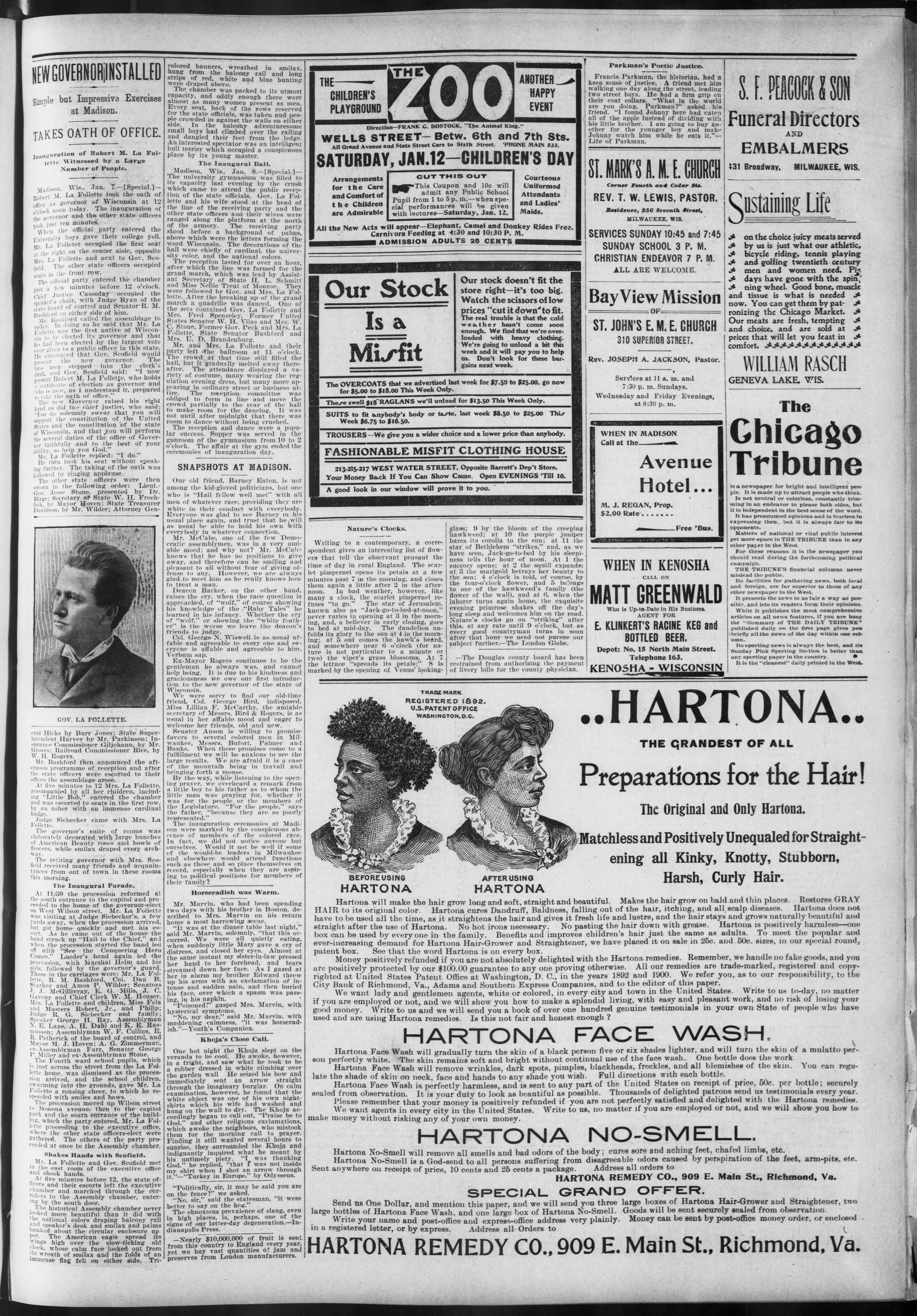
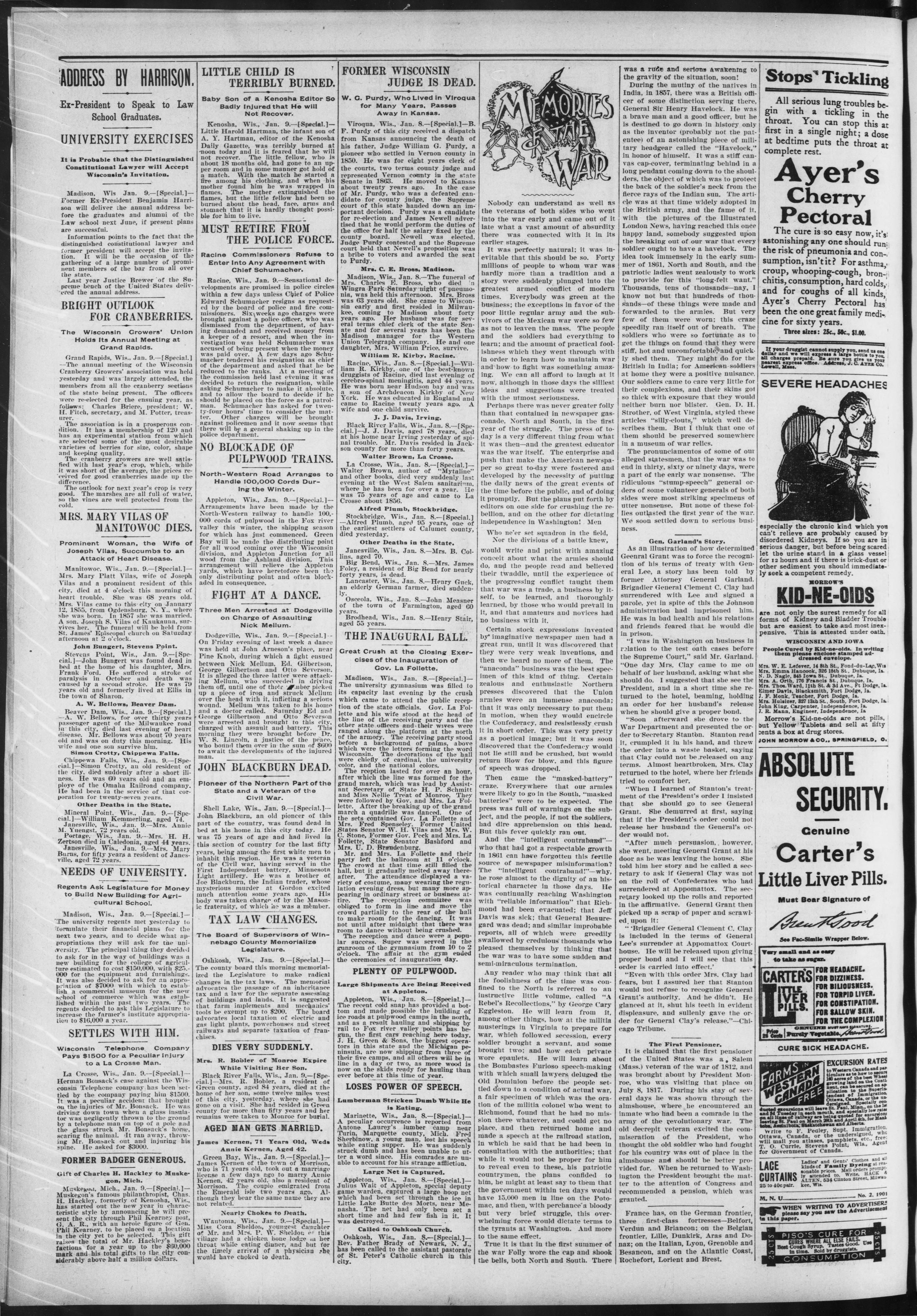
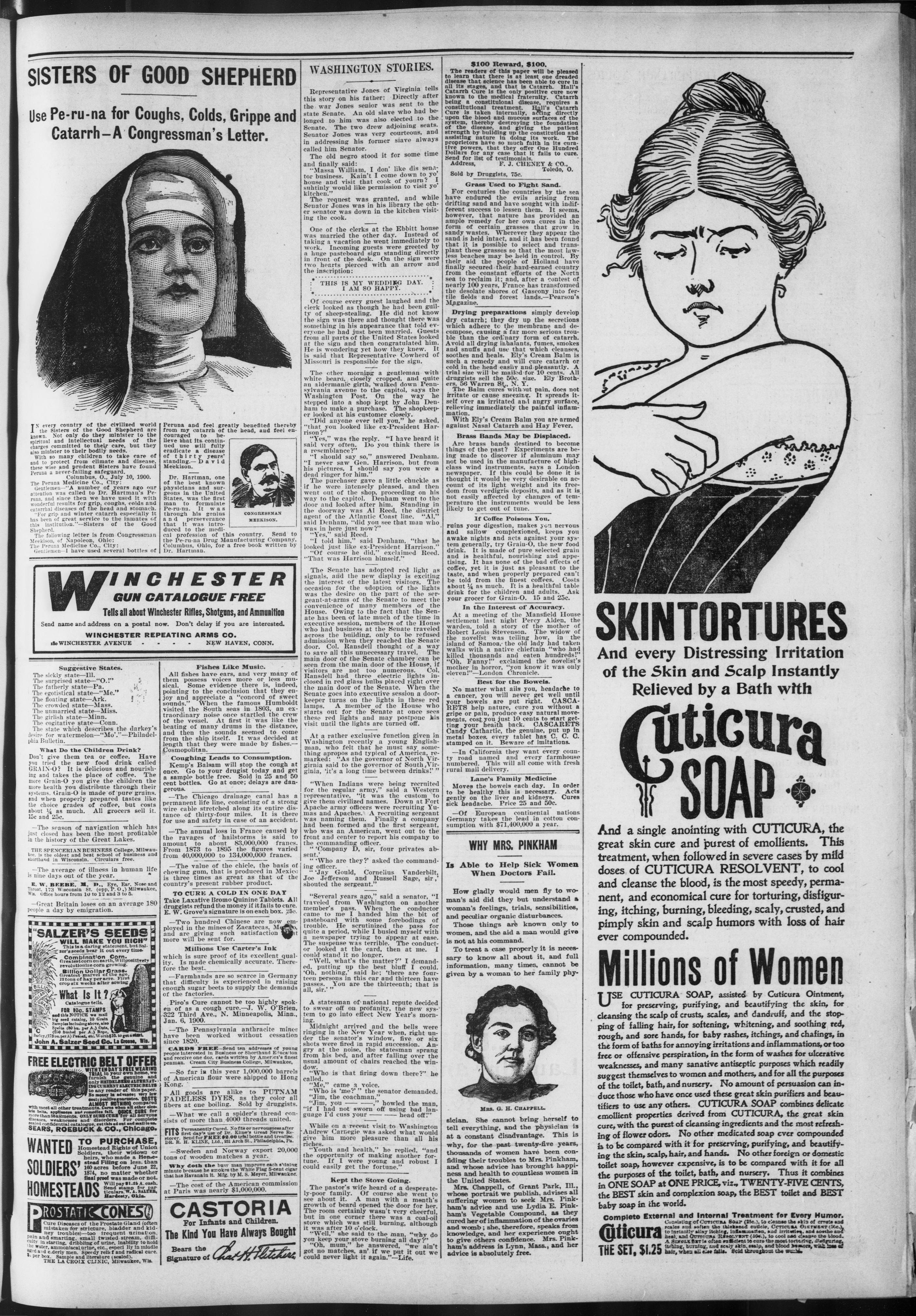
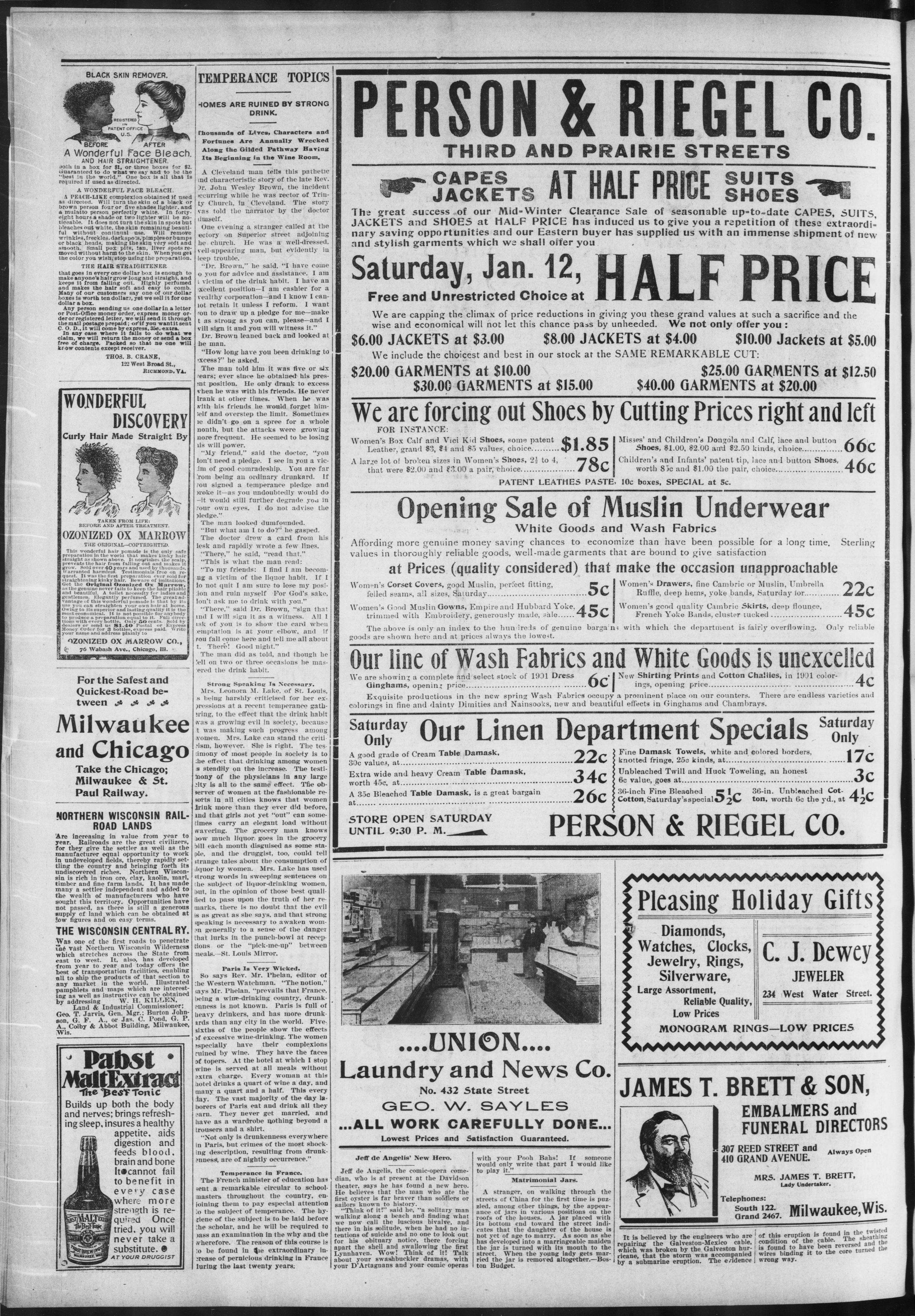
Page text (machine-generated)
State Historical Society
WISCONSIN
WEEKLY
ADVOCATE
DEVOTED TO THE INTERESTS OF THE NEGRO RACE
EDITORIAL PARAGRAPHS.
---
Legal Action Taken by the Editor. The publisher and proprietor of the Wisconsin Weekly Advocate, R. B. Montgomery, has begun an action for libel against the Germania Publishing Co. for its unwarranted attack on him in its paper of October 26 last. His attorneys are Kanneberg, McGee, Cleaver & Cochems. The article is, absolutely false, yet it is a fact that the people as a whole are still quick to believe anything said or written or and concerning the colored race or people, when they would not without some proof believe the same matter when spoken of a white person. Mr. Montgomery owes it to himself as well as to his race for whose advancement he continually labors, to vindicate himself of the unjust attack of the Germania as well as to enforce payment for such pecuniary loss as he has sustained thereby.
It is the privilege, pay, it is even the duty of the newspaper to criticise and comment upon all matters in which the public have an interest, but such comment and criticism must be fair and honest in purpose and must not be used as a cover to gratify private malice.
The Great Question Will Not Down.
The Southern Democratic leaders have been for some years conspiring to suppress the colored vote. By so-called constitutional amendments they have effected their purpose in South and North Carolina, and in Mississippi and Louisiana. The Alabama and Georgia Democrats are preparing to act on the same line to disfranchise the colored voters. It has become a grave question in the North and the West whether such a violation of the constitution of the United States shall be squarely met and punished, as this political crime merits. At least 800,000 colored Republicans in these four states have been excluded from the ballot box. The effect of the exclusion is to make one Democratic vote in the congressional representation at the South as effective as four Republican votes in the North and West. Such infamous injustice and inequality cannot be permitted in a republic without ultimately overturning the whole republican system.
In view of the gravity of the present, and still more so of the future, a Republican representative from Pennsylvania and another from Ohio have introduced resolutions into the House of Representatives to appoint a special committee of five to inquire and report what shall be done in order to produce equality of representation in Congress. When these resolutions were introduced into the House the Southern members jumped up with apprehension, as it seemed like a bullet through their intestines. The House did not decide the question yesterday, as there was no quorum, but the question will be pressed by the Republicans, as they are determined that such a political swindle shall not be perpetrated upon the freemen of the North and the West. If the Southern members by their tricks and their devices and so-called limitations in their constitutions cut off hundreds of thousands of legal voters from casting a ballot for President and members of Congress, the South must be reduced in the number of its representatives. The Southern Democrats already see the writing upon the wall, and they begin to tremble at the justly aroused indignation of the people of the North and the West.
This is a great question which will not be downed, for it concerns every voter north of Mason's and Dixon's line. If the South is allowed to disfranchise hundreds of thousands of legal voters in violation of the constitution of the United States, which has declared those voters to be citizens, they must take the consequences and that section will rue the day when they force upon the country such a villainous issue. The freemen of Wisconsin are in no mood to permit one voter in the Southern states to be as effective as four Republican voters in Wisconsin.
Senator Spooner is an able constitutional lawyer, and is a friend of the people everywhere throughout our broad land, and when the question comes directly before the Senate we believe that Senator Spooner will be heard from in a manner and in a form which will add immensely to his popularity throughout all those states which sustained the administrations of Abraham Lincoln and U. S. Grant.
Significant Ignorance of the Bible.
Dr. Thwing, the president of the Western Reserve university, in the May number of the Century calls attention to the above subject. President Thwing, with this view, propounded a set of questions to students of opposite sexes in the East and West. These questions were simply to explain Biblical allusions as contained in English classical literature, and were of the following description: "As manna in the wilderness." "A Jonah's gourd
up in one night and due to sudden sun." "The godless Jephtha vows his child to one cast of the dice." These three out of twenty-two are sufficient to explain our purpose. Referring to Dr. Thwing's test we find that the young men in the Western college averaged 43 per cent. in attempted answers, and the young women in the Eastern college 49 per cent.
These same questions were recently propounded to the classes in the Hampton institute, composed entirely of negroes, and their answers averaged 77 per cent, of both sexes. Miss Briggs, the teacher of these classes in the Hampton institute, is to be congratulated on these great results, which show that the Afro-American properly trained and with his natural love for the Bible is able to more than hold his own with scholars of other institutions.
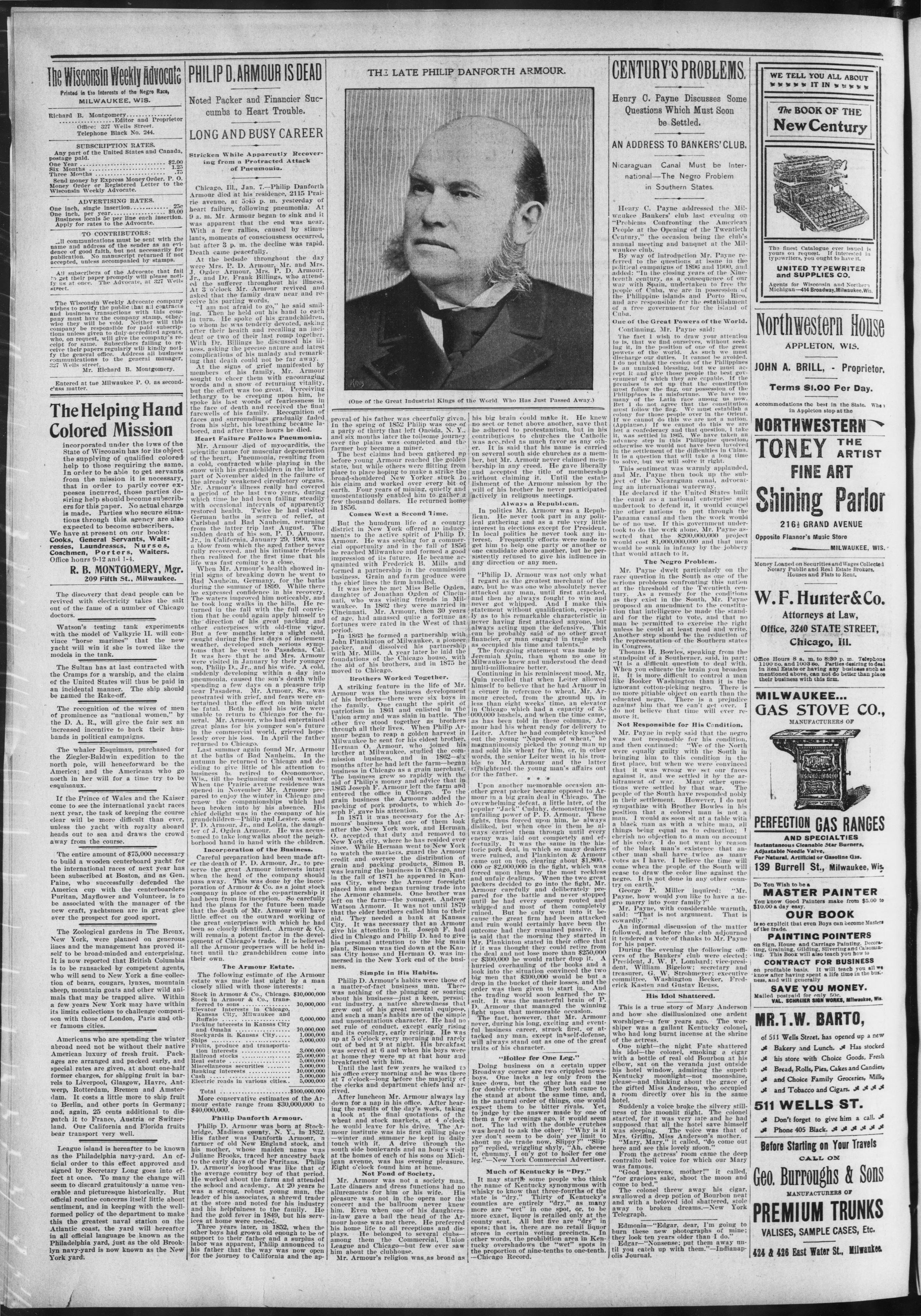
This issue would be incomplete unless we rendered our tribute of respect and admiration for the character of the late P. D. Armour, especially in his relations with the colored race. No man has done more in a quiet way than he has for the Afro-American. He was of great assistance to us personally in carrying on our mission work the last time we called upon him at his country residence.
It has recently come to our knowledge that he has taken boys from his private car and educated them because he saw that they were often at a loss how to fill in the time. Such benefactions as these have forever endeared his name to our race. It is this quiet doing good that tells with us, for we know that the Great Master taught that in doing good to our fellow men we should not proclaim it in the synagogues and in the streets, but let it be done in secret and we shall be rewarded openly. Any man who loved children as Mr. Armour did, and who could have such a peaceful end, must have been at peace with his own conscience and with all men. All in all, we shall not soon look upon his like again.
On last Tuesday, 37 years ago, our beloved martyred President broke the shackles of slavery from nearly 4,000,000 human beings, and bade them to go out into the world as freemen to paddle their own canoe. They accepted the long looked for ultimatum and how well they have paddled their own canoe can only be told to the world by our advancement and achievement in the past quarter of a century. Within only five years after emancipation our race had a representative in the United States Senate, sitting in the seat of his former master. Since then we have had 21 members in the Congress of the United States. One lieutenant governor, 249 colleges, universities and academies, nearly 500 physicians. In brief you can meet and see colored professional men in every state and city in the United States. Give our race 100 years more, then turn on the searchlight of progress. We should celebrate each New Year's day for it is the real natal day for the American negro.
"The Italians work in the mines and elsewhere at wages that an American cannot live on, they never become citizens and they commit all kinds of crimes."
And yet these are the kind of laborers that are being imported into this country by the hundreds and thousands and employed by the "employers" notwithstanding there are at the very doors of the big employers hundreds and thousands of native born, true American, law-abiding negroes waiting for employment.
By the educating processes of deduction and induction, by the elevating influences of association, example, assimilation and absorption the American negro will grow as the white man has grown and for the same reason that the white man has grown, namely: our love of freedom and inborn and our instinct of approhilation.
We therefore turn our faces to the new century with faith in God, with courage in our hearts, with high hopes for our future and with reliance upon ourselves to shape our own destiny. True, we have made many mistakes and will doubtless make many more, but
```markdown
```
Hon. F. L. Barnett of Chicago has been reappointed as assistant state attorney. Such positions are rarely given to members of the race. Mr. Barnett's reappointment bespeaks volumes for the ability with which he discharged the duties of this important and coveted office.
A few days ago the Associated press dispatches told of a number of colored men who had left the South to go to Hawaii to farm on the sugar plantations of those islands. Certain men of the United States who have invested many thousands of dollars in the sugar business of Hawaii do not feel that the Japanese labor they are compelled to use on the islands gives satisfaction, and believing the Southern negro better adapted in the raising of sugar, propose to experiment with a small colony of them. Just what effect such a move, if it should be extensively carried on, would have on the Hawaiian islands is a question that is hard to solve at present on native Hawaiians, who are to some extent racially allied to some extent to the Southern negro. They are not exactly Africans, but they are Malayans with dark skins, and frequently with crimpy hair, so much that they impress the average Caucasian as being a distant cousin of the American negro. Now, if the American negro is transplanted to those islands, and should the two people miscegenate, what effect that would have on the conditions
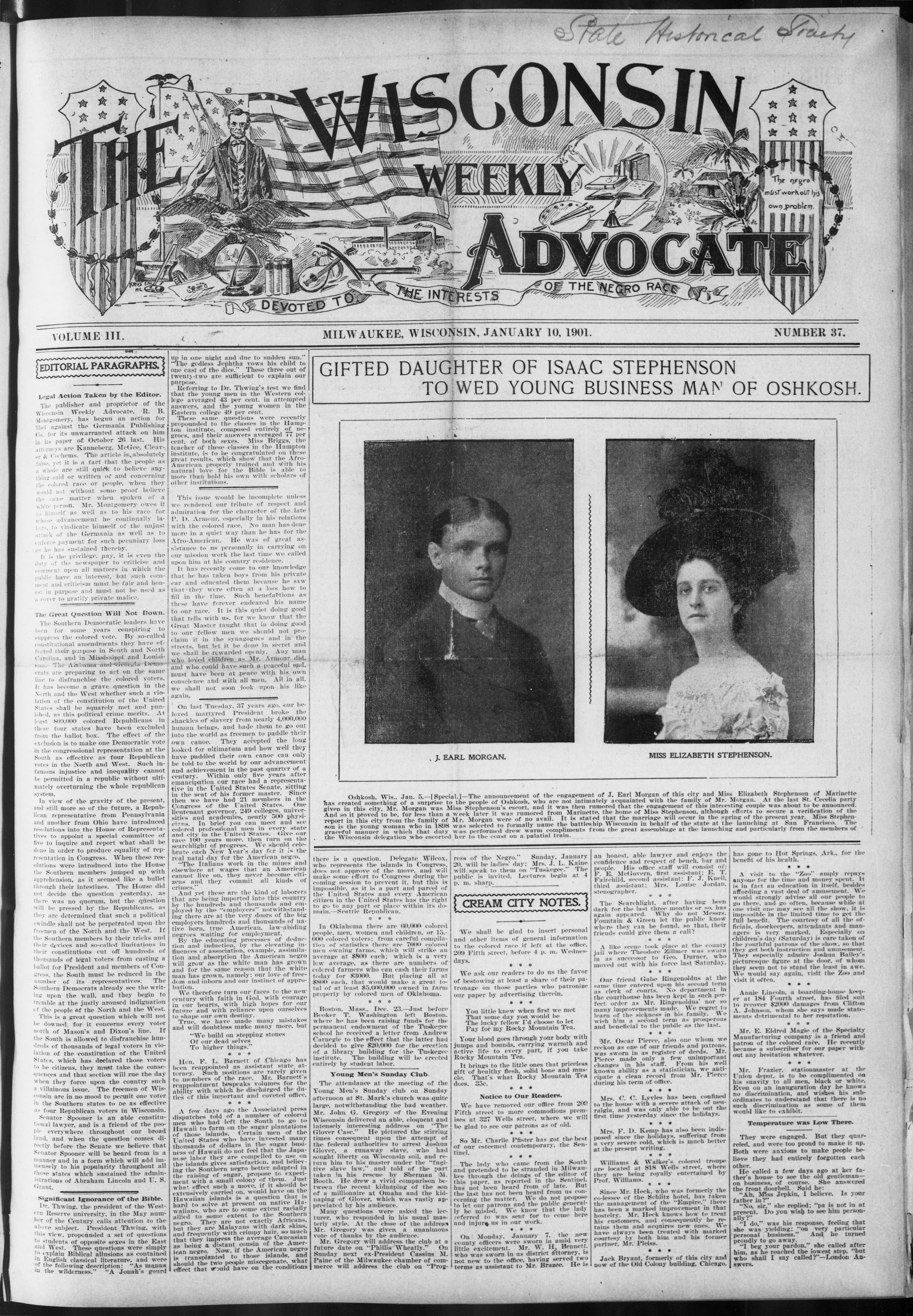
GIFTED DAUGHTER OF ISAAC STEPHENSON TO WED YOUNG BUSINESS MAN OF OSHKOSH.
J. EARL MORGAN.
MISS ELIZABETH STEPHENSON.
Oshkosh, Wis.. Jan. 5.—[Special.]—The announcement of the engagement of J. Earl Morgan of this city and Miss Elizabeth Stephenson of Marinette has created something of a surprise to the people of Oshkosh, who are not intimately acquainted with the family of Mr. Morgan. At the last St. Cecelia party given in this city, Mr. Morgan was Miss Stephenson's escort, and it was then rumored that the engagement of this interesting couple was about to be announced. And so it proved to be, for less than a week later it was rumored from Marinette, the home of Miss Stephenson, although efforts to secure a verification of the report in this city from the family of Mr. Morgan were of no avail. It is stated that the marriage will occur in the spring of the present year. Miss Stephenson is the young woman who in 1898 was selected to formally name the battleship Wisconsin in behalf of the state at the launching at San Francisco. The graceful manner in which that duty was performed drew warm compliments from the great assemblage at the launching and particularly from the members of the Wisconsin delegation who escorted her to the coast on a palatial train.
there is a question. Delegate Wilcox, who represents the islands in Congress, does not approve of the move, and will make some effort to Congress during the coming session to prevent it, but this is impossible, as it is a part and parcel of the United States and every American citizen in the United States has the right to go to any part or place within its domain.—Seattle Republican.
```markdown
```
In Oklahoma there are 60,000 colored people, men, women and children, or 13,000 colored voters; from careful compilation of statistics there are 7000 colored men owning farms, which will strike an average at $800 each; which is a very low average, as there are numbers of colored farmers who can cash their farms today for $3000. But placing all at $800 each, that would make a great total of at least $5,600,000 owned in farm property by colored men of Oklahoma.
* * *
Boston, Mass., Dec. 23.—Just before Booker T. Washington left Boston, where he has been raising funds for the permanent endowment of the Tuskegee school he received a letter from Andrew Carnegie to the effect that the latter had decided to give $20,000 for the erection of a library building for the Tuskegee institute. The building will be erected entirely by student labor.
Young Men's Sunday Club
The attendance at the meeting of the Young Men's Sunday club on Sunday afternoon at St. Mark's church was quite large, notwithstanding the bad weather. Mr. John G. Gregory of the Evening Wisconsin delivered an able, eloquent and intensely interesting address on "The Glover Case." He pictured the stirring times consequent upon the attempt of the federal authorities to arrest Joshua Glover, a runaway slave, who had sought liberty on Wisconsin soil, and return him to his master under the "fugitive slave law," and told of the part taken in his rescue by Sherman M. Booth. He drew a vivid comparison between the recent kidnapping of the son of a millionaire at Omaha and the kidnapping of Glover, which was vastly appreciated by his audience.
Many questions were asked the lecturer, who responded in his usual masterly style. At the close of the address Mr. Gregory was given a unanimous vote of thanks by the audience. Mr. Gregory will address the club at a future date on "Phillis Wheatly." On Sunday next ex-President Cassius M. Paine of the Milwaukee chamber of commerce will address the club on "Prog-
ress of the Negro." Sunday, January 20. will be ladies' day; Mrs. J. L. Kaine will speak to them on "Tuskegee." The public is invited. Lectures begin at 4 p. m. sharp.
CREAM CITY NOTES.
---
We shall be glad to insert personal and other items of general information to the colored race if left at the office. 209 Fifth street, before 4 p. m. Wednesdays
* * *
We ask our readers to do us the favor of bestowing at least a share of their patronage on those parties who patronize our paper by advertising therein.
* * *
You little knew when first we met
That some day you would be
The lucky fellow I'd choose to let
Pay for my Rocky Mountain Tea.
Your blood goes through your body with
jumps and bounds, carrying warmth and
active life to every part, if you take
Rocky Mountain Tea.
It brings to the little ones that priceless
gift of healthy flesh, solid bone and muscle. That's what Rocky Mountain Tea does. 35c.
Notice to Our Readers.
We have removed our office from 209 Fifth street to more commodious premises at 327 Wells street, where we will be glad to see our patrons as of old.
* * *
So Mr. Charlie Pfister has got the best of our esteemed contemporary, the Sentinel.
* * *
The lady who came from the South and pretended to be stranded in Milwaukee through the doings of the editor of this paper, as reported in the Sentinel, has not been heard from of late. But the last has not been heard from us concerning the matter. We do not propose to let our patrons and the public generally be misled. We know that the lady referred to was sent for to come here and injure us in our work.
***
On Monday, January 7, the new county officers were sworn in amid very little excitement. Mr. W. H. Bennett, who was sworn in as district attorney, is not new to the office, having served two terms as assistant to Mr. Brazee. He is
an honest, able lawyer and enjoys the confidence and respect of bench, bar and people. His office staff will consist of: F. E. McGovern, first assistant; E. T. Fairchild, second assistant; F. J. Knell, third assistant; Mrs. Louise Jordan, stenographer.
---
The Searchlight, after having been dark for the last three months or so, has again appeared. Why do not Messrs. Fountain & Green let the public know where they can be found, so that, their friends could give them a call?
欢 欢 欢
A like scene took place at the county jail where Theodore Zillmer was sworn in as successor to Geo. Durner, who moved out with his force last Saturday.
* * *
Our friend Gabe Ringenoldus at the same time entered upon his second term as clerk of courts. No department in the courthouse has been kept in such perfect order as Mr. Ringenoldus' nor so many improvements made. We regret to learn of the sickness in his family. We wish him a second term as prosperous and beneficial to the public as the last.
***
Mr. Oscar Pierce, also one whom we reckon as one of our friends and patrons, was sworn in as register of deeds. Mr. Pierce made only a few unimportant changes in his staff. From his well known ability as a statistician, we anticipate a clean record from Mr. Pierce during his term of office.
* * *
Mrs. C. C. Lyvles has been confined to the house with a severe attack of neuralgia, and was only able to be out the first time yesterday since the holidays.
* * *
Mrs. F. D. Kemp has also been indisposed since the holidays, suffering from a very severe cold, which is much better at the present writing.
* * *
Williams & Walker's colored troupe are located at 818 Wells street, where they are being royally entertained by Prof. Williams. * * *
Since Mr. Heck, who was formerly the co-lessee of the Schlitz hotel, has taken the management of the "Empire." there has been a marked improvement in that hostelry. Mr. Heck knows how to treat his customers, and consequently he retains them and acquires new ones. We have always been treated with marked courtesy by both him and his former partner, Mr. Pleiss.
***
Jack Bryant, formerly of this city and now of the Old Colony building, Chicago.
NUMBER 37.
Elizabeth Stephenson of Marinette Morgan. At the last St. Cecelia party meeting couple was about to be announced. Efforts to secure a verification of the spring of the present year. Miss Stephenée launching at San Francisco. The g and particularly from the members of
has gone to Hot Springs, Ark., for the benefit of his health.
* * *
A visit to the "Zoo" amply repays anyone for the time and money spent. It is in fact an education in itself, besides affording a vast deal of amusement. We would strongly advise all our people to go there, and go often, because while at one visit one may see all the show, it is impossible in the limited time to get the full benefit. The courtesy of all the officials, doorkeepers, attendants and managers is very marked. Especially on children's day (Saturday) is care taken of the youthful patrons of the show, so that they get both instruction and amusement. They especially admire Joshua Bailey's picturesque figure at the door, of whom they seem not to stand the least in awe. We would say again, visit the Zoo and visit it often.
---
Annie Lincoln, a boarding-house keeper at 184 Fourth street, has filed suit to recover $2000 damages from Clifton A. Johnson, whom she says made statements detrimental to her reputation.
办功章
Mr. E. Eldred Magic of the Specialty Manufacturing company is a friend and patron of the colored race. He recently became a subscriber for our paper without any hesitation whatever.
* * *
Mr. Frazier, stationmaster at the Union depot, is to be complimented on his suavity to all men, black or white. Even on an inauguration day he knows no discrimination, and wishes his subordinates to understand that there is no such discrimination as some of them would like to exhibit.
Temperature was Low There.
They were engaged. But they quarreled, and were too proud to make it up. Both were anxious to make people believe they had entirely forgotten each other. He called a few days ago at her father's house to see the old gentleman—on business, of course. She answered the front doorbell. Said he:
"Ah, Miss Jepkin, I believe. Is your father in?"
"No, sir," she replied; "pa is not in at present. Do you wish to see him personally?" "I do," was his response, feeling that she was yielding; "on very particular personal business." And he turned proudly to go away.
"I beg your pardon," she called after him, as he reached the lowest step. "but who shall I say called?"—London Answers.
THREATENS TO REBEL.
Chinese Viceroys Protest Against Signing the Note.
KWANG SU HOLDS BACK
Extreme Anti-Foreign Element in Power and Court Favorites Advise Empress Dowager.
Pekin, Jan. 9.—Li Hung Chang is better. Both he and Prince Ching balked at signing the joint note when they considered the question until the court was heard from again, explaining that the Emperor's edict directing them to put off signing prevented them from using the imperial seal until permission shall have been received, which permission they claim to expect hourly.
It is known here among the Chinese that the extreme anti-foreign element is now in power and that the court favorites now advise the Empress Dowager. Of these, the best known are Li Chuan Lin, a cabinet minister, Gen Ma and Tung Fuh Siang. Their views coincide perfectly with those of the Southern vice-roys, particularly with those of Chang Chi Tung, who has threatened to rebel if the note is signed.
Li Hung Chang and Prince Ching both strongly urge the signing of the agreement and they believe their counsels must prevail. They have pointed out, in the strongest possible terms, that the very existence of China necessitates the acceptance of the terms of the powers, and that failure on the part of China to sign may mean the allies will, as soon as the state of weather makes such a step feasible, send troops over the country and that parts of the empire heretofore untouched, will feel the scourge of war. The Germans have sent two companies of infantry to the vicinity of the Ming tombs, where trouble is reported.
Withdrawal of Troops.
Berlin, Jan. 9.—It is understood that the subject of the lengthy interview which United States Ambassador White had yesterday with the secretary of state for foreign affairs. Baron von Richhofen, was in regard to the proposal of the United States that the powers withdraw their troops from China as soon as the Chinese government accepts all the articles of the joint note except those relating to indemnity and commercial treaties, these being left for settlement at a conference of the powers at Washington or elsewhere. No final decision in the matter has been announced, but the feeling in diplomatic circles here seems to be opposed to the United States' proposition.
BRITISH OCCUPY PICKANERS KLOOF.
Cyclists Have a Race with the Boers and Win Out-Three of Them Killed.
Cape Town, Jan. 9.—The cyclist corps which left here Saturday occupied Pickaners Kloof Sunday, after a race with the Boers for its possession. The Republicans attempted to intercept the cyclists, but the latter succeeded in occupying the position, though three of them were killed and twenty-three wounded. The cyclists retain the pass. Commandeering of horses has commenced in the districts where the owners have refused to sell them to the military authorities.
TELLER ALVORD PLEADS GUILTY.
Will be Sentenced Tuesday for Stealing $700,000 from First National Bank of N. Y.
New York, Jan. 9.—Cornelius L. Alvord, Jr., the former note teller of the First National bank, was arraigned before Judge Thomas in the United States circuit court, criminal branch, today, and pleaded guilty to three counts of an indictment charging him with embezzling $700,000 from the bank named. The indictment contained fifty-seven counts. Alvord will be sentenced Tuesday, January 15.
CAPTURE OF GERONIMO.
Daring Exploit of American Troops in Attacking Insurgent Chief in Mountain Fortress.
Washington, D. C., Jan. 9.—A recent issue of a Manila paper gives a graphic and interesting account of the capture and utter defeat of the forces of the famous insurgent leader Geronimo, near Montablan, by Col. J. Milton Thompson and 1000 picked men of the Twenty-second and Forty-second Volunteer infantry regiments, in November last. The insurgent chief was strongly fortified at Pinauran, in De Morte canyon, near Montablan, his trenches being strung along both sides for a distance of six or seven miles.
The time for Col. Thompson's attack was set for noon on November 22. The expedition was divided into four detachments. The main one, under command of Capt. Brandle, was in the lead and while advancing through the bed of the canyon, was the first to draw the fire of the insurgents. The intrenched Filipinos, believing the detachment to be the entire attacking party, allowed the column to advance well up the canyon in order more completely to "bottle" it. When it had reached the desired point, the Filipinos "yeiling like Comanche Indians" opened up a vigorous fire, but simultaneously with their volleys came the attack of the Americans from four distinct directions. Then Col. Thompson, leading the main body, performed the feat of the engagement, in climbing a steep wall through dirt and underbrush, and entered the boasted "impregnable" fortress of the insurgent leader. "The men had to cut their own trails, and pull themselves up the mountain side by grasping twigs and saplings hand over hand." When the Americans reached the top there was not a live rebel in sight. The number of insurgents killed is estimated at from fifty to 150. The Americans lost four killed and about a dozen wounded. Tons of commissary and quartermaster's stores were destroyed, including insurgent uniforms to the number of nearly 1500.
POPE BLESSES PILGRIMS.
Complains of Protestants Taking Advantage of Italian Poverty.
Rome, Jan. 9.—The Pope, who is in excellent health, received at noon yesterday in the Sixtine chapel 600 British pilgrims, headed by Cardinal Vaughan and the Duke of Norfolk. An address in English was read which stated that the temporal power was necessary for the wellbeing of the church, and condemned Protestant proselytism in Rome.
The Pope replied in French and said that he was intense admirer of Anglo-Saxons. He complained, however, that the religious tolerance of the quirinal permitted the wealthy Protestant missionaries to profit by the poverty of the Italians to make converts of them.
The interview was concluded by the papal blessing and the pilgrims departed after giving a hearty cheer for his holiness.
LOST GIRL IS FOUND.
La Crosse Man Discovers His Sister, Who was Missing Six Years.
St. Louis, Mo., Jan. 8.—Bert Patterson of La Crosse, Wis., with the aid of the St. Louis police, has found his sister Annie, whom he lost trace of six years ago. She was found at 4444 Cottage avenue, and in her finding there was brought to light one of the strangest stories, says Capt. Gillaspie, that ever came under his observation.
Six years ago Annie Patterson disappeared from her home in La Crosse. She left no trace. Her brother began a search then that ended Sunday, when she started with him to his northern home, which will be hers in the future. Patterson is a traveling salesman for a Chicago crockery establishment. In his journeys he never relinquished the search for his sister. He got no trace until a few weeks ago, when he learned that she had been in Chicago. He found where she had roomed. She had left a trunk, and in it were letters showing that she intended going to St. Louis. He arrived here Saturday. Among the letters he found the address 1310 Bayard avenue. He went to this address, after having laid the case before the police. Capt. S. E. Greenwell of the steamer H. M. Hoxie lives there. Mrs. Greenwell is a sister of H. L. Sears of 4444 Cottage avenue, where the missing girl was found.
Thought Girl Her Niece.
"I supposed that this girl was a niece of mine until a few days ago," said Mrs. Greenwell. "More than twenty years ago my brother, H. L. Sears, was married to a woman with whom he lived but a short time. They separated, and she went to Chicago, where a child was born to her. At my brother's request I instituted search for the woman, and was told that the child had died a few hours after being born. I heard no more until a few weeks ago. My brother had remarried in the meanwhile. His present wife is a daughter of Judge Albert Gould of Knox, Ind.
"About a month ago my brother brought a young woman to our home and introduced her as his daughter. He said he had located her through a railroad conductor. He told me that I had been deceived as to the child's death twenty years ago. He described how he had traced her and had finally found and had brought her home. She was a pretty girl, gentle mannered, and verified his story. I had no reason to doubt it until Mr. Patterson came with the detective from Capt. Gillaspie. Mr. Patterson showed me letters which plainly showed that my brother had deceived me as to her identity.
"Here she went by the name of Beulah. He said that a family of the name of Rivers had taken her to raise, and when he found her she was known as Beulah Rivers. The letters Mr. Patterson found showed that this was not true.
Recognition is Mutual.
"I sought Mrs. Sears. She, too, told me that she had discovered that the girl was not his daughter. We went to the house of my brother. They were all at home. Mr. Patterson recognized his sister, and she recognized him. She told him that my brother had induced her to play the part that she had. She was working for a Chicago book concern when she met him. She was almost destitute. He professed to know something about her, she said, and told her that there was a sum of money due her. But she must come to his house while he was trying to get it for her. She consented to do so. She was told that she would have to assume the role of his lost daughter. She consented to do this."
Sears is in charge of a dining car on the Pennsylvania railroad. He was out on his run Monday. Mrs. Sears had gone to her father's home in Indiana. Their children, Alfred, 13 years old, and Lottie, 11, were in charge of the home. "There were some pretty lively times around here," said Alfred. "You see, papa told us that Beulah was our sister, and she said so, too, but when Aunt Grace and some men came here they were pretty mad. Mr. Patterson said Beulah was his sister, and she said she was, too. She said that she would go to her own home."
R. J. SMITH DEAD.
One of the Leading Fire Underwriters of the United States.
Chicago, Ill., Jan. 8.—Robert J. Smith, for twenty years secretary of the Traders' Fire Insurance company, and one of the leading fire underwriters of the United States, died early today at his residence in this city. Mr. Smith was born July 12, 1837. He was president for three terms of the Fire Underwriters' Association of the Northwest and for two years was at the head of the International Board of Marine Underwriters. At the annual meeting of the Western Insurance union at Niagara Falls, in September, 1895, he was elected president.
BLACKBURN TO MARRY.
Will Wed Mrs. Blackburn of Washington, Widow of a Distant Relative.
Washington. D. C., Jan. 8.—The engagement of Senator-elect Joseph Blackburn to Mrs. Mary E. Blackburn of this city, a widow of a distant relative of the Kentucky statesman, is tacitly acknowledged by the friends of both.
It is stated that the marriage will take place in a short time, possibly in March, immediately after Mr. Blackburn takes his seat in the Senate.
The bride-elect was formerly Miss McKendry of this city, and has a host of friends in official and resident society. She is a woman of charming presence and great personal magnetism.
"KID" M'COY AGAIN MARRIED.
Friends Effect a Sudden Reconciliation with His Divorced Wife.
Boston, Mass., Jan. 8.—"Kid" McCoy and his divorced wife were remarried here last night. They left Gould's hotel in a carriage and were driven to the residence of a local clergyman. They returned to the hotel and denied themselves to all callers. They met on a train from New York last night and a reconciliation was effected by friends.
Poison from Pineapples.
The juice of the green pineapple is accredited in Java, the Philippines and throughout the far East generally with being a blood poison of a most deadly nature. It is said to be the substance with which the Malays poison their kreeses and daggers, and to be also the "fingernail" poison formerly in use among aborigine Javanese women almost universally. These women cultivated a nail on each hand to a long, sharp point, and the least scratch from one of these was certain death.—London Globe.
In order to help the restoration of stolen dogs, the French society "Assistance aux Animaux" has made arrangements to tattoo a number on the car of every dog or cat presented at the society's establishment. The process, it is claimed, will be painless, and as a register of all pets tattooed will be kept, owners will always be able to establish identity by reference to the number on the animal's ear and the testimony of the society's books.
Kansas City, Kas., is out for a United States mint.
RESORT TO A TRICK
ENEMIES OF THE SHIPPING BILL BECOMING ALARMED.
Take Steps to Prevent Passage of the Measure by Inflaming the Public Mind Against It—Great Foreign Steamship Lobby Present in Washington.
Washington correspondence:
If the number of misstatements being circulated concerning the merchant marine revival bill, and most of which are alleged to originate in Washington, indicate anything at all, it is that the enemies of that measure are alarmed, and are taking steps to prevent its passage by the old trick of inflaming the public mind against it. Not a day passes but an alleged "special" from Washington is published in this or that newspaper—and it may be said with truth that the great daillies in New York seem to be worked more often and at greater length than any others—which dispatches predict the failure of the shipping bill.
The fact that the administration favors the passage of the bill, as is well known here, is never alluded to in the dispatches referred to. The fact that the great leaders on the Republican side in each branch of Congress have all expressed themselves as determined to do their utmost to pass that bill scarcely ever appears in type. The presence in Washington of a great lobby, representing the foreign steamship lines, finds no space in the opposition newspapers, nor is the peculiar work that these lobbyists do pointed out, as it should be, for the information of the people at large. These kinds of tactics may succeed for a while, and the people may be fooled by them, but it can't last forever.
Here is a measure that has been favorably reported for passage to the Senate and to the House by the proper committees in two successive Congresses. It has been under consideration for over three years in a public way, and has been discussed from one end of the country to the other. Its provisions are well known; it has been indorsed by State legislatures, by chambers of commerce, boards of trade, agricultural organizations and other representative associations. It has been indorsed by political conventions and by industrial conventions. Nearly three hundred different organizations, many of which are representative of the greatest industrial and commercial interests of the country, have petitioned Congress to pass it, and Congress is right on the eve of doing so, when opposition, instigated by the foreign interests menaced by the bill, appears in Washington determined to defeat it.
But the people will not stand for this thing. It is very clear that the public are determined to see American ships succeed to a portion—a majority portion, too—of our foreign carrying. The idea of paying to foreign shipowners each year as much as we collect at all of our custom houses, the idea of having paid during the past generation to foreign ship owners twice as much as the sum of our national debt at the close of our civil war, is becoming intolerable to the people. This sort of thing, they see, is indefinitely deferring the time when the United States shall become a creditor, and cease to be a debtor, nation. Nothing but American interests, they see, will be advanced if the bill passes—only certain foreign interests will be injured if it passes. This is a sort of situation that will become so clear to the people that they will be very apt to manifest their displeasure in a drastic manner, if Congress again adjourns without enacting legislation that will start the country on the way of building up its shipping in the foreign trade.
The producers of the country have seen where they will be benefitted through the enactment of a shipping bill. They have been shown that American ships will only be able to secure the carrying of exports from the United States, now enjoyed by foreign ships, by a reduction in the rates of ocean freight. No one will be willing to give an American ship a larger amount of freight money for carrying away our exports than a foreign ship will be willing to carry it for, and the passage of a measure of this kind, it is seen, will raise up rivals to the foreign lines that now monopolize our export carrying, and which charge us practically what they like for it. It was clearly pointed out by Senator Frye, in his great speech in the Senate, that there would be an average cut of 25 per cent in the cost of carrying our exports and imports, as soon as the measure then and now pending got into good working form. Such a reduction, in the saving in freight rates alone, he pointed out, would amount to $50,000,000 a year, so enormous is the annual sum now paid for our foreign carrying.
To save such a sum, by sending our exports abroad in our own ships, and to give to our own people the employment that comes from the expenditure in the United States of the whole $200,000,000 a year now paid for ocean freight transportation, is a pretty big undertaking, and naturally the opposition will be fierce on the part of those who now enjoy that carrying and the enormous enrichment that follows therefrom. But that is precisely what Congress is expected to do, and precisely what those in the majority in Congress have for the past five years been promising will be done.
Much surprise was felt in some quarters at the size of the vote on the Hay-Pauncefote treaty. The President has, through Secretary of State Hay, already transmitted the treaty to the British Government, and its acceptance or rejection of it is expected to be announced during the next couple of months—before Congress adjourns.
There is some suggestion that the passage of the Nicaragua Canal bill will be deferred until the attitude of England on the Hay-Pauncefote treaty is made known, but that rumor does not jibe with the determination and confidence shown by the friends of that measure to secure its passage before adjournment.
What I Want
We want the trade of the Orient, all of it that we can secure on a profitable basis, the same as we trade with England and the Continental countries. We want the trade of France, all of it that we can do on the same basis. But we do not want the trade of France at the expense of our fruit growers, by a reciprocal arrangement that would admit the dried fruit and other products of that country at a lower rate of duty.
The followers of Bryan said in 1896 that we could not have expansion of our foreign trade without giving foreigners free access to our own markets. The followers of Bryan were discredited and defeated in the campaign of 1896, and the Dingley tariff bill took the place of the Wilson tariff law. Expansion of our foreign trade followed, despite prediction to the contrary—a greater extension than ever before in the history of the country.
We can have the trade of other countries without ruining our own manufacturers and producers or reducing our laborers to a state of pauperism. What is vastly more important, we can preserve our home markets, the best in the world, and bound to continue the best as long as our people are prosperous, our laborers employed at remunerative wages.
There are chances, no doubt, to make additional reciprocal arrangements, such as would not affect injuriously our producers and laborers; but we want none such as the one proposed with France; we want none with the Oriental countries that would let in free or at reduced rates the products of the pauper labor of the teeming millions there.—Oregon Statesman.
The West Is Ready.
A recent dispatch from Omaha, Neb., says:
"So scarce has manual labor become through the West that employment agents representing railroads operating west of the Missouri have been sent to New York and other Eastern cities to secure men to work on the tracks and grades through Nebraska, Wyoming and Utah. * * * Wages of railroad workers are now $2.50 per day and board throughout the West. This is double what this form of labor has commanded in past years. * * * Not in the history of the West has railroad labor been so difficult to secure as today. On every hand railroad work has been suspended because the labor cannot be secured."
The West is prosperous. There can be no question of that. And the vote of the Western States in the recent election shows that the people of the West, most of them, realize perfectly well that they owe their prosperity to the McKinley policy of keeping the American market for the American producer, and of putting American interests ahead of everything else in every case. The old idea which men like Mr. Bryan tried to stir up, that the interests of the East and the West are dissimilar and antagonistic has almost disappeared, and the West is ready to unite with the East in the promotion of the industrial supremacy of the United States which our system of protection has made possible.
Too Strange to Be True.
The protective policy is quite in accord with the Biblical injunction to "return evil with good." In spite of the blows given to it in the Southern States it still continues to heap up wealth and prosperity for those same States. The latest instance of this is shown in the increased trade in cotton. During October the exports of cotton from this country were more than double, both in quantity and value, the exports of October, 1899. According to the figures given, 1,211,234 bales were exported, as against 790,855 bales in October, 1899, the value being $60,391,-107, as against $28,348,418, the value of the exports in October, 1899. In view of this showing under the administration of President McKinley, in view of the wonderful stories told every day of the marvelous prosperity of the South under our present policy of Protection, can it be possible that the South was sincere in its role of Nov. 6? It hardly seems credible.
Fostering Home Production.
Fostering Home Production. The practical proof of the importance and advantages of a protective tariff for certain agricultural industries is often overlooked or lost sight of. The Scientific American recently pointed out the fact that there are now thirty beet sugar factories in operation in the country, and five more are in process of construction, which will have a total capacity of 22,500 tons daily. This industry was started just before the Cleveland free trade spasm seized the country, when the total output was only 12,000 tons for the year. This year the Louisiana sugar cane crop amounts to about 400,000 tons. The annual consumption of sugar in this country amounts to about 2,000,000 tons. The beet sugar industry is adding to our national wealth and prosperity, and only those afflicted with the free trade fanaticism will doubt the benefits derived from fostering home production of everything which the farmers can supply.—Springfield (Mass.) Union.
All on Account of McKinley.
The present outlook is that Kansas farmers will have to worry along as best they can with coal fires this winter. Corn is quite too expensive to burn.—Kansas City (Mo.) Journal.
Argue with a fool and you will always lose—especially time.
CONGRESS.
Thursday, Jan. 3.—Without dissent, displaced the shipping subsidy bill as "unfinished business" and substituted the army reorganization bill. Day spent in discussion of the bill.
Friday, Jan. 4.—Passed. Lodge resolution declaring in favor of prohibiting, by treaty or otherwise, sale of opium or intoxicants to unclevilled races or aboriginal tribes, and asking co-operation of other nations in movement. Devoted rest of day to debate on army reorganization bill.
Saturday, Jan. 5.—Devoted the day to the army reorganization bill, adopting all the committee amendments to which there was no objection. Mr. Pettigrew adopted fill-bustering tactics to delay legislation.
Monday, Jan. 7.—Devoted the day to debate on the army reorganization bill, killing by a vote of 43 to 5 the provision for a veterinary corps.
Washington, D. C., Jan. 8.-During the legislative session the Senate had under consideration the much-mooted canteen question, in connection with the army reorganization bill. The Senate committee in effect restored the provision for a post exchange, or canteen, which had been stricken out of the bill by the House. For nearly five hours the Senate discussed the committee amendment. Senators Gallinger (N. H.) and Hansbrough (N. D.) vigorously opposed the amendment, and in turn it was quite as strenuously supported by Senators Sewell (N. J.), Hawley (Conn.), Money (Miss.), and Carter (Mont.).
Wednesday, Jan. 9.-By a vote of 34 to 15 concurred in House provision in army reorganization bill abolishing army canteen. Referred House reapportionment bill to committee on census.
House.
Thursday, Jan. 3.—Reapportionment bill taken up. As a matter of privilege resolution offered by Mr. Olmstead (Pa.) reciting the alleged abridgement of the right to vote in Louisiana, Mississippi, South Carolina and North Carolina and instructing the committee on census to inquire into the subject and report the facts to the house. Motion to adjourn lost. Mr. Underwood (Ala.) raised question of consideration. On rising vote it stood yeas, 69; nays, 70. Yeas and nays ordered. The speaker announced the vote 81 to consider the resolution, 83 against and 5 present but not voting—not a quorum. He directed call of the House, pending which Mr. Underwood again moved an adjournment, which was carried 77 to 75.
Friday, Jan. 4.—After prolonged debate on Olmstead resolution to investigate abridgement of suffrage in certain Southern states, referred it to census committee, which course was originally desired by its opponents. Discussion of reapportionment bill was then taken up.
Saturday, Jan. 5.—Debate upon the reapportionment bill occupied the entire session.
Monday, Jan. 7.—Debate upon the reapportionment bill occupied the day.
Washington, D. C., Jan. 8.—The House accepted the reapportionment plan proposed by the Burleigh bill, which increases the membership of the House during the next decade from 357, the present membership and the membership proposed by the committee on Hopkins' bill, to 386. Under the bill no state loses a representative, and the following make gains: Illinois, New York and Texas, three each; Minnesota, New Jersey and Pennsylvania, two each; Arkansas, California, Colorado, Connecticut, Florida, Louisiana. *Massachusetts, Mississippi, Missouri, North Carolina, North Dakota, Washington, West Virginia and Wisconsin one each.
The bill provides that whenever a new state is admitted the representative assigned to it shall be in addition to the number provided in the bill. It also adds a provision never hitherto incorporated in a reapportionment bill, to the effect that congressional districts, in addition to being "contiguous," shall also be "compact." States which are allowed additional representatives by the bill shall, by its terms, elect them at large until the Legislature shall redistrict the state.
Wednesday, Jan. 9.—Devoted day to consideration of river and harbor bill, but made little progress.
A VETERAN SPEAKS.
The Honorable Moses B. Crane of Tacoma, Wash., Tells How Old Soldiers May Help Themselves. TACOMA, Wash., Jan. 7, 1901.—(Special.)—"I used to have Heart Disease, but thanks to Dodd's Kidney Pills I now have Heart's Ease.
"Five years ago, I was a continual sufferer of Heart Disease. Exposure during the war, and a tendency to grow over-fleshy had greatly aggravated this dread disease. I often had to sit up half the night, I had it so bad when I would lie down. Life looked pretty blue to me, as I thought there was no relief, until one day I read an advertisement of Dodd's Kidney Pills. I bought a box that same day, and it was the best day's work I ever did. Before I had used all the first box I could eat and sleep better than I had done for many years, and after three months' faithful treatment, my health was completely restored. I am an old man now, but my step is as elastic and my brain as clear, as when I was thirty years of age."
These are the words of the Hon. Moses B. Crane, Secretary of Odin Lodge, No. 123, I. O. O. F. of this city. The Hon. Mr. Crane is also Senior Vice-Commander of G. A. R. Post No. 5, Tacoma.
Those who know Mr. Crane have the fullest confidence in his honesty and truthfulness, and know that he would not give this unsolicited testimonial unless he had actually experienced the relief which he indicates in his letter. Dodd's Kidney Pills are having a wonderful sale among Mr. Crane's friends—and their name is legion—in this part of the country. There does not seem to be a single case of Heart Disease, Kidney or Bladder Weakness, or Rheumatism, that Dodd's Kidney Pills do not permanently cure.
THAT WEE SMALL VOICE.
Enlightenment as to Affairs in Mrs. Montague's Home.
It was whispered in Washington that as the Montague Browns were not as rich as other members of the smart set, they had to practice economy where it did not show. But tonight there was certainly no hint of economy anywhere. There were strawberries, hothouse grown, and terrapin and canvasback duck, though both were exorbitant in the market. The handsome tablecloth had been ruthlessly cut, and through the opening a cluster of American Beauty roses, their stems on the floor, shot up two feet above the table. It was the most effective table decoration of the winter.
Mrs. Montague Brown, young, pretty and ambitious, smiled a smile of rare pleasure. She reflected complacently that she had captured a cabinet officer for this dinner. The conversation was bowling along smoothly, and she leaned forward to listen. The guest of honor was speaking:
"And still I insist that no woman can do society all the time without neglecting her household and children."
"Not at all," smiled Mrs. Montague. "I think I can persuade you to the contrary if you——" She paused, observing that he was staring with wide-open eyes at the doorway. A tiny, half-clad figure stood there.
"Mamma, Mary's in the kitchen, and I tan't find my nighty," piped Montague Brown, Jr.-Harper's Magazine.
There are 16,000 islands between Madagascar and India. So far as known at present only 600 of them are inhabited
VESSELS TAKE FIRE
The Excursion Steamer Idlewild, Wrapped in Flames, Drifting in Brooklyn Harbor
New York, Jan. 9.—The harbor excursion steamboat Idlewild, which was tied up for the winter at Beard's "Farm" dock at the foot of Richards street, Erie Basin, Brooklyn, caught fire early today. She drifted from her moorings into the basin and collided with the steamship St. Dunstan, of Liverpool, owned by Duncan & Gilmore, which also caught fire. The dock at Richards street was already in flames from the burning vessel, Capt. Sorley of the St. Dunstan and his crew of thirty-eight men were rescued by small boats. The Idlewild then drifted to another dock at the foot of Van Brunt street, which, likewise, was set on fire. Beard's stores at Van Brunt street, a four-story structure containing jute, nitrate of soda and other material, was in flames at this time, also. The burning nitrate of soda resulted in several explosions. At 3 o'clock the fire was under control. The stores were slightly damaged, the Idlewild was almost totally destroyed, the St. Dunstan considerably so, the two docks badly damaged and two lighters were almost consumed.
The fire started, no one knows how, on board the Idlewild about 1 o'clock. The steamer was lying just inside the breakwater, from which point she drifted, as soon as she was cut loose, directly across the Erie basin and up against one of Beard's pier heads. In a very short time the big covered pier, where jute and cotton were stored in bales was in flames from piling to roof. The fire department responded quickly. The Brooklyn fireboats, the David Boody and the Seth Low, went to the fire and found more room to work when the steamship Coya, which recently arrived from Callao, was cut drift from the burning pier head and worked out into the basin. There her crew having set the pumps working, fought the flames with the deck hose, and before long had the fire under control.
On the other side of the pier was lying the tramp steamer St. Dunstan, from Liverpooi, with a cargo of fruit and sugar. Her crew hurried on deck when the Idlewild banged alongside, rushed over the side and managed to get ashore, while the fireboats took care of the abandoned ship, quenched the flames after her deckhouse had caught fire and her port side was badly blistered, and then set her adrift.
The Idlewild meanwhile had burned to the water's edge and a couple of lighters also had been destroyed. Fire tugs and engine companies were pouring their streams into the burning stores, but that water was swallowed up in steam, and the best that could be done was to keep the edge of the burning pier drenched and prevent the fire from spreading.
By 4 o'clock the flames had died down to a smoulder in the bales and debris that had settled upon the spilling.
had settled upon the spring.
The total loss is estimated at $500,000.
THEIR DOOM SEALED.
All Efforts to Rescue the People from the Wrecked Steamer Oran Prove Unavailing.
Marseilles, Jan. 9.—Dispatches from the village of Faraman, near which the French mail steamer Russie, from Oran, Algeria, stranded Monday in a violent storm, with fifty passengers and a crew of forty on board, say that all efforts to reach the steamer have failed, owing to the tremendous height of the seas which are running. The pilot-boats and the torpedo-boats which have attempted to reach the steamer have been unable to battle with the waves and have returned. The only hope seems to be in the ability of the lifesavers to throw a line over the Russie as the wrecked vessel is driven closer to the shore. The forecastle and part of the forward deckhouse are all of the vessel remaining above water.
The beach was lined all night with watchers. Lights were seen on board of the steamer, but it is believed that some of those on board of her have already been drowned, although no bodies have been washed ashore. A signal message was received at 3 o'clock this afternoon from the Russie saying all on board were alive, but begging for succor. The sea has slightly moderated, but up to the present all attempts at rescue have failed.
YIELDS TO TREATMENT.
President Passed a Comfortable Night, but the Physician Keeps Him in Bed.
Washington, D. C., Jan. 9.-At 10 o'clock this morning Secretary Cortelyou reported that the President had passed a very comfortable night and that the case was yielding readily to treatment. No unfavorable symptoms had appeared but from the nature of the disease the President would be compelled to keep his bed for several days. It is stated at the white house that the President is no worse than yesterday and that everything is progressing satisfactorily. He is following strictly the instructions of his physician as to the necessity for his remaining in bed and not attending to any public business. No extra nurses are employed, the servants of the house readily doing everything that is required.
CHILD KILLS HIS MOTHER
Georgia Woman Thinks Pistol Empty, with the Usual Result.
Graham, Ga., Jan. 9.—"I am going to shoot you, mamma," playfully said the 6-year-old son of Mrs. John W. Pennington, residing near this city. The report of a pistol was heard and the mother fell to the floor mortally wounded. Mrs. Pennington thought the pistol was empty and allowed her 6-year-old boy to play with it, when the weapon was discharged. The ball entered her right eye and she died within a few minutes. The child is in spasms as a result of the shock
CRASH ON A HIGH TRESTLE.
Six Persons Lose Their Lives in a Pennsylvania Railway Accident.
Connellsville, Pa., Jan. 9.—A frightful wreck occurred at Everson, on the Monongahela division of the Baltimore & Ohio railroad, yesterday morning. Six men were killed. An engine driver, in saving the life of his fireman, lost his own. Engine No. 359, running without cars, going across the 50-foot-high trestle at Everson, collided with engine No. 230, drawing forty empty cars. The dead:
WILLIAM BOWMAN, engine-driver.
JOHN DEVINNY, fireman.
MICHAEL BRANNON, conductor of 359.
WILLIAM PARRISH, brakeman.
JOSEPH KING, conductor of 230.
WILLIAM J. O'NEAL of Leading Creek,
W. Va., passenger.
SAYS BAKER WAS BORN DEAD.
Aunt's Novel Pica of Insanity for the Wife Murderer.
Atlanta, Ga., Jan. 9.—In the insanity trial of James Baker, wife murderer, his aunt, Mrs. Lears, entered the remarkable plea that he had been born dead and consequently was mentally irresponsible. She said that when the babe's lifeless corpse was shown to its father the latter begged piteously to have the physicians animate the body. Complying, they told him that the child would always be of feeble intellect.
FARMS AND
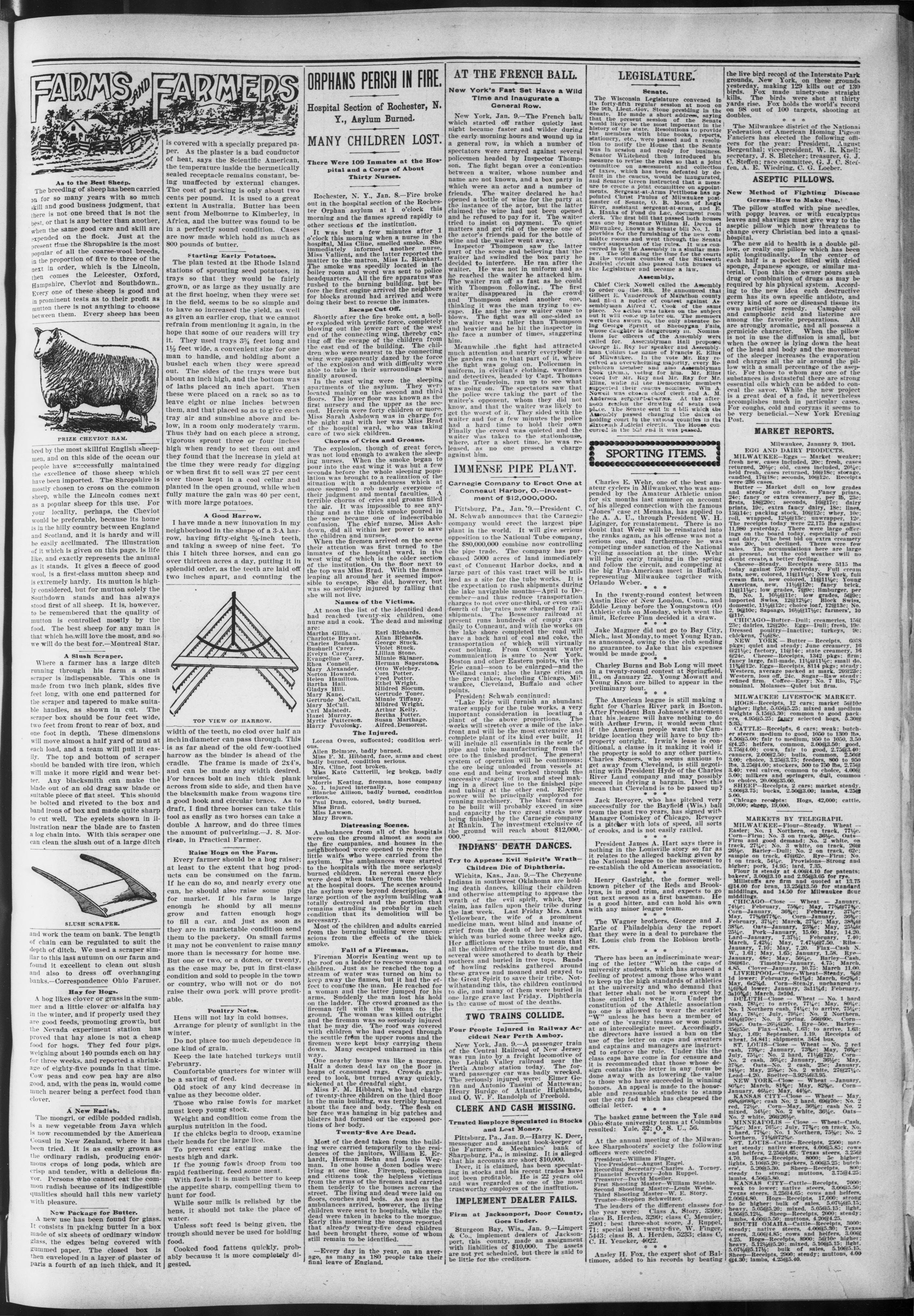
The breeding of sheep has been carried on for so many years with so much skill and good business judgment, that there is not one breed that is not the best, or that is any better than another, when the same good care and skill are expended on the flock. Just at the present time the Shropshire is the most popular of all the coarse-wool breeds, in the proportion of five to three of the next in order, which is the Lincoln, then comes the Leicester, Oxford, Hampshire, Cheviot and Southdown.. Every one of these sheep is good and in prominent tests as to their profit as mutton there is not anything to choose between them. Every sheep has been
PRIZE CHEVIOT RAM.
bred by the most skillful English sheepmen, and on this side of the ocean our people have successfully maintained the excellence of those sheep which have been imported. The Shropshire is mostly chosen to cross on the common sheep, while the Lincoln comes next as a popular sheep for this use. For your locality, perhaps, the Cheviot would be preferable, because its home is in the hilly country between England and Scotland, and it is hardy and will be easily acclimated. The illustration of it which is given on this page, is life like, and exactly represents the animal as it stands. It gives a fleece of good wool, is a first-class mutton sheep and is extremely hardy. Its mutton is highly considered, but for mutton solely the Southdown stands and has always stood first of all sheep. It is, however, to be remembered that the quality of mutton is controlled mostly by the food. The best sheep for any man is that which he will love the most, and so we will do the best for.—Montreal Star.
A Slush Scraper.
Where a farmer has a large ditch running through his farm a slush scraper is indispensable. This one is made from two inch plank, sides five feet long, with one end patterned for the scraper and tapered to make suitable handles, as shown in cut. The scraper box should be four feet wide, two feet from front to rear of box, and one foot in depth. These dimensions will move almost a half yard of mud at each load, and a team will pull it easily. The top and bottom of scraper should be banded with tire iron, which will make it more rigid and wear better. Any blacksmith can make the blade out of an old drag saw blade or suitable piece of flat steel. This should be bolted and riveted to the box and band irons of box and made quite sharp to cut well. The eyelets shown in illustration near the blade are to fasten a log chain into. With this scraper one can clean the slush out of a large ditch
SLUSH SCRAPER.
and work the team on bank. The length of chain can be regulated to suit the depth of ditch. We used a scraper similar to this last autumn on our farm and found it excellent to clean out slush and also to dress off overhanging banks.—Correspondence Ohio Farmer.
Hay for Hogs.
A hog likes clover or grass in the summer and a little clover or alfalfa hay in the winter, and if properly used they are good feeds, promoting growth, but the Nevada experiment station has proved that hay alone is not a cheap food for hogs. They fed four pigs, weighing about 140 pounds each on hay for three weeks, and reported a shrinkage of eighty-five pounds in that time. Cow peas and cow pea hay are also good, and, with the peas in, would come much nearer being a perfect food than clover.
A New Radish.
The mongri, or edible podded radish, is a new vegetable from Java which is now recommended by the American Consul in New Zealand, where it has been tried. It is as easily grown as the ordinary radish, producing enormous crops of long pods, which are crisp and tender, with a delicious flavor. Persons who cannot eat the common radish because of its indigestible qualities should hail this new variety with pleasure.
New Package for Butter.
A new use has been found for glass. It consists in packing butter in a box made of six sheets of ordinary window glass, the edges being covered with gummed paper. The closed box is then enveloped in a layer of plaster of paris a fourth of an inch thick, and it
FARMERS
is covered with a specially prepared paper. As the plaster is a bad conductor of heat, says the Scientific American, the temperature inside the hermetically sealed receptacle remains constant, being unaffected by external changes. The cost of packing is only about two cents per pound. It is used to a great extent in Australia. Butter has been sent from Melbourne to Kimberley, in Africa, and the butter was found to be in a perfectly sound condition. Cases are now made which hold as much as 800 pounds of butter.
Starting Early Potatoes.
The plan tested at the Rhode Island stations of sprouting seed potatoes, in trays so that they would be fairly grown, or as large as they usually are at the first hoeing, when they were set in the field, seems to be so simple and to have so increased the yield, as well as given an earlier crop, that we cannot refrain from mentioning it again, in the hope that some of our readers will try it. They used trays $ 3 \frac{3}{4} $ feet long and $ 1 \frac{1}{2} $ feet wide, a convenient size for one man to handle, and holding about a bushel each when they were spread out. The sides of the trays were but about an inch high, and the bottom was of laths placed an inch apart. Then these were placed on a rack so as to leave eight or nine inches between them, and that placed so as to give each tray air and sunshine above and below, in a room only moderately warm. Thus they had on each piece a strong, vigorous sprout three or four inches high when ready to set them out and they found that the increase in yield at the time they were ready for digging or when first fit to sell was 27 per cent over those kept in a cool cellar and planted in the open ground, while when fully mature the gain was 40 per cent, with more large potatoes.
A Good Harrow.
I have made a new innovation in my neighborhood in the shape of a 3-A harrow, having fifty-eight 5/8-inch teeth, and taking a sweep of nine feet. To this I hitch three horses, and can go over thirteen acres a day, putting it in splendid order, as the teeth are laid off two inches apart, and counting the
A
width of the teeth, no clod over half an inch in diameter can pass through. This is as far ahead of the old few-toothed harrow as the binder is ahead of the cradle. The frame is made of 2x4's, and can be made any width desired. For braces bolt an inch thick plank across from side to side, and then have the blacksmith make from wagons tire a good hook and circular brace. As to draft, I find three horses can take this tool as easily as two horses can take a double A harrow, and do three times the amount of pulverizing.-J. S. Morrison, in Practical Farmer.
Raise Hogs on the Farm.
Every farmer should be a hog raiser; at least to the extent that hog products can be consumed on the farm. If he can do so, and nearly every one can, he should also raise some pigs for market. If his farm is large enough he should by all means grow and fatten enough hogs to fill a car, and just as soon as they are in marketable condition send them to the packery. On small farms it may not be convenient to raise many more than is necessary for home use. But one or two, or a dozen, or twenty, as the case may be, put in first-class condition and sold to people in the town or country, who will not or do not raise their own pork will prove profitable.
Poultry Notes.
Hens will not lay in cold houses.
Arrange for plenty of sunlight in the winter.
Do not place too much dependence in one kind of grain.
Keep the late hatched turkeys until February.
Comfortable quarters for winter will be a saving of feed.
Old stock of any kind decrease in value as they become older.
Those who raise fowls for market must keep young stock.
Weight and condition come from the surplus nutrition in the food.
If the chicks begin to droop, examine their heads for the large lice. To prevent egg eating make the nests high and dark. If the young fowls droop from too rapid feathering, feed some meat. With fowls it is much better to keep the appetite sharp, compelling them to hunt for food. While sour milk is relished by the hens, it should not take the place of water. Unless soft feed is being given, the trough should never be used for holding food.
Cooked food fattens quickly, probably because it is more completely digested.
ORPHANS PERISH IN FIRE.
Hospital Section of Rochester, N. Y., Asylum Burned.
MANY CHILDREN LOST.
There Were 109 Inmates at the Hospital and a Corps of About Thirty Nurses.
Rochester, N. Y., Jan. S.—Fire broke out in the hospital section of the Rochester Orphan asylum at 1 o'clock this morning and the flames spread rapidly to other sections of the institution.
It was but a few minutes after 1 o'clock this morning when a nurse in the hospital, Miss Cline, smelled smoke. She immediately informed another nurse, Miss Vallient, and the latter reported the matter to the matron, Miss L. Richart. The smoke was speedily located in the boiler room and word was sent to police headquarters. All the fire apparatus was rushed to the burning building, but before the first engine arrived the neighbors for blocks around had arrived and were doing their best to rescue the inmates.
Escape Cut Off.
Shortly after the fire broke out, a boiler exploded with terrific force, completely blowing out the lower part of the west end of the connecting wing, thereby cutting off the escape of the children from the east end of the building. The children who were nearest to the connecting wing were apparently dazed by the force of the explosion and with difficulty were able to take in their surroundings when finally aroused.
In the east wing were the sleeping apartments of the asylum. They were located mainly on the second and third floors. The lower floor was known as the first nursery and the upper as the second. Herein were forty children or more. Miss Sarah Ashdown was in charge for the night and with her was Miss Brad of the hospital ward, who was taking care of two sick children.
Chorus of Cries and Groans.
The explosion, though of great force, was not loud enough to awaken the sleeping nurses. When the smoke began to pour into the east wing it was but a few seconds before the whole sleeping population was brought to a realization of the situation with a suddenness which at once seemed to rob nearly everyone of their judgment and mental faculties. A terrible chorus of cries and groans filled the air. It was impossible to see anything and as the thick smoke poured in the scene became one of indescribable confusion. The chief nurse, Miss Ashdown, did all within her power to save the children and nurses.
When the firemen arrived on the scene their attention was first turned to the inmates of the hospital ward, in the west wing of which is the older section of the institution. On the floor next to the top was Miss Brad. With the flames leaping all around her it seemed impossible to escape. She did, however, but was so seriously injured by falling that she will not live.
Names of the Victims.
At noon the list of the identified dead had reached twenty-six children, one nurse and a cook. The dead and missing are:
Martha Gillis. Earl Richards.
Charlotte Bryant. Allan Richards.
Charles Benham. George Stuck.
Bushnell Carey. Violet Stuck.
Evelyn Carey. Lillian Stone.
Evangeline Carey. Minnie Skinner.
Rhea Connell. Herman Saperstone.
Mary Alexander. Otto Welchey.
Norton Howard. Cora Potter.
Helen Hamilton. Fred Potter.
Bartha Hall. Ethel Wright.
Gladys Hill. Mildred Slocum.
Mary Kane. Gertrude Toner.
Gertrude McCall. Minnie Tiffany.
Mary McCall. Mildred Wright.
Carl Malstedt. Arthur Kelly.
Hazel Murray. Bertha Potter.
Myrtle Patterson. Susan Marthage.
Harry Povolosky. Alfred Demorest.
The Injured.
Lorena Owen, suffocated; condition serious.
Allen Belmore, badly burned.
Miss F. M. Hibbard, face, arms and chest badly burned, condition serious.
Mrs. Cline, foot broken.
Miss Kate Catterill, leg broken, badly bruised.
Morris Keating, fireman, hose company No. 1, injured internally.
Blanche Allison, badly burned, condition
serious.
Paul Dunn, colored, badly burned.
Distressing Scenes.
Ambulances from all of the hospitals were on the ground almost as soon as the fire companies, and houses in the neighborhood were opened to receive the little waifs who were carried from the asylum. The ambulances were started to the hospitals with the more seriously burned children. In several cases they were dead when taken from the vehicle at the hospital doors. The scenes around the asylum were beyond description. A large portion of the asylum building was totally destroyed and the portion that remains standing is probably in such condition that its demolition will be necessary. Most of the children and adults carried from the burning building were unconscious from the effects of the thick smoke.
Fall of a Fireman.
Fireman Morris Keating went up to the roof on a ladder to rescue women and children. Just as he reached the top a stream of water was turned on him to keep away the flames, but it had the effect to confuse the man. He reached for a woman and the latter jumped for his arms. Suddenly the man lost his hold on the ladder. The crowd groaned as the fireman fell with the woman to the ground. The woman was killed outright and the fireman was so seriously injured that he may die. The roof was covered with children who had escaped through the scuttle from the upper rooms and the firemen were kept busy carrying them down. Many escaped unharmed in this way.
One nearby house was like a morgue. Half a dozen dead lay on the floor in heaps of consumed rags. Crowds gathered to look, but turned away quickly, sickened at the dreadful sight. Miss F. M. Hibbard, who had charge of twenty-three children on the third floor in the main building, was terribly burned about the face and body. The flesh on her face was hanging in big patches and blisters had formed on the exposed portions of her body.
Twenty-five Are Dead.
Most of the dead taken from the building were carried temporarily to the residences of the janitors, William E. Erhardt, Herman Behn and Louis Wegman. In one house a dozen bodies were lying at one time. Firemen, policemen and citizens took the helpless victims from the arms of the firemen and carried them tenderly to the houses across the street. The living and dead were laid on floors, couches and beds. As soon as the ambulances arrived, however, the living children were sent to hospitals, while the dead were taken in hacks to the morgue. Early this morning the morgue reported that already twenty-five dead children had been brought there, some of whom still remain to be identified.
Every day in the year, on an average, as many as 180 people take their final leave of England.
AT THE FRENCH BALL.
AT THE FRENCH BALL.
New York's Fast Set Have a Wild Time and Inaugurate a General Row.
New York, Jan. 9.—The French ball, which started off rather quietly last night became faster and wilder during the early morning hours and wound up in a general row, in which a number of spectators were arrayed against several policemen headed by Inspector Thompson. The fight began over a contention between a waiter, whose number and name are not known, and a box party in which were an actor and a number of friends. The waiter declared he had opened a bottle of wine for the party at the instance of the actor, but the latter claimed the wine had not been opened and he refused to pay for it. The waiter tried to insist on payment. To quiet matters and get rid of the scene one of the actor's friends paid for the bottle of wine and the waiter went away.
Inspector Thompson saw the latter part of the scene and believing that the waiter had swindled the box party he decided to interfere. He ran after the waiter. He was not in uniform and as he reached the waiter he attacked him. The waiter ran off as fast as he could with Thompson following. The first waiter disappeared in the crowd and Thompson seized another one, thinking it was the man trying to escape. He and the new waiter came to blows. The fight was all one-sided as the waiter was taller than Thompson and heavier and he hit the inspector in the face a number of times, staggering him.
Meanwhile the fight had attracted much attention and nearly everybody in the garden ran to that part of it, where the fight was going on. Policemen in uniform, in civilian's clothing, wardmen and detectives, headed by Capt. Thomas of the Tenderloin, ran up to see what was going on. The spectators saw that the police were taking the part of the waiter's opponent, whom they did not know, and that the waiter was likely to get the worst of it. They sided with the waiter and for a few minutes the police had a hard time to hold their own. Finally the crowd was quieted and the waiter was taken to the stationhouse, where, after a short time, he was released, as no one pressed a charge against him.
IMMENSE PIPE PLANT.
Carnegie Company to Erect One at Conneaut Harbor, O.-Investment of $12,000,000.
Pittsburg, Pa., Jan. '9.—President C. M. Schwab announces that the Carnegie company would erect the largest pipe plant in the world. It will give serious opposition to the National Tube company, the $80,000,000 combine now controlling the pipe trade. The company has purchased 5000 acres of land immediately east of Conneaut Harbor docks, and a large part of this vast tract will be utilized as a site for the tube works. It is the expectation to rush shipments during the lake navigable months—April to December—and thus reduce transportation charges to not over one-third, or even one-fourth of the rates now charged for rail shipments. The Bessemer railroad at present runs hundreds of empty cars daily to Conneaut, and with the works on the lake shore completed the road will have a back haul of coal and coke, the transportation of which will virtually cost nothing. From Conneaut water communication is sure to New York. Boston and other Eastern points, via the Erie canal—soon to be enlarged—and the Welland canal; also the large cities on the great lakes, including Chicago, Milwaukee, Cleveland, Buffalo and other points.
President Schwab continued;
President Schwaab continues.
"Lake Erie will furnish an abundant water supply for the tube works, a very important consideration in locating a plant of the above proportions. The works will stretch over a mile of the lake front and will be the most extensive and complete plant of its kind ever built. It will include all essentials in the scale of pipe and tube manufacturing from the ore to the finished product. The general system of operation will be continuous; the ore being unloaded from vessels at one end and being worked through the successive stages of iron and steel making in a direct line to the finished pipe and tubing at the other end. Electric power will be principally employed for running machinery. The blast furnaces to be built will probably exceed in size and capacity the two great stacks now being finished by the Carnegie company at Rankin. The investment exclusive of the ground will reach about $12,000,-000."
INDIANS' DEATH DANCES.
Try to Appease Evil Spirit's Wrath— Children Die of Diptheria.
Wichita, Kas., Jan. 9.—The Cheyenne Indians in southwest Oklahoma are holding death dances, killing their children and otherwise attempting to appease the wrath of the evil spirit, which, they claim, has fallen upon their tribe during the last week. Last Friday Mrs. Anna Yellowbear, the wife of a prominent medicine man, went blind and insane of grief from the death of her baby girl, which was buried some three weeks ago. Her afflictions were taken to mean that all the children of the tribe must die, and several were smothered to death by their mothers and buried in tree tops. Bands of howling redskins gathered around these graves and moaned and prayed to the Great Spirit to save their tribe. Notwithstanding this, the children continued to die, and many of them were buried in one large grave last Friday. Diphtheria is the cause of most of the deaths.
TWO TRAINS COLLIDE.
Four People Injured in Railway Accident Near Perth Amboy. New York, Jan. 9.—A passenger train of the Central Railroad of New Jersey was run into by a freight locomotive of the Lehigh Valley railroad near the Perth Amboy station today. The forward passenger car was badly wrecked. The seriously injured were: Elmer Geran and Antonio Tassini of Mattewan; Henry Burdge of Atlantic Highlands, and O. W. F. Randolph of Freehold.
CLERK AND CASH MISSING.
Trusted Employee Speculated in Stocks and Lost Money.
Pittsburg, Pa., Jan. 9.—Harry K. Deer, messenger and assistant book-keeper of the Farmers & Mechanics' bank of Sharpsburg, Pa., is missing. It is alleged that his accounts are short $10,000.
Deer, it is claimed, has been speculating in stocks and his recent trades have not been profitable. He is 22 years old and was regarded as one of the most trustworthy employees of the institution.
IMPLEMENT DEALER FAILS.
Firm at Jacksonport, Door County, Goes Under. Sturgeon Bay, Wis., Jan. 9.—Limpert & Co., implement dealers of Jacksonport, this county, made an assignment with liabilities of $10,000. The assets are not yet scheduled, but there is said to be little for the creditors.
LEGISLATURE.
Senate.
The Wisconsin Legislature convened in its forty-fifth regular session at noon on the 9th, Lleut.-Gov. Stone presiding in the Senate. He made a short address, saying that the present session of the Senate would likely be the most important in the history of the state. Resolutions to provide the members with blue books, reports, stationery, etc., were passed and a resolution to notify the House that the Senate was in session and ready for business. Senator Whitehead then introduced his measure to revise the rules so that a joint committee on assessment and collection of taxes, which has been defeated by default in the caucus, would be inaugurated, and Senator Green instructed that a measure to create a joint committee on appointments. Sergeant-at-Arms Pettibone has appointed Christ Paulus of Milwaukee postmaster of Senate, O. B. Moon of Eagle River, assistant sergeant-at-arms, and E. A. Hanks of Fond du Lac, document room clerk. The first bill that passed both houses was one by Senator William H. Devos of Milwaukee, known as Senate bill No. 1. It provides for the furnishing of the new committee rooms and went through the Senate under suspension of the rules. It was concurred in by the Assembly in a similar manner. The bill fixing the time for the courts in the various counties of the Sixteenth Judicial circuit also passed both houses of the Legislature and became a law.
Assembly.
Chief Clerk Nowell called the Assembly to order on the 9th. He announced that Gilbert E. Vandercook of Marathon county had filed a notice of contest against Assemblyman Alfred C. Cook of the same place. No action was taken on the subject but it will come up later on. The members were then sworn in, the only absentee being George Spratt of Sheboygan Falls, whose daughter is dangerously ill. Nominations for officers of the Assembly were called for. Assemblyman Hall proposed George H. Ray for speaker and Assemblyman Collins the name of Francis E. Eline of Milwaukee. In the vote Mr. Ray received an overwhelming majority, every Republican member and also Assemblyman Cook (Dem), voting for him. Mr. Eline voted for Mr. Ray and Mr. Ray for Mr. Elins, while all the Democratic members supported their caucus nominee. Win A. Nowell was chosen chief clerk and A. M. Anderson sergeant-at-arms. At the afternoon session the drawing of seats took place. The Senate sent in a bill which the Assembly passed changing the dates of holding court in the various counties in the sixteenth Judicial circuit. The House concurred in the bill and it was passed.
SPORTING ITEMS.
Charles E. Wehr, one of the best amateur cyclers in Milwaukee, who was suspended by the Amateur Athletic union for six months last summer on account of his alleged connection with the famous "Jones" case at Menasha, has applied to the A. A. U., through President W. H. Liginger, for reinstatement. There is no doubt that Wehr will be reinstated into the ranks again, as his offense was not a serious one, and furthermore he was competing under sanction of the National Cycling association at the time. Wehr will begin early training in the spring and follow the circuit, and competing at the big Pan-American meet in Buffalo, representing Milwaukee together with Orlando Weber.
※ ※ ※
In the twenty-round contest between Austin Rice of New London, Conn., and Eddie Lenny before the Youngstown (O) Athletic club on Monday, which went the limit, Referee Finn decided it a draw.
Jake Magmer did not go to Bay City, Mich., last Monday, to meet Young Ryan, as announced, owing to the club sending no guarantee to Jake that his expenses would be made good.
Charley Burns and Bob Long will meet in a twenty-round contest at Springfield, Ill., on January 22. Young Mowatt and Young Knox are billed to appear in the preliminary bout.
The American league is still making a fight for Charles River park in Boston. After President Ban Johnson's statement that his league will have nothing to do with Arthur Irwin, it would seem that if the American people want the Cambridge location they will have to buy the property outright. Irwin's lease is conditional, a clause in it making it void if the property is sold to any other parties. Charles Somers, who seems anxious to get away from Cleveland, is still negotiating with President Hyde of the Charles River Land company and may possibly succeed in driving a bargain. Does this mean that Cleveland is to be passed up?
Jack Revoyer, who has pitched very successfully for the Bayfield (Wis.) ball team the past two years, has signed with Manager Comiskey of Chicago. Revoyer is a pitcher with lots of speed, all sorts of crooks, and is not easily rattled.
* * *
President James A. Hart says there is nothing in the Louisville story so far as it relates to the alleged backing given by the National league to the movement to re-establish the old American association.
* * *
Henry Gastright, the former well-known pitcher of the Reds and Brooklyns, is in good trim, and expects to go out next season as a first baseman. He is a good hitter, and can hold his own with any minor league team.
```markdown
```
The Wagner brothers, George and J. Earle of Philadelphia deny the report that they were in a deal to purchase the St. Louis club from the Robison brothers
---
There has been an indiscriminate wearing of the letter "W" on the caps of university students, which has aroused a feeling of protest among those who want to keep up the high standards of athletics at the university and who demand that that letter shall not be worn except by those entitled to wear it. Under the constitution of the Athletic association no one is allowed to wear the scarlet "W" unless he has been a member of one of the varsity teams or won points at an intercollegiate meet. Accordingly, the directors have issued a ban on the use of the letter on caps and sweaters and captains and managers are instructed to enforce the rule. Under this the class caps have come in for censure and it is recommended that those whose design contains the letter in any form be done away with as lowering the value to those who have succeeded in winning honors. An appeal is made to the honorable and reasonable students to stamp out the cap fad which has cheapened the official letter.
The basket game between the Yale and Ohio State university teams at Columbus resulted: Yale, 32; O. S. U., 56.
At the annual meeting of the Milwaukee Sharpshooters' society the following officers were elected:
President—William Finger.
Vice-President—August Engel.
Recording Secretary—Charles A. Torney.
Financial Secretary—John Ruppel.
Treasurer—David Mueller.
First Shooting Master—William Staehle.
Second Shooting Master—Louis Weiss.
Third Shooting Master—W. E. Story.
Trustee—Stephen Schweitzer.
The leaders of the different classes for the year were: Class A. Story, 3309; class B. Herden, 3299; class C. Menuier, 2901; best three-shot score, J. Ruppel, 71; special best twenty-five, W. Finger, 5443; class B. A. Herden, 5233; class C, C. H. Yeneker, 4022.
* * *
Ansley H. Fox, the expert shot of Baltimore, added to his records by beating
the live bird record of the Interstate Park grounds, New York, on these grounds yesterday, making 129 kills out of 130 birds. Fox made ninety-one straight kills. The birds were shot at thirty yards rise. Fox holds the world's record on 98 out of 100 targets, shooting at doubles.
☆ ☆ ☆
The Milwaukee district of the National Federation of American Homing Pigeon Fanciers has elected the following officers for the year: President, August Bergenthal; vice-president, W. R. Knell; secretary, J. J. Bletcher; treasurer, G. J. C. Steffen; race committee, G. J. C. Steifen, A. E. Wiedring, C. G. Loeher.
ASEPTIC PILLOWS.
New Method of Fighting Disease Germs-How to Make One. The pillow stuffed with pine needles, with poppy leaves, or with eucalyptus leaves and shavings must give way to the aseptic pillow which now threatens to change every Christian bed into a quash-hospital.
The new aid to health is a double pillow, or really one pillow which has been split longitudinally. In the center of each half is a pocket filled with dried sponge, Japanese sponge, or similar material. Upon this the owner pours such drug or combination of drugs as may be required by his physical system. According to the new idea each destructive germ has its own specific antidote, and every kind of sore or diseased tissue its own particular remedy. Camphor oil and camphoric acid and listerine are among the favorite preparations. All are strongly aromatic, and all possess a germicide character. When the pillow is not in use the diffusion is small, but when the owner is lying down the heat of the head and body and the movement of the sleeper increases the evaporation and charges all the air around the pillow with a small percentage of the aseptic. For those to whom any one of the substances is distasteful there are strong essential oils which can be added to conceal the savor. While the new project is a great deal of a fad, it nevertheless accomplishes much in particular cases. For coughs, cold and coryzas it seems to be very beneficial.—New York Evening Post.
MARKET REPORTS.
Milwaukee, January 9, 1901 EGG AND DAIRY PRODUCTS.
MILWAUKEE—Eggs — Market weaker; fresh new, cases included, 20c; fresh, cases returned, 20½c; old, cases included, 20¼c; held fresh, cases returned, 16@18c; storage, candled, 17@18c; seconds, 10@12c. Receipts were 236 cases.
Butter — Market dull on low grades and steady on choice. Fancy prints, 24c; fancy or extra creamery, per lb, 23c; firsts, 18@20c; seconds, 16@17c; dairy prints, 19c; extra fancy dairy, 18c; lines, 13@14c; packing stock, 10@12c; whey, 10c; roll, wrapped, 12½@13c; unwrapper, 12c. The receipts today were 22,175 lbs against 11,980 yesterday. There were large offerings on the board today, especially of roll and dairy. The best bld on extra creamery was 20c, but declined. There were few sales. The accumulations here are large at present, but the cold weather will no doubt create, a better feeling.
Cheese—Steady. Receipts were 5115 lbs today against 7580 yesterday. Full cream flats, new, colored, 11@11½c; New York, full cream flats, new colored, 11@11½c; Young Americas, new, 11½@12c; fancy brick, 11@11½c; low grades, 7@9c; limburger, per lb, No. 1, 10½@11c; low grades, 5@9c; imported Swiss, 12@12½c; Block Swiss, domestic, 11½@12c; choice loaf, 12@13c. No. 2, 9@10c; Sapsago, 16½@17½c; farmers', 10@11c.
CHICAGO—Butter—Dull; creamerles, 15@23c; dairles, 12@20c. Eggs—Dull; fresh, 19c; Dressed poultry—Inactive; turkeys, 9c; chickens, 7½@8c.
NEW YORK—Butter—Receipts, 6038 pkgs; quiet and steady; June creamery, 16@21½c; factory, 11@14c; state creamery, 16@24c. Cheese—Receipts, 1342 pkgs; firm; fancy large, fall-made, 11½@11½c; small do. 11½@12c. Eggs—Receipts, 8114 pkgs; steady; Western, average packed at mark, 20@23c; Western, loss off, 24c. Sugar—Raw steady; refined firm. Coffee—Easy. No. 7 Rlo, 7½c nominal. Molasses—Qulet but firm.
MILWAUKEE LIVESTOCK MARKET
CATTLE—Recelpts, 6 cars; weak; butcher steers medium to good, 1050 to 1300 lbs, 4.50@5.00; fair to medium, 950 to 1050, 3.50@4.25; heifers, common, 3.00@3.50; good, 3.75@4.00; cows, fair to good, 2.75@3.40; canners, 2.00@2.50; bulls, common, 2.50@3.00; choice, 3.25@3.75; feeders, 800 to 950 lbs, 3.25@4.00; stockers, 500 to 750 lbs, 2.75@3.40; veal calves, common to choice, 4.00@5.00; millkers and springers, dull, common to choice, 20.00@35.00.
SHEEP—Recelpts, 2 cars; market steady, 3.00@3.75; bucks, 2.50@3.00; lambs, 4.25@5.00.
Chicago recelpts: Hogs, 42,000; cattle, 20.00; sheep, 19.00.
MARKETS BY TELEGRAPH.
MILWAUKEE—Flour—Steady. Wheat —
Easier. No. 1 Northern, on track, 77½c.
Corn—Firm; No. 3 on track, 36½c. Oats—
Firm and good demand; No. 2 white, on
track, 27½c; No. 3 white, on track, 26@
26½c. Barley—Dull; No. 2 on track, 62c;
sample on track, 47@62c. Rye—Firm; No.
1 on track, 54½c. Provisions—Strong and
higher; pork, 14.95; lard, 7.35.
Flour is steady at 4.00@4.10 for patents;
bakers', 3.00@3.10 and 2.05@3.05 for rye.
Millstuffs are firm and quoted at 13.75
@14.00 for bran, 13.25@13.50 for standard
middlings, and 14.50 for Millwaukee flour
middlings.
LIVERPOOL — Close — Wheat — Steady, 5%@
1d lower; February, 681%d; March, 62%d; May, 6s2%d. Corn — Steady, unchanged to
4%@d lower; January, 3s11%d; February,
3s10%d; March, 3s10d.
DULUTH — Close — Wheat — No. 1 hard
cash, 78%c; to arrive, 77%c; May, 80%c;
No. 1 Northern cash, 74%c; to arrive, 75%c;
May, 78%c; July, 79%c; No. 2 Northern,
64%@70c; No. 3 spring, 56@60c. Corn—
36%c; Oats—26%@20c. Rye—50c. Barley—
35%@55c. Flax — Cash, 1.63; to arrive, 1.63;
May, 1.69; September, 1.19. Receipts of
wheat, 54.841 shlpments, 3454 bus.
ST. LOUISE — Close — Wheat — No. 2 red
cash, 73%c; January, 73%c; May, 76%c;
July, 75%c; No. 2 hard, 71%@72c. Corn—
No. 2 cash, 36%c; January, 36%c; May,
37%c; Oats — No. 2 cash, 25c; January,
34%; May, 25%c; No. 2 white, 27@27%c.
Lead — 4.20. Spelter — 3.92%@3.95.
NEW YORK — Close — Wheat — January,
80%c; March, 81%c; May, 82%c. Corn—
January, 46%c; May, 44%c.
KANSAS CITY—Close — Wheat — May,
68%@68%c; cash No. 2 hard, 69%@70%c; No. 2
red, 72%c; Corn—May, 36%c; cash No. 2
mixed, 34%c; No. 2 white, 36%c; Oats—
No. 2 white, 26%@26%c.
MINNEAPOLIS—Close — Wheat—Cash,
75%c; May, 76%c; July, 77%c; on track. No.
1 hard, 77%c; No. 1 Northern, 75%c; No. 2
Northern, 71%@72%c.
ST. LOUIS—Cattle—Recelpts, 2500; market
steady; native steers, 4.00@5.85; cows
and helfers, 2.25@4.65; Texas steers, 3.25@
4.70. Hogs—Recelpts, 8000; 5c higher;
lights, 5.10@5.20; packers, 5.00@5.25; butchers,
5.20@5.30. Sheep—Recelpts, 800;
steady to strong; muttons, 3.75@4.25;
lambs, 4.50@5.80.
KANSAS CITY—Cattle—Recelpts, 7000;
weak to lower; native steers, 3.00@5.50;
Texas steers, 3.25@4.65; cows and helfers,
2.00@4.80. Hogs—Recelpts, 17,000; strong
to 5c higher; bulk of sales, 5.07%@5.15;
heavy, 5.05@5.20; mixed, 5.05@5.15; light,
4.95%@5.12%; Sheep—Recelpts, 2000; steady;
lambs, 4.00@5.50; muttons, 4.20@4.25.
SOUTH OMAHA-Cattle-Receipts, 3000; steady; native steers, 4.00@5.30; Texas steers, 3.00@4.85; cows and heifers, 3.00@4.25. Hogs-Receipts, 8900; 5@10c higher; heavy, 5.12½@5.20; mixed, 5.10@5.15; light, 5.07½@5.17½; bulk of sales, 5.10@5.15. Sheep-Receipts, 2900; steady; muttons, 4.00@4.30; lambs, 4.25@5.40.
The Wisconsin Weekly Advocate
Richard B. Montgomery.....Editor and Proprietor
Office: 327 Wells Street.
Telephone Black No. 244.
SUBSCRIPTION RATES.
ADVERTISING RATES.
One inch, single insertion..... 25c
One inch, per year..... $9.00
Business locals 5c per line each insertion.
Apply for rates to the Advocate.
TO CONTRIBUTORS:
All communications must be sent with the name and address of the sender as an evidence of good faith, but not necessarily for publication. No manuscript returned if not accepted, unless accompanied by stamps.
All subscribers of the Advocate that fail to get their paper promptly will please notify us at once. The Advocate, at 327 Wells street.
The Wisconsin Weekly Advocate company wishes to notify the public that all contracts and business transactions with this company must have the company stamp, otherwise they will be void. Neither will this company be responsible for paid subscriptions unless given to duly-accredited agents, who, on request, will give the company's receipt for same. Subscribers falling to receive their papers regularly will kindly notify the general office. Address all business communications to the general manager, 327 Wells street.
Mr. Richard B. Montgomery.
Entered at tue Milwaukee P. O. as second- c'ass matter.
The Helping Hand Colored Mission
incorporated under the laws of the State of Wisconsin has for its object the supplying of qualified colored help to those requiring the same. In order to be able to get servants from the mission it is necessary, that in order to partly cover expenses incurred, those parties desiring help should become subscribers for this paper. No actual charge is made. Parties who secure situations through this agency are also expected to become subscribers. We have at present on our books: Cooks, General Servants, Waitresses, Laundresses, Nurses, Coachmen, Porters, Waiters. Office hours 9-12 and 1-4.
R. B. MONTGOMERY, Mgr. 209 Fifth St., Milwaukee.
The discovery that dead people can be revived with electricity takes the salt out of the fame of a number of Chicago doctors.
Watson's testing tank experiments with the model of Valkyrie II. will convince "horse marines" that the new yacht will win if she is towed like the models in the tank.
The Sultan has at last contracted with the Cramps for a warship, and the claim of the United States will thus be paid in an incidental manner. The ship should be named the Rake-off.
The recognition of the wives of men of prominence as "national women," by the D. A. R., will give the fair sex an increased incentive to back their husbands in political campaigns.
The whaler Esquimau, purchased for the Ziegler-Baldwin expedition to the north pole, will henceforward be the America; and the Americans who go north in her will for a time try to be esquimaux.
If the Prince of Wales and the Kaiser come to see the international yacht races next year, the task of keeping the course clear will be more difficult than ever, unless the yacht with royalty aboard heads out to sea and draws the crowd away from the course.
The entire amount of $75,000 necessary to build a wooden centerboard yacht for the international races of next year has been subscribed at Boston, and as Gen. Paine, who successfully defended the America cup with the centerboarders Puritan, Mayflower and Volunteer, is to be associated with the manager of the new craft, yachtsmen are in great glee over the prospect for good sport.
The Zoological gardens in The Bronx, New York, were planned on generous lines and the management has proved itself to be broad-minded and enterprising. It is now reported that British Columbia is to be ransacked by competent agents, who will send to New York a fine collection of bears, cougars, lynxes, mountain sheep, mountain goats and other wild animals that may be trapped alive. Within a few years New York may have within its limits collections to challenge comparison with those of London, Paris and other famous cities.
Americans who are spending the winter abroad need not be without their native American luxury of fresh fruit. Packages are arranged and packed early, and special rates are given, at about one-half former charges, for shipping fruit in barrels to Liverpool, Glasgow, Havre, Antwerp, Rotterdam, Bremen and Amsterdam. It costs a little more to ship fruit to Berlin, and other ports in Germany; and, again, 25 cents additional to dispatch it to France, Austria or Switzerland. Our California and Florida fruits bear transport very well.
League island is hereafter to be known as the Philadelphia navy-yard. An official order to this effect approved and signed by Secretary Long goes into effect at once. To many the change will seem to discard gratuitously a name venerable and picturesque historically. But official routine concerns itself little about sentiment, and in keeping with the well-formed policy of the department to make this the greatest naval station on the Atlantic coast, the yard will hereafter in all official language be known as the Philadelphia yard, just as the old Brooklyn navy-yard is now known as the New York yard.
PHILIP D. ARMOUR IS DEAD
Noted Packer and Financier Succumbs to Heart Trouble.
LONG AND BUSY CAREER
Stricken While Apparently Recovering from a Protracted Attack of Pneumonia.
Chicago, Ill., Jan. 7.—Philip Danforth Armour died at his residence, 2115 Prairie avenue, at 5:45 p. m. yesterday of heart failure, following pneumonia. At 9 a. m. Mr. Armour began to sink and it was apparent that the end was near. With a few rallies, caused by stimulants, moments of consciousness occurred, but after 3 p. m. the decline was rapid. Death came peacefully.
At the bedside throughout the day were Mrs. P. D. Armour, Mr. and Mrs. J. Ogden Armour, Mrs. P. D. Armour, Jr., and Dr. Frank Billings, who attended the sufferer throughout his illness. At 3 o'clock Mr. Armour revived and asked that the family draw near and receive his parting words. "I am not afraid to go," he said smiling. Then he held out his hand to each in turn. He spoke of his grandchildren, to whom he was tenderly devoted, asking after their health and recalling an incident or two of their last romp together. With Dr. Billings he discussed his illness, asking the precise nature and latest complications of his malady and remarking that death could not be far away.
At the signs of grief manifested by members of his family, Mr. Armour sought to cheer them with encouraging words and a snow of returning vitality, but the effort was too great. Perceiving lethargy to be creeping upon him, he spoke his last words of fearlessness in the face of death and received the final farewells of his family. Recognition of faces and surroundings gradually faded from his sight, his breathing became labored, and after three hours he died.
Heart Failure Follows Pneumonia.
Mr. Armour died of myocarditis, the scientific name for muscular degeneration of the heart. Pneumonia, resulting from a cold, contracted while playing in the snow with his grandchildren in the latter part of November aided in the failure of the already weakened circulatory organs. Mr. Armour's illness really had covered a period of the last two years, during which time he had been failing steadily with occasional intervals of apparently restored health. Twice he had visited German baths in search of relief, at Carlsbad and Bad Nauheim, returning from the latter trip last August. The sudden death of his son, P. D. Armour, Jr., in California, January 29, 1900, was a blow from which the aged father never fully recovered, and his intimate friends then realized for the first time that his life was fast coming to a close.
When Mr. Armour's health showed initial signs of breaking down he went to Bad Nauheim, Germany, for the baths during the summer of 1899. While there he expressed confidence in his recovery. The waters improved him noticeably, and he took long walks in the hills. He returned in the fall with the full conviction that he could again apply himself to the direction of his great packing and other enterprises with old-time vigor. But a few months later a slight cold, caught during the first days of inclement weather, developed such serious symptoms that he went to Pasadena, Cal. It was here that he and Mrs. Armour were visited in January by their younger son, Philip D., Jr., and his wife. A cold, suddenly developing within a day into pneumonia, caused the son's death while spending a few days on a pleasure trip near Pasadena. Mr. Armour, Sr., was prostrated with grief, and fears were entertained that the effect on him might be fatal. Both he and his wife were unable to return to Chicago for the funeral. Mr. Armour, who had entertained great plans for his younger son's future in the commercial world, grieved hopelessly over his loss. In April the father returned to Chicago.
Last summer again found Mr. Armour at the baths of Bad Nauheim. In the autumn he returned to Chicago and deciding to give little of his attention to business he retired to Oconomowoc, Wis., till the beginning of cold weather. When the Prairie avenue residence was opened in November Mr. Armour prepared to enjoy the winter in Chicago and renew the companionships which had been broken into by his absence. His chief delight was in the company of his grandchildren—Philip and Lester, sons of P. D. Armour, Jr., and Lolita, the daughter of J. Ogden Armour. He was accustomed to take long walks about the neighborhood hand in hand with the children.
Incorporation of the Business.
Careful preparation had been made after the death of P. D. Armour, Jr., to preserve the great Armour interests intact when the head of the company should pass away. This was done by the incorporation of Armour & Co. as a joint stock company in place of the co-partnership it had been from its inception. So carefully had the plans for the future been made that the death of Mr. Armour will have little effect on the outward working of the great enterprises with which he had been so closely identified. Armour & Co. will remain a potent factor in the development of Chicago's trade. It is believed all the Armour properties will be held intact until the grandchildren come into their own.
The Armour Estate.
The following estimate of the Armour estate was made last night by a man closely allied with those interests:
Stock in Armour & Co., Chicago. $10,000,000
Stock in Armour & Co., transformed to sons. 10,000,000
10,000,000
1,000,000
5,000,000
Fruits, produce and transportation interests .....
Railroad stocks .....
Real estate .....
Miscellaneous securities .....
Banking interests .....
Cash .....
Total ..... $100,000,000
More conservative estimates of the Armour estate range from $30,000,000 to $40,000,000.
Philip Danforth Armour.
Philip D. Armour was born at Stockbridge, Madison county, N. Y., in 1832. His father was Danforth Armour, a farmer of old New England stock, and his mother, whose maiden name was Juliane Brooks, traced her ancestry back to the early days of the Puritans. Philip D. Armour's boyhood was like that of the average country boy of that period. He worked about the farm and attended the school and academy. At 20 years he was a strong, robust young man, the leader of his associates, a shrewd trader at the store and noted for his industry and his helpfulness to the family. He had the gold fever in 1849, but his services at home were needed.
Three years later, in 1852, when the other boys had grown old enough to be of support to their father and a surplus of labor was apparent, Philip announced to his father that the way was now open for the journey to California and the an-
KROG
(One of the Great Industrial Kings of the World. Who Has Just Passed Away.)
proval of his father was cheerfully given. In the spring of 1852 Philip was one of a party of thirty that left Oneida, N. Y., and six months later the toilsome journey over the plains was completed and the farmer boy became a miner. The best claims had been gathered up before young Armour reached the golden state, but while others were flitting from place to place hoping to make a strike the broad-shouldered New Yorker stuck to his claim and worked over every bit of earth. Four years of mining, quietly and unostentatiously enabled him to gather a few thousand dollars. He returned home in 1856.
Comes West a Second Time.
But the humdrum life of a country district in New York offered no inducements to the active spirit of Philip D. Armour. He was seeking for a commercial opportunity and in the fall of 1856 he reached Milwaukee and formed a good impression of its future. He became acquainted with Frederick B. Mills and formed a partnership in the commission business. Grain and farm produce were the chief lines the firm handled. It was here he met Miss Belle Ogden, daughter of Jonathan Ogden of Cincinnati, who was visiting friends in Milwaukee. In 1862 they were married in Cincinnati. Mr. Armour, then 30 years of age, had amassed quite a fortune as fortunes were rated in the West of that period.
In 1863 he formed a partnership with John Plankinton of Milwaukee, a pioneer packer, and dissolved his partnership with Mr. Mills. A year later he laid the foundations of the Chicago house, with the aid of his brothers, and in 1875 he moved to Chicago.
Brothers Worked Together.
A striking feature in the life of Mr. Armour was the business development of his brothers—there were six boys in the family. One caught the spirit of patriotism in 1861 and enlisted in the Union army and was slain in battle. The other five stood together as brothers through all their lives. When Philip Armour began to reap a golden harvest in Milwaukee he sent for his eldest brother, Herman O. Armour, who joined his brother at Milwaukee, studied the commission business, and in 1862—six months after he had left the farm—began business in Chicago as a grain merchant. The business grew so rapidly with the aid of Philip's money and advice that in 1863 Joseph F. Armour left the farm and entered the office in Chicago. To the grain business the Armours added the packing of pork products, to which Joseph F. gave his attention.
seph F. gave his attention. In 1871 it was necessary for the Armours' business that one of them look after the New York work, and Herman O. accepted that duty and removed to New York city, where he has resided ever since. While Herman went to New York to watch the markets, guard the Armour credit and oversee the distribution of grain and packing products, Simon B. was learning the business in Chicago, and in the fall of 1871 he appeared in Kansas City, where the Armour foresight placed him and began turning trade into the Armour channels. One brother was left on the farm—the youngest, Andrew Watson Armour. It was not until 1879 that the elder brothers called him to their aid. They needed a bank at Kansas City. It was necessary that an Armour give his attention to it. Joseph F. had died in Chicago and Philip D. had to give his personal attention to the big main plant. Simeon was tied down at the Kansas City house and Herman O. was immersed in the New York end of the business.
Simple in His Habits.
Philip D. Armour's habits were those of a matter-of-fact business man. There was nothing of the plunging or soaring about his business—just a keen, persistent industry, a native shrewdness that grew out of his great mental equipose, and such a man's habits are of the simple and unostentatious character. He had no set rule of conduct, except early rising and its corollary, early retiring. He was up at 5 o'clock every morning and rarely out of bed at 9 at night. His breakfast was served at 6 and when his boys were at home they were up at that hour and breakfasted with him.
Until the last few years he walked to his office every morning and he was there at 7 o'clock—long before the majority of the clerks and department chiefs had arrived.
After luncheon Mr. Armour always lay down for a nap in his office. After hearing the results of the day's work, taking a look at the final quotations of the wheat and stock markets, at 4 o'clock he would leave for his drive. The Armour institute was his first calling place—winter and summer he kept in daily touch with it. A drive through the south side boulevards and an hour's visit at the homes of each of his sons on Michigan avenue, was his evening pleasure. Eight o'clock found him at home.
Not Fond of Society.
Mr. Armour was not a society man. Late dinners and dress functions had no allurements for him or his wife. His pleasure was not in the opera nor the concert and the ballroom never knew him. Even when one of his daughters-in-law gave a ball the head of the Armour house was not there. He preferred his home life to all receptions and displays. He belonged to several clubs—among them the Commercial, Union League and Chicago—but few ever saw him about the clubhouse.
Mr. Armour's religion was as broad as
his big brain could make it. He knew no sect or tenet above another, save that he adhered to protestantism, but in his contributions to churches the Catholic was accorded as much favor as any other. It is said that his name is carried on several south side churches as a member, but Mr. Armour never claimed membership in any creed. He gave liberally and accepted the title of membership without claiming it. Until the establishment of the Armour mission by the will of his brother he never participated actively in religious meetings.
Always a Republican.
In politics Mr. Armour was a Republican. He never took part in any political gathering and as a rule very little interest in elections except for President. In local politics he never took any interest. Frequently efforts were made to get him to help one party or another or one candidate above another, but he persistently refused to give his influence in any direction or any men.
"Philip D. Armour was not only what I regard as the greatest merchant of the age, but he was one who absolutely never attacked any man, until first attacked, and then he always fought to win and never got whipped. And I make this statement without qualification, especially as to his remarkable characteristic in never having first attacked anyone, but always acting upon the defensive. This can be probably said of no other great financier, or man engaged in trade such as occupied his time and talents."
The foregoing statement was made by Jeremiah Quin, than whom no one in Milwaukee knew and understood the dead multi-millionaire better.
Continuing in his reminiscent mood, Mr. Quin recalled that when Leiter allowed himself to believe that he had Armour in a corner in reference to wheat, Mr. Armour erected, from the ground up, in less than eight weeks' time, an elevator in Chicago which had a capacity of 3,000,000 bushels, and when the time came, as has been told in these columns, Armour had his wheat ready for delivery to Leiter. After he had completely knocked out the young "Napoleon of wheat," he magnanimously picked the young man up and sold his wheat for him, or, in other words, the senior Leiter went in his trouble to Mr. Armour and the latter straightened the young man's affairs out for the father.
***
Upon another memorable occasion another great packer became opposed to Armour in a big grain deal in Chicago. The overwhelming defeat, a little later, of the popular "Jack" Cudahy, demonstrated the unfailing power of P. D. Armour. These fights, thus forced upon him, he always disliked, but when once in them he always carried them through until every enemy was laid out completely and effectually. It was the same in the historic pork deal, in which so many dealers were ruined, and Plankinton & Armour came out on top, clearing about $1,800,-000 or $2,000,000 in the fight, which was forced upon them by the most reckless and unfair dealings. Wenen the two great packers decided to go into the fight, Mr. Armour carefully and deliberately prepared for the battle and never stopped until he had every enemy routed and whipped and most of them completely ruined. But he only went into it because the great firm had been attacked and ruin would certainly have been the outcome had they remained passive. It is said that the morning they started in Mr. Plankinton stated in their office that if it was thought they could retire from the deal and not lose more than $250,000 or $300,000 he would rather drop it. A hurried overhauling of the books and a look into the situation convinced the two big men that $300,000 would be but a drop in the bucket of their losses, and the order was then given to start in. And the trading world soon learned the result. It was the masterful brain of P. D. Armour that managed the winning fight upon that memorable occasion.
The fact, however, that Mr. Armour never, during his long, exciting and eventful business career, struck first, or attacked any man, except in self-defense, will always stand out as one of the great traits of his character.
"Holler fer One Leg."
Doing business on a certain upper Broadway corner are two crippled newsboys. One lacks a leg only from the knee down, but the other has sad use for double crutches. They both came to the stand at about the same time, and, in the natural order of things, one would expect them to be bitter rivals. Yet, to judge by the answer made by one of them a few evenings ago, it would seem not. The lad with the double crutches was heard to ask the other: "Why is it yer don't seem to be doin' yer limit to shout up de trade now. Slippy?" "Slippy" replied, wriggling shyly. "Ah, cheese it, chummy, I on'y got to hoiler fer one leg."—New York Commercial Advertiser.
Much of Kentucky is "Dry."
It may startle some people who think the name of Kentucky synonymous with whisky to know that three-fourths of the state is "dry." Thirty of Kentucky's counties are entirely "dry," as many more are "wet" in one spot, or, to be more exact, liquor is retailed only at the county seat. All but five are "dry" in spots; that is, there are no retail liquor stores in certain voting precincts. In other words, the prohibition area in Kentucky overshadows the "wet" spots in the proportion of nine-tenths to one-tenth. —Chicago Record.
CENTURY'S PROBLEMS
CENTURY'S PROBLEMS
AN ADDRESS TO BANKERS' CLUB.
Henry C. Payne addressed the Milwaukee Bankers' club last evening on "Problems Confronting the American People at the Opening of the Twentieth Century," the occasion being the club's annual meeting and banquet at the Milwaukee club.
By way of introduction Mr. Payne referred to the questions at issue in the political campaigns of 1896 and 1900, and added: "In the closing years of the Nineteenth century, as a consequence of our war with Spain, undertaken to free the people of Cuba, we are in possession of the Philippine islands and Porto Rico, and are responsible for the establishment of a free government for the island of Cuba.
One of the Great Powers of the World.
Continuing. Mr. Payne said:
The fact I wish to draw your attention to is, that we find ourselves, without seeking it, in the position of one of the great powers of the world. As such we must discharge our duties. It cannot be avoided. I do not think the cession of the Philippines is an unmixed blessing, but we must accept it and give those people the best government of which they are capable. If the premises is set up that the constitution must follow the flag, our possession of the Philippines is a misfortune. We have too many of the Latin race among us now. But I do not agree that the constitution must follow the flag. We must establish a colony for those people over in the Orient. If we cannot do this we are not a nation. (Applause.) If we cannot do this we are but a confederacy and that question, I take it, was settled in 1865. We have taken an advance step in this Philippine question, otherwise we would not have been involved in the settlement of the difficulties in China. It is a question that will take a long time to solve, but we will solve it right.
This sentiment was warmly applauded, and Mr. Payne then took up the subject of the Nicaraguan canal, advocating an international waterway.
He declared if the United States built the canal as a national enterprise and undertook to defend it, it would compel the other nations to put through the Panama canal and then the work would be of no use. If this government undertook to do the work alone, Mr. Payne asserted that the $200,000,000 project would cost $1,000,000,000 and that men would be sunk in infamy by the jobbery that would attach to it.
The Negro Problem.
Mr. Payne dwelt particularly on the race question in the South as one of the serious problems confronting this nation at the threshold of the Twentieth century. As a remedy for the conditions as they exist in the South, Mr. Payne proposed an amendment to the constitution that intelligence be made the standard for the right to vote, and that no man be permitted to exercise the right unless he could at least read and write. Another step should be the reduction of the representation of the Southern states in Congress.
Thomas H. Bowles, speaking from the standpoint of a Southerner, said, in part: "It is a difficult question to deal with. When you educate the brain you broaden it. It is more difficult to control a man like Booker Washington than it is the ignorant cotton-picking negro. There is no more pitiable object on earth than the educated negro. There is a prejudice against him that we can't get over. I do not believe that time will ever remove it.
Not Responsible for His Condition.
Mr. Payne in reply said that the negro was not responsible for his condition, and then continued: "We of the North were equally guilty with the South in bringing him to this condition in the first place, but when we were convinced that it was wrong we set our faces against it, and we settled it by the arbitrament of war. Many other questions were settled by that war. The people of the South have responded nobly in their settlement. However, I do not sympathize with Brother Bowles in his position that a colored man is not a man. I would as soon sit at a table with a black man as with a white man, all things being equal as to education; I cherish no objection to a man on account of his color. I do not want by reason of the black man's existence that another man shall have twice as many votes as I have. I believe the time will come when the people of the South will cease to draw the color line against the negro. It is not done in any other country on earth."
George P. Miller inquired: "Mr. Payne, how would you like to have a negro marry into your family?" Mr. Payne, with considerable warmth, said: "That is not argument. That is cowardly." An informal discussion of the matter followed, and before the club adjourned it tendered a vote of thanks to Mr. Payne for his paper. During the evening the following officers of the Bankers' club were elected: President, J. W. P. Lombard; vice-president, William Bigelow; secretary and treasurer, G. W. Strohmeyer; executive committee, Washington Becker, Frederick Kasten and Gustav Reuss.
His Idol Shattered.
This is a true story of Mary Anderson and how she disillusionized one ardent worshiper—a few years ago. The worshiper was a gallant Kentucky colonel, who had long burnt incense at the shrine of the actress. One night—the night Fate shattered his idol—the colonel, smoking a cigar with a bottle of real old Bourbon at his elbow, sat on the veranda just outside his hotel window, admiring the superb Kentucky moonlight—not moonshine, please—and thinking about the grace of the gifted Miss Anderson, who occupied a room directly over his in the same hotel.
Suddenly a voice broke the silvery stillness of the moonlit night. The colonel started, for it was very late and he had supposed that all the hotel save himself was sleeping. The voice was that of Mrs. Griffin, Miss Anderson's mother.
"Mary, Mary," it called, "do come out here and see this lovely moon."
From the actress' room came the deep contralto bell voice for which our Mary was famous.
"Good heavens, mother!" it called, "for gracious sake, shoot the moon and come to bed."
The colonel threw away his cigar, swallowed a deep potion of Bourbon neat and with a beloved idol shattered, stole away to broken dreams—New York Telegraph.
Edmonia—"Edgar, dear, I'm going to burn these new photographs of mine; they look ten years older than I do."
Edgar—"Nonsense; put them away until you catch up with them."—Indianapolis Journal.
WE TELL YOU ALL ABOUT
IT IN
The BOOK OF THE
New Century
The finest Catalogue ever issued is
yours on request. If interested in
typewriters, you ought to have it.
UNITED TYPEWRITER
and SUPPLIES CO.
Agents for Wisconsin and Northern
Michigan—414 Broadway, Milwaukee, Wis.
Northwestern House
APPLETON, WIS.
JOHN A. BRILL, - Proprietor.
Terms $1.00 Per Day.
Accommodations the best in the State. When in Appleton stop at the
NORTHWESTERN TONEY THE ARTIST FINE ART Shining Parlor
2161 GRAND AVENUE
Opposite Flanner's Music Store
MILWAUKEE, WIS.
Money Loaned on Securities and Wages Collected
Notary Public and Real Estate Brokers,
Houses and Flats to Rent.
W.F. Hunter&Co.
Attorneys at Law,
Office, 3240 STATE STREET,
Chicago, Ill.
Office Hours 8 a. m. to 8:30 p. m. Telephone
1100 So. and 1003 So. Parties desiring to deal
in Real Estate or having any business such as
mentioned above, can not do better than place
their business with this firm.
MILWAUKEE...
GAS STOVE CO.,
MANUFACTURERS OF
PERFECTION
PERFECTION GAS RANGES
AND SPECIALTIES
Instantaneous Cleanable Star Burners,
Adjustable Needle Valve,
For Natural, Artificial or Gasoline Gas.
139 Burrell St., Milwaukee.
Do You Wish to be a
MASTER PAINTER
You know Good Painters make from $5.00 to
$10.00 a day easy.
PAINTING POINTERS
on Sign, House and Carriage Painting. Decorating, Graining, Gilding, Silvering and Calsomin-
ing. This Book will also teach you how to
CONTRACT FOR BUSINESS
on profitable basis. It will teach you all we
know after having spent a life time in the busi-
ness, and will generally
SAVE YOU MONEY.
Mailed postpaid for only 50c.
VAL. SCHREIER SIGN WORKS, Milwaukee, Wis.
MR.T.W. BARTO,
of 511 Wells Street. has opened up a new Bakery and Lunch. Has stocked his store with Choice Goods, Fresh Bread, Rolls, Pies, Cakes and Candies and Choice Family Groceries, Milk and Tobacco and Cigars.
511 WELLS ST.
Don't forget to give him a call. Phone 405 Black.
Before Starting on Your Travels
CALL ON
Geo. Burroughs & Sons
MANUFACTURERS OF
PREMIUM TRUNKS
VALISES, SAMPLE CASES, Etc.
424 & 426 East Water St., Milwaukee.
\EWGOVERNORINSTALLED
simple but Impressive Exercises
at. Madison.
TAKES OATH OF OFFICE.
wt
Madison, Wis. Tan. T.—[Special.]--
Robert M. La Follette took the oath of
pice as governor of Wisconsin at 12
“dock noon today. Lhe inauguration of
the governor and the other state officers
took just tem minutes. » :
When the official party entered the
[niversity boys gave their college yell.
\r. Lu Folletet occupied the first seat
at the right on the. center aisle, opposite
Mrs, La Follette and next to Gov. Sco-
sig, ‘The other state officers occupied
seats in the front row, ‘
Lhe ollicial party entered the chamber
just a few minutes before 12 o'clock.
hier Justice Cassoday occupied the
quaker's chair, with Judge Ryan of the
vhate board of control and Senator’ R. M.
pashferd on either sideof him.
Mr. Basuford called the assemblage to
order. In doing so he said that Mr. La
Vollette was the first native of Wiscon-
sin to be cleeted its: governor and that
he had been elected by. the largest vote
vver ziven toa public officer in, this state.
He aunounced that Goy, Scofield would
present the mew. | governor. The
ivo men stepped into the — clerk’s
qesk, and Gov, Scofield said: “I now
present Robert M. La Pollette, who holds
rtifieate of election: as governor and
sho is now, as Lt understand it, prepared
ty tike the oath of office.”
The new. Governor raised his right
jand as did tne chief justice, who said:
“You do solemnly swear that you -will
support the constitution, of, the United
states and the constitution ‘of the state
of Wisconsin, and that you will perform
the several duties of the office of Gover-
yor faithfully and to the best of your
ability, so help you God.”
Mr. La Follette replied: “I do.”
He then took his seat without syeak-
ing further. The taking of the oath was
followed by ringing applause.
The other state officers were then
sworn in the following order: — Lieut.-
Gov. Jesse Stone, presented by Dr.
Rirge; Secretary of State W. H. Froeh-
lich. by Mayor Hloven; State ‘Treasurer
Davidson, by Mr. Wilder; Attorney Gen-
Adm 5.
Bai ee
lle
, ged us
Wie ; Aan ee
Aiea Pak
ite va Set
a |
Naz 7.
GOV. LA FOLLETTE.
eral Hicks by Burr Jones; State Super-
intendent. Harvey by Mr. Parkinson; In-
surance Commissioner Giljohann, by Mr.
Groves: Railroad Commissioner Rice, by
W. H. Rogers.
Mr. Bashford then announced the aft-
erhoon programme of reception and after
the state officers were escorted to their
otlices the assemblage arose.
At five minutes to 12 Mrs. La Follette,
accompanied by all her children, incind-
ing “Little Bob,” entered the chamber
and was escorted to seats in the first row.
My an usher with an immense cardinal
nudge,
piliulze Siebecker came with Mrs, La
‘ollette.
The governor's snite of rooms was
claborately decorated, with Jarge bunches
of American Beauty roses and howls of
flowers, while smilax draped every arch-
way,
_'the retiring governor with Mrs. Sco-
field received many friends and acquain-
tances from out of town in these rooms
this morning.
The Inaugural Parade.
At 11:30 the procession reformed at
the south entrance to the capitol and pro-
ceeded to the home of the governor-elect
on West Wilson street. Mr. La Follette
was visiting at Judge Siebecker’s, a few
yards away, when the procession arrived,
but got home quickly and met his es-
vort. As he came out of the house the
band struck up “Hail to the Chief,” an
when the procession started the band led
of with “See the Conquering Hero
Comes.” Lueder’s_ band again led the
procession, with Marshal Helm and his
aids, followed by the governor's guard.
Those in the carriages were: Mr. La Fol-
lette, R. M. Bashford, Col. Dan B.
Starkey and Amos P, Wilder; Senators
J. J. McGillivray, E. G. Mills, J. C,
Gaveny and Chief Clerk W. M. Houser.
Mrs. Ua Follette and children, Miss Fola
and Masters Robert, Jr. and Philip;
dndze R. G. Siebecker and family;
Speaker George H. Ray, Assemblyman
N. E. Lane, A. H, Dahl and K. EB. Ras-
iinssen; Assemblyman W. F. Collins, 5.
R. Petherick of the board of control, and
Mayor M. J. Hoven; A. G. Zimmerman,
ex-Assemblyman Farr, Senator George
I’, Miller and ex-Assemblyman Stone. _
. The Fourth ward school pupils. which
is just across the street from the La Fol-
lette home, was dismissed as the proces-
sion arrived, and the school children,
swarming into the grounds, gave Mr. La
Follette a rousing cheer, to which he re-
sponded with smiles and bows. -
The procession moyed up Wilson street
to Monona avenues then to the capitol
park and the south eritrance of the build-
‘ug, which the party entered, Mr. La Fol-
‘tte proceeding to the executive office,
where the other state officers-elect were
sathered. The others of the party pro-
ceeded at once to the Assembly chamber.
Shakes Hands with Scofield.
Mr. La Follette and Goy. Scofield met
in the east room of the executive office
and shook hands.
,_\t five minutes before 12, the state of-
‘cers and their escorts left the executive
‘namber and marehed through the cor-
‘dors to the Assembly chamber, enter-
ng by the south door,
, Lhe historieal Assembly chamber never
looked more beautiful hen it did with
se national colors draping balcony rail
«ud speaker's desk and smilax and palms
Sauked about the circular enclosure up
ber. The American eagle spread its
“ings high over the slow-ticking old
‘lock, whose calm face looked out from
‘'s wreath of smilax and the folds of an
immense flag feliz on either side. Tri-
colored banners, wreathed in smilas,
‘hung from the balcony rail and long
strips of red, white and blue bunting
were draped above. es
The chamber was packed to its utmost
capacity, and oddly enough there were
almost as many women present as men.
Every seat, back of the rows reserved
for the state officials, was taken and peo-
ple crowded in against the walls on either
side. In the balcony adventuresome
small boys had climbed over the railing
and dangled their feet from the ledge.
An interested spectator was an intelligent
bull terrier which oceupied a conspicuous
place by its young master.
The Inaugural Ball.
Madison, Wis. Jan. 8.—[Special.]—
The university gymnasium was filled to
its capacity last evening by the erush
which came to attend the public recen-
tion of the state officials. Gov. La Fol-
lette and his wife stood at the head of
the line of the receiving party and the
other state officers and their wives were
ranged along the platform at the north
of the armory. The receiving party
stood before a background of palms,
above which were the letters forming the
word Wisconsin. The decorations of the
hall were chiefly of cardinal, the univer-
sity color, and the national colors.
The een lasted for over an hour,
after which the line was formed for the
grand march, which was lead by Assist-
ant Secretary of State H. L. Schmitt
and Miss Nellie Treat of Monroe. They
were followed by Goy. and Mrs. La Fol-
lette. After the breaking up of the grand
march a quadrille was danced. One of
the sets contained Goy. La Follette and
Mrs. Fred Spenseley, Former United
States Senator W. H. Vilas and Mrs. W.
C, Stone, Former Gov. Peck and Mrs. La
Follette, State Senator Bashford and
Mrs. U. D, Brandenburg. i
Mr. and Mrs. La Follette and_ their
party left the ballroom at 11. o'clock.
The crowd at that time still filled the
hall, but it gradually melted away there-
after. The attendance displayed a va-
riety of costume, many wearing the reg-
ulation evening dress, but many more ap-
pearing in ordinary street or business at-
tire. The reception, committee was
obliged to form in line and move the
crowd partially to the rear of the hall
to make room for the dancing. It was
not until after midnight that there was
room to dance without being crushed.
The reception and dance were a popu-
lar success. Supper was served in the
gunroom of the gymnasium from 10 to 2
o'clock. |The affair at the gym ended the
ceremonies of inauguration day.
SNAPSHOTS AT MADISON.
Our old friend, Barney Eaton, is net
among the kid-gloved politicians, but one
who is “Hail fellow well met” with all
men of whatever race, providing they are
white in their conduct with everybody.
Everyone was glad to see Barney in his
usual place again, and trust that he jwill
as usual be able to hold his own With
everybody in whatever connection.
Mr. McCabe, one of the few Demo-
cratic assemblymen, was ina very ami-
able mood; and why not? Mr. McCabe
knows that he has no positions to give
away, and therefore can be smiling and
pleasant to all without fear of giving of-
fense to any. However, we are always
glad to meet him as he really knows how
to treat a man.
Deacon Barker, on the other hand,
raises the cry, when the race question is
approached, of “wolf,” of course showing
his knowledge of the “Baby Tales” he
learned in his infancy. Whether the cry
of “wolf.” or showing the “white feath-
er’ is the worse we leave the deacon’s
friends to judge.
Col. George N. Wiswell. is as usual af-
fable and agreeable to every one and ev-
eryone is affable and agreeable to him.
Verbum sap.
Ex-Mayor Rogers continues to be the
gentleman he always was, and cannot
help being. It is due to his kindness and
graciousness we owe our first introduc-
tion to the new governor of the state of
Wisconsin.
We were sorry to find our old-time
friend, Col. George Bird, indisposed.
Miss Lillian F. McCarthy, the amiable
secretary of Messrs. Bird & Rogers, is as
usual in her affable mood and eager to
welcome her friends, old and new.
Senator Anson is willing to promise
favors to_ several colored men in Mil-
waukee, Messrs. Bufort, Palmer and
Banks. When these promises come to a
fulfillment we will be anxious to see the
large results. We are afraid it is a case
of the mountain being in travail and
bringing forth a mouse.
By the way, while listening to the open-
ing prayer, we overheard a remark from
a little boy to his father as to whom the
little man was praying for, whether it
was for the people or the members of
the Legislature. “For the people,” says
the father, “because they are so poorly
represented.”
The inauguration ceremonies at Madi-
son were marked by the conspicuous ab-
rence of members of the colored race.
In fact, we did not notice anyene but
ourselves. _ Would it not be well if some
ef the would-be leaders in Milwaukee
and elsewhere would attend functions
such as these and so place themselves on
record, especially when they are aspir-
ing to political positions for members of
their family?
Horseradish was Warm.
Mr. Marvin. who had been spending
two days with his brother in Boston, de-
scribed to Mrs. Marvin on his return
home a most harrowing scene.
“It was at the dinner table last night,”
said Mr. Marvin, solemnly, “that this oc-
curred. We were all quietly eating,
when suddenly little Mary gave a ery of
distress, and closed her eyes. Almost at
the same instant my sister-in-law pressed
her hand to her forehead, and tears
streamed down her face. As I gazed at
her in alarm my brother Edward threw
up his arms with an exclamation of in-
tense and sudden pain, and then buried
his face, over which a spasm was pass-
ing, in his napkin. <
“Poisoned!” gasped Mrs. Marvin, with
hysterical symptoms.
“No, my dear,” said Mr. Marvin, with
maddening calmness, “it was horserad-
ish.”—Youth’s Companion.
Khoia’s Close Call.
One hot night the Khoja slept on the
yeranda to be cool. He awoke, however,
in a fright, and saw what he took to be
a robber dressed in white climbing ‘over
the garden wall He seized his bow and
immediately sent an arrow straight
through the imaginary burglar. On calm
examination, however, he found that the
white object was one of his own night-
shirts which his wife had. washed and
hung on the wall to dry. The Khoja ac-
cordingly began to call out, “Praise be to
God,” and_ other peepee exclamations,
which awoke the neighbors, who mistook
them for the morning call to prayer.
Finding it still wanted several hours to
sunrise, they surrounded the Khoja and
indignantly inquired what he meant by
his untimely piety. “I, was thanking
God,” he replied, “that f was not inside
my shirt when I shot an arrow through
it.’—“Turkey in Europe,” by Odysseus.
“Politically, sir, it may be said you are
on the fence?” we asked.
“No, sir,” said the statesman, “it were
better to say on the hog.” -
The obnoxious prevalence of slang, even
in high places, is, perhaps, one of the
signs of our latter-day degeneration.—In-
dianapolis Press.
—Nearly $10,000,000 of fruit is sent
from this country to England every year,
yet we buy vast quantities of jam and
preserves from London manufacturers.
THE Rr)
THE——— ANOTHER -
CHILDREN'S HAPPY
Direction—FRANK C. BOSTOCK, “The Animal King.”
WELLS STREET— Betw. Gth and 7th Sts.
All Grand Avenue and State Street Cars to Sixth Street. "PHONE MAIN 533.
’
SATURDAY, JAN.12—CHILDREN’S DAY
Arrangements CUT THIS OUT Courteous
for the Care pep This Coupon and 10c will Uniformed
and Comfort of ' admit ane pelle School | Attendants
Pupil from 1 to 5 p. m.—when spe-
the Children | iP performances wili be riven | 2nd Ladies?
are Admirable | with lectures—Saturday, Jan. 12. | Maids.
All the New Acts will appear—Elephant, Camel and Donke: ‘ides Free.
Carnivora Feeding at 4:30 and 10:30 P. M. eeee
EEE ADMISSION ADULTS 25 CENTS
ACER ee AON SORES WD Barer ore area eee eo ME SCS ES
Our stock doesn’t fit the
Our Stoc store right—it’s too big.
oo f watch the scissors oflow
——ooooooooaaa—aqqm— cee >
prices “cut it down’ to fit.
The real trouble is that the cold
Is a weather hasn’t come soon
enough, We find that we're over-
— loaded with heavy clothing.
e ‘We're going to unload a bit this
siit week and it will pay you to help
1 ts. Don’t look for these bar-
a gains next week.
oo
The OVERCOATS that we advertised last week for $7.50 to $25.00, go now
for $5.00 to $18.00 This Week Only.
a
These swell 18 RAGLANS we'll unload for $13.50 This Week Only.
SUITS to fit anybody’s body or taste, last week $8.50 to $25.00 Thir
Week $6.75 to $16.50.
_
TROUSERS—We give you a wider choice and a lower price than anybody.
ee
FASHIONABLE MISFIT CLOTHING HOUSE
nT
———[—[—[—[—[—hhhhB=]=I=SaS=S=SSOSa—
213-215-217 WEST WATER STREET, Opposite Barrett’s Dep’t Store.
Your Money Back If You Can Show Cause. Open EVENINGS ’Till 10.
_———————— LS
A good look in our window will prove it to you.
TRADE MARK
bd REGISTERED 1892.
2 Rt eR Cee U.S.PATENT OFFICE BE =
Be a ES
ee ae nernet ZB KG —\) ee : ee
aan Ti a jie A LT
a a ae THE GRANDEST OF ALL
SSS hy ae HH) WLI am
Mee SS Oras SYL}} a ps Zw E
F< Si We te P ti f
ee ee YG reparations for the Hair!
ote is? OSS The Original and Only Hartona.
oe | < e
Pi OS eS Le. aS I! sys * o
Ke ee, vy WK SE: Z'/) y ij Matchless and Positively Unequaled for Straight
SEA SSS i i Stubborn
SPE Se ening all Kinky, Knotty, .
BEFORE USING AFTER USING Harsh, Curly Hair.
HARTONA HARTONA
Hartona will make the hair grow long and soft, straight and beautiful. Makes the hair grow on bald and thin places. Restores GRAY
HAIR to its original color. Hartona cures Dandruff, Baldness, falling out of the hair, itching, and all scalp diseases. Hartona does not
have to be used all the time, as it straightens the hair and gives it fresh life and lustre, and the hair stays and grows naturally beautiful and
straight after the use of Hartona. No hot irons necessary. No pasting the hair down with grease. Hartona is positively harmless—one
box can be used by every one in the family. Benefits and improves children’s hair just the same as adults. To meet the popular and
ever-increasing demand for Hartona Hair-Grower and Straightener, we have placed it on sale in 25c. and 50c. sizes, in our special round,
patent box. See that the word Hartona is on every box. z ‘
Money positively refunded if you are not absolutely delighted with the Hartona remedies. Remember, we handle no fake goods, and you
are positively protected by our $100.00 guarantee to any one proving otherwise. All our remedies are trade-marked, registered and copy-
righted at United States Patent Office at Washington, D. C., in the years 1892 and 1900. We refer you, as to our responsibility, to the
City Bank of Richmond, Va., Adams and Southern Express Companies, and to the editor of this paper. ies
We want lady and gentlemen agents, white or colored, in every city and town in the United States. Write to us to-day, no matter
if you are employed or not, and we will show you how to make a splendid living, with easy and pleasant work, and no risk of losing your
good money. Write to us and we will send you a book of over one hundred genuine testimonials in your own State of people who have
used and are using Hartona remedies. Is this not fair and honest enough ?
HARTONA FACE WASH.
Hartona Face Wash will gradually turn the skin of a black person five or six shades lighter, and will turn the skin of a mulatto per-
son perfectly white. “The skin remains soft and bright without continual use of the face wash. One bottle does the work. _
Hartona Face Wash will remove wrinkles, dark spots, pimples, blackheads, freckles, and all blemishes of the skin. You can regu-
late the shade of skin on neck, face and hands to any shade you wish. Full directions with each bottle. j
Hartona Face Wash is perfectly harmless, and is sent to any part of the United States on receipt of price, 50c. per bottle; securely
sealed from observation. It is your duty to look as beautiful as possible. Thousands of delighted patrons send us testimonials every year.
Please remember that your money is positively refunded if you are not perfectly satisfied and delighted with the Hartona remedies.
We want agents in every city in the United States. Write to us, no matter if you are employed or not, and we will show you how to
make money without risking any of your own money.
HARTONA NO-SMELL.
Hartona No-Smell will remove all smells and bad odors of the body; cures sore and aching feet, chafed limbs, etc. :
Hartona No-Smell is 2 God-send to all persons suffering from disagreeable odors caused by perspiration of the feet, arm-pits, ete.
Sent anywhere on receipt of price, 10 cents and 25 cents a package. Address all orders to
HARTONA REMEDY CO., 909 E. Main St., Richmond, Va.
SPECIAL GRAND OFFER. 4
Send us One Dollar, and mention this paper, and we will send you three large boxes of Hartona Hair-Grower and Straightener, two
large bottles of Hartona Face Wash, and one large box of Hartona No-Smell. Goods will be sent securely sealed from observation.
: Write your name and post-office and express-office address very plainly. Money can be sent by post-office money order, or enclosed -
in a registered letter, or by express. Address all- Orders to (
A es s
HARTONA REMEDY CO., 909 E. Main St., Richmond, Va.
Nature’s Clocks.
Writing to a contemporary, a corre-
spondent gives an interesting list of tlow-
ers that tell the observant peasant the
time of day in rural England. The scar-
let pimpernel opens its petals at a few
minutes past 7 in the morning, and cioses
them again a little after 2 in the after-
noon. In bad weather, however, like
many a clock, the scarlet pimpernel re-
fuses “to go.” The star of Jerusalem.
known also as “Jack-go-to-bed-at-noon,”
never varies in opening at 3 in the morn-
ing, and, a believer in early closing, goes
to bed at mid-day. The dandelion un-
folds its glory to the sun at 4 in the morn-
ing; at 5 out comes the hawk’s beard,
and somewhere near 6 o'clock (for na-
ture is not particular to a minute or
two) the viper’s grass blossoms. At 7
the lettuce “spreads its petals;’ 8 is
marked by the opening of Venus’ looking-
glass; 9 by the bloom of the creeping
hawkweed; at 10 the purple juniper
bares its corolla to the sun; at 11 the
star of Bethlehem “strikes.” and, as we
have seen, Jack-go-to-bed by his sleepi-
ness tells the hour of noon. At 1 the
succory opens; at 2 the squill expands;
at 3 the marigold betrays her beauty to
the sun; 4 o’clock is told, of course, by
the four-o’clock flower, and 5 belongs
to one of the hawkweed’s family (the
flower of the wall), and at 6, when the
laborer turns again home, the exquisite
evening primrose shakes off the day's
long sleep and welcomes him on the road.
Nature's clocks go on “striking” after
this, at any rate until 9 o'clock, but as
every good countryman turns in soon
after that hour we need not pursue our
subject further.—The London Globe.
—The Douglas county board has been
restrained from authorizing the payment
of livery bills for the county physician.
Parkman's Poetic Justice.
Francis Parkman, the historian, had a
keen sense of justice. A friend met him
walking one day along the street, leading
two street boys. He had a firm grip on
their coat collars. “What in the world
are you doing, Parkman?” asked his
friend. “I found Johnny here had caten
all of the aie instead of dividing with
his little brother. I am going to buy an-
other for the younger boy and make
Johnny watch him while he eats it.”--
Life of Parkman.
ST. MARK'S A. M. E. CHURCH
Corner Fourth and Cedar Sts.
REV. T. W. LEWIS, PASTOR.
Residence, 256 Seventh Street,
MILWAUKEE, WIS.
SERVICES SUNDAY 10:45 and 7:45
SUNDAY SCHOOL 3 P. fi.
CHRISTIAN ENDEAVOR 7 P. M.
ALL ARE WELCOME.
Bay View Mission
ST. JOHN'S E. M. E. CHURCH
310 SUPERIOR STREET,
Rev. JOSEPH A. JACKSON, Pastor.
Services at 11 a, ee and
7:30 p. m. Sundays.
Wednesday and Friday Evenings,
at 8:30 p. m.
“ga aaa eae ane bi ii eine aie eee ee
WHEN IN MADISON
Call at the
Avenue
Hotel...
M, J. REGAN, Prop. ie
$2.00 Rate. .....-
a—_—— Free ’Bus.
WHEN IN KENOSHA
MATT GREENWALD
ho is ip teste 1a Bie usiness,
BE KLINKERT'S RACINE KEG and
BOTTLED BEER.
Depot: No. 15 North Main Street.
Telephone 163.
KENOSHA = WISCONSIN
OE PEAGOGK GSO
Funeral Directors
EMBALMERS
2 onthe choice juicy meats served
&* by us is just what our athletic,
# bicycle riding, tennis playing
# and golfing twentieth century
wv men and women need. Pig
w days have gone with the spin;
* ning wheel. Good bone, muscle
and tissue is what is needed #
now. You can getthem bypat-
ronizing the Chicago Market.
Our meats are fresh, tempting
and choice, and are sold at
prices that will let you feastin
comfort. ee HH HF HHH HRS
WILLIAM RASCH
GENEVA LAKE, WIS.
Chicago
Tribune
is a newspaper for bright and intelligent peo
ple. It is made up to attract people who think.
Is not neutral or colorless, constantly trim-
ming in an endeavor to please both sides, but
itis independent in the best sense of the word.
It has pronounced opinions and is fearless in
expressing them, but it is always fair to its
opponents.
Matters of national or vital public interest
get more space in THE TRIBUNE than in any
other paper in the West.
For these reasons it is the newspaper you
should read during the forthcoming political
campaign.
THE TRIBUNE'S financial columns never
mislead the public.
Its facilities for gathering news, both local
and foreign, are far superior to those of any
other newspaper in the West.
It presents the news in as fair a way as pos-
sible, and lets its readers form their opinions.
While it publishes the most comprehensive
articles on all news features, if you are busy
the “Summary of THE DAILY TRIBUNE”
published daily on the first page gives you
(briefly all the news of the day within one cok
umn.
Its sporting news is always the best, and its
Sunday Piuk Sporting Section is better than
any sporting paper in the country. e
Itis the “cleanest” daily printed in the West.
ADDRESS BY HARRISON
Ex-President to Speak to Law School Graduates.
It is Probable that the Distinguished Constitutional Lawyer will Accept Wisconsin's Invitation.
Madison, Wis Jan. 9.—[Special.]—Former Ex-President Benjamin Harrison will deliver the annual address before the graduates and alumni of the Law school next June, if present plans are successful.
Information points to the fact that the distinguished constitutional lawyer and former president will accept the invitation. It will be the occasion of the gathering of a large number of prominent members of the bar from all over the state.
Last year Justice Brewer of the Supreme bench of the United States delivered the annual address.
BRIGHT OUTLOOK FOR CRANBERRIES.
The Wisconsin Growers' Union Holds Its Annual Meeting at Grand Rapids.
Grand Rapids, Wis., Jan. 9.—[Special.]
The annual meeting of the Wisconsin Cranberry Growers' association was held yesterday and was largely attended, the members from all the cranberry sections of the state being present. The officers were re-elected for the ensuing year, as follows: Charles Briere, president; W. H. Fitch, secretary, and M. Potter, treasurer.
The association is in a prosperous condition. It has a membership of 120 and has an experimental station from which are selected some of the most desirable varieties of berries for size, color, shape and keeping quality.
The cranberry growers are well satisfied with last year's crop, which, while it was short of the average, the prices received for good cranberries made up the difference.
The outlook for next year's crop is very good. The marshes are all full of water, so the vines are well protected from the cold.
MRS. MARY VILAS OF MANITOWOC DIES.
Prominent Woman, the Wife of Joseph Vilas, Succumbs to an Attack of Heart Disease.
Manitowoc, Wis., Jan. 9.—[Special.]—Mrs. Mary Platt Vilas, wife of Joseph Vilas and a prominent resident of this city, died at 4 o'clock this morning of heart trouble. She was 68 years old. Mrs. Vilas came to this city on January 12, 1855, from Ogdensburg, N. Y., where she was born. In 1857 she was married. A son, Joseph S. Vilas of Kaukauna, survives her. The funeral will be held from St. James' Episcopal church on Saturday afternoon at 2 o'clock.
John Bungert, Stevens Point.
Stevens Point, Wis., Jan. 9.—[Special.]—John Bungert was found dead in bed at the home of his daughter, Mrs. Frank Ford. He suffered a stroke of paralysis in October and death was caused by a second stroke. He was 79 years old and formerly lived at Ellis in the town of Sharon.
A. W. Bellows; Beaver Dam;
Beaver Dam, Wis., Jan. 9.—[Special.]
—A. W. Bellows, for over thirty years passenger agent of the Milwaukee road in this city, died last evening of heart disease. Mr. Bellows was about 70 years old and was on duty this morning. His wife and one son survive him.
Simon Crotty, Chippewa Falls.
Chippewa Falls, Wis., Jan. 9.—[Special.]—Simon Crotty, an old resident of the city, died suddenly after a short illness. He was 60 years old and an employee of the Omaha Railroad company. He had been in the service of that corporation for twenty-seven years.
Other Deaths in the State.
Mineral Point, Wis., Jan. 9.—[Special.]—William Kemmerling, aged 74.
Janesville, Wis., Jan. 9.—Mrs. Annie M. Yuengst, 72 years old.
Portage, Wis., Jan. 9.--Mrs. H. H. Zertson died in Caledonia, aged 44 years. Janesville, Wis., Jan. 9.--Mrs. Mary Burns, for fifty years a resident of Janesville, aged 72 years.
NEEDS OF UNIVERSITY.
Regents Ask Legislature for Money to Build New Building for Agricultural School.
Madison, Wis., Jan. 9.—[Special.] The university regents met yesterday to formulate their financial plans for the next two years, and to decide what appropriations they will ask for the university. The principal thing they decided to ask for in the way of buildings was a new building for the college of agriculture estimated to cost $150,000, with $25,000 for the equipment and furnishings. It was also decided to ask for an appropriation of $7000 with which to establish a commercial museum for the new school of commerce which was established within the past two years. The regents decided to ask this Legislature to increase the farmer's institute appropriation to $16,000 a year.
SETTLES WITH HIM.
Wisconsin Telephone Company Pays $1500 for a Peculiar Injury to a La Crosse Man.
La Crosse, Wis., Jan. 9.—[Special.]—Herman Bonsack's case against the Wisconsin Telephone company has been settled by the company paying him $1500. It was a peculiar accident that brought on the injuries of Mr. Bonsack. He was driving down town when a glass insulator was negligently thrown to the ground by a telephone man on top of a pole and the glass struck Mr. Bonsack's home, scaring the animal. It ran away, throwing Mr. Bonsack out and injuring his spine. He asked for $3000.
FORMER BADGER GENEROUS.
Gift of Charles H. Hackley to Muskegon, Mich.
Muskegon, Mich., Jan. 9.—[Special.]—Muskegon's famous philanthropist, Chas. H. Hackley, formerly of Kenosha, Wis., has started out the new year in characteristic style by announcing he will present the city through Phil Kearney post, G. A. R., with an heroic figure of Gen. Phil Kearney, to be placed on a location in the city yet to be selected. This gift raises the total of Mr. Hackley's benefactions for a year up to the $60,000 mark and his total gifts to the city considerably above half a million dollars.
LITTLE CHILD IS TERRIBLY BURNED.
LITTLE CHILD IS TERRIBLY BURNED.
Baby Son of a Kenosha Editor So Badly Injured that He will Not Recover.
Kenosha, Wis., Jan. 9.—[Special.]—Little Harold Hartman, the infant son of A. Y. Hartman, editor of the Kenosha Daily Gazette, was terribly burned at noon today and it is feared that he will not recover. The little fellow, who is about 18 months old, had gone to an upper room and in some manner got hold of a match. With the match he started a fire among his clothing, and when his mother found him he was wrapped in flames. The mother extinguished the flames, but the little fellow had been so burned about the head, face, arms and stomach that it is hardly thought possible for him to live.
MUST RETIRE FROM THE POLICE FORCE.
Racine Commissioners Refuse to Enter Into Any Agreement with Chief Schumacher.
Racine, Wis., Jan. 9.—Sensational developments are promised in police circles within a few days unless Chief of Police Edward Schumacher resigns as requested by the board of police and fire commissioners. Six weeks ago charges were brought against a police officer, who was dismissed from the department, of having demanded and received money from a keeper of a resort, and when the investigation was held Schumacher was accused of being present when the money was paid over. A few days ago Schumacher tendered his resignation as chief of the department and asked that he be reduced to the ranks. At a meeting of the commission held last evening it was decided to return the resignation, while asking Schumacher to make it absolute, and to allow the board to decide if he should be placed on the force as a patrolman. Schumacher has asked for twenty-four hours' time to consider the matter. Other charges will be brought against policemen and it now seems that there will be a general shaking up in the police department.
NO BLOCKADE OF PULPWOOD TRAINS.
North-Western Road Arranges to Handle 100,000 Cords Dur ing the Winter.
Appleton, Wis., Jan. 9.—[Special.] Arrangements have been made by the North-Western railway to handle 100,000 cords of pulpwood in the Fox river valley this winter, the shipping season for which has just commenced. Green Bay will be made the distributing point for all wood coming over the Wisconsin division, and Appleton Junction for all wood from the Ashland division. This arrangement will relieve the Appleton yards, which have heretofore been the only distributing point and often blockaded in consequence.
FIGHT AT A DANCE.
Three Men Arrested at Dodgeville on Charge of Assaulting Nick Mellum.
Dodgeville, Wis., Jan. 9.—[Special.] On Friday evening of last week a dance was held at John Arneson's place, near Pine Knob, during which a fight ensued between Nick Mellum, Ed. Gilbertson, George Gilbertson and Otto Severson. It is alleged the three latter were attacking Mellum, who succeeded in driving them off, until one of their number picked up a piece of iron and struck Mellum over the head with it, inflicting a serious wound. Mellum was taken to his home and a doctor called. Saturday Ed and George Gilbertson and Otto Severson were arrested and brought to this city, charged with assault and battery. This morning they were brought before Dr. W. S. Lincoln, a justice of the peace, who bound them over in the sum of $600 to await the developments of the injured man.
JOHN BLACKBURN DEAD.
Ploneer of the Northern Part of the State and a Veteran of the Civil War.
Shell Lake, Wis., Jan. 9.—[Special.]—John Blackburn, an old pioneer of this part of the country, was found dead in bed at his home in this city today. He was 75 years of age and had lived in this section of country for the last fifty years, being among the first white men to inhabit this region. He was a veteran of the Civil war, having served in the First Independent battery, Minnesota Light artillery. He was a brother of Joe Blackburn, the Indian trader, whose mysterious murder at Gordon excited much attention some years ago. His body was taken charge of by the Masonic fraternity, of which he was a member.
TAX LAW CHANGES.
The Board of Supervisors of Winnebago County Memorialize Legislature.
Oshkosh, Wis., Jan. 9.—[Special.]—The county board this morning memorialized the Legislature to make radical changes in the tax laws. The memorial advocates the passage of an inheritance tax and a law for the separate assessing of buildings and lands. It is suggested that farm implements and mechanics' tools be exempt up to $200. The board advocates local taxation of electric and gas light plants, powerhouses and street railways and separate taxation of franchises.
DIES VERY SUDDENLY.
Mrs. R. Bobler of Monroe Expire While Visiting Her Son.
Black River Falls, Wis., Jan. 9.—[Special.]—Mrs. R. Bobler, a resident of Green county, aged 84 years, died at the home of her son, some twelve miles west of this city, yesterday, where she had gone on a visit. She had resided in Green county for more than fifty years and her remains were taken to Monroe for burial.
AGED MAN GETS MARRIED.
James Kernen, 71 Years Old, Weds Annie Kernen, Aged 42. Green Bay, Wis., Jan. 9.—[Special.] James Kernen of the town of Morrison, who is 71 years old, took out a marriage license a few days ago to marry Annie Kernen, 42 years old, also a resident of Morrison. The couple emigrated from the Emerald isle two years ago. Although they bear the same name they are not related.
Nearly Chokes to Death.
Wautoma, Wis., Jan. 9.—[Special.]— Miss Cora Sheldon, youngest daughter of Mr. and Mrs. P. W. Sheldon of this village had a chicken bone lodge in her throat while eating dinner, and but for the timely arrival of a physician she would have choked to death.
FORMER WISCONSIN JUDGE IS DEAD.
W. G. Purdy, Who Lived in VIroqua for Many Years, Passes Away in Kansas.
Viroqua, Wis., Jan. 8.—[Special.]—B. F. Purdy of this city received a dispatch from Kansas announcing the death of his father, Judge William G. Purdy, a pioneer who settled in Vernon county in 1850. He was for eight years clerk of the courts, two terms county judge and represented Vernon county in the state Senate in 1863. He moved to Kansas about twenty years ago. In the case of Mr. Purdy, who was a defeated candidate for county judge, the Supreme court of this state handed down an important decision. Purdy was a candidate for re-election and James Newell advertised that he would perform the duties of the office for half the salary fixed by the county board. Newell was elected. Judge Purdy contested and the Supreme court held that Newell's proposition was a bribe to voters and awarded the seat to Purdy.
Mrs. C. E. Bross. Madison.
Madison, Wis., Jan. 8.—The funeral of Mrs. Charles E. Bross, who died in Wingra Park Saturday night of pneumonia, was held this afternoon. Mrs. Bross was 63 years old. She came to Wisconsin early and first resided in Milwaukee, coming to Madison about forty years ago. Her husband was for several terms chief clerk of the state Senate and for several years has been the Madison manager for the Western Union Telegraph company. He and one daughter, Mrs. William Price, survive.
Racine, Wis., Jan. 8.—[Special.]—William R. Kirkby, one of the best-known druggists of Racine, died last evening of cerebro-spinal meningitis, aged 44 years. He was born near Hudson bay and was a son of Archdeacon Kirkby of New York. He was educated in England and came to Racine twenty years ago. A wife and one child survive.
J. J. Davis, Irving.
Black River Falls, Wis., Jan. 8.—[Special.]—J. J. Davis, aged 78 years, died at his home near Irving yesterday of spinal trouble. Mr. Davis resided in Jackson county for more than forty years.
Walter Brown, La Crosse.
La Crosse, Wis., Jan. 8.—[Special.]— Walter Brown, author of "Mytaline" and other books, died very suddenly last evening at the West Salem sanitarium, where he has been for over a year. He was 75 years of age and came to La Crosse about 1856.
Alfred Plumb, Stockbridge.
Stockbridge, Wis., Jan. 8.—[Special.]—Alfred Plumb, aged 95 years, one of the earliest settlers of Calumet county, died yesterday.
Other Deaths in the State.
Janesville, Wis., Jan. 8.—Mrs. B. Collins, aged 70.
Big Bend, Wis., Jan. 8.—Mrs. James Foley, a resident of Big Bend for nearly forty years, is dead.
Lancaster, Wis., Jan. 8.—Henry Guck, an elderly German farmer, died suddenly.
Osceola, Wis., Jan. 8.—John Measner of the town of Farmington, aged 60 years.
Brodhead, Wis., Jan. 8.—Henry Stair, aged 55 years.
THE INAUGURAL BALL.
Great Crush at the Closing Exercises of the Inauguration of Gov. La Follette.
Madison, Wis., Jan. 8.—[Special.]—The university gymnasium was filled to its capacity last evening by the crush which came to attend the public reception of the state officials. Gov. La Follette and his wife stood at the head of the line of the receiving party and the other state officers and their wives were ranged along the platform at the north of the armory. The receiving party stood before a background of palms, above which were the letters forming the word Wisconsin. The decorations of the hall were chiefly of cardinal, the university color, and the national colors.
The reception lasted for over an hour, after which the line was formed for the grand march, which was lead by Assistant Secretary of State H. P. Schmitt and Miss Nellie Treat of Monroe. They were followed by Gov. and Mrs. La Follette. After the breaking up of the grand march a quadrille was danced. One of the sets contained Gov. La Follette and Mrs. Fred Spenseley. Former United States Senator W. H. Vilas and Mrs. W. C. Stone, Former Gov. Peck and Mrs. La Follette, State Senator Bashford and Mrs. U. D. Brandenburg.
Mr. and Mrs. La Follette and their party left the ballroom at 11 o'clock. The crowd at that time still filled the hall, but it gradually melted away thereafter. The attendance displayed a variety of costume, many wearing the regulation evening dress, but many more appearing in ordinary street or business attire. The reception committee was obliged to form in line and move the crowd partially to the rear of the hall to make room for the dancing. It was not until after midnight that there was room to dance without being crushed.
The reception and dance were a popular success. Super was served in the gunroom of the gymnasium from 10 to 2 o'clock. The affair at the gym ended the ceremonies of inauguration day.
PLENTY OF PULPWOOD.
Large Shipments Are Being Received at Appleton.
Appleton, Wis., Jan. 8.—[Special.] The recent cold snap has provided a bottom and made possible the building of ice roads at pulpwood camps in the north, and as a result hauling and shipping by rail to Fox river valley points has begun, the first cars reaching here today. J. H. Green & Sons, the biggest operators in this state and the Michigan peninsula, are now shipping from three of their five camps, and all others will be in line in a day or two, as more wood is now on the skids ready for hauling than ever before at this time of year.
LOSES POWER OF SPEECH
Lumberman Stricken Dumb While He is Eating.
Marinette, Wis., Jan. 8.—[Special.]—A peculiar occurrence is reported from Antone Laurecy's lumber camp near Turin, Marquette county, Mich. Fred Sherbinow, a young man, lost his speech while eating supper. He was suddenly struck dumb and has been unable to utter a word since. His comrades are unable to account for his strange affliction.
Large Net is Captured.
Appleton, Wis., Jan. 8.—[Special.]— Julius Wait of Appleton, special deputy game warden, captured a large hoop net which had been set through the ice in Little Lake Butte des Morts, near Menasha. The net had only been set a short time and had few fish in it. It was destroyed.
Called to Oshkosh Church.
Oshkosh, Wis., Jan. 8.—[Special.]—Rev. Father Brady of Newark, N. J., has been called to the assistant pastorate of St. Peter's Catholic church in this city.
MEMORIES
OF THE
WAR
Nobody can understand as well as the veterans of both sides who went into the war early and came out of it late what a vast amount of absurdity there was connected with it in its earlier stages.
It was perfectly natural; it was inevitable that this should be so. Forty millions of people to whom war was hardly more than a tradition and a story were suddenly plunged into the greatest armed conflict of modern times. Everybody was green at the business; the exceptions in favor of the poor little regular army and the survivors of the Mexican war were so few as not to leaven the mass. The people and the soldiers had everything to learn; and the amount of practical foolishness which they went through with in order to learn how to maintain war and how to fight was something amazing. We can all afford to laugh at it now, although in those days the silliest ideas and suggestions were treated with the utmost seriousness.
Perhaps there was never greater folly than that contained in newspaper gasconade, North and South, in the first year of the struggle. The press of today is a very different thing from what it was then—and the greatest educator was the war itself. The enterprise and push that make the American newspaper so great to-day were fostered and developed by the necessity of putting the daily news of the great events of the time before the public, and of doing it promptly. But the plans put forth by editors on one side for crushing the rebellion, and on the other for dictating independence in Washington! Men
would write and print with amazing conceit about what the armies should do, and the people read and believed their twaddle, until the experience of the progressing conflict taught them that war was a trade, a business by itself, to be learned, and thoroughly learned, by those who would prevail in it, and that amateurs and novices had no business with it.
Certain stock expressions invented by imaginative newspaper men had a great run, until it was discovered that they were very weak inventions, and then we heard no more of them. The "anaconda" business was the best specimen of this kind of thing. Certain zealous and enthusiastic Northern presses discovered that the Union armies were an immense anaconda; that it was only necessary to put them in motion, when they would encircle the Confederacy, and resistlessly crush it in short order. This was very pretty as a poetical image; but it was soon discovered that the Confederacy would not lie still and be crushed, but would return blow for blow, and this figure of speech was dropped.
Then came the "masked-battery" craze. Everywhere that our armies were likely to go in the South, "masked batteries" were to be expected. The press was full of warnings on the subject, and the people, if not the soldiers, had dire apprehension on this head. But this fever quickly ran out.
And the "intelligent contraband"—who that had got a respectable growth in 1861 can have forgotten this fertile source of newspaper misinformation? The "intelligent contraband!"—why, he rose almost to the dignity of an historical character in those days. He was continually reaching Washington with "reliable information" that Richmond had been evacuated; that Jeff Davis was sick; that General Beauregard was dead; and similar improbable reports, all of which were greedily swallowed by credulous thousands who pleased themselves by thinking that the war was to have some sudden and semi-miraculous termination.
Any reader who may think that all the foolishness of the time was confined to the North is referred to an instructive little volume, called "A Rebel's Recollections," by George Cary Eggleston. He will learn from it, among other things, how at the militia musterings in Virginia to prepare for war, which followed secession, every soldier brought a servant, and some brought two; and how each private wore epaulets. He will learn about the Bombastes Furioso speech-making with which small lawyers deluged the Old Dominion before the people settled down to a condition of actual war, a fair specimen of which was the oration of the militia colonel who went to Richmond, found that he had no mission there whatever, and could get no place, and then returned home and made a speech at the railroad station, in which he said that he had been in consultation with the authorities; that while it would not be proper for him to reveal even to these, his patriotic countrymen, the plans confided to him, he might at least say to them that the government within ten days would have 15,000 men in line on the Potomac, and then, with perchance a bloody but very brief struggle, this overwhelming force would dictate terms to the tyrants at Washington. And more to the same effect.
True it is that in the first summer of the war Folly wore the cap and shook the bells, both North and South. There
was a rude and serious awakening to the gravity of the situation, soon!
During the mutiny of the natives in India, in 1857, there was a British officer of some distinction serving there, General Sir Henry Havelock. He was a brave man and a good officer, but he is destined to go down in history only as the inventor (probably not the patentee) of an astonishing piece of military headgear called the "Havelock," in honor of himself. It was a stiff canvas cap-cover, terminating behind in a long pendant coming down to the shoulders, the object of which was to protect the back of the soldier's neck from the fierce rays of the Indian sun. The article was at that time widely adopted in the British army, and the fame of it, with the pictures of the Illustrated London News, having reached this once happy land, somebody suggested upon the breaking out of our war that every soldier ought to have a havelock. The idea took immensely in the early summer of 1861, North and South, and the patriotic ladies went zealously to work to provide for this "long-felt want." Thousands, tens of thousands—nay, I know not but that hundreds of thousands—of these things were made and forwarded to the armies. But very few of them were worn; this craze speedily ran itself out of breath. The soldiers who were so fortunate as to get the things on found that they were stiff, hot and uncomfortable, and quickly shed them. They might do for the British in India; for American soldiers at home they were a positive nuisance. Our soldiers came to care very little for their complexions, and their skins got so thick with exposure that they would neither burn nor blister. Gen. D. H. Strother, of West Virginia, styled these articles "silly-clouts," which well describes them. But I think that one of them should be preserved somewhere in a museum of war relics.
The pronunciamentos of some of our alleged statesmen, that the war was to end in thirty, sixty or ninety days, were a part of the early war nonsense. The ridiculous "stump-speech" general orders of some volunteer generals of both sides were most striking specimens of utter nonsense. But none of these follies outlasted the first year of the war. We soon settled down to serious business.
Gen. Garland's Story.
As an illustration of how determined Geenral Grant was to force the recognition of his terms of treaty with General Lee, a story has been told by former Attorney General Garland. Brigadier General Clement C. Clay had surrendered with Lee and signed a parole, yet in spite of this the Johnson administration had imprisoned him. He was in bad health and his relations and friends feared that he would die in prison.
"I was in Washington on business in relation to the test oath cases before the Supreme Court," said Mr. Garland. "One day Mrs. Clay came to me on behalf of her husband, asking what she should do. I suggested that she see the President, and in a short time she returned to the hotel, beaming, holding an order for her husband's release when he should give a proper bond.
"Soon afterward she drove to the War Department and presented the order to Secretary Stanton. Stanton read it, crumpled it in his hand, and threw the order into a waste basket, saying that Clay could not be released on any terms. Almost heartbroken, Mrs. Clay returned to the hotel, where her friends tried to comfort her.
"When I learned of Stanton's treatment of the President's order I insisted that she should go to see General Grant. She demurred at first, saying that if the President's order could not release her husband the General's order would not.
"After much persuasion, however, she went, meeting General Grant at his door as he was leaving the house. She told him her story and he called a secretary to ask if General Clay was not on the roll of Confederates who had surrendered at Appomattox. The secretary looked up the rolls and reported in the affirmative. General Grant then picked up a scrap of paper and scrawled, upon it: 'Brigadier General Clement C. Clay is included in the terms of General Lee's surrender at Appomattox Courthouse. He will be released upon giving proper bond and I will see that this order is carried into effect.'
"Even with this order Mrs. Clay had fears, but I assured her that Stanton would not refuse to recognize General Grant's authority. And he didn't. He glanced at it, shut his teeth in evident displeasure, and sullenly gave the order for General Clay's release."—Chicago Tribune.
The First Pensioner.
It is claimed that the first pensioner of the United States was a. Salem (Mass.) veteran of the war of 1812, and was brought about by President Monroe, who was visiting that place on July 8, 1817. During his stay of several days he was shown through the almshouse, where he encountered an inmate who had been a comrade in the army of the revolutionary war. The old decrepit veteran excited the commiseration of the President, who thought the old soldier who had fought for his country was out of place in the almshouse and should be better provided for. When he returned to Washington the President brought the matter to the attention of Congress and recommended a pension, which was granted.
France has, on the German frontier, three first-class fortresses—Belfort, Verdun and Briancon; on the Belgian frontier, Lille, Dunkirk, Aras and Donaz; on the Italian, Lyon, Grenoble and Besancon, and on the Atlantic Coast, Rochefort, Lorient and Brest.
All serious lung troubles begin with a tickling in the throat. You can stop this at first in a single night; a dose at bedtime puts the throat at complete rest.
Ayer's Cherry Pectoral
The cure is so easy now, it's astonishing any one should run the risk of pneumonia and consumption, isn't it? For asthma, croup, whooping-cough, bronchitis, consumption, hard colds, and for coughs of all kinds, Ayer's Cherry Pectoral has been the one great family medicine for sixty years. Three sizes: 25c., 50c., $1.00.
If your druggist cannot supply you, send us one dollar and we will express a large bottle to you, all charges prepaid. Be sure you give us your nearest express office. Address, J. C. AXER Co. Lowell, Mass.
A
especially the chronic kind which you can't relieve are probably caused by disordered Kidneys. If so you are in serious danger, but before being scared let the urine stand in a glass vessel for 12 hours and if there is brick-dust or other sediment you should immediately seek a competent remedy.
MORROW'S
KID-NE-OIDS
are not only the surest remedy for all forms of Kidney and Bladder Trouble but are easiest to take and most inexpensive. This is attested under oath.
People Cured by Kid-ne-oids. In writing them please enclose stamped addressed envelope.
Mrs. W. E. Lefever, 14 8th St., Fond-du-Lag, Wis.
Mrs. Emma Hancock, 326 15th St., Dubuque, Ia.
N. D. Nagle, 845 Iowa St., Dubuque, Ia.
Mrs. A. Orth, 170 Francis St., Dubuque, Ia.
Mrs. Thos.Ward, 11th St. & 3d Ave., Ft Dodge, Ia.
Elmer Davis, Blacksmith, Fort Dodge, Ia.
J. F. Monk, Teacher, Fort Dodge, Ia.
Mrs. Hulsizer, 327 13th St., South, Fort Dodge, Ia.
John King, Carpenter, Independence, Ia.
J. R. Mann, Engineer, Independence, Ia
Morrow's Kid-ne-oids are not pills, but Yellow Tablets and sell at fifty cents a box at drug stores.
JOHN MORROW & CO., SPRINGFIELD, O.
ABSOLUTE SECURITY.
Genuine Carter's Little Liver Pills.
Must Bear Signature of
Grant Wood
See Fac-Simile Wrapper Below.
Very small and as easy to take as sugar.
CARTER'S LITTLE LIVER PILLS.
FOR HEADACHE.
FOR DIZZINESS.
FOR BILIOUSNESS.
FOR TORPID LIVER.
FOR CONSTIPATION.
FOR SALLOW SKIN.
FOR THE COMPLEXION
PRICE
28 Cents
GENUINE
MUST HAVE SIGNATURE.
Purely Vegetable.
CURE SICK HEADACHE.
WESTERN CANADA
Write to F. Pedley, Supt. Immigration,
Ottawa, Canada, or the undersigned, who
will mail you atlases, pamphlets, etc., free.
T. O. Currle, Stevens Point, Wls., Agent
for Government of Canada.
LACE
CURTAINS
Ladies' and Gents' Clothes and all
kinds of Family Dyeing at reasonable prices. Mail orders promptly attended to. Write, HACK &
ALTEN, 534 Clinton Street, Milwaukee, Wls.
M. N. U.... No. 2, 1901
WHEN WRITING TO ADVERTISERS,
please say you saw the Advertisement
in this paper.
PISO'S CURE FOR
CURES WHERE ALL ELSE FAILS.
Best Cough Syrup. Tastes Good. Use
in time. Sold by druggists.
CONSUMPTION
SISTERS OF GOOD SHEPHERD
Saint Margaret of the Cross
Send name and address on a postal now. Don't delay if you are interested.
WINCHESTER REPEATING ARMS CO.
180 WINCHESTER AVENUE NEW HAVEN, CONN.
IN every country of the civilized world the Sisters of the Good Shepherd are known. Not only do they minister to the spiritual and intellectual needs of the charges committed to their care, but they also minister to their bodily needs. With so many children to take care of and to protect from climate and disease, these wise and prudent Sisters have found Peruna a never-failing safeguard.
Columbus, O., July 10, 1900.
The Peruna Medicine Co., City:
Gentlemen—"A number of years ago our attention was called to Dr. Hartman's Peruna, and since then we have used it with wonderful results for grip, coughs, colds and catarrhal diseases of the head and stomach.
"For grip and winter catarrh especially it has been of great service to the inmates of this institution."—Sisters of the Good Shepherd.
The following letter is from Congressman Meekison, of Napoleon, Ohio:
The Peruna Medicine Co., City:
Gentlemen—I have used several bottles of
WINCHESTER
GUN CAM
Tells all about Win
Send name and address on a postal m
WINCHESTER RE
180 WINCHESTER AVENUE -
Suggestive States.
The sickly state—Ill.
The surprised state—"O.!"
The fatherly state—Pa.
The egotistical state—"Me."
The floating state—Ark.
The crowded state—Mass.
The unmarried state—Miss.
The girlish state—Minn.
```markdown
```
What Do the Children Drink?
Don't give them tea or coffee. Have you tried the new food drink called GRAIN-O? It is delicious and nourishing and takes the place of coffee. The more Grain-O you give the children the more health you distribute through their systems. Grain-O is made of pure grains, and when properly prepared tastes like the choice grades of coffee, but costs about 1/4 as much. All grocers sell it. 15c and 25c.
The season of navigation which has just closed has been the most profitable in the history of the Great Lakes.
THE SPENCERIAN BUSINESS College, Milwaukee, is the oldest and best school of business and shorthand in Wisconsin. Circulars free.
—The average of illness in human life is nine days out of the year.
E. W. REEBE, M. D., Eye, Ear, Nose and Throat, 173 Wisconsin St. (opp. P. O.) Milwaukee, Wis. Office hours from 10 to 12 and 3 to 5.
—Great Britain loses on an average 180 people a day by emigration.
"SALZER'S SEEDS
WILL MAKE YOU RICH"
This is a daring statement, but Salzer's seeds bear it out every time.
Combination Corn.
Greatest corn on earth. Will positively revolutionize corn growing.
Billion Dollar Grass.
Greatest variety of the age,
12 tons of hay per acre. First crop six weeks after sowing.
What Is It?
Catalogure tella.
FOR 100c. STAMPS
and this NOTICE we mail
big seed catalog, 10 Grain
Samples including above, also
Spelta (80 bu. per A.) Oats,
(250 bushel per A.) Rape,
Barley, (173 bu. per A) Peanut, etc. Worth $10. to get a start.
John A. Salzer Seed Co. La Crosse, Wis.
WITH TENDAY'S FREE WEARING TRIAL in your own home, we furnish the genuine only HIRING CURRENT ELECTRIC BELTS to any kind of this paper. No money in advance; very low cost; positive guarantee. COSTS ALMOST NOTHING compared with most all other treatments. Cares when all other electric belts, appliances and remedies fail. QUICK CURE for more than 50 ailments. ONLY SURE CURR for all nervous diseases, weaknesses and disorders. For complete sealed confidential catalogue, cut this out and mail to us. SEARS, ROEBUCK & CO., Chicago.
WANTED
SOLDIERS'
HOMESTEADS
TO PURCHASE,
Homestead Rights of Union
Soldiers, their widows or
heirs, who made a Homestead Filing on less, than
160 acres before June 22,
1874, no matter whether
final proof was made or not.
Will pay $1.25 A. cash.
Send stamp for par-
ticulars. W. A. SALTER,
Hardesty, Okla.
PROSTATIC CONES
Cure Diseases of the Prostate Gland (often
mistaken for stricture, bladder and kid-
ney tronbles)—too frequent urination,
pain and smarting, small twisted stream, diffi-
culty in starting, dribbling of urine, inability to hold
the water, ammoniacal urine, etc., especially in middle
aged and ederly men. Speedy relief and radical cure.
$. per box. Sample and literature (sealed).
THE LA CROIX CLINIC, Milwaukee, Wis.
Peruna and feel greatly benefited thereby from my catarrh of the head, and feel en-
from my catarrh of
couraged to be
believe that its continued
use will fully
eradicate a disease
of thirty years'
standing.—D david
Meekison.
A. B.
Dr. Hartman, one of the best known physicians and surgeons in the United States, was the first man to formulate Pe-ru-na. It was through his genius and perseverance that it was introduced to the medi-
cal profession of this country. Send to the Pe-r-u-na Drug Manufacturing Company, Columbus, Ohio, for a free book written by Dr. Hartman.
Fishes Like Music.
All fishes have ears, and very many of them possess voices more or less musical. Some evidence there is, indeed, pointing to the conclusion that they enjoy and appreciate a "concord of sweet sounds." When the famous Humboldt visited the South seas in 1803, an extraordinary noise once startled the crew of the vessel. At first it was like the beating of many drums in the distance, and then the sounds seemed to come from the ship itself. It was decided at length that they were made by fishes.—Cosmopolitan.
Coughing Leads to Consumption.
Kemp's Balsam will stop the cough at once. Go to your drugist today and get a sample bottle free. Sold in 25 and 50 cent bottles. Go at once; delays are dangerous.
The Chicago drainage canal has a permanent life line, consisting of a strong wire cable stretched along its entire distance of thirty-four miles. It is there for use and safety in case of an accident.
The annual loss in France caused by the ravages of hailstorms is said to amount to about 83,000,000 francs. From 1873 to 1895 the figures varied from 40,000,000 to 134,000,000 francs.
The value of the chicle, the basis of chewing gum, that is produced in Mexico is three times as great as that of the country's present rubber product.
TO CURE A COLD IN ONE DAY
Take Laxative Bromo Quinine Tablets. All druggists refund the money if it fails to cure.
E. W. Grove's signature is on each box. 25c.
Two hundred Chinese are now ployed in the mines of Zacatecas, Me and are giving such satisfaction more will be sent for.
v em
e to
f a
Millions Use Carter's Ink which is sure proof of its excellent quality. Is made chemically accurate. Therefore the best.
—Farmhands are so scarce in Germany that difficulty is experienced in raising enough sugar beets to supply the demands of the factories.
Piso's Cure cannot be too highly spoken of as a cough cure. J. W. O'Brien, 322 Third Ave., N. Minneapolis, Minn., Jan. 6, 1900.
—The Pennsylvania anthracite mines have been worked without cessation since 1820.
CARDS FREE—Send ten addresses of young people interested in Business or Shorthand Education and receive one doz. cards written by America's finest penman. Cream City Business College, Milwaukee,
—So far in this year 1,000,000 barrels of American flour were shipped to Hong Kong.
All goods are alike to PUTNAM FADELESS DYES, as they color all fibers at one boiling. Sold by druggists.
—What we call a spider's thread consists of more than 4000 threads united.
FITS Permanently Cured. No fits or nervousness after first day's use of Dr. Kline's Great Nerve Restorer. Send for FREE $2.00 trial bottle and treatise. DR. R. H. KLINE, Ltd., 331 Arch St., Philadelphia, Pa.
—Sweden and Norway export 20,000 tons of wooden matches a year.
Why doth the busy man improve each shining minute because he smokes the White Flag 5-cent cigar that has Havana in it. Mfg. by M. S. Meyer, Milwaukee.
—The cost of the American commission at Paris was nearly $1,000,000.
CASTORIA
For Infants and Children.
The Kind You Have Always Bought
Bears the
Signature of
Charles H. Flitchie
WASHINGTON STORIES.
Representative Jones of Virginia tells this story on his father: Directly after the war Jones senior was sent to the state Senate. An old slave who had belonged to him was also elected to the Senate. The two drew adjoining seats. Senator Jones was very courteous, and in addressing his former slave always called him Senator. The old negro stood it for some time and finally said:
"Massa William, I don' like dis senator business. Kain't I come down to yo' house and visit that cook of yourn? I suhtinty would like permission to visit yo' kitchen."
The request was granted, and while Senator Jones was in his library the other senator was down in the kitchen visiting the cook.
One of the clerks at the Ebbitt house was married the other day. Instead of taking a vacation he went immediately to work. Incoming guests were greeted by a huge pasteboard sign standing directly in front of the desk. On the sign were two hearts pierced with an arrow and the inscription:
* THIS IS MY WEDDING DAY. *
* I AM SO HAPPY. *
Of course every guest laughed and the clerk looked as though he had been guilty of sheep-stealing. He did not know the sign was there and thought there was something in his appearance that told everyone he had just been married. Guests from all parts of the United States looked at the sign and then congratulated him. He is wondering yet how they knew. It is said that Representative Cowherd of Missouri is responsible for the sign.
The other morning a gentleman with white beard, closely cropped, and quite an aldermanic girth, walked down Pennsylvania avenue to the capitol, says the Washington Post. On the way he stepped into a shop kept by John Denham to make a purchase. The shopkeeper looked at his customer closely.
"Did anyone ever tell you," he asked, "that you looked like ex-President Harrison?"
"Yes," was the reply. "I have heard it said very often. Do you think there is a resemblance?"
"I should say so," answered Denham. "I never saw Gen. Harrison, but from his pictures, I should say you were a dead ringer for him."
The purchaser gave a little chuckle as if he were intensely pleased, and then went out of the shop, proceeding on his way to the capitol. Denham went to the door and looked after him. Standing in the doorway was Al Reed, the district agent of the Atlantic Coast line. "Al," said Denham, "did you see that man who was in here just now?"
"I told him," said Denham, "that he looked just like ex-President Harrison." "Of course he did," exclaimed Reed. "That was Harrison himself."
The Senate has adopted red light as signals, and the new display is exciting the interest of the latest visitors. The occasion for the adoption of the lights was the desire on the part of the sergeant-at-arms of the Senate to meet the convenience of many members of the House. Owing to the fact that the Senate has been of late much of the time in executive session, members of the House who had business at the Senate traveled across the building, only to be refused admission when they reached the Senate door. Col. Ransdell thought of a way to save all this unnecessary travel. The main door of the Senate chamber can be seen from the main door of the House, if visitors are not too numerous. Col. Ransdell had three electric lights inclosed in red glass bulbs placed right over the main door of the Senate. When the Senate goes into executive session a door-keeper turns on the lights in these red lamps. A member of the House who starts out for the Senate at once sees these red lights and may postpone his visit until the lights are turned off.
At a rather exclusive function given in Washington recently a young Englishman, who felt that he must say something apropos and typical of America, remarked: "As the governor of North Virginia said to the governor of South, Virginia, 'it's a long time between drinks'." "When Indians were being recruited for the regular army," said a Western representative, "it was the custom to give them civilized names. Down at Fort Apache army officers were recruiting Yumas and Apaches. A recruiting sergeant was naming them. Finally a company had been formed and the first sergeant, who was an American, went out to the front and center to report his company to the commanding officer.
"Company D, sir, four privates absent."
"Who are they?" asked the commanding officer.
"Jay Gould, Cornelius Vanderbilt, Joe Jefferson and Russell Sage, sir," shouted the sergeant."
"Several years ago," said a senator, "I traveled from Washington on another member's pass. When the conductor came to me I handed him the bit of pasteboard with some forebodings of trouble. He scrutinized the pass for quite a period, while I busied myself with a newspaper trying to appear at ease. The suspense was terrible. The conductor looked at the card, then at me. I could stand it no longer.
"Well, what's the matter?" I demanded, putting up the best bluff I could. 'Oh, nothing,' said he; 'there are fourteen persons in this car and thirteen have passes. You are the thirteenth; that is all, sir.'"
A statesman of national repute decided to swear off on profanity, the new system to go into effect New Year's morning.
Midnight arrived and the bells were ringing in the New Year when, right under the senator's window, five or six shots were fired in rapid succession. Angry at the noise, the statesman sprang from his bed, and after falling over the usual amount of chairs reached the window.
"Who is that firing down there?" he called.
"Me," came a voice.
"Who is 'me?'" the senator demanded. "Jim, the coachman." "Jim, you — — —," howled the man, "if I had not sworn off using bad language I'd cuss your — — head off!" While on a recent visit to Washington Andrew Carnegie was asked what would give him more pleasure than all his riches. "Youth and health," he replied, "and the opportunity of making another fortune. If I were young and robust I could easily get the fortune."
Kept the Stove Going.
The pastor's wife heard of a desperately-poor family. Of course she went to see about it. A man with a month's growth of beard opened the door for her. The room certainly wasn't very cheerful, but in one corner there was a coal-oil stove which was still burning, although it was after 10 o'clock. "Well," she said to the man, "why do you keep your stove burning all day?" "Oh, mum," he answered, "we ain't got no matches, an' if we put it out we could never light it again."—Life
$100 Reward. $100.
The readers of this paper will be pleased to learn that there is at least one dreaded disease that science has been able to cure in all its stages, and that is Catarrh. Hall's Catarrh Cure is the only positive cure now known to the medical fraternity. Catarrh being a constitutional disease, requires a constitutional treatment. Hall's Catarrh Cure is taken internally, acting directly upon the blood and mucous surfaces of the system, thereby destroying the foundation of the disease, and giving the patient strength by building up the constitution and assisting nature in doing its work. The proprietors have so much faith in its curative powers, that they offer One Hundred Dollars for any case that it fails to cure. Send for list of testimonials.
Address: F. J. CHENEY & CO.
Address, F. J. CHENEY & CO.
Toledo, O.
Sold by Dr. Prentice 750
Grass Used to Fight Sand.
For centuries the countries by the sea have endured the evils arising from drifting sand and have sought with indifferent success to lessen them. It seems, however, that nature has provided an ample remedy for her own cures in the form of certain grasses that grow in sandy wastes. Wherever they appear the sand is held intact, and it has been found that it is possible to select and transplant these grasses so that the most lawless beaches may be held in control. By their aid the people of Holland have finally secured their hard-earned country from the constant efforts of the North sea to reclaim it; and, after a contest of nearly 100 years, France has transformed the desolate shores of Gascony into fertile fields and forest lands.—Pearson's Magazine.
Drying preparations simply develop dry catarrh; they dry up the secretions which adhere to the membrane and decompose, causing a far more serious trouble than the ordinary form of catarrh. Avoid all drying inhalants, fumes, smokes and snuffs and use that which cleanses, soothes and heals. Ely's Cream Balm is such a remedy and will cure catarrh or cold in the head easily and pleasantly. A trial size will be mailed for 10 cents. All druggists sell the 50c. size. Ely Brothers. 56 Warren St., N. Y. The Balm cures without pain, does not irritate or cause sneezing. It spreads itself over an irritated and angry surface, relieving immediately the painful inflammation. With Ely's Cream Balm you are armed against Nasal Catarrh and Hay Fever.
Brass Bands May be Displaced.
Brass Bands May be Displaced. Are brass bands destined to become things of the past? Experiments are being made to discover if aluminum may not be used in the manufacture of high-class wind instruments, says a London newspaper. If this could be done it is thought it would be very desirable on account of its light weight and its freedom from verdigris deposits, and as it is not easily affected by changes of temperature the instruments would be less likely to get out of tune.
If Coffee Poisons You.
ruins your digestion, makes you nervous and sallow complexioned, keeps you awake nights and acts against your system generally, try Grain-O, the new food drink. It is made of pure selected grain and is healthful, nourishing and appetising. It has none of the bad effects of coffee, yet it is just as pleasant to the taste, and when properly prepared can't be told from the finest coffees. Costs about $ \frac{1}{4} $ as much. It is a healthful table drink for the children and adults. Ask your grocer for Grain-O. 15 and 25c.
SKINTORTURES And every Distressing Irritation of the Skin and Scalp Instantly Relieved by a Bath with Cuticura SOAP
In the Interest of Accuracy. At a meeting of the Mansfield House settlement last night Percy Alden, the warden, told a story of the mother of Robert Louis Stevenson. The widow of the novelist was telling how, in the island of Samoa, the old lady had taken walks with a native chieftain "who had killed thousands and eaten hundreds!" "Oh, Fanny!" exclaimed the novelist's mother in horror, "you know it was only eleven!"—London Chronicle.
Best for the Bowels.
No matter what ails you, headache to a cancer, you will never get well until your bowels are put right. CASCARETS help nature, cure you without a gripe or pain, produce easy natural movements, cost you just 10 cents to start getting your health back. CASCARETS Candy Cathartic, the genuine, put up in metal boxes, every tablet has C. C. C. stamped on it. Beware of imitations.
In California they want every county road named and every farmhouse numbered. This will all come with fresh rural mail delivery.
Lane's Family Medicine
Moves the bowels each day. In order to be healthy this is necessary. Acts gently on the liver and kidneys. Cures sick headache. Price 25 and 50c.
-Of European continental nations Germany takes the lead in cotton consumption with $71,400,000 a year.
And a single anointing with CUTICURA, the great skin cure and purest of emollients. This treatment, when followed in severe cases by mild doses of CUTICURA RESOLVENT, to cool and cleanse the blood, is the most speedy, permanent, and economical cure for torturing, disfiguring, itching, burning, bleeding, scaly, crusted, and pimply skin and scalp humors with loss of hair ever compounded.
WHY MRS. PINKHAM
Is Able to Help Sick Women When Doctors Fail.
How gladly would men fly to woman's aid did they but understand a woman's feelings, trials, sensibilities, and peculiar organic disturbances.
Those things are known only to women, and the aid a man would give is not at his command.
To treat a case properly it is necessary to know all about it, and full information, many times, cannot be given by a woman to her family phy-
Millions of Women
A.
USE CUTICURA SOAP, assisted by Cuticura Ointment, for preserving, purifying, and beautifying the skin, for cleansing the scalp of crusts, scales, and dandruff, and the stopping of falling hair, for softening, whitening, and soothing red, rough, and sore hands, for baby rashes, itchings, and chafings, in the form of baths for annoying irritations and inflammations, or too free or offensive perspiration, in the form of washes for ulcerative weaknesses, and many sanative antiseptic purposes which readily suggest themselves to women and mothers, and for all the purposes of the toilet, bath, and nursery. No amount of persuasion can induce those who have once used these great skin purifiers and beautifiers to use any others. CUTICURA SOAP combines delicate emollient properties derived from CUTICURA, the great skin cure, with the purest of cleansing ingredients and the most refreshing of flower odors. No other medicated soap ever compounded is to be compared with it for preserving, purifying, and beautifying the skin, scalp, hair, and hands. No other foreign or domestic toilet soap, however expensive, is to be compared with it for all the purposes of the toilet, bath, and nursery. Thus it combines in ONE SOAP at ONE PRICE, viz., TWENTY-FIVE CENTS, the BEST skin and complexion soap, the BEST toilet and BEST baby soap in the world.
MRS. G. H. CHAPPELL. sician. She cannot bring herself to tell everything, and the physician is at a constant disadvantage. This is why, for the past twenty-five years, thousands of women have been confiding their troubles to Mrs. Pinkham, and whose advice has brought happiness and health to countless women in the United States.
Mrs. Chappell, of Grant Park, Ill., whose portrait we publish, advises all suffering women to seek Mrs. Pinkham's advice and use Lydia E. Pinkham's Vegetable Compound, as they cured her of inflammation of the ovaries and womb; she, therefore, speaks from knowledge, and her experience ought to give others confidence. Mrs. Pinkham's address is Lynn, Mass., and her advice is absolutely free.
Complete External and Internal Treatment for Every Humor.
Consisting of Cuticura Soap (25c.), to cleanse the skin of crusts and scales and soften the thickened cuticle, Cuticura Ointment (50c.), to instantly ally itching, inflammation, and irritation, and soothe and heal, and Cuticura Resolvent (50c.), to cool and cleanse the blood.
A SINGLE BART is often sufficient to cure the most torturous, disfiguring, itching, burning, and scaly skin, scalp, and blood humors, with loss of hair, when all else fails. Sold throughout the world.
BLACK SKIN REMOVER.
REGISTERED
IN
PATENT OFFICE
U.S.
BEFORE AFTER
A Wonderful Face Bleach,
AND HAIR STRAIGHTENER
AND HAIR STRAIGHTENER
both in a box for $1, or three boxes for $2.
Guaranteed to do what we say and to be the
"best in the world." One box is all that is
required if used as directed.
A WONDERFUL FACE BLEACH.
A PEACH-LIKE complexion obtained if used as directed. Will turn the skin of a black or brown person four or five shades lighter, and a mulatto person perfectly white. In forty-eight hours a shade or two lighter will be noticeable. It does not turn the skin in spots but bleaches out white, the skin remaining beautiful without continual use. Will remove wrinkles, freckles, dark spots, pimples or bumps or black heads, making the skin very soft and smooth. Small pox pits, tan, liver spots removed without harm to the skin. When you get the color you wish, stop using the preparation.
THE HAIR STRAIGHTENER
that goes in every one dollar box is enough to make anyone's hair grow long and straight, and keeps it from falling out. Highly perfumed and makes the hair soft and easy to comb. Many of our customers say one of our dollar boxes is worth ten dollars, yet we sell it for one dollar a box.
Any person sending us one dollar in a letter or Post-Office money order, express money order or registered letter, we will send it through the mail postage prepaid; or if you want it sent C. O. D., it will come by express, 35e. extra.
In any case where it fails to do what we claim, we will return the money or send a box free of charge. Packed so that no one will know contents except receiver.
THOS. B. CRANE,
122 West Broad St.,
RICHMOND, VA.
TAKEN FROM LIFE
This wonderful hair pomade is the only safe preparation in the world that makes kinky hair straight as shown above. It nourishes the scalp, prevents the hair from falling out and makes it grow. Sold over 40 years and used by thousands, Warranted harmless. Testimonials free on request. It was the first preparation ever sold for straightening kinky hair. Beware of imitations. Get the Original Ozonized Ox Marrow, as the genuine never fails to keep the hair pliable and beautiful. A toilet necessity for ladies and gentlemen. Elegantly perfumed. The great advantage of this wonderful pomade is that by its use you can straighten your own hair at home. Owing to its superior and lasting quality it is the most economical. It is popular for anybody to produce a preparation equal to it. Full directions with every bottle. Only 50 cents. Sold by dealers or send us $1.40 Postal or Express Money Order for 3 bottles, express paid. Write your name and address plainly to
OZONIZED OX MARROW CO.,
76 Wabash Ave., Chicago, Ill.
For the Safest and Quickest Road between
Milwaukee and Chicago Take the Chicago; Milwaukee & St. Paul Railway.
NORTHERN WISCONSIN RAILROAD LANDS
Are increasing in value from year to year. Railroads are the great civilizers, for they give the settler as well as the manufacturer equal opportunity to work in undeveloped fields, thereby rapidly settling the country and bringing forth its undiscovered riches. Northern Wisconsin is rich in iron ore, clay, kaolin, marl, timber and fine farm lands. It has made many a settler independent and added to the wealth of manufacturers who have sought this territory. Opportunities have not passed, as there is still a generous supply of land which can be obtained at low figures and on easy terms.
THE WISCONSIN CENTRAL RY.
Was one of the first roads to penetrate the vast Northern Wisconsin Wilderness which stretches across the State from east to west. It, also, has developed from year to year and today offers the best of transportation facilities, enabling all to ship the products of that section to any market in the world. Illustrated pamphlets and maps which are interesting as well as instructive can be obtained by addressing W. H. KILLEN, Land & Industrial Commissioner; Geo. T. Jarvis, Gen. Mgr.; Burton Johnson, G. F. A., or Jas. C. Pond, G. P. A., Colby & Abbot Building, Milwaukee, Wis.
Pabst
MaltExtract
The Best Tonic
Builds up both the body
and nerves; brings refresh-
ing sleep, insures a healthy
appetite, aids
digestion and
feeds blood,
brain and bone
It cannot fail
to benefit in
every case
where more
strength is re-
quired Once
tried, you will
never take a
substitute.
AT YOUR DRUGGIST
TEMPERANCE TOPICS
HOMES ARE RUINED BY STRONG DRINK.
Thousands of Lives, Characters and Fortunes Are Annually Wrecked Along the Gilded Pathway Having Its Beginning in the Wine Room.
A Cleveland man tells this pathetic and characteristic story of the late Rev. Dr. John Wesley Brown, the incident occurring while he was rector of Trinity Church, in Cleveland. The story was told the narrator by the doctor himself.
One evening a stranger called at the factory on Superior street adjoining he church. He was a well-dressed, well-appearing man, but evidently in leep trouble. "Dr. Brown," he said, "I have come o you for advice and assistance. I am victim of the drink habit. I have an excellent position—I am cashier for a wealthy corporation—and I know I cannot retain it unless I reform. I want you to draw up a pledge for me—make t as strong as you can, please—and I will sign it and you will witness it." Dr. Brown leaned back and looked at the man.
"How long have you been drinking to excess?" he asked. The man told him it was five or six years; ever since he obtained his present position. He only drank to excess when he was with his friends. He never drank at other times. When he was with his friends he would forget himself and overstep the limit. Sometimes he didn't go on a spree for a whole month, but the attacks were growing more frequent. He seemed to be losing his will power.
"My friend," said the doctor, "you don't need a pledge. I see in you a victim of good comradeship. You are far from being an ordinary drunkard. If you signed a temperance pledge and broke it—as you undoubtedly would do—it would still further degrade you in your own eyes. I do not advise the pledge."
The man looked dumfounded.
"But what am I to do?" he gasped.
The doctor drew a card from his lesk and rapidly wrote a few lines.
"There," he said, "read that."
"This is what the man read:
"To my friends: I find I am becoming a victim of the liquor habit. If I lo not quit I am sure to lose my position and ruin myself. For God's sake, don't ask me to drink with you."
"There," said Dr. Brown, "sign that and I will sign it as a witness. All I ask of you is to show the card when emptation is at your elbow, and if you fall come here and tell me all about t. There! Good night."
The man did as told, and though he fell on two or three occasions he masered the drink habit.
Strong Speaking Is Necessary.
Mrs. Leonora M. Lake, of St. Louis, is being harshly criticised for her expressions at a recent temperance gathering, to the effect that the drink habit was a growing evil in society, because it was making such progress among women. Mrs. Lake can stand the criticism, however. She is right. The testimony of most people in society is to the effect that drinking among women is steadily on the increase. The testimony of the physicians in any large city is all to the same effect. The observer of women at the fashionable resorts in all cities knows that women drink more than they ever did before, and that girls not yet "out" can sometimes carry an elegant load without wavering. The grocery man knows how much liquor, goes in the grocery bill each month disguised as some staple, and the druggist, too, could tell strange tales about the consumption of liquor by women. Mrs. Lake has used strong words in sweeping sentences on the subject of liquor-drinking women, but, in the opinion of those best qualified to pass upon the truth of her remarks, there is no doubt that the evil is as great as she says, and that strong speaking is necessary to awaken women generally to a sense of the danger that lurks in the punch-bowl at receptions or the "pick-me-up" between meals.—St. Louis Mirror.
Paris Is Very Wicked.
So says Rev. Mr. Phelan, editor of the Western Watchman. "The notion," says Mr. Phelan. "prevails that France, being a wine-drinking country, drunkenness is not known. Paris is full of heavy drinkers, and has more drunkards than any city in the world. Five-sixths of the people show the effects of excessive wine-drinking. The women especially have their complexions ruined by wine. They have the faces of topers. At the hotel at which I stop wine is served at all meals without extra charge. Every woman at this hotel drinks a quart of wine a day, and many a quart and a half. This every day. The vast majority of the day laborers of Paris eat and drink all they earn. They never get married, and have as a wardrobe nothing beyond a trousers and a shirt.
"Not only is drunkenness everywhere in Paris, but crimes of the most shocking description, resulting from drunkenness, are of nightly occurrence."
Temperance in France.
Temperance in France. The French minister of education has sent a remarkable circular to schoolmasters throughout the country, enjoining them to pay especial attention to the subject of temperance. The hygiene of the subject is to be laid before the scholar, and he will be required to pass an examination in the why and the wherefore. The reason of this course is to be found in the extraordinary increase of pernicious drinking in France during the last twenty years:
PERSON & RIEGEL CO.
The great success of our Mid-Winter Clearance Sale of seasonable up-to-date CAPES, SUITS, JACKETS and SHOES at HALF PRICE has induced us to give you a repetition of these extraordinary saving opportunities and our Eastern buyer has supplied us with an immense shipment of new and stylish garments which we shall offer you.
Saturday, Jan. 12, HALF PRICE Free and Unrestricted Choice at
We are capping the climax of price reductions in giving you these grand values at such a sacrifice and the wise and economical will not let this chance pass by unheeded. We not only offer you:
$6.00 JACKETS at $3.00 $8.00 JACKETS at $4.00 $10.00 Jackets at $5.00
We include the choicest and best in our stock at the SAME REMARKABLE CUT:
$20.00 GARMENTS at $10.00 $25.00 GARMENTS at $12.50
$30.00 GARMENTS at $15.00 $40.00 GARMENTS at $20.00
We are forcing out Shoes by Cutting Prices right and left
Women's Box Calf and Vici Kid Shoes, some patent Leather, grand $3, $4 and $5 values, choice..... $1.85 Misses' and Children's Dongola and Calf, lace and button Shoes, $1.00, $2.00 and $2.50 kinds, choice..... 66c
A large lot of broken sizes in Women's Shoes, 2 1/2 to 4, that were $2.00 and $3.00 a pair, choice..... 78c Children's and Infants' patent tip, lace and button Shoes, worth 85c and $1.00 the pair, choice..... 46c
PATENT LEATHES PASTE, 10c boxes, SPECIAL at 5c.
Opening Sale of Muslin Underwear
Affording more genuine money saving chances to economize than have been possible for a long time. Sterling values in thoroughly reliable goods, well-made garments that are bound to give satisfaction
The above is only an index to the hundreds of genuine bargains with which the department is fairly overflowing. Only reliable goods are shown here and at prices always the lowest.
Our line of Wash Fabrics and White Goods is unexcelled
We are showing a complete and select stock of 1901 Dress 6c New Shirting Prints and Cotton Challies, in 1901 colorings, opening price. 4c Ginghams, opening price. Exquisite productions in the new spring Wash Fabrics occupy a prominent place on our counters. There are endless varieties and colorings in fine and dainty Dimities and Nainsooks, new and beautiful effects in Ginghams and Chambrays.
Saturday Only Our Linen Department Specials Saturday Only
THE BAKERY
STORE OPEN SATURDAY UNTIL 9:30 P.M.
...UNIC
Laundry and
No. 432 State
GEO. W. S
...ALL WORK CARE
Lowest Prices and Satisfa
Jeff de Angelis' New Hero.
Jeff de Angelis, the comic-opera comedian, who is at present at the Davidson theater, says he has found a new hero. He believes that the man who ate the first oyster is far braver than soldiers or sailors known to history.
"Think of it!" said he, "a solitary man walking along a beach and finding what we now call the luscious bivalve, and there in his solitude, when he had no intentions of suicide and no one to look out for his obituary notice, there forcing apart the shell and swallowing the first Lynnhaven. Wow! Think of it! Talk about your swashbuckler dramas, with your D'Artagnans and your comic operas
---
with your Pooh Bahs! If someone would only write that part I would like to play it."
A stranger, on walking through the streets of China for the first time is puzzled, among other things, by the appearance of jars in various positions on the roofs of the houses. A jar placed with its bottom end toward the street indicates that the daughter of the house is not yet of age to marry. As soon as she has developed into a marriageable maiden the jar is turned with its mouth to the street. When the young lady gets married the jar is removed altogether.—Boston Budget.
Pleasing Holiday Gifts
JAMES T. BRETT & SON,
307 REED STREET and Always Open 410 GRAND AVENUE.
Telephones: South 122. Grand 2467. Milwaukee, Wis.
M.
It is believed by the engineers who are repairing the Galveston-Mexico cable, which was broken by the Galveston hurricane, that the storm was accompanied by a submarine eruption. The evidence
MRS. JAMES T. BRETT,
Lady Undertaker.
of this eruption is found in the twisted condition of the cable. The sheathing is found to have been reversed and the wires binding it to the core turned the wrong way.