Wisconsin Weekly Advocate
Thursday, January 17, 1901
Milwaukee, Wisconsin

Page text (machine-generated)
State Historical Society
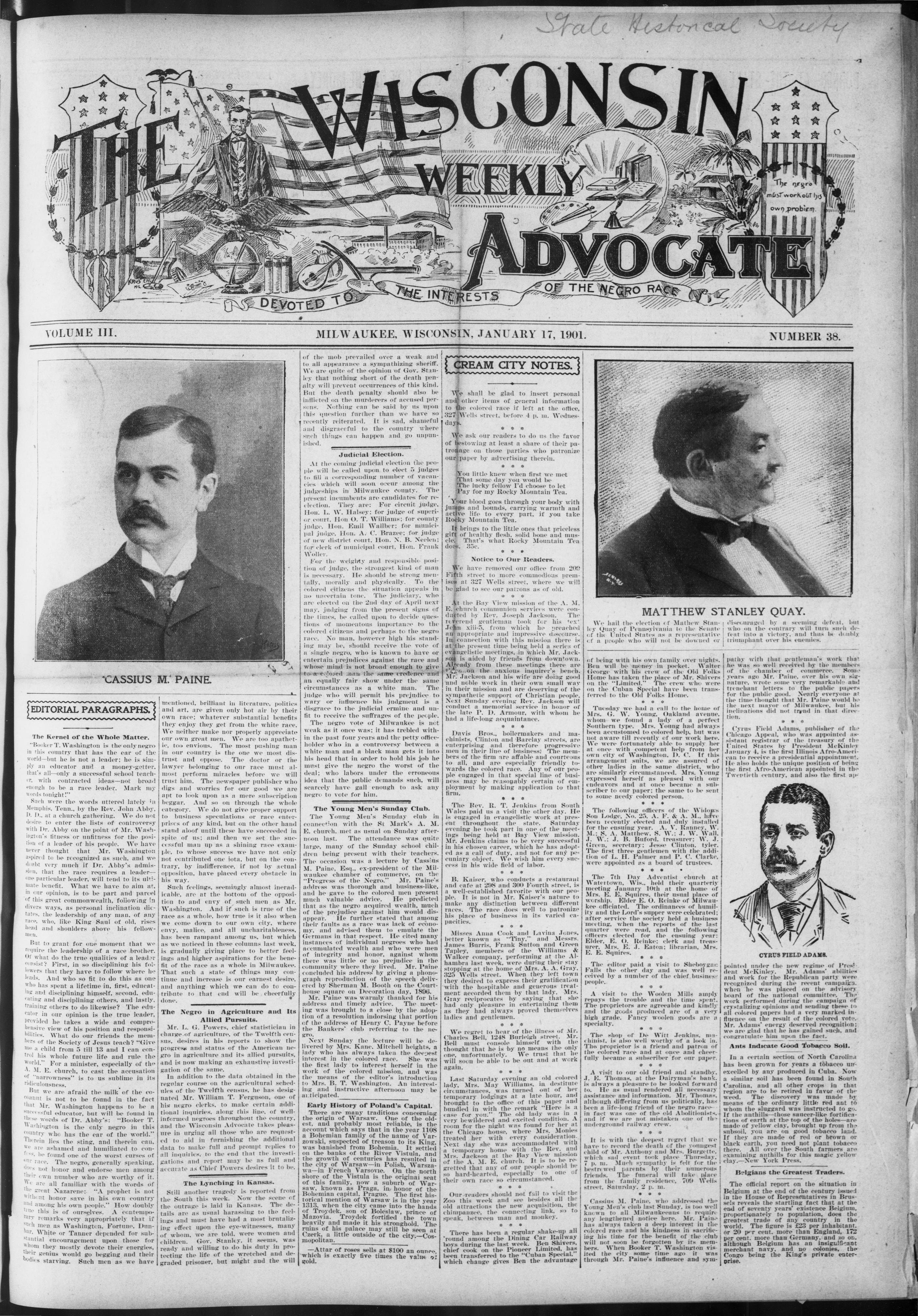
WISCONSIN
WEEKLY
Advocate
DEVOTED TO THE INTERESTS OF THE NEGRO RACE
[Name]
May
CASSIUS M. PAINE
EDITORIAL PARAGRAPHS.
The Kernel of the Whole Matter
"Booker T. Washington is the only negro in this country that has the ear of the world—but he is not a leader; he is simply an educator and a money-getter, that's all—only a successful school teacher, with contracted ideas—not broad enough to be a race leader. Mark my words tonight."
Such were the words uttered lately in Memphis, Tenn., by the Rev. John Abby, D. D., at a church gathering. We do not desire to enter the lists of controversy with Dr. Abby on the point of Mr. Washington's fitness or unfitness for the position of a leader of his people. We have never thought that Mr. Washington aspired to be recognized as such, and we doubt very much if Dr. Abby's admission, that the race requires a leader—one particular leader, will tend to its ultimate benefit. What we have to aim at, in our opinion, is to be part and parcel of this great commonwealth, following in divers ways, as personal inclination dictates, the leadership of any man, of any race, who, like King Saul of old, rises head and shoulders above his fellowmen.
But to grant for one moment that we require the leadership of a race brother. Of what do the true qualities of a leader consist? First, in so disciplining his followers that they have to follow where he leads. And who so fit to do this as one who has spent a lifetime in, first, educating and disciplining himself, second, educating and disciplining others, and lastly, training others to do likewise? The educator in our opinion is the true leader, provided he takes a wide and comprehensive view of his position and responsibilities. What do our friends the members of the Society of Jesus teach? "Give me a child from 5 till 13 and I can control his whole future life and rule the world." For a minister, especially of the A. M. E. church, to cast the accusation of "narrowness" is to us sublime in its ridiculousness.
But we are afraid the milk of the coconut is not to be found in the fact that Mr. Washington happens to be a successful educator, but will be found in these words of Dr. Abby's: "Booker T. Washington is the only negro in this country who has the ear of the world." Therein lies the sting, and therein can, we are ashamed and humiliated to confess, be found one of the worst curses of our race. The negro, generally speaking, does not honor and endorse men among their own number who are worthy of it. We are all familiar with the words of the great Nazarene: "A prophet is not without honor save in his own country and among his own people." How doubly true this is of ourselves. A contemporary remarks very appropriately that if such men as Washington, Fortune, Dunbar, White or Tanner depended for substantial encouragement upon those for whom they mostly devote their energies, their genius would go begging and their bodies starving. Such men as we have
---
VOLUME III.
mentioned, brilliant in literature, politics and art, are given only hot air by their own race; whatever substantial benefits they enjoy they get from the white race. We neither make nor properly appreciate our own great men. We are too apathetic, too envious. The most pushing man in our country is the one we most distrust and oppose. The doctor or the lawyer belonging to our race must almost perform miracles before we will trust him. The newspaper publisher who digs and worries for our good we are apt to look upon as a mere subscription beggar. And so on through the whole category. We do not give proper support to business speculations or race enterprises of any kind, but on the other hand stand aloof until these have succeeded in spite of us; and then we set the successful man up as a shining race example, to whose success we have not only not contributed one iota, but on the contrary, by indifference, if not by actual opposition, have placed every obstacle in his way.
Such feelings, seemingly almost ineradicable, are at the bottom of the opposition to and envy of such men as Mr. Washington. And if such is true of the race as a whole, how true is it also when we come down to our own city, where envy, malice, and all uncharitableness, has been rampant among us, but which as we noticed in these columns last week, is gradually giving place to better feelings and higher aspirations for the benefit of the race as a whole in Milwaukee. That such a state of things may continue and increase is our earnest desire, and anything which we can do to contribute to that end will be cheerfully done.
The Negro in Agriculture and Its Allied Pursuits.
Mr. L. G. Powers, chief statistician in charge.of agriculture, of the Twelfth census, desires in his reports to show the progress and status of the American negro in agriculture and its allied pursuits, and is now making an exhaustive investigation of the same.
In addition to the data obtained in the regular course on the agricultural schedules of the Twelfth census, he has designated Mr. William T. Ferguson, one of his negro clerks, to make certain additional inquiries, along this line, of well-informed negroes throughout the country, and the Wisconsin Advocate takes pleasure in urging all those who are requested to aid in furnishing the additional data to make full and prompt replies to all inquiries, to the end that the investigations and report may be as full and accurate as Chief Powers desires it to be.
The Lynching in Kansas.
Still another tragedy is reported from the South this week. Now the scene of the outrage is laid in Kansas. The details are as usual harassing to the feelings and must have had a most brutalizing effect upon the eye-witnesses, many of whom, we are told, were women and children. Gov. Stanley, it seems, was ready and willing to do his duty in protecting the life of the wretched and degraded prisoner, but might and the will
MILWAUKEE, WISCONSIN, JANUARY 17, 1901.
of the mob prevailed over a weak and to all appearance a sympathizing sheriff. We are quite of the opinion of Gov. Stanley that nothing short of the death penalty will prevent occurrences of this kind. But the death penalty should also be inflicted on the murderers of accused persons. Nothing can be said by us upon this question further than we have so recently reiterated. It is sad, shameful and disgraceful to the country where such things can happen and go unpunished.
Judicial Election.
At the coming judicial election the people will be called upon to elect 5 judges to fill a corresponding number of vacancies which will soon occur among the judgeships in Milwaukee county. The present incumbents are candidates for re-election. They are: For circuit judge, Hon. L. W. Halsey; for judge of superior court, Hon. O. T. Williams; for county judge, Hon. Emil Wallber; for municipal judge, Hon. A. C. Brazee; for judge of new district court, Hon. N. B. Neelen; for clerk of municipal court, Hon. Frank Wolley.
For the weighty and responsible position of judge, the strongest kind of man is necessary. He should be strong mentally, morally and physically. To the colored citizens the situation appeals in no uncertain tone. The judiciary, who are elected on the 2nd day of April next may, judging from the present signs of the times, be called upon to decide questions of momentous importance to the colored citizens and perhaps to the negro race. No man, however high his standing may be, should receive the vote of a single negro, who is known to have or entertain prejudices against the race and whose mind is not broad enough to give to a closed man the same credence and an equally fair show under the same circumstances as a white man. The judge who will permit his prejudice to wary or influence his judgment is a disgrace to the judicial ermine and unfit to receive the suffrages of the people.
The negro vote of Milwaukee is not weak as it once was; it has trebled within the past four years and the petty office-holder who in a controversy between a white man and a black man gets it into his head that in order to hold his job he must give the negro the worst of the deal; who labors under the erroneous idea that the public demands such, will scarcely have gall enough to ask any negro to vote for him.
The Young Men's Sunday Club
The Young Men's Sunday club in connection with the St Mark's A. M. E. church, met as usual on Sunday afternoon last. The attendance was quite large, many of the Sunday school children being present with their teachers. The occasion was a lecture by Cassius M. Paine, Esq., ex-president of the Milwaukee chamber of commerce, on the "Progress of the Negro." Mr. Paine's address was thorough and business-like, and he gave to the colored men present much valuable advice. He predicted that as the negro acquired wealth, much of the prejudice against him would disappear. He further stated that among their faults as a race was lack of economy, and advised them to emulate the Germans in that respect. He cited many instances of individual negroes who had accumulated wealth and who were men of integrity and honor, against whom there was little or no prejudice in the community where they lived. Mr. Paine concluded his address by giving a phonograph reproduction of the speech delivered by Sherman M. Booth on the Courthouse square on Decoration day, 1896.
Mr. Paine was warmly thanked for his address and timely advice. The meeting was brought to a close by the adoption of a resolution indorsing that portion of the address of Henry C. Payne before the Bankers' club referring to the negro. Next Sunday the lecture will be delivered by Mrs. Kane. Mitchell heights, a lady who has always taken the deepest interest in the colored race. She was the first lady to interest herself in the work of the colored mission, and was the means of the editor's introduction to Mrs. B. T. Washington. An interesting and instructive afternoon may be anticipated.
Early History of Poland's Capital.
Early History of Poland's Capital.
There are many traditions concerning the origin of Warsaw. One of the oldest, and probably most reliable, is the account which says that in the year 1108 a Bohemian family of the name of Varzowski, suspected of treason to its King, was banished from Bohemia. It settled on the banks of the River Vistula, and the growth of centuries has resulted in the city of Warsaw—in Polish, Warszawa—in French Varsovie. On the north shore of the Vistula is the original seat of this family, now a suburb of Warsaw, known as Praga, in honor of the Bohemian capital, Prague. The first historical mention of Warsaw is in the year 1313, when the city came into the hands of Troydek, son of Boleslaw, prince of Mazovia. Troydek fortified the town heavily and made it his stronghold. The ruins of his palace may still be seen at Czerk, a little outside of the city.—Cosmopolitan.
Attar of roses sells at $100 an ounce, which is exactly five times the value 22 gold.
CREAM CITY NOTES.
We shall be glad to insert personal and other items of general information to the colored race if left at the office, 327 Wells street, before 4 p. m. Wednesdays.
* * *
We ask our readers to do us the favor of bestowing at least a share of their patronage on those parties who patronize our paper by advertising therein.
* * *
You little knew when first we met
That our day would be
Your blood goes through your body with jumps and bounds, carrying warmth and active life to every part, if you take Rocky Mountain Tea. It brings to the little ones that priceless gift of healthy flesh, solid bone and muscle. That's what Rocky Mountain Tea does. 35c.
Notice to Our Readers.
We have removed our office from 209 Fifth street to more commodious premises at 327 Wells street, where we will be glad to see our patrons as of old.
At the Bay View mission of the A. M. E. church communion services were conducted by Rev. Joseph Jackson. The reverend gentleman took for his text John xiii-5, from which he preached an appropriate and impressive discourse. In connection with this mission there is at the present time being held a series of evangelistic meetings, in which Mr. Jackson is aided by friends from downtown. Already from these meetings there are on the anxious inquirer's bench. Mr. Jackson and his wife are doing good and noble work in their own small way in their mission and are deserving of the sympathetic support of Christian people. Next Sunday evening Rev. Jackson will conduct a memorial service in honor of the late P. D. Armour, with whom he had a life-long acquaintance.
***
Davis Bros., boilermakers and machinists, Clinton and Barclay streets, are enterprising and therefore progressive men in their line of business! The members of the firm are affable and courteous to all, and are especially friendly towards the colored race. Any of our people engaged in that special line of business may be reasonably certain of employment by making application to that firm.
象 串 杂
The Rev. R. T. Jenkins from South Wales paid us a visit the other day. He is engaged in evangelistic work at present throughout the state. Saturday evening he took part in one of the meetings being held at Bay View mission. Mr. Jenkins claims to be very successful in his chosen career, which he has adopted as a call of duty, and not for any pecuniary object. We wish him every success in his wide field of labor.
\* \* \*
B. Kaiser, who conducts a restaurant and cafe at 298 and 300 Fourth street, is a well-established favorite with our people. It is not in Mr. Kaiser's nature to make any distinction between different races. The race does well to patronize his place of business in its varied capacities.
```markdown
```
Misses Anna Cook and Lavina Jones, better known as "Tiny," and Messrs James Burris, Frank Sutton and Green Tapley, members of the Williams & Walker company, performing at the Alhambra last week, were during their stay stopping at the home of Mrs. A. A. Gray, 325 Wells street. When they left town they desired to express their gratification with the hospitable and generous treatment accorded them by that lady. Mrs. Gray reciprocates by saying that she had only pleasure in entertaining them as they had always proved themselves ladies and gentlemen.
☆ ☆ ☆
We regret to hear of the illness of Mr. Charles Bell, 1248 Burleigh street. Mr. Bell must console himself with the thought that he is by no means the only one, unfortunately. We trust that he will soon be able to be out and at work again.
☆ ☆ ☆
Last Saturday evening an old colored lady, Mrs. May Williams, in destitute circumstances, was turned out of her temporary lodgings at a late hour, and brought to the office of this paper and bundled in with the remark "Here is a case for you." The old lady was in a very bewildered and excited condition. A room for the night was found for her at the Chicago house, where Mrs. Monies treated her with every consideration. Next day she was accommodated with a temporary home with the Rev. and Mrs. Jackson at the Bay View mission of the A. M. E. church. It is to be regretted that any of our people should be so hard-hearted, especially to one of their own race so circumstanced.
```markdown
```
Our readers should not fail to visit the Zoo this week and see besides all the old attractions the new acquisition, the chimpanzee, the connecting link, so to speak, between man and monkey.
* * *
There has been a regular shake-up all round among the Dining Car Railway boys during the last week. Ben Shivers, chief cook on the Pioneer Limited, has been transferred to the "Cuban Special." which change gives Ben the advantage
JENNIE
MATTHEW STANLEY QUAY. We hail the election of Matthew Stanley Quay of Pennsylvania to the Senate of the United States as a representative of a people who will not be downed or discouraged by a seen who on the contrary wfeat into a victory, and triumphant over his ene
of being with his own family over nights. Ben will be money in pocket. Walter George with his crew of the Old Folks Home has taken the place of Mr. Shivers on the "Limited." The crew who were on the Cuban Special have been transferred to the Old Folks Home.
Tuesday we had a call to the home of Mrs. G. W. Young, Oakland avenue, whom we found a lady of a perfect Southern type. Mrs. Young had always been accustomed to colored help, but was not aware till recently of our work here. We were fortunately able to supply her at once with competent help from her own city of Washington, D. C. If this arrangement suits, we are assured of other ladies in the same district, who are similarly circumstanced. Mrs. Young expressed herself as pleased with our endeavors and at once became a subscriber to our paper; the same to be sent to some needy colored person.
The following officers of the Widows Son Lodge, No. 25, A. F. & A. M., have been recently elected and duly installed for the ensuing year. A. V. Ranney, W. M.; S. A. Matthew, S. W.; J. W. Wall, J. W.; J. B. Buford, treasurer; W. J. Green, secretary; Jesse Clinton, tyler. The first three gentlemen with the addition of L. H. Palmer and P. C. Clarke, were appointed as a board of trustees.
* * * *
The 7th Day Adventist church at Watertown, Wis., held their quarterly meeting January 10th at the home of Mrs. E. E. Squires, their usual place of worship. Elder E. O. Reinke of Milwaukee officiated. The ordinances of humility and the Lord's supper were celebrated; after service the society held a business meeting, when the reports of the last quarter were read, and the following officers elected for the ensuing year: Elder, E. O. Reinke; clerk and treasurer, Mrs. E. J. Eaton; librarian, Mrs. E. E. Squires.
The editor paid a visit to Sheboygan Falls the other day and was well received by a number of the chief business people.
A visit to the Woolen Mills amply repays the trouble and the time spent. The proprietors are agreeable and kindly and the goods produced are of a very high grade. Fancy woolen goods are a specialty.
The shop of De Witt Jenkins, machinist, is also well worthy of a look in. The proprietor is a friend and patron of the colored race and at once and cheerfully became a subscriber for our paper.
A visit to our old friend and standby, J. E. Thomas, at the Dairyman's bank, is always a pleasure to be looked forward to. He as usual rendered all necessary assistance and information. Mr. Thomas, although differing from us politically, has been a life-long friend of the negro race in fact was one of the old Abolitionists, and if we are not mistaken one of the underground railway crew.
It is with the deepest regret that we have to record the death of the youngest child of Mr. Anthony and Mrs. Burgette, which sad event took place Thursday, 7 p. m. Much sympathy is felt for the bestrewed parents by their numerous friends. The funeral will take place from the family residence, 709 Wells street, Saturday, 2 p. m.
Cassius M. Paine, who addressed the Young Men's club last Sunday, is too well known to all Milwaukeeans to require any lengthened notice here. Mr. Pain has always taken a deep interest in the colored race and his kindness in sacrificing his time for the benefit of the club will not soon be forgotten by its members. When Booker T. Washington visited the city some time ago it was through Mr. Paine's influence and sym-
---
* * *
```markdown
```
* * *
```markdown
```
* * *
* * *
* * *
discouraged by a seeming defeat, but who on the contrary will turn such defeat into a victory, and thus be doubly triumphant over his enemies.
pathy with that gentleman's work that he was so well received by the members of the chamber of commerce. Some years ago Mr. Paine, over his own signature, wrote some very remarkable and trenchant letters to the public papers for the public good. Nearly everyone at the time thought that Mr. Paine would be the next mayor of Milwaukee, but his inclinations did not trend in that direction.
Cyrus Field Adams, publisher of the Chicago Appeal, who was appointed assistant registrar of the treasury of the United States by President McKinley January 4, is the first Illinois Afro-American to receive a presidential appointment. He also holds the unique position of being the first Afro-American appointed in the Twentieth century, and also the first ap-
J.
CYRUS FIELD ADAMS. pointed under the new regime of President McKinley. Mr. Adams' abilities and work for the Republican party were recognized during the recent campaign, when he was placed on the advisory board of the national committee. The work performed during the campaign of crystalizing opinions and sending these to all colored papers had a very marked influence on the result of the colored vote. Mr. Adams' energy deserved recognition; we are glad that he has gained such, and congratulate him upon the fact.
Ants Indicate Good Tobacco Soil.
In a certain section of North Carolina has been grown for years a tobacco unexcelled by any produced in Cuba. Now a similar soil has been found in South Carolina, and all other crops in that region are to be retired in favor of the weed. The discovery was made by means of the ordinary little red ant to whom the sluggard was instructed to go. If the anthills—those saucer-like fortifications of earth at the top of the holes—are made of yellow clay, brought up from the subsoil, you are on good tobacco land. If they are made of red or brown or black earth, you need not plant tobacco there. All over the South farmers are examining anthills for this magic yellow clay.—New York Press.
Belgians the Greatest Traders.
The official report on the situation in Belgium at the end of the century issued in the House of Representatives in Brussels reveals the startling fact that at the end of seventy years' existence Belgium, proportionately to population, does the greatest trade of any country in the world. The figure is £23 per inhabitant, or 20 per cent, more than England, 172 per cent, more than Germany, and so on, although Belgium has an insignificant merchant navy, and no colonies, the Congo being the King's private enterprise.
```markdown
```
BURNED AT THE STAKE
Negro Taken from Jail by a Mob at Leavenworth, Kas.
Father of the Girl Applies Torch on the Spot Where His Daughter's Body was Found.
Leavenworth. Kas., Jan. 16.—Fred Alexander, the young negro arrested on Saturday night shortly after he attempted to assault Miss Eva May Roth, was burned at the stake in the western part of the city at 5:30 yesterday afternoon in the presence of fully 5000 people. He maintained his innocence of murdering Pearl Forbes to the last and kept his nerve to the end, going so far as to ask several friends to step up and bid him goodby, after coal oil was thrown over him.
The mob leaders broke into the jail by pounding in two doors. Men beat down the iron door of the cellroom and a yelling pack broke into the stockade, tore and beat down the sheet iron doors. The cry went up that Alexander had escaped, but he was discovered, crouching in the corner of the cell.
Alexander fought like a tiger and was knocked senseless with a hammer before he could be taken from the cell. Once outside he revived. Across Third street and up the hill into the courthouse yard the mob dragged him. All the way Alexander was pleading for his life.
It was first decided to hang him in the jail yard, but this was changed to burning, and it was announced that Alexander should be taken to the place where Pearl Forbes' body was found two months ago.
Parade Through Residence District.
Alexander was placed in a large wagon, with a dozen men around him, and he was paraded through the streets. He was bleeding from his fights with the mob, but was made to stand up, so all could see him. A great procession of buggies and wagons of all descriptions followed, and announcement was made from time to time: "We will burn him where he killed Pearl Forbes." This place was reached after a long detour down Broadway, through the fashionable residence part of the city.
The spot chosen for the stake was the exact one on which Pearl Forbes' body was found on the morning of November 7. It was in the center of a deep guily, the sloping sides of which furnished a view for everyone in the mob. An iron stake had been driven and old lumber riled up ready to burn Alexander.
The wagon was stopped in front of the ravine and surrounded by the crowd. The leader of the men who held Alexander called for silence. The roar ceased and Alexander was shoved forward. A howl went up which was quickly hushed as the prisoner raised his shackled hands and began to speak. Twice he started and the crowd drowned his trembling voice. "You are going to kill me whatever I say," he said. "but you men are wrong. I want to tell you right now you've got the wrong man. I did not do that, and some day you men here will run up against the man who did. I know it ain't any use to say so, for you're going to kill me, but I didn't do it."
Impatient, the captors shoved him down in the wagon, which was rapidly driven down the hill to the place of execution. Alexander walked up to the iron stake in a bold manner. Chains and wires were wrapped about him and with his hands still shackled he was made fast to the post.
Girl's Father Lights Fire.
Alexander called for his old mother, but she was not in the crowd. She had been, and was the only one noticed to shed a tear. A few negro friends removed her and took her to her home. After two cans of coal oil were thrown over Alexander and the pile of lumber William Forbes asked:
"Are you guilty of murdering my daughter?"
"I don't know what you have me here for," said Alexander. "For killing my girl on this spot." "Mr. Forbes, if that's your name, you have the wrong man." "Burn him, burn him!" yelled the crowd. "You've got lots of time," said Alexander. "You are burning an innocent man. You took advantage of me. Will you let me shake hands with all of my friends?" "You have no friends in this crowd," said some one. "I am innocent, let me pray." were the words of Alexander as Mr. Forbes applied a match to the pile.
"O, my God! O, my God!" was his only cry as the flames burned up all about him. Alexander tried to shield his face from the flames with his hand-cuffed hands. He was conscious only a moment. Long after he was dead lumber was piled on his body.
Crowd Scrambles for Relics.
When the fire had died down sufficiently to allow the crowd to approach there was a wild scramble to obtain reliics, bits of charred flesh, pieces of chain, scraps of wood—anything that could possibly serve as a souvenir.
Fully one-third of the crowd that witnessed the burning were women, and there were hundreds of school children in it. School was just dismissed as the fights with the mobs in the city commenced.
There were a few hundred negroes in the crowd, and the younger element among them joked and acted the same as young whites during the half hour it required to tie Alexander to the stake.
Governor Scores the Sheriff.
Topeka, Kas., Jan. 16—Gov. W. E. Stanley is indignant at the result of the lynching at Leavenworth. He says it will result in the death penalty in Kansas for the crime of which Alekander was accused. Gov. Stanley condemns Sheriff Everhardy of Leavenworth in unmeasured terms.
"The sheriff of Leavenworth is either a despicable scoundrel or a despicable coward," said the governor last night.
"There was no reason in the world the negro should not have been protected to the last. The whole militia power of the state would be devoted to that effort, and the sheriff knew it all the time."
PASSENGERS LANDED.
Ward Line Steamer will be Saved in Present Weather Holds.
Havana, Jan. 16.—The passengers of the Ward line steamer Vigilance which went ashore Monday morning on the reefs of Los Colorados about 100 miles west of this city in a fog have arrived here on the steamer Orizaba, which went to her assistance with two tugs and lighters. The wind has veered southward and there is no sea running. It is thought the vessel will be saved if the weather holds.
JOHANN FABER PASSES AWAY
Founder of the Famous Pencil Factory is Dead. Nuremburg, Jan. 16.—Johann Faber founder of the Faber lead pencil factory is dead.
RICH GIRL WEDS A PENNILESS BOY.
Romantic Marriage of Honolulu Heiress to Texas Young Man.
Paris, Tex., Jan. 15.—The most romantic wedding that ever occurred in Texas took place at Clarksville, thirty miles east of Paris. Miss Mamie Smith, worth a million, from Honolulu, aged 19, was married to Emmet Burke, aged 20, son of a Texas & Pacific section foreman between Paris and Clarksville. David Smith, father of the bride, while engaged in general merchandise eighteen years ago at Tishomingo, Indian Territory, ordered large quantities of goods from St. Louis and Chicago houses on time, converted them into cash and left the country with $100,000. He turned up in the Hawaiian islands. In a few years he became the owner of vast coffee and sugar estates, obtained valuable concessions from the government and was the first to introduce electricity in the islands. He was a member of the Hawaiian delegation that went before Congress to secure annexation to the United States.
While in this country he made good to his creditors the money he had converted and returned to Honolulu. He died a year ago, leaving his daughter his sole heir. She was born at Rosalie, Red River county, near Clarksville, and reached here a month ago to visit her birthplace. She was engaged to marry a prominent San Francisco lawyer, who had the management of her estate. She met young Burke, a penniless boy, three weeks ago. A romantic attachment sprung up, culminating in the marriage.
FIND CHECKS FROM STEAMER CHICORA.
Indications that Lost Vessel Lies Southwest of St. Joseph, Mich.. Harbor.
St. Joseph, Mich., Jan. 15.—That the wreck of the steamer Chicora lies a few miles to the southwest of this harbor was confirmed by finding a bunch of brass baggage checks. The word "Chicora" was engraved upon the face of the checks and they were identified by the Graham & Morton company as property from the lost steamer. The steamer Chicora foundered in Lake Michigan on January 21, 1895, and the crew of twenty-one persons was lost.
Although wreckage came ashore the following spring at various northern points, and while many mariners believed the steamer never reached this shore, it is agreed in marine circles this morning that the steamer on the fatal night did reach the eastern shore at this point, but, fearing the bar at the mouth of the harbor, was compelled to remain in the lake awaiting daylight, and, while thus delayed, foundered in sight of its home port.
STAND BY THE NOTE.
Allies Not Likely to Modify Their Demands on China—Protocol is Signed.
Pekin, Jan. 14.—A protocol was signed this morning with the idea of protesting against the abandonment of any clause in the joint note of the powers.
The Chinese peace commissioners state that signed copies of the preliminary note of the powers will be presented to the ministers tomorrow or Wednesday. The reason that they are not presented before then is that the Chinese representatives desire to comply with the request of the ministers that they put in writing the questions they want to ask about the terms of the note. A draft of these questions, the nature of which has already been described, was finished today. Nothing will transpire until the questions are presented and the ministers have an opportunity to discuss them.
Russia today began turning over the railway to Germany. The latter intends to place the management of the line with former employees of the company, under military supervision. Germany has requested the stationmasters, engine drivers and mechanics who were formerly employed to report at the German headquarters, when they will be given their old positions.
STRIKE AT A FUNERAL.
One Carriage Driver was Not Member of Union and the Others Quit.
Troy, N. Y., Jan. 15.—While the body of Mrs. Ellen Duffy was being carried from the house to a hearse in the street, a row occurred between several coach-drivers caused by information that one of the carriage drivers in the funeral procession was not a member of the Livery Employes' union. Fred Lowe, who was in charge of the hearse, refused to allow the coffin to be placed in the vehicle unless the objectionable driver were taken out of the line. The casket containing the remains lay on the sidewalk surrounded by the pallbearers and the angry drivers. The latter were threatened with arrest and the police were summoned. The undertaker argued with the men, declared that the objectionable driver had been employed by private parties and it was not until the arrival of the police on the scene that the strikers were brought to reason and the funeral proceeded.
LOSES HIS COLLEGE CHAIR.
Dr. Howard Ousted from Stanford for Championing Dr. Ross.
San Francisco, Cal., Jan. 15.—Dr. George E. Howard, head of the department of history at Stanford university, was forced to resign because last November he championed the cause of Dr. Edward A. Ross in a public address, declaring that Ross' dismissal was the muzzling of free speech. Saturday President Jordan demanded Howard's resignation or an apology for his November speech. Howard refused to apologize and tendered his resignation, to take effect at once. Howard was the most popular professor at Stanford and his dismissal from a life position is due to Mrs. Stanford's animosity because he defended Ross.
Colossus Among Cranes.
Messrs. W. Doxford & Sons have just erected at their shipyard at Pallion, Sunderland, the largest crane in any private shipyard in the world. Fixed on a main foundation, consisting of a block of concrete 20 feet square, this leviathan weightlifter is capable of dealing with 150 tons at 50 feet radius, and 90 tons at 80 feet radius. The total weight of the crane is 329 tons, and it is under the control of one man only.
A Cruel Cut.—The Saucy Soubrette (in the "Continuous")—"When do you go on?" The Irish Comedian—"Right after the trained donkeys." The Saucy Soubrette—"Heavens! It's a wonder the stage manager doesn't try and break the monotony more than he does."—Brooklyn Life.
—It is estimated that from $150,000,000 to $200,000,000 worth of property is every year destroyed by fire all over the world.
—The agricultural output of the state of Colorado for 1900 will approximate $90,000,000 in value.
TRAIN RAN INTO A BURNING BRIDGE.
TRAIN RAN INTO A BURNING BRIDGE.
All the Cars Are Derailed but Remain Upright and Passengers Escape Injury. Barstow, Cal., Jan. 16.—Santa Fe overland No. 8. east-bound from San Francisco for Chicago ran into a burning bridge at Siberia, seventy miles east of here. All the cars were derailed, but remained in an upright position and none of the passengers was hurt.
FATAL FIRE IN APARTMENT HOUSE.
Chicago Man Loses His Life Trying to Save Bankbook and Insurance Policy.
Chicago Ill., Jan. 16.—In a fire which destroyed the Aberdeen apartment building here today Frank Crowell, superintendent of Swift & Co.'s glue factory, lost his life. While trying to save his bankbook and insurance policy, which were found clasped in his hands, he was overcome by smoke. A score of tenants escaped with difficulty. The loss was $75,000, including the personal effects and household goods of twelve families. A special detail of ten engines was called out to prevent the flames spreading to other buildings, as high wind was blowing.
CHASED BY A GRIZZLY.
Roosevelt Encounters a Bear in Rocky Mountains-An Unlucky Stumble.
Meeker, Col., Jan. 16.—Ex-Gov. Roosevelt, according to a cattleman who arrived from the Keystone ranch, had a narrow escape during an encounter with a grizzly. The party has been out from dawn till dark every day since the start. The first day out they bagged a mountain lion and a large wildcat. Sunday the party was out all day, but with little success. Monday, however, they had an adventure that all will remember.
The hunters had been out hardly an hour when they came on the tracks of a huge grizzly. They followed the trail through the snow until it entered a narrow box canyon, the entrance to which was so blocked with snow that the hunters were compelled to dismount and continue the chase on foot. After an arduous tramp of three or four miles up the canyon they caught sight of the grizzly lumbering along ahead of them leisurely and with no thought of approaching danger. They succeeded in getting within 100 yards of the beast before he noticed them and then opened fire. The only effect of the fusillade apparently was to make the beast move the faster.
Neither hunter nor quarry were able to move very fast on account of the deep snow, but the men had the advantage because the snow was well enough packed to partially bear them up. Col. Roosevelt, in spite of warnings from the rest of the party, rushed ahead, pumping lead as fast as he could work the lever of his rifle. At last, stung by his wounds, the maddened animal turned. There was no escape ahead, for the canyon ended in a cul-de-sac with precipitous walls on every side. Bruin was at bay and ready to fight.
Down the canyon he came, determined to change the bear hunt into a man hunt. Col. Roosevelt, far in the lead of the party, stood his ground until the magazine of his rifle was empty, and, then without regard for appearances, turned and ran. But the path through the snow was now well broken and bruin was the swifter. The others, with replenished magazines, spread out and again opened fire. The grizzly was weakening from his wounds, but still gaining. Col. Roosevelt dropped his rifle and made an extra spurt and, breathless and exhausted, stumbled over a rock and fell headlong in the snow. The grizzly, stopped by the last fusillade, dropped a lifeless mass not fifteen feet behind Col. Roosevelt.
ALVORD IS SENTENCED.
New York Bank Teller Given Thirteen Years for Stealing $600,~ 000 from First National.
New York, Jan. 16.—Cornelius L. Alvord, Jr., the defaulting note teller of the First National bank, was today sentenced to thirteen years' imprisonment. The amount of his defalcation was $690,000.
J. Prevost Mason, third teller of the Continental National bank of this city is in jail charged with embezzlement. Mason was arrested late last night. The specific charge is the stealing of $3000 by means of false entries. The peculiations foot up $12,000 in all, according to the Fidelity & Casualty company, which was on Mason's bond for $10,000. Mason is 48 years old and lived with his wife and daughter, 22 years, at 1551 Washington avenue, where he was arrested. He has practically been in charge since Sunday. He has been with the bank twenty-seven years and received a salary of $1800 a year.
Bank Examiner Charles A. Hanna went to the Continental bank Saturday to look over the books. Mason complained of not feeling well and said he guessed he would go home. He did and a clerk was put in his place. It was not long before the clerk discovered something which led him to notify the bank examiner, and the shortage was discovered.
HOTEL BLOWN DOWN.
Summer Resort Being Erected Near Frankfort, Mich., is in Ruins.
Frankfort, Mich., Jan. 16.—[Special.]
The big summer hotel in process of erection on the lake shore at this place by the Ann Arbor railroad was blown down to the ground in the gale last night and is a total wreck. The frame was all up and roof on. The hotel was to be ready for business by June.
ROB BUTCHER OF $300.
Thief at Ironwood Keeps Proprietor Quiet While Pal Goes Through Safe.
Ironwood, Mich., Jan. 16.—[Special.]—Lee & Tenneson's butcher shop was robbed of $300 last evening. Two men entered the shop and while one man "stuck up" Mr. Lee at the point of a revolver, the other went through the safe and cash drawer. The men escaped and the police have no clue.
SENATOR'S SON TO MARRY.
W. A. Clark, Jr., will Wed Miss Mabel Foster After Easter.
Butte, Mont., Jan. 16.—W. A. Clark Jr., and Miss Mabel Foster, the youngest daughter of Mr. and Mrs. John W. Foster of this city, are to be married after Easter. The engagement was announced yesterday. The couple will travel abroad for a time and afterward will occupy Senator Clark's New York mansion. The young man is the youngest son of Senator W. A. Clark and is engaged in the practice of law in Butte. He is a graduate of the University of Virginia, is 22 years of age and a millionaire in his own right.
WILL GIVE UP THE MONEY.
Embezzler Zimmerman's Theft will be Made Good.
GAVE IT TO A WOMAN.
She is Arrested in Penisylvania and Agrees to Make Restitution to Avoid Prosecution.
Monroe, Wis., Jan. 16.—[Special.]—It is probable that a large portion of the funds, stolen from the Klass estate by Zimmerman, the embezzling executor, will be recovered. At an interview with his bondsmen after going to Waupun Zimmerman reluctantly informed them that he had left most of the money with a woman at Catawissa, Pa. He made affidavit to the facts and armed with these documents John Gardner went to Catawissa and thence to Wilkesbarre, where the woman had gone. She was found driving a spirited team on the street and arrested. She was frightened when certain contingencies of the law were placed before her, and agreed to turn over all the money and property she had received from Zimmerman in return for immunity from prosecution. The bondsmen believe that Gardner will return with the greater portion of the $4800 which Zimmerman took with him.
OLD COUPLE BOTH ALLEGE CRUELTY.
Fifty Years of Married Life Have Not Been Happy-Divorce Granted by Stipulation.
Oshkosh, Wis., Jan. 16.—[Special.]—A rather unusual divorce case occurred in the circuit court yesterday afternoon, when Judge Burnell granted a divorce to Mrs. Henrietta Weber, aged 72 years, from her husband, Phillip Weber, aged 78 years. The divorce was granted by stipulation, the defendant failing to appear. The couple resided in the town of Black Wolf, where they have a farm of forty acres, which was ordered divided equally
The wife alleges extreme cruelty on the part of her husband, while the attorneys for the latter claim that he has been the party abused, and that at present he is suffering from injuries received at the hands of his wife and son, who held him down and kicked him in the abdomen, so that he is confined to his bed. They have been married for nearly 50 years.
AGED COUPLE IN DIVORCE COURT.
Romantic Elopement of Albert Hemingway, Aged 66, and His Wife, Nine Years Younger.
Marinette, Wis., Jan. 16.—[Special.]—The suit of Albert Hemingway, aged 66, against Arabelle Hemingway, aged 57, for divorce, came up yesterday in the circuit court. They were married seven years ago, he a widower and she a widow. They eloped from Petersburg, Va., and were secretly married, on account of the opposition of the children on both sides. The groom tired of the marrionial alliance and deserted his wife. She followed him to New York and then came to this city in pursuit of him. Judge Hastings took the case under advisement.
HE DID NOT DROWN.
John Berry of Washburn Writes from Philippines Saying that He Is Serving in the Army.
Washburn, Wis., Jan. 16.—[Special.]—The report sent out from West Superior to the effect that Sergt. John Berry of this city was drowned in midocean, while on his way from San Francisco to Manila, proves to be erroneous. A letter dated December 4 has just been received from Sergt. Berry by a friend in this city, in which he speaks of having enjoyed a pleasant ocean voyage, and says he is now doing active duty with his regiment.
DIES OF HIS INJURIES.
Gilbert W. Burnett of Manitowoo was Run Down by a Wisconsin Central Train.
Manitowoc, Wis., Jan. 16.—[Special.]
-Gilbert W. Burnett, who was severely injured some time ago on the Wisconsin Central Railway company's bridge here by having his feet cut off by a train, died this morning. He was 78 years old and was born in Scotland. He came to America in 1840 and settled at Lodi, N. J. In 1849 he came here. He is survived by his wife and seven grown children.
MRS. JANE MORTON DIES.
Mother of Mrs. Adelaide King of Waupun Passes Away—Well-Known Member of W. T. C. U.
Waupun, Wis. Jan. 16.—[Special.]—Mrs. Jane Morton, widow of the late D. P. Morton, died this morning. She was an old resident of this city and was 66 years old. She is survived by a daughter, Mrs. Adelaide King, and a grand-daughter. She was prominent in W. C. T. U. work. She was a partner of Mrs. King in the publication of the Waupun Times.
FOUNDRY AT CEDAR GROVE.
More than Half the Money Necessary Has Been Subscribed.
Sheboygan, Wis., Jan. 16.—[Special.]
—Matters are fast shaping themselves for the location of the new foundry at Cedar Grove. Of the $20,000 necessary to secure the plant $14,000 has been secured and the remaining $6000 is in sight. Plans for the new structure have been received from the architects and contractors have submitted figures on the cost of construction. The possibility of securing this enterprise in Cedar Grove has had a wonderful effect on real estate, sending the prices skyward.
DISEASE WELL IN HAND.
There Are Five Cases at La Crosse Strictly Quarantined.
La Crosse, Wis., Jan. 16.—[Special.]—A meeting of the board of health and board of trade was held last night to take some action regarding the prevalence of smallpox here. No new cases developed yesterday and the authorities think they have the situation well in hand. There are only five cases in all.
Can't Get Damages.
La Crosse, Wis., Jan. 16.—[Special.]—E. M. Wing, cashier of the Batavian bank, won an important case from R. L. Ferguson, who sued him for $5000 damages for false imprisonment. Ferguson was arrested, charged with stealing wood from Wing's land, near Genoa. The jury decided in favor of the defendant.
LEGISLATURE.
The Senate met at the customary hour on the 10th, but transacted no business, the members repairing to the Assembly chamber to listen to the governor's message. Upon reconvening the Senate adjourned until the 15th.
The Legislature began its session in earnest on the evening of the 15th. The principal measures introduced in the Senate were bills offered by Senator Mills. One provides for a revision of the salaries of the state oil inspector and his deputies and also for important changes in the matter of inspection. The measure is drafted along the lines suggested by Gov. La Follette in his message. Another bill provides for the repeal of the present taxation system whereby street railways pay a tax on the gross earnings of the roads, and substitutes a system of taxation on the valuation of the property, just as other property is taxed. In the Senate the first steps were taken for the appointment of a joint committee of the two houses to act on the legislative reapportionment of the state.
A bill radically changing the laws regarding marriage was introduced in the Senate on the 16th by Senator Stout. It provides for the appointment of local boards of physicians who shall consider all applications for license to marry and forbids any marriage without their approval. The bill provides that within thirty days after its passage the probate judge in each county shall appoint three reputable practicing physicians, residents of the county, no two belonging to the same school of medicine, and one, where possible, a woman, whose duty it shall be to consider and pass upon all applications for license to marry, and no license to marry shall be granted unless the applicants shall receive from this board certificate setting forth that such applicants are free from certain alliments. Senator Weed introduced a petition from the county board of Winnabago county appealing to the Legislature for the enactment of laws which will prohibit football playing in this state on the ground that the game is brutal and dangerous. Senator Roeh introduced a bill increasing the power of the registrar in probate and slightly increasing the salaries of some of his assistants. Senator McGillivray introduced a bill amending the law relative to care of deaf and dumb, providing for the appointment of a state inspector of deaf and dumb, at a salary of $1000, by the state superintendent of instruction, who shall define his duties. The committee on revision of rules reported two substitutes for the resolution relative to the committee on assessment and collection of taxes. One substitute merely increases the membership of the committee from three to five; the other provides for joint hearings by the same committee for the two houses. The report went over.
Assembly.
The two houses of the Wisconsin Legislature met in joint session in the Assembly at 10 o'clock to listen to the reading of Gov. La Follette's inaugural message. It was an event of unusual interest, not only because no governor in recent years has read his message, but because it was expected that the message would be out of the ordinary and the members were anxious to know what it would contain. The Assembly met at 9:30 but did no business, not being even called together. Shortly after 10 o'clock Speaker Ray rapped for order and the sergeant-at-arms announced the lieutenant-governor, the Supreme court and the Senate. They came into the room in the order named, and the chief justice and members of the Supreme court took the front row of seats. A few moments later the sergeant-at-arms announced his excellency the governor and the members arose to receive him. The governor was accompanied by the legislative committee with Senator Roehr at its head. The other members of the committee were Senator Munson and Assembly Collin, Steiger and Stevens. Lieut.-Gov. Stone introduced Gov. La Follette in a few formal words, and the governor began at once to read his message. The reading occupied about two hours and the governor was applauded when he concluded. After the senators retired the Assembly was called to order and adjournment taken until 8 p. m. on the 15th.
The principal business of the Assembly on the evening of the 15th was the announcement of the standing committees by the speaker. Assemblyman Overbeck of Sturgeon Bay introduced a bill to prohibit the sale or bringing into the state for the purpose of sale or giving away of any cigarettes, cigarette paper or substitute thereof.
The most interesting feature of the session on the 16th was a bill by Mr. Rossman amending the law relating to the taxation of bank stock. Mr. Rossman's bill requires the stockholder to pay taxes on the full amount regardless of his debts. Mr. Williams of Winnebago county offered a joint resolution for a constitutional amendment relating to banking laws. It is a copy of resolution adopted two years ago and its passing at this session is necessary before it can go before the people. The first petition presented to the Assembly came from Winnebago county and was in favor of repeal of law prohibiting spring shooting. The resolution for a joint committee on forestry and lumber was referred to the committee on the revision of rules. The Senate resolution for a special committee on apportionment brought an amendment from Mr. Sturdevant, increasing the number of assemblymen from thirteen to fifteen. The amendment was adopted and the resolution concurred in. A large number of bills were introduced, including the following of more important ones: Amending the laws relating to the paying of a bounty for killing wolves and other wild animals, increasing it to $10 for mature wolves, repealing the law for publishing the road maps. He also introduced a bill changing the closed season for pheasants; amending the game laws, extending the prohibition on pheasants from 1901 to 1905.
CONGRESS.
CONGRESS.
Senate.
Thursday, Jan. 10.—Discussion of the army reorganization bill occupied the day.
Friday, Jan. 11.—Passed House reapportionment bill without objection and devoted rest of day to continuation of debate on army reorganization bill.
Saturday, Jan. 12.—Devoted the day to eulogies of the late Senator Davis of Minnesota.
Monday, Jan. 14.—Again devoted the day to consideration of the army reorganization bill, but made no progress. Messrs. Teller and Pettigrew resorted to filibustering tactics.
Tuesday, Jan. 15.—Army reorganization bill still held right of way. Mr. Bacon's amendment striking out of bill discretionary authority conferred upon President to increase size of army was laid on the table by decisive vote of 39 to 20. Bill granting pension of $50 a month to Horatio N. Davis, father of late Senator Davis of Minnesota, was passed. Mr. Davis was captain in commissary department.
Wednesday, Jan. 16.—Decided to take final vote on reorganization bill at 4 o'clock Friday, January 18. Speeches in opposition to bill were delivered by Messrs. Allen, Teller and Butler, while Mr. McCumber made argument in support of the measure. Feature of debate was denunciation of practice of hazing at West Point Military academy.
House.
Thursday, Jan. 10.—Devoted the day to further consideration of the river and harbor bill.
Friday, Jan. 11.—Passed 170 private pension bills, among them being one to increase pension of Gen. Americus V. Rice, formerly member of Congress from Ohio, from $36 to $100 a month.
Saturday, Jan. 12.—River and harbor bill again occupied nearly all the session.
Monday, Jan. 14.—Postponed District of Columbia business until Monday, January 21, and proceeded with the river and harbor bill. Good progress was made, fifty-nine of the ninety-seven pages of the bill being completed. Many amendments were offered, but all failed.
Tuesday Jan. 15.—Day devoted to consideration of river and harbor bill.
Wednesday, Jan. 16.—Passed river and harbor appropriation bill substantially as it came from committee. It carries slightly less than $60,000,000, of which $23,000,000 is in direct appropriations. Section empowering President to negotiate with Great Britain for maintenance of suitable levels on great lakes was broadened so as to provide for joint commission to conduct negotiations. De Armond resolution calling upon war department for all information relative to alleged action of Gen. Chaffee in protesting against looting in China was laid upon table.
—The new Methodist church at Memononie will be dedicated January 20.
Chicago Matters.
—Chauncey Wilkinson, Evanston, fell dead in a Chicago, Milwaukee & St. Paul train as the train was leaving the Main street station. Wilkinson was 75 years of age. Heart disease was assigned as the cause of his death.
—William Stevens and Frank Schmidt quarreled and then fought with cutting knives at the Anglo-American Provision plant at the stockyards. Stevens was slashed in the abdomen. Schmidt was arrested. Stevens will recover.
After being beaten into insensibility at the Balmoral avenue crossing of the Chicago & North-Western railroad Theodore Kinn, 23 years old, a collector in the Lake View branch office of the Metropolitan Life Insurance company, was robbed of $20 by a lone robber, who succeeded in making his escape.
Fred Stackman was arrested for the murder in South Omaha of Joseph Malley. He was locked up at the Stockyards station pending the arrival of a detective from Omaha.
While on his way to a meat market to make some purchases for his mother, Harry Huy, 11 years old, was kidnapped by two men and driven to a lonely cottage on the prairie west of the city. After being held prisoner for an hour or more he succeeded in making his escape and returned to his home.
William W. Washburn, an old resident of Chicago and for seventeen years postmaster of Morgan Park, died at the home of his son, E. A. Washburn, at the age of 80 years. The decedent first came to Chicago forty years ago.
John Doyle, who was one of the oldest members of the Chicago fire department, in point of service, died of pneumonia at his residence. The deceased became a member of the fire department in January, 1863.
Policeman Hayes discovered the dead body of a man lying face downward on the sidewalk on Rhodes avenue. A coroner's jury decided that he died of fatty degeneration of the heart superinduced by alcoholism. The man was later identified as John Jordan, a cab driver.
MARKET REPORTS.
MILWAUKEE-Eggs — Market slightly steadier; fresh new, cases included, 19c; fresh, cases returned, 19½c; old, cases included, 19½c; held fresh, cases returned, 16@18c; storage, candled, 16@17c; seconds, 10@12c. Receipts were 100 cases.
Butter-Market quiet. Fancy prints, 22c; fancy or extra creamery, per lb, 21c; firsts, 17@19c; seconds, 15@16c; dairy prints, 17c; extra fancy dairy, 16c; lines, 13@14c; packing stock, 10@12c; whey, 10c; roll, wrapped, 12½@13c; unwrapper, 12c. The receipts today were 21,770 lbs against 10,035 yesterday. There is a slight improvement in the market over yesterday, due in a measure to the big drop in prices and the cold weather. No further change is looked for just now. The receipts are still very heavy, but a better tone is noted toward choice grades, while poor goods drag along.
Cheese—Steady. Receipts were 2030 lbs today against 3880 yesterday. Full cream flats, new, colored, 11@11%c; New York, full cream flats, new colored, 11@11%c; Young Americas, new, 11½@12c; fancy brick, 11@11%c; low grades, 7@9c; limburger, per lb. No. 1, 10½@11c; low grades, 5@9c; imported Swiss, 12@12%c; Block Swiss, domestic, 11½@12c; choice loaf, 12@13c; No. 2, 9@10c; Sapsago, 16½@17½c; farmers', 10@11c.
NEW YORK—Butter—Receipts, 4719 pkgs; firm, cremery, 16@21c; June cremery, 15@20c; factory, 11@14c. Cheese—Receipts, 2359 pkgs; firm; fancy large, fall-made, 11½@11%c; fancy small, fall-made, 11½@12c. Eggs—Receipts, 7079 pkgs; easier, Western, average packed, at mark, 18@19½c; Western, loss off, 19½@20c. Sugar-Raw steady; refined steady. Coffee—Steady; No. 7 Rlo, 7½c bid. Molasses—Steady.
CHICAGO—Butter—Fairly active; cremeries, 14@20c; dairies, 11@18c. Eggs—Active; fresh, 18c.
SHEBOYGAN—On the dairy board the market was quiet, though fair prices prevailed. Sales were 87 longhorns at 11¾c, and 05 daisies at 11¾c.
MILWAUKEE LIVESTOCK MARKET.
HOGS—Receipts, 19 cars; market 5c lower; light, 5.10@5.25; mixed and medium weights, 5.20@5.30; common to good packers, 5.00@5.25; fancy selected hogs, 5.30@5.32½.
CATTLE—Receipts, 5 cars: strong; butcher steers, medium to good, 1050 to 1300 lbs, 4.50@5.00; fair to medium, 950 to 1050, 3.75 4.25; heifers, common, 3.00@3.50; good, 3.75@4.25; cows, fair to good, 2.75@3.50; canners, 2.00@2.65; bulls, common, 2.50@3.00; choice, 3.25@3.75; feeders, 800 to 950 lbs, 3.25@4.00; stockers, 500 to 750 lbs, 2.75@3.40; veal calves, common to choice, 4.50@6.00; milkers and springers, common to choice, 25.00@45.00.
SHEEP—Receipts, none; market steady: 3.00@3.75; bucks, 2.50@3.00; lambs, 4.25@5.00.
Chicago receipts: Hogs, 40,000; cattle, 17,500; sheep, 15,000.
MARKETS BY TELEGRAPH.
MILWAUKEE—Flour—Steady. Wheat —
Easier; No. 1 Northern, on track, 77@77½c
Corn—Steady; No. 3 on track, 38c. Oats —
Easier; No. 2 white, on track, 27c; No. 3
white, on track, 25½@26c. Barley—Dull;
No. 2 on track, 60c; sample on track, 46@
60c. Rye—Lower; No. 1 on track, 53c.
Provisions—Lower; pork, 13.97; lard, 7.37.
Flour is steady at 4.00@4.10 for patents;
bakers', 3.00@3.10 and 2.95@3.05 for rye.
Millstuffs are firm and quoted at 13.75
@14.00 for bran, 13.25@13.50 for standard
middlings, and 14.50 for Milwaukee flour
middlings.
CHICAGO>Close-Wheat-January, 72%; February, 73c; May, 75%@75%c. Corn-January, 36%c; February, 36%@36%c; May, 38c; March, 37%c. Oats-January, 23%c; May, 24%@24%c. Pork-January, 13.90; May, 14.00. Lard-January, 7.35; February, 7.35; March, 7.40; May, 7.47%Ribs-January, 7.00; May, 7.12%Flax-Cash No. 1, 1.65; January, 1.65; May, 1.70
uary, 46%; May, 43%; %c; LIVERPOOL — Close — Wheat — Qulet. %d lower; February, 6s%d; March, 6s1%d; May, 6s1%d; Corn — Qulet, unchanged at %d lower; January, 3s10%d; February, 3s10d; March, 3s10d;
MARCH 35, 2000
KANSAS CITY—Cattle-Receipts, 8000
steady to weak; native steers, 4.00@5.50;
Texas steers, 3.05@4.95; Texas cows, 2.25@
3.50; native cows and heifers, 1.70@4.50;
stockers and feeders, 3.00@4.75. Hozs-Receipts, 16,000; weak to 5c lower; bulk of sales, 5.15@5.221; heavy, 5.17%@5.30; packers, 5.17%@5.25; mixed, 5.10@5.25; dogs, 5.05@5.221; yorkers, 5.20@5.221; pigs, 4.70@5.00. Sheep—Receipts, 2000; steady; lambs, 5.50; rutters, 2.50@4.50.
4.00@5.50; muttons, 2.50@4.25
ST. LOUISE-Cattle-Receipts, 2800; market steady to slow; natives, 3.50@5.80; stockers and feeders, 2.50@4.60; cows and heifers, 2.00@4.75; Texas and Indian steers, 3.30@4.75, with choice at 5.00; cows and heifers, 2.30@3.50. Hogs-Receipts, 9500; lower, pigs and lights, 5.10@5.20; packers, 5.10@5.25; butchers, 5.25@5.30. Sheep-Receipts, 10,000; steady; muttons, 4.00@4.25; 4.75@5.40
lambs, 4.75@5.40.
SOUTH OMAHA—Cattle—Receipts, 2200;
steady, steers, 4.00@5.40; cows and heifers,
2.80@3.75; canners, 1.50@2.70; stockers and
feeders, 3.00@4.40. Hogs—Receipts, 9500;
5c lower, heavy, 5.17%@5.25; mixed, 5.20@
5.221%; light, 5.15@5.221%; bulk of sales, 5.20
@5.221%. Sheep—Receipts, 2200; steady;
Westerners, 4.00@4.50; lambs, 4.50@5.50.
THE GOVERNOR'S VIOLIN.
I've heard it in the evening,
Within a quiet home,
Sing "Suwanee River" till the bees
Came humming 'round the comb;
Mid the phases of the wassail
And the joys of festal cheer.
I've heard it change from gay to grave,
From lively to severe.
In tender tones of pleading;
In sighs of spent delight;
In greetings to the morning
And in goodbys to the night;
In storms upon the ocean
And in the songs of birds,
I've heard its voice, like a living thing,
In sweetest human words.
I've heard it give stentorian
Command in battle's blare,
And heart it whisper soft and low,
Like angels in the air.
'Mid brawny men, in mining camps,
I've seen it hush a brawl.
Till clinched hands are open palms
That in each other fall.
I've seen it gather little ones
About the player's knee.
As did the babes of olden time
'Round Him of Galllee.
And to it oft I've listened
Till all the world was kin,
While lovingly its master played
The Governor's violin.
From "Blue Grass Ballads," by Col. Wm.
Lightfoot Visscher.
"TWO BIRDS."
"TWO BIRDS."
Mrs. March and her only daughter Eva lived, with their one small maid servant, at the Hurst, and since the death of her husband Mrs. March had gone out so infrequently that her visitors had dwindled down to three. Cecil Pellow came almost daily. He was the only son of Sir Herbert Pellow, and the richest young man in the neighborhood. Then there was Miss Helen Wray, a district visitor and an inveterate gossip. Lastly, there was Col. Marion, who had been a great friend of Mr. March's, and who called every Wednesday afternoon with the regularity of a rent collector.
Although Cecil and Eva were not formally engaged it was practically understood that such was the case. Sir Herbert placed ne limit to his son's freedom of action beyond expressing disapproval of early marriages; and Mrs. March felt that the loss of Eva, at least for a few years, would be more than she, as a lonely widow, could bear. Cecil was 22 and Eva not yet 19, so there appeared to be no need for haste.
"Colonel, I want your advice," said Mrs. March one Wednesday afternoon. "Miss Wray been at you again?" "She has, and frankly there is reason in what she says." "First time," says the colonel, tartly. "Well, it seems that Cecil is much attracted by the daughter of the man who has just taken the Golden Dragon in the village. Of course until he has spoken plainly to Eva I have no authority to interfere, but I am afraid that he may feel so sure of his position with her that he may not hesitate to—well, to promote a flirtation with this new arrival, to the discredit of us all." "What then do you wish?" "I want him to make a formal proposal." "Why not ask his intentions?"
"Why not ask his intentions?
"I am sure of nothing but Eva's affection for him. He may not really have it in his mind to marry."
"You mean a direct inquiry may drive him into the enemy's camp."
"You put it very plainly," said Mrs. March, "but that is what I mean."
"Pity there is no other young man you could play against him. Once let him see that Eva may become another's and shake his self-confidence the thing would be done."
"But Eva is too genuine to lend herself to any theatrical subterfuge of that kind, even if a rival could be found."
"Not a bit of it," said the colonel. "If she loves him and sees him going adrift she will do as her moth—I mean as any woman would under the circumstances."
"Any sort of rival would do, then? Why you, even, might play the part."
The colonel stroked his mustache and smiled. He had been an admirer of Mrs. March for a number of years, but like Cecil had been content to let the time pass without expressing himself clearly. He smiled again more pleasantly as another thought ocurred to him. "Two birds with one stone, my Jove!" he murmured to himself; then aloud, "I am more than willing to make love to Eva. Mrs. March, if she will permit it from an old fogy such as I am. The only thing to be feared is that Cecil may treat my rivalry as a jest, and think me an elderly idiot unworthy of notice."
"Seriously, colonel, I think an attack of jealously would bring Cecil to the point, and if not the lack of it would convince Eva that her young love is wasted. You may have to hear some remarks from outsiders, but there are few young men who could face your rivalry without a qualm."
The colonel bowed.
"I wil take my share in the plot most gladly, but I must make one condition, and that is that you say nothing of it to Eva. It may perhaps be as well to let her believe me in sober earnest."
Mrs. March looked at her old friend steadily for a few seconds. It crossed her mind that it was just possible the colonel might be foolish enough to love her daughter. But she dismissed the thought as an absurdity.
"I agree," she said, and as Eva's foot-step was heard approaching, "the play begins," she added.
"Eva, I have been speaking to your mother about a matter which concerns your welfare and my own. Teil me, dear, do I seem to you to be a very old man?" said the colonel.
"N—no," said Eva, regarding him critically. "I don't think you are. I seem to have known you all my life, just as I have Cecil. I feel sometimes as if I had grown past him he seems so boyish, but you always understand me, don't you?" she replied, rather inconsequently, her mother thought.
"I think so," he answered, gently, and there was so much meaning in the tone that Mrs. March looked up quickly with suspicion in her glance. Eva brightened considerably during the meal, for the colonel surpassed himself and astonished Mrs. March by his sudden access of youthful vigor and cheerfulness.
For two or three weeks the colonel made a point of visiting the Hurst daily, and Eva had a most enjoyable time, for he took her for rides and drives, to picnics and concerts, shows, sports and races. Just at first Cecil was too bad tempered to interfere, but one day he met the colonel going up to the house and noted with strong disapproval his senior's faultless attire, his springy step, curling mustache and general holiday air.
He hung about the house until he saw Eva and the colonel appear in the garden and then concealed himself behind a tree and watched.
Obviously the pair were lovers. All unsuspecting they trod the garden paths, first hand in hand, as they reached a turn by the shrubbery which hid them from view Cecil saw the colonel's arm about Eva's belted waist. Furious with them both he walked quickly to the house, and as he strode rapidly up the drive he noticed Mrs. March rising from a seat by an upper window which overlooked the garden and the tree by which he had been standing. She came down to the drawing room looking vexed and anxious.
"Mrs. March, I have come to ask you what I am to understand by Eva's extraordinary conduct," demanded Cecil, angrily.
"In return," replied Mrs. March. seat
ing herself, "I must ask what right you have to remark upon my daughter's actions?"
"She is my promised wife."
"Indeed! When was the promise made?"
"Oh, well, you know, Mrs. March, that has been understood for a long time."
"I was not aware of it, and judging from my daughter's behavior," Mrs. March added, bitterly, "I should imagine she has no knowledge of it."
"You know I have always loved her."
"Have you told her so? Of course I mean with an offer of marriage."
"I thought she knew my mind," said Cecil, weakly. "But here she comes. Please tell her to come to the conservatory, if you will let me speak to her now," and he retreated. Mrs. March regarded them without a smile.
"Go to the conservatory, Eva; I wish to speak to Col. Marion alone. Now, colonel," she said, as the door closed, "I want to say how much I regret having risked the happiness of my child by trusting you. It did occur to me that you might betray the trust and attempt to delude the poor girl into the belief that she loved a man old enough to be her father, but I thought—after all these years—it was an unjust suspicion on the part of one who—who has always felt for you the—the greatest respect and esteem."
Mrs. March completed the sentence with a tremor in her voice and her face turned from the colonel.
"Is that all. Helen? Respect and esteem?" said he, resting a hand lightly upon her shoulder.
There was no reply, but the shoulder quivered under the colonel's hand with something like a sob.
"Helen, I hope that is not all you can give me. I love your daughter"—an unmistakable sob from Mrs. March—"because she is your child, and because, if you will consent to it, I wish to offer her the affection of a father, as the husband of her mother. Helen, I played the garden scene to a select audience, but my heart was with the gallery. Have I won the gallery's applause?"
"Oh, John, I have loved you always, and I was afraid—well," she said, as she kissed him with cheeks still wet, "you almost moved the gallery to tears."
"I wonder," said the colonel presently, "if Eva is as happy as we are."
"Mamma!" said an astonished voice behind them. "Colonel! Why, mums has been crying."
"Come and kiss your step-dad, you little actress."
"Oh, mums, you never told me," said Eva, laughing. "What a perfectly splendid curtain to our play. I am about to marry and leave the stage. Cecil, come and hear the news; the colonel has——" "Killed two birds with one stone," whispered the colonel to his future wife. Modern Society.
ENGLISH STATE SECRETS.
Cabinet Meetings Are Different from Our Executive Sessions.
The reconstructed cabinet has held its first sittings, but what passed within the chamber no one but the ministers themselves know. The British cabinet, in fact, is the most important secret society in the world, and no meeting is ever held that can compare for gravity of possible issue with a cabinet council. The room in Downing street where the cabinet meets is large, and furnished with the severity of a city counting house. At one time cabinets were held in the dining room of the prime minister's official residence; but the accommodation was ridiculously inadequate. Some of the ministers had actually to squat on the floor; at any rate that is the story told.
The members having assembled, the sound-proof doors are closed, and under no circumstances are they reopened except at the bidding of the prime minister. Occasionally a messenger is seen to leave the House carrying a dispatch box, every document in which bears the inscription: "Most secret; for the use of the cabinet." Immediately after the close of the cabinet the premier sends by special messenger to the Queen a full account of its deliberations. And this is the only record of the cabinet that is kept.
The taking of minutes or other memoranda would be highly dangerous. There is always a possibility of them getting into undesirable hands. Seldom, indeed, does a whisper reach beyond the double doors of the cabinet room.
Only once within half a century has a cabinet minister deliberately broken his solemn oath of secrecy. It is a romance of the days of the corn laws. A beautiful and fascinating lady cajoled a minister into telling her what decision Sir Robert Peel and his colleagues had arrived at, and then sold the information to the Times. The misguided minister tendered his resignation, but it was not accepted.
Perhaps the cabinet's record in preserving a great secret was furnished by the resignation of Mr. Gladstone. For three months the secret was kept intact. One day the veteran statesman appeared at Downing street. He who had attended more cabinets than any other man of his time, and had in four successive ministries presided over the deliberations of his colleagues, had come to bid them farewell. He knew it, and they knew it, but the outside world was ignorant of the fact, and was kept in ignorance, in fact, from December to March. The scene when the last farewells were said in the council chamber was a most pathetic one.
One of the ministers present on that historic occasion narrowly escaped some time previously inadvertently revealing a cabinet secret of supreme importance. He went to his club to write a letter, and left on the table the secret draft copy of the home rue bill printed for the use of the cabinet only. Shortly after his departure a fellow member of the club had occasion to use the same table, and found the document lying on it. This gentleman was himself the private secretary to a cabinet minister. He realized in a flash the consternation that would be caused if the contents of the document got abroad, and inclosing the paper in an envelope, and carefully sealing it, he called a cab and drove at once to Downing street. One can well imagine with what relief the minister received the missing document.—London Mail.
Snow for Christmas.
Some years ago, in the month of December, a jeweler of Sydney, New South Wales, Australia, paid a man to collect a freight car full of snow in the mountains and deliver as much of it to him as he could. On Christmas Day in the jeweler's window was a huge snowball, resting on a deep iron tray, and when the news spread about the city traffic was blocked for several hours until the novel sight had melted. Men who had not seen snow for forty years, when they emigrated from the "old country," hobbled out among the crowds and people swarmed and struggled to get a glimpse of what they looked on as a sort of eighth wonder of the world.
Front and Back of a Round Can.
Two rival manufacturers of French coffee met before a judge. The latter took up one of the contestants' empty tins. "I do not consider," affirmed the judge, "that this is an honest label. On the front you place in large letters, 'Pure French Coffee,' and on the back in small letters—in very small letters—you print, 'A Compound of Chicory,' etc."
The person thus addressed mused for a moment. Then he said quite meekly: "But will your lordship kindly explain to the jury by what means you distinguish between the front and the back of a round tin?"—Tit-Bits.
DEATH OF D. C. VAN BRUNT
PIONEER OF WISCONSIN
Revolutionized Labor of Western Farmers-He Came to This State is 1846.
Horicon, Wis., Jan. 15.—[Special.]—Daniel C. Van Brunt died yesterday afternoon, aged 83 years. He was the father of Willard A. Van Brunt and for more than half a century a resident of Dodge county.
Mr. Van Brunt was born in Springfield, Otsego county, N. Y., February 18, 1818. When he was 12 years old he with his parents moved to Jefferson county, New York, and after several changes of residence he came to Wisconsin in June, 1846, and located on a farm about four miles east of Horicon, near the old East ledge. The land was heavily timbered and Mr. Van Brunt labored hard to get it cleared up.
After four years on the farm he moved to the village of Mayville and opened a
BILDER-LEE COUNTY
THE LATE D. C. VAN BRUNT.
wagon shop. He continued in business there until 1861, when he came to Horicon and opened a wagon and seeder factory.
In 1863 Judge Barber of Juneau came here and entered into partnership with Mr. Van Brunt and they continued in partnership until 1870, when the factory was sold to Judge Barber. Mr. Van Brunt retired from the business for three years and then he with two other men bought out Mr. Barber's interests.
Through all these changes Mr. Van Brunt was firm in the belief that his seeders would be a success. After conducting the business for a time alone a stock company was formed in 1882 and called the Van Brunt & Wilkins Manufacturing company. Then his hopes began to be realized. Under this name the business is still carried on. New shops have been built and additions made as the growing business required until the plant covers fifteen acres. Since the beginning of the seeder and drill making, about 100,000 machines have been made and sold. Some have gone to Germany, Russla, Chili, Denmark and a great number to Canada. Nearly all the machinery used in the shops has been made in them under the personal supervision and from the plans of Mr. Van Brunt.
For twenty-five years he was treasurer of the board of education. He was president of the Horicon State bank and was for several years village president.
Mr. Van Brunt was thrice married, the last time in October, 1883, to Martha L. Moore. Five children have been born to him, three of whom still live, W. A. Van Brunt, Mrs. A. W. Wilcox and Mrs. S. N. Campbell, all of this place.
Mr. Van Brunt was a member of the Independent Order of Odd Fellows, having been one of the original members of the Mayville lodge. His first vote was cast for William Henry Harrison in 1840
Edward Gust, Baraboo.
Baraboo, Wis., Jan. 15.—[Special.]— Edward Gust, aged about 25, was found dead in his business place last night. The coroner's jury decided that heart failure was the cause.
William Meadows, East Troy.
East Troy, Wis., Jan. 15.—[Special.]— William Meadows, Sr., an old pioneer, died at his home here today after a long illness, aged 91 years.
GET AFTER DESERTERS.
Kenosha Authorities will Prosecute Husbands Who Run Away from Their Wives.
Kenosha, Wis., Jan. 15.—[Special.]—The city of Kenosha, as a corporation, has taken it upon itself to put a stop to wife-desertion within the confines of the city, and a number of warrants have been issued for the arrest of deserting husbands, which have been sworn out at the direct instigation of the common council of the city. For the last year the paupers dependent on the city have been exceedingly numerous and the pauper committee discovered, a short time ago, that three-fourths of the number were left behind by husbands, who had fled to other cities. In some cases it has been discovered that the women of the household were connected with the scheme to allow the husband to desert her and at once demand support from the city. The plan had been worked many times, but a short time ago one of the so-called widows, living on the city, urged her neighbor to have her husband leave her. This the woman refused to do, but reported the case to the city authorities. All these cases have been cut off the poor list and the police are swearing out half a dozen warrants for the arrest of the husbands. It is probable that as many as a dozen former Kenosha citizens will land in the penitentiary as a result of this new crusade of the council.
NO REGISTERED PHARMACIST.
Complaint is Made Against Baraboo Department Store.
Baraboo, Wis., Jan. 15.—[Special.]—Complaint was made yesterday against Webb & Schwekes, proprietors of the large department store at Reedsburg, charging them with selling drugs, medicines and poisons without having a pharmacist's permit, or having a registered pharmacist to sell the drugs. E. P. Heimstreet of Janesville, secretary of the board of pharmacy of the state of Wisconsin, is the complaining witness. A judgment of $50 and costs is asked.
MRS. SHATTUCK IS INSANE.
Janesville Woman will be Returned to Asylum.
Janesville, Wis., Jan. 15.—[Special.]— Mrs. Florence V. Shattuck was declared insane by a jury in the circuit court. She will be returned to Mendota.
Madison Man Alleges that Better Half Left Him Twelve Days After Wedding.
Madison, Wis., Jan. 16.—[Special.]—Daniel R. Lawrence of Madison has filed suit for a divorce from his bride of two months, Mrs. Nettie M. Lawrence, now of Decatur, Ill. He says in his complaint, that they were married in Madison on November 3 last, and went directly to a pleasant home in the suburbs, which he had purchased and fitted up for her comfort. Just twelve days later she left him without cause and returned to her former home at Decatur. She has refused to return and says she will never again live with him.
Mrs. Ella Dacey demands a divorce from her husband, Frank D. Dacey, on the grounds of drunkenness and cruelty. She says they were married in 1897, when she was 19 and he 20 years old. She was compelled to leave him last September. Mr. Dacey, in his answer, denies the charges made by his wife and claims their estrangement is due to the interference of her parents in their domestic affairs.
PRISONER TRIES TO KILL HIMSELF.
La Crosse Man Attempts to Cut His Throat with a Piece of Window Glass.
La Crosse, Wis., Jan. 16.—[Special.]—Christian Huber, aged 50, made a desperate attempt to kill himself in the central police station at an early hour this morning, and had it not been for prompt action of two officers, who heard the commotion he made, he would have succeeded in cutting his throat with a piece of window glass, which he had obtained by breaking one of the windows in the corridor, near his cell. Huber was picked up by the police yesterday afternoon with a bad case of the delirium tremors, resulting from long and continuous drinking.
BECOME MOHAMMEDANS.
Three Hundred Kenosha People Ready to Embrace the Religion of the East.
Kenosha, Wis., Jan. 16.—[Special.]—The city of Kenosha is in the hands of the followers of the Buddhist religion in the United States today, as this morning three missionaries of the religion arrived here and have established a court of Oriental splendor at the university school. The missionaries have come to this country for the purpose of receiving the sect of Truth Knowers into the Buddhist faith. Many prominent Truth Knowers from all parts of the country are here. The missionaries will remain in Kenosha for about two weeks and they hope to establish a temple of Buddha here in that time. It is stated that 300 Kenosha people are ready to make the obligations admitting them into the mysteries of the new faith. The religion is said to be purely a Mohammedan religion.
WANT A MEMORIAL HALI
G. A. R. Men at Janesville, Make Effort to Have Monument Plan Killed.
Janesville, Wis., Jan. 16.—[Special.]— There is a hot fight at the county board meeting this afternoon. The G. A. R. men want a memorial hall instead of a monument. The county has appropriated $10,000 for a memorial to the soldiers killed in the Civil war. Two weeks ago it was decided to erect a monument and since then the G. A. R. men have been trying to have the board change the plan and build a hall.
YOUNG STUDENTS WED.
Harry Richards of Manitowoc Returns Home from Chicago with His Bride.
Manitowoc, Wis., Jan. 16.—[Special.]
—Harry Richards, a well-known young man of this city and son of Henry Richards, a prominent manufacturer, returned from college yesterday. Much to the sur prise of all his friends he brought a wife home with him.
On November 2 last Harry Richards and Miss Mabel Alexander of South Dakota, both students at a college at Dixon Ill., went to a minister in that city and were quietly married. They kept their secret well and nothing was told until this week, when Mr. Richards decided to come to this city and introduce his bride to his family and friends.
The young groom is nearly 21 years old and his wife is 20. They have been received with open arms and all is happiness at the Richards home.
DRUMMERS SHAKEN UP.
Caboose Leaves Trucks and is Dragged Along for a Mill.
Abbotsford, Wis., Jan. 16.—A caboose attached to a log train on the Eastern & Athens logging railroad left its trucks on a curve and was dragged over the ties for about a mile until it struck a pile of logs and had the coupling broken. There were a dozen traveling men in the caboose, coming to this place from Athens, and their lives were in imminent peril from flying trunks. The conductor and Frank Lansh of Oshkosh jumped from the car and escaped without injury. One man had his leg jammed and another had his face cut, but the rest of the occupants were uninjured.
PASTOR IS INSTALLED.
Rev. S. N. Willson Takes Charge of Church at Wausau.
Wausau, Wis., Jan. 16.—[Special.]—Rev. S. N. Willson, formerly of Evansville, Ind., and recently elected pastor of the First Presbyterian church of this city, as the successor of Rev. W. O. Carrier, was formally installed last evening Rev. J. S. Wilson of Merrill presiding. The installation sermon was delivered by Rev. A. S. Badger of Stevens Point. The charge to the congregation was delivered by Rev. L. C. Smith of Oshkosh and the charge to the pastor by Rev. J. E. Chapin of Neenah.
JOKER SENT TO JAIL.
Depere Youth Places Buggy on Rail
over Track to Fool Engineer.
Green Bay, Wis., Jan. 16.—[Special.]
—George Seymour of Depere, who on Halloween placed a buggy on the North Western track, the buggy being afterwards struck by a train and completely smashed, was arrested for the offense and sentenced to sixty days in the workhouse by Justice Scanlan of Depere Seymour said he only wanted to fool the engineer.
Accepts Call to Canada.
Kenosha, Wis., Jan. 16.—[Special.]—Rev. I. W. Corey, who recently resigned the pastorate of the Baptist church in this city, has been called to the church of that denomination in Alesford, Nova Scotia. He will accept the call.
"I am so Glad you are well. Dear Sister."
A
This picture tells its own story of sisterly affection. The older girl, just budding into womanhood, has suffered greatly with those irregularities and menstrual difficulties which sap the life of so many young women.
Lydia E. Pinkham's Vegetable Compound can always be relied upon to restore health to women who thus suffer. It is a sovereign cure for the worst forms of female complaints,—that bearing-down feeling, weak back, falling and displacement of the womb, inflammation of the ovaries, and all troubles of the uterus or womb. It dissolves and expels tumors from the uterus in the early stage of development and checks any tendency to cancerous humors. It subdues excitability, nervous prostration, and tones up the entire female system.
Could anything prove more clearly the efficiency of Mrs. Pinkham's Medicine than the following strong statement of Grace Stansbury?
"DEAR MRS. PINKHAM:—I was a sufferer from female weakness for about a year and a half. I have tried doctors and patent medicines, but nothing helped me. I underwent the horrors of local treatment, but received no benefit. My ailment was pronounced ulceration of the womb.
I suffered from intense pains in the womb and ovaries, and the backache was dreadful. I had leucorrhoea in its worst form. Finally, I grew so weak I had to keep my bed. The pains were so hard as to almost cause spasms. When I could endure the pains no longer, I was given morphine. My memory grew short and I gave up all hope of getting well. Thus I dragged along. To please my sister I wrote to Mrs. Pinkham for advice. Her answer came, but meantime I was taken worse and was under the doctor's care for a while.
"After reading Mrs, Pinkham's letter, I concluded to try her medicine. After taking two bottles I felt much better; but after using six bottles I was cured. All of my friends think my cure almost miraculous. I thank you very much for your timely advice and wish you prosperity in your noble work, for surely it is a blessing to
broken-down women. I have full and complete faith in the Lydia E. Pinkham Vegetable Compound."—GRACE B. STANSBURY, Herington, Kansas.
REWARD Owing to the fact that some skeptical people have from time to time questioned the genuineness of the testimonial letters we are constantly publishing, we have deposited with the National City Bank, of Lynn, Mass., $5,000, which will be paid to any person who will show that the above testimonial is not genuine, or was published before obtaining the writer's special permission.—LYDIA R. PINKHAM MEDICINE CO.
$5000 REWARD Owing to the fact that some skeptical people have from time to time questioned the genuineness of the testimonial letters we are constantly publishing, we have deposited with the National City Bank, of Lynn, Mass., $5,000, which will be paid to any person who will show that the above testimonial is not genuine, or was published before obtaining the writer's special permission. - LYDIA R. PINKHAM MEDICINE CO.
The blades of Japanese sabers are formed of a metal prepared from magnetic iron ores and ferruginous sand. The steel is produced in the form of thin laminae, and the workman commences by fixing one of these to the end of an iron rod, which serves as a handle. To this are soldered other sheets until the mass has a length of from six to eight inches, a width of two inches, and a thickness of from one-quarter to four-fifths of an inch. This bar, brought to a white heat, is doubled upon itself and hammered until it has taken its original dimensions. This process is repeated fifteen times. Four similar bars are then soldered together, doubled upon themselves, resoldered and heated, this operation being repeated five times. By this process the superposed layers of metal become so thin that a saber is estimated to contain at least a thousand sheets of metal. Sometimes alternate layers of iron and steel are soldered together, and thus the blade presents a veined appearance. — London Globe.
The general manager of the Southeastern & Chatham Railway company is maifesting much interest in the improvements which are to be made in the accommodation in Marseilles for express trains of the Peninsular & Oriental company. He perceives that Marseilles, by reason of its geographical situation, will become the port of embarkation for the Cairo to Cape route, as it is for India, China and Australia. It will be the most direct port for rapid communication, and the most comfortable way for passengers between London, Berlin, Paris and the great French and English colonies. London Daily Mail.
Don't give them tea or coffee. Have you tried the new food drink called GRAIN-O? It is delicious and nourishing and takes the place of coffee. The more Grain-O you give the children the more health you distribute through their systems. Grain-O is made of pure grains, and when properly prepared tastes like the choice grades of coffee, but costs about 1/4 as much. All grocers sell it. 15c and 25c.
Carp's Wonderful Body.
People marvel at the mechanism of the human body, with its 492 bones and sixty arteries. But man is simple in this respect compared with the carp. That remarkable fish moves no fewer than 4386 bones and muscles every time it breathes. It has 4320 veins, to say nothing of its ninety-nine muscles.
Coughing Leads to Consumption.
Kemp's Balsam will stop the cough at once. Go to your drugist today and get a sample bottle free. Sold in 25 and 50 cent bottles. Go at once; delays are dangerous.
—One of 40,000 vessels entering Chinese ports every year 20,000 are British.
---
GRACE B. STANSBURY
Japanese Swords.
Marseilles an Important Port.
What Do the Children Drink?
Carp's Wonderful Body.
Cure Worth the Disease.
A grave Aberdonian vouches for the truth of the following: "Gen. Buller and Ian Hamilton," he avers, "have always been great friends, and many years ago, when both were lieutenants, Buller was staying in Aberdeenshire with the Hamilton for the shooting. One day, while the party was crossing a marsh, a shout was heard from Buller, who had gone on a little way in front. On coming to his rescue they found him sunk up to the neck in mud. Having pulled him out, one of the gentlemen proffered him a glass o' 'Hielant.' Buller tossed it off with evident relish.
"'Give me another,' said he, 'and I'll jump in again.'"
Dealer—"Well, sir, of course you must take the loss or leave 'im. There 'e is, with all 'is himperfections on 'is 'ead,' as the poet says!"
—In New Jersey it is claimed that the hoboes use churches for resting places. Occupy them at night and vacate them during the day.
Dr.Bull's
Cures all Throat and Lung Affections.
COUGH SYRUP
Get the genuine. Refuse substitutes.
IS SURE
Salvation Oil cures Rheumatism. 15 & 25 cts.
TRIAL in your own home, we furnish the genuine and only HEIDELBERG ALTERNATING CURRENT ELECTRIC BELTS to any reader of this paper. No money in advances; we cost; positive guarantee; COSTS ALMOST NOTHING compared with most all other treatments we offer. All other elec. boiler appliances are cumulative fail. QUICK CURE for more than 50 alliments. ONLY SURE CURE for all nervous diseases, weaknesses and disorders. For complete sealed confidential catalogue, cut out this ad and mail to us. SEARS, ROEBUCK & CO., Chicago.
PATENTS
WITHOUT FEE unless successful. Send description; and get free opinion.
Div. 6, 817-14th Street, WASHINGTON, D. C.
Branch offices: Chicago, Cleveland and Detroit.
LACE CURTAINS
5 to 40c pair.
Ladles' and Gents' Clothes and all kinds of Family Dyeing at reasonable prices. Mail orders promptly attended to. Write, NICK, ALTEN, 534 Clinton Street, Milwaukee, WIs.
M. N. U..... No. 3. 1901
WHEN WRITING TO ADVERTISERS please say you saw the Advertisement in this paper.
PISO'S CURE FOR
CURES WHERE ALL ELSE FAILS.
Best Cough Syrup. Tastes Good. Use in time. Sold by druggists.
CONSUMPTION
. . =
Printed in tra interests of the Negro Race,
MILWAUKEE, WIS.
i a ee
Richard B. Montgomery.............++
seeeeeeeseeeees++-Editor and Proprietor
Office: 327 Wells Street.
Telephone Black No. 244.
SUBSCRIPTION RATES.
Any part of the United States and Canada,
postage paid.
One Year .......---0.seeeccceeccceese $2.00
BIS MEGMEUG 65....40.. dons svecteeencees See
Three Months ...........c-ccecccecae TD
Send money by Express sioney One, P. o.
Money Order or Registered Letter to the
Wiseonsin Weekly Advocate.
ADVERTISING RATES.
One inch, single insertion.......-...-.. 25¢
One inch, ce FEAT. oc cceecneesee-~- $9.00
Business locals 5e per line each insertion.
Apply for rates to the Advocate.
TO CONTRIBUTORS:
.-ll comrfunications must be sent with the
name and address of the sender as an evi-
dence of good faith, but not necessarily for
publication. No manuscript returned if not
accepted, unless aecompanied by stamps.
A!) subscribers of the Advocate that fail
to get their paper promptly will please noti-
fy us at once. The Adyocate, ut 327 Wells
street.
The Wisconsin Weekly“ Advocate company
wishes to notify the public that ail contracts
and business transactions with this com-
pany must have the company stamp, other-
wise they will be void. Neither will this
company be responsible for paid subscrip-
tions unless given to duly-accredited agents,
who, on request, will give the company’s re-
eeipt for same. Subscribers failing to re-
ceive their papers regularly wil) kindly noti-
fy the general office. Address all business
communications to the general manager,
327 Wells street.
Mr. Richard B. Montgomery.
Entered at tue Milwaukee P. O, as second-
cass matter.
The Helping Hand
Colored Mission
incorporated under the laws of the
State of Wisconsin has for its object
the supplying of qualified colored
help to those requiring the same.
In order to be able to get servants
from the mission it is necessary,
that in order to partly cover ex-
peeses incurred, those parties de-
siring help should become suscrib-
ers for this paper. No actual charge
is made. Parties who secure situa-
tions through this ageney are also
expected to become subscribers.
‘We have at present on our books:
Cooks, General Servants, Wait-
resses, Laundresses, Nurses,
Coachmen, Porters, Waiters.
Office hours 9-12 and 1-4.
R. B. MONTGOMERY, Mgr.
327 Wells St., Miiwaukee.
There is nothing new in the discovery
that salt will keep people.
It is notable but not surprising that
the Booz case involves the Breth.
The baseball magnates themselves wiil
eventually require the services of an um-
pire.
International yachting having fallen
tu the matching of freaks, our British
cousins will have a try for the Seawan-
haka skimming dish cup.
The proposed arrest of Chicago hotel
owners for keeping bars open on Sunday
puts the Scotch high-ball and the gin
Hickey on a level with plebeian forty-
rod.
The threatening demand _ received
through the mails by a banker of Joplin,
Mo., is proof that the cranks and silly
boys have appreciated the opportunity
suggested by the Cudahy abduction case.
Harbor work seems to be destructive
to the conscience of army oflicers, judg-
ing from the cases of Capts. Carter and
Xing. Perhaps if naval officers could be
assigned to such work there would be
less wreckage of morals.
Boston is determined to have a center-
board craft in the trial races for the hon-
or of defending the America cup, and she
is putting up the money necessary to
build the yacht. American yachtsmen ad-
mize Boston’s loyalty to the centerboard,
and are glad to note that she has pluck
enough to back it with “cold cash.”
—
The proposition of the National Edu-
cational Association to give special at-
tention to the simplification of spelling
will interest punils as well as teachers.
‘The present “advanced” method of
teaching spelling has proved a fail-
ure. Poor spelling is the rule among
graduates of high schools, who after
twelve years of instruction should at
least be able to spell the words of their
own language. .
G. W. Dean, one of the state lectur-
ers of farmers’ institutes of Illinois, ex-
hibited recently an ear of corn which
was raised the present year from seed
found in a piece of pottery in an Indian
grave in Arkansas, and which is sup-
posed to be fully 2000 years old. The
corn was raised by J. B. ‘Turner of Chris-
tian county, Ill. The stalks ars 15 feet
in height and measure nearly 10 feet
from the ground to the first ear. The
roots are many of them above the ground
and the brace roots strike the ground
about 4 feet from the stalk, making it
almost impossible to be blown over by
the winds. The kernels are small and
in color are a very deep brown.
The first year of the new century will
be marked by many retirements in the
army and navy for statutory reasons,
mainly on account of age. The retire-
ments in the army include three heads
of staff departments, viz., Judge Advo-
eate-Gen. Lieber; Gen. Wilson, chief of
engineers, and Gen. Buffington, chief of
ordnance, each of whom holds the rank
of brigadier general. One brigadier gen-
efal of the line—Gen. H. C. Merriam,
commanding the department of the Col-
orado—and six colonels of the line wil!
retire during the year. In the navy two
rear admirals of the line—Kautz and
Schley—and one chief of bureau—Rear-
Admiral Hichborn—will be transferred
from the active to the retired list during
the present year.
One of the things that appears to have
been settled by the Boer war is the dis-
appearance from the British army of
the organization known as the” army
corps. It is stated authoritatively that
the division is the largest tactical unit
that can be conveniently employed in the
field. he army corps sent to South Af-
rica. went to pieces immediately after it
landed, and all subsequent reinforce-
ments went out as divisions, and Lord
Roberts worked with the divisional unit
throughout. However much the corps
organization maybe adapted to Euro-
pean warfare, it has no place in such
wars 4s Great Britain usually wages.
With the disappearance of the army
corps, corps troops will go, and the di-
visions will have their own small propor-
tion of cavalry and artillery. The caval-
ry and artillery will then have their own
groupings according to circumstances.
William Smith, who died at North .At-
tleboro, Mass., the other day, player a
most important role in the Civil war
and in history, his name is blazoned on
pages with those of other naval heroes.
The deceased was quartermaster on the
Kearsarge under Capt. John Winslow.
He was in charge of the pivot gun on the
quarterdeck of the Kearsarge on Sun-
day, June 19, 1864, during the memorable
engagement with the Alabama. Acting
under orders, Smith made a target of the
Alabama’s water line, and did such fine
work as to cause the sinking of the mer-
chant destroyer. Smith’s gun crew
stood exposed to the fire of the Alabama
crew, but all*escaped. Capt. Raphael
Semmes offered fabulous sums fo the
crew that would silence the pivot gun on
the Kearsarge, but Smith and his brave
squad could not be displaced.
The circumlocution office is illustrated
again in England in a case that came up
before the court of probation in London
the other day. The British man-of-war
Busv foundered in 1806 with all hands
on board, while on a voyage from Hali-
fax to the West Indies. Among the
erew was Matthew Hutchings, and at
the time of the disaster a sum of £125
stood to his credit with the admiralty.
The next of kin discovered this by
mere accident just eighty years after-
ward. But stil the money was not to
be had because of the discovery. Cor-
respondence began and was kept up
from 1886 to 1899, and, finally, after
these thirteen years, the admiralty con-
eluded to pay the money. , But here the
court of probation stepped in. It wanted
evidence of Matthew's death. This has
just been produced, and it is believed that
the heirs will get their money in a year
or tro.
The contract for a silver service to be
presented to the new battleship Illinois,
has been let in Chicago. The service
will consist of two punch bowls and
ladles, a tray, candelabrum, epicurean
dish and two fruit dishes. The pieces
are all designed on pure colonial lines,
and will bear the coat of arms of the
United States and Illinois. Every piece
except the ladles will contain an in-
scription in raised letters setting forth
the fact of the gift. The punch bowl,
which will be twenty-two inches in diam-
eter, eighteen inches high, will have a
capacity of twelve gallons. The tray is
twenty-five inches in diameter, and its
cireular edge has the coat of arms with
fluting and festoons, The candelabrum
has seven lights and stands eighteen
inches high. The main standard is the
same as the punch bowl, with six fluted
arms radiating from the center and
shooting upward. The epicurean bowl
is a large open oyal dish. Its edge is
fluted and decorated with festoons.
—
SALARIES IN VAUDEVILLE.
The Top-Notch Figure a thousand a
Week.
“Higher salaries are now paid to indi-
vidual performers in the modern vaude-
ville than were dreamed of in the old
days of the variety show, which was the
precursor of refined vaudeville. |The
most insignificant act in a bill costs at
least $40 per week. (If you chanced on
some of these you might think it would
be worth forty to keep them out of the
theater.) The less important acts, those
that appear in full force at the supper
show. cost from $50 to $90 per week.
The stalwart remainder which consti-
tutes the real force of the bill receives
salaries rnnning from $250 to $1000 per
week. The last is a top-notch figure,
and it is reached no oftener than can be
helped. Do not forget that these sal-
aries are for engagements of from
twenty to fifty-two weeks, according to
the value and the luck of performers.
“Competent acts usually can book
thirty weeks of the year. Again, at a
very popular theater, an act may draw
$100 a week, while at a smaller theater
the same act will draw only $75. Per-
fermers booked only for a small num-
ber of weeks in vaudeville often play in
the cheap variety houses. These are
called hide-awgy dates. Then many
monologists a singers do turns at
clubs after theater hours at profitable
terms. The late J. W. Kelly, whose
salary was at least $300 a week, is
known to have earned as much as $700
above this figure at club entertainments,
He was worth it—we shall not see his
peer in many a long day.
“To compare present conditions with
those of the past: A monologist of the
J. W. Kelly type usually received $50 a
week twenty-five years ago. Today he
can often draw ten times that figure.
What is more, his salary is safe, because
the vaudeville manager is a conservative
man of business, and not of the fly-by-
night species that has made theater peo-
ple the dread of creditors. Again. the
average salary for a song and dance
team years ago was $70; today it is more
often $250. A more sensational jump
was made by Ching Ling Foo, the Chi-
nese conjurer. A couple of years ago.
when he came to this country, he had
difficulty in securing an engagement.
Finally he was booked, for cities outside
of New York, at $260 per week, railroad
fares not included. His novel magic
fetched good houses and the managers
boomed him. Eight months later he was
being booked at $1000 per week and rail-
read fares paid. As an indication of the
inducement that leads the legitimate ac-
tor into vaudeville, here is the case of
William Harcourt and Alice Fisher. Both
of them, while not possessing the pecu-
liar endowment of stars, have a certain
reputation in leading roles. In the le
gitimate, it may be ventured, that each
of them received from $150 to $200 per
week. They played perhaps thirty weeks
in the year. In vaudeville they com-
manded together $500 per week. To be
sure, they had to appear twice a day, and
for each appearance they spent about an
hour in the theater. In the legitimate
they must be at least three hours in the
theater each night, and there for one or
two matinees in the week. Furthermore,
in vaudeville they get an amount of ad-
vertising that could be had only as stars
in the legitimate. They are but a type
and must-not be considered an excep-
tion.”—Richard Duffy in Ainslee’s.
| TRADE MARK
¥ Aah REGISTERED 1892.
2 Ra eetas U.S.PATENT OFFICE —
ea ae WASHINGTON, D.C. BESS
oe yi Raa ne LEAS ) @ee@ ee
Se Re, Ub ZAR
7G RR Uj noorsy
Fea. «Wy ey cy THE GRANDEST OF ALL
SSS ZT on
S| eA SNEMS WUIT NGM fe.
= es Uo. : P ‘ i : j
eee OY reparations for the Hair!
ae 6? pa eS, The Original and Only Hartona.
ag MZ S 1 SSE
y Ori See >, af UNE
Kae Geic —p \ EP Ate 7.) ne AM ege é
« Ne J Cea 4 WZ 4) Matchless and Positively Unequaled for Straight-
| Sree Zoe SSS =u ening all Kinky, Knotty, Stubborn,
BEFOREUSING AFTER USING Harsh, Curly Hair.
9 °
HARTONA HARTONA y
Hartona will make the hair grow long and soft, straight and beautiful. Makes the hair grow on bald and thin places. Restores GRAY
HAIR to its original color. Hartona cures Dandruff, Baldness, falling out of the hair, itching, and all scalp diseases. Hartona does not
have to be used all the time, as it straightens the hair and gives it fresh life and lustre, and the hair stays and grows naturally beautiful and
straight after the use of Hartona. No hot irons necessary. No pasting the hair down with grease. Hartona is positively harmless—on«
box can be used by every one in the family. Benefits and improves children’s hair just the same as adults. To meet the popular and
ever-increasing demand for Hartona Hair-Grower and Straightener, we have placed it on sale in 25c. and 50c. sizes, in our special round,
patent box. See that the word Hartona is on every box.
Money positively refunded if you are not absolutely delighted with the Hartona remedies. Remember, we handle no fake goods, and you
are positively protected by our $100.00 guarantee to any one proving otherwise. All our remedies are trade-marked, registered and copy-
righted at United States Patent Office at Washington, D. C., in the years 1892 and 1900. We refer you, as to our responsibility, to th¢
City Bank of Richmond, Va., Adams and Southern Express Companies, and to the editor of this paper.
We want lady and gentlemen agents, white or colored, in*every city and town in the United States. Write to us to-day, no matter
if you are employed or not, and we will show you how to make a splendid living, with easy and pleasant work, and no risk of losing your
good money. Write to us and we will send you a book of over one hundred genuine testimonials in your own State of people who have
used and are using Hartona remedies. Is this not fair and honest enough ?
HARTONA FACE WASH.
Hartona Face Wash will gradually turn the skin of a black person five or six shades lighter, and will turn the skin of a mulatto per-
son perfectly white. The skin remains soft and bright without continual use of the face wash. One bottle does the work.
Hartona Face Wash will remove wrinkles, dark spots, pimples, blackheads, freckles, and all blemishes of the skin. You can regu-
late the shade of skin on neck, face and hands te any atwaa you wish. Full directions with each bottle.
Hartona Face Wash is perfectly harmless, and is sent to any part of the United States on receipt of price, 50c. per bottle; securely
sealed from observation. It is your duty to look as beautiful as possible. Thousands of delighted patrons send us testimonials every year
Please remember that your money is positively refunded if you are not perfectly satisfied and delighted with the Hartona remedies.
We want agents in every city in the United States. Write fo us, no matter if you are employed or not, and we will show you how to
make money without risking any of your own money.
HARTONA NO-SME LL.
Hartona No-Smell will remove all smells and bad odors of the body; cures sore and aching feet, chafed limbs, etc. <
Hartona No-Smell is a God-send to all persons suffering from disagreeable odors caused by perspiration of the feet, arm-pits, ete.
Sent anywhere on receipt of price, 10 cents and 25 cents a package. Address all orders to
HARTONA REMEDY CO., 909 E. Main St., Richmond, Va.
SPECIAL GRAND OFFER. :
Send us One Doliar, and mention this paper, and we will send you three large boxes of Hartona Hair-Grower and Straightener, two
large bottles of Hartona Face Wash, and one large box of Hartona No-Smell. Goods will be sent securely sealed from observation.
ae Write your name and post-office and express-office address very plainly. Money can be sent by post-office money order, or enclosed
in a registered letter, or by express. Address all Orders to \
i i d,V
HARTONA REMEDY CO., 909 E. Main St., Richmona, Va.
HERE AND THERE.
BISHOP TURNER’S RESIGNATION
the Caus¢.
Owing to a disagreement in the college
of the African, Methodist. Epieopal Bish-
ops. Bishop H. M. Turner, president of
the college, has tendered his, resignation
to the college. The resignation will ap-
pear in today’s issue of “Lhe Southern
Recorder.”
Bishep Turner is doubtless the most in-
fluential man in the A. M. E. church
and his resignation will doubtless cause
a great stir. It is doubtful if it will be
accepted.
The trouble leading up to the resigna-
tion was not due to a difference of the
several churches in the hishop’s district,
but a dissatisfaction in the college, cer-
tain bishops, it is understoed, objecting
to assignments that had been given them,
—Atlanta Constitution.
Champ Clark of Missouri, speaking ct
‘the apportionment bill in the House of
Representatives, said in part:
“If a nigger.is good enough to vote
against me in the Ninth district of Mis-
souri,” he declared, “he is good enough
to vote for his own representative here,
and if I stay in Congress long enough I
prcpese to put the party in power on rec-
ord as declaring a nigger is not worthy
of voting anywhere, for it is because of
the nigger that you don’t want the peo-
ple of Washington to have self-govern-
ment,”
This speech caused a sensation, but it
was mild compared to that caused by Mr,
Otey. His denunciation of carpet-bag-
ging to the new American possessions
Was most severe. Regarding the curtail-
ment of representation from the South,
he said in part:
“The logical end of all such agitations
is negro domination in the Seuth, which
is hell on earth to the white men on the
one hand or a_ race war on the other.
It means the reinstallation of the carpet-
bagger. It means the reinstallation of
the demon of darkuess and corruption,
“It means the coming of a buzzard
gluttened with carrion—the descendants
of those who, thirty-five years ago, fas-
tened their talons in the prostrate body
of the South, like these pitiless birds
who fed upon the vitals of Prometheus
when his hopeless form was chained to
the rock.
“Yes, it means the return of those buz-
zards gluttoned with carrion that are to-
day following the calling of their dia-
bolical daddies in Cuba, the Philippine
islands and Porto Rico, who exude such
an edor that 2 mosquito shuns them.
Yes, they are so mean that the yellow-
fever germs die in their presence. They
are so loathsome that the smallpox mi-
crobes fly from them, and if a snake bites
one of them it kills the snake.”
The fault-finders of the race who are
always picking at the President had het-
ter pay some attention to the bill before
Congress on the reorganization of the
army, before it is teo late. Get your
work in now so you will not have to
blame the President fer something you
can now adjust and thereby benefit: the
race and save abuse.
There is scarcely a city or county in
the United States with a population over
20,000, where the negro is not virtually
supporting one or more white grocers,
merchants, butchers, shoe dealers, mil-
liners, doctors, lawyers, real estate specu-
lators, dairymen, fuel dealers, and white
men in every other branch of trade and
industry. We have the trade and create
the demand, but burden our own best
interests with a cruel prejudice against
our own, This is a condition for the
‘Twentieth century negro to study. No
other race'of people represented in the
general population owns such a despica-
ble and _ self-sacrificing trait, © Without
its removal we have no rightful claim up-
on the genius and success developed by
the individual.
Dewn in the state of Georgia the Lez-
jslature has reftived to raise the age of
consent, which is enly ten years. It is
scmething frightful to think that here
in this supposed progressive nation that
little girls cnly 10 years old are pormit-
ted to ‘be coaxed into cohabiting with
men who are old enough to be their
gicat-great-grandfathers. This is a de-
incral.zed state of affairs and it. should
bring the blush of shame to the cheek of
every decent woman in Georgia, and
cause them to hang their heads in, sor-
rew to think that their little daughters
are liable to be induced te part with their
virtue and be debauched before they are
out of their swaddling clothes.
Wordy articles en the probable policy
of Mr. McKinley touching the treatment
ef colored, Republicans are pouring in
from all sourees south of Mason and
Dixen. Those whe sought to elect Bryan
are now trying te run Mr. MeKinley.
But they will find that the Presidential
advixers are not te be found in the Bryan
ian ien
DSR Se a a ethane er Mair oc? 7,
Ee ee -
Pie ee
Py ia *
¢ Pog es Lecce :
— oe oS
om a a
i £9
eer ey ae
ee. fas oe
Lee
De
Sa ee Ss a
See ed :
See os ae Gah
=e 2 Me, ogtnicter ya
See ae
re s
LN cas
SE ee Sere
SO ae Se ae
Se, AURIS
SENATOR W. A. CLARK,
Right Use of Weaith—A Vital Question
Responsibility sobers men and nations.
We have learned how to win wealth: we
are learning how to use and spend it.
Eyery year marks a long step in ad-
vance in material prosperity, and char-
acter must march in step. Without char-
acter, wealth will destroy. Wealth is
upon us, increasing wealth. The call of
today is, then, for the uplift of char-
acter—the support of industry, education,
art and every means of culture; the en-
couragement of the higher life; and,
above all, the deepening of. the religious
faith of the people: the rekindling of the
spirit that. clothed with her material
forces, the great personality of this na-
tion hay fulfill her divine destiny.—
World’s Work.
; : 8
Pleasing Holiday Gifts 3
Diamonds, : fe
Watches, Clocks, |
Jewelry, Rings, WC, - Dewey
Silverware, | JEWELER
Large so Qui 234 West Water Street.
Low Prices |
MONOGRAM RINGS—LOW’ PRICES
Ak AAA AAR aS
According to Meanness.
“Brudden and sistahs,” sternly said the
good old Parson Woolman, after the col-
lection had been taken up upon a recent
Sabbath morning, “before de hat was
done parsed around I expounded de re-
quest dat de congregation contribute ac-
ecawdin’ to deir means, and I sho expec-
torated dat yo’ all would chip in mag-
nanimously. But now, upon examinin’
de collection, I finds that de concocted
amount contributed by de whole entire
posse ob you’ am only the significant and
pusillanimous sum of sixty-free cents.
And at dis junction dar ain’t no ’casion
for yo'll to look at Brudder Slewfoot,
what done circumambulated de hat
around, in so such aspicious manner; for,
in de fust place, Brudder Slewfoot ain’t
dat kind ob a man, and, in de second
place, | done watched him like a hawke
all de time muhself. No, sixty-free cents
was all dat was flung in, and I dess
wants to say dat, in my humble opinioa,
instead ob contributin’ accawding to yo’
means, yo’ all contributed accawdin’ to
yo’,meanness. De choir will now favor
us wid deir reg’lar melodiousness.”"—Tit-
ay
—The British cruiser Terrible has es-
tablished an exceptional record at the re-
cent prize firing by its crew with the 6-
inch guns. Eighty hits were scored out
of 104 rounds fired. .
| TOMORROW
| SOLDIERS’ HOME DAY.
‘THE CHIMPANZEE
Blake's Dog and Monkey Circus —
| “A BIRD IN-A GILDED CASE.”
| The Boxing Kangaroo.
MADAME DEOSTA, fhe tion Hero,
_ Big Zoological Features.
Admission, Adults 250, Children 15¢
1 PEAGOGK & SIN
Funcral Directors
EMBALMERS
The
Chicago
Tribune
isa newspaper for bright and intelligent per-
ple. It is made up to attract people who think
Is not neutral or colorless, constantly trim-
ming in an endeavor to please both sides, but
it is independent in the best sense of the word.
It has pronounced opinions and is fearless in
expressing ther but it is always fair to its
opponents.
Matters of national or vital public interest
fet more space in THE TRIBUNE than in any
other paper in che West.
For these reasons it is the newspaper you
should read during the forthcoming poiitical
campaign.
THE TRIBUNE'S financial columns never
mislead the public.
lis facilities for fathering news, both loca’
and foreign, are far superior to those of auy
other newspaper in the West.
It presents the news iv as fair 2 way as pos-
sibl-, and lets its readers form their opiviors.
While it publishes the most comprehensive
articles on all news features, if you are busy
the “Summary of THE DAILY TRIBUNE?
published daily on the first page gives you
brie@y ail the news of the day within ove col-
umn.
Its sporting news is always the best, and i/s
Sunday Pink Sporting Section is better than
aby sporting paper in the country. °
It is the “cleanest” duily printed in the West.
TALMAGES SERMON
A. H.
N a very novel way Dr. Talmage in this discourse describes what may be expected in the next world by those who here bend all their energies in the right direction; text, II. Peter i., 11, "For so an entrance shall be ministered unto you abundantly."
Different styles of welcome at the gate of heaven are here suggested. We all hope to enter that supernal capital through the grace that is ready to save even the chief of sinners. But not now. No man healthy of body and mind wants to go now. The man who hurls himself out of this life is either an agnostic or is demented or finds life insufferable and does not care where he lands. This is the best world we ever got into, and we want to stay here as long as God will let us stay. But when the last page of the volume of our earthly life is ended we want enrollment in heavenly citizenship. We want to get in easily. We do not want to be challenged at the gate and asked to show our passports. We do not want the gatekeeper in doubt as to whether we ought to go in at all. We do not want to be kept in the portico of the temple until consultation is made as to where we came from and who we are and whether it is safe to admit us, lest we be a discord in the eternal harmonies or lower the spirit of heavenly worship. When the apostle Peter in the text addresses the people, "For so an entrance shall be administered unto you abundantly," he implies that some will find admission into heaven easy, rapturous and acclamatory, while others will have to squeeze through the gate of heaven, if they get in at all. They will arrive anxious and excited and apprehensive and wondering whether it will be "Come!" or "Go." The Bible speaks of such persons as "scarcely saved," and in another place as "saved as by fire," and in another place as escaped "by the skin of the teeth."
Carrying out the suggestion of my text, I propose to show you what classes of Christians will get into heaven with a hard push and those who will bound in amid salutations infinite. In the first class I put that man who gets into the kingdom of God at the close of a life all given to worldliness and sin. Years ago he made the resolution that he would serve himself and serve the world until body, mind and soul were exhausted and then, just before going out of this life, would seek God and prepare to enter heaven. He carries out his resolution. He genuinely repents the last day or the last hour or the last minute of his life. He takes the last seat in the last car of the last train bound heavenward. His released and immortal spirit ascends. Not one wing bears down toward him with a welcome. No sign of gladness at his arrival. None there obligated to him for kindness done or alms distributed or spiritual help administered. He will find some place to stay, but I do not envy that man his heaven. He got in, but it was not an abundant entrance.
The Mercy of Christ.
Sometimes in our pulpits we give a wrong turn to the story of the dying thief to whom Christ said, "This day shalt thou be with me in paradise." We ought to admire the mercy of the Christ that pardoned him in the last hour, but do not let us admire the dying thief. When he was arrested, I think his pockets were full of stolen coin, and the coat he had on his back was not his own. He stole right on until he was arrested for his crimes. He repented, and through great mercy arose to paradise, but he was no example to follow. What a gigantic meanness to devote the wondrous equipment of brain and nerve and muscle and bone with which we are endowed, these miracles of sight and hearing and speech, to purposes unworthy or profane, and then, through hasty repentance at the last, enter heaven! Cheating God all one's lifetime and then taking advantage of a bankrupt law and made free of all liabilities. I should think that some men would be ashamed to enter heaven or would prefer some medium place in the wide universe where the palaces are not so effulgent and the trees bear not more than six instead of twelve manner of fruits and the social life is not so exalted.
Again, the bigot will not have what my text calls an abundant entrance. He has his bedwarfed opinion as to what all must believe and do in order to gain celestial residence. He has his creed in one pocket and his catechism in another pocket, and it may be a good creed and a good catechism, but he uses them as sharp swords against those who will not accept his theories. You must be baptized in his way or come to him through apostolic succession or be foreordained of eternity, or you are in an awful way. He shrivels up and shivels up and becomes more splenetic until the time of his departure is at hand. He has enough of the salt of grace to save him, but his entrance into heaven will be something worth watching. What do they want with him in heaven, where they have all gone into eternal catholicity, one grand commingling of Methodists and Baptists and Episcopalians and Lutherans and Congregationalists and Presbyterians and a score of other denominations just as good as any I have mentioned? They all join in the halleluiah chorus, accompanied by harpers on their harps and trumpeters on their trumpets. "Worthy is the Lamb that was slain to receive blessing and riches and honor and glory and power!"
Necessity of Denominations.
Denominations of Christians on earth were necessary in order to better work and to suit preferences—as an army must be divided into regiments, yet one army; as a neighborhood must be divided into families, though one neighborhood. But there is no need for such divisions in heaven, and therefore all belong to one denomination of sainthood. Christ said in one of his sermons that there would be laughter in heaven. "Blessed are ye that
weep now, for ye shall laugh." And what could cause more merriment among the glorified than a rehearsal of the earthly differences between Christians, differences once seeming of such vast importance, but differences unknown amid the heavenly worshipers? What will be the bigot's amazement when he sees seated side by side on the banks of the river of life Calvin and Arminius, Archbishop Cranmer and some dissenting preacher of the gospel who never graduated, one who on earth was a robed and surpliced ecclesiastic, and a backwoods minister who in the log cabin meeting house preached in a linen duster? Among the great surprises of heaven for the bigot will be the celestial friendliness of those who on earth opposed each other in wrathiest polemics. He will get through the gate, for he has a spark of divine grace in his heart, but there will not be an inch of room to spare on either side of him. It will not take long for heaven to educate him into a glorious big heartedness.
Again, the penurious Christian will not have an abundant entrance. Perhaps he was not converted until all his habits of tight fistedness were fixed beyond recovery. The people who are generous were taught to be generous in childhood. You can tell from the way that boy divides the apple what his characteristics for generosity or meanness will be for the next eighty years, if he lives so long. If he eats it all himself while others look wistfully on, he will be a Shylock; if he give half of it to some one who has no apple, he will be an ordinarily generous man; if he give three-fourths of it to another, he will be a Baron Hirsch or a George Peabody.
Christian Benevolence.
For thirty years this man has been practicing an economy which prided itself on never passing a pin without picking it up, and if he responded at all in church would put on the collection plate so insignificant a coin that he held his hand over it so that no one could discover the smallness of the denomination. Somewhere in the fifties or sixties of his life, during a revival of religion, he became a Christian. He is very much changed in most respects, but his all absorbing acquisitiveness still influences him. To extract from him a gift for an orphanage or a church or a poor woman who has just been burned out is an achievement. You and I know very good men, their Christian character beyond dispute, and yet they are pronounced by all as penurious, and they know it themselves and pray against it. We all have our bad habits, and yet expect to get to heaven, and this skinflint has his mighty temptation. The passion of avarice well illustrated its strength when in one of the houses of exhumed Pompeii was found the skeleton of a man who was trying to escape with sixty coins and a silver saucepan. For those valuables he dared the ashes and scoria of Vesuvius which overwhelmed him, and many a good man has been held mightily by avarice. But the day is coming for that penurious Christian's departure from the world. He has an awful struggle in giving up his government securities. The attorney who drew his last will and testament saw how hard it was for him to leave his farm or his storehouse or investments, especially those that in the markets are called gilt edged. Those that yield only 3 per cent he easily resigns to the care of his executors, but those that yield 8 or 9 or 10 per cent, how can he give them up while the market is still rising?
Bolstered up in bed, knowing he has got to sign it, he reads the document over and over again, and then, with a manner that seems to say, "Well, if I must, I must," he signs his name to that surrender of his last farthing of earthly possessions. He enters heaven, but he has not an abundant entrance. The fortune that won for him in this world much attention makes no impression in that country, where the gold is so common that they make streets out of it and precious stones are so usual that they build them into walls, jasper at the bottom, amethyst at the top, emerald and rubies between. He will get in, for he has enough grace to save him, but his place in heaven will not be so high up or so brilliant as that of the woman whose generosity and self-sacrifice have been celebrated for thousands of years—the widow of the two mites. No room for his severe economies up there.
Reward of Self-Sacrifice.
But that brings me to the other thought of my text, that there are those who will, when they leave this life, bound into heaven amid salutations infinite. "For so an entrance shall be administered unto you abundantly." Such exultant admission will await those who enter heaven after on earth living a life for others and without reference to conspicuity. On the banks of the Ohio or the Tuscaloosa or the Androscoggin is a large family, all of whom have been carefully and religiously reared. In the earlier stages of that family there were many privations. The mother of the household never had any amusements. Perhaps once in a year a poor theatrical play was enacted in the neighboring school house or a squawking concert in the town hall, and that was all the diversion afforded for the winter season. I asked the manager of an insane asylum in Kentucky, "From what class of persons do you get most of your patients?" and he said, "From farmers' wives." I asked the same question of the manager of an insane asylum in Pennsylvania, and the same question of the manager of an insane asylum in Massachusetts, and got the same reply. "We have on our rolls for treatment more farmers' wives than persons coming from any other class." That answer will be a surprise to some; it was no surprise to me. The simple reason is, farmers' wives as a general thing have no diversion. It is breakfast, dinner and supper, sewing, scouring, scrubbing, knitting, mending, year in and year out. That mother is the milliner, the mantua maker, the nurse, the doctor, the accountant of the whole family.
Gladly Weleomed to Heaven.
Now, the mother of whom I speak as living on the banks of that great river in Ohio or Alabama or Maine has gone through all the drudgery mentioned, and her children have turned out well, good and useful men and women, ornaments of society, pillars in the house of God, and that whole family, after the years have passed by and their work is done,
will meet in the heavenly country. From such a family some will certainly have preceded her, and the time of her expected arrival will be announced to all the members of that family already glorified and to the old earthly neighbors who put down their toils a little sooner than she did, and she will have the warmest kind of home coming, and she will go through the gate as easily as ever she lifted the latch of her front door coming from the old country meeting house where she used to worship. Go in mother! Heaven has been waiting for you a good many years. Got rid of all your aches and pains and weariness, have you? Go anywhere in heaven, and they will be glad to see you. On the highest throne you will find one who said, "Behold thy mother." Sit anywhere you please. You will be at home anywhere. Take your pick out of that sheaf of scepters. What! The wrinkles have all gone out of your face, and the once rheumatic step has become like that of the bounding roe. Just as I expected, you aged, glorified soul, you had an abundant entrance.
There is another kind of spirit who will have radiant admission to the upper dominion. There is a fact which ought to have most emphatic pronouncement. All over the world to-day there are men and women of consecrated wealth. They are multiplying by the day and hour—people who feel themselves the Lord's stewards, and from their opulence they are making a distribution which pleases the heavens. The check book in the office drawer of that man has on its stubs a story of beneficence clear up into the sublime. In all the round of the world's suffering and ignorance and woe you cannot mention one worthy object to which that prosperous and good man has not made contribution. He is not irritated, as many are, by solicitations for alms. In some poor woman in thin shawl, holding in her arms a child with rheum in its eyes, this good man sees the Christ who said, "Inasmuch as ye have done it unto one of the least of these, ye have done it unto me."
Consecrated Affluence.
But I promise that all those who have lived for others and been truly Christian, whether on a large scale or a small scale, will have illustrious introduction into the impearled gateway. Here and there in some large family you see an attractive daughter who declines marriage that she may take care of father and mother in old days. This is not an abstraction. I have known such. You have probably known such. There are in this world womanly souls as big as that. They cheerfully endure the whimsicalities and querulousness which sometimes characterize the aged, and watch nights when pneumonia is threatened, and are eyes to the blind, and sit in close rooms lest the septuagenarian be chilled, and count out the right number of drops at the right time. The mother of a little child has her hands full, but the daughter who stays home to take care of an aged father or mother has her hands just as full.
Know right well that in whatever station of life you now move, and whether your intellectual faculty be brilliant or dull and your worldly resources opulent or poor, you may have at the gate of heaven jubilant and triumphant reception. All soldiers cannot be Hannibals and Marlboroughs, all admirals cannot be Duponts and Farraguts, all authors cannot be Bacons and Southeys, neither can all Christians be Pauls and Richard Cecils. Do your best right where you are, asking God's help, and you will not only win glorious admission, but you will make all your life in heaven a grander and higher life. It is a good thing to have a healthy ambition in this world, and why not an ambition not to stand among the comparative failures of heaven "saved as by fire," but to be classified among those who did something worthy of immortals? The Bible distinctly tells that there will be grades in heaven. "As one star differeth from another star in glory." Will you be among the lower grades when you may be among the higher? Of course, cherubic and seraphic orders are fixed, and you cannot enter them, but in what low or high order of the sainthood you may live and reign forever you are now deciding by your present half heartedness or enthusiastic ardor. Be the means of salvation of one man or one woman, and you stir all the heights celestial, for there is joy in heaven among the angels of God over one sinner that repenteth.
PERSON & RIEGEL CO. THIRD AND PRAIRIE STREETS
Colossal Friday Bargain Sale
The prices quoted below give you a fair idea of the wonderful bargains we have prepared for Friday's selling. We print enough to show you what vast amounts of money can be saved by trading here tomorrow.
One Great Leader from Each Department
Handkerchiefs—
Slightly Soiled Handkerchiefs,
that were 12½c and 15c—choice... 5 cents
Ribbons—
All colors in Nos. 9 and 12 Satin Ribbon—the yard... 5 cents
Laces—
One to three-inch Torchon Laces—
genuine 6c and 10c values... 3 cents.
Soap—
Green Castile Soap—worth 5c the cake—
Friday... 1 cent
Calico—
1 case of Dark: Dress Calicos, our
regular 5c grade—Friday... 2½ cents
Neckwear—
Men's 35c Ties—choice 1901 colors
and shapes—Friday only... 15 cents
Hair Pins—
An Excellent Bone Hair Pin—worth 3c—
Friday at... 1 cent
Toweling—
1500 yards of 5c Unbleached Cotton Huck
Crash—the yard... 2 cents
Shoes—
Choice of a counter full of $2.00, $3.00
and $4.00. Women's, Misses' and Children's Shoes, at... 69 cents
Underwear—
Boys' and Girls' Union Suits—natural—
ribbed—fleeced—35c garments... 16 cents
Wrappers—
Well-Made Dark Print House Wrappers—none worth less than 75c—choice... 45 cents
Shirt Waists—
$1.25 Flannel Waists—all colors—all
sizes—your pick Friday only... 58 cents
Dress Goods—About 30 pieces of Mercerized Dress Material,
checks, plaids and stripe effects, not a yard worth less
than 25c—Choice Friday... 12 cents
Sustaining Life
on the choice juicy meats served by us is just what our athletic, bicycle riding, tennis playing and golfing twentieth century men and women need. Pie days have gone with the spin ning wheel. Good bone, muscle and tissue is what is needed now. You can get them by patronizing the Chicago Market. Our meats are fresh, tempting and choice, and are sold at prices that will let you feast in comfort.
GENEVA LAKE, WIS.
ST. MARK'S A. M. E. CHURCH
Corner Fourth and Cedar Sts.
REV. T. W. LEWIS, PASTOR.
Residence, 256 Seventh Street,
MILWAUKEE, WIS.
SERVICES SUNDAY 10:45 and 7:45
SUNDAY SCHOOL 3 P. M.
CHRISTIAN ENDEAVOR 7 P. M.
ALL ARE WELCOME.
BayView Mission
ST. JOHN'S E. M. E. CHURCH
310 SUPERIOR STREET.
Rev. JOSEPH A. JACKSON, Pastor.
Services at 11 a. m. and
7:30 p. m. Sundays.
Wednesday and Friday Evenings,
at 8:30 p. m.
WHEN IN MADISON Call at the
Avenue Hotel...
M. J. REGAN, Prop.
$2.00 Rate .....
Free 'Bus.
WHEN IN KENOSHA
CALL ON
MATT GREENWALD
We advertised last week for $7.50 to $25.00, go now this Week Only.
NS we'll unload for $13.50 This Week Only.
body or taste, last week $8.50 to $25.00 This
ou a wider choice and a lower price than anybody.
MISFIT CLOTHING HOUSE
ATER STREET, Opposite Barrett's Dep't Store.
You Can Show Cause. Open EVENINGS 'Till 10.
low will prove it to you.
UNION...
y and News Co.
432 State Street
W. SAYLES
CAREFULLY DONE...
s and Satisfaction Guaranteed.
BRETT & SON,
EMBALMERS and
FUNERAL DIRECTORS
The OVERCOATS that we advertised last week for $7.50 to $25.00, go now for $5.00 to $18.00 This Week Only.
SUITS to fit anybody's body or taste, last week $8.50 to $25.00 This Week $6.75 to $16.50.
TROUSERS-We give you a wider choice and a lower price than anybody.
FASHIONABLE MISFIT CLOTHING HOUSE
213-215-217 WEST WATER STREET, Opposite Barrett's Dep't Store. Your Money Back If You Can Show Cause. Open EVENINGS 'Till 10.
A good look in our window will prove it to you.
THE BAR
...UNION.... Laundry and News Co. No. 432 State Street GEO. W. SAYLES ...ALL WORK CAREFULLY DONE... Lowest Prices and Satisfaction Guaranteed.
JAMES T. BRETT & SON,
307 REED STREET and 410 GRAND AVENUE. Always Open
MRS. JAMES T. BRETT,
Lady Undertaker.
Telephones:
South 122.
Grand 2467. Milwaukee, Wis.
---
M.
—In Hartford, Conn., the life of every cat is in peril. The board of health of that city has come to the conclusion that cats are the means of carrying diphtheria.
Our stock doesn't fit the store right—it's too big. Watch the scissors of low prices "cut it down" to fit. The real trouble is that the cold weather hasn't come soon enough. We find that we're overloaded with heavy clothing. We're going to unload a bit this week and it will pay you to help us. Don't look for these bargains next week.
There are about 8000 libraries scattered over the United States, including one at Tampa, with books in the Spanish language endowed by Queen Christina of Spain.
THE GOVERNOR'SMESSAGE
Call for Economy in Expenditure of State Moneys.
REVISION OF TAX LAWS.
Abolition of Trusts and Combines Which Tried to Destroy Competition Recomended.
Madison, Wis., Jan. 10.—[Special.]—Following is a synopsis of Gov. La Follette's message to the Legislature, which was read by the governor in person at a joint session of both houses at noon today:
Gentlemen of the Senate and Assembly: It is alike a privilege and a pleasure to congratulate you as the chosen representatives of the people of the state assembled under the law to express their will in your legislative acts. The session before you promises to be one of arduous labor and unusual responsibility. In compliance with the constitution and established precedent, I submit the information and recommendations which follow:
The efforts of my predecessor to introduce better business methods into the financial system of the state government has resulted in emphasizing many defects and instituting some improvement in the management of state funds. Any reformation introduced in the administrative departments of government must be extended to legislative, educational and judicial branches, as well, before there can be reasonable hope of obtaining the desired results. So long as the administrative and legislative departments persist in attempts to shift, each upon the other, responsibility for tax levies to meet deficiencies which both help to create, there must be abundant opportunity for improvement.
Under the law the fiscal year of the state ends September 30, and all regular official reports are for the term ending on that day. This fact, with a few others closely related to it, I believe to be responsible for much of the public misunderstanding of state finances and for most of the misleading information concerning state affairs upon which legislators have been obliged to rely for guidance. Reports for the fiscal year show balances upon a date within a few weeks after the receipt of large amounts of revenue as license fees from corporations, etc., but months before the close of the administration term—months in which extraordinary disbursements, including legislative expenses in each biennial term, must be made before considerable revenues are again received. The usual and natural result of this system is found in misleading official reports, showing a handsome cash balance at the close of the fiscal year, and four months later a new administration finds itself confronted at the beginning of its term of life with an alarming deficit as the foundation for new appropriations by the Legislature and the natural and steady growth in ordinary current expenses.
An Inevitable Deficit.
Take, for example, the present conditions, which are admittedly an improvement over those that have prevailed hereofore, owing to the refusal of the administrative officers to attempt to pay from the current expense funds all extraordinary appropriations authorized by the Legislature without providing for them by increased revenues. At the close of the fiscal year, September 30, 1900, the balance in the general fund of the state was $496,408.74. At the end of the calendar year and administration term, January 7, 1901, the general fund balance was only $151,833.77. Of this last balance, $50,000 is derived from advance payment of railway license fees which do not become due until the month of March. The state aid to free high schools, amounting to $97,607.83, due December 1, 1900, is unpaid—although the warrants therefor are in the treasury department—because available moneys in the general fund are required to meet current expenses. These items, when properly deducted, leave a net balance of $4125.94 in the general fund. Legislative and other expenses payable within the next few days will aggregate more than $100,000, and there is no appreciable amount of receipts due to the general fund from any source before the time for payment of corporation license fees and state taxes, which was changed from February to March by the last Legislature. Besides this inevitable deficit there is an additional deficiency of $323,505.74, being the amount of appropriations by the last Legislature the payment of which has been refused on account of lack of means in the general fund, and which continues as a charge to be paid out of that fund as soon as sufficient moneys "not otherwise appropriated" shall accumulate therein. In brief, you have a legacy of over $300,000 excess appropriations from the last Legislature to take into your considerations, and the administration begins business with a considerable treasury deficit in sight in lieu of the balance which might be expected from the condition of the general fund at the close of the fiscal year as shown by the annual official reports available to the public for purposes of information.
REVISION OF TAX LAWS
Deferred Time for Payment of License Fees of Corporations.
In his report to the Executive, the state treasurer invites attention to the action of the last Legislature in extending the time for the payment of license fees of corporations and of general state taxes. He notes that these changes result in the depletion of the general fund of the state during a period when large sums are needed to meet current expenses. It does not appear that these changes were made to meet any general or just demand, or to relieve any interest from hardship, and it is recommended that the earlier dates of expiration for time of payment for these taxes be restored. The general scope of legislation and the large number of subjects acted upon in each session is unfavorable to the exhaustive examination and consideration of a problem as intricate and complex as the complete revision and codification of the tax laws.
The creation of a commission to make such investigation as the character and importance of the subject demand, to report to the Legislature the results of its examination, and to make recommendations in aid of just and efficient tax laws, could not fail of public approval. Chapter 206, laws of 1899, authorizes the appointment of a tax commissioner and two assistants to the commissioner, for the purpose of investigating the tax system of this state, reporting thereon to the Legislature, and formulating and recommending legislation.
Tax Commission's Report.
Owing to the scope of the work, and the great loss sustained to the commission in the death of the first tax commissioner, General Michael Griffin, I am advised that no complete plan of revision of the tax laws will be proposed in the report made at the opening of the session.
The disappointment experienced on this account will, I believe, be lessened by the aid which you will doubtless receive from the commission during the session in remedying the evils existing in some directions, and mitigating, if not wholly correcting, them in others. I would, under no circumstances, urge undue haste in the work of the commission. It is of the utmost importance to each citizen and ev
ery interest, that all the time necessary should be taken and every possible facility furnished to enable it to complete, in a satisfactory manner, recommendations for a revision of the tax laws.
But, though it may require another biennial period to perfect and complete this work of the commission, the fact should, under no circumstances, be made the excuse or justification for delaying such corrections of manifest inequalities as it is possible for the present Legislature to effect. Indeed, the great task of the commission in constructing a complete system may be aided by remedying every defect possible in the existing law, either by amendment or independent act at this session, thus advancing along the line of revision and testing results wherever possible. In the meantime, the excess of burden which has so long rested upon certain classes of our citizens would be transferred to those who have carried less than a proportionate share in the past. Every act of government should be fair and just, and no portion of the system which allows certain classes of property to escape taxation, wholly or in part, should be permitted to stand upon the statutes.
The forthcoming report of the tax commission may not offer any recommendations to you respecting amendments to existing laws with a view of equalizing, insofar as may be, the assessment and collection of taxes. Nevertheless, in this work which it plainly behooves you to undertake, you will, without doubt, be greatly aided by the commission either by further report during the session, or by co-operation with your committees in charge of this subject, in framing, perfecting and amending legislation to that end. Such legislation may be incorporated in, and made a part of, the final system of taxation and adopted as the law of this state. But, in the meantime, you will have rendered a great service to your constituents by affording the largest measure of relief which you can give them at this time.
Check on Commission.
One of the first questions you should consider in dealing with the subject of taxation is the law creating the commission itself. A careful examination of it will, I believe, convince you that it requires either very radical amendment, or that it should be entirely recast and re-enacted.
One provision of this law seems to me very objectionable as a matter of public policy. There is absolutely no limit or check whatever upon the expenditure of money which may be made under it. In terms it authorizes the employment of any number of persons, to be paid salaries as the commissioner, who is empowered to place them on the pay roll, may determine. In addition to this, the law warrants the payment of expenses and disbursements on account of the commissioner, his assistants and clerks, without limitation, itemized accounts, vouchers, or the approval of any other officer of the state. In this respect I think the law is without example or parallel in the statutes of the state. Certain it is, if there be precedent for such legislation, it should not be enlarged. Such a discretion is very liable to be abused sooner or later. Under a provision nearly, if not quite, as bad, it is reported that a sister state has incurred an expense of over $100,000 for one year's work by her tax commission.
Another feature of this law which I believe can be changed with great advantage to the important duties of the commission and economy to the state is the transfer of all statistical work to the bureau of statistics. Work of this character requires the services of men trained to the business. It should be under the supervision and control of the commissioner of statistics, whose reputation would at once give authority to this branch of the work, and guarantee rapidity and accuracy in its execution. This would relieve the commission of the burden of attempting to build up a statistical bureau, and of supervising that special class of work, with which they can be acquainted only to a limited extent. To obtain the best results, it seems to me the commission should be free to give their time wholly to the vigorous enforcement of existing law, a critical study of its practical operation, and the development of better methods suggested by intelligent and discriminating observation and experience. Their valuable time should not be spent in supervising an office force in the performance of clerical and statistical work. There has for some time been employed in this office, besides the commissioner and his two assistants, a force costing $5700 per annum. I urge upon your attention the advisability of relieving the commission of the performance of all labor of this character, believing that in so doing you will save money for the state, and, at the same time, advance the important work of the commission.
Shorten Their Terms.
In extending the term of service over a period of ten years and fixing the salary of the commissioner at $5000 and the two assistant commissioners at $4000 each, the Legislature was undoubtedly prompted by the desire to attract to this service men of ability and fitness, such as the work demands. It does not, however, appear reasonable that it should require ten years to revise the tax system, or that when a revision has been completed by the Legislature that it should require the services of the commission as a standing committee on revision for six or eight years thereafter. The period covered by two biennial sessions of the Legislature would appear to be a generous allowance of time for a thorough and complete performance of all the work contemplated by the law.
Enforce the Laws.
Hence, I recommend that you so legislate as to require the commission not only to have a general supervision of the system of taxation, but to take such measures as will enforce the provisions of the law, that all property be placed on the assessment roll at the actual cash value; that it be required to institute proper proceedings enforcing penalties provided for public officers whose duties pertain to the assessment and collection of taxes, and against individuals and officers of corporations failing to comply with the provisions of the law with respect to the disclosure of property for assessment; to prefer charges for the removal from office of any assessor who has violated the law respecting assessment, and, in the prosecution of the same, authorize the commissioner to call upon the attorney-general or any district attorney of the state to prosecute any violation of the law respecting the assessment and collection of taxes; to visit, through some member of the commission, each county in the state, personally, and investigate the work of assessors, with authority to summon the assessors of the county to appear before such commission, or any member thereof, and to submit to examination respecting the performance of their duties as such assessors; to have full power and authority to take testimony and examine individuals and officers of corporations, and require the production of books and papers; and where the offices and books and papers and any of the witnesses are located outside the state, whenever necessary, to be empowered to take depositions in order to procure such information as may be useful either in enforcing the law or in enabling the commission to recommend legislation; to examine upon their own motion, or upon the information of any individual, into any complaint as to property liable to taxation that has not been assessed, or has been improperly assessed, or to take such proceedings as will ensure its assessment under the law, whether such property be owned by an individual, a copartnership or corporation.
herein suggested will, in their performance, make some demands upon the time of the commission, I believe that knowledge on the part of the assessors and tax officers that the commission is clothed with such power and authority will go a long way toward securing strict obedience to the law on the part of such officers. With the certainty that they are liable to be called upon to report fully to the commission with respect to the performance of their duties at any time, their work will be performed with a view of being subjected to scrutiny and investigation, which, in and of itself, will produce radical reform at the outset.
Secure Uniformity of Assessment'
That the law with respect to the assessment of all property can be so amended, supervised and enforced as to secure uniformity of assessment and enormously increase the tax upon classes of property which now escape wholly or in part, there is not the slightest reason to doubt. With neighboring states adding to or three hundred millions to the assessed valuation of personal property in a short twelve months, we shall be derelict in our duty indeed if we fail to strengthen the law wherever it is weak and provide for its vigorous enforcement. To this end the assessor should be clothed with authority, and it should be made his duty to interrogate under oath individuals and the officers of corporations with respect to property. Failure to perform this duty in any case should be made the subject of such reasonable penalties as will make it possible to secure the conviction of any assessor who fails to perform his duty.
It should furthermore be made the duty of the assessor to report to the tax commission, for their information, and to the district attorney of the county, any individual who refuses to answer fully, or is believed to have evaded or misstated with respect to his property, or the property of any corporation of which he is an officer. It should be made the duty of the district attorney upon receiving such information from any assessor, or upon the sworn complaint of any individual that property liable to taxation has not been assessed, or has been improperly assessed, in either case, to cite such individual or person complained of to appear before the circuit court, or a judge thereof, there to be examined and answer fully questions relative to such inquiry, and to be subject to proceedings in contempt for failure to so appear and so answer, and liable to prosecution for perjury for knowingly and willfully answering untruthfully as to any material fact upon which he is interrogated.
It is not my purpose, nor would it be possible within the space properly assignable to this subject, to instance all the changes by amendment and otherwise urgently demanded in the tax laws.
Railway Taxation .
With no other class of property is there presented so flagrant an example of open disregard of the law as in the case of bonds, mortgages, securities and the average amount of money in possession and on deposit. A conservative estimate, based upon the latest accessible data together with the census figures for 1890, shows real estate mortgages in Wisconsin amounting to $110,000,000. This takes no account of unrecorded securities computed at $165,000,000. It is therefore safe to say that not over 5 per cent of the taxable notes, bonds and mortgages in the state pays any tax whatever.
Personal Property Tax.
The average amount of money in possession and on deposit which the assessor succeeded in finding and returning as taxed in 1898 was only $7,163,444. On the first Monday in July, 1898, the state and private banks alone reported to the state treasurer "money on deposit" amounting to $40,976,312.70. The report of the United States comptroller of the currency shows that on the 5th day of May, 1898, the very month in which assessments were made, there was in the national banks of Wisconsin $46,224,201.43. Or in both national, state and private banks on these two dates in 1898 an aggregate of $87,200,513.50. More than $80,000,000 of this money wholly escaped taxation that year.
I am aware that in the literature which has rapidly accumulated on the subject there is much speculative discussion of "perfect theories" and "new systems" which wholly eliminate the personal property tax. But there are certain elementary principles respecting taxation, the justice of which we believe in, the practical operation of which we well understand, and from which, I am sure, no mere academic discussion will tempt you to depart.
I know well it is urged that any attempts to place these shirking millions on the assessment rolls will be wholly futile, and end in paying a premium on perjury, increasing the interest rate, and driving money out of the state. But we should remember that no persistent, resolute, determined effort has been made to enforce the existing tax laws, much less correct even their more manifest defects and give to their provisions vitality and force. In some states there have been spasmodic attempts to reach some classes of property, quickly discouraged and discredited; however, by those interested in having others pay their taxes. It is only very recently that real, thorough-going tax reform has been generally inaugurated. And when some adequate penalty has
been attached to an assessor's failure to perform his duty; when it is made someone's business to see to it that the assessor obeys the law or pays the penalty; when individuals and corporations are subjected to the same searching examination as to concealment respecting taxable property that the fraudulent debtor now encounters in trying to avoid his other liabilities; when the attempt to make one's neighbor pay one's taxes meets the same public condemnation and the same legal punishment that the individual encounters in trying to defraud the individual or the corporation—then the first of these objections will be effectually disposed of. The so-called intangible property—notes, bonds and mortgages—will then become tangible and assessable property.
Drive Money Out of State.
But it is asserted that the money will be driven out of the state before its owners will consent to pay the tax upon it. If it is driven out of the state where will it go? In every state in the Union today public sentiment is strongly aroused and organization everywhere moving to make all taxable property, individual and corporate, meet its assessments and pay its taxes.
On all sides laws are being revised, and, in some states, constitutional amendments are being adopted to secure this result. It is reasonably certain that the day is at hand when no state in the Union will offer an asylum of refuge for capital seeking to evade the payment of taxes. Temporary transfers of limited amounts may be made. A few individuals may seek a change of residence. But we can spare the citizen who will expatriate himself rather than pay his taxes. It will be but a little time before the tax-dodger will find himself without a home and a country. Furthermore, it is not believed that much incentive will remain for so removing property from the state, because adding to the assessor's rolls the immense volume of property which now escapes will largely reduce the rate of taxation upon all classes of property.
It is asserted that it will raise the interest rate to make money and mortgages pay taxes. Possibly it may increase the interest rate somewhat to enforce the law as to money and mortgages. In California, where they have a constitutional provision that real estate mortgages shall be assessed to the owner of the mortgage, and the assessed valuation of the real estate reduced by the amount of the mortgage, two different claims are made by those opposed to the assessment of mortgages: one, that the interest rate is increased to an amount sufficient to make the borrower pay the taxes; another, that an agreement between the borrower and lender is insisted upon by the latter, requiring payment by commission or otherwise sufficient to reimburse the lender for the amount of taxes which he is required to pay upon the mortgage. It is a fact, however, as shown by the last census, that the interest rate in California is lower than in adjoining states though this may be in part due to independent causes. After much discussion of the subject, Missouri adopted at the recent election a constitutional amendment similar in effect to that of California. What ever may be the exact fact as to the effect on interest rate as between the borrower and lender, the principle is to be commended, because it taxes each man justly on the record. The mortgage has to the extent of the mortgage parted with an interest in the real estate. The mortgagee has acquired that interest, and each is taxed only upon his proportionate share. There is another aspect of the case worthy of attention. Any law which secures a correct return of property by the assessor is to be commended. It is a distinct gain for honesty, and lodges in the public mind a more wholesome respect for the law. The individual possessor of wealth and the corporation of large capital engaged in evading and violating the tax laws are doing much to beget a disregard and want of respect for all law, and to excuse violation of its letter and spirit with all classes. But there is further answer to be made to the objection to taxing money, because it is claimed it will increase the interest rate. It is a manifest injustice to each taxpayer to compel him to pay additional tax, occasioned by allowing several hundred millions of money and securities to go untaxed in this state, in order to maintain a lower interest rate for the advantage of the comparatively few who borrow. It is a matter for congratulation in Wisconsin that the great proportion of those who borrow, both upon real estate and collateral security, borrow for the purpose of improving property, extending business operations, and carrying and maintaining lines of credit in conducting every-day commercial transactions. If some addition to the interest rate in this state should follow the taxing of notes, mortgages and money as an adjustment between borrowers and lenders, it is a proposition which will admit of no dispute that the individuals, co-partnerships and corporations borrowing the money have no right to ask the other taxpayers to contribute directly or indirectly toward keeping the interest rate down, or, in other words, to the payment of a portion of that interest.
In conclusion upon this important subject, I have only this, to add: It, is not unlikely that a complete revision of tax legislation may result in reconstructing the system upon radically different lines. There are many reasons that may be urged therefor, entitled to more or less weight. But these questions will be settled when they are reached in order. Your responsibility is a present one. And I commend this subject to your most careful consideration, confident that you will meet it with courage and fidelity, and discharge every duty devolving upon you justly, fairly and promptly.
PRIMARY ELECTION LAWS.
Each Citizen Must be Assured Equal Voice in Making His Party Ballot.
Commissioned by the suffrages of the citizens of this state to represent them, you will have neither in the session before you nor in any official responsibility which you may assume, a more important duty than that of perfecting and writing upon the statute books of Wisconsin a primary election law.
It is a fundamental principle of this republic that each citizen shall have equal voice in government. This is recognized and guaranteed to him through the ballot. In a representative democracy, where a citizen cannot act for himself for any reason, he must delegate his authority to the public official who acts for him. Since government, with us, is conducted by the representatives of some political party, the citizen's voice in making and administering the laws is expressed through his party ballot. Hence, to preserve his sovereign right to an equal share in government, he must be assured an equal voice in making his party ballot. This privilege is vital. This is the initial point of all administration. It is here government begins, and if there be failure here, there will be failure throughout. Control lost at this point is never regained; rights surrendered here are never restored. As the foundation is laid, so will the structure be reared. The naming of the men upon the party ticket is the naming of the men who will make and enforce the laws. It not only settles the policy of the party, it determines the character of the government.
For many years the evils of the caucus and convention system have multiplied and baffled all attempts at legislative control or correction. The reason for this is elementary. The evils come not from without but from within. The system in all its details is inherently bad.
It not only favors, but logically and inevitably, produces manipulation, scheming, trickery, fraud and corruption. The delegate elected in caucus is nominally the agent of the voter to act for him in convention. Too frequently he has his own interests alone at heart, and, for this reason, has secured his selection as a delegate. As a consequence he acts not for the voter, but serves his own purpose instead. This fact in itself taints the trust from the outset, and poisons the system at its very source. No legitimate business could survive under a system where authority to transact its vital matters was delegated and redelegated to agents and subagents, who controlled their own selection, construed their own obligations, and were responsible to nobody.
Citizen Should Act for Himself.
It is the essence of Republican government that the citizen should act for himself directly wherever possible. In the exercise of no other right is this so important as in the nomination of candidates for office. It is of primary importance that the public official should hold himself directly accountable to the citizen. This he will only do when he owes his nomination directly to the citizen. If between the citizen and the official there is a complicated system of caucuses and conventions, by the easy manipulation of which the selection of candidates is controlled by some other agency or power, then the official will so render his services as to have the approval of such agency or power. The overwhelming demand of the people of this state, whom you represent, is that such intervening power and authority, and the complicated system which sustains it, shall be torn down and cast aside. This it is your duty and high privilege as well, to accomplish in the session before you. This it is well understood, cannot be accomplished by any temporizing measure or so-called caucus reforms. The defects of the caucus, convention and delegate system are fatal because organic. It cannot be amended, reconstructed or reorganized, and its perpetuation secured. Its end is decreed by the enlightened moral sentiment of the entire country. It can no more resist the development which is sweeping it aside than could the adoption of the Australian ballot be successfully opposed a short ten years ago. It may secure trifling delays by temporary expedients. Its advocates may insist on making it a fetish and being sacrificed with it. But its knell has been sounded in Wisconsin, where it is already defeated, and a decade will leave scarcely a trace of its complicated machinery in existence in any state in the Union.
in existence in any state in the Union.
The demand of the voter today is clear and explicit. He asks that there be restored to him the citizen's right to vote directly for the party nominee of his choice. He asserts that denial of this right, or doubt of his ability to exercise it, is an impeachment of the principle upon which state and national government is based. There is no valid objection which can be interposed to this reasonable demand upon the part of the citizen, and I submit that the Legislature should primarily address itself to the business of framing a law that shall accord to him, in full measure, the sovereign power of the ballot. The plan of such legislation will not be found difficult of practical application. The details should be plain and simple. The specific provisions of such legislation are to be determined by the Legislature, not by the executive department of the state government. The legislation should be so framed as to insure to each voter an equal voice in the selection of the candidates of his party, without let' or hindrance on the part of any man: accompanying this should be such provisions as will insure an accurate registration and determination of the will of the people as expressed in such primary election.
Care should be taken that sufficient time be given the voter carefully to consider the character and merits of each candidate seeking nomination at the hands of the people.
When this has been done, and not till then, the mandate of the people, expressed at the polls last November, will have been obeyed.
Reaching a Sound Conclusion.
A primary election conducted under such a law will enable every voter to express his personal choice by direct vote for the candidates of his party. It will take of his time but one visit to the election booth, and but long enough while there to mark his ballot.
In the pursuit of his regular occupation day by day, in the quiet of his home under conditions the most favorable for reaching a sound conclusion, the voter will have time and opportunity to form his opinion as to the merits of the various candidates, and a few moments, at the most, on primary election day will be required to record that carefully-matured judgment. How much more likely is the citizen to attend upon a primary election under these circumstances than to give up a considerable share of the entire season in order to attempt to express his preference through the uncertain medium of an authority delegated to one set of men selected in one set of caucuses for county officers, another for assemblymen, another for state senators, another for congressmen, another for state officers, each followed by nominating conventions; caucuses, and conventions as well, a scene of confusion, wrangling, dispute and disorder, where weak men are badgered and corrupt men are bought.
It is to be expected that objection will be interposed to any plan offered. It is right that all objections should be fairly considered. I apprehend, however, that very little time will be consumed on your part upon the objection that under a primary election nominations would not be distributed with reference to geography or nationality. When primary elections are held upon the same day, there is no opportunity for advantage by either party over the other in this respect, and the selection of candidates will be made upon considerations of greater importance to the people than either the nationality or place of residence of the candidates.
It is obvious that any fair, candid consideration of this question removes every objection that can be interposed. The great reform accomplished through the Australian ballot, and its education to the voters everywhere, ought to demonstrate that an honest, intelligent effort to give the people of Wisconsin a primary election law, providing for all nominations to be made by direct vote, is not only wise and just, but practicable and feasible from every possible point of view.
The principle has been applied in several states with such a degree of success that the matter is no longer an experiment. These laws have placed the selection of the candidates of all parties, and, consequently, the selection of all officials, in the hands of the people. The character of the officials selected, the increased interests of the people in the selection of the candidates for public office, alike plainly point the way of progress along which the people of this commonwealth have bidden us proceed.
I have extended this discussion more at length and dealt more in detail in suggesting legislative enactment than would be warranted ordinarily. But in view of the history of the movement for this legislation in our state, I have been prompted by a sense of duty in so doing.
I commend the matter to your careful consideration, knowing that you will faithfully execute the command of the people.
TRUSTS AND MONOPOLIES.
Legislature Must Kill Evils Which Destroy Competition.
The evils to be reached by legislation on trusts and monopolies are such com-
binations and confederations as are organized to control prices, create monopolies and destroy competition, or which, in their practical working, have that effect. It is not because a corporation has a large capital or transacts a large and profitable business that it is an injury to the community or a menace to its prosperity. On the contrary, the development and growth of modern business have made large aggregations of capital absolutely necessary, and such capital is fairly entitled to a reasonable and legitimate profit. The wrong is done and the injury inflicted when such combinations of capital are enabled, by means adopted for that purpose, to control prices, stifle competition and create a monopoly.
The decisions of the highest courts of the United States, and of the several states, leave no room to doubt that the power of the legislative branch of the government is ample to redress all wrongs so done to society. The decisions of the courts are practically uniform to the effect that no one has any right to enter into any agreement or combination when the purpose or the effect is to control prices or create a monopoly. Further, it is also apparent that the right to prohibit such contract or combination is clear, when the object is to control prices, even if it is not intended unreasonably to increase prices. It is along these lines that the anti-trust legislation of Congress known as the Sherman law was enacted, and also similar legislation by the several states. With only some unimportant exceptions, such legislation has been uniformly sustained by the courts. It is expected that during the present session the United States Senate will be the House bill extending the scope of the Sherman law, increasing its penalties and making prosecutions under it mandatory on the part of United States district attorneys of the country.
Evils of this kind exist and are in operation in every state. Their extent and harmful effect may or may not have been exaggerated in the public estimation, but all must agree that there is much that ought to receive the consideration of the legislative branch of the state government. The present law of this state on the subject is principally contained in chapter 357 of the general laws of 1897. I regard it as entirely insufficient, either as a remedy or a restraint. In the first place it only applies to corporations. It is entirely plain, however, that partnerships and individuals may enter into agreements and combinations, which, in their results, will be just as disastrous to the public interests as can any confederation of corporations. It is not perceived that the corporate character of the party doing it makes the controlling of prices, or the creating a monopoly, any more or less hurtful than if the same thing was done by a partnership or individual.
Powers of the State.
In the next place it only denounces such combinations when entered into by corporations organized, under the laws of this state. It is, of course, known that the whole subject of interstate commerce is under our system exclusively a matter of federal cognizance; but surely the state has some control over the business transactions within its limits, even foreign corporations. It is a large subject. The line where the power of the state ends and the power of the national government begins may be difficult to define, but, the state having some power in the matter, the duty of state government is exactly commensurate with the limits of its powers.
Furthermore, the only remedy provided or suggested by the present statute is a proceeding in the courts to vacate the charter and annul the existence of the offending corporation. Such a remedy is to a great extent illusory. Corporations must of necessity act by officers and agents, and it is submitted that one efficacious way to control the corporation is to act upon the individuals who control its affairs and shape its policy. I recommend to the Legislature of this state an entire revision of the laws relating to this subject, and the enactment of such laws as shall promise an efficient remedy for the great evil, and which at the same time shall not hamper individual enterprise or take from capital the reasonable returns to which it is fairly entitled when invested in business enterprise.
I think legislation should be adopted providing that if any corporation organized under the laws of this or any other state, or any partnership or association of individuals, or any individuals, shall enter into, or become a member of, or a party to, any trust, agreement, combination, confederation or understanding with any other corporation, partnership, person, or association of persons, to regulate or fix the price of any commodity or to limit the amount of any commodity to be manufactured, mined, sold, transported or placed on sale or disposed of, or to do, or to refrain from doing, any other thing with the intent to control and fix the price of any commodity to be manufactured, mined, sold or transported in this state, such corporation and the officers and agents thereof, and such partnership, individuals and association of persons, shall be deemed guilty of a conspiracy to defraud, and shall be subject to such prosecution and punishment and such penalty or forfeiture as may, in the judgment of the Legislature, be proper.
Such enactment should also contain suitable provisions making all such contracts and agreements void, and provide machinery for the collection of such penalties and forfeitures and for the annulment of the charter of such offender, if a domestic corporation, and for the forfeiture of the right to do business in this state if a foreign corporation, and imposing such penalties on the individuals convicted of violating the law, as may be appropriate.
OTHER RECOMMENDATIONS
Women for Certain State Boards Lessening Oil Fees.
In his biennial report, which will accompany other documents submitted to the Legislature, the dairy and food commissioner suggests, as necessary, some modifications of the laws which his department was created to enforce. The importance of safeguarding the people of the state against the dangers of adulterated food products, as well as the wisdom of protecting the honest products of the state against competition with cheaply-produced counterfeits, will warrant all reasonable provision to extend and improve the work of this bureau.
The work of the Wisconsin library commission and the institution of the system of free circulating libraries, inaugurated through private enterprise and constantly promoted by the generous support of the Hon. James H. Stout. I believe to be fairly entitled to more liberal encouragement from the state than is being given at the present time.
Other recommendations in the message: The introduction of agricultural instruction in public schools. Lessening the fees paid for inspector of oils.
Legislation favoring good roads.
Legislation favoring good roads. The employment of a woman factory inspector and women representatives on the board of control of charitable, penal and reformatory institutions, the board of university regents and the board of normal school regents.
The employment of a master printer to supervise state printing.
The establishment of a memorial hall and museum.
and war museum.
A constitutional anti-pass amendment.
A reduction in the number of state employees.
Fixing the amount to be expended about the executive residence.
Talk About It
That's always the way with our Hair Vigor. When persons use it they are always so highly pleased with it that they tell their friends about it. If your hair is short, too thin, splits at the ends, is rough, or is falling out, our Hair Vigor will perfectly satisfy you.
If your hair is just a little gray, or perfectly white, Ayer's Hair Vigor will bring back to it all the dark, rich color it had years and years ago.
One dollar a bottle.
If your druggist cannot supply you, send us $10.00 and we will express a bottle to you, all charges prepaid. Be sure and give us your nearest express office.
Send for our handsome book on The Hair.
Roland Reed's Sick-bed Joke.
Roland Reed will have his joke, sick or well, says a New York correspondent of the Rochester Democrat. The morning after his most recent operation in St. Luke's hospital, the comedian was quite certain he was for this earth but a few hours more. He expressed this view to the neat-capped nurse with such despairing vehemence that she feared, if he were not speedily rid of the idea, he might work himself into a fever which would delay his recovery a day or two. Therefore, she humored him by calling the surgeon.
"It's all over this time," groaned Reed, hastily.
"Nonsense!" said that worthy, and he winked at the nurse. "No such luck! You're good to murder any quantity of defenseless stage jokes yet." And, to gratify the actor, ne began feeling him over.
"Did you ever hear of anybody near death with both legs and feet as warm as yours?"
"Yes," answered Reed, bracing up enough to get a twinkle into his eye. "Lots of 'em."
"Who were they?"
"The Salem witches."
Employees Encouraged to Think.
One of the most thoughtful methods in the development of sympathy between employer and employed has been the system of prizes for suggestions, which has resulted in leading everyone to seek to assist and to give his best thought. This is accomplished usually by placing in the various departments an autographic register or a small box, upon which one may write his suggestion, or in which he may place the idea or complaint which he desires to present. Each man and woman is encouraged to think independently, and to watch for improvement in his own work and that of others. Series of prizes are offered, ranging usually from $10 to $50 each, covering a period varying in different companies from one month to six months. These prizes are usually open to all except heads of departments and assistants.—Engineering Magazine.
SCALDING WATER
COHENE
voided in the morning and that which contains a sediment after standing, certainly indicates dangerously affected Kidneys. Don't worry and make matters worse, but at once take the remedy which you can depend upon absolutely. MORROW'S KID-NE-OIDS
are guaranteed by the proprietors under $ so forfeit to cure any case of Kidney Disease or Pain in the Back. This is a tempting offer and is made in perfect good faith. Other distinctive symptoms of Kidney Disease are Backache, Dizziness, Puffing under the Eyes, Rheumatic Pains, General Weakness, and frequently all the troubles peculiar to women. Kid-ne-oids will restore you.
WISCONSIN AND IOWA
People Cured by Kid-ne-oids. In writing them please enclose stamped addressed envelope.
Mrs. W. E. Lefever, 14 8th St., Fond-du-Lac, Wis
Mrs. Emina Hancock, 326 15th St., Dubuque, Ia.
N. D. Nagle, 845 Iowa St., Dubuque, Ia.
Mrs. A. Orth, 176 Francis St., Dubuque, Ia.
Mrs. Thos.Ward, 11th St. & 3d Ave., Ft Dodge, Ia.
Elmer Davis, Blacksmith, Fort Dodge, Ia.
J. F. Monk, Teacher, Fort Dodge, Ia.
Mrs. Hulszer, 327 13th St., South, Fort Dodge, Ia
John King, Carpenter, Independence, Ia.
J. R. Mann, Engineer, Independence, Ia
Morrow's Kid-ne-oids are not pills, but Yellow Tablets and sell at fifty cents a box at drug stores.
JOHN MORROW & CO., SPRINGFIELD, O
DO YOU
COUGH
DON'T DELAY
TAKE
KEMP'S
BALSAM
THE BEST
COUGH
CURE
It Cures Colds, Coughs, Sore Throat, Croup, Influenza. WhoopingCough, Bronchitis and Asthma. A certain cure for Consumption in first stages, and a sure relief in advanced stages. Use at once. You will see the excellent effect after taking the first dose. Sold by dealers everywhere. Large bottles 25 cents and 50 cents.
Tea-Table Salad.
In the Latin Quarter, Paris.—She—"What's the French for mashed potatoes?" "Why—er—nomme de terre d'Amour, of course!"—Life.
The Stern Father—"Have you any means, young man—any expectations?" The Suitor—"I certainly had when I came in to see you."—Boston Transcript.
Housekeeper—"See here, I ordered a dozen eggs this morning, and you only sent me ten." Dealer—"Well, ma'am, two of 'em were bad, and I didn't think you'd want 'em."—Philadelphia Record.
Mistress (severely)—"If such a thing occurs again, Norah, I shall have to get another servant." Norah—"I wish yer would; there's easily enough work for two of us."—Tit-Bits.
Lucky Bingles.—"Bingles is a lucky man; his time goes right on whether he is waking or sleeping, sick or well." "What is Bingles' business?" "Watchmaker."—Columbus (O.) State Journal.
Rev. Windley—"Now that Lent is aproaching you should think of performing some penitential act." Miss Pert—"Oh, I do. I expect to come and hear you preach every Sunday."—Philadelphia Record.
Mrs. Benham—"Not one woman in a thousand marries the man she wants."
Benham—"She don't want to marry the man she wants. She wants to marry the man some other woman wants."—Brooklyn Life.
"I'm sorry, John, but the moths have eaten a hole through the pocket of your winter coat." "Through the pocket, eh?" returned the husband. "I'll bet they were female moths."—Philadelphia Record.
Clara—"I wonder how Mattie came to marry Fred Somerby?" Bertha—"The most natural reason in the world. Fred had an overcoat that was a perfect match for Mattie's new gown."—Boston Transcript.
Had Paid for It.—"There goes a man with a very interesting history," said the clerk in the bookstore. "You don't say?" inquired the customer. "How do you know?" "I just sold it to him."—Philadelphia Press.
Fond Parent—"Goodness! how you look, child; you are soaked." Frankie—"Please, pa, I fell into the canal." Fond Parent—"What, with your new trousers on?" Frankie—"I didn't have time, pa, to take 'em off."—Tit-Bits.
Fatal Candor.—Suitor—"Yes, sir. I assure you, I would be glad to marry your daughter, even if she were poor as a church mouse." Mr. Moneybags—"That settles you! I don't want a fool in the family."—Philadelphia Press.
How It Was Done.—Freshleigh—"Pray, how did you become ossified?" Ossified Man—"In my youth I was nice and soft like you; when I grew up and realized what a cruel world this is, I became hardened."—Ohio State Journal.
"Doctor," said the student of medicine to his teacher, "what should I do to prevent a patient from dying on my hands?"
vent a patient from dying on my hands?"
"As soon as you are convinced that the case is hopeless, be sure to recommend a change of climate."—Town Topics.
Markley—"Yes, I'll dispose of my property in Swampsmere at a sacrifice. It cost me $3 a foot."
Starkley—"What'll you sell for?"
Markley—"I guess I'll have to sell for about $1.50 a gallon."—Philadelphia Press.
Too Much for Them.—Bobbs—"Old Man Rocks doesn't seem worried because his boy is in the hands of kidnapers. Seems to think they'll turn him loose without ransom." Dobbs—"Yes. You see, the lad is a boy orator."—Baltimore American.
Mamma—"Ethel, I must really forbid you touching that lobster—you know it does not agree with you."
Ethel (resignedly)—"Very well, mamma; but it does seem as if everything in this world that is nice is either wicked or indigestible."—Life.
Juliet—"Dearie, did you post that letter I gave you this morning?" Jack—"Of course—first thing, as soon as I got to town. I remember distinctly." Juliet (triumphantly)—"Hh! there I've caught you. I didn't give you any letter."—Illustrated Bits.
O'Hoolahan—"That coo-coo clock av yours is out of order."
O'Callahan (indignantly)—"It is not!" O'Hoolahan—"It is that! The whistles jist blew 1 o'clock, an' didn't that clock av yours say 'coo-coo' instead av 'coo!'"—Brooklyn Eagle.
"Man," said the up-to-date maiden, "is but a mixture of arrogance, tobacco and football statistics." "Woman," answered the end-of-the-century man, "is no more than a compound of vanity, cosmetics and golf poses." And they they were married.—Detroit Free Press.
Mr. Bigwad—"Maria, I'm beginning to think I was a great financier." Mrs. Bigwad—"What do you mean?" Mr. Bigwad—"Why, in the eighteen years I was president of the 'Steenth National bank, nobody got away with any money."—Brooklyn Life.
Towne—"That boy of Jones' is older than he looks, isn't he?"
Browne—"I don't think so. Why?"
Towne—"I saw him out skating today and he never once tried to see how near he could go to the danger sign without falling in."—Philadelphia Press.
Mother—"Johnny, what became of the piece of cake I left on this plate?" Johnny (aged 5)—"I gave it to a poor, hungry, little boy, mamma." "That's right, dear; I'm glad to see you are inclined to be charitable. But who was the poor little fellow?" "Me."—Chicago News.
"Do all the angels have wings, mamma?"
"Yes, dear."
"Do the little angels have wings, too, mamma?"
"Couldn't you get me one for my best hat, mamma?"
"I want to return this dog to the gent what owns him. I seen his 'ad' in the paper," said the rough-looking man at the door.
"How did you guess it was a 'gent' that put the 'ad' in?" asked the woman.
"'Cause it said: 'No questions asked.'"
—Boston Globe.
The Casual Caller came in and remarked to the Snake Editor:
"You didn't print that poem I sent you."
"Good guess."
"Why didn't you?"
"Well, you said in your letter that if I published it I should hear from you again."—Pittsburg Chronicle-Telegraph.
Henrietta of Catonsville says: "My papa objects to my admirers sitting on the steps and talking with me until a late bout at night. He claims that he cannot sleep on account of our noise. What would you advise?"
"Advise papa to sleep in the daytime."—Baltimore American.
"So ye are goin' to marry Garrity's widdy, are yez?"
"Oi am."
"And fwat will yes do fwin she takes to tellin' yez how much the better mon her first mon was?"
"She won't. Didn't Oi used to be lickin' Garrity—God rest 'im—about once a fortnight fer three years?"—Indianapolis Press.
"Ring out the glad bells," said Mr. Sirius Barker with a palpable effort to disguise the snarl habitual to him. "Let us usher in the new year with feasting and song."
"What are you so pleased about?"
"What are you so pleased about?
"The fact that it'll be a hundred years before that phrase 'fin de siecle' can be worked again; and then we'll all be dead."
—Memphis Scimitar.
Best for the Bowels
Bowel Troubles: Caused by over-work! Over-eating! Over-drinking! No part of the human body receives more ill treatment than the bowels. Load after load is imposed until the intestines become clogged, refuse to act, worn out. Then you must assist nature. Do it, and see how easily you will be cured by CASCARETS Candy Cathartic. Not a mass of mercurial and mineral poison, but a pure vegetable compound that acts directly upon the diseased and worn out intestinal canal, making it strong, and gently stimulating the liver and kidneys; a candy tablet, pleasant to take, easy and delightful in action. Don't accept a substitute for CASCARETS.
I’m bring a surgeon.— Jeweler’s Weekly.
“I have gone 14 days at a time without movement of the bowels. Chronic constipation for seven years placed me in this terrible condition; I did everything I heard of but never found any relief until I began using CASCARETS. I now have from one to three passages a day, and if I was rich I would give $100.00 for each movement; it is such a relief.” AYLMER L. HUNT,
1680 Russell St., Detroit, Mich.
More Information.
Tommy—P that do they put later in
ASCARETS
BEST FOR BOWELS AND LIVER.
THIS IS
CCC
THE TABLET
10c.
25c. 50c.
NEVER SOLD IN BULK.
DRUGGISTS
GUARANTEED TO CURE all bowel troubles, appendicitis, billiousness, bad breath, bad blood, wind on the stomach, bloated bowels, foul mouth, bachle, indigestion, pimples, palms after eating, liver trouble, sallow coma, plexus, getting sick. Constipation kills more people than all other diseases together. It is a starter for the chronic ailments and long years of suffering that come afterwards. No matter what ails you, start taking CASCARETS today, for ever. Never get well and be well all the time until you put your bowel right. Take CASCARETS today, under an absolute guarantee to cure or money refunded.
AN UNKNOWN REPUBLIC.
Russians Discovered it in Manchuria
-Tolerated by China.
According to a report published by the Russian war office the Russian troops made the discovery of a regularly-formed republic in Manchuria which has been in existence for upward of half a century, but was probably unknown to any of the European powers, or, for that matter, to the majority of European travelers in the far East. The Manchurian republic is situated in the basin of the upper reaches of the River Sungari and south of Girin. It is known by the name of Tcha Pi Gou, and numbered originally 10,000 citizens; the population is now about 100,000 souls.
In the beginning the miniature republic was governed by a triumvirate, and subsequently a President, Chan Yui Pao, who took all the executive powers into his own hands and organized tribunals, trade guilds, taxes, etc., and regulated native industries and gold mining. A small republican army was created and has been permanently maintained. In the battle fought by the Russians in the valley of the Sungari some two months ago the republican force offered a more determined opposition than the imperial Chinese troops.
The existing President is a relative of the late Chan Yui Pao named Chai Deu Tu. The Chinese authorities in the province of Girin have, since its foundation, always shown a friendly toleration toward the Manchurian republic of Tcha Pi Gou —Paris Messenger.
LIEUT. MABEL C. HUNT.
A Bright Salvation Army Lassie, Who Knows How to Keep Her Corps in Good Health.
OGDEN, Utah, Jan. 14, 1901.—(Special.)—The Pacific Coast Division of the Salvation Army, whose noble work in the interests of fallen humanity has done so much for this western country, has its headquarters in this city. One of the brightest and most enthusiastic workers is Lieut. Miss Mabel Clarice Hunt. Every one knows how these devoted people parade the streets day or night exposing themselves to all kinds of weather, that no opportunity may be lost of rescuing some poor unfortunate from sin and suffering. In some cases, their recklessness in thus exposing themselves has been commented upon as almost suicidal. Their answer to such criticisms invariably is their unfailing faith in the Divine injunction to "do right and fear not." Lieut. Hunt explains one of the means she employs to keep her "Soldiers" in good health, as follows:
"I have found Dodd's Kidney Pills of great value in cases of Kidney and Liver Trouble and Diseases contracted from severe colds. Several of our lads and lassies have been repeatedly exposed to cold weather and rain, and have spoken for hours out of doors, often with wet feet and chilled to the marrow. As a consequence of this exposure, Pulmonary Trouble, Rheumatism and Kidney Disorders often ensue. In such cases, I always advise Dodd's Kidney Pills, for I have noticed better results, quicker relief, and more lasting benefit from the use of Dodd's Kidney Pills in such cases, than from all other medicines I know of combined. They cleanse the blood, regulate the system, and destroy disease."
A medicine which can do what Lieut. Hunt says so positively Dodd's Kidney Pills do is surely worth the attention of all who suffer with any form of Kidney Trouble, Rheumatism, or Blood Disorders
Consult Pastors' Taste
An old negress, Indiana Lake Erie Lee by name, had been a house servant with a Southern family for years. One day she approached the master of the house and said: "Marse Tawm, we'e gwine to hab communion down to ouah chuchh nex' Sunday, an' Ah wanted to ask yo' of yo'd please to be so kin' as to gib us a bottle ob wine foh de service."
"Marse Tawm" expressed his willingness to do anything in his power to make the service a success, and asked what kind of wine was required.
Aunt Indiana, et cetera, replied: "Ah don't raightly know, Marse Tawm, but de pahson, he pow'ful fon' ob gin."—Brooklyn Life.
"Is there any danger of the boa constrictor's biting me?" asked a lady visitor at the Zoological gardens. "Not the least, ma'am," cried the keeper; "he never bites; he swallows his wittles whole."—Tit-Bits.
—July is a month of thunderstorms in Hungary. Last July 33 persons and 286 sheep were killed by lightning.
SHEEP'S IN THE CORN.
Chicago Professor Gives Little Boy Blue with Variations.
Albert G. Lane, assistant superintendent of schools, was visiting one of the public institutions of learning on the great west side, where the children of one of the lower grades were being troted out in review, relates the Chicago Post. They were shown pictures of several American poets and asked to name them. One was that of Eugene Field. A bright youngster having promptly identified the dead poet, Mr. Lane asked him to cite some of Mr. Field's poems. The boy, without hesitating, did so, one of which included that pathetic gem entitled "Little Boy Blue."
"Very good," said Mr. Lane, "very good. Now, my son," he continued, "can you repeat 'Little Boy Blue' for me?"
"No, sir," was the answer.
"Well, let me think," mused the visiting official; "it is a good many years since I read the charming little poem, but I believe I can give it almost verbatim," which he proceeded to do as follows:
Little Boy Blue, come blow your horn.
The cow's in the meadow, the sheep's in the corn—
But that was as far as the assistant superintendent of schools was allowed to go, for at this interesting juncture the teacher in charge could not contain her suppressed laughter, and the recitation was rudely interrupted. Mr. Lane then woke up.
The "Super's Revenge."
A supernumerary in Richard Mansfield's company who had been, to use a Scotch phrase, continuously and continually "neckled" by the manager at rehearsals and between the acts for alleged displays of stupidity on the stage, was informed that a near relative of his had departed this life and had left him a competence, so he decided to leave the dramatic profession and, to quote him, become respectable, relates the Chicago Chronicle. Before leaving he determined to take his revenge on Mansfield for the attacks on his amour propre that gentleman had made. The play was "Richard III." and the super was one of the soldiers who leads away the Duke of Buckingham when the King orders his demise.
In due time Richard remarked: "Off with his head!" and this was the super's opportunity. Advancing, he touched his helmet in the style of a footman and replied loudly and genially:
"That'll be attended to. old chap. We'll take care of old Buck. It'll be all right!" and retired gracefully. When the infuriated Mansfield came off to commit murder he found the super had* fled.
Cheap Reading a Novelty in London
The sixpenny novel has come to stay, much to the consternation of the publishers, who fear that this cheap literature will work a revolution in the book trade. Almost every day sixpenny editions of popular novels are being launched on the market. The success of the sixpenny ventures is attested by the enormous circulations that have been secured. The six-shilling novel circulates from 1500 to 30,000, with a few phenomenal instances when the sale has leaped to 60,000 and 90,000. But the edition for this reduced price generally begins at 30,000 and goes up to 150,000.—London Daily Mail.
Cold Agony
Pain intensified by cold is unbearable.
Neuralgia
in winter must seek
St. Jacobs Oil
for the surest relief and promptest cure.
GUARANTEED TO CURE: Five years ago the first box of CASCAETS was sold. Now it is over six million boxes a year, greater than any similar medicine in the world. This is absolute proof of great merit, and our best testimonial. We have faith, and will sell CASCAETS absolutely guaranteed to cure or money refunded. Go buy today, two 50c boxes, them a fair, honest trial, as per simple direct delivery. After using one 50c box, return a 50c box and the empty box to back for both boxes. Take our advice—no matter what all you—start today. Health will quickly follow and you will bless the day you first started the use of CASCAETS. Book free by mail. Add: STERLING BRIDGE CO., New York or Chicago
Queer Street Car Line
A curious street-car line is that between Atami and Yoshihoma, two coast towns in the province of Izie, Japan. The line is seven miles long, the rolling stock consists of a single car, and the motive power is furnished by a couple of muscular coolies, who actually push the car along wherever power is necessary. When the car comes to a down grade they jump on and ride. The coolies who work this unique road are said to be astonishing specimens of physical development. The fare for a round trip over the road, including the expected tips for the crew, is 21 cents.
STATE OF OHIO, CITY OF TOLEDO, LEGAS COUNTY
Frank, J. Cheney makes oath that he is the senior partner of the firm of F. J. Cheney & Co., doing business in the City of Toledo, county and state aforesaid, and that said firm will pay the sum of ONE HUNDRED DOLLARS for each and every case of Catarrh that cannot be cured by the use of Hall's Catarrh Cure.
FRANK J. CHENEY.
Sworn to before me and subscribed in my presence, this 6th day of December, A. D. 1886.
SEAL
A. W. GLEASON.
Notary Public.
Hall's Catarrh Cure is taken internally and acts directly on the blood and mucous surfaces of the system. Send for testimonials, free.
F. J. CHENEY & CO., Toledo, O.
Sold by druggists, 75c.
Papa—"You saw that big boy whipping the little one, and you didn't interfere? Suppose you had been that little boy?" Bobbie—"I did think of that, an' was going to part 'em, but then I happened to think, s'pose I was the big boy? So I let him alone."—Tit-Bits.
If Coffee Poisons You.
ruins your digestion, makes you nervous and sallow complexioned, keeps you awake nights and acts against your system generally, try Grain-O, the new food drink. It is made of pure selected grain and is healthful, nourishing and appetising. It has none of the bad effects of coffee, yet it is just as pleasant to the taste, and when properly prepared can't be told from the finest coffees. Costs about 1/4 as much. It is a healthful table drink for the children and adults. Ask your grocer for Grain-O. 15 and 25c.
—Exports of cottonseed oil from the United States in the year ending on June 30 amounted to 46,901,390 gallons, valued at $14,127,538.
Lane's Family Medicine
Moves the bowels each day. In order to be healthy this is necessary. Acts gently on the liver and kidneys. Cures sick headache. Price 25 and 50c.
A test has been made which shows that a rook can fly sixty miles an hour. The hawk makes 150 miles in the same time.
TO CURE A COLD IN ONE DAY
Take Laxative Bromo Quinine Tablets. All druggists refund the money if it fails to cure.
E. W. Grove's signature is on each box. 25c.
In 1800 the total exports of the United States were $31,000,000. This year they are $2,000,000,000.
I do not believe Piso's Cure for Consumption has an equal for coughs and colds.—John F. Boyer, Trinity Springs Ind., Feb. 15, 1900.
—In the early part of the year a steamer line will be established between Portland, Or., and Manila.
CARDS FREE—Send ten addresses of young people interested in Business or Shorthand Education and receive one doz. cards written by America's finest penman. Cream City Business College, Milwaukee.
—The unfurling of the flag is becoming a feature in the history of schools in New Zealand.
Sweat and fruit acids will not discolor goods dyed with PUTNAM FADELESS DYES. Sold by druggists.
The electrical works in Germany represent an investment of $300,000,000.
Why doth the buoy man improve each staining minute because he smokes the White Flag 5-cent cigar that has Havana in it. Mfg. by M. S. Meyer, Milwaukee.
—Red gunwood is being used extensively in London for paving purposes.
THE SPENCERIAN BUSINESS College, Milwaukee, is the oldest and best school of business and shorthand in Wisconsin. Circulars free.
—The planet of Neptune was discovered with the telescope in 1846.
Farms. Improved or Timberlands in this state for sale or exchange for city property. JOHN PETERS, 1603 Vilet St., Milwaukee.
—Compulsory education in New Zealand is considered a success.
IF THERE IS anything in the Drug Line, you cannot get in your city, write to SEGALL'S DRUG STORE, Milwaukee, Wis.
—Merchandise was first admitted to the mails in 1861.
MEDICAL EXAMINER
Of the U. S. Treasury Recommends Peruna.
J.
Dr. Llewellyn Jordan.
Dr. Llewellyn Jordan, Medical Examiner of U. S. Treasury Department, graduate of Columbia College, and who served three years at West Point, has the following to say of Peruna:
"Allow me to express my gratitude to you for the benefit derived from your wonderful remedy. One short month has brought forth a vast change and I now consider myself a well man after months of suffering. Fellow sufferers, Peruna will cure you."
Catarrh is a systemic disease curable only by systemic treatment. A remedy that cures catarrh must aim directly at the depressed nerve centers. This is what Peruna does. Peruna immediately invigorates the nerve-centers which give vitality to the mucous membranes. Then catarrh disappears. Then catarrh is permanently cured. Peruna cures catarrh wherever located. Peruna is not a guess nor an experiment—it is an absolute scientific certainty. Peruna has no substitutes—no rivals. Insist upon having Peruna.
A free book written by Dr. Hartman, on the subject of catarrh in its different phases and stages, will be sent free to any address by The Peruna Medicine Co., Columbus, Ohio.
For 14 Cents
We mail the following rare seed novelties.
1 pkg. Blue Blood Tomato Seed, .15
1 Northern Lemon Seed, .15
1 Bama's Favorite Onion Seed, .10
1 Emerald Green Cucumber Seed, .10
1 City Garden Beet Seed, .10
1 12-Day Radish Seed, .10
1 Lek X. Market Lettuce Seed, .15
3 Brilliant Flower Seed, .15
Worth $1.00 for 14 Cents.
Above 10 packages rare novelties we will mail you free, together with our great illustrated Seed Catalog, telling all about Salzer's Billion Dollar Grass
Also Cholee Onion Seed, 60c. a lb.
Together with thousands of earliest vegetables and farm seeds, upon receipt of 16c. and this notice. When once you plant Salzer's Seeds you will never do without.
JOHN A. SALZER SEED CO., La Crosse, WI.
EXCURSION RATES
to Western Canada and
particulars as to how to secure
160 acres of the boreal
growing land. The Conti-
tional Board has secured on
application to the Superi-
nant of Immigration,
Ottawa, Canada, or the
understood, Specially con-
160 ACRE FARMS IN WESTERN CANADA FREE
EXCURSION RATES to Western Canada and particulars as to how to secure 160 acres of the best Wheat growing land on the Continent, can be secured on application to the Superintendent of Immigration, Ottawa, Canada, or the undersigned. Specially conducted excursions will leave St. Paul, Minn., on the 1st and 3d Tuesday in each month, and specially low rates on all lines of railway are being quoted for excursions leaving St. Paul on March 28th at April 6th, for Manitoba, Assiniboia, Saskatchewan and Alberta.
Write to F. Pedley, Supt. Immigration, Ottawa, Canada, or the undersigned, who will mail you atlases, pamphlets, etc., free: T. O. Currie, Stevens Point, Wis., Agent for Government of Canada.
ELY'S CREAM, BALM
ELY'S
CREAM BALM
CATAPRIL
ROSE COLLE
HAY-FEVER
BASBEE
HEADNESS
50 CTS. BREADS
TRAIN MORE
ELY BROS.
Cures CATARRH.
It is placed into the nostril, spreads over the membrane and is absorbed. Relief is immediate. It is not drying, does not produce sneezing.
Druggists, 50 cts. or by mail.
ELY BROS., 56 Warren St., N.Y.
ASTHMA
POPHAM'S ASTHMA SPECIFIC
Gives relief in FIVE minutes. Send
for a FREE trial package. Sold by
Druggists. One Box sent postpaid
on receipt of $1.00. Six boxes $5.00.
Address THOS, POPHAM, PHILLA., PA.
If afflicted with
weak eyes, use
Thompson's Eye Water
Wheat Growing in THE Argentine Republic
---
NOT many years ago wise men said that grain could never be grown to any extent in the Argentine Republic. The country was then importing millions of dollars' worth of wheat every year, and the farmers who were pasturing stock on what are now the principal wheat fields were eating flour shipped from the United States and Chili. To-day the Argentine has to a large extent the wheat trade of South America, and is shipping wheat to Europe. It plants millions of acres every year and it produces from thirty to eighty million bushels a season according to the weather and to the invasions of the locusts. When the Argentine has a good crop the prices of wheat in the European markets are affected and our farmers often get less for their wheat in consequence. In the past year or so flour mills have been springing up and the Argentine has now more than 500 flour mills, many of which use machinery imported from the United States. The grain-producing area of the Argentine increases every year.
In the United States the average yield of wheat per acre, taking the whole country, is from twelve to thirteen bushels. That of the Argentine is not over ten. In England, where the soil is more carefully studied and cared for, the average is twenty-nine bushels per acre, in Holland twenty-five bushels and in France eighteen. The most of the wheat of the Argentine is raised by Italian immigrants, many of whom farm the land on shares. They do their work in the roughest and most slovenly way. Much of the wheat is sowed on the ground as it is first plowed, the grain being dropped among the clods. Other farmers drag brush over the field and some of the better farmers use the harrow. The plowing is done with bullocks, who drag the plows through the furrows by means of a yoke attached to their horns. The only idea of the man seems to be to get the wheat into the ground and then sit down and wait for the crop. The farmers do not seem to care for anything but their wheat crop. Most of them have no gardens. They run their accounts at the nearest grocery and make annual settlements when they sell their wheat. Most
AMERICAN CHANCESIN ENGLAND
Many Millions There Awaiting Immigrants of the Right Kind.
American immigration to Great Britain sounds strange, yet according to Alfred C. Harmsworth it is much needed and will be equally beneficial to both people.
A.
Mr. Harmsworth should be an intelligent authority. He is the proprietor of 29 publications in England, including four daily papers, one of which, the London Daily Mail
A. C. HARMSWORTH. London Daily Mail has the largest circulation in the world 1,250,000 copies.
Speaking of American immigrants to England Mr. Harmsworth says: "You ask why the British empire, with its population of 388,000,000, needs immigrants, and I answer that we don't want them in the bulk, as you do, but that we obviously offer unique opportunities to certain special skilled brain workers. Take Mr. Yerkes, for example. He will make more money in a day in transporting the densely packed millions of London in his electric tubes than he does in a week in Chicago. We have lots of room and money for all your experts in electrical transit. The brains you have given to these matters we have devoted to shipping and gold mining.
"We own and run under our own flag 9,000,000 of tons of shipping, with 2,000,000 under other flags, as against less than 5,000,000 of tons owned by the United States, and we also own most of the best gold fields of the world, with the control of the diamond industry thrown in. But we know practically nothing about electricity, and your people can make all the money they want selling us the wonderful products of American invention and industry. Money is more easily made in our country than in yours.
"We have in that small section of the empire known as Great Britain at least 40,000,000 of people, and though we do not produce Rockefellers and Astors (I except, of course, my compatriot, Mr. W. W., of that ilk), we have much the richest and quite the worst educated of modern peoples. Our American immigrants are profiting by this lack of education to seize industries right and left.
"We shall learn their methods slowly, and meanwhile they are making fortunes while we are paying the price of national apathy in regard to modern methods of transit and manufacture. But our American immigrants are not so successful as they should be, considering the advantages they possess. Take the men who tried to capture our bicycle industry as an example. We were the real pioneers of the cycle trade. Then you came along with an equally good bicycle, made by the thousand by automatic machinery. You could easily undersell our hand-made article. "But you suffered at first by sending
CARRYING WHEAT
TO MARKET.
LOADING
GRAIN AT
ROSARIO.
of them drink to excess, and few have any thought beyond this one crop. The result is that the failure of a crop means partial starvation.
The city of Rosario is the Chicago of South America. It is the chief wheat market of the Argentine Republic. It ships thousands of tons of wheat, corn and linseed every week. Rosario is situated on the Parana river about 200 miles by land from Buenos Ayres. It is 300 miles by water from that city and about as far inland from the Atlantic ocean as Pittsburg. Ocean steamers sail for 200 miles up the Rio de la Plata past Buenos Ayres into the mouth of the Parana, and then for about 300 miles up the river to Rosario. Rosario itself is one of the thriving towns of the Argentine. It was founded about 175 years ago, but wheat raising in the Argentine gave it a great boom, and within the last
us a machine unsuited to our national roads and our national prejudices. When I heard your salesmen trying to force goods we did not want at the cycle exhibits, I could not but be struck by your similarity of mind to ours. We lose all the time by telling customers what they ought to have, while the German gives them what they want. "Well, after a time your bicycle men got wiser. But what happened? The makers of all kinds of American bicycles, good and bad, mostly bad, who had got caught in the slump, dumped down their stocks in England and killed the American bicycle from that moment.
"This," continued Mr. Harmsworth, "is not the only American industry abroad that is being killed by the 'snide' manufacturer. You have a big chance now with automobiles; the American shoe, too, is making great progress. We shall shortly be spending $500,000,000 converting our horse car services to electric; you can get most of that. We must put up two or three times that amount for new suburban surface car systems for our big city. Much of that will go to the immigrant from America.
"In the newspaper business your immigrants have already captured much of the rotary press trade and nearly all the typesetting and typemaking, and the best and fastest papermaking machinery comes from your side. Our paper will be supplied by our own people in Canada, who will supply you, too, unless I am mistaken. The American immigrant is selling us much of our farm machinery, and the rest of that we import we get from Canada.
PREYED ON BRITISH SHIPS.
Schooner Polly, Oldest Vessel Afloat,
Was a Privateer in 1812.
The recent storm on the Atlantic coast, in which so many staunch vessels were lost, calls attention to the famous old schooner Polly, which was
FAMOUS SCHOONER POLLY.
one of the more fortunate of the coasting fleet. The Polly is older than most men, for it was built in Amesbury, Mass., in 1805. If the hull timbers of the sturdy little sixty-five-ton ship could speak, they might tell many an exciting story of adventure on the salt seas, for they have seen nearly a century of active service. When the Polly had been off the stocks but seven years the second war with Great Britain broke out. The boat was then owned and commanded by Captain Jeduthan Upton, a patriot, who fitted his tiny vessel up with cannon, put on board an armed crew of twenty men, and start-
ten years it has almost trebled its population. It has now about 150,000 people. It does a big wholesale and retail business, but the most of its money comes from wheat.
The wheat is bagged on the farm. The cars carry it to the edge of the bluff, and Italian laborers take the bags and pitch them into chutes leading to the vessels. The bags fly down one after the other at the rate of several to the minute. At harvest time the wheat becomes congested at Rosario. The railroads have more than they can do to carry the crop, and almost all other traffic has to be suspended. The result is that the wheat is piled up in bags at the stations and left there until it can be shipped. There are no barns in the Argentine. The weather is such that the stock feeds out of doors the year around. There is no chance for the farmer to store his wheat in barns
ed out as a privateer to prey on British shipping. A few months after the Polly was captured by his British Majesty's ship Phoebe, of forty-four guns. The Captain and his men were taken to England, where they were imprisoned for seven months. The prize crew placed on board the Polly, however, revolted and went over into the service of the United States.
At the present time the Polly is owned and commanded by Captain McFarland, of Calais, Me. For ninety years it has been known as one of the fastest sailing vessels on the north coast, and it can still show a clean pair of heels to many of its more modern rivals. It has been a long time since the Polly made a regular ocean voyage. It is now employed in trading between ports on the Maine coast.
SHOW A HEALTHY GROWTH.
Eastern Towns Have No Reason to Be Ashamed of Their Progress.
The rapid growth of the cities of New England and middle Atlantic States is perhaps the most striking revelation yet made by the twelfth decennial census. Of the 159 cities of the country having a population of more than 25,000, about eighty had made a greater numerical gain in the ten years just closed than in the ten years preceding. Since it goes without saying, also, that about the same number grew faster than the average-32.5 per cent-it is interesting to ascertain from a study of the bulletin where these cities are, considered by sections. Such a study affords an admirable test of urban growth and reveals in a striking manner the remarkable progress of the northwestern part of the country.
Of the eleven cities in the South Atlantic group of States only three grew faster than the average for the country. These were Atlanta, Norfolk and Jacksonville. In the south central region only seven out of eighteen grew faster than the average. In the western group six out of the twelve grew faster than the average. In the north central group, comprising the States north of the Ohio, the old free States, with the addition of Missouri, twenty-two cities out of forty-eight made more than average progress. With the country thus divided into five great sections, none of the four so far mentioned shows a group of cities in which more than half were growing faster than the average. The remaining section is the north Atlantic; in it forty-two out of seventy cities have grown faster than 32.5 per cent. In Connecticut all five of its cities of this grade made a showing above the average and this can be said of no other State in the Union, except Rhode Island, in which all three did the same thing. In New Jersey seven out of ten cities were above the average; in Pennsylvania there were eleven out of eighteen; in Maine one out of one, Portland, and in Massachusetts eleven out of twenty.
It should be borne in mind that the actual growth of the cities in the north
and he has to rely upon the railroads for getting it to the markets. The wheat is carried to the cars from such farms as are far from the railroad in bullock carts, the wheels of which are about eight feet high. A load weighing several tons is balanced between a couple of these wheels, and from a dozen to sixteen bullocks are harnessed in front of it. In some few of the large farms modern machinery is used, and the threshing is commonly done with European or American threshers.
The Argentine is subject to droughts, and the crop rises and falls according to the weather. The worst thing, however, that the farmers have to contend with is the locusts. The pests that infest the Argentine are fully as bad as the locust plague with which the Lord afflicted Pharaoh. The only difference was that Pharaoh had his locusts for a few days, but the Argentine seems to be having theirs as a regular thing. The locusts are produced by the millions every year, and a swarm thinks nothing of a flight of 500 miles from its breeding ground through the heart of the wheat country. The locusts appear in great swarms, which often darken the sun if they fly between you and it. They light on everything green and begin eating. The branches of the trees bend down with their weight, and you can hear the snapping of their jaws as they crunch the leaves. They will clean the crops from the fields, eating the grain down to the ground. Sometimes they will take the green wheat from one side of the road and pass by that on the other, and they sometimes fly on and on for days over rich fields to feed on those beyond. The next swarm may eat that which is left.
This pest of the locust has been so great that the Argentine government has been spending large sums of money to get rid of them. The methods for exterminating them are many and costly. Thousands of dollars are spent every year to kill them. They are caught in traps of corrugated iron. They are scooped up with scrapers and killed; poisons are used, and the grass, plants and weeds are sprinkled with arsenic, kerosene and creosote. They are caught in bags, driven into ditches and are killed in all sorts of ways. In 1896 it is estimated that $80,000,000 worth of wheat was destroyed by locusts in two states of the Argentine. This impoverished the farmers of those states, and the national government spent $10,000,000 that year in giving them seed wheat. If the locusts are to come every year it will be a long time before the Argentine can have a serious, permanent effect upon the wheat market of the world.
central region was faster, due to the presence of a few cities on the great lakes, but the number of cities to show this tendency was, as already indicated, less than in the north Atlantic States. The stagnant cities are found in three regions, in Eastern Nebraska, Northern Michigan and at the headquarters of the Hudson. Omaha, Lincoln and Sioux City belong to the first group; Saginaw and Bay City to the second and Troy and Albany to the third. As a general rule the cities have grown faster in the regions of coal beds or of well-utilized water power. - Boston Transcript.
How One Firm Struck Oil
A peculiar accident near Six Points, Ohio, recently gave an oil-producing firm visions of limitless wealth.
This firm drilled a well on the Wakefield farm, near the village. All of the nitroglycerin shells were lowered safely into the well except the last one, which lodged within twenty-five feet of the surface, and was exploded in the efforts of the shooter to dislodge it. This was considered unfortunate, but to the amazement of the men the oil began to gush forth in a manner which promised to make it the biggest well in the history of the oil business. The flow was so strong that the derrick was almost instantly deluged from top to bottom, and it soon caught fire from the boiler and was burned to the ground.
The Buckeye Pipe Line Company's eight-inch line, through which 6,000 barrels of oil pass each day, suddenly shut down. The company stopped its pumps and started to make an investigation. Before many hours the shutoff had been traced to this well. They discovered that the well had been drilled almost on the line, which had been broken by the shot, and the oil which seemed to come from the well was coming from the pipe line. This investigation ended the career of the greatest spouter in Northwestern Ohio.
China Rich in Coal Deposits
China contains some of the richest coal deposits in the world. Last fall Professor Drake, of Tien-tsin, visited the coal fields in the province of Shansi, which were examined by Baron von Richthofen in 1870, and found that they are of immense extent. The coal area is said to be greater than that of Pennsylvania and the anthracite coal alone contained in these fields has been estimated at 630,000,000 tons. The Shansi coal beds are so thick and lie so uniformly in a horizontal position that the practicability has been suggested of running long lines of railroad tunnels through the beds so that the cars can be loaded in the mines all ready for distant transportation.
"Do you know what a tragedian is, Willie?" asked the father. "Why, he's the fellow what kills the play, ain't he," replied the boy.—Yonkers Statesman.
Some men acquire that tired feeling from looking for an easy job.
BLACK SKIN REMOVER.
REGISTERED
IN
PATENT OFFICE
U.S.
BEFORE
AFTER
both in a box for $1, or three boxes for $2. Guaranteed to do what we say and to be the "best in the world." One box is all that is required if used as directed.
A WONDERFUL FACE BLEACH.
A PEACH-LIKE complexion obtained if used as directed. Will turn the skin of a black or brown person four or five shades lighter, and a mulatto person perfectly white. In forty-eight hours a shade or two lighter will be noticeable. It does not turn the skin in spots but bleaches out white, the skin remaining beautiful without continual use. Will remove wrinkles, freckles, dark spots, pimples or bumps or black heads, making the skin very soft and smooth. Small pox pits, tan, liver spots removed without harm to the skin. When you get the color you wish, stop using the preparation.
THE HAIR STRAIGHTENER
that goes in every one dollar box is enough to make anyone's hair grow long and straight, and keeps it from falling out. Highly perfumed and makes the hair soft and easy to comb. Many of our customers say one of our dollar boxes is worth ten dollars, yet we sell it for one dollar a box.
Any person sending us one dollar in a letter or Post-Office money order, express money order or registered letter, we will send it through the mail postage prepaid; or if you want it sent C. O. D., it will come by express, 35c. extra.
In any case where it fails to do what we claim, we will return the money or send a box free of charge. Packed so that no one will know contents except receiver.
THOS. B. CRANE,
122 West Broad St.,
RICHMOND, VA.
TAKEN FROM LIFE:
This wonderful hair pomade is the only safe preparation in the world that makes kinky hair straight as shown above. It nourishes the scalp, prevents the hair from falling out and makes it grow. Sold over 40 years and used by thousands. Warranted harmless. Testimonials free on request. It was the first preparation ever sold for straightening kinky hair. Beware of imitations. Get the Original Ozonized Ox Marrow, as the genuine never fails to keep the hair pliable and beautiful. A toothed tool for ladies and gentlemen. Elegantly perfumed. The great advantage of this wonderful pomade is that by its use you can straighten your own hair at home. Owing to its superior and lasting quality it is the most economical. It is not possible for anybody to produce a preparation equal to it. Full directions with every bottle. Only 50 cents. Sold by dealers or send us $1.40 Postal or Express Money Order for 3 bottles, express paid. Write your name and address plainly to
OZONIZED OX MARROW CO.,
76 Wabash Ave., Chicago, Ill.
For the Safest and Quickest Road between
Milwaukee and Chicago
Take the Chicago; Milwaukee & St. Paul Railway.
NORTHERN WISCONSIN RAILROAD LANDS
Are increasing in value from year to year. Railroads are the great civilizers, for they give the settler as well as the manufacturer equal opportunity to work in undeveloped fields, thereby rapidly settling the country and bringing forth its undiscovered riches. Northern Wisconsin is rich in iron ore, clay, kaolin, marl, timber and fine farm lands. It has made many a settler independent and added to the wealth of manufacturers who have sought this territory. Opportunities have not passed, as there is still a generous supply of land which can be obtained at low figures and on easy terms.
THE WISCONSIN CENTRAL RY.
Was one of the first roads to penetrate the vast Northern Wisconsin Wilderness which stretches across the State from east to west. It, also, has developed from year to year and today offers the best of transportation facilities, enabling all to ship the products of that section to any market in the world. Illustrated pamphlets and maps which are interesting as well as instructive can be obtained by addressing. W. H. KILLEN, Land & Industrial Commissioner; Geo. T. Jarvis, Gen. Mgr.; Burton Johnson, G. F. A., or Jas. C. Pond, G. P. A., Colby & Abbot Building, Milwaukee, Wis.
Pabst
MaltExtract
The Best Tonic
Builds up both the body
and nerves; brings refresh-
ing sleep, insures a healthy
appetite, aids
digestion and
feeds blood,
brain and bone
It cannot fail
to benefit in
every case
where more
strength is re-
quired. Once
tried, you will
never take a
substitute.
PABST MALT EXTRACT
The Best Tonic
MALT EXTRACT
PABST BREWING CO.
MILWAUKEE, WI.
AT YOUR DRUGGIST
WE TELL YOU ALL ABOUT
IT IN
The BOOK OF THE
New Century
The finest Catalogue ever issued is
yours on request. If interested in
typewriters, you ought to have it.
UNITED TYPEWRITER
and SUPPLIES CO.
Agents for Wisconsin and Northern
Michigan—414 Broadway, Milwaukee, Wis.
Northwestern House
APPLETON, WIS.
JOHN A. BRILL, - Proprietor.
Terms $1.00 Per Day.
Accommodations the best in the State. When in Appleton stop at the
NORTHWESTERN TONEY THE ARTIST FINE ART Shining Parlor
2161 GRAND AVENUE
Opposite Flanner's Music Store
MILWAUKEE, WIS.
Money Loaned on Securities and Wages Collected
Notary Public and Real Estate Brokers.
Houses and Flats to Rent.
W.F. Hunter&Co.
Attorneys at Law,
Office, 3240 STATE STREET,
Chicago, Ill.
Office Hours 8 a. m. to 8:30 p. m. Telephone 1100 So. and 1003 So. Parties desiring to deal in Real Estate or having any business such as mentioned above, can not do better than place their business with this firm.
MILWAUKEE...
GAS STOVE CO.,
MANUFACTURERS OF
PERFECTION
INDUSTRIAL FURNITURE
PERFECTION GAS RANGES
AND SPECIALTIES
Instantaneous Cleanable Star Burners,
Adjustable Needle Valve,
For Natural, Artificial or Gasoline Gas.
139 Burrell St., Milwaukee, Wis.
MASTER PAINTER You know Good Painters make from $5.00 to $10.00 a day easy.
PAINTING POINTERS
on Sign, House and Carriage Painting. Decorating, Graining, Gilding, Silvering and Calsomining. This Book will also teach you how to
CONTRACT FOR BUSINESS
on profitable basis. It will teach you all we know after having spent a life time in the business, and will generally
SAVE YOU MONEY.
Mailed postpaid for only 50c.
VAL. SCHREIER SIGN WORKS, Milwaukee, Wis.
MR.T.W. BARTO,
of 511 Wells Street. has opened up a new Bakery and Lunch. Has stocked his store with Choice Goods, Fresh Bread, Rolls, Pies, Cakes and Candies and Choice Family Groceries, Milk and Tobacco and Cigars.
Don't forget to give him a call.
Phone 405 Black.
Before Starting on Your Travels
CALL ON
Geo. Burroughs & Sons
MANUFACTURERS OF
PREMIUM TRUNKS
VALISES, SAMPLE CASES, Etc.
424 & 426 East Water St., Milwaukee