Wisconsin Weekly Advocate
Thursday, January 24, 1901
Milwaukee, Wisconsin
Page text (machine-generated)
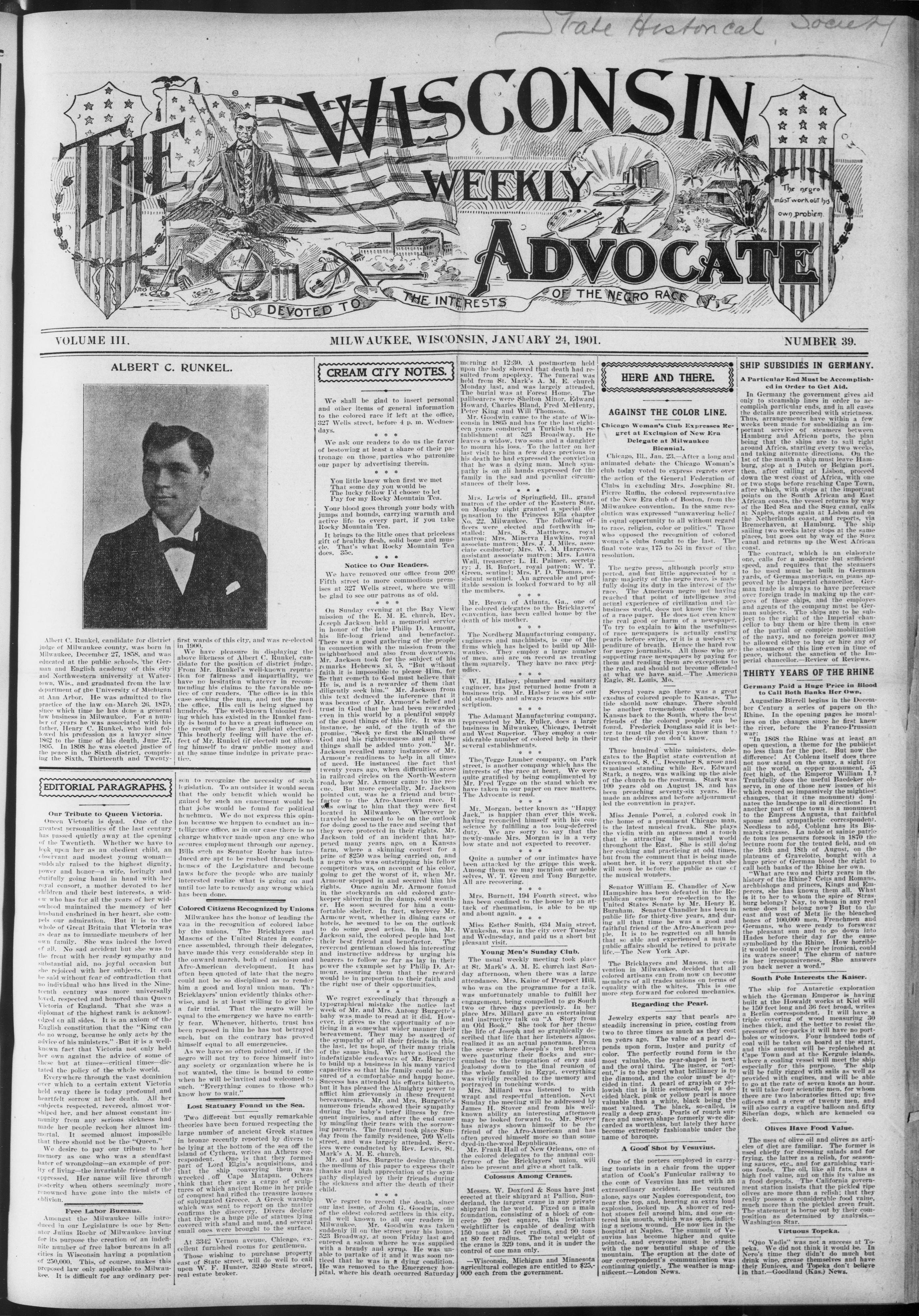
WISCONSIN
WEEKLY
ADVOCATE
DEVOTED TO THE INTERESTS OF THE NEGRO RACE
ALBERT C. RUNKEL
[Name]
[Name]
Albert C. Runkel, candidate for district judge of Milwaukee county, was born in Milwaukee, December 27, 1858, and was educated at the public schools, the German and English academy of this city and Northwestern university at Watertown, Wis., and graduated from the law department of the University of Michigan at Ann Arbor. He was admitted to the practice of the law on March 26, 1879, since which time he has done a general law business in Milwaukee. For a number of years he was associated with his father, Henry C. Runkel, who had followed his profession as a lawyer since 1862 to the time of his death, June 27, 1895. In 1898 he was elected justice of the peace in the Sixth district, comprising the Sixth, Thirteenth and Twenty-
EDITORIAL PARAGRAPHS.
Our Tribute to Queen Victoria. Queen Victoria is dead. One of the greatest personalities of the last century has passed quietly away at the opening of the Twentieth. Whether we have to look upon her as an obedient child, an observant and modest young woman—suddenly raised to the highest dignity, power and honor—a wife, lovingly and dutifully going hand in hand with her royal consort, a mother devoted to her children and their best interests, a widow who has for all the years of her widowhood maintained the memory of her husband enshrined in her heart, she compels our admiration. But it is to the whole of Great Britain that Victoria was as dear as to immediate members of her own family. She was indeed the loved of all. No sad accident but she was to the front with her ready sympathy and substantial aid, no joyful occasion but she rejoiced with her subjects. It can be said without fear of contradiction that no individual who has lived in the Nineteenth century was more universally loved, respected and honored than Queen Victoria of England. That she was a diplomat of the highest rank is acknowledged on all sides. It is an axiom of the English constitution that the "King can do no wrong, because he only acts by the advice of his ministers." But it is a well-known fact that Victoria not only held her own against the advice of some of these but at times—critical times—dictated the policy of the whole world.
Everywhere through the vast dominion over which to a certain extent Victoria held sway there is today profound and heartfelt sorrow at her death. All her subjects respected, revered, almost worshiped her, and her almost constant immunity from any serious sickness had made her people reckon her almost immortal. It seemed almost impossible that there should not be the "Queen."
We desire to pay our tribute to her memory as one who was a steadfast hater of wrongdoing—an example of purity of living—the invariable friend of the oppressed. Her name will live through posterity when others seemingly more renowned have gone into the mists of oblivion.
Free Labor Bureaus.
Amongst the Milwaukee bills introduced in our Legislature is one by Senator Julius Roehr of Milwaukee having for its purpose the creation of an indefinite number of free labor bureaus in all cities in Wisconsin having a population of 250,000. This, of course, makes this proposed law only applicable to Milwaukee. It is difficult for any ordinary per-
VOLUME III.
THE MEMORIAL
first wards of this city, and was re-elected in 1900. We have pleasure in displaying the above likeness of Albert C. Runkel, candidate for the position of district judge. From Mr. Runkel's well-known reputation for fairness and impartiality, we have no hesitation whatever in recommending his claims to the favorable notice of our readers. The office is in this case seeking the man, and not the man the office. His call is being signed by hundreds. The well-known Unionist feeling which has existed in the Runkel family is bound to have a great influence on the result of the next judicial election. This brotherly feeling will have the effect of Mr. Runkel (if elected) not allowing himself to draw public money and at the same time indulge in private practice.
son to recognize the necessity of such legislation. To an outsider it would seem that the only benefit which would be gained by such an enactment would be that jobs would be found for political henchmen. We do not express this opinion because we happen to conduct an intelligence office, as in our case there is no charge whatever made upon any one who secures employment through our agency. Bills such as Senator Roehr has introduced are apt to be rushed through both houses of the Legislature and become laws before the people who are mainly interested realize what is going on and until too late to remedy any wrong which has been done.
Colored Citizens Recognized by
Colored Citizens Recognized by Unions Milwaukee has the honor of leading the van in the recognition of colored labor by the unions. The Bricklayers and Masons of the United States in conference assembled, through their delegates, have made this very considerable step in the onward march, both of unionism and Afro-American development. It has often been quoted of late that the negro could not be so disciplined as to render him a good and loyal union man. The Bricklayers' union evidently thinks otherwise, and is at least willing to give him a fair trial. That the negro will be equal to the emergency we have no earthly fear. Whenever, hitherto, trust has been reposed in him he has not betrayed such, but on the contrary has proved himself equal to all emergencies.
As we have so often pointed out, if the negro will not try to force himself into any society or organization where he is not wanted, the time is bound to come when he will be invited and welcomed to such. "Everything comes to those who know how to wait."
Lost Statuary Found in the Sea.
Two different but equally remarkable theories have been formed respecting the large number of ancient Greek statues in bronze recently reported by divers to be lying at the bottom of the sea off the island of Cythera, writes an Athens correspondent. One is that they formed part of Lord Elgin's acquisitions, and that the ship conveying them was wrecked off Cape Matapan. Others think that they are a cargo of sculptures of which ancient Rome in her pride of conquest had rifled the treasure houses of subjugated Greece. A Greek warship which was sent to report on the matter confirms the discovery. Divers declare that there is a huge pile of statues lying covered with stand and mud, and several small ones were brought to the surface.
At 3342 Vernon avenue, Chicago, excellent furnished rooms for gentlemen.
Those wishing to purchase property east of State street, will do well to call upon W. F. Hunter, 3240 State street, real estate broker.
CREAM CITY NOTES.
We shall be glad to insert personal and other items of general information to the colored race if left at the office, 327 Wells street, before 4 p. m. Wednesdays.
***
We ask our readers to do us the favor of bestowing at least a share of their patronage on those parties who patronize our paper by advertising therein.
***
You little knew when first we met That some day you would be The lucky fellow I'd choose to let Pay for my Rocky Mountain Tea. Your blood goes through your body with jumps and bounds, carrying warmth and active life to every part, if you take Rocky Mountain Tea. It brings to the little ones that priceless gift of healthy flesh, solid bone and muscle. That's what Rocky Mountain Tea does. 35c.
Notice to Our Readers
We have removed our office from 209 Fifth street to more commodious premises at 327 Wells street, where we will be glad to see our patrons as of old.
* * *
On Sunday evening at the Bay View mission of the E. M. E. church, Rev. Joseph Jackson held a memorial service in honor of the late Philip D. Armour, his life-long friend and benefactor. There was a good gathering of the people in connection with the mission from the neighborhood and also from downtown. Mr. Jackson took for the subject of his remarks Hebrews xi, 5. "But without faith it is impossible to please Him, for he that cometh to God must believe that He is, and is a rewarder of them that diligently seek him." Mr. Jackson from this text deduced the inference that it was because of Mr. Armour's belief and trust in God that he had been rewarded even in this world by a plentiful supply of the good things of this life. It was an instance, he said, of the truth of the promise. "Seek ye first the Kingdom of God and his righteousness and all these things shall be added unto you." Mr. Jackson recalled many instances of Mr. Armour's readiness to help in all times of need. He instanced the fact that twenty years ago, when difficulties arose in railroad circles on the North-Western road, how Mr. Armour came to the rescue. But more especially, Mr. Jackson pointed out, was he a friend and benefactor to the Afro-American race. It was owing to him that they were first located in Milwaukee. Wherever he traveled he seemed to be on the outlook for doing good to the race and seeing that they were protected in their rights. Mr. Jackson told of an incident that happened many years ago, on a Kansas farm, where a skinning contest for a prize of $250 was being carried on, and a negro who was outstripping his fellow competitors was, on account of his color, going to get the worst of it, when Mr. Armour stepped in and secured him his rights. Once again Mr. Armour found in the stockyards an old colored gatekeeper shivering in the damp, cold weather. He soon secured for him a comfortable shelter. In fact, wherever Mr. Armour went, whether in dining cars or hotels, he seemed to be on the outlook to do some good action. In him, Mr. Jackson said, the colored people had lost their best friend and benefactor. The reverend gentleman closed his interesting and instructive address by urging his hearers to follow so far as lay in their power the example set by Philip D. Armour, assuring them that the reward would be in proportion to their faith and the right use of their opportunities.
* * *
We regret exceedingly that through a typographical mistake the notice last week of Mr. and Mrs. Antony Burgette's baby was made to read at it did. However, it gives us the opportunity of noticing in a somewhat wider manner their bereavement. They may be assured of the sympathy of all their friends in this, the last, let us hope, of their many trials of the same kind. We have noticed the indefatigable endeavors of Mr. Burgette to build up a business in his many varied capacities so that his family could be assured of a comfortable and happy home. Success has attended his efforts hitherto, but it has pleased the Almighty power to afflict him grievously in these frequent bereavements. Mr. and Mrs. Burgette's numerous friends showed their sympathy during the baby's brief illness by frequent inquiries, and after the end came by mingling their tears with the sorrowing parents. The funeral took place Sunday from the family residence, 709 Wells street, and was largely attended. Services were conducted by Rev. Lewis, St. Mark's A. M. E. church.
Mr. and Mrs. Burgette desire through the medium of this paper to express their thanks and high appreciation of the sympathy displayed by their friends during the sickness and after the death of their child.
* * *
We regret to record the death, since our last issue, of John G. Goodwin, one of the oldest colored settlers in this city, and well known to all our readers in Milwaukee. Mr. Goodwin was taken suddenly ill on the street near his home, 523 Broadway, at noon Friday last and entered a saloon where he was supplied with a brandy and syrup. He was unable to partake of it and it was soon noticed that he was in a dying condition. He was removed to the Emergency hospital, where his death occurred Saturday
morning at 12:30. A postmortem held upon the body showed that death had resulted from apoplexy. The funeral was held from St. Mark's A. M. E. church Monday last, and was largely attended. The burial was at Forest Home. The pallbearers were Shelton Minor, Edward Howard, Charles Bland, Fred McHenry, Peter King and Will Thomson. Mr. Goodwin came to the state of Wisconsin in 1865 and has for the last eighteen years conducted a Turkish bath establishment at 523 Broadway. He leaves a widow, two sons and a daughter to mourn his loss. To the latter on her last visit to him a few days previous to his death he had expressed the conviction that he was a dying man. Much sympathy is on ali hands expressed for the family in the sad and peculiar circumstances of their loss.
---
Mrs. Lewis of Springfield, Ill., grand matron of the order of the Eastern Star, on Monday night granted a special dispensation to the Princess Ella chapter No. 22. Milwaukee. The following officers were elected and forthwith installed: Mrs. S. Matthews, royal matron; Mrs. Minerva Hawkins, royal associate matron; Mrs. J. J. Miles, associate conductor; Mrs. W. M. Hargrove, assistant associate matron; Mrs. Laura Wall, treasurer; L. H. Palmer, secretary; J. B. Bufort, royal patron; W. T. Green, sentinel; Mrs. P. D. Thomas, assistant sentinel. An agreeable and profitable session is looked forward to by all the members.
* * *
Mr. Brown of Atlanta, Ga., one of the colored delegates to the Bricklayers' convention, has been called home by the death of his mother.
* * *
The Nordberg Manufacturing company, engineers and machinists, is one of the firms which has helped to build up Milwaukee. They employ a large number of men, and are on record as treating them squarely. They have no race prejudice.
* * *
W. H. Halsey, plumber and sanitary engineer, has just returned home from a business trip. Mr. Halsey is one of our old standbys and always renews his subscription.
* * *
The Adamant Manufacturing company, represented by Mr. Fuller, does a large business in Milwaukee, Chicago, Detroit and West Superior. They employ a considerable number of colored help in their several establishments.
```markdown
```
The Tegge Lumber company, on Park street, is another company which has the interests of the race at heart. We were quite gratified by being complimented by Mr. Fred Tegge on the stand which we have taken in our paper on race matters. The Advocate is read.
* * *
Mr. Morgan, better known as "Happy Jack," is happier than ever this week, having reconciled himself with his conscience by fulfilling a too long-deferred duty. We are sorry to say that the newly-made Mrs. Morgan is in a very low state and not expected to recover.
* * *
Quite a number of our intimates have been attacked by the grippe this week. Among them we may mention our noble selves, W. T. Green and Tony Burgette. All are recovering.
* * *
Mrs. Burnett, 194 Fourth street, who has been confined to the house by an attack of rheumatism, is able to be up and about again.
* * *
Miss Esther Smith, 634 Main street, Waukesha, was in the city over Tuesday and Wednesday, and paid us a short but pleasant visit.
Young Men's Sunday Club.
The usual weekly meeting took place at St. Mark's A. M. E. church last Sunday afternoon, when there was a large attendance. Mrs. Kaine of Prospect Hill, who was on the programme for a talk, was unfortunately unable to fulfill her engagement, being compelled to go South two or three days previously. In her place Mrs. Millard gave an entertaining and instructive talk on "A Story from an Old Book." She took for her theme the life of Joseph and so graphically described that life that her listeners almost realized it as an actual panorama. From the scene where Joseph's ten brethren were pasturing their flocks and succumbed to the temptation of envy and jealousy down to the final reunion of the whole family in Egypt, everything was vividly recalled to the memory and portrayed in touching words.
Mrs. Millard was listened to with wrap and respectful attention. Next Sunday the meeting will be addressed by James H. Stover and from his well-known ability an interesting afternoon may be looked forward to. Mr. Stover has always shown himself to be the friend of the Afro-American and has often proved himself more so than some dyed-in-the-wool Republicans. Mr. Frank Hall of New Orleans, one of the colored delegates to the annual conference of the Bricklayers' union, will also be present and give a short talk.
Colossus Among Cranes.
Messrs. W. Doxford & Sons have just erected at their shipyard at Pallion, Sunderland, the largest crane in any private shipyard in the world. Fixed on a main foundation, consisting of a block of concrete 20 feet square, this leviathan weightlifter is capable of dealing with 150 tons at 50 feet radius, and 90 tons at 80 feet radius. The total weight of the crane is 329 tons, and it is under the control of one man only.
Wisconsin, Michigan and Minnesota agricultural colleges are entitled to $25,-000 each from the government.
AGAINST THE COLOR LINE.
Chicago Woman's Club Expresses Regret at Exclusion of New Era Delegate at Milwaukee
Biennial.
Chicago, Ill., Jan. 23. After a long and animated debate the Chicago Woman's club today voted to express regrets over the action of the General Federation of Clubs in excluding Mrs. Josephine St. Pierre Ruffin, the colored representative of the New Era club of Boston, from the Milwaukee convention. In the same resolution was expressed "unwavering belief in equal opportunity to all without regard to race, religion, color or politics." Those who opposed the recognition of colored women's clubs fought to the last. The final vote was 175 to 53 in favor of the resolution.
The negro press, although poorly supported, and but little appreciated by a large majority of the negro race, is manfully doing its duty in the interest of the race. The American negro not having reached that point of intelligence and actual experience of civilization and the business world, does not know the value of a race paper. He does not even know the real good or harm of a newspaper. To try to explain to him the usefulness of race newspapers is actually casting pearls before swine, or it is a useless expenditure of breath. Hence the hard row for negro journalists. All those who are supporting race newspapers by paying for them and reading them are exceptions to the rule, and should not become offended at what we have said.—The American Eagle, St. Louis, Mo.
Several years ago there was a great exodus of colored people to Kansas. The tide should now change. There should be another tremendous exodus from Kansas back to the South, where the best friends of the colored people can be found. Frederick Douglass said it is better to trust the devil you know than to trust the devil you don't know.
一
Three hundred white ministers, delegates to the Baptist state convention at Greenwood, S. C., December 8, arose and remained standing while Rev. Edward Stark, a negro, was walking up the aisle of the church to the rostrum. Stark was 100 years old on August 18, and has been preaching seventy-six years. He made an address and before adjournment led the convention in prayer.
Miss Jennie Powel, a colored cook in the home of a prominent Chicago man, is the latest musical freak. She plays the violin with an aptness and a touch that is attracting the musical world throughout the East. She is still doing her cooking and practicing at odd times, but from the comment that is being made about her, it is very apparent that she will soon be before the public as one of the musical wonders.
Senator William E. Chandler of New Hampshire has been defeated in the Republican caucus for re-election to the United States Senate by Mr. Henry E. Burnham. Senator Chandler has been in public life for thirty-five years, and during all that time he was a good and faithful friend of the Afro-American people. It is to be regretted on all hands that so able and experienced a man in public affairs should be retired to private life.—The New York Age.
The Bricklayers and Masons, in convention in Milwaukee, decided that all colored artisans can from now on become members of all trades unions on terms of equality with the whites. This is one more step forward for colored mechanics.
Regarding the Pearl.
Jewelry experts say that pearls are steadily increasing in price, costing from two to three times as much as they cost ten years ago. The value of a pearl depends upon form, luster and purity of color. The perfectly round form is the most valuable, the pear-shaped is next and the oval third. The iuster, or "orient," is to the pearl what brilliancy is to the diamond, and the color must be decided in tint. A pearl of grayish or yellowish tint is little esteemed, but a decided black, pink or yellow pearl is more valuable than a white, black being the most valued. The black, so-called, is really a deep gray. Pearls of rough surface and uneven shape formerly were discarded as worthless, but lately they have become extremely fashionable under the name of baroque.
A Good' Shot by Vesuvius.
One of the porters employed in carrying tourists in a chair from the upper station of Cook's Funicular railway to the cone of Vesuvius has met with an extraordinary accident. He ventured alone, says our Naples correspondent, too near the top, and, hearing an extra loud explosion, looked up. A shower of red hot stones fell around him, and one entered his mouth, which was open, inflicting a serious wound. He now lies in the hospital at Naples. The summit of Vesuvius has become higher and quite pointed, and everyone must be struck with the now beautiful shape of the mountain. The eruption at the date of our correspondent's communication was continuing quietly. The weather is magnificent.—London News.
SHIP SUBSIDIES IN GERMANY.
A Particular End Must be Accomplished in Order to Get Aid.
In Germany the government gives aid only to steamship lines in order to accomplish particular ends, and in all cases the details are prescribed with strictness. Thus, arrangements have within a few weeks been made for subsidizing an important service of steamers between Hamburg and African ports, the plan being that the ships are to sail right around Africa, starting every two weeks, and taking alternate directions. On the 1st of the month a ship must leave Hamburg, stop at a Dutch or Belgian port, then, after calling at Lisbon, proceed down the west coast of Africa, with one or two stops before reaching Cape Town, after which, with stops at the important points on the South African and East African coasts, the vessel returns by way of the Red Sea and the Suez canal, calls at Naples, stops again at Lisbon and on the Netherlands coast, and reports, via Bremerhaven, at Hamburg. The ship sailing two weeks later stops at the same places, but goes out by way of the Suez canal and returns up the West African coast.
The contract, which is an elaborate one, calls for a moderate but sufficient speed, and requires that the steamers to be used must be built in German yards, of German materials, on plans approved by the Imperial chancellor. German trade is always to have preference over foreign trade in making up the cargoes of these ships, and the employees and agents of the company must be German subjects. The ships are to be subject to the right of the Imperial chancellor to buy them or hire them in case of the partial or complete mobilization of the navy, and no foreign power may be allowed either to buy or hire any of the steamers of this line even in time of peace, without the sanction of the Imperial chancellor.—Review of Reviews.
THIRTY YEARS OF THE RHINE
Germany Paid a Huge Price in Blood to Call Both Banks Her Own. Augustine Birrell begins in the December Century a series of papers on the Rhine. In the opening pages he moralizes on the changes since he first knew the river, before the Franco-Prussian war.
"In 1868 the Rhine was at least an open question, a theme for the publicist no less than for the poet. But now the difference! At Coblenz itself does there not now stand on the quay, a sight for all the world, a copper monument, 45 feet high, of the Emperor William I.? Truthfully does the useful Baedeker observe, in one of those new issues of his which record so impassively the mightiest changes, that it (the monument) dominates the landscape in all directions! In another part of the town is a monument to the Empress Augusta, that faithful spouse and sympathetic correspondent. Needless to add, Coblenz has its Bismarck strasse. La noble et sainte patric de tous les penseurs forsook in 1870 the lecture room for the tented field, and on the 16th and 18th of August, on the plateaus of Gravelotte, bought with a huge price of German blood the right to call both banks of the Rhine her own.
"What are two and thirty years in the history of the Rhine? Celts and Romans, archbishops and princes, Kings and Emperors, she has known them all. What is it to her to whom the spire of Strasburg belongs? Nay, to whom in any real sense does it belong now? But to the east and west of Metz lie the bleached bones of 100,000 men, Frenchmen and Germans, who were ready to forswear the pleasant sun and to go down into Hades before their day for the cause symbolized by the Rhine. How horrible it would be could a river be ironical, coub its waters sneer! The charm of nature is her irresponsiveness. She answers you back never a word."
South Pole Interests the Kaiser.
The ship for Antarctic exploration which the German Emperor is having built at the Howaldt works at Kiel will be 150 feet long and 36 feet broad, writes a Berlin correspondent. It will have a triple covering of wood measuring 30 inches thick, and the better to resist the pressure of ice-packs it will have no portholes or windows. Four hundeed tons of coal will be taken on board at the start, and this amount will be replenished at Cape Town and at the Kergule islands, where a coaling vessel will meet the ship especially for this purpose. The ship will be fully rigged with sails as well as provided with engines, and will be able to go at the rate of seven knots an hour. It will take four scientific men, for whom there are two laboratories fitted up; five officers and a crew of twenty men, and will also carry a captive balloon and fifty Siberian dogs, which are kenneled on deck.
Olives Have Food Value.
The uses of olive oil and olives as articles of diet are familiar. The former is used chiefly for dressing salads and for frying, the latter as a relish, for seasoning sauces, etc., and for garnishing various foods. The oil, like all fats, has a high fuel value, and on this its value as a food depends. The California government station insists that the pickled ripe olives are more than a relish; that they really possess a considerable food value, much more than the pickled green fruit. The statement is borne out by their composition as determined by analysis. Washington Star.
Virtuous Topeka.
"Quo Vadis" was not a success at Topeka. We did not think it would be. In Nero's time they didn't do much but drink wine, grease themselves and have their Eunices, and Topeka don't believe in that.—Goodland (Kas.) News.
EDWARD IS NOW KING.
ACCESSION TO THRONE.
His Majesty to Appear in the House of Lords on the Assembling of Parliament.
London, Jan. 23.—1 p. m.—The King- Emperor entered his capital at 12:55 p. m. and proceeded to Marlborough house.
London, Jan. 23.—3:03 p. m.—At the meeting of the privy council the King took the title of Edward VII.
The King's correct title is Edward VII. of the United Kingdom of Great Britain and Ireland and Emperor of India II.
The House of Lords and the House of Commons assembled at 4 o'clock and took the oath of allegiance to the new sovereign.
Dense crowds, beginning about James street, lined the entire route to Victoria station, from an early hour. The Mall street front of Buckingham palace were the especially thronged. All along the former, from the palace to Marlborough house, carriages filled with ladies stood as if for a drawing room, except that the coachman, footmen and occupants were all dressed in mourning. The police precautions were unusual. Men on foot and mounted guarded almost every yard of the way.
Greeting the King.
The crowds waited patiently for hours to greet their King. Finally, preceded by half a dozen mounted policemen, the new sovereign arrived in a plain brougham which was driven very rapidly with the coachman and footman in their usual gray liveries with mourning bands on their arms. An equerry was seated beside him. The King was, of course, dressed in the deepest and most simple mourning, and carefully raised his hat in acknowledgment of the silent uncovering of heads, which was more impressive than the most enthusiastic cheers. The King looked tired and very sad, but very well. Following him came the Duke of York, the Duke of Connaught and others. Both the King and the Duke of York looked pathetically up at Buckingham palace as they passed, and acknowledged the salute of the guard of honor drawn up inside the palace grounds. The troops there and elsewhere showed no signs of mourning, except that the bands were not present, but all the officers had crepe on their left sleeves.
The King drove to St. James' palace from Marlborough house to preside at the first privy council, by way of Marlborough house yard, the Mall and the garden entrance of the palace. He was attended by Lord Suffield (who has been lord of the bed chamber to the Prince of Wales since 1872) and was escorted by a captain's escort of the Horse Guards. The procedure was exactly as on levee days.
By the time the King arrived a great gathering of privy councilors, in levee dress with crape on their left arms, had taken up position in the throne room—cabinet ministers, peers, commoners, bishops, judges, the lord mayor, etc., including the Duke of York, the Duke of Connaught and lesser members of the royal family.
King Takes the Oath.
Lord Salisbury, Lord Rosebery, A. J. Balfour, the Duke of Devonshire, Lord Strathcona and Mount Royal and a host of the most prominent personages in the land were there to receive the King's formal oath, binding him to govern the kingdom according to its laws and customs, and hear him assume the title of King Edward VII. of Great Britain and Ireland and Emperor of India. The ceremony was interesting and according to precedent. The King was in a separate apartment from the privy councilors. To the latter, Duke of Devonshire, lord president of the council, formally communicated the death of Queen Victoria and the succession to the throne of her son, the Prince of Wales. The royal dukes, with certain lords of the council were then directed to repair to the King's presence to acquaint him with the terms of the lord president's statement. Shortly afterward, his majesty entered the room in which the councilors were assembled and addressed them in a brief speech. The lord chancellor (Lord Halsbury) then administered the oath of the King. Afterward the various members of the council, commencing with lords in council, took the oath of allegiance and then passed in turn before his majesty as at a levee, excepting that each paused and kissed the King's hand before passing out of the chamber. This brought the ceremony to a close.
By 3:30 p. m., when his majesty returned to Marlborough house, the crowd in the neighborhood was of immense proportions. The King's prior journey was accomplished in almost complete silence, but on this occasion he was lustily cheered all along the line of route.
Immediately opposite Marlborough house gates a tall gentleman in front of the crowd waved his hat and shouted "Long live the King," whereupon the crowd cheered with redoubled vigor.
The King, at the accession ceremony, wore a military uniform. His brief speech was delivered with great earnestness and was quite extemporaneous. It is expected it will be published later in official form.
At the last moment the King decided not to attend the House of Lords today.
Accession to the Throne.
The proclamation of accession of his majesty was signed by the princes present, the Duke of York first, then the Duke of Connaught, the Duke of Cambridge, Prince Christian, the Archbishop of Canterbury, the lord chancellor, the lord mayor and the other representatives of the city of London.
At 4:30 p. m. the artillery began firing salutes in James park to signalize King Edward's accession to the throne.
Among the incidents of the day was an imposing civic procession. The lord mayor and aldermen, accompanied by the city marshal, and other members of the corporation, escorted by a strong body of police, proceeded from the Mansion house by way of Thames embankment and Trafalgar square, to St. James' palace, in gilded equipages, with liveried outriders, including twenty semi-state carriages, making a notable picture, which was witnessed by thousands of silent people who filled the sidewalks along the entire route.
Swear Allegiance.
The attendance in the House of Commons was large. All the members, dressed in the deepest mourning, stood up as Speaker Gully entered and announced that, by reason of the deeply-lamented decease of her majesty, Queen Victoria, it had become their duty to take the oath of allegiance to her successor, his majesty, King Edward VII. The speaker then administered the oath and the swearing-in of the members proceeded. Joseph Chamberlain, the secretary of state for the colonies; Sir Michael Hicks-Beach, the chancellor of the exchequer; Sir Henry Campbell-Bannerman, the Liberal leader in the House, and Sir William Vernon Harcourt, were the first to subscribe their names on the roll.
In the House of Lords the oath was
taken by the Duke of York, the Duke of Connaught, Earl Roberts, Lord Rosebery, Lord Salisbury, the Duke of Argyll, Lord Lansdowne and others. The House of Lords then adjourned until tomorrow. The royal proclamation by the earl marshal will be heralded at St. James' palace and the other customary centers tomorrow and will be published forthwith in the gazette.
The King's Speech.
King Edward in his speech to the privy council said he had decided to assume the title of King Edward VII. in accordance with the wish of his beloved mother, who, his majesty added, united the virtues of a supreme domestic guide with the affection and patriotism of a wide, peace-loving monarch. He had a respectful desire to leave the memory of his father's name, Albert, the exclusive treasure of his beloved mother. Notwithstanding his personal desire, he could not hope to do justice to the renown and virtues associated with Prince Albert's name, but he would do his utmost to be worthy of his great position.
Some Doubt Cast Upon the Question of Accession.
London, Jan. 23.—The Duke of York will not necessarily become the Prince of Wales now that his father has ascended the throne. The principality was granted by Edward I. to his son, afterward Edward II. and his heirs, kings of England. Consequently when the Prince of Wales succeeds to the throne, his princely title merges in his sovereignty. The new sovereign's eldest son is still Duke of York, but he becomes also Duke of Cornwall, this title descending to him from his father. It is generally assumed that the King will immediately confer his principality upon him, as it is within his social prerogative so to do, the period during which mourning is worn for the sovereign of the realm is usually three months, full mourning being worn eight weeks. The King can, however, prolong the duration of the period, and nothing has yet been definitely decided in regard to this matter.
All social functions will be suspended during the next six months and there will be no London season. Country house pleasures will be suspended and the English upper classes will go to the continent until the period of gloom has ended. Ultimately London will be a gayer capital than ever. The opening of the new reign will involve many changes in social England. It is expected that the King will reside at Windsor during the early months of his reign, and that the Duke of York will occupy Sandringham, but that ultimately their chief residence will be Buckingham palace and Marlborough house.
Late Queen's Wealth.
There has been a general belief that the Queen was one of the richest of sovereigns and that she would leave an immense estate to her heirs. It is stated that there will be much astonishment when the amount of her personality is shown by the provisions of her will. Instead of having very great, it will prove to be of moderate value, and all estimates of her private fortune will be found fallacious. The truth seems to be that the Queen, like other rich people, had a great number of relatives dependent upon her, and that she was compelled from time to time to pay their debts and extricate them from embarrassments. The reading of the Queen's last will and testament may involve one of the most remarkable surprises of her reign. One of her executors is Lord Cross, whom she honored with her friendship and in whose business ability she had implicit confidence.
January has been a fateful month in the life of the English royal family. It is a singular coincidence that Queen Victoria passed away on the eighty-first anniversary of the death of her father, the Duke of Kent, which event occurred just six days before the death of his father, George III., in 1820. It was on January 10, 1896, that Prince Henry of Battenberg passed away, and it was also in January that the Duke of Clarence, the direct heir to the throne in the second generation, came to his autumnely end.
THE KING IS PUDGY
New Ruler of England is Short and Very Rotund.
London, Jan. 23.—The new King of England resembles his mother in lack of stature. He is only 5 feet 4 inches in height, weighs 215 pounds or more and wears a $17\frac{1}{2}$ collar. His waist circumference is 45 inches, 8 inches more than his chest measurement. In fact, he is pudgy.
All pictures of the Prince of Wales piece him out so as to make him look 6 or 8 inches taller than he is. His girth is reduced by the same kind of process, probably by the elongation of his body pictorially.
In the early '90s he was attacked by rheumatism, which troubled him exceedingly. Every autumn he takes the waters either at Hamburg and Wiesbaden, and of late years, since his chest has been delicate, he usually goes to the Riviera every spring.
CLEVELAND FAVORED.
G. A. R. Commanders Support the Executive Committee in Dropping Denver.
Chicago, Ill., Jan. 23.—Denver's rebellion against the ruling of the executive committee of the Grand Army of the Republic and its threat to hold an encampment in rivalry to Cleveland does not meet with favor in the minds of the department commanders of the United States.
In response to telegrams sent yesterday commanders of nearly every department in the country declared their departments would obey the rulings of the executive committee and go to Cleveland.
Wisconsin and several other state leaders declared they favored Denver, but the renewal of pledges of obedience to the orders of the grand commander was almost unanimous.
Still Denver is going ahead with arrangements and announces hopefully that the ruling will be reversed.
The reply of Department Commander James of Wisconsin was as follows: Richland Center, Wis., Jan. 22.—[Special.] The Wisconsin delegation in Chicago voted unanimously to go to Denver. I should prefer that place and think the G. A. R. of this state would indorse it. D. G. JAMES.
TRIED TO HUG THE GIRLS.
Cause of Forced Resignation of Mississippi College President.
Jackson, Miss., Jan. 23.—President George Wharton of the Hillman female college, a Baptist institution located ten miles from this city, has been forced to resign by the board of trustees on account of a charge brought against him by a number of the young lady students of undue familiarity. According to the testimony of the young ladies President Wharton attempted to hug them on a number of occasions and on account of his affectionate demonstrations quite a number of the girls left the school and went to their homes in various parts of the state. Wharton left Clinton while the board of trustees was investigating the case. It is thought he is now en route to North Carolina. He is an ordained minister, and has been in charge of the college for several years.
For Taking. Care of the Old Man He was Accused of Murdering
Oshkosh, Wis., Jan. 22.—[Special.]—Probate Judge Cleveland has made an allowance of $250 to John Campfield for services for the late Alphonse Sandon, the old Frenchman who was alleged to have been murdered near Eureka two years ago. Campfield was charged with the murder and had two trials, the jury is agreeing in both cases, after which he case was dropped. His claim against the estate amounted to $985. Sandon made a will, leaving all his property to Campfield, but it was set aside on a technicality.
IT IS FEARED TWO MEN ARE DROWNED.
Start Out from Oshkosh to Cross Lake Winnebago on the Ics.
Oshkosh, Wis., Jan. 22.—[Special.]—It feared that James Dayton and Mr. hillips of Stockbridge, Calumet county, have been drowned. Yesterday afternoon the two started to drive across the ice on Lake Winnebago. Since leaving here nothing has been seen of them. The lake is being searched. It is feared that the men have broken through the ice and drowned.
WILL RAISE THE RATE.
Little Wolf River Telephone Company will Increase Its Charges to Subscribers.
Fond du Lac, Wis., Jan. 22.—[Special.]—The new directors of the Little Wolf River Telephone company, which has its headquarters in this city, at their meeting Thursday will probably decide to raise the rate for telephones in this city. At present the company is charging $2 per month for business and $1.25 for residence telephones. The company will carry out its present contracts, but it is stated no new contracts will be made at the present rate. The company recently moved its general offices from Weyauwega to this city. It has 500 subscribers here and connects with all the cities and villages the Fox River Valley.
MANY ARE INJURED.
Wild Saloon Row at Pembine in Which Several Men Were Badly Slashed.
Marinette, Wis., Jan. 22.—[Special.]— There was a wild saloon row at Pembine, in this county, last night, in which six or seven men were badly cut. One man, a Finlander, received a big gash in the head and is in a critical condition. The origin of the row is not known, but knives were drawn and everybody aided in with beer glasses, spittoons and hairs. When the fracas was over a half dozen men were laid on the floor bleeding and badly injured. Only two arrests were made. Oscar and John Granfors, brothers, were arrested charged with assault with intent to do great bodily harm. They were brought to this city.
WOMAN BADLY BURNED.
Celluloid Comb in Her Hair Catches Fire and She is Left Bald
Green Bay, Wis., Jan. 22.—[Special.] While Mrs. J. A. McEachron, wife of a prominent lumberman of this city, was leaning over a hot stove, a celluloid comb in her hair caught fire. Her crowning glory of luxurious hair of raven hue was burned to the scalp, leaving a bald spot as large as a man's palm, before willing hands could extinguish the blaze.
FRANCHISE IN BELOIT.
Ohio and Eau Claire Capitalists Want to Build an Electric Railway.
Beloit, Wis., Jan. 22.—[Special.]—Ohio parties, through H. H. Clough, and Eau Claire capitalists, through J. F. Barber, last night filed petitions for franchises for an electric railroad through the city. Mr. Barber wants an urban line, Mr. Clough an interurban.
EX-WIFE IS NOT SATISFIED.
Will Appeal Divorce Case to the Supreme Court.
Marinette, Wis., Jan. 22.—[Special.]— No divorce has yet been granted to Henry S. Hemingway from his wife, Arabelle Hemingway. The plaintiff has not yet filed the bond specified by Judge Hastings in his decision. This bond is to insure the payment of $6 a month alimony to be paid to Mrs. Hemingway, and if it is not secured the divorce will not be granted.
Mrs. Hemingway is very much dissatisfied with the verdict and has requested her attorneys to appeal the case to the Supreme court if the decree of separation becomes operative. She claims that she has not received justice. The couple cloped and were married when they were both past 50 years of age.
BITTEN BY A PIG.
Blood Poisoning May Result from the Injury
Marinette, Wis., Jan. 22.—[Special.]— Julius Krueger, who works on the farm of W. A. Brown out on the Bay Shore road, was badly bitten by a pig. The porker had broken out of his pen and was making his way off the farm when Krueger set out after it. He caught the animal all right, but the latter turned on him and fastened its teeth in the man's leg, biting right through the calf. The injury is a serious one and blood poisoning may set in.
Japanese business methods are in the less important places of a very go-as-you please description. At Nagasaki the other day a foreigner, calling at the branch of one of the chief shipping companies, found the whole place deserted. It appeared that, the day being fine, the manager and staff had gone out on a mushroom hunting expedition. Mushroom hunting is a pursuit that appeals to every true Japanese.
—Workingmen, by agreement, are doing a great deal of good, practical temperance work. At Toledo the ore-handlers and longshoremen enter into an agreement with the dock operators along Lake Erie ports that no intoxicants shall be used by the men during working hours. It means the saving of hundreds of thousands of dollars to the men.
—The California newspapers are rejoicing over the discovery that while 300 Mediterranean lemons yield only 19.70 ounces of citric acid, 300 California lemons yield 26.64 ounces.
Senate.
There was no business in the Senate on the 17th until the order of introduction of bills was reached and then there was a small flood. Bills were introduced: Providing for free employment offices in certain cities; creating a state board of osteopathic examination and registration and regulating the practice of osteopathy in the state: amending the statutes relative to foreign corporations; appropriating $400 to T. P. Nelson for material furnished and work done as a sub-contractor on the improvement of Ladies' hall; defining the liability of employees of telegraph and messenger companies; giving professors of military science and tactics in colleges and universities the honorary title of colonel of infantry; amending the statutes relative to depositions; cutting down the representation of South Milwaukee and Wauwatosa in the county board of Milwaukee county; prohibiting attorneys from signing nomination papers or petitions for nominations of judges of the Supreme, circuit or other courts of record; amending the fish and game laws; amending the statutes relative to assessments; providing that moneys hereafter received from the government for the service of the Wisconsin militia in the Spanish-American war may be used for improvement of the military reservation at Camp Douglas, as well as for the equipment of the Wisconsin National guard; Senator Mosher offered a joint resolution cutting off the introduction of new business after February 1, except bills and resolutions from standing committees. It went over. The resolutions increasing the membership of the committee on assessments and collections of taxes from three to five and providing for joint hearings of the same committees in both houses, these hearings to be final, were passed unanimously without debate. The Assembly amendment to the apportionment committee resolution increasing the Assembly membership from thirteen to fifteen was received. The Senate does not propose to agree and the resolution went over.
The Senate on the 18th adopted without discussion the Assembly resolution regarding the apportionment matter. The resolution as finally adopted provides that all matters relating to apportionment shall be referred to the committee which shall report on them by bill. A memorial was presented by Senator Miller from the Trades and Labor assembly against the reduction of exemption of wages. Three petitions for amendments to the fish and game laws were submitted. Senator Hatton offered a memorial to Congress urging the Wisconsin members to use all possible means to secure the passage of the swamp land indemnity act. Senator Mills objected to immediate consideration and it went over. Only four bills were introduced as follows: Amending a Forest county dam bill; providing for biennial municipal elections; amending the Standard insurance policy law to provide that where a building falls or is blown down through no fault or negligence of the owner the insurance company shall be liable for damage by fire thereafter; appropriating $12,500 annually for the geological and natural history survey of this state. The Senate adjourned until the evening of the 21st.
In the Senate on the evening of the 21st Senator Mills of Superior introduced a joint resolution providing for the appointment of a joint committee of both houses to investigate the subject of state printing and report back how printing in the future may be done more cheaply. Senator Devos introduced a bill that is designed to do away with the obnoxious weed commission system as it has been practiced in Milwaukee. The following bills were introduced: Appropriations for clergymen of the legislature; relating to publicaccountants; creating a new board; amending Weed commission law; changing time of holding court in Waushara county; to amend chapter 3987, laws 1898, relating to guardianships; relating to the publication of legal notices; amend statutes relating to publications of county board proceedings; appropriation for industrial school for girls; relating to compensation of legislative employees, passed under suspension of the rules.
The only thing out of ordinary at all interesting in the Senate on the 22d was the memorial introduced by Senator McGillivray petitioning Congress for an amendment of the constitution of the United States to give Congress concurrent jurisdiction with the states for the suppression of trusts and other combinations to control production, stifle competition and regulate for their own benefit the price of products and the wages of labor. Senator Gaveny introduced a joint resolution urging upon Congress the passage of a law "Which will effectually stamp out the brutal, unmanly and outrageous practices of the cadets" at West Point in the light of the recent hazing disclosures. Bills were introduced as follows: Amending the statutes relative to terms of court in the Twelfth circuit; amending the statutes relative to town drains; changing the standard of weights and measures to conform to the commercial standards. Senator Mills' resolution instructing the printing committee to investigate and report on the matter of state printing and the feasibility of establishing a state printing office was passed. Adjournment was taken to 10 a. m. on the 23d.
The people of Portage swooped down on the Legislature on the 23d with two bills and a long memorial seeking state aid to repair the levees of the Wisconsin river so as to prevent the recurrence of floods of last year. The bills, one of which was introduced in each house, instruct the governor to appoint a competent engineer to examine the levees and report whether or not repairs and additions are necessary. The Senate apportionment committee was completed by the appointment of three additional members—Senators Whitehead, Munson and Weed—making one from each congressional district. Bills were introduced as follows: Amending the statutes relative to damages caused by defective highways; permitting any excentrate or an appointee of any bishop to perform marriages while serving as regular minister or priest of any church; providing for side paths for bicycles, the appointment of commissioners and licensing of bicycles; permitting cities of the third and fourth class to provide for bonuses for manufacturing establishments; amending the statutes relative to perpetuating testimony; making an appropriation of not to exceed $20,000 from the drainage fund for the improvement of the Wisconsin levee system at the city of Portage; relative to tax levy to pay municipal indebtedness, making it mandatory upon the clerk to levy the tax if the council falls to do so and requiring the preservation of the sinking fund intact; amending the law relative to negotiable instruments; amending the statutes relative to tenants; notice to quit; making recitals in deeds and wills evidence in certain cases. The committee on public lands reported favorably on the memorial to Congress urging the passage of swamp land indemnity act. On motion of Senator Mosher his resolution to cut off new business till February 1 was put over until the 25th.
Assembly.
The petitions received in the Assembly on the 17th related mostly to spring shooting and the exemption of wages. Mr. Sarau offered a joint resolution cutting off new business on February 2, which is unusually early. It was laid over until tomorrow. Mr. Brunson stirred up the Assembly by introducing a resolution binding the Assembly to adjourn each week at noon on Saturday until 2 o'clock on Monday afternoon. Objection was raised by Messrs. Keene, Dahl and others and the resolution was finally laid over for one week. Quite a number of bills came in, including the following: Appropriation for monuments in the National Military park at Shiloh; making appropriation to the university for the coming two years; amending the laws relating to the reassessment of void special assessments; amending the laws relating to hawkers and peddlers; increasing the fees for reporting births; amending the laws relating to the eligibility of county superintendents of schools; amending the laws relating to homestead exemptions; amending the True marriage bill. The first report from the judiciary committee came in, amending the Senate bill fixing the time for holding court in the Sixteenth Judicial circuit. Under suspension of the rules the
amendment was adopted and the bill con-
curred in. The Senate resolution increasing
the membership of the committee on asses-
sment and collection of taxes and pro-
viding for joint hearings of two commit-
tees was messaged over and was laid over
until tomorrow. The Assembly then ad-
journed.
By action taken in the Assembly on the
18th it became known that the two houses
had agreed upon a basis of membership for
the new committee on apportionments. At
the opening of the session Mr. Sturdevant
offered a resolution to recall the Senate
resolution providing for a committee of
seven senators and thirteen assemblymen,
which had been amended by the Assembly
to make the number of assemblymen fifteen.
The resolution was adopted and shortly
afterward the resolution was returned. The
vote by which the resolution was amended and concurred in was reconsidered and then Mr. Sturdevant offered a resolution to make the committee consist of one senator and two assemblymen from each congressional district, making thirty in all. A motion to have it lie over was lost. It was then amended as suggested by Mr. Sturdevant and concurred in. Assemblyman Owen introduced a bill giving to cities the power to alter street railway franchises without consulting the owners of the franchises. This bill delegates to the councils the powers of the Legislature in that regard. Two bills were introduced reducing passenger rates in the state. One by Herman Miller required all roads earning over $3500 a mile to carry passengers for 2 cents a mile. Another by Mr. Silkworth makes a 2-cent rate for all roads. Mr. Hall introduced a joint resolution for a constitutional amendment to permit the use of voting machines. He introduced a similar resolution two years ago, but it failed of passage. The committee on judiciary made a report favoring the killing of two bills and the passage of three bills. Assembly bill No. 5, making time checks negotiable paper, was one of the bills reported for killing. Judge Orton asked that it be allowed to come back to his committee and it was re-referred. A senate resolution cutting off new business on February 1 was laid over for one week. A joint resolution from the Senate increasing the membership of the committee on assessment and collection of taxes to ten and providing for joint sessions was taken up and concurred in. A communication was received from the Supreme court calling attention of the Legislature to the John Marshall celebration on Monday, February 4, and asking the use of the Assembly chamber. On motion of Mr. Saran the request was granted. A motion was adopted fixing the time of adjournment to the evening of the 21st. Then after a large number of leaves of absence had been granted the Assembly adjourned.
The primary election bill was not introduced in the Assembly on the evening of the 21st as had been expected it would be, Assemblyman Stevens has completed the bill, but it is being revised. Only three bills were introduced tonight, all of minor importance, as follows: Relating to the issue of telephone bonds by villages, towns, counties and cities; regulating the electric wiring of buildings and providing a penalty for violation; relating to jurors in various counties. Bill 2 A, relating to legalizing acts under section 3178 A, laws of 1898, was killed.
The most important feature of the Assembly's session on the 22d was a bill introduced by Mr. Lenroet providing that franchises granted to quasi-public corporations shall not become valid until they have been ratified by the people at the polls. The petition for the election must be signed by 56 per cent. of the voters of cities. Two bills relating to exemption of wages were introduced, one by Mr. Dodge making the exemption of wages $40 a month instead of $60. The other by Mr. Holland, reducing the value of a homestead exempt to $5000. Quite a flood of bills came in, including the following; Making an appropriation of $12,000 for the geological survey; making an appropriation to pay John H. Hughes for some work done at the state hospital; authorizing S. D. Carpenter to bring suit against the state on an old printing claim; authorizing a dam on the Flambeau river in Chippewa county; to establish a ferry across Lake St. Croix at Hudson; for a Vicksburg commission to determine position of Wisconsin troops at the siege; granting to the United States jurisdiction over certain lands in Douglas county. The Senate bill increasing the number of legislative employees was received and concurred in under suspension of the rules. It provides for two additional attendants, two committee clerks and one telephone attendant in each house, making ten in all. Senator Mills' state printing resolution was also received and concurred in. Mr. Sturdevant's resolution looking to Saturday sessions was taken up. After some debate the whole matter was laid over. The Assembly then adjourned.
In the Assembly on the 23d Mr. Thiessen-husen introduced a bill giving the city of Milwaukee authority to acquire property outside of its limits for an isolation hospital and a similar bill by Mr. Eline gives the city authority to acquire lands outside its limits for viaduct purposes. Mr. Esau introduced a bill similar to the Senate bill abolishing weed commissioners and giving their duties to the ward foremen. Among the new bills were the following: Amending the laws relating to accident insurance; making the Milwaukee law relating to damage suits applicable to the whole state; extending the scope of the discovery statute; relating to the county clerk of Milwaukee county; authorizing the railroad commissioner to promulgate a freight and passenger tariff; amending the laws relative to administrators' bonds, making them uniform with executors' bonds; providing for service of garnishment notices in justice courts; amending the law relative to the duties of the Wisconsin state board of agriculture; providing for the punishment of attempts to commit felonies; authorizing Milwaukee to acquire lands outside its limits for an isolation hospital; amending the law relating to the compensation of ward foremen of city of Milwaukee; authorizing Milwaukee to acquire land beyond its limits for viaduct purposes; amending the laws relating to allowance to widows in probate courts. The joint committee on rules reported in favor of the resolution establishing a joint committee on lumber and forestry. The speaker appointed as the Assembly members of the committee Messrs. Erickson, Young, Whitson, McGill and Flaherty. The committee on education reported in favor of passing of a bill legalizing the acts of school district No. 1 in New Lisbon, and the bill passed under suspension of the rules.
SPORTING NEWS.
Says a Chicago exchange: "The Players' Protective association will refuse to deal with the new American association and will forbid any of its players to sign contracts with the new league until the National league grants at least some of the demands made by the players. This is the statement of Clark Griffith, one of the leaders in the players' movement. In the eyes of the players' union the new league is simply a branch of the old league, and has all the objectionable rules of the National: therefore all players will be asked to refrain from signing until
some settirement is reached between the players and the magnates. At a meeting of the Players' association, to be held in Cleveland on February 2, the attitude of the players toward the new association will be officially defined."
* * *
President Watkins of the American association announced on Tuesday that the next most important step would be to secure managers for the association clubs, and that at least four of the National league stars will be offered the management of as many teams in the association. He said it would be necessary to get the consent of the National league owners, but the spirit that had been manifested by the league toward the new baseball venture left no doubt that this could be done.
串 串 串
Manager George Carey of the Buffalo baseball club has received word from James Franklin that he would accede to the requests of the Players' Protective association, and instructing Carey to start to sign his players at once. There will be no farming or selling of players without their consent. There were two players who signed contracts yesterday. They were Doc Andrews, who will play third base, and Doc Amole, who will be on the rubber. It is estimated that in the neighborhood of twenty-five application have been filed and from this number sixteen men will be selected. Carey states the club will begin to practice at Evansville, Ind., on April 1. The majority of the players are expected to be signed within the next two weeks. This would indicate that "Pop" Franklin will be in the game at some point of the compass.
* * *
Frank Richter, the talkative baseball promoter, will not be connected with the new American association, says an Indianapolis dispatch. This fact was divulged yesterday. Then followed the most humorous story of the recent meeting in New York. One of the new league promoters told how Richter, who imagined himself a magnate in the new organization, was ignored when the league was formed, and waited below in the long cold corridor while the embryo magnates carried on their deliberations at the Hotel Marlborough. It is said the American association promoters received the tip from the National league that Richter must be dropped before they would be recognized.
```markdown
```
Manager Seele of the Boston club has signed R. D. Lawson, a left-handed pitcher, formerly of the University of North Carolina.
Peter Schmitt, who claims to be the champion pool player of Wisconsin, has issued a challenge offering to play anyone in Wisconsin for the championship of the state.
Bob Long knocked out Charlie Burns in seventeen rounds at Springfield, Ill. on Tuesday. Young Mowatt defeated Eddie Knox in six rounds.
CONGRESS.
Senate.
Thursday, Jan. 17.—Passed bill fixing compensation of district superintendents of life-saving service at $2500 per annum, except in case of superintendent of eighth district, whose salary is fixed at $1500. Also passed bill extending to Milwaukee privileges of act in relation to immediate transportation of dutiable goods. Rest of day devoted to debate on army reorganization bill.
Friday, Jan. 18.—Passed army reorganization bill by vote of 43 to 23, after adopting amendment providing for payment of $200 to each soldier in Philippines whose term expires before July 1, 1901, and who will re-enlist for three years. By vote of 43 to 23 rejected amendment by Mr. Gallinger ordering revocation of all liquor license in Philippines, forbidding issuing of licenses in future and prohibiting importation into islands of beer, wine and distilled spirits. Bill then went to conference with Messrs. Hawley, Proctor and Cockrell as Senate confesses.
Saturday, Jan. 19.—Day was given up to eulogies on the late Senator Gear. Monday, Jan. 21.—Confirmed appointment of James S. Harian of Chicago as attorney general of Porto Rico by vote of 43 to 21. Devoted rest of day to legislative, executive and judicial appropriation bill, adopting amendment appropriating $10,000 to keep library of Congress open from 2 o'clock to 10 o'clock Sundays.
Tuesday, Jan. 22.—The Senate in executive session ratified the treaty with Spain for the acquisition of the islands of Sibutu and Cagayan of the Philippine group at a cost of $100,000. There were no votes to spare, a two-thirds vote being needed and the vote standing 38 to 19. In the debate prior to ratification a number of senators manifested a disposition to oppose the further acquisition of oriental territory. During the sitting of the Senate in open session the legislative, executive and judicial appropriation bill was completed so far as the committee amendments were concerned. It is now subject to amendment by individual senators. Little other business of importance was transacted.
Wednesday, Jan. 23.—Resumed consideration of shipping bill. It was made the unfinished business of Senate, thus restoring it to its privileged position. Mr. Vest tacked it in a speech lasting nearly three hours. Mr. Rawlins precipitated lively colloquy by charging deal had been entered into between Republican members of Utah legislature and certain railroad interests and officials of the Mormon church to secure election of Thomas L. Kearns to the Senate from that state. He aroused Mr. Hale and Mr. Chandler, who contended statements of Mr. Rawlins ought not to be made in Senate at this stage of proceedings in Utah, as Senate could not consider the question in any phase in advance of action.
House.
Thursday, Jan. 17.—Entire day spent upon bill to revise and codify postal laws. It is simply revision of existing laws. Some disposition was manifested to inject into measure some amendments to present law in interest of certain classes of mail employees, but such attempts were successfully resisted.
Friday, Jan. 18.—Spent entire day on bill to refer to court of claims the claims of William Cramp & Sons for alleged damages due to delay of government in furnishing armor plate and material for battleships Massachusetts and Indiana and cruisers New York and Columbia. Claims aggregate $1,367,244. Bill has been conspicuous at every session of Congress for several years. Fillbuster was begun, but advocates of bill succeeded in having previous question ordered. This gives bill tactical advantage in parliamentary way, which practically insures vote upon it whenever it is called up again.
Saturday, Jan. 19.—Session was devoted chiefly to postal codification bill, which was about half completed. Proposition to compel star route contracts to be let to persons living contiguous to route was defeated. Bill was passed granting fifteen days' annual leave to employees of navy vards arsenals, etc.
Monday, Jan. 21.—Appointed Messrs. Hull (Iowa), Brownlow (Tennessee) and Hay (Virginia), as House conferences on army reorganization bill. By vote of 135 to 57 passed bill appropriating $230,000 for construction in District of Columbia of home for aged and infirm colored people. By vote of 37 yeas to 82 nails killed bill allowing subjects of foreign countries claiming indemnity for injuries received in this country to bring suit in the court of claims. Passed Senate bill to establish brunch soldiers' home at Johnson City, Tenn. Passed bill increasing salary of commissioner of education in Porto Rico from $3000 to $4000 Tuesday, Jan. 22.—Mr. Newlands of Nevada called up the Senate bill to extend the mining laws to saline lands. The bill was passed without division. Business was in terrupted by the announcement of the death of Great Britain's queen, following which announcement the House adjourned.
Wednesday, Jan. 23. -Passed District Columbia appropriation bill and entered upon consideration of naval appropriation bill. There was some discussion of extent to which navy was to be increased ultimately, in course of which Mr. Wheeler (Dem., Ky.) declared himself in favor of navy large enough to meet "all comers," and some criticism by Mr. Richardson, minority leader, of rapid growth of naval expenditures.
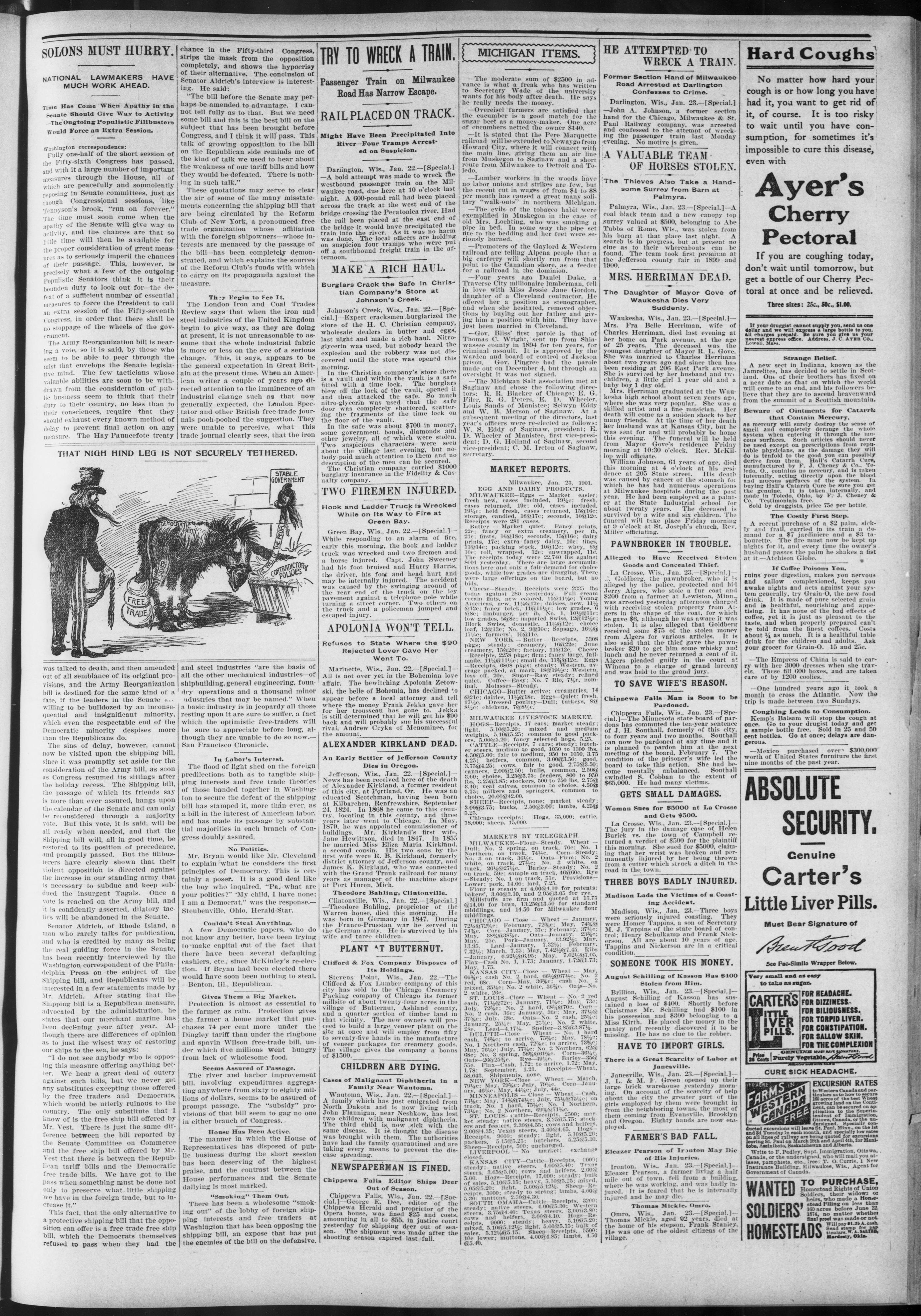
STABLE GOVERNMENT
DEMOCRATIC PARTY
FREE SILVER
FREE TRADE
THE BULL OF THE PEOPLE
CONTRADICTORY POLICIES
SOLONS MUST HURRY.
NATIONAL LAWMAKERS HAVE MUCH WORK AHEAD.
Time Has Come When Apathy in the Senate Should Give Way to Activity -The Ongtoing Populistic Filibusters Would Force an Extra Session.
Washington correspondence:
Fully one-half of the short session of the Fifty-sixth Congress has passed, and with it a large number of important measures through the House, all of which are peacefully and somnolently reposing in Senate committees, just as though Congressional sessions, like Tennyson's brook, "run on forever." The time must soon come when the apathy of the Senate will give way to activity, and the chances are that so little time will then be available for the proper consideration of great measures as to seriously imperil the chances of their passage. This, however, is precisely what a few of the outgoing Populistic Senators think it is their bounden duty to look out for—the defeat of a sufficient number of essential measures to force the President to call an extra session of the Fifty-seventh Congress, in order that there shall be no stoppage of the wheels of the government.
The Army Reorganization bill is nearing a vote, so it is said, by those who seem to be able to peer through the mist that envelops the Senate legislative mind. The few tacticians whose valuable abilities are soon to be withdrawn from the consideration of public business seem to think that their duty to their country, no less than to their consciences, require that they should exhaust every known method of delay to prevent final action on any measure. The Hay-Pauncefote treaty
THAT NIGH HIND LEG IS N
DEMOC
FREE SILVER
FREE
TRADE
was talked to death, and then amended out of all semblance of its original provisions, and the Army Reorganization bill is destined for the same kind of a fate, if the leaders in the Senate a willing to be bulldozed by an inconsequential and insignificant minority, which even the respectable end of the Democratic minority despises more than the Republicans do.
The sins of delay, however, cannot now be visited upon the shipping bill, since it was promptly set aside for the consideration of the Army bill, as soon as Congress resumed its sittings after the holiday recess. The Shipping bill, the passage of which its friends say is more than ever assured, hangs upon the calendar of the Senate and can only be reconsidered through a majority vote. But this vote, it is said, will be all ready when needed, and that the Shipping bill will, all in good time, be restored to its position of precedence, and promptly passed. But the filibusterers have clearly shown that their violent opposition is directed against the increase in our standing army that is necessary to subdue and keep subdued the insurgent Tagals. Once a vote is reached on the Army bill, and it is confidently asserted, dilatory tactics will be abandoned in the Senate.
Senator Aldrich, of Rhode Island, a man who rarely talks for publication, and who is credited by many as being the real guiding force in the Senate, has been recently interviewed by the Washington correspondent of the Philadelphia Press on the subject of the Shipping bill, and Republicans will be interested in a few statements made by Mr. Aldrich. After stating that the Shipping bill is a Republican measure, advocated by the administration, he states that our merchant marine has been declining year after year. Although there are differences of opinion as to just the wisest way of restoring our ships to the sea, he says:
"I do not see anybody who is opposing this measure offering anything better. We hear a great deal of outcry against such bills, but we never get any substitutes excepting those offered by the free traders and Democrats, which would be utterly ruinous to the country. The only substitute that I know of is the free ship bill offered by Mr. Vest. There is just the same difference between the bill reported by the Senate Committee on Commerce and the free ship bill offered by Mr. Vest that there is between the Republican tariff bills and the Democratic free trade bills. We have got to the pass when something must be done not only to preserve what little shipping we have in the foreign trade, but to increase it."
This fact, that the only alternative to a protective shipping bill that the opposition can offer is a free trade free ship bill, which the Democrats themselves refused to pass when they had the
chance in the Fifty-third Congress, strips the mask from the opposition completely, and shows the hypocrisy of their alternative. The conclusion of Senator Aldrich's interview is interesting. He said:
"The bill before the Senate may perhaps be amended to advantage. I cannot tell fully as to that. But we need some bill and this is the best bill on the subject that has been brought before Congress, and I think it will pass. This talk of growing opposition to the bill on the Republican side reminds me of the kind of talk we used to hear about the weakness of our tariff bills and how they would be defeated. There is nothing in such talk."
These quotations may serve to clear the air of some of the many misstatements concerning the shipping bill that are being circulated by the Reform Club of New York, a pronounced free trade organization whose affiliation with the foreign shipowners—whose interests are menaced by the passage of the bill—has been completely demonstrated, and which explains the sources of the Reform Club's funds with which to carry on its propaganda against the measure.
They Begin to See It.
The London Iron and Coal Trades Review says that when the iron and steel industries of the United Kingdom begin to give way, as they are doing at present, it is not unreasonable to assume that the whole industrial fabric is more or less on the eve of a serious change. This, it says, appears to be the general expectation in Great Britain at the present time. When an American writer a couple of years ago directed attention to the imminence of an industrial change such as that now generally expected, the London Spectator and other British free-trade journals pooh-poohed the suggestion. They were unable to perceive, what this trade journal clearly sees, that the iron
NOT SECURELY TETHERED.
STABLE GOVERNMENT
THE WILL OF THE PEOPLE
CONTRADICTORY POLICIES
and steel industries "are the basis of all the other mechanical industries—of shipbuilding, general engineering, foundry operations and a thousand minor industries that may be named." When a basic industry is in jeopardy all those resting upon it are sure to suffer, a fact which the optimistic free-traders will be sure to appreciate before long, although they are unable to do so now. San Francisco Chronicle.
In Labor's Interest.
The flood of light shed on the foreign predilections both as to tangible shipping interests and free trade theories of those banded together in Washington to secure the defeat of the shipping bill has stamped it, more than ever, as a bill in the interest of American labor, and has made its passage by substantial majorities in each branch of Congress doubly assured.
No Politics
Mr. Bryan would like Mr. Cleveland to explain what he considers the first principles of Democracy. This is certainly a poser. It is a good deal like the boy who inquired, "Pa, what are your politics?" 'My child, I have none; I am a Democrat.' was the response.—Steubenville, Ohio, Herald-Star.
Couldn't Steal Anything.
A few Democratic papers, who do not know any better, have been trying to make capital out of the fact that there have been several defaulting cashiers, etc., since McKinley's re-election. If Bryan had been elected there would have soon been nothing to steal. Benton, Ill., Republican.
Gives Them a Big Market.
Protection is almost as essential to the farmer as rain. Protection gives the farmer a home market that purchases 74 per cent more under the Dingley tariff than under the ringbone and spavin Wilson free-trade bill, under which five millions went hungry from lack of wholesome food.
Seems Assured of Passage.
The river and harbor improvement bill, involving expenditures aggregating anywhere from sixty to eighty millions of dollars, seems to be assured of prompt passage. The "subsidy" provisions of that bill seem to gag no one in either branch of Congress.
House Has Been Active.
The manner in which the House of Representatives has disposed of public business during the short session has been deserving of the highest praise, and the contrast between the House performances and the Senate dallying is most marked.
"Smoking" Them Out.
There has been a wholesome "smoking out" of the lobby of foreign shipping interests and free traders at Washington that has been opposing the shipping bill, an expose that has put the enemies of the bill on the defensive.
---
TRY TO WRECK A TRAIN.
Might Have Been Precipitated Into River-Four Tramps Arrested on Suspicion.
Dariington, Wis., Jan. 22.—[Special.]
A bold attempt was made to wreck the westbound passenger train on the Milwaukee road, due here at 10 o'clock last night. A 600-pound rail had been placed across the track at the west end of the bridge crossing the Pecatonica river. Had the rail been placed at the east end of the bridge it would have precipitated the train into the river. As it was no harm was done. The local officers are holding on suspicion four tramps who were put off a southbound freight train in the afternoon.
MAKE A RICH HAUL.
Burglars Crack the Safe in Christian Company's Store at Johnson's Creek.
Johnson's Creek, Wis., Jan. 22.—[Special.]—Expert cracksmen.burglarized the store of the H. C. Christian company, wholesale dealers in butter and eggs, last night and made a rich haul. Nitroglycerin was used, but nobody heard the explosion and the robbery was not discovered until the store was opened this morning.
In the Christian company's store there is a vault and within the vault is a safe fitted with a time lock. The burglaries blew off the lock of the vault, opened it and then attacked the safe. So much nitro-glycerin was used that the safe door was completely shattered, scattering the fragments of the time lock on the floor of the vault.
In the safe was about $700 in money, some government bonds, diamonds and other jewelry, all of which were stolen. Two suspicious characters were seen about the village last evening, but nobody paid much attention to them and no description of the men can be secured. The Christian company carried $1000 burglary insurance in the Fidelity & Casualty company.
TWO FIREMEN INJURED.
Hook and Ladder Truck is Wrecked While on Its Way to Fire at Green Bay.
Green Bay, Wis., Jan. 22.—[Special.] While responding to an alarm of fire, early this morning, the hook and ladder truck was wrecked and two firemen and a horse injured. Capt. John Sweeney had his foot bruised and Harry Harris, the driver, his foot and head hurt and may be internally injured. The accident was caused by the swinging around of the rear end of the truck on the icy pavement against a telephone pole while turning a street corner. Two others on the truck and a policeman jumped and escaped injury.
APOLONIA WON'T TELL.
Refuses to State Where the $90 Rejected Lover Gave Her Went To.
Marinette, Wis., Jan. 22.—[Special.]—All is not over yet in the Bohemian love affair. The bewitching Apolonia Zetowski, the belle of Bohemia, has declined to appear before a local attorney and tell where the money Frank Jekka gave her for her trousseau has gone to. Jekka is still determined that he will get his $90 back and will probably sue his successful rival, Andrew Ceyka of Menominee, for the amount.
ALEXANDER KIRKLAND DEAD.
An Early Settler of Jefferson County Dies in Oregon.
Jefferson, Wis., Jan. 22.—[Special.]—News has been received here of the death of Alexander Kirkland, a former resident of this city, at Portland, Or. He was an educated Scotchman, having been born at Kilbarchen, Renfrewshire, September 24, 1824. In 1868 he came to this country, locating in this county, and three years later went to Chicago. In May, 1879, he was appointed commissioner of buildings. Mr. Kirkland's first wife, Jane Hewittson, died in 1847. In 1855 he married Miss Eliza Maria Kirkland, a second cousin. His two sons by the first wife were R. B. Kirkland, formerly district attorney of Jefferson county, and James K. Kirkland, who was connected with the Grand Trunk railroad for many years as manager of the machine shops at Port Huron, Mich.
Theodore Bahling, Clintonville.
Clintonville, Wis., Jan. 22.—[Special.]
—Theodore Bahling, proprietor of the Warren house, died this morning. He was born in Germany in 1847. During the Franco-Prussian war he served in the German army. He is survived by his wife and three children.
PLANT ^T BUTTERNUT.
Clifford & Fox Company Disposes of Its Holdings.
Stevens Point, Wis., Jan. 22.-The Clifford & Fox Lumber company of this city has sold to the Chicago Creamery Packing company of Chicago its former millsite of about twenty-four acres in the village of Butternut, Ashland county, and a quarter section of timber land in that vicinity. The new owners will proceed to build a large veneer plant on the site at once and will employ from fifty to seventy-five hands in the manufacture of veneer packages for creamery goods. The village gives the company a bonus of $1500.
CHILDREN ARE DYING.
Cases of Malignant Diphtheria in a Family Near Wautoma.
Wautoma, Wis., Jan. 22.—[Special.]—A family which has just emigrated from North Dakota and is now living with John Flannigan, near Neshkow, has lost two children with malignant diphtheria. The third child is now sick with the same disease. It is thought the disease was brought with them. The authorities have had the family quarantined and are taking every means to prevent the disease spreading.
NEWSPAPERMAN IS FINED.
Chippewa Falls Editor Ships Deer Out of Season.
Chippewa Falls, Wis., Jan. 22.—[Special.]—George E. Dee, editor of the Chippewa Herald and proprietor of the Opera house, was fined $25 and costs, amounting in all to $55, in justice court yesterday for shipping deer out of season. The shipment was made after the shooting season expired last fall.
The moderate sum of $2500 in advance is what a freak who has written to Secretary Wade of the university wants for his body after death. He says he really needs the money.
Overeisel farmers are satisfied that the cucumber is a good match for the sugar beet as a money-maker. One acre of cucumbers netted the owner $140.
It is stated that the Pere Marquette railroad will be extended to Newaygo from Howard City, where it will connect with the main line, giving them an air line from Muskegon to Saginaw and a short route from Milwaukee to Detroit and Toledo.
Lumber workers in the woods have no labor unions and strikes are few, but the recent cut in wages of from $4 to $8 per month has caused a great many solitary "walk-outs" in northern Michigan.
The evils of the tobacco habit were exemplified in Muskegon in the case of old Mrs. Lochting, who was smoking a pipe in bed. In some way the pipe set fire to the bedding and her feet were seriously burned.
Promoters of the Gaylord & Western railroad are telling Alpena people that a big carferry will shortly run from that point to the Canadian shore, as a feeder for a railroad in the dominion.
Four years ago Daniel Dake, a Traverse City millionaire lumberman, fell in love with Miss Jessie Jane Gordon, daughter of a Cleveland contractor. He offered her a position as stenographer, and when she hesitated, removed objections by buying out her father and giving him a position with him. They have just been married in Cleveland.
—Gov. Bliss' first parole is that of Thomas C. Wright, sent up from Shiawassee county in 1894 for ten years, for criminal assault. It is approved by the warden and board of control of Jackson prison. Gov. Pingree had the parole made out on December 4, but through an oversight it was not signed.
—The Michigan Salt association met at Saginaw and chose the following directors: R. R. Blacker of Chicago; E. G. Filer, R. G. Peters, E. D. Wheeler, Louis Sands of Manistee; Selwyn Eddy and W. B. Merson of Saginaw. At a subsequent meeting of the directors, last year's officers were re-elected as follows: W. S. Eddy of Saginaw, president; E. D. Wheeler of Manistee, first vice-president; D. G. Holland of Saginaw, second vice-president; C. M. Ireton of Saginaw, secretary.
MARKET REPORTS.
Milwaukee, Jan. 23, 1901.
AND, DAIRY, PRODUCTS.
MILWAUKEE—Eggs — Market easier; fresh new, cases included, 19½c; fresh, cases returned, 19c; old, cases included, 19¼c; held fresh, cases returned, 15@16c; storage, candled, 16@17c; seconds, 10@12c. Receipts were 281 cases.
Butter — Market quiet. Fancy prints, 22c; fancy or extra creamery, per lb, 21c; firsts, 16@18c; seconds, 15@16c; dairy prints, 17c; extra fancy dairy, 16c; lines, 13@14c; packing stock, 10@12c; whey, 8@10c; roll, wrapped, 12c; unwrapped, 11c. The receipts today were 22,740 lbs against 8001 yesterday. There are large accumulations here and only a fair demand for choice goods, while low grades are dragging. There were large offerings on the board, but no bids.
Cheese—Steady. Receipts were 2335 lbs today against 280 yesterday. Full cream cream flats, new colored, 11@11½c; Young Americas, new, 11½@12c; daisies, new, 11½@12c; fancy brick, 11@11½c; low grades, 6 @8c; limburger, per ib, No. 1, 10½@11c; low grades, 5@8c; imported Swiss, 12@12½c; Block Swiss, domestic, 11½@12c; choice loaf, 12@13c; No. 2, 9@10c; Sapsago, 16½@17½c; farmers' 10@11c.
NEW YORK — Butter — Receipts, 5308 pkgs; steady; creamy, 16@22c; June creamy, 15@20c; factory, 11@12c. Cheese—Receipts, 2258 pkgs; firm; fancy large, fall-ude 11½@11½c; small do, 11½@12c. Eggs
made, 11%@11%c, small do, 11%@11%c. Eggs—Receipts, 6808 pkgs; steady; Western, average packed, at mark, 18%@19%c; Western, loss off, 20c. Sugar—Raw steady; refined quiet. Coffee—Easy; No. 7 Rlo, 7%c, nominal. Molasses—Steady.
CHICAGO—Butter active; creameries, 14 @21c; dairies, 11%@18c. Eggs—Quiet; fresh, 17%c. Dressed poultry—Dull; turkeys, 8% @8%c; chickens, 7@8%c.
MILWAUKEE LIVESTOCK MARKET.
HOGS—Receipts, 17 cars; market steady; light, 5.10@5.20; mixed and medium weights, 5.10@5.25; common to good packers, 5.00@5.20; fancy selected hogs, 5.25.
ers, 5.00@5.20; fancy selected hogs, 5.25.
CATTLE—Receipts, 7 cars; steady; butcher steers, medium to good, 1050 to 1300 lbs, 4.50@5.00; fair to medium, 950 to 1050, 3.75
4.25; heifers, common, 3.00@3.50; good, 3.75@4.25; cows, fair to good, 2.75@3.50;
canners, 2.00@2.50; bulls, common, 2.50@
3.00; choice, 3.25@3.75; feeders, 800 to 950
lbs, 3.25@3.85; stockers, 500 to 750 lbs, 2.75@
3.40; veal calves, common to choice, 4.50@
5.75; milkers and springers, common to
choice, 20.00@42.00.
SHEEP—Receipts, none; market steady:
3.00@3.75; bucks, 2.50@3.00; lambs, 4.25@
5.25
Chicago receipts: Hogs, 35,000; cattle, 18,000; sheep, 15,000.
MARKETS BY TELEGRAPH.
MILWAUKEE—Flour—Steady. Wheat—
Dull; No. 2 spring, on track, 70c; No. 1
Northern, on track, 74%c. Corn—Steady;
No. 3 on track, 36%c. Oats—Firm; No. 2
white, on track, 27%c; No. 3 white, on
track, 26%@27%c. Barley—Steady; No. 2
on track, 59c; sample on track, 46@60c. Rye
—Steady; No. 1 on track, 51c. Provisions—
Lower; pork, 14.00; lard, 7.25.
Flour is steady at 4.00@4.10 for patents;
bakers', 3.00@3.10, and 2.95@3.05 for rye.
Millstuffs are firm and quoted at 13.75
@14.00 for bran, 13.25@13.50 for standard
middlings, and 14.50 for Milwaukee flour
middlings.
CHICAGO — Close — Wheat — January,
72%@72%c. February, 72%c; May, 74%@
74%c. Corn—January, 37c; February, 37%c;
May, 38%@38%c. Oats—January, 23%c;
May, 25c. Pork—January, 13.92; May,
13.95. Lard—January, 7.32%; February,
7.32%; March, 7.35; May, 7.42%@7.45. Ribs—
January, 6.92%@6.95; May, 7.02%@7.05.
Flax—Cash No. 1, 1.73; January, 1.72@1.73;
May, 1.75
KANSAS CITY—Close — Wheat — May,
66%c; cash No. 2 hard, 66%c@67%c; No. 2
red, 68c. Corn-May, 36%c; cash No. 2
mixed, 35%c; No. 2 white, 36%c. Oats-No.
2 white, 26c.
ST. LOUISE—Close — Wheat — No. 2 red
cash, 71%c@72c; January, 71%c; May, 73c;
July, 72%c; No. 2 hard, 68%@70c. Corn-
No. 2 cash, 36c; January, 36c; May, 37%@
37%c; July, 38c. Oats-No. 2 cash, 25%c;
January, 25%c; May, 25%c; No. 2 white,
28c. Lead-4.17%, Spelter-3.85@3.87%.
DULUTH—Close — Wheat — No. 1 hard cash, 74%c; to arrive, 75%c; May, 78%c;
No. 1 Northern cash, 72%c; to arrive, 73%c;
May, 76%c; July, 77%c; No. 2 Northern, 62@
68c; No. 3 spring, 58%@ 61%c. Corn—36%c
Oats—26@ 25%c. Rye—49%c. Barley—35@
55c. Flax—Cash, 1.72; to arrive, 1.72; May,
1.78; September, 1.21. Receipts—Wheat,
58.043. Shipments, none.
NEW YORK—Close — Wheat — March,
79%c; May, 79%c; July, 79%c. Corn—Janu-
47%c; May, 44%c; July, 44c.
ary, 46%c; MINNEAPOLIS — Close — Wheat — Cash,
73%c; May, 74%@74%c; July, 75%@75%c; on
track, No. 1 hard, 75%c; No. 1 Northern,
73%c; No. 2 Northern, 69%@71%c.
ST. LOUIS—Cattle—Receipts, 2500; market
steady; native steers, 3.25@5.75; steckers
and feeders, 2.30@4.55; cows and heifers,
2.00@4.35; Texas steers, 3.40@4.65; Hogs
Receipts, 9000; light, 5.10@5.20;
packers, 5.15@5.25; butchers, 5.25@5.30;
Sheep—Receipts, 500; unchanged.
sneep hopps, bus market: exchange LIVERPOOL - No elk
closed.
KANSAS CITY—Cattle—Receipts, 2000;
steady; native steers, 4.00@5.40; Texas
steers, 3.65@5.00; cows and heifers, 2.00@
5.00. Hogs—Receipts, 17.000; steady; bulk
of sales, 5.10@5.15; heavy, 5.10@5.25; mixed,
5.05@5.20; light, 5.00@5.12½. Sheep—Re
ceipts, 3000; steady to strong, lambs, 4.00@
5.30; muttons, 2.50@4.30.
SOUTH OMAHA—Cattle—Receipts, 3200;
steady; native steers, 4.00@5.30; Western
steers, 3.75@4.40; Texas steers, 3.00@3.80;
cows and heifers, 3.00@4.10. Hogs—Re
ceipts, 9000; steady; heavy, 5.10@5.20;
mixed, 5.10@5.12½; light, 5.00@5.15; bulk of
sales, 5.12½@5.15. Sheep—Receipts, 5500;
10c lower; muttons, 4.00@4.85; lambs, 4.50@
5.40.
HE ATTEMPTED TO WRECK A TRAIN.
Former Section Hand of Milwaukee Road Arrested at Darlington Confesses to Crime.
Darlington, Wis., Jan. 23.—[Special.]
—John A. Johnson, a former section hand for the Chicago, Milwaukee & St. Paul Railway company, was arrested and confessed to the attempt of wrecking the passenger train last Monday evening. No motive is given.
The Thieves Also Take a Handsome Surrey from Barn at Palmyra.
Palmyra, Wis., Jan. 23.—[Special.]—A coal black team and a new canopy top surrey valued at $500, belonging to Abe Tubbs of Rome, Wis., was stolen from his barn at that place last night. A search is in progress, but at present no clue as to their whereabouts can be found. The team took first premium at the Jefferson county fair in 1890 and 1900.
MRS. HERRIMAN DEAD
The Daughter of Mayor Gove of Waukesha Dies Very Suddenly.
Waukesha, Wis., Jan. 23.—[Special.]—Mrs. Fra Belle Herriman, wife of Charles Herriman, died last evening at her home on Park avenue, at the age of 25 years. The deceased was the youngest daughter of Mayor R. L. Gove. She was married to Charles Herriman about two years ago and since then has been residing at 206 East Park avenue. She is survived by her husband and two children, a little girl 1 year old and a baby boy 1 day old.
Mrs. Herriman graduated at the Waukesha high school about seven years ago, where she was very popular. She was a skilled artist and a fine musician. Her death will come as a sudden shock to her many friends. At the time of her death her husband was at Kansas City, but he was sent for and will probably be home this evening. The funeral will be held from Mayor Gove's residence Friday morning at 10:30 o'clock. Rev. McKillon will officiate.
William Johnson, 61 years of age, died this morning at 4 o'clock at his residence at 205 State street. His death was caused by cancer of the stomach for which he has had numerous operations at Milwaukee hospitals during the past year. He had been employed as a painter at the State Industrial school for about twenty years. The deceased is survived by a wife and six children. The funeral will take place Friday morning at 9 o'clock at St. Joseph's church, Rev. Miller officiating.
PAWNBROKER IN TROUBLE.
Alleged to Have Received Stolen Goods and Concealed Thief.
La Crosse, Wis., Jan. 23.—[Special.]
C. Goldberg, the pawnbroker, who it is alleged by the police, protected and hid Jerry Algers, who stole a fur coat and $200 from a farmer at Lewiston, Minn., was arrested yesterday afternoon charged with receiving stolen property from Algers in the shape of the coat, for which he gave $6, although he was aware it was stolen. It is also alleged that Goldberg received some $75 of the stolen money from Algers for various articles. It is also said that the thief gave the pawnbroker $20 to get him some whisky and lunch and he never returned a cent of it. Algers pleaded guilty in the court at Winona to a charge of grand larceny and was held to the grand jury.
TO SAVE WIFE'S REASON.
Chippewa Falls Man is Soon to be Pardoned.
Chippewa Falls, Wis., Jan. 23.—[Special.]—The Minnesota state board of pardons has commuted the ten-year sentence of J. H. Southall, formerly of this city, to four years and two months. Southall can now be pardoned at any time and it is planned to pardon him at the next meeting of the board. February 7. The condition of the prisoner's wife led the board to take this action. She had become mentally unbalanced. Southall swindled S. Cobban to the extent of $65,000. He had many victims.
GETS SMALL DAMAGES.
Woman Sues for $5000 at La Crosse and Gets $500.
La Crosse, Wis., Jan. 23.—[Special.]—The jury in the damage case of Helen Burick vs. the town of Campbell returned a verdict of $500 for the plaintiff this morning. She sued for $5000, claiming that her wrist was broken and permanently injured by her being thrown from a cutter which struck a ditch in the road in the town.
THREE BOYS BADLY INJURED.
Madison Lads the Victims of a Coasting Accident. Madison, Wis., Jan. 23.—Three boys were seriously injured coasting. They were Homer Tappins, a son of Secretary M. J. Tappins of the state board of control; Henry Schulkamp and Frank Nickerson. All are about 10 years of age. Tappins and Nickerson are in a critical condition.
SOMEONE TOOK HIS MONEY.
August Schilling of Kasson Has $400 Stolen from Him.
Brillion, Wis., Jan. 23.—[Special.]—August Schilling of Kasson has sustained a loss of $400. Shortly before Christmas Mr. Schilling had $100 in his possession and $300 belonging to a Miss Kirth. He placed the money in the pantry and recently discovered it to be missing. He has no clue to the robber.
HAVE TO IMPORT GIRLS.
There is a Great Scarcity of Labor at Janesville. Janesville, Wis., Jan. 23.—[Special.] J. L. & M. F. Green opened up their large brick warehouse yesterday morning. On account of the scarcity of help about the city the greater part of the girls employed by them were brought in from the neighboring towns, the most of them coming from Evansville, Brooklyn and Oregon. Eighty hands are now employed.
FARMER'S BAD FALL.
Eleazer Pearson of Ironton May Die of His Injuries.
Ironton, Wis., Jan. 23.—[Special.]—Eleazer Pearson, a farmer living a half mile out of town, fell from a building, where he was working, and was badly injured. It is feared that he is internally injured and he may die.
Thomas Mickle, Omro.
Omro, Wis., Jan. 23.—[Special.]—Thomas Mickle, aged 92 years, died at the home of his stepson, Frank Stanley. He was one of the oldest citizens of the village.
No matter how hard your cough is or how long you have had it, you want to get rid of it, of course. It is too risky to wait until you have consumption, for sometimes it's impossible to cure this disease even with
Ayer's Cherry Pectoral
If you are coughing today, don't wait until tomorrow, but get a bottle of our Cherry Pectoral at once and be relieved. Three sizes: 25c., 50c., $1.00.
If your druggist cannot supply you, send us one dollar and we will express a large bottle to you, all charges prepaid. Be sure you give us your nearest express office. Address, J. C. AYER Co., Lowell, Mass.
Strange Belief.
A new sect in Indiana, known as the Jamrelites, has decided to settle in Scotland. One of their brothers has fixed on a near date as that on which the world will come to an end, and his followers believe that they are to ascend heavenward from the summit of a Scottish mountain.
Beware of Ointments for Catarrh that Contain Mercury.
as mercury will surely destroy the sense of smell and completely derange the whole system when entering it through the mucous surfaces. Such articles should never be used except on prescriptions from reputable physicians, as the damage they will do is tenfold to the good you can possibly derive from them. Hall's Catarrh Cure, manufactured by F. J. Cheney & Co., Toledo, O., contains no mercury, and is taken internally, acting directly upon the blood and mucous surfaces of the system. In buying Hall's Catarrh Cure be sure you get the genuine. It is taken internally, and made in Toledo, Ohio, by F. J. Cheney & Co. Testimonials free.
Sold by druggists, price 75c per bottle.
The Costly First Step.
A recent purchase of a $2 palm, sickly and frail, carried in its train a demand for a $7 jardiniere and a $3 tabourette. The fire must now be kept up nights for it, and every time the owner's husband passes the palm he shakes a fist at it.—Atchison Globe.
If Coffee Poisons You.
ruins your digestion, makes you nervous and sallow complexioned, keeps you awake nights and acts against your system generally, try Grain-O, the new food drink. It is made of pure selected grain and is healthful, nourishing and appetising. It has none of the bad effects of coffee, yet it is just as pleasant to the taste, and when properly prepared can't be told from the finest coffees. Costs about $ \frac{1}{4} $ as much. It is a healthful table drink for the children and adults. Ask your grocer for Grain-O. 15 and 25c.
—The Empress of China is said to carry with her 3000 dresses when she travels. These fill 600 boxes, and are taken care of by 1200 coolies.
One hundred years ago it took a month to cross the Atlantic. Now the trip is made between two Sundays.
Coughing Leads to Consumption.
Kemp's Balsam will stop the cough at once. Go to your drugist today and get a sample bottle free. Sold in 25 and 50 cent bottles. Go at once; delays are dangerous.
Mexico purchased over $300,000 worth of United States furniture the first nine months of the past year.
ABSOLUTE SECURITY.
Genuine Carter's
Little Liver Pills.
Great Wood
Very small and as easy
to take as sugar.
CARTER'S
LITTLE
LIVER
PILLS.
FOR HEADACHE.
FOR DIZZINESS.
FOR BILIOUSNESS.
FOR TORPID LIVER.
FOR CONSTIPATION.
FOR SALLOW SKIN.
FOR THE COMPLEXION
Price
28 Cents
GENUINE MUST HAVE SIGNATURE.
Purely Vegetable.
CURE SICK HEADACHE.
FARMS IN WESTERN CANADA FREE
EXCURSION RATES to Western Canada and participate in how to secure 160 acres of the best Wheat growing land on the Continent, can be secured on application to the Superintendent of Immigration, Ottawa, Canada, or the undersigned. Specially conducted excursions will leave St. Paul, Minn., on the 1st and 3d Tuesday in each month, and the rates on all lines of railway are for excursions leaving St. Paul on March 28th and April 4th, for Manitoba, Assiniboia, Saskatchewan and Alberta.
Write to F. Pedley, Supt. Immigration, Ottawa, Canada, or the undersigned, who will mail you at lames, pamphlets, etc., free: T. O. Currie, 1 New Insurance Building, Milwaukee, Wis., Agent for Government of Canada.
WANTED TO PURCHASE,
Homestead Rights of Union
Soldiers, their widows or
heirs, who made a Homestead Filling on less than
160 acres before June 22,
1874, no matter whether
final proof was made or not.
Will pay $1.25 A. cash.
Send stamp for par-
ticulars. W. A. SALIZE,
Hardesty, Okla.
```markdown
```
The Wisconsin Weekly Advocate
Printed in the Interests of the Negro Race,
MILWAUKEE, WIS.
Richard B. Montgomery.....
.....Editor and Proprietor
Office: 327 Wells Street.
Telephone Black No. 244.
SUBSCRIPTION RATES.
One Year ..... $2.00
Six Months ..... 1.25
Three Months ..... 75
Send money by Express Money Order, P. O.
Money Order or Registered Letter to the
Wisconsin Weekly Advocate.
ADVERTISING RATES.
One inch, single insertion..... 25c
One inch, per year..... $9.00
Business locals 5c per line each insertion.
Apply for rates to the Advocate.
TO CONTRIBUTORS:
All communications must be sent with the name and address of the sender as an evidence of good faith, but not necessarily for publication. No manuscript returned if not accepted, unless accompanied by stamps.
All subscribers of the Advocate that fail to get their paper promptly will please notify us at once. The Advocate, at 327 Wells street.
The Wisconsin Weekly Advocate company wishes to notify the public that all contracts and business transactions with this company must have the company stamp, otherwise they will be void. Neither will this company be responsible for paid subscriptions unless given to duly-accredited agents, who, on request, will give the company's receipt for same. Subscribers failing to receive their papers regularly will kindly notify the general office. Address all business communications to the general manager, 327 Wells street.
Mr. Richard B. Montgomery.
Entered at the Milwaukee P. O. as second-cass matter.
The Helping Hand Colored Mission
incorporated under the laws of the State of Wisconsin has for its object the supplying of qualified colored help to those requiring the same. In order to be able to get servants from the mission it is necessary, that in order to partly cover expenses incurred, those parties desiring help should become subscribers for this paper. No actual charge is made. Parties who secure situations through this agency are also expected to become subscribers. We have at present on our books: Cooks, General Servants, Waitresses, Laundresses, Nurses, Coachmen, Porters, Waiters. Office hours 9-12 and 1-4.
R. B. MONTGOMERY, Mgr.
327 Wells St., Milwaukee.
Pat Crowe has become so used to staying away that even if he were to fall sick he would probably take "absent treatment" rather than return to Omaha.
The rumor that Sir Thomas Lipton is sending spies to the United States to discover the lines of the America cup defense yachts is as absurd as the secrecy which is maintained by the builders of international racers, both in England and America.
According to the modern view of crime, it required less courage for Teller Alvord to plead guilty to the charge of stealing $700,000 than it does to acknowledge the theft of a few dollars. Alvord will probably feel like a Napoleon among the smaller rogues in Sing Sing.
The reported famine in China shows where the Celestials would be weak in the event of war. They might be able to raise a vast army, but in the meantime those left in the fields would fail to raise food enough to support themselves and the non-producers.
The street railway management in Stockholm, Sweden, has arranged that every suburban train at night shall be provided with a separate car for intoxicated persons only. American cities have owl-cars, but boiled-owl cars are something new. By the way, how will the necessity for their existence be explained by the advocates of the adoption of the Gothenburg system in the United States?
Admiral Hichborn, chief constructor of the United States navy, has criticised the big battleships announced by the British Admiralty, saying that they will be inefficient as compared with fighting ships of the class recently contracted for in the United States. They will be a little stronger in the batteries, but will have a smaller radius of action than the American fighters, which are considered large enough for all practical purposes.
Leather has seemed so inseparably associated with harness that it is difficult to realize that a substitute has actually been placed on the English market. A Sheffield firm has taken up the manufacture of traces made of cotton, rubber and a secret composition, vulcanized strongly together, in place of the time-honored leather ones. In addition to the great natural strength of the material, which tests show to be almost double that of the ordinary double leather trace, it is very pliable and to these merits adds that of being weather proof and less expensive.
The Philadelphia Bulletin says: "The protest against launching the new battlehip Wisconsin on Friday, February 1, will doubtless excite a smile on the part of many landsmen as an instance of 'sailor superstition.'" The Wisconsin will not be launched on Friday, February 1, for the reason that she was launched on November 26, 1898, more than two years ago. It was proposed to put her into commission on the 1st of February. In deference to a request from the officers, this date will be changed. The Friday superstition is absurd, but there are probably as many landsmen as sailors under its thrall.
Citizens of Polish birth or descent are interested in the proposition to erect an equestrian statue in Washington to Gen. Count Casimir Pulaski, who lost his life at Savannah in 1779. "One hundred years ago," said Representative Mann of Chicago, who has introduced a bill for that purpose, carrying an appropriation of $75,000, "Congress voted an equestrian statue to Pulaski, but the treasury
seems to have been short of funds, and for that or some other reason the statue was never erected. There are many Poles in Chicago, some of them very highly educated. They have been agitating the matter and think Congress should now appropriate money to carry out the plan authorized a century ago."
In the studio of William Couper, New York, is the clay model for what will be one of the largest pieces of bronze casting in this country. It is the figure of an angel, modeled in very high relief, intended for the exterior of a granite tower erected on private grounds at Methuen, Pa. There is only one chamber in the tower and this chamber contains a bronze group of Christ and a child. The owner of this strange structure asked Mr. Couper to design a figure for the exterior which should be in keeping with and bear out the idea conveyed by the group inside. The figure of the angel is 14 feet long from the foot to the top of the wing. Two and one-half tons of material were used up in the modeling. The work is to be cast in Philadelphia.
The winter excursion steamer has become an established and luxurious fact. A certain number of steamship companies organize trips of three months' duration to the Mediterranean, Africa, Egypt, the Holy Land, and even longer ones to India and around the world. A person can now take a trip to Cairo almost as easily as he can to a Southern watering place. The steamships become large yachts with 200 or 300 pleasure seekers aboard for a winter outing. The American pleasure seekers are seen as often at the Pyramids or on the Riviera, as in Florida or Lake North. It seems odd to read of the golf links near the Pyramids and of all the modern innovations that partially destroy the illusion and romance of travel.
A meeting of colored men has just been held at Cape May, N. J., to perfect plans for the establishment of a colony in that vicinity for the assistance of members of their race from all parts of the country. An option has been secured upon 1800 acres of land. One of the first things to be done in developing the enterprise will be the erection of a sawmill to work the timber upon the place—of which there is considerable—into lumber for the building of houses and factories. Negotiations are successfully proceeding for the establishment of a shoe factory, other industries are under contemplation and considerable farming is to be done. The plan adopted is similar to that under which the South Jersey colonies have been developed at Woodbine for Hebrews.
The latest invention in connection with wireless telegraphy, according to Nature, is an apparatus designed to warn ships of their approach to danger in times of fog or in places where a simpler system of signaling is not practicable. The invention consists essentially of a toothed revolving wheel, which operates a Morse key in such a manner as to spell the name of the station. The wheel may be rotated either by clockwork or by a small electric motor, and may be adjusted to send the signals automatically every minute or two. In this way all ships coming within range of the instrument may be notified of the fact by the ringing of a bell and the reception of a message giving the name of the place, provided they are fitted with apparatus for detecting the electric waves.
The governor of New Hampshire, in his message to the Legislature, urged that the forests of the magnificent White mountain country be protected, pointing out that from a financial standpoint, apart from all sentiment, the state could not afford to let the denudation of the hills go on, because the money poured into the state by summer visitors is of far more importance to the commonwealth than the lumber industry, which, as now conducted, must run itself out, at the same time destroying the charm of the mountains. Furthermore, the waterpower must suffer as the forests disappear. The governor made the statement that under a proper system of forestry the mountains could be made to yield great quantities of lumber without marring their verdure.
James R. Tyson of Reading, Pa., has sent a communication to the state fish commission in which he urges that measures be taken to protect terrapin from extinction. He says that terrapin being neither fish nor fowl in the law is not protected. Under existing circumstances the terrapin is hunted and caught during the summer months in the open streams, and in winter the hunters prod the banks and take them by the bag full. They are always in demand in winter, and bring a sufficiently high price to make it worth while to hunt. It is asserted that many are caught in the summer and penned up in cellars until winter, when there is a market for them. It is known that some of the streams in Pennsylvania furnish terrapin that is served in the finest establishments in the large cities.
The failure of the new British royal yacht Victoria and Albert, which has cost Her Majesty's government $3,750,000, is a severe reflection upon British naval architects. It appears that the yacht was designed by a builder of warships who in trying to give her a "yachty" appearance produced a craft that drew from the Prince of Wales the remark that the Victoria and Albert was meant for a yacht, but had turned out a very poor cruiser. She almost capsized at her launching, and since that time has been undergoing successive reductions in top hamper. The builders had made the ship's upper form comport with cabin designs, which included heavy deadened partitions, iron shutters, etc., until it was doubtful whether the craft would be able to carry the weight of her luxurious fittings. Geo. L. Watson, the yacht designer, has been commissioned by the Admiralty to inspect the Victoria and Albert and suggest changes to make her seaworthy. Perhaps he may recommend a deep keel with a lead mine at the bottom, after the style of the international cup racers.
Will by Phonograph.
A wealthy engineer recently talked his last will and testament into a phonograph. Then with a hot copper wire he signed his name on the wax roll of the phonograph, the witnesses doing likewise, and the "document" was thereupon completed.
TRADE MARK
REGISTERED 1892.
U.S.PATENT OFFICE
WASHINGTON, D.C.
BEFORE USING
HARTONA
AFTER USING
HARTONA
Hartona will make the hair grow long and soft, straight and beautiful. Makes the hair grow on bald and thin places. Restores GRAY HAIR to its original color. Hartona cures Dandruff, Baldness, falling out of the hair, itching, and all scalp diseases. Hartona does not have to be used all the time, as it straightens the hair and gives it fresh life and lustre, and the hair stays and grows naturally beautiful and straight after the use of Hartona. No hot irons necessary. No pasting the hair down with grease. Hartona is positively harmless—one box can be used by every one in the family. Benefits and improves children's hair just the same as adults. To meet the popular and ever-increasing demand for Hartona Hair-Grower and Straightener, we have placed it on sale in 25c. and 50c. sizes, in our special round, patent box. See that the word Hartona is on every box.
Money positively refunded if you are not absolutely delighted with the Hartona remedies. Remember, we handle no fake goods, and you are positively protected by our $100.00 guarantee to any one proving otherwise. All our remedies are trade-marked, registered and copyrighted at United States Patent Office at Washington, D. C., in the years 1892 and 1900. We refer you, as to our responsibility, to the City Bank of Richmond, Va., Adams and Southern Express Companies, and to the editor of this paper.
We want lady and gentlemen agents, white or colored, in every city and town in the United States. Write to us to-day, no matter if you are employed or not, and we will show you how to make a splendid living, with easy and pleasant work, and no risk of losing your good money. Write to us and we will send you a book of over one hundred genuine testimonials in your own State of people who have used and are using Hartona remedies. Is this not fair and honest enough?
HARTONA FACE WASH
Hartona Face Wash will gradually turn the skin of a black person five or six shades lighter, and will turn the skin of a mulatto person perfectly white. The skin remains soft and bright without continual use of the face wash. One bottle does the work. Hartona Face Wash will remove wrinkles, dark spots, pimples, blackheads, freckles, and all blemishes of the skin. You can regulate the shade of skin on neck, face and hands to any shade you wish. Full directions with each bottle.
Hartona Face Wash is perfectly harmless, and is sent to any part of the United States on receipt of price, 50c. per bottle; securely sealed from observation. It is your duty to look as beautiful as possible. Thousands of delighted patrons send us testimonials every year. Please remember that your money is positively refunded if you are not perfectly satisfied and delighted with the Hartona remedies. We want agents in every city in the United States. Write to us, no matter if you are employed or not, and we will show you how to make money without risking any of your own money.
Hartona No-Smell will remove all smells and bad odors of the body; cures sore and aching feet, chafed limbs, etc. Hartona No-Smell is a God-send to all persons suffering from disagreeable odors caused by perspiration of the feet, arm-pits, etc. Sent anywhere on receipt of price, 10 cents and 25 cents a package. Address all orders to
Send us One Dollar, and mention this paper, and we will send you three large boxes of Hartona Hair-Grower and Straightener, two large bottles of Hartona Face Wash, and one large box of Hartona No-Smell. Goods will be sent securely sealed from observation. Write your name and post-office and express-office address very plainly. Money can be sent by post-office money order, or enclosed in a registered letter, or by express. Address all Orders to
HARTONA REMEDY CO., 909 E: Main St., Richmond, Va.
JAMES T. BRETT & SON,
307 REED STREET and Always Open 410 GRAND AVENUE.
Avenue Hotel...
Free 'Bus.
CALL ON
MATT GREENWALD
Who is Up-to-Date in His Business.
AGENT FOR
.
M.
BayView Mission
ST. JOHN'S E. M. E. CHURCH
310 SUPERIOR STREET.
Rev. JOSEPH A. JACKSON, Pastor.
Services at 11 a. m. and
7:30 p. m. Sundays.
Wednesday and Friday Evenings,
at 8:30 p. m.
The
Chicago Tribune is a newspaper for bright and intelligent people. It is made up to attract people who think Is not neutral or colorless, constantly trimming in an endeavor to please both sides, but it is independent in the best sense of the word. It has pronounced opinions and is fearless in expressing them, but it is always fair to its opponents.
Matters of national or vital public interest get more space in THE TRIBUNE than in any other paper in the West. For these reasons it is the newspaper you should read during the forthcoming political campaign.
THE TRIBUNE'S financial columns never mislead the public.
Its facilities for gathering news, both local and foreign, are far superior to those of any other newspaper in the West.
It presents the news in as fair a way as possible and lets its readers form their opinions.
While it publishes the most comprehensive articles on all news features, if you are busy the "Summary of THE DAILY TRIBUNE" published daily on the first page gives you briefly all the news of the day within one column.
Its sporting news is always the best, and its Sunday Pink Sporting Section is better than any sporting paper in the country.
It is the "cleanest" daily printed in the West.
THE SATIRIST
Not mine to draw the cloth-yard shaft
From straining palm to thrilling ear:
Then launch it through the monster's hulk,
One thrust, from front to rear.
Mine is the Bushman's tiny bow,
Whose wounds the foeman hardly feels;
He laughs and lifts his hand to smile,
Then, suddenly, he reels.
—Harry Lyman Koopman in Morrow Songs.
HARTONA NO-SMELL.
HARTONA NO-SMELL.
SPECIAL GRAND OFFER.
MRS. JAMES T. BRETT,
Lady Undertaker.
South 122. Milwaukee, Wis. Grand 2467.
Sustaining Life
on the choice juicy meats served by us is just what our athletic, bicycle riding, tennis playing and golfing twentieth century men and women need. Pie days have gone with the spin ning wheel. Good bone, muscle and tissue is what is needed now. You can get them by patronizing the Chicago Market. Our meats are fresh, tempting and choice, and are sold at prices that will let you feast in comfort.
WILLIAM RASCH GENEVA LAKE, WIS.
WHEN IN MADISON Call at the
M. J. REGAN, Prop.
$2.00 Rate . . . . . .
WHEN IN KENOSHA
E. KLINKERT'S RACINE KEG and BOTTLED BEER. Depot: No. 15 North Main Street. Telephone 163. KENOSHA - WISCONSIN
..HARTONA..
Preparations for the
arations for the
Preparations for the Hair!
The Original and Only Hartona.
Matchless and Positively U
ening all Kinky, K
Harsh, Cur
beautiful. Makes the hair grow on bald
ing out of the hair, itching, and all s
fresh life and lustre, and the hair stays
resting the hair down with grease. Ha
children's hair just the same as ad
tress, we have placed it on sale in 25c. an
with the Hartona remedies. Remember
ly otherwise. All our remedies are tra
y years 1892 and 1900. We refer you
ques, and to the editor of this paper.
My city and town in the United States
endid living, with easy and pleasant
hundred genuine testimonials in you
though?
FACE WASH
son five or six shades lighter, and will
annual use of the face wash. One bottle
, blackheads, freckles, and all blemis
. Full directions with each bottle.
Part of the United States on receipt of
ible. Thousands of delighted patrons
we are not perfectly satisfied and delight
es, no matter if you are employed or n
NO-SMEL
body; cures sore and aching feet, chaf
disagreeable odors caused by perspire
Address all orders to
TONA REMEDY CO., 909 E. M
GRAND OFFER.
You three large boxes of Hartona Ha
No-Smell. Goods will be sent securely
by plainly. Money can be sent by pos
9 E: Main St., R
and Positively Unequaled for
g all Kinky, Knotty, Stubby,
Harsh, Curly Hair.
Does the hair grow on bald and thin places. Re-
tains hair, itching, and all scalp diseases. Hair
stretre, and the hair stays and grows naturally
down with grease. Hartona is positively l
air just the same as adults. To meet the
need it on sale in 25c. and 50c. sizes, in our
nea remedies. Remember, we handle no fake g
All our remedies are trade-marked, register
and 1900. We refer you, as to our respons
e editor of this paper.
Down in the United States. Write to us to do
with easy and pleasant work, and no risk o
one testimonials in your own State of peo
E WASH.
Has shades lighter, and will turn the skin of a
the face wash. One bottle does the work.
Freckles, and all blemishes of the skin. Y
tions with each bottle.
United States on receipt of price, 50c. per box.
Bands of delighted patrons send us testimoni
ectly satisfied and delighted with the Hartona
if you are employed or not, and we will sho
-SMELL.
Store and aching feet, chafed limbs, etc.
Podors caused by perspiration of the feet, and
orders to
EDY CO., 909 E. Main St., Richmond
OFFER.
The boxes of Hartona Hair-Grower and Stra-
ods will be sent securely sealed from observa-
money can be sent by post-office money order
Main St., Richmont
Matchless and Positively Unequaled for Straightening all Kinky, Knotty, Stubborn, Harsh, Curly Hair.
Our Stock Is a Misfit
The OVERCOATS that we advertised last for $5.00 to $18.00 This Week Only
These swell $18 RAGLANS we'll unload
SUITS to fit anybody's body or taste Week $6.75 to $16.50.
TROUSERS--We give you a wider choice
FASHIONABLE MISFIT
213-215-217 WEST WATER STREET
Your Money Back If You Can Show
A good look in our window will prove
...UNIC
Laundry and
No. 432 Sta
GEO. W.
...ALL WORK CAR
Lowest Prices and Sati
RCOATS that we advertised last week for $7.50 to $25.00 to $18.00 This Week Only.
All $18 RAGLANS we'll unload for $13.50 This Week Only.
Fit anybody's body or taste, last week $8.50 to $25.00 $6.75 to $16.50.
RS—We give you a wider choice and a lower price than
UNIONABLE MISFIT CLOTHING HALL
217 WEST WATER STREET, Opposite Barrett's Depot.ey Back If You Can Show Cause. Open EVENING look in our window will prove it to you.
...UNION...
andry and News
No. 432 State Street
GEO. W. SAYLES
WORK CAREFULLY D
lowest Prices and Satisfaction Guarantee
The OVERCOATS that we advertised last week for $7.50 to $25.00, go now for $5.00 to $18.00 This Week Only.
These swell $18 RAGLANS we'll unload for $13.50 This Week Only.
SUITS to fit anybody's body or taste, last week $8.50 to $25.00 This Week $6.75 to $16.50.
TROUSERS--We give you a wider choice and a lower price than anybody.
FASHIONABLE MISFIT CLOTHING HOUSE
213-215-217 WEST WATER STREET, Opposite Barrett's Dep't Store. Your Money Back If You Can Show Cause. Open EVENINGS 'Till 10.
A good look in our window will prove it to you.
THE BAR
A Royal Artist.
Archduke Otto, the future Emperor of Austria, is an artist of great talent. He possesses his own studio in the Academy of Fine Arts in Vienna, and divides his time between the headquarters of the cavalry corps which he commands and his studio. The archduke has frequently exhibited his work anonymously, in order
---
for the Hair
Any Unequaled for Straighten, Knotty, Stubborn, Curly Hair.
and thin places. Restores GRAY scalp diseases. Hartona does not and grows naturally beautiful and Hartona is positively harmless—one adults. To meet the popular and 50c. sizes, in our special round.
er, we handle no fake goods, and you trade-marked, registered and copy-you, as to our responsibility, to the cases. Write to us to-day, no matter in work, and no risk of losing your own State of people who have
SH.
will turn the skin of a mulatto per-ottle does the work.
finishes of the skin. You can regu- of price, 50c. per bottle; securely ones send us testimonials every year.ighted with the Hartona remedies.
not, and we will show you how to
LL.
nafed limbs, etc.
piration of the feet, arm-pits, etc.
Main St., Richmond, Va.
Hair-Grower and Straightener, two only sealed from observation.
post-office money order, or enclosed
Richmond, Va.
Our stock doesn't fit the store right—it's too big. Watch the scissors of low prices "cut it down" to fit. The real trouble is that the cold weather hasn't come soon enough. We find that we're overloaded with heavy clothing. We're going to unload a bit this week and it will pay you to help us. Don't look for these bargains next week.
last week for $7.50 to $25.00, go now only.
load for $13.50 This Week Only.
te, last week $8.50 to $25.00 This
choice and a lower price than anybody.
NIT CLOTHING HOUSE
ET, Opposite Barrett's Dep't Store.
New Cause. Open EVENINGS 'Till 10.
love it to you.
ION....
and News Co.
state Street
SAYLES
FREULLY DONE...
tisfaction Guaranteed.
that it might stand on its merits, and not be favorably criticised because of his rank.
—At Hohkonigsburg in Alsace the remains of an early medieval castle is to be restored by the Kaiser after the manner in which Pierrefonds was rebuilt by the architect Viollet-le-Duc for the Empress Eugenie.
THE ZOO
WELLS STREET, Betw. 6th and 7th
The Children's Joy, They Know No Other
Saturday Afternoon, Jan. 26th
CHILDREN'S FESTIVAL
This Coupon and 10 Cts. Will Admit Any Pupil from 1 to 5 P. M.
Blake's Dog and Monkey Show,
THE CHIMPANZEE
And All the Great Features.
ADMISSION—ADULTS 25c, CHILDREN 15c
COSTLIEST BANQUET.
Twenty Dollars a Head About the Limit in Price for the Very Best.
Oscar, famous over the country as the head waiter of the Waldorf-Astoria, was asked by a reporter for the New York Evening Sun to write out the menu for the most expensive dinner he could possibly get up.
"With unlimited capital at my command," he said, "I would still have to depend on my resources in producing the most expensive dinner. All the money in New York would not produce strawberries in January unless I knew where to find them. Also I might find them in one place during one season and miles away during the next. There are also matters of taste to be considered and matters of reason. It would be absurd and out of place to have on our holiday tables eatables which properly belong only to the tropics and are not eaten in the United States, even in summer.
"In the matter of food alone the most expensive dinner would not run so high in price as you might suppose at first thought. In any dinner in which common sense is taken into account the food alone would not cost more than $20 a cover. That is, without wine, decorations or attendance. Now you may buy new wine at almost any price, depending on the reputation of the vintners, but you may not always buy old wine. The connoisseur often values his dusty bottle more highly than gold, and will on no account surrender them. Therein diplomacy and opportunity must come to procure what mere money cannot buy. The matter of attendance is a matter of taste. You could have a waiter for each guest if necessary, but it would not be in good taste.
But in decorations you could go to an almost unlimited extent. A short time ago I assembled a dinner of eighteen covers, which cost in the aggregate $13,000, that is, over $722 a cover. It was, and still is, the high water mark in the matter of dinners. In order to go higher I should simply have to take each course and each decoration and try to supplement it by some more expensive item. It is, after all, the decorations that cost so much in these dinners. In the $13,000 affair I decorated the room with a natural grape arbor, through which the guests walked and from which they plucked the bunches. Then there was a fountain with fish in it, which in itself was an expensive affair, entailing much plumbing and carpentry work. The flowers were all out of season and yet many plants were shown growing in a native pot. It was these decorations that cost so much.
"In the most expensive dinner I might have rare Japanese palms or dwarf trees bearing fruit, such as cherries. I could send to the Orient and import at a colossal expense any of the fruit-bearing trees that grow there. Dwarf pears, apples and other fruit are sometimes brought to this country, and I could have them growing on the table or the dining room would be arranged as a garden, in which birds would sing, plants and trees would grow, rippling cascades would fall. The effect of sunlight or moonlight could be produced electrically; we might make summer, oblivious to a holiday storm without. Oh, yes, all of these things could be produced at a cost as high as you please. Such a dinner would require months of preparation and might cost $50,000, maybe more, maybe less—it would depend entirely on the trouble involved.
"But, as I have intimated, all this is not food. It is decorations. To be sure, you would eat some of the decorations just as you would eat the contents of the decorative fruit basket on your table. But in the matter of mere food alone I must refer back to my estimate of $20 a cover, for you can not eat more than a certain amount and that certain amount is salable only
S. F. PEACOCK & SON
Funeral Directors
AND
EMBALMERS
431 Broadway. MILWAUKEE, WIS
---
at the market rate. You could have diamonds in the meat."
"What would be the menu for the most expensive dinner?" Oscar was asked.
expensive dinner?" Oscar was asked.
"Well, since I have already tried my best to make one dinner as expensive as possible, I must take its bill of fare and substitute still more important things."
Oscar turned to his desk and thought awhile. Then he turned to his typewriter and dictated the following:
Buffet Russe.
Oyster cocktails
Colonline of chicken, California style. Rocky Mountain sheep with purée of chest.
Diamond back terrapin.
Canvasback duck. Grape fruit salad.
Fresh strawberries.
Vanilla Mousse.
Confections. Coffee. Fruits.
"There, now, sir," said Oscar. "There, now, that is the very best I could do merely with food if I had a fortune to deal with. Of course, I could double the size of the dishes and I could squeeze in many things which would sound well, but which the guests would not eat. There would be no reason in it. If, however, you will examine that menu you will see that several hunting parties would be required to procure the Rocky Mountain sheep, the duck, the terrapin, the asparagus and so forth, at this season of the year. Add private wine and extensive decoration to such a spread and you will have a dinner that will cost you a small fortune."
A RACE FOR A MINE.
A Midwinter Dash to Locate the La Fleur Mine.
"An exciting race for a mine took place in February, 1896. For many years it had been known that the Colville Indian reservation was rich in minerals, and prospectors had slipped in, eluding the vigilance of the Indian police, to explore the mountains in northern Washington. But long before white men had entered the Indians knew that the top of a low mountain near the nation's border line was covered with bright blue stones, so gaudy that many were carried off and placed in wigwams. The prospectors knew that these gay stones betokened the existence of copper veins, and many a hugry eye was cast at that rock-strewn patch of ground before the government lifted the ban that kept out pale-face intruders.
"But Congress passed a law opening part of the reservation to mineral location.
"Waiting for the President to sign the formal proclamation, two parties quietly entered the forbidden territory, and camped alongside the promising vein. At Marcus, the nearest telegraph station, two young men waited with tense nerves for the first tick that would tell that the President had signed the proclamation. It was a cold, gray winter day, and the snow was piled high. Late in the afternoon the word came, and there was a simultaneous dash for the horses that were waiting outside. Then the race began. Plunging through drifts, tumbling down declines, toiling desperately up steep hills and bounding at full speed over the level stretches, these two horses bore their riders. Sometimes one was ahead and sometimes the other. The sun disappeared and the hurrying pair blundered along through the deepening twilight, and then in the light of the stars reflected by the glistening snow. Spurs were plunged so deep that flecks of blood stained the snow. Almost side by side they scrambled up the mountain. The yells of the riders were heard in the distance by the rival watchers, who did not wait a further hint, but drove the stakes that were to locate the La Fleur mine.
"Then followed wordy disputes, fist fights and the flourishing of Winchesters, but before the mine was christened with blood one party concluded to withdraw and fight its battle in the courts."—Eugene B. Palmer in Ainslee's.
There are now thirty-three cities in Germany with over 100,000 inhabitants each. Five—Mannheim, Essen, Posen, Kiel and Kassel—have been added to the list since 1895.
The United States has a growing trade with Denmark. Imports from the United States to the* country have trebled since 1896.
GOD SAVE THE KING
MEDIEVAL CEREMONY.
Strange Spectacle Presented by the Officials of the College of Arms
—Fanfare of Trumpets.
London, Jan. 24.—London today was given a glimpse of medieval times. The quaint ceremonies with which King Edward VII. was proclaimed at various points of the metropolis exactly followed ancient precedents. The officials purposely arranged the function an hour ahead of the published announcement and the inhabitants, when they awoke, were surprised to find the entire way between St. James palace and the city lined with troops. About 10,000 soldiers, Life guards, Horse guards, foot guards and other cavalry and infantry regiments had been brought from Aldershot and London barracks after midnight. All the officers had their arms and their brass instruments shrouded with crepe. The troops in themselves made an imposing spectacle, but they were entirely eclipsed by the strange sight presented by the officials of the college of arms.
The Proclamation.
The ceremony began at St. James' palace where, at 2 o'clock Edward VII, was proclaimed King of the United Kingdom of Great Britain and Ireland and Emperor of India. The proclamation, which was read by William Henry Weldon, king-at-arms since 1894, and formerly Windsor herald, was as follows: Whereas, it has pleased Almighty God to call to His mercy our late sovereign lady, Queen Victoria, of blessed and glorious memory, by whose decease the imperial crown of the United Kingdom of Great Britain and Ireland is solemnly and rightfully come to the high and mighty Prince Albert Edward; we, therefore, the lords spiritual and temporal of this realm, being here assisted with those of her late majesty's privy council, with numbers of other principal gentlemen of quality, the lord mayor, aldermen and citizens of London, do now hereby with one voice consent of tongue and heart to publish and proclaim that the high and mighty Prince Albert Edward is now, by the death of our late sovereign of happy memory, become our only lawful and rightful liege lord, Edward VII., by the grace of God King of the United Kingdom of Great Britain and Ireland, defender of the faith, Emperor of India, to whom we acknowledge all faith and constant obedience with all hearty and humble affection, beseeching God, by whom all Kings and Queens do reign, to bless the royal Prince Edward VII, with long and happy years to reign over us.
Gorgeous Costumes.
The contingent from the college of arms was composed of three kings-at-arms, four heralds and eight pursuivants. The costumes of the two latter were gorgeous beyond comparison. They wore tabards, a garment resembling the costume of Kings as depicted on playing cards. These tabards were beautifully and heavily embroidered with silk lions, the royal coat of arms and flowers in bewildering confusion. There was the rouge dragon, the blue mantle and the Maltravers, with all the armorial bearings of that quaint old lady; the college of arms, in full and solemn array.
There was a great concourse of people from the commencement to the close. The proclamation was greeted by a fanfare of trumpets. At the conclusion of the ceremony the band belonging to the foot guards in the friary court played "God Save the King." The members of the King's household witnessed the ceremony from Marlborough house. On the balcony overlooking the friary court whence the proclamation was read were the Duke of Norfolk and other officers of state. The balcony was draped in crimson cloth. Besides the officials in resplendent uniforms were stationed the state trumpeters. Here were seen many prominent persons, among them Sir Henry Arthur White, the Prince of Wales and other members of the royal family.
Calvalcade Enters the Court.
In the yard of Marlborough house and the friary court were stationed a large body of police, soldiers and foot guards. The foot guards acted as a guard of honor and they were posted immediately beneath the balcony. A large crowd witnessed the ceremony. The spectators began to assemble at an early hour. The troops arrived at 8 o'clock and shortly before 9 o'clock in the morning a brilliant cavalcade passed down the Mall and entered friary court. It consisted of the headquarters staff, headed by Gen. Roberts in full uniform and carrying a marshal's baton. At 9 o'clock the court dignitaries headed by the Duke of Norfolk appeared on the balcony. Then the heralds blew a fanfare and King-at-Arms Weldon, in the midst of dead silence, read the proclamation. All heads were bared and as the reading was concluded the king-at-arms, raising his three-cornered hat, cried loudly, "God Save the King." The crowd took up the cry while the cheers, the fanfares of trumpets and the band playing the national anthem made a curious medley. King-at-Arms Weldon read the proclamation in clear tones which were distinctly heard at a great distance. A third fanfare of trumpets ended the ceremony.
The Final Proclamation.
A few streets further on the proclamation was read again and the procession advanced, by way of Ludgate hill, to the Royal exchange. The final proclamation was made in front of the Royal exchange. The square before the exchange, with the prison-like walls of the Bank of England on one side and the massive official residence of the lord mayor on the other, was a stage setting whose age and solidity befitted the portentous ceremony. There were no decorations except flags, all half-masted, save the city's red cross on a white field over the Mansion house. The royal standard hung above the exchange and over the surrounding business buildings flew the union jack. Black was the universal color worn by the people. Hardly a bright bonnet or gown relieved the somberness of the crowd. Soldiers and policemen formed an almost solid line down Cheapside, where the pageant was to pass. The people behind them, crowding for a sight over their shoulders, were of all classes, from prosperous brokers to East End costers. The mass was subdued and remarkably orderly, an impressive contrast to the usual London holiday crowd. The roofs of the exchange, bank and Mansion house and the windows and balconies overlooking the scene were filled with solid rows of people. Big policemen kept a clear space in front of the exchange. At about 10 o'clock the procession which was disappointingly short, though gorgeous, swept down from Temple Bar at a rapid pace and was received silently. The officials entered the exchange by Cornhill and appeared on the top steps, the lord mayor with the sword bearer, leading, sheriffs, aldermen, recorder and city marshal following.
All Heads Uncovered.
A flourish of trumpets impressed silence upon the crowds, and the lord mayor, uncovering, stepped forward. All hats came off and the men remained bareheaded throughout the ceremony, under the misty rain, for nearly half an hour. The lord mayor's voice was strong and his oratorical words were distinguishable a block away while he read the warrant of the privy council to the
crowd. Thereupon the spectacularly-at tired herald, bareheaded, also for the third time delivered his proclamation. Probably no one fifty feet distant heard his words until, at the ending, he raised his voice and shouted "God save the King," putting particular stress on the words.
An Embarrassing Situation.
When the lord mayor finished reading the warrant with the words "His Majesty, King Edward VII," the crowd for the first time cheered feebly but without unison, seeming to feel that too great a display of enthusiasm for the King may appear to partake of disloyalty to the memory of the departed Queen.
It was only when the herald shouted "God Save the King," that the populace responded heartily with cheers, many people echoing the shout of "God Save the King" and waving their hats.
The lord mayor, in the meantime, proceeding to the Mansion house, stepped out on the upper balcony and said, in ringing tones:
"Join in singing from the bottom of your hearts 'God Save the King.'"
The response was uncertain, for the people present feared to undertake the unfamiliar words, until the common sergeant (legal adviser of the corporation) led off, whereupon hundreds joined in. This was repeated three times, each time hundreds were taking up the singing until it became a mighty roar. Then came more cheers for the King and for the Queen Consort, hearty but solemn and of a vastly-different sort from the shouts heard for Queen Victoria's jubilee. There was an undertone of mourning. When the life guards and officials of the west end moved away the crowd broke up.
The city officials gathered about a table in the Mansion house, raised their glasses and drank the health of King Edward VII.
At 12:55 p. m. King Edward, escorted by a squadron of the Horse guards and accompanied by the Duke of York, Prince Christian of Schleswig-Holstein, the Duke of Saxe-Coburg and Gotha and others, left Marlborough house at 11 o'clock to take the train for Osborne. A royal salute in celebration of his majesty's accession was fired at noon in St. James park.
PROCESSION OF THE HERALDS.
Emerge, Phantom-Like, Out of the the Fog, and Ekter the City.
London, Jan. 24.—The chief interest of the morning centered in the entrance of the herald's procession into the city at Temple bar. The gray minarets of the law courts and the tall spires of the Strand churches around loomed, phantom-like, out of the fog, while a long, double line of overcoated troops stood, chilled and motionless, along the half-deserted streets. The clocks in the law courts and St. Dunstan's tolled out mournfully the quarter hours till 9:15, when, out of the gray mist, from within the city boundary, appeared a procession of carriages forming the lord mayor's entourage. It was there that the two processions were to merge in kaleidoscopic grandeur. The lord mayor, sheriffs, aldermen and mace bearers, in scarlet, fur-trimmed robes, cocked hats, ruffled shirts, silk knee-breeches and low-buckled shoes, peered out from the Cinderella-like coaches that would have been the envy of Alice in Wonderland.
Overhead in the midst of pageant the great Griffin which marks the city boundary, spread its wide, fantastic wings, like some great Hindoo god. In their gold liveries, the white-wigged coachmen of the lord mayor looked down contemptuously upon the soldier herald and peer. In the olden days a veritable bar or gate separated the city from without. Today ten strong policemen stretched a red silken rope across the thoroughfare, in honor of the city's ancient privileges.
As the clocks struck the time the officer in command of the troops cried "Attention!"
The rifle stocks came down with a click upon the asphalt pavement and two gold laced trumpeters appeared at the Griffin's side. The lord mayor and sheriffs, mace-bearers, chaplain, remembrances and the white wigged judge of the city courts left their carriages and grouped themselves together between the lines of drawn up troops. Then the city marshal, who was on horsesback, wearing a uniform of scarlet, gold-laced, with cartel plumes, rode up to the Norrow king of arms, whose green and gold tabard outshone those of his colleagues, appeared at the imaginary bar. His trumpeter blew a shrill blast, which the lord mayor's trumpeters answered, and then the city marshal rode up to the barrier and demanded "Who goes there?"
The Norrow king of arms replied that it was the King's herald, come to read a proclamation.
"Enter herald," said the marshal, and the herald was conducted to the lord mayor and aldermen, who were still grouped in the street.
The herald then read the proclamation to which the mayor and aldermen replied:
"We. with one voice, consent, tongue and heart, pledge allegiance to King Edward VII."
Harmless Lunatic.
The vagaries of an apparently harmless lunatic occasioned some excitement at Victoria station. During the entraining of the King a well-dressed individual bearing a letter addressed to his majesty, was permitted to pass the barriers. He hurried to the equerry and said he wished to present the letter to the King personally. The man was handed over to the police. The envelope contained only a telegram form, on which was the words "I wish to see my beloved Queen."
MILITARY FUNERAL.
Obscquies of the Queen at Windsor Castle February 2.
Cowes, Isle of Wight, Jan. 24-12:30 p.m.—It has been decided that the funeral of the Queen will take place at Windsor castle February 2. The body of the late Queen will be removed from Osborne house February 1. It was the expressed desire of the Queen that the funeral should be military in character. Several officials arrived from Windsor this morning, bringing the state regalia. It was carried in a baize bag.
A naval salute of twenty-one guns was fired here at noon today in honor of King Edward VII.
St. Petersburg, Jan. 24.—The Czar left Livadia yesterday on the royal yacht, taking a train for Sebastopol, leaving in the evening for St. Petersburg, where the court goes in mourning.
Lisbon, Jan. 24.—The King of Portugal will start direct for London on Saturday. Pretoria, Jan. 24.—Signs of sorrow over the death of the Queen are everywhere visible. Even the burghers show a respectful sympathy. It has been suggested by influential burghers that an amnesty proposal would have the effect of greatly boosting the return of peace.
The coffin of Queen Victoria will be of English oak lined with satin. It was ordered here this afternoon and will be delivered at Osborne tonight. The outer casket will be a reproduction of the one used at the funeral of the Duchess of Kent, the Queen's mother. A magnificent satin pall, with the royal arms in each corner, is being made. Wherever it traverses roads the body will be borne on a gun carriage. Prof. Hubert Herkomer, R. A., made a water-color sketch, this afternoon, of the Queen for the King.
Copenhagen, Jan. 24.—Upon motion of John C. Freeman, the United States consul, the Dano-English clubs of 600 members adopted resolutions of condolence relative to the death of Queen Victoria.
THE HOUSEHOLD
Some Cookery Hints.
When only two vegetables are served, a salad may be added and will be appreciated.
If macaroni is served with roast duck, add tomatoes, turnips browned or string beans.
Among the wholesome combinations that come under the "unwritten law" is mutton, boiled or roasted with rice, chicken with croquettes of either rice or potato; duck with macaroni; baked or mashed potatoes with roast beef; mashed potatoes with fish.
Try poaching an egg in boiling milk, and when it is removed, thicken the milk slightly with a little flour rubbed into a small piece of butter. Pour this, slightly thickened, over a slice of toast and place the egg on top.
Whenever you see your sauce boil from the sides of the pan you may know your flour or cornstarch is done. To brown sugar for sauces or puddings put the sugar in a perfectly dry saucepan. If the pan is the least bit wet the sugar will burn and you will spoil your saucepan. Old fashioned crockery soup ladles are excellent for filling the jars without spattering juice when putting up fruit.
Cranberry Sauce.
Wash a quart of cranberries in cold water, put them into a saucepan with a pint of water and boil rapidly for ten minutes or until the skins burst. Then press them through a colander, turn the juice and pulp into the saucepan, add two cupfuls of sugar, and stir over the fire until the sugar is melted. Cranberry jelly is perhaps the most satisfactory way to prepare the berries. For this wash a quart of the fruit, add a cupful of water and boil for ten minutes. Then mash them and squeeze them through a flannel bag. Return the juice to the kettle, add two cupfuls of sugar, and boil hard for fifteen minutes continuously or until it, jellies. Turn into molds and set in a cold place.
Chocolate Pudding.
One pint of sweet milk or cream, pinch of salt, one-half cupful of granulated sugar; put these ingredients in a double boiler and let come to the boiling point; then dissolve two scant tablespoonfuls of cornstarch in two tablespoonfuls of milk, and stir into the above mixture until it thickens; beat the whites of four eggs very light and beat in the mixture until very light; then take out one-third of the pudding; now dissolve two sections of sweet chocolate in just a little milk, stir this into the remaining pudding and let it boil; put chocolate part in a dish first, then white, then chocolate. Just before serving put a tablespoonful of whipped cream on each dish.
Egg and Racon Ragout.
Boil half a dozen eggs for ten minutes; throw them into cold water; peel them and cut them into halves; pound the yolks in a marble mortar, with about an equal quantity of the white meat of dressed fowl, or veal, a little chopped parsley, an anchovy, an eschalot, a quarter of an ounce of butter, tablespoonful of mushroom catsup, a little Cayenne pepper, some bread crumbs, and a very little beaten mace, or allspice; incorporate them well together, and fill the halves of the whites with this mixture; do them over with the yolk of an egg, and brown them in a Dutch oven, and serve them on rashers of bacon.
Clam Fritters.
Chop quite fine twenty-five fresh clams, one coffeecup of mashed potatoes, two eggs whipped lightly, one tablespoonful of clam juice, one tablespoonful of sweet milk, one teaspoonful of baking powder, and flour enough to make a batter and stiff enough to drop from the spoon. Have a frying pan with fresh lard and butter red hot, drop in the fritters and fry light brown. These are delicious, and if made right will melt in one's mouth.
Coffee Cream.
Warm one pint of milk to blood heat. Dissolve in it one tablespoonful of sugar and a saltspoonful of salt. Flavor with one teaspoonful of coffee extract or one tablespoonful of black or very strong coffee. Remove from the fire and stir in quickly one junket tablet, then pour into a dish suitable for serving and place it on ice until ready to serve. To be eaten with sugar and cream.
Corned Beef Hash, Spanish Style. Have an equal quantity of corned beef and cold boiled potatoes, chopped rather coarsely. Melt in a frying pan two ounces of butter. In this fry a sliced onion two or three minutes. Remove the onion, put in the hash, through which you have mixed a Spanish sweet pepper or pimento, very finely chopped. Moisten the hash with a little good stock and melted butter.
Way to Keep Cider.
Cider will keep if it is boiled, reduced at least one-third, and then bottled. A raisin, or a few mustard seeds, may be put in the bottle previous to pouring in the cider. The corks must be fastened with wires, and the bottles be placed in a dark, cool closet.—Ladies' Home Journal.
In his stately home at Hatfield Lord Salisbury has many treasured possessions. One is the cradle which Queer Elizabeth occupied in her infancy.
Tiberius, at his death, left $118,125,000, which Caligula spent in less than ten months.
BLACK SKIN REMOVER.
REGISTERED
IN
PATENT OFFICE
U.S.
BEFORE AFTER
A Wonderful Face Bleach.
AND HAIR STRAIGHTENER.
both in a box for $1, or three boxes for $2.
Guaranteed to do what we say and to be the
"best in the world." One box is all that is
required if used as directed.
A WONDERFUL FACE BLEACH.
A PEACH-LIKE complexion obtained if used as directed. Will turn the skin of a black or brown person four or five shades lighter, and a mulatto person perfectly white. In forty-eight hours a shade or two lighter will be noticeable. It does not turn the skin in spots but bleaches out white, the skin remaining beautiful without continual use. Will remove wrinkles, freckles, dark spots's, pimples or numps or black heads, making the skin very soft and smooth. Small pox pits, tan, liver spots removed without harm to the skin. When you get the color you wish, stop using the preparation.
THE HAIR STRAIGHTENER
that goes in every one dollar box is enough to make anyone's hair grow long and straight, and keeps it from falling out. Highly perfumed and makes the hair soft and easy to comb. Many of our customers say one of our dollar boxes is worth ten dollars, yet we sell it for one dollar a box.
Any person sending us one dollar in a letter or Post-Office money order, express money order or registered letter, we will send it through the mail postage prepaid; or if you want it sent C. O. D., it will come by express, $3e. extra.
In any case where it falls to do what we claim, we will return the money or send a box free of charge. Packed so that no one will know contents except receiver.
THOS. B. CRANE,
122 West Broad St.,
RICHMOND, VA.
CURLY HAIR
MADE STRAIGHT
BY THE
TAKEN FROM LIFE.
BEFORE AND AFTER TREATMENT.
WONDERFUL DISCOVERY
ORIGINAL
OZONIZED OX MARROW
Will straighten your hair, quickly and easily so that you can do it yourself at home no matter how kinky or curly it is. This wonderful hair pomade has been made and sold many years giving perfect satisfaction to everybody. It is the only safe preparation in the world that straightens kinky hair as shown above. Nourishes the scalp, cures dandruff, prevents fall and it lasts for many years. Warranted harmless. Testimonials free on request. It was the first preparation ever sold for straightening kinky hair. Beware of imitations. Get the Original Ozonized Ox Marrow as the genuine never fails to keep the hair pliable and beautiful. A toilet necessity for ladies and gentlemen. Elegantly perforated and durable. Quality it is the most economical. It is not possible for anybody to produce a preparation equal to it. Full directions with every bottle. Only 50 cents. Sold by dealers or we will ship you express paid one bottle for 65 cents or two bottles for 100 cents. In money order, as we do not send goods C. O. D. Write your name and address plainly to OZONIZED OX MARROW CO., 76 Wabash Ave., Chicago, Ill.
For the Safest and Quickest Road between Milwaukee and Chicago
Take the Chicago; Milwaukee & St. Paul Railway.
NORTHERN WISCONSIN RAILROAD LANDS
Are increasing in value from year to year. Railroads are the great civilizers, for they give the settler as well as the manufacturer equal opportunity to work in undeveloped fields, thereby rapidly settling the country and bringing forth its undiscovered riches. Northern Wisconsin is rich in iron ore, clay, kaolin, marl, timber and fine farm lands. It has made many a settler independent and added to the wealth of manufacturers who have sought this territory. Opportunities have not passed, as there is still a generous supply of land which can be obtained at low figures and on easy terms.
THE WISCONSIN CENTRAL RY.
Was one of the first roads to penetrate the vast Northern Wisconsin Wilderness which stretches across the State from east to west. It, also, has developed from year to year and today offers the best of transportation facilities, enabling all to ship the products of that section to any market in the world. Illustrated pamphlets and maps which are interesting as well as instructive can be obtained by addressing W. H. KILLEN. Land & Industrial Commissioner; Geo. T. Jarvis, Gen. Mgr.; Burton Johnson, G. F. A., or Jas. C. Pond, G. P. A., Colby & Abbot Building, Milwaukee, Wis.
Pabst
MaltExtract
The Best Tonic
Builds up both the body
and nerves; brings refresh-
ing sleep, insures a healthy
appetite, aids
digestion and
feeds blood,
brain and bone
It cannot fail
to benefit in
every case
where more
strength is re-
quired. Once
tried, you will
never take a
substitute.
AT YOUR DRUGGIST
---
QUEEN VICTORIA IS DEAD.
Preparations Completed at Windsor Castle for the Installation of the New King.
Osborne House, Isle of Wight, Jan. 22-6:45 p. m.-Her Majesty the Queen breathed her last at 6:30 p. m., surrounded by her children and grandehildren. (Signed) JAMES REID. R. DOUGLASS POWELL. THOMAS BARLOW. Cowes, Isle of Wight, Jan. 22.—The Queen is said to have bid farewell, in a feeble monosyllable, to her family assembled at her bedside at midday. She first recognized the Prince of Wales, to whom she spoke a few words of great moment; then Emperor William and the others present filed past and heard a whispered goodby. All those in the bedroom were in tears.
London, Jan. 22.—7:03 p. m.—A telegram from the Prince of Wales to the lord mayor, time at Osborne 6:45 p. m., says: "The Queen has passed away."
The text of the Prince of Wales' dispatch to the lord mayor is as follows: Osborne, 6:45 p. m. My beloved mother has just passed away, surrounded by her children and grandchildren.
(Signed) ALBERT EDWARD. London, Jan. 22.—7:33 p. m.—The lord mayor replied to the Prince of Wales as follows: Your royal highness' telegram announcing the nation's great loss I have received with profound distress and grief, and have communicated this most sad intimation to my fellow citizens. Her majesty's name and memory will forever live in the hearts of her people.
Prayers for the Family.
Cowes, Isle of Wight, Jan. 22.—With the members of the royal family gathered at the Queen's bedside, the Bishop of Winchester and the rector of Whippingham read prayers for those in extremis. Happily the Queen was able to recognize those around her. They came to her bedside, but the physicians had warned them against attempts to speak to her. Naturally, the family, while recognizing the claim for public information, insist that the details of the events around the deathbed shall be sacred for the present and imposed the strictest secrecy on the whole household.
The arrival of Lord Clarendon (the lord chamberlain) is considered ominous, because the arrangements for the succession to the throne will be in his hands.
The Bishop of Winchester said the prayers for a person dying over the Queen in her majesty's bedchamber this morning."
Couldn't Sign Her Name.
On the last wreath from the Queen which was placed on the bishop of London's coffin Thursday last. It did not bear her own signature and this is the first instance on record of such a happening. It was regarded at the time by the court officials as a sign of serious import. Lord Clarendon, the new lord chamberlain, with Prince Christian of Schleswig-Holstein and the Duke of Argyll, arrived at Osborne this afternoon. It is the lord chamberlain who, with the archbishop of Canterbury, announces to a new monarch his accession to the throne.
ANXIOUS WATCHING.
Message of the Prince of Wales and Reply of the Lord Mayor.
London, Jan. 22, 4:35 p. m.—A bulletin posted at the Mansion house reads as follows:
Osborne, 4 p. m.—My personal duty obliges me to inform you that the life of our beloved Queen is in the greatest danger. (Signed) ALBERT EDWARD.
London, Jan. 22.—4:47 p. m.—In reply to the Prince of Wales' telegram the lord mayor, Frank Green, dispatched the following:
I have received your royal highness' sad intimation with profound grief, which is shared by the citizens of London, who still pray that under divine providence the irreparable loss to her majesty's devoted family and loyal subjects throughout the empire may still be averted. Will your royal highness be pleased to accept this heartfelt expression of my deep and sincere sympathy?
"God Save the Queen."
There was a remarkable scene outside of the Mansion house early this afternoon. On the receipt of the alarming reports something resembling a groan was uttered by the hundreds of people assembled, and then someone started to sing the national anthem. All heads were bared, and in a moment the crowds were singing "God Save the Queen" with a fervor proving how earnestly they wished for her recovery. The passengers in passing carriages, cabs and omnibuses joined in the singing, the drivers reverently doffing their hats.
The gloomy faces of the crowds incessantly approaching the bulletin board at the mansion house indicate how little the public hope to receive better news of the condition of the Queen. Men of all ages and conditions, women and even children are even content to spend a long time in awaiting their turn to get within reading distance of the board. As the throng moves slowly past the notice board those who are unable to get there personally are sending messenger boys with notebooks and pencils to bring the text of everything posted. The grief of all is evident and the relapse announced at S o'clock was only too generally anticipated. Never were there so many black ties in the city before the actual arrival of a time of general mourning, and nobody mingling with the crowds can doubt for a moment that everybody in them has a keen personal interest in the Queen's welfare
End Fast Approaching.
Mr. Balfour, the first lord of the treasury, and the children of the Duchess of Connaught, started for Osborne this afternoon. Mr. Balfour, it is said, goes as the representative of the premier, Lord Salisbury. The summoning of Mr. Balfour and the Connaught children is regarded as indicating that the end of Queen Victoria is fast approaching.
The arrangements are already practically complete for meetings of the privy council and Parliament, the statutes providing that they shall assemble immediately on the death of a sovereign. The privy councilors could gather together within a few hours. The ministers will attend, give up their seals of office, be resworn, receive the proclamation of the new King, pass votes of condolence and congratulation and adjourn. After giving up their seals the ministers will receive them back from the new ruler. The privy councilors will also be sworn afresh. Parliament will assemble within twenty-four hours of the death of the Queen, in accordance with the precedent in the case of George III.
Emperor William's yacht Hohenzollern has been ordered to leave Kiel immediately. She is expected to arrive at Cowes Friday. No arrangements have yet been made for Emperor William's return to Germany, which is dependent upon eventualities.
THE QUEEN
During yesterday her majesty's physicians had only a vestige of hope that they would be able to keep the Queen's feeble life in existence until the Prince of Wales arrived. To secure this result they resorted to the frequent use of brandy and champagne. These stimulants, used to an extent which only the greatest emergency justified, worked their process, and when the Prince of Wales and Emperor William entered the castle grounds they found the Queen a trifle better than had been expected.
Rally Causes No False Hopes.
The Queen's rallying astonished no one more than her physicians, and when at 4 o'clock yesterday afternoon they heard her ask for chicken broth their amazement almost equaled their delight. Privately, however, they built no false hopes upon these fading signs of what has been one of the strongest constitutions with which a woman was ever endowed. Medical science has employed and is employing its utmost resources to defer the end, which it admits is inevitable. That these efforts have been successful thus far beyond their expectations the physicians ascribe, quite rightly, to the superb resistance which nature, reinforced by the model life the Queen has always lived is making. The average man or woman of her age would have succumbed at the first attack of the combined maladies, which are usually fatal within a few hours.
ALWAYS A HARD WORKER
Queen was Faithful in Attending to Public Business.
London, Jan. 22.—The papers devote columns of space to historical and personal reminiscences and the scenes and incidents of the Queen's life. Emphasis is laid on the fact that her majesty is now paying the penalty for her devotion to affairs of state. It is generally recognized that until a few days ago there was no harder worker in the kingdom. Roughly estimated, she signed 50,000 documents yearly. No dispatch of any gravity was ever issued from the foreign office until seen by the Queen and some idea of the work thus entailed is gatherable from the fact that the foreign office handles considerably over 1000 dispatches weekly.
After every sitting of the House of Commons the government leader in the House was in the habit of forwarding to the Queen an abstract of the business done. She frequently returned them with marginal notes asking for explanations. Ellen Terry's appearance at Sandringham before the Queen is recalled as being the only occasion on which her majesty ever prompted an actress. Mistaking a pause by Miss Terry for forgetfulness, the Queen gave her the cue, very softly. As Miss Terry did not take the cue, the Queen repeated it more loudly, and the actress, suppressing her merriment, accepted the cue and proceeded with her part.
QUEEN'S DAUGHTER ILL.
Condition of Dowager Empress Frederick is Very Serious.
London, Jan. 22.—The following statement of the condition of the Dowager Empress Frederick appears in the Daily Chronicle:
"It is with sincere regret that we announce that the Empress Frederick's condition has become materially worse. There has been a serious development of the disease from which she is suffering and her physical pain is intense.
"All idea of a journey in pursuit of health has been definitely abandoned, and it is in the highest degree improbable that she will ever leave Cronberg."
This is somewhat at variance with reports from Berlin to the other morning papers which report that the condition of the Dowager Empress is a trifle more favorable. The news that Queen Victoria was dying had a very serious effect upon her oldest daughter. The dowager Empress was very anxious to go to Osborne and did not abandon the hope of going until it was represented to her that it would be utterly impossible for her to undertake the journey.
THADDEUS STEVENS' WILL.
It is to be Carried Into Effect After Thirty-two Years.
Lancaster, Pa., Jan. 22.—After thirty-two years, the will of Thaddeus Stevens, the "old commoner," providing for a house of refuge for homeless orphans in this city, will be carried into effect. Stevens died in 1868, and his will provided that if his estate should amount to $50,000, part should be expended to erect a home and the residue invested in government securities. It was claimed the estate did not reach $50,000 and it was carried to the Supreme court and lost. The fund is now $60,000, which, by Judge Landis' ruling on an application to compel the trustees to turn the money over, goes to carry out the will.
TO CUT CEDAR AND HEMLOCK.
C. H. Worcester & Co. Buy 52,000 Acres in Menominee County.
Menominee, Mich., Jan. 22.—[Special.]
—C. H. Worcester & Co. will close a deal this week for the purchase of a sawmill plant and 52,000 acres of cedar and hemlock lands in Menominee county of Samuel Crawford & Sons. The deal involves $260,000. There is over 52,000,000 feet of timber on this tract. In the spring the firm will build a logging road from Cedar river through the Traverse hemlock timber lands to Nadeau, Mich., a distance of thirty-two miles. Worcester & Co. will operate a lumber-manufacturing business and big cedar yard at Cedar River, and also establishing branch distributing yards here.
Spanish Treaty Ratified.
Washington, D. C., Jan. 22.—The Senate has ratified the Spanish treaty by a vote of 38 to 19.
Died Jan. 22, 1901.
SENATOR HANNA TO JOIN GRAND ARMY.
SENATOR HANNA TO JOIN GRAND ARMY.
Senator was Soldier During Civil War, but Has Kept the Matter a Secret.
Washington, D. C., Jan. 22.—Senator Mark A. Hanna will be able to attend the next annual reunion of the G. A. R. as a "comrade." After long hesitation and much persuasion he has consented to join the organization, and will be initiated soon, either here or at Cleveland. Commander-in-Chief Rassieur of the G. A. R. is responsible for Senator Hanna becoming a member of the order. He was here recently and visited the senator. In the conversation Mr. Hanna referred to his military experiences, no mention of which appears in his autobiography as printed in the Congressional directory.
It seems that Mr. Hanna did not enter the service till toward the close of the war because of religious scruples. His parents were Quakers and opposed to war as a matter of principle. Mr. Hanna joined the One Hundred and Fiftieth Ohio volunteers at Cleveland on May 5, 1864, in response to an urgent call for 100-day men to assist Gen. Grant in completing his Virginia campaign.
Mr. Hanna was made a second lieutenant of his regiment, which came to this city and was distributed for garrison duty in the outlying fortifications. While Lieut. Hanna was serving with his regiment near this city Gen. Early made his famous raid, coming within sight of the capitol's dome, and the battle of Fort Stevens was fought, when the firing of cannon could be heard at the executive mansion. President Lincoln went out to see the regiment to which young Hanna belonged repulse the Early raiders.
WRECK TWO SALOONS.
Mrs. Nation and Other Women of Wichita, Kas., Continue Their Crusade
Wichita, Kas., Jan. 22.—Mrs. Carrie Nation, the woman who wrecked the Carey hotel saloon here three weeks ago, again led a band of temperance women yesterday afternoon which wrecked two saloons in East Douglas avenue and were just entering the Carey saloon to wreck it again when the police arrived and took the women to the police station. The other women are Mrs. Evans and Mrs. Wilhoite. They are prominent in Wichita, and Mrs. Nation is president of the Barber county W. C. T. U.
Mrs. Nation has been absent from town since her release from jail, and it was supposed that she would not return again. She came back yesterday afternoon and went at once to W. C. T. U. headquarters. The women held a consultation meeting and agreed that the three women named would start down Douglas avenue and wreck two saloons and finish up on the Carey, where another nude painting had been put up in place of the one Mrs. Nation lately destroyed.
It was close on to 5 o'clock when they left their rooms in the Sedgwick block and started unnoticed down the avenue. The streets were crowded with shoppers, and when the women stopped in front of the "Senate" and commenced throwing stones through the windows a large crowd gathered. While Mrs. Nation was wrecking the "Senate" the other two women went on down the street to Herring's palace and threw stones through the fine mirrors and paintings, and also spilled a deal of whisky.
Chief of Police Cubbon raided with two women and decided to release them if they would promise not to wreck any more saloons until the county officials will have had time to swear out warrants and the sheriff can take charge of them. Mrs. Nation promised to suspend operations today. "But after that time you may as well look out," she said as she was leaving the police headquarters.
The women then wended their way down Douglas avenue again and stopped in front of the two saloons they had wrecked. They mounted a transfer wagon and Mrs. Nation spoke for half an hour to 2000 people who had gathered around her. She said that the war against the saloons had just been started and would be continued until the last one had left the state. She was finally hissed down, and some drunken men commenced to throw rotten vegetables at her. She ran three blocks, followed by a howling mob, and then turned and showed fight. Several men who crowded too near her were hit on the head with an iron cane which she carried. Mrs. Evans of the raiders was cut on the head by falling glass and is now in Wichita hospital seriously wounded. The amount of damage will reach $1500.
DRUNKEN BARBER'S CRIME.
Threw Lighted Lamp at His Wife and Box is Burned to Death.
Scranton, Pa., Jan. 22.—Frank Janssen, a barber of South Scranton, went home drunk this morning from a ball and quarreled with his wife and threw a lighted lamp at her. It set the bed on fire and as a result their 7-year-old boy was burned to death and Mrs. Janssen was so badly burned her life is despaired of. Her sister, Maggie McDonald, was painfully burned. The house was burned. Janssen is locked up.
TEN STUDENTS SUSPENDED.
Had Kidnaped and Imprisoned Freshman Class President.
Des Moines, Ia., Jan. 22. President MacLean of the State university today suspended ten students of the sophomore class for having kidnapped the freshman class president on the evening of the annual class banquet. On the evening of the 14th ten students captured President Stiles of the freshman class on the street, hustled him into a hack and drove him ten miles into the country, where he was locked in a farmhouse and kept there for two days.
A CHURCH IS WRECKED
WINDOWS ARE RUINED.
A Heavy Charge of Dynamite is Placed Under Wall of the New Building.
Richland Center, Wis., Jan. 23.—[Special.]—An attempt was made last night to blow up the First Methodist church in this city. About 10 o'clock a fearful explosion took place which shook the town. People hastened to the streets and upon investigation found that a charge of dynamite had been placed near the Methodist church. The church is practically a new building, having been occupied only a year. The building is an imposing structure built of brick and stone. It faces north and south.
The dynamite was placed close to the south wall and all the windows on that side were down in. About two square feet of the foundation was also blown in. The windows demolished are memorial ones and cannot be replaced. The shock was felt all over the city and windows in the near vicinity of the church were broken. The brick work of the church sustained no damage except as before stated, only that the wall was blackened by the smoke. The motive for the crime can be imagined. The police are working on several clues. The town is greatly excited over the attempt to destroy the church.
CAN'T HAVE CORPSE.
Body of Man Who Left Three Widows Must Rest in
West Superior, Wis., Jan. 23.—[Special.]—Judge Vinje has issued an injunctional order restraining every one from disturbing the body of Johann Muller, which is buried in the Nemadji cemetery. New heirs (or, alleged heirs, at any rate) have sprung into existence, and they do not propose to have the bones of their dead kinsman carted off to some desecrated spot—especially when an iron mine of fabulous value may be attached to each tibia, fibula, clavicle or scapula that now lies peacefully in Nemadji cemetery. Accordingly a temporary injunction was secured, whereby one of the alleged widows was restrained from taking the body from the grave.
Mrs. Katherina Muller, the widow in question, had finally secured a permit from the health department to carry away the remains of her much-mourned, many-wived "husband" (?)
As a counteracting plan, the opposing heirs applied to Judge Vinje and obtained the document that put a stop, for a time, at least, to the widow's schemes. Next month Mrs. Muller will have an opportunity to show cause why the injunction should not be made permanent.
The injunction was served on several alleged heirs—Katherina Muller, the "widow." Charles Frederick Muller, Rudolph Muller, Otto Muller, Marthaneen Muller Manterlin, Gertrude Muller Wieska and Ferdinand Wieska.
Muller died in the pauper's ward at the city hospital. After he had been buried some months it was discovered that he owned mining property of great value. Then it was that three women came forward, each claiming to be Muller's widow. Numerous heirs put in an appearance and all claimed the body and also the fortune Muller left no will and nothing was known here as to his past life. The matter will be hotly-contested in the courts.
FINDS STOLEN SILKS.
Chief of Police Byrne of La Crosse Recovers $800 Worth
La Crosse, Wis., Jan. 23.—[Special.] Chief of Police Byrne has recovered $800 worth of silk which was stolen from local merchants about Thanksgiving day by three professional shoplifters, who were later arrested at St. Paul and sent to the workhouse for three months for stealing goods there. A large part of the silk was recovered in Chicago, while the rest was secured by the St. Paul police.
MEDICAL SOCIETY MEETS.
Fox Valley Doctors Hold Convention at Green Bay.
Green Bay, Wis., Jan. 23.—[Special.]
The annual meeting of the Fox River Valley Medical society was held in this city yesterday, about fifty members being present. President L. O. Oviatt of Oshkosh presided and Dr. J. S. Reeve of Appleton acted as secretary. Dr. W. A. Slaughter of Green Bay was elected president of the society; Dr. A. M. Kiersten of Depere, first vice-president; Dr. C. E. Boyd of Kaukauna, second vice-president; Dr. J. S. Reeve of Appleton, secretary and treasurer; Dr. H. B. Tanner of Kaukauna, censor. It was voted to hold the next annual meeting in Green Bay. The quarterly meetings were decided upon as follows: Waupaca in July, Neenah in April and Oshkosh in October.
CAUGHT IN FEED CUTTER.
Tilden Farmer is Swung Around and Around by the Machine.
Chippewa Falls, Wis., Jan. 23.—[Special.]—Herman Bachaus of Tilden, while at work about a feed-cutting machine, became caught on the tumbling rod by the front of his coat and was lifted from the ground. His coat was rapidly twisted around the rod and he was whirled around three times before the machinery was stopped. His clothing was so tightly wound around him that some internal injuries resulted and his head was badly cut. He will recover.
M'GREGOR'S CLOSE CALL.
Captain of Millie Mine, Near Iron Mountain, Injured. Iron Mountain, Mich., Jan. 23.—[Special.]—Capt. Charles McGregor, superintendent of the Millie mine, sustained severe wounds about his head by falling. He was underground and attempted to jump across some timbers. He missed his footing and fell into one of the winzes. Several stitches had to be taken in the captain's scalp. Capt. McGregor's friends are congratulating him on his lucky escape from death.
BIG LAND TRANSFER.
Chippewa County Sells to an Eau Claire Company. Chippewa Falls, Wis., Jan. 23.—[Special.]—Chippewa county today sold to the Ideal Land and Loan company of Eau Claire $10,743 worth of land, including 125 descriptions. It is the largest deal ever made by the county to any one concern. There are left about 30,000 acres of county lands and the Ideal company expects to purchase a large number of these.
Insomnia Wrecks the Nerves. Dr. Greene's NERVURA Makes Health.
soon to complete prostration, follows inability to sleep. There is no let-up to the strain. Vital forces are drawn upon, confirmed invalidism results.
The recuperative power of natural sleep is wonderful. Complete physical and mental exhaustion gives place, after a few hours of quiet slumber, to a full renewal of energy. The fatigue of body and mind disappears entirely while all the muscles are strong and the nerves absolutely calm.
Dr. Greene's NERVURA FOR THE BLOOD AND NERVES.
A
NEWCASTLE'S PLANS.
The Duke will Probably Come to Milwaukee in a Short Time.
The Duke of Newcastle accompanied by the Rev. Harry Wilson and A. Clifton Kelway, editor of the Church Review of London, will reach Chicago within the next two weeks and later they are expected to come to Milwaukee. Rev. Mr. Wilson and Editor Kelway arrived in New York Monday morning, according to letters received by Editor Morehouse of the Living Church, who has been requested to confer with the gentlemen on matters concerning the visit of the duke and his co-workers to this country.
Mr. Wilson, who is one of the large stockholders of the Church Review, has charge of mission work in the slums of London. With Mr. Kelway, he comes to this country so that any arrangements or agreements reached respecting the publication of the Church Review in this country may be consumed without delay. The visitors remain in New York until next week, when they proceed to Philadelphia.
POLICE OFFICER RESCUED.
Officer A. C. Swanson of the Council Bluffs Force Tells an Interesting Story.
COUNCIL BLUFFS, Iowa, Jan. 21, 1901.—(Special.) — Kind-hearted Officer Swanson of the local police force is very popular in this city. He has lived here for seventeen years, and has enjoyed many high offices in social and society work. He is now Vice-President of the "Dannebrog" Brotherhood, the largest Danish secret society in America, which combines benevolent with the social features. Owing to the constant exposure and many hours on his feet, which his duty as a Police Officer makes unavoidable, Mr. Swanson became the victim of serious Kidney and Liver Trouble. He was very bad, but has entirely recovered. He gives the story in his own words as follows:
"I have been a sufferer for many years with Kidney and Liver Trouble, and have tried many remedies, some of which gave me temporarily relief, and others which were absolutely worthless. I began to think that there was no help for me, when my nephew gave me a part of a box of Dodd's Kidney Pills which he had left, saying that it would do no harm to try them, as they had certainly fixed him all right. What he gave me helped me so much that I felt justified in purchasing more, and I grew slowly better. It took almost two months to effect a complete cure, as mine was a very bad case, but I can cheerfully and truthfully say that I am a well man to-day, and I am very grateful that Dodd's Kidney Pills were thus brought to my notice."
The wonderful cures effected by Dodd's Kidney Pills in Iowa have created quite a sensation in some parts of the State. There does not seem to be any case of Lame Back, Rheumatism, Kidney or Bladder Trouble which these wonderful Pills cannot cure. They are certainly popular here, and the sale through the local druggists is very large.
Since the treaty of peace was signed in 1871 Germany has not extended her territory by a single acre on the continent of Europe, but she has increased her population by 16,000,000.
strong enough to stand up under the strain of sleepless nights? It is plain that nothing in the world can possibly take the place of restful sleep, yet many try to eke out an existence without this sustaining power. Their nerves are in such a state of tension that sleep is an impossibility, or at best is a series of hideous dreams. It is not strange that physical and mental weakness, amounting
Broke Up the Game
"Jist wait till me an' Hi finishes this game of checkers," called out Silas Cornhill, proprietor of the Lonesomeville grocery, to the woman who had entered.
"But I'm in a hurry." said the woman.
"I want one of 'em red an' white checked tablecloths."
"Guess that'll break up the game, then, Hi," said Silas as he pushel the checkers aside and gathered up the tablecloth on which they had been playing.
"You see," he continued, turning to the woman, "I lost my checkerboard the other day, 'an' Hi an' me 'lowed this tablecloth' ud do fairly well for a substitute.
Made it a leetle dirty, mebbe, but it'll all come out in the wash. Only one in the store. Sixty-three cents. Wrap 'er up?"—Indianapolis Sun.
Stuttering Contagious
Stuttering is considered contagious in Germany. There are over 80,000 stuttering children in the schools of that country, and the number is steadily increasing.
THE CHANGE OF LIFE
Is the most important period in a woman's existence. Owing to modern methods of living, not one woman in a thousand approaches this perfectly natural change without experiencing a train of very annoying and sometimes painful symptoms. Those dreadful hot flashes, sending the blood surging to the heart until it seems ready to burst, and the faint feeling that follows, sometimes with chills, as if the heart were going to stop for good, are symptoms of a dangerous, nervous trouble. Those hot flashes are just so many calls from nature for help. The nerves are cry-
J. B.
ing out for assistance. The cry should be heeded in time. Lydia E. Pinkham's Vegetable Compound was prepared to meet the needs of woman's system at this trying period of her life. It builds up the weakened nervous system, and enables a woman to pass that grand change triumphantly. "I was a very sick woman, caused by Change of Life. I suffered with hot flushes, and fainting spells. I was afraid to go on the street, my head and back troubled me so. I was entirely cured by Lydia E. Pinkham's Vegetable Compound." — Mrs. Jennie NOBLE, 5010 Keyser St., Germantown, Pa.
Sleep is the indication given by Nature as a guide to human plans to restore health. It shows that there are inherent in the wonderful human organism powers of recuperation which must have opportunity to assert themselves. Based on this clear demonstration, Dr. Greene's Nervura blood and nerve remedy was constructed by Dr. Greene to help Nature combat the ills that attack men and women. What no amount of powerful drugs could possibly accomplish, can be successfully and promptly effected by healthy blood and nerves, the kind of blood which flows in strengthening flood to every portion of the body, the condition of nerves which permits awakened Nature to seize its opportunity to restore to perfect health.
Mrs. FLORENCE TAYLOR, of 4 Courtland Place, Bridgeport, Conn., writes:
"For four years I was troubled with nervous debility and hysteria in a most aggravated form. It caused sleeplessness and mental depression, and for months I was confined to my bed. My constitution wasted and I totally lost my appetite. I had many doctors, but they failed to give me any relief. I was advised to try Dr. Greene's Nervura blood and nerve remedy. I was in a terrible condition when I began its use, and almost immediately there was a wonderful change came over me. I regained my appetite, the dizziness in my head departed; it renewed my interest in life and made me feel, in fact, like another person. After taking six bottles I thankfully proclaimed myself strong and well. Those six bottles did for me what hundreds of dollars and numerous physicians failed to do."
Dr. Greene's Nervura is the Remedy that Cures.
Full explanation of these matters given by Dr. Greene on request, without charge. Dr. Greene's address is 35 West 14th Street, New York City. Consultation with him either by call or letter is absolutely free.
ROYAL EYES TESTED.
ROYAL EYES TESTED.
Celebrated Oculist Tells the Queen How to Preserve Her Sight
London, Jan. 19.—Royalty has been having its eyes overhauled. For that important duty a celebrated oculist, Prof. Hermann Pagenstrecher, M. D., director of the Ophthalmic hospital at Wiesbaden, was summoned to London Wednesday. He went to Osborne to examine the eyes of the Queen. A lengthy interview resulted, in which the specialist is understeed to have given her majesty new instructions, in addition to glasses, with the object of preserving her failing sight, though, it is stated, he found only a slight deterioration of vision since his last examination. Thence Prof. Pagenstrecher went to Marlborough house, where the Prince of Wales underwent the ordeal of submitting his lately-adopted eyeglasses to the criticism of the great professor. It was only to the Queen and the Prince of Wales that Prof. Pagenstrecher would consent to go. All the others had to come to him. The Duke of Cambridge and other notables flocked to his hotel, humbly waiting in the corridor until Prof. Pagenstretcher was ready to see them. In a few minutes the Duke of Cambridge was benefited so greatly that he went to his old cronies and insisted on their visiting the eye healer. Following his advice they crowded to Prof. Pagenstrecher, Friday. At last the specialist flew out of the hotel, declaring he would not see another soul that day. The professor goes to the continent to inspect the eyes of the King of the Belgians Sunday, and before he returns to Wiesbaden he will probably continue his journey to several other royal palaces.
Improving Army Methods
British army reform, the Associated press learns, will consist chiefly in an endeavor to improve the existing methods of general military training, rather than in any attempt to eradicate any individual defects. With a more fully-developed home army the administration believes many of the drawbacks existing at present will gradually disappear, whereas ruthless reform would only result in disorganization and chaos. With this end in view, a new maneuver bill will be introduced, giving the government plenary power to select large tracts of country, especially in Ireland and Scotland, where the home army will have the opportunity of maneuvering in considereable numbers over a rough and unknown country, where the generals will have the opportunity of learning to handle divisions. In the opinion of the secretary for war, William St. John Brodrick, it is futile to criticise officers and men who have never been handled or who have never co-operated except in the restricted confines of Aldershot, and some not even there, where every inch of ground is known to almost every officer in the service. The barracks building on Salisbury plain, will, it is believed, aid this plan, but it has become generally recognized by the war office that it is absolutely essential to have rough country and a good deal of it at the disposal of the forces.
Many other changes are likely to be put in force in course of time. The board of army reorganization is sitting day in and day out, dealing with the immense problem, but the cardinal point of the deliberations, on which public opinion is unanimous, is the necessity for the new maneuvers bill. To use the words of Lord Raglan:
"You might as well criticise the admiral who is always obliged to keep his fleet in harbor as to criticise the army, for which the country provides no maneuvering facilities."
Very Remarkable Story.
News of the most remarkable lion fight on record comes from a correspondent of the Associated press in northern Rhodesia. Mr. Johnstone, a collector of customs in the employ of the British Chartered South African company, was out hunting and shot a buck. As the buck fell, from the long grass sprang out five lions, who commenced to eat the buck. Mr. Johnstone, not to be robbed of his dinner, went into action with his magazine rifle, killed one lion and wounded another. The remaining three fled. The wounded lion, enraged, attacked the hunter, whose magazine was empty. He called for another gun, but his native followers had gone. The police with him fired a wild volley and retreated. Mr. Johnstone sought a nearby tree and was nearly out of reach, when the lion caught him and pulled him down. Mr. Johnstone put his left arm down the lion's mouth and gave a sledgehammer blow with his right on the animal's head. Surprised at the resistance the lion relinquished his attack. Propping himself against the tree Mr. Johnstone, in spite of his mauled arm, pulled out a cartridge, fired, and took the lion right between the eyes, killing him. Three weeks later Mr. Johnstone died of blood poisoning from his mangled arm.
Death removed two remarkable personalities from the metropolis this week—the bishop of London, Right Rev. Mandell Creighton and the money lender, "Sam" Lewis, known far and wide for very differing qualities. Both possessed two things in common—humor and a broad insight into the affairs of men and the world. Dr. Creighton had many attainments and was accounted one of the most erudite theological historians of the day. Yet none could roll a cigarette more deftly or retort more quickly in up-to-date slang. He wore his learning as lightly as a flower, but his addresses to the clergy were hardly ever equaled. In ruling his episcopate during the troubulous times of the keen, ritualistic controversy, he avoided the stern, legal measures, yet generally secured obedience to his will. He was an athlete in his youth and rowed in an Oxford eight, but he was more famous for his velveteen coat than for any achievements. Children adored him and London showed how greatly such an ideal bishop was appreciated by according him burial in St. Paul's cathedral.
"Sam" Lewis' humor took a fanciful turn. Whenever he saw an opportunity to make life miserable for sprigs of the aristocracy he never missed it. Once he was able to taunt his victim he did not seem to care whether he got his money back or not. Yet, a beggar never asked him for alms in the street without a substantial reply. He frequently said he had so much money that he scarcely knew what to do with it. The true character of the man is best judged by his enormous bequests to charity, which have not been equaled in the recent history of England. It seems that he devoted his life to robbing the nobility in order to enrich the poor. Lewis lived in a gorgeous house in Grosvenor square, where his wife entertained lavishly. His tight trousers, sporty clothes and immense diamonds gave him the appearance of a "flash" racing man.
Jeers from the Jealous.
The Vanderbilt-French nuptials have afforded several papers in London an opportunity to sneer at the display of wealth made upon that occasion. One paper says:
"Bad taste and want of breeding have their head in America and the wealth flaunts itself with vulgar ostentation, to find a parallel for which we must go back to the worst period of the Roman empire. The latest example is the execrable taste of the marriage at Newport."
Another paper endeavors to draw a "deadly parallel" between the Vanderbilt
and Rockefeller nuptials by pointing out the simplicity of E. Parmalee Prentice, who is described as a struggling lawyer and Sunday school teacher.
A Severe Blow.—"That will be a popular song," commented the composer's friend. "Is it as bad as that?" groaned the composer.—Detroit Free Press.
Probabilities.—"Will nothing induce you to change your mind and marry?" he asked. "Another man might," she replied.—Philadelphia North American.
Teacher (suspiciously)—"Who wrote your composition, Johnny?" Johnny—"My father." Teacher—"What, all of it?" Johnny—"No'm; I helped him."—Tit-Bits.
Jack—"Why so quiet, dear? I haven't heard you open your mouth hardly once today." Gill—"Oh, I'm saving myself for the whist party tonight."—Yonkers Statesman.
"My man, tell me how you come to be a tramp." "Oh, bless yer, they got me t' jine one o' these don't worry clubs, an' I got so I didn't keer when I lost m' job."—Detroit Free Press.
"The idea of erecting a monument over your pet dog!" exclaimed Mr. Graybeard, "I'll warrant you wouldn't do as-much for me." "Indeed," replied his young wife, "I'd be glad to."
Thought Better of It.—"Might I inquire whose umbrella that is you are carrying?" asked Mr. Perrysville of Mr. Westpark. "You might." "Then I won't."—Pittsburg Chronicle-Telegraph.
The comedian boarder resumed his seat and said: "The landlady should get her steak a job on a warship." "Doing what?" queried the sweet singer, with true stage comedy. "Repelling boarders!"—Ex.
Mrs. Strongmind—"The new woman, sir, does not demand that man shall rise and give her his seat in a street car."
The Professor—"No; but she demands that he shall rise and give her his seat in Congress."—Brooklyn Life.
Asked and Answered.—McCort—"I can understand why these roosters that fight are called 'game,' but what is a 'game hen?'"
McSport—"Why, don't you know? It's one that lays bets."—Philadelphia Press.
RECESSIONAL.
He sells his farm in green Vermont, He'll never live up there again!
Tis vain to say that these things don't Cut in, or cause us poignant pain, We'll buy his bloody books, you bet!
We can't forget! We can't forget!
Her Troubles.—"No," said the Society Reporter, "it is not so hard to get descriptions of the costumes. The hard part is to write the descriptions so that each lady will consider herself the best-dressed woman present." — Baltimore American.
Prompt Reply.—"Who was Esau?" asked the Sunday school teacher, who was testing the Biblical knowledge of her pupils. "Esau," replied the prompt scholar. "was the man who sold his birthmark for a pot of massage." —Pittsburg Chronicle-Telegraph.
Anxious.—"I—er—beg your pardon, Miss Clara, but that was an awfully strong punch you made for me last night." "Why, it didn't do you any harm, did it?" "Well, I don't know. I have been worried to death ever since for fear I proposed to you."—Life.
One Well-Paid Bank Clerk.—"I tell you, bank clerks are not sufficiently remunerated," exclaimed the broker, quite forcibly. "Oh, I don't know," said the bank president, with a sad smile; "our last receiving teller got about $20,000 a year for six years."—Brooklyn Life.
"See here!" wrathfully cried the golf beginner, "I'm tired of you laughing at my game. If I hear any more impudence from you I'll crack you over the head." "All right," said the caddie. "But, say, I'll bet yer don't know w'at'd be de right club ter do it wit."—Philadelphia Press.
Parisienne in grace,
American by selection—
Princess of chic girls now you've seen,
With prospect soon to be their queen.
—Judge.
In chapter I.:
"She dropped her eyes."
In chapter II.;
"He caught her eye."
But in none of the chapters are we told whether the other eye rolled away under the bureau or not.—Newark Daily Advertiser.
Mrs. Hocorn—"But, Mandy, I don't see why you don't want to marry Silas Beanblossom. He's prosperous enough. He's just put a new 'L' on his house."
Mandy—"I don't keer, maw. He kin put the whole alphabet on his house if he wants to, but this here literary life never did appeal to me."—Baltimore American.
Jeames—"Did you ring, mem?" Madam—"Yes. If Mrs. De Smythe calls ask her to wait." "I thought you wasn't coming back till late, mem." "Of course I'm not. But Mrs. De Smythe can wait till she gets tired. It'll do her good. She wasn't at home to me last week, and I'll get even that way."—London Pick-Me-Up.
Mrs. Brown—"Does my husband ever deceive me? Of course he does. But then I get square with him."
Mrs. Greene—"You don't mean that you deceive him?"
Mrs. Brown—"That's just what I do. I deceive him by pretending to believe the fairy stories he tells me."—Boston Transcript.
"Quite recently," says a writer in the Green Bag, "a woman asked for a warrant against a man for using abusive language in the street. 'What did he say?' asked the magistrate. 'He went forenist the whole world at the corner of Capel street, and called me—yes, he did, yer wuship—an ould ex-communicated gasometer!'" A clergyman, while catechising his Sunday school a few weeks ago, had occasion to ask the children the meaning of the word "epistle." A little girl in the youngest class was so certain that she knew that she did not hesitate a minute, but with the greatest of confidence answered: "An epistle is the wife of an apostle."—New York Evening Sun. A Tapeworm who was in Business became involved.
The Gentleman who owned the Premises became interested at once.
"Cannot you straighten out this tangle?" said he.
"I fear I shall have to sever some of my connections," replied the unhappy worm.
"Wouldn't that jar you?" remarked his host.—New York Daily Advertiser.
Development of Our Park Systems.
The most noteworthy development of any art in recent times in our country is the growth of landscape architecture. Within easy memory it has passed from private to public recognition, and men of middle age can readily recall the time when formal lawn plots and rigid tree settings were regarded as the best offering of the landscape architect. Now we take our magnificent public parks as a matter of course; we keenly appreciate them—in fact, we could not get along without them. But all this fast-growing public interest in landscape architecture is a development of the last half century. It began with individual owners of estates and extended gradually to the people. It was long an aristocratic art, but the Democratic appreciation of it has opened up the possibilities of a complete development.-World's Work.
PRESBYTERIAN PASTOR PRAISES PE-RU-NA.
REV. E.G. SMITH
PASTOR
M.J. ROSSMAN
ELDER
First Presbyterian Church of Greensboro, Ga., and Its Pastor and Elder.
The day was when men of prominence hesitated to give their testimonials to proprietary medicines for publication. This remains true to-day of most proprietary medicines. But Peruna has become so justly famous, its merits are known to so many people of high and low stations, that no one hesitates to see his name in print recommending Peruna.
The highest men in our nation have given Peruna a strong endorsement. Men representing all classes and stations are equally represented.
almost entirely disappeared. special malady I consider it we specific. As a tonic for weak a out people it has few or no Rev. E. G. Smith.
Mr. M. J. Rossman, a prominent chant of Greensboro, Ga., and in the Presbyterian Church of the has used Peruna, and in a rec to The Peruna Medicine Co., of bus, Ohio, writes as follows:
"For a long time I was troubled catarrh of the kidneys and tri
A dignified representative of the Presbyterian Church in the person of Rev. E. G. Smith does not hesitate to state publicly that he has used Peruna in his family and found it cured when other remedies failed. In this statement the Rev. Smith is supported by an elder in his church.
Rev. E. G. Smith, pastor of the Presbyterian Church of Greensboro, Ga., writes:
"Having used Peruna in my family for some time it gives me pleasure to testify to its true worth. My little boy seven years of age had been suffering for some time with catarrh of the lower bowels. Other remedies had failed, but after taking two bottles of Peruna the trouble
The Warden's Speech.
The other day a newly-appointed warden was taken by the prison chaplain into the chapel, where the prisoners were assembled in a body. The chaplain presented him to the company with the remark that he would say a few words. The warden was a bashful man, and unaccustomed to speechmaking. He stammered, stuttered, blushed and faltered: "Ladies and—er—no—no—gentle—that is, men and fellow-prisoners—er—I can't make a speech; I—don't know how to make a speech. In fact, all—er—all I can say is—er—that I'm very glad indeed to see so many of you here!"
A Remedy for the Grippe.
Physicians recommend KEMP'S BALSAM as a remedy for patients afflicted with the grip, as it is especially adapted for the throat and lungs. Do not wait for the first symptoms of the disease, but get a bottle to-day and keep it on hand for use the moment it is needed. If neglected the grip has a tendency to bring on pneumonia. KEMP'S BALSAM prevents this by keeping the cough loose and the lungs free from inflammation. All druggists sell KEMP'S BALSAM at 25c and 50c.
The Way to Keep Cider
Cider will keep if it is boiled, reduced at least one-third, and then bottled. A raisin, or a few mustard seeds, may be put in the bottle previous to pouring in the cider. The corks must be fastened with wires and the bottles be placed in a dark, cool closet.—Ladies' Home Journal.
What Do the Children Drink?
Don't give them tea or coffee. Have you tried the new food drink called GRAIN-O? It is delicious and nourishing and takes the place of coffee. The more Grain-O you give the children the more health you distribute through their systems. Grain-O is made of pure grains, and when properly prepared tastes like the choice grades of coffee, but costs about $ \frac{1}{4} $ as much. All grocers sell it. 15c and 25c.
Loss of Work.
It has been calculated that the loss from illness averages 20,000,000 weeks of work in the year, or $ 2 \frac{1}{2} $ per cent. of the work done by the whole population between 15 and 65 years of age.
Best for the Bowels.
No matter what ails you, headache to a cancer, you will never get well until your bowels are put right. CASCARETS help nature, cure you without a gripe or pain, produce easy natural movements, cost you just 10 cents to start getting your health back. CASCARETS Candy Cathartic, the genuine, put up in metal boxes, every tablet has C. C. C. stamped on it. Beware of imitations.
Largest Picture.
The largest painting in the world, exclusive of panoramas and cycloramas, is in the grand salon of the Doge's palace at Venice. It is 84 feet wide by 34 feet high.
Lane's Family Medicine
Moves the bowels each day. In order to be healthy this is necessary. Acts gently on the liver and kidneys. Cures sick headache. Price 25 and 50c.
Arm Bearers.
If every man capable of bearing arms were put into the field Britain's army would be 9,900,000, against 11,000,000 Frenchmen, or 12,500,000 Germans.
TO CURE A COLD IN ONE DAY
Take Laxative Bromo Quinine Tablets. All druggists refund the money if it fails to cure.
E. W. Grove's signature is on each box. 250.
Around the World.
A man walking day and night without resting would take 428 days to journey around the world.
I am sure Piso's Cure for Consumption saved my life three years ago.—Mrs. Thos. Robbins, Maple Street, Norwich, N. Y., Feb. 17, 1900.
—In 1890 the mineral products of the United States amounted to $619,000,000 and in 1899 to $976,000,000.
CARDS FREE—Send ten addresses of young people interested in Business or Shorthand Education and receive one doz. cards written by America's finest penman. Cream, City Business College, Milwaukee.
—New England is said to furnish better workers in mills and factories than any other section of the country.
almost entirely disappeared. For this special malady I consider it well nigh a specific. As a tonic for weak and worn-out people it has few or no equals."—Rev. E. G. Smith.
Mr. M. J. Rossman, a prominent merchant of Greensboro, Ga., and an elder in the Presbyterian Church of that place, has used Peruna, and in a recent letter to The Peruna Medicine Co., of Columbus, Ohio, writes as follows:
"For a long time I was troubled with catarrh of the kidneys and tried many remedies, all of which gave me no relief. Peruna was recommended to me by several friends, and after using a few bottles I am pleased to say that the long looked for relief was found and I am now enjoying better health than I have for years, and can heartily recommend Peruna to all similarly afflicted. It is certainly a grand medicine."—M. J. Rossman.
If you do not derive prompt and satisfactory results from the use of Peruna, write at once to Dr. Hartman, giving a full statement of your case and he will be pleased to give you his valuable advice gratis.
Address Dr. Hartman, President of the Hartman Sanitarium, Columbus, Ohio.
Making Pianos.
There are forty-eight different materials used in constructing a piano, from no fewer than sixteen different countries, employing forty-five different hands.
FITS Permanently Cured. No fits or nervousness after first day's use of Dr. Kline's Great Nerve Restorer. Send for FREE $2.00 trial bottle and treatise. DR. K. H. KLINE, Ltd., 931 Arch St., Philadelphia, Pa.
—During the year ending June 30 last Jasper county. Mo., produced zinc and lead worth $5,339,629.
MRS. WINSLOW'S SOOTHING SYRUP for Children teething; softens the gums, reduces inflammation, allays pain, cures wind colic. 22 cents a bottle.
—Russian gold mines average an annual yield of 86,668 pounds.
The best is the cheapest. Carter's Ink is the best, yet it costs no more than the poorest.
England will furnish the money for completing the Hudson river tunnel.
Dyeing is as simple as washing when you use PUTNAM FADELESS DYES.
The average weight of a sheep fleece is 5½ pounds.
Why doth the busy man improve each shining minute because he smokes the White Flag 5-cent cigar that has Havanain it. Mfg. by M. S. Meyer, Milwaukee.
The strength of wood increases with its density.
THE SPENCERIAN BUSINESS College, Milwaukee, is the oldest and best school of business and shorthand in Wisconsin. Circulars free.
The oldest German college is Heidelberg, 1356.
E. W. BEEBE. M. D., Eye, Ear, Nose and Throat. 173 Wisconsin St. (opp, P. O.), Milwaukee, Wis. Office hours from 10 to 12 and 3 to 5.
—The Turks have seven different kinds of flutes.
It will provide every heart in 1906, with its 80 bu. of grain and 4 tons of hay, equal to Timothy, per acre. Get the genuine, buy of Salzer, the introducer.
Combination Corn is one of the greatest things of the century. It is early and an enormously, fabulously big yield, a sort bound to revolutionize corn growing.
Salzer's Vegetable Seeds. The beauty about Salzer's vegetable seed is, that they never fall. They sprout, grow and produce. They are of such high vitality they laugh at droughts, rains and the elements, taking 1st prizes everywhere. We warrant this.
we send 7 packages of rare, choice, fine, splendid vegetable novelties and 3 packages of brilliantly beautiful flower seeds, all worth $1,
and our big catalog for only 14c and this
Notice, in order to gain $50,000 new customers
in 1501, or for 10c, 10 rare farm seed samples,
fully worth $10.00 to get a start
SUNSHINE
ELY'S
CREAM BALM
CATARRH
ROSE COLD
HEAD
HAY-FEVER
DEAFNESS
HEADACHE
ELY BROS.
NEW YORK
TRADE MARK
Nothing but a local remedy or change of climate will cure
CATARRH.
The specific is
Ely's Cream Balm
It is quickly Absorbed.
Gives Relief at once.
Opens and cleanses the
Nasal Passages.
Allays Inflammation.
Heals and Protects the
Membrane. Restores the Senses of Taste and Smell.
No Mercury, No Injurious drug. Regular Size, 50
cents; Family Size, $1.00 at Druggists or by mail.
ELY BROTHERS, 56 Warren Street, New York.
LACE
CURTAINS
5 to 40c pair.
Ladies' and Gents' Clothes and all
kinds of Family Dyeing at rea-
sonable prices. Mail orders promptly
attended to. Write, NICK. AL-
TEN, 534 Clinton Street, Milwau-
kee, WI.
LACE
CURTAINS
5 to 40c pair.
FALLING HAIR
A
Save Your Hair with Shampoos of Cuticura SOAP
And light dressings of CUTICURA, purest of emollient skin cures. This treatment at once stops falling hair, removes crusts, scales, and dandruff, soothes irritated, itching surfaces, stimulates the hair follicles, supplies the roots with energy and nourishment, and makes the hair grow upon a sweet, wholesome, healthy scalp when all else fails.
MILLIONS USE CUTICURA SOAP
Assisted by CUTICURA OINTMENT, for preserving, purifying, and beautifying the skin, for cleansing the scalp of crusts, scales, and dandruff, and the stopping of falling hair, for softening, whitening, and healing red, rough, and sore hands, for baby rashes, itchings, and chafings, and for all the purposes of the toilet, bath, and nursery. Millions of Women use CUTICURA SOAP in the form of baths for annoying irritations, inflammations, and excoriations, for too free or offensive perspiration, in the form of washes for ulcerative weaknesses, and for many antiseptic purposes which readily suggest themselves to women and mothers. No amount of persuasion can induce those who have once used these great skin purifiers and beautifiers, to use any others. CUTICURA SOAP combines delicate emollient properties derived from CUTICURA, the great skin cure, with the purest of cleansing ingredients, and the most refreshing of flower odors. No other medicated soap is to be compared with it for preserving, purifying, and beautifying the skin, scalp, hair, and hands. No other foreign or domestic toilet soap, however expensive, is to be compared with it for all the purposes of the toilet, bath, and nursery. Thus it combines, in ONE SOAP at ONE PRICE, viz.: TWENTY-FIVE CENTS, the BEST skin and complexion soap, the BEST toilet, BEST baby soap in the world.
al and Internal Treatment for Every Humor. Consisting of CUTICURA SOAP (25c.), to cleanse the skin of crusts and scales and soften the thickened cuticle; CUTICURA OINTMENT (50c.), to instantly alay itching, inflammation, and irritation, and soothe and heal; and CUTICURA RESOLVENT (50c.), to cool and cleanse the blood. A SINGLE SET is often sufficient to cure the most torturing, disfiguring, itching, burning, and scaly skin, scalp, and blood humors, with loss of hair, when all else fails. Sold throughout the world.
WINCHESTER
"NEW RIVAL"
FACTORY LOADED SHOTGUN SHELLS
No black powder shells on the market compare with the "NEW RIVAL" in uni-
formity and strong shooting qualities. Sure fire and waterproof. Get the genuine.
WINCHESTER REPEATING ARMS CO. New Haven, Conn.
Cuticura
THE SET, $1.25
WINGHESTER "N
FACTORY
No black powder shells on the market
formity and strong shooting qualities. Su
WINGHESTER REPEATING ARMS CO.
Oil for Palms.
In the early winter, palms are very likely to appear weak and sickly, before they have become accustomed to the new order of things, especially the overheated house. To assist nature, in these artificial environments, a fertilizer is often used, which may prove beneficial. It acts, however, like giving rich food to a person who takes no exercise.
The stomach of the plant is inactive and the pores are clogged. One who is successful in palm culture says that the best preventive of such a condition is to administer a dose of castor oil. This is done by slowly pouring a tablespoonful of the oil close around the main stem of the plant.
To aid absorption, follow with a liberal quantity of warm water. Repeat this dose once every three or four weeks and a healthy, glossy appearance of the palm is assured throughout the winter season.
If the world be divided into land and water hemispheres London is the center of the land, New Zealand of the water.
Rubber, spun glass, steel and ivory are the most elastic substances.
Cure Diseases of the Prostate Gland (often mistaken for stricture, bladder and kidney troubles)—too frequent urination, pain and smarting, small twisted stream, difficulty in starting, dribbling of urine, inability to hold the water, ammoniacal urine, etc., especially in middle aged or elderly men. Speedy relief and radical cure. $ per box. Sample and literature (sealed).
THE LA CROIX CLINIC, Milwaukee, Wis.
ARTIFICIAL LIMBS.
Latest Patented Improved Legs.
Braces for All D'formities—Catalog in Free
The Doerflinger Artificial Limb Co. Wisconsin.
M. N. U. No. 4, 1901
WHEN WRITING TO ADVERTISERS please say you saw the Advertisement in this paper.
NISO'S CURE FOR CURES WHERE ALL ELSE FAILS. Best Cough Syrup. Tastes Good. Use in time. Sold by druggists. CONSUMPTION
WE TELL YOU ALL ABOUT IT IN
The BOOK OF THE New Century
The finest Catalogue ever issued is yours on request. If interested in typewriters, you ought to have it.
UNITED TYPEWRITER and SUPPLIES CO.
Agents for Wisconsin and Northern Michigan—414 Broadway, Milwaukee, Wis.
Northwestern House APPLETON, WIS.
JOHN A. BRILL, - Proprietor.
Accommodations the best in the State. When in Appleton stop at the
NORTHWESTERN TONEY THE ARTIST FINE ART Shining Parlor
2164 GRAND AVENUE
Opposite Flanner's Music Store
Money Loaned on Securities and Wages Collected
Notary Public and Real Estate Brokers.
Houses and Flats to Rent.
W.F. Hunter&Co.
Attorneys at Law,
Office, 3240 STATE STREET,
Chicago, Ill.
Office Hours 8 a. m. to 8:30 p. m. Telephone
1100 So. and 1003 So. Parties desiring to deal
in Real Estate or having any business such as
mentioned above, can not do better than place
their business with this firm.
MILWAUKEE...
GAS STOVE CO.,
MANUFACTURERS OF
PERFECTION GAS RANGES
AND SPECIALTIES
Instantaneous Cleanable Star Burners,
Adjustable Needle Valve,
For Natural, Artificial or Gasoline Gas.
139 Burrell St., Milwaukee, Wis.
Do You Wish to be a
MASTER PAINTER
You know Good Painters make from $5.00 to
$10.00 a day easy.
OUR BOOK
PAINTING POINTERS on Sign, House and Carriage Painting, Decorating, Graining, Gilding, Slivering and Calsomin- ing. This Book will also teach you how to CONTRACT FOR BUSINESS on profitable basis. It will teach you all we know after having spent a life time in the business, and will generally SAVE YOU MONEY. Mailed postpaid for only 50c. VAL. SCHREIER SIGN WORKS. Milwaukee, Wis.
MR.T.W. BARTO.
of 511 Wells Street. has opened up a new Bakery and Lunch. Has stocked his store with Choice Goods, Fresh Bread, Rolls, Pies, Cakes and Candies and Choice Family Groceries, Milk and Tobacco and Cigars.
511 WELLS ST.
Don't forget to give him a call.
Phone 405 Black.
Before Starting on Your Travels
CALL ON
Geo. Burroughs & Sons
MANUFACTURERS OF
PREMIUM TRUNKS
VALISES, SAMPLE CASES, Etc.
424 & 426 East Water St., Milwaukee.
SHEAR
NONSENSE
A Phenomenal Success: Cahill—Was the shtrike a success? Cassidy—It was. Afther being out six weeks we succaded in gittin' back our jobs.—Puck.
Mistress (severely)—If such a thing occurs again, Norah, I shall have to get another servant. Norah—I wish yer would; there's easily enough work for two of us.—Tit-Bits.
She—Have you read that continued story in the paper? He—Not all of it. Slie—How far did you get? He—I finished the "synopsis of preceding chapters."—Brooklyn Life.
Golf and chess: Foozle—I suppose you are willing to admit that golf is an intellectual pastime? Bunker—Yes, in about the same sense that chess is an athletic game.—Boston Transcript.
"What kind of a man is this John Smith?" "Oh, he's the kind that thinks he can hold on to his umbrella by having his name engraved on the handle."—New York Evening World.
Sportsman (to Smith, who hasn't brought down a single bird all day)—Do you know Lord Peckham Smith—Oh, dear, yes; I've often shot at his house. Sportsman—Ever hit it?—Fun.
Lucky Bingles: "Bingles is a lucky man; his time goes right on whether he is waking or sleeping, sick or well."
"What is Bingle's business?" "Watchmaker."—Columbus (Ohio) State Journal.
A scientist at work: "How did you come to be a professional beggar?" "I ain't no professional beggar. I'm emplayed to git up statistics on how many heartless people they is in this town."—Chicago Record.
Home-grown lustre: "Then you don't bank much on ancestral pride?" "No; it is more to a man's credit to start from nowhere and be somebody than to start from somewhere and be nobody."—Indianapolis Journal
The exact truth exacted: Caller— "You look like a good and truthful girl; tell me—is your mistress really out? Domestic—She is, ma'am. Caller—Where? Domestic—At the elbows, ma'am.—Chicago Tribune.
"Well, Borus," said Naggus, the eminent literary critic, "I see you began the new century right." "How's that?" asked Borus, the struggling author. "I don't understand." "You didn't write any poem about it."—Chicago Tribune.
A Subsidy Defined: "I see so much in the newspapers about subsidies. What does a subsidy mean, John?" "A subsidy, Mary, is where I give you twenty dollars for going to see your mother instead of having her come to see you."—Denver News.
So Consoling: Lady (whose mare has just kicked a member of the hunt, who was following too closely)—Oh, I'm so sorry! I do hope it didn't hurt you! She's such a gentle thing, and could only have done it in the merest play, you know.—Punch.
Towne-"That boy of Jones' is older that he looks, isn't he? Browne-I don't think so. Why? Towne-I saw him out skating to-day, and he never once tried to see how near he could go to the danger sign without falling in. Philadelphia Press. Useless: "You didn't submit quietly to their gagging you, did you?" asked the officers who had hurried to the scene as soon as the robbery was over. "No!" gasped the victim; "I chewed the rag, of course, but what good did that do?"-Chicago Tribune.
"What do you find in that stupid old paper to keep you so busy?" petulantly asked Mrs. Youngcouple. "I was just looking at the money market," he answered. "Oh, do they have a money market? Are there ever any bargains?"—Indianapolis Press. Robbery: Citizen—My house at No. 4,916,718 Uneasy street was robbed last night!" Police Captain (to clerk)—Smith, please look in your books and see if a permit was issued to anybody to rob the premises at No. 4,916,718 Uneasy street, last night."—Puck.
Mr. Sophtie—Well, Willie, your sister has given herself to me for a Christmas present; what do you think of that? Willie—Huh! That's what she done fur Mr. Brown last year, an' he gey her back before Easter; I bet you'll do the same.—Philadelphia Record.
"Man," said the up-to-date maiden, "is but a mixture of arrogance, tobacco, and foot-ball statistics." "Woman," answered the end-of-the-century man, "is no more than a compound of vanity, cosmetics, and golf poses." And then they were married.—Detroit Free Press. Walker—The bride was quite a popular girl, wasn't she? Watkinson—Yes, indeed; the Evening Sacrificer sent its sporting man to report it; he printed a list of rejected lovers half a column long under the heading "Among Those Who Also Ran."—St. Louis Post-Dispatch.
The Prima Donna (after the first act)
—I won't go on again unless that box party makes less noise! I nearly had hysteresis! The Manager (in surprise)—I didn't hear any noise. The Prima Donna—You didn't? Why, they encored that upstart of a contralto four times!—Puck.
Stranger—What is the population of Chicago now? Chicagoan—Two million and a half! Stranger (astounded)—Why, I thought it was only about one million six hundred thousand? Chicagoan—Oh, that was several weeks ago, when the last census was taken.—Town Topics.
RED GOGGLES ON A BULL.
Prank of Mischievous Boys Makes Him a Raying Boyine Lunatic.
A set of crimson goggles on a bull is a combination as rare as it is bizarre, but this is just exactly what John Anschutz, of Stowe Township, Pa., ran across the other day when he went out to take a look at his black and white bovine, Dexter. The bull was indebted for his new ornaments to a bevy of mischievous boys, who wanted to demonstrate the generally received theory that anything red renders a bull obstreperous.
When Dexter woke up the next morning he saw everything had a decided reddish tinge. By the time he had come to the conclusion that every object he gazed on had unaccountably been transformed into carmine he became furious. He noticed that his cattle com-
כן
panions had all taken on the new color; that the grass was no longer green; that the landscape had been painted in the prevailing tint, and then he became a bovine lunatic. To cap the climax he saw he was near a red barn close to a red fence, and that the milkmaid was a red girl, who carried a red bucket and a three-legged stool of the same color.
Now, he was simply a pent-up volcano in cow skin, and the trouble began. With a snort he made a pass at a straw stack that was the color of a brickyard, but failed to knock it into the next county, though he had the supreme satisfaction of witnessing the terrified antics of red chickens, red geese and red ducks in their wild endeavor to get out of his way.
Without stopping to enjoy his satisfaction in having turned a peaceful barnyard into a cyclone-swept prairie he butted up against the weatherboarding of the barn, making the red splin-
V
ters fly like straw in a whirlwind, and accelerating the flight of the red-headed girl into a bright red spring house. Next the panels of the red fence succumbed to the furious onslaught; a meadow with red grass was crossed, and Mr. Bull found himself on the bank of a stream, the water of which was as red as blood. Here, after an hour of unspoken misery, the poor bull sank down exhausted, and the red goggles dropped from his deceived eyes. Mr. Anschutz has offered a reward for the arrest of the bloody-minded boys.
One Black Sheep in Every Family. One of the stories that the late Senator Palmer was fondest of telling had to do with an aged gentlewoman bearing the same name as himself, who lives somewhere down on the eastern shore of Virginia in the county where Senator Palmer's grandfather was born. One of the Senator's Washington friends happened to meet the old lady down there, and asked her if she were not a kinswoman of his. She did not know, but thought perhaps she might be. The gentleman was of Virginian descent, was he not? And in the United States Senate Yes, she was quite sure he was a kinsman.
"Was he in the army?" she asked. "Yes," answered the Senator's friend. "he was in the army and a general." The old lady was positive that he was a relation.
"But," went on the friend, "he was a general in the Union army."
The old lady's face fell, but she rallied. "Well," she said, "you know there's a black sheep in every family."—Washington Post.
First Emancipation Decree
First Emancipation Decree. The first emancipation proclamation is said to be on the gravestone at Concord of John Jack, native of Africa, who died in 1773, aged 60. It begins: "God wills us free; man wills us slaves. I will as God wills; God's will be done. Though born in a land of slavery, he was born free. Though he lived in a land of liberty, he lived a slave, till by his honest though stolen labor he acquired the source of slavery which gave him his freedom." The rest of the epitaph which must have been written by a forerunner of Wendell Phillips, is equally biting.
Why the Diamond Gleams.
The diamond is full of phosphorus. This quality has been known for centuries, and still there are many who do not know it. That is the reason often that gleams of light are seen issuing from the stone in the dark. To this quality alone attaches a great deal of value. The most phosphorescent stone is the one that is the best cut. If there is phosphorus in the stone it is greatly enhanced by proper cutting, so that its scintillating faculties are increased.
Time is a file that wears, but makes no noise.
PERSON & RIEGEL CO.
A Budget of Rare Friday Bargains
We open the ball this Friday with another big sale, in which prices will be found low beyond all comparison. Warm, mellow weather forces sales.
Thread—
King's 200-yard spool Machine Thread—black and white—not more than 5 spools to a customer—the spool.....1 cent
Hair Pins—
4c and 5c Bone Hair
Pins.....1 cent
Table Covers—
35c Chenille Table Covers, assorted styles.....17 cents
Longcloth—
15c Longcloth—one of to-morrow's leaders for.....8 cents
Dress Goods—
30c Novelty Suitings—new goods—Friday on y at.....17 cents
Muslin—
One case 8c Bleached Muslin—extra good quality.....4 $^{3}$ cents
Tray Cloths—
30c Tray Cloths, hemmed—pretty designs.....17 cents
Linen—
Cream Table Linen—an excellent 30c value goods the yard at.....19 cents
Portieres—
New combinations in Rope Portieres—$2.50 to $3.00 ones—Friday.....$1.85
15c and 10c Stick Pins, Jeweled Hat Pins, Brooches Cuff Buttons, Chain Bracelets, Manicure Articles, Buckles—choice Friday.....7 cents
Women's Shoes—
Fine Vici Kid and Box Calf Shoes, $2.50 and $3.00 values, Friday the pair at.....$1.85
A HUMBLE PLEA.
De way is da'k an' de win' done blow,
I choke in de desert san',
I'se blin' an' can't see wha' to go,
Good Shephe'd, take my han'!
De los' sheep cry on de mountain side,
Dey 'fraid ob de col' da'k night,
Dey look fo' de spirit an' de bride,
Good Shephe'd, hol' de light!
De path am dim an' de tho'ns am sha'p,
An' we watch fo' de break ob day
When we all gwine play on de golden ha'p,
Good Shephe'd, lead de way!
De lambs done stray from de heabenly fol',
Fo' de guidin' han' dey blat,
Deir wool too light an' dey shake wif col',
Good Shephe'd, wha' yo' at?
Dey know dat de Lawd gwine set dem free,
Dey know dat de Mahsteh's nigh,
But de night am black an' deir eyes can't
see,
Good Shephe'd, soun' de cry!
De wolves ob hell am a prowlin' roun',
An' de flesh ob de chilun creep,
Dey cuddle down on de col', col' groun',
Good Shephe'd, watch yo' sheep!
De moon done sinkin' behin' de cloud,
De stahs from de sky hab gone,
On' heads in humble pra'r am bowed,
Good Shephe'd, lead us on!
When we reach de fol' on de shinin' sho',
An' we lay in de sun's wa'm rays,
We will dry ou' eyes an' we we'll weep no mo'
An' we'll sing de Shephe'd's praise.
Cradled by an Iceberg.
A thrilling story of a vessel's encounter with an iceberg is told by Capt. Chester of the schooner Elwood. While the schooner was on a fishing cruise in the northern waters Capt. Chester sighted an immense iceberg apparently fast on a reef known to exist just off Hoonia. "It's a lucky find!" thought the captain, as he headed the Elwood for the berg, that he might fill the hold with ice to preserve the fish he expected to catch.
When the schooner was within a few yards of the berg the anchor was dropped. The vessel swung around until she came alongside the berg, to which she was made fast with lines. The tide was at the full; a gangplank was thrown over to a ledge on the ice and the men began breaking off chunks of ice and hoisting them aboard. All went well until evening, when thirty tons of ice had been stowed in the hold.
Meanwhile the falling tide had caused the berg to settle upon the reef and to tip toward the side opposite the vessel. The gangplank rose in the air and had to be made fast to a ledge nearer the water to keep it horizontal.
Capt. Chester, suspecting that all was not going to be well, ordered the crew to make sail. Before they could man the halyards the iceberg, with a grinding roar, rolled off the reef and started to turn over.
A jagged spur of ice, which had formed the bottom of the berg, rose on the starboard side of the vessel and beneath it. The ice struck the keel, and the vessel, lifted out of the water, rested in an ice cradle. Chester ordered his men to get into the boats and out of harm's way. Cutting the lines that held the schooner to the berg, the men pulled to a safe distance and waited.
The anchor held fast, and the schooner tugged at the chain. The tide dropped a few more inches, the iceberg careened still further, and the Elwood rose higher. This proved the schooner's salvation.
The tendency of the iceberg to roll over and raise the vessel brought such an enormous strain upon the anchor chain that something had to give way. Something did, and to the joy of the fishermen it was not the anchor or the chain. The iceberg lurched and the schooner was seen to slide several feet along the crevice in which it rested. There was another lurch and the another slide. Then the vessel reached a downward grade,
Silk—
A new lot of Taffeta—all colors and black—30c quality—for only.....19 cents
Ribbons—
Another lot of those 9c and 12c Satin Ribbons—to-morrow at.....4 cents
Dress Trimmings—
Assorted shades and styles in Silk Moss Trimmings—50c to 75c goods.....19 cents
Challies—
Cotton Challies in pretty all-over floral designs mostly light grounds—6c grade at.....3 cents
Outing Flannels
The shilling kind—new and pretty stripes and checks, at.....$7\frac{1}{2}$ cents
Wrappers—
We have purchased another lot of those 75c Wrappers that went so fast last Friday—as before, we say.....45 cents
Shirt Waists—
Not one in the lot worth less than $1.25—all colors and sizes.....58 cents
Neckwear—
New fall styles and colors in up-to-date 35c Neckwear.....15 cents
Suspenders—
Our regular line of 35c Suspenders—Friday only at.....17 cents
Soiled Handkerchiefs—
15c and 18c lace trimmed and hem-stitched Handke chiffon, slightly soiled.....5 cents
Misses' and Children's Shoes—
Choice of a counter full of Patent Vici Kid and Box Calf—odd sizes—$1.50 and $2:00 grades.....69 cents
and the next instant shot off the iceberg and into the sea, bows on, like a rocket. She shipped a heavy sea as the result of plunging her nose beneath the surface. but quickly righted, and after stumbling over her anchor chain and tugging viciously to get away settled down to her original state of tranquillity, to all appearances unhurt.—San Francisco Chronicle.
Germans Interchange Children
Berlin has conceived a novel plan of furthering the right development of children. This provides for an interchange of city and country children. Thus the poorer classes of Berlin, who cannot afford family outings, are enabled to send their children to the country, and in exchange they receive the children from the country home, who are thus provided with the liberal education town life affords. Reciprocal selfish interest in their own prompts considerate treatment of the visiting children in each home. The plan works so successfully, the intention now is to extend it and make it international, establishing an exchange of children between different countries.—Harner's Bazar.
Those "Good Old Times."
Grant, if you like, that this is an age of shoddy, of popular intellectual superficiality, of blind social antagonism, of selfish warfare and of aggressive materialism, nevertheless this world is not "all a fleeting show," whatever Diogenes, Schopenhauer, Calvin, Moore and the rank and file of pessimists in prose and verse may say to that effect. On the contrary it is a very desirable world, and this is the very best age that has ever come to the children of men. There has never been a time in human history when there was so much enterprise, knowledge, wisdom, heroic self-sacrifice and love to God and man as there is today. The "good old times" compare about as favorably with these times as a tallow candle with an electric light.—Good Housekeeping
Vesuvius in Splendor
According to a Naples correspondent Vesuvius continues to be in active eruption. At night the spectacle is one of great splendor. At frequent intervals the great cone glows like a monster flashlight, illuminating the country for miles around, while the clouds overhanging the summit shine like huge masses of incandescent vermillion. Two small new craters have been opened, one of which emits a constant stream of luminous lava, while the other maintains a steady bombardment of basaltic rocks. The explosions continue day and night. Tourists are arriving in crowds.
Rural Russia a Land of Poverty
It is in Russia's most fertile districts that the worst famines occur, for famine—a little one every year, a big one every seven years—has now become a regular occurrence. And the country, as one flies across it, leaves the general impression of indigence. In sharp and painful contrast with western Europe there are virtually no fat stockyards, no cosy farmhouse, no chateau of the local landowner, no squire's hall—pitiful assemblages of men and women just on the hither side of the starvation line.—Scribner's Magazine.
Sharing with the Birds.
Even the birds are not forgotten at Christmastide by the Swedish peasantry. At the door of every farmer's house is erected a pole, to the top of which is bound a large full sheaf of grain. There is not a peasant in all Sweden who will sit down with his children to a Christmas dinner until he has first raised aloft a Christmas dinner for the little birds that live in the cold and snow without.
Unele Sam as a Flower Gardener.
During the fall planting at the white house there are placed in the ground more than 56,000 bulbs and fully 5000 plants, whereas in the spring 35,000 plants, embracing 150 varieties, are set out. Surrounding the executive mansion are fifty-five flower beds of various sizes and aggregating in area several acres. All of the beds must be shielded in winter by elaborate blanketings of protective material and in the case of many of the beds precaution must always be taken lest they be washed out by heavy rainfall.—Woman's Home Companion.
Ocean Records Advance Slowly.
Nearly fifty years ago you could cross to America in twelve days; thirty years ago the passage was made in eight days, and now the fastest boats accomplish the trip in a little under six days. Hours only, not days, have been yearly knocked off the records. Will British shipbuilders now, for the sake of a few hours, build steamers that will show the Deutschland a clean pair of heels? At present they have no such intention.—London Daily Mail.
Severe Penalty.
Prince Chigi, a Roman noble, sold a Madonna by Botticelli to an English dealer last winter for $60,000. To sell art treasures out of Italy without the permission of the Government is contrary to law. The Prince was accordingly prosecuted and ordered to pay to the government the price he received for the picture
Some Curious Counterfeits.
One ingenious individual, who narrowly escaped prosecution a while ago for counterfeiting rare eggs and selling the bogus specimens to museums and private collectors, has recently turned up with exquisitely lifelike photographs of birds, which in reality are produced by the help of stuffed specimens artistically attitudinized with wires.—Saturday Evening Post.
The smallest horse probably that was ever fitted with a set of shoes by any horseshoeer in California occupied a place in the shop of Howard & Millerick of Petaluma recently. It was a 6-months-old Shetland pony, one of a band a Los Angeles man was bringing down from Mendocino county, where they had been pastured during the summer. The rough roads had worn its bare feet and necessitated shoeing. The shoes, fashioned out of a steel bar, when fitted to the pony's feet were a trifle larger than a silver dollar piece.
John McDonald, three miles south of Mahalasville, Ind., has on his premises twelve stands of bees. The tops of the beehives are so constructed that they receive the proper amount of heat for incubators. These tops are filled with eggs and all that is to be done is to see that the eggs are turned in order to have a fine brood of chicks. It is claimed, and has been satisfactorily demonstrated by Mr. McDonald, that bees furnish exactly the required amount of heat for the batching of the eggs.
There was an enormous shortage in the crop of green peas in the United States during the past year, owing principally to the ravages of the aphis, a little green insect which destroys the plants. Long Island suffered severely and growers in Delaware, Maryland and New Jersey were little better off. In localities farther north the aphis did not appear, as the cooler climate was unfavorable to its development. Altogetner the loss of growers on the pea crop amounted to about $3,000,000.
The silkworm ought to be wrapped in its silk most of the time, for it is reported to be eliable to over 100 different diseases.