Wisconsin Weekly Advocate
Thursday, January 31, 1901
Milwaukee, Wisconsin
Page text (machine-generated)
WISCONSIN
WEEKLY
ADVOCATE
DEVOTED TO THE INTERESTS OF THE NEGRO RACE
CHARLES C. C.
VOLUME III.
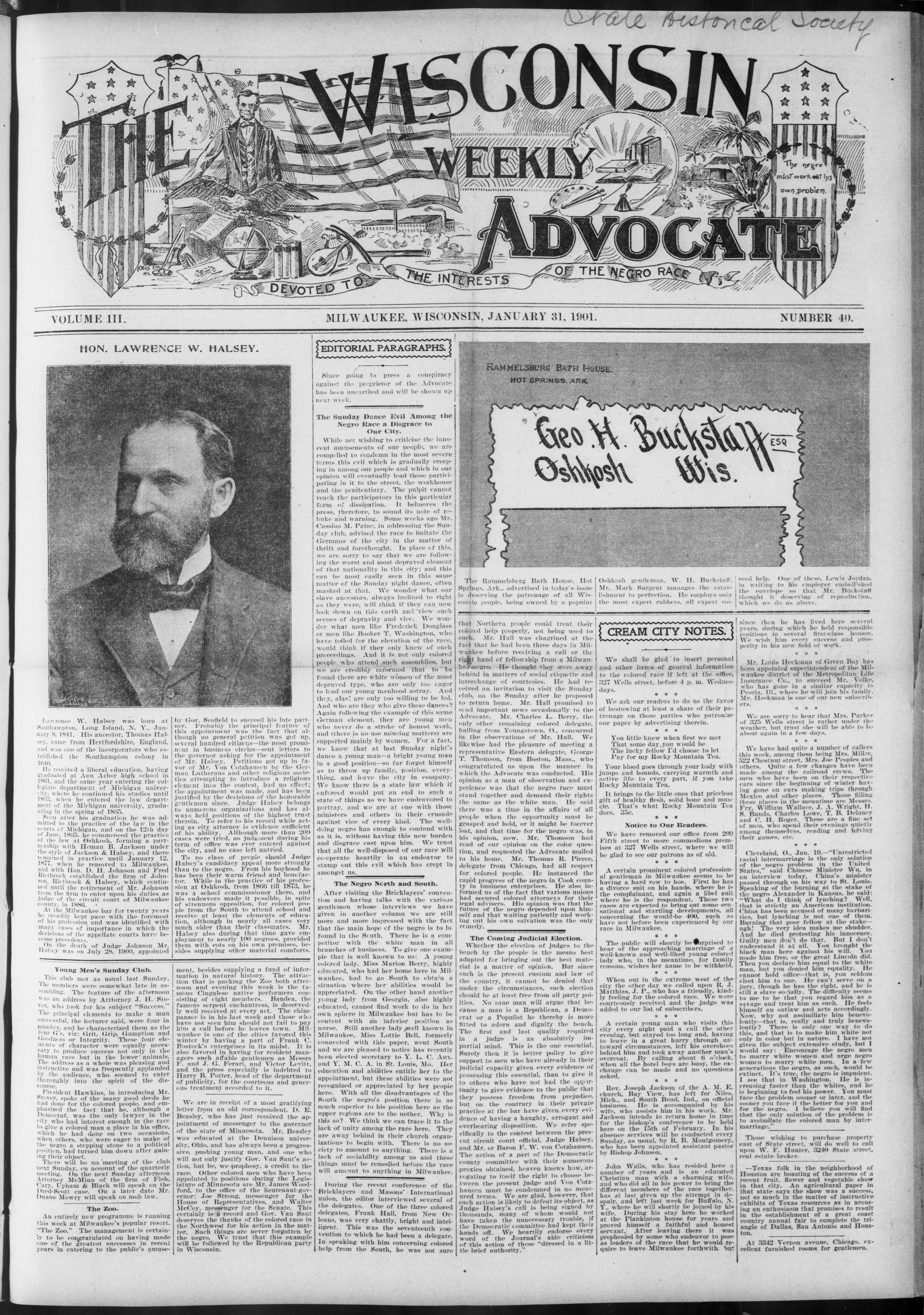
HON. LAWRENC
Lawrence W. Halsey was born at Southampton, Long Island, N. Y., January 8, 1841. His ancestor, Thomas Halsey, came from Hertfordshire, England, and was one of the incorporators who established the Southampton colony in 1640. He received a liberal education, having graduated at Ann Arbor high school in 1861, and the same year entering the collegiate department of Michigan university, where he continued his studies until 1863, when he entered the law department of the Michigan university, graduating in the spring of 1865.
Soon after his graduation he was admitted to the practice of the law in the courts of Michigan, and on the 12th day of June, 1865, he commenced the practice of the law at Oshkosh, forming a partnership with Heman B. Jackson under the style of Jackson & Halsey, and there remained in practice until January 12, 1877, when he removed to Milwaukee, and with Hon. D. H. Johnson and Fred Ritbrock established the firm of Johnson, Ritbrock & Halsey, which continued until the retirement of Mr. Johnson from the firm to enter upon his duties as judge of the circuit court of Milwaukee county, in 1886.
At the Milwaukee bar for twenty years he steadily kept pace with the foremost of his profession and was identified with many cases of importance in which the decisions of the appellate courts have become precedents.
On the death of Judge Johnson Mr. Halsley was on July 28, 1900, appointed
Young Men's Sunday Club
This club met as usual last Sunday. The members were somewhat late in assembling. The feature of the afternoon was an address by Atttorney J. H. Stover, who took for his subject "Success." The principal elements to make a man successful, the lecturer said, were four in number, and he characterized them as the four G's, viz: Grit, Grip, Gumption and Goodness or Integrity. These four elements of character were equally necessary to produce success not only in the human race but in the lower animals. The address as a whole was pleasing and instructive and was frequently applauded by the audience, who seemed to enter thoroughly into the spirit of the discourse.
President Hawkins, in introducing Mr. Stover, spoke of the many good deeds he had done for the colored people, and emphasized the fact that he, although a Democrat, was the only lawyer in the city who had interest enough in the race to give a colored man a place in his office, which he had done on two occasions, when others, who were eager to make of the negro a stepping stone to a political position, had turned him down after gaining their object.
There will be no meeting of the club next Sunday, on account of the quarterly meeting. On the next Sunday afternoon Attorney McMinn of the firm of Fish, Cary, Upham & Black will speak on the Dred-Scott case. On a later date Mr. Duane Mowry will speak on mob law.
The Zoo.
An entirely new programme is running this week at Milwaukee's popular resort. "The Zoo." The management is certainly to be congratulated on having made one of the greatest successes in recent years in catering to the public's amuse-
by Gov. Scofield to succeed his late partner. Probably the principal feature of this appointment was the fact that although no general petition was got up several hundred citizens—the most prominent in business circles—sent letters to the governor asking for the appointment of Mr. Halsey. Petitions got up in favor of Mr. Von Cotzhausen by the German Lutherans and other religious societies attempting to introduce a religious element into the contest, had no effect; the appointment was made, and has been justified by the decisions of the honorable gentleman since. Judge Halsey belongs to numerous organizations and has always held positions of the highest trust therein. To refer to his record while acting as city attorney is evidence sufficient of his ability. Although more than 200 cases were tried, no judgment during his term of office was ever entered against the city, and no case left untried.
To no class of people should Judge Halsey's candidacy appeal more strongly than to the negro. From his boyhood he has been their warm friend and benefactor. While in the practice of his profession at Oshkosh, from 1866 till 1873, he was a school commissioner there, and his endeavors made it possible, in spite of strenuous opposition, for colored people from the South to attend school and receive at least the elements of education, although in nearly all cases very much older than their classmates. Mr. Halsey also during that time gave employment to nearly 100 negroes, provided them with cots on his own premises, besides supplying other material comforts.
ment, besides supplying a fund of information in natural history. The attraction that is packing the Zoo both afternoon and evening this week is the famous Cingalese native performers consisting of eight members. Bandea, the famous serpent enchantress, is deservedly well received at every act. The chimpanzee is in his last week and those who have not seen him should not fail to pay him a call before he leaves town. Milwaukee is one of the cities favored this winter by having a part of Frank C. Bostock's enterprises in its midst. It is also favored in having for resident managers such affable gentlemen as Messrs F. and J. G. Ferari, and Victor Levitt, and the press especially is indebted to Harry B. Potter, head of the department of publicity, for the courteous and generous treatment accorded to it.
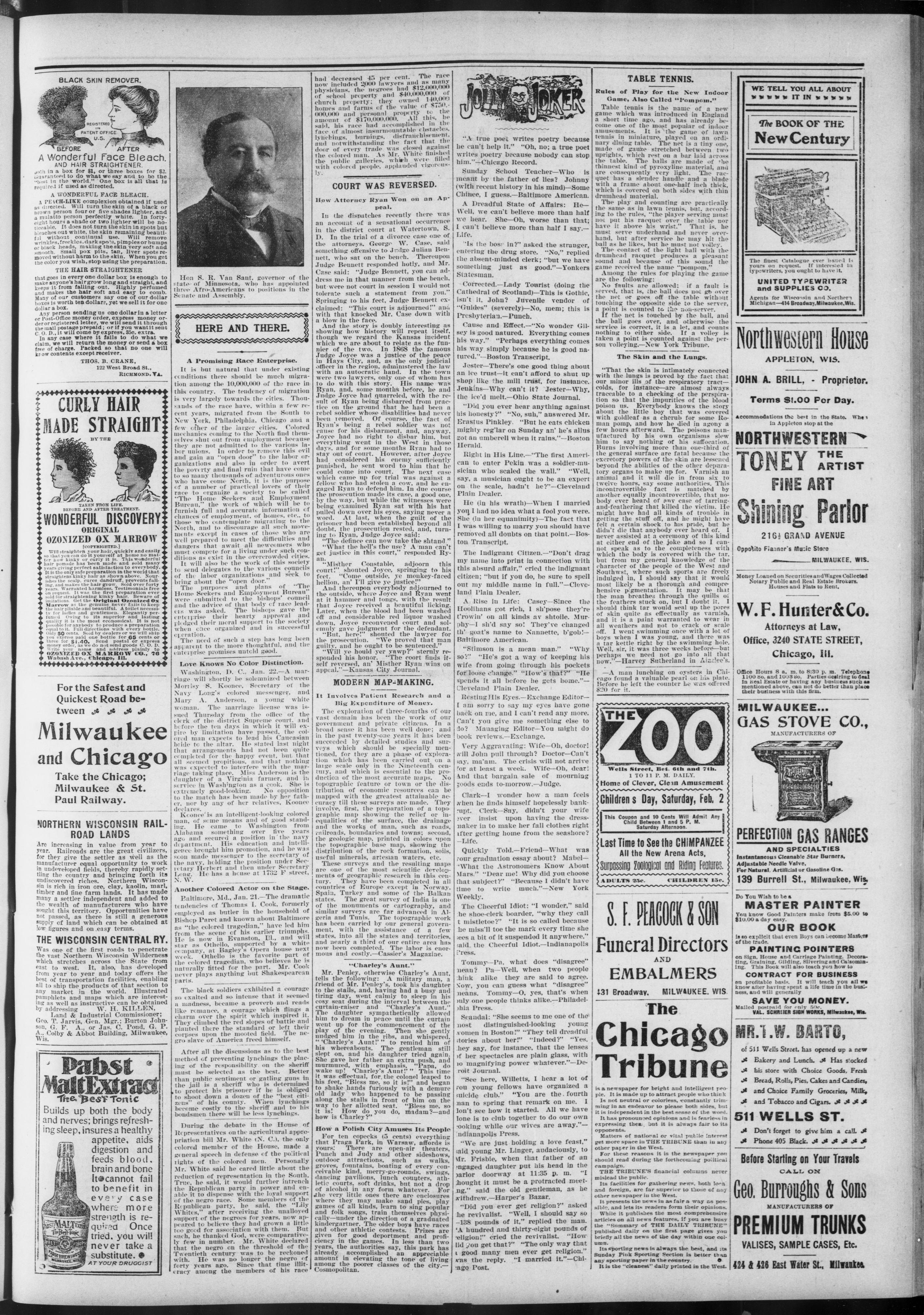
We are in receipt of a most gratifying letter from an old correspondent, D. E. Beasley, who has just received the appointment of messenger to the governor of the state of Minnesota. Mr. Beasley was educated at the Dennison university, Ohio, and has always been a progressive, pushing young man, and one who will not only justify Gov. Van Sant's action, but be, we prophesy, a credit to the race. Other colored men who have been appointed to positions during the Legislature of Minnesota are Mr. James Woodford, to the office of the lieutenant-governor; Joe Strong, messenger for the House of Representatives, and Walter McCoy, messenger for the Senate. This certainly is a record and Gov. Van Sant deserves the thanks of the colored race in the Northwest for his action in the matter. Such things are never forgotten by the negro. We trust that this example will be followed by the Republican party in Wisconsin.
MILWAUKEE, WISCONSIN, JANUARY 31, 1901.
EDITORIAL PARAGRAPHS.
---
Since going to press a conspiracy against the proprietor of the Advocate has been uncarthed and will be shown up next week.
The Sunday Dance Evil Among the Negro Race a Disgrace to Our City.
While not wishing to criticise the innocent amusements of our people, we are compelled to condemn in the most severe terms this evil which is gradually creeping in among our people and which in our opinion will eventually lead those participating in it to the street, the workhouse and the penitentiary. The pulpit cannot reach the participants in this particular form of dissipation. It behooves the press, therefore, to sound its note of rebuke and warning. Some weeks ago Mr. Cassius M. Paine, in addressing the Sunday club, advised the race to imitate the Germans of the city in the matter of thrift and forethought. In place of this, we are sorry to say that we are following the worst and most depraved element of that nationality in this city; and this can be most easily seen in this same matter of the Sunday night dance, often masked at that. We wonder what our slave ancestors, always inclined to right as they were, will think if they can now look down on this earth and view such scenes of depravity and vice. We wonder what men like Frederick Douglass or men like Booker T. Washington, who have toiled for the elevation of the race, would think if they only knew of such proceedings. And it is not only colored people who attend such assemblies, but we are credibly informed that to be found there are white women of the most depraved type, who are only too eager to lead our young manhood astray. And they, alas! are only too willing to be led. And who are they who give these dances? Again following the example of this same German element, they are young men who never do a stroke of honest work, and (there is no use mincing matters) are supported mainly by women. For a fact, we know that at last Sunday night's dance a young man—a bright young man in a good position—so far forgot himself as to throw up family, position, everything, and leave the city in company. We know there is a state law which if enforced would put an end to such a state of things as we have endeavored to portray, and we are at one with those ministers and others in their crusade against vice of every kind. The well-doing negro has enough to contend with as it is, without having this new burden and disgrace cast upon him. We trust that all the well-disposed of our race will co-operate heartily in an endeavor to stamp out this evil which has crept in amongst us.
The Negro North and South.
After visiting the Bricklayers' convention and having talks with the various gentlemen whose interviews we have given in another column we are still more and more impressed with the fact that the main hope of the negro is to be found in the South. There he is a competitor with the white man in all branches of business. To give one example that is well known to us: A young colored lady, Miss Marion Berry, highly educated, who had her home here in Milwaukee, had to go South to obtain a situation where her abilities would be appreciated. On the other hand another young lady from Georgia, also highly educated, cannot find work to do in her own sphere in Milwaukee but has to be content with an inferior position as nurse. Still another lady well known in Milwaukee, Miss Lottie Bell, formerly connected with this paper, went South and we are pleased to notice has recently been elected secretary to Y. L. C. Aux. and Y. M. C. A. in St. Louis, Mo. Her education and abilities entitle her to the appointment, but these abilities were not recognized or appreciated by her people here. With all the disadvantages of the South the negro's position there is as much superior to his position here as the upper regions are to the nether. Why is this so? We think we can trace it to the lack of unity among the race here. They are away behind in their church organizations to begin with. There is no society to amount to anything. There is a lack of sociability among us and these things must be remedied before the race will amount to anything in Milwaukee.
During the recent conference of the Bricklayers and Masons' International union, the editor interviewed several of the delegates. One of the three colored delegates, Frank Hall, from New Orleans, was very chattly, bright and intelligent. This was the seventeenth convention to which he had been a delegate. In speaking with him concerning colored help from the South, he was not sure
RAMMELSBURG BATH HOUSE.
HOT SPRINGS, ARK.
Geo. H. Buckstall
Oshkosh Wis.
The Rammelsberg Bath House, Hot Springs, Ark., advertised in today's issue is deserving the patronage of all Wisconsin people, being owned by a popular
that Northern people could treat their colored help properly, not being used to such. Mr. Hall was chagrined at the fact that he had been three days in Milwaukee before receiving a call or the right hand of fellowship from a Milwaukee negro. He thought they were away behind in matters of social etiquette and interchange of courtesies. He had received an invitation to visit the Sunday club, on the Sunday after he proposed to return home. Mr. Hall promised to send important news occasionally to the Advocate. Mr. Charles L. Berry, the only other remaining colored delegate, hailing from Youngstown, O., concurred in the observations of Mr. Hall. We likewise had the pleasure of meeting a representative Eastern delegate, George T. Thomson, from Boston, Mass., who congratulated us upon the manner in which the Advocate was conducted. His opinion as a man of observation and experience was that the negro race must stand together and demand their rights the same as the white man. He said there was a time in the affairs of all people when the opportunity must be grasped and held, or it might be forever lost, and that time for the negro was, in his opinion, now. Mr. Thomson had read of our opinion on the color question, and requested the Advocate mailed to his home. Mr. Thomas R. Pierce, delegate from Chicago, had all respect for colored people. He instanced the rapid progress of the negro in Cook county in business enterprises. He also informed us of the fact that various unions had secured colored attorneys for their legal advisers. His opinion was that the future of the negro depended upon himself and that waiting patiently and working out his own salvation was the only remedy.
The Coming Judicial Election
The Coming Judicial Election. Whether the election of judges to the bench by the people is the means best adapted for bringing out the best material is a matter of opinion. But since such is the present custom and law of the country, it cannot be denied that under the circumstances, such election should be at least free from all party politics. No sane man will argue that because a man is a Republican, a Democrat or a Populist he thereby is more fitted to adorn and dignify the bench. The first and last quality required in a judge is an absolutely impartial mind. This is the one essential. Surely then it is better policy to give support to men who have already in their judicial capacity given every evidence of possessing this essential, than to give it to others who have not had the opportunity to give evidence to the public that they possess freedom from prejudice, but on the contrary in their private practice at the bar have given every evidence of having a haughty, arrogant and overbearing disposition. We refer specifically to the contest between the present circuit court official, Judge Halsey, and Mr. or Baron F. W. von Cotzhausen. The action of a part of the Democratic county committee with their numerous proxies obtained, heaven knows how, arrogating to itself the right to choose between the present judge and Von Cotzhausen must be condemned in no measured terms. We are glad, however, that such action is likely to defeat its object, as Judge Halsey's call is being signed by thousands, many of whom would not have taken the unnecessary trouble, if the Democratic committee had kept their hands off. We heartily endorse every word of the Journal's able criticism of this action of those "dressed in a little brief authority."
Oshkosh gentleman, W. H. Buckstaff. Mr. Mark Sargent manages the establishment to perfection. He employs only the most expert rubbers, all expert coi-
CREAM CITY NOTES.
We shall be glad to insert personal and other items of general information to the colored race if left at the office, 327 Wells street, before 4 p. m. Wednesdays.
* * *
We ask our readers to do us the favor of bestowing at least a share of their patronage on those parties who patronize our paper by advertising therein.
* * *
You little knew when first we met
That some day, you would be
The lucky fellow I'd choose to let
Pay for my Rocky Mountain Tea.
Your blood goes through your body with
jumps and bounds, carrying warmth and
active life to every part, if you take
Rocky Mountain Tea.
It brings to the little ones that priceless
gift of healthy flesh, solid bone and muscle. That's what Rocky Mountain Tea does. 35c.
* * *
Notice to Our Readers
We have removed our office from 209 Fifth street to more commodious premises at 327 Wells street, where we will be glad to see our patrons as of old.
* * *
A certain prominent colored professional gentleman in Milwaukee seems to be having a hard row to hoe. First he has a divorce suit on his hands, where he is the complainant, and again a libel suit where he is the respondent. These two cases are expected to bring out some sensational and startling developments, all concerning the would-be 400, such as have not before been experienced by our race in Milwaukee.
```markdown
```
The public will shortly be surprised to hear of the approaching marriage of a well-known and well-liked young colored lady who, in the meantime, for family reasons, wishes her name to be withheld.
* * *
When out in the extreme west of the city the other day we called upon R. J. Matthias, J. P., who has a friendly, kindly feeling for the colored race. We were courteously received and the judge was added to our list of subscribers.
☆ ☆ ☆
A certain young man who visits this city every night paid a call the other evening, but stayed too long and, having to leave in a great hurry through untoward circumstances, left his overshoes behind him and took away another man's overcoat. By calling about 6 o'clock, when all the hotel boys are busy, the exchange can be made and no questions asked.
☆ ☆ ☆
Rev. Joseph Jackson of the A. M. E. church, Bay View, has left for Niles, Mich., and South Bend, Ind., on official business. He is accompanied by his wife, who assists him in his work. Mr. Jackson intends to return home in time for the bishop's conference to be held here on the 15th of February. In his absence services will be conducted every Sunday, as usual, by R. B. Montgomery, who has been appointed assistant pastor by Bishop Johnson.
```markdown
```
John Walls, who has resided here a number of years and is an educated Christian man with a charming wife, and who did all in his power to bring the different members of the race together, has at last given up the attempt in despair, and left last week for Buffalo, N. Y., where he will shortly be joined by his wife. During his stay here he worked at the Plankinton house for years and proved himself a faithful and honest servant. After leaving there it was prophesied by some who endeavor to pose as leaders of the race that he would require to leave Milwaukee forthwith, but
NUMBER 40.
ESQ
ored help. One of these, Lewis Jordan, in writing to his employer embellished the envelope so that Mr. Backstaff thought it deserving of reproduction, which we do as above.
since then he has lived here several years, during which he held responsible positions in several first-class houses. We wish him every success and prosperity in his new field of work.
☆ ☆ ☆
Mr. Louis Heckman of Green Bay has been appointed superintendent of the Milwaukee district of the Metropolitan Life Insurance Co., to succeed Mr. Volk, who has gone in a similar capacity to Pooria, Ill., where he will join his family. Mr. Heckman is one of our new subscribers.
---
We are sorry to hear that Mrs. Parker of 325 Wells street is rather under the weather, but trust she will be able to be about again in a few days.
---
We have had a number of callers this week, among them being Mrs. Miller, 522 Chestnut street, Mrs. Joe Peoples and others. Quite a few changes have been made among the railroad crews. The men who have been on their respective cars since the beginning of winter having gone on cars making trips through Mexico and other places. Those filling these places in the meantime are Messrs. Fry, William Wallace, J. A. Wright, H. S. Bands, Charles Lowe, T. B. Delaney and C. H. Roger. These are a fine set of men, who spend their evenings quietly among themselves, reading and having their games, etc.
* * *
Cleveland, O., Jan. 19.—"Unrestricted racial intermarriage is the only solution of the negro problem in the United States," said Chinese Minister Wu, in an interview today. China's minister passed through on his way to St. Louis. Speaking of the burning at the stake of the negro Alexander in Kansas, he said: "What do I think of lynching? Well, that is strictly an American institution. China has been accused of many barbarities, but lynching is not one of them. Burning that poor fellow at the stake—ugh! The very idea makes me shudder. And he died protesting his innocence. Guilty men don't do that. But I don't understand it at all. You brought the black man here against his will. You made him free, or the great Lincoln did. Then you declare him equal to the white man, but you denied him equality. He cannot hold office—that is, you seldom elect him to one. He can't serve on a jury, though he has the right, and he is still a slave socially. The difficulty seems to me to be that you regard him as a savage and treat him as such. He feels himself an outlaw and acts accordingly. Now, why not assimilate him benevolently—that is, really and truly benevolently? There is only one way to do this, and that is to make him white not only in color but in nature. I have not given the subject extensive study, but I would say: Encourage the negro men to marry white women and urge negro women to marry white men. In a few generations the negro, as such, would be extinct. It's true, the negro is impudent. I see that in Washington. He is increasing faster than the whites, and he is beginning to feel his power. You must face the problem sooner or later, and the sooner you face it the better for you and for the negro. I believe you will find that the only solution of the problem is to assimilate the colored man by intermarriage."
Those wishing to purchase property east of State street, will do well to call upon W. F. Hunter, 3240 State street, real estate broker.
Texas folk in the neighborhood of Houston are boasting of the success of a recent fruit, flower and vegetable show in that city. An agricultural paper in that state says the show was a success, not so much in the matter of instructive exhibits of Texas resources as in arousing an enthusiasm that promises to result in the establishment of a great coast country annual fair to complete the triangle of Dallas, San Antonio and Houston.
At 3342 Vernon avenue, Chicago, excellent furnished rooms for gentlemen.
---
HE IS PROCLAIMED KING
Historic Proceedings in Royal Borough of Windsor.
FUNCTION AT OSBORNE.
Crown Prince of Germany Invested with Order of the Garter-Kaiser is Made a Field Marshal.
London, Jan. 28.—The ceremony of proclaiming King Edward VII. as King of the United Kingdom of Great Britain and Ireland and Emperor of India continues in all the centers of the kingdom. The impressive function took place in the royal borough of Windsor at noon. Thousands witnessed the historic proceedings. The mayor read the proclamation from the base of the Queen's statue on Castle hill, and the recorder read it at Henry VIII's gate. Fanfares of trumpets and cheers for his majesty in which the Eton boys took a prominent part, closed the ceremony.
According to present arrangements the United States is the only country which will not be specially represented at the funeral of Queen Victoria. The United States embassy has received no instructions so far and it is supposed that only the United States ambassador, Joseph H. Choate, and his staff will be present. Cowes, Isle of Wight, Jan. 28.—The crown prince of Germany, Frederick William, was invested with the order of the Garter today by King Edward VII. The investiture occurred in the council chamber of Osborne house, and was a brilliant function. The high officers of the household, military and civil functionaries, and the Emperor's entourage, including a party from the imperial yacht Hobenzollern, were present, all in full uniform.
While the crown prince knelt before the King to receive the insignia his majesty addressed a few cordial words to the prince, and then, turning to Emperor William, in touching terms he thanked him for his visit at this time of sorrow and bereavement and dwelt on the personal and other ties uniting the two countries, Germany and Great Britain.
It is said that Emperor William will bestow the order of the Red Eagle on Prince Arthur of Connaught (the son of the Duke of Connaught).
The great court marshal of Prussia, Count von Eulenberg, is on his way here to join the suite of Emperor William. The latter accompanied the crown prince on a long ramble through the Osborne house grounds today. His majesty later boarded the Hohenzollern to transact urgent state business.
PANEGYRIC ON LATE QUEEN.
Bishop of Winchester Preaches Eloquent Sermon on Victoria.
Cowes, Jan. 28.—A memorial service marked by extreme beauty and solemnity attracted the royal family to Whippingham church yesterday. King Edward, Queen Alexandra and Emperor William sat together and were visibly affected. The Bishop of Winchester, who was the preacher for the occasion, delivered an eloquent panegyric upon Victoria, and declared that Emperor William's action in coming to her deathbed had touched the hearts of the British people and cemented the unity and friendship of the two kindred nations. At the conclusion of the services all stood during a performance of the "Dead March."
After the service the Kaiser went aboard the royal yacht Hohenzo'ern and donned the full dress of a British admiral. An hour later he received King Edward similarly uniformed.
Eulogy from Gen. Booth.
Gen. William Booth, head of the Salvation army, eulogizes the late sovereign as "the friend of the poor." He said last night:
"Queen Victoria recognized the existence of the poor. She sympathized with them in their poverty and took her own share as an individual in alleviating their sorrows, visiting their homes and caring liberally for her own dependents. With these manifestations of interest she combined the most queenly dignity. She had the simplest and most natural interest in the sorrows and sufferings of her humblest subjects. For many years she was interested in the Salvation army. Quite early in its history she did not hesitate both to manifest that interest and express her sympathy with the army's work, although up to that time none of the noble and mighty of the land had ever said a kind word about it."
KAISER A FIELD MARSHAL.
Ceremonies Followed by a Luncheon on the Hohenzollern.
Cowes, Jan. 28.—The Kaiser's forty-second birthday anniversary was the absorbing topic at Osborne house yesterday. It was given eclat by his accession to the rank of a field marshal in the British army by appointment of the King. The Kaiser accepted his new martial distinction with modest pride. Writing to the prime minister and the commander-in-chief in acknowledgment, he said:
The King, my august uncle, confers upon me the rank of a field marshal in his army and informs me that my appointment will be published on my birthday. I hasten to apprise you of my deep appreciation of so signal a mark of his majesty's affection for me, and I rejoice to think that I shall be numbered among those of the highest rank in his majesty's gallant army.
WILLIAM R.
Acknowledged by Salisbury.
Lord Salisbury sent the following: "I beg with most profound respect to tender to your imperial majesty my thanks for your telegram and my sincere congratulations upon the anniversary of your majesty's birthday and upon the appointment to the exalted rank of field marshal, which my august sovreign, the King, has been pleased to confer upon your imperial majesty, and I am convinced that your acceptance of the office will give the liveliest gratification to all classes of the nation, who have been deeply touched by the consideration and kindly feeling exhibited in your gracious visit on this solemn occasion."
INSURANCE COMPANIES LOSE.
Many Large Policies on Queen's Life Held by Non-Relatives.
New York, Jan. 28.—Local life insurance men estimate at as high as from $4,000,000 to $5,000,000 the probable aggregate amount to be paid out by English companies to policy-holders who had taken out insurance on Queen Victoria's life, but who had no relation whatever to the Queen. Such policies would not be written by companies in the United States, it was pointed out, for here there must be an "insurable interest" shown before an application would be granted, as under the law in this country the beneficiary must be a person dependent upon or pecuniarily interested in the life of the insured.
London, Jan. 28.—A movement, which is, however, entirely without official encouragement, is on foot to erect a great monument to Queen Victoria in London. Already a sign comes from India that such a proposal would be likely to meet the spontaneous wishes of the subjects of the crown in far-away climes. The suggestion that May 24, the Queen's birth-
day, shall be kept forever as a public holiday, also finds favor. This is all the more desirable, as King Edward's birthday falls on November 9, a period of the year wholly unpropitious to the enjoyment of brilliant pageantry, such as that of trooping of the colors, which is undoubtedly the prettiest display of the season.
ARMOUR'S WILL FILED.
Estate of $15,000,000 Divided Between Widow and Son, Who Are to Provide for Grandchildren.
Chicago, Ill., Jan. 28.—The will of the late millionaire pork packer and grain dealer, P. D. Armour, disposes of an estate valued at $15,000,000, according to statements made in an application for letters testamentary filed in the probate court here today by Malvina B. Armour, widow of deceased, and J. Ogden Armour, his son. Mrs. Armour and J. Ogden Armour are made executrix and executor, and are named as legatees, each receiving one-half of the estate.
Of the testator's wealth $14,900,000 is in personal property and $100,000 in reality. P. D. Armour and Lester Armour, grandchildren of the testator by his son. P. D. Armour, Jr., who died in California a year ago, are not made legatees directly in the will, but are provided for handsomely by "charges upon the legatees." It is provided in the "charges" that upon attaining the age of 25 years each of the grandchildren shall receive $1,000,000, half of this from Malvina P. Armour, their grandmother, and half from J. Ogden Armour, their uncle. At 30 years of age each is to receive a similar amount from grandmother and uncle. Should they live to attain the ages mentioned each will, therefore, receive an aggregate of $2,000,000 from the estate. As a reason for not leaving his grandchildren more the writer of the will explains that their father during his life had already received nearly all of his share in the estate. To this the children and their mother are heirs. Executrix and executor are given full power to manage the estate without bond. The instrument is dated Pasadena, Cal., January 30, 1900.
Armour institute, Mr. Armour's pet project, which he fostered with a lavish hand during life, is not mentioned in the will, but it is regarded as certain that provision for it was made before its patron died. A codicil to the will, under date of Pasadena, Cal., Feb. 12, 1900, provides that the executrix and executor shall not be responsible to any court for their handling of the estate, and otherwise emphasizes the entire independence of the legates in dealing with the property.
L. C. Krauthoff, an attorney long in the service of Mr. Armour, declared that Mr. Armour had made provision for the Armour institute before drawing his will at Pasadena. In reference to the fact that the will leaves nothing to charity Mr. Krauthoff said: "Mr. Armour gave to charity during his life rather than to hold back the good it would do until after his death. A day never passed during his career that he did not give liberally to some charity and the aggregate of his gifts of this character would mount well up into the millions."
The fact that the estate was below the popular estimate is explained by the assertion that when his health began to fail following the Leiter wheat deal Mr. Armour divided $30,000,000 between his sons, Philip D. and J. Ogden, thus relieving himself of considerable responsibility and saving the estate the payment of a large inheritance tax.
GOVERNOR INTERFERES.
Action Taken to Prevent the Jeffries-Ruhlin Fight at Cincinnati February 15.
Columbus, O., Jan. 28.—Action was taken by Gov. Nash today to prevent the Jeffries-Ruhlin fight at Cincinnati on February 15. In a letter to Attorney General Sheets the governor declares the fight "would be a disgrace to the state of Ohio, as well as a violation of law," and concludes: "I hereby authorize and request you to take such steps and commence such actions at law, civil or criminal, as may be necessary to prevent this occurrence, and in so doing to use the name of the state." A petition is now being drawn up in the case, which will be immediately filed in the courts at Cincinnati tonight if the attorneys reach there in time.
The suit will be entitled the state, ex rel the attorney general vs. J. J. Jeffries, Gus Ruhlin, William N. Hobart, George Gugenberger, Leopold Kleybolte, Bernard Bettman, George F. Dieterle, F. A. Lee, Fenton Lawson, Rev. B. A. Eisenlohr and thirty-one others, associates in the management of the Cincinnati Saenverfest company.
While the case is nominally brought by the attorney-general he will have associated with him in the case in addition to Messrs. Maxwell and Wald, former United States Attorney-General Judson Harmor, and John W. Warrington. The form of the suit will be a petition for an injunction against the parties named, based on the claim that they are about to perpetrate a public nuisance. It is on this claim of nuisance that it is hoped to avoid the question of whether the contest is a prizefight or a boxing contest. Cincinnati, O., Jan. 28.—The sale of seats for the Jeffries-Ruhlin contest, February 15, in Convention hall, began today and soon reached $18,000. There is still talk of legal opposition being made against the fight and the movements of the attorneys employed by opponents of the fight are closely watched.
NINE LIONS ARE HIS PREY.
Companions of Roosevelt Tell of His Hunting Field Feats.
Rifle, Col., Jan. 28.—Drs. Gerald Webb and Philly Stewart, the Colorado Springs men who have been out with Roosevelt on his hunting expedition, arrived here from Meeker. They say that the party has been having a big time, and the governor is enjoying himself so well that he has decided to stay two or three weeks longer. He had killed six large mountain lions and three smaller ones up to the time these gentlemen were obliged to return. They say the newspaper reports have been exaggerated, but the governor placed the muzzle of his gun into the mouth of one big lion in order to pry it away from the dogs, after they had all but killed one. He then finished the beast with his knife.
DUCHESS OF MANCHESTER ILL.
Has Diphtheria and is Quarantined in San Francisco.
Cincinnati, O., Jan. 28.—Eugene Zimmerman received a telegram from San Francisco, Cal., stating that his daughter, the Duchess of Manchester, was seriously ill with diphtheria and other complications. The duke and duchess and their party are quarantined there on account of the malignant disease. Zimmerman said that he did not know just where in San Francisco his daughter was.
Ferrell Must Die.
Columbus, O., Jan. 28.—Gov. Nash today sealed the fate of Rosslyn H. Ferrell, who killed Express Messenger Lane, by refusing to interfere in the case. Ferrell will be electrocuted at the Columbus penitentiary March 1.
BOLD ROBBERY IN BROAD DAYLIGHT.
Cashier In Standard Oil Company's Office Held Up-Suspects Arrested.
Kansas City, Mo., Jan. 29.—W. E. Irvin, cashier of the Standard Oil company's suboffice, was forced into the company's vault by an armed robber, who helped himself to $348 in gold, silver and currency and left the office. The robber was joined by an accomplice who was guarding the door outside, the two men jumped on a Belt line train passing eastbound. Three blocks distant from the scene of the holdup they alighted, one of them falling and bruising his face as he fell. Four hours later two young men were arrested as they were about to take a train at the Union station. They had $274 between them and offered it all to the officers if they would let them go. They were taken to central station and could give no satisfactory account as to how they obtained the money.
They denied any knowledge of the Standard Oil holdup. Irvin was brought to the station and identified the younger of the men as the one who held him up. He gave the name of Ched. Coverdale and his age as 24. His accomplice is about two years older and gives his name as Ralph Meyers. Meyers has been in jail several times for petty thefts, and Coverdale is a race-track tout. The clue to the police was given by persons with whom the robbers were spending money with unusual freedom. The robbery was accomplished in broad daylight, when people were passing by the office every few minutes. Irvin, the cashier, was alone in the office, but drivers were in the back yard and one of these later released the cashier.
CRAZY ON RELIGION.
Stores, Schools and Homes in Hiawatha, Kas., Closed During Tremendous Revival.
Hiawatha, Kas., Jan. 29.—The merchants, saloonmen, and all in the staid, poetical, old town of Hiawatha have gone crazy on the subject of religion. There are thirteen churches in the city and revivals are being held in ten of them. Stores are closed on alternate afternoons that proprietors and clerks may attend. R. M. Williams, a Southerner, came to town two weeks ago and started a revival. Now he cannot stop it. Everybody but the Catholics and Episcopalians is in it.
The business men are supporting the revival thoroughly, almost unanimously. A suggestion was made Thursday that business houses close for the Friday morning meeting, that clerks be free to go. Almost every business man in town closed his store. The academy was dismissed, as were the public schools. Almost 2000 persons went to the revivals on Friday morning.
The evangelist's words concerning debtors pleased the business men. One old bill after another has been wiped off the merchants' books. They believe in and will support the religion that will make men pay what they owe.
A singular phase of the revival is pending. The mothers and girls are in a quandary. There are many delightful girls in Hiawatha and they shine in city society. They go to Atchison and Topeka and Kansas City, and are welcome at social functions, and their mothers like to see them appear there in good form. Mr. Williams has already stopped one of society's pet diversions—card playing—almost entirely, and he is now after the dancers. How, figure the mothers can the girls appear at their best in city circles if they neither dance nor play cards?
CREW OF THE WISCONSIN
New Battleship will Have a Complement of 220 Men-Start for California.
New York, Jan. 29.—The largest single draft of men ever sent from the navy yard as part of a warship's crew has just started for the Union Iron works, California, to man the new battleship Wisconsin, now completed there. The 220 men-of-war's-men were assembled from the receiving ship Vermont at the yard Saturday and under command of Lieut. A. H. Wiley left New York for California. Capt. Stockton, now of the naval war college at Newport, who is to command the Wisconsin, was at the navy-yard looking over the men that were to form the draft for his ship.
The fact that men for the Wisconsin have to be secured in New York and sent all the way across the continent is regarded at the navy yard as indicative of the paucity of men now in the service available for new warships, and especially on the Pacific coast. Naval officers say that the number of ships now in Asiatic waters has practically exhausted the supply of able seamen of the navy in the West, and that recruiting is almost at a standstill.
GREAT RUSH FOR BABIES
New Yorkers Take All Waifs Offered
—"Waiting List" Started.
New York, Jan. 29.—Never did the women of New York and vicinity make a greater rush for a bargain counter than hundreds made to get the babies offered free by George Blair, superintendent of the outdoor poor. The demand far exceeded the supply, and two stray waifs who were sent to the Randall's Island Infant asylum on the noon boat were "spoken for" before they had been in the institution half an hour.
"I am very sorry," said Mrs. Mary C. Dunphy, superintendent of the institution, to two women who called to select a baby shortly after 1 o'clock, "but all of the babies have been selected already."
"If you wish," Mrs. Dunphy continued, "we will place your application on record, and when we receive a baby corresponding with your description we will notify you and you can come and see if it is what you want."
The two women and many later comers were placed on the "waiting list." All the city's little foundlings were selected by the visitors, with the exception of one colored waif.
Thatched Cottages Disappearing.
Thatched Cottages Disappearing. Gradually, and too surely, the old thatched cottages of England are going. Where the thatch exists, slate is not substituted for it; it is repaired, when necessary, with straw or reeds, more commonly with the former. But where a thatched cottage tumbles to pieces or is burned, the new one that takes its place is given a slate roof, writes an English correspondent. Large numbers of the old cottages, with the wooden beams amid their bricks and the thatched roofs, are destroyed by fire. There is little chance of stopping a fire when it has laid hold of the wood or the thatch.
—If American farmers could get for their apples the prices which prevail in England, they would all soon be independent, as but little of the fruit is grown there.
—Compulsory education in New Zealand is considered a success.
—Great Britain still has 340 muzzle-loading guns in her army.
LEGISLATURE.
The first discussion of the session in the Senate arose on the 24th over the passage of memorial to Congress urging the passage of Spooner Swamp Land Indemnity act. When it came up for action Senator Mills of Superior asked for the ayes and noes. The memorial passed 28 to 4, those voting against it being Senators Mills, O'Neill Riordan and Stebbins. The committee on military affairs reported for passage the joint resolution asking Congress to legislate on hazing at West Point. Two bills were passed under suspension of rules: No. 6 S appropriation to procure new chairs for the Senate chamber, the amount being increased to $500; No. 22 A, legalizing acts of officers and voters of joint school district No. 1, New Lisbon. An important bill was introduced by Senator Roehr to enable the governor and state board of control to transfer the school for deaf at Delavan from the charge of the board of control to that of the state board of normal regents. The plan is to make it more of a public school. Another important bill offered by Senator Green makes it an offense for fire insurance companies or their agents to combine for the regulation of rates or other purposes. Other bills introduced were: Providing for a cottage for women students at the State university, and appropriating $20,000 therefor: amending the statutes relative to appointment of commissioners to review equalizations by county boards; extending the time within which appeals may be taken to circuit court from city council decisions on claims from twenty days to one year; amending the statutes relative to removal of fences; relative to service by publication; amending the statutes relative to cities, requiring the city clerk to notify claimants of action of council on their claims.
There were several measures of importance introduced in the Senate on the 25th. One gives the common council of Milwaukee the power to revoke the saloon license when the saloons are kept open on Sunday and election days. Bills were introduced as follows: Amending the statutes so that the state fiscal year will end June 30 in steady of September 30; providing for the election of supervisors and justices of the peace in cities having biennial elections; providing for the cataloguing and library distribution of state public documents through the free library commission; providing a contingent fund of $50,000 to be used for the prevention of Asiatic cholera; amending the statutes relative to security for costs; increasing the appropriation to the State Horticultural society from $500 to $2250 in order to provide for a new experiment station to be located near Rhinelander; prohibiting officers or agents of the state from paying out any money for insurance on state buildings or contracting any debt therefor, and to provide for the reconstruction or repair of any state buildings destroyd by fire; amending the statutes to provide that election returns may be sent from towns to the county clerk by registered mail instead of messenger, the office mailing them to receive 50 cents. Four bills were passed under suspension of the rules, as follows: Providing for a register of probate in the county court of Milwaukee county; legalizing the official acts of Peter Reuter, as notary public of Outagamic county; changing the times of holding circuit court in Waushara county; changing terms of court in the Twelfth circuit. Senator Gaveney's joint resolution urging Congress to legislate against hazing at West Point was passed, Senator Mills alone voting no. Senator Mosher offered an amendment to his resolution cutting off new business February 1, changing the date to February 12. On motion of Senator Jones, the matter went over to Wednesday. Adjournment was taken to 8:30 p. m. on the 25th.
The appointments sent to the Senate on the 25th by Gov. La Follette were some what unexpectedly taken up in the Senate on the evening of the 25th and the reappointments of Judge Lyon to the state board of control, and Dairy and Food Commissioner H. C. Adams were confirmed. Senator Whitehead said that unless the Senate acted at once on the appointments of Judge Lyon and Commissioner Adams their offices would become vacant the next day. Senator Whitehead then moved the reconsideration of the motion by which the appointments were laid over, and his motion carried. This brought the appointments before the Senate, and those of Judge Lyon and Commissioner Adams were unanimously confirmed. Senator Whitehead ended the suspense, however, by moving that the other appointments, those of Messrs. Haugen and Erickson, be laid over till the 30th, and his motion carried. The primary election law was introduced. Senator Roeh introduced a bill providing that the property of the Milwaukee Exposition association shall be exempt from all taxation, and that the tax assessed against the association for 1900 shall be remitted. The property is to become taxable, however, if it is used for private purposes. Senator Mills introduced a bill reducing and regulating the rates to be charged by sleeping car companies in this state.
The session of the Senate on the 20th lasted just seven minutes, most of the business on hand having been disposed of at the evening session the night before. Only one bill was introduced by Senator Roehr increasing the jurisdiction of Milwaukee municipal court to an equality with the circuit court on certain cases, and increasing the salary of judge from $3600 to $5000 per year. Senator McGillivray, president pro tem. of the Senate, presided over the session for the first time since his election. Senator Miller presented the memorial of Dane county board of supervisors against the enactment of a primary election law with the statement that he introduced it at the request of cerain of his Democratic constituents. Petitions were presented from the Vernon and Dodge county boards in favor of spring shooting. There was no other business and adjournment was taken till the 30th.
Interest in the session of the Senate on the 30th centered in the confirmation of the appointments of Nils P. Haugen as second assistant tax commissioner and of Halford Erickson as labor commissioner and statistician. Both appointments were confirmed unanimously. Bills were introduced as follows: To prevent and punish the desecration of the American flag; providing for the manner of changing names and for the registry of names. The two bills on railroad taxation prepared by the state tax commission, one providing an ad valorem tax, the other a license system; two bills amending the statutes relative to labels and trade marks; one to prevent counterfeits; ap propriating $10,000 annually to the State Historical society for purchase of books; periodicals and manuscripts; providing compensation for the legislative visiting committees, $100 each and expenses; providing for the establishment of county schools of agriculture and domestic economy; giving telephone companies the power of eminent domain in acquiring right-of-way for the pole lines; amending the inheritance tax law, relative to practice in the courts and extending the time within which estates must be valued from six months to one year; providing for separate assessment of lands and the buildings and improvements thereon; legalizing the acts of Walworth county board in reference to salary or sheriff; increasing the salaries of justices of Supreme court from $5000 to $7000 per year, and of circuit judges from $3600 to $5000 per year, eliminating the expense allowance of $400 for the latter; requiring the Milwaukee common council to fix the amount of and make all appropriations and levies for general city taxes; amending the statutes relative to exemptions from taxation; requiring life insurance companies conducted on the mutual plan, or in which the policy-holders share in the profits or surplus; limiting the cost of obtaining new business in mutual life insurance companies to the holding of the premium. The resolutions shutting off new business February 8 were put over until the 31st.
Assembly.
In the Assembly on the 24th Mr. Hall introduced his bill for the establishment of a board of railroad commissioners to regulate railroad traffic. It is a very long bill and is modeled after the Minnesota law. The committee on public health and sanitation reported the Overbeck anti-cigarette bill for passage in the Assembly and Mr. Overbeck moved that the rules be suspended and the bill be put upon its passage. His motion prevailed and the bill was passed with only two or three dissenting votes. A bill introduced by Assemblyman Roe to define the meaning of the words "Intoxicating liquor" attracted considerable attention and called out more or less comment. The bill declares any drink, straight or mixed, which contains 1 per cent. of alcohol to be intoxicating, and then adds that any such drink containing less than 1 per cent. of alcohol shall be included if it is in fact intoxicating. It is believed that the bill is aimed at so-called soft drinks. Mr. Jensen's bill relative to deputy state veterinarians provides for ten deputies, one in each district, who shall receive $7 per day for actual service, and defines their duties and powers. Mr. Morton's bill in reference to sheriff's fees
reduces the legal allowance for travel from 10 cents to 5 cents per mile. The committee on judiciary reported the bill making time checks negotiable instead of assignable for passage and the bill dividing marriage license fees between the county clerk and the county for indefinite postponement. The committee on federal relations reported favorably on a bill to give the United States jurisdiction over certain lands in Douglas county. Among the bills introduced were the following: Amending the laws relating to public watering places; dividing the county of Chippewa and creating the county of Rusk; adding to the duties of the secretary of agriculture so as to provide for the collection of crop statistics; amending the law relating to persons authorized to solemnize marriages; amending the law relating to the drawing of juries.
The first decided step toward cutting off new business was taken in the Legislature on the 25th, when the Assembly passed a resolution fixing the date on February 8. Last year it was cut off on February 17, which was unusually early. The committee on railroads introduced a joint resolution agreeing to the proposed amendment to the constitution prohibiting the use of passes. It is necessary to pass the resolution at this session in order to bring it before the people for a vote. The Assembly concurred in the Senate memorial to Congress for the passage of the swamp land bill. Mr. Keene introduced a resolution looking to the preservation of state records. It provides for the appointment of a committee consisting of one senator and two assemblymen to examine the vaults. It passed and Speaker Ray appointed Messrs. Keene and Orton as members of the committee. Two more bills relating to matrithmony came in. One was the same as the bill proposed by Mr. Saran, putting a tax of $10 a year on all unmarried men over 30 years of age. The other proposed a like tax for all unmarried women over the same age. Among the bills introduced were these: Providing for biennial elections in small cities; providing a contingent fund to prevent Asiatic cholera and other contagious diseases; relating to laws regulating investments by domestic life insurance companies. The committee on ways and means reported a substitute for Mr. Lenroot's bill to provide for uniform taxation of vessels. Mr. McGill's bill to make time checks negligible was laid over until the 30th. Mr. Rossman's bill changing the salary of the clerk of the municipal court of Ashland was ordered to a third reading, as was also Mr. Lenroot's bill granting the United States jurisdiction over certain lands in Douglas county. Mr. Willott's bill giving county clerks half of the marriage fees was killed. The Assembly then adjourned to 8:30 p. m. on the 28th.
The primary election bill was introduced in both houses of the Legislature on the evening of the 28th, in the Assembly by its author, Assemblyman E. Ray Stevens of Madison. In both houses the measure was referred to the committee on privileges and elections, which will at once begin the consideration of the bill. Four bills were introduced by Assemblyman Orton at the request of the state board of control. One provides that insane persons who have been on a two years' parole shall be considered sane and the decree of the courts on their insanity set aside. Another declares the power and authority of prison officials and provides that in order to prevent escapes and preserve order they may shoot and kill if necessary. Another provides that the time in which prisoners shall unlawfully absent themselves from prison shall not be computed on their term of sentence. The last one gives the state power to collect from relatives or estates for the care of the feeble-minded. Assemblyman Johnson introduced a bill that all plans for sewerage
or waterworks systems must be first submitted for approval to the state board of health and also for the annual appropriation of $4500 for the establishment of a state bacteriological laboratory. Assemblyman Zinn introduced a bill prohibiting the burial of garbage in the city of Milwaukee and the measure was referred to the committee on health and sanitation. The bill to create a juvenile court in Milwaukee was introduced in both houses by Mr. Keene. The judiciary committee will consider the subject. Mr. Eline introduced two bills to regulate chattel loans. One provides that all loan brokers must give a bond of $500 and cannot charge over 10 per cent, a year interest. The other provides that assignments of salaries are subject to the same rules as chattel mortgages so far as third persons are concerned and are not valid unless recorded. Where wages are exempt they cannot be assigned without the consent of the wife.
In the Assembly on the 29th a jolt resolution was introduced by Mr. Lenroot of Douglas county to increase the present debt limit of cities from 5 per cent. to 10 per cent. of assessed valuation, and the increase is to be for the express purpose of enabling the cities to purchase public utilities, such as electric light plants, railroads and waterworks. Mr. Keene introduced a bill to prevent aldermen and other-ward officers from being legislated out of office by the division of wards in Milwaukee. Mr. Thomas introduced a bill to appropriate $500 for the establishment of a model creamery at the state fair and to provide for a bureau at the fair to give information concerning dalrying. A letter was read from Senator Quarles, stating that he had sent the speaker a gavel made by D. B. Bradley, formerly of Clinton, who had made the head of it out of wood from the frigate Constitution United States. Among the bills introduced were the following: Authorizing the Waupaca Electric Light and Railway company to construct a dam across the Waupaca river; to authorize a bridge at Durand over the Chippewa river; making registrars of courts ex-officio clerks thereof; relating to dates in tax warrants; making an appropriation to George F. Peabody to cover loss under execution of game laws; relating to certificates to graduates; requiring the registration of corporate names with the register of deeds; relating to the burial of honorably discharged soldiers, sailors and marines. H. Johnson's bill legalizing the incorporation of the village of Gillett was ordered engrossed and read a third time. Mr. Lenroot's bill for the appointment of a commission to confer with the state of Minnesota for the purpose of securing uniform legislation on the subject of vessel taxation was also ordered engrossed and read a third time. Mr. Lenroot asked that the rules be sustained and the bill passed. There was no objection and the bill was passed under suspension of rules. The Assembly then adjourned.
Two railroad taxation bills, one of which is very sweeping in its provisions, were introduced in the Legislature on the 30th. They came from the two committees on assessment and collection of taxes and were prepared by the tax commission. The Assembly committee on privileges and elections rendered a unanimous report in favor of allowing Alfred Cook of Marathon county to retain the seat in the Assembly contested by Gilbert E. Vandercook. Mr. Dahl introduced the penal and charitable institution appropriation bills, carrying a total of $831,000. The expected bill establishing a livestock commission was introduced by Mr. Thomas. It provides for a commission of five, who shall represent the stockmen of the state and organizations interested in the subject. Mr. Johnson introduced Supt. Harvey's bill for the establishment of county schools of agriculture and domestic economy. It provides for two experimental schools and offers state aid to the extent of $2500 each. A bill by Mr. Thomas provides for two additional food and dairy inspectors. Mr. Young introduced a bill authorizing cities and counties to erect morges for the use of the National guard companies. Mr. Dahl introduced a bill for the adoption of the Torrens land system. It is the bill introduced by him two years ago and killed. Other bills introduced were: Relating to certificates as evidence; prescribing the qualifications of county judges; for the protection of harmless birds; providing for a memorial hall for soldiers and sailors; for the protection of deer in certain counties; to promote physical culture; to provide for free text books in the schools; for the establishment of an insane asylum in Wood county; prohibiting the forgery of railroad tickets; amending fish and game laws of 1899; relating to the commitment of insane persons; another authorizing the state board of control to settle a boundary dispute at Chippewa Falls; for the establishment of a livestock commission; relating to the protection of wild birds; another to protect farmers from the needless use of firearms. The committee on judiciary reported in favor of passage No. 40 A., relating to jurors and amending the passage of 36 A., also relating to jurors. The committee on federal relations reported in favor of No. 43 A., for a ferry at Hudson.
—Pennies do not consist of copper alone, there being in them 2 per cent. of tin and 3 per cent of zinc to 95 of copper. They cost the government about 42 cents a pound exclusive of stamping, and there are 148 in a pound on every pound minted, since, while they are redeemable in gold, but few are ever presented.
Thursday, Jan. 24.—Devoted the day to the Indian appropriation bill and made only fair progress. The chief feature of the debate was a sharp attack by Mr. Pettigrew on the Dawes commission, which he said was extravagant and was accomplishing little in the way of results. Announcement was made by him that he did not purpose to filibuster against any bill. The shipping bill was not taken up, but Friday will witness a speech on it by Mr. Depew. It then will give way to appropriation bills, Mr. Frye saying he did not wish to delay them.
Friday, Jan. 25.—Made little progress with the Indian appropriation bill. Listened to a speech by Senator Depew in favor of the shipping subsidy bill. Passed a number of private pension bills.
Saturday, Jan. 26.—Discussed national irrigation, the text being an amendment to the Indian appropriation bill providing for surveys, looking to the construction of an irrigation dam and ditches for the watering of the reservation of the Pima and Maricopa Indians, at San Carlos on the Gila river, Arizona. Mr. Platt of Connecticut led the opposition, and was assisted by Mr. Quarles of Wisconsin. Mr. Stewart, Mr. Chandler and Mr. Thurston argued for the experiment. The report of the conference committee on the army reorganization bill was presented and Mr. Hawley announced that he would call it up on Monday. Monday, Jan. 28.—Senator Towne of Minnesota made a speech on the government of the Philippines. Immediately after Mr. Towne's speech Mr. Clapp, his successor, was sworn in. The remainder of the day was devoted to consideration of the Indian appropriation bill.
Tuesday, Jan. 29.—Senator Frye gave notice he intended to keep shipping bill to the front, even as against appropriation bills, not yielding to them without vote of Senate. This indicated disposition on part of Senate leaders to force to early issue question whether shipping bill is going to pass at this session. Mr. Turner spoke in severe arraignment of bill, declaring it to be "lawless, piratical raid upon the treasury" in interest of few private beneficiaries and committing government to expenditures aggregating $270,000,000. Committee amendments were informally agreed to Indian appropriation bill was passed early in day.
Wednesday, Jan. 30.—Spent the day in debate on the shipping bill after an unsuccessful attempt to secure an agreement to the conference report on the army reorganization bill.
House.
Thursday, Jan. 24.—Spent the day in consideration of the naval appropriation bill, completing it with the exception of a single paragraph.
Friday, Jan. 25.—Adepted the conference report on the army reorganization bill by a vote of 133 to 100. Passed the naval appropriation bill and seventy-seven private pension bills.
Saturday, Jan. 26.—Made good progress with the bill to revise and codify the postal laws. Only twenty-eight of the 221 pages remain to be disposed of. Efforts were persistently made to load the bill up with amendments to effect changes in the existing postal laws. The pressure was especially strong in favor of reclassifying certain classes of postoffice employees, but Mr. Loud of California, in charge of the bill, fought all of them, explaining that such amendments were out of place on a codification bill, and would, if adopted, mean its death in the Senate. In this way every attempts to amend the bill was successfully resisted. The latter part of the session was devoted to eulogies upon the life and public servicer of the late Senator Gear of Iowa.
Monday, Jan. 28.—District of Columbia business occupied the most of the day. Bill to revise and codify postal laws passes without amendment. Consideration, or claims of Americans aggregating $28,000,000 against Spain deferred until next Monday. Bill to extend charters of national banks twenty years called up, but went over or objection of Mr. Richardson.
Tuesday, Jan. 29.—Spent day upon agricultural appropriation bill. Mr. Corliss (Mich.) made vicious onslaught upon bureau of animal industry of agricultural department, but his attack raised host of defenders, and his amendment to reduce appropriation for bureau was overwhelmingly defeated. All that portion of bill relating to reorganization of scientific bureaus of agricultural department went out on point or order raised by Mr. Mahon (Pa.).
Wednesday, Jan. 30.—Passed the agricultural appropriation bill.
LUCK AGAINST SKILL.
Technical Knowledge and Business Ability in Mining.
"One of the most valuable mines in the world, the United Verde Copper mine, at Jerome, Ariz., was discovered by one of the swarm of prospectors that succeeded Gen. Howard's captive Indians at Camp Verde. It was worked unprofitably for years. Senator William A. Clark of Montana secured control of it for about $60,000. He built a railroad and a smelter, and applied improved methods to the development of the property. Today it is paying at the rate of $12,000,000 a year.
"Senator Clark started in life driving a mule team to haul supplies into Western mining camps. Today he is the richest mining man in the Western hemisphere, if not in the world. He was asked these two questions:
"How much of a part does chance play in achieving success in mining as compared with scientific knowledge and business ability?"
"What are the chances for success in mining as compared with other lines of business?"
"Here are his replies:
There are his replies.
"Chance may be a factor in the acquisition of a good mining property, but there its operations cease. The development and the operations which follow depend largely on technical knowledge in the treatment of ores, as well as on competent business ability and good judgment.
"The chances of success in the mining industry are equally good, if not better, than the chances in any other legitimate business, provided it is managed on business principles. I have known many instances where persons acquired very valuable mining property, but their incompetency resulted in absolute failure."
"In a similar vein, another wealthy mine owner, former Senator R. C. Chambers of Utah says:
"Not 1 in 200 prospectors "strikes it rich" through luck. Not one in fifty prospects is worth anything. Mining is a business, but it is a poor man's business. If a man has lost all he has, there is a chance for him to work, until he has got together a little money, start out over the hills, and perhaps get rich. But the most money is made by men of means who invest carefully."—Eugene B. Palmer in Ainslee's.
Asbestos Mines in Canada
In Canada are a number of mines where asbestos is produced, and one of the largest of these is near Sherbrooke, in Ontario. The serpentine rock is mined in open quarries, and after it has been carried to the surface that bearing the asbestos is separated from the barren material by hand-picking. At a cobbing house the long-fibered asbestos is knocked off from the serpentine by hand if the veins are more than three-quarters of an inch thick, but in the smaller pieces this separation is made by machinery. In this process the rock is crushed and the useless pieces are picked out by hand. Then the asbestos-bearing fragments are pulverized, and the fibrous material is separated from the powdered rock by means of a blast of air. The process is continuous, the raw product being introduced at an upper story and the commercial asbestos turned out on the ground floor. New York Post.
The total number of persons arrested in Boston last year was 33,655, against 39,760 the preceding year, being a decrease of 6105.
All of the Carnegie mines on the Mesaba range are idle. No shipping is being done.
PASSED BY THE HOUSE
THE GREAT RIVER AND HARBOR MEASURE GOES THROUGH.
Shipping Bill Involves the Same Principle, Yet the Amount of Subsidy Asked Is but One-sixth of that Voted the River and Harbor Measnre.
Washington correspondence:
The situation in Congress is very much the same at this time that it was a week ago, except that the progress of public business at the House end of the capitol is up to the standard that branch set for itself at the opening of the present session, and which it has lived up to most admirably. The river and harbor improvement bill was passed in the House on Wednesday. The river and harbor improvement bill is always a most important measure, but never more so than at the present session, since its total appropriations aggregate about sixty millions of dollars.
That these expenditures are reaching an aggregate of colossal proportions is not to be doubted, and if they grow during the succeeding twenty years as rapidly as they have during the past twenty, their total will by that time have exceeded the annual expenditures on account of pensions, and that the latter fall but little short of $150,000,000 annually will forcibly bring before the mind the magnitude of the work involved in these river and harbor improvements. Much significance lies in the fact that the bill, as finally prepared in the House committee, provided for an appropriation aggregating about eighty millions, which was summarily and ruthlessly cut down to a little under sixty.
When all of the myriad items composing this great measure are submitted to the scrutiny of the Senate Committee on Commerce, to which it will be referred as soon as it reaches the Senate, it will be apparent that much time will be occupied in such examination, no matter how rapidly the members of the Senate Commerce Committee dispose of the items. Right here it is proper to say that the river and harbor improvement bill has occupied the attention of the House committee which had it in charge almost continuously for the past eighteen months. Before the last session of Congress began, all during that session, and much of the time during recess, the subject had been under detailed consideration by various members of the committee. They have heard delegations, they have visited important places where improvements are sought all over the country, they have threshed out the matter in committee for weeks, and have devoted a week—which is a phenomenal amount of time in that body—to its consideration in the House.
When it reaches the Senate, and by that body is referred to its commerce committee, many of the items, if not all of them, will be new to the members of that committee; they will be compelled to give proper attention to each one, to be informed just what considerations justify the appropriation, what it will accomplish in promoting and in cheapening the carriage of our vast domestic and foreign commerce, and what it will involve in probable future expenditures, once the government becomes committed to a new proposition. Considering that the bill is a great volume in itself, and considering that each appropriation must be explained in a report accompanying it, the scrutiny of the items and the preparation of the report involve an immense amount of detailed work that to be accurate must be thorough.
This great subsidy to the nation's commerce, it will be apparent, perhaps involving an expenditure of seventy-five millions of dollars before it is finally acted upon, seems to provoke little or no opposition throughout the country. There is something very strange in the fact, of great significance in this connection, that the subsidy proposed for our shipping, and involving but nine millions, where the other is at least sixty, should provoke so much and such bitter opposition. And it is possible that while the Senate Commerce Committee is examining the hugest of subsidy measures—that for our rivers and harbors—it may be able to discover the real reasons for the opposition to the other, because, in fact, they go together.
Prosperity for All
During the late campaign the opposition charged that the boasted "McKinley prosperity" was only among the capitalistic classes, and that little or none of it filtered down through the masses of the people. The majority of the people did not accept this view, as was evidenced by the result of the voting. The election is now over, and there is no object in misrepresenting the situation, therefore the following dispatch, which was recently sent from Omaha, Neb., is interesting:
"So scarce has manual labor become through the West that employment agents representing railroads operating west of the Missouri have been sent to New York and other Eastern cities to secure men to work on the tracks and grades through Nebraska, Wyoming and Utah. * * * Wages of railroad workers are now $2.50 per day and board throughout the West. This is double what this form of labor has commanded in past years. * * * Not in the history of the West has railroad labor been so difficult to secure as today. On every hand railroad work has been suspended because the labor cannot be secured."
Prosperity for workingmen has been sometimes described as that condition where two or more jobs are looking for one man, instead of two or more men looking for one job. If this is a correct diagnosis, the situation described
in the Omaha dispatch is certainly indicative of prosperity among the noncapitalistic classes. Railroads have come to constitute an excellent barometer of the condition of general business. If the railroads are crowded with freight and passengers, earning a surplus, paying good wages to their employes and good dividends to their stockholders, it may be taken for granted that the people and the industries upon which the railroads depend for business are also prosperous. There never was a time in the history of the country when the railroads, as a whole, were doing such an immense and remunerative business as now, or when their stocks and bonds were in more eager demand at advancing prices. Minneapolis Tribune.
It Took No Notice.
The New England Free Trade League has again kindly offered to furnish the Chronicle a series of articles which it promises will demonstrate that protection is responsible for the formation of trusts in the United States. The Chronicle on a former occasion when a similar offer was made agreed to publish the League's articles provided it would first answer certain questions, the scope of which were outlined. As the League took no notice of our counter offer, which was a challenge to discuss the proposition, we must assume that it felt diffident about its ability to answer. Our proposition is still open, and if the League and its members care to take it the Chronicle will cheerfully welcome them to a discussion in which the champions of free trade will be shown up as humbugs.—San Francisco Chronicle.
Lost Their Good Clothes.
The Democrats did not appreciate good issues when they saw them. They could have got on the right side of the currency and "imperialst" questions as well as the Republicans could. But they "wandered off after strange gods," as Mr. Cleveland puts it. To change the figure, they are like little boys who have been swimming in unclean waters, who weary of their venture after a while and "want to be good," but on emerging from their brackish pool find that certain other little boys, who have had no desire to swim in disagreeable waters, have appropriated their clothes. There appears to be nothing left for the Democracy to do but to be as good as it can and hope for new habiliments.—Providence, R. I., Journal.
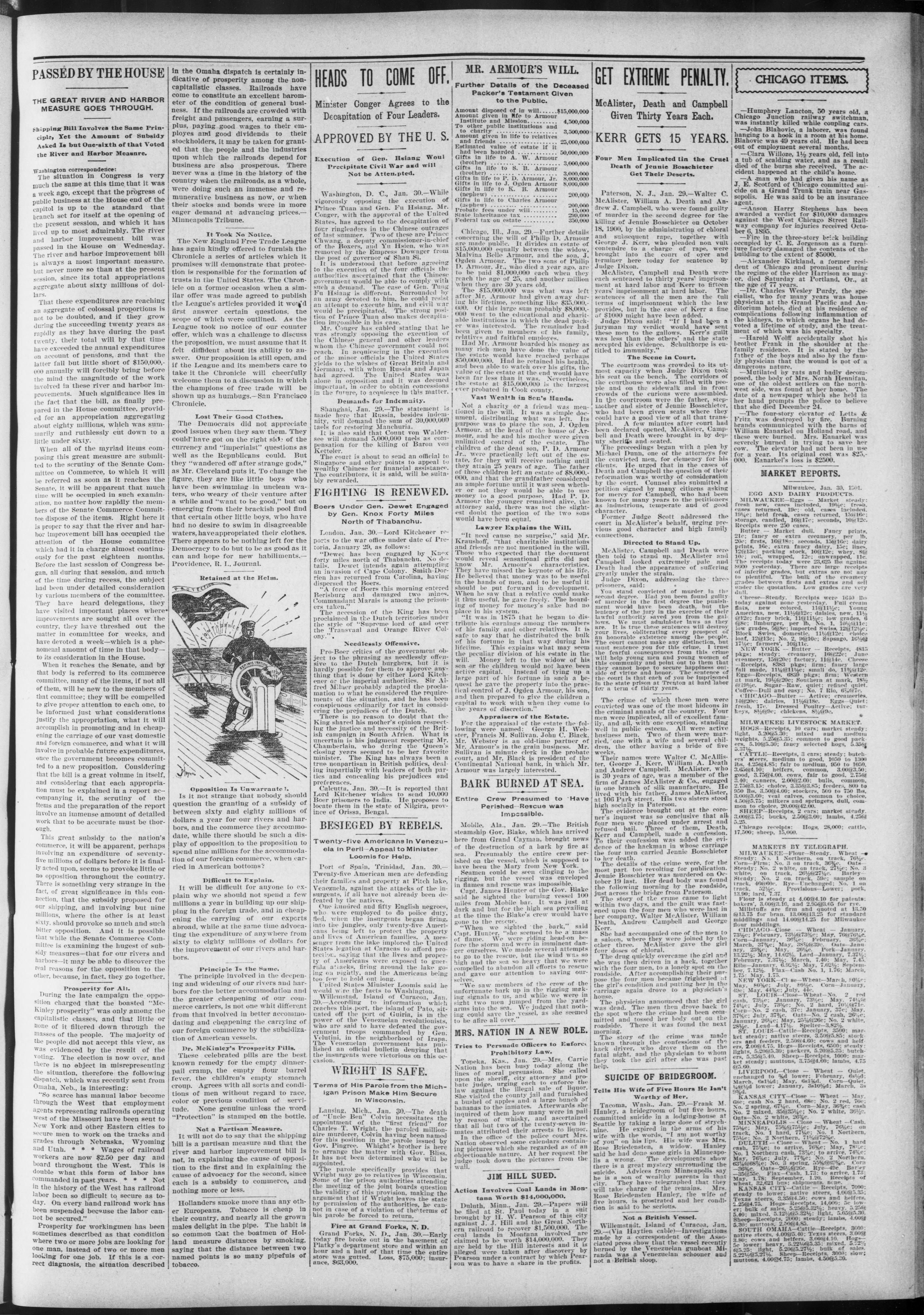
Retained at the Helm.
PROTECTION
CONFIDENCE
REMINISSION
Opposition Is Unwarranted.
Opposition Is Unwarrantee! Is it not strange that nobody should question the granting of a subsidy of between sixty and eighty millions of dollars a year for our rivers and harbors, and the commerce they accommodate, while there should be such a display of opposition to the proposition to spend nine millions for the accommodation of our foreign commerce, when carried in American bottoms?
Difficult to Explain.
It will be difficult for anyone to explain why we should not spend a few millions a year in building up our shipping in the foreign trade, and in cheapening the carrying of our exports abroad, while at the same time advocating the expenditure of anywhere from sixty to eighty millions of dollars for the improvement of our rivers and harbors.
Principle Is the Same.
The principle involved in the deepening and widening of our rivers and harbors for the better accommodation and the greater cheapening of our commerce carriers, is not one whit different from that involved in better accommodating and cheapening the carrying of our foreign commerce by the subsidization of American vessels.
Dr. McKinley's Prosperity Pills. These celebrated pills are the best known remedy for the empty dinner-pail cramp, the empty flour barrel fever, the children's empty stomach croup. Agrees with all sorts and conditions of men without regard to race, color or previous condition of servitude. None genuine unless the word "Protection" is stamped on the bottle.
Not a Partisan Measure.
It will not do to say that the shipping bill is a partisan measure and that the river and harbor improvement bill is not, in explaining the cause of opposition to the first and in explaining the cause of advocacy for the second, since each is a subsidy to commerce, and nothing more or less.
Hollanders smoke more than any other Europeans. Tobacco is cheap in their country, and nearly all the grown males delight in the pipe. The habit is so common that the boatmen of Holland measure distances by smoking, saying that the distance between two named points is so many pipefuls of tobacco.
HEADS TO COME OFF.
Minister Conger Agrees to the Decapitation of Four Leaders.
Execution of Gen. Hsiang Woul Precipitate Civil War and will Not be Atten.pted.
Washington, D. C., Jan. 30. While vigorously opposing the execution of Prince Tuan and Gen. Fu Hsiang, Mr. Conger, with the approval of the United States, has agreed to the decapitation of four ringleaders in the Chinese outrages of last summer. Two of these are Prince Chwang, a deputy commissioner-in-chief of the Boxers, and Yu Hsien, who was removed by the Empress Dowager from the post of governor of Shan Si.
It is understood that before agreeing to the execution of the four officials the authorities ascertained that the Chinese government would be able to comply with such a demand. The case of Gen. Tung Fu Hsiang is different. Surrounded by an army devoted to him, he could resist an attempt to execute him, and civil war would be precipitated. The strong position of Prince Tuan also makes decapitation impossible in his case.
Mr. Conger has cabled stating that he was strongly opposing the execution of the Chinese general and other leaders whom the Chinese government could not reach. In acquiescing in the execution of the minor officials the United States yields to the wishes of Great Britain and Germany, with whom Russia and Japan had agreed. The United States was alone in opposition and it was deemed important, in order to obtain concessions in the future, to acquiesce in this matter.
Demands for Indemnity.
Shanghai, Jan. 29.—The statement is made here that Russia, besides indemnity, will demand the sum of 30,000,000 taels for restoring Manchuria. It is also said that Count von Waldersee will demand 5,000,000 taels as compensation for the killing of Baron von Ketteler. The court is about to send an official to Singapore and other points to appeal to wealthy Chinese for financial assistance. The contributors, it is said, will be suitably rewarded.
FIGHTING IS RENEWED.
Boers Under Gen. Dewet Engaged by Gen. Knox Forty Miles North of Thabanchu.
London, Jan. 30.—Lord Kitchener reports to the war office under date of Pretoria, January 29, as follows:
"Dewet has been engaged by Knox forty miles north of Thabanchu. No details. Dewet intends again attempting an invasion of Cape Colony. Smith-Dorrien has returned from Carolina, having dispersed the Boers.
"A force of Boers this morning entered Berisburg and damaged two mines. Commandant Marais is among the prisoners taken."
The accession of the King has been proclaimed in the Dutch territories under the style of "Supreme lord of and over the Transvaal and Orange River Colony."
Needlessly Offensive.
Pro-Boer critics of the government object to the phrasing as needlessly offensive to the Dutch burghers, but it is hardly possible for them to approve anything that is done by either Lord Kitchener or the imperial authorities. Sir Alfred Milner probably adapted the proclamation to what he considered the requirements of the situation, and he has been conspicuous ordinarily for tact in considering the preindices of the Dutch.
There is no reason to doubt that the King shared his mother's opinion respecting the justice and necessity of the British campaign in South Africa. What is uncertain is his judgment respecting Mr. Chamberlain, who during the Queen's closing years seemed to be her favorite minister. The King has always been a true nonpartisan in British politics, dealing impartially with leaders of both parties and concealing his prejudices and preferences. Calcutta, Jan. 30.—It is reported that Lord Kitchener wishes to send 10,000 Boer prisoners to India. He proposes to locate them in the state of Nilgira, province of Orissa, Bengal.
BESIEGED BY REBELS.
Twenty-five Americans In Venezuela in Perl- Appeal to Minister Loomis for Help.
Port of Spain, Trinidad, Jan. 30. Twenty-five American men are defending their families and property at Pitch lake, Venezuela, against the attacks of the insurgents, if all have not already been defeated by the natives.
One hundred and fifty English negroes, who were employed to do police duty, fled, when the insurgents began firing, into the jungles, only twenty-five Americans being left to protect the property and lives of American families. A messenger from the lake implored the United States legation at Caracas to afford protection, saying that the lives and property of Americans were exposed to guerrilla attacks, firing around the lake going on nightly, and the Americans being too few to hold out long.
United States Minister Loomis said he would wire the facts to Washington.
would wire the races to Washington. Willemstad, Island of Curacao, Jan. 30.—According to information which reaches this port, the island of Pato, situated off the port of Guiria, is in the power of the Venezuelan revolutionists, who are said to have defeated the government troops commanded by Gen. Velutini, in the neighborhood of Irapa. The Venezuelan government has published an official bulletin denying that the insurgents were victorious on this occasion.
WRIGHT IS SAFE.
Terms of His Parole from the Michigan Prison Make Him Secure in Wisconsin.
Lansing, Mich., Jan. 30.—The death of "Uncle Ben" Colvin necessitates the appointment of the "first friend" for Charles T. Wright, the paroled millionaire murderer, Colvin having been named for this position in the parole issued by Gov. Pingree. Whight's brother is here to arrange the matter with Gov. Bliss. It has not been determined who will be appointed.
The parole specifically provides that Wright may go to relatives in Wisconsin. Some of the prison authorities attending the meeting of the joint boards question the validity of this provision, making the argument that if Wright leaves the state by permission of the authorities, he cannot in case of a violation of the terms of his parole be forced to return.
Fire at Grand Forks, N. D.
Grand Forks, N. D., Jan. 30.—Early today fire broke out in the basement of Platky's department store and within an hour and a half of that time the entire store was gutted. Loss, $75,000; insurance. $63,000.
Amount disposed of in will......
Amount given in Mfe to Armour Institute and Mission......
To other public institutions and to charity .....
to charity .....
Amount given in life to relatives
and friends .....
Estimated value of estate if it
had been hoarded .....
Gifts in life to A. W. Armour
(brother) .....
Gifts in life to S. B. Armour
(brother) .....
200,000
15,000
290,600
350,000
Probate rees under will..... 15,000
State inheritance tax..... 290,600
Federal tax on estate..... 350,000
Chicago, Ill., Jan. 29.—Further details concerning the will of Philip D. Armour are made public. It divides an estate of $15,000,000 equally between the widow, Malvina Belle Armour, and the son, J. Ogden Armour. The two sons of Philip D. Armour, Jr., who died a year ago, are to be paid $1,000,000 each when they reach the age of 25, and another million when they are 30 years old.
The $15,000,000 was what was left after Mr. Armour had given away during his lifetime, something like $35,000,000. Of this large sum probably $8,000,000 went to the educational and charitable institutions in which the dead packer was interested. The remainder had been given to members of his family, relatives and faithful employees.
Had Mr. Armour hoarded his money as many rich men have done the value of the estate would have reached perhaps $50,000,000. Had he retained his health, and been able to watch over his gifts, the value of the estate at the end would have been far less than it was. Nevertheless, the estate at $15,000,000 is the largest ever probated in Cook county.
Vast Wealth in Son's Hands.
Not a charity or a friend was mentioned in the will. It was a simple document, distributing what was left. Its purpose was to place the son, J. Ogden Armour, at the head of the house of Armour, and he and his mother were given unlimited control of the estate. The children of the dead son, P. D. Armour Jr., were practically left out of the estate, for they will receive nothing until they attain 25 years of age. The father of these children left an estate of $8,000,-000, and that the grandfather considered an ample fortune until it was seen whether or not they would be able to use money to a good purpose. Had P. D. Armour the younger remained alive, the attorney said, there was not the slightest doubt the portion of the two sons would have been equal.
Lawyer Explains the Will.
"It need cause no surprise," said Mr. Kraushoff, "that charitable institutions and friends are not mentioned in the will. Those who expected that the document would reveal sensational gifts did not know Mr. Armour's characteristics. They have missed the keynote of his life. He believed that money was to be useful in the hands of men, and to be useful it should be put forward in development. When he saw that a relative could make it thus useful, he gave freely. The hoarding of money for money's sake had no place in his system.
"It was in 1875 that he began to distribute his earnings among the members of his family and other relatives. It is safe to say that he distributed the bulk of his fortune in that way during his lifetime. This explains what may seem the peculiar division of his estate in the will. Money left to the widow of his son or the children would not have been active capital. Instead of tying up a large part of his fortune in such a bequest he gave the property into the practical control of J. Ogden Armour, his son, and then prepared to give the children a capital to work with when they come to the years of discretion."
Appraisers of the Estate.
For the appraisal of the estate the following were named: George H. Webster, Francis M. Sullivan, John C. Black, Mr. Webster is an old-time partner of Mr. Armour's in the grain business. Mr. Sullivan is minute clerk in the probate court, and Mr. Black is president of the Continental National bank, in which Mr. Armour was largely interested.
BARK BURNED AT SEA.
Entire Crew Presumed to Have Perished—Rescue was Impossible.
Mobile, Ala., Jan. 29.—The British steamship Gov. Blake, which has arrived here from Grand Cayman, brought news of the destruction of a bark by fire at sea. Presumably the entire crew perished on the vessel, which is supposed to have been the Mary from New York.
Seamen could be seen clinging to the rigging, but the vessel was enveloped in flames and rescue was impossible.
Capt. James Hunter of the Gov. Blake said he sighted the burning vessel 100 miles from Mobile bar. It was just at dark and but for the high sea prevailing at the time the Blake's crew would have gone to the rescue.
"When we sighted the bark," said Capt. Hunter, "she seemed to be a mass of flame. We were riding head-on before the storm and were in imminent danger ourselves. We made several attempts to go to the rescue, but the wind was so high and the sea so heavy that we were compelled to abandon all efforts to rescue and gave our attention to saving ourselves.
"We saw members of the crew of the unfortunate bark up in the rigging making signals to us, and while we were in sight two men jumped from the yardarms into the sea. We judged that nothing could save the vessel, as she seemed to be afire all over."
MRS. NATION IN A NEW ROLE.
Tries to Persuade Officers to Enforce Prohibitory Law.
Topeka, Kas., Jan. 29.—Mrs. Carrie Nation has been busy today along the lines of moral persuasion. She called upon the sheriff, city attorney and probate judge, urging each to enforce the law against the illegal sale of liquor. She visited the county jail and furnished a bushel of apples and a large bunch of bananas to the inmates. Afterwards she inquired of them how many were in pail by reason of whisky, and ascertained that all but two of the twenty-seven inmates attributed their arrests to liquor. In the office of the police court Mrs. Nation observed some calendars containing pictures which she regarded as of an objectionable nature. At her request the judge took down the pictures from the wall.
JIM HILL SUED.
Action Involves Coal Lands in Montone Worth $14,000,000.
Duluth, Minn., Jan. 29.—Papers will be filed at St. Paul today in a suit brought by H. W. Pearson of this city against J. J. Hill and the Great Northern railroad to recover $1,500,000. The coal lands in Montana involved are claimed to be worth $14,000,000. They are held by the Hill interests and it is alleged were taken after discovery by Pearson under a contract by which Pearson was to have a share in the profits.
GET EXTREME PENALTY.
Four Men Implicated tin the Cruel Death of Jennie Bosschieter Get Their Deserts.
Paterson, N. J., Jan. 29.—Walter C. McAlister, William A. Death and Andrew J. Campbell, who were found guilty of murder in the second degree for the killing of Jennie Bosschieter on October 18, 1900, by the administration of chloral and subsequent rape, together with George J. Kerr, who pleaded non vult contendre to a charge of rape, were brought into the court of oyer and terminer here today for sentence by Judge Dixon.
McAlister, Campbell and Death were each sentenced to thirty years' imprisonment at hard labor and Kerr to fifteen years' imprisonment at hard labor. The sentences of all the men are the full terms of imprisonment which the law provides, but in the case of Kerr a fine of $1000 might have been added.
Judge Dixon said: "If I had been a juryman my verdict would have sent these men to the gallows. Kerr's guilt was less than the others' and the state accepted his evidence. Schulthorpe is entitled to immunity."
The Scene in Court.
The courtroom was crowded to its utmost capacity when Judge Dixon took his seat on the bench. The corridors of the courthouse were also filled with people and on the sidewalk and in front crowds of the curious were assembled. In the courtroom were the father, stepmother and sister of Jennie Bosschieter, who had been given seats where they could have a good view of all that transpired. A few minutes after court had been declared opened, McAlister, Campbell and Death were brought in by deputy sheriffs and seated.
The proceedings began with a plea by Michael Dunn, one of the attorneys for the convicted men, for clemency for his clients. He urged that in the cases of Death and Campbell the question of their reformation was worthy of consideration by the court. Counsel also submitted a petition signed by many citizens asking for mercy for Campbell, who had been known for many years to the petitioners as industrious, temperate and of good character. Former Judge Scott addressed the court in McAlister's behalf, urging previous good character and high family connections.
Directed to Stand Up.
McAlister, Campbell and Death were then told to stand up. McAlister and Campbell looked extremely pale and Death had the appearance of suffering greatly under the strain. Judge Dixon, addressing the three prisoners, said:
You stand convicted of murder in the second degree. Had you been found guilty of murder in the first degree the punishment would have been death, but the lenency of the jury in the exercise of their lawful authority saved you from the gallows. We must adminster laws as they are. It is true these sentences will destroy your lives, obliterating every prospect of an honorable existence among the people. The court cannot make any distinction, but must sentence you for this crime. I trust the fearful consequences from this crime will help young men and young women of this community and point out to them that they cannot hope to secure happiness outside of virtue and honor. The sentence of the court is that each of you be imprisoned in the state prison at Trenton at hard labor for a term of thirty years.
The crime of which these men were convicted was one of the most hideous in the criminal annals of the country. Four men were implicated, all of excellent family, and all, with one exception, standing well in public esteem. All were active business men. Two of them were married, one with a wife and several children, the other having a bride of five weeks. Their names were Walter C. McAllister, George J. Kerr, William A. Death and Andrew Campbell. McAlister, who is 30 years of age, was a member of the firm of James McAlister & Co., engaged in one branch of silk manufacture. He lived with his father, James McAlister, at 106 Park street. His two sisters stood high socially in Paterson.
The evidence brought out at the coroner's inquest was so conclusive that all four men were placed under arrest and refused bail. Three of them, Death, Kerr and Campbell, made a confession. To their confession was added the evidence of the hackman in whose carriage the four men carried Jennie Bosschieter to her death.
The details of the crime were, for the most part too revolting for publication. Jennie Bosschieter was murdered on October 19 last. Her dead body was found the following morning by the roadside, just across the bridge from Paterson.
The story of the crime came to light within two days, and the guilt was fastened upon the four men who were last in her company, Walter McAlister. William Death, Andrew Campbell and George Kerr.
She had accompanied one of the men to a saloon, where they were joined by the other three. McAlister gave the girl four doses of chloral. The drug quickly overcame the girl and she was then driven in a hack, together with the four men, to a lonely spot on the roadside. After accomplishing their purpose the four men became frightened at the girl's condition and putting her in the carriage again drove to a physician's house.
The physician announced that the girl was dead. The men then drove back to the spot where the crime had been committed and tossed her body out on the roadside. There it was found the next morning. The story of the crime was made known through the confessions of the hack driver, who drove them on the fatal night, and the physician to whom they took the girl after she was past help.
SUICIDE OF BRIDEGROOM.
Tells His Wife of Five Hours He Isn't Worthy of Her.
Tacoma, Wash.. Jan. 29.—Frank M. Hanley, a bridegroom of but five hours, committed suicide in a lodging-house at Seattle by taking a large dose of strychnine. He expired in the arms of his wife with the words, "I am not worthy of you" on his lips. His wife was Mrs. Rose Briedensten, a widow. Hanley said he had done some girls in Minneapolis a wrong. The developments show there is a great mystery surrounding the suicide. Advices from Minneapolis say he is a son of wealthy parents in that city. They have telegraphed that they will take charge of the remains. Mrs. Rose Briedensten Hanley, the wife of five hours, is prostrated and her condition is said to be serious.
Not a British Vessel.
Willemstadt, Island of Curacoa, Jan. 29.—(Via Haytien cable)—Investigations made by a correspondent of the Associated press show that the vessel recently burned by the Venezuelan gunboat Miranda was a Venezuelan schooner and not a British sloop.
CHICAGO ITEMS.
—Humphrey Lancton, 50 years old, a Chicago Junction railway switchman, was instantly killed while coupling cars.
—John Blahovic, a laborer, was found hanging to a hook in a room at his home. Blahovic was 49 years old. He had been out of employment several months.
—Clara Willoze, $1\frac{1}{2}$ years old, fell into a tub of scalding water, and as a result died of the burns she received. The accident happened at the child's home.
—A man who had given his name as J. E. Scotford of Chicago committed suicide on a Grand Trunk train near Gassopolis. He was said to be an insurance agent.
—Anson Harry Stephens has been awarded a verdict for $10,000 damages against the West Chicago Street Railway company for injuries received October 6, 1895.
—Fire in the three-story brick building occupied by C. E. Jorgenson as a furniture factory damaged the contents of the building to the extent of $5000.
—Alexander Kirkland, a former resident of Chicago and prominent during the regime of the elder Harrison as mayor, died Saturday at Portland, Or., at the age of 77 years.
—Dr. Charles Wesley Purdy, the specialist, who for many years was house physician at the Grand Pacific and Auditorium hotels, died at his residence of complications following inflammation of the kidneys, to which organs he had devoted a lifetime of study, and the treatment of which was his specialty.
—Harold Wolff accidentally shot his brother Frank in the shoulder at the family residence. It is stated by the father of the boys and also by the family physician that the wound is not of a dangerous nature.
—Mutilated by rats and badly decomposed, the body of Mrs. Norah Hennifan, one of the oldest settlers on the northwest side, was found at her home. The date of a newspaper which she held in her hand prompts the police to believe that she died December 24.
—The four-story elevator of Letts & Fritz was destroyed by fire. Burning brands communicated with the barns of William Eanarkel on Holland road, and these were burned. Mrs. Eanarkel was severely burned in trying to save her cow. The elevator had not been in use for a year. Its original cost was $25,000. Eanarkel's loss is $2500.
MARKET REPORTS.
Milwaukee, Jan. 30, 1501.
EGG AND DAIRY PRODUCTS
EGG AND DAIRY PRODUCTS.
MILWAUKEE—Eggs — Market steady; fresh new, cases included, 19{4c; fresh, cases returned, 19{c; old, cases included, 19{4c; held fresh, cases returned, 15@16c; storage, candled, 16@17c; seconds, 10@12c. Receipts were 250 cases.
Butter — Market dull. Fancy prints, 21c; fancy or extra creamery, per lb, 20c; firsts, 16@18c; seconds, 15@16c; dairy prints, 16c; extra fancy dairy, 15c; lines, 12@13c; packing stock, 10@12c; whey, 8@10c; rok, wrapped, 12c; unwrapped, 11c. The receipts today were 23,625 lbs against 8600 yesterday. There are large receipts of inferior grades, but extras are not any to plentiful. The bulk of the creamery grades between firsts and extras and sell under the quotation. Low grades are very dull.
Cheese—Steady. Receipts were 1610 last today against none yesterday. Full cream flats, new colored, 11@11½c; Young Americas, new, 11½@12c; dalsles, new, 11½@12c; fancy brick, 11@11½c; low grades, 6@8c; limburger, per lb. No. 1, 10½@11c; low grades, 5@8c; imported Swiss, 12@12c; Block Swiss, domestic, 11½@12c; choice loaf, 12@13c; No. 2, 9@10c; Sapsago, 16½@17½c; farmers', 10@11c.
NEW YORK — Butter — Receipts, 4815 pkgs; steady; creamery, 16@22c; June creamery, 15@20c; factory, 11@14c. Cheese—Receipts, 8383 pkgs; firm; fancy large fall made, 11½@11½c; small do, 11½@12c. Eggs—Receipts, 8839 pkgs; firm; Western at mark, 11½@20c; Southern at mark, 18½@19½c. Sugar—Raw, quiet; refined quiet. Coffee—Dull and easy. No. 7 Rio, 6½@71c.
CHICAGO—Butter — Active; creameries, 14@20c; dalries, 11½@18c. Eggs—Quiet; fresh, 17c. Dressed Poultry—Active; turkeys, 8½@9c; chickens, 8½@9c.
MILWAUKEE LIVESTOCK MARKET.
HOGS-Receipts, 10 cars; market steady; light, 5.20@5.30; mixed and medium weights, 5.25@5.35; common to good packers, 5.10@5.30; fancy selected hogs, 5.35@5.37%.
CATTLE-Receipts, 3 cars; steady; butchers' steers, medium to good, 1050 to 1300 lbs, 4.25@4.85; fair to medium, 950 to 1050, 3.65@4.10; heifers, common, 3.00@3.50; good, 3.75@4.00, cows, fair to good, 2.75@3.40; canners, 2.00@2.60; bulls, common, 2.75@3.15; choice, 3.35@3.85; feeders, 800 to 950 lbs, 3.50@4.00; stockers, 500 to 750 lbs, 3.00@3.00; veal calves, common to choice, 4.50@5.75; milkers and springers, dull, common to choice, 20.00@42.00.
SHEEP-Receipts, 2 cars; market steady. 3.00@3.75; bucks, 2.50@3.00; lambs, 4.25@5.25.
Chicago receipts: Hogs, 28,000; cattle, 17,500; sheep, 15,000.
MARKETS BY TELEGRAPH
MILWAUKEE—Flour—Steady. Wheat — Steady; No. 1 Northern, on track, 76½¢c. Corn—Firm; No. 3 on track, 36½¢c. Oats— Steady; No. 2 white, on track, 27½¢c; No. 3 white, on track, 26½¢c7¢c. Barley— Steady; No. 2 on track, 59¢c; sample on track, 46½¢c6. Rye—Unchanged; No. 1 on track, 52½¢c. Provisions—Lower; pork, 13.90; lard, 7.37.
Flour is steady at 4.00@4.10 for patents: bakers', 3.00@3.10, and 2.95@3.05 for rye. Millstuffs are firm and quoted at 13.50 @13.75 for bran. 13.00@13.25 for standard middlings and 14.00@14.25 for Milwaukee flour middlings.
CHICAGO—Close — Wheat — January, 73½¢c; February, 73½¢c@73½¢c; May, 76@70½¢c. Corn—January, 36½¢c; February, 36½¢c; March, 37½¢c; May, 38½¢c@39¢c. Oats—January, 23½¢c; May, 26½¢c. Pork—January, 13.22¢c; May, 14.02¢c. Lard—January, 7.37½¢c; February, 7.37½¢c; March, 7.40; May, 7.45. Ribs—January, 6.92½¢c; May, 7.02½¢c; September, 7.12½¢c. Flax—Cash No. 1, 1.76; March, 1.75; May, 1.75.
NEW YORK—Close—Wheat—March, 80%c;
May, 80%c; July, 80%c; Corn—January,
49c; May, 44%c; July, 44c.
ST. LOUIS—Close—Wheat—No. 2 red
cash, 73%c; January, 73%c; May, 74%c
74%c; July, 73%c; No. 2 hard, 70%c@71c;
Corn—No, 2 cash, 37c; January, 37c; May,
37%c; July, 37%c; Oats—No, 2 cash, 26%c;
January, 26%c; May, 25%c@26c; No. 2 white,
28%c; Lead—4.17%c; Spelter—3.82%c.
ST. LOUIS—Cattle—Receipts, 3500; market
steady; native steers, 3.50@5.85; stockers
and feeders, 2.50@4.60; cows and heifers,
2.00@4.75; Hogs—Receipts, 6500; steady;
lights, 5.20@5.30; packers, 5.20@5.35; butchers,
5.35@5.40. Sheep—Receipts, 1000; market
steady; muttons, 3.75@4.60; lambs, 4.75
@5.60.
LIVERPOOL—Close — Wheat — Quiet,
unchanged to %d lower; February, 65%d;
March, 65%d; May, 65%d; Corn—Quiet,
%@%d lower; January, 3s10%d; March, 3a
9d.
KANSAS CITY — Close — Wheat — May,
68c; cash No. 2 hard, 68c; No. 2 red, 70c;
No. 2 spring, 671c; Corn—May, 361c; cash
No. 2 mixed, 351c; No. 2 white, 361c;
Oats—No. 2 white, 261c;
MINNEAPOLIS — Close — Wheat—Cash,
751c; May, 751c@51c; July, 761c; on
track, No. 1 hard, 771c; No. 1 Northern,
751c; No. 2 Northern, 7151c@721c;
DULUTH — Close — Wheat—No. 1 hard
cash, 751c; to arrive, 761c; May, 781c;
No. 1 Northern cash, 731c; to arrive, 741c;
May, 761c; July, 771c; No. 2 Northern,
631@681c; No. 3 spring, 551@621c; Corn
-361c; Oats-261@26c. Rye-49c Barley
-351@55c. Flax-Cash, 1.73; to arrive, 1.73;
May, 1.78; September, 1.20. Receipts of
wheat, 32,621 bushel; shipments, none.
KANSAS CITY — Cattle — Receipts, 7000;
steady to lower; native steers, 4.00@5.35;
Texas steers, 3.35@4.50; cows and heifers,
2.25@4.75. Hogs—Receipts, 14,000; 5c lower;
bulk of sales, 5.25@5.32; heavy, 5.25@
5.40; mixed, 5.121@5.32; light, 5.05@5.30.
Sheep—Receipts, 2000; steady; lambs, 4.00@
5.20; puttots, 4.05.48.
SOUTH OMAHA—Cattle—Recelpts. 3000;
native steers. 4.00@5.40; Texas steers. 3.00@
3.80; cows and heifers. 3.00@4.10. Hogs—
5c lower; heavy. 5.22%@5.35; mixed. 5.22%@
5.25; light. 5.20@5.27½; bulk of sales.
5.22%@5.27½. Sheep—Recelpts. 3000; slow;
muttons. 4.00@4.75; lambs. 4.50@5.30.
The Wisconsin Weekly Advocate
Printed in the Interests of the Negro Race,
MILWAUKEE, WIS.
Richard B. Montgomery.....
.....Editor and Proprietor
Office: 327 Wells Street.
Telephone Black No. 244.
SUBSCRIPTION RATES.
postage paid.
One Year $2.00
Six Months 1.25
Three Months .75
Send money by Express Money Order, P. O.
Money Order or Registered Letter to the
Wisconsin Weekly Advocate.
ADVERTISING RATES.
One inch, single insertion. 25c
One inch, per year. $9.00
Business locals 5c per line each insertion.
Apply for rates to the Advocate.
TO CONTRIBUTORS:
All communications must be sent with the name and address of the sender as an evidence of good faith, but not necessarily for publication. No manuscript returned if not accepted, unless accompanied by stamps.
All subscribers of the Advocate that fail to get their paper promptly will please notify us at once. The Advocate, at 327 Welis street.
The Wisconsin Weekly Advocate company wishes to notify the public that all contracts and business transactions with this company must have the company stamp, otherwise they will be void. Neither will this company be responsible for paid subscriptions unless given to duly-accredited agents, who, on request, will give the company's receipt for same. Subscribers failing to receive their papers regularly will kindly notify the general office. Address all business communications to the general manager, 327 Welis street.
Mr. Richard B. Montgomery.
Entered at the Milwaukee P. O. as second- c'ass matter.
The Helping Hand Colored Mission
incorporated under the laws of the State of Wisconsin has for its object the supplying of qualified colored help to those requiring the same. In order to be able to get servants from the mission it is necessary, that in order to partly cover expenses incurred, those parties desiring help should become subscribers for this paper. No actual charge is made. Parties who secure situations through this agency are also
expected to become subscribers. We have at present on our books: Cooks, General Servants, Waitresses, Laundresses, Nurses, Coachmen, Porters, Waiters. Office hours 9-12 and 1-4.
R. B. MONTGOMERY, Mgr. 327 Wells St., Milwaukee.
Mrs. Nation is careering amid broken saloon crockery like a typical case of the "jim-jams."
The registered lobbyist for the barbers' license bill should certainly be a man with a clean antiseptic shave.
The bear showed his teeth to the vice-president elect, when the vice-president elect showed his teeth to the bear.
From the rate at which Mrs. Carrie Nation is smashing mirrors it is safe to assume she is not much as to looks.
"Six days shalt thou labor" has a new meaning to the legislators who find traveling to and from their homes an expensive luxury.
The multiplying reports as to the whereabouts of the chief Omaha kidnapper may eventually convince the credulous that all Crowes are alike.
The oil excitement at Beaumont, Texas, has plenty of elbow room; and incidentally Texas has any amount of real estate to sell to oil-crazy speculators.
The correspondence between Kaiser Wilhelm and Queen Wilhelmina, on the occasion of the Prussian bi-centenary celebration, is an interesting bit of royal jollying.
If Mr. Kruger is a reader of history, he may guard his popularity by refusing the "palatial residence" which a coterie of New Yorkers are said to be ready to offer to him.
Venezuela isn't defying the United States; it is simply making a bluff. But Uncle Sam knows a thing or two about "the great American game," and he will be a winner.
Cincinnati's opera house fire is proof that Porkopolis has been in need of a fireproof play house. The building appears to have been of the quick burning system of construction.
With the Michigan Legislature threatening to tax bachelors, and the Wisconsin Legislature threatening to restrict marriage, what if perplexed and despairing swains seek refuge in the lake?
New York will probably enlarge the Erie canal if she can get the money. Her situation in this respect is like that of a good many people who cannot figure as deeply as a $60,000,000 enterprise.
Lord Roberts' objection to being feted and honored for bringing to an end a war that is still in progress exculpates him from the implication that he has become hungry for honors in his old age.
The murder and robbery on the London & Southwestern Railroad train could not have occurred in the United States. In this country the train robbers have to take on the entire car or relinquish the task.
Foot bail is a game, sure enough, yet when Senator Weed's anti-football petition came in with a batch of requests for amendments to the fish and game laws, the grave and reverend had provocation for laughter.
It is generally conceded that the man who buys the average American newspaper gets his money's worth, and that the time is very distant when the man who buys the average American newspaper will get his Harmsworth.
Mrs. Nation's saloon-smashing campaign at Wichita, Kansas, has resulted as do most of such escapades; and the crusader can have another opportunity
to indulge in a reform riot when she permits her temper to override her judgment.
If the white-skinned and white-livered young blackguards under trial for the Bosschieter outrage at Paterson were colored men, and the affair had occurred in the South, they would never have enjoyed an opportunity to convince a jury that they were the victims of a misfortune.
Anti-vaccinationists in Goshen, New York, have been eluding the vigilance of the health department by pasting upon their arms a thin plaster so cunningly tinted and marked as to resemble a vaccination scar. Sanitary authorities elsewhere will do well to be on guard against this deception.
The verdict in the Bosschieter case at Paterson, finding the three defendants on trial guilty of murder in the second degree, is what the evidence seemed to demand. They did not mean to kill the girl, but they killed her. It is right that they should suffer exemplary punishment for their bestial crime.
The advocates of canal improvement in New York have been snagged by a constitutional provision which prevents the issuance of long-time bonds. This will delay the enterprise, and give the people of the Empire State further opportunity to observe the injurious effects upon its business incident to the decay of canal navigation.
The Princess of Wales in her fifty-sixth year has at last attained the object of her highest ambition. She is today the Queen of the United Kingdom of Great Britain and Ireland and Empress of India. Her proud mother of the house of Denmark loved Alexandra as Princess of Wales, and still prouder and happier would she have been had she witnessed the exalted station to which her favorite duaghter has succeeded.
The cadets in the Military Academy having agreed to stop hazing, there would be no need of recommendations based upon past offenses were it not for the fact that cadets are coming and going, and that there will be an entirely new enrollment in the institution in a few years. Something should be done to prevent those who have not promised to behave themselves from renewing the hazing cruelties which have been revealed by the investigation.
Teddy had two narrow escapes—when he tripped while the grizzly was after him, and when the Wisconsin electoral college came near sending Messenger Rothe to Washington with a certificate made out in favor of "McKinley and Hobart;" but as Pallas in a cloud was ever hovering near the heroes of Greece to turn aside the Trojan darts, so a kind fate attends to succor Teddy, and just as disaster seems imminent, he always jumps up smiling.
Following the example of Italy, Greece and Egypt, the Spanish government has resolved to forbid in future the exportation of antiquities and works of art. A bill to that effect has been presented to the Cortes, and it is certain to be passed, says a Madrid correspondent. It comprises all antiquities, monuments, sculptures, pictures, inscriptions, books, codices, manuscripts, coins, medals, arms and in general all art objects dating from the oldest times up to the beginning of the Nineteenth century. The government reserves to itself the right of expropriating the antiquities belonging to private persons.
Substantial progress has been made during the past year at the New York Botanical garden. The total number of species available for study in all the plantations, the conservatories and the wild parts of the park, exclusive of the lychens, fungi and algae, is now about 5400. In the course of the year 48,895 herbarium specimens from all parts of the world were acquired. About 67,650 sheets, containing fully 112,050 specimens, were mounted and distributed in the herbarium cases. The herbarium formed by the late Dr. Thomas Morong, which has just been received, is estimated to contain not less than 18,000 specimens. In the laboratories the equipment has been extended. In all, twenty-eight regular students were registered in the year, besides specialists, who used the laboratory facilities for short periods.
Prof. Cullin, curator of the archaeological department of the University of Pennsylvania, has received a letter from Paris, written by a close friend of the Lafayette family, stating that the descendants of the noted general desire to sell his famous collection of relics, which is one of the best-known historic collections in France and is valued at $100,000. The family are said to be forced into the sale because of financial straits, and hope to realize more for the relics in this country because many of the pieces were gifts to Lafayette from leading American patriots and from three Presidents. The most important relic in the collection, and one which is famous in France, is the great rose vase, which was presented to Lafayette in 1830 by the French republic as a testimonial of the country's regard for its greatest revolutionary hero next to Napoleon, and for its greatest republican. It cost originally 500,000 francs, and the whole nation subscribed to the fund which purchased it.
A number of Philadelphia sportsmen have purchased 5000 acres of land in Pike county, Pa. Then intend to make it one of the finest game preserves in the world. The land already has an abundance of game and great natural facilities for hunting and fishing. This will be supplemented by a large number of deer, for which a tract of 2000 acres is being enclosed with a wire fence ten feet in height. Another tract will be for wild boars. Nine of these have been imported, but lightning and the ocean voyage killed seven of them. More will be imported, however, and the sport of the Fatherland will be instituted regardless of cost. Hares and other small game will be replenished by importations from Germany and other countries. Fish, such as pike, pickerel and trout, are found in abundance in the streams which flow through the property.
Crime Decreasing.
In 1869 there were 10,314 juvenile offenders in England. Now there are 4500 only in various reformatories.
TRADE MARK
REGISTERED 1892.
U.S. PATENT OFFICE
WASHINGTON, D.C.
BEFORE USING
HARTONA
AFTER USING
HARTONA
Hartona will make the hair grow long and soft, straight and beautiful. Makes the hair grow on bald and thin places. Restores GRAY HAIR to its original color. Hartona cures Dandruff, Baldness, falling out of the hair, itching, and all scalp diseases. Hartona does not have to be used all the time, as it straightens the hair and gives it fresh life and lustre, and the hair stays and grows naturally beautiful and straight after the use of Hartona. No hot irons necessary. No pasting the hair down with grease. Hartona is positively harmless—one box can be used by everyone in the family. Benefits and improves children's hair just the same as adults. To meet the popular and ever-increasing demand for Hartona Hair-Grower and Straightener, we have placed it on sale in 25c. and 50c. sizes, in our special round, patent box. See that the word Hartona is on every box.
Money positively refunded if you are not absolutely delighted with the Hartona remedies. Remember, we handle no fake goods, and you are positively protected by our $100.00 guarantee to any one proving otherwise. All our remedies are trade-marked, registered and copyrighted at United States Patent Office at Washington, D. C., in the years 1892 and 1900. We refer you, as to our responsibility, to the City Bank of Richmond, Va., Adams and Southern Express Companies, and to the editor of this paper.
We want lady and gentlemen agents, white or colored, in every city and town in the United States. Write to us to-day, no matter if you are employed or not, and we will show you how to make a splendid living, with easy and pleasant work, and no risk of losing your good money. Write to us and we will send you a book of over one hundred genuine testimonials in your own State of people who have used and are using Hartona remedies. Is this not fair and honest enough?
HARTONA FACE WASH.
Hartona Face Wash will gradually turn the skin of a black person five or six shades lighter, and will turn the skin of a mulatto person perfectly white. The skin remains soft and bright without continual use of the face wash. One bottle does the work. Hartona Face Wash will remove wrinkles, dark spots, pimples, blackheads, freckles, and all blemishes of the skin. You can regulate the shade of skin on neck, face and hands to any shade you wish. Full directions with each bottle. Hartona Face Wash is perfectly harmless, and is sent to any part of the United States on receipt of price, 50c. per bottle; securely sealed from observation. It is your duty to look as beautiful as possible. Thousands of delighted patrons send us testimonials every year. Please remember that your money is positively refunded if you are not perfectly satisfied and delighted with the Hartona remedies. We want agents in every city in the United States. Write to us, no matter if you are employed or not, and we will show you how to make money without risking any of your own money.
Hartona No-Smell will remove all smells and bad odors of the body; cures sore and aching feet, chafed limbs, etc. Hartona No-Smell is a God-send to all persons suffering from disagreeable odors caused by perspiration of the feet, arm-pits, etc. Sent anywhere on receipt of price, 10 cents and 25 cents a package. Address all orders to
Send us One Dollar, and mention this paper, and we will send you three large boxes of Hartona Hair-Grower and Straightener, two large bottles of Hartona Face Wash, and one large box of Hartona No-Smell. Goods will be sent securely sealed from observation. Write your name and post-office and express-office address very plainly. Money can be sent by post-office money order, or enclosed in a registered letter, or by express. Address all Orders to
HARTONA REMEDY CO., 909 E. Main St., Richmond, Va.
we advertised last week for $7.50 to $25.00, go now
this Week Only.
NS we'll unload for $13.50 This Week Only.
body or taste, last week $8.50 to $25.00 This
you a wider choice and a lower price than anybody.
MISFIT CLOTHING HOUSE
ATER STREET, Opposite Barrett's Dep't Store.
You Can Show Cause. Open EVENINGS 'Till 10
low will prove it to you.
BRETT & SON,
EMBALMERS and
FUNERAL DIRECTORS
The OVERCOATS that we advertised last week for $7.50 to $25.00, go now for $5.00 to $18.00 This Week Only.
These swell $18 RAGLANS we'll unload for $13.50 This Week Only.
SUITS to fit anybody's body or taste, last week $8.50 to $25.00 This Week $6.75 to $16.50.
TROUSERS—We give you a wider choice and a lower price than anybody.
FASHIONABLE MISFIT CLOTHING HOUSE
213-215-217 WEST WATER STREET, Opposite Barrett's Dep't Store. Your Money Back If You Can Show Cause. Open EVENINGS 'Till 10.
JAMES T. BRETT & SON,
JAMES T. BRETT & SON,
307 REED STREET and Always Open 410 GRAND AVENUE.
to visit Hot Springs,
intending to visit Hot Springs Ark., this winter, should patronize the
MARK SARGENT, Manager. 21 BATHS $3.00
M.
PARTIES
HARTONA NO-SMELL.
SPECIAL GRAND OFFER.
Our stock doesn't fit the store right—it's too big. Watch the scissors of low prices "cut it down" to fit. The real trouble is that the cold weather hasn't come soon enough. We find that we're overloaded with heavy clothing. We're going to unload a bit this week and it will pay you to help us. Don't look for these bargains next week.
MRS. JAMES T. BRETT,
Lady Undertaker.
telephones:
South 122.
Grand 2467. Milwaukee, Wis.
..HARTONA..
THE GRANDEST OF ALL Preparations for the
arations for the
Preparations for the Hair!
The Original and Only Hartona.
Matchless and Positively ening all Kinky, Harsh, C
beautiful. Makes the hair grow on back, giving out of the hair, itching, and all wash life and lustre, and the hair stays resting the hair down with grease. For children's hair just the same as we have placed it on sale in 25c. with the Hartona remedies. Remember otherwise. All our remedies are for years 1892 and 1900. We refer to the editor of this paper. By city and town in the United States endid living, with easy and pleasant hundred genuine testimonials in you though?
FACE WASH
son five or six shades lighter, and with annual use of the face wash. One bottle, blackheads, freckles, and all blends. Full directions with each bottle part of the United States on receiptible. Thousands of delighted patrons are not perfectly satisfied and deli-ness, no matter if you are employed or
NO-SMELL
body; cures sore and aching feet, co- disagreeable odors caused by person. Address all orders to
HARTONA REMEDY CO., 909 E. N.
GRAND OFFER.
You three large boxes of Hartona No-Smell. Goods will be sent securely plainly. Money can be sent by p
9 E. Main St.,
...UN
Laundry and
No. 432 S
GEO. W.
...ALL WORK C
Lowest Prices and S
and Positively Unequaled for
ing all Kinky, Knotty, Stubby
Harsh, Curly Hair.
Does the hair grow on bald and thin places. Re-
rieve hair, itching, and all scalp diseases. Hair
stretre, and the hair stays and grows naturally
down with grease. Hartona is positively b
air just the same as adults. To meet the
need it on sale in 25c. and 50c. sizes, in our
nea remedies. Remember, we handle no fake g
All our remedies are trade-marked, register
and 1900. We refer you, as to our respon-
sible editor of this paper.
own in the United States. Write to us to do
with easy and pleasant work, and no risk o
one testimonials in your own State of peo
E WASH.
Shades lighter, and will turn the skin of a
face wash. One bottle does the work.
Freckles, and all blemishes of the skin. Y
tations with each bottle.
United States on receipt of price, 50c. per bot-
tles of delighted patrons send us testimoni
actly satisfied and delighted with the Hartona
if you are employed or not, and we will sho
-SMELL.
Store and aching feet, chafed limbs, etc.
Odors caused by perspiration of the feet, a
orders to
EDY CO., 909 E. Main St., Richmond
OFFER.
The boxes of Hartona Hair-Grower and Stra-
ods will be sent securely sealed from observa-
money can be sent by post-office money order
Main St., Richmond
...UNION...
Laundry and News
No. 432 State Street
GEO. W. SAYLES
WORK CAREFULLY
Lowest Prices and Satisfaction Guarantee
Matchless and Positively Unequaled for Straightening all Kinky, Knotty, Stubborn, Harsh, Curly Hair.
HARTONA REMEDY CO., 909 E. Main St., Richmond, Va.
THE BAR
Sustaining Life
on the choice juicy meats served by us is just what our athletic, bicycle riding, tennis playing and golfing twentieth century men and women need. Pi days have gone with the spin ning wheel. Good bone, muscle and tissue is what is needed now. You can get them by patronizing the Chicago Market. Our meats are fresh, tempting and choice, and are sold at prices that will let you feast in comfort.
WILLIAM RASCH GENEVA LAKE, WIS.
BayView Mission
ST. JOHN'S E. M. E. CHURCH
310 SUPERIOR STREET.
Rev. JOSEPH A. JACKSON, Pastor.
Services at 11 a. m. and
7:30 p. m. Sundays.
Wednesday and Friday Evenings,
at 8:30 p. m.
---
for the Hair
Any Unequaled for Straight Knotty, Stubborn, Curly Hair.
and thin places. Restores GRAY scalp diseases. Hartona does not us and grows naturally beautiful and Hartona is positively harmless—one adults. To meet the popular and 50c. sizes, in our special round.
er, we handle no fake goods, and you trade-marked, registered and copy-you, as to our responsibility, to theses. Write to us to-day, no matter in work, and no risk of losing your own State of people who have
SH.
will turn the skin of a mulatto per-ottle does the work.
finishes of the skin. You can regu- of price, 50c. per bottle; securely ons send us testimonials every year.ighted with the Hartona remedies.
not, and we will show you how to
LL.
nafed limbs, etc.
piration of the feet, arm-pits, etc.
Main St., Richmond, Va.
Hair-Grower and Straightener, two fully sealed from observation.
post-office money order, or enclosed
Richmond, Va.
ION.....
and News Co.
state Street
SAYLES
FREULLY DONE...
satisfaction Guaranteed.
WHEN IN MADISON Call at the
Avenue Hotel...
M. J. REGAN, Prop.
$2.00 Rate.....
Free 'Bus.
WHEN IN KENOSHA
CALL ON
MATT GREENWALD
Who is Up-to-Date in His Business.
AGENT FOR
E. KLINKERT'S RACINE KEG and
BOTTLED BEER.
Depot: No. 15 North Main Street.
Telephone 163.
KENOSHA = WISCONSIN
Saving Water Power.
During the last year nearly 5,000,000 tons of coal have been saved by large manufacturers utilizing water power.
The Tabasco-Sauce Curriculum—"You believe in the higher education, don't you?" "Yes, but I'm opposed to the hotter education."—Chicago News.
BLACK SKIN REMOVER.
REGISTERED
IN
PATENT OFFICE
U.S.
BEFORE
AFTER
A Wonderful Face Bleach.
AND HAIR STRAIGHTENER.
both in a box for $1, or three boxes for $2.
Guaranteed to do what we say and to be the
"best in the world." One box is all that is
required if used as directed.
A WONDERFUL FACE BLEACH.
A PEACH-LIKE complexion obtained if used as directed. Will turn the skin of a black or brown person four or five shades lighter, and a malatto person perfectly white. In forty-eight hours a shade or two lighter will be noticeable. It does not turn the skin in spots but bleaches out white, the skin remaining beautiful without continual use. Will remove wrinkles, freckles, dark spots, pimples or bumps or black heads, making the skin very soft and smooth. Small pox pits, tan, liver spots removed without harm to the skin. When you get the color you wish, stop using the preparation.
THE HAIR STRAIGHTENER
that goes in every one dollar box is enough to make anyone's hairgrow long and straight, and keeps it from falling out. Highly perfumed and makes the hair soft and easy to comb. Many of our customers say one of our dollar boxes is worth ten dollars, yet we sell it for one dollar a box.
Any person sending us one dollar in a letter or Post-Office money order, express money order or registered letter, we will send it through the mail postage prepaid; or if you want it sent C. O. D., it will come by express, 35c. extra.
In any case where it fails to do what we claim, we will return the money or send a box free of charge. Packed so that no one will know contents except receiver.
THOS. B. CRANE,
122 West Broad St.,
RICHMOND, VA.
BY THE
TAKEN FROM LIFE.
[COPRIGHTED.]
Will straighten your hair, quickly and easily so that you can do it yourself at home no matter now kinky or curly it is. This wonderful hair pomade will give perfect satisfaction to everybody. It is the only safe preparation in the world that straightens kinky hair as shown above. Nourishes the scalp, cures dandruff, prevents falling, and makes the hair grow. Sold over forty years. Warranted harmless. Testimonials free on request. It was the first preparation ever sold for straightening kinky hair. Beware of imitations. Get the Original Ozonized Ox Hair Conditioner for $1.49. The hair pliable and beautiful. A toilet necessity for ladies and gentlemen. Elegantly perfumed Owing to its superior and lasting quality it is the most economical. It is not possible for anybody to produce a preparation equal to it. Full directions with every bottle. Only 50 cents. Sold by dealers or we will ship you express paid one bottle for 65 cents or for $1.49. We do not send goods. O. O. Write your name and address plainly to OZONIZED OX MARROW CO., 70 Wabush Ave., Chicago, Ill.
For the Safest and Quickest Road between Milwaukee and Chicago Take the Chicago; Milwaukee & St. Paul Railway.
NORTHERN WISCONSIN RAILROAD LANDS
Are increasing in value from year to year. Railroads are the great civilizers, for they give the settler as well as the manufacturer equal opportunity to work in undeveloped fields, thereby rapidly settling the country and bringing forth its undiscovered riches. Northern Wisconsin is rich in iron ore, clay, kaolin, marl, timber and fine farm lands. It has made many a settler independent and added to the wealth of manufacturers who have sought this territory. Opportunities have not passed, as there is still a generous supply of land which can be obtained at low figures and on easy terms.
THE WISCONSIN CENTRAL BY.
Was one of the first roads to penetrate the vast Northern Wisconsin Wilderness which stretches across the State from east to west. It, also, has developed from year to year and today offers the best of transportation facilities, enabling all to ship the products of that section to any market in the world. Illustrated pamphlets and maps which are interesting as well as instructive can be obtained by addressing W. H. KILLEN, Land & Industrial Commissioner; Geo. T. Jarvis, Gen. Mgr.; Burton Johnson, G. F. A., or Jas. C. Pond, G. P. A., Colby & Abbot Building, Milwaukee, Wis.
Pabst
MaltExtract
The Best Tonic
Builds up both the body
and nerves; brings refresh-
ing sleep, insures a healthy
appetite, aids
digestion and
feeds blood,
brain and bone
it cannot fail
to benefit in
every case
where more
strength is re-
quired Once
tried, you will
never take a
substitute.
AT YOUR DRUGGIST
J.
Hon S. R. Van Sant, governor of the state of Minnesota, who has appointed three Afro-Americans to positions in the Senate and Assembly.
It is but natural that under existing conditions there should be much migration among the 10,000,000 of the race in this country. The tendency of migration is very largely towards the cities. Thousands of the race have, within a few recent years, migrated from the South to New York, Philadelphia, Chicago and a few other of the larger cities. Colored mechanics coming to the North find themselves shut out from employment because they are not admitted to the various labor unions. In order to remove this evil and gain an "open door" to the labor organizations and also in order to avert the poverty and final ruin that have come to so many thousands of adventurous ones who have come North, it is the purpose of a number of practical lovers of their race to organize a society to be called "The Home Seekers and Employment Bureau," the work of which will be to furnish full and accurate information of chances of employment, of homes, etc., to those who contemplate migrating to the North, and to discourage all such movements except in cases of those who are well prepared to meet the difficulties and dangers that await all newcomers who must compete for a living under such conditions as exist in the overcrowded cities. It will also be the work of this society to send delegates to the various councils of the labor organizations and seek to bring about the "open door."
The purposes and plans of "The Home Seekers and Employment Bureau" were submitted to the bishops' council and the advice of that body of race leaders was asked. The bishops gave the enterprise their hearty approval and pledged their moral support to the society when once organized and in successful ercreation.
The need of such a step has long been apparent to the more thoughtful, and the enterprise promises untold good.
Love Knows No Color Distinction.
Washington, D. C., Jan. 22.—A marriage will shortly be solemnized between Morrisy S. Koonce, Secretary of the Navy Long's colored messenger, and Mary A. Anderson, a young white woman. The marriage license was issued Thursday from the office of the clerk of the district Supreme court, and before the ten days in which it will expire by limitation have passed, the colored man expects to lead his Caucasian bride to the altar. He stated last night that arrangements had not been quite completed for the happy event, but that all seemed propitious, and that nothing was expected to interfere with the marriage taking place. Miss Anderson is the daughter of a Virginia farmer, and in service in Washington as a cook. She is extremely good-looking. No opposition to the match has been made by her father, nor by any of her relatives, Koonce declares.
Kconce' is an intelligent-looking colored man, of some means and of good standing. He came to Washington from Alabama something over five years ago and secured a position in the navy department. His education and intelligence brought him promotion, and he was soon made messenger to the secretary of the navy, holding the position under Secretary Herbert and then under Secretary Long. He has a house at 1732 F street, N.W.
Another Colored Actor on the Stage.
Baltimore, Md., Jan. 21.—The dramatic tendencies of Thomas I. Cook, formerly employed as butler in the household of Bishop Paret and known about Baltimore as "the colored tragedian," have led him from the scene of his earlier triumphs. He is now in Evanston, Ill., and will star as Othello, supported by a white company, at Bagley's Opera house next week. Othello is the favorite part of the colored tragedian, who believes he is naturally fitted for the part. Mr. Cook never plays anything but Shakespearean parts.
The black soldiers exhibited a courage so exalted and so intense that it seemed a madness, became a proverb and reads like romance, a courage which flings a charm over the spirit which inspired it. They climbed the red slopes of battle and planted there the standard or left their corpses upon the mooted field. The negro slave of America freed himself.
After all the discussions as to the best method of preventing lynchings the placing of the responsibility on the sheriff must be selected as the best. Better than public sentiment or gatling guns in the jail is a sheriff who is determined to protect his prisoner if he is obliged to shoot down a dozen of the "best citizens" of his county. When lynchings become costly to the sheriff and to his bondsmen there will be less lynchings.
During the debate in the House of Representatives on the agricultural appropriation bill Mr. White (N. C.), the only colored member of the House, made a general speech in defense of the political rights of the colored men. Personally Mr. White said he cared little about the reduction of representation in the South. True, he said, it would further intrench the Republican party in power and enable it to dispense with the loyal support of the negro race. Some members of the Republican party, he said, the "Lily Whites," after receiving the unalloyed support of the negroes for years, now appeared to believe they had grown a little too good for association with them. But such, he thanked God, were comparatively few in number. Mr. White declared that the negro on the threshold of the Twentieth century was to be reckoned with. He was no longer the negro of forty years ago. Since that time illiteracy among the members of his race
had decreased 45 per cent. The race now included 2000 lawyers and as many physicians, the negroes had $12,000,000 of school property and $40,000,000 of church property; they owned 140,000 homes and farms of the value of $750. 000,000 and personal property to the amount of $170,000,000. All this, he said, his race had accomplished in the face of almost insurmountable obstacles, lynchings, burnings, disfranchisement, and notwithstanding the fact that the door of every trade was closed against the colored man. As Mr. White finished the public galleries, which were filled with colored people, applauded vigorous-
COURT WAS REVERSED.
How Attorney Ryan Won on an Appeal.
In the dispatches recently there was an account of a sensational occurrence in the district court at Watertown, S. D. In the trial of a divorce case one of the attorneys, George W. Case, said something offensive to Judge Julian Bennett, who sat on the bench. Thereupon Judge Bennett responded hotly, and Mr. Case said: "Judge Bennett, you can address me in that manner from the bench, but were not court in session I would not tolerate such a statement from you." Springing to his feet, Judge Bennett exclaimed: "This court is adjourned!" and with that knocked Mr. Case down with a blow in the face.
And the story is doubly interesting as showing how history will repeat itself, though we regard the Kansas incident which we are about to relate as the funnier of the two. In 1868 the famous Judge Joyce was a justice of the peace in Hays City, and, as the only judicial officer in the region, administered the law with an autocratic hand. In the town were two lawyers, only one of whom has to do with this story. His name was Ryan, and, some months before, he and Judge Joyce had quarreled, with the result of Ryan being disbarred from practice on the ground that he had been a rebel soldier whose disabilities had never been removed. Of course, the fact of Ryan's being a rebel soldier was not cause for his disbarment, and, anyway, Joyce had no right to disbar him, but everything went in the West in those days, and for some months Ryan had to stay out of court. However, after Joyce had considered his enemy sufficiently punished, he sent word to him that he could come into court. The next case which came up for trial was against a fellow who had stolen a cow, and he engaged Ryan to defend him. In due course the prosecution made its case, a good one, by the way, but while the witnesses were being examined Ryan sat with his hat pulled down over his eyes, saying never a word. At last, when the guilt of the prisoner had been established beyond all doubt, the prosecution rested, and, turning to Ryan, Judge Joyce said:
"The defince can now take the shtand."
"What the hell's the use? A man can't get justice in this court," responded Ryan.
"Misher Constable, adjourn this court!" shouted Joyce, springing to his feet. "Come outside, ye monkey-faced hellion, an' I'll give ye justice!"
And thereupon everybody adjourned to the outside, where Joyce and Ryan went at it hammer and tongs, with the result that Joyce received a beautiful licking. Later, when the blood had been washed off and considerable red liquor washed down, Joyce reconvened court and solemnly gave judgment for the defendant.
"But, here!" shouted the lawyer for the prosecution. "We proved that man guilty, and he ought to be sentenced."
"Will ye hould yer yawp?" sternly responded his honor. "The coort finds itself reversed, an Misther Ryan wins on appeal."—Kansas City Journal.
MODERN MAP-MAKING.
It Involves Patient Research and a Big Expenditure of Money.
The exploration of three-fourths of our vast domain has been the work of our government and private citizens. In a broad sense it has been well done; and in the past twenty-one years it has been succeeded by detailed studies and surveys which should be specially mentioned, for they are a phase of exploration which has been carried out on a large scale only in the Nineteenth century, and which is essential to the production of the most accurate maps. No topographic feature or town or the distribution of economic resources can be mapped with the greatest attainable accuracy till these surveys are made. They involve, first, the preparation of a topographic map showing the relief or inequalities of the surface, the drainage and the works of man, such as roads, railroads, boundaries and towns; second, the geologic map, printed in colors upon the topographic base map, showing the distribution of the rock formation, soils, useful minerals, artesian waters, etc.
These surveys and the resulting maps are one of the most scientific developments of geographic research in this century. They have been completed in all countries of Europe except in Norway, Spain, Turkey and some of the Balkan states. The great survey of India is one of the monuments or cartography, and similar surveys are far advanced in Algeria and Tunis. The topographic work has been carried by our general government, with the assistance of a few states, into all the states and territories, and nearly a third of our entire area has now been completed. The labor is enormous and costly.—Cassier's Magazine.
"Charley's Aunt."
Mr. Penley, otherwise Charley's Aunt, tells the following: A military man, a friend of Mr. Penley's, took his daughter to the stalls, and, having had a busy and tiring day, went calmly to sleep in his cosy seat during the interval between the curtain-raiser and "Charley's Aunt." The daughter sympathetically allowed him to dream in peace until the curtain went up for the commencement of the play of the evening. Then she gently nudged him in the ribs, and whispered, "Charley's Aunt!" to remind him of his whereabouts. The gentleman still slept on, and his daughter tried again. She gave her father an extra push, and murmured, with emphasis, "Papa, do wake up! 'Charley's Aunt!'" This time it was effectual, for, the colonel leaped to his feet, "Bless me, so it is!" and began to shake hands furiously with a demure old lady who happened to be passing along the stalls in front of him on the way to her allotted seat. "Bless me, so it is! How do you do, madam?—and how is Charley?"
How a Polish City Amuses Its
How a Polish City Amuses Its People For ten copecks (5 cents) everything that Praga Park, in Warsaw, affords is yours: There are open-air theaters, Punch and Judy and other sidehows, outdoor attractions, such as walks, groves, fountains, boating of every conceivable kind, merry-go-rounds, swings, dancing pavilions, lunch counters, athletic courts, soft drinks, but not a drop of alcohol in any form whatever. For the very little ones there are enclosures where they may make sand pies, play games of all kinds, learn to sing popular and folk songs, train themselves physically—under the direction of a graduated kindergartner. The older boys have races and other athletic contests. Prizes are given for good deportment and proficiency in the games. In less than two years, the authorities say, this park has already accomplished an appreciable amount in elevating the tone of living among the poorer classes of the city.—Cosmopolitan.
JOLLY JOKER
"A true poet writes poetry because he can't help it." "Oh, no; a true poet writes poetry because nobody can stop him."—Chicago Record.
Sunday School Teacher—Who is meant by the father of lies? Johnny (with recent history in his mind)—Some Chinee, I guess.—Baltimore American.
A Dreadful State of Affairs: He—Well, we can't believe more than half we hear. She—Oh, worse than that; I can't believe more than half I say.—Life.
"Is the boss in?" asked the stranger, entering the drug store. "No," replied the absent-minded clerk; "but we have something just as good."—Yonkers Statesman.
Corrected.—Lady Tourist (doing the Cathedral of Scotland)—This is Gothic, isn't it, John? Juvenile vendor of "Guides" (severely)—No, mem; this is Presbyterian.—Punch.
Cause and Effect.—"No wonder Gilsey is good natured. Everything comes his way." "Perhaps everything comes his way simply because he is good natured."—Boston Transcript.
Jester—There's one good thing about an ice trust—it can't afford to shut up shop like the mill trust, for instance. Jenkins—Why can't it? Jester—Why, the ice'd melt.—Ohio State Journal.
"Did you ever hear anything against his honesty?" "No, suh," answered Mr. Erastus Pinkley. "But he eats chicken mighty reg'lar on Sunday an' he's allus got an umberell when it rains."—Boston Herald.
Right in His Line.—"The first American to enter Pekin was a soldier-musician who scaled the wall." "Well, say, a musician ought to be an expert on the scale, hadn't he?"—Cleveland Plain Dealer.
He (in his wrath)—When I married you I had no idea what a fool you were. She (in her equanimity)—The fact that I was willing to marry you should have removed all doubts on that point.—Boston Transcript.
The Indignant Citizen.—"Don't drag my name into print in connection with this absurd affair," cried the indignant citizen; "but if you do, be sure to spell out my middle name in full."—Cleveland Plain Dealer.
A Rise in Life: Casey—Since the Hoolihans got rich, I sh'pose they're t'rowin' on all kinds av shtoile. Murphy—I sh'd say so! They've changed th' goat's name to Nannette, b'gob!—Baltimore American.
"Stimson is a mean man." "Why so?" "He's got a way of keeping his wife from going through his pockets for loose change." "How's that?" "He spends it all before he gets home."—Cleveland Plain Dealer. Resting His Eyes.—Exchange Editor—I am sorry to say my eyes have gone back on me, and I can't read any more. Can't you give me something else to do? Managing Editor—You might do book reviews.—Exchange.
Very Aggravating: Wife—Oh, doctor! will John pull through? Doctor—Can't say, ma'am. The crisis will not arrive for at least a week. Wife—Oh, dear! And that bargain sale of mourning goods ends to-morrow.—Judge.
Clark—I wonder how a man feels when he finds himself hopelessly bankrupt. Clerk—Say, didn't your wife ever insist upon having the dressmaker in to make her fall clothes right after getting home from the seashore?—Life.
Quickly Told.—Friend—What was your graduation essay about? Mabel— "What the Astronomers Know About Mars." "Dear me! Why did you choose that subject?" "Because I didn't have time to write much."—New York Weekly. The Cheerful Idiot: "I wonder," said the shoe-clerk boarder, "why they call it mistletoe?" "It is so called because the miss'll toe the mark every time she sees a bit of it suspended it anywhere." said the Cheerful Idiot.—Indianapolis Press.
Tommy—Pa, what does "disagree" mean? Pa—Well, when two people think alike they are said to agree. Now, you can guess what "disagree" means. Tommy—O, yes, that's when only one people thinks alike.—Philadelphia Press. Scandal: "She seems to me one of the most distinguished-looking young women in Boston!" "They tell dreadful stories about her!" "Indeed?" "Yes, they say, for instance, that the lenses of her spectacles are plain glass, with no magnifying power whatever."—Detroit Journal.
"See here, Willetts, I hear a lot of you young fellows have organized a suicide club." "You are the fourth man to spring that remark on me. I don't see how it started. All we have lone is to club together to do our own cooking while our wives are away."—Indianapolis Press.
"We are just holding a love feast," said young Mr. Linger, audaciously, to Mr. Frisbie, when that father of an engaged daughter put his head in the parlor doorway at 11:35 p. m. "I thought it must be a protracted meeting," said the old gentleman, as he withdrew.—Harper's Bazar.
"Did you ever get religion?" asked the revivalist. "Well, I should say so—138 pounds of it," replied the man. 'A hundred and thirty-eight pounds of religion!" cried the revivalist. "How did you get that?" "The only way that a good many men ever get religion." was the reply. "I married it."—Chicago Post.
TABLE TENNIS.
Rules of Play for the New Indoor Game, Also Called "Pompom."
Table tennis is the name of a new game which was introduced in England a short time ago, and has already become one of the most popular of indoor amusements. It is the game of lawn tennis in miniature, played on an ordinary dling table. The net is a tiny one, made of gauze stretched between two uprights, which rest on a bar laid across the table. The balls are made of the thinnest kind of pyroxyline material, and are consequently very light. The racquet has a slender handle and a blade with a frame about one-half inch thick, which is covered on both sides with thin drumhead material.
The play and counting are practically the same as in lawn tennis, but, according to the rules, "the player serving must not put his racquet over the table nor have it above his wrist." That is, he must serve underhand and never overhand, but after service he may hit the ball as he likes, but he must not volley. The contact of the light ball with the
The contact of the light ball with the drumhead racquet produces a pleasant sound and because of this sound the game received the name "pompom."
Among the rules for playing the game are the following:
No faults are allowed; if a fault is served, that is, the ball does not go over the net or goes off the table without touching the opposite side to the server, a point is counted to the non-server.
If the net is touched by the ball, and the ball goes over, and otherwise the service is correct, it is a let, and counts nothing to either side. If a volley is taken a point is counted against the person volleying.—New York Tribune.
The Skin and the Lungs.
"That the skin is intimately connected with the lungs is proved by the fact that our minor ills of the respiratory tract—colds, for instance—are almost always traceable to a checking of the perspiration so that the impurities of the blood poison us. Everybody knows the story about the little boy that was covered with goldleaf as a cherub for some Roman pomp, and how he died in agony a few hours afterward. The poisons manufactured by his own organisms slew him to say nothing of his suffocation. Burns involving more than one-third of the general surface are fatal because the excretory powers of the skin are lessened beyond the abilities of the other deputary organs to make up for. Varnish an animal and it will die in from six to twelve hours, say some authorities. This incontrovertible fact is matched by another equally incontrovertible, that nobody ever heard of any case of tarring-and-feathering that killed the victim. He might have had all kinds of trouble in getting the stuff off, and he might have felt a certain shock to his pride, but he didn't die that anybody ever heard of. I never assisted at a ceremony of this kind at either end of the joke and so I cannot speak as to the completeness with which the body is covered with the tar, but from my general knowledge of the character of the people of the West and Southwst, where such sports are freely indulged in, I should say that it would most likely be a thorough and comprehensive pigmentation. It may be that the man breathes through the quills of the feathers stuck on, but I doubt it. I should think tar would seal up the pores of skin quite as effectually as varnish, and it is a paint warranted to wear in all weathers and not to crack or scale off. I went swimming once with a lot of boys when I was young, and there was a tar kettle right by the swimming hole. Well, sir, it was three weeks before—but perhaps we need not go into all that now."—Harvey Sutherland in Ainslee's.
-A man lunching on oysters in Chicago found a valuable pearl on his plate. Before he left the counter he was offered $20 for it. THE ZOO
Wells Street, Bet. 6th and 7th.
1 TO 11 P. M. DAILY.
Home of Clever, Clean Amusement
Children's Day, Saturday, Feb. 2
This Coupon and 10 Cents Will Admit Any
Child Between 1 and 5 P. M.
Saturday Afternoon.
Last Time to See the CHIMPANZEE
All the New Arena Acts,
Surpassing Zoological and Riding Features.
ADULTS 25c. CHILDREN 15c.
S. F. PEACOCK & SON
Funeral Directors
AND
EMBALMERS
431 Broadway. MILWAUKEE. WIS.
The Chicago Tribune
is a newspaper for bright and intelligent people. It is made up to attract people who think Is not neutral or colorless, constantly trimming in an endeavor to please both sides, but it is independent in the best sense of the word. It has pronounced opinions and is fearless in expressing them, but it is always fair to its opponents. Matters of national or vital public interest get more space in THE TRIBUNE than in any other paper in the West. For these reasons it is the newspaper you should read during the forthcoming political campaign. THE TRIBUNE'S financial columns never mislead the public. Its facilities for gathering news, both local and foreign, are far superior to those of any other newspaper in the West.
It presents the news in as fair a way as possible, and lets its readers form their opinions.
While it publishes the most comprehensive articles on all news features, if you are busy the "Summary of THE DAILY TRIBUNE" published daily on the first page gives you briefly all the news of the day within one column.
Its sporting news is always the best, and its Sunday Pink Sporting Section is better than any sporting paper in the country.
It is the "cleanest" daily printed in the West.
WE TELL YOU ALL ABOUT IT IN
The BOOK OF THE New Century
The finest Catalogue ever issued is yours on request. If interested in typewriters, you ought to have it.
UNITED TYPEWRITER and SUPPLIES CO.
Agents for Wisconsin and Northern Michigan—414 Broadway, Milwaukee, Wis.
Northwestern House
APPLETON, WIS.
JOHN A. BRILL, - Proprietor.
Terms $1.00 Per Day.
Accommodations the best in the State. When in Appleton stop at the
NORTHWESTERN
TONEY THE ARTIST
FINE ART
Shining Parlor
2161 GRAND AVENUE
Opposite Flanner's Music Store
MILWAUKEE, WIS.
Money Loaned on Securities and Wages Collected
Notary Public and Real Estate Brokers.
Houses and Flats to Rent.
W.F. Hunter&Co. Attorneys at Law, Office, 3240 STATE STREET, Chicago, Ill. Office Hours 8 a. m. to 8:30 p. m. Telephone 1100 8o. and 1003 8o. Parties desiring to deal in Real Estate or having any business such as mentioned above, can not do better than place their business with this firm.
MILWAUKEE...
PERFECTION
MISSING COURT
MISSING COURT
PERFECTION GAS RANGES
AND SPECIALTIES
Instantaneous Cleanable Star Burners,
Adjustable Needle Valve,
For Natural, Artificial or Gasoline Gas.
139 Burrell St., Milwaukee, Wis.
MASTER PAINTER
You know Good Painters make from $5.00 to
$10.00 a day easy.
PAINTING POINTERS on Sign, House and Carriage Painting. Decorating, Graining, Gilding, Silvering and Calsomin ing. This Book will also teach you how to
CONTRACT FOR BUSINESS on profitable basis. It will teach you all we know after having spent a life time in the business, and will generally
SAVE YOU MONEY. Mailed postpaid for only 50c. VAL. SCHREIER SIGN WORKS, Milwaukee, Wis.
MR.T.W. BARTO.
of 511 Wells Street. has opened up a new Bakery and Lunch. Has stocked his store with Choice Goods, Fresh Bread, Rolls, Pies, Cakes and Candies and Choice Family Groceries, Milk and Tobacco and Cigars.
Don't forget to give him a call. Phone 405 Black. Before Starting on Your Travels CALL ON
Geo. Burroughs & Sons
MANUFACTURERS OF
PREMIUM TRUNKS
VALISES, SAMPLE CASES, Etc.
424 & 426 East Water St., Milwaukee.
---
M'ARTHUR WILL STAY
Stories that He is to be Superseeded Are Unfounded.
The President will Determine Whether the Milwankee Officer Shall be Promoted.
Washington, D. C., Jan. 30.—It is stated at the war department that neither of the general officers detailed, Wade and Ludlow, are sent out to Manila with a purpose of relieving Gen. MacArthur. There has been no attempt to forecast the promotions in the regular army which will result from the passage of the pending army reorganization bill. When that bill becomes a law it will be entirely within the power of the President to designate the order in which commissions shall be issued to the major-generals created thereby. The first officer commissioned as major-general, of course, by the rules of seniority, which will still obtain, will become entitled to the command whenever he comes in contact with an officer of like grade.
Thus, if the President wishes MacArthur to retain command in the Philippines, and that officer cares to remain after Wade's arrival, it will simply become necessary to allow MacArthur's commission as major-general to antedate Wade's and that will be done if MacArthur remains. But it has been understood for several months that MacArthur, having served quite as long in the troops as is consistent with health and sound military practice, he is likely to come home in the late spring.
By the same understanding Gen. Chaffee has been assigned as his successor and present indications afford no reason for a change in the belief that if MacArthur cares to come home—and that is left to his own choice—his natural successor will be Gen. Chaffee.
FATAL HOTEL FIRE.
The Jefferson of New York Burns and Two People Lose Their Lives.
New York, Jan. 30.—Two lives were lost at the burning of the Hotel Jefferson, a seven-story building, 102-106 East Fifteenth street, early today. The damage by fire is estimated at $50,000. The dead are Elnora Downing, 25 years old, a nurse, and Elizabeth Reynolds, 30 years old, a waitress. Mrs. Downing was being lowered from a sixth-story window by means of a rope. The rope broke and she fell to the sidewalk, striking on her skull. Miss Reynolds, who was on the seventh floor, was suffocated.
was surrectioned.
Among those injured were: John P. Walsh, 50 years old, contractor, right knee fractured and body bruised; John Kallagher, porter, right arm badly burned; J. Ensign Fuller, feet and arm badly burned; W. H. Voltz, New Haven, a student on way to Princeton; John Chatfield, proprietor of the hotel. Mrs. Chatfield and her mother, Mrs. F. H. Streator, escaped from the burning building clad only in their nightrobes.
J. Ensign Fuller, an elderly man, made a thrilling rescue of his 17-year-old invalid niece, Miss May Upperman. She was in a back room on the third floor. Through the heat and smoke Mr. Fuller carried her downstairs on his back. His feet were terribly burned and as he reached the open air he staggered and fell with his unconscious charge into the arms of a policeman.
Edward Marshall, who lost one leg as the result of a wound received while serving as a war correspondent in Cuba, occupied a room on the second floor of the Jefferson. When he was aroused the halls were filled with smoke. Not waiting to find his cork leg, Mr. Marshall climbed to the fire escape in the rear of his room, and one story from the ground. There he found that no iron ladder was available to reach safety. Directly in the rear of the Jefferson is Steinway's piano warerooms, with a one-story extension in the rear. Steinway's watchman secured a board which he placed from the extension roof to the balcony on the bottom of the fire escape and across this board Mr. Marshall and the others who climbed down the fire escape were rescued.
MUTINY OF TROOPS.
British Soldiers at St. Helena Put the Island in a State of Terror.
London, Jan. 30.—The West Indian troops stationed at the island of St. Helena, where Gen. Cronje and a large number of Boers are held prisoners, mutinied January 2, raided the town, terrorized the inhabitants, injured many of them, defied their officers and were only finally subdued when faced by the muzzles of rifles. The censor suppressed the news, but the Associated press has received the story by mail. The trouble began with a row on the night of January 1 between some Blue Jackets and a party of the West Indians. On the following night the West Indians broke out of barracks and raided the town with clubs and razors tied to sticks. They ran amuck, cutting and beating women, children and men indiscriminately, and attacked the Sailors' rest, tearing out the doors and windows. All the efforts of the officers to suppress the mutiny were futile. When ordered to the camp they refused to obey and threatened to dynamite the town. A strong naval force was landed, the available troops were collected and the streets were paraded and guarded all night.
At daybreak the troops were drawn up with loaded rifles in front of the place where the West Indians were barricaded. The latter were ordered to surrender and were notified that if they did not do so they would be fired upon.
The mutiners were finally cowed and taken to the camp, where they will remain under guard until a troop ship arrives to remove them.
KIDNAPER GETS SEVEN YEARS.
KIDNAPER GETS SEVEN YEARS.
Canadian Authorities Punish the Abductors of Ebel Child Severely.
Berlin, Ont., Jan. 30.—Judge Chisholm sentenced William Ahl, the principal in the Ebel child kidnapping case, to seven years in Kingston penitentiary, Neufischer, who took the child to Elgin, Ill., to six months' in the central prison, and Klinberger, who drove Neufischer to Galt, to three months in Berlin jail.
Suicide of E. D. Cornell.
Philadelphia, Pa., Jan. 30.—Edward D. Cornell, a retired hat manufacturer and for many years president of the Hatters' union, committed suicide by hanging last night. Heavy losses in the stock market are said to have prompted the act. Mr. Cornell was 78 years old.
FOUND A SHORTAGE.
Dishonest Clerk Takes Funds Beelonging to Endowment Rank of Knights of Pythias.
Chicago, Ill., Jan. 30.—An investigation of the financial affairs of the Endowment rank of the Knights of Pythias during the last four days resulted yesterday in the discovery of a shortage of nearly $8000. Whether the deficit will grow under the scrutiny of the expert accountant is a question that could not be answered last night by officials of the organization. The shortage is charged against a trusted clerk in the society offices, which are located in the Fisher building. His name is withheld, but will be made known, it is said, as soon as the exact amount missing is ascertained. This clerk's misuse of the order's funds in no way affects the financial welfare of the Endowment rank, as it is under bonds for over three times his shortage.
John A. Hinsey, president of the board of control, presented his resignation and C. F. S. Neal of Lebanon. Ind., was appointed to succeed him by Ogden H. Fethers, supreme chancellor. Mr. Hinsey's resignation had no connection with the investigation of the books. He was not concerned with the financial management of the order.
Mr. Hinsey has been president of the board of control, Endowment rank, since 1888. He is also claim agent of the Chicago, Milwaukee & St. Paul railroad, and fills several other positions in secret societies. His resignation was in deference to the unanimous sentiment of the board of control, to which he agreed, that the president should devote himself entirely to his society work. He is still a member of the board.
The members of the board of control assembled for their semi-annual meeting four days ago with the idea of inaugurating a new policy in the management of the general affairs of the Endowment rank, though no charges of mismanagement had been made.
An investigation of the accounts was begun and the shortage was found. The members of the board had no difficulty in fixing the guilt. The clerk made no attempt to deny the charge, and, it is said, promised to make good the shortage. The board adjourned yesterday, the members leaving the city last night for their homes. Speaking of the matter, Mr. Hinsey said:
"Members of the board of control have been looking over the books for the last four days. I am not concerned with the financial management, so that I cannot say what result has been reached. If there has been any trouble discovered I do not feel that I am in a position to speak of it."
"It is a small matter," said Attorney Hardy. "A clerk in the office was found guilty of misappropriating about $8000 and admitted his guilt."
The Endowment rank of the Knights of Pythias is a fraternal insurance organization with a membership of 66,000. The order has a surplus of nearly $400,-000 to its credit at present.
SMASHING SALOONS.
Twelve Woman, Armed with, Pick axes and Hatchets, Emulating Mrs. Nation.
Anthony, Kas., Jan. 30.—Twelve women of the local W. C. T. U., armed with pickaxes, hatchets and hammers today raided and completely demolished four saloons, known as "joints." They marched quietly down the principal street of the town, accompanied by their husbands as a sort of bodyguard. In the rear of a drug store was situated the first point of attack. Entrance was effected through a back door. The place contained costly bar fixtures and quite a stock of liquors. The fixtures and cash register were demolished, but the bulk of the liquor was stored out of sight and escaped destruction.
Half a block further on was another "joint." The door was locked, but entrance was quickly made with an axe. While part of the women gave their attention to the door, others reduced the plate-glass front to powder. Back of the bar was a heavy plate mirror. This, as well as everything else in sight, was destroyed.
The proprietor of the place entered when the smashing process was at its height. He attempted to stop the work and came into collision with the husband bodyguard. A blow on the head with a beer bottle quickly rendered the irate proprietor hors du combat, blood from a deep cut in his scalp mixing with the liquor which flowed in streams over the floor.
Two more "joints" were visited in quick succession. Their furniture was demolished and stocks of liquor were emptied into the gutters. After the work of demolition was complete the crusade held a prayer meeting on the sidewalk and "Nearer My God to Thee" was sung with great fervor.
Mrs. Sheriff of Danville, a village near by, was the leader in today's raid. She came to Anthony last night, quietly organized the local temperance women and planned the crusade. Several members of the band were mere schoolgirls, who, however, took a leading part in the work.
Mrs. Sheriff, the leader, previously had destroyed the fixtures of a saloon at Danville and is credited, locally, with having given Mrs. Nation, who has achieved a widespread reputation in the matter, her first idea for a wrecking crusade against intemperance.
Topeka, Kas., Jan. 30.—Mrs. Carrie Nation today organized a band of forty-six women to follow her leadership and assist in wiping out "joints." The band was organized at a mass meeting for women called by Mrs. Nation and presided over by her at the Presbyterian church. Every seat in the house was occupied. After a short talk Mrs. Nation called for volunteers and forty-six women at once signed a paper pledging themselves to follow Mrs. Nation wherever she may lead and to do her bidding at a moment's notice. Mrs. Nation announced that they will proceed regardless of the W. C. T. U., but will give warning before resorting to violence.
AMEND BANKING LAWS.
In Restrictions on Loans Surplus is to be Treated as Capital. Washington, D. C., Jan. 30.—The House committee on banking and currency today acted favorably on the bills "to amend the national banking laws so as to permit national banks to consider and treat their surplus as capital in the restrictions on loans and amending the banking law as to the designation of public depositories."
COUNT GOURKO DEAD.
Noted Russian Soldier Expires at His Estate at Scharow.
St. Petersburg, Jan. 30.—Field Marshal Count Gourko died yesterday at his estate at Scharow. Although not one of Russia's greatest military leaders he was one of her eminent generals, and won his greatest distinction in the war with Turkey in 1877. He was born in 1828, and began his military career in 1846 as cornet in the Imperial hussars.
—A leading physician says that too many children are wearing glasses. His view is that time would correct a majority of the defects if given a chance.
EPIDEMIC OF ANTHRAX.
Disease Breaks Out in Malignant Form in Winnebago County.
IS FATAL TO CATTLE.
All of the Animals, Except Sheep, on Farm of Anton Brotz Have Died
Oshkosh, Wis., Jan. 30.—[Special.] The farmers in the northwestern part of this county are greatly alarmed over the epidemic of malignant anthrax on the farm of Anton Brotz. Mr. Brotz came to this county from Wittenburg, Wis., bringing with him ten head of cattle, a draft horse, a flock of sheep and a large amount of poultry. Of these only the sheep are alive, the other animals and the fowls dying of the dread disease. The health department has ordered the farm quarantined and the carcasses have been burned, this being the only way to destroy the germs.
WED AFTER YEARS OF SEPARATION.
Mrs. Charles Fuller of Marshfield Marries a Rich Washington Banker. Spokane, Wash., Jan. 30.—Andrew Jackson Calhoun, first vice-president of the National bank of Rosalia, Wash., was married here Monday to Mrs. Lucinda Fuller of Marshfield, Wis. The groom is 74 years old and the bride 54.
Until Monday the couple had not met for nineteen years. Mr. Calhoun came to Washington in 1876, settling at Rosalia. At that time Mrs. James Whitman was hostess at the only hotel in Whitman county—that at Rosalia. The Calhoun and Whitman families sustained friendly relations for seven years, when the Whitmans parted, the husband obtaining a divorce and the wife returning to Marshfield and becoming Mrs. Charles Fuller. Mrs. Fuller got a divorce a few months ago, begun a correspondence with the Rosalia banker and widower, and finally came west, meeting Mr. Calhoun here.
SHOCKING EVIDENCE IN ASYLUM CASE.
More Tales of Cruelty to Patients Confined in La Crosse Hospital for the Insane.
West Salem, Wis., Jan. 30.—[Special.]
—Today's session of the McKown insane asylum investigation has brought out most startling testimony. Miss Ollie Gardner of Baraboo stated that while an employ she knew of a woman breaking her leg at night and being left unattended and neglected until the next day, when a surgeon set the fracture. She said the patient died a short time later of bloodpoisoning. Others testified that the Lyden boys, who are the chief complainants in this case, were themselves guilty of cruelty to patients, giving examples of choking and assaulting. The investigation will cost the county nearly $2000 and will not be completed before Friday.
DRINK CAUSES BOY'S DOWNFALL.
A 15-Year-Old Lad Forges Guardian's Name-Eight Saloonkeepers will be Prosecuted.
Eau Claire, Wis., Jan. 30.—[Special.]
—John Pearl, aged 15, has been sentenced to the reform school for forging the name of his guardian, Prof. Stoll, to an order.
Prof. Stoll this afternoon is swearing out warrants against eight saloonkeepers charging them with selling the boy liquor. He says drink was the cause of the boy's downfall.
HIS WOUND IS FATAL.
George Leonard of Madison Who was Stabbed at Chetek, is Dying.
Chetek, Wis., Jan. 30.—[Special.]—An exploratory operation was performed by Drs. Malcolm and Malcolm of Chetek and Dr. Satter of Rice Lake upon George Leonard of Madison, the man stabbed in the quarrel Sunday morning, with the result that it was found that the pericardium sac was pierced and that recovery is impossible. Death is likely to occur at any moment.
Excitement is running extremely high in regard to the action of the local justice who accepted a plea of assault and battery from the assailant, Nelson Stokes of Eau Claire, and after fining him $15 and costs allowed him to leave for parts unknown.
SECRETLY MARRIED.
Stevens Point Couple Depart on Their Honeymoon Leaving Friend to Make Announcement. Stevens Point, Wis., Jan. 30.—Elliott L. Martin and Miss Nettie Krembs were secretly married by Rev. Carl Schmidt of St. Paul's Lutheran church Monday night and afterward attended a ball. They started for Chicago at midnight on a wedding trip, leaving the duty of breaking the news to their friends to a friend, Miss Gussie Kuklinski of Milwaukee.
MAKES VALUABLE DISCOVERY.
New Process of Treating Copper is Perfected.
Kenosha, Wis., Jan. 30.—[Special.]—A. E. Little, a well-known Chicago metallurgist, is in Kenosha perfecting a new process of treating copper which, it is claimed, will revolutionize the working of copper in this country. He has had charge of a furnace at the brass mills in this city. The practical results of his work were exhibited to well-known copper men today and it is stated that a company, with immense capital, will back the invention of Mr. Little. A full statement of the discovery and the plans of his company will be made public in the near future.
SAYS HE HAS GOOD DEFENSE.
Slayer of G. A. Miller of Stanley is Held for Trial.
Chippewa Falls, Wis., Jan. 30.—[Special.]—Ira Stewart, charged with murdering his son-in-law, G. A. Miller, at Stanley, when arraigned in court pleaded not guilty and waived examination. He was held for trial to the circuit court without bail. The prisoner formerly resided in Eau Claire. He said that he had consulted an attorney at Eau Claire relative to his alleged grievances against Miller prior to the shooting and considered he had a good defense.
```markdown
```
R. S. KINGMAN DEAD.
Prominent Member of State Agricultural Society Dies at His Home in Sparta.
Sparta, Wis., Jan. 30.—[Special.]—R. S. Kingman, a pioneer settler and one of Sparta's foremost citizens, died here today after a protracted illness. Mr. Kingman was prominent all over the West among stock breeders and scientific farmers and has been quoted on questions of farm management and care of stock, probably more widely than any other man, outside of the university, in the state of Wisconsin. Up to within a few years ago he was the possessor of the finest herd of Jerseys in the state. His death will be a serious loss to the State Agricultural society.
Mr. Kingman was born in 1829 near Cleveland, O. He settled in Sparta in 1851. He was part owner for a time of the since famous Bobtail mine near Pike's peak. He was engaged with the Shaws for a number of years in operating the Maine tanneries, the largest in the world. Later he was engaged in the banking business with the late M. A. Thayer at Sparta. In recent years Mr. Kingman had retired from active business pursuits.
Mrs. Fleishbein, Glidden.
Glidden, Wis., Jan. 30.—[Special.]— Mrs. Louisa Fleishbein, mother of one of the leading merchants and bankers here, died today of pneumonia after an illness of three days. Mrs. Fleishbein was 69 years old and until four years ago lived at Chippewa Falls. She is survived by six sons and one daughter.
John C. Fuehr, La Crosse.
La Crosse, Wis., Jan. 30.—[Special.]— John C. Fuehr, a resident of La Crosse for over forty years, died last evening, aged 83 years.
Carl Flanders, Elkhorn.
Elkhorn, Wis., Jan. 30.—[Special.]— Carl Flanders, a resident here since 1849, died yesterday, aged 58 years. He leaves a wife.
Other Deaths in the State.
Kenosha, Wis., Jan. 30.—Mrs. Augusta Bruce, widow of James A. Bruce, aged 62 years.
Janesville, Wis., Jan. 30.—Mrs. Hannah Eller, widow of William Eller, aged 69.
Racine, Wis., Jan. 30.—Anna Catharine Strangmann, aged 75 years. Mary A. Lawler, aged 61 years.
Stevens Point, Wis. Jan. 30.—Mrs
Stevens Point, Wis., Jan. 30. Mrs Mary Holland, aged 81 years. Neenah, Wis., Jan. 30. James Vanden mark, aged 68 years.
mark, aged 68 years.
Long Lake, Wis., Jan. 30.—Michael Rogers, aged 78 years.
Black River Falls, Wis., Jan. 30.—[Special.]—Blanch Lanphair, wife of the clerk of the circuit court, died at the age of 42. She was a former resident of Kendal, Wis.
Kaukauna, Wis., Jan. 30.—Mrs. Mary Bukowsky aged 60 years.
Oshkosh Common Council Wants to Know True State of Affairs.
Oshkosh, Wis., Jan. 30.—[Special.] The common council has ordered the chief of police to make a report at the next session of that body as to the truth there is in the statement of Capt. Flaherty of the Salvation army concerning the prevalence of vice in revolting forms in the saloons of Oshkosh. A resolution to that effect was adopted last night. Ald. C. D. Heath, a former saloonkeeper, submitted an article, published in a local paper, in which the Salvation army captain was credited with making a number of serious charges. He said a story coming so straight as that demanded either a correction of the evils set forth or, if they are found not to exist, a refutation, that the name of Oshkosh, which has for so many years been bandied about the world as the seat of vice and drunkenness, may be cleared.
HE IS BENT ON MURDER.
Wrightstown Man, Confined by Illness, Wants to Kill Somebody Before He Dies.
Green Bay, Wis., Jan. 30.—[Special.]
—Confined to his bed by an illness that may prove fatal and laboring under the strange mania that he must kill somebody before he dies, Herman Kunda, an aged farmer living in Wrightstown, is constantly kept under guard. A relative made application in the county court for an examination to determine the sanity of Kunda and Judge Huntington authorized Drs. Bellin of Wrightstown and D. G. Gregory of Depere to hold the examination.
FRANCHISE IS EXTENDED
Oshkosh Gives the Electric Street Railway Company Twenty-one More Years.
Oshkosh, Wis., Jan. 30.—[Special.]—The franchise of the Oshkosh Electric Light and Power company, which will expire September 1, 1903, was extended by the common council last evening for a period of twenty-one years. The contract for lighting the city will expire next July. At that time it is expected a lively fight will ensue, as there are now three concerns ready to light the city. Before the contract for lighting is again let, the question of a municipal plant will be thoroughly investigated.
INVALID BURNED TO DEATH.
Milton Cutler, Aged 60, Perishes at Manistique, Mich.
Manistique, Mich., Jan. 30.—Milton Cutler, an invalid, aged 60, perished in a fire which destroyed his home early yesterday morning. Other members of the family barely escaped in their night clothes. The fire started from a stove in the room occupied by Mr. Cutler.
RIVERSIDE MINE SHUTS DOWN
The Oliver Mining Company Suspends Operations There. Republic, Mich., Jan. 30.—[Special.] The Riverside mine has been closed and the machinery is being removed. This property is located about four miles from Republic and has been operated by the Oliver Iron Mining company for the past year under lease from the Michigan Land and Iron company.
INJURIES PROVE FATAL
Hiram Fisher Hurt in Hoop Factory Dies at Marshfield. Marshfield, Wis., Jan. 30.—[Special.]—Hiram Fisher, aged 66, died this morning of injuries he received at the Wisconsin Hoop factory here. Interment will be at Noblesville, Ind., his former home.
HIS BACK WAS BROKEN.
John Jacob of Marinette Killed in Lumber Camp.
Marinette, Wis., Jan. 30.—[Special.]— John Jacob of Marinette was killed in Sol. Fraser's camp, near Menominee, Mich. His back was broken.
Mrs. Frances M. Anderson
MISS FRANCES M. ANDERSON, daughter of HON. JUDGE Anderson, of Virginia, is at present in Washington, D. C., as Corresponding Secretary of the Higher Educational League, of that city. Cured of la grippe by Peruna.
MISS FRANCES M. ANDERSON, Corresponding Secretary of the Higher Educational League, writes from the "Astoria," Washington, D. C., the following:
"About two months ago I was taken very ill with la grippe and was obliged to go to bed. I took three bottles of Peruna with very beneficial results, and was able to leave my bed in a week and regained my usual strength very soon.
continue to suffer on, dropping into the grave one by one.
Peruna cures catarrh in all stages and varieties, whether acute or chronic, and is therefore the most effective remedy ever devised for removing all the arrangements which follow la grippe.
Samuel M. York writes from Uni Grove, Ala., the following letter:
Dear Sir—"Last week I was taken with la grippe and catarrhal deafness. I wrote you for advice and followed your directions. After taking two bottles of H尿酸, I found myself well of la grippe."
"I have nothing but praise for Peruna, and recommend it to those similarly affected wherever I can."-Frances M. Anderson. La gripe is, strictly speaking, epidemic catarrh—that is to say, a variety of acute catarrh which is so contagious and runs a course more or less definite, the same as scarlet fever, whooping cough, etc. During the acute stakes of la gripe it is not a very fatal disease, but the condition in which it leaves the system has caused the death of a countless number. Indeed nearly every person who has had la gripe within the last three years finds himself more or less deranged by the pernicious effects of this disease. The majority of those who have escaped death find life scarcely worth living.
If this vast multitude of people could only know with what certainty and promptness Peruna would relieve them of all the bad effects which la grippe has brought upon them, what an untold amount of suffering would be averted! Thousands have already heard how quickly this remedy will cure in these cases and have been saved; but tens of thousands have not yet heard, and con-
DO YOU
COUGH
DON'T DELAY
TAKE
KEMP'S
BALSAM
THE BEST COUGH CURE
At Cures Colds, Coughs, Sore Throat, Croup, Influenza, Whooping Cough, Bronchitis and Asthma. A certain cure for Consumption in first stages, and a sure relief in advanced stages. Use at once. You will see the excellent effect after taking the first dose. Sold by dealers everywhere. Large bottles 25 cents and 50 cents.
160 ACRE IN
FARMS IN
WESTERN
CANADA
FREE
EXCURSION RATE
to Western Canada and particulars us to Law to secun
160 acres of the best Whee
growing land on the Cont
nent, can be secured on ap
plication to the Superin
tendent of Immigration
Ottawa, Canada, or the un
EXCURSION RATES to Western Canada and particulars as to how to secure 160 acres of the best Wheat growing land on the Continent, can be secured on application to the Superintendent of Immigration, Ottawa, Canada, or the undersigned. Specially con-
ducted excursions will leave St. Paul, Minn., on the 1st and 3d Tuesday in each month, and especially low rates on all lines of railway are being quoted for excursions leaving St. Paul on March 28th and April 4th, for Manitoba, Assinibola, Saskatchewan and Alberta.
Write to F. Pedley, Supt. Immigration, Ottawa, Canada, or the undersigned, who will mail you at lauses, pamphlets, etc., free: T. O. Currie, 1 New Insurance Building, Milwaukee, Wis., Agent for Government of Canada.
Ely's Cream Balm
QUICKLY CURES
COLD IN HEAD
Druggists, 50 Cts.
Apply Balm into each nostril.
LY BROS, 56 Warren St. N.Y.
Druggists, 50 Cts.
Apply Balm into each nostril.
ELY BROS., 56 Warren St., N.Y.
M. N. U..... No. 5, 1901
WHEN WRITING TO ADVERTISERS please say you saw the Advertisement in this paper.
—The first public library was established in New York in the year 1700.
tinue to suffer on, dropping into the grave one by one.
Peruna cures catarrh in all stages and varieties, whether acute or chronic, and is therefore the most effective remedy ever devised for removing all the derangements which follow la grippe.
Samuel M. York writes from Union Grove, Ala., the following letter:
Dear Sir—"Last week I was taken with la grippe and catarrhal deafness. I wrote you for advice and followed your directions. After taking two bottles of Peruna I found myself well of la grippe and my hearing was fully restored. My health is better than it has been in five years.
"My wife improved in health very much after taking Peruna."—Samuel M. York.
Miss Caroline J. Kahl, Otisco, Ind., writes as follows:
"Three years I had la grippe and pulmonary trouble. I was very sick. I had hemorrhages of the lungs nearly every day for a year, and three bottles of your Peruna cured me. The doctor said I had consumption. I am now in better health than I have been for many years.
"I highly recommend Peruna to all my neighbors and friends. Peruna is my favorite medicine. I shall always have Peruna in the house."—Miss Caroline J. Kahl.
If you do not derive prompt and satisfactory results from the use of Peruna, write at once to Dr. Hartman, giving a full statement of your case, and he will be pleased to give you his valuable advice gratis
Address Dr. Hartman, President of The Hartman Sanitarium, Columbus, O.
—In times of war the number of individual homicides always increases.
SALZER'S SEEDS WILL MAKE YOU RICH!
BROMUS INERMIS
Grentest Permanent
Grass of the
Century.
Nothing like it on earth
to-day that we know of
and we have secured
the world ever to find
its equal. Grows where
all others kill and burn
up from excessive heat
and lack of sufficient
moisture. Grows where
all others winter, kill
and froze out. 3 to 7
tons of magnificent hay
per acre and lots of past-
urage besides.
$1.20 and up a
Barrel.
Largest potato and
vegetable growers.
Choicest, rarest, heaviest
yielding stock.
Catalogue Tells.
For 10 Cents and this Notice
our big catalogue will be mailed you free, to-
gether with 10 sample packages of the 80 bu.
Spitzit Wonder, the 40c Spring Wheat, the
Billion Dollar Grass Bread in tons of hay per
acre, the Peacock artillery food,
the Western Rape Marvel, the
astonishing 250 bushel per acre,
Oats, etc. In all, 10 packages
fully worth $10 to get a
start for 10c in stamps.
Send to-day.
JOHN A. SALZER SEED CO., LA CROSSE, WI5.
ASTHMA
POPHAM'S ASTHMA SPECIFIC
Gives relief in FIVE minutes. Send for a FREE trial package. Sold by Druggists. One box sent postpaid on receipt of $1.00. Six boxes $5.00. Address THOS, POPHAM, PHILA., PA.
LACE
CURTAINS
Ladies' and Gents' Clothes and all kinds of Family Dyeing at reasonable prices. Mail orders promptly attended to. Write, NICK. ALTEN, 534 Clinton Street, Milwaukee, Wis.
FISO'S CURE FOR
CURES WHERE ALL ELSE FAILS.
Best Cough Syrup. Tastes Good. Use
in time. Sold by druggists.
CONSUMPTION
Result of a Prompt Reply.—Two Letters from Mrs. Watson, Published by Special Permission. For Women's Eyes Only.
"DEAR MADAM: I am suffering from inflammation of the ovaries and womb, and have been for eighteen months. I have a continual pain and soreness in my back and side. I am only free from pain when lying down, or sitting in an easy chair. When I stand I suffer with severe pain in my side and back. I believe my troubles were caused by over work and lifting some years ago.
"Life is a drag to me, and I sometimes feel like giving up ever being a well woman; have become careless and unconcerned about everything. I am in bed now. I have had several doctors, but they did me but little good.
"Lydia E. Pinkham's Vegetable Compound has been recommended to me by a friend, and I have made up my mind to give it a fair trial."
"I write this letter with the hope of hearing from you in regard to my case."—Mrs. S. J. WATSON, Hampton, Va.
MRS. S.J. WATSON.
"DEAR MRS. PINKHAM:—I feel it my duty to acknowledge to you the benefit that your advice and Lydia E. Pinkham's Vegetable Compound have done for me.
"I had been suffering with female troubles for some time, could walk but a short distance, had terrible bearing down pains in lower part of my bowels, backache, and pain in ovary. I used your medicine for four months and was so much better that I could walk three times the distance that I could before.
"I am to-day in better health than I have been for more than two years, and I know it is all due to Lydia E. Pinkham's Vegetable Compound.
"I recommend your advice and medicine to all women who suffer." —MRS. S. J. WATSON, Hampton, Va.
This is positive proof that Mrs. Pinkham is more competent to advise sick women than any other person. Write her. It costs you nothing.
$5000 REWARD. - We have deposited with the National City Bank of Lynn, $5000, which will be paid to any person who can find that the above testimonial letters are not genuine, or were published before obtaining the writer's special permission. LYDIA E. PINKHAM MEDICINE CO.
New Taxes in France.
Frenchmen, and Parisians in particular, are much concerned in the sweeping changes in taxation which have marked the birth of the new century, says a Paris correspondent. While no octroi tax will in future be imposed on wine, beer, perry and cider and such like beverages, yet those who drink alcoholic liquors will have to pay more for them—Frenchmen for their absinthe and brandy and the Englishmen in France for their whisky; the latter drink has been increased to the extent of 5d a bottle.
No octroi tax will be paid on non-intoxicating beverages entering Arbris, a small city in the department of Jura, but any citizen importing a piano must pay 8s. It seems that the unmusical inhabitants have demanded the change.
—The River Jordan has its origin in one of the largest springs in the world.
25,000 Trial Packages FREE!
Rheumatism Cured by a Simple Remedy that you may try without spending a cent. Cured many cases of 30 and 40 years standing.
It is a wonderful thing to be able to show that a remedy will cure rheumatism. There are people who have suffered almost beyond human endurance. They have tried drugs until they are worse off than before; doctors fail, various special methods prove trustless; the hospitals can do nothing. And yet in spite of all this, a nong comes a responsible citizen who declares that the remedy which cured him, which cured thousands of others, among them cases of 30, 40 and 50 years standing, will cure rheumatism
no matter how severe or desperate the case may be. Every person who suffers should at once write to John A. Smit, Milwaukee, Wis., and request a free trial package of Gloria Tonie. Whether rich or poor, whether you have consulted high-price emulsion or dabbed with the myriad of patent medicines send to Mr. Smith and try the free package. There are some things; that are so emphatic in their action upon the human system that the effect borders upon the miraculous. Mr. Smith received so many testimonials from persons cured by his remedy that he can hardly publish one out of thousand. Write to Mr. Smith today and I try his glorious remedy, for if there is anything under heaven that will cure rheumatism a person ought to try it, no matter if 20 doctors have tried and failed. Mr. Smith's address in full is: John A. Smith, 28 Germania Bdg., Milwaukee, Wis.
DENSION
Washington, D.C.
Successfully Prosecutes Claims
Late Principal Examiner U.S. Pension Bureau.
3 yrs in civil war, is adjudicating claims, atty since
A CRY FOR
Result of a Promp
Letters from M
lished by Special
For Women's Ey
To MRS. PINKHAM, LYNN, MASS.:
"DEAR MADAM: I am sufferi ovaries and womb, and have been f continual pain and soreness in my b from pain when lying down, or sit I stand I suffer with severe pain lieve my troubles were caused by ove ago.
"Life is a drag to me, and I som being a well woman; have become everything. I am in bed now. I ha
How's This?
We offer One Hundred Dollars Reward for any case of Catarrh that cannot be cured by Hall's Catarrh Cure.
F. J. CHENEY & CO., Toledo, O.
We, the undersigned, have known F. J. Cheney for the last 15 years, and believe him perfectly honorable in all business transactions and financially able to carry out any obligation made by their firm.
West & Truax, Wholesale Druggists, Toledo, O.
Walding, Klinnan & Marvin, Wholesale
Druggists, Toledo, Ohio.
Hall's Catarrh Cure is taken internally, acting directly upon the blood and mucous surfaces of the system. Testimonials sent free. Price 75c. per bottle. Sold by all Druggists.
A large and valuable find of Bessemer hard ore has been made by the Minnesota Iron company at its Soudan mines. The ore was discovered by diamond drill explorations, the drill being driven horizontally from far underground and cutting the ore body at a point seventy-two feet thick. The find is of great importance. It will be developed at once. Some ore may be taken out in 1901. At the present workings of the company Bessemer ores have been exhausted.
If Coffee Poisons You.
ruins your digestion, makes you nervous and sallow complexioned, keeps you awake nights and acts against your system generally, try Grain-O, the new food drink. It is made of pure selected grain and is healthful, nourishing and appetising. It has none of the bad effects of coffee, yet it is just as pleasant to the taste, and when properly prepared can't be told from the finest coffees. Costs about $ \frac{1}{4} $ as much. It is a healthful table drink for the children and adults. Ask your grocer for Grain-O. 15 and 25c.
—Most of the British regiments in South Africa have their own newspapers, which are published once a month.
A Remedy for the Grippe.
Physicians recommend KEMP'S BALSAM as a remedy for patients afflicted with the grip, as it is especially adapted for the throat and lungs. Do not wait for the first symptoms of the disease, but get a bottle to-day and keep it on hand for use the moment it is needed. If neglected the grip has a tendency to bring on pneumonia. KEMP'S BALSAM prevents this by keeping the cough loose and the lungs free from inflammation. All druggists sell KEMP'S BALSAM at 25c and 50c.
—The letter "x" occurs only once in 1000 letters in the English language. In French it occurs five times as often.
Coughing Leads to Consumption.
Kemp's Balsam will stop the cough at once. Go to your drugist today and get a sample bottle free. Sold in 25 and 50 cent bottles. Go at once; delays are dangerous.
—London's debt, including the sums owing by the city corporation, now reaches the great sum of £50,564,019.
FOR HELP.
mpt Reply.—Two Mrs. Watson, Pubcial Permission. Eyes Only.
March 15, 1899.
fering from inflammation of the
m for eighteen months. I have a
back and side. I am only free
sitting in an easy chair. When
m in my side and back. I be-
over work and lifting some years
sometimes feel like giving up ever
ne careless and unconcerned about
have had several doctors, but they
Compound has been recommended
made up my mind to give it a
ope of hearing from you in regard
w, Hampton, Va.
WATSON.
November 27, 1899.
feel it my duty to acknowledge to and Lydia E. Pinkham's Vegetable male troubles for some time, could terrible bearing down pains in lower pain in ovary. I used your medicine better that I could walk three times than I have been for more than to Lydia E. Pinkham's Vegetable medicine to all women who suffer." Va. s. Pinkham is more competent to person. Write her. It costs you
BLACK GOODS FAMINE.
BLACK GOODS FAMINE.
Queen Victoria's Death an Important Matter to British Tradesmen.
London, Jan. 26.—The after-effects of Queen Victoria's death on business is vital and remarkably widespread. It particularly affects dealers in all sorts of clothing and furnishings and all goods connected with amusements, festivities, theatricals and dinners. Black is the only color displayed in the shop windows throughout the empire. The milliners' stores are filled with black bonnets and other establishments have a funereal show of black clothes, gloves, neckties and hats. In London every Englishman who can afford it is wearing black clothes, a black necktie and black gloves. The women are all attired in black and the officers of the army and navy have crepe bands around their arms. All army flags are draped with black. Naturally there will be loss on stocks of celored goods, particularly in the case of London firms accustomed to depend upon court and society business. On the other hand, dealers in black goods will be able to sell their entire stocks at a very great profit. In fact a famine in black goods threatens the British markets and offers an opportunity for American enterprise. British orders are already exhausting the stocks of the French and German manufacturers. It is said that Lyons, Dresden and other continental centers are already refusing more orders. One of the principal wholesale firms in London, it is announced, has already declined 2000 orders. The same story comes from other factories, which are running night and day to supply demands. Says one wholesale dealer: "It is difficult to say where the demand will end. Assuming that the period of mourning will be prolonged for whole seasons, trade will be revolutionized and some branches will be paralyzed."
Another authority estimates that by the week end £500,000 has been spent in mourning.
Insurance on Queen's Life.
Extraordinary reports are current as to the amount of insurance upon the Queen's life by stock operators and theatrical managers to prevent loss under the conditions prevailing. The sum of $250,000 is one estimate of the total. The theatrical managers hastened to apply to the insurance companies when her majesty's illness became known but the reports from the beginning were so grave that they found the rates of most of the companies prohibitive. The shares of certain insurance companies have fallen this week from one-quarter to one point, but the majority are unchanged.
A responsible stock broker informed a representative of the Associated press that the reports are exaggerated. Most of the companies thought the risk too speculative, but the majority of risks were taken so long ago that plenty of reserve has accumulated. The premium on the Queen's life a month ago was 5 per cent. When her illness was rumored it rose to 15 per cent. in a day. Saturday last it was 30 per cent.
Closing of the Theaters.
The majority of the leading theaters are draped with crepe and have posted black bordered announcements that they will be closed until "after the funeral of our beloved Queen." The music hall managers held a conference and afterwards published the fact that the halls would be open until the day of the funeral on account of the loss their employees would sustain if they were closed. This action is unpopular. The people think the managers might carry their employees through the mourning season instead of urging them as an excuse for their own unwillingness to forego a fortnight's receipts.
Sober English journalism was shocked at the display around Osborne house by the correspondents of the new English sheets of what the Times terms "American methods." The scene before the lodge gate following the solemn announcement of the Qneen's death certainly did not fit the occasion.
Shocking Journalistic Enterprise.
A crowd of reporters assembled with cabs, horses and bicycles. Hardly had the words, "Her majesty has passed away" fallen from the official's lips when the reporters and messengers with a wild whoop started to race down the steep hill, half a mile to the telegraph, some of them bawling to their assistants below "the Queen is dead."
One English reporter sent a rival sprawling from his bicycle and skinned his face in the dirt, whereupon he knocked down the aggressor.
The court officials have been exceedingly active in running to earth false reports like the fictitious deathbed scenes, and have already secured the recall of two correspondents. They are now investigating the source of the premature announcement of her majesty's death published in America, for the purpose of acting against the authors. Having access to all the telegraph and telephone messages, they have discovered that no report was sent from Cowes before the Queen's death, therefore it must have been "faked" in London or in America. An unique illustration of British adherence to traditions marked the signing of the proclamation at the palace. The lord mayor is also one of the signers, whereas according to the view of the city councilors, he must retire before the King enters and the speeches are made. An ancient picture represents the lord mayor among the receivers of the King, therefore the mayors invariably claim this right. Wednesday, however, the Duke of Devonshire (lord president of the council) requested the lord mayor to leave the room, which he reluctantly did.
The Hay-Pauncefote treaty amendments, among the portentous events of the week were lost sight of, and the cabinet may be unable to reconsider the treaty for some time owing to the important business incidental to the accession of King Edward VII.
BRITAIN'S VULNERABLE SPOTS
Cape Town and Hong Kong Not Equipped with Modern Artillery. This question is somewhat complicated by the fact that so long as this country keeps the command of the sea all parts of the empire are, with very few exceptions, equally vulnerable or invulnerable, says Pearson's Weekly. It must also be remembered that so far as the British islands are concerned invasion would not be necessary, since effective blockade would mean starvation and surrender in a month or so. Again, no enemy would attempt invasion till the fleet had been crippled. Napoleon, with 400,000 men, was afraid to pass the Straits of Dover, though they were patrolled by one old frigate, while Von Moltke admitted that he had eight plans for getting into England, but none for getting out again.
Vast areas of our colonies are practically unprotected, but then they are so far away from any possible enemy's base that to invade them would be to tempt disaster with little hope of adequate reward. Of ports which we make some pretense of defending the most vulnerable are probably Cape Town and Hong Kong. Their fortifications bear no comparison to those of the European frontiers, and they are defended mostly by obsolete artillery, which would be hopelessly outranged by the guns of modern battleships and cruisers just as all but our naval guns were in South Africa by the Boer artillery.
The census shows some queer things about Texas. For instance, Bailey county has but four residents, Cockran has 25, Andrews 37, Lynn 17 and Dawson 36. Twenty-five others have less than 500. Some counties have no running stream within their borders, some are hundreds of miles from a railroad, and others are almost wholly inhabited by prairie dogs, jack rabbits and rattlesnakes. Tom Green county, the largest in the state, has 45,000 square miles, which is larger than the whole state of Ohio, and has but 6804 inhabitants.
No matter what ails you, headache to a cancer, you will never get well until your bowels are put right. CASCARETS help nature, cure you without a gripe or pain, produce easy natural movements, cost you just 10 cents to start getting your health back. CASCARETS Candy Cathartic, the genuine, put up in metal boxes, every tablet has C. C. C. stamped on it. Beware of imitations.
As many as 111,000,000 bottles of champagne are stored in the vaults of French producers. They represent a cost of £10,000,000.
Moves the bowels each day. In order to be healthy this is necessary. Acts gently on the liver and kidneys. Cures sick headache. Price 25 and 50c.
—In the next Congress there will be 1 actor, 287 lawyers, 50 business men, 23 farmers, 21 bankers, 21 journalists and 9 politicians.
TO CURE A COLD IN ONE DAY
Take Laxative Bromo Quinine Tablets. All druggists refund the money if it fails to cure.
E. W. Grove's signature is on each box. 25c.
—The sum of 150 marks, heretofore annually voted in Germany for the support of German schools abroad, has been doubled this year.
Piso's Cure for Consumption is an infallible medicine for coughs and colds. N. W. Samuel, Ocean Grove, N. J., Feb. 17, 1900.
Our cotton industry has grown from 120,000 bales a century ago to 9,436,000 bales last year.
CARDS FREE—Send ten addresses of young people interested in Business or Shorthand E uca ton and receive one doz. cards written by Amer ca's finest penman. Cream City Business College, Milwaukee.
Kansas this year will try for a law making all state elections come every four years.
MRS. WINSLOW'S SOOTHING SYRUP for Children teething; softens the gums, reduces inflammation, allays pain, cures wind colic. 25 cents a bottle.
The Queen has sixty housemaids at Windsor castle. This is the regulation number.
Thirty minutes is all the time required to dye with PUTNAM FADELESS DYES. Sold by druggists.
—A horse eats nine times its weight in food in a year; a sheep six times.
Why doth the law man improve each soling minute because he smokes the White Flag 5-cent cigar that has Havannah it. Mfg. by M. S. Meyer, Milwaukee.
—Six hectoliters of cider from one pear tree is the record in Switzerland.
THE SPENCERIAN BUSINESS College. Milwaukee, is the oldest and best school of business and shorthand in Wisconsin. Circulars free.
—Some Polynesian languages have only seven consonants.
Farms. Improved or Timberland. In this state for sale or exchange for city property. JOHN PETE'S, 1603 Villet St., Milwaukee.
-A needle machine turns out 1,500,000 needles a week.
Weary Women and Vigil
Dr. Greene
SHE had planned to
her strength failed.
Her nerves w
night came she jus
It is the old story of wea
the pleasure out of life and
suffering. It is not hone
daily task; it is weariness b
The ideal strengthen
nerve remedy. It builds them u
the nerves. Nothing else in the
and strengthens them. It en-
t a healthy circulation, thus
re body.
general discouragement
to be well. A few nights
rings a new sensation of
ly now is this woman for
Greene's Nervura blood and nerve re the blood and strengthening the nerves It seeks out the weak spots and stren riches the blood and gives it a health putting new life into the entire body. Strength to overcome the general d is followed by the ambition to be well. of sound, refreshing sleep brings a ne acquired strength. How ready now is
Strength to overcome the general discouragement is followed by the ambition to be well. A few nights of sound, refreshing sleep brings a new sensation of acquired strength. How ready now is this woman for every duty and every plan for pleasure! The new color in her cheeks shows the potent work of the vegetable elements in Nervura. This woman is now a
Dr. Greene's NERVURA FOR THE BLOOD AND NERVES.
transforma-
community
is Nervura.
couraged,
orth-
cured woman, and such transformations are occurring in every community through the use of Dr.Greene's Nervura. If you are run-down and discouraged here is the certain help.
---
Ruins Made to Order.
There is hardly anything in the way of altering the face of the earth that the landscape gardener cannot carry out successfully, and anyone who cares for a section of the Alps in his back garden has only to order it. The much-admired ruins at Virginia Water, which many people think are genuine, were all carefully placed in position by a firm of landscape gardeners, and there is in Shropshire a model of the world-renowned fails of Geisbach, water and all, which owes its presence to the same art, while in Herfordshire is a Norman castle in a most orthodox state of ruin, but built by a Sussex firm. Cliffs can be and have been made, and a lake with a few islands or a babbling stream are quite easy tasks.—London Daily Mail.
A NURSE'S STORY.
A Graduate of Lakeside Hospital, Lake Geneva, Tells an Interesting Experience.
PESHTIGO, Wis., Jan. 28, 1901.—(Special.)—One of the most popular nurses that ever graduated from the Lakeside Hospital, Lake Geneva, is Miss Lillian Dreese, of this place. Miss Dreese is the Vice Templar of the Independent Order of Good Templars, and Organist of the Rebeccas of Peshtigo. During her twelve years' experience as a trained nurse, she has had many opportunities for observation, and her opinion in all medical health matters is held in very high esteem by the thousands who have learned to know and love her. In speaking of her experience she says:
"During my twelve years as a trained nurse, I have often observed how many different physicians give their patients Dodd's Kidney Pills in cases of Diabetes and Kidney Trouble. About three years ago, I myself suffered some months with a weakness and continual congested condition, and I decided to try what the Pills would do for me. I soon found that they built up the affected parts, and restored harmony to the entire system, and although I often lose much sleep and rest while attending severe cases, I find that I was never in finer health nor had more endurance than since I have used these marvelous Pills."
Clergymen say they are good. Senators and Congressmen have added their evidence as to the wonderful curative properties of this Medicine, hundreds of physicians recommend them and use them in their daily practice. The most skilled trained nurses advise their use and use them themselves, while tens of thousands of sick and suffering people are being cured every day by Dodd's Kidney Pills. They should cure you. They will cure you. Try them. ---A systematic count by states shows that there were 2582 lynchings in America during the past sixteen years.
What Do the Children Drink?
Don't give them tea or coffee. Have you tried the new food drink called GRAIN-O? It is delicious and nourishing and takes the place of coffee. The more Grain-O you give the children the more health you distribute through their systems. Grain-O is made of pure grains, and when properly prepared tastes like the choice grades of coffee, but costs about 1/4 as much. All grocers sell it. 15c and 25c. —Lord Brougham commonly spent three or four weeks in study before writing a great speech.
TOO TIRED TO STIR!
Dr. Greene's NERVURA FOR THE BLOOD AND NERVES.
"I was suffering from nervousness, caused by female weakness and nervous prostration. I was so nervous and weak I could not go up a common pair of stairs without stopping to rest, and troubled to sleep at night. I took Dr. Greene's Nervura and have obtained my old elastic step around the house. After creeping around for two years, hardly able to do anything, it has proved a boon to me truly."
READ
DR. GREENE'S
OFFER.
Dr. Greene's advice is free to all who seek it, either by personal call at his office, 35 W.14th Street, New York City, or by letter through the mall. All who are broken in health should call or write without delay to Nervura's discoverer for free counsel.
Weary Women Get Strength and Vigor from Dr. Greene's Nervura.
HE had planned to go out with her husband, but her strength failed her.
Her nerves were excited all day, and when night came she just couldn't find the courage. It is the old story of weakness and nervousness taking the pleasure out of life and filling it with discontent and suffering. It is not honest fatigue resulting from the daily task; it is weariness born of weakness and ill health. The ideal strengthener for weak women is Dr.
Queer Things About Texas.
Best for the Bowels.
Lane's Family Medicine
Comforting
Nothing so surely breaks up the enjoyments of winter as attacks of
Rheumatism
Nothing so surely
cures the trouble as
St. Jacobs Oil
LIBBY'S PORK AND BEANS There is one flavor in pork and beans that all people like. It was devised in the rural homes of New England. It has made Boston the synonym of beans.
In our kitchen we get exactly that flavor. Our beans are cooked by an expert. We put them up in key-opening cans. Your grocer will supply you. Plenty of other canned beans, but that flavor comes only in Libby's.
Send a postal for our booklet. "How to Make Good Things to Eat."
Dr.Bull's COUGH SYRUP
Cures a Cough or Cold at once.
Conquers Croup, Whooping-Cough, Bronchitis,
Gripple and Consumption. Quick, sure results.
Dr. Bull's Pills cure Constipation. 50 pills 10c.
PATENTS
MILO B. STEVENS
& CO., Estah, 1864.
Div. 6, 817-14th Street. WASHINGTON, D. C.
Branch offices: Chicago, Cleveland and Detroit.
If afflicted with weak eyes, use Thompson's Eye Water
en Get Strength
gor from
e's Nervura.
TALMAGES
N this discourse Dr. Taimage describes the gospel net and how it is to be repaired after being damaged; text, Matthew iv., 21, "James, the son of Zebedee, and John, his brother, in a ship with Zebedee, their father, mending their nets."
"I go a-fishing!" cried Simon Peter to his comrades, and the most of the apostles had hands hard from fishing tackle. The fisheries of the world have always attracted attention. In the third century the Queen of Egypt had for pin money $470,000 received from the fisheries of Lake Moeris. And, if the time should ever come when the immensity of the world's population could not be fed by the vegetables and meats of the land, the sea has an amount of animal life that would feed all the populations of the earth and fatten them with a food that by its phosphorus would make a generation brainy and intellectual beyond anything that the world has ever imagined. My text takes us among the Galilean fishermen. One day Walter Scott, while hunting in an old drawer, found among some old fishing tackle the manuscript of his immortal book, "Waverley," which he had put away there as of no worth, and who knows but that to-day we may find some unknown wealth of thought while looking at the fishing tackle in the text.
It is not a good day for fishing, and three men are in the boat repairing the broken fishing nets. If you are fishing with a hook and line, and the fish will not bite, it is a good time to put the angler's apparatus into better condition. Perhaps the last fish you hauled in was so large that something snapped, or, if you were fishing with a net, there was a mighty floundering of the scales or an exposed nail on the side of the boat which broke some of the threads and let part or all of the captives of the deep escape into their natural element. And hardly anything is more provoking than to nearly land a score or a hundred trophies from the deep, and when you are in the full glee of hauling in the spotted treasures, through some imperfection of the net they splash back into the wave. That is too much of a trial of patience for most fishermen to endure, and many a man ordinarily correct of speech in such circumstances comes to an intensity of utterance unjustifiable. Therefore no good fisherman considers the time wasted that is spent in mending his net. Now, the Bible again and again represents Christian workers as fishers of men, and we are all sweeping through the sea of humanity some kind of a net. Indeed there have been enough nets out and enough fishermen busy to have landed the whole human race in the kingdom of God long before this. What is the matter? The gospel is all right, and it has been a good time for catching souls for thousands of years. Why, then, the failure? The trouble is with the nets, and most of them need to be mended. I propose to show you what is the matter with most of the nets and how to mend them. In the text old Zebedee and his two boys, James and John, were doing a good thing when they sat in the boat mending their nets.
Easy to Get In.
The trouble with many of our nets is that the meshes are too large. If a fish can get his gills and half his body through the network, he tears and rends and works his way out, and leaves the place through which he squirmed a tangle of broken threads. In our desire to make everything so easy we relax, we loosen, we widen. We let men after they are once in the gospel net escape into the world, and go into indulgences and swim all around Galilee, from north side to south side, and from east side to west side, expecting that they will come back again. We ought to make it easy for them to get into the kingdom of God, and, as far as we can, make it impossible for them to get out. The poor advice nowadays to many is: "Go and do just as you did before you were captured for God and heaven. The net was not intended to be any restraint or any hindrance. What you did before you were a Christian do now. Go to all styles of amusement, read all the styles of books, engage in all the styles of behavior as before you were converted." And so, through these meshes of permission and laxity, they wriggle out through this opening and that opening, tearing the net as they go, and soon all the souls that we expected to land in heaven, before we know it, are back in the deep sea of the world. Oh, when we go a-gospel fishing, let us make it as easy as possible for souls to get in and as hard as possible to get out.
Is the Bible language an unmeaning verbiage when it talks about self-denial, and keeping the body under, and about walking the narrow way and entering the strait gate and about carrying the cross? Is there to be no way of telling whether a man is a Christian except by his taking the communion chalice on sacramental day? May a man be as reckless about his thoughts, about his words, about his temper, about his amusements, after conversion as before? Alas, the words of Christ are so little heeded when he said, "Whosoever doth not bear his cross and come after me cannot be my disciple." The church is fast becoming as bad as the world, and when it gets as bad as the world it will be worse than the world by so much, as it will add hypocrisy of a most appalling kind to its other defects.
Furthermore, many of our nets are torn to pieces by being entangled with other nets. It is a sad sight to see fishermen fighting about sea room and pulling in opposite directions, each to get his net, both nets damaged by the struggle and losing all the fish. In this land, where there are more than 70,000,000 people, there are at least 30,000,000 not in the Sunday schools and churches. In such an Atlantic ocean of opportunity there is
room for all the nets and all the boats and all the fishermen and for millions more. There should be no rivalry between churches. Each one does a work peculiar to itself. But there are cities in this country where there is now going on an awful ripping and rending and tearing of fishing nets. Indeed all over Christendom at this time there is a great war going on between fishermen, ministers against ministers.
Now, I have noticed a man cannot fish and fight at the same time. He either neglects his net or his musket. It is amazing how much time some of the fishermen have to look after other fishermen. It is more than I can do to take care of my own net. You see the wind is just right, and it is such a good time for fishing, and the fish are coming in so rapidly that I have to keep my eye and hand busy. There are about 200,000,000 souls wanting to get into the kingdom of God, and it will require all the nets and all the fishermen of Christendom to safely land them. Oh, brethren of the ministry, let us spend our time in fishing instead of fighting. But if I angrily jerk my net across your net, and you jerk your net angrily across mine, we will soon have two broken nets and no fish. The French revolution nearly destroyed the French fisheries, and ecclesiastical war is the worst thing possible while hauling souls into the kingdom. My friends, I notice in the text that James, the son of Zebedee, and John, his brother, were busy not mending somebody else's nets, but mending their own nets, and I rather think that we who are engaged in Christian work in this opening century will require all our spare time to mend our own nets. God help us in the important duty!
In this work of repair we need to put into the nets more threads of common sense. When we can present religion as a great practicality we will catch a hundred souls where now we catch one. Present religion as an intellectuality and we will fail. Out in the fisheries there are set across the waters what are called gill nets, and the fish put their heads through the meshes and then cannot withdraw them, because they are caught by the gills. But gill nets cannot be of any service in religious work. Men are never caught for the truth by their heads; it is by the heart or not at all. No argument ever saved a man and no keen analysis ever brought a man into the kingdom of God. Heart work, not head work. Away with your gill nets! Sympathy, helpfulness, consolation, love, are the names of some of the threads that we need to weave in our gospel nets when we are mending them.
The object in fly fishing is to throw the fly far out and then let it drop gently down and keep it gently rising and falling with the waters and not plunge it like a man-of-war's anchor, and abruptness and harshness of manner must be avoided in our attempt at usefulness. I know a man in New York who is more sunshiny and genial when he has dyspepsia than when he is not suffering from that depressing trouble. I have found out his secret. When he starts out in the morning with such depression, he asks for special grace to keep from snapping up anybody that day and puts forth additional determination to be kindly and genial, and by the help of God he accomplishes it. Many of our nets need to be mended in these respects, the black threads and the rough threads taken out and the bright threads and the golden threads of Christian geniality woven in.
In addition to this we need to mend our nets with more threads of patience. It is no rare thing for a fisherman to spend one whole day before he can take a St. Lawrence pike, or an Ohio salmon, or a Long Island pickerel, or a Cayuga black bass, or a Delaware catfish, and he does that day after day without particular discouragement. But what a lack of patience if we do not immediately succeed in soul catching! We are apt to give it up and say, "I will never try again." Into all our nets we need to weave all along the edge and all through the center great, long, stout threads of Christian patience. How patient God has been with us! Can we not be patient with our fellows?
Again, in mending our nets we need also to put in the threads of faith and tear out all the tangled meshes of unbelief. Our work is successful according to our faith. The man who believes in only half a Bible or the Bible in spots, the man who thinks he cannot persuade others, the man who halts, doubting about this and doubting about that, will be a failure in Christian work. Show me the man who rather thinks that the garden of Eden may have been an allegory and is not quite certain but that there may be another chance after death and does not know whether or not the Bible is inspired, and I tell you that man for soul saving is a poor stick. Faith in God and in Jesus Christ and the Holy Ghost and the absolute necessity of a regenerated heart in order to see God in peace is one thread you must have in your mended net, or you will never be a successful fisher for men. Why, how can you doubt? The rottenest thread to tear out of your net is unbelief, and the most important thread that you are to put in it is faith—faith in God, triumphant faith, everlasting faith.
Mending the Nets.
Oh, this important work of mending our nets! If we could get our nets right, we would accomplish more in soul saving in the next year than we have in the last twenty years. But where shall we get them mended? Just where old Zebedee and his two boys mended their nets—where you are. James and John had no time to go ashore. They were not fishing for fun, as you and I do in summer time. It was their livelihood and that of their families. They mended their nets where they were—in the ship. "Oh," says some one, "I mean to get my net mended, and I will go down to the public library and I will see what the scientists say about evolution and about the 'survival of the fittest,' and I will read up what the theologians say about 'advanced thought.' I will leave the ship awhile, and I will go ashore and stay there till my net is mended." Do that, my brother, and you will have no net left. Instead of their helping you mend your net, they will steal the pieces that remain. Better stay in the gospel boat, where you have all the means for mending your net. What are they? do you ask. I answer, all you need you have where you are—namely, a Bible and a place to pray. The more you study
evolution and adopt what is called advanced thought, the more useless you will be. Stay in the ship and mend your net. That is where James, the son of Zebedee, and John, his brother, staid. That is where all who get their nets mended stay.
I notice that all who leave the gospel boat and go ashore to mend their nets stay there. Or if they try again to fish they do not catch anything. Get out of the gospel boat and go up into the world to get your net mended, and you will live to see the day when you will feel like the man who, having forsaken Christianity, sighed, "I would give a thousand pounds to feel as I did in 1820." The time will come when you would be willing to give a thousand pounds to feel as you did in 1901. These men who have given up their religion cannot help you a bit.
These dear brethren of all denominations, afflicted with theological fidgets, had better go to mending nets instead of breaking them. Before they break up the old religion and try to foist on us a new religion let them go through some great sacrifice for God that will prove them worthy for such a work, taking the advice of Talleyrand to a man who wanted to upset the religion of Jesus Christ and start a new one when he said, "Go and be crucified and then raise yourself from the grave the third day!" Those who propose to mend their nets by secular and skeptical books are like a man who has just one week for fishing, and six of the days he spends in reading Izaak Walton's "Complete Angler" and Wheatley's "Rod and Line" and Scott's "Fishing in Northern Waters" and Pullman's "Vade Mecum of Fly Fishing for Trout," and then on Saturday morning, his last day out, goes to the river to ply his art. But that day the fish will not bite, and late on Saturday night he goes to his home with empty basket. Alas, alas! if when the Saturday night of our life drops on us it shall be found that we have spent our time in the libraries of worldly philosophy, trying to mend our nets, and we have only a few souls to report as brought to God through our instrumentality while some humble gospel fisherman, his library made up of a Bible and an almanac, shall come home laden with the results, his trophies all the souls within fifteen miles of his log cabin meeting house.
In the time of great disturbance in Naples in 1649 Massaniello, a barefooted fishing boy, dropped his fishing rod and by strange magnetism took command of that city of six hundred thousand souls. He took off his fishing jacket and put on a robe of gold in the presence of howling mobs. He put his hand on his lip as a signal, and they were silent. He waved his hand away from him, and they retired to their homes. Armies passed in review before him. He became the nation's idol. The rapid rise and complete supremacy of that young fisherman, Massaniello, has no parallel in all history. But something equal to that and better than that is an everyday occurrence in heaven. God takes some of those who in this world were fishers of men and who toiled very humbly, but because of the way they mended their nets and employed their nets after they were mended he suddenly hoists them and robes them and scepters them and crowns them and makes them rulers over many cities, and he marches armies of saved ones before them in review, Massaniellos unhonored on earth, but radiated in heaven. The fisher boy of Naples soon lost his power, but those people of God who have kept their nets mended and rightly swung them shall never lose their exalted place, but shall reign forever and ever and ever. Keep that reward in sight.
But do not spend your time fishing with hook and line. Why did not James, the son of Zebedee, sit on the wharf at Cana, his feet hanging over the lake, and with a long pole and a worm on the hook dipped into the wave wait for some mullet to swim up and be caught? Why did not Zebedee spend his afternoon trying to catch one eel? No, that work was too slow. These men were not mending a hook and line; they were mending their nets. So let the church of God not be content with having here one soul and next month another soul brought into the kingdom. Sweep all the seas with nets—scoop nets, seine nets, dragnets, all encompassing nets, and take the treasures in by hundreds and thousands and millions, and nations will be born in a day and the hemispheres quake with the tread of a ransoming God. Do you know what will be the two most tremendous hours in our heavenly existence? Among the quadrillions of ages which shall roll on what two occasions will be to us the greatest? The day of our arrival there will be to us one of the two greatest. The second greatest, I think, will be the day when we shall have put in parallel lines before us what Christ did for us and what we did for Christ, the one so great, the other so little. That will be the only embarrassment in heaven. My Lord and my God! What will we do and what will we say when on one side are placed the Saviour's great sacrifices for us and our small sacrifices for him; his exile, his humiliation, his agonies on one hand and our poor, weak, insufficient sacrifices on the other. To make the contrast less overwhelming let us quickly mend our nets, and, like the Galilean fishermen, may we be divinely helped to cast them on the right side of the ship.
SERMONETTES
Religion.—Every religion has started in a thought side, and the theoretical side of every religion is bound up with a theory of things. Science at last has done for us what the church has never been able to do. It has given us a universe fit to be a garment, the phenomenal manifestation of the infinite God. Rev. Dr. Savage, Unitarian, New York City.
The Century.—The nation, state and city made proper provision to celebrate the material progress of the century; it is for the church to celebrate its moral and spiritual gains. There is discord in the voices that we hear—voices of hope and congratulation and voices of despair and condemnation. There is perhaps a growing school among us chanting forever the ruin of the human race and believing that the Christian life of the early centuries came nearer the heart of the Master. Let me say that Christianity looks for the golden age in the future.—Rev. Dr. Eaton, Universalist, New York City.
PERSON & RIEGEL CO.
Exceptional Saturday Bargains
which will at once impress you with their importance-markdowns that follow inventory-sacrifices that we deem expedient in order to get all stocks into proper shape.
We have on sale Saturday a manufacturer's sample line of Fine Boas. Collarettes and Muffs—desirable goods—which we shall offer at 1/3 Off less than their actual value.
From our Eastern stores we have received a small shipment of black fur trimmed Boucle Capes—full sweep --unapproachable values at $6.75. Your choice Saturday $3.25
Tailor=Made Suits and Jackets
No let up to the cutting and the reducing and the marking down of Suit and Jacket Prices until the present big stock of strictly up-to-date garments is closed clean out. Still more sensational price cutting tomorrow-many go at less than half price.
150 dozen Men's Natural Merino, Camel's Hair and heavy fleeced Sbirts and Drawers—each and every one a $ ^{60} \mathrm{c} $ garment.... $ 3 9 \frac{1}{2} \mathrm{c} $
Advance sale of New Dress Ginghams--check and plaids, in the 1901 best styles. A special inducement for tomorrow's traders at.....
Advance sale of New Dress Ginghams--checks, stripes and plaids, in the 1901 best styles. A special inducement for tomorrow's traders at. 6c
All our 75e Kid Gloves on special sale for
Saturday, all colors and black, embroidered
backs, two clasp, the pair at.....
We'll give you another opportunity to world renowned brand of Corset at less than half price. genuine $1.00 values. Saturday special price
We'll give you another opportunity to secure a world renowned brand of Corset at less than half price, genuine $1.00 values. 49c Saturday special price
Clark's O. N. T. Crochet Cotton, white and colors, 6c spool. Saturday
TO COMMAND CANADI
TO COMMAND CANADIAN FORCES.
[Portrait of a military officer in uniform, with a sword and medal, alongside a woman in a formal dress with a sash.]
---
Furs
Capes
Men's Underwear
Ginghams
Kid Gloves
Corsets
Crochet Cotton
GEN BUTLER.
According to the latest plans of the B command at Aldershot until the return of rica, is to succeed Gen. Lord William S forces in Canada. This will not be Gen. service in the Canadian Northwest in 18 Ashanti. Zulu and Egyptian campaigns.
FRENCH IDEA OF OUR GIRLS.
How a Parisian Novelist Portrays "L' Americaine." A romance "Eve Victorious," by Pierre de Coulevain, is the sensation in the American colony of Paris, as it paints the American girl at home and abroad, married to an American and married to a Frenchman, as she appears in both countries and in both unions to French eyes. The author, it is evident, has made a careful study of the subject and is more just to "L' Americaine" than the average French writer. In a general way, Pierre de Coulevain does not admit that the idea is as yet awakened in "L'esprit Americana."
The American girl is honest, practical, intelligent and independent, but she is not an idealist. Spoiled from her infancy, she believes man a slave, created for her service. The American man in French eyes is a marvel of unselfishness. The American woman abuses this admirable virtue.
There is no real intellectual contact between the average American man and his wife. They are good comrades, but the husband, whether in business, a profession, or science, cannot count upon a sympathetic interest in his affairs when discussing them with his better half. That is to say, he talks about them to her, believing her interested, remaining oblivious to the fact that she listens with a distrait ear.
The same is the case with the wife, who, whether interested in society, clubs, or advanced culture, finds a willing but distrait listener in her husband. Neither would renounce the mutual confidences and both are equally blind to the lack of "contact of l'esprit." The author hints, however, that some day each will discover it.
American women are addicted to hobbies. Each has a passion or a fad for some one thing. "One collects silver for her table, another tapestries, another lace, another old lace, still another old jewelry, and another old coffers." The author goes on:
"Those of the present race of rich Americans are the ancestors who are collecting art treasures for future generations."
The appreciation is just. One does not remember ever having read a similar
Saturday's Shoe News
More extraordinary offers for tomorrow's buyers.
Women's $3.00 and $4.00 Patent Leather, Box Calf and Vici Kid Shoes, hand turned and welt, extension soles, patent and kid tips, cloth and leather tops, the pair at.... $1.85
Broken Lines of Women's, Misses' and Boys' Shoes--vici kid and velour calf, none worth less than $1.00 the pair, some $2.50 values, the pair at..... 69c
Women's Beaver and Felt Shoes and Slippers, hand turned, fur trimmed, leather and felt soles, $1.00 and $1.50 Kinds..... 73c
Leather and Felt Sole Warm Slippers for the little folks, Saturday the pair
ar Women's, Misses' including some of the year and Boston m at. Camel's Draw-ment. 39 $ \frac{1}{2} $ C
Women's, Misses', Boys' and Youth's Rubbers, including some of the best grades of Goodyear and Boston makes, Saturday the pair at. 39c
Curtain Goods
6c
sale for roidered 54c
unity to secure a less than 49c
white and 3c
3000 yards—Scratch—worth double, divide the lot in
LOT I—12¼c, 15c and at.
LOT II—8c and 10c at.
LOT III—5c grade, wi at.
CANADIAN FORCES.
LADY BUTLER.
3000 yards—Scrim, Netting and Dotted Muslims worth double our usual selling price we divide the lot into three piles—
ritish war office Sir William, who was in Gen. Sir Redvers Buller from South Africa mourn as commander of the British Butler's first visit to America, as he saw 70. He also distinguished himself in the
qualification of the present American generation—a tribute of a French writer realizing that the art treasures of the world are gradually being accumulated in America. He continues: "The cespised American dollar is being rapidly transformed into rare and precious objects." The bathroom of the average wealthy American woman, with its resplendant mirrors and marbles, its decorations and its luxury, with the toilet table brimming over with glittering gold and silver, would strike the French man or woman, the author claims, as out of place.
Then, with "beaucoup d'esprit," De Coulevain accompanies her American book heroines to Loisets, and is amused to find that the scenes there witnessed—one of which was a Princess of Russia, who, after a good supper, danced figures on the table, all arranged and paid for by the restaurant proprietor, bent on pleasing his foreign clientele—are the basis on which American judgment of the French people is formed.
While the author in general admits that the American woman has little "temperament," she allows her heroine to play with the fire which finally burns, leaving Eve victorious.
In the descriptions of Newport the author is scathing. The Indians knew better than their successors, with their simple naming of "the Isle of Peace." The immense marble palaces have ruined the natural beauty and are as unnatural as the glittering luxury of the place. One longs to leave.
American women, particularly in New York, talk too much of divorce as of marriage, and if a certain set of Eastern women were once considered fast today they may be termed "rapid."
That there are happy marriages between Frenchmen and American women the author insists, and paints a number of ideal marriages, the names of which can be easily divined.
The abstention of the aristocracy from public affairs in France is blamed and the ambition of American women for their husbands to enter the struggle heartily commended.
Despite some just criticism the author's evident admiration for American girls and American women is constantly apparent. _____
—The River Jordan has its origin in one of the largest springs in the world.
$ 5 \frac{1}{2} \mathrm{C} $ $ 2 \frac{1}{2} \mathrm{C} $
VISIT TO THE PIMAS.
Indian Women Who Are Neat House keepers. A visit to the Pima reservation of Arizona was one of the interesting features of a recent trip taken by Mrs. J. F. Pingry of the Woman's board of home missions of the Presbyterian church.
Mrs. Pingry, when seen yesterday by a Tribune reporter, stated that the results of mission work were very apparent among the Pimas. When Rev. Charles Cook first went to them as a missionary thirty years ago, these Indians were living in wickiups and were dressed like savages. The 4000 members of the tribe now live in adobe houses of from one to three rooms, and the chief's house is a two-story structure. The women have learned the use of irtensis and are neat and tidy housekeepers. Mrs. Pingry attended meetings in the Indian churches at Casa Blanca and Sacaton, and at all the services every seat was filled, the churches accommodating from 300 to 400 people. While there was a noticeable love for bright colors and for ornament among the dark-skinned women who were present, neatness and a regard to style were apparent in their dress. One of the former pupils at the Tucson training school is employed as sewing teacher in one of the government schools.
The Pimas have been known for their beautiful, fine baskets, but like the other tribes are ceasing to make them, the children not learning the art from their parents as formerly. The tin can there, as elsewhere, has been the successor of the Indian basket.
An effort is being made now to secure by legislation a reservoir for irrigating purposes in the Pima reservation. Mr. Cook has taught the men to survey and dig irrigating ditches, by means of which the Gila river, which flows diagonally through the reservation, has supplied water to the farms. But the water of that river has now been turned aside from its course by those living above the reservation, and the reservoir is intended as a storehouse for the heavy rains of certain parts of the year.
Living on Installment Plan.
"One of the curious business customs here," says a city of Mexico correspondent of the Boston Herald. "is that of paying for things on the 'abono,' or installment, plan. The great shops carry tens of thousands of accounts, which are always being added to by fresh charges, and as continually being decreased by the payment of the monthly 'abonos.' From your cradle to your coffin you can, if you have any sort of credit, go through life on the installment plan! This is a city full of government employees, like Washington, and they live, move and have their being on the installment principle. They pay their rent, or board, monthly, and hand in a certain amount to their tailor, shoemaker, haberdasher, jeweler, etc. If they are married men, their wives call around to the dry-goods shops monthly and make a payment. It is a custom so universal that women of the highest social rank have passbooks at the big dry-goods shops and send their installments in every thirty days."
New York's Mammoth High School.
New York's Mammoth High School. New York is to have another high school in the borough of Bronx, to be called the Peter Cooper High school, which is to surpass all the other buildings in that part of the state. The cost will be $469,383, and the work will not be completed until the spring of 1902. Above the basement will be five stories, which will provide seventy-one classrooms in all for school work, not including those that will be used for stores, toilet lockers for teachers and other purposes necessary in a modern schoolhouse. There will be twelve laboratories, with three lecture rooms in connection with them. There will be four large study halls, separate gymnasiums for boys and girls. The auditorium will seat 1800 people and will be used upon all public occasions. The building will accommodate 3000 pupils.