Wisconsin Weekly Advocate
Thursday, February 7, 1901
Milwaukee, Wisconsin
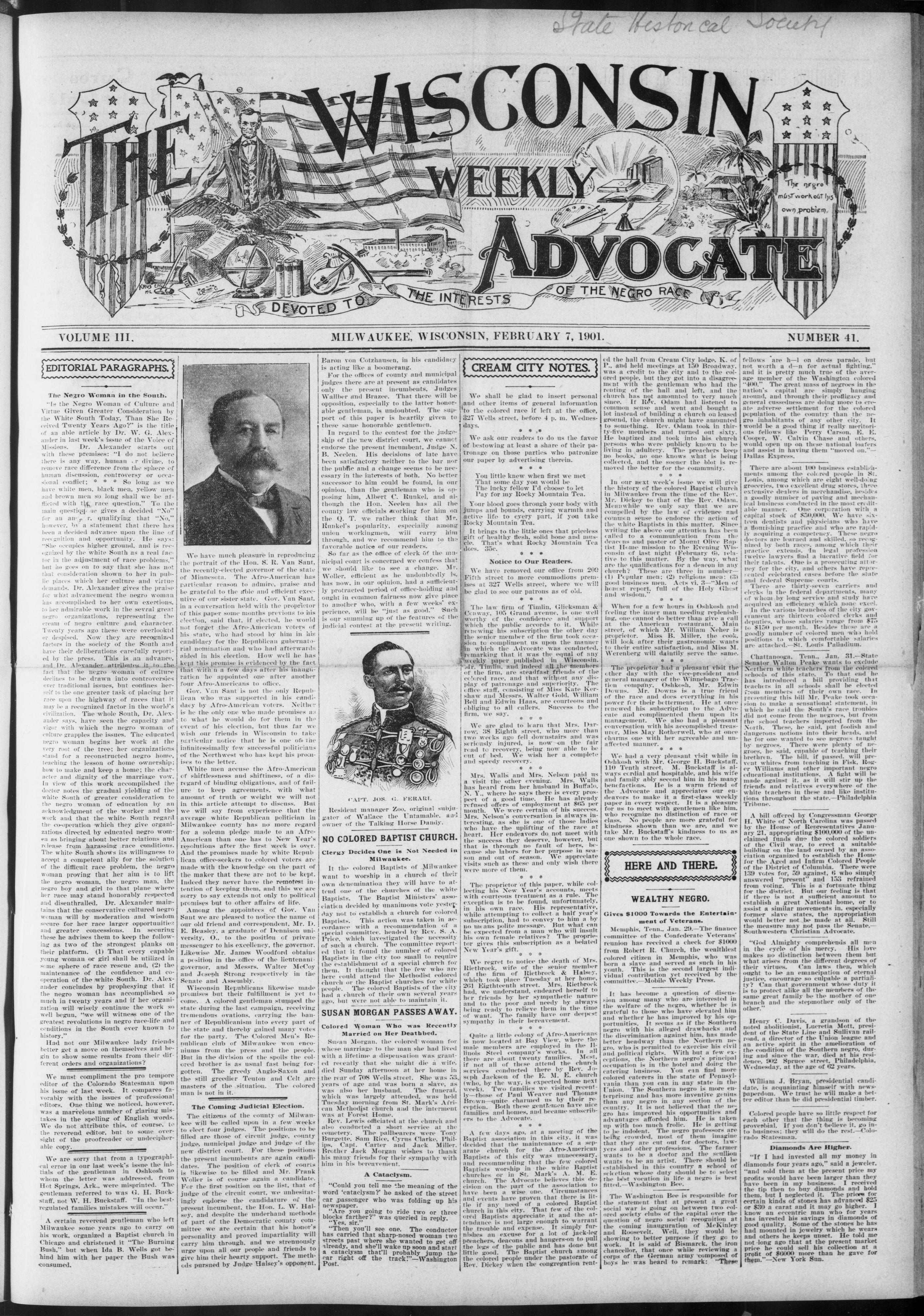
Page text (machine-generated)
WISCONSIN
WEEKLY
ADVOCATE
DEVOTED TO THE INTERESTS OF THE NEGRO RACE
VOLUME III.
EDITORIAL PARAGRAPHS.
"Is the Negro Woman of Culture and Virtue Given Greater Consideration by the White South Today, Than She Received Twenty Years Ago?" is the title of an able article by Dr. W. G. Alexander in last week's issue of the Voice of Missions. Dr. Alexander starts out with these premises: "I do not believe there is any way, human or divine, to remove race difference from the sphere of human discussion, controversy or occasional conflict; * * * So long as we have white men, black men, yellow men and brown men so long shall we be afflicted with the race question." To the main question he gives a decided "No" for an answer, qualifying that "No," however, by a statement that there has been a decided advance upon the line of recognition and opportunity. He says: "She occupies higher ground, and is recognized by the white South as a real factor in the adjustment of race problems," but he goes on to say that she has not that consideration shown to her in public places which her culture and virtue demands. Dr. Alexander gives the praise for what advancement the negro woman has accomplished to her own exertions, to her admirable work in the several great negro organizations, representing the cream of negro culture and character. Twenty years ago these were overlooked or despised. Now they are recognized factors in the society of the South and have their deliberations carefully reported by the press. This is an advance, and Dr. Alexander attributes it to the fact that the negro woman of culture declines to be drawn into controversies over traditional issues, but confines herself to the one greater task of placing her race upon the highway of races that it may be a recognized factor in the world's civilization. The whole South, Dr. Alexander says, have seen the capacity and vigor with which the negro woman of culture grapples the issues. The educated negro woman begins her work at the very root of the tree; her organizations stand for a reconstructed negro home, teaching the lesson of home ownership; how to make and keep a home; the character and dignity of the marriage vow. In view of this work accomplished the doctor notes the gradual yielding of the white South of greater consideration to the negro woman of education by an acknowledgment of the worker and the work and that the white South regard the co-operation which they give organizations directed by educated negro women as bringing about better relations and release from harassing race conditions. The white South shows its willingness to accept a competent ally for the solution of the difficult race problem, the negro woman proving that her aim is to lift the negro woman, the negro man, the negro boy and girl to that plane where her race may stand honorably respected and disenthralled. Dr. Alexander maintains that the conservative cultured negro woman will by moderation and wisdom secure for her race larger opportunities and greater concessions. In securing these he advises them to keep the following as two of the strongest planks on their platform. (1) That every capable young woman or girl shall be utilized in some sphere of race rescue and, (2) the maintenance of the confidence and cooperation of the white South. Dr. Alexander concludes by prophesying that if the negro woman has accomplished so much in twenty years and if her organization will wisely continue the work so well begun, "we will witness one of the greatest revolutions in negro race-life and conditions in the South ever known to history."
Had not our Milwaukee lady friends better get a move on themselves and begin to show some results from their different orders and organizations?
We must compliment the pro tempore editor of the Colorado Statesman upon his issue of last week. It compares favorably with the issues of professional editors. One thing we noticed, however, was a marvelous number of glaring mistakes in the spelling of English words. We do not attribute this, of course, to the reverend editor, but to some oversight of the proofreader or undecipherable copy.
We are sorry that from a typographical error in our last week's issue the initials of the gentleman in Oshkosh to whom the letter was addressed, from Hot Springs, Ark., were misprinted. The gentleman referred to was G. H. Buckstaff, not W. H. Buckstaff. "In the best-regulated families mistakes will occur."
A certain reverend gentleman who left Milwaukee some years ago to carry on his work, organized a Baptist church in Chicago and christened it "The Burning Bush," but when Ida B. Wells got behind him with her paper the Bush was consumed.
M. B.
We have much pleasure in reproducing the portrait of the Hon. S. R. Van Sant, the recently-elected governor of the state of Minnesota. The Afro-American has particular reason to admire, praise and be grateful to the able and efficient executive of our sister state. Gov. Van Sant, in a conversation held with the proprietor of this paper some months previous to his election, said that, if elected, he would not forget the Afro-American voters of his state, who had stood by him in his candidacy for the Republican gubernatorial nomination and who had afterwards aided in his election. How well he has kept this promise is evidenced by the fact that within a few days after his inauguration he appointed one after another four Afro-Americans to office.
Gov. Van Sant is not the only Republican who was supported in his candidacy by Afro-American voters. Neither is he the only one who made promises as to what he would do for them in the event of his election, but thus far we wish our friends in Wisconsin to take particular notice that he is one of the infinitessimally few successful politicians of the Northwest who has kept his promises to the letter.
White men accuse the Afro-American of shiftlessness and shiftiness, of a disregard of binding obligations, and of failure to keep agreements, with what amount of truth or weight we will not in this article attempt to discuss. But we will say from experience that the average white Republican politician in Milwaukee county has no more regard for a solemn pledge made to an Afro-American than one has to New Year's resolutions after the first week is over. And the promises made by white Republican office-seekers to colored voters are made with the knowledge on the part of the maker that these are not to be kept. Indeed they never have the remotest intention of keeping them, and this we are sorry to say extends not only to political promises but to other affairs of life.
Among the appointees of Gov. Van Sant we are pleased to notice the name of our old friend and correspondent, Mr. D. E. Beasley, a graduate of Dennison university, O., to the position of private messenger to his excellency, the governor. Likewise Mr. James Woodford obtains a position in the office of the lieutenant-governor, and Messrs. Walter McCoy and Joseph Strong respectively in the Senate and Assembly.
Wisconsin Republicans likewise made promises but their fulfillment is yet to come. A colored gentleman stumped the state during the last campaign, receiving tremendous ovations, carrying the banner of Republicanism into every part of the state and thereby gained many votes for the party. The Colored Men's Republican club of Milwaukee won enconiums from the press and the people. But in the division of the spoils the colored brother is as usual fast being forgotten. The greedy Anglo-Saxon and the still greedier Teuton and Celt are masters of the situation. The colored man is not in it.
The Coming Judicial Election
The citizens of the county of Milwaukee will be called upon in a few weeks to elect four judges. The positions to be filled are those of circuit judge, county judge, municipal judge and judge of the new district court. For these positions the present incumbents are again candidates. The position of clerk of courts is likewise to be filled and Mr. Frank Woller is of course again a candidate. For the first position on the list, that of judge of the circuit court, we unhesitatingly endorse the candidature of the present incumbent, the Hon. L. W. Halsey, and despite the underhand methods of part of the Democratic county committee we are certain that his honor's personality and proved impartiality will carry him through, and we strenuously urge upon all our people and friends to give him their hearty support. The methods pursued by Judge Halsey's opponent,
Baron von Cotzhausen, in his candidacy is acting like a boomerang. For the offices of county and municipal judges there are at present as candidates only the present incumbents, Judges Wallber and Brazee. That there will be opposition, especially to the latter honorable gentleman, is undoubted. The support of this paper is heartily given to these same honorable gentlemen.
In regard to the contest for the judg- ship of the new district court, we cannot endorse the present incumbent, Judge N. B. Neelen. His decisions of late have been satisfactory neither to the bar nor the public and a change seems to be necessary in the interests of both. No better successor to him could be found, in our opinion, than the gentleman who is opposing him, Albert C. Runkel, and although the Hon. Neelen has all the county law officials working for him on the Q. T. we rather think that Mr. Runkel's popularity, especially among union workingmen, will carry him through, and we recommend him to the favorable notice of our readers.
So far as the office of clerk of the municipal court is concerned we confess that we should like to see a change. Mr. Woller, efficient as he undoubtedly is, has now, in our opinion, had a sufficiently protracted period of office-holding and ought in common fairness now give place to another who, with a few weeks' experience, will be "just as good." Such is our summing up of the features of the judicial contest at the present writing.
JOHN BRAUN
CAPT. JOS. G. FERARI. Resident manager Zoo, original subjugator of Wallace the Untamable, and owner of the Talking Horse Dandy.
NO COLORED BAPTIST CHURCH.
Clergy Decides One is Not Needed in Milwankee.
It the colored Baptists of Milwaukee want to worship in a church of their own denomination they will have to attend one of the churches of the white Baptists. The Baptist Ministers' association decided by unanimous vote yesterday not to establish a church for colored Baptists. This action was taken in accordance with a recommendation of a special committee, headed by Rev. S. A. Price, which investigated the necessity of such a church. The committee reported that it found the number of colored Baptists in the city too small to require the establishment of a special church for them. It thought that the few who are here could attend the Methodist colored church or the Baptist churches for white people. The colored Baptists of the city had a church of their own several years ago, but were not able to maintain it.
SUSAN MORGAN PASSES AWAY.
Colored Woman Who was Recently Married on Her Deathbed. Susan Morgan, the colored woman for whose marriage to the man she had lived with a lifetime a dispensation was granted recently that she might die a wife, died Sunday afternoon at her home in the rear of 708 Wells street. She was 53 years of age and was born a slave, as was also her husband. The funeral, which was largely attended, was held Tuesday morning from St. Mark's African Methodist church and the interment was at Forest Home.
Rev. Lewis officiated at the church and also conducted a short service at the cemetery. The pallbearers were Tony Burgette, Sam Rice, Cyrus Clarke, Phillips, Capt. Carter and Jack Miller. Brother Jack Morgan wishes to thank his many friends for their sympathy with him in his bereavement.
A Cataclysm.
"Could you tell me the meaning of the word 'cataclysm?' he asked of the street car passenger who was folding up his newspaper.
"Are you going to ride two or three blocks farther?" was queried in reply.
"Yes, sir."
"Then you'll see one. The conductor has carried that sharp-nosed woman two streets past where she wanted to get off already, and she'll wake up soon and start a cataclysm that'll probably jump the car right off the track."—Washington Post.
CREAM CITY NOTES.
We shall be glad to insert personal and other items of general information to the colored race if left at the office, 327 Wells street, before 4 p. m. Wednesdays.
***
We ask our readers to do us the favor of bestowing at least a share of their patronage on those parties who patronize our paper by advertising therein.
***
You little knew when first we met That some day you would be The lucky fellow I'd choose to let Pay for my Rocky Mountain Tea. Your blood goes through your body with jumps and bounds, carrying warmth and active life to every part, if you take Rocky Mountain Tea. It brings to the little ones that priceless gift of healthy flesh, solid bone and muscle. That's what Rocky Mountain Tea does. 35c.
Notice to Our Readers
We have removed our office from 209 Fifth street to more commodious premises at 327 Wells street, where we will be glad to see our patrons as of old.
***
The law firm of Timlin, Glicksman & Conway, 105 Grand avenue, is one well worthy of the confidence and support which the public accords to it. While renewing his subscription the other day the senior member of the firm took occasion to compliment us upon the manner in which the Advocate was conducted, remarking that it was the equal of any weekly paper published in Wisconsin, afr. Timlin, and indeed all the members of the firm, are steadfast friends of the colored race, and that without any display of patronage and superiority. The office staff, consisting of Miss Kate Kershaw and Messrs. Walter Gold, William Bell and Edwin Haas, are courteous and obliging to all callers. Success to the firm, we say.
* * *
We are glad to learn that Mrs. Darrow, 38 Eighth street, who more than two weeks ago fell downstairs and was seriously injured, is now on the fair read to recovery, being now able to be out of bed. We wish her a complete and suedey recovery.
* * *
Mrs. Walls and Mrs. Nelson paid us a visit the other evening. Mrs. Walls has heard from her husband in Buffalo, N. Y., where he says there is every prospect of a good time. He has already refused offers of employment at $65 per month. We were certain of his success. Mrs. Nelson's conversation is always interesting, as she is one of those ladies who have the uplifting of the race at heart. Her endeavors do not meet with the success they deserve, however, but that is through no fault of hers, because she labors for her purpose in season and out of season. We appreciate visits such as these and only wish there were more of them.
* * *
The proprietor of this paper, while collecting his New Year's accounts, meets with courteous treatment as a rule. The exception is to be found, unfortunately, in his own race. His representative, while attempting to collect a half year's subscription, had to convey to him a by no means polite message. But what can be expected from a man who will insult his own female relatives? The proprietor gives this subscription as a belated New Year's gift.
```markdown
```
We regret to notice the death of Mrs. Rietbrock, wife of the senior member of the firm of Rietbrock & Halsey, which took place Tuesday at her home, 261 Eigthteenth street. Mrs. Rietbrock had, we understand, endeared herself to her friends by her sympathetic nature and to the poor and needy by always being ready to relieve them in the time of want. The family have our deepest sympathy in their bereavement.
☆ ☆ ☆
Quite a little colony of Afro-Americans is now located at Bay View, where the male members are employed in the Illinois Steel company's works. In all there are about twenty families. Most, if not all of these attend the church services conducted there by Rev. Joseph Jackson of the E. M. E. church (who, by the way, is expected home next week). Two families we visited recently—those of Paul Weaver and Thomas Brown—quite charmed us by their reception. Both these gentlemen have nice families and homes, and became subscribers to the Advocate.
* * *
A few days ago, at a meeting of the Baptist association in this city, it was decided that the maintenance of a separate church for the Afro-American Baptists of this city was unnecessary, and recommending that the few colored Baptists worship in the white Baptist churches or in St. Mark's A. M. E. church. The Advocate believes this decision on the part of the association to have been a wise one. Circumstances and events have proven that there is little if any need of a colored Baptist church in this city. That few of the colored Baptists appreciate it and the attendance is not large enough to warrant the trouble and expense. It simply furnishes an excuse for a lot of jack-leg preachers, deacons and hangers-on to pull the legs of the public and has done but little good. The Baptist church among the colored people under the pastorate of Rev. Dickey when the congregation rent-
cd the hall from Cream City lodge. K. of P., and held meetings at 150 Broadway, was a credit to the city and to the colored people, but they got into a disagreement with the gentleman who had the renting of the hall and left, and the church has not amounted to very much since. If Rev. Odam had listened to common sense and went and bought a lot instead of building a church on leased ground, the church might have amounted to something. Rev. Odam took in thirty-five members and turned out sixty. He baptized and took into his church persons who were publicly known to be living in adultery. The preachers keep no books, no one knows what is being collected, and the sooner the blot is removed the better for the community.
* * *
In our next week's issue we will give the history of the colored Baptist church in Milwaukee from the time of the Rev. Mr. Dickey to that of the Rev. Odam. Meanwhile we only say that we are compelled by the law of evidence and common sense to endorse the action of the white Baptists in this matter. Since writing the above our attention has been called to a communication from the deacons and pastor of Mount Olive Baptist Home mission to the Evening Wisconsin of last night (February 6), relative to this matter. By the way, what are the qualifications for a deacon in any church? These are three in number—(1) Popular men; (2) religious men; (3) good business men. Acts vi, 3—"Men of honest report, full of the Holy Ghost and wisdom."
☆ ☆ ☆
When for a few hours in Oshkosh and feeling the inner man needing replenishing, one cannot do better than give a call at the American restaurant. Main street, of which Mr. William Neher is proprietor. Miss B. Miller, the cook, will look after their gastronomic wants to their entire satisfaction, and Miss M. Werenberg will daintily serve the same.
The proprietor had a pleasant visit the other day with the vice-president and general manager of the Winnebago Traction company, Oshkosh, Mr. Edwin Downs. Mr. Downs is a true friend of the race and does everything in his power for their betterment. He at once renewed his subscription to the Advocate and complimented them upon its management. We also had a pleasant conversation with his accomplished treasurer, Miss May Rotherwell, who at once charms one with her agreeable and unaffected manner.
We had a very pleasant visit while in Oshkosh with Mr. George H. Buckstaff. 110 Tenth street. M. Buckstaff is always cordial and hospitable, and his wife and family ably second him in his many benefactions. He is a warm friend of the Advocate and appreciates our endeavors to make it a first-class weekly paper in every respect. It is a pleasure for us to meet with gentlemen like him, who recognize no distinction of race or class. No people are more grateful for kindness shown than we are, and we take Mr. Buckstaff's kindness to us as one shown to the whole race.
HERE AND THERE.
WEALTHY NEGRO.
Gives $1000 Towards the Entertainment of Veterans. Memphis, Tenn., Jan. 29.—The finance committee of the Confederate Veterans' reunion has received a check for $1000 from Robert R. Church, the wealthiest colored citizen in Memphis, who was born a slave and served as such in his youth. This is the second largest individual contribution yet received by the committee.—Mobile Weekly Press.
It has become a question of discussion among many who are interested in the welfare of the negro, whether he is grateful to those who have elevated him and whether he has improved by his opportunities. It seems as if the Southern negro with his alleged drawbacks and the discrimination against him, has made better headway than the Northern negro, who is permitted to exercise his civil and political rights. With but a few exceptions, the Northern negro's principal occupation is in the hotel and doing the catering business. You can find more colored caterers in the state of Pennsylvania than you can in any state in the Union. The Southern negro is more enterprising and has more inventive genius than any negro in any section of the country. It is not believed that the negro has improved his opportunities and advantages afforded him. He is taken up with too much frolic. He is getting to be indolent. The negro professors are being crowded, most of them imagine that they are cut out for doctors, lawyers and other professions. The farmer wants to be a doctor and the scullion wants to be an artist. There should be established in this country a school of selection whose duty should be to select the best vocation in life a negro is best fitted.—Washington Bee.
The Washington Bee is responsible for the statement that at present a great social war is going on between two colored society clubs of the capital over the question of negro social recognition at the coming inauguration of McKinley and Roosevelt. Well, they would be showing to better purpose if they go to work. It is said of Bismarck, the iron chancellor, that once while reviewing a corps of the German army composed of boys he was heard to remark: "These
NUMBER 41.
fellows are h-1 on dress parade, but not worth a d-n for actual fighting." and it is pretty much true of the average member of the Washington colored "400." The great mass of negroes in the nation's capital are simply hanging around, and through their profligacy and general cussedness are doing more to create adverse settlement for the colored population of the country than the negro inhabitants of any other city. It would be a good thing if really meritorious fellows like Perry Carson, E. E. Cooper, W. Calvin Chase and others, would open up on these national loafers and assist in having them "moved on." Dallas Express.
There are about 100 business establishments among the colored people in St. Louis, among which are eight well-doing groceries, two excellent drug stores, three extensive dealers in merchandise, besides a goodly number of paving and mechanical business conducted in the most creditable manner. One corporation with a capital stock of $50,000. We have sixteen dentists and physicians who have a flourishing practice and who are rapidly acquiring a competency. These negro doctors are learned and skilled, so recognized by both races, among which their practice extends. In legal profession twelve lawyers find a lucrative field for their talents. One is a prosecuting attorney for the city, and others have represented celebrated cases before the state and federal Supreme courts.
There are thirty-seven carriers and clerks in the federal departments, many of whom by long service and study have acquired an efficiency which none excel. In the various branches of the city government are thirteen colored clerks and deputies, whose salaries range from $75 to $150 per month. Besides these are a goodly number of colored men who hold positions to which comfortable salaries are attached.—St. Louis Palladium.
Chattanooga, Tenn., Jan. 31.—State Senator Walton Peake wants to exclude Northern white teachers from the colored schools of this state. To that end he has introduced a bill providing that teachers in all schools shall be elected from members of their own race. In presenting this bill Mr. Peake took occasion to make a sensational statement, in which he said the South's race troubles did not come from the negroes, but from the school teachers imported from the North. These, he said, put foolish and dangerous notions into their heads, and he for one wanted to see negroes taught by negroes. There were plenty of negroes, he said, capable of teaching their brethren. The bill, if passed, will prevent whites from teaching in Fisk, Roger Williams and other important negro educational institutions. A fight will be made against it, as it will stir up the friends and relatives everywhere of the white teachers in these and like institutions throughout the state.—Philadelphia Tribune.
A bill offered by Congressman George H. White of North Carolina was passed by the House of Representatives January 21, appropriating $100,000 of the unclaimed funds due the colored soldiers of the Civil war, to erect a suitable building on the land owned by an association organized to establish the Home for the Aged and Infirm Colored People of the District of Columbia. There were 139 votes for, 59 against, 6 who simply answered "present" and 153 refrained from voting. This is a fortunate thing for the district. But our feeling is that if there is not a sufficient amount to establish a great National home, or to assist a similar movements in, especially former slave states, the appropriation would better not be made at all. Still the measure may not pass the Senate.—Southwestern Christian Advocate.
"God Almighty comprehends all men in the cycle of his mercy. His love makes no distinction between them but what arises from the different degrees of their virtues. Can laws then, which ought to be an emancipation of eternal justice, encourage so culpable a partiality? Can that government whose duty it is to protect alike all the members of the same great family be the mother of one branch and the stepmother only of the other."
Henry C. Davis, a grandson of the noted abolitionist, Lucretia Mott, president of the State Line and Sullivan railroad, a director of the Union league and an active spirit in the amelioration of the condition of the Southern negro, during and since the war, died at his residence, 902 Spruce street, Philadelphia, Wednesday, at the age of 62 years.
William J. Bryan, presidential candidate, is acquainting himself with newspaperdom. We trust he will make a better editor than he did presidential timber.
Colored people have so little respect for each other that the thing is becoming provenbial. If you don't believe it, go into business; they will do the rest. Colorado Statesman.
Diamonds Are Higher.
"If I had invested all my money in diamonds four years ago," said a jeweler. "and sold them at the present price my profits would have been larger than they have been in my business. I received the tip then to buy diamonds and hold them, but I neglected it. The prices for certain kinds of stones has advanced $25 or $30 a carat and it may go higher. I know an eccentric man who for years has invested his savings in diamonds of good quality. Some of the stones he has had mounted in jewelry which he wears and others he keeps unset. He told me not-long ago that at the present market price he could sell his collection at a profit of $6000 more than he gave for them."—New York Sun.
Nomination as Major General Sent to the Senate.
REWARD FOR SERVICES.
Gen. Miles Selected by the President to be Lieutenant General.
Washington, D. C., Feb. 5.—The President set at rest a large amount of speculation regarding Gens. Miles and MacArthur by selecting the former to be lieutenant general and the latter to be major general. The nominations were sent to the Senate today. Brig.-Gen. Young and Col. Chaffee are also named as major generals along with MacArthur, the latter, however, taking third place in the order of appointment. For some time there has been more or less talk that because of feeling between Gen. Miles and the secretary of war there would be a new head for the army. The appointment of Gen. Miles to be lieutenant general shows that the President was not seriously influenced by the talk that was indulged in.
Gens. Young and MacArthur are jumped over Brig.-Gens. Wade and Merliam, and Gen. Chaffee also is advanced over those two officers, as well as over Gens. MacArthur and Ludlow and fifty-three colonels who had higher relative rank than he in the regular army.
The action in the case of Gen. Chaffee is accepted in military circles as an indication that he is to be placed in supreme command of the military forces in the Philippines and that Gens. Young nad MacArthur, who are now in that country, are to be relieved shortly and assigned to duty in the United States.
The law provides for six major generals and the promotion of Maj.-Gen. Miles leaves another vacancy in that grade which it is generally understood, will be filled by the appointment of Brig.-Gen. J. F. Wade, the senior officer of his grade.
There is still one vacancy in the list of brigadier-generals and another will be made by the retirement of Gen. Schwan, who is said to be in failing health. Col. Daggett of the Fourteenth infantry, who has just returned to San Francisco from gallant service in China, is booked for appointment as a brigadier-general. It is expected that he will be retired immediately.
PERISHED IN FLAMES.
Children Burned to Death in a Fire Believed to Have Been Started by Tramps.
Binghamton, N. Y., Feb. 5.—Two persons perished and three were fatally injured in a fire which destroyed the Exposition hotel in this city today.
The dead: Harry Severson, aged about 30 years, a musician, burned beyond recognition; Sid Holland, aged 39, a horseman, suffocated.
Fatally injured: Tom Cook, a racing man, burned about the head and body; John Regon, face, head and body frightfully burned and internally injured in jumping; Dora Darrow, back broken by jumping from a third-story window.
Westminster, B. C., Feb. 5.—A fire, supposed to have been started by tramps, destroyed the residence and farm buildings of Guy Whiteside of Tynehead, and burned to death his two children who were asleep when the flames broke out. Whiteside rescued his wife with difficulty and the two made frantic efforts to save the children, but were driven back by the smoke. Search is being made for the supposed incendiaries.
Boston, Mass., Feb. 5.—Fire in the upper story of the First National bank on State street damaged property to the extent of $50,000 this morning. An adjoining building owned by the Globe Newspaper company was slightly damaged. The wife of the janitor of the bank and her 7-year-old child were removed from their rooms in the building in an unconscious condition and taken to a hospital, where it is said the woman will die.
The total loss probably will be $30,000, Wellston, O., Feb. 5.—Fire today gutted the postoffice building and destroyed a large quantity of mail. Three other buildings, including the First National bank, were damaged. No estimates have been made, but the losses will amount to several thousand dollars.
TO PRISON FOR LIFE.
Youtsey, Gov. Taylor's Stenographer, Accused of Complicity in Goebel Shooting.
Georgetown, Ky.. Feb. 5.—Henry E. Youtsey, stenographer to Gov. Taylor during his incumbency and who was tried as a principal in the shooting of Gov. William Goebel, and found guilty, was arraigned before Judge Cantrill late this afternoon and sentenced to life imprisonment.
When sentence was pronounced Youtsey exclaimed: "I am innocent. I have been convicted by base and infamous subornations of perjury."
No appeal will be taken, and the prisoner will be taken to state prison shortly.
A Queen's Wedding Landau.
The marriage landau of the Queen of the Netherlands is on exhibition on the premises of a carriage builder in the Boulevard Haussmann, in Paris. It has been sent thither to be relined, but has already been used by her majesty Wilhelmina on a few state occasions. It is painted in cream color. "Vernis Martin," of great purity of tint; the box seat, the springs and the hubs of the wheels are or a rich orange; the new linings are of white brocade; and the Queen will, they say, have eight white horses, with orange-colored trappings, to take her to church on her wedding day.
To Import Cuban Produce
New York commission merchants are sending representatives to Cuba to purchase produce for shipment to this country. It is believed that Cuban products in large quantities will soon make their appearance in Eastern markets.
Official returns show that last year Liverpool's imports and exports exceeded London's by £15,000,000.
DOZEN ARE ON THE LIST.
Foreign Ministers in China Demand the Death Penalty.
TUAN TO BE BANISHED.
Sentence to be Passed Upon Two Who Are Already Dead—Names of the Culprits.
Pekin, Feb. 6.—The ministers definitely decided, at a third meeting, held last night, to demand the imposition of the death penalty upon all twelve of the Chinese officials named in the list submitted, including those who are dead, on account of the moral effect upon the Chinese.
The sentence on the living must be inflicted except in the cases of Prince Tuan and Duke Lan, which the Emperor may commute to banishment to Turkestan.
At the meeting of the foreign ministers and Chinese plenipotentiaries today, a formal indictment against the twelve officials whose punishment had been demanded by the powers was read, however, though Kang Yi and Li Ping Hen are dead.
The officials whose punishment has been demanded are: Prince Chuang, commander-in-chief of the Boxers, who had a large share in the responsibility for promises of rewards of 50 taels for the capture of foreigners and the death of persons protecting them; Prince Tuan, who was responsible for the edicts against foreigners issued between June 30 and August 16, and was mainly responsible for the massacres in the provinces, especially Shan Si; who ordered the troops to attack the legations, and who is the recognized author of the ultimatum of June 19 directing the diplomatic corps to leave Pekin within twenty-four hours, and who ordered before the expiration of this delay firing upon all foreigners found upon the streets of the capital, and who was practically the author of the assassination of Baron Ketteler, the German minister. Also Duke Lan, Ying Nien, Kang Yi, Chaos Su Kiam, Yu Hsien, Gen. Tung Fuh Siang, who with Prince Tuan carried out in Pekin the plans against the foreigners and who commanded the attacks on the legations and the soldiers who assassinated the Japanese chancellor; Li Ping Heng, Hsu Tung, Hsu Cheng Yu and Kih Siu.
The ministers announced that these persons deserved death. When the question is settled the foreign plenipotentiaries will have to indicate who to their knowledge committed crimes in the provinces, punishment for which will have to be inflicted. They will also present to the Chinese, in order to prevent misunderstanding, the text of the edict referred to in article 10 of the collective note, before its publication
Appeal of the Emperor.
In answer to the indictment, which was drawn by the French minister, M. Pichon, Li Hung Chang read a long dispatch from the Emperor setting forth the condition of the empire and imploring the powers not to demand more than China was able to accord. "How can you doubt my good faith?" the Emperor asked, "when I sacrifice to your just demands Prince Chuang, prince of a clan, to whom I have sent the silver cord?" This is an imperial order to commit suicide.
Sanctions Death of All but Two.
Afterward the viceroy stated that he was authorized by the Emperor to sanction the death penalty demanded except in the cases of Prince Tuan and Duke Lan, who would, however, be degraded and banished; and he also requested a postponement of action regarding Gen. Tung Fuh Siang.
The Russian, French and American ministers signified their acceptance of the Chinese proposition. The German minister, Baron Mumm von Schwartzenstein, said that he hoped to give the decision of the Berlin government in a few hours.
Ultimatum as to Troops.
The Chinese envoys wanted to discuss other terms of the joint note, but the foreign ministers declined to advance proceedings beyond the punishment issue. They did, however, inform Li Hung Chang and Prince Ching that the foreign troops would not be withdrawn until the punishment finally agreed upon was meted out. Rev. W. S. Ament, accused of trying to extort indemnities from the Chinese, is still held by the French troops.
CRUELLY TORTURED.
Postmistress of Ohlc Town Has Lighted Matches Applied to Her Feet.
Toledo, O., Feb. 6.—Burglars bound and gagged the postmistress at Rossford, a suburb of Toledo, at 3 o'clock this morning and robbed the office of $150 in stamps and $5 in coin. The robbers compelled her to reveal the hiding place of the valuables by applying lighted matches to her feet. At noon today she became unconscious, and, it is now feared, may die.
TOSSED BY AN EARTHQUAKE.
Steamer Guatemala Lifted While Sailing South American Seas.
San Francisco, Cal., Feb. 6.—The steamer Guatemala, from the South American coast, reports that on January 6, when 160 miles south of Guayaquil and five miles off shore, the vessel experienced the heaviest earthquake shock ever felt in those waters. For over a minute heavy shocks continued, and the ship was fairly lifted at each shock. Slighter shocks continued for many minutes. On arriving at Guayaquil it was learned that the shocks were the heaviest in the history of that city, but low buildings prevented loss of life, as at the first warning all the people rushed to the public squares for safety.
GAS IN TRUNKS OF TREES
Curious Discovery at Union Mills, Ind., that is Causing Excitement.
La Porte, Ind., Feb. 6.—State Geologist W. S. Blatchley has been called to Union Mills, this county, to make an investigation of a remarkable strike of what is believed to be natural gas. Trees were being felled and gas suddenly spurted from the stumps. When lighted the blaze shot up ten feet. The trees were apparently sound, but when split open chambers were found running far down into the roots, from which the gas came. The gas burns with a bluish blaze at the bottom, but near the end becomes brighter. The strange strike has caused considerable excitement.
SET FIRE TO THE JAIL.
Two Young Men, Locked in a Cell Apply the Match. Columbia, Mo., Feb. 6.—Henry Arthur and Clifford Christian, two young men who had been arrested for interfering with a dance, were burned to death in the jail here. They were intoxicated and not realizing what they were doing set fire to the jail. A woman prisoner escaped by breaking through a window.
THE LEGISLATURE.
THE LEGISLATURE.
Senate.
The Senate on the 31st toyed with the question of fixing a date for cutting off new business this morning and finally put the matter over after the amendment making the date February 8 was defeated 16 to 8. Bills were introduced as follows; Amending the school laws, providing for special state aid to graded schools, two state school inspectors, etc.; increasing the appropriation to the State Dairymen's association from $2000 to $4000; amending the statutes relative to chattel mortgages; authorizing the fish commissioners to relinquish all rights they may have acquired to go upon private lands; appropriating $25,000 to the normal school fund income for buildings and repairs; providing for the reorganization of the Wisconsin National guard; to compel railroad companies to receive cars, loaded or empty, from other companies or deliver them at any freighthouse or depot and make track connections with other companies; authorizing the state board of control with the approval of the governor to purchase lands adjoining the Green Bay reformatory; giving street and steam railroad companies the right to condemn lands in acquiring right of way; also providing that one publication of franchise shall be sufficient; providing an appropriation to reimburse purchasers of orders issued by county judges for care of Keely cure patients, under the law declared invalid by the Supreme court; taxing carferry companies 4 per cent. on gross receipts; enabling town insurance companies to adopt any name they please, but requiring the use in the name of the word "town"; amending the medical law so as to require Osteopathists and Christian Scientists to pass a medical examination before being allowed to treat disease; amending the statutes relating to municipal water and lighting plants, making unpaid rentals a lien on property. The judicial committee reported 32 S, 58 S, 60 S and 70 S for passage; 19 S, 34 S, 43 S, 57 S and 52 S with amendments favorably; 46 S, amending the statutes relative to perpetual testimony, for indefinite postponement. The committee on roads and bridges reported 42 S for passage. The committee on state affairs reported 41 S and 68 S for passage.
Eleven new bills, most of them amending present statutes, were introduced at the session of the Senate on the 1st, making a total of 148 offered in that body at this session. Bill No. 8 S., changing the terms of holding court in the Fifth judicial circuit, was passed under suspension of the rules. Bills were ordered to engrossment and third reading, as follows: 32 S., relating to commissioners of weeds; 41 S., relating to the standard of weights and measures; 42 S., relating to damages by defective highways; 58 S., relating to removal of fences; 60 S., defining the fiscal year of the state. Bills were introduced as follows: Providing a clerk for the district attorney of Milwaukee county at a salary of $600 a year; to provide for the effect of technical conditions or forfeiture on contracts of insurance; relative to the sale of lands by executives, administrators and guardians; giving judges of all courts of record the same jurisdiction as county judges in reference to insane persons; relating to the Rock county municipal courts; relative to the sale of real estate of minors and others under guardianship; to provide against charging to counties the special assessment certificates issued by cities in payment upon contracts; requiring that articles of incorporation of churches be recorded with registers of deeds; extending the time of closing polls in townships in Milwaukee county until 7 p. m. instead of at sunset. The purpose is to give laboring men who work in the city but live outside a chance to vote. Adjournment was taken to 7:30 p. m. on the 4th.
The joint committee on rules sent into the Senate through Senator Whitehead, its chairman on the evening of the 4th a joint resolution providing for shutting off new business except that brought in by the standing committees after February 18. The resolution introduced a new feature in the matter of shutting off new business by providing that all new business which is presented after that date shall be referred to the committee on rules, and that committee shall be the judge of the importance of the measure. Senator Green came in with a bill providing a tax of 10 cents on all ice cut on the meandered lakes of this state and shipped out of the state. Senator Anson introduced a bill to provide that marine insurance on the Lloyds plan may be written in this state.
The Senate on the 5th adopted a joint resolution cutting off new business February 19 except such as may be introduced by standing committees. A new rule was also adopted that after the time for introducing new business has expired all joint resolutions to permit introduction of bills shall go to the committee on rules. As the Senate resolution fixed the time for cutting off new business on the 19th was messaged over to the Assembly and was concurred in without a word of debate, that settled the vexed question and new business will be cut off on that date. A joint resolution by Senator Hageneister was adopted adding the president pro tem of the Senate and the speaker of the Assembly to the joint committee on rules. Bills were introduced as follows: Providing that in counties having more than one school superintendent district, the compensation and expense allowance of each superintendent shall be fixed and audited by the county board and changed to the district for which it is appropriated; amending the statutes relative to the purchase or operation of lighting plants by cities giving the cities power to erect competing works for private lighting; providing for voting districts on the Oneida Indian reservation; amending the statutes relating to drainage districts. Adjournment was taken to the 6th.
An investigation into the telephone situation at the capitol was ordered by the Senate on the 6th through the adoption of a joint resolution introduced by Senator Green for the appointment of a joint committee. Senator McDonough presented a joint resolution enlarging the memory of the late Michael Griffin and followed with a brief but eloquent speech on the floor. Senators O'Neil and Whitehead also paid tribute to Gen. Griffin. The resolution was adopted by rising vote. Two bills aimed at the state printer were introduced by Senator Mills, one permits the printing to be taken from Madison eliminating the provision that it must be done at the seat of government. The other authorizes the splitting up of the contract, letting different portions to different bidders. The bills went to the printing committee. Other bills introduced were: Requiring foreign insurance companies to pay a tax of 4 percent, on gross amount of premiums received; providing for the establishment of free employment bureaus in cities of 20,000 or more; amending the statutes relating to boards of fire underwriters and fire patrol; providing that real estate owned by or held in trust for the state shall be liable for special taxes for sidewalks, streets and other improvements; providing that the Milwaukee school board shall be elected by the people; authorizing the state board of health to order general vaccination of the public in localities where an epidemic of smallpox is feared; amending the statutes relative to the sale of lands by executors and administrators; increasing the salaries of clerks in the register of deeds' office. Milwaukee—custodian from $50 to $75 a month, copyists and recording clerks from $50 to $65 a month; removing the limit ($5000) of damages recoverable for death. Several committee reports came in. The judiciary committee reported favorably on the bill providing for an increase in salaries of judges. Senator Burns dissenting on the whole bill and Senator Whitehead on the increase of salaries of circuit judges. Adjournment was taken till 10 a. m. on the 7th.
Assembly.
Another large batch of highly-important bills went into the Assembly on the 31st. One of the most important to manufacturers and laboring men was Mr. McCabe's bill relating to special verdicts on personal damage suits, which is one of wide interest. Under the present law proof of contributory negligence is a bar to the recovery of damages, and Mr. McCabe proposes to amend the law so that in such cases the party injured can recover one-half the damages he
would be entitled to if there had been no contributory negligence. Mr. Soltwedel introduced the barbor's bill on which there has been a great deal of discussion. The bill provides for the appointment of a commission of three barbers, who are to receive $3 a day each for actual services. They are to examine barbers and license them. Two bills from the committee on agriculture are of interest to farmers. One increases the appropriation for the Northern State farm from $2500 a year to $4000 and 10 per cent. of premiums paid. The other gives the state board of agriculture an appropriation of $49,356 for improvements at the State Fair park in Milwaukee, including a new waterworks system. Mr. Dahl introduced a bill in accordance with a suggestion in Gov. La Follette's message providing residences outside of the institutions
for the superintendents under the control of the state board of control and making an allowance not to exceed $1500 for expenses, which would have the effect of increasing the salaries from $2500 to $4000 a year. Mr. Anderson's bill relating to sales in fraud of creditors provides that there shall not be any sale of merchandise without notice to creditors. Mr. Eager introduced the bills preventing the sale of liquors in stores and forbidding the giving away of lunches in saloons. Mr. Brunson submitted a bill aimed at the oleomargarine industry. It prohibits the soliciting of orders for any substitute for butter. Another text book bill was introduced by Mr. Benson. It provides that there shall be a uniform system of text books which the state shall print and sell to the pupils at cost. A very interesting bill by Mr. Williams authorized counties to establish industrial schools for the care of incorrigible boys. Judge Orton precipitated a little fight by moving a reconsideration of the vote by which Mr. McGill's bill making time checks negotiable was ordered to a third reading. On a division of the house the motion prevailed by
Two bills relating to the telephone companies of the state were introduced in the Assembly on the 1st. The first, which it very sweeping in its provisions, came from Mr. Rossman of Ashland. It fixes the rates that may be charged not only for local service but long-distance messages as well, and provides for connections between rural long-distance companies. The second bill was by Mr. Pomrening and it repeals the present law taxing telephone companies on their gross earnings, leaving their property to be taxed as other property is taxed. Mr. Brunson put in an interesting text-book bill which provides that the people of a county shall vote on the question of adopting uniform text books and if it is voted to adopt them, a committee of seven is to be appointed with the county superintendent at its head, to select the books. They are then to be purchased by the districts and furnished to the pupils at cost or free as the school meeting may elect. Other bills introduced were: Providing for admission of reformed and crippled children to the Sparta school; amending the laws relating to the taxation of public parks; another relating to changes of grades in Milwaukee; changing the terms of court in the Fifteenth Judicial circuit; to prevent frauds in assignments of insolvent debtors; to prohibit the throwing of refuse into lakes and rivers. The Senate memorial to Congress which was introduced by Senator Harris praying for the passage of the oleomargarine bill, was received by the Assembly and concurred in. Three bills were passed as follows: No. 3 A., requiring county clerk of Burnett county to make and keep abstract of tax sale: No. 16 A., relating to salary of municipal court clerk in city and county of Ashland: No. 46 A., granting United States jurisdiction over certain lands in Douglas County. Senate bill No. 24 was ordered to a third reading. The anti-pass resolution was on the calendar for third reading, and it kicked up a little row, but was finally ordered to a third reading. Mr. Root's bill, No. 19 A., relating to fees for return of notices of births, was referred to the committee on public health and sanitation, and Mr. Keene's bill appropriating $50,000 to prevent the spread of Asiatic cholera and other diseases was sent to the committee on claims. Mr. Hall's bill requiring poison to be sold in red three-cornered bottles was on the calendar to be called but was saved by Mr. Evans, who moved to referer it to the committee on public health and sanitation. His motion carried and the bill went back. E. A. Miller's bill to authorize Jackson county to repay certain moneys to the state was sent back to the committee on state affairs. The following bills were killed: No. 4 A., relating to jurors; No. 69 A., relating to persons authorized to solemnize marriages; No. 75 A., relating to sheriff's fees. The Assembly then adjourned to 8:30 p. m. on the 4th.
In the Assembly on the evening of the 4th Assemblyman Whitson introduced a bill that provides for severe punishment for kidnapping. It provides that any person who shall detain by force or trick anyone under 18 years of age shall be guilty of a felony and shall be imprisoned in the state penitentiary for a term of from five to twenty years. The bill was drafted to prevent a repetition of cases in this state like the Cudahy kidnapping in Omaha. Assemblyman Soltwedel introduced a bill in the Assembly designed to regulate private detective agencies. Assemblyman Overbeck's bill provides that all ice companies obtain a license from the secretary of state, and file a bond of $10,000 that they annually will file a statement of the amount of ice cut on meandering lakes. The Assembly passed the memorial to Congress relating to the election of United States senators direct by the people. The vote was close and Mr. Ray had to call for it twice before he could decide it. Mr. Dow had a bill regulating the salaries of the officials of the state prison. The warden under the terms of the bill is to receive $2000 a year, the deputy $1000 and the chaplain $800.
The Assembly had only three bills on its calendar on the 5th, all for third reading. The first of them was Mr. McGill's measure to make time checks negotiable, and it caused something of a debate. Mr. Young offered an amendment to insert the words "Any bonafide" before the word "employee," so as to prevent anybody else from taking advantage of the law. The amendment was killed by 6 to 76. The bill was then ordered to a third reading. A bill by Assemblyman Zinn legalizes the practice of the city of Milwaukee in borrowing on notes. Assemblyman Andrews of West Superior introduced a very important bill giving common councils remarkable powers for the purchase and operation of electric light plants. Under the provisions of the measure, when a city thinks it desires to purchase a plant, the council can pass a measure with that end in view and serve notice on the company that the purchase is intended. Then the company must file a valuation of its property with the city clerk. The bill also gives cities the right to erect and maintain competing plants. The substitute for the bill abolishing the publication of state railroad map which provides for the publication of 8000 maps every four years instead of at present called forth a set speech from Mr. Holland, in which he opposed the substitute and advocated his own bill. The substitute was adopted by a vote of 51 to 34. The substitute was then ordered to a third reading. The following bills were introduced: Providing for vaccination; appropriating money to the Eastern Wisconsin Firemen's association; amending the law relating to the examination of insane persons; for a wagon bridge across the Fox river in Marquette county; relating to the licensing of peddlers; relating to the construction of sewers in cities; relating to printing for various state boards, fixing the number of reports to be printed; for the purchase of annotations to the Supreme court reports for counties and state officers; authorizing the establishment of Lloyds system of marine insurance; relating to the changing of highways; relating to the borrowing of money by cities. After receiving a communication from the railroad commissioner relative to the distribution of maps the Assembly adjourned.
The contest between Gilbert M. Vandercook and Alfred Cook for the seat representing the First district of Marathon county was settled in the Assembly on the 6th by the seating of Mr. Cook. As soon as the matter came up Mr. Valentine moved that the report of the committee be referred to the committee on judiciary in order that the Assembly might be informed as to the legal phases of the question. In accordance with the decision to force the matter to a decision the Assembly promptly voted the motion down. The ayes and nays were called for with the following result: Ayes, 22; nays, 70. After considerable debate the question came up on the adoption of the report and a vote was ordered without a word of debate. The report was adopted by the following aye and nay vote, Mr. Cook being excused from voting, as he was on the first vote. Ayes, 81; noes, 14: absent or not voting. 5. Mr. Valentine of Janesville aroused the Assembly by moving a reconsideration of the vote by which the railroad map bill was ordered to a third reading. The motion was voted down by a vote of 26 to 55. Among the bills introduced were the following: Appropriating money for interstate park at the dells of the St. Crox river; making an appropriation for improvements at the Wisconsin Veterans' home; joint resolution to amend the constitution relating to pardons; authorizing counties to erect isolation hospitals; another relating to justices of the peace and constables in Milwaukee; removing the limitations of damages for death by accident; to prohibit the sale of game and gaze birds; relating to cornhshredders; to change the boundaries of certain towns in Forest county and creating new towns. The Senate bill amending the rules relating to the introduction of new business after the close of new business was concerned in. It provides that all joint resolutions for the introduction of bills shall go to the committee on rules before they can be passed. The anti-pass resolution, bill No. 8 A., limiting actions and proceed-
ings by villages, and No. 43 A., to establish a ferry across Lake St. Croix, were passed.
A GIANT INDUSTRY.
Material Benefits Resulting from Sir Henry Bessemer's Invention. According to Prof. R. H. Thurston, who writes of "The Steel Industry of America," in the Century, Sir Henry Bessemer's invention has added more to the world's wealth than any other save the steam engine. The following figures give an idea of the extent of the production of steel throughout the world:
The world's product of Bessemer steel in 1892 would have made a colonnade of pillars 20 feet in diameter and 100 high, 1672 in number, extending over three miles, 836 on each hand, or a single row over six miles long. Every working day in that year there was produced the equivalent of between five and six such columns, and a day's work resulted in the output of nearly as much as was the total annual product of the great city of Sheffield at the time of Bessemer's invention.
The annual production of Bessemer steel was, in another comparison, shown to be the equivalent of a column 100 feet in diameter, the size of a moderately-large gas holder, and 6684 feet 6 inches high—a mile and a third. This would be sixteen and one-half times as high as the cross on the dome of St. Paul's in London. One-twelfth of its altitude would measure the production of a single month and would rise to above the height of the Washington monument. A single hour would yield a pillar of steel 9 feet in diameter and about 140 feet high, the altitude of a tall church steeple. The work of a year would construct a steel wall 5 feet in thickness, 20 feet high and 100 miles long, which would be enough to enclose an area of about 800 square miles, $3\frac{1}{4}$ miles in diameter, sufficient to enclose London and its suburbs in a circle radiating over thirty miles from St. Paul's or the Bank. The foundation of the wall itself would occupy sixty acres. The United States enters the new century with just about this total production
The United States enters the new century with just about this total production of steel.
CONGRESS.
Senate.
Thursday, Jan. 31.—By a vote of 33 to 2$ agreed to the conference report on the army reorganization bill. The shipping bill was discussed during the latter part of the day, and some progress was made on amendments. A speech by Mr. Rawlins of Utah against the bill was in progress at the close of the day. Mr. Chandler announced that a night session would be moved Friday to advance the bill to its final stages.
Friday, Feb. 1.—Spent the day considering the shipping bill.
Saturday, Feb. 2.—Met at 11 o'clock and with the exception of an hour and a half at the beginning of the session devoted the entire day to the discussion of the ship-subsidy bill. Mr. Turner and Mr. Mallory were the speakers in behalf of the opposition. Mr. Turner's speech was based largely upon exceptions which he had taken to Mr. Frye's criticisms of his former speech. Mr. Mallory opposed the bill on constitutional grounds. Passed bill authorizing the construction of a public building at Hammond, Ind. to cost $125,000.
Monday, Feb. 4.—The ship subsidy bill was laid aside informally by the Senate today to permit consideration of the appropriation bills. The shipping bill holds its place, as the unfinished business can be taken up when the appropriation bills are not occupying attention. The District of Columbia bill will occupy the attention of the Senate Tuesday. The greater part of Monday was given to a speech by Mr. Bacon of Georgia on the right of the Senate to demand information on file in the executive departments. He took the position that the departments are the creatures of Congress, and that departmental denial of any demand for papers on file was preposterous, contending that for 100 years there had been practically no refusal to recognize this right. Secretary Long's letter regarding Santiago naval rewards caused a discussion in which senators upheld their course in this matter.
Tuesday, Feb. 5. - Passed District of Columbia appropriation bill and partly considered bill making appropriations for support of West Point military academy. During day ship subsidy bill by vote of Senate was formally laid aside and superseeded as unfinished business. Wednesday, Feb. 6. - Passed the military academy appropriation bill and the war revenue reduction measure. Considered the shipping bill at a night session.
House
Thursday, Jan. 31.—Passed the fortification bill and made fair progress with the postoffice appropriation bill. During the general debate upon the former bill Mr. Lanham of Texas delivered a notable speech upon the future of the Democratic party, making a strong plea for the necessity of united Democracy and counseled the burial of the hatchet and the welcoming back of those who in the last two presidential campaigns have declined to support the nominees of the party. Many amendments were offered to the postoffice appropriation bill in the interest of various claims of postoffice employees, but they all went down before points of order raised by Mr. Loud, the chairman of the postoffice committee, who was in charge of the bill.
Friday, Feb. 1.—Passed an omnibus bill carrying 191 claims for stores and supplies taken by the Union Army during the rebellion. The claims were passed on by the court of claims and aggregated $344,480. Practically all the beneficiaries reside in the South. Considerable oposition to the bill was displayed under the leadership of Mr. Cannon, the chairman of the appropriations committee, but it flattened out later and the bill finally was passed without division. The bill to amend the Chinese exclusion act, with a view to preventing the fraudulent entry of Chinese into the United States was passed.
Saturday, Feb. 2.—Spent the day until 3 o'clock in the consideration of the post-office bill. The struggle over the questions of restoring the appropriation for pneumatic tube service and of the reduction of railway mail pay were precipitated by amendments offered, but no action was taken. At 3 o'clock public business was suspended to permit the members to pay tribute to the late Senator Davis of Minnesota.
Monday, Feb. 4.—Passed the Senate bill to create a commission to adjudicate the claims of United States citizens against Spain which the government of the United States assumed by the treaty of Paris, after having amended the bill so as to refer the claims to the court of claims instead of to a commission. A strong effort was made to vote down the amendment and pass the Senate bill, but the advocates of this course were defeated by a majority of 35. A bill was passed without debate to extend the charters of national banks for another period of twenty years after 1002, when the present extension expires. Bills to ratify the agreement with the Crow Indians of Montana and to provide for the redemption of Hawaiian coin at par were defeated. About an hour was spent on the postoffice appropriation bill in the discussion of the amendment to reduce the railway mall pay, but no action was taken.
Tuesday. Feb. 5.—Continued discussion of controverted questions in connection with postoffice appropriation bill. Mr. Griggs (Ga.) spoke against organizations of postal employees formed with view to forcing legislation in their interest. Mr. Moody (Mass.) discussed question of railway mail pay from standpoint of member of joint postal commission. Mr. Bromwell (Ohio) and Mr. Gaines (Tenn.) assailed appropriations for special mail facilities from New York to New Orleans, and Mr. Catchings (Miss.) and Mr. Meyer (La.) defended these appropriations as necessary for expedition of Southern mail.
Wednesday, Feb. 6.—Debate on the postoffice appropriation bill consumed the day. It was agreed before adjournment that the debate should close Thursday at 12:30 p. m., when the votes should be taken upon the several amendments which are pending.
The Smallest Mail.
The smallest mail ever dispatched was one recently made up for Buenos Ayres, the official entry of which was: "Letters. 1: newspapers, nil."
How will your cough be tonight? Worse, probably. You can stop it any time. Then stop it tonight. You will cough less and sleep better, and by tomorrow at this time you will be greatly improved.
Ayer's Cherry Pectoral
cures night coughs, day coughs all kinds of coughs. Help Nature a little and see what she will do for you.
If your druggist cannot supply you, send us $1.00 and we will express a large bottle to you, all charges prepaid. Be sure and give us your nearest express office. I.C. AYER CO. Lowell Mass
ABSOLUTE
SECURITY.
Genuine
Carter's
Little Liver Pills.
Must Bear Signature of
See Fac-Simile Wrepper Below.
Very small and as easy
CARTER'S
LITTLE
LIVER
PILLS.
FOR HEADACHE.
FOR DIZZINESS.
FOR BILIOUSNESS.
FOR TORPID LIVER.
FOR CONSTIPATION.
FOR SALLOW SKIN.
FOR THE COMPLEXION
Price
25 Cents
GENUINE
MUST HAVE SIGNATURE.
Purely Vegetable.
CURE SICK HEADACHE.
SALZER'S SEEDS
WILL MAKE YOU RICH!
Billion S Grass.
Marvelous grass, wonderful grass, fit for all soil, every condition, every state in the Union. Will yield 12 tons of rich hay and lots and lots of pasture beads. "What is it?" Will yield 12 tons of pasture beads. "What is it?" Will yield 12 tons of pasture beads. "What is it?" Catalogue tells.
Combination Corn.
Combination Corn combines the ages. Seed direct to the crop. Will make you rich to plant. Will revive the corn growing. Spelt, Rapo and Peasat.
Three perfect soils. Spelt yields 20 bus. grain and 10 bus. of hay per year. Rapo and Peasat food and Peasat 3 tons of nutritive food per acre.
GRASS
Bromus inermis,
Greatest pinnatus,
on the century, bearing like it
conduit to bushy and we have
secured the world for its equal,
4 to 7 tons of hay per acre.
Vegetable Seeds
Large growers,
Oulon seed $30 lb.
For 100
Stamps
and this Notice,
we mail big illustrated Seed Catalog and
10 grain samples, its
change by mail into
Spelix (80 bu. per A),
Oats (250 bu. per A),
Rape, Barley (178
bu. per A), Pusat, etc.
worth $10 for a start.
JOHN A. SALZER SEED CO. LA CROSSE
WIS.
DO YOU
COUGH
DON'T DELAY
TAKE
KEMP'S
BALSAM
THE BEST COUGH CURE
It Cures Colds. Coughs. Sore Throat. Croup. Influenza, Whooping Cough, Bronchitis and Asthma. A certain cure for Consumption in first stages, and a sure relief in advanced stages. Use of once. You will see the excellent effect after taking the first dose. Sold by dealers everywhere. Largo bottles 25 cents and 50 cents.
160 ACRE IN FARMS IN WESTERN CANADA FREE
EXCURSION RATES to Western Canada and particularly as to how to secure 160 acres of the best growing land on the continent, can be secured on application to the Superintendent of Immigration, Ottawa, Canada or the under-understated excursions will leave St. Paul Minn. on the 15 and 3d Tuesday in each month, and specially low rates on all lines of railway are being quoted for excursions leaving St. Paul on March 18th and April 4th. For Man-
hattan and Alberta.
tobe, Assiniboine, Eskerkowan and
Write to F. Pedley, Supt. Immigration, Ottawa,
Canada, or the undersigned, who will mail you
samples, pamphlets, etc. free; T. O. Currie, 1 New
Insurance Building, Milwaukee, Wis., Agent for
Government of Canada.
M. N. U..... No. 6, 1901
WHEN WRITING TO ADVERTISERS
please say you saw the Advertisement
in this paper.
LACE
CURTAINS
5 to 40c pair.
Ladies' and Gents' Clothes and all kinds of Family Dyeing at reasonable prices. Mail orders promptly attended to. Write, NICK. ALTEN, 534 Clinton Street. Milwaukee, Wis.
ENEMIES ARE ACTIVE
SHIPPING BILL'S OPPONENTS HARD AT WORK.
Representatives of Foreign Ship-Owners Industriously Distributing Free "Literature" to Arouse a Spirit of Opposition Among the People.
Washington correspondence:
From now until the end of the present session of Congress the people in the interior of the country may expect to see any amount of free "literature" distributed at the expense of the foreign ship-owners who are represented here in opposition to the shipping bill, in order to arouse a spirit of opposition among the people to the passage of the measure in question. One of the main arguments relied upon to create hostility to the shipping bill is the allegation that "wealthy people will get the people's hard-earned money," but there will be nothing said about the wealthy people who get this money being compelled to earn it.
This "literature" against the shipping bill that is paid for by the foreign shipowners will contain such questions as "Why should the people's money be used to further enrich millionaire shipowners and ship-builders?" And, having put the matter in this way, the "literature" contains arguments against "class legislation" and especially against any "scheme" that will "enrich the few at the expense of the many." These are merely samples of the class hatreds which free-traders, doing the dirty work of the foreign ship-owners, are obliged to resort to in the hope of winning opponents to the shipping bill.
"Now, if it were, for argument's sake admitted," said an Indiana representative in Congress to the writer, "that the government's money would be paid out to wealthy people, under the provisions of the shipping bill. my study of it has shown me that these wealthy people will be compelled to build new ships in the United States before they get a dollar of Uncle Sam's money. It sometimes takes a couple of years to build a ship, especially of the largest and swiftest. During all of that time the wealthy ship-owner is doing nothing but paying money out, first for materials and then for labor, and for one ship sometimes as much as two millions of dollars will be spent, before the owner has received one penny upon his investment. All of this time," continued my Congressional informant, "labor will have been receiving, from the mining of the iron ore, the coal, the quarrying of the lime stone, the transportation upon inland ships and railroads, the shaping of the steel in the mill, its carriage to the shipyard, and its final assemblage into a finished ship, about 95 per cent of this two millions of dollars.
"Labor has been paid, it has taken no chances, as, from week to week the wages have been forthcoming. Then the troubles of the owner begins. He must put her in trade, perhaps, in a new route, where there is little business at first, where his ships must run, for a while, perhaps, with only half cargoes each way, until producers begin to find out that it is a stable line, running its ships frequently and regularly, and which will lead to ventures in exports both ways, by which, eventually, a remunerative trade may be built up. And from the time the first spadeful of earth is turned to mine the materials which enter into the ship's construction, until it has become a paying venture to her owner, he is steadily paying out his money in one form or another to American labor. When this view of the real operation of the measure was forcefully brought to my attention by a delegation of workingmen from my district, who came here for that sole purpose," concluded the Indiana Congressman, "I came to the conclusion that there was much more of merit in the shipping bill than I had believed, before—a conclusion that has been confirmed the more I have examined the provisions of the bill in detail, and a conclusion that has induced me to give the measure my hearty support and warm advocacy."
From this single incident and this graphic illustration it must be obvious that the life of an American shipowner is not that of gilded ease, even when fortified with a government subsidy.
Can't Fool Them Again.
We are promised fresh propaganda by the free-traders. They are going to rake over the ashes and apply the bells. Just what the result will be cannot be predicted, but they will find the people pretty busy this time, and with quite a fund of experience and reminiscence. Still, if the free-traders have anything new to offer now is the time to unravel it. If there is any way to increase our prosperity we want to know it, but still—let us repeat—we are pretty busy.
There Is No Balm.
Exports for the year 1900 will foot not far from $1,475,000,000; imports of $835,000,000, leaving in the neighborhood of $650,000,000 balance in our favor. No bonds required to replenish an empty treasury, but a surplus of funds in Uncle Sam's vaults. All this is gall and wormwood to the average free-trader. Is there no balm in Gilead for the enemy of protection? Not a balm.
Far from Dwindling:
Some of the free-trade papers have been referring recently to the business of wool growing as a "dwindling industry." This only means that these free-trade papers are preparing for an attack on the present protective tariff on wool. Their characterization of the wool-growing industry has nothing to do with the facts of the case. If it had, they could hardly use the word "dwindling" in reference to the business, for
the figures given in the United States Statistical Abstract show that the number of sheep in the United States has increased by more than 5,000,000 since 1897, when President McKinley succeeded President Cleveland and the Dingley law supplanted the Wilson law atrocity; and that the total wool clip has increased proportionally. If this is the sort of industry that the free traders call "dwindling," it is not so strange, perhaps, that they claim that free trade is a good thing, for it is evident that they are twisted in their understanding of the meanings of words.
The Descending Scale.
American workmen and merchants are receiving more for their goods and getting higher wages than they were under the Wilson bill, a fact they seem to ignore when they began to charge up against the Dingley tariff the crime of increasing the prices. The descending scale of the low tariff is cheap prices, cheap labor, cheap men.—Davenport (Iowa) Republican.
The Festiferous Reform Club
As soon as the free trade New York Reform Club succeeded in arousing a slight public sentiment against the subsidizing of fast steamships, on the ground that the latter would get practically all of the subsidy, it turned right about and denounced the bill because it would not cause the building of another swift steamship!
Senator Vest's Argument.
It is a pity that Senator Vest, in his three hours' speech in favor of free ships, failed to name even one American citizen who would be willing to put a foreign buit ship under the American flag and run her in the foreign trade in competition with foreign ships, without aid from our government.
Hanna a Leader.
Senator Hanna affords a striking illustration of the old saw, "Malice loves a shining mark!" in the manner in which he is abused by the Democratic press, ostensibly because of his connection with the shipping bill, but actually because he has twice led his party to national victory.
Pettigrewism Diminishing.
Pettigrewism perceptibly diminishes as Pettigrew reaches the end of his rope, and his filibustering against administration measures in the Senate is regarded as harmless, as he has come to be regarded by the people at large.
Object to a Full Dinner Pail.
The wage-earners' full dinner pail is especially objectionable to the average free-trader. A small dinner pail only half full may be a poor tonic for the laboring man, but the usual free-trader will tolerate no other.
All but Ceased.
From the land of the sunflower comes a mighty wind, the sound of rustling checks and greenbacks and silver certificates; and the old hot blast of Populism and Bryanism has all but ceased to blow.—New York Sun.
If They Could Forget.
Mr. Cleveland's efforts to pull the Democratic party out of the mire would receive more applause if Democrats could forget Mr. Cleveland's share in putting it into the mire.—Kansas City Journal.
Scenator Depew Fayora It.
As a master of transportation Senator Depew naturally is an advocate of an American ship revival bill. He speaks as an expert, on which account what he says is entitled to the greatest weight.
Do Something and Do It Quick!
CONGRESS
SAVE THEM A CHANCE
Surprised by Dickens.
"I vividly recall hearing Charles Dickens read selections from his own writings in Steinway Hall, New York City, shortly after the close of our Civil War," said Judge A. R. White. "The hall was densely packed with an audience of cultured people, by far the major part of whom were intense admirers of the man who was to entertain them that evening. I was a youngster then, but was glad to part with $2 to hear the author of 'Nicholas Nickleby' read his own lines. But his appearance on the stage, though greeted by applause, was a distinct shock, so thoroughly out of keeping was his costume with the conventional evening attire of a gentleman," quotes the Washington Post. "He was clad in a short velvet coat that looked exactly like a smoking jacket, velvet vest to match and a flaming red necktie. Such a garb was in reality an affront and an impertinence to that fashionably clad assemblage. But it was overlooked as an eccentricity of genius, and much applause attended the rendition.
"Nowadays the newspapers would roast any man, however famous, for daring to come before the public in such grotesque attire, but I do not recall that any of the New York papers criticised the distinguished visitor for his sartorial laxity."
REV. CORY THOMAS SUES FOR LIBEL.
Former Rector of Church at Ishpeming, Mich., Who is Now in London.
London, Feb. 6.—In the King's bench division of the high court of justice today Rev. Tuberville Cory Thomas of Chicago, formerly a rector of Ishpeming, Mich., but a resident in England since 1897, is suing Rev. Bernard Spink for libel in imputing immoral conduct with three women. According to the evidence Mr. Spink repeated the libel in a letter to Bishop Williams of the diocese of Marquette. Mr. Thomas denies the allegations and claims substantial damages.
The case was adjourned after the plaintiff's evidence had been presented and a letter from Bishop McLaren of Chicago had been read, saying he had lost all confidence in the plaintiff.
TROUBLE IS IN SIGHT.
Mrs. Nation will be Promptly Arrested if She Smashes Saloons in Missouri. Kansas City, Mo., Feb. 6.—Flaming bills have been posted in this city announcing that "Mrs. Carrie Nation, the bravest woman in America, now leading the most wonderful crusade ever waged against the rum traffic, is on her way to Chicago, accompanied by a band of her saloon-smashing warriors, and will speak at the Academy of Music in Kansas City on Friday evening, February."
Just what tactics Mrs. Nation will pursue in Kansas City and Chicago aside from her lecturing is not known. Chief of Police Hayes says he will promptly arrest Mrs. Nation if she attempts to put her Kansas methods into practice in this city. Preparations for Mrs. Nation's coming have been made by the Prohibition club of Kansas City, which has endorsed Mrs. Nation's methods and promised active support in her crusade outside of Kansas. Mrs. Nation's advance agent says the proceeds of the lectures will be used in the temperance cause. Topeka, Kas., Feb. 6.—Mrs. Carrie Nation, the temperance crusader, made no effort to raid "joint's" during the morning hours today. Guards were on duty at the doors of the places at daylight, but Mrs. National and her band did not appear.
Chief Stahl has warned the keepers of the "joints" to close and Sheriff Cook has done the same; but, while the proprietors made a pretense of obedience, it was said business was still being done in many places. Dalton, Ark., Feb. G.-Five women, members of the W. C. T. U., last night attacked two "blind tigers" in this village. All the bottles of liquor were broken, contents of kegs were poured into the streets, and fixtures demolished.
URGED TO SURRENDER.
Piet ewet Makes a Passionate Appeal to His Brother, the Boer Commander.
Bloemfontein, Feb. 6.—The Post today publishes a passionate appeal from Piet Dewet, chairman of the peace commission, to his brother Christian, to surrender.
London, Feb. 6.—Gen. Kitchener, in a dispatch from Pretoria dated Tuesday, February 5, says:
"Smith-Dorrien has occupied Lake Charisse. French is driving back the enemy to Amsterdam. Dewet's force is still north of Thaba N'Chu. His men damaged a train of transport wagons at Pompeii's Siding this morning."
In a memorandum issued to the troops under his command, at Aldershot, Gen. Buller, referring to the British army in South Africa, criticises the lack of initiative and independence of action shown by subordinate commanders and refers to the independent, intelligent action on the part of the rank and file. As regards artillery, he says too much drill was introduced on the battlefield, in many cases the action of batteries being paralyzed by awaiting the orders of a brigade or division commander, many favorable opportunities being thereby missed.
CONVICTED OF ARSON.
Menominee Man Charged with Trying to Burn Home to Get Insurance.
Menominee, Mich., Feb. 6.—[Special.]
—Samuel Peterson was found guilty in the circuit court this morning of a charge of arson. The jury brought in the verdict after seven hours' deliberation. Peterson, it was alleged, made two attempts to burn his home—one on April 17, when the loss was partial, and one on April 18, when the building was completely destroyed. The insurance amounted to $1500 and was held by the Lion Fire Insurance company, which refused payment. Detectives were sent here and a strong chain of circumstantial evidence was welded. Mrs. Peterson made a confession which incriminated her husband. On several occasions Peterson acknowledged having set fire to the residence, but said he was forced to do so by his wife, who wanted the insurance money. Peterson is well known here and there was much interest in the case. A year ago Peterson was a robust man; today he is a physical wreck as the result of his arrest and the trial.
PERPETUALLY ENJOINED.
Scheme to Freeze Out Small Stockholders in Cereal Companies. Akron, O., Feb. 6.—A perpetual injunction was granted today against a proposed combination of the cereal companies. Two years ago the American Cereal company planned to increase its capital from $3,500,000 to $33,000,000. It was proposed to form a combination of 95 per cent. of the mills in the country.
Mrs. Nellie L. Hower, a stockholder, secured a temporary injunction against the combination on the ground that it "was a scheme to freeze out small stockholders and a violation of the Ohio Antitrust laws." Today the injunction was made permanent.
FORBIDDEN TO MARRY.
Decree of Divorce in Action Against Actor MacDowell.
New York, Feb. 6.—Justice Lawrence in the Supreme court today signed a decree of divorce in the suit brought by Mrs. Wilhelmina Marie MacDowell against William Melbourne MacDowell, the actor, and former husband of Fanny Davenport. The papers in the case were not made public and the name of the correspondent is not known. By the terms of the decree Mr. MacDowell is forbidden to marry again during the life of the plaintiff.
To Frankfort for Safe Keep
Georgetown, Ky., Feb. 6.—Judge Cantrill ordered Henry E. Youtsey and Caleb Powers convicted in connection with the assassination of Gov. Goebel, to be taken to the Franklin county jail at Frankfort for safe-keeping.
Murderer Electrocuted
Sing Sing, N. Y., Feb. 6.—Lorenzo Priori, who murdered Vincenzo Caruzo in New York city, December 11, 1898, was put to death in the electric chair today.
ROYAL MATCHMAKING.
Grand Duke Michael of Russia May Wed Victoria, Daughter of King Edward.
London, Feb. 6.—Delicate negotiations are in progress between the courts of Russia and Great Britain looking to a marriage between the Grand Duke Michael, younger brother of the Czar and heir presumptive to the throne, and Princess Victoria, only unmarried daughter of King Edward VII. Politics rather than affection is said to be back of the projected match. Standing in the way of the marriage is the ironclad law of the Russian church
O
PRINCESS VICTORIA.
forbidding marriages between first cousins. The czarowitch, Grand Duke Michael Alexandrovitch, is a son of the dowager empress of Russia, who is a sister of Queen Alexandra of Great Britain, the mother of Princess Victoria.
Church Problem for Nicholas.
A dispensation from the czar would be necessary for such a match, and it is extremely doubtful if Nicholas would grant such a dispensation, for he refused it when Michael wanted to marry another first cousin, the lovely Princess Helene, daughter of the Grand Duke Vladimir.
The Czar's reason for refusing it was that he is not only Emperor of all the Russians, but spiritual head of the Russian church; that his brother, should he inherit the throne, as now seems probable, will also be head of the church, and it would be a grave scandal, besides setting a fearful example to his subjects, if the head of the church should transgress one of its most stringent rules.
However, the Czar may be influenced in this matter by political considerations, for such an alliance as this would be a
GRAND DUKE MICHAEL bond between the two countries that would go far toward ending their hereditary enmity.
Alliance for Wilhelm's Heir.
Another engagement expected soon is that of the crown prince of Germany and Princess Beatrice, youngest daughter of the late Duke of Saxe-Coburg Gotha, and therefore niece of King Edward VII. They are both very young, the crown prince being only 18 and Beatrice only 16. This would be a marriage between first cousins once removed, for Princess Beatrice of Saxe-Coburg is first cousin of the German Emperor, whose son it is proposed shall wed her, her father and the Emperor's mother being brother and sister. But the rules of the Lutheran church are not so strict about matters of this sort as are those of the Russian.
CHILD IS CRUSHED AT BARGAIN COUNTER.
Women Struggling to Buy "Marked Down" Lace Curtains Cause a Girl's Death.
New York, Feb. 6.—Ethel Webster, 6 years old, was killed in a bargain counter rush in a Fulton street (Brooklyn) department store. The place was so crowded that it was with some difficulty that the grief-stricken mother fought her way to the side of her dying child.
Mrs. Webster with the little one stopped to look at some "marked down" lace curtains. The child was separated from the mother in the crush and crawled under the table upon which the bargains were displayed. The crowd of women in front pressed against the table and it overturned, crushing out the life of the child as it fell.
The store clerks quickly righted the table and picked up the child. Mrs. Webster recognized the child and fought her way through. Excited women gave her push for push, and for a moment there was a panic. Several women fainted. The child was dead when Mrs. Webster reached her.
TOOK FIRE AT SEA.
Steamer Australia Beached on Gam-
waters Inlet-Drew Rescued.
San Francisco, Cal., Feb. 6.—The steamer Australia arrived here today from Tahiti, with the captain and twenty-eight sailors of the British ship Pyrenees aboard. The Pyrenees took fire at sea on November 16 while en route from Tacoma to Leith, and was beached December 2 on one of the Gambier group of islands.
New Form of Capital Punishment.
Springfield, Ill., Feb. 6.—A bill was introduced today in the lower house of the Illinois Legislature providing for capital punishment hereafter in the electric chair, instead of by hanging.
Earl of Kimberley Ill.
London, Feb. 6.—The Earl of Kimberley, Liberal leader in the House of Lords, is suffering from congestion of the lungs.
PHILLIPS CALLED TO WASHINGTON.
Attorney Summoned for a Conference About Indian Reservation Timber Cases.
Oshkosh, Wis., Feb. 6.—[Special.]—United States District Attorney Phillips has gone to Washington, having been summoned by Attorney General Griggs for a conference about trespass cases on the Stockbridge and Keshena Indian reservations. The cases grow out of alleged depredations on the reservation in the matter of cutting and selling timber. There are fifteen criminal indictments pending against persons accused of cutting the timber and right civil actions against loggers who purchased it. It is said that $42,000 worth of timber is involved in the cases. The Indians claim their treaty gives them the right to cut timber and they say they acted upon advice of their attorneys.
IN JAIL WHILE HIS FAMILY IS STARVING.
Must Wait Weeks for a Hearing While Wife and Children
Are in Distress.
Green Bay, Wis., Feb. 6.—[Special.]— William Bashaw, a young farmer living in the town of Howe, Oconto county, is now confined in the Brown county jail to await trial on a criminal charge. Because of the law's delays and the inability of the defendant to furnish a small bond of $50, he is now in jail, while his young wife and three small children are suffering from want at home.
On Thursday, January 24. Bashaw was arrested on a charge of having sold a horse on which he had previously given a chattel mortgage. He was not given in examination until last Saturday morning, nine days after his arrest. Then he was taken before Justice Dockery and because of a lack of evidence against him he was discharged. He was immediately rearrested, however, on a charge of obtaining money under false pretenses. The examination was adjourned until next Saturday. By that time Bashaw will have spent two weeks and two days in jail, all of that time while merely waiting for a hearing on a charge of which he may not be proven guilty. It is stated that Bashaw's family is in a pitiable condition and actually in distress for want of the bare necessities of life.
MURDER. NOT SUICIDE.
Chippewa Falls Authorities Investigating Death of Olaf Johnson.
Chippewa Falls, Wis., Feb. 6.—[Special.]—The authorities are investigating the death of Olaf Johnson, supposed to have committed suicide, and are about satisfied that he was murdered. The coroner's jury returned a verdict that the deceased came to his death by poison administered by an unknown person. Lying on a robe in the rear room of Charles Barker's saloon, a bottle with a few drops of carbolic acid still remaining in it at its side, the dead body of Olaf Johnson was found. The man who last saw Johnson in life was Pat Shea, a boarder at the place. Johnson was a son of Hans Johnson, a respected and industrious man who lives several miles south of this city. When the corpse was discovered Barker at once notified the authorities.
At the inquest Pat Shea told of getting up in the morning about 4 o'clock and going down into the bar-room to appease his thirst, and while there a knocking at the front door attracted his attention. He directed the applicant for admission to the side door, where he admitted him. The man was Olaf Johnson; Shea did not know him. He asked for a place to sleep for the remainder of the night and Shea put him in the little room in the rear of the saloon, where a robe was spread on the floor. Then Shea returned to his bed upstairs. In the morning Shea said to Will Brown, the bartender, that a man was sleeping in the room. Brown went to the door, opened it and saw the form of a man sprawled out on a robe, face down. Shea caught one glimpse of the body and then backed away. Brown entered the room and lifted the body so that he could see the man's features and found him dead.
The coroner's inquest found the body lying in its original position. The acid bottle lacked a cork and had been almost entirely drained. Dr. Lindley testified that he had examined the remains. Death, he said, seemed to have come some hours before. The indications were that carbolic acid had caused death about four hours previous to the time of the examination.
Hans Johnson, father of the man found dead, testified that he knew of but one reason why his son should be led to commit suicide. The young man had "jumped his board" at a Boyd hotel some time before, and it was for the purpose of settling with the hotel keeper that Olaf left home Monday afternoon.
Harry Swift, a clerk in the Good Luck Drug Co.'s store, identified the bottle as being one bought at that store Monday evening. The man who bought the bottle of acid was not the man who was found dead. Johnson, the evidence showed, was a man of 22, short of stature and smooth-faced. His nose was large and his face was affected with a skin disease. The man who bought the acid seemed to be a Frenchman; he was shorter than Johnson and wore a heavy black mustache. He was very much unlike Johnson in appearance.
DIDN'T ENTER CONVENT.
Mcnominee Girl Had a Good Time in Green Bay Instead.
Green Bay, Wis., Feb. 6.—[Special.]—Nellie Raymond of Menominee, a bright little miss of 18, was taken in custody by the police and was sent home. Nellie's mother is dead and her father sent her to this city about a week ago because she expressed a wish to enter the monastery of the Sisters of the Good Shepherd. Nellie did not enter the monastery, however. Instead she stopped at several hotels, neglecting to pay her bill at each place. She borrowed articles at the American house and bought goods at stores on approval. The things were recovered by the police and returned.
NEITHER WATER NOR LIGHT.
Whitehall Suffers Loss by Dam Being Washed Out. Whitehall, Wis., Feb. 6.—The dam of James Larson's flouring mill went out last night, rendering useless, as well as his mill, the village pumping station and electric light plant just completed near the dam.
WATCHING THE LEGISLATURE.
Delegates of Farmers' Mutual Insurance Companies Meet at Madison. Madison, Wis., Feb. 6.—[Special.] There are 191 farmers' mutual insurance companies represented at their annual convention, held every two years during the legislative session to look after legislation.
CAUCASUS GATES.
The Dark and Awful Defile Between Europe and Asia.
Eight miles from Vladikavkaz is the posting station of Balta; eleven miles farther is Lars, and five miles farther is the world-famous Gorge of Dariel, the "Caucasus Gates" of Pliny, the dark and awful defile between Europe and Asia, writes Henry Norman. Gradually, as we drive on, the hills rise and close in on us till at length they fall almost sheer to the edge of the rushing Terek and the narrow road, leaving only just room for these at the bottom of a rocky cleft, 5000 feet deep. The air strikes chill as a vault; not a ray of sunshine enters; the driver stoops low and lashes his horses; instinctively we lapse into silence.
The geologist calls this gorge a "fault," for it is not a pass over the mountain chain, but a rent clear across it. To the imaginative traveler, however, it is a fit scene for the most wonderful highway in history. Seventy years ago it was a perilous road, for avalanches, or the sudden outbursts of pent-up glacial streams, swept it from end to end, but the Russians have spent twenty million dollars upon it and made it safe. In 1877 nearly all their troops and stores for carrying the war into Turkey and Asia came by this road, and it will be used again for the same purpose, although to a much less degree, for there is now direct railway connection from Moscow to Baku, at one end of the Trans-Caucasian railway, and therefore to Kars itself via Tiflis, and equally to Kars from Batum, at the other end, to which fortified port steamers would bring troops and supplies from Odessa and Novorossisk in the Black Sea.
The gorges of the Yang-tsze may be as impressive—I have not seen them—but there is nothing in Europe which produces so profound an effect of dread upon the mind as this lonely, silent, gloomy, cold abysm of Dariel. You do not wonder that any people holding it could bar the way to the rest of the world—the only ground for surprise is that before the present road was constructed anybody ever got through it at all. It even said: "Thus far and no farther," to Rome herself, and marked the limit of her dominion.—Scribner's Magazine.
MARKET REPORTS.
Milwaukee, Feb. 6. 1901.
EGG AND DAIRY PRODUCTS.
MILWAUKEE—Eggs — Market firm; fresh new, cases included, 19½c; fresh, cases included, 19¼c; held fresh, cases returned, 15@16c; storage, candled, 16@17c; seconds, 10@12c. Receipts were 238 cases.
Butter — Market steady. Fancy prints, 21c; fancy or extra creamery, per lb. 20c; firsts, 16@18c; seconds, 15@16c; dairy prints, 16c; extra fancy dalry, 15c; lines, 12@13c; packing stock, 10@12c; whey, 8@10c; roll, wrapped, 12c; unwrapped, 11c.
The receipts today were 15,095 lbs against 8170 yesterday. There are large receipts of inferior grades, but extras are not any too plentiful. The bulk of the creamery grades between firsts and extras and sells under the quotation. Low grades are very dull. There is a better demand for choice dairy and also for good creamery.
Cheese—Steady. Receipts were 3180 lbs today against 1270 yesterday. Full cream flats, new colored, 11@11½c; Young Americas, new, 11½@12c; dalsles, new, 11½@12c; fancy brick, 11@11½c; low grades, 6@s; lamburger, per lb, No. 1, 10½@11c; low grades, 5@8c; imported Swiss, 12@12½c; Block Swiss, domestic, 11½@12c; choice loaf, 12@13c; No. 2, 9@10c; Sapsago, 16½@17½c; farmers', 10@11c.
NEW YORK—Butter—Receipts, 6809 pkgs; firm; fresh creamery, 16@22c; June creamery, 15@20c; factory, 11@14½c. Cheese—Receipts, 1546 pkgs; firm; fancy large, fall-made, 11½@11½c; do small, 11½@12c. Eggs—Receipts, 6724 pkgs; firm; Western, at mark, 21@21½c; Southern, at mark, 20@21c. Coffee—Easy; No. 7 Rio, 67½@7c.
CHICAGO—Butter—Quiet; creameries, 14@21c; dairies, 11½@18c. Eggs—Active; fresh, 18½c. Dressed poultry—Firm; turkeys, 8½@9½c; chickens, 8½@9½c.
MILWAUKEE LIVESTOCK MARKET.
HOGS-Recelpts, 12 cars; market 5c lower; light, 5.15@25; mixed and medium weights, 5.20@5.271%; common to good packers, 5.10@25; fancy selected hogs, 5.30.
CATTLE—Receipts, 3 cars; steady; butchers' steers, medium to good, 1050 to 1300 lbs, 4.25@5.00; fair to medium, 950 to 1050, 3.75@4.25; helfers, common, 3.00@3.50; good, 3.75@4.00; cows, fair to good, 2.85@3.50; canners, 2.00@2.50; bulls, common, 2.75@3.25; choice, 3.35@4.00; feeders, 800 to 950 lbs, 3.50@4.00; stockers, 500 to 750 lbs, 3.00@3.60; veal calves, common to choice, 4.50@5.50; milkers and springers, dull, common to choice, 20.00@40.00.
SHEEP—Receipts, 1 car; market steady.
3.00@3.75; bucks, 2.50@3.00; lambs, 4.25@
5.00.
Chicago receipts: Hogs, 42,000; cattle,
20,000; sheep, 17,000.
MARKETS BY TELEGRAPH
MILWAUKEE—Flour—Steady. Wheat—
Easier. No. 1 Northern, on track, 75c. Corn—
Firm; No. 3 on track, 37c. Oats—Steady.
No. 2 white, on track, 27¢c; No. 3 white,
on track, 26¢@27¢c. Barley—Steady and
unchanged; No. 2 on track, 59c; sample
on track, 47@60c. Rye—Firm; No. 1 on
track, 52¢c. Provisions—Steady; pork,
13.77¢; lard, 7.37¢.
Flour is steady at 4.00@4.10 for patents:
bakers', 3.00@3.10, and 2.95@3.05 for rye.
Millstuffs are firm and quoted at 13.50
@13.75 for bran, 13.00@13.25 for standard
middlings and 14.00@14.25 for Milwaukee
flour middlings.
CHICAGO—Close — Wheat — February,
72%c; March, 73%@73%c; May, 74%c; Corn
— February, 36%c; March, 37%c; April,
38%c; May, 38%c; Oats—February, 24%c;
May, 25%c; Pork—February, 13.80; May,
14.00; Lard—February, 7.40; March, 7.42%c;
May, 7.47%@7.50; Ribs—February, 6.90;
May, 7.00@0.21%; September, 7.12%@7.15;
Flax—Cash No. 1, 1.65%; May, 1.65; February,
1.65%; March, 1.65%.
ST. LOUISE—Close—Wheat—Easy; No. 2
cash, 72%c; May, 73%c; July, 72%c; No. 2
hard, 70@70%c; Corn—Lower; No. 2 cash,
37%c; May, 37%c; July, 37%c; Oats—Firm;
No. 2 cash, 25%c; May, 25%c; No. 2 white,
28%c; Lead—Steady; 4.20; Spelter—Dull;
3.80.
NEW YORK—Close — Wheat — March,
79c; May, 79%c; July, 79%c; Corn—May,
44%c; July, 43%c
LIVERPOOL—Close—Wheat—Qulet; unchanged to %d lower; February, 5111d; March, 5111d; May, 611d; Corn—Qulet; unchanged to %d lower; February, 391d; March, 391d; May, 39d.
DULUTH—Close—Wheat—Cash No. 1 hard, 751c; No. 1 Northern, 731c; No. 2 Northern, 631c@691c; No. 3 spring, 541c@611c; to arrive, No. 1 hard, 751c; No. 1 Northern, 731c; May, 761c; July, 77c Corn—361c; Oats—261c@26c. Rye—491c Barley—351c55c. Flax-To arrive, 1.61 cash, 1.61; May, 1.66; September, 1.16. Receipts of wheat, 33,888 bus; shipments, none.
MINNEAPOLIS—Close—Wheat—Cash, 741c; May, 741c; July, 751c; on track, No. 1 hard, 761c; No. 1 Northern, 741c; No. 2 Northern, 71@72c.
KANSAS CITY—Close—Wheat—May, 661c; cash No. 2 hard, 67@68c; No. 2 red, 69@70c. Corn—May, 361@361c; cash No. 2 mixed, 351c; No. 2 white, 37c. Oats—No. 2 white, 271c.
ST. LOUISE-Cattle—Receipts 3000; market steady; native steers, 3.30@5.65; stockers and feeders, 4.25@4.60; cows and heifers, 2.00@4.25; Texas and Indian steers, 3.55@4.65. Hogs—Receipts, 8000; 5c lower, pigs and lights, 5.10@5.20; packers, 5.15@5.25; butchers, 5.25@5.32½. Sheep—Receipts, 700; strong; native muttons, 3.85@4.25; lambs, 4.85@5.65.
KANSAS CITY-Cattle—Receipts, 8000; steady to 10c lower; native steers, 4.50@5.40; stockers and feeders, 3.50@4.75; Western steers, 4.00@4.90; Texas steers, 3.75@4.40; cows and heifers, 3.00@4.50. Hogs—Receipts, 14.000; 5@10c lower; bulk of sales, 5.20@5.20; heavy, 5.25@5.30; medium, 5.15@5.25; light, 5.10@5.20. Sheep—Receipts, 2000; steady; lambs, 5.00@5.35; mothers, 4.25@4.65; ewes, 3.50@4.00.
SOUTH OMAHA—Cattle—Receipts, 3300;
slow to 10c lower; beef steers, 4.00@5.40;
Western steers, 3.75@4.00: Texas steers,
3.00@3.75; cows and heifers, 3.00@4.30;
canners, 1.75@2.85: stockers and feeders,
3.25@4.60. Hogs—Receipts, 7800; shade to
5c lower; heavy, 5.20@5.30; mixed, 5.10%@
5.22%; light, 5.15@5.25: bulk of sales, 5.20
@5.22%. Sheep—Receipts, 4500: lower;
earlings, 4.40@4.75; lambs, 4.50@5.30.
Richard B. Montgomery.....Editor and Proprietor
Office: 327 Wells Street.
Telephone Black No. 244.
SUBSCRIPTION RATES
postage paid.
One Year ..... $2.00
Six Months ..... 1.25
Three Months ..... .75
Send money by Express Money Order, P. O. Money Order or Registered Letter to the Wisconsin Weekly Advocate.
ADVERTISING RATES.
One inch, single insertion.....25c
One inch, per year.....$9.00
Business locals 5c per line each insertion.
Apply for rates to the Advocate.
TO CONTRIBUTORS:
All communications must be sent with the
name and address of the sender as an evidence
of good faith, but not necessarily for
publication. No manuscript returned if not
accepted, unless accompanied by stamps.
All subscribers of the Advocate that fall
to get their paper promptly will please notify
us at once. The Advocate, at 327 Wells
street.
The Wisconsin Weekly Advocate company wishes to notify the public that all contracts and business transactions with this company must have the company stamp, otherwise they will be void. Neither will this company be responsible for paid subscriptions unless given to duly-accredited agents, who, on request, will give the company's receipt for same. Subscribers failing to receive their papers regularly will kindly notify the general office. Address all business communications to the general manager, 327 Wells street.
Mr. Richard B. Montgomery.
Entered at the Milwaukee P. O. as second-call matter.
The Helping Hand Colored Mission
incorporated under the laws of the State of Wisconsin has for its object the supplying of qualified colored help to those requiring the same. In order to be able to get servants from the mission it is necessary, that in order to partly cover expenses incurred, those parties desiring help should become subscribers for this paper. No actual charge is made. Parties who secure situations through this agency are also expected to become subscribers. We have at present on our books: Cooks, General Servants, Waitresses, Laundresses, Nurses, Coachmen, Porters, Waiters. Office hours 9-12 and 1-4.
R. B. MONTGOMERY, Mgr. 327 Wells St., Milwaukee.
At 3342 Vernon avenue, Chicago, excellent furnished rooms for gentlemen.
Those wishing to purchase property east of State street, will do well to call upon W. F. Hunter, 3240 State street, real estate broker.
Chief Crazy Snake can claim that he is not treated as leniently as Mrs Nation, but Oklahoma isn't Kansas.
While the police are in doubt as what hit Wong Dong, the Chinaman is satisfied that something is Dong Wong.
The British troopers who were captured at Slijpkup may by lifelong practice be able to tell their grandchildren of the event.
The obscure farmer near Ashland who has fallen heir to $3,000,000 will be obscure no longer; everybody will want to know him.
The statement that the Kaiser is saving money for his children will arouse a fellow feeling among thousands of Americans who are in the same honorable business.
The Chicago horse-breeder who declares that blondes are the result of a disease due to a microbe is probably fully prepared to give all Afro-Americans clear bills of health.
The Nations which are engaged in the Kansas war might be induced to direct their smashing enthusiasm in the direction of the turbulent Indians on the border of Oklahoma.
The W. C. T. U. medal for Mrs. Nation could be made a thing of utility by greviding it with a strong cord. A slung-shot is a handy bit of adornment in a saloon-smashing crusade.
The proposition to investigate the reported hazing at Annapolis is a logical result of the findings at West Point. There should be no more of the cruel foolery at either of the government academies.
The maximum sentences imposed in the cases of the Paterson miscreants who doped a girl to death with knock-out drops will have the effect of reducing the patronage of the stall saloons of the New Jersey cities.
Dr. Rodermund writes that before escaping from quarantine he thoroughly disinfected himself. Here is an admission, therefore, from the doughty experimenter at the expense of the peace of the community that he was infected—notwithstanding his claim that small-pox is not an infectious disease. By the way, why is Rodermund unlike small-pox? Because you can't catch him.
Two ocean steamers are to be built on the Great Lakes and taken to Montreal in two sections each, after the manner of transferring the revenue cutter Gresham during the progress of the war with Spain. This will not alarm coast builders unless some ingenious Yankee discovers a way in which steel steamers in sections can be buttoned and unbuttoned with neatness and dispatch.
United States Consul Freeman, at Copenhagen, informs the State department that seven new steamers have been ordered for the fruit trade between the West Indies and the United States. Three of them will be built in England, three in Norway and one in Denmark, with a possibility of two more at Copenhagen. The United Fruit company has already over 20 steamers in the banana trade from the West Indies to the American ports. These vessels are registered
as Norwegian, but it is understood that the bulk of capital invested in American. This company is also adding to its fleet two steel steamers for use in carrying fruit on the Great lakes.
Dr. Rodermund of Appleton has succeeded in dispossessing the popular mind of a deeply-settled belief. This is what he set out to do, but in another direction. The erroneous assumption which he seems to have thrown down is that no man can commit an outrage so flagrant that lawyers will not be ready and eager, for money, to defend him and defeat the ends of justice.
Americans who bought England's $28,000,000 issue of bonds a few months ago are complaining because an income tax of 5 per cent. is deducted from their interest money by the British government. The bondholders had not calculated upon anything of this sort when they bought, and are naturally disposed to dispute the justice of a tax on the incomes of non-residents. People who make foreign investments are apt to find out a great deal that they didn't know.
The crusade against the great and growing evil of intemperance in France is taking some interesting forms. For instance, the colonel of the Seventieth regiment of the line has organized a sobriety competition among his men. The trial will last three months, and the companies will be classed according to the number of punishments inflicted for drunkenness. The most sober men will be rewarded with leave of absence for a certain number of days. The Bishop of Chalons has organized a vigorous temperance crusade in his diocese, and, among other things, has founded a total abstinence league for priests.
Lord Macaulay, in his History of England, refers to the costliness of coronation ceremonies previous to the time of Victoria, and to the restriction of them to a few thousand favored spectators. But with her majesty there came a change. Says the historian: "On the day of the coronation of Queen Victoria there was a procession in which many deficiencies might be noted, but which was seen with interest and delight by half a million of her subjects, and which undoubtedly gave far greater pleasure and called forth far greater enthusiasm than the more costly display which was witnessed by a select circle within the abbey."
The third French republic is at last in possession of its own postage stamps, with a series of new and beautiful designs. It appears that when the Second Empire fell the dies of the stamps of the republic of 1848 were used for the stamps issued between 1871 and 1875. In the latter year M. Buffet was minister, and, according to the present postmaster general, he thought Marshal MacMahon would play the part of Gen. Monk, and bring back the King, so he refused to allow any design which might be taken as an effigy of the Third Republic. He adopted the now familiar sign of two allegorical figures, Commerce and Peace, joining hands. This 1875 stamp, of which there are sixteen denominations, will be gradually replaced by the new designs of Luc Olivier Merson, Joseph Blanc and G. Mouchon.
One of the oldest of the benevolent societies in this country is the Societe Francaise de Bienfaissance of Philadelphia, which was founded in 1793 and chartered January 29, 1835. The report for the years 1899-1900 shows that this society is in a most gratifying state of activity, supporting beds in the public hospitals and extending aid to the indigent. It has a membership of 113. Napoleon III. was numbered among the contributors to the society's fund, having given 2000 francs; and Joseph Bonaparte (under the name of Comte de Survilliers) gave $100 annually during his sojourn in this country. The government of the French republic has sent the organization many objects of art annually since 1890, and is credited with the amount of $1004.
Not counting the national capital, says the St. Louis Globe-Democrat, there are forty-four towns and cities bearing the name of Washington. No doubt more communities would have thus honored the memory of the father of his country but for the prohibition of the postoffice department of more than one postoffice of the same name in a state. There is in nearly every state a county called Washington. But the most popular use of the name has come to light in the pension bureau. In certain parts of the country a rushing business is being done by attorneys in applications for pensions on behalf of colored soldiers who served during the Civil war. The attention of the bureau has been called to one regiment in which, according to the rolls, twenty-eight colored George Washington served. A single company shows a membership of thirteen George Washington by the applications filed.
Sponge Gathering in Perilous Work.
The gathering of sponges of the Tripolitan coast requires the payment of a good-sized license fee to the government. The proprietors send out their boats with crews of five to twenty men. It is impossible to use dredges in bringing them up, for that would tear the delicate organisms. The work is done by divers, who seldom have diving bells or suits such as are used in Europe and America. The diver goes down into the ocean, taking with him a flat piece of stone of a triangular shape with a hole drilled through one of the corners. A cord from the boat is attached to this stone, and he uses it to guide him. Upon reaching the growing sponges the diver tears them off the rocks or cuts them with a sharp knife, places them under his arms, and then pulls at the rope, which gives the signal to the men in the boat to haul him up. The work is said to be done not so well by means of a diving bell. Sponges obtained by dragging for them are torn and sell for low prices.—Newcastle (Eng.) Chronicle.
The weight of merchandise annually imported by Great Britain has multiplied fivefold in forty years, averaging at present more than one ton yearly for each inhabitant. More than half the food supply of the United Kingdom is drawn from other countries at an annual cost of $25 per inhabitant. The average price of imported food is $60.83 per ton. The importation of metals and minerals has grown elevenfold in thirty years, and the export of hardware has doubled in value.
Jacob Cundert of Hutchinson county, S. D., sold his farm of 1200 acres to Paul Laudman of Scotland for $36,000, or $30 per acre.
TRADE MARK
REGISTERED 1892.
U.S.PATENT OFFICE
WASHINGTON, D.C.
BEFORE USING
HARTONA
AFTER USING
HARTONA
Hartona will make the hair grow long and soft, straight and beautiful. Makes the hair grow on bald and thin places. Restores GRAY HAIR to its original color. Hartona cures Dandruff, Baldness, falling out of the hair, itching, and all scalp diseases. Hartona does not have to be used all the time, as it straightens the hair and gives it fresh life and lustre, and the hair stays and grows naturally beautiful and straight after the use of Hartona. No hot irons necessary. No pasting the hair down with grease. Hartona is positively harmless—one box can be used by everyone in the family. Benefits and improves children's hair just the same as adults. To meet the popular and ever-increasing demand for Hartona Hair-Grower and Straightener, we have placed it on sale in 25c. and 50c. sizes, in our special round, patent box. See that the word Hartona is on every box.
Money positively refunded if you are not absolutely delighted with the Hartona remedies. Remember, we handle no fake goods, and you are positively protected by our $100.00 guarantee to any one proving otherwise. All our remedies are trade-marked, registered and copyrighted at United States Patent Office at Washington, D. C., in the years 1892 and 1900. We refer you, as to our responsibility, to the City Bank of Richmond, Va., Adams and Southern Express Companies, and to the editor of this paper.
We want lady and gentlemen agents, white or colored, in every city and town in the United States. Write to us to-day, no matter if you are employed or not, and we will show you how to make a splendid living, with easy and pleasant work, and no risk of losing your good money. Write to us and we will send you a book of over one hundred genuine testimonials in your own State of people who have used and are using Hartona remedies. Is this not fair and honest enough?
HARTONA FACE WASH
Hartona Face Wash will gradually turn the skin of a black person five or six shades lighter, and will turn the skin of a mulatto person perfectly white. The skin remains soft and bright without continual use of the face wash. One bottle does the work. Hartona Face Wash will remove wrinkles, dark spots, pimples, blackheads, freckles, and all blemishes of the skin. You can regulate the shade of skin on neck, face and hands to any shade you wish. Full directions with each bottle. Hartona Face Wash is perfectly harmless, and is sent to any part of the United States on receipt of price, 50c. per bottle; securely sealed from observation. It is your duty to look as beautiful as possible. Thousands of delighted patrons send us testimonials every year. Please remember that your money is positively refunded if you are not perfectly satisfied and delighted with the Hartona remedies. We want agents in every city in the United States. Write to us, no matter if you are employed or not, and we will show you how to make money without risking any of your own money.
HARTONA NO-SMELL.
Hartona No-Smell will remove all smells and bad odors of the body; cures sore and aching feet, chafed limbs, etc. Hartona No-Smell is a God-send to all persons suffering from disagreeable odors caused by perspiration of the feet, arm-pits, etc Sent anywhere on receipt of price, 10 cents and 25 cents a package. Address all orders to
Send us One Dollar, and mention this paper, and we will send you three large boxes of Hartona Hair-Grower and Straightener, two large bottles of Hartona Face Wash, and one large box of Hartona No-Smell. Goods will be sent securely sealed from observation. Write your name and post-office and express-office address very plainly. Money can be sent by post-office money order, or enclosed in a registered letter, or by express. Address all Orders to
HARTONA REMEDY CO.,909 E.Main St., Richmond, Va.
Our Stock Is a Misfit
we advertised last week for $7.50 to $25.00, go now this Week Only.
NS we'll unload for $13.50 This Week Only.
body or taste, last week $8.50 to $25.00 This
ou a wider choice and a lower price than anybody.
MISFIT CLOTHING HOUSE
TER STREET, Opposite Barrett's Dep't Store.
Can Show Cause. Open EVENINGS 'Till 10.
low will prove it to you.
BRETT & SON,
EMBALMERS and
FUNERAL DIRECTORS
The OVERCOATS that we advertised last for $5.00 to $18.00 This Week Only.
These swell $18 RAGLANS we'll unload
SUITS to fit anybody's body or taste Week $6.75 to $16.50.
TROUSERS — We give you a wider choice
FASHIONABLE MISFIT
213-215-217 WEST WATER STREET
Your Money Back If You Can Show
A good look in our window will prove
The OVERCOATS that we advertised last week for $7.50 to $25.00, go now for $5.00 to $18.00 This Week Only.
These swell $18 RAGLANS we'll unload for $13.50 This Week Only.
SUITS to fit anybody's body or taste, last week $8.50 to $25.00 This Week $6.75 to $16.50.
TROUSERS—We give you a wider choice and a lower price than anybody.
FASHIONABLE MISFIT CLOTHING HOUSE
213-215-217 WEST WATER STREET, Opposite Barrett's Dep't Store. Your Money Back If You Can Show Cause. Open EVENINGS 'Till 10.
A good look in our window will prove it to you.
JAMES T. BRETT & SON.
307 REED STREET and Always Open 410 GRAND AVENUE.
South 122. Grand 2467. Milwaukee, Wis. ES going to visit Hot Springs.
PARTIES intending to
PARTIES
intending to visit HotSprings Ark., this winter, should patronize the
RAMMELSBERG BATH HOUSE,
MARK SARGENT, Manager. 21 BATHS $3.00
A.
SPECIAL GRAND OFFER.
Our stock doesn't fit the store right—it's too big. Watch the scissors of low prices "cut it down" to fit. The real trouble is that the cold weather hasn't come soon enough. We find that we're overloaded with heavy clothing. We're going to unload a bit this week and it will pay you to help us. Don't look for these bargains next week.
MRS. JAMES T. BRETT,
Lady Undertaker.
..HARTONA..
THE GRANDEST OF ALL Preparations for the
arations for the
Preparations for the Hair!
The Original and Only Hartona.
Matchless and Positively ening all Kinky, Harsh, O
beautiful. Makes the hair grow on back, curling out of the hair, itching, and a fresh life and lustre, and the hair stays fasting the hair down with grease.
Children's hair just the same as ours, we have placed it on sale in 25c.
with the Hartona remedies. Remember, otherwise. All our remedies are for the years 1892 and 1900. We refer to them, and to the editor of this paper, by city and town in the United States. Endid living, with easy and pleasant hundred genuine testimonials in you enough?
FACE WASH
Person five or six shades lighter, and with annual use of the face wash. One bottle, blackheads, freckles, and all blen. Full directions with each bottle part of the United States on receipt possible. Thousands of delighted patrons are not perfectly satisfied and deli-ous, no matter if you are employed on
NO-SMELL
body; cures sore and aching feet, and disagreeable odors caused by pers-
Address all orders to
HARTONA REMEDY CO., 909 E. GRAND OFFER.
You three large boxes of Hartona No-Smell. Goods will be sent securely plainly. Money can be sent by p
9 E. Main St.,
...UN
Laundry and
No. 432 S
GEO. W.
...ALL WORK CARE
Lowest Prices and S
and Positively Unequaled for
ing all Kinky, Knotty, Stubby,
Harsh, Curly Hair.
Does the hair grow on bald and thin places. Re-
rieve hair, itching, and all scalp diseases. Hair
stret, and the hair stays and grows naturally
down with grease. Hartona is positively l
air just the same as adults. To meet tho
need it on sale in 25c. and 50c. sizes, in our
nea remedies. Remember, we handle no fake g
All our remedies are trade-marked, register
and 1900. We refer you, as to our respons
e editor of this paper.
own in the United States. Write to us to-d-
with easy and pleasant work, and no risk o
one testimonials in your own State of peo
E WASH.
Shades lighter, and will turn the skin of a
face wash. One bottle does the work.
Freckles, and all blemishes of the skin. Y
ations with each bottle.
United States on receipt of price, 50c. per bot-
tles of delighted patrons send us testimoni-
actly satisfied and delighted with the Hartona
if you are employed or not, and we will sho
-SMELL.
Store and aching feet, chafed limbs, etc.
Odors caused by perspiration of the feet, a
orders to
EDY CO., 909 E. Main St., Richmon-
OFFER.
The boxes of Hartona Hair-Grower and Stra-
ods will be sent securely sealed from observa-
money can be sent by post-office money order
Main St., Richmon
...UNION...
Laundry and News
No. 432 State Street
GEO. W. SAYLES
WORK CAREFULLY D
Lowest Prices and Satisfaction Guarantee
Matchless and Positively Unequaled for Straightening all Kinky, Knotty, Stubborn, Harsh, Curly Hair.
HARTONA REMEDY CO., 909 E. Main St., Richmond, Va.
THE BAKERY
Sustaining Life
on the choice juicy meats served by us is just what our athletic, bicycle riding, tennis playing and golfing twentieth century men and women need. Pi days have gone with the spin ning wheel. Good bone, muscle and tissue is what is needed now. You can get them by patronizing the Chicago Market. Our meats are fresh, tempting and choice, and are sold at prices that will let you feast in comfort.
WILLIAM RASCH
GENEVA LAKE, WIS.
BayView Mission
OF
ST. JOHN'S E. M. E. CHURCH
310 SUPERIOR STREET.
Rev. JOSEPH A. JACKSON, Pastor.
OF
E. M. E. CHURCH
Depot: No. 15 North
Telephone 1
KENOSHA - WI
Services at 11 a. m. and
7:30 p. m. Sundays.
Wednesday and Friday Evenings,
at 8:30 p. m.
---
for the Hair
Any Unequaled for Straighten, Knotty, Stubborn, Curly Hair.
Old and thin places. Restores GRAY scalp diseases. Hartona does not us and grows naturally beautiful and Hartona is positively harmless—one adults. To meet the popular and 50c. sizes, in our special rounder, we handle no fake goods, and your trade-marked, registered and copy you, as to our responsibility, to the states. Write to us to-day, no matter what work, and no risk of losing your own State of people who have SH.
Will turn the skin of a mulatto per bottle does the work. Finishes of the skin. You can regulate of price, 50c. per bottle; securely tons send us testimonials every year. Righted with the Hartona remedies, not, and we will show you how to LL.
nafed limbs, etc.
piration of the feet, arm-pits, etc.
Main St., Richmond, Va.
Hair-Grower and Straightener, two fully sealed from observation.
Post-office money order, or enclosed
Richmond, Va.
ION...
and News Co.
state Street
SAYLES
FREULLY DONE...
satisfaction Guaranteed.
WHEN IN MADISON Call at the
M. J. REGAN, Prop.
$2.00 Rate .....
Free 'Bus.
WHEN IN KENOSHA
CALL ON
MATT GREENWALD
E. KLINKERT'S RACINE KEG and BOTTLED BEER.
Depot: No. 15 North Main Street.
Telephone 163.
KENOSHA - WISCONSIN
Where Homesteads Can be Found
Concerning the new country to be opened to settlement this year southwest of Oklahoma the following figures are given: The Kiowa country, after all the allotments and school reservations are deducted, will contain about 9000 homesteads, and in the Wichita country, which will open at the same time, there will be about 3400 homesteads.
---
Avenue Hotel...
BLACK SKIN REMOVER.
REGISTERED
IN
PATENT OFFICE
U.S.
BEFORE
AFTER
A Wonderful Face Bleach.
AND HAIR STRAIGHTENER.
both in a box for $1, or three boxes for $2.
Guaranteed to do what we say and to be the
"best in the world." One box is all that is
required if used as directed.
A WONDERFUL FACE BLEACH.
A PEACH-LIKE complexion obtained if used as directed. Will turn the skin of a black or brown person four or five shades lighter, and a malatio person perfectly white. In forty-eight hours a shade or two lighter will be noticeable. It does not turn the skin in spots but bleaches out white, the skin remaining beautiful without continual use. Will remove wrinkles, freckles, dark spots, pimples or bumps or black heads, making the skin very soft and smooth. Small pox pits, tan, liver spots removed without harm to the skin. When you get the color you wish, stop using the preparation.
THE HAIR STRAIGHTENER
that goes in every one dollar box is enough to make anyone's hair grow long and straight, and keeps it from falling out. Highly perfumed and makes the hair soft and easy to comb. Many of our customers say one of our dollar boxes is worth ten dollars, yet we sell it for one dollar a box.
Any person sending us one dollar in a letter or Post-Office money order, express money order or registered letter, we will send it through the mail postage prepaid; or if you want it sent C.O. D., it will come by express, 35c. extra.
In any case where it fails to do what we claim, we will return the money or send a box free of charge. Packed so that no one will know contents except receiver.
THOS. B. CRANE,
122 West Broad St.,
RICHMOND, VA.
CURLY HAIR
MADE STRAIGHT
BY THE
TAKEN FROM LIFE.
BEFORE AND AFTER TREATMENT.
WONDERFUL DISCOVERY
ORIGINAL
OZONIZED OX MARROW
[COPYRIGHTED.]
Will straighten your hair, quickly and easily so that you can do it yourself at home no matter how kinky or curly it is. This wonderful hair pomade has been made and sold many years giving perfect satisfaction to everybody. It is the only safe preparation in the world that straightens kinky hair as shown above. Nourishes the scalp, cures dandruff, prevents falling, and makes the hair grow. Sold over forty years. Warranted harmless. Testimonials free on request. It was the first preparation ever sold for straightening kinky hair. Beware of tearing. Get the Original OX Marrow as the genuine never fails to keep the hair pliable and beautiful. A toilet necessity for ladies and gentlemen. Elegantly perfumed Owing to its superior and lasting quality it is the most economical. It is not possible for anybody to produce a preparation equal to it. Full directions with every bottle. Only 50 cents. Sold by dealers or we will ship you express paid one bottle for 65 cents or three for $1.40. Send postal or express postage paid to OZONIZED OX MARROW CO., 76 Wabush Ave., Chicago, Ill.
For the Safest and Quickest Road between
Milwaukee and Chicago
Take the Chicago; Milwaukee & St. Paul Railway.
NORTHERN WISCONSIN RAIL-ROAD LANDS
Are increasing in value from year to year. Railroads are the great civilizers, for they give the settler as well as the manufacturer equal opportunity to work in undeveloped fields, thereby rapidly settling the country and bringing forth its undiscovered riches. Northern Wisconsin is rich in iron ore, clay, kaolin, marl, timber and fine farm lands. It has made many a settler independent and added to the wealth of manufacturers who have sought this territory. Opportunities have not passed, as there is still a generous supply of land which can be obtained at low figures and on easy terms.
THE WISCONSIN CENTRAL RY.
Was one of the first roads to penetrate the vast Northern Wisconsin Wilderness which stretches across the State from east to west. It, also, has developed from year to year and today offers the best of transportation facilities, enabling all to ship the products of that section to any market in the world. Illustrated pamphlets and maps which are interesting as well as instructive can be obtained by addressing W. H. KILLEN, Land & Industrial Commissioner; Geo. T. Jarvis, Gen. Mgr.; Burton Johnson, G. F. A., or Jas. C. Pond, G. P. A. Colby & Abbot Building, Milwaukee, Wis.
Pabst
Malt Extract
The Best Tonic
Builds up both the body
and nerves; brings refresh-
ing sleep, insures a healthy
appetite, aids
digestion and
feeds blood,
brain and bone
It cannot fail
to benefit in
every case
where more
strength is re-
quired Once
tried, you will
never take a
substitute.
AT YOUR DRUGGIST
NEGROES' ONLY HOPE.
Judson Titsworth Says it Lies in the Teachings of Booker Washington. A CLERGYMAN'S IMPRESSIONS.
"It is astonishing how rapidly a Northerner will fall into the attitude of the Southerners in regard to the negroes," said Judson Titsworth this morning, during a conversation relating to the condition of the negroes in the South.
"It requires but a surprisingly-short sojourn down there before one finds oneself calling them 'niggers' and looking upon them as the Southerners do, as mental and moral children, irresponsible and untrustworthy. While I was South this time I did not do any investigating of the subject, though it is one that interests me very much, but on a former trip I looked into the subject rather thoroughly. This time I was simply vegetating, in order to repair damages and mend my health, and I succeeded. As to the negroes, it was the fact I have just mentioned that impressed me the most, the ease with which the Northern mind, amid the same surroundings, arrives at the conclusions of the Southerner on this question.
Tuskegee a Beacon of Hope.
"I know that there are those who take rather a rosy view of the problem, but they have seen the happier side of it as presented at Tuskegee, where the better element, the more enlightened, are gathered, those who have caught the fire of a desire to advance, and it is burning on the altar of their lives. With such men as Booker Washington and his followers lies the hope of the race, the solution of the problem. But observation of negro life under its present average conditions, in the little villages and in the country, where there has been no cream-skimming process to separate the best, shows a deplorable condition. How many centuries the negro is behind his fellow-men in advancement and evolution cannot be calculated, and it is likely to be centuries more before he is elevated to a position by the side of his brethren. Not only has the negro to contend with himself and overcome his own tendencies and racial characteristics—and this is no small problem—but he has also to combat the fierce prejudice that exists against him everywhere. The only way that I see is the following out of Booker Washington's plan. First, one must look upon the negro as a child, morally and mentally, realizing that he has all to learn. Then begin at the beginning. Teach him to dig in the ground, to plant and sow and harvest with care and painstaking. Teach him to husband his resources, to live honestly and without debt, and to avoid the pitfall that besets so many, the vice of gambling, building up his moral nature bit by bit, by the slow process of evolution. All this will take patience, patience, patience, patience."
"And in the meantime?" questioned the listener.
"In the meantime," replied Mr. Titsworth, "we must remember that God's ways are always ways of patience, and time must be given for the perfecting of the process, slow though it be.
"A book entitled 'Is the Negro a Beast' was brought to my attention while I was South. I did not read it, but I know that it is devoted to arguments to prove that the negro is nothing higher than an animal—that he has no soul. Of course the intense religious nature of the negro refutes their position entirely and renders their arguments of no effect. Nevertheless, that book is widely read throughout the South, and there are many who believe that it expresses the exact truth.
Judge Lynch.
"As to lynching, the attitude of the Southerner regarding it is just this: They do not justify it; theoretically they condemn it, but they say that it is inevitable, that there is no other way. They maintain that the negro is like a dog, that unless the punishment immediately follows the act of wrong-doing, his mind does not connect the two, and the punishment, if given later, loses its ethical effect. If the slow process of law were resorted to, and the criminal had to wait for weeks or months, for a trial, his simple mind would have long since forgotten for what he was being punished and so would his fellows, and the lesson would fail in its effect. So they take the offender and string him up to the nearest tree or burn him alive, and feel that they have given the race a lesson that it will remember for awhile.
The Lust of Blood.
"It seems to be true that there is no way of knowing in what individuals of the race crime will manifest itself. My brother-in-law, whom I have been visiting, told me of a family in a neighboring village, friends of his. They had a young negro for a house servant, a quiet, well-behaved, docile fellow, in whom they had never observed any vicious tendencies, and whom they trusted implicitly. One night he stole into the house and murdered every one of them as they were asleep in their beds. Then he took what little money there was in the house and fled. But it didn't seem to be so much for the sake of the money that the crime was committed as for the lust of blood, the desire to kill, to destroy, the same instinct that leads the wild animals to tear flesh asunder with their claws.
"The industrial condition of the negroes looks almost hopeless to a Northern mind. They are poor, shiftless, lazy, dirty,—in fact, I don't believe they ever take a bath, though sometimes they may jump into the river. It costs but very little to live there, a dollar a week will support one of them, and if he happens to have a family, why, the family just shift for themselves. They don't need hardly anything to wear. The women work out as house-servants, but they don't sleep in the house, and will not work in the afternoon, going home after the midday meal, and leaving the mistress to get supper. They are as independent as the servant girls known to Northern housekeepers."
Emotional Religion.
"And their religion, Mr. Titsworth?" queried the listener, "how do you regard it? Is it a spiritual quality, or is it merely of the emotions?"
"Purely emotional and physical," responded Mr. Titsworth, "and with a very large element of superstition. But as to that, we ourselves, with our Christianity, so-called, have not much of which to boast. In most cases religion is a physical emotion or an intellectual loyalty,—not a spiritual faith,—and as to superstition, witness the statue of St. Peter in Rome, whose toe has been kissed away. That statue was an image of Jupiter before it was a statue of St. Peter. It is merely a change of name, not of superstition. Witness likewise the shrines that exist throughout Europe, especially in
J. H. THOMSON
REV. JUDSON TITSWORTH.
Latin Europe, where each village has its local saints and its local virgins, before whom the people bow, just as in pagan lands each community has its local deities.
"But as to the negroes, there is a leaven working among them in the shape of the work done by Booker Washington, the schools at Hampton and the mission schools established by the churches, and though the leaven may seem small in comparison with the lump to be leavened, yet I believe that down there, somewhere, there is a grain of mustard seed."
Some Stylish Hats.
Red and green are combined artistically in a flat little toque for wear at any time. The facing is of red silk, shot with green while the crown is covered with loose green silk rose petals. At one side is a green rose, with a bow of rose pink taffeta, silk.—New York Mail and Express. Black velvet is the material for a stylish hat, with dome-shaped crown and brim rolling back from the face. Silverfox fur fills in the space at base of crown and back of the rolling brim. One side of the hat is held high off the face, with a cluster of black and gold roses next the hair.
A pretty imported summer hat is of soft mauve straw braid and alternate folds of mauve liberty silk. The double brim turns up slightly at the edges. A band of mauve velvet encircles the crown, at one side of which stands a big bow of the same, run through a dull gold buckle.
A picture of pink velvet is draped on both crown and brim, and also the facing of the brim is draped. On top of the crown the drapery is caught through a cut-steel buckle. Underneath the brim next the hair is a cluster of pink roses and green leaves. Crown and brim are touched with white Irish point lace, laid over the velvet.
While some women are yet wearing fur hats, others appear in the ruffled tulle "mushrooms" that promise to be so fashionable in the spring. These new hats are as flat as a hat can possibly be. Chiffon, tulle, liberty silk and like materials, together with lace, compose them. Tiny ruffles cover the frame, and a few flowers lift the hat from the hair at one side.
Another new model for spring and summer wear is a wide-brimmed, medium-crowned hat entirely covered with pale blue silk. Around the crown are soft folds of white chiffon, while over this is draped a scarf of yellowish lace. On the left side of the brim, right over this chiffon and lace, are laid two white quills. They do not incline in the least angle, but are placed in a flat position. The effect is novel and rather good.
ZOO
Wells Street, Bet. 6th and 7th.
1 TO 11 P. M.
The Big New Show in Its Entirety.
SATURDAY, FEB. 9th,
Children's Special Day
This Coupon and 10 Cts. Will Admit on Above Day, Between the Hours of 1 and 5 P. M. only.
First Saturday of the New Programme
THREE HOURS OF ARENA ACTS
All the Riding and Zoological Features.
ADULTS 25c. CHILDREN 15c.
S. F. PEACOCK & SON Funeral Directors AND EMBALMERS
431 Broadway. MILWAUKEE, WIS
The Chicago Tribune
is a newspaper for bright and intelligent people. It is made up to attract people who think. Is not neutral or colorless, constantly trimming in an endeavor to please both sides, but it is independent in the best sense of the word. It has pronounced opinions and is fearless in expressing then, but it is always fair to its opponents. Matters of national or vital public interest get more space in THE TRIBUNE than in any other paper in the West. For these reasons it is the newspaper you should read during the forthcoming political campaign. THE TRIBUNE'S financial columns never mislead the public. Its facilities for gathering news, both local and foreign, are far superior to those of any other newspaper in the West.
It presents the news in as fair a way as possible, and lets its readers form their opinions. While it publishes the most comprehensive articles on all news features, if you are busy the "Summary of THE DAILY TRIBUNE" published daily on the first page gives you briefly all the news of the day within one column.
Its sporting news is always the best, and its Sunday Pink Sporting Section is better than any sporting paper in the country.
It is the "cleanest" daily printed in the West.
SOUTH AMERICAN CATTLE. Their Growers Threaten Our Supremacy as Beef Purveyors to the World.
TEXAS
COWBOY
TEXAS METHOD
OF EGGING
A STEER
THE GAUCHOS METHOD
SOUTH AMERICAN GAUCHO
There are those who fear that South America is destined to supersede the United States as the great provider of beef for the world. Each year South America increases in importance as rival to the United States as a producer of beef. There are now in the Argentine, Paraguay and Uruguay fully 30,000,000 cattle; in the United States 44,000,000. While the cattle ranges of the United States are becoming more and more restricted each year, there are in the three South American countries named vast regions suitable for cattle raising which have not as yet been utilized. In Texas now the cattle no longer roam over vast ranges, but are practically kept in pastures, the grazing grounds being inclosed in miles upon miles of wire fences. The old-time cowboy, too, has become largely a "fence rider," patrolling the outside of the inclosures to see that the fences are not broken down and that the cattle are not lost, strayed or stolen. Many cowboys are said to have gone to South America, where they have taken up their old free life alongside of the native gauchos on the wind-swept pannas.
In Paraguay a large region called the Chaco has just been opened up to stock raising. It lies in the northwest corner of Paraguay, between the Paraguay river, a navigable stream, the Pilcomayo river and the Bolivian boundary. The climate is healthful, and though it is warm there in summer, it is never as hot as it was in New York last summer.
The prairies are clothed with a variety of good grasses, and the Chaco lands are acknowledged to be the best fattening grounds in all Paraguay. Good land can be bought in the Chaco for $1,000 a league, and one league will support 1,000 cattle, and two herds of 1,000 each can be fattened on it in a year. All the expenses of raising cattle there are ridiculously small compared with the expense in the United States. A man can put steers on the range in Paraguay, all expenses paid, at a cost of $8.50 a head, and these he can sell when fattened for $12.50 a head. Experienced cattle men in the Chaco, have cleared as much as $8,000 the first year on an expenditure of $10,500. They put in $1,000 for land, $8,500 for cattle, and $1,000 for labor and other expenses. Living and labor in Paraguay cost about one-eighth as much as they do in the United States. The gauchos are paid $3 a month in the Chaco. In the United States the cowboy's wages used to be $30 a month. The gaucho's food, which is supplied to him, costs about $3 a month. Cowboys are furnished with food costing $10 a month. The cattle of northern Paraguay are similar to the Texas cattle, being of fully as good stock and much tamer and more easily managed. Though there are now in northern Paraguay only enough cattle for a small beef industry, their numbers are rapidly increasing, and in three or four years this region bids fair to be the center of a great beef industry.
As yet these South American regions have not the facilities for transportation which the cattle districts of the United States possess, but it is only a question of time when they will have them, and then can the United States hold its own in the export of beef?
THE CASTLE
WINDSOR CASTLE. OFFICIAL RESIDENCE OF THE LATE QUEEN.
WINDSOR CASTLE.
The Favorite Seat of the Sovereigns of Great Britain.
Windsor Castle, one of the homes of the late Queen Victoria and which descends to her son and successor, Edward VII., has for many years been the favorite seat of the sovereigns of Great Britain and is one of the largest and most magnificent royal palaces on earth.
The original estate of Windsor belonged to the monks of Westminster and was purchased from them by William the Conqueror, who erected a castle upon it. This castle was later torn down and a new one was erected by King Edward III. Various additions
WINDSOR CASTLE, OFFICIAL
were made to this, the final touches being given under Queen Victoria, who expended $4,500,000 in its embellishment and enlargement. The interior of the castle is richly and profusely decorated and filled with works of painters, sculptors and other artists, whose name is world-wide. The Albert chapel the Queen had fitted up as a memorial to the late Prince Consort. In another chapel—St. George's—rest the remains of seven of England's Kings, among them Henry VIII. and William IV., the uncle and predecessor of Queen Victoria. In early times the Saxon Kings resided on the site of the present castle.
A true actor never overacts his part.
A Female Electrician.
Mrs. Ayrton, who is well known for her researches in the field of electricity, had the honor the other evening of dining with the 360 members and guests of the Institution of Electrical Engineers at the Hotel Cecil, in London. Her presence brought up the novel question how she should be recognized by the speakers at the dinner. The earlier speakers said, "My lords, lady, and gentlemen," which sounded odd. The Lord Chief Justice improved on this with "My lords, Mrs. Ayrton, and gentlemen," while Sir John Wolfe Barry struck out the formula, "My lords, madam, and gentlemen." Mrs. Ayrton some time ago justified her election to membership by a thoroughly scientific es-
ESIDENCE OF THE LATE QUEEN.
say, "On the Hissing of the Electric Arc," a subject which she still further investigated, and on which she read a paper, in completion of her inquiry, at the recent meeting of the institution in Paris.
A man who has been earning $200 a month, and who is suddenly reduced to $50, is a dandy if he can decrease the number of delivery wagons that stop at his house.
Old love affairs are so wretched and humiliating that, really, new lovers should not be jealous of them.
A woman's beauty is never considered a good recommendation by another woman.
WE TELL YOU ALL ABOUT
IT IN
The BOOK OF THE
New Century
The finest Catalogue ever issued is
yours on request. If interested in
typewriters, you ought to have it.
UNITED TYPEWRITER
and SUPPLIES CO.
Agents for Wisconsin and Northern
Michigan—414 Broadway, Milwaukee, Wis.
Northwestern House
APPLETON, WIS.
JOHN A. BRILL, - Proprietor.
Terms $1.00 Per Day.
Accommodations the best in the State. When in Appleton stop at the
NORTHWESTERN
TONEY THE ARTIST
FINE ART
Shining Parlor
2164 GRAND AVENUE
Opposite Fianner's Music Store
MILWAUKEE, WIS.
Money Loaned on Securities and Wages Collected
Notary Public and Real Estate Brokers.
Houses and Flats to Rent.
W.F. Hunter&Co. Attorneys at Law, Office, 3240 STATE STREET, Chicago, Ill. Office Hours 8 a. m. to 8:30 p. m. Telephone 1100 So. and 1003 So. Parties desiring to deal in Real Estate or having any business such as mentioned above, can not do better than place their business with this firm.
MILWAUKEE...
GAS STOVE CO.,
MANUFACTURERS OF
PERFECTION GAS RANGES
AND SPECIALTIES
Instantaneous Cleanable Star Burners,
Adjustable Needle Valve,
For Natural, Artificial or Gasoline Gas.
139 Burrell St., Milwaukee, Wis.
DO YOU WISH TO BE A
MASTER PAINTER
You know Good Painters make from $5.00 to $10.00 a day easy.
OUR BOOK
is so explicit that even Boys can become Masters of the trade.
PAINTING POINTERS
on Sign, House and Carriage Painting. Decorating, Graining, Gilding, Silvering and Calsomining. This Book will also teach you how to
CONTRACT FOR BUSINESS
on profitable basis. It will teach you all we know after having spent a life time in the business, and will generally
SAVE YOU MONEY.
Mailed postpaid for only 50c.
VAL. SCHREIER SIGN WORKS. Milwaukee, Wis.
MR.T.W. BARTO,
of 511 Wells Street. has opened up a new Bakery and Lunch. Has stocked his store with Choice Goods. Fresh Bread, Rolls, Pies, Cakes and Candies and Choice Family Groceries, Milk and Tobacco and Cigars.
Don't forget to give him a call.
Phone 405 Black.
Before Starting on Your Travels
CALL ON
Geo. Burroughs & Sons
MANUFACTURERS OF
PREMIUM TRUNKS
VALISES, SAMPLE CASES, Etc.
424 & 426 East Water St., Milwaukee.
LED BY KING EDWARD.
Military and Naval Escort for Queen's Remains.
A GORGEOUS PAGEANT.
Every Head Bared as the Gun Carriage, Bearing Remains of Dead Queen, Passed.
London, Feb. 2.—With every circumstance of splendid pomp befitting the obsequies of so mighty and well-beloved a monarch, all that is mortal of Queen Victoria has been borne through the streets of the capital and started towards the ancient fortress palace of the sovereigns of England. The solemn magnificence of yesterday's opening phase of these last rites were duly maintained. Perhaps the stately grandeur of today's sorrowful pageant through the swarming streets of London, with hundreds of thousands of mourners forming a black border to the route, will never be surpassed.
There was in Victoria's funeral procession absence of that black ceremonial generally connected with the final progress to the grave. The coffin was drawn by cream-colored horses. The pall was white and the uniforms of the troops and the gold trappings of the foreign sovereigns, princes and representatives forming a glittering medley, gave brilliant coloring to the scene. The chief mourner himself, with his field marshal's uniform, even though this was partially hidden by his overcoat, surrounded by his corps, helped to leaven the symbols of mourning marking the route.
Distinguished Mourners.
Never in English history has a sovereign been borne to the grave attended by so many distinguished mourners. The gathering of crowned heads surpassed those who rode in the jubilee procession. All the great officers of state participated. The display of the naval and military forces reached the great total of 35,000 men. The firing of minute guns and the tolling of bells at a quarter past 11 announced to the countless multitudes who had been crowding London's muddy streets since daylight that the funeral procession with the body of Queen Victoria had begun its passage through the capital.
The scene at Victoria station from early morning was brilliant and impressive. For today's ceremony the station was transformed into an immense reception hall. All trains were stopped before 9 and the long platform was covered with purple cloth. On another platform, facing that at which the Queen's train was to arrive, guards of honor composed of bluejackets and grenadier guards were drawn up. The broad roadway separating the two was swept clean and sanded, and a number of little purple-covered platforms, from which members of the royal party were expected to mount their horses, were placed at intervals and at the side and center.
At 10 o'clock an army of grooms with the horses arrived, and thenceforward distinguished British naval and military officers and foreign royalties, in dazzling uniforms came in quick succession. The lord chamberlain and his officials, bareheaded, with their white wands of office, received the most distinguished personages and conducted them to a little pavilion, erected on the platform.
Rsembled a Levee.
The whole station by that time resembled the scene at a levee. The commander-in-chief of the forces, Field Marshal Earl Roberts, on a beautiful spirited brown mare, carrying his field marshal's baton, at this juncture trotted into the station and became the center of interest. He was soon followed by Earl Marshal, the Duke of Norfolk, and many of the most distinguished British officers. Then came the carriages for the Queen and the princesses. They were the state carriages used on the occasion of the Queen's jubilee, with beautiful, gold-mounted harnesses and trappings. The horses were ridden by postilions in scarlet jackets, with only a narrow band of crape on their arms, as a mark of the great change. The carriages were closed.
With the exception that rubber tires were on the wheels, the gun carriage was as if in usual use. The place for the coffin to rest was over the gun. It was then nearly 11 o'clock when amid cries of "The King of Portugal's horse," the "Grand Duke of Hesse's horse," as the princes mounted, the train steamed into the station a minute ahead of time.
All heads were uncovered as the saloon carriage, bearing the Queen's remains stopped exactly opposite the gun carriage and King Edward, Queen Alexandra, Emperor William and others alighted. Then the bearer party advanced to the saloon carriage and with his hand at the salute and standing a little in advanced of the others, King Edward watched the painfully slow removal of the coffin to the gun carriage. It was finally accomplished and the pall and the regalia of the British crown were placed on the coffin.
All Eyes on the Gun Carriage.
Following the carriages and preceded by an officer came an object at which every officer in the animated throng instinctively came to the salute and every head was bared.
It was the little khaki-colored gun carriage which was to carry Queen Victoria's remains from Victoria to Paddington station. The eight Hanoverian cream-colored horses, which also drew the late Queen on the occasion of the jubilee, were used today. The gold harnesses, scarlet-coated postilions and scarlet and gold-covered grooms who held each of the horses by the bridle, were all the same. Only the little gun carriage instead of glittering glass and gold coach marked the change.
Spectators Struggle.
The people fought for hours for a glimpse of the coffin and the King and others following it. They saw a long procession of soldiers, a passing show of dazzling regalia, with a hundred royalties crowding after and then dispersed, while all the church chimes of the city were ringing and muffled dirges were played. Europe has seen grander royal funerals than the Queen's and has a more gorgeous spectacle in the celebration of her sixty years of reign, but no episode in the Victorian era will live so deeply impressed on the memories of those who witnessed it or participated in the ceremonies. The day was somber, wet and chilly as are most of London's winter days. The cloudy sky added to the gloom of the whole city.
A Number of Accidents.
There were quite a number of accidents during the crushes in London. Individual hospitals admitted at least thirty cases. Several persons were badly hurt through falling from elevated places.
Prior to the arrival of the funeral train, Maj. Edward Bassindale, a veteran officer, fell dead from excitement in the crowd.
The St. John's Ambulance association attended 1305 persons injured during the funeral crush today in London. The association had 701 doctors and nurses busy at twenty-six stations.
At Portsmouth.
Portsmouth, Feb. 2.—A heavy rain was
falling at 9:30 o'clock, when the royal mourners left the yachts for the Clarence yard, where the Alberta had lain all night long, with the body of the Queen watched by a marine guard. Admiral Sir Charles Sothan, the flag officers and the captains of all ships in the harbor with other naval officers at tended the disembarkation of the body, which at 8:45 was carried off the yacht. The landing place and the approaches to the station were heavily draped. Enormous crowds had gathered. The royal train left Gosport at 8:53. Guard was mounted on the warships and minute guns were fired as the coffin, borne by bluejackets, was transferred to the waiting saloon carriage.
Short Service on the Yacht.
The scene was pathetic and imposing. The King, accompanied by Queen Alexandra and some princesses, who passed the night on board the royal yacht Victoria and Albert, proceeded to the royal yacht Alberta in a steam launch. King Edward boarded the yacht at 8:45, five minutes after Emperor William had steamed alongside the Alberta from the Hohenzollern.
There was a short service on the yacht before the body was removed, the Duke of Connaught, the Crown Prince of Germany, Prince Arthur of Connaught, Prince Henry of Prussia, the Duke of Saxe-Coburg and Gotha and Princess Henry of Battenberg being present. The only mourning visible was in the dresses of the princesses. The firing of minute guns marked the passage of the coffin to the draped railroad station, to which it was borne shoulder high by petty officers of the royal yachts, preceded by a clergyman.
Immediately behind the coffin were carried the crown, globe, standard and a few choice wreaths.
King Edward, Emperor William, the Duke of Connaught and the crown prince followed the remains, and then came the ladies of the royal family and the admirals.
The progress of this mournful procession was marked by the firing of the guns and the strains of the funeral march.
AT VICTORIA STATION.
Great Crowds Gather to Geta Glimpse of the Gun Carriage.
London, Feb. 2.—By 10:30 o'clock the Victoria station presented a most animated appearance, sovereigns, princes, the headquarters staff, field marshals and state officials, in multi-colored uniforms, having gathered there to await the arrival of the funeral train.
At 11 o'clock the royal train was seen slowly approaching the Victoria station. All heads were immediately bared and in a few moments the saloon carriage bearing the remains of her majesty reached the platform. The train conveying the King and Queen, Emperor William and other royalties was immediately behind that bearing the Queen's body.
The King and Queen, Emperor William and the princes and other representatives alighted upon the arrival of the train at the Victoria station and were conducted to a pavilion where the Kings of Portugal, Greece and Belgium and other distinguished personages had already assembled. The brilliant gathering was received by the King and Queen with the briefest delay. The coffin was reverently removed by an officer and twelve grenadiers and deposited on the gun carriage. The pall, with the crown on a cushion, the regalia and the insignia of the garter was placed thereon, and the procession started.
In the procession were six carriages, the first and second carrying Queen Alexandra, the Duchess of Fife (now princess royal), Princess Victoria and Princess Charles of Denmark and the daughters of Queen Victoria and the King of the Belgians. The soldiers representing the German army, non-commissioned officers and men and the escort brought up the rear.
Several People Fainted.
There was an ugly crush in the crowd at the Marble arch, when the gates were unexpectedly closed after the procession had passed. Several persons fainted. The procession moved in accordance with the official programme as cabled in these dispatches January 31. At 11:35 a. m., as the first strains of Chopin's funeral march echoed through the streets, every head within hearing distance was bared. As the gun carriage emerged from the station during a brief and impressive pause in the procession, all eyes were centered upon the pall, which covered the coffin.
The silence was almost painful. Heads were bent low and the gun carriage slowly moved across the station yard, and took up its place in the procession. Immediately behind it rode the King in a field marshal's uniform. Emperor William, also attired in a British field marshal's uniform, and the Duke of Connaught, in a general's uniform, rode upon either side of the King.
Witnessed by Enormous Crowds.
The uniforms of all three were partly hidden by their overcoats, which were made necessary by the chilliness of the weather. The King of the Hellenes and the King of Portugal rode immediately after King Edward's and Emperor William's suites. Emperor William rode with a white horse. Enormous crowds witnessed the passage of the cortege before Buckingham palace, the London house of the dead Queen. High officials were admitted within the railing, while outside stood the weather-worn pensioners of Chelsea, paying their last tribute.
THE PROCESSION.
Thousands of Soldiers and Sailors Escort Official Mourners.
London, Feb. 2.—The procession, apart from the gun carriage bearing the coffin, and the royal family and official mourners about it, was noteworthy. Parliament, the judiciary and the commercial bodies were not represented. Royalty, the army and navy monopolized the pageant. Three thousand soldiers and sailors, picked companies representing all branches of the service, cavalry, artillery, infantry, yeomanry, militia volunteers and colonials formed the advance escort. They marched slowly and without music. Most of the uniforms were covered with dark overcoats and the standards were draped with black, the officers wearing bands of crepe on their sleeves. The infantry marched in columns of four, with rifles reversed. They were half an hour in passing. Then came Field Marshal Earl Roberts and his staff, and, after them, four massed bands playing funeral marches.
Three hundred musicians announced the coming of the body of the Queen. There was a long array of court officials, under the leadership of the Duke of Norfolk (the earl marshal) all attired quaintly and brilliantly, bearing maces or wands, most of them elderly men who for years had served the royal lady for whom they were performing the last offices.
Draping of the Gun Carriage.
Most of the spectators expected an imposing catafalque and the coffin was almost past before they recognized its presence by removing their hats. It was a pathetically small oblong block concealed beneath a rich pall of white satin, on the corners of which gteamed the royal arms. Across the pall the royal standard was draped, and a large crown of gold, encrusted with jewels, rested at the head of the coffin, which was at the end of the gun carriage, just over the gun.
On the foot of the coffin were two smaller crowns with a gold jeweled scepter lying between them. The eight horses which drew the gun carriage were almost concealed by path their rich har-
nesses. A large bow of purple was attached to the coffin. This was the only symbol of mourning. Around the coffin walked the stalwart bearers, non-commissioned officers of the guards and household cavalry, and on either side were the Queen's equerries, lords-in-waiting and physicians. All the uniforms were covered with long, dark cloaks.
The King's Familiar Figure.
Immediately after the company about the coffin three royal mourners rode abreast. King Edward VII. was the central figure of the three, but no less ostentatious personage was seen in the procession. A black chapeau, with a plume of white feathers, was on his head, and a long black cloak was buttoned around him and hung down over the big, black horse which he was riding. The King's familiar face seemed grave and careworn.
He looked straight ahead, apparently at the gun carriage on which was the body of the sovereign whose glory and responsibilities he had inherited. He did not see, or gave no sign of seeing, the long ranks of soldiers hedging back the populace about him—the windows crowded with black-bonneted women, the multitudes of uncovered heads, the purple draperies and the general wreaths everywhere. He passed like a man alone, who neither knew or thought of the world about him, and the sentiment his presence inspired was only sympathy and pity. The people seemed to see in the King one of themselves and the deep murmurs which arose here and there carried a note of sorrow and love almost as deep as the expressions which greeted the passage of the coffin of their Queen.
No Mistaking the Kaiser.
Beside King Edward rode Emperor William, his nephew and neighbor. The unique, commanding figure of the German Emperor could not for a moment be mistaken. He looked every inch a soldier and the commander of men. His imperial majesty glanced right and left as he rode and his hand was frequently raised to the red and white feathers hanging over his hat, as he responded to salutes. Emperor William also wore a black cloak over his new British field marshal's uniform, and the splendid white charger beneath him pranced up and down, giving his majesty an opportunity to display fine horsemanship.
At the junction of the Mall and the Marlborough house the cortegue was viewed by enormous throngs, cadets from Sandhurst and Woolwich and members of the House of Lords and House of Commons occupied a special stand. At the bottom of Piccadilly the boys of the training ship Britannia were gathered. The solemn, stately progress of the cortegue through the park was rendered more impressive by the minute guns of the near-by battery.
CHARGES OF TREASON.
Delegate Wilcox of Hawaii Is Accused of Offering Aid to the Filipinos.
Washington, D. C., Feb. 2.—A petition containing charges was submitted to the House committee on elections No. 1 against Robert W. Wilcox, the Hawaiian delegate in the House of Representatives. The charges are made in writing by George D. Gear of Hawaii, who submitted letters purporting to be copies of letters written by Wilcox to Filipino officials.
The alleged letters are of a highly-sensational character. One said to have been written by Wilcox is dated Honolulu, January 31, 1899, and addressed to Dr. J. Losada, Capt. Marti Burgos, and Senor J. Luna, and introduced to them "a friend of mine who is an able man to help you in your cause." Among other things the letter says:
Mr. —— will be a useful ally to fight for the cause of the Philippines.
One thing is sure, that you could resist against any army of invasion—you have a population of 12,000,000 and already a disciplined army of 30,000, well equipped with modern arms.
I have already made up my mind to join with you and your country against America in case they continue to ignore the right, the justice of your cause. I know well my profession as an artillery officer. I have no fear of the whole world when I fight for a legitimate cause like yours. Between Gen. Aguinaldo's determination and myself it would be little chance left to the invading army of the United States to conquer your country. Tell Gen. Aguinaldo I am ready to obey orders to go to your country and fight for the independence of your people and country at any moment.
Mr. Wilcox declined to make any extended answer to the charges filed by Mr. Gear. He admits that he wrote a letter to Dr. Losada, Capt. Burgos and Senor Luna, introducing C. Caesar Moreno, an Italian of this city, whom he had known while the latter was in Hawaii in the '80s.
It is also alleged "that Wilcox, in his speeches prior to the election, made use of the strongest kind of anti-American utterances for the purpose of carrying the election."
PLAYERS ORGANIZE.
Initial Meeting of Baseball Men from the Various Leagues at Cleveland.
Cleveland, O.. Feb. 2.—Baseball players from the National, American and Eastern leagues gathered in large numbers today at the Holleenden hotel, to attend the first regular meeting of the Players' Protective association. The meeting was scheduled for 10 o'clock, but at that hour the executive committee, which had gone into session behind closed doors early in the morning, was still at work and sent out word that the committee's report will not be ready possibly until this afternoon. It was learned that the committee had under discussion plans for the organization of the association, also requirements of eligibility to attendance at the regular meeting. The meeting, it is expected, will be held behind locked doors. Only recognized baseball players, it was announced will be permitted to attend
Practically every club in the three leagues is represented by from one to three players. Robinson and McGraw, who recently became magnates, had not arrived up to noon.
THE PUBLIC DEBT.
A Reduction of $4,595,432 During the
Month of January.
Washington, D. C., Feb. 2.—The monthly statement of the public debt shows that at the close of business January 31, 1901, the debt, less cash in the treasury, amounted to $1,094,595,878, a decrease for the month of $4,595,432. The debt is recapitulated as follows: Interest-bearing debt, $1,001,500,260; debt on which interest has ceased since maturity, $2,023,190; debt bearing no interest, $384,085,400; total, $1,387,608,851. This amount, however, does not include $763,537,279 in certificates and treasury notes outstanding, which are offset by an equal amount of cash on hand held for their redemption.
The cash in the treasury is classified as follows; Gold-reserve fund, $150,000,000; trust funds, $763,537,279; general fund, $123,576,616. In national bank depositories to the credit of disbursing officers and to the treasury of the United States, $97,359,036; total, $1,134,472,931 against which there are demand liabilities outstanding amounting to $841,459,958, leaving a cash balance on hand of $293,012,973
GIVES LIFE FOR WIFE.
Lamp Explodes Setting Fire to Woman and Her Husband Tries to Save Her.
Kenosha, Wis., Feb. 6.—[Special.]—Louis Ortell died at his home in this city last evening as a result of injuries received in a fire following a kerosene explosion, last Sunday night.
The death of Ortell resulted from a most heroic act. His wife was burned to death in the fire in which he was injured. Ortell had escaped from the flames, but seeing his wife in the burning building he returned and carried out her charred remains. He was terribly burned and suffered severe pain before death relieved him on Tuesday evening. The deceased was 45 years of age and had been a book-keeper in Kenosha for several years.
The wife and husband, the two victims of the explosion, will be buried tomorrow morning from St. George church. Four children survive, one of them. Louis Ortell, is in a precarious condition on account of burns received at the time of the fire.
CARRY $3 CASE TO SUPREME COURT.
Much Trouble Caused by Pigs Wandering Away from Their Own Quiet Sties.
Racine, Wis., Feb. 6.—[Special.]—In August last the pigs of Gustave Hedke of Mt. Pleasant took a summer vacation and camped upon the land of Peter M. Anderson, a neighbor, and the neighbors being at "outs" the matter resulted in a lawsuit. An attorney was called who proposed to both parties that the matter of damages be left to Mr. Lingsweiler of Western Union Junction. This was agreed to, and Mr. Lingsweiler assessed the damages which Mr. Hedke should pay to Mr. Anderson at $3, which Mr. Hedke promised to pay, but after consulting with his family concluded to leave the matter to the courts. Mr. Anderson then instituted a suit before Justice John T. Lee of Mt. Pleasant. The case resulted in a decision for Mr. Anderson, the justice giving judgment for the sum of $2.25 against Mr. Hedke. Mr. Hedke appealed the case to the municipal court and the matter was brought to trial before Judge Flett. Judge Flett rendered a very clear and pointed opinion. But the case will go to the Supreme court on appeal for final adjudication, for Mr. Hedke feels that the decision does him an injustice.
SHARE WITH EMPLOYES.
Evansville, Wis., Feb. 6.—The Baker Manufacturing company has adopted a profit-sharing plan by which its employees are greatly benefited. The sum presented to the employees as their shares of the profits of the past year is equal to 82.7 per cent. of their wages for the year. Of this amount 15 per cent. was paid in cash and 85 per cent. in stock of the company bearing 5 per cent. interest, making a total cash present to the men of about 20 per cent. of their wages for the year. The pay roll for the year amounted to $41,826, and the amount disbursed as the men's share of the profits was $5038.50 in cash and $28,551.50 in stock. The company manufactures windmills. Almeron Eager is president and Allen S. Baker treasurer and manager.
FIRE AT EAU CLAIRE.
The Hayden Business Block is Completely Destroyed by the Flames.
Eau Claire, Wis., Feb. 6.—[Special.]—Fire broke out from an unknown cause at 2 o'clock this morning in the Hayden building on the third floor, occupied by the Union Manufacturing company. The building was gutted. The losses and insurance are: Union Manufacturing company, estimated damage $20,000 on clothes in stock, insurance $7500; Mrs. Florence Hayden, damage on building $4500, insurance $1000; Knights of Pythias, damage on building, etc., $4500, insurance $2900; Alt's meat market, damage $3000, insurance $2000; Dufner's saloon, damage $2000, insurance $4500; Daily Leader, in next building, the fire damaged $1000, covered by insurance.
A STRANGE ACCIDENT.
Remarkable Runaway at Waucousta, Near Campbell'sport.
Campbellsport, Wis., Feb. 6.—[Special.]—A strange runaway accident took place at Waucousta, about seven miles east of here, yesterday. John Sook, a well-known farmer, was in the village getting some feed from a barn there. He drove his team out of the barn and turned to close the door, when the team took fright at something and instantly started down the road to the north. Just ahead of the team was another team hitched to a post, belonging to one Charles Schnovski, valued at $350. The running team went straight against this team, one horse jumping clear over the standing team and the other remaining still while the tongue of the wagon to which the running team was attached pierced one of Schnovski's horses and completely disemboweled it. No other damage appeared to have been done.
NEW LOGGING RAILWAYS.
Peshtigo and Ludington Companies will Build Lines. Marinette, Wis., Feb. 6.—[Special.]—Next summer the Peshtigo Lumber company will build a six-mile logging road from Twin Creeks, about twelve miles above here, into a large body of hemlock which it owns. The road will be a spur connecting with the Wisconsin & Michigan railway. The N. Ludington company will also build a logging road during the next few years. It will tap a virgin forest of pine and hardwood timber east of Wausaukee. The road will connect with the Wisconsin & Michigan railway.
WILL RECEIVE MORE MONEY.
Wisconsin Heirs of Chicago Millionaire Get $80,000.
Big Bend, Wis., Feb. 6.—Miss Isadore Munger and Mrs. Cornelia Munger Thomas of this place, who contested the will of their cousin, Albert A. Munger, the Chicago millionaire, have made a compromise and will receive $80,000 each in place of $50,000 named in the will. Several other heirs will also receive the additional $30,000.
TRAPPED IN THE POLICE STATION.
Suspected Burglar Asks for Night's Lodgings at Station--Accused of Robbery at Racine.
Chicago, Ill., Feb. 6.—John Peterson, who, it is believed, entered and robbed a drug store in Racine last Friday night, was captured yesterday by the Evanston police. Peterson walked into the station about 4 o'clock in the afternoon and asked for a night's lodging. From a description Sergt. Rubo suspected that Peterson was the man wanted for the Racine robbery and after taking his name escorted him toward the tramp cell.
As he reached the steps leading to the cell Rubo felt of the man's pockets and found every one of them full. A search followed and a dozen silver spoons, a pair of French opera glasses, several neckties, three pairs of fancy mittens and four pocketknives were found concealed about Peterson's clothes. The Racine police were notified and asked that Peterson be held until an officer could arrive to identify him. Peterson is a man about 35 years of age. He admits that he lived in Racine and says that he bought the articles that were found on his person.
MEET AT MENASHA.
Winnebago Synod of the Wisconsin Conference of the German Lutheran Church.
Menasha, Wis., Feb. 6.—[Special.]—The semi-annual meeting of the Winnebago conference of the Wisconsin synod of the German Lutheran church closed this afternoon after a two-days' session. Of twenty members eligible to the conference nineteen were present, as follows:
E. W. Bergholz, Markesan; G. Bergamann, Fond du Lac; Ch. Dawidat, Oshkosh; A. Froehlke, Neenah; F. Greve, Kewaskum; G. Hasse, Kingston; A. Hoyer, Princeton; C. Kleigas, Winneconne; E. Motzkus, Dundee; J. Oehlert, Weyauwega; M. Ploss, Elo; John Zuberbelt, Tustin; G. Saxmann, Eldorado; A. Schlel, Montello; J. Schultz, Van Dyne; O. Theobold, Winchester; R. R Thiele, Manchester; M. Hensel, Forest; J. Helmes, Menasha.
The conference organized on Monday evening. Rev. Zuberbier was elected chairman and Rev. Theobold secretary. The first regular session occurred yesterday morning and it was occupied by Rev. H. Knuth of Milwaukee, general treasurer of the united synod of Wisconsin and Minnesota missions. He left yesterday for Grand Rapids, to attend another conference. This morning was occupied by reading of papers on "Evangelical Practice," by Rev. A. Hoyer of Princeton, and "Catechetical Points of Holy Scripture." by Rev. M. Hensel of Forest, each of which was followed by a general discussion.
GIRL FATALLY BURNED.
Three-year-Old Child at Ashland Plays with Fire and is Burned to Death.
Ashland, Wis., Feb. 6.—[Special.]—Margaret Roess, the 3-year-old daughter of Mr. and Mrs. Gottriel Roess, was burned to death while playing with burning bark. The mother had left the house for a few moments and when she returned the daughter was standing in the doorway enveloped in flames. Efforts on the mother's part to extinguish the flames resulted only in badly burning her hands and wrists. Bloomer, Wis., Feb. 6.—[Special.]—The 7-year-old daughter of Rev. I. S. Bussing of the United Brethren, who was burned Saturday by her clothing catching fire, died soon after her injuries.
CORPSE PHOTOGRAPHED
West Superior Court Orders John Mueller's Body Exhumed-Heirs Fighting for Fortune.
West Superior, Wis., Feb. 6.—The body of John Mueller was exhumed and a photograph taken of it. The exhumation was made upon the petition of two Austrians who allege they are heirs of the dead man. The principal claimant is Katherine Mueller of Detroit, who alleges she is Mueller's widow, and there are two other women who also claim to be his widows. A large fortune is awaiting the person who can prove to be Mueller's heir.
CRUSHED BY CARS.
Thomas H. Kyle, a Brakeman. Terribly Injured at Jefferson and will Probably Not Survive.
Jefferson, Wis., Feb. 6.—[Special.]
Thomas H. Kyle, a brakeman, was seriously injured at Jefferson Junction. The drawbar on the head car of train No. 582 had pulled out and the engine was backing up to clear when Kyle slipped and was caught between the engine and car and badly crushed. But slight hopes are entertained for his recovery.
STEALS SACRED MEDICINE BAG
Indian Sells it to a Black River Falls Dealer.
Black River Falls, Wis., Feb. 6.—[Special.]—A dealer in Indian curios in this city has purchased an otter skin medicine bag from an Indian, who no doubt stole the same from among the sacred relics and emblems of the tribe. The skin has been used at many gatherings of note among the Indians. Time was when such an offense would have been punished by death, and there will no doubt be harsh treatment dealt out to the thief when the fact becomes known.
SHE LEFT HER HAPPY HOME.
Beloit Girl Tries to See World but Her Father Interferes.
Madison, Wis., Feb. 6.—[Special.]—Lizzie Eau Claire, a 16-year-old Beloit girl, left home Monday and started out to see a little of the world. She came to Madison, and her father traced her here, but found she had gone on to Portage. She came back last evening, and found her father and an officer waiting her at the depot.
BOY SHOOTS HIMSELF.
Young Hunter Badly Wounded Near Plainfield.
Plainfield, Wis., Feb. 6.—While hunting, Loran Ellis, 14 years old, accidentally shot off two fingers and the thumb of his left hand. His face was lacerated and burned by the discharge, and he barely escaped with his life. He was loading one barrel of his gun and it is supposed that ramming down the powder caused the discharge of the other barrel.
KILLED BY A TRAIN.
Martin Anderson of Racine Meets Instant Death.
Racine, Wis., Feb. 6.—Martin Anderson, aged 50 years, was struck and instantly killed by a passenger train on the North-Western road. He leaves a wife and three children.
A Substitute for Benzine
For years a substitute for benzine has been in demand. The objectional points about benzine are its high inflammability and volatility, the danger of poisoning the atmosphere, etc. This was one of the chief topics of discussion at last year's chemical congress at Hanover, and this fall the subject came up once more at the meeting at Cassel, when a premium of about $250 was offered for an effectual substitute for benzine, or for means of rendering it less dangerous. Here is a good chance for American genius.—Consular report from Germany.
Chronic Nasal Catarrh poisons every breath that is drawn into the lungs. There is procurable from any druggist the remedy for its cure. A small quantity of Ely's Cream Balm placed into the nostrils spreads over an inflamed and angry surface, relieves immediately the painful inflammation, cleanses, heals and cures. Drying inhalants, fumes, smokes and snuffs simply develop dry catarrh; they dry up the secretions which adhere to the membrane and decompose, causing a far more serious trouble than the ordinary form of catarrh. Avoid all drying inhalants, use Ely's Cream Balm. It is reliable and will cure catarrh, cold in the head and hay fever easily and pleasantly. All druggists sell it at 50 cents. or it will be mailed by Ely Brothers, 56 Warren St., N. Y.
Cure for Rheumatism Free.
A trial package free for the cure of Rheumatism. A simple remedy that you may try without spending a cent. Many cases cured of 30 and 40 years' standing. Write to John A. Smith, 28 Germania building, Milwaukee, and request a free trial package.
If Coffee Poisons You.
ruins your digestion, makes you nervous and sallow complexioned, keeps you awake nights and acts against your system generally, try Grain-O, the new food drink. It is made of pure selected grain and is healthful, nourishing and appetising. It has none of the bad effects of coffee, yet it is just as pleasant to the taste, and when properly prepared can't be told from the finest coffees. Costs about $ \frac{1}{4} $ as much. It is a healthful table drink for the children and adults. Ask your grocer for Grain-O. 15 and 25c.
Runs Two Years Without Winding.
A Jefferson City (Mo.) jeweler has a clock, operated by weights, which will run for two years with one winding.
Coughing Leads to Consumption.
Kemp's Balsam will stop the cough at once. Go to your drugist today and get a sample bottle free. Sold in 25 and 50 cent bottles. Go at once; delays are dangerous.
—The bread-eaters of the world require more than 2,300,000,000 bushels of wheat every twelve months.
—A fine vein of soft coal has been discovered at a depth of thirty feet near Villisca, Ia.,
THE DUTY OF MOTHERS.
What suffering frequently results from a mother's ignorance; or more frequently from a mother's neglect to properly instruct her daughter! Tradition says "woman must suffer," and young women are so taught. There is a little truth and a great deal of exaggeration in this. If a young woman suffers severely she needs treatment, and her mother should see that she gets it.
Many mothers hesitate to take their daughters to a physician for examination; but no mother need hesitate to write freely about her daughter or herself to Mrs. Pinkham and secure the most efficient advice without charge. Mrs. Pinkham's address is Lynn. Mass.
MISS PFALZGRAF
Mrs. August Pfalzgraf, of South Byron, Wis., mother of the young lady whose portrait we here publish, wrote Mrs. Pinkham in January, 1899, saying her daughter had suffered for two years with irregular menstruation—had headache all the time, and pain in her side, feet swell, and was generally miserable. Mrs. Pinkham promptly replied with advice, and under date of March, 1899, the mother writes again that Lydia E. Pinkham's Vegetable Compound cured her daughter of all pains and irregularity.
Nothing in the world equals Mrs. Pinkham's great medicine for regulating woman's peculiar monthly troubles.
C 150 KINDS
For 16 Cents
Last year we started out for 200,000 new customers. We received 270,000. We now have on our books 1,110,000. We wish 290,000 more in 1901, making 1,500,000 full, hence this unprecedented offer for 16 cents postpaid of 20 kinds of rarest luscious radishes.
12 magnificent carliest melons,
16 sorta glorious tomatoes,
25 peerless lettuce varieties,
12 handsome orchards.
65 gorgeously beautiful flower seeds
In all 150 kinds, sure to delight and please and captivate your hearts, together with our great illustrated Plant and Seed Catalog, telling all about Billion Dollar Grass, Peasat Teacups, Bromus, Spelts, Oxon Seed at 890, etc., all for 16 cents stamps and this notice.
Catalog positively worth $100 to any planter of garden and farm seeds.
JOHN A. SALZER SEED CO.
La Crosse, Wis.
DROSTATIC CONES
Cure Diseases of the Prostate Gland (often mistaken for stricture, bladder and kidney troncles)—too frequent urination, pain and smarting, small twisted stream, difficulty in starting, dribbling of urine, inability to hold the water, ammoniacal urine, etc., expectily in middle aged and elderly men. Speedy relief and radical cure $1 per box. Sample and literature (sealed). THE LA GEOX GLYNIC, Milwaukee, Wis.
WANTED
SOLDIERS'
HOMESTEADS
TO PURCHASE,
Homestead Rights of Union
Soldiers, their widows or
heirs, who made a Homestead Filing on less than
160 acres before June 22
1874, no matter whether
final proof was made or not
Will pay $1.25 A. cash
Send stamp for par-
ticulars. W. A. SALTEE
Hardesty, Okla.
FISO'S CURE FOR
CURES WHERE ALL ELSE FAILS.
Best Cough Syrup. Tastes Good. Use
in time. Sold by druggists.
CONSUMPTION
New Disease is Threatened.
Are Londoners to live on tubes? That is to say, is our great metropolis to have a more substantial foundation than underground railways of one kind or another? Where are people, who do not care to vibrate, going to find peace? Already those who live over the existing electric railway under Oxford street find that their house rooms are in a state of constant oscillation, not unlike that produced by a feeble earthquake, and as the process of extension proceeds there will be few thoroughfares of any importance which are not subject to the tremor—a malady that turns out to be a nerve irritant few people can endure. The worst of the outlook is that it is impossible to anticipate the direction which new lines will follow, so that a house taken upon a long lease may become subject to tube vibration. The effect of this new terror is sure to tell upon the nerves of Londoners, and some description of tube affection will be among the maladies of the future—London Daily Telegraph,
PRESIDENT OF PRESIDENTS.
A Distinguished Lady, Indeed, Is Mrs.
Mary E. Poole, of Whiting, Ind.
Whiting, Ind., Feb. 4, 1901.—(Special.)—The presidents of the Ladies of the Grand Army of the Republic have an association composed exclusively of the presidents of the different State associations. This Presidents' Association chooses a president, and to this very high and distinguished position Mrs. Mary E. Poole of this place has been elected. Mrs. Poole is thoroughly deserving of this great honor. Her devotion to the interests of the association is very marked, and her experience with the old soldiers of the G. A. R. is wide. Mrs. Poole is never slow to take advantage of anything that may benefit the veterans, and her zeal has resulted in much that is good to these grand old men. She writes of her experiences: "Honor to whom honor is due, and having seen the numerous cures effected through the use of Dodd's Kidney Pills, I gladly endorse them as being particularly effective to cure that dreaded disease of so many of our old soldiers, Bright's Disease, and Kidney Disorders of different kinds. Kidney Disease soon poisons the entire system, and as a result the vital organs are attacked, and I have found that no remedy so surely, completely and quickly finds the weak spot and heals it as Dodd's Kidney Pills.
"I have used them myself in slight attacks of billiousness and indigestion, and usually find that from three to four pills do the work."
Such evidence from a lady of so much distinction and experience should convince any sufferer from Kidney Trouble that Dodd's Kidney Pills is the remedy that never fails. 50c a box, six boxes for $2.50. Buy them from your local druggist if you can. If he can't supply you, send to the Dodds Medicine Co., Buffalo, N. Y.
Overland Journey Too Hard for Dogs. J. E. Keats, one of the earliest settlers of Atchison county, Kas., is dead. In the '50s Mr. Keats was a freighter across the plains. Once he walked from Salt Lake City to Atchison in thirty-eight days. An Atchison man once told the writer that Keats boasted the ownership of a dog that had walked all the way from the Missouri river to Sacramento, Cal., and that no other dog had ever made this trip on foot. It was a fact well known among plainsmen that dogs could not stand a trip across the plains and the mountains. In the earlier stages they chased rabbits and coyotes until they wore themselves out. Keats probably had a dog that kept itself under the wagon and attended strictly to business. —Kansas City (Mo.) Journal.
Deafness Cannot be Cured
Deafness cannot be cured by local applications, as they cannot reach the diseased portion of the ear. There is only one way to cure Deafness, and that is by constitutional remedies. Deafness is caused by an inflamed condition of the mucous lining of the Eustachian Tube. When this tube gets inflamed you have a rumbling sound or imperfect hearing, and when it is entirely closed Deafness is the result, and unless the inflammation can be taken out and this tube restored to its normal condition, hearing will be destroyed forever; nine cases out of ten are caused by catarrh, which is nothing but an inflamed condition of the mucous surfaces.
We will give One Hundred Dollars for any case of Deafness (caused by catarrh) that cannot be cured by Hall's Catarrh Cure. Send for circulars, free.
F. J. CHENEY & CO., Toledo, O.
Sold by Druggists, 75c.
Coal Output Increased by Machines.
The United Kingdom has nearly twice as many miners as there are in the United States. Germany also gives work to more miners than this country employs, and yet this country turns out a great deal more iron and coal than either of those kingdoms. The reason why we obtain a far greater product with a much smaller mining force is that we use a great deal of improved mining machinery; so that though we pay the highest wages the cost of mining is less in this country than in most European lands.—New York Sun.
A Remedy for the Grippe
Physicians recommend KEMP'S BALSAM as a remedy for patients afflicted with the grip, as it is especially adapted for the throat and lungs. Do not wait for the first symptoms of the disease, but get a bottle to-day and keep it on hand for use the moment it is needed. If neglected the grip has a tendency to bring on pneumonia. KEMP'S BALSAM prevents this by keeping the cough loose and the lungs free from inflammation. All druggists sell KEMP'S BALSAM at 25c and 50c.
Today the stars visible from the first to the thirteenth magnitude aggregate to about 43,000,000, of which nearly 10,000,000 have been photographed. In the most powerful telescopes even the fifteenth magnitude has been revealed; of this magnitude perhaps 100,000,000 stars are suspected, but knowledge concerning them is uncertain. In the Milky Way alone there are some 10,000 stars, separated by vast distances. To the eye at the telescope the sky seems no longer dotted with constellations, but powdered with gold dust.-Indianapolis News.
What Do the Children Drink?
Don't give them tea or coffee. Have you tried the new food drink called GRAIN-O? It is delicious and nourishing and takes the place of coffee. The more Grain-O you give the children the more health you distribute through their systems. Grain-O is made of pure grains, and when properly prepared tastes like the choice grades of coffee, but costs about 1/4 as much. All grocers sell it. 15c and 25c.
American Flag a Totem
The Sitka Indians have long quarreled over their clan totems, but recently they have held a grand palaver and wisely agreed to make the American flag their only totem.
Lane's Family Medicine
Moves the bowels each day. In order to be healthy this is necessary. Acts gently on the liver and kidneys. Cures sick headache. Price 25 and 50c.
There are from eight to ten species of silkworms in this country.
Some Washington Stories.
The Washington correspondent of the New York World says there is a fishing club with many congressional members that has a clubhouse on the Potomac. Recently a new house committee took hold. After its first meeting these rules were posted:
1. If any member of this club drinks more than five cocktails before breakfast he shall be warned.
2. If, after being warned, any member of this club drinks more than five cocktails before breakfast he shall be warned again.
3. If, after being warned for the second time, any member of this club drinks more than five cocktails before breakfast, he shall be warned for the third and last time.
4. If, after being warned for the third and last time, any member of this club drinks more than five cocktails before breakfast he shall be considered hopeless and left to his own devices.
"If an empty barrel weighs ten pounds, what can you fill it with to make it weigh seven pounds?" asked Senator Depew of Senator Spooner.
"Have to give it up," replied Mr. Spooner.
"Fill it full of holes," answered Mr. Depew, and they both laughed.
The best evidence of Senator Vest's recuperation is the fact that he is again telling stories. Recently, in the cloakroom, one of Mr. Vest's colleagues gave an exhibition of absent-mindedness, which recalled to the Missouri senator an incident which happened in his state, says the Washington Post.
"I was at a mass meeting once upon a time," said Mr. Vest, "when we discussed a resolution of some kind or other for several hours. Finally one of the delegates began a speech which wandered all over creation. Someone interrupted him with the remark that he ought to confine his remarks to the resolution.
" 'Yes,' said Judge Phillips, who was presiding, 'the gentieman must speak to the resolution.' " 'Let us have the resolution read,' suggested someone in the meeting.
gested someone in the meeting.
"Judge Philips stooped down and whispered to the absent-minded secretary, 'Read the resolution.' he said.
"H'm?' queried the secretary, waking up. 'What resolution?"
"The one we have been discussing for several hours,' replied Judge Phillips.
"The resolution was hunted for high and low, but could not be found. On the secretary's desk there was a bit of paper which looked as if it had been nibbled by a mouse. It was all that remained of the resolution. The absent-minded secretary had eaten the rest."
Ex-Czar Thomas B. Reed strolled out of the Senate restaurant the other day smoking a cigar. He is much thinner than when he was in Washington, and his clothes hang on him loosely.
"What have you been doing to take off that flesh?" asked a friend.
"Nothing," replied Mr. Reed; "nothing. It just went."
"Seems familiar around here, I suppose?" the friend went on.
"Yes," said Reed, "especially in the Senate restaurant."
Without waiting to fathom this utterance, another friend put in: "Not mixing in politics any now?"
"Nop; not mixing. Employed six days a week in making money. Prosaic occupation. Horrible stuff. And yet," mused Mr. Reed, as he started for the Supreme court, "most of these rich men have it."
"Doc" A. W. Smith of Adrian, Mich., was in Washington recently, trying to discover from the Michigan senators whether or not he will be allowed to keep his place as postmaster of Adrian for the next four years.
Everybody calls Mr. Smith "Doc." Smith explains his title by saying: "I suppose nearly everybody who calls me 'Doc' thinks I studied medicine. Now, I got my title in a unique way. I bought a farm near Adrian once. The biggest crop I could raise for years was burdocks. The neighbors, in a spirit of fun, began to call my place 'Smith's dock farm.' From that it was an easy change to 'Dock Smith's farm,' and now I am 'Doc' Smith to everybody. Better than a diploma, don't you think?"
Mr. Smits is a big, smooth-shaven man, who wears a long coat and a white tie. His Michigan friends say that once when he was in Detroit he went into a store to buy a hat. He chose a silk tile and asked how much it was.
"Eight dollars," said the hatter, "but we make a discount to your profession. To you the hat will be $6."
Smith put the hat on again, looked in the glass for a moment and said: "Well, as you make a reduction for my profession I'll take the hat, and if the congregation don't like it they can go to hell!" Last winter two little children were standing in front of the main entrance to the Senate chamber, when Senator Chandler and a friend came through the door. One of them, a little girl of 11, burning with curiosity, stepped up to them and asked: "Mister, how much does it cost to go in there?" "You had better ask that gentleman coming up the corridor," said the senator from New Hampshire, pointing to Senator Clark of Montana, who was leisurely approaching the entrance.
GREASE USED AT LAUNCHINGS
Big Cost of Getting a Battleship Into the Water.
"The mere act of getting a war vessel into the water costs a lot of money, time and trouble," said an engineer, speaking of the recent launching of several new torpedo-boats. "I spent a year and a half in the designing room of the Cramps' yards," he continued, "and happen to know what I am talking about. Of course, the launching of a little torpedo-boat is comparatively easy, and the cost is not over a few hundred dollars, including flowers and souvenirs and even the bottle of champagne used in the christening. But when it comes to a big armored cruiser or a first-class battleship it is a horse of a different color, and the actual expense seldom falls below $4000 or $5000. I've known it to go as high as $8000.
"The building of the ways for the ship to slide down over is the main item, and then comes the greasing. Every inch of timber over which the vessel slides must be covered with a lubricant. Different firms use different substances, but soap and tallow form the main ingredients of them all. At the Cramps' we used a layer of beef tallow and a layer of soft soap, and taken altogether between one and one and a half tons of the stuff was required to put a move on the average battleship. The tallow is spread on first, to the depth of about three fingers, and the workmen use big flat trowels to make the surface as smooth as possible. Then they pour over the soft soap, which is just thick enough to run, or about the consistency of tar.
"As a general thing the double coating answers the purpose admirably, and the ship glides into the water as if it was sailing on air. If it sticks, as has happened in a few cases, it is likely to spring some of its plates, and accidents of that kind are so costly that nothing is spared to avert them."—New Orleans Times-Democrat.
Mr. Le Jecks—"Well, Miss Coldcash, I suppose you received a good many birthday cards?" Miss Coldcash (sweetly)—"Oh, yes; and there was one particularly dainty and artistic. I am sure it came from you." Mr. Le Jecks (delighted)—"What makes you think so?" Miss Coldcash—"Because I sent it to you on your last birthday."—Tit-Bits.
EPIDEMIC OF GRIP WORST EVER KNOWN
GRIP BACILLUS EVERYWHERE-IN THE AIR WE BREATHE, IN THE WATER WE DRINK, IN THE FOOD WE EAT.
Peruna not only cures the grip, but prevents it.
Taken in time thousands of lives will be saved in this present epidemic.
Every family should take the precaution to secure a supply of Peruna at once, for the retail and wholesale stock of the remedy may be exhausted by the enormous demand for it.
It is wisdom to have Peruna in the house even before the grip attacks the household.
It has been ascertained by a reporter that the following people of national reputation have given public indorsement and testimonials to Peruna as a remedy for la grippe:
Congressman Howard of Alabama says: "I have taken Peruna for the grip and recommend it as an excellent remedy to all fellow-sufferers."
Congressman White of North Carolina says: "I find Peruna to be an excellent remedy for the grip. I have used it in my family and they all join me in recommending it."
Miss Frances M. Anderson of Washington, D. C., daughter of Judge Anderson of Virginia, says: "I was taken very ill with the grip. I took Peruna and was able to leave my bed in a week."
Mrs. Harriette A. S. Marsh, President of the Woman's Benevolent Association of Chicago, writes: "I suffered with grip seven weeks. Nothing helped me. Tried Peruna and within three weeks I was fully restored. Shall never be without it again."
At the appearance of the first symptoms of grip people should stay indoors and take Peruna in small doses (teaspoonful every hour) until the symptoms disappear. This will prevent a long, disastrous sickness and perhaps fatal results.
FREE
Our 160 page illustrated catalogue.
FREE
WINCHESTER SHOTGUNS
and
FACTORY LOADED SHOTGUN SHELLS
the winning combination in the field or at the trap. All dealers sell them.
WINCHESTER REPEATING ARMS CO.
180 Winchester Ave., New Haven, Conn.
Winchester
Factory loaded shotgun shells,
"NEWRIVAL," "LEADER," and "REPEATER."
A trial will prove their superiority.
All ages hail with delight the coming of the most wonderful, meritorious preparation that will lighten the ills of humanity and will do away with the taking of obnoxious, violent purges, inconvenient liquids, and pills that tear your life out. Simply because in CASCARETS Candy Gathartic you will find just what you want, convenient in form, pleasant of taste (just like candy) and of never-failing remedial action. They have found a place in millions of homes, and are the favorite medicine of the whole family, from baby to good old grandpa. Dont be fooled with substitutes for CASCARETS!
a respite.—Cincinnati Enquirer.
"I take pleasure in praising your valuable remedy CASCARETS. I and my whole family received relief from the first small box we tried. I certainly recommend CASCARETS for the cures they make and trust they will find a place in every home. Yours for success."
PETER WEBE, Jr.
Palm Grove Ave., McKeesport, Pa.
Conflicting Emotions.
Mrs. Joyn, run for thephy
Cascarets
BEST FOR BOWELS AND LIVER.
THIS IS
CCC
THE TABLET
THEY WORK WHILE YOU SLEEP
10c.
25c. 50c.
NEVER SOLD IN BULK.
DRUGGISTS
GUARANTEED TO CUKE all bowel troubles, appendicitis, billiousness, bad breath, bad blood, wind on the stomach, bloated bowels, foul mouth, headache, indigestion, pimples, palms after eating, liver trouble, snail complexion and dizziness. When your bowels don't move regularly you are getting sick. Constipation kills more people than all other diseases together. It is a starter for the chronic aliment and long years of suffering that come afterwards. No matter what all you, start taking CASCAKETS today, for you will never get well and be well all the time until you put your bowels right. Take our advice; start with CASCAKETS today, under an absolute guarantee to cure or money refunded.
Bacillus of Grip.
Magnified 16,000 times.
Peruna not only cures the grip, but
Taken in time thousands of lives
Every family should take the precau
at once, for the retail and wholesale s
by the enormous demand for it.
It is wisdom to have Peruna in the
the household.
It has been ascertained by a repre
national reputation have given public
Peruna as a remedy for la grippe:
Congressman Howard of Alabama
grip and recommend it as an excellent
Congressman White of North Carol
excellent remedy for the grip. I have
me in recommending it."
Miss Frances M. Anderson of Wash
Anderson of Virginia, says: "I was
Peruna and was able to leave my bed.
Mrs. Harriette A. S. Marsh, Presid
ciation of Chicago, writes: "I suffered
me. Tried Peruna and within three
never be without it again."
At the appearance of the first symp
doors and take Peruna in small doses
symptoms disappear. This will preve
perhaps fatal results.
FREE
Our 160 page
illustrated catalogue.
FREE
WINCHESTER SHOTO
and
FACTORY LOADED S
the winning combination
the trap. All dealers so
WINCHESTER REPE
180 WINCHESTER AVE.,
Some ingrain carpet is made in New England, but about 90 per cent. of the product comes from Philadelphia.
TO CURE A COLD IN ONE DAY
TO CURE A COLD IN ONE DAY
Take Laxative Bromo Quinine Tablets. All druggists refund the money if it fails to cure.
E. W. Grove's signature is on each box. 25c.
—The Liberty statue in New York is 151 feet high, the pedestal is 155, and the total height above low water mark is 305 feet and 11 inches.
MRS. WINSLOW'S SOOTHING SYRUP for Children teething; softens the gums, reduces inflammation, allays pain, cures wind colic. 25 cents a bottle.
—New York coroners with their staffs cost the taxpayers more than $150,000 a year.
FITS Permanently Cured. No fits or nervousness after first day's use of Dr. Kline's Great Nerve Restorer. Send for FREE $2.00 trial bottle and treatise. DR. R. H. KLINE, Ltd., 931 Arch St., Philadelphia, Pa.
—In Germany oysters cost 60 to 75 cents a dozen.
THE SPENCERIAN BUSINESS College, Milwaukee, is the oldest and best school of business and shorthand in Wisconsin. Circulars free.
Grand Rapids, Mich., has a free skating rink.
E. W. BEKEBE, M. P., Eye, Ear, Nose and Throat, 173 Wisconsin St. (opp. P. O..) Milwaukee, Wis. Office hours from 10 to 12 and 3 to 5.
The sugar cane grows from 6 to 20 feet high.
All ages hail with de of humanity and will do your life out. Simply be form pleasant of taste (i
For the Family
Hundreds of carloads of Peruna are shipped in all directions to meet the extraordinary demands of the grip epidemic. Everybody laying in a stock of this valuable remedy in time to meet the terrible enemy, the Grip. The extensive facilities of the manufacturers taxed to their utmost to meet the urgent demand for Peruna. Almost everybody has the grip. Almost everybody must have Peruna.
Taken at the appearance of the first symptoms of the grip, not only is Peruna a prompt cure for the grip but it prevents those disastrous after effects so characteristic of this dread disease.
prevents it.
will be saved in this present epidemic.
intention to secure a supply of Peruna
stock of the remedy may be exhausted
house even before the grip attacks
porter that the following people of
inc indorsement and testimonials to
says: "I have taken Peruna for the
best remedy to all fellow-sufferers."
dina says: "I find Peruna to be an
used it in my family and they all join
Washington, D. C., daughter of Judge
taken very ill with the grip. I took
in a week."
agent of the Woman's Benevolent Asso-
with grip seven weeks. Nothing helped
the weeks I was fully restored. Shall
optoms of grip people should stay in-
s (teaspoonful every hour) until the
vent a long, disastrous sickness and
WESTER
GUNS
AND
SHOTGUN SHELLS
in the field or at
shell them.
EATING ARMS CO.
NEW HAVEN, CONN.
Winchester
Factory loaded
shotgun shells,
"NEW RIVAL,"
"LEADER," and
"REPEATER."
A trial will prove
their superiority.
New York city has the most expensive waterworks plant in the country. It has cost, up to date, $115,526,748.
Uncle Sam Aims
to buy the best of everything, which is why he uses Carter's Ink. He knows what's good.
—A rich strike has been made at Sunshine, Col., in Detroit mine No. 1. An assay showed over fifty ounces or $1000 in gold per ton of ore.
Piso's Cure is the best medicine we ever used for all affections of the throat and lungs.—Wm. O. Endsley, Vanburen, Ind., Feb. 10, 1900.
—At Hampton, Ia., Mrs. Charles Jernegan died from blood poisoning as the result of having a tooth pulled.
—Ore running twenty ounces in gold per ton has been uncovered in the Chilcoot mine near Keystone, S. D.
CARDS FREE. Send ten addresses of young people interested in Business or Shorthand Education and receive one doz, cards written by America's finest penman. Cream City Business College, Milwaukee.
—A placer miner near Bridgeport, Or., is credited with having found a nugget that weighed $1006.
PUTNAM FADELESS DYES do not spot, streak or give your goods an unevenly-dyed appearance.
—There are six species of mosquito found in New England.
For the
Sleep for Skin-Tortured Babies
And Rest for
Tired Mothers
Cuticura SOAP
And a single anointing with CUTICURA purest of emollients and greatest of skin cures. This is the purest, sweetest, most speedy, permanent, and economical treatment for torturing, disfiguring, itching, burning, bleeding, scaly, crusted, and pimply skin and scalp humors, rashes, irritations, and chafings, with loss of hair, of infants and children, and is sure to succeed when all other remedies fail.
Millions of Mothers Use Cuticura Soap
Assisted by CUTICURA OINTMENT, the great skin cure, forpreserving, purifying, and beautifying the skin of infants and children, for rashes, itchings, and chalings, for cleansing the scalp of crusts, scales, and dandruff, and the stopping of falling hair, for softening, whitening, and healing red, rough, and sore hands, and for all the purposes of the toilet, bath, and nursery. Millions of Women use CUTICURA-SOAP in the form of baths for annoying irritations, inflammations, and excorrptions, for too free or offensive perspiration, in the form of washes for ulcerative weaknesses, and for many sanative antiseptic purposes which readily suggest themselves to women, especially mothers. No amount of persuasion can induce those who have once used these great skin purifiers and beautifiers to use any others, especially for preserving and purifying the skin, scalp, and hair of infants and children. CUTICURA SOAP combines delicate emollient properties derived from CUTICURA, the great skin cure, with the purest of cleansing ingredients and the most refreshing of flower odors. No other medicated soap is to be compared with it for preserving, purifying, and beautifying the skin, scalp, hair, and hands. No other foreign or domestic toilet soap, however expensive, is to be compared with it for all the purposes of the toilet, bath, and nursery. Thus it combines in ONE SOAP at ONE PRICE, viz., TWENTY-FIVE CENTS, the BEST skin and complexion soap and the BEST toilet and baby soap in the world.
Complete External and Internal Treatment for Every Humor,
Cultura Consisting of Curtains and scales and soft (50c.) to instantly soothe and heal, the cleane the blood. THE SET, $1.25 client to cure the most torturing, disgu humors, with loss of hair, when all else fail
Consisting of CUTICURA SOAP (25c.) to cleanse the skin of crusts and scales and soften the thickened cuticle, CUTICURA OINTMENT (50c.) to instantly allay itching, inflammation, and irritation, and soothe and heal, and CUTICURA RESOLVENT (50c.) to cool and cleanse the blood. A SINGLE SET, costing but $1.25, is often suffi- torturing, disfiguring, and humiliating skin, scalp, and blood air, when all else fails. Sold throughout the world.
Free-milling gold ore has been discovered in the mountains just west of Lostine, Or. Tests show the ore literally filled with black sulphurets.
GUARANTEED TO CURE: Five years ago the first box of CAS-CARES was sold. Now it is over six million boxes a year, greater than any similar medicine in the world. This is absolute proof of great merit, and our best testimonial. We have faith, and will sell CAS-CARES absolutely guaranteed to cure or money refunded. Go buy today, two 50¢ boxes, give them a fair, honest trial, as per simple directions, and if you are not satisfied after using one 50¢ box, return the unused 50¢ box and the empty box to us by mail, or the druggist from whom you purchased it, and get your money back for both boxes. Take our advice—no matter what all you—start today. Health will quickly follow and you will bless the day you first started the use of CAS-CARES. Book free by mail. Add: STERLING REBED YOU, New York or Chicago.
The City of Mexico is as much colder than the United States in summer as it is warmer in winter. Summer excursions are coming into vogue.
TALMAGES
(Copyright, Louis Klopsch, 1901.) HERE is a great solace in this discourse of Dr. Talmage for those whose lives have many anxieties; text, Isaiah iii., 10, "Say ye to the righteous that it shall be well with him."
Here is a promise for people who are all right, but who will come and get it? How many, or, rather, how few, people do you know who are all right? If it were asked of any assembly that those who were sinless should rise up, none would rise except imbeciles and religious cranks. An accident happened near sixty centuries ago that started the human race in the wrong way, and we have not got over it. We know a great many splendid men and splendid women, but they will tell you that they have not always done the right thing or thought the right thought. If it were any of your business, they could give you an inventory of frailties and mistakes and infelicities that would be astonishing. Here, then, you say, is a Bible promise that goes a-begging. "Say ye to the righteous that it shall be well with him."
It is my delightful work to-day to show you that all the sons and daughters of Adam and Eve may appropriate the benediction of my text if they will first do the right thing. Over here in the next street was a man who in great misfortunes lost all he had and was positively beggared, but a letter comes from some European city where the land records are kept announcing to him that a great fortune is his. Now he is as opulent as he was pauperized. He dofs his rags and puts on respectable attire and moves into a home appropriate for a man of vast estate. His worldly circumstances were all wrong last year; they are all right this year. On the next street is a man who was from perfect health prostrated, and he seemed to be sick unto death, but a skillful physician took correct diagnosis of his disease and by prompt and vigorous treatment restored him to his former vigor. As to his health he was all wrong before; now he is all right. In these two ways I illustrate my theme.
Moral Bankruptcy.
By sin we have all been morally bankrupted. Christ the Lord from his infinite riches pays our debts and emparadises us in his memory. From his richest wardrobe he puts on us the clean robe of his righteousness and gives us a palace in the heavens when we are ready to go up and take it. Now, as to our spiritual estate we are all right. We were morally diseased, but Christ the physician, by a bath in the fountain of his grace, cures us. Now, as to our spiritual health we are all right. That is the way we come to the righteousness spoken of in the text. It is a contributed righteousness. The moment you get into right relations with Christ the Lord that moment you can appreciate the magnificent comfort of the text, and I defy you, in all this great book, from the first verse of the first chapter of Genesis to the last verse of the last chapter of Revelation, to find me a passage with higher and deeper and broader and longer comfort than that of the text, which is as deep as the Atlantic ocean half way between the continents and high as the sun when the clock is striking 12 at noon. But I shall be swamped with the oceanic tides of this subject unless the Lord help me to keep a foothold. "Say ye to the righteous that it shall be well with him."
Bear in mind that but few people can stand worldly success. Water is a good thing, but too much of it will drown. Fire is a good thing, but too much of it will destroy. Light is a good thing, but too much of it dazzles and blinds. Success is a good thing, but too much of it has overwhelmed many for this world and the next. If it were best for us, we would all be millionaires, live in palaces like the Alhambra and be as personally attractive as Cleopatra appeared to Antony. But the most of folks could not endure such superabundance, and it is absolutely necessary in order to keep them right that 999 men out of 1,000 should find life a struggle. It keeps them out of mischief. After Adam was ejected from the premises where by ten minutes of employment a day he could keep the garden and dress it the best thing that could happen to him was compulsion to work and fight. The ground that bloomed with spontaneous flowers and rustled with harvests that owed nothing to plow or hoe became hostile, and bramble was substituted for rose, and the panther growled where before he fawned, and horn and fang and hoof became belligerent. The Edenic ejectment shows us as nothing else ever could that idleness or only a few minutes of employment a day are doom and overthrow. Put it down among your blessings instead of your misfortunes that you have to work hard with brain or hand or foot or all three of them.
Richea and Good Works.
How many men do you know worth $250,000 who are devout and consecrated and humble and generous and employing their means for the world's redemption? You could count them up on the fingers of your two hands even if by accident or war you had lost one or two of the fingers. As to the realm of personal attractiveness, how many women radiant of countenance and graceful of form do you know who are unaffected and natural of manner and deeply pious before God, using their beauty for the betterment of the world and not for selfish purposes? I only take the risk of asking the question and leave to you the risk of answering it. These things I say to show you that in order to have the promise of the text fulfilled in your case it is not necessary you have phenomenal worldly success
Notice also that God gives the righteous the power to extract good out of evil and by a divine chemistry to change the bitter into the sweet, and the harmful into the beneficial. The promise that it shall be well with you does not imply
that you are to be free from trouble. There is no escape from that. We all have family relations, and some of them will be making exit from this world, so that bereavement is the universal inheritance. So also is financial loss. The difference between the prospered and those not prospered is the difference in the amount they can afford to lose. The more wealth a man has the more he can lose, but one man can afford to lose a million dollars where another man cannot afford to lose one dollar. On larger or smaller scale all suffer financial loss. Amid the rapidity of the revolutions of the wheel of national and international finance monetary perplexity is as common as day or night.
So also misinterpretation and slander come to all who live active lives. Our actions, thoroughly honest and aboveboard, may come under suspicion. Every court room at every term of court hears illustrations of the delusion of what is called circumstantial evidence. Innocent men are fined or imprisoned or electrocuted because of an unfortunate conjunction of events. What is true in court rooms is true in all circles of domestic or social or political or official life. You have been misunderstood and misrepresented or will be misunderstood or misrepresented. Then how can my text be true? My explanation is this: The man without any divine grace in his heart finds in these troubles irritation and unbelief and melancholia and despair. A Christian man finds in them submission and enlarged views and divine support and reconsecration. Bereavement to the worldling brings hard thoughts of God and a resistance so violent it dares not fully express itself. Bereavement brings to the Christian the thought, of heavenly reunion and a more complete laying hold of God, and a more tender appreciation of the divine presence, and deeper gratitude that we were permitted to have the departed one so long, and a more lively sympathy for the sorrows of others and another evidence of God's love, for "whom the Lord loveth he chasteneth."
Misery of Having Too Much. Financial loss, which I just now said is sure to come, never breaks up a man who has strong faith in God. In most cases it is a loss of surplus or it is the banishment of luxuries. Most of the wants of the prosperous classes are artificial wants. The late Mr. Armour of the $60,000,000 estate pointed to one of his clerks on ordinary salary and said, "That man has better appetite than I, sleeps better nights and enjoys life more than I do." Oh, the gigantic miseries of those who have too much!
Things are more equally divided than is generally supposed. That splendid home is apt to have a taking off of some kind. It may be an invalid wife, or a deformed child, or an inherited tending toward insanity, or a dissolute son, or a despoiled reputation, or a weakened heart that may halt under the least excitement. Envy no man. Envy no woman. Be content with such things as ye have. Do not think, in order to have it well with you according to my text, that therefore you must have more than somebody else, or even as much as somebody else. The Lord treats us all better than we treat him, and if we would study our blessings as much as we study our disasters we would be more reasonable and thankful. In Isaiah God says that bread and water shall be sure, and none of us has been put on so low a diet, but we often act as though God had not kept his promise because we want more luxuries, forgetful of the fact that he promised bread, not cake; water, not sparkling cordials.
The reason so many people are miserable is because they do not let well enough alone. They are in one occupation and see its annoyances and so change to another occupation and find as many annoyances, if not more. They live in one place and know its uncomfortable environments and move into another place which has just as many limitations. Their investments yield them 4 per cent and they sell out to make investments that will yield 10 per cent and lose all. Better settle down and stop fretting about yourself and the world.
An Unlimited Supply.
Do any of us fully realize the fact that God gives us three things in unlimited supply, although no formula of prayer that I ever heard recognizes them—water, air and sunlight? Water by the riverful. Water by the lakeful. Water by the oceanful. Some for ablution, some for slaking of thirst, some for baptistery, some for fountains and aquariums. I never appreciated what a wonderful thing water is until last summer I stood by the fountains before and around the emperor's palace at Peterhof, Russia. I had been familiar with this wonderful element of nature from childhood, having been born on the banks of the beautiful Raritan and as a barefooted boy dabbed in the brook near my father's house. But I never realized until last summer what water could do in play, or in strange caprice, or beautification, or when climbing the ladder of the light, or when skillful workmen took hold of it to toss it, or whirl it, or shape it into crowns, or hoist it into columns, or spring it into arches, or lift it into stars, or turn it into crescents, or build it into temples. You forget you ever saw the less glorious waters at Chatsworth, England, or Versailles, France, as you stand in the balcony of the palace overlooking the Finland gulf, bewildered and transported as you look at the one display called the Golden Stairway fountain. The water rolls down over twenty-four steps one foot high and twenty feet long. All of these twenty-four steps are covered with sheets of burnished gold. Silver step of the water on stairs of gold! What a glee of liquids! Rolling, dashing, foaming, enrapturing splendors! Chorus of floods! Poetry of waters! Doxology of torrents! But that which most impressed me there and elsewhere is the abundance of water, the fact that there are so many waters that the continents can afford to throw them away into the sea, Hudsons and Ohios, Oregons and Amazons, Rhines and Danubes and Volgas, and so abundant that the earth can afford to have its oceans evaporate into the heavens, Mediterranean and Atlantics and Pacifics. How rich the earth is with waters! Best beverages of all the nations, for after the richest banquet with the richest beverages every one wants at least a sip of it—
water, cool water, God descended water! With still more abundance is the air distributed. An earth full of it. A sky full of it. Swiftest and strongest eagle cannot fly so high as not to have it in the nostril or under wing. And what affluence of sunlight! No one but the infinite God could dispense so much of it. The golden candlestick set on the blue mantel of the heavens! So great that the Almighty is compared to it, the psalmist crying out, "The Lord God is a sun." It is high time that we recognize in our liturgies and in our formulas of prayer the three most abundant blessings of the universe which come to all.
Trust Thoroughly in God.
Now, is it not time that we all began more thoroughly to trust the Lord? We trust him with our souls, why not trust him with our bodies? We trust him with our spiritual interests, why not trust him with our temporal interests? We believe what is said to us by an ordinarily honest man. I could not anger you so much or make your cheeks so burn with indignation as to doubt your truthfulness, and how do you suppose the Lord of heaven and earth feels when you doubt him, as he declares in the text, "Say ye to the righteous that it shall be well with him." Such a promise as that ought to calm your pulses and irradiate your countenance and halo all the future with rapture; for, after all, it makes but little difference what becomes of us here if we come out at the right place, amid the right surroundings and in the right companionship. What are the twenty or eighty years of terrestrial stay compared with the centuries, the millenniums, the aeons of our chief lifetime, which we are to begin when we quit this insignificant planet, insignificant as compared with the size of other worlds? This world is only a school house for heaven. We learn here only the A B C of a higher literature, or the simple addition and subtraction of an infinite mathematics and are practicing the eight notes of an eternal harmony. The most important question any man ever asks is, "What will be my destiny?" "Whither am I bound?" "Where shall I land?" "What is the terminus of this short journey?" Now, child of God, do not worry about that. It shall be well with you in your next state of existence. We know but little about heaven. There is but little concerning it in the Bible and that is on the last few pages and is mostly figurative. Do you know the reason why? I suppose it is because if we knew the full attractiveness of that place we would be unfitted for our duties here. We would feel that we were standing in the vestibule of a great Luxemburg and would want to go right in and see the glories; or, standing in the portico of a temple, and would want to get inside among the worshipers. So we are allowed to hear only one bar of the music and to see one fold of its upholstery and catch one glimpse of its towers. I can make only a rough draft of your celestial residence, but I can authoritatively stafe that the world to which you are destined is a big world, a brilliant world, a sinless world, a joyful world, an endless world and a world in touch with other worlds.
The World Beyond This.
Some scientists are now discussing the opening of communication between our earth and the planet Mars. Experiments are being made, but they will not succeed. We cannot build a fire large enough to attract the attention of that world or lift a lens powerful enough to see any response interstellar. We do not positively know that that world is occupied by living beings or that if it is occupied communication with them would be desirable. It might not be so good a world as this, and thus communication with it would be debasing. But I rejoice to know that heaven is in touch with other worlds for their improvement and a depot for glorious arrivals. It is a thoroughfare between this world and that world and a coming and going perpetual. Going out of this world is as natural as coming into it, but the one is with pang and the other is with rapture if we are fitted for the uplifting process. It shall be well with you. Now, do not get so frightened about that asthma or that cough or that influenza or that threatened pneumonia. The worst thing that fatal disease can do is to usher you into coronation and enthrancement. It shall be well with you. Take as good care of your health as you can, have all sanitary laws, keep in this world as long as you are permitted to stay and then when the heavenly call comes be glad to go. I do not care much about what your "last words" are going to be. People put too much emphasis on "last words." I would rather know what your words are now, in days of health and with mental faculties in full play—your words of kindness, your words of sympathy, your words of helpfulness, your words of prayer. So live that if you say not a word during the last day of your life there will be no doubt here about the place of your destination. You will go right into saintly, prophetic, evangelistic, apostolic, cherubic, seraphic, archangelic, deific presence.
It shall be well with you. Mother, you will go right up into the possession of the babe that the scarlet fever or croup took out of your arms, a sorrow that still stings you, and you often say she would now be so many years old if she had lived. You will go into the presence of the old folks, for I hope you are of Christian ancestry, and you will find that they have no dimness of sight or halting gait that requires a staff, for they have taken a draft from the fountain of perpetual youth that springs from under the throne of God. Oh, the blissful companionship of heaven in which you shall enter. It shall be well with you. I ring this bell of emancipation and triumph. I like the way the sexton rings the bell of the old country meeting house. I used to stand and admire him pulling the rope of that bell. He rings it a good while, so that every farm house within five miles hears it. He may halt a moment to take breath and give the sweet sounds time to stir up all the echoes of the hills. And when he is old and not strong enough to pull the rope any more, then he sits and listens while his son rings the church bell. So my text seems a bell of invitation and victory. I began to ring it in the opening of this discourse. I hope to ring it as long as I live, and may those who come after us keep on ringing it till those farthest off from God shall come into the great temple of gospel comfort and all the weary put down their burdens at its altar and find that peace which the world can neither give nor take away. Three times more I ring it. It shall be well! It shall be well! It shall be well!
Abraham Lincoln
Did and said a good many things. One of the best he ever said, was "You can fool some of the people all of the time and all the people some of the time, but not all the people all the time." Reed Bros. & Lennon fight shy or fooling anybody any of the time. The customer can depend on what we sell.
Muslins and Sheetings
36-inch Unbleached Sheeting, never less than 6c, this sale... 4½c
36-inch Fine Muslin, the 7c kind, for... 5c
8-4 Unbleached Pepperell Sheeting, always 16c, this sale... 12c
9-4 Bleached Pepperell Sheeting, always 20c, this sale... 15c
Notion Dept
King's 200 yd, Machine Thread, black and white, all numbers, per spool... 1c
Skirt Binding, cord edge, pure mohair, black and colors, always 7c, sale price per yard... 2½c
Dress Stays, all colors, rust proof, reg. price 12½c, Clearance price, per doz... 4c
DressShields, Stockinet, size 3 only, reg. price 25c, Clearance price, per pair... 8c
Hump Hook and Eyes, black only, 2 doz. on a card, always 5c, Sale price per card... 1c
Unparalleled Showing
WashGoods
27-inch Madras Cloths, in stripes, cheeks, beautiful spring colorings, at... 10c
32-inch Pongees, just as pretty as Foulard Silks—special at... 15c
Irish Dimities, in all the new shades of pink, blue and rose at 18c... 15c
Hemstitched Dimities, something new in Wash Fabrics, for evening and street wear at... 25c
IF IT'S IN THE STORE IT'S RIGHT
Reed Bros & Lennon
GRAND AVE. & THIRD ST.
IF IT'S IN THE AD IT'S SO
PACIFIC CATHEDRAL
Where thousands of English men and women who will be unable to witness their Queen's funeral will pay their last homage to their deceased sovereign in solemn memorial services.
THE DIET OF ATHLETES.
Additions to American Experience by British Observers.
Not the least interesting of the long series of dietary studies by Prof. Atwater and his fellow workers are those of university boat crews. They are studies of men in good athletic training, brought into that condition by carefully and skillfully regulated exercise, and proper dieting, and who at the time of the studies were doing severe athletic work. It is a matter not only of interest but of practical importance to understand the food requirements of such individuals, and the work essentially differs from laborers' work in that it is very severe, but of short duration. The laborer is adapted for a sustained exertion, the athlete for short but severe exertion. It may be taken that the essential for an athlete is to have a very ample energy-liberating mechanism—muscle capable of rapidly converting all available energy-producing material (nutriment) into work, while on the other hand the essential for the actively-worked laborer is not so much a highly-developed liberating mechanism as a large store of energy-producing material. It is common knowledge that laborers are not good athletes, and that athletes are not good laborers. The training of the two classes is essentially different.
To what extent the food requirements of the two classes differ is well shown by the investigations of Atwater and Bryant. Seven studies were made, four on Harvard university crews, two on Yale university crews, and one on the captain of one of the Harvard crews. The observations were made under somewhat unfavorable conditions, but the authors, with the assistance of fellow-workers, seem to have overcome all difficulties; and have recorded thoroughly trustworthy results. The investigation entailed an unusually large amount of chemical analysis. The results of these seven studies show that the food consumed by these athletes contained a daily average of 155 grams of proteid. 177 of fat, and 440 of carbohydrate, and had an average daily energy value of 4085 calories. The prominent characteristic of such a dietary is the large amount of proteid. The energy value is equal to that of a diet for fairly severe labor, the proteid is sufficient for more severe labor than that of energy. That this is a normal feature of an athlete's diet is shown in the bulletin by comparison with the few trustworthy studies of athletes' dietaries previously published.
Sandow in training has been found to eat 244 grams of proteid daily, a prizefighter was found to eat 278 grams, and the members of two football teams were found to eat on an average 181 and 270 grams daily. The energy value of the diets of the boat crews is in excess of that of the average dietaries of similar young men, but is not so largely in excess as the proteid is. Students residing in college clubs have been found to eat a diet with an energy value of 3690 calories, and a proteid value of 107 grams. The energy value of the athlete's diets is only 10 per cent. more than the student's diet, but the proteid value of the
athlete's diet is 45 per cent. more than the student's diet. Atwater, by a careful argument, shows that this large use of proteid is not a mere coincidence, but is to satisfy an actual physiological need, though he is not able fully to explain this special need for proteid by athletes. It may be an excessive call for repair and development of muscle, or it may be to satisfy the special wants of the nervous system to compensate for the great "nervous strain."—London British Medical Journal.
SUCH IS FAME.
Congressman Jonathan P. Dolliver and His Name.
"Your name is a household word, senator." This was the remark made in Chicago to Jonathan P. Dolliver, the new United States senator from Iowa, during the recent presidential campaign, when a Republican committeeman, anxious to secure him for a speech, assured him that no man was better known or understood in the city by the lake than the gentleman from Iowa, relates the Saturday Evening Post. "Why, sir, no man is better loved by our people or more highly regarded than you," said the committeeman, rising in enthusiasm.
"If that's the case," replied the senator, "I shall have to grant your request and speak again in Chicago."
"I shall have to advertise you," suggested the committeeman. "Of course, I know your name—but, to be sure, I want to ask you. I suppose Joseph T. Dolliver is right?"
"And my name is a household word in Chicago!" responded the senator.
"Yes, sir!"
"And my Christian name Joseph?"
"And my Christian name Joseph:
"My mistake, senator. I might have known better. It's John A. Dolliver."
"What!" exclaimed the senator, "and my name is a household word in Chicago!"
"Oh, well," spoke up the committeeman blandly; "it's my mistake again. What is your Christian name, anyhow, senator?"
"It's Jonathan, sir, and my name is a household word in Chicago!"
"My mistake, entirely," apologized the committeeman. "You know I am forgetful at times. I believe you spell your name D-o-l-a-v-o-r?"
"Hold on! hold on!" shouted the senator. "And my name is a household word in Chicago! Well! well! who'd 'a' thought it! I spell my name D-o-l-l-i-v-e-r."
"Of course, of course," soothingly chimed the committeeman. "Of course, nobody knew that better than myself. You are ex-senator, I believe?"
It was then that Senator Dolliver wilted, and whispered sadly: "And my name is a household word in Chicago!"
The Rubber Tree Industry.
Reports from Guatemala state that the rubber tree industry is in a most thriving condition, and it is said to be in the cultivation of the tree in that country that the future supply must be looked for. Labor is cheap in Guatemala and the cost of production is small.
"DARK CENTER" LEMONS.
The Dealer Learned More About the Rare Fruit.
One of the Minneapolis commission houses, says the Journal, has a salesman who has proven himself possessed of more than his share of originality. He took a city customer's order for five boxes of lemons. The goods were delivered promptly. They appeared to be in good shape, but, on inspection, the dealer found the center of the fruit had turned black and was in the first stages of going to the bad.
He gave vent to his wrath and swore vengeance on the salesman. He certainly would demand a rebate on the goods, he said, if he did not send them all back.
A friend of the salesman passed him the tip. Mr. Salesman called on the dealer the next day. The latter's face was like a thundercloud. The salesman innocently picked up a lemon from the lot, cut it in two, and a look of surprise and wonder spread over his face. "Well, Charley," he said, "you're in luck." The dealer became interested. "Haven't seen any of them for years," said the salesman. The dealer was more interested. "Those are the famous dark centers raised in a very small valley in southern California," said the salesman. "They are decidedly rare. The last I saw sold for $12 per box. The house must have made a mistake when they sent you them."
The dealer smiled. The bluff had gone home, sunk in deep. He talked about the weather, and added, as the salesman was about to go, that the house needn't expect those lemons back.
expect those lemons better.
Later on a card was seen suspended from the window of the store:
LEMONS, RARE QUALITY.
THE FAMOUS DARK CENTERS.
What happened a few days after, when the whole lemon turned black, is not related
"Gwine too Fur."
"Dis heah kidnapin' business," said Brother Dickey, "is gwine too fur fer de good er de country. Some er dese tough ol' sinners is takin' advantage er it. I give it out on Tuesday las' at pra' I meetin' dat on de follerin' Sunday I'd take up a special collection ter pay my back salary, en please God, dey wun't but two ol' women en one blind deacon in de meetin' house w'en Sunday come! All de res' er de congregation sent word dey wus kidnaped, en wouldn't be back 'fo' nex' year! Now, don't you call dat trifin'?"—Atlanta Constitution.
John W. Rough, an engineer on the Monon road, has patented a device to avert train hold-ups. The plan is operated by a secret button, in easy touch of the engineer and so located that he can without being observed and under cover of a train robber's revolver, touch the button, which will start several whistles blowing, turn off all the lights and fire off any number of guns from the baggage car.