Wisconsin Weekly Advocate
Thursday, February 14, 1901
Milwaukee, Wisconsin
Page text (machine-generated)
WISCONSIN
WEEKLY
ADVOCATE
DEVOTED TO THE INTERESTS OF THE NEGRO RACE
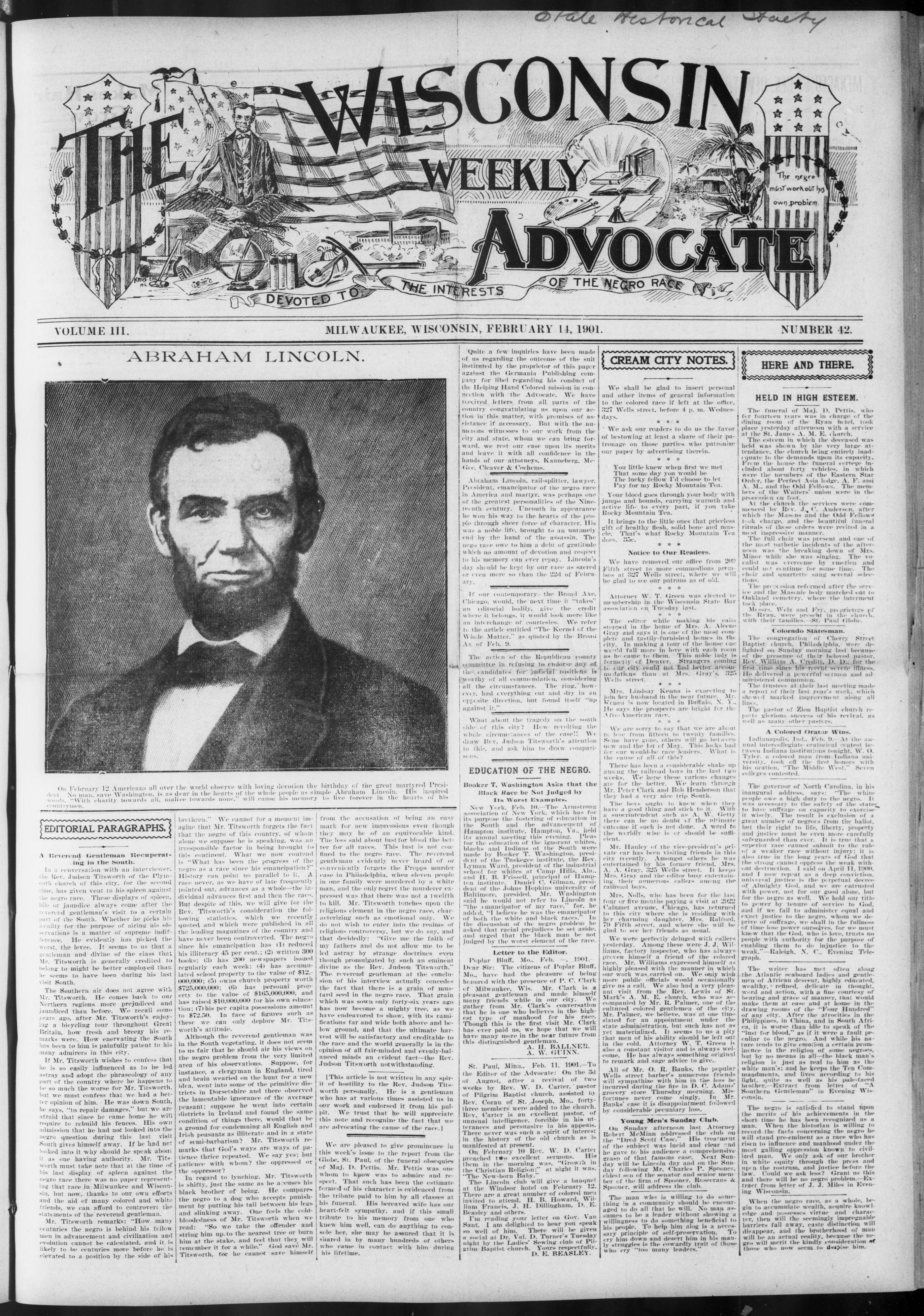
ABRAHAM LINCOLN.
A. B.
On February 12 Americans all over the world observe with loving devotion the birthday of the great martyred President. No man, save Washington, is as dear in the hearts of the whole people as simple Abraham Lincoln. His inspired words, "With charity towards all, malice towards none," will cause his memory to live forever in the hearts of his countrymen.
VOLUME III.
On February 12 Americans all over dent. No man, save Washington, is as woods. "With charity towards all, man countrymen.
EDITORIAL PARAGRAPHS.
A Reverend Gentleman Recuperating in the South.
In a conversation with an interviewer, the Rev. Judson Titsworth of the Plymouth church of this city, for the second time, has given vent to his spleen against the negro race. These displays of spleen, bile or jaundice always come after the reverend gentleman's visit to a certain part of the South. Whether he picks his locality for the purpose of airing his observations is a matter of supreme indifference. He evidently has picked the worst, the levee. It seems to us that a gentleman and divine of the class that Mr. Titsworth is generally credited to belong to might be better employed than he seems to have been during his last visit South.
The Southern air does not agree with Mr. Titsworth. He comes back to our Northern regions more prejudiced and jaundiced than before. We recall some years ago, after Mr. Titsworth's enjoying a bicycling tour throughout Great Britain, how fresh and breezy his remarks were. How enervating the South has been to him is painfully patent to his many admirers in this city.
If Mr. Titsworth wishes to confess that he is so easily influenced as to be led astray and adopt the phraseology of any part of the country where he happens to be so much the worse for Mr. Titsworth, but we must confess that we had a better opinion of him. He was down South, he says, "to repair damages," but we are afraid that since he came home he will require to rebuild his fences. His own admission that he had not looked into the negro question during this last visit South gives himself away. If he had not looked into it why should he speak about it as one having authority. Mr. Titsworth must take note that at the time of his last display of spleen against the negro race there was no paper representing that race in Milwaukee and Wisconsin, but now, thanks to our own efforts and the aid of many colored and white friends, we can afford to controvert the statements of the reverend gentleman.
Mr. Titsworth remarks: "How many centuries the negro is behind his fellow men in advancement and civilization and evolution cannot be calculated, and it is likely to be centuries more before he is elevated to a position by the side of his
brethren." We cannot for a moment imagine that Mr. Titsworth forgets the fact that the negro of this country, of whom alone we suppose he is speaking, was an irresponsible factor in being brought to this continent. What we now contend is "What has been the progress of the negro as a race since his emancipation?" History can point no parallel to it. A race never, as we have of late frequently pointed out, advances as a whole—the individual advances first and then the race. But despite of this, we will give for the Rev. Titsworth's consideration the following statistics, which we recently quoted and which were published in all the leading magazines of the country and have never been controverted. The negro since his emancipation has (1) reduced his illiteracy 45 per cent.; (2) written 300 books; (3) has 200 newspapers issued regularly each week; (4) has accumulated school property to the value of $12,000,000; (5) owns church property worth $725,000,000; (6) has personal property to the value of $165,000,000, and has raised $10,000,000 for his own education; (7) his per capita possessions amount to $72.50. In face of figures such as these we can only deplore Mr. Titsworth's attitude.
Although the reverend gentleman was in the South vegetating, it does not seem to us fair that he should air his views on the negro problem from the very limited area of his observations. Suppose, for instance, a clergyman in England, tired and brain wearied on the hunt for a new idea, went into some of the primitive districts in Dorsetshire and there observed the lamentable ignorance of the average peasant; suppose he went into certain districts in Ireland and found the same condition of things there, would that be a ground for condemning all English and Irish peasants as illiterate and in a state of semi-barbarism? Mr. Titsworth remarks that God's ways are ways of patience thrice repeated. We say yes; but patience with whom? the oppressed or the oppressor?
In regard to lynching, Mr. Titsworth is shifty, just the same as he accuses his black brother of being. He compares the negro to a dog who accepts punishment by putting his tail between his legs and slinking away. One feels the cold-bloodedness of Mr. Titsworth when we read: "So we take the offender and string him up to the nearest tree or burn him at the stake, and feel that they will remember it for a while." God save Mr. Titsworth, for he cannot save himself
from the accusation of being an easy mark for new impressions even though they may be of an equivocable kind. The less said about lust for blood the better for all races. This lust is not confined to the negro race. The reverend gentleman evidently never heard of or conveniently forgets the Propps murder case in Philadelphia, when eleven people in one family were murdered by a white man, and the only regret the murderer expressed was that there was not a twelfth to kill. Mr. Titsworth touches upon the religious element in the negro race, characterizing such as emotional only. We do not wish to enter into the realms of religious controversy, but we do say, and that decidedly: "Give me the faith of my fathers and do not allow me to be led astray by strange doctrines even though promulgated by such an eminent divine as the Rev. Judson Titsworth." The reverend gentleman at the conclusion of his interview actually concedes the fact that there is a grain of mustard seed in the negro race. That grain which was sown only forty-six years ago has now become a mighty tree, as we have endeavored to show, with its ramifications far and wide both above and below ground, and that the ultimate harvest will be satisfactory and creditable to the race and the world generally is in the opinion of all fair-minded and evenly-balanced minds an evident fact—the Rev. Judson Titsworth notwithstanding.
[This article is not written in any spirit of hostility to the Rev. Judson Titsworth personally. He is a gentleman who has at various times assisted us in our work and endorsed it from his pulpit. We trust that he will appreciate this note and recognize the fact that we are advocating the cause of the race.]
We are pleased to give prominence in this week's issue to the report from the Globe, St. Paul, of the funeral obsequies of Maj. D. Pettis. Mr. Pettis was one whom to know was to admire and respect. That such has been the estimate formed of his character is evidenced from the tribute paid to him by all classes at his funeral. His bereaved wife has our heart-felt sympathy, and if this small tribute to his memory from one who knew him well, can do anything to console her, she may be assured that it is shared in by many hundreds of others who came in contact with him during his lifetime.
Quite a few inquiries have been made of us regarding the outcome of the suit instituted by the proprietor of this paper against the Germania Publishing company for libel regarding his conduct of the Helping Hand Colored mission in connection with the Advocate. We have received letters from all parts of the country congratulating us upon our action in this matter, with promises of assistance if necessary. But with the numerous witnesses to our work from the city and state, whom we can bring forward, we rest our case upon its merits and leave it with all confidence in the hands of our attorneys, Kanneberg, McGee, Cleaver & Cochems.
Abraham Lincoln, rail-splitter, lawyer. President, emancipator of the negro race in America and martyr, was perhaps one of the greatest personalities of the Nineteenth century. Uncouth in appearance he won his way to the hearts of the people through sheer force of character. His was a noble life, brought to an untimely end by the hand of the assassin. The nego race owe to him a debt of gratitude which no amount of devotion and respect to his memory can ever repay. Lincoln's day should be kept by our race as sacred or even more so than the 22d of February.
If our contemporary, the Broad Axe, Chicago, would, the next time it "takes" an editorial bodily, give the credit where it belongs, it would look more like an interchange of courtesies. We refer to the article entitled "The Kernel of the Whole Matter," as quoted by the Broad Ax of Feb. 9.
The action of the Republican county committee in refusing to endorse any of the candidates for judicial positions is worthy of all commendation, considering all the circumstances. The ring, however, had everything cut and dry in an opposite direction, but found itself "up against it."
What about the tragedy on the south side of this city? How revolting the whole circumstances of the case!! We draw Rev. Judson Titsworth's attention to this, and ask him to draw comparisons.
EDUCATION OF THE NEGRO.
Booker T. Washington Asks that the
New York, Feb. 10.—The Armstrong association of New York, which has for its purpose the fostering of education in the South and the advancement of Hampton institute, Hampton, Va., held its annual meeting this evening. Pleas for the education of the ignorant whites, blacks and Indians of the South were made by Booker T. Washington, president of the Tuskegee institute, the Rev. Lyman Ward, president of the industrial school for whites at Camp Hills, Ala., and H. B. Frissell, principal of Hampton institute. Daniel C. Gilman, president of the Johns Hopkins university of Baltimore, presided. Mr. Washington said he would not refer to Lincoln as "the emancipator of my race," for he added, "I believe he was the emancipator of both the white and black races." In the discussion of the negro problem he asked that racial prejudices be set aside, and urged that the black man be not judged by the worst element of the race.
Letter to the Editor.
Poplar Bluff, Mo., Feb. -, 1901. Dear Sir: The citizens of Poplar Bluff, Mo., have had the pleasure of being honored with the presence of P. C. Clark of Milwaukee, Wis. Mr. Clark is a pleasant gentleman and made himself many friends while in our city. We gather from Mr. Clark's conversation that he is one who believes in the highest type of manhood for his race. Though this is the first visit Mr. Clark has ever paid us, we hope that we will have many more in the near future from this distinguished gentleman.
St. Paul, Minn., Feb. 11, 1901.—To the Editor of the Advocate: On the 3d of August, after a revival of two weeks by Rev. W. D. Carter, pastor of Pilgrim Baptist church, assisted by Rev. Coran of St. Joseph, Mo., forty-three members were added to the church. Rev. Carter is an excellent pastor, of unusual intelligence, forcible in his utterances and persuasive in his appeals. There never was such a spirit of interest in the history of the old church as is manifested at present.
On February 10 Rev. W. D. Carter preached two excellent sermons. His them in the morning was, "Growth in the Christian Religion;" at night it was, "The Newborn Baby."
The Lincoln club will give a banquet at the Windsor hotel on February 12. There are a great number of colored men invited to attend. H. B. Howard, William Francis, J. H. Dillingham, D. E. Beasley and others.
I'm reading your letter on Gov. Van Sant. I am delighted to hear you speak so well of him. There will be given a social at Dr. Val. D. Turner's Tuesday night by the Ladies' Sewing club of Pilgrim Baptist church. Yours respectfully, D. E. BEASLEY.
CREAM CITY NOTES.
We shall be glad to insert personal and other items of general information to the colored race if left at the office, 327 Wells street, before 4 p. m. Wednesdays.
We ask our readers to do us the favor of bestowing at least a share of their patronage on those parties who patronize our paper by advertising therein.
* * *
You little knew when first we met That some day you would be The lucky fellow I'd choose to let Pay for my Rocky Mountain Tea. Your blood goes through your body with jumps and bounds, carrying warmth and active life to every part, if you take Rocky Mountain Tea. It brings to the little ones that priceless gift of healthy flesh, solid bone and muscle. That's what Rocky Mountain Tea does. 35c.
Notice to Our Readers.
We have removed our office from 209 Fifth street to more commodious premises at 327 Wells street, where we will be glad to see our patrons as of old.
* * * *
Attorney W. T. Green was elected to membership in the Wisconsin State Bar association on Tuesday last.
* * * *
The editor while making his calls stopped in the home of Mrs. A. Alene Gray and says it is one of the most complete and tastily-furnished homes in the city. In making a tour of the house one would fall more in love with each room as he came to them. This noble lady is formerly of Denver. Strangers coming to our city could not find better accommodations than at Mrs. Gray's, 325 Wells street.
Mrs. Lindsay Kenna is expecting to join her husband in the near future. Mr. Kenna is now located in Buffalo, N. Y.. He says the prospects are bright for the Afro-American race.
* * *
We are sorry to say that we are about to lose from fifteen to twenty families. Some have gone, others will go between now and the 1st of May. This looks bad for our would-be race leaders. What is the cause of all of this?
There has been a considerable shake up among the railroad boys in the last two weeks. We hope these various changes are for the better. We learn through Mr. Peter Clark and Bob Henderson that they had a very nice trip South.
The boys ought to knew when they have a good thing and stick to it. With a superintendent such as A. W. Getty there can be no doubt of the ultimate outcome if such is not done. A word to the worldly wise is or should be sufficient.
Mr. Hauley of the vice-president's private car has been visiting friends in this city recently. Amongst others he was entertained by his former friend, Mrs. A. A. Gray, 325 Wells street. It keeps Mrs. Gray and the editor busy entertaining their numerous callers among the railroad boys.
Mrs. Nolls, who has been for the last four or five months paying a visit at 2022 Calumet avenue, Chicago, has returned to this city where she is residing with her charming daughter. Mrs. Ralford, 79 Fifth street, and where she will be glad to see her friends as usual.
We were perfectly deluged with callers yesterday. Among these were J. J. Williams, factory inspector, who has always proven himself a friend of the colored race. Mr. Williams expressed himself as highly pleased with the manner in which our work was carried on. We only wish more public officials would occasionally give us a call. We also had a very pleasant visit from the Rev. Lewis of St. Mark's A. M. E. church, who was accompanied by Mr. R. Palmer, one of the cultured colored gentlemen of the city. Mr. Palmer, we believe, was at one time slated for an appointment under the state administration, but such has not as yet materialized. It seems to us a pity that men of his ability should be left out in the cold. Attorney W. T. Green is also a constant visitor and is always welcome. He has always something original to remark and sage advice to give.
All of Mr. O. R. Banks, the popular Wells street barber's numerous friends will sympathize with him in the loss he incurred during the fire in D. C. Adams' grocery store Thursday morning. Misfortunes never come singly. In Mr. Banks' case it is disappointment followed by considerable pecuniary loss.
Young Men's Sunday Club.
On Sunday afternoon last Attorney Robert McMinn addressed the club on the "Dred Scott Case." His treatment of the subject was lucid and clear and he gave to his audience a comprehensive grasped of that famous case. Next Sunday will be Lincoln day and on the Sunday following Mr. Charles P. Spooner, eldest son of the senator and senior member of the firm of Spooner, Rosecrans & Spooner, will address the club.
The man who is willing to do something in a community should be encouraged to do all that he will. No man assumes to be a leader without showing a willingness to do something beneficial to his people. To help him alog is a necessary principle of self-preservation. To cry him down and desert him in his many struggles is the cowardly trait of those who cry "too many leaders."
HERE AND THERE.
HELD IN HIGH ESTEEM.
The funeral of Maj. D. Pettis, who for fourteen years was in charge of the dining room of the Ryan hotel, took place yesterday afternoon with a service at the St. James A. M. E. church.
The esteem in which the deceased was held was shown by the very large attendance, the church being entirely inadequate to the demands upon its capacity. From the house the funeral cortege included about forty vehicles, in which were the members of the Eastern Star Order, the Perfect Asia lodge, A. F. and A. M., and the Odd Fellows. The members of the Waiters' union were in the procession on foot.
At the church the services were commenced by Rev. J. C. Anderson, after which the Masons and the Odd Fellows took charge, and the beautiful funeral rituals of these orders were recited in a most impressive manner.
The full choir was present and one of the most pathetic incidents of the afternoon was the breaking down of Mrs. Minor while she was singing. The vocalist was overcome by emotion and could not continue for some time. The choir and quartette sang several selections.
The procession referred after the service and the Masonic body marched out to Oakland cemetery, where the interment took place.
Messrs. Welz and Fry, proprietors of the Ryan, were present in the church, with their families.—St. Paul Globe.
Colorado Statesman.
The congregation of Cherry Street Baptist church, Philadelphia, were delighted on Sunday morning last because of the presence of their beloved pastor, Rev. William A. Creditt, D. D., for the first time since his recent severe illness. He delivered a powerful sermon and administered communion. The trustees at their last meeting made a report of their last year's work, which showed marked improvement along all lines. The pastor of Zion Baptist church reports glorious success of his revival, as well as many other pastors.
A Colored Orator Wins
Indianapolis, Ind., Feb. 9. At the annual intercollegiate oratorical contest between Indiana institutions tonight, W. O. Tyler, a colored man from Indiana university, took off the first honors with his oration, "The Middle West." Seven colleges contested.
The governor of North Carolina, in his inaugural address, says: "The white people owe a high duty to the negro. It was necessary to the safety of the state to base suffrage on capacity to exercise it wisely. The result is exclusion of a great number of negroes from the ballot, but their right to life, liberty, property and justice must be even more carefully safeguarded than ever. It is true that a superior race cannot submit to the rule of a weaker race without injury; it is also true in the long years of God that the strong cannot oppress the weak without destruction. I said on April 11, 1900, and I now repeat as a deep conviction, universal justice is the perpetual decree of Almighty God, and we are entrusted with power, not for our good alone, but for the negro as well. We hold our title to power by tenure of service to God, and if we fail to administer equal and exact justice to the negro, whom we deprive of suffrage, we shall in the fullness of time lose power ourselves, for we must know that the God, who is love, trusts no people with authority for the purpose of enabling them to do injustice to the weak."—Raleigh, N. C., Evening Telegraph.
The writer has met often along the Atlantic seaboard ladies and gentlemen of African descent, highly educated, wealthy, refined, delicate in thought, word and action, with a fine courtesy of bearing and grace of manner, that would make them at ease and at home in the drawing rooms of the "Four Hundred" of any city. After the atrocities in the Philippines, in China, and in South Africa, it is worse than idle to speak of the "lust for blood," as if it were a fault peculiar to the negro. And while his nature tends to give emotion a certain prominence in the religion of some negroes, but by no means in all—the black man's religion is just as real to him as the white man's; and he keeps the Ten Commandments, and lives according to his light, quite as well as his pale-faced brother.—Extract from letter of "A Southern Gentleman" in Evening Wisconsin.
The negro is satisfied to stand upon the merits of his achievements in the short-time he has been recognized as a man. When the historian is willing to record the facts concerning the negro he will stand pre-eminent as a race who has risen to influence and manhood under the most galling oppression known to civilized man. We only ask of our brother in white equity through the press and upon the rostrum, and justice before the law. Could we ask less? Grant us this and there will be no negro problem.—Extract from letter of J. J. Miles in Evening Wisconsin.
When the negro race, as a whole, begin to accumulate wealth, acquire knowledge and possesses virtue and character, then will the seemingly impregnable barriers fall away, caste distinction will disappear, and the brotherhood of man will be an actual reality, because the negro will merit the kindly consideration of those who now seem to despise him.
MENACED BY GEN. DEWET.
MARCHING WESTWARD.
Captures a Train Near Springfontein and Burns the Cars—Demonstration at Rouxville.
Cape Town, Feb. 13.—Gen. Dewet's main commando has struck the railway between Springfontein and the Jagersfontein road, capturing a train, the cars of which he burned. He then resumed his march to the west. Meanwhile a portion of his force made a demonstration at the Rouxville Zastron and Orange River drifts, with the object of engaging the attention of large bodies of British troops.
It is surmised that Gen. Dewet intends to march west through Herbert, crossing the Vaal river at Douglas, and then moving south to Prieska or Keuhadt, where it is thought Kritzinger's and Hertzog's commandos are concentrating. As an alternative, it is suggested that Gen. Dewet may swing round and cross the Orange river into either the Venterstad or Colesburg districts. It is believed that he is well supplied with ammunition and good horses. Twenty-seven Australians, Cape police, and dragoons were captured by Kritzinger's commando eight miles from Ballaspruit on February 6, after a fight in which three British and five Boers were killed. The British were afterwards released. Seven British yeomanry, while skirmishing, were captured by a commando near Vryburg, which was forced to retire.
Piet Dewet has arrived in Cape Town to engage the Afrikanders in the peace movement
Eastern Raiders Hard Pressed.
Pretoria, Feb. 13.—The raiders belonging to the Boer eastern commando are being hard pressed. Col. Henry has captured forty-five prisoners and fifty wagons. The British columns are converging under Gen. French. They are forcing the Boers toward the southeastern corner of the Transvaal, between Natal and Swaziland.
Williston, Cape Colony, Feb. 11.—The Dutch here say the Boers have decided, if Christian Dewet's incursion into Cape Colony is not successful, that they will treat with a view to surrender, being tired of the war.
Lourenco Marquez, Feb. 13.—The fever season here is exceptionally disastrous. Deaths of many prominent British subjects have occurred. The majority belonged to imperial railroad administrative staff, and had to be removed to a hospital ship.
London, Feb. 13.—A special dispatch from Cape Town says A. D. Wolmerans, Boer delegate to the United States and Europe, writes from Paris, strenuously urging the Boers to surrender.
DEMAND NINE HOURS.
Morgan Steel Trust will be Given the Alternative of a Strike Large Plants Affected.
Chicago, Ill., Feb. 13.—Between union labor and the new steel trust, just perfected through the sale of the Carnegie interests of J. Pierpont Morgan's syndicate, a gigantic struggle is threatened over the question of the nine-hour workday to be inaugurated this spring by union machinists throughout the country.
In every plant controlled by the $700,000,000 trust a large number of machinists are employed. These skilled workmen have been organized in the South Chicago steel mills and in the steel and wire plants at Joliet. De Kalb and elsewhere throughout the country, according to an announcement made yesterday at the Chicago offices of the International Association of Machinists. A strike for the nine-hour day among the machinists in the 250 plants in control of the trust would, therefore, involve the most colossal tie-up of a single manufacturing industry ever known in the history of labor strikes.
Indorsement and financial and moral support for the nine-hour movement of the Machinists' union is to be asked by President O'Connell from the meeting of the executive council of the American Federation of Labor at Washington next Monday. That will be practically the opening gun in the fight and it is believed O'Connell's requests will be fully granted.
FORTY MEN KILLED.
Russians Defeated in Engagement at Kao Chiao—Salt Heaps Were Confiscated.
London, Feb. 13.—A special dispatch from Shan Hai Kuan, dated February 11, says the Russians lost forty men killed in an engagement at Kao Chiao and that they refused the assistance of the allies.
New York, Feb. 13.—A dispatch to the Herald from Tien Tsin says the French and Russian consuls raised their respective flags over the salt heaps belonging to the merchants of the Salt guild, a month after the occupation of the city, and have since refused to allow the owners to approach the property. They have, however, offered to sell it back at three-quarters of its market value, which amounts to millions.
At a meeting today the merchants came to the conclusion that such bare-faced robbery of private property was not committed with the approval of Paris and St. Petersburg, and drew up a memorial cable dispatch to the Czar and President Loubet, setting forth their grievance. All the commercial classes in China are awaiting to learn whether the Boxers or the allies are more dangerous to their interests and will act accordingly.
LOCKS UP CHILD WITH BODY.
Man Shuts Young Girl in Room Containing Her Mother's Corpse.
Detroit, Mich., Feb. 13.—Viola Eiling, aged 9 years, was locked in a room with the dead body of her mother for seven hours by her father, John Eiling, who remained away from the house until 8 o'clock the following morning. Then he took the hysterical child to a neighbor's house and has not been seen since. The police are looking for him.
The mother, who had been ill for over a year, died of consumption, and, according to neighbors, she was ill treated by her husband. They lived in a tumble-down house at 41 Catherine street, with evidences of abject poverty everywhere. It is said Mrs. Eiling once had wealth, which her husband squandered. He is an engineer, but has not worked for some time.
Death of Mrs. Thomas C. Platt.
New York, Feb. 13.—Mrs. Thomas C. Platt, the wife of United States Senator Platt, died early today at her apartments in the Fifth Avenue hotel, after a long illness.
Senator Platt, with his three sons and their wives, were at the bedside.
THE KING'S SPEECH.
Expected to Publicly Announce His Disbelief in Roman Catholic Doctrines.
London, Feb. 12.—One of the most interesting events in connection with the opening of Parliament on Thursday will be the formal declaration by the King of his disbelief in the characteristic doctrines of the Roman Catholic church. Any person professing the Popish religion is incapable of inheriting or possessing the crown, and the sovereign is bound to make the required declaration either on the throne in the House of Lords in the presence of both houses at the first meeting of the first Parliament after the accession, or at the coronation, whichever shall happen first. This curious survival of a less tolerant age acquires particular significance on the present occasion, owing to the fact that the Earl Marshal, who will direct the ceremonies at Winchester, is himself one of the most devout Roman Catholics in England.
GIVEN UP AS LOST.
Seven Ships with 230 Men May be at the Bottom of the Pacific Ocean.
Tacoma. Wash., Feb. 12.—Underwriters and shippers have given up all hope of seeing any of the big overdue fleet which has been so anxiously awaited at Portland. Over 230 lives and property valued at $1,200,000, it is feared, have been wiped out of existence within less than sixty days. The ships given up are: Andratta, Bertha, Otto Gildmeister, Cape Wrath, Rathdown, Ardnamchon and Pala. Added to this list was the total loss of the Pyrenees from Tacoma with a cargo of wheat and barley. It is considered almost a certainty that some of the ships have been sent to the bottom, as they left Portland in time to catch the full force of terrific gales.
ONCE MORE HOPEFUL.
Feeling in London that the Boers Are Nearing Their Last Stand.
London, Feb. 12.—A very curious sentiment is prevalent in London relative to the condition of affairs in South Africa. It is one of supreme hopefulness. There has never been any such buoyancy of sentiment since Lord Roberts took Pretoria.
There is absolutely no doubt that news has reached here from German sources snowing that the Boers are pretty well at their last stand. This view is also taken on the Stock exchange.
London, Feb. 12.—A special dispatch from Pretoria says Gen. Dewet crossed the Orange river north of Norvalspont Sunday night, going in the direction of Philipstown. The British are following.
LOSS HALF A MILLION.
Rochester, Pa., Tumbler Works Largest and Finest in the World, Destroved.
Pittsburg, Pa., Feb. 12.—Nearly the entire plant of the Rochester Tumbler works of the National Glass company, the largest and finest in the world, located at Rochester, Pa., was destroyed by fire that started about midnight. The loss will amount to about $500,000 and it is believed to be covered by insurance. An area of 300 by 1500 feet was burned over and the greatest department in the works destroyed.
RICH MAN'S SON A TRAMP.
Heir of Wealthy Broker Suspected of Robbing Fellow Boarders.
St. Joseph, Mich., Feb. 12.—James W. Thompson, a young boy who came here several weeks ago from Chicago, is now a fugitive from justice and the officers hope to land him in a few hours. He left his boarding-house Saturday night, taking many valuables belonging to fellow boarders. He is the only son of James W. Thompson, a millionaire stock broker on Wall street, and his home is in Brooklyn.
Several months ago he ran away from home, having failed to gain permission from his parents to go West, and since then he has covered considerable territory in the country, leading a nomad's life. He landed in St. Joseph broke and immediately set his plans to pick up money. He was well thought of by his fellow boarders and had gained their confidence when he worked his coup.
CANDY FACTORY BURNED.
Detroit Firemen Hampered by the Intense Cold.
Detroit, Mich., Feb. 12.—Fire which originated in Valentine Schroeder's candy factory at 38 Woodward avenue yesterday caused $50,000 damage in this establishment and adjoining property before it was extinguished. The intense cold made the fire apparatus hard to handle, and before the firemen had conquered the blaze, a majority of them were sheathed in ice, which formed wherever any water fell on them. The losses were as follows: Valentine Schroeder, $25,000; Neil Flattery, owner of building, $15,000; Gebhardt Paper company, which occupied adjoining building, $10,000; Hemmetter Cigar company, $1000.
PRISON FOR BANK WRECKER.
J. R. Clements, Formerly of Fillmore, Finally Convicted. St. Paul, Minn., Feb. 12.—Justice Lovely of the Supreme court has filed two decisions in the cases against Joseph R. Clements, convicted of looting the Fillmore Company bank. In one case, known as the "Mrs. Mack indictment," the lower court is sustained, and Clements will go to the penitentiary. The case was fought in the courts of Wisconsin and Minnesota, Clements having fled to the former state.
Turkey Abolishes Duties.
The Turkish press has announced, with a great flourish of trumpets, the issue of an irade abolishing the internal customs duty of 8 per cent. and above. The 2 per cent. extra duty for military purposes will be maintained. The Sultan thereby not only confers a boon on trade, but facilitates the negotiation of new commercial treaties with the Powers.
Stock-Feeders as Merchants.
Decision has been rendered by the Iowa Supreme court to the effect that a stock-feeder who buys stock to feed and sell is not a merchant within the meaning of the code and cannot be assessed for taxation purposes in the same way that a merchant would be assessed. The case came up on an appeal, the lower court having held a contrary opinion. Harvard has 576,000 volumes in its library, which is the largest of any university in the United States. Columbia, which is second in this respect, has 303,720 volumes.
CONGRESS.
Senate.
Thursday, Feb. 7. At the day session the pension appropriation bill, carrying $144,000,000, was passed after a few minutes' consideration. The ship subsidy bill was then taken up, and Messrs. McLaurin and Morgan, both Democrats, made speeches upon it. Mr. McLaurin announced his intention to support the bill, and Mr. Morgan opposed it in vigorous language. At the night session the debate consisted largely of protests by the opposition against night sessions.
Friday, Feb. 8. Ineffectual attempt was made to set a time for final vote on the shipping bill. Naval appropriation bill considered without action.
Saturday, Feb. 9.—Had under consideration the naval appropriation bill. Practically the bill was completed when it was laid aside for the day, all the committee amendments being adopted; but as the measure was about to be placed on its passage Mr. Butler precipitated a discussion of the armor-plate question. In order to enable some others to speak upon the matter the bill was laid aside until Monday. Eulogies upon the late Representative Alfred C. Harmer of Pennsylvania concluded the session.
Monday, Feb. 11.—Passed the naval appropriation bill and bill for an additional judge in the northern district of Illinois. The shipping bill was then taken up, and kept before the Senate during the remainder of the legislative day.
Tuesday, Feb. 12.—Agricultural appropriation bill under consideration during entire session, but bill was little more than half completed. Debate dealt almost entirely with administrative details of department of agriculture, many commendations of department's work being made by senators on both sides of chamber.
Wednesday, Feb. 13.—During the greater part of the day engaged in executive session and in the counting of the electoral vote for the President and Vice-President of the United States. Late in the afternoon consideration of the agricultural appropriation bill was resumed, but little progress was made. At a night session the District of Columbia code bill was read.
House.
Thursday, Feb. 7.-Passed the postoffice appropriation bill.
Friday, Feb. 8.-Passed 184 private pension bills.
Saturday, Feb. 9.—Consideration of the diplomatic and consular appropriation bill developed something of a sensation when Representative Brown of Ohio made a speech strongly condemning a colonial policy and urging that Congress should at once give assurance to the Filipinos that the purpose of the United States was to give them independence. Representatives Miers (Ind.) and Dibsmore (Ark.) also spoke on the Philippines. The consideration of the diplomatic and consular bill went over at 2 o'clock, and the rest of the day was given to eulogies to the late Representatives Daly of New Jersey and Wise of Virginia.
Monday, Feb. 11.—Disagreed with the Senate substitute for the war tax reduction bill and requested a conference by a vote of 233 to 38. Considered diplomatic and consular appropriation bill.
Tuesday, Feb. 12.—Passed army appropriation bill and began consideration of sundry civil bill, the last of the big money measures.
Wednesday, Feb. 13. Devoted the day, excepting an hour and a half consumed in counting the electoral vote and promulgating the result of the presidential election, to the sundry civil appropriation bill. General debate upon this measure was completed, but little actual progress was made with the bill.
ONE DOLLAR PER PILL.
Miss Netta Hixon Says the Remedy that Cured Her Would Be Cheap at This Price. Cincinnati. O., Feb. 11, 1901.—(Special.)—Miss Netta Hixon is sergeant-at-arms of Camp No. 1, Patriotic Order of America. Her home is at No. 1717 Hughes street, this city. She is a very popular and influential lady. For three years she has been ill. Now she is well. She says: "I cannot praise Dodd's Kidney Pills too highly for what they have done for me. I was troubled for three years with weakness, and often had dizzy spells, so that I dared not go out alone. My head would ache continually for four or five days at a time, until life became simply a burden.
"All the medicine I took did me no good, until my physician advised me to try Dodd's Kidney Pills. I secured a box, and soon found that my headache was leaving me. I felt encouraged and kept on taking them and getting stronger. The pains gradually diminished, until I had used four boxes, and all trace of pain had gone. I am to-day a strong and well woman, thanks to Dodd's Kidney Pills. If the price was one dollar per pill, instead of 50c a box, they would be cheap compared with other so-called medicines placed before a suffering public." This is but a sample of the letters received every day by the hundred. They all tell the same story of sickness and soreness, changed into health and vigor by the use of Dodd's Kidney Pills. They never fail. 50c a box, six boxes for $2.50. Buy them from your local druggist if you can. If he can't supply you, send to the Dodds Medicine Co., Buffalo, N. Y.
"Matches Mary" in Mourning.
The first British subject in this country to carry out the command with regard to court mourning was "Matches Mary," who appears in her Broadway bailiwick every night since the Queen's death wearing a huge crepe rosette. Mary's head, always wrapped in an inevitable black scarf, has been in mourning for so many years that, in order to make her official badge more conspicuous, she was obliged to pin it low down on her faded brown shawl. "Matches Mary" is a familiar figure uptown. Although she has been in this country forty years, and, according to popular report, holds large landed interests in the west side tenement district, she still knows Mr. Burke of peerage fame far better than Richard Croker. During the last few evenings she has fairly oozed anecdotes of the entire royal family. Last night "Matches Mary" made the following official announcement: "On the day they bury her I'm goin' to stye at 'ome, and pull de blinds down and even if the whole city is in habsolute darkness, you won't catch me sellin' a bloomin' match."
Chinese War Disturbs Trade
The consequences of the disturbances in China are being seriously felt in the silk and tea trade. The Chinese production of silk in 1900 is estimated at 4,500,000 kilograms (9,920,700 pounds). While this is by no means a bad result in itself, yet the uncertain conditions of business make it appear rather risky to import Chinese goods. This accounts for the great demand at Lyons this year for Syrian silk goods. Unfortunately, the present silk crop in Turkey is not very good, so that a rise of prices is probable. The tea trade is in a similar position. The large houses that import are well provided, but there is a scarcity of freight steamers to load the cargoes. Insurance companies do not like to run risks and refuse to insure Chinese goods, while banks have ceased to advance money on this kind of merchandise.—Consul Hughes.
-At numerous mines in Siberia 2000 men and 500 horses are used on a single property to produce gold not exceeding $2,000,000 per annum.
THE LEGISLATURE.
Senate.
The Senate had nineteen bills on its calendar on the 7th, and a number of new measures were introduced. The bill increasing the salaries of the justices of the Supreme court from $5000 to $7000 and of circuit judges from $3800 to $5000 which came from the judiciary committee with a favorable majority report, went to engrossment and third reading. Senator Jones introduced a joint resolution for the appointment of a joint committee, three from the Senate and five from the Assembly, to report a bill creating a budget. It went over. A number of bills were advanced on the calendar and new bills were introduced as follows: Granting power to towns, villages and cities to extend the time for collection of taxes until the first Monday in May, and of the delinquent tax sale to the third Tuesday in June; repealing the provision of law which exempts certain property of street railway and electric light plants from taxation; amending the statutes relative to witnesses for indigent persons accused of crime; correcting technical errors in the inheritance tax law; requiring builders to provide safe scaffolding, hoists, stays, ladders or other mechanical devices used in the construction of a building. A memorial to Congress, from the committee on assessment and collection of taxes, was adopted, asking the repeal of the war revenue tax on legacies, on the ground that it is properly a state tax.
Gov. La Follette sent to the Senate on the 5th the appointment of Evan D. Roberts of Janesville as state veterinarian for the residue of the term ending June 1, 1901. The appointment was confirmed non-moniously. Senator Miller introduced a bill legalizing the acts of H. P. Clute, appointed during legislative recess as state veterinarian, the object of the bill being to protect him from possible suits for damages. It was referred to the state affairs committee. Senator "Long" Jones joint resolution providing for a joint committee to prepare and report a bill creating a state budget, called out a discussion on state finances. Senator Whitehead's amendment was adopted and the resolution then went over until the 20th. A joint resolution was offered by Senator Stout for a constitutional amendment changing the time of election of state superintendent of education from the fall to the spring election. A similar resolution was passed two years ago, and if passed now goes to the people. Another constitutional amendment is proposed in a resolution by Senator Roehr to give the Legislature power to pass a banking law. This was also passed two years ago. Bills were passed as follows: Relating to deposition to perpetuate testimony; abolishing the office of weed commissioner in Milwaukee; adjudging persons under guardianship competent; authorizing appointees of religious conferences or bishops to perform the marriage ceremony; relative to commissioners to review equalization of county boards; relating to removal of fences. Bills were concurred in as follows: Requiring the clerk of Burnett county to keep a record of tax sales; fixing the salary of the clerk of the Ashland municipal court; granting to the United States jurisdiction over certain lands in Douglas county. The Lenroot bill, 21 A., providing for the appointment of three commissioners to secure uniformity in vessel taxation, was advanced to third reading.
The Senate was in a humorous mood on the night of the 11th and had a short debate over the rereference of two of Senator McGillivray's bills which the judiciary committee had reported for indefinite postponement. The bills were Nos. 151 S. and 152 S., relating to the trial of persons before the justices of peace and providing that witnesses should be provided for persons charged with any offense. The fraternity bill was introduced by request of Senator Miller. It provides that the Greek letter fraternities of the university may be given land on the university campus on which to put up their chapter houses in which the members live. Only one bill was passed by the Senate. It was Mr. Lenroot's bill. No. 21 A, providing for the appointment of a commission of three to devise a uniform system of vessel taxation with Minnesota.
The Senate adjourned on the 12th at the close of the work on the calendar, in honor of Abraham Lincoln's birthday. Senator Hatton secured the adjournment by introducing resolution. The Senate passed the following bills: Providing compensation for the chapaiins of Senate and Assembly; relating to the powers of county boards; relating to service of notice to quit; making recitals in deeds evidence in certain cases; providing for change of names; relating to the salary of the sheriff of Walworth county; authorizing district school boards to borrow money; providing a clerk for the district attorney of Milwaukee county; relating to the municipal court for Rock county.
A move to increase the salaries of members of the Legislature from $500 to $1000 a year was started in the Senate on the 13th through a joint resolution by Senator O'Neill, providing for a constitutional amendment providing for this increase. A joint resolution by Senator Harris was adopted by rising vote paying a high tribute to the late ex-Senator T. D. Weeks, former president pro tem, of the Senate. The Senate was in session only fifteen minutes, the business being confined to introduction of bills and committee reports. The committee on roads and bridges reported the bicycle sidepath bill favorably, with amendments. Bills were introduced as follows: Appropriating $5000 to Robert S. Houston in payment for cattle killed by the state veterinarian; amending the statutes relative to costs; amending the statutes relative to powers of town meetings; providing for a tax on dogs in towns and villages, not to exceed $2 for males or $3 for females; amending the statutes relative to collection of taxes on timber lands; providing that receipts of towns from sale of swamp lands shall go into the general funds.
Assembly.
The most interesting bill introduced in the Assembly on the 7th was one by Mr. Dodge extending the so-called local option laws to wards as well as cities, towns and villages. Under the provisions of the bill the people of any ward can vote not to have license. Three bills intended to place checks on issues of stock by railroad corporations and to prevent "watering" were introduced by Assemblyman A. R. Hall. The tax commission sent in a bill through the committee on assessment and collection of taxes for a new inheritance tax. It provides a tax of 5 per cent, when the estate goes to someone other than a member of the deceased person's immediate family. The Senate memorial resolution on the death of Gen. Griffin was received by the Assembly, and after being read in full by the chief clerk, was unanimously concurred in by a rising vote. Senator Roehr's bill giving the registrar in probate in Milwaukee county the right to sign formal orders and increasing the salaries of two clerks in the office, was laid over. The following bills were introduced: Providing for the licensing of dogs; relating to qualifications of elective officers; to compel the use of a device to keep railroad trains in line after derailment; to prevent contracts between employers and parents of minors; amending the laws of 1899 relating to damages caused by defective highways; relating to fees for sheriffs outside of the state; relating to artesian wells and water supply; relating to the county court of La Crosse county; another prohibiting the killing of deer in certain counties
In the Assembly on the 8th Mr. Frost introduced a bill to tax mortgages, copied after the Massachusetts law. The measure is designed with a view to locating much property of this class which has hitherto been in hiding and has escaped taxation, as one of its provisions is to tax only that portion of real estate which is not covered by a mortgage, and to tax the mortgage just as other property. A bill by Mr. Henry forbids the granting of license for the manufacture or sale of beer or liquor within one mile of the state capitol or the state university, and within 500 feet of any church or schoolhouse in the state, under the penalty of a heavy fine. Another bill, introduced by Mr. Stevens, by request, appropriates $30,000 to establish a state home for inebriates where they may be given Keelev treatment. It is to be under the direction of the state board of control, and the bill specifies when treatment is to be given free and when counties are to pay for it. No. 19 A., relating to fees for return of notices of birth was ordered engrossed. Mr. Duerwaechter's bill, No. 30 A., providing expenses of interment of deceased patients in county asylums, caused another debate, which resulted in the bill going to the committee on judiciary. Among the new bills introduced were the following: To constitute and organize the Eighteenth judicial circuit; amending the laws relating to evidence; for the taxation of mortgages; for the organization of the Onelda reservation into towns; another to provide election districts on the reservation; providing for the collection of butter and cheese statistics; another amending the laws relating to the municipal court of
Ripon; another to provide for the annual report of the dairy and food commissioner; to amend the laws relating to the report of the insurance commission; relating to the terms of supervisors; amending the laws relating to mutual fire insurance companies; relating to vagrants, and declaring who are such; another amending a different section on the same subject; regulating the incorporation of fire insurance companies.
In the Assembly on the evening of the 11th. A. R. Hall introduced a joint resolution urging Congress to pass United States Senate bill No. 1439, known as the Cullom bill, giving the interstate commerce commission more power. Mr. Hall asked that the resolution be read, and after this had been done it was referred to the committee on railroads. The expected bill for the introduction of a course in agriculture and domestic science in the rural schools of the state was sent in by Senator Hatton. It creates State Superintendent Harvey a special commissioner to prepare such a course of study and outline a plan for the training of the teachers in that line of educational work.
Assemblyman Spratt on the 12th got after the corrupt practices act and also the office of state oil inspector. He introduced bills providing for the repeal of both and the measures were referred to the judiciary committee. Mr. Spratt also had a bill that provides for the assessment and taxing of notes secured by mortgages on real estate. Whenever the note is for 25 per cent. of the value of the property, it is proposed to tax it the same as a mortgage and to deduct the amount of the tax from the real estate taxes. The following bills were passed: Relating to assignment of indebtedness for wages; relating to publication of railroad maps; relating to drawing of jurors; relating to a memorial to Congress on hazing.
In the Assembly on the 13th Franklin Johnson introduced a bill for the establishment of the initiative and referendum. Mr. Johnson's bill provides that when 5 per cent. of the voters petition for it any question must be submitted to the people for approval, and that when political conventions make the same demand the questions must be so submitted. Mr. Spratt introduced another bill providing for the taxation of mortgages where the money is loaned instead of at the place where the lender resides. A bill by Mr. Owen permits cities of the third and fourth classes to increase their taxes for school purposes from 1 mill to 5 mills on the dollar. He claims that under the present law cities must put their valuation high in order to get sufficient funds for school purposes. Mr. Collins introduced a bill authorizing the state to loan Portage county $80,000, which amount is wanted by that county for the purpose of refunding its indebtedness. There were but two bills on the Assembly calendar this morning, both referring to Milwaukee county. The first was Senator Roehr's bill relieving Judge Wallber of a part of his duties and increasing the powers of the registrar in probate. The second was Mr. Hartung's bill, relating to appointments of assistants by county clerks. On motion of Mr. Soltwedel, the former was sent back to the committee on judiciary, and the second was ordered to engrossment and third reading. The Senate memorial on the death of T. D. Weeks of Whitewater was concurred in by a rising vote.
While crossing the street car tracks Edward Walsh, a teamster, was struck by a grip car. He will recover.
William H. Musham, first assistant fire marshal, has been confined to his bed with a severe attack of muscular rheumatism.
Two men dropped dead standing on the street waiting for cars. The victims were Ernest M. Stage, a letter carrier. Both deaths are supposed to have been due to heart disease.
Safe blowers secured negotiable paper worth $8000 and $150 in cash in the office of the Chicago and Welston Coal company. A secret compartment containing $300 was overlooked. The safe was wrecked.
—Little Brunette Sullivan's curiosity led her to swallow two capsules which she found in a bureau drawer at her home. The wax tubes contained strychnine and belladonna, and resulted in the girl's death soon after. The child was $1\frac{1}{2}$ years old.
—Miss Mary Mockridge, night cashier in the Madison cafe, fought with three robbers, who entered the restaurant, and saved her employer's money. A shot was fired at Miss Mockridge, but the plucky girl put the robbers to rout with an old army revolver.
Four persons were hurt in a runaway accident in Garfield boulevard. The injured: Miss Elsie Moran, bruised about the head and shoulders; Miss Bertha Judson, arm bruised; Miss Gertrude Browning, arms and face bruised; Frank Connors, legs and arms bruised. The horses became frightened and the sleigh upset and the injured ones were thrown out.
J. P. Keefe, vice-president of the Pressmen's union, was assaulted by two men and robbed of $22 and his gold watch and chain. During the struggle he was beaten over the head and choked and then thrown into a snowbank, where he lay until helped to his feet by a passerby.
A burglar gained entrance to the jewelry store of Joseph Steffeck, and while making his escape was fired upon by the proprietor. Steffeck says he heard the man cry with pain. Nothing was secured by the burglar.
A quarrel in a saloon led to a fight between Frank Harrington and William Bogle. Harrington was severely stabbed in the head. Harrington is 26 years old. His condition is not serious.
John Gill, a hostler employed at the Pennsylvania railroad roundhouse, was caught between two car bumpers yesterday and fatally crushed. He was 33 years old and had a family.
—Otto William Meysenburg, a factor in the industrial growth of Chicago, died on his ranch and fruit farm at Alma, Cal., where he had been staying for the last two months. His death was due to an attack of typhoid fever. —W. H. Harris, the circus owner, who died at his home late Sunday night, was one of the most picturesque figures in the early mercantile life of Chicago. He was born in Cooksville, Canada, in 1841, but since his eighteenth year had made Chicago his home.
A third fall within a few months resulted in the death of August Krahnke. In August an accident resulted in temporary injuries. In October, while pruning a tree, he fell to the ground and suffered a concussion of the brain. Sunday he fell down a basement stairs at his home and broke his neck. Krahnke was 50 years old.
As the result of a quarrel over the right to pick rags from a dump Martin Byzke, 70 years old, was injured, and died at his home, and August Rennehak is locked up charged with murder. Rennehak is said to have struck Byzke over the head with an iron hook.
John Unruh, a driver for the American Express company, was arrested on the charge of stealing packages intrusted to him for delivery. In his room were found goods valued at more than $1000. Unruh confessed that he had been stealing express packages since last July.
An ingenious and complicated system of stealing, which in two years supplied its inventors with a $13,000 bank account, was revealed in the arrest of John F. Kerr and Alfred L. Foley, one the cashier and the other the assistant manager of the manufacturing department of the Fleming H. Revell publishing company. The two men have confessed to operating a fictitious printing firm and to receiving payment from the Revell company for imaginary accounts, the money being secured by an elaborate process of approving vouchers and forging checks.
Makes Hair Grow
Perhaps your mother had thin hair, but that is no reason why you must go through life with half-starved hair. If you want long, thick hair, feed it. Feed it with Ayer's Hair Vigor, the only genuine hair food you can buy. Your hair will grow thick and long, and will be soft and glossy.
Ayer's Hair Vigor always restores color to gray hair; it keeps the scalp clean and healthy, and stops falling of the hair.
One dollar a bottle.
If your druggist cannot supply you, send us $1.00 and we will express a bottle to you. all charges prepaid. Be sure and give us your nearest express office. J. C. AYER Co., Lowell, Mass. Send for our beautiful illustrated book on The Hair. Free.
Venezuelans Proud of Their Capital.
Venezuelians Proud of Their Capital.
Caracas, the capital of Venezuela, is the pride of the people. There the first steps toward South American independence were taken, it was the birthplace of the liberator Simon Bolivar, and with its forty bridges, ten public squares, broad streets, railways and modern buildings it is as interesting as it was when Baron von Humboldt visited the place. Its climate may be judged from the fact that the lowest temperature in twenty years was 48 degrees Fahrenheit and the highest 84 degrees. Other towns of importance are Maracaibo, originally called Nueva Zamora, whence much coffee is exported; Valentia, Porto Cabello, Ciudad, Bolivar, Barcelona, Carupano and Guanaco.—New York Tribune.
What Do the Children Drink?
Don't give them tea or coffee. Have you tried the new food drink called GRAIN-O? It is delicious and nourishing and takes the place of coffee. The more Grain-O you give the children the more health you distribute through their systems. Grain-O is made of pure grains, and when properly prepared tastes like the choice grades of coffee, but costs about $ \frac{1}{4} $ as much. All grocers sell it. 15c and 25c.
While the controversy is proceeding Dr. Anna Hatfield of New York arises to say "kissing is a worse curse than drink. The most terrible kisses are those between women."
Kemp's Balsam will stop the cough at once. Go to your drugist today and get a sample bottle free. Sold in 25 and 50 cent bottles. Go at once; delays are dangerous.
—Silk goods are said to take dyes more readily than any other fabric.
LIBBY'S
Premier Soups
TEN CENTS
Libby's soups are as good as soups can be. Some cooks may know how to make soups as good. None can make them better—none so cheaply. Six plates of delicious soup for 10 cents—and think of the bother saved!
Oxtail, Mullagatawny, Chicken, Mock Turtle, Tomato, Vegetable, and Chicken Gumbo.
At your grocers, in cans ready for instant serving—just heat them.
LIBBY, MONEILL & LIBBY Chicago
Write for our booklet, "How to Make Good Things to Eat."
---
DON'T GET WET! TOWER'S FISH BRAND Oiled Clothing BLACK OR YELLOW WILL KEEP YOU DRY NOTHING ELSE WILL TAKE NO SUSTITUTE. FREE CATALOGUE, SHOWING FULL LINE OF GARMENTS AND HATS. A.J.TOWER CO. BOSTON. MASS.
For 14 Cents
C
EXCURSION RATES
to Western Canada and particulars as to how to secure 160 acres of the best growing land on Continent, can be reserved on app to the Superintendent of Immigration, Ottawa, Canada, or the undersigned. Specially con-
FARMS
WESTERN
CANADA
FREE
EXCURSION RATES
to Western Canada and particulars as to how to secure 160 acres of the best Wheat growing land on the Continent, can be secured on application to the Superintendent of Immigration, Ottawa, Canada, or the undersigned. Specially conducted excursions will leave St. Paul, Minneapolis on the 1st and 3d Tuesday in each month, and specially low rates on all lines of railway are accepted for excursions leaving St. Paul on May 26th and April 4th, for Manitoba, Assiniboia, Saskatchewan and Alberta.
Write to F. Pedley, Supt. Immigration, Ottawa, Canada, or the undersigned, who will mail you atlances, pamphlets, etc., free: T. O. Currie, 1 New Insurance Building, Milwaukee, Wis., Agent for Government of Canada.
---
AGRICULTURAL
```markdown
```
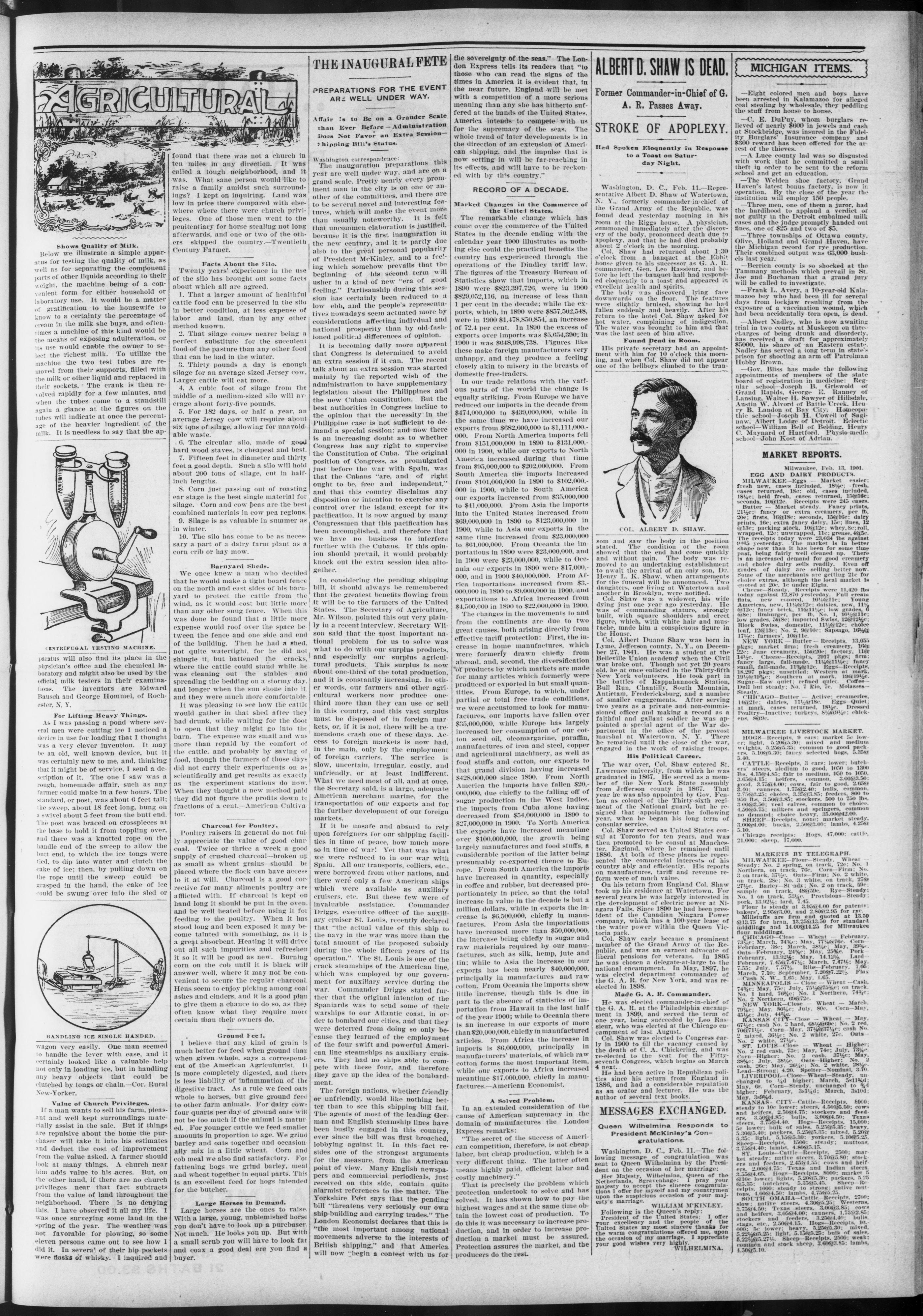
Below we illustrate a simple apparatus for testing the quality of milk, as well as for separating the component parts of other liquids according to their weight, the machine being of a convenient form for either household or laboratory use. It would be a matter of gratification to the housewife to know to a certainty the percentage of cream in the milk she buys, and oftentimes a machine of this kind would be the means of exposing adulteration, or its use would enable the owner to select the richest milk. To utilize the machine the two test tubes are removed from their supports, filled with the milk or other liquid and replaced in their sockets. The crank is then revolved rapidly for a few minutes, and when the tubes come to a standstill again a glance at the figures on the tubes will indicate at once the percentage of the heavier ingredient of the milk. It is needless to say that the ap-
V
CENTRIFUGAL TESTING MACHINE. paratus will also find its place in the physician's office and the chemical laboratory and might also be used by the official milk testers in their examinations. The inventors are Edward Bausch and George Hommel, of Rochester, N. Y.
For Lifting Heavy Things.
As I was passing a pond where several men were cutting ice I noticed a device in use for loading that I thought was a very clever invention. It may be an old, well known device, but it was certainly new to me, and, thinking that it might be of service, I send a description of it. The one I saw was a rough, homemade affair, such as any farmer could make in a few hours. The standard, or post, was about 6 feet tall; the sweep, about 18 feet long, hung on a swivel about 5 feet from the butt end. The post was braced on crosspieces at the base to hold it from toppling over, and there was a knotted rope on the handle end of the sweep to allow the butt end, to which the ice tongs were tied, to dip into water and clutch the cake of ice; then, by pulling down on the rope until the sweep could be grasped in the hand, the cake of ice could be swung over into the sled or
A worker pulling a cart with a crane.
HANDLING ICE SINGLE HANDED. wagon very easily. One man seemed to handle the lever with ease, and it certainly looked like a valuable help not only in loading ice, but in handling any heavy objects that could be clutched by tongs or chain.—Cor. Rural New-Yorker.
Value of Church Privileges.
Value of Church Privileges. If a man wants to sell his farm, pleasant and well kept surroundings materially assist in the sale. But if things are repulsive about the home the purchaser will take it into his estimates and deduct the cost of improvement from the value asked. A farmer should look at many things. A church near him adds value to his acres. But, on the other hand, if there are no church privileges near that fact subtracts from the value of land throughout the neighborhood. There is no denying this. I have observed it all my life. I was once surveying some land in the spring of the year. The weather was not favorable for plowing, so some eleven persons came out to see how I did it. In several of their hip pockets were flasks of whisky. I inquired and
found that there was not a church in ten miles in any direction. It was called a tough neighborhood, and it was. What sane person would like to raise a family amidst such surroundings? I kept on inquiring. Land was low in price there compared with elsewhere where there were church privileges. One of those men went to the penitentiary for horse stealing not long afterwards, and one or two of the others skipped the country.—Twentieth Century Farmer.
Facts About the Silo.
Twenty years' experience in the use of the silo has brought out some facts about which all are agreed.
1. That a larger amount of healthful cattle food can be preserved in the silo in better condition, at less expense of labor and land, than by any other method known.
2. That silage comes nearer being a perfect substitute for the succulent food of the pasture than any other food that can be had in the winter.
3. Thirty pounds a day is enough silage for an average sized Jersey cow. Larger cattle will eat more.
4. A cubic foot of silage from the middle of a medium-sized silo will average about forty-five pounds.
5. For 182 days, or half a year, an average Jersey cow will require about six tons of silage, allowing for unavoidable waste.
6. The circular silo, made of good hard wood staves, is cheapest and best.
7. Fifteen feet in diameter and thirty feet a good depth. Such a silo will hold about 200 tons of silage, cut in halfinch lengths.
8. Corn just passing out of roasting ear stage is the best single material for silage. Corn and cow peas are the best combined materials in cow pea regions.
9. Silage is as valuable in summer as in winter.
10. The silo has come to be as necessary a part of a dairy farm plant as a corn crib or hay mow.
Barnyard Sheds.
We once knew a man who decided that he would make a tight board fence on the north and east sides of his barnyard to protect the cattle from the wind, as it would cost but little more than any other snug fence. When this was done he found that a little more expense would roof over the space between the fence and one side and end of the building. Then he had a shed, not quite watertight, for he did not shingle it, but batttened the cracks, where the cattle could stand while he was cleaning out the stables and spreading the bedding on a stormy day, and longer when the sun shone into it, and they were much more comfortable.
It was pleasing to see how the cattle would gather in that shed after they had drunk, while waiting for the door to open that they might go into the barn. The expense was small and was more than repaid by the comfort of the cattle, and probably by saving of food, though the farmers of those days did not carry their experiments on as scientifically and get results as exactly as the experiment stations do now. When they thought a new method paid they did not figure the profits down to fractions of a cent.—American Cultivator.
Charcoal for Poultry.
Poultry raisers in general do not fully appreciate the value of good charcoal. Twice or thrice a week a good supply of crushed charcoal—broken up as small as wheat grains—should be placed where the flock can have access to it at will. Charcoal is a good corrective for many ailments poultry are afflicted with. If charcoal is kept on hand long it should be put in the oven, and be well heated before using it for feeding to the poultry. When it has stood long and been exposed it may become tainted with something, as it is a great absorbent. Heating it will drive out all such impurities and refreshen it so it will be good as new. Burning corn on the cob until it is black will answer well, where it may not be convenient to secure the regular charcoal. Hens seem to enjoy picking among coal ashes and cinders, and it is a good plan to give them a chance to do so, as they often know what they require more certain than their owners do.
Ground Feel.
I believe that any kind of grain is much better for feed when ground than when given whole, says a correspondent of the American Agriculturist. It is more completely digested, and there is less liability of inflammation of the digestive tract. As a rule we feed oats whole to horses, but give ground feed to other farm animals. For dairy cows four quarts per day of ground oats will not be too much if the animal is matured. For younger cattle we feed smaller amounts in proportion to age. We grind barley and oats together and occasionally mix in a little wheat. Corn and cob meal we also find satisfactory. For fattening hogs we grind barley, meal and wheat together in equal parts. This is an excellent feed for hogs intended for the butcher.
Large Horses in Demand.
Large horses are the ones to raise. With a large, young, unblemished horse you don't have to look up a purchaser. Not much. He looks you up. But with a small scrub you will have to look far and coax a good deal ere you find a buver.
THE INAUGURAL FETE
PREPARATIONS FOR THE EVENT ARE WELL UNDER WAY.
Affair Is to Be on a Grander Scale than Ever Before-Administration Does Not Favor an Extra Session Shipping Bill's Status.
Washington correspondence: The inauguration preparations this year are well under way, and are on a grand scale. Pretty nearly every prominent man in the city is on one or another of the committees, and there are to be several novel and interesting features, which will make the event more than usually noteworthy. It is felt that uncommon elaboration is justified, because it is the first inauguration in the new century, and it is partly due also to the great personal popularity of President McKinley, and to a feeling which somehow prevails that the beginning of his second term will usher in a kind of new "era of good feeling." Partisanship during this session has certainly been reduced to a low ebb, and the people's representatives nowadays seem actuated more by considerations affecting individual and national prosperity than by old-fashioned political differences of opinion.
It is becoming daily more apparent that Congress is determined to avoid an extra session if it can. The recent talk about an extra session was started mainly by the reported wish of the administration to have supplementary legislation about the Phillippines and the new Cuban constitution. But the best authorities in Congress incline to the opinion that the necessity in the Philippine case is not sufficient to demand a special session; and now there is an increasing doubt as to whether Congress has any right to supervise the Constitution of Cuba. The original position of Congress, as promulgated just before the war with Spain, was that the Cubans "are, and of right ought to be, free and independent," and that this country disclaims any disposition or intention to exercise any control over the island except for its pacification. It is now argued by many Congressmen that this pacification has been accomplished, and therefore that we have no business to interfere further with the Cubans. If this opinion should prevail, it would probably knock out the extra session idea altogether.
In considering the pending shipping bill, it should always be remembered that the greatest benefits flowing from it will be to the farmers of the United States. The Secretary of Agriculture, Mr. Wilson, pointed this out very plainly in a recent interview. Secretary Wilson said that the most important national problem for us to solve was what to do with our surplus products, and especially our surplus agricultural products. This surplus is now about one-third of the total production, and it is constantly increasing. In other words, our farmers and other agricultural workers now produce one-third more than they can use or sell in this country, and this vast surplus must be disposed of in foreign markets, or, if it is not, there will be a tremendous crash one of these days. Access to foreign markets is now had, in the main, only by the employment of foreign carriers. The service is slow, uncertain, irregular, costly, and unfriendly, or at least indifferent. What we need most of all, and at once, the Secretary said, is a large, adequate American merchant marine, for the transportation of our exports and for the further development of our foreign markets.
If it be unsafe and absurd to rely upon foreigners for our shipping facilities in time of peace, how much more so in time of war! Yet that was what we were reduced to in our war with Spain. All our transports, colliers, etc., were borrowed from other nations, and there were only a few American ships which were available as auxiliary cruisers, etc. But these few were of invaluable assistance. Commander Driggs, executive officer of the auxiliary cruiser St. Louis, recently declared that "the actual value of this ship to the navy in the war was more than the total amount of the proposed subsidy during the whole fifteen years of its operation." The St. Louis is one of the crack steamships of the American line, which was employed by our government for auxiliary service during the war. Commander Driggs stated further that the original intention of the Spaniards was to send some of their warships to our Atlantic coast, in order to bombard our cities, and that they were deterred from doing so only because they learned of the employment of the four swift and powerful American line steamships as auxiliary cruisers. They had no ships able to compete with these four, and therefore they gave up the idea of the bombardment.
The foreign nations, whether friendly or unfriendly, would like nothing better than to see this shipping bill fail. The agents of most of the leading German and English steamship lines have been busily engaged in this country, ever since the bill was first broached, lobbying against it. In this fact resides one of the strongest arguments for the measure, from the American point of view. Many English newspapers and commercial periodicals, just received on this side, contain quite alarmist references to the matter. The Yorkshire Post says that the pending bill "threatens very seriously our own ship-building and carrying trades." The London Economist declares that this is "the most important among national movements adverse to the interests of British shipping," and that America will now "begin a contest with us for
the sovereignty of the seas." The London Express tells its readers that "to those who can read the signs of the times in America it is evident that, in the near future, England will be met with a competition of a more serious meaning than any she has hitherto suffered at the hands of the United States. America intends to compete with us for the supremacy of the seas. The whole trend of later developments is in the direction of an extension of American shipping, and the impulse that is now setting in will be far-reaching in its effects, and will have to be reckoned with by this country."
RECORD OF A DECADE.
Marked Changes in the Commerce of the United States.
The remarkable change which has come over the commerce of the United States in the decade ending with the calendar year 1900 illustrates as nothing else could the practical benefits the country has experienced through the operations of the Dindley tariff law. The figures of the Treasury Bureau of Statistics show that imports, which in 1890 were $823,397,726, were in 1900 $829,052,116, an increase of less than 1 per cent in the decade; while the exports, which, in 1890 were $857,502,548, were in 1900 $1,478,850,854, an increase of 72.4 per cent. In 1890 the excess of exports over imports was $5,654,390; in 1900 it was $648,998,738. Figures like these make foreign manufacturers very unhappy, and they produce a feeling closely akin to misery in the breasts of domestic free-traders.
In our trade relations with the various parts of the world the change is equally striking. From Europe we have reduced our imports in the decade from $474,000,000 to $439,000,000, while in the same time we have increased our exports from $682,000,000 to $1,111,000,-000. From North America imports fell from $151,000,000 in 1890 to $131,000,-000 in 1900, while our exports to North America increased during that time from $95,000,000 to $202,000,000. From South America the imports increased from $101,000,000 in 1890 to $102,000,-000 in 1900, while to South America our exports increased from $35,000,000 to $41,000,000. From Asia the imports into the United States increased from $69,000,000 in 1890 to $123,000,000 in 1900, while to Asia our exports in the same time increased from $23,000,000 to $61,000,000. From Oceania the importations in 1890 were $23,000,000, and in 1900 were $23,000,000, while to Oceania our exports in 1890 were $17,000,-000, and in 1900 $40,000,000. From Africa importations increased from $3,000,000 in 1890 to $9,000,000 in 1900, and exportations to Africa increased from $4,500,000 in 1890 to $22,000,000 in 1900.
The changes in the movements to and from the continents are due to two great causes, both arising directly from effective tariff protection: First, the increase in home manufactures, which were formerly drawn chiefly from abroad, and, second, the diversification of products by which markets are made for many articles which formerly were produced or exported in but small quantities. From Europe, to which, under partial or total free trade conditions, we were accustomed to look for manufactures, our imports have fallen over $35,000,000, while Europe has largely increased her consumption of our cotton seed oil, oleomargarine, paraffin, manufactures of iron and steel, copper and agricultural machinery, as well as food stuffs and cotton, our exports to that grand division having increased $428,000,000 since 1890. From North America the imports have fallen $20,000,000, due chiefly to the falling off of sugar production in the West Indies, the imports from Cuba alone having decreased from $54,000,000 in 1890 to $27,000,000 in 1900. To North America the exports have increased meantime over $100,000,000, the growth being largely manufactures and food stuffs, a considerable portion of the latter being presumably re-exported thence to Europe. From South America the imports have increased in quantity, especially in coffee and rubber, but decreased proportionately in price, so that the total increase in value in the decade is but a million dollars, while in exports the increase is $6,500,000, chiefly in manufactures. From Asia the importations have increased more than $50,000,000, the increase being chiefly in sugar and raw materials required by our manufactures, such as silk, hemp, jute and tin; while to Asia the increase in our exports has been nearly $40,000,000, principally in manufactures and raw cotton. From Oceania the imports show little increase, though this is due in part to the absence of statistics of importation from Hawaii in the last half of the year 1900; while to Oceania there is an increase in our exports of more than $20,000,000, chiefly in manufactured articles. From Africa the increase in imports is $6,000,000, principally in manufacturers' materials, of which raw cotton forms the most important item, while our exports to Africa increased meantime $17,000,000, chiefly in manufactures. American Economist.
A Solved Problem.
In an extended consideration of the cause of American supremacy in the domain of manufactures the London Express remarks: "The secret of the success of American competition, therefore, is not cheap labor, but cheap production, which is a very different thing. The latter often means highly paid, efficient labor and costly machinery."
That is precisely the problem which protection undertook to solve and has solved. It has shown how to pay the highest wages and at the same time obtain the lowest cost of production. To do this it was necessary to increase production, and in order to increase production a market must be assured. Protection assures the market, and the producers do the rest.
ALBERT D. SHAW IS DEAD.
STROKE OF APOPLEXY.
Had Spoken Eloquently in Response to a Toast on Satur-
Washington, D. C., Feb. 11.—Representative Albert D. Shaw of Watertown, N. Y., formerly commander-in-chief of the Grand Army of the Republic, was found dead yesterday morning in his room at the Riggs house. A physician, summoned immediately after the discovery of the body, pronounced death due to apoplexy, and that he had died probably about 2 o'clock in the morning. Col. Shaw had returned about 1:30 o'clock from a banquet at the Ebbit house given to his successor as G. A. R. commander, Gen. Leo Rassieur, and before he left the banquet hall had responded eloquently to a toast and appeared in excellent health and spirits.
The body was discoverd lying face downwards on the floor. The features were slightly bruised, showing he had fallen suddenly and heavily. After his return to the hotel Col. Shaw asked for hot water, complaining of indigestion. The water was brought to him and that was the last seen of him alive.
Found Dead in Room.
His private secretary had an appointment with him for 10 o'clock this morning, and when Col. Shaw did not appear one of the bellboys climbed to the tran-
J.
som and saw the body in the position stated. The condition of the room showed that the end had come quickly and without pain. The body was removed to an undertaking establishment to await the arrival of an only son, Dr. Henry L. K. Shaw, when arrangements for the funeral will be announced. Two daughters, one living at Watertown and another in Brooklyn, were notified. Col. Shaw was a widower, his wife dying just one year ago yesterday. He was of commanding stature, strongly built, with square shoulders and erect figure, which, with white hair and mustache, made him a conspicuous figure in the House.
Col. Albert Duane Shaw was born in Lyme, Jefferson county, N.Y., on December 27, 1841. He was a student at the Belleville Union academy when the Civil war broke out. Though not yet 20 years old, he at once enlisted in the Thirty-fifth New York volunteers. He took part in the battles of Rappahannock Station, Bull Run, Chantilly, South Mountain, Antietam, Fredericksburg, and a number of smaller engagements. After serving two years as a private and non-commissioned officer and making a record as a faithful and gallant soldier he was appointed a special agent of the War department in the office of the provost marshal at Watertown, N. Y. There he remained until the close of the war, engaged in the work of raising troops.
His Political Career.
The war over, Col. Shaw entered St. Lawrence university, from which he was graduated in 1867. He served as a member of the New York State assembly from Jefferson county in 1867. That year he was also appointed by Gov. Fenton as colonel of the Thirty-sixth regiment of the National guard, but he resigned that appointment the following year, when he began his long term of consular service. Col. Shaw served as United States consul at Toronto for ten years, and was then promoted to be consul at Manchester, England, where he remained until 1886. At both of these places he represented the commercial interests of his country ably and efficiently. His reports on manufactures, tariff and revenue reform were of much value.
On his return from England Col. Shaw took up his residence at Watertown. For several years he was largely interested in the development of electric power at Niagara Falls. Since 1890 he had been president of the Canadian Niagara Power company, which has a 100-year lease of the water power within the Queen Victoria park.
Col. Shaw early became a prominent member of the Grand Army of the Republic, and was an earnest advocate of liberal pensions for veterans. In 1895 he was chosen a delegate-at-large to the national encampment. In May, 1897, he was elected department commander of the G. A. R. for New York, and was re-elected in 1898.
Made G. A. R. Commander.
He was elected commander-in-chief of the G. A. R. at the Philadelphia encampment in 1899, and served the term of one year, being succeeded by Leo Rassieur, who was elected at the Chicago encampment of last August. Col. Shaw was elected to Congress early in 1900 to fill the vacancy caused by the death of C. A. Chickering, and was re-elected to the seat for the Fifty-seventh Congress, which begins on March 4 next. He had been active in Republican politics since his return from England in 1886, and had a considerable reputation as an orator and lecturer. He was the author of several text books.
MESSAGES EXCHANGED.
Washington, D. C., Feb. 11.—The following message of congratulation was sent to Queen Wilhelmina by the President on the occasion of her marriage: Her Majesty, Wilhelmina, Queen of the Netherlands, Sgravenhage: I pray your majesty to accept the sincere congratulations I offer for myself and my countrymen upon the auspicious occasion of your majesty's marriage.
WILLIAM MKINLEY.
Following is the Queen's reply:
Following is the Queen's reply. President of the United States: I offer your excellency and the people of the United States my most sincere thanks for the warm congratulations offered me, upon the occasion of my marriage. I appreciate your good wishes very highly.
WILHELMINA.
—Eight colored men and boys have been arrested in Kalamazoo for alleged coal stealing by wholesale, they peddling the stuff from house to house.
—C. E. DuPuy, whom burglars relieved of nearly $600 in jewels and cash at Stockbridge, was insured in the Fidelity Burglars' Insurance company and $300 reward has been offered for the arrest of the thieves.
—A Luce county lad was so disgusted with work that he committed a small theft in order to be sent to the reform school and get an education.
—The Welden shoe factory. Grand Haven's latest bonus factory, is now in operation. By the close of the year the institution will employ 150 people.
—Three men, one of them a juror, had the hardihood to applaud a verdict of not guilty in the Detroit embalmed milk cases and the judge promptly handed out fines, one of $25 and two of $5.
—Three townships of Ottawa county, Olive, Holland and Grand Haven, have the Michigan record for rye production. Their combined output was 63,000 bushels last year.
—Berrick county is so shocked at the Tammany methods which prevail in St. Joe and Buchanan that a grand jury will be called to investigate.
—Frank L. Avery, a 10-year-old Kalamazoo boy who had been ill for several days from lockjaw resulting from the exposure of a vaccination wound, which had been accidentally torn open, is dead.
Albert Nadley, who is now awaiting trial in two courts at Muskegon on threecharges of being drunk and disorderly, has received a draft for approximately $5000, his share of an Eastern estate. Nadley has served a long term in state's prison for shooting an arm off Patrolman Hobby Brown.
Gov. Bliss has made the following appointments of members of the state board of registration in medicine: Regular school—Joseph B. B. Griswold of Grand Rapids, George E. Ranney of Lansing, Walter H. Sawyer of Hillsdale, Austin W. Alvord of Battle Creek, Henry B. Landon of Bay City, Homeopathic school—Joseph H. Cowell of Saginaw, Albert Lodge of Detroit. Eclectic school—William Bell of Belding, Henry C. Maynard of Hartford. Physio-medic school—John Kost of Adrian.
MARKET REPORTS.
Milwaukee, Feb. 13, 1901.
EGG AND DAIRY PRODUCTS.
EGG AND DAILY PRODUCTS.
MILWAUKEE-Eggs — Market easier; fresh new, cases included, 18½c; fresh, cases returned, 18c; old, cases included, 18¼c; held fresh, cases returned, 15@16c; seconds, 10@12c. Receipts were 245 cases. Butter — Market steady. Fancy prints, 21½c; fancy or extra creamery, per lb, 20c; firsts, 16@18c; seconds, 15@16c; dairy prints, 16c; extra fancy dairy, 15c; lines, 12 @13c; packing stock, 10@12c; whey, Sc, roll, wrapped, 12c; unwrapped, 11c; grease, 4@5c. The receipts today were 23,034 lbs against 9465 yesterday. The market is in better shape now than it has been for some time past, being fairly well cleaned up. There is an increased demand for good creamery and choice dairy sells readily. Even off grades of dairy are selling better now. Some of the merchants are getting 21c for choice extras, although the local market is quoted at 20c, 1c under Elgin.
Cheese—Steady. Receipts were 11,420 lbs today against 12,870 yesterday. Full cream flats, new colored, 10½¹/₁₁c; Young Americas, new, 11½¹/₁₂c; daisies, new, 11½¹/₁₂c; fancy brick, 11½¹/₁₁c; low grades, 6¹/₈c; lilburger, per lb. No. 1, 10½¹/₁₁c; low grades, 5¹/₈c; imported Swiss, 12½¹/₁₂c; Block Swiss, domestic, 11½¹/₁₂c; choice leaf, 12½¹/₁₃c; No. 2, 9¹/₁₀c; Sapsago, 16½¹/₁₇c; farmers', 10¹/₁1c.
NEW YORK — Butter — Receipts, 13,055 pkgs; market firm; fresh creamery, 16²/₂₆c; June creamery, 15²/₂0c; factory, 11¹/₁4½c. Cheese—Receipts, 2917 pkgs; firm; fancy large, fall-made, 11½¹/₁1½c; fancy small, fall-made, 11½¹/₁2c. Eggs—Receipts, 18,297 pkgs; unsettled: Western at mark, 19½¹/₁9½c; Southern at mark, 19½¹/₁9½c. Sugar—Raw quiet; refined quiet. Coffee—Dull but steady; No. 7 Rio, 7c. Molasses—Steady.
CHICAGO—Butter — Active; creameries,
14@21c; dalries, 11½@18c. Eggs—Quiet;
at mark, cases returned, 18½c. Dressed
Poultry—Inactive; turkeys, 8½@9½c; chickens,
8@9c.
---
MILWAUKEE LIVESTOCK MARKET
HOGS—Receipts, 9 cars; market 5c lower; light, 5.20@5.30; mixed and medium weights, 5.25@5.35; common to good packers, 5.10@5.30; fancy selected hogs, 5.35@5.40.
CATTLE—Receipts, 3 cars; lower; butchers' steers, medium to good, 1050 to 1300 lbs, 4.15@4.85; fair to medium, 950 to 1050, 3.65@4.15; heifers, common, 3.00@3.50; good, 3.75@4.00; cows, fair to good, 2.65@3.40; canners, 1.75@2.40; bulls, common, 2.75@3.25; choice, 3.35@3.85; feeders, 800 to 950 lbs, 3.50@3.85; stockers, 500 to 750 lbs, 3.00@3.50; veal calves, common to choice, 4.50@5.75; milkers and springers, common no demand; choice heavy, 35.00@42.00.
SHEEP—Receipts, none; market steady.
3.00@4.00; bucks, 2.50@3.00; lambs, 4.25@
5.10.
Chicago receipts: Hogs, 47,000; cattle, 21,000; sheep, 17,000.
MARKETS BY TELEGRAPH.
MILWAUKEE—Flour—Steady. Wheat—Steady; No. 2 spring, on track, 72c; No. 1 Northern, on track, 76c. Corn—Firm; No. 3 on track, 37½c. Oats—Firm; No. 2 white, on track, 28c; No. 3 white, on track, 27@ 27½c. Barley—Steady; No. 2 on track, 59c; sample on track, 48@59c. Rye—Steady; No. 1 on track, 53½c. Provisions—Steady; pork, 13.92%; lard, 7.45.
Flour is steady at 3.95@4.00 for patents; bakers', 2.95@3.00, and 2.80@2.95 for rye.
Millstuffs are firm and quoted at 13.50 @13.75 for bran, 13.25@13.50 for standard middlings and 14.00@14.25 for Millwaukee flour middlings.
CHICAGO—Close — Wheat — February, 73%c; March, 74%c; May, 77%@76c. Corn February, 38c; March, 38%c; May, 39%c Oats—February, 24%c; May, 25%c. Pork February, 13.92%; May, 14.12% Lard—February, 7.45%@7.47%; March, 7.47%; May, 7.55; July, 7.57%; Ribs—February, 7.06; March, 7.10; September, 7.20@7.22%. Flax—Cash N. W., 1.65; May, 1.65.
MINNEAPOLIS—Close — Wheat—Cash, 74%c; May, 75%; July, 75%@75%c; on track. No. 1 hard, 76%c; No. 1 Northern, 74%c; No. 2 Northern, 69@72c.
NEW YORK—Close — Wheat—March, 79%c; May, 80%c; July, 80c. Corn—May, 45%c; July, 44%c.
KANSAS CITY—Close — Wheat — May,
67½¢; cash No. 2 hard, 68½¢@60c; No. 2 red,
70½¢71¢c. Corn—May, 37½¢@37¢c; cash No.
2 mixed, 36½¢; No. 2 white, 27c. Oats—
No. 2 white, 27½¢.
ST. LOUIS—Close — Wheat — Higher.
No. 2 red cash, 73c; May, 74c; July, 73¢c.
Corn—Higher. No. 2 cash, 37½¢; May,
38¢c; July, 38¢c. Oats—Higher. No. 2
cash, 26c; May, 26¢c; No. 2 white, 28¢c.
Lead—Strong; 4.20. Speiter—Nominal, 3.70.
LIVERPOOL—Close — Wheat—Steady, un-
changed to ¼d higher; March, 5s11¢d.
May, 6s. Corn—Steady, unchanged to ¼d
higher; February, 3s11¢d; March, 3s10d;
May, 3s10¢d.
KANSAS—CITY—Cattle-Receipts, 8000;
steady to 10c lower; steers, 4.50@5.50; cows
and heifers, 2.50@4.75; stockers and feeders,
3.50@4.85; bulls, 3.00@4.50; Texas steers,
3.75@4.40. Hogs—Receipts, 15,000;
5c lower; bulk of sales, 5.25@5.35; heavy,
5.30@5.40; packers, 5.25@5.35; mixed, 5.20@
5.35; light, 5.15@5.30; yorkers, 5.10@5.25;
Sheep—Receipts, 1500; steady; muttons,
3.75@4.40; lambs, 4.80@5.15.
ST. Louis—Cattle-Receipts, 2500; market steady; native steers, 3.70@5.80; stockers and feeders, 2.45@4.55; cows and heifers,
2.00@4.75; Texas and Indian steers,
3.55@4.65. Hogs—Receipts, 8000; market 5
@10c lower; lights, 5.20@5.30; packers, 5.25
@5.35; butchers, 5.35@5.45. Sheep—Receipts, 1000; steady to strong; native muttons,
4.00@4.50; lambs, 4.75@5.25.
SOUTH OMAHA—Cattle—Receipts, 2700;
slow; native steers, 4.30/5.25; Westerns,
3.75@4.50; Texas steers, 3.00@3.85; cows
and heifers, 3.05@4.00; canners, 1.75@2.85
stockers and feeders, 3.25@4.40; bulls
stags, etc., 2.50@4.15. Hogs—Receipts, 16.
000; 5c lower; heavy, 5.25@5.30; mixed,
5.22@5.25; light, 5.15@5.25; bulk of sales,
5.22@5.27%. Sheep—Receipts, 2500; weak;
commen and stock sheep, 3.60@3.85; lambs,
4.50@5.10.
The Wisconsin Weekly Advocate
Richard B. Montgomery.....Editor and Proprietor
Office: 327 Wells Street.
Telephone Black No. 244.
postage paid.
One Year ..... $2.00
Six Months ..... 1.25
Three Months ..... .75
Send money by Express Money Order, P. O.
Money Order or Registered Letter to the
Wisconsin Weekly Advocate.
ADVERTISING RATES.
One inch, single insertion ..... 25c
One inch, per year ..... $9.00
Business locals 5c per line each insertion.
Apply for rates to the Advocate.
TO CONTRIBUTORS:
All communications must be sent with the name and address of the sender as an evidence of good faith, but not necessarily for publication. No manuscript returned if not accepted, unless accompanied by stamps.
All subscribers of the Advocate that fall to get their paper promptly will please notify us at once. The Advocate, at 327 Wells street.
The Wisconsin Weekly Advocate company wishes to notify the public that all contracts and business transactions with this company must have the company stamp, otherwise they will be void. Neither will this company be responsible for paid subscriptions unless given to duly-accredited agents, who, on request, will give the company's receipt for same. Subscribers failing to receive their papers regularly will kindly notify the general office. Address all business communications to the general manager,
Mr. Richard B. Montgomery.
Entered at the Milwaukee P. O. as second class matter.
The Helping Hand Colored Mission
incorporated under the laws of the State of Wisconsin has for its object the supplying of qualified colored help to those requiring the same. In order to be able to get servants from the mission it is necessary, that in order to partly cover expenses incurred, those parties desiring help should become subscribers for this paper. No actual charge is made. Parties who secure situations through this agency are also
expected to become subscribers. We have at present on our books: Cooks, General Servants, Waitresses, Laundresses, Nurses, Coachmen, Porters, Waiters. Office hours 9-12 and 1-4. R. B. MONTGOMERY, Mgr. 327 Wells St., Milwaukee.
At 3342 Vernon avenue, Chicago, excellent furnished rooms for gentlemen.
Those wishing to purchase property east of State street, will do well to call upon W. F. Hunter, 3240 State street, real estate broker.
The latest from Topeka is that Mrs. Nation has "got 'em again."
Kansas seems to be getting extremely sore at the joints.
It seems to have been "Heads, I Win," in the case of Prince Tuan.
So far members of the legal profession have suffered no assault from Kansas women banded to wreck the bar.
Steve Brodie was one of the first to prove that notoriety is the main element of histrionic success in the "tank drama."
The spread of the Kansas crusade makes it possible for inland cities to witness the wrecks of schooners on the foaming bars.
Sarah Bernhardt has proved that she is thin enough at 57 to squeeze into a life insurance deal despite the scant room for entrance for people of that age.
The Methodist ministers of Chicago tabled a resolution of welcome to Mrs. Nation. Nobody thought of amending it by providing for a preliminary search for batchets.
The Nation incidents and the public horsewhipping of a gambler at St. Joseph, Michigan, show that when woman decides to take things into her own hands something will go to smash.
Good Americans go to Paris when they die. No doubt it is because he does not care to miss his chance of residing in the gay capital that William Waldorf Astor is going to Paris while he lives.
There is not a shadow of a doubt that Viscount Cross, who will administer the Queen's estate, will be able to accomplish the task to the satisfaction of all true Britons. He is G. C. B., G. C. S. I., P. C., D. C. H., LL. D., F. R. S., D. L., and J. P.
Census enumerations by the Times of Kansas City and the directory publisher at that place both show totals of population far in excess of the Federal census. This might have been expected. "Local patriotism" would have been utterly discredited if the government's enumerators were not badly beaten.
The mere rumor of a possible new family tie between the Prussian and British royal houses causes a flutter of interest, while the announcement of the engagement of a daughter of William Walderf Astor to a scion of the British nobility is received as an ordinary matter of news. Isn't it about time for another expatriation?
The "soft drink" canteen proposed by the W. C. T. U., as a substitute for the canteen it succeeded in abolishing, would be to most soldiers merely a suggestion of something better—in their opinion—and therefore do more harm than good from the ultra-temperance standpoint. If the canteen must go, the bottles and glasses should go with it.
The weight of metal to be raised by the Chicago firm which offers to lift the wreck of the battleship Maine from the bottom of Havana harbor for practically nothing, is insignificant in comparison with the weight of metal the firm hopes to handle in the making of souvenirs. If
properly advertised, it will require several Maines to supply the demand.
The death of five persons in Pittsburg from the eating of "preserved" pork ought to be followed by an investigation relative to the practice of putting up meats in kits and barrels. Certain brands of pig's feet are said to be proof against time and temperature, and hold a white and tempting appearance even when exposed for a long time at the "corner groceries" in the South.
The idea of cultivating ordinary honey bees in a modern flat building in a crowded city is unique, but this undertaking has been accomplished by an enterprising Chicago man. He has found that city life is not conducive to laziness in the bee family and that the busy little worker is just as industrious in storing away nectar when his home is known to the postman as apartment A, third floor, as he is when hidden away in a hollow tree in the woods.
The United States coast and geodetic survey department has a corps of engineers on the Pacific coast for the purpose of ascertaining whether or not the shore line along the water of the Pacific ocean is sinking. It is the opinion of those who are engaged in the work that when the investigations have been completed it will be found that during the last century the line has fallen several inches and that at the present time it is going down much more rapidly than on the Atlantic.
The old saying about sending coals to Newcastle is exemplified in the shipment of large quantities of European and American made carpets to Turkey. Great Britain supplies by far the greater part of these carpets, writes Consul Schumann, including the so-called Brussels carpets and small foot rugs. France furnishes the fancy carpets and rugs of the better grades. A French house has imitated the English goods and as regards the better grades of velvets and Brussels the attempt has been entirely successful. In tapestry carpets, however, the colors were not so bright as those of English make.
A curious reason for mercy in the case of a Mississippi murderer is the theory that he is too valuable to hang. A negro has been found guilty of an unusually cowardly murder, and the penalty would naturally be death, but the man in question is young and vigorous, and would make an excellent farmhand. If sent to the penitentiary he will have to work on state farms, where it is calculated that he could make ten bales of cotton a year, which at present prices would be worth $500 each. For this reason his attorneys hope to be able to discover some extenuating circumstances in his case, that the state may have the profits of his labor rather than the expense of hanging him.
The Army ordinance officers are not yet ready to try the monster 16-inch gun which has been under construction at the Watervliet arsenal for a number of years, and which is the largest modern gun to be manufactured in this country. This weapon was ordered as an experiment, but since then a change has occurred in the opinions of the authorities as to what is the best type of weapon. Large guns have gone out of date, so to speak, and rapid fire guns of medium caliber are considered the most effective and desirable. The sun of $60,000 was appropriated by Congress last year to test this gun, but it is not ready for trial. Owing to the fact that it is considered to be more or less obsolete, work on it has been delayed in favor of more important matters. It is understood that the last of the breech hoops are now being put on, and that the piece will be sent to Sandy Hook for trial in a few months.
The latest acquisition to the Kansas State Historical society is an almost priceless relic in the form of a portion of a Ford's Theater programme on which are two drops of blood, which fell on it from President Lincoln, as he was being carried, wounded and bleeding, from the theater in which he was assassinated. The relic was given to the historical society by T. D. Bancroft of Kansas City, Kan. Mr. Bancroft was in the theater on that memorable night thirty-six years ago, April 14, 1865, when President Lincoln was killed, and was sitting in the body of the house when the crime was committed. As President Lincoln was being carried out he saw some of the blood drop from the dying man on a torn portion of a theater programme lying in the aisle and picked it up and put it in his pocket. In presenting the relic to the society Mr. Bancroft related the incidents of the manner in which he came into possession of it. He also said: "Since I got the relic it has never been out of my possession. I have always kept it in a dark place, and in all that time it has probably never been in daylight over two hours. It is, as you may notice, very well preserved, and the drop of blood has not faded."
Armour's Estimate of Money
"What good does your money do you, Mr. Armour?" a friend once asked P. D. Armour, according to the Washington Star. "That is a question." Mr. Armour replied, "I often ask myself. I was raised a butcher boy. I learned to love work for work's sake. I must get up early now, as I have done all my life, and when 9 o'clock comes, no matter what's going on at home, I must get to bed. And here I am. Yes, I have large means, as you say; but I can't eat as much as yonder clerk; I can't sleep as much, and I can hardly wear any more clothes than he. The only real pleasure I can get out of life that yonder clerk with his limited means cannot get, is the giving, now and then, to some deserving fellow, without a soul knowing it. $500 or $1000—giving him a fresh start upward without making the gift a hurt to him. That's the only real pleasure I get out of life. And as to possessions, the only thing I sometimes feel I really own are my two boys and my good name. Take everything else from me, leave me them, and I would yet be rich. I wouldn't care a snap for the rest. We would soon together make enough to keep the wolf a long way from our door!"
-It is rumored that the lessees of the Climax, of the Little Puck company, located on the south side of Squaw mountain, Col., have entered ore in drifting from the shaft. The assays are said to run from 200 to 300 ounces in gold per ton.
TRADE MARK
REGISTERED 1892.
U.S.PATENT OFFICE
WASHINGTON, D.C.
BEFORE USING
HARTONA
AFTER USING
HARTONA
Hartona will make the hair grow long and soft, straight and beautiful. Makes the hair grow on bald and thin places. Restores GRAY HAIR to its original color. Hartona cures Dandruff, Baldness, falling out of the hair, itching, and all scalp diseases. Hartona does not have to be used all the time, as it straightens the hair and gives it fresh life and lustre, and the hair stays and grows naturally beautiful and straight after the use of Hartona. No hot irons necessary. No pasting the hair down with grease. Hartona is positively harmless—one box can be used by everyone in the family. Benefits and improves children's hair just the same as adults. To meet the popular and ever-increasing demand for Hartona Hair-Grower and Straightener, we have placed it on sale in 25c. and 50c. sizes, in our special round, patent box. See that the word Hartona is on every box.
Money positively refunded if you are not absolutely delighted with the Hartona remedies. Remember, we handle no fake goods, and you are positively protected by our $100.00 guarantee to any one proving otherwise. All our remedies are trade-marked, registered and copyrighted at United States Patent Office at Washington, D. C., in the years 1892 and 1900. We refer you, as to our responsibility, to the City Bank of Richmond, Va., Adams and Southern Express Companies, and to the editor of this paper.
We want lady and gentlemen agents, white or colored, in every city and town in the United States. Write to us to-day, no matter if you are employed or not, and we will show you how to make a splendid living, with easy and pleasant work, and no risk of losing your good money. Write to us and we will send you a book of over one hundred genuine testimonials in your own State of people who have used and are using Hartona remedies. Is this not fair and honest enough?
HARTONA FACE WASH.
Hartona Face Wash will gradually turn the skin of a black person five or six shades lighter, and will turn the skin of a mulatto person perfectly white. The skin remains soft and bright without continual use of the face wash. One bottle does the work. Hartona Face Wash will remove wrinkles, dark spots, pimples, blackheads, freckles, and all blemishes of the skin. You can regulate the shade of skin on neck, face and hands to any shade you wish. Full directions with each bottle.
Hartona Face Wash is perfectly harmless, and is sent to any part of the United States on receipt of price, 50c. per bottle; securely sealed from observation. It is your duty to look as beautiful as possible. Thousands of delighted patrons send us testimonials every year. Please remember that your money is positively refunded if you are not perfectly satisfied and delighted with the Hartona remedies. We want agents in every city in the United States. Write to us, no matter if you are employed or not, and we will show you how to make money without risking any of your own money.
HARTONA NO-SMELL.
Hartona No-Smell will remove all smells and bad odors of the body; cures sore and aching feet, chafed limbs, etc. Hartona No-Smell is a God-send to all persons suffering from disagreeable odors caused by perspiration of the feet, arm-pits, etc. Sent anywhere on receipt of price, 10 cents and 25 cents a package. Address all orders to
Send us One Dollar, and mention this paper, and we will send you three large boxes of Hartona Hair-Grower and Straightener, two large bottles of Hartona Face Wash, and one large box of Hartona No-Smell. Goods will be sent securely sealed from observation. Write your name and post-office and express-office address very plainly. Money can be sent by post-office money order, or enclosed in a registered letter, or by express. Address all Orders to
HARTONA REMEDY CO., 909 E. Main St., Richmond, Va.
THE BAKERY
...ALL WORK CAREFULLY DONE... Lowest Prices and Satisfaction Guaranteed.
WHEN IN MADISON Call at the
Avenue Hotel...
M. J. REGAN, Prop.
$2.00 Rate . . . .
Free 'Bus.
WHEN IN KENOSHA
CALL ON
MATT GREENWALD
Who is Up-to-Date in His Business.
AGENT FOR
E. KLINKERT'S RACINE KEG and
BOTTLED BEER.
Depot: No. 15 North Main Street.
Telephone 163.
KENOSHA - WISCONSIN
For Revolutionary Relics.
Prominent women of Trenton, N. J., are interesting themselves in the purchase of the old British barracks of Revolutionary date to be converted into a museum for colonial and Revolutionary relics. The barracks was the headquarters of British officers during the Revolution and at present is occupied by the Old Ladies' home.
HARTONA REMEDY CO., 909 E. Main St., Richmond, Va.
SPECIAL GRAND OFFER.
Sustaining Life
on the choice juicy meats served by us is just what our athletic, bicycle riding, tennis playing and golfing twentieth century men and women need. Pie days have gone with the spin ning wheel. Good bone, muscle and tissue is what is needed now. You can get them by patronizing the Chicago Market. Our meats are fresh, tempting and choice, and are sold at prices that will let you feast in comfort.
WILLIAM RASCH GENEVA LAKE, WIS.
BayView Mission
ST. JOHN'S E. M. E. CHURCH 310 SUPERIOR STREET.
Rev. JOSEPH A. JACKSON, Pastor.
Services at 11 a. m. and
7:30 p. m. Sundays.
Wednesday and Friday Evenings,
at 8:30 p. m.
..HARTONA..
Preparations for the
arations for the
ons for the Hair
Preparations for the Hair!
The Original and Only Hartona.
Watchless and Positively U
ening all Kinky, K
Harsh, Cur
beautiful. Makes the hair grow on bald
ing out of the hair, itching, and all s
hish life and lustre, and the hair stays a
ting the hair down with grease. Hair
children's hair just the same as ad
we have placed it on sale in 25c. and
with the Hartona remedies. Remember,
otherwise. All our remedies are tra
years 1892 and 1900. We refer you
es, and to the editor of this paper.
City and town in the United States
andid living, with easy and pleasant
hundred genuine testimonials in you
through?
FACE WASH
on five or six shades lighter, and will
ual use of the face wash. One bottle
blackheads, freckles, and all blemis
Full directions with each bottle.
of the United States on receipt of
able. Thousands of delighted patrons
are not perfectly satisfied and delight
no matter if you are employed or n
NO-SMEL
body; cures sore and aching feet, chai
disagreeable odors caused by perspire
Address all orders to
DNA REMEDY CO., 909 E. Ma
AND OFFER.
You three large boxes of Hartona Ha
-Smell. Goods will be sent securely
plainly. Money can be sent by post
9 E. Main St., R
and Positively Unequaled for
ing all Kinky, Knotty, Stubby
Harsh, Curly Hair.
Does the hair grow on bald and thin places. Re-
ceive hair, itching, and all scalp diseases. Hair
stretre, and the hair stays and grows naturally
down with grease. Hartona is positively b
air just the same as adults. To meet the
need it on sale in 25c. and 50c. sizes, in our
nea remedies. Remember, we handle no fake g
All our remedies are trade-marked, register
and 1900. We refer you, as to our respon-
sible editor of this paper.
Own in the United States. Write to us to-di-
with easy and pleasant work, and no risk o
one testimonials in your own State of peo
E WASH.
Shades lighter, and will turn the skin of a
face wash. One bottle does the work.
Freckles, and all blemishes of the skin. Y
tions with each bottle.
United States on receipt of price, 50c. per bot-
tles of delighted patrons send us testimoni-
actly satisfied and delighted with the Hartona
if you are employed or not, and we will show
-SMELL.
Store and aching feet, chafed limbs, etc.
Odors caused by perspiration of the feet, a
orders to
EDY CO., 909 E. Main St., Richmon-
OFFER.
The boxes of Hartona Hair-Grower and Stra-
ods will be sent securely sealed from observa-
money can be sent by post-office money order
Main St., Richmon
Itively Unequaled for Straight, Stinky, Knotty, Stubborn, Wash, Curly Hair.
Now on bald and thin places. Restores GRAY, and all scalp diseases. Hartona does not hair stays and grows naturally beautiful and increase. Hartona is positively harmless—one same as adults. To meet the popular and in 25c. and 50c. sizes, in our special round.
Remember, we handle no fake goods, and you dies are trade-marked, registered and copyed refer you, as to our responsibility, to the paper.
United States. Write to us, to-day, no matter and pleasant work, and no risk of losing yourials in your own State of people who have
WASH.
er, and will turn the skin of a mulatto per-One bottle does the work.
All blemishes of the skin. You can regu-ach bottle.
In receipt of price, 50c. per bottle; securely patrons send us testimonials every year and delighted with the Hartona remedies, employed or not, and we will show you how to
HELL.
ing feet, chafed limbs, etc.
by perspiration of the feet, arm-pits, etc.
09 E. Main St., Richmond, Va.
R.
Hartona Hair-Grower and Straightener, two ant securely sealed from observation.
sent by post-office money order, or enclosed
St., Richmond, Va.
Matchless and Positively Unequaled for Straightening all Kinky, Knotty, Stubborn, Harsh, Curly Hair.
Our Stock Is a Misfit
be advertised last week for $7.50 to $25.00, go now this Week Only.
S we'll unload for $13.50 This Week Only.
body or taste, last week $8.50 to $25.00 This
you a wider choice and a lower price than anybody.
MISFIT CLOTHING HOUSE
ATER STREET, Opposite Barrett's Dep't Store.
Can Show Cause. Open EVENINGS 'Till 10.
ow will prove it to you.
BRETT & SON,
The OVERCOATS that we advertised last for $5.00 to $18.00 This Week Only.
These swell $18 RAGLANS we'll unload
SUITS to fit anybody's body or taste Week $6.75 to $16.50.
TROUSERS—We give you a wider choice
FASHIONABLE MISFIT
213-215-217 WEST WATER STREET
Your Money Back If You Can Show
A good look in our window will prove
MARCOATS that we advertised last week for $7.50 to $25.00. 00 to $18.00 This Week Only.
sell $18'RAGLANS we'll unload for $13.50 This Week C
fit anybody's body or taste, last week $8.50 to $25.00 $6.75 to $16.50.
RS—We give you a wider choice and a lower price than
NONABLE MISFIT CLOTHING H
217 WEST WATER STREET, Opposite Barrett's Depot. They Back If You Can Show Cause. Open EVENING.
look in our window will prove it to you.
ES T. BRETT & S
The OVERCOATS that we advertised last week for $7.50 to $25.00, go now for $5.00 to $18.00 This Week Only.
These swell $18 RAGLANS we'll unload for $13.50 This Week Only.
SUITS to fit anybody's body or taste, last week $8.50 to $25.00 This Week $6.75 to $16.50.
TROUSERS—We give you a wider choice and a lower price than anybody.
FASHIONABLE MISFIT CLOTHING HOUSE
213-215-217 WEST WATER STREET, Opposite Barrett's Dep't Store. Your Money Back If You Can Show Cause. Open EVENINGS 'Till 10.
JAMES T. BRETT & SON,
M.
307 REED STREET and Always Open 410 GRAND AVENUE.
Telephones: South 122. Grand 2467. Milwaukee, Wis.
ing to visit Hot Springs, this winter, should pa- the ELSBERG HOUSE
PARTIES
intending to w
Ark., this wi
tronize the
RAMMELS
BATH HOU
MARK SA
ntending to visit HotSpark., this winter, shouronize the MMELSBERG TH HOUSE, MARK SARGENT, M
intending to visit Hot Springs Ark., this winter, should patronize the
MARK SARGENT, Manager. 21 BATHS $3.00
Our stock doesn't fit the store right—it's too big. Watch the scissors of low prices "cut it down" to fit. The real trouble is that the cold weather hasn't come soon enough. We find that we're overloaded with heavy clothing. We're going to unload a bit this week and it will pay you to help us. Don't look for these bargains next week.
EMBALMERS and FUNERAL DIRECTORS
MRS. JAMES T. BRETT, Lady Undertaker.
WE TELL YOU ALL ABOUT IT IN
The BOOK OF THE New Century
The finest Catalogue ever issued is yours on request. If interested in typewriters, you ought to have it.
UNITED TYPEWRITER and SUPPLIES CO.
Agents for Wisconsin and Northern Michigan—414 Broadway, Milwaukee, Wis.
Northwestern House
Northwestern House
APPLETON, WIS.
JOHN A. BRILL, - Proprietor.
Terms $1.00 Per Day.
accommodations the best in the State. Who in Appleton stop at the
NORTHWESTERN
TONEY THE ARTIST
FINE ART
Shining Parlor
2161 GRAND AVENUE
Opposite Flanner's Music Store
MILWAUKEE, WIS.
Money Loaned on Securities and Wages Collected
Notary Public and Real Estate Brokers.
Houses and Flats to Rent.
W.F. Hunter&Co.
Attorneys at Law,
Office, 3240 STATE STREET,
Chicago, Ill.
Office Hours 8 a. m. to 8:30 p. m. Telephone
1100 So. and 1003 So. Parties desiring to deal
in Real Estate or having any business such as
mentioned above, can not do better than place
their business with this firm.
MILWAUKEE...
GAS STOVE CO.,
MANUFACTURERS OF
PERFECTION GAS RANGES
AND SPECIALTIES
Instantaneous Cleanable Star Burners,
Adjustable Needle Valve,
For Natural, Artificial or Gasoline Gas.
139 Burrell St., Milwaukee, Wis.
MASTER PAINTER
You know Good Painters make from $5.00 to
$10.00 a day easy.
OUR BOOK
is so explicit that even Boys can become Masters
of the trade.
PAINTING POINTERS
on Sign, House and Carriage Painting, Decorat-
ing, Graining, Gilding, Silvering and Calsomin-
ing. This Book will also teach you how to
CONTRACT FOR BUSINESS
on profitable basis. It will teach you all we
know after having spent a life time in the busi-
ness, and will generally
SAVE YOU MONEY.
Mailed postpaid for only 500.
VAL, SCHREIER SIGN WORKS, Milwaukee, Wis.
MR.T.W. BARTO.
of 511 Wells Street. has opened up a new Bakery and Lunch. Has stocked his store with Choice Goods, Fresh Bread, Rolls, Pies, Cakes and Candies and Choice Family Groceries, Milk and Tobacco and Cigars.
511 WELLS ST.
Don't forget to give him a call. Phone 405 Black. Before Starting on Your Travels CALL ON
Geo. Burroughs & Sons
MANUFACTURERS OF
PREMIUM TRUNKS
VALISES, SAMPLE CASES, Etc.
424 & 426 East Water St., Milwaukee.
BASE=BURNER THE THING.
---
"Well you can talk about your steam heat and your hot water pipes and your furnaces and your natural gas all you want to, but as for me give me the good old-fashioned base-burner," said the old man as he stretched out his hands toward a glowing pattern of his favorite heater of the style of about 1885. "There's something kind of artificial about these other things, even natural gas." he continued. "Some way or another they don't go to the spot—not with me. They make me feel just like I had on a new pair of boots, and mighty bad fitting ones at that. They go against the grain and don't make me feel at home. And, besides, they don't always deliver the goods. Now, just look at this one. You bet it delivers the goods all the time."
The old gentleman was right, at the moment, at least, for in the lamplight you could fairly see the heat shooting away from the base-burner. The thermometer registered 87 degrees and the furniture nearby was beginning to smell "scorchy" and little warts in the paint had raised up on the side next the stove.
"Yes, sir," went on the base-burner advocate, "you can't find anything that'll touch the base-burner." (Certainly his proposition would not have been disputed just then.) "There's a lot of poetry to be found looking into a base-burner that is in good working order. Now, where are you going to find any poetry in looking down into a register that is spouting up nothing but a big stream of hot air, and how are
1
A
you going to find it putting your feet up against a steam radiator? Shucks! There nothing in the world like a base-burner for the family to gather around. I tell you the base-burner is the heart of the home. Here the children and the old folks can get together in the right kind of style. Imagine a family gathering around a steam coil or snuggling up to the hot air shooting up from the furnace. That would promote a family feeling in fine style, wouldn't it?" plump condemnation that is worn. Yet while some nets are ous and deleterious are almost uninj fashions in nets and are the variations is worn, but in Eng ers the eyes, and it ger arises. Of all the veils one is yet to be discen can trace step b
"You see, the old base-burner, with its ruddy glow and radiating heat, just sends out good feeling that can't be resisted. When the winter blasts are howling outside, fairly shaking the chimney, and shrieking around the corners and banking up the snow against the side of the house, then's
SIGHT TRAPS—FIVE SPECIMENS OF THE INJURIOUS VEIL.
the time you realize what home would be without a base-burner. That's the time that all of us hustle up to the stove in a kind of semi-circle. Nobody gets clear behind the stove, where the chimney is, but that's the only place they leave clear. Then we just have a good old family talk. Me and the boys yank off our boots so's to get real comfortable and the women folks peel the apples an' we crack nuts, eat popcorn an' drink cider an' have the all-firedest good time you ever did see.
"Then if any of the boys has got bruises on their ankles where their boots rubbed while they were tryin' to skate, this is the time that mother gets out her home-made salve and fixes 'em up. You can't do tricks like that in front of a hot water radiator. I s'pose if the boys broke through the ice and come in with their feet wet they could, maybe, dry with furnace er steam heat, but they couldn't do it quick and do it good and right, like they could with the old base-burner.
"An' you say all you please about these new-fangled heats, but you can't make me believe that you er me could look at 'em hard enough er long enough to see things in 'em. They wouldn't help you none to solve yer problems er lighten yer burdens. But you can git all that kind of help out of the base-burner. Ye can see figures and things in the red-hot coals you couldn't find in no radiators er registers. I've looked into them coals many and many a time
```markdown
```
and found out how to do just the right thing. All I had to do was to keep lookin' there long enough and the way was made clear. Why, I want to tell you a good base burner just beats a crack fortune teller all to pieces every day in the week. And all this is the reason why I maintain that a base-burner is the only thing to have in the house fer heatin' purposes and fer gettin' the family together and makin' 'em feel right."
VEILS AND THE EYESIGHT.
Women Often Ruin Their Vision by Wearing Such Gauze.
One would naturally suppose the eye sight is of such inestimable value that rational human beings would scrupulously shun all risk of impairing it, and that above all things fashion should not be permitted to decree modes whose effect is to weaken that most sensitive of the organs, the eye. Yet it is a deplorable fact that many of the fashions are blindly followed by the fair sex at the behest of some "leader" in the gay world of society.
The veil is one of the fashions of the present, as it has been of past times. The sex is divided in opinion as to the effects of the veil upon the vision, but where you will find one to maintain that such an adornment fades the complexion you will find ten to aver that no penalties would prevent them from wearing it. Go and ask an oculist his opinion, and what he has to say on the topic is to
THE COOKING HOOT
plump condemnation upon every veil that is worn. Yet he will admit that, while some nets are extremely dangerous and deleterious to the eyes, others are almost uninjurious. There are fashions in nets and gauzes, and many are the variations with which the veil is worn, but in England it always covers the eyes, and it is here that the danger arises.
Of all the veils ever tried, the ideal one is yet to be discovered. Some women can trace step by step its evolution throughout the century. They have heard their grandmothers talk about the white lace "fall" that used to be liked, and themselves can recollect the thick green, blue, gray, white and green gauze horrors worn to protect the complexion from tan. Those veils were followed by thinner silk ones, which in
```markdown
```
their turn were deposed in favor of those of thread lace, after which came the many abominations still exploited, to wit, mesh nets dotted and patterned in various ways. Just now they are wearing most curtailed ones again, and a feeling has also come in there for the utter banishment of the veil. A more uncomfortable and imbecile affair for afternoon teas than the mask and the chin veil is cannot be imagined.
It is a sign of grace, perhaps, that the question which is being much debated now among smart people is whether the veil does not accomplish so much harm to the visual organ as to outweigh all other considerations in its favor. They wonder whether a veil could not be contrived that would leave the eyes uncovered, while it beautified and protected the rest of the face. As a pattern, nothing could be better than the Turkish woman's yashmak, which is justly held to be the most modest face covering in existence.
The very best is a veil as fine as gossamer, which can also be most becoming, too. It has no spots at all upon it, and so does not worry the poor tortured eyes that have to dodge spots or vainly and unconsciously try to focus them, one of the worst possible exercises to which weak or imperfect sight can be put. The retrograde step is taken by Russian net veiling, which need not, however, be very trying if the mesh be fine, for it is unspotted.
Then come the quite condemned veils, which have chenille spots all over them; they are bad in proportion, as their dots are close and large or scanty and small, but they are less sight-wearing than a veil that is patterned as well as spotted, a veritable agony to sensitive sight. White veils are often much more evil in their effects than black, for the material, be it tulle or net, possesses a faculty for dazzling the vision and making everything seen through it wavering and ill-defined. Finally, has not the case been proven that those who are conscious of strain, a lack of clarity of sight or weariness after wearing a veil, should give up the task of looking smart at the expense of vision. Even the strong argument in favor of veils of a sensible and clear mesh, which the oculists do not attempt to deny, namely, that such nets do keep the eyes from the assaults of grit, especially during a drive or while cycling and motoring, should not appeal to the weak-sighted.
COLOR OF GOLD COINS.
Reasons for Differences in Tint of Coins of French Mintage
Some time ago a Frenchman placed together a numbers of gold coins of French mintage of the beginning, middle and end of the last century. He was much surprised to see that they differed in color. He set about finding out the reasons for this difference, and the results of his investigations have been published in La Nature.
There is a paleness about the yellow of the ten and twenty-franc pieces which bear the effigies of Napoleon I. and Louis XVIII. that is not observed in the gold of later mintage. One admirer of these coins speaks of their color as a "beautiful paleness" and expresses regret that it is lacking in later coins. The explanation of it is very simple. The alloy that entered into the French gold coins of those days contained as much silver as copper, and it was the silver that gave the coins their interesting paleness.
The coins of the era of Napoleon III. were more golden in hue. The silver had been taken out of the alloy. The gold coins of to-day have a still warmer and deeper tinge of yellow. This is because the Paris mint, as well as that in London, melts the gold and the copper alloy in hermetically sealed boxes, which prevents the copper from being somewhat bleached, as it always is when it is attacked by hot air; soothe present coins have the full warmness of tint that a copper alloy can give.
If the coins of to-day are not so handsome in the opinion of amateur collectors as those issued by the first Napoleon, they are superior to those of either of the Napoleons in the fact that it costs less to make them. The double operation of the oxidation of the copper and cleaning it off the surface of the coin with acids is no longer employed; and the large elimination of copper from the surface of the coins, formerly practiced, made them less resistant under wear and tear than are the coins now in circulation.
PARIS IS BEST FORTIFIED.
Twenty-one Miles of Defenses Now Guard the French Capital.
The best fortified city in the world is Paris. It is defended by seven great forts about the city, eight miles away from its walls; nineteen smaller forts four miles out, each containing three acres and mounting two ninety-five ton guns. Great stacks of 100-pound melinite shells are ready for these guns to hurl. There are twenty-one miles of continuous fortifications about the town—earth-work walls 150 feet thick at the base and fronted by forty-five-foot moats. So cleverly are the forts masked by long slopes of green turf and the walls by trees and bushes that one can pass in and out of Paris a dozen times and see scarcely a trace of its fortifications.
The range of the ninety-five-ton guns
```markdown
```
is fourteen miles. To work these guns Paris has 50,000 trained artillerymen among her reservists. She could man every gun twice over, garrison all her forts with infantry reservists and put a dozen cavalry regiments into the field for scouting purposes. Such a performance no other city on earth could rival.
At every 1,000 yards along the inner slope of the fortifications is a three-story guardhouse. Some 20,000 troops could thus be sheltered within call of all attackable points. Every horse over 4 years old is registered. The general staff could choose from some 120,000 horses. There are in Paris 1,600 cabs, with three horses to a cab-48,000 mounts fairly suitable for cavalry. Add 20,000 tram and bus horses and 50,000 draught horses—the balance may be taken as in private hands. The military stores of Paris are boundless. In a day she could arm and clothe 450,000 fighting men with 70,000,000 rounds of melinite cartridges, and at the army bakeries she reserves large stores of grain.
What we call a spider's thread consists of more than 4,000 threads united.
The girl who used mucilage to keep her hair in curl has been much stuck up ever since.
Fools are apt to discern the faults of others and overlook their own.
MISCELLANEOUS ITEMS.
—Salmon fry in Oregon are fed on canned heads and tails of salmon till they are old enough to be planted in the rivers.
—The present debt of Chicago is $28,-332,157. In 1892, before the Chicago fair, the debt of the city was $12,476,-000.
—Under the Ohio game law anyone selling quail or other birds out of season is liable to a fine of $25 for every bird sold.
—The heaviest metal is platinum; the lightest potassium. The latter will float on the surface of water like a piece of cork.
—Palms never live more than 250 years. Ivy has been known to live 450, chestnut 860, oak 1600 and yet 2880 years.
—Land cultivated by irrigation is more productive than land where rainfall moisture alone is sufficient to mature the crops.
—The oldest bonnet was found upon an Egyptian mummy, that of a princess who was interred about 2000 years before Christ.
—Cincinnati is the only municipality in the United States that owns and operates a railway system. It is valued at $33,500,000.
—In 1800 there was not a cooking stove in the United States. Now we are beginning to cook without fire by the aid of electricity.
—The consumption of imported butter is rapidly increasing in Germany. It comes from Holland, Austria-Hungary and Russia.
—Germany has a life insurance association of hotelkeepers which, in seven years, has paid over $300,000 to the families of members.
—According to Sir Robert Ball, a distinguished English scientist, the sun lost five miles of its diameter during the century recently closed.
—Foreign exports at New Orieans last year reached a total of $142,000,000, the largest on record, and an increase over the previous year of $45,000,000.
—A large wholesale stock of liquors, belonging to a Kansas City firm, was dumped into the gutter at Topeka, Kas., by the order of the police judge.
—At present pennies are all coined in Philadelphia by law, because there was formerly no demand for them in the Southwest and in the Far West.
—The value of the chicle, the basis of chewing gum, that is produced in Mexico is three times as great as that of the country's present rubber product.
—There are 75,000 Americans living in Paris. The gay city has many attractions for the people on this side. Americans dislike any slow and stupid place.
—The authorized capital of New Jersey's 6065 taxpaying corporations is about $10,256,000,000. Last year they paid $2,051,000 into the state treasury.
—The Stockholm street railway administration has ordered that every suburban train at night must be provided with a separate car for intoxicated persons only.
—An eel nearly 9 feet long, 2 feet 4 inches in girth, and weighing 148 pounds, was recently caught on the beach at Spettisham near Huntstanton, England.
Chicago and Nebraska parties will colonize Finns in the counties of Fentress and Morgan, Tennessee. They have secured for this purpose 100,000 acres of land.
The art of dentistry was introduced into New York by John Greenwood in 1788. He is said to have made the first artificial teeth ever manufactured in this country.
To encourage the iron industry in Canada the Dominion government has provided a bounty of $3 a ton on Canadian iron and Ontario has added a bounty of $1.
At the annual spelling contest of Knox county, Mo., Miss Mamie Longfellow, of Millport, won the prize over forty contestants. She spelled the entire list of 2100 words correctly.
A machine that washes and dries 8000 dishes an hour has been invented, and it is guaranteed that plates, cups, saucers and other dishes come out of the wash without a scratch.
Eight years ago the silver production of Colorado was worth six times the value of the gold production. Last year the gold production was two and a half times the value of the silver.
Friday is the unlucky day of the week, but it seems to have no terrors for those matrimonially inclined. It is said that Friday holds a fair average with other days of the week for marriages solemnized.
The use of hats, it is said, dates from the reign of Charles II. of France, who, on entering Rouen in 1449, wore a hat of red velvet, with a plume. The fashion was adopted not only by men, but by women, who previously had worn hoods.
The American Telephone and Telegraph company has purchased of Dr. M. I. Pupin of Columbia college, New York, patents said to cover the art of ocean telephony. The price was $200,000, with $7500 annually during the life of the patents.
The Chicago Tribune
is a newspaper for bright and intelligent people. It is made up to attract people who think Is not neutral or colorless, constantly trimming in an endeavor to please both sides, but it is independent in the best sense of the word.
It has pronounced opinions and is fearless in expressing them, but it is always fair to its opponents.
Matters of national or vital public interest get more space in THE TRIBUNE than in any other paper in the West.
For these reasons it is the newspaper you should read during the forthcoming political campaign.
THE TRIBUNE'S financial columns never mislead the public.
Its facilities for gathering news, both local and foreign, are far superior to those of any other newspaper in the West.
It presents the news in as fair a way as possible, and lets its readers form their opinion.
While it publishes the most comprehensive articles on all news features, if you are busy the "Summary of THE DAILY TRIBUNE" published daily on the first page gives you briefly all the news of the day within one column.
Its sporting news is always the best, and is Sunday Pink Sporting Section is better than any sporting paper in the country. It is the "cleanest" daily printed in the West
BLACK SKIN REMOVER.
REGISTERED
IN
PATENT OFFICE
U.S.
BEFORE AFTER
A Wonderful Face Bleach.
AND HAIR STRAIGHTENER
both in a box for $1, or three boxes for $2.
Guaranteed to do what we say and to be the
"best in the world." One box is all that is
required if used as directed.
A WONDERFUL FACE BLEACH.
A PEACH-LIKE complexion obtained if used as directed. Will turn the skin of a black or brown person four or five shades lighter, and a mulatto person perfectly white. In forty-eight hours a shade or two lighter will be noticeable. It does not turn the skin in spots but bleaches out white, the skin remaining beautiful without continual use. Will remove wrinkles, freckles, dark spots, pimples or bumps or black heads, making the skin very soft and smooth. Small pox pits, tan, liver spots removed without harm to the skin. When you get the color you wish, stop using the preparation.
THE HAIR STRAIGHTENER
that goes in every one dollar box is enough to make anyone's hair grow long and straight; and keeps it from falling out. Highly perfumed and makes the hair soft and easy to comb. Many of our customers say one of our dollar boxes is worth ten dollars, yet we sell it for one dollar a box.
Any person sending us one dollar in a letter or Post-Office money order, express money order or registered letter, we will send it through the mail postage prepaid; or if you want it sent C. O. D., it will come by express, $3c. extra.
In any case where it fails to do what we claim, we will return the money or send a box free of charge. Packed so that no one will know contents except receiver.
THOS. B. CRANE,
122 West Broad St.,
RICHMOND, VA.
Will straighten your hair, quickly and easily so that you can do it yourself at home no matter how kinky or curly it is. This wonderful hair pomade has been made and sold many years giving perfect satisfaction to everybody. It is the only safe preparation in the world that does not irritate the scalp, cures dandruff, prevents failing, and makes the hair grow. Sold over forty years. Warranted harmless. Testimonials free on request. It was the first preparation ever sold for straightening kinky hair. Beware of irritation. Do not wash hair. Harmless as the genuine never fails to keep the hair pliable and beautiful. A toilet necessity for ladies and gentlemen. Elegantly perfumed. Owing to its superior and lasting quality it is the most economical. It is not possible for anybody to produce a preparation equal to it. Full directions with every bottle, box, and container. You express paid one bottle for 65 cents or three for $1.40. Send postal or express money order, as we do not send goods C. O. D. Write your name and address plainly to OZONIZED OX MARROW CO., 7C Wabash Ave., Chicago, Ill.
For the Safest and Quickest Road between Milwaukee and Chicago
Take the Chicago; Milwaukee & St. Paul Railway.
NORTHERN WISCONSIN RAILROAD LANDS
Are increasing in value from year to year. Railroads are the great civilizers, for they give the settler as well as the manufacturer equal opportunity to work in undeveloped fields, thereby rapidly settling the country and bringing forth its undiscovered riches. Northern Wisconsin is rich in iron ore, clay, kaolin, marl, timber and fine farm lands. It has made many a settler independent and added to the wealth of manufacturers who have sought this territory. Opportunities have not passed, as there is still a generous supply of land which can be obtained at low figures and on easy terms.
THE WISCONSIN CENTRAL RY.
Was one of the first roads to penetrate the vast Northern Wisconsin Wilderness which stretches across the State from east to west. It, also, has developed from year to year and today offers the best of transportation facilities, enabling all to ship the products of that section to any market in the world. Illustrated pamphlets and maps which are interesting as well as instructive can be obtained by addressing W. H. KILLEN, Land & Industrial Commissioner; Geo. T. Jarvis, Gen. Mgr.; Burton Johnson, G. F. A., or Jas. C. Pond, G. P. A., Colby & Abbot Building, Milwaukee, Wis.
Builds up both the body and nerves; brings refreshing sleep, insures a healthy
appetite, aids digestion and feeds blood. brain and bone It cannot fail to benefit in every case where more strength is required Once tried, you will never take a substitute. AT YOUR DRUGGIST
BEST MALT EXTRACT
The Best Tonic
ALCOHOL HOPS
FAIRST BREWING CO.
MILWAUKEE, WIS.
Bursting Steam Pipe Causes People to Think it is on Fire.
Children and Old People Suffered Pastors Could Not Check
La. Crosse, Wis., Feb. 12.—[Special.]
—A bursting steam pipe created a panic at St. John's Catholic church here yesterday during services. One woman was badly trampled upon and several were injured by the crowds in their efforts to escape from what they believed to be great danger. As the explosion occurred, someone raised the cry of fire, and everyone made a mad rush for the doors. The church was filled with blinding steam, which made it seem on fire.
The pastors tried their best to check the crowd and quiet them, but their words were unheeded and the crowd continued to surge through the doors. Childrens and old people suffered accordingly. An alarm of fire was turned in, but when the department arrived the firemen could find no fire, and those of the congregation who had gone home returned and continued the service.
MAN ESCAPES TO THE WOODS
Frank E. Cook, Charged with Assaulting a Girl in Forrest County.
Crandon, Wis., Feb. 12.—Frank E Cook of North Crandon, charged with attempt to assault the 10-year-old daughter of William Lord, fled to the woods and the sheriff is pursuing him. Cook is an expert woodsman and knows every inch of the dense forests. He has been a justice of the peace for nearly twenty years and a few days ago announced himself as a candidate for county judge. About one year ago his wife left him. Five years ago Cook was one of the leading men of Forest county, and has been prominent in the politics of the county. His friends have for several months considered him not of sound mind.
ONE OF HIS WIDOWS GETS THE CORPSE.
Body of John Mueller, Who Died at West Superior Leaving Fortune, is Taken to Detroit.
West Superior, Wis., Feb. 12.—[Special.]—The body of John Mueller, over which there has been so much dispute, was taken to Detroit Sunday night on the South Shore train. A permit was granted some time ago but was tied up by injunctional proceedings. Judge Vinje dismissed the injunction. The body was taken at the instance of Catharine Mueller, one of the three widows. It was taken on Sunday to avoid the serving of papers. There is still about $250,000 worth of property, the disposition of which will be settled in the courts.
WILLIAM BUTLER DIES FROM INJURIES
Third Victim of the Bursting of a Separator in the Town of Menomonee.
Menomonee Falls, Wis., Feb. 12.—[Special.]—William Butler, one of the persons injured by the bursting of a separator at the Lisbon creamery in the town of Menomonee, died this morning, making three victims of the accident. He was unable to survive the amputation of his leg, made necessary by the injuries he had received. Butler was a farmer, aged about 40, and leaves a wife and one child.
BRING MANY SUITS.
Proceedings Instituted Against North-Western Railroad for Depere Wreck.
Fond du Lac, Wis., Feb. 12.—[Special.]—Attorney Fitzgibbons of Menasha has brought suit against the Chicago & North-Western Railway company in behalf of fifteen persons who claim to have been injured in the wreck at Depere last June. Subpoenaes have been served on the plaintiffs, in turn, and they are ordered to appear before Court Commissioner Gooding next Monday, when depositions will be taken.
Following is a list of the plaintiffs: W. R. Walters, Herman Blankenhorn, Ella McEssy, Robert A. Scott, Armin Bechaud, Emile, August, Bertha and Emma Meitzel, Anna Kastorff, Erstein Frederich, Anna Gobyns, N. C. Reese, Will Rose and Michael Giebel.
WOODMEN ATEAU CLAIRE
Three Hundred Delegates to State Camp-Ten Candidates for Physician.
Eau Claire, Wis., Feb. 12.—[Special.] About 300 Modern Woodmen arrived today for the meeting of the state camp, which opens tomorrow morning. There are ten candidates for head physician, several of whom are opening headquarters for an active campaign.
WHITE MOUND STORE BURNS.
William Welch's Place is a Heap of Ashes.
Spring Green, Wis., Feb. 12.—[Special.]—The general store in White Mound, a few miles north of here, owned by William Welch, was destroyed by fire early Sunday morning. The goods and building were a total loss, as nobody knew of the fire until the whole was an ash heap. Loss on building and goods $4000. Insured in the Plain Fairmasters Insurance company for $1900. The origin of the fire is unknown.
STRUCK BY LATH BOLT.
Robert Smith of Embarrass Dies from Injuries
Embarrass, Wis., Feb. 12.—[Special.]
—Robert Smith died from injuries received a few days ago while working in a sawmill near here. A lath bolt flew back and struck Smith in the bowels. Smith was an old resident of this village and leaves a wife and four children, the youngest a boy of 8 years.
Formerly Resided in Wisconsin.
Glenwood, Wis., Feb. 12.—William Davis, sentenced to five years in the Montana penitentiary for attempted robbery, until recently was a resident of this city, being a well-known amateur ball player. His friends believe that he made no willful attempt at robbery and will petition the governor for a pardon.
FIFTEEN-YEAR-OLD GIRL IS MISSING.
Daughter of Reed's Landing Widow Taken Away by Man and His Wife.
Chippewa Falls, Wis., Feb. 13.—[Special.]—Mrs. L. E. Smith of Reed's Landing has appealed to the authorities of this city to locate her 15-year-old daughter. She says a man and his wife took the girl on January 28 and the next day packed all their household effects and shipped them to Chippewa Falls. The girl disappeared and there is no clue to her whereabouts. The mother is a widow. The girl has light hair and brown eyes and one eye is crossed. There is no telegraph office at Reed's Landing and the correspondence is done by mail. In closing her epistle to the authorities she asks: "Is it kidnapping to take my child and run off with her? It was done without my leave and I did not know she was going."
Mrs. Smith states that the parties may have gone to Durand if they are not in Chippewa Falls.
A KENOSHA WOMAN DIES OF LOCKJAW.
Mrs. Petersen Stepped on a Rusty Nail-Suffered Intense Agony.
Kenosha, Wis., Feb. 13.—[Special.]
—Mrs. Alma Petersen, wife of John Petersen, died at her home in this city last evening as a result of an attack of lock-jaw. The case was one of the most peculiar ever discovered in this city. A short time ago Mrs. Petersen was injured by stepping on a rusty nail, but the injury was thought to be insignificant and it caused the woman little pain.
A week ago Mrs. Petersen was taken ill and it was supposed that she had an attack of the gripe. When the doctors were called it was found that her jaws had been locked for three days. The woman suffered intense agony during the last hours of her life. She was 33 years of age and leaves a husband and three small children.
COOK TAKEN TO NORTH CRANDON.
Man Charged with Assaulting Little Girl was Caught at Tomahawk.
Tomahawk, Wis., Feb. 13.—[Special.]
—Frank E. Cook, the North Crandon surveyor, charged with having criminally assaulted a little girl, who was arrested here as he was about to take a train, was taken to North Crandon this morning by the sheriff of Forest county. Cook had registered at the Tomahawk house as Frank Elmer of Leona, Wis.
MENASHA INFANT DIES OF PARALYSIS.
Ten-Weeks' Old Baby in the Home of Valentine Schaad is Stricken
Menasha, Wis., Feb. 13.—[Special.]— The infant child of Valentine Schaad, aged 10 weeks, died this morning of paralysis. The baby woke up early this morning, smiled and seemed to be in perfect health, but a few hours later it was stricken and expired before 6 o'clock. The doctors say it was a well-defined case of paralysis.
ON TRIAL FOR MURDER.
One Hundred and Ten Men Examined Before a Jury was Secured.
West Superior, Wis., Feb. 13.—[Special.]—A jury has been obtained in the Claybots murder trial and the accused is now being tried as to his sanity. One hundred and eleven men were examined before the jury was finally obtained. Claybots was put on the stand and admitted that he killed his wife and then tried to set fire to the house. He told the story with great composure. The courtroom, which was crowded, was ordered cleared just before noon. It is claimed that the testimony showing a bad character for the victim was introduced during the time the spectators were kept out of the room.
BIG FIRE AT OSHKOSH.
Flames Rage in Sash, Door and Blind Plant of Radford Bros. & Co.
Oshkosh, Wis., Feb. 13.—[Special.]— Fire broke out in the sash, door and blind plant of Radford Bros. & Co. at 2:30 o'clock this afternoon. In a few moments 250,000 feet of lumber in the kiln were wrapped in flames and there was no hope of saving any of it. The fire has communicated to the main plant through an airshaft and it is doubtful if the plant escapes total destruction. The loss already accomplished by the fire will be about $10,000. Fortunately there was no wind and though the fire was burning briskly at 3:15 p. m., the firemen were making headway and it looked as though part of the plant could be saved.
COLUMBIA COUNTY PIONEER.
Portage, Wis., Feb. 13.—[Special.]—B. H. Wilmsen, one of the oldest and best-known settlers of the town of Lewiston, is dead, aged 78 years. He had been a resident of Columbia county for forty-five years and had held various town offices for the past twenty-five years. The funeral will be held Thursday. Randolph, Wis., Feb. 13.—[Special.]—The remains of M. M. Martin, a well-known and highly-respected citizen of Randolph, were taken to Portage today for burial. Mr. Martin suffered a stroke of apoplexy one week ago, from which he never rallied. He was 73 years old and leaves a wife and one son.
Kenosha, Wis., Feb. 13.—[Special.]—William Speigelhoff, one of the best-known men of Kenosha county, is dead at his home in the town of Wheatland. Decedent was 70 years of age and had been a resident of the county for more than half a century. During that time he had taken a great interest in the affairs of the county and in the political life of his home village. He represented the town of Wheatland on the county board for fifteen years and held many other county offices. The remains were interred at the cemetery in Wheatland this afternoon. The announcement of the death of Mr. Speigelhoff caused sorrow in Kenosha, as he had been the most popular member of the county board.
Neenah, Wis., Feb. 13.—[Special.]—Mrs. Elizabeth Meltzer, the oldest woman in Neenah, died this morning of general debility, aged 90 years and 9 months.
Waupaca, Wis., Feb. 13. [Special.] Lars Hansen, one of the oldest residents in this city is dead, aged 80.
JNE YEAR IN PRISON.
Severe Denunciation of Methods Employed to Secure Valuable Mining Claims.
San Francisco, Cal., Feb. 12.—In the United States court of appeals yesterday Alexander McKenzie, who tried to grab $10,000,000 of mining claims in Nome, was sentenced to one year in the county jail for contempt of court. This contempt consisted in two refusals to obey a United States writ.
Judge Ross, in his sentence, denounced the actions of McKenzie and Judge Noyes as in violation of law and justice. He declared flatly that their action was high-handed and illegal, and he said it "spoke well for the good, sober sense of the people gathered on that remote shore that they depended upon the courts for the correction of the wrongs perpetrated. And it is well in these days of the rapid extension of our national domain for all persons to remember that courts which respect themselves will never tolerate any disobedience of their lawful orders, writs or judgments, wherever committed within their lawful jurisdiction."
Buy Claims of Jumpers.
The story of the combination of Judge Noyes and Alexander McKenzie to secure control of the best paying mines at Nome is one of the most remarkable in recent history. McKenzie, who was a Washington lobbyist, interested Senator Carter of Montana, Senator Hansbrough of North Dakota and others in a mining company which he called the Alaska Gold Mining company of Arizona. Its capital was $15,000,000, but not a dollar was paid up. McKenzie's plan was to buy jumpers' claims at Nome, and then, by the aid of Judge Noyes, he held and worked these claims, despite the protests of the rightful owners.
McKenzie and Noyes landed at Nome on July 21, last year. McKenzie already owned three or four jumpers' claims. The day after they landed Noyes appointed him receiver of these claims. They were the richest claims in Nome, owned by Lane and by the three Swedes who discovered Nome. Judge Noyes fixed McKenzie's bond at $50,000, although he was to handle millions. Even when McKenzie had $300,000 of gold dust in hand Noyes refused to increase this bond. Then McKenzie bought other claims, and the judge promptly appointed him receiver.
Judge Laughs at Writs.
Judge Noyes laughed at writs secured here, but finally deputy United States marshals were sent to Nome. McKenzie was seized, his safe was broken open, and he was shipped to this city under arrest. Here McKenzie was tried under charges of heavy embezzlement from mineowners, but after a bitter fight a compromise was made on January 31, by which title was cleared to ten miles of Nome claims and all McKenzie's accounts were allowed and suits against him dropped.
THE ITCH FOR PUBLICITY.
John Swinton Thinks Lawyers, Preachers, Artists All Want It.
For lawyers newspaper notoriety is a help in securing cases. How anxious many of them are to appear in a notable trial which will be fully reported every day for a week or a month, and in which their names will shine at the beginning and the end of a thrilling appeal or a paralyzing argument! Why, there are lawyers who have gained scores of clients through newspaper notoriety. The New Yorker who can't name some of them doesn't know the bar. If there be anybody who thinks that there are no preachers who crave newspaper notoriety, and try to get it, let him be undeceived. That very thing may procure for a preacher a better pulpit than he has or a higher salary. But the Independent is not the medium through which to tell all I have learned in newspaper offices regarding this particular matter.
The proverbial modesty of authors and of artists ought to save them from the itch for newspaper notoriety. But the fact cannot be longer concealed that all of them are not thus saved. And why? Because the newspaper may often be helpful to a book, a picture or a statue. Ask the author of any one of a score of the very latest novels. Ask that logrolling novelist, Marie Corelli. It would be no use to ask that distinguished New York artist who once offered to exchange his choiceest canvas for some newspaper puffery. It is queer that there are even hard-headed business men who crave newspaper notoriety. They see their customers in it, and also profit.
It is only editors of large experience who know how many of our towering statesmen and swelling authors are touters for newspaper notoriety. It looks to them very much like fame or renown.
In an earlier part of this article I referred to the cranky, the vain and the silly people who seek for it; but these are by no means its only seekers. It is sought for by a good many worldly persons in this age because it is advantageous to them, as things go.—John Swinton, in New York Independent.
HAZED INTO THE HOSPITAL
Medical Student at Philadelphia is Abused Because a Hebrew.
Philadelphia, Pa., Feb. 12.—Hazing of college students in this city reached a climax in the case of A. George Lassaman, a freshman at Hahnemann Medical college, who has just emerged after three days of agony from the hospital, supported on crutches.
After Lassaman entered the college at the beginning of the current year he was picked out as a Hebrew and subjected to all sorts of taunts. On Thursday last he lost his good nature after a tussle with one student and before the class he said: "I thought I was with gentlemen when I first came here and I have tried to treat you as such, but I find I was mistaken." This was the spark that set Edward Sparks ablaze, and, taking up for the class, he assailed Lassaman, who, after a severe drubbing, was knocked down and it is claimed he was kicked in the groin. Unconscious, Lassaman was carried into the hospital. It was two days before he was out of danger. He will be crippled for months.
MOURNING IN LONDON.
Deep Grief Among Waiters Who Are Out of Employment.
London, Feb. 12.—The indefinite postponement of all West End hotel dinners and social functions, owing to the mourning for the Queen, has proved most disastrous to London waiters, more than 5000 of whom are out of employment.
Famous Music House.
The Artaria house at the corner of the Kohlmarkt strasse in Vienna, where the works of Haydn, Mozart and Beethoven were published, is to be torn down. The building is 114 years old.
DEATH OF T. D. WEEKS.
Well-Known Attorney of Whitewater Succumbs to Bright's Disease.
Whitewater, Wis., Feb. 12.—[Special.]
—Thompson D. Weeks died at his home in this city about midnight, after an illness of several months. Bright's disease was the cause of death.
Mr. Weeks was one of the prominent men of this part of the state. In 1867 he was member of the Assembly from this district; in 1874 and 1875 he served in the state Senate, and again in 1893 and 1895. At the latter session he was president of that body. For seventeen years he was a member of the board of normal school regents. He was a man who stood high in the law profession and was retained as counsel on many of the important cases of the state.
Mr. Weeks was born in Norwich, Mass., November 5. 1833. His parents were natives of the Bay state, and traced their ancestry back to George Weeks, who came from England in 1635 and cast his lot with the Puritans. Thompson D. came to this county in 1843, with his parents. He received his preparatory education at Prof. Buck's academy in Milwaukee and then attended Lawrence university at Appleton, from which he graduated in 1858. He then went to the law school at Albany, N. Y., from which he received his diploma in 1859. Following this he spent six months in the law office of Judge Lyon at Racine and then opened an office of his own in this city, and has practiced his profession here ever since.
In 1865 he was married to Adelaide Hall, adopted daughter of S. C. Hall, one of the early settlers of this section. His wife survives him and two children—Charles S. of this city and Helen L. wife of Luciqs Wakeley of St. Louis, general passenger agent of the Burlington road west of the Missouri river.
Erick Larson, Waukesha.
Waukesha, Wis., Feb. 12.—[Special.]
—Erick Larson, a well-known and highly-respected merchant of the town of Vernon, died yesterday at his home at the advanced age of 68. He is survived by a wife, two sons, W. M. and Charles, and three daughters, Mrs. Pietzer of Freeport, Ill., Mrs. D. Clark of Milwaukee and Miss Lillian Larson of Milwaukee. Mr. Larson had been a resident of the town of Vernon for thirty years, and during the greater part of that time he conducted a general merchandise store in the village. Both of his sons were recently injured in cornshredders. William having lost his hand and Charles his arm. The funeral will be held tomorrow at 10 a. m. from the family residence.
Other Deaths in the State.
Lake Mills, Wis., Feb. 12.—[Special.]
—Eliza J. Wallace, aged 71, a resident of Lake Mills for many years, died at Neillsville. The remains were brought here for interment.
Two Rivers, Wis., Feb. 12.—[Special.]
—Frank Smith, a resident of this city for many years, died of the gippe at the home of his sister, Mrs. M. Bartelme. He was about 40 years of age and leaves no family.
Miss Mary Scott, a former resident of this city, died at Chicago and the remains were brought here for interment.
Plymouth, Wis., Feb. 12.—[Special.]—Mrs. H. C. Laack, who owned the Hotel Laack and much other valuable property in this city, died today of Bright's disease after an illness of six weeks. Mrs. Laack was 46 years old and is survived by two daughters and a son. Her husband died about six years ago. The funeral will be held Thursday.
A GIRL IS ASSAULTED.
Henry Graeb and Joseph Schantz
Held in $2000 Bail on
Serious Charge.
Waukesha, Wis., Feb. 12.—[Special.]
—Henry Graeb and Joseph Schantz were arraigned in the municipal court this morning, charged with criminally assaulting Martha Zingleman, aged 15. The girl was found Sunday evening in a shed on her grandfather's premises, and it is alleged that she was intoxicated. She was suffering from what she says was a criminal assault.
The case was not reported to the police until late yesterday. It is claimed that the two boys, who are about 19 years of age, had been seen with the girl on Sunday afternoon on the north side. The girl states that they had "rushed the growler" during the afternoon, but that after taking two or three drinks she became unconscious and did not remember anything until found in the shed.
Judge Tullar fixed the bail of the defendants at $2000 each, which was not furnished and they were committed to the county jail. The case was adjourned until Saturday.
TO LIGHT THE CAPITOL.
Madison Company Makes Propositions to Gov. La Follette-Plan for State Lighting Plant.
Madison, Wis., Feb. 12.—[Special.]—The contract for lighting the state capitol expired a few days ago and has not yet been renewed. The Madison Gas and Electric company, which does all the lighting in the city, has submitted propositions to Gov. La Follette, none of which have yet been acted on. All are for two year terms. The prospect of a state lighting plant is in the way of a longer contract. The present cost of lighting the capitol is about $2500 in ordinary years and $3400 in legislative years. The university contract runs a year longer. The total cost for the two institutions, according to the figures of the lighting company, is about $5500 a year.
NEW BANK IN DANE COUNTY.
Blanchardville Firm will Start One at Belleville.
Blanchardville, Wis., Feb. 12.—[Special.]—H. D. Thomas, proprietor of the Blanchardville bank, and Oscar A. Olsen, who for the past six years has been cashier in the bank here, have formed a partnership under the firm name of Thomas & Olsen, bankers, and will start a bank at Belleville, Dane county, Wis. The firm expects to be ready for business in their new location about March
THROWN FROM LOAD OF HAY.
Jackson County Farmer's Hip is Fractured.
Black River Falls, Wis., Feb. 12.—[Special.]—Hans Gilbertson, one of Jackson county's well-known farmers, was thrown from a load of hay while coming into this city. His hip was fractured and he sustained other injuries which will probably leave him a cripple for life. Mr. Gilbertson is 68 years old and an old settler of the town of Iryng.
MARRIED AT EAU CLAIRE.
Sister of Rev. Father Dunne Weds M. W. Degan.
Eau Claire, Wis., Feb. 12.—[Special.]
—Miss Terese Dunne, sister of the pastor of St. Patrick's church, and Michael W. Degan of Baraboo were married at the church at 10 o'clock this morning. Four other priests assisted Father Dunne and solemn high mass was celebrated.
Hartford, Wis., Feb. 11.—[Special.]— The 18-months-old son of Peter Sten, living near Rubicon, fell into a pail of boiling water and was scalded so badly that he died from the injuries.
STATE EDITORS TO MEET AT MADISON.
Winter Convention of the Wisconsin Press Association to be Held Feb. 26 to 23.
Platteville, Wis., Feb. 11.—[Special.]
—The annual winter meeting of the Wisconsin Press association will be held at Madison on Tuesday, Wednesday and Thursday. February 26, 27 and 28. The first meeting will be held in the capitol building on Tuesday evening at 8 o'clock, at which the roll will be called, applications for membership received, announcements made for future meetings, and such other business as may come before the meeting. On Wednesday forenoon there will be the usual papers and discussions on subjects pertaining to the craft. In the afternoon the meeting will be held in the new library building. In the evening an informal reception has been tendered by Gov. and Mrs. La Follette at the executive residence, to which the members of the association and their wives are invited. Thursday forenoon there will be the usual programme, including the election of officers for the ensuing year, and suggestions for the summer outing.
STATE AID FOR FAIRS.
Checks to the Amount of $62,- 219.38 Are Sent Out by Secretary of State.
Madison, Wis., Feb. 11.—[Special.]— This state pays $62,219.33 to help along the country fairs held during the past year. Of this amount $6038.78 goes to the State fair and $2806.60 to the Northern Wisconsin fair. All the others are limited to 40 per cent. of the total amount of premiums they pay, the aid to any one association not to exceed $1200.
The auditing of the bills of the different fair associations was completed Saturday by the secretary of state, and today checks were sent to each for the amount allowed, as follows:
Adams County Agricultural society..... $550.36
Arcadia Agricultural and Driving Park association..... 1,200.00
TWO SENT TO PRISON.
Robbers Caught in Milwaukee Both Plead Guilty to Pewaukee Burglary.
Waukesha, Wis., Feb. 11.—[Special.]
—Howard Hosey and James K. Lewis pleaded guilty to a charge of burglary in the municipal court this morning before Judge Tullar and were sentenced to two years at hard labor in the state penitentiary at Waupun. The charge against this pair was for robbing Sherman McDowell's hardware store at Pewawakee last month. Mr. McDowell's store was broken into and a considerable amount of goods stolen. The matter was investigated and Lewis and Hosey were discovered at Milwaukee selling the goods on the street, which were proven beyond a doubt were the stolen articles. They were arrested by Undersheriff Don McKay and brought here. The story which they told was that they had not stolen the goods, but that they had bought them from two men whom they thought had stolen them. When told that when a person buys stolen goods knowingly is by law punishable for the offense in the same manner as if they had committed the robbery they were greatly surprised, and in order to save expense to the county and to obtain clemency from the judge they pleaded guilty to the charge.
HEIBS TO LARGE ESTATE.
Columbia County People will Receive Much Money.
Portage, Wis., Feb. 11.—Several Columbia county residents have fallen heirs to a large estate which was left by Kenneth MacKenzie in England. The estate is valued at $2,500,000 and over $1,000,000 of this will go to heirs in this country, who are: William MacKenzie, Merrimack; the John MacKenzie family at Dekorra, Poynette and Portage; Mrs. Mary Reedal, Dekorra; Mrs. Christina Sharp, Winnebago City, Minn., and the James Wilson family, formerly of this county, in California and South Dakota.
---
ruins your digestion, makes you nervous and sallow complexioned, keeps you awake nights and acts against your system generally, try Grain-O, the new food drink. It is made of pure selected grain and is healthful, nourishing and appetising. It has none of the bad effects of coffee, yet it is just as pleasant to the taste, and when properly prepared can't be told from the finest coffees. Costs about $4 as much. It is a healthful table drink for the children and adults. Ask your grocer for Grain-O. 15 and 25c.
Diplomacy Defined.
"What is this here diplomacy?" asked the grocery loafer.
"It is like this here," said the grocer, "Fer instance, if I wanted to call you a liar, I'd jist do so right out; but if I wanted to be diplomacy, I'd go at it sorter roundabout an' jis say to the surroundin' air that while I wasn't namin' no names, I reely did believe that a certain red-nosed, squint-eyed cuss that had et at least ten pounds of my best cheese without ever payin' a cent was not so keerful with the truth as he orter be. See?"
There is more Catarrh in this section of the country than all other diseases put together, and until the last few years was supposed to be incurable. For a great many years doctors pronounced it a local disease, and prescribed local remedies, and by constantly failing to cure with local treatment, pronounced it incurable. Science has proven catarrh to be a constitutional disease and therefore requires constitutional treatment. Hall's Catarrh Cure, manufactured by F. J. Cheney & Co., Toledo, Ohio, is the only constitutional cure on the market. It is taken internally in doses from 10 drops to a teaspoonful. It acts directly on the blood and mucous surfaces of the system. They offer one hundred dollars for any case it fails to cure. Send for circulars and testimonials. Address,
F. J. CHENEY & Co., Toledo, O.
Sold by Druggists, 75c.
The Electric Railway in Paris. The new electric railway at Paris has proved a great success, despite the mishaps that have occurred thereon from time to time. From the date of its opening, on July 19, until October 31, 13,000,000 passengers were carried. Occasionally the daily number of passengers carried amounted to 170,000. It was originally intended to run only 270 trains per day, but this number has been considerably increased, and further trains are to be added.
A Remedy for the Grippe:
Physicians recommend KEMP'S BALSAM for patients afflicted with the grip, as it is especially adapted for the throat and lungs. Don't wait for the first symptoms, but get a bottle to-day and keep it on hand for use the moment it is needed. If neglected the grip brings on pneumonia. KEMP'S BALSAM prevents this by keeping the cough loose and the lungs free from inflammation. All druggists, 25c and 50c.
Living Cheap in China.
The servants in some of the best places in Shanghai club together and pay a cook to provide and prepare their food for them at a cost of $2.50 Mexican a month, or about $1.25 a month in gold, or a fraction over 4 cents a day in our money.
Cure for Rheumatism Free.
A trial package free for the cure of Rheumatism. A simple remedy that you may try without spending a cent. Many cases cured of 30 and 40 years' standing. Write to John A. Smith, 28 Germania building, Milwaukee, and request a free trial package.
Thirty-five prominent American sculptors will contribute to the embellishment of the grounds and buildings of the Pan-American exposition at Buffalo. They are at work on 125 original groups of statuary.
Lane's Family Medicine
Moves the bowels each day. In order to be healthy this is necessary. Acts gently on the liver and kidneys. Cures sick headache. Price 25 and 50c.
Chicago's Municipal Pawnshop.
Chicago has the only municipal pawnshop in the country. Paris and other European cities have had them in operation for many years.
TO CURE A COLD IN ONE DAY
Take Laxative Bromo Quinine Tablets. All druggists refund the money if it fails to cure.
E. W. Grove's signature is on each box. 25c.
—A drift in the Santa Rita mine on Squaw mountain, Col., has just broken into ore which rivals in richness that which first brought the mine into notice about a year ago. The assays are again running up into the thousands.
Piso's Cure cannot be too highly spoken of as a cough cure.—J. W. O'Brien, 322 Third Ave., N. Minneapolis, Minn., Jan. 6, 1900.
—In the region of the southern Urals a Russian laborer gets only 15 cents a day, and a man with a horse and a cart costs 45 cents a day.
PUTNAM FADELESS DYE produces the fastest and brightest colors of any known dye stuff.
American apples are becoming known in France as well as in England and Germany.
MRS. WINSLOW'S SOOTHING SYRUP for Children teething; softens the gums, reduces inflammation, allays pain, cures wind colic. 25 cents a bottle.
Florida papers report that the lobster is disappearing.
THE SPENCERIAN BUSINESS College. Milwaukee, is the oldest and best school of business and shorthand in Wisconsin. Circulars free.
Philadelphia has the largest city hall in the world.
Farms. Improved or Timberlands in this state for sale or exchange for city property. JOHN PETERS. 1603 Villet St., Milwaukee.
-Alabaster exists in seventeen different states.
DOWNFALLS
Sometimes in winter at every step there is danger of
SPRAINS
and
BRUISES
which cripple or hurt deeply, but at any time from whatever cause
St. Jacobs Oil
will cure surely and promptly
CAUGHT BY THE GRIP
Released by Pe-ru-na Congressman Howard's Recovery Congressman Geo. H. White's Case.
MISS EMMA
JOURIS
D.LWALLACE
MRS. T.W.
COLLINS
MRS. DR. C. D.
POWELL.
MRS. M.A.
SHARICK
LIEUT. CLARICE
HUNT.
La Grippe is epidemic catarrh.—It spares no class or nationality. The cultured and the ignorant, the aristocrat and the pauper. The masses and the classes are alike subject to la grippe. None are exempt—all are liable.
Have you the grip? Or, rather, has the grip got you? Grip is well named. The original French term, la grippe, has been shortened by the busy American to read "grip." Without intending to do so a new word has been coined that exactly describes the case. As if some hideous giant with awful GRIP had clutched us in its fatal clasp. Men, women, children, whole towns and cities are caught in the baneful grip of a terrible monster.
"One of my customers who was greatly helped by Peruna advised me to try it, and I procured a bottle the same day. Now my head is clear, my nerves are steady, I enjoy food, and rest well. Peruna has been worth a dollar a dose to me."—L. D. Wallace.
GRIP CAUSES DEAFNESS.
Mrs. M. A. Sharick, chaplain G. A. K. Woman's Relief Corps, writes from Fremont, Wash.:
"When la grippe was the prevailing illness in this Western country I was laid up the whole winter, I partially lost my hearing, and had a very bad case of catarrh of the head and throat.
I read of Peruna, tried it and had my
PE-RU-NA FOR GRIP.
Mrs. Dr. C. D. Powell, President of Epworth League, also President of Loyal Temperance Legion, writes from Chehalis, Wash.: "I have used several remedies in cases of severe colds and la gripppe, but none I consider of more value than Peruna."—Mrs. Dr. C. D. Powell.
AFTER-EFFECTS OF LA GRIPPE.
AFTER-EFFECTS OF LA GRIPPE.
Miss Emma Jouris, President Golden Rod Sewing Circle, writes from 40 Burling street, Chicago, Ill., as follows:
"This spring I suffered severely from the after-effects of la gripe. As the doctors did not seem to help me I bought a bottle of Poruma."—Miss Emma Jouris.
CONGRESSMAN HOWARD'S LETTER.
The Peruna Medicine Co., Columbus, O.
Gentlemen: "I have taken Peruna now for two weeks and find I am very much relieved. I feel that my cure will be permanent. I have also taken it for la gripe, and I take pleasure in recommending Peruna as an excellent remedy to all fellow sufferers."—M. W. Howard, Member of Congress.
LA GRIPPE LEAVES THE SYSTEM IN A DEPLORABLE CONDITION.
D. L. Wallace, a charter member of the International Barbers' Union, writes from 15 Western avenue, Minneapolis, Minn.:
"Following a severe attack a la gripepe 1 seemed to be affected badly all over."
SALZER'S SEEDS WILL MAKE YOU RICH!
Billion S Grass.
Marvelous grass, wonderful grass, fit for all noll, every condition, every state in the Union. Will yield 12 tons of rich hay and lots and lots of pasture besides. "What is it!" It's the heaviest yielding grass this side of the stars; will make you rich. First crop 6 weeks after sowing. Everybody is making: "What is it!" Catalogue tells.
Combination Corn.
Greatest golden yellow dent corn of the age. Seed dirt cheap. Will make you rich to plant. Will revolutionize corn growing.
Speltz, Rape and Peasont.
Three perfect foods. Speltz yields 80 bu. of grain and 4 tons of hay per acre; Rape 28 tons green food and Peasont 8 tons of perfect food per acre.
Bromus Inermis.
Greatest permanent grass of the century. On earth today and we have accrued the world for its equal. 4 to 7 tons of hay per acre.
Vegetable Seeds
Largest growers.
Union seed 600 lb.
For 100 Stamps
and this Notice, we mail big illustrated Seed Catalog and 10 grain samples, including above, also Speltz (80 bu. per A), Oats (200 bu. per A), Rape, Barley (173 bu. per A), Peasont, etc. worth $10 for a start.
JOHN A. SALZER SEED CO. LA CROSSE WIS.
ASTHMA
POPHAM'S ASTHMA SPECIFIC
Gives relief in FIVE minutes. Send for a FREE trial package. Sold by Drugrists. One Box sent postpaid on receipt of $1.00. Six boxes $5.00. Address TMOS, POPHAM, PHILA., PA.
MEXICO
Expert, authoritative information about Mexico's mining, tariff, land and stamp laws. Gold, silver and copper investments.
Enclose $2.00 fee and address JUAN SANTIAGO,
Constitucion 76, DURANGO, MEXICO.
Reference—American Bank, City of Mexico.
If afflicted with weak eyes, use Thompson's Eye Water
"One of my customers who was greatly helped by Peruna advised me to try it, and I procured a bottle the same day. Now my head is clear, my nerves are steady, I enjoy food, and rest well. Peruna has been worth a dollar a dose to me."—L. D. Wallace.
GRIP CAUSES DEAFNESS.
Mrs. M. A. Sharick, chaplain G. A. R. Woman's Relief Corps, writes from Fremont, Wash.: "When la gripe was the prevailing illness in this Western country I was laid up the whole winter, I partially lost my hearing, and had a very bad case of catarrh of the head and throat. I read of Peruna, tried it and had my hearing restored and catarrh cured. I cannot speak too well of Peruna."—Mrs. M. A. Sharick.
LA GRIPPE CURED IN ITS FIRST STAGE.
Lieutenant Clarice Hunt, of the Salt Lake City Barracks of the Salvation Army, writes from Ogden, Utah:
Two months ago I was suffering with so severe a cold that I could hardly speak.
surely I will be able to "Our captain advised me to try Peruna, and procured a bottle for me, and truly it worked wonders. Within two weeks I was entirely well."—Clarice Hunt.
CONGRESSMAN WHITE'S LETTER.
The Peruna Medicine Co., Columbus, O.
The Peruna Medicine Co., Columbus, G. Gentlemen: "I am more than satisfied with Peruna, and find it to be an excellent remedy for the grp and catarrh. I have used it in my family and they all join me in recommending it as an excellent remedy."—Geo. H. White, Member of Congress.
REMAINED IN FEEBLE HEALTH AFTER
CURRED OF LA ORIPPE.
Mrs. T. W. Collins, Treasurer Independent Order of Good Templars, of Everett, Wash., writes:
"After having a severe attack of la gripe I continued in a feeble condition even after the doctor called me cured. My blood seemed poisoned. Peruna cured me."—Mrs. T. W. Collins. Address The Peruna Medicine Co., of Columbus, O., for a free book on catarrh.
DO YOU
COUGH
DON'T DELAY
TAKE
KEMP'S
BALSAM
THE BEST COUGH CURE
In Cures Colds, Coughs, Sore Throat, Croup, Influenza, WhoopingCough, Bronchitis and Asthma. A certain cure for Consumption in first stages, and a sure relief in advanced stages. Use at once. You will see the excellent effect after taking the first dose. Sold by dealers everywhere. Large bottles 25 cents and 50 cents.
Ely's Cream Balm
WILL CURE
CATARRH
Druggists, 50 Cts.
Apply Balm into each nostril.
ELY BROS., 56 Warren St., N.Y.
Dr.Bull's
Cures all Throat and Lung Afections.
COUGH SYRUP
Get the genuine. Refuse substitutes.
IS SURE
Salvation Oil cures Rheumatism. 15 & 25 cts.
PISO'S CURE FOR
CURES WHERE ALL ELSE FAILS.
Best Cough Syrup. Tastes Good. Use
in time. Sold by druggists.
CONSUMPTION
BRITAIN'S NEW RULER.
Evidences of a Martial Spirit Are Seen in the King's Proclamations.
London. Feb. 9.—In all the homage paid to King Edward, Queen Alexandra is little heard of. "Proclamation by the King," in big black type, parades itself curiously on the London boardings, and the young blood of England is insensibly fired by the idea that a manly, almost martial, ruler once more controls their destinies. There exists something of the feeling with which the London apprentices hailed the accession of the last Edward, so there is little wonder that Queen Alexandra for the present comes in for but a small part of this virile enthusiasm.
A diplomat thoroughly conversant with our court details informed a representative of the Associated press that her majesty assumes her increased responsibilities with a feeling almost akin to regret. "I am growing so old," she said the other day. "that I almost feel unable to face the ordinary duties before me."
The Queen's appearance belies her words. It is her growing deafness which is likely to prove her greatest handicap. Before long, it is feared, she will have to use an ear trumpet. In other ways, she is not so strong as formerly. The rumor that King Edward is suffering from cancer (promptly denied by Sir Felix Senon, physician for diseases of the throat to the National Hospital for Epilepsy and Paralysis, through the Associated press), probably arose from the fact that Sir Felix Senon is attending Queen Alexandra for sore throat, to which, recently, she has been extremely susceptible, though there are no traces of serious disease.
Prefers Her Former Freedom.
She would, the Associated press informant says, be only too glad if destiny had permitted her to finish her days in England as Princess of Wales, the greater freedom and simplicity of the minor title being much preferable to this woman, who, by her kindness and goodness, has endeared herself to her adopted people. Since the death of Queen Victoria Queen Alexandra has frequently expressed herself as determined to carry out as far as possible those old-time public and private customs which made the former rulers of the court so different from any other in Europe. According to report King Edward and Queen Alexandra will visit the Dowager Empress Frederick in March, and will spend Easter at Copenhagen, with the King of Denmark. If this programme is carried out it will be done in the quietest way.
Speculation is rife as to the date of King Edward's coronation, some people maintaining that it will occur as early as September. But, probably, the year of court mourning will be strictly observed, the coronation not occurring until February, or later, in 1902. The curious fact of the King's birthday coinciding with Lord Mayor's day, November 9, may cause an alteration in the date of one or the other of these celebrations in the immediate future.
The Opening of Parliament.
King Edward's time is busily taken up. The most important event, of course, is the opening of Parliament February 14, which, next to the coronation, is likely to be the most brilliant spectacle of his reign. Peeresses and others are clamoring for places in the House of Lords, whose seating capacity is so limited that only a few can hope to be successful. Whenever the King has previously appeared in the upper house it was as an attentive auditor of the debates, sitting on the ordinary benches. The only time he voted was in favor of legalizing the marriage of a deceased wife's sister, which he has consistently, but futilely, supported.
Among the other functions which are shortly to be performed by the King is the reception of a loyal address from the corporations of the three capitals of the United Kingdom, which will be presented at Buckingham palace. Every prison in the United Kingdom is in a state of keen expectation, for the inmates hope the King will signalize his accession by issuing some pardons. The friends of Mrs. Florence Maybrick are taking new heart. By giving up the duchy of Cornwall to his son, King Edward sacrificed an income of over £1000 a week, though he new receives what is estimated to be about £1000 a day.
Queen Victoria has not been dead a fortnight, yet advertisements are appearing in the papers advising the public to guard themselves against a possible loss by insuring against the death of the King. It is said the insurance companies are rapidly approaching the limit of the risk they will accept on King Edward's life.
ST. HELENA HAS A BOOM.
Boer Prisoners of War Add Life and Activity to the Island.
Perhaps not since Napoleon was an involuntary resident at St. Helena has the island risen to so much prominence as it may now claim to enjoy. For this reason the report of Gov. Sterndale, dated August, 1900, will be found of unusual interest. The imports have jumped from £34,365 in 1897 to £91,690 in 1890, and for 1900 a much larger increase is anticipated. Labor is in demand at good wages, there is no want among the industrious, and "it is a pleasure to record," says the governor, "that, although money has been more plentiful and the temptations of the public houses greater, serious crime has been absent and petty crimes less than in the previous year.
"The cost of living has, however, greatly increased, and during the present year the prices of food have doubled and quadrupled, so that what used to be considered necessaries of life, such as milk, butter, eggs and meat, are now luxuries, and the principal food of the poor, i. e., fish, is both scarce and expensive.
"With the increased garrison and the great number of prisoners of war, a large quantity of fish, which is plentiful enough in the sea, could profitably be disposed of daily were the people energetic enough to catch them.
"I have always advocated a fishery company here, worked by English capital and labor, and had such a one been started as projected in 1896-1897, it would have been reaping a golden harvest just now, both in salted and fresh fish.
"The aspect of the place has greatly changed; instead of the quiet monotony of past years, Jamestown is a scene of noisy activity, and the perils of our roads are considerably increased by four-in-hand mule wagons driven by reckless Kaffir boys."
Musical Fashions from Russia
The latest unique musical instrument to make a bid for popular favor is the "balalaika," imported from Russia. It is triangular in form and is provided with three strings, and is made in various sizes, some of them being quite bulky. It is held in great honor in Russia. On account of the severe Byzantine regulations and religious persecutions of mundane music between the Eleventh and Eighteenth centuries it required time to develop and improve it. Now it is coming more and more into use. The Czar is doing all he can to popularize it, and has caused it to be taught in the army, where the soldiers quickly learn how to play it. Both the instruments and the weird music they produce have made a sensation in Paris, where they have just been introduced.—Louisville Post.
APPENDICITIS
PREVENTED BY
Cancarets
LIVER TONIC
BEST FOR THE BOWELS
10c.
25c. 50c.
ALL DRUGGISTS.
NEVER
SOLD IN BULK.
Try it and be convinced of its wonderful power to cure Rheumatism and Neuralgia.
Nothing like it for Headaches, Pain and Weakness In the Back or Limbs; unrivalled for Painful Menstruation, etc.
TO PERFECT HEALTH
A Wo
of the
DR. C
The greate
known our
RHEUMATI
Mr. T. H. Ro
years I was ter
matism. For 2
expected to wa
If you suffer with Rheumatism, try Dr. Greene's Nervura, and consult Dr. Greene, 35 W.14th St., New York City, about your case. Call there or write him. This you can do without cost or charge.
APPEN
THE DEAD
PREV
CURE all bowel troubles, appendicitis, biliousness, bad breath, bad blood, wind on the stomach, bloated bowels, foul mouth, headache, indigestion, pimples, pains after eating, liver trouble, sallow complexion and dizziness. When your bowels don't move regularly you are getting sick. Constipation kills more people than all other diseases together. It is a starter for the chronic ailments and long years of suffering that come afterwards. No matter what ails you, start taking CASCARETS to-day, for you will never get well and be well all the time until you put your bowels right. Take our advice; start with CASCARETS to-day, under an absolute guarantee to cure or money refunded.
DR.: GREENE'S
NERVURA
[TRADE MARK.]
BLOOD AND NERVE
REMEDY.
Guaranteed • Purely • Vegetable.
FOR THE CURE OF
Nervousness, Nervous Debility, Weakness, Poor Blood,
Kidney and Liver Complaints, Rheumatism, Neuralgia, Female Weakness, Malaria, Chills and Fever,
Exhausted Nervous Vitality, Nervous Prostration, Sleeplessness, Dependency, Mental Depression, Kysteria, Paralysis, Numbness, Trembling, Pains in the side and back, Apoplexy, Epilepsy, Fits, St. Vitus Dance, Palpitation, Nervous and Sick Headache, Dyspnea, Indigestion, Loss of Appetite, Constipation, and all Affections of
THE NERVOUS SYSTEM.
DOSE.
Adults.—Two to Three teaspoonful after each meal, in a little water.
Children.—One-half to a teaspoonful after each meal, in a little water.
Infants.—One-quarter teaspoonful, in a little water, three times a day.
If you have Constipation, Torpid Liver and Billiouness, you should take
Dr. Greene's Luxura Cathartic Pills in connection with Nervura. They are the best pills in the world,—small, sugar-coated, easy to take, certain and pleasant to act.
25 CENTS AT DRUGGISTS.
PREPARED BY
Drg. F. E. & J. A. Greene,
At their Medical Offices and Laboratories.
85 West 14th St., New York City.
64 Temple Place, Boston, Mass.
PRICE, $1.00.
Wonderful Cure of Rheumatism
many thousands cured by
GREENE'S
best cure for NERVURA.
MS.
Bleau, of Essex Junction, Vt., says: "For three
ribibly afflicted with a most severe case of rheu-
3 months I could not walk a step, and I never
walk or work again. I was completely helpless
the most horrible agony.
These parts ever suffered as I did. I took
it I ever heard of, but never found anything
the slightest good until I began the use of Dr.
Nervura blood and nerve remedy.
omes the most wonderful part of all. In a
splendid medicine made me completely well.
I ever saw or heard of, for it raised me
of utter helplessness and constant agony to
It saved my ability to work which was en-
am now entirely well and strong, and I owe
my life to Dr. Greene's Nervura blood and
I advise everybody to use it."
ICITIS
dful fiend that threatens the
h and poor, can attack and
those whose bowels are not
roughly cleaned out, purified
fected the year round. One
ever is dead, whose bowels
each are full of half decayed
rose whole body is unclean
a quick and ready victim
licitis.
want to be safe against the
keep in good health all the
KEEP CLEAN INSIDE! Use
tonic laxative, that will
our bowels strong and healthy,
them pure and clean, pro-
ainst appendicitis and ALL
IC DISEASES. It’s CAS-
S, that will keep and save
take them regularly and you
that all diseases are absolutely
D BY
IC
BOWELS
NEVER
SOLD IN BULK
GRANTEED
TO CURE: Five years ago
the first box of CASCARETS was sold. Now it is
over six million boxes a
year, greater than any
medicine in the world.
This is absolute proof of
and our best testimonial. We have faith and
CASCARETS absolutely guaranteed to cure or
ended. Go buy today, two 50¢ boxes, give them
a trial, as per simple directions, and if you are
ad, after using one 50¢ box, return the unused 50¢
purchased it, and get your money back for both
take our advice—no matter what all you—start to
will quickly follow and you will bless the day
started the use of CASCARETS. Book free by mail.
ERLING BEMEDY CO., NEW YORK or CHICAGO.
Cure of
pestism
is cured by
E'S
NERVURA.
Vt., says: "For three
severe case of rheu-
k a step, and I never
completely helpless
as I did. I took
never found anything
began the use of Dr.
body.
ful part of all. In a
me completely well.
of, for it raised me
and constant agony to
work which was en-
d strong, and I owe
Nervura blood and
se it."
TIS
threatens the
man attack and
bowels are not
d out, purified
round. One
whose bowels
of half decayed
dy is unclean
ready victim
life against the
health all the
INSIDE! Use
love, that will
g and healthy,
and clean, pro-
itis and ALL
S. It’s CAS-
keep and save
ularly and you
are absolutely
NEVER
SOLD IN BULK.
CURE: Five years ago
first box of CASCAR-
B was sold. Now it is
for six million boxes a
yr, greater than any
this is absolute proof of
al. We have faith and
guaranteed to cure or
50c boxes, give them a
sections, and if you are
return the unused 50c
mil. or the druglist from
our money back for both
what all you—start to
you will bless the day.
Book free by mail.
NEW YORK or CHICAGO.
Mr. T. H. Roleau, of Essex Junction, Vt., says: "For three years I was terribly afflicted with a most severe case of rheumatism. For 23 months I could not walk a step, and I never expected to walk or work again. I was completely helpless and suffered the most horrible agony.
"No man in these parts ever suffered as I did. I took everything that I ever heard of, but never found anything that did me the slightest good until I began the use of Dr. Greene's Nervura blood and nerve remedy.
"And now comes the most wonderful part of all. In a short time this splendid medicine made me completely well. It is the best remedy I ever saw or heard of, for it raised me from a condition of utter helplessness and constant agony to perfect health. It saved my ability to work which was entirely gone. I am now entirely well and strong, and I owe my health and my life to Dr. Greene's Nervura blood and nerve remedy. I advise everybody to use it."
that dreadful fiend that threatens the life of rich and poor, can attack and kill only those whose bowels are not kept thoroughly cleaned out, purified and disinfected the year round. One whose liver is dead, whose bowels and stomach are full of half decayed food, whose whole body is unclean inside, is a quick and ready victim of appendicitis.
If you want to be safe against the scourge, keep in good health all the time, KEEP CLEAN INSIDE! Use the only tonic laxative, that will make your bowels strong and healthy, and keep them pure and clean, protected against appendicitis and ALL EPIDEMIC DISEASES. It's CASCARETS, that will keep and save you. Take them regularly and you will find that all diseases are absolutely
LACE CURTAINS 5 to 40c pair. Ladies' and Gent's Clothes and all kinds of Fauxily Dyeing at reasonable prices. Mail orders promptly attended to. Write, NICK. AL TEN, 534 Clinton Street, Milwaukee, WI.
---
[Portrait of a man with a serious expression, wearing a suit and tie, set against an ornate decorative background.]]
(Copyright, Louis Klopsch, 1901.) IN this discourse Dr. Talmage calls for a more demonstrative religion and a hearty speaking out on the right side of everything: text, Mark ix., 25, "Thou dumb and deaf spirit, I charge thee, come out of him."
Here was a case of great domestic anguish. The son of the household was possessed of an evil spirit, which, among other things, paralyzed his tongue and made him speechless. When the influence was on the patient, he could not say a word—articulation was impossible. The spirit that captured this member of the household was a dumb spirit—so called by Christ—a spirit abroad to-day and as lively and potent as in New Testament times. Yet in all the realms of sermonology I cannot find a discourse concerning this dumb devil which Christ charged upon in my text, saying, "Come out of him."
There has been much destructive superstition abroad in the world concerning possession by evil spirits. Under the form of belief in witchcraft this delusion swept the continents. Persons were supposed to be possessed with some evil spirit, which made them able to destroy others. In the sixteenth century in Geneva 1,500 persons were burned to death as witches. In one neighborhood of France 1,000 persons were burned. In two centuries 200,000 persons were slain as witches. So mighty was the delusion that it included among its victims some of the greatest intellects of all time, such as Chief Justice Matthew Hale and Sir Edward Coke, and such renowned ministers of religion as Cotton Mather, one of whose books, Benjamin Franklin said, shaped his life—and Richard Baxter, and Archbishop Cranmer and Martin Luther; and, among writers and philosophers, Lord Bacon. That belief, which has become the laughing stock of all sensible people, counted its disciples among the wisest and best people of Sweden, Germany, England, France, Spain and New England. But while we reject witchcraft, any man who believes the Bible must believe that there are diabolical agencies abroad in the world. While there are ministering spirits to bless there are infernal spirits to hinder, to poison and to destroy. Christ was speaking to a spiritual existence when, standing before the afflicted one of the text, he said, "Thou dumb and deaf spirit, come out of him."
Dumb and Deaf Spirit.
Against this dumb devil of the text I put you on your guard. Do not think that this agent of evil has put his blight on those who, by omission of the vocal organs, have had the golden gates of speech bottled and barred. Among those who have never spoken a word are the most gracious and lovely and talented souls that were ever incarnated. The chapulains of the asylums for the dumb can tell you enchanting stories of those who never called the name of father or mother or child, and many of the most devout and prayerful souls will never in this world speak the name of God or Christ.
Many a deaf mute have I seen with the angel of intelligence scatated at the window of the eye, who never came forth from the door of the mouth. What a miracle of loveliness and knowledge was Laura Bridgman of New Hampshire, not only without faculty of speech, but without hearing and without sight, all these faculties removed by sickness when 2 years of age, yet, becoming a wonder at needlework, at the piano, at the sewing machine and an intelligent student of the Scriptures and confounding philosophers, who came from all parts of the world to study the phenomenon. Thanks to Christianity for what it has done for the amelioration of the condition of the deaf and the dumb. Back in the ages they were put to death as having no right with such paucity of equipment to live, and for centuries they were classed among the idiotic and unsafe. But in the sixteenth century came Pedro Ponce, the Spanish monk, and in the seventeenth century came Juan Pablo Bonet, another Spanish monk, with dachylology, or the finger alphabet, and in our own century we have had John Braidwood and Drs. Mitchell and Ackerly and Peet and Gallaudet, who have given to uncounted thousands of those whose tongues were forever silent the power to spell out on the air by a manual alphabet their thoughts about this world and their hopes for the next. We rejoice in the brilliant inventions in behalf of those who were born dumb. But we are not speaking of congenital mutes. We mean those who are born with all the faculties of vocalization and yet have been struck by the evil one mentioned in the text—the dumb devil to whom Christ called, when he said, "Thou dumb and deat spirit, I charge thee, come out of him."
Silence Sometimes a Crime.
There has been apotheosization of silence. Some one has said silence is golden, and sometimes the greatest triumph is to keep your mouth shut. But sometimes silence is a crime and the direct result of the baleful influence of the dumb devil of our text. There is hardly a man or woman who has not been present on some occasion when the Christian religion became a target for raillery. Perhaps it was over in the store some day when there was not much going on and the clerks were in a group, or it was in the factory at the noon spell, or it was out on the farm under the trees while you were resting, or it was in the club room, or it was in a social circle, or it was in the street on the way home from business, or it was on some occasion which you remember without my describing it. Some one got the laugh on the Bible and caricatured the profession of religion as hypocrisy, or made a pun out of something that Christ said. The laugh started, and you joined in, and not one word of protest did you utter. What kept you silent? Modesty? No. Incapacity to answer? No. Lack of opportunity? No. It was a blow on both your lips by the wing of the dumb devil. If some one should malign your father or
mother or wife or husband or child, you would flush up quick and either with an indignant word or doubled up fist make response. And yet here is our Christian religion which has done so much for you and so much for the world that it will take all eternity to celebrate it, and yet when it was attacked you did not so much as say: "I differ. I object. I am sorry to hear you say that. There is another side to this." You Christian people ought in such times as these to go armed, not with earthly weapons, but with the sword of the spirit. You ought to have four or five questions with which you could confound any man who attacks Christianity.
Silence Gives Consent.
Silence Gives Consent.
Oh, friends, better load up with a few interrogation points! You cannot afford to be silent when God and the Bible and the things of eternity are assailed. Your silence gives consent to the bombardment of your Father's house. You allow a slur to be cast on your mother's dying pillow. In behalf of the Christ, who for you went through the agonies of assassination on the rocky bluff back of Jerusalem, you dared not face a sickly joke. Better load up with a few questions, so that next time you will be ready. Say to the scoffer: "My dear sir, will you tell me what makes the difference between the condition of woman in China and the United States? What do you think of the sermon on the mount? How do you like the golden rule laid down in the Scriptures? Are you in favor of the Ten Commandments? In your large and extensive reading have you come across a lovelier character than Jesus Christ? Will you please to name the triumphant deathbeds of infidels and atheists? How do you account for the fact that among the out and out believers in Christianity were such persons as Benjamin Franklin, John Ruskin, Thomas Carlyle, Babington Macaulay, William Penn, Walter Scott, Charles Kingsley, Horace Bushnell, James A. Garfield, Robert E. Lee, Stonewall Jackson, Admiral Foote, Admiral Farragut, Ulysses S. Grant, John Milton, William Shakspeare, Chief Justice Marshall, John Adams, Daniel Webster, George Washington? How do you account for their fondness for the Christian religion? Among the innumerable colleges and universities of the earth will you name me three started by infidels and now supported by infidels? Down in your heart are you really happy in the position you occupy antagonistic to the Christion religion? When do you have the most rapturous views of the next world?" Go at him with a few such questions, and he will get so red in the face as to suggest apoplexy, and he will look at his watch and say he has an engagement and must go. You will put him in a sweat that will beat a Turkish bath. You will put him on a rout compared with which our troops at Bull Run made no time at all. Arm yourself, not with arguments, but interrogation points, and I promise victory. Shall such a man as you, shall such a woman as you, surrender to one of the meanest spirits that ever smoked up from the pit—the dumb devil, spoken of in the text?
Duty to Sing God's Praise.
Duty to Sing God's Praise.
But then there are occasions when this particular spirit that Christ exorcised when he said, "I charge thee to come out of him," takes people by the wholesale. In the most responsive religious audience have you noticed how many people never sing at all? They have a book, and they have a voice, and they know how to read. They know many of the tunes, and yet are silent while the great raptures of music pass by. Among those who sing not one out of a hundred sings loud enough to hear his own voice. They hum it. They give a sort of religious grunt. They make the lips go, but it is inaudible. With a voice strong enough to stop a street car one block away all they can afford in the praise of God is about half a whisper. With enough sopranos, enough altos, enough bassos to make a small heaven between the four walls they let the opportunity go by unimproved. The volume of voice that ascends from the largest audience that ever assembled ought to be multiplied two thousand fold.
Historic Incidents of Praise.
During the cotton famine in Lancashire, England, when the suffering was something terrific, as the first wagon load of cotton rolled in the starving people unhooked the horses and drew the load themselves, singing, until all Lancashire joined in with triumphant voices, their cheeks sopping with tears, "Praise God from whom all blessings flow." When Commodore Perry, with his warship, the Mississippi, lay off the coast of Japan, he bombarded the shores, with "Old Hundred," played by the marine band. Glorious "Old Hundred," composed by William Frane of Germany. In a war prison at 10 o'clock at night, the poor fellows far from home and wounded and sick and dying, one prisoner started the "Old Hundredth Doxology," and then a score of voices joined; then all the prisoners on all the floors took up the acclaim until the building, from foundation to top stone, fairly quaked with the melodious ascription. A British man-of-war lying off a foreign coast heard a voice singing that doxology and immediately guessed, and guessed aright, that there was an Englishman in captivity to the Mohammedans, and in the small boats the sailors rowed to shore and burst into a guardhouse and set the captive free. I do not know what tune the trumpets of resurrection shall play, but it may be the doxology which is now sounding across Christendom. How much more hearty we would be in our songs and how easily we could drive back the dumb devil from all our worshiping assemblages if we could realize that nearly all our hymns have a stirring history. That glorious hymn, "Stand Up for Jesus," was suggested by the last words of Dudley Tyng, who was dying from having his right arm torn off by a thrashing machine. That hymn, "What a Friend We Have in Jesus," heard through a telephone, converted an obdurate soul. "Shall We Gather at the River?" was a hymn first sung in Brooklyn Prospect Park at the children's May anniversary and then started to encircle the world. "Where Is My Wandering Boy To-night?" is a song that has saved hundreds of dissipated young men.
Tom, the drummer boy in the army, was found crying, and an officer asked him what was the matter. "Oh," he said, "I had a dream last night. My sister died ten years ago, and my mother never was herself again, and she died soon after. Last night I dreamed I was killed in bat-
tle and that mother and sister came down to meet me." After the next battle was over some one crossing the field heard a voice that he recognized as the voice of Tom, the drummer boy, singing, "Jesus, Lover of My Soul." But at the end of the first verse the voice became very feeble, and at the end of the second verse it stopped, and they went up and found Tom, the drummer boy, leaning against a stump and dead.
Ten Thousand Tongues.
That hymn, "Oh, For a Thousand Tongues to Sing," was suggested to Charles Wesley by Peter Bohler, who, after his conversion, said, "I had better keep silent about it." "No," said Wesley, "if you had ten thousand tongues you had better use them for Christ." And then that angel of hymnology penned the words:
Oh, for a thousand tongues to sing
My dear Redeemer's praise,
The glories of my God and King,
The triumph of his grace!
Jesus, the name that calms our fears,
That bids our sorrows cease;
'Tis music in the sinner's ears;
While much of the modern music is a religious doggerel, a consecrated nonsense, a sacred imbecility, I would like to see some great musician of our time lift the baton and marshal "Luther's Judgment Hymn," "Yarmouth," "Dundee," "Ariel," "Brattlestreet," "Uxbridge," "Pleyel's Hymn," "Harwell," "Antioch," "Mount Pisgah" and "Coronation," with a few regiments of mighty tunes made in our own time, and storm Asia, Africa and America for the kingdom of God. But the first thing to do is to drive out the dumb devil of the text from all our churches.
Do not, however, let us lose ourselves in generalities. Not one of us but has had our lives sometimes touched by the evil spirit of the text—this awful dumb devil. We had just one opportunity of saying a Christian word that might have led a man or woman into a Christian life. The opportunity was fairly put before us. The word of invitation or consolation or warning came to the inside gate of the mouth, but there it halted. Some hindering power locked the jaws together so that they did not open. The tongue lay flat and still in the bottom of the mouth as though struck with paralysis. We were mute. Though God had given us the physiological apparatus for speech and our lungs were filled with air which by the command of our will could have made the laryngeal muscles move and the vocal organs vibrate, we were wickedly and fatally silent. For all time and eternity we missed our chance, or it was a prayer meeting, and the service was thrown open for prayer and remarks, and there was a dead halt—everything silent as a graveyard at midnight. Indeed, it was a graveyard and midnight. An embarrassing pause took place that put a wet blanket on all the meeting. Men, bold enough on business exchange or in worldly circles, shut their eyes as though they were praying in silence, but they were not praying at all. They were busy hoping somebody else would do his duty. The women flushed under the awful pause and made their fans more rapidly flutter. Some brother, with no cold, coughed, by that sound trying to fill up the time, and the meeting was slain. But what killed it? The dumb devil. This is the way I account for the fact that the stupidest places on earth are some prayer meetings. I do not see how a man keeps any grace if he regularly attends them. They are spiritual refrigerators. Religion kept on ice. How many of us have lost occasions of usefulness? In a sculptor's studio stood a figure of the god Opportunity. The sculptor had made the hair fall down over the face of the statue so as to completely cover it, and there were wings to the feet. When asked why he so represented Opportunity the sculptor answered, "The face of the statue is thus covered up because we do not recognize Opportunity when it comes, and the wings to the feet show that Opportunity is swiftly gone."
Public Recognition of God.
Public Recognition of God.
But do not let the world deride the church because of all this, for the dumb devil is just as conspicuous in the world. The great political parties assemble at the proper time to build platforms for the candidates to stand on. A committee of each party is appointed to make the platform. After proper deliberation, the committees come in with a ringing report, "Whereas," and "Whereas," and "Whereas." Pronounciamentos all shaped with the one idea of getting the most votes. All expression in regard to the great moral evils of the country ignored. No expression in behalf of temperate living, for that would lose the vote of the liquor traffic. No expression in regard to the universal attempt at the demolition of the Lord's day. No recognition of God in the history of nations, for that would lose the vote of atheists. But "Whereas," and "Whereas," and "Whereas." Nine cheers will be given for the platform. The dumb devil of the text puts one wing over the one platform and the other wing over the other platform. Those great conventions are opened with prayer by their chaplains. If they avoided platitudes and told the honest truth in their prayers they would say: "O Lord, we want to be postmasters and consuls and foreign ministers and United States district attorneys. For that we are here, and for that we will strive till the election next November. Give us office, or we die. Forever and ever, amen." The world, to say the least, is no better than the church on this subject of silence at the wrong time. In other words, is it not time for Christianity to become pronounced and aggressive as never before? Take sides for God and sobriety and righteousness. "If the Lord be God, follow him; if Baal, then follow him." Have you opportunity of rebuking a sin? Rebuke it. Have you a chance to cheer a disheartened soul? Cheer it. Have you a useful word to speak? Speak it. Be out and out, up and down for righteousness. Do something for God, and do it right away or you will never do it at all.
Right Thinking.—Right thinking must ever maintain its importance as lying back of all right living, yet there is truth in the saying of John Wesley that a man may be as orthodox as the devil and as wicked. The teaching of the apostle is that the devils believe and shudder.—Rev. D. E. Marvin, Congregationalist, Asbury Park, N. J.
Another Sensational Bargain Day AT PERSON & RIEGEL CO.
More money-saving opportunities. Strenuous efforts put forth by and astounding values offered at all departments.
Underwear
Men's flat and ribbed plain and fleeced Shirts and Drawers, our regular 60c garments—Only. 39c
Women's non-shrinkable ecru and natural Pants and Vests, some with soft fleecing, worth $1.25—choice. 79c
Boys' and Misses' ecru and gray fleeced 35c Union Suits—at half price. 17c
Hose
New arrivals—blue, red, black and brown, polka dotted 20c Hose. 12½c
Unbleached Cotton
7-cent full width Unbleached Cotton—only at. 4¾c
Table Linen
70-inch Cream Table Damask, satin finish, a 45c leader—only. 31c
Percales
New patterns in dark ground Percales, suitable for house wrappers, a regular 9c the yard grade. 5c
Torchon Lace
One to 3-inch widths in 5c to 10c qualities of new Torchon Laces. 3c
Chambray
Short lengths in blue, gray and red Chambray, genuine 15c values, only. 8c
Men's Shirts
Choice of an excellent assortment of 60c colored Percale Shirts, we want to close them out and for quick selling put the price down to. 35c
Neckwear
All that is left of a nobby line of 30c Tecks, Four-in-hands, Strings and Bow Ties—choice. 15c
Corsets
Honest $1.00 values, pink and blue lace and ribbon trimmed Corsets—only. 57c
Shirtwaists
Another lot just in—you know them—they're the regular $1.25 flannel and mercerized satine kind—for. 58c
Petticoats
85c Mercerized Petticoats, deep flounce, finished with narrow ruffles, all colors. 58c
Dressmakers, Attention!
We have received one case of an 18c grade of Mercerized Dress Linings, short lengths, all colors, which we place on sale, only at. 8c
New Piques
1901 patterns, in fancy striped 20c Piques—at. 14c
India Linen
Two lots, mostly short lengths, some from the piece, 18c, 20c grades. 12½c 10c and 12¼c grades. 5c
Sofa Cushions—22-inch Sofa Cushions of art denim and cotton tapestry, beautiful new color combinations—some plain, some ruffle—choice of the lot, only. 42c
THE CITY OF BOSTON
After the double civil and religious ceremonies at the Palace of Justice and Royal palace and the wedding breakfast that followed, the royal couple drove through the streets of Amesterdam and were received by their people with every evidence of good wishes for their happiness.
GUEST LEFT OT "THE 2;30.
Landlord Wasn't Going to Sit Up All Night for Nothing.
"Something amusing as a related experience, but not so amusing to the victim, occurred to me two or three seasons ago in Colorado," said Manager Smith Turner to a Mirror man yesterday. "I was making a jump, and saw fit to stop in a little town called Breckenbridge. There was a little money in it for the show, and it broke the jump. I was in advance. I arrived in Breckenbridge when due by one of the two trains that break the silence of the town diurnally—one going each way. I found a solitary hotel, kept by a miner, who was landlord, porter, chief clerk, night clerk, bellboy, cook, bottle manipulator and bottle washer in one, and he did the best he knew how to entertain. I transacted my business, and that being done, naturally wished to get away. The only train—and this the train that I wished to take—passed through at 2:30 a.m., and I left a call for that conveyance. I got to bed betimes, for there was nothing doing and I had been up much of late in larger communities, and as the silence was soporific I slept like a top. I was awakened at 2:30 by a vigorous knocking on my door.
"Hey there! Your train will be in in twenty minutes!" cried the knocker.
worse,' was the answer.
"'Well, then,' said I, 'I guess I'll wait till the next train,' and I turned over in
bed with the comfortable idea of another suell of sleep.
spent on sleep.
"'No, you don't' was the salute from the other side of the door, and a fierce knocking followed.
"'But I'd just as soon wait,' I replied impatiently, and now fully awake.
"'Wall, you can't' came back, 'an' you want to hustle out in a hurry.'
"This is so unusual that I did hustly out in a hurry. Waiting at the door I found the landlord, funing with anger. 'What does this mean?' I asked. 'Don't you want a guest to stay a little longer with you?'
'Not this time, mister—you jest make your train.'
'Why?' I asked.
'Wall, I'll jes' tell you why.' said the landlord, still angry. 'You can't make no monkey o' me. Here I've been settin' up all night to wake you fer your train, an' if you don't make that train I'll know some mighty good reason why.'
"I left at 2:30."—Dramatic Mirror.
Victoria Loved Dogs.
Queen Victoria has always been fond of dogs. After she had been crowned she drove back in grand style from Westminster abbey to Buckingham palace, where the first sounds of welcome that fell upon her majesty's listening ears were the joyful barks of Dash, from whom she had been separated longer than usual. Hurriedly laying aside scepter and orb and taking off her crown, she would hardly permit her ladies to disrobe her, so eager was the newly-crowned Queen of England to have a play with her little dog Dash.
A WANT AD.
How it Convinced Two Merchants that Advertising Pays
Henry W. Grady's statue in Marietta street recalls a story of his career in Rome, Ga., as editor, etc., of a newspaper whose struggles for existence were hard, indeed, says the New York Press. Dolph and Wes Rounsaville, big merchants, declined to advertise, notwithstanding Grady's persistent entreaties. "We don't need to advertise," said Wes, senior partner. "It won't do any good. Nobody reads advertisements, anyway." "Don't read 'em?" cried Grady. "I'll show you." The next day's paper followed one of the editor's brilliant articles with this notice: "Wanted—Immediately 2000 cats, for which we will pay 50 cents each. J. W. Rounsaville & Bro." It rained, snowed and hailed cats. Every boy in town stole cats to sell. Farmers hauled them in from the country. The railroads brought them by freight and express. They arrived in sacks, bags, boxes, kegs and barrels. Wes and Dolph, who had read the advertisement, were nearly paralyzed with fear.
It was the town's business to stand about the corner of the store and enjoy the fun. Grady himself leaned against a telegraph pole splitting with laughter and crying with every fresh breath "Nobody reads advertisements, eh? Nobody reads 'em?" The Kounsavilles were glad to compromise on a contract for a year's advertising.