Wisconsin Weekly Advocate
Thursday, February 21, 1901
Milwaukee, Wisconsin
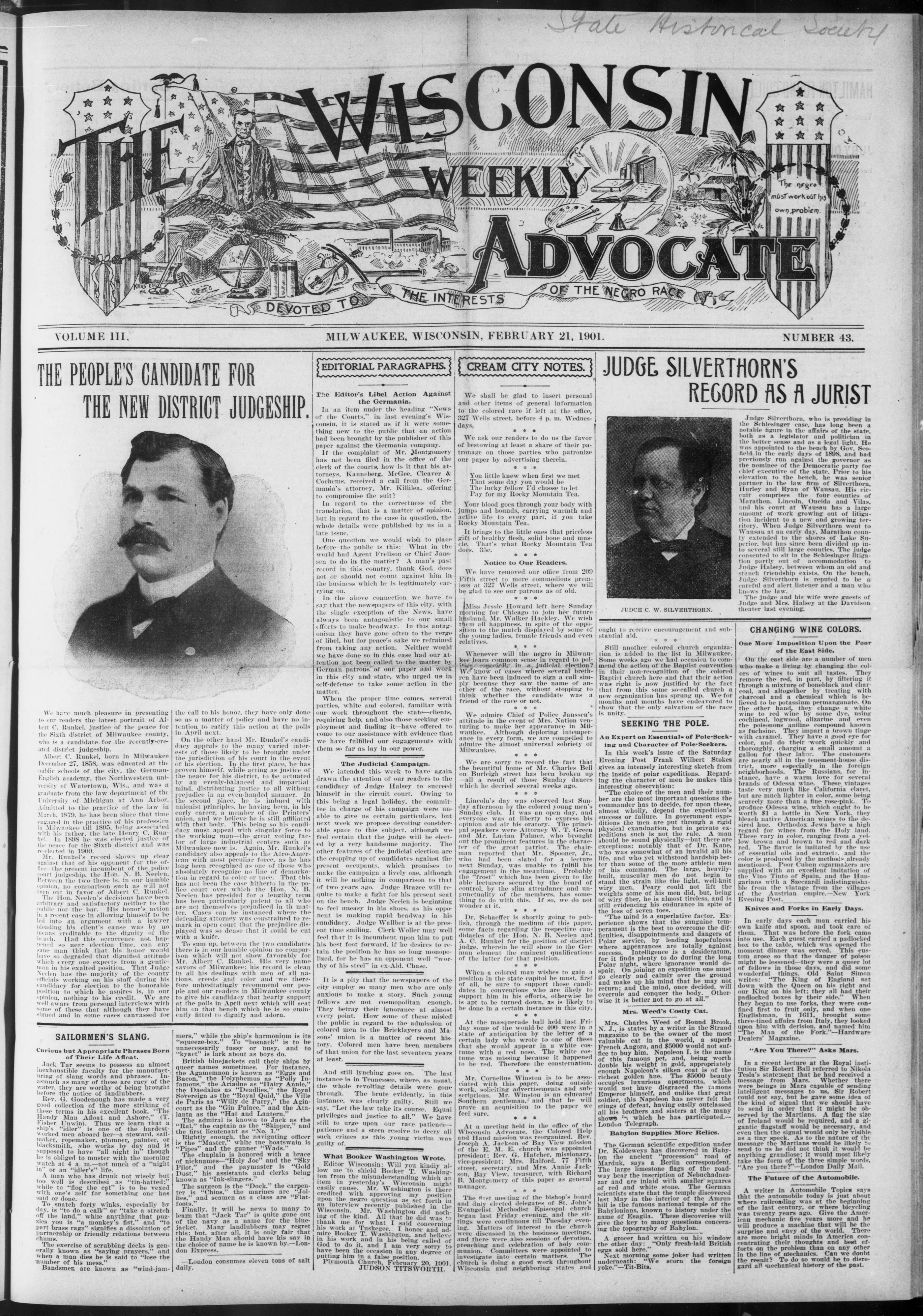
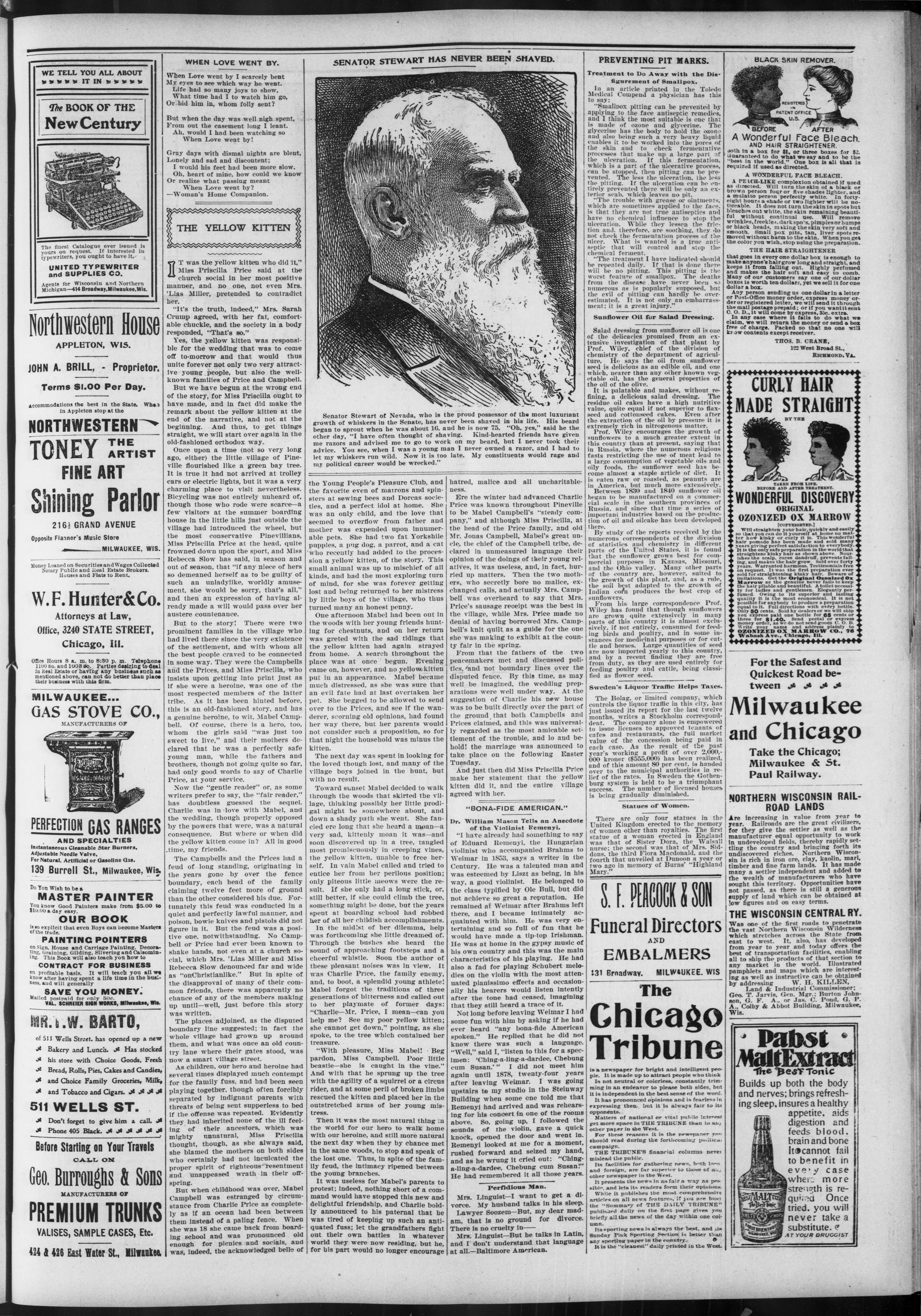
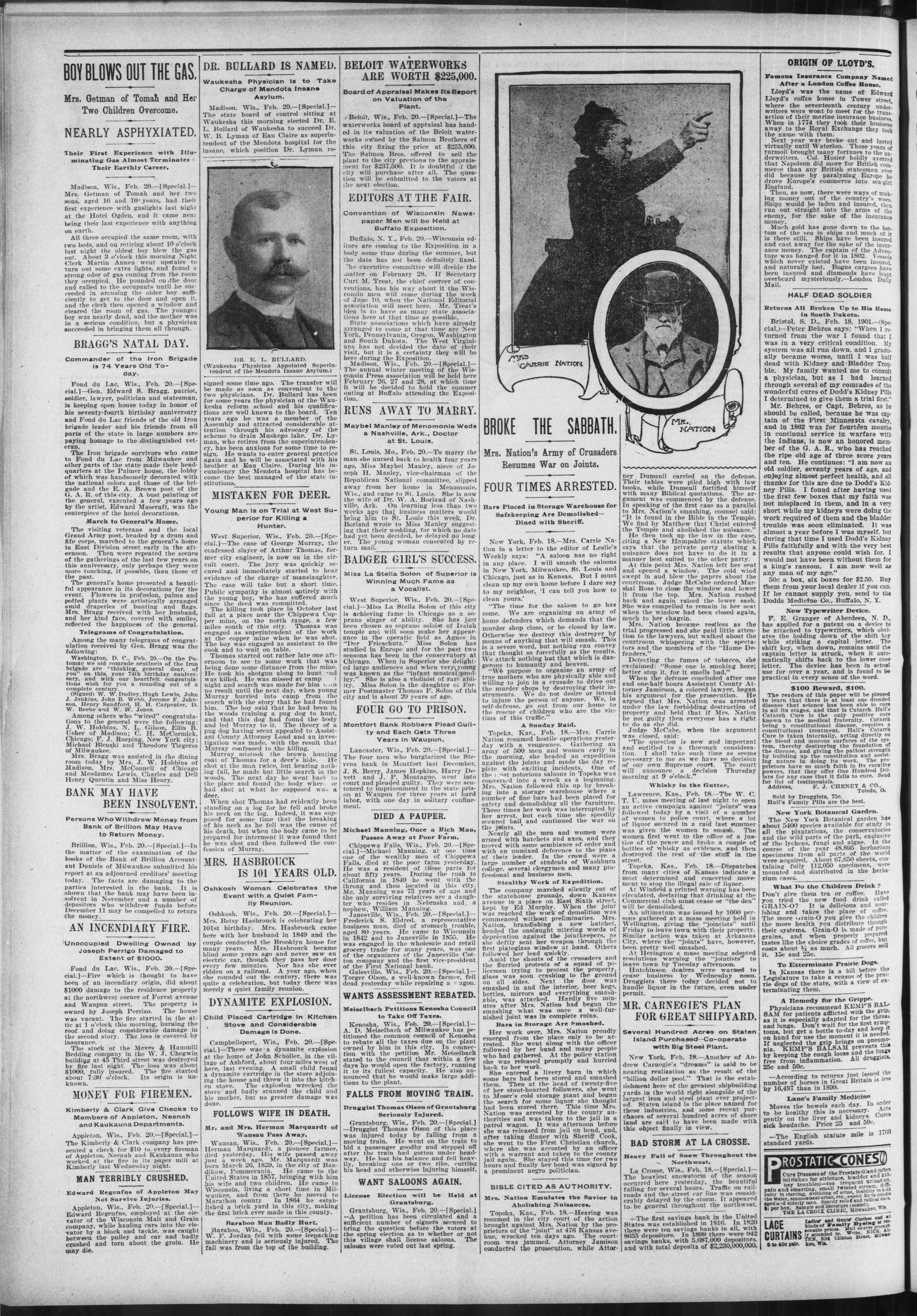
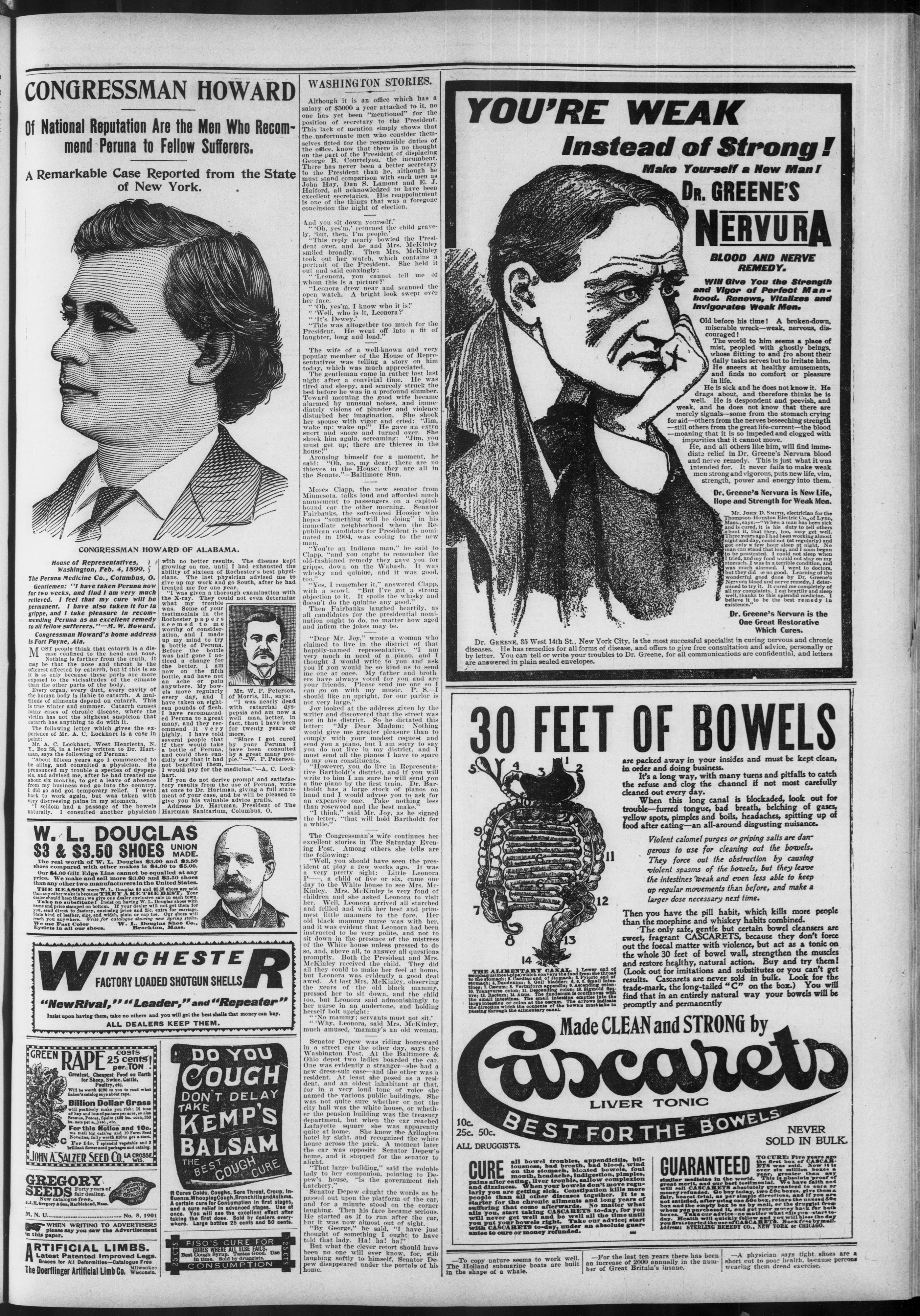
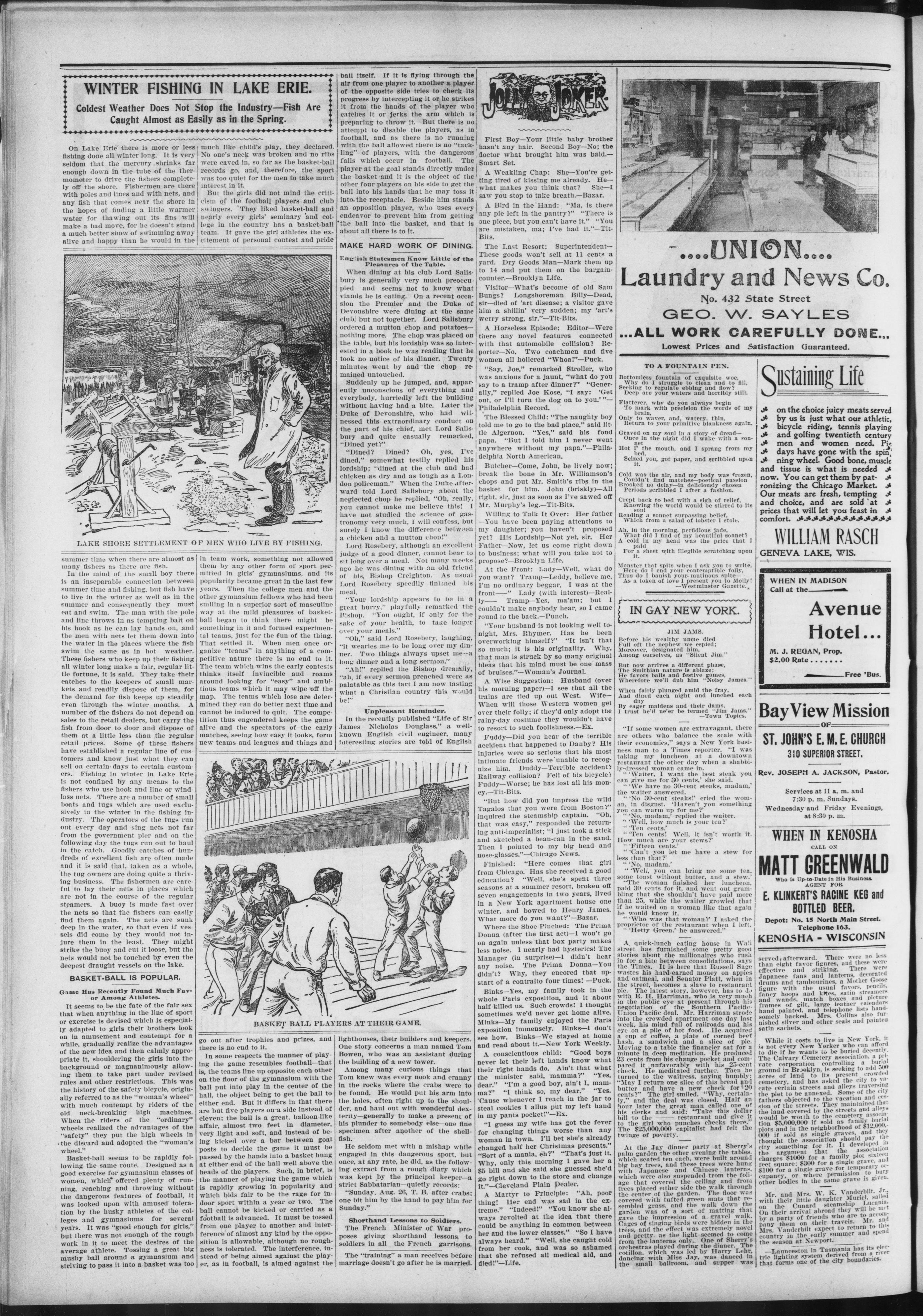
Page text (machine-generated)
WISCONSIN
WEEKLY
ADVOCATE
DEVOTED TO THE INTERESTS OF THE NEGRO RACE
THE PEOPLE'S CANDIDATE FOR THE NEW DISTRICT JUDGESHIP
[Name not provided]
VOLUME III.
THE PEOPLE'S CAN
THE NEW DI
We have much pleasure in presenting to our readers the latest portrait of Albert C. Runkel, justice of the peace for the Sixth district of Milwaukee county, who is a candidate for the recently-created district judgeship.
Albert C. Runkel, born in Milwaukee December 27, 1858, was educated at the public schools of the city, the German- English academy, the Northwestern university of Watertown, Wis., and was a graduate from the law department of the University of Michigan at Ann Arbor. Admitted to the practice of the law in March, 1879, he has been since that time engaged in the practice of his profession in Milwaukee till 1895, being associated with his father, the late Henry C. Runkel. In 1898 he was elected justice of the peace for the Sixth district and was re-elected in 1900
Mr. Runkel's record shows up clean against that of his opponent for the office—the present incumbent of the police court judgship, the Hon. N. B. Neelen. Between the two there is, in our humble opinion, no comparison such as will not turn out in favor of Albert C. Runkel.
The Hon. Neelen's decisions have been arbitrary and satisfactory neither to the public nor the bar. His honor's action in a recent case in allowing himself to be led into an argument with a lawyer pleading his client's cause was by no means creditable to the dignity of the bench. Had this occurrence not happened so near election time, can any sane man think that his honor would have so degraded that dignified attitude which every one expects from a gentleman in his exalted position. That Judge Neelen has the majority of the county officials working on his staff during his candidacy for election to the honorable position to which he aspires is, in our opinion, nothing to his credit. We are well aware from personal interviews with some of these that although they have signed and in some cases canvassed for
SAILORMEN'S SLANG.
Curious but Appropriate Phrases Born of Their Life Afloat.
Jack Tar seems to possess an almost inexhaustible faculty for the manufacturing of slang words and phrases. Inasmuch as many of these are racy of the water, they are worthy of being brought before the notice of landlubbers.
Rev. G. Goodenough has made a very good collection of the more striking of these terms in his excellent book, "The Handy Man Afloat and Ashore," (T. Fisher Unwin). Thus we learn that a ship's "idler" is one of the hardest-worked men aboard her—a steward, sailmaker, ropemaker, plumber, painter, or blacksmith, who works by day and is supposed to have "all night in" though he is obliged to muster with the morning watch at 4 a. m.—not much of a "night in" or an "idler's" life.
A man who has drunk not wisely but too well is described as "tin-hatted;" while to "flog the cat" is to be vexed with one's self for something one has said or done.
To snatch forty winks, especially by day, is "to do a call" or "take a stretch off the land," while anything that puzzles you is "a monkey's fist," and "to part brass rags" signifies a dissolution of partnership or friendly relations between chums.
The exercise of scrubbing decks is generally known as "saying prayers," and when a man dies he is said to "lose the number of his mess."
Bandsmen are known as "wind-jam-
---
the call to his honor, they have only done so as a matter of policy and have no intention to ratify this action at the polls in April next.
On the other hand Mr. Runkel's candidacy appeals to the many varied interests of those likely to be brought under the jurisdiction of his court in the event of his election. In the first place, he has proven himself, while acting as justice of the peace for his district, to be actuated by an evenly-balanced and impartial mind, distributing justice to all without prejudice in an even-handed manner. In the second place, he is imbued with unionist principles, he having been, in his early career, a member of the Printers' union, and we believe he is still affiliated with that body. This being so his candidacy must appeal with singular force to the working man—the great voting factor of large industrial centers such as Milwaukee now is. Again, Mr. Runkel's candidacy also appeals to the Afro-American with most peculiar force, as he has long been recognized as one of those who absolutely recognize no line of demarkation in regard to color or race. That this has not been the case hitherto in the police court over which the Hon. N. B. Neelen has presided for a lengthy term has been particularly patent to all who are not themselves prejudiced in th matter. Cases can be instanced where the defending attorney was constrained to remark in open court that the prejudice displayed was so dense that it could be cut with a knife.
To sum up, between the two candidates there is in our humble opinion no comparison which will not show favorably for Mr. Albert C. Runkel. His very name savors of Milwaukee; his record is clean in all his dealings with men of all nations, creeds and color and we therefore unhesitatingly recommend our people and our readers in Milwaukee county to give his candidacy that hearty support at the polls in April next which will seat him on that bench which he is so eminently fitted to dignify and adorn.
mers," while the ship's harmonium is its "squeeze-box." To "bosnack" is to be unnecessarily fussy or busy, and to "kyact" is lark about as boys do.
British bluejackets call their ships by queer names sometimes. For instance, the Agamemnon is known as "Eggs and Bacon," the Polyphemus as "Polly Infamous," the Ariadne as "Hairy Annie," the Daedalus as "Deadlies," the Royal Sovereign as the "Royal Quid," the Ville de Paris as "Willy de Parry," the Agincourt as the "Gin Palace," and the Atalanta as the "Hat and Lantern."
The admiral is known to Jack as the "Ral." the captain as the "Skipper," and the first lieutenant as "No. 1."
Rightly enough, the navigating officer is the "Master," while the boatswain is "Pipes" and the gunner "Wads."
The chaplain is honored with a brace of nicknames—"Holy Joe" and the "Sky Pilot," and the paymaster is "Gold Dust," his assistants and clerks being known as "Ink-slingers."
The surgeon is the "Dock," the carpenter is "Chips," the marines are "Jollies," and seamen as a class are "Flat-foots."
Finally, it will be news to many to learn that "Jack Tar" is quite gone out of the navy as a name for the blue-jacket. Many landlubbers may regret this; but, after all, it is only fair that the Handy Man should have his say in the choice of name he is known by.—London Express.
—London consumes eleven tons of salt daily.
MILWAUKEE, WISCONSIN, FEBRUARY 21, 1901.
EDITORIAL PARAGRAPHS.
The Editor's Libel Action Against the Germania.
In an item under the heading "News of the Courts," in last evening's Wisconsin, it is stated as if it were something new to the public that an action had been brought by the publisher of this paper against the Germania company.
If the complaint of Mr. Montgomery has not been filed in the office of the clerk of the courts, how is it that his attorneys, Kanmeberg, McGee, Cleaver & Cochems, received a call from the Germania's attorney, Mr. Killilea, offering to compromise the suit?
In regard to the correctness of the translation, that is a matter of opinion, but in regard to the case in question, the whole details were published by us in a late issue.
One question we would wish to place before the public is this: What in the world had Agent Frellson or Chief Janssen to do in the matter? A man's past record in this country, thank God, does not or should not count against him in the business which he is legitimately carrying on.
In the above connection we have to say that the newspapers of this city, with the single exception of the News, have always been antagonistic to our small efforts to make headway. In this antagonism they have gone often to the verge of libel, but for peace's sake we refrained from taking any action. Neither would we have done so in this case had our attention not been called to the matter by German patrons of our paper and work in this city and state, who urged us in self-defense to take some action in the matter.
When the proper time comes, several parties, white and colored, familiar with our work throughout the state—clients, requiring help, and also those seeking employment and finding it—have offered to come to our assistance with evidence that we have fulfilled our engagements with them so far as lay in our power.
The Judicial Campaign
We intended this week to have again drawn the attention of our readers to the candidacy of Judge Halsey to succeed himself in the circuit court. Owing to this being a legal holiday, the committee in charge of his campaign were unable to give us certain particulars, but next week we propose devoting considerable space to this subject, although we feel certain that the judge will be elected by a very handsome majority. The other features of the judicial election are the cropping up of candidates against the present occupants, which promises to make the campaign a lively one, although it will be nothing in comparison to that of two years ago. Judge Brazee will require to make a fight for his present seat on the bench. Judge Neelen is beginning to feel uneasy in his shoes, as his opponent is making rapid headway in his candidacy. Judge Wallber is at the present time smiling. Clerk Woller may well feel that it is incumbent upon him to put his best foot forward, if he desires to retain the position he has so long monopolized, for he has an opponent well "worthy of his steel" in ex-Ald. Chase.
It is a pity that the newspapers of the city employ so many men who are only anxious to make a story. Such young fellows are not cosmopolitan enough. They betray their ignorance at almost every point. How some of these misled the public in regard to the admission of colored men to the Bricklayers and Masons' union is a matter of recent history. Colored men have been members of that union for the last seventeen years at least.
And still lynching goes on. The last instance is in Tennessee, where, as usual, the whole revolting details were gone through. The brute evidently, in this instance, was clearly guilty. Still we say, "Let the law take its course. Equal privileges and justice to all." We have still to urge upon our race patience—patience and a stern resolve to decry all such crimes as this young victim was guilty of.
What Booker Washington W
Editor Wisconsin: Will you kindly allow me to shield Booker T. Washington from the misunderstanding which an item in yesterday's Wisconsin might easily cause. Mr. Washington is there credited with approving my position upon the negro question as set forth in an interview recently published in the Wisconsin. Mr. Washington did nothing of the kind. All that he did was to thank me for what I said concerning his work at Tuskegee. I honor and admire Booker T. Washington, and believe in his work and in his being called of God to do it, and I am very sorry to have been the occasion in any degree of putting him in a false position. Plymouth Church, February 20, 1901. JUDSON TITSWORTH
CREAM CITY NOTES.
We shall be glad to insert personal and other items of general information to the colored race if left at the office, 327 Wells street, before 4 p. m. Wednesdays,
* * *
We ask our readers to do us the favor of bestowing at least a share of their patronage on those parties who patronize our paper by advertising therein.
* * *
You little knew when first we met
That some day you would be
The lucky fellow I'd choose to let
Pay for my Rocky Mountain Tea.
Your blood goes through your body with jumps and bounds, carrying warmth and active life to every part, if you take Rocky Mountain Tea. It brings to the little ones that priceless gift of healthy flesh, solid bone and muscle. That's what Rocky Mountain Tea does. 35c.
Notice to Our Readers.
We have removed our office from 209 Fifth street to more commodious premises at 327 Wells street, where we will be glad to see our patrons as of old.
* * *
Miss Jessie Howard left here Sunday morning for Chicago to join her future husband, Mr. Walker Hackley. We wish them all happiness, in spite of the opposition to the match displayed by some of the young ladies, female friends and even relatives.
\* \* \*
Whenever will the negro in Milwaukee learn common sense in regard to politics especially in a judicial election? We know of cases where several brethren have been induced to sign a call simply because they saw the name of another of the race, without stopping to think whether the candidate was a friend of the race or not.
☆ ☆ ☆
We admire Chief of Police Janssen's attitude in the event of Mrs. Nation venturing to make her appearance in Milwaukee. Although deploring intemperance in every form, we are compelled to admire the almost universal sobriety of Milwaukee.
* * *
We are sorry to record the fact that the beautiful home of Mr. Charles Bell on Burleigh street has been broken up all a result of those Sunday dances which he decried several weeks ago
* * *
Lincoln's day was observed last Sunday afternoon by the colored young men's Sunday club. It was an open day, and everyone was at liberty to express his opinion and air his oratory. The principal speakers were Attorney W. T. Green and Mr. Lucian Palmer, who brought out the prominent features in the character of the great patriot. The chairman reported that Mr. Spooner, Jr., who had been slated for a lecture next Sunday, was unable to fulfill his engagement in the meantime. Probably the "frost" which has been given to the able lecturers secured by the board of control, by the slim attendance and unpunctuality of the members, has something to do with this. If so, we do not wonder at it.
* * *
Dr. Schaeffer is shortly going to publish, through the medium of this paper, some facts regarding the respective candidacies of the Hon. N. B. Neelen and A. C. Runkel for the position of district judge, wherein he will show to the German element the eminent qualifications of the latter for that position.
* * *
When a colored man wishes to gain a position in the state capitol he must, first of all, be sure to support those candidates in conventions who are likely to support him in his efforts, otherwise he is apt to be turned down, as is likely to be done in a certain instance in this city.
* * *
At the masquerade ball held last Friday some of the would-be 400 were in a state of anticipation by the letter of a certain lady who wrote to one of these that she would appear in a white costume with a red nose. The white costume was missing because it happened to be red. Therefore the consternation.
* * *
Mr. Cornelius Winston is to be associated with this paper, doing outside work, soliciting advertisements and subscriptions. Mr. Winston is an educated Southern gentleman, and that he will prove an acquisition to the paper we feel sure.
***
At a meeting held in the office of the Wisconsin Advocate, the Colored Help and Hand mission was reorganized. Rev. Joseph A. Jackson of Bay View mission of the E. M. E. church was appointed president: Rev. G. Hatcher, missionary, vice-president: Mrs. Ralford, 77 Fifth street, secretary, and Mrs. Annie Jackson, Bay View, treasurer, with Richard B. Montgomery of this paper as general manager.
冰 凉 寒
The first meeting of the bishop's board and daily elected delegates of St. John's Evangelist Methodist Episcopal church began last Friday evening, and the sittings were continuous till Tuesday evening. Matters of interest to the church were discussed in the business meetings, and there were also sessions of devotion, preaching and celebration of holy communion. Committees were appointed to investigate into certain matters. The church is doing a good work throughout Wisconsin and neighboring states and
JUDGE SILVERTHORN'S REGORD AS A JURIST
[Picture of a man in a suit with a bow tie].
JUDCE C. W. SILVERTHORN.
ought to receive encouragement and substantial aid.
* * *
Still another colored church organization is added to the list in Milwaukee. Some weeks ago we had occasion to commend the action of the Baptist convention in their non-recognition of the colored Baptist church here and that their action was right is now justified by the fact that from this same so-called church a new organization has sprung up. We for months and months have endeavored to show that the only salvation of the race is unity.
SEEKING THE POLE.
An Expert on Essentials of Pole-Seeking and Character of Pole-Seekers. In this week's issue of the Saturday Evening Post Frank Wilbert Stokes gives an intensely interesting sketch from the inside of polar expeditions. Regarding the character of men he makes this interesting observation:
"The choice of the men and their number are the most important questions the commander has to decide, for upon these, almost wholly, depend the expedition's success or failure. In government expeditions the men are put through a rigid physical examination, but in private expeditions such is not the rule. A man should be sound physically—but there are exceptions: notably that of Dr. Kane, who was somewhat of an invalid all his life, and who yet withstood hardship better than some of the more athletic men of his command. The large, heavily-built, muscular men do not begin to stand the strain like the light, well-knit wiry men. Peary could not lift the weights some of his men did, but, being of wiry fiber, he is almost tireless, and is still evidencing his endurance in spite of the loss of seven toes.
"The mind is a superlative factor. Experience shows that the sanguine temperament is the best to overcome the difficulties, disappointments and dangers of Polar service, by lending hopefulness where appearances are totally against success. Intelligence is a desideratum, for it finds plenty to do during the long Polar night, where ignorance would despair. On joining an expedition one must go clearly and calmly over the ground and make up his mind that he may not return; and the mind, once decided, will overrule and conquer the body. Otherwise it is better not to go at all."
Mrs. Weed's Costly Cat.
Mrs. Charles Weed of Bound Brook, N. J., is stated by a writer in the Strand magazine to be the owner of the most valuable cat in the world, a superb French Angora, and $5000 would not suffice to buy him. Napoleon I. is the name of this famous pet, and, being worth double his weight in gold, appropriately enough Napoleon's silken coat is of the richest golden hue. The $5000 beauty occupies luxurious apartments, which would not have disgraced the famous Emperor himself, and unlike that great soldier, this Napoleon has never felt the stings of defeat, having easily outclassed all his brothers and sisters at the many shows "in which he has participated.—London Telegraph.
Babylon Supplies More Relics
The German scientific expedition under Dr. Koldeweys has discovered in Babylon the ancient "procession" road of Marduk, says a Berlin correspondent. The large limestone flags of the roadway bear the inscription of Nebuchadnezzar and are inlaid with smaller squares of red and white stone. The German scientists state that the temple discovered last May in the interior of the Amrun hill is the famous national temple of the Babylonians, known to history under the name of Esagila. These discoveries will give the key to many questions concerning the topography of Babylon.
A grocer had written on his window the other day: "Only fresh-laid British eggs sold here."
Next morning some joker had written underneath: "We scorn the foreign voke."—Tit-Bits.
NUMBER 43.
Judge Silverthorn, who is presiding in the Schlesinger case, has long been a notable figure in the affairs of the state, both as a legislator and politician in the better sense and as a legal light. He was appointed to the bench by Gov. Scofield in the early days of 1898, and had previously run against the governor as the nominee of the Democratic party for chief executive of the state. Prior to his elevation to the bench, he was senior partner in the law firm of Silverthorn, Hurley and Ryan of Wausau. His circuit comprises the four counties of Marathon, Lincoln, Oneida and Vilas, and his court at Wausau has a large amount of work growing out of litigation incident to a new and growing territory. When Judge Silverthorn went to Wausau at an early day, Marathon county extended to the shores of Lake Superior, but has since been divided up into several still large counties. The judge consented to sit in the Schlesinger litigation partly out of accommodation to Judge Halsey, between whom an old and stanch friendship exists. On the bench, Judge Silverthorn is reputed to be a careful and alert listener and a man who knows the law.
The judge and his wife were guests of Judge and Mrs. Halsey at the Davidson theater last evening.
CHANGING WINE COLORS.
One More Imposition Upon the Poor of the East Side.
On the east side are a number of men who make a living by changing the colors of wines to suit all tastes. They remove the red, in part, by filtering it through a mixture of boneblack and charcoal, and altogether by treating with charcoal and a chemical which is believed to be potassium permanganate. On the other hand, they change a white wine to red wine by some dye, using cochineal, logwood, alizarine and even the poisonous aniline compound known as fuchsine. They impart a brown tinge with caramel. They have a good eye for color, and do their work quickly and thoroughly, charging a small amount a gallon for their labor. The customers are nearly all in the tenement-house district, more especially in the foreign neighborhoods. The Russians, for instance, have a warm love for several brands of Odessa wine. These vintages taste very much like California claret, but are much lighter in color, some being scarcely more than a fine rose-pink. To produce Odessa wine, which ought to be worth $1 a bottle in New York, they bleach native American wines to the desired hue. Orthodox Jews have a high regard for wines from the Holy land. These vary in color, ranging from a yellow brown and brown to red and dark red. The flavor is imitated by the use of essential oils and extracts, and the color is produced by the methods already mentioned. Poor Cuban cigarmakers are supplied with an excellent imitation of the Vino Tinto of Spain, and the Hungarians with a Szeczardi indistinguishable from the vintage from the villages of the Austrian empire.—New York Evening Post.
Knives and Forks in Early Days.
In early days each man carried his own knife and spoon, and took care of them. That was before the fork came into use. Each guest carried a padlocked box to the table, which was opened the moment dinner was served. This custom arose so that the danger of poison might be lessened—they were a queer lot of fellows in those days, and did some wonderful things. Old Saint Simon writes: "The King of England sat down with the Queen on his right and our King on his left; they all had their padlocked boxes by their side." When they began to use forks, they were confined first to fruit only, and when one Englishman, in 1611, brought some three-tined affairs from Italy, they looked upon him with derision, and named him "The Man of the Fork."—Hardware Dealers' Magazine.
"Are You There?" Asks Mars.
In a recent lecture at the Royal institution Sir Robert Ball referred to Nikola Tesla's statement that he had received a message from Mars. Whether there were beings in Mars capable of sending intelligent messages to us, Sir Robert could not say, but he gave some idea of the kind of signal that we should have to send in order that it might be observed by the Martians. A flag the size of Ireland would be required, and a gigantic flagstaff would be necessary, and even then the signal would only be visible as a tiny speck. As to the nature of the message the Martians would be likely to send to us he did not think it would be anything grandiose; it would most likely take the form of the three simple words, "Are you there?"—London Daily Mail.
The Future of the Automobile.
A writer in Automobile Topics says that the automobile today is just about where railroading was at the beginning of the last century, or where bicycling was twenty years ago. Give the American mechanic five years more and he will produce a machine that will be the surprise and envy of the world. There are more bright minds in America concentrating their thoughts and best efforts on the problem than on any other in the line of mechanics. Can we doubt the result? To do so would be to disregard all mechanical history of the past.
Verdict of Manslaughter in the First Degree.
JURY OUT FORTY HOURS
Defendant Got Off as Easy as Possible Short of Absolute
Minneapolis, Minn., Feb. 20.—The jury in the case of the state of Minnesota against Frank H. Hamilton, charged with murdering Leonard R. Day, after forty hours' deliberation, furnished a genuine surprise by coming into court a few minutes before 10 o'clock this morning and reporting that it had agreed on a verdict of manslaughter in the first degree with a recommendation to the mercy of the court. The jury had been out so long that hope of agreement had about been given up. The jury informed the deputies at 9:15 that it had agreed, but it took half an hour to arrange the preliminaries. Hamilton was brought down first. He had enjoyed a good night's sleep and was in excellent spirits.
He seemed dazed when the verdict was announced and made no other sign than to shake his head in mute protest. He was at once remanded to jail to await sentence and absolutely refused to see anyone except his devoted friend, Miss Johnson of Colorado Springs.
His attorneys at once moved for a new trial, but no date was set for hearing the arguments.
When the prisoner reached the jail he said to Jailor Alexander with a despairing gesture: "They've found me guilty, captain—but I do not deserve it."
The penalty for the crime of which he is convicted is imprisonment from five to twenty years.
Hamilton was charged with the killing of Leonard R. Day during a drunken quarrel in the bar-room of the West hotel in this city in December last.
MOUNTAIN FALLS INTO THE SEA.
Great Slide was the Result of an Earthquake Which Shook the Neighborhood.
Vancouver, B. C., Feb. 20.—The whole crest of a mountain over a mile in circumference slipped into Loughborough inlet, 100 miles from Vancouver up the rocky British Columbia coast, last Saturday just before noon. The great slide was the result of an earthquake which shook the surrounding district for several seconds, and the resulting shock of the falling mountain top was apparent for a long distance.
At this part of the coast the mountains rise almost perpendicularly out of the water for 700 or 800 feet. The mountain which fell was composed of a great crag which overhung the shore, and a large slice of it sheared off into the bay. The break extended back 500 feet from the shore. Giant trees and rocks were swept away as if they had been toothpicks.
Instead of crumbling as it fell, the huge mass of rock turned over and flung itself far out into the bay. The splash caused a tidal wave which would have meant destruction to any vessel in its way. As it was, several small boats three miles away were piled up on the beach, and two booms of logs ready to be sent to Vancouver were thrown out of the water and practically wrecked.
GRAVE ANXIETY FELT.
Smith-Dorrien's Troops Missing Since February 6-Had an Engagement with Botha.
London, Feb. 20.—Grave anxiety is felt for the fate of Smith-Dorrien's column, which has not been heard of since February 6, when it lost twenty-four killed and forty-six wounded in a heavy engagement with Commandant Botha at Bothwell.
The officer in command at Wonderfontein, the nearest post on the railway to the scene of the engagement, reports that he has no news of Smith-Dorrien, who has about 2500 men under him.
Lord Kitchener has returned to Pretoria, leaving the chase after Dewet in the hands of Knox. Dewet has completely fooled Kitchener. He thought he had the Boer general surrounded near DeAar, Cape Coloney, but found out he was mistaken, and is wondering now where Dewet will be heard from next.
A raid upon Cape Town, while appearing impossible at this distance, is said to be actually feared.
Kitchener wired yesterday that Dewet is moving north and is now west of Hopetown, but will probably double back to the southwest, where troops are awaiting to catch him. London, Feb. 20.—A special dispatch from Pretoria says the Boers at Klip river, February 18, derailed a train containing Gen. Kitchener's baggage. The train was preceded by another on which the commander-in-chief was a passenger. An armored train drove off the Boers, but the latter secured the contents of the train derailed.
JUMPS FROM MOVING TRAIN.
Miss Belle Corkery Feared an Accident was About to Occur.
Ann Arbor, Mich., Feb. 20.—A deep snowbank is all that saved Miss Belle Corkery, a freshman literary student whose home is in Toledo, from instant death, as she jumped from an Ann Arbor train going at full speed just south of Alexis.
Conductor Reull immediately stopped the train and it was started back. It was found that the crew of the Flint & Pere Marquette worktrain that was following the Ann Arbor train had picked up the young woman and had taken her to the caboose. She had fallen in deep snow and slid a car length on her face. She was conscious, and said she had jumped because she was afraid something was going to happen to the train.
The Queen Enjoyed It.
A characteristic story is told of two church dignitaries who were one day vis-a-vis at a dinner party with Queen Victoria at Windsor. One was a courtly, polished cleric, high in her majesty's good graces, the other a blunt but important personage whose rank entitled him to a position on the Queen's right hand. She talked to him for some time, and then turned to Dean _____, referring accurately to the dramatis personae of a long past event. "What a wonderful memory your majesty has!" murmured the dean suavely. "Nonsense," interposed his brother cleric, "it's nothing of the kind. I told her majesty all that myself five minutes ago!" And horrified guests, who almost expected to see the earth open and swallow up the plain-spoken ecclesiastic, were relieved to observe the Queen smiling with the most evident delight.
Abnormal Increase of Cost.
While the population of Maine increased during the past decade only from 661,086 to 694,466, or but about 5 per cent., the cost of the state government has nearly doubled during the last eight years.
RISE OF MR. SCHWAB.
New York, Feb. 19.—In choosing Charles M. Schwab to sit at the head of the round table of the colossal billion-dollar steel trust, J. Pierpont Morgan and his colleagues have hit upon one of the most remarkable young men in the industrial history of this country.
Twenty years ago he was a freckled boy driving stakes for Andrew Carnegie's corps of engineers at $1 a day. His salary is now $75,000 a year and his fortune is estimated at $40,000,000.
Probably no other freckled boy in the world could have driven stakes with such tremendous success.
One day in the summer of 1881 one of Mr. Carnegie's superintendents happened to go into a grocery store in Braddock, Pa. The freckled boy was behind the counter dreaming about becoming a civil engineer. Mr. Jones, the superintendent, bought something—it may have been a red apple or a plug of tobacco—and in doing so disclosed his identity.
Not one person in ten thousand would have arisen to the occasion as that freckled boy did. He promptly "froze" to Mr. Jones, and made a tumultuous appeal for a job. He wanted to be an engineer. He insisted that he had the making of a fine engineer in his composition. Could he drive stakes? He could drive anything. Would he work for a dollar a day? Certainly. He would work for anything he could get.
Became a Stake Driver.
And so it came about that Charles M. Schwab cast his lot with the Carnegie company. He probably did not drive stakes any better than any other freckled boy could have done, but he kept his eyes open. Nothing in the way of learning the business got away from him. Whenever there was nothing for him to do in his own line he would tackle somebody else's work, just to get his hand in.
In six months he was made superintendent in place of Mr. Jones, and Mr. Jones was made general manager.
In the meantime the good people in the lonely little village of Loretto on the coast of the Allegheny mountains were wondering what had become of Charlie Schwab Charlie had lived there since his pinafore days. As he grew up he worked on the neighbors' farms and drove from Cresson to Loretto, his father having at that time the contract for carrying the mails between those points.
Everybody in Loretto knew him. He had ever shown a willing and obliging spirit. The Sisters of Mercy in the old convent were his personal friends. Consequently the inquiries for Charlie Schwab were prompted by sincere regard.
Finally somebody spread the report that he was working in the Carnegie iron works for $1 a day. His fate thus apparently settled for life, Loretto's interest in young Schwab died out.
Made Superintendent.
As the years passed he was more or less forgotten by Loretto people. In the meantime Schwab had acquired a "Mr." to his name and had been made superintendent of the Homestead Steel works of the Carnegie Steel company, which he reconstructed entirely. In 1889, upon the death of his friend Capt. Jones, Mr. Schwab was appointed general superintendent of the Edgar Thomson Steel Works and Furnaces. In 1892 the Homestead Steel works were also placed under his management, and thenceforward he conducted the operations of both enormous companies, which produce several million tons of steel per annum. There came to the little village of Loretto one day a builder who said that he had been commissioned by a Mr. Schwab to build a new church.
The new church was built, and the village has not yet recovered from the shock of its magnificence.
In a prominent place in the village Mr. Schwab erected a beautiful monument to the prince priest, Demetrius Galitzen, who struggled 100 years ago to spread civilization on the site where Loretto now stands.
Neither had Mr. Schwab forgotten the gentle sisterhood in the old convent at Loretto. He had vivid recollections of the kindness of Mother De Sales, who for many years was superior of the convent. He gladdened the heart of Mother De Sales by donating a liberal amount for the building of a new convent at Cresson, which the Sisters of Mercy now occupy.
Will Build a Hall.
He also built a beautiful home on the outskirts of the village. He now proposes to build an Alumni hall for the village. He has already established an electric light plant for the benefit of his fellow townsmen.
This, in brief, is the history of the president of the most gigantic industrial corporation in the world.
His charities have not been confined to Loretto. Some time ago he founded and maintains an industrial school and technical educational institution for mechanics at Homestead.
Mr. Schwab is happily married, and during the winter lives in a handsome house in Pittsburg, for which he paid $175,000.
H wife was Miss Emma Dinkey of Weatherby, Carbon county, Pa. They have no children. Both are enthusiastic music-lovers and attend all the Pittsburg Symphony concerts. Mr. Schwab's ability is unquestioned. He is acquainted with every detail of the iron and steel business and is thoroughly versed in metallurgy. Of the $160,000,000 stock of the former Carnegie company he holds 18,929 shares having a par value of $18,929,000. He owns the same amount in bonds. He has thus acquired about $2,000,000 for every year he has been in the service of Mr. Carnegie.
United States Military Schools
The annual report of the inspector general of the army regarding military schools shows that there are 110 such schools scattered through every state in the Union. Last year they had 30,135 students enrolled, of whom 27,300 were over 14 years of age, and the students, former students and alumni of these institutions, to the number of 3353, served in the war with Spain, of whom 1084 were officers and 2146 enlisted men.
Aluminum Notepaper Possible
It is stated that experiments with aluminum as a substitute for paper are now under way in France. It is now possible to roll aluminum into sheets fourthousandths of an inch in thickness, in which form it weighs less than paper. By the adoption of suitable machinery these sheets, says Invention, can be made even thinner and can be used for book and writing paper. The metal will not oxidize, is practically fire and waterproof, and is indestructible by worms.
Club with But a Single Officer.
Women lawyers in Boston have a large and flourishing club, with a noble disregard of "objects" other than to come into sympathetic acquaintance. Once in two months the members meet and dine at a well-known hotel. The only officer of the Portia club is the business manager, who arranges for the meetings.
—Columbus has a policeman who is 6 feet 1 inch high and weighs 347 pounds; Chicago one 6 feet 3 inches high, and Kansas City one 6 feet 10% inches high.
THE LEGISLATURE.
THE LEGISLATURE.
Senate.
In the Senate on the 14th the memorial to Congress for an amendment to the constitution to enable senators to be elected by the people was concurred in, without debate. A report was submitted from the commissioners of public lands, in compliance with a resolution adopted, on money due to Sauk and Columbia counties from sale of indemnity lands, and an old claim which has been presented at several sessions of the Legislature. The commissioners state that it does not appear from the books, files or records that any money is due Sauk or Columbia counties, or any other county of the state, on account of sales of indemnity lands. Among the bills introduced were the following: Amending the laws relative to compulsory education, to require that children be sent to school until they are 14 instead of 13, and imposing a penalty on parents for violation; requiring reports from the Milwaukee police department as to purchases of second-hand goods; conferring upon the Dane county supervisors the right to appropriate money for permanent improvements on the county fair grounds; amending the statutes relative to township school boards so as to limit the secretary's compensation to 100 days a year, at $2 to $3 a day, and providing that members of the executive committee may receive $2 per day for twenty-five days' service a year when the board so decides; amending the law dividing cities into classes by reducing the requirement for cities of the second class from 40,000 to 30,000 population.
In the Senate on the 15th Senator Kreutzer's bill providing for an increase in the salaries of justices of the Supreme court from $5000 to $7000 a year, and of circuit court judges from $3000 to $5000, not to take effect during present terms, which was on the calendar for passage, was laid over. Bills were passed as follows: Amending the law relative to the reassessment of void special assessments; amending the statutes relative to drainage districts, providing that in case the decision at the hearing is against the petitioners they shall be liable for the costs; restoring chapter 38, laws of 1897, relative to the incorporation of the Milwaukee Orphan asylum, omitted in the revision of the statutes; providing compensation to the legislative visiting committee; requiring the registration of articles of incorporation of churches. The Assembly bill providing for the establishment of a ferry across Lake St. Croix, Hudson, Wis., was concurred in. The judiciary committee reported the Osteopathy measure favorably by substitute Senator Mills' bill making it a crime for tramps to steal rides on trains was reported for killing by the committee on state affairs. Adjournment was until the evening of the 18th.
In the Senate on the evening of the 18th six bills drafted by the tax commission were introduced. Two relate to the taxation of street railways and telephone companies and are drawn along the lines recommended by the commission in its recent report. Another bill provides for the organization of reinsurance companies and the other bills relate to assessment of property. The bills were introduced by Senator Whitehead and referred to the committee on assessment and collection of taxes. The same bills will be introduced in the Assembly by Mr. Hall. The following bills were passed: Relating to the cancellation of void tax deeds; exempting the Milwaukee Industrial exposition from taxation; fixing the compensation of county superintendents in certain counties; requiring county judges to file official signature; legalizing the acts of Dr. H. P. Clute as state veterinarian; relating to investments by domestic life insurance companies.
The 19th was the last day for the introduction of new bills, and in the Senate thirty-nine were submitted. This brings the total introduced at this session in the Senate up to 317, which is forty-eight less than the total two years ago. The memorial to Congress, urging the defeat of the ship subsidy bill, was on the calendar for concurrence, but on motion of Senator Green it was referred to the judiciary committee. When the bill legalizing the practice of osteopathy was reached, Senator Burus tried to have it referred to the committee on public health and sanitation. Senator Roehr, sponsor for the bill, opposed the motion, and Chairman Eaton of the health committee said they did not want it. The bill was finally advanced to engrossment and third reading with 200 or three dissenting votes. The Senate had a little fun with Senator Mills' bill, to prevent the tramps from stealing rides on trains, and giving conductors the power of a sheriff to arrest them. It was reported for indefinite postponement by the committee on state affairs, but the Senate refused to kill it. It was finally referred to the committee on claims, of which Senator Mills is chairman. Among the bills relating to Milwaukee was a joint resolution offered by Senator Roehr, for a constitutional amendment to permit the Legislature to authorize a separate government for Milwaukee county, and to establish a joint government for the city and county. There was a new school board bill and a bill looking to the completion of the lake shore drive. Senator Green had a bill amending the general fish and game laws. It makes the deer season ten days later, from November 10 to November 30, and closes the season for upland game November 10 instead of December 1. Recess was taken to 7:30 p. m.
Only one bill was introduced at the evening session of the Senate on the 19th, making the total number received 388, as against 370 two years ago.
The first petitions for the passage of the primary election bill came into the Senate on the 20th from constituents of Senators Bissell and Martin. Other petitions were for the Milwaukee vladuct bill and the stationary engineer bill. Three new bills came in from the judiciary committee. They were: Requiring that interest and installments of principal on state loans be made payable February 1 of each year; authorizing the secretary of state to compile for public distribution in pamphlet form the laws of Wisconsin relating to cities, drainage, corporations and other subjects for which there may be a demand in the transaction of the public business; relative to admissions to the bar, requiring three years' study instead of two before examination by the state board. On motion of Senator Jones, his joint resolution providing for a budget committee was put over until March 5. When the Senate adjourns on the 21st it will be until the 25th, both houses having voted to observe Washington's birthday.
Assembly.
After a hard struggle the Assembly on the 14th ordered to a third reading Mr. Lenroot's joint resolution for a constitutional amendment permitting cities to increase their bonded indebtedness from 5 to 10 per cent. for the purpose of purchasing street railway, electric lighting plants and waterworks, one of the most important measures before the Legislature. The resolution provoked the livelest and longest debate of the session, so far. A very large number of important bills were introduced in the Assembly. One by Mr. Spratt is designed to prevent competition between convict and free labor. It provides that the same industry shall not be conducted in any two of the penal institutions of the state. Mr. Smalley introduced a bill to change the form of the official ballot to avoid any doubt about the voter's intention. Mr. Miller introduced a bill to pay Alfred Cook of Marathon county $1750 for his expenses in the contest over his seat. A bill by Mr. Barker, forbids the marriage of a divorced person for one year after the entry of a decree of divorce. Mr. Karel introduced a bill relating to the liability of employers in case of accidents to employees. It provides that knowledge on the part of the employee of defects in machinery or buildings shall not be considered contributory negligence on his part, and that in the event of death the hazard taken by the employee shall not stop his heirs in suing for damages. J. C. Williams introduced a bill that will be of interest to National guardsmen. It provides that the annual encampment shall be for ten days instead of for seven days as at present. Mr. Duerwaechter offered a bill to compel railroad companies to sell transferable miltage books and asking for a suspension of the rules to put the bill upon its passage at once. On a roll call the motion to suspend the rules was voted down, with only four members voting in favor of it.
Mr. Miner's joint resolution memorializing Congress to kill the ship subsidy bill created quite a furore in the Assembly on the 15th. When It was reached David Evans, Jr., moved to refer the matter to the committee on federal relations in order that the members might learn something more on the subject, but this was lost. On a roll call the resolution passed by a vote of 78 to 15. The tax commission unexpectedly sent seven bills to the Legislature on as many different questions of taxation. The bunch included a telegraph company bill, a bill relating to the one-mill school tax, an express-company bill, a sleeping-car bill,
an equipment-company bill and a bill making the tax commission a state board of assessment. Mr. Lenroot's bill requiring a vote of the people on franchises in certain cases, and Mr. Williams' joint resolution for a new banking law, were laid over until Monday. Three bills were passed, as follows: Relating to duties of Wisconsin state board of agriculture; relating to attempts to commit felony; prescribing duties of notaries public. The bills to be ordered to a third reading were: Relating to depositions to perpetuate testimony; relating to incompetent persons under guardianship. The Assembly adjourned to the evening of the 18th.
Among the seventy-five new bills introduced in the Assembly on the 19th was one by Assemblyman Cady that provides that marriages between negroes and whites shall be considered void. Mr. Owen had a bill that provides that prison-made goods shall be labelled, and Mr. Overbeck offered another against the operation of slot machines in this state. Mr. Whitson had a kidnaping bill providing a penalty of from five to twenty years, and Mr. Anderson had a measure that releases the city of New Richmand from its indebtedness to the state, amounting to $27,000. Another bill by Mr. Duerrwaechter provided for the punishment of persons or members of corporations who borrow funds knowing their business to be insolvent. More remonstrances against Mr. Hall's poison bottle bill were received. Among the bills that were killed is Mayor Rose's measure relating to the borrowing of funds by the city of Milwaukee. In the Assembly the calendar was unusually heavy and after the third order of business had been disposed of Mr. Overbeck moved that the bills on the calendar be taken up before offering new bills. This was done and after the calendar had been disposed of new bills were called for and the flood began. The assemblymen became restless, however, and moved to adjourn before the bills could be read. Bills were passed as follows: Relating to depositions to perpetuate testimony; relating to reassessment of void assessments; relating to incompetent persons under a guardianship.
More than 100 bills were introduced at the morning session of the Assembly on the 19th, making the total 561. Among the measures were several joint resolutions looking to legislative amendments. One by David Evans, Jr., is designed to extend the franchise to women. Another by Mr. Keene, extends the limit of municipal bonds from twenty to fifty years. One by Mr. Dahl, proposes to remove the limitation from sheriffs in the matter of office-holding, and another by Mr. Frost is intended to permit state aid in road building. Among the bills the most picturesque was Judge Orton's re-establishing capital punishment in certain cases. A measure by Mr. Duerwaecher extends to merchants the provisions of the law relating to receiving of deposits by insolvent banks. It prescribes a fine of $5000 or imprisonment for ten years for obtaining credit when a merchant knows that he is insolvent. There were bills extending the scope of the present corrupt practices act, and to make judicial elections nonpartisan by forbidding a party designation on a judicial ballot. A bill by Babb for the equalization of the distribution of the school tax brings up an old fight. A new vessel taxation bill came in fixing a 3 per cent. tonnage tax. The old bill relating to double header trains and fixing the number of brakemen to be employed on them also reappeared, being introduced by Mr. Galaway. A bill by Mr. Lenroot to regulate foreign companies doing business in this state is aimed at the trusts. Under a deceptive title a bill came in to permit a thirty-day racing season in this state. Mr. Zinn introduced a bill to encourage the beet sugar industry. It exempts beet sugar factories from taxation for a period of five years. A bill to exempt notaries public from the operation of the anti-pass law was the first effort to restrict that very sweeping measure.
At the evening session of the Assembly on the 19th, 55 more bills were introduced, making the total number received by that body 615, as against 540 two years ago. The Assembly chamber was crowded in the evening to hear arguments on the primary election bill before the joint committee on privileges and elections. There was only one speech, that of M. G. Jeffris of Janesville, against the bill.
The bill for the establishment of bicycle sidepaths along highways promises to cause as bitter a contest as the famous bicycle baggage bills of former Legislatures. It was on the calendar for engrossment and third reading, but was laid over. Then it was amended in several respects. When it came up on the 20th it was still further amended and sent back to the committee on judiciary. The bill taxing bachelors and the bill forbidding free lunches were killed without debate. The committee on ways and means reported for passage the bill authorizing a loan from the trust funds of Portage county and the bill prohibiting the distribution of samples of medicines. Senator Riordan's bills, No. 50 S., relating to the service of notice to quit, and No. 51 S., relating to evidence in certain cases, were ordered to a third reading. Mr. Thomas' bill, No. 107 A., relating to highway taxes in towns, was laid over for a week. The following bills were killed: Exempting certain personal property from taxation; to abolish free lunches in saloons. The Assembly concurred in the Senate resolution to observe Washington's birthday and then adjourned.
—Battle Creek will soon have two opera houses.
—A pet dog awoke the family of Frank Garrett of Fairplain, Case county, who discovered the house to be in flames. The house was totally destroyed and the inmates barely had time to escape with their lives.
—An underground lake, estimated at 1000 acres, has bothered the owners of the Chapin mine for some time, and they have determined to try and pump it out. The job is considered the biggest task in the history of modern mining.
—Albert Mears, the oldest resident of Whitehall and founder of the village, is dead of heart disease. He was nearly 80 years of age. He, with his brother Charles, built the first cabin on White lake in the summer of 1837.
During the year 1900 Berrien county grew over one-half of the Michigan crop of peaches. The number of acres cultivated was 4753 and the total yield was 140,992 bushels. There is only one other county in the state which has any claim to greatness in the peach line and that is Van Buren. The total yield of Van Buren county was 58,887 bushels. Figuring on a basis of the acreage nine bushels of peaches were raised on every acre cultivated in Van Buren county and twenty-nine on every acre cultivated in Berrien county.
Representative Charles Wheeler of Three Rivers recently interviewed local produce merchants regarding the anticolor oleomargarine bill now pending in the Legislature. They agree that most of the high-class oleomargarine is better than most of the dairy butter that comes to this market. Several people here who did not know it ate oleomargarine and pronounced it excellent butter. Railroad Commissioner Osborn reports that the Michigan earnings of railroad companies for 1900 were the largest in the history of the state. The aggregate Michigan earnings for the year were $39,176,939.78. This was an increase of $4,202,469.16, or 12.04 per cent. over the earnings of 1899. The earnings for December, 1900, were $3,276,139.65, an increase of $48,940.73 over December, 1899.
-Although the tinplate mills at Muskegon have passed into the hands of the trust, there seems to be no prospect of their closing down at present, as they are receiving so many orders. A few days ago they got an order from a Chicago house for 700,000 pounds of tinplate.
-Four carloads of Kalamazoo windmills will soon be wooing the baimy breezes of Hawaii and Porto Rico.
-The records of the state board of health show that the average temperature for January of this year was nine degrees below the average for the previous ten years.
-Insurance Commissioner Barry has thus far collected and turned into the state treasury since the beginning of the year, taxes on life and fire insurance companies amounting to $227,878.66.
-The net receipts of the state from the inspection of illuminating oil have con-
siderably decreased during the past few years. Inspector Judson's report for 1900 shows a balance of $8063 to be covered into the state treasury after paying the salaries and expenses of the inspector and his deputies. One year ago the balance was $10,021 and two years ago it was $11,843. —Clare county officers have not gone to California to bring back Henry Owen Feeney, who was killed near Farwell a quarter of a century ago. It is doubtful whether the county will go to the expense of bringing Greene back for trial.
Two thousand acres of land in the northwestern corner of Grand Traverse county will be transformed into a sheep ranch by the owner, I. M. Winnie, who recently purchased the tract of Perry Hannah. The land borders for about one and a half miles on Long lake and otherwise is particularly adapted to the purpose Mr. Winnie had in mind.
—Frederick A. Nims of the Muskegon Traction company has returned from New York, where he had a conference with the Eastern people who will build the interurban electric road between Muskegon and Grand Rapids. He says the company has $1,250,000 immediately available and it is merely a question of how quickly the road can be constructed.
—Fire set by a demented woman destroyed the Crawford county courthouse at Grayling. The records not in the vaults were saved, but the libraries, consisting of legal books and Supreme court reports, were entirely consumed. The loss will be about $15,000 over and above the insurance.
The National Cement company of Jackson, Mich., will establish a branch plant at Durham to develop the cement deposit which exists in the lake and river banks. There is said to be sufficient raw material to furnish an output of 5000 barrels a day for 200 years. The new company is capitalized at $1,000,000.
At Lainsburg Bert Stevens, the 3-year-old child of a prominent farmer, overheard the doctor prescribe strychnine tablets for his mother, and cautioning the parents to put them away securely. The child climbed to their hiding place on a shelf, ate the tablets, and is dead.
The Michigan Retail Lumberdealers' association has resolved not to buy of wholesalers who sell to contractors.
—In a contest just closed Miss Maude Bronson of Hudson wrote 11,788 words on a small-size postal card, beating all previous records.
—Work on rebuilding the mammoth hotel which was destroyed by a recent gale at Frankfort has been commenced. It will be completed by May 1.
—A larger number of wildcats have been killed this winter than at any former period for some time through western Michigan. Some lynx and an occasional wolf also have been secured.
—Another snowstorm in Branch county added several inches to that already on the ground. Farmers attending the institute report that the snow in the woods is twenty-four inches deep, and that cutting logs and wood is almost impossible.
CONGRESS.
CONGRESS.
Senate.
Thursday, Feb. 14.—Considered the agricultural appropriation bill during the day and the district code bill at a night session. Friday, Feb. 15.—Passed agricultural appropriation bill, with an amendment increasing from $170,000 to $340,000 the sum for the distribution of seeds. Mr. Teller announced that he would refuse to agree to a vote on the shipping bill.
Saturday, Feb. 16.—At the conclusion of the morning hour, when the unfinished business—the shipping bill—was laid before the body, Mr. Spooner moved to proceed to the consideration of the oleomargarine bill. By a practically unanimous vote—only two senators voting in the negative—the notion prevailed. Thus the subsidy bill was displaced as the unfinished business and the oleomargarine bill was placed in that order. After a little over an hour's consideration of the measure it was laid aside in order that unobjected bills on the calendar might be considered. Nearly 300 bills, including 197 private pension bills, were passed during the day.
Monday, Feb. 18.—Nearly the whole of today was devoted to consideration of the postoffice appropriation bill. Amendment appropriating $500,000 for an extension of the pneumatic tube service remains undisposed of. Point of order was made against it, but on the appeal of Mr. Mason the entire question was passed over until tomorrow. Mr. Pettus of Alabama delivered a speech in opposition to the ship subsidy bill. Conference report on the military academy appropriation bill was submitted. Mr. Daniel of Virginia made a vigorous attack upon the provision which deb. a cadet convicted of hazing of holding a commission in the army, navy or marine corps. The report is still pending.
Tuesday, Feb. 19.--By vote of 18 to 42 rejected conference report on military academy appropriation bill. This action came at conclusion of splitted debate upon provisions against hazing inserted in bill by conference committee. Report of conferences was rejected because regarded by large majority of Senate as too drastic. Mr. Deboe delivered his announced speech upon Nicaragua canal, advocating construction of waterway by United States. Effort was made to obtain consideration for bill reviving grade of vice-admiral of the navy for benefit of Rear-Admirals Sampson and Schley, but it was unavailing.
Wednesday, Feb. 20.—Spent the day on the postoffice appropriation bill. The amendment of Mr. Butler proposing a reduction of about 9 per cent. in the pay for railway postal service was defeated-18 to 51—after a debate in which Mr. Depew answered Mr. Butler's criticisms on the large profits made by American roads. Late in the day a sharp controversy on the pneumatic tube question was precipitated by an amendment offered by Mr. Mason extending that service to Chicago and one by Mr. Vest extending it to St. Louis. Mr. Hale severely criticised those promoting the system, referring to a "job and lobby." When he made a point of order that a committee had not passed on the amendment the advocates of the extension quickly circulated a call for a meeting of the committee on postoffices, and the session closed with Mr. Wolcott's humorous announcement of the committee meeting in response to the imperative demands made on him.
House.
Thursday, Feb. 14.—Considered the sundry civil appropriation bill.
Friday, Feb. 15.—Entire day spent in fillbustering. Mr. Cannon of the appropriations committee wanted the sundry civil bill taken up. As this day was the last private bill day of the session friends of measures of that kind set up the fillbuster.
Saturday, Feb. 16.—Made little progress with the sundry civil appropriation bill. The major portion of the time was spent in debating a proposition offered by Mr. Hill (Conn.) to strike out the appropriation of $100,000 for the free transportation of silver coln. It was defeated, 61-66. At 4 o'clock public business was suspended to allow the members to pay tribute to the memory of the late Representative Hoffecker of Delaware.
Monday, Feb. 18.—Under suspension of the rules by a vote of 191 to 41 passed the bill appropriating $5,000,000 for the St. Louis exposition. The bill to define the word "conspiracy" in the Sherman antitrust law to avoid the possibility of its being held applicable to labor organizations was defeated by almost a two-thirds vote on account of two amendments which the judiciary committee placed upon the bill and which were opposed by the labor organizations. The sundry civil bill was under consideration late in the day and Mr. Cannon, chairman of the appropriations committee, took occasion to make a detailed statement of the appropriations for the present Congress.
Tuesday, Feb. 19.—Devoted day to consideration of sundry civil appropriation bill, debate being chiefly upon national irrigation of arid lands. Passed resolution calling upon secretary of state and secretary of treasury regarding shipments to South Africa of horses, mules and other army supplies.
Wednesday, Feb. 20.—Passed the sundry civil appropriation bill today and entered upon consideration of the general deficiency—the last of the general appropriation bills.
Are you recovering as fast as you should? Has not your old trouble left your blood full of impurities? And isn't this the reason you keep so poorly? Don't delay recovery longer, but take Ayer's Sarsaparilla
It will remove all impurities from your blood and tone up your whole nervous system. Give Nature a little help at this time. Aid her by removing all the products of disease from your blood.
$1.00 a bottle. All druggists.
Keep your bowels in good condition with Ayer's Pills. Price 25c. a box.
Write the doctor freely all the particulars in your case. You will receive a prompt reply. Address. Dr. J. C. AYER, Lowell, Mass.
Agriculture in Alaska.
It is a popular impression that Alaska is a frozen zone, and that the soil is barren and worthless. This is a mistake. The sun is hot, the snow moistens and enriches the earth and the soil in the valleys is fertile and productive. Wheat, corn, oats, barley, buckwheat, flaxseed and a considerable variety of vegetables and forage plants can be successfully grown in many parts of the territory.
If Coffee Poisons You.
ruins your digestion, makes you nervous and sallow complexioned, keeps you awake nights and acts against your system genera, try Grain-O, the new food drink. It is made of pure selected grain and is healthful, nourishing and appetizing. It has none of the bad effects of coffee, yet it is just as pliant to the taste, and when properly prepared can't be told from the finest coffees. Costs about $1/4 as much. It is a healthful table drink for the children and adults. Ask your grocer for Grain-O, 15 and 25c.
Pilgrims to Lourdes.
The official report, just issued, shows that during 1900 the number of pilgrims to Lourdes was 608,000, among whom were four cardinals and thirty archbishops and bishops. Of water from the grotto 105,000 bottles were dispatched to all quarters of the globe.
Care of the Baby.
To keep the skin clean is to keep it healthy. Every mother should therefore see that her baby is given a daily bath in warm water with Ivory soap. The nursery should also be well aired and cleaned, and all clothing washed with Ivory soap, well rinsed, and dried in the sun. ELIZA R. PARKER.
An Ancient Spanish Mission.
The ancient Spanish mission of San Buenaventura was established in California in 1782. The mission books show that in fifty-five years the monks of San Buenaventura had brought inside the fold 3876 Indians. The fine stone structure of the mission built in 1809 still stands.
Coughing Leads to Consumption.
Kemp's Balsam will stop the cough at once. Go to your druggist today and get a sample bottle free. Sold in 25 and 50 cent bottles. Go at once; delays are dangerous.
Money in Meals for Cats.
Three hundred persons in London earn a living—and several of them are growing rich—by providing meals for the cats of the metropolis, which they deliver regularly once, twice and thrice a day, as may suit the owners of feline pets.
Cure for Rheumatism Free.
A trial package free for the cure of Rheumatism. A simple remedy that you may try without spending a cent. Many cases cured of 30 and 40 years' standing. Write to John A. Smith, 28 Germania building, Milwaukee, and request a free trial package.
A River of Ink.
In Algeria a river of ink is formed by the conjunction of two streams, one of which is impregnated with iron and the other, which drains a peat bog, with gallic acid. The mixing of the iron and the acid results in ink.
TO CURE A COLD IN ONE DAY
Take Laxative Bromo Quinine Tablets.
All druggists refund the money if it fans to cure. E. W. Grove's signature is on each box. 25c.
Writing Paper.
Thirty thousand tons of writing paper a year and 150 miles a day of wallpaper is the output of the largest paper factory in the world.
Carter's Ink
has the largest sale of any ink in the world, because it is the best ink that can be made.
The Liberty statue in New York is 151 feet high, the pedestal is 155 and the total height above low water mark is 305 feet 11 inches.
We refund 10c for every package of PUTNAM FADELESS DYE that falls to give satisfaction. Monroe Drug Co., Unionville, Mo. Sold by druggists.
In twenty years the consumption of beer in Germany has doubled. It is now 125 litres a year per head of the whole population.
I do not believe Piso's Cure for Consumption has an equal for coughs and colds.—John F. Boyer, Trinity Springs, Ind., Feb. 15, 1900.
—Thirty thousand people in the United States make their living from the growing silk industry.
FITS Permanently Cured. No fits or nervousness after first day's use of Dr. Kline's Great Nerve Restorer. Send for FREE $2.00 trial bottle and treatise. DR. R. H. KLINE, Ltd., 931 Arch St., Philadelphia, Pa.
—Sugarcane grows in size according to the chance given. Its height ranges 6 to 20 feet.
MRS. WINSLOW'S SOOTHING SYRUP for Children teething; softens the gums, reduces inflammation, allays pain, cures wind colic. 25 cents a bottle.
—The largest American fly is a little ever half an inch in length.
THE SPENCERIAN BUSINESS College, Milwaukee, is the oldest and best school of business and shorthand in Wisconsin. Circulars free.
-The German merchant marine now numbers 1209 steamers.
E. W. BEEBE, M. D., Eye, Ear, Nose and Throat, 173 Wisconsin St. (opp, P. O.), Milwaukee, Wis. Office hours from 10 to 12 and 3 to 5.
-Canada has six thousand miles of roads and highways.
FARM AND GARDEN
There should be in every stable a closet large enough to allow the hanging up of all harnesses, whether for carriage or work teams, and so snugly made that when the doors are shut the closet will be nearly air-tight. The cost of such a closet will be more than repaid by the saving of leather from the fumes of ammonia, if there is a cellar for manure under the building, and from the dampness caused by the breath of animals or in other ways. Another and smaller closet, or box with shelves, near the animals, or two—one for the horses and one for the cattle—in which to keep currycombs, brushes, cattle cards, sponges, hammer and nails, often needed, and little bottles or packages of simple remedies that may be needed for a sick animal, to save calling a veterinarian, or to save the animal until he can be brought there. We usually had tincture of aconite, saltpetre, powdered charcoal and a bottle of some liniment on hand always. Then a rack in the stables to hold forks, shovel, hoes and brooms for cleaning them out, and another in some other place for forks, rakes and broom, as well as other things used in feeding. When there is but one place for each article, and that is always in its place, no time is lost in hunting for it, and there is less breakage from their being thrown down, stepped on or run over. The field tools should have a room or place separate from those that are used at the barn nearly every day.—American Cultivator.
A San Boiler.
The device for boiling maple sugar consists of coils of one-inch pipe, bent or cut and connected with L's to set top of the arch under the sap pan, as shown. Dotted lines A A A A show where it may be bent, B union to connect with feeder, C throttle to regulate feed, D delivery pipe can be turned down, as shown by dotted lines, to allow the pan to be drawn off. I find this device a great saving of
A B C
fuel, says a correspondent in Rural New Yorker. The sap running the whole length of pipe comes out boiling hot, frothing and sputtering like a scolding woman, but do not be alarmed at the noise it makes, for it will do no harm if you keep sufficient sap running in so it will not all evaporate in the pipe and consequently burn.
Tenant Farming.
Why should not the American system of tenant farming be abolished? asks a correspondent of the Prairie Farmer. It is already a fruitful source of wrong and a menace to free institutions, dehroning the goddess of justice and supplanting her with the goddess of greed, keeping in a state of servility our disinherited fellow-farmers, many of whom were robbed of their birthright before they were born, when their rightful heritage was given to the railroad magnates, who in turn have robbed and now continue to rob their beneficiaries, the people, by exorbitant rates. We, the surplus landowners, both rural and urban, hold in our grasp the destiny of this republic for weal of woe. Then why not heal the mortal disease that is gnawing at her vitals? My twenty-five years under monarchy convinces me that the landlord and the renter system is the blight and deathknell of republics and the bulwark of monarchies. The Kansas landlord paid only $1.25 an acre forty years ago for the land that now brings him an annual rental of from $2 to $5 and upward. The system begets an impoverished soil, impoverished peasantry, and poorhouse and penitentiary candidates.
Cotton Crop Ten Million Bales.
The statistician of the department of agriculture reports 10,100,000 bales as the probable cotton production of the United States for 1900-1. The estimated yield in pounds of lint cotton per acre is as follows:
Virginia .....180 Louisiana .....234
North Carolina.189 Texas .....226
South Carolina.167 Arkansas .....223
Georgia .....172 Tennessee .....177
Florida .....133 Missouri .....275
Alabama .....191 Oklahoma .....318
Mississippi .....159 Indian Territory.289
The acreage after eliminating all land from from which no crop will be gathered is estimated at 25,034,734.
Old Apple Trees Need Food.
When you clean up the henhouse wheel the guano out among the small fruit and young trees. There is no better fertilizer under the sun. If you have any left over wheel it into the orchard. The old apple trees are as greedy for food, and more so, than young trees. It is folly of the biggest kind to expect trees to go on and on bearing heavy loads of good fruit and starve them. They need food just as much as you do.
Profits in Small Things.
That farmer is fully up to his privileges when he and the matron can make enough from the poultry, the small fruits, the truck patch and the
orchard to defray expenses of the table, clothing and other necessities and luxuries of a personal nature. If he does this the staples, horses, cattle, sheep and hogs which may be sold can be used in buying a son and daughter a few acres, etc., to commence life with, or perchance to build a barn or mansion. Such farming is profitable, and within the capabilities of the majority of farmers.
Kicking Horse3.
Many years ago we were run away with by an old horse, because some older person would not trust us to harness him to the sleigh, and hitched him so close that he hit his heels. Some horses would have kicked the sleigh to pieces, but we were able to guide him for two or three miles without any greater damage than bruising the horse's legs a little. Since then we have seen a colt that would allow the whiffletree to hit his heels without any protest excepting to come down to a walk and step carefully, while another horse we owned would stop so short as to almost throw us over the dasher whenever a strap gave way. It was all a matter of early training, and while every one should see before starting out that the harness is in good condition, those who raise the colts can easily train them so they will neither run away nor kick in case of an accident. Perhaps some colts inherit the kicking instinct, but more get it by bad management, while care should break the others of it.—American Cultivator.
Whole Corn in the Silo.
It is claimed that when the ensilage corn is good enough to yield from 70 to 90 bushels of ears to the acre that it is as much corn as needs to be fed with it, and the grain ration should be bran, middlings or oats. When it is less than this, cornmeal should be added. But something depends upon the dry fodder used with it. With corn stover or timothy hay use more of the gluten or middlings than when clover hay is used. With clover hay to furnish protein, more corn may be used to supply the carbonaceous or heating food, while timothy and corn stover lack the protein that is found in the middlings, bran or gluten meal. If the bran is cold or the cattle are much out of doors, more corn is required to keep up the heat in the system and prevent it consuming its own fat or the butter fat.—Exchange.
Hay and Stock Scales.
A correspondent tells of a farmer who decided to put in stock scales. While waiting for them he had an offer for a lot of cattle at a certain price for the lot, or at so much per pound. He asked for time to decide, and when the scales came he hustled them into place and weighed the cattle, with the result that they brought $12 more when weighed than they would have brought at the lump price offered by the buyer. All large farmers should have such scales, not only in buying and selling, but they need them when fattening stock, that they may see whether the gain each week is paying for the food.
Alfalfa and Cream.
The cream from cows that have been fed on alfalfa will average about 10 per cent of the milk. A sample of every contribution is taken in a little glass jar by Western creameries, hermetically sealed and marked with the date and the farmer's number and put away on a shelf until the attendant has time to analyze it and record the value of the contribution it represents. The farmer is paid from 2 to 4 cents a quart, according to the richness of the milk and the local demand.
Books on the Farmstead.
Lots of books should be about the farmstead, so that the boys and girls will grow up to be intelligent men and accomplished women. If they early acquire a taste for good reading it will save them from much foolishness and the parents often from anxiety. Books are cheap, and there can be no legal excuse for a farm home not being the home of useful intelligence.
Feeding Value of Roots.
An exchange says: "In estimating the feeding value of such crops as beets, turnips, etc., the value of 100 pounds of beets is placed at 19 cents, rutabagas at 15 cents and the ordinary turnips at 11 cents. This makes these foods cheap compared with some kinds, and they are also beneficial outside of their actual food value."
Dairy Cows in Winter.
Keep the cows in good, warm stables, give plenty of feed rich in protein, such as alfalfa, clover, soy beans, bran and the like, and when the weather is fine turn the cows out in the yard for exercise
The Trolley in Siberia
Electricity is conquering the world with greater rapidity than did its mighty predecessor in mechanical achievement—steam. The gradual opening of the Trans-Siberian Railroad has led to the introduction of electric light and electric machinery into the towns of Siberia. Recently the municipality of Vladivostok decided that electric trolleys were indispensable to the comfort and convenience of the inhabitants of that remote city, and it was resolved to build at once about twenty mies of electric tramways and to light the town with electricity, besides introducing other modern conveniences. Most of the machinery will be of American manufacture.
New Woman—I'm going to lecture on Woman's Rights.
Husband (plaintively)—And what will I do?
New Woman—Well, I suppose I might take you along as a frightful example.
An electric plow, operated by movable trolley wires, has been invented in Halle, Prussia.
Spent His Life Among the Chippewas-Old Age Caused His Death.
Ashland, Wis.. Feb. 19.—[Special.]—Rev. Henry Blatchford, for sixty-nine years a Presbyterian missionary among the Chippewa Indians of the Lake Superior region, died at Odanah, at the age of 93 years. Mr. Blatchford was undoubtedly the oldest missionary in Wisconsin, not only in point of service, but in years. He has lived in Odanah of late years. His life was spent among the Chippewas, and he died among the people for whom he had labored so many years. Death was caused by old age.
GLIDDEN FARMER KILLED BY TRAIN.
Will Mink Run Down by Wisconsin Central Passenger While Driving to Ashland.
Ashland, Wis., Feb. 19.—[Special.]—Will Mink, a farmer residing near Glidden, was killed early this morning by a northbound Wisconsin Central train. He was driving a team and at 5 o'clock attempted to cross the Central's tracks. The approaching passenger train struck the rig and its occupant, killing the horses and throwing Mink quite a distance from the track. Mink died soon after the accident.
INSURANCE EXPIRED TEN HOURS BEFORE.
Heirs of Rev. Joseph Moran of La Crosse Unable to Collect $5000 Insurance.
La Crosse, Wis., Feb. 19.—[Special.]—It has developed that the $5000 insurance carried by the late Rev. Joseph Moran, who was buried here Saturday, cannot be collected owing to the fact that it had run out ten hours before the accident occurred which resulted in his death and had not been renewed.
E. S. BRAGG FOR JUDGE.
Friends of the Little General Wan Him to Accept Nonpartisan Nomination.
Fond du Lac, Wis., Feb. 19.—[Special.]—Friends of Gen. Edward S. Bragg are circulating nomination papers for him as a non-partisan candidate for the position of county judge. Since Judge Richter's announcement that he will not accept renunciation the friends of the general have been urging him to allow them to place him in nomination as a candidate for the position. Gen. Bragg refused to be interviewed upon the subject this morning, but he is said to look favorably upon the movement started by his friends.
Judge August E. Richter, who is serving his third term, covering in all a period of twelve years, as county judge of Fond du Lac county, announces that he must decline a renomination. His decision will cause general regret among the voters of the county, with whom Judge Richter has always been a favorite. He had, as a prominent member of the bar expressed it yesterday, a "cinch" on a re-election, although several other candidates were in the field for the honor.
WILL NOW EAT GERMS.
Dr. Rodermund Says He will Further Demonstrate that Smallpox Is Not Contagious.
Appleton, Wis., Feb. 19.—[Special.]— "I now propose to visit a smallpox patient and not only rub myself with the pus but swallow a portion of the virus in order to prove without question the truth of my assertion that the disease is not contagious," said Dr. J. M. Rodermund today. Continuing, he said: "Of course I shall not let anyone know when I do this, because I don't care to be quarantined again. I propose this time to take witnesses with me when I visit the patient and I shall see that one of them has a camera so that it can be proved by the photographs beyond any doubt that I will do just as I say."
Dr. Rodermund has proven himself a man of his word and it is generally believed that he will make good his statements. The officers consequently are keeping a sharp lookout and will again quarantine on the first suspicion. There are still a number of smallpox cases in the vicinity and Rodermund will encounter no difficulty in visiting one if he wishes.
CUTS THROAT WITH KNIFE
Anton Kronick of Kingsbridge Takes His Own Life.
Two Rivers, Wis., Feb. 19.—[Special.]
—Anton Kronick, a blacksmith 39 years of age, residing at Kingsbridge, committed suicide last night by cutting his throat with a butcher knife. No cause for the deed is known.
GRANTING FRANCHISES.
Many Towns in Chippewa County Encouraging New Company. Chippewa Falls, Wis., Feb. 19.—[Special.]—The O. J. Jenson Telephone company, which owns and operates a telephone system from Cadott to Estella, in this county, has been granted franchises to place exchanges at Boyd and Stanley. Other towns along the line of the Wisconsin Central railway are considering the matter of granting franchises.
ENGINEER MILLS INJURED
Badly Hurt in Collision on Central Near Ceylon.
Chippewa Falls, Wis., Feb. 19.—[Special.]—A head-end collision occurred on the Wisconsin Central at Ceylon, fifty miles west of here, yesterday morning. Engineer Jerry Mills has three ribs broken. None of the other trainmen were injured. The engines and several box cars were badly damaged.
Assumes Pastorate at La Crosse.
La Crosse, Wis., Feb. 19.—[Special.]—Rev. Elmer E. Ferris of Kansas has assumed charge of his new pastorate here, at the First Baptist church, which has been without a pastor for six months.
Insane Man Kills Himself.
Beloit, Wis., Feb. 19.—[Special.]—Allen Irving, a farmer residing near town committed suicide. He was insane and had lately come from Mendota.
Welcome Discovery Made by the Famine -Stricken People of India.
A remarkable incident is officially reported from the central provinces of India. Bamboos have been found yielding "manx" of a kind and quality hitherto unknown and have been of invaluable help to the famine-stricken people. A government analysis revealed that it is a composition of saccharose almost identical with cane sugar, the ingredients being: Sugar, 95.63; water, 2.66; ash, .96; glucose, .75. Expert officials and natives never heard of such a product of bamboo and the natives regard the discovery as a special act of Providence.—Inter-Ocean.
Alpine Vandalism.
The rarest flower in Europe, the edelweiss, to obtain which Alpinists will often risk their lives, is becoming scarcer every year, and unless measures are taken to prevent indiscriminate gathering it is likely to disappear altogether, writes a Geneva correspondent. The edelweiss only grows 2500 to 3000 yards above the level of the sea and under special climatic conditions. Unfortunately the edelweiss has become the "fashionable" flower in Germany since the Emperor commenced wearing it, and large quantities are forwarded to Berlin and other German towns every week, where it brings high prices. There is also a factory at Interlaken, where the flower is pressed and used in decorating picture frames, albums, etc., for which there is a great demand, especially in England. It is the tourists who do the real damage, as they pluck the whole plant instead of the flower only.
Fruitful After Sixty Years.
After sixty years of life without fruit a butternut or white walnut tree of the North American variety in Carstang, England, has borne fruit. This tree was one of seven planted at the same time, and none of the seven has been fruitful. In fact, this is said to be the first instance of such a tree bearing fruit in England. It is considered so remarkable a botanical happening that the authorities at Kew gardens asked for one of the nuts, with a small branch of the tree, for a permanent record.
Don't Part the Hair.
A German doctor says if men would quit the habit of parting the hair there would be no more baldness in the world.
MARKET REPORTS.
MILWAUKEE—Eggs—Market firm; fresh new, cases included, 16½¢; fresh, cases returned, 16¢; old, cases included, 16½¢; seconds, 10@12¢. Receipts were 114 cases.
Butter — Market firm. Fancy prints, 22½¢; fancy or extra creamery, per lb, 22¢; firsts, 17@19¢; seconds, 15@16¢; dairy prints, 16¢; extra fancy dairy, 15¢; lines, 12@13¢; packing stock, 10@11¢; whey, 8¢; roll, wrapped, 12@12½¢; unwrapped, 11½¢; grease, 4@5¢. The receipts today were 16,443 lbs against 9735 yesterday. The market has been so well cleaned up during the past week that a much firmer tone is felt. There is a good demand for choice stock and even fresh packing stock sells readily. A continued firm market is looked for until the snow disappears.
Cheese—Steady. Receipts were 1650 lbs today against 4980 yesterday. Full cream flats, new cooled, 10½¢; Young Americas, new, 11½¢@12¢; dalsies, new, 11½¢@12¢; fancy brick, 11@11½¢; low grades, @8¢; limburger, per lb, No. 1, 10½¢@11¢; low grades, 5@8¢; imported Swiss, 12@12½¢; Block Swiss, domestic, 11½¢@12¢; chole loaf, 12@13¢; No. 2, 9@10¢; Sapsago, 16½¢@17½¢; farmers, 10@11¢.
CHICAGO—Butter — Active; creamerles, 14@22c; dairies, 10@18c. Cheese—Fairly active; twins, 10%@10%c; cheddars, 10%@10%c; dairies, 11%@11%c. Eggs—Active; loss off, cases returned, 15%c. Dressed poultry—Qulet; turkeys, 8@9%c. chickens, 8%@9c.
NEW YORK—Butter—Recelpts, 6780 pkgs; firm; fresh creamy, 16@23c; June creamy, 15@20c; factory, 11@15c. Cheese—Recelpts, 3710 pkgs; firm; rancy large fall-made, 11@11%c; fancy small fall-made, 12c. Eggs—Recelpts, 7010 pkgs; firm; Western at mark, 17%@17%c; Southern at mark, 17@17%c. Sugar—Raw steady; refined quiet. Coffee—Firm; No. 7 Rlo, 7%c.
MILWAUKEE LIVESTOCK MARKET.
HOGS—Receipts, 10 cars; market 5c higher; light, 5.25@5.35; mixed and medium weights, 5.30@5.40; common to good packers, 5.10@5.35; fancy selected hogs, 5.40@5.42½
CATTLE—Receipts, 2 cars; steady; butchers' steers, medium to good, 1050 to 1300 lbs, 4.15@4.75; fair to medium, 950 to 1050, 6.55@4.15; helfers, common, 3.00@3.50; good, 3.75@4.00; cows, fair to good, 2.65@3.40; canners, 1.50@2.25; bulls, common, 2.75@3.15; choice, 3.25@3.75; feeders, 800 to 950 lbs, 3.50@3.85; stockers, 500 to 750 lbs, 3.00@3.50; veal calves, common to choice, 4.50@5.75; milkers and springers, common no demand; choice heavy, 35.00@42.00.
SHEEP—Receipts, 1 car; market steady, 3.00@4.00; bucks, 2.50@3.00; lambs, 4.25@5.00.
Chicago receipts: Hogs, 32,000; cattle, 7500; sheep, 12,000.
MARKETS BY TELEGRAPH.
Flour is steady at 3.95@4.00 for patents; bakers', 2.95@3.00, and 2.80@2.95 for rye. Millstuffs are firm and quoted at 14.25@ 14.50 for bran, 14.00@14.25 for standard middlings and 14.75@15.00 for Millwaukee flour middlings.
KANSAS CITY—Wheat—May, 67%@68c;
cash No. 2 hard, 68%@69c; No. 2 red, 70@
71%c; Corn—May, 37%@37%c; cash No. 2
mixed, 36%@26%c; No. 2 white, 37%c; Oats
—No. 2 white, 27c.
NEW YORK—Close — Wheat — March,
79%c; May, 80%c; July, 79%c; Corn—May,
46%c; July, 45%c.
DULUTH—Close — Wheat — Cash No. 1
hard, 75%c; No. 1 Northern, 73%c; No. 2
Northern, 67%@70%c; No. 3 spring, 63%@
68%c; to arrive, No. 1 hard, 76%c; No. 1
Northern, 74%c; May, 76%c; July, 76%c;
Corn—37%c; May, 38%c; Oats—26%@26c.
Rye—50c; Barley—35%55c. Flax—To
arrive, 1.59; cash, 1.59; May, 1.63; Septem-
ber, 1.17. Receipts of wheat, 83,077. Ship-
ments, 1279.
MINNEAPOLIS — Close — Wheat—Cash,
74c; May, 75%@75%c; July, 75%@75%c; on
track, No. 1 hard, 76c; No. 1 Northern, 74c;
No. 2 Northern, 67%@70%c.
No. 2 Northern, 05/10/19
LIVERPOOL—Close — Wheat — Steady.
½d higher; spot, 5s11d; March, 5s10½d;
May, 5s11½d; July, 5s11½d. Corn—Steady.
½d lower; spot, 3s10½d@4s; March, 3s9½d;
May, 3s9½d.
ST. LOUISE—Close—Wheat—Higher. No. 2 red cash, 73½¢; May, 74½¢@74½¢; July, 73½¢; No. 2 hard, 71½¢; c. Corn—Higher. No. 2 cash, 39¢; May, 39¢; July, 39¢; c. Oats—Higher. No. 2 cash, 26¢; May, 26¢; July, 25½¢; No. 2 white, 28½¢@28½¢; Lead—Better and firm; 4.22½¢@4.25. Spelter—Lower; 3.80@3.82½¢.
KANSAS CITY—Cattle—Recelpts, 7000; strong to 10c higher; native steers, 4.50@5.50; Texas steers, 3.75@4.40; native cows and helfers, 2.50@4.65; stockers and feeders, 3.50@4.85; bulls, 3.00@4.25. Hogs—Recelpts, 17,000; market 5c higher; bulk of sales, 5.25@5.35; heavy, 5.30@5.40; packers, 5.25@5.35; mixed, 5.20@5.35; light, 5.10@5.30; yorkers, 5.10@5.25. Sheep—Recelpts, 3000; active and steady; muttons, 3.50@4.40; lambs, 4.80@5.20.
ST. LOUIS—Cattle—Recelpts, 2700; market strong to higher; native steers, 3.50@5.70; stockers and feeders, 2.45@4.50; cows and helfers, 2.25@4.75; Texas and Indian steers, 3.45@4.65; Hogs—Recelpts, 8000; strong and 5c higher; lights, 5.25@5.35; packers, 5.35@5.42½; butchers, 5.40@5.45; Sheep—Recelpts, 700; steady to strong; native otters, 3.75@4.40; lambs, 4.75@5.25.
tive muttons, 3.18@3.18A-Cattle-Recelpts, 1200;
SOUTH OMAHA-Cattle-Recelpts, 1200;
strong to 15c higher; native beef steers, 4.60
@5.30; Western steers, 3.70@4.65; Texas
steers, 3.00@3.85; cows and heifers, 10c
higher, 3.00@4.10; canners, 2.00@2.85; stock-
ers and feeders, 3.25@4.60; calves, 4.00@
4.25. Hogs-Recelpts, 7300; 5@10c higher;
heavy, 5.30@5.35; mixed, 5.30@5.32½; light,
5.25@5.32½; plgs, 4.50@5.15; bulk of sales,
5.30@5.32½. Sheep-Recelpts, 9200; slow,
steady; yearlings, 4.40@4.75; wethers, 4.00
@4.50; common and stock sheep. 3.75@3.85;
sweets, 4.40@3.75; lambs, 4.50@5.00.
A DENIAL BY CALLLAHAN.
Will Probably Attempt to Prove an Alibi-Spent Money Freely After the Abduction.
Omaha, Neb., Feb. 20.—James Callahan, declared by the police to be the man who acted as jailer for Edward A. Cudahy, Jr., when he was abducted on December 18 last, and whose arrest in this city was announced yesterday, gave out the following statement last night:
"I know nothing; absolutely nothing about the kidnaping of Edward Cudahy, Jr. If I did I would be the last man in the world to tell it, because if I did and Pat Crowe proved to be connected with the crime he would run me to the end of the earth and run a knife through me. There is no danger of me turning state's evidence, even if I had knowledge of the deed which would assist the state in a conviction. Rather would I serve a term in the penitentiary than take chances of acknowledging that I had information incriminating to myself or anybody else, because I know the people of this city would not rest until they had hanged me to the nearest telegraph pole. I have seven people who will swear to my whereabouts on the night of the abduction and the two days following. Again, I would say that nobody can bring evidence to show that I was in any way connected with the kidnaping. The statements of those who have pretended to identify me with the case go for nothing. I know none of them, have never seen them, nor had any dealings with them."
Mysterious Wealth Spent Freely.
Prior to the abduction of young Cudahy Callahan was penniless, but after the recovery of the boy he was always prepared to treat his friends. He paid all his debts and those of several of his friends. It also has been a favorite pastime with him to throw a handful of coin into a crowd in a saloon to see the bystanders scramble after it. This action always was accompanied with the remark: "Scramble for the cash, boys. When it is gone I know where I can get more."
For two months Callahan has been on a continuous spree and the police are able to account for nearly $500 which he has spent in riotous living. In explaining the possession of so much cash he said his father had given him $400. This statement his father, James Callahan, Sr., denies. Then the son insisted the money had been given to his sister, but Mrs. Kelly says she has not spoken to her father for ten years. Chief Donahue waited for Callahan to come in and explain his acquaintance with Pat Crowe, but when two months elapsed, fearing the man would discover he was being shadowed and leave the city, his arrest was ordered. He was taken to the police station on Saturday night and shoved into a cell without anyone being aware that the police had moved in the celebrated case.
Cudahy Talks of Callahan.
"Yes, the man whom the police have under arrest is one of the kidnapers. Before identifying him Sunday I had only seen him once before, the night he carried me away. But he is the man. I could pick him out of a thousand."
This is what young Eddie Cudahy had to say about the identity of the man who was taken into custody Saturday night by the detectives for complicity in the Cudahy abduction. The boy was seen in the reception rooms of Creighton college. Young Cudahy continued:
"The story is correct. Sunday afternoon about 3 o'clock the detectives sent word to Mr. Cudahy that one of the men was captured. My father took me to the private office of Chief Donahue in the city hall. The man whom the police brought in was one of the pair who drove me to the South Omaha hiding place.
"I don't know his name. I don't know whether he recognized me or not, but he would not glance directly at me. Occasionally, when his eyes did stray in my direction, he always recovered himself and shifted them away, so I did not have a chance to detect a look of recognition, even if he let his eyes betray him. After the first glance I knew he was the man although I didn't tell the chief until he had been taken away. He had been drinking so heavily that when he was in the chief's office he was stupid.
"The man is dark. He is about 5 feet $1\frac{1}{2}$ inches tall. He was the one who did the talking when the buggy drove up to me that night in front of Gen. Cowin's. I got a good look at him then. He wore black clothes. He said: "You're Eddie McGee. I'm the sheriff and I want you. You have stolen $500 from your aunt. She told me if I caught you I would get $200. Climb into the buggy and come with us.
"There was another man in the buggy. He was light. The dark man talked all the while. His companion kept still during almost the whole drive, but at the start he said: 'We are going to send you to the reform school.'
"About halfway down to that house in South Omaha where they kept me hidden the buggy was stopped till I was blind-folded. I could distinguish this same dark man talking after the bandage had been put over my eyes. He did not seem to have as much authority as the light man, but he spoke oftener. While I was locked in the hiding place this man who is under arrest was often around. I could hear his voice frequently."
COMPLETE SURRENDÉR.
Chinese Plenipotentiaries Agree to All the Terms Imposed by the Powers.
Pekin, Feb. 20.—Noon.—The foreign envoys this morning received an unofficial communication from the Chinese plenipotentiaries offering to agree to all the terms of the powers. The Chinese desired, however, to save the lives of Chao Shu, Chiao and Ying Nien, but they were informed that the ministers insisted upon the former demands. A complete surrender is expected tomorrow.
Meanwhile extensive preparations are being made for the expedition planned by Count von Waldersee. The Germans have purchased 1800 camels for transport purposes.
A representative of the Associated press was informed by the foreign ministers today that they think the gravity of the situation over; but it is expected that difficulties will now arise among themselves when some of the governments send their indemnity claims, and particularly is there uneasiness regarding the attitude of Germany, whose claims must be paid in cash before the evacuation takes place. The other ministers resent this, saying it will be impossible for China to pay as China has not a large reserve and the customs receipts go to pay dividends upon former loans; and it is improbable that she could borrow a sum of any magnitude. United States Minister Conger estimates the total demands upon China at $400,000,000.
To Mothers of Large Families.
In this workaday world few women are so placed that physical exertion is not constantly demanded of them in their daily life.
Mrs. Pinkham makes a special appeal to mothers of large families whose work is never done, and many of whom suffer, and suffer for lack of intelligent aid.
To women, young or old, rich or poor, Mrs. Pinkham, of Lynn, Mass., extends her invitation of free advice. Oh, women! do not let your lives be sacrificed when a word from Mrs. Pinkham, at the first approach of
A.
weakness, may fill your future years with healthy joy.
"When I began to take Lydia E. Pinkham's Vegetable Compound I was not able to do my housework. I suffered terribly at time of menstruation. Several doctors told me they could do nothing for me. Thanks to Mrs. Pinkham's advice and medicine I am now well, and can do the work for eight in the family.
"I would recommend Lydia E. Pinkham's Vegetable Compound to all mothers with large families."—Mrs. CARRIE BELLEVILLE, Ludington, Mich.
ABSOLUTE SECURITY.
Genuine Carter's
Little Liver Pills.
Great Wood
to take as sugar.
CARTER'S
LITTLE
LIVER
PILLS.
FOR HEADACHE.
FOR DIZZINESS.
FOR BILIOUSNESS.
FOR TORPID LIVER.
FOR CONSTIPATION.
FOR SALLOW SKIN.
FOR THE COMPLEXION
GENURSE MUST HAVE SIGNATURE.
Price
26 Cents
Purely Vegetable.
CURE SICK HEADACHE.
DON'T GET WET! TOWER'S FISH BRAND Oiled Clothing BLACK OR YELLOW WILL KEEP YOU DRY NOTHING ELSE WILL TAKE NO SUSTITUTE. FREE CATALOGUE, SHOWING FULL LINE OF GARMENTS AND HATS. A.J. TOWER CO. BOSTON, MASS.
ELY'S
CREAM BALM
CURES COLD
IN
CATARRH
MORE COLD
WEAD
HAY-FEVER
DEANNESS
HEADACHE
SO CTS.
BRASS BROS.
ELY BROS.
NEW YORK
Nasal CATARRH
In all its stages there should be cleanliness.
Ely's Cream Balm cleanses, soothes and heals the diseased membrane. It cures catarrh and drives away a cold in the head quickly.
Cream Balm is placed into the nostrils, spreads over the membrane and is absorbed. Relief is immediate and a cure follows. It is not drying—does not produce sneezing. Large Size, 50 cents at Drug-gists or by mail; Trial Size, 10 cents by mail.
ELY BROTHERS, 56 Warren Street, New York.
WESTERN CANADA
EXCURSION RATES to Western Canada and particulars as to how to secure 100 acres of the best Wheat growing land on the Continent, can be secured on application to the Superintendent of Immigration, Ottawa, Canada, or the undersigned. Specially con-
duced excursions will leave St. Paul, Minn., on the last and 8d Tuesday in each month, and specially low rates on all lines of railway are being quoted for excursions leaving St. Paul on March 28th and April 4th, for Manitoba, Assinibia, Saskatchewan and Alberta.
Write to F. Pedley, Supt. Immigration, Ottawa, Canada, or the undersigned, who will mail you atfases, pamphlets, etc., free: T. O. Currie, 1 New Insurance Building, Milwaukee, Wis., Agent for Government of Canada.
WANTED SOLDIERS' TO PURCHASE, Homestead Rights of Union Soldiers, their widows or heirs, who made a Homestead Filing on less than 160 acres before June 22, 1874, no matter whether final proof was made or not.
HOMESTEADS Will pay $1.25 A. cash. Send stamp for particulars. W. A. SALTER, Hardesty, Okla.
Locomotive No. 18,000 was recently turned out of the Baldwin Locomotive works at Philadelphia.
The Wisconsin Weekly Advocate
Printed in the Interests of the Negro Race,
MILWAUKEE, WIS.
Richard B. Montgomery.....
.....Editor and Proprietor
Office: 327 Wells Street.
Telephone Black No. 244.
SUBSCRIPTION RATES.
postage paid.
One Year ..... $2.00
Six Months ..... 1.25
Three Months ..... .75
Send money by Express Money Order, P. O.
Money Order or Registered Letter to the
Wisconsin Weekly Advocate.
ADVERTISING RATES
One inch, single insertion ..... 25c
One inch, per year ..... $9.00
Business locals 5c per line each insertion.
Apply for rates to the Advocate.
TO CONTRIBUTORS:
All communications must be sent with the name and address of the sender as an evidence of good faith, but not necessarily for publication. No manuscript returned if not accepted, unless accompanied by stamps.
All subscribers of the Advocate that fail to get their paper promptly will please notify us at once. The Advocate, at 327 Wells street.
The Wisconsin Weekly Advocate company wishes to notify the public that all contracts and business transactions with this company must have the company stamp, otherwise they will be void. Neither will this company be responsible for paid subscriptions unless given to duly-accredited agents, who, on request, will give the company's receipt for same. Subscribers failing to receive their papers regularly will kindly notify the general office. Address all business communications to the general manager, 327 Wells street.
Mr. Richard B. Montgomery.
Entered at the Milwaukee P. O. as second-class matter.
The Helping Hand Colored Mission
incorporated under the laws of the State of Wisconsin has for its object the supplying of qualified colored help to those requiring the same. In order to be able to get servants from the mission it is necessary, that in order to partly cover expenses incurred, those parties desiring help should become subscribers for this paper. No actual charge is made. Parties who secure situations through this agency are also expected to become subscribers. We have at present on our books: Cooks, General Servants, Waitresses, Laundresses, Nurses, Coachmen, Porters, Waiters. Office hours 9-12 and 1-4.
R. B. MONTGOMERY, Mgr. 327 Wells St., Milwaukee.
At 3342 Vernon avenue, Chicago, excellent furnished rooms for gentlemen. Those wishing to purchase property east of State street, will do well to call upon W. F. Hunter, 3240 State street, real estate broker.
Perhaps the convicted and condemned Chinese officials will bring in their own heads upon pike-poles.
Chicago saloonkeepers may take it as a compliment that Mrs. Nation left the city without cracking a mirror.
Between weddings and reported matrimonial engagements, royalty is having an opportunity to rapidly put off its grief.
Perhaps the Filipino women who are organizing in Manila might be able to cripple the rebellion by attacking Aguinaldo's joints.
If it were not for the fact that "hope springs eternal," the South African war would be extremely discouraging to the British people.
The feat of the thieves who entered a Chicago residence and carried off a 300-pound safe is proof that there are big crooks as well as big policemen.
The declaration that all the Madrid revolutionists need is a successful leader could be made with truth in regard to every uprising of the kind.
The Empress Dowager is reported to have turned over the reins of government to Emperor Kwang Su, but she probably still clings to the whip.
According to the marriage contract, Queen Wilhelmina will have to obediently give Duke Henry the interest on 50,- 000,000 guilders for cigar money.
The German protest against the Kaiser's action in making Lord Roberts a member of the Order of the Black Eagle shows that some people take the royal gift enterprise business quite seriously.
Butte, Montana, has come to a standstill because of a water famine; and the absolute worthlessness of "gin-mill" power has proved that water is sometimes good for other purposes than navigation.
The proposed three-cornered bottle for poisons would prevent accidents if people would agree not to wash the bottles and put them into general use. It won't do put too much trust in the bottle or in its shape.
The fight of three widows for the body of a deceased husband at Superior may force upon bigamists who are languishing in prisons the conviction that there are several kinds of hereafter for men addicted to matrimony.
From criticising the Kaiser for acting as though he considered himself "the whole thing," the German press has come to fault-finding because in a recent distribution of decorations he implied that "there are others."
A rather startling report comes from Alabama that a mob may lynch a white man. If the culprit had a black skin the report would probably have been that the mob had lynched him. The color line hangs from the gallows also, in the South.
Vice-Consul Voorwinden reports from Rotterdam that a Dutch tanner has discovered a process for the rapid tanning of hides by machinery, which will convert a moist hide into leather ready for use by saddlers and shoemakers in from two to three days, as against six months
by the old method. Nothing is said as to the quality of the leather thus produced, but if it is as strong as the average material used by shoe manufacturers, footwear ought to become cheaper. Moralists may find comfort in the reflection that the mechanical stokers introduced on lake steamers will reduce the volume of profanity in the fire hold; but until machinery displaces the deck-hand, there will always be cussing enough to fumigate a ship.
The determination of King Edward to let his son and heir be the Duke of Cornwall for a short period will enable his subjects to more easily transfer the title of Prince of Wales which he has himself carried for so many years that it is difficult to designate him by any other title.
The Tacoma shippers and underwriters who have abandoned hope for seven ships with 230 lives and $1,200,000 worth of property, are reminded that many a fine ship long overdue has limped into port to fill with mingled joy and chagrin owners who had paid high premiums for reinsurance.
The Chicagoan who is trying to support a charge that he was victimized with decayed fish, by telling a story that he found in the fish a ring which he lost overboard sixteen years ago, is guilty of dealing in stories that are too old for cold storage.
As the oil gushers send up oil they also send it down, and thus give the fellows who are not participants in "lucky strikes" an indirect share in the benefits. There was a drop of sixteen cents a barrel in crude oil consequent upon the opening of the oil geyser at Beaumont, Texas.
Modern newspaper methods may force inventors to provide a noiseless camera. The graphic reporter states in regard to the scene at the altar in The Hague, that "the only sound which marred the impressive scene was the sharp clicking of the photograph cameras in the press gallery facing the royal couple."
The French scientist who is reported to have discovered a method of purifying water by electricity will pass into history as one of the world's benefactors if his process is all that it is claimed to be. Water is probably the leading medium for the spread of diseases, and the health of a community varies with the purity of its supply of drinking water.
The Berliner Post's showing that the United States leads the German Empire in the development of a naval establishment will not infect the American people with the virus of rivalry in that regard. When the United States feels that it has ships enough to protect its interests it will stop building and permit the foreign powers to proceed with their naval expenses.
The Mexican mine disaster will go upon record as the most remarkable happening of its kind. Generally, when explosions occur in underground workings, those who are on the surface are called upon to perform sad mortuary duties. In this instance the people on the surface suffered, while the miners escaped, although the explosion occurred in the depths of the mine.
It is thought that Gen. Paine's old finkeel centerboard sloop Jubilee may be "tuned up" for service as a trial boat for the Boston cup defender. This would add a new element of interest to the cup contests, as the Jubilee has never had a fair trial. She embodies a new principle in yacht construction, and with a fitting out based on the experience of a few years past she might give a good account of herself.
Texas has an oil boom that threatens to involve the Gulf of Mexico, in the bottom of which a company of fortunehunters are preparing to bore for a possible gusher. The scene of this submarine venture has been known for years as the "Oil Pool," from the fact, that the surface of the water thereabout has been covered continually with a film of oil which evidently came from a leak in a subterranean as well as submarine oil pocket.
An oil gusher has been struck in Blackford county, Indiana, that outdoes the famous spouter at Beaumont, Texas, not only in the amount of its daily output but also in the quality of the oil. The Texas spouter's oil is fit only for fuel, because it cannot be refined, while the Indiana oil well is sending up a torrent of oil that can be converted into illuminating fluid. The oil thus far discovered in Texas and Southern California is all too low in grade to be refined.
The private library of Rev. John Sharpe, chaplain of the Earl of Bellamont, governor of New York, was presented by him to the city in 1713 to form the nucleus of a public library. Nearly all of the books in Mr. Sharpe's collection, making 200 volumes, are still preserved in the New York Society library, and are shortly to be placed on exhibition. Thus the people will have the opportunity of comparing the little library of 1713 with the great library which is soon to be magnificently housed in the building to be erected in Bryant park.
Consul Hughes of Coburg reports to the state department that for years a substitute for benzine has been in demand throughout Germany. The objectionable points about benzine are its high inflammability and volatility, the danger of poisoning the atmosphere, etc. This was one of the chief topics of discussion at last year's chemical congress at Hanover, and this fall the subject came up once more at the meeting at Cassel, when a premium of about $250 was offered for an effectual substitute for benzine, or for means of rendering it less dangerous.
When the late P. D. Armour was exasperated by the inefficiency of an employee, he sometimes said, with a humor that took off the grimness of the suggestion, "Go and jump into the lake!" The injunction was never obeyed. The Emperor Kwang Su, who invited his missionary-murdering princes and generals now under the ban of the ministerial court to commit suicide in order to avoid execution, differed from Mr. Armour, probably, expecting that his grim suggestion would be obeyed. But the miscreant Mongolians whose demise is desiderated are not disposed to perpetrate their own taking-off.
BIFF! BANG!
FOUL!
THE KNOCKOUT.
THE BOXING KANGAROO.
THE ZOO
WASHINGTON'S BIRTHDAY
EXTRA ATTRACTIONS
10-SPECIAL ACTS-10
and Present Arena Programme.
SATURDAY
This coupon and 10 cents will admit any Child and be exchanged for 5 cents in trade at Candy and Popcorn Stand from 1 to 5 p.m.
FEBRUARY 23
Ten Continuous Hours
at These Prices.
ADULTS 25c. CHILDREN 15c
TRADE MARK
REGISTERED 1892.
U.S.PATENT OFFICE
WASHINGTON, D.C.
BEFORE USING
HARTONA
AFTER USING
HARTONA
Hartona will make the hair grow long and soft, straight and beautiful. Makes the hair grow on bald and thin places. Restores GRAY HAIR to its original color. Hartona cures Dandruff, Baldness, falling out of the hair, itching, and all scalp diseases. Hartona does not have to be used all the time, as it straightens the hair and gives it fresh life and lustre, and the hair stays and grows naturally beautiful and straight after the use of Hartona. No hot irons necessary. No pasting the hair down with grease. Hartona is positively harmless-one box can be used by everyone in the family. Benefits and improves children's hair just the same as adults. To meet the popular and ever-increasing demand for Hartona Hair-Grower and Straightener, we have placed it on sale in 25c. and 50c. sizes, in our special round, patent box. See that the word Hartona is on every box.
Money positively refunded if you are not absolutely delighted with the Hartona remedies. Remember, we handle no fake goods, and you are positively protected by our $100.00 guarantee to any one proving otherwise. All our remedies are trade-marked, registered and copyrighted at United States Patent Office at Washington, D. C., in the years 1892 and 1900. We refer you, as to our responsibility, to the City Bank of Richmond, Va., Adams and Southern Express Companies, and to the editor of this paper.
We want lady and gentlemen agents, white or colored, in every city and town in the United States. Write to us to-day, no matter if you are employed or not, and we will show you how to make a splendid living, with easy and pleasant work, and no risk of losing your good money. Write to us and we will send you a book of over one hundred genuine testimonials in your own State of people who have used and are using Hartona remedies. Is this not fair and honest enough?
HARTONA FACE WASH
Hartona Face Wash will gradually turn the skin of a black person five or six shades lighter, and will turn the skin of a mulatto person perfectly white. The skin remains soft and bright without continual use of the face wash. One bottle does the work. Hartona Face Wash will remove wrinkles, dark spots, pimples, blackheads, freckles, and all blemishes of the skin. You can regulate the shade of skin on neck, face and hands to any shade you wish. Full directions with each bottle. Hartona Face Wash is perfectly harmless, and is sent to any part of the United States on receipt of price, 50c. per bottle; securely sealed from observation. It is your duty to look as beautiful as possible. Thousands of delighted patrons send us testimonials every year. Please remember that your money is positively refunded if you are not perfectly satisfied and delighted with the Hartona remedies. We want agents in every city in the United States. Write to us, no matter if you are employed or not, and we will show you how to make money without risking any of your own money.
HARTONA NO-SMELL.
Hartona No-Smell will remove all smells and bad odors of the body; cures sore and aching feet, chafed limbs, etc. Hartona No-Smell is a God-send to all persons suffering from disagreeable odors caused by perspiration of the feet, arm-pits, etc. Sent anywhere on receipt of price, 10 cents and 25 cents a package. Address all orders to
Send us One Dollar, and mention this paper, and we will send you three large boxes of Hartona Hair-Grower and Straightener, two large bottles of Hartona Face Wash, and one large box of Hartona No-Smell. Goods will be sent securely sealed from observation.
Write your name and post-office and express-office address very plainly. Money can be sent by post-office money order, or enclosed in a registered letter, or by express. Address all Orders to
HARTONA REMEDY CO., 909 E. Main St., Richmond, Va.
An Australian Pest
One of the most powerful obstacles in the matter of land settlement in some parts of Australia is the prickly pear. It has grown to be a fearful pest. It has taken possession of whole tracts of country, and the settler has to fight a pitched battle for every acre he calls his own. A single fruit brings forth thirty, sixty and even several hundredfold of good productive seed. All herbage may drop, die and disappear in the oven of an Australian drouth, but the pear survives. flourishes and carries on its progress of expansion and reproduction with unconcern.
Twins in Two Centuries.
A very singular occurrence has taken place at Archiestown, in Banffshire. A workman's wife gave birth to twins—a boy and girl—on New Year's Eve. The boy arrived three hours before the clock struck the close of the century. The girl was born at 4 o'clock on New Year's morning. So that the twins have a century between them, or, at any rate, one is undeniably a Nineteenth century boy and the other a Twentieth century girl. This is surely unique in births.—Pall Mall Gazette.
The Vermont custom of not hanging a convicted murderer until two years after the passing of the death sentence upon him is founded on the assumption that any possible doubt as to his guilt will be removed in that time, and all danger of putting an innocent man to death is thus eliminated.
HARTONA REMEDY CO., 909 E. Main St., Richmond, Va.
SPECIAL GRAND OFFER.
Japanese Laborers a Failure.
Two thousand Japs were put to work by the Great Northern railroad a year ago. They took the places of white men in all branches and there were many who predicted the necessity of excluding the Japanese, just as the Chinese were before them. The fear, however, was ill founded. The railroad has come to the conclusion that Japanese at $1 a day are more expensive than white men at $1.25. Orders have been given to discharge the Japanese as fast as their places can be filled.
The Distance to Florida
Is 32 hours, if measured by the Chicago and Florida Special which leaves Chicago Union Station 12 noon Tuesdays and Fridays via Pennsylvania Short Lines. This elegant new train of Puliman Dining. Sleeping and Observation Cars is only one night on the way. For special information about it apply to H. R. Dering, A. G. P. Agt., 248 South Clark St., Chicago.
Banishment in New Jersey
Banishment was the unusual sentence imposed upon a Syrian by a New Jersey judge recently. The Syrian had been arrested for assault. The judge offered to release him if he would leave the country. The Syrian agreed, and, in charge of an officer, he was brought to Hoboken and placed aboard an outbound steamship.
—Naturalists say the lobster will soon follow the buffalo and diamond-back terrapin.
ERCOATS that we advertised last week for $7.50 to $5.00 to $18.00 This Week Only.
well $18 RAGLANS we'll unload for $13.50 This Week
to fit anybody's body or taste, last week $8.50 to week $6.75 to $16.50.
ERS--We give you a wider choice and a lower price
FASHIONABLE MISFIT CLOTHING
15-217 WEST WATER STREET, Opposite Barrett's D
money Back If You Can Show Cause. Open EVENING
look in our window will prove it to you.
The OVERCOATS that we advertised last week for $7.50 to $25.00, go now for $5.00 to $18.00 This Week Only.
These swell $18 RAGLANS we'll unload for $13.50 This Week Only.
SUITS to fit anybody's body or taste, last week $8.50 to $25.00 This Week $6.75 to $16.50.
TROUSERS--We give you a wider choice and a lower price than anybody.
FASHIONABLE MISFIT CLOTHING HOUSE
213-215-217 WEST WATER STREET, Opposite Barrett's Dep't Store. Your Money Back If You Can Show Cause. Open EVENINGS 'Till 10.
A good look in our window will prove it to you.
JAMES T. BRETT & SON.
A. H.
PARTI
intending
Ark., th
tronize
RAMMIE
BATH H
MAR
.HAR
RTIES
ntending to visit HotS
Ark., this winter, sho
ronize the
MMELSBERG
TH HOUSE,
MARK SARGENT, M
21 BATHS $3.0
ARTON
intending to visit HotSprings Ark., this winter, should patronize the
MARK SARGENT, Manager. 21 BATHS $3.00
preparations for the
arations for the The Original and Only Hartona.
atchless and Posit ening all Ki Hars
and Positively Unequaled for g all Kinky, Knotty, Stub Harsh, Curly Hair. es the hair grow on bald and thin places. Re hair, itching, and all scalp diseases. Hair stre, and the hair stays and grows naturally
Matchless and Positively Unequaled for Straightening all Kinky, Knotty, Stubborn, Harsh, Curly Hair.
Our stock doesn't fit the store right—it's too big. Watch the scissors of low prices "cut it down" to fit. The real trouble is that the cold weather hasn't come soon enough. We find that we're overloaded with heavy clothing. We're going to unload a bit this week and it will pay you to help us. Don't look for these bargains next week.
we advertised last week for $7.50 to $25.00, go now
this Week Only.
NS we'll unload for $13.50 This Week Only.
body or taste, last week $8.50 to $25.00 This
ou a wider choice and a lower price than anybody.
MISFIT CLOTHING HOUSE
ATER STREET, Opposite Barrett's Dep't Store.
ou Can Show Cause. Open EVENINGS 'Till 10.
low will prove it to you.
BRETT & SON,
EMBALMERS and
FUNERAL DIRECTORS
307 REED STREET and
410 GRAND AVENUE. Always Open
MRS. JAMES T. BRETT,
Lady Undertaker.
Telephones:
South 122.
Grand 2467. Milwaukee, Wis.
ES
ing to visit Hot Springs,
this winter, should pa-
the
ELSBERG
HOUSE,
K SARGENT, Manager.
21 BATHS $3.00
RTONA..
ns for the Hair!
tively Unequaled for Straight- nky, Knotty, Stubborn, h, Curly Hair. on bald and thin places. Restores GRAY and all scalp diseases. Hartona does not hair stays and grows naturally beautiful and
WE TELL YOU ALL ABOUT IT IN
The BOOK OF THE New Century
The finest Catalogue ever issued is yours on request. If interested in typewriters, you ought to have it.
UNITED TYPEWRITER and SUPPLIES CO.
Agents for Wisconsin and Northern Michigan—414 Broadway, Milwaukee, Wis.
Northwestern House
APPLETON, WIS.
JOHN A. BRILL, - Proprietor.
Terms $1.00 Per Day.
Accommodations the best in the State. When in Appleton stop at the
NORTHWESTERN
TONEY THE ARTIST
FINE ART
Shining Parlor
216½ GRAND AVENUE
Opposite Flanner's Music Store
MILWAUKEE, WIS.
Money Loaned on Securities and Wages Collected
Notary Public and Real Estate Brokers.
Houses and Flats to Rent.
W.F. Hunter&Co. Attorneys at Law, Office, 3240 STATE STREET, Chicago, Ill. Office Hours 8 a. m. to 8:30 p. m. Telephone 1100 bo. and 1008 bo. Parties desiring to deal in Real Estate or having any business such as mentioned above, can not do better than place their business with this firm.
MILWAUKEE...
GAS STOVE CO.,
MANUFACTURERS OF
PERFECTION GAS RANGES
AND SPECIALTIES
Instantaneous Cleanable Star Burners,
Adjustable Needle Valve,
For Natural, Artificial or Gasoline Gas.
139 Burrell St., Milwaukee, Wis.
MASTER PAINTER
You know Good Painters make from $5.00 to
$10.00 a day easy.
PAINTING POINTERS on Sign, House and Carriage Painting. Decorating, Graining, Gilding, Silvering and Calsomining. This Book will also teach you how to
CONTRACT FOR BUSINESS on profitable basis. It will teach you all we know after having spent a life time in the business, and will generally
SAVE YOU MONEY. Mailed postpaid for only 50c. VAL. SCHREIER SIGN WORKS, Milwaukee, Wis.
MR.I.W. BARTO.
of 511 Wells Street. has opened up a new Bakery and Lunch. Has stocked his store with Choice Goods, Fresh Bread, Rolls, Pies, Cakes and Candies and Choice Family Groceries, Milk and Tobacco and Cigars.
511 WELLS ST.
Don't forget to give him a call.
Phone 405 Black.
Before Starting on Your Travels
CALL ON
Geo. Burroughs & Sons
MANUFACTURERS OF
PREMIUM TRUNKS
VALISES, SAMPLE CASES, Etc.
424 & 426 East Water St., Milwaukee.
WHEN LOVE WENT BY.
When Love went by I scarcely bent My eyes to see which way he went. Life had so many injuries to show.
Bie had so many joys to show,
What time had I to watch him go,
Or bid him in, whom folly sent?
But when the day was well nigh spent,
From out the casement long I leant.
Ah, would I had been watching so
When Love went by!
Gray days with dismal nights are blent,
Lonely and sad and discontent;
I would his feet had been more slow.
Oh, heart of mine, how could we know
Or realize what passing meant
When Love went by?
—Woman's Home Companion.
It was the yellow kitten who did it," Miss Priscilla Price said at the church social in her most positive manner, and no one, not even Mrs. 'Lias Miller, pretended to contradict her. "It's the truth, indeed," Mrs. Sarah Crump agreed, with her fat, comfortable chuckle, and the society in a body responded, "That's so." Yes, the yellow kitten was responsible for the wedding that was to come off to-morrow and that would thus unite forever not only two very attractive young people, but also the well-known families of Price and Campbell.
But we have begun at the wrong end of the story, for Miss Priscilla ought to have made, and in fact did make the remark about the yellow kitten at the end of the narrative, and not at the beginning. And thus, to get things straight, we will start over again in the old-fashioned orthodox way.
Once upon a time (not so very long ago, either) the little village of Pineville flourished like a green bay tree. It is true it had not arrived at trolley cars or electric lights, but it was a very charming place to visit nevertheless. Bicycling was not entirely unheard of, though those who rode were scarce—a few visitors at the summer boarding house in the little hills just outside the village had introduced the wheel, but the most conservative Pinevillians, Miss Priscilla Price at the head, quite frowned down upon the sport, and Miss Rebecca Slow has said, in season and out of season, that "if any niece of hers so demeaned herself as to be guilty of such an unladylike, worldly amusement, she would be sorry, that's all," and then an expression of having already made a will would pass over her austere countenance.
But to the story! There were two prominent families in the village who had lived there since the very existence of the settlement, and with whom all the best people craved to be connected in some way. They were the Campbells and the Prices, and Miss Priscilla, who insists upon getting into print just as if she were a heroine, was one of the most respected members of the latter tribe. As it has been hinted before, this is an old-fashioned story, and has a genuine heroine, to wit, Mabel Campbell. Of course, there is a hero, too, whom the girls said "was just too sweet to live," and their mothers declared that he was a perfectly safe young man, while the fathers and brothers, though not going quite so far, had only good words to say of Charlie Price, at your service.
Now the "gentle reader" or, as some writers prefer to say, the "fair reader," has doubtless guessed the sequel. Charlie was in love with Mabel, and the wedding, though properly opposed by the powers that were, was a natural consequence. But where or when did the yellow kitten come in? All in good time, my friends.
The Campbells and the Prices had a feud of long standing, originating in the years gone by over the fence boundary, each head of the family claiming twelve feet more of ground than the other considered his due. Fortunately this feud was conducted in a quiet and perfectly lawful manner, and poison, bowie knives and pistols did not figure in it. But the feud was a positive one, notwithstanding. No Campbell or Price had ever been known to shake hands, not even at a church social, which Mrs. 'Lias Miller and Miss Rebecca Slow denounced far and wide as "onChristianlike." But in spite of the disapproval of many of their common friends, there was apparently no chance of any of the members making up until—well, just before this story was written.
The places adjoined, as the disputed boundary line suggested; in fact the whole village had grown up around them, and what was once an old country lane where their gates stood, was now a smart village street.
As children, our hero and heroine had several times displayed much contempt for the family fuss, and had been seen playing together, though often forcibly separated by indignant parents with threats of being sent supperless to bed if the offense was repeated. Evidently they had inherited none of the ill feeling of their ancestors, which was mighty unnatural, Miss Priscilla thought, though, as she always said, she blamed the mothers on both sides who certainly had not inculcated the proper spirit of righteous resentment and unappeased wrath in their offspring.
But when childhood was over, Mabel Campbell was estranged by circumstance from Charlie Price as completely as if an ocean had been between them instead of a paling fence. When she was 18 she came back from boarding school and was pronounced old enough for picnics and socials, and was indeed, the acknowledged belle of
Senator Stewart of Nevada, who is the proud possessor of the most luxuriant growth of whiskers in the Senate, has never been shaved in his life. His beard began to sprout when he was about 16, and he is now 75. "Oh, yes," said he the other day, "I have often thought of shaving. Kind-hearted friends have given me razors and advised me to go to work on my beard, but I never took their advice. You see, when I was a young man I never owned a razor, and I had to let my whiskers run wild. Now it is too late. My constituents would rage and my political career would be wrecked."
the Young People's Pleasure Club, and the favorite even of matrons and spinsters at sewing bees and Dorcas societies, and a perfect idol at home. She was an only child, and the love that seemed to overflow from father and mother was expended upon innumerable pets. She had two fat Yorkshire puppies, a pug dog, a parrot, and a cat who recently had added to the procession a yellow kitten, of the story. This small animal was up to mischief of all kinds, and had the most exploring turn of mind, for she was forever getting lost and being returned to her mistress by little boys of the village, who thus turned many an honest penny.
One afternoon Mabel had been out in the woods with her young friends hunting for chestnuts, and on her return was greted with the sad tidings that the yellow kitten had again strayed from home. A search throughout the place was at once begun. Evening came on, however, and no yellow kitten put in an appearance. Mabel became much distressed, as she was sure that an evil fate had at last overtaken her pet. She begged to be allowed to send over to the Prices, and see if the wanderer, scorning old opinions, had found her way there, but her parents would not consider such a proposition, so for that night the household was minus the kitten.
The next day was spent in looking for the loved though lost, and many of the village boys joined in the hunt, but with no result.
Toward sunset Mabel decided to walk through the woods that skirted the village, thinking possibly her little prodigal might be somewhere about, and down a shady path she went. She fancied ere long that she heard a moan—a very sad, kittenly moan it was—and soon discovered up in a tree, tangled most promiscuously in creeping vines, the yellow kitten, unable to free herself. In vain Mabel called and tried to entice her from her perilous position; only piteous little meows were the result. If she only had a long stick, or, still better, if she could climb the tree, something might be done, but the years spent at boarding school had robbed her of all her childish accomplishments. In the mid!st of her dilemma, help was forthcoming she little dreamed of. Through the bushes she heard the sound of approaching footsteps and a cheerful whistle. Soon the author of these pleasant noises was in view. It was Charlie Price, the family enemy, and, to boot, a splendid young athlete! Mabel forgot the traditions of three generations of bitterness and called out to her playmate of former days: "Charlie—Mr. Price, I mean—can you help me? See my poor yellow kitten; she cannot get down," pointing, as she spoke, to the tree which contained her treasure.
"With pleasure, Miss Mabel! Beg pardon, Miss Campbell. Poor little beastie—she is caught in the vine." And with that he sprung up the tree with the agility of a squirrel or a circus rider, and at some peril of broken limbs rescued the kitten and placed her in the outstretched arms of her young mistress.
Then it was the most natural thing in the world for our hero to walk home with our heroine, and still more natural the next day when they by chance met in the same woods, to stop and speak of the lost one. Thus, in spite of the family feud, the intimacy ripened between the young branches.
It was useless for Mabel's parents to protest; indeed, nothing short of a command would have stopped this new and delightful friendship, and Charlie boldly announced to his paternal that he was tired of keeping up such an antiquated fuss; let the grandfathers fight out their own battles in whatever world they were now residing, but he, for his part would no longer encourage
hatred, malice and all uncharitableness.
Ere the winter had advanced Charlie Price was known throughout Pineville to be Mabel Campbell's "steady company," and although Miss Priscilla, at the head of the Price family, and old Mr. Jonas Campbell, Mabel's great uncle, the chief of the Campbell tribe, declared in unmeasured language their opinion of the doings of their young relatives, it was useless, and, in fact, hurried up matters. Then the two mothers, who secretly bore no malice, exchanged calls, and actually Mrs. Campbell was overheard to say that Mrs. Price's sausage receipt was the best in the village, while Mrs. Price made no denial of having borrowed Mrs. Campbell's knit quilt as a guide for the one she was making to exhibit at the county fair in the spring.
From that the fathers of the two peacemakers met and discussed politics, and not boundary lines over the disputed fence. By this time, as may well be imagined, the wedding preparations were well under way. At the suggestion of Charlie his new house was to be built directly over the part of the ground that both Campbells and Prices claimed, and this was universally regarded as the most amicable settlement of the trouble, and lo and behold! the marriage was announced to take place on the following Easter Tuesday.
And just then did Miss Priscilla Price make her statement that the yellow kitten did it, and the entire village agreed with her.
"BONA-FIDE AMERICAN."
Dr. William Mason Tells an Anecdote of the Violinist Remenyi.
"I have already had something to say of Eduard Remenyi, the Hungarian violinist who accompanied Brahms to Weimar in 1853, says a writer in the Century. He was a talented man and was esteemed by Liszt as being, in his way, a good violinist. He belonged to the class typified by Ole Bull, but did not achieve so great a reputation. He remained at Weimar after Brahms left there, and I became intimately acquainted with him. He was very entertaining and so full of fun that he would have made a tip-top Irishman. He was at home in the gypsy music of his own country and this was the main characteristics of his playing. He had also a fad for playing Schubert melodies on the violin with the most attenuated pianissimo effects and occasionally his hearers would listen intently after the tone had ceased, imagining that they still heard a trace of it.
Not long before leaving Weimar I had some fun with him by asking if he had ever heard "any bona-fide American spoken." He replied that he did not know there was such a language. "Well," said I, "listen to this for a specimen: 'Ching-a-ling-a-dardee, Chebung cum Susan.'" I did not meet him again until 1878, twenty-four years after leaving Weimar. I was going upstairs to my studio in the Steinway Building when some one told me that Remenyi had arrived and was rehearsing for his concert in one of the rooms above. So, going up, I followed the sounds of the violin, gave a quick knock, opened the door and went in. Remenyi looked at me for a moment, rushed forward and seized my hand, and as he wrung it cried out: "Ching-a-ling-a-dardee, Chebung cum Susan!" He had remembered it all those years.
Perfidious Man.
Mrs. Linguist—I want to get a divorce. My husband talks in his sleep. Lawyer Soozem—But, my dear madam, that is no ground for divorce. There is no cruelty in—
Mrs. Linguist—But he talks in Latin, and I don't understand that language at all—Baltimore American.
PREVENTING PIT MARKS.
Treatment to Do Away with the Disfigurement of Smallpox.
In an article printed in the Toledo Medical Compend a physician has this to say:
"Smallpox pitting can be prevented by applying to the face antiseptic remedies, and I think the most suitable is one that is made of ozone and glycerine. The glycerine has the body to hold the ozone and also being such a very heavy liquid enables it to be worked into the pores of the skin and to check fermentative processes that make up a large part of the ulceration. If this fermentation, which is a part of the ulcerative process, can be stopped, then pitting can be prevented. The less the ulceration, the less the pitting. If the ulceration can be entirely prevented there will be only an exterior scab, which leaves no pit.
"The trouble with grease or ointments, which are sometimes applied to the face, is that they are not true antiseptics and have no chemical influence to stop the ulceration. While they lessen the friction and, therefore, are soothing, they do not check the fermentation process of the ulcer. What is wanted is a true antiseptic that will control and stop the chemical ferment.
"The treatment I have indicated should be repeated daily. If that is done there will be no pitting. This pitting is the worst feature of smallpox. The deaths from the disease have never been so numerous as is popularly supposed, but the evil of pitting can hardly be overestimated. It is not only an embarrassment; it is a great injury."
Sunflower Oil for Salad Dressing.
Salad dressing from sunflower oil is one of the delicacies promised from an extensive investigation of that plant by Prof. Wiley, chief of the division of chemistry of the department of agriculture. He says the oil from sunflower seed is delicious as an edible oil, and one which, nearer than any other known vegetable oil, has the general properties of the oil of the olive.
It is palatable and makes, without refining, a delicious salad dressing. The residue oil cakes have a high nutritive value, quite equal if not superior to flaxseed and cottonseed cakes. Even after the extraction of the oil by pressure it is extremely rich in nitrogenous matter.
Prof. Wiley encourages the growth of sunflowers to a much greater extent in this country than at present, saying that in Russia, where the numerous religious fasts restricting the use of meat lead to a large consumption of vegetable oils and oily foods, the sunflower seed has become almost a staple article of diet. It is eaten raw or roasted, as peanuts are in America, but much more extensively. Between 1830 and 1840 sunflower oil began to be manufactured on a commercial scale in the southern provinces of Russia, and since that time a series of important industries based on the production of oil and oilcake has been developed there.
By study of the reports received by the numerous correspondents of the division of statistics and chemistry in different parts of the United States, it is found that the sunflower grows best for commercial purposes in Kansas, Missouri, and the Ohio valley. Many other parts of the country are, however, suited to the growth of this plant, and, as a rule, the soil best adapted to the growth of Indian corn produces the best crop of sunflowers.
From his large correspondence Prof. Wiley has found that though sunflowers are grown quite extensively in many parts of this country it is almost exclusively, if not entirely, consumed for feeding birds and poultry, and in some instances for medicinal purposes or for cattle and horses. Large quantities of seed are now imported yearly to this country, and by a recent finding they are free from duty, as they are used entirely for feeding poultry and cattle, being classified as flower seed.
Sweden's Liquor Traffic Helps Taxes.
The Bolag, or limited company, which controls the liquor traffic in this city, has just issued its report for the last twelve months, writes a Stockholm correspondent. The company alone is empowered to issue licenses to approved tenants of cafes and restaurants, the full market value of the concession being paid in each case. As the result of the past year's working a profit of over 2,000,000 kroner ($555,000) has been realized, and of this amount 80 per cent. is handed over to the municipal authorities in relief of the rates. In Sweden the Gothenburg system is held to be a triumphant success. The number of licensed houses is being gradually diminished.
Statues of Women.
There are only four statues in the United Kingdom erected to the memory of women other than royalties. The first statue of a woman erected in England was that of Sister Dora, the Walsall nurse; the second was that of Mrs. Siddons, the third Flora Macdonald, and the fourth that unveiled at Dunoon a year or two ago in memory of Burns' "Highland Mary."
S. F. PEACOCK & SON
Funeral Directors
AND
EMBALMERS
431 Broadway. MILW4UKEE. WIS
The
Chicago
Tribune
is a newspaper for bright and intelligent people. It is made up to attract people who think Is not neutral or colorless, constantly trimming in an endeavor to please both sides, but
it is independent in the best sense of the word. It has pronounced opinions and is fearless in expressing then, but it is always fair to its opponents. Matters of national or vital public interest get more space in THE TRIBUNE than in any other paper in the West.
For these reasons it is the newspaper you should read during the forthcoming political campaign. THE TRIBUNE'S financial columns never mislead the public. Its facilities for gathering news, both local and foreign, are far superior to those of any other newspaper in the West.
other newspaper in the West.
It presents the news in as fair a way as possible, and lets its readers form their opinions.
While it publishes the most comprehensive articles on all news features, if you are busy the "Summary of THE DAILY TRIBUNE" published daily on the first page gives you briefly all the news of the day within one column.
Its sporting news is always the best, and its Sunday Pink Sporting Section is better than any sporting paper in the country.
It is the "clearest" daily printed in the West.
---
BLACK SKIN REMOVER.
REGISTERED
IN
PATENT OFFICE
U.S.
BEFORE
AFTER
both in a box for $1, or three boxes for $2. Guaranteed to do what we say and to be the "best in the world." One box is all that is required if used as directed.
A WONDERFUL FACE BLEACH
A PEACH-LIKE complexion obtained if used as directed. Will turn the skin of a black or brown person four or five shades lighter, and a mulatto person perfectly white. In forty-eight hours a shade or two lighter will be noticeable. It does not turn the skin in spots but bleaches out white, the skin remaining beautiful without continual use. Will remove wrinkles, freckles, darkspo's, pimples or bumps or black heads, making the skin very soft and smooth. Small pox pits, tan, liver spots removed without harm to the skin. When you get the color you wish, stop using the preparation.
THE HAIR STRAIGHTENER
that goes in every one dollar box is enough to make anyone's hair grow long and straight, and keeps it from falling out. Highly perfumed and makes the hair soft and easy to comb. Many of our customers say one of our dollar boxes is worth ten dollars, yet we sell it for one dollar a box.
Any person sending us one dollar in a letter or Post-Office money order, express money order or registered letter, we will send it through the mail postage prepaid; or if you want it sent C. O. D., it will come by express, 33c, extra.
In any case where it fails to do what we claim, we will return the money or send a box free of charge. Packed so that no one will know contents except receiver.
THOS. B. CRANE,
122 West Broad St.,
RICHMOND, VA.
CURLY HAIR
MADE STRAIGHT
BY THE
TAKEN FROM LIFE.
BEFORE AND AFTER TREATMENT.
WONDERFUL DISCOVERY
ORIGINAL
OZONIZED OX MARROW
[COPYRIGHTED.]
Will straighten your hair, quickly and easily so that you can do it yourself at home no matter how kinky or curly it is. The wonderful hair pomade has been made and sold many years giving perfect satisfaction to everybody. It is the only safe preparation in the world that straightens kinky hair as shown above. Nourishes the scalp, cures dandruff, prevents falling, and makes the hair grow. Sold over forty years. Warranted harmless. Testimonials free on request. It has been made ever sold for straightening kinky hair. Beware of imitations. Get the Original Ozonized Ox Marrow as the genuine never fails to keep the hair pliable and beautiful. A toilet necessity for ladies and gentlemen. Elegantly perfumed. Owing to its superior and lasting quality it is the most economical. It is not possible for anybody to produce a preparation equal to it. Full directions with every bottle. Only 50 cents. Sold by dealers or we will ship you express paid one bottle for 65 cents or three for $1.40. Send postal or express money order, as we do not send goods C. O. D. Write your name and address plainly to OZONIZED OX MARROW CO., 26 Wabash Ave., Chicago, Ill.
Take the Chicago; Milwaukee & St. Paul Railway.
NORTHERN WISCONSIN RAILROAD LANDS
Are increasing in value from year to year. Railroads are the great civilizers, for they give the settler as well as the manufacturer equal opportunity to work in undeveloped fields, thereby rapidly settling the country and bringing forth its undiscovered riches. Northern Wisconsin is rich in iron ore, clay, kaolin, marl, timber and fine farm lands. It has made many a settler independent and added to the wealth of manufacturers who have sought this territory. Opportunities have not passed, as there is still a generous supply of land which can be obtained at low figures and on easy terms.
THE WISCONSIN CENTRAL RY.
Was one of the first roads to penetrate the vast Northern Wisconsin Wilderness which stretches across the State from east to west. It, also, has developed from year to year and today offers the best of transportation facilities, enabling all to ship the products of that section to any market in the world. Illustrated pamphlets and maps which are interesting as well as instructive can be obtained by addressing W. H. KILLEN, Land & Industrial Commissioner; Geo. T. Jarvis, Gen. Mgr.; Burton Johnson, G. F. A., or Jas. C. Pond, G. P. A., Colby & Abbot Building, Milwaukee, Wis.
Pabst
MaltExtract
The Best Tonic
Builds up both the body
and nerves; brings refresh-
ing sleep, insures a healthy
appetite, aids
digestion and
feeds blood,
brain and bone
It cannot fail
to benefit in
every case
where more
strength is re-
quired. Once
tried, you will
never take a
substitute.
AT YOUR DRUGGIST
BOY BLOWS OUT THE GAS
Mrs. Getman of Tomah and Her Two Children Overcome.
NEARLY ASPHYXIATED.
Their First Experience with Illuminating Gas Almost Terminates Their Earthly Career.
Madison, Wis., Feb. 20.—[Special.] Mrs. Getman of Tomah and her two sons, aged 16 and 10 years, had their first experience with gaslights last night at the Hotel Ogden, and it came near being their last experience with anything on earth.
All three occupied the same room, with two beds, and on retiring about 10 o'clock last night the oldest boy blew the gas out. About 3 o'clock this morning Night Clerk Martin Annen went upstairs to turn out some extra lights, and found a strong odor of gas coming from the room they occupied. He pounded on the door and called to the occupants until he succeeded in arousing the older boy sufficiently to get to the door and open it, and the clerk then opened a window and cleared the room of gas. The younger boy was nearly dead, and the mother was in a serious condition, but a physician succeeded in bringing them all through.
BRAGG'S NATAL DAY.
Fond du Lac, Wis., Feb. 20.—[Special.]—Gen. Edward S. Bragg, patriot, soldier, lawyer, politician and statesman, is keeping open house today in honor of his seventy-fourth birthday anniversary and Fond du Lac friends of the old Iron brigade leader and his friends from all parts of the state in large numbers are paying homage to the distinguished veteran.
The Iron brigade survivors who came to Fond du Lac from Milwaukee and other parts of the state made their headquarters at the Palmer house, the lobby of which was handsomely decorated with the national colors and those of the brigade and the E. A. Brown post of the G. A. R. of this city. A bust painting of the general, executed a few years ago by the artist, Edward Maseraft, was the centpiece of the hotel decorations.
March to General's Home.
The visiting veterans and the local Grand Army post, headed by a drum and fife corps, marched to the general's home in East Division street early in the afternoon. Then were repeated the scenes of the gatherings of the last few years on this anniversary, only perhaps they were more touching, if possible, than those of the past.
The general's home presented a beautiful appearance in its decorations for the event. Flowers in profusion, palms and potted plants were artistically arranged amid draperies of bunting and flags. Mrs. Bragg received with her husband, and her kind face, covered with smiles, reflected the happiness of the general.
Telegrams of Congratulation.
Among the many telegrams of congratulation received by Gen. Bragg was the following:
Washington, D. C., Feb. 20.—On the Potomac we old comrade sentinels of the Iron brigade are "thinking, general dear, of you" on this, your 74th birthday anniversary, and with our heartfelt congratulations wish for you a rounding out of a complete century.
(Signed) W. W. Dudley, Hugh Lewis, John J. Jankins, John B. Webb, Jerome F. Johnson, Henry Sandford, H. H. Carpenter, D. W. Beebe and W. W. Jones.
Among others who "wired" congratulations to the general were the following: J. W. Hobbins, N. L. Gilson, Ellis B. Usher of Madison; C. H. McCormick, Chicago; F. J. Rueping, New York city; Michael Blenski and Theodore Tiegerss of Milwaukee.
Mrs. Bragg was assisted in the dining room today by Mrs. J. W. Hobbins of Madison, Mrs. McConnell of Chicago and Mesdames Lewis, Charles and Dell Henry Quentin and Miss Henry.
Persons Who Withdrew Money from Bank of Brillion May Have to Return Money.
Brillion, Wis., Feb. 20.—[Special.]—In the matter of the examination of the books of the Bank of Brillion Accountant Daniels of Milwaukee submitted his report at an adjourned creditors' meeting today. The facts are damaging to the parties interested in the bank. It is shown that the bank may have been insolvent in November and a number of depositors who withdrew funds before December 11 may be compelled to return the money.
AN INCENDIARY FIRE.
Unoccupied Dwelling Owned by Joseph Perrigo Damaged to Extent of $1000. Fond du Lac. Wis., Feb. 20.—[Special.]—Fire which is thought to have been of an incendiary origin, did about $1000 damage to the residence property at the northwest corner of Forest avenue and Waupun street. The property is owned by Joseph Perrizo. The house was vacant. The fire started in the attic at 1 o'clock this morning, burning the roof and doing considerable damage in the second story. The loss is covered by insurance.
The stock of the Meves & Hammill Bedding company in the W. J. Chegwin building at 45 Third street was destroyed by fire last night. The loss was about $1000, fully insured. The fire started about 7:30 o'clock. Its origin is unknown.
MONEY FOR FIREMEN.
Kimberly & Clark Give Checks to Members of Appleton, Neenah and Kaukauna Departments.
Appleton, Wis., Feb. 20.—[Special.]
The Kimberly & Clark company has presented a check for $10 to every fireman of Appleton, Neenah and Kaukauna who worked at the fire in its paper mill at Kimberly last Wednesday night.
MAN TERRIBLY CRUSHED.
Edward Regenfus of Appleton May Not Survive Injuries. Appleton, Wis., Feb. 20.—[Special.]—Edward Regenfus, employed at the elevator of the Wisconsin Malt and Grain company, while hauling cars into the elevator by a block and tackle, was caught between the pulley and car and badly crushed and torn about the groin. He may die.
DR. BULLARD IS NAMED.
Waukesha Physician is to Take Charge of Mendota Insane Asylum. Madison, Wis., Feb. 20.—[Special.] The state board of control sitting at Waukesha this morning elected Dr. E. L. Bullard of Waukesha to succeed Dr. W. B. Lyman of Eau Claire as superintendent of the Mendota hospital for the insane, which position Dr. Lyman re-
9
signed some time ago. The transfer will be made as soon as convenient to the two physicians. Dr. Bullard has been for some years the physician of the Waukesha reform school and his qualifications are well known to the board. Ten years ago he was a member of the Assembly and attracted considerable attention through his advocacy of the scheme to drain Muskego lake. Dr. Lyman, who retires from the superintendency, has been anxious for some time to resign. He wants to enter general practice again and he will be associated with his brother at Eau Claire. During his incumbency the Mendota hospital has become the best managed of the state institutions.
MISTAKEN FOR DEER.
Young Man is on Trial at West Superior for Killing a Hunter.
West Superior, Wis., Feb. 20.—[Special.]—The case of George Murray, the confessed slayer of Arthur Thomas, former city engineer, is now on in the circuit court. The jury was quickly secured and immediately started to hear evidence of the charge of manslaughter. The case will take but a short time. Public sympathy is almost entirely with the young boy, who has suffered much since the deed was committed.
The killing took place in October last fall at a place near the Chippewa Copper mine, on the north range, a few miles south of this city. Thomas was engaged as superintendent of the work at the copper mine when he was shot. The boy was engaged as assistant to the cook and to wait on table.
Thomas started out rather late one afternoon to see to some work that was being done some distance from the mine. He took his shotgun along to hunt and was killed. He was missed at camp night and search was made for him with no result until the next day, when young Murray hurried into camp from the search with the story that he had found him. The boy said that he had been in the woods training a pug dog to hunt, and that this dog had found the body and led Murray to it. The theory of a pug dog having scent appealed to Assistant County Attorney Loud and an investigation was made, with the result that Murray confessed to the killing.
Murray mistook the brown hunting coat of Thomas for a deer's hide. He shot at the man twice, but hearing nothing fall, he made but little search in the woods. The next day he went back to the place and found the body where he had shot at what he supposed was a deer.
When shot Thomas had evidently been standing on a log for he fell and broke his neck on the log. Indeed, it was supposed for some time that the breaking of his neck as he fell was the cause of his death, but when the body came to be prepared for interment it was found that he was shot and then followed the confession of Murray.
Oshkosh Woman Celebrates the Event with a Quiet Family Reunion.
Oshkosh, Wis., Feb. 20.—[Special.]—Mrs. Betsy Hasbrouck is celebrating her 101st birthday. Mrs. Hasbrouck came here with her husband in 1849 and the couple conducted the Brooklyn house for many years. Mrs. Hasbrouck became blind some years ago and never saw an electric car, though they pass her door every few minutes. Nor has she ever ridden on a railroad. A year ago, when she rounded out the century, there was quite a celebration, but today there was merely a quiet family reunion.
DYNAMITE EXPLOSION.
Child Placed Cartridge in Kitchen Stove and Considerable Damage Is Done.
Campbellsport, Wis., Feb. 20.—[Special.]—There was a dynamite explosion at the home of John Scholler, in the village of Ashford, about four miles west of here, last evening. A small child found a dynamite cartridge in the store adjoining the house and threw it into the kitchen stove. The explosion wrecked the stove and badly stunned the child and his mother, but no greater damage was done.
FOLLOWS WIFE IN DEATH.
Mr. and Mrs. Herman Marquardt of Wausan Pass Away.
Wausau, Wis., Feb. 20.—[Special.]—Herman Marquardt, a pioneer farmer, died yesterday. His wife passed away just a week ago. Mr. Marquardt was born March 26, 1829, in the city of Bandikow, Pommerania. He came to the United States in 1857, bringing with him his wife and two children. He came to Wisconsin, living a short time in Milwaukee, and from there he moved to Marathon county. In 1864 he established a brick yard in this city, making the first brick ever made in this county.
Baraboo Man Badly Hurt.
Baraboo, Wis., Feb. 20.—[Special.]— W. F. Jordan fell with some icepacking machinery and is seriously injured. The fall was from the top of the building.
BELOIT WATERWORKS ARE WORTH $225,000.
Board of Appraisal Makes Its Report on Valuation of the Plant.
Beloit, Wis., Feb. 20.—[Special.]—The waterworks board of appraisal has handed in its valuation of the Beloit waterworks owned by the Salmon Brothers of this city fixing the price at $255,000. The Salmon Bros. offered to sell the plant to the city previous to the appraisement for $237,500. It is doubtful if the city will purchase after all. The question will be submitted to the voters at the next election.
EDITORS AT THE FAIR.
Convention of Wisconsin Newspaper Men will be Held at Buffalo Exposition. Buffalo, N. Y., Feb. 20.—Wisconsin editors are coming to the Exposition in a body some time during the summer, but the date has not been definitely fixed. The executive committee will decide the matter on February 28. If Secretary Curt M. Treat, the chief coercer of conventions, has his way about it the Wisconsin men will come during the week of June 10, when the National Editorial association will meet here. Mr. Treat's idea is to have as many state associations here at that time as possible.
State associations which have already arranged to come at that time are New York, Pennsylvania, Oregon, Washington and South Dakota. The West Virginians has not decided the date of their visit, but it is a certainty they will be here during the Exposition. Madison, Wis., Feb. 20.—[Special.]—The annual winter meeting of the Wisconsin Press association will be held here February 26, 27 and 28, at which time it will be decided to hold the summer outing at Buffalo attending the Exposition.
RUNS AWAY TO MARRY.
Maybel Manley of Menomonie Weds a Nashville, Ark., Doctor at St. Louis.
St. Louis, Mo., Feb. 20.—To marry the man she nursed back to health four years ago, Miss Maybel Manley, niece of Joseph H. Manley, vice-chairman of the Republican National committee, slipped away from her home in Menomonie, Wis., and came to St. Louis. She is now the wife of Dr. W. A. Borland of Nashville, Ark. On learning less than two weeks ago that business matters would bring him to St. Louis this week, Dr. Borland wrote to Miss Manley suggesting that their wedding, for which no date had yet been decided, be delayed no longer. The young woman consented by return mail.
BADGER GIRL'S SUCCESS.
Miss La Stella Solon of Superior is Winning Much Fame as a Vocalist.
West Superior, Wis., Feb. 20.—[Special.]—Miss La Stella Solon of this city is achieving fame in Chicago as a soprano singer of ability. She has just been chosen as soprano soloist of Isaiah temple and will soon make her appearance in the operatic field as Agnes in "Der Frieschutz." Miss Solon has studied in Europe and for the past two seasons has been in the conservatory at Chicago. When in Superior she delighted large audiences and when very young was known as the "infant musical prodigy." She is also a violinist of rare ability. Miss Solon is the daughter of Former Postmaster Thomas F. Solon of this city and is about 20 years of age.
FOUR GO TO PRISON.
Montfort Bank Robbers Plead Guilty and Each Gets Three Years in Waupun.
Lancaster, Wis., Feb. 20.—[Special.]—The four men who burglarized the Stevens bank in Montfort last December, J. S. Berry, James Hopkins, Harry Devett and J. P. Montague, went into court and pleaded guilty. They were sentenced to imprisonment in the state prison at Waupun for three years at hard labor, with one day in solitary confinement.
DIED A PAUPER.
Michael Manning, Once a Rich Man,
Passes Away at Poor Farm.
Chippewa Falls, Wis., Feb. 20.—[Special.]—Michael Manning, at one time one of the wealthy men of Chippewa Falls, died at the poor farm yesterday. He was a resident of these parts for about fifty years. During the rush to California in 1849 he went with the throng and then located in this city. Mr. Manning was 73 years of age and the only surviving relatives are a daughter who resides in Nebraska and a nephew, William Manning. Janesville, Wis., Feb. 20.—[Special.]—Frederick S. Eldred, a representative business man, died of stomach trouble, aged 80 years. He came to Wisconsin in 1842 and to Janesville in 1855. He was engaged in the wholesale and retail grocery trade for many years, was one of the organizers of the Janesville Cotton company and the first vice-president of the First National bank.
Galesville, Wis., Feb. 20.—[Special.]— Torger Olson, a well-known farmer, fell dead yesterday while repairing a wagon.
WANTS ASSESSMENT REBATED.
Meiselbach Petitions Kenosha Council to Take Off Taxes. Kenosha, Wis., Feb. 20.—[Special.]—A. D. Meiselbach of Milwaukee has petitioned the common council of Kenosha to rebate all the taxes due on the plant owned by him in this city. In connection with the petition Mr. Meiselbach stated to the council that within a few days he would open the factory, running it to its fullest capacity. He also announced that he would make large additions to the plant.
FALLS FROM MOVING TRAIN.
Druggist Thomas Olson of Grantsburg Seriously Injured.
Grantsburg, Wis., Feb. 20.—[Special.]
—Druggist Thomas Olson of this place was injured today by falling from a moving train. He went on the train to bid a passenger goodby and stepped off after the train had gotten under headway. He lost his balance and fell heavily, breaking one or two ribs, cutting his head and otherwise injuring himself.
WANT SALOONS AGAIN.
License Election will be Held at Grantsburg.
Grantsburg, Wis., Feb. 20.—[Special.] A petition has been circulated and a sufficient number of signers secured to bring the question before the voters at the spring election as to whether or not this village shall license saloons. The saloons were voted out last spring.
BROKE THE SABBATH.
Mrs. Nation's Army of Crusaders Resumes War on Joints.
Bars Placed in Storage Warehouse for Safekeeping Are Demolished— Dined with Sheriff.
New York, Feb. 18.—Mrs. Carrie Nation in a letter to the editor of Leslie's Weekly says: "A saloon has no right in any place. I will smash the saloons in New York, Milwaukee, St. Louis and Chicago, just as in Kansas. But I must clean up my own home before I dare say to my neighbor, 'I can tell you how to clean yours.' "The time for the saloon to go has come. We are organizing an army of home defenders which demands that the murder shop close, or be closed by law. Otherwise we destroy this destroyer by means of anything that will smash. This is a severe word, but nothing can convey that thought so forcefully as the results. We attack nothing but that which is dangerous to humanity and heaven.
"We purpose to organize an army of true mothers who are physically able and willing to join in a crusade to drive out the murder shops by destroying their instruments. We do not desire or intend to injure the person of anyone. We, in self-defense, go out from our home to the rescue of children who are the victims of this traffic."
A Sunday Raid.
Topeka, Kas., Feb. 18.—Mrs. Carrie Nation resumed hostile operations yesterday with a vengeance. Gathering an army of 500 men and women early in the morning, she headed an expedition against the joints and made the day replete with exciting incidents. One of the most notorious saloons in Topeka was converted into a wreck as a beginning. Mrs. Nation followed this up by breaking into a storage warehouse where a number of fine bars had been placed for safety and demolishing all the furniture. Three times her work was interrupted by her arrest, but each time she speedily secured bail and continued the war on the joints.
Nearly all the men and women were armed with hatchets and axes, and they moved with some semblance of order and with an unmixed deference to the plans of their leader. In the crowd were a large number of students of Washburn college, several clergymen and many professional and business men.
Stealthy Work of Expedition.
The company marched silently out of the statehouse grounds, down Kansas avenue to a place on East Sixth street, kept by Ed Murphy. When the joint was reached the work of demolition was commenced without preliminaries. Mrs. Nation, brandishing a new hatchet, headed the onslaught uttering words of depreciation against the jointkeepers, as she deftly sent her weapon through the first plateglass window at hand. Others followed her lead quickly.
Amid the shouts of the crusaders and the flurried protests of a squad of policemen trying to protest the property, glass was soon crashing to the ground on all sides. Next the door was smashed in and the interior, beer kegs, bottles, mirrors and everything smasable, was attacked. Hardly five minutes after Mrs. Nation had begun the smashing what was once a well-furnished joint was in complete ruins.
Bars in Storage Are Smashed.
Her work over, Mrs. Nation proudly emerged from the place only to be arrested. She went along with the officer followed by her band and many people who had gathered. At the police station she was released promptly and hurried back to her work.
She entered a livery barn in which some bars had been stored and smashed them. Then at the head of twenty-five of her stout-hearted followers, she went to Moser's cold storage plant and began the search for some liquor she thought had been stored there. This time Mrs. Nation was arrested by the county authorities and was taken to the jail in a patrol wagon. It was afternoon before she was released from jail on bond, and, after taking dinner with Sheriff Cook, she went to the First Christian church, where she was accosted by an officer with a warrant and taken to the county jail again. She stayed this time for two hours and finally her bond was signed by a prominent negro politician.
BIBLE CITED AS AUTHORITY.
Mrs. Nation Emulates the Savior in Abolishing Nuisances. Topeka, Kas., Feb. 18.—Hearing was resumed in the city court of the action brought against Mrs. Nation by the proprietors of the "joint" at 476 Kansas avenue, wrecked ten days ago. The courtroom was jammed. Attorney Jamison conducted the prosecution, while Attor-
ney Dumenil carried on the defense. Their tables were piled high with law books, while Dumenil fortified himself with many Biblical quotations. The argument was commenced by the defense. In speaking of the first case as a parallel to Mrs. Nation's smashing, counsel said: "It is found in the Bible in the Temple. We find by Matthew that Christ entered the Temple and abolished the nuisance."
He then took up the law in the case, citing a New Hampshire statute which says that the private party abating a nuisance does not have to do it in a manner best suited to the other party. At this point Mrs. Nation left her seat and opened a window. The cold wind swept in and blew the papers about the courtroom. Judge McCabe ordered Marshal Ross to close the window and lower it from the top. Mrs. Nation rushed back and again raised the lower sash. She was compelled to remain in her seat when the window had been closed again, much to her chagrin. Mrs. Nation became restless as the trial progressed and she paid little attention to the lawyers, but walked about the courtroom whispering with the spectators and the members of the "Home Defenders."
Detecting the fumes of tobacco, she exclaimed: "Some one is smoking here; better stop it, for it smells bad." When the defense concluded after one and one-half hours Assistant County Attorney Jamieson, a colored lawyer, began his argument for the prosecution. He argued that Mrs. Nation was arrested under the law forbidding destruction of property and held that if Mrs. Nation be not guilty then everyone has a right to do as she did.
Judge McCabe, when the argument was closed, said: "The question is new and important and entitled to a thorough consideration. I shall take such time as seems necessary to me as we have no decision of our own Supreme court. The court will announce a decision Thursday morning at 9 o'clock."
Whisky in the Gutter.
Lawrence, Kas., Feb. 18.—The W. C. T. U. mass meeting of last night to open an active campaign against "joints" was followed today by a visit of a number of women to police court, where a lot of liquor secured in a raid last summer was given the women to smash. The women first went to the office of a justice of the peace and broke a couple of bottles of whisky as evidence, and then destroyed the rest of the stuff in the street. Topeka, Kas., Feb. 18.—Dispatches from many cities of Kansas indicate a most determined and concerted movement to stop the illegal sale of liquor. At Winfield a printed warning has been circulated, declaring that drinking at the Commercial club must cease or "the den" will be demolished.
An ultimatum was issued by 1000 persons gathered at a mass meeting held in Wellington, giving the "jointists" until Friday to leave town with their property. Similar action was taken at Arkansas City, where the "joints" have, however, been pretty well smashed. At Herington a mass meeting adopted resolutions warning the "jointists" to leave town by Tuesday afternoon. Hutchinson dealers were warned to cease business by Wednesday noon. Druggists there today decided not to handle liquor in the future, even under permit.
MR. CARNEGIE'S PLAN FOR GREAT SHIPYARD.
Several Hundred Acres on Staten Island Purchased—Co-operate with Big Steel Plant. New York, Feb. 18.—Another of Andrew Carnegie's "dreams" is said to be nearing realization as the result of the "billion dollar pool." That is the establishment here of the greatest shipbuilding yards in the world right alongside of the largest iron and steel plant ever projected. Staten island is the place named for these industries, and some recent purchases of several hundred acres of shore land are said to have been made with this object finally in view.
BAD STORM AT LA CROSSE.
Heavy Fall of Snow Throughout the Northwest.
La Crosse, Wis., Feb. 18.—[Special.]—The heaviest snowstorm of the season occurred here yesterday, the beautiful falling for several hours. Traffic on railroads and the street car line was considerably delayed by the storm. It appeared to be general throughout the northwest.
The first savings bank in the United States was established in 1816. In 1820 there were ten savings banks in all, with 8635 depositors. In 1899 there were 942 savings banks, with 5,687,000 depositors, and with total deposits of $2,230,000,000.
ORIGIN OF LLOYD'S.
Famous Insurance Company Named After a London Coffee House. Lloyd's was the name of Edward Lloyd's coffee house in Tower street, where the seventeenth century underwriters were wont to meet for the transaction of their marine insurance business. When in 1774 they took their business away to the Royal Exchange they took the name with them. Next year war broke out and lasted virtually until Waterloo. Those years of turmoil brought many fortunes to the underwriters. Col. Hozier boldly averred that Napoleon did more for British commerce than any British statesman ever did because by paralyzing Europe he drove Europe's commerce into sea-girt England.
Then, as now, there were ways of making money out of the country's woes. Ships would be laden and insured, then run out straight into the arms of the enemy, for the sake of the insurance money.
Much gold has gone down to the bottom of the sea in ships and much of it is there still. Ships have been insured and cast away for the sake of the insurance money. The captain of the Adventure was hanged for it in 1802. Vessels which never existed have been insured, and naturally lost. Bogus cargoes have been insured and diamonds have leapt overboard mysteriously.—London Daily Mail.
HALF DEAD SOLDIER
Returns All Broken Up to His Home in South Dakota.
Bristol, S. D., Feb. 18, 1901.—(Special.)—Peter Behres says: "When I returned from the war I found that I was in a very critical condition. My system was all run down, and I gradually became worse, until I was half dead with Kidney and Bladder Trouble. My family wanted me to consult a physician, but as I had learned through several of my comrades of the wonderful cures of Dodd's Kidney Pills I determined to give them a trial first."
Mr. Behres, or Capt. Behres, as he should be called, because he was captain of the First Minnesota cavalry, and in 1862 was for fourteen months in continual service in warfare with the Indians, is now an honored member of the G. A. R., who has reached the ripe old age of three score years and ten. He continues: "I am now an old soldier, seventy years of age, and enjoying almost perfect health, and all thanks for this are due to Dodd's Kidney Pills. I found after having used the first few boxes that my faith was not misplaced in them, and in a very short while my kidneys were doing the work required of them and the bladder trouble was soon eliminated. It was almost a year before I was myself, but during that time I used Dodd's Kidney Pills faithfully and with the very best results that anyone could wish for. I would not have been without them for a king's ransom. I am now well as any man of my age."
50c a box, six boxes for $2.50. Buy them from your local dealer if you can. If he cannot supply you, send to the Dodds Medicine Co., Buffalo, N. Y.
New Typewriter Device.
F. E. Granger of Aberdeen, N. D., has applied for a patent on a device to be attached to typewriters, which obviates the holding down of the shift key while striking a capital letter. The shift key, when down, remains until the captain letter is struck, when it automatically shifts back to the lower case letter. The device has been in actual use for over a year, and is found to be practical in every sense of the word.
$100 Reward. $100.
The readers of this paper will be pleased to learn that there is at least one dreaded disease that science has been able to cure in all its stages, and that is Catarrh. Hall's Catarrh Cure is the only positive cure known to the medical fraternity. Catarrh being a constitutional disease, requires a constitutional treatment. Hall's Catarrh Cure is taken internally, acting directly on the blood and mucous surfaces of the system, thereby destroying the foundation of the disease, and giving the patient strength by building up the constitution and assisting nature in doing its work. The proprietors have so much faith in its curative powers, that they offer One Hundred Dollars for any case that it fails to cure. Send for list of testimonials.
Address, F. J. CHENEY & CO., Toledo, O.
Sold by Druggists, 75c. Hall's Family Pills are the best.
New York Botanical Garden
The New York Botanical garden has about 5400 species available for study in all the plantations, the conservatories and the wild parts of the park, exclusive of the lychens, fungi and algae. In the course of the year 48,895 herbarium specimens from all parts of the world were acquired. About 67,650 sheets, containing fully 112,050 specimens, were mounted and distributed in the herbarium cases.
What Do the Children Drink?
Don't give them tea or coffee. Have you tried the new food drink called GRAIN-O? It is delicious and nourishing and takes the place of coffee. The more grain-O you give the children the more health you distribute through their systems. Grain-O is made of pure grains, and when properly prepared tastes like the choice grades of coffee, but costs about $ \frac{1}{4} $ as much. All grocers sell it. 15c and 25c.
To Exterminate Prairie Dogs.
In Kansas there is a bill before the Legislature to take a census of the prairie dogs of the state, with a view of exterminating them.
A Remedy for the Gripps.
Physicians recommend KEMP'S BALSAM for patients afflicted with the grip, as it is especially adapted for the throat and lungs. Don't wait for the first symptoms, but get a bottle to-day and keep it on hand for use the moment it is needed. If neglected the grip brings on pneumonia. KEMP'S BALSAM prevents this by keeping the cough loose and the lungs free from inflammation. All druggists, 25c and 50c.
According to returns just issued the number of horses in Great Britain is less by 16,487 than in 1899.
Lane's Family Medicine
Moves the bowels each day. In order to be healthy this is necessary. Acts gently on the liver and kidneys. Cures sick headache. Price 25 and 50c.
The English statute mile is 1700 standard yards. PROSTATIC CONES
Cure Diseases of the Prostate Gland (often mistaken for stricture, bladder and kidney troubles)—too frequent urination, pain and smarting, small twisted stream, difficulty in starting, dribbling of urine, inability to hold the water, ammoniaal urine, etc., especially in middle aged and elderly. Speedy relief and radical cure sample and literature (sealed).
box, Sample and interruce
THE LA CROIX CLINIC, Milwaukee, WI.
BE
BETTAINS
Ladies' and Gents' Clothes and all
kinds of Family Dyeing at reas-
sured prices. Mail orders prom-
ly attended to. Write, NICK. AL-
TEN. 534 Clinton Street. Milwau-
kee. Wis.
LACE
CURTAINS
5 to 40C pair.
A Remarkable Case Reported from the State of New York.
CONGRESSMAN HOWARD OF ALABAMA.
If Representatives,ington, Feb. 4, 1899. Vicine Co., Columbus, O. I have taken Peruna now with no better results. The disease kept growing on me, until I had exhausted the ability of sixteen of Rochester's best physicians. The last physician advised me to give up my work and go South, after he had treated me for one year.
House of Representatives,
Washington, Feb. 4, 1899.
The Peruna Medicine Co., Columbus, O.
Gentlemen: "I have taken Peruna now
for two weeks, and find I am very much
relieved. I feel that my cure will be
permanent. I have also taken it for la
grippe, and I take pleasure in recommending Peruna as an excellent remedy
to all fellow sufferers."—M. W. Howard.
"I was given a thorough examination with the X-ray. They could not even determine what my trouble
I was given a tho the X-ray. They co what my trouble was. Some of your testimonials in the Rochester papers seemed to me worthy of consideration, and I made up my mind to try a bottle of Peruna. Before the bottle was half gone I noticed a change for the better. I am now on the fifth bottle, and have not an ache or pain anywhere. My bowels move regularly every day, and I have taken on eighteen pounds of flesh. I have recommended Peruna to a great many, and they recommend it very highly. I have told several people that if they would take a bottle of Peruna, and could then candidly say that it had not benefited them, I would pay for the bart
B. H.
Congressman Howard's home address is Fort Payne, Ala.
Most people think that catarrh is a disease confined to the head and nose. Nothing is farther from the truth. It may be that the nose and throat is the oftenest affected by catarrh, but if this is so it is so only because these parts are more exposed to the vicissitudes of the climate than the other parts of the body.
Every organ, every duct, every cavity of the human body is liable to catarrh. A multitude of alliments depend on catarrh. This is true winter and summer. Catarrh causes many cases of chronic disease, where the victim has not the slightest suspicion that catarrh has anything to do with it.
Mr. W. P. Peterson,
of Morris, Ill., says:
"I was nearly dead
with catarral dyspepsia and am now a
well man, better, in
fact, than I have been
for twenty years or
more.
The following letter which gives the experience of Mr. A. C. Lockhart is a case in point:
"Since I got cured by your Peruna I have been consulted by a great many people."—W. P. Peterson.
Mr. A. C. Lockhart, West Henrietta, N. Y., Box 58, in a letter written to Dr. Hartman, says the following of Peruna:
"About fifteen years ago I commenced to be ailing, and consulted a physician. He pronounced my trouble a species of dyspepsia, and advised me, after he had treated me about six months, to get a leave of absence from my business and go into the country. I did so and got temporary relief. I went back to work again, but was taken with very distressing pains in my stomach.
I would pay for the medicine."—A. C. Lockhart. If you do not derive prompt and satisfactory results from the use of Peruna, write at once to Dr. Hartman, giving a full statement of your case, and he will be pleased to give you his valuable advice gratis. Address Dr. Hartman, President of The Hastings Soritzerum, Columbia, O.
"I seldom had a passage of the bowels naturally. I consulted another physician
W. L. DOUGLAS $3 & $3.50 SHOES UNION MADE.
WINCHESTER R
FACTORY LOADED SHOTGUN SHELLS
"NewRival," "Leader," and "Repeater"
Insist upon having them, take no others and you will get the best shells that money can buy.
ALL DEALERS KEEP THEM.
DO YOU
COUGH
DON'T DELAY
TAKE
KEMP'S
BALSAM
THE BEST COUGH CURE
CATEGORY
SEEK
CATALOGUE
FOR 1991
GREGORY
SEEDS Forty years
fair dealing.
New catalogue free.
J.J.H. Gregory A Son. Harbledoad. Hass
Rt Cures Colds, Coughs, Sore Throat, Croup, Influenza, WhoopingCough, Bronchitis and Asthma. A certain cure for Consumption in first stages, and a sure relief in advanced stages. Use at once. You will see the excellent effect after taking the first dose. Sold by dealers everywhere. Large bottles 25 cents and 50 cents.
WHEN WRITING TO ADVERTISEERS please say you saw the Advertisement in this paper.
PISO'S CURE FOR CURES WHERE ALL ELSE FAILS. Best Cough Syrup. Tastes Good. Use in time. Sold by druggists. CONSUMPTION
ARTIFICIAL LIMBS.
Latest Patented Improved Legs.
Braces for All Deformities—Catalogue Free
The Doerflinger Artificial Limb Co. Milwaukee Wisconsin.
WASHINGTON STORIES.
Although it is an office which has a salary of $5000 a year attached to it, no one has yet been "mentioned" for the position of secretary to the President. This lack of mention simply shows that the unfortunate men who consider themselves fitted for the responsible duties of the office, know that there is no thought on the part of the President of displacing George B. Courtelyou, the incumbent. There has never been a better secretary to the President than he, although he must stand comparison with such men as John Hay, Dan S. Lamont and E. J. Halford, all acknowledged to have been excellent secretaries. His reappointment is one of the things that was a foregone conclusion the night of election.
And you sit down yourself.'
And you sit down yourself.
"Oh, yes'm," returned the child gravely, 'but, then, I'm people.'
"This reply nearly bowled the President over, and he and Mrs. McKinley smiled broadly. Then Mrs. McKinley took out her watch, which contains a portrait of the President. She held it out and said coaxingly:
"Leonora, you cannot tell me of whom this is a picture?"
"Leonora drew near and scanned the open watch. A bright look swept over her face.
"This was altogether too much for the President. He went off into a fit of laughter, long and lond." The wife of a well-known and very popular member of the House of Representatives was telling a story on him today, which was much appreciated.
The gentleman came in rather last last night after a convivial time. He was tired and sleepy, and scarcely struck the bed before he was in a profound slumber. Toward morning the good wife became alarmed by unusual noises, and immediately visions of plunder and violence disturbed her imagination. She shook her spouse with vigor and cried: "Jim, wake up; wake up!" He gave an extra snort and snore and turned over. She shook him again, screaming: "Jim, you must get up; there are thieves in the house."
Arousing himself for a moment, he said: "Oh, no, my dear; there are no thieves in the House; they are all in the Senate."—Baltimore Sun.
Moses Clapp, the new senator from Minnesota, talks loud and afforded much amusement to passengers on a capitol-bound car the other morning. Senator Fairbanks, the soft-voiced Hoosier who hopes "something will be doing" in his immediate neighborhood when the Republican candidate for President is nominated in 1904, was cooing to the new man.
"You're an Indiana man," he said to Clapp, "and you ought to remember the old-fashioned remedy they gave you for grippe, down on the Wabash. It was whisky and quinine, and it was good, too."
"Yes, I remember it," answered Clapp, with a scowl. "But I've got a strong objection to it. It spoils the whisky and doesn't do the quinine any good."
Then Fairbanks laughed heartily, as all candidates for the presidential nomination ought to do, no matter how aged and infirm the jokes may be.
"Dear Mr. Joy," wrote a woman who claimed to live in the district of that happily-named representative, "I am very much in need of a piano, and I thought I would write to you and ask you if you would be so kind as to send me one at once. My father and brothers have always voted for you and are your friends. Please send me one so I can go on with my music. P. S.—I should like an upright, for our parlor is not very large."
Joy looked at the address given by the writer and discovered that the street was not in his district. So he dictated this letter: "My Dear Madam: Nothing would give me greater pleasure than to comply with your modest request and send you a piano, but I am sorry to say you do not live in my district, and I must send all the pianos I have to spare to my own constituents.
"However, you do live in Representative Bartholdt's district, and if you will write to him I am sure he will send you a fine piano by the first train. Dr. Bartholdt has a large stock of pianos on hand and I would advise you to ask for an expensive one. Take nothing less than rosewood and the best make."
"I think," said Mr. Joy, as he signed the letter, "that will hold Bartholdt for a while."
The Congressman's wife continues her excellent stories in The Saturday Evening Post. Among others she tells are the following:
"Well, you should have seen the president at play a few weeks ago. It was a very pretty sight: Little Leonora P——, a child of five or six, came one day to the White house to see Mrs. McKinley. Mrs. McKinley is very fond of children and she asked Leonora to visit her. Well, Leonora arrived all starched and frilled and with her best and primnest little manners to the fore. Her old black mammy nurse was with her, and it was evident that Leonora had been instructed to be very polite, and not to sit down in the presence of the mistress of the White house unless pressed to do so, and, above all, to answer all questions promptly. Both the President and Mrs. McKinley received the child. They did all they could to make her feel at home, but Leonora was evidently a good deal awed. At last Mrs. McKinley, observing the years of the old black mammy, pressed her to sit down, and the child too, but Leonora said admonishingly to her nurse in an undertone, and holding herself bolt upright:
"No mammy; servants must not sit."
"Why, Leonora, said Mrs. McKinley,
much amused, 'mammy's an old woman.
Senator Depew was riding homeward in a street car the other day, says the Washington Post. At the Baltimore & Ohio depot two ladies boarded the car. One was evidently a stranger—she had a new dress-suit case—and the other was a resident. At least she posed as a resident, and an oldest inhabitant at that, for in a very loud tone of voice she named the various public buildings. She was not quite sure whether or not the city hall was the white house, or whether the pension building was the treasury department, but when the car reached Lafayette square she was apparently quite at home. She knew the Arlington hotel by sight, and recognized the white house across the park. A moment later the car was opposite Senator Depew's home, and it stopped for the senator to alight.
"That large building," said the voluble lady to her companion, pointing to Depew's house, "is the government fish hatchery."
Senator Depew caught the words as he passed out upon the platform of the car, and for a minute stood on the corner laughing. Then his face became serious. He started as if to run after the car, but it was now almost out of sight.
"By George," he said, "I have just thought of something I ought to have told that lady. Ha! ha! ha!"
But what the clever retort should have been no one will ever know, for, still laughing softly to himself, Senator Depew disappeared under the portals of his home.
Make Yourself
DR. G.
Wilk and W. hood. Invigo
Old be miserable courtyard. The miserable day. He and in He is drags a well. He weak, and he merely signal for aid—others from—still others from—moaning that impurities to He, and a diate relieve and nerve intended men strong.
New York City, is the most successful spec
forms of disease, and offers to give free con
troubles to Dr. Greene, for all communi
pes.
are packed away in your
in order and doing business
It's a long way, with
the refuse and clog the
cleaned out every day.
When this long can
trouble—furred tongue, b
yellow spots, pimples and
food after eating—an all-a-
Dr. Greene, 35 West 14th St., New York City, is the most successful specialist in curing nervous and chronic diseases. He has remedies for all forms of disease, and offers to give free consultation and advice, personally or by letter. You can tell or write your troubles to Dr. Greene, for all communications are confidential, and letters are answered in plain sealed envelopes.
30 FEET OF BOWELS
1
2
3
4
5
9
11
6
12
7
13
8
14
Then you have the pill than the morphine and wh
The only safe, gentle sweet, fragrant CASCADE out the foecal matter with the whole 30 feet of bow and restore healthy, natural (Look out for imitations and results. Cascarets are new trade-mark, the long-tailed find that in an entirely natural promptly and permanently
power end of from the throat yorio end of small intestine ending colon: Sigmoid exstinctuous with rides into the rows indicate must take in
DE CLEAN and STRONG
LIVER TONIC
FOR THE B
THE ALIMENTARY CANAL. 1. Lower end of sanguine (meat-pipe) which conveys the food from the throat to the stomach. 2. Cardiac end of stomach; 3. Pylori end of stomach; 4. Duodenum; 5. Gall bladder; 6. 6. 6. Small intestines; 7. Cecum; 8. Vermiform appendix; 9. Ascending colon; 10. Transverse colon; 11. Depending colon; 12. Signature; 13. Rectum; 14. Anus. The duodenum forms with the small intestines. The small intestines empties into the large intestine or colon. The colon. The arrows indicate the directions of the contents of the bowels must take in through the alimentary canal.
Made CLEAN
Canc
LIVER
10c.
25c. 50c.
ALL DRUGGISTS.
Made CLEAN and STRONG by
Cavarets
LIVER TONIC
BEST FOR THE BOWELS
10c.
25c. 50c.
ALL DRUGGISTS.
NEVER
SOLD IN BULK.
CURE all bowel troubles, appendicitis, bifousness, bad breath, bad blood, wind on the stomach, bloated bowels, foul mouth, headache, indigestion, pimples, pains after eating, liver trouble, sallow complexion and dizziness. When your bowels don't move regularly you are getting sick. Constipation kills more people than all other diseases together. It is a starter for the chronic alliments and long years of suffering that come afterwards. No matter what ails you, start taking CASCARETS to-day, for you will never get well and be well all the time until you put your bowels right. Take our advice; start with CASCARETS to-day, under an absolute guarantee to cure or money refunded.
For the last ten years there has been an increase of 2000 annually in the number of Great Britain's insane.
---
-To copy nature seems to work well. The Holland submarine boats are built in the shape of a whale.
Will Give You the Strength and Vigor of Perfect Manhood. Renews, Vitalizes and Invigorates Weak Men.
He is sick and he does not know it. He drags about, and therefore thinks he is well. He is despondent and peevish, and weak, and he does not know that there are merely signals—some from the stomach crying for aid—others from the nerves beseeching strength—still others from the great life-current—the blood—moaning that it is so impeded and clogged with impurities that it cannot move. He, and all others like him, will find immediate relief in Dr. Greene's Nervura blood and nerve remedy. This is just what it was intended for. It never fails to make weak men strong and vigorous, puts new life, vim, strength, power and energy into them.
OF BOWELS
packed away in your insides and must be kept clean, harder and doing business.
It's a long way, with many turns and pitfalls to catch refuse and clog the channel if not most carefully fed out every day.
When this long canal is blockaded, look out for mole—furred tongue, bad breath, belching of gases, new spots, pimples and boils, headaches, spitting up of after eating—an all-around disgusting nuisance.
are packed away in your insides and must be kept clean, in order and doing business. It's a long way, with many turns and pitfalls to catch the refuse and clog the channel if not most carefully cleaned out every day.
When this long canal is blockaded, look out for trouble-furred tongue, bad breath, belching of gases, yellow spots, pimples and boils, headaches, spitting up of food after eating-an all-around disgusting nuisance.
Violent calomel purges or griping salts are dangerous to use for cleaning out the bowels. They force out the obstruction by causing violent spasms of the bowels, but they leave the intestines weak and even less able to keep up regular movements than before, and make a larger dose necessary next time.
in you have the pill habit, which kills more people
the morphine and whiskey habits combined.
The only safe, gentle but certain bowel cleansers are
fragrant CASCARETS, because they don't force
the foecal matter with violence, but act as a tonic on
whole 30 feet of bowel wall, strengthen the muscles
restore healthy, natural action. Buy and try them!
k out for imitations and substitutes or you can't get
its. Cascarets are never sold in bulk. Look for the
-mark, the long-tailed "C" on the box.) You will
that in an entirely natural way your bowels will be
aptly and permanently
N and STRONG by
carets
TONIC
THE BOWELS
NEVER
SOLD IN BULK.
GUARANTEED
TO CURE: Five years ago
the first box of CASCARETS was sold. Now it is
over six million boxes a
year, greater than any
Then you have the pill habit, which kills more people than the morphine and whiskey habits combined. The only safe, gentle but certain bowel cleansers are sweet, fragrant CASCARETS, because they don't force out the foecal matter with violence, but act as a tonic on the whole 30 feet of bowel wall, strengthen the muscles and restore healthy, natural action. Buy and try them! (Look out for imitations and substitutes or you can't get results. Cascarets are never sold in bulk. Look for the trade-mark, the long-tailed "C" on the box.) You will find that in an entirely natural way your bowels will be promptly and permanently
similar medicine in the world. This is absolute proof of great merit, and our best testimonial. We have faith and will sell CASCAETS absolutely guaranteed to cure or money refunded. Go buy today, two £50 boxes, give them a fair, honest trial, as per simple directions, and if you are not satisfied, after using one 500 box, return the unused 500 box and the empty box to us by mail, or the drugstore from whom you purchased it, and get your money back for both boxes. Take our advice—no matter what you'll start today. Health will quickly follow and you will bless the day you first started the use of CASCAETS. Book free by mail. Address: STERLING BENEEDY CO., NEW YORK or CHICAGO.
---
BLOOD AND NERVE REMEDY.
Old before his time! A broken-down, miserable wreck—weak, nervous, discouraged!
The world to him seems a place of mist, peopleled with ghostly beings, whose flitting to and fro about their daily tasks serves but to irritate him.
He sneers at healthy amusements, and finds no comfort or pleasure in life.
Dr. Greene's Nervura is New Life, Hope and Strength for Weak Men.
Mr. JOHN D. SMITH, electrician for the Thompson-Houston Electric Co., of Lynn, Mass., says: "When a man has been sick and is cured, it is his duty to tell others about it, that they, too, may get well. Three years ago I had been working almost night and day, could not (at regularly) and got only a few hour sleep at night. No man can stand that long, and I soon began to be prostrated. I could not sleep when I tried, and my food would not stay on my stomach. I was in a terrible condition, and was much alarmed. I went to doctors, but they did no good. Learning of the wonderful good done by Dr. Greene's Nervura blood and nerve remedy, I determined to try it. I cured me completely of all my complaints. I eat heartily and sleep well, thanks to this splendid medicine. I believe it to be the best remedy in existence."
Dr. Greene's Nervura is the One Great Restorative Which Cures.
-A physician says tight shoes are a short cut to poor health, because persons wearing them dread exercise.
WINTER FISHING IN LAKE ERIE. Coldest Weather Does Not Stop the Industry-Fish Are Caught Almost as Easily as in the Spring.
---
A man stands in the foreground, gesturing with his hands. He is wearing a long coat and a hat. In the background, several men are seated on wooden benches, engaged in various activities. One man is operating a machine, possibly a winnowing or milling device, while others are working with materials. The scene is set in a snowy outdoor environment, with a cloudy sky and a windmill visible in the background.
LAKE SHORE SETTLEMENT OF MEN WHO LIVE BY FISHING.
On Lake Erie there is more or less fishing done all winter long. It is very seldom that the mercury shrinks far enough down in the tube of the thermometer to drive the fishers completely off the shore. Fishermen are there with poles and lines and with nets, and any fish that comes near the shore in the hopes of finding a little warmer water for thawing out its fins will make a bad move, for he doesn't stand a much better show of swimming away alive and happy than he would in the
LAKE SHORE SETTLEMENT
summer time when there are almost as many fishers as there are fish.
In the mind of the small boy there is an inseparable connection between summer time and fishing, but fish have to live in the winter as well as in the summer and consequently they must eat and swim. The man with the pole and line throws in as tempting bait on his hook as he can lay hands on, and the men with nets let them down into the water in the places where the fish swim the same as in hot weather. These fishers who keep up their fishing all winter long make a fair, regular little fortune, it is said. They take their catches to the keepers of small markets and readily dispose of them, for the demand for fish keeps up steadily even through the winter months. A number of the fishers do not depend on sales to the retail dealers, but carry the fish from door to door and dispose of them at a little less than the regular retail prices. Some of these fishers have established a regular line of customers and know just what they can sell on certain days to certain customers. Fishing in winter in Lake Erie is not confined by any means to the fishers who use hook and line or windlass nets. There are a number of small boats and tugs which are used exclusively in the winter in the fishing industry. The operators of the tugs run out every day and sing nets not far from the government pier and on the following day the tugs run out to haul in the catch. Goodly catches of hundreds of excellent fish are often made and it is said that, taken as a whole, the tug owners are doing quite a thriving business. The fishermen are careful to lay their nets in places which are not in the course of the regular steamers. A buoy is made fast over the nets so that the fishers can easily find them again. The nets are sunk deep in the water, so that even if vessels did come by they would not injure them in the least. They might strike the buoy and cut it loose, but the nets would not be touched by even the deepest draught vessels on the lake.
BASKET-BALL IS POPULAR.
Game Has Recently Found Much Favor Among Athletes.
It seems to be the fate of the fair sex that when anything in the line of sport or exercise is devised which is especially adapted to girls their brothers look on in amusement and contempt for a while, gradually realize the advantages of the new idea and then calmly appropriate it, shouldering the girls into the background or magnanimously allowing them to take part under revised rules and other restrictions. This was the history of the safety bicycle, originally referred to as the "woman's wheel" with much contempt by riders of the old neck-breaking high machines. When the riders of the "ordinary" wheels realized the advantages of the "safety" they put the high wheels in the discard and adopted the "woman's wheel."
Basket-ball seems to be rapidly following the same route. Designed as a good exercise for gymnasium classes of women, which offered plenty of running, reaching and throwing without the dangerous features of football, it was looked upon with amused toleration by the husky athletes of the colleges and gymnasiums for several years. It was "good enough for girls," but there was not enough of the rough work in it to meet the desires of the average athlete. Tossing a great big mushy ball around a gymnasium and striving to pass it into a basket was too
---
much like child's play, they declared. No one's neck was broken and no ribs were caved in, so far as the basket-ball records go, and, therefore, the sport was too quiet for the men to take much interest in it. But the girls did not mind the criticism of the football players and club swingers. They liked basket-ball and nearly every girls' seminary and college in the country has a basket-ball team. It gave the girl athletes the excitement of personal contest and pride
F MEN WHO LIVE BY FISHING.
in team work, something not allowed them by any other form of sport permitted in girls' gymnasiums, and its popularity became great in the last few years. Then the college men and the other gymnasium fellows who had been smiling in a superior sort of masculine way at the mild pleasures of basketball began to think there might be something in it and formed experimental teams, just for the fun of the thing. That settled it. When men once organize "teams" in anything of a competitive nature there is no end to it. The team which wins the early contests thinks itself invincible and roams around looking for "easy" and ambitious teams which it may wipe off the map. The teams which lose are determined they can do better next time and cannot be induced to quit. The competition thus engendered keeps the game alive and the spectators of the early matches, seeing how easy it looks, form new teams and leagues and things and
THE FIELD
THE BOWLING
BASKET BALL PLAYERS AT THEIR GAME go out after trophies and prizes, and there is no end to it. lighthouses, their builde One story concerns a m
In some respects the manner of playing the game resembles football—that is, the teams line up opposite each other on the floor of the gymnasium with the ball put into play in the center of the hall, the object being to get the ball to either end. But it differs in that there are but five players on a side instead of eleven; the ball is a great, balloon-like affair, almost two feet in diameter, very light and soft, and instead of being kicked over a bar between goal posts to decide the game it must be passed by the hands into a basket hung at either end of the hall well above the heads of the players. Such, in brief, is the manner of playing the game which is rapidly growing in popularity and which bids fair to be the rage for indoor sport within a year or two. The ball cannot be kicked or carried as a football is advanced. It must be tossed from one player to another and interference of almost any kind by the opposition is allowable, although no roughness is tolerated. The interference, instead of being aimed against the player, as in football, is aimed against the
---
ball itself. If it is flying through the air from one player to another a player of the opposite side tries to check its progress by intercepting it or he strikes it from the hands of the player who catches it or jerks the arm which is preparing to throw it. But there is no attempt to disable the players, as in football, and as there is no running with the ball allowed there is no "tackling" of players, with the dangerous falls which occur in football. The player at the goal stands directly under the basket and it is the object of the other four players on his side to get the ball into his hands that he may toss it into the receptacle. Beside him stands an opposition player, who uses every endeavor to prevent him from getting the ball into the basket, and that is about all there is to it.
MAKE HARD WORK OF DINING.
English Statesmen Know Little of the Pleasures of the Table.
When dining at his club Lord Salisbury is generally very much preoccupied and seems not to know what viands he is eating. On a recent occasion the Premier and the Duke of Devonshire were dining at the same club, but not together. Lord Salisbury ordered a mutton chop and potatoes—nothing more. The chop was placed on the table, but his lordship was so interested in a book he was reading that he took no notice of his dinner. Twenty minutes went by and the chop remained untouched.
Suddenly up he jumped, and, apparently unconscious of everything and everybody, hurriedly left the building without having had a bite. Later the Duke of Devonshire, who had witnessed this extraordinary conduct on the part of his chief, met Lord Salisbury and quite casually remarked, "Dined yet?"
"Dined? Dined? Oh, yes, I've dined," somewhat testily replied his lordship; "dined at the club and had chicken as dry and as tough as a London policeman." When the Duke afterward told Lord Salisbury about the neglected chop he replied, "Oh, really, you cannot make me believe this! I have not studied the science of gastronomy very much, I will confess, but surely I know the difference between a chicken and a mutton chop!"
Lord Rosebery, although an excellent judge of a good dinner, cannot bear to sit long over a meal. Not many weeks ago he was dining with an old friend of his, Bishop Creighton. As usual Lord Rosebery speedily finished his meal.
"Your lordship appears to be in a great hurry," playfully remarked the Bishop. "You ought, if only for the sake of your health, to take longer over your meals."
"Oh," said Lord Rosebery, laughing, "it wearles me to be long over my dinner. Two things always upset me--a long dinner and a long sermon."
"Ah!" replied the Bishop dreamily, "ah, if every sermon preached were as palatable as this tart I am now tasting what a Christian country this would be!"
In the recently published "Life of Sir James Nicholas Douglass," a wellknown English civil engineer, many interesting stories are told of English
BASKETBALL
lighthouses, their builders and keepers. One story concerns a man named Tom Bowen, who was an assistant during the building of a new tower. Among many curious things that Tom knew was every nook and cranny in the rocks where the crabs were to be found. He would put his arm into the holes, often right up to the shoulder, and haul out with wonderful dexterity-generally to make a present of his plunder to somebody else-one fine specimen after another of the shellfish.
He seldom met with a mishap while engaged in this dangerous sport, but once, at any rate, he did, as the following extract from a rough diary which was kept by the principal keeper—a strict Sabbatarian—quietly records:
"Sunday, Aug. 26, T. B. after crabs; one bit him by the hand to pay him for Sunday."
Shorthand Lessons to Soldiers.
The French Minister of War proposes giving shorthand lessons to soldiers in all the French garrisons.
The "training" a man receives before marriage doesn't go after he is married.
---
JOLLY JOKER
First Boy—Your little baby brother hasn't any hair. Second Boy—No; the doctor what brought him was bald. Smart Set.
A Weakling Chap: She—You're getting tired of kissing me already. He—what makes you think that? She—I saw you stop to take breath.—Bazar.
A Bird in the Hand: "Ma, is there any pie left in the pantry?" "There is one piece, but you can't have it." "You are mistaken, ma; I've had it."—Tit-Bits.
The Last Resort: Superintendent—These goods won't sell at 11 cents a yard. Dry Goods Man—Mark them up to 14 and put them on the bargain-counter.—Brooklyn Life.
Visitor—What's become of old Sam Bungs? Longshoreman Billy—Dead, sir—died of 'art disease; a visitor gave him a shillin' very sudden; my 'art's werry strong, sir."—Tit-Bits.
A Horseless Episode: Editor—Were there any novel features connected with that automobile collision? Reporter—No. Two coachmen and five women all hollered "Whoa!"—Puck.
"Say, Joe," remarked Stroller, who was anxious for a jaunt, "what do you say to a tramp after dinner?" "Generally," replied Joe Kose, "I say: 'Get out, or I'll turn the dog on to you.'"—Philadelphia Record.
The Blessed Child: "The naughty boy told me to go to the bad place," said little Algernon. "Yes," said his fond papa. "But I told him I never went anywhere without my papa."—Philadelphia North American.
Butcher—Come, John, be lively now; break the bone in Mr. Williamsson's chops and put Mr. Smith's ribs in the basket for him. John (briskly)—All right, sir, just as soon as I've sawed off Mr. Murphy's leg.—Tit-Bits.
Willing to Talk It Over: Her father You have been paying attentions to my daughter; you haven't proposed yet? His Lordship—Not yet, sir. Her Father—Now, let us come right down to business; what will you take not to propose?—Brooklyn Life. At the Front: Lady—Well, what do you want? Tramp—Leddy, believe me, I'm no ordinary beggar. I was at the front—" Lady (with interest)—Really— Tramp—Yes, ma'am; but I couldn't make anybody hear, so I came round to the back—Punch.
"Your husband is not looking well tonight, Mrs. Rhymer. Has he been overworking himself?" "It isn't that so much; it is his originality. Why, that man is struck by so many original ideas that his mind must be one mass of bruises."—Woman's Journal. A Wise Suggestion: Husband (over his morning paper)—I see that all the trains are tied up out West. Wife—When will those Western women get over their folly; if they'd only adopt the rainy-day costume they wouldn't have to resort to such foolishness.—Ex.
Fuddy—Did you hear of the terrible accident that happened to Danby? His injuries were so serious that his most intimate friends were unable to recognize him. Duddy—Terrible accident? Railway collision? Fell of his bicycle? Fuddy—Worse; he has lost all his money.—Tit-Bits.
"But how did you impress the wild Tagalos that you were from Boston?" inquired the steamship captain. "Oh, that was easy," responded the returning anti-imperialist; "I just took a stick and sketched a bean-can in the sand. Then I pointed to my big head and nose-glasses."—Chicago News.
Finished: "Here comes that girl from Chicago. Has she received a good education? "Well, she's spent three seasons at a summer resort, broken off seven engagements in two years, lived in a New York apartment house one winter, and bowed to Henry James. What more do you want?"—Bazar.
Where the Shoe Pinched: The Prima Donna (after the first act)—I won't go on again unless that box party makes less noise. I nearly had hysteries! The Manager (in surprise)—I didn't hear any noise. The Prima Donna—You didn't? Why, they encored that upstart of a contralto four times!—Puck.
Binks—Yes, my family took in the whole Paris exposition, and it about half killed us. Such crowds! I thought sometimes we'd never get home alive. Minks—My family enjoyed the Paris exposition immensely. Binks—I don't see how. Binks—We stayed at home and read about it.—New York Weekly.
A conscientious child: "Good boys never let their left hands know what their right hands do. Ain't that what the minister said, mamma?" "Yes, dear." "I'm a good boy, ain't I, mamma?" "I think so, my dear." "Yes. Cause whenever I reach in the jar to steal cookies I allus put my left hand in my pants pocket!"—Ex.
"I guess my wife has got the fever for changing things worse than any woman in town. I'll bet she's already changed half her Christmas presents." "Sort of a mania, eh?" "That's just it. Why, only this morning I gave her a $5 bill and she said she guessed she'd go right down to the store and change it"—Cleveland Plain Dealer.
A Martyr to Principle: "Ah, poor thing! Her end was sad in the extreme." "Indeed!" "You know she always revolted at the idea that there could be anything in common between her and the lower classes." "So I have always heard." "Well, she caught cold from her cook, and was so ashamed that she refused all medical aid, and died!"—Life.
THE BAKERY
...UNION.... Laundry and News Co. No. 432 State Street GEO. W. SAYLES ...ALL WORK CAREFULLY DONE... Lowest Prices and Satisfaction Guaranteed.
TO A FOUNTAIN PEN.
Bottomless fountain of exquisite woe,
Why do I struggle to clean and to fill,
Seeking to regulate ebbing and flow?
Deep are your waters and horribly still.
Flatterer, why do you always begin
To mark with precision the words of my
brain,
Only to waver, and, watery, thin.
Return to your primitive blankness again.
Graved on my soul in a story of dread—
Once in the night did I wake with a son-
Cold was the air, and my body was frozen,
Couldn't find matches—poetical passion
Brooked no delay—in deliciously chosen
Periods scribbled I after a fashion.
Crept back to bed with a sigh of relief,
Knowing the world would be stirred to its
soul
Reading a sonnet surpassing belief
Ah, in the morning, perfidious jade,
What did I find of my beautiful sonnet?
A cold in my head was the price that I paid
For a sheet with illegible scratching upon it.
Monster that splits when I ask you to write,
Here do I end your contemptible folly,
Thus do I banish your mutinous spite—
As a token of love I present you to Molly!
—Westminster Gazette.
IN GAY NEW YORK.
Before his wealthy uncle died
Full oft the nephew we espied;
Moreover, designated him,
Among ourselves, as "Silent Jim."
But now arrives a different phase,
The Smithian nature is ablaze;
He favors balls and festive games,
Wherefore we'll dub him "Noisy James."
When fairly plunged amid the fray,
And dined each night and lunched each day
By eager maidens and their dams,
I trust he'll ne'er be termed "Jim Jams."
—Town Topics.
"If some women are extravagant, there are others who balance the scale with their economies," says a New York business man to a Times reporter. "I was taking my luncheon at a downtown restaurant the other day when a shabbily-dressed woman came in.
'Waiter, I want the best steak you can give me for 30 cents,' she said.
'We have no 30-cent steaks, madam,' the waiter answered.
'No 30-cent steaks!' cried the woman, in disgust. 'Haven't you something you can warm up for me?'
``No, madam,' replied the waiter.
``Well, how much is your tea?
``Ten cents.'
``Ten cents! Well, it isn't worth it. How much are your stews?
``Fifteen cents.'
``Can't you let me have a stew for less than that?
``No, madam.'
``Well, you can bring me some tea, some toast without butter, and a stew.'
``The woman finished her luncheon, paid 30 cents for it, and went out grumbling that she shouldn't have paid more than 25, while the waiter growled that if he waited on a woman like that again he would know it.
``Who was that woman?' I asked the proprietor of the restaurant when I left.
``Hetty Green,' he answered."
A quick-lunch eating house in Wall street has furnished some pretty good stories about the millionaires who rush in for a bite between consolidations, says the Times. It is here that Russell Sage wastes his hard-earned money on apples and oatmeal, and Senator Platt, when in the street, becomes a slave to restaurant pie. The latest story, however, has to do with E. H. Harriman, who is very much in the public eye at present through his negotiation of the Southern Pacific-Union Pacific deal. Mr. Harriman strode into the crowded apartment one day last week, his mind full of railroads and his eye on a pile of hot food. He acquired a cup of coffee, a plate of corned beef hash, a sandwich and a slice of pie. Moving to a table the financier sat for a minute in deep meditation. He produced 23 cents from his change pocket and compared it unfavorably with his 25-cent check. He meditated further. Then he turned to the waitress, saying humbly: "May I return one slice of this bread and butter and have a new check for 20 cents?" The girl smiled. "Why, certainly," and the deal was closed. Half an hour later the great man called one of his clerks and said: "Take this dollar bill to the ____ restaurant and give it to the girl who punches checks there." The $25,000,000 capitalist had felt the twinge of poverty.
At the Jay dinner party at Sherry's palm garden the other evening the tables, which seated ten each, were built around big bay trees, and these trees were hung with Japanese and Chinese lanterns, which were also suspended from the foliage that covered the ceiling and from trees placed either side the walk through the center of the garden. The floor was covered with tufted green mats that resembled grass, and the walk down the garden was of a sort of matting that gave the impression of a gravel walk. Cages of singing birds were hidden in the trees, and the effect was extremely novel and pretty, as the light seemed to come from the lanterns only. One of Sherry's orchestras played during the dinner. The cotillon, which was led by Harry Lehr, dancing with Miss Jay, was danced in the small ballroom, and supper was
Sustaining Life
on the choice juicy meats served by us is just what our athletic, bicycle riding, tennis playing and golfing twentieth century men and women need. Pie days have gone with the spin ning wheel. Good bone, muscle and tissue is what is needed now. You can get them by patronizing the Chicago Market. Our meats are fresh, tempting and choice, and are sold at prices that will let you feast in comfort.
WILLIAM RASCH GENEVA LAKE, WIS.
WHEN IN MADISON
Call at the
Avenue
Hotel...
M. J. REGAN, Prop.
$2.00 Rate . . .
Free 'Bus.
Bay View Mission
OF
ST. JOHN'S E. M. E. CHURCH
310 SUPERIOR STREET.
Rev. JOSEPH A. JACKSON, Pastor.
Services at 11 a. m. and
7:30 p. m. Sundays.
Wednesday and Friday Evenings,
at 8:30 p. m.
WHEN IN KENOSHA
CALL ON
MATT GREENWALD
Who is Up-to-Date in His Business.
AGENT FOR
E. KLINKERT'S RACINE KEG and
BOTTLED BEER.
Depot: No. 15 North Main Street.
Telephone 163.
KENOSHA - WISCONSIN
served, afterward. There were no less than eight favor figures, and these were effective and striking. There were Japanese fans and lanterns, decorated drums and tambourines, a Mother Goose figure with the usual favors, pencils, fancy hoops and kites, satin streamers and wands, match boxes and picture frames of gilt, large leather calendars hand painted, and telephone lists handsomely backed. Mrs. Collins also furnished silver and other seals and painted satin sachets.
While it costs to live in New York, it is not every New Yorker who can afford to die if he wants to be buried decently. The Calvary Cemetery association, a private corporation controlling a burial ground in Brooklyn, is seeking to add 500 acres of land to its present crowded cemetery, and has asked the city to vacate certain streets and alleys traversing the plot to be annexed. Some of the city fathers objected to the vacation and session of the streets. They maintained that the land covered by the streets and alleys would be worth to the cemetery association $5,000,000 if sold as family burial plots and in the neighborhood of $12,000,000 if sold as single graves, and they thought the association should pay the city something for it. It developed in the argument that the association charges $1000 for a family plot sixteen feet square; $300 for a single grave, and $100 for a single grave for temporary occupancy, or where permission to bury other bodies in the same grave is given.
Mr. and Mrs. W. K. Vanderbilt, Jr., with their little daughter Muriel, sailed on the Cunard steamship Lucania. On their arrival abroad they will be met by a party of friends who are to accompany them on their travels. Mr. and Mrs. Vanderbilt expect to return to this country in the early summer and spend the season at Newport.
—Launceston in Tasmania has its electric lighting system derived from a river that forms one of the city boundaries.