Wisconsin Weekly Advocate
Thursday, February 28, 1901
Milwaukee, Wisconsin
Page text (machine-generated)
WISCONSIN
WEEKLY
ADVOCATE
DEVOTED TO THE INTERESTS OF THE NEGRO RACE
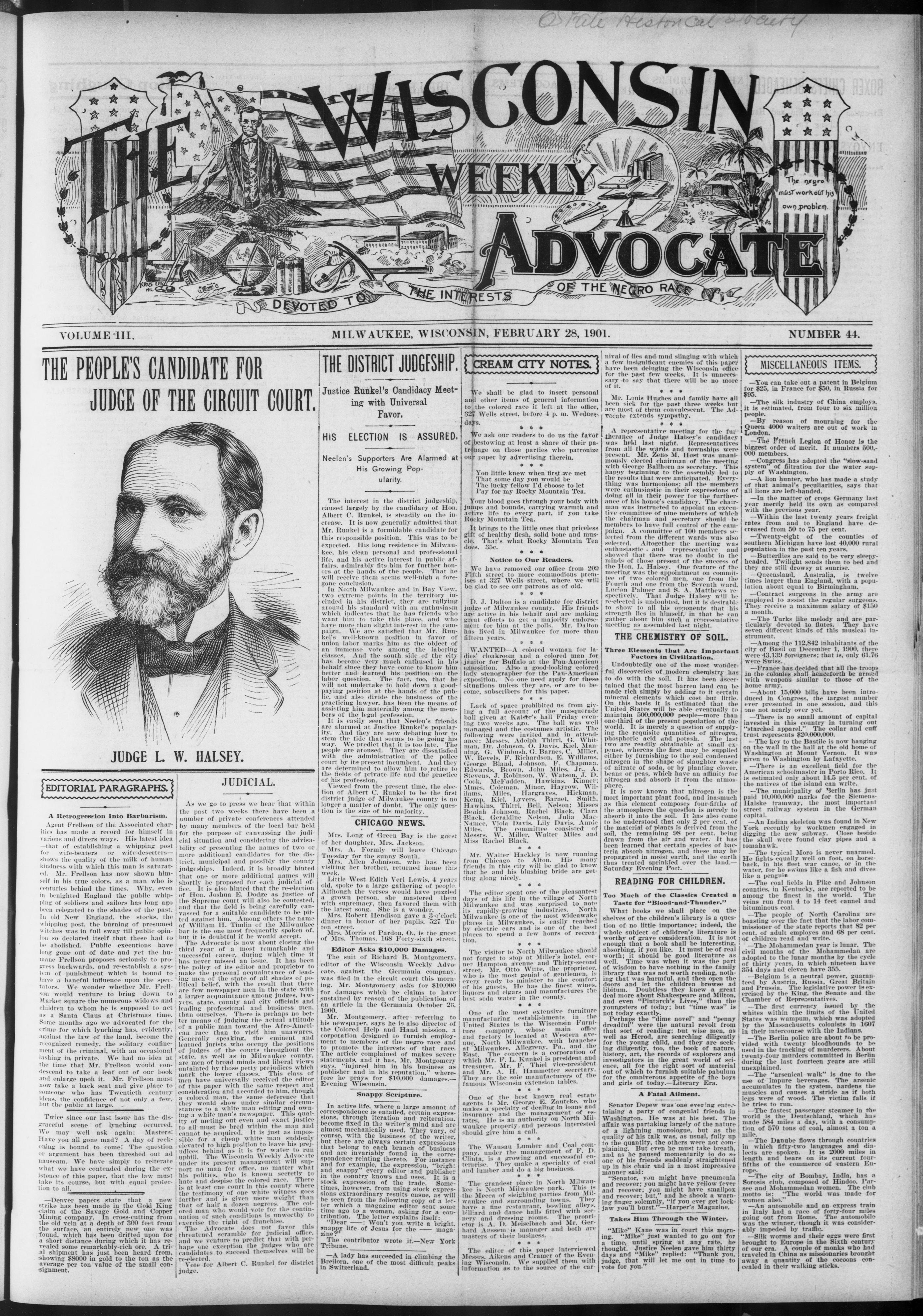
THE PEOPLE'S CANDIDATE FOR JUDGE OF THE CIRCUIT COURT.
VOLUME III.
THE PEOPLE'S CAN
JUDGE OF T
JUDGE L.
EDITORIAL PARAGRAPHS.
A Retrogression Into Barbarism.
Agent Frellson of the Associated charities has made a record for himself in various and divers ways. His latest idea—that of establishing a whipping post for wife-beaters or wife-deserters—shows the quality of the milk of human kindness with which this man is saturated. Mr. Frellson has now shown himself in his true colors, as a man who is centuries behind the times. Why, even in benighted England the public whipping of soldiers and sailors has long ago been relegated to the shades of the past. In old New England, the stocks, the whipping post, the burning of presumed witches was in full sway till public opinion so declared itself that these had to be abolished. Public executions have long gone out of date and yet the humane Frellson proposes seriously to progress backwards, and re-establish a system of punishment which is bound to have a baneful influence upon the spectators. We wonder whether Mr. Frellson would venture to bring down to Market square the numerous widows and children to whom he is supposed to act as a Santa Claus at Christmas time. Some months ago we advocated for the crime for which lynching has, evidently, against the law of the land, become the recognized remedy, the solitary confinement of the criminal, with an occasional lashing in private. We had no idea at the time that Mr. Frellson would condescend to take a leaf out of our book and enlarge upon it. Mr. Frellson must now take a back seat and give place to someone who has Twentieth century ideas, the confidence of not only a few, but the public at large.
Twice since our last issue has the disgraceful scene of lynching occurred. We may well ask again: Masters! Have you all gone mad? A day of reckoning is bound to come! The question or argument has been threshed out ad nauseam. We have simply to reiterate what we have contended during the existence of this paper, that the law must take its course, but with equal protection to all.
Denver papers state that a new strike has been made in the Gold King claim of the Savage Gold and Copper Mining company. In cross-cutting from the old vein at a depth of 300 feet from the surface, an entirely new one was found, which has been drifted upon for a short distance during which it has revealed some remarkably-rich ore. A trial shipment has just been heard from, showing $8000 in gold to the ton as the average per ton value of the small consignment.
JUDICIAL
As we go to press we hear that within the past two weeks there have been a number of private conferences attended by many members of the local bar held for the purpose of canvassing the judicial situation and considering the advisability of presenting the names of two or more additional candidates for the district, municipal and possibly the county judgeships. Indeed, it is broadly hinted that one or more additional names will shortly be proposed for each judicial office. It is also hinted that the re-election of Hon. Joshua E. Dodge as justice of the Supreme court will also be contested, and that the field is being carefully canvassed for a suitable candidate to be pitted against him. Among others the name of William H. Timlin of the Milwaukee bar is the one most frequently spoken of, but it is doubtful if he would accept.
The Advocate is now about closing the third year of a most remarkable and successful career, during which time it has never missed an issue. It has been the policy of its editor and proprietor to make the personal acquaintance of leading men of the state of all shades of political belief, with the result that there are few newspaper men in the state with a larger acquaintance among judges, lawyers, state, county and city officials and leading professional and business men, than ourselves. There is perhaps no better means of judging the actual attitude of a public man toward the Afro-American race than to visit him unawares. Generally speaking, the eminent and learned jurists who occupy the positions of judges of the courts throughout the state, as well as in Milwaukee county, are men of broad minds and liberal views untainted by those petty prejudices which mark the lower classes. This class of men have universally received the editor of this paper with the same respect and consideration and accorded to him, though a colored man, the same deference that they would show under similar circumstances to a white man editing and owning a white man's newspaper. This quality of meting out even and exact justice to all must be bred within the man and cannot be acquired. It is just as impossible for a cheap white man suddenly elevated to high position to leave his prejudices behind as it is for water to run uphill. The Wisconsin Weekly Advocate under its present management will support no man for office, no matter what his politics, who is known secretly to hate and despise the colored race. There is at least one court in this county where the testimony of one white witness goes farther and is given more weight than that of half a dozen negroes. The colored man who would vote for the continuation of such conditions is unworthy to exercise the right of franchise.
The Advocate does not favor this threatened scramble for judicial office, and we venture to predict that with perhaps one exception the judges who are candidates to succeed themselves will be re-elected. Vote for Albert C. Runkel for district judge.
THE DISTRICT JUDGESHIP.
Justice Runkel's Candidacy Meeting with Universal
The interest in the district judgeship, caused largely by the candidacy of Hon. Albert C. Runkel, is steadily on the increase. It is now generally admitted that Mr. Runkel is a formidable candidate for this responsible position. This was to be expected. His long residence in Milwaukee, his clean personal and professional life, and his active interest in public affairs, admirably fits him for further honors at the hands of the people. That he will receive them seems well-nigh a foregone conclusion.
In North Milwaukee and in Bay View, two extreme points in the territory included in his district, they are rallying around his standard with an enthusiasm which indicates that he has friends who want him to take this place, and who have more than slight interest in the campaign. We are satisfied that Mr. Runkel's well-known position in favor of union labor marks him as the object of an immense vote among the laboring classes. And the south side of the city has become very much enthused in his behalf since they have come to know him better and learned his position on the labor question. The fact, too, that he will not undertake to hold down a good-paying position at the hands of the public, and also divide the business of the practicing lawyer, has been the means of assisting him materially among the members of the legal profession.
It is easily seen that Neelen's friends are alarmed at Justice Runkel's popularity. And they are now debating how to stem the tide that seems to be going his way. We predict that it is too late. The people are aroused. They are dissatisfied with the administration of the police court by its present incumbent. And they are determined to allow him to retire to the fields of private life and the practice of his profession.
Viewed from the present time, the election of Albert C. Runkel to be the first district judge of Milwaukee county is no longer a matter of doubt. The only question is the size of his majority.
CHICAGO NEWS.
Mrs. Long of Green Bay is the guest of her daughter, Mrs. Jackson.
Mrs. A. Formly will leave Chicago Tuesday for the sunny South.
Tuesday for the sunny South.
Mrs. Allen Johnson, who has been visiting her brother, returned home this week.
Little West Edith Verl Lewis, 4 years old, spoke to a large gathering of people. Although the verses would have puzzled a grown person, she mastered them with supremacy, then favored them with the latest song. She is a wonder.
Mrs. Robert Hendison gave a 3-o'clock dinner in honor of her pupils, 527 Tuton street.
Mrs. Morris of Pardon, O., is the guest of Mrs. Thomas, 168 Forty-sixth street.
Editor Asks $10,000 Damages.
The suit of Richard B. Montgomery, editor of the Wisconsin Weekly Advocate, against the Germania company, was filed in the circuit court this morning. Mr. Montgomery asks for $10,000 for damages which he claims to have sustained by reason of the publication of an article in the Germania October 26, 1900.
Mr. Montgomery, after referring to his newspaper, says he is also director of the Colored Help and Hand mission, a corporation designed to furnish employment to members of the negro race and to promote the interests of that race. The article complained of makes severe statements, and it has, Mr. Montgomery says, "injured him in his business as publisher and in his reputation," wherefore he prays for $10,000 damages.—Evening Wisconsin.
Snappy Scripture.
In active life, where a large amount of correspondence is entailed, certain expressions, through iteration and reiteration, become fixed in the writer's mind and are almost mechanically used. They vary, of course, with the business of the writer, but there are always certain expressions that belong to each branch of business and are invariably found in the correspondence relating thereto. For instance and for example, the expression, "bright and snappy" every editor and publisher in the country knows and uses. It is a stock expression of the trade. Sometimes, however, from using stock expressions extraordinary results ensue, as will be seen from the following copy of a letter which a magazine editor sent some time ago to a woman, asking for a contribution. The letter explains itself:
"Dear ——: Won't you write a bright
snappy life of Jesus for the —— magazine?"
The contributor wrote it.—New York
Tribune.
—A lady has succeeded in climbing the
Breilorn, one of the most difficult peaks
in Switzerland.
CREAM CITY NOTES.
We shall be glad to insert personal and other items of general information to the colored race if left at the office, 327 Wells street, before 4 p. m. Wednesdays.
We ask our readers to do us the favor of bestowing at least a share of their patronage on those parties who patronize our paper by advertising therein.
You little knew when first we met
That some day you would be
The lucky fellow I'd choose to let
Pay for my Rocky Mountain Tea.
Your blood goes through your body with jumps and bounds, carrying warmth and active life to every part, if you take Rocky Mountain Tea. It brings to the little ones that priceless gift of healthy flesh, solid bone and muscle. That's what Rocky Mountain Tea does. 35c.
Notice to Our Readers.
We have removed our office from 209 Fifth street to more commodious premises at 327 Wells street, where we will be glad to see our patrons as of old.
* * *
D. J. Dalton is a candidate for district judge of Milwaukee county. His friends are active in his behalf and are making great efforts to get a majority endorsement for him at the polls. Mr. Dalton has lived in Milwaukee for more than fifteen years.
WANTED—A colored woman for ladies' cloakroom and a colored man for janitor for Buffalo at the Pan-American exposition. Also a good-looking colored lady stenographer for the Pan-American exposition. No one need apply for these situations unless they are, or are to become, subscribers for this paper.
***
Lack of space prohibited us from giving a full account of the masquerade ball given at Kaister's hall Friday evening two weeks ago. The ball was well managed and the costumes artistic. The following were invited and in attendance: Messrs. Adolph Thirrl, G. Whitman, Dr. Johnson, O. Davis, Kiel, Manning, G. Winbush, G. Barnes, C. Miller, W. Revels, F. Richardson, E. Williams, George Bland, Johnson, F. Chapman, Edwards, Brown, John Miles, Jr., A. Stevens, J. Robinson, W. Watson, J. D. Cook, McFadden, Hawkins, Kinner; Mnes. Coleman, Minor, Hayrow, Williams, Miles, Hargraves, Hickman, Kemp, Kiel, Lyvers, Barnet, Smith, Hawkins, Thirrl, Bell, Nelson; Misses Beulah Johnson, Rachel Black, Clara Black, Geraldine Nelson, Julia MacNamce, Viola Davis, Lily Davis, Annie Miles. The committee consisted of Messrs. W. Miller, Walter Miles and Miss Rachel Black.
** **
Mr. Walter Hackley is now running from Chicago to Alton. His many friends in this city will be glad to know that he and his blushing bride are getting along nicely.
***
The editor spent one of the pleasantest days of his life in the village of North Milwaukee and was surprised to note its rapidly-growing industries. North Milwaukee is one of the most wideawake places in Milwaukee, is easily reached by electric cars and is one of the best places to spend a few hours of recreation.
* * *
The visitor to North Milwaukee should not forget to stop at Miller's hotel, corner Hampton avenue and Thirty-second street. Mr. Otto Witte, the proprietor, who is the most genial of gentlemen, is every ready to minister to the comfort of his guests. He has the finest wines, liquors and cigars and manufactures the best soda water in the county.
```markdown
```
One of the most extensive furniture manufacturing establishments in the United States is the Wisconsin Furniture company, whose main office and factory is located at Western avenue, North Milwaukee, with branches at Milwaukee, Allegreny, Pa., and the East. The concern is a corporation of which Mr. F. L. Kunkel is president and treasurer, Mr. F. Thiel vice-president and Mr. A. H. Hammettter secretary. They are the sole manufacturers of the famous Wisconsin extension tables.
***
One of the best known real estate agents is Mr. George E. Zautcke, who makes a specialty of dealing in loans and insurance and the management of estates. He is an authority on North Milwaukee property and persons interested should give him a call.
***
The Wausau Lumber and Coal company, under the management of F. D. Clinta, is a growing and successful enterprise. They make a specialty of coal and lumber and do a big business.
The grandest place in North Milwaukee is North Milwaukee park. This is the Mecca of sleighing parties from Milwaukee and surrounding towns. They have a fine restaurant, bowling alleys, billiard and dance halls fitted with secrecy and dressing rooms. The proprietor is A. D. Meiselbach and Mr. Gerhard Aussem is manager and both are masters of their business.
The editor of this paper interviewed Messrs. Aikens and Cramer of the Evening Wisconsin. We supplied them with information as to the source of the car-
nival of lies and mud slinging with which a few insignificant enemies of this paper have been deluging the Wisconsin office for the past few weeks. It is unnecessary to say that there will be no more of it.
Mr. Louis Hughes and family have all been sick for the past three weeks but are most of them convalescent. The Advocate extends sympathy.
* * *
A representative meeting for the furtherance of Judge Halsey's candidacy was held last night. Representatives from all the wards and townships were present. Mr. Zeno M. Host was unanimously elected chairman of the meeting with George Ballhorn as secretary. This happy beginning to the assembly led to the results that were anticipated. Everything was harmonious; all the members were enthusiastic in their expressions of doing all in their power for the furtherance of his honor's candidacy. The chairman was instructed to appoint an executive committee of nine members of which the chairman and secretary should be members to have full control of the campaign. A committee of 100 members selected from the different wards was also selected. Altogether the meeting was enthusiastic and representative and showed that there was no doubt in the minds of those present of the success of the Hon. L. Halsey. One feature of the meeting was the appointment on committee of two colored men, one from the Fourth and one from the Seventh ward, Lucian Palmer and S. A. Matthews respectively. That Judge Halsey will be re-elected is undoubted, but it is desirable to show to all his opponents that his strength lies in himself, in that he can gather about him such a representative meeting as assembled last night.
THE CHEMISTRY OF SOIL.
Three Elements that Are Important Factors in Civilization.
Undoubtedly one of the most wonderful discoveries of modern chemistry has to do with the soil. It has been ascertained that the most barren land can be made rich simply by adding to it certain mineral elements which cost but little. On this basis it is estimated that the United States will be able eventually to maintain 500,000,000 people—more than one-third of the present population of the world. It is merely a question of supplying the requisite quantities of nitrogen, phosphoric acid and potash. The last two are readily obtainable at small expense, whereas the first may be supplied either by furnishing to the soil condensed nitrogen in the shape of slaughter waste of nitrate of soda, or by planting clover, beans or peas, which have an affinity for nitrogen and absorb it from the atmosphere.
It is now known that nitrogen is the most important plant food, and inasmuch as this element composes four-fifths of the atmosphere the question is merely to absorb it into the soil. It has also come to be understood that only 2 per cent. of the material of plants is derived from the soil, the remaining 98 per cent. being drawn from the air and water. It has been learned that certain species of bacteria absorb nitrogen, and these may be propagated in moist earth, and the earth thus treated sprinkled over the land.—Saturday Evening Post.
READING FOR CHILDREN.
Too Much of the Classics Created a Taste for "Blood-and-Thunder."
What books we shall place on the shelves of the children's library is a question of no little importance; indeed, the whole subject of children's literature is worthy of grave consideration. It is not enough that a book shall be interesting, absorbing, if you like. It must be of real worth; it should be good literature as well. Time was when it was the part of wisdom to have nothing in the family library that was not worth reading, nothing that was harmful, and then open the doors and let the children browse ad libitum. Doubtless they knew a great deal more about Shakespeare and Milton, and even "Plutarch's Lives," than the youngsters of today; but "time was" is not today exactly.
Perhaps the "dime novel" and "penny dreadful" were the natural revolt from that sort of reading; but wise men, as well as Herod, are searching diligently for the young child, and they are seeking diligently, too, the book of nature, history, art, the records of explorers and investigators in the great world of science, all for the right sort of material out of which to furnish suitable pabulum for the omniverous appetite of the boys and girls of today.—Literary Era.
A Fatal Ailment
Senator Depew was one evering entertaining a party of congenial friends in Washington. He was at his best. The affair was partaking largely of the nature of a lightning monologue, but as the quality of his talk was, as usual, fully up to the quantity, the others were not complaining. But even he must take breath, and as he paused momentarily to do so one of his friends suddenly straightened up in his chair and in a most impressive manner said:
"Senator, you might have pneumonia and recover; you might have yellow fever and recover; you might have smallpox and recover; but," and he shook a warning finger solemnly, "if you ever get lockjaw you'll burst."—Harper's Magazine.
Takes Him Through the Winter.
"Mike" Kane was in court this morning. "Mike" just wanted to go out for a time, until spring at any rate, he thought. Justice Neelen gave him thirty days and "Mike" replied: "Thank you, judge, that will let me out in time to vote for you."
NUMBER 44.
MISCELLANEOUS ITEMS.
You can take out a patent in Belgium for $25, in France for $50, in Russia for $95.
The silk industry of China employs. it is estimated, from four to six million people.
By reason of mourning for the Queen 4000 waiters are out of work in London.
The French Legion of Honor is the biggest order of merit. It numbers 500,-000 members.
Congress has adopted the "slow-sand system" of filtration for the water supply of Washington.
—A lion hunter, who has made a study of that animal's peculiarities, says that all lions are left-handed.
—In the matter of crops Germany last year merely held its own as compared with the previous year.
—Within the last twenty years freight rates from and to England have decreased from 50 to 75 per cent.
—Twenty-eight of the counties of southern Michigan have lost 40,000 rural population in the past ten years.
—Butterflies are said to be very sleepy-headed. Twilight sends them to bed and they are still drowsy at sunrise.
—Queensland, Australia, is twelve times larger than England, with a population about equal to Birmingham.
—Contract surgeons in the army are employed to assist the regular surgeons. They receive a maximum salary of $150 a month.
—The Turks like melody and are particularly devoted to flutes. They have seven different kinds of this musical instrument.
—Among the 112,842 inhabitants of the city of Basil on December 1, 1900, there were 43,139 foreigners; that is, only 61.76 were Swiss.
—France has decided that all the troops in the colonies shall henceforth be armed with weapons similar to those of the home army.
—About 15,000 bills have been introduced in Congress, the largest number ever presented in one session, and this one not nearly over yet.
—There is no small amount of capital invested in this country in turning out "starched apparel." The collar and cuff trust represents $20,000,000.
—The key to the Bastile is now hanging on the wall in the hall at the old home of Washington at Mount Vernon. It was given to Washington by Lafayette.
—There is an excellent field for the American schoolmaster in Porto Rico. It is estimated only about 14.5 per cent. of the natives of the island can write.
—The municipality of Berlin has just paid 10,000,000 marks for the Siemens-Halske tramway, the most important street railway system in the German capital.
An Indian skeleton was found in New York recently by workmen engaged in digging the new subway. Close beside the skull were found clay pipes and a tomahawk.
The typical Moro is never unarmed. He fights equally well on foot, on horseback, in his fleet war canoe, or in the water, for he swims like a fish and dives like a penguin.
The coal fields in Pike and Johnson counties, in Kentucky, are reported to be among the finest in the world. The veins run from 4 to 14 feet cannel and bituminous coal.
The people of North Carolina are boasting over the fact that the labor commissioner of the state reports that 82 per cent. of adult employees and 68 per cent. of children read and write.
The Mohammedan year is lunar. The civil months of the Mohammedan are adopted to the lunar months by the cycle of thirty years, in which nineteen have 354 days and eleven have 355.
Belgium is a neutral power, guaranteed by Austria, Russia, Great Britain and Prussia. The legislative power is exercised by the King, the Senate and the Chamber of Representatives.
The first currency issued by the whites within the limits of the United States was wampum, which was adopted by the Massachusetts colonists in 1607 in their intercourse with the Indians.
The Berlin police are about to be provided with twenty bloodhounds to be used in the tracking of murderers. About twenty-four murders committed in Berlin during the last fourteen years are still unexplained.
-The "arsenical walk" is due to the use of impure beverages. The arsenic accumulates in the system, hardens the muscles and causes a stride as if both legs were of wood. The victim falls if he tries to run.
-The fastest passenger steamer in the world is the Deutschland, which has made 584 miles a day, with a consumption of 570 tons of coal, almost a ton a mile.
-The Danube flows through countries in which fifty-two languages and dialects are spoken. It is 2000 miles in length and bears on its current four-fifths of the commerce of eastern Europe.
-The city of Bombay, India, has a Sorosis club, composed of Hindoo, Parsee and Mohammedan women. The club motto is: "The world was made for women also."
—An automobile and an express train in Italy had a race of forty-four miles going out from Rome. The automobile was the winner, though it was considerably impeded by traffic.
—Silk worms and their eggs were first brought to Europe in the Sixth century of our era. A couple of monks who had traveled in China as missionaries brought away a quantity of the cocoons concealed in their walking sticks.
BOXER CHIEFS BEHEADED.
Execution of Chih Siu and Hsu Cheng Yu.
Several of the Foreign Ministers Are Inclined to Oppose Further
Pekin, Feb. 26.—A crowd of fully 10,000 persons witnessed the execution of Chih Siu and Hsu Cheng Yu, who were beheaded here today in accordance with the demands of the powers. The members of the various legations were conspicuously absent, feeling that if they were present they might seem to be gloating over their fallen adversaries. Every power, however, was largely represented by military officials and soldiers and there was also present a staff from each of the foreign powers. Besides these many missionaries witnessed the executions. The condemned men met death stoically. In each case one blow severed the head from the body.
At the time the execution was being carried out the ministers held a meeting and determined on the part of the majority to draw a curtain over further demands for blood. United States Special Commissioner Rockhill sided strongly with those favoring humane methods, who are Sir Ernest Satow and MM. Komura, Colagan and De Giers, respectively British, Japanese, Spanish and Russian ministers. Others believe that China has not been sufficiently punished and that men should be executed in every city, town and village where foreigners were injured.
The minority is composed of those who were not here during the siege, with the exception of Dr. Mumm von Schwarzenstein, the German minister, while those who were besieged here are of a more peaceable frame of mind, including M. De Giers and Senor De Cologan, both of whom are of the opinion that it is a mistake to let those who had suffered like the besieged ministers did to conduct the peace negotiations with the Chinese.
It is safe to say that little more bloodshed will be demanded. Another important point that was brought up at the meeting was that of the legation quarters. Mr. Rockhill impressed the ministers by his remarks regarding the protest of Sir Robert Hart (chief of the Chinese imperial maritime customs) against the seizure of his property to increase the area of the legation, saying that the services rendered the powers by the financial representatives of China should have prevented the indignities and spoliation inflicted. The feeling is general that Italy should recede from her position and return the property she has taken, and that if necessary for her to increase her legation, she should take land elsewhere. Reports from Shen Si province show that suffering due to the famine there is increasing.
Washington Photographer Asks Him to Shave Off Moustache and Look Better.
Washington, D. C., Feb. 27.—Rather a queer request has been sent to Vice-President-Elect Theodore Roosevelt. A Washington photographer would like to have the incoming vice-president shave off his mustache before being inducted into office.
He says that it has been fifty years since two such handsome men as McKinley and Roosevelt have been inaugurated. This genius of an artist further says that Roosevelt would appear to much better advantage smooth shaven, and that the pictures of the two leading citizens of the United States would go together a great deal better if "Teddy" would sacrifice his mustache.
In answer to the suggestion that Roosevelt's front teeth would be too prominent, the picture man replied: "No, no; just the opposite. The waving dark mustache now makes the teeth all the more prominent."
It is said that a New York photographer has a picture of Teddy Roosevelt taken more than twenty years ago, when he was smooth faced, and that it is a very handsome profile of the vice-president.
AGREED TO BY CUBANS.
Constitutional Convention in Session at Havana Completes Its Work.
Havana, Feb. 27.—The constitutional convention remained in session until 3 o'clock this morning completing the work of drawing up the clauses in the constitution referring to the relations between Cuba and the United States. A public session will be held this evening to sign the following resolutions, which have been adopted:
1. The government of Cuba will not make a treaty or agreement with any foreign power which may compromise or limit the independence of Cuba, or which may permit or authorize any power to obtain by means of colonization or for military or naval purposes, or in any other manner any foothold or authority or right over any portion of Cuba.
2. The government will not permit its territory to be used as a base of operations for war against the United States or against any foreign nation.
3. The government of Cuba accepts in its entirety the treaty of Paris, in which are affirmed the rights of Cuba, inasmuch as the obligations which are explicitly indicated in these and especially those which the international law imposes for the protection of life and property, and substitutes itself for the United States in the pledge, which they assumed in that sense according to articles 12 and 162 of the treaty of Paris.
4. Cuba recognizes as legally valid all acts of the military government during the period of occupation, also the rights arising out of them, in conformity with the joint resolution and the Foraker amendment and the existing laws of the country.
5. The governments of the United States and Cuba ought to regulate their commercial relations by means of a treaty based on reciprocity and with tendencies towards free trade in natural and manufactured products, mutually assuring ample special advantages in their respective markets.
BANK ROBBERS FOILED.
Explosion Aroused Citizens and Cracksmen Seek Safety in Flight. Youngstown, O., Feb. 27.—Four masked men tried to rob the Farmers' National bank at Canfield, ten miles from here, early this morning. Explosions in attempting to open the safe aroused the citizens and the would-be bank robbers sought safety in flight. They had a team and light wagon and were pursued several miles, but have not been overtaken.
Fight Bodies Recovered.
Kemmerer, Wyo., Feb. 27.—Eight bodies were recovered today from the Diamondville mine where thirty-two men perished in Monday's fire. Fire damp finally drove out the searchers and it is probable no more bodies will be recovered for several days.
Citizens Batter Down Jail Doors, Secure the Offender and Lynch Him.
Terre Haute, Ind., Feb. 26.—George Ward, 27 years old, a colored man, was arrested today, and, according to the police, has confessed having murdered Ida Finklestein, the school teacher who was found dying last evening in a grove outside the city. In his confession he said Miss Finklestein taunted him about his color and then struck him in the face. In a fit of anger he shot her and then cut her throat. A blood-stained knife found in his pocket corroborated the statement.
At 12:30 p. m., a mob, wrought to a tremendous pitch of fury, gathered in front of the city jail, and battered down the outer door. Jailor Lawrence O'Donnell appeared with a shotgun and fired over the crowd in a vain effort to stampede them. Three deputy sheriffs were wounded by shots from the crowd. At 12:45 they succeeded in reaching Ward. He was quickly dragged out to the street and lynched
WITHOUT WARNING.
Night Shift of Twenty-six Men Work in Wyoming Mine When a Fire Breaks Out.
Kemmerer, Wyo., Feb. 26.—Twenty-six men, whose names are as yet unobtainable, undoubtedly have perished in a fire which was discovered last evening in the sixth level of the Diamondville Coal mine, No. 1. Only one man, John Anderson, was able to reach the main shaft and make his escape, so quickly did the fire spread through the level.
Fire was discovered in the sixth level of the mine late last evening. No one knows how it started. The night shift had been at work several hours, and were unaware of their danger. They were scattered along the working, some distance from the main lead.
John Anderson was the nearest man to the opening of the level into the shaft. He gave the alarm, which was passed down the tunnel, and then, placing a heavy overcoat over his head began a desperate battle with the smoke, fire and deadly fumes of gas, to reach the main lead, where escape might be possible. By this time the outside men of the colliery had learned of the fire and several went down in the hope of rescuing the imprisoned miners. At the opening of the level where the flames were at work they found Anderson, completely exhausted. He was carried to the open air and soon revived, although he was severely burned about the body. Anderson explained the situation in which his companions were placed and every effort was made to reach the imprisoned men.
Every plan known to mining experts and the officials of the company was quickly put into operation for the checking of the fire, but without apparent effect. The level was "plugged" at its opening, about two miles from the mouth, in order to check the draught through the workings and thus kill the fire. Bands of men went down the shaft repeatedly and tried to face the flames which were eating their way through the level, but they were invariably compelled to retreat. There was no let-up in the efforts to get into the level, however, and this despite the almost absolute certainty that none of the imprisoned men can now be alive.
There were a number of horses in the workings and the older miners still hope that the imprisoned men may have found a way to fight off the flames, and that they will subsist on horsemeat until rescuers can reach them.
BAD WRECK ON WABASH
Many Passengers Severely Injured Cars Roll Down an Embankment.
Millersburg, Ind., Feb. 26.—Train No. 9, westbound, on the Wabash road, was wrecked near here early today by a broken rail. The entire train was derailed. While many of the passengers were hurt, no one was killed. Among the injured are: J. A. Seligman, baggage agent on Erie railway.
Rev. J. W. Vanderilp of Ransom, Kas.
J. A. Lorlmer of Chicago.
J. A. Lorimer of Chicago.
Mrs. J. A. Lorimer, hurt internally; will
die.
Mrs. S. E. Baker of Chicago, internally injured and badly bruised.
W. L. Gomez of Schenectady, N. Y., head badly cut.
Abraham Fowler of Corning, Mont., back believed to have been broken; probably will die.
H. Kuschke of Wilkesbarre, Pa., bruised; not serious.
Special trains were hurried to the scene from all nearby points, bearing surgeons and nurses.
Kalamazoo, Mich., Feb. 26.—A special to the Telegraph from Wolcottville, Ind., says that in the wreck of Wabash train No. 9 twelve passengers were severely injured, several of whom will die. All the passengers were more or less bruised and injured.
Six cars comprising the train left the tracks and rolled down a steep twenty-foot embankment. Some of the coaches turned over several times.
TWO COMMIT SUICIDE.
Ying Lien and Chao Shu Chao Expiate Their Crimes-Rockhill in Conger's Place.
Pekin, Feb. 26.—The Chinese report that Ying Lien and Chao Shu Chao committed suicide on Sunday in the presence of the governor of the Province of Shen Si. The Japanese have delivered Hsu Chang Yu to the board of punishment for execution.
The German expedition which started from Tien Tsin on last Wednesday for Tungun for the purpose of collecting a fine which had been previously imposed on the latter town found a British force at the place with orders to stop the squeezing of the Chinese. The British refused to allow the fine to be collected pending an explanation from the German authorities.
Voting by Wire.
A Chicago electrician is maturing a plan whereby aldermen may vote by wire. The plan is that each alderman's desk be wired and furnished with a "yea" and "nay" button. When the roll is called the alderman would simply press the button he wishes and his vote would be recorded on an electrical register on the clerk's desk.
A Useful Explanation.
There are few people who have not been occasionally puzzled to write "ei" or "ie" in the words that so represent the sound of the long e. A very simple rule, however, removes all difficulty. If the diphthong immediately follows the letter c it is always "ei," as in ceiling, conceive, etc.; but when it follows any other letter it is always "ie," as in grief, niece, friend, etc.
"There's a lesson in that would-be Western epicure who died after eating six pigs' feet." "What is it?" "That four feet are enough for any pig."—Philadelphia Times.
Machine stitching will be as popular as ever in spring.
--Barney Loh, 27 years old, fell down an elevator shaft at the factory of the Western Shade and Cloth company. He was injured internally.
--Mrs. Dora Seeberg, 32 years old, committed suicide by hanging herself to a hinge on a door. A note was found on the table saying that she was tired of living.
--While her mother was lying sick in bed Teressa McCuada, 2 years old, climbed upon a chair in the sickroom and drank a glass of medicine. She was immediately taken sick and died before a physician could be summoned.
The body of A. C. Schultz, 50 years old, was found in a rooming-house by an employee of the house. The dead man was lying on a bed in one of the rooms of the place, dressed in his underclothing. Nothing was found in the room which would indicate what caused his death.
Joseph Doubk caught his right foot between the wall and floor of an elevator car and severely crushed it. He was removed to his home. His condition is serious.
Morris Sampson, 11 years old, was struck by a coal wagon near his home and died at the county hospital, after an amputation of his left leg.
Policeman Stephen P. Rowan—"Big Steve"—probably the most picturesque and best-known patrolman in Chicago, died at his home. Rowan had been on the police force for twenty-eight years.
—Fire in P. Ringer & Co.'s bookbindery caused a damage of $50,000, caused a panic in the Vernon hotel, caused uneasiness in the Grand Opera house and Dearborn theater, and kept the firemen busy for an hour.
—James A. Patten, alderman of Evanston for pastime and speculator on the board of trade for profit—or sometimes for loss—became richer by $60,000 to $100,000 as the result of a successful six-weeks' campaign in May corn.
—Curtis Stephens, a laborer, was struck by a Chicago & North-Western railroad express train in Evanston and instantly killed. Stephens was 27 years old, and lived at 415 Rinn street. He leaves a widow and a child.
Mrs. Louisa Bervert observed an old German custom of keeping the Christmas tree until Easter, and while she was lighting the candles on it last night she knocked the tree over. It fell on her, and before she could be extricated she was badly burned about the back and head. The house caught fire and the firemen came. Mrs. Bervert is 30 years old. She was cared for at her home.
David Robertson, who for thirty-four years had been connected with Pinkerton, National Detective agency, died at his residence, of cancer, from which he had been suffering for the last year. Mr. Robertson was born in Perth, Scotland, in 1838, and lived there until he was 28 years of age, arriving in America in 1866.
Joe Behrns was literally baked to death in an oven in the plant of the Illinois Steel company at South Chicago. Behrns was employed by John Jones, a contracting mason, and was engaged in repairing the brick walls inside the furnace. The natural gas in the furnace was turned on by someone. Behrns carried a lantern with him. The gas ignited from the flame and before Behrns could be extricated he was burned.
After brooding for five years over the separation from her husband, Mrs. Emma C. Cotter, well known in west side society, ended her life by drinking the contents of a four-ounce bottle of carbolle acid at the home of her mother, Mrs. W. A. La Parle. Mrs. Cotter was 41 years old. Some time ago eczema attacked her feet, and friends had told her amputation of one of her feet might be necessary. Some said last night that this might have led to her suicide. Mrs. La Parle, who is 80 years old, however, believes her daughter's devotion to her husband led to the act.
Dealing with Crimes in Canada. (From the Chicago Times-Herald on Jan. 12, 1901.)
The citizens of the Dominion of Canada have just cause to be proud of their record as law-abiding people. The annual report of the criminal statistics of the Dominion, which has a population of over 6,000,000, shows that there were only twenty-five indictments for murder in 1890, of which only two were left without final action. Eleven of those indicted were hanged, nine acquitted and three confined as insane.
Canada is a country of vast proportions. Its people are scattered over a wide stretch of territory, making police surveillance particularly difficult and in many districts impossible. Yet a city like New York or Chicago alone furnishes a far greater criminal list every year than the whole vast stretch of territory from Quebec to Vancouver.
The Canadians ascribe their immunity from crime to the promptness with which punishment is meted out to offenders. When a man is caught red-handed in the act of robbing another he is not released on straw bail by some justice of the peace from the slums, to go out and repeat the offense. Sharp and sure justice is meted out to criminals of all kinds, the result being that when the guardians of the public peace succeed in bringing a thug to the bar they are seldom called upon to hunt him a second time.
Furthermore, there are few court delays in Canada when a criminal is brought to book. They have no Dreyer cases over there. There are no methods whereby Canadian criminals can have the proceedings stayed from month to month and from year to year or after being convicted, appeal from one court to another until witnesses die of old age or opportunities for corruption can be found.
Nor does this swift method of treating with wrong-doers in Canada leave the innocent unable to properly defend themselves. They have all the opportunities and privileges that our own laws extend to them. The extent to shield the guilty is lacking—that is all
The above taken from the editorial column of the Times-Herald gives some idea of the immunity from crime that exists in Canada, and this is one of the many inducements held out for Americans to settle in the district known as Western Canada. The season of 1901 will see a few new sections of the country opened up for settlement. They are attractive in every respect. It is understood that one of the best Indian reserves in the famous valley of the Saskatchewan will be opened up this year, and an invitation is extended to those desiring homes to make inquiries. The price of the land is said to be nominal. Besides these lands, the several railway companies have lands to sell; also the government. For particulars write to the agent of the government, whose advertisement appears elsewhere.
Senate.
The Senate on the 21st concurred in Mr. Gilman's bill making attempted bribery a felony. It provides that anybody who shall advise or attempt a felony which falls shall be fined from $100 to $1000 or imprisoned from one to three years in cases where no punishment for such attempts is provided for by law. The Senate passed Senator Devos' bill amending the act conferring upon street railway companies the right of eminent domain. The Senate passed a bicycle sidepath bill, which is a duplicate of the bill which the Assembly fought over and finally rereferred to a committee. When Mr. Lenroot's bill relating to the reassessment of void special assessments was passed a time limit was overlooked and this morning a bill was rushed through both houses to correct the defect. The committee on charitable and penal institutions reported for indeninite postponement the bill transferring the school for deaf from the supervision of the board of control to that of the normal regents. Senator Mosher's bill prohibiting the insurance of state property was reported favorably by the state affairs committee, with an amendment making provision for rebuilding by the university or normal regents in case of fire. A bill was passed providing that monneys received from the government for the Wisconsin National guard, in payment for state property used in the war with Spain, may be used for improvement at Camp Douglas.
The Senate passed the new life insurance tax bill with a slight amendment on the evening of the 25th, and later the Assembly concurred in the amendment. The bill will be signed by the governor at once and then become a law. There was a lively scrimmage over the question of suspending the rules, in which seven senators voted against suspension, not because they were opposed to the bill, but because they were against the growing custom of suspending the rules for the passage of bills. The bill was brought in by the Senate committee on finance, banks and insurance, which held a meeting just before the session and agreed upon an amendment to the bill, providing against double retaliation. The amendment almost entirely changes the second provision for retaliation.
The Senate on the 26th passed the Osteopathy bill without debate by a vote of 17 to 7. The bill was sent to the Assembly immediately. The Senate unanimously adopted Senator Roehr's joint resolution for a constitutional amendment allowing the Legislature to pass a general banking law. Senator Green's was the only dissenting voice in the vote of concurrence in Mr. Gilman's bill providing a penalty for attempted felony. Eight bills were ordered engrossed.
Fourteen petitions for and three remonstrances against the primary election bill were presented in the Senate on the 27th. Invitations were received from Gov. and Mrs. La Follette to attend the reception to the state editors, and from Director Comstock of Washburn observatory to members of the Legislature and state officials to visit the observatory to look at the moon and a brilliant new star through the big telescope. The judiciary committee reported for indefinite postponement the bill requiring the university regents to pay assessments for street and sewer improvements and sprinkling on streets adjoining university property. The bill increasing judges' salaries was reported favorably with a compromise amendment which increases the salaries of Supreme court justices from $5000 to $6000 a year, and of circuit judges from $3600 to $4000 with $400 a year for expenses, as now. The good roads resolution for constitutional amendment permitting state aid was reported without recommendation by the committee on roads and bridges. Bill No. 39 S., relative to terms of court in the Twelfth judicial circuit, was passed.
Assembly.
Among the remonstrances received by the Assembly on the 21st was one signed by ex-Gov. Upham and twenty others against the passage of the Hall railroad commission bill. A long debate over a bill relating to allowances to widows served to lengthen the session. The following Assembly and Senate bills were passed and concurred in. To provide bounty for killing of wolves, etc.; relating to fees for return of notice of births; relating to appointment of assistants by county clerk; relating to allowance to widows; relating to county superintendents of poor; relating to county courts; relating to use of false weights and measures; relating to service of notices to quit; relating to evidence in certain cases. Mr. Johnson's bill, 363 A., prohibiting the depositing of drugs, etc., upon the premises of another, was rereferred. Mr. Collins' bill, 330 A., authorizing the state to loan trust funds to Portage county, was ordered to a third reading. Mr. Henry's bill, 301 A., requiring all license money to be paid to counties for the support of the poor and to pay the cost of criminal trials, was killed. The Assembly adjourned until the 25th.
The Assembly for more than an hour on the evening of the 25th engaged in an animated debate over Assemblyman Lenroot's joint resolution to raise the debt-limit of cities that desire to acquire municipal utilities from 5 to 10 per cent., and finally decided by a vote of 37 to 48 to kill the measure. Assemblyman Orton lead the opposition to Mr. Lenroot's resolution. He explained that the 5 per cent. limit had been inserted in the constitution as a safeguard against allowing irresponsible councils to overburden cities in debt. He said that a movement is now on to increase the assessed valuation of property throughout the state, and if this was done, there would be no need of the resolution because the debt-limit would thus become greater by expanding. The Assembly had a long calendar but it took so much debate to decide the Lenroot and the insurance matters that the calendar was laid over.
The Assembly received the Osteopathy bill with marked hostility on the 26th. It was finally referred to the committee on public health and sanitation. The Assembly passed Mr. Keene's bill relating to the election of ward officers in Milwaukee. It provides that when a ward is divided the officers who happen to reside in the portion set off for a new ward shall continue to serve to the end of their terms and the old ward shall elect new officers. Other bills passed were: No. 33 A., relating to ditches and drains; 120 A., relating to the insane; 123 A., relating to absent prisoners; 131 A., relating to felony; 160 A., relating to the insane; 209 A., authorizing assignee of debtor to bring action. Mr. Dodge opposed the bill providing for the appointment of additional dairy and food inspectors, which was on the calendar for engrossment and third reading, and it was laid over. Mr. Spratt's bill relating to illegal voting was referred, as was Judge Orton's bill relating to the right of prison officials to shoot escaping prisoners.
Once more the Wisconsin Legislature has taken a step in the direction of adopting the voting machine. Two years ago an effort was made in the same direction, but it failed. On the 27th the Assembly committee on privileges and elections reported for passage a joint resolution for a constitutional amendment permitting the use of voting machines, and it will go on the calendar. The committee on public health and sanitation reported adversely upon the bill forbidding the manufacture and sale of beer or liquor within a mile of the university or the state capitol and within 500 feet of any building or church in the state. Mr. Collins' bill, No. 330 A., authorizing Portage county to borrow $80,000 from the state funds, was passed and Senator McGillivray's bill, No. 43 S., relating to persons authorized to solemnize marriages, was concurred in. When Mr. Thomas' bill, No. 107 A., to authorize the levy of special highway tax in towns was reached a large number of amendments were offered and after they had been read the bill was reereferred to the committee. A substitute for Mr. Smith's bill, to provide a memorial hall in the state capitol in honor of soldiers and sailors was on the calendar for engrossment and third reading, and after a long debate, it was sent to the committee on claims. Mr. Whitson's bill, No. 259 A., to authorize Emil Thomas to erect a dam across Prairie river, was passed under suspension of the rules.
SPORTING NEWS.
The veteran "Jim" O'Rourke, who is secretary of the Connecticut league, and owner, manager and catcher of the Bridport club of that organization, and who played with the New York league club for so many seasons, says: "Sunday baseball and all other forms of
healthful exercises I am in favor of most heartily, independent of all monetary considerations. No good or sensible argument can possibly be advanced against it. Everything can be said in its favor. The masses who are employed six days a week in close confinement will one day rise as a unit and demand such legislation as will give them the right without violation of the law of Sunday recreation. It ought to be, and should meet with no objections so long as in the exercise the individual rights of others are not encroached upon."
Arthur Irwin says he has signed First Baseman Bob Stafford for his Boston American association team. Stafford was with the Milwaukee team for three years and was released to make room for Bill Clark. Irwin also says he has arranged to play practice games with the Montreal team in Boston during the second week in April.
* * *
Hillebrand, the crack twirler of the Princeton Tigers, who was generally credited with being the star of college baseball last season, has, according to the New York Sun, been secured by the Boston National league club. His brilliant record with "Old Nassau" indicates that he has more than an even chance to secure regular employment in the major organization all summer long.
Dale Gear may retire for good from the diamond if his law practice continues as brisk as it has been during the winter. Should Dale quit Jimmy Manning would lose a good pitcher, but when the sun comes out strong and the baseball fans begin moving about Dale will forget about his law practice and take to the slab again.
With Johnnie McGraw away, the St. Louis Cardinals are woefully weak at the third corner, and the Messrs. Robison will realize it. It appears that they recently offered Owner Barrows of the Toronto (Eastern league) club $2000 for the release of "Bob" Schauin, who is reported the likeliest sort of an infielder. The Robisons' liberal offer was turned down, and the Cardinals remain minus a third-sacker. Schaub played for Jimmy Manning, but was not considered above the average.
* * *
A bill now before the New York Legislature legalizing Sunday ball-playing in that state is said to be backed by Andrew Freedman. The statement is also made that this is only a small part of what Freedman is anxious to do for the good of baseball in New York city. If the bill is passed it will allow of ball-playing in every city and town in the state. The Eastern league will gain by it in Buffalo, Rochester and Syracuse. Brooklyn would also make money, and New York would be a regular Klondike.
It is announced once more that John Anderson has signed a contract to play with the Milwaukee club again the coming season. The fact is Brooklyn had no valid claim to Anderson, as he was not held in any way by Ned Hanlon.
---
Senate.
Thursday, Feb. 21.—Considered postoffice appropriation bill. Amendment providing for pneumatic tube service killed. The old controversy over the special appropriations for fast mail service engaged much attention. It was decided to begin holding night sessions Friday night.
Friday, Feb. 22.--Passed two of the great supplybills—the postoffice and the diplomatic and consular appropriation. During the greater part of the session a proposition to discontinue the appropriations for fast mail facilities from New York to New Orleans via Atlanta and from Kansas City, Mo., to Newton, Kas., was under discussion. By a decisive vote the appropriations were continued. An effort was made to obtain an appropriation to continue the pneumatic tube service in New York, Boston and Philadelphia, but it failed. An amendment was agreed to authorizing the postmaster-general to investigate the question of establishing a postal telegraph system and to report his findings to the next Congress. After a spirited debate the conference report on the Indian appropriation bill was rejected and sent back to conference. Early in the day, Washington's farewell address, in accordance with a custom of the Senate on Washington's birthday, was read, the reader being Senator Bacon of Georgia.
Saturday, Feb. 23.—Passed St. Louis exposition appropriation bill, with amendments for Sunday closing and an appropriation of $250,000 for the Charleston exposition next December. Passed fortification appropriation bill.
Monday, Feb. 25.—Devoted the day to debate on the Philippine amendment to the army appropriation bill.
Tuesday, Feb. 26.—Important amendment to Phillipine amendment to army appropriation bill was agreed to. It was amplification of amendment previously offered by Mr. Hoar, laying restrictions upon sale of public lands and granting of franchises and concessions in Philippines. Mr. Morgan (Ala.) continued his speech on both the Phillipine and Cuban amendments. He appealed to the committee to withdraw both propositions, maintaining Congress was treading upon dangerous ground. During the afternoon Mr. Allen severely arraigned Rear Admiral Sampson for indorsements upon application of Chief Gunner Charles Morgan of the navy for promotion to grade of commissioned officer. Conference report upon District of Columbia appropriation bill was agreed to, as was also partial report of conferees on postoffice appropriation bill.
Wednesday, Feb. 27.—Day devoted to debate on the Cuban and Phillppine amendments to the army bill, after which voting began on the minor amendments to the measure. All of them were offered by Democratic senators, and all of them were voted down by heavy majorities. Phillppine amendment adopted by a vote of 45 to 25. Cuban amendment adopted by a vote of 43 to 20.
House.
Thursday, Feb. 21.—Passed deficiency appropriation bill, after day of exciting debate.
Friday, Feb. 22.—Devoted an hour to unanimous consent legislation and two hours and a half each to the passage of private claims bills and private pension bills and 139 pension bills were passed. Among the latter was the Senate bill to pension the widow of the late Gen. Henry W. Lawton, who was killed in the Philippines. As the bill passed the Senate it carried $100 a month. The House cut the amount down to $50 upon the representation that Mrs. Lawton enjoyed a comfortable income.
Saturday, Feb. 23.—Adopted a resolution to investigate the pay of its employees. The bill to increase the efficiency of the revenue cutter service was debated for two hours, but no action was taken. Several of the appropriation bills were sent to conference. The seed amendment to the agricultural bill was agreed to. At 4 o'clock public business was suspended to permit the House to pay tribute to the memories of the late Representative Clarke of New Hampshire and Shaw of New York. Monday, Feb. 25.—Devoted the day to conference reports. Concurred in Senate amendment to navy bill, striking out appropriations for new battleships and cruisers.
Tuesday, Feb. 26.—Agreed to a partial conference report on Indian appropriation bill, and sent bill back to conference; defeated conference report on the naval bill on account of item creating assistant chiefs in navy department. Adjournment taken in the midst of violent attack upon the speaker by Congressmen Lentz, Richardson and others because a speech by Mr. Lentz had been withheld from the Congressional Record on account of its offensive nature.
Wednesday, Feb. 27.—Day spent in consideration of various conference reports. Reports on fortification, District of Columbia and military academy bills, the latter containing anti-hazing legislation, were agreed to. Naval bill bill was sent back to conference after defeat of a motion to concur in the Senate's provision for three more submarine torpedo boats. St. Louis fair bill was sent to conference for a settlement of differences.
There's nothing so bad for a cough as coughing. Every cough makes your throat more raw and irritable. Every cough congests the lining membrane of your lungs. Cease tearing your throat and lungs in this way. Take
Ayer's Cherry Pectoral
From the first dose the quiet and rest begin; the tickling in the throat ceases; the cough disappears.
There's nothing so good for a cough as Ayer's Cherry Pectoral. Three sizes: 25c., 50c., $1.00.
If your druggist cannot supply you, send us one dollar and we will express a large bottle to you, all charges prepaid. Be sure you give us your nearest express office. Address, J. C. AYER Co. Lowell, Mass.
CITIZEN ARMY FOR AUSTRALIA
New Federation Taking Steps to Provide for National Defense. The idea of a citizen army for the Australian Commonwealth is taking a very strong hold of a large section of the people, writes the Melbourne correspondent of the London Express. The scheme which seems most likely to be adopted, is that formulated by Brig.- Gen. Gordon, commandant of the South Australian forces, under which every man who is physically fit and between the ages of 18 and 21 will be taught to shoot, will undergo an army training for a certain number of weeks every year, and will undertake to join the ranks of the Federal Volunteer army whenever necessity arises.
The federal government would, under this scheme, provide instruction, arms, accountments, ammunition and uniform, and would pay each man who made himself efficient a bonus of £10 to £30 a year for non-coms, and regular army pay for officers. Each state would raise sufficient men to guarantee immunity against attack by a foreign foe and would supply the needs of the empire in the event of any such emergency as that which in South Africa has found so loyal and enthusiastic response. Under this scheme it is calculated that it would not be difficult to raise within five years a capable and efficient citizen army of 300,000 men.
A WISE DRUGGIST.
For $5.00 He Guarantees to Do That for Which a Lady Offers Him $100.00.
Kansas City, Mo., Feb. 25, 1901. (Special.)—Some two years ago a local druggist engaged in a transaction which was in its details somewhat remarkable. He was visited by Miss Anna P. Nichols, who had a doctor's prescription for rheumatism, which the druggist was filling. In the course of conversation the good lady said: "I would give one hundred dollars to get well."
He immediately replied: "Give me five dollars and I will guarantee to cure you."
She agreed, and he at once handed her a box of Dodd's Kidney Pills, saying: "They are 50c a box. Two boxes may cure you, but I am quite sure that ten will."
Miss Nichols tells the story as follows: "Dodd's Kidney Pills are veritable life preservers. I was troubled for five years with rheumatism, so that at times my right arm seemed paralyzed and I could only walk with difficulty, and could not go out of doors if the air was damp or cold. I took so much medicine that I think my system was poisoned rather than helped. One day when my druggist was putting up a prescription for me I remarked to him that I would give one hundred dollars for a remedy that would make me better.
"Give me five dollars and I will guarantee to cure you,' he said. I readily agreed, and he handed me a box of Dodd's Kidney Pills, saying, 'They are 50c a box. Two boxes may cure you, but I am sure that ten will.' I left my prescription intact and, instead, took these Pills, and I found them, as I said before, to be veritable life preservers. Before I had finished the second box I had my first perfect night's rest in years. I gradually improved. I had determined to use the ten boxes before I would give up, but imagine my surprise to find that before half that quantity was used I was completely cured. This was two years ago, and I have not had a twinge since."
Miss Nichols is Vice-Grand Baxter, Rebekah Lodge, I. O. O. F., and is one of the best known and most highly respected ladies in Kansas City, and her experience will be read with interest by her many friends.
Dodd's Kidney Pills never fail to cure Rheumatism. They are 50c a box, six boxes for $2.50. Buy them from your local dealer if you can. If he cannot supply you, send to the Dodds Medicine Co., Buffalo, N. Y.
The Plague Not a Menace.
Two Belgian specialists, who were sent to Glasgow to study the plague question, decided that under proper sanitary conditions the plague is not a serious menace in any European cities.
Flattened and Squeezed.
Astronomers figure out that the diameter of the earth at the equator varies 3048 feet, so that our planet is not only flattened at the poles, but slightly squeezed in the middle.
Moves the bowels each day. In order to be healthy this is necessary. Acts gently on the liver and kidneys. Cures sick headache. Price 25 and 50c.
How Mosquitoes Reach Switzerland
Mosquitoes were unknown in Switzerland until the completion of the St. Gothard tunnel under the Alps. The tunnel gave them a short cut to the land of William Tell.
—Only 14.5 per cent. of the natives of Porto Rico can write.
A
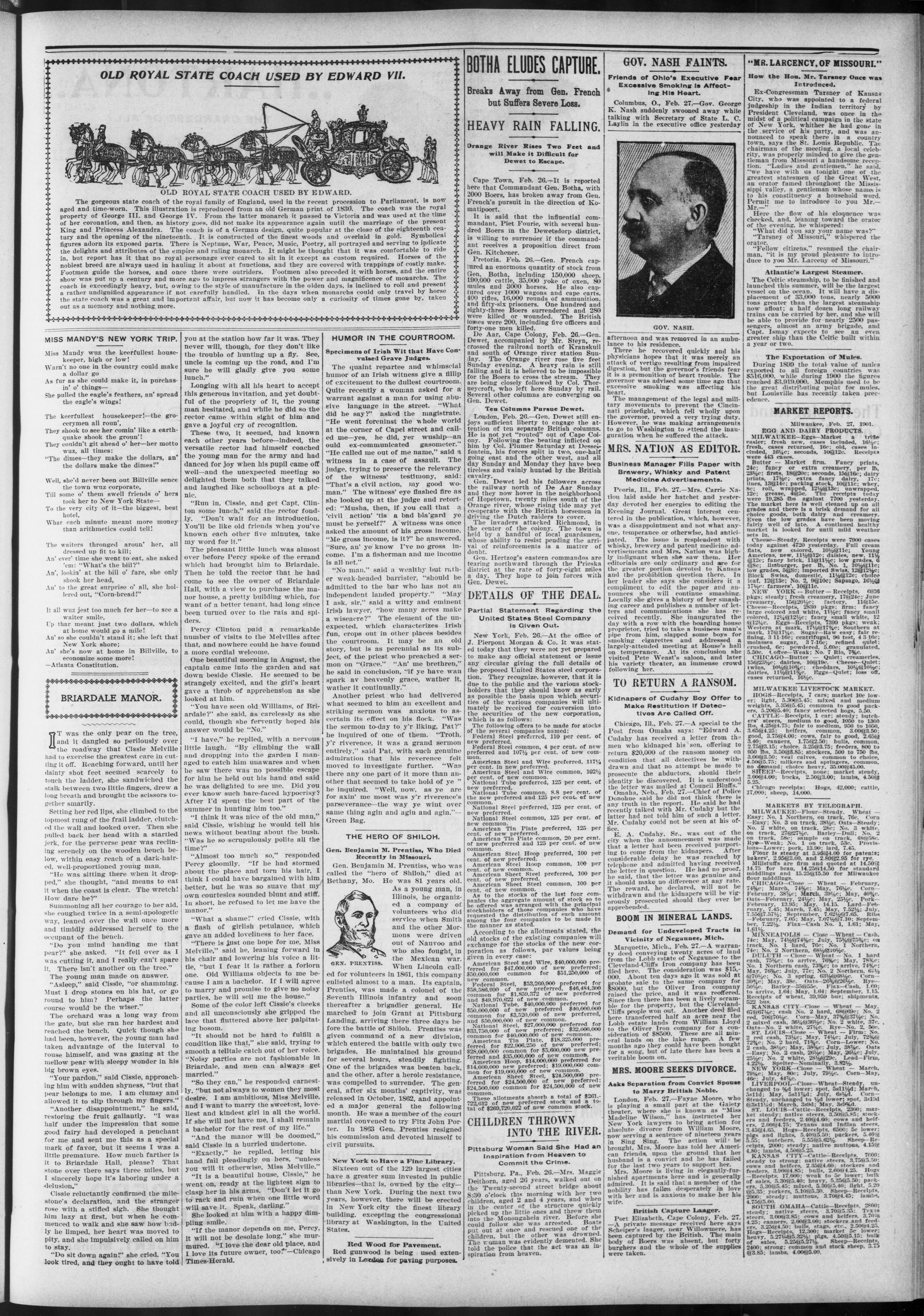
The gorgeous state coach of the royal family of England, used in the recent procession to Parliament, is now aged and time-worn. This illustration is reproduced from an old German print of 1830. The coach was the royal property of George III. and George IV. From the latter monarch it passed to Victoria and was used at the time of her coronation, and then, as history goes, did not make its appearance again until the marriage of the present King and Princess Alexandra. The coach is of a German design, quite popular at the close of the eighteenth century and the opening of the nineteenth. It is constructed of the finest woods and overlaid in gold. Symbolical figures adorn its exposed parts. There is Neptune, War, Peace, Music, Poetry, all portrayed and serving to indicate the delights and attributes of the empire and ruling monarch. It might be thought that it was comfortable to ride in, but report has it that no royal personage ever cared to sit in it except as custom required. Horses of the noblest breed are always used in hauling it about at functions, and they are covered with trappings of costly make. Footmen guide the horses, and once there were outriders. Footmen also preceded it with horses, and the entire show was put up a century and more ago to impress strangers with the power and magnificence of monarchs. The coach is exceedingly heavy, but, owing to the style of manufacture in the olden days, is inclined to roll and present a rather undignified appearance if not carefully handled. In the days when monarchs could only travel by horse the state coach was a great and important affair, but now it has become only a curiosity of times gone by, taken out as a memory and nothing more.
---
MISS MANDY'S NEW YORK TRIP.
Miss Mandy wuz the keerfullest housekeeper, high or low!
Warn't no one in the country could make a dollar go
As fur as she could make it, in purchasin' o' things—
She pulled the eagle's feathers, an' spread the eagle's wings!
The keerfullest housekeeper!—the grocerymen all roun',
They shook to see her comin' like a earthquake shook the groun'!
They couldn't git ahead o' her—her motto wuz, all times:
"The dimes—they make the dollars, an' the dollars make the dimes!"
Well, she'd never been out Billville sence the town wuz corporate,
Till some o' them swell friends o' hers took her to New York State—
To the very city of it—the biggest, best hotel,
Whar each minute meant more money than arithmetics could tell!
The waiters thronged aroun' her, all dressed up fit to kill:
An' ever' time she went to eat, she asked 'em: "What's the bill?"
An', lookin' at the bill o' fare, she only shook her head,
An' to the great surprise o' all, she hollered out, "Corn-bread!"
It all wuz jest too much fer her—to see a waiter smile.
Up thar meant just two dollars, which at home would go a mile!
An' so she couldn't stand it; she left that New York shore;
An' she's now at home in Billville, to economize some more!
—Atlanta Constitution.
BRIARDALE MANOR.
T was the only pear on the tree, and it dangled so perilously over
and it dangled so perilously over the roadway that Cissie Melville had to exercise the greatest care in cutting it off. Reaching forward, until her dainty shot feet seemed scarcely to touch the ladder, she sandwiched the stalk between two little fingers, drew a long breath and brought the scissors together smartly.
Setting her red lips, she climbed to the topmost rung of the frail ladder, clutched the wall and looked over. Then she pulled back her head with a startled jerk, for the perverse pear was reclining serenely on the wooden bench below, within easy reach of a dark-haired, well-proportioned young man.
"He was sitting there when it dropped," she thought, "and means to eat it when the coast is clear. The wretch! How dare he?"
Summoning all her courage to her aid, she coughed twice in a semi-apologetic way, leaned over the wall once more and timidly addressed herself to the occupant of the bench.
"Do you mind handing me that pear?" she asked. "It fell over as I was cutting it, and I really can't spare it. There isn't another on the tree."
The young man made on answer.
"Asleep," said Cissie, "or shamming. Must I drop stones on his hat, or go round to him? Perhaps the latter course would be the wiser."
The orchard was a long way from the gate, but she ran her hardest and reached the bench. Quick though she had been, however, the young man had taken advantage of the interval to rouse himself, and was gazing at the mellow pear with sleepy wonder in his big brown eyes.
"Your pardon," said Cissie, approaching him with sudden shyness, "but that pear belongs to me. I am clumsy and allowed it to slip through my fingers."
"Another disappointment," he said, restoring the fruit gallantly. "I was half under the impression that some good fairy had developed a penchant for me and sent me this as a special mark of favor, but it seems I was a little premature. How much farther is it to Briardale Hall, please? That stone over there says three miles, but I sincerely hope it's laboring under a delusion."
Cissie reluctantly confirmed the milestone's declaration, and the stranger rose with a stifled sigh. She thought him lazy at first, but when he commenced to walk and she saw how badly he limped, her heart was moved to pity, and she impulsively called on him to stay.
"Do sit down again!" she cried. "You look tired, and they ought to have told
OLD ROYAL STATE COACH USED BY EDWARD.
you at the station how far it was. They never will, though, for they don't like the trouble of hunting up a fly. See, uncle is coming up the road, and I'm sure he will gladly give you some lunch."
Longing with all his heart to accept this generous invitation, and yet doubtful of the propriety of it, the young man hesitated, and while he did so the rector came within sight of him and gave a joyful cry of recognition.
These two, it seemed, had known each other years before—indeed, the versatile rector had himself coached the young man for the army and had danced for joy when his pupil came off well—and the unexpected meeting so delighted them both that they talked and laughed like schoolboys at a picnic.
"Run in, Cissie, and get Capt. Clinton some lunch," said the rector fondly. "Don't wait for an introduction. You'll be like old friends when you've known each other five minutes, take my word for it."
The pleasant little lunch was almost over before Percy spoke of the errand which had brought him to Briardale. Then he told the rector that he had come to see the owner of Briardale Hall, with a view to purchase the manor house, a pretty building which, for want of a better tenant, had long since been turned over to the rats and spiders.
Percy Clinton paid a remarkable number of visits to the Melvilles after that, and nowhere could he have found a more cordial welcome.
One beautiful morning in August, the captain came into the garden and sat down beside Cissie. He seemed to be strangely excited, and the girl's heart gave a throb of apprehension as she looked at him. "You have seen old Williams, of Brardale?" she said, as carelessly as she could, though she fervently hoped his answer would be "No."
"I have," he replied, with a nervous little laugh. "By climbing the wall and dropping into the garden I managed to catch him unawares and when he saw there was no possible escape for him he held out his hand and said he was delighted to see me. Did you ever know such bare-faced hypocrisy? After I'd spent the best part of the summer in hunting him too."
"I think it was nice of the old man," said Cissie, wishing he would tell his news without beating about the bush. "Was he so scrupulously polite all the time?"
"Almost too much so," responded Percy gloomily. "If he had stormed about the place and torn his hair, I think I could have bargained with him better, but he was so suave that my own courtesies sounded blunt and stiff. In short, he refused to let me have the manor."
"What a shame!" cried Cissie, with a flash of girlish petulance, which gave an added loveliness to her face.
"There is just one hope for me, Miss Melville," said he, leaning forward in his chair and lowering his voice a little, "but I fear it is rather a forlorn one. Old Williams objects to me because I am a bachelor. If I will agree to marry and promise to give no noisy parties, he will sell me the house."
Some of the color left Cissie's cheeks and all unconsciously she gripped the lace that fluttered above her palpitating bosom.
"It should not be hard to fulfill a condition like that," she said, trying to smooth a telltale catch out of her voice. "Nolsy parties are not fashionable in Briardale, and men can always get married."
"So they can," he responded earnestly, "but not always to women they most desire. I am ambitious, Miss Melville, and I want to marry the sweetest, loveliest and kindest girl in all the world. If she will not have me, I shall remain a bachelor for the rest of my life."
"And the manor will be doomed," said Cissie in a hurried undertone. "Exactly," he replied, letting his hand fail pleadingly on hers, "unless you will it otherwise, Miss Melville." "It is a beautiful house, Cissie," he went on, ready at the lightest sign to clasp her in his arms. "Don't let it go to rack and ruin when one little word will save it. Speak, darling." She looked at him with a happy dimpling smile. "If the manor depends on me, Percy, it will not be desolate long," she murmured. "I love the dear old place, and I love its future owner, too."—Chicago Times-Herald.
HUMOR IN THE COURTROOM.
Specimens of Irish Wit that Have Convulsed Grave Judges.
The quaint repartee and whimscial humor of an Irish witness give a fillip of excitement to the dullest courtroom. Quite recently a woman asked for a warrant against a man for using abusive language in the street. "What did he say?" asked the magistrate. "He went forenist the whole world at the corner of Capel street and called me—yes, he did, yer wuship—an ould ex-communicated gasometer." "He called me out of me name," said a witness in a case of assault. The judge, trying to preserve the relevancy of the witness' testimony, said: "That's a civil action, my good woman." The witness' eye flashed fire as she looked up at the judge and retorted: "Musha, then, if you call that a 'civil action' 'tis a bad bla'gard ye must be yerself!" A witness was once asked the amount of his gross income. "Me gross income, is it?" he answered. "Sure, an' ye know I've no gross income. I'm a fisherman and me income is all net."
"No man," said a wealthy but rather weak-headed barrister, "should be admitted to the bar who has not an independent landed property." "May I ask, sir," said a witty and eminent Irish lawyer, "how many acres make a wiseacre?" The element of the unexpected, which characterizes Irish fun, crops out in other places besides the courtroom. It may be an old story, but is as perennial as its subject, of the priest who preached a sermon on "Grace." "An' me brethren," he said in conclusion, "if ye have wan spark av heavenly grace, wather it, wather it continually."
Another priest who had delivered what seemed to him an excellent and striking sermon was anxious to ascertain its effect on his flock. "Was the sermon to-day to y'r liking, Pat?" he inquired of one of them. "Troth, y'r riverence, it was a grand sermon entirely," said Pat, with such genuine admiration that his reverence felt moved to investigate further. "Was there any one part of it more than another that seemed to take hold of ye" he inquired. "Well, now, as ye are for axin' me most was y'r riverence's parseverance—the way ye wint over same thing agin and agin and agin."—Green Bag.
THE HERO OF SHILOH.
Gen. Benjamin M. Prentiss, Who Died Recently in Missouri.
Gen. Benjamin M. Prentiss, who was called the "hero of Shilloh," died at Bethany, Mo. He was 81 years old.
As a young man, in Illinois, he organized a company of volunteers who did service when Smith and the other Mormons were driven out of Nauvoo and who also fought in the Mexican war. When Lincoln call-
GEN. PRENTISS.
GEN. PRENTISS
ed for volunteers in 1861, this company enlisted almost to a man. Its captain, Prentiss, was made a colonel of the Seventh Illinois infantry and soon thereafter a brigadier general. He marched to join Grant at Pittsburg Landing, arriving there three days before the battle of Shiloh. Prentiss was given command of a new division, which entered the battle with only two brigades. He maintained his ground for several hours, steadily fighting. One of the brigades was beaten back, and the other, after a heroic resistance, was compelled to surrender. The general, after six months' captivity, was released in October, 1862, and appointed a major general the following month. He was a member of the court martial convened to try Fitz John Porter. In 1863 Gen. Prentiss resigned his commission and devoted himself to civil pursuits.
New York to Have a Fine Library.
Sixteen out of the 129 largest cities have a greater sum invested in public libraries—that is, owned by the city—than New York. During the next two years, however, there will be erected in New York city the finest library building, excepting the congressional library at Washington, in the United States.
Red Wood for Pavement.
Red gunwood is being used extensively in London for paying purposes.
BOTHA ELUDES CAPTURE
Breaks Away from Gen. French but Suffers Severe Loss.
HEAVY RAIN FALLING.
Orange River Rises Two Feet and will Make it Difficult for Dewet to Escape.
Cape Town, Feb. 26.+It is reported here that Commandant Gen. Botha, with 2000 Boers, has broken away from Gen. French's pursuit in the direction of Komatipoort. It is said that the influential commandant, Piet Fourie, with several hundred Boers in the Dewetsdorp district, is willing to surrender if the commandant receives a proposition direct from Gen. Kitchener.
Pretoria. Feb. 26.—Gen. French captured an enormous quantity of stock from Gen. Botha, including 150,000 sheep, 190,000 cattle, 35,000 yoke of oxen, 80 mules and 3000 horses. He also captured over 1000 wagons and cape carts, 400 rifles, 16,000 rounds of ammunition, and fifty-six prisoners. One hundred and eighty-three Boers surrendered and 280 were killed or wounded. The British losses were 200, including five officers and forty-one men killed.
De Aar, Cape Colony, Feb. 26.—Gen. Dewet, accompanied by Mr. Steyn, recrossed the railroad north of Kranskuil and south of Orange river station Sunday. The Orange river rose five feet Sunday evening. A heavy rain is still falling and it is believed to be impossible for the Boers to cross the stream. They are being closely followed by Col. Thorneycroft, who left here Sunday by rail. Several other columns are converging on Gen. Dewet.
Ten Columns Pursue Dewet.
London, Feb. 26.—Gen. Dewet still enjoys sufficient liberty to engage the attention of ten separate British columns. He is not yet "routed" out of Cape Colony. Following the beating inflicted on him by Col. Plumer Saturday at Desseifontein, his forces split in two, one-half going east and the other west, and all day Sunday and Monday they have been tireless and vainly hunted by the British cavalry.
Gen. Dewet led his followers across the railway north of De Aar Sunday and they now hover in the neighborhood of Hopetown, twenty miles south of the Orange river, whose rising tide may yet co-operate with the British horsemen in driving the Dutch raiders to cover.
The invaders attacked Richmond, in the center of the colony. The town is held by a handful of local guardsmen, whose ability to resist pending the arrival of reinforcements is a matter of doubt. Gen. Hertzog's eastern commandos are tearing northward through the Prieska district at the rate of forty-eight miles a day. They hope to join forces with Gen. Dewet.
DETAILS OF THE DEAL.
Partial Statement Regarding the United States Steel Company is Given Out.
New York, Feb. 26. At the office of J. Pierpont Morgan & Co. it was stated today that they were not yet prepared to make any official statement or issue any circular giving the full details of the proposed United States steel corporation. They recognize, however, that it is due to the public and the various stockholders that they should know as early as possible the basis upon which securities of the various companies will ultimately be received for conversion into the securities of the new corporation, which is as follows:
The following offers to be made for stocks of the several companies named:
Federal Steel preferred, 110 per cent. of new preferred.
Federal Steel common, 4 per cent. of new preferred and $107\frac{1}{2}$ per cent. of new common.
American Steel and Wire preferred, 11714 per cent, in new preferred.
National Tube common. 8.8 per cent. of the new preferred and 125 per cent. of new common.
National Steel preferred, 125 per cent. of new preferred.
National Steel common, 125 per cent. of new common.
American Tin Plate preferred, 125 per cent. of new preferred.
American Tin Plate common, 20 per cent. of new preferred and 125 per cent. of new common.
American Steel Hoop preferred, 100 per cent. of new preferred.
American Steel Hoop common, 100 per
American Steel Hoop common, 100 per cent of new common.
cent. of new common.
American Sheet Steel preferred, 100 per cent. of new preferred.
American Sheet Steel common, 100 per cent. of new common.
As to the stocks of the last four companies the aggregate amount of stock so to be offered was arranged with the principal stockholders of those companies who have requested the distribution of such amount among the four companies to be made in the manner as stated.
According to the allotments stated, the old stocks of the existing companies will exchange for the stocks of the new corporation as follows, par values being given in every case:
American Steel and Wire, $40,000,000 preferred for $47,000,000 of new preferred; $50,000,000 common for $51,250,000 of new common.
Federal Steel, $53,260,900 preferred for $58,586,990 of new preferred, $46,484,300 common for $1,859,372 of new preferred and $49,970,622 of new common.
National Tube, $40,000,000 preferred for $50,000,000 of new preferred $40,000,000 common for $3,520,000 of new preferred, and $50,000,000 of new common.
National Steel, $27,000,000 preferred for $33,750,000 of new preferred; $32,000,000 common for $40,000,000 of new common.
American Hoop, $14,000,000 preferred for $14,000,000 new preferred; $19,000,000 common for $19,000,000 of new common.
American Sheet Steel, $24,500,000 preferred for $24,500,000 of new preferred; $24,500,000 common for $24,500,000 of new common.
common. These allotments absorb a total of $261.722,612 of new preferred stock and a total of $269,720,022 of new common stock.
CHILDREN THROWN INTO THE RIVER.
CHILDREN THROWN INTO THE RIVER.
Pittsburg Woman Said She Had an Inspiration from Heaven to Commit the Crime.
Pittsburg, Pa., Feb. 26.—Mrs. Maggie Deithorn, aged 26 years, walked out on the Twenty-second street bridge about 8:30 o'clock this morning with her two children, aged 2 and 4 years, and when in the center of the structure quickly picked up the little ones and threw them into the Monongahela river. Before she could follow she was arrested. Boats put out at once and rescued one of the children, but the other was drowned. The woman was evidently demented. She told the police that the act was an inspiration from heaven.
GOV. NASH FAINTS.
Friends of Ohio's Executive Fear Excessive Smoking Is Affecting His Heart.
Columbus, O., Feb. 27.—Gov. George K. Nash suddenly swooned away while talking with Secretary of State L. C. Laylin in the executive office yesterday
M. H.
afternoon and was removed in an ambulance to his residence. There he recovered quickly and his physicians hopes that it was merely an attack of vertigo resulting from impaired digestion, but the governor's friends fear it is a premonition of heart trouble. The governor was advised some time ago that excessive smoking was affecting his heart. The management of the legal and military movements to prevent the Cincinnati prizefight, which fell wholly upon the governor, proved a very trying duty. However, he was making arrangements to go to Washington to attend the inauguration when he suffered the attack.
MRS. NATION AS EDITOR.
Business Manager Fills Paper with Brewery, Whisky and Patent Medicine Advertisements.
Peoria, Ill., Feb. 27.—Mrs. Carrie Nation laid aside her hatchet and yesterday devoted her energies to editing the Evening Journal. Great interest centered in the publication, which, however, was a disappointment and not what anyone, temperance or otherwise, had anticipated. The issue is resplendent with whisky, brewery and patent medicine advertisements and Mrs. Nation was highly indignant when she saw them. Her editorials are only ordinary and are for the greater portion devoted to Kansas and the prohibition question there. In her leader she says she considers it a compliment to edit the paper and announces she will continue smashing. Locally she gives a history of her smashing career and publishes a number of letters and communications she has received recently. She inaugurated the day with a row with the boarding house proprietor, tried to take a business man's pipe from him, slapped some boys for smoking cigarettes and addressed a largely-attended meeting at Rouse's hall on temperance. At its conclusion she visited Pete Weast's saloon, and later his variety theater, an immense crowd following her.
TO RETURN A RANSOM.
Kidnapers of Cudahy Boy Offer to Make Restitution If Detectives Are Called Off.
Chicago, Ill., Feb. 27.—A special to the Post from Omaha says: "Edward A. Cudahy has received a letter from the men who kidnapped his son, offering to return $20,000 of the ransom money on condition that all detectives be withdrawn and that no attempt be made to prosecute the abductors, should their identity be discovered. It is understood the letter was mailed at Council Bluffs." Omaha, Neb., Feb. 27.—Chief of Police Donohue said he did not think there is any truth in the report. He said he had recently talked with Mr. Cudahy but the latter had not told him of such a letter. Mr. Cudahy could not be seen at his office.
E. A. Cudahy, Sr., was out of the city when the announcement was made that a letter had been received purporting to come from the kidnapers. After considerable delay he was reached by telephone and admitted having received the letter in question. He had no proof, he said, that the letter was genuine and it should make no difference at any rate. The reward, he declared, will not be withdrawn and the kidnapers will be vigorously prosecuted should they ever be apprehended.
BOOM IN MINERAL LANDS.
Demand for Undeveloped Tracts in Vicinity of Negaunee, Mich.
Marquette, Mich., Feb. 27.—A warranty deed conveying twenty acres of land from the Lobb estate of Negaunee to the Cleveland-Cliffs Iron company has been filed here. The consideration was $15,-000. About ten days ago it was sold at probate sale to the same company for $8000, but the Oliver Iron company raised the price, and it was reoffered. Since then there has been a lively scramble for the property, but the Cleveland-Cliffs people won out. Another deed filed here transferred half an acre near the Lobb estate lands from William Lloyd to the Oliver Iron company for a consideration of $8500. These are all mineral lands on the lake range. A few months ago they could have been bought for a song, but of late there has been a veritable boom on.
MRS. MOORE SEEKS DIVORCE.
Asks Separation from Convict Spouse to Marry British Noble.
London, Feb. 27.—Fayne Moore, who is playing a small part at the Gaiety theater, where she is known as "Miss Madeline Wilson," has instructed her New York lawyers to bring action for absolute divorce from William Moore, now serving a sentence of nineteen years in Sing Sing. The action will be brought, Mrs. Moore has told her American friends, upon the ground that her husband is a convict and he has failed for the last two years to support her.
Mrs. Moore is living in elegantly-furnished apartments here and is generally admired. It is said that a member of the nobility has fallen desperately in love with her and is anxious to make her his wife.
British Capture Laager
Port Elizabeth, Cape Colony, Feb. 27. A private message received here says Scheiper's laager, near Willowmere, has been captured by the British. The main body of Boers was absent, but forty burghers and the whole of the supplies were taken.
"MR. LARCENCY, OF MISSOURI."
How the Hon. Mr. Taraney Once was Introduced.
Ex-Congressman Tarsney of Kansas City, who was appointed to a federal judgeship in the Indian territory by President Cleveland, was once in the midst of a political campaign in the state of New York, whither he had gone in the service of his party, and was announced to speak there in a country town, says the St. Louis Republic. The chairman of the meeting, a local celebrity, was properly minded to give the gentleman from Missouri a handsome reception. "Ladies and gentlemen," he said, "we have with us tonight one of the greatest statesmen of the Great West, an orator famed throughout the Mississippi valley, a gentleman whose name is to his constituency a household word. Permit me to introduce to you Mr.—Mr.—"
Here the flow of his eloquence was checked, and, leaning toward the orator of the evening, he whispered:
"What did you say your name was?"
"Tarsney of Missouri," whispered the orator.
"Fellow citizens," resumed the chairman, "it is my proud pleasure to introduce to you Mr. Larceny of Missouri."
Atlantic's Largest Steamer.
The Celtic steamship, to be finished and launched this summer, will be the largest vessel on the ocean. It will have a displacement of 33,000 tons, nearly 5000 tons greater than the largest steamship now afloat; a half dozen long railway trains can be carried by her, and she will be able to provide for nearly 2500 passengers, almost an army brigade, and Capt. Ismay expects to see an even greater ship than the Celtic built within a year or two.
The Exportation of Mules
During 1899 the total value of mules exported to all foreign countries was $516,000, while during 1900 the figures reached $3,919,000. Memphis used to be the great distributing point for mules, but Louisville has recently taken precedence.
MARKET REPORTS.
Millwaukee, Feb. 27, 1901.
EGG AND DAIRY PRODUCTS.
MILWAUKEE—Eggs—Market a trifle easier; fresh new, cases included, 16½c; fresh, cases returned, 16c; old, cases included, 16½c; seconds, 10@12c. Receipts were 443 cases.
Butter — Market firm. Fancy prints, 24c; fancy or extra creamery, per lb, 23½c; firsts, 18@20c; seconds, 15@16c; dairy prints, 17½c; extra fancy dairy, 17c; lines, 13@14c; packing stock, 10@11c; whey, 8c; roll, wrapped, 12½@13c; unwrapped, 12c; grease, 4@5c. The receipts today were 19.285 lbs against 7700 yesterday.
The market here is well cleaned up on all grades and there is a brisk demand for all choice goods, both dairy and creamery. Even the low grades have been moving fairly well of late. A continued healthy market is looked for until mild weather sets in.
Cheese—Steady. Receipts were 7900 cases today against 4720 yesterday. Full cream flats, new colored, 10½¼¹11c; Young Americas, new, 11½¼¹21c; daisies, new, 11½¼¹21c; fancy brick, 11½¼¹1c; low grades, 6 @8c; limburger, per lb. No. 1, 10½¼¹11c; low grades, 5@8c; imported Swiss, 12½¼¹21c; Block Swiss, domestic, 11½¼¹21c; choice loaf, 12¹3c; No. 2, 9@10c; Sapsago, 16½¼¹17½¹c: farmers', 10¹11c.
NEW YORK -- Butter -- Receipts, 6036 pkgs; steady; fresh creamery, 12¹4c; June creamery, 15½¼¹21c; factory, 11½¼¹16c. Cheese—Receipts, 2830 pkgs; firm; fancy large colored and white, 11½¼¹c; fancy small colored, 12½¼¹21c; fancy small white, 12 @12½¹c. Eggs—Receipts, 7399 pkgs; weak. Western at mark, 17½¼¹3c; Southern at mark, 17½¼¹17c. Sugar-Raw easy; fair refining, 311-16c; centrifugal, 96 test, 4 3-16c; molasses sugar, 37-16c; refined quiet; crushed, 6c; powdered, 5.60c; granulated, 5.50c. Coffee—Weak: No. 7 Blo 75c.
CHICAGO—Butter — Qulet; creameries, 15%@23½c; dairies, 10@19c; Cheese—Qulet; twins, 10½%@10½c; cheddars, 10¼%@10½c; dairies, 11½%@11½c. Eggs—Qulet; loss off, cases returned, 16½c.
MILWAUKEE LIVESTOCK MARKET.
HOGS—Receipts, 7 cars; market 10c lower; light, 5.30@5.45; mixed and medium weights, 5.35@5.45; common to good packers, 5.20@5.40; fancy selected hogs, 5.50.
CATTLE—Receipts, 1 car; steady; butchers' steers, medium to good, 1050 to 1300 lbs, 4.25@4.75; fair to medium, 950 to 1050, 3.65@4.25; helfers, common, 3.00@3.50; good, 3.75@4.00; cows, fair to good, 2.65@3.40; canners, 1.75@2.50; bulls, common, 2.75@3.15; choice, 3.25@3.75; feeders, 800 to 950 lbs, 3.50@3.85; stockers, 500 to 750 lbs, 3.00@3.50; veal calves, common to choice, 4.50@5.75; milkers and springers, common, no demand; choice heavy, 35.00@45.00.
SHEEP—Receipts, none; market steady, 3.00@4.00; bucks, 2.50@3.00; lambs, 4.50@3.00;
3.00@4.00; bucks, 2.50@3.00; lambs, 4.50@ 5.25.
Chicago receipts: Hogs, 42,000; cattle, 17,000; sheep, 14,000.
MILWAUKEE—Flour—Steady. Wheat —Easy; No. 1 Northern, on track, 76c. Corn —Easy; No. 3 on track, 38½c. Oats—Steady; No. 2 white, on track, 28c; No. 3 white, on track, 27@27½c. Barley—Dull; No. 2 on track, 58c; sample on track, 48@58c. Rye—Weak; No. 1 on track, 53c. Provisions—Lower; pork, 13.90; lard, 7.45.
Flour is steady at 3.95@4.00 for patents; bakers', 2.95@3.00, and 2.80@2.95 for rye. Millstuffs are firm and quoted at 14.50@14.75 for bran, 14.25@14.50 for standard middlings and 15.25@15.50 for Milwaukee flour middlings.
CHICAGO—Close — Wheat — February, 74%c; March, 74%c; May, 76%c. Corn—February, 38%c; March, 39%c; May, 40%c. Oats—February, 24%c; May, 25%c. Pork—February, 13.95; May, 14.15. Lard—February, 7.45; March, 7.45; May, 7.52%; July, 7.55@7.571%; September, 7.62@7.65. Ribs—February, 7.05; May, 7.07%@7.10: September, 7.22%; Flax-Cash No. 1, 1.61; May, 1.61%.
MINNEAPOLIS — Close — Wheat — Cash, 74c; May, 74%@74%c; July, 75%@75%c; on track, No. 1 hard, 76c; No. 1 Northern, 74c; No. 2 Northern, 68%@70%c.
DULUTH — Close — Wheat — No. 1 hard cash, 75%c; to arrive, 76%c; May, 78%c; No. 1 Northern cash, 73%c; to arrive, 74%c; May, 76%c; July, 77c; No. 2 Northern, 61%c@70%c; No. 3 spring, 63%c@68%c. Corn—30%c; May, 38c. Oats—26%c@26%c. Rye—50%c; Barley—35%55c. Flax-Cash, 1.60; to arrive, 1.64; May, 1.64; September, 1.15. Receipts of wheat, 39,959 bus; shipments, 522 bus.
KANSAS CITY—Close — Wheat — May, 67@67%c; cash No. 2 hard, 68@69c; No. 2 red, 70@70%c. Corn—May, 37%@37%c; No. 2 mixed cash, 36%@36%c; No. 2 white, 37c. Oats—No. 2 white, 27%c. Rye-No. 2, 50c. ST. LOUISE—Close — Wheat — Firm; No. 2 red cash, 73%c; May, 74%c; July, 72%c@72%c; No. 2 hard, 71%c. Corn—Lower; No. 2 cash, 38%c; May, 38%c; July, 38%c. Oats—Easy; No. 2 cash, 26%c; May, 26%c; July, 25%c; No. 2 white, 28%c@29c. Lead-Firm, 4.22%c. Spelter—Nominally, 3.82%c.
NEW YORK—Close — Wheat — March, 79%c; May, 80c; July, 79%c. Corn—May, 46c; July, 44%c.
LIVERPOOL—Close—Wheat—Steady,
unchanged to %d lower; spot, 511%d; March,
511d; May, 511%d; July, 61%d. Corn—
Steady, unchanged to %d lower; spot, 319d
@311%d; March, 39d; May, 39%d.
ST. LOUIS—Cattle—Recelpts, 2300; market steady; native steers, 3.50@5.85; stockers and feeders, 2.40@4.60; cows and heifers, 2.00@4.75; Texans and Indian steers, 3.45@4.65. Hogs—Recelpts, 6500; 5c lower, pigs and lights, 5.40@5.50; packers, 5.40@5.55; butchers, 5.55@5.62%. Sheep—Recelpts, 2000; steady; native muttons, 4.15@4.80; lambs, 4.50@5.25.
KANSAS CITY—Cattle—Recelpts, 7000; steady to strong; native steers, 3.75@5.50; cows and heifers, 2.35@4.60; stockers and feeders, 3.90@4.85; bulls, 2.60@4.25. Hogs—Recelpts, 17.000; weak to 5c lower; bulk of sales, 5.30@5.40; heavy, 5.35@5.50; packers, 5.30@5.45; mixed, 5.30@5.40; light, 5.20@5.35; yorkers, 5.10@5.30. Sheep—Recelpts, 2000; steady; muttons, 3.70@4.45; lambs, 4.75@5.00.
SOUTH OMAHA—Cattle—Recelpts, 2800; steady; native steers, 3.70@5.35. Texas steers, 3.00@3.85; cows and heifers, 3.70@4.25; canners, 2.00@3.00; stockers and feeders, 3.25@4.50; bulls, stags, etc., 2.50@4.25. Hogs—Recelpts, 12,300; market 5c lower; heavy, 5.27½@5.32½; pigs, 4.50@5.15; bulk of sales, 5.25@5.27½. Sheep—Recelpts, 2400; strong; common and stock sheep, 3.75@3.85; lambs, 4.00@5.00.
The Wisconsin Weekly Advocate
Richard B. Montgomery.....Editor and Proprietor
Office: 327 Wells Street.
Telephone Black No. 244.
postage paid.
One Year . . . $2.00
Six Months . . . 1.25
Three Months . . . .75
Send money by Express Money Order, P. O.
Money Order or Registered Letter to the
Wisconsin Weekly Advocate.
ADVERTISING RATES.
One inch, single insertion . . . 25c
One inch, per year . . . $9.00
Business locals 5c per line each insertion.
Apply for rates to the Advocate.
TO CONTRIBUTORS:
All communications must be sent with the name and address of the sender as an evidence of good faith, but not necessarily for publication. No manuscript returned if not accepted, unless accompanied by stamps.
All subscribers of the Advocate that fall to get their paper promptly will please notify us at once. The Advocate, at 327 Wells street.
The Wisconsin Weekly Advocate company wishes to notify the public that all contracts and business transactions with this company must have the company stamp, otherwise they will be void. Neither will this company be responsible for paid subscriptions unless given to duly-accredited agents, who, on request, will give the company's receipt for same. Subscribers failing to receive their papers regularly will kindly notify the general office. Address all business communications to the general manager, 327 Wells street.
Mr. Richard B. Montgomery.
Entered at the Milwaukee P. O. as second-class matter.
The Helping Hand Colored Mission
incorporated under the laws of the State of Wisconsin has for its object the supplying of qualified colored help to those requiring the same. In order to be able to get servants from the mission it is necessary, that in order to partly cover expenses incurred, those parties desiring help should become subscribers for this paper. No actual charge is made. Parties who secure situations through this agency are also expected to become subscribers. We have at present on our books: Cooks, General Servants, Waitresses, Laundresses, Nurses, Coachmen, Porters, Waiters. Office hours 9-12 and 1-4.
R. B. MONTGOMERY, Mgr. 327 Wells St., Milwaukee.
The fire-bugs must have an idea that the Chicago hotels are cold.
No amount of studied calmness can prevent certain Chinese officials from losing their heads.
Mine ventilation as a science hasn't developed past the stage of occasional explosions with wholesale fatalities.
The remark "as the crow flies" cannot be applied to the dodging of the Omaha kidnaper.
Perhaps the rise in window glass may be traced to a sudden demand from the owners of buildings in Kansas formerly occupied by joints.
Andrew Carnegie is disbursing money for libraries at a rate which indicates that he has no intention to "die disgraced."
There is a strong suggestion of humor in the news from China that "sentence of death is suspended on those culprits who are already dead."
There were days for both St. Paul and Minneapolis when even a Chicago surgeon's bill would have seemed a comparatively small inflation.
Harvard University's inability to get along without retrenchment is not disturbing to the presidents of state universities, which don't have to economize.
England will launch four cruisers and two battleships within a month, to serve the new King during an era of peace that is noted for its preparations for war.
In the declaration by W. D. Howells that Mark Twain is an all-around thinker, discerning people will recognize evidence that Mr. Howells is competing with Twain for the first place in the line of American humorists.
King Edward's order limiting the period for the "outward and visible sign" of mourning for the late Queen is a sensible act that will be commended by many more of the King's subjects than the shopkeepers in whose interest the order was issued.
Superposed turrets score a victory through the bursting of the big gun on the battleship Kearsarge, as the accident leaves the ship with a good forward lower turret provided with two guns. A similar accident on a battleship without two-story turrets would leave the ship minus one turret and its two big guns.
The freedom with which the German press is criticising the Emperor for his decent observance of the proprieties on the occasion of his grandmother's death has one feature that it not unpleasant—that is, its freedom. It had been supposed that the German press was arbitrarily muzzled on all subjects involving criticism of the Emperor.
An automobile truck which has made its appearance in New York city is described as a "puffing, chattering, hideous monster" which makes ordinary automobiles shy and frightens horses almost to death. The latest horseless vehicle ought to be a better invention than that. Snorting and roaring self-propelling fire engines were discarded years ago for the very faults which are pointed out in the New York vehicle.
It is stated that experiments with aluminum as a substitute for paper are now under way in France. It is now possible to roll aluminium into sheets four-thousandths of an inch in thickness, in which form it weighs less than paper. By the adoption of suitable machinery these
sheets can be made even thinner, and can be used for book and writing paper. The metal will not oxidize, is practically fire and water proof, and is indestructible by worms.
Consul Agent Harris writes from Eibenstock that German plantation experts claim that the Samoan islands have a great future in coffee, tea, tobacco, cotton, etc. Upolu island, it seems, is especially suitable for the culture of all these products, possessing, as it does, favorable position, a fruitful soil and a good climate. A company is at present being formed in Germany for the purpose of exploiting this island—laying out plantations, establishing narrow-gauge railways, etc. Men of practical experience, who acquired their knowledge of plantations in East Africa and Brazil, are at the head of the enterprise. Work is expected to commence next spring.
In order to obtain a complete account of the services of the volunteer regiments in the Philippine islands, the secretary of war recently instructed the commanding officers of each returning regiment to prepare, while his command is en route to the United States, a succinct history of its services, giving dates and places of battles and engagements in which his regiment, or a part of it, was engaged, the number killed and wounded, and other detailed data concerning its operations in the Philippine campaign. These reports are to be transmitted to Adjt-Gen. Corbin and are called for in order to obtain satisfactory information concerning each volunteer regiment's services before it is mustered out on arriving in the United States.
Illinois fishermen caught and shipped to the markets over 6000 tons of river fish last year. The larger proportion of this enormous catch of over 12,000,000 pounds of water-raised food was sent to New York. The value of the river-fish catch of 1900 was nearly $400,000, a slight decrease from the catch of the previous year. The opening of Chicago's sanitary canal, which starts a flood of lake water toward the Mississippi river through the Illinois river, was responsible for this decrease in the number of pounds in the year's catch. It was due not to the scarcity of fish, but to the high stage of water caused by the continuous flow of 200,000 to 300,000 cubic feet of water a minute, which escaped through the controlling works of the sanitary canal at Lockport. This high stage of water gave the fish a wider area of river and made it more difficult for the fishermen to use seines.
It is estimated that there are about 400,000 Angora goats in the United States, and that our annual production of mohair is about 1,000,000 pounds. Although very little has been said or written about Angora goats during the last forty years, they have been extensively bred in the Western states and territories, especially in Texas, New Mexico, Nevada, Florida, California and Oregon. Investigations prove that they are not only classed among the most useful of the domestic animals, and have been so classed for thousands of years, but their usefulness is manifested in various ways. The fleece, called mohair, furnishes some of the finest fabrics among women's goods, and is used in various other manufactures. There is so much interest in the goat question and the department of agriculture has received so many letters of inquiry about Angoras that it has just issued an illustrated bulletin of information on the subject.
James Cahill of Roney's Point is the only person in West Virginia, and probably in the United States, who has in regular use upon his farm an elephant which is used for farm work, says a special dispatch to the Baltimore Sun from Parkersburg, W. Va. With the swaying beast hitched up to a plow he can turn more ground than any of his neighbors with a team of horses, and when it comes to hauling logs the elephant will walk away with ease with logs which the best teams of his neighbors cannot move. The elephant eats little more than a horse and does many times the work of one, is gentle and docile and little trouble, and Mr. Cahill is more than pleased with his experiment. Several months ago a small circus broke up at Martin's Ferry and its property was sold at auction. Mr. Cahill, who was at the sale, bid in a few donkeys, the elephant and a tent, and took them home, expecting to start a small show himself. His father, Patrick Cahill, a frugal Irishman, decided that a beast of the size of an elephant could not remain on the farm and be fed unless it paid for its board with labor, so he harnessed it up and the animal worked nicely. He did so well that they have given up the idea of starting a circus, and will keep the elephant on the farm.
The highest waterfall in the world is the Sutherland falls, near Milford sound, in far-off New Zealand, which has a height of no less than 1904 feet. The fall is situated on the southwestern coast of the South island, in the vicinity of Mount Jutoko, which rises to a height of more than 8000 feet. Every season hundreds of sight-seers from all parts of the civilized world visit the west coast sounds of the South islands, and it is safe to say that no finer excursion can be arranged in any other part of the world. This whole part of the island abounds in powerful waterfalls. The Stirling falls is about 500 feet in height, and the Bowen falls some 540 feet. The Sutherland fall itself is perhaps more remarkable for grandeur than for beauty, but the scenery at the head of the surrounding valley, which is hemmed in by precipitous glacier-crowned mountains, is splendid. A scheme is now under way to utilize the power of the Sutherland falls for industrial purposes, and with this end in view a company has just been formed at Dunedin, the chief commercial city of New Zealand. It is intended to install powerful turbines, and to build an extensive power plant, from which the current generated at the falls is to be transmitted to the industrial districts of the coast regions and in the interior of the island.
World's Smallest Monarch.
Probably the smallest monarch in the world reigns over the Hindu vassal state of Bhopaul, and governs a people more than a million souls. This dwarf is a woman, Pjihan-Begum by name, but although she is about 50 years old, she does no: appear larger than a child of 10.
TRADE MARK
REGISTERED 1892.
U.S.PATENT OFFICE
WASHINGTON, D.C.
BEFORE USING
HARTONA
AFTER USING
HARTONA
Hartona will make the hair grow long and soft, straight and beautiful. Makes the hair grow on bald and thin places. Restores GRAY HAIR to its original color. Hartona cures Dandruff, Baldness, falling out of the hair, itching, and all scalp diseases. Hartona does not have to be used all the time, as it straightens the hair and gives it fresh life and lustre, and the hair stays and grows naturally beautiful and straight after the use of Hartona. No hot irons necessary. No pasting the hair down with grease. Hartona is positively harmless—one box can be used by everyone in the family. Benefits and improves children's hair just the same as adults. To meet the popular and ever-increasing demand for Hartona Hair-Grower and Straightener, we have placed it on sale in 25c. and 50c. sizes, in our special round, patent box. See that the word Hartona is on every box.
Money positively refunded if you are not absolutely delighted with the Hartona remedies. Remember, we handle no fake goods, and you are positively protected by our $100.00 guarantee to any one proving otherwise. All our remedies are trade-marked, registered and copyrighted at United States Patent Office at Washington, D. C., in the years 1892 and 1900. We refer you, as to our responsibility, to the City Bank of Richmond, Va., Adams and Southern Express Companies, and to the editor of this paper.
We want lady and gentlemen agents, white or colored, in every city and town in the United States. Write to us to-day, no matter if you are employed or not, and we will show you how to make a splendid living, with easy and pleasant work, and no risk of losing your good money. Write to us and we will send you a book of over one hundred genuine testimonials in your own State of people who have used and are using Hartona remedies. Is this not fair and honest enough?
HARTONA FACE WASH.
Hartona Face Wash will gradually turn the skin of a black person five or six shades lighter, and will turn the skin of a mulatto person perfectly white. The skin remains soft and bright without continual use of the face wash. One bottle does the work. Hartona Face Wash will remove wrinkles, dark spots, pimples, blackheads, freckles, and all blemishes of the skin. You can regulate the shade of skin on neck, face and hands to any shade you wish. Full directions with each bottle. Hartona Face Wash is perfectly harmless, and is sent to any part of the United States on receipt of price, 50c. per bottle; securely sealed from observation. It is your duty to look as beautiful as possible. Thousands of delighted patrons send us testimonials every year. Please remember that your money is positively refunded if you are not perfectly satisfied and delighted with the Hartona remedies. We want agents in every city in the United States. Write to us, no matter if you are employed or not, and we will show you how to make money without risking any of your own money.
Hartona No-Smell will remove all smells and bad odors of the body; cures sore and aching feet, chafed limbs, etc. Hartona No-Smell is a God-send to all persons suffering from disagreeable odors caused by perspiration of the feet, arm-pits, etc. Sent anywhere on receipt of price, 10 cents and 25 cents a package. Address all orders to
Send us One Dollar, and mention this paper, and we will send you three large boxes of Hartona Hair-Grower and Straightener, two large bottles of Hartona Face Wash, and one large box of Hartona No-Smell. Goods will be sent securely sealed from observation. Write your name and post-office and express-office address very plainly. Money can be sent by post-office money order, or enclosed in a registered letter, or by express. Address all Orders to
HARTONA REMEDY CO., 909 E. Main St., Richmond, Va.
THE BAKERY
...ALL WORK CAREFULLY DONE... Lowest Prices and Satisfaction Guaranteed.
WHEN IN MADISON Call at the
Avenue Hotel...
M. J. REGAN, Prop.
$2.00 Rate . . . .
Free 'Bus.
WHEN IN KENOSHA
CALL ON
MATT GREENWALD
Who is Up-to-Date in His Business.
AGENT FOR
E. KLINKERT'S RACINE KEG and
BOTTLED BEER.
Depot: No. 15 North Main Street.
Telephone 163.
KENOSHA - WISCONSIN
The first firebrick made in this country were manufactured in Baltimore in 1827. They were manufactured for the backs of the old-fashioned fireplaces, the limestone proving too friable.
"So the poet is financially embarrassed?" "I should say so. Why, he actually has to eat breakfast foods for dinner."—Philadelphia Record.
HARTONA NO-SMELL.
HARTONA REMEDY CO., 909 E. Main St., Richmond, Va. SPECIAL GRAND OFFER.
ustaining Life
on the choice juicy meats served by us is just what our athletic, bicycle riding, tennis playing and golfing twentieth century men and women need. Pie days have gone with the spinning wheel. Good bone, muscle and tissue is what is needed now. You can get them by patronizing the Chicago Market. Our meats are fresh, tempting and choice, and are sold at prices that will let you feast in comfort.
WILLIAM RASCH
GENEVA LAKE, WIS.
BayView Mission
OF
ST. JOHN'S E. M. E. CHURCH
310 SUPERIOR STREET.
Rev. JOSEPH A. JACKSON, Pastor.
Services at 11 a. m. and
7:30 p. m. Sundays.
Wednesday and Friday Evenings,
at 8:30 p. m.
..HARTONA..
Preparations for the
arations for the
ons for the Ha
Preparations for the Hair!
The Original and Only Hartona.
Watchless and Positively U
ening all Kinky, B
Harsh, Cur
tiful. Makes the hair grow on bald
ing out of the hair, itching, and all
h life and lustre, and the hair stays
ting the hair down with grease. Ha
children's hair just the same as ad
we have placed it on sale in 25c. and
with the Hartona remedies. Remember
otherwise. All our remedies are tra
years 1892 and 1900. We refer you
less, and to the editor of this paper.
The city and town in the United States
andid living, with easy and pleasant
hundred genuine testimonials in you
ough?
STACE WASH
on five or six shades lighter, and will
usual use of the face wash. One bottle
of blackheads, freckles, and all blemis
Full directions with each bottle.
Part of the United States on receipt of
able. Thousands of delighted patrons
are not perfectly satisfied and delight
, no matter if you are employed or re
NO-SMEL
body; cures sore and aching feet, chai
disagreeable odors caused by perspire
Address all orders to
DNA REMEDY CO., 909 E. Main
AND OFFER.
You three large boxes of Hartona Ha
e-Smell. Goods will be sent securely
plainly. Money can be sent by pos
9 E. Main St., R
and Positively Unequaled for
big all Kinky, Knotty, Stubby,
Harsh, Curly Hair.
Does the hair grow on bald and thin places. Re-
ceive hair, itching, and all scalp diseases. Hair
stret, and the hair stays and grows naturally
down with grease. Hartona is positively
hair just the same as adults. To meet the
need it on sale in 25c. and 50c. sizes, in our
nea remedies. Remember, we handle no fake g
All our remedies are trade-marked, register
and 1900. We refer you, as to our respons-
e editor of this paper.
Down in the United States. Write to us to do
with easy and pleasant work, and no risk of
one testimonials in your own State of peo
E WASH.
Knife shades lighter, and will turn the skin of a
one face wash. One bottle does the work.
Freckles, and all blemishes of the skin. Y
tations with each bottle.
United States on receipt of price, 50c. per box.
Bands of delighted patrons send us testimoni-
actly satisfied and delighted with the Hartona
if you are employed or not, and we will sho
-SMELL.
Store and aching feet, chafed limbs, etc.
Odors caused by perspiration of the feet, and
orders to
EDY CO., 909 E. Main St., Richmond
OFFER.
Large boxes of Hartona Hair-Grower and Straw-
oods will be sent securely sealed from observa-
tion. Money can be sent by post-office money order.
Main St., Richmond
positively Unequaled for Straight, Stinky, Knotty, Stubborn, Wash, Curly Hair.
Now on bald and thin places. Restores Grip, and all scalp diseases. Hartona does hair stays and grows naturally beautifully. Increase. Hartona is positively harmless-same as adults. To meet the popular demand in 25c. and 50c. sizes, in our special rooms.
Remember, we handle no fake goods, and medicines are trade-marked, registered and owned. We refer you, as to our responsibility, to this paper.
United States. Write to us to-day, no matter and pleasant work, and no risk of losing materials in your own State of people who wish to wash.
Water, and will turn the skin of a mulatto. One bottle does the work. All blemishes of the skin. You can wash each bottle.
On receipt of price, 50c. per bottle; secured patrons send us testimonials every year and delighted with the Hartona remedy employed or not, and we will show you how to well.
MELL.
Long feet, chafed limbs, etc.
By perspiration of the feet, arm-pits.
2009 E. Main St., Richmond, Va.
ER.
Hartona Hair-Grower and Straightener, not securely sealed from observation.
Sent by post-office money order, or enclosed in St., Richmond, V
Matchless and Positively Unequaled for Straightening all Kinky, Knotty, Stubborn, Harsh, Curly Hair.
Our Stock Is a Misfit
be advertised last week for $7.50 to $25.00, go now this Week Only.
IS we'll unload for $13.50 This Week Only.
body or taste, last week $8.50 to $25.00 This
you a wider choice and a lower price than anybody.
MISFIT CLOTHING HOUSE
TER STREET, Opposite Barrett's Dep't Store.
Can Show Cause. Open EVENINGS 'Till 10.
ow will prove it to you.
BRETT & SON,
EMBALMERS and
FUNERAL DIRECTOR
The OVERCOATS that we advertised last for $5.00 to $18.00 This Week Only
These swell $18 RAGLANS we'll unload
SUITS to fit anybody's body or taste Week $6.75 to $16.50.
TROUSERS—We give you a wider choice
FASHIONABLE MISFIT
213-215-217 WEST WATER STREET
Your Money Back If You Can Show
A good look in our window will prov
RCOATS that we advertised last week for $7.50 to $25.00 to $18.00 This Week Only.
Bell $18 RAGLANS we'll unload for $13.50 This Week Only.
Fit anybody's body or taste, last week $8.50 to $25.00 $6.75 to $16.50.
RS—We give you a wider choice and a lower price than
MISFIT CLOTHING HALL
217 WEST WATER STREET, Opposite Barrett's Depot. They Back If You Can Show Cause. Open EVENING.
Look in our window will prove it to you.
ES T. BRETT & S
EMBALMERS a
FUNERAL DIR
The OVERCOATS that we advertised last week for $7.50 to $25.00, go now for $5.00 to $18.00 This Week Only.
These swell $18 RAGLANS we'll unload for $13.50 This Week Only.
SUITS to fit anybody's body or taste, last week $8.50 to $25.00 This Week $6.75 to $16.50.
FASHIONABLE MISFIT CLOTHING HOUSE 213-215-217 WEST WATER STREET, Opposite Barrett's Dep't Store. Your Money Back If You Can Show Cause. Open EVENINGS 'Till 10. A good look in our window will prove it to you.
JAMES T. BRETT & SON,
M.
307 REED STREET and Always Open 410 GRAND AVENUE.
Telephones: South 122. Grand 2467. Milwaul
Telephones: South 122. Grand 2467. Milwaukee, WES going to visit HotSpring this winter, should p the
PARTIES
intending to w
Ark., this wi
tronize the
RAMMELS
BATH HOU
MARK SA
intending to visit HotSark., this winter, shouronize the MMELSBERG TH HOUSE, MARK SARGENT, M
intending to visit HotSprings Ark., this winter, should patronize the
MARK SARGENT, Manager. 21 BATHS $3.00
Our stock doesn't fit the store right—it's too big. Watch the scissors of low prices "cut it down" to fit. The real trouble is that the cold weather hasn't come soon enough. We find that we're overloaded with heavy clothing. We're going to unload a bit this week and it will pay you to help us. Don't look for these bargains next week.
MRS. JAMES T. BRETT,
Lady Undertaker.
bes , i Y I ‘ H i ; i fi r
Hi i ff i i dh. & ; i i
id i A AG H i ty 4 4 eS mand
/ 7 F 4 L ave i | i i i ql nL
Hh: ; ‘ pas Be Ris. | q * i H | H [
ae ee) an an H | f Lem ed] a
a if lS me La NS | | eee ; 4
a | Se eS 1 | leer | | ieee: a
i | eee ZS I a ee i BS i ye SE le oa
i” | er i ‘S aso, fl Ee | ee | eee a)
a FN (ORNS ee : | | Soke Ze i me <s i.
mm tTtlida Ze NSS i at ony | | Sypeae | CS |
Fea i EO z} oy Hay Fy tes [> <fesg ms i SPs Nw i fe
i (jg ANAS REE coe PBL = | eS -
De Ui Uc sec NSD | A bi ee Ze ji Se ih
i = Bia ew i ce EZ oo ame |i yy 4) Se: i
WO mae Rs NC rg Morey | Ee 2 EU a =» | iia <e Gm:
a G7 wy, “GEA PUI st 2 | = NT soe WY). 2 aaa
a Ce, Sn, A Ra <7 S| = owt Whe FZ Ce
‘be I\WSA Ps Ks |e (ZBeZ es rine
a 0 WW) i fiw is NES) omer ig ae GE Ls SO i 4
a a7 cae WSS 7 | fe) | A WE | cae a
ENE ee i iat GS | CRU Fi, Pa KO Sasi
le Jes ae Bs | Cay eee) | i Cs i
4 a ve ee ih FAC Br cases =, ae es phic pepeth raped n ZEB ABS, i ) i"
‘ wr De Eg ae Zz 72, j eile ee BS en ae SSH ae | iW
We a ae =— Gf oS bea Nal ——§
iit ; GN OO: =i Uy FLEA WS Wee yo ee Sef
\ = By WN A lg | go 4 ee Cl
; Se jos WES case ek LORE ins Oey =
' Sa Dire AO SAE) Wey Ps La
l is — Be BREN pe FON a
i i Kerr BR ate Pe EGS SS aa
rr 7 a i= ea teh
eS a eee
eee
| Welis Street, between 6th and 7th
1 TO 11 P. M. DAILY,
The biggest Programme Yet Presented, All New.
6—High-Class Vaudeville Turns —6
4—btreat ild Animal Acts—4
SATURDAY CHILDREN’S FESTIVAL
CANDY MATINEE
This connon and 10 cents will admit
any publfe school pupil between the
hours of Land 5 p.m, and will be ex-
changed at the box office for a trade
conpon enti ling holder to 5 ets, in
trade at (he popcorn or eandy counter.
Rogular Admission—Adults 25 cts., Children 15 cts.
Chicago
Tribune
isanewspaper for bright and intelligent peo-
ple, Itis made up to attract people who think.
Is not neutral or colorless, constantly trim-
ming in an endeavor to please both sides, but
itis independent in the best sense of the word.
Ithas pronounced opinions and is fearless in
expressing ther, but it is always fair to its
opponents.
Matters of national er vital public interest
get more space in THE TRIBUNE than iu any
other paper in the West.
For these reasons it is the newspaper rou
should read during the fortheoming political
campaign,
THE TRIBUNE'S financial columns never
nislead the public.
Its facilities for gathering news, both loca:
and foreign, are far superior to those of any
other newspaper in the West.
It presents the news in as fair a way as pos-
sible, and lets its readers form their opinions.
White it publishes the most comprehensive
articles on all news features, if you are busy
the “Summary of THE DAILY TRIBUNE”
publisied daily on the first page gives you
briefly ail the news of the day within one col-
umn.
Its sporting news is always the best, and its
Sunday Pink Sporting Section is better than
any sporting paper in the country. e
Itis the “cleanest” daily printed in the West.
4 F PEAGOGK & SON
Funeral Directors
EMBALMERS
They rode into that Western town
With pistols bid inside their coats,
Aw sunburnt faces, smilin’ down
Like candidates a-wantin’ votes.
They cantered slowly up the street, :
Then, kind o’ suddent, stopped an’
turned
To one ol’ man they chanced to meet,
All careless like an onconcerned.
They ast him where the bank wus at;
the ol man pointed out the way;
They cantered on straight up to that,
aEs if they hed a debt to pay.
they hitehed ther horses handy by,
Then tightened up ther girths, an’ turned
An’ santered to a buildin’ nigh,
All careless like an’ onconcerned.
They stopped before the bank house door
qi” stood a minit lookin’ round,
Then felt inside ther coats afore
a they seemed jes’ sartin’ o’ ther ground.
They ‘looked into each other's eyes,
An’ each the other's feelin’s learned;
Then entered, flushed, but otherwise
All careless like an’ onconcerned.
They faced the clerk with guict looks
40° anxious han's inside ther coats;
Then, suddent, drew—ther pocketbooks
An’ handed out some rolls of notes.
They paid the mortgage off that day
.,.Vith honest money they hed earned;
Then them two brothers rode away
All careless like an’ onconcerned. __
—J. Wiley Owen in Buffalo News.
Meaning of Typothetae.
At the annual dinner of the Connecti-
cut Typothetae, which took place recent-
ly in "New Haven, W, H. Marigold of
Bridgeport, in responding toa toast on
the Typothetae told a new story of an at-
tempt to Sa the meaning of the
term. Mr. J ane is a member of the
school board of Bridgeport and when one
day a teacher said to him that it was her
custom to put unfamiliar words on the
blackboard each day for her scholars to
define, and asked him for a contribution,
ie gave her the word ae She
Wrote the word where all could see it,
and asked for explanations of its mean-
ing. There was no reply for a_eonsider-
able time, but finally a little girl in the
rear of the room put up. her hand, and
said: “Please, ma’am, it’s the name of
the Greek nobleman that married Mrs.
P. T. Barnum.
—Mississippi has a total population of
over 1,500,000, and yet the total vote of
es state last November was under 60,-
8sT. jo.
I read a poem (very fine)
The other day
About St. Jo,
Mo.
Some people thought it must be mine,
And ek I say:
“It is not so—
No.”
It simply could not be,
You_ see,
Mein Heber schatz,
Because I never lingered there
In the haze
Of olden days,
Like Eugene Field,
Concealed
Bencath the shades of Lovers’ Lane,
Or ran across the vacant lots,
Or pinea in pain
For joys that ne’er will come again,
Nor wandered by the streams
In idle dreams.
Nay, this is a confession. I don’t know
How I became entangled with St. Jo.
This is the fact—
And I am free to own the act
That cased my pain.
One night I bounded from a train,
Cursed
With an almighty thirst.
And while the whistle piped a tune
And warned me of the time to gp,
I rushed into a near saloon
And got a drink;
Or was it two? Pray, let me think!
And that is all I know
About St. Jo.
—St. Louis Post-Dispatch.
3 w& Fads of Society. 3
For street wear many of the new
gowns are of broadcloth of the finest,
lightest variety.
A beautiful shade of soft, bright chest-
nut brown bids fair to claim a high de-
gree of favor among fashionable spring
colors.
Velvet gowns made with regular tailor-
finished skirts, are being executed in
French ateliers for late winter and early
spring days.
Old Flemish lace, grayish white and
coarse in texture, with the design out-
lined in gold threads, is in evidence
among the new garnitures.
| A novel featute of the new foulards,
whether satin-faced or twilled, is the
gold dots which appear on their Bedouin
brown and Sevres blue surfaces.
Colored lingerie trimmed with black
lace has a certain following, especially in
yellow, but it seems rather theatrical,
and to the average woman nothing comes
up to white.
Pastel shades exist no longer in name,
although they still reign in fact. Their
new title is “bonbon tints” that show
the same soft blues, dim greens, shad-
owy reds nad creamy browns.
Dainty flowered silks, so says Dame
Grundy, will be highly favored during
the coming season, They are especially
fascinating in the Louis XVI. style with
plain and flowered stripes in alternation.
The latest kind of lace trimming is
known as L’Aiglon needlework points, a
combination of chiffon, lace and gilt and
silver cords; they come in sets of various
lengths suitable for skirt, waist and
sleeve trimmings.
Wash silks are to the fore again in
the list of warm weather fabrics in
great variety, both for waists and gowns,
but the India and China siiks in colors
bid fair to be outrivaled very little by
the satin foulards.
A charming traveling gown worn by a
recent bride was of blue frieze, with
bands of black glace silk ornamenting
the skirt. and a bolero finished with gold
braid. The waistcoat was of dark blue
brocaded silk, with a chemisette of
tueked white satin and lace bow. A
swathed girdle of black glace silk was
fastened by a handsome paste bluckle, |
ieee
and the pee hat was of black velvet,
with a long black plume caught by a
paste buckle.
Blue of a “bonbon” tint is used for
an exquisite calling costume. The front
breadth is lightly embroidered in tablier
fashion, with black and white dots out-
lined by a serpentine design. Two four-
inch flounces are edged with seal. the up-
per being finished by a band of cloth em-
roidered like the front. ‘The bolero is
similarly adorned, and has wide collar
and revers covered with old lace and
edged with seal. The sleeves turn back
in flaring cuffs decorated in the same
way, and are completed by undersleeves
of white chiffon, The waistcoat is of
white panne, with tiny black jet buttons
on each side of the opening, which shows
a chemisette front of tucked chiffon.
One of the latest caprices of fickle fash-
jon is to wear with the less elaborate
silk waists in plain colors a black satin
or black velvet belt, pulled as far down
in front as possible, to exaggerate the
slanting waist line, the belt being fast-
ened with a buckle of gold or silver set
with colored stones or enameled as near
as possible in the color of the waist. For
example, an amethyst silk waist has a
silver buckle with amethysts. With a
turquoise blue waist are worn turquoise
buttons set in antique gold, and the belt
buckle is of gold and turquoise. One
thing is imperative—if you want to be
fashionably correct, studs, belt buckle,
belt pin, stock pin and all the other pins
worn must harnionize. According to the
latest decree of Madame La Mode, it is
very bad style to mix different-colored
stones. s
Mrs. George Cornwallis West, former-
ly Lady Randolph Churchill, has had
constructed for herself one of these smart
cloaks modeled after the lines of the
classic toga which enveloped the forms
of Julius Caesar and his contemporaries.
Mrs. Cornwallis West’s toga is made out
of the most fragile of pale shades of tan,
and is intended for driving and perhaps
shopping, and, who knows, but for walk-
ing. It is of a cape design, so arranged
that one end can be thrown over the
shoulder precisely as the ancient
Roman tossed _his toga over his
shoulder. Around the shoulders there
is another and smaller cape, this one fin-
ished with long ends and _ tassels.
These togas are not unlike the Spanish
cloaks which made their appearance last
autumn, a charming one in white broad-
-eloth and white caracul attracting much
attention in the exhibit of Paris gowns
and wraps at one of the big stores.
_ “The very latest fad in Paris,” writes
a correspondent from the French capital,
“is slenderness—slenderness once, always
and forever! The latest method is salt
baths and diet. French women do not
take kindly to exercise.
“The diet is novel. Everything must
be eaten cold; and even hot coffee, tea
or soup are forbidden to those following
the regime.
“The breakfast of toast. cold game, or
hard-boiled eggs and ham is accompanied
by a cup of cold milk.
“At luncheon, again, there are nothing
but cold meats and cold puddings, with
bread and cheese or salad.
“At night the meal may only consist of
mayonnaise of fish, cold entrees, and en-
tremets; no hot vegetables, but, perhaps.
as a bonne bouche, a hot cutlet, lean, and
rather underdone. ‘
“The result of all this? Indigestion, at
first. After a while they say it works
wonders. I prefer bicycling and skat-
Honest *‘Old Abe.””
Gen. John H., Littlefield, who studied
law with Abraham Lincoln, writes _his
recollections of his great mentor in Suc-
cess. He tells this attractive bit of an-
ecdote:
All clients knew that, with “Old Abe”
as their lawyer, they would win their
case—if it was fair; if not, that it was a
waste of time to take it to him. After
listening some time one day to a would-
be client’s statement, with his eyes on
the ceiling, he swung suddenly around in
his chair and exclaimed:
“Well, you have a preity good case in
technical Jaw, but * pee bad one in
equity and justice. ou'll have to get
some other fellow to win this case for
you, I couldn’t do it. All the time
while standing talking to that jury, I'd
be thinking, ‘Lincoln, you're a liar,’ and
I believe I should forget myself and say
it out loud.” s
Diamonds and Diamonds.
Recent arrivals from Sonth Africa
have brought the most wondrous speci-
mens of “diamonds” with them, beauti-
ful to behold, out alas! they would not
scratch glass, while some of the most
beautiful of all can be cut with a pocket-
knife. It is tolerably simple to say
whether a stone is a diamoad or not. If
you can scratch a sapphire with it, you
want no further test; it is a diamond. If
you rub it with wool or on wood in the
dark, and it piney sareaces, it is a dia-
mond. If you look through it at a light
and only see one night it is most D peerans
bly a diamond, ie X-ray has discoy-
ered that a diamond is nearly, if not
quite, translucent to its rays, whereas the
brightest “paste” contains most lead and
throws the blackest shadow. And a dia-
mond tastes cold, whereas a paste gem
tastes warm.—London News.
Minnesota's Tallest Man.
Minnesota claims to have the tallest
man in Louis Wilkins, born on a farm
near St. Paul, who is now 26 years old,
weighs 364 penne and lacks less than
one inch of ig nine feet high.
AMERICAN METHODSIN LONDON
pliance to Overcome Vibration.
A solution of the problem of vibration
in connection with the Twopenny Tube
is promised in the near future. Some
weeks ago Mr. Parshall, the electric en-
gineer of the company, went to America
for the purpose of studying the various
systems of electric transportation in that
country, and the result of his observa-
tions is said to promise a revolution in
the matter of transit on the Central
London railway.
To obviate the difficulty the multiple
unit system, invented by Lieut. Sprague
of Richmond, Va., has been adopted in
all the newly-equipped electric railways
in America. Curious enough, Lieut.
Sprague’s discovery was the result of
studying the Metropolitan underground
system years ago when he was naval at-
tache at the American embassy in Lon-
don, He had already invented the over-
head trolley wire system, which is in gen-
eral use in American tramway lines, and
it was while studying the adaptability of
electricity to a heavier train of cars on
the underground railway that the idea of
a_ multiple unit system occurred to him.
The principle of this system is briefly
this: Instead ot one heavy motor at the
head of a train of carriages, each car-
riage has its own motor. generating suf-
ficient power to carry the carriage. By
a system of automatic couplings these
motors are all under the control of a mo-
terman at the head of a train. The re-
sult is that when the switch is opened
every carriage begins to move simultane-
ously, the jogging and thumping motion
so productive of vibration being thus ob-
viated.
The only difficulty in the way of adopt-
ing the multiple unit system to the Two-
penny, Tnbe is the matter of cost. Butit
is said that American invention has
found a means to overcome this, and
that before long the Twopenny Tube
ears will move smoothly as anyone could
wish.—London Daily Mail.
LUNCHEONS ON WHEELS.
Distributing Kitchens Now Suprts
ths Wante of Huey Londoners.
This is an age of luxury. The “Dis-
tributing Kitchens, Limited,” has made
it possible for the busy city man or his
typist—or both—to sit down in the office
to a luxurious luncheon, or for the bud-
ding barrister to give a banquet in_his
own chambers. That is, if the lunchers
are prepared to be satisfied with an en-
vee vegetarian meal.
“Busy men and women,” says the pros-
pectus, insinuatingly, “who do not wish
to leave their office, can have dainty,
light luncheons sent to them in weil-ap-
pointed trays, in which cutlery, table-
cloths, ete., are included. Dwellers in
flats who find a difficulty in procuring
good cooks will find a solution in the
system herein advocated.
Suppose you have chambers at Charing-
cross or Westminster, or anywhere with-
in a four-mile circuit of Victoria street.
Your maiden aunt has come up from the
country, or a friend has looked in. The
day is wet, and you do not wis to go
out. Drop an order-form, filled in, to, the
company, You can order “a la carte,” or
you can trust to the establishment and
call for “table d’hote!* the price list
comprises a choice of over 1000 dishes.
In any case, at the time ee a
conspicuous yellow cart will drive up to
your door. At the rear end of the van is
a stove, heated by trays of charcoal.
From the interior of the van the at-
tendant will draw forth spotless napery
of the most attractive kind, dishes and
cutlery of electro-plate, and your luach-
eon or dinner carefully reposing in its
comedient parts in dishes placed in a
block-tin case covered with green baize.
‘The man will call back for the dishes
Jater in the day.—London Daily Mail.
The Wonders of Peat.
Herr Zschorner of Vienna has been ex-
perimenting with peat for twelve ioete
and has shown yery conclusively that it
has many astonishing qualities. In Ire-
land, in particular, this intelligence
should be welcomed. A building has
heen exhibited, in which everything, from
the carpets on the floor to the curtains on
the windows and the paper on the walls,
was made from peat. ‘he fibers of the
remains of the reeds and grasses of
which peat is composed have, of course,
their original physical and chemical char-
acters: Aen but the fibrous structure
remains intact, and the fibers themselves
are very durable, elastic and non-conduc-
tors of heat. Fabrics woven from them
are found to have the toughness of linen
with the warmth of wool. ‘There is no
textile fabric that canot be woven from
these fibers. Blankets and other cover-
ings used for horses and cattle have been
found in use to excel in warmth and
cleanliness. Paper of severai qualities
has been made, and the uses to which
peat fiber has already been applied indi-
cate possibilities that may render the
peat bogs of Ireland a valuable addition
to the Tesources of that country.—London
Madstone in Demand.
There is a madstone owned by some-
one in central Ohio which is now having
about all the business on hand that it can
well attend to, as several — in that
section of the state have n bitten by
rabid dogs recently and the application
of the madstone is considered perfect in
preventing hydrophobia.
—At present there are 110,000 Sunday
schools in the United States, with 2,500,-
000 teachers and 9,000,000 pupils.
FLASH Oy
“Ack
Old Gentleman—Here, sir, how is It
I catch you kissing my daughter? The
Lover—By sneaking in on us, sir.—
Philadelphia Press.
“There’s a lucky man for you!”
“How's that?” “Why, he’s got a but-
ler so dignified that he even awes the
cook into submission.”—Brooklyn Life.
Tess—Mr. Phoxy seems very anxious
to have his wife make over ber last
year’s gown. Jess—He'll make over
$30 or $40 if she does.—Philadelphia
Press.
“Yes, your honor. the butcher was
ugly. I asked him for a choice cut.”
“What did he give you?’ “An under
cut.” “Three dollars and costs.”—
Cleveland Plain Dealer.
“I suppose you love to give pleasure,”
said the altrurian to the humorous lec-
turer. “Yes, indeed,” replied the other.
“I'd have to quit if I didn't, you know.”
Cleveland Plain Dealer.
“So your son has returned from col-
lege, has he?” “Yes.” “Did he get his
degree?” “Yes; he got about fiftcen
degrees below the graduating require-
ment.”—Richmond_ Dispatch.
She—Indeed, it’s not an easy thing
for a girl to get a husband. He—Why,
@ pretty girl can make her choice of
eS out of every five men she meets.
She—But it’s the fifth man she wants.
“What do you call these?” he asked
at the breakfast table. “Flannel
cakes,” replied the wife of his bosom.
“Flannel? They made a mistake and
sold you corduroy this time.”’—Balti-
more American.
Over Nothing: “This wireless teleg-
raphy reminds me of a groundless
quarrel.” “What possible connection
is there between the two?” “It's prac-
tically having ‘words over nothing.”—
Philadelphia Times.
- “What do you find in that stupid old
‘paper to keep you so busy?” petulantly
asked Mrs. Youngeouple. “I was just
looking at the money market,” he an-
swered. “Oh, do they have a money
market? Are there ever any bargains?”
—Indianapolis Press.
Mrs. Watson—Why did you leave
your last place? Would-be Governess
—I haven’t had my last place yet, I
presume. My latest position was in
Boston, and I left there because the
family unwisely decided to move to
Chicago.—Somerville Journal.
Mrs. Housekeep—Why don't you g¢
to work? Weary Walker—Well, lady,
yer see I’m wat yer might call an “un-
happy medium.” Mrs. Housekeep—In-
deed? And what do you mean by that?
Weary Walker—Why, I'm too heavy
fur light work and too light fur heavy
work.—Philadelphia Press.
Elderly—I saw you with the charm-
ing Miss Hedstrong to-day. I know
her parents very well. Youngman—Do
you? I wish you'd put in a bad word
for me with them. Elderly—You mean
a “good” word, of course. Youngman
—No, I don’t. If I only get her parents
to oppose me I'll land the girl sure.—
Philadelphia Press.
“I never undertake an important
business venture in the afternoon; his-
tory has established a superstition that
makes it seem unfortunate to do so.”
“To what historical event do you at-
tribute such a theory as that?” “Why,
the fall of Adam. That happened at
the approach of Eve, you know.”—
Richmond Dispateb.
allied One: “Euphemia,” said young
Spoonamore, “will you marry me?” “3
will not!” replied the young woman, in-
dignantly. “Miss Lickladder,” he re
joined, making an entry in a small
memorandum book and replacing it in
his pocket, “you have the honor of be-
ing the first girl who has refused me
since the new century began.”—Chi-
cago Tribune.
Harry—Uncle George, at the end of
this marriage notice of Cousin Tom's
it says: “No cards.” What does that
mean? Uncle George—It doesn’t mean
anything, Harry. That is to say, it is
only a blind. It is a promise that Tom
will give up cards; but, bless you, he
won’t be a month married before he'll
be back to the poker table again.—Bos-
ton Transcript.
Johnny—Pa, doesn’t a man sometimes
speak so rapidly that the stenographer
can’t follow him, and say so many
wonderful things that they are lost in
admiration of his eloquence? Pa—Yes:
I have heard that something of the
kind does happen now and then; but
why do you ask, Johnny? Johnny—I
notice that when you make a speech
the papers always say, “Mr. Breeze
also spoke.”—Boston Transcript.
The Real Trouble: Mrs. de Style
(ooking from ber paper)—The idea! 1
told that reporter not to mention my:
name in connection with the Glugore’s
reception, and yet he's done it. I'll
just go down to that newspaper office
to-morrow and see about this. Mr. de
nan. fart YF wantan’é now ange atten-
PERPETUAL-MOTION MACHINE.!
Exhibit at Paris Exposition Seeming-:
ly Answers All Requirements.
At the Paris exposition was a very
zvurious exhibit in the form of a clock
which attracted much attention from
visitors. It was placed in a glass case
to protect its delicate working parts
from meddlers. It was self-moving
and it ran two months during the expo-
sition without stopping and without
having been wound up by any outside
force surreptitiously. There was no
reason why it should have stopped,
says Electricity, for it was a true form
of perpetual movement—within the lim-
it, however, of the wearing out of its
mechanism.
Its inventor was enabled to obtain
these results by very ingeniously com-
bining a system of levers, or hinged
residual magnetic armatures, which
‘moved a wheel continuously around its
axis for the purpose of winding up a
‘spring, consequently the clock was
only an accessory, for the apparatus
‘could be used for other purposes and
‘the construction of the wheel or moy-
ing mechanism alone contains the in-
teresting features of the invention.
There are two circles composed of
levers which are placed on the two side
faces of the rim of a large wheel.
These two sets of levers form an augle
of 45 degrees with each other, and at
their outer ends counterweights are
attached to the longer arm of each lev-
er. From the start we conclude that
the counterweights on the side farthest
from the center of the wheel would
“SS RS
| te,
s ees ‘g Ht
{ ACSI Z;
eRe iS
ey ~
HAT Net
: AR OY) r
ee.
= LF s r SS
$<
——— ee
———
PERPETUAL-MOTION WHEEL.
give a preponderating turning force to
the wheel, causing it to turn with a cir-
cular moyement.
The wheel makes four turns per min-
ute, and its movement is regulated by
a centrifugal governor put in motion
through an endless chain.
When the wheel in its movement
brings the short arm of one of the lev-
ers, which may be called an armature,
to the face of the pulley the phenom-
enon of magnetic repulsion takes place,
which causes the long arm of the lever
with the counterweight to rise to a
vertical position, while the further mo-
tion of the wheel causes {t to fall te
‘the other side from the vertical posi-
ton, thus making it add its weight te
each of the others which have preceded
it to keep the wheel in motion.
- The motion of the wheel is transmit
ted to the clock spring through a pin-
jon placed on the axle which meshes
into a toothed wheel, which at its cen
ter has an endless screw acting on an-
other smaller wheel, whose axle pin-
fon rests on the wheel of the drum
which winds up the spring.
woes of a New Member.
Wall street gossip has attributed the
palm for hard luck to a recently elect-
ed member of the Stock Enchange who
purchased a lot of valuable experience
at a very high price. He paid nearly
$50,000 for bis seat, and although he
was not well versed in the btsiness
done on the floor he plunged into it
with a courage commensurate to his
ignorance. He misunderstood his or-
ders and he neglected occasionally to
make a memorandum of his sales.
When he found that a customer bad
asked him to sell a certain stock in-
stead of buy it, as he had done, he
tried to make good his losses from his
blunder by taking a small gamble on
his own account. Business on the
Stock Exchange is done in a rush in
these days, and the man who hesitates
or who is slow-witted finds himself
outclassed. This new member at the
end of his first month on the exchange
balanced up bis business and found
that his losses due to his own blunders
in executing orders for his customers
had cost him nearly $50,000. Wall
street is now speculating as to
whether or not this broker is going to
demonstrate that his experience was
worth the money.—New York Sun.
Her Sweet Ingenuousness.
“Charley, dear,” sald young Mrs.
Terkins, “I am going to turn over a
new leaf.”
“In what connection?”
“I'm going to quit being superstiti-
ous. I have always disliked to begin
anything on Friday.”
“Yes. It is very silly of you.”
“Well, your arguments have con-
vinced me. You know that new dress
1 was making to you about?”
“Y-yes.”
“Well, I’m going to start out and buy
the material on Friday, just to show
I’m not afraid.”—Washington Star.
Mining for Timber.
One of the most curious mines that
is worked is in Tonkin, China, where
in a sand formation at a depth of from
14 to 20 feet there is a deposit of the
stems of trees. The Chinese work
this mine for the timber, which is
found in good condition and is used in
making troughs and for carving and
other purposes.
We have an idea that a woman has
to be unselfish to live comfortably
through that period when her sons pre-
fer young girls to her, and her bus-
band begins to take his daughters out
and leave ber at home.
SEEK TO MAKE PEACE.
MARRIED IN CHICAGO.
They Are Not Admitted to Grandmother's House but They See Mrs. Jones' Father.
Racine, Wis., Feb. 27.—[Special.]—J. D. Jones and bride, who was Miss Florence Slawson of this city, arrived here this morning from Kenosha. They were secretly married in Chicago on Saturday and came here to be forgiven by the bride's relatives. They went to the home of Mrs. James R. Slawson, the grandmother of the bride, who is one of the most wealthy residents of this city and who bitterly opposed the marriage. The couple rang the front doorbell several times, but failed to gain admission. They then went to the home of the bride's father and spent about an hour there. When they came out they refused to say anything about the interview. They will remain in the city for a few days.
While Mr. Jones, who came here from La Porte, Ind., was in the city as an insurance agent he courted and won Miss Slawson. Her relatives wrote to La Porte to find out about him. They heard that a man named Jones, who once lived at La Porte, had been accused of a serious crime and they at once concluded that it was the Mr. Jones who was engaged to marry Miss Slawson and the match was broken off. Mr. Jones then brought suit against his fiancee's grandmother for $25,000, alleging that she had made false statements concerning him. It was soon discovered that a mistake had been made and that Mr. Jones was innocent of any wrong. The young lady then went to Chicago where she was joined by Mr. Jones and they were married.
Now they wish to have a treaty of peace signed by her relatives.
Farmer Stuck on Crossing Unhitches Horses and Leaves Sleigh on Track.
Janesville, Wis., Feb. 27.—[Special.]
—When the Beloit and Rockford passenger train on the Chicago, Milwaukee & St. Paul road pulled into the station at this city yesterday, the engine had a badly wrecked pilot. According to the trainmen they had a narrow escape from a serious accident. The train was coming toward this city at a high rate of speed when they dashed into a bobsleigh loaded with cordwood, standing on a crossing just below Afton. The sled was demolished and the wood scattered in all directions. The farmer, who caused all the trouble, was hauling wood and attempted to cross the track with his load. The sun had melted all the snow off the planking between the rails and when the load struck the bare planks it stuck. He unhitched the team and took to the woods near by, leaving the sled on the track.
CAUGHT IN SHAFT.
Terrible Death of August Longus In a Mill at Iron River
Iron River, Wis., Feb. 27.—[Special.]—The people of Iron River were horrified by the news that August Longus, one of the employes in the Alexander Edgar Lumber company's mills at this place had been killed. It seems that Mr. Longus, who had was working about some of the shafting, became entangled and was whirled about the shaft, tearing his right arm asunder below the elbow, and stripping every thread of clothing from his body. His bleeding and terribly-mangled body was hurled upon the floor of the mill. Mr. Longus is a married man and leaves a wife and children.
SETTLE DAMAGE SUIT.
Depere Wreck Victim Who Sued
North-Western Road
for $30,000.
Fond du Lac, Wis., Feb. 27.—[Special.]—Winfred Venne, one of the most severely injured of the Fond du Lac victims of the Depere wreck on the North-Western road last June, who commenced an action for $30,000 damages recently, has made a settlement with the company. The terms are not made public, but the amount received is thought to be in the neighborhood of $8000 or $10,000.
SEVEN MEN ATTACK ONE.
La Crosse County Farmer Did Not Have a Good Time After All.
La Crosse, Wis., Feb. 27.—[Special.]—Barney Rhodes, a farmer residing in Bostwick's valley, complained to Judge Brindley yesterday that he had been attacked by seven farmers at a party, being held at one of the farmhouses in that valley, Sunday night, without provocation, and desired revenge. The seven were arrested, and four of them pleaded guilty to the charge of assault, and were heavily fined. The others refused to admit their guilt, and their case was continued. The four gave no reason for their attack.
BURIED BY MORMONS.
Funeral of La Crosse Man Conducted by Latter-day Saints.
La Crosse, Wis., Feb. 27.—[Special.]—The first Mormon funeral held in the city, if not in the state, took place here yesterday, at the county poor farm, when one of the inmates, M. W. Pierce, was buried under the rites of the Mormon church. The services were conducted by Elder J. W. Young, who has been working in this vicinity for several months past. Pierce has been an inmate of the poor farm for some years back, and was recently converted to Mormonism.
Burt Harrington of Lowell, Mich. Killed at Saxon.
Saxon, Wis., Feb. 27.—[Special.]—Burt Harrington, a woodsman, was killed four miles west of this place by a Duluth, South Shore & Atlantic train. He was employed by the Guerney Land and Lumber company. Harrington was 42 years old and is thought to have parents in Lowell, Mich. Both legs were severed. The body is being held here awaiting identification.
Fires Near Elkhorn.
Elkhorn, Wis., Feb. 27.—[Special.]—The cheese factory at Spring Prairie Corners was burned Monday night. The farmhouse owned by B. F. Skiff in the town of Lafayette, was destroyed by fire yesterday. The contents were saved. The loss is $1500, with insurance in a local company.
STABBED A HORSE WITH A PITCHFORK.
An Animal Owned by the Health Officer of Iron Mountain Almost Killed.
Iron Mountain, Mich., Feb. 27.—[Special.]—Some person or persons unknown entered Lomprey's livery barn last night and nearly killed a valuable horse belonging to Health Officer Crowell by stabbing the horse a dozen or more times with a pitchfork. No motive can be assigned for the deed.
Four Men Hold West Superior Murderer While He is Sentenced to State Prison.
West Superior, Wis., Feb. 27.—[Special.]—William Claybots, the convicted murderer of his wife, created a scene in court when taken up for sentence and had a tussle with four men. After striking his son in the face he had to be handcuffed to be taken from the court for sentence and after he was handcuffed he sat down and wept. He was given fourteen years in state prison. The judge said there were some mitigating circumstances that he took into consideration and the jury's recommendation to the mercy of the court.
CARE FOR CHILDREN.
Kemper Hall Sisters Hope to Raise a Fund of $40,000 for New Home.
Kenosha, Wis., Feb. 27.—[Special.]—The Sisters of St. Mary, who are in charge of Kemper hall and St. Mary's Summer Home for Children in this city, are making an effort to raise $40,000 for the purpose of carrying on the work which they have begun in caring for the homeless waifs of Chicago. The representatives of the sisters in this city have issued a circular asking that funds be donated for the purpose of building a new home for the use of the sisters. The home is to be located in Chicago and in connection with the appeal for aid the sisters announce that a wealthy man residing in Chicago has given the sisters property valued at $25,000. Illinois and Wisconsin Episcopalians and the friends of the work being done by the sisters will be asked to raise the sum needed. In connection with the building of the new home an effort will be made to enlarge the summer home in this city. The home here has always been open to all creeds. In connection with the new plan te pupils of Kemper hall will make an effort to raise quite a large amount of the money and the former Kemper hall girls in all parts of the state have promised to heap. The Milwaukee Alumnae association will make a special effort to raise funds for the home and for the enlargement of the summer home in this city.
WRECK AT APPLETON.
Collision on the Ashland Division of North-Western Road-Passengers Injured.
Appleton, Wis., Feb. 27.—[Special.]—A freight train collided with the Appleton "scoot" on the North-Western road while the latter was standing at the Ashland division depot last evening, wrecking the engines and shaking up the passengers, several of whom were badly bruised. E. Harwood, superintendent of the Combined Lock Paper company, was cut and bruised on the thigh and leg, while an unknown traveling man was injured in the back. Other injuries were trivial.
RAILROAD MEN INJURED.
Abbotsford, Wis., Feb. 27.—[Special.]
—Brakeman Joe Belmont, while hanging to the side of a box car while switching in the Central's yards, was struck by a switch target and his hip badly hurt. Brakeman Frank Waterbury had his knee cap broken by switch lever striking it. Conductor Wilcot and Sam Coovey, brakeman, while in a caboose, were thrown against the stove, bruising Wilcot's knee and hip quite badly and cutting the brakeman's hand.
FRIGHTENED TO DEATH.
Five-Year-Old Boy Mistakes Large Black Hogs for
Bears.
Marshfield, Wis., Feb. 27.—[Special.]—The 5-year-old son of Herman Kohlhepp of Unity was frightened to death yesterday. The child was playing near the house when two black hogs, which the boy no doubt mistook for bears, gave him such a fright that he died a few hours later from the effects.
NEW INDUSTRY FOR LA CROSSE
Will Manufacture a Patent Self-
feeder and Bandcutter
La Crosse, Wis., Feb. 27.—[Special.]—Another industry, which will be of great value to manufacturing La Crosse, has just been started here. It is known as the La Crosse Manufacturing company, and its purpose is to manufacture machinery of all kinds, and more especially the "Great Western self-feeder and bandcutter," an attachment for threshing machines, invented and patented by J. M. Sailer of Janesville, Wis. The incorporators are John Mulder, treasurer of the city; Charles Simcock and Otto Kirst. The company is capitalized at $20,000.
WISCONSIN APPROPRIATIONS.
Congressman Otjen Says All of Any Interest will be Successful. Washington, D. C., Feb. 27.—[Special.]—Representative Otjen said today that he believed all appropriation bills of any interest to Wisconsin would be successful at this session. It is his opinion that the river and harbor bill will be agreed to and that President McKinley will approve of it. Mr. Otjen says he will remain in Washington a week or ten days after March 4, in order to clear up all his work before the various departments.
WILL RAISE SUGAR BEETS.
Contracts Made with Osceola Farmers
—Plans for Starch Factory.
Osceola, Wis., Feb. 27.—[Special.]—A.
E. Milligan, agent of the sugar beet factory at St. Louis Park, Minn., is here making contracts with the farmers to raise two acres or more of sugar beets next year.
A meeting will be held Saturday to take up the matter of building a starch factory here.
Kenosha Pastor Goes to Illinois.
Kenosha, Wis., Feb. 27.—Rev. I. W.
Corey and family left yesterday afternoon for Ravenwood, where Mr. Corey begins his work as pastor of the Baptist church.
Total number on board ..... 209
Passengers drowned ..... 33
Chinese drowned ..... 43
Officers and crew drowned ..... 16
Chinese crew drowned ..... 36
Total number drowned ..... 128
Passengers saved ..... 12
Chinese saved ..... 15
Officers and crew saved ..... 13
Chinese crew saved ..... 41
Total number saved ..... 81
San Francisco, Cal., Feb. 23.—Death
came swiftly to nearly 130 persons when
the fine Pacific mail steamship Rio de
Janeiro struck on a reef outside the
Golden Gate and sank within a few
minutes.
Of the 209 souls on board but eighty-one were saved. Ten bodies have been washed ashore. Against all the rest of the names on the roster of passengers and crew is placed the word "missing."
Now Out of Sight.
The wreck which for a while hung on a pinnacle of the rock where she struck, so that parts of her upper works were visible, has slid off into deep water and is now entirely out of sight.
Fort Point, where Pilot Jordan claims the vessel struck, marks the narrowest point of the entrance to the bay and is usually given a wide berth by mariners. The tide here runs very swiftly and at times has a swirling motion. Off Fort Point lie several sunken rocks forming a dangerous ledge on the southerly edge of the fair way channel of the Golden Gate, but close under the shore. There is a light on top of the fort and a fog bell, but the latter cannot be heard far when a westerly wind is blowing.
Capt. Frederick W. Jordan, the pilot who was in charge of the Rio de Janeiro when she went on the reef and sank, is a man a little past middle life and has been a master mariner on this coast for over twenty years. He came from the Atlantic coast. Previous to being appointed a pilot about twelve years ago, Jordan was in command of the Wellington, Bristol and other collieries still plying between this port and Puget sound. He was a remarkably-successful navigator and never before had any notable misfortune.
Drifted in the Fog.
He declares that the loss of the steamer could not have been foreseen. According to his story the vessel drifted half a mile broadside in the fog that enveloped the home-bound steamer like a pall and no man could have judged either the direction or the velocity of the invisible current that changed her course and sent her on the Fort Point ledge.
Freight Clerk G. J. Englehart, of the Rio de Janeiro, who was saved, said:
"The report that Capt. Ward locked himself in his cabin must be untrue. The last I saw of Capt. Ward he was standing on the bridge and was tieing the rope of the whistle to the rail. This was done to keep the whistle blowing all the time. I am sure that the ship sank so quickly that Capt. Ward did not have time to reach the cabin."
Scenes of Wild Confusion.
Acts of heroism and of cowardice, scenes of wildest grief and confusion, wild struggles of men and women and brave and calm, though futile, efforts of the stronger minded to allay fears and save life were blended in the awful fifteen minutes it took the Rio de Janeiro to be swallowed in the lashing sea. Most of the boats that were lowered were stove in and the occupants drowned. Most of the survivors came ashore with life preservers or on rafts of furniture and wreckage.
It was 5 o'clock in the morning when the ship crashed into the hidden Mile Rock, just south of Fort Point and North Heads. Most of the passengers were below deck at the time and many of these were undoubtedly drowned in their berths.
Vessel Held Back by Fog.
The Rio de Janeiro arrived off the Heads Thursday night, but the dense fog prevailing at the time induced Pilot Jordan to bring her to anchor until he could see his way clear through the gateway. It was about 4:30 o'clock the following morning when the atmosphere cleared and she was started under a slow bell toward Point Bonita. Scarcely an hour later she lay a wreck on the treacherous rocks and most of her passengers and crew had perished. It is the most appalling disaster this coast has known for many years. Most of the bodies of the 120 and more victims are at the bottom of the sea and many of them may never be recovered. The water where the ship lies is deep and the current swift and the dead with most of the wreckage probably will be carried far out into the Pacific. The number of lives lost may never be known exactly, owing to the fact that the ship's records were lost and it is practically impossible to tell just how many Chinese were in the steerage.
The Latest Figures
The Call today, basing its figures on statements of the Pacific Mail steamship officials, says that 122 persons perished; the Chronicle gives the number at 128, and the Examiner states that 111 cannot be accounted for. Much difficulty has been experienced in obtaining the names of the passengers and crew, but the following lists of those known to have been drowned and those saved are believed to be accurate.
Passengers Drowned.
of the United States consul. ROUNSEVILLE WILDMAN, JR., son of the United States consul.
the United States consul.
DOROTHY WILDMAN, daughter of the United States consul.
MISS KATE REIDY of San Francisco,
governess of Wildman children.
MRS. SARAH W. WAKEFIELD of Oakland
MISS NAOMI WAKEFIELD, daughter of Mrs. Wakefield.
MISS ROWENA JEHU of Alameda.
ALFRED HART, jeweler, of Manila, formerly of San Francisco and Los Angeles.
MRS. ALFRED HART.
WILLIAM A. HENSHALL, attorney of Honolulu.
HARRY GUYON. painter of Petaluma.
DR. WILLIAM E. DODD, oculist, Butte,
Mont.
ANGELO GUSSONT. foreman Lowry Sugar plantation, Kauni.
CHARLES DOWNDALL, barrister, of Shanghai, with family, residing in Santa Barbara.
WILLIAN M. FEE of San Francisco, on his way home from Honolulu.
W. A. WOODWORTH of Denver.
MRS. W. A. WOODWORTH 'of Denver.
H. C. MATHESON of Yokohama.
MRS. W. A. WOODWORTH of Denver.
H. C. MATHESON of Yokohama.
H. F. SEYMOUR, editor of the Manila
American.
American.
DR. ONKAWARA, a Japanese physician from Honolulu.
MRS. ONKAWARA, wife of the doctor.
JAPANESE SERVANT of Mrs. Onkawara, name unknown.
LEONG CHUNG, well-to-do Chinese student.
CHARLES K. COX, steerage passenger from Honolulu.
MR. ODA, Japanese merchant from Honolulu.
MR. SAKURI, Japanese merchant from Honolulu.
MR. and MRS. TAKATA, Honolulu.
F. SITO, Japanese, from Yokohama.
MRS. DIKA HAMASOKE, Yokohama.
MISS HIKIASEKI, Japanese from Yokohama.
MISS M. HAMASAKI, Yokohama.
S. TAUMURO, Japanese from Kobe.
The number of Chinese passengers lost is variously estimated at from 24 to 43.
Officers and Crew.
CAPT. W. WARD of San Francisco.
J. C. JOHNSON, first officer, a Russian Finn, of San Francisco.
A. MALCOLM, saloon watchman, lived on steamer.
JOHN A. M'ARTHUR, steerage watchman, veteran G. A. R., San Francisco. J. H. SMITH, water tender, San Francisco.
Of the Chinese crew thirty-six were drowned.
The Saved.
Following is a list of the passengers saved:
James K. Carpenter, mining engineer of Oakland.
Russell Harper, newspaper man of Nagasaki.
R. H. Long, produce shipper of Petaluma.
Capt. Max Hecht, German navy officer.
William Brander, London stock exchange broker.
Miss Frances Ripley, seamstress, San Francisco.
Robert Holtz, German merchant Shore.
Robert Holtz, German merchant, Shanghai.
Mrs. Kate West, Red Cross nurse, of San Francisco.
William B. Casper, fireman on sick-leave from the transport Lawton. E. C. Howell, ex-soldier from Hong Kong, homeward-bound. J. Wada, Japanese professor from Honolulu. Fifteen Chinese passengers were saved as far as any record can be obtained. Officers and crew:
Capt. Fred Jordan, pilot, San Francisco.
C. T. Holland, third officer.
Fred Linstrum, quartermaster.
G. J. Englehart, freight clerk, San Francisco.
Harry Donahue, steerage steward, San Francisco.
S. H. Herlhey, chief engineer, San Francisco.
Dr. Arthur O'Neill, ship's surgeon, San Francisco.
James Russell, watchman.
N. H. Lane, water-tender.
Forty-one of the Chinese crew, it is believed, escaped with their lives.
The following passengers who started on the Rio de Janeiro from various Asiatic points left the steamer at Honolulu on stop-over tickets: H. S. Olcott, from Yokohama; Mr. Heisca, from Shanghai; Edward Secretan, from Shanghai; W. W. Castle and wife, from Hong Kong; W. C. Lose, from Hong Kong; Mrs. C. F. McIntosh, from Hong Kong; L. Horn, from Shanghai.
Bodies at the Morgue.
The bodies of eleven victims of the Rio disaster lie at the morgue. Only seven of them have been identified. The identified remains are:
Mrs. Sarah W. Wakefield, aged 50, a native of New York, widow of the late S. B. Wakefield, residing in Oakland. Mrs. Alfred Hart of Manila, formerly
Mrs. Alfred Hart of Manila, formerly of Los Angeles and wife of Alfred Hart, who was also lost in the wreck. Charles Dardell, a burglar of Shreveport.
Charles Dowdell, a barrister of Shanghai. Edward Barwick, a German, 45 years old, butcher on the Rio, San Francisco.
Angelo Gussino, identified as an employee on sugar plantation at Spreckelsville, Honolulu.
Mrs. Julian Dohrman, aged 55, stewardess of the Rio.
A Japanese identified as the engineer's mess boy, name unknown. Four unidentified Chinese. No attempt has been made to place the blame for the disaster, but the Pacific Mail company's officials state that the pilot was subject to the orders of Capt. Ward, who went down with the vessel. Wild Bush for the Boats
From all accounts it appears that the officers were cool and gave the necessary orders with the least possible excitement. Capt. Ward, who was on deck when the vessel struck, ordered the crew on watch to hurry the passengers on to the forward deck. At the same time the quartermaster on duty sounded the signal for fire drill and within five minutes all the men were at their stations. Capt. Ward, with the instinct of long experience, knew the gravest danger threatened the 200 souls in his charge, and, pacing the deck, he gave orders to lower away the lifeboats and life rafts.
There was not much confusion until, fifteen minutes after striking, the bow of the vessel suddenly plunged under water. Then there was a wild rush for the boats. Two boats had already been lowered and others were getting away as rapidly as the trained discipline of the crew could prepare them. A thick fog enveloped everything, and as yet no sign had come from the lifesaving stations. Darkness was all about, and with this added horror the people on the Rio had to cope.
One boat got clear of the vessel without damage. This contained the following persons: Mrs. West, Mrs. Ripley, Chief Engineer Herlihey, Second Officer Coghlan, Frank Cramp, J. R. Russell, Storekeeper Borgg, Water Tender D. Lane, Quartermaster R. Mathieson and Capt. Hecht of the German navy. This boat got clear of the sinking vessel and then stood by to help in picking up those who had no time to get into the boats and were in the water.
Boat Cut Down by Ship's Prow.
Another boat, containing Third Officer Holland and J. K. Carpenter, got away, but was drifted around close up under the bow of the steamer. As the forward end of the vessel plunged downward the prow caught the small boat and cut it in two. The two men in the boat were uninjured and swam away from the sinking steamer just in time to avoid being caught in the swirl of water caused by the settling of the big ship. Carpenter was picked up by the other boat. The fate of Holland is not known, but he is supposed to have perished.
Many of the terrified people rushed to the railings and jumped overboard. Some of these were picked up, others were drowned.
The Chinese crew, to the number of 100, were terrorized. Some of them huddled in little groups, chattering in fear. Others crouched close to the deck, moaning pitifully. Many jumped into the sea.
There are several conflicting stories concerning the fate of Capt. Ward. The steward of the Rio says he stood beside the captain when the vessel went down. Two other survivors say that they also saw the captain, but Frederick Lindstrom, the quartermaster of the Rio, emphatically declared that Capt. Ward emulated Admiral Tryon of her British majesty's ship Victoria in going down in his cabin, where he met his doom behind a locked door. It is certain that Capt. Ward was drowned, however.
London's Official Swords.
There are four swords belonging to the city of London, and during the next twelve months the "sword of state" will give place to the "black sword," which is used at the death of any of the royal family, in Lent and on fast days.
NOTICE GIVEN OF JUDICIAL ELECTION.
Supreme Court Justice and Several Circuit and County Judges to be Elected.
Madison, Wis., Feb. 27.—[Special.]—Notices of the judicial elections to be held next spring were sent out by the secretary of state this afternoon. They include a justice of the Supreme court to succeed Judge Dodge, four circuit judges, to succeed Judges Fish in the First circuit, Halsey in the Second, Fruit in the Sixth and Hastings in the Fourteenth. The elections in the Second and Fourteenth are for the full terms, the others to fill vacancies. There are also elections to fill vacancies in county judgeships in Barron, Jackson, Oneida, Polk and Sawyer counties, and for the full term in all the counties; also a few municipal judgeships.
NEW RICHMOND MILL GETS THE CONTRACT.
Will Furnish Flour to the State Institutions-Contract for Soap to be Awarded.
Madison, Wis., Feb. 27.—[Special.]
The contract for 600 barrels of flour for the state charitable and penal institutions was awarded by the state board of control today to the New Richmond Rolling Mill company at an option of $3.46 for first patent or $3.26 for second. Seven competitive bids were received by telegraph, the New Richmond company being the lowest. This afternoon the contract for soap, amounting to about $2500 a year, will be awarded. There are fifteen bidders.
BOTH READY TO KILL.
Fight for Possession of Property at Medina May Lead to Bloodshed.
Appleton, Wis., Feb. 27.—[Special.] "They are both armed with guns and are now confronting each other in the blacksmith shop awaiting your advice before they commence shooting," was the startling communication received by the law firm of Krugmeier & Berg from Medina. Mrs. E. M. Knowlton was the sender of the message and her husband and Peter Hall, both of Medina, are the parties who are expected to figure in the prospective shooting affair.
The trouble between the two men was brought to a head in Justice Lennon's court and is the result of a long-impending grievance which it is likely will not be settled without a serious conflict between the two principals. The story is as follows: Some few months ago, E. M. Knowlton, a blacksmith of Medina, sold his interest in the shop to Peter Hall, the sale being effected and contracts made on Sunday. Knowlton was influenced to sell his property by the fact that his wife had instituted divorce proceedings against him and he desired to change his residence.
Knowlton left Medina and went to Green Bay, and matters went on smoothly for a time until his wife dismissed the divorce proceedings and effected a reconciliation with her husband. Knowlton came back to Medina and wanted the blacksmith shop which he had sold to Hall. Attorneys were consulted and it was decided that as the contract had been made on Sunday, it was illegal, and that Hall had no right to the property. Mr. Hall was in possession, however, and was opposed to relinquishing what he thought were his rights to the shop by virtue of the payment of $48, and accordingly placed a lock on the door in order to keep Knowlton out of the place. Upon the advice of his attorneys Knowlton broke the lock, and gained admittance to the shop, whereupon Hall came
to Appleton and swore out a warrant against him, charging malicious destruction of property. The case came to trial before Justice Lennon, who decided in favor of Knowlton, maintaining that the blacksmith shop still belonged to him.
The two men left for their homes and both went to the shop. They are both armed and each is ready to fight for his rights, the conflict being temporarily averted by Knowlton, who is awaiting the advice of his attorneys, which is to abide by the decision of the court and hold the property at all costs.
GIFT TO LIBRARY
Janesville, Wis., Feb. 27.—[Special.]— The will of the late F. S. Eldred, one of the pioneer residents of Rock county, who died last week, provides for $10,000 to be used in putting up a public library building. The rest of the estate goes to the widow.
MRS. PHINNEY DEAD.
Old Resident of Appleton Passes Away —Other State Deaths.
Appleton, Wis., Feb. 27.—[Special.]—Mrs. Helen L. Rich Phinney, widow of the late J. M. Phinney, died yesterday aged 76 years. She leaves one daughter, Mrs. H. C. Sloan of West Superior, who was with her at the end. Mrs. Phinney was born January 10, 1825, at Pennfield, N. Y. With her husband she came to Dartford, Wis., in 1848, and to Appleton in 1849, where Mr. Phinney was for six years the first professor of mathematics of Lawrence university, and was afterward for many years engaged in trade.
Other Deaths in the State.
Two Rivers, Wis., Feb. 27.—[Special.]
—Walter Boldus, son of Frank Boldus,
a prominent business man here, died
very suddenly at his home in Chicago.
The deceased was formerly a resident of
this city and was 24 years of age.
Frank Fonslaw, an old resident of
this city, died at his home here after a
brief illness. He was 65 years of age.
Dunbarton, Wis., Feb. 27.—[Special.]
—Chris Haffele, one of the first settlers
in this county, died yesterday, aged 70
years.
Plymouth, Wis., Feb. 27.—[Special.]
—Oscar Rickmeier, aged 16, died this morning.
MAY HAVE MARSHFIELD ROAD
Princeton Railway Stops Buying Right-of-Way.
Grand Rapids, Wis., Feb. 27.—[Special.]—W. K. Cook, local representative of the Princeton & Northwestern railway, received a telegram from headquarters this afternoon ordering him to stop purchasing land for the right of way between this city and Nekoosa. It is unofficially announced that this means they have bought the Marshfield & Southeastern railroad.
HURT IN' A RUNAWAY.
Mace Morse of Princeton Badly Injured in Accident. Ripon, Wis., Feb. 27.—[Special.]—Mace Morse of Princeton, a nephew of Jerome Morse of this city, was quite badly injured in a runaway accident at Princeton on Monday.
The Increase of Cities.
A comparison of the roll of cities now with that at the time of our first census, in 1790, discloses some strange mutations of fortune. In 1790 the fourth city in the United States was Charleston, S. C., now the sixty-eighth. The seventh was Salem, Mass., now the 110th. There were only six cities of over 8000 inhabitants; not even a village west of the Alleghenies had a place on the census roll, and even in the East there was no Jersey City, Newark or Washington.—Saturday Evening Post.
If Coffee Poisons You.
ruins your digestion, makes you nervous and sallow complexioned, keeps you awake nights and acts against your system genera, try Grain-O, the new food drink. It is made of pure selected grain and is healthful, nourishing and appetizing. It has none of the bad effects of coffee, yet it is just as pleasant to the taste, and when properly prepared can't be told from the finest coffees. Costs about $1/4 as much. It is a healthful table drink for the children and adults. Ask your grocer for Grain-O. 15 and 25c.
—The American people are great theater-goers, and spend about $112,000,000 annually for such amusements.
Fine
The skin and flesh feel like
the fit of a new soft glove when
St.
Jacobs
Oil
has driven out
Soreness
and
Stiffness
from cold.
TRADE MARIS
DO YOU
COUGH
DON'T DELAY
TAKE
KEMP'S
BALSAM
THE BEST
COUGH
CURE
Cures Colds. Coughes. Bore Throat. Group. Influenza. Whooping Cough. Bronchitis and Asthma. A certain cure for Consumption in first stages, and a sure relief in advanced stages. Use at once. You will see the excellent effect after taking the first dose. Sold by dentists everywhere. Large bottles 25 cents and 50 cents.
Speltz Startled the Farming World in 1900;
it will capture every heart in 100, with its 80 bu. of grain and 4 tons of hay, equal to Timothy, per acre.
Get the genuine, buy of Salzer, the introducer.
Salzer's Vegetable Seeds.
The beauty about Salzer's vegetable seed is,
that they never fall. They sprout, grow and
produce. They are of such high quality,
laugh at droughts, rains and elements,
taking 12 prizes everywhere. We warrant this.
For 14 Cents and This Notice
we send 7 packages of rare, choice, fine, splen-
taneous varieties and 3 packages of
brilliantly beautiful flower seeds, all worth $1.
and our big catalog for only 14c and this
Notice, in order to gain 360,000 new customers
in 1901, or for 14c, 10 rare farm seed samples,
fully worth $10.00 to get a start
ELY'S
CREAM BALM
DURES COLD
IN HEAD
CATARRH
ROSE COLD
WAY-FEVER
WEARLESS
WEARLESS
SO CHEEK
FOR
ELY BROS
NEW YORK
ELY'S CREAM BALM
Cures CATARRH.
It is placed into the nostrils,
spreads over the membrane
and is absorbed. Relief is im-
mediate. It is not drying, does
not produce sneezing.
Drugglists, 50 cts. or by mail.
FLY BROS. 56 Warren St. N.Y.
ASTHMA
POPHAM'S ASTHMA SPECIFIC
Gives relief in FIVE minutes. Send
for a FREE trial package. Sold by
Druggists. One Box sent postpaid
on receipt of $1.00. Six boxes $5.00.
Address THOS, POPHAM, PHILA., PA.
PATENTS
MILO B. STEVENS & CO.. Estab. 1864.
Div. 6, 817—14th Street, WASHINGTON, D. C.
Branch offices: Chicago, Cleveland and Detroit.
LACE
CURTAINS
5 to 40c pair.
Ladies' and Gents' Clothes and all
kinds of Family Dyeing at rea-
sonable prices. Mail orders promptly
attended to. Write, NICK ALTEN, 534 Clinton Street, Milwau-
kee, Wis.
DENSION
JOHN W. MORRIS,
Washington, D.C.
Successfully Prosecutes Claims.
Late Principal Examiner U.S. Pension Bureau.
Syrus civil war, 15 adjudicating claims, atty since
If afflicted with
weak eyes, use
Thompson's Eye Water
M. N. U.... No. 9, 1901
WHEN WRITING TO ADVERTISERS
please say you saw the Advertisement
in this paper.
PISO'S CURE FOR
CURES WHERE ALL ELSE FAILS.
Best Cough Syrup. Tastes Good. Use
in time. Sold by druggists.
CONSUMPTION
LENT.
Js this a fast—to keep
The larder lean
And clean
From fat of veals and sheep?
Is it to quit the dish
Of flesh, yet still
To fill
‘The platter high with fish?
Is it to fast an hour,
Or ragge’d to go,
Or show
A downcast look and sour?
No! ‘tis 2 fast to dole
Thy sheaf of wheat,
And treat
Unto the hungry soul.
It is to fast from strife,
From old debate
And hate—
‘To cireumeise thy life.
To show a heart grief-rent;
‘To starve thy sin,
Not bin—
An that’s to keep thy Lent.
—Robert Herrick.
OP PPP PPLE ee
HUMOROUS ITEMS.
Fe ee eae
downstairs working the clothes wringer.”
—Tit-Bits.
Small Customer (to general storekeep-
er)—"Mother says as would you mind
wrapping up the kipper in a hillustrated
paper, as her walls are getting very
pare.” Punch,
“J see that the reorganized army is to
have twenty-seven dentists.” “That's a
good thing. They'll keep the dogs of
war in a condition to show their teeth
to the best advantage.”—Cleveland
Plain Dealer.
An Irish professor created a laugh,
when called upon to speak at the Bir-
mingham church congress, by_beginning
with a rich brogue, “Before I begin to
speak, let me say—” ‘No one heard any
more of the sentence.
Better Late Than Never.—“You may
reeall me, sir, as the man who eloped
with your daughter about a year ago.”
“Well, sir, what can I do for you?” “I
may be a little tardy, but I have come
to offer you my congratulations.”—-Har-
per's Bazar.
Harry—"Girls take things so literally.
you know.” Fred—‘As for example?”
“Pive years ago, when my sister was
25, L wished her many happy returns.
‘And if you'll believe it, her twenty-fifth
birthday returns regularly every year.”
--Boston Transcript.
“I've been on this road ten years,” said
the conductor on a Southern railroad to
a passenger who complained of slow
time, “an’ I know what I’m _ talkin’
about.” “Ten years, eh?” said the pas-
senger, “What station did you get on
at?’—Kansas City Star.
He—“Cissie, I've heard it said that 2
kiss without a_mustache is like an egg
without salt. Is that so?” She—“Well,
really, I don’t know—I_ can’t tell, for
you see I've never—”’ He—*Ah! Now!”
She—"Never ate an egg without salt.”—-
Glasgow Evening Times.
Disproved.—Parke—“I know your wife
didn’t like it because you brought me
home unexpectedly to dinner last night.”
Lane—“Nonsense! Why, you hadn't
been gone five minutes before she re-
marked that she was glad it was no
one else but you.”—Harper’s Bazar.
It was on the yacht.
“How do you feel, Doe?” inquired the
punter.
“Oh, dry,” responded Doc, who could
find nothing stronger than a lemonade
alward.
“Then you must be a dry dock.”
“The Nature of an Oath.’—A certain
member of the judicial bench is a golfer.
Recently a boy appeared in his court as
a witness. “My boy,” said-his lordship,
solemnly, “are you ‘acquainted with the
nature of an oath?” “I ought to be,”
answered the lad sententiously—“I’m
your caddie!”
F A Horse-Dealer's Warranty.—Buyer—
‘Remember, I take the horse. on your
warranty that he will not shy at a brass
band.” “Dealer (pocketing purchase mon-
ty}—"That’s so. He ain’t ’fraid of no
hand. He don’t seare at nawthin’ cept
bieveles an’ flying leaves an’ pieces o°
paper an’ such things.”
. Mother (coming swiftly)—““Why, Wil-
lie! Striking your little sister!”
Willie (doggedly)—‘Auntie made me.”
Maiden Aunt—*Why, Willie! I said if
Fou did strike her I would never kiss
you again.” -
Willie (suill doggedly)--“Well, I couldn't
let no chance like that slip.”—Tit-Bits.
That Boy Again—Mrs. Bilkins (sweet-
ly—“"Do have another piece of cake,
Cousin John.” Cousin John—“Why, re-
ally. Pye already had two, but it’s so
sod I believe I will have another.” Lit-
te Johnnie (excitedly)—“Ma’s a winner!
Ma's a winner! She said she’d bet you'd
uke 2 pig of yourself!’—Brooklyn Life.
. HOW IT STRIKES A BOY.
Seid ttle Johnny Green,
This is the funniest world I ever seen;
4 fellow is sent off to bed
aes ie hain’t got a bit of sleep In his
head,
And he's hustled out of it, don’t you see,
When he's just as miceey aa ne cy be!
—Boston Transcript.
Mrs. Greene—“That was a fine article
your husband wrote about ‘The Smoke
Nuisance.’ Mr, Greene a it is the
best thing that has appeared on the sub-
ect.
a Mrs. Gray—“Yes? I suppose it ought
to be. My husband smoked no less than
fen cigars while writing it.’—Boston
Transcript.
“The late editor's wife is something of
a humorist.”
“Indeed #
“Yes, Took a line from his original
salutatory and placed it on his tomb-
stone.””
“What was it?”
. ‘We are here to stay!’ "—Atlauta
Constitution.
_Vondensed—“Of course,” said —_ the
cteat star's manager, “it will cost some-
‘ng extra to display the title of the
Wiy on your electric light sign.” “Oh, I
von't know,” replied the proprietor of the
theater, “we ain’t spendin’ no more’n we
have to, We've arranged to shorten it
to read, ‘2 Gents of Verona.’ "—Phila-
delphia Press,
Noblesse Oblige.—“What are you star-
ng at, Nellie?” “Oh, please, ma’am,
With your hair like that and your_dia-
monds, you do look so like Lady
Plantagenet Gingham that I was own
maid to! Are you any relation, ma'am?”
No~at least, no near relation, But you
‘an have that _pink silk shirtwaist of
mine, Nellie.”"—Life.
A Provider.—“‘Is your new husband
much of a provider, Malindy?” “He des
‘in't nothin’ else, he ain’t, He gwine to
cit some new kyahpets fo’ de house, pro-
vidin’ he git de money; he gwine to git
le money, providin’ he go to work; he go
‘o work, providin’ hit suits him. I never
‘*e sich a providin’ man in all my days.”
Indianapolis Press.
, Lawish to ask you one question,” said
“ Sweet Young Thing,
“Go ahead.” answered the Savage
Ba -elor. “Being a woman, of course
your westion is something personal.”
“Wher I want to know is this: Are
you so mean because you are a bachelor,
or are you a bachelor because you are so
mean ?’— Indianapolis Press.
A REVISED MELODY.
“I can't tell why I lov y
Rut I do—00-90,"" eo
He sang in soulful accents
To his Sue—oo—oo.
But he never got to tell,
For he finished, with a yell,
When he left, assisted by her
Papa's shoe—oo—oo.
—Baltimore American.
“Frisbie has a horse that possesses sec-
ond sght,” said Dukane.
“How could a horse have second
sight 7 demanded Gaswell.
“It operates on Frisbie’s horse in this
fsshion: When the animal sees an unfa-
miiar object in the road, he stops to get
a second sight of it before he decides that
it is safe to go on.”—Pittsburg Chronicle
Tel-graph.
Obliging.—“Tames,” pisces the
good wife, “there’s a par ar in the
drawing room. He stumbled against the
piano in the dark. I heard several of the
keys struck.” “All right,” said James—
“Tl go down!” “Oh, James, you’re not
going to do anything rash?” ‘Certainly
not; I’m going to help him! You don't
suppose he can get that piano out of the
house without assistance, do you?”
“Please help a_poor feller wot can’t
werk at his trade on account ov the
weather,” whined the tramp.
“Here's a dime,” said the charitable
female, “How does the weather inter-
fere with your work?”
“T’anks, lady. Yer see, I'm a_pick-
pocket, an’ dis cold weather makes eyv-
erybody keep der hands in der pockets.”
—Philadelphia Record.
Valuable Dog.—The actress gave a vi-
cious yank at the pug dog’s chain.
“Come along, you miserable animated
sausage!” she snapped. “Why don’t you
sell the beast if you hate him so?” asked
her husband, shifting the heavy satchel
from his right hand to the left. “How,”
asked the lady, “am I to have any rows
with hotel clerks and railway conductors
if I sell him?’’—Indianapolis Press.
“In the denunciation scene you, must
raise your hand to high heaven,” said
the stage manager. sh
“But if I do,” protested the leading
lady, “the calcium lights will not strike
my diamond rings.”
Ah, we petty people who merely pay
admission and applaud at the proper in-
tervals have no idea of the trials of a
stage career.—Baltimore American.
“Mister,” said the man with the ragged
clothes, “I ain’t tasted food for three
days.”
“I passed that restaurant twenty min-
utes ago,” said the well-dressed gentle-
man, “and saw you sitting at the lunch-
counter, eating.’”
“They don’t have food in that bean-
ery,” answered the applicant. “Nothin’
but grub. Bum grub.”—Cincinnati En-
quirer.
IN GAY NEW YORK.
Among some of the contemplated sail-
ings are those of Mrs. Cornelius Vander-
bilt and Miss Gladys Vanderbilt, who
go abroad in the middle of March.
Mr. and Mrs. Potter Palmer will short-
ly determine whether they will take a
cottage at Newport for the coming sea-
son. Their present intentions are to pass
a portion of the summer abroad, but to
come to Newport in the latter part of the
season, when Prince and Princess Can-
tacuzene’are to be in Newport for a short
stay.
Oscar Hammerstein signed a_ five-
years’ contract recently with the Russell
brothers. They will open the season at
the Victoria next pepo in an up-to-
date musical play to be written by Harry
B. Smith, and will be surrounded by a
strong company of players and a large
chorus. Their relation to the play will
be much the same as Weber and Fields
and the Rogers brothers bear to their
productions. The Victoria is not to be
a “syndicate” house.
WOMEN OF THE UNITED STATES
Regard Peruna as Their Shield Against Catarrh
Coughs, Colds, Grip and Catarrhal Diseases.
Ez
aE
he 2Ww
AEP SSS
Fg NS OM
LEZ, Dr 7
LEZ, » WHO) fe
WAIZZAGIOY se RSE
WP, Couey nS a Ss Cue
Wye EWG) e y)) ee
WEE RH
'LEZIE,§ ~ CSP ES
EDN - Ga
eae Ww = me Ree
se eae 5) TAS eh Stet ’
wie =< Saree
eas Coote
ae, UGA me, - RS
Va D INS ope
agg? AGA: 3 See
eee ~ ee
Ca ez Bete
CO Mean SS
LU ES OSS GN
i, Zig. S\N gd, a
GaN oe
C<CO RY), *
RASS aoe”
Nae BA Sal FE LZ +
XS WEY ee ee J
; WS aN 4y+
NS:
MRS. BELVA A. LOCKWOOD, LATE CANDIDATE FOR THE PRESIDENCY.
Mrs. Belva Lockwood, the eminent barrister, of Washington, D. C., Is the only wom-
an who has ever been a candidate for the l’residency of the United States. She is the
best known woman in America. As the pioneer of her sex In the legal profession she has
gathered fame and fortune. In a letter toThe Peruna Medicine Company, she says:
‘‘1 have used your Peruna both for myself and my mother,
Mrs. Hannah J. Bennett, now in her 88th year, and I find it an
invaluable remedy for cold, catarrh, hay fever and kindred dis-
eases; also a good tonic for feeble and old people, or those run
down, and with nerves unstrung.’’—Belva A. Lockwood.
was"
) a a a a a a a ee SLU ee ee ee
) Ss S
{
ou :
} r Stomach‘ :
‘
; Back up a sewer, and you poison the whole nei hood. i i |
) sient acca y ca _ . pene 10 = Clog up liver and bowels, and your stomach Is full of undigested food, which |
) resale we ‘bage rel. t's the first step to untold misery—indigestion, foul gases, headache, furred tongue, bad
) ean : Hr skin, mmectn fears, everything that is horrible and nauseating. CASCARETS quietly, positively stop fermentation a the
) ch, ¢ the liver lively, tone up the bowels, set the whole machinery going and keep it in order. |
; P |
Don’t hesitate! Take CASCARETS to-day and be saved from suffering! {
aby padaaiamimamte CASCA- ire. |
) Z BBE as | rieres_be, wunens oom in the lor x,
) war | house iver was in s very bad shape, | obv”|
na, | St ageecora Lammers. | tw
} T feel fine. \
; aich| My wine sen aiee meee them with beneficial | meaa
‘he | results fer sour stomeck =, ‘ane {
aa 1921 Congress St., St Louis, Mo | play
oa SS Ire
Mii kes wens ae ee
:
)
} |
{
) ‘
BEST FOR BOWELS AND LIVER. 7
) THIS Is r !
| $0c>
. (eee Lary, P 25e. 50. |
50c.
. y ORK Te me Atle SLEE NEVER SOLD IN BULK.
) = TABLET — DRUGGISTS |
ARANTEED bowel trem! hos, apponanentin
Sieanches ws tnaineetions > wind onthe ore Boweiee fopmesta: caeAdecen mie, Noe iagren air itlon bozos = ee eh hy {
: sida tee Serpe ee aoe Sdon't moze roquinrly Jouare Sort Best tqrtimontnl We have faith, sag wii 1 grein ee (
Seite ecarton Ze ths chronte niftnonte nea Jong years of sadering ‘chat come Slane fair, honest trial, as Ber tens. Jon, emcee
3 Soon ae, Me meatier what alla you, start tne CA BC today, for after one, box, return the wwnsed Za"the empty
Zignee eee ‘be well all the ‘until you pat your bewels us by. or the from whem your 3 |
Ene oe | Se a
Beee ESTs Beek tree by mall aes prriiise kaenoT coe To — {
P 7
Ce. CH
REO ae
Jj) LP =
y Sia SS et Sou
Sea eS.
IEEE bt
- Mrs. T. Pelton.
Mrs. T. Pelton, 562 St. Anthony avenue, St.
Paul, Minn., writes:
“Peruna has done wonders for me. It has
cured my headache and palpitation of the
heart; has built up ~. whole system. I
cheerfully recommend Peruna to all suffer-
ers afflicted with catarrh. My mother is
never without Peruna. When one is tired
and generally out of sorts, if Peruna is taken
it immediate!y removes that tired feeling.”
Peruna cures catarrh by removing the
cause, inflamed mucous membranes.
Dr. Hartman, the compounder of Peruna,
once said, in a lecture to women:
“A great number of women consult me
every year. I often have occasion to say
nn ne enone To
Value of Shaded Streets.
Street trees, properly pone and cared
for, work a remarkable change in the
value of residential property. Anyone
with doubts on this subject should look
into the history of Washington, Minne-
apolis, Milwaukee, Buffalo and other cit-
ies, where a comprehensive system of
street planting has been carried into ef-
fect.
to these patients, ‘I fear you have catarrh,
madam.’ They will generally reply, ‘Oh, no,
I never had catarrh, My nose is perfectly
clear, and my
breath is not bad. |
I am not troubled | - R |
with coughing or A |
spitting, or any Y |
other disagreeable {
tarrh,’ But, my = |
dear madam, you \
may have eatarrh |
all the same. Ca- |
tarrh ts not al-| SY. ‘sae =|
ways located in ZI ee
the head. You | A Q
may have catarrh| .
of the lungs, or| meer
stomach, or liver, eae
or kidneys, and _ fee |
especially you may | Mrs. Julia C. Brown, |
have catarrh of | of Pecatonica, Ill.,|
the pelvic organs.”’ | says: “I haye used
The doctor went | Peruna in my home|
on to say: “I have | for the past four
been preaching years and am _ther-
this doctrine for | oughly convinced that
the last forty | it is a reliable family
years, but there | remedy.” — Julia C.
are a vast multi- | Brown.
\
EE hy “)\ 2
A =
ere ee
Mrs. Julia C. Brown,
of Pecatonica, Ill.
says: “I haye used
Peruna in my home
for the past four
years and am _ ther-
oughly convinced that
it is a reliable family
remedy.” —Julia C.
Brown.
who have never heard it yet. Catarrh may
attack any organ of the body. Women are
especially liable to catarrh of the pelvic
organs. There are one hundred cases of
catarrh of the pelvic organs to one of ca-
tarrh of the head. Most people think, be-
cause they have not catarrh of the bead,
they have not catarrh at all. This is a great
mistake, and ts the cause of many cases of
sickness and death.”
If you do not derive prompt and satis-
factory results from the use of Peruna,
write at once to Dr. Hartman, giving a full
statement of your case and he will be
pleased to give you his valuable advice
gratis.
Address Dr. Hartman, President of The
Hartman Sanitarium, Columbus, O.
SO SR AER
Maine and Texas.
We have in America two great states,
the areas of which have probably never
been traversed. ‘These are Maine in the
North and Texas in the South, where im-
mense treasures in woods, minerals, game
and other articles of substantial profit
are worth all the sentiment inspired by
practically valueless expeditions to frigid
ennae_
How's This!
We offer One Hundred Dollars Reward
for any case of Catarrh that caunot be
cured by Hall's Catarrbh Cure.
FP. J. CHENEY & CO., Props., Toledo, 0.
We, the undersigned, have known F. J.
Cheney for the last 15 years, and believe
him perfectly honorabié 1a all business
transactions and financially able to carry
out 4 obligation made by thelr firm.
ba r iaeas Wholesale Druggists, To-
lo, 0.
Walding, Kinnan & Marvin, Wholesale
Druggists, ‘Toledo, Ohio.
Hall’s Catarrh Cure is taken internally,
acting cirectly upon the blood and mucous
surfaces of the system. Price, 75e. per bot-
tle. Sold by all Druggists. ' Testimonials
free.
Switzerland's Watch Output.
The output of watches in Switzerland
last year was the largest ever recorded.
According to statistics just published the
total export amounted to 2,366,426 nickel
watches, valued at $4,064,000; 3,086,777
silver watches, valued at 7,576,200; S00,-
258 gold watches, valued at $7,144,600,
anad 6769 chronographs and repeaters,
valued at $260,800.
What Do the Children Drink ?
Don't give them tea or coffee. Have
you tried the new food drink called
GRAIN-O? — It is delicious and nour-
ishing and takes the place of coffee.
The more «rain-O you give the children
the more health you distribute through
their systems. Grain-O is made of pure
grains, and when properly prepared
tastes like the choice grades of coffee, but
costs about 34 as much. All grocers sell
it. 15e and 25e.
Great Slaughter of Monkeys.
During the past year there was an in-
crease of nearly $30,000 in the value of
monkey. skins exported from the Gold
coast. It is estimated that at least 1,-
000,000 monkeys were killed in that dis-
trict alone,
A Remedy for the Grippe.
Physicians recommend KEMP'S BAL-
SAM for patients afflicted with the grip,
as it is especially adapted for the throa.
and lungs. Don't wait for the first symp-
toms, but get a bottle to-day and nop it
on hand for use the moment it is needed.
If neglected the ao brings on pneumo-
nia. KEMP'S BALSAM prevents this
by keeping the cough loose and the lungs
free from inflammation. All druggists,
25e and 50c.
North American Snakes.
Arthur Erwin Brown, superintendent
of the Philadelphia zoological garden,
and one of the managers of the Academy
of Sciences, is at work on an exhaustive
treatise on North American. snakes, of
which there are more than 150 varieties.
Coughing Leads to Consumption.
Kemp's Balsam will stop the conght at
once. Go to your druggist today and get
a sample bottle free. Sold in 25 and 50
cent bottles. Go at once; delays are
pengeronie a
World's Greatest Incubator.
What an English paper says is the
greatest incubator in the world is at Ba-
tary, near Sydney, Australia. It ac-
commodates 11,440 duck eggs or 14,080
hens’ eggs. pet ee =
TO CURE A COLD IN ONE DAY
Take Laxative Bromo Quinine Tablets.
All druggists refund the money if it
faus to cure. E. W. Grove's signature is
on each box. 25e.
—Dr. Rohe of Baltimore, in statisties
concerning eighteen American cities
without public baths, showed that only
2% per cent. of the residences are sup-
plied with tubs.
Iam sure Piso’s Cure for Consumption
saved my life three years ago.—Mrs.
Thos. Robbins, Maple Street, Norwich,
N. ¥., Feb. 17, 1900.
—It is announced that the automobile.
mail service in Berlin has been a satis-
factory success.
MRS. WINSLOW'S SOOTHING SYRUP for
Children teething: softens the gums. reduces in-
flammation, allays pain, cures wind colic. 25
cents a boitle.
—It appears probable now that India is
to become a great iron and gold produc-
ing country.
YOUNG MEN learn telegraphy. See letters
from graduates on 7 railroads. Milwaukee Tele-
gtapb School, Germania bidg., Milwaukee, Wis.
—The Hudson river, from its mouth
to the salt water, is 400 miles in length.
PUTNAM FADELESS DYES do not
stain the hands or spot the kettle.
—Philadelphia makes 90 per cent. of
our ingrain carpet.
THE SPENCERIAN BUSINESS College. s-
waukee, Is the oldest and best school of business
and sborthand in Wisconsin. Circulars free.
—A railway engine is equal in strength
to 900 horses.
Farms. Improved or Timberlands in this
state for sale or exchange for city property. JOHN
PETERS, 1603 Vilet St.. Milwaukee.
‘ —Philadelphia has the largest city hall
in the world.
A dull, throbbing pain, accompanied
by a sense of tenderness and heat low
down in the side, with an occasional
shooting pain, indicates inflammation.
On examination it will be found that
the et pain shows some swell-
ing. This is the first stage of ovaritis,
tateieostion of the ovary. If the roof
of your house leaks, my sister, you have
ee eee
~~ to your own body
‘ou need not, you — not to let
oe go, when one of your own sex
olds out the peas, Beep to you, and
will advise you without Se and
without price. Write to Mrs. Pinkham,
Lynn, Mass., and tell herall yoursymp-
a
KES ens =
Se
g », <> Vaa
OE ORY P
Cs = >
AS
Z SASS
Hines SEN
\ iN ee \*
Maus. Annie AsTo™.
toms. Her experience in treating fe-
— ills is —— than any reve
iving person. ‘ollowing is a letter
from a woman who qs ¢hankfal for
avoiding a terrible operation.
“T was suffering to such an extent
from ovarian trouble that my physi-
cian thought an operation would be
necessary.
“Lydia E. Pinkham’s Vegetable Com-
pound etd been recommended to
me, I decided to try it. After using
several bottles I found that I was
cured. My entire system was toned
up, and I suffered no more with my
ovaries.” —Mars. Anna Aston, Trov, Mo.
Dor : <0 ER $
Ww ET! FISH BRAN®
(ed Claiiuing
Wit Keep You Dray
arate ee
ee ren Ce heen tansee
SU ACRE 5 Ty EXCURSION RATES
M N to Western Canadaand par
R ticulare as to how to secure
4 1G) acrea of the best Wheat
5 ip growing land on the Couti-
ie ' Bent, can be secured on ap-
Az plication to the Superin-
G R tendent of Immigration,
: F J Octawa, Canada, or the un-
dorsigned. Specially oon-
ducted excursions will leave St: Paul, Minn. on the let
‘and $d Tuesday In cach month, and specially low rates
2m all lines of railway are being quoted for excursions
Fearing St. Paal on March 2th and April th, for Mami
toba, Assiniboia, Saskatchewan and Alberts.
Write to F, Pedley, Supt. Immigration, Ottewa,
Canada, or the undersigned, who will mail you at-
lases, pamphiets, ete., free: T. O. Currie, 1 New
Insurance Building, Milwaukee, Wis., Agent for
Government of Caneda.
Dr. Bulls
COUCH SYRUP
Cures @ Cough or Cold at once.
Co tn Ceti eae
7. Bull's cure’
GREGORY
SEEDS ® <="
4 see a eco natin, Bass
WE TELL YOU ALL ABOUT IT IN
The BOOK OF THE NewCentury
The finest Catalogue ever issued is yours on request. If interested in typewriters, you ought to have it.
UNITED TYPEWRITER and SUPPLIES CO.
Agents for Wisconsin and Northern Michigan—414 Broadway,Milwaukee.Wis.
Northwestern House
APPLETON, WIS.
JOHN A. BRILL, - Proprietor.
Terms $1.00 Per Day.
Accommodations the best in the State. Where in Appleton stop at the
NORTHWESTERN TONEY THE ARTIST FINE ART Shining Parlor
2161 GRAND AVENUE
Opposite Flanner's Music Store
MILWAUKEE, WIS.
Money Loaned on Securities and Wages Collected
Notary Public and Real Estate Brokers.
Houses and Flats to Rent.
W.F. Hunter&Co. Attorneys at Law, Office, 3240 STATE STREET, Chicago, Ill. Office Hours 8 a. m. to 8:30 p. m. Telephone 1100 So. and 1003 So. Parties desiring to deal in Real Estate or having any business such as mentioned above, can not do better than place their business with this firm.
MILWAUKEE...
GAS STOVE CO.,
MANUFACTURERS OF
PERFECTION GAS RANGES
AND SPECIALTIES
Instantaneous Cleanable Star Burners,
Adjustable Needle Valve,
For Natural, Artificial or Gasoline Gas.
139 Burrell St., Milwaukee, Wis.
Do You Wish to be a
MASTER PAINTER
You know Good Painters make from $5.00 to
$10.00 a day easy.
OUR BOOK
is so explicit that even Boys can become Masters
of the trade.
PAINTING POINTERS
on Sign, House and Carriage Painting, Decorat ing, Graining, Gilding, Silvering and Calsom ing. This Book will also teach you how to
CONTRACT FOR BUSINESS on profitable basis. It will teach you all we know after having spent a life time in the business, and will generally
SAVE YOU MONEY.
Mailed postpaid for only 50c.
VAL. SCHREIER SIGN WORKS, Milwaukee, Wis.
MB.1.W. BARTO.
of 511 Wells Street. has opened up a new Bakery and Lunch. Has stocked his store with Choice Goods. Fresh Bread, Rolls, Pies, Cakes and Candies and Choice Family Groceries, Milk and Tobacco and Cigars.
511 WELLS ST.
Don't forget to give him a call. Phone 405 Black. Before Starting on Your Travels CALL ON
Geo. Burroughs & Sons
MANUFACTURERS OF
PREMIUM TRUNKS
VALISES, SAMPLE CASES, Etc.
424 & 426 East Water St., Milwaukee.
TALMAGESSERMON
A. B.
N this discourse Dr. Talmage praises Christian heroism and tells of great rewards. The text is Galatians vi., 17, "I bear in my body the marks of the Lord Jesus."
We hear much about crowns, thrones, victories, but I now tell the more quiet story of scars, honorable and dishonorable. There are in all parts of the world people bearing dishonorable scars. They went into the battle of sin and were worsted, and to their dying day they will have a sacrifice of body or mind or soul. It cannot be hidden. There are tens of thousands of men and women now consecrated to God and living holy lives who were once corrupt; but they have been regenerated, and they are no more what they once were than rubescence is emaciation, than balm is vitriol, than noonday is midnight. But in their depleted physical health or mental twist or style of temptation they are ever and anon reminded of the obnoxious past. They have a memory that is deplorable. In some twinge of pain or some tendency to surrender to the wrong which they must perpetually resist they have an unwholesome reminiscence. They carry scars, deep scars, ignoble scars.
But Paul in my text shows us a sacrifice which is a badge of honorable and self-sacrificing service. He had in his weak eyes the result of too much study and in his body, bent and worn, the signature of scourgings and shipwrecks and maltreatment by mobs. In my text he shows those scars as he declares, "I bear in my body the marks of the Lord Jesus." Notice that it is not wounds, but scars, and a scar is a healed wound. Before the scar is well defined upon the flesh the inflammation must have departed and right circulation must have been restored and new tissue must have been formed. It is a permanent indentation of the flesh—a cicatrix. Paul did well to show those scars. They were positive and indisputable proofs that with all his body, mind and soul he believed what he said. They were his diploma, showing that he had graduated from the school of hardship for Christ. They were credentials proving his right to lead in the world's evangelization.
Not Ashame1 of Scars.
Men are not ashamed of scars got in battle for their country. No American is embarrassed when you ask him, "Where did you get that gash across your forehead?" and he can answer, "That was from a saber cut at San Juan." When you ask some German, "Where did you lose your right arm?" he is not ashamed to say, "I lost it at Sedan." When you ask an Italian, "Where did you lose your eye?" he is not annoyed when he can answer, "I suffered that in the last battle under our glorious General Garibaldi." But I remind you of the fact that there are scars not got in war which are just as illustrious. We had in this country years ago an eminent advocate who was called into the presidential cabinet as attorney general. In midlife he was in a Philadelphia court room engaged in an important trial. The attorney on the opposite side of the case got irritated and angry and in most brutal manner referred to the distinguished attorney's disfigured face, a face more deeply scarred than any face I ever saw. The legal hero of whom I am speaking, in his closing argument, said: "Gentlemen of the jury, when I was a little child I was playing with my sister in the nursery, and her clothes caught fire, and I ran to her to put out the fire. I succeeded, but I myself took fire, and before it was extinguished my face was awfully burned and as black as the heart of the scoundrelly counsel who on the other side of the case has referred to my misfortune." The eminent attorney of whom I speak carried all his life the honorable scar of his sister's rescue. Albert Barnes, the most distinguished of all commentators, unless it be Matthew Henry, for years at 4 o'clock in the morning might have been seen going from his house in Philadelphia to his study in the church and in those early hours and before breakfast to give all those wonderful commentaries, a theological library in themselves. He said that as he was pastor he felt bound to give all the rest of each day to work connected with his pastorate. But at what a ruinous draft upon his eyesight he did that early morning work, first by candlelight and then by gaslight! When he got through those wonderful volumes of Scriptural exposition, Albert Barnes was a blind man. Scars, illustrious scars, on his extinguished eyesight!
Rearing a Family.
But why do we go so far for illustration, when I could take right out of the memories of some whom I address instances just as appropriate? To rear aright for God and heaven a large family of children in that country home was a mighty undertaking. Far away from the village doctor, the garret must contain the herbs for the cure of all kinds of disorders. Through all infantile complaints the children of that family went. They missed nothing in the way of childish disorders. Busy all day was that mother in every form of housework, and twenty times a night called up by the children all down at the same time with the same contagion. Her hair is white a long while before it is time for snow. Her shoulders are bent long before the appropriate time for stooping. Spectacles are adjusted, some for close by and some for far off, years before you would have supposed her eyes would need reinforcement. Here and there is a short grave in her pathway, this headstone bearing the name of this child and another headstone bearing the name of another child. Hardly one bereavement lifts its shadow than another bereavement drops one. After thirty years of wifehood and motherhood the path turns toward the setting sun. She cannot walk so far as she used to. Colds caught hang on longer than formerly. Some of the
children are in the heavenly world, for which they were well prepared through maternal fidelity, and others are out in this world doing honor to a Christian ancestry.
When her life closes and the neighbors gather for her obsequies, the officiating clergyman may find appropriate words in the last chapter of Proverbs: "Her price is far above rubies. The heart of her husband doth safely trust in her, so that he shall have no need of spoil. She will do him good, and not evil, all the days of her life. She stretcheth out her hand to the poor. She is not afraid of the snow for her household; for all her household are clothed with scarlet. Her husband is known in the gates, when he sitteth among the elders in the land. Her children arise up and call her blessed; her husband also, and he praiseth her. Many daughters have done virtuously, but thou excellest them all." Then after the Scripture lesson is read let all come up and before the casket is closed look for the last time at the scars of her earthly endurance. She never heard the roll of a gun carriage or saw a banner hoisted upon a parapet, but she has in all the features of that dear old face the marks of many a conflict—scars of toil, scars of maternity, scars of self-sacrifice, scars of bereavement. She is a heroine whose name has never been heard of ten miles from the old homestead, but her name is inscribed high up among the enthroned immortals.
Martyrs All Around Us.
People think they must look for martyrs on battlefields or go through a history to find burnings at the stake and tortures on racks when there are martyrs all about us. At this time in this capital city there are scores of men wearing themselves out in the public service. In ten years they will not have a healthy nerve left in their body. In committee rooms, in consultations that involve the welfare of the nation, under the weight of great responsibilities, their vitality is being subtracted. In almost every village of the country you find some broken down State or national official. After exhausting himself in the public service, rough American politics kicks him out of Congress or cabinet or legislative hall, and he goes into comparative obscurity and comparative want, for he has been long enough away from home to lose his professional opportunities. No man that was ever put to death by sword or instrument of torture was more of a martyr than that man who has been wrung to death by the demands of official position. The scars may not be visible, for these are scars on the brain and scars on the nerve and scars on the heart, but nevertheless are they scars, and God counts them and their reward will be abundant.
It is easy for some Washington correspondents, writing home to their city or village papers, to misrepresent our public men and represent them as living in idleness and luxury, but I tell you from my own observation that many of the Representatives in Congress, and Senators of the United States, and justices of the Supreme Court, and secretaries in presidential cabinets work as hard as, if not harder than, a day laborer breaking cobblestones on a New Jersey turnpike or a driver of mules on a towpath for a Pennsylvania canalboat. What with the solicitations for appointments by constituents who swarm around State and national capital, and the social exhaustions, and the irritating interruptions, and the unreasonable demands of all kinds, high official position is not a sinecure. Their indigestions and neuralgias and premature old age are scars that God will honor, though the world may never appreciate.
The heroes and the heroines of any war are not always at the front, are not always epauleted, are not always acquainted with military tactics, and some of them would not know how to present arms or ground arms or stack arms. Some of them rendered their service in hospitals, some by doing harder work on the farm while the breadwinner was at Gettysburg. We all know the names of the distinguished Northern and Southern women who bound up the wounds of the battlefields, but there were 10,000 women just as brave who never left the farm house or cotton plantation and who were so worn out in taking care of their bereft homes that when the soldier came home they had only strength left to die. And the places where they sleep the last sleep are not marked with so much as a plain slab, while those who suffered not half so much are in sculptured mausoleum.
The Unseen Scars:
In all lands there are veterans of war who may not have had their face scraped with one bullet or their foot lamed by one bursting shell and who could not roll up their sleeve and show you one mark suggestive of battle, yet carry with them weaknesses got in exposures to disease along malarial swamps or from many miles of marching, and ever and anon they feel a twinge of pain, each recurrence of which is sharper or more lasting, until after awhile they will be captured for the tomb by disorders, which started twenty or thirty or forty years before. And their scars are all unseen by human eyes. But those people are as certainly the victims of war as though they had been blown up in an undermined fortress or thrust through with a cavalryman's lance. What I want to make out is that there are scars which are never counted except as God counts them, and I want to enlarge your sympathies.
There is a woman who has suffered domestic injustice of which there is no cognizance. She says nothing about it. An inquisitor's machine of torture could not wring from her the story of domestic woe. Ever since the day of orange blossoms and long white veil she has done her full duty and received for it harshness and blame and neglect. The marriage ring, that was supposed to be a sign of unending affection, has turned out to be one link of a chain of horrible servitude. A wreath of nettle and nightshade of brightest form would have been a more accurate prophecy. There are those who find it hard to believe that there is such a place as hell, but you could go right out in any community and find more than one hell of domestic torment. There is no escape for that woman but the grave, and that, compared with the life she now lives, will be an arbor of jasmine and of the humming bird's song poured into the ear of the honeysuckle. Scars! If there be none on the brow showing where he struck her arriving home from midnight carousal, neverthe-
less there are scars all up and down her injured and immortal soul which will be remembered on the day when there shall leap forth for her avengement the live thunderbolts of an incensed God. When we see a veteran in any land who has lost a limb in battle, our sympathies are stirred. But, oh, how many have in the domestic realm lost their life and yet are denied a pillow of dust on which to slumber! Better enlarge your roll of martyrs. Better adopt a new mode of counting human sacrifice. A broken bone is not half as bad as a broken heart.
All of Paul's suffering was for Christ's sake. He had intellectual powers which could have achieved for him all worldly successes. You see what he could do in a court room when with extemporaneous speech he made the judicial bench tremble; when on Mars hill he confounded the Athenian critics; when he preached amid the excitement of a tumbling penitentiary; when in a storm at sea he took command of the ship, the only one on board cool headed. With his inspired logic, and his courage of utterance, and his power of illustration, and his capacity to move audiences, and his spirit of defiance, there was no height of worldly power he might not have gained.
Army of Christian Soldiers:
Army of Christian Soldiers.
There are many who, like that apostolic martyr, have on them the mark of the Lord Jesus. There is the great army of foreign missionaries, sometimes maligned by dissolute American, English and Scotch merchants, who at Hongkong and Calcutta and Constantinople have had their wickedness reproved by the pure home life of those missionaries. There is the great army of the ministers of the gospel, now in heaven, who, on small salaries and amid fatigues that slew them, served their day and generation. There is another great army of private Christians who in Sabbath schools and in tract distribution and in humanitarian and evangelistic efforts have put their life in sacrifice on the altars of God. There is another army of Christian invalids who lost their life in overwork for the church and the world's redemption. People call their illness neuralgia or nervous prostration or insomnia or paresis or premature old age. I call their ailments scars, as my text calls them scars. There may be scars on the memory, scars on the spirits, scars on the courage, scars on the soul, as well as scars on the body, and those invisible to the human eye are as honorable as those visible.
All ye who bear in your body the marks of the Lord Jesus, have you thought what use those marks will be in the heavenly world? What source of glorious reminiscence! In that world you will sit together and talk over earthly experiences. "Where did you get that scar?" saint will say to saint, and there will come back a story of hardship and struggle and persecution and wounds and victory through the grace of the gospel. Another spirit will say to listening spirit, "Where did you get that hurt so plainly marked?" And the answer will be: "Oh, that was one of the worst hurts I ever had. That was a broken friendship. We were in sweetest accord for years, together in joy and sorrow. What one thought the other thought. We were David and Jonathan. But our personal interests parted, and our friendships broke never to be renewed on earth. But we have made it all up here, and misunderstandings are gone, and we are in the same heaven, on neighboring thrones, in neighboring castles on the banks of the same river."
"Where did you get that mark?" says another spirit to listening spirit, and the answer comes: "That is a reminder of a great bereavement, of a desolated household, of a deep grave, of all the heartstrings at one stroke snapped altogether. But you see it is no longer a laceration, for the wound has been healed, and my once bereft spirit is now in companionship with the one from whom for awhile I was separated." "Where did you get that long, deep scar?" says another immortal to listening immortal, and the answer comes: "That was the awful fatigue of a lifetime struggle in attempting amid adverse circumstances to achieve a livelihood. For thirty years I was tired—oh, so tired! But you see it is a healed wound, for I have found rest at last for body and soul, the complete rest, the everlasting rest, that remaineth for the people of God." Some one in heaven will say to Martyr John Rogers, "Where did you get that scar on your foot?" and the answer will come, "Oh, that was a burn I suffered when the flames of martyrdom were kindled beneath me!" "Ignatius, what is that mark on your cheek?" "Oh, that was made by the paw of the lion to which I was thrown by the order of Trajan!" Someone will say to Paul, "Great apostle, that must have been a deep cut once, the mark which I see on your neck." And Paul says, "That was made by the sword which struck me at my beheadment on the road to Ostia." But we all have scars of some kind, and those are some of the things we will talk over in the heavenly world while we celebrate the grace that made us triumphant over all antagonism.
Practical Application.
Now what is the practical use of this subject? It is the cultivation of Christian heroics. The most of us want to say things and do things for God when there is no danger of getting hurt. We are all ready for easy work, for popular work, for compensating work, but we all greatly need more courage to brave the world and brave satanic assault when there is something aggressive and bold and dangerous to be undertaken for God and righteousness. And if we happen to get bit what an ado we make about it! We all need more of the stuff that martyrs are made out of. We want more sanctified grit, more Christian pluck, more holy recklessness as to what the world may say and do in any crisis of our life. Be right and do right, and all earth and hell combined cannot put you down.
Ecclesiasticism and Denominationalism.—Ecclesiasticism may, to a large extent, retain its power over the hearts of men, and denominationalism may continue to divide communities, yet Christians will come to see through the forms, as Carlyle puts it, and discover the things themselves. They will recognize the difference between that which is expedient and that which is essential, and acknowledge the fact that religion does not consist in the possession of emotions, but of divinity that a man has as much of it as he has of God, and no more.—Rev. D. E. Marvin. Congregationalist, Asbury Park,
HOUSEHOLD
DEPARTMENT
Green Grape Jelly.
Green-grape jelly is unusual and savory. With a little care the green fruit can be procured. Only perfect grapes should be used to assure clear jelly. Pick it over carefully and remove the stems. Place it in a porcelain kettle and crush it enough to give a little juice. Cook slowly until the grapes are soft, then turn into a heavy bag and press out all the juice. Strain the juice several times, if it is not clear. Measure the juice and to each pint of it allow a pound of sugar. Put the strained juice into a kettle and let it boil twenty minutes; then add the sugar and stir until the juice is clear. Grapes do not jelly easily, and a little gelatine added will assure success.
Devil Cake.
Cream one-half cup butter and one and one-half cups medium brown sugar; add one cup grated, unsweetened chocolate dissolved in half a cup of boiling water; next the yolks of two eggs well beaten, one-half cup of sour milk after one teaspoonful of soda has been dissolved in the same; two cups of sifted flour, and last beaten whites of the two eggs. Bake in three layers. For the filling take two cups of granulated sugar, one-half cup of cream and a small piece of butter; boil about ten minutes, or until it will cream, then remove; beat to proper consistency, and spread between layers on top of the cake.
Barberry Catsup.
Three quarts of barberries, stewed and strained; four quarts of cranberries, one cupful of raisins, a large quince and four small onions, all stewed with a quart of water, and strained. Mix these ingredients with the barberries and add half a cupful of vinegar, three-fourths of a cupful of salt, two cupfuls of sugar, one dessertspoonful of ground cloves and one of ground allspice, two tablespoonfuls of pepper, two of celery seed and one of ground mustard, one teaspoonful of cayenne, one of cinnamon and one of ginger, and a nutmeg. Let the whole boil one minute.
How to Wash Woolens.
No part of the laundry work is, as a rule, so unsatisfactory as the washing of the woolen garments. The structure of wool fibre is so different from that of linen and cotton that it should receive different treatment in the laundry. Rubbing and wringing cause the wool fibres to knot, thus giving us a thickened and shrunken fabric; therefore woolen goods should be sopped and squeezed to remove the dirt, and the water should be pressed out, not wrung out.—Ladies' Home Journal.
The Useful Lemon.
Lemon pulp and peel will remove stains from the hands and make them white; a piece of lemon will remove ink from cotton or linen fabrics, if rubbed on at once.
Lemon will take from porcelain and china the ugly brown stain from permanganate of potash.
The juice of a lemon made into a cream with honey is excellent for a cough.
A little lemon juice cooked with boiled rice will keep the grains separate.
Fried Corneum Mush.
Mix one pint of cornmeal, one teaspoon of salt and one tablespoon of flour with one pint of cold milk. Stir it gradually into one quart of boiling water. Stir often, and cook half an hour. Then turn it into a wet breadpan, and when cool cut in half-inch slices. Cut each slice in two and dip them in flour. Fry several slices of breakfast bacon, drain them, fry the mush in the fat, and serve the bacon with the mush.
Roast Fork.
The chine, or loin, and the spareribs are the best pieces for roasting. Rub well with pepper or sage, salt and flour, and bake twenty minutes for each pound. Baste often, and do not have the oven as hot as for other meat. Roast pork is more wholesome when eaten cold, and it is well to cook a large piece, but be careful to have it only where the air is sharp and frosty, otherwise you may not relish it.
Good Cookery.
Beware of the frying pan.
Remember that the lobster is a scavenger.
Never forget the virtues of green vegetables.
See that the ubiquitous potato is roasted rather than boiled.
Consider a properly cooked piece of meat a more artistic achievement than all the "icings" in the world.
Don't forget that even though foods be put up attractively they are likely to be villainous from the digestive standpoint.
Don't cook vegetables in so much water that all the good goes down the waste pipe. And don't cook them so fiercely that flavor, color and form is bounced out of them.
Convince yourself that "deviling" and "croquetting" are bores save for utilizing first-class left-overs. Why make a good, wholesome chicken masquerade as a set of paper weights when she's at her best?
Depend on no man, on no friend but him who can depend on himself. He only who acts conscientiously towards himself, will act so towards others.—Lavater.
BLACK SKIN REMOVER.
REGISTERED
IN
PATENT OFFICE
U.S.
BEFORE AFTER
A Wonderful Face Bleach,
AND HAIR STRAIGHTENER.
both in a box for $1, or three boxes for $1,
guaranteed to do what we say and to be the
"best in the world." One box is all that is
required if used as directed.
A WONDERFUL FACE BLEACH
A PEACH-LIKE complexion obtained if used as directed. Will turn the skin of a black or brown person four or five shades lighter, and a mulatto person perfectly white. In forty-eight hours a shade or two lighter will be noticeable. It does not turn the skin in spots but bleaches out white, the skin remaining beautiful without continual use. Will remove wrinkles, freckles, dark spots, plimsoles or bumps or black heads, making the skin very soft and smooth. Small pox pits, tan, liver spots removed without harm to the skin. When you get the color you wish, stop using the preparation.
THE HAIR STRAIGHTENER
that goes in every one dollar box is enough to make anyone's hair grow long and straight, and keeps it from falling out. Highly perfumed and makes the hair soft and easy to comb. Many of our customers say one of our dollar boxes is worth ten dollars, yet we sell it for one dollar a box.
Any person sending us one dollar in a letter or Post-Office money order, express money order or registered letter, we will send it through the mail postage prepaid; or if you want it sent C. O. D., it will come by express, 35c, extra.
In any case where it fails to do what we claim, we will return the money or send a box free of charge. Packed so that no one will know contents except receiver.
THOS. B. CRANE,
122 West Broad St.,
RICHMOND, VA.
CURLY HAIR
MADE STRAIGHT
BY THE
TAKEN FROM LIFE.
BEFORE AND AFTER TREATMENT.
WONDERFUL DISCOVERY
ORIGINAL
OZONIZED OX MARROW
[COPYRIGHTED.]
Will straighten your hair, quickly and easily so that you can do it yourself at home no matter how kinky or curly it is. This wonderful hair pomade has been made and sold many years giving perfect satisfaction to everybody. It is the only safe preparation in the world that straightens kinky hair as shown above. Nourishes the scalp, cures dandruff, prevents falling, and makes the hair grow. Sold over forty years. Warranted harmless. Testimonials free on request. It was the first preparation ever sold for straightening kinky hair. Beware of imitations. Get the Original Ozonized OX Marrow. Give your hair a pilable and beautiful. A toilet necessity for ladies and gentlemen. Elegantly perfumed. Owing to its superior and lasting quality it is the most economical. It is not possible for anybody to produce a preparation equal to it. Full directions with every bottle. Only 50 cents. Sold by dealers or will ship you express, paid one bottle for $6 cents or three for $1.40. Send postal or express money order, as we do not send goods C. O. D. Write your name and address plainly to OZONIZED OX MARROW CO., 76 Wabash Ave., Chicago, Ill.
For the Safest and Quickest Road between Milwaukee and Chicago Take the Chicago; Milwaukee & St. Paul Railway.
NORTHERN WISCONSIN RAILROAD LANDS
Are increasing in value from year to year. Railroads are the great civilizers, for they give the settler as well as the manufacturer equal opportunity to work in undeveloped fields, thereby rapidly settling the country and bringing forth its undiscovered riches. Northern Wisconsin is rich in iron ore, clay, kaolin, marl, timber and fine farm lands. It has made many a settler independent and added to the wealth of manufacturers who have sought this territory. Opportunities have not passed, as there is still a generous supply of land which can be obtained at low figures and on easy terms.
THE WISCONSIN CENTRAL RY.
Was one of the first roads to penetrate the vast Northern Wisconsin Wilderness which stretches across the State from east to west. It, also, has developed from year to year and today offers the best of transportation facilities, enabling all to ship the products of that section to any market in the world. Illustrated pamphlets and maps which are interesting as well as instructive can be obtained by addressing W. H. KILLEN,
Land & Industrial Commissioner; Geo. T. Jarvis, Gen. Mgr.; Burton Johnson, G. F. F., or Jas. C. Pond, G. P. A., Colby & Abbot Building, Milwaukee, Wis.
Pabst
MaltExtract
The Best Tonic
Builds up both the body
and nerves; brings refresh-
ing sleep, insures a healthy
appetite, aids
digestion and
feeds blood,
brain and bone
It cannot fail
to benefit in
every case
where more
strength is re-
quired Once
tried, you will
never take a
substitute. ™
AT YOUR DRUGGIST