Wisconsin Weekly Advocate
Thursday, April 11, 1901
Milwaukee, Wisconsin
Page text (machine-generated)
State Historical Society
WISCONSIN
WEEKLY
ADVOCATE
DEVOTED TO THE INTERESTS OF THE NEGRO RACE
VOLUME III.
EDITORIAL PARAGRAPHS.
Progress of the Negro.
It will be news to many of our readers to know the progress now being made by the negroes of this country.
Mr. William Hannibal Thomas, in his new book, "The American Negro, What He Was and What He May Become," gives some very encouraging figures.
In Virginia the negroes own one-twenty-sixth of the land. They acquire land at a rate of 50,000 acres a year. In Georgia the aggregate property owned by negroes is $14,118,720, as against $13,560,179 of last year. Of that $4,361,390 is city and town property, $4,274,549 is represented by farm lands. They own $72,975 worth of merchandise, have $93,480 in cash; solvent debts, $469,637 in plantation and mechanical tools. The total number of acres of land owned by negroes is 1,075,073. There are 110,985 negro voters in the state. Their property returns show a flattering increase for every year since 1879, when they returned for taxation only $5,182,398 worth of property. In 1889, ten years later, they had doubled their possessions, returning for taxation at that time $10,415,350 worth of property.
This showing furnishes the reader with a proof of why the negro in the South is being abused; he is too much of an important factor; he is reaching too fast above the common, ordinary citizen; his progress as a race has marked a new era in the pages of the world's history. And with all his faults he is working his way through the crust of ignorance and prejudice.
Bishop Henry M. Turner of the A. M. E. church has broke out in another new place. He wants the government to send all negro criminals to Africa. The first African move made by the bishop was to send negroes to Africa to civilize the Africans—now he wants our criminals to go to Africa. Have the Africans turned to be criminals? While the bishop is looking out for criminals he should not be selfish; there are plenty of white criminals here, too, that are a source of annoyance to the United States government.
The Hon. S. W. Hollister is one of the best friends of the negro. We called upon Mr. Hollister at Oshkosh and found him and his whole family in sympathy with our work. The negro in this country should feel grateful to such friends as Mr. Hollister and his dear family, because they are few and far between. Such friendship stimulates and fosters the highest character of the negro.
the character of the negro
While we deplore the fact, the negroes of this city ought to be of the humane, and return some thanks to Almighty God for their deliverance by attending church. It is a fact, out of the negro population of Milwaukee you can scarcely find two dozen negroes who attend divine services on Sunday unless there are some special attractions. It's a shame in the face of Christianity.
How the Negro is Progressing.
Booker T. Washington says that the colored graduates of Tuskegee, Ala., have raised over 250 bushels of sweet potatoes from an acre of ground in the same locality where the uneducated colored man raises less than fifty bushels to the acre. Mr. Washington attributes the great difference in the crops to the knowledge of the chemistry of the soil which the educated negro has acquired. He says that the white farmers in the neighborhood respect the colored graduates because of their superior knowledge and skill, and that they come to them for progressive ideas in regard to farming, building and all sorts of things. This seems to be pretty strong evidence that the kind of education given at Tuskegee comes nearer to solving the negro question than anything else that has been suggested.—Success.
The Best
And safest preparations are those that have been thoroughly tried and tested by time. The Original Ozonized Ox Marrow has undergone that severe trial and come cut victorious. It was the first preparation ever made to straighten kinky hair and make it soft and beautiful. It is manufactured by the well-known firm The Ozonized Ox Marrow Co., Chicago, Ill., who spare no pains to keep it at the top of perfection and purity. Their many years of success and constantly increasing business is a proof of the merits of their production. Read their advertisement in this paper and if interested buy a bottle as it does all that they claim.
A Vote of Thanks.
Neenah, Wis., April 9.—R. B. Montgomery, Editor of the Wisconsin Advocate—Dear Sir: As a reader of your valuable paper, the Advocate, will say that it is one of the best and most independent papers in advocating the rights of the black man in the country, and I appreciate its good work and wish you much success in your good work. Yours, C. L. THOMAS. 212 Oak Street, Neenah, Wis.
FOND DU LAC NEWS.
At the A. M. E. Zion church the Easter services were the grandest ever given in Fond du Lac. The programme consisted of singing, recitations, orations and sermon by the pastor, Rev. M. F. A. Easton. His text was St. Mark, 16:3:4; subject, "Imaginary Stumbling Stones." The attendance was large, and the audience was composed of some of the most prominent white citizens of Fond du Lac.
Our Visit
The editor and Mr. L. C. Valle made as it were an Easter trip up in the northern part of the state. They were most royally entertained both among the whites and the blacks.
The reception received by them will never be forgotten. The friends of these gentlemen spared no pains in making it more than comfortable for them.
They landed in Neenah and fell into the open hand of Mr. Charley Thomas, the most clever tonsorial artist of Neenah. He took them to his home—in other words a living paradise—and there he gave to them all the comforts that his home could afford. Mrs. Thomas did the honors, and in so doing she supplied her guests with all the earthly goods which could be provided. She is a beautiful lady and is an angel in a home.
They afterwards landed in Appleton, and were highly entertained by Mr. and Mrs. Elmo, one of the highest and most respected colored families in the state. Mr. Elmo is a man of wonderful developments and high attainments. Mrs. Elmo is quite a modest wife. She came in for a share of the entertaining. The most effectual part of the entertainment was when Mrs. Elmo said: "Come out, gentlemen, and have dinner." An ample justice was done to the tempting array of eatables, and many complimentary remarks went up for Mrs. Elmo by Messrs. Montgomery and Valle
The only thing that would have given the visit a more of a glorious aspect would be the gleaming and modest face of Miss White, the charming school teacher. It might have been that Miss White was busy picking Easter lilies with him who she claims as her idol; if so the visitors rejoice. Messrs. Montgomery and Valle will be through again and—look out.
Easter at Neenah.
The echoing of the church bells gave inspiration to the visitor last Sunday in commemoration of Easter. We attended service in the morning at the Methodist church and was greatly impressed. The singing and music was most inspiring. The sermon of the day was delivered by Rev. Cole. It was the annual sermon for the Masonic fraternity. Dr. Cole did justice to his subject. He is a conscientious talker and a devout Christian gentleman. The church was beautifully decorated and was comfortably heated and the congregation was very dignified and orderly.
In the evening we attended Rev. Matheson's mission and listened to an inspiring sermon delivered by a young student from Lawrence university at Appleton, who made a great impression on his hearers. Rev. Matheson is doing a good work towards the salvation of the fallen. Mrs. Matheson and the other ladies connected with the mission are devout Christian women and their influence is potent in bringing about a strong Christian sentiment in Neenah.
Charity Begins at Home
The colored people of Milwaukee should bestir themselves and be a people, come together and organize among themselves some kind of industry where they can be a source of good to the commonwealth of Wisconsin. The well-to-do white citizens of this state are willing to help them, when they learn that their motives are pure and good. Others come here from other places in advocacy of the negroes' cause and get aid for negro institutions in other places. And why is it that the negroes of this great state can't have something like that? To the great shame of the negroes of this state, there is not a single negro institution in the state owned and controlled by negroes. Wake up and your friends will help you.
Our Friends.
Mr. George P. Dana, dealer in hardware, etc., at Fond du Lac, Wis., is quite a pleasant gentleman. He helps our work and is well worthy of the patronage of our people.
The J. Fountain Lumber company at Appleton, Wis., are also friends of our work. We have always had the good wishes of these people.
Mr. Schlafer of Schlafer Hardware company at Appleton is all right. He has never turned our work down. We feel very grateful to him for his kind treatment.
Mr. Conklin of Conklin & Sons, Madison, Wis., is one of the finest gentlemen in this state. He is a friend of the race and has never proved otherwise.
Age if Living.
The coming census taking reminds one of a story which occurred ten years ago. On the printed forms were the words—Age of father (if living), age of mother (if living). One of the papers was returned with the startling information that the father was 120 years old and the mother 112. The authorities hastened to see this ancient pair, and were much surprised to hear that they died long ago. "Then what do you mean by this?" said an angry official, pointing to the ages. "Why, that's right enough. It says 'Age if living,' and that would have been their ages if living now."—Tit-Bits.
---
We shall be glad to insert personal and other items of general information to the colored race if left at the office, 327 Wells street, before 4 p. m. Wednesdays.
* * *
We ask our readers to do us the favor of bestowing at least a share of their patronage on those parties who patronize our paper by advertising therein.
Notice to Our Readers.
We have removed our office from 209 Fifth street to more commodious premises at 327 Wells street, where we will be glad to see our patrons as of old.
\* \* \*
My heart and hand another claimed.
His plea had come too late.
It's ever thus with people without pluck
and ripe.
and vim,
Take Rocky Mountain Tea, don't get
It is unfortunate for me that I should at this time expose what I might call "Pig in the bag." Brother Copeland and Sister Hickman, both members of my church, were called up before the church to answer charges not very proper. Upon their own testimony they were excluded upon the grounds that they were living together contrary to the matrimonial law. The consequent result was a rebellion, with W. L. Jameson, one of the deacons who is sailing under the banner of Mt. Olivet Baptist church. Now, for the sake of the public I give warning that my church is the only legitimate colored Baptist church in Milwaukee. Wis.; that the elements drawn from my church are against the discipline of the church. REV. B. EMERG
"The Academy Thanhouser company" is well worthy of comment from us. They are courteous and friendly. Messrs. Edwin Thanhouser, Bart Ruddles, Edward Carroll, Charley Behm and last, but not least, Miss Meta Mueller, are the officials, and each one furnishes the strongest evidence of the success of the Academy.
* * *
Prof. S. J. Hunter, who has been in the city for a few days in the interest of his industrial school in Macon, Miss., left us Wednesday. The professor is delighted with the kind of treatment which he received here during his stay. He was entertained by Mrs. A. Kane, 582 Maryland avenue. Mrs. Kane is a lover of the negro race and she enjoys in their progress and loves to see them advance. The professor was also entertained by Mr. and Mrs. Alfred Keel, 613 State street, an old Memphis papil of Prof. Hunter's. We bespeak success for Prof. Hunter in his most deserving work.
* * *
The many friends of Mrs. A. A. Gray will be pleased to know that she is out again after a recent illness.
\*\*\*
Miss Luela Bradley gave our office a very pleasant visit last week. She spoke in high terms of our new quarters. Miss Bradley is a prominent young lady and represents the highest type of American womanhood. She is a credit to the race and should be encouraged.
* * *
Mrs. Carl Nelson has been ill, but is convalescent.
* * *
Results. Immediate and lasting. Before and after trying other remedies use Rocky Mountain Tea this month. 'Twill keep you well all summer. A great spring blessing. Ask your druggist.
```markdown
```
Mr. R. B. Montgomery, editor of the Wisconsin Weekly Advocate, will deliver an address at Rev. Matheson's mission, Neenah, Wis., on the condition of the negro race in Wisconsin and the means by which could be brought about a betterment of their conditions.
Rev. M. F. H. Easton, pastor of A. M. E. Zion church, is in the city, the guest of the Wisconsin Weekly Advocate.
Mr. W. F. Rosenbaum, who runs the Boston bakery at 424 Grand avenue, is a patron to our work. We especially call the attention of our readers to patronize Mr. Rosenbaum. He has a fine line of cakes, breads. He is noted for his ice cream. He has good and efficient lady help who will treat you well. Give him a call.
```markdown
```
Mr. Daniel Webster Brown, late of Beloit college, is the guest of Mr. R. B. Montgomery of the Wisconsin Weekly Advocate. Mr. Brown is superintendent and solicitor for the Noxubee Industrial school, located eight miles east of Macon, Miss. Mr. Brown is a highly cultured gentleman and deserves the highest commendation from the charitable public of Milwaukee.
```markdown
```
Puny children with weak constitutions can attain an unusual degree of bodily and mental vigor by taking Rocky Mountain Tea this month made by the Madison Medicine Co. 35c. Ask your druggist
Not a Low Calling.
De Wolf Hopper, the popular comedian, was once a witness in a suit for slander, and the opposing counsel in the courtroom said: "You are an actor, I believe?" "Yes," replied Hopper. "Is not that a low calling?" "I don't know; but it's so much better than my father's that I am rather proud of it." "What was your father's calling, may I ask?" "He was a lawyer," said Hopper.
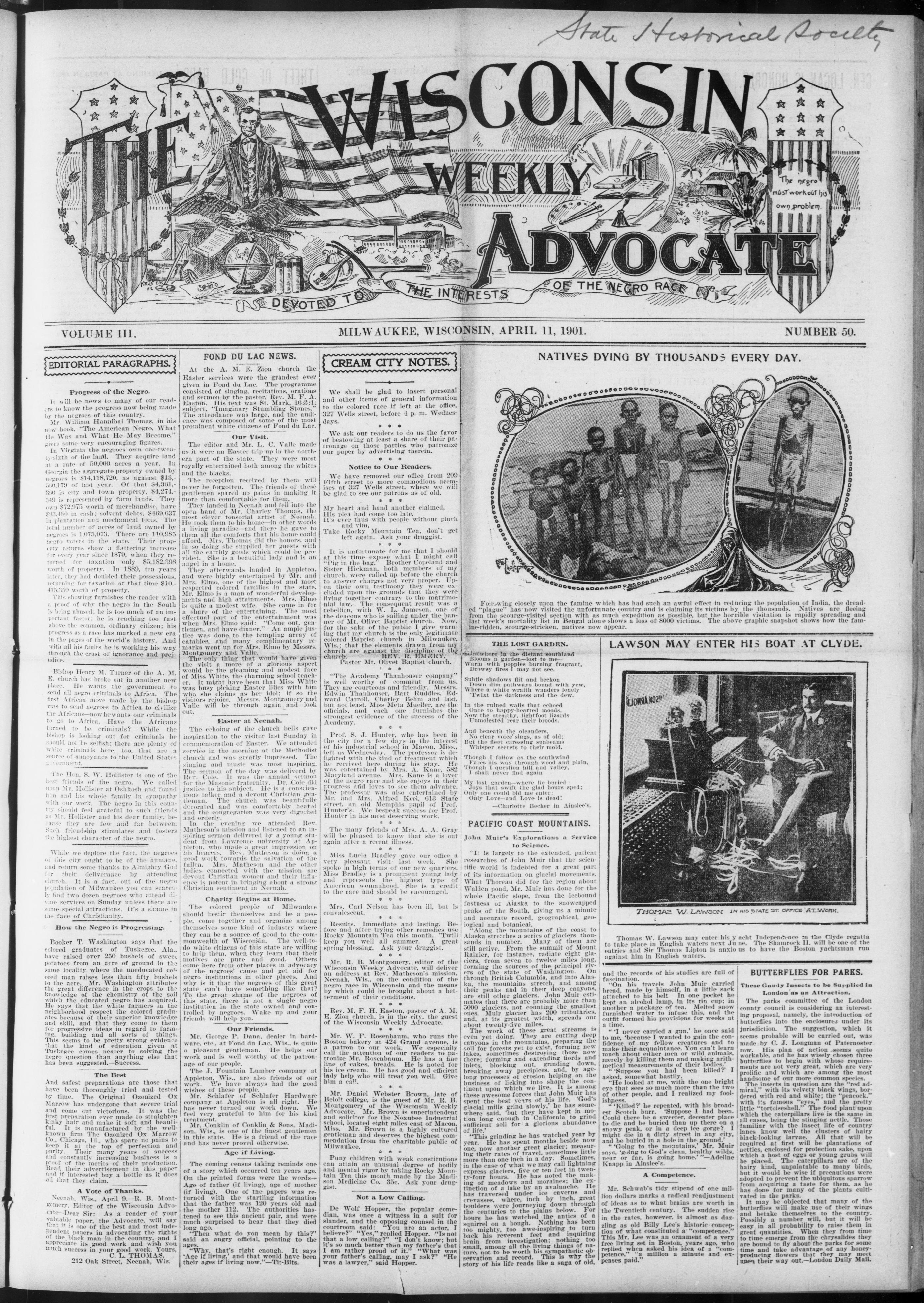
NATIVES DYING BY THOUSANDS EVERY DAY.
Following closely upon the famine which has had such an awful effect in reducing the population of India, the dreaded "plague" has now visited the unfortunate country and is claiming its victims by the thousands. Natives are fleeing from the scourge-visited section with as much expedition as possible, but the horrible visitation is rapidly spreading and last week's mortality list in Bengal alone shows a loss of 8000 victims. The above graphic snapshot shows how the famine-ridden, scourge-stricken, natives now appear.
THE LOST GARDEN.
Givewhere in the distant southland
Blooms a garden—lost to me—
Warm with poppies burning fragrant,
Drowsy fires I may not see.
Subtle shadows flit and beckon
Down dim pathways bound with yew,
Where a white wreath wanders lonely
'Twixt the darkness and the dew.
In the ruined walls that echoed
Once to happy-hearted moods,
Now the stealthy, lightfoot lizards
Unmolested rear their broods.
And beneath the oleanders,
No clear voice' slings, as of old;
But the fleet caressing sunbeams
Whisper secrets to their mold.
Though I follow as the southwind
Fares his way through wood and plain,
Though I question hill and valley,
I shall never find again
My lost garden—where lie buried
Joys that swift the glad hours sped;
Only one could bid me enter:
Only Love—and Love is dead!
—Charlotte Becker in Ainslee's
PACIFIC COAST MOUNTAINS.
John Muir's Explorations a Service to Science. "It is largely to the extended, patient researches of John Muir that the scientific world is indebted for a great part of its information on glacial movements. What Thoreau did for the region about Walden pond, Mr. Muir has done for the whole Pacific slope, from the icebound fastness or Alaska to the snowcapped peaks of the South, giving us a minute and accurate record, geographical, geological and botanical.
"Along the mountains of the coast to Alaska stretches a series of glaciers thousands in number. Many of them are still active. From the summit of Mount Rainier, for instance, radiate eight glaciers, from seven to twelve miles long, forming the sources of the principal rivers of the state of Washington. On through British Columbia, and into Alaska, the mountains stretch, and among their peaks and in their deep canyons, are still other glaciers. John Muir estimates that there are probably more than 5000 glaciers, not counting the smallest ones. Muir glacier has 200 tributaries, and, at its greatest width, spreads out about twenty-five miles.
The work of these great streams is even yet doing. They are cutting deep canyons in the mountains, preparing the soil for forests yet to exist, forming new lakes, sometimes destroying those now there; forming and extending fiords and inlets, blocking out, grinding down, breaking away precipices, and, by age-long processes of erosion helping on the business of licking into shape the continent upon which we live. It is among these awesome forces that John Muir has spent the best years of his life. 'God's glacial mills grind slowly,' he has somewhere said, 'but they have kept in motion long enough in California to grind sufficient soil for a glorious abundance of life.'
"This grinding he has watched year by year. He has spent months beside now one, now another great glacier; measuring their rates of travel, sometimes little more than one inch in a day. Sometimes, in the case of what we may call lightning express glaciers, five or ten feet in twenty-four hours. He has noted the making of meadows and moraines; the extinction of a lake by an avalanche. He has traversed under ice caverns and crevasses, where, inch by inch, great boulders were journeying down through the centuries to the plains below. For hours he has watched the antics of a squirrel on a bough. Nothing has been too mighty, too awe-inspiring to turn back his reverent feet and inquiring brain from investigation; nothing too small, among all the living things of nature, not to be worth his sympathetic observation and record. This is why the story of his life reads like a saga of old,
LAWSON MAY ENTER HIS BOAT AT CLYDE.
JOMA ARMOL
THOMAS W. LAWSON IN HIS STATE ST. OFFICE AT WORK
Thomas W. Lawson may enter his yacht Independence in the Clyde regatta to take place in English waters next June. The Shamrock II. will be one of the entries and Sir Thomas Lipton is anxio us to have the Boston yachtsman run against him in English waters.
and the records of his studies are full of fascination.
"On his travels John Muir carried bread, made by himself, in a little sack attached to his belt. In one pocket he kept an alcohol lamp, in its tin cup; in another a package of tea. Melted snow furnished water to infuse this, and the outfit formed his provisions for weeks at a time.
BUTTERFLIES FOR PARKS.
These Gaudy Insects to be Supplied in London as an Attraction.
The parks committee of the London county council is considering an interesting proposal, namely, the introduction of butterflies into the enclosures under its
"I never carried a gun," he once said to me, 'because I wanted to gain the confidence of my fellow creatures and to make their acquaintance. You can't learn much about either men or wild animals, merely by killing them and making arithmetical measurements of their bodies.'
"Suppose you had been killed?" I asked somewhat hastily.
asked, somewhat hastily.
"He looked at me, with the one bright eye that sees so much more than the two of other people, and I realized my foolishness.
"Killed?' he repeated, with his broadest Scotch burr. 'Suppose I had been. Could there be a sweeter, decenter place to die and be buried than up there on a snowy peak, or in a deep ice gorge? I might die in a dirty street in any city, and be buried in a hole in the ground."
"Going to the mountains,' Mr. Muir says, 'going to God's clean, healthy wilds, near or far, is going home.'"—Adeline Knapp in Ainslee's.
A Competence.
Mr. Schwab's tidy stipend of one million dollars marks a radical readjustment of ideas as to what brains are worth in the Twentieth century. The sudden rise in the rates, however, is almost as dazzling as old Billy Lee's historic conception of what constituted a "competence." This Mr. Lee was an ornament of a very free living set in Boston, years ago, who replied when asked his idea of a "competence," "a million a minute and expenses paid."
NUMBER 50.
EVERY DAY.
cusing the population of India, the dread-
by the thousands. Natives are fleeing
visible visitation is rapidly spreading and
the graphic snapshot shows how the fam-
HIS BOAT AT CLYDE.
IN HIS STATE ST. OFFICE AT WORK,
acht Independence in the Clyde regatta
ne. The Shamrock II. will be one of the
us to have the Boston yachtsman run
BUTTERFLIES FOR PARKS.
These Gaudy Insects to be Supplied in London as an Attraction. The parks committee of the London county council is considering an interesting proposal, namely, the introduction of butterflies into the enclosures under its jurisdiction. The suggestion, which it seems probable will be carried out, was made by C. J. Longman of Paternoster row. His plan of action seems quite workable, and he has wisely chosen three butterflies to begin with whose requirements are not very great, which are very prolific and which are among the most handsome of our more common species.
The insects in question are the "red admiral," with its velvety black wings, bordered with red and white; the "peacock," with its famous "eyes," and the pretty little "tortoiseshell." The food plant upon which the caterpillars live is the same in all cases, being the stinging nettle. Those familiar with the insect life of country lanes know well the clusters of hairy black-looking larvae. All that will be required at first will be plantations of nettles, enclosed for protection sake, upon which a host of eggs or young grubs will be placed. The caterpillars are of the hairy kind, unpalatable to many birds, but it would be wise if precautions were adopted to prevent the ubiquitous sparrow from acquiring a taste for them, as he has done for many of the plants cultivated in the parks.
It may be objected that many of the butterflies will make use of their wings and betake themselves to the country. Possibly a number will, but it will be easy in all probability to raise them in great quantities. When they from time to time emerge from the chrysalides they are bound to fly about the parks for some time and take advantage of any honey-producing flowers that they may meet upon their way out.—London Daily Mail.
GEN. LOGAN IS HONORED.
Unveiling of Statue Takes Place in Washington City.
GRANDSON PULLS CORD.
Mr. McKinley Refers to Logan as an Intense Patriot and an Intense Partisan.
Washington, D. C., April 9.—The magnificent equestrian statue of Gen. John A. Logan, erected in Iowa Circle by his comrades in arms and by the people whom he served, was unveiled this afternoon. The ceremony occurred in the presence of an immense assemblage, including President McKinley and the members of his cabinet, the surviving members of Gen. Logan's family, and many persons eminent in military and civil life. A grandson of Logan, Master George Tucker, drew the silken cord which released the fluttering flags that draped the statue and disclosed to view the heroic bronze figure.
At 1:30 p. m. an imposing military parade was formed on Pennsylvania avenue in front of the white house and thence escorted the President and other distinguished participants in the ceremony to Iowa circle. Many veteran organizations of both Civil and Spanish wars marched by separate routes to the scene of the unveiling. Music for the occasion was furnished by the Fourth Artillery band. Gen. Granville Dodge, president of the Society of the Army of the Tennessee, presided at the ceremony in Iowa circle. After the invocation had been pronounced by Rev. Frank M. Bristol, the President's pastor, Gen. Dodge presented the sculptor, Franklin Simmons. Young Master Tucker then released the clinging draperies of the statue and the splendid work was disclosed.
Following a brief introduction by Gen. Dodge, President McKinley delivered the following address:
The President's Address.
My Fellow Citizens: It is a good token when patriots are honored and patriotism exalted. Monuments which express the nation's gratitude for great deeds inspire great deeds. The statue unveiled today proclaims our country's appreciation of one of her heroic sons, whose name is dear to the American people, the ideal volunteer soldier of the wars, the eminent senator and commoner, Gen. John A. Logan. Logan's career was unique. His distinction does not rest upon his military achievements alone. His services in the Legislature of his own state, in the national House of Representatives and in the Senate of the United States would have given him an equally conspicuous place in the annals of the country. He was great in the forum and in the field.
Some names instantly suggest a sentiment. That of Logan stands for exalted patriotism. This was the key of his success. Party politics to him was nothing when the Union was in danger. When the alternative came he was swift to dedicate his life and fortune to the party of Lincoln because it stood for the indivisibility of the Union. How much he did to create and increase the sentiment of loyalty and patriotism among the people of his own state and throughout the nation can never be told. He stood with Douglas, holding up the cause of the Union, and offered his own life as a cheerful sacrifice, if need be, for its preservation.
Never a Trimmer Nor a Laggard.
Logan was never half-hearted. An intense patriot, he was also an intense partisan. He was forceful in the Senate as he was undaunted in battle. He had convictions and followed them to their conclusions at any cost. He was never a trimmer nor a laggard. He desplumed duplicity, was the soul of frankness and always at the front in every struggle, civil or military, during the years of his eventful life. He was a leader from boyhood, the recognized captain among his youthful associates. His integrity was pronounced and served him well, as integrity will serve every man who has and keeps it. His success was founded on good character, unfailing sincerity, high courage and unremitting industry. He came out of the war with the highest military honors of the volunteer soldier. Brilliant in battle and strong in military council, his was also the true American spirit, for when the war was ended he was quick and eager to return to the peaceful pursuits of civil life. While a strict disciplinarian, he was yet beloved by all his men. No duty was too hazardous for them to cheerfully undertake and no sacrifice was too great for them to undergo when he commanded. He was not only considerate and tender of the soldiers whom he led, but generous and courteous to his brother officers. It was significant of his generous spirit that under the tempting opportunity of a great command he declined it rather than injustice should be done and humiliation put upon a brother officer. No wonder that Gen. Logan was the idol of the rank and file of the army. They loved him; he loved them.
Devoted to Old Comrades.
In Washington, with most onerous and exacting senatorial duties resting upon him, he was devoted to the wants and necessities of his old comrades. His sympathy, his services and his limited purse were never denied them in their need. He was among the first commanders of the Grand Army of the Republic, and to him we are indebted for that beautiful service which on the 30th of May each year brings to the graves of the soldier dead, among whom he now rests in everlasting comradeship, the offerings of an affectionate people and the undying gattitude of a nation.
As a popular orator his voice has been heard in every state and territory of the Union, always for his country and for the flag he loved.
The highest eulogy ever paid him was by his father. The latter in his will divided his property between his widow and children equally, except—and I quote from the will—"John Alexander, whose marked abilities are such that he can provide for himself and aid his mother if necessary. This provision is not made from want of affection, but because of unbounded confidence in his future success." What a remarkable tribute from father to son! That expression of faith was enough to quicken the young man's noblest aspirations and call out the best that was in him. And how worthily he vindicated the confidence! To have inherited, to have deserved, and to have fulfilled that commendation from his father's love and faith were better than any inheritance of lands and tenements, stocks, bonds and money. Beloved of father, wife and children, beloved of his comrades in war and in peace, and beloved of his country, his whole life realized his father's prophecy, and its words would adorn any monument to his fame.
The oration of the day was delivered by Chauncey M. Depew. A benediction by Rev. Dr. J. G. Butler concluded the ceremony.
The Statue Described.
The equestrian statue of Logan unveiled today represented seven years of labor on the part of Franklin Simmons, the sculptor, and marks a departure in sculpture in Washington in that it rests upon a pedestal of bronze. Congress appropriated $50,000 for the statue and $15,000 was contributed by the Grand Army of the Republic. The pedestal is 20 feet high. On its west face is a group representing Gen. Logan in consultation with leading officers in the Army of the Tennessee. In this group are portrait bronzes of Gens, Dodge, Hazen, Slocum, Leggett, Mower, Blair and Capt. Strong. On the east face of the pedestal is a group representing Gen. Logan taking the oath as United States senator, which is being administered by Vice-President Arthur. In this group are portrait bronzes of Senators Cullom, Evarts, Conkling, Morton, Miller, Voorhees and Thurman. The south front of the pedestal is embellished with an allegorical figure of war and the north with another of peace. The equestrian statue rises above the pedestal fourteen and a half feet. Gen. Logan, facing south, is represented as riding along a line of battle, his horse
---
moving forward at a gentle trot, his hat on and sword drawn. The statue produces an impression of dignity, beauty and power. Humbert, late King of Italy, after a private view of the monument, knighted Mr. Simmons.
INCREASED TAX ON THE MORGAN MINES.
Assessed Valuation of Combine
Properties Increased from $10-
000,000 to $75,000,000.
Duluth, Minn., April 9.—The sale of the Lake Superior consolidated iron mines to the new steel combine has given the taxing officers a basis for a new valuation of the iron properties of the state, nearly all controlled by the combine. The mines are now assessed at less than $10,000,000, and they will be put up to at least $75,000,000, the present market value of combine stock by the terms of the Morgan offer.
St. Paul, Minn.. April 9.—There was introduced in the Senate today a resolution which recites the reports that the Duluth & Iron Range and Duluth, Mesaba & Northern railways have consolidated, or are about to consolidate and become merged into the United States Steel corporation; that dispatches from New York report the formation of a great trust to be formed to consolidate and control the stock, property and franchises of other great railroads of the state, all of which is declared to be in violation of the state laws. The attorney-general is directed at once to investigate these reports and in case he finds reasonable grounds to believe that any such railroads have entered into or are about to enter into such unlawful trust, combination or consolidation, he is directed to take steps to protect the people of this state either by proceedings to forfeit charters, or by injunction restraining the performance of such unlawful acts.
CAPTURE CAPITAL.
British Take Pietersburg After the Town Had Been Evacuated by the Boers.
London, April 9.—Lord Kitchener, reporting to the war office under date of Pretoria, April 8, says: "Plumer has occupied Pietersburg with slight opposition. He captured two locomotives and thirty-nine trucks."
The capture of Pietersburg is regarded here as important. The place is the terminus of the railway and has been the capital of the Boer government since the evacuation of Pretoria. The whole Northern railway is now in the hands of the British.
According to Lord Kitchener's dispatch only one officer and one man were killed. The Boers evacuated the town during the night prior to Plumer's arrival, after blowing up two trucks laden with ammunition. Lord Kitchener further reports the capture of sixteen prisoners, fifty horses and the depot of war stores at Boshmanskop, Orange River Colony. As an offset the commander-in-chief reports that a detachment of 100 men of the Fifth lancers and Imperial yeomanry were attacked by 400 Boers to the northward of Aberdeen, Cape Colony, and that after several hours' fighting the British were surrounded and captured, with the exception of twenty-five, who succeeded in making their escape.
WILL NOT GET OUT.
Force Necessary In Order to Oust the Russian Troops In Manchuria.
Berlin, April 9.—Russia's declaration, renouncing a separate agreement with China, gives great satisfaction in Berlin official circles, since it removes all separate negotiations from having further influence upon the diplomatic situation at Pekin, and the general negotiations can now proceed uninterruptedly. It is said in official circles that it was to be expected that Russia would not withdraw from Manchuria, and now, any power proposing a withdrawal must be prepared to attempt to oust her by force. The correspondent of the Associated press learns that the controversy between Russia and Japan on the subject of Corea has been conducted with the greatest caution on both sides, showing an earnest wish to avoid a conflict. The Berlin diplomats do not expect a conflict.
St. Petersburg, April 9.—The Novoe Vremya avers that Russia has no cause for uneasiness regarding Manchuria. She possesses separate agreements with the governor of each of the three provinces, which remain in force. In the future, if China desires her former position restored, she can at any time sign the treaty in her possession. In the meantime, the St. Petersburger Zeitung says Russia is free to act in Manchuria for the preservation of order as her judgment directs.
Yokohama, April 9.—The dissatisfaction of Japan with Russia's action is not in regard to the Manchurian agreement, the leading papers here affirm, but with Russia's action in Manchuria. Hence, Japan declines, according to an important section of the press, to consider the abandonment of the agreement as a final settlement of the Manchurian question. It is urged that this question should be brought before a conference of the ministers, like the other Chinese questions.
HERMAN O. ARMOUR IS SERIOUSLY ILL.
Former Milwaukeean Suffers a Stroke of Paralysis in New York.
New York, April 9.—Herman O. Armour, the only living brother of the late Philip D. Armour, is seriously ill in his home, 856 Fifth avenue. He is suffering from a paralytic stroke. He has not been well for some time, and a few weeks ago was attacked by the grippe. He seemed almost fully recovered from that and to be rapidly regaining his strength.
OPENING UP MINE.
Sinking 300-Foot Shaft on Property Near Iron Belt.
Iron Belt, Wis., April 9.—[Special.]—The Dunn Mining company of Cleveland, O., has sunk a shaft 300 feet deep about three miles east of here, near the Upson prospecting on the old Iron property, where work was suspended in 1893 during the panic. The company has employed twenty-five men on eight-hour shifts and is confident of opening up a good mine there in the near future.
KNOX IS SWORN IN.
New Attorney General Takes Oath of Office in Cabinet Room.
Washington, D. C., April 9.—Philander C. Knox of Pittsburg was sworn in as attorney general at 10:30 o'clock this morning. The ceremony occurred in the cabinet room of the white house, Justice Shiras of the United States Supreme court administering the oath.
Barber Burned to Death.
Chicago, Ill., April 8.—F. K. Berg, a barber, was burned to death at Western Springs, near here, last night, in a fire which destroyed Berg's barber shop and Greenblade's general store.
TRAPPED INTO A FALSE MARRIAGE.
Edward L. Sharick is Held for Trial on Serious Charge at Menominee, Mich.
Menominee, Mich., April 9.—[Special.]
—Edward L. Sharick has been held tour trial on a charge of seduction. Sharick did not take the stand in his own defense. Miss Mary Orth, the complaining witness, is 19 years old. She testified that she had been engaged to Sharick for some months when he proposed that they get married at Powers. They went to a vacant store, where a man, who represented himself as a justice of the peace, pretended to marry them. They lived together several days and visited her relatives. After a week Sharick suddenly disappeared. He was arrested in New York
SAVED THIRTEEN LIVES.
Heroic Exploit of Iowa Teacher Whose School was Surrounded by Water.
Harrison, Neb., April 9.—Miss Lizzie Cottman, a school teacher in district No. 19, Sioux county, is the heroine of the state. The little frame school building is located in a glade on the bank of the White river, which has been overflowing its banks during the recent thaw. When Miss Cottman arrived at the schoolhouse yesterday morning she found the building surrounded by water. For a time she entertained no fears from the flood, but the water began to undermine the foundation of the building and the supports were giving away.
The brave teacher closed the school, and, requesting the pupils to remain inside, plunged into the torrent, which by this time was waist deep. Wading to a barn near by, she secured a horse and a rope. Returning to the building, which was now afloat, she fastened one end of the rope to the doorsill and the other end around the horse's neck. Then she headed for dry land. After a desperate struggle she reached the shore, where she fastened the rope to a tree and then hailed a farmer, who came to her assistance, and the thirteen pupils were safely landed.
The parents of the children and the county commissioners are discussing plans for rewarding Miss Cottman for her heroic deed.
AGUINALDO'S ADDRESS.
Late Rebel Chieftain Reported to Have Completed His Peace Manifesto.
Manila, April 9, 3:25 p. m.—Although the officials are uncommunicative, it is nevertheless said that Aguinaldo signed the peace manifesto this morning. Chief Justice Arellano drafted the document. Aguinaldo strongly objected to two clauses of the manifesto and considerable argument was required to overcome his objections. Col. Aba, the insurgent leader of Zambales province, with thirteen officers, eighty-three men and ninety-two rifles, surrendered to Lieut.-Col. Mancil C. Goodrell, commanding the marines stationed at Olongapo, on Subig bay. Gen. Malvar, with about 300 men and as many rifles, is expected to surrender shortly at Silang, in Cavite province.
DIED OF PNEUMONIA.
F. J. Belcher Had Just Accumulated a Fortune of $600,000 in the Klondike.
Seattle, Wash., April 9.—Dawson passengers who arrived on the steamer City of Seattle say that pneumonia is very prevalent in the Klondike. Col. J. C. McCook, United States consul for the Klondike, was very ill April 2 and had practically no chance of recovery. Frank J. Belcher, one of the richest men of the Klondike, recently died of the disease, just as he was about to leave for his home in Pennsylvania, where he proposed to retire on a fortune of at least $600,000 which he had accumulated in Eldorado district. A number of other deaths have resulted from the disease.
YOUNG GIRL KIDNAPED.
Edna Hunt of Scranton, Pa., Brutally Treated by Her Captors.
Scranton, Pa., April 9.—Edna Hunt, 14 years old, was kidnaped Saturday night in a suburb of this city by three young men. Seven arrests have been made in connection with the case. The girl has been taken in charge by the board of charities. Saturday night three unknown young men accosted her and induced her to accompany them. Suddenly a hand was placed over her mouth to prevent an outcry. She was carried to a freight car near by and there her arms were tied and a handkerchief was tied across her mouth. Leaving her with one of the number, the other two disappeared. Six other young men happened along at this time and entered the car. A squad of police appeared at this juncture and arrested the entire crowd. The young men come of good families and their ages range from 18 to 36 years. The girl was nearly crazed by her treatment, and it is feared her mind is unsettled.
NOVEL METHOD OF SUICIDE.
California Woodchopper Constructs a Rude Guillotine.
San Jose, Cal., April 9.—John Connelly, a woodchopper, living in the mountains near Wrights, fifteen miles from this city, committed suicide some days ago with a home-made guillotine, but his body was not found till yesterday.
Connelly had sharpened an axe and suspended it in a wooden groove as high above the block as the low roof of the cabin would allow. A string was attached to the blade, then looped from above to the floor near the block. He evidently lay upon the floor and turned his face directly toward the blade, then severed the cord and his life went out with the fall of the heavy axe.
Coaling Warships a Study.
The system of training the men of the British navy is being constantly watched and revised with a view to increased efficiency. Great stress is being laid on efficiency in coaling, and special arrangements have been made for training the stokers. Steps are in progress to organize and improve the coaling facilities at the several naval stations to insure that the requirements of the fleets can at all times be amply met.—London Express.
Vacation Lessons.—Pater—"My boy, the philosopher tells us we must diligently pursue the ideal which personifies the ego. What do you understand by that?" Boy—"That's easy, dad. It means chase yourself."—Life.
There are ninety men in the Scots guards averaging 6 feet $ 2 \frac{1}{2} $ inches in height. Not one is under 6 feet, and twelve are 6 feet 4 inches.
Mexico buys all of its shears and sharp-edged tools from the United States.
MARKET REPORTS.
EGG AND DAIRY PRODUCTS.
MILWAUKEE—Eggs — Market easy to steady; fresh new, cases included, 12c; fresh, cases returned, 11½c; seconds, 8c. Receipts were 491 cases.
Butter—Market easy to steady. Fancy prints, 21½c; fancy or extra creamery, per lb, 20½c; firsts, 17@19c; seconds, 15@16; dairy prints, 17c; extra fancy dairy, 16c; lines, 13@14c; packing stock, 11@12c; whey, 8c; roll, wrapped, 12½c; 13½c; unwrapper, 12@13c; grease, 4@5c. The receipts today were 19,157 lbs against 7798 yesterday. There is a good demand for all choice goods.
Cheese—Steady. Receipts were 6220 lbs today against 2050 lbs yesterday. Full cream flats, new colored, 10½@11c; Young Americas, new, 11½@12c; daisies, new, 11½@12c; fancy brick, 10½@11c; low grades, 6@8c; limburger, per lb, No. 1, 10½@11c; low grades, 5@8c; imported Swiss, 12@13c; Block Swiss, domestic, 11½@12c; choice loaf, 12@13c; No. 2. 9@10c; Sapsago, 16½@17c; farmers' 10@11c.
NEW YORK — Butter — Receipts. 4661
pkgs; very firm; fresh creamery. 16@22c
factory. 11@14½c. Cheese—Receipts. 1997
pkgs; steady; large fancy colored. 11½c
11½c; do white. 11@11½c; fancy small colo-
red. 12½@12½c; do white. 12@12½c. Eggs
—Receipts. 18,917 pkgs; easier. Wes ecn.
fresh. 15½c; storage Western. 14c; Sou bern
at mark. 13@13½c. Sugar—Raw firm; fair
refining. 317-32c; centrifugal. 96 te-
t. 41-16c; molasses sugar. 3-51c; refined firm;
crushed. 5.85c; powdered. 5.45c; granulated.
5.35c. Coffee—Dull. No. 7 Rlo. 6½c nom-
inal.
CHICAGO — Butter—Steady: creamerles.
15@20½c; dairies. 11@18c. Cheese—Firm.
11@12½c. Eggs—Steady. 12c. Dresed poo-
trry—Dull; turkeys. 8½@11½c; chickens. 9¾
9½c.
MILWAUKEE LIVESTOCK MARKET.
HOGS—Receipts, 9 cars; market 5c lower; light, 5.75@5.85; mixed and medium weights, 5.80@5.95; common to good packers, 5.70@5.85; fancy selected hogs, 6.00.
CATTLE—Receipts, 3 cars; steady; butchers' steers, medium to good, 1050 to 1300 lbs, 4.75@5.25; fair to medium, 950 to 1050, 4.00@4.50; heifers, common, 3.25@3.75; good, 4.00@4.50; cows, fair to good, 2.85@3.75; canners, 2.00@2.65; bulls, common, 2.75@3.25; choice, 3.50@4.00; feeders, 800@9.00 lbs, 3.50@4.25; stockers, 500 to 750 lbs, 3.25@3.75; veal calves, common to choice, 4.00@5.00; milkers and springers, common, no demand; choice cows, 30.00@45.00.
SHEEP—Receipts, 1 car; market steady, 3.50@4.75; bucks, 2.50@3.50; lambs, 4.75@5.25; shorn sheep and lambs, 50c per cwt less.
Chicago receipts: Hogs, 25,000; cattle, 22,000; sheep, 16,000.
MARKETS BY TELEGRAPH.
MILWAUKEE—Flour—Steady. Wheat —
Easier; No. 2 spring, on track, 66%c; No. 1
Northern, on track, 71@72c. Corn—Steady;
No. 3 on track, 43%c. Oats—Steady; No. 2
white, on track, 29%c; No. 3 white, on
track, 27%@28%c. Barley—Quiet and
steady; No. 2 on track, 57c; sample on
track, 48@57c. Rye—Steady; No. 1 on
track, 53c. Provisions—Lower; pork, 14.35;
lard, 8.20.
Flour is steady at 3.90@4.00 for paten's bakers', 2.90@3.00, and 2.80@2.90 for rye.
Millstuffs are steady and quoted at 15.75@16.00 for bran, 15.50@16.50 for standard middlings, and 16.00@16.50 for Milwaukee flour middlings.
CHICAGO—Close — Wheat—April, 69%c; May, 70%1@70%c; July, 70%1@70%c; Corn—April, 43%c; May, 43%1@43%c; July, 43%c; Oats—April, 26%c; May, 24%c; July, 24%c; Pork—April, 14.27%1; May, 14.37%1; July, 14.47%1; Lard—April, 8.30; May, 8.17%1; 8.20; July, 8.10; September, 8.10; Ribs—April, 8.15; May, 8.15; July, 7.95; September, 7.90; Flax—Cash N. W., 1.56½; No. 1, 1.65; May, 1.65.
LIVERPOOL—Close—Wheat—Quiet, 1¼%d lower; May, 5½%d; July, 5½%d; Corn—Steady, 1¼%d higher; May, 8s11½d; July, 3s10%d.
KANSAS CITY—Close — Wheat — May, 64%1@64%c; July, 64%1@64%c; cash No. 2 hard, 68%1@69c; No. 2 red, 69%71c; Corn—May, 40%1@40%c; July, 40%1c; cash No. 2 mixed, 41%1@41%c; No. 2 white, 43%c; Oats No. 2 white, 29%1@30c
ST. LOUIS—Close — Wheat — No. 2 red
cash, 69c; May, 69%@69%c; July, 68%@
68%c; No. 2 hard, 71c. Corn—No. 2 cash,
42%c; May, 41%c; July, 42%c. Oats—No. 2
cash, 27%c; May, 26c; July, 24%c; No. 2
white, 30c. Lead—4.22%c. Speitzer-3.75@
3.77%c.
NEW YORK — Close — Wheat — May,
76%c; July, 76%c. Corn—May, 48%c; July,
48c.
MINNEAPOLIS—Close — Wheat — Cash,
70%c; May, 69%c; July, 71%c; on track,
No. 1 hard, 72%c; No. 1 Northern, 70%c;
No. 2 Northern, 67%c@68%c.
DULUTH—Close Wheat — Cash No. 1 hard, 72½c; No. 1 Northern, 70½c; No. 2 Northern, 65@69c; No. 3 spring, 60@65c; to arrive, No. 1 hard, 73½c; No. 1 Northern, 71½c; May, No. 1 Northern, 71½c; July, No. 1 Northern, 72½c. Oats—27½@27c. Rye—50¼c. Flax—To arrive, 1.58½c; cash, 1.58½c; May, 1.60; September, 1.15; October, 1.15; Corn—40¼c; May, 41. Receipts of wheat, 120,886 bus. shipments of wheat, 6578 bus. ST. LOUIS—Cattle—Receipts, 2500; shade lower; native steers, 3.50@5.75; stockers and feeders, 2.65@4.70; cows and heifers, 2.00@5.00; Texas and Indian steers, 3.00@5.15. Hogs—Receipts, 7000; 5e lower; lights, 5.80@5.90; packers, 5.80@5.95; butchers, 5.95@6.10. Sheep—Receipts, 1800; strong; muttons, 4.50@5.00; lambs, 5.00@5.50.
KANSAS CITY—Cattle—Recelpts. 8000; easy to strong; native steers. 4.70@5.50; Texas steers. 4.25@5.00; cows and heifers. 3.25@4.85; stockers and feeders. 4.10@5.00; Hogs—Recelpts. 18,000; 5@71% lower; bulk of sales. 5.85@5.95; heavy. 5.90@6.00; mixed. 5.80@5.95; light. 5.70@5.00. Sheep—Recelpts. 7000; steady; muttons. 4.25@5.00; lambs. 5.00@7.00.
OMAHA—Cattle—Recelpts. 2900; steady; native steers. 4.00@5.50; Texas steers. 3.25@4.25; cows and heifers. 3.25@4.75; stockers and feeders. 3.25@4.75. Hogs—Recelpts. 9000; 5c lower; heavy. 5.871%@6.00; mixed. 5.85@5.871%; light. 5.80@5.85; bulk of sales. 5.85@5.871%. Sheep—Recelpts. 7800; steady to lower; sheep. 3.80@4.90; lambs. 4.25@
A WOMAN'S HEART.
Mrs. Samuel G. Dyer Tells a Harrowing Tale of Suffering.
McCarron, Mich., April 8.—(Special.)
—Mrs. Samuel G. Dyer of this place has given the following interesting letter for publication:
"For years I suffered intense pain in the region of the heart. I doctored with the best physicians. Some of them would relieve me for a short time, but the pain always returned. My heart was so bad that I would have to sit up in bed for hours, to get relief. I would lie awake almost all night. I am 62 years of age, and no one can understand how much I suffered with this Heart Trouble.
"About a year ago I heard of Dodd's Kidney Pills, and commenced to use them. From the first my condition improved. The pain in my heart gradually grew less, and my general health much better, and now I can say positively that I am entirely cured. I can sleep all night, and enjoy almost perfect health. I thank God for the cure that has come to me through the use of Dodd's Kidney Pills.
"I have thought long over the matter of giving this letter for publication, and am doing so now without any solicitation whatever, and simply because I feel it to be my duty to express the profound gratitude I feel for my recovery, and to let others who may be suffering as I was know how they may find a cure. I know that nothing else but Dodd's Kidney Pills cured me, because I have taken no other medicine for over a year. I feel better now than I have for many years, and it is all due to the use of Dodd's Kidney Pills." Mrs. Dyer's case and its cure has attracted a great deal of attention, and her letter is a splendid tribute to the curative properties of Dodd's Kidney Pills.
—It was on the day of the Queen's birth, May 24, 1819, that the first trans- Atlantic steamer started from Savannah for Liverpool.
THEFT OF GOLD BARS.
Complete Failure to Locate Either the Missing Gold or the Men Who Took It.
New York, April 10.—The robbery at sea of the specie room of the North German Lloyd liner Kaiser Wilhelm der Grosse seems a mysterious crime. Apparently there has been complete failure to locate either the missing gold bullion or the men who took it, although the search of passengers and ship at Bremen again this morning may furnish material for the investigations. Three bars of gold, aggregating in value $22,750, shipped by the National City bank of New York, were stolen from cask No. 4 of the specie room somewhere between this port and Cherbourg. The advices to Oelrichs & Co., agents for the company, came in German and on the point as to whether the specie room was broken open or entered by breaking the lock admits of translation either way. The specie room of the Kaiser Wilhelm der Grosse is iron bound and almost as strong as a vault. Its door was secured by a patent lock for which there were but two keys. One of the keys was kept by the chief officer, the other by the purser.
The bars of gold were packed in oak casks bound with iron hoops. Thousands of dollars of gold were within the reach of the man who forced his way into the strong room, but only the sum named was taken. At the office of the North German Lloyd agents this morning the following statement was given to the Associated press:
"Three bars of gold valued at $22,750 were taken from the specie room of the Kaiser Wilhelm der Grosse somewhere between here and Cherbourg. The bars were taken from cask 4, but we have no idea as to how the robbery was accomplished. Our advices are but brief and do not show how the room was entered. The gold was shipped by the National City bank of New York. We understand it was insured, but the responsibility will be passed upon later. The ship is due at Bremen today and we may hear further from there. We have not recovered the gold and this office has no knowledge of the thieves. The specie room is a strong, safe one, secured by patent lock, to which there were but two keys. The chief officer kept one key, the purser the other. We will make every possible effort to recover the money and catch the thieves."
Reward of $2000 Offered.
Bremerhaven, April 10.—It is officially announced that two bars of gold were stolen during the voyage of the North German Lloyd steamer Kaiser Wilhelm der Grosse, which left New York April 2, and arrived at Cherbourg April 9. The company has offered a reward of 10,000 marks for their restitution or for the discovery of the thieves.
London. April 10.—The offer of a reward for the gold stolen from the Kaiser Wilhelm der Grosse or for the discovery of the thieves appears to effectually dispose of the theory first advanced, that the bars were stolen previous to having been put on board the steamer. No clue, however, seems to be forthcoming regarding the perpetrators of the robbery. Passengers of the Kaiser Wilhelm der Grosse, who were landed at Southampton, told a representative of the Associated press that they knew nothing of the matter until they read in the newspapers of it this morning. It was observed that there were no special precautions or searchings when the passengers disembarked, though there was some comment caused by the delay of seven hours in landing the passengers at Cherbourg, where the steamer arrived at 11 o'clock Monday night. But, contrary to custom, the passengers were kept on board until 6 o'clock in the morning. Officers of the steamer explained that the tender would not come out. But this failed to satisfy the impatient passengers, who, however, were quite ignorant until they landed that their detention was due to the initial investigation consequent upon the theft and the precautions exercised at Cherbourg. But the fact that these precautions were not observed subsequently at Southampton was taken to indicate that the officials believe the conspiracy has its chief end on the continent. The passengers are inclined to believe that the robbery must have been accomplished by an individual exceptionally conversant with the arrangements of the steamship company, for not one of the cabin passengers, apparently, knew there was specie on board, much less where it was kept.
Not Landed in France.
Paris, April 10.—Neither the Cherbourg nor the Paris police have found any trace of the missing gold bars or of the thieves. They are confident that the bars were not landed in France and think they are still aboard the Kaiser Wilhelm der Grosse and will be found concealed in the hold at her arrival at Bremen.
The only suspicious incident on board the steamer was a fight between two members of the crew on the eve of her arrival at Cherbourg, during which both men were stabbed with knives. A little later the robbery was discovered. These particulars have been telegraphed to Bremen.
TINO STILL AT LARGE.
Aguinaldo to be Detained Until Insurgent Leader is Caught
Manila, April 10.—Lieut. Mapes of the Twenty-third infantry has captured $40,000 of insurgent funds and has taken prisoner three officers belonging to Gen. Cailles' staff near Manila. Under the old regulations cock-pits will be re-established in Manila, the privilege of conducting them being granted to the widow of Capt. Lara, who commanded the native police of the city. Formerly the municipal revenue derived from cock-fighting amounted to $60,000 annually.
It is stated that before Aguinaldo is liberated he will be required to obtain the surrender of Gen. Tino, the insurgent leader.
NEW KIND OF ENGINE.
Invention of an Iowa Man Which Promises Great Things. Des Moines, Ia., April 10.-L. Kessler has invented a steam engine for half the patent rights in which he has been offered $25,000. A model of the engine has been in the office of Cashier G. D. Ellyson of the Marquardt Savings bank in Des Moines for three months. It is a half horse power and has used but a half pint of water during the three months. The heat is furnished from a gas tip.
The engine combines a boiler and steam chest in one chamber, from which all air is exhausted. The water is converted into steam, is condensed and again vaporized. There is no exhaust and the same water is used indefinitely. The inventor believes the machine will run on the same basis indefinitely. His theory is that as condensed hot water is to be reconverted into steam little fuel will be required.
DEERING AT PARIS IN 1900.
The Famous Chicago Harvester Company Received More and Greater Honors than Were Ever Before Accorded an American Exhibitor in the History of Expositions.
America may well feel proud of the interest which her citizens took in the Paris Exposition and the elaborate exhibits which were prepared with consumate skill and displayed in a manner not excelled by any other country. Those of Harvesting Machinery in particular were most complete and interesting. The Deering Harvester Company of Chicago, America's foremost manufacturer of this line of goods, was accorded the position of honor, having contributed more to the advancement of the art of harvesting than any other manufacturer, living or dead, and with a greater array of important inventions to its credit than any other company in the world.
Visitors to the Exposition were prompt to accord the Deering exhibits supreme honors, and it only remained for official mandate to ratify the popular verdict, which was done in a manner as substantial as it was well-merited. Each one of the seven Deering exhibits secured the highest award in its class.
In addition to four high decorations, the Deering Harvester Company received twenty-five awards, or twenty-nine in all, as follows: Decoration of Officer of the Legion of Honor, Decoration of Chevalier of the Legion of Honor, two decorations of Officer of Merite Agricone, a Special Certificate of Honor, the Grand Prize, six Gold Medals, six Silver Medals and eleven Bronze Medals, including Deering Collaborator Medals.
The Decoration of the Legion of Honor was instituted by Napoleon Bonaparte when First Consul in 1802, and is only conferred in recognition of distinguished military or civil achievements. It is the highest distinction in the gift of the French Republic. The Decoration of Merite Agricole is an honor of but slightly less importance, which is conferred upon those who have contributed greatly to the advancement of agriculture.
An Official Certificate of Honor was accorded the Deering Retrospective Exhibit, which showed the improvements in harvesting machinery during the past century, and excited the highest praise of the French government officials who had entrusted to the Deering Harvesting Company the preparation of this most important exhibit. By special request this exhibit has been presented to the National Museum of Arts and Sciences at Paris, where it has become a permanent feature of that world-famed institution. The Deering Twine Exhibit and Corn Harvester Exhibit, both of which received the highest awards, have by request of the French government been presented to the National Agricultural College of France.
There was no field trial, either official or otherwise, in connection with the Paris Exposition, but the most important foreign contest the past season was held under the auspices of the Russian Expert Commission at the Governmental Farm at Tomsk, Siberia, Aug. 14 to 18. All the leading American and European machines participated and were subjected to the most difficult tests by the government agriculturist. The Expert Commission awarded the Deering Harvester Company the Grand Silver Medal of the Minister of Agriculture and Domain, which was the highest award.
The Deering Harvester Works are the largest of their kind in the world, covering eighty-five acres and employing 9,000 people. They are equipped with modern automatic machines, many of which perform the labor of from five to fifteen hands.
This company is also the largest manufacturer of Binder Twine in the world, having been first to produce single-strand binder twine, such as is in general use to-day, making over a third of the product of the entire world. The output of its factory for a single day would tie a band around the earth at the equator, with several thousand miles to spare. The annual production would fill a freight train twenty miles long. Made into a mat two feet wide, it would reach across the American continent from ocean to ocean. Deering machines are known as LIGHT DRAFT IDEALS, consisting of Binders; Mowers, Reapers, Corn Harvesters, Shredders and Rakes.
This company exhibited at the Paris Exposition an Automobile Mower, which attracted much attention, and exhibitions were given with one of these machines in the vicinity of Paris throughout the season.
Riley and Nye.
When James Whitcomb Riley and "Bill" Nye traveled together giving a joint entertainment, the humorist had great fun with the poet. Once, in introducing Riley and himself to an audience, Nye remarked: "I will appear first, and speak until I get tired; then Mr. Riley will succeed me and read from his own works until you get tired."
If Coffee Poisons You,
ruins your digestion, makes you nervous and sallow complexioned, keeps you awake nights and acts against your system generally, try Grain-O, the new food drink. It is made of pure selected grain and is healthful, nourishing and appetizing. It has none of the bad effects of coffee, yet it is just as pleasant to the taste, and when properly prepared can't be told from the finest coffees. Costs about $1/4 as much. It is a healthful table drink for the children and adults. Ask your grocer for Grain-O. 15 and 25c.
Nazareth Becoming Modernized.
Nazareth has now a telegraph office, where an Armenian operator, in ordinary European dress, keeps the village community in touch with the great world.
Coughing Leads to Consumption.
Kemp's Balsam will stop the cough at once. Go to your druggist today and get a sample bottle free. Sold in 25 and 50 cent bottles. Go at once; delays are dangerous.
A private detective agency has been started in Zurich. This is the first of its kind in Switzerland, where the law of divorce is practically unknown.
Active workers everywhere can earn big money;
always a steady demand for our goods. Sample
eash lock, with prices, terms, etc., free for 2stamp
for postage. THE BROHARD CO.,
Department 10, Philadelphia, Pa.
M. N. U. No. 15,1901
WHEN WRITING TO ADVERTISERS
please say you saw the Advertisement
in this paper.
STAYIN' UP LATE.
Sometimes, when bed-time comes, I tease;
"Please, daddy, let me stay up late:
I ain't a single snip o' tired:
Jack Smith don't go to bed at eight."
An' daddy looks at mammy, nen,
An' ef she wiggles with her head
He says, "All right, another hour
Before you hafter go to bed."
An' nen I feel jes like a man
(I tell you what it's hard to wait
Ter grow—a feller feels so small
When he has to go to bed at eight).
So me 'n' th' pup play drivin' horse
Until th' pup gets tired o' that,
An' he don't wanter play no more,
An' goes to sleep in daddy's hat.
An' nen I ask dad why it is
That I don't have hair on my face
Like him. An' who he thinks 'd win
If me an' Jack Smith run a race.
An' nen dad says, "I was mistook
in lettin' you stay up, I fear."
An' nen it's only half past eight—
An' nen—an' nen—th' mornin' here!
IN GAY NEW YORK.
Scenes and Incidents of Everyday Life in the Paris of America.
Mrs. Stuyvesant Fish and her party will arrive from the West in two or three days. James Henry Smith and his guests are also expected this week.
It is rumored on the Rialto that Maurice Campbell and Harrison Grey Fiske, open enemies of the theatrical syndicate, have purchased the Manhattan theater. William A. Brady having been refused a new lease.
A novel accident occurred on the elevated road the other day, when tests were to be made of a new electric train. The insulation became defective and the steel rails were dissolved as though made of tissue paper.
Mrs. Potter Palmer has decided to build at Newport, and her agent is looking for a large tract of land upon which to erect a handsome cottage. It is understood that Mrs. Palmer will spend a portion of the season in Newport.
The Countess of Strafford, formerly Mrs. Cora Colgate, has sold her country place at New Hamburg on the Hudson to William P. Clyde for $55,000. It is understood that she made the sale herself while coming over on a steamer from Europe.
All the records in the sale of $1000 revenue stamps in Wall street were broken during the first two hours of business on Thursday. At 11 o'clock 455 of these stamps had been sold to downtown firms who were closing up financial deals in the street.
A dispatch from Sioux Falls, S. D., says Fred Gebhard of New York has taken up his residence in that city. He arrived there yesterday, accompanied by a valet and eleven trunks. Efforts have been made to keep his presence from becoming generally known. He says he is on business. When asked if his purpose was to obtain a divorce he declined to answer. Mr. Gebhard married Miss Morris of Baltimore five years ago.
An official seal has been chosen for the Protestant Episcopal cathedral of St. John the Divine. The insignia of the episcopacy, the state and the county, as well as the seven chapels to be erected, are combined in the design. The bishop's miter is placed at the top, with seven golden candlesticks and seven stars below and the respective seals of the county and state between. The seven chapels to be erected are to be for seven nationalities, German, French, Spanish, Italian, Chinese, Finnish and Swedish.
---
Again the old Hotel Metropole, of late known as the Rossmore, on Broadway near Forty-second street, has changed hands. John A. Armstrong, identified with a local clothing firm, bid in the property for $585,000, which is said to be a very low figure. The opposite lots in Broadway brought $125,000 apiece when last sold and since then a subway station in Longacre square is assured. An offer of $750,000 was recently made for the hotel property and refused by the executors, by whose order the sale was made.
The dances known as the Five Cotillons are being reorganized for 1901-2, and several new patronesses have taken the places of those who have retired. This class is limited to 150 members, and there are numbers on the waiting list whom the patronesses are, therefore, unable to take in this coming season. The dates of these dances are Mondays, December 16 and 30, and Fridays, January 17 to 31, and Easter Monday, March 31. The new patronesses are Mesdames Francis Lynde Stetson, Payson Merrill and Thomas P. Flower.
When the biggest man in the United States army walked up Broadway the ether day the street crowd forgot its troubles incident to April weather and stopped to look in astonishment. The giant is Capt. John S. Battle, a West Point graduate en route to Manila. He came up from Porto Rico yesterday. "What a pity he could not be paired off with old Pat Bane of Waynesburg in a military parade," observed a Pittsburgh who reviewed Capt. Battle from the steps of the Fifth Avenue hotel. "They would make an appropriate duo."
---
Russell Sage is said to have been the most disappointed man in Wall street the other day because of the rise in Manhattan and Missouri Pacific. The financier is a bear on the market, but, although he has not gone short, it is understood that he put out a lot of calls on both of the stocks mentioned at prices ranging from 10 to 20 points lower. If rumor is correct these calls amount to between 15,000 and 20,000 shares in the case of Manhattan aione. Mr. Sage has thereby lost a paper profit of more than $2,000,000 by not holding his stock and selling around 130.
---
Ceramics have for some time been getting into the dress world. One of the fads this spring will be for hand-painted buttons and belt or stock clasps. A Broadway jeweler started it, and now there are a dozen or more women who do attractive work on ceramics busy filling these out-of-town orders. They are about as large as a penny, and painted in any design desired, according to the fancy of the customer, or to match a gown. There are designs in forget-me-nots for blue gowns, and others with pink, roses on a blue ground. The shopping throng is getting to resemble an animated art collection.
Statements that James G. Blaine has opened a fashionable women's tailoring establishment are emphatically denied, as the shop was fitted up by another Blaine. Young Blaine is doing newspaper work. He is also said to be still on probation, as a suitor for the hand of Miss Hichborn, a daughter of Admiral Hichborn of Washington. If he remains steady a year, it is said, he will be rewarded by Miss Hichborn's hand. Instead of turn-
ing his attention to fashioning women's garments, it is reported that he is making a fortune in stocks. He has made $250,000 at the very lowest in this bull market.
The cornerstone of the new fifteenth story addition to the Mutual Life Insurance company's building on Cedar street, near Nassau, has been laid, the officers participating in the ceremony. When the structure is completed that part below the street level will be almost one-third the size of the entire building, or one-half as large as that part above the ground. The foundation rests on bedrock at a depth of 100 feet, forty feet deeper than the foundation of any other building in the city. This will be 55,000 square feet of space below the ground, as much as the entire floor space of an ordinary office building.
A swirling red tide set strong against the Orpheum theater, Brooklyn, the other afternoon. In response to the footnote under the Orpheum advertisement in papers of recent date, which invited all the auburn-haired girls of Brooklyn to visit the theater free of charge, possessors of red hair of all shades lined up in front of the box office. Red heads at the entrance they became deadheads inside and in order to completely fill out the scheme the managers provided for each auburn-haired maid a red seat check. The red head rows were the first two in the orchestra and when the women removed their hats the footlights looked like a penny candle.
Harry Vokes, a member of the Ward
& Vokes company, made a contract with
E. D. Stair, the manager of the
company, at the beginning of the season
that if he indulged in any intoxicating li-
quors he would forfeit $1000.
Harry is a member of the Elks and
happened to drop in on Syracuse when
they were having a social time. He so
far forgot himself as to drink a cocktail.
The manager dropped in town the
same night and caught Vokes indulging
in his quiet drink. Vokes admitted his
guilt and paid over the $1000. His man-
ager made out a bill as follows:
* Mr. Harry Vokes.
* To E. D. Stair, Manager, Ward and
* Vokes, Dr.
* To one drink (cocktail), $1000.
"Well, am I crazy?" After two physicians had for two hours examined Maurice Barrymore, the insane actor, at the pavilion in Bellevue hospital, he asked them this question. He seemed half amused at the physicians' efforts to find out in just what way his mind was unhinged. "You should know by this time whether I am crazy or not," he said, sarcastically. "Here you've been at me now, raking me from intellectual stem to stern, for two hours. You surely should know whether I'm sane or not." The doctors made no direct reply. They found him verging on paresis and decided he had best be sent to a private sanitarium in Astoria. "You're going away," they said to the actor. "All right," he replied; "I'll be glad to go."
The only dealer in genuine rabbits' feet, warranted to bring good luck and keep away the influence of the powers of darkness, lives in Hell's Kitchen, one of New York's wickedest sections. Nobody knows how old she is, but she is very old, she says, and she has been in the rabbit's-foot business for twenty-five years. Where she obtains her supply she has never told, but she always has a stock on hand; and as the real thing must be the left hind foot of a rabbit killed in a graveyard at midnight in the dark of the moon, she must have a large corps of trained hunters working nights in the graveyards where rabbits do most congregate. Her customers know the old woman as "Mammy Cottontail." Craplayers are her best clients, and one and all are willing to go to the limit of their resources to get one of "Mammy Cottontail's" charms.
It was a small affair to attract so much attention—only a toy trunk about a foot long—but as it rested alone on a large baggage truck in charge of a 250-pound porter, the passengers on the Delaware, Lackawanna & Western ferry boat struggled to get a glimpse of it. Those who succeeded turned away smiling, for it was tied with broad white satin ribbon in large bows, and three labels nearly covered the entire top of the trunk. In the middle was a small card with the address:
* LIEUT. AND MRS. LAURENCE K.;
* BROWN, FORT MONROE, VA.;
*
A larger card in a feminine hand announced:
* I LEFT MY HAPPY HOME FOR
HIM.
* Another card bore this inscription over two arrow-pierced hearts:
* THEY LEFT THEIR HAPPY
HOMES FOR EACH OTHER.
*.....*
Theatrical folk and the stagedoor chappies do not know whether George W. Lederer has turned over a new managerial leaf, or is merely making game of them. Mr. Lederer's notice requiring chorus girls to produce chaperons for their trips to and from the Knickerbocker theater while his company fills an engagement there, commencing April 15, has created amusement mixed with indignation. The notice is of weird construction. It says that "members of the ladies of the Casino girl company" must have chaperons. The wording is objected to by twenty-three amazons, who beg to inquire why a lady may not be chaperoned intact? Surely no comic opera manager has the right to turn his chorus into a clinic. The order of "Little Weasels," a new social and protective order of Johnnies, has taken official notice of the offensive order, which is undoubtedly aimed at them. "We have organized for protection," said a Weasel. "The girls have their organization of White Mice and we're going to demand our rights. If a Weasel wants to speak to a White Mouse I'd like to see Lederer stop it."
Many of our well-known millionaires have a habit of going about New York with only a few cents of change in their pockets and perhaps none carries less of the coin of the realm than Henry Clews. Not long ago he and Mrs. Clews dined at a place where the banker-broker-author was unknown, and where the rule was strictly cash down. Knowing that his good wife generally had sufficient money in her purse to defray any ordinary expense, he whispered when the finger bowls were brought: "My dear, will you lend me enough to pay for the dinner? I forgot to bring any money." But Mrs. Clews, too, had forgotten to bring any money, and there sat this delectable couple with millions at home but not a cent for hotel tribute! The banker's planatin to the waiter was not regarded as satisfactory, neither did the house understand. The proprietor, a fellow without discernment or tact, was so inclined to be incredulous that Mr. Clews disdaining a controversy, quietly deposited his gold watch as a pledge that the bill should be paid as soon as he could send a messenger from his home. In getting into this scrape Mr. Clews is not singular. Other millionaires have had similar difficulties. There is a well-told story that John D. Rockefeller, happening to find his pockets empty, once permitted a stranger to pay his fare on the elevated road.
NOT HER HUSBAND'S BODY
Man Who Died in Jail Gave Name of Daniels When He was Arrested.
Fond du Lac, Wis., April 9.—[Special.]—Mrs. J. C. Duffield came here this afternoon from Pewaukee, where she resides, to view the remains of the man who died at the county jail Sunday night from the excessive use of opium. She stated, upon seeing the body, that there was a strong resemblance between her husband and the dead man, but that was all. The identity of the man is still a mystery. He gave his name as Daniels when arrested. Mrs. Duffield will return to Pewaukee tonight.
turn to Pewawake tonight.
Pewawakee, Wis., April 9.—[Special.]—It has just become known that J. C. Duffield has disappeared again, Mrs. Duffield, who was Miss Nellie Caldwell of this place before her marriage, received word from Fond du Lac today that a man, supposed to be her husband, had dropped dead in the jail at that place. It was said that he was suffering from the opium habit, which caused his death. Mrs. Duffield went to Fond du Lac this morning to view the body.
J. C. Duffield was the son of a Mr. Duffield of Galveston, Tex., who spent his summers in Waukesha. It was while he was in this vicinity that the son met Miss Caldwell and married her. Shortly after the marriage it was discovered that he was a morphine and opium user. His condition became so that it was found necessary to place him in an insane asylum. He was committed to the asylum at Milwaukee, from which he escaped. Later he was caught and was taken back to the hospital. He was paroled last summer and he and his wife went South. They returned in a few weeks and then he disappeared and Mrs. Duffield has received no word from him up to the present time.
Word was received late this afternoon that the body at Fond du Lac was not that of Duffield.
ROCKEFELLER'S HARBOR
He Buys a Harbor in Northern Wisconsin from Which to Ship His Ore
West Superior, Wis., April 9.—[Special.]—The report that John D. Rockefeller has purchased a big tract of land with a harbor in northern Wisconsin is true as far as the harbor is concerned. The land is located at the mouth of the Montreal river, the dividing line between Michigan and Wisconsin at the northerly end of the state. There is said to be a very fine harbor there, but no settlement of any kind as yet. The harbor is a good one, but there may be some trouble from the fact that it has a sandstone bottom. It is eighteen feet in depth nearly all the way around and the drop-off from the shore is said to be a steep one so that for boats drawing less than eighteen feet it would be good, but it is claimed that a great deal of trouble would be experienced in getting the depth any greater from the fact that the sandstone exists. Rockefeller has purchased the harbor for the reason that is but twenty miles from the Goebic range, and he already had a railroad line surveyed from the range to the harbor. The report has it that $1,000,000 was paid for the property, but this cannot be confirmed.
DRIVE INTO AIRHOLE.
A. J. Lindsay and William George Well-Known Citizens of Ashland, Have Narrow Escape.
Ashland, Wis., April 9.—[Special.] A narrow escape from a fatality that would have caused two deaths occurred on Chequamegon Bay near this city this morning. A. J. Lindsay and William George, two well-known citizens of Ashland, while driving across Chequamegon bay from Washburn to Ashland drove into an airhole. The team of horses and the sleigh were lost. The men were rescued by friends who saw the catastrophe from the shore.
MINISTER ON STONEPILE.
La Crosse Clergyman Serving Sentence in County Jail.
La Crosse, Wis., April 9.—[Special.]—Rev. Martin O. Hanson, whose escapades during the past four years have kept him continuously in the public eye, and who is at present serving a sentence in the county jail, for nonsupport of his wife, is enjoying a large amount of work not usually assigned to a clergyman. He is kept on the stonepile day after day, and yesterday, much to his disgust, was brought downtown to the courthouse square to assist in raking up the lawn with ten other prisoners.
ARM TORN TO PIECES.
William Meyers of Bangor Victim of Hunting Accident.
La Crosse, Wis., April 9.—[Special.]—William Meyers, a well-known saloon-keeper of Bangor, lost one of his arms and came near losing his life as the result of a hunting accident. He was hunting near Bangor and was carrying his gun under his arm. The trigger of the gun snapped and a charge of shot tore his arm almost to pieces. Surgeons found it necessary to amputate the member and now some doubts are entertained as to his recovery.
PLUMBERS MAY STRIKE.
Journeymen Demand Same Pay for
Shorter Hours.
La Crosse, Wis., April 19.—[Special.]— All the journeymen plumbers in the city have made a demand on the boss plumbers that after May 1 they want the same pay for shorter hours. They are receiving $3.25 a day, for nine hours, and want the same pay for eight hours' work. Unless their demands are granted a general strike will take place.
STRIKE DRIVES MAN INSANE.
William Chaffee of Beaver Dam Loses His Mind.
Beaver Dam, Wis., April 9.—[Special.]
—William Chaffee has been adjudged insane. The cause was the strike of the Malleable Ironworks, which lasted a little over a week. Chaffee was taken to Oshkosh this morning. He is 28 years old and leaves a wife and two children. The family moved here last June from Kingston, Green Lake county.
CAN'T PLAY POKER AT OSHKOSH
Chief of Police Says the Game Must Stop. Oshkosh. Wis.. April 9.—[Special.] Chief of Police Weisbrod has issued orders forbidding the playing of poker in saloons and all other public places.
Senate.
The first move toward fixing the date of the final adjournment of the Legislature was made on the 4th, when Senator Kreutzer introduced a joint resolution providing that all business except messages from the governor shall close at midnight May 2, and that the Legislature adjourn sine die May 4. The resolution was referred to the committee on rules. The anti-cigarette bill was slaughtered by the Senate without the formality of further discussion. The vote was 15 to 12. Gov. La Follette's veto of the bill exempting the Milwaukee exposition from taxation on constitutional grounds was on the Senate calendar, but on motion of Senator Roehr, author of the bill, action on it was deferred for a week. The committee on education reported for passage with an amendment the bill, 111 S., providing for state aid to graded schools, and an increase in the clerical force of the state superintendent. The following bills were passed: Providing for the cataloguing and library distribution of public documents by the free library commission; relative to collection of light and water rates; relating to electric light plants heretofore purchased by cities; authorizing marine insurance on the Lloyd's plan; relating to examination of teachers by county superintendents; providing for lighting and water commissioners in cities; relating to improvements of Lost Creek. Senator McGillvray's bill providing for flags on polling booths, amended so that it shall be optional with common councils and town boards, was ordered to engrossment and third reading in the Senate. Senator Roehr's bill authorizing the Milwaukee county board to fix the salaries of the sheriff and his deputies, was also advanced to engrossment and third reading.
The committee on privileges and elections of the Senate decided to report the Stevens primary election substitute without recommendation and the Senate on the evening of the 3d received the report. The committee recommended that the bill be made the special order of business for the evening of the 10th. Beyond receiving the reports of the committee on the primary election bill, the Senate did little business.
A contest in the Senate over the primary election bill was precipitated on the morning of the 5th. It was brought on by a resolution introduced by Senator Gavney that the committee on privileges and elections be instructed to report bill 73 S. not later than this evening. No. 73 S. is the original primary election bill introduced by Senator Miller. Senator Gavney asked immediate action on the resolution. Senator Miller objected, but Lieut.-Gov. Stone ruled that it was a privileged resolution and entitled to immediate consideration. Then Senator Miller made a vigorous appeal to the Senate to vote down the resolution. After discussion the ayes and noes were called for and the resolution passed—18 to 13. Assemblyman Hall's resolution for a constitutional amendment legalizing the use of voting machines in Wisconsin, was lost in the Senate today. There was a majority of one in its favor, the vote being 16 to 15, but Senator McDonough raised the point of order that a majority of the members-elect is required to pass a constitutional amendment. Lieut.-Gov. Stone ruled the point taken and the resolution lost. The Woodward marriage bill, prohibiting the union of people afflicted with dipsonomia, insanity and other diseases, amended so as to make the certificate of one physician sufficient, was ordered to engrossment and third reading by the Senate by a vote of 15 to 14. A number of blits were passed, among them the following: Prohibiting the sale of publications devoted specially to crimes, etc.; prohibiting the employment of children under 14 in bowling alleys, been gardens or barrooms; cutting down the noon recess for employees in state departments to one hour and cutting off the Saturday half-holiday: constitutional amendment changing the term of the state superintendent to four years, beginning in July, and removing the limitation of the salary to $1200.
Friends of the Hall joint resolution proposing a constitutional amendment allowing the use of voting machines at elections hope to secure a reconsideration of the vote by which it was slaughtered this morning. Senator Mills at the evening session moved that the vote be reconsidered and asked that the motion lie over until the 9th. There was no objection made. The vote by which the two taxation bills, Nos. 214 S. and 236 S., extending the powers of the state tax commission, were advanced to a third reading In the morning was reconsidered and the bills referred to the committee on assessment and collection of taxes. Adjournment was to the 6th.
The supporters of the Stevens primary election bill on the morning of the 6th renewed the fight of yesterday on the floor of the Senate. An unsuccessful effort was made to reconsider the vote whereby the Senate placed the Miller bill, known as No. 73 S., on the calendar for the evening of the 10th. The contest was short, but decisive. Twelve bills were passed, five were killed, eight ordered to third reading and one ordered engrossed. Among the bills passed was the appropriation bill setting aside a fund in case of Aslatic cholera or other infectious epidemics. The bill reorganizing the Wisconsin National guard and the one requiring flags to be erected on polling booths on general election days also went through. The Milwaukee county sheriff bill went over at the request of Senator Roehr while the bill compelling law students to take a three year course in law instead of two years was passed by 13 to 5. The appropriation bill of the state institutions went over. The Senate adjourned until 8:30 p. m. on the 8th.
The Senate held a short session on the evening of the 8th and received a veto from the governor. The veto relates to Senate bill No. 392, providing that a certified copy of the annotated statutes be filed with the secretary of the state. The governor maintains that section 4135, laws of 1898, provides that the statutes of 1898 shall "Be sufficient evidence thereof in all courts of law and on all occasions whenever necessary," and that the law proposed by the bill is unnecessary. The committee on claims reported in favor of killing bills No. 67 S., increasing the appropriation of the Wisconsin Horticultural society, and Bill No. 113 S., increasing the appropriation of the Wisconsin Dairymen's association.
The Woodward marriage bill, which as amended required a physician's certificate of freedom from insanity and certain diseases from all parties contemplating marriage before license is issued, was killed by the Senate on the 9th by a vote of 17 to 16. There was no discussion of the bill. Senator Kreutzer withdrew his motion to reconsider the vote by which the bill requiring stationary engineers to be examined and licensed was passed, and the bill stands. Action on two of Gov. La Follette's vetoes was again postponed, the bills vetoeed being relative to changes of venue in Dodge county and providing for the filling of the statutes and making them evidence. Action on the motion to reconsider the vote which killed the Hall constitutional amendment providing for the use of voting machines was deferred. The following bills were passed: Providing for licensing engineers; providing for a course of study in agriculture in district schools; providing for binding exchanges of the Wisconsin Academy of Sciences, Arts and Letters; providing for the reconveyance to Mrs. Mary A. Hamilton of a tract of land in Fond du Lac county; authorizing the Milwaukee county board to fix the salary of sheriff and number and salaries of deputies.
Two substitutes for the Miller primary election bill, known as 73 S., were introduced in the Senate on the evening of the 9th. One was offered by Senator Hagemister of Green Bay, and provides for the application of the primary election principle to county offices only, all judicial and offices being excepted. The other substitute is by Senator Kreutzer and applies the primary election principle to counties, but also calls for the election of delegates to all other conventions by a direct vote. Earlier in the evening Senator Jones, representing the stalwarts, and Senator Miller, of the supporters of the Stevens bill, held a meeting and arranged the preliminaries for the big contest on the floor of the Senate. It was agreed that there should be no filibustering but an honest and fair fight. Under the terms of the agreement the Stevens substitute will first be taken up. It will be argued all evening on the 10th and part of the following evening.
The Senate on the 10th, without discussion, concurred in the Hall resolution for a constitutional amendment authorizing the use of voting machines in Wisconsin. The amendment was once killed, but the vote was reconsidered. It was finally concurred in, 19 to 12. The committee on corporations reported favorably, with an amendment, the bill 45 A., providing for the licensing of billposters. The bill intended to overcome Gov. La Follette's objections to Senator Roehr's bill exempting the Milwaukee Exposition company's property from
taxation was advanced to third reading in the Senate. The bill increasing the powers and duties of the state tax commission, which was on the calendar for passage, was laid over on motion of Senator McDonough. The bill creating free employment bureaus in Milwaukee and Superior was laid over.
The primary election bill was debated in the Senate for two and one-half hours on the evening of the 10th. Then the measure was laid over until the evening of the 11th, when it is claimed it will be disposed of by the passage of a compromise measure applying the principle to county lines as provided for in the Hagemeister substitute.
Assembly.
The Assembly on the 4th refused to concur in the Senate amendment of the reapportionment bill, giving Brown county two Republican assemblymen, instead of one Republican and one Democrat as at present. The amendment was killed by a vote of 60 to 9, Gilman, Keene, McGill, Owen, Smallley, Spratt, Sturdevant, Young and Zinn being the only ones who stood for the amendment. A letter was received from E. F. Tibbitt of Indianapolis, Ind., expressing appreciation of Mrs. Benjamin Harrison for the resolutions of condolence over the death of the late ex-President. Mr. Riordan's bill, 204 S., requiring certain lands comprising 26,000 acres of lands in Door county, to be conveyed to Ephraim Mariner, came up for reconsideration. The motion to reconsider was carried by a vote of 47 to 34, on an aye and no vote. The consideration of the bill was laid over for a day. Mr. Andrew's bill authorizing cities of the third class to purchase lighting plants, was laid over. The bill appropriating a sum for the soldiers' monument at Shiloh, which was on the calendar for indefinite postponement, was laid over for one week.
The feature of the evening session of the Assembly on the 4th was the successful fight made by David Evans, Jr., to save his joint resolution for a constitutional amendment allowing women to vote from being killed. The vote advancing it to a third reading was 49 to 33. When Mr. Soltwedel's bill compelling common councils to order street pavements on petition of the owners of one-half the property affected came up for advancement to a third reading, it was opposed by Messrs. Sturdevant, Lenroot and Keene and went to its death under an overwhelming vote.
The Assembly went through a long calendar of bills for final passage on the 5th, among them being a number of general interest and importance. The Dahl bill, appropriating $11,000 to state charitable and penal institutions, went through without a dissenting vote. The Keene bill fixing a penalty on delinquent payment of taxes in the city of Milwaukee and extending the time of payment went through. The New Richmond relief bill carried unanimously. The Holland "knock-out drops" bill, providing a penalty for the administration of strong narcotics, was all passed. The speaker appointed as a special committee to consider and report on the Sturgeon Bay land grant bill the following assemblymen: Sturdevant, Cady, Rossman, Lenroot and McGill. A joint resolution was introduced giving the board of control authority to experiment by the inauguration of small industries in the state prison and the reformatories and to report to the Legislature some plan of diversifying the industries so as to remedy the injustice done to any one class of manufactures. Senator Green's bill increasing the salaries in the register of deeds office in Milwaukee was killed—66 to 21. There was considerable debate over the Portage vee bill. The Gilman amendment, appropriating $10,000 for Trempealeau and the flooded towns, was voted down, and the substitute ordered to third reading and engrossment.
Two bills dealing with important social problems consumed most of the session of the Assembly on the 6th. They were the Cady measure designed to prevent marriages between white persons and negroes or mulattoes and the Whitman bill making incurable insanity a legal cause for divorce. 10th bills precipitated a flood of oratory and when the clash was over the anti-black bill had been laid over until the 9th and the divorce bill merclessly slaughtered. The two bills introduced by Senators Rochr and Devos creating a pension fund for the police and fire departments of Milwaukee went through the Assembly without a dissenting vote. The Overbeck bill prohibiting the cutting of ice on Milwaukee river for other than private use was on the calendar for advancement to third reading, but on motion of Mr. Barker was referred to the committee on cities. Bill No. 48 S., introduced by Mr. Riordan and providing for changes in the tax levy for municipal indebtedness, was laid over until Tuesday. The Assembly adopted without debate joint resolution No. 27 A., authorizing the state board of control to experiment with small industries at the state prison.
The Assembly killed twelve bills and concurred in five Senate measures on the Sth. Without debate the Senate substitute for the Zinn bill requiring fire escapes for hotels and inns was concurred in. The bill emanating from the state labor bureau prohibiting the employment of boys under 14 years of age in beer gardens and bowling alleys was advanced to third reading without discussion. When the Hartung bill licensing dogs came up for advancement to third reading Mr. Norton offered an amendment exempting pups under three months of age. This was adopted and the bill advanced by a vote of 49 to 11. After a long discussion the bill providing for the punishment for the bribery of assessors went over. The bill giving the state board of health supervision over the installation and maintenance of waterworks and sewerage systems and carrying an appropriation of $4500 for a laboratory for the board was killed. An attempt was made to kill the bill requiring that labor employers report all accidents to employees to the state bureau of statistics, but the effort failed. The first thing taken up by the Assembly at the evening session was Mr. Gilman's bill authorizing common councils of fourth-class cities to order streets sprinkled at the expense of owners of abutting property. Mr. Gilman made another gallant fight for his measure designed specially for the benefit of the Fountain city, but he failed, the house turning down the bill by a large vote. Mr. Stevens withdrew his two bills for the Sheridan drive project.
The Assembly on the 9th killed Mr. Evans' joint resolution for a constitutional amendment to enable women to vote. The resolution had been advanced to a third reading and was on the calendar for passage. Mr. Evans made another eloquent and flowery speech in its favor after which the Assembly in a most unfeeling manner voted it down two to one. The Hall bill to establish a railroad commission showed unexpected vitality. It was on the calendar for indefinite postponement and it was supposed that it would be killed in short order. It was debated for nearly two hours and then went over, with a substitute offered by Mr. Spratt. Considerable time was consumed when Mr. Dodge's bill, No. 42 A., relating to the exemption of earnings was reached. Mr. Cady made a long speech in opposition to the bill and was followed by Mr. Dodge in favor of it. Mr. Sarau made an attempt to get it rereferred, on the ground that an amendment offered by him had not been considered. Before the debate could be ended the special order, which was Mr. Hall's railroad commission fill, was reached and the measure had to go over to the next session, without a vote. The governor's veto of the bill to authorize O. P. Nelson to build a dam across Wood river was sustained, but Messrs. Barker, Benson and Kern went on record as opposed to the veto.
The Assembly was in an american mood on the evening of the 9th and with little discussion or debate passed nineteen and concurred in eight bills. Despite the opposition shown at the morning session to the Dodge bill, reducing exemptions of earnings from $60 to $40 a month and reducing the time from three to two months, the bill was passed at the evening session by an overwhelming vote. Later, however, David Evans, Jr., moved a reconsideration of the vote. The Barker bill prohibiting marriage within one year of divorce, went through without a word of discussion. The Williams bill increasing the length of the annual encampment of the Wisconsin National guard from seven to ten days went through without comment. On motion of their author Mr. Owen, bills Nos. 579 and 580 A. regulating the speed and danger signals of trains were withdrawn from committee and will be destroyed.
The railroad commission project, for which Mr. Hall has been fighting for two years, was killed in the Assembly on the 10th after short debate. Mr. Spratt's substitute was voted down and then the original bill was killed by a vote of 76 to 24. Mr. Eline's bill to exempt notaries public from the operation of the anti-pass law gave the Assembly a lively little debate. The Assembly passed the bill establishing the Torrens land-title system. A motion to reconsider the vote by which Mr. Dodge's bill to reduce the wages exemption was passed last night, was voted down—40 to 52. The osteopathy bill was reported by the committee on public health and sanitation for nonconcurrence with two members dissenting. The same committee reported the pure beer bill for indefinite postpone-
ment. After the debate on the Torrens bill and the Hall railroad bill, the Assembly passed the bill licensing private detectives almost without discussion. The Keene bill changing the manner of making the tax rolls in Milwaukee was also passed, with no debate. Senator Anson's bill, approprating $30,000 for a new building for the Milwaukee Industrial school for girls, and $6000 for repairs on the present building, was passed.
SPORTING NEWS.
A Detroit special says: "Gus Koch of Milwaukee, who was a baseball magnate here for a time, was in Detroit yesterday trying to fix up his lease with the D. A. C. management. Koch secured the park for a year at an annual rental of $1800, paying $100 down. The American association went up in smoke. The club seems to be inclined to squeeze Koch, as its attorney refused to consider a proposition made by him to compromise for $500. Koch declares he is glad he has no franchise in any league, and is pessimistic about the future of the game."
```markdown
```
Tim Hurst has this to say: "An umpire should be a judge of human nature and allow a player to kick some after a close play. Of course there is a limit. The fellows who make me tired are the ones who kick when they have no kick coming. I don't stand for that kind of business. So many cases happen where players throw away golden opportunities and baseball managers should make their leisurely stars get a move on."
家 亲 恋
Hermas McFarland, the old Indianapolis outfielder, now with the Chicago American league club, will probably play in Washington or Philadelphia this season. Comiskey is long on outfielders, and Manning is anxious to secure McFarland. Connie Mack would also like to have him.
※ ※ ※
Oscar Streit, the former Columbus star, who was with the Boston team for a while, has accepted an offer to pitch for the Grand Rapids team this year.
Next fall, when the champion teams of the National and American leagues will be walking around with chips on their shoulders and talking about playing each other for the championship of the world and $100,000 a side, it will suddenly be discovered that the difference in playing rules will preclude the possibility of a deciding series of games.—Exchange.
***
John T. Brush has been in Detroit for two or three days unsuccessfully trying to induce Outfielders Holmes and Barrett to desert the Detroit club. "Kid" Gleason also received an offer to jump his contract, but will stick to Manager Stallings. Pittsburg has signed Infielder Eagan of the Sacramento, Cal., club. "Dick" Cooley, the former Philadelphia players, has signed to play first base with and captain the Syracuse, N. Y., team.
* * *
Maybe Collins, Mercer and the other stalwarts who resisted the blandishments and hot air of the National league's bribery committee won't be given a royal Quaker welcome when they perform here in the main tent of the big show at Twenty-ninth and Columbia avenue. And probably it won't be different from the greeting that will be extended Willis, Sheckard and the rest of the contract-inmers—Philadelphia Enguirer.
※ ※ ※
There is talk now of the Yale College Baseball club suing the Boston club for damages for canceling the game the other day, simply because Yale had played against Baltimore the day previous, Baltimore not being under the national agreement.
In view of the above announcement it is interesting to note that Pitcher Lawson, who is under contract to the Boston club, pitched for a college team against Baltimore. Under the national agreement Lawson will be barred from the Boston club. But will the Boston club live up to the agreement in regard to Lawson?
* * *
Charles Zimmer is trying to make out now that Ban Johnson wanted him to secure every player in the National league for the American league. How foolish of Zimmer to get such funny ideas!
☆ ☆ ☆
Harley Parker, with Minneapolis last year, will pitch this year for the Boston American league team.
Sonny Dwyer, the well-known copper-country athlete, now located in New York state, is planning to have a delegation of ten of the best Cornish wrestlers of the Calumet district attend the Pan-American exposition and give an exhibition tournament of wrestling.
---
O. S. Campbell of the New York Tennis and Racquet club, and former champion at lawn tennis, was beaten 6-2, 6-3, 3-6, 6-0, by H. S. Sears at Boston Tuesday. Campbell's defeat brings the championship to the Boston Athletic club, as Miles, who won last year, is not in this country to defend the title.
```markdown
```
J. F. Schorr's pet 3-year-old Alard Scheck was given another good beating at Memphis Tuesday. The 4-year-old mare Louisville, carrying 100 pounds, finished three lengths in front of him.
---
Cyclists Harry Elkes and Jimmy Michael have arranged a series of five races, for $250 entrance money, open to all comers, winner to take purse. The first race, twenty-five miles, comes off at Ambrose park, Brooklyn, May 30; the other four races will be at distances of from fifteen to twenty-five miles. McEachern has been especially asked to enter.
** **
"Mile A Minute" Murphy won the three-mile race of home trainers from Tom Butler at a Providence theater last Tuesday night in 3:45, breaking the world's record of 3:47 1-5.
SLEPT IN A HOSPITAL.
How "Battleaxe" Gleason Fered at the Indianapolis Convention.
"A good story about 'Battleaxe' Gleason was dug up the other day," said the man from Long Island City. "It's a story which gives some clue to the ex-mayor's success as a political leader. It happened in 1896, when he was out in Indianapolis as a delegate to the national convention which nominated Palmer and Buckner. The hotel accommodations in the Indiana city were not the largest or the best, and by the time the advance guard had got rooms the town was filled to overflowing. When the mayor arrived everybody asked him what he was going to do to get a place to sleep.
"Do!" he said. 'What am I going to do? Just watch me.' And they watched him, with the result that he had the laugh on the whole crowd of 'em. He simply went to a hospital, hired a private room at $10 a week and slept there in the greatest comfort for two nights while the other delegates tried to be comfortable in bandboxes for which they had paid at the rate of from $10 to $20 a day. No one can tell me that 'Paddy' Gleason isn't a great man. It's these little things that show it."—New York Mail and Express.
—The outout of coal in Washington state for 1900 was about 2,200,000 tons.
The Wisconsin Weekly Advocate
Printed in the Interests of the Negro Race,
MILWAUKEE, WIS.
Richard B. Montgomery.....
.....Editor and Proprietor
Office: 327 Wells Street.
Telephone Black No. 244.
postage paid.
One Year ..... $2.00
Six Months ..... 1.25
Three Months ..... 7.75
Send money by Express Money Order, P. O.
Money Order or Registered Letter to the
Wisconsin Weekly Advocate.
ADVERTISING RATES.
One inch, single insertion ..... 25c
One inch, per year ..... $9.00
Business locals 5c per line each insertion.
Apply for rates to the Advocate.
TO CONTRIBUTORS:
All communications must be sent with the
name and address of the sender as an evidence
of good faith, but not necessarily for
publication. No manuscript returned if not
accepted, unless accompanied by stamps.
All subscribers of the Advocate that fail to get their paper promptly will please notify us at once. The Advocate, at 327 Wells street.
The Wisconsin Weekly Advocate company wishes to notify the public that all contracts and business transactions with this company must have the company stamp, otherwise they will be void. Neither will this company be responsible for paid subscriptions unless given to duly-accredited agents, who, on request, will give the company's receipt for same. Subscribers failing to receive their papers regularly will kindly notify the general office. Address all business communications to the general manager, 327 Wells street.
Mr. Richard B. Montgomery.
Entered at the Milwaukee P. O. as second-class matter.
The Helping Hand Colored Mission
incorporated under the laws of the State of Wisconsin has for its object the supplying of qualified colored help to those requiring the same. In order to be able to get servants from the mission it is necessary, that in order to partly cover expenses incurred, those parties desiring help should become subscribers for this paper. No actual charge is made. Parties who secure situations through this agency are also
expected to become subscribers. We have at present on our books: Cooks, General Servants, Waitresses, Laundresses, Nurses, Coachmen, Porters, Waiters. Office hours 9-12 and 1-4.
Steve Brodie's $100,000 shows that he was successful in turning notoriety to account.
The man who has an automobile which breaks the record considers himself lucky if it does not go to smash itself.
Boston is afflicted with a milk famine, but the devoted people will no doubt bear up as long as the supply of beans holds out.
J. Pierpont Morgan has paid $25,000 for a single book. Had he been looking for bargains, he might have bought a whole library for $25.
The Skyscraper Trust will attempt to levy tribute upon the architectural aspirations of men who are bent on the pre-emption of ethereal space.
South Dakota's "divorce colony" enables the people to see a great many Easterners of notoriety who find the Dakota climate conducive to freedom.
Those who may be inclined to imitate the young plunger who is temporarily exciting admiration in speculative circles, should not overlook the fact that the average plunge is downward.
The Charleston sheriff who reports the case of a negro who grew a shade lighter through fear, while in jail, may have overlooked the influence of the jail lavatory.
Aguinaldo's oath of allegiance may be stronger than $500,000 in cash, but Spain undoubtedly believes it is the part of wisdom for the United States to keep an eye on the captured rebel leader.
When the earthquake on Monday shook the Domabagtsche Palace, the Sultan of Turkey remained calm. European monarchs give way to agitation not when the force that totters their thrones is seismic, but when it is revolutionary.
Cleverly handled in the interest of the promoter, the Panama canal can be made the last ditch of as much American money as was dropped by deluded French investors under the regime of De Lesseps.
The hinted retirement from the turf of Millionaire Lawson of Boston may be due to the fact that he is now cultivating "sea legs" for the international yacht races, in which he will have a hand with the Independence.
"The pomp and circumstance of glorious war" will be diminished in Germany when the newly adopted regulation uniform comes into use. Coats, trousers and caps will be of greyish-brown cloth, and all shining buttons, buckles and ornaments will be done away with.
The adoption of the shirt waists as a summer uniform by the letter carriers of Detroit settles the waist as a fashionable bit of summer gear; not because the letter carriers are a bad looking lot of fellows, but because society will not put on service uniforms however much the devotees of fashion may take to uniformity in garments, collars, neckties, etc.
Mrs. Jessie Benton Fremont, widow of the "Pathfinder," has a claim against the United States government for lands taken from her in California. These lands were appropriated as far back as 1863 for military purposes. They had cost her more than $50,000, to say nothing of interest since, and she has never been paid for them. Gen. Miles, when he was in California, examined into the subject, and pronounced her right to be unquestionable. Mrs. Fremont is
now living with her daughter at Los Angeles. There has been delay in the settlement of the case through the lack of concurrent action in Congress and the court of claims, though the war department appears to have favored Mrs. Fremont.
Edward Whymper, the well-known Alpine climber, who was the first to ascend the Matterhorn, has arranged to visit Canada this summer, with a view to climbing some of the unconquered peaks in the Canadian Rockies. It is understood that Mr. Whymper's chief object is Mount Assinaboine, about twenty miles south of Banff, which, in spite of several plucky attempts, has never as yet been scaled. The height of the mountain is variously estimated at from 11,800 to 12,600 feet.
Vermont is to have an "old home week" this year. It will be celebrated very generally throughout the state, and in a manner quite similar to that adopted by New Hampshire last year. Gov. Stickney is at the head of a large committee, which is already busily at work planning for the celebration. The number of native Vermonters living in other states is nearly as large as the present population of the state, and the home-coming of many of these to the green hills and smiling valleys of the state promises to be the most notable event of the year.
Ten cup defenders have been built for the international races on the Great Lakes, against two defenders for the America cup races on the Atlantic. The difference does not indicate that there is more yachting interest on fresh water, but is due to the fact that it costs only a few thousands of dollars to be a competitor in the lake races while it requires about a quarter of a million of dollars to do things handsomely for the America cup. The races for the great ocean trophy have degenerated into a struggle between a few millionaires.
The United States consul at Lyons, John C. Covert, lately visited a large chestnut factory which employs 250 women and girls. The chestnuts are peeled and boiled, and placed for three days in a vanilla syrup; then they are drained, coated thinly with vanilla and prepared for shipment. In France they are almost as common an article of food as beans. Mr. Covert is anxious that America should go into chestnut growing, and believes that, as sugar is 50 per cent. cheaper here than in France, the candied product would soon undersell the French article.
That there is a future for the Florida orange groves the Orlando Record firmly believes, but it also believes that there may be more wealth for Floridians in the truck gardens. "Orange county," reports the Record, "is today on a more solid foundation of prosperity than it was in the palmiest days before the freeze. The grand celery and lettuce industries are bringing more real profit than did the orange. The cassava, the sugarcane, the broomcorn the potato and the kitchen vegetables are each bringing more money and distributing it better than was done when the orange hung safely on the tree."
Prof. Simon Newcomb, lecturing on the progress of astronomy before Columbian university, says: "It is determined that the solar system is moving forward in space 40,000 miles an hour, but whence it came or whither it is going no one can tell." Mr. Newcomb did not believe instruments would ever be discovered that would allow astronomers to prove that rational inhabitants exist on other planets. The only way in which they can judge will be by conditions of other planets, which would make it probable or improbable that rational beings such as are on the earth, can live there. Mars may be inhabited, but astronomers have not been able to draw any evidence on that subject one way or the other. What changes may come to the earth, the solar system or the universe could only be matters of uncertain speculation. Only one theory can be counted on and that is that "all things must end."
A bronze bust of Constantine the Great, found by Dr. Wassitch at Nisch, Servia, has been placed in the National museum in Belgrade. The bust gives evidence of having been gilded. The diadem consists of little squares which are alternated with laurel and olive berries. In the middle of the diadem there is a medallion. The crown of the head is slightly damaged and shows a few small holes. The left cheek is somewhat pressed in. The profile is the same that figures on the familiar coins of Constantine the Great, who was born in ancient Naissus in 272 A. D. A few small coins were found with the bust, and have been placed in the National museum in Belgrade. The translated version of the inscription which has been placed on the bust reads: "This bronze head was found on August 25, 1900, on the right bank of the Nischawa at a depth of $7\frac{1}{2}$ meters (25 feet) beneath the earth surface during the construction of a new bridge near the fortifications of Nisch."
How great is the purely military value of keeping troops in foreign territory strictly in hand, our modern pillagers seem to forget, says the New York Evening Post. A good part of Wellington's success in Spain and in the south of France was due to the severity with which he put down looting. When he crossed the Pyrenees, he found his Spanish allies robbing and killing right and left. Thereupon the duke not only hung the chief culprits, but actually sent back the whole Spanish contingent over the Pyrenees, saying, when he reported his action, "I do not believe that the union of the two nations (Spain and England) depends on pillage; but if it does, I declare, for one, that I desire neither the command nor the continuance of such a bond founded on plunder." A similar doctrine would have blown asunder the concert of Christian powers in China. And that Wellington's policy was neither the "mistaken leniency" nor the "sickly sentimentalism" which so many of our blood-thirsty noncombatants are nowadays deploring, is shown by the contemporary testimony of a French officer. "The English general's policy," said an intercepted French dispatch of 1813, "and the good discipline he maintains, do us more harm than ten battles; every peasant wishes to be under his protection." So Gen. Chaffee has been but observing good military precedent.
THE BAKERY
...ALL WORK CAREFULLY DONE... Lowest Prices and Satisfaction Guaranteed.
JAMES T. BRETT
EMBALMER and
FUNERAL DIRECTOR
307 REED STREET and
410 GRAND AVENUE. Always Open
MRS. JAMES T. BRETT,
Lady Undertaker.
Telephones:
South 122.
Grand 2467. Milwaukee, Wis.
intending to visit HotSprings Ark., this winter, should patronize the
RAMMELSBERG BATH HOUSE,
MARK SARGENT, Manager. 21 BATHS $3.00
TRADE MARK
REGISTERED 1892.
U.S.PATENT OFFICE
WASHINGTON, D.C.
BEFORE USING
HARTONA
AFTER USING
HARTONA
Hartona will make the hair grow long and soft, straight and beautiful. Makes the hair grow on bald and thin places. Restores GRAY HAIR to its original color. Hartona cures Dandruff, Baldness, falling out of the hair, itching, and all scalp diseases. Hartona does not have to be used all the time, as it straightens the hair and gives it fresh life and lustre, and the hair stays and grows naturally beautiful and straight after the use of Hartona. No hot irons necessary. No pasting the hair down with grease. Hartona is positively harmless-one box can be used by every one in the family. Benefits and improves children's hair just the same as adults. To meet the popular and ever-increasing demand for Hartona Hair-Grower and Straightener, we have placed it on sale in 25c. and 50c. sizes, in our special round, patent box. See that the word Hartona is on every box.
Money positively refunded if you are not absolutely delighted with the Hartona remedies. Remember, we handle no fake goods, and you are positively protected by our $100.00 guarantee to any one proving otherwise. All our remedies are trade-marked, registered and copyrighted at United States Patent Office at Washington, D. C., in the years 1892 and 1900. We refer you, as to our responsibility, to the City Bank of Richmond, Va., Adams and Southern Express Companies, and to the editor of this paper.
We want lady and gentlemen agents, white or colored, in every city and town in the United States. Write to us to-day, no matter if you are employed or not, and we will show you how to make a splendid living, with easy and pleasant work, and no risk of losing your good money. Write to us and we will send you a book of over one hundred genuine testimonials in your own State of people who have used and are using Hartona remedies. Is this not fair and honest enough?
HARTONA FACE WASH
Hartona Face Wash will gradually turn the skin of a black person five or six shades lighter, and will turn the skin of a mulatto person perfectly white. The skin remains soft and bright without continual use of the face wash. One bottle does the work. Hartona Face Wash will remove wrinkles, dark spots, pimples, blackheads, freckles, and all blemishes of the skin. You can regulate the shade of skin on neck, face and hands to any shade you wish. Full directions with each bottle.
Hartona Face Wash is perfectly harmless, and is sent to any part of the United States on receipt of price, 50c. per bottle; securely sealed from observation. It is your duty to look as beautiful as possible. Thousands of delighted patrons send us testimonials every year. Please remember that your money is positively refunded if you are not perfectly satisfied and delighted with the Hartona remedies. We want agents in every city in the United States. Write to us, no matter if you are employed or not, and we will show you how to make money without risking any of your own money.
Hartona No-Smell will remove all smells and bad odors of the body; cures sore and aching feet, chafed limbs, etc. Hartona No-Smell is a God-send to all persons suffering from disagreeable odors caused by perspiration of the feet, arm-pits, etc. Sent anywhere on receipt of price, 10 cents and 25 cents a package. Address all orders to
Send us One Dollar, and mention this paper, and we will send you three large boxes of Hartona Hair-Grower and Straightener, two large bottles of Hartona Face Wash, and one large box of Hartona No-Smell. Goods will be sent securely sealed from observation. Write your name and post-office and express-office address very plainly. Money can be sent by post-office money order, or enclosed in a registered letter, or by express. Address all Orders to HARTONA REMEDY CO., 909 E. Main St., Richmond, Va.
M.
on the choice juicy meats served by us is just what our athletic, bicycle riding, tennis playing and golfing twentieth century men and women need. Pig days have gone with the spin ning wheel. Good bone, muscle and tissue is what is needed now. You can get them by patronizing the Chicago Market. Our meats are fresh, tempting and choice, and are sold at prices that will let you feast in comfort.
WILLIAM RASCH
GENEVA LAKE, WIS.
WHEN IN MADISON
Call at the
Avenue
Hotel...
M. J. REGAN, Prop.
$2.00 Rate .....
Free 'Bus.
BayView Mission
ST. JOHN'S E. M. E. CHURCH
310 SUPERIOR STREET.
Rev. JOSEPH A. JACKSON, Pastor.
Services at 11 a.m. and 7:30 p.m. Sundays. Wednesday and Friday Evenings, at 8:30 p.m.
WHEN IN KENOSHA
CALL ON
MATT GREENWALD
Who is Up-to-Date in His Business.
AGENT FOR
E. KLINKERT'S RACINE KEG and
BOTTLED BEER.
Depot: No. 15 North Main Street.
Telephone 163.
KENOSHA - WISCONSIN
..HARTONA..
Preparations for the
Preparations for the Hair!
The Original and Only Hartona. Watchless and Positively Unequaled for ening all Kinky, Knotty, Stub Harsh, Curly Hair. Beautiful. Makes the hair grow on bald and thin places. R ing out of the hair, itching, and all scalp diseases. Har sh life and lustre, and the hair stays and grows naturally
Matchless and Positively Unequaled for Straightening all Kinky, Knotty, Stubborn, Harsh, Curly Hair.
The Chicago Tribune
is a newspaper for bright and intelligent people. It is made up to attract people who think. Is not neutral or colorless, constantly trimming in an endeavor to please both sides, but it is independent in the best sense of the word. It has pronounced opinions and is fearless in expressing then, but it is always fair to its opponents. Matters of national or vital public interest get more space in THE TRIBUNE than in any other paper in the West. For these reasons it is the newspaper you should read during the forthcoming political campaign. THE TRIBUNE'S financial columns never mislead the public. Its facilities for gathering news, both local and foreign, are far superior to those of any other newspaper in the West.
It presents the news in as fair a way as possible, and lets its readers form their opinions. While it publishes the most comprehensive articles on all news features, if you are busy the "Summary of THE DAILY TRIBUNE" published daily on the first page gives you briefly all the news of the day within one column. Its sporting news is always the best, and its Sunday Pink Sporting Section is better than any sporting paper in the country. It is the "cleanest" daily printed in the West
Mount Olive Baptist Church
Prayer Meeting Services
Tuesdays.
General Preaching,
Thursday Evening, 7:30 P.M.
Young People's Union,
Sunday Evening, 6:30 P.M.
Covington Meeting,
First Sunday Each Month.
Business Meeting
Last Friday of Each Month.
Rev. R. Emory.
S. F. PEACOCK & SON
Funeral Directors
AND
EMBALMERS
431 Broadway. MILWAUKEE, WIS.
for the Hair!
Unequaled for Straight Knotty, Stubborn, rly Hair. and thin places. Restores GRAY scalp diseases. Hartona does not and grows naturally beautiful and artona is positively harmless-one
WE TELL YOU ALL ABOUT IT IN
The BOOK OF THE New Century
The finest Catalogue ever issued is yours on request. If interested in typewriters, you ought to have it.
UNITED TYPEWRITER and SUPPLIES CO.
Agents for Wisconsin and Northern Michigan—414 Broadway, Milwaukee, Wis.
Northwestern House
Northwestern House
APPLETON, WIS.
JOHN A. BRILL, - Proprietor.
Terms $1.00 Per Day.
Accommodations the best in the State. When in Appleton stop at the
NORTHWESTERN
TONEY THE ARTIST
FINE ART
Shining Parlor
216 1/2 GRAND AVENUE
Opposite Flanner's Music Store
MILWAUKEE, WIS.
Money Loaned on Securities and Wages Collected
Notary Public and Real Estate Brokers.
Houses and Flats to Rent.
W.F. Hunter&Co.
Attorneys at Law,
Office, 3240 STATE STREET,
Chicago, Ill.
Office Hours 8 a. m. to 8:30 p. m. Telephone
1100 So. and 1003 So. Parties desiring to deal
in Real Estate or having any business such as
mentioned above, can not do better than place
their business with this firm.
MILWAUKEE...
GAS STOVE CO..
MANUFACTURERS OF
PERFECTION
PERFECTION GAS RANGES
AND SPECIALTIES
Instantaneous Cleanable Star Burners,
Adjustable Needle Valve,
For Natural, Artificial or Gasoline Gas.
139 Burrell St., Milwaukee, Wis.
Do You Wish to be a
MASTER PAINTER
You know Good Painters make from $5.00 to
$10.00 a day easy.
PAINTING POINTERS on Sign, House and Carriage Painting. Decorating, Graining, Gilding, Silvering and Calsomin ing. This Book will also teach you how to
CONTRACT FOR BUSINESS on profitable basis. It will teach you all we know after having spent a life time in the business, and will generally
SAVE YOU MONEY. Mailed postpaid for only 50c. VAL. SCHREIER SIGN WORKS. Milwaukee, Wis.
MR.T.W. BARTO,
of 511 Wells Street. has opened up a new Bakery and Lunch. Has stocked his store with Choice Goods, Fresh Bread, Rolls, Pies, Cakes and Candies and Choice Family Groceries, Milk and Tobacco and Cigars.
511 WELLS ST.
Don't forget to give him a call. Phone 405 Black.
Before Starting on Your Travels
CALL ON
Geo. Burroughs & Sons
MANUFACTURERS OF
PREMIUM TRUNKS
VALISES, SAMPLE CASES, Etc.
424 & 426 East Water St., Milwaukee.
[Image of a man with dark hair and a serious expression, wearing a suit and tie. The background is decorated with intricate patterns. The name "Barnett" is written below the portrait.]]
THE great Christian festival celebrated in all the churches is the theme of Dr. Talmage's discourse; I. Corinthians xv., 20, "Now is Christ risen from the dead and become the first fruits of them that slept."
On this glorious Easter morning, amid the music and the flowers, I give you Christian salutation. This morning, Russian meeting Russian on the streets of St. Petersburg hails him with the salutation, "Christ is risen!" and is answered by his friend in salutation, "He is risen indeed!" In some parts of England and Ireland to this very day there is the superstition that on Easter morning the sun dances in the heavens. And well may we forgive such a superstition, which illustrates the fact that the natural world seems to sympathize with the spiritual.
Hail, Easter morning! Flowers! Flowers! All of them a-voice, all of them a-tongue, all of them full of speech today. I bend over one of the lilies, and I hear it say, "Consider the lilies of the field, how they grow; they toil not, neither do they spin, yet Solomon in all his glory was not arrayed like one of these." I bend over a rose, and it seems to whisper, "I am the rose of Sharon." And then I stand and listen. From all sides there comes the chorus of flowers, saying, "If God so clothed the grass of the field which to-day is and to-morrow is cast into the oven, shall he not much more clothe you, O ve of little faith?"
Flowers! Flowers! Braid them into the bride's hair. Flowers! Flowers! Strew them over the graves of the dead, sweet prophecy of the resurrection. Flowers! Flowers! Twist them into a garland for my Lord Jesus on Easter morning, and "Glory be to the Father, and to the Son, and to the Holy Ghost; as it was in the beginning, is now and ever shall be." The women came to the Savior's tomb, and they dropped spices all around the tomb, and those spices were the seed that began to grow, and from them came all the flowers of this Easter morn. The two angels robed in white took hold of the stone at the Savior's tomb, and they hurled it with such force down the hill that it crushed in the door of the world's sepulcher, and the stark and the dead must come forth.
I care not how labyrinthine the mausoleum or how costly the sarcophagus or however beautifully parterred the family grounds, we want them all broken up by the Lord of the resurrection. They must come out. Father and mother—they must come out. Husband and wife
—they must come out. Brother and sister—they must come out. Our darling children—they must come out. The eyes that we closed with such trembling fingers must open again in the radiance of that morn. The arms we folded in dust must join ours in an embrace of reunion. The voice that was hushed in our dwelling must be returned. Oh, how long some of you seem to be waiting for the resurrection! And for these broken hearts to-day I make a soft, cool bandage out of Easter flowers.
This morning I find in the risen Christ a prophecy of our own resurrection, my text setting forth the idea that as Christ has risen so his people will rise. He, the first sheaf of the resurrection harvest. He, "the first fruits of them that slept." Before I get through this morning I will walk through all the cemeteries of the dead, through all the country graveyards, where your loved ones are buried, and I will pluck off these flowers, and I will drop a sweet promise of the gospel—a rose of hope, a lily of joy—on every tomb—the child's tomb, the husband's tomb, the wife's tomb, the father's grave, the mother's grave. And while we celebrate the resurrection of Christ we will at the same time celebrate the resurrection of all the good. "Christ, the first fruits of them that slept."
The World's Great Conquerors.
If I should come to you and ask you for the names of the great conquerors of the world, you would say Alexander, Caesar, Philip, Napoleon I. Ah, you have forgotten to mention the name of a greater conqueror than all these—a cruel, a ghastly conqueror. He rode on a black horse across Waterloo and Chalons and Atlanta, the bloody hoofs crushing the hearts of nations. It is the conqueror Death. He carries a black flag, and he takes no prisoners. He digs a trench across the hemispheres and fills it with the carcasses of nations. Fifty times would the world have been depopulated had not God kept making new generations. Fifty times the world would have swung lifeless through the air—no man on the mountain, no man on the sea, an abandoned ship plowing through immensity. Again and again has he done this work with all generations. He is a monarch as well as a conqueror; his palace a sepulcher; his fountains the falling tears of a world. Blessed be God! In the light of this Easter morning I see the prophecy that his scepter shall be broken, and his palace shall be demolished. The hour is coming when all who are in their graves shall come forth. Christ risen, we shall rise. Jesus, "the first fruits of them that slept."
Now, around this doctrine of the resurrection there are a great many mysteries. You come to me and say, If the bodies of the dead are to be raised, how is this and how is that? And you ask me a thousand questions I am incompetent to answer. But there are a great many things you believe that you are not able to explain. You would be a very foolish man to say, "I won't believe anything I can't understand." Why, putting down one kind of flower seed, comes there up this flower of this color? Why, putting down another flower seed, comes there up a flower of this color? One flower white, another flower yellow, another flower crimson. Why the difference when the seeds look to be very much alike—are very much alike? Explain these things. Explain that wart on the finger. Explain the difference why the oak leaf is
different from the leaf of the hickory. Tell me how the Lord Almighty can turn the chariot of his omnipotence on a rose leaf. You ask me questions about the resurrection I cannot answer. I will ask you a thousand questions about everyday life you cannot answer.
I find my strength in this passage, "All who are in their graves shall come forth." I do not pretend to make the explanation. You go on and say: "Suppose a returned missionary dies in this city. When he was in China, his foot was amputated; he lived years after in England, and there he had an arm amputated; he is buried to-day in yonder cemetery. In the resurrection will the foot come from China, will the arm come from England and will the different parts of the body be reconstructed in the resurrection? How is that possible?"
You say that "the human body changes every seven years, and by 70 years of age a man has had ten bodies. In the resurrection which will come up?" You say: "A man will die and his body crumble into the dust, and that dust be taken up into the life of the vegetable; an animal may eat the vegetable; men eat the animal. In the resurrection, that body, distributed in so many directions, how shall it be gathered up?" Have you any more questions of this style to ask? Come on and ask them. I do not pretend to answer them. I fall back upon the announcement of God's word, "All who are in their graves shall come forth."
Significance of a Great Sound. You have noticed, I suppose, in reading the story of the resurrection that almost every account of the Bible gives the idea that the characteristic of that day will be a great sound. I do not know that it will be very loud, but I know it will be very penetrating. In the mausoleum where silence has reigned a thousand years that voice must penetrate. In the coral cave of the deep that voice must penetrate. Millions of spirits will come through the gates of eternity, and they will come to the tombs of the earth, and they will cry, "Give us back our bodies; we gave them to you in corruption; surrender them now in incorruption." Hundreds of spirits hovering about the fields of Gettysburg, for there the bodies are buried. A hundred thousand spirits coming to Greenwood, for there the bodies are buried, waiting for the reunion of body and soul.
All along the sea route from New York to Liverpool, at every few miles where a steamer went down, departed spirits coming back, hovering over the wave. There is where the City of Boston perished. Found at last. There is where the President perished. Steamer found at last. There is where the Central America went down. Spirits hovering, hundreds of spirits hovering, waiting for the reunion of body and soul. Out on the prairie a spirit alights. There is where a traveler died in the snow. Crash goes Westminster abbey, and the poets and the orators come forth; wonderful mingling of good and bad. Crash go the pyramids of Egypt, and the monarchs come forth.
Who can sketch the scene? I suppose that one moment before that general rising there will be an entire silence, save as you hear the grinding of a wheel or the clatter of the hoofs of a procession passing into the cemetery. Silence in all the caves of the earth. Silence on the side of the mountain. Silence down in the valleys and far out into the sea. Silence. But in a moment, in the twinkling of an eye, as the archangel's trumpet comes pealing, rolling, crashing, across the mountain and sea, the earth will give one terrific shudder, and the graves of the dead will heave like the waves of the sea, and Ostend, Sevastopol and Chalons will stalk forth in the lurid air, and the drowned will come up and wring out their wet locks above the billows, and all the land and all the sea become one moving mass of life—all faces, all ages, all conditions, gazing in one direction and upon one throne—the throne of resurrection. "All who are in their graves shall come forth."
The Immortal Body.
"But," you say, "if this doctrine of the resurrection is true, as prefigured by this Easter morning, can you tell us something about the resurrected body?" I can. There are mysteries about that, but I shall tell you three or four things in regard to the resurrected body that are beyond guessing and beyond mistake. In the first place, I remark in regard to your resurrected body, it will be a glorious body. The body we have now is a mere skeleton of what it would have been if sin had not marred and defaced it. Take the most exquisite statue that was ever made by an artist and chip it here and chip it there with a chisel and batter and bruise it here and there and then stand it out in the storms of a hundred years, and the beauty would be gone. Well, the human body has been chipped and battered and bruised and damaged with the storms of thousands of years—the physical defects of other generations coming down from generation to generation, we inheriting the infelicities of past generations. But in the morning of the resurrection the body will be adorned and beautified according to the original model. And there is no such difference between a gymnast and an emaciated wretch in a lazaretto as there will be a difference between our bodies as they are now and our resurrected forms. There you will see the perfect eye after the waters of death have washed out the stains of tears and study. There you will see the perfect hand after the knots of toil have been untied from the knuckles. There you will see the form erect and elastic after the burdens have gone off the shoulder—the very life of God in the body. In this world the most impressive thing, the most expressive thing, is the human face, but that face is veiled with the griefs of a thousand years. But in the resurrection morn that veil will be taken away from the face, and the noonday sun is dull and dim and stupid compared with the outflaming glories of the countenances of the saved. When those faces of the righteous, those resurrected faces, turn toward the gate or look up toward the throne, it will be like the dawning of a new morning on the bosom of everlasting day. O glorious, resurrected body!
But I remark, also, in regard to that body which you are to get in the resurrection, it will be an important body. These bodies are wasting away. Somebody has said that as soon as we begin to live we begin to die. Unless we keep putting the fuel into the furnace the fur-
nace dies out. The blood vessels are canals taking the breadstuffs to all parts of the system. We must be reconstructed hour by hour, day by day. Sickness and death are all the time trying to get their pry under the tenement or to push us off the enbankment of the grave. But, blessed be God, in the resurrection we will get a body immortal. No malaria in the air, no cough, no neuralgic twinge, no rheumatic pang, no fluttering of the heart, no shortness of breath, no ambulance, no dispensary, no hospital, no invalid's chair, no spectacles to improve the dim vision, but health, immortal health! O ye who have aches and pains indescribable this morning, ye who are never well, ye who are lacerated with physical distress, let me tell you of the resurrected body, free from all disease. Immortal! Immortal!
I go further and say in regard to that body which you are to get in the resurrection, it will be a vigorous body. We walk now eight or ten miles, and we are fatigued; we lift a few hundred pounds, and we are exhausted; unarmed, we meet a wild beast, and we must run or flee or climb or dodge because we are incompetent to meet it; we toil eight or ten hours energetically, and then we are weary. But in the resurrection we are to have a body that never gets tired. Is it not a glorious thought?
Plenty of occupation in heaven. I suppose Broadway, New York, in the busiest season of the year at noonday is not so busy as heaven is all the time. Grand projects of mercy for other worlds. Victories to be celebrated. The downfall of despotism on earth to be announced. Great songs to be learned and sung. Great expeditions on which God shall send forth his children. Plenty to do, but no fatigue. If you are seated under the trees of life, it will not be to rest, but to talk over with some old comrade old times—the battles where you fought shoulder to shoulder.
Sometimes in this world we feel we would like to have such a body as that. There is so much work to be done for Christ, there are so many tears to be wiped away, there are so many burdens to life, there is so much to be achieved for Christ, we sometimes wish that from the first of January to the last of December we could toil on without stopping to sleep or to take any recreation or to rest or even to take food—that we could toil right on without stopping a moment in our work of commending Christ and heaven to all the people. But we all get tired. It is a characteristic of the human body in this condition; we must get tired. Is it not a glorious thought that we are going to have a body that will never grow weary? O glorious resurrection day! Gladly will I fling aside this poor body of sin and fling it into the tomb if at thy bidding I shall have a body that never wearies. That is a splendid resurrection hymn that we have all sung:
So Jesus slept. God's dying Son
Passed through the grave and blessed the bed.
the bed.
Rest here, blest saint, till from his throne
The morning breaks to pierce the shade.
The Risen Savior.
O blessed resurrection! Speak out, sweet flowers, beautiful flowers! While you tell of a risen Christ tell of the righteous who shall rise. May God fill you this morning with anticipation!
I heard of a father and son who among others were shipwrecked at sea. The father and the son climbed into the rigging. The father held on, but the son after awhile lost his hold on the rigging and was dashed down. The father supposed he had gone hopelessly under the wave. The next day the father was brought ashore from the rigging in an exhausted state and laid on a bed in a fisherman's hut, and after many hours had passed he came to consciousness and saw lying beside him on the same bed his boy. Oh, my friends, what a glorious thing it will be if we wake up at last to find our loved ones beside us, coming up from the same plot in the graveyard, coming up in the same morning light—the father and son alive forever, all the loved ones alive forever, never more to weep, never more to part, never more to die.
May the God of peace that brought again from the dead our Lord Jesus, that great Shepherd of the sheep, through the blood of the everlasting covenant make you perfect in every good work, to do his will, and let the associations of this morning transport our thoughts to the grander assemblage before the throne. The one hundred and forty and four thousand and the "great multitude that no man can number," some of our best friends among them, we after awhile to join the multitude. Glorious anticipation!
Blest are the saints beloved of God; Washed are their robes in Jesus' blood. Brighter than angels, lo, they shine, Their wonders splendid and sublime.
My soul anticipates the day,
Would stretch her wings and soar away
To aid the song, the palm to bear,
And bow, the chief sinners, there.
Why the Function Was Held.
Mr. Green—Now, I'm going to tell
you something, Ethel. Do you know
that last night, at your party, your sister promised to marry me? I hope you will forgive me for taking her away!
Ethel—Forgive you, Mr. Green! Of course I will. Why, that's what the party was for!—London Punch.
A New Passion of Evangelism.—Now we have come to a crisis. We must see to it that the redemption of our city is accomplished. We must turn over new leaves and turn them now. A new passion of evangelism must possess our churches. The Christ must have his own. For this we must have a consecration of brain, of time, of money. The men who do things, the men of affairs must solve these problems pressing so heavily upon us for solution.—Rev. G. H. Combs, Christian Church, Kansas City, Mo.
Drifted.—How far we have drifted from the race of farmers who threw off the yoke of England and built the noble state, who believed that honor was better than money, freedom than luxury and display. All for money, more money without end. We have lost sight of the eternal principle that all freedom is inrooted in moral freedom, that riches are akin to fear and death, that by the soul only can a nation be great. Bishon Spalding, Illinois.
WESTERN MINING NOTES.
The March production of Cripple Creek will probably exceed $2,500,000.
Samples of copper ore recently taken out of the O. K. at Milford, Utah, show 60 per cent. of the metal, with lots of ore in sight.
Chicagoans have bought a group of mines near Silverton in the San Juan district, Colorado, for $100,000; also the Newsboy group at Ouray, Col., for $85,000.
The Bingham Copper and Gold Mining company has acquired control of the Grand Central mine in Utah The deal it is said, involved the sum of $1,000,000.
A rich strike has just been made in the L. H. Smith mine, in the Taviche district, state of Oaxaca, Mexico. Samples from this mine have assayed as high as 3000 ounces of silver to the ton. A rich strike of ore is reported to have occurred at Kirkland valley, Arizona, recently. The ledge is said to be 4 feet wide, assay values of $220 a ton in gold being obtained from promiscuous samples taken. A rich strike is reported at the Howard mine in Grizzly Gulch, two miles south of Helena, Mont. The strike was made in a new shoot and assays show 38 per cent. lead, 72 ounces of silver and $15.60 a ton in gold.
-A big strike of rich copper ore has been made in the Surprise mine, known commonly as the Mountain Chief, about half a mile from the Apex in Washington county, southern Utah. Assays show as high as 75 per cent.
-A body of ore 27 feet in width and assaying $203 a ton has just been discovered in the Vulture mine, an Arizona property, formerly the property of the late Senator Tabor, and one of the largest producers in America.
-A large shoot of line ore has been discovered on the ground that is being developed by the Twentieth Century Mining company of Deadwood, S. D. The shoot is about twenty feet thick and of undetermined width, the average value per ton being about $10. The company will erect a cyanide plant this spring.
—An offer has been made by New York men for the property owned by the Miner-Graves syndicate in Boundary district, B. C. The offer is said to have been $15,000,000 for the Old Ironsides, Gray Eagle, Knob Hill and the Granby smelters. The offer was refused and other properties in the same district are now under consideration.
—If the reports of a party of geologists headed by Sir Martin Conway are correct, a new Eldorado has been unearthed which will outrival the Klondike. The richest gold mines of the world are located in that section of the Andes which traverses Peru and Bolivia. Their inaccessibility has been the only bar hitherto to their being worked.
Still another discovery of high grade copper ore has been made between Three Mile and Silver creeks, Montana. The entire section is copper bearing, being literally covered with float, the best assays running as high as 25 per cent. copper. In the claim of C. W. Fleisher, at a depth of thirty-five feet the vein was three feet wide in solid copper ore.
News of exceptionally rich placer diggings in the Bluestone district of Nome has caused a stampede of 2000 miners down the Yukon from Dawson. Judge Cardwell arrived at Dawson two weeks ago with the news that claims on the gold run, tributary to the Bluestone district, would produce $30,000 to $40,000 each this winter by primitive methods.
From Leadville, Col., comes news of a wonderful find in the shaft of the Empire Gulch Mining company. At about the 250-foot level a large chamber was shot into which proved to be twenty-five feet across and from ten to twelve feet in length. The chamber was full of loose iron, from which splendid samples were taken that showed good values in gold, silver and iron excess.
—In southeastern Alaska a strike is reported in the Copper Mountain mines owned by ex-Commissioner Mellen of Juneau. This property is located on Copper bay, Prince of Wales island, about thirty miles from Ketchikan. The vein is from three to six feet wide, carrying bromides valued at $400 to $1000 a ton, and the property is demonstrated for over 1000 feet. This is regarded as the richest and most important strike that has been made on Prince of Wales island.
Buffaloes in Canada.
Canada still has a herd of wild buffalo. Traces of the existence of the animals were found in the woods at the west of Slave river. It was ascertained that the buffalo was being mercilessly hunted and destroyed by the Indians.
NORTH OR SOUTH
Always ask for tickets via the Monon Route THE SHORT LINE BETWEEN
Six trains daily between Chicago and the Ohio river. For folders, rates, etc., call at any Monon ticket office or address
BLACK SKIN REMOVER.
REGISTERED
IN
PATENT OFFICE
U.S.
BEFORE AFTER
A Wonderful Face Bleach.
AND HAIR STRAIGHTENER
both in a box for $1, or three boxes for $1,
guaranteed to do what we say and to be the
"best in the world." One box is all that is
required if used as directed.
A WONDERFUL FACE BLEACH.
A PEACH-LIKE complexion obtained if used as directed. Will turn the skin of a black or brown person four or five shades lighter, and a mulatto person perfectly white. In forty-eight hours a shade or two lighter will be noticeable. It does not turn the skin in spots but bleaches out white, the skin remaining beautiful without continual use. Will remove wrinkles, freckles, dark spots, pimples or bumps or black head, making the skin very soft and smooth. Small pox pits, tan, liver spots removed without harm to the skin. When you get the color you wish, stop using the preparation.
THE HAIR STRAIGHTENER
that goes in every one dollar box is enough to make anyone's hair grow long and straight, and keeps it from falling out. Highly perfumed and makes the hair soft and easy to comb. Many of our customers say one of our dollar boxes is worth ten dollars, yet we sell it for one dollar a box.
Any person sending us one dollar in a letter or Post-Office money order, express money order or registered letter, we will send it through the mail postage prepaid; or if you want it sent C. O. D., it will come by express, 35c. extra.
In any case where it fails to do what we claim, we will return the money or send a box free of charge. Packed so that no one will know contents except receiver.
THOS. B. CRANE,
122 West Broad St.,
RICHMOND, VA.
BY THE
TAKEN FROM LIFE.
Will straighten your hair, quickly and easily so that you can do it yourself at home no matter how kinky or curly it is. This wonderful hair pomade has been made and sold many years giving perfect satisfaction to everybody. It is the only safe preparation in the world that straightens kinky hair as shown above. Nourishes the scalp so the hair will hold it in place the hair grow. Sold over forty years. Warranted harmless. Testimonials free on request. It was the first preparation ever sold for straightening kinky hair. Beware of imitations. Get the Original Ozonized Ox Marrow as the genuine never fails to keep your hair healthy. A魅力 for ladies and gentlemen. Elegantly perfumed. Owing to its superior and lasting quality it is the most economical. It is not possible for anybody to produce a preparation equal to it. Full directions with every bottle. Ozonized Ox Marrow will help you express paid one bottle for 65 cents or three for $1.40. Send postal or express money order, as we do not send goods C. O. D. Write your name and address plainly to OZONIZED OX MARROW CO., 76 Wabash Ave., Chicago, Ill.
For the Safest and Quickest Road between
Milwaukee and Chicago
Take the Chicago; Milwaukee & St. Paul Railway.
NORTHERN WISCONSIN RAILROAD LANDS
Are increasing in value from year to year. Railroads are the great civilizers, for they give the settler as well as the manufacturer equal opportunity to work in undeveloped fields, thereby rapidly settling the country and bringing forth its undiscovered riches. Northern Wisconsin is rich in iron ore, clay, kaolin, marl, timber and fine farm lands. It has made many a settler independent and added to the wealth of manufacturers who have sought this territory. Opportunities have not passed, as there is still a generous supply of land which can be obtained at low figures and on easy terms.
THE WISCONSIN CENTRAL RY.
Was one of the first roads to penetrate the vast Northern Wisconsin Wilderness which stretches across the State from east to west. It, also, has developed from year to year and today offers the best of transportation facilities, enabling all to ship the products of that section to any market in the world. Illustrated pamphlets and maps which are interesting as well as instructive can be obtained by addressing W. H. KILLEN, Land & Industrial Commissioner; Geo. T. Jarvis, Gen. Mgr.; Burton Johnson, G. F. A., or Jas. C. Pond, G. P. A., Colby & Abbot Building, Milwaukee, Wis.
Pabst
MaltExtract
The Best Tonic
Builds up both the body
and nerves; brings refresh-
ing sleep, insures a healthy
appetite, aids
digestion and
feeds blood,
brain and bone
it cannot fail
to benefit in
every case
where more
strength is re-
quired Once
tried, you will
never take a
substitute.
AT YOUR DRUGGIST
WOMAN GRABBED REINS.
She Becomes Frightened While Crossing Railway Track.
Mrs. McCarthy of Manitowoc County Instantly Killed and Son Badly Injured.
Manitowoc, Wis., April 10.—[Special.]
—Mrs. McCarthy, mother of Robert McCarthy of this city, and ex-Deputy Sheriff Thomas A. McCarthy, formerly of Manitowoc, was instantly killed at a North-Western railway crossing near the city last evening, known as "Death's Trap," and her son Daniel was seriously injured.
Mrs. McCarthy had been visiting her son Robert in this city for the past few days and was on her way home to her residence near Branda, this county, when the accident occurred.
The wagon in which they were driving was in the middle of the "Death Trap" crossing, when a freight train was discovered bearing down on them. Mrs. McCarthy became terribly frightened and, although there was plenty of time to get out of danger, she grabbed the reins from her son. She pulled vigorously on the lines and stopped the team. At that moment the train struck the wagon. Mrs. McCarthy was on the side nearest the train and was instantly killed. Daniel was thrown some distance, sustaining internal injuries. Mrs. McCarthy was 78 years old and Daniel is aged 38.
"Death's Trap" Cross, which has been the scene of many bad accidents, is near Maple Grove.
KIDNAPED HER SON.
Eau Claire Woman Abducts Child Who was Adopted by Chicago Lawyer.
Eau Claire, Wis., April 10.—[Special.]
The romantic story, involving a mother's love and the kidnapping of her son, is being heard before Court Commissioner Whitford. The story briefly told is as follows: Some years ago Gusta Wilman resided part of the time here and part of the time with her parents, Mr. and Mrs. Anton Wilman at Altoona. She left here, going to Chicago, where she was married. Later she engaged to work in the family of John Moffit, a prominent Chicago lawyer. A child, an exceptionally bright little fellow, was born to her. The Moffits became greatly attached to the little chap, and when the baby was 3 weeks old adopted it as their own son. The adoption papers show they gave the name of John Bernard Moffit to the boy.
Later the mother left the Moffits and went elsewhere. Years rolled by. The mother love was strong in the breast of the young woman. She could not live without her offspring. Last summer she returned to Chicago to be near her son. She visited the Moffit house many times to see the child. Dissatisfied with not having him by her side always, she decided to run off with little "Benny," as he was called.
Kidnaps Her Child.
In August last the mother called at the Moffit home. "Benny" was now 8 years of age, and quite a sturdy little fellow, and as bright and chipper as you please. "I want to take 'Benny' for a trolley ride," said the real mother to the boy's foster mother. Mrs. Moffit acquiesced, and "Benny," delighted at the prospects of an outing, went with his mother. That was the last seen of him by the Moffits. When "Benny" did not return an alarm was sent to police headquarters, and the whole Chicago force was warned to be on the lookout for the kidnaped child and the kidnaping mother. The Moffits were distracted, as they had formed a deep attachment for the little fellow.
Some time afterwards it was learned that Gusta Wilman and her child went direct from the Moffit home, on that August day, to the docks, where they took passage on a steamer for Milwaukee. Detectives were put on the trail. The mother and boy were traced to Washburn, Wis., where detectives learned that the mother had died shortly after her arrival there. All trace of the boy was lost as completely as though the earth had opened up and swallowed him.
Missing Boy Located.
The Moffits kept on searching for their beloved adopted son. Some three weeks ago Justice J. W. McMahon of this city received a letter from John Moffit of Chicago, asking that he look up the Wilmans of Altoona, and see if the missing boy was there. He went to Altoona and located the boy with his grandparents, Mr. and Mrs. Anton Wilman. Then habeas corpus proceedings were taken—the Wilmans being unwilling to part with the boy. The lad was taken before Court Commissioner Whitford, and by him remanded to the custody of Justice McMahon, pending proceedings. The case was adjourned till the 15th inst
The lad is carefully guarded at the home of Justice McMahon in the First ward. Several strange men have called at the justice's home on one pretext or another and it is thought they intend kidnapping the child for one side or the other.
BURGLARS FRIGHTENED.
Racine, Wis., April 10.—[Special.]—Burglars last night attempted to open a safe in the saloon of Fred Bauer, near the Junction shops. The safe contained $1000. Bauer was ill in his room over the saloon. He heard the men and he started downstairs. The burglars left their work and ran away.
FILES A BIG MORTGAGE.
Fox River Valley Gas and Electric Company will Issue Bonds.
Appleton, Wis., April 10.—[Special.]—The newly-incorporated Fox River Valley Gas and Electric company, composed of Oshkosh capitalists, who have purchased the Appleton gas plant and the Neenah-Menasha gas and electric light plant and consolidated the same, filed with the register of deeds of Outagamie county, yesterday afternoon, a mortgage for $350,000 covering their properties in the two cities. The mortgage bears 5 per cent. interest in gold, and is security for an issue of bonds about to be made by the company.
BAISE MONEY FOR SCHOOLS.
Board of Education Scored for Extravagance and Negligence.
Glidden, Wis., April 10.—[Special.]— The people at the annual town meeting voted to borrow enough money to carry on the ten schools in the town of Jacobs, closed on account of shortage of funds, the rest of the year. The school board was accused of gross negligence and extravagance.
C. A. ESTBERG DEAD.
Does Not Recover from Stroke of Paralysis Suffered on Sunday.
Waukesha, Wis., April 10.—[Special.]
—Claus Andreas Estberg, the well-known jeweler of this city, who was stricken with paralysis last Sunday evening, died this morning at his home on St. Paul avenue. Mr. Estberg did not regain clear consciousness after suffering from the attack. The deceased was born in Karlskrona, Sweden, February 23, 1825. He was the only one of his family who came to America. He entered his father's jewelry store in Stockholm when he was a lad and grad-
M. C.
nated as an assayer at the royal mint of Sweden, a service which is required in that country by all who wish to enter the jeweler's business. After spending a number of years studying his trade in Germany he came to this country in 1850. In 1854 he went to Milwaukee where he was employed for three years and then moved to Waukesha, where he at once engaged in the jewelry business, at which he has been exceptionally successful. In 1855 Mr. Estberg was united in marriage to Sophia Schlitz. They have four sons, all of whom are living in this city. Adolph and Emil were associated in business with their father. Albert owns a large drug store and Edward is cashier in the Waukesha National bank.
In politics Mr. Estberg was a stanch Republican. He was an honored member of the Masonic fraternity. He was a member of the Episcopal church.
George Edwards, La Crosse.
La Crosse, Wis., April 10.—[Special.]
—Ex-Mayor George Edwards of this city died early this morning after a long illness. He was one of the first mayors of the city and had lived in La Crosse since 1853. He engaged in the mercantile business during the first few years he lived here and raised a considerable fortune. Since the '70s he was in the wheat and lumber business. He retired about ten years ago. He was born at Windsor, N. Y., December 1, 1818, and came west at the age of 19. He was one of the oldest Odd Fellows in the state.
Mrs. Theodore Lucas, Portage.
Portage, Wis., April 10.—[Special.]—Mrs. Theodore Lucas died yesterday. She was a daughter of the late Joseph Walburg. She leaves a husband and two children.
C. J. Boulet, Green Bay.
Green Bay, Wis., April 10.—[Special.]—Charles J. Boulet, an old resident and veteran grocer of this city, is dead. He was 65 years of age.
Michael Hughes, Portage.
Portage, Wis., April 10.—[Special.]—Michael Hughes, aged 80 years, died Sunday. He was a native of Ireland.
Carl Benz, Oconto.
Oconto, Wis., April 10.—[Special.]—Carl Benz, an old resident. He had resided here since 1856.
N. W. Kimball, Appleton.
N. W. Kimball, Appleton.
Appleton, Wis., April 10.—[Special.]—N. W. Kimball, a veteran of the Civil war, died at the age of 52 years.
Mrs. Sarah Kempf, Racine.
Racine, Wis., April 10.—[Special.]—Mrs. Sarah Kempf died, aged 60 years.
GREEN BAY LIBRARY.
Common Council Wants It in Same Building with the City
Green Bay, Wis., April 10.—[Special.]—In his inaugural address sat the initial meeting of the new common council last evening Mayor S. J. Murphy recommended the erection of a fine combined building for city hail and public library purposes instead of erecting two buildings as must be done if Andrew Carnegie's proffered gift of $20,000 for a library building is accepted. A majority of the aldermen indorse the opinion of the mayor. Mayor Murphy further recommended that a committee of aldermen confer with Mr. Carnegie to ascertain if the latter will not cancel the condition that his gift must be used in the erection of a building exclusively for library purposes. The indications are that if Mr. Carnegie will not yield on that point that the council will reconsider its previous acceptance of the Carnegie offer. Mayor Murphy said that the financial condition of the city is so excellent that the aldermen may wisely abandon to a large extent the rigid policy of retrenchment that has been followed for two years. The mayor also recommended that extensive street improvements be made this year. Sol P. Huntington was a candidate for re-election as city clerk, but was defeated by A. B. Fontaine. B. F. Garlock was re-elected as street commissioner and Ernst Nebel assistant street commissioner. The salary of the former was increased from $60 to $65 a month and that of the latter from $45 to $50 a month.
WELL-KNOWN SPORT DEAD.
"Honest Jim" Bigelow of La Crosse Passes Away.
La Crosse, Wis.; April 10.—[Special.]
James Bigelow, perhaps more familiarly known as "Honest Jim" Bigelow, died yesterday at his home in this city of pneumonia, after an illness of a week's duration, brought on by over-exposure on the night of election. The death of Bigelow removes one of the most notable of Wisconsin's sports. During the forty years which he spent in this city he had conducted a gambling room here, and had the reputation of being one of the most honest men in that profession. He was always identified with notable sporting events, always attending the big prizefights and betting heavily.
Appleton, Wis., April 10.—[Special.] Frank Camden, charged with stealing a horse and buggy at Seymour Saturday night, was committed to jail here today to await trial before the circuit court at the April term.
GREAT VICTORY FOR EAU CLAIRE.
Court of Appeals Holds City Doesn't Have to Pay $16,000 to Water Company.
Eau Claire, Wis., April 10.—[Special.]
—The court of appeals in Chicago reversed United States Circuit Judge Bunn's order requiring the city of Eau Claire to pay $16,000 hydrant rentals in the case of Payson et al. vs. the city of Eau Claire et al. This is a notable victory for the city in the waterworks litigation.
SETS FIRE WHILE LOOKING FOR THIEF.
Manitowoc Woman Goes Into Attic Looking for Supposed Burglar and Drops Lamp.
Manitowoc, Wis., April 10.—[Special.]
—Last night the residence of Christian Oleson was destroyed by fire caused by the upsetting of a lamp in the garret. Mrs. Anton Thompson, who lived in the house, thought she heard burglars and went into the attic to look. She dropped the lamp and escaped with difficulty from the burning house. There was no burglar. The loss is $1000.
"UNCLE DICK" IS NOW A MARRIED MAN.
Mrs. Mary A. Davison Becomes the Wife of E. R. Petherick-They will Live in Milwaukee.
Madison, Wis., April 10.—[Special.]—E. R. Petherick of the state board of control and Mrs. Mary A. Davison were wedded last evening, the ceremony occurring at Mazomanie, at the home of Mrs. Hazleton, a sister of the bride. Rev. Mr. Caldwell tied the nuptial knot. The wedding was a quiet affair, only relatives of the couple being present. Mr. and Mrs. Petherick are in Madison today. They expect to make their home in Milwaukee.
BURLESQUE THE CAP AND GOWN.
Law Students at Madison will Wear Linen Dusters and Straw Hats at Commencement.
Madison, Wis., April 10.—[Special.]—As a burlesque on the cap and gown, the graduating class of the university law school today decided to wear linen dusters and straw hats at the commencement exercises in June. The class voted down the proposition, some time ago, to wear the black gown and mortarboard in opposition to the desire of the "hill" students to see all of the graduates appear in the same dress.
The action of the law school is also in a way the outcome of the differences of opinion, which began last year, over another attempt to establish the old custom of wearing caps and gowns.
The class will make its first appearance in their uniforms on the occasion of the senior "swing-out," which will take place during this event.
FAMOUS FAT MAN IS LOSING FLESH.
Lee Trickey of Glenwood Who Tipped Scales at 710 Pounds Now Weighs Only 560.
Glenwood, Wis., April 10.—[Special.]—Glenwood's famous fat man, Lee Trickey, is losing his grip on the proud distinction of being the heaviest man in the United States, if not in the world. From an extreme avoirdupois of 710 pounds, which he reached a few years ago, he has dropped to a mere featherweight of 560 pounds. At the time his picture was printed in the daily papers, a few years ago, his weight was about 650 pounds, and at that time the claim was made, and it met with no denial, that he was the heaviest man in the United States. Heavy as he is, Trickey follows daily the occupation of a teamster—indeed, this is his only means of livelihood, for he is a poor man with a 125-pound wife to support, and although he has and could still make a good salary posing as one of the star attractions of a dime museum, he prefers the quieter life of a country town. Another delusion that people labor under with regard to Trickey is that he is a heavy eater. This is exactly the reverse, for he really doesn't eat as much at a meal as an ordinary 135-pound man. He is now 27 years old, but reached the 500-pound mark several years before he attained his majority.
WILL FURNISH POWER.
Company of Appleton Capitalists to be Formed at Kilbourn to Operate Waterpower.
Appleton, Wis., April 10.—[Special.]—The purchase of the Munger mill property and dam at Kilbourn by William Guenther and A. D. Johnson of Appleton will result in the formation there in the immediate future of a waterpower company composed mostly of Appleton capital, which will build a new dam, developing about 7000 horsepower under a ten-foot head. This power they will lease to manufacturing concerns, one project already under way being the generation and transmission of electrical power to Portage, Baraboo and Madison.
CALLED THE BLUFF.
Attempt Made to Blackmail a Green Bay Druggist.
Green Bay, Wis., April 10.—[Special.]
—An attempt was made to hold up Joseph Cauwenbergh in his drug store. A stranger came in while Cauwenbergh was alone. He asked for $5, saying he was in possession of certain information that he would make known to Cauwenbergh's mother unless the money was forthcoming. Cauwenbergh apparently assented and went to the rear of the store where he got a revolver which he pointed at the blackmailer's head and invited him to either go with him to his mother and tell her what he knew or get out of the store. The fellow lost no time in leaving and has not been seen since.
TRAVELING LIBRARIES.
Winnebago County is the First to Introduce Them.
Oshkosh, Wis., April 10.—[Special.]—The Winnebago county library board was organized here this morning under the recent law passed by the Legislature. This county is the first in the state to organize traveling libraries. It is thought that many other counties will follow the example set today.
Wrecked Slot Machine.
Appleton, Wis., April 10.—[Special.] At the North-Western depot, last evening, at the supper hour, a gang of young hoodlums wrecked a penny slot weighing machine and a gum machine, taking the money and gum and ruining both machines.
PE-RU-NA
CURES
SPRING
CATARRH
Easter
Greeting
To the afflicted.
IF every one in the world were healthy and happy what a glad day Easter would be. But the sun rises every Easter morning on a multitude of sick and afflicted. The Easter lilies gladden the hearts of the sick and well alike.
But to the sick something more than the Easter lily is necessary to bring that hope and cheer which every one expects on Easter day. The well need no physician, but the sick need a remedy.
Nearly one-half the people in the United States are suffering from some form or phase of catarrhal allment. These allments take different forms at different seasons of the year. In the springtime catarrh assumes a systemic form, producing nervousness, lassitude and general languor.
Systemic catarrh deranges the digestion and through deranged digestion it impoverishes or contaminates the blood. Thus we have blood diseases and nervous derangements through systemic catarrh. Peruna is a specific for these cases. No other remedy yet devised by the medical profession is able to successfully meet so many phases of spring ailments as Peruna. Men and women everywhere are praising Peruna as follows:
Wm. A. Collier, Assistant Paymaster U. S. N., writes: "I have taken Peruna, and recommend it to those needing a first-class tonic."
A Great Tonic.
Hon. M. C. Butler, Ex-U. S. Senator and Ex-Governor of South Carolina, writes from Edgefield, S. C.: "I have been using Peruna for a short period and I feel very much relieved. It is indeed a wonderful medicine and besides a great tonic."
Splendid for the Nerves.
Robert B. Manteil, the famous actor, writes from New York City: "Peruna is splendid and most invigorating—refreshing to the nerves and brain."
For General Debility.
Hon. Jno. V. Wright, of the Law Department, General Land Office of Tennessee, writes: "I wish everyone who is suffering with general debility or prostration could know of Peruna."
AN AMERICAN CAREER.
How Charles R. Flint Laid the Foundation for His Millions.
In 1867, in the graduating class of the Brooklyn Polytechnic institute was a youth of 17, named Charles R. Flint, says a writer in Frank Leslie's Popular Monthly. He was born in Maine, but raised in the City of Churches. At that time he had earned an enviable reputation for indomitable application and enormous power for work. He was not a brilliant scholar or speaker, but in the Milton Literary club, composed of the brightest students of the institute, he was regarded as one of its ablest members.
After graduation he entered into commercial life and became first a clerk and then a junior partner in a small shipping house known as William R. Grace & Co. The firm had an unpretentious office in downtown New York, and was insignificant compared with the older and larger houses of the neighborhood. Yet through the genius of its members, and especially of Flint, it was destined to become a great financial power and its members to be multi-millionaires. The young man applied to business the same principles that had made him successful in the institute. Within ten years he was a wealthy man. At 40 he was worth more than a million; today he is ranked among the great capitalists of the world
Education and Production.
Massachusetts spent in 1898-99 $12, 261,525 more upon her public schools than Tennessee. Each one of the 2, 805,346 citizens of Massachusetts—men, women and infants—has a productive capacity of $260 a year, against $170 a year for the average inhabitant of the whole United States and $116 a year for the average inhabitant of Tennessee. This means that the people of Massachusetts earned in that year $252,487,140 more than the same number of average people of the United States and $403, 969,824 more than the same number of people in Tennessee. Twelve million dollars invested in superior education yield $400,000,000 a year.—World's Work.
Alcohol in Cubos.
A London newspaper says that alcohol is now being rendered into an industrial product with which we are quite unfamiliar. Mixed with nitro-cellulose, such
Mrs. D. W. Timberlake, Lynchburg, Va., says: "There is no better spring tonic than Peruna, and I have used about all of them."
A Good Tonic.
Captain Percy W. Moss, Second Arkansas Volunteers, writes from Paragould, Ark.: "I find Peruna a very good spring Tonic, and will readily recommend it at any time."
Builds Up the Entire System.
Miss Jennie Johnson, 3118 Lake Park avenue, Chicago, Ill., is Vice President of Chicago Teachers' Federation. She writes: "Peruna restores the functions of natura, induces sleep and builds up the entire system."
Makes Steady Nerves.
D. L. Wallace, Charter Member International Barbers' Union, 15 Western avenue, Minneapolis, Minnesota, writes: "I now feel splendid. My head is clear, my nerves are steady, I enjoy my food and rest well." as collodion, and evaporated, the product assumes a jelly-like consistency which hardens on exposure. Cut into cubes, or pressed into ornamental shapes and perfumed, the substance is obtaining a considerable vogue as a heating agent for drawing room purposes. It burns with a most powerful heat, and leaves neither ash nor discoloration, and mixed with benzol it is being utilized for candles.
Argon and Its Companions.
Since the discovery of that new constituent of the atmosphere, argon, a few years ago, four other previously-unknown gases have been found, and Prof. Ramsay recently gave an account of their properties before the Royal society, says the Youth's Companion. They are helium, neon, krypton and xenon. Of these xenon is the heaviest and helium the lightest. In the vacuum tube they are very beautiful, neon being extremely brilliant and of an orange-pink hue, while krypton is pale violet and xenon sky-blue.
Barley Water the Rage in London.
Barley Water the Rage in London. Owing to the very plain-spoken strictures passed by an eminent brain physician upon even the small amount of wine drunk by ordinary folk with their meals there has become quite a rage for barley water, says a London newspaper. It is asked for in the restaurants and it is demanded in the clubs. It is drunk as frequently as not out of a wine glass, one of the subterfuges people play upon themselves now, who believe in the theory that drinking much while eating is bad for the digestion and conducive to obesity.
Russia a Land of Promise.
Russia seems to stand today where America stood half a century ago, on the threshold of an industrial prosperity and development which must soon awe the world by its rapid and stupendous growth, says a writer in the Engineering Magazine. It is here that the Goulds, Rockefellers, Huntingtons, Carnegies and Flaglers of the future will spring up and become all powerful.
State Flowers.
The state flower of Louisiana is the magnolia, of Missouri the goldenrod, and of Iowa the wild rose. The Arkansas Legislature has decided upon the apple blossom as the state flower.
—The war in South Africa is estimated to be costing £1,250,000 a week.
Hon. W. C. Chambers, Chief Justice of Samoa, says: "I have tried one bottle of Peruna and I can truthfully say it is one of the best tonics I ever used."
A Grand Tonic.
Mrs. Gridley, mother of Captain Gridley, of the "Olympia," writes: "I used Peruna and can truthfully say it is a grand tonic."
For Overwork.
Mr. Tefft Johnson, a prominent actor of Washington, D. C., writes from Fourteenth and "I" streets: "In the effort to improve a condition impaired by overwork I have found nothing that has done as much good as Peruna."
For a Worn-Out Systems
Mrs. Catherine Toft, President "Valkyrien Association," 5649 Cottage Grove avenue, Chicago, Ill., writes: "I often advise Peruna in cases of a worn-out system and a broken down constitution."
DO YOU
COUGH
DON'T DELAY
TAKE
KEMP'S
BALSAM
THE BEST COUGH CURE
# Cures Colds, Coughes, Sore Throat, Group, Inquenza, WhoopingCough, Bronchitis and Asthma. A certain cure for Consumption in first stages, and a sure relief in advanced stages. Use at once. You will see the excellent effect after taking the first dose. Sold by dealers everywhere. Large bottles 25 cents and 50 cents.
DON'T GET WET!
THE ORIGINAL
TOWER'S
FISH BRAND
SLICKER
BLACK OR YELLOW
Will Keep You Dry
IN THE
Wettest Weather.
TAKE NO SUBSTITUTES. LOOK FOR ABOVE TRADE MARK.
CATALOGUES FREE
Showing' Full Line of Garments and Hats
A.J. TOWER CO., BOSTON, MASS.
If afflicted with
weak eyes, use Thompson's Eye Water
TENNIS
MRS. G. HILYARD.
Mrs. G. Hilyard, who for five years has held the woman's tennis championship in the singles, and who, with her husband, holds the mixed doubles championship, is coming over to this country in August next. She may play against Miss Myrtle McAteer or Miss Marion Jones in a special tourney.
Ethel—"Yes, we played husband and wife. I kissed him and said he was the handsomest man in the world, and he said: "Here's $40; go and buy some gloves."—Life.
The Last Resort—Superintendent—"These goods won't sell at 11 cents a yard." Dry-goods Man—"Mark them up to 14 and put them on the bargain counter."—Brooklyn Life.
A Georgia coroner's jury brought in the following verdict recently: "The deceased came to his death from a railroad in the hands of a receiver, and the same is manslaughter in the first degree."—Atlanta Constitution.
A big fellow, on paying his bill in a London restaurant, was told that the sum put down didn't include the waiter.
"Well," he roared, "I didn't eat any waiter, did I?" He looked as if he could, though, and there was no further discussion.—Tit-Bits.
"What kind of oil, Pat, do you suppose they used to produce that color?" asked the citizen, as a freight train went by showing a green lantern.
"Shure, I should say some of the Imperald Isle, sir," was Pat's quick reply.—Yonkers Statesman.
Miss Quizz—"What is the price of this picture?"
Dealer—"Fifty dollars."
Miss Quizz—"How much, without the frame?"
Dealer—"O, we give away the same pictures unframed."—Ohio State Journal. In Their Own Tongue—English guide—"The echo 'ere in these mountings is very fine, sir." Tourist (after shouting "Hello!")—"Huh! There is an echo, but it isn't at all intelligible." "Oh! you don't understand the language, sir. These are Welsh mountains, you know." Deacon Jones—"What do you think of our latest new convert? Do you think it a genuine case of conversion?" Deacon Brown—"I'm afraid not. In the remarks he has made in prayer meeting thus far he has not boasted of being the vilest of sinners."—Boston Transcript. Towne—"Judging from Bragg's talk his connection with that great corporation must be a regular sinecure."
Towne—"Yes, he says he's the figurehead of the concern. That sounds big." Browne—"He's the book-keeper."—Philadelphia Press. "Jennie," said little Mabel to her sister at breakfast, "did you tell papa?" "Tell papa what?" asked Jennie. "Why, you told Mr. Buster last night if he did it again you'd tell papa—and he did it again. I saw him." And then papa looked at Jennie over his glasses.—Tit-Bits. A Logician.—"Little boy," said the kindly old gentleman, "you must not cry. You know it is a waste of time to cry." And the little boy, who is from Boston, dried his tears long enough to remark: "And it is also a waste of time to tell anybody it is a waste of time to cry."—Washington Star.
"He was the most superstitious card player I ever saw." "Yes, and he got so superstitious here lately, that he doesn't play cards any more."
"Is that so?"
"Yes, he suddenly discovered that there are thirteen cards in each suit."
"Lady." said the beggar, "won't yer gimme a nickel to git some coffee?" The lady did so, and he started into the neighboring saloon. "Here!" she cried; "you don't get coffee in there!" "Lady." he replied, "dat's where yer 'way off. Dey keeps it on de bar wid de cloves an' orange peel."—Philadelphia Record.
TO ALTHEA FROM KANSAS.
Cut glass does not a cocktail make,
Nor rosewood bars gin sling;
Men bibulous enough will take
It is well to be thankful for small mercies. Such is the opinion of a man from whose pocket was stolen a purse containing £25. Some months later he received this letter: "Dear Sir: I stold your money. Remorse naws my conscience, and I have sent you £5. When remorse naws again I will send you some more."—Tit-Bits.
Benson—"Look here, that boy of yours threw a stone at me just now, barely missing me!"
Proud Father—"You say he missed you?"
Benson (angrily)—"You heard what I said, didn't you?"
Proud Father—"Then it couldn't have been my boy."—Tit-Bits.
This church advertisement recently appeared in the Worcester (Mass.) Gazette:
Why I go to Grace church:
1. Pure, warm air.
2. Soul-soothing singing.
Hold up, friend, I'm going.
O'Hoolahan—"They say that Irishman pianner player, Paddy Resky, gits foive hundred dollars for playin' foive tunes!"
O'Callahan (impressed)—"B'gorrah thin it's only wealthy people that can afford to sit an' hear him play by the hour."
O'Hoolahan (wisely)—"Thot's roight! Arrah they'd doo better to hoire him to play by the job!"—Brooklyn Eagle.
Mamma—"I wish I knew whether Mabel really cares for that young man down there."
Papa—"All right. I'll step out to the front door for a minute, and peep into the parlor on my way."
Mamma—"Nonsense! What could you possibly find out?"
Papa—"The gas, if she cares for him."
—Philadelphia Record.
Rural Simplicity—Tourist (to roadside country urchin)—"Ah, my little man! How brown and hearty you look. I suppose you get up every morning and drive the cows to water." Urchin—"Don't
TENNIS
R. F. DOHERTY. Among the team of crack English tennis players who are coming to this country this summer to play our experts is R. F. Doherty, the well-known champion, who is regarded by experts as the peer of any tennis player that has ever appeared. He will be supported by a strong cordon of champions.
have to, sir." Tourist—"Why don't you have to, my lad?" Urchin—"'Cause, after milkin' the cows we drive the cans to water."—Boston Courier.
SUCCESS IN SELF-POSSESSION
So Says Walter Damrosch, and He Surely Ought to Know.
The man who makes public appearances must have self-possession, says Walter Damrosch. I have learned by great experience that this quality is all-important. There have been times when the slightest perturbation on my part would have made my orchestra play out of tune. The musicians in an orchestra place just as much faith in their conductor as do soldiers in their general.
The best example of this quality I ever witnessed was aboard an Atlantic liner. The second day out we ran into violent weather. The propeller shaft broke, and we were drifting helplessly. The waves ran high and a general scare ensued. Hysterical women ran hither and thither and the men were pale and nervous. The officers, not knowing what had happened, at first, were obviously frightened. A pandemonium seemed imminent.
A man who had been racing up and down, clad in one or two scanty garments, seized him by the shoulders, jammed him against the rail, and frantically said:
"For Heaven's sake, what is the matter? What is the matter?"
"Go and ask the captain, please," replied Stone.
"Have you any idea what is going on?"
Stone pulled out his watch, looked at it and said, as he puffed his cigar:
"I suppose it is something that happens every Tuesday morning. This is my first trip over, and I'm not running the ship this time."
In five minutes order was restored, because other excited passengers became calm at the self-possession of the young man.—Success.
A MINERAL GLOW-WORM.
Curious Properties of the Newly Discovered Receiver Rays.
In a recent lecture in Berlin on "Radium and the Bequerel Rays," Prof. Miethe stated that the Bequerel rays, contrary to the established law of the conservation of energy, produce light without losing any of their reproductive force. This curious quality is inherent in the uran and even more markedly in the polonium invented by the Polish scientist, Cuire. It exists similarly in the radium, as Prof. Miethe demonstrated, writes a Berlin correspondent. Recent discoveries have tended to the same result in mantles for incandescent lights, or rather with the rare earth thorium, which is used in their manufacture. If any of these substances are enclosed in lead and brought into proximity with bars of metal the latter give forth light. No diminution of light occurs, for the Bequerel rays have functioned for five years without the slightest abatement of power.
Prof. Miethe took half a gramme from a mass of 130 grammes extracted from a bituminous substance. This he calls the radium. Its lighting power is small, only 1-650 of that of an ordinary wax candle. It is in fact a sort of mineral glow-worm, and the transference of the light-giving power is termed "radioactive effect."
The Bequerel rays are unfit for physical research, because they not only penetrate the flesh, but the bones also, thus differing from the Roentgen rays. For practical purposes the discovery of the radium is admitted to be of little value. It is too expensive, a single gramme costing about £500. It may, however, later on be produced from cheaper materials.
Brief Hints for Summer Gowns.
A simple silk gown is one of the most comfortable of summer frocks. For runabout costumes, the black and white patterns seem to have taken the place of the time-honored blue and white. A simple trimming of ecru lace is most stylish.
Narrow black lace is used on colored foulards and is, in fact, extensively employed on all sorts of gowns.
A new idea is to trim a fancy foulard with plain taffeta silk. A red foulard on which there is a broken pattern in white and black has on the skirt three narrow shaped ruffles of plain red trimmed with several lines of black lace entredeux. On the blouse are revers from the shoulders of the plain red striped with black lace, and these are laced across a front of white mousseline de soie, with twisted ropes of black velvet.
Pretty for the summer is a gown of tucked white taffeta trimmed with lace in ecru and black.
A pretty idea that a Paris dressmaker has evolved is to make up a white cloth gown with a smooth covering of mousse-line de soie in some color. Black used over white in this way is most effective. Equally fetching is a light blue cloth covered with white mousseline.
Some of the early models for linen gowns show that there will be a profuse use of small pearl buttons in trimming. A rose-colored linen makes a charming frock, with trimmings of narrow white silk bands.
A pretty design for a soft silk, such as a foulard, has the soft sides of the bodice crossed, surplice fashion, very low down in front and tucked into the belt. About the shoulders is a softly-draped collar, something of the fichu order, knotted on each side of the bust and ending in little handkerchief points.—Philadelphia Telegraph.
$100.00 Reward
To protect your health and our reputation, we will gladly pay this big reward to any one who will furnish us information on which we can secure conviction of a dealer who tries to sell worthless fake imitations, when CASCARETS are called for. When you're offered something "just as good", it's because there is a little more money in the fake. Buy CASCARETS from the honest dealer. They are always put up in blue metal boxes with long-tailed trademarked C on the cover—every tablet stamped C. C. C., and they are never sold in bulk. Remember this and whenever fakes are offered when CASCARETS are called for, get all the details and write us on the subject at once.
GUARANTEED TO CURE all bowel troubles, appendicitis, billions of bad breath, bad blood, wind in the stomach, bleated bowels, foul mouth, headache and plumples, pain after eating, liver trouble, sallow complexion and dizziness. When your bowels don't move regularly you are getting sick. Constipation kills more people than all other diseases together. It is a starter for the chronic ailments and long years of suffering that come afterwards. No matter what all you, start taking CASCARETS today, for you will never get well and be well all the time until you put your bowels right. Take our advice; start with CASCARETS today, under an absolute guarantee to cure or money refunded.
THE BEST HE EVER SAW.
A Missourian Pronounces on the Farming Possibilities of Western Canada.
ing Possibilities of Western Canada.
Just at present considerable interest is being aroused in the fact that a few new districts (of limited acreage) are being opened out by the Canadian government in Saskatchewan and Assiniboia (Western Canada), and any information concerning this country is eagerly sought. Mr. W. R. Corser, of Higginsville, Lafayette County, Mo., was a delegate there during last summer, and, writing of his impressions, he says:
"I found surprising yields of grain of all descriptions. One farmer I visited threshed off 175 acres:
"Six hundred bushels of wheat from fifteen acres, forty bushels to the acre. "Six hundred bushels of barley from ten acres, sixty bushels to the acre. "Fifteen thousand bushels of oats from 150 acres, 100 bushels to the acre. "The samples were all No. 1. "I also saw a considerable number of stock. Swine do well and there is no disease among them. They are a good source of income to the farmer. The cattle on the range beat anything I ever saw. Fat and ready for beef, fully matured and ripened on the nutritious grasses of the prairie. I am firmly convinced that this country offers better facilities for a poor man than any I have ever seen."
Information concerning these lands can be had from any agent of the government, whose advertisement appears elsewhere.
America a Country of Bridges.
The market for bridges is far greater in the United States than elsewhere. The states have now 190,000 miles of railways, and it has been estimated that there is an average of one span of metallic bridge for every three miles of railway. This gives 63,000 bridges on existing lines, without including those required for new lines. The increase in the United States of the weight of cars and engines has resulted in wonderful economic changes. This increase of weight of rolling stock has led to the renewal of the 63,000 old bridges by stronger and heavier ones. This demand has brought into existence many bridge-building companies, and they can well afford to equip themselves with the best labor-saving and accurate working machinery, regardless of first cost, as they know it would seldom if ever lie idle.—Engineering Magazine.
Beware of Them
There are two afflictions which perhaps give the most pain and trouble, viz:
Sciatica and
Lumbago
Both disable and cripple,
but
St. Jacobs Oil
is their best cure.
EXCURSION RATES to Western Canada and particulars as to how to secure 180 acres of the best Wheat growing land on the Conti- tionality of the appellation to the Superintendent of Immigration, Ottawa, Canada, or the undersigned. Specially con-
FARMS IN WESTERN CANADA FREE
EXCURSION RATES to Western Canada and particulars as to how to secure 100 acres of the best Wheat growing land on the Continent, can be secured on application to the Superintendent of Immigration, Ottawa, Canada, or the undersigned. Specially conducted excursions will leave Ottawa on March 1st and 3d Tuesday in each month, and specially low rates on all lines of railway are being quoted for excursions leaving St. Paul on March 28th and April 4th, for Manitoba, Assiniboia, Saskatchewan and Alberta.
Write to F. Pedley, Supt. Immigration, Ottawa, Canada, or the undersigned, who will mail you atlases, pamphlets, etc., free: T. O. Currie, 1 New Insurance Building, Milwaukee, Wis., Agent for Government of Canada.
Special Excursions to Western Canada during March and April.
To protect your hea
mation on which we can
are called for. When you
Buy CASCARETS from
marked C on the cover—
QUEER USES OF INDIGO.
Its Relation to Lyddite Shells, Which Turn Things Yellow.
The British fired shells of lyddite at the Boers, and the fumes of the explosion turned them to a gaudy yellow in complexion. Now lyddite is indigo on which nitric acid has been poured. It is not only a thing to be melted and loaded into shells and set off with a primer of guncotton, but it is a brilliant yellow dye. When the explosive is made in England it is called lyddite; when it is made in France it is called melinite, but it will answer to either name if it is touched off in the right way.
This may seem a queer use of indigo, but it is still queerer that all the bright colors that we call the aniline dyes, and which we know are derived from the coal tar products, are so named from indigo's other name, "anil," made in the laboratory. So many and so wonderful are the uses to which chemists have put the common, black, ill-smelling tar, that byproduct, which the early manufacturers of illuminating gas tried so piteously to get carted away, that one hardly dares to speak of one of them as queer. They are too great. They are amazing. They are even awe-inspiring, for to see whither experimentation with the carbon compounds has brought us is to realize that there we are very near to the spot where the profoundest secrets of the living, growing world lie hid.
Some of the triumphs of the chemist in his domain come so near to mortal man's having a hand in creation itself that it almost scares. When a human being can make from tar an indigo so good and so cheap that within the last four years it has risen to be the successful rival of the indigo that the good Lord causes to grow in plants, we may well pause and look back upon the long and tortuous way we have come since first our ancestors begin to make queer uses of common things.—Ainslee's Magazine.
The Grange: Strongest in the East.
During the past ten years there has been a widespread revival of interest in the organization of the Grange and the outlook is exceedingly promising. Since 1890 the membership has increased not less than 75 per cent. New York at present has 500 subordinate Granges with 43,000 members; Pennsylvania, 526 Granges and 20,000 members; Maine, 275 Granges with 29,000 members; New Hampshire, 260 Granges with 24,000 members; Michigan, 420 Granges and nearly 25,000 members. These states lead, but the order is also active and strong in Vermont, Connecticut, Ohio, Massachusetts. Thirty states pay dues to the National Grange treasury, and twenty-four were represented by delegates at the last National Grange.—The Forum.
STATE OF OHIO, CITY OF TOLEDO, } 53
LEGAS COUNTY
Frank J. Cheney makes oath that he is the senior partner of the firm of F. J. Cheney & Co., doing business in the City of Toledo, county and state aforesaid, and that said firm will pay the sum of ONE HUNDRED DOLLARS for each and every case of Catarrh that cannot be cured by the use of Hall's Catarrh Cure.
FRANK J. CHENEY.
Sworn to before me and subscribed in my presence, this 6th day of December, A. D. 1886.
A. W. GLEASON.
Notary Public.
Hall's Catarrh Cure is taken internally and acts directly on the blood and mucous surfaces of the system. Send for testimonials, free.
F. J. CHENEY & CO., Toledo, O.
Sold by druggists, 75c.
Locomotives and Civilization.
As a civilizer the locomotive is mightier than the missionary, or the machine gun, the Bible or the battle axe, and the pathfinder, the locating engineer, who blazes the trail and helps to open a new empire for the oppressed of this overcrowded and often poorly-ventilated earth, deserves more song than any belted hero whose dominion was won by the conquering or killing of his own kind. His fame is unheralded. Of his day's doings the cable brings us no news at night. But we, who know him and love him, know that he is setting stakes, and that very early in this century all of use who have the inclination, time and fare may journey in the white man's chariot at Mecca, Nome or Timbuctoo.—Munsey's Magazine.
Virtues of Goat's Milk.
Goat's milk has the advantage over cow's milk of being free from tubercle bacilli, and can be taken quite fresh. Contrary to general opinion, the taste is not disagreeable if the animals are properly selected and properly kept, being considered of a more delicate flavor than cow's milk. The quantity of fats, caseline and salt varies greatly in the different varieties of goat. For infants and dyspepties the weaker milk may be chosen, while the stronger answers better for debilitated subjects.—Paris Journal of Medicine.
100.000
You ought to have known that when you ceased to be regular in your courses, and you grew irritable without cause, that there was serious trouble somewhere. You ought to know that indigestion, exhaustion, womb displacements, fainting, dizziness, headache, and backache send the nerves wild with affright, and you cannot sleep.
Mrs. Hartley, of 321 W. Congress St., Chicago, Ill., whose portrait we publish, suffered all these agonies, and was entirely cured by Lydia E. Pinkham's Vegetable Compound; her case should be a warning to others, and her cure carry conviction to the minds of every suffering woman of the unfailing efficiency of Lydia E. Pinkham's Vegetable Compound.
Cures CATARRH. It is placed in the nostrils, spreads over the membrane and is absorbed. Relief is immediate. It is not drying, does not produce sneezing. Druggists, 50 cts. or by mail. ELY BROS., 56 Warren St., N.Y.
W. L. DOUGLAS
$3 & $3.50 SHOES UNION MADE.
The real worth of my $3.00 and $3.50 shoes compared with other makes is $4.00 to $5.00. My $4.00 Gift Edge Line cannot be equalled at any price. Best in the world for men.
I make and sell more men's fine shoes. Goodyear Welt (Hand-Sewed Process), than any other manufacturer in the world. I will pay $15,000 or any one who can prove that my statement is not true.
(Signed) W. L. Douglas.
Take no substitute! Insist on having W. L. Douglas shoes with name and price stamped on bottom. Your dealer should keep them; I give one dealer exclusive sale in each town. If he does not keep them and not get them for you, order direct from factory, enclosing price and 35c, extra for carriage. Over 1,000,000 satisfied wearers.
New Spring Catalog free.
Fast Eyelashes used exclusively.
W. L. DOUGLAS, Brockton, Mass.
GUARANTEED TO CURE: Five years ago the first box of CASCARETS was sold. Now it is ever six million boxes in year, greater than any similar medicine in the world. This is absolute proof of great merit, and our best testimonial. We have faith, and will sell CASCARETS absolutely guaranteed to cure or money refunded. Go buy today, two 500 boxes them a fair, honest trink, as per our instructions. After using one of the unused 500 box and the empty box to pack for both boxes, take our advice—no matter what all you start today. Health will quickly follow and you will bleed the day you first started the use of CASCARETS. Book free by mail: Add: 800-555-8880, Chase 100, Chicago
Mexico Boasts as Follows:
In our country we have the following: The highest mountain in North America, Popocatapetl; the deepest rine in the world, Valenciana; the richest vein in the world, and the one which has yielded the most silver, that of the mountain of Guanajuato; the most extensive and wonderful caves, those of Cacahuamilpa and Villa Garcia; the oldest city in the Americas, formerly Tollan, now Tola; the oldest commercial house in America, the bookstore of Abadano, founded 211 years ago; the city in which printing was first established in the new world, Mexico, in 1533; the sanctuary most venerated in America, that of Guadalupe, with which only may be compared that of Lourdes in France; the people, whose tongue, like that of the Basques, cannot be classified among any of the continent, the Seri; the capital with a higher altitude than the other cities of its country, Mexico; the biggest known tree, the "Santa Maria del Tule" in Oaxaca; the most recently created volcano, Jorullo; finally, the ruler now in power, who has done most to preserve peace in all the countries of America freed from Spanish rule, Gen. Porfirio Diaz—El Correo de Sonoro.
What Do the Children Drink?
Don't give them tea or coffee. Have you tried the new food drink called GRAIN-O? It is delicious and nourishing and takes the place of coffee. The more Grain-O you give the children the more health you distribute through their systems. Grain-O is made of pure grains, and when properly prepared tastes like the choice grades of coffee, but costs about 1/4 as much. All grocers sell it. 15c and 25c.
"To church in evening dress after Sunday evening dinner" will henceforth be the rule of many fashionable people in the vicinity of St. George's, Albemarle street. The Rev. Ker Gray has arranged a service at 9 p. m. in the hope that people will come to church before they go on to their clubs.—London Mail.
You Can Get Allen's Foot-Ease FREE.
Write to-day to Allen S. Olmsted, Le Roy, N. Y., for a FREE sample of Allen's Foot-Ease, a powder to shake into your shoes. It cures tired, sweating, damp, swollen, aching feet. It makes new or tight shoes easy. A certain cure for Corns and Bunlons. All druggists and shoe stores sell it. 25c.
Vicksburg National Park.
The Vicksburg National park will soon be complete as far as the acquisition of land is concerned. It will comprise in all 1231 acres.
Lane's Family Medicine
Moves the bowels each day. In order to be healthy this is necessary. Acts gently on the liver and kidneys. Cures sick headache. Price 25 and 50c.
Formosa now has a railway about twenty-eight miles long connecting Taiwan with Takao.
A Month's Test Free.
If you have Dyspepsia, write Dr. Shoop, Racine, Wis. Box 149, for six bottles of Dr. Shoop's Restorative. Express paid. Send no money. Pay $5.50 if cured.
—A German savant points out that rural postmen were in existence in Egypt 4000 years ago.
Piso's Cure for Consumption is an infallible medicine for coughs and colds.—N. W. Samuel, Ocean Grove, N. J., Feb. 17, 1900.
—The Witchhazel company has been organized in the East and capitalized for $3,000,000.
Sweat and fruit acids will not discolor goods dyed with PUTNAM FADELESS DYES. Sold by druggists.
—The number of women engaged in the factories of Finland is 19,395.
MRS. WINSLOW'S SOOTHING SYRUP for Children teething; softens the gums, reduces inflammation, allays pain, cures wind colic. 25 cents a bottle.
The Vassar college farm now embraces 100 acres of land.
WANTED -Young men to learn telegraphy. See letters from graduates with railroads. Milwaukee Telegraph School, Germania bldg., Milwaukee
Nearly all the tram conductors in Valparaiso are women.
WOMEN MUST SLEEP.
If you are dangerously sick what is the first duty of your physician? He quiets the nervous system, he deadens the pain, and you sleep well.
Friends ask, "what is the cause?" and the answer comes in pitying tones, nervous prostration. It came upon you so quietly in the beginning, that you were not alarmed, and when sleep deserted you night after night until your eyes fairly burned in the darkness, then you tossed in nervous agony praying for sleep.
A. B.
MRS. A. HARTLEY
Dr.Bull's
Cures all Throat and Lung Affections.
COUGH SYRUP
Get the genuine. Refuse substitutes.
IS SURE
Salvation Oil cures Rheumatism. 15 & 25 cts.
ELY'S CREAM BALM
Cures CATARRH.
It is placed into the nostrils,
spreads over the membrane
and is absorbed. Relief is im-
mediate. It is not drying, does
not produce sneezing.
Druggists, 50 cts. or by mail.
ELY'S CREAM BALM
CATARRH
COLD
HEAD
HAY-FEVER
50 cts.
THROAT
ELY BROS
NEW YORK
ASTHMA
POPHAM'S ASTHMA SPECIFIC
Gives relief in FIVE minutes. Send for a FREE trial package. Sold by Druggists. One Box sent postpaid on receipt of $1.00. Six boxes £3.00. Address THOR, POPHAM, PEULA, FL.
PISO'S CURE FOR
CURES WHERE ALL ELSE FAILS.
Best Cough Syrup. Tastes Good. Use in time. Sold by druggists.
CONSUMPTION
A. B.
BLUE AND THE GRAY
BRAVE MEN WHO MET ON THE FIELD OF BATTLE.
Thrilling Stories of the Rebellion- Old Soldiers and Sailors Relate Reminiscences of Life in Camp and on the Field-Incidents of the War.
GOOD many soldiers,' said the Doctor, "believed dreams. I remember very well the day that Col. Dan McCook, commanding our brigade in front of Kenesaw, called the regimental command-
A
ers to report to him in person. When Col. Fahnestock, of the Eighty-sixth Illinois, had come up to the tree where Col. Dan was sitting, he said: 'We are going to charge the rebel works in our front.' Addressing Col. Oscar F. Harmon, of the One Hundred and Twenty-fifth Illinois, he said: 'You will command the first line.' To Col. Fahnestock he said, 'You will lead the second line, and when you carry the works shove down the boys on the rebels, and deploy your regiment to the left and occupy the works.'
"Addressing Col. C. J. Dilworth, of the Eighty-fifth Illinois, McCook said, 'You will lead the skirmish line with your regiment.' He directed Capt. Snodgrass, of the Twenty-second Indiana, to lead the third line and Col. Clancey, of the Fifty-second Ohio, to lead the fourth line, the lines to follow each other at intervals of ten paces. Col. Fahnestock returned to his regiment, called the officers together, gave them instructions, ordered the men to load at will, and not to fire a gun until we reached the enemy's works. We were then lying down in the order assigned, waiting for the signal gun.
"While waiting, Col. Fahnestock went to a little cluster of bushes where Col. Harmon and Capt. Fellows were sitting, in front of the One Hundred and Twenty-fifth Illinois. The three knelt or sat down facing each other to engage in conversation. Col. Fahnestock loosened his 'guerilla whistle' and tore up his letters. Col. Harmon asked him whether he thought we would carry the works. Fahnestock replied he thought not; that we had waited too long; that we had too far to run, but he declared if we failed to carry the works, he would surrender before the men should return over the open field across which we would have to charge.
"Col. Harmon agreed with him as to surrender, but said he thought we could carry the works. Col. Fahnesstock replied that he had been sick all night; that he had a dream in which he was in a terrible battle, but got out safe. Col. Harmon said that he had had a dream, in which he was fighting copperheads in the North; that he then became engaged in a big battle, but did not know how it terminated. Capt. Fellows had dreamed that his left foot had been cut off with a cannon ball. He brought his hand down across his left leg to show where, just as the signal gun was fired at half past 8 a. m.
"All the officers ran to their commands, and the brigade moved forward. When we reached the enemy's main line we encountered a galling fire and an obstruction of cheveaux de frise and abatis wired together and staked or anchored in the ground in front of a ditch. We were compelled to break through these obstructions after we had made a run of nearly a quarter of a mile. Col. Don McCook fell, mortally wounded. Col. Harmon took command of the brigade, and was instantly killed, a minie ball going through his heart. Capt. Fellows, another one of the dreamers, rushed forward, shouting, 'Come on, boys, we'll take—' and fell dead a few feet from the ditch. Col. Fahnestock ordered a second charge, but we failed to carry the works, fell back twenty-seven paces, separated into four lines, threw up breastworks, and held our position.
"Fahnestock came out as he dreamed he would. Harmon did not dream that he was to be killed, and Fellows did not dream that he was to be killed, but both were shot dead. So, after all, the facts were not greatly in favor of belief in dreams, but officers and men of that brigade who knew of the conversation between Fahnestock, Harmon, and Fellows just before the charge was made accepted all that happened as sustaining a belief in dreams."
"Belief in dreams or premonition had very little to do with the actualities of battle," said the Major. "One of the best men in our company at Stone River dreamed on the night of Dec. 30, 1862, that he would be killed in battle the next day. He was sick all that night, and took his place in line the next morning with two blankets worn shawl fashion about his shoulders. He shook like a man with the ague, but he would not leave the ranks, even when the surgeon peremptorily ordered him to the rear.
"He told me privately of his dream, and said that he was not going to evade the issue. He admitted that he was very sick, but he was going to remain in the fight and he was going to meet his death in the spirit of the warning that he believed had been given him in a dream. He listened to Gen. Rosecrans' order of battle with kindling eyes. Hewent forward in the charge with the blankets flapping about him and yelling like an Indian. He came out of the battle without a scratch, but was in hospital three or four weeks with fever. He recovered from that, served through the war, and came to believe finally that his dream was the result of his sickness, and was not a warning.
"When we were in West Virginia one of my men dreamed that in going through a defile, rebels, shooting down from the hills on either side, put four bullets through his body from shoulder to his feet, and that he scampered through the defile and fell dead after he got through. The next day, after a long forced march, we approached a defile that answered to the vision of his dream. He fell out of ranks with feet so sore and limbs so stiff that he could not walk another step. Just then the bugle sounded in front. He forgot all about sore feet and stiff limbs and ran forward, as he expressed it, like a lame camel. He went through the defile at a limping gallop. A dozen shots or more were fired, but not a bullet struck him, and when he was through he said to me privately that he would never be depressed by a dream again." —Chicago Inter Ocean.
Saved by a Testament.
"I am not a Hobson, a Dewey, a Schley nor a Sampson, but I was a high private in Company C, Eighth New York Volunteers, and I am perhaps the only man who had his life saved twice by a Bible," remarked Walter G. Jones. Continuing Mr. Jones said:
"When we broke camp at Greene in September and were about to board the four-horse wagons to take us to Chenango Forks, the nearest railroad station, for transportation, my stepmother presented me with a little pocket testament, saying:
"Walter, I have made a little pocket on the inside of your blouse; I want you to carry that book there, and in your leisure moments read it.' I took the book from her hand, opened my blouse and placed it in the pocket. Then we started for the land of Dixie. After the battle of Fredericksburg I joined my regiment and went on raids,
A
"PRESENTED ME WITH A LITTLE POCKET TESTAMENT."
did picket duty, skirmishes and battles until Oct. 19, 1864. At Cedar Creek, under little Phil Sheridan, we had a gallant saber charge, led by Brig. Gen. George A. Custer, and while cutting right and left through the rebel lines, and just before reaching the bridge that crossed Cedar creek, I felt something strike my breast, almost knocking me from my horse. I went on and the next morning made the discovery that I had been hit by a rebel bullet which had lodged in the upper left-hand corner of the Bible. I made no attempt to remove it and showed it to a few companions. Six months later, on April 8, 1865, I was in another attack upon two trains of cars containing the last rations Gen. Robert E. Lee had for his army near Appomattox. While in this fight I felt the same kind of a shock as that at Cedar Creek, exceeding that it was more severe. I took out the little Bible, and three inches below the other bullet was a second. The next morning followed the surrender of Lee's whole army."—Chicago Record.
A Short War Story.
Delegate Raymond, of Dakota, was the last man to see Gen. McPherson alive at the battle of Atlanta. He was just in the act of delivering a message to the General when the party of Confederate horsemen came upon them, and McPherson was shot down, Raymond being taken prisoner and sent to Andersonville.
After he had been there a year or so there was an exchange of prisoners, and the whole body of men in the prison were assembled in line to hear the list read of those who were to be exchanged. Those whose names were read were ordered to answer "here," and step forward.
When the officer in charge was going over the roster he called out the name of one who had died the night before. Raymond had the presence of mind to answer "here," in place of the dead man, and stepped forward, and although his deception was immediately discovered by his comrades, they were all too generous to give him away. He was exchanged under the name of his dead comrade, returned North, and reentered the army.
Green Persimmons.
I wish to make mention of how Maj. R. H. Dunn, of the Third Tennessee, served "Hovey's Babies." It was when we were following Hood into Alabama, from Rome, Ga., in the fall of 1864. We had marched hard and were short of hardtack. We struck our first persimmons, which were just beginning to ripen. The officers were powerless to keep us in ranks when there were persimmons in sight. I recollect of tackling a persimmon bush, and Maj. Dunn said:
"Sonny, those that mash on the ground are rotten; eat the hard ones." Then I went up in front and begged for a bit of hardtack to eat, for I was choking and puckering. Always after that I felt like doing something to Maj. Dunn. According to recent statistics there is one man in about 500 in the United States who receives a college training.
PERSON & RIEGELC
Friday's and Saturday's Economical Opportunities for Saving Shoppers
We do not offer a few tempting bargains in two or three departments, just to attract you here, but offer bargains all over the house, and you will always find the prices much lower than you'd expect the same quality to sell for. The saving is worth your consideration.
P. & R. Millinery
You will be delighted with the beautiful Hats we are showing this season at $5.00, $7.50 and $10.00. Real swell creations that embody the most fashion able millinery ideas. Styles that avoid that sameness which is so conspicuous in most millinery departments.
We also give special attention to millinery for little folks. This week we have ready some very clever ideas.
A Ribbon Sale
Friday and Saturday we place on sale the entire short length stock of a large manufacturer. The prices at which we will sell them will cause a sensation. Fancy Taffeta, corded 10c Fancy Ribbons and lace effects,in most 11/2 to 2-inch widths beautiful colors, regular 25c grades, stripes, checks, at. 9c plaids and lace effects, at. 4c
Advance Summer Corsets Sale of...
A 25c Summer Corset, well made—white only—here in all sizes—Friday and Saturday.....18c
A 50c Summer Corset, best value ever offered for the money—lace and ribbon trimmed—special at.....28c
$1.38 for $3.00 New Style Dress Skirts $6.95 for $12.50 Tailor=Made Suits
```markdown
```
Another timely bargain event. of this extraordinary price cut?
$2.75 Fiannel Waists, braid trimmed, at..... $1.35
taineer of the German and Austrian alps each a habit of his own, and every Swiss canton a distinctive dress. Mountains preserve the Gaelic tongue in which the scholar may read the refuge of Celt from Saxon, and in turn Saxon from the Norman French, just as they keep alive remnants like the Rhaeto-Roman, the Basque and a number of Caucasian dialects. The Carpathians protected Christianity against the Moors, and in Java the Brahmin faith took refuge on the sides of the volcano Gunung Lawa and there outlived the ban of Buddha.—Scribner's Magazine
Paris Tests Her Food Products.
There is one part of the public service of Paris which never seems at rest—the municipal laboratory. Almost every kind of product comes under the testing apparatus, and Paris should be truly grateful for the care that is taken to expose all kinds of adulteration. February was a busy month, and the official figures just issued are worthy of careful observation. Bread and cakes have answered the required test fairly well, but out of 322 specimens of butter 47 have been marked "bad." Abstainers will be pleased to hear that the teas and coffees still behave themselves, but it is necessary to beware of jams and honey. Either the bees must have misbehaved themselves or someone else has had a finger in the pie, for nearly one-half the specimens of honey have been judged "bad."—Paris Messenger.
or one of Queen Victoria's earliest visits to London, she observed to her friend, the then Earl of Albemarle: "I wonder if my good people of London are as glad to see me as I am to see them." He pointed to the letters V. R. woven into the decorations, and said: "Your majesty can see their loyal cockney answer, 'Ve are.'"
—New York collects in taxes each year almost as much as the city's total wealth of fifty years ago amounted to.
Fancy Taffeta, corded and lace effects, in most beautiful colors, regular 25c grades, at 9c
Just think of it—an extremely stylish dress skirt for
$1.38
It would not pay for the findings, or the making. They are black, figured and plain fabrics, 7-gore, flare style, inverted plait. We expect a large crowd here, so come early.
$2.00 Flannel Waists, well made,
PRODUCTS OF THE FURNACE.
New Elements Produced by the Application of Electricity.
Still another triumph has to be written down to the credit of the electrical furnace. It is now found possible to reduce phosphorus electrolytically in a manner as simple as economical. Phosphate rock is treated under the electric arc, and the vapors reduced by suitable cooling means and the resulting phosphorus collected and treated in the customary way. The cost of producing yellow phosphorus is stated to be $ 3 \frac{1}{2} \mathrm{d}$ a pound, of which cost electric current is accountable for $ 1 \frac{1}{2} \mathrm{d}.$
A new metal is claimed to have been produced by the same means, i. e., the electric furnace. It is stated to have the appearance and nearly the specific gravity of silver, and to be unattacked by either sulphuric or hydrochloric acids, though slightly acted on by concentrated nitric acid. It is also stated to form an electrical conductor of a conductivity equal to copper at a temperature beneath 90 degrees Fahrenheit.
It may be well to note in regard to these statements that the possibility of producing a "new metal" is very remote, and that they should be accepted with reserve. It is worth remarking, however, that the use of the electric furnace is in this country confined to two purposes—the manufacture of aluminum and carbide of calcium. We do not appear to be able to get any farther than the evolution of these two bodies. Both in Germany and the United States the electric furnace is extensively employed, for not only aluminum and the carbide, but for making artificial graphite, carbonindum, and, as we have seen, phosphorus, while it is incessantly being experimented with in synthetical production in other directions.—London Express.
Nature's Storehouse the Mountains.
The mountain dweller lives apart from he world. The present is the past when it reaches him. For centuries the Highlander has had his plaid and kilt; the peasant of Norway and the moun-
A
New Belts
15c and 25c Patent Leather Belts — about 15 dozen—while they last.
15c ones go 8c
at.....
25c ones go 16c
at....
Wash Silks
Exquisite Color Combinations in those new corded effects-pinks, blues, lavenders, greens, reds, in fancy stripes and checks-regular 50c the yard kind, at.....38c
Tailor-made suits—new lots here—hundreds of new spring suits in desirable shades — excellent quality cheviot. Not a suit in the lot worth less than $12.50 — all well tailored and lined. Friday and Saturday the price is only
$6.95
$3.00 Flannel
Waists, tucked
and lined, at.....
75c House Wrappers,
all sizes, special
at.....
Proof of Affection.
Special for these two days in fancy braid and straw cloth Hats, trimmed with combination of all over lace and gilt cord, silk flowers, foliage, chiffon and ornaments, meant to be $6.00, Friday and Saturday only they go at..... $3.98
Untrimmed Hats — New fancy braids in short-back sailors, turbans,etc. our regular 75c kinds, special..... 39c
Roses—Friday and Saturday, 65c the bunch kinds, pink, red, yellow and white—12 in a bunch-for..... 29c
Silks Ne
kirts
uits
suits—hun-
spring
sirable
excellent
not. Not
one lot
than
well
lined.
Satur-
is only
5
pers
Tow
18c 22x43 fringed and fast border.
Friday and Saturday.....
25c Hemmed Huck Towels, color.
Friday and Saturday.....
A 20c one, somewhat smaller, good at.....
Spring Carpet
Carpet and Rug prices have
ure here that no one is plea-
—others don't count.
Strictly All-Wool Ingrains—big v
terns—Some Lowell makes.....
Rich Tapestry Carpets, Roxbury a
son, borders, hall and stairs to m
Velvet Carpets—the best makes
floral and oriental patterns,
at.....
Body Brussels—handsome line of
patterns.....
Extra fine line Axminster Carp
ders, stairs and hall to match,
at.....
A fresh shipment of Rugs—no old
Wiltons, Body Brussels,
Smyrnas.
Friday and Satu
18c 22x43 fringed and fast border Damask Towels,
Friday and Saturday.....10c
25c Hemmed Huck Towels, colored borders, large size,
Friday and Saturday.....12<sup>1</sup>c
A 20c one, somewhat smaller, goes
at.....10c
Carpet and Rug prices have reached such a low figure here that no one is pleased except our customers others don't count.
Strictly All-Wool Ingrains—big variety of patterns—Some Lowell makes. 45c to 85c
Rich Tapestry Carpets, Roxbury and Stintson, borders, hall and stairs to match. 48c to $1.25
Velvet Carpets—the best makes—an excellent assortment of floral and oriental patterns, 85c to $1.25
at. 85c to $1.25
Body Brussels—handsome line of new $1.00 to $1.25 patterns.
Extra fine line Axminster Carpets—in elegant colorings—borders, stairs and hall to match. 85c to $1.25
at. 85c to $1.25
A fresh shipment of Rugs—no old styles—these are all beauties—Wiltons, Body Brussels, $9.00 to $32.00
Smyrnas.
Friday and Saturday Shoe News
.50
39c
Infants' Shoes, hand turned
leather, pink, blue, white a
THE LAND OF SUNSHINE.
English Tourists Find Pleasure in The Pass of the Sahara
Nowhere within such easy reach of England can the Oriental world, with all its dreaminess and vivid color, be seen so free from Western influence as in southern Algeria, which has the desert for its bounds. Then here's to the desert and to El Kantara and Biskra in particular, which lord it over all the other oases and form the keys to the Sahara. For such a week-end as one can spend there it is nothing that it involves over three days of travel. Leaving London on Monday you can get to Marseilles in twenty-four hours, and another twenty-four hours will land you at Algiers or Philippeville, while Thursday will see you bathed in sunshine and blue sky, and, if you wish, in hot sulphur springs with a temperature of 112 degrees Fahrenheit. At whichever port you land you at once plunge into the Arab world, or, rather, it dashes at you—a splendid wave of color—consumed with the desire to carry your baggage.
There is plenty to do at Biskra. A month might easily be spent in the market place watching the Arabs as they ply their trade. Caravans are constantly passing in and out of the oasis, and these are full of interest. Outside the town is a negro village. Other oases are near at hand, and can be reached on foot. Those who want to do a real bit of desert travel can go south to Tuggurt, a three-days' journey (223 kilometers) by diligence, and as they go they will be certain to see that wonderful optical delusion, the mirage.—London Daily Mail.
Blasting with Liquid Air
The experiments made with a view to using liquid air as one of the constituents of an explosive are described by A. Larsen in a paper (No. 786) received from the Institution of Mining Engineers. The cartridges used for blasting trials in the Simplon tunnel consisted of a wrapper filled with a carbonaceous material, such, for instance, as a mixture of equal parts of paraffine and of charcoal,
A Friday and Saturday Leader
.....A GREAT SALE OF.....
ress Ginghams, Lawns
se prices rule Friday and Saturday only. There are beautiful checks, stripes and floral signs, light and dark grounds—and colors, they're here just as you want them.
the yard 12½c the yd. 10c beautifully Ginghams, Ginghams, figured Lawns,
...6 $^{1}$ c go two days at...8 $^{1}$ c only...5 c
Dress Ginghams, Lawns
These prices rule Friday and Saturday only. There are beautiful checks, stripes and floral designs, light and dark grounds—and colors, well they're here just as you want them. 10c the yard 121/2c the yd. 10c beautifully Ginghams, Ginghams, figured Lawns, go at..... $ 6_{2}^{1} \mathrm{C} $ go at..... $ 8_{2}^{1} \mathrm{C} $ two days only..... $ 5 \mathrm{C} $
A 75c Shirt for 59c. Not an every day occurrence-there are about 20 dozen here for you to select from-all the best and most popular shades in fancy striped percaes-separate cuffs.....59c
Towels
aged and fast border Damask Towels,
Saturday.....10c
Huck Towels, colored borders, large size,
Saturday.....12½c
What smaller, goes.....10c
Carpets and Rugs
Rug prices have reached such a low figure no one is pleased except our customers don't count.
Pool Ingrains—big variety of pat-owell makes.....45c to 85c
Carpets, Roxbury and Stintall and stairs to match.....48c to $1.25
—the best makes—an excellent assortment of neutral patterns,
85c to $1.25
—handsome line of new.....$1.00 to $1.25
The Axminster Carpets—in elegant colorings—bor-nali to match.
85c to $1.25
nt of Rugs—no old styles—these are all beauties—Brussels,
$9.00 to $32.00
and Saturday Shoe News
Spring Carpets and Rugs
Shoes, hand turned and soft soles, patent pink, blue, white and red, worth 75c pair... 39c
Infants' Shoes, hand turned and soft soles, patent leather, pink, blue, white and red, worth 75c pair... 39c
and of course,
Roses—Friday and Saturday, 65c the bunch kinds, pink, red, yellow and white—12 in a bunch-for.....29c
New Shirts
Towels
We mention just two leaders for these days' selling. There are many equally interesting bargains here for you. Women's, Boys', Youths' and Misses' Shoes and Oxfords, vici kid, patent leather and box calf, hand turned and hand welt, all leather and cloth tops, $3 and $3.50 the pair kind at..... $1.69
and dipped bodily in liquid air until completely soaked. The cartridges were kept in liquid air at the working face of the rock until required for use, when they were put quickly in the shot holes and detonated with a small guncotton primer and detonator. The life of such a cartridge is, unfortunately, very short after the cartridge has been removed from the liquid air. A cartridge 8 inches in length and 3 inches in diameter has to be fired within fifteen minutes after being taken out of the liquid to avoid a missfire. On this account the Simplon trials were discontinued.—Nature.
Died Whistling.
Dr. William Krauss (Journal of Nervous and Mental Diseases) describes the case of a Polish herdsman, 27 years of age, weighing 280 pounds, who, some months previous to an accident, had suffered from apoplexy resulting in left hemiplegia. He was slowly regaining the use of his arm and leg, when he was struck by a train, and was found unconscious on the track with three scalp wounds. There was a depressed fracture of the skull three inches above and one inch behind the left ear. He was immediately trephined and the depressed bone removed.
About 10 o'clock at night he began to whistle, not, however, the "popular songs of the day." but the whistle calls he was accustomed to use in calling or driving his flocks. He would continue whistling for about one minute, then would cease for five or ten minutes, and kept this up at regular intervals until he died. January 3, 1899, at 10:30 p. m. At no time was it possible to distinguish any melody. The sounds were of the same pitch and intensity and of the same character. They were audible throughout the ward and attracted the attention of patients and attendants. To the physicians in attendance it was a strange experience to hear these whistle calls coming from a patient in a state of unconsciousness. It was impossible to rouse the patient at any time before or after the accident, and he died, whistling a few minutes before death.—New York Medical Journal.