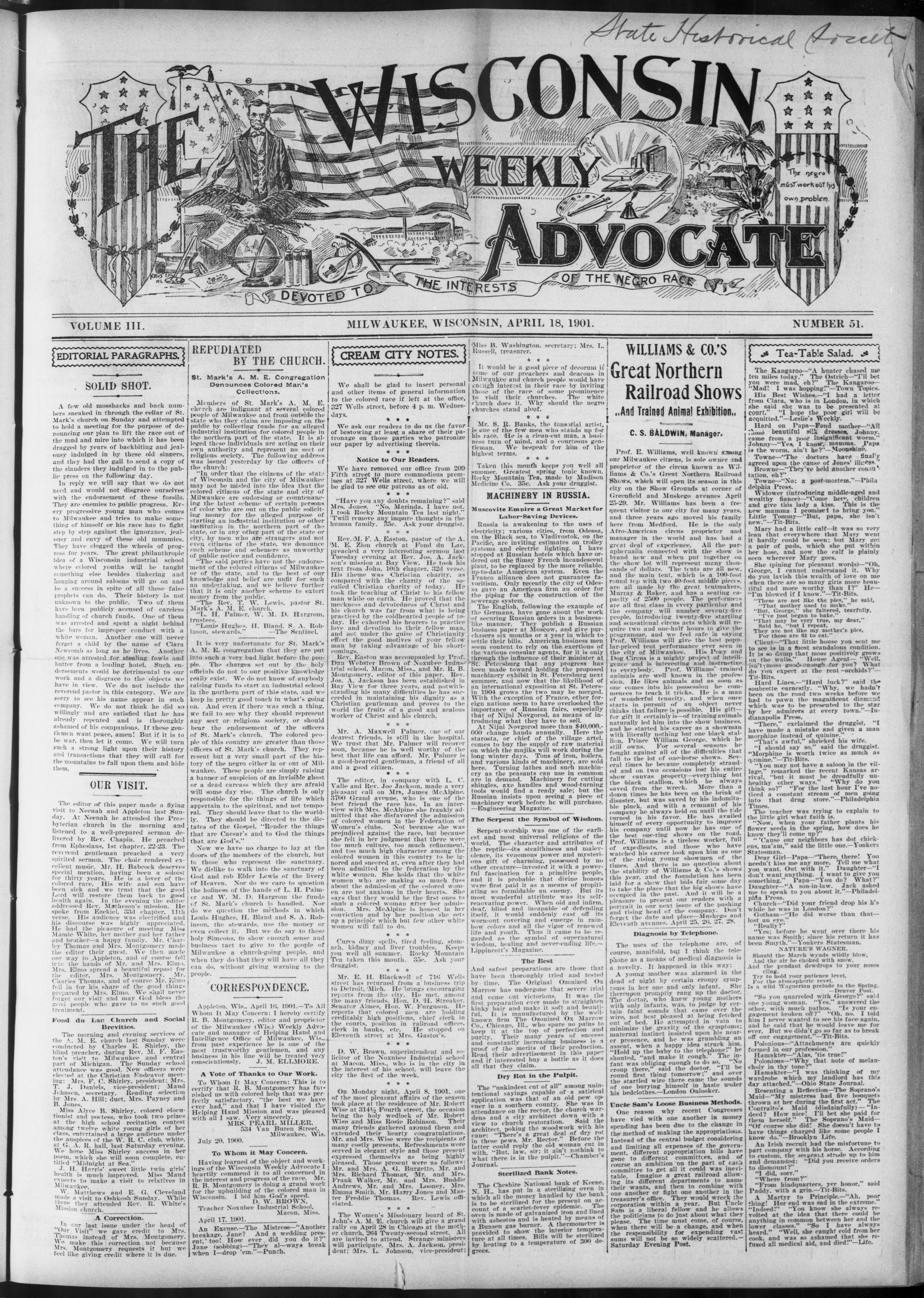
Wisconsin Weekly Advocate
Thursday, April 18, 1901
Milwaukee, Wisconsin
Page text (machine-generated)
State Historical Record
WISCONSIN
WEEKLY
ADVOCATE
DEVOTED TO THE INTERESTS OF THE NEGRO RACE
VOLUME III.
EDITORIAL PARAGRAPHS.
SOLID SHOT.
A few old mossbacks and back numbers sneaked in through the cellar of St. Mark's church on Sunday and attempted to hold a meeting for the purpose of denouncing our plan to lift the race out of the mud and mire into which it has been dragged by years of backbiting and jealousy indulged in by these old sinners, and they had the gall to send a copy of the slanders they indulged in to the public press on the following day.
In reply we will say that we do not need and would not disgrace ourselves with the endorsement of these fossils. They are enemies to public progress. Every progressive young man who comes to Milwaukee and tries to make something of himself or his race has to fight step by step against the ignorance, jealousy and envy of these old mummies. They have clogged the wheels of progress for years. The great philanthropic idea of a Wisconsin industrial school where colored youths will be taught something else besides tinkering and hanging around saloons will go on and be a success in spite of all these false prophets can do. Their history is not unknown to the public. Two of them have been publicly accused of careless handling of church funds. One of them was arrested and spent a night behind the bars for improper conduct with a white woman. Another one will never forget a child by the name of Clara Newcomb as long as he lives. Another one was arrested for stealing fowls and butter from a leading hotel. Such endorsements would be detrimental to our work and a disgrace to the objects we have in view. We do not include the reverend pastor in this category. We are sorry to see his name appear in such company. We do not think he did so willingly and are satisfied that he has already repented and is thoroughly ashamed of his companions. If these gentlemen want peace, amen! But if it is to be war, then let it come. We will turn such a strong light upon their history and transactions that they will call for the mountains to fall upon them and hide them.
OUR VISIT.
The editor of this paper made a flying visit to Neenah and Appleton last Sunday. At Neenah he attended the Presbyterian church in the morning and listened to a well-prepared sermon delivered by Rev. Chapin. He preached from Ephesians, 1st chapter, 22-23. The reverend gentleman preached a very spirited sermon. The choir rendered excellent music, Mr. H. Babcock deserves special mention, having been a soloist for thirty years. He is a lover of the colored race. His wife and son have been sick and we trust that the good Lord will restore them back to good health again. In the evening the editor addressed Rev. Matheson's mission. He spoke from Ezekiel, 33d chapter, 11th verse. His audience was electrified and his discourse was highly appreciated. He had the pleasure of meeting Miss Mamie White, her mother and her father and brother—a happy family. Mr. Charley Thomas and Mrs. Montgomery made the editor their guest. We then made our way to Appleton, and of course fell into the hands of Mr. and Mrs. Elmo. Mrs. Elmo spread a beautiful repast for the editor, Mrs. Montgomery, Mr. Charles Thomas, and of course Mr. Elmo fell in for his share of the good things prepared by Mrs. Elmo. We shall never forget our visit and may God bless the good people who gave to us such good treatment.
Fond du Lac Church and Social Previties.
The morning and evening services of the A. M. E. church last Sunday were conducted by Charles E. Shirley, the blind preacher, during Rev. M. F. Easton's visit to Milwankee and central part of Michigan. The Sunday school attendance was good. New officers were elected at the Christian Endeavor meeting: Mrs. F. C. Shirley, president; Mrs. T. J. Daniels, vice-president; Maud Johnson, secretary. Reading selection by Mrs. A. Hill; duet, Mrs. Payney and B. Jones.
Miss Alvce B. Shirley, colored elocutionist and poetess, who took two prizes at the high school recitation contest among twelve white young girls of her class, entertained a large audience under the auspices of the W. R. C. club, white, at G. A. R. hall, last Saturday evening. We hope Miss Shirley success in her poem, which she will soon complete, entitled "Midnight at Sea." J. H. Harris' sweet little twin girls' health is much improved. Miss Maud expects to make a visit to relatives in Milwaukee. W. Matthews and E. G. Cleveland made a visit to Oshkosh Sunday. While there they attended Rev. R. White's Mission church.
A Correction.
In our last issue under the head of "Our Visit" we gave credit to Mrs. Thomas instead of Mrs. Montgomery. We make this correction not because Mrs. Montgomery requests it but we feel like giving credit where it is due.
REPUDIATED BY THE CHURCH.
St. Mark's A. M. E. Congregation Denounces Colored Man's Collections.
Members of St. Mark's A. M. E. church are indignant at several colored people of Milwaukee and from outside the state who they claim are imposing on the public by collecting funds for an alleged industrial institution for colored people in the northern part of the state. It is alleged these individuals are acting on their own authority and represent no sect or religious society. The following address was issued yesterday by the officers of the church:
"In order that the citizens of the state of Wisconsin and the city of Milwaukee may not be misled into the idea that the colored citizens of the state and city of Milwaukee are endorsing or countenancing the latest scheme of certain persons of color who are out on the public soliciting money for the alleged purpose of starting an industrial institution or other institution in the northern part of the state, or in any other part of the state or city, by men who are strangers and not even citizens of the state, we denounce such scheme and schemers as unworthy of public notice and confidence.
"The said parties have not the endorsement of the colored citizens of Milwaukee or of the state, and to the best of our knowledge and belief are unfit for such an undertaking, and we believe further that it is only another scheme to extort money from the public.
"The Rev. T. W. Lewis, pastor St. Mark's A. M. E. church.
"L. H. Palmer, W. M. D. Hargrom, trustees
"Louis Hughes, H. Bland, S. A. Robinson, stewards." —The Sentinel.
It is very unfortunate for St. Mark's A. M. E. congregation that they are put into such a very bad light before the people. The charges set out by the holy officials do not to our positive knowledge really exist. We do not know of anybody raising funds to start an industrial school in the northern part of this state, and we keep in pretty good touch in what's going on. And even if there was such a thing, we fail to see why they should represent any sect or religious society, or should bear the endorsement of the officers of St. Mark's church. The colored people of this country are greater than those officers of St. Mark's church. They represent but a very small part of the history of the negro either in or out of Milwaukee. These people are simply raising a banner of suspicion of an invisible ghost or a dead carcass which they are afraid will some day rise. The church is only responsible for the things of life which appertain to the spiritual, and not temporal. They should leave that to the worldly. They should be directed to the dictates of the Gospel. "Render the things that are Caesar's and to God the things that are God's."
Now we have no charge to lay at the doors of the members of the church, but to those who represent the sanctuary. We dislike to walk into the sanctuary of God and rob Elder Lewis of the livery of Heaven. Nor do we care to question the holiness of the hands of L. H. Palmer and W. M. D. Hargrom the funds of St. Mark's church is handled. Nor do we question the methods in which Louis Hughes, H. Bland and S. A. Robinson, the stewards, use the money or even collect it. But we do say to these holy Simeons, to show enough sense and business tact to give to the people of Milwaukee a church-going people, and when they do that they will have all they can do, without giving warning to the people.
CORRESPONDENCE.
Appleton, Wis., April 16, 1901.—To All Whom It May Concern: I hereby certify R. B. Montgomery, editor and proprietor of the Milwaukee (Wis.) Weekly Advocate and manager of Helping Hand and Intelligence Office of Milwaukee, Wis., from past experience he is one of the most trustworthy gentlemen, and any business in his line will be treated very conscientiously. J. M. ELLMORE.
A Vote of Thanks to Our Work
To Whom It May Concern: This is to certify that R. B. Montgomery has furnished us with colored help that was perfectly satisfactory, "the best we have ever had," and that I have visited the Helping Hand Mission and was pleased with all I saw. Very sincerely.
To Whom it May Concern.
Having learned of the object and workings of the Wisconsin Weekly Advocate I heartily commend it to all concerned in the interest and progress of the race. Mr. R. B. Montgomery is doing a grand work for the upbuilding of the colored man in Wisconsin. I bid him God's speed.
An Excuse.—The Mistress—“Another breakage, Jane? And a wedding present, too! How ever did you do it?” Jane (sobbing)—“They al—ways break when I—drop 'em.”—Punch.
---
We shall be glad to insert personal and other items of general information to the colored race if left at the office, 327 Wells street, before 4 p. m. Wednesdays
* * *
We ask our readers to do us the favor of bestowing at least a share of their patronage on those parties who patronize our paper by advertising therein.
Notice to Our Readers.
We have removed our office from 209 Fifth street to more commodious premises at 327 Wells street, where we will be glad to see our patrons as of old.
* * *
"Have you any doubts remaining?" said Mrs. Jones. "No. Marinda, I have not. I took Rocky Mountain Tea last night." 'Twil remove any impure thoughts in the human family.' 35c. Ask your druggist.
☆ ☆ ☆
Rev. M. F. A. Easton, pastor of the A. M. E. Zion church at Fond du Lac, preached a very interesting sermon last Tuesday evening at Rev. Jos. A. Jackson's mission at Bay View. He took his text from John, 10th chapter, 32d verse. His theme was Christian charity, as compared with the charity of the so-called Christian charity of today. He took the teaching of Christ to his fellow man while on earth. He proved that the meekness and devotedness of Christ and his church was far from what is being practiced by the coldhearted people of today. He exhorted his hearers to practice love and devotion to their fellow man, and not under the guise of Christianity effect the good motives of your fellow man by taking advantage of his short comings.
Rev. Easton was accompanied by Prof. Dan Webster Brown of Noxubee Industrial school, Macon, Miss., and Mr. R. B. Montgomery, editor of this paper. Rev. Jos. A. Jackson has been established in Bay View for three years, and notwithstanding his many difficulties he has succeeded in maintaining his dignity as a Christian gentleman and proves to the world the fruits of a good and zealous worker of Christ and his church.
***
Mr. A. Maxwell Palmer, one of our dearest friends, is still in the hospital. We trust that Mr. Palmer will recover soon, because he is well worthy of the best that life can afford. Mr. Palmer is a good-hearted gentleman, a friend of all and a good citizen.
章 宗 宗
The editor, in company with L. C. Valle and Rev. Joe Jackson, made a very pleasant call on Mrs. James McAlpine, 3700 Grand avenue, who is one of the best friend the race has. In an interview with Mrs. McAlpine she frankly admitted that she disfavored the admission of colored women in the Federation of Women's clubs. Not because she was prejudiced against the race, but because she felt in her judgment that there were too much culture, too much refinement, and too much high character among the colored women in this country to be ignored and sneered at, even after they had been admitted to the federation by the white women. She holds that the white women who are making so much fuss about the admission of the colored women are not anxious in their hearts. She says that they would be the first ones to snub a colored woman after her admission. Mrs. McAlpine is honest in her conviction and by her position she sets up a principle which but few other white women will fail to do.
* * *
Cures dizzy spells, tired feeling, stomach, kidney and liver troubles. Keeps you well all summer. Rocky Mountain Tea taken this month. 35c. Ask your druggist.
***
Mr. E. H. Blackwell of 716 Wells street has returned from a business trip to Detroit, Mich. He brings encouraging reports from the city. He met, among the many friends, Hon. D. H. Streaker, Senator Aimes, Hon. W. Furguson. He reports that colored men are holding creditably high positions, chief clerk in the courts, position in railroad offices, clerk in banks, etc. He stopped on Eleventh street at Mrs. Gastor's.
宓 秉 秉
D. W. Brown, superintendent and solicitor of the Noxubee Industrial school at Macon, Miss., who is in the city in the interest of his school, will leave the city the first of the week.
※ ※ ※
On Monday night, April 8, 1901, one of the most pleasant affairs of the season took place at the residence of Mr. Robert Wise at $314\frac{1}{2}$ Fourth street, the occasion being the holy wedlock of Mr. Robert Wise and Miss Rosie Robinson. Their many friends gathered around them and extended their hearty congratulations. Mr. and Mrs. Wise were the recipients of many costly presents. Refreshments were served in elegant style and those present expressed themselves as being highly pleased. Those present were as follows: Mr. and Mrs. A. G. Burgette, Mr. and Mrs. Richard Thomas, Mr. and Mrs. Frank Walker, Mr. and Mrs. Buddie Andrews, Mr. and Mrs. Looney, Mrs. Emma Smith, Mr. Harry Jones and Master Freddie Thomas. Rev. Lewis officiated.
* * *
The Women's Missionary board of St. John's A. M. E. church will give a grand rally on April 28 in Chicago at the mother church, 264 Twenty-second street. All are invited to attend. Strange ministers will participate. Mrs. A. Jackson, president; Mrs. L. Johnson, vice-president;
Miss B. Washington, secretary; Mrs. L. Russell, treasurer.
***
It would be a good piece of decorum if some of our preachers and deacons in Milwaukee and church people would have enough interest in their race by inviting those of the race of some prominence to visit their churches. The white church does it. Why should the negro churches stand aloof.
* * *
Mr. S. R. Banks, the tonsorial artist,
is one of the few men who stands up for
his race. He is a clean-cut man, a business
turn of mind, and a courteous gentleman.
We bespeak for him of the
highest terms.
* * *
Taken this month keeps you well all
summer. Greatest spring tonic known.
Rocky Mountain Tea, made by Madison
Medicine Co. 35c. Ask your druggist.
MACHINERY IN RUSSIA.
Muscovite Empire a Great Market for Labor-Saving Devices.
Russia is awakening to the uses of electricity; various cities, from Odessa, on the Black sea, to Vladivostok, on the Pacific, are inviting estimates on trolley systems and electric lighting. I have stopped at Russian hotels which have ordered out the flimsy French incandescent plant, to be replaced by the more reliable, up-to-date American system. Even the Franco alliance does not guarantee favoritism. Only recently the city of Odessa gave an American firm an order for the piping for the construction of the sewerage system.
The English, following the example of the Germans, have gone about the work of securing Russian orders in a business-like manner. They publish a Russian business paper at Moscow, and give purchasers six months or a year in which to settle their bills. American business men seem content to rely on the exertions of the various consular agents, for it is only through the influence of their minister at St. Petersburg that any progress has been made toward holding the proposed machinery exhibit in St. Petersburg next summer, and now that the likelihood of an international exposition at St. Petersburg 1904 grows the two may be merged. With the exception of France, other foreign nations seem to have overlooked the importance of Russian fairs, especially that of Nijni Novgorod, as means of introducing what they have to sell.
At Nijni Novgorod more than $40,000,000 change hands annually. Here the starosta, or chief of the village artel, comes to buy the supply of raw material on which the mujiks will work during the long winter days. Tons of iron, boilers, and various kinds of machinery, are sold here. Turning lathes and such machinery as the peasants can use in common are in demand. Machinery for cutting shingles, axe handles and wood-turning tools would find a ready sale; but the Russian insists upon seeing a piece of machinery work before he will purchase. —Engineering Magazine.
The Serpent the Symbol of Wisdom.
Serpent-worship was one of the earlest and most universal religions of the world. The character and attributes of the reptile—its stealthiness and malevolence, its venomous power and mysterious gift of charming, possessed by no other creature—invested it with a powerful fascination for a primitive people, and it is probable that divine honors were first paid it as a means of propitiating so formidable an enemy. But its most wonderful attribute was its self-renovating power. When old and infirm, deaf, blind and incapable of defending itself, it would suddenly cast off its worn-out covering and emerge in rainbow colors and all the vigor of renewed life and youth. Thus it came to be regarded as the symbol of supernatural wisdom, healing and never-ending life.—Lippincott's Magazine.
The Best
And safest preparations are those that have been thoroughly tried and tested by time. The Original Ozonized Ox Marrow has undergone that severe trial and come cut victorious. It was the first preparation ever made to straighten kinky hair and make it soft and beautiful. It is manufactured by the well-known firm The Ozonized Ox Marrow Co., Chicago, Ill., who spare no pains to keep it at the top of perfection and purity. Their many years of success and constantly increasing business is a proof of the merits of their production. Read their advertisement in this paper and if interested buy a bottle as it does all that they claim.
Dry Rot in the Pulpit.
The "unkindest cut of all" among unintentional sayings capable of a satirical application was that of an old pew opener in a southern county. She was in attendance on the rector, the church wardens and a city architect down with a view to church restoration. Said the architect, poking the woodwork with his cane: "There's a great deal of dry rot in these pews. Mr. Rector." Before the latter could reply the old woman cut in with, "But, law, sir; it ain't nothink to what there is in the pulpit."—Chamber's Journal.
Sterilized Bank Notes
The Cheshire National bank of Keene, N. H., has put in a sterilizing oven in which all the money handled by the bank is to be sterilized for the present on account of a scarlet-fever epidemic. The oven is made of galvanized iron and lined with asbestos and is heated by means of a Bunsen gas burner. A thermometer is provided to show the interior temperature at all times. Bills will be sterilized by heating to a temperature of 300 degrees.
WILLIAMS & CO.'S Great Northern Railroad Shows ..And Trained Animal Exhibition..
C. S. BALDWIN, Manager.
Prof. E. Williams, well known among our Milwaukee citizens, is sole owner and proprietor of the circus known as Williams & Co.'s Great Northern Railroad Shows, which will open its season in this city on the Show Grounds at corner of Greenfield and Muskego avenues April 25-29. Mr. Williams has been a frequent visitor to our city for many years, and three years ago moved his family here from Medford. He is the only Afro-American circus proprietor and manager in the world and has had a great deal of experience. All the paraphernalia connected with the show is brand new and when put together on the show lot will represent many thousands of dollars. The tents are all new, and the main tent, which is a 100-foot round top with two 40-foot middle pieces, are all made by the great tentmakers, Murray & Baker, and has a seating capacity of 2500 people. The performers are all first class in every particular and the company will number seventy-five people, introducing twenty-five startling and sensational circus acts which will require two and one-half hours to give the programme, and we feel safe in saying Prof. Williams will give the best popular-priced tent performance ever seen in the city of Milwaukee. His Pony and Dog Circus is a mighty project of intelligence and is interesting and instructive to everybody. Prof. Williams' trained animals are well known in the profession. He likes animals and as soon as one comes into his possession he commences to teach it tricks. He is a man of wonderful tenacity, and when once starts in pursuit of an object never thinks that failure is possible. His gift—for gift it certainly is—of training animals naturally led him into the show business, and he started his career as a showman with literally nothing but one black stallion, Prince William George, which he still owns. For several seasons he fought against all of the difficulties that fall to the lot of one-horse shows. Several times he became completely stranded and on two occasions lost his entire show canvas property—everything but the black stallion, which he always saved from the wreck. More than a dozen times he has been on the brink of disaster, but was saved by his indomitable pluck, and with a remnant of his company he always held on until the tide turned in his favor. He has availed himself of every opportunity to improve his company until now he has one of the best one-ring shows on the road. Prof. Williams is a tireless worker, full of expedients, and those who have watched his career look upon him as one of the rising young showmen of the times. And there is no question about the stability of Williams & Co.'s shows this year, and the foundation has been laid for a show that bids fair some day to take the place that the big shows have occupied in the past. And it will be a pleasure to present our readers with a portrait in our next issue of the pushing and rising head of the company. Don't forget the date and place—Muskego and Eleventh avenues, April 25, 26, 27, 28.
Diagnosis by Telephone.
The uses of the telephone are, of course, manifold, but I think the telephone as a means of medical diagnosis is a novelty. It happened in this way:
A young mother was alarmed in the dead of night by certain croupy symptoms in her one and only infant. She thereupon promptly rang up the doctor. The doctor, who knew young mothers with only infants, was, to judge by certain faint sounds that came over the wire, not best pleased at being fetched out of bed. He attempted in vain to minimize the gravity of the symptoms; maternal instinct insisted upon his nearer presence, and he was grumbling an assent, when a happy idea struck him. "Hold up the baby to the telephone!" he shouted, "and make it cough." The infant was obliging enough to do so. "No croup there," said the doctor. "I'll be round first thing tomorrow;" and over the startled wire there came the sounds of one burying himself in haste under his bedclothes.—London Onlooker.
Unote Sam's Loose Business Methods.
One reason why recent Congresses have vied with one another in money spending has been due to the change in the method of making the appropriations. Instead of the central budget considering and limiting all expenses of the government, different appropriation bills have gone to different committees, and of course an ambition on the part of each committee to get all it could was inevitable. Imagine a great railroad allowing its different departments to name their wants, and then to combine with one another or fight one another in the treasurer's office. They would wreck the corporation within a year. But Uncle Sam is a liberal fellow and he allows the politicians to do just about what they please. The time must come, of course, when there will be a change, and when the responsibility for expending vast sums will not be so widely scattered.—Saturday Evening Post.
NUMBER 51.
Tea-Table Salad.
The Kangaroo—"A hunter chased me ten miles today." The Ostrich—"I'll bet you were mad, eh?" The Kangaroo—"Mad! I was hopping!"—Town Topics.
His Best Wishes.—"I had a letter from Clara, who is in London, in which she said she was to be presented at court." "I hope the poor girl will be acquitted."—Leslie's Weekly.
Hard on Papa—Fond mother—"All those beautiful silk dresses, Johnny, came from a poor insignificant worm." Johnny—"Yes, I know, mamma. Papa is the worm, ain't he?"—Moonshine.
Towne—"The doctors have finally agreed upon the cause of Jones' illness."
Browne—"They've held another consultation."
Towne—"No: a post-mortem."—Phila delphia Press. Widower (introducing middle-aged and wealthy fiance)—"Come here; children and give this lady a kiss. This is the new mamma I promise to bring you." Little Tommy—"But, papa, she isn't new."—Tit-Bits. Mary had a little calf—it was so very lean that everywhere that Mary went it hardly could be seen; but Mary gets a pair of pads, which she put within her hose, and now the calf is plainly seen wherever Mary goes. She (pining for pleasant words)—"Oh, George, I cannot understand it. Why do you lavish this wealth of love on me when there are so many girls more beautiful and more worthy than I?" He—"I'm blowed if I know."—Tit-Bits.
"These are not like the pies," he said,
"That mother used to make."
"But, George," she faltered, tearfully, "I've just began to bake."
"I've just began to bake."
"That may be very true, my dear," Said he, "but I repeat.
They are not like my mother's pies, For these are fit to eat."
Client—"That little house you sent me to see is in a most scandalous condition. It is so damp that moss positively grows on the walls." House Agent—"Well, isn't moss good enough for you? What do you expect at the rent-orchids?"—Tit-Bits.
Hard Lines,—"Hard luck?" said the soubrette earnestly. "Why, we hadn't been on the road two weeks before we had to pawn the magnificent diamond which was to be presented to the star by her admirers at every town."—Indianapolis Press.
"There," exclaimed the druggist. "I have made a mistake and given a man morphine instead of quinine."
"That's awful," shrieked his wife.
"I should say so," said the druggist.
"Morphine is worth twice as much as qumine."—Tit-Bits.
"You may not have a saloon in the village," remarked the recent Kansas arrival, "but it must be dreadfully unhealthy other ways." "Why do you think so?" "For the last hour I've noticed a constant stream of men going into that drug store."—Philadelphia Times.
The teacher was trying to explain to the little girl what faith is.
"Now, when your father plants his flower seeds in the spring, how does he know they'll come up?"
"'Cause our neighbors has dot chickens, ma'am," said the little one.—Yonkers Statesman.
Dear Girl—Papa—"There, there! You needn't kiss me any more. Tell me what you want. Out with it." Daughter—"I don't want anything. I want to give you something." Papa—"You do? What?" Daughter—"A son-in-law. Jack asked me to speak to you about it."—Philadelphia Press.
Church—"Did your friend drop his h's while he was in London?"
Gotham—"He did worse than that—lost an eye."
"Poally?"
"Yes; before he went over there his name was Smith; since his return it has been Smyth."—Yonkers Statesman.
NATURE'S WAGNER.
Should the March wynds wildly blow,
And the air be choked with snow.
And the pendant dewdrops to your noses
cling.
Try to hold your patience level,
For the atmospheric revel.
Is a wild Wagnerian prelude to the Spring.
"So you quarreled with George?" said one young woman. "Yes," answered the other, with much pathos. "Is your engagement broken off?" "Oh, no. I told him I never wanted to see his face again, and he said that he would leave me for ever. But we didn't go so far as to break off our engagement."—Tit-Bits.
Polonious—"Attachments are quickly formed in our profession."
Hamakter—"Alas, 'tis true!"
Polonious—"Why that note of melancholy in thy tone?"
Hamakter—"I was thinking of my wardrobe which my landlord has this day attached."—Ohio State Journal.
Resenting a Reflection—The Soprano's Maid—"My mistress had five bouquets thrown at her during the first act." The Contralto's Maid (disdainfully)—"Indeed? How nice! I'll bet she paid for them herself." The Soprano's Maid—"Of course she did! She doesn't have to have things charged like some people I know do."—Brooklyn Life.
An Irish recruit had the misfortune to part company with his horse. According to custom, the sergeant strode up to him and demanded: "Did you receive orders to dismount?"
"I did, sorr."
"Where from?"
"From hindquarters, yer honor," said Paddy, with a grin—Tit-Bits.
A Martyr to Principle.—"Ah, poor thing! Her end was sad in the extreme." "Indeed!" "Yon know she always revolted at the idea that there could be anything in common between her and the lower classes." "So I have always heard." "Well, she caught cold from her cook, and was so ashamed that she refused all medical aid, and died!"—Life.
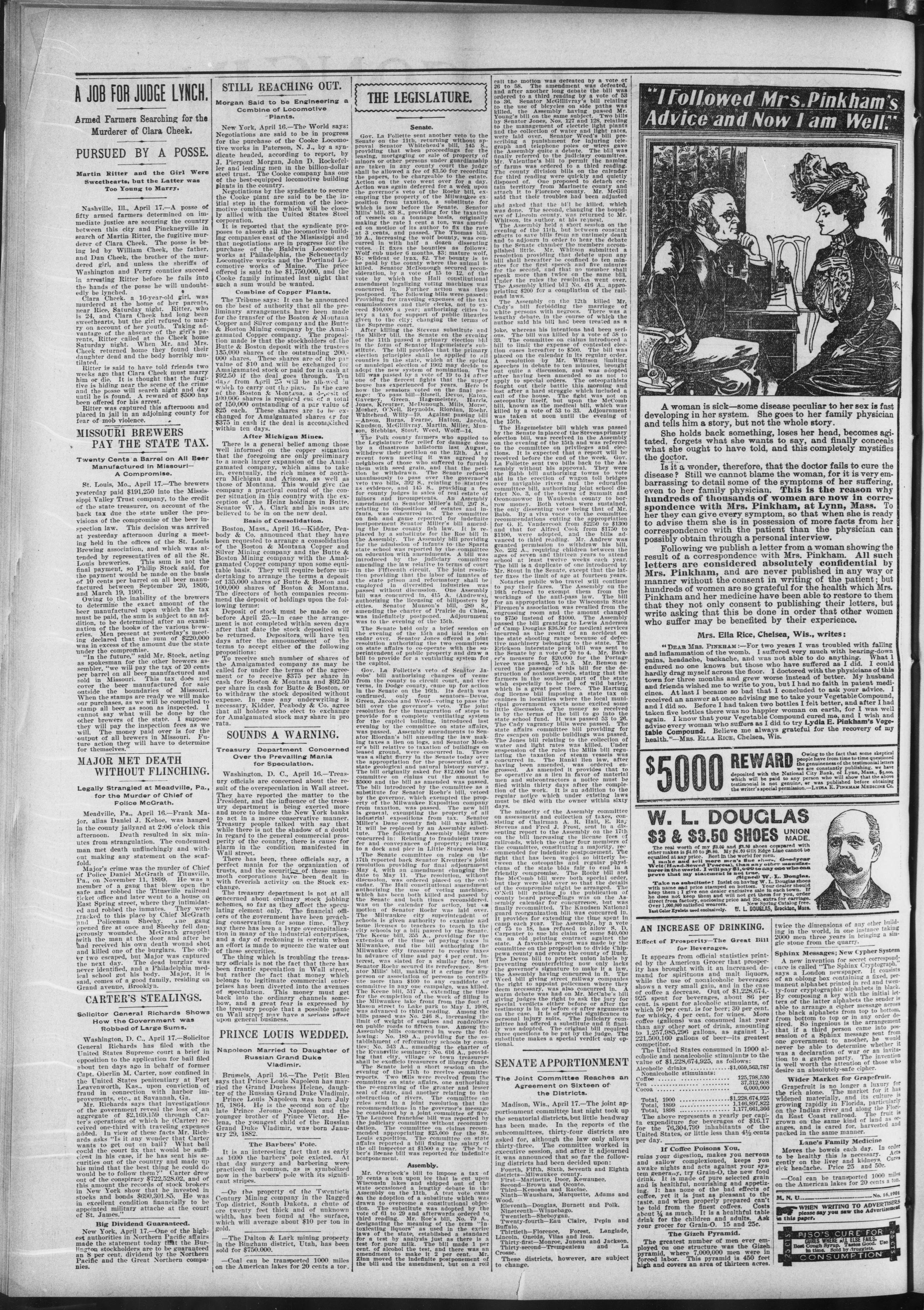
A JOB FOR JUDGE LYNCH.
Armed Farmers Searching for the Murderer of Clara Cheek.
PURSUED BY A POSSE.
Martin Ritter and the Girl Were Sweethearts, but the Latter was Too Young to Marry.
Nashville, Ill., April 17.—A posse of fifty armed farmers determined on immediate justice are scouring the country between this city and Pinckneyville in search of Martin Ritter, the fugitive murderer of Clara Cheek. The posse is being led by William Cheek, the father, and Dan Cheek, the brother of the murdered girl, and unless the sheriffs of Washington and Perry counties succeed in arresting Ritter before he falls into the hands of the posse he will undoubtedly be lynched.
Clara Cheek. a 16-year-old girl, was murdered at the home of her parents, near Rice, Saturday night. Ritter, who is 24, and Clara Cheek had long been sweethearts, but the girl refused to marry on account of her youth. Taking advantage of the absence of the girl's parents, Ritter called at the Cheek home Saturday night. When Mr. and Mrs. Cheek returned home they found their daughter dead and the body horribly mutilated.
Ritter is said to have told friends two weeks ago that Clara Cheek must marry him or die. It is thought that the fugitive is hiding near the scene of the crime and the posse will search night and day until he is found. A reward of $500 has been offered for his arrest. Ritter was captured this afternoon and placed in jail in an adjoining county for fear of mob violence.
MISSOURI BREWERS PAY THE STATE TAX.
Twenty Cents a Barrel on All Beer Manufactured in Missouri
St. Louis, Mo., April 17.—The brewers yesterday paid $191,250 into the Mississippi Valley Trust company, to the credit of the state treasurer, on account of the back tax due the state under the provisions of the compromise of the beer inspection law. This decision was arrived at yesterday afternoon during a meeting held in the offices of the St. Louis Brewing association, and which was attended by representatives of all the St. Louis breweries. This sum is not the final payment, so Philip Stock said, for the payment would be made on the basis of 10 cents per barrel on all beer manufactured between September 20, 1899, and March 19, 1901.
Owing to the inability of the brewers to determine the exact amount of the beer manufactured upon which the tax must be paid, the sum is subject to an addition, to be determined after an examination of the books of the various breweries. Men present at yesterday's meeting declared that the sum of $220,000 was in excess of the amount due the state under the compromise.
"In the future," said Mr. Stock, acting as spokesman for the other brewers assembler, "we will pay the tax of 20 cents per barrel on all beer manufactured and sold in Missouri. This tax does not cover the beer manufactured for sale outside the boundaries of Missouri. When the stamps are ready we will make our purchases, as we will be compelled to stamp all beer as soon as inspected. I cannot say what will be done by the other brewers of the state. I suppose they will pay the inspection fees as we will. The money paid over is for the output of all brewers in Missouri. Future action they will have to determine for themselves."
MAJOR MET DEATH WITHOUT FLINCHING.
Legally Strangled at Meadville, Pa., for the Murder of Chief of Police McGrath.
Meadville, Pa., April 16.—Frank Major, alias Daniel J. Kehoe, was hanged in the county jailyard at 2:06 o'clock this afternoon. Death resulted in six minutes from strangulation. The condemned man met death unflinchingly and without making any statement on the scaffold.
Major's crime was the murder of Chief of Police Daniel McGrath of Titusville, Pa., on November 11, 1899. He was a member of a gang that blew open the safe and robbed the Titusville railroad ticket office and later went to a house on East Spring street, where they intimidated and robbed the inmates. They were tracked to this place by Chief McGrath and Policeman Sheehy. The gang opened fire at once and Sheehy fell dangerously wounded. McGrath grappled with the man at the door and after he had received his own death wound shot and killed one of the burglars. The other two escaped, but Major was captured the next day. The dead burglar was never identified, and a Philadelphia medical school got his body. Major, it is said, comes of a good family, residing on Grand avenue, Brooklyn.
CARTER'S STEALINGS.
Solicitor General Richards Shows How the Government was Robbed of Large Sums.
Washington, D. C., April 17.—Solicitor General Richards has filed with the United States Supreme court a brief in opposition to the application for bail filed about ten days ago in behalf of former Capt. Oberlin M. Carter, now confined in the United States penitentiary at Fort Leavenworth, Kas., upon conviction of fraud in connection with harbor improvements, etc., at Savannah, Ga.
Mr. Richards says that investigations of the government reveal the loss of an aggregate of $2,169,159 through Carter's operations of which he (Carter) received one-third with traveling expenses added. In view of these facts Mr. Richards asks "Is it any wonder that Carter wants to get out on bail? What bail could the court fix that would be sufficient in his case, if he has sent his securities out of the country and made up his mind that the best thing he could do would be to follow them?" Carter drew out of the conspiracy $722,528.02, and of this amount the records of stock brokers in New York show that he invested in stocks and bonds $690,301.85. He was in excellent condition financially to be appointed military attache at the court of St. James."
Big Dividend Guaranteed.
New York, April 17.—One of the highest authorities in Northern Pacific affairs made the statement today that the Burlington stockholders are to be guaranteed an 8 per cent. dividend by the Northern Pacific and the Great Northern companies.
STILL REACHING OUT.
Morgan Said to be Engineering a Combine of Locomotive Plants.
New York, April 16.—The World says: Negotiations are said to be in progress for the purchase of the Cooke Locomotive works in Paterson, N. J., by a syndicate headed, according to report, by J. Pierpont Morgan, John D. Rockefeller and leading men in the billion-dollar steel trust. The Cooke company has one of the best-equipped locomotive building plants in the country.
Negotiations by the syndicate to secure the Cooke plant are said to be the initial step in the formation of the locomotive combination which will be closely allied with the United States Steel corporation.
It is reported that the syndicate proposes to absorb all the locomotive building companies east of the Mississippi and that negotiations are in progress for the purchase of the Baldwin Locomotive works at Philadelphia, the Schenectady Locomotive works and the Portland Locomotive works of Maine. The price offered is said to be $1,750,000, and the Cooke family intimated last night that such a sum would be wanted.
Combine of Copper Plants.
The Tribune says: It can be announced on the best of authority that all the preliminary arrangements have been made for the transfer of the Boston & Montana Copper and Silver company and the Butte & Boston Mining company by the Amalgamated Copper company. The proposition made is that the stockholders of the Butte & Boston deposit with the trustees 135,000 shares of the outstanding 200,000 shares. These shares are of the par value of $10 and will be exchanged for Amalgamated stock or paid for in cash at $92.50 if the deal goes through. Ten days from April 25 will be allowed in which to carry out the plan. In the case of the Boston & Montana, a deposit of 100,000 shares is required out of a total of 150,000 outstanding of a par value of $25 each. These shares are to be exchanged for Amalgamated shares or for $375 in cash if the deal is accomplished within ten days.
After Michigan Mines.
There is a general belief among those well informed on the copper situation that the foregoing are only preliminary to a much larger expansion of the Amalgamated company, which aims to take in, eventually, the rich mines of northern Michigan and Arizona, as well as those of Montana. This would give the company a practical control of the copper situation in this country with the exception of the Heinz holdings in Butte. Senator W. A. Clark and his sons are believed to be in on the new deal.
Basis of Consolidation.
Boston, Mass., April 16.—Kidder, Peabody & Co. announced that they have been requested to arrange a consolidation of the Boston & Montana Copper and Silver Mining company and the Butte & Boston Mining company with the Amalgamated Copper company upon some equitable basis. They will require before undertaking to arrange the terms a deposit of 135,000 shares of Butte & Boston and 100,000 shares of Boston & Montana. The directors of both companies recommend the deposit of holdings upon the following terms:
Deposit of stock must be made on or before April 25.—In case the arrangement is not completed within seven days after that date the stock deposited will be returned. Depositors will have ten days after the announcement of the terms to accept either of the following propositions:
To receive such number of shares of the Amalgamated company as may be called for under the terms of the agreement or to receive $375 per share in cash for Boston & Montana and $92.50 per share in cash for Butte & Boston, or to withdraw the stock deposited without expense. In case any underwriting is necessary, Kidder, Peabody & Co. agree that all holders who elect to exchange for Amalgamated stock may share in pro rata.
SOUNDS A WARNING.
Treasury Department Concerned Over the Prevailing Mania for Speculation.
Washington, D. C., April 16.—Treasury officials are concerned about the result of the overspeculation in Wall street. They have reported the matter to the President, and the influence of the treasury department is being exerted more and more to induce the New York banks to act in a more conservative manner. Treasury people talked with say that while there is not the shadow of a doubt in regard to the general commercial prosperity of the country, there is cause for alarm in the condition manifested in Wall street. There has been, these officials say, a perfect mania for the organization of trusts, and the securities of these mammoth corporations have been dealt in with feverish activity on the Stock exchange.
The treasury department is not at all concerned about ordinary stock jobbing schemes, so far as they affect the speculating element only. The financial officers of the government have been preaching conservatism for some time. They say there has been a large overcapitalization in many of the industrial enterprises, and a day of reckoning is certain when an effort is made to squeeze the water out of these securities.
The thing which is troubling the treasury officials is not the fact that there has been frantic speculation in Wall street, but rather the fact that money which belongs to legitimate commercial enterprises has been diverted into the avenues of speculation. This money must get back into the ordinary channels somehow, and a great fear is expressed by the treasury people that a possible panic on Wall street may have a serious effect upon general business.
PRINCE LOUIS WEDDED.
Napoleon Married to Daughter of Russian Grand Duke Vladimir.
Brussels, April 16.—The Petit Bleu says that Prince Louis Napoleon has married the Grand Duchess Helene, daughter of the Russian Grand Duke Vladimir. Prince Louis Napoleon was born July 16, 1864. He is the second son of the late Prince Jerome Napoleon and the younger brother of Prince Victor. Helena, the youngest child of the Russian Grand Duke Vladimir, was born January 29, 1882.
The Barbers' Pole.
It is an interesting fact that as early as 1600 the barbers' pole existed. At that day surgery and barbering were practiced in common, as is symbolized now in the barbers' pole with its significant stripes.
—On the property of the Twentieth Century Mining company in the Ragged Top district, South Dakota, a chute of ore twenty feet thick and of unknown width, has been found at the surface, which will average about $10 per ton in gold.
—The Dalton & Lark mining property in the Bingham district, Utah, has been sold for $750.000.
—Coal can be transported 1000 miles on the American lakes for 20 cents a tor.
THE LEGISLATURE.
Goy. La Follette sent another veto to the Senate on the 11th, returning without approval Senator Whitehead's bill, 145 S., providing that when proceedings for the leasing, mortgaging or sale of property of minors or other persons under guardianship are taken in any county court the judge shall be allowed a fee of $3.50 for recording the papers, to be chargeable to the estate. Action on the veto went over for a day. Action was again deferred for a week upon the governor's veto of the Roehr bill, exempting the property of the Milwaukee exposition from taxation, a substitute for which is now before the Senate. Senator Mills' bill, 83 S., providing for the taxation of vessels on a tonnage basis, originally making the rate 1 cent a ton, was amended on motion of its author to fix the rate at 3 cents, and passed. The Thomas bill, 10 A., increasing the wolf bounty, was concurred in with half a dozen dissenting votes. It fixes the bounties as follows: Wolf cub under 6 months, $3; mature wolf, $5; wildcat or lynx, $2. The bounty is to be paid by the county where the animal is killed. Senator McDonough secured reconsideration, by a vote of 15 to 12, of the vote by which the Hall constitutional amendment legalizing voting machines was concurred in. Further action was then postponed. The following bills were passed: Providing for traveling expenses of the tax commissioners and their clerks, not to exceed $10,000 a year; authorizing cities to levy a tax for support of public libraries given to the city; changing the terms of the Supreme court.
After killing the Stevens substitute and the Miller bill, the Senate on the evening of the 11th passed a primary election bill in the form of Senator Hagemeister's substitute. The bill provides that the primary election principles shall be applied to all counties in the state, which at the spring or municipal election of 1902 may decide to adopt the new system of nomination. The bill was passed by a vote of 19 to 14 after one of the fiercest fights that the upper house has experienced for years. Here is how the senators voted on the final passage: To pass bill—Bissell, Devos, Eaton, Gaveney, Green, Hagemeister, Harris, Jones, Kreutzer, McDougough, Mills, Morse, Mosher, O'Nell, Reynolds, Riordan, Roehr, Whitehead, Willy—19. Against passing bill—Anson, Burns, Fearne, Hatton, Jacobs, Knudson, McGillivray, Martin, Miller, Munson, Stebbins, Stout, Weed, Wolff—14.
The Polk county farmers who applied to the Legislature for relief for damage done by a disastrous hailstorm last August, withdrew their petition on the 12th. At a recent town meeting it was agreed by neighbors of those who suffered to furnish them with seed grain, and that the petition be withdrawn. The Senate refused unanimously to pass over the governor's veto two bills, 392 S., relating to statutes as evidence, and 145 S., providing a fee for county judges in sales of real estate of minors and incompetents. An Assembly amendment to Senator Miller's bill, 297 S., relating to dispositions of estates and infants, was concurred in. The committee on fish and game reported for indefinite postponement Senator Miller's bill amending the Dane county fish law. It is replaced by a substitute for the Roe bill in the Assembly. The Assembly bill providing for the admission of infants to the Sparta state school was reported by the committee on education with amendments. A bill was introduced by the judiciary committee amending the law relative to terms of court in the Fifteenth circuit. The joint resolution providing that the labor of inmates of the state prison and reformatory shall be employed in diversified industries was passed without discussion. One Assembly bill was concurred in, 415 A. (Andrews), authorizing the licensing of billposters by cities. Senator Munson's bill, 289 S., amending the charter of Prairie du Chien, was indefinitely postponed. Adjournment was to the evening of the 15th.
The Senate held only a brief session on the evening of the 15th and laid its calendar over. Senator Jones offered a joint resolution authorizing the two committees on state affairs to co-operate with the superintendent of public property and draw a bill to provide for a ventilating system for the capitol.
Gov. La Follette's veto of Senator Jacobs' bill authorizing changes of venue from the county to circuit court, and vice versa, in Dodge county, came up for action in the Senate on the 16th. Its death was confirmed, only four senators—Devos, Green, Jacobs and Weed—voting to pass the bill over the governor's veto. The joint resolution for the inauguration of steps to provide for a complete ventilating system for the capitel building, introduced last evening by the committee on state affairs, was passed. Assembly amendments to Senator Riordan's bill amending the law making taxes a lien on logs, and Senator Mosher's bill relative to taxation of buildings on leased ground, were concurred in. There was a slight flurry in the Senate today over the appropriation for the prosecution of a state geological and natural history survey. The bill originally asked for $12,000 but the committee on claims cut the amount to $5000 and the bill as amended was passed. The bill introduced by the committee as a substitute for Senator Roehr's bill, vetoed by the governor, which exempted the property of the Milwaukee Exposition company from taxation, was passed. The new bill is general, exempting the property of all industrial expositions from tax. Senator Miller's Dane county fish bill was killed. It will be replaced by an Assembly substitute. The following Assembly bills were concurred in: Relating to fraudulent transfer and conveyances of property; relating to a dock and pier in Little Sturgeon bay.
The Senate committee on rules on the 17th reported back Senator Kreutzer's joint resolution providing for final adjournment May 4, with an amendment changing the date to May 11. The resolution, without discussion, was ordered placed on the calendar. The Hall constitutional amendment authorizing the use of voting machines, which has been both killed and passed by the Senate and both times reconsidered, was on the calendar for action, but on motion of Senator Roehr was laid over. The Milwaukee city superintendent of schools is given authority to examine and issue licenses to teachers to teach in the city schools by a bill passed by the Senate. The Keene bill, 355 A., providing for the extension of the time of paying taxes in Milwaukee, and the bill authorizing the Milwaukee city treasurer to receive taxes in advance of time and pay 4 per cent. interest, was slated for a similar fate, but Senator Roehr secured its rereference. Senator Mills' bill, making it a crime for any person or association of persons to contribute more than $100 to any candidate or committee in any one campaign, was killed. The Keene bill, 517 A., extending the time for the completion of the work of filling in the Milwaukee lake front from the foot of Mason street to Lake park to May 1, 1908, was advanced to third reading. Among the bills passed was No. 246 S., increasing the limit of weight of engines and roadrollers on public roads to fifteen tons. Among the Assembly bills concurred in were the following: No. 180 A., providing for the establishment of reformatory schools by counties: No. 543 A., amending the charter of the Evansville seminary: No. 616 A., providing that city, village or town treasurers shall be exofficio treasurers of library funds.
The Senate held a short session on the evening of the 17th to receive committee reports. Two bills were received from the committee on state affairs, one authorizing the re-engraving of the greater and lesser seal of state, and another relating to the obstruction of rivers. The committee on rules sent in a joint resolution that the recommendations in the governor's message be considered by a joint committee of five. The Leenroot franchise bill was reported by the judiciary committee without recommendation. The committee on claims recommended appropriating $25,000 for the St. Louis exposition. The committee on state affairs reported a bill fixing the salary of the oil inspector at $1500 a year. The barber's license bill was reported for indefinite postponement.
Assembly.
Mr. Overbeck's bill to impose a tax of 10 cents a ton upon ice that is cut upon Wisconsin lakes and shipped out of the state occasioned a lengthy debate in the Assembly on the 11th. A test vote came on the adoption of a substitute which was drawn to overcome a constitutional objection. The substitute was adopted by the vote of 61 to 29 and afterwards ordered to third reading. Mr. Roe's bill, No. 79 A., designating the meaning of the term "Intoxicating liquors" as used in the execlse laws of the state, established a standard for a test by analysis just as there is a test for pure milk. The bill made 1 percent. of alcohol the test, and there was an amendment to make it 2 per cent. Mr. Zlnn moved the indefinite postponement of the bill and the amendment, but on a roll
call the motion was defeated by a vote of 26 to 58. The amendment was defeated, and after another long debate the bill was ordered to a third reading by a vote of 53 to 36. Senator McGillivray's bill relating to the use of bicycles on side paths was killed, the Assembly having passed Mr. Young's bill on the same subject. Two bills by Senator Jones, Nos. 127 and 128, relating to the management of electric light plants and the collection of water and light rates, were laid over. Senator Weed's bill prescribing a punishment for injuring telegraph and telephone poles or wires gave the Assembly quite a debate. The bill was finally referred to the judiciary committee. Mr. Valentine's bill to permit the naming of farms was ordered to a third reading. The county division bills on the calendar for third reading were quickly and quietly disposed of. One proposed to detach certain territory from Marlinette county and attach it to Florence county. Mr. McGill said that their troubles had been adjusted and asked that the bill be killed, which was done. The second, changing the boundary of Lincoln county, was returned to Mr. Whitson its author, at his request.
The Assembly held a short session on the evening of the 11th, but between constant efforts to save bills from an untimely death and to adjourn in order to hear the debate in the Senate chamber the members accomplished little. Mr. Whitson submitted a resolution providing that debate upon any bill shall hereafter be confined to ten minutes for the first speech and five minutes for the second, and that no member shall speak more than twice on the same bill. Under the rules the resolution went over. The Assembly killed bill No. 416 A., appropriating $200 for a compilation of the railroad laws.
The Assembly on the 12th killed Mr. Cady's bill forbidding the marriage of white persons with negroes. There was a lengthy debate, in the course of which the author said his bill had been treated as a joke, whereas his intentions had been serious. The bill was killed by a vote of 58 to 33. The committee on claims introduced a bill to limit the expense of contested election cases hereafter to $500. The bill was placed on the calendar in its regular order. A resolution by Mr. Whitson limiting speeches in debate to ten minutes, brought out quite a discussion, and was adopted after having been amended so as not to apply to special orders. The osteopathists fought out their battle this morning and lost after a hard struggle which included a call of the house. The fight was not on osteopathy itself, but upon the McComb bill, known as the medical bill, which was killed by a vote of 53 to 33. Adjournment was taken at noon until the evening of the 15th.
The Hagemelster bill which was passed by the Senate in place of the Stevens primary election bill, was received in the Assembly on the evening of the 15th and was referred to the committee on privileges and elections. It is expected that a report will be received before the end of the week. Gov. La Follette sent two bills back to the Assembly without his approval. They were the Babb bill authorizing towns to vote aid in the erection of wagon toll bridges over navigable rivers and the education committee bill, authorizing joint school district No. 3, of the towns of Summit and Oconomowoc in Waukesha county to borrow money. Both vetoes were sustained, the only dissenting vote being that of Mr. Babb. By a viva voce vote the committee recommendations cutting the appropriation for G. E. Vandercook from $2250 to $1300 and that for Alfred Cook from $1750 to $1100, were adopted, and the bills advanced to third reading. Mr. Andrew was granted permission to withdraw his bill. No. 232 A., requiring children between the ages of seven and thirteen years to attend school at least twelve weeks each year. The bill is a duplicate of one introduced by Mr. Stout in the Senate, except that the latter fixes the limit of age at fourteen years. Notaries public who travel will continue to pay their fares. The Assembly on the 16th refused to exempt them from the workings of the anti-pass law. The bill for an appropriation to the Wisconsin State Firemen's association was recalled from the engrossing room and the amount changed to $750 instead of $1000. The Assembly passed the bill granting to Lewis Anderson of Camp Douglas $36.50 for medical services incurred as the result of an accident on the state shooting range because of defective machinery belonging to the state. The Erickson interstate park bill was sent to the Senate by a vote of 70 to 4. Mr. Barker's measure for $20,000 for the Portage levee was passed, 75 to 3. Mr. Benson secured the passage of his bill for the destruction of noxious weeds, stating that the farmers in the southern part of the state wish especially to be rid of wild barley, which is a great pest there. The Hartung dog license bill imposing a state tax on canines in localities where the local municipal government exacts none excited some little discussion. The money so received is by the terms of the bill to go into the state school fund. It was passed 53 to 26. The Cady vagrancy bills were passed. The state affairs committee bill providing for fire escapes on public buildings was passed. The Jones bill relating to the collection of water and light rates was killed. Under suspension of the rules the Mills bill regulating the taxation of steam vessels was concurred in. The Rankl llen law, after having been amended, was ordered engrossed. As amended it provides that to be operative as a lien in favor of material men and subcontractors a notice must be filed within thirty days after the completion of the work. It is an addition to the regular notice which under existing laws must be filed with the owner within sixty days.
The minority of the Assembly committee on assessment and collection of taxes, consisting of Chairman A. R. Hall, E. Ray Stevens and Fred J. Frost, sent in a dissenting report to the Assembly on the 17th on the bill increasing the license fees of railroads, which the other four members of the committee, constituting a majority, recommended for indefinite postponement. The fight that has been waged so bitterly between the osteopaths and regular physicians of the state bids fair to end in a friendly compromise. The Roehr bill and the McComb bill were both special order, but they were laid over so that the details of the compromise might be arranged. The O'Neill bill relating to the publication of county board proceedings was on the Assembly calendar for concurrence, but was finally recommitted. The Knudsen National guard reorganization bill was concurred in. It provides for extending the time spent in camp each year. The Assembly, by a vote of 75 to 18, has refused to allow S. D. Carpenter to sue his claim of some $40,000 on an old printing contract against the state. A favorable report was made by the committee on the proposition to divide Chippewa county and create the county of Rusk. The Devos bill to protect union labels by preventing counterfeiting now only lacks the governor's signature to make it a law, the Assembly having concurred in ft. The Weed bill giving street railway companies the right to appoint policemen where they deem necessary, was also concurred in. A warm debate was had on Mr. McCabe's bill giving judges the right to ask the jury for special verdicts either before or after the testimony is in or before or after arguments on the case. It is of special significance to personal injury suits. The judiciary committee had offered a substitute and it finally was adopted. The original bill required three questions to be put by the judge. The substitute makes a special verdict only optional.
SENATE APPORTIONMENT
The Joint Committee Reaches an Agreement on Sixteen of the Districts.
Madison, Wis., April 17.—The joint apportionment committee last night took up the senatorial districts, but little headway has been made. In the reports of the subcommittees, thirty-four districts are asked for, although the law only allows thirty-three. The committee worked in executive session, and after it adjourned it was announced that so far the following districts had been decided upon: Fourth, Fifth, Sixth, Seventh and Eighth districts—Milwaukee county. First—Marinette, Door, Kewaunee. Second—Brown and Oconto. Third—Kenosha and Rache. Ninth—Waushara, Marquette, Adams and Wood.
Eleventh—Douglas, Burnett and Polk.
Nineteenth—Winnebago.
Twentieth—Sheboygan.
Twenty-fourth—Eau Claire, Pepin and Buffalo.
Twelfth—Florence, Forest, Langlade
Thirtieth-Florence, Forest, Langlade, Lincoln, Oneida, Vilas and Iron.
Thirty-first—Monroe, Juneau and Jackson. Thirty-second—Trempealeau and La Crosse. These districts, however, are subject to change.
A
A woman is sick—some disease peculiar to her sex is fast developing in her system. She goes to her family physician and tells him a story, but not the whole story.
She holds back something, loses her head, becomes agitated, forgets what she wants to say, and finally conceals what she ought to have told, and this completely mystifies the doctor.
Is it a wonder, therefore, that the doctor fails to cure the disease? Still we cannot blame the woman, for it is very embarrassing to detail some of the symptoms of her suffering, even to her family physician. This is the reason why hundreds of thousands of women are now in correspondence with Mrs. Pinkham, at Lynn, Mass. To her they can give every symptom, so that when she is ready to advise them she is in possession of more facts from her correspondence with the patient than the physician can possibly obtain through a personal interview.
Following we publish a letter from a woman showing the result of a correspondence with Mrs. Pinkham. All such letters are considered absolutely confidential by Mrs. Pinkham, and are never published in any way or manner without the consent in writing of the patient; but hundreds of women are so grateful for the health which Mrs. Pinkham and her medicine have been able to restore to them that they not only consent to publishing their letters, but write asking that this be done in order that other women who suffer may be benefited by their experience.
Mrs. Ella Rice, Chelsea, Wis., writes:
"DEAR MRS. PINKHAM:—For two years I wore and inflammation of the womb. I suffered very many pains, headache, backache, and was not able to endured no one knows but those who have suffered hardly drag myself across the floor. I doctored my town for three months and grew worse instead and friends wished me to write to you, but I had cines. At last I became so bad that I concluded I received an answer at once advising me to take you and I did so. Before I had taken two bottles I felt taken five bottles there was no happier woman or again. I know that your Vegetable Compound can advise every woman who suffers as I did to try Lytic Compound. Believe me always grateful health."—MRS. ELLA RICE, Chelsea, Wis.
"DEAR MRS. PINKHAM:—For two years I was troubled with falling and inflammation of the womb. I suffered very much with bearing-down pains, headache, backache, and was not able to do anything. What I endured no one knows but those who have suffered as I did. I could hardly drag myself across the floor. I doctored with the physicians of this town for three months and grew worse instead of better. My husband and friends wished me to write to you, but I had no faith in patent medicines. At last I became so bad that I concluded to ask your advice. I received an answer at once advising me to take your Vegetable Compound, and I did so. Before I had taken two bottles I felt better, and after I had taken five bottles there was no happier woman on earth, for I was well again. I know that your Vegetable Compound cured me, and I wish and advise every woman who suffers as I did to try Lydia E. Pinkham's Vegetable Compound. Believe me always grateful for the recovery of my health."—MRS. ELLA RICE, Chelsea, Wis.
REWARD Owing to the fact that some skeptical people have from time to time questioned the genuineness of the testimonial letters we are constantly publishing, we have deposited with the National City Bank, of Lynn, Mass., $5,000 which will be paid to any person who will show that the above testimonial is not genuine, or was published before obtaining the writer's special permission.—LYDIA E. PINKHAM MEDICINE Co.
W. L. DOUGLAS
$3 & $3.50 SHOES UNION MADE.
The real worth of my $3.00 and $1.50 shoes compared with
other makes is $1.00 to $6.80. My $4.00 leather jacket cannot be
sold.
equalled at any price. Best in the world of them.
make and sell more money. Goodyear
manufacturer in the world, than any other manufac-
turer in the world. I will pay $1,000 to any one who can
prove that my statement is not true.
(Signed) W. L. Douglas.
Take no substitute! Insist on having W. L. Douglas shoes with name and price stamped on bottom. Your dealer should keep them; I give one dealer exclusive sale in each town. If he does not keep them and will not get them for you, order direct from factory, enclosing price and 25c, extra for carriage. Over 1,000,000 satisfied wearers. New Spring Catalog free.
Fast Color Eyelashes need exclusively. W. L. DOUGLAS, Brockton, Mass.
twice the dimensions of any other building in the world, in one instance taking 2000 men three years in bringing a single stone from the quarry.
AN INCREASE OF DRINKING.
Effect of Prosperity-The Great Bill for Beverages.
Sphinx Messages; New Cypher System
It appears from official statistics printed by the American Grocer that prosperity has brought with it an increased demand for spirituous and malt liquors, while the use of nonalcoholic beverages shows a very small gain, and in the case of coffee a decrease. Out of $1,228,674,925 spent for beverages, about 86 per cent. is spent for alcoholic stimulants, of which 50 per cent. is for beer; 30 per cent. for whisky, 4 per cent. for wines. More coffee (gallons) was consumed last year than any other sort of drink, amounting to 1,257,985,296 gallons, as against 1,221,500,160 gallons of beer—its greatest competitor.
A new invention for secret correspondence is called "The Sphinx Cryptograph," says a London newspaper. It consists of an oblong box containing a fixed, permanent alphabet printed in red and twenty-four cryptographic alphabets in black. By composing a key with the initial letters of the latter alphabets the sender is able to arrange a cipher message across the black alphabets from top to bottom, from bottom to top or in any order desired. So ingenious is the arrangement that if a third person came into possession of a Sphinx message sent from one government to another, he would never be able to determine whether it was a declaration of war or an invitation to a garden party. The invention is well worth the attention of those who desire an absolutely-safe cipher.
The United States consumed in 1900 alcoholic and nonalcoholic stimulants to the value of $1,228,674,925, as follows:
Alcoholic drinks ..... $1,059,563,787
Nonalcoholic stimulants:
Coffee ..... 125,798,530
Tea ..... 37,312,608
Cocoa ..... 6,000,000
Grapefruit is no longer a luxury for the rich alone. The market for it has widened materially, and its culture is growing rapidly in Florida, particularly on the Indian river and along the Florida East Coast railroad. The fruit is grown on the same kind of land as oranges, and is cared for, harvested and packed in the same manner.
Total, 1900 ..... $1,228,674,925
Total, 1899 ..... 1,146,897,822
Total, 1898 ..... 1,177,661,360
The above represents a yearly per capita expenditure for beverages of $16.17
for the 76,304,799 inhabitants of the United States, or little less than $4½ cents
per day.
Moves the bowels each day. In order to be healthy this is necessary. Acts gently on the liver and kidneys. Cures sick headache. Price 25 and 50c.
If Coffee Poisons You.
ruins your digestion, makes you nervous and sallow complexioned, keeps you awake nights and acts against your system generany, try Grain-O, the new food drink. It is made of pure selected grain and is healthful, nourishing and appetizing. I: has none of the bad effects of coffee, yet it is just as pleasant to the taste, and when properly prepared can't be told from the finest coffees. Costs about 1/4 as much. It is a healthful table drink for the children and adults. Ask your grocer for Grain-O. 15 and 25c.
Coal can be transported 1000 miles on the American lakes for 20 cents a ton.
M. N. U.....No. 16,1901
WHEN WRITING TO ADVERTISERS please say you saw the Advertisement in this paper.
The Gizeh Pyramid.
The greatest number of men ever employed on one structure was the Gizeh pyramid, where 7,000,000 men were in forced labor. This pyramid is 450 feet high and covers an area of thirteen acres.
$5000
Wider Market for Grapefruit
Lane's Family Medicine
RISO'S CURE FOR
CURES WHERE WILL ELSE FAIL.
Best Cough Syrup. Tastes Good. Use
in time. Sold by druggists.
CONSUMPTION
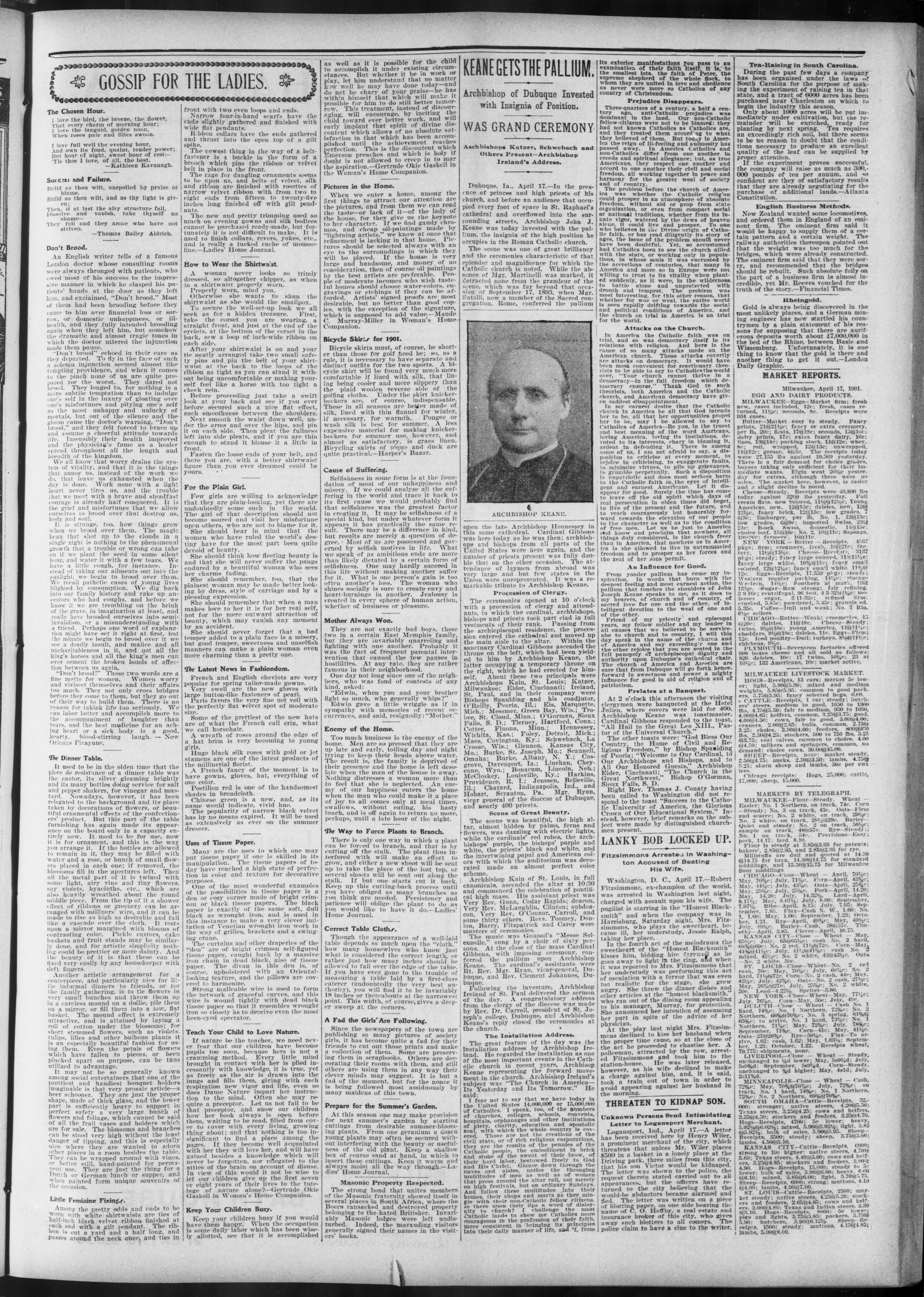
GOSSIP FOR THE LADIES.
The Chosen Hour.
I love the bird, the breeze, the flower,
That every charm of morning hour;
I love the languid, golden noon,
When roses pale and illies swoon.
I love full well the evening hour,
And own its fond, qualint, tender power;
But hour of night, sweet hour of rest—
'Tis thee I love, of all, the best.
Success and Failure.
Build as thou wilt, unspolled by praise or blame.
Build as thou wilt, and as thy light is given;
Then, if at last the alry structure fall,
Dissolve and vanish, take thyself no shame—
They fail and they arone who have not striven.
Don't Brood.
An English writer tells of a famous London doctor whose consulting rooms were always thronged with patients, who owed most of his success to the impressive manner in which he clasped his patients' hands at the door as they left him, and exclaimed, "Don't brood." Most of them had been brooding before they came to him over financial loss or sorrow, or domestic unhappiness, or ill-health, and they fully intended brooding again when they left him, but somehow the dramatic and almost tragic tones in which the doctor uttered the injunction made them pause.
"Don't brood" echoed in their ears as they departed. To fly in the face of such a solemn injunction seemed almost like tempting providence, and when it comes to the pinch none of us are quite prepared for the worst. They dared not brood. They longed to, for nothing is a more subtle temptation than to indulge one's self in the luxury of gloating over one's misfortunes and pitying one's self as the most unhappy and unlucky of mortals, but out of the silence and the gloom came the doctor's warning, "Don't brood," and they felt forced to brace up and assume a cheerful attitude towards life. Insensibly their health improved and the physician's fame as a healer spread throughout all the length and breadth of the kingdom.
We all know that worry drains the system of vitality, and that it is the things that annoy us, instead of the work we do, that leave us exhausted when the day is done. Work done with a light heart never tires us, and the trouble that we meet with a brave and steadfast courage is already half conquered. It is the grief and misfortunes that we allow ourselves to brood over that destroy us, body and soul.
It is strange, too, how things grow when we brood over them. The magic bean that shot up to the clouds in a single night is nothing to the phenomenal growth that a trouble or wrong can take on if we plant the seed in some silent hour, and water it with a few tears. We have a little cough, for instance. Instead of taking our ailments out into the sunlight, we begin to brood over them. We recall pathetic cases of young lives blighted by consumption. We dig back into our family history and rake up ancestors who had coughs, and before we know it we are trembling on the brink of the grave, in imagination at least, and really have brooded ourselves into semi-invalidism, or a misunderstanding with a friend. Perhaps one word of explanation might have set it right at first, but the minute we begin to brood over it we see a deadly insult, and malice and all uncharitableness in it, and not all the king's horses and all the king's men can ever cement the broken bonds of affection between us again.
"Don't brood!" Those two words are a fine motto for women. Women worry and vivisect themselves and their affairs too much. They not only cross bridges before they come to them, but they go out of their way to build them. There is no reason for takink life too seriously. We can labor better and accomplish more to the accompaniment of laughter than tears, and the best medicine for an aching heart or a sick body is a good, hearty, blood-stirring laugh. — New Orleans Picayune.
The Dinner Table.
It used to be in the olden time that the piece de resistance of a dinner table was the castor, its silver gleaming brightly and its many bottles doing service for salt and pepper shakers, for vinegar and mustard. Nowadays, however, it has been relegated to the background and its place taken by decorations of flowers, or beautiful ornamental effects of the confectioners' product. But this part of the table furnishing has again made its appearance on the board only in a capacity entirely new. It used to be for use, now it is for ornament, and this is the way you arrange it. If the bottles are allowed to remain in it, they may be filled with water and a rose, or bunch of small flowers placed in each one; if removed, the blossoms fill in the apertures left. Then all the metal part of it is twined with some light, airy vine and tiny flowers, say violets, hyacinths, etc., which are also heavily wreathed about the round middle piece. From the tip of it a shower effect of ribbons or greenery can be arranged with milliners' wire, and it can be made to rise as high as desirable and fall like a cascade over the cloth. It rests upon a mirror margined with blooms of contrasting color. Pickle castors, cake baskets and fruit stands may be similarly done, and for artistic simplicity nothing could be prettier or more dainty. And the beauty of it is that these can be fixed very easily by any housekeeper with deft fingers.
Another artistic arrangement for a centerpiece, and particularly nice for little informal dinners to friends, or for the family gathering, is to tie flowers in very small bunches and throw them up in a careless mound on a dollie, pile them on a mirror, or fill them into a low, flat basket. The mound effect is extremely attractive, and is attained by laying a roll of cotton under the blossoms; for short stemmed flowers, such as violets, tulips, lilies and other bulbous plants it is an especially beautiful fashion for using them. Even the petals of flowers which have fallen to pieces, or been plucked apart on purpose, can be thus utilized to advantage.
It may not be so generally known among social entertainers that one of the prettiest and handiest bouquet holders imaginable is that very prosaic article—a beer schooner. They are just the proper shape, made of thick glass, and the lower part is sufficiently heavy to support in perfect safety a very large bunch of flowers and foliage, which cannot be said of all the frail vases and holders which are for sale. The blossoms and branches can be stood very high without the least danger of tipping, and this is especially nice where they are wanted to adorn other places in a room besides the table. They can be wrapped around with vines, or better still, hand-painted for permanent use. They are just the thing for a Dutch or German lunch or supper, and when painted form unique souvenirs of the occasion.
Little Feminine Fixing.
Among the pretty odds and ends to be worn with white shirtwaists are ties of half-inch black velvet ribbon finished at each end with a gilt pendant. The ribbon is cut a yard and a half long, and passes around the neck once, and ties in
front with two even loops and ends.
Narrow four-in-hand scarfs have the ends slightly gathered and finished with wide flat pendants. Ribbon collars have the ends gathered and thrust into the open top of a gilt spike. The newest thing in the way of a belt-fastener is a buckle in the form of a brooch which pins the ribbon or velvet belt in place in the front. The rage for dangling ornaments seems to be upon us, and belts of velvet, silk and ribbon are finished with rosettes of narrow velvet ribbon with from two to eight ends from fifteen to twenty-five inches long finished off with gilt pendants.
The new and pretty trimming used so much on evening gowns and silk bodices cannot be purchased ready-made, but fortunately it is not difficult to make. It is used to finish collars, revers, yokes, etc., and is really a tucked ruche of mousseline.—Ladies' Home Journal.
How to Wear the Shirtwaist
A woman never looks so trimly dressed, so altogether chipper, as when in a shirtwaist properly worn. Properly worn, mind you.
Otherwise she wants to shun the shirtwaist as she would the smallpox.
To secure the well-set-up look we all seek as for a hidden treasure. First, take the corset you are wearing, a straight front, and just at the end of the eyelets, at the bottom of the corset in the back, sew a loop of inch-wide ribbon on each side.
After your shirtwaist is on and your tie neatly arranged take two small safety pins and pin the belt of your shirtwaist at the back to the loops of the ribbon as tight as you can stand it without being uncomfortable or making yourself feel like a horse with too tight a check rein.
Before proceeding just take a swift look at your back and see if you ever before secured such a nice flat effect, such smoothness between the shoulders. Next smooth the waist down well, under the arms and over the hips, and pin it on each side. Then pleat the fullness left into side pleats, and if you are thin enough to stand it blouse it a little in front. Fasten the loose ends of your belt, and there you are, with a better shirtwaist figure than you ever dreamed could be yours.
For the Plain Girl.
She should bear in mind that the women who have ruled the world's destiny have for the most part been quite devoid of beauty.
She should think how fleeting beauty is and that she will never suffer the pangs endured by a beautiful woman who sees her charms fading.
She should remember, too, that the plainest woman may be made better looking by dress, style of carriage and by a pleasing expression.
She should remember that when a man makes love to her it is for her real self, not for the mere outward attraction of beauty, which may vanish any moment by an accident.
She should never forget that a bad temper added to a plain face is a misery, but good temper, sweetness and unselfish manners can make a plain woman even more charming than a pretty one.
The Latest News in Fashiondom.
French and English cheviots are very popular for spring tailor-made gowns.
Very swell are the new gloves with large button-like fasteners of pearl.
Paris favors the very fine net veil with the perfectly flat velvet spot of moderate size.
Some of the prettiest of the new hats are of what the French call crin, what we call horsehair.
A wreath of roses around the edge of a hat brim is very becoming to young girls.
Huge black silk roses with gold or jet stamens are one of the latest products of the millinerial florist.
A French fancy of the moment is to have gowns, gloves, hat, everything of one color.
Postillion red is one of the handsomest shades in broadcloth.
Chinese green is a new, and, as its name would indicate, vivid hue. The popularity of narrow black velvet has by no means expired. It will be used as extensively as ever on the summer dresses.
Uses of Tissue Paper.
Many are the uses to which one may put tissue paper if one is skilled in its manipulation. The tissue papers of today have reached a high state of perfection in color and texture for decorative purposes. One of the most wonderful examples of the possibilities in tissue paper is a den or cozy corner made of bright crimson or black tissue papers. The black paper is exactly of the same soft, dull black as wrought iron, and is used in this instance to make a very clever imitation of Venetian wrought iron work in the way of grilles, brackets and a swinging crane.
The curtains and other draperies of the "den" are of bright crimson self-figured tissue paper, caught back by a massive iron chain in dead black, also of tissue paper. The divan in this den is, of course, upholstered with an Oriental-looking texture, and the pillows are covered to harmonize. Strong malleable wire is used to form the network of graceful curves, and this wire is wound tightly with dead black tissue paper so that it resembles wrought iron so closely as to deceive even the most keen-eyed spectator.
Teach Your Child to Love Nature.
If nature be the teacher, we need never fear that our children have become pupils too soon, because hers is not a cramming method. Every little mind brought in contact with her is plied incessantly with knowledge, it is true, yet as freely as the air is drawn into the lungs and fills them, giving with each respiration new vigor and life, even so does Dame Nature impart her instruction to the mind. Often she may require a preceptor. Let us not fail to be that preceptor, and show our children how her book always is open before them, waiting to be read, filled from cover to cover with every living, growing thing about; and that nothing is too insignificant to find a place among the pages. If they become well acquainted with her they will love her, and will have gained besides a knowledge which will never be forgotten, nor relegated to the atties of the brain on account of disuse. In view of this would it not be wise to let our children give up the first seven or eight years of their lives to the tute-lage of nature alone?—Gertrude Okie Gaskell in Woman's Home Companion.
Keep Your Children Busy.
Keep your children busy if you would have them happy. When the occupation is some daily labor which has been wisely allotted, see that it is accomplished
as well as it is possible for the child to accomplish it under existing circumstances. But whether it be in work or play, let him understand that no matter how well he may have done today—and do not be chary of your praise—he has within himself that which will make it possible for him to do still better tomorrow. This treatment, instead of discouraging, will encourage, by inciting the child toward ever better work, and will early implant that spirit of divine discontent which allows of no absolute satisfaction in that which has been accomplished until the achievement reaches perfection. This is the discontent which Emerson preaches and which is holy if doubt is not allowed to creep in to mar the aspiration.—Gertrude Okie Gaskell in the Woman's Home Companion.
Pictures in the Home.
When we enter a home, among the first things to attract our attention are the pictures, and from them we can read the taste—or lack of it—of the lady of the house, for they give us the keynote to her character. If we find gaudy chromos, and cheap oil-paintings made by "lightning artists," we know at once that refinement is lacking in that home. Pictures should be selected always with an eye to the surroundings in which they will be placed. If the house is very large and handsome, and money of no consideration, then of course oil paintings by the best artists are preferable. People of moderate incomes who wish tasteful homes should choose water-colors, engravings or etchings if they can be afforded. Artists' signed proofs are most desirable, but no better than good copies, with the exception of the signature, which is supposed to add value.—Maude C. Murray-Miller in Woman's Home Companion.
Bicycle Skirt, $c$ for 1901.
Bicycle skirts must, of course, be shorter than those for golf need be; so, as a rule, it is necessary to have separate and distinct outfits for the two sports. A bicycle skirt will be found very much more comfortable if lined with silk, that lining being cooler and more slippery than the plaid woolen reverse side of the golfing cloths. Under the skirt knickerbockers are, of course, indispensable. These in all seasons are better made of silk, lined with thin flannel for winter, if necessary, for warmth. Pongee or wash silk is best for summer. A less expensive material for making knickerbockers for summer use, however, and almost as satisfactory, is grass linen. Bicycling skirts of pique and duck are quite practical.—Harper's Bazar.
Cause of Suffering.
Selfishness in some form is at the foundation of most of our unhappiness and misery. If we could analyze all the suffering in the world and trace it back to its first cause we would probably find that selfishness was the greatest factor in creating it. It may be selfishness of a special kind, but under whatever form it appears it has practically the same result. There may be a difference in kind, but results are merely a question of degree. Most of us are possessed and governed by selfish motives in life. What we speak of as ambitious ends are more than likely dictated by a certain form of selfishness. One may hardly succeed in this life without making another suffer for it. What is one person's gain is too often another's loss. The woman who shines socially is sure to create envy and heart-burnings in another. Jealousy is created in every sphere of human action, whether of business or pleasure.
Mother Always Won.
They are not exactly bad boys, these two in a certain East Memphis family, but they are invariably quarreling and fighting with one another. Probably it was the fact of frequent parental intervention that caused the few pauses in hostilities. At any rate, they are rather famous in their neighborhood.
One day not long since one of the neighbors, who was fond of contests of any kind, asked:
"Edwin, when you and your brother fight so much, who generally whips?"
Edwin gave a little wriggle as if in sympathy with memories of recent occurrences, and said, resignedly: "Mother."
Enemy of the Home.
Too much business is the enemy of the home. Men are so pressed that they are up late and early, toiling day and night trying to keep their heads above water. The result is, the family is deprived of their presence and the home is left desolate when the man of the house is away. Nothing distresses a woman more than to feel that she is neglected. An enemy of our happiness enters the home when the man who could make it a place of joy to all comes only at meal times, swallows, without eating, his hasty lunch, and is off again to return no more, perhaps, until a late hour of the night.
The Way to Force Plants to Branch.
There is only one way in which a plant can be forced to branch, and that is by cutting off the stalk. The plant thus interfered with will make an effort to grow, and either a new shoot will be sent up to take the place of the lost top, or several shoots will be sent out along the stalk. If but one starts cut it back. Keep up this cutting-back process until you have obliged as many branches as you think are needed. Persistency and patience will oblige the plant to do as you would like to have it do.—Ladies' Home Journal.
Correct Table Cloth.
Though the appearance of a well-laid table depends so much upon the "cloth," how many housewives who know just what is considered the correct length, or rather just how many inches should be allowed to fall over the edge of the table. If you have ever gone to the trouble of measuring a table laid by a first-class caterer (undoubtedly the very best authority), you will find it to be invariably 18 inches or thereabouts at the narrowest point. This width, of course, gives a deeper sweep at the corners.
A Fad the Girls Are Following.
Since the newspapers of the town are publishing so many pictures of society girls, it has become quite a fad for their friends to cut out those prints and make a collection of them. Some are preserving them in scrapbooks. Others are decorating their rooms with them, and still others are using them in any way their clever minds may suggest. It is but a fad of the moment, but for the nonce it is being followed most assiduously by many maidens of this town.
Prepare for the Summer's Garden.
At this season one may make provision for next summer's garden by starting cuttings from desirable summer-blooming plants. From one geranium a dozen young plants may often be secured without interfering with the beauty or usefulness of the old plant. Keep a shallow box of coarse sand at hand, in which to insert these cuttings. Keep it warm and always moist all the way through.—Ladies' Journal.
Masonic Property Respected.
The strong bond that unites members of the Masonic fraternity showed itself in several places in South Africa, where the Boers ransacked and destroyed property belonging to the hated Britisher. Invariably Masonic lodges were left undisturbed. Indeed, the marauding visitors generally signed their names in the visitors' books.
KEANE GETSTHE PALLIUM.
WAS GRAND CEREMONY
Aschbishops Katzer, Schwebach and Others Present—Archbishop Ireland's Address.
Dubuque, Ia., April 17.—In the presence of princes and high priests of his church, and before an audience that occupied every foot of space in St. Raphael's cathedral and overflowed into the surrounding streets, Archbishop John J. Keane was today invested with the pallium, the insignia of the high position he occupies in the Roman Catholic church.
The scene was one of great brilliancy and the ceremonies characteristic of that splendor and magnificence for which the Catholic church is noted. While the absence of Mgr. Martinelli was marked, it detracted none from the grandeur of the scene, which was far beyond that occasion of September 17, 1893, when Mgr. Satolli, now a member of the Sacred congregation, Rome, conferred the pallium
P.
ARCHBISHOP KEANE. upon the late Archbishop Hennessey in this same cathedral. Cardinal Gibbons was here today as he was then; archbishops and bishops from all parts of the United States were here again, and the number of priests present was fully double that on the other occasion. The attendance of laymen from abroad was very large and but few states in the Union were unrepresented. It was a remarkable tribute to Archbishop Keane.
Procession of Clergy.
The ceremonies opened at 10 o'clock with a procession of clergy and attendants, in which the cardinal, archbishops, bishops and priests took part clad in full vestments of their rank. Passing from the archiepiscopal residence, the procession entered the cathedral and moved up the main aisle to the altar. Within the sanctuary Cardinal Gibbons ascended the throne on the left, which had been yielded to him by Archbishop Keane, the latter occupying a temporary throne on the right, which he had erected for himself. About these two principals were Archbishops Kain, St. Louis; Katzer, Milwaukee; Elder, Cincinnati; Ireland, St. Paul, and in their company were Bishops Spaulding and his coadjutor, O'Reilly, Peoria, Ill.; Eis, Marquette, Mich.; Messmer, Green Bay, Wis.; Trobe, St. Cloud, Minn.; O'Gorman, Sioux Falls, S. D.; Tierney, Hartford, Conn.; Cotter, Finona, Minn.; Hennessey, Wichita, Kas.; Foley, Detroit, Mich.; Maes, Covington, Ky.; Schwebach, La Crosse, Wis.; Glennon, Kansas City, Mo.; Burke, St. Joseph, Mo.; Scannell, Omaha; Burke, Albany, N. Y.; Cosgrove, Davenport, Ia.; Linehan, Cheyenne, Wyo.; Bonacum, Lincoln, Neh.; McCloskey, Louisville, Ky.; Harkins, Providence, R. I.; Jenssen, Belleville, Ill.; Chatard, Indianapolis, Ind., and Hobart, Scranton, Pa. Mgr. Ryan, vicar general of the diocese of Dubuque, and nearly 400 priests.
Scene of Great Beauty.
The scene was beautiful, the high altar, almost hidden by palms, ferns and flowers, was dazzling with electric lights, while the cardinals' red robes, the archbishops' purple, the bishops' purple and white, the priests' black and white, and the intertwining papal and American colors with which the auditorium was decorated made an almost perfect color scheme.
Archbishop Kain of St. Louis, in full canonicals, ascended the altar at 10:30 and commenced the celebration of pontifical high mass. His assistant priest was Very Rev. Gunn, Cedar Rapids; deacon, Very Rev. McLaughlin, Clinton; subdeacon, Very Rev. O'Connor, Carroll, and some thirty others. Revs. Toomey, Donlon, Barry, Fitzpatrick and Carey were masters of ceremonies.
masters or ceremonies.
The music was Gounod's "Messe Solennelle," sung by a choir of sixty persons. At the close of the mass Cardinal Gibbons, with imposing ceremony, conferred the pallium upon Archbishop Keane. The cardinal's assistants were Rt. Rev. Mgr. Ryan, vicar-general, Dubuque, and Rev. Clement Johannes, Dubuque.
Following the investiture, Archbishop Ireland of St. Paul delivered the sermon of the day. A congratulatory address from the clergy of the diocese was made by Rev. Dr. Carroll, president of St. Joseph's college, Dubuque, and Archbishop Keane's reply closed the ceremonies at the church.
The Installation Address.
The great feature of the day was the Installation address by Archbishop Ireland. He regarded the installation as one of the most important events in the Catholic church in recent years, Archbishop Keane representing the forward movement in the church. Archbishop Ireland's subject was "The Church in America—Its Yesterday and Its Tomorrow." He said:
I fear not to say that we have today in the United States 14,000,000 or 15,000,000 of Catholics. I speak, too, of the numbers of churches, colleges, schools, convents, hospitals, orphanages and other institutions of plety, charity, education and apostolic zeal, with which the whole country is covered. Those are not the creations of the civil state, or of rich religious corporations, they are the results of the penniles of the Catholic people, the embodiment in brick and stone of the sweat of their brow, of their hard labor, bestowed freely to God and His Christ. Glance down through the naves and aisles, notice the thronging multitudes of men as well as of women that press around the altar rail, not merely on high festivals, but on ordinary Sundays. And follow these multitudes into their homes, their shops and marts as they mingle with their non-Catholic fellow citizens. Is there upon their lips a word of disloyalty to church? I challenge the most Catholic lands to show me Catholics more courageous in the profession of their faith, more consistent in bringing its principles into their daily manner of life, and 'f, from
its exterior manifestations you pass to an examination of their faith itself, it is, to the smallest lota, the faith of Peter, the supreme shepherd of the whole flock, to whom they are united in love and obedience as never were more so Catholics of any country of Christendom.
Prejudice Disappears.
Three-quarters of a century, a half a century ago, anti-Catholic prejudice was dominant in the land. Our non-Catholic fellow-citizens were not to be blamed; they had not known Catholics as Catholics are, and they treated them according to what they believed of them. But today in America the reign of ill-feeling and animosity has passed away. In America Catholics and non-Catholics differ from one another in creeds and spiritual allegiance; but, as true Americans, they respect one another and accord to one another their civil and social freedom, all working together in peace and harmony for the greater weal of society and of country.
The problem before the church of America was whether the Catholic relig'on could prosper in an atmosphere of absolute freedom, without aid or prop from state organization, or even from compact social or national traditions, whether from its innate vigor, watered by the dews of heaven alone, it could live and prosper. To one who believes in the Divine origin of Catholic faith, or has read diligently its story of ages, the issue of the problem should never have been doubtful. Yet, so accustomed had Catholics been to see the church allied with the state, or working only in populations, in whose souls it was encrusted by the accretions of centuries, that many in America and more so in Europe were not willing to trust to its vitality when planted suddenly, as it were, in the wilderness to battle alone and unprotected with drouth and tempest. The problem was most interesting, for this other reason, that whether for woe or weal, the entire world is seen rapidly drifting towards the social and political conditions of America, and the church on trial in America is on trial for the world.
Attacks on the Church.
In America the Catholic faith was on trial, and so was democracy itself in its relations with religion. And here is the cause of so many attacks made on the American church. Those attacks covertly are attacks on democracy. It would have been most convenient for reactionary theorists to be able to say to Catholics the world over, "Your church cannot thrive in a democracy—in the full freedom which democracy ensures." Thank God to such theorists, both America and the Catholic church, and American democracy have given saddest disappointment.
In my earnest desire that the Catholic church in America be all that God intends her to be, all that her opportunities propel her to be, may I be allowed to say to Catholics of America—Be you, in the truest and best meaning of the word Amricans, loving America, loving its institutions, devoted to its interests, chary in blaming it, ardent in defending it. There is among some of us, I am not afraid to say, a disposition to criticise at every moment, to rejoice in criticising, to exaggerate faults, to minimize virtues, to pile up grievances, to grumble perpetually. Such a disposition is unpatriotic and does most serious harm to the Catholic faith in the eyes of intelligent and earnest Americans. Let it disappear for good. Surely the time has come to leave off the old spirit which days of real persecution in olden times did beget, to live of the present and the future, and to reach courageously but honorably forward towards the elevation of our people to the character as well as to the condition of free men. Let us be just to America and know and proclaim that nowhere, all things duly considered, is the church free than in America, that nowhere as in America is she allowed to live in untrammeled freedom and to prosper as her forces and the zeal of her sons permit.
An Influence for Good.
From yonder pallium has come my inspiration. In words that burn with the deepest feeling and most earnest action, the pallium that touches the shoulders of John Joseph Keane speaks to me, as it does to my hearers, of church and of country, of sacred love for one and the other, of intelligent devotion to the weal of one and of the other.
Friend of my priestly and episcopal years, my fellow soldier and my leader in all causes that we believed to be serviceable to church and to country. I will this day speak in the name of the church and of America and say exceedingly one and the other rejoice that you are seated in the full panopoly of archepiscopal dignity and authority upon Dubuque's cathedral chair.
The church of America and America are sure that from Dubuque will go forth henceforward in sweetness and power a mighty influence for good in aid of religion and of patriotism.
Prelates at a Banquet.
At 2 o'clock this afternoon the visiting clergymen were banqueted at the Hotel Julien, where covers were laid for 400. Archbishop Keane was toastmaster. Cardinal Gibbons responded to the toast, "All Hail to the Great Leo XIII., Pastor of the Universal Church."
The other toasts were: "God Bless Our Country, the Home of Civil and Religious Freedom," by Bishop Spariding of Peoria; "Welcome to Our Cardinal, to Our Archbishops and Bishops, and to All Our Honored Guests." Archbishop Elder, Cincinnati; "The Church in the Great Northwest," Bishop O'Gorman, Sioux Falls, S. D.
Right Rev. Thomas J. Conaty having been called to Washington did not respond to the toast "Success to the Catholic University of America, the Glorious Crown of Our Educational System." Instead, however, brief remarks on the subject were made by distinguished churchmen present.
LANKY BOB LOCKED UP.
Fitzsimmons Arrested In Washington Accused of Beating His Wife
Washington, D. C., April 17.—Robert Fitzsimmons, ex-champion of the world, was arrested in Washington last night, charged with assault upon his wife. The pugilist is starring in the "Honest Blacksmith" and when the company was in Harrisburg, Saturday night, Mrs. Fitzsimmons, who plays the sweetheart, became ill, her understudy, Jessie Ralph, taking her place.
In the fourth act of the melodrama the sweetheart of the "Honest Blacksmith" kisses him, bidding him farewell as he goes away to fight in the ring, and when it was reported to Mrs. Fitzsimmons that her understudy was performing this act of osculation with a fervor that was even too realistic for the stage, she grew angry. She threw the dinner dishes and other articles at the "honest blacksmith," who ran out of the dining room appealing to his manager, Murray, for protection. She announced her intention of assuming her part in spite of the advice of her physician.
At the play last night Mrs. Fitzsimmons declined to kiss her husband when the proper time came, so at the close of the act he proceeded to chastise her. A policeman, attracted by the row, arrested Fitzsimmons and took him to the station-house. He was later released, however, as his wife declined to make a charge against him, and, it is said, took a train out of town in order to avoid appearing against her husband in the morning.
THREATEN TO KIDNAP SON.
Unknown Persons Send Intimidating Letter to Logansport Merchant. Logansport, Ind., April 17.—A letter has been received here by Henry Wiler, a prominent merchant of the city, which threatens that unless Mr. Wiler places $500 in a basket in a lonely place at the Driving park, three miles from this city, that his son Victor would be kidnapped. The letter was shown to the police, the request therein stated carried out to all appearances, but the officers have returned to the city believing that the would-be abductors became alarmed and fled. The letter was written on a piece of blotting paper, on one side bearing the name of C. O. Heffby, a real estate and insurance broker of this city, who gives away such blotters to all comers. The police claim to have a clue to the writer.
Tea-Raising in South Carolina.
Tea-Raising in South Carolina. During the past few days a company has been organized under the laws of South Carolina for the purpose of making the experiment of raising tea in that state, and a tract of 6000 acres has been purchased near Charleston on which to begin the industry this season. Only about 1000 acres will be put immediately under cultivation, but the remainder will be enriched, ready for planting by next spring. Tea requires an exceedingly rich soil, but there seems to be no reason to doubt that the conditions necessary to produce an excellent quality of the leaf can be supplied by proper attention.
If the experiment proves successful, the company will raise as much as 300,000 pounds of tea per annum, and so confident are they of satisfactory results that they are already negotiating for the purchase of additional lands.-Atlanta Constitution.
English Business Methods
New Zealand wanted some locomotives, and ordered them in England of an eminent firm. The eminent firm said it would be happy to supply them of a certain pattern and a certain weight. The railway authorities thereupon pointed out that the weight was too much for the bridges, which were already constructed. The eminent firm said that they were sorry, and recommended that the bridges should be rebuilt. Such absolute folly on the part of a business firm is almost incredible, yet Mr. Reeves vouched for the truth of the story.—Financial Times.
Rheingold.
Gold is always being discovered in the most unlikely places, and a German mining engineer has now startled his countrymen by a plain statement of his reasons for supposing that there are auriferous deposits worth about £7,000,000 in the bed of the Rhine, between Basle and Wissemburg. Unfortunately, it is one thing to know that the gold is there and another thing to get it out.—London Daily Graphic.
MARKET REPORTS.
EGG AND DAIRY PRODUCTS.
MILWAUKEE-Eggs-Market firm; fresh new, cases included, 12c; fresh, cases returned, $11\frac{1}{2}c$; seconds, 8c. Receipts were 934 cases.
Butter—Market easy to steady. Fancy prints, 21@12½c; fancy or extra creamy, per lb, 20c; firsts, 17@18c; seconds, 15@16c; dairy prints, 17c; extra fancy dairy, 16c; lines, 13@14c; packing stock, 11@12c; whey, 8c; roll, wrapped, 12@13c; unwrapped, 11@12c; grease, 4@5c. The receipts today were 27,155 lbs against 19,500 yesterday. There is a fair demand for choice grades, buyers taking only sufficient for their immediate wants. Elginh went 20¾c yesterday for extras, although there were no sales. The market here, however, is easier and a slight decline is noted.
Cheese—Steady. Receipts were 46,800 lbs today against 3290 lbs yesterday. Full cream flats, new colored, 11½@12½c; Young Americas, new, 12@13c; daisies, new, 12@12½c, fancy brick, 12@13c; low grades, 7@9c; lambburger, per lb, No. 1, 12@13c; low grades, 6@9c; imported Swiss, 23@24c; Bock Swiss, domestic, 14@15c; choice loaf, 15@16c; No. 2, 10@11c; Sapsago, 13@19c; farmers, 10@11c.
NEW YORK — Butter — Receipts, 4.67 pkgs; firm; creamery, fresh, 10%21c; factory, 11%14@13%4c. Cheese—Receipts, 3137 pkgs; steady; fancy large colored, 11%11%4c; fancy large white, 10%11%4c; fancy small colored, 12%12%4c; fancy small white, 11%12%4c. Eggs—Receipts, 17.559 pkgs; steady; Western regular packing, 14%4c; storage Western, 14%4c; Southern at mark, 13%4c. Sugar—Raw strong; fair refining, 3 9 10c; centrifugal, 96 test, 4 3-32%4c; molasses sugar, 3 11-32c; refined firm; crushed, 5.80c; powdered, 5.45c; granula ed. 5.35c. Coffee—Dull and weak; No. 7 Rio, 6%4c sellers.
CHICAGO—Butter—Weak; creameries, 15@20c; dalries, 11@18c. Cheese—Steady; twins, 9%10c; young America, 11%11%4c; cheddars, 9%10c; dalsies, 11c. Eggs—Firm; 12c. Iced poultry—Dull; turkeys, 8%11%4c; chickens, 9%4c.
PLYMOUTH—Seventeen factories offered 998 boxes cheese and all sold as follows: 826 daisies, 10c; 17 twins, 10%4c; 23 at 10%4c; 132 Americans, 10c; market active.
MILWAUKEE LIVESTOCK MARKET
HOGS—Receipts, 13 cars; market 5c lower; light, 5.80@5.90; mixed and medium weights, 5.85@5.95; common to good packers, 5.75@5.95; fancy selected hogs, 6.00.
CATTLE—Receipts, 1 car; steady; butchers' steers, medium to good, 1050 to 1300 lbs, 4.75@5.50; falr to medium, 950 to 1050, 4.00@4.65; helfers, common, 3.25@3.75; good, 4.00@4.50; cows, falr to good, 3.00@4.00; canners, 2.00@2.65; bulls, common, 2.75@3.25; choice, 3.50@4.00; feeders, 800@970 lbs, 3.50@4.25; stockers, 500 to 750 lbs, 3.25@3.75; real calves, common to choice, 4.00@4.50; millkers and springers, common, no demand; choice cows, 30.00@4.50.
SHEEP—Receipts, none; market steady, 3.50@4.75; bucks, 2.50@3.50; lambs, 4.75@5.25; skorn sheep and lambs, 50c per cwt less.
Chicago receipts: Hogs, 25,000; cattle, 17,000; sheep, 15,000.
MARKETS BY TELEGRAPH.
MILWAUKEE—Flour—Steady. Wheat —
Easier; No. 1 Northern, on track, 74c. Corn
—Steady; No. 3 on track, 43c. Oats—Firm
and scarce; No. 2 white, on track, 20%c.
No. 3 white, on track, 281%@29c. Barley—
Quiet and steady; No. 2 on track, 50%c.
sample on track, 48%@57c. Rye—Steady;
No. 1 on track, 54c. Provisions—Easy;
pork, 14.17; lard, 8.10.
Flour is steady at 3.85@3.95 for patents;
bakers', 2.85@2.95 and 2.85@2.95 for rye.
Millstuffs are dull and quoted at 14.50
@14.75 for bran, 14.50@14.75 for standard
middlings, and 15.50@15.75 for Milwaukee
flour middlings.
CHICAGO—Close-Wheat — April, 70;1c
May, 70%;c; July, 71%;c. Corn-April, 43%;c
May, 44%;c; July, 43%;c. Oats-April, 25%;c
May, 25%;c; July, 25%;c. Pork-April, 14;20
May, 14;20; July, 14;32%; Lard-April,
8.17%;c; May, 8.07%;c; July, 8.00; September,
7.97%;c; Ribs-April, 8.15; July, 7.95; September,
7.85; Flax-Cash N. W., 1.00; No. 1,
1.90; May, 1.60; September, 1.23; October,
1.21; Rye-April, 49%;c; May, 49%;c
July, 49%;c; Barley-Cash, 38%;57%;c. Timothy-April, 3.85; Clover-April, 10.75.
KANSAS CITY—Close-Wheat — May,
65%;c; July, 65%;c; cash No. 2 hard,
68%;@69%;c. No 2 red, 71%;@72%; Corn-May,
41%;@41%;c; July, 41%;@41%;c; cash No. 2
mixed, 42%;c. No 2 white, 43%;@43%;c. Oats
-No. 2 white, 30c.
ST. LOUIS—Close-Wheat-No. 2 red
cash, 70%;c; May, 70%;c; July, 68%;c; No. 2
hard, 71%;@72%; Corn-No. 2 cash, 44%;c; May,
43%;c; July, 42%;c; Oats-No. 2 cash, 27%;c;
May, 26%;@27c; July, 25%;c; No. 2 white,
70%;c; Load, 4.22%; Speeter-3.80.
NEW YORK—Close—Wheat—May, 71%c;
July, 76%c. Corn—May, 50c; July, 49c.
DULUTH—Close — Wheat — Cash No. 1
hard, 74%c. No. 1 Northern, 72%c. No. 2
Northern, 66%c. No. 3 spring, 61%c. @
65%c. to arrive. No. 1 hard, 75%c. No. 1
Northern, 71%c. May, 72%c. July, 78%c.
September, 71%c. Corn—41c. May, 41%c.
Oats—27%@26%c. Rye—50%c. Flax—To arrive
, 1.62; cash, 1.62; May, 1.63½; September,
1.23; October, 1.22. Receipts wheat,
79.773; shipments, none.
LIVERPOOL—Close — Wheat — Steady,
unchanged to ½d lower; May, 59%d; July,
55%d; September, 59%d. Corn—Steady,
unchanged to ¾d higher; May, 4s1d; July,
3s11%d.
MINNEAPOLIS—Close — Wheat — Cash,
72%c. May, 70%@70%c. July, 72%c. on
track, No. 1 hard, 74%c. No. 1 Northern,
72%c. No. 2 Northern, 69%@70%c.
SOUTH OMAHA—Cattle-Recipts, 32:00; stronger; native steers, 4.20@5.50; Texas steers, 3.25@4.25; cows and heifers, 3.35@4.50; stockers and feeders, 3.25@4.70; Hogs—Recipts, 4700; 5c lower; heavy, 5.92%@6.02½; mixed, 5.90@5.92½; light, 5.85%@5.92½; bulk of sales, 5.90@5.95; Sheep—Recipts, 3500; steady; sheep, 3.75@5.00; lambs, 4.50@5.10.
KANSAS CITY—Cattle-Recipts, 6000; strong to 10c higher; native steers, 4.70@5.60; Texas steers, 4.40@5.00; cows and heifers, 3.25@4.85; stockers and feeders, 3.80@4.90. Hogs—Recipts, 15,000; steady to 5c lower; bulk of sales, 5.90@6.00; heavy, 6.00@6.10; mixed, 5.85@6.00; light, 5.70@5.75; Sheep—Recipts, 6000; strong; muttons, 4.10@4.90; lambs, 4.90@7.00.
ST. LOUIS—Cattle—Recelpts, 2500; market steady; native steers, 4.25@5.20; stockers and feeders, 2.65@4.65; cows and heifers, 2.00@4.80; Texas and Indian steers, 3.30@5.10. Hogs—Recelpts, 8000; 5c lower, pligs and lights, 5.75@5.85; packers, 5.75@5.90; butchers, 5.90@6.12½. Sheep—Recelpts, 1500; steady; muttons, 4.15@4.85; lambs, 5.00@8.60.
The Wisconsin Weekly Advocate
Richard B. Montgomery.....Editor and Proprietor
Office: 327 Wells Street.
Telephone Black No. 244.
One Year ..... $2.00
Six Months ..... 1.25
Three Months ..... 75
Send money by Express Money Order, P. O.
Money Order or Registered Letter to the
Wisconsin Weekly Advocate.
ADVERTISING RATES.
One inch, single insertion ..... 25c
One inch, per year ..... $9.00
Business locals 5c per line each insertion.
Apply for rates to the Advocate.
TO CONTRIBUTORS:
All communications must be sent with the
name and address of the sender as an evidence
of good faith, but not necessarily for
publication. No manuscript returned if not
accepted, unless accompanied by stamps.
All subscribers of the Advocate that fail to get their paper promptly will please notify us at once. The Advocate, at 327 Wells street.
The Wisconsin Weekly Advocate company wishes to notify the public that all contracts and business transactions with this company must have the company stamp, otherwise they will be void. Neither will this company be responsible for paid subscriptions unless given to duly-accredited agents, who, on request, will give the company's receipt for same. Subscribers failing to receive their papers regularly will kindly notify the general office. Address all business communications to the general manager, 327 Wells street.
Mr. Richard B. Montgomery.
Entered at the Milwaukee P. O. as second- c'ass matter.
The Helping Hand Colored Mission
incorporated under the laws of the State of Wisconsin has for its object the supplying of qualified colored help to those requiring the same. In order to be able to get servants from the mission it is necessary, that in order to partly cover expenses incurred, those parties desiring help should become subscribers for this paper. No actual charge is made. Parties who secure situations through this agency are also
expected to become subscribers. We have at present on our books: Cooks, General Servants, Waitresses, Laundresses, Nurses, Coachmen, Porters, Waiters. Office hours 9-12 and 1-4. R. B. MONTGOMERY, Mgr. 327 Wells St., Milwaukee.
The proposed dry goods combination is an assault upon the bargain counter.
The proposed submarine Arctic expedition might get at the roots of the Symmes' hole theory.
History's teaching that all yachts are world-beaters when they are sailing alone seems to be utterly in vain.
The official recognition of cock-fighting as a national game in the Philippines opens a haven of joy for the "sport" with a bird under his arm.
The gift of a $30,000 hospital to Kenosha by Z. G. Simmons shows that he is a man who grows not weary in well doing.
The egg riot of the Princeton choir boys is proof that the dignity of a statesman in innocuous disuetude is not contagious.
If Ann Arbor were to act like San Francisco there would be a greater hullabaloo about the suspected case of the bubonic plague.
Count Boni de Castellane is lionized in Paris because he wasn't scared to death in the recent duel. His courage was never suspected.
The object of the rumor that Tolstoi has been banished from Russia is disclosed by the report that he is engaged upon another book.
The stolen portrait of the Duchess of Devonshire which has been recovered might be utilized in the tobacco trade to advertise cut Cavendish.
If Balfour's reputation were as strong for statecraft as it is for golf, English uneasiness over the prospective retirement of Salisbury would abate.
Aguinaldo is evidently bent on proving that Admiral "Bob" Evans was wrong when he said that the proper way of capturing him was to take him dead.
The California woman who dreamed out a valuable invention for bed drapery might discover a never-failing rat trap if she were to sleep in a folding bed.
The Cudahy extortion scheme at Omaha is still disturbing the minds of cranks, and weak imitators will get into the hands of the law for some time to come.
Senor Emilio Aguinaldo's inability to write the mooted peace proclamation may cause some people to believe that Funston did not locate the brains of the rebellion, after all.
The servant girls of Ottawa, Canada, have formed a union. As far as the cooks are concerned, they will follow their old accustomed routine in working for ate hours.
A Chicago man committed suicide because of the reported exile of Count Tolstoi. This would seem to be an extreme application of the principle of the sympathetic strike.
When Milwaukee and Chicago finally agree as to the Fourth of July yacht race, the resultant dead calm may take the wind out of the sport, and make the race a tame affair.
Search for the name of the London suspect who claims that her husband is an American naval officer will probably have to be made in the army and navy registers kept at police headquarters on both sides of the Atlantic. That is where the
Americans who are duped find the names of many titled visitors of verbal smoothness who succeed in ingratiating themselves socially and otherwise.
The epidemic of elopement in Kentucky female seminary was brought to an end by the discharge of a shotgun, after the manner of disconcerting whirlwinds and waterspouts.
Aguinaldo might change a little public sentiment in some quarters if he were to come to the United States and stand alongside of a statue of George Washington, for comparison.
Kansas women who find themselves in possession of hatchets and a lost cause, can make parlor ornaments of the former by a clever adjustment of ribbons, or else put them to practical use. Well sharpened, a hatchet can be made useful in preparing the evening hash.
The detectives who are trying to discover who took the gold bars from the chilled steel treasure room of the "Big Kaiser," when that steamer was in mid-ocean, have a deep-water case on their hands.
Miss Elizabeth Watrous of Binghampton, N. Y., 19 years of age, was married recently to an 8-months-old boy named Carroll. The estate is valued at $80,000. "Carroll, brothers, Carroll—Carroll, merri-lee!" The New York jury which confirmed the validity of a gambling debt took the ground that after a man has gambled and won he can never "blaat" over losings with any hope of being taken for a fleeced lamb.
The rabbits' eggs, which come only at Easter, have been disposed of, and hens' eggs will have to do for the rest of the year. The shells are not so pretty, but, fortunately, the insides are all right—when the egg is caught young.
The story of the reappearance of Yu Hsein, the governor of the province of Shansi, who was supposed to have been beheaded, is not surprising to those who know how easy it is for a rich Chinaman to secure a proxy on such occasions.
France cannot hope to keep pace with England in the construction of vessels, so she has ordered twenty submarine boats to act as bugaboos. The value of the submarine boat lies mainly in the imagination, but imagination cuts a big figure in war, sometimes. Chicago's latest organized novelty is a Heart-culture society, whose members believe that the influences radiating from their association will make the metropolis "a great and important love center." Will this be better than Chicago's present fame for quick divorces?
On one point at least, the W. C. T. U. women of California are determined. If wine is used on the Ohio and during the festivities attendant upon the reception of the President, it must have a California brand,—"none genuine unless the name is blown in the bottle."
Secrets are revealed in this description of the Milwaukee cup-defender by a yachting expert, who gives Herreshoff, Crowninshield and other designers a peck of nuts to crack: "The keel, instead of being iron, is of deadwood, to which is bolted the iron casting and the lead hull."
The investigation of the new British royal yacht has resulted in the finding that she had an excess of 800 tons in the weight of her superstructure when she nearly "turned turtle" at the launching. The yacht will probably be condemned until royalty takes to the use of submarine boats.
Count Boni de Castellane's story from Rome about a French and Italian alliance for the purpose of gobbling up Morocco may be simply experimental work to fit him for residence in the United States and the spending of his wife's millions in running a "yellow" journal in New York.
Count Tolstoy is reported as saying that one of the difficulties of the present generation is due to the placing of too much power in the hands of women. If Tolstoy has said this, he would make a mistake in attempting to seek a quiet asylum during his exile by coming to the United States.
Constitution is to be the name of the new Herreshoff defender of the America cup. It is a proud name that has behind it in the annals of the sea the record of "Old Ironsides" in many a fine run in a chase and while being chased. Of course the new yacht is expected to be chased by her competitors.
The need of removing from the channel of Santiago harbor the wreck of the collier Merrimac, which has just been successfully destroyed with dynamite, is proof that Lieut. Hobson's feat was not futile. Had the channel been unobstructed, Admiral Cervera might have sneaked out early in the morning, between dark and daylight, when the searchlights of the blockaders were not piercing the harbor with shafts of light.
When the shots at Concord, Massachusetts, which were heard 'round the world, settled all fear that a monarch would rule the United States, it was not thought that in time to come the sound of smashing at another Concord would precede the setting up of a throne which would be occupied by a woman dictator. But nobody could foresee the founding of Concord, Kansas, and the advent of Carrie Nation, the saloon smasher, who is having full control of the Kansas town as to bar smashing and all other disciplinary measures.
The Belgian Hare club of New England held its first annual dinner in Boston the other evening. A paper by Dr. B. C. Platt of California stated that the hare was the only fur-bearing animal which had been domesticated and whose flesh was good for food. The hare could be raised by all classes of people, on city lots or in herds on farms in the country. They were prolific in producing good meat which was worth 25 cents a pound, while their skins made good leather. Their beauty and their utility accounted for their great popularity wherever they had been raised. He predicted that canneries would be started to put up Bel-
TRADE MARK
REGISTERED 1892.
U.S.PATENT OFFICE
WASHINGTON, D.C.
BEFORE USING
HARTONA
AFTER USING
HARTONA
Hartona will make the hair grow long and soft, straight and beautiful. Makes the hair grow on bald and thin places. Restores GRAY HAIR to its original color. Hartona cures Dandruff, Baldness, falling out of the hair, itching, and all scalp diseases. Hartona does not have to be used all the time, as it straightens the hair and gives it fresh life and lustre, and the hair stays and grows naturally beautiful and straight after the use of Hartona. No hot irons necessary. No pasting the hair down with grease. Hartona is positively harmless—one box can be used by every one in the family. Benefits and improves children's hair just the same as adults. To meet the popular and ever-increasing demand for Hartona Hair-Grower and Straightener, we have placed it on sale in 25c. and 50c. sizes, in our special round, patent box. See that the word Hartona is on every box.
Money positively refunded if you are not absolutely delighted with the Hartona remedies. Remember, we handle no fake goods, and you are positively protected by our $100.00 guarantee to any one proving otherwise. All our remedies are trade-marked, registered and copyrighted at United States Patent Office at Washington, D. C., in the years 1892 and 1900. We refer you, as to our responsibility, to the City Bank of Richmond, Va., Adams and Southern Express Companies, and to the editor of this paper.
We want lady and gentlemen agents, white or colored, in every city and town in the United States. Write to us to-day, no matter if you are employed or not, and we will show you how to make a splendid living, with easy and pleasant work, and no risk of losing your good money. Write to us and we will send you a book of over one hundred genuine testimonials in your own State of people who have used and are using Hartona remedies. Is this not fair and honest enough?
HARTONA FACE WASH
Hartona Face Wash will gradually turn the skin of a black person five or six shades lighter, and will turn the skin of a mulatto person perfectly white. The skin remains soft and bright without continual use of the face wash. One bottle does the work. Hartona Face Wash will remove wrinkles, dark spots, pimples, blackheads, freckles, and all blemishes of the skin. You can regulate the shade of skin on neck, face and hands to any shade you wish. Full directions with each bottle. Hartona Face Wash is perfectly harmless, and is sent to any part of the United States on receipt of price, 50c. per bottle; securely sealed from observation. It is your duty to look as beautiful as possible. Thousands of delighted patrons send us testimonials every year. Please remember that your money is positively refunded if you are not perfectly satisfied and delighted with the Hartona remedies. We want agents in every city in the United States. Write to us, no matter if you are employed or not, and we will show you how to make money without risking any of your own money.
Hartona No-Smell will remove all smells and bad odors of the body; cures sore and aching feet, chafed limbs, etc. Hartona No-Smell is a God-send to all persons suffering from disagreeable odors caused by perspiration of the feet, arm-pits, etc. Sent anywhere on receipt of price, 10 cents and 25 cents a package. Address all orders to
Send us One Dollar, and mention this paper, and we will send you three large boxes of Hartona Hair-Grower and Straightener, two large bottles of Hartona Face Wash, and one large box of Hartona No-Smell. Goods will be sent securely sealed from observation.
Write your name and post-office and express-office address very plainly. Money can be sent by post-office money order, or enclosed in a registered letter, or by express. Address all Orders to
gian hare meat, and that much leather would be manufactured from their skins, also that those who entered these industries early would make money.
In Sweden the state owns and cares for over 18,000,000 acres of forest lands. Schools of forestry are maintained, and the timber lands are efficiently cared for by graduates of the schools, who understand how to farm the lands by preventing waste and profitably manufacturing the product of the forests, carefully replanting where trees are cut down. As a result of forestry so managed, all the cost of schools and caretakers is defrayed out of the product sold by the state, and the net profits are four times greater than the expenditure.
The commissioners of the District of Columbia recently proposed to frame a regulation compelling each automobile of every kind used in the District of Columbia to display in a conspicuous manner a number which would enable it to be identified by the police, so that its owner could be held accountable for any accident which it might cause or any violation of the regulations regarding speed or lights. The automobile club protested vigorously against any such regulations. The commissioners have appealed to the state department to help them out by collecting information through the consuls as to the automobile regulations in foreign cities. The adoption of the proposed regulation would enable the police to place the responsibility for any vehicle seen traveling at an excessive rate of speed. The automobile club has promised to use its influence to induce all owners of automobiles to keep the speed of their machines within the legal limits.
"Mrs. Ladd used to worry terribly when her husband was away on his trips, but she's got over it."
"Conquered her nervousness, I suppose?"
"Oh, no; succeeded in making him have his life insured."—Tit-Bits.
Sustaining Life
on the choice juicy meats served by us is just what our athletic, bicycle riding, tennis playing and golfing twentieth century men and women need. Pie days have gone with the spin ning wheel. Good bone, muscle and tissue is what is needed now. You can get them by patronizing the Chicago Market. Our meats are fresh, tempting and choice, and are sold at prices that will let you feast in comfort.
WILLIAM RASCH
GENEVA LAKE, WIS.
WHEN IN MADISON
Call at the
Avenue
Hotel...
M. J. REGAN, Prop.
$2.00 Rate.....
Free 'Bus.
Bay View Mission
OF
ST. JOHN'S E. M. E. CHURCH
310 SUPERIOR STREET.
Rev. JOSEPH A. JACKSON, Pastor.
Services at 11 a. m. and
7:30 p. m. Sundays.
Wednesday and Friday Evenings,
at 8:30 p. m.
WHEN IN KENOSHA
CALL ON
MATT GREENWALD
..HARTONA..
Preparations for the
ons for the Hair
Preparations for the Hair!
The Original and Only Hartona.
Watchless and Positively Unequaled for
ening all Kinky, Knotty, Stub
Harsh, Curly Hair.
Bautiful. Makes the hair grow on bald and thin places. Re-
ting out of the hair, itching, and all scalp diseases. Hair
lifes life and lustre, and the hair stays and grows naturally.
Getting the hair down with grease. Hartona is positively
children's hair just the same as adults. To meet the
we have placed it on sale in 25c. and 50c. sizes, in our
with the Hartona remedies. Remember, we handle no fake g
otherwise. All our remedies are trade-marked, register
years 1892 and 1900. We refer you, as to our respon-
ses, and to the editor of this paper.
city and town in the United States. Write to us to do
andid living, with easy and pleasant work, and no risk o
hundred genuine testimonials in your own State of peo
ough?
FACE WASH.
On five or six shades lighter, and will turn the skin of a
unual use of the face wash. One bottle does the work.
On blackheads, freckles, and all blemishes of the skin. Y
Full directions with each bottle.
Set of the United States on receipt of price, 50c. per bo
ble. Thousands of delighted patrons send us testimoni
are not perfectly satisfied and delighted with the Hartona
, no matter if you are employed or not, and we will sho
NO-SMELL.
Body; cures sore and aching feet, chafed limbs, etc.
Disagreeable odors caused by perspiration of the feet,
Address all orders to
DNA REMEDY CO., 909 E. Main St., Richmond
AND OFFER.
You three large boxes of Hartona Hair-Grower and Stra-
-Smell. Goods will be sent securely sealed from observa
plainly. Money can be sent by post-office money order
9 E. Main St., Richmon
...UNION...
Laundry and News
No. 432 State Street
GEO. W. SAYLES
...ALL WORK CAREFULLY
Lowest Prices and Satisfaction Guarantee
Actively Unequaled for Straight, Finky, Knotty, Stubborn, Wash, Curly Hair.
Now on bald and thin places. Restores GRAY, and all scalp diseases. Hartona does not hair stays and grows naturally beautiful and increase. Hartona is positively harmless—one same as adults. To meet the popular and in 25c. and 50c. sizes, in our special round.
Remember, we handle no fake goods, and your lies are trade-marked, registered and copyed. Refer you, as to our responsibility, to the paper.
United States. Write to us to-day, no matter and pleasant work, and no risk of losing yourials in your own State of people who have
WASH.
After, and will turn the skin of a mulatto per-One bottle does the work.
All blemishes of the skin. You can regu-ach bottle.
A receipt of price, 50c. per bottle; securely patrons send us testimonials every year.
And delighted with the Hartona remedies, deployed or not, and we will show you how to
HELL.
Long feet, chafed limbs, etc.
By perspiration of the feet, arm-pits, etc.
09 E. Main St., Richmond, Va.
R.
Hartona Hair-Grower and Straightener, two feet securely sealed from observation.
Sent by post-office money order, or enclosed
St., Richmond, Va.
UNION...
New and News Co.
432 State Street
W. SAYLES
CAREFULLY DONE...
and Satisfaction Guaranteed.
Matchless and Positively Unequaled for Straightening all Kinky, Knotty, Stubborn, Harsh, Curly Hair.
THE BAKERY
No. 432 State Street GEO. W. SAYLES ...ALL WORK CAREFULLY DONE... Lowest Prices and Satisfaction Guaranteed.
JAMES T. BRETT
EMBALMER and
FUNERAL DIRECTOR
307 REED STREET and
410 GRAND AVENUE. Always Open
MRS. JAMES T. BRETT,
Lady Undertaker.
Telephones:
South 122.
Grand 2467. Milwaukee, Wis.
ing to visit HotSprings, this winter, should pa the ELSBERG HOUSE.
intending to visit HotS Ark., this winter, sho tronize the RAMMELSBERG BATH HOUSE, MARK SARGENT, M
intending to visit HotSprings Ark., this winter, should patronize the
MARK SARGENT, Manager. 21 BATHS $3.00
M.
PARTIES
WE TELL YOU ALL ABOUT
IT IN
The BOOK OF THE
New Century
The finest Catalogue ever issued is
yours on request. If interested in
typewriters, you ought to have it.
UNITED TYPEWRITER
and SUPPLIES CO.
Agents for Wisconsin and Northern
Michigan—414 Broadway,Milwaukee,Wis.
Northwestern House
JOHN A. BRILL, - Proprietor.
Terms $1.00 Per Day.
Accommodations the best in the State. When in Appleton stop at the
NORTHWESTERN
TONEY THE ARTIST
FINE ART
Shining Parlor
216½ GRAND AVENUE
Opposite Flannar's Music Store
MILWAUKEE, WIS.
MILWAUKEE...
GAS STOVE CO.,
MANUFACTURERS OF
PERFECTION
MACHINERY CO.
AND SPECIALTIES
Instantaneous Cleanable Star Burners,
Adjustable Needle Valve,
For Natural, Artificial or Gasoline Gas.
139 Burrell St., Milwaukee, Wis.
MASTER PAINTER
You know Good Painters make from $5.00 to $10.00 a day easy.
OUR BOOK
is so explicit that even Boys can become Masters of the trade.
PAINTING POINTERS
on Sign, House and Carriage Painting, Decorating, Graining, Gilding, Silvering and Calsomin-ing. This Book will also teach you how to
CONTRACT FOR BUSINESS
on profitable basis. It will teach you all we know after having spent a life time in the business, and will generally
SAVE YOU MONEY.
Mailed postpaid for only 50c.
VAL. SCHREIER SIGN WORKS. Milwaukee, Wis.
MR.T.W. BARTO.
of 511 Wells Street. has opened up a new Bakery and Lunch. Has stocked his store with Choice Goods, Fresh Bread, Rolls, Pies, Cakes and Candies and Choice Family Groceries, Milk and Tobacco and Cigars.
511 WELLS ST.
Don't forget to give him a call.
Phone 405 Black.
NORTH OR SOUTH
Always ask for tickets via the Monon Route THE SHORT LINE BETWEEN
Chicago,
Indianapolis,
Cincinnati,
Louisville
Six trains daily between Chicago and the Ohio river.
For folders, rates, etc., call at any Monon ticket office or address
FRANK J. REED,
Gen'l Pass. Agent, Chicago.
S. B. JONES,
C. P. Agent, 232 Clark St., Chicago.
TALMAGES SERMON
A. H.
N this discourse Dr. Talmage sets forth religion as an exhilaration and urges all people to try its uplifting power; text, Proverbs iii., 17, "Her ways are ways of pleasantness."
You have all heard of God's only begotten Son. Have you heard of God's daughter? She was born in heaven. She came down over the hills of our world. She had queenly step. On her brow was celestial radiance. Her voice was music. Her name is Religion. My text introduces her. "Her ways are ways of pleasantness, and all her paths are peace." But what is religion? The fact is that theological study has had a different effect upon me from the effect sometimes produced. Every year I tear out another leaf from my theology until I have only three or four leaves left—in other words, a very brief and plain statement of Christian belief.
An aged Christian minister said: "When I was a young man, I knew everything. When I got to be 35 years of age, in my creed I hat, only a hundred doctrines of religion. When I got to be 40 years of age, I had only 50 doctrines of religion. When I got to be 60 years of age, I had only ten doctrines of religion, and now I am dying at 75 years of age, and there is only one thing I know, and that is that Christ Jesus came into the world to save sinners." And so I have noticed in the study of God's word and in my contemplation of the character of God and of the eternal world that it is necessary for me to drop this part of my belief and that part of my belief as being non-essential, while I cling to the one great doctrine that man is a sinner and Christ is his Almighty and Divine Savior.
Now, I take these three or four leaves of my theology, and I find that in the first place and dominant above all others is the sunshine of religion. When I go into a room, I have a passion for throwing open all the shutters. That is what I want to do this morning. We are apt to throw so much of the sepulchral into our religion and to close the shutters and to pull down the blinds that it is only through here and there a crevice that the light streams. The religion of the Lord Jesus Christ is a religion of joy indescribable and unutterable. Wherever I can find a bell I mean to ring it.
If there are any in this house this morning who are disposed to hold on to their melancholy and gloom, let them now depart this service before the fairest and the brightest and the most radiant being of all the universe comes in. God's Son has left our world, but God's daughter is here. Give her room. Hail, princess of heaven! Hail, daughter of the Lord God Almighty! Come in and make this house thy throne room.
In setting forth this idea the dominant theory of religion is one of sunshine. I hardly know where to begin, for there are so many thoughts that rush upon my soul. A mother saw her little child seated on the floor in the sunshine and with a spoon in her hand. She said, "My darling, what are you doing there?" "Oh," replied the child, "I am getting a spoonful of this sunshine." Would God that to-day I might present you with a gleaming chalice of this glorious, everlasting gospel sunshine!
Sunshine of Christianity.
First of all, I find a great deal of sunshine in Christian society. I do not know of anything more doleful than the companionship of the mere funmakers of the world—the Thomas Hoods, the Charles Lambs, the Charles Mathewses of the world—the men whose entire business it is to make sport. They make others laugh, but if you will examine their autobiography or biography you will find that down in their soul there was a terrific disquietude. Laughter is no sign of happiness. The maniac laughs. The hyena laughs. The loon among the Adirondacks laughs. The drunkard, dashing his decanter against the wall, laughs.
There is a terrible reaction from all sinful amusement and sinful merriment. Such men are cross the next day. They snap at you on exchange or they pass you, not recognizing you. Long ago I quit mere worldly society for the reason it was so dull, so insane and so stupid. My nature is voracious of joy. I must have it.
I always walk on the sunny side of the street, and for that reason I have crossed over into Christian society. I like their mode of repartee better. I like their style of amusement better. They live longer. Christian people, I sometimes notice, live on when by all natural law they ought to have died. I have known persons who have continued in their existence when the doctor said they ought to have been dead ten years. Every day of their existence was a defiance of the laws of anatomy and physiology, but they had this supernatural vivacity of the gospel in their soul, and that kept them alive.
Put ten or twelve Christian people in a room for Christian conversation, and you will from 8 to 10 o'clock hear more resounding glee, see more bright strokes of wit and find more thought and profound satisfaction than in any merely worldly party. Now, when I say a "worldly party" I mean that to which you are invited because under all the circumstances of the case it is the best for you to be invited, and to which you go because under all circumstances of the case it is better that you go, and, leaving the shawls on the second floor, you go to the parlor to give formal salutation to the host and the hostess and then move around, spending the whole evening in the discussion of the weather and in apology for treading on long trains and in effort to keep the corners of the mouth up to the sign of pleasure, and going around with an idiotic he-he about nothing until the collation is served, and then, after the collation is served, going back again into the parlor to resume the weather, and then at the close going at a very late hour to the
host and hostess and assuring them that you have had a most delightful evening, and then passing down off the front steps, the slam of the door the only satisfaction of the evening.
Oh, young man come from the country to spend your days in city life, where are you going to spend your evenings? Let me tell you, while there are many places of innocent worldly amusement, it is most wise for you to throw your body, mind and soul into Christian society. Come to me at the close of five years and tell me what has been the result of this advice. Bring with you the young man who refused to take the advice and who went into sinful amusement. He will come dissipated, shabby in apparel, indisposed to look any one in the eyes, moral character 85 per cent off. You will come with principle settled, countenance frank, habits good, soul saved and all the inhabitants of heaven, from the lowest angel up to the archangel and clear past him to the Lord God Almighty, your coadjutors.
This is not the advice of a misanthrope. There is no man in the house to whom the world is brighter than it is to me. It is not the advice of a dyspeptic—my digestion is perfect; it is not the advice of a man who cannot understand a joke or who prefers a funeral; it is not the advice of a wornout man, but the advice of a man who can see this world in all its brightness, and, considering myself competent in judging what is good cheer, I tell the multitude of young men that there is nothing in worldly association so grand and so beautiful and so exhilarant as in Christian society.
The Question of Self-Denial
I know there is a great deal of talk about the self-denials of the Christian. I have to tell you that where the Christian has one self-denial the man of the world has a thousand self-denials. The Christian is not commanded to surrender anything that is worth keeping. But what does a man deny himself who denies himself the religion of Christ? He denies himself pardon for sin, he denies himself peace of conscience, he denies himself the joy of the Holy Ghost, he denies himself a comfortable death pillow, he denies himself the glories of heaven. Do not talk to me about the self-denials of the Christian life. Where there is one in the Christian life there are a thousand in the life of the world. "Her ways are ways of pleasantness."
Again, I find a great deal of religious sunshine in Christian and divine explanation. To a great many people life is an inexplicable tangle. Things turn out differently from what was supposed. There is a useless woman in perfect health. There is an industrious and consecrated woman a complete invalid. Explain that. There is a bad man with $30,000 of income. There is a good man with $800 of income. Why is that? There is a foe of society who lives on doing all the damage he can, to 75 years of age, and here is a Christian father, faithful in every department of life, at 35 years of age taken away by death, his family left helpless. Explain that. Oh, there is no sentence that oftener drops from your lips than this: "I cannot understand it. I cannot understand it."
Well, now religion comes in just at that point with its illumination and its explanation. There is a business man who has lost his entire fortune. The week before he lost his fortune there were twenty carriages that stopped at the door of his mansion. The week after he lost his fortune all the carriages you could count on one finger. The week before financial trouble began people all took off their hats to him as he passed down the street. The week his financial prospects were under discussion people just touched their hats without anywise bending the rim. The week that he was pronounced insolvent people just jolted their heads as they passed, not tipping their hats at all, and the week the sheriff sold him out all his friends were looking in the store windows as they went down past him.
Now, while the world goes away from a man while he is in financial distress, the religion of Christ comes to him and says: "You are sick, and your sickness is to be moral purification; you are bereaved. God wanted in some way to take your family to heaven, and he must begin somewhere, and so he took the one that was most beautiful and was most ready to go." I do not say that religion explains everything in this life, but I do say it lays down certain principles which are grandly consolatory. You know business men often telegraph in cipher. The merchant in San Francisco telegraphs to the merchant in New York certain information in cipher which no other man in that line of business can understand, but the merchant in San Francisco has the key to the cipher, and the merchant in New York has the key to the cipher, and on that information transmitted there are enterprises involving hundreds of thousands of dollars. Now, the providences of life sometimes seem to be a senseless rigmarole, a mysterious cipher; but God has a key to that cipher and the Christian a key to that cipher, and, though he may hardly be able to spell out the meaning, he gets enough of the meaning to understand that it is for the best. Now, is there not sunshine in that? Is there not pleasure in that? Far beyond laughter, it is nearer the fountain of tears than boisterous demonstration. Have you never cried for joy? There are tears which are eternal rapture in distillation.
All is for the Best.
There are hundreds of people who are walking day by day in the sublime satisfaction that all is for the best, all things working together for good for their soul. How a man can get along through this life without the explanation is to me a mystery. What! Is that child gone forever? Are you never to get it back? Is your property gone forever? Is your soul to be bruised and to be tried forever? Have you no explanation, no Christian explanation, and yet not a maniac? But when you have the religion of Jesus Christ in your soul it explains everything so far as it is best for you to understand. You look off in life, and your soul is full of thanksgiving to God that you are so much better off than you might be. A man passed down the street without any shoes and said: "I have no shoes. Isn't it a hardship that I have no shoes? Other people have shoes. No shoes, no shoes!" until he saw a man who had no feet. Then he learned a lesson. You ought to thank God for what he does instead of grumbling for what he
does not. God arranges all the weather in this world—the spiritual weather, the moral weather, as well as the natural weather. "What kind of weather will it be to-day?" said some one to a farmer. The farmer replied, "It will be such weather as I like." "What do you mean by that?" asked the other. "Well," said the farmer, "it will be such weather as pleases the Lord, and what pleases the Lord pleases me."
Oh, the sunshine, the sunshine of Christian explanation! Here is some one bending over the grave of the dead. What is going to be the consolation? The flowers you strew upon the tomb? Oh, no. The services read at the grave? Oh, no. The chief consolation on that grave is what falls from the throne of God. Sunshine, glorious sunshine! Resurrection sunshine!
What a sublime thing it was that Dr. Thornwell of South Carolina uttered in his last dying moments! As he looked up he said, "It opens; it expands, it expands!" Or as Mr. Toplady, the author of "Rock of Ages," in his last moment on during his last hours looked up and said, as though he saw something supernatural, "Light!" and then as he came on nearer the dying moment, his countenance more luminous, he cried, "Light!" and at the very moment of his departure lifted both hands, something supernatural in his countenance as he cried, "Light!" Only another name for sunshine.
Besides that, we shall have all the pleasures of association. We will go right up in the front of God without any fright. All our sins gone, there will be nothing to be frightened about. There our old Christian friends will troop around us. Just as now one of your sick friends goes away to Florida, the land of flowers, or to the south of France, and you do not see him for a long while, and after awhile you meet him, and the hollows under the eyes are all filled and the appetite has come back and the crutch has been thrown away, and he is so changed you hardly know him. You say, "Why, I never saw you look so well." He says: "I couldn't help but be well. I have been sailing these rivers and climbing these mountains, and that's how I got this elasticity. I never was so well." Oh, my friends, your departed loved ones are only away for their health in a better climate, and when you meet them they will be so changed you will hardly know them, they will be so very much changed, and after awhile, when you are assured that they are your friends, your departed friends, you will say: "Why, where is that cough? Where is that paralysis? Where is that pneumonia? Where is that consumption?" And he will say: "Oh, I am entirely well. There are no sick ones in this country. I have been ranging these hills, and hence this elasticity. I have been here now twenty years, and not one sick one have I seen. We are all well in this climate."
The Celestial Profession.
And then I stand at the gate of the celestial city to see the processions come out, and I see a long procession of little children, with their arms full of flowers, and then I see a procession of kings and priests moving in celestial pageantry—a long procession, but no black tasseled vehicle, no mourning group, and I say: "How strange it is! Where is your Greenwood? Where is your Laurel Hill? Where is your Westminster abbey?" And they shall cry, "There are no graves here." And then listen for the tolling of the old belfries of heaven, the old belfries of eternity. I listen to hear them toll for the dead, but they toll not for the dead. They only strike up a silvery chime, tower to tower, east gate to west gate, as they ring out, "They shall hunger no more, neither thirst any more, neither shall the sun light on them nor any heat, for the Lamb which is in the midst of the throne shall lead them to living fountains of water, and God shall wipe away all tears from their eyes."
Oh, unglove your hand and give it to me in congratulation on that scene! I feel as if I could shout. I will shout. Dear-Lord, forgive me that I ever complained about anything. If all this is before us, who cares for anything but God and heaven and eternal brotherhood? Take the crape off the doorbell. Your loved ones are only away for their health in a land ambrosial. Come, Lowell Mason; come, Isaac Watts. Give us your best hymn about joy celestial.
What is the use of postponing our heaven any longer? Let it begin now, and whosoever hath a harp let her thrum it, and whosoever hath a trumpet let him blow it, and whosoever hath an organ let him give us a full diapason. They crowd down the air, spirits blessed, moving in cavalcade of triumph. Their chariot wheels whirl in the Sabbath sunlight. They come! Halt, armies of God! Halt until we are ready to join the battalion of pleasures that never die!
Where Was the Swindle?
"Ethel," said Lionel Bertram Jones, as he dropped his slice of bread in the plate with a noise that set the canary in the gilt cage overhead chirping merrily. "Ethel, I have something to say to you." They had been married only four weeks, and the time had not arrived when she did all the saying. "Do you remember the day on which I proposed to you?" "Yes," she replied, "I will never forget it."
"Do you remember," he went on, as he abstractedly drilled a hole in the loaf with the point of carving knife, "how, when I rang the bell, you came to the door with your fingers sticky with dough, and said you thought it was your little brother who wanted to get in?"
"Yes."
"Oh, Ethel! How could you? How could you?"
"How could I what?" she responded, as a guilty look crept into her face.
"How could you make me the victim of such a swindle?"—London Tit-Bits.
Changes on 'Change.
Wall Street Man (11 a. m.)—Never saw such luck! I'll have to sell my summer cottage and horses if this keeps on.
Same Man (2 p. m.)—Hooray! I'll have a palace up the Hudson next summer and come to business on a steam yacht.
Same Man (4 p. m.)—Say, old boy, lend me 5 cents to pay street car fare, will you?—New York Weekly.
THE HOUSEHOLD
Every house is invaded at some time or other by some variety of household pest. Whether it be in the form of roaches, mice or bedbugs, the result is the same—to drive a careful housekeeper to distraction. The best thing to keep away mice is a cat; the next best thing is a trap. Few housekeepers know, however, that mice will not go near a trap unless it is thoroughly scalded and aired after every three or four captures.
Paris green will effectually destroy roaches and water bugs. It should be sprinkled sparingly around the places they frequent. Chloride of lime will also keep away water bugs.
Borax is an enemy to red ants. It is very difficult to get rid completely of these little pests once they have invaded a house. Flies and mosquitoes can be kept in abeyance with pennyroyal, although many prefer the insects to the odor of the herb. To prevent flies from specking the walls and ceiling of the kitchen hang a bunch of weeds or grasses from the ceiling by a string. The flies will then use the foliage for a roosting place in preference to any other.
Bedbugs are the bane of every woman's existence. The advent of the iron bed has done much to help rid houses of them, but still they will gather in carpets, closets and woodwork unless carefully watched. This is especially true of apartment houses. A paint brush dipped in a thin solution of corrosive sublimate and passed over every bit of woodwork on the bed will keep away bugs very effectively. Kerosene oil will also have the same effect. If the floors and furniture of a house have a weekly rubbing with crude oil a bedbug will never come near it, and the furniture will be kept in good condition at the same time.
For the Cook.
If you heat your knife slightly you can cut hot bread or cake as smoothly as if it were cold.
Soda is an excellent article for cleaning tinware. Apply with a damp cloth and rub dry.
A too rapid boiling ruins the flavor of any sauce. It must boil up once, but should never do more than simmer afterward.
Don't think water should be added to spinach to cook it. It is a mistake.
Don't fail to add a drop or two of vanilla flavoring to a pot of chocolate. It is a great improvement.
Don't close the oven door with a bang when cake is baking; the jar has spoiled many a fine loaf. Don't wonder that corned beef is tough if put into hot water first, nor that it is too salty if the water is not changed at least three times while boiling.
Stuffed Potatoes.
Wash and bake one or more potatoes for each person. Bake them in their "jackets." Try them with a skewer. If soft, cut off the top of each and scoop out the inside with a teaspoon. Mash the potato scooped out, and for each tablespoonful of potato taken out add half a tablespoonful of chopped tongue or ham, half a teaspoonful of chopped parsley and a piece of butter about the size of a walnut; also a good dust of pepper and salt. An improvement to the mixture is one well beaten egg carefully mixed in. Neatly fill in the skins of the potatoes. Rebake till thoroughly hot and serve.
A Homemade Yeast.
A homemade yeast that will be found reliable for people who live remote from stores is as follows: Peel and boil six potatoes in a quart of water. When done, pour the water into a jar and add a tablespoonful of sugar. When cool, add one-half of a compressed yeast cake (keep the potatoes for the table). Keep in a cool place. Next day save the potato water again, adding sugar as before. When cool, add this to the first jar. Set in a warm place to rise. In using one-third should be kept to start the next rising.
College Pudding.
College Pudding.—Mix a pint of bread crumbs with six ounces of finely chopped suet, four ounces of currants, half an ounce of chopped candied peel, three ounces of sugar and a little grated nutmeg. Beat three eggs and add them to the other ingredients. Flavor with a couple of spoonfuls of brandy and beat the pudding for a few seconds. Form the mixture into egg-shaped balls and fry these in butter or in hot fat. Drain and serve with wine or jam sauce.
Coffee as a Barometer.
A cup of hot coffee is an unfailing barometer, if you allow a lump of sugar to drop to the bottom of the cup and watch the air bubbles arise without disturbing the coffee. If the bubbles collect in the middle the weather will be fine; if they adhere to the cup, forming a ring, it will either snow or rain, and if the bubbles separate without assuming any fixed position changeable weather may be expected.
Boiled Fowl.
Singe, clean and truss a four or five-pound fowl. Wrap it in cheese cloth and lay it on a trivet in a deep kettle. Put in one quart water and one teaspoon salt, and let it steam till tender, adding more water if needed. Remove cloth and skewers. Lay it on a platter and pour celery sauce around the fowl, and garnish with celery tips.
BLACK SKIN REMOVER.
REGISTERED
IN
PATENT OFFICE
U.S.
BEFORE
AFTER
both in a box for $1, or three boxes for $2. guaranteed to do what we say and to be the "best in the world." One box is all that is required if used as directed.
A WONDERFUL FACE BLEACH
A PEACH-LIKE complexion obtained if used as directed. Will turn the skin of a black or brown person four or five shades lighter, and a mullatto person perfectly white. In forty-eight hours a shade or two lighter will be noticeable. It does not turn the skin in spots but bleaches out white, the skin remaining beautiful without continual use. Will remove wrinkles, freckles, dark spots, pimples or bumps or black heads, making the skin very soft and smooth. Small pox pits, tan, liver spots removed without harm to the skin. When you get the color you wish, stop using the preparation.
THE HAIR STRAIGHTENER
that goes in every one dollar box is enough to make anyone's hair grow long and straight, and keeps it from falling out. Highly perfumed and makes the hair soft and easy to comb. Many of our customers say one of our dollar boxes is worth ten dollars, yet we sell it for one dollar a box.
In any case where it fails to do what we claim, we will return the money or send a box free of charge. Packed so that no one will know contents except receiver.
THOS. B. CRANE,
122 West Broad St.,
RICHMOND, VA.
BY THE
TAKEN FROM LIFE.
[COPRIGHTHED.]
Will straighten your hair, quickly and easily so that you can do it yourself at home and make a wonderful hair pomade has been made and sold many years giving perfect satisfaction to everybody. It is the only safe preparation in the world that straightens kinky hair as shown above. Nourishes the scalp, cures dandruff, prevents fall-out and keeps hair pliable and beautiful. Toilette for ladies and gentlemen. Elegantly perfumed. Owing to its superior and lasting quality it is the most economical. It is not possible for anybody to produce a preparation equal to it. Full directions with every bottle. Do not spend a lot of time with you express one bottle for 65 cents or three for $1.40. Send postal or express money order, as we do not send goods C. O. D. Write your name and address plainly to OWNASH AVENUE, NEW CO., 76 Wabnash Ave., Chicago, Ill.
For the Safest and Quickest Road between
Milwaukee and Chicago
Take the Chicago; Milwaukee & St. Paul Railway.
NORTHERN WISCONSIN RAILROAD LANDS
Are increasing in value from year to year. Railroads are the great civilizers, for they give the settler as well as the manufacturer equal opportunity to work in undeveloped fields, thereby rapidly settling the country and bringing forth its undiscovered riches. Northern Wisconsin is rich in iron ore, clay, kaolin, marl, timber and fine farm lands. It has made many a settler independent and added to the wealth of manufacturers who have sought this territory. Opportunities have not passed, as there is still a generous supply of land which can be obtained at low figures and on easy terms.
THE WISCONSIN CENTRAL RY.
Was one of the first roads to penetrate the vast Northern Wisconsin Wilderness which stretches across the State from east to west. It, also, has developed from year to year and today offers the best of transportation facilities, enabling all to ship the products of that section to any market in the world. Illustrated pamphlets and maps which are interesting as well as instructive can be obtained by addressing W. H. KILLEN, Land & Industrial Commissioner; Geo. T. Jarvis, Gen. Mgr.; Burton Johnson, G. F. A., or Jas. C. Pond, G. P. A., Colby & Abbot Building, Milwaukee, Wis.
appetite, aids digestion and feeds blood, brain and bone It cannot fail to benefit in every case where more strength is required Once tried, you will never take a substitute. AT YOUR DRUGGIST
MALTED
THE BREWER
157
FIRST BREWING CO.
MILWAUKEE, WI.
IN LANGUAGE OF LOVE.
Bride and Groom Are Both Deaf
Mutes.
“AVERY QUIET WEDDING
a Minister and Two Translators Re-
quired to Unite Couple in Happy
* Bonds of Matrimony.
Kenosha, Wis., April 17.—[Special.]—
The most peculiar wedding ever celebrat-
ed in this county took place at the town
ef Bristol yesterday afternoon when
George Hebbard and Miss Amelia
Krohn, both mutes, were united in mar-
riage by Rev. E. F. Dornfeld, pastor of
the German Lutheran church of this city.
‘The wedding was a very complicated af-
fair. When the contracting parties stood
before the minister it was decided that
the ceremony and the responses should be
written as the minister was not able to
speak in the sign language. At this
point another complication arose as it
was discovered that the bride was not
able to read or write English, the lan-
guage known to the groom, while the
pon could not read the German, the
language of the bride. For some time it
Jooked as if the wedding would have to
be postponed, but the difficulties were
finally surmounted by the aid of inter-
preters who translated the wedding sery-
ice into the two languages. With this
arrangement the couple were finally
joined in marriage.
‘The courtship of the happy pair was a
very romantic one, as they met each oth-
er in a school for mutes and the friend-
ship formed, while both were exceeding-
ly young, resulted in the niarriage. The
young people are among the best-known
Young people in the county and the wed-
ding was quite a social event. Mr. and
irs. Hebbard will make their home in
Pistol.
PROVES IT A FORGERY.
Mrs. May Dixon Zahl of Antigo
Fails to Get Additional
Alimony.
Appleton, Wis., April 17.—[Special.]—
In connection with the divorce case of
May Dixon Zahl vs. W. J. Zahl of An-
tigo, which hag been in litigation two
years, a decision was reached yesterday,
before Referee Bradford of this city, dis-
allowing the plaintiff's claims for addi-
tional alimony. ‘The divorce case was
tried before Judge Webb at Grand Rap-
ids and the divoree allowed. The plain-
tiff set oF a claim for additional alimony,
on the allegation that the defendant was
possessed of $50,000 worth of property
which he had secreted for the purpose of
evading her just claims. It was sought
to prove this allegation by letters alleged
to have been written by defendant, one
of which, written to one of their chil-
dren, contained a clause at the end where-
in the writer admitted having $50,000
placed where his wife could never get any
of it. This clause the defendant denied
having written. J. F. Tyrrell of Mil-
waukee, the handwriting expert who tes-
tified in the Molineux and Kennedy mur-
der cases in New York, was called as an
expert witness. He declared the clause in
question to be a forgery; to have been
written at a time subsequent to the rest
of the letter, by a different person, with
different ink, and pointed out other evi-
dences of discrepancy between the writ-
ing of the body of the letter and the
clause in question. Upon his showing the
action for additional alimony was dis-
MARRIED FIFTY YEARS.
Mr. and Mrs. D. A. Goodyear of Port-
age Celebrate Anniversary.
Portage, Wis., April 17.—[Special.]—
Mr. and Mrs. D. A. Goodyear last even-
ing celebrated the fiftieth anniversary of
their marriage. Mrs. Goodyear’s maiden
name was Sarah Holmes and they were
married near Ithaca, N. Y. The host and
hostess were assisted in entertaining by
their son and his wife, Mr. and Mrs. C.
A. Goodyear of Chicago. Mr. and Mrs.
D. A. Goodyear have resided in Portage
since 1858, although much of the winter
weather of the past few years has been
spent in Louisiana, Florida and Califor-
nia. For more than a quarter of a cen-
tury he was engaged in the lumber busi-
ness, operating mills at Tomah, Mather
and elsewhere. He has now relinquished
the management of the vast business to
his son, C. A. Goodyear.
CALLED TO JANESVILLE.
Raptist Congregation Anxious to Get
Detroit Paster.
Janesville, Wis., April 17.—[Special.]—
Members of the Baptist church are con-
sidering the question of extending a call
to Rey. Richard M, Vaughan of Detroit,
Miech., who has filled the pulpit at the
Jocal Baptist church on two Sundays. A
‘business meeting of the members of the
church will be held next Thursday even-
ing. Rey. Vaughan is about 30 years
of age. He is a native of this state and
his early education was received at Way-
Jand academy, Beaver Dam. He then
ook a theological course at the Universi-
ty of Chicago.
DIES FOR HIS COUNTRY.
Henry Lehmann Killed While Serv-
ing in the Philippines.
Baraboo, Wis., April 17.—[Special.]—
Henry Lehmann was killed in battle in
the Philippines and his body was brought
to his old home at North Freedom yes-
terday for burial. Deceased was about
30 years old and had not been in active
service very long before he received the
final summons.
GOES TO IRONWOOD, MICH.
Rev. W. J. Turner of Prairie du Sac
Resigns His Pastorate.
Baraboo, Wis., April ieucheh ae tase
“Rey. W. J.Turner has resigned as_pas-
tor of the Presbyterian church at Prai-
rie du Sac and will go to Ironwood,
Mich., to occupy the pulpit in a church
ef the same denomination there. Before
going to Prairie du Sac he was located
at Kilbourn for many years.
STATE HIGH SCHOOL CONTEST.
Declamatory Contest will be Held at
Madison in June.
Madison, Wis., April 17.—[Special.J—
The annual state declamatory contest, in
which the various high school leagues
compete, will take place in Madison the
first week in June, at the same tine
that the interscholastic athletic meet
takes place.
OGDEN IS FOUND GUILTY.
Millionaire Convicted of Running Dis-
orderly House at Madison.
Madison, Wis., April 17.—[Special.]—
F. A. Ogden, millionaire, Propetcr of
the Hotel Madison and Hotel Ogden, was
found guilty by a jury in the circuit court
today of running a disorderly house at
the former place. He will carry the case
to the Supreme court on a law point.
BATTLE FLAGS ARE
TAKEN TO CAPITOL.
Seis
Removal is Made Quietly and With-
out Any Ceremony—Exercises
will be Held Later.
Madison, Wis., April 17.—[Special.]—
The battleflagy whose transfer from the
Historical library building back to the
capitol was postponed yesterday on ac-
count of the rain, were brought down to-
day, and plaeed back in their wooden
cases in the capitol rotunda. The matter
of transfer was left by the governor to
Quartermaster-General Solliday and the
Grand Army officials, and they agreed
that the best plan would be to transfer
the flags now. They had been brought
from the museum down into the rotunda
at the library, ready for the transfer.
With the flags in the capitol, the weather
will not interfere with the ceremonies
next time. New steel cases are to be
provided for the flags, in which they will
be placed when the ceremonies occur.
7, 7
TRANCE PROHIBITED.
Professor- Mayor of Madison Issues
First Official Order Immediately
After Inauguration.
Madison, Wis., April 17.—[Special.J—
Mayor Bull's first official order, issued
late yesterday afternoon, a few hours
after his inauguration, was to head off
the trance-sleeping exhibition, which was
to have been a feature of the hypnotic
show being given by the Flints at the
Fuller Opera nouse. It had been adver-
feed at a paves would be put to sleep
e closé of last evening’s perform-
ance, a parade formed and the sleeper es-
corted to a store a block away, where he
would be on exhibition in a show win-
dow all day, to be awakened this even-
ing. When Mayor Bull learned of this,
he telephoned Chief of Police Baker that
under no circumstances should this be
permitted. The chief consulted with
City Attorney Aylward, as to the legal
aspects of the case, and was told that
the city undoubtedly had the right to
stop the performance of the “sleeping
act.” Then Chief Baker gave Mr. Flint
his. orders. Flint made no_ protest
against compliance with the order, say-
ing that while the act had not been in-
terfered with elsewhere, he had no_de-
sire to get into a quarrel with the city,
and it was declared off.
nmr
FIRE AT MARINETTE.
is a EE
Large Boarding House Destroyed
and Policeman Is Injured by
Falling Ladder.
Marinette, Wis., April 17.—[Special.]—
The boarding house of the Menominee
River Lumber company, the largest frame
structure on the river, was almost totally
destroyed by fire early this morning. The
loss is about $5000, covered by insurance.
Policemav. Jacobson was badly injured,
a fire-escape ladder falling on him. The
boarding house was abandoned about a
year ago. It was a large three-story
structure, resembling a summer resort ho-
tel in its proportions.
hig dacs,
Unable to Contest the Will of Dr.
William Davison Which Has
Been Probated.
Kenosha, Wis., April 17.—[Special.]—
The much-contested will of the late Dr.
William M. W. Davison of this city was
filed for probate in Chicago late yester-
day afternoon. By the terms of the will
Dr. Maxin of Chicago is named as the
executor. The property, amounting to
$30,000, is divided among the relatives of
the doctor in this city. The widow is
mentioned, but the mention is made for
the purpose of making the will free from
contest.
WILL IS NOT PROBATED.
Held Not to be Last Testament of the
Late G. A. Gillmor.
Chippewa Falls, Wis., April 17.—[Spe-
cial.]|—County Judge Pannier has ren-
dered a decision in the case of the heirs
of the estate of the late George A. Gill-
mor ys. the widow. |The decision is to
the effect that the will shall not be pro-
bated. The widow contests the will
on the ground that it is not the last in-
strument of her late husband and that it
was not executed according to law.
MERRILL’S NEW COURTHOUSE.
English Construction Company is
Awarded the Contract.
Merrill, Wis., April 17.—[Special.]—-
The contract for the erection of the new
courthouse in this city was awarded yes-
terday to the English Construction com-
pany of Merrill, its bid being $60,600,
the amount of the appropriation. Sever-
al other firms, including contractors from
Milwaukee, Minneapolis and Stevens
Point, were anxious to secure the con-
tract.
YOUNG HUNTER DROWNED.
Eugene Baker of Menominee, Mich.,
Breaks Through Ice.
Menominee, Mich., April 17.—[Spe-
cial.]|—Eugene Baker, aged 19 years,
was drowned in Green bay, near Juttner
point, yesterday afternoon. He was
Ranting ducks and put on a pair of snow-
shoes to walk on the ice and broke
through. His body has mot been recov-
bie te Sy oe
DEATHS in THE STATE.
Ww. TY. Wakefield, Fairmont.
Fairmont, Wis., April 17.—[Special.]—
Henry Josephus Wakefield, aged 82, one
of the earliest settlers here, is dead. Mr.
Wakefield was born at Watertown, N.
Y., October 10, 1819, studied law with
Judge Hubbell of the New York Supreme
court, and came to Medina, Wis.,_ in
1849. He was a member of the first
board of supervisors of Outagamie coun-
ty. He came to Fairmont in 1855, and
since then has acted as a justice of the
peace for nearly forty years. He was
also district attorney of this county in
1871 and 1872, and in 1882 he was a
member of the Wisconsin Legislature.
Mrs. J. J. Fitzgerald, Kagle.
Eagle, Wis., April 17.—[Special.]—
The funeral of Theresa Lawless Fitzger.
ald, wife of Dr. J. J. Fitzgerald, will
be held from St. Theresa church tomor-
row morning at 10 o'clock.
N, H. Clark, Janesville,
Janesville, Wis., no 17.—[Special.]—
-N. H, Clark, a resident of this city for
the last thirty-six years, passed peaceful
ly away at his home here yesterday, aged
66,
Owen Hart, Kaukauna.
Kaukauna, Wis, April 17.—[Special.]
—Owen Hart, aged 82 years, one 0!
- Kaukauna’s oldest’ settlers, is dead. He
settled in America in 1845, and came tc
Kaukauna in 1850.
| Joseph Wurst, Portage.
oe Wis., April 17.—[Special.]—
Joseph Wurst died in the town of Cale
donia, ane 82 years. He was a native
of Austria.
SPORTING NEWS.
trouble in the baseball world, says the
Philadelphia Record. The fact that
American league managers chose not to
recognize the National league reserve
rule and option clause in contracts has
encouraged the National league moguls to
disregard out and out American league
contracts. So far the younger organiza-
tion has not retaliated in kind and will
not if wise counsel is regarded, for noth-
ing can be more harmful to the game
than to prove to baseball players that
there is no contract that can bind them
to their employers for even one season's
work. Should such a state of affairs
ever exist, baseball will be shortlived, for
no manager could then be sure of the
team, that he would be able to put on to
the field on the morrow, no matter how
strong he might appear today. The feel-
ing which prompts National league man-
agers to reclaim players who jump to
the American ee in defiance of the
option clause in their contracts can be
well understood, but at the same time
there can be no respect for such a feet-
ing. The awakening to the fact that
led do not own baseball players, body
and soul, may be a little sudden for the
purseproud baseball barons, but that
should be no excuse for them to start on
this policy of wreck or ruin, to which
contract-breaking will surely lead. Minor
leagues now paying the National league
for protection will hardly continue to do
so when it is found that no protection
can be given.
se 8
Al Werner of St. Louis has been ap-
pointed an umpire of the Eastern league.
Victor King, who was tried by the
Cleveland club in the preliminary prac-
tice last season at third base, is being
touted by the St. Louis papers as a com-
er. He did not create much enthusiasm
around this end of the woods last year.
| Manager ‘om Farley of last year’s
‘Appleton baseball team, says the Fox
‘Ever league is now a’ certainty. The
‘scason will be opened with a game be-
tween Appleton and Kaukauna May 19.
eee
The Oshkosh Athletic club has - ar-
ranged the following card for its last
show, April 23: Jake Magmer vs. Young
Nunzie and Otto Sieloff and Martin Dut-
fy. The people there were taken with
the last go between Magmer and Nunzie
and wanted to see it out between them.
Duffy has beaten Sieloff before and
should be able to do it again, if he meets
Otto with that left in the same manner
he did before the Tattersall club last
January.
ss
Tommy Dowd, tke ex-Brewer, has
been given a permanent place in left field
for the Boston American and is work-
ing like a beaver to hold his job. Chick |
Stahl will play center, as he claims the
sun field in Boston injured hi: oatting.
Buck Freeman handied low throws in
fine style at fist, but found much trou-
ble iv keep¢ his, toe on the base. Buck
is down_as the live coacher of the new
club and enjoys the “Tom Tucker” act
immensely. With strong pitchers the
Boston American should cut a wide
swath in the chempinoanlp race. Cy
Young is the only star twirler so far en-
gaged, the other men—Kellum, Cuppy,
McKenna and the youngsters—going into
the second division.
* 9%
It seems to be a regular rule for sport-
ing writers, in speaking of Perry doe
nan, to tell how slow he is for six or
eight rounds and how fast he is the bal-
ance of a go. That may hold good some
times, but it stands to reason that if the
same Queenan can finish a six-round bout
fast the last two rounds that he should
be able to get started before the fifteenth
round in a twenty-round bout. He meets
Martin Duffy at Appleton tonight in, a
twelve-round bout and some of the critics
say he will go slow for eight rounds and
then finish fast. Why should he hold off
for eight rounds before starting to fight?
If such is the case the other man is liable
to get such a lead that Perry cannot over-
come it in four rounds. However, there
is no reason whatever for yee seen lay-
ing back and letting the other mai do
the work in the greater part of the battle
and then try and win out in a round or
two. If he intends to be a card in a lim-
ited-round bout he must expect to get in
and do his share of the rushing, otherwise
the referee is liable to decide against him
in a close contest. When Queenan first
started to battle in the ring he was a
rusher from the start. But when he got
into a couple of twenty-round fights it
was said that he could not get started un-
til he had gone three-quarters of the dis-
tance, That sounds unreasonable in view
of the fact that rey had good battles in
Chicago when the limit there was six
rounds. If he so desires he can be just
as fast in the third rend of a bout, or
eyen the second, as ne can in the fifth and
sixth; in fact he should be better able to
go faster in the third than in the sixth,
He will face a clever man tonight, and
unless he shows better form than he did
against Otto Sieloff here he will lose the
decision on points. Queenan blocks too
well to be put out by Duffy, and unless
Perry lands his man with a swing both
should be on their feet at the end of the
bout.
MOTHER AND DAUGHTER.
The Wife and Mother-in-Law of Mr.
Charles Keys.
Clarissa, Minn., April 15.—(Special.)
—No family in this vicinity is better
known or more universally respected,
than Mr. Charles Keys, the local school
teacher, and his estimable wife, and
mother-in-law. For a long time Mrs.
Keys has been in ill health. Recently,
however, she has found a cure for her
ailments in Dodd's Kidney Pills.
“I cannot speak too highly of Dodd’s
Kidney Pills, or of what they have
done for me,” said Mrs. Keys.
“My life was miserable, my back al-
ways ached, also my head. I was trou-
bled with Neuralgia in the head and
face and suffered extreme pain, but
thanks to Dodd’s Kidney Pills, all those
aches and pains have vanished like the
morning dew, and it now seems that
life is worth living. I consider Dodd’s
Kidney Pills a God-send to suffering
humanity. They may rightly be named
the Elixir of Youth.
| “While speaking of my own case and
the wonderful benefit I have received,
I might also add that my mother, who
is now an old lady of 74 years and who
lives with me, has been troubled more
or less with aches and pains, as is nat-
ural with one of her advanced age.
When she saw what Dodd’s Kidney
Pills had done for me she commenced
to use them herself, and she says that
they have done her more good than
any other medicine she has ever tried.
“This testimony is given in the hope
that others who may be afflicted as we
were may see and read it, and be bene-
fited by it.”
What Mrs. Keys states in her letter
ean be verified by reference to any of
her many friends in this neighborhood.
Dodd’s Kidney Pills have already a
wonderful reputation in Todd County.
Nothing has ever cured Bright’s Dis-
ease, Diabetes or Dropsy but Dodd's
Kidney Pills.
CELEBRATES ANNIVERSARY
Oshkosh Priest Has Served His
Church Twenty-five Years.
HIS SILVER JUBILEE.
Taught in Milwaukee Schools for
Oshkosh, Wis., April 16.—[Special.]—
This morning the twenty-fifth anniver-
sary of the ordination of Rev. Father
Adolph Wibbert of St. Vincent's church
in this city was celebrated with solemn
high mass and a feast which was attend-
ed i a large number of Catholic priests
of this state and neighboring states.
te ad his connection with this par-
‘ish Father Wibbert, has discharged obli-
gations and made improvements in_the
church Property amounting to about $12,-
000. ie congregation ee of
about 600, fanfics, The school in con-
néttion with the church has a member-
ec 260 chilaren.
festivities in honor of the event
of Father Wibbert’s twenty-fifth anni-
versary were commenced Sunday when
the school children or an entertain-
ment in the school. In the evening the
members of the oonseegatian presented
him with a purse. onday Sveune the
young ladies of the church presented him
with a purse with fitting ek and
today the married women of the church
did likewise.
Father Wibbert was ordained April 16,
1876, at-the age of 32._years, at Fort
Leavenworth, Kas., by Bishop Louis M.
Fink. He was assigned to Sacred Heart
church at Saline, ‘Kas., where he re-
mained for six years. Tollowing this
period he was assigned to fourteen mis-
sions, which he attended fourteen days
of each month, the remaining days of
the month being spent at home. He
covered a district requiring 450 miles of
travel each month. In 1882, owing to
his health, he changed his residence to
the Milwaukee diocese, where he was as-
signed to Dotyville. He remained three
eae: The following nine years he spent
in Platteville and since that time he has
been pastor of St. Vincent's church in
this city,
_ Father Wibbert was born in Westpha-
lia, Prussia. He completed his classic
studies in the old country. In 1863, at
the age of 19 years, he came to the Unit-
ed States and was educated in philoso-
phy in Cincinnati and in theology at
Montreal.
For three years he taught school in the
public schools of Milwaukee and for two
years was an instructor in Markham’s
{now Milwaukee) academy.
During his connection with the acad-
emy he founded the Columbia, a Catho-
lic weekly, which is still in existence.
It was the first German Catholic peri-
odical in Milwaukee. This was in the
early ’70s. Shortly afterwards he was
ordained a priest.
BATTLE FLAGS ARE
NOT REMOVED.
Bad Rainstorm Forces Gov. La Fol-
lette to Postpone the Exer-
cises Until May 21.
Madison, Wis., April 16.—[Special.]—
Rain, which has fallen most of the day,
caused the postponement of the removal
of the battle sags from the historical li-
brary back to the capitol, with accom-
panying ceremonies, this afternoon. The
weather was watched eusiualy up_to
the hour fixed, when Gov. Fol-
lette issued a verbal order for
the postponement of the exercises,
fearing, with good reason, that the damp-
ness would ruin the war relics. The date
for the exercises has not been definitely
fixed, but it will be about May 21. A
large crowd, including many from out of
town, gathered at the capitol to witness
the exercises and a few formal speeches
ees mae rt esd ao ehamber.
ie oO soldiers a an impromptu
meeting in the Assembly chamber while
a committee of their comrades was hold-
ing a conference with Gov. La Follette
with reference to the eg) esas of
the exercises on account of the inclement
weather. Speeches were made by Col.
Gray, Capt. F. W. Magdeburg of Mil-
waukee and Assemblyman George Spratt.
¥
FREIGHT CARS PILED UP.
Queer Accident to a Train at Niag-
ara in Which Twenty Cars
Are Destroyed.
Marinette, Wis., April 16.—[Special.}
—Twenty box cars were piled up im a
mass of wreckage at the foot of a steep
incline yesterday in Niagara. A train of
twelve cars, which was at the top of tie
hill, got away from the locomotive and
plunged down at a terrific speed ito
eight cars standing on the track at the
foot of the hill. ‘ne entire twenty cars
were practically destroyed. No one was
injured. The trainmen at the foot of
the incline made an effort to save
the cars below, but were unable to: get
them out of the way in time.
GARLAND AMONG THE INDIANS
Well-Known Wisconsin Writer Gath-
ering Material for Stories.
Ia Crosse, Wis., April 16.—[Special.}
—Hamlin Garland, the author, who wrote
some of his best stories while visiting his
father at the old Garland homestead in
West Salem, announces that he will jour-
ney to the Rocky mountains during the
coming summer, where he will live among
the Indian tribes for the purpese of gath-
ering material for several new stories
which he has in contemplation.
STOLEN FROM ELROY.
Three Men Arrested at La Crosse Ac-
cused of Burglary.
La Crosse, Wis., April 16.—[Special.]
—The police learned that the goods,
which were found on the fos of the
men, who were arrested here Saturday
afternoon, were stolen-at Elroy, where
the store of A. W. Fields was entered
last Friday night. Mr. Fields identified
the goods and the men were taken to El-
roy for trial.
A MALLEABLE IRON PLANT.
Oshkesh Manufacturers will Form a
Stock Company.
Oshkosh, Wis., April 16.—[Special.]—
A movement is about to be started among
the various manufacturers in this city,
who use malleable iron in their business,
to establish a plant in this city. It is
proposed to form a stock company, in
which the manufacturers of wagons, car-
riages, pumps, logging tools and other
concerns pequiene malleable iron will be
the principal stockholders.
DRIVES SISTER TO SUICIDE.
Clara Barnard of Oshkosh Takes Poi-
son for Strange Reason.
Oshkosh, Wis., April ribtatle ela be
Clara Barnard drank muriatic acid
cause her younger sister persisted in go
ing to dances against her advice. Physi
cians pronounced her condition hopeful.
CONGRESSMAN BOTKIN
The Well-Knowa Kansas Statesman, Cured of
Catarrh of the Stomach by Pe-ru-na,
AFTER TWENTY-FIVE YEARS’ SUFFERIN
More Evidence of Interest to the Millions of
Catarrh Sufferers in the United States.
, —_ =
Soe Nee aa
fe S Co SES NS
SSN oA
. te ee RS NY
ee
| SE
Se Seca
Cee 2
Y CEG OOS Sj
oN Ze
SSH ee LZ SSR
RSS Gp eit eracet SW Sa Ss
SS a
NSS ES
NSS SSO) Loi
Sa ik’ 23 SATS)
Ba Yijgzed
SSS PIN YEE SRY
SPU OV EAT 3
SSN A Gg gegen ey m\ NN ¢
SP) OS od) WO.
| ae SIE Lip Sa
u (Ca Oi eae Bs i eA
OV 2S
NN SS) . OS: Zi Stee EHR LGW GALS”
Bae
He AU) ena TAR DIN T WS 17
BRAN ee
hes RS
fe So esi) = eyo
SiepoRe Mee SS EE A Ne ASG AS a a
earp ae SS 114 ASSESS AG
Fessessten SS i ee « aes BS Yt 2,
SAE SOAS as Fe Gee
PSSST = See NSD Ny Sar ogee
SNE ey as SEK ON oe,
ES BS OI OSS G5 On es
SSS Ae 2 eC ee
SRA J “Sieeeeess an yXr@sw.? (ae
SSSA Se a ats
Waa Se Wyck Baas
t HON. J. D. BOTKIN, CONGRESSMAN-AT-LARGE FROM KANSAS. ;
POPS SSOSSSOSS SSS FO FFPFHSSSF POPOL OPO O LOLOL OD DOPOD LOGOS
In a recent letter to Dr. Hartman, Congressman Botkia, of Winfield, Kan., whose
fame is a national one, says of Peruna:
My Dear Doctor :—‘‘It gives me pleasure to certify to the excellent curative
qualities of your medicines—Perana and Manalin. I have been afflicted more or
less for a quarter of a century with catarrh of the stomach and constipation. A
residence in Washington has Increased these troubles. A few bottles of your
medicine have given me almost complete relief, and I am sure that a continuation
of them will effect a permanent cure. Perunais surely a wonderful remedy for
catarrhal affections.’’—J. D. Botkin, Congressman-at-Large.
ONGRESSMAN BOTKIN Is one of the
most influential and best known men
in the State of Kansas. Whatever he
may say on any subject will be accepted by
the people a8 the truth. So famous a rem-
edy as Peruna could not have well escaped
the attention of so famous a man. He not
only has heard of the remedy, but he has
used it aud was relieved of an atiliction of
twenty-five years’ standing. Peruna is the
one Interral remedy that cures chronic ca-
tarrh. lt cures catarrh wherever located.
‘This is a fact that the people are rapidly
finding out, but there are still a large mul-
titude who need to know it.
Mr. Feank Richter, of Winona, Minn., says
ima letter to The Peruna Medicine Company.
“As a remedy for catarrh I take pleasure
in recommending Peruna for catarrh of the
stomactt I know what it is to be afflicted
with this awful diseas¢ and consider it my
duty to say a word in behalf of the remedy
which gave me such relief. Peruna cured
me, and I know it will cure any one else
who soffers from this disease. It gives me
great pieasr e to testify to the curative ef-
fects ¢* (b's medicine. Peruna {is a well
tested ord frequently used remedy, and for
eatarrh vf the stomach it fs unsurpassed.
“My catarrh was principally located in
my bead ard stomach. I tried many reme-
dies withont suecess. I tried several doc-
tors, but they were unable to cure me. I
read of Peruna tn the papers and five bottles
eured me.”’"—Frank Richter.
The gastric juice is secreted by the mu-
cous follicles of the stomach. When this
julee is normal It digests (dissolves) the food
without producing any disturbance what-
ever. If, however, the gastric julce is uot
normal, digestion causes many disagreeable
symptoms. This condition is known as in-
digestion. Peruana wil! cure this.
Birds—Their Use in the World.
The bird has his use in the world, just
as well as the man, and the Legislature
that spares him from being the target of
the idle person will eartt the approval of
all right-thinking men. The farmer who
kills birds because they peck at his fruit
should remember that those birds do not
care for fruit in any of its stages. When
he drives ay the swallows that follow
the reaper, catty | that they are eat-
ing grain, he probably is not aware that
the birds eat only the worms and insects
disturbed by the machine. When, again,
he kills the birds because they infest his
grain fields, he probably does net know
that it is these birds that catch the field
mice that are the real devourers of his
grain.—Success.
New Spinning Machine.
Some two years ago a resident of Bos-
ton, Mass., devised a new spinning ma-
chine, which he took with him to Brad-
ford, the center of the spinning industry
of Great Britain. There, aided by local
engineers and experts, he improved his
appliance, which is now in active opera-
tion. It is capable of spinning a variety
of materials, such as asbestos and peat
moss, as easily and as_ readily as
wool, and when completed it is difficult
to determine the original nature of the
fabric.
To Prevent Mold and Damp.
A few drops of any petens oil will
secure libraries from the consuming ef-
fects of moldiness and damp. Russian
leather, which is perfumed with the tar
of the birch tree, never molds; and mer-
chants suffer large bales of this article to
| lie in the London docks in the most care-
less manner, knowing that it can sustain
no injury from demp.
Mrs. Selina Tanner, Athens, O., writes:
“T cannot find words to express my thanks
ceveroceoeoecs for your ind advice.
rc T never once thought
es I had catarrh of the
[PL AS stomach. I com-
Go! ee menced taking Pe-
f Sa rnna as you direct-
S ed. My stomach
q A continued to burt
me for about two
weeks after I began
the medicine and
then it stopped. I
4b 4 now have a good ap-
tgBp~—Z4 petite while ‘before
J ay fs, was nearly starv-
eA sss} ed.""—Mrs. Selina
% Sa Tanner.
1s la Mr. L. 0. Marble,
of Geneva, Neb.,
Mrs. Selina Tanner.J Of, Geneva.
r ‘
Zam
Go! ee
ee ‘
Sa CC
ae ey
APA
=— :
‘bb 4
eo
a
Oe pa .
Mrs. Selina Tanner..
alae are cae ae
that my eatarrh is entirely cured. I have
not had any treuble with my stomach for a
long time. I am as well as one of my age
could expect (seventy years). I have bad the
catarrh ever since I was a young man, and
have doctored for it for years and got very
little better, but thanks to you and your
Peruna and 'Manalin I believe I am well of
it. I can eat anything now and it doesn’t
hurt me, and Peruna 1s the only thing I have
ever found that will cure the catarrh. 1 be-
leve it is the only cure for catarrh, and 1
hope every one troubled with catarrh. will
fy one and be cured.”"—L. 0. Marble.
f yon do not derive prompt and satisfac-
tory results from the use of Peruna, write at
once to Dr. Hartman, giving a full statement
of your ease and he will be pleased to give
you his valuable advice gratis
“Address Dr. Hartman. president of the
‘Hartman Sanitarium, Columbus, Oblo.
ES
Premium on Spinsterhood.
In Denmark there’s a premium on
spinsterhood. A celibacy insurance com-
pany has been founded, and between an
insurance py and a husband a Danish
maiden’s heart is rent with indecision.
If the holder of a policy in the celibacy
is still unmarried at 40 she is considered
immune and gets a life annuity. If she
murries before 40 she forfeits her policy
and nrominmea_
—Los Angeles, Cal., has made another
shipment of thirteen carloads of oranges
to Chicago via Seattle and the Great
Northern railway. A third shipment 's
promised.
—Substitute mail earriers are to dis
place boys in the handling of special de-
ivery letters in Boston.
t pris fz, THE ORIGINAL
Whifeiji’ ee
SPOR. =
i ae
TRY r »
GQ pk pris
Se yy POMMEL
Wh by
eee is, PROTECTS BOTH
LEE} RIDER AND SADDLE
Sse ai asotrm, HARDEST STORM
SHOWING Pu TAO Sr GARRENTS AND HATS.
"A.J. TOWER CO..BOSTON, MASS. 32
"Two ob de tiresomest sights on dis yearf," said Uncle Eben, "is a pore man pertendin' to be rich an' a rich man pertendin' to be pore."—Washington Star.
"There are two acts yet," said the usher to the man who rather hastily started out of the theater. "I know. That's just the reason I'm leaving."—Philadelphia Times.
At the Opera—"So you don't like the hat in front of us? How would you like it trimmed?"
He (savagely)—"With a lawn mower."—Tit-Bits.
Wife—"Did you know the cook was in the next room when you were swearing and complaining over the breakfast?"
Husband—"Good heavens, no! I thought it was you."—Life.
Love in a Cottage.—Young Husband—"Um! What are these, my dear?" Wife—"Those are apple dumplings." "Er—my love, didn't you—er—dump them a little too often?"—New York Weekly.
Found at Last and in New York.—Scientists will be delighted to learn that the New York police, in taking a recent census, discovered a man named Sausage. He is undoubtedly the long-looked-for missing link.—Leslie's Weekly.
A small boy was asked in an examination paper what were Caesar's last words. His answer, though inaccurate, was terse, and showed that he had carefully weighed the probabilities. It was: "None; he didn't have time."—London Globe.
Mrs. Mulcahy—"Mike Muldoon come home drunk again last night. O, worra, but it must be hard for Mrs. Muldoon." Mrs. Kilduffy—"Divil a bit. The Muldoons belong to the smart set, and the drunker Mike gets the prouder they are of thimselves."—Boston Transcript.
"Come down and see us," seductively writes a friend from Durango. "We live in very simple quarters, but we can let you have three big rooms, you can wander out of doors all the time, and we'll throw in for your use a private chapel for your devotions. Private chapels and no bathrooms—that is Mexico."—Boston Transcript.
"Well, that's enough to try the patience of Job," exclaimed the village minister, as he threw aside the local paper. "Why, what's the matter, dear?" asked his wife. "Last Sunday I preached from the text, 'Be ye therefore steadfast.'" answered the good man. "but the printer makes it read, 'Be ye there for breakfast.'"—Glasgow Evening Times.
"Look at those, these, them!" said Weary Watkins, proudly showing two dollars.
"I hope you ain't been workin'?" exclaimed his friend and partner, Hungry Higgins.
"No, not 'xactly; been posin' as a horrible example"
"Temperance spieler?"
"Naw. Soap fakir."—Indianapolis Press.
April Flower Dance.
The spring dancing season has ushered in flower parties for the little people as well as many festivities for their elders. The flower party or "bouquet dance," as some of the youngsters call it, is particularly pretty and appropriate at the cow-slip and daffodil season, and one Easter bride with original ideas has arranged to have a flower cotillon danced by her wedding attendants—ten boys and girls—after the wedding breakfast, which is to be a very springtime affair at a delightful house on Lond Island. The flower party is what its name implies. Every flower in the garden is welcome, but at the bouquet party special blooms are designated. For instance, on the card invitations would appear in the corner the words "bouquet party, the dresses to simulate either roses, forget-me-nots, lilies or foliage." Sometimes the flowers selected for the bouquet are all orchids of any variety, and this is one of the very prettiest and causes a great search among the catalogues of the orchid grower.
Spring flowers make charming costumes and the success of children in portraying these flowers need not be dwelt upon. A full-blown beauty in a long frock would not be a perfect narcissus or daffodil or tulip, perhaps, but a little girl with curls and short skirts could not help being convincing when she plays at being a primrose or a forget-me-not. Very little ingenuity makes a pretty floral dress. Trails of blooms draped together from the waist, the ends floating on the diaphanous skirts, is one pretty method; while others are the loose petals scattered all over the thin material, or a thick ruche of flowers at the hem. A skirt is covered at intervals of a few inches with inch-wide ribbons, laid over some thin stuff, and a bunch of flowers at the end of every ribbon. Sashes worn at the back caught together with bunches of blooms look very pretty indeed, while sometimes the entire bodice is covered with flowers. Beautiful painted chiffon gowns, exhibiting the blooms which mingle with the ruche at the hem, form a more extravagant representation of flowers, and the most fashionable mode of displaying any blooms in evening dresses is as applique flowers made of chiffon, standing out in relief and attached to any fabric desired.
As to the cotillon. The children are invited from 6 to 6:30, and the entertainment finishes at 9 or 10 and is entirely given up to the cotillon.
These are some of the new figures: The Column. For this a couple are placed back to back in the center of the room and a long succession of other couples on either side, alternately face to face or back to back, so that the couples on both lines stand face to face or back to back. As soon as the music begins these leave their places and advance with their neighbors, and the couples to the right or left follow their example. When the music stops there is a rush for original places, and the whole finishes in a march. The Scissors, the Four-in-Hand, the Changing Triangle and the Ladies' Windmill are all favorites. For the Four-in-Hand the leaders attach ribbons of different colors to four young girls and thus drive them around the room until the boys with bouquets to match the tint of the ribbons rescue and dance away with them. The Japanese Parasol figure requires a group of three, one holding the umbrella, the other two dancing. For the Flag figure, which often is a final one, flags of different sizes and patterns are distributed among the girls, smaller ones to the boys, who claim their patners accordingly. For the Flower figure, a huge wheelbarrow is brought in filled with bouquets, which the little girls rush to secure, and to each of these a present is attached. Baskets in each corner of the room hold the flowers for the boys, and these have presents attached. Kindred blooms dance together.
As one might guess, the most popular of all figures for juvenile parties are those which demand the quaint array of musical instruments which were used for a toy symphony. A sheet is drawn across the room, and the boys and girls begin their music. Those with kindred instruments dance together, but it is necessary for them to know each other well, for they have to give the names of the people who are playing before they can dance with them. The latest mode of distributing gifts is the cardboard motor car, driven by a boy in Mexican dress. It is so contrived that on pulling the string the gifts fly up into the air and are scattered about. Of course, even at a child's party, as at others, everything depends on the leaders, and each figure now is accompanied by a different dancing step.—New York Evening Post.
Triumphal Bridge at the intersection of the two principal thoroughfares and at the head of the dock landing of the State and foreign building allotment. The size of the building is 84x122 feet. A ten-foot terrace walk extends around the outside, being widened at the northwest corner to a circular form, thus providing an ample approach from the dock landing. The lower floor is intended for the use of the general public and the upper floor for the commissioners, State officials and the State guests. Natural gas is used for heating and acetylene gas for illuminating purposes. The artistic manner of lighting constitutes part of the interior decorations. As the approach from the dock landing is the most picturesque, the building is embellished at the northwest corner with a statuary group. The background worked in relief upon the pilaster shows the great seal of the State, with its hills, trees, sunrise and sheaves of wheat and arrows. In the foreground is the center figure standing on the prow of a boat to typify the State. The Ohio River is represented by a Mermaid and Lake Erie by a Triton.
The Michigan Building occupies a very desirable site in the Court of State and Foreign Buildings of the Exposition. The style of architecture is colonial, with large porches. There is a large hall with mantel, ladies and gentlemen's parlors, secretary's office, check room, postoffice, lavatories, etc., on the ground floor, and a hall with mantel, committee-room, directors' room, two bedrooms, ladies' parlor and bathroom. The floors are hardwood.
Wisconsin Building.
Michigan Building.
Milwaukee Building
Wisconsin Building
Ohio Building
Michigan Building
Angeles Chamber of to appropriate $25,- priated a sum suffenses of a fine ex a commission and arranged. The Ag The porches, which are noble and commanding in appearance, have fluted columns. The roof is shingled and stained green. Unlike most of the other structures on the grounds, the Michigan Building has plain white walls, remindful of the White City at Chicago. The dimensions of this building are 100x82 feet.
The Illinois Building is a fine example of architectural art and appropriately representative of the great State of the Middle West. It covers an area 72x120 feet and is two stories high. There is a wide veranda encompassing the house on all sides. The lower floor is divided into two spacious reception rooms and a grand hallway, from which ascends a staircase into the second story, which contains four smaller reception-rooms. The walls of the building are covered with staff. The tile roof surmounts an exterior highly decorated. Four sculptured figures near the entrance symbolize the principal industries of the State—agriculture, manufactures, commerce and mining.
The Wisconsin State Building is of the Spanish Gothic style of architecture, 48x46 feet in dimensions, and two stories high. Its situation is one of the most desirable in the Court of State and Foreign Buildings, near the bay of the Mirror Lake on the east side of the Triumphal Bridge, and in a setting of beautiful trees and flowers. It is surrounded by a broad veranda, over which is a large sheltered balcony.
Sinners are always eager for tracts of land.
The great man is he who does not lose his child's heart.—Mencius.
London has the poorest water service of any of the large cities of the world.
There are many occasions on which it is wiser to hold a conference than to let it go.
For an army of 30,000 men and 10,000 horses for three months, it is estimated that 11,000 tons of food and forage are necessary.
The Russian ministry of communication has decided to adopt petroleum for generating motive power on the locomotives on all railways.
A motor-car has been designed for towing canal-boats. At a recent trial it towed a heavily-laden barge at the rate of three miles an hour with the greatest ease.
It is estimated that the Canadian gold fields yielded last year 1,257,862 ounces of gold, valued at $26,000,000. Compared with the preceding year, 1899, this is an increase in ounces of about 250,000, and in value of $5,000,000.
Roman dandies in the first, second and third centuries of our era wore heavy rings in winter, which they exchanged for others of lighter weight during the summer. There are sixteen cities out of the 129 largest cities which have a greater sum invested in public libraries—that is, owned by the city-than New York During the next few years, however, there will be created in New York City the finest library building, excepting the Congressional Library, at Washington, in the United States.
```markdown
```
STATES ARE WIDE AWAKE.
Planning for Representation at the Pan-American Exposition. The degree of interest in the Pan-American Exposition which has develop in the different States and Territories is up to the highest expectations. It assures adequate representation of the integral parts of the Union, and in conjunction with government action a complete and comprehensive display of the diversified resources of Uncle Sam's broad domain. Official recognition of the Exposition has been given in all the States.
New York's appropriation is $300,000. A magnificent permanent building has been erected, and an exhibit which will be highly creditable to the Empire State is being prepared.
Illinois has appropriated $75,000 for a building and exhibit.
Michigan's appropriation for a building and exhibit is $40,000.
Ohio's appropriation is $30,000. The State has erected a handsome building and is preparing an exhibit.
Missouri has appropriated $50,000 for a building and exhibit.
Wisconsin appropriated $25,000 for a building and exhibit.
The New England States have joined together for the erection of a building and display of their resources and industries. Massachusetts appropriated $15,000, Rhode Island $30,000, and Connecticut, Maine, Vermont and New Hampshire are expending sums sufficient for suitable exhibits. California will make a very extensive exhibit through the State Board of
Trade and the Los Angeles Chamber of Commerce.
Alabama proposes to appropriate $25,000 for an exhibit.
Georgia has appropriated a sum sufficient to pay the expenses of a fine exhibit.
Iowa has appointed a commission and an exhibit is being arranged. The Agricultural and Horticultural Boards will participate in the display.
Idaho has appropriated $15,000 for an exhibit.
Pennsylvania's appropriation for representation is $35,000.
Minnesota has appropriated $20,000 for an exhibit.
New Jersey's appropriation for representation is $25,000.
North Dakota will expend its appropriation of $10,000 for an exhibit.
Kentucky has appointed a commission and an exhibit is being arranged.
Maryland has appointed a commission to prepare an exhibit and the Baltimore Manufacturers Association is cooperating.
Delaware has made an appropriation for an exhibit.
Washington, Montana, Mississippi, Louisiana, Texas and other States will be suitably represented.
Some State Buildings.
One of the handsomest buildings in the Court of State and Foreign Buildings at the Pan-American Exposition is that erected by the State of Ohio. It stands on the broad plateau near the
MOVEMENT AGAINST KISSING.
A new league has just been formed in Paris, having for its motto: "If you would enjoy good health you must
strictly refrain from kissing any one." Mme. Petit is leader of the new society. She is the leading woman lawyer of Paris.
MADAME
PERIT
If kissing goes out of fashion those who desire to give evidence of conjugal and maternal affection will be obliged to content themselves with shaking hands after the English fashion, and in such an event it may be asked whether it would not be well to pass a law ordaining that no one shall indulge in this form of greeting whose hands have not been first thoroughly purified by means of a solution of phenic acid or of bichloride of mercury.
Buried Cities in Mexico.
Already generous in its contributions that relate to the Aztecs and cliff dwellers, Mexico is now yielding up archaeological treasures in the form of buried cities and palaces, some of which reveal an amount and quality of carving and constructive skill quite unexpected by the men of science who are employed in the excavations.
A lie out of whole cloth is pretty poor goods just the same.
This and That.
treatment, and if not satisfied get your money backbut you'll see how the cleaning of your body is
MADE EASY BY
Cancarets
LIVER TONIC
BEST FOR THE BOWELS
10c.
25c. 50c.
ALL DRUGGISTS.
NEVER
SOLD IN BULK.
CURE all bowel troubles, appendicitis, biliousness, bad breath, bad blood, wind on the stomach, bloated bowels, foul mouth, headache, indigestion, pimples, pains after eating, liver trouble, sallow complexion and dizziness. When your bowels don't move regularly you are getting sick. Constipation kills more people than all other diseases together. It is a starter for the chronic alliments and long years of suffering that come afterwards. No matter what ails you, start taking CASCARETS to-day, for you will never get well and be well all the time until you put your bowels right. Take our advice; start with CASCARETS to-day, under an absolute guarantee to cure or money refunded. 452
Brewwood
Very small and as easy to take as sugar.
CARTER'S LITTLE LIVER PILLS.
FOR HEADACHE.
FOR DIZZINESS.
FOR BILIOUSNESS.
FOR TORPID LIVER.
FOR CONSTIPATION.
FOR SALLOW SKIN.
FOR THE COMPLEXION
Price
25 Cents
GENUINE
MUST HAVE SIGNATURE.
Purely Vegetable.
AMERICAN MADE DURING US WEEK
CURE SICK HEADACHE.
Distinction of Ex-President Harrison.
Gen. Harrison, in one particular at least, solved a peculiarly-American problem, that as to what we are to do with our ex-Presidents. Few men who have held presidential office have come back to private life and easily occupied a place therein. But Gen. Harrison was the one of one generation who did so. Mr. Cleveland did not do it gracefully. Mr. Hayes did not do it well. But Harrison did, returning to his work, gaining the new place his experience entitled him to and working up to the last, a veritable Cincinnatus returned to the plough.—Michigan Catholic.
What Do the Children Drink?
Don't give them tea or coffee. Have you tried the new food drink called GRAIN-O? It is delicious and nourishing and takes the place of coffee. The more Grain-O you give the children the more health you distribute through their systems. Grain-O is made of pure grains, and when properly prepared tastes like the choice grades of coffee, but costs about $ \frac{1}{4} $ as much. All grocers sell it. 15c and 25c.
A Profit-Sharing Bank.
The Kent County Savings bank, located in Grand Rapids, Mich., will in future be conducted on the profit-sharing plan, according to announcement just made. Each employee is to become a member of the firm and a 3 per cent. fund of all earnings is to be divided yearly.
Spring Cleaning Made Easy.
Much of the terror of spring cleaning may be avoided by good management. Settled weather should be selected for the work, and everything necessary provided beforehand. Ivory soap will be found best for washing paints, floors and windows; it is harmless, and very effective in making the house clean and fresh.
ELIZA R. PARKER.
A company with a capital of $1,000,000 has been organized in Vineland, N. J., for the making of flour from sweet potatoes. You Can Get Allen's Foot-Ease FREE.
Write to-day to Allen S. Olmsted, Le Roy,
N. Y., for a FREE sample of Allen's Foot-
Ease, a powder to shake into your shoes.
It cures tired, sweating, damp, swollen,
aching feet. It makes new or tight shoes
easy. A certain cure for Corns and Bunlons.
All druggists and shoe stores sell it. 25c.
—A telegram of twelve words is sent to
any part of New Zealand by simply affixing
to it a 6d stamp—12 cents.
---
is willing to treat you for rheumatism, if your credit is good or you pay his fee. But only one doctor will cure your rheumatism, and he charges nothing for advice. This physician is Dr. Greene, the discoverer of Dr. Greene's Nervura. If you will write to him at 35 West 14th Street, New York City, he will tell you exactly how to get rid of rheumatism for good and all. It won't cost you anything to get his advice. Why don't you write to Dr. Greene to-day?
WINCHESTER R
FACTORY LOADED SHOTGUN SHELLS
"NewRival," "Leader," and "Repeater"
Insist upon having them, take no others and you will get the best shells that money can buy.
ALL DEALERS KEEP THEM.
Every day you clean the house you live in, to get rid of the dust and dirt. Your body, the house your soul lives in, also becomes filled up with all manner of filth, which should have been removed from day to day. Your body needs daily cleaning inside. If your bowels, your liver, your kidneys are full of putrid filth, and you don't clean them out, you'll be in bad odor with yourself and everybody else.
DON'T USE A HOSE to clean your body inside, but sweet, fragrant, mild but positive and forceful CASCARETS, that WORK WHILE YOU SLEEP, prepare all the filth collected in your body for removal, and drive it off softly, gently, but none the less surely, leaving your blood pure and nourishing, your stomach and bowels clean and lively, and your liver and kidneys healthy and active. Get a 50-cent box today, a whole month's
Beware of Ointments for Catarrh that Contain Mercury, as mercury will surely destroy the sense of smell and completely derange the whole system when entering it through the mucous surfaces. Such articles should never be used except on prescriptions from reputable physicians, as the damage they will do is tenfold to the good you can possibly derive from them. Hall's Catarrh Cure, manufactured by F. J. Cheney & Co., Toledo, O., contains no mercury, and is taken internally, acting directly upon the blood and mucous surfaces of the system. In buying Hall's Catarrh Cure be sure you get the genuine. It is taken internally, and made in Toledo, Ohio, by F. J. Cheney & Co., Testimonials free.
Sold by druggists, price 75c per bottle
The Future Gold Supply.
It is the opinion of experts that the opening of China and Siberia will disclose large deposits of gold, and that Asia after a while will furnish a large part of the world's supply.
Coughing Leads to Consumption
Kemp's Balsam will stop the cough at once. Go to your druggist today and get a sample bottle free. Sold in 25 and 50 cent bottles. Go at once; delays are dangerous.
A Big Asparagus Farm
There is an asparagus farm of 206 acres near Charleston, S. C. The proprietor is reported to be coining money.
If You Have Dyspensia
Send no money, but write Dr/ Shoop, Racine, Wis., Box 149, for six bottles of Dr. Shoop's Restorative; express paid. If cured, pay $5.50—if not, it is free.
—A Roman journal estimates the value of the libraries in Italy at $12,000,000, and that of the paintings, statues and vases at $30,000,000.
Piso's Cure is the best medicine we ever used for all affections of the throat and lungs.—Wm. O. Endsley, Vanburen, Ind., Feb 10, 1900.
—A German syndicate is seeking permission to work naphtha sources discovered in Persia.
MRS. WINSLOW'S SOOTHING SYRUP for Children teething; softens the gums, reduces inflammation, allays pain, cures wind colic. 25 cents a bottle.
—A British lady in a princely family of Japan as a resident governess is an innovation in that country.
FITS Permanently Cured. No fits or nervousness after first day's use of Dr. Kiline's Great Nerve Restorer, bead for FREE $2.00 trial bottle and treatise. DR. K. H. KLINE, Ltd., 931 Arch St., Philadelphia, Pa.
—England's rainfall is equal to 3000 tons on the acre each year.
Dyeing is as simple as washing when you use PUTNAM FADELESS DYES.
—The first Lombardy poplar in America was planted in 1785.
E. W. BEEBE, M. P., Eye, Ear, Nose and Throat. 173 Wisconsin St. (opp. P. O.) Milwaukee, Wis. Office hours from 10 to 12 and 3 to 5.
—Louisiana boasts white blackberries and green roses.
Any Doctor
ELY'S
CREAM BALM
CATARRH
ROSE GOLD
HAYFEVER
CURED GOLD
IN HEAD
DEWNESS
HEADACHE
ELY BROS.
NEW YORK
Nothing but a local remedy or change of climate will cure
CATARRH.
The specific is Ely's Cream Balm
It is quickly Absorbed, Gives Relief at once.
Opens and cleanses the Nasal Passages.
Allays Inflammation.
Heals and Protects the Membrane. Restores the Senses of Taste and Smell.
No Mercury, No Injurious drug, Regular Size, 50 cents; Family Size, $1.00 at Druggists or by mail.
ELY BROTHERS, 56 Warren Street, New York.
The tide of emigration is strong toward the North Pacific Coast states, but there is still ample room for more, and the country wants you.
The best sections of those states for agriculture, cattle, sheep, hogs, lumbering or mining, are in the Columbia and Snake river basins.
For a new map of the region and a book descriptive of its resources, send 6 cents in stamps to pay postage, to A. L. ARAIG, Gen. Pass. Agt. Oregon R. R. & Nav. Co., Portland, Ore.
EXCURSION RATES to Western Canada and particulars as to how to secure 160 acres of the best Wheat growing land on the Conflent, can be secured on applane d lands, the most tender of Immigration, Ottawa, Canada, or the undersigned. Specially con-
60 ACRE
FARMS IN
WESTERN
CANADA
FREE
EXCURSION RATES
to Western Canada and particulare as to how to secure
100 acres of land within Winters
growing land on the Conti-
nent, can be secured on application to the Superi-
nent of Immigration,
Ottawa, Canada, or the
undersigned. Specially con-
ducted excursions will leave St. Paul, Minn., on the lst
and St. Tuesday in each month, and specially low rates
on all excursions are being quoted for excursions
leaving St. Paul on March 28th and April 4th for Manitoba,
Assiniboia, Saskatchewan and Alberta.
Write to F. Pedley, Supt. Immigration, Ottawa,
Canada, or the undersigned, who will mail you
arises, pamphlets, etc., free: T. O. Currie, 1 New
Insurance Building, Milwaukee, Wis., Agent for
Government of Canada.
Special Excursions to Western Canada during
March and April.
DROSTATIC CONES
Cure Diseases of the Prostate Gland (often mistaken for stricture, bladder and kidney troubles)—too frequent urination on pain and smarting, small twisted stream, difficulty in starting, dribbling of urine, inability to hold the water, ammoniacal urine, etc., especially in middle aged and elderly men. Speedy relief and radical cure. $ per box. Sample and literature (sealed).
THE LA CROIX CLINIC, Milwaukee, Wis.
ARTIFICIAL LIMBS.
Latest Patented Improved Legs.
Braces for All Deformities—Catalogue Free.
The Doerflinger Artificial Limb Co. Milwaukee Wisconsin.