Wisconsin Weekly Advocate
Thursday, April 25, 1901
Milwaukee, Wisconsin
Page text (machine-generated)
State Historical Society
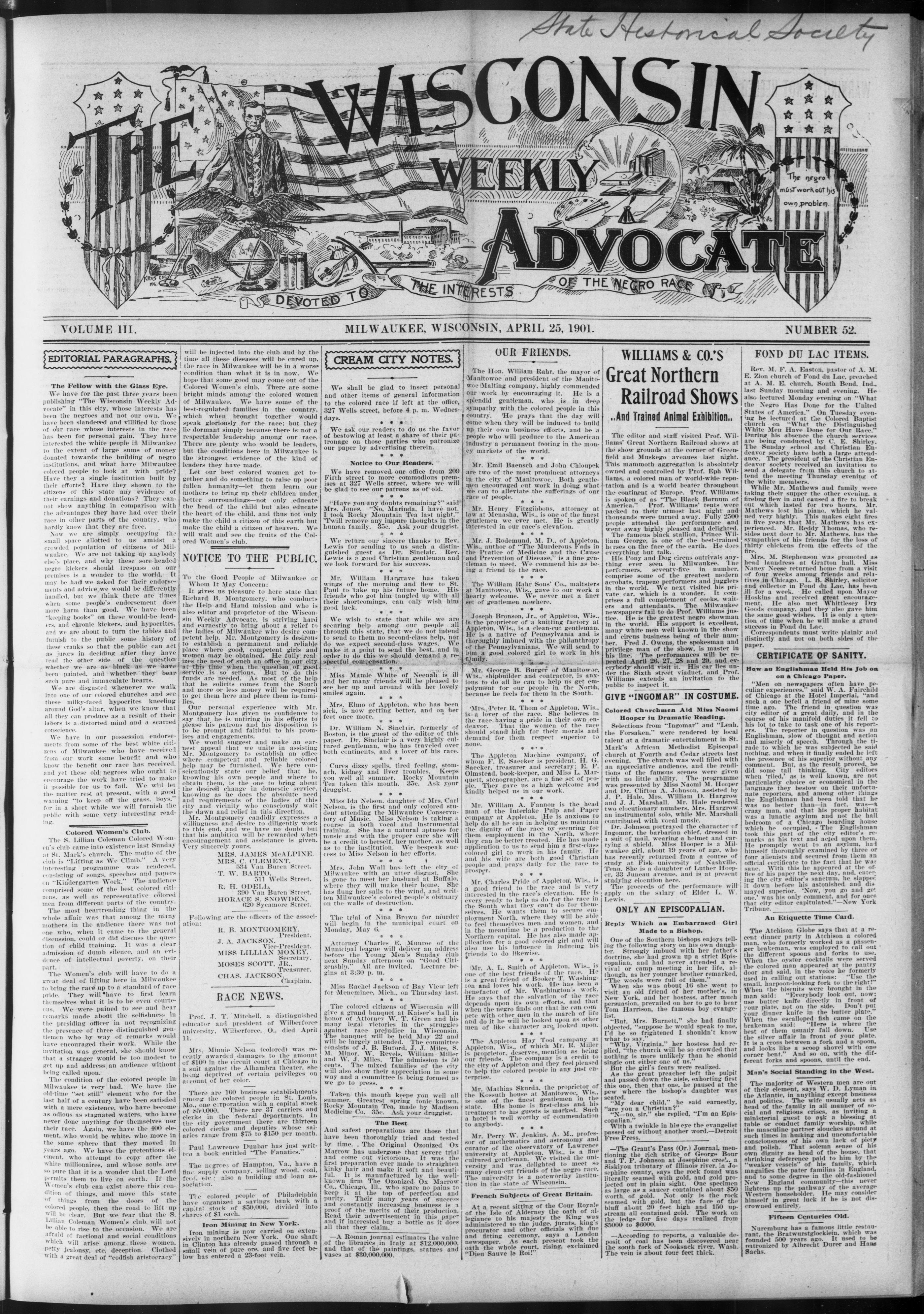
WISCONSIN
WEEKLY
Advocate
DEVOTED TO THE INTERESTS OF THE NEGRO RACE
EDITORIAL PARAGRAPHS.
The Fellow with the Glass Eye.
The Fellow with the Glass Eye. We have for the past three years been publishing "The Wisconsin Weekly Advocate" in this city, whose interests has been the negroes and not our own. We have been slandered and villified by those of our race whose interests in the race has been for personal gain. They have interested the white people in Milwaukee to the extent of large sums of money donated towards the building of negro institutions, and what have Milwaukee colored people to look at with pride? Have they a single institution built by their efforts? Have they shown to the citizens of this state any evidence of their earnings and donations? They cannot show anything in comparison with the advantages they have had over their race in other parts of the country, who hardly know that they are free.
Now we are simply occupying the small space allotted to us amidst a crowded population of citizens of Milwaukee. We are not taking up anybody else's place, and why these sore-headed negro kickers should trespass on our premises is a wonder to the world. It may be had we asked for their endorsements and advice we would be differently handled, but we think there are times when some people's endorsement does more harm than good. We have been "keeping books" on these would-be leaders, and chronic kickers, and hypocrites, and we are about to turn the tables and furnish to the public some history of these cranks so that the public can act as jurors in deciding after they have read the other side of the question whether we are as black as we have been painted, and whether they bear such pure and immaculate hearts.
We are disgusted whenever we walk into one of our colored churches and see these milky-faced hypocrites kneeling around God's altar, when we know that all they can produce as a result of their labors is a distorted mind and a scarred conscience.
We have in our possession endorsements from some of the best white citizens of Milwaukee who have received from our work some benefit and who know the benefit our race has received, and yet these old negroes who ought to encourage the work have tried to make it possible for us to fail. We will let the matter rest at present, with a good warning "to keep off the grass, boys," for in a short while we will furnish the public with some very interesting reading.
Colored Women's Club.
The S. Lillian Coleman Colored Women's club came into existence last Sunday at St. Mark's church. The motto of the club is "Lifting as We Climb." A very interesting programme was rendered, consisting of songs, speeches and papers on "Kindergarten Work." The audience comprised some of the best colored citizens, as well as representative colored men from different parts of the country.
The most heartrending thing in the whole affair was that among the many mothers in the audience there was not one who, when it came to the general discussion, could or did discuss the question of child training. It was a clear admission of dumb silence, and an evidence of intellectual poverty, on their part.
The Women's club will have to do a great deal of lifting here in Milwaukee to bring the race up to a standard of race pride. They will have to first learn themselves what it is to be even courteous. We were pained to see and hear remarks made about the selfishness in the presiding officer in not recognizing the presence of three distinguished gentlemen who by way of remarks would have encouraged their work. While the invitation was general, she should know that a stranger would be too modest to get up and address an audience without being called upon
The condition of the colored people in Milwaukee is very bad. We have the old-time "set still" element who for the last half of a century have been satisfied with a mere existence, who have become as odious as stagnated waters, who have never done anything for themselves nor their race. Again, we have the 400 element, who would be white, who move in the same sphere that they moved in years ago. We have the pretentious element, who attempt to copy after the white millionaires, and whose souls are so pure that it is a wonder that the Lord permits them to live on earth. If the Women's club can exist above this condition of things, and move this state of things from the doors of the colored people, then the road to lift up will be clear. But we fear that the S. Lillian Coleman Women's club will not be able to rise to the occasion. We are afraid of factional and social conditions which will arise among these women, petty jealousy, etc. deception. Clothed with a great deal of "codfish aristocracy"
will be injected into the club and by the time all these diseases will be cured up, the race in Milwaukee will be in a worse condition than what it is in now. We hope that some good may come out of the Colored Women's club. There are some bright minds among the colored women of Milwaukee. We have some of the best-regulated families in the country, which when brought together would speak gloriously for the race; but they lie dormant simply because there is not a respectable leadership among our race. There are plenty who would be leaders, but the conditions here in Milwaukee is the strongest evidence of the kind of leaders they have made.
Let our best colored women get together and do something to raise up poor fallen humanity—let them learn our mothers to bring up their children under better surroundings—not only educate the head of the child but also educate the heart of the child, and thus not only make the child a citizen of this earth but make the child a citizen of heaven. We will wait and see the fruits of the Colored Women's club.
NOTICE TO THE PUBLIC.
To the Good People of Milwaukee or Whom It May Concern:
It gives us pleasure to here state that Richard B. Montgomery, who conducts the Help and Hand mission and who is also editor and proprietor of the Wisconsin Weekly Advocate, is striving hard and earnestly to bring about a relief to the ladies of Milwaukee who desire competent help. Mr. Montgomery is desirous to establish a permanent and reliable place where good, competent girls and women may be obtained. He fully realizes the need of such an office in our city at this time when the question of good service is so serious. But to do this funds are needed. As most of the help that he solicits comes from the South and more or less money will be required to get them here and place them in families.
Our personal experience with Mr. Montgomery has given us confidence to say that he is unfiring in his efforts to please his patrons and his disposition is to be prompt and faithful to his promises and engagements.
We would suggest and make an earnest appeal that we unite in assisting Mr. Montgomery to establish an office where competent and reliable colored help may be furnished. We here conscientiously state our belief that he, knowing his own people and where to obtain them, is the one to bring about the desired change in domestic service, knowing as he does the absolute need and requirements of the ladies of this city and vicinity who consciously wait the dawn and relief in this direction.
Mr. Montgomery candidly expresses a willingness and desire to diligently work to this end, and we have no doubt but that his ambition will be rewarded when encouragement and assistance is given. Very sincerely yours,
MRS. JAMES McALPINE.
MRS. C. CLEMENT.
534 Van Buren Street.
T. W. BARTO.
511 Wells Street.
R. H. ODELL.
390 Van Buren Street.
HORACE S. SNOWDEN.
620 Sycamore Street.
RACE NEWS.
Prof. J. T. Mitchell, a distinguished educator and president of Wilberforce university, Wilberforce, O., died April 11.
Mrs. Minnie Nelson (colored) was recently awarded damages to the amount of $100 in the circuit court at Chicago in a suit against the Alhambra theater, she being deprived of certain privileges on account of her color.
There are 100 business establishments among the colored people in St. Louis, Mo., one corporation with a capital stock of $50,000. There are 37 carriers and clerks in the federal departments. In the city government there are thirteen colored clerks and deputies whose salaries range from $75 to $150 per month.
Paul Lawrence Dunbar has just written a book entitled "The Fanatics."
The negrces of Hampton, Va., have a fine supply company, selling wood, coal, feedi, etc.; also a building and loan association.
The colored people of Philadelphia have organized a savings bank with a capital stock of $50,000, divided into shares of $1 each.
Iron Mining in New York.
Iron mining is now carried on extensively in northern New York. One shaft in Clinton has already passed through a small vein of pure ore, and five feet below has entered a 23-foot vein.
MILWAUKEE, WISCONSIN, APRIL 25, 1901.
CREAM CITY NOTES.
---
We shall be glad to insert personal and other items of general information to the colored race if left at the office, 327 Wells street, before 4 p. m. Wednesdays.
We ask our readers to do us the favor of bestowing at least a share of their patronage on those parties who patronize our paper by advertising therein.
Notice to Our Readers.
We have removed our office from 209 Fifth street to more commodious premises at 327 Wells street, where we will be glad to see our patrons as of old.
* * *
"Have you any doubts remaining?" said Mrs. Jones. "No, Marinda, I have not. I took Rocky Mountain Tea last night." 'Twill remove any impure thoughts in the human family. 35c. Ask your druggist.
We return our sincere thanks to Rev. Lewis for sending to us such a distinguished guest as Dr. Sinclair. Rev. Lewis is a good Christian gentleman and we look forward for his success.
* * *
Mr. William Hargrave has taken wings of the morning and flew to St. Paul to take up his future home. His friends who got him tangled up with all their shortcomings, can only wish him good luck.
***
We wish to state that while we are securing help among our people all through this state, that we do not intend to send to them no second-class help, nor do we expect second-class wages. We make it a point to send the best, and in order to do this we should demand a respectful compensation.
---
Miss Mamie White of Neenah is ill and her many friends will be pleased to see her up and around with her lovely smiles again.
* * *
Mrs. Elmo of Appleton, who has been sick, is now getting better, and on her feet once more.
* * *
Dr. William N. Sinclair, formerly of Boston, is the guest of the editor of this paper. Dr. Sinclair is a very highly cultured gentleman, who has traveled over both continents, and a lover of his race.
* * *
Cures dizzy spells, tired feeling, stomach, kidney and liver troubles. Keeps you well all summer. Rocky Mountain Tea taken this month. 35c. Ask your druggist.
Miss Ida Nelson, daughter of Mrs. Carl Nelson, is the first and only colored student attending the Milwaukee Conservatory of Music. Miss Nelson is taking a course in both vocal and instrumental training. She has a natural aptness for music and with the proper care she will be a credit to herself, her mother, as well as to the institution. We bespeak success to Miss Nelson in her efforts.
* * *
Mrs. John Wall has left the city of Milwaukee with an utter disgust. She is gone to meet her husband at Buffalo, where they will make their home. She has flung her sails to the wind, and written Milwaukee's colored people's obituary on the walls of destruction.
```markdown
```
The trial of Nina Brown for murder will begin in the municipal court on Monday, May 6.
☆ ☆ ☆
Attorney Charles E. Munroe of the Municipal league will deliver an address before the Young Men's Sunday club next Sunday afternoon on "Good Citizenship." All are invited. Lecture begins at 3:30 p. m.
```markdown
```
Miss Rachel Jackson of Bay View left for Menominee, Mich., on Thursday last.
The colored citizens of Wisconsin will give a grand banquet at Kaiser's hall in honor of Attorney W. T. Green and his many legal victories in the struggles against race prejudice in Wisconsin. The banquet will be held May 22 and will be largely attended. The committee consists of J. B. Buford, J. J. Miles, S. M. Minor, W. Revels, William Miller and W. J. Miles. The admission is 50 cents. The mixed families of the city will also show their appreciation in some way and a committee is being formed as we go to press.
Taken this month keeps you well all summer. Greatest spring tonic known. Rocky Mountain Tea, made by Madison Medicine Co. 35c. Ask your druggist.
The Best
And safest preparations are those that have been thoroughly tried and tested by time. The Original Ozonized Ox Marrow has undergone that severe trial and come out victorious. It was the first preparation ever made to straighten kinky hair and make it soft and beautiful. It is manufactured by the well-known firm The Ozonized Ox Marrow Co., Chicago, Ill., who spare no pains to keep it at the top of perfection and purity. Their many years of success and constantly increasing business is a proof of the merits of their production. Read their advertisement in this paper and if interested buy a bottle as it does all that they claim.
—A Roman journal estimates the value of the libraries in Italy at $12,000,000, and that of the paintings, statues and vases at $30,000,000.
OUR FRIENDS.
The Hon. William Rahr, the mayor of Manitowoc and president of the Manitowoc Malting company, highly commended our work by encouraging it. He is a splendid gentleman, who is in deep sympathy with the colored people in this country. He prays that the day will come when they will be induced to build up their own business efforts, and be a people who will produce to the American industry a permanent footing in the money markets of the world.
***
Mr. Emil Baensch and John Chloupek are two of the most prominent attorneys in the city of Manitowoe. Both gentlemen encouraged out work in doing what we can to alleviate the sufferings of our race of people.
Mr. Henry Fitzgibbons, attorney at law at Menasha, Wis., is one of the finest gentlemen we ever met. He is greatly interested in our race's elevation.
***
Mr. J. Rodemund, M. D., of Appleton, Wis., author of "The Murderous Fads in the Pratice of Medicine and the Cause and Prevention of Disease," is a fine gentleman to meet. We commend his as being a friend to the race.
* * *
The William Rahr Sons' Co., maltsters at Manitowoc, Wis., gave to our work a hearty welcome. We never met a finer set of gentlemen nowhere.
***
Joseph Bronson, Jr., of Appleton, Wis., is the proprietor of a knitting factory at Appleton, Wis., is a clean-cut gentleman. He is a native of Pennsylvania and is thoroughly imbued with the philanthropy of the Pennsylvanians. We will send to him a good colored girl to work in his family.
Mr. George B. Burger of Manitowoc, Wis., shipbuilder and contractor, is anxious to do all he can to help us get empolyment for our people in the North, because he feels for them in the South.
***
Mrs. Peter R. Thom of Appleton, Wis., is a lover of the race. She believes in the race having a pride in their own endeavor. That the women of the race should stand high for their morals and demand for them respect superior to none.
\* \* \*
The Appleton Machine company, of whom F. E. Saecker is president. H. G. Saecker, treasurer and secretary; E. F. Olmstead, book-keeper, and Miss L. Marquett, stenographer, are a fine set of people. They gave us a high welcome and kindly helped us in our work.
***
Mr. William A. Fannon is the head man of the Interlake Pulp and Paper company at Appleton. He is anxious to help do all he can in helping us maintain the dignity of the race by securing for them employment in the North, where they can be better treated. He has made application to us to send him a first-class colored girl to work in his family. He and his wife are both good Christian people and prays daily for the race to prosper.
Mr. Charles Pride of Appleton. Wis., is a good friend to the race and is very interested in the race's elevation. He is every ready to help us do for the race in the South what they can't do for themselves. He wants them to secure employment North, where they will be able to feel themselves men and women, and in the meantime be a production to the Northern capital. He has also made application for a good colored girl and will also use his influence in inducing his friends to do likewise.
***
Mr. A. L. Smith of Appleton, Wis., is one of the best friends of the race. He is a great friend of Booker T. Washington and loves his work. He has been a benefactor of Mr. Washington's work. He says that the salvation of the race depends upon its own efforts, and that when the negro finds out that he can com pete with other men in the march of life and do it he will be looked upon as other men of like character are looked upon.
* * *
The Appleton Hay Tool campany at Appleton, Wis., of which Mr. R. Miller is proprietor, deserves mention as being our friends. The company is a credit to the city of Appleton and they feel pleased to help the colored people in any just enterprise.
***
Mr. Mathias Skurda, the proprietor of the Kossuth house at Manitowoc, Wis., is one of the finest gentlemen in the state. His home is first-class and his treatment to his guests is marked. Such a hotel is well worthy of commendation to anybody. * * *
Mr. Perry W. Jenkins, A. M., professor of methematics and astronomy and curator of the observatory of Lawrence university at Appleton. Wis., is a fine cultured gentleman. We visited the university and was delighted to meet so many clean-cut friends of the negro race. The university is a noteworthy institution in the state of Wisconsin.
French Subjects of Great Britain.
At a recent sitting of the Cour Royale of the Isle of Alderney the oath of allegiance to his majesty the King was administered to the judge, jurats, king's procurator and other officials with due and fitting ceremony, says a London newspaper. As each present took the oath the whole court, rising, exclaimed "Dieu Sauve le Roi!"
WILLIAMS & CO.'S Great Northern Railroad Shows ..And Trained Animal Exhibition..
The editor and staff visited Prof. Williams' Great Northern Railroad shows at the show grounds at the corner of Greenfield and Muskego avenues last night. This mammoth aggregation is absolutely owned and controlled by Prof. Eph Williams, a colored man of world-wide reputation and is a world beater throughout the continent of Europe. Prof. Williams is spoken of as "The Black Barnum of America." Prof. Williams' tents were packed to their utmost last night and thousands were turned away. Fully 2500 people attended the performance and went away highly pleased and delighted. The famous black stallion, Prince William George, is one of the best-trained horses on the face of the earth. He does everything but talk.
His Pony and Dog circus outrivals anything ever seen in Milwaukee. The performers, seventy-five in number, comprise some of the greatest modern acrobats, trapeze performers and jugglers in the world. We next visited his private car, which is a wonder. It comprises a full complement of cooks, waiters and attendants. The Milwaukee newspapers fail to do Prof. Williams justice. He is the greatest negro showman in the world. His support is excellent, many white men well known in the show and circus business being of their number. Fred J. Owens, the spokesman and privilege man of the show, is master in his line. The performances will be repeated April 26, 27, 28 and 29, and everybody should visit it. His car lies under the Sixth street viaduct, and Prof. Williams extends an invitation to the public to inspect it.
GIVE "INGOMAR" IN COSTUME.
Colored Churchmen Aid Miss Naomi
Keeper in Dramatic Reading
Selections from "Ingomar" and "Leah the Forsaken," were rendered by local talent at a dramatic entertainment in St. Mark's African Methodist Episcopal church at Fourth and Cedar streets last evening. The church was well filled with an appreciative audience, and the renditions of the famous scenes were given with no little ability. The programme was presented by Miss Naomi M. Hooper and Dr. Clifton A. Johnson, assisted by J. P. Hale, Mrs. William D. Hargrow and J. J. Marshall. Mr. Hale rendered two elocutionary numbers, Mrs. Hargrow an instrumental solo, while Mr. Marshall contributed with vocal music.
Dr. Johnson portrayed the character of Ingomar, the barbarian chief, dressed in a suit of mail, wearing a helmet and carrying a shield. Miss Hooper is a Milwaukee girl, about 19 years of age, who recently returned from a course of study at Fisk university of Nashville, Tenn. She is a daughter of Luther Hooper, 33 Juneau avenue, and is at present studying elocation here.
The proceeds of the performance will apply on the salary of Elder L. W. Lewis.
ONLY AN EPISCOPALIAN.
Reply Which an Embarrased Girl Made to a Bishop.
One of the Southern bishops enjoys telling the following story on his own daughter. Strongly imbued with her father's doctrine, she had grown up a strict Episcopalian, and had never attended a revival or camp meeting in her life, although, as her younger brother remarked, "The woods were full of them."
When she was about 16 she went to visit an old friend of her mother's, in New York, and her hostess, after much persuasion, prevailed on her to go to hear Tom Harrison, the famous boy evangelist.
"But, Mrs. Burnett," she had finally objected, "suppose he would speak to me, I'd be so frightened I shouldn't know what to say."
"Why, Virginia," her hostess had replied, "the church will be so crowded that nothing is more unlikely than he should single out either one of us."
But the girl's fears were realized.
But the girl's fears were realized. As the great preacher left the pulpit and passed down the aisle, exhorting first this one, then that one, he paused at the pew where the bishop's daughter was seated.
"My dear child," he said earnestly, "are you a Christian?"
"N—no, sir," she replied, "I'm an Episcopalian."
With a twinkle in his eye the evangelist passed on without another word.—Detroit Free Press.
—The Grant's Pass (Or.) Journal, mentioning the rich strike of George Bour and T. P. Johnson at Josephine cree', a Siskiyou tributary of Illinois river, in Josephine county, says the rock found was literally seamed with gold, and gold projected out in plain sight. One specimen as large as a saucer contained about $50 worth, of gold. Not only is the rock seamed with gold, but the face of the bluff about 20 feet high and 150 upstream all contained gold. The work on the ledge for five days realized from $5000 to $6000.
According to reports, a valuable deposit of coal has been discovered near the south fork of Nooksack river. Wash. The vein is about four feet thick.
NUMBER 52.
FOND DU LAC ITEMS.
Rev. M. F. A. Easton, pastor of A. M. E. Zion church of Fond du Lac, preached at A. M. E. church, South Bend, Ind., last Sunday morning and evening. He also lectured Monday evening on "What the Negro Has Done for the United States of America." On Tuesday evening he lectured at the Colored Baptist church on "What the Distinguished White Men Have Done for Our Race." During his absence the church services are being conducted by C. E. Shirley. The Sunday school and Christian Endeavor society have both a large attendance. The president of the Christian Endeavor society received an invitation to send a delegate from this church to attend the meeting Thursday evening of the white members.
While Mr. Mathews and family were taking their supper the other evening, a firebug flew in and caused a fire to break out which lasted for two hours. Mr. Mathews lost his piano, which he valued very highly. This makes eight fires in five years that Mr. Mathews has experienced. Mr. Reddy Thomas, who resides next door to Mr. Mathews, has the sympathies of his friends for the loss of thirty chickens from the effects of the fire.
Mrs. M. Stephenson was promoted as head laundress at Grafton hall. Miss Naney Neese returned home from a visit of four weeks among friends and relatives in Chicago. L. B. Shirley, solicitor and collector in Fond du Lac, has been ill for a week. He called upon Mayor Hoskins and received great encouragement. He also met Whittlesey Dry Goods company, and they also gave him the same good wishes. It is only a question of time when he will make a grand success in Fond du Lac.
Correspondents must write plainly and distinctly and not on both sides of the paper.
CERTIFICATE OF SANITY.
How an Englishman Held His Job on on a Chicago Paper.
"Men on newspapers often have peculiar experiences," said W. A. Fairchild of Chicago at the Hotel Imperial, "and such a one befell a friend of mine some time ago. The friend in question was city editor of a great daily, and in the course of his manifold duties it fell to his lot to take to task one of his reporters. The reporter in question was an Englishman, slow of thought and action and miserly of speech. Through the tirade to which he was subjected he said nothing, and when it finally ended he left the presence of his superior without any comment. But, as the result proved, he did some tall thinking. City editors when 'riled,' as is well known, are not particularly choice or economical in the language they bestow on their unfortunate reporters, and among other things the Englishman had been told that he was no better than—in fact, was—a crazy man, and that his proper habitat was a lunatic asylum and not the hall bedroom of a Chicago boarding house which he occupied. The Englishman took this part of the city editor's remarks as his text and acted upon them. He promptly went to an asylum, had himself thoroughly examined by three or four alienists and secured from them an official certificate to the fact that he was sane. With this he appeared at the office of his paper the next day, and, entering the city editor's sanctum, he slapped it down before his astonished and dismayed superior. Now, you go and get one.' was his only comment, and for once that city editor capitulated."—New York Tribune.
An Etiquette Time Card
The Atchison Globe says that at a recent dinner party in Atchison a colored man, who formerly worked as a passenger brakeman, was employed to call out the different spoons and forks to use. When the oyster cocktails were served the colored man appeared at the pantry door and said, in the voice he formerly used in calling out stations: "Use the small, harpoon-looking fork to the right!" When the biscuits were brought in the man said: "Everybody look out, now; use butter knife directly in front of your plate, not on the side. Don't put your dinner knife in the butter plate." When the escalloped fish came on the brakeman said: "Here is where the best of them usually fall down. Use the silver affair in front of your plate. It is a cross between a fork and a spoon, and looks like a scoop shovel with one corner bent." And so on, with the different forks and spoons, until the end.
Man's Social Standing in the West.
The majority of Western men are out of their element, says W. D. Lyman in the Atlantic, in anything except business and politics. The wife usually acts as head of the family in all manner of social and religious crises, as inviting a ministerial guest to ask a blessing at table or conduct family worship, while the masculine partner slouches around at such times in huking and uncomfortable consciousness of his own lack of piety and polish. That solemn sense of his own dignity as head of the house, that shrinking deference paid to him by the "weaker vessels" of his family, which magnifies the pater familias in England, and to some degree in the old-fashioned New England community—this never lightens up the pathway of the average Western householder. He may consider himself in great luck if he is not discrown entirely.
Fifteen Centuries Old.
Nuremburg has a famous little restaurant, the Bratwurstglocklein, which was founded 500 years ago. It used to be patronized by Albrecht Durer and Hans Sachs.
WARNING IS NOT HEEDED.
Sydney Cole Shoots Carpenter on
Steamer Keystone State.
FEARED TO LOSE HOME.
Expected Boat Would Cause a Swell
end ee Not °
Parkersburg, W. Va., April 24.—Sidney
Cole of this city today shot and killed
‘William Terry, a carpenter on the steam-
er Keystone State. Cole’s house on the
river bank had seven feet of water in it.
The Keystone State was about to land
near by. It is supposed Cole feared the
swell would float his house away. He
warned the officers to not land, but they
persisted and he fired three shots, one
passing through Terry's heart. Cole
‘was arrested.
Cincinnati, O., April 24.—What is be-
lieved to be the crest of the flodd sweep-
ing down the Ohio river reached here to-
day. The river rose an inch per hour all
night and a stage of 56 feet was reached
shortly before 6 a. m, This is six feet
above the danger line for business sec-
tions, and eleyen feet above the line
where the water enters the tenement
houses along the river front. The city
is surrounded by back water on the east
and west as well as mone the south side,
but it is estimated now that the stage of
58 feet will not be reached here and that
the highest yee will come today and re-
lief soon will follow. The conditions on
the Kentucky side have not changed.
The relief that is in mer here clears
everything for the 480 miles up to Pitts-
burg, and the river men say that the
lower Ohio valley will not suffer so
much, as the tributaries below here are
not so high as those in the upper valley.
PRIZES FOR WISCONSIN.
cece
Commissions of First and Second
Lieutenants Allotted by Sec-
retary Root.
Washington, D. C., April 24.—The sec-
retary of war today made public the
names of the fifty-eight men selected for
first and second lieutenants in the reg-
ular army under the army reorganization
bill. All of these men have had service
either in the state or national volunteers
or in the regular army. They have been
ordered for examination and should they
pass will be appointed.
Wisconsin is allowed eleven appoint-
ments, as follows: John B. Shuman,
Frank T. French, Harry W. Newton,
John H. Baker, Reuben D. Blanchard,
Edward K. Massee, John C. Ohnstan,
Frederick P. Cook, Robert F. Woods,
John H. Lewis.
WORKING FOR PEACE.
Sigel asa
Mrs. Botha in Correspondence with
Lord Kitchener—Arranging
a Conference.
New York, April 24.—Once again peace
rumors are in the air, says the Tribune’s
London correspondent. Mrs. Botha has
been in correspondence with Lord Kitch-
ener and as a result it is believed that
the British commander-in-chief has
agreed to receive the three Boer generals,
Botha, Delarey and Viljoen within the
next few days. While nothing is defi-
nitely known, it is, perhaps, not without
significance that the news should reach
London from Amsterdam that Mr. Kru-
ger is afraid that Mrs. Botha’s efforts
‘will cause her husband to surrender.
EE EER
Charles Elsa and John Johnson
Meet Death at Iron Mountain,
Mich.
Iron Mountain, Mich., April 24.—[Spe-
cial.]—Charles Eisa, a miner and mar-
ried, was killed in the Ludington shaft
of the Chapm mine about 5 o'clock this
morning by a fall of ground. His back
was broken and he died almost instantly.
John Johnson, a Finlander and unmar-
ried, died last night from injuries re-
ceived at the Hamilton mine of the
Chapin company. He was working on a
trestle when a, car of ore jumped the
tarck aud fell on him.
CONTEST DOCTOR’SBILL.
Executors Regard $190,000 for Medi-
cal Attendance as Too Much:
Pittsburg, Pa., April 24.—The execu-
tors of the estate of the late C. L. Magee
have determined that the claim of Dr.
Walter C. Browning for $190,000 for
professional services during the illness
of the senator will have to go to the
orphans’ court of Allegheny county and
be passed oe by that body before the
bill is settled. H. S. A. Stewart, one of
the executors of the estate, said that the
bill was beyond reason, and that the peo-
bie who had charge of the estate would
ave to contest it in order to vindicate
t¢hamealvan
Pulling Down Old London.
Some of the oldest houses in London
have had their last Easter. In a_few
days the demolition of part of Wych
street, rendered necessary by the Strand
improvement scheme, will begin, says a
London newspaper. A house with pro-
yecune, stories, where Jack Shevpers
ived, is one of the condemned paces.
For some time past it Has been shut up
as unsafe. The Old Bell tavern, in Fleet
street, is already being pulled down to
make the street wider. It has a history
of over 200 years, and in its old-fash-
joned bar_parlor such lights of Fleet
street as Dr. Johnson and Dickens are
said to have foregathered with their
friends.
Big Scheme to Open Up Canada.
The Ontario government is negotiating
a gigantic railway deal involving a grant
of 1,542,000 acres of unsettled land in
the Algoma region, in the northwestern
part of the province, to a syndicate of
capitalists as assistance toward building
a railway through the region 300 miles
long, the eo to control the rates,
The estimated value of the land to be
granted is 8 mina Bee acre. The rail-
way will cost, £1,200,000.
Dr. McKellops Dead.
St. Louis, Mo., April 24—Dr. Henry
Byron McKellops of this city is dead,
aged 78 years. He had an international}
reputation as an authority on dentistry
and dental surgery.
Nebraska Town Ravaged by Fire.
Plain View, Neb., April] 24—Half the
business section of Plain View, including
eleven buildings, was destroyed by_fire
today. Several residences were dam-
aged. Loss, $35,000.
Railroad Employe Killed.
Cee, Ul, April 24.—H. P. Mann,
an employe of the North-Western rail-
road, was killed by an express train at
the Pine avenue crossing today. His
home was in Minnesota.
FAIR OPENING
IS POSTPONED.
Ss
Buildings, Exhibits and Roadways
at Buffalo Expo. Seriously
Damaged.
Buffalo, N. Y., April 23.—The authori-
ties of the Pan-American Exposition
have been compelled to postpone the date
of the official opening from May 1 to
May 20. This decision was reached after
the full effects of the recent storm be-
came evident.
Although the gates will be open a a
there will be no grand‘ celebration. For-
mal exercises planned for the opening
and dedication day will all be May 20.
The roadways and landscapes which
were nearing completion have been
washed away or ruined. Streams of wa-
ter trickle through a million holes in the
roofs of the buildings. Booths and ex-
hibits are damaged and a thousand task~
are necessary to be done over again. The
total damage caused will reach $75,000.
TRACTION COMPANY
ROBBED OF $50,000.
Punched Tickets Designed to be
Burned Are-Substituted for
Good Tickets.
Washington, D. C., April 23.—System-
atic frauds practiced on the lines of the
Washington Traction and Electric com-
any to an extent of probably $50,000,
ses been discovered. Six conductors
and two firemen are under arrest on a
charge of conspiracy.
Punched tickets turned in by the con-
ductors are first checked up at the offices
and then burned by employes. The in-
vestigation discloses that many of the
tickets instead of being destroyed, were
saved and sold to conductors at $1 per
100 and that the conductors who bought
them substituted them for good tickets.
This was done by turning in the old
tickets to the company at the close of
each day, the same number of good tick-
ets. being retained in the pockets of those
who were in the conspiracy. It is also
alleged that in many cases the number
of fares rung up and the number of pas-
sengers on trips have shown a wide di-
vergence.
When Detectives Boyd, Flatherd and
Berham arrested a fireman named Ca-
dars he carried a lunch basket in which
were found almost 1000 punched tickets.
Later detectives found 4000 tickets of
the same kind in a trunk at his home.
He made a frank admission of his part
in the affair and told the detectives that
others were in it with him.
BIG TRUST IN COTTON.
Factories North and South to b¢e
Included In a Gigantic
Combine.
Fall River, Mass., April 23.—A cottor
mill trust witha capital stock of $500,000,-
000 and which will inelude factories both
North and South, is reaching the launch-
ing stage, according to several local man-
ufacturers. It was stated that J. P.
Morgan & Co. are carrying on the nego-
siations. Agents of the proposed trust
hzve options upon nearly every plant in
the South. With the certainty that the
Southern competition could be eliminated
2 concerted movement has been started
in the North to bring every mill manu-
facturing cotton cloth and all the print
works in the country into a trust which
shall absolutely control the business and
be managed by a few successful agents.
The directors of two big mills here
have been approached within a few days
and it is stated that negotiations have
been opened with others.
The policy is to secure options upon as
many mills as possible outside this city
and then by enlisting the services of
a few of the leaders here to purchase the
stock of local corporations at a valuation
to be fixed by these men.
The Goddards of Providence, con-
trolling a score or more mills, have been
asked to put a valuation upon their mills
and other property in the state of Rhode
Island, and the plans of the syndicate
divulged to them to such an extent that
they have agreed to put a price upon
every piece of manufacturing pole.
which they own and to give the New
York promoters the option which they
desire.
M. C. D. Borden, the biggest cotton
manufacturer here, has also been ap-
preached and asked to name a figure on
the American Printing company and the
Tail River Iron works mills, two cf
the lsrgest corporations in this city.
SAVED BY FAITHFUL DOG.
Animal Stays by His Master, Whe
Ties Helpliuein Gacw fort wotase,
Parkersburg, W. Va., April 23.—A
faithful dog kept Jeff Miller, a lumber-
man of Davis, alive for two days and
nights, while he was lying heipless in
the snow. This was done by the animal
licking his master’s face. Miller left Da-
vis on Friday for a lumber camp in the
forest, and while on his way was strick-
en with paralysis. _He was unable to
proceed farther, and lay down in the
deep snow. The dog kept constant
watch over his master, and after forty-
cight hours had elapsed the barking ot
the animal attracted the attention of
cther_lumbermen, who were searching
for Miller. When found Miller was
alive, but he died after being taken to
the camp.___
STABBED BY TRAMPS.
Unknown Man May Die of Wounds
They Inflicted,
Kaukauna, Wis., April 23.—[Special.]
—Deputy Sheriff Enhart of Wrightstown
was in the city today to locate two
tramps who stabbed and attempted to rob
an wnknown man who was with them in
a box car. The physician says the lining
enclosing the heart is punctured and that
the man may die.
CAUGHT ON TRESTLE.
‘Irom Mountain, Mich., Mam Loses
Both Legs and an Arm.
Iron Mountain, Mich., April 23.—[S,
ciabkJolu dohuston;was un iores by
en ore car at the Hamilton mine. He
was working on a high trestle when he
was caught by the car. He was doubled
under the car and both legs and an arm
were cut off.
—A portion of Butte, said to comprise
a large part of the big hill on which the
Anaconda mines are located, has made a
very perceptible movement to the south-
westward in the last few days. At the
foot of the Anaconda hill the slide pushed
the tracks of the street railway line for
about six inches for a distance of about
3800 feet along the road.
—J. O. Smith, a stockman, had a nar-
row escape from death. His horse be-
came frightened at_a street car and ran
away. A wheel of the buggy struck a
telegraph pole, throwing Mr. Smith out
and breaking his leg.
—There are more than 1,000,000
square feet of glass surface in England
exclusively devoted to the cultivation and
production of tomatoes for market pur-
poses.
| _—It was held recently in a London po-
lice court that no one has any right to
force his way into a railway carriage al-
ready full.
BLAINE’S PLANS
RUDELY DISTURBED.
Supreme Court Divorce Decision
is Cause for Serious
Worry.
Washington, D. C.. April 24.—An in-
teresting piece of gossip going the rounds
of Washington society is that the recent
decision of the Supreme court of the
United States_has seriously disturbed
the plans of many couples preparing for
wedlock. One of the most notable is
that of young James G. Blaine and Miss
Martha Hichborn. It will be remem-
bered that Mr. Blaine was formerly mar-
ried to Miss Marie Nevins. After sey-
eral years of married life Mrs. Nevins
Blaine went to Fargo, S..D., and se-
cured a divorce, and after the lapse of a
few weeks married Dr. William Bull.
There can hardly be a doubt that the
dissolution of the first marriage would
come within the purview of the recent
decision of the Supreme court.
Mr, Blaine might remove all diffieul-
ties from his path by securing a divorce
from Mrs. Nevins Blaine Bull, but under
the most expeditious methods there is
not sufficient time remaining before June
5, the dase set for his missle to ac-
complish this. It is said Mr. Blaine has
sought the advice of well-skilled lawyers
in his dilemma, and many anxious cou-
ples are watching his future vroceedings
with great interest. The offspring of a
marriage terminated by a divorce within
the meaning of the decision could suc-
cessfully attack the legitimacy of the
children of a second marriage contracted
during the life of both parties to the
original contract. This uncertainty is
likely to make some lively business for
the divorce courts in the immediate fu-
eat
CONFLICT OF AUTHORITY
Clash Between Chaffee and Von
Waldersee as to Which Shall
Guard Pekin Gates.
Pekin, April 24.—Field Marshal yon
Waldersee has made application that the
gate of the forbidden city be guarded
by German troops after the departure of
the Americans. Gen. Chaffee has replied
that American soldiers will continue to
guard the gate. At this the Germans
are indignant, saying this impugns their
honesty and ‘that if the United States
decide to do its share of policing the city
that country should leave behind enough
troops fur that purpose; that merely a
few men belonging to the legation guards
should control the gate, which will be
within the German quarters, cannot be
allowed. If Gen. Chaffee persists in this
course diplomatic representations will be
made in the matter.
Many ap picatans have been made to
Mr. Rockhill and Gen. Chaffee by Chi-
nese of all degrees for the retention in
China of the American troops until the
general withdrawal of the troops of all
the powers. Many of those who are
making this request think the withdraw-
al of the Americans will make the others
remain longer. There are also people
who do not desire to see any of the sol-
diers go, fearing anarchy and an upris-
ing against foreigners. The soldiers who
return do so with all the honors of war.
The ministers of the foreign powers
are meeting daily. They do not at pres-
ent show a disposition to reduce the
claims, which many think to be extreme-
lv reasonable.
SHOOTING IN COURT.
Prisoner Fires at Policeman Who
Also Draws His Gun—Both
will Die.
Chicago, Il., April 24.—Shortly after
Police Magistrate Prindiville had ad-
journed court this afternoon in the Har-
rison street police station, a shooting af-
fray arose in which more than fifty shots
were fired, resulting in the fatal wound-
ing of two men. The injured persons are
William Messenger, a policeman, and D.
R. Nelson.
Nelson had been arraigned on a charge
of swindling by means of a confidence
game. Messenger was the chief witness.
After adjournment Nelson re-entered the
courtroom and fired twice at the officer,
who fell, mortally wounded. A dozen
policemen rushed upon Nelson who, after
tiring a third shot at Messenger, ran into
the hall. There he fell, but continued
firing at_the officers. A fusillade soon
stopped Nelson’s fire and he was taken
to a hospital with five bullet wounds in
his body and head.
During the battle the crowd in the
courtroom gathered around the door lead-
ing into the hall, but none of the by-
standers were injured except John C.
Spray, a reporter, who sustained a slight
wound in the left cheek.
2
SURRENDER OF SALAS.
Action Terminates Insurrection In
Panay—Twenty-five Thousand
Lepers to Isolate.
Manila, April 24.—7:30 p. m.—Maj.
Noble, adjutant-general of the depart-
ment of the Visayas, has received the
surrender of Quentin Salas and three
of his officers. All the insurgents under
Salas will surrender soon. It is claimed
this will terminate the insurrection in
the island of Panay.
It is estimated that there are 25,000
lepers in the Philippines and it is Rat
to isolate all of them on one island. Maj.
Maus, the medical inspector; Capt.
Abern of the Ninth infantry and Capt.
Quartermaster Horton, comprising a
board of officers apuolited to select a
suitable island for the purpose, have vis-
ited Busanga, Cuillon, Cogayan, Dejolo
and other islands, and have made a re-
port, but it has not yet been acted upon.
Manila, April 24.—One hundred and
fifteen oe and 2157 bolomen have
surrendered and sworn allegiance to the
United States at Narvacan. province of
South ocos.
GYPSIES CAMP NEAR ST. PAUL.
Scheme to Give the Young Folks
Chance to Marry,
St. Paul, Minn:, April 24—isaac R.
Wells, the accredited “King of the Gyp-
sies,”” is oe as saying that 10,000
gypsies will assemble in_ the vicinity of
the Twin Cities during the coming sum-
mer, the largest gathering of the race
ever held in the United States. The
King gives as the reason for this the ne-
cessity of permitting the young race to
meet those of the pppeeite sex, so that
they may marry without going outside
the clans, The vanguard of the 10,000
has already arrived, and are in camp be-
tween the Twin Cities. =
RAN INTO OPEN SWITCH.
Engineer is Killed and Fireman
Fatally Hurt.
San Antonio, Tex., April 24.—A south-
bound International & Great Northern
passenger train was wrecked today at
Davenport sixteen miles north of here, ar
running into an open switch, misplaced.
it is supposed, by train robbers. Fireman
F. W. Hicks was killed and Engineer
Monahan fatally ‘hurt. Attorney C. A.
Goeth of San Antonio, E. D. Keylick and
E. B. Stanley, railway mail clerks of San
Antonio, and Miss M. Horan of Killen,
Tex., were bruised and cut.
THE LEGISLATURE.
Senate.
ee the time for final adjournment_ te
ay “12, vette down the committes
amendment to that end, and passed the
Kreutzer bill as originally introduced, fix
ing May 4 as the date for ee sine
die. This does not mean, however, that
the senators expect to get away by that
time. The Assembly is expected to amend
the resolution in any event, and there is 4
determination on the part of many in both
houses that the date shall not be later that
May 11. The substitute for the Eaton bil!
providing for a viaduct on Kinnickinnic
avenue, Milwaukee, yeving the common
counell general authority to issue bonds fo:
viaducts, was advanced to third reading by
the Senate without opposition. The Jones
bill admitting infants to the state public
school at Sparta, which raised considerable
discussion in committee and in the Assem.
bly, was ordered to a third reading with nc
opposition. The Hall constitutional amend.
ment semetaing. the use of voting machines,
which had been killed once and passed
once, and reconsidered both times, was up
again. The amendment was killed, 17 te
15. Gov. La Follette’s veto of the Roeh:
bill exempting the Milwaukee exposition
from taxatiou was sustained by the Senate
unanimously. The barbers’ license bill
passed by the Assembly, but reported by
the Senate health commitiee for indefinite
Cas was on motion df Senator
Mills given another chance by being rere.
ferred to the committee on state affairs.
The Soltwedel sweatshop bill was ordered
to third reading without discussion. The
resolution for the appointment of a specia!
committee to act on Be Sours recom.
mendation for extension the state book.
keeping system was passed.
‘The change in the pete of the Milwau.
kee common council provided in Senator
Roehr’s bill, 370 S., was sees by the
Senate on the 19th, by the advancement of
the bill to engrossment and third reading.
Action on final adjournment of the Legis-
lature was postponed. The reconsideration
last evening of the vote fixing the date for
May 4 browght the resolntion up, but ox
motion of Senator McGillivray it was put
over. The Hatton bill providing for the es-
tablishment and maintenance of county
schools of agriculture and domestic econ.
omy, was passed without discussion. The
bicycle sidepath may paces. by the Assem-
bly, was sent to third reading with discus-
sion by the Senate today. The Thomas bill,
authorizing counties to appeprate money
for Food roads, was also advanced to third
reading without opposition. The Keene bill
giving the Milwaukee assessors more work
and more pay was advanced to third read.
ing. A large number of Assembly bills
were concurred in, among them the follow-
ine: Providing for the preservation of the
public health (the sweatshop bill); relating
to certificates as evidence; authorizing the
board of control to settle disputed bound.
aries at the home for feeble-minded; pro-
viding Supreme court reports for Soentien
appropriating $1200; providing a pena'ty
for the administration of “nockdut drops;""
to prevent the adulteration of meat prod-
ucts; providing that no casualty, boiler,
plate glass, accident insurance or surety
corporation aow incorporated under the
laws of the state shall do business except
through an authorized resident agent. Ad:
jJournment was to 8:30 p. m., on the 22d.
At Senator Green's request the Keene bl:
defining the duties and fixing the salaries
of tax commissioner and assessors of Mil-
waukee was ordered rereferred in the Sen-
ate on the evening of the 22d to the com-
mittee on eee The Senate passed
four bills, laid over four and sent two back
to the committee. The other measure be-
sides the Keene bill sent back to the com-
mittee was No. 12 8., by Mr. McGillivray,
broviaing state support for local day
schools for the education of deaf children.
The four bills laid over were No. 7 S., by
Mr. Mills, fixing the salary of the state
oll inspector at $1500; No. 107 S., by Mr.
‘Thomas, authorizing ‘counties to’ pay off
half the cost of permanent ag ed im-
provements; No. 180 8., by Mr. Roehr, pro-
viding for the examination of the agent
or employe of a corporation when the of-
ficers of such incorporation are not within
the state, and No. 138 A., by Mr. Young,
making provision for bicycle side paths.
Goy. La Follette on the 23d vetoed the
bil, 353 8., which clothed street railway
companies with the right to give their erf-
ployes police powers. It was only a few
minutes before the hour that the bill woutd
have become a law that the governor sent
the bill with a veto message to the desk of
the chief clerk of the Senate. In his mess.
age returning the bill without approval the
governor says the bill is far reaching in
effect, impinges the spirit of the constitu.
tion of the state, is subversive of the funda.
mental principles of feet government and
vicious in principle. The Lenroot franchise
bill, requiring that any franchise granted
by a‘city must be approved by a majority
of the voters when its submission to them
is petitioned for oy 10 per cent. of the
voters, was killed by a vote of 16 to 13
The state will aid in protecting residents
of the Wisconsin and Fox river valleys
from the ravages of floods if the Fg
approves the bill providing therefor, con:
curred in by the Senate. The Eaton bill,
8 S.. providing for a viaduct on Kinnie
kinnic avenue, Milwaukee, amended so as to
give the common council power to issue
bends for the construction of any viaduct,
was passed without opposition. The bill
taxing ice shipped out of the state 1¢
cents a ton was referred to the committee
on corporations. The joint resolution recog:
nizing the services of Capt. Harry W. New-
ton o: Superior in assisting Gen. Funston
in the capture of Aguinaldo, and asking the
President to appoint him to a commissoin
in the regular army was concurred in.
Senator Mills’ bill prohibiting the contribu:
tion of more than $100 by any person or
corporation to the campaign fund of any
candidate or committee. The Republican
members of the Senate held a short caucus
after the session and agreed to pass the
resolution for final adjournment fixing the
date for May 11.
In the Senate on the 24th the Thomas bil
authorizing counties to appropriate money
for permanent highway improvements
brought out an objection from Senator Rior.
dan, who wanted the provision for the use
of clay in a oe eliminated. After
some discussion the bill was sent back tc
the committee on roads and bridges. Ac.
tion on the bicycle-sidepath bill was laid
over. The Assembly bill eepreaene
foee to Alfred Cook, expenses In his con.
est with G. E. Vandecook, was laid over.
With half a dozen dissenting votes the Sen-
ate killed Roe bill passed in the Assembly
defining drinks which contain 1 per cent. of
alcohol as intoxicants. The Hartung Dill
requiring dogs to be licensed, was advanced
to third reading. The Barker bill prohib-
Sting marriages within a year after di
yorees, except by a court permit, went t
third reading without discussion by a vote
of 17 to 5. The Senate committee on mill.
tary affairs introduced a bill Sore fou
an annual speerraee of $ to trooy
A, light cavalry, W. N, G., of Milwaukee.
as an extra allowance for the purchase of
a sufficient number of suitable horses, and
the expense incident to thelr care and keep
The bill went to the committee on claims.
The committee on state affairs aepertes fa
yorably the bill appropriating $15,000 as
the.state’s share of paving streets around
the capitol park with asphalt.
The Senate held a brief session on the
evening of the 24th to receive committee re
ports. ‘The new bills were reported by the
iat) 0 Fn pag itch yes pine Aik ot tags BB mt
Assembly.
The expected peaceful conclusion to the
battle between the regular physicians ard
the osteopaths, who have been seeking recog.
nition and the right to practice in Wiscon-
sin, was consummated in the Assembly on
the 18th. The principal struggie has beep
os the ae SE eerie prac:
tice and the cases the osteopaths shou!
be allowed to treat. The compromise bill
provides for an eighth member of the board
of mecical examiners, who shall be an
osteopath. Candidates must pass an exam-
ination in certain branches, a diploma from
a regularly-conducted college of osteopathy
‘maintaining the standard of the associated
colleges of oe eonn ey in its requirements
for matriculation an orgs es and re-
guiring personal attendance for at least
‘our terms of five months each. Six new
bills were introduced by committees. That
on fish and game presented one to regulate
fishing in Fond du Lac county and another
relating to the seizure of fish and game
caught contrary to law. The committee on
oe ene a og to ~—
the Norwegian Lutheran syn o appoin
two-thirds of the trustees of Gale Ciiege
eee OLE Seca ey aR Na att ea eM Ee
tee on town and a. organization pre-
sented a measure regulating the use of
roads and bridges by sarereDh and tele-
phone companies and yon iting such com-
panies from obstructing highways. The
measure to raise the license fees for the op-
eration of railways was, roe. motion of
Mr. .Hall, made a special. or for the 23d.
The Hall a machine resolution was
again recalled from the lower house by, the
Senate. The Karel bill giving: boards of
education the power to provide for free
lectures to working men and women be-
tween October 1 and March 31, passed the
lower house and was sent to the Senate:
also Mr. Roe's measure setting forth that
all drinks seater per cent. alcohol-
shall be deemed to intoxicating. ‘Tbe
Wisconsin State Board of Agriculture bill
for an Sppropeation of $25,000 passed
without a dissenting vote.
The vigorous ee which the druggists of
the state have been making — the
Hall bill providing that poison be put —p
in three-cornered red bottles, is to end.
‘The bill was on the calendar on the 19:h
for engrossment, but was put over. An
amendment which has been practically
agreed upon Will do away with the color
feature, but will retain the three-cornered
‘bottle clause and there will be added a pro
vision premaniae, that Pores. and tablets
containing poisons shall be put up in tri-
ongniat boxes of pasteboard or other ma-
terlal. The bill to allow women the right
to yote on school matters was rereferred
to the judiciary committee. The commit-
tee on assessment and collection of taxes
soporte favorably the Stout substitute bill
relating to ee assessments on real es-
tate owned by the state. The killing of
ee Spratt bill neler ee tf oer insane
avin ;
Bixee on™ Ae Tienes re Dodie Blt
hie! wards of cities local —- was re.
pete Srey, by the committee on privi-
leges and elections. The pore law does
not give such small municipal divisions the
right to vote on the saloon — There
was some discussion over the Stevens hill
giving students attending educational insti-
tutions in the state the right to vote in
certain cases. It was finally ordered en-
Caer by the close vote of 43 to 42. Al-
red Cook's Sree of $1100 to cover
his expenses in defending the Vandercook
contest for his seat in the Assembly passed
the er, only 7 votes SOpeRTne.
against It. he bill giving G. E. Vander-
cook, his opponent, compensation for ex-
penses Incurred in’ this suit, was on the
calendar, but was not reached. The Col-
Mns bill to provide for compulsory vaccina-
tion to prevent epidemics also passed the
lower house. Adjournment was to the even-
ing of the 22d.
The Assembly on the cretion. of the 224
mot a great deal of time discussing the
bill of Mr. McCabe ee oar to special ver-
ilets. Mr. Rossman and Mr. Rarker were
the only members who opposed the Dill.
Messrs. MeCabe, Orton, Lenroot and Stur-
devant spoke for the bill. The vote was 41
to 26, and the bill will now go to the Sen-
ate. The Overbeck ice bill, eee a tax
of 10 cents a ton on all ice shipped out of
the ‘state, came, up again. The Assembly
had passed the bill, but the ayes and noes
had not been called as required, and this
was done. Judge Orton said the bill was
unconstitutional, but it was passed by a
vote of 43 to 28. Gilbert E. Vandercook’s
elaim of $1350 was allowed by the Assembly
after a debate. The claim is for Co poem
in contesting the seat of Assemblyman
Cook. There was more or less discussion
resulting in the passage by a vote of 54
to 18. The primary election bill was not
reported. It was understood that it was
coming, but it did not appear and it Is
not certain when it will be reported.
The first bill tackled by the Assembly on
the 23d was the Hartung measure provid-
ing for the appointment of a clerk for the
county superintendent of Milwaukee county
at a salary of $600. It was passed without
discussion. The Coapman bill relating to
the election of county boards was killed.
Gifts and inheritances of over $10,000 will
hereafter be taxed 5 per cent. unless such
gifts and.inheritances go to children, when
it will be 1 per cent. The Assembly con.
curred in the measure on the subject and
the governor's signature will make it law.
The measure making the commissioner of
taxation and others a board of assessment,
a creation of the same committee, was also
concurred in. Another Senate bill con-
curred in was No. 80 8., Mills, relating to
fees paid by corporations upon filing arti-
cles of agreement. Other Assembly bills
ea were: To authorize L. B. Ring to
uild a dam across Black river; relating to
the extermination of the San Jose scale and
giving the superintendent of the agricul-
tural pee station the right to de-
stroy plants affected. Several speeches
were made on the Miller bill, giving tele-
graph and telephone companies the right
of eminent domain along highways and the
property owners a right te just compensa-
tion. It was adopted 30 to 22 and the bill
ordered to third — ‘The O'Neil meas-
ure, to compel county boards to designate
some paper as official and print the pro-
ceedings of each meeting therein, was dis-
placed by the special order. The taxation
committee bill to raise the rate of railroad
taxation from 4 to 51% per cent. for the big
roads made its first appearance on the floor
of the house in the form of a special order.
The measure had been recommended for
amendment and Indefinite Postponement,
Messrs. Hall, Stevens and Frost dissenting.
‘There were numerous speeches and the As-
sembly finally decided to hold, an afternoon
session.
‘The railroad taxation bill of the tax com-
mission was killed in the Assembly on the
evening of the 23d. ‘The Dill had been
argued most of the morning and all after-
noon. The bill proposed to increase the
rate of taxation from 4 to 5% per cent.
on se con earnings of the roads, or
about $600,000 a year. The roads now pay
about $1,500,000 ‘a year and the tax will
remain at that figure. Assemblyman Dodge
offered an amendment to make the new
rate 5 per cent., which would have in-
creased the taxes about $400,000, but the
amendment was killed. Several amend-
ments offered by the committee were also
killed, after which the entire subject was
voted down.
The new substitute primary election bill
agreed on by the Assembly committee on
privileges and elections was reported to the
Assembly on the 24th. It applies the os
mary system to the election of legislative,
county and city officers, with a referendum
providing for its submission to the people
at next spring’s election. The bill will be
made special for the evening of the 25th, an
agreement having been reached by which
the debate will be limited and the bill
yoted on that evening. The Young bill giv-
ing street railway companies the right to
extend their lines between cities and giving
‘them practically the same privileges as
steam roads was on the calendar for en-
grossment. Mr. Lenroot offered an amend-
ment to correct a clerical error, which was
adopted. The bill on an aye and no vote
was ordered engrossed and read a third
time, 47 to 40. Among the other bills passed
“to engrossment was the Pomrening meas-
ure, giving county boards the right to ap-
point an assistant stenonrentns for the dils-
‘trict attorney and the Dill allowing the
Lutheran synod two-thirds of the members
of the board of trustees of Gale college at
Galesville, This bill looks toward the pur-
chase of the school from the Presbyterians.
The Hall poison-bottles bill has been laid
over to allow Milwaukee druggists to be
heard by the committee.
Doom of a Valuable Painting.
_ The celebrated picture of the Cruciix-
ion, by Signor Anglio, on the ceiling of
the Roman Catholic church of St. Mary,
Moorfields, has been demolished by build-
ers’ men. This great work of art, which,
says the London City Press, has been va-
riously estimated as worth between £10,-
000 and £20,000, was painted on lath and
plaster, and could not .be removed bodily
from the church. The painting was 50x
30 feet, and contained several hundred
figures, and was circular in form and
lighted by a dome above. Although a
handsome reward was offered no one yol-
unteered to bodily remove the painting,
and, with the exception of some of the
heads, it has now been demolished with
other parts of the church.
eg The Chafing Dish.
The chafing dish is among the most
ancient adjuncts to the culinary depart-
ment of all nations. It was in great
demand at the grand feasts given by the
wealthy citizens in ancient Rome. Some
of these dishes have recently been found
among the ruins of Pompeii. They are
of exquisite workmanship.
ee
Bar Saving a Cat.
The lord mayor cf Dublin has present-
ed a silver medal to a ship apprentice
who saved a cat from drowning at the
risk of his own life.
Angling Inns of England.
There are too few eoquiar, old-fash-
ioned angling inns in the land now; most
of them make such a feature of the tour-
ist business, says sm English writer. At
the ideal angling inn the non-angler js
regarded as an seen very likely
turned into the commercial room regard-
less of whether or no he happens to tray-
el in anything, and the fatted calf is not
killed for him. No one understood the
delights of the country inn of the old
sort better than William Howitt, whose
“Rural Life of England” has many de-
lightful passages. “Go up to your bed-
chamber,” he says; “you are delighted
with its sweetness, its freshness, its
cleanness, You tairly stand to snuff up
the air that comes in at the open win-
dow. You turn to admire the clean,
white bed—the snowy sheets—the fresh
carpet—the old-fashioned walnut draw-
ers, the wide elbow chairs of massy
workmanship. There is lavender in the
drawers! You may, indeed, if you please,
be laid in lavender.”
HUSBAND AND WIFE.
A Veteran of the Civil War Tells an In-
teresting Story.
Effingham, Ill, April 22.—(Special.)—
Uriah S. Andrick is now 67 years of
age. Mr Andrick served through the
whole of the Civil War. He was
wounded, three times by ball and twice
by bayonet.
When he entered the service of his
country in 1861 he was hale and hearty.
and weighed 198 pounds. Since the
close of the war, however, Mr. Andrick
has had very bad health.
For fifteen years he never lay down
in bed for over an hour ata time. He
had acute Kidney Trouble, which grew
into Bright’s Disease. His heart also
troubled him very much,
On Oct. 18, 1900, he was weighed,
and weighed only 102 pounds, being but
ashadow of his former self. He com-
menced using Dodd’s Kidney Pills on
the 26th of last December, and on Feb.
20 was again weighed, and weighed
146 pounds He says:
“I have spent hundreds of dollars and
received no benefit, until on the 26th
of December last I purchased one box
of Dodd's Kidney Pills. I am cured,
and I am free from any pain. My
beart’s action is completely restored. I
have not the slightest trace of the
Bright’s Disease, and I can sleep well
all night. I was considered a hopeless
case by everybody, but to-day I am a
well man, thanks to Dodd's Kidney
Pills.
“For the last sixteen years my wife
has been in misery with bearing down
pains, pains in the lower part of the
abdomen and other serious ailments.
When she saw what Dodd’s Kidney
Pills were doing for me she commenced
to use them. She now feels like another
woman, her pains have all disappeared
and her general health is better than
it has been for years.
“She is so taken up with Dodd’s Kid-
ney Pills and what they have done for
us that she has gone to Mr. Cornwell's
drug store and bought them for some
of her friends for fear that if they
went themselves they might make a
mistake and get something else.”
There is something very convincing
in the honest, simple story of this old
veteran and his wife.
Dodd's Kidney Pills are the only
Remedy that ever cured Bright's Dis-
ease, Diabetes or Dropsy. They never
fail
Monte Carlo’s Casino,
The casino at Monte Carlo, the most
gorgeous gambling establishment in the
world, was opened by M. Blanc, a_fa-
mous gambling resort organizer, in 1863,
He offered the late Prince Floristan Il.
of Monaco 12,000,000 francs eee)
and an annual rent of 150,000 francs
($30,000) for the use of the casino for
gambling purposes, and it was accepted.
How’s This ?
We offer One Hundred Dollars Reward
for any case of Catarrh that cannot be
cured % Hall's Catarrh Cure.
. J. CHENEY & CO., Toledo, 0.
We, the undersigned, have known F. J.
Cheney for the last 15 years, and believe
him perfectly honorable in all business
transactions and financially able to carry
ont any obligation made by their firm.
i 5, Seem Wholesale Druggists, To-
edo, O.
Walding. Kinnan & Marvin, Wholesale
Druggists, Toledo, Ohio.
Hall's Catarrh Cure is taken Internally,
acting directly upon the blood and mucous
surfaces of the system. Testimonials sent
free. Price 75c. per bottle. Sold by all
Druggists.
Fixed Price for Books.
American publishers have decided that
after May 1 of the present year they
will settle upon a net price at whic’
books will be die ppart of for sale by the
retail stores. Snglish publishers au-
nounce that a similar aap to enforce a
uniform price on the middlemen in that
country will be attempted. ~*
MORE THAN HALF A CENTURY
Bee. OF EXPERIENCE
(Cee, OUR GUARANTEE
peace) ARE BACK OF
peel WATERPROOF. IKE
Pasty SLICKER
( y i } “OR COAT
ft f ip ) BEARING THIS TRADE MARK
LAr j |) soweR's
ee me"
meant See nee “Ms 49
Selects, OA BROT
DO YOU
Co DE and
aaa
BALSAM
ees
cae
iB Made Pe i ct
tase WHEN WRITING TO ADVERTIO€
WOR presse say you ‘saw the Advertisemest
‘a this paper. — oo?
TO SIXTEEN.
Who could believe my little queen,
So many years were thine—sixteen!
‘That sifting on thy head their gold
So many moons had o’er thee rolled!
But stranger still to me, a sage,
And more Sppalling. than thine age,
Is that in all this waste of vears—
So saidst thou, and with smilies, not tears,
Years that diplomas might have earned,
‘To love as yet thou hast not learned.
What, sixteen years! Were it a week!
But in less time have gizis learned Greek:
And in less time have a less blue
Won hearts, yes, worlds—and lost them,
too.
In half the years that thou hast told
And not pat trying, I've P2274 old.
if learned thow hast not,’ I, as true,
Have not forgot what once I knew.
Let me then straight thy teacher be—
Since I can nothing learn of thee!
—Charles Henry Webb in Scribner's.
_—_——_——
THE PENSION TOSSELLI.
JON ee ORT ce: See
said Dora to her sister, ay she set down
her glass of marsala and looked with a
slightly-bored expression across the brill-
iant room.
The Grand hotel had for the past week
been gay with American, English and
German guests. It was Easter Monday,
ud the famous Roman festival had, as
Fal, attracted: visitors of all nationali-
ties to the hotel, which, with its magnifi-
cent banquet room, its elaborate decora-
tions, innumerable little tables decked
with flowers, delicate napery and _glass-
wire, presented a fascinating picture.
Liveried servants moved noiselessly about
amon the guests, who were in full eyen-
ing dress and mostly of cosmopolitan
stamp: Here and there an Italian officer
with gold-laced coat and curled mustache
was seen. And yet Dora Morton's air
was one of ennui, and she seemed little
interested in the scene, f
“Yes,” said her younger sister, brightly,
translating the next course on the menu
wi an aside to her father, “I am tired of
these evenings at the hotel, and it will be
a relief to have a jolly, informal Ameri-
ean dance again. I am glad Mrs. Liy-
ingston invited us to the sien
“Is it that mademoiselle will give me
the honor of presenting my friend, Lieut.
tospillotti?” :
: Dora turned and found Lieut. Count
Humberto de Casablanca bowing and
grecting them. He was, in full dress,
artillery uniform, and his silver spurs
elinked together as his heels met. Mr.
Morton rose gravely and shook hands
and offered him a chair and a glass of
wine. Estelle vivaciously expressed
pleasure at meeting any friends of the
otticer’s, and shortly after the presenta-
tien had been made, and the two of-
ficers had joined the group, Dora caught
her sister's eye and the party rose anc
left the dinmg room, the Italian hover-
ing at the side of the girl and chatting
with sparkling animation, Mr. Morton
bringing up the rear and opening his
cigar case. e ‘ :
“It was so fortunate,” exclaimed Lieut.
Rospillotti. as they paused in the flower-
embowered central hall outside, where
the music was_and where many guests
were promenading or sitting at little ta-
bles sipping coffee, “that we, too, are
invited to the pension Tosselli this even-
ing. It is indeed a rare privilege to
meet these charming American girls here
in Rome; they are so beautiful, so gra-
cious, so fascinating, so full of bon
esprit. so piquante, Oh! they are tont
a fait ravissante,” he added softly to
Estelle, glancing at her eagerly, “We
Italians are always captivated by the
fair Americans, who come from far
across the sea to teach us what is truly
witty and admirable.” Estelle laughed
delightedly and he continued.
“A secret, mademoiselle! My friend,
the count, is in love, ak! madiy m love
with your sister! Happy man,” he
sighed, “to be in love with an Ameri-
ean!”
The other two had reached the end of
the promenade. The count had been
talking earnestly and Dora looked some-
what uneasy and restless.
“Come, Estelle,” she said, “the car-
riage is here; we must be off. Perhaps
we will meet these gentlemen later,” and
she bowed coldly to the two men, who,
after a few words with Mr, Morton,
donned their long blue cavalier cloaks
and departed.
“I am so glad to see you both,” said
Mrs. Livingston a little later, as the two
girls entered the cozy front hall of the
pension. “We shall have such a merry
evening, with so many American girls
here and vo less than twenty officers.
Think of it, dear,” and she gave Dora’s
arm a little pinch, “twenty officers, and
each one far more gallant than an
American knows how to be. Mme.
Tosselli_ knows them all well and she
tells me they represent the best blood of
Rome. Who knows but —,” and she
stopped abruptly, catching a sudden ex-
pression in the girl’s face. “Come, I
must see that you meet everybody and
have a good time.”
The pension was a large, pleasant one
en the Pincian hill, a_ favorite winter
home for Americans. Mme. Tosselli was
noted for her genial hospitality and the
frequent informal dances she would give,
at which were always a number of gay
young titled Romans, who seemed delight-
ed with the opportunity of meeting the
American ladies stopping there. The
Mortons had been in Rome most of the
winter. The girls had been studying the
galleries and the language, enjoying the
opera, and now that spring had fairly
commenced this was the last dance of
the season prior to the general after-Eas-
ter exodus. Every one was talking this
evening of the great ceremonies of the
day before. The little drawing reoms of
the pension opened one from the other,
so that there was an excellent opportunity
for dancing on their parquet floors, and
the evening passed rapidly.
Dora had found Count Casablanca espe-
cially attentive. He had claimed more
than one tete-a-tete, and she grew more
ami more uneasy. How different these
Italian gallants were from Americans!
More subtle and in some ways more fas-
cinating,- -with~ perfectly polished man-
ners, and Beating of undoubted elegance,
yet to her memory came constantly the
picture -of someone who had no title, no
uniform, no ready flow of witty banter,
yet with a quiet strength, forcefulness |
and simplicity these men lacked. Cleve-_
land was far away and its business_
streets were far less picturesque than the
boulevards and Corso of Rome, and John
Biggs was probably at that moment—al-
lowing for the difference in time—work-
ing quietly in his bare little office. John
Biggs—the Cavalier Humberto di Casa-
blanca!—Cleveland—Rome!
Dora had unconsciously been fingering
a ring beneath her glove, and now rose
suddenly and leaving the count with her
sister hurried through the room to join
Mrs. Livingston, who was sitting out in
the hall. As she passed ene of the cur-
tain-hung corners, she caught a fragment
of conversation that made her pause. It
re in Italian, which she understood
easily,
. “But, signora,” said_a man’s voice, “I
find he is worth a million of American
money, and if it comes about, your com-
mission will amply reward you.”
., That will come later,” replied Mme.
Tosselli, “but for the present I find it
simpler to be paid each time. Pay me
the hundred francs now, and you both
will ha hid $e. aural ee ne Bae
are here tonight! I must see you a min-
ute! Quick, come into this corner and
answer me. You are a friend in need.
Don’t ask me any questions, but answer,
answer! How does Mme. Tosselli know
—how does she get all these officers here
at her dances, do they pay her?”
Powers looked at her a moment, kind-
dy and with a sudden appreciation of her
excitement. “Yes,” he said quietly, ‘ten
francs each a night.”
“Why, oh, why?”
. “In order that they may meet Amer-
ican girls.”
“And then?”
“And then follow up the acquaintance:
find out who they are, and if they are
wealthy, perhaps—”
“Yes, yes, but is this really true?” |
“Dora,” said Powers, gravely, looking
straight into her eyes, “these Italians
are patricians; they have lineage, social
position and—poverty. Economically
speaking, they are nonproducers—they
have titles to sustain, uniforms to buy,
palaces to-keep up. In these pensions
they meet American girls, pnsomulnticals
ed in Italian customs and strict Italian
etiquette. Many of them have wealth;
they have been brought up under simpler
social conditions. They are easily fas-
cinated with the glamor and romance
of an Italian title. These men are bril-
liant, fascinating men of the world. They
know how to make women admire them.
The pension keepers, such as Mme. Tos-
sell‘, recognize the situation. They are
business women. Twenty officers at 10
francs apiece is no small item on the
credit side of her book-keeping, and a
possible commission later on, if a mar-
riage is arranged—”
“Ob, please don't! Yes, yes, I under-
stand! Thank you, Arthur; I shall ai-
ways be ,grateful to you. Please take
me to Mrs. Livingston.”
- Casablanca was trying to make his
way to them, brt Dora eluded him and
slipped over to her hostess. _Goodnights
were being said and Mr. Morton had
just appeared to drive his daughters
home.
“Oh, Dora,” whispered Estelle, as they
went to put on their wraps, “I have a
secret, and I must tell you. Papa has
just. handed me a cable message from—
can you guess?”
“Quick,” cried Dora, “is it from ——”
“It is from John Biggs,” said Estelle.
“He commissions me to buy you a large
bouquet of Easter flowers and surprise
you with them. The message was de-
layed_in Paris, and should have been
here Friday. I was to get them for you
for Easter, ne I thought you would
really like them. Otherwise I was to re-
turn his money order. Shall I get
them?”
The girls said goodnight to Mrs. Living-
ston and ensconced themselves in the car-
riage. It was a moonlight night, and.
Rome lay about them wrapped in beauty
and mystery.
“Shall 1?” whispered Estelle, as the
carriage rolled down the Via Sistina.
Dora was silent for a moment; she was
again fingering the ring.
“Yes,” she said at length.
“Suppose you could find any flowers
you wanted here in Rome,” whispered
her sister, “what kind would you choose?”
Dora looked out into the night, and her
eyes did not see the streets about her.
“American Bride roses,” she said.—W.
FEF. Dix in Town and Country.
TO CHAMOUNI BY TROLLEY.
Tourists Can Soon Visit that Beauti-
ful Vale Quickly and Cheaply.
It will be of interest to those who in-
tend traveling in Europe this summer to
know that an_ electric tram line will
bring Chamouni—heretofore only to be
reached by diligence or the more ex-
pensive luxury of a_ carriage—within
easy reach from Geneya at a moderate
cost, writes Consul H. L. Washington of
Geneva. The line has been built at
ee expense by the Paris, Lyons &
Mediterranean company from Fayet-
St. Gervais, a station two hours by rail
from Geneva and a trifle longer from
Aix les Bains. During the summer sea-
son it is intended to operate six trains
daily between Geneva and Chamouni,
the time of the run being, according to
train, three and one-half to four hours.
From Paris to Chamouni will take about
fourteen hours.
The electric line from Fayet-St. Ger-
yais to Chamouni is twelve and one-half
miles long, double tracks separated
39 1-3 inches. For two and one-quar-
ter. miles the cars will ascend on cogs,
the steepest slopes having a_grade of
3.54 inches to 39 1-3 inches. The line is
expected to be in operation by June or
July at the latest and will have a first
and second class service. The fare, sec-
ond class, from Le Fayet to Chamouni
will be about 38 cents. The first-class
fare has not yet been decided.
While many will, of course, continue to
make the journey to Chamouni over the
picturesque mountain passes, the simple,
comfortable tram connection for even
one way of the trip will prove a great
convenience: and for the many hundreds
of tourists of small means and restricted
time this line will make the mountain
scenery of Chamouni an item in an
itinerary that otherwise would have to
he omitted.
Quaint Leipsic—The Rathhaus.
In spite of the antiquity of many of
Leipsic’s buildings, the city has a sort
of scrubbed, shiny look that is deceptive-
ly youthful, writes a correspondent in
the New York ‘Tribune. ‘The houses
themselves are generally of the flat front
factory style, with the usual bleak court
and stone stairways leading to the differ
ent apartments. A few of them, how-
ever, -still keep the projecting second
stories, gambrel roofs and many gable
windows of the Sixteenth century. The
most fascinationg of all is the old Rath-
haus. In place of the seven gables of
Hawthorne fame, there are almost twice
the number here. The dark, weather-
stained walls, the tiny panes of glass, the
second story, with its gables protruding
far over the first—everything is just as
it was in 1600. Within, the huge rafters,
Ls panelings and stone ways are also
unchanged.
Speed and Endurance of Dogs.
Dogs and wild animals of the same
family are remarkable for their quick-
ness and staying powers in running, as
everyone knows. <A fox terrier, for ex-
ample, will foliow his master's carriage
for hours with no signs of fatigue.
Wolves will travel sixty miles in a night.
Nansen saw Arctic foxes on the ice near-
ly 500 miles from land, and found their
tracks in the snow on the parallel of 85
degrees north. Eskimo dogs can travel
forty-five miles, according to Hayes, who
recites that he once drove his dog team
seven miles in half an hour. A Siberian
dog. on good ice, will draw about eighty
pounds; our ordinary dogs, at full speed,
run at the rate of from 33 to 49 feet per
second: setters and pointers about 1B,
to 21 7-10 miles per hour, and they can
maintain this speed for two or even three
hours.—New York Sun.
Afrer Twenty-five Vears.
The sale of the Ada mine, a Montana
property, for $150,000 cash to Spring-
field, Mass., capitalists is the culmina-
tion of a mining tale worthy of men-
tion. Allen Axe had prospected in the
vicinity of Basin for twenty-six years
with indifferent ‘success. Last winter he
was grubstaked for $30 worth of pro-
yisions by Tim Downey, then a clerk in
a Basin store, and with James Me-
Laughlin as a partner, he resumed his
search for hidden treasures. Before this
stake was exhausted the men struck a
Jead and the first carload netted them
slightly over $1000. Since then they
have been shipping regularly. Downey
‘Axe and McLaughlin, each netted over
P
$60,000 from the Ada mine, and the
Springfield men expect to duplicate the
performance. The ore body averages
over $100 a ton. :
FUNNY SCENE IN PARIS.
A Lady Punishes an Innocent “ane”
Familiarities by a Lobster.
‘Rather a risky substitute for a battle-
field is the top of an omnibus, but there
‘have been not a few homeric struggles on
“imperiales,” as they are termed here.
The latest adventure of the sort owed its
origin to a very comical mistake. Ata
eae euler Parisian office there ascended
to the summit of one of these vehicles an
‘individual of very comfortable dimensions
‘who was speedily immersed in the oy
of his newspaper, a pretty and well-
‘dressed woman, many years his junior,
and an elderly man, who looked like a
retired officer. The omnibus had hardly
started when the old beau began to cast
glances expressive of intense admiration
at his fair neighbor, and although he re-
ceived no encouragement he continued his
attempt to get up a flirtation with her
quite unabashed. Suddenly the lady rose
to her feet, at the imminent risk of top”
pling over, and screamed out, “You rut-
fian! Not content with makirig eyes at
me, you are putting your arm. round my
waist.” Most of the people on the top
of the vehicle indulged in a merry laugh,
‘but the individual who had been reading
h's paper so attentively was in no. jesting
‘mood. Crushing it up, he sprang in front
of the lady, and, shouting to her admirer,
“What do you mean by insulting my
wife?’ dealt him a couple of sound boxes
on the ear, : *
~The luckless old beau had hitherto fan-
‘cied that the woman was unaccompanied
by an escort. and had, therefore, yolun-
teered for that pleasant task. He denied
‘that he had attempted to encircle her
waist, but his explanation was vain, and
a pitched battle ensued, which only ter-
‘minated after the conductor, assisted by
other passengers, had succeeded in sepa-
‘rating the combatants, both of whom
were decidedly the worse for wear.
Then a_shrill voice was heard to ex;
claim, “Why, it’s all my lobster’s fault.”
Everybody looked, and, sure enough, the
speaker was engaged in a desperate ef-
fort to push back into a basket a big
lobster which had half emerged from it,
and had been amusing itself with sundry
pinches of the taper waist of the heroine
of this adventure. The husband and the
wife were now profuse in their apologies
which the old gentleman finally accepted,
but with a rether bad grace, and Tittle
wonder under the circumstances, as he
will have to nurse his battered visage
for some time, abstaining in the mean-
while from further attempts at conquest.
He declares that he will loathe the sight
and the taste of lobster to the end of his
days.--London Telegraph.
DOG’S DAY IN THE KLONDIKE
Railroads Have Made Unnecessary
His Services in Trausportation,
The day of the dog is coming to an end
in the Klondike. There are plenty of
dogs there yet and there is plenty of
work for them to do, but their value is
steadily going down. A year or two ago
Newfoundlands, St. Bernards and even
collie dogs were bought up by speculators
here and in Canada and shipped to Skag-
way and Juneau, where they commanded
big prices as sled dogs, while Malamoots,
the native dogs of the country, born and
bred to hard work on the trail, com-
manded from $250 to $500 apiece.
But that is over now. The trolley and
the locomotive have driven the dogs and
the sleds off the well-traveled roads be-
tween the Klondike and the coast, and
though in traveling to the out-of-the-way
mining camps the miners still use dogs
and sleds, where each man used to travel
with a team of from five to eight animals
to a sled, he now makes shift with two.
The reason for this, according to return-
ing miners, is that roadhouses are more
plentiful and new supplies can be ob-
tained at a dozen points where there was
only one or none-at all a year or two ago.
It is easy now, therefore, for a miner to
travel between distant points with a light
sled and something less than two hundred
‘pounds of food and equipment for himself
and his animals.
, There is small demand in the Klondike
in these days for any but the native dogs,
whose number has largely increased and
whose breed has been improved. They
are a hardy race, produced by mating
Scotch collies with native wolves. Some
breeders have made fortunes out of them.
Now, under the competition of the cars,
dogs that would fetch $500 apiece for-
merly are disposed of gladly for $60 or
e104
Business Outlook in Medical Practice
The ratio of physicians to total popula-
tion in the United States is rather more
than 1 in 600, The 120,000 physicians
are dying at the rate of about 25 to 1000.
To make good the deficit of physicians by
death, about 3000 should be graduated
annually. The population is also increas-
ing at the rate of about~1,300,000 annual-
ly, and this inerease could accommodate
some 2000 additional graduates in med-
icine annually. In 1899, according to
statistics of the bureau of education, all
of the medical schools of the country
graduated not quite 5000. Thus, statisti-
cally considered, there is a very slight
favorable tendency toward the reduction
of a iremendously overcrowded profes-
sion.
On the other hand, it should be remem-
bered that as a country increases in dens-
ity of population, it can support fewer
physicians. For instance, European coun-
tries with a ratio of approximately 1 to
2000 of physicians to population, support
their medical professions even more poor-
ly than does the United States. More-
over, sanitary science and medical and
surgical skill, as well as more wholesome
modes of living, are markedly reducing
the work of the ptofession. The well-
known fact that a fifth or sixth of gradu-
ates do not practice is little comfort as
this has always been the case, and it sim-
ply denotes the unfavorable conditions
against which the medical man hag to
contend, Thus it is the urgent duty of
every physician, by fair argument and
reasonable means, to create a sentiment
against the entrance of el men upon
medical studies, unless they are especial-
ly fitted for their pursuit—Philadelphia
Medical Journal.
How Russia Drums Up Trade.
A dispatch from Bushire, Russia, an-
nounces the arrival of the steamer Kor-
niloff, which was dispatched to that port
with the object of imangurating a mari-
time commercial route between the ports
of the Black sea and those of southern
Persia, writes a St. Petersburg corre-
spondent. The Korniloff carried a large
cargo, and among other goods disem-
barked at Bushire 11,200,000 pounds of
petroleum from Russian-firms and 5,200,-
000 pounds of brown sugar from various
Russian refineries. The vessel also
brought to Bushire representatives of
seyeral Moscow industrial and commer-
cial firms and of sugar factories in
southern Russia, whose mission is to‘in-
quire into the development of trade rela-
tions between Russia and Persia.
National Capitol Improvements.
About $300,000 will be expended upon
the capitol at Washington during the
congressional recess. Many, desirable
improvements will be made, and the ar-
chiteect of the capitol has been authorized
to prepare and submit plans for the re-
construction and fireproofing of the cen-
tral portion of the rotunda. Plans are
‘also to be prepared for a new fireproof
building adjacent to the ae grounds
to be used for additional committee
rooms, storage and power plant.
HELO UP BY BANDITS.
Train Robbers Make Midnight
Raid on a Railroad,
NEGRO PORTER IS SHOT
eee Gen ate Under Peasiey .
Memphis, Tenn., April 23.—The fast
express train of the Choctaw, Oklahoma
& Gulf railroad, which left Memphis at
11:40 o'clock last night, was held up
by three masked bandits at Bridge Junc-
tion, Ark., about midnight. It is not
known what booty the robbers secured,
but a dispatch received at police head-
quarters stated that the express mes-
senger and porter of the express train
were injured after resisting the bandits.
The Wells Fargo Express company
usually makes its heaviest shipments tu
the West on this train. folice Sergeant
Terry, upon receipt of the telegram, im-
mediately posted officers along the river
front with instructions to keep a sharp
lookout for the bandits should they at-
tempt to cross to the city.
Shot the Porter,
Little Rock, Ark., April 23.—It is
stated that over $3000 was secured in the
hold-up of the Choctaw, Oklahoma &
Gulf passenger train last midnight near
fronton Mountain crossing, four and a
halt miles west of Memphis.- The train
“pg Little Rock half an hour late, at
a. m.
Sidney Drew, the negro porter, who
Was shot by the bandits, was taken to
St. Vincent's hospital where his wound
was dressed. His condition is serious.
C. T. Meader, the express messenger,
was badly beaten over the head and
shoulders with a pistol, but he was able
to continue his run. ‘The passengers
were not molested.
Six masked men boarded the train
(which left Memphis at 11:40 last nigh)
when it made the usual stop at Bri age
Junction, Ark., after crossing the Mis-
sissippi river bridge. They escaped ob-
servation. When a point half a mile west
of Iron Mountain crossing had been
reached Besser: Meader started to
pass from the first car to the second,
where the express safes were,,as he had
finished arranging the baggage. As he
opened the door he was confronted by
four men in whose hands were two re-
yolvers and two a: One of the
gang grappled with Meader and secured
the pistol he carried in a belt around his
waist.
About this time the train began to slow
up and soon came to a full stop. Then
shooting began. The two men who had
boarded the rear of the second car cap-
tured Sidney Drew, the train porter, and
made him uncouple the cars. Under or-
ders from two of the men, who had
mounted the cab, Engineer Johnson
pulled the two baggage and express cars
about half a mile away from the balance
of the train to a point in the midst of a
dense canebrake and ten or fifteen miles
from any habitation.
When the engine stopped, George
Ward, a boy who had been riding on the
blind baggage car, sprang off and started
into the woods. A shot from one of thé
robbers brought him back to the train.
Forced to Open the Safe.
“Open the local safe, or we will kill
you,” shouted the leader of the gang to
the messenger. The messenger obeyed
and one of the men placed the contents
of the local safe in a sack.
“Now you and the kid get into the car
atead,”: was the next order. Meader did
not seem to move fast enough to suit the
bandit who had him in charge, and he
fell upon Meader with the butt of a re-
volver with which the express messenger
was merce rohosien. over the head and
back. The boy, frightened almost out of
his senses, cowered in a corner of the
car and was not attacked.
Meanwhile four of the gang were at
work on the through safe in the second
ear. About a pint of nitro-glycerin was
poured into the edges of the door.
When everything was ready a fuse
was ignited. All left the ear. A terrible
explosion followed. The door of the safe
was blown off and hurled through the
side of the car, striking a tree twenty
yards away. Then the robbers re-en-
tered the car and it was the work of a
few moments to transfer the contents of
the safe to the sack. Everything was
taken. The robbers then jumped off
and with a few parting shots disappeared
into the canebrakes.
Engineer Johnson ran back to the rest
of the train and as soon as the coupling
made, pulled away for Edmonson, the
nearest telegraph station, twelve miles
distant. Here the affair was reported to
Supt. Harris, who immediately secured a
pack of bloodhounds and hurried to the
scene.
Messenger Meader says: “I was made
to open the local safe with my keys. I
was then orderad into the car ahead and
heard them blow open the safe. They
beat me with their pistols just for mean-
ness, for I did all they told me to do
without protest. They had the drop and
I did not care to get shot. I saw six
of the men and all were masked. They
appeared to be young men. All were
excited but the one who seemed to be
the leader.”
Sidney Drew, the negro porter, whose
home is in Memphis, was shot in the
thigh and may die. He refused to un-
couple the train when first commanded to
an en and one of the robbers fired at
PROBABLY DROWNED.
Yawl is Found Overturned on Lake
Erie with Crew Missing.
Erie, Pa., April 23.—An upturned yawl
floating about in the bay explained why
four seamen of the Rockefeller fleet who
were missing did not return. Those miss-
ing and supposed to be drowned:
GREER, THOMAS.
CARMER, MILES.
LAPHAM, GUY.
DURAND, P. E., of Painesville.
The bay is being dragger for the bodies
of the men. The men came ashore Sun-
day evening to get the mail for the fleet.
There was a heavy fog when Hen started
to return and it is supposed that they
lost their bearings and in changing seats
the boat was upset.
PETTIGREW MAKES A MILLION.
Ex-Senator Speculates, Presumably
on the Advice of J. J. Hill.
| Sioux Falls, 8. D., April 23-—Ex-Sena-
tor Pettigrew has cleared up over $1,-
090,000 jn thirty days in speculating in
stocks. Mr. Pettigrew confided the fact
‘to some close friends and the winnings
‘have been placed at an even higher sum
than that mentioned.
Mr. Pettigrew is believed to have op-
erated on advice given him by James J.
Hiil. It is understood he will again uy
for the Senate next year. 5
INCENDIARISM IS CHARGED.
Henry Hurt of Menominee, Mich.,
Placed Under Arrest.
_Menominee, Mich., April 23.—f[S|
cial.J—Henry Hurt was arrested this
morning, charged with burning a logging
camp near Nathan, Mich., owned by Eu-
$500 Houté. The fire caused 4 -loss of
FALLING WATERS.
No Longer Any Alarm Felt on Ac-
count of the Ohio
Floods.
Cincinnati, O., April 23.—Although the
Ohio is stilt rising and the backwaters of
the Little Miami and Mill creek sur-
‘Tound the city, there is no longer any
alarm here on account of the flood, as_ it
is confidently predicted the river will nét
Teach as high a stage-as was expected.
The stage of the Ohio shows 54 feet of
water this morning and at the present
rate of increase will reach 56 feet to-
night,
The Central Union passenger station
was abandoned today, not because it is
impossible to run trains through the wa-
ter, but because the injury to cars and
engines is too great. Freight depots:
reached by crossings over the tracks now
submerged were abandoned and trains
are obliged to load and unload at points
farther out.
The baseball park used by the National
league has been invaded by the flood, so
that the Chicago-Cincinnati games sched-
uled for this week will be postponed.
Kentucky Town Without Lights.
At Gallup, Ky., on the Big Sandy, a
washout broke the natural gas main,
leaving the city last night without fuel
and in-darkness, Steel plants and other
factories at Ashland, Ky., and elsewhere
along the line were closed. At Middle-
fork, Ky., Jacob Tussey was drowned
while rafting logs. é
West Ironton and all the territory in
the lowlands along the creeks are inun-
dated, making Ranaveas of families
homeless.- The natural = supply has
been cut off, by a landslide, from all cit-
ies and towns along the Ohio between
Ironton and Huntington. Industries are
suspended and railroad and street rail-
Way trafhe nas ene The destitute
are quartered in public buildings.
Stores Flooded with Water,
Gallipolis, O., April 23—Point Pleas-
ant has seven feet of water in its busi-
ness houses on the main streets owing to
the selaee sweeping down the Ohio val-
ley and, in the lower portion of the town,
the water is creeping into the second sto-
ries. Many families are homeless but
are being cared for in schoolhouses and
by neighbors. The depots at Middleport
and Pomeroy are both under water.
East Liverpool, O., April 23.—All the
river potteries will resume canes
Wednesday. The river is falling fast
and people are moving back to their
homes in the West End. The water has
caused much damage.
Plants Agaia in Operation.
Pittsburg, Pa., April 23.—Work was
resumed today at many mills along the
river front, after an enforced shut down
of three days, and within forty-eight
hours all the plants will be again in
operation. |
Huntington, W. Va., April 23.—Ohic
river is 355 feet and rising an inch an
hour. The Guyandotte river is rising
again at head waters. One foot more of
water is expected here.
News of great suffering from the flood
comes from the interior counties. No
fatalities have been reported today. Aft-
er almost six days continuous rain the
weather cleared up at midnight.
OPTION TRADING LEGAL.
Decision to This Effect Rendered by
Higher Court in St, Paul.
St. raw, Minn., April 23.—Financial
obligations contracted in dealing in board
of trade options are not gambling debts,
a peo and collectable. This was de-
cided in the United States court of ap-
peals in the case of the ee
bauk of Chicago-against Peter and John
Jansen of Nebraska.
The defendants had given a_ note to
Chicago brokers for wheat option deal-
ings. Defendants claimed that the only
consideration for the note was a claim
of Congdon & Co., the payees, that they
were entitled to payment for certain ad-
vances made and commissions earned by
them on account of certain alleged pur-
chases and sales of wheat made for the
account of the Jansens; that the com-
pany has sold wheat for their account
and that the alleged purchases were
wagers made upon the rise and fall of
the market price of wheat.
‘The judgment of the lower court is af-
firmed for the full amount of the note,
which is $5000.
ROCKEFELLER-STILLMAN.
Brilliant Wedding at St. Barthol-
omew’s Church, New York.
New York, April 23.—Isabel Goodrich
Stillman, daughter of James Stillman,
and Percy A. Rockefeller, son of Mr.
and Mrs. William Rockefeller, were mar-
ried at St. Barthoiomew’s church today.
The weddine was followed by a recep-
tion at the Stillman home. ‘The church
was handsomely decorated with flowers
and ferns. ‘The bride was given away
by her father and attended at the altar
by Miss Ethel G. Rockefeller as mad}
of honor and Miss Edith Gray, Miss
Ethel Whitney, Miss Alice Strong and
Miss Daisy Greer as bridesmaids. Wil-
liam G. Rockefeller attended his brother
as best man.
Rey. Dr. David H. Greer, rector of the
church, performed the marriage cere-
mony. ‘The newly-wedded couple prob-
ably will make a short American tour
and later go abroad.
WILL GO TO JAIL.
Carrie Nation Resents Imputation of
Haviog Committed Crime.
Wichita, Kas., April 23.—Mrs. Carrie
Nation, Mrs. Lucy Wilhite, Mrs. Julia
Evans and Mrs. Lydia Muntz, four wom-
en who, it is said, smashed two saloons
here some months ago, decided to reject
all bail and go to jail. Their cases come
before the court tomorrow for the pur-
pose of renewing their bonds.
They claim they could easily get bond
but they deem it their duty to resent the
imputation that they have committed any
crime, hence their decision to go to jail.
Circus Clown Dead.
New York, April 23.—Dan Costello, an
old-time circus clown, was taken sudden-
ly ill, and died in Taylor’s hotel, in Roose-
velt street, early today. He was for
many years one of the clowns in Bar-
num’s shows.
Schooner Sunk by Steamer.
New York, April 23—The Fall River
steamer Pilgrim and the fishing schooner
Samuel Ricker of New “Haven collided
off Cornfield at 1:20 o'clock this morn-
ing. The Ricker sank immediately and
her captain, Allen, was drowned.
Fatai Fire.
Southport, Ind., April 23.—Fire started
by the explosion of a coal oil can today
destroyed the home of John James. An
infant was burned to death; Mrs. James
was fatally burned, and James and two
other children were frightfully injured.
Dakéta Town Burned. _
Winfred, S. D., April 23.—The busi-
ness portion of this. place was nearly
wiped out by fire this morning and the
loss aggregated. $50,000. The fire was
started in an oil house by a small boy.
A Valuable: Colt. %
Toledo, O., April Pa-—Goorgs 1 H.
paid ee: ae — ne. eee ee!
Cresceus Dirget, sire Crescens,-dam ‘Miss
Wooliver, a ‘hale sister of Cresceus, to R.
HL Plant of Macon, Ga., for $5000.
aie = et aise oa Bp
Bi neetrwe:
—The first English steel pens were soid
| at 30 shillings each. ~
|, Mrs, Kate Macaniak was found dead
in an alley. She was demented.
—Albert Pazish, 9 years old, was run
over by a truck wagon loaded with dirt
and instantly killed. The driver of the
wagon, Edward Ryan, was arrested.
—Mrs. Vernon Booth was robbed and
beaten near the Sheffield avenue station
by four young men, two of whom were
arrested.
—Phineas Merrill Blodgett, who had
voted for eighteen Presidents of the Unit-
ed States, died at the age of 91. He
was a charter member of the old Tippe-
canoe club.
—Thieves rebbed the cash drawer in the
saloon of John Gamble of $408 in bills
and failed to touch $600 in gold and sil-
ver which lay in plain sight in the same
drawer.
—Henry Couway, as as an elec-
tricl imeman for the Union Traction
coneae died at his home frem injuries
received by falling from the elevated
platform on which he was working. He
sustained internal injuries.
—While One street in front of
her home Anna rtill, formerly in the
employ of Dr. Henry pore Was run
down by a bicycle an pysred so that
she died a few minutes later. Joseph
Rrehter, who was on the wheel. withont
a icmp, surrendered himself to the police.
—William and. Robert McFetridge.
brothers and rivals in‘ the ice business,
diecused each other of stealing his .cus-
tomers. A shooting affray followed, in
which William received three bullets in
his body and was taken to a hospital,
while Robert is a prisoner at the Chicago
avenue police station, where he will be
held pending his brother's recovery. ¥
MARKET REPORTS.
Milwaukee, April 24. 1901.
EGG AND DAIRY PRODUCTS.
MILWAUKEE—Eggs — Market steady;
fresh new, cases included, 12c; fresh, cases
returned, 11\c; seconds, 8c. Kecelpts were
790 cases.
Butter — Market easy, Fancy prints,
2ic; fancy or extra creamery, per 1, 20c;
firsts, 17@18e; seconds, ieaive: dairy
tints, 17c; extra fancy dairy, 15c; lines,
Tagse; Dacking stock, Malic: whey, ‘Sei
roll wrapger: Mazes unwrapped, Ware:
— be: e receipts today were
20,830 Ibs against 9597 yesterday, The re-
ceipts of butter the past few days havo
been quite heavy and an easier feeling pre-
yails. There ts a fair demand for choice
creamery, but low grades are very slow.
Choice ag? is scarce and wanted, there
being very little of it here.
Cheese—Steady. Receipts were 4100 Ibs
today against 29,030 Ibs yesterday. Full
cream Sats, new colored, 1ivggisie; Youn
Americas, new, 12@13¢; daisies, new, 124
i2tc; fancy brick, 12gi3e; low grades, 7
@%ec; Umburger, per » No. 1, 12@13c;
low _ ny 6@9%c; imported Swiss, 23@
ett Moe sSIee N coma ee
choice loaf, : No. 2, 10@11e; 0,
194@20c: farmers’. 10@11c. ess
NEW YORK — Butter — Receipts, 4625
pkgs; firm; creamery, 15@20c; factory, 1@
13%c; Imitation creamery, 134%@17%ec.
Cheese—Recelpts, 1707 ee market
steady; fancy large colored, 11@11\c;
fancy ‘large white, 104@ll¢; ftavey small
colored, 12@12%c; do small white, 1I4@
12e. Eges—Receipts, 17,861 pkgs; —
Western regular packing, 14e: storage West-
ern, UG: Southern, at mark, 124@
l4e, Sugar-Raw_ strong; fair refining, 3
11-16e; centrifugal, 96 test, 4 3-16@4\4c; mo-
lasses sugar, 3 Tlegsiec: | refined. | Arm:
Sybed, 3,95¢; powdered, 5.55c; granulated,
5.45. lotee—Dull: No. 7 Rio. Gye.
Soa CGO Butter Vice creameries, 15
@i9e: dairles, 11@18ce. Cheese—Firm: twins,
9'4@10e; Young Americas, lle; cheddars,
9%@10c; daisies, lic. Eggs—Firm; at mark,
cases returned, 12@12\c. Teed poultry—
Firm: chickens. 069%ec: turkeys. S@lic.
MILWAUKEE LIVESTOCK MARKET.
ORE Sens, 5S cars; market slow:
light, 5.75@5.00: mixed and medium
weights, 5.80@5.00; common to good pack;
£33 5.75@5.90; fancy selected hogs, 5.95@
CATTLE—Receipts, 4 cars; firm; butch-
ers’ steers, medium to gocd, 1050 to 1300
Ibs, 4.75@5.50; fair to medium, 950 to 1050,
be pe heifers, common, Lara yt
good, 4.00@4.50; cows, fair to good, 3.00@
3.75; canners, 2.00@2.65: bulls, common,
2.75@3.25; choice, 3.50@4.00; feeders, 800
to 950 Ibs, 3.50@4.25; stockers, 500 to 73)
Ths, See veal calves, common to
choice, 4.00@4.75; milkers and springers,
amen no demand; choice cows, 20.00@
SHEEP—Receipts, none; market steady,
3.50@4.75; bucks, 2.50@3.50; lambs, 4.75@
co shorn sheep and lambs, Wc per cwt.
jess.
Chicago receipts: Hogs, 27,000; cattle,
16,500; Sheep, 15,000.
POTATO MARKET.
CHICAGO, TL, April 24.—[Speeial.}]—
Coyne Brothers report: Faney Dusty Ru-
rals, 43@46c; Burbanks, 40@44c; Hebrons,
0G@38c; Kings, 37@a9e: mixed white, 36
39e; mixed red, 34@36e; mixed red and
white, 33@36c; early Ohios, 34@56e. Mar-
ket firm. Receipts, 13 cars.
MARKETS BY TELEGRAPH.
SILWALAERE—F'our—steady. Wheat —
Weaker; No. 1 Northern, on track, 74%c.
Corn—Firm; No. 3 on track, 45%gc. " Oats—
Higher, good demand; No. 2 white, on
track, 30%c; No. 3 white, on track, 2040
30c, " Barles—Quiet and steady; No. 2. on
track, 50c: sample on track, dS8@5ie. Rye
—Steady; No. 1 on track, 4c. Provislous—
Easy: pork, 14.32; lard, 8.12.
Flour Is steady at 3.8503.95 for patents;
bakers’, 2.95@2.95, and 2.85@2.95 for rye.
Millatuffs are dull and quoted at 14.50
GILT for bran, 14.50G14.75 for standsrd
paar and 15.50@15.75 for Milwaukee
flour middlings.
CHICAGO—Close—Wheat — April, 72%e;
May, 72%e; July, 7T2ke. Corn—April, 473c:
May, 48i4e: July, 44yaqdde. Oats—April,
20c: May. 26%e; July, 25%. Pork—
April, 14.3714; May, 14.3714; July, 14.5215.
Lard—April, 8.25; May, 8.15; July. S024
8.05: September, 8.00@8.02%. Rivs—April,
8.1714; May, 8.17%: July, 7.90@7.92i%; Sep-
tember, 7.87%. Flax—Cash N. W., Lot:
No. 1, 1.00; May, 1.60; September, 1:27;
October, 1.24.
ST. LOUIS—Close — Wheat — ignet:
No. 2 red cash, 72%c; May, T2aT2%e;
duly, 70%e; No.2 hard, T24a7T3%ec. Corn—
No, (2 gash, doe: May. 44iadze: duly,
43%e. Oats—Higher: No. 2 casi, Zse; May,
2TKe; July, Bysarsige: No. 2 white. We.
Lead—Firm, 4.234. Spelter—Firm, 3.80 bid
but held higher.
LIVERPOOL—Close—Wheat—44d lower to
Xd higher: May, 5s0%d: July, 5510%1; Sep-
tecaber, 5s10%d." Corn—4@%d higher; May,
4s2d: July, 4s.
KANSAS CITY—Close — Wheat — May,
6THaGTiKe: July, Gige; cash No. 2 hard,
joa7le; No. 2 red, 70@70%e. Corn—May,
42, @sz%e: July, Seaihe; cash No. 2
mixed, 42%@4%e; No. 2 whité, 44c. Oats—
No. 2' white, 30c.
DULUTH—Close — Wheat — Cash Noe. 1
hard. Toney wana. Nees’ 73Ke: a
Northern, ce; No. 3 ring,
67%e: to ‘ante No. 1 hard, Taye! No. 1
Northern, Tae: May, 73%; duly, 740:
September, 72\4c. Corn ae: May, 42%.
Oats—274a27e. Rye—5ic. Flax—To ar-
rive, 1.61; cash, 1.61; May, 1.62; September.
1.28: October. 1.25. Receipts, of wheat,
36,691, bus; shipments of wheat, 15,454 bus.
MINNEAPOLIS — Close — Wheat—Cash,
T2%e; May. Ti%e; July, T34QTKe: on
track, No. 1 hard, 74%c; No. 1 Northern,
7p No. 2 Northern, Oya7WiKe.
NEW YORK—Close — Wheat—Mas, eye:
July, 78%c. Corn—May, S2%c; July. ssc.
ST. LOUIS—Cattio—Receloes. 1500; mar-
ket eae unchanged. logs—Recelots.
5500; steady; lights, 5. 5.90; packers, 5 0
>: batebers, 5.9546.10. Sheep—Recelpts,
um nged.
KANSAS CITY—CattleReceipts, 6000;
steady to strong: native steers, 4.6005.10);
‘Texas steers, 4.40@5.15, cows 2nd heifers,
3.29@5.10; stockers and feeders, 4.1575.23.
Hogs—Recelpts, 10.000: Se lower: bulk of
files, 5150.90; heavy, 5.5515,05: inixed,
5.7505.90; light, 75. Sheep—Receipt=,
7500; ae ‘muttons, 4.10@4.85; lamb,
Sot ‘TH OMAHA—CattloReceipts, 2900;
slow, steady; 3.2enes: steers, 4.25415.40;
Texas steers, 3 cows and heifers,
3.400450; stockers and cote, 2S
Receipts, 12,100: Se > Beary.
3. 90; mixed, bee ty, TOD
5.75; bulk of sales, 5. ‘ Re-
celpts, 3200: steady; sheep, 2. 4.25;
lambs, 4.25445.00.
Richard B. Montgomery.....Editor and Proprietor
Office: 327 Wells Street.
Telephone Black No. 244.
One inch, single insertion.....25c
One inch, per year.....$9.00
Business locals 5c per line each insertion.
Apply for rates to the Advocate.
TO CONTRIBUTORS:
All communications must be sent with the
name and address of the sender as an evidence of good faith, but not necessarily for publication. No manuscript returned if not accepted, unless accompanied by stamps.
All subscribers of the Advocate that fall
to get their paper promptly will please notify
us at once. The Advocate, at 327 Wells
street.
The Wisconsin Weekly Advocate company wishes to notify the public that a.l contracts and business transactions with this company must have the company stamp, otherwise they will be void. Neither will this company be responsible for paid subscriptions unless given to duly-accredited agents, who, on request, will give the company's receipt for same. Subscribers failing to receive their papers regularly will kindly notify the general office. Address all business communications to the general manager, 327 Wells street.
Mr. Richard B. Montgomery.
Entered at the Milwaukee P. O. as second-class matter.
The Helping Hand Colored Mission
incorporated under the laws of the State of Wisconsin has for its object the supplying of qualified colored help to those requiring the same. In order to be able to get servants from the mission it is necessary, that in order to partly cover expenses incurred, those parties desiring help should become subscribers for this paper. No actual charge is made. Parties who secure situations through this agency are also
expected to become subscribers. We have at present on our books: Cooks, General Servants, Waitresses, Laundresses, Nurses, Coachmen, Porters, Waiters. Office hours 9-12 and 1-4.
R. B. MONTGOMERY, Mgr. 327 Wells St., Milwaukee.
The rib combine among umbrella manufacturers will compel no provision dealers to rush in out of the wet.
The mast of the cup-defender Independence should be surmounted by a liberty cap instead of the gilded ball.
Mrs. Nation will put the $15,000 she has made in her crusading into a safe that cannot be cracked with a hatchet.
The Reading, Pennsylvania, woman weighing 190 pounds who spanked her 125-pound husband will be divorced so that she may hereafter train with the heavy-weights.
By shunning the barber, and attending the new school for Rough Riders in Wyoming, aspiring youngsters can become Buffalo Bills without incurring any risk for their "top hair."
The reason why the Canadian catamaran can't be barred from the international races for the Canada cup is that she is no more a freak than the canoes fitted with fins and ballast bulbs.
The surprise in regard to Chicago's system of accounting is not because the accounting is almost criminally faulty, but because anybody supposed they would be found straight.
Those who have experienced a feeling of discouragement because of a prediction that Pennsylvania will not win at Henley should remember that the boys are not going to race against Mr. Hanlon's opinions.
The decision of the United States Supreme court affecting the validity of North Dakota divorces strikes a deadly blow at a leading industry of that enterprises state, and throws a bombshell into the giddy social circles of the East.
Arkansas takes a novel step in the adoption by its Senate of a bill providing that all drinkers shall take out licenses. Presumably all unlicensed persons will have their swallows sealed with the great seal of the state, to prevent them from violating the law.
Fife's promise of an improvement of ten minutes in the time of the first Shamrock over a thirty-mile course, by the recent change in her hull, trim and sailplan, may make her the contestant in the coming races on this side of the Atlantic. The Shamrock was beaten by the Columbia, but that did not signify that she is a slow boat.
As was expected, the New York Yacht Club has decided to permit the Boston yacht Independence to participate in the trial races with the Constitution and the Columbia. Although the racing yacht has lost many of its once admirable qualities, the yachtsmen of New York retain their old sportsmanlike spirit.
The fact that a British torpedo-boat destroyer had her back broken by a wave proves simply that builders may be passing the extreme of lightness in the construction of such craft. Steel cannot withstand every strain, and if the plates are made brittle, steel vessels may break in two and go to the bottom as did two fine steel steamers on the lakes several years ago.
"The manufacture of ice is a thriving industry in Cuba since the Spanish war," and R. E. Hambleton of Santiago to a reporter of the Washington Post. "It is really amusing," continued Mr. Hambleton, "to watch the Cubans crowd around to purchase ice. All classes and conditions that can raise the price clamor for
it, and they clamor all the seasons of the year. During the heavy rains the demand is lighter, but there is no very appreciable difference. Santiago has had ice for many years, but the old plant we found in the city was practically incapacitated. Since the cessation of hostilities all the Cuban cities of any size have been well supplied with modern machinery for the manufacture of ice, and it is to the Cubans an indispensable commodity."
The St. Paul farmer who is cultivating his addition through which run the streets that represent the blasted hopes of a real estate boomer, is trying to establish the city as the greatest primary wheat market in the world; and the city authorities who imagine that streets are streets simply because they exist on a real estate map are standing in the way of the city's progress.
About $300,000 will be expended upon the capitol at Washington during the congressional recess. Many desirable improvements will be made, and the architect of the capitol has been authorized to prepare and submit plans for the reconstruction and fireproofing of the central portion of the building and the renovation and redecoration of the rotunda. Plans are also to be prepared for a new fireproof building adjacent to the capitol grounds to be used for additional committee rooms, storage and power plant
The new United States mint in Philadelphia, one of the most imposing public buildings in the country, is to be dedicated in June with considerable ceremony. The original mint building was the first public building erected by the United States government. That was more than 100 years ago. The present mint building was occupied in 1833, and has been in use for nearly three-quarters of a century. The story of the medals that have been struck there would make an interesting chapter of history.
Before the last meeting of the Philadelphia Franklin institute Edwin Balch read an interesting paper upon "Antarctica." In the course of his remarks the speaker called especial attention to the part played by American navigators in the discovery of the Antartic land mass. Probably the first person to sight the land that guards the South Pole was the American sealer Palmer. On January 16, 1840, Commodore Wilkes sighted land south of Australia, and followed it for some 60 degrees of longitude. On returning to Sidney Commodore Wilkes announced his discovery to the secretary of the navy in a letter dated March 11, 1840. His discoveries are among the most brilliant of the American navy, although Sir James Ross, who in the following year also explored the South Poler regions, and named Victoria Land, did all he could to discredit Wilkes. A comparison of the reports of Wilkes, published in 1845, and that of Ross, printed in 1847, proves Ross' assertions to be unfounded. Therefore, at this time, when all eyes are directed to Antarctica, Americans should not lose sight of Wilkes' Land and its discoverer.
The French training ship, Duguay Trouin, now in American waters, has had a long voyage. She sailed from Cherbourg, France, October 1, and has since touched at Funchal, Teneriffe, Montevideo, La Plata, Martinique, Guadaloupe, St. Thomas, New Orleans and Annapolis in the order given. The Naval academy was an object lesson to the young men on board, as well as interesting and instructive to the maturer officers, who were made acquainted with the intention of our government to make it the greatest school of its kind in the world. After a stay of about ten days at Baltimore the Duguay Trouin will sail for New York, and thence to the Azores, Cadiz, Algiers, Malta, Naples and Toulon, the Mediterranean naval station of the French government. It is expected to return to Brest in nine months from the departure from Cherbourg. The ship is intended for the sole instruction of midshipmen, or aspirants for rank in the French navy, after they have gone through their course as cadets. There are seventy-eight of them on board, many being bearded youths. To instruct and perform the duties of the ship are twenty officers. Nearly all on board are from Bretagne, and made their preparatory studies at Cherbourg.
Merrimac, eight miles from Nashua, N. H., is to have a colony conducted according to the scheme embodied in Edward Bellamy's "Looking Backward." A grocer of Nashua has purchased a farm of two hundred acres bordering on the Merrimac river, and there intends to put into effect a plan that has been near his heart two years, which he evolved from the works of the late Mr. Bellamy. The land is alluvial and therefore promising of generous harvests. There are thirteen rooms in the house, an unlucky number, but, as they are all in perfect repair, the purchaser may well overlook the unhappy omen. There is a colony in Georgia, it is said, that will, in a measure, be used as a model for the conduct of the New Hampshire organization. Not every one will be welcomed into the Bellamy Colony association, as the society is called by the grocer-founder, who personally has assumed control. Indeed, ministers and lawyers need not knock for admittance at all. They are barred from the colony. The founder is not opposed to theology or law, but he thinks members of these professions are likely to be disturbing elements, so that the colonists must go beyond the farm boundaries when they wish for spiritual advice, or are in need of an interpretation of civil law. The cost of membership is $300. This sum entitles each person paying it to one share of stock, which means a life membership.
424 & 426 East Water St., Milwaukee.
PERSON & RIEGEL CO.
Friday's AND Saturday's Astounding Shoe Bargains
We are going to give you some extraordinary bargains these days in shoes for men, women and children. Three wholesale jobbers lost money to get money. The result is 2478 pairs of shoes, oxfords and slippers all most reliable makes, such as Pingree & Smith, Gray Bros., Laird, Schober & Co., Kuppendorf & Dittmann, etc., etc., and we are going to give you the full benefit of this great money saving event.
At 10c Odds and ends of Women's White Canvas and White Kid Slippers.
At 19c A lot of Women's High-cut Canvas Bicycle Leggings and Low Overgaiters and Women's, Misses' and 50c to $1.00 value.
Hats' 75c Moccasins and hand-turned Shoes, white, pink, blue and
Women's Hand-Turned Opera and Common Hand and Boudoir Slippers, in black and red, to $1.25 is what you have paid heretofore.
Women's $1.00 and $1.50 Hand-Turned Vici Lace and Button Shoes, black and tan, a lot with ankle supporters.
Goods—Just one leader today from a department crowded with like bargains.
At Percales, medium and dark colors, 5c
Milling Millinery—Our Hats will be found superb in mannership, all our efforts are concentrated on the best popular priced Hats in the city—Special Saturday of beautifully trimmed Hats at
$4.95 $7.50
Infants' 75c Moccasins and hand-turned Shoes in wine, pink, blue and black.
Women's Hand-Turned Opera and Common Sense and Boudoir Slippers, in black and red, 75c to $1.25 is what you have paid heretofore.
Children's $1.00 and $1.50 Hand-Turned Vici Kid, Lace and Button Shoes, black and tan, also a lot with ankle supporters.
Wash Goods Just one leader today from a department crowded with like bargains. 10c Dress and Waist Percales, medium and dark colors, beautiful patterns. 5c
Fascinating Millinery Our Hats will be found superbin design, quality, workmanship, all our efforts are concentrated on production of the best popular priced Hats in the city-Special showing Friday and Saturday of beautifully trimmed Hats at
Shirt Waist Hats An elaborate display of these smart Hats-all styles and fancies, in braids, all colors, all the newest desires we have them at
Flowers and Foliage—Silk Poppies, $1.25 the bunch, special.....66c
75c Roses and Foliage.....49c
50c Roses and Foliage.....25c
30c Roses and Foliage.....10c
25c Children's Wreaths.....13c
15c Children's Wreaths.....8c
ES
g to visit HotSprings,
is winter, should pa-
the
ELSBERG
HOUSE,
K SARGENT, Manager.
21 BATHS $3.00
Sustaining Life
intending to visit Hot Springs Ark., this winter, should patronize the
RAMMELSBERG BATH HOUSE,
MARK SARGENT, Manager. 21 BATHS $3.00
WILLIAM RASCH GENEVA LAKE, WIS.
---
```markdown
```
Children's Rubbers, 50c to
At 39c Infants' 75c M in wine, pink, black.
At 49c Women's Ha Sense and Bou 75c to $1.25 is
At 79c Children's $1.0 Kid, Lace and also a lot with
Wash Good
10c Dress and Waist Percale beautiful patterns...
Fascinating M sign, quality, workmanship, production of the best popu showing Friday and Saturday
$3.00 $
```markdown
```
PARTIES
intending to
Ark., this w
tronize the
RAMMELS
BATH HOU
MARK SA
21 B
Whittelsey
Dry Goods
Co.
K
Fond du Lac, Wisconsin Come to this wide-awake city! Visit our fine store! We were here since 1856! Modern store and selling goods of the most reliable character. It will be quite easy to find us as our location is central.
Whittelsey Dry Goods Co. 492 MAIN STREET
S. F. PEACOCK & SON
Funeral Directors
AND
EMBALMERS
$31 Broadway, MILWAUKEE, WIS
---
At 8c A lot of Infants' Moccasins and Booties, in pink blue, white and black worth 50c per pair.
on the choice juicy meats served by us is just what our athletic, bicycle riding, tennis playing and golfing twentieth century men and women need. Pie days have gone with the spin ning wheel. Good bone, muscle and tissue is what is needed now. You can get them by patronizing the Chicago Market. Our meats are fresh, tempting and choice, and are sold at prices that will let you feast in comfort.
WHEN IN MADISON
Call at the
Avenue
Hotel...
M. J. REGAN, Prop.
$2.00 Rate .....
Free 'Bus.
-A strike has been made in the Anaconda mine at Tintic, Utah. The ore yields 60 per cent. lead. 130 ounces of silver and $4 gold per ton.
At 98c Women's $1.50 and $2.50 hand-turned Oxford and strap Sandals of fine vici kid, all sizes.
At $1.25 Men's very fine vici kid Opera Slippers, in red, tan and black, kid-lined and hand-turned, strictly $2 and $2.50 kinds.
At $1.39 Women's Dongola, Lace and Button Shoes, Misses' vici kid, patent and box calf shoes and youths's box calf and vici kid shoes. English back stay and extension soles, hand turned and hand welt. These shoes shoes would be cheap at $2 and $2.50
At $1.85 Men's and Women's Lace and Button calf and box calf Shoes, all leather and cloth tops, medium and light weight soles. These are the identical kinds that you have been paying $3 and $3.50 for.
At $2.35 Women's patent leather and vici kid Lace and Button Shoes, $4 and $4.50 hand welt and hand turned, some of the very choicest makes in the lot.
At $2.75 $5 and $6 Shoes for Women, vici kid, patent leather and French vici, patent tips, new Cuban and French Heels, hand turned and hand weit.
Our Sensational Suit and Skirt Sale
is continued for the balance of this week. The prices we quote are indeed remarkable, but cannot be fully appreciated unless you see the goods, the style and quality. Then you will marvel how we can give such wonderful values.
$12.00 Suits sell $4.95
at......
$18.00 Suits sell $7.85
at......
$25.00 Suits sell $9.50
at......
$28.00 Suits sell $11.00
at......
$30.00 Suits sell $12.50
at......
$6.00 Rainy Day and Walking
Skirts sell at..... $2.85
$8.00 Rainy Day and Walking
Skirts sell at..... $3.50
$10.00 Rainy Day and Walking
Skirts sell at..... $4.25
---
---
JAMES T. BRETT
EMBALMER and
FUNERAL DIRECTOR
307 REED STREET and
410 GRAND AVENUE. Always Open
MRS. JAMES T. BRETT,
Lady Undertaker.
Telephones:
South 122.
Grand 2467. Milwaukee, Wis.
---
...UNION
Laundry and N
No. 432 State St
GEO. W. SAY
...ALL WORK CAREFU
Lowest Prices and Satisfaction
BayView Mission
OF
THE BAKERY
...ALL WORK CAREFULLY DONE... Lowest Prices and Satisfaction Guaranteed.
Rev. JOSEPH A. JACKSON, Pastor.
Services at 11 a. m. and
7:30 p. m. Sundays.
Wednesday and Friday Evenings,
at 8:30 p. m.
270.
M.
ST. JOHN'S E. M. E. CHURCH 310 SUPERIOR STREET.
TALMAGES
IN this discourse Dr. Talmage sounds the praises of the world's Redeemer and puts before us the portraits of some of his great disciples and exponents; text, John iii., 31, "He that cometh from above is above all."
The most conspicuous character of history steps out upon the platform. The finger which, diamonded with light, pointed down to him from the Bethlehem sky was only a ratification of the finger of prophecy, the finger of genealogy, the finger of chronology, the finger of events all five fingers pointing in one direction. Christ is the overtopping figure of all time. He is the vox humana in all music, the gracefulest line in all sculpture, the most exquisite mingling of lights and shades in all painting, the acme of all climaxes, the dome of all cathedral grandeur and the peroration of all splendid language.
The Greek alphabet is made up of twenty-four letters, and when Christ compared himself to the first letter and the last letter, the alpha and the omega, he appropriated to himself all the splendors that you can spell out with those two letters and all the letters between them. "I am the alpha and the omega, the beginning and the end, the first and the last," or, if you prefer the words of the text "above all."
It means, after you have piled up all Alpine and Himalayan altitudes, the glory of Christ would have to spread its wings and descend a thousand leagues to touch those summits. Pelion, a high mountain of Thessaly; Ossa, a high mountain, and Olympus, a high mountain, but mythology tells us when the giants warred against the gods they piled up these three mountains and from the top of them proposed to scale the heavens, but the height was not great enough, and there was a complete failure. And after all the giants—Isaiah and Paul, prophetic and apostolic giants; Raphael and Michael Angelo, artistic giants; cherubim and scraphim and archangel, celestial giants—have failed to climb to the top of Christ's glory they might all well unite in the words of the text and say, "He that cometh from above is above all."
First, Christ must be above all else in our preaching. There are so many books on homiletics scattered through the world that all laymen as well as all clergymen have made up their minds what sermons ought to be. That sermon is most effectual which most pointedly puts forth Christ as the pardon of all sin and the correction of all evil, individual, social, political, national. There is no reason why we should ring the endless changes on a few phrases. There are those who think that if an exhortation or a discourse have frequent mention of justification, sanctification, covenant of works and covenant of grace that therefore it must be profoundly evangelical, while they are suspicious of a discourse which presents the same truth, but under different phraseology. Now, I say there is nothing in all the opulent realm of Anglo-Saxonism or all the word treasures that we inherited from the Latin and the Greek and the Indo-European but we have a right to marshal it in religious discussion. Christ sets the example. His illustrations were from the grass, the flowers, the spittle, the salve, the barn-yard fowl, the crystals of salt, as well as from the seas and the stars, and we do not propose in our Sunday school teaching and in our pulpit address to be put on the limits.
Bridge Between Souls.
I know that there is a great deal said in our day against words, as though they were nothing. They may be misused, but they have an imperial power. They are the bridge between soul and soul, between Almighty God and the human race. What did God write upon the tables of stone? Words. What did Christ utter on Mount Olivet? Words. Out of what did Christ strike the spark for the illumination of the universe? Out of words. "Let there be light," and light was. Of course thought is the cargo, and words are only the ship, but how fast would your cargo get on without the ship? What you need, my friends, in all your work, in your Sunday school class, in your reformatory institutions, and what we all need is to enlarge our vocabulary when we come to speak about God and Christ and heaven. We ride a few old words to death when there is such illimitable resource. Shakespeare employed 15,000 different words for dramatic purposes, Milton employed 8,000 different words for poetic purposes, Rufus Choate employed over 11,000 different words for legal purposes, but the most of us have less than 1,000 words that we can manage, less than 500, and that makes us so stupid.
When we come to set forth the love of Christ, we are going to take the tenderest phraseology wherever we find it, and if it has never been used in that direction before all the more shall we use it. When we come to speak of the glory of Christ, the conqueror, we are going to draw our similes from triumphal arch and oratorio and everything grand and stupendous. The French navy have eighteen flags by which they give signal, but those eighteen flags they can put into 66,000 different combinations. And I have to tell you that these standards of the cross may be lifted into combinations infinite and varieties everlasting. And let me say to young men who are after awhile going to preach Jesus Christ, you will have the largest liberty and unlimited resource. You only have to present Christ in your own way.
Jonathan Edwards preached Christ in the severest argument ever penned, and John Bunyan preached Christ in the sublimest allegory ever composed. Edward Payson, sick and exhausted, leaned up against the side of the pulpit and wept out his discourse, while George Whitefield, with the manner and the voice and the start of an actor, overwhelmed his auditory. It would have been a different thing if Jonathan Edwards had tried
to write and dream about the pilgrim's progress to the celestial city or John Bunyan had attempted an essay on the human will.
The Harvests of Grace.
The Harvests of Grace.
Brighter than the light, fresher than the fountains, deeper than the seas, are these gospel themes. Song has no melody, flowers have no sweetness, sunset sky has no color, compared with these glorious themes. These harvests of grace spring up quicker than we can sickle them. Kindling pulpits with their fire and producing revolutions with their power, lighting up dying beds with their glory, they are the sweetest thought for the poet, and they are the most thrilling illustration for the orator, and they offer the most intense scene for the artist, and they are to the embassador of the sky all enthusiasm. Complete pardon for the direst guilt. Sweetest comfort for ghastliest agony. Brightest hope for grimmest death. Grandest resurrection for darkest sepulcher. Oh, what a gospel to preach! Christ over all in it. His birth, his suffering, his miracles, his parables, his sweat, his tears, his blood, his atonement, his intercession—what glorious themes! Do we exercise faith? Christ is its object. Do we have love? It fastens on Jesus. Have we a fondness for the church? It is because Christ died for it. Have we a hope of heaven? It is because Jesus went ahead, the herald and the forerunner.
The royal robe of Demetrius was so costly, so beautiful, that after he had put it off no one ever dared put it on, but this robe of Christ, richer than that, the poorest and the wannest and the worst may wear. "Where sin abounded grace may much more abound."
"Oh, my sins, my sins," said Martin Luther to Staupitz, "my sins, my sins!" The fact is that the brawny German student had found a Latin Bible that had made him quake, and nothing else ever did make him quake, and when he found how through Christ he was pardoned and saved he wrote to a friend saying: "Come over and join us, great and awful sinners saved by the grace of God. You seem to be only a slender sinner, and you don't much extol the mercy of God, but we who have been such very awful sinners praise his grace the more now that we have been redeemed." Can it be that you are so desperately egotistical that you feel yourself in first rate spiritual trim and that from the root of the hair to the tip of the toe you are scarless and immaculate? What you need is a looking glass, and here it is in the Bible. Poor and wretched and miserable and blind and naked from the crown of the head to the sole of the foot, full of wounds and putrefying sores. No health in us. And then take the fact that Christ gathered up all the notes against us and paid them and then offered us the receipt.
And how much we need him in our sorrows! We are independent of circumstances if we have his grace. Why, he made Paul sing in the dungeon, and under that grace St. John from desolate Patmos heard the blast of the apocalyptic trumpets. After all other candles have been snuffed out this is the light that gets brighter and brighter unto the perfect day, and after under the hard hoofs of calamity all the pools of worldly enjoyment have been trampled into deep mire at the foot of the eternal rock the Christian, from cups of granite, lily rimmed and vine covered, puts out the thirst of his soul.
Manliness in Death.
Again, I remark that Christ is above all in dying alleviations. I have not any sympathy with the morbidity abroad about our demise. The emperor of Constantinople arranged that on the day of his coronation the stonemason should come and consult with him about his tombstone that after awhile he would need. And there are men who are monomaniacal on the subject of departure from this life by death, and the more they think of it the less prepared are they to go. This is an unmanliness not worthy of you, not worthy of me.
Saladin, the greatest conqueror of his day, while dying, ordered the tunic he had on him to be carried after his death on a spear at the head of his army, and then the soldier ever and anon should stop and say: "Behold all that is left of Saladin, the emperor and conqueror! Of all the states he conquered, of all the wealth he accumulated, nothing did he retain but this shroud." I have no sympathy with such behavior or such absurd demonstration or with much that we hear uttered in regard to departure from this life to the next. There is a commonsensical idea on this subject that you and I need to consider, that there are only two styles of departure.
A thousand feet underground, by light of torch toiling in a miner's shaft, a ledge of rock may fall upon us, and we may die a miner's death. Far out at sea, falling from the slippery ratlines and broken on the halyards, we may die a sailor's death. On mission of mercy in hospital amid broken bones and reeking leprosies and raging fevers we may die a philanthropist's death. On the field of battle, serving God and our country, slugs through the heart, the gun carriage may roll over us, and we may die a patriot's death. But after all there are only two styles of departure, the death of the righteous and of the wicked, and we all want to die the former.
God grant that when that hour comes you may be at home! You want the hand of your kindred in your hand. You want your children to surround you. You want the light on your pillow from eyes that have long reflected your love. You want the room still. You do not want any curious strangers standing around watching you. You want your kindred from afar to hear your last prayer. I think that is the wish of all of us. But is that all? Can earthly friends hold us when the billows of death come up to the girdle? Can human voice charm open heaven's gate? Can human hands pilot us through the narrows of death into heaven's harbor? Can an earthly friendship shield us from the arrows of death and in the hour when Satan shall practice upon us his infernal archery? No, no! Alas, poor soul, if that is all! Better die in the wilderness, far from tree shadow and far from fountain, alone, vultures circling through the air waiting for our body, unknown to men, and to have no burial, if only Christ would say through the solitudes: "I will never leave thee. I will never forsake thee." From that pillow of stone a ladder would soar heavenward, angels coming and going,
and across the solitude and the barrenness would come the sweet notes of heavenly minstrelsy.
Last Hours on Earth.
Last Hours on Earth.
Gordon Hall, far from home, dying in the door of a heathen temple, said, "Glory to thee, O God!" What did dying Wilberforce say to his wife? "Come and sit beside me and let us talk of heaven. I never knew what happiness was until I found Christ." What did dying Hannah More say? "To get to heaven, think what that is! To go to Christ, who died that I might live! Oh, glorious grave! Oh, what a glorious thing it is to die! Oh, the love of Christ, the love of Christ!" What did Mr. Toplady, the great hymnmaker, say in his last hour? "Who can measure the depth of the third heaven? Oh, the sunshine that fills my soul! I shall soon be gone, for surely no one can live here after such glories as God has manifested to my soul."
What did the dying Janeway say? "I can as easily die as close my eyes or turn my head in sleep. Before a few hours have passed I shall stand on Mount Zion with the one hundred and forty and four thousand and with the just men made perfect, and we shall ascribe riches and honor and glory and majesty and dominion unto God and the Lamb." Dr. Taylor, condemned to burn at the stake, on his way thither broke away from the guardsmen and went bounding and leaping and jumping toward the fire, glad to go to Jesus and to die for him. Sir Charles Hare in his last moment had such rapturous vision that he cried, "Upward, upward, upward!" And so great was the peace of one of Christ's disciples that he put his fingers upon the pulse in his wrist and counted it and observed its halting beats until his life had ended here to begin in heaven. But grander than that was the testimony of the worn-out first missionary, when in the Mamartine dungeon he cried: "I am now ready to be offered, and the time of my departure is at hand. I have fought the good fight, I have finished my course, I have kept the faith. Henceforth there is laid up for me a crown of righteousness, which the Lord, the righteous Judge, will give me in that day, and not to me only, but to all them that love his appearing!" Do you not see that Christ is above all in dying alleviations?
Toward the last hour of our earthly residence we are speeding. When I see the spring blossoms scattered, I say, "Another season gone forever." When I close the Bible on Sabbath night, I say, "Another Sabbath departed." When I bury a friend, I say, "Another earthly attraction gone forever." What nimble feet the years have! The roebucks and the lightnings run not so fast. From decade to decade, from sky to sky, they go at a bound. There is a place for us, whether marked or not, where you and I will sleep the last sleep, and the men are now living who will, with solemn tread, carry us to our resting place. Brighter than a banqueting hall through which the light feet of the dancers go up and down to the sound of trumpeters will be the sepulcher through whose rifts the holy light of heaven streameth. God will watch you. He will send his angels to guard your slumbering ground until, at Christ's behest, they shall roll away the stone.
So also Christ is above all in heaven. The Bible distinctly says that Christ is the chief theme of the celestial ascription, all the thrones facing his throne, all the palms waved before his face, all the crowns down at his feet. Cherubim to cherubim, seraphim to seraphim, redeemed spirit to redeemed spirit shall recite the Savior's earthly sacrifice.
The Glories of Heaven.
Stand on some high hill of heaven, and in all the radiant sweep the most glorious object will be Jesus. Myriads gazing on the scars of his suffering, in silence first, afterward breaking forth into acclamation. The martyrs, all the purer for the flame through which they passed, will say, "This is Jesus, for whom we died." The apostles, all the happier for the shipwreck and the scourging through which they went, will say. "This is the Jesus whom we preached at Corinth and in Cappadocia and at Antioch and at Jerusalem." Little children clad in white will say, "This is the Jesus who took us in his arms and blessed us and when the storms of the world were too cold and loud brought us into this beautiful place." The multitudes of the bereft will say, "This is the Jesus who comforted us when our heart broke." Many who had wandered clear off from God and plunged into vagabondism, but were saved by grace, will say: "This is Jesus who pardoned us. We were lost on the mountains, and he brought us home. We were guilty, and he made us white as snow. Mercy boundless, grace unparalleled. And then, after each one has recited his peculiar deliverances and peculiar mercies, recited them as by solo, all the voices will come together in a great chorus which shall make the arches re-echo with the eternal reverberation of gladness and peace and triumph.
Edward I. was so anxious to go to the Holy Land that when he was about to expire he bequeathed $160,000 to have his heart after his decease taken and deposited in the Holy Land, and his request was complied with. But there are hundreds to-day whose hearts are already in the holy land of heaven. Where your treasures are, there are your hearts also. John Bunyan, of whom I spoke at the opening of the discourse, caught a glimpse of that place, and in his quaint way he said, "And I heard in my dream, and, lo! the bells of the city rang again for joy, and as they opened the gates to let in the men I looked in after them, and, lo! the city shone like the sun, and there were streets of gold, and men walked on them, harps in their hands to sing praises with all, and after that they shut up the gates, which when I had seen I wished myself among them!"
SERMONETTES
```markdown
```
A Religion of Patriotism.—The Jews' religion was largely a religion of patriotism.—Rev. T. S. Hamlin, Presbyterian, Washington, D. C.
Thought of God.—Your thought of God makes or unmakes you as men.—Rev. Dr. Cadman, Congregationalist, Brooklyn, N. Y.
The Word.—The word is sown in the heart of man as he comes to the age of reason. Much of this word is revealed by Scripture in the Old Testament and the New.—Rev. Father Boardman, R. C., San Francisco, Cal.
THE BATTLE-FIELDS.
THE BATTLE-FIELDS.
OLD SOLDIERS TALK OVER ARMY EXPERIENCES.
The Blue and the Gray Review Incidents of the Late War, and in a Graphic and Interesting Manner Tell of Camp, March and Battle.
Says Henry Clay Evans, commissioner of pensions, in Collier's Weekly: No nation or government in all time has dealt so generously and magnanimously with its defenders as has the republic since the beginning of the Civil War.
Not until 1836 were pensions granted to widows of soldiers of the Revolutionary War, and then only for a period of five years, conditional upon marriage to the soldier prior to his last service, and that the soldier's service was not less than six months. Not until 1853, seventy years after the close of the war, was the limitation as to the time of marriage removed. On June 30, 1900, the rolls contained the names of eleven pensioners based upon service in the War of the Revolution, four being widows and seven daughters—the latter pensioned by special act.
Jan. 29, 1887, thirty-nine years after the Guadelupe-Hidalgo treaty, an act was passed granting a pension to the survivors of the Mexican War if honorably discharged, and to their widows, for service of sixty days, if 62 years of age, or disabled or dependent. This law was amended and liberalized by the acts of Jan. 5, 1893, and April 23, 1900, increasing from $8 to $12 per month the pension to survivors who are totally disabled and destitute. June 30, 1900, there were 8,352 survivors and 8,151 widows on the rolls on account of service in the Mexican War.
For service rendered in the War of the Rebellion in the army or navy, in their varied branches, the law provides two distinct systems of pensioning. 1. For wounds or injuries received or disease contracted in service or line of duty. 2. For permanent disabilities, regardless of the time and manner of their origin, provided they are not the result of vicious habits. The number of pensioners on the rolls under this act June 30, 1900, was: Invalids, 430,-657: widows, etc., 135.726.
For service rendered in the army, navy, or marine corps since April 21, 1898, the number of claims filed up to June 30, 1900, is 30,410. It may be stated, however, that many of these applicants have re-enlisted in the army for service in the Philippine Islands. Up to June 30, 1900, 1,813 Spanish war claims have been allowed. Total pensioners on rolls June 30, 1900, 993,529. In addition, there are 52,095 children or minors under 16 years that are paid on the widows' certificates.
Since the close of the Civil War this government has paid to its pensioners the sum of $2,528,373,147.18, the payments for the fiscal year ended June 30, 1900, having been $138,462,172.54. The amount paid to pensioners under the act of June 27, 1890, which confines its benefits to those who served ninety days or more during the war of the rebellion, and their dependents, is nearly $600,000,000.
Resented the Insult.
Many were the thrilling episodes and adventures of the great war which fell in fascinating recital from the lips of Gen. Sherman, but they are either recorded in the pages of his autobiography, or are too long and discursive to set down here. One little flash of humor is, perhaps, worth preserving from all the war talk which we enjoyed.
"Gen. Thomas," said he, "junior to me in rank, but senior in service, was a stern disciplinarian. He had received many complaints about the pilfering and plundering committed by one of his brigades, and, being resolved to put this offense down, he issued some very strict orders, menacing with death any who should transgress. The brigade in question wore for its badge an acorn, in silver or gold, and the men were inordinately fond of this distinctive sign. Several cases of disobedience had been reported to the General, but the evidence was never strong enough for decisive action, until one day, riding with an orderly down a by-lane outside the post. Thomas came full upon an Irishman who, having laid aside his rifle, with which he had killed a hog, was busily engaged in skinning the animal with his sword-bayonet, so as to make easy work with the bristles, etc., before cooking some pork chops.
" 'Ah,' cried the General, 'you rascal! at last I have caught one of you in the act. There is no mistake about it this time, and I will make an example of you, sir.'
" 'Bedad! General, honey!" said the man, straightening himself up and coming to the salute, 'it's not shootin' me that you ought to be at, but rewardin' me.'
" 'What do you mean, sir?' exclaimed Gen. Thomas.
"Why, your honor!" the soldier replied, "this bad baste here had just been discratin' the rigimental badge, and so I was forced to dispatch him. It's 'atin' the acorns I found him at!" Even Gen. Thomas was obliged to laugh at this, and the soldier saved his life by his wit."—Sir Edwin Arnold's letter to London Telegraph.
Hot Lead
While Thomas was holding Chattanooga "till he starved" the boys were busy making rifle pits, fully intending to die in the "last ditch." Colonel Sedgwick, of the Second Kentucky, was superintending the excavation in front of Palmer's division.
Palmer came out one day on a tour of inspection.
Things did not suit him exactly; so he mounted the earthwork and turned his back to the enemy's work. He got ready to give Sedgwick a good scolding. Just then a bullet hit him in the hip; he forgot everything and got down double-quick. He said that he felt as if a quart of hot lead had run down his boot.
"Relics of the Civil War."
Bargains!—in army rifles,
Shown in a city store;
Piled up high on a counter,
Stacked on the polished floor.
Rusty and old and clumsy,
Battered and scratched and marred.
They are brought like slaves to market,
Placed under a "bargain" card!
Long have you been in hiding,
Veterans of the war!
Veterans of the war:
Many the shifts and changes
That have brought you where you are.
Like poor old Rip Van Winkle,
You belong to another day,
To different scenes and duties,
To times that have passed away.
Old guns, could you speak, you'd tell us
Tales of the battle-field;
Of death which you wrought, and havoc,
Of wounds which have long been
healed.
You would tell of a dauntless courage, Of a purpose grim and high.
Which made the men who carried you Ready to win or die.
Heroes!—they won, and gave us The country we call "the free;"
Where now all are friends and brothers In the love of liberty.
And stacked there on the counter, A queer, old-fashioned band,
Are the tried and true companions That helped them save the land.
Ah, well!—we will take them home,
And count them among our treasures
In the days that are to come.
As they hang above our firesides
While their age and fame increase,
May their last days be their best days
And they come to their end in peace!
—Boston Transcript.
Gen. Badeau's Estimate. Grant's extreme simplicity of behavior and directness of expression imposed on various officers, both above and below him. They thought him a good, plain man who had blundered into one or two successes and who therefore could not be immediately removed, but they deemed it unnecessary to regard his judgment, or to count upon his ability. His superiors made their plans invariably without consulting him, and his subordinates sometimes sought to carry out their own campaigns in opposition or indifference to his orders, not doubting that with their superior intelligence they could conceive and execute triumphs which would excuse or even vindicate their course. It is impossible to understand the early history of the war without taking it into account that neither the War Department nor its important commanders gave Grant credit for intellectual ability or military genius.
His other qualities were also rated low. Because he was patient, some thought it impossible to provoke him, and because of his calmness it was supposed that he was stolid. In battle or in campaigning he did not seem to care or consider so much what the enemy was doing as what he himself meant to do, and this trait to enthusiastic and even brilliant soldiers appeared inexplicable. A great commander, it was imagined, should be nervous, excitable, inspiring his men and captivating his officers; calling private soldiers by their names, making eloquent addresses in the field, and waving his drawn sword in battle. Great commanders had done all these things and won; and many men who could do all these things fancied themselves, therefore, great commanders. Others imagined wisdom to consist in science alone; they sought success in learned and elaborate plans, requiring months to develop when the enemy was immediately before them; they maneuvered when it was the time to fight; they intrenched when they should have attacked, and studied their books when the field should have been the only problem.
Grant was like none of these. If he possessed acquirements he appeared unconscious of them; he made no allusion to the schools and never hesitated to transgress their rules when the occasion seemed to him to demand it. So he neither won men's hearts by blandishments nor affected their imaginations by brilliancy of behavior; nor did he seem profound to those who are impressed only by a display of learning.—Chicago Tribune.
Lincoln Failed to See the Joke
To Abraham Lincoln, Artemus Ward's book was a never-failing fountain of fun. Of the quaint spelling and the side-splitting jokes in A. Ward's compendium of humor the President liked to talk with the grave Stanton, to whom fun was a mere waste of raw material. On a certain Sunday, always Lincoln's day for relaxation, he said: "Stanton, I find a heap of fun in A. Ward's book."
"Yes," said Stanton, dryly; "but what do you think of that chapter in which he makes fun of you?"
Mr. Lincoln quickly replied:
"Stanton, to save my life, I could never see any humor in that chapter."
To Save Population.
To Save Population.
Vigorous measures will be taken in Madagascar to prevent the extinction of the population. After next year every man 25 years of age who cannot show that he is the father of a child, legitimate or illegitimate, will pay an annual tax of $3. Childless women over 25 years of age will pay $1.50.
The people of Columbus, Ohio, are not in the least crowded together, for their city is laid out over sixteen and one-fourth square miles of territory.
---
WE TELL YOU ALL ABOUT IT IN
The BOOK OF THE New Century
The finest Catalogue ever issued is yours on request. If interested in typewriters, you ought to have it.
UNITED TYPEWRITER and SUPPLIES CO.
Agents for Wisconsin and Northern Michigan—414 Broadway, Milwaukee, Wis.
Northwestern House
APPLETON, WIS.
JOHN A. BRILL, - Proprietor.
Terms $1.00 Per Day.
Accommodations the best in the State. When in Appleton stop at the
TONEY THE ARTIST FINE ART Shining Parlor
2161 GRAND AVENUE
Opposite Flanner's Music Store
MILWAUKEE, WIS.
MILWAUKEE...
GAS STOVE CO.,
MANUFACTURERS OF
PERFECTION
MADE IN THE USA
PERFECTION GAS RANGES
AND SPECIALTIES
Instantaneous Cleanable Star Burners,
Adjustable Needle Valve,
For Natural, Artificial or Gasoline Gas.
139 Burrell St., Milwaukee, Wis.
Do You Wish to be a
MASTER PAINTER
You know Good Painters make from $5.00 to $10.00 a day easy.
OUR BOOK
is so explicit that even Boys can become Masters of the trade.
PAINTING POINTERS
on Sign, House and Carriage Painting, Decorating, Graining, Gilding, Silvering and Calsomin-ing. This Book will also teach you how to
CONTRACT FOR BUSINESS
on profitable basis. It will teach you all we know after having spent a life time in the business, and will generally
SAVE YOU MONEY.
Mailed postpaid for only 50e.
VAL. SCHRIER SIGN WORKS. Milwaukee, Wis.
NORTH OR SOUTH
Always ask for tickets via the Monon Route THE SHORT LINE BETWEEN
Chicago,
Indianapolis,
Cincinnati,
Louisville
Six trains daily between Chicago and the Ohio river.
For folders, rates, etc., call at any Monon ticket office or address
FRANK J. REED,
Gen'l Pass. Agent, Chicago.
S. B. JONES,
C. P. Agent, 232 Clark St., Chicago.
A Woman Dean Needed.
"The Needs of the Women at the University of Wisconsin" was the subject of a talk given Saturday afternoon before the Collegiate Alumni by Mrs. Joseph Jastrow of Madison, at the residence of Mrs. Anson Mayhew. She urged the crying need of a woman dean, to act as social, normal and intellectual adviser for the girls, and that this necessity is recognized by the students themselves is shown by the petition sent by the Self-Government association to the regents asking for the appointment of a dean of women.
The value of the French vintage of 1900 would cover half the annual budget of the German empire.
---
WOUNDED HER BROTHER.
Young Woman Defends Her Aged Father from Brutal Attack.
Eugene Buell of Hayward Wanted to Avenge Himself on His Father Because He was Arrested.
Hayward, Wis., April 24.—[Special.]—To save her father from being injured by his son, who was brutally assaulting the o'd man, a young woman, living near here, shot her brother through the hip.
Eugene Buell was arrested here and lodged in jail charged with committing a vicious assault upon his father and sister. About three years ago Buell was convicted here of the murder of his companion, Fred Nelson, and sentenced to state's prison for life. He obtained a new trial after about one year's incarceration, and on change of venue to Ashland county was acquitted. A great deal of dissatisfaction was expressed here over the decision rendered by the Ashland jury. Judge Parish, who presided at both trials, even considered the verdict so unjust that he took occasion to score the jury. Since obtaining his freedom Buell has been living with his father, eight miles outside of town. He was a terror to the family and things came to such a state that his father swore out a complaint against him and he was lodged in jail. Monday he was brought up for examination, but his father failed to put in an appearance. Buell, being therefore released, made directly for his father's home and commenced a most vicious assault upon the old man. A sister came to the rescue by shooting Buell through the hip. Buell and the old man were both brought to town for medical attendance, but neither is seriously injured.
SAFE IS BLOWN OPEN.
Office of Ecker & Beedle's Mill at Embarrass Is Burglarized.
Embarrass, Wis., April 24.—[Special.]
The safe in the office of Ecker & Beedle's mill, at this place, was blown open last night and about $60 in money and a box of notes, deeds and mortgages carried away. An entrance was made through the back window and the work was evidently done by experts, as the explosive used was tamped in around the edge of the doors, which were badly shattered. Strange to say, not a glass was broken in any of the windows, although a piece of the safe was blown nearly through the side of the office. The papers taken were in a steel chest which was carried away. There is no clue to the burglars.
ACCUSED OF STEALING.
Louis O'Day of Ashland, Son of Well-Known Business Man, Is Arrested.
Ashland, Wis., April 24.—[Special.]— Louis O'Day, son of a well-known business man, was arrested this morning on a charge of larceny from the person. He was arraigned in the municipal court and pleaded not guilty. His bond was fixed at $300 and furnished. Young O'Day is accused of having robbed a woodman named Antone Delorioces of $30. The two men were driving last evening and Delorioces fell alseep. When he awoke, it is alleged, O'Day was gone and Delorioces' money had been taken from his clothing.
CALLED TO WASHINGTON
President McKinley Sends for Congressman H. A. Cooper of Racine to Consider Cuban Affairs. Racine, Wis., April 24.—[Special.]— Congressman H. A. Cooper of this city, chairman of the committee on insular affairs, received a telegram at noon today from President McKinley requesting that he leave for Washington at the earliest possible moment and dine with the President and the members of the Cuban commission, who will arrive in Washington today. Mr. Cooper left for Washington this afternoon.
OLD CAPTAIN DEAD.
James Williams of Sheboygan Passes Away After Long Illness.
Sheboygan, Wis., April 24.—[Special.]
James Williams died last evening at his home on North Ninth street, after an illness which had confined him to his bed since last December. Mr. Williams was a well-known captain on the lakes, having been a sailor since he was 15 years of age. His last active service was captain of the schooner La Valle. He was 42 years old and is survived by a wife. Funeral services will be held from Holy Name church Thursday morning.
J. H. Gilba, Manitowoc.
Manitowoc, Wis., April 24.—[Special.]—J. H. Gilba, chief engineer of the steamer Hesper, died here early yesterday of pneumonia. He was 57 years of age and leaves a wife and daughter, who reside in Chicago. He was a member of the Masons and Maccabees. The remains were today sent to Ogdensburg, N.Y., for burial.
Mrs. Pherom Kuehn, Ashland.
Neenah, Wis., April 24.—[Special.]— Mrs. Pherom Kuehn of Ashland died this morning at the home of Mrs. Abbie Herrick, where she was visiting in this city. Heart failure was the cause. Her husband survives her.
Fred Case, Junction City.
Grand Rapids, Wis., April 24.—[Special.]—Fred Case, one of the oldest settlers of Wood county and for many years a resident of this city, died at Junction city yesterday and will be brought here for burial tomorrow.
ELOPES WITH YOUNG GIRL.
Wife of Jack Atkinson of Marinette Swears Out Warrant.
Marinette, Wis., April 24.—[Special.] Officers are looking for Jack Atkinson and Ethel Langevin, 16 years old. Mrs. Atkinson has sworn out a warrant for their arrest, claiming that they have eloped. It is reported that they have gone to Escanaba, Mich. The girl has been attending the Marinette high school. Atkinson is a veterinary surgeon.
MELLEN DAM GOES OUT.
City Lighting Plant is Badly Damaged—Loss is $5000.
Mellen, Wis., April 24.—[Special.]—The dam at Mellen went out, taking away the abutment of the bridge, and destroying the power for electric lights, and shutting off the water supply for the village of Mellen. It will take a couple of months to rebuild the dam. The loss to J. B. Pribnow and the electric light company is $3000. The entire loss to the town and private parties is $5000.
ATTEMPT TO POISON MAN LYING ILL.
ATTEMPT TO POISON MAN LYING ILL.
Given a Piece of Toast Covered with Tomato Sauce Which Concealed Quicksilver.
Grand Rapids, Wis., April 23.—[Special.]—The village of Babcock is very much aroused over an attempt to poison Henry W. Remington, an aged attorney and old settler of Wood county who resides there. The following facts were filed with District Attorney Wipperman for investigation: Mr. Remington has been in poor health for some time. Yesterday some toast was made for him, upon which was placed tomato sauce. As he did not like the sauce he scraped it off and underneath found a layer of quicksilver. No arrests have as yet been made, but the matter is now being investigated.
Attorney Remington was formerly a resident of this city and prominent in politics, city and state. He was also one of the chief promoters in building the Wisconsin Valley division of the Chicago, Milwaukee & St. Paul railway. He retired from active business life several years ago and resided at Babcock, where he has extensive real estate interests.
TAKES LAUDANUM TO END SUFFERING.
Suicide of Peter Klein of New Lisbon Who Has Been Ill with Dropsy.
New Lisbon, Wis., April 23.—[Special.]—Peter Klein, one of the pioneer residents of this place, committed suicide by drinking laudanum. He had been ill with dropsy. During the temporary absence of his wife from his bedside he seized the opportunity to end his sufferings and took the fatal dose. Mr. Klein was 72 years old and a native of Germany. He came to America in the '50s and located in Milwaukee. He entered the employ of Valentine Blatz as a brewer. When he came to New Lisbon he purchased the Railroad house at the depot which he managed for a number of years. Twenty years ago he retired from active business with considerable wealth.
SHOCKED AND INJURED
Woman Sues Hypnotists Who Cause Man to Undress in Front of Her.
La Crosse, Wis., April 23.—Herbert and Marion Flint, the well-known hypnotists, are the defendants in a novel suit to be tried in Davenport, Ia., in the near future. The plaintiff, Mrs. Claude E. Kimball, sues for $5000. She states in her petition that on or about March 3, 1901, she attended a performance given by the Flints in that city. During the performance, she alleges, the hypnotists made one of their subjects believe that he had been burned upon the legs. The subject took a seat directly in front of the plaintiff in the audience where he began to remove his clothing. After being on the back of the seat in front of her for several minutes the subject was released from the hypnotic spell and fell over onto the plaintiff, who endeavoring to get out from under him, wrenched and sprained her ankle. As a result, she became hysterical, suffered nervous chills, had to removed from the opera house to the hospital. She says that a man undressing in front of her was too much.
SETTLING WISCONSIN.
Homestead Land Company will Bring 340 Families to This State from Europe.
Appleton, Wis., April 23.—[Special.] Arrangements have been completed for bringing 300 families of Finnanders and 40 families of Swedes to be settled in northern Wisconsin early in July. George C. Sherman, president of the Homestead Land company, returned last night from Sweden, where he has been for the past two months collecting a colony of emigrants to be settled on lands in northern Wisconsin. He brought back with him fifteen families of Swedes, who will be settled at once in Langlade county. The whole will form a colony of about 1200 men, together with the Swedes who will be colonized in a body on a tract of land in the northern part of the state. They will have at least 2000 acres of land.
DELAYED TOO LONG.
Claim of Widow Became Outlawed in Twelve Years.
La Crosse, Wis., April 23.—[Special.]
Judge Webb of Grand Rapids has reversed the decision of Probate Judge Brindley in the Van Waters estate matter, which attracted considerable attention here last fall. William Van Waters died in 1888, and the estate was properly administered and divided among the four heirs. One of the sons, William Van Waters, turned over his share in the estate to his wife, Ellen Van Waters, and has since died. His widow attempted to have all proceedings connected with the settlement of the estate set aside on the ground that the court did not have jurisdiction. Judge Brindley granted the application, and the attorneys for the remaining heirs appealed from the decision to the circuit court, and Judge Webb sustained them, ordering that the application of Mrs. Ellen Van Waters be denied on the ground that twelve years had passed before any action was taken and that Mrs. Ellen Van Waters had no interest in the estate.
KICKED EX-MINISTER.
Rev. Martin Hanson of La Crosse Narr-
erough Escapes Being Killed.
La Crosse, Wis., April 23.—[Special.]
—Rev. Martin Hanson, the ex-Lutheran minister, who is at present serving a term in the county jail, and who was convicted of deserting his family, is unable to do his usual work about the county bastile at present, owing to the fact that he had a narrow escape from being fatally kicked by one of the horses Sunday night in the barn adjoining the jail. He was kicked in the thigh and a large gash inflicted. Several stitches were taken to close the wound. Rev. Hanson, in addition to his daily duties, pounding stone for the county, had charge of the barn at the county jail. He is one of the sheriff's trusties, and it was while he was performing the duties attending this charge that one of the animals kicked him.
DISTRIBUTING FISH FRY.
State Commission is Stocking Wisconsin Waters.
Kaukauna, Wis., April 23.—[Special.]
The state fish commission car Badger stopped here on its return trip today from Sturgeon Bay, where it had just finished the distribution of 28,000,000 white fish fry, closing the season for distributing this species of fish fry. The commission will commence at once transporting lake trout fry from the hatcheries at Oshkosh to Lakes Superior, Michigan and other points, at which they have 25,000,000 to distribute.
BOY CAN'T BE KILLED.
Second Time Child Falls Under Train and is Uninjured.
REMARKABLE ESCAPES.
Ironwood Baby Rolls Under the Cars and Comes Out Without a Scratch.
Ashland, Wis., April 23.—[Special.]—For the second time in his life Leo Jenette of Ironwood, a child of tender years, has fallen under a moving train of cre cars and been rescued without a scratch. Both times that this child has fallen under the trains have occurred within the year and, unless his parents change their place of residence, he has several more chances to perform the feat over again.
Leo Jenette is the 5-year-old son of a miner, employed in the Norrie iron mine at Ironwood, Mich. The home of the miner stands out prominently on the brow of a hill, near the foot of which the tracks of the Chicago & North-Western railway are laid. Trains are kept running almost constantly between the mines and the ore yards and Leo, who finds a childish delight in watching the passing trains, often comes too near. On several occasions he has been spanked by trainmen and returned to his mother.
Yesterday afternoon Leo ran down the hill to the track to get a better view of the trains and accidentally fell in front of the engine. A brakeman and the engineer, who were aware of the child's presence on the track and saw him disappear under the engine, were fearful for its life. The train was brought to a stop and a search instituted for the supposed cut-up remains. The brakeman found the child huddled up between two ties, with his head buried in his arms. When taken out he seemed quite scared, but was not at all injured.
ISAAC ROSS IS DEAD.
Former District Attorney of Douglas County Who Prosecuted Mayor Starkweather.
West Superior, Wis., April 23.—[Special.]—Former District Attorney Isaac Ross passed away at his home last evening, after a several-months' struggle with Bright's disease. Mr. Ross was prominent in municipal affairs and as alderman was prominent in the prosecution of former Mayor Starkweather when he was under trial and was removed from office. Mr. Ross was district attorney for two years and made an enviable record in this county. The body will be taken East for interment.
Mrs. Rosina Legler, New Glarus.
Monroe, Wis., April 23.—[Special.]—Mrs. Rosina Legler, the last surviving woman of the original colonists from Switzerland who founded New Glarus, is dead at the age of 82, after an illness from old age.
Ferdinand Elmberger, Racine.
Racine, Wis., April 23.—[Special.]—Ferdinand Elmberger, the pioneer clothing merchant of this city, died here yesterday. He was born in Germany in 1817 and came to Racine in 1847, opening the first merchant tailoring clothing store. He was a high Mason and a member of the Odd Fellows.
Carl Yandt, La Crosse.
La Crosse, Wis., April 23.—[Special.]—Carl Yandt, a well-known early settler of this section of the country, died here yesterday at the age of 65 years. He had lived in La Crosse for the past quarter of a century.
Mrs. W. T. King, Merrill.
Merrill, Wis., April 23.—[Special.]—Mrs. W. T. King, one of the best known and highly respected ladies in Merrill, died at 4 o'clock this morning of nervous dyspepsia.
Mrs. William Clark, Mineral Point.
Mineral Point, Wis., April 23.—[Special.]—Mrs. William Clark of this city died yesterday. A husband and six children survive her.
Mrs. James Brierty, Janesville.
Janesville, Wis., April 23.—[Special.]—Mrs. James Brierty, a resident of the town of Janesville, died, aged 61.
Ludwig Rossow, Janesville.
Janesville, Wis., April 23.—[Special.]—Ludwig Rossow, one of the early residents, died, aged 89 years.
Annie Nielsen, Kenosha.
Kenosha, Wis., April 23.—[Special.]— Miss Annie Nielsen, one of the best-known young ladies of Somers, died, aged 18 years.
DELAVAN ASSEMBLY.
Speakers and Entertainers Who will Take Part In Chautauqua Exercises at Wisconsin Resort.
Delavan, Wis., April 23.—[Special.]—The Delavan Lake assembly has announced its programme for the next session, which will be held on its grounds near the lake, commencing on July 24 and continuing until August 4. Dr. F. W. Gunsaulus of Chiago heads the list of lecturers. Others who have numbers on the programme are: Dr. Russell Conwell, Philadelphia; Col. George W. Bain, Kentucky; Dr. S. A. Steele, Richmond, Va.; Dr. Morgan Wood, Cleveland; Ann Shaw, the woman preacher of Philadelphia. Some of the entertainers are: Mrs. Isabell Garghill Beecher, W. Eugene Knox, W. Hinton White, Russell Palmer and Karl Germain. The musical programme is made up in part by securing the Dixie Jubilee singers, the Hungarian Orchestra Royal, Mrs. Ada M. Sheffield and others. Prof. Sylvester Burnham will have charge of the Bible normal class and Sunday school work and Mrs. Helen Armstrong will conduct the class on scientific cooking and household economics. Mrs. Janet B. Day will organize and conduct a class in physical culture. A large number of improvements have been made at the assembly park and some are still under way. The assembly has secured from the St. Paul road a rate of one and one-third fare for the round trip. W. A. Cochran of Delavan is now president of the assembly and W. G. Weeks is secretary.
CARRIED OVER FALLS.
John Slater Shoots Rocky Gorge with a Log Jam and Escapes with Some Bad Bruises.
Marinette, Wis., April 23.—[Special.]
—John Slater of Oconto, Wis., was carried over Meyers Falls, on the Pine river, yesterday and escaped death. He went over with a big log jam. The falls consist of a steep, rocky gorge about 100 feet long, and through this Slater plunged with the logs. He came up in the rapids below and managed to grab a log, with which he floated ashore. He was taken to a hospital, badly bruised, but otherwise uninjured, and lumbermen here, who know the falls, are at a loss to account for his escape.
Joseph Urban, 72 Years Old, Weds Mrs. Barbara Eskowski, Two Years His Senior.
Menasha, Wis., April 23.—[Special.]—A wedding took place here at 7 o'clock this morning in which the groom was 72 years of age and the bride 74. The happy couple have had considerable trouble in getting permission of their respective children and the groom had a pugilistic encounter with one of his sous which nearly terminated in the police court. The groom is Joseph Urban and the bride Mrs. Barbara Eskowski. The ceremony took place at St. John's church. Dr. O. W. Schmidt, city physician, and Miss Anna Say were married last evening.
L. P. HUNNER COMES BACK FOR TRIAL.
Returns to Alma from Washington State to Answer Illegal Banking Charge.
Alma, Wis., April 23.—[Special.]—L. P. Hunner returned from Republic, Wash., and his case was called this morning by Judge Helms. About two years ago the Exchange Bank of Hunner & Ginzkey was closed and Mr. Hunner is being tried on a charge of illegal banking. District Attorney Fugena and S. G. Gilman of Mondovi appear for the state and Theodore Buehler of Alma and G. M. Woodward of La Crosse for the defense. A jury was secured this afternoon and it is expected the trial will last about a week.
OLD LANDMARK
RAZED BY FIRE.
Klaus 'Opera House Block at Green Bay Burns-Building Stood Forty Years.
Green Bay, Wis., April 23.--[Special.]
—Klaus' Opera house building, a two-story brick structure on Pine street and a landmark of forty-years' standing, was totally destroyed by fire last night from an unknown cause. The upper story was occupied by Holwick & Tilton with six bowling alleys. The lower floor was occupied by C. Champagne as a restaurant, Mrs. J. Karn, saloon, and J. Thomas & Son, plumbers' supplies.
Thomas & Son saved most of their stock, but the saloon stock of Mrs. Karn and the goods of Restaurant Keeper Champagne were nearly all destroyed or ruined, as were also the equipments of the bowling alleys of Holwick & Tilton. The building was owned by Hubert Schumacher and valued at $10,000. It was only lightly insured. The loss of the combined occupants is about $2500, with small insurance.
VICIOUS IN PRINCIPLE.
Measure Conferring Police Powers on Employes of Street Railway Companies.
Madison, Wis., April 23.—[Special.]—Gov. La Follette this afternoon vetoed the bill, 353 S., which clothed street railway companies with the right to give their employes police powers. The three days within which the governor must act on the bill expired at 2 o'clock, otherwise it would have become a law without his approval. It was only a few minutes before that hour when he sent the bill with a veto message to the desk of the chief clerk of the Senate.
In his message returning the bill without approval the governor says the bill is far reaching in effect, impinges the spirit of the constitution of the state, is subversive of the fundamental principles of good government and vicious in principle.
In summing up his objections to making the bill a law the governor says in his message. "It is unsafe and unwise, could it be legally done, to clothe private interests with such powers as this bill seeks to impose. The serious troubles that sometimes arise between employees, if left to themselves, invested with the power which is here sought to be given, would inevitably lead to bloodshed and loss of life. Troubles of this kind which result in violence can alone be properly adjusted by the sovereign power of the state or its political subdivisions. The people of this state have never been found wanting or derelict in duty in this regard. This government is strong enough to protect the rights of all and to do exact justice to all."
QUEEN FALLS IN LOVE.
Gypsy Fortune Teller Tries to Take Possession of Janesville Man.
Janesville, Wis., April 23.—[Special.]
—A well-known young man of this city has applied to the police for protection as he fears he will be kidnapped. For some days past a gypsy named Zyra has been telling fortunes here and many people have been to consult her, among them the young man in question. After the gypsy had told his fortune, according to his story, she declared that he was her's and that she could not live without him. She cried that she loved him and begged him to run away with her. He had a wild time leaving her as she tried force to keep him. She vowed that members of her band would bring him back to her. She is the queen of a band of gypsies encamped on the outskirts of the city.
CHARGED WITH SWINDLING.
Two Men Said They Represented Milwaukee Hospital.
Janesville, Wis., April 23,—[Special.]
—Two strangers, giving their names as E. J. Clifford and H. R. Stark, are being held for trial here on a charge of swindling. It is alleged they made a trip into the country, representing themselves as agents for St. Joseph's hospital, Milwaukee, and getting notes from farmers in payment for a series of treatments at the hospital with the understanding that if not cured the notes would be void. Sydney Richards, a farmer of the town of La Prairie, gave a note for $40. Later becoming suspicious, he notified Chief of Police Hogan, who telephoned to the Milwaukee hospital, finding the men were imposters. They claimed to be theatrical people and that the company was stranded at Harvard, Ill.
Unknown Man Killed.
Genesec, Wis., April 23.—[Special.]— An unknown man was killed here by the freight train going west. He was put off an evening train yesterday in an intoxicated condition and slept under the watertank all night. It is supposed he was trying to steal a ride to Jamesville.
Gold Nuggets Stolen
Sun Prairie, Wis., April 23.—[Special.]
—The burglars who entered the station and blew open the safe Saturday night got away with about $100 worth of gold nuggets belonging to E. J. Erickson, the station agent, who recently returned from Cape Nome.
WILLING TO SELL AT RIGHT FIGURE.
Irving M. Scott Would be Glad to Dispose of His Shipbuilding Plant.
San Francisco, Cal., April 24. Irving M. Scott of the Union Iron works said today that he knew nothing of the reported consolidation of the Union Iron works, Bath Iron works, Newport News Shipbuilding and Drydock company and Crescent shipyards. Mr. Scott said he should be glad to sell out his shipbuilding plant at any time at the right figure.
Remains of Abraham Lincoln Replaced in the Reconstructed Monument at Springfield.
Springfield, Ill., April 24.—After reposing nearly a year in a temporary vault in Monument grounds the body of Abraham Lincoln will, late this afternoon, be returned to its crypt in the reconstructed Lincoln monument.
No ceremony will attend the removal, which will be conducted in the presence of Gov. Yates, State Treasurer Williamson and Superintendent of Public Instruction Alfred Bayliss, Commissioners of the monument, and the representatives of the press.
It has been decided not to open the casket as was done fourteen years ago.
PARIAH AMONG NATIONS.
United States and Other Powers Are Preparing to Discipline Venezuela.
Washington, D. C., April 24.—Three powers have already signified to Venezuela that they will not respect the decisions of her courts, and that certain decrees issued by her executive are null and void. The notice referred to has already been issued by the United States, Spain and Germany. Great Britain and Holland will follow suit. The United States has gone further than the other powers, for in the case of asphalt dispute she has served notice on Venezuela that she reserves the right to "review" the decisions of that country's courts.
The matter which has aroused these different nations to take this action, relates to old grievances. The most striking thing about it is that there is absolutely no concert of action; there has not been even a suggestion from one power to another, and yet the five powers named are taking this course spontaneously. Minister Loomis will not return to Venezuela, and the action of the United States in not sending him back to Caracas is in the nature of a protest against the treatment of American interests by the Venezuelan government. In fact, it has developed that Minister Loomis was recalled by the United States because the government did not approve of the manner in which its representative was treated
Minister Loomis had a conference with Secretary Hay in regard to the situation in Venezuela. He told the secretary of state of the unreasonable attacks which have been made upon him, and of the unsatisfactory dealings he had with the Venezuelan dictator and his representatives.
SUCCESSFUL CAMPAIGN.
British Troops in Northern Nigeria Capture Two Capitals and Release Thousands of Slaves.
London, April 24.—Brig.-Gen. Sir Frederick Ludgard (high commissioner and commander-in-chief of northern Nigeria) and Col. G. V. Kemball, with a force of West Africa frontier troops, have completed a successful campaign against the power of the slave-raiding emirs of Bida and Kontagora, in northern Nigeria. The British defeated the Emir of Kontagora after heavy fighting, 5000 natives frequently charging the British square. The British captured the capitals of both Bida and Kontagora and released thousands of slaves. The emirs, who have been the terror of the country for years, killed thousands of natives during the past year. They are now entirely powerless and this was brought about without the assistance of white troops.
ABSENT TREATMENT.
Magnetic Healers Plead Guilty to Having Used the Mails to Defraud.
Kansas City, Mo., April 24.—In the federal court here, Stephen A. Weltmer and Joseph H. Kelly, president and secretary, respectively, of an institute of magnetic healing at Nevada, Mo., pleaded guilty to indictments charging them with using the mails to defraud. Sentence was reserved.
The institute advertised to heal "all diseases known to man or woman," giving "absent treatment," and did such a tremendous mail order business that the Nevada postoffice was raised from a fourth to a first class office. A fraud order from the postoffice department debarring the institution from the use of the mails was followed by grand jury indictments.
BURN INGERSOLL BOOKS.
Infidel's Dying Request to be Carried Out at His Grave.
Binghamton, N. Y., April 24.—Copies of all the books of Robert G. Ingersoll will be burned over the grave of Marcus A. Miller, who died Monday. The ceremony will take place in pursuance of Mr. Miller's dying request, for he desired to repudiate in this way the teachings of Ingersoll, and publicly make known his belief in the divine power of God.
Mr. Miller was a manufacturer, but lost his all in the panic of 1893. About this time he wrote a book that caused much discussion. Its title was "Is Man Worth as Much as a Horse." For twenty-five years he was an infidel, having become a convert to the ideas of Ingersoll.
A year ago he was stricken with Bright's disease. Three weeks ago he expressed a desire to see a Christian minister, and shortly afterward he joined a church.
HUSBAND'S POCKET A TRAP.
Woman Seeks Money and Explodes a Dynamite Cartridge.
Ansonia, Conn., April 24.—Mrs. Frank Freedman has brought a suit which will establish or overthrow the long alleged right of wives to go through their husband's pockets without suffering injury. When Freedman came home recently he took off his coat, slipped on another and went to call on a neighbor. Mrs. Freedman then took up the discarded garment and searched it for money, when a dynamite cartridge exploded, tearing off two of her fingers. Freedman bought the coat of Joseph Frazer and never had worn it before and Mrs. Freedman sues Frazer for $5000 damages, charging negligence.
Sudden and Severe
attacks of
Neuralgia
come to
many of us,
but however
bad the case
St.
Jacobs
Oil
penetrates
promptly
and deeply,
soothes and
strengthens
the nerves
and brings
a sure cure.
TRADE MARK
The Dutch Language.
The Dutch language is of a good, old-fashioned tongue. It is so difficult that English-speaking people cannot without difficulty acquire it. In fact, some folks say, it is more like unto English than it is to German. The Boers in South Africa use the Dutch tongue as it was spoken 200 years ago. It is a lingo that is bound to stay, though it shows little power as a wanderer.
What Do the Children Drink ?
Don't give them tea or coffee. Have you tried the new food drink called GRAIN-O? It is delicious and nourishing and takes the place of coffee. The more Grain-O you give the children the more health you distribute through their systems. Grain-O is made of pure grains, and when properly prepared tastes like the choice grades of coffee, but costs about $ \frac{1}{4} $ as much. All grocers sell it. 15c and 25c.
Where Indian Corn Originated
The earliest specimen of Indian corn grew, it is believed by botanists, on the plateau of Peru, where this plant has been found growing in a condition which indicates that it is indigenous to the soil.
Lane's Family Medicine
Moves the bowels each day. In order to be healthy this is necessary. Acts gently on the liver and kidneys. Cures sick headache. Price 25 and 50c.
A new census has just been made of the American buffalo, which gives the total number as 1024, of which 684 are in capitivity and 340 in a wild state.
A Month's Test Free.
If you have Rheumatism, write Dr. Shoop, Racine, Wls., Box 149, for six bottles of his Rheumatic Cure, express paid. Send no money. Pay $5.50 if cured.
Nearly all the kitchens of the better class of residences in Sydney, Australia, are on the top floor, and the clothes are dried on the roof.
Piso's Cure cannot be too highly spoken of as a cough cure.-J. W. O'Brien, 322 Third Ave., N. Minneapolis, Minn. Jan. 6, 1900: Central Africa is expected to become one of the great sugar-producing sections of the world.
Pen Picture for Women.
"I am so nervous, there is not a well inch in my whole body. I am so weak at my stomach and have indigestion horribly, and palpitation of the heart, and I am losing flesh. This headache and backache nearly kills me, and yesterday I nearly had hysterics; there is a weight in the lower part of my bowels bearing down all the time, and pains in my groins and thighs; I cannot sleep, walk, or sit, and I believe I am diseased all over; no one ever suffered as I do."
This is a description of thousands of cases which come to Mrs. Pinkham's attention daily. An inflamed and ulcerated condition of the neck of the womb can produce all of these symp-
A.
MRS. JOHN WILLIAMS. toms, and no woman should allow herself to reach such a perfection of misery when there is absolutely no need of it. The subject of our portrait in this sketch, Mrs. Williams of Englishtown, N.J., has been entirely cured of such illness and misery by Lydia E. Pinkham's Vegetable Compound, and the guiding advice of Mrs. Pinkham of Lynn, Mass.
No other medicine has such a record for absolute cures, and no other medicine is "just as good." Women who want a cure should insist upon getting Lydia E. Pinkham's Vegetable Compound when they ask for it at a store. Anyway, write a letter to Mrs. Pinkham at Lynn, Mass., and tell her all your troubles. Her advice is free.
160 ACRE IN
FARMS IN
WESTERN
CANADA
FREE
EXCURSION RATES
to Western Canada and par
ticularize as to how to secure
160 acres of the best Wheat
growing land on the Conti
nent, can be secured on app
plication to the Superintendent of Immigration
Ottawa, Canada, on the un
ducted excursions will leave St. Paul, Minn., on the 1st and 3d Tuesday in each month, and specially low rates on all lines of railway are being quoted for excursions leaving St. Paul on March 28th and April 6th, for Manitoba, Assiniboia, Saskatchewan and Alberta.
Write to F. Pedley, Supt. Immigration, Ottawa, Canada, or the undersigned, who will mail you atlases, pamphlets, etc., free: T. O. Currie, 1 New Insurance Building, Milwaukee, Wis., Agent for Government of Canada.
Special Excursions to Western Canada during March and April.
PISO'S CURE FOR
CURES WHERE ALL ELSE FAILS.
Best Cough Syrup. Tastes Good. Use in time. Sold by druggists.
CONSUMPTION
Humorous Items.
She—"Did you ever take part in amateur theatricals?" He—"Once; but I'm all right now."—Town Topics.
Ada—"Jack says he wouldn't marry the nicest girl living." Dolly—"Pshaw! As if I'd have him!"—Tit-Bits.
"Don't yer ever wish y'd been borned a loidy, Bill?"
"W'oi?"
"Soze y'd pynted yer face 'stead o washin' it."—Moonshine.
In Puritan Massachusetts—"No, I always attend church in the evening."
"And why not in the morning?" "In the morning! Why, I golf in the morning."—Cleveland Plain Dealer.
Mrs. Gallagher—"Rumors fly, don't they, Missis Flannigan?" Mrs. Flannigan—"Indade they do; awnly this week wan left me widout payin' his rint."—Columbus (Ohio.) State Journal.
Wolf—"Did you lose much in the big fall in Z, Y, X preferred?"
Lamb—"Not a cent. Fortunately, I had dropped all I had on Brummagemem Copper a week ago."—Boston Transcript.
Tompkins—"I am afraid we haven't much for dinner today, but such as it is—" Cheerful Friend—"Don't make any excuse, old chap. Remember, I've dined at your house before."—Tit-Bits.
Wrong as Usual—Phrenologist—"Now this bump above your ear denotes combativeness." Subject—"That's right, p'fessor, my wife batted me there with a rollin' pin yesterday."—Ohio State Journal.
POINT OF ETIQUETTE.
Scene (a restaurant. Two little boys dining at a public place for the first time. Waiter just giving change for bill).—Little Boy—"I suppose, father, we don't return thanks when we pay for our dinner, do we?"—Pick-Me-Up.
Magazine Editor—"But, my dear madam, I have merely attempted to give you, in the kindliest spirit, a few hints on meter and construction." "Well, I wouldn't have such a mean disposition as you have for a thousand dollars."—Life.
EARNED HER REWARD.
A new servant maid named Maria
Had trouble in lighting the fire.
The wood it was green,
So she used gasoline,
And she's gone where the fuel is dryer.
—Indianapolis Sun.
To the Poor.—Mrs. Newbride (with an
air of triumph)—"Really, I was greatly
surprised to get a wedding present from
the Vander Gilds. They are so exclusive,
you know." Miss Jellus—"Yes, but
they are very charitable, I believe."—Philadelphia Press.
The latest triumph in advertising sermons is that recently scored by a minister whose bulletin board contained in glaring headlines the announcement of an evening sermon on Mrs. Nation's crusade, with this text: "Smash not, that ve be not smashed!"
The custom of printing obituary poetry with death notices prevails in Washington, as it does in Philadelphia. A few days ago this touching poem was affixed to a death notice:
My dearest daughter has gone away.
She has gone for good and she's going to stay.
"Johnny," said the little fellow's mamma, "I want to give you a piece of cake, but I can't find the key to the pantry." "That's all right, mamma," replied bright little Johnny; "I know how to get it without a key." "That's all I want to know," she said, as she reached for the slipper.—Boston Courier.
One of the most perplexing positions in which a criminal jury ever finds itself is when the jurymen really believe the prisoner is guilty, but are not sure of it. In a recent case in Georgia the jury solved the difficulty by bringing in the verdict: "We, the jury, find the prisoner almost guilty."
A Proud Record,—"I see that one of the newly-appointed patrolmen made an arrest within twenty minutes after he assumed his duties," said the observant citizen to the experienced policeman. "That's nothing," smiled the latter. "I went to sleep while my commission was being handed to me."—Baltimore American.
"Did you get your promotion?" asked a friend of a warrant officer in the navy. "No," was the answer, given in a tone of disgust.
"What was the trouble? I'm sure you could pass the examination."
"That's just where I missed it. Barely got through with the two-step, but flunked completely in the waltz."—Judge.
"I suppose," muttered the Sultan. "I suppose that, after his kind words, I shall have to meet the Kaiser sometime or other."
Here he gritted his teeth so hard that the grand vizier sent word to the harem that such loud castanet playing would not be permitted.
"But," continued the Sultan. "I do not like to establish a precedent by meeting a Bill."—Baltimore American.
HOW TORONTO DOES IT.
No Trouble There in Managing the Retail Liquor Trade. "Toronto is one of the model cities of the Western hemisphere," said J. D. Dix of Houston, Tex., who just returned from a visit to that city, and who is a guest at the St. Nicholas hotel.
"Toronto has some of the best-paved streets on the continent, but the method of conducting the business affairs of the city is what commends itself to the casual visitor. For instance, their system of controlling the saloon business is about perfect. There are about 150 saloons in Toronto, and that is the limit prescribed by city ordinance. These saloons are regularly licensed, and the only way to obtain a license is to purchase a business already established. The license itself is about $300 per year. When I left Canada the sum of $4000 was offered a saloon man for his license. I don't know whether he concluded to accept it or not.
"The saloons are regulated in such a manner that they are the most orderly of places. They close at 11 o'clock on all nights except Saturday, when they close at 6 o'clock. This is gone in order that the workingman will not spend his weekly wages for drink. When they are closed there is no back-door entrance. They are shut tighter than a drum, and a man who opens his saloon stands a chance to have his license revoked. At a valuation of $4000, he can hardly afford to run the risk.
"In other ways the little Dominion city is remarkable. Wages are not high, but people live on much less. Good flats rent for $12 and $15 per month, and many people own their own residences. The city is slow, but it is an ideal place for a residence."—St. Louis Republic.
Wild Mustard Flowers.
The wild mustard fields are now in full bloom, and in many places the foothills are gorgeous in their yellow draperies. This is particularly true along the Hollywood route to Santa Monica, and for several days tourists have been returning from their trips to the sea bearing great armloads of the bright yellow flowers. On Sunday many of the churches used it in their decorations, and some of them to the exclusion of all other blooms. Notable among these was Simpson auditorium, where immense bunches of it filled corners and stood about the platform. At the First English Lutheran church also an elaborate scheme was carried out with wild mustard. A mass of it six feet tall filled the arched recess back of the chan-
el, and less formidable ones at the baptismal font, reading desks and elsewhere. The choir was almost hidden by tall, gauzy bunches, the base of which was formed by a decoration of oat clusters fastened to the railing.
In private residences all about the city the same brilliant sheen of yellow may be seen in hallways and through open windows. The lover of flowers has not seen one of the most decorative of southern California's wild growths who has failed to note the beauty of this plant.—Los Angeles Times.
WILD WEST WAIFS.
—In portions of Washington the yield of prunes promises to be the largest ever known.
Anaheim, Cal., reports that thousands of boxes of oranges are going to waste in the orchards by reason of the car famine. Many are plowing them under for fertilizer, while some are hauling them off to be dried for fuel.
—One of the largest redwood deals ever transacted in this state has been made by Isaac Minor, Sr., of Humboldt county, Cal., he being the purchaser of some 20,000 acres of virgin redwoods of the best quality. The deal involves nearly $1,000,000.
A policeman at Eugene, Or., says boy tramps are more numerous than ever before. During two weeks he has interviewed at least twenty-five between the ages of 12 and 19 years. They hailed from San Francisco, and were bound for Montana.
Frosts have caused heavy damage to fruit and nut crops in southern California. Near Redding it is said the almonds and apricot crop will be a total loss. There will be but one-fifth of a crop of peaches and prunes. Pears, the great staple of the district, suffered the least.
Judd Geer of Cove, Or., says that the fifth horticultural district, of which he is commissioner, will produce a $1,000,000 fruit crop this year. The district comprises Baker, Union, Wallowa, Harney, Umatilla, Malheur, and Grant counties—more than one-third of the land area of Oregon.
Port Townsend, Wash., reports that whales are invading Lynn canal, and recently a procession three miles long was seen. The leviathans were strung out in single file and as far as could be seen they did not break alignment, and it was evident that there were at least 300 in the procession.
Officials who have charge of the leasing of Wyoming lands to settlers and others state that during the coming spring there will another big movement of Mormons from Utah to the Big Horn basin. Two thousand persons are said to be getting ready to trek over the mountains to the promised land, where they will settle under the big irrigating canal now being built from the Shoshone river. Last spring 500 Mormons settled in the Big Horn country as an experiment.
HIS COSTLY MEAL OF EGG3(
What He Ate Would Have Brought Him $600 an Hour Later.
"Six hundred dollars' worth of eggs would seem to be a rather heavy breakfast for one man to eat," observed a well-known scientist, "but I can certify that a man ate that amount of eggs, and that he told me after he had got away with them that they had not fully satisfied his hunger. Ten minutes after he had finished his meal he complained that the eggs did not seem to sit well on his stomach. It happened in this way:
"Several years since I was out in the Rocky mountains, in Colorado, hunting eggs for the Smithsonian institution. I was instructed to devote special attention to pheasant eggs and to one variety in particular, the yellow pheasant, popularly called, which were then, as now, very scarce. The trip was on the whole rather successful, though I did not find many of the particular pheasant eggs referred to. One morning I found myself on one of the high mountains which surround the city of Georgetown, Col. I had had my own breakfast in town and rode up the mountain on a burro carrying on my search for pheasant eggs.
"About 10 o'clock I ran across a mine prospector, who was just finishing his breakfast. After spending some time in conversation with him, I noticed some pieces of egg shell on the ground. To my surprise and delight they were the shells of the pheasant eggs that I was so anxious to find. Not supposing that he was interested in my branch of science, I mentioned in a casual way that the shells were of the egg of a certain species of yellow pheasant that I was exceedingly anxious to find or secure. Then he told me that in his wanderings up on the mountain that morning he had found a nest containing the eggs, and finding that they were fresh he had eaten them, six in all.
"Then it was my turn to talk, and when I had told him that the eggs were very rare and that I would willingly pay $100 apiece for them, he looked disgusted and actually turned pale. He had been having rather a hard run of luck and felt very sorry, of course, that he had unaware partaken of such a high-priced breakfast. He thought he might be able to find another nest thereabouts and offered to furnish me six eggs of the same species for a sum considerably less than $600, which offer I accepted. We hunted together all that day and every day for over a week, but to no purpose. Three months later I made a similar find myself, but at a place 300 miles distant from there. The eggs I found are in the Smithsonian yet, and as I know are about the only eggs of that particular species in any collection in this country.
"A year ago I got a letter from the prospector. He is still in Colorado, but says he has never been able to eat an egg of any kind since."—Washington Evening Star.
Richest City in the World.
A London journal makes the statement that Westminster is shown by the investigations of its city council to be the richest city in the world, with a rateable value of £5,321,585. The council's first financial estimate for the ensuing twelve months was presented recently, when the chairman of the finance committee stated that Westminster would have to raise by way of rates in the coming year no less than £1,503,330. This includes £300,662 required by the city council, £304,630 by the school board and £3,536,930 by the common council.
Flower Culture by Children.
Cleveland has a home gardening association which encourages children to cultivate flowers at home. Last spring the association distributed to children 50,000 penny packages of flower seeds, accompanied with printed instructions how to prepare the soil, plant and water. The teachers supplemented these instructions by talks. In the fall exhibitions were held in many schools, which revealed the fact that about 75 per cent. of the efforts of the children were successful. Greatest Organ in America.
The man who is putting new pipes in the organ of the Mormon tabernacle at Salt Lake City, Utah, was told that many old Salt Lakers were weeping over the fact that the organ was being remodeled, and replied: "They will weep that they did weep when once they hear the new instrument." He claims that it will be "the greatest instrument" in America when the present work is completed.
—The stock of California raisins is so large that growers talk of building a distillery to absorb the yearly surplus hereafter.
MRS. WINSLOW'S SOOTHING SYRUP for Children teething; softens the gums, reduces inflammation, allays pain, cures wind colic. 25 cents a bottle.
—New Zealand had last year 6438 factories, with 48,938 employes.
WANTED—Young men to learn telegraphy. See letters from graduates with railroads. Milwaukee Telegraph School, Germania bldg., Milwaukee
—Villa formerly meant a farm and not a house.
omach le, its your own fault. discoverer of Dr. Greene's you why this is so, and cure the whole trouble. and advice will cost you Dr. Greene, 35 West 14th
If Your Stomach makes life miserable, its y Dr. Greene, the discoverer Nervura, will tell you why just exactly how to cure the This information and add nothing. Write to Dr. Gre St., New York City.
If Your Stomach
makes life miserable, its your own fault. Dr. Greene, the discoverer of Dr. Greene's Nervura, will tell you why this is so, and just exactly how to cure the whole trouble. This information and advice will cost you nothing. Write to Dr. Greene, 35 West 14th St., New York City.
W. L. DOUGLAS $3 & $3.50 SHOES UNION MADE.
The real worth of my $3.00 and $3.50 shoes compared with other makes is $4.00 to $5.00. The bridge Line cannot be built in the world. Born in the world for shoes.
Take no substitute! Insist on having W. J. Douglas shoes with name and price stamped on bottom. Your dealer should keep them; I give one dealer exclusive sale in each town. If he does not keep them and will not get them for you, order direct from factory, enclosing price and 35c, extra for carriage. Over 1,000,000 satisfied wearers. New Spring Catalog free. Fast Color Evaluate used exclusively. W. L. DOUGLAS, Bracketton, Mass.
Did you ever have that feeling stomach, keeping you awake night that make the cold perspiration bates suffer with it night after night cause of this fearful ailment is in
Can't
---
Can't Sleep?
Did you ever have that feeling of oppression, like a weight on your chest, or a load of cobblestones in your stomach, keeping you awake nights with a horrible sensation of anxiety, or tossing restlessly in terrible dreams, that make the cold perspiration break out all over you? That's insomnia, or sleeplessness, and some unfortunates suffer with it night after night, until their reason is in danger and they are on the edge of going mad. The cause of this fearful ailment is in the stomach and bowels, and a Cascaret taken at night will soon bring relief and give the sufferer sweet, refreshing sleep. Always insist on getting CASCARETS!
Cascarets
BEST FOR BOWELS AND LIVER.
THEY WORK WHILE YOU SLEEP
THIS IS
CCC
THE TABLET
air t' thim hobo-mobo troocks!—Fuck.
"I have been using CASCARETS for Insomnia, with which I have been afflicted for over twenty years, and I can say that Cascarets have given me more relief than any other remedy I have ever tried. I shall certainly recommend them to my friends as being all they are represented."
THOS. GILLARD, Elgin. Ill.
The Coldest.
10c.
25c. 50c.
NEVER SOLD IN BULK.
DRUGGISTS
GUARANTEED TO CURE all bowel troubles, appendicitis, billiousness, bad breath, bad blood, wind on the stomach, blotted bowels, foul mouth, headache, indigestion, pimples, palms after eating, liver trouble, sallow complexion and dizziness. When your bowels don't move regularly you are going sick. Constipation kills more people than all other diseases together. It is not just a stomach ailments and long years of suffering that come afterwards. No matter what ails you, start taking CASCAKETS today, for you will never get well and be well all the time until you put your bowels right. Take our advice; start with CASCAKETS today, under an absolute guarantee to care or money refunded.
ENGLAND'SSLIPSHOD METHODS
Her Manufacturers Not Up-to-Date in Plants and Machinery. The head of a great engineering firm in Manchester told a representative of the London Express that one secret of the trouble is that English firms stick to the slipshod methods of fifty years ago. "We have," said he, "the greatest difficulty in getting hexagon shafting made of bright steel. We wrote to Sheffield firms and Leeds firms—to all sorts of firms—and most of them declined to do it. A Sheffield firm did supply some, but the work was so poor that we had to put it on the planing machine and plane every one of the sides. The planing cost as much as the iron itself.
"Finally we went to America and got the material from them so accurate that it was within a 500th part of an inch. The Americans make the shafting by one process, which gives both the shape and the brightness at one operation." Henry Hodgson, president of the Manchester Association of Engineers, dealing with the same question, declared that the Americans are more resourceful and more progressive in their ideas than the British. Further, he asserted that the British manufacturer is often very conservative in his notions, while the continental engineer "thinks no trouble too great and no expense too heavy if he can gain useful hints from his rivals, and score another length in the race."
Our Literary Standing
Whatever compromise of the scholastic ideals of the old librarianship may be necessary under new conditions is more than repaid in public interest and in public support. It would be easy to cite case after case—the Enoch Pratt Free library of Baltimore for one—in which a library founded strictly as a circulating library has become, almost incidentally, an admirable reference library. Many such instances would show that it has been no one-sided bargain between the clerkly and the lay reader—that the interests of the scholar and those of the man in the street are more nearly identical than the older librarianship, with its severely scholastic ideal, ever admitted.—New York Post.
Nitric Acid from Air.
A factory will soon be erected at Niagara Falls for the manufacture of nitric acid by a new process, which it is said will be quite startling from a scientific point of view. It is understood that the plant will manufacture the acid from air. This assures the factory of a plentiful supply of raw material. The company has a capital of $100,000. If the process is a success, undoubtedly the factory will be an immense one.
You Can Get Allen's Foot-Ease FREE.
Write to-day to Allen S. Olmsted, Le Roy, N. Y., for a FREE sample of Allen's Foot-Ease, a powder to shake into your shoes. It cures tired, sweating, damp, swollen, aching feet. It makes new or tight shoes easy. A certain cure for Corns and Bunlons. All druggists and shoe stores sell it. 25c.
—Sugar exists in the sap of leaves of nearly 200 different kinds of trees.
Thirty minutes is all the time required to dye with PUTNAM FADELESS DYES. Sold by druggists.
—We pay in the neighborhood of $50,-000,000 a year in taxes on sugar.
DAN GROSVENOR SAYS:
"Peruna Is an Excellent Spring Catarrh Remedy---I am as Well as Ever."
B. C. H.
HON. DAN. A. GROSVENOR, OF THE FAMOUS OHIO FAMILY.
Hon. Dan. A. Grosvenor, Deputy Auditor for the War Department, in a letter written from Washington, D. C., says:
"Allow me to express my gratitude to you for the benefit derived from one bottle of Peruna. One week has brought wonderful changes and I am now as well as ever. Besides being one of the very best spring tonics it is an excellent catarrh remedy." Very respectfully, Dan. A. Grosvenor.
J.
GUARANTEED TO CURE: Five years ago the first box of CASCARETS was sold. Now it is over six million boxes a year, greater than any similar medicine in the world. This is absolute proof of great merit, and our best testimonial. We have faith, and will sell CASCARETS absolutely guaranteed to cure or money refunded. Go buy today, two 50c boxes, give them a fair, honest trial, as per simple directions, and if you not satisfied after using one 50c box, return the unused 50c box to as by mail, or the drugstore from where you purchased it, and get your money in advice—no matter what all you start today. Health will quickly follow and you will bless the day you first started the use of CASCARETS. Book free by mail. ADD: STERLING READY CO., New York or Chicago
Cuban Coffee.
"A Philadelphia who has just returned from Cuba," says the Philadelphia Record, "was impressed by two things during his stay in Havana—the strength of the coffee that is served and the vast quantities of soda biscuits of American manufacture consumed by the natives. 'It took me some time to get accustomed to the coffee,' he said yesterday. 'At first I used to water it, but gradually I fell into the Cubans' way of drinking it, and learned to like the strong, aromatic flavor. Our own coffee now tastes weak and insipid to me. The poorer classes of Cubans will make a meal from coffee and soda biscuits. I learned that more of these biscuits are sold in Havana than in any of even the largest of American cities. Key West, although comparatively a small community, comes next in the consumption of the biscuits.'"
If Coffee Poisons You.
ruins your digestion, makes you nervous and sallow complexioned, keeps you awake nights and acts against your system generany, try Grain-O, the new food drink. It is made of pure selected grain and is healthful, nourishing and appetizing. It has none of the bad effects of coffee, yet it is just as pleasant to the taste, and when properly prepared can't be told from the finest coffees. Costs about $ \frac{1}{4} $ as much. It is a healthful table drink for the children and adults. Ask your grocer for Grain-O. 15 and 25c.
New German Military Uniform.
Germany's new military uniform will be of greyish brown cloth for coat and trousers and cap. The helmet will be of brown cloth and will have the brass spikes. All shining buttons, buckles and ornaments will be done away with.
Coughing Leads to Consumption.
Kemp's Balsam will stop the cough at once. Go to your druggist today and get a sample bottle free. Sold in 25 and 50 cent bottles. Go at once; delays are dangerous.
The egg testers of Chicago work ten hours a day and get 25 cents per hour. and 10 cents a case for each case candled after the regular hours.
Hon. John Williams, County Commissioner, of 517 West Second street, Duluth, Minn., says the following in regard to Peruna: "As a remedy for catarrh I can cheerfully recommend Peruna. I know that it is to suffer from that terrible disease and I feel that it is my duty to speak a good word for the tonic that brought me immediate relief. Peruna cured me of a bad case of catarrh and I know it will cure any other sufferer from that disease."
Miss Mattle L. Guild, President Illinois Young People's Christian Temperance Union, in a recent letter from Chicago, Ill., says:
"I doubt if Peruna has a rival in all the remedies recommended to-day for catarrh of the system. A remedy that will cure catarrh of the stomach will cure the same condition of the mucous membrane anywhere. I have found it the best remedy I have ever tried for catarrh, and believing it worthy my endorsement I gladly accord it.
Mrs. Elmer Fleming, orator of Reservoir Council, No. 168, Northwestern Legion of Honor, of Minneapolis, Minn., writes from 2535 Polk street, N. E.:
"I have been troubled all my life with catarrh in my head. I took Peruna for about three months, and now think I am permanently cured. I believe that for catarrh in all its forms Peruna is the medicine of the age. It cures when all other remedies fail. I can heartily recommend Peruna as a catarrh remedy."
A.
Mr. Elmer Fleming, Minneapolis, Minn.
The spring is the time to treat catarrh. Cold, wet winter weather often retards a cure of catarrh. If a course of Peruna is taken during the early spring months the cure will be prompt and permanent. There can be no failures if Peruna is taken intelligently during the favorable weather of spring.
As a systemic catarrh remedy Peruna eradicates catarrh from the system wherever it may be located. It cures catarrh of the stomach or bowels with the same certainty as catarrh of the head.
If you do not derive prompt and satisfactory results from the use of Peruna, write at once to Dr. Hartman, giving a full statement of your case and he will be pleased to give you his valuable advice gratis.
Address Dr. Hartman, President of The Hartman Sanitarium, Columbus, Ohio.
The tide of emigration is strong toward the North Pacific Coast states, but there is still ample room for more, and the country wants you.
The best sections of those states for agriculture, cattle, sheep, hogs, lumbering or mining, are in the Columbia and Snake river basins.
For a new map of the region and a book descriptive of its resources, send 6 cents in stamps to pay postage, to A. L. CRAIG, Gen. Pass. Agt. Oregon R. R. & Nav. Co., Portland, Ore.
ELY'S
CREAM BALM
CURES COLD IN
ROSE COLD
HEAD
HAY-FEVER
BARBERS
BARBERS
50 CTS.
TREAT MASK
ELY BROS.
MARK JOHN
ELY'S CREAM BALM
Cures CATARRH.
It is placed into the nostrils, spreads over the membrane and is absorbed. Relief is immediate. It is not drying, does not produce sneezing. Druggists, 50 cts. or by mail. ELY BROS., 55 Warren St., N.Y.
Active workers everywhere can earn big money; always a steady demand for our goods. Sample cash lock, with prices, terms, etc., free for 25c stamp for postage. THE BROHARD CO., Department 10, Philadelphia, Pa.
PENSION JOHN W. MORRIS, Washington, D.C.
Successfully Prosecutes Claims.
Late Principal Examiner U.S. Pension Bureau.
3yrs in civil war. 15 adjudicating claims, atty since
Wanted. Active man by large manufacturing house; $36.00 in cash paid for 12 days' trial; promotion and permanent position if satisfactory. Address G. B. P. Co., 723 Chestnut St., Philadelphia.
If afflicted with weak eyes, use Thompson's Eye Water
TEMPERANCE TOPICS
HOMES ARE RUINED BY STRONG DRINK.
Thousands of Lives, Characters and Fortunes Are Annually Wrecked Along the Gilded Pathway Having Its Beginning in the Wine Room.
J. Carter, an aged citizen of Bellefontaine, Ohio, recently wrote to a local daily paper of one temperance address by the great orator, John B. Gough. Those who have sat under the magnetic influence of that wonderful personality will take special interest in these extracts from Mr. Carter's recollections:
"In the early fifties that grand orator, John B. Gough, was advertised to speak in our village on the subject of temperance, or total abstinence, and I had a great desire to hear him.
"The meeting was held in a grove east of town where a platform and a few seats had been arranged. Among his first sentences Mr. Gough said this: 'It would seem that all that could be said on the subject of temperance has been said.' But if he had the old song he must have used a new tune for he gave by far the most interesting lecture I ever heard.
"During the lecture a small thunder storm came up and it rained until the water streamed off the tips of the ladies' parasols, and three times the speaker stopped, but each time the audience cried out, 'Go on! go on!' and not a man, woman or child left the ground. They had become as closely packed as they could stand, shade or no shade. He talked two hours and fifty minutes.
"One of his illustrations was given as to the way country boys became drunkards: 'Three or four boys meet in town and when ready to start home one of them says, 'Boys, we will have to take a starter.' All were agreed but one he called Jake, who said he did not drink. They insisted, but Jake said he promised his mother on her dying bed that he would never drink. By persuasion and ridicule they got him to go with them. He not only went with them but did drink, and was soon the leader, and died a common drunkard in the gutter."
"This led the writer to think as never before on the danger of the course he and some six others were pursuing, and to make an unalterable resolve to stop and to stop at once.
"After the address Gough produced a book nearly a yard square and several inches thick which he said contained the names of more than two hundred and fifty thousand persons who had thus said that they had abandoned the use of liquor, and gave an opportunity to any who might wish to join the list. When I approached and signed, Mr. Gough said to me: 'Young man, keep that pledge and you will never regret it.' And I never have regretted it.
"Of my early boon companions one quit drink with me. The other five of our company went on in the old way and I have with my own hands helped bury four of them in drunkards' graves. One only is living, west of the Mississippi, wrecked in fortune, health, and otherwise. Their prospects were in many respects better than ours, but their races were short. I am here yet, but years ago have passed the allotted time for human life."
Positive Temperance.
A splendid experiment has been successfully made in that little republic which has for ages been the sociological and political laboratory of Europe, says an English paper. The ever-enterprising Swiss have lately started a well-organized crusade against drink, with results that have already surpassed the most sanguine expectations. The scheme is under distinguished patronage, and is financed by wealthy people. This is, of course, an unspeakable advantage, socially as well as materially. As many as 455 temperance restaurants have been erected in the principal towns, and as all vegetables and eatables are sold at a little above cost price, the poorer classes find the restaurants a great boon, and are commencing to desert the cafes in their favor. Zurich also boasts a splendid temperance hotel, entirely managed by Swiss ladies determined to fight the hotelkeepers on their own ground. There is rarely a room vacant in it the year round. Most of the cantonal governments are encouraging the scheme by granting free licenses to the temperance establishments, and not taxing the beverages sold on the premises. It is not unlikely that the Russian tea houses which formed so remarkable an exhibit at the Paris Exposition, gave a great stimulus to this Swiss enterprise. At any rate, it is evident that the practical Swiss have mastered the lesson that experience has taught us also. Prohibitory temperance without positive provision for rational refreshment is a useless negation.
Whisky Fid It.
Commenting on the murder of Leonard Day by Frank H. Hamilton in a Minneapolis barroom, the Chicago Times-Herald says: "But for his desire for whisky Hamilton's respectable relatives would not now be bowed in grief. But for whisky Hamilton would not be in a cell to-day, ruined at the time when his career ought to be just at its beginning. The whole story of his shame, his suffering, his irreparable misfortune, may be told in three words—whisky, whisky, whisky."
The Drink Evil.
A novel attempt to cope with drink evil has been begun by the Belgian government, which has offered a prize for the picture that best depicts the evils of drunkenness.
2 YA2 SOUCHWORTU
BUFFALOES ALMOST EXTINCT.
Little More Than a Thousand of These Animals in Existence.
The American buffalo is fast disappearing from the earth. It is estimated that there are now remaining alive in the world only 1,024 of these noble beasts, 684 of which are in captivity. But it is not possible to be exact in such a statement, inasmuch as the wild survivors cannot be rounded up and counted. In the densely wooded regions between the Saskatchawan and Peace Rivers, in British Columbia, are several hundred buffalo; there are twenty or so perhaps in the desert Panhandle region of Northwest Texas, and in the Yellowstone National Park there are fifty or sixty more, it is believed. There are none at liberty anywhere else.
These few remaining wild bison are being steadily reduced in number. In British Columbia they are being killed off gradually by the Indians, while those in the Yellowstone Park are potted by poachers whenever the chance offers. A mounted head of one of these animals is to-day worth from $150 to $200 and a skin brings a good price. Ten years ago there were nearly 400 buffalo in the park, and it is thought that the survivors can be preserved
A HUNDRED YEARS TO COME.
Who'll press for gold this crowded street, A hundred years to come?
Who'll tread yon church with willing feet.
---
JACK WARING was bashful, but it was a question if he was any more bashful than Ethel Talcott. They could not speak to each other on even the most trivial subjects without stammering and blushing, but Jack persisted in calling, despite the apparent discomfort his visits caused both. Everybody could see that he was desperately in love, and it was a saying among their friends that if Jack could ever summon up the courage to propose, Ethel would be too bashful to refuse him, whether she loved him or not. She had just come out at the beginning of the season, about the same time that Jack who had just graduated from college and entered his father's business, of which he was the prospective heir, first began to attract the attention of designing mothers and attractive daughters. Perhaps it was while avoiding them that he met Ethel, who had found that there are ways of keeping out of sight when a ballroom was crowded with other girls who were enjoying themselves. Anyway, some common chord of sympathy made them embarrassed friends from their first meeting.
Although Jack was bashful, he called on Ethel as often as he dared, but in spite of all resolution to overcome his diflidence he made little progress with his suit. They could get along fairly well when there were others in the room with them, but when left to themselves they suffered. Unlike most young people in a similar case, they courted rather than avoided the company of Ethel's little brother, Gus, and Jack soon became such friends with him that he felt called upon to remember his birthday. This he did by sending him an elaborate box of building blocks, which Gus dragged into the parlor on the occasion of his next visit, and insisted that the donor teach him how to build with them.
"What shall I build?" Jack asked. "Build me a big hotel like the one I told and I were at last summer."
Ethel and I were at last summer." Jack obediently drew his chair to the middle of the room and began on a suitable design. But he soon found that building while sitting on a chair was difficult, and as Gus was sprawled comfortably on the floor watching the work, he presently slipped down beside him. Now it is a peculiar thing about building blocks that although they are always bought for children, very few children can work out the designs that go with them, and consequently they are forced to call on their elders to help them. Moreover their elders usually take kindly to the task, and are apt to get cross if the child interferes in any way and delays
THE BIG Bison
only by corraling them and reducing them to captivity. C. J. Jones, better known as "Buffalo" Jones, of Oklahoma, has a herd of over 100 full-bred buffalo, which he wishes to sell to the government. Austin Corbin was the possessor of ninety bison, which have been more or less scattered since his death, some of them
the work in hand. In a very few minutes Jack was as deeply interested as if he were building a sure-enough hotel, and Gus watched with admiration. Presently he tried to put in place, an arch that was in two pieces and needed two other blocks to be placed beside it in order to hold the pieces in place, but in doing so he knocked a corner out of the building with his elbow.
"You clumsy boy!" exclaimed Ethel, who had been watching with the utmost intense interest. "Here—let me hold them," and a moment later she was sitting on the floor with them.
Jack patiently rebuilt the damaged corner and then Ethel held the arch until he had built around it.
"Now make some bathing houses on the beach," commanded Gus.
Jack obeyed, and then Gus brought out some men and women cut out of cardboard and set them around to represent the guests.
"Here's you and Ethel. I'll introduce you, for you weren't acquainted then," said the young rascal, as he placed the figure of a man raising his hat before that of a young woman with a parasol.
"All right," said Jack. "But I am not raising my hat at her as I should. I am raising it at the far corner of the building. Here, let me set them right." Saying this, he reached out and turned the figure representing himself so that it faced the figure representing Ethel. Immediately a white hand shot out and turned the back of the pasteboard belle toward the bowing figure. "Snubbed!" exclaimed Jack, having a boldness for his pasteboard representative that he never would have presumed to have for himself.
"But you don't know him yet. He's the cheekiest man on the beach, at heart;" and he moved his representative with his bow in front of the maid with the parasol.
"And she's the haughtiest girl at the beach," said Ethel, as she again snubbed her cavalier.
"Try them behind the hotel where the hammock is and folks ain't lookin'," volunteered Gus.
"Great head!" exclaimed Jack, picking up the two figures to make the change.
"Take care whom you're handling like that!" exclaimed Ethel, grasping him by the wrist and striving to pry his fingers loose from her figure.
There was a struggle full of the abandon gayety of the nursery, to which the blocks had brought them back far from the formalities and embarrassments of social life. Gus jumped into the struggle to help Jack, and in the general mixup the hotel was wrecked worse than any house that was ever built on sand. The clatter brought them back to themselves again, but the nursery spirit remained with them. They once more had the frank fearlessness of children and could look one another in the face without blushing.
"Now, you must build me something else, you two," whined Gus, over the ruins of his hotel.
For an hour they built and rebuilt all kinds of houses to the infinite delight of the boy, who watched and criticised. At last they disagreed about what should be built.
"Let's build a cottage," said Jack.
"No, let's build a church," said Ethel.
No, let's build a church, said Ethel. "I want you to build both," said Gus. So, as there were plenty of blocks to build both, they started a race to see who could finish first. But it was a peculiar thing that Jack built with his left hand and Ethel with her right, while each leaned on the hand that was supposedly disengaged. But an observer less interested in building than Gus might have noticed that the two hands not used in building were trying to rest on the same spot of floor, and
having been presented to New York City. The animals, when kept in captivity, show a tendency to increase in numbers, and Buffalo Jones has produced thousands of desirable crossbreeds from his herd. It is stated that there are not 110 pure-bred American bison outside of this country.
occasionally the fingers intertwined in a way that brought the color to the cheeks of the two young people, whose faces were carefully averted.
"Jack's cottage is done first," cried Gus, sprawling forward with his cardboard figures. "And here you both are going in the front gate."
"But we should go to the church before we go to the cottage," said Jack, gallantly. "Don't you think so, Ethel?"
A gentle squeeze of the hand was the only response.
"Then it's settled," he exclaimed, in a trembling voice, glancing at the back of an averted head. "First to the church and then to my cottage."
Another pressure of assent.
Just what would have happened next, in spite of the presence of Gus, will never be known, for his mother, who had entered the room unnoticed, suddenly exclaimed:
"Well, bless my heart, is this a nursery? Bless you, my children."
They both sprang to their feet in confusion, but Jack still clung to Ethel's hand. Her mother looked from one to the other, and then Jack managed to stammer:
"That's right—we want your blessing."
"Engaged!" exclaimed the mother. "Well, I never. And that boy in the room all the time! Talk about bashful people!"
"Never mind that," said Jack, suddenly grown bold as brass, as he planted his first kiss on Ethel's lips. "The question is, do we get the blessing?"
"You'll be able to tell better after you are married," said the mother, as she pushed them ahead of her toward the study, where her husband was sitting, pretending not to overhear.—Ledger Monthly.
FORETELL COMING STORMS.
Telegraph Wires Are Said to Be Unfailing Weather Prophets.
According to Dr. Eydam, a German physician, there are no more reliable weather prophets than telegraph wires. This novel discovery was made by him in the following manner: As he was waiting for a train at a country station he heard a shrill sound, which was made by the wind as it passed through a network of near-by wires. At once the doctor remembered that he had frequently heard a similar sound either immediately before or after a storm or a heavy fall of rain or snow, and it naturally occurred to him to try and ascertain between the sound and such changes in the weather.
As a heavy shower of rail fell within forty-eight hours after he had heard the sound at the railroad station he concluded that there was such a connection, and he then determined to investigate the matter thoroughly. As a result he now maintains, first, that any unusual disturbance in the telegraph wires is an infallible indication of bad weather, and, second, that the nature of the changes in the atmosphere may be learned from the sound which the wind makes when passing through the wires.
Thus a deep sound, he says, which is of considerable or medium strength, indicates that there will be slight showers of rain with moderate winds within from thirty to forty-eight hours, and, on the other hand, a sharp, shrill sound is the sure token of a heavy storm, which will be accompanied by much rain or snow.
During the last ten years there were 10,924 requests for citizenship in Switzerland, of which 7,833 were granted.
Economy supplies old age with an easy chair.
JOLLY JOKER
Not Generally: "Has your engagement been announced?" "Only informally, to a few enemies."—Puck.
Poet—Did you get my book of sonnets that I sent you? His Friend—Oh, yes—delightful! I couldn't sleep till I'd read em.—Tit-Bits.
Knew the Cause: Giggleton—I nearly died laughing last night. Parker—Which one of your jokes were you telling?—Tit-Bits.
Sign of Spring: "Have you heard a robin yet?" "No; but I've seen a woman with her head tied up in a towel beating a carpet in the back yard."—Chicago Record.
Blind Bill (who has just received a copper)—Tnankee, sir; thankee; I noo as you wouldn't fergit the poor blind man'directly I see yer come round the corner.—Tit-Bits.
"There are two acts yet," said the usher to the man who rather hastily started out of the theater. "I know. That's just the reason I'm leaving."—Philadelphia Times.
First Scientist—I hear that your dog went mad and bit Professor Snagroots. Any serious results? Second Scientist—Yes, the poor beast is barking in Latin and Greek!—Chicago News.
Youth—Miss Stanhope, you're positively the only person I've met to-day worth stopping to speak to. Miss Stanhope (thoughtfully)—Indeed! You are more fortunate than I am.—Punch.
Tompkins-I am afraid we haven't much for dinner to-day; but such as it is—— Cheerful Friend-Don't make any excuse, old chap. Remember, I've dined at your house before.—Tit-Bits.
Gas Bills: Campaign Manager—Here's a bill of $200 from one of your speech-makers during the campaign. Candidate—Very well; put it into the drawer marked "Gas bills."—Ohio State Journal.
Mrs. Pettit—Whenever I express a desire for anything, my husband never objects. Mrs. Ig. Nord—Same with me; I can express the desire as often as I please; it never disturbs him.—Philadelphia Press.
Johnnie Jumpuppe—Paw, wot is a diplomat? Mr. Jumpuppe—A diplomat, my son, is a man who can call you a liar to your face in such a sweet way that you want him to do it again.—Ohio State Journal.
Not His Fault: Old Gentleman—So you wish to marry Elizabeth. But you are in debt. Young Man—Yes, sir. Old Gentleman—How did you get in debt? Young Man—I fell in love with your daughter.—Life.
"Those pigs of yours," said the country rector, "are in fine condition, Jarvis." "Yes," answered Jarvis; "sure they be; oh, sur, if we was all of us only as fit to die as them. we'd do."—Kansas City Star.
The Easy Solution: Jerrold (telling story)—Twice I snapped my rifle at the charging lion; it failed to explode. He was right upon me—and what do you think I did then? Ethel (yawning)—Woke up!—Judge.
Mrs. Maternal—I am sorry you are going back to Germany. Had I not better get another music teacher for my daughter? Prof. Von Note—Id ees nod necessary. She knows enough museek to get married on.
"If I sh'd die, Mollie, ye'd buy a foine suit o' clothes f'r me, wudn't ye?" "Av coorse, I wud, Larry. Ye know that." "While I'm alive, though, ye think rummage sale stuff is good enough f'r me, do ye?"—Chicago Tribune.
Well Heeled: "Your medicine has helped me wonderfully." she wrote to the patent medicine house; "three weeks ago I could not spank the baby, and now I am able to thrash my husband. God bless you!"—Smart Set.
The Proper Spirit: First Doctor—I don't think it absolutely necessary to operate. Second doctor—But I told them it was. First Doctor—Oh, well, then, as a matter of professional courtesy, I. of course, shall stand by what you said.—Life.
Dangerous Tardiness: First Doctor—What makes you think the patient will die if we don't perform the operation? Second Doctor—That isn't the point. This is a new disease, and if he should live without the operation it would establish a precedent.—Life.
Knew the Species: Spendall-I gave you that five dollars as a friendly tip; why do you hand four dollars back? Waiter-I likes to keep everything on a business basis, sah. Gents wot's so very friendly w'en dey has money is apt to come 'round tryin' to borrer w'en dey gets broke.-New York Weekly.
The Improved Plan: "Do you read a novel as most women do?" asked Ardent Admirer; "read the last chapter and then the rest of the story?" "Oh." said the Lovelliest Girl, "that sort of thing is out of date. We now read the last chapter, and then go to see the dramatization."-Indianapolis Press.
"I guess we may as well go ahead and predict warm weather," said one employee of the Weather Bureau. "Have you made a scientific examination of the conditions?" "No. It isn't necessary. I know the temperament of our janitor. He keeps steam up in our building all the time now."—Washington Star.
Pride in His Work: Chicago Millionaire (showing his library to distinguished novelist)—See them books? Distinguished Novelist—Yes. Chicago Millionaire—All bound in calf, aren't they? Distinguished Novelist—So they are! Chicago Millionaire (proudly)—Well, sir, I killed all them calves myself.—Topeka State Journal.
BLACK SKIN REMOVER.
REGISTERED
IN
PATENT OFFICE
U.S.
BEFORE AFTER
A Wonderful Face Bleach,
AND HAIR STRAIGHTENER.
both in a box for $1, or three boxes for $2.
Guaranteed to do what we say and to be the
"best in the world." One box is all that is
required if used as directed.
A WONDERFUL FACE BLEACH
A PEACH-LIKE complexion obtained if used as directed. Will turn the skin of a black or brown person four or five shades lighter, and a mulatto person perfectly white. In forty-eight hours a shade or two lighter will be noticeable. It does not turn the skin in spots but bleaches out white, the skin remaining beautiful without continual use. Will remove wrinkles, freckles, dark spots, pimples or bumps or black heads, making the skin very soft and smooth. Small pox pits, tan, liver spots removed without harm to the skin. When you get the color you wish, stop using the preparation.
THE HAIR STRAIGHTENER
that goes in every one dollar box is enough to make anyone's hair grow long and straight, and keeps it from falling out. Highly perfumed and makes the hair soft and easy to comb. Many of our customers say one of our dollar boxes is worth ten dollars, yet we sell it for one dollar a box.
Any person sending us one dollar in a letter or Post-Office money order, express money order or registered letter, we will send it through the mail postage prepaid; or if you want it sent C. O. D., it will come by express, 35c. extra.
In any case where it fails to do what we claim, we will return the money or send a box free of charge. Packed so that no one will know contents except receiver.
THOS. B. CRANE,
122 West Broad St.,
RICHMOND, VA.
BY THE
[COPRIGHTED.]
Will straighten your hair, quickly and easily so that you can maintain it. Home no matter how kinky or curly it is. This wonderful hair pomade has been made and sold many years giving perfect satisfaction to everybody. It is the only safe preparation in the world that straightens kinky hair as shown above. Nourishes and makes the hair grow. Sold over forty years. Warranted harmless. Testimonials free on request. It was the first preparation ever sold for straightening kinky hair. Beware of imitations. Get the Original Ozonized Ox Marrow as the genuine never fails to keep that hair straight. Perfect for ladies and gentlemen. Elegantly perfumed. Owing to its superior and lasting quality it is the most economical. It is not possible for anybody to produce a preparation equal to it. Full directions with every bottle. On request you express paid one bottle for 65 cents or three for $1.40. Send postal or express money order, as we do not send goods C. O. D. Write your name and address plainly to OZONIZED OX MARROW CO., 76 Wabash Ave., Chicago, Ill.
For the Safest and Quickest Road between
Milwaukee and Chicago
Take the Chicago; Milwaukee & St. Paul Railway.
NORTHERN WISCONSIN RAILROAD LANDS
Are increasing in value from year to year. Railroads are the great civilizers, for they give the settler as well as the manufacturer equal opportunity to work in undeveloped fields, thereby rapidly settling the country and bringing forth its undiscovered riches. Northern Wisconsin is rich in iron ore, clay, kaolin, marl, timber and fine farm lands. It has made many a settler independent and added to the wealth of manufacturers who have sought this territory. Opportunities have not passed, as there is still a generous supply of land which can be obtained at low figures and on easy terms.
THE WISCONSIN CENTRAL RY.
Was one of the first roads to penetrate the vast Northern Wisconsin Wilderness which stretches across the State from east to west. It, also, has developed from year to year and today offers the best of transportation facilities, enabling all to ship the products of that section to any market in the world. Illustrated pamphlets and maps which are interesting as well as instructive can be obtained by addressing W. H. KILLEN, Land & Industrial Commissioner; Geo. T. Jarvis, Gen. Mgr.; Burton Johnson, G. F. A., or Jas. C. Pond, G. P. A., Colby & Abbot Building, Milwaukee, Wis.
Pabst
MaltExtract
The Best Tonic
Builds up both the body
and nerves; brings refresh-
ing sleep, insures a healthy
appetite, aids
digestion and
feeds blood,
brain and bone
It cannot fail
to benefit in
every case
where more
strength is re-
quired Once
tried, you will
never take a
substitute.
AT YOUR DRUGGIST